All rights reserved
MADE AND PRINTED IN GREAT BRITAIN
“He used his art only to play to himself his own tragedy.” Liszt.
DEDICATION
When I suggested the example of Liszt to a soul
stricken but still capable of enthusiasm, I thought
also of offering him this story of Chopin. Not that
this latter should serve to discount whatever slight
exuberance there might be in the former. On the contrary:
they complement and complete each other, and
show, the one concave and the other convex, the twofold
visage of that symbolic being whom we call the
artist. Or, the sensitive man, the cognizant—he, in
short, whom we envy.
One of these masks portrays glory and passion: the
other, sorrow and loneliness.
I quite realize the romantic sound of these four words
in an age when they are so out-moded. But if I agree
that in our time every thing possible has been tried,
indeed, to eliminate from our orchestra those harps,
those tremolos, those rubatos, those great billows of
harmony that transported three admiring generations
with the struggles between heaven and hell, it is nevertheless
necessary only to open a newspaper at the section
on the courts of law, to gaze into the show windows of
the picture dealers, or to hear a saxophone, to convince
myself that the themes of the human legend have in
no degree changed. The rhythm, the harmonies, are
different, but our responsive vibrations are just the same
as they were in the most guileless epochs.
The real disaccord between our parents and us is that
the ugly—or what they called the ugly—has been
incorporated to-day in the beautiful—or what we call
the beautiful. In other words, there are to-day no
such things as beauty and ugliness, harmony and discord,
there is no longer any æsthetic prohibition. As one of
our sages, Paul Valéry, has written: “I see the modern
man as a man with an idea of himself and of the world
that is no longer fixed.... It has become impossible
for him to be a man of a single viewpoint, to hold,
really, to one language, to one nation, to one faith, to
one physical type.” Let us add: to one music.
Thanks to the rigorous method of science, it has
become easy to believe everything, or nothing. To
love everyone, or no one. But do we gain other than
in childishness and dotage? I question whether this
new abundance enriches us more than their apparent
poverty fertilized our fathers. This mass of sensations
and perceptions has not increased our lucidity any more
than the steam siren and the typewriter have added
new notes to our scale. And yet we should hardly
consent to the loss of one of these recent contributions.
But if a very ironic, very cynical jazz enchants me,
it in no way removes the pleasure I feel in hearing
Chopin. I should be sorry not to be able to savour
two such different forms of modern sadness, the one
born in New Orleans and the other in a Warsaw garret.
To pursue still further the little problem which the two
parallel existences of Liszt and Chopin pose for our
reflection, let us say that on certain days we are more
apt for action, for youth, for expenditure in any form;
on other days for reserve, for shrinking, for incertitude,
for concentration, and—even though the word has lost
its beauty—for mystery.
The life of Liszt is an open book. He wrote it everywhere
in ink and in adventure. Of the life of Chopin
almost nothing remains. His nature protected him
from needless experiences, and fate furthermore decreed
that a great many of his letters and relics should be
burned in a house in which his sister lived at Warsaw
in 1863. We can discover him therefore only in his
music, in a few scraps of correspondence, and in the
memories of his friends. Meanwhile, his life was always
so simple and so logical that a slight commentary is
necessary to understand it, as an appoggiatura enhances
the value of a note. Save for two or three journeys,
the outside world had little chance to penetrate this
imagination that ever turned inward. Its poetry lies
in whatever qualities of possibility and of song that
were added to the illusions of his days. Badly served
in love, in friendship, in everything that demanded
blindness or excessive pedal, this clear-sighted sufferer
saw himself in only one mirror: the ebony of his piano.
“Piano, marvellous instrument,” he said. Naturally,
since the piano is an orchestra in itself. But it is something
more: it is an instrument. Hence a soul. It was
the only one Chopin ever knew; and he made his piano
his only legatee.
If Liszt has given you the daring to seize the joys of
the moment and a little confidence in yourself, Chopin
can become not less a brotherly companion. His life
is that of your anxious shadow. His music is perhaps
nothing but the risen song of your inner loneliness.
All art is rich above all in the measure of what you
yourself bring to it. Every soul possesses you in the
measure of the effort you make to receive it. Welcome
this one as the purest expression, for which there are no
words, of what there is in love that must remain for ever
inexpressible.
CHAPTER I “An angel, fair of face as a tall, sad woman”
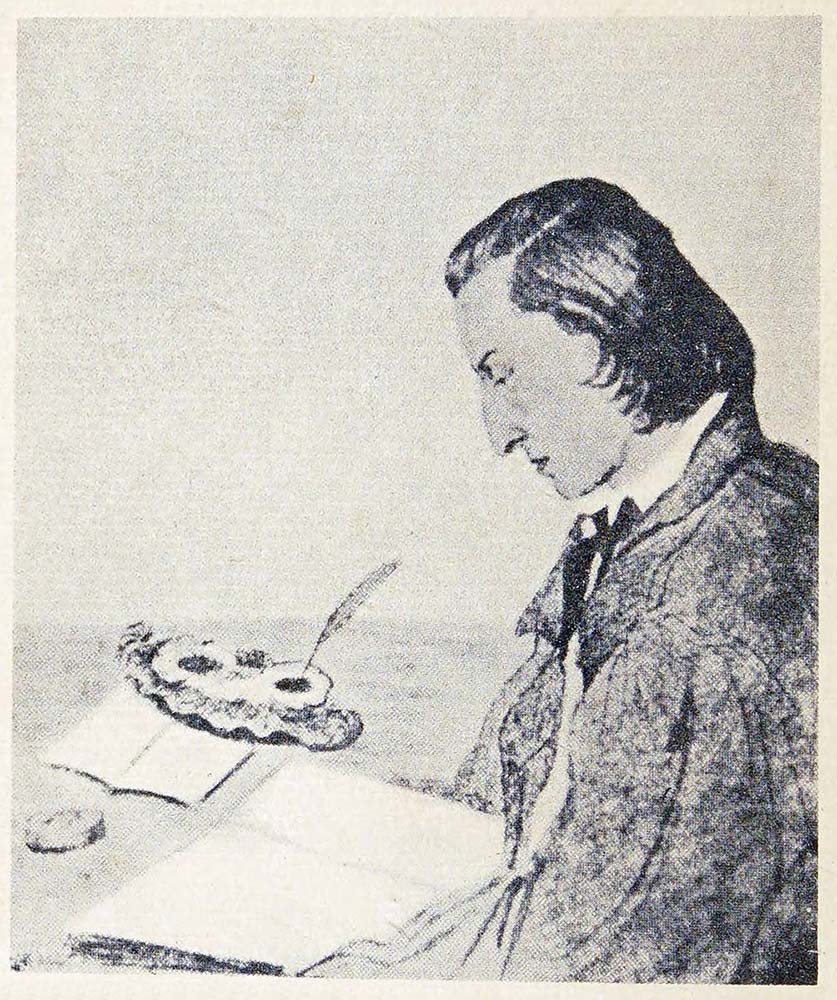
“An angel, fair of face as a tall, sad woman...”
This portrait of Chopin, penned by a hand he
loved, should stand as the frontispiece of this study. Naïve
painters in the Middle Ages—who also came to pray
for pardon—hung their expiatory offerings in the shadows
of the cathedrals. This once caressing woman’s hand,
now dead, surely yielded, while writing these words, to
the inner necessity of knowing absolution. It added:
“There was never anything more pure and at the same
time more exalted than his thoughts...”
And perhaps with faint trembling: “... but this
being only understood that which was inherent within
himself. One would have needed a microscope to peer
into his soul, where so little light of the living ever
penetrated.”
A microscope has never helped to reveal a soul. No
optical instruments are necessary in order to follow the
teaching of Liszt: let us try to see with our hearts.
At the head of these pages must stand a name; because
that name breathes life into the whole being of whom
we write: Poland. Ever since 1795 that unhappy
country had been completely dismembered, until Napoleon,
that great poet of geography, after his first campaign
in Prussia, created the Duchy of Warsaw (1807).
This was to last until the fall of the Emperor, that is,
barely eight years. Yet these eight years were sufficient
to endow the Poles with a singularly youthful hero
worship for France.
Now in 1806, a certain M. Nicolas Chopin, professor
of French, entrusted with the education of the son of
the Countess Skarbek, married in the village of Zelazowa
Wola, six leagues from Warsaw, a Mlle. Justine Krzyzanowska.
He was of French origin, a native of Marainville,
a small village near the Hill of Sion, in the heart
of Lorraine, the history of which is so curiously interwoven
with that of Poland. The fiancée of this one-time
clerk who had become a teacher was a girl of
twenty-four, of an impoverished noble family. In the
household of the Countess she held, as did others of
rank, the position of attendant and lady-in-waiting,
according to the tradition of such proud, poor seigneurs.
Close to the seigneurial dwelling, which was screened
by a group of trees, stood a small house flanked by an
outside staircase. Right through it ran a passage, at
the end of which could be seen the court, the stables,
and, at a distance, the fields of alfalfa and of colza.
Here the young couple settled down. At the right of
the entrance were three low rooms where one could
touch the ceiling. After a time a girl was born, and
was named Louise. This obscure event was rapidly
succeeded by the French campaign in Prussia—Tilsit,
Austerlitz, Jéna, Wagram, and the Polish eagles flying
in the train of the Imperial eagles. Haydn died while
the cannon of Napoleon were thundering for the second
time under the walls of Vienna. When four shells had
fallen close to him, the old composer said to his terrified
servants, “Why this panic? Remember that wherever
Haydn is no accident can happen.” Stendhal, a commissioner
in the army, was present at his obsequies.
He afterwards made the following note: “Why is it
that all Frenchmen who are really great in literature—La
Fontaine, Corneille, Molière, Racine, Bossuet—should
have met together about 1660? Why should
all the great painters have appeared about 1510? Why,
since these two happy periods, has nature been so
sparing? Will music have the same fate?”
Yet Beethoven at that date was writing the Quatuor
serioso and the sonata in E flat major, which is called
The Farewells. He had already composed six of his
symphonies, the Kreutzer Sonata, the Appassionata, and
Fidélio. Liszt, Schumann and Wagner were approaching.
Goethe was flourishing; Byron was publishing
his first verses. Shelley and Keats were outlining theirs.
Balzac, Hugo, Berlioz were warming the school benches.
And on the 22nd of February, 1810, at six o’clock in
the evening, in the little house in Zelazowa Wola, was
born Frederick François Chopin.
He came into a world of music. For exactly at that
moment, under the windows of his mother, rustic violins
were giving a serenade for a village wedding.
CHAPTER II The Childhood of Chopin
On the first of October of that same year, Nicolas
Chopin was made professor of French at the Warsaw
High School, and the whole family moved to the capital.
They were immediately absorbed into the urban life and
never returned to the country. Warsaw was indeed a
fertile soil where one quickly took root among its Italian
palaces and its wooden huts. Its swarming population
mingled Asiatic pomp with the filth of Esquimaux.
Here were to be met the bearded Jew, the nun, the young
girl in a silken cloak, and the mustachioed Pole, in
caftan, with belt, sword, and high red boots.
M. Chopin bestirred himself to increase his income,
because his family had grown. After Louise and
Frederick, Isabelle and then Emilie were born. In 1812
he became professor at the School of Artillery and
Engineers and in 1815 obtained the same post in the
Preparatory Military Academy. Finally he turned his
own home into a small boarding-school for the children
of the rich.
It is not difficult to imagine the surroundings, the
manners, and the customs among which Frederick grew
up in this united and busy household. A somewhat
rigid modesty and the domestic virtues of the family
protected him from rough contacts with reality. It was
thus, said Liszt, that “his imagination took on the
velvety texture of plants which are never exposed to
the dust of the highways.”
Here, then, was a child, very gentle, very pale, sprightly,
with the sensibilities of a little girl, and dominated by
two passions: his love for his mother and his love for
the piano. He had been placed before the keyboard at
a very early age and had returned to it of his own accord,
drawn by the keys. Music drew tears and cries from
him. It became at once a necessary evil. He was also
very fond of his sisters, and chose four friends among
his father’s pupils: Fontana, Titus Woyciechowski, and
the Wodzinski brothers.
To celebrate his eighth birthday, he played at the
benefit of the poet, Niemcewicz. He had been dressed
in the English fashion, with a velvet coat and a large
turn-over collar. And when his mother, afterwards,
questioned him about his success, asking what the
audience had liked best, he replied with pride, “My
collar.”
The Polish aristocracy, and even the Grand Duke
Constantin himself, the Governor of Warsaw, became
interested in the child. He was commanded to appear
before this redoubtable prince—and played for him a
march of his own composition.
“Child,” asked the brother of the Tsar, “why do you
always look upwards?”
But is it not heavenward that poets look? Chopin
was “neither an intellectual prodigy nor a little thinking
animal,” writes one of his biographers, “but a simple,
modest child who played the piano as naturally as the
birds sing....”
He had teachers. First Zywny, a venerable gentleman
of over sixty, a native of Bohemia, a violinist and a good
teacher. He was absorbed in the cult of Bach, a passion
which he instilled in his pupil; and the depth of such
childish enthusiasms is well known. Then, in 1824, at
the time when Frederick was sent to college, his father
replaced Zywny by Elsner, a Silesian professor who
taught him harmony and composition. Without being
a very famous musician, Elsner was something of a personage,
a composer of operas, symphonies, masses, and a
Director of the Conservatory. He had the virtue of
never suppressing Chopin’s personal gifts: “Let him
alone,” he said. “If he leaves the main road and the
traditional methods, it is because he has his own ways,
and some day his work will show an originality that no
one possesses to-day. He follows a unique path because
his gifts are unique.”
One can applaud this happy prophet. Elsner was a
retiring man. He lived in two cells in an old monastery
in the rue des Jésuites. His pupils saluted him on the
right shoulder, according to the Polish fashion, and he
responded by a kiss on each cheek. In his annual
report to the Conservatory he writes: “Chopin, Frederick
(3rd year pupil), astonishing capability, musical
genius.”
Chopin worked well at college also, and took prizes;
in short, he was a fluent and charming youth, and gay
to the point of clownishness, like many melancholics.
His comrades adored him, above all because of his talent
for mimicry and imitation, which showed to what a
point he felt the grimaces of souls. He acted plays with
his sisters, who wrote comedies for the children. He
edited a paper.
These minor events enamelled the surface of a life
without scratches. Three facts alone should be remarked.
In May and June, 1825, in two concerts at the Conservatory,
Chopin played an Allegro of Moschelès’ and improvised
for the Emperor Alexander, who gave him a ring.
During the course of the same year, he published his
Premier Rondo in C minor (op. 1), dedicated to Mme.
Linde, the wife of the Head of the school. Then, the
next summer, he was invited to the Château d’Antonin
by Prince Radziwill.
Playing in public had already lost its novelty. On
the other hand, publishing his music was a new joy,
which he tasted with naïve ardour. And if the piece
was neither very profound nor very scholarly, it had
at any rate his personal imprint. “A lady,” said Schumann
somewhat later in speaking of this little work,
“would find it most delicate, most charming....”
Note how already they hasten the advent of the ladies!
Such is the first blossom of this chaste soul.
The stay at the Château d’Antonin, in the summer of
1826, revealed to Chopin the pleasures that can come
from material plenty and refinements of the spirit, when
these are linked together by skilled hands. This was
precisely what the young aristocrat needed to awaken
his æsthetic response. It is a luxury which the strong
scorn; but a sensitive heart would have difficulty in
dispensing with a judicious distribution of these amenities,
ranging from perfect food to works of art, from
physical luxury to the subtleties of the mind, and subduing
this heart, despite itself, to the domination of the
delicious. I myself should think it very interesting to
know all about the furnishings, the pictures, the guests,
the conversations to be seen and heard during the summer
of 1826 at Prince Radziwill’s. Unfortunately, these
details cannot be known with any degree of certainty.
After all, it may be sufficiently enlightening that Chopin
called Antonin “a paradise” and that he found the
young princesses “divine.” But it is certain that from
that time on his nostalgia for that perfect harmony
derived from the union of fatherland, a sumptuous
dwelling and radiant young beings, shattered his transport
into invincible regrets.
CHAPTER III The Birth of the Poet
When he was asked, after one of his improvisations
at the piano, improvisations that were a mixture
of brilliance that was always slightly sombre, and of
tenderness that was at once poignant and dramatic, by
what name this atavistic desolation that seemed too old
for his young existence should be called, he replied
with the Polish word zal. It was a word that he repeated,
that he loved, a word susceptible of varied meanings
and which included sometimes every tenderness and all
humility, and sometimes only rancour, revolt, and glacial
vengeance. It is a word also that holds at one and the
same time connotations of inconsolable sorrow, and
menace, or fruitless bitterness, a word, in short, that could
be applied to all those cruel and poet Hamlets whom
we call Slavs. From his sixteenth year zal was the
bright enemy of his fortune, an enemy armed each day
anew when one has a romantic heart and when the
destruction of oneself seems the most brilliant solution
of life. In knowing himself and then in cultivating
himself without opposition, Chopin accomplished the
rare miracle of becoming absolutely himself before life
had taught him anything. Himself against life, in spite
of life. The sum of knowledge that was necessary to him
he possessed at sixteen. It was reduced to the seven
notes of the scale, which were sufficient for the expression
of all his thoughts. He was tortured by the need of no
other nourishment than the search for his own style.
That was his method of attaining the truth. Apart
from his piano, the universe, indeed, was but literature.
Furthermore,
his father allowed him to leave school
at seventeen to give himself up entirely to his music.
He was given a little attic study with an old piano and
a table. There he wrote his first works. And it was
at this time that, testing his powers, he acquired the
astonishingly original touch and style that were soon
to amaze the artistic world. The following year, he
composed his Variations on the La ci darem la mano of
Mozart, of which Schumann said as he thumbed it over:
“Eusebius came in softly the other day. You know
that ironic smile with which he tries to intrigue you.
I was at the piano... Eusebius put a piece of music
before us, with these words, ‘Hats off, gentlemen—a
genius!’ We were not to see the title. I turned over
the pages mechanically. The veiled joy of music without
sound is like something magical. And then, it has
always seemed to me that each composer offers to the
eyes a physiognomy of notes that is the essence of the
man. Beethoven has a different look from Mozart, on
paper. But here I fancied that quite strange eyes, the
eyes of a flower, the eyes of a basilisk, the eyes of a
peacock, the eyes of a virgin were marvellously regarding
me. But what was the astonishment of the hearers on
reading the title: opus 2... Chopin? I had never
heard the name.”
Listen to the almost prophetic tone of that surprise:
“Eyes of a flower, eyes of a basilisk, eyes of a peacock,
eyes of a virgin.” This splendid musical portrait paints
in completely the Polish swan testing for the first time
the flutter of his wings.
He took flight very shortly after, at the beginning of
September, 1828, on his first journey. A friend of his
father’s, Professor Jaroçki, took him to Berlin, where
the professor had to attend a scientific meeting. Frederick
was in an ecstasy of enthusiasm. After five days
of jolting in the diligence the travellers reached the
Prussian capital and put up at the Hôtel du Kronprinz.
Chopin’s first visit was to the factory of the Kisting
pianos, his second to the Academy of Singing, his third
to the Opera, where they were giving Ferdinand Cortez
by Spontini, and The Secret Marriage by Cimarosa. “I
followed these operas with great pleasure,” he wrote
home, “but I must admit that the music of Handel approaches
most nearly the musical ideal that I have
adopted.... To-morrow they give Freyschutz; that
is exactly the music that I want.” He saw Spontini at
a distance, and the young Mendelssohn. He dined at
the Congress of Naturalists. “Yesterday there was a
banquet in honour of the scholars. What caricatures!
I divided them into three groups.” At the table he sat
next a professor from Hamburg, who, talking to Jaroçki,
so far forgot himself as to take Chopin’s plate for his
own and begin drumming on it. “A true scientist,
eh? Nothing was lacking, not even the big deformed
nose. I was on pins and needles during the drumming,
and when it was finished had nothing better to do than
to rub off the finger-marks with a napkin.” This incident
was the object of a long report in which can be seen
his stubborn disgust. Then there were the toilettes
of the ladies. Details? None. That struck closer home
than the compulsory visits to the Geological Museum.
Finally, after a fortnight, they re-entered their travelling
carriage to take once more the road for Warsaw.
Arriving at Zullichau, between Frankfurt-am-Oder and
Posen, they found a shortage of horses and were obliged
to stop and wait for fresh ones. What should they do? By
chance the postal relay station was also the tavern. Professor
Jaroçki seized the opportunity to dine. Chopin
spied a piano. He opened it, sat down and began to
let his fingers wander. An old traveller came and sat
quietly near him, then another, then silently all the
household, the postmaster, his wife, his daughters, and
the neighbours. What a surprise was this nightingale
blown by the wind from fairyland! Suddenly the head
of the postillion was framed in the window, and he
thundered out:
“All aboard! The horses are harnessed.”
“Devil take the spoil-sport,” replied the postmaster
furiously.
They begged the young man, who had already arisen,
to sit down again.
“Go on, please go on,” said the ladies.
“I’ll give you extra horses if necessary,” added the
postmaster.
And the old traveller said in his turn:
“Sir, I am an old-fashioned musician and I know what
I am talking about. I, also, play the piano. If Mozart
had heard you, sir, he would have taken your hand. I,
a nobody, dare not....”
When Chopin stopped, this curious audience seized
him and carried him out in triumph.
A Schumann overwhelmed, that enthusiastic postmaster,
that timid musicaster trembling with emotion,
these were the signs that a new poet was born among
men.
CHAPTER IV “Sorrow” and “Ideal”
But it was not until the following year that he was
to find his voice. One evening at the Opera, he
noticed in a small part a young singer with a clear
tone, fair hair, and an attractive mouth. He learned
that her name was Constance Gladkowska, and that
she was still a pupil at the Conservatory. The impression
this girl produced on him was strong, but altogether
pure and childlike. To get the ribbon that tied her
hair, to die holding it hidden on his breast, would have
satisfied his longings. And so delicate was this sentiment
that at first he confided it to no one. Besides,
another thought wrung him more: the thought of
leaving Warsaw, because he well knew that he had
exhausted its musical resources.
In July, 1829, his father furnished him with a little
money, which had been saved with difficulty, and the
young composer, on whom from all sides so many
hopes were now centred, was able to leave for Vienna.
His first visit there was to Haslinger, the music publisher,
a great eulogist who received him with open arms and
already called him “the new star of the North.” But
Chopin, who was not yet twenty, was cautious and
sceptical. He was presented to Count Gallenberg, the
superintendent of the Imperial theatres; he was urged
to give a concert. “What reassures Count Gallenberg,”
he wrote to his family, “is that I shall not tax
his purse. I am going to play for nothing. I am
acting the disinterested and the dilettante. I am a
musician for love of the art.”
The concert took place at the Imperial Theatre on
the 11th of August, at seven in the evening. The
orchestra played a Beethoven overture, some airs of
Rossini. Then the delicate Chopin, already sickly
looking, came on to the platform. An old lady sitting
in the first row said in a whisper, “What a pity the
young man doesn’t make a better appearance!” But
Chopin’s whiteness was from rage rather than nervousness,
because the orchestra, not having been able to
decipher his Variations, had forced him to change the
programme. He therefore improvised on a theme from
The White Lady, then on the Polish air, Chmiel.
With the one exception of Liszt, no one has ever
improvised like Chopin. Under his elegant hand there
opened a new world of velvet tragedies, of ravishing
sorrows, where each hearer trembled as he discovered
a memory of his own griefs. And old men as well as
young schoolgirls followed with delight these exquisite
whisperings. But the power of poets—what is it, if
not to draw singing from one’s own soul, the secret of
which they know better than oneself?
So successful was this first concert that Chopin resolved
to give another a week later. This time he played his
Krakoviak, which the orchestra had rehearsed, and his
Variations on the La ci darem. Count Lichnowsky,
Beethoven’s friend, was present and applauded wildly.
The public, the musicians, and the critics could not conceal
their surprise, for everything was new about Chopin,
both the substance and the form. “The public recognized
a great artist in this young man... On the
ground of the originality of his playing and of his
compositions one could almost attribute genius to him,”
said the Wiener Theaterzeitung; and the Allgemeine
Musikalische: “The exquisite delicacy of his touch, the
indescribable dexterity of his technique, the finish of his
nuances, which reflect the deepest sensitiveness, the clarity
of his interpretation and of his compositions, which
bear the marks of a great genius, all reveal a virtuoso
favoured by nature, who has flashed above the horizon
without previous heralding, like one of the most brilliant
meteors.” One single criticism, that Chopin made of
himself: he plays too softly, he lacks brilliance and
resonance. “They are almost of one voice in saying I
play too softly, too tenderly, rather, for this public,”
he writes to his family. “They are accustomed to the
great drums of their virtuosos. But I prefer them to
say that I played too softly than too brutally.” And in
another letter: “It is my way of playing, and I know it
gives infinite pleasure to women and artists.”
Thereupon he left for Prague, accompanied to the
diligence by all the Viennese musicians, whom he had
conquered in so short a time. Even Czerny, with whom
Chopin had several times played duets, was there.
Chopin thought him “a fine man and more sensitive
than his compositions.” He visited Prague, where he
made the acquaintance of the famous violinist Pixis, and
of Alexandre Klengel, the composer of forty-eight
fugues considered the finest since Bach. Klengel interested
Chopin greatly, and they spent half a dozen hours
together, at the piano and in conversation. Then
Frederick left for Dresden, viâ Teplitz, a watering-place
on the frontier of Bohemia and Saxony, where he passed
the evening at the château of Prince Clary.
A small but “respectable” company were assembled
there: the men of the house, an Austrian general, an
English naval captain, a Saxon general sewed up in
decorations, some young men and girls. After tea, the
Princess asked Chopin if he would “deign” to seat
himself at the piano. The artist replied that he would
“deign,” and asked for a subject for improvisation.
The Prince’s maître de musique proposed a theme from
Rossini’s Moses, and Chopin launched forth upon
embroideries so lovely that he was obliged to return
to the piano four times. They tried to keep him at
Teplitz, but he would not consent. A restlessness, a
certain nervousness, pushed him on to continue his
journey. Something was working deeply in him.
Dresden hardly interested him. He stayed there a few
days doing nothing, then left for Breslau, and returned
at length to Warsaw on September 12th.
Three weeks later, while writing a waltz, he found
out what ailed him. “I have, perhaps to my sorrow,
found my ideal. For six months now I have dreamed
of her each night, and I have never spoken a word to
her. It was for her that I composed the Adagio of my
Concerto (in F minor, op. 21), as well as the Waltz (op.
70, no. 3), written only this morning and which I am
sending to you. Notice the passage marked with a
cross. No one, except you, will know the meaning
of it. How happy I should be, my dear friend, if I
could play it to you! In the fifth bar of the trio, the
bass carries the melody as far as the high E flat, in the
key of G flat. I should not tell you this, as I am sure
you would have noticed it for yourself.”
This confidence was addressed to Titus, the friend
beloved above all others because he too was a musician,
and Chopin found at once the two words that were
henceforth to be the keys to his whole life: “sorrow”
and “ideal.” They give an atmosphere. Perhaps
they give too much; but if they have since then lost
something of their meaning, can we not give back to
them in spirit a living poetical value? In this Europe
which was open to romanticism and fervently breathed
a too magnificent vocabulary lived the faith that moves
and the candour that engenders deeds of love and of
history. An evil age, “An age of fools and follies,”
says M. Charles Maurras. Perhaps. But an age in
which ideas and dreams have more than a rhetorical
value puts a high price on art. And no one was less
satisfied than Chopin with mere words. Those which
he himself used translate exactly the accents of his piano.
When he wrote that to his sorrow he had discovered
his ideal, doubtless he did not suspect what a true note
he had struck. Here, fixed for ever, is the musical
theme in which, thanks to him, millions of beings were
to discover the joys of hopelessness.
In this sorrow, in this ideal, he was of course thinking
of Constance Gladkowska. He wrote again some time
later: “You cannot imagine how sad Warsaw seems to
me. If I were not so happy with my family, I would
not care for this place. Oh! how bitter it is to have
no one with whom to share sorrow and joy! How
dreadful when the heart is oppressed to be unable to
unfold it. You know what I mean. Many times I pour
into my piano what I should like to confide to you.”
He heard much music, and was greatly struck by the
last of Beethoven’s trios. Never, he said, had he heard
anything greater. He composed. He went to the
Opera. Mlle. Gladkowska made her debut in Paër’s
Agnes and he admired her playing, her beauty, the range
of her voice. “Her phrasing and nuance are delicious.
At first her voice trembled slightly, but she soon got
over that. She was overwhelmed with applause.”
He made her acquaintance, accompanied her at the
piano, felt that he should die of sadness and uncertainty.
Ought he to leave? Must he stay? He decided to
accept an invitation from Prince Radziwill and went to
spend one autumn week at Antonin. He was received
as a personage, and played duets with the Prince, who
was the author of an orchestration of Faust.
Two charming Eves graced this paradise—“I mean
the two young princesses, pleasant, musical, and gentle
creatures. As for the Princess Mother, she knows that
it is not birth that makes a man.”
The young princesses knew it, too, and they amused
themselves by taking lessons from this artist with the
complexion of a girl. Wanda allowed him to play with
her fingers, to which he had to teach the correct position.
Elise did his portrait. “Princess Wanda has a real
musical instinct. There is no need to be constantly
saying to her: here, crescendo, there, piano... here
more slowly, there faster... I had to promise to send
her my Polonaise in F minor.” He wrote another Polonaise,
for piano and violoncello. “It is a brilliant piece
for women to play.” He did not forget Constance,
even though Princess Elise was so ravishing. But he
realized the possibility of being charmed in all innocence
by two beings at once. Nor did he forget his dear
Titus of the silent, savage heart. In a moment of expansion
he wrote to him: “I might anoint my body with
the rarest perfumes of Byzantium and you would still
refuse to embrace me if I had not bound you by a kind
of magnetic attraction. But there are secret forces in
nature....”
Returning to Warsaw, he decided to give a concert
which Constance would attend. She could not fail to
understand that it was to her alone that he dedicated
his young fame. The concert actually took place on the
17th of March, 1830, when he had just completed his
twentieth year. The event aroused an extraordinary
amount of attention. The hall was crowded. The
programme, of the usual variegated order, announced
music by Elsner, Kurpinski, a hunting-horn solo, some
singing. Chopin’s part consisted of his Concerto in F
minor and a fantasia on national airs. But the effect
was not all that he had hoped. The connoisseurs alone
had realized and appreciated his originality as an artist.
But Constance, sitting in the front row, smiled at him
and he felt repaid.
A second concert, several days after the first, was a
more brilliant success, and the Rondo à la Krakoviak
aroused acclamations. From all over the house came
cries: “A third concert! A third concert!” This
time it really seemed as though the critics, the crowd,
and the musicians were of one accord in declaring Chopin
Poland’s greatest pianist and composer. But the weeks
slipped by without bringing him real happiness. His love
for Titus and Constance both sustained and tormented
him. He carried their letters next his heart. For them
alone he composed, and his latest music seemed to him
worthless till they had heard it. “Work drives me on.
I am composing hard. Often I turn night into day
and day into night. I live in a dream and sleep while
I am awake. Yes, worse still, it is as though I must
sleep for ever, for I am for ever feeling the same thing.
But instead of gathering strength from this somnolence,
I am tortured further and weaken myself the more....”
He worked on his Adagio in E major, which was to be
“romantic, calm, melancholy,” and to evoke “crowds
of gentle memories. It should be like a reverie on a
moonlit spring night.... What does it matter if it
is bad? You will see in it my fault of doing badly
against my will. But that is because, also against my
will, something has entered my heart by way of my eyes.
It drives me, torments me, although I love it and cherish
it.”
An unexpected treat was given him by the arrival of a
celebrated German singer, Sontag, who gave a series
of six concerts. To her Prince Radziwill presented
Chopin, who experienced a moment of enthusiasm.
She was not beautiful, but charming beyond description,
and she enchanted the circle in which she moved.
Frederick was allowed the honour of seeing her in her
morning peignoir, and brought Constance to her. But
the transit of the singer was no more than a meteoric
interlude and Chopin slid back into his uncertainties.
Departure seemed more and more necessary for his
musical development, and on the other hand the fear
of losing his love paralysed him. On September 4th
he wrote to Titus:
“I have fits of fury. I still have not budged. I
haven’t the strength to name a day for leaving. I have
a presentiment that if I leave Warsaw I shall never see
my home again. I believe that I am going away to die.
How sad it must be not to die where one has always lived!
How dreadful it would be for me to see at my deathbed
an indifferent doctor or servant instead of all my own
folk! I should like to stay with you for a few days;
perhaps I might find some peace again. But as I cannot,
I limit myself to roaming the streets, crushed by my
sadness, and I return—but why? To pursue my fancies.
Man is rarely happy. If he is destined to only a few
short hours of bliss, why should he renounce his illusions.
They too are fugitive.”
More curious still is his letter of September 18th,
where he makes this singular confession:
“You are mistaken in thinking, like so many others,
that my heart is the reason for my prolonging my stay
here. Be assured that I could rise above all if it were
a question of my own self, and that, if I were in love,
I could manage to dominate for several more years my
sad and sterile passion. Be convinced of one thing, I
beg, that is, that I too consider my own good and that
I am ready to sacrifice everything for the world. For
the world;—I mean, for the eye of the world; in order
that this public opinion which has so much weight with
us may contribute to my sorrow. Not to that secret
suffering that we hide within ourselves, but to what I
might call our outward pain... As long as I am in
good health, I shall work willingly all my life. But
must I work more than my strength permits? If it is
necessary, I can do twice what I do to-day. You may
not be master of your own thoughts, but I am always.
Nothing could make me drop them as the leaves from
the trees. For me, even in winter, there is always verdure.
Of course, I am speaking only of the head!
In the heart, on the other hand... good Lord! there
is tremendous heat! No wonder the vegetation there
is luxurious.... Your letters lie upon my heart,
next to the ribbon (Constance’s), for though they do not
know each other, these inanimate objects nevertheless
feel that they come from friendly hands.”
In short, this irresolute knew well that the very base
of his nature was his musical instinct; that this instinct
would conquer all, his desires, his comfort, his peace;
that his “secret suffering,” if it was inevitably necessary,
still amounted to less than that stubborn march towards
a future of melody and solitude.
Coming out of church one day he saw Constance.
“My eyes caught her glance. I tore off into the street
and it took a quarter of an hour to pull myself together.
Sometimes I am so mad that it is terrifying.
But on Saturday week I leave, come what may. I
shall pack my music in my trunk, her ribbon in my
soul, my soul under my arm and,—away I go, in the
diligence!”
Finally, on October 11th, he gave a last concert, in
which Mlle. Gladkowska assisted. Frederick played
his whole Concerto in E minor, a work that he had just
finished, and a Fantasia on Polish Airs. Mlle. Gladkowska,
dressed in white and crowned with roses, sang the
cavatine from Rossini’s Lady of the Lake. “You know
the theme: O quante lagrime per te versai,” wrote Chopin
to Titus. “She rendered the tutto detesto to the G flat
admirably. Zielinski said the G alone was worth a
thousand ducats. After leading her off the stage I played
my Fantasia on the setting of the moon. This time at
least I understood myself, the orchestra understood itself
and the audience understood us.... Now nothing
remains but to strap my trunk. My outfit is ready, my
orchestrations are recopied, my handkerchiefs hemmed,
my new trousers have been tried on.” What was he
still waiting for?
It was as though destiny offered him one final chance.
He did not take it.
The 1st of November, 1830, was the date fixed; he was
to leave for Vienna. In the morning a whole troupe
set forth. Elsner, friends, musicians, conducted him as
far as Wola, the historic suburb where, in earlier times,
the election of the kings had taken place. They held
a banquet. They played a cantata composed by Elsner
in his honour. They sang:
“May your talent, native of our soil,
Display itself in all and everywhere,
Be you on the Danube’s shores,
Or by the Spree, the Tiber or the Seine.
Cherish the customs of your fathers,
And, by the notes of your music,
Our mazurkas and our Kracoviennes,
Sing the glory of your native land.
Yes, you shall realize our dreams.
Know always, Chopin, that you by song
Shall glorify your native land.”
Chorus:
“To leave your fatherland is naught,
Because your soul remains with us.
We raise our prayers for your happiness,
And shall cherish your memory in our hearts.”
He is pale, the young prince, when they present him
with a silver cup filled with his native soil. And now
he bursts into sobs.
As for Constance, she never saw him again. Two
years later she married a country gentleman. Then,
the blue eyes that the poet had loved,—by what strange
trick of fate should they be deprived of light? Constance
became blind. Sometimes, however, she would sit
once more at the piano and sing that lovely song:
Quante lagrime per te versai.... Someone who knew
her towards the end of her life told how “from her eyes,
which remained starry in spite of their blindness,” would
then fall the tears.
CHAPTER V Revolution at Warsaw and Solitude at Vienna
Titus Woyciechowski rejoined Chopin at
Kalisz. Older than he by several years, he was
in appearance and character just the opposite of Frederick;
a tall strong youth with clear, determined features,
speaking rarely, but with just as passionate a melomania.
His huge hands, chiselled to grasp the sword of his ancestors,
as soon as they rested on the keys of the piano
developed an airy delicacy. Slender, deep-eyed Frederick,
however, with his complexion like a child’s, led on a
leash this powerful, submissive dog. They passed by
Breslau, and then went to Dresden, where a whole week
evaporated in calls, parties, and theatres.
Armed with letters of introduction, Chopin betook
himself to pay his respects to Mme. Dobrzyçka, a Pole
and Grand Mistress of the Court of Princess Augusta.
This lady occupied an apartment of the royal castle.
She received him graciously, and invited him to spend
an evening with her in a little group of her friends.
Chopin accepted, suspecting strongly that he would have
to pay with his art, but he made it a rule never to refuse
anything to his compatriots. On the appointed day he
made his entrance in the salons of the Grand Mistress,
where he found only three or four people; some ladies
and a man of some thirty years, clean shaven, whom he
took to be a scholar or an abbé of the Court. Mme.
Dobrzyçka presented him to her guests: “One of our
young compatriots, M. Frederick Chopin, an artist of
great talent, who won’t refuse to let us hear one of his
mazurkas, an echo of our far-off country.” Chopin
sat down at the piano. He felt inspired, his head filled
with poetry, his heart with memories; Constance, his
sisters, the ancient city of Warsaw, floated before his
eyes. In a dozen ways, he expressed them with that
careless grace, that naked emotion which owed nothing
to any model. He was heard in the deepest silence.
Then the Grand Mistress rose and came to him, with
tears in her eyes. “Thank you. You have given a
delightful hour to Their Royal Highnesses.” With a
deep bow she designated the two ladies and the clean-shaven
gentleman. They were the Infanta Augusta, her
sister-in-law, and Prince Jean, the future King of Saxony,
whom he had taken for a doctor of theology. Next
day these personages sent him sealed letters addressed to
Their Majesties the King and Queen of the Two Sicilies
and to His Serene Highness the Prince of Lucca, recommending
“Frederick Chopin, an incomparable artist
for whom the most brilliant future is in store.”
Under these happy auspices Frederick and Titus arrived
in Vienna towards the end of November. They set
out to find an apartment and, for 50 florins a month,
rented three rooms in Kohlmarkt.
But this fickle city had already forgotten the artist
it had once acclaimed. Haslinger, the publisher, refused
to buy his works, and Chopin would not consent to
part with them for nothing. “Maybe he thinks,” he
said, “that if he affects to treat them as bagatelles I
shall take him seriously and give them to him for love.
He is wrong. My motto shall be: Pay, brute.” But
these small cares faded suddenly away when the events
which were taking place in Poland began to filter into
the newspapers. On the 29th of November, indeed,
the revolution broke out in Warsaw. This ancient
people, reduced to slavery, was attempting once again
to regain its liberty. They got their news in crumbs:
on November 29th, eighteen conspirators had set out
for the Palais de Belvédère, where the Grand Duke
Constantin resided, in order to seize him. But they
were too late. “The bird had flown,” and, leading
his Russian troops, had already withdrawn from the
walls of Warsaw. Freed for the time, the entire town
had arisen against its oppressors. The next day a new
Government was formed, the war of independence proclaimed,
and everywhere thousands of volunteers were
enlisting.
From the very first Titus and Frederick were wild
with enthusiasm. Titus fitted himself out from head
to foot, and without further delay left to join his brothers
in arms. Left alone, Chopin lamented his own inaction,
but what could he do with those delicate hands of his,
with his useless talent? On a gamble, without definite
plan, he hired a post-chaise and struck out on the trail
of Titus. But he was unable to overtake him and, in
the sombre winter dusk, his warlike ardour seemed
suddenly so futile that he ordered his driver to turn
about and go back to Vienna. There he found a letter
from his father, who, guessing the feelings of his son,
besought Frederick not to allow himself to be turned
from his career. Let the many sacrifices that had been
made at least be allowed to bear fruit! So Chopin
stayed. But the ordeal was hard to bear in this Austria
of Metternich, entirely hostile to Poland. The artists
he knew avoided him, and more than once as he passed
he overheard the murmur that God’s only error was
to have created the Poles. His mail reached him now
only after long delays and he lived in anguish. He
learned of the march of the Russian General Paskewitch
on Warsaw. Already he saw the town in flames, his
family and Constance massacred. He spent his time in
writing, he who had such a horror of letter paper. “I
seem to be dreaming, to be still with you. These
voices which I hear, and which are unfamiliar to me,
are like carnival clackers. It is nothing to me to-day
whether I live or die.... Why am I left behind?
Why am I not taking my share of the danger with you?”
The Christmas festivities only aggravated this drama of
unrest. Dante was right when he said that a happy
memory is the worst misery of unhappy days. That
Christmas eve he went to the Church of St. Etienne,
and there, standing in the darkest corner under the dome,
he leaned against a Gothic pillar and dreamed of the
family Christmas tree, lighted with candles, of the
modest presents he and his sisters gave each other, of
the traditional supper where the whole family gathered
about the table and broke the holy bread that the lay
brothers of the convents had distributed during Advent.
He passed the holidays largely alone in his room,
which he thus describes: “It is large and has three
windows; the bed faces them, my marvellous piano
is at the right, the sofa at the left, between the windows
a mirror and in the centre of the room a big mahogany
table. The floor is waxed. It is quiet. In the morning
an unbearably stupid servant wakens me. I get
up and have my coffee, which I often take cold, as
playing makes me forget breakfast. About nine o’clock
my German teacher arrives. After that I play. Then
Hummel (the son of the composer) comes to work on my
portrait while Nidecki studies my concerto. I stay in
my dressing-gown until noon. Then a funny little
German, Herr Leidenfrost, arrives, with whom I go
for a walk on the pavement. Then I go to lunch wherever
I may be invited or else at the Café Zur Böhmischen
Köchin, which is frequented by all the University students....
Afterwards I make calls, come in at dusk, dress,
arrange my hair, dress, and go to some party or other.
About eleven or twelve o’clock, never later, I come
home, play, cry, laugh, read, go to bed, and dream of
you.”
In this same letter to his friend Matuszinski, he adds
on Christmas Day (1830):
“I wanted so desperately to have a letter from you.
You know why. What joy news of my angel of peace
gives me! How I should like to sound all the chords,
not only those that evoke stormy feelings but those that
sound the lieder whose half-stilled echoes yet hover on
the shores of the Danube.... But I cannot live as
I please.... You advise me to make a poet’s choice.
Don’t you realize that I am the most irresolute being
on earth, and that I have made only one single fortunate
choice in my whole life? All these dinners, parties,
concerts, balls, bore me. I am overwhelmed with
them. I cannot do what I wish; I must be dressed,
powdered, shod, have my hair dressed, and play the
quiet man in the drawing-room, only to return home
and thunder on the piano. I have no confidant, I have
to ‘do the polite’ with everybody. Forgive these
complaints, my dear Jean, they calm me and give me
relief. One point in your letter made me very gloomy.
Has there been any change? Has anyone been ill?
I could easily believe it of such a tender being....
Reassure her and tell her that as long as my strength
permits, till death, yes, until after death, my ashes shall
be scattered under her feet. More... all this is not
enough, and you may tell her much more.... I
should have done it myself, but for the dread of people’s
gossip. Be my interpreter to her. The day before
yesterday I dined at a Mme. Bayer’s, a Pole whose name
is Constance. I love her society because of this reminder.
Her music, her handkerchiefs, her napkins are
marked with her initial.”
“January 1, 1831.—I received your letter. I do not
know what is taking place in me. I love you all more
than my life. Write to me. So you are with the army?
Our poor families! What are all our friends doing?
I live with you. I should like to die for you, for all
of you. If you leave, how can you deliver my message?
Look after my family. One might believe evil....
How sadly the year begins for me. Perhaps I shall
not see its end. Embrace me. Are you leaving for the
war? Return a colonel. Ah! why cannot I be even
your drummer boy! If you think it unnecessary, do
not give her my note. I don’t remember what I wrote.
You may read it. It is perhaps the first and the last.”
Then he notes in his little pocket-diary: “This bed,
where I sleep ... perhaps it has already held a corpse.
Who was it? Was he more wicked than I? Had he
parents, sisters, a mistress? Now all is peace for him.
I am sure that to die is the noblest human act. Or, on
the other hand, is birth the noblest?...” Later a few
scattered lines about Constance: “Did she love me or
is she playing a part? How hard it is to guess. Yes,
or no? Yes, no, yes, no?... Yes, surely. But
God’s will be done.”
Thus Chopin stands wholly self-revealed, nervous,
lonely, horribly sensitive. All the pains of the world
are latent in him, and a few simple joys. But the man
developed with extreme slowness. The poet clung to
his youth, which had furnished the difficulties he needed.
He had given himself over, as women do, unconsciously
to suffering, and it was by that alone that he was to
become adult.
Yet the two years since his first love for Constance
Gladkowska had already produced admirable work. It
was not without a certain pride that Chopin bound into
his work such pages as the Waltz in D flat major (op.
70, no. 3), in which he had earlier called Titus’s attention
to a confidential passage, the sketches of his Etudes, the
first of his Nocturnes and the two Concertos (in E minor,
op. 11, and in F minor, op. 21). If in construction, in
skeleton, they still owe much to Hummel, in their flesh
and blood they are entirely Chopin. The orchestral
parts are weak because he was not able to think orchestrally,
but the piano parts have an originality and poetry
that bear the stamp of eternity. Liszt later said of the
adagio of the Second Concerto, for which Chopin had a
marked predilection, that the whole piece had “an ideal
perfection,” that “his sentiment by turn radiant and full
of pity, evoked a magnificent country bathed in light,
some dowered valley of Tempe that one might have
selected as the site of a tragic tale, a heartbreaking scene.
It might be called an irreparable sorrow enfolding the
human heart against a background of the incomparable
splendour of nature.”
There is truth in these somewhat florid words. But
it is difficult to reduce to the average vocabulary what
slips so swiftly out of ordinary experience and opens
to our most complex senses an entirely new universe.
An analysis of music is the most futile of intellectual
exercises, because it can build on nothing but emotion.
Look at concert audiences. They are made up for the
most part of lovers and old people. For they understand,
remember, and seek again this powerful inexpressible
thing in which they find the best that is in themselves.
Even Chopin still did not know what he was
giving. He was hampered by classic forms. But he
carried in him the joy of a growing knowledge, developed
and assimilated in his first sorrows.
The winter dragged on as best it could, and Chopin,
with somewhat more pleasure than he admitted, went
from party to party. He let his whiskers grow, or
rather one whisker, the other was not necessary, “because
I only show my right profile to the audience.”
He spent many an evening at the house of Dr. Malfatti,
Court Physician and former doctor to Beethoven, a
happy sybarite and philanthropist who lived in a smart
villa surrounded by a garden. And then spring returned
and the doctor’s peach and cherry trees were covered
with pink and white snow. There, on St. John’s Day,
they had a fête by moonlight. Out on the terrace, in
the bridal air that rose from the orangery, wafted by the
fountain sprays, Chopin played, while the Viennese
listened to the sad-eyed foreigner who in sombre colours
paraphrased a joyous waltz of Strauss.
He went to concerts, met plenty of musicians but,
Slavik the violinist excepted (another Paganini, who
played ninety-six staccato notes with a single sweep of
his bow), none of them impressed him greatly. Vienna
offered him nothing to love. Waltzes, nothing but
waltzes, were played on all sides, and although they were
laughed at, still the editors would publish nothing else.
He was ill and admitted it to his friends, but forbade
them to inform his family. He planned another departure,
and had his passport arranged without knowing
very definitely whether he should name France, Germany,
or England. Italy attracted him also, but there were
revolutions in Bologna, Milan, Ancona, Rome. In
his indecision, he might have settled the matter by a
throw of dice had that not been to tempt fate somewhat.
He ended by deciding on London and, at all events,
had added to the passport: “by way of Paris.” For
the moment he was pacified and furnished with a few
landmarks on which to fasten his imagination. He
packed, made his good-bye calls, and reserved a seat
in the diligence for July 20 (1831).
A few days before his departure, a letter reached him
from his compatriot, Witwicki, the writer, a family friend.
It touched his most sensitive spot. “... Keep always
in view the idea of nationality, nationality and yet again
nationality. It is a word that means little for an ordinary
artist, but not for a talent like yours. There is native
melody just as there is a native climate. The mountains,
the forests, the waters, and the meadows have their native
voice, an inner voice, though not every soul is aware
of it.... Every time I think of it, dear M. Frederick,
I nurse the sweet hope that you shall be the first to be
able to imbibe the vast treasures of Slav melody. Seek
out the popular Slav melodies as the mineralogist seeks
out the stones and minerals of the mountains and the
valleys. I hear that in Vienna you fret and languish.
I can put myself in your place; no Pole could be happy
when the life or death of his own country is in question.
But remember always, dear friend, that you left us not
to languish but to perfect yourself in your art and to
become the consolation and glory of your family and
your country.”
He left on July 20th and, by way of Salzburg, reached
Munich, where he stayed for several weeks. Then he
set out again, and reached Stuttgart. There, on the
8th of September, he learned of the capture of Warsaw
by the Russians. Under the shock of this frightful news
he turned to his piano and his grief burst into harrowing
improvisation. This was the first germ of the Etude
in C minor (op. 10, no. 12) that is called The Revolutionary.
“What a change! What a disaster!... Who
could have foreseen it?” he wrote, several weeks
later.
These words may sound somewhat feeble. But Chopin
did not love great, strong words. In him emotion
always took on a moderate accent. Nevertheless, in
his pocket-notebook he gave free rein to his feelings:
“The suburbs burned! Matuszinski and Titus surely
killed! Paskewitch and that dog Mohilew flee from
the beloved town. Moscow commands the world!
Oh, God, where are you? Are you there and do not
venge yourself? Are you not surfeited with Russian
massacres? Or else,—or else,—are you not yourself,
indeed, only a Muscovite?”
The young exile little suspected that he was to be,
according to Paderewski’s beautiful metaphor, the
ingenious smuggler who would enable the prohibited
Polonism to escape across the frontiers in his portfolios
of music, the priest who would carry to the scattered
Poles the sacrament of nationalism.
CHAPTER VI “I doubt whether there is a city on Earth where more pianists are to be found than in Paris”
When the stage-coach in which Chopin rode had
passed the walls of Paris, the young musician
climbed up on the seat beside the driver. He hardly
knew where to look, at the monuments or at a crowd
so thick it might be thought another revolution. However,
it was only the joy of living again that had brought
the people into the streets and forced the horses down
to a walk. The driver felt impressively at home among
all these symbolic costumes of the bourgeois gentlemen,
and pointed them out to his passenger. Each political
group had its own livery. The School of Medicine and
the Young French parties were distinguished by their
beards and cravats. The Carlists had green waistcoats,
the Republicans red, and the Saint Simoniens blue.
Many strutted about in tailed coats, called à la propriétaire,
which fell to their heels. There were artists dressed
after Raphaël, with hair to their shoulders and wide-brimmed
tam-o’-shanters. Others affected the Middle
Ages,—numbers of women dressed as pages, as musketeers,
as hunters. And in this swarm were hawkers
brandishing their pamphlets: “Ask for The Art of
Making Love and Keeping It; ask for The Loves of the
Priests; ask for The Archbishop of Paris and the Mme.
la Duchesse de Berry.” Frederick was at first somewhat
scandalized. Later he was agreeably surprised to see
a group of youths march by, crying: “Poland! Poland!”
“That is in honour of General Ramorino,
the Italian who is trying to deliver our Polish brothers
from the Russian boot,” explained the driver. They
were obliged to stop the carriage for the crowd to pass.
Eventually they reached the posting station and Chopin
dismounted, had his baggage loaded on a cabriolet, and
betook himself to a house agent, who provided him with
two rooms on the fifth floor at 27, Boulevard Poissonnière.
He liked these quarters because his windows had a
balcony from which he could see the succession of
boulevards. The endless perspective of trees hedged
in between two rows of houses astonished him. “It
is down there,” he thought, “that the history of France
is being written.” Not far away, in the rue d’Enfer,
M. de Chateaubriand was editing his memoirs and he
too wrote: “What happenings have taken place before
my very door! But after the trial of Louis XVI and
the revolutionary uprisings, all trials and uprisings are
insignificant.” And at the same time, a plainly dressed
young woman was writing in her garret novels which
she signed with the name George Sand, and exclaimed:
“To live, how sweet! How good it is, in spite of
griefs, husbands, boredom, debts, relatives, tittle-tattle,
in spite of bitter pangs and tedious annoyances. To
live, how intoxicating! To love, to be loved! That is
happiness, that is Heaven!”
The day after his arrival Frederick plunged into the
crowd and exulted in his solitude. It was more complete
here than in the depths of the German forest, and it
at once stimulated and frightened the artist. He floated
with the tide, until suddenly the crowd thickened,
became organized, and Chopin found himself carried
along by a compact column who, with flags at their head,
were marching to acclaim Ramorino. Then fear seized
him in good earnest, and breaking away, he returned
home by back streets, and climbed to his balcony where
he witnessed from above that storm of enthusiasm.
Shops were shut and a squadron of hussars arrived at a
gallop and swept away the populace, who hissed and
spat at the soldiers. Till midnight there was an uproar
which approached a riot. And Chopin wrote to Titus:
“I can’t tell you what a disagreeable impression the
horrible voices of this angry mob gave me.” Decidedly
he did not like noise, or crowds; politics were not in
his line.
Music, music, his only escape, because it is the only
way of thinking with the emotions. “Here alone can
one know what singing is. With the exception of Pasta,
I do not believe there is a greater singer in Europe than
Malibran-Garcia.” He spent his evenings at the Académie
Royale or at the Italian Opera. Veron managed
the Académie, where Habeneck conducted. At the
Italian Opera Rossini and Zamboni were in the bill.
He heard Lablache and Malibran in Il Barbieri di Siviglia,
in Otello, and in L’Italiana in Algeri. Under the stimulus
of his pleasure he wrote again to Titus: “You can have
no idea what Lablache is like. Some say that Pasta’s
voice is weakening, but I have never in my life heard
one so divine. Malibran has a range of three octaves;
in her own genre her singing is unique, uncanny. She
plays Othello; Schroeder-Devrient, Desdemona. Malibran
is small, the German larger. Sometimes you
think Desdemona is going to strangle Othello.”
Chopin had a letter of introduction to Paër, who
put him in touch with Cherubini, Rossini, and the pianist
then more famous than any of the others, Kalkbrenner.
With beating heart Chopin went to see this supreme
master at his house. He was a tall man, stiff and cold,
with the bearing of a diplomat, and an unstable glance.
He put on the airs of a gentleman, was doubtless too
polite, and certainly very pedantic. Marmontel says
of him that his playing was smooth, sustained, harmonious,
and perfectly even, and that it charmed more
than it astonished; that his left hand had an unequalled
dexterity and that he played, without moving his head
or body, with splendid style in the grand manner.
“A giant!” said Chopin. “He crushes everybody,
myself included.” In Kalkbrenner the young artist
specially admired the purist, the man who talked at the
piano, the language of Cicero.
The master and the unknown played several pieces for
each other. When Chopin had finished his Concerto
in E minor, Kalkbrenner said to him: “You have the
style of Cramer and the touch of Field,” which was without
doubt the greatest compliment he could find. Divining
in this unexpected disciple the great man of to-morrow,
he explained his faults, trotted out again his lack
of method, even pencilled his concerto. He tried to
decipher it. But if he succeeded in the first part, he
was stopped at the beginning of the second by insurmountable
difficulties, for its technique was entirely new.
Nevertheless, he stated with assurance that nothing short
of three years of study under his direction would make
Chopin master of a new piano school. Frederick was
disquieted. Three years more study! What would his
family say? “However, I will submit to it,” he thought,
“if I can be sure of making a big advance.” But, by
the time he had reached home again, he no longer
doubted. “No, I will never be a copy of Kalkbrenner....
No, he shan’t destroy in me that hope, daring,
I admit, but noble, of creating a new world for myself.” A
quarter of a century earlier than Wagner, here in this
young man of twenty years was the certainty of the
same destiny.
We must be grateful to M. Nicolas Chopin for having
upheld his son’s faith. “But, my dear fellow,” he
wrote to him, “I cannot see how, with your capacities
which he (Kalkbrenner) said he remarked, he can think
that three more years of work under his eyes are necessary
for you to become an artist and the head of a new school.
You know that I have done everything I could to further
your inclinations and develop your talent, that I have
opposed you in nothing. You know also that the
technique of playing took you only a short time to learn,
and that your mind has been busier than your fingers.
If others have spent whole days in practising scales, you
have rarely passed an hour on the works of others.
Experts can distinguish genius from its earliest moments,
but they cannot prophesy the peak it will reach.”
Even more remarkable was the letter from his sister
Louise, who had run to Elsner to lay before him the
dilemma in which the whole family was plunged. The
aged teacher, like the young sister, had soon found
traces of a calculating self-interest in the proposal of the
virtuoso. And they said so, they who had simple hearts,
they who had faith. “Elsner was angry. He cried
‘Jealousy already,—three years, indeed!’ and tossed his
head. Then he added: ‘I know Frederick. He is
good, but he has no pride, no ambition; he is easily
swayed. I shall write him what I think of all this.’
Sure enough, this morning he brought a letter which
I am sending you. He went on talking to us about this
business. We who judge men in the simplicity of our
hearts thought Kalkbrenner the most honest man in
the world; but Elsner was not altogether of this opinion.
He said: ‘They recognized a genius in Frederick, and
they are afraid of being supplanted by him. That is
why they would like to have their hands on him for three
years, so that they could stop the growth that Nature
would develop if she were left alone.’ Elsner does not
want you to imitate, and he expresses himself well when
he says: ‘No imitation is worth the original.’ As soon
as you begin imitating you cease to be creative, and,
although you are young, your own conceptions may be
better than those of many others.... Then, M. Elsner
does not only want to see in you a concert player,
a famous virtuoso, which is easier and less worth while,
but he wants to see you attain the goal towards which
Nature is urging you and for which she has made you.
What irritated him extremely was, as he says, ‘the
presumption and arrogance that after having run over
your orchestration would pick up a pencil to strike out
passages without ever having heard the concerto with
the full effect of the orchestra.’ He says that it would
have been quite another thing to have advised you when
you write concerto, to shorten the allegro: but to
make you erase what was already written, that he cannot
pardon. Elsner compared it to taking a seemingly
unnecessary pillar away from a house that had already
been built, with the result of changing everything in
eliminating what was deemed bad. I think that Elsner
is right in declaring that to be superior it is necessary
to excel not only one’s teachers but also one’s contemporaries.
You can excel them by imitating them, but
then, that is following in their tracks. And he says
that you, who already know what is good and what
is better, should now be making your own path. Your
genius will guide you. One more thing, he said.
‘Frederick has drawn from his native soil this distinguishing
particularity: the rhythm—shall I say?—which
makes him as much more original and characteristically
himself as his ideas are more noble than others.’
He would like you to retain that. We do not understand
these things as well as you do, my dear little
Fritz, and we cannot advise you; we can only send you
our comments.”
It is beautiful, this letter. It is not literature, but it
goes to the root of the matter. Frederick followed its
councils and preferred to remain himself, even were it at
the expense of a rapid success. Meanwhile, Kalkbrenner
had the wisdom not to be annoyed at seeing this prize
pupil refuse to allow himself to be convinced. Their
friendship persisted. It was even Kalkbrenner who
presented him to the directors of the famous house
of Pleyel. Chopin attached himself to other artists,
particularly to Hiller, pianist, composer, and musical
critic, and to Franchomme, the celebrated violoncellist,
both of whom aided him to organize his opening concert.
This took place on the 26th of February, 1832, in
the Salons Pleyel. Frederick had got it up with the
greatest care amid constantly renewed difficulties. He
had recruited for the occasion five violinists (among
them Urhan, Liszt’s friend, and Baillot), who were
to play Beethoven’s Quintette. Mlles. Tomeoni and
Isambert were to sing. Kalkbrenner, Stamati, Hiller,
Osborne, Sowinski and Chopin were to play a Grande
Polonaise for six pianos, composed by Kalkbrenner
himself; then Chopin was to play his Concerto in F
minor and his Variations on the “La ci darem” of Mozart.
The Grande Polonaise for six pianos disquieted him.
“It is a mad idea, isn’t it?” he wrote to Titus. “One
of the grand pianos is very large: it is Kalkbrenner’s;
another is very small: that is mine.” He never loved
show. Besides, concerts for the general public were
always odious to him. So on this evening of February
26th, there stepped on the platform a very pale young
man, whose attitude betrayed a very sincere annoyance
much more than it did a dramatic inspiration. The hall
was only half-filled and that mostly with Poles, critics and
musicians. In the front row could be seen the handsome
features of Liszt. A stunning silence descended when
Chopin had slipped his first caresses over the keyboard.
Then there arose from the piano a voice such as no
one, ever, had heard before. Yet each recognized in
it the cry of his innermost self. It was neither a tale,
nor a brilliant commentary, but the simple song of life;
an authentic revelation; the essential word of the heart.
By means of a delicate rightness, which is the strength
of the pure, Chopin transported these connoisseurs.
Liszt himself, whose “doubled and redoubled applause
was not sufficient to express his enthusiasm,” saw here the
revelation of “a new phase of poetic feeling side by side
with innovations in the form of the art.” From that
evening he gave him his warm friendship. Fétis, the
sharp but influential critic, declared: “Here is a young
man who, abandoning himself to his natural feelings, and
following no model, has discovered, if not a complete
renovation of piano music, at least a part of what we
have long been vainly seeking: an abundance of original
ideas which fit into no earlier classification.”
Chopin accepted these eulogies without pride and
without false modesty, because he totally lacked all
vanity. The receipts were counted; they barely sufficed
to cover expenses. But that was nothing in comparison
to another disappointment: the French public had not
attended. The artist’s object, therefore, had not been
achieved. When, towards midnight, he returned to his
room, Chopin believed that fate had pronounced an
unfavourable verdict, and he conceived the idea of
leaving for America.
He had hardly any money left. His friends were still
few, being limited to a small number of artists and
compatriots. Ah, how happy Meyerbeer must be,
having just had produced his Robert the Devil, a mine
of gold and glory! Chopin confided to Titus: “Chance
brought me here. Here one can certainly breathe freely.
But perhaps one also sighs more, too. Paris is everything
that you want it to be. Here you can amuse
yourself, be bored, laugh, cry, do whatever you like
without anyone giving you a glance. I doubt whether
there is a city on earth where more pianists are to be
found than in Paris, or more asses and virtuosi. Ah, how
I wish I had you with me. If you only knew how
sad it is not to be able to relieve one’s soul. I like the
society of people. I make friends easily, and am up to
my ears in acquaintances; but there is no one, no one
who can understand me. My heart always beats, so to
speak, in swoons, and I resent it and should like a pause,—solitude,—with
not a single soul to see me or speak
to me all day long. Above all, I detest hearing my bell
ring when I am writing to you.”
However, it rang a good deal, that little bell, and was
mostly pulled by that worst of the bores, the deadly,
the awful, the ridiculous Sowinski. “He is just coming
in to see me. It is something big, and strong, and it
wears a tiny moustache; it sits down at the piano and
improvises without knowing why. It bangs, it knocks,
it crosses its hands without rhyme or reason; for
five minutes at a time it batters a defenceless key. It
has enormous fingers made rather to hold the reins
and the whip somewhere in the wilds of the Ukraine.
It has no other virtues than a tiny moustache and a
big heart.... When shall we see each other again?
Maybe never, because I assure you that my health is
wretched. Outwardly, I am gay, but within I am consumed.
Dark forebodings, restlessness, insomnia, home-sickness,
indifference to everything. Pleasure in life,
then immediately afterwards,—longing for death....”
Other friends come and go through Chopin’s little
apartment: Albert Grzymala, Count Plater, Liszt,
Berlioz, who arrives from Rome and has great plans,
Polish refugees. But money these young people have
practically none, and Frederick, in spite of the “little
reinforcements” that his father sends him, sees his
resources vanish.
As for love, that was a luxury of which he must not
think. The memory of Constance faded after Isabelle
informed her brother of the marriage of that faithless
one: “Like you I marvel that anyone could be so
callous. It is easy to see that a fine château was a greater
attraction. She had feeling only in her singing!” But
chastity is the natural estate of the poor, and pleasure
was a word that Chopin did not even understand.
Living just below him, however, was a fresh, pretty
woman. They met sometimes on the stairs, smiled,
occasionally exchanged a few words. She heard from
his room the passionate harmonies that this handsome
male angel invented... for whom? Once she said
to him:
“Come and see me some evening. I am often alone
and I adore music.”
He refused, blushing. Yet a regret escaped him on
paper, in his cold room: “I should have found a hearth,
a fire. It would be nice to warm myself at it.”
CHAPTER VII Happy Years, Working Years
“To-morrow,” he wrote to his family, “to-morrow
I cross the seas.” He crossed the Boulevards
and encountered Prince Valentin Radziwill.
This Radziwill family seems to have had a special
influence on the life of Chopin. What beautiful analogies
one could draw in comparing this encounter with such
another when some pope, king, lord or fermier-général
changed in one instant the fortunes of an artist apparently
condemned to the miscarriage of his genius. It seems
that there are between art and opulence secret and unconscious
fructifications. François I never seems to us
more inspired than in paying the debts of Clément Marot
or in welcoming Leonardo da Vinci on the terrace of
Amboise, nor Jules II more sympathetic than when
climbing the scaffoldings of Michelangelo. Never does
Elizabeth of England seem more intelligent than when
she commissions The Merry Wives of Windsor from the
pen of Shakespeare, and Fouquet, Treasurer-General, is
remembered only because he subsidized La Fontaine.
Had they dictated their biographies themselves, these
great princes would doubtless have made no mention of
such trivial gestures. In the same way, this Radziwill
dreamed not of adding a meritorious line to his life when,
meeting on the Boulevards this pitiful compatriot, he
proposed to take him that very evening to see Baron de
Rothschild. It is, however, from that casual proposal
that the glory of Chopin dates.
Baron de Rothschild received the most exclusive
society. Chopin was asked to play and he acceded
with good grace. In a moment he captured the elegant
world, and on the morrow was bombarded with invitations
and requests for lessons. The Maréchale Lannes,
Princess de Vaudemont, Count Apponyi, and Prince
Adam Czartoryski made themselves his protectors.
The lessons he gave cost no less than twenty francs an
hour. He changed his lodgings twice and finally
installed himself at No. 5 Chaussée d’Antin. Everybody
began to talk of this poet who, in the evening, in the
rare salons where he would consent to play, would people
the darkness with a conclave of fairies. He called it
“telling little musical stories.” They were tales of
infinite variety, since it was above all in improvising
that he showed his boldness. The incompleteness of
his sketches opened the avenues of the imagination
wherein the spirit lost itself. Chopin possessed to a
high degree this power of suggestion, the artist’s most
precious gift. He talked to himself, did not finish,
and left to his hearers the pleasure of having clothed
with notes for an instant forms and feelings which then
evaporated into nothingness. “Divine gambols,” said
Berlioz on hearing them. “A cloud of love, winter
roses,” said Liszt. “By the wonderful gate,” he
added, “Chopin leads you into a world where everything
is a delightful miracle, a mad surprise, a miracle come
true. But you must be initiated to know how to cross
the threshold.” And Frederick confided once to his
friend Franz:
“I am not at all the person to give concerts. The
crowd intimidates me; I feel asphyxiated by their
breaths, paralysed by their curious stares, mute before
these strange faces. But you, you are destined for it,
because when you don’t win your public, you know how
to knock them dead.”
Chopin himself would not have had the strength.
He only sought to win them. Furthermore, was it
really this that he wanted? The public mattered so
little to him. It was his own pain that he chanted and
enchanted. He did not like to express himself through
others and, Bach, Beethoven and Mozart apart, he
interpreted none but himself.
For Chopin, as later for Wagner, the superfluous
was the only necessity. The money that was now
coming in more or less abundantly, was spent in poetic
pleasures; a smart cabriolet, beautifully cut clothes,
white gloves, expensive suppers. He took great pains
with the furnishing of his apartment, putting in crystal
lustres, carpets and silver, and he insisted on being
supplied with flowers in all seasons. When his new
women friends came—Countess Delphine Potoçka,
Princess Marceline Czartoryska, Mlle. O’Meara, Princess
de Beauvau, the rule was that they should bring a
rose or orchids that the artist would put in a vase and
endlessly contemplate, like a Japanese enraptured by a
unique print.
Happy years, working years. Chopin composed
a solid portion of his work. In 1833 he published five
Mazurkas, the Trio for piano, violin and violoncello,
three Nocturnes, the twelve great Etudes dedicated to
Liszt, the Concerto in E minor, and in 1834 the Grand
Fantasia on Polish airs, the Krakoviak for piano and
orchestra, three more Nocturnes, the Rondeau in E flat
major dedicated to Caroline Hartmann, four new Mazurkas,
and the Grand Waltz in E flat major. His works
were played by the greatest of the virtuosi at many
concerts: Liszt, Moschelès, Field, Kalkbrenner and
Clara Wieck. Liszt said of him: “A sick-room talent,”
and Auber: “All his life he slays himself.” For Chopin,
in spite of his success, was still suffering from nostalgia,
and one day when his friend and pupil Gutmann was
playing the third Etude, in E major, Chopin, who said
he had never written a lovelier melody, cried suddenly,
“Oh, my country!” Truly, for this young man of
twenty-four, the mother country was always the strongest
passion. He gave a Dantesque sadness to this name of
Poland, more powerful on his heart than the call of a
mistress. The hurt must have been deep indeed for
Orlowski, in writing to his people, to take note of it
as of a tubercular illness. “Chopin is well and vigorous,”
he says. “He turns all the women’s heads. The men
are jealous. He is the fashion. Doubtless we shall
soon be wearing gloves à la Chopin. But home-sickness
is burning him up.” The fact was that Poland remained
the living spring, the reservoir whence he drew his
dreams and his sentiments, the only effective rhythm,—in
sun, the dynamo of his energies. Inspiration is
chance caught on the wing. But art is not found hidden
like the dove in the magician’s hat. Perhaps it is only
perfect self-knowledge, the true perception of one’s own
limitations, and the modulations that life teaches to our
youthful fine enthusiasms. The Marquis de Custine
wrote to Chopin: “When I listen to you I always think
myself alone with you, and even perhaps with greater
than you! or at least with all that is greatest in you.”
In the spring of ’34 Chopin and his friend Hiller went
together to the Festival of Music at Aix-la-Chapelle.
There they encountered Mendelssohn, who took a liking
to the Pole and never tired of listening to his playing.
He called him the first among pianists, and always
reproached him, as well as Hiller, for the Parisian mania
for a pose of despair. “I look like a schoolmaster,” he
said, “while they resemble dandies and beaux.”
They returned by Düsseldorf and Cologne to Paris,
where Chopin had the pleasure of seeing and entertaining
his friend Matuszinski, who had just been made
professor at the Ecole de Médecine. This was a period
of the greatest serenity, for to his quiet fame Chopin
could add the joy of daily companionship with one of
his “brothers.” He exerted himself, entertained guests,
played in public more than he usually did. On the
7th of December, at the Théâtre Italien, he appeared at
a concert organized by Berlioz in honour of Harriet
Smithson, the Irish actress he had just married. On
Christmas Day, at the Salle Pleyel, he played, with Liszt
at the other piano, a duet by Liszt on a theme of Mendelssohn.
On the 15th of February, 1835, he took part in
a concert at the Salle Erard, and on April 4th he played
for the benefit of the Polish refugees. Berlioz wrote in
the Rénovateur, “Chopin, as a player and as a composer,
is an artist apart. He has no point of resemblance to
any other musician I know. Unhappily, there is no one
but Chopin himself who can play his music and give it
that original turn, that impromptu that is one of its
principal charms; his execution is veined with a thousand
nuances of movement of which he alone has the
secret, and which cannot be indicated... The detail
in his mazurkas is unbelievable; then he has found
a way to make them doubly interesting by playing them
to the last degree of softness, with superlative piano,
the hammers touching the strings so lightly that one
is tempted to bend the ear over the instrument as one
might at a concert of sylphs and pixies.”
But the crowd always awards the palms to brilliance,
and Chopin, deciding that it had not given his Concerto
in E minor the reception he expected, declared that he
was neither understood nor made for concerts, and
made up his mind to abstain from appearing in public
for a long time.
Nevertheless, he played once more in public, on the
26th of April, 1835, at the Conservatory. This was the
only time he ever appeared in that famous hall. He played
his Polonaise brillante, preceded by an Andante Spianato.
He found compensation for these slight professional
disappointments in the friendship of the Italian Bellini,
towards whom he was drawn by a quick sympathy and
whom he often saw. He was further distracted by an
interest in a celebrated beauty, Countess Delphine
Potoçka.
She was twenty-five, of regal bearing, with a delicately
chiselled nose, a most passionate mouth, and the high,
pensive forehead of the true voluptuary. Her whole
appearance suggested a slender and puissant goddess,
but whatever luxuriance she had was cooled by the
severity of her glance.
Miçkiewicz said that she was “the greatest of all
sinners,” and Krasinski apostrophized her in a poem in
the manner of Mephistopheles: “O stay, for thou
art true beauty.” Frederick let himself float in the
sensual rayonnement of this beautiful animal of love. For
the first time his head was turned. The sumptuous voice
of Delphine enchanted him. He accompanied her at
the piano, strove to make her soul be born again, to
give it back its flower, and watched for possible beautiful
vibrations; but the soul was the servant of this imperial
flesh. Once or twice, however, she seemed to come
out of her lethargy, to spread herself on an admirable
note that sprang from the depths of her unconscious
self, but immediately after, the shrieks, the laughter, the
exigencies of this ravishing hysteric extinguished these
gleams. And as the platonic love towards which Chopin
wanted to direct her seemed to Delphine both comic
and impossible, she gave herself before he had ever
dreamed of asking her.
The adventure was of short duration. The Countess
had a jealous husband, who, by cutting off her allowance,
obliged this prodigal lady to make a prompt departure
for Poland, whence she did not return till later on.
But she retained a lasting affection for Chopin. The
only lines from her to the artist that have been discovered
furnish discreet witness to the fact:
“I shall not annoy you with a long letter, but I do
not want to remain longer without news of your health
and your plans for the future. I am sad to think of
you abandoned and alone... Here my time is passed
in an annoying fashion, and I hope not to have still more
vexations. But I am disgusted. Everyone for whom
I have done anything has repaid me with ingratitude.
On the whole, life is one long dissonance. God bless
you, dear Chopin. Good-bye.”
“One long dissonance,” so had Liszt already spoken.
There was in these tormented bodies an invincible
straining towards the suavest harmonies. At least in
these beings—male or female—in whom the feminine
predominates. But this is not the case with Chopin,
whose musical travail was always virile. He would have
subscribed to the words of Beethoven: “Emotion is
good only for women; for man, music must draw
fire from his spirit.” And even more, perhaps, to those
quoted by Schumann from the German poet Johann-Paul
Richter: “Love and friendship pass through this
earth veiled and with closed lips. No human being can
tell another how much he loves him; he knows only
that he does love him. The inner man has no language;
he is mute.”
CHAPTER VIII Marie Wodzinska and the Dusk
In the summer of 1835, Chopin learned that his parents
were going very shortly to Carlsbad to take the cure
and he decided on the spot to get there first. The
sentiments that bound him to his own people were still
the most vital that he knew. So he left, his heart
melting with tenderness. When he saw them, after
five years of separation, he wrote to his sisters, who had
remained at Warsaw, with transports that might have
been mistaken for those of a rapturous lover.
“Our joy is indescribable. We do nothing but embrace
one another... is there any greater happiness?
What a pity we are not all together! How good God
is to us! I write just anyhow; to-day it is better to
think of nothing at all, to rejoice in the happiness we
have attained. That is all I have to-day. Our parents
have not changed; they are just the same; they have
only grown a little older. We walk together, holding
the arm of our sweet little mother... We drink, we
eat together. We coax and bully each other. I am
simply overflowing with happiness. These are the very
habits, the very movements with which I grew up; it
is the same hand that I have not kissed for so long...
And here it has come true, this happiness, this happiness,
this happiness!”
For their part, the father and mother found their son
not in the least changed. It was joy inexhaustible, but
brief, and like a preface to profounder emotions. For
Frederick was invited to Dresden, to his friends the
Wodzinskis, and he already felt those annunciatory
quiverings, that exquisite fear, those physiological presentiments
which notify our inner being of the imminent
conception of love.
In his father’s boarding-school Chopin had had as
comrades the three Wodzinski brothers, and since his
childhood he had known their younger sister Marie.
This great land-owning family had moved to Geneva
for the education of the children, and had lived there
during the years of the Polish Revolution. They had
lived at first in a house in the Place St.-Antoine, and
later in a villa on the shore of the lake, and they had
not been long in gathering round them the flower of
Genevese society and of the foreign colony. Familiar
guests in their drawing-rooms were Bonstetten, Sismondi,
Mlle. Salandin de Crans, Prince Louis Napoleon and
Queen Hortense.
Marie was nineteen years old. The trace of Italian
blood which flowed in her veins (through the Orsettis,
who had come from Milan to Poland with Bona Sforza,
the betrothed of one of the last kings of the dynasty
of Jagellons), this trace had made her dark-haired, lively,
with great black eyes and a full-lipped mouth the smile
of which, a poet said, was passion incarnate. Some
called her ugly, others ravishing. This means that in
her face, half Slav, half Florentine, everything derived
from the expression. “The brunette daughter of
Euterpe,” she was called by Prince Napoleon, who liked
to listen to her playing the piano while he smoked his
cigar in the Place St.-Antoine. For Marie practised all
sorts of minor talents; piano, singing, composing,
embroidery, painting, without the will or the ability to
fix her preference. The most pertinent thing about her,
was her charm, the profound reaction, possibly unconscious,
of a very rich temperament. From her fourteenth
year she had been passionately loved. Readily
she used her power over men, disconcerting them with
coquetry. Her imagination was rapid, her memory
exact.
Such was the childhood companion whom Chopin
was to meet again at Dresden, where the Wodzinski
family were settled for a time. Frederick was more
curious than moved at seeing her again. He even
wondered if it were not simply a matter of musical
interest, Marie having formerly been one of his small
pupils. She still occasionally sent him one of her compositions.
Had he not only a few weeks before replied
to one of these communications by sending her in turn
a page of his own music? “Having had to improvise
in a drawing-room here the very evening that I received
it, I took for a subject the lovely theme of a Marie with
whom, years ago, I used to play hide-and-seek...
To-day I take the liberty of offering to my honourable
colleague, Mlle. Marie, a little waltz I have just written.
May it give her a hundredth part of the pleasure I felt
when playing her Variations.”
So he arrived at Dresden. He saw her once again.
He was won. He loved her. This town, which he had
already visited twice, seemed altogether new and enchanting.
In the mornings Marie and Frederick went out
together, filled with delicious melancholy. They walked
along the terrace of Bruhl and watched the flow of the
Elbe, sat under the chestnuts of the Grossgarten, or
lingered in ecstasy in the Zwinger Museum before
Raphaël’s Madonna.
Together they paid a call on that Grand Mistress of
the Court who had a few years before taken such pride
in producing Chopin for Their Saxon Highnesses. In
the evening the family visited one of Marie’s uncles,
Palatin Wodzinski, who had presided at the last meeting
of the Polish Senate before the fall of Warsaw. Exiled,
the greater part of his wealth confiscated, the old man
was now living at Dresden, the second capital of his
ancient kings, surrounded by his prints, his books and
his medals. He was an aristocratic little man, with a
smooth face and a white wig. In his day he had soldiered,
had received Napoleon at Wilna, and had been
taken prisoner at Leipzig, at the side of the dying Poniatowski.
He had the serious defect of a dislike for music,
and now that they were playing every evening at his
house he spent his time observing, rather peevishly, that
his little niece was turning her shining eyes on this maker
of mazurkas. Still more did he disapprove of certain
sighs and whisperings that came from a corner of the
room where this inseparable couple isolated themselves
under the very nose of everybody. So he coughed
loudly, adjusted his toupée, and addressed his sister-in-law:—
“An artist, a little artist without a future... Ah!
that is not what I have dreamt of for your daughter.”
“Two children,” replied the Countess, laughing.
“An old friendship.”
“We all know where that leads to...”
“But he is a child of the house, just as Antoine, Félix
and Casimir were Professor Chopin’s children. Why
sadden the poor boy? He is so tender, so obliging.”
And Frederick continued his love duets at the piano
or on the terrace, in spite of the Palatin’s rebuking eyebrows
and under the mother’s indulgent eyes. A whole
month slipped by in these passionate new experiences.
Then he had to think of leaving. One September
morning he went up for the last time to the salon where
the girl was awaiting him. A handful of roses strewed
the table. She took one and gave it to him. The hour
of eleven struck from the clock on the Frauenkirche.
Chopin stood rigidly before her, pale, his eyes fixed.
Perhaps he was thinking of that death of the self—that
parting always is, whatever it promises for the future.
Or was he listening to the melodic rhythm of his pain?
In any case the only expression of sorrow that welled
to the surface was the theme of a waltz. He sat down
at the piano and played it, hiding thus all the cries of
his loneliness.
Later, Marie called it La Valse de l’Adieu. It is worth
noting that Chopin, restrained by an insurmountable
pride, never published it. He did write it out, however,
recopied it, and gave it to his friend on that last day with
this very simple dedication: “For Mlle. Marie, Dresden,
September, 1835.” Fontana published it after the death
of the composer (Posthumous Works, op. 69, no. 1,
Waltz in A flat major). One wants to catch in it “the
murmur of two lovers’ voices, the repeated strokes of
the clock, and the rumble of wheels scorching the pavement,
the noise of which covers that of repressed sobs.”
It is possible, after all, in spite of Schumann and his mute
language. Be that as it may, Chopin kept the flower
Marie gave him. We shall find it later, placed in an
envelope and marked by him for whom sorrow and the
ideal had always the scent of an autumn rose.
On his way back, Chopin stopped at Leipzig, where
he again saw Mendelssohn, who took him straight to
Wieck, his daughter, Clara, and Robert Schumann. The
small house of the Wiecks’ that day sheltered the three
greatest composers of the age.
After his arrival in Paris, Chopin shut himself up at
home in order to live in close relationship with the loved
face that now bloomed in his desert. He wrote. He
received letters. These were, on both sides, a little flat,
because neither of them knew how to talk well except
through music. But what of it? A lover’s pen is not
necessarily literary nor abounding in sentiments. There
are even those who, in their exigency, scorn the worn
vocabulary of love. To the novices and the pure, the
palest nuances are enough to show the naked heart.
Listen with Chopin’s delicate ear to the gossamer letters
of Marie Wodzinska:
“Though you do not like either to receive or to write
letters, I nevertheless want to profit by the departure
of M. Cichowski to send you news of Dresden since you
left. So I am annoying you again, but no longer by my
playing. On Saturday, when you had gone, all of us
went about sadly, with our eyes full of tears, in the
room where only a few minutes before we had still had
you with us. Father came in presently, and was so sorry
not to have been able to say good-bye. Every minute
or so Mother, in tears, would speak of some traits of
‘her fourth son Frederick,’ as she called you. Félix
looked quite cast down: Casimir tried to make his jokes
as usual, they did not come off that day as he played the
jester, half-crying. Father teased us and laughed himself
only to keep from crying. At eleven the singing master
arrived; the lesson went very badly, we could not sing.
You were the subject of all conversation. Félix kept
asking me for the Waltz (the last thing of yours we
had received and heard). All of us found pleasure in it,
they in listening and I in playing, because it reminded
us of the brother who had just left us. I took it to be
bound; the German opened his eyes wide when he saw
a single page (he did not know by whom it had been
written). No one to dinner; we kept staring at your
place at the table, then too at ‘Fritz’s little corner.’ The
small chair is still in place and probably will be as long
as we keep this apartment. In the evening we were taken
to my aunt’s to spare us the sadness of this first evening
without you. Father came to fetch us saying that it was
as impossible for him as it had been for us, to stay in
the house that day. It was a great relief to leave the
spot that kept renewing our sorrow. Mother talks to
me of nothing but you and Antoine. When my brother
goes to Paris, think a little of him, I beg you. If you
only knew what a devoted friend you have in him,—a
friend such as one rarely finds! Antoine is good-hearted,
too much so, because he is always the dupe of
others. And he is very careless; he never thinks of
anything, or rarely, at least... When by some
miracle you have an impulse to write: ‘How are you?
I am well. I have no time to write further,’ add, I beg,
yes or no to the question I want to ask you: Did you
compose ‘If I were a little sun up there, for none but you
would I want to shine’? I received this a day or so ago
and I have not the courage to sing it, because I fear, if
it is yours, that it would be altogether changed, like
Wojak, for instance. We continually regret that you
are not named Chopinski, or at least that there is not some
indication to show that you are Polish, because then the
French would not be able to dispute with us the honour
of being your compatriots. But this is too long. Your
time is so precious that it is really a crime to make you
spend it reading my scrawls. Besides, I know you do
not read them all through. Little Marie’s letter will be
stuck away in a corner after you have read a few lines.
So I need not reproach myself further about stealing
your time.
“Good-bye (simply). A childhood friend needs no
fine phrases. Mother embraces you tenderly. Father
and my mother embrace you sincerely (no, that is too
little) in the most—I do not yet know how to say it
myself. Joséphine, not having been able to say good-bye,
asks me to express her regrets. I asked Thérèse:
‘What shall I say to Frederick for you?’ She answered:
‘kiss him and give him my regards.’
“Good-bye,
“Maria.
“P.S. When you started out, you left the pencil of
your portfolio on the piano. This must have been
inconvenient on the way; as for us, we are keeping it
respectfully as a relic. Once again, thank you very
much for the little vase. Mlle. Wodzinska came in this
morning with a great discovery. ‘Sister Maria, I know
how they say Chopin in Polish,—Chopena!’”
Frederick replied, sent his music, and above all,
composed. The year 1836 opened under the sign of
Marie. He published the Concerto in F minor and the
Grande Polonaise for piano and orchestra. He wrote the
Ballade in G minor, which is the monument to his love.
It is not deliberately that an artist discovers and then
fashions the residue of his amorous experiences. He
receives his joys and sufferings within himself and leaves
them to ferment. It is only after the rude labour of his
conflicts with himself, after the corrosion of each of his
illusions, under the salt of his tears, that the costly
fruit of which he bears the germ can be born. From
this obscure chemistry, from the disillusionment which
Marie’s letters, little by little, brought to him, came the
Ballade in G minor (op. 23). Schumann called it one of
the most bitter and personal of Chopin’s works. He
might have added, the saddest, and thus the most
passionate, for there is no passion without pain. Here
we see passion itself crucified, and hear its cries.
How powerful is the instinct of the poet to submit
his pain to the form of narrative, like a heroic tale!
For in theory the ballad is a song with accompaniment.
Under this form of legend Chopin transposed the ancient
malady of man, which had become for a second time
his own. It is in this way, by what it tells us of him,
involuntarily, that the Ballade in G minor, irresistible in
its unique and unhappy sentiment, retains an accent
that flatters us. It convinces us that we also are marked
by the sign of love.
Schumann, who saw him again that summer, at Leipzig,
tells of the magical hours they spent together at
the piano. To listen to the dreamer was to become
oneself the dream of his spirit. But nothing could be
more exasperating than Chopin’s habit of drawing his
finger rapidly from one end of the keyboard to the
other at the end of each piece, as though forcibly to
drive away the dream he had created.
A curious detail: in the original edition of the
Ballade, there appears in the last bar of the introduction
a D, evidently written with an E flat and corrected later.
Saint-Saëns writes on this subject: “This supposed E
gives a dolorous accent which is quite in keeping with
the character of the piece. Was it a misprint? Was
it the original intention of the author? This note
marks a dissonant accent, an effect of surprise. But
dissonances, sought out to-day like truffles, were then
distrusted. From Liszt, whom I questioned on the
subject, I could obtain only this reply: ‘I prefer the
E flat....’ I concluded from this evasive answer that
Chopin, in playing the ballad, sounded the D; but
I am still convinced that the E flat was his original idea
and that cowardly and clumsy friends persuaded him to
the D.”
I reproduce this detail for the lovers of sources, for
those who like to surprise in the heart not the sweetest
tones, but the most pure. They will understand the
distinction.
Thus Chopin worked, economized, and prepared for
his next meeting with Marie. He refused an invitation
from Mendelssohn, who wanted him to come to Düsseldorf
for a music festival. He refused Schumann, although
he had signed his invitation “with love and
adoration.” He reserved all his forces for a trip to
Marienbad, which he finally took in July, 1836.
On a radiant summer morning Chopin reached the
wooded hills round the little Austrian watering place
where his loved one was awaiting him. The effect was
so powerful that he closed his eyes as from a shock of
pain. In that instant, even before seeing her, a presentiment
came to him that he had reached the summit of
his joy. He knew the unreasonable agony advanced
by false joys, finished, experienced, emptied, almost
before they have begun to exist. However, Marie’s
agitated face steadied him and gave him back his confidence.
But a shade of uneasiness, a slight tendency on
the part of Marie and her mother to be more ceremonious
than they had been the year before, left him anxious.
Nevertheless, they resumed the intimate family life
which he loved. Forebodings fled. There were walks
in that agreeable country-side, musical séances, evening
talks, stories of his Paris life, memories. Frederick
shone with his talent for mimicry. He imitated famous
artists, assaulted the keys with a great waving of arms
and hands, went, as he said, “pigeon-shooting.” The
Wodzinskis lived in a villa. In their garden spread a
tall lime-tree. During the hot hours of the afternoon
Marie and Frederick took refuge in its shade and the
girl sketched in charcoal the ever slightly grave features
of this friend who was at once so childlike and so mature.
On August 24th they all returned to the beloved town
of Dresden. There they spent two more weeks. Two
weeks which were to lead fatally to the crisis. At dusk
on the 7th of September, two days before Chopin’s
departure, he asked Marie to be his wife. She consented.
That is all we know, except that the Countess
also gave her consent but imposed the condition of
secrecy. They were obliged to hide the decision from
the father, whom they would without doubt persuade,
but whose family pride made a rapid consent improbable.
Besides, he thought Chopin in delicate health.
Frederick departed, carrying with him this promise
and his own despair. He knew that the presentiment
of Marienbad had not deceived him, and already he
had lost his faith in happiness.
However the Wodzinskis wrote to him,—especially
the Countess. Marie added little postscripts. Here is
Mme. Wodzinska’s first letter:—
“14 Sept., ’36.
“Dear Frederick:
“As we agreed I am sending you a letter... I
should have sent it two days ago if it had not been for
a tooth which I had extracted and from which I suffered
greatly. I cannot sufficiently regret your departure on
Saturday; I was ill that day and could not put my
mind on the dusk. We spoke of it too little.
“The next day I could have talked of it further. M.
de Girardin says: ‘To-morrow is always a great day.’
We have it still ahead of us. Do not think I retract
what I said,—no. But we must discuss the path to
follow. I only beg of you to keep the secret. Keep
it well, because everything depends on that... On
October 15th I shall be at Warsaw. I shall see your
parents and your sisters; I shall tell them that you are
well and in excellent spirits: however, I shall say
nothing of the dusk.... Good-bye, go to bed at
eleven o’clock and until January 7th drink eau de gomme.
Keep well, dear Fritz: I bless you with all my soul,
like a loving mother.
“P.S. Marie sends you some slippers. They are a
little big, but she says you are to wear woollen stockings.
This is the judgment of Paris, and I trust you will be
obedient; haven’t you promised? Anyway, remember
that this is a period of probation.”
The dusk, it was so, among themselves, that they
called Chopin’s love. No chance name was ever more
appropriate.
To a letter which her brother Casimir sent off the
next day, Marie added these lines: “We cannot console
ourselves for your departure; the three days that have
just passed have seemed like centuries; have they to
you? Do you miss your friends a little? Yes,—I
answer for you, and I do not think I am mistaken; at
least I want to believe not. I tell myself that this yes
comes from you (because you would have said it,
wouldn’t you?).
“The slippers are finished; I am sending them to
you. I am chagrined that they should be too large,
in spite of the fact that I gave your shoe as a measure,
carissimo maestro, but the man is a common German.
Dr. Paris consoles me by saying this is good for you
as you should wear very warm woollen stockings this
winter.
“Mamma has had a tooth out, which has made her
very weak. She has had to stay in bed ever since.
In two weeks we leave for Poland. I shall see your
family, which will be a joy for me, and that sweet Louise,—will
she remember me? Good-bye, mio carissimo
maestro. Do not forget Dresden for the present, or in
a little while Poland. Good-bye, au revoir. Ah, if it
could be soon!
“Maria.
“Casimir says that the Sluzewo piano is in such
ramshackle condition that it cannot be used. So think
about a Pleyel. In the happy days, not like to-day (as
far as we are concerned), I hope to hear you play on the
same piano. Au revoir, au revoir, au revoir! That gives
me hope.”
Such is the most passionate letter Chopin ever received
from Marie Wodzinska. In October another letter
from the Countess, another postscript from Marie.
“October 2nd—Dusk.
“Thank you ever so much for the autographs. Will
you please send some more? (Mamma makes me write
this.) Now we are leaving at once for Warsaw. How
I shall rejoice to see all your family and next year you!...
Good-bye, till May, or June at the latest. I
recommend to your memory your very faithful
secretary.
“Marie.”
In January, 1837, Countess Wodzinska was disturbed
about a Pleyel piano Chopin had sent her. She thanked
him for a new supply of autographs, and added this
slightly ambiguous sentence at the end of her letter:
“From now on we must inform ourselves still more
prudently about our loved one.” Marie put in her
postscript, her “imposition,” one would like to say.
“Mother has been scolding. I thank you so much,—so
much. And when we see each other again I shall
thank you even more kindly. You can see how lazy I
am about writing, because to put off my thanks till our
next meeting spares me many words to-day. Mamma
has described to you our way of life. There is nothing
left for me to say, except that it is thawing; which is
great news, isn’t it? This tranquil life we lead here
is what we need, so I like it,—for the present, I mean,
because I should not like it to be always so. One takes
what comes with as good grace as possible, when things
cannot be different from what they are. I occupy myself
a little to kill time. Just now I have Heine’s Germany,
which interests me enormously.
“But I must stop and leave you to God’s grace.
I hope I do not need to repeat to you the assurance
of the sentiments of your faithful secretary.
“Marie.”
This time Chopin must have discovered in the colourless
words not the least gleam of the dusk. The night
had completely fallen. He took down the album Marie
had given him the year before to write in it a page of
music. For a year the pages had remained virgin.
Chopin said: “I could not have written anything at all
in it, not if I had tried a hundred years.”
Now he could fill it, because he realized that Marie’s
love was dead. So he wrote on the first page a Lento
con gran expressione and eight other melodies to the words
of Witwicki and Miçkiewicz. Soon after, he received
in reply this letter, the last:—
“For Frederick Chopin.
“I can only write you a few words to thank you
for the lovely scrapbook you have sent me. I shall
not try to tell you with what pleasure I received it, as
it would be in vain. Accept, I beg you, the assurance of
the gratitude I owe you. Believe in the life-long attachment
of our whole family for you, and particularly of
your naughtiest pupil and childhood friend. Good-bye.
Mamma sends her dearest love. Thérèse is always
talking of her ‘Chopena.’
“Good-bye,—think of us,
“Maria.”
It is hard to say whether it was heart or intelligence
that was wanting in this young woman. Besides,—it
scarcely matters. Love is not within the compass of all
little girls any more than happiness is made for difficult
souls. “Perhaps we are worth more than happiness,”
said Liszt to Mme. d’Agoult.
Chopin accepted the breaking of his engagement in
silence. But neither his heart nor his body recovered,
ever. His friend Camille Pleyel took him to London
for a few days, to distract him. There he was very
ill. His latent tuberculosis seems to have begun its
ravages at that time.
The Marquis de Custine wrote him: “You have
gained in sympathy, in poetry; the melancholy of your
compositions goes deeper into the heart than ever before.
One is alone with you even in the midst of the crowd.
It is not a piano, it is a soul...”
Chopin gathered the notes of Marie Wodzinska and
placed them, with the rose of Dresden, in an envelope
on which he wrote these two Polish words: “Moïa
Biéda,” my grief. They found this poor packet, after
his death, tied with a loving ribbon.
CHAPTER IX First Sketch of George Sand
Some six years before this romance in such few
words, we glanced at the face of a woman bending
over her paper and watched her enthusiastic hand pen
these words: “To live, how sweet! How good it
is, in spite of griefs, husbands... in spite of bitter
pangs. To live,—how intoxicating! To love, to be
loved! That is happiness, that is Heaven!” During
these six years neither this heart, nor this body, nor
this hand had much slackened. To live, indeed, was
the vital business of George Sand, dumpy, greedy, and
so formidably endowed for all the extravagances of the
spirit and the flesh. Nothing was too strong for this
small woman, so solid of head and of body. And no
one had bested her. In spite of her “bitter pangs,”
her chagrin, for and against a boorish and rapacious
husband, this great-granddaughter of the Maréchal de
Saxe, this daughter of a daughter of the people had pretty
well solved the double tactical problem of happiness
that she had set herself: love and fame—enough to
satisfy the most exigent appetites. At twenty-seven,
this provincial had written her first book and taken
her first lover. At thirty she could have said, like her
ancestor the Maréchal: “Life is a dream. Mine has
been short, but it has been beautiful.” Now, in her
thirty-fourth year, this surprising pagan thought herself
finished, and for ever disgusted with pleasure. She had
not yet learned that the malady of desire, once it has
opened in a being its ever-living wound, has but a
feeble chance of healing. At least before the season
of the great cold.
But, to this malady of desire, Aurore Dudevant added
a taste for lengthy associations. Heart and head she
was made for them,—and from them had contracted
the habits of bed and of thought. Jules Sandeau had
given her her pen name, her theories of “love free and
divine,” and her first experience of love. The disappointment
that followed this trial plunged her into
war against all yokes, even that of sentiment. Still,
perhaps yoke is too heavy a word. Pressure is enough.
To rid herself, however, of such disturbing memories,
she chose an intelligent thaumaturgist, and, against
love, a marvellous antiseptic: the writer Mérimée.
She confessed as much, at a later date, in a curious letter:
“On one of those days of weariness and despair I met
a man of sublime self-confidence, a man who was calm
and strong, who understood nothing of my nature and
who laughed at my troubles. The vitality of his spirit
completely fascinated me; for a week I thought he
had the secret of happiness, that he would teach it to
me, that his scornful indifference would cure me of
my childish susceptibilities. I believed that he had
suffered like me, and that he had triumphed over his
surface emotions. I do not yet know if I was wrong,
if this man is strong by reason of his greatness or of
his poverty.... At any rate, at the age of thirty I
behaved as a girl of fifteen would not have done. The
experience was a complete failure.”
This woman, so smothered in words, sometimes found
a phrase that plumbed the depths. She adds a little
farther on, in that same letter to Sainte-Beuve: “If
Prosper Mérimée had understood me, he might perhaps
have loved me, and if he had loved me he might have
vanquished me, and if I had been able to submit to a man
I should have been saved, because my liberty devours and
kills me.” Here is the real misfortune of this gross
temperament. It needed a master and from that time
sought it only among the weak. Her slight physiological
inversion induced psychological aberrations from
which sprang all the wrongs which this fine thinking
animal committed against her own peace.
Thus, there was thenceforth in the life of George
Sand an absent being. We can take those words to mean
a kind of ideal lover, lord of her thought and minister
to her flesh, this marvellous twin self who arouses our
instincts but never satiates them, who invents our dearest
pains and stirs up our devils, yet like an angel bears
us up to the mystical union of souls. The difficulty is
to find united in one being all the colours of our own
neurosis. We all join the chase, however, giving each
his own name to the pursuit. George Sand called it
“the search for her truth.” After all, why not? One
might call truth the rhythm from which our engines
derive the greatest potential power, whether this be for
pleasure, for pain, for work, or for love. But we must
do Sand this justice, that next to her private ills the
general ill, “the suffering of the race, the view, the
knowledge, meditation on the destiny of man” also
impassioned her elastic soul. She often succeeded in
forgetting herself in order to understand others. She
knew how to let her intelligence ripen, to give maturity
to her thoughts. Yet, in spite of the part she took in
the idealistic battles of the century, in spite of the intellectual
influence which she exerted at such an early age
on the minds of her time, this woman’s profound lament
was that of her Lélia: “For ten thousand years I have
cried into the infinite,—‘Truth, truth!’ For ten thousand
years the infinite has answered,—‘Desire, desire!’”
But here is this désenchantée, after her period of
despair in 1833, suddenly writing: “I think I have
blasphemed Nature, and God perhaps, in Lélia; God,
who is not wicked, and who does not wreak vengeance
upon us, has sealed my mouth by giving me back my
youthful heart and by forcing me to admit that he has
endowed us with sublime joys.” She had just dined at
the side of a fair young man of twenty-three, with arrogant
eyes and no eyelashes, with a slender waist and
beautiful, aristocratic hands, who scoffed loudly at all
social idealism and bent over to breathe in the women’s
ears: “I am not gentle, I am excessive.” He scoffed
both at the “labouring classes” and at the “ruling,”
at St.-Simon and at the Abbé de Lamennais. He even
said: “I am more interested in the way Napoleon put
on his boots than in all the politics of Europe.” Women
felt that his real interest was love.
He paid immediate attention to his already celebrated
neighbour with the olive skin, who sent him a few days
later the two volumes of her Leila with these inscriptions:
the first: “To Monsieur mon gamin d’Alfred;”
the second “To Monsieur the Viscount Alfred de
Musset, respectful regards from his devoted servant,
George Sand.”
We know to-day in all its details the story of this
liaison and its magnificent expenditure of sorrows.
We shall retain only certain crystals, the bitter dregs
left in their hearts by the excesses of two fierce and
consummate imaginations. It can be said that they
devoured each other. Their desires differed: the one
more brutal, more ravenous, less merciful; the other
evil, maniacal, but savouring in little bites the marrow
of their mutual suffering. “Contract your heart, big
George,” he said. And she: “I no longer love you,
but I still adore you. I no longer want you, but I
cannot now do without you.” They departed for
Venice, where these two sadists took vengeance on
each other for their double impotence: cerebral with
him, physical with her. And they continued nevertheless
to desire and adore each other in spite of their
outworn senses and spent joys. Then came those tortures
that are self-inflicted for the stimulation of the
senses. They soon had nothing left but the taste of
their tears. Finally, in the very middle of the crisis,
each of the two lovers sought refuge according to his
own temperament: George in work and Alfred in
sickness. Then the saviour appeared in the form of a
handsome Venetian doctor on whom, at the very bedside
of the delirious poet, fell the brunt of the reillumined
desires of the other victim. No more pity, when the
beast is once more at large. And no more despair,
when the dry scales fall from an old love to leave naked a
new body that melts to softness at the first touch of
unfamiliar lips.
Musset departed. The three of them cultivated a
curious relationship. The following summer George
wrote to Alfred: “Oh! that night of rapture, when,
in spite of ourselves, you joined our hands and said:
‘You love each other and still you love me; you have
saved me body and soul!’” And for his part Musset
cried: “Poor George, poor dear child! You thought
yourself my mistress,—you were only my mother....”
There the word is spoken. That physiological inversion
we mentioned could at once assume another form. But
the mot juste is really that of mother. Because Sand was
above all maternal, protective, the mistress genetrix.
She needed to endow everything about her with the
sentiment of maternity. A few months later on, when
everything was over between them, the shrieks she uttered
in her Journal Intime over this badly quenched love were
again those of a mother deprived of her suckling. “I
love you! I would submit to every torture to be loved
by you, and you leave me! Ah! poor man, you are
mad... It is your pride that leads you... Oh,
my poor children, how unhappy your mother is!...
I want to surround myself with pure and distinguished
men. Away with the strong; I want to see the artists:
Liszt, Delacroix, Berlioz, Meyerbeer. I shall be a man
among them and we shall gossip and talk. Alfred shall
hear our bad jokes... Alas, if I only had him to-day!
What haste I am in to have him! If I had only
a few lines from you once in a while, just a word, permission
to send you sometimes a little two-penny picture
bought on the quai, cigarettes I made myself, a bird,
a toy... Oh, my blue eyes, you will never look at
me again! Lovely head, I shall never see you bend
over me again, or wrap you in sweet languor. My little
body, warm and supple, you will never stretch yourself
out on me, as Elisha on the dead child, to quicken it!”
“Ah! who will care for you, and for whom shall I
care?”
This was the punishment for loving a man devoid of
passion. The depth of her being, when she stirred it
well, sent up always the same hope: “I need to suffer
for someone. I must nourish this maternal solicitude,
which is accustomed to guard over a tired sufferer.”
A fancy for a kind of tribune of the people intervened
to heal the still live sore: she thought herself in love
with Everard, he whom his contemporaries called Michel
de Bourges. She yielded him the virginity of her
intelligence. A cold love. The love of a slave who
admires a handsome captain and a just legislator. But
no giving, no suffering, nothing to blast deep caves
of passion into the soul. Besides, Michel de Bourges
was anti-artist. She wanted to avenge art with irony.
“Berlioz is an artist,” she wrote to the master of rhetoric.
“Perhaps he is even criminal enough to think secretly
that all the people in the world are not worth a rightly
placed chromatic scale, just as I have the insolence to
prefer a white hyacinth to the crown of France. But
rest assured that one can have these follies in one’s head
and not be an enemy of the human race. You are for
sumptuary laws, Berlioz is for demi-semi-quavers, I am
for liliaceous plants.”
This lawyer was nevertheless jealous underneath his
coldness. He was even tiresome. George Sand saw
Liszt, found him handsome, and received him at Nohant
with his mistress, Marie d’Agoult. Envying their still-young
love, she noted in her diary: “What fearful
calm in my heart! Can the torch be extinguished?”
It was not the torch that was dying but the burned out
candle lighted by the philosopher whose penholder she
had aspired to be. And still the old stubborn idea
reappeared: “My sweetest dream... consists in
imagining the care I might give you in your feeble old
age.” One important service she received from Michel
was the winning of her action for divorce from Casimir
Dudevant.
In the summer of 1836 she shook off the lover’s chain
and broke the hobble of a husband. She was free.
On the spot she turned over her two children, Maurice
and Solange, to a young tutor by the name of Pelletan,
whom, to know him better, she put to the test by becoming
his mistress. Then she left for Geneva to join
Liszt and the Countess d’Agoult. She returned in the
early autumn and settled for a time in Paris with this
couple, who were beginning to tire of solitude. All
three of them went to the Hôtel de France in the rue
Laffitte. This sedate bourgeois tavern became a communal
dwelling of artists. On the stairs one passed
Eugène Sue, Miçkiewicz, the singer Nourrit, the Abbé
de Lamennais, Heinrich Heine. The musical gentlemen,
with Liszt at the head, spoke of nothing but Chopin.
“Bring him to me,” demanded George.
He came one evening with Hiller. Mr. Sand and
Miss Chopin saw each other for the first time.
Returning home, Chopin said to his friend: “What
an antipathetic woman that Sand is! Is she really a
woman? I’m inclined to doubt it.”
CHAPTER X Letters of Two Novelists
While Frederick Chopin, in the year 1837, was
living out the slow decomposition of his love,
George Sand was back at her little Château de Nohant.
There she spent long months alone, with her children
and her work. The summer brought her the Liszt-d’Agoult
ménage, nights of music, new dreams of
happiness. Then her mother died unexpectedly, and
she was obliged to return to Paris, while the Countess
and Franz took the road for Italy. She planned to
rejoin them there, but was prevented by a sudden
inclination for the new tutor of her children, Félicien
Mallefille. The rupture with Michel de Bourges still
bled feebly, but George felt that she had finally “slain
the dragon,” and that this attachment, more stubborn
than she had dreamed, would be cured by a gentle affection,
“less enthusiastic, but also less sharp,” and, she
hoped, lasting. She was mistaken. Six months were
sufficient to drain this spring to the bottom. Nevertheless
she had pity on this rather vapid lover, who never
interested her physically. For several months more
she dragged him about with her luggage between Paris,
Fontainebleau, and Nohant.
In January of 1838, the great Balzac stumbled one fine
evening into this country seat and stayed for several
days. The two novelists passed the nights in gossip
and confidences. Balzac set down his still warm impressions
for Countess Hanska: “I reached the Château
de Nohant on Holy Saturday, about half-past seven in
the evening, and I found comrade George Sand in her
dressing-gown, smoking an after dinner cigar, in front
of her fire in an immense empty room. She had lovely
yellow slippers ornamented with fringe, bewitching
stockings and red trousers. So much for her state of
mind. As to physique, she had doubled her chin like
a prebendary. She has not a single white hair in spite
of her frightful misfortunes; her swarthy complexion
has not changed; her fine eyes are as brilliant as ever;
she has the same stupid air when she is thinking, because,
as I told her after studying her, her whole countenance
is in her eye. She has been at Nohant for a year, very
sad and working prodigiously. She leads about the
same life that I do. She goes to bed at six in the morning
and gets up at noon; I go to bed at six in the evening
and get up at midnight. But, naturally, I conformed
to her habits, and for three days we have gossiped from
five o’clock in the evening, after dinner, till five in the
morning. The result is that I know her, and she knows
me, better after these three talks than during the whole
of the preceding four years, when she used to visit me
while she was in love with Jules Sandeau and when she
was attached to Musset... It was just as well that I
saw her, for we exchanged mutual confidences regarding
Jules Sandeau... However, she was even more
unhappy with Musset, and now there she is, in profound
seclusion, raging at both marriage and love, because
in each she has found nothing but disappointment.
“Her right male was hard to find, that is all. All
the harder because she is not amiable, and, consequently,
loving her will always be beset with difficulties. She is
a bachelor, she is an artist, she is big, generous, loyal,
chaste; she has the features of a man. Ergo, she is
not a woman. While I was near her, even in talking
heart to heart for three days, I felt no more than before
the itch of that gooseflesh of gallantry that in France
and in Poland one is supposed to display for any kind
of female.
“It was to a friend I was talking. She has high
virtues, virtues that society regards askance. We discussed
the great questions of marriage and of freedom
with a seriousness, a good faith, a candour, a conscience
worthy of the great shepherds who guide the herds of
men.
“For, as she said, with immense pride (I should not
have dared think of it myself), ‘Since by our writings
we are preparing a revolution in the customs of the
future, I am not less struck by the inconveniences of the
one state than by those of the other.’
“We spent the whole night talking of this great
problem. I am absolutely in favour of liberty for the
young girl and bondage for the woman, that is, I want
her to know before marriage what she is undertaking:
I want her to have considered everything; then, when
she has signed the contract, after having weighed the
chances, to be faithful to it. I gained a great point in
making Mme. Dudevant realize the necessity of marriage;
but she will come to believe in it, I am sure, and I feel
that I have done good in proving it to her.
“She is an excellent mother, adored by her children;
but she dresses her daughter Solange like a little boy, and
that is not right.
“She is like a man of twenty, morally, because she
is chaste, modest, and only an artist on the outside.
She smokes inordinately, she plays the princess, perhaps,
a little too much, and I am convinced that she portrayed
herself faithfully as the princess in Le Secrétaire Intime.
She knew and said of herself, before I told her, just
what I think,—that she has neither power of conception
nor the gift of constructing plots, nor the ability to
attain to the truth, nor the art of pathos; but that,
without knowing the French language, she has style.
This is true. She takes fame, as I do, lightly enough,
and has a profound scorn for the public, whom she calls
Jumento.
“I shall tell you of the immense and secret devotion
of this woman for these two men, and you will say
to yourself that there is nothing in common between
the angels and the devils. All the follies she has committed
entitle her to glory in the eyes of great and
beautiful souls....
“Anyway, it is a man she would like to be, so much
so that she has thrown off womanhood, and is no longer
a woman. A woman attracts and she repels, and,
since I am very masculine, if she produces that effect
on me, she must produce it on men who are like me.
She will be unhappy always. And so,—she is now
in love with a man who is her inferior, and in that
covenant there is only disillusionment and disappointment
for a woman with a beautiful spirit. A woman
should always love a man greater than she, or she be
so blinded that it is the same as though he were.
“I have not come from Nohant unscathed. I carried
away one enormous vice; she made me smoke a hooka
with Lattakieh; it has suddenly become a necessity to
me...”
Balzac’s eye and ear were not mistaken in their diagnosis.
Yet he could neither fully see nor fully hear
what was passing behind the windows of this being who
was more complex than he knew. This spring of 1838
germinated once again the strong dark violet of a new
love.
George Sand had been to Paris several times. She
had seen Chopin again. And the drama of pleasure,
of difficulties, of pains, had involved them. Both
Sand and Chopin had come through too many sufferings
to turn the new page of their story with anything but
distrust and uncertainty. But with Chopin it had all
been buried in silence, and his music alone had received
his queries and his secret raptures. We may consult
all his work of this period, which witnesses magnificently
to this: the Twelve Studies, dedicated to Mme. d’Agoult
(Vol. 2, op. 25), the Impromptu (Op. 29), the Second
Scherzo (Op. 31), the Two Nocturnes (Op. 32), the four
mazurkas of op. 30 (C minor, B minor, D flat major,
and C sharp minor), the three Valses Brillantes of op.
34, and four other mazurkas (op. 33) dedicated to Mlle.
la Comtesse Mostowska.
As for George, the first hint of her new passion is
found in a letter to her friend, Mme. Marliani, dated
the 23rd of May, where she says: “Pretty dear, I have
received your letters and have delayed replying fully,
because you know how changeable the weather is in the
season of love. There is so much yes and no, if and but,
in one week, and often in the morning one says: This
is absolutely intolerable, only to add in the evening:
Truly, it is supreme happiness. So I am holding off until
I may tell you definitely that my barometer registers
something, if not stable, at least set fair for any length
of time at all. I have not the slightest reproach to
make, but that is no reason to be happy....”
Yet it was not to Mme. Marliani that she showed
the singular and interesting fluctuations of her sentimental
barometer, but to Count Albert Grzymala, a close friend
of Chopin. But here is what she wrote him at the
beginning of that summer:
“Nothing could ever make me doubt the loyalty
of your advice, dear friend; may you never have such
a fear. I believe in your gospel without knowing or
examining it, because once it has a disciple like you
it must be the most sublime of all gospels. Bless you
for your advice, and be at peace about my thoughts.
Let us state the question clearly, for the last time, for
on your final reply on this subject will depend my
whole future conduct, and since it had to come to this
I am vexed at not having conquered the repugnance I
felt to questioning you in Paris. It seemed to me that
what I was to hear would blanch my poem. And, indeed,
now it has browned, or rather it is paling enormously.
But what does it matter? Your gospel is mine when
it prescribes thinking of oneself last and not thinking
of oneself at all when the happiness of those we love
claims all our strength. Listen to me well, and reply
clearly, categorically, definitely. This person whom
he wants, ought, or thinks he ought to love, is she the
one to bring him happiness? Or would she heighten
his suffering and his sadness? I do not ask if he loves
her, if he is loved, if she is more or less to him than I.
I know, approximately, by what is taking place in me,
what must be happening to him. I want to know which
of us two he must forget and forsake for his own peace,
for his happiness, for his very life, which seems to me
too precarious and frail to withstand great sorrows.
I do not want to play the part of a bad angel. I am
not Meyerbeer’s Bertram and I shall never fight against
a childhood friend, provided she is a pure and lovely
Alice. If I had known that there was a bond in the
life of your child, a sentiment in his soul, I should never
have stooped to inhale a perfume meant for another
altar. By the same token, he would without doubt
have drawn back from my first kiss had he known I was
as good as married. We have neither of us deceived
one another. We gave ourselves to the wind that
passed, and for a few minutes it carried us both into
another region. But we had, none the less, to come back
down here, after this celestial embrace and this flight
through the empyrean. Poor birds, we have wings,
but our nest is on the ground, and when the song of
the angels calls us on high, the cries of our family recall
us below. For my part, I have no wish to abandon
myself to passion, although there is in the depths of my
heart a fire that still occasionally threatens. My children
will give me the strength to break with anything that
would draw me away from them, or from the manner
of life that is best for their education, their health, their
well-being.... Thus I am unable to establish myself
at Paris because of Maurice’s illness, etc., etc. Then
there is an excellent soul, perfect, in regard to heart and
honour, whom I shall never leave, because he is the only
man who, having been with me for a year, has never
once, for one single minute, made me suffer by his fault.
He is also the only man who has ever given himself
absolutely and entirely to me, without regret for the
past, without reserve for the future. Then, he has
such a good and wise nature that I can in time teach
him to understand everything, to know everything. He
is soft wax on which I have put my seal. When I
want to change the imprint, with some precaution and
patience I shall succeed. But it cannot be done to-day,
and his happiness is sacred to me.
“So much for me. Tied as I am, bound fairly
tightly for years to come, I cannot wish that our child
should on his side break the bonds that hold him. If
he should come to lay his existence in my hands, I
should be indeed dismayed because, having already
accepted another, I could not offer him a substitute for
what he had sacrificed for me. I believe that our love
could last only under the conditions under which it
was born, that is, that sometimes, when a good wind
blows us together, we should again make a tour among
the stars and then leave each other to plod upon the
ground, because we are earth children and God has not
decreed that we should finish our pilgrimage together.
We ought to meet among the heavens, and the fleet
moments we shall pass there shall be so beautiful that
they shall outweigh all our lives below.
“So my task is set. But I can, without ever relinquishing
it, accomplish it in two different ways; the
one, by keeping as aloof as possible from C[hopin],
by never seeking to occupy his thoughts, by never again
being alone with him; the other, on the contrary, by
drawing as close to him as possible without compromising
the position of M[allefille], to insinuate myself
gently into his hours of rest and happiness, to hold him
chastely in my arms sometimes, when the wind of heaven
sees fit to raise us and transport us up to the skies.
The first way will be the one I shall adopt if you tell
me that the person is fit to give him a pure, true happiness,
to care for him, to arrange, regularize, and calm his
life, if, in fact, he could be happy through her and I
should be an impediment. If his spirit strongly, perhaps
madly, perhaps wisely scrupulous, refuses to love two
different beings, in two different ways, if the eight days
I might pass with him in a whole season should keep
him from inner happiness for the rest of the year,—then,
yes, then I swear to you that I should try to make
him forget me. I should adopt the second way if
you should say one of two things: either that his
domestic happiness could and should do with a few
hours of chaste passion and of sweet poetry, or that
domestic happiness is not possible to him, and that
marriage or any union that resembled it would be the
grave of this artist soul, that he must at any cost be
saved from it and even helped to conquer his religious
scruples. It is thereabouts that I arrive in my conjectures.
You shall tell me if I am mistaken; I believe
the person charming, worthy of all love and all respect,
because such a being as he could love only the pure
and the beautiful. But I believe that you dread marriage
for him, the daily bond, real life, business, domestic
cares, everything in a word that seems remote from
his nature and detrimental to the inspiration of his
muse. I too should fear it for him; but on this point
I can say nothing and decide nothing, because there are
many aspects under which he is quite unknown to me.
I have seen only the side of his being that is warmed
by the sun. You shall therefore settle my ideas on
this point. It is of the very greatest importance that
I should know his position, so that I can establish my
own. If it were left to me, I should so arrange our
poem that I should know nothing, absolutely nothing
of his positive life, nor he of mine, and that he should
follow all his own ideas, religious, social, poetic, artistic,
without question from me, and vice versa, but that
always, in whatever place or at whatever moment of
our lives we might meet, our souls should be at their
apogee of happiness and goodness. Because, I am
sure, one is better when one loves with a heavenly
love, and, far from committing a sin, one comes near
to God, the fountain-head of this love. It is perhaps this,
as a last resort, that you must try to make him thoroughly
understand, my friend, and without opposing his ideas
of duty, of devotion and of religious sacrifice, you may
put his heart more at ease. What I fear above anything
in the world, what would be most painful to me, what
would make me decide even to make myself dead for
him, would be to see myself become a horror and a
remorse in his soul. I cannot (unless, quite apart from
me, she should be tragic for him) fight against the
image and memory of someone else. I have too much
respect for decency for that, or rather it is the only
decency I respect. I will steal no one from anyone,
except captives from jailers and victims from executioners
and, consequently Poland from Russia. Tell me if it
is a Russia whose portrait haunts our child. Then I
would ask heaven to lend me all the seductions of
Armida to keep him from throwing himself away on
her. But if it is a Poland, let him be. There is nothing
like a native land, and when you have one you must
not take another. In that case, I shall be an Italy to
him, an Italy which one goes to see and where one
enjoys the days of spring, but where one does not stay,
because there is more sun than there are beds and tables,
and the comforts of life are elsewhere. Poor Italy! The
whole world dreams of her, desires her, and sorrows
for her, but no one may live with her, because she is
unhappy and cannot give the happiness which she has
not. There is a final supposition that I must tell you.
It might be possible that he no longer loves the childhood
friend at all, and that he would have a real repugnance
towards any alliance, but that the feeling of duty, the
honour of a family, or what not, demands a remorseless
sacrifice of himself. In that case, my friend, be his
good angel. I could scarcely meddle in it, but you
should. Keep him from too sharp attacks of conscience,
save him from his own virtues, prevent him, at all costs,
from sacrificing himself, because in this sort of thing
(I mean marriage or those unions that, without the same
publicity, have the same binding power and duration),
in this sort of thing, I say, the sacrifice of him who
gives his future is not in proportion to what he has
received in the past. The past is something appreciable
and limited; the future is infinite, because it is unknown.
The being who, for a certain known sum of devotion,
demands in return the devotion of a whole lifetime,
asks too much, and if he on whom the demand is made
is hard pressed to defend his rights and satisfy at the
same time both generosity and justice, it is the part
of friendship to save him and to be the sole judge of
his rights and his duties. Be firm in this regard, and
believe that I, who detest seducers, I, who always take
the part of outraged and deceived women, I who am
thought the spokesman of my sex and who pride myself
on so being; I, when it has been necessary, have on
my authority as a sister or mother or friend broken
more than one engagement of this kind. I have always
condemned the woman when she has wanted to be
happy at the expense of the man; I have always absolved
the man when more was demanded of him than it is
given to freedom and human dignity to undertake. A
pledge of love and faithfulness is criminal or cowardly
when the mouth speaks what the heart disavows, and
one may ask anything of a man save a crime or a cowardice.
Except in that case, my friend, that is to say
except he should want to make too great a sacrifice, I
believe we must not oppose his ideas, nor violate his
instincts. If his heart can, like mine, hold two quite
different loves, one which might be called the body of
life, the other the soul, that would be best, because our
situation would dominate our feelings and thoughts.
Just as one is not always sublime, neither is one always
happy. We shall not see each other every day, we shall
not possess the sacred fire every day, but there will be
beautiful days, and heavenly flames.
“Perhaps we should also think of telling him my
position regarding M[allefille]. It is to be feared that,
not knowing it, he might conjure up a kind of duty
towards me which would irk him and come to oppose
the other painfully. I leave you absolutely to judge
and decide about this confidence; you may make it if
you think the moment opportune, or delay it if you
feel that it would add to his too recent sufferings.
Possibly you have already made it. I approve of and
confirm anything and everything you have done or will
do.
“As to the question of possession or non-possession,
that seems secondary to the question we are now discussing.
It is, however, an important question in itself,
it is a woman’s whole life, her dearest secret, her most
pondered philosophy, her most mysterious coquetry.
As for me, I shall tell you quite simply, you, my brother
and my friend, this great mystery, about which everyone
who mentions my name makes such curious observations.
I have no secrets about it, no theory, no
doctrine, no definite opinion, no prejudice, no pretence
of power, no spiritual aping—in fact, nothing studied
and no set habit, and (I believe) no false principles,
either of licence or of restraint. I have trusted largely
to my instincts, which have always been worthy; sometimes
I have been deceived in people, never in myself.
I reproach myself for many stupidities, but for no platitudes
or wickednesses. I hear many things said on
the question of human morality, of shame and of social
virtue. All that is still not clear to me. Nor have I
ever reached a conclusion. Yet I am not unmindful
of the question; I admit to you that the desire to fit
any philosophy at all to my own sentiments has been
the great preoccupation and the great pain of my life.
Feelings have always been stronger than reason with me,
and the limits I have wanted to set for myself have never
been of any use to me. I have changed my ideas twenty
times. Above everything I have believed in fidelity.
I have preached it, practised it, demanded it. Others
have lacked it and so have I. And yet I have felt no
remorse, because in my infidelities I have always submitted
to a kind of fatality, an instinct for the ideal
which pushed me into leaving the imperfect for what
seemed to me to come nearer to the perfect. I have
known many kinds of love. The love of the artist,
the love of the woman, the love of the sister, the love
of the mother, the nun’s love, the poet’s love,—I know
not what. Some have been born and dead in me within
the same day without being revealed to the person who
inspired them. Some have martyred my life and have
hurled me into despair, almost into madness. Some
have held me cloistered for years in an excessive spirituality.
All of it has been perfectly sincere. My being
passed through these different phases as the sun, as
Sainte-Beuve said, passes through the signs of the
zodiac. To one who watched my progress superficially
I would have seemed mad or hypocritical; to one who
watched, reading me deeply, I seemed just what I am,
a lover of beauty, greedy for truth, very sensitive of
heart, very weak of judgment, often absurd, always
sincere, never small or vindictive, hot tempered enough,
and, thank God, perfectly forgetful of evil things and
evil people.
“That is my life, dear friend. You see it is not
much. There is nothing to admire, much to regret,
nothing for good souls to condemn. I am sure that
those who have accused me of being bad have lied,
and it would be very easy to prove it if I wished to
take the trouble to remember and recount it; but that
bores me, and I have no more memory than I have
rancour.
“Thus far I have been faithful to what I loved, absolutely
faithful, in the sense that I have never deceived
anyone, and that I have never been unfaithful without
very strong reasons, which, by the fault of others, have
killed the love in me. I am not inconstant by nature.
On the contrary, I am so accustomed to loving him
who loves me, so difficult to inflame, so habituated to
living with men without consciousness of being a woman,
that really I have been a little confused and dismayed
by the effect produced on me by this little being. I
have not yet recovered from my astonishment, and if I
had a great deal of pride I should be greatly humiliated
to have fallen full into an infidelity of the heart, at the
very moment when I believed myself for ever calm and
settled. I think this would be wrong; if I had been
able to foresee, to reason, and combat this inroad;
but I was suddenly attacked, and it is not in my nature
to govern myself by reason when love possesses me.
So I am not reproaching myself, but I realize that I
am still very impressionable and weaker than I thought.
That matters little; I have small vanity. This proves
to me that I should have none at all, and should never
make any boast of valour and strength. This makes
me sad, for here is my beautiful sincerity, that I had
practised for so long and of which I was a little proud,
bruised and compromised. I shall be forced to lie like
the others. I assure you that this is more mortifying
to my self-respect than a bad novel or a hissed play.
It hurts me a little; this hurt is perhaps the remains of
pride; perhaps it is a voice from above that cries to
me that I must guard more carefully my eyes and my
ears, and above all my heart. But if heaven wishes
us to remain faithful to our earthly affections, why does
it sometimes allow the angels to stray among us and
meet us on our path?
“So the great question of love is raised again in me!
No love without fidelity, I said only two words ago,
and certainly, alas! I did not feel the same tenderness
for poor M[allefille] when I saw him again. Certainly
since he went back to Paris (you must have seen him),
instead of awaiting his return with impatience and being
sad while he is away, I suffer less and breathe more
freely. If I believed that a frequent sign of C[hopin]
would increase this chill, I would feel it my duty to
refrain.
“That is what I wanted to get to—a talk with you
on this question of possession, which to some minds
constitutes the whole question of faithfulness. This is,
I believe, a false idea; one can be more unfaithful or
less, but when one has allowed one’s soul to be invaded,
and has granted the simplest caress, with a feeling of
love, then the infidelity is already consummated, and
the rest is less serious; because whoever has lost the
heart has lost everything. It would be better to lose
the body and keep the soul intact. So, in principle, I
do not believe a complete consecration to the new bond
would greatly increase the sin; but, in practice, it is
possible that the attachment might become more human,
more violent, more dominating, after possession. It is
even probable. It is even certain. That is why, when
two people wish to live together, they must not outrage
either nature or truth in recoiling from a complete
union; but when they are forced to live apart, doubtless
it is the part of prudence. Consequently, it is the part
of duty and of true virtue (which is sacrifice) to abstain.
I have not reflected seriously on this and, if he had asked
me in Paris, I should have given in, because of this
natural straightness that makes me hate precautions,
restrictions, false distinctions and subtleties of any kind.
But your letter makes me think of scuttling that resolution.
Then, too, the trouble and sadness I have endured in
again experiencing the caresses of M[allefille], the courage
it has taken to hide it, is a warning to me. So I shall
follow your advice, dear friend. May this sacrifice be
a kind of expiation for the perjury I have committed.
“I say sacrifice, because it would be painful for me
to see this angel suffer. So far he has had great strength;
but I am not a child. I saw clearly that human passion
was making rapid progress in him and that it was time
we parted. That is why, the night before my departure,
I did not wish to stay with him and why I almost sent
you both home.
“And since I am telling you everything, I want to
say to you that only one thing about him displeased
me; that is, that he himself had bad reasons for abstaining.
Until then I thought it fine that he should abstain
out of respect for me, from timidity, even from fidelity
for someone else. All that was sacrifice, and consequently
strength and chastity, of course. That is what
charmed and attracted me most in him. But at your
house, just as he was leaving us, and as if he wished
to conquer one last temptation, he said two or three
words to me that did not answer to my ideas. He
seemed, after the fashion of devotees, to despise human
grossness and to redden at the temptations he had had,
and to fear to soil our love by one more transport.
This way of looking at the last embrace of love has
always been repugnant to me. If the last embrace is
not as sacred, as pure, as devoted as the rest, there is
no virtue in abstaining from it. These words, physical
love, by which we call what has no name under heaven,
displease and shock me, like a sacrilege and at the same
time like a false notion. Can there be, for lofty natures,
a purely physical love, and for sincere natures a purely
intellectual one? Is there ever love without a single
kiss and a kiss of love without passion? To despise
the flesh cannot be good and useful except for those who
are all flesh; with someone one loves, not the word
despise, but the word respect must serve when one abstains.
Besides, these are not the words he used. I
do not exactly remember them. He said, I think, that
certain acts could spoil a memory. Surely, that was
a stupid thing to say, and he did not mean it? Who
is the unhappy woman who left him with such ideas
of physical love? Has he then had a mistress unworthy
of him? Poor angel! They should hang all the women
who degrade in men’s eyes the most honourable and
sacred thing in creation, the divine mystery, the most
serious act of life and the most sublime in the life of the
universe. The magnet embraces the iron, the animals
come together by the difference of sex. Plants obey
love, and man, who alone on this earth has received
from God the gift of feeling divinely what the animals,
the plants and the metals feel only materially, man in
whom the electric attraction is transformed into an attraction
felt, understood, intelligent, man alone regards
this miracle which takes place simultaneously in his
soul and in his body as a miserable necessity, and he
speaks of it with scorn, with irony or with shame!
This is passing strange! The result of this fashion of
separating the spirit from the flesh is that it has necessitated
convents and bad places.
“This is a frightful letter. It will take you six
weeks to decipher it. It is my ultimatum. If he is happy,
or would be happy through her, let him be. If he would
be unhappy, prevent him. If he could be happy through
me, without ceasing to be happy through her, I can for
my part do likewise. If he cannot be happy through me
without being unhappy with her, we must not see each
other and he must forget me. There is no way of getting
around these four points. I shall be strong about it,
I promise you, because it is a question of him, and if I
have no great virtue for myself, I have great devotion
for those I love. You are to tell me the truth frankly.
I count on it and wait for it.
“It is absolutely useless to write me a discreet letter
that I can show. We have not reached that point,
M[allefille] and I. We respect each other too much to
demand, even in thought, an account of the details of
our lives....
“There has been some question of my going to
Paris, and it is still not impossible that if my business,
which M[allefille] is now looking after, should be prolonged
I shall join him. Do not say anything about it
to the child. If I go, I shall notify you and we will
surprise him. In any case, since it takes time for you
to get freedom to travel, begin your preparations now,
because I want you at Nohant this summer, as soon
and for as long as possible. You shall see how happy
you will be. There is not a hint of what you fear
There is no spying, no gossip, no provincialism; it is an
oasis in the desert. There is not a soul in the country
who knows what a Chopin or a Grzymala is. No one
knows what happens in my house. I see no one but
intimate friends, angels like you, who have never had
an evil thought about those they love. You will come,
my dear good friend, we shall talk at our ease and your
battered soul will regenerate itself in the country. As
for the child, he shall come if he likes; but in that case
I should like to be forewarned, for I should send M[allefille]
either to Paris or to Geneva. There is no lack
of pretexts, and he will never suspect anything. If the
child does not want to come, leave him to his ideas; he
fears the world, he fears I know not what. I respect
in those I love everything I do not understand. I shall
go to Paris in September myself, before the final departure.
I shall conduct myself with him according to
your reply to this letter. If you have no solution for
the problems I put, try to draw one from him, ransack
his soul; I must know what he feels.
“But now you know me through and through.
This is such a letter as I do not write twice in ten years.
I am too lazy, and I do so hate talking about myself.
But this will spare me further talk on that subject.
You know me by heart now, and you can fire at sight
on me when you balance the accounts of the Trinity.
“Yours, dear good friend, yours with all my heart.
Ostensibly I have not spoken of you in all this long chat.
That is because it seemed as though I were talking of
myself to another me, the better and the dearer of the
two, I swear.
“George Sand.”
Let us, above all, admire the woman’s method of so
conducting her battle that she necessarily remains victorious,
no matter what the attacks or shifts of the
enemy. Everything is foreseen, arranged, admitted,
except the omission to become the lover of George
Sand. Besides, she must have known perfectly well
that the little “Russia” she pretended to fear had already
surrendered her arms, that Chopin had flung her out of
his proud heart. But such a letter, such a rare psychological
document, deserves to be included intact in the
dossier of this love. The personality of the writer becomes
clearly illuminated, even—perhaps above all—in
what it tries to hide. One feels the intelligence;
weighs the slightly heavy goodness, once more maternal,
pelicanish; one wonders at the moist-lipped desire of a
woman of thirty-four for the “child” of twenty-eight,
who looked still younger and whose very purity intoxicated
the voluptuous woman enamoured of it. She
called it “doing her duty.” It is all a matter of well-chosen
words. She admitted also: “I must love or
die,” which is less pretentious.
To sum up the matter, be it admitted that Chopin
needed a fine, generous tenderness after the poor, dried-up
little romance he had hidden in an envelope. He
also needed care. George began by sending him to
Doctor Gaubert, who sounded him, and swore that
he was not phthisical. But he needed air, walks, rest.
The new lovers set out in quest of solitude.
Paris soon heard that the novelist had left with her
three children: Maurice, Solange and Chopin, for the
Balearic Isles.
CHAPTER XI The Chartreuse of Valdemosa
As a matter of fact, they had agreed to meet at
Perpignan, because Chopin’s decent soul stuck at
advertising his departure, and at proclaiming his resounding
luck. Perhaps, too, George wanted to smooth the
pride of poor Mallefille. So the two left in their own
way, and came together at Perpignan in the last two days
of October. George was happy, at peace. She had
travelled slowly, visiting friends on the way, and passing
through Lyons, Avignon, Vaucluse, and le Pont du
Gard. Furthermore, it was not so much a question
with her of travelling as of getting away, of seeking, as
she always said on such occasions, some nest in which
to love or some hole in which to die. Doubtless she
hardly remembered having made the same trip with
Musset four years before, when they had encountered
fat Stendhal-Beyle on the steamship. Chopin, for his
part, did not stop on the road; he had four days and
four heroically borne nights by mailcoach. Yet he
descended “fresh as a rose and as rosy as a turnip.”
Grzymala, Matuszinski and Fontana alone knew
of this journey, which he wanted to conceal even
from his family in Poland. Fontana undertook to
forward his mail. Chopin had a little money on
hand because he had sold Pleyel his first Preludes
for two thousand francs, a quarter of which he had
received.
They all embarked for Barcelona on board the Phénicien,
on “the bluest sea, the purest, the smoothest; you
might call it a Greek sea, or a Swiss lake on its loveliest
day,” wrote George to her friend Marliani just before
they left. They stopped a few days at Barcelona, where
they visited the ruins of the Palace of the Inquisition.
Then a fresh embarkation on the El Mallorquin. The
crossing was made on a mild and phosphorescent night.
On board all slept, except Chopin, Sand and the helmsman,
who sang, but with a voice so sweet and so subdued
that he too seemed to be half-asleep. Chopin listened
to this rambling song that resembled his own vague
improvisations. “The voice of contemplation,” said
George. They landed at Palma, on Majorca, in the
morning, under a precipitous coast, the summit of which
is indented with palms and aloes. But learning to their
amazement that there was no hotel, nor even rooms where
they could live, they sought out the French Consul and,
thanks to him, succeeded in discovering the house of a
certain Señor Gomez. It was outside the town, in a
valley from which could be seen the distant yellow walls
of Palma and its cathedral. This uncomfortable oasis,
which had to be furnished and equipped with all accessories,
was called The House of the Wind. The travellers
were at first jubilant.
“The sky is turquoise,” wrote Chopin to Fontana,
“the sea lapis-lazuli, the mountains emerald. The air
is like heaven. In the daytime there is sunshine, and it
is warm, and everybody is in summer dress. At night,
you hear songs and guitars on all sides for hours on end.
Enormous balconies hung with vines, houses dating from
the Moors.... The town, like everything here,
resembles Africa. In short, life is delicious. My dear
Jules, go and see Pleyel, because the piano has not yet
arrived. How was it sent? Tell him he will soon
receive the Preludes. I shall probably live in an enchanting
monastery, in the most lovely country in the world;
the sea, mountains, palms, a cemetery, a crusaders’
church, a ruined mosque, thousand-year-old olive trees....
Ah! dear friend, I now take a little more pleasure
in life; I am near the most beautiful thing in the world,
I am a better man.”
This House of the Wind was rented for a hundred francs
a month. But as it did not completely satisfy their
appetite for isolation, and as they wanted something
more “artistic,” more rare, they found three rooms and
a garden full of oranges for thirty-five francs a year in
the Chartreuse of Valdemosa itself, two leagues away.
“It is poetry, it is solitude, it is everything that is most
enchanting under the sky; and what sky! what country!
We are in a dream of happiness,” Sand wrote. This
joy at once expressed itself in too long walks. Chopin
wore himself out, tore his feet on the stones of the
paths, caught cold in the first rain. He had hardly
been there a few days when he was forced to take to
his bed with bad bronchitis. The tuberculosis, momentarily
checked, came on again, in spite of a temperature
of 65 degrees, in spite of roses, lemons, palms, fig trees
in bloom. “The three most celebrated doctors of the
Island came together for a consultation. One sniffed
what I had expectorated, another tapped me where I
had expectorated, the third listened while I expectorated.
The first said I would die, the second said I was about
to die, the third said I was already dead. But I go on
living as I have always lived.... I cannot forgive
Jeannot (Dr. Matuszinski) for not having given me any
instructions about this acute bronchitis which he should
have foreseen when I was at home. I was barely able
to escape their bleedings and cuppings and suchlike
operations. Thank God, I am myself again. But my
sickness delayed my Preludes, which you will receive God
knows when.... In a few days I shall be living in
the most beautiful spot in the world; sea, mountains,
everything you could want. We are going to live in
an enormous old ruined monastery, abandoned by the
Carthusians, whom Mendizabal seems to have driven
out just for me. It is quite close to Palma and incomparably
marvellous: cells, a most romantic graveyard....
In fact, I feel I shall be well off there. Only my
piano is still lacking. I have written direct to Pleyel, rue
Rochechouart. Ask him about it and tell him I was
taken sick the day after I arrived, but that I am already
better. Do not say much in general about me or my
manuscripts.... Do not tell anyone I have been
ill; they would only make a fuss about it.”
Here was George in action. She had her hands full.
She wrote, managed the household as well as her novels,
explored the shops of the little town, gave their lessons
to her two children and nursed the third, who claimed
her every other moment. “He improves from day
to day and I hope that he will be better than before.
He is an angel of gentleness and goodness.” But the
material side of life became more and more difficult.
They lacked everything, even mattresses, sheets, cooking-pots.
They had to buy expensive furnishings, write to
Buloz, the editor of the Revue des Deux Mondes, and
borrow. Soon The House of the Wind became uninhabitable.
The walls were so thin that under the autumn
rains the lime swelled like a sponge. There was no stove,
of course, as in all so-called hot countries, and a coat of
ice settled on the travellers’ shoulders. They had to fall
back on the asphyxiating warmth of braziers. The invalid
began to suffer greatly, coughed incessantly, could
hardly be nourished, because he could not stand the
native food, and George was obliged to do the cooking
herself. “In fact,” she wrote, again to her friend
Marliani, “our trip here has been, in many ways, a
frightful fiasco. But here we are. We cannot get out
without exposing ourselves to the bad season and without
encountering new expenses at every step. Besides,
it took a great deal of courage and perseverance to install
myself here. If Providence is not too unkind, I think
the worst is over, and we shall gather the fruit of our
labours. Spring will be delicious, Maurice will regain
his health.... Solange is almost continually charming
since she was seasick; Maurice pretends she lost all her
venom.”
The invalid, whom they hid at the back of the least
damp room, became an object of horror and fear to the
natives. Service was refused. Señor Gomez, learning
that it was a matter of lung trouble, demanded the
departure of his tenants after a complete replastering
and whitewashing of his house at their expense and an
auto-da-fé of the linen and furnishings. The Consul
intervened, and sheltered the miserable emigrants for a
few days. At last, on the fifteenth of December, a
beautiful day, they set out for their monastery. Just
before they started, Chopin wrote again to Fontana:
“I shall work in a cell of some old monk who had perhaps
in his soul a greater flame than I, but stifled and mortified
it because he did not know what to do with it....
I think I can shortly send you my Preludes and the Ballade.”
As for George Sand: “I shall never forget,” she
wrote later on in her Winter at Majorca, “a certain bend
in the gorge where, turning back, you espy, at the top
of a mountain, one of those lovely little Arab houses
I have described, half-hidden among the flat branches
of cactus, and a tall palm bending over the chasm and
tracing its silhouette against the sky. When the sight
of the mud and fog of Paris gives me the spleen, I close
my eyes and see again as in a dream that green mountain,
those tawny rocks, and this solitary palm tree, lost in
a rose-coloured sky.”
The Chartreuse of Valdemosa... The name alone,
associated with the names of Chopin and Sand in this
African setting, evokes an image which is not only
romantic and picturesque, but fixed, as in a poem.
Here is the scene of their sickly passion. We still love
the picture, mingled with the music into which this
Nordic consumptive threw his heart-rending sweetness.
What indeed would Majorca be in the story of human
dreams without this encampment of the rainy winter of
1838? This abandoned island has no other worth than
its unhappy monastery, which for two months served
as the prison of a hopeless love. Because no search,
even between the lines of their letters, reveals any happiness.
George tried in vain to blow the embers of her
tired heart, and kindled but a tender pity, full of nostalgia,
raising with each puff of smoke the memory of those
terrible Venetian delights. And Chopin, bruised by
a thousand little sufferings, proud and lacking in virility,
felt the strength for pleasures ebbing from him day by
day. In one way or another, nerves got the upper
hand. Work alone was deliverance for them, and
solitude, riveting them together, filled them with fraternity.
Valdemosa is an enormous pile of masonry. An
army corps could be lodged in it. There are the quarters
of the Superior, cells for the lay brothers, cells for the
novices, and the three cloisters that constitute the monastery
proper. But that is all empty and deserted. The
oldest part is fifteenth century, and is pierced by Gothic
windows over which creep vines. In the centre is the
old Carthusian cemetery, without stones or inscriptions.
A few cypresses frame a tall cross of white wood and
a pointed well-head, against which have grown up a
pink laurel and a dwarf palm. All the cells were locked
and a yellow sacristan jealously guarded the keys. Although
he was extremely ugly, this fat satyr had wronged
a girl who with her parents was spending a few months
in that solitude. But he gave as an excuse that he was
employed by the State to protect only the painted
virgins.
The new cloisters, girded by evergreens, enclosed
twelve chapels and a church decorated with wood
carvings and paved with Hispano-Moresque majolica.
A Saint Bruno in painted wood, provincial Spanish in
style, is the only work of art in this temple. The design
and colour are curious, and George Sand found in the
head an expression of sublime faith, in the hands a
heartbreaking and pious gesture of invocation. “I
doubt,” she said, “if this fanatical saint of Grenoble has
ever been understood and depicted with such deep and
ardent feeling. It is the personification of Christian
asceticism.” The church, alas! is without an organ,
according to the Carthusian regulations.
Sand, Chopin, and the children occupied three spacious
cells, vaulted, with walls three feet in thickness. The
rooms faced south, opening on to a garden-plot planted
with pomegranates, lemon trees, orange tress. Brick
paths intersected this verdant and fragrant pleasaunce.
And on the threshold of this garden of silence Chopin
wrote to Fontana three days after Christmas:
“Can you imagine me thus: between the sea and
the mountains in a great abandoned Carthusian monastery,
in a cell with doors higher than the porte-cochères
in Paris, my hair uncurled, no white gloves, but pale,
as usual? The cell is shaped like a coffin; it is high,
with a cobwebbed ceiling. The windows are small....
My bed faces them, under a filigreed Moorish
rose-window. Beside the bed stands a square thing
resembling a desk, but its use is very problematic.
Above, a heavy chandelier (this is a great luxury) with
one tiny candle. The works of Bach, my own scrawls
and some manuscripts that are not mine,—that is all my
furniture. You can shout as loud as you like and no
one will hear; in short, it is a strange place from which
I am writing.... The moon is marvellous this evening.
I have never seen it more beautiful.... Nature here
is kind, but the men are pirates. They never see strangers,
and in consequence don’t know what to charge
them. So they will give you an orange for nothing but
ask a fabulous price for a trouser button. Under this
sky one feels permeated with a poetic sentiment that
seems to emanate from all the surrounding objects.
Eagles hover over our heads every day and no one
disturbs them.”
But it was in vain that he sought to enjoy himself
there; this rather lofty setting did not suit Chopin.
He had too great a taste for intimate habits, for sophisticated
surroundings, to feel at his ease in these unfurnished
rooms where his mind had nothing on which to fasten.
And then, unfortunately, they had come in for the
height of the rainy season, which at Majorca is diluvian.
The air is so relaxing in its humidity that one drags
heavily about. Maurice and Solange were perfectly
well, “but little Chopin is very exhausted, and still
coughs a great deal. For his sake, I am impatient for
the return of good weather, which cannot be long now
in coming.” His piano at last arrived, a joy that carried
with it forgiveness for everything. Chopin worked,
composed, studied. “The very vaults of the monastery
rejoice. And all this is not profaned by the admiration
of fools. We do not see so much as a cat,” apart from
the natives of the country, a superstitious and inquisitive
people, who climbed, one after another, up to this old
monastery in the charge of one ancient monk and a
few devils. In order to get a look at them they came
to have their beasts blessed. It became a holiday of
mules, horses, donkeys, goats and pigs. “Real animals
themselves,” said George, “stinking, gross and cowardly,
but nevertheless them superb, nicely dressed,
playing the guitar and dancing the fandango.... I
am supposed to be sold to the devil because I do not
go to Mass, nor to the dances, and because I live alone
in the mountains, teaching my children the rule of
participles and other graces.... In the middle of all
this, comes the warbling of Chopin, who goes his own
pretty way, and to whom the walls of his cell listen with
astonishment.”
One evening they had an alarm and a ghost which
made their hair stand on end. First there was a strange
noise, like thousands of sacks of nuts being rolled across
a parquet floor. They rushed out of their cells to
investigate, but the cloister was as deserted as ever.
Yet the noise drew nearer. Soon a feeble light illuminated
the vaulting, torches appeared, and there, enveloped in
red smoke, came a whole battalion of abominable
beings; a horned leading devil, all in black, with a
face the colour of blood, little devils with birds’ heads,
lady devils and shepherdesses in pink and white robes.
It was the villagers celebrating Shrove Tuesday who
had come to hold their dance in one of the cells. The
noise that accompanied their procession was that of the
castanets that the youngsters clacked with a sustained
and rolling rhythm. They stopped it suddenly to sing
in unison a coplita on a musical phrase which kept
recurring and seemed never to end.
This was a shock to poor Chopin’s nerves. It was
worse when Maurice and Solange disappeared in the
echoing depths of the monastery, or when George left
him for excursions that lasted whole days. Then the
deserted cloister seemed to him full of phantoms. Returning
from one of her nocturnal explorations among
the ruins, George surprised him at his piano, white, with
haggard eyes, and it took him several minutes to recognize
her. Yet it was then, during or after these spells
of nervous exaltation, that he composed some of his
most beautiful pages.
Sand affirms that several of the Preludes were begotten
of these agonies. “There is one,” she says, “which
came to him one lugubrious rainy evening that plunged
his soul into a frightful depression. Maurice and I
had left him that day feeling very well, to go to Palma
to buy some necessities for our camp. The rain had
come, torrents were unloosed; we made three leagues in
six hours, coming back in the midst of the flood, and
it was full night when we arrived, without shoes, abandoned
by our driver in the midst of untold dangers.
We had hurried on account of our patient’s anxiety.
It had indeed been lively; but it had, as it were, congealed
into a kind of resigned despair, and he was
playing, in tears, his fine prelude. When he saw us
come in, he rose with a great cry; then he said to us
with a vague stare and in a strange voice: ‘Ah, I knew
you were dead!’ When he had recovered himself and
saw the state we were in, he became ill at the thought
of our past dangers; but he then swore to me that
while he was awaiting us, he had seen it all in a dream,
and that, unable to tell what was dream and what was
reality, he had become quiet and as though drugged
while playing the piano, convinced that he was dead
himself. He saw himself drowned in a lake; heavy
drops of icy water fell with a regular beat on his chest,
and when I made him listen to the sound of the drops
that were really falling on the roof, he denied having
heard them. He was even angry at what I meant by
the words ‘imitative harmony.’ He protested with all
his strength, and rightly, at the puerility of these auditory
imitations. His genius was full of the mysterious
harmonies of nature, rendered in his musical thought
by sublime equivalents and not by a slavish mimicry
of outside sounds. That evening’s composition was full
of the raindrops sounding on the resonant tiles of the
monastery, but they were transposed in his imagination and
in his music into tears falling from heaven on his heart.”
There has been a great deal of discussion as to what
Prelude this might be. Some call it No. 6, in B minor,
others No. 8, in F sharp minor, or the 15th, in D flat
major, or the 17th, or the 19th. In my own opinion
there is no possible doubt. It is certainly the Sixth
Prelude, where the drops of sorrow fall with a slow
inexorable regularity on the brain of man. But it
matters little, after all. Each one will find it where
he will, at the bidding of his own imagination. Let us
credit music with this unique power, that of adapting
itself to us rather than us to it, of being the Ariel that
serves our fancy. Here is the place to recall Beethoven’s
words: “You must create everything in yourself.”
Liszt, so fond of psychology and æsthetics, said that
Chopin contented himself, like a true musician, with
extracting the feeling of pictures he saw, ignoring the
drawing, the pictorial shell, which did not enter into
the form of his art and did not belong to his more spiritual
sphere. Then, returning to that rainy twilight when
his friend had composed so beautiful a melody, Liszt
wondered if George Sand had been able to perceive in
it the anguish of Chopin’s love, the fever of that overexcited
spirit; if the genius of that masculine woman
could attain “to the humblest grandeurs of the heart, to
those burnt offerings of oneself which have every right to
be called devotion.” Probably not. She never inspired
a song in this miraculous bird. The only one that came
to him through her was that moment of agony and grief.
The next day he played over again, with comments
and finishing touches, this unique musical expression
snatched from his depths. But she understood it no
better. All the incompatibility of these two natures
is revealed here. “His heart,” said Liszt, “was torn
and bruised at the thought of losing her who had just
given him back to life; but her spirit saw nothing but
an amusing pastime in the adventurous trip, the danger
of which did not outweigh the charm of novelty. What
wonder that this episode of his French life should be
the only one of which his work showed the influence?
After that he divided his life into two distinct parts.
For a long time he continued to suffer in an environment
material almost to the point of grossness, in which his
frail and sensitive temperament was engulfed; then,—he
escaped from the present into the impalpable regions of
art, taking refuge among the memories of his earliest youth
in his beloved Poland, which alone he immortalized in
his songs.”
Chopin soon acquired a horror of Majorca. He felt
seriously ill. In addition, he had little taste for the
country, and less still for this Spanish monastery where
his imagination failed to find the intimate warmth and
urbanity in which alone it could unfold. His spirit
was wounded to the quick; “the fold of a rose leaf,
the shadow of a fly, made him bleed.” He was dying
of impatience to get away, and even Sand confessed
that “these poetic intervals which one voluntarily
interpolates into life are but periods of transition,
moments of repose granted to the spirit before it again
undertakes the exercise of the emotions.” Underline
these words, so luminous in the analysis of their characters.
For this deceived woman Valdemosa was a
poetic interlude, a time of waiting, an intellectual
vacation. Already she was dreaming only of taking
up again the exercise of her feelings, while for Chopin,
his life was done, his emotions were exhausted. There
was but one joy left to which he aspired: the great
peace of work. “For the love of God, write,” he
enjoins Fontana. “I am sending you the Preludes.
Re-copy them with Wolf. I think there are no mistakes.
Give one copy to Probst (publisher) and the manuscript
to Pleyel. Out of the 1,500 francs he will give you, pay
the rent on my apartment up to the first of January,
that is, 450 francs. Give the place up if you think you
can find another for April....”
This savours of a return, and is like an odour of
Paris. The life at the monastery was becoming really
unbearable. A servant left them, swearing they were
plague infected. They had all the trouble in the world
to procure supplies, thanks to the bad faith of the
peasants, who made them pay ten times too much for
everything. The skimmed goat’s milk meant for Chopin
was stolen from them. No one would consent to
wait on the consumptive, whose health declined. Even
their clothes mildewed on their backs. There was nothing
for it but flight from this hard-hearted land.
They strapped their baggage at last, nailed up their
boxes,—and were refused a carriage in which to go
down to Palma. They were obliged to do the three
leagues by birlocho, a sort of wheelbarrow, Chopin
barely able to breathe. At Palma he had a dreadful
hæmorrhage. Nevertheless, they embarked on the one
boat of the island, on which a hundred pigs were already
grunting. The artist was given the most miserable
bunk, as they said it would have to be burned. The
next day, at Barcelona, he lost a full bowl of blood
and drooped like a ghost. But it was the end of their
miseries. The Consul and the commandant of the
French naval station took them in and had them put
on board a sloop-of-war, Le Méléagre, whose doctor
succeeded in arresting Chopin’s hæmorrhage.
They rested eight days at an inn. On the fifteenth
of February, 1839, George wrote to Madame Marliani:
“My sweet dear, here I am at Barcelona. God grant
that I get out soon and never again set foot in Spain!
It is a country that I do not relish in any respect....
Read Grzymala the part about Chopin, and warn him
not to mention it, because after the good hope the
doctor gives me, it is useless to alarm his family.”
A few days later, they landed at Marseilles. It was
perfect happiness.
“At last, my dear, I am here in France.... A
month more and we should have died in Spain, Chopin
and I; he of melancholy and disgust; I of fury and
indignation. They wounded me in the tenderest spot
in my heart, with their pinpricks at a being who was
suffering before my eyes; I shall never forgive them,
and if I write of them it shall be with gall.”
To François Rollinat, the real confidant of her life:
“Dear friend, I should not like to learn that you have
suffered as much as I during my absence....”
Such was the brilliant return from this honeymoon.
CHAPTER XII “If music be the food of love, play on”
Nietzsche, on a very dark day, wrote to a
friend: “Isn’t it a work of art: to hope?” In
landing at Marseilles in the early spring of 1839, Chopin
and George Sand built a work of art, because they
hoped, because they were overflowing with that inexplicable
enthusiasm that the most banal things inspire
at certain predestined hours. Anything sufficed: an
expected letter, a beautiful face, the shadow of a church
on the street, the reassuring words of a doctor, to convince
them that this was the dawn of a convalescence
that would dry their almost rotted love and ripen
it, transmute it into a peaceful and lasting friendship.
Sometimes nothing more than a chance landscape is
enough to change the rhythm of souls.
At Majorca, one might wonder if the deserted monastery
was not a sort of Dantesque Purgatory from
which Sand explored the Hells and the invalid felt himself
already rising towards Heaven. “This Chopin is
an angel,” George had written. “At Majorca, while
he was sick unto death, he wrote music that had the
very smell of Paradise; but I am so used to seeing
him in Heaven that neither his life nor his death seems
likely to prove anything for him. He does not know
himself on which planet he exists.”
At Marseilles, a good town of grocers, perfumers,
soap sellers, their feet were once more on the earth.
They settled at the Hôtel de Beauvau, saw a physician,
and decided to await the summer in the south. This
resolution was not carried out without a certain amount
of boredom, but boredom itself contributes to rest,
which was so necessary after their voyage of miscarried
love. They had, besides, to shut themselves up against
the mistral and the pests that entered by all the doors.
But they lay hidden. Dr. Cauvières regularly sounded
Chopin’s lungs, made him wear cupping glasses, put
him on a diet and pronounced him well on the way to
cicatrization. He could begin to play again, to walk,
to talk like anybody else, he whose voice for weeks
had been nothing more than a breath. He slept a great
deal. He busied himself with the publication of his
works, wrote to Fontana on the subject of their dedications,
and discussed with him the price of his new
compositions. For he had to think of the future, about
the Paris apartment he had decided to re-rent: “Take
Schlesinger the 500 francs you will receive from Probst
for the Ballade.” “Schlesinger is trying to cheat me,
but he makes enough out of me; be polite to him.”
“Tell him I shall sell the Ballade for France and England
for 800 francs and the Polonaises for Germany,
England and France for 1,500.” He grew angry. He
stood out against the publishers and would cede nothing.
“As for money, you must make a clear contract and
not hand over the manuscripts except for cash....”
“I should rather give my manuscripts as I did before,
for a low price, than stoop to these....” He returned
to the charge in April: “Keep everything till
I come back since they are such Jews. I have sold the
Preludes to Pleyel and have so far received only 500
francs. He has the right to do as he pleases about
them. As for the Ballade and the Polonaises, do not
sell them either to Schlesinger or to Probst... get
them back... Enough. Enough for you and for
me. My health improves but I am angry.” “It is
not my fault if I seem like a toadstool that poisons you
when you dig it up and eat it. You know perfectly
well that I have never been of any use to anyone, not
even myself. Meanwhile, they continue to regard me
as not tubercular. I drink neither coffee nor wine, only
milk. I keep in the warmth and look like a young
lady.”
In March the famous singer Nourrit died at Naples
and it was rumoured that he had committed suicide.
His body was brought to Marseilles the following
month, and a funeral service was arranged at Notre-Dame-du-Mont.
To honour the memory of a friend
whom he had seen so often at Liszt’s and had even
entertained himself, Chopin agreed to take the organ
during the Elevation. Although the instrument was
squeaky and out of tune, he drew from it what music
he could. He played The Stars of Schubert, which
Nourrit had sung a short time before at Marseilles: and,
renouncing all theatricality, the artist played this melody
with the softest stops. George was in the organ stall
with a few friends, and her fine eyes filled with tears.
The public did not recognize the novelist in this little
woman dressed in black.
In May, Chopin was strong enough to take a short
trip to Genoa with his mistress. It was a beautiful
interlude. They visited the palaces, the terraced gardens,
the picture-galleries. Did she think of that journey of
almost four years earlier, when with Musset she first
put foot on this Italian soil? Genoa is perhaps the
only town where their love was not overcast. She
has written that to see it again was a pleasure. I do
not know if the word is sincere but it does not ring
true. Something like a wrinkle of fatigue, however,
can be seen in the statement which she made, on her
return, to Mme. Marliani: “I no longer like journeys,
or rather, I am no longer in such condition that I am able
to enjoy them.” One hopes, too, that Chopin knew
nothing of that first Genoese visit, because, for a distrustful
heart, such a picture would have been terrific.
On May 22nd, they left Marseilles and started for
Nohant, where they planned to spend the entire summer.
After a week of jolting, they at last reached the wide,
well-cultivated district of Berry, “studded with great
round walnut trees” and cut by shady roads that George
loved. All at once, there was the modest village, the
church with its tiled roof, and, bordering the square,
the château. A country château that symbolized the
double origin, royal and plebeian, of this woman of
thirty-five years whom all Europe regarded with admiration,
and who brought to the nest her little one, her
new little one, a noble and diaphanous young man who
seemed to have dropped down like a sea-bird into this
ancient French country-side.
Dear woman, must we admire you for the period of
rest you accorded to this beautiful weary soul? We
know that you were bad for him, sometimes, because
you were sound, ardent, and, in spite of everything,
curious about that inviolable mind, about those limbs
without desire. But we have seen too that you knew
your rôle of guardian. “Of whom shall I take care?”
you cried, when your other invalid had left you because
he could no longer bear the sufferings with which you
seasoned your pleasure. Dear woman, nevertheless!
You cannot be judged by any common standards, you
with your hot blood and your heart always so soon
feasted by the very strength of its own hungers. The
enormous labour you accomplished was but the result of
your own energies. They burdened you with work.
They tired you out like a man. You never found
those horrible mental tasks too stupid, those tasks from
which they feigned to derive an elastic and libertarian
moral, when you were really made but for love and
travail and the old human order. This is all rather
amusing, and sad as truth. But we must thank you for
having in some sort made Musset and broken that easy fop
to healthy sorrows. We cannot blame you, as others
do, for having finished Chopin. You fought for him
a long time against his malady. If you bruised him
further, it is because even your friendship was costly.
But always, it was your best that you gave.
Now that we have seen you enter Nohant with this
new prey to your tenderness, let us say with Shakespeare:
“If music be the food of love, play on.”
Chopin never liked the country. Yet he enjoyed
Nohant. The house was comfortable. After Majorca
and Marseilles, it was a joy to have a large room, fine
sheets, a well-ordered table, a few beautiful pieces of
furniture. Without being luxurious, the big house
had a pleasant air. There was a sense of ease. He
was spoiled, petted. An old friend of George’s, Dr.
Papet, ran up at once to examine the invalid thoroughly.
He diagnosed a chronic affection of the larynx: he
ordered plenty of rest and a long stay in the country.
Chopin submitted with no difficulty to this programme,
and adopted a perfectly regulated, wise way of living.
While George went back to the education of her children
and her job as a novelist, he corrected a new edition of
Bach, finished his Sonata in B flat minor, the second
Nocturne of op. 37 and four Mazurkas (op. 41). They
dined out of doors, between five and six o’clock. Then
a few neighbours dropped in, the Fleurys, the Duteils,
Duvernet, Rollinat, and they talked and smoked. From
the first, they all treated Chopin with respectful sympathy.
Hippolyte Chatiron, George’s half-brother, who
lived with his wife in the immediate neighbourhood, a
kind of squireen, good-natured and convivial, formed
a passionate friendship for him.
When they had gone Chopin played the piano in the
twilight; then at Solange’s and Maurice’s bedtime, he
too went to bed and slept like a child. As for George,
she took up the Encyclopædia and prepared the lessons
for the next day. Truly a family life, such, exactly, as
Chopin understood best; such also as he needed during
his working periods.
“I am composing here a Sonata in B flat minor,” he
wrote to Fontana, “in which the Funeral March you
already have will be incorporated. There is an allegro,
then a scherzo in E flat minor, the March, and a short
finale of about three pages. After the March the left
hand babbles along unisono with the right. I have a
new Nocturne in G major to accompany the one in G
minor, if you remember it. You know I have four
new Mazurkas: one from Palma in E minor, three
from here in B major, in A flat major, and C sharp minor.
To me they seem as pretty as the youngest children
seem to parents who are growing old. Otherwise, I
am doing nothing; I am correcting a Paris edition of
Bach’s works. There are not only misprints, but, I
believe, harmonic errors committed by those who think
they understand Bach. I am not correcting them with
the pretention of understanding him better than they,
but with the conviction that I can sometimes divine
how the thing ought to go.”
Every evening, during that hour of music that Chopin
dedicated to George alone, she listened and dreamed.
She was a choice listener. Without doubt, it was in those
moments that these two souls, so impenetrable to each
other, understood each other best. She fully realized
that he was the extreme artist type; that it would never
be possible to make him accept any jot of reality; that
his continued dream was too far from the world, too
little philosophic for her to be able to follow into those
unpeopled regions. But it was, nevertheless, sweet to
be the object of such a man’s preference. Cruel also, because
if Chopin kept usurious account of the least light
given him, “he did not take the trouble to hide his
disappointment at the first darkness.” His fantastic
humour, his profound depressions, at once interested
and worried the amateur of emotions in George. But
a kind of terror gripped her heart at the thought of a
new obligation she would assume if Frederick were
definitely to install himself with her. She was no longer
under the illusion of passion. She was afraid of having
some day to struggle against some other love that might
conquer her and prove the death of this frail being she
had torn from himself. Then she stiffened. One more
duty in a life already so burdened, would this not be
precisely a defence against temptation—an even greater
chance for her to attain to that austerity towards which
she felt herself drawn by the old depths of religious
enthusiasm of which she had never freed herself? How
should she settle the matter? She compromised by
leaving it for time to tell.
As for Chopin, this peaceful lot was too perfectly
fitted to the measure of his strength for him to dream
of any change. He was radiating all his gentleness, he
was creating; such was his beautiful present, his only
possible future. While he improvised George opened
a scrapbook and wrote: “The genius of Chopin is
the most profound and pregnant of feeling and emotions
that has ever existed. He makes a single instrument
speak the language of the infinite. He knows how to
gather into ten lines that even a child could play poems
of immense elevation, dramas of unequalled power.
He never needs great material means.... He needs
neither saxophone nor bass horns to fill the soul with
terror; neither Cathedral organs nor the human voice
to give it faith and exultation. There must be great
advances in taste and artistic intelligence if his works are
ever to become popular.... Chopin knows his
strength and his weakness. His weakness lies in the
very excess of that strength, which he cannot control.
His music is full of delicate shades of feeling and of the
unexpected. Sometimes, rarely, it is bizarre, mysterious,
and tormented. In spite of his horror of the unintelligible,
his overpowering emotions sometimes
sweep him unconsciously into regions known to him
alone.”
Towards the end of the summer, they all decided
to return to Paris. Sand was persuaded that she could
not manage to finish the education of her children
without assistance. Maurice was eager to learn drawing;
Solange was difficult, a little sullen, stubborn.
George also had to see her publisher, Buloz, the editor
of the Revue des Deux Mondes. Chopin wanted to get
to his pupils again and resume their lessons, the main
source of his revenue. So they bombarded friends with
letters, asking them to find two apartments not too far
from each other. Grzymala, Arago and Fontana started
a search. From Nohant, instructions rained on the
heads of the three friends.
Chopin asked them to choose a dove-like wallpaper,
glowing and glossy, for his rooms. Something else for
the vestibule, but still respectable. If there was anything
more beautiful, more fashionable, they were not to hesitate
to get it.
“I prefer something simple, modest, elegant, to the
loud, common colours the shopkeepers use. That is
why I like pearl-grey, because it is neither striking nor
vulgar. Thank you for the servant’s room, because it
is really essential.”
For George, it was vital that the house should be
quiet. There must be three bedrooms, two next to
each other, and one separated by the drawing-room.
Close to the third there must be a well-lighted work-room.
Drawing- and dining-room must be next each other.
Two servants’ rooms and a cellar. Inlaid floors in good
condition if possible. But most of all, quiet,—“no
blacksmith in the neighbourhood.” A decent staircase,
windows facing south. “No young ladies, no smoke
or unpleasant odours.” Chopin even took the trouble
to sketch the plan of this imagined suite.
Soon they had good news. Chopin was to live at
5, rue Tronchet, while George was to have two small
pavilions in a garden at 16, rue Pigalle. Nohant was
in a state of joy, and Frederick, always so particular
about matters of elegance, now began to think of his
clothes. He wrote again to Fontana: “I forgot to
ask you to order a hat for me at Duport’s, rue de la
Chausée d’Antin. He has my measure and knows what
I want. Show him this year’s shape, not too exaggerated,
because I don’t know how you are dressing now.
Also, drop in on Dautremont, my tailor, on the Boulevards,
and tell him to make me a pair of grey trousers.
Will you choose a dark shade, for winter trousers,
something good, not striped, but plain and soft. You
are English; so you know what I ought to have.
Dautremont will be glad to know that I am coming
back. I also need a black velvet waistcoat, but one
with very little ornament and not loud,—a plain waistcoat,
but elegant. If he has no very fine velvet, let him
make a waistcoat of fine wool, but not too open....”
In recompense for all these errands: “... I shall keep
changing the second part of the Polonaise for you till
the end of my life. Yesterday’s version may not please
you either, though it put my brain on the rack for
eighty seconds. I have copied out my manuscripts in
good order. There are six with your Polonaises, not
counting the seventh, an impromptu, which may be
worthless. I can’t judge of it, myself, because it is too
new. Titus advises me to compose an oratorio. I
have asked him in reply why he is building a sugar mill
rather than a Dominican monastery. As you are such a
clever fellow, you can arrange so that neither black
thoughts nor suffocating cough shall bother me in my
new rooms. Arrange for me to be good. Erase, if
you can, many episodes of my past. And it would
be no bad thing if I set myself a task that will last me
several years. Finally, you would oblige me by growing
much younger, or in finding a way of arranging for us
to be not yet born.
“Your old Frederick.”
Both Frederick and George settled in Paris in October
of that year, 1839. But they were soon convinced that
after a whole year of existence together it would be
difficult to live apart. Chopin still had need of attentions,
precautions. He gave up his lodging to Dr. Matuszinski,
and moved with his furniture to the lower
floor of one of the two pavilions in the rue Pigalle.
So these longed-for years of great and perfect work,
unrolled themselves in about the desired rhythm.
During the morning, the professors for Maurice and
Solange succeeded one another. In Chopin’s part of
the house it was a procession of pupils. His lessons
lasted at least an hour, sometimes more. It often happened
that the master would play the pieces himself.
On one occasion he played from memory to one of
his pupils fourteen Preludes and Fugues of Bach. And
as the young girl expressed her admiration for this
tour de force, “One can never forget them,” he said,
smiling. “For a year I have not practised a quarter
of an hour at a time. I have no strength, no energy.
I am always waiting for a little health to take all that
up again, but—I am still waiting.” Such efforts exhausted
him. He used to take a little opium in a glass
of water, and rub his temples with eau-de-Cologne.
“The final triumph,” he continued, “is simplicity.
When you have exhausted all the difficulties, and have
played an immense quantity of notes, simplicity emerges
in all its charm, as the final seal of art. Anyone who
expects to achieve it at the outset will never succeed
in so doing; you cannot begin at the end.”
The afternoon was generally devoted to the personal
work of the two artists. In the evening they met at
George’s, and dined together; then someone or another
of the intimates of the household came to see them.
The salon was café au lait in colour, decorated with very
fine Chinese vases always filled with flowers in the
Chopinesque mode. The furniture was green; there
was a sideboard of oak laden with curiosities and, on
the wall, the portrait of the hostess by Calamatta and
several canvases by Delacroix. The piano was bare,
square, ebony. Chopin almost always sat at it. At
one side, George’s bedroom could be seen, where two
mattresses on the floor covered with a Persian rug
served as a bed.
Sand arose late, because she sat up most of the night.
Chopin polished and put the final touches to his works,
the first versions of which had in general come to him
during the summer. His creation was entirely spontaneous.
It gushed forth during a walk, an hour of
meditation, or it might unfold sudden and complete,
while he was sitting before his piano. He played it to
himself, sang it, took it up again, modified its accents.
Then began that immensely laborious quest of perfection,
which will always be, whatever people may say,
the essential mandate of the artist. “He locked himself
in his room for whole days at a time, weeping, walking
up and down, shattering his pens, repeating or changing
a single bar a hundred times, writing it down only
to rub it out again, and beginning all over again the
next day with minute and despairing perseverance.
He spent six weeks on one page, only to write it finally
as he had jotted it down in the first flush.” In noting
these things, George was exasperated with the genuine
surprise of facile creators who are not tortured by any
yearning for finality. But, like Giotto, who, when
the Pope asked for a perfect example of his knowledge,
wanted to send only a true circle, so Chopin, having filled
one line with all the ornament of his thought, came
back to exquisite nudity, the final and sufficient symbol
of the idea. So a poet works. So he squeezes his
universe into the smallest possible limits, makes it as
heavy as a crystal, but gleaming from a thousand facets.
That is what made that great blackener of paper, Sand,
say that Chopin could compress into a few bars “poems
of immense elevation, dramas of unequalled power.”
Mozart alone, she thought, was superior to him, because
he had the calm of health, and so the fullness of life.
But who knows what happy accidents illness may bring
to art? It is certain that Chopin’s breathlessness, his
nervousness, brought to his virile inspiration those
qualities of languor, those weary echoes by which he
touches us most finely.
CHAPTER XIII On some Friendships of Chopin, and on his Æsthetics
It was not only furniture and habits that were held
in common in the rue Pigalle, but friends as well.
Sharing,—that was the great doctrine of Pierre Leroux,
George’s new director of conscience and “preacher of
eternal Truth in its steady progress.” According to
this philosophic typographer, it passed from people to
people according to mysterious laws, becoming incarnate
now in one, now in another, and had just settled in
Poland. The mission of the Poles was thus all equality,
fraternity, love. Chopin smiled at this, without revealing
his opinion. But he often invited his compatriots,
who joined all of George’s friends: Leroux, Delacroix,
Pauline Viardot, the great singer, and Heinrich Heine
at the head. Frederick introduced the Grzymala brothers,
Prince Czartoryski, Franchomme, the violoncellist,
Fontana, the poets Slowacki and Krasinski, the
artist Kwiatkowsky, and above all Miçkiewicz, the author
of Dziady (or The Feast of the Dead), whom they thought
profounder than Goethe and Byron.
He was an ecstatic, a visionary, inspired, at any rate,
and, like Socrates, St. John, or Dante, was smitten
occasionally with “intellectual falling-sickness.” At
such times he became fired with an eloquence that
enraptured his listeners and sent them into veritable
trances. George Sand, so sensitive to disturbances,
either the highest or the lowest, found herself ravished
to the point of ecstasy before the sublime abstractions
of this dreamer, the whispers of his soul, by which
she was led into those dangerous regions where reason
and madness go hand in hand. Ecstasy is contagious.
Assuredly it is an evil for simple souls; but with
the great spirits, such as Apollonius of Tyre, Moses,
Swedenborg, Pierre Leroux, Miçkiewicz, and, who knows,
George Sand, perhaps, is it not a sacred enthusiasm,
a divine faculty of understanding the incomprehensible,
“capable of producing the most noble results when
inspired by a great moral and metaphysical cause?”
This is the question George put to herself in her Journal.
Meanwhile, this Miçkiewicz gave at the College de
France a course of lectures full of logic and clarity. He
was great hearted, had himself perfectly in hand, and
reasoned with mastery. But he was transported into
exaltation by the very nature of his beliefs, by the violence
of his partially savage instincts, the momentum of his
poetic faith, and the sentiment, so fecund in all these
exiles, of the misfortunes of their fatherland.
Chopin also believed in the mystic aureole of this
saintly bard. He did not know that Miçkiewicz, overjoyed
at having been able to win so great a convert as
George, thought her lover “her evil genius, her moral
vampire, her cross, who tortured and would possibly
end by killing her.” How surprising such a judgment
from one who received secret communications from the
other world! Fortunately, Sainte-Beuve came along,
lent his delicate ear to Miçkiewicz and declared that if
he had eloquence his faults should be noticed as well.
However delicate Chopin’s perceptions, he no longer
regarded them because for him Miçkiewicz was the
great bell that tolled the sorrows of Poland. Who could
be more stimulating than this apostle prophesying the
resurrection of his country? The Redeemer was announced.
The Saviour was about to arise, and his
coming must be hastened by deeds of faith and by
repentance.
Sometimes in the evening the seer came to the rue
Pigalle accompanied by several of his compatriots. He
would retire into a dim corner of the little salon and read
his Infernal Comedy or one of his Ballades, some new poem
filled with the odour of his forests. Or else, in a divine
delirium, he would improvise. That great Slavic dismay,
mute and passive, soon appeared on the face of the
exiles and was prolonged in a silence loaded with memories.
Then Chopin would rise and seat himself at the
piano. The lamp would be still further lowered. He
would begin with feathery arpeggios, stealing over the
keys in his usual way, until he encountered the blue
note, the pitch which seemed to correspond best to the
general atmosphere. Then he would start one of his
favourite pieces, the Etude in thirds from the second
volume, for instance (G sharp minor). One of his
compatriots called it The Siberian because it symbolized
the journey of the deported Pole. The snow falls on
the endless plains. (An ascending and descending scale
for each hand pictures this universal infinity in a striking
manner.) You hear the bells of the troika that approaches,
passes, and disappears towards the horizon.
And each one of them has seen a brother or a friend pass
by, escorted by two Russian police who were taking
him off for ever. Or else a scherzo takes shape, crystallizes:
an old popular refrain that Frederick has heard
in his childhood at the doors of the village inn. All of
them, recognizing it, follow with muted humming from
between tightened lips, while tears cover their faces.
And the artist varies it, scans it softly, throws it up
and catches it again, neglects the colouring, seeking only
the design. For him the design is the soul. In spite
of effects of resonance, of cloudlike fluidity, it is the
design he pursues, the pure line of his thought. One
of the friends who heard him writes: “His eyes burned
with a feverish animation, his lips became blood-red, his
breath short. He felt, we felt, that part of his life was
running out with the sounds.” Suddenly a little dry
cough, a sudden pause in a pianissimo passage, and in
the dim light Chopin raises his fine white face with black-circled
eyes.
But the evenings did not always end on this affecting
scene. Sometimes, on the contrary, there would burst
out from behind the piano the Emperor of Austria, an
insolent old man, a phlegmatic Englishman, a sentimental
and ridiculous Englishwoman, a sordid old Jew. It
was again Chopin, past master of grimaces, who, after
having drawn tears from all eyes, wrinkled their faces
with fits of laughter.
Among George Sand’s old friends was a delicate,
pale, nervous little man, with however, a will and a
mind so strong that he stands out from his time like
a bronze figure in an Olympus of plaster casts. In his
own profession he was at once the most violent, the
steadiest, the purest of creators. But, as in art everything
is, as he said, a matter of the soul, here is an opinion
which coming from his pen has some weight. He
wrote: “Times without number, I have talked intimately
to Chopin, whom I like greatly. He is a man
of rare distinction and the truest artist I have ever met.
He is of that small number that one can admire and
esteem.”
This man was named Eugène Delacroix. His very
young friend, Baudelaire, said of him that he loved the
big, the national, the overwhelming, the universal, as
is seen in his so-called decorative painting or in his big
machines. What could be farther from Chopin’s whole
æsthetic? But they had both a certain taste for the
conventional, especially in the arts which were not their
own. Delacroix, the powerful innovator, liked only
the classic in literature, only Mozart in music. Chopin,
in painting, greatly preferred M. Ingres to Delacroix.
Opposite as they were in culture, in tendencies, in taste,
yet Chopin and Delacroix understood each profoundly
in their hearts. Delacroix, a great lover and connoisseur
of music, soon placed Chopin directly after Mozart.
As for Chopin, who loved and respected the man, he
continued to detest his painting. It was above all in
temperament that they were brothers. “... A mixture
of scepticism, politeness, dandyism, of burning
will, of finesse, of despotism, and finally of an especial
kind of goodness, and of restrained tenderness that always
goes with genius.” Well now, who is the subject of
this portrait that so resembles Chopin? It is still Baudelaire
talking of Delacroix. A hater of crowds, a polished
sceptic, a man of the world entirely preoccupied in
dissimulating the cholers of his heart,—such characteristics
applied to either of them. Both violent, both
reserved, both modest, such were these aristocrats born
among the people. Delacroix taking his old servant
to the Louvre to explain the Assyrian sculpture to her,
or Chopin playing the piano for his valet,—these are
pictures which give a better critical estimate than ten
pages of abstractions. Let us add that both of them
were invalids, both sufferers, both tubercular, and that
the only revenge they could take upon life was to live
by the spirit. I should say: by the emotional spirit.
Exquisite judges of nuances, music furnished them with
incomparable ones. Mozart was their God because his
science naturally was equal to his inspiration. Of the
works of Beethoven they said: “Vulgar passages side by
side with sublime beauty.” To the ear of Delacroix
he was sometimes diffuse, tortuous; to Chopin’s too
athletic, too Shakespearean, with a passion that always
bordered on a cataclysm. Yet the painter admired him
because he found him modern, entirely of his own
times. That is precisely the reason that made him
suspect to Chopin, who before everything demanded
a delicately decanted wine, a liqueur from which rose
the bouquet of memory. Nietzsche said later on: “All
music begins to have its magical effect only from the
moment when we hear the language of our past in it.”
Now that exile, Chopin, never heard anything but the
oldest voices of his memory. That was his poetry.
“When Beethoven is obscure,” he said, “and seems
to lack unity, the cause is not the rather savage, pretended
originality, for which people honour him; it
is that he turns his back on the eternal principles;
Mozart never. Each of the parts has its own direction
which, even while harmonizing with the others, forms
a song and follows it perfectly. In that is the counterpoint,
punto contrapunto. It’s the custom to learn harmony
before counterpoint, that is, the succession of
notes that lead up to the chords. Berlioz pounds out
the chords and fills up the intervals as best he can. In
music, the purest logic is the fugue. To know the fugue
thoroughly is to know the element of all reason and all
deduction.”
Sand tells us that one day she came to Delacroix’s
studio to take him to dine at her house where Chopin
was asking for him. She found him at work, his neck
wrapped in woollens, just like her “regular invalid,”
coughing like him, and husky, but raging none the less
against Ingres and his Stratonice. They joined Chopin.
He did not like the Stratonice either; he found the
figures mannered, but the “finish” of the painting
pleased him. In everything he was a lover of the exact,
of the finished.
“About colour,” he said, “I don’t understand a
thing.”
They dined. At dessert, Maurice asked his master
to explain the phenomenon of reflections to him, and
Delacroix drew a comparison between the tones of a painting
and the sounds of music. Chopin was astonished.
“The harmony of music,” explained the painter, “is
not only in the construction of chords, but also in their
relations, their logical sequence, their sweep, their
auditory reflections. Well, painting is no different.
The reflection of reflections...”
Chopin bursts out: “Let me breathe. One reflection
is enough for the moment. It’s ingenious, new,
but it is alchemy to me.”
“No, it’s pure chemistry. The tones decompose and
recompose themselves constantly, and the reflection is
not separated from the relief.”
Here is Delacroix well in the saddle. He explains
colour, line, flat tones; that all colour is an exchange
of reflections; that what M. Ingres lacks is half of
painting, half of sight, half of life, that he is half a man
of genius, the other half an imbecile.
But Chopin is not listening. He rises and goes to
the piano. He improvises an instant, stops.
“But,” cries Delacroix, “it’s not finished.”
“It’s not begun. Nothing comes to me... Nothing
but reflections, shadows, reliefs that won’t become
clear. I look for colour, and can’t even find design.”
“You’ll never find one without the other, and you
are going to find both of them.”
“But if I only find moonlight?”
“You will have found a reflection of a reflection.”
Chopin returned to his theme without seeming to
begin again, so vague was his melody. Then the blue
note sounded, and they were transported into the heavens,
straying with the clouds above the roofs of the square.
Several times already we have noticed this blue note.
It did not alone proceed from the characteristic Chopin
pitches. It was the song of his touch, the timbre of
his hand. Like Liszt, Chopin had a distinct state of
consciousness in each of his fingers. He managed to
disassociate their impressions, to make them transmit
to his brain a harmony of infinitely varied manual
sensations. It was a whole education in technique and
observation which taught a new method of self-knowledge,
how to think of oneself in a new way.
For him, a good technique had for its object not the
ability to play everything with an equal tone but to
acquire a beautiful quality of touch in order to bring
out nuances perfectly. “For a long time,” he said,
“pianists have gone against nature in trying to give equal
tone to each finger. On the contrary, each finger should
play its proper part. The thumb has the greatest
strength, because it is the largest and most independent
of the fingers. After that comes the little finger, at the
other end of the hand. Then the index, the principal
support of the hand. Then the middle finger, the
weakest of all. As for its Siamese twin, some pianists
try, by putting all their strength into it, to make it independent.
That is impossible, and perfectly useless.
So there are several kinds of tones, as there are several
fingers. It is a matter of profiting by these differences.
This, in other words, is the whole art of fingering.”
Chopin had worked a great deal on these questions
of transcendental mechanics. Taking his hand, which
was small, people were surprised by its bony resistence.
One of his friends has said that it was the frame of a
soldier covered with the muscles of a woman. Another,
on the contrary, thought it a boneless hand. Stephen
Heller was stupefied to see him cover a third of the
keyboard, and compared his hand to the jaw of a snake
opening suddenly to swallow a whole rabbit in one
mouthful.
He had invented a method of fingering all his own.
His touch was, thanks to this care, softer than any other
in the world, opposed to all theatricality, and of a beauty
that charmed from the first bars. In order to give the
hand a correct position, he had it placed lightly on the
keyboard in such a way that the fingers struck the E,
F sharp, G sharp, A sharp, and B. This was, to his mind,
the normal position. Without changing it, he made
his pupils do exercises designed to give independence
and equality to the fingers. Then he put them at
staccato, to give them lightness, then at staccato-legato, and
finally at accented-legato. He taught a special system
to keep the hand in its close and easy position while
using the thumb in scales and in arpeggio passages.
This perfect ease of the hand seemed to him a major
virtue, and the only means of attaining exact and equalized
playing, even when it was necessary to pass the
thumb under the fourth or fifth finger. But these
exercises explain also how Chopin executed his extremely
difficult accompaniments (unknown until his time),
which consist in striking notes that are very distant from
each other. We can easily understand how much he
must have shocked the pianists of the old school by
his original fingering, which had always the object of
keeping the hand in the same position, even while
passing the third or fourth finger over the fifth. Sometimes
he held it completely flat, and thus obtained effects
of velvet and of finesse that threw Berlioz, and even
Liszt, into ecstasy. To acquire the independence of the
fingers, he recommended letting them fall freely and
lightly, while holding the hand as if suspended in the air
without any pressure. He did not want his pupils to
take the rapid movements too soon, and made them
play all the passages very forte and very piano. In this
way the qualities of sound were formed of themselves,
and the hand was never tired. It is he who, always for
the purpose which he considered so important, of gaining
the independence of the fingers, conceived the idea
of making his pupils play the scales with an accent on
each third or fourth note. He was very angry when
accused of being too free in his handling of the beat.
“Let your left hand be your precentor,” he said, “while
your right hand plays ad lib.”
Reading these rapid technical indications ought not
to be disheartening. In every art the technique and
the material are the living joys of the intelligence. They
are the beautiful secrets of the potter. Chopin, moreover,
did not leave a method. He dreamed of it, but it
all remained in the state of a project. The big, the
developed, the scholarly frightened him. He always
inhabited closed regions where he did not much like
to be accompanied. He never felt the strength to compose
an opera. His teachers and his friends pressed
him to do it. “With your admirable ideas,” demanded
M. de Perthuis, “why don’t you do an opera for us?”
“Ah, Count,” replied Chopin, “let me write only
piano music. I do not know enough to build operas.”
He had a taste for the rare and the finished rather
than for great applause. It was in the detail that he
excelled. His most pregnant harmonic inventions are
made of nothings, but of nothings essential to the
character of his art. Professor Kleczynski, one of his
compatriots to whom I am indebted for several of these
details, has written: “Given the richness of his talent,
he, like Schumann, disappointed us a little. But on
the other hand, putting his whole soul into the little
things, he finished and perfected them in an admirable
manner.” It is precisely in these “little things” that
Chopin was great. Perhaps for him nothing was little.
Indeed, where does the little end, and the big begin?
Without doubt he put his soul into everything from which
he expected a pitch of perfection.
“When I am ill-disposed,” he said, “I play on an
Erard piano, and easily find a ready-made tone; but when
I feel keyed up, and strong enough to discover my own
tone, then I need a Pleyel piano.”
Another friend of Chopin’s was Liszt, a friend by
heart and by profession. People often tried to pitt
one against the other, to persuade each of them that
the contrast of their methods, of their playing as of their
characters, made them rivals. But this was not so,
and if Chopin sometimes seemed rather retiring, and
even timid before the other great virtuoso of his time,
it is because the women interfered.
George Sand and Marie d’Agoult had known each
other for a long time. Before the reign of Chopin
George had gone to Geneva, where she had sojourned
for a season in the intimacy of this pretty, romantic
left-handed establishment. Then Franz and Marie had
come to spend a summer at Nohant. On both sides
there had been curiosity, admiration, but also secret
jealousies. The Countess prided herself on her writing.
She had a noble style, a sceptical but well-furnished
mind, and, except in love, balance in everything. With
George, spontaneity carried the day. She had at first
a temperamental sympathy for this beautiful tall woman
who threw her bonnet over the great houses of the
Faubourg. It was a brilliant putting into practice of
her theories on love and liberty. “You seem to me
the only beautiful, estimable and truly noble thing that
I have seen shine in the patrician sphere,” she wrote to
her. “You are to me the true type of the Princess
of romance, artistic, loving and noble in manner, language,
and dress, like the daughters of the Kings in
heroic days.” But this extravagant admiration was
entirely literary. So also was it with Marie d’Agoult,
who was much more interested in the almost illustrious
novelist than in this strange descendant of a line of kings
and of a bird-seller. She soon decided to withdraw
Liszt from her influence, and it was with displeasure
that she saw the arrival of that Chopin whose sweet and
profound genius her lover prophesied. So they became
cold. They separated. George sent the Countess to
all the devils.
But Liszt continued to see Chopin because he loved
him. No one played the Pole’s compositions better
than he, because no one knew them better, nor had
sounded them more deeply and played them more in
his concerts. “I love my music when Liszt plays it,”
said Chopin. In the work which Liszt dedicated, later
on, to his friend, he compares the Etudes, the Preludes,
and the Nocturnes to the masterpieces of La Fontaine.
I do not know that anyone has made a truer comparison.
Two great poets, who tried to hold the very-big in the
very-little, and who salted with irony their daily-wounded
hearts. This is the place to recall the words of Heine,
who called Chopin “the Raphaël of the pianoforte.”
In his music “each note is a syllable, each bar a word,”
and each phrase a thought. He invented “those admirable
harmonic progressions by which he dowered
with serious character even those pages which, in view
of the lightness of their subject, seemed to have no claim
to such importance.” It is by their sentiment that they
excel, and on closer examination one recognizes, according
to Liszt, those transitions that unite emotion and thought,
these degrees of tone of which Delacroix speaks. Of the
classic works of Chopin, Liszt admired above all the
adagio of the Second Concerto, for which Chopin himself
had a marked predilection. “The secondary melodies
belong to the author’s most beautiful manner; the
principal phrase is of admirable breadth: it alternates
with a recitative that strikes the minor key and is like
an antistrophe.” In several of the Etudes and of the
Scherzos Liszt discovers the concentrated exasperation,
the proud and ironic despair of Fritz. Yet it takes a
trained ear, because Chopin allowed hardly a suspicion
to be entertained of the “secret convulsions” that
disturbed him. His character “was made up of a thousand
nuances which, in overlapping, disguised each
other in an indecipherable manner.” And Liszt, whose
intelligence always stands out so sharply, wrote this
fine comment on the last works of Chopin: “He used
his art only to play to himself his own tragedy.” After
having sung his feeling, he set himself to disintegrate
it. But even then, the emotion that inspired these
pages remains pure nobility, their expression rests within
“the true limits of the language of art,” without vulgarity,
without wild shrieks, without contortion. “Far
from being diminished, the quality of the harmonic stuff
becomes only more interesting in itself, more curious to
study.”
Needless to say Chopin considered himself a romantic,
and yet he invoked two masters: Bach and Mozart;
Bach, whom he admired boundlessly, without a single
reserve, and Mozart, in whom he found “the laws of
all the liberties of which he made abundant use.” And
yet he would not admit that “one should demolish
the Greek architrave with the Gothic tower, nor that
one should abolish the pure and exquisite grace of
Italian architecture to the profit of the luxuriant fantasy
of Moorish buildings... He never lent the lightest
approval to what he did not judge to be an effective
conquest for art. His disinterestedness was his strength.”
(Liszt.) We know that Beethoven, Michelangelo, Shakespeare,
frightened him. It seems stranger that he should
not have liked Schumann more. He found Mendelssohn
common, and he would not willingly listen to
certain works of Schubert, “whose contours were too
sharp for his ear, where the feelings seemed to be stripped
naked. All savage brutality repelled him. In music,
as in literature, as in the habit of life, everything that
approached melodrama was torture to him.” Apropos
of Schubert he said to Liszt one day:
“The sublime is defamed when the common or the
trivial takes its place.”
Even in Mozart he found blemishes. He regretted
certain passages of Don Juan, the work that he adored.
“He managed,” Liszt always said, “to forget what
was repugnant to him, but to reconcile himself to it was
always impossible.” Romantic that he was, yet he
never engaged in any of the controversies of the epoch.
He stood apart from the battles into which Liszt and
Berlioz wholeheartedly threw themselves, but he brought
to their group, nevertheless, convictions that were
“absolute, stubborn, and inflexible.” When his opinions
had prevailed, like a true grand Seigneur and party leader,
he kept himself from pushing his victory too far, and
returned to all his habits of art and of the spirit.
How often did Liszt bend over the keyboard at Chopin’s
side to follow the sylph-like touch! He studied it with
love and infinite care, and he was the only one who
succeeded in imitating it. “He always made the melody
undulate ...; or else he made it move, indecisive,
like an airy apparition.” This is the famous rubato.
But the word conveys nothing to those who know, and
nothing to those who do not know, and Chopin ceased
to add this explanation to his music. If one has the
intelligence it is impossible not to divine this rule of
irregularity. Liszt explained it thus to one of his pupils:
“Look at those trees; the wind plays in their leaves
and awakens life in them, yet they do not stir.” His
compositions should be played “with this kind of
accented and prosodic balance, this morbidezza of which
it is difficult to grasp the secret when one has not often
heard Chopin himself play.... He impressed upon
all of them some mystery of nameless colour, of vague
form, of vibrating pulsations, that were almost devoid of
materiality, and, like imponderable things, seemed to
act upon the soul without passing through the senses.
Chopin also liked to throw himself into burlesque
fantasies; of his own accord he sometimes evoked some
scene from Jacques Callot, with laughing, grimacing,
gambolling caricatures, witty and malicious, full of
musical flings, crackling with wit and English humour
like a fire of green boughs. One of these piquant
improvisations remains for us in the fifth Etude, where
only the black keys are played,—just as Chopin’s gaiety
moved only on the higher keys of the spirit.”
It was to his compatriots that he demonstrated it
most willingly, to a few choice friends. It is said that
even to-day the pupils of his pupils shine in the reflected
glory of these preciously transmitted recipes. Doubtless
there will always be born here or there a Chopinian
soul; but can the intangible be taught? Liszt said:
“Chopin passed among us like a phantom.”
CHAPTER XIV Misunderstandings, Loneliness
In October, 1839, King Louis-Philippe expressed a
desire to hear Chopin play, and had him invited with
Moschelès, the pianist, to Saint-Cloud. Count de
Perthuis received the two artists at the entrance of the
castle. They had to cross a succession of rooms before
arriving at the Salon Carré, where the royal family were
informally gathered. Round the table sat the Queen
with her work-basket, Madame Adélaïde, the Duchess
of Orleans, and the ladies-in-waiting. Near to these,
the fat King filled his arm-chair. Chopin and Moschelès
were welcomed as old friends. They took turns at the
piano. Chopin played his Nocturnes and Etudes, Moschelès
his own Etudes; then they played as a duet a sonata
by Mozart. At the end of the andante there was a shower
of “delicious!” “divine!” and they were asked to
repeat it. Chopin’s fervour electrified the audience, so
much so that he gave himself up to a real “musical
delirium.” Enthusiasm on all sides. Chopin received
as a souvenir a cup of silver-gilt, Moschelès a travelling-case.
Such an evening was exactly what was needed to
stimulate Chopin to work. The three years of the rue
Pigalle (1839–1842) which opened under these royal
auspices, were just such as he had wished; years of
great and perfect labour. If the year 1839 saw the publication
of only Trois valses brillantes, it was pre-eminently
the year of the Preludes, perhaps the most rare and perfect
of Chopin’s masterpieces. Then came the famous
Sonata in B flat minor of which Schumann said strangely
enough: “... A certain pitiless genius blows in our
face, strikes anyone who tries to stand out against him
with a heavy fist, and makes us listen to the end, fascinated
and uncomplaining... but also without praise, because
this is not music. The sonata ends as it began,
in a riddle, like a mocking Sphinx.”
Following this, Chopin gave to the world in 1840
and 1841 four Nocturnes, the second and third Ballades,
a Scherzo, three Polonaises, four Mazurkas, three new
Etudes, a Waltz, the Fantasy in F minor, the Tarantella,
and a Concerto Allegro.
In the spring of 1841 he consented to play again in
public at Pleyel’s. The hall was crowded, naturally,
for at that time Chopin and Liszt were making the greatest
sensation at Paris. It was Liszt himself, that enthusiastic
heart, who claimed the honour of reporting it
for the Gazette Musicale. Here are a few of the variations
and cadenzas from the pen of the pianist:
“On Monday last, at eight in the evening, the Salon
Pleyel was magnificently lighted; to the foot of the
carpeted and flower-covered stairway a limitless line
of carriages brought the most elegant women, the most
fashionable young people, the most celebrated artists,
the richest financiers, the most illustrious of the great
Lords, the whole élite of society, a whole aristocracy of
birth, fortune, talent, and beauty.
“A large grand piano was open on a stage; they
pressed about it; they sought the closest places, already
they lent their ears, collected their thoughts, and said
that they must not lose a chord, a note, an intention, a
thought of him who was to be seated there, and they
were right to be thus greedy, attentive, religiously stirred,
because he whom they awaited, whom they wanted to
see, to hear, to admire, to applaud, was not only an
accomplished virtuoso, a pianist expert in the art of
making notes, was not only an artist of great renown.
He was all that, and more than all that; he was Chopin.
“... It is only rare, at very long intervals, that
Chopin is heard in public, but what would be a certain
cause of obscurity and neglect for anyone else is precisely
what assures him a renown beyond the whim of
fashion, and what puts him out of the reach of
rivalry, jealousy and injustice. Chopin, holding aloof
from the excessive turmoil which for the last several
years has driven executive artists from all parts of the
world, one on top of another, and one against another,
has remained constantly surrounded by faithful disciples,
enthusiastic pupils, warm friends, who, while protecting
him from vexing quarrels and painful slights, have never
ceased to spread his works and with them admiration
for his genius and respect for his name. Therefore
this exquisite celebrity always on a plane, excellently
aristocratic, has been free from every attack. He
has been surrounded by a complete absence of criticism,
as though posterity had rendered its verdict; and in the
brilliant audience which flocked about the too long
silent poet, there was not a reticence, not a restriction;
there was but praise from every mouth.”
Chopin was satisfied with his friend. Some weeks
later he left for Nohant, full of ideas, but with no real
pleasure. “I am not made for the country,” he said,
“although I do rejoice in the fresh air.” That was
really very little. For her part, Sand wrote: “He was
always wanting Nohant, and could never stand Nohant.”
His rural appetite was soon sated. He walked a little,
sat under a tree, or picked a few flowers. Then he
returned and shut himself in his room. He was reproached
for loving the artificial life. What he really
loved was his fever, his dimmed soul, his position as
Madame Sands’ “regular invalid.” Without realizing
it, he cultivated the old leanings of his childhood, his
irresolution, his most morbid sensibility, all the refinements
of luxury and of the spirit. What he did not like
he set himself, unthinkingly, to hate: the plebeian side
of George’s character, her humanitarian dreams, her
friends who were democratic by feeling and by birth,
especially Pierre Leroux, dirty, badly combed, with a
collar powdered with dandruff, who was continually
turning up to beg subsidy. Oh, how good it was to
see Delacroix appear, the perfect dandy, looking as if he
had just stepped out of a bandbox! He and Frederick
had the air of two princes strayed into evil company
at the table where Leroux and Maurice’s studio friends
exaggerated their open collar garb. Together the two
artists humorously bewailed George’s toleration of
such freedom. What would Liszt have said, Liszt
so particular in such matters, Liszt who, called himself
a “professor of good manners?” But Madame Sand
had small sympathy with such regard for appearances.
She overrode the bursts of coarse laughter, the shouts,
the disputes of her guests, the familiarity of her servants,
the drunkenness of her brother Hippolyte. She heeded
nothing but the sincerity of heart, listened to nothing
but ideas, and insisted that “flies should not be taken
for elephants.” She termed the exasperation of Chopin
unhealthy, incomprehensible, and refused to see in it
anything but the caprices of a sick child of genius. He
retired into his room and sulked. He was not visible
except at meal times when he looked on the company
with suspicion, with disgust.
A rather painful incident marked the summer of
1841. It arose through Mlle. de Rozières, a pupil of
Chopin’s, who was George’s friend and the mistress of
Antoine Wodzinski. Chopin thought her an intriguer,
a parasite, and he was displeased that she had been able
to insinuate herself into intimacy with George. More
than that, he thought her ostentatious, loud, and grandiloquent
in the expression of her friendship. But what
loosed his anger was that Antoine, inspired perhaps
by Mlle. de Rozières, had sent to the Wodzinski family
a replica of his, Chopin’s bust, by the sculptor Dantan.
What equivocal intention might they not read into such
an action? What might Marie, his old fiancée, think?
Frederick was aghast, and complained to Fontana, who
had given the statue to Antoine. “I gave Antoine
no permission,” he wrote to him.... “And how
strange this will appear to the family... They will
never believe that it was not I who gave it to him.
These are very delicate matters in which there should be
no meddling touch... Mlle. de Rozières is indiscreet,
loves to parade her intimacy, and delights in interfering
in other people’s affairs. She will embellish all this,
exaggerate it, and make a bull out of a frog, and it won’t
be for the first time. She is (between ourselves) an
insipid swine, who in an astonishing manner has dug
into my private affairs, thrown up the dirt, and rooted
around for truffles among the roses. She is a person
that one must on no account touch, because when one has
touched her the result is sure to be an indescribable
indiscretion. In fact, she is an old maid! We old
bachelors, we are worth a lot more!”
On her side, George revealed the great man’s irritation
to this young lady. She unfolded on this friendly
heart, because was she not attacked from below and
pierced with pin pricks each time that she took sides
against the pronouncements of her friend? “If I had
not been a witness to these extravagant neurotic likes
and dislikes for three years, I should by no means understand
them, but unfortunately I am too used to them,”
she wrote. “I tried to cheer him up by telling him
that W. was not coming here; he could count on that.
He hit the ceiling, and said that if I was certain, apparently
it was because I had told W. the truth. Thereupon
I said ‘Yes.’ I thought he would go mad. He wanted
to leave. He said I would make him look like a fool,
jealous, ridiculous, that I was embroiling him with his
best friends, that it all came from the gossip that had been
going on between you and me, etc., etc.... Anyway,
as usual, he wanted no one to suffer from his jealousy
but me.” And further on: “I have never had any
rest and I never shall have any with him. With his
distressing nature, you never know where you are.
The day before yesterday he passed the whole day without
saying a syllable to anyone at all.... I do not want
him to think he is the master. He would be so much
the more suspicious in the future, and even if he gained
this victory he would be in despair, because he does
not know what he wants, nor what he does not want.”
Certainly Chopin was jealous, but a meaning slightly
different to the usual one should be attached to the word.
It was not the jealousy of a lover. His jealousy extended
to all the influences, the desires, the curiosities, and the
friendships of his mistress. It was the wild need of
absolute possession. He had to know at each moment
that all of George’s vital sources were born in his own
heart, that if he was the child in fact, he was the father
in spirit. He had to feel that his reign effaced preceding
reigns, abolished them, and that in adopting him, in
loving him, George was born anew. He would have
liked her to be ignorant of the very existence of evil,
never to think of it in speaking to him, and without
ceasing to be good, tender, devoted, voluptuous, maternal,
still be the pale, the innocent, the severe, the virginal
spouse of his soul. “He would have demanded but
that of me, this poor lover of the impossible,” noted
Sand. And when he found himself losing this universal
possessorship, which his love should have given him,
he would have nothing more to do with it. He repulsed
feeble substitutes.
Assuredly, he had some reason to be jealous of everyone,
of a too-forward servant, of the Doctor, of the great
simpleton of a cousin, half bourgeois, half lout, who
brought game to the mistress of Nohant, of a beggar, a
poacher with a strong face,—because this invalid with
sharpened nerves well understood what troubles, what
desires these passers-by aroused in a woman for whom
the “exercise of the emotions” was the true law of
knowledge; of a woman,—who, he well knew, had no
fear, and no scruples in the face of this kind of experience.
So he found the wit to torment her. “He seemed
to be gnawing softly to amuse himself, and the wound
that he made penetrated the entrails.” Then he would
leave her presence with a phrase that was perfectly
polite, but freezing, and once more shut himself up in
his own room. During her nights of toil, George
served as her own écorché, stripped the elusive soul of
her lover, and, good woman of letters that she was,
traced their double portrait in her Lucrezia Floriani.
Was it obtuseness, sadism, or an obscure vengeance that
led her the next day to make Chopin read these pitiless
reconstructions? But the artist saw nothing, or at
least he seemed not to. He bent over the pages, he
admired, he praised; but as always, he gave out nothing
of his inner self, and if Lucrezia delivered herself in
writing, Prince Karol returned to his room where the
light sounds of the piano interpreted all of his suppressed
misery. He, also, clung to his grief, and even to the
outward signs of his grief, “Take good care of my
manuscripts,” he advised Fontana. “Don’t tear them,
don’t dirty them, don’t spoil them.... I love my
written pain so much that I always tremble for my papers.”
“The friendship of Chopin...” wrote George. Or
else: “Our own story had no romance in it.” And
even: “His piano was much more his torment than his
joy.” This shows to what a point beings who have
mingled their lives can reserve their souls. Here are
two such—very penetrating, very greedy, who yet were
never wedded.
In the Autumn of 1842 George Sand and Chopin
left the rue Pigalle to move to Nos. 5 and 9 in the
Square d’Orléans. Between them at No. 7 lived their
great friend Mme. Marliani, the wife of a Spanish politician.
Near neighbours were Pauline Viardot and the
sculptor Dantan. Here they established a kind of commune
which provided diversion for them, and where
freedom was “guaranteed.” Each one worked and
lived at home. Their meals were taken, at the common
expense, at Mme. Marliani’s. Chopin had a large salon
for his pianos; Sand, a billiard room. His quarters
were furnished in the modern style of Louis-Philippe,
with a clock and empire candelabra on the mantelshelf.
Behind one of the pianos was a painting by Frère of
a caravan on the desert, above the other a Coignet pastel
of the Pyramids. During the day they seldom met,
but in the evening they dropped in on one another like
good country neighbours. Chopin always cultivated
elegant society, and received at his house his titled and
amorous pupils. But he received only with a good deal
of distaste the innumerable pianists and priers who now
came to call on him and solicited his support.
One day Chopin’s valet brought in the card of a M.
W. de Lenz, a Russian virtuoso and writer on musical
subjects. He would have stood less chance than any,
this enemy of his Poland, of being received by Chopin
if the card had not borne in pencil the words “Laissez
passer: Franz Liszt.” He therefore decided to have
this slightly importunate gentleman in, and begged him
to be seated at the piano. Lenz played well. It was
apparent that he was a pupil of Liszt. He surpassed
himself in one or two of Chopin’s Mazurkas, and like his
master, added a few embellishments. Chopin was both
amused and a little irritated.
“He has to touch everything, this good Franz!
But a recommendation from him deserves something;
you are the first pupil who has come from him. I shall
give you two lessons a week. Be punctual; with me
everything runs on schedule. My house is a pigeon-cote.”
As M. de Lenz had expressed a lively desire to
make the acquaintance of Mme. Sand, Chopin invited
him to call again as a friend. He arrived, therefore,
one evening, and Chopin presented him to George, to
Pauline Viardot, to Mme. Marliani. Sand, hostile and
reserved, said not a word, for she detested Russians; but
Lenz pointedly seated himself at her side. He noticed
that Chopin was fluttering about “like a little frightened
bird in a cage.” In order to relieve the tension, Chopin
asked Lenz to play the Invitation to the Waltz, an elegant
specialty of the Russian, who several years before had
revealed it to Liszt himself. Lenz played it, slightly
intimidated. On which George continued to remain
silent. Chopin held out his hand amiably, then Lenz
seated himself with some embarrassment behind the table
on which a Carcel lamp was burning.
“Aren’t you coming to St. Petersburg some time?”
demanded the stranger, addressing Sand.
“I should never lower myself to a country of
slaves!”
“You would be right not to come. You might find
the door shut.”
The disconcerted George opened her big eyes which
Lenz described in his notes as “beautiful big heifer’s
eyes.” Chopin, however, did not seem displeased, as
if he enjoyed having his mistress put out of countenance.
She arose, went to the fireplace where a log was flaming,
and lighted a fat Havana cigar.
“Frederick, a spill!” she cried. He rose and brought
the light.
“At Petersburg,” went on George, blowing out a
cloud of smoke, “probably I could not smoke a cigar in
a drawing-room?”
“In no drawing-room, Madame, have I ever seen a
cigar smoked,” replied this badly brought up Lenz,
looking at the pictures through his glasses.
Nevertheless, it must be supposed that these robust
manners were not altogether displeasing, for the day after
this visit while Chopin was giving him his lesson, he
said to Lenz:
“Madame Sand thinks she has been rude to you.
She can be so pleasant. She liked you.”
One can divine what obscure attractions this sensualist
obeyed. At times victories of the flesh are preceded
by victories of wit. But Chopin was not the man for
that sort of thing, Chopin who had so little muscle, so
little breath, and such a delicate skin “that a prick of
a gnat made a deep gash in him.” The whole complication
came about because he still loved with passion, while
she had, for a long time, dwelt in affection. Her “little
Chopin” she loved, she adored, but in the same way
that she loved Maurice and Solange.
In the months during which they lived apart, she
was constantly disturbed about his health. She knew
that he did not take care of himself. She wrote to one
person and another to ask them to keep a discreet watch.
Wasn’t he forgetting to drink his chocolate in the morning,
his bouillon at ten o’clock? They must make him
take care of himself, and not go out without his muffler.
But, he had found a new way to exalt still further the
sentiments which, from their very lack of balance, are
an active stimulant to artistic production; he would not
worry her, he would leave her in ignorance of his moral
and physical illness, of his agonies, of his hæmorrhages.
Let her, at least, have the peace necessary for her work.
In every willing sacrifice to love there are humble joys,
all the deeper for remaining hidden; but it is the most
deeply buried love that nourishes the most.
George now passed part of her winters in the country,
while Chopin wore himself out in Paris. It was a
problem not to let her notice anything. His letters
were gay, confiding. Sickness holds aloof, so he pretends,
and only happiness is ahead. “Your little garden
(in the Square d’Orléans) is all snowballs, sugar, swans,
ermine, cream cheese, Solange’s hands, and Maurice’s
teeth. Take care of yourself. Don’t tire yourself
out too much with your tasks. Your always older than
ever, and very, extremely, incredibly old,
“Chopin.”
Perhaps he had never felt more alone, this “little
sufferer,” as his maternal friend calls him. But he was
the essential solitary.
Forty years later than that time, I see another who
resembles him, and who also feeds upon a terribly hard
me, a me which, no more than that of Chopin, could
expand over other beings, bleed on them, because he
was too high, too savage, too shamed; that is Nietzsche.
It is not surprising that Nietzsche loved Chopin like
a chosen brother. The love of both was too great for
their hearts.
When I hear played the Nocturne in C Minor (op. 48),
where, under so much repressed suffering, there still
bursts forth, mingled with sadness, this ideal which is
built only upon the creative joys of the spirit, I think
of a page written by Nietzsche in a loggia overlooking
the Barberini Square at Rome, in May, 1883. This is
that beautiful Night Song through which pass the blue
and black visions of Chopin, his flower-like glance, his
young girl’s eyes, and his heart so “extremely, incredibly
old.” Some fragments of these strophes seem to me to
furnish for the Nocturne of which I speak—and for the
final solitudes into which the poet is now entering—a
commentary worthy of them. Before calling them
to mind I should say that a tradition among the Polish
artists has it that this piece was composed one stormy
day when Chopin had taken refuge in the Church of St.-Germain
des Prés. He listened to the Mass under the
rolling thunder and, coming back home, improvised the
fine chorale that forms the centre of this solemn Elevation.
But that does not for a moment prevent me from associating
this prayer with the pagan song of Nietzsche. Quite
the contrary: both the one and the other have this
transport, this point of enthusiasm, which draws the
cry from the philosopher: “There is in me a desire for
love which itself speaks the language of love.”
THE NIGHT SONG
“It is night: now the voice of the trickling fountains rises
higher. And my soul, also, is a trickling fountain.
“It is night: now all the songs of the lovers awake. And my
soul, also, is a lovers’ song.
“There is in me something unappeased, and unappeasable, that
struggles to raise its voice. There is in me a desire for love which
itself speaks the language of love.
“I am light: ah! if I were night! But this is my solitude, to
be enveloped in light.
· · · · ·
“My poverty is that my hand never rests from giving; my
jealousy, to see eyes full of waiting and nights illuminated with
desire.
“Oh, misery of all those who give! Oh, eclipse of my sun!
Oh, desire of desiring! Oh, the devouring hunger in satiety!”
· · · · ·
Thus sang Zarathustra.
CHAPTER XV Chagrin, Hate
It seems that it was about 1842 that life for Chopin
began to lower its tone. For whom should he cultivate
even the will to get well, now that love was no
longer ahead, but behind him? Lovers who feel the
power of suffering desiccating in them abandon themselves
immediately to the soft call of Death. If they
disappear, they are reproached for having been weaklings;
if they survive, for having been cynics. They themselves
do not suspect that they are emptied of their substance
like those hollow trees still full of leaves which a gust
of wind will vanquish. Chopin, dying, thought himself
eternal.
In the spring of 1842, his childhood friend, Matuszinski,
succumbed to tuberculosis. In May, 1844, his
father passed away at Warsaw. It was the end of a
just man. He closed his eyes looking at the portraits
and the bust of his beloved son, and asked that after
death his body should be opened because he feared being
buried alive.
These two shocks were terrific for the artist, yet
he wrote to his own people: “I have already survived
so many younger and stronger people than I that it
seems I am eternal.... You must never worry about
me: God gives me His Grace.” In view of his persistent
depression, George conceived the idea of inviting
Frederick’s oldest sister and her husband, the Jedrzeïewiczs,
to Nohant. It was necessary to warn them of
the great changes they were to see in their brother’s
health. George wrote to them:
“You will find my dear child very thin and greatly
changed since the time when you saw him, yet you
must not be too fearful for his health. In general, it
has not changed for more than six years, during which
I have seen him every day. A strong paroxysm of
coughing every morning, and each winter two or three
more considerable spells, each lasting only two or three
days, some neuralgic pain from time to time, that is his
regular state. For the rest, his chest is healthy, and his
delicate organism has no lesion. I am always hoping
that with time it will grow stronger, but at least I am
sure that with a regulated life and care it will last as
long as any other. The happiness of seeing you, mixed
though it be with deep and poignant emotions, which
may perhaps wound him a little the first day, nevertheless
will do him immense good, and I am so happy for him
that I bless the decision you have made.... For a
long time he has cared for nothing but the happiness
of those whom he loves, instead of that which he
can no longer share with them. For my part, I
have done everything I could to soften this cruel lack,
and though I have not made him forget it, I have
at least the consolation of knowing that, after you,
I have given and inspired as much affection as is
possible.”
George even wrote to Mme. Nicolas Chopin to assure
her that henceforth she would consecrate her life to
Frederick and regard him as her own son.
So Louise and her husband came in 1844 to spend
part of the summer at Nohant, and the joy that Chopin
experienced was translated into a new feeling of gratitude
for his friend. Some of the bitterness left his soul,
making him stronger and more courageous. Even
confidence returned for a time. The filial and family
side of his tenderness was thus reënforced.
When they had gone, Frederick clung even more
closely to his “dear ones,” those pieces of himself. He
saw them again in dreams. He looked for their places
on the sofa, preserved like a relic an embroidered slipper
forgotten by his sister, and used the pencil from her
pocket-book as in other days Marie Wodzinska had used
his. He sent them news of the autumn, of the garden.
He entered into the most minute details, even to speaking
of the tiny bear which went up and down on the
barometer. How clearly one sees all that he lacked,
this deficient lover!
On their walks he followed the others on a donkey
so as to tire himself less. But the autumn was cold and
rainy, and Chopin passed more time before the piano
than out of doors. He returned to Paris and reinstalled
himself in the Square d’Orléans at the very beginning
of November. George was seriously concerned this
time about “her dear corpse,” and recommending him
to friends while she stayed in the country. This period
is marked in one way and another by a blaze of affectionate
solicitude. Chopin did not want her to worry,
and continued to hide the progress of his malady.
Without his knowledge, George got information about
him. “He must not know....” “I cannot rid myself
of these preoccupations which make up the happiness
of my life....” “Decidedly I cannot live without
my little sufferer.” She realized that “Chip’s” constitution
was attacked in a very serious way. He was visibly
declining. The bad winter, nerves, irritation, the
persistent bronchitis were perhaps the causes. In any
case, love was still powerful. But love had apparently
taken refuge in family feeling. “... Let him never
have the least inquietude about any of you,” wrote
George to Louise, “because his heart is always with
you, tormenting him at every moment and turning him
toward his dear family.”
During the winter of 1845, and the spring of 1846,
he was ill with influenza, yet he made none but the usual
plans and proposed to spend the summer at Nohant.
Before leaving, he gave a little dinner. “Music, flowers,
grub.” For guests: Prince Czartoryski and his wife (the
latter, it may be said in passing, was the most brilliant
and the most authentic of the feminine pupils of her
master); Princess Sapieha, Delacroix, Louis Blanc, Pauline
Viardot; in short, old friends. But on his arrival at
Nohant everything seemed strange to him, as in a house
abandoned by life. He moved his piano and rearranged
his table, his books of poetry, his music. “I have
always one foot with you,” he wrote to Louise and her
husband, “and the other in the room next door where
my hostess works, and none at all in my own home
just now, but always in strange places. These are without
doubt imaginary places, but I don’t blush for them.”
His delight was to make Pauline Viardot sing the
Spanish melodies that she had noted down herself.
“I am very fond of these songs. She has promised
me to sing them to you when she goes to Warsaw.
This music will unite me with you. I have always
listened to it with great enthusiasm.”
But we must look below the surface, because in the
depths of all these beings who lived in common a drama
was preparing. One can say that it had been brewing for
several years. And neither George nor Frederick was
to be responsible for its explosion, but the children.
First there was Maurice, the oldest, a young man of
twenty-two adored and very much spoiled by his mother,
wretchedly brought up, a dabbler, as the whim took
him, in painting and literature, and a collector of lepidoptera
and of minerals, he promised, in sum, to become
a fairly complete type of the intelligent failure. He
was not without talent; he had charm and gaiety,
touched, however, with bitterness and gruffness. Since
the trip to Majorca, he had had time to get accustomed
to Chopin, having seen this friend of his mother every
day, so to speak. But if there had been at first a certain
sympathy between them, it quickly flagged, and for
several years now they had not got on. No doubt, this
is easily explained. Maurice loved his mother above
everything, and he saw clearly that her life was not
easy, or smooth; he came upon disputes, he was exasperated
by the nervousness of the so-called great man,
who was to him merely a difficult, reserved, and sometimes
ill-natured invalid. Perhaps he even suffered from the
ambiguous smiles that followed the two celebrated
lovers. And then his father, the mediocre Dudevant,
must occasionally have let fall outrageously gross witticisms
when his son came to see him. Maurice was
chilled also by the character of Chopin, by the aristocratic
manners, the often disdainful eye of this puzzling
and encumbering parasite. Children never forgive a
stranger who allows himself a criticism, much less if
it is well founded. Chopin made one, severe enough,
concerning Maurice and Augustine. This Augustine was
a relation of Mme. Sand, daughter of her cousin, Adèle
Brault, who belonged to the side of the family that was
entirely bourgeois and who was nothing else than a
lady of easy virtue. Out of pity for the girl, George had
taken her into her home, where Augustine, charming
and tender-hearted, had become the favourite of all
the young people with one exception, Solange. Chopin
did not like Augustine. He took Solange’s side. As
for Maurice, the born enemy of his sister, he was for
Augustine to such a degree that he was suspected of
having become her lover. George denied this vociferously,
with authority, but Chopin willingly believed it,
first because of his intuition, secondly because Solange
tried, by all manner of means, to fix the idea in his head.
A strange child, this Solange. Physically, she was
the image of her great-grandmother, Marie-Aurore of
Saxe, that is to say, blonde, fresh, beautifully built.
In character, she was cold, brilliant and lively, passionate,
vain, very excitable, sullen, possibly false, certainly strong
willed, vicious without any doubt, absolutely unbalanced.
This neurotic, who might have developed in such a very
interesting way, they always regarded as hard-hearted.
They pestered her, they soured her, they made her ruthless.
Pauline Viardot contended that she did wrong for
the love of it. She was, in point of fact, innately ardent
and unhappy. A nature such as this has need of being
loved deeply, and her trials came above all through
jealousy. Offences slowly recorded by her heart made
it solitary and injurious. Her mother herself said:
“She is nineteen years old, she is beautiful, she has a
remarkable mind, she has been brought up with love
under conditions of happiness, growth and morality,
which should have made of her a saint or a heroine.
But this century is damned, and she is a child of this
century.... Everything is passion with her, an icy
passion, that is very deep, inexplicable and terrifying.”
Whose fault was that? It is only in families that one
finds these refined hatreds which are one of the sad
aspects of love.
For a long time the mystery of this soul had attracted
Chopin. Solange was essentially a coquette. Ever
since her puberty she had practised the power of her
troubled age on him, and this man of nerves had not
seemed insensible. Did he not rediscover in her the
seductions and even that free and animal grace that George
must have had at fifteen? A lover loves, in the daughter
of his mistress, the happiness that he has missed,
and the rejuvenated memory of his sufferings. Solange
was less frank than her mother; she was even somewhat
perverse. She tried a few games that were not altogether
innocent; first from predilection, and also to
appease the amorous rancour that she vowed against
her own people. It would be fine to avenge her own
spurned heart by stealing Chopin’s tenderness from
her mother. Another of his attractions for Solange
was his elegance, his distinction, his high worldly connections.
For she was a snob, and it was delicious to flee
to the great friend’s salon, which was filled with countesses,
when that of her mother resounded with the roars
of Maurice and his comrades, or the “great thoughts”
of Pierre Leroux. Lately there had even been found
there a herd of poet-workmen to whom the novelist was
stubbornly attached.
Here then was a whole obscure drama daily averted
but daily reawakened, sown with misunderstandings,
and complicated by embarrassments. For Sand, many
times, wanted to talk it out with her lover, to force him to
interfere, but he shied away, or even openly took
Solange’s part. George tried in vain to break her
daughter. Rather she broke herself against the sharp
edges of the character which in many ways were so like
her own.
It was Chopin who suffered the most from these
misunderstandings, because he could never relieve
himself by words, by vain explanations, because he
could never express anything except in music. His
nervousness increased. He allowed himself to become
exasperated to the point of tears by incidents affecting
servants. He could not conceive that an old servant
could be dismissed, and Mme. Sand, that good communist,
was quite capable of reconstructing her household with
a sweep of her arm. It was a calamity. Frederick’s
Polish valet de chambre was dismissed “because the
children (Read: ‘Maurice and Augustine’) did not
like him.” Then it was the old gardener, Pierre, who
was turned off after forty years of service. Next came
the turn of Françoise, the chambermaid, to whom,
nevertheless, George had dedicated one of her books.
“God grant,” wrote Frederick to his sister, “that the
new ones will please the young man and his cousin
more.” He was tired. And, when he was tired he was
not gay. That reacted on everyone’s spirits. He felt old.
George also felt old. She was forty-two. And even
while correcting a passage in her Lucrezia Floriani, she
was thinking so strongly of herself, and of her first lover,
that she returned for the first time in fifteen years to the
little wood she could see from her window, where
she used to meet Jules Sandeau. It was in this “sacred
wood” that her flight from the conjugal house had been
decided, in 1831. There she searched, and there she
found a tree under which her lover had been in the habit
of waiting for her. Their initials cut into the bark were
still faintly visible. “She went over in her memory the
details and the whole story of her first passion, and compared
them to those of her last, not to establish a parallel
between the two men, whom she did not dream of judging
coldly, but to ask her own heart if it could still feel
passion and bear suffering.... ‘Am I still capable
of loving? Yes, more than ever, because it is the
essence of my life, and through pain I experience intensity
of life; if I could no longer love, I could no longer
suffer. I suffer, therefore I love and I exist.’” And
yet she felt that she must renounce something. What
then? The hope of happiness? “‘At a certain age,’
she finished by thinking, ‘there is no other happiness
than that which one gives; to look for any other is
madness.’... So La Floriani was seized with an
immense sadness in saying an eternal farewell to her
cherished illusions. She rolled on the ground, drowned
in tears.”
This summer’s end of 1846 was a trying period, a
period of crises. The sky itself was full of storm.
Yet Chopin worked. He wrote to the loved ones at
Warsaw. He told them all the stories which one must
pack into a letter when one wishes to hide one’s true
feelings. The giraffe at the Jardin des Plantes was dead.
The Italians had reopened in Paris. M. Le Verier had
discovered a new planet. M. Faber of London, a
Professor of Mathematics, had built a machine that
sang an air of Haydn, and God Save the Queen. “I play
a little, and also write a little. I am one moment happy
about my Sonata with the violoncello, and the next
unhappy; I throw it in the corner and then take it up
again. I have three new Mazurkas (in B major, F
minor, and C sharp minor, dedicated to Countess Czosnowska.
These are his last works—op. 63 and 65).
When I am composing them I think they are good;
otherwise one would never compose. Later on comes
reflection, and one rejects or accepts. Time is the best
judge and patience the best master. I hope to have a
letter from you soon, yet I am not impatient, and I
know that with your large family it is difficult for each
one to write me a word, especially as with us a pen is
not enough. I don’t know how many years we would
have to talk to be at the end of our Latin, as they say
here. So you must not be surprised or sad when you
do not receive a letter from me, because there is no
real reason, any more than there is with you. A certain
sadness blends with the pleasure of writing to you; it
is the knowledge that between us there are no words,
hardly even deeds.... The winter does not promise
badly, and by taking care of myself a little it will pass
like the last, and God willing, not worse. How many
people are worse off than I! It is true that many are
better, but I do not think about them.”
Have we noticed those words: “Especially as with
us a pen is not enough...?” There sounds the
exquisite mute on Chopin’s plaints. For George the
pen was enough. Everyone around Frederick, in
default of being happy, was noisy. They played comedies.
They got up tableaux vivants and charades. Pantomime,
over which the whole world was soon to go crazy,
was Chopin’s invention. It was he who sat at the piano
and improvised while the young people danced comic
ballets, with the assistance of a few guests: Arago,
Louis Blanc. But no one suspected that between
George and Frederick the break was complete. Desire
had been dead for a long time. And now tenderness,
affection, the attachment of the soul, no longer existed
but on one side. In weeping over her lost youth in the
“sacred wood,” George had shed her last tears.
Thenceforth she was to be only a mother, pitilessly
a mother, and only of her two children. She was busy
now in marrying off Solange. Two or three aspirants
succeeded each other at Nohant, one after the other,
among them Victor de Laprade, followed by a young
Berry lad, with whom Solange flirted gaily.
Then one fine day, a dispute burst out between
Maurice and Chopin over some silly question. One
of those grave, irreparable disputes. The two wounded
each other unmercifully. A moment later they embraced,
“but the grain of sand has fallen into the quiet lake,
and little by little the stones fall in, one by one,” wrote
George. It soon began again. Maurice spoke of
leaving the group and the house. His mother took his
side, naturally. So Chopin bowed his head. It was
he who would go. No one said a word to restrain
him.
He started out in the first days of November. Seven
years and a half before, he had arrived at Nohant for
the first time, his physique already much deteriorated.
That is nothing, however, when the soul is strong.
But on this late autumn day that, too, had collapsed.
They saw the invalid, wrapped in rugs, getting into
his carriage. With his hand, pale and dry, he made
a sign of farewell. No one understood its meaning,
not even himself. He was about to get into his grave.
CHAPTER XVI The Story of an Estrangement
There was a great deal of sickness in Paris. Grzymala
had just passed seventeen days without sleeping;
Delacroix, more ill than ever, dragged himself
nevertheless to the Luxembourg. Chopin too, tried
to put people off the scent, as he had done all those past
years. But at length he was forced to admit that he
had not the courage to leave his own hearth for an instant.
New Year’s Day, 1847, arrived. He sent George the
customary bonbons, and his best wishes, and, smothered
in coats, had himself driven to the Hôtel Lambert, to
his friends the Czartoryskis.
At Nohant, they kept up the semblance of happiness.
Pantomime raged. Scenery was brushed up, costumes
were made. This united family played out its comedy
also. But suddenly the luggage was packed for a
return to Paris early in January, leaving Solange’s fiancé,
M. des Préaulx, stranded. And hardly had they been
settled a month in the Square d’Orléans when everything
was unsettled again by the entrance on the scene of a
new actor: the sculptor Clésinger. He was a man of
thirty-three, violent, full-blooded, enthusiastic, who had
just made a name in the exhibitions and achieved fame
at the first stroke. He had asked to do a bust of Mme.
Sand, came to call, saw Solange and was lost. She was
almost as quickly inflamed. The projected marriage
with M. des Préaulx was postponed in spite of the misgivings
of George, who had gathered decidedly vexing
information about the sculptor. “A hot-tempered
and disorderly gentleman, a one-time dragoon, now a
great sculptor everywhere conducting himself as though
he were in the café of the regiment, or in the studio,”
said Arsène Houssaye. All decisions were postponed.
The novelist took her daughter back to Nohant immediately
after the first days of Holy Week, at the beginning
of April.
Chopin at once had a very decided opinion about
these events. First; regret to see the Berry union fall
through, as it seemed to him a very sweet and proper
one. Then, an instinctive dislike made him hostile to
the “stone tailor,” as he called Clésinger. He wrote to
his people: “Sol is not to be married yet. By the
time they had all come to Paris to sign the contract,
she no longer wanted it. I am sorry, and I pity the
young man, who is very honest and very much in love;
but it is better that it should have happened before the
marriage than after. They say it is postponed till
later on, but I know what that means.” George, for her
part, confided her difficulties to a friend: “Within six
weeks she has broken off a love affair she had hardly felt,
and she has accepted another on which she is ardently
set. She was engaged to one when she drove him off
and became engaged to another. It’s odd, it’s above all
bold; but still, it is her right, and fortune smiles on
her. She substitutes for a gentle and modest marriage
a brilliant and burning one. She has it all her own way,
and is taking me to Paris at the end of April....
Work and emotion take up all my days and all my nights....
This wedding must take place suddenly, as though
by surprise. Also it is a deep secret I am confiding to
you, and one that even Maurice does not know. (He
is in Holland.”)
Above all, Chopin was not to know anything,—Chopin,
who was now refused all intimate participation in the
family affairs. George really knew she had met her
master this time, in his fierce Clésinger who boasted
that he would attain his ends at any cost. He appeared
suddenly at La Châtre, he repeatedly met Solange in the
woods, he demanded a definite answer. Naturally she
said yes, since she loved him. George was forced to
give in, despite her apprehensions, her terror. On
the 16th of April, she called her son to the rescue
because she was afraid, she needed to be reassured.
She added at the end of the letter: “Not a word
of all this to Chopin; it does not concern him, and
when the Rubicon is crossed, ifs and buts do only
harm.”
When the Rubicon is crossed.... One more time!
How many times had she crossed it during her life,
this old hand at ruptures? And yet she pretended not
to see that this was the critical point of her long liaison.
The marriage of Solange, this fact, indeed, entirely outside
of her own love-life, had become the plank to which
the hand of the pianist still clung, and she kicked it away
with her heel.
Chopin heard whispered gossip about the affair, but
he said nothing, he questioned no one. He waited for
a renewal of confidence. If all the mystery astonished
him, if he even guessed at the deliberate and childish
side of the now obvious rupture of his friendship, he
made no sign. As always, it was his health that paid
for his muzzled pangs. He was taken gravely ill. But
it was no longer George who nursed him; it was Princess
Marceline Czartoryska. She sent a bulletin of his
health to Nohant. “One more trouble added to all
the rest,” replied George on May 7th. “Is he really
seriously ill? Write to me, I count on you to tell me
the truth and to nurse him.” Yet on that very day she
wrote in her Journal with a calmer pen: “Here I am
at the age of forty-three with a constitution of iron,
streaked with painful indispositions, which give me,
however, only a few hours of spleen, dissipated the next day....
To-day my soul is well, and my body also.” Was it
that day that she was sincere, or the next, the 8th of
May, when she said to Mlle. de Rozières: “I am sick
with worry and am having an attack of giddiness while
writing to you. I cannot leave my family at such a
moment, when I have not even Maurice to save the
proprieties and protect his sister from wicked insinuations.
I suffer a great deal, I assure you. Write to me,
I beg. Tell Chopin whatever you think best about
me. Yet I dare not to write him, I am afraid of disturbing
him, I am afraid that Solange’s marriage displeases
him greatly and that he has a disagreeable shock each
time I speak to him about it. Yet I could not make a
mystery of it to him and I have had to act as I have done.
I cannot make Chopin the head and counsellor of the
family; my children would not accept him, and the
dignity of my life would be lost.”
Had it been a question of dignity it would have been
better to have thought of that earlier. Had it been a
question of sparing Chopin’s health, then it was too
late for that, too. She did not even perceive the contradictions
in her letter. The poor great artist remained
firm in his determined silence, and desperately proud.
Yet George had just published her Lucrezia Floriani,
already the funeral march of her love. But Chopin
continued to see in it nothing but “beautiful characters
of women and men, great naturalness and poetry.”
This would force her to confess differently, to explain
herself further. For there was always in her this impetuous
need of justification which drove her, at the decisive
moments of the beginning or of the end of a love affair,
to acknowledge the forces that motivated her. To
whom should she, this time, fling the comments of her
sick brain, and expose the fatigue of a body which thenceforth
would be able to demand but the briefest of gratifications?
Eight years before she had written to Count
Grzymala to show of what she was capable, and that
a heart like hers could pass through the most diverse
phases of passion. If the whole horizon of love had
been traversed, it seemed right, even useful, to call a
halt at the threshold of the oncoming night. So she
took a sheet of paper and wrote to the same confidant—he
of the first and of the final hour—the following
lines:
“12th May, 1847.
“Thank you, my dear friend, for your good letters.
I knew in a vague and uncertain way that he was ill
twenty-four hours before the letter from the good
Princess. Thank that angel also for me. How I suffered
during those twenty-four hours it is impossible to tell
you. Whatever had happened I was in such a position
that I could not have budged.
“Anyway, once again he is saved, but how dark the
future is for me in that quarter!
“I do not yet know if my daughter is to be married
here in a week, or at Paris in a fortnight. In any case,
I shall be in Paris for a few days at the end of the month,
and if Chopin can be moved I shall bring him back here.
My friend, I am as happy as can be over the marriage
of my daughter, as she is transported with love and joy,
and as Clésinger seems to deserve it, loves her passionately,
and will give her the life she wants. But in any
case, one suffers a great deal in making such a decision.
“I feel that Chopin must for his part have suffered
also at not knowing, at not understanding, and at not
being able to advise anything; but it is impossible to
take his advice on the real affairs of life into consideration.
He has never seen facts truly, nor understood
human nature on a single point; his soul is all poetry
and music, and he cannot bear what is different from
himself. Besides, his influence in my family affairs would
mean for me the loss of all dignity and of all love for
and from my children.
“Talk to him and try to make him understand in a
general way that he should refrain from thinking about
them. If I tell him that Clésinger (whom he does not
like), deserves our affection, he will only hate him the
more, and will bring on himself Solange’s hatred.
This is all very difficult and delicate, and I know of no
way of calming and restoring a sick soul who is irritated
by efforts to heal him. The evil that consumes this poor
being, both morally and physically, has been killing me
for a long time, and I see him go away without ever
having been able to do him any good, since it is the
anxious, jealous and suspicious affection he has for me
that is the principal cause of his sadness. For seven
years I have lived like a virgin with him and with others;
I have grown old before my time, without effort or
sacrifice even, so tired was I of passions and so irremediably
disillusioned. If any woman on earth should
have inspired him with the most absolute confidence,
it was I, and he never understood that; and I know
that many people are accusing me, some with having
exhausted by the violence of my senses, others with
having made him desperate with my outbursts. I
believe you know the truth. He complains of me that
I have killed him by privation, while I was certain that
I should kill him if I acted otherwise. See how I stand
in this dismal friendship, in which I have made myself
his slave whenever I could without showing an impossible
and culpable preference for him over my children, in
which the respect that I had to inspire in my children
and in my friends has been so delicate and so important
to preserve. I have achieved in this respect prodigies of
patience of which I did not believe myself capable, I,
who had not the nature of a saint like the Princess. I
have attained to martyrdom; but Heaven is inexorable
against me, as though I had great crimes to expiate,
because in the midst of all these efforts and sacrifices,
he whom I love with an absolutely chaste and maternal
love is dying a victim of the mad attachment he bears
for me.
“God grant, in His Goodness, that, at least, my
children be happy, that is to say, good, generous, and
at peace with their consciences; because I do not believe
in happiness in this world, and the law of Heaven is so
strict in this regard that it is almost an impious revolt
to dream of not suffering from all external things. The
only strength in which we can take refuge is in the wish
to fulfil our duty.
“Remember me to our Anna, and tell her what is
in the bottom of my heart, then burn my letter. I am
sending you one for that dear Gutmann, whose address
I do not know. Do not give it to him in the presence
of Chopin, who does not yet know that I have been
told of his sickness, and who does not want me to know
it. His worthy and generous heart has always a thousand
exquisite delicacies side by side with the cruel
aberrations that are killing him. Ah! If Anna could
but talk to him one day, and probe into his heart to
heal it! But he closes it hermetically against his best
friends. Good-bye, my dear, I love you. Remember
that I shall always have courage and perseverance and
devotion, in spite of my suffering, and that I do not
complain. Solange embraces you.
“George.”
What contradictions again, and how this time each
phrase rings false! The only truths that shine out here
in spite of the author are the twitchings of her will in
the affair of her daughter, and her decision to be finished
with Chopin. She is, once more, in the pangs of delivery,
and a woman when a prey to that ill sticks at nothing.
It was in spite of her also—and perhaps because there
is in love affairs as in those of art, a sort of symmetry,
a secret equilibrium—that this last association had
opened almost nine years earlier and is closed to-day on
a letter to the same man. These nearly nine years lie
completely between these two missives, of which the
one expressed the initial desire to unite two opposite
souls by forcing nature; the other, to jilt the ill-assorted
partner—“all poetry and music”—for whom the
practical part of existence and the realities of the flesh
remain the true grounds of illusion. It is vain to try
to comment further on so perfectly intelligible a conflict.
I am trying to be just in giving neither right nor wrong
to either of the two persons concerned. Each brought
his own contribution to the establishment, and, as it
usually happens, the one who had eaten his first took
from the other that in which he was more rich. George
was bound to remain the stronger because she had nothing
left to give. Chopin was bound to founder because
his very wealth had ruined him.
On the 20th of May, Solange was married in haste,
almost by stealth, at Nohant. M. Dudevant was present
at this curious wedding, where his daughter did not
even sign her name on the register, but the pseudonym
of her mother. The latter, having strained a muscle,
had to be carried to the church. “Never was a wedding
less gay,” she said. Evil presentiments were in the air.
There followed yet another engagement,—that of Augustine,
Maurice’s friend, whom the young man wanted
to marry to his friend Théodore Rousseau, the painter.
Then certain strange events occurred. The engagement
of Augustine was abruptly broken off on some absurd
pretext. In reality this was the revenge of Solange.
Out of her hate for her cousin and bitterness against
her brother, she informed Rousseau of the relationship
she assigned to them. They separated. George was
outraged and complained with bitterness. Then the
Clésinger couple, two months married, returned to Nohant
and raised the mask, and there took place between
George and her son on the one side, and the sculptor and
his wife on the other, scenes of unprecedented violence.
“We have been nearly cutting each other’s throats
here,” wrote the unfortunate Sand to Mlle. de Rozières.
“My son-in-law raised a hammer against Maurice, and
would perhaps have killed him if I had not thrown
myself between them, striking my son-in-law in the face,
and receiving a blow of his fist in the chest. If the
priest, who was present, and friends and a servant, had not
interfered by main force, Maurice, who was armed with
a pistol, would have killed him on the spot. Solange
fanned the flame with cold ferocity, having caused these
deplorable furies by backstairs gossip, lies, unimaginable
slanders, without having had here from Maurice or
from anybody whatever the slightest shadow of teasing
or the hint of a wrong. This diabolic couple left yesterday
evening, riddled with debt, triumphant in their
insolence, and leaving a scandal in the country-side
that they can never live down. Lastly, I was confined
to my house for three days by the blow of a murderer.
I do not want ever to see them again, never again shall
they put foot in my house. They have gone too far.
My God! I have done nothing to deserve such a daughter.
“It was quite necessary for me to write part of this
to Chopin; I was afraid he might arrive in the middle
of a catastrophe, and that he would die of pain and
shock. Do not tell him how far things went; they are
to be kept from him if possible. Do not tell him I wrote
to you and if M. and Mme. Clésinger do not boast of
their behaviour, keep it secret for my sake....
“I have a favour to ask of you, my child. That is
to take complete charge of the keys of my apartment,
as soon as Chopin has left (if he has not already), and
not to let Clésinger, or his wife, or anyone connected
with them set foot in it. They are supreme robbers
and with prodigious coolness they would leave me
without a bed. They carried off everything from here,
down to the counterpanes and candlesticks....”
It is most important to note two things. In this first
letter to Mlle. de Rozières, Sand supposes that Chopin
has already left the Square d’Orléans, or is on the point
of so doing. We shall see why later on. In the second
letter—which I shall reprint below—notice the date:
July the twenty-fifth. These points will serve to shed a
certain light on a situation that is at first glance obscure,
but which becomes clear enough if these two landmarks
are kept in sight.
“Nohant, 25 July.
“My friend, I am worried, frightened. I have had
no news of Chopin for several days, for I don’t know
how many days because in the trouble that is crushing
me I cannot keep count of the time. But it seems too
long a time. He was about to leave and suddenly
he does not arrive, he does not write. Did he start?
Has he been stopped, ill somewhere? If he were
seriously ill, wouldn’t you have written me when you
saw his state of illness prolonged? I myself, should
already have left if it had not been for my fear of passing
him, and for the horror I have of going to Paris and
exposing myself to the hate of her whom you think so
good, so kind to me....
“Sometimes I think, to reassure myself, that Chopin
loves her much more than he does me, looks sourly
at me and takes her part.
“I would rather that a hundred times than know
him to be ill. Tell me quite frankly how matters stand.
If Solange’s frightful maliciousness, if her incredible
lies sway him,—so be it! Nothing matters to me if he
only gets well.”
Chopin had already suffered too much, renounced
too much to come to heel again and let himself be
recaptured by the cries of this despoiled mother, this
hardened mistress. He did not want her pity. He
did not even give her his. Solange came to him. She
had little difficulty in convincing him that she was right,
his distrust and suspicions had so crystallized. Did not
all the darkness in which they tried to keep him hide
still other breaches of faith, other riddances? His long
docility had turned at one bound into bitter disgust.
“The cypresses also have their caprices,” he said. It
was his only complaint. He wrote to George, but neither
his letter, nor the one he received in reply has been
preserved. The lovers who had given each other eight
years of their lives could not consent to preserve in their
archives the bulletin of their supreme defeat. On the
other hand, if we do not know the terms in which they
drew up the act of dissociation, we do know their
echo.
To Delacroix alone Chopin showed the letter of
farewell he had received. “I must admit that it is
atrocious,” this friend wrote in his Journal under the
date of July the twentieth. “Cruel passions, long-suppressed
impatience come to the surface; and as a contrast
which would be laughable if the subject were not
so sad, the author from time to time takes the place
of the woman and spreads herself in tirades that seem
borrowed from a novel or a philosophical homily.”
If I have underlined the date, July the twenty-fifth,
above, where George complains of having been abandoned,
it is to make the fact stand out more clearly that
already, five days before, on the twentieth, Delacroix
in his diary signals the existence of the letter of rupture,
which he describes as atrocious. So the astonishment
of George may be called astonishing. Note well her
duplicity. There can be no doubt that she foresaw its
effect too well to suppose for an instant that Chopin
would come running to Nohant. Rather she counted
on his moving out. Yet she still wanted to play a
part, to pose as the victim. Though she had decided
on the break, she feared the fame and the friends of
Chopin, who, later on, might search out the truth in
the name of history. So in her third letter to Mlle. de
Rozières she wrote thus:
(No date.)
“... Sick to death, I was about to go and see why
no one wrote to me. Finally, I received by the morning
post a letter from Chopin. I see that, as usual, I have
been duped by my stupid heart, and that while I passed
six sleepless nights torturing myself about his health, he
was engaged in talking and thinking ill of me with the
Clésingers. Very well. His letter has a ridiculous
dignity and the sermons of this good pater familias shall
serve as lessons to me. A man warned is worth two.
From now on I shall be perfectly easy in that regard.
“There are many points about the affair that I can
guess, and I know what my daughter is capable of in the
way of calumny. I know what the poor brain of Chopin
is capable of in the way of prejudice and credulity....
But my eyes are open at last! and I shall conduct myself
accordingly; I will no longer allow ingratitude and
perversity to pasture on my flesh and blood. From now
on I shall remain here, peaceful and entrenched at
Nohant, far from the bloodthirsty enemies that are
after me. I shall know how to guard the gate of my
fortress against the scoundrels and madmen. I know
that meanwhile they will be tearing me to pieces with
their slanders. Well and good! When they have
glutted their hatred of me, they will devour each other.
“... I think it magnificent of Chopin to see, associate
with, and approve Clésinger, who struck me, because I
tore from his hands a hammer he had raised against
Maurice. Chopin, whom all the world told me was
my most faithful and most devoted friend! Marvellous!
My child, life is a bitter irony, and those who have the
folly to love and believe must close their careers with
a lugubrious laugh and a despairing sob, as I hope will
soon be my lot. I believe in God and in the immortality
of my soul. The more I suffer in this world, the
more I believe. I shall quit this transitory life with a
profound disgust, to enter into life eternal with a great
confidence....”
She took up her pen a fourth time, on August the
14th:
“I am more seriously ill than they think. Thank
God for it. I have had enough of life, and I am packing
up with great joy. I do not ask you for news of Solange;
I have it indirectly. As for Chopin, I hear nothing further
of him, and I beg you to tell me truthfully how
he is; no more. The rest does not in the least interest
me and I have no reason to miss his affection.”
There is a strong dose of the “mélo” that Chopin
thought so hateful in several passages of these documents,
and the evident desire to extract all possible pathos.
But without doubt certain authentic accents are to be
found as well. It is probable that she herself would not
recognize them any too clearly. George Sand had
suffered from this rupture of which she was the cause,
the agent and the victim. If the same cries are no
longer to be heard as in the Venetian days, it is because
thirteen years had passed since the de Musset experience.
But perhaps I am making her part seem too easy. For
what are years to passionate hearts? No, growing old
is a poor reason. The only true one is that this woman
no longer tears anything living from her soul. If she
has not yet arrived at the time of the great cold, of
which we have already spoken, at least she has come
to that of the first serenities. A favourable epoch for
her literature. She took advantage of it so well that
she chose it precisely for L’Histoire de ma Vie, the best
of her books.
As for Chopin, to complain was not in his nature.
Even in these mortal weeks all his pain had a beautiful
discretion. As before, as always, it rose and fell within
himself. No blame passed his lips. To Louis Viardot
(the husband of the singer), who questioned him, he
replied simply: “Solange’s marriage is a great misfortune
for her, for her family, for her friends. Daughter
and mother have been deceived, and the mistake has
been realized too late. But why blame only one for
this mistake that was shared by both? The daughter
wished, demanded, an ill-assorted marriage; but the
mother, in consenting, has she not part of the blame?
With her great mind and her great experience, should
she not have enlightened a girl who was impelled by
spite even more than by love? If she had any illusion,
we must not be without pity for an error that is shared.
And I, pitying them both from the depths of my soul,
I am trying to bring some consolation to the only one
of them I am permitted to see.”
He wanted to inform his sister about these happenings,
but could not at first manage to do it. To write certain
words is sometimes so great a cruelty to oneself! At
last, after having burned several sheets of paper, he
succeeded in giving the essentials in his Christmas
letter.
“25 December, 1847.
“Beloved children,
“I did not reply to you immediately because I have
been so horribly busy. I am sending you, by the usual
channel, some New Year pictures.... I spent Christmas
Eve in the most prosaic way, but I thought of you
all. All my best wishes to you, as always....
“Sol is with her father, in Gascony. She saw her
mother on the way. She went to Nohant with the
Duvernets, but her mother received her coldly and told
her that if she would leave her husband she might return
to Nohant. Sol saw her nuptial room turned into a
theatre, her boudoir into a wardrobe for the actors,
and she wrote me that her mother spoke only of money
matters. Her brother was playing with his dog and
all he found to say to her was: ‘Will you have something
to eat?’ The mother now seems more angry
with her son-in-law than with her daughter, though in her
famous letter she wrote to me that her son-in-law was
not bad, that it was her daughter who made him so.
One might think she had wanted to rid herself at one
sweep of her daughter and of me, because we were
in the way. She will continue to correspond with her
daughter; thus her maternal heart, which cannot completely
do without news of her child, will be appeased
for a moment and her conscience lulled to sleep. She
will think herself in the right, and will proclaim me her
enemy, for taking the part of the son-in-law she cannot
tolerate, simply because he married her daughter, while
I really opposed the marriage as much as I could. Singular
creature, with all her intelligence! A frenzy seizes
her, and she spoils her life, she spoils her daughter’s
life. It will end badly with her son, too, I predict and
am certain. To excuse herself, she would like to pick
holes in those who wish her well, who believe in her,
who have never insulted her, and whom she cannot
bear near her because they are the mirror of her conscience.
That is why she has not written me a single
word; that is why she is not coming to Paris this winter;
that is also why she has not said a single word to her
daughter. I do not regret having helped her to bear
the eight most difficult years of her life, those in which
her daughter was growing up, those in which she was
bringing up her son; I do not regret all that I have
suffered; but I do regret that her daughter, that perfectly
tended plant, sheltered from so many storms,
should have been broken at her mother’s hands by an
imprudence and a laxity that one might pass over in a
woman of twenty years, but not in a woman of forty.
“That which has been and no longer is will not be
written in the annals. When, later on, she delves into
her past, Mme. Sand will be able to find in her soul
only a happy memory of me. For the moment she is
in the strangest paroxysm of maternity, playing the rôle
of a juster and a more perfect mother than she really
is, and it is a fever for which there is no remedy, especially
when it takes possession of an excitable imagination
that is easily carried away.
“... A new novel by Mme. Sand is appearing in
the Débats, a novel in the manner of the Berry novels,
like La Mare Au Diable, and it begins admirably. It
is called François Le Champi.... There is talk also
of her Mémoires; but in a letter to Mme. Marliani,
Mme. Sand wrote that this would be rather the thoughts
she has had up until now on art, letters, etc.... and
not what is generally meant by memoirs. Indeed, it is
too early for that, because dear Mme. Sand will have
many more adventures in her life before she grows old;
many beautiful things will still happen to her, and ugly
ones too...”
The irony is hardly malicious, and “the enemy”
who would “tear her to pieces” is very gentle. Indeed
one must admire the way the artist holds his temper in
hand. The same day he wrote to Solange:
“... How the story of your two visits to Nohant
saddened me! Still, the first step is taken. You
have shown heart, and this was followed by a certain
rapprochement, since you have been begged to write.
Time will do the rest. You know you must not take
everything that is said at face value. If they no longer
want to know a stranger like me, for instance, that cannot
be the lot of your husband, because he belongs to the
family... I feel suffocated, have headaches, and beg
you to excuse my erasures and my French...”
This was in January, 1848. February. Soon it
would be ten months since George and Frederick had
separated. But Chopin did not get well. Quite the
contrary. His broken tenderness had not only killed
his heart, it had dried up the one source of his consolation,
music. Since 1847, the bad year, as he called
it, Chopin composed nothing more.
“She has not written me another word, nor I to
her,” he confided again to his sister on the 10th of
February. “She has instructed the landlord to let
her Paris apartment.... She plays comedies in the
country, in her daughter’s wedding-chamber; she
forgets herself, acts as wildly as only she can, and will
not rouse herself until her heart hurts too much, a
heart that is at present overpowered by the head. I
make a cross above it. God protect her, if she cannot
discern the true value of flattery! Besides, it may be
to me alone that the others seem flatterers, while her
happiness really lies in that direction and I do not perceive
it. For some time her friends and neighbours
have been able to make nothing of what has been going
on down there of late, but they are probably used to
it already. Anyway, no one could ever follow the
caprices of such a soul. Eight years of a half-steady
life were too much. God permitted them to be the
years when the children were growing up, and if it had
not been for me I do not know how long ago they would
have been with their father and no longer with her.
And Maurice will run off at the first opportunity to his
father. But perhaps these are the conditions of her
existence, of her talent as a writer, of her happiness?
Don’t let it bother you,—it is already so far away!
Time is a great healer. Up till now, I have not got over
it; that is why I have not written to you. Everything
I begin I burn the next moment. And I should have so
much to write to you! It is better to write nothing
at all.”
They saw each other again one last time, on the
fourth of March, 1848, quite by accident. Chopin was
leaving Mme. Marliani’s as Mme. Sand was going in.
She pressed his trembling and icy hand. Chopin asked
her if she had recently had news of her daughter.
“A week ago,” she replied.
“Not yesterday, or the day before?”
“No.”
“Then I inform you that you are a grandmother.
Solange has a little girl, and I am very happy to be
the first to give you the news.”
Then he bowed and went down the stairs. At the
bottom he had a pang of remorse, and wanted to go
back. He had forgotten to add that Solange and the
child were doing well. He begged a friend who was
with him to give Mme. Sand this additional information,
because going up steps had become a frightfully painful
business. George came back immediately. She wanted
further talk, and asked for news about himself. He
replied that he was well, and left. “There were mischievous
meddlers between us,” she said later in telling
of this minute in the Histoire de ma Vie.
As for Chopin, he reported this fortuitous encounter
with her mother to Mme. Clésinger, and added, “She
seemed to be in good health. I am sure that the triumph
of the Republican idea makes her happy....”
Eight days before, in fact, the Revolution had burst.
It must have been singularly displeasing to Prince Karol.
He wrote again to Solange: “The birth of your child
gave me more joy, you may well believe, than the birth
of the Republic.”
CHAPTER XVII Swan Song
For twenty years Chopin had been playing hide-and-seek
with revolutions. He had left Warsaw a
few weeks before that of 1830. His projected trip to
Italy in the spring of 1831 had been put off because of
the insurrections at Bologna, Milan, Ancona, Rome.
He had arrived in Paris a year after the “Three Glorious
Days,” but still he had witnessed from his balcony on
the Boulevard Poissonnière the last squalls of the storm.
Louis-Philippe was then King of France. Now he
was abdicating after a reign of little more than seventeen
years, just the length of Chopin’s stay at Paris. ’48
promised to be a bad year for artists. Very bad for
Chopin, with that gaping wound in his heart, and the
phthisis against which he no longer even struggled. He
decided to leave France for a time, and to undertake a
tour in Great Britain that Miss Stirling, a Scotch lady
whom he greatly liked, proposed to organize. She had
been his pupil for four years. But his friends advised
him to give a last concert in Paris before leaving. He
allowed himself to be persuaded. This was at the
beginning of February.
In eight days all the tickets were sold, three hundred
seats at 20 francs in the Salons Pleyel. “I shall have
all Parisian society,” he wrote to his family. “The
King, the Queen, the Duke of Orleans, the Duke of
Montpensier have each taken ten places, even though
they are in mourning and none of them can come.
Subscriptions are coming in for a second concert, which
I shall probably not give because the first one already
bores me.” And he adds the next day: “My friends
tell me that I shall not have to bother about anything,
only to sit down and play... They are writing to
my publisher from Brest and Nantes to reserve places.
Such enthusiasm astonishes me, and I must begin
playing to-day, if only for the sake of my conscience,
because I play less than I used to do. (Before his concerts
Chopin always practised on Bach.) I am going
to play, as a curiosity, the Mozart trio with Franchomme
and Allard. There will be neither free programmes nor
free tickets. The room will be comfortably arranged,
and can hold three hundred people. Pleyel always jokes
about my foolishness, and to encourage me for this
concert, he is going to have the stairs banked with
flowers. I shall be just as though I were at home, and
my eyes will meet, so to speak, none but familiar faces...
I am giving a great many lessons. I am overwhelmed
with all sorts of work, yet, with all that, I
do nothing... If you leave I shall move, too, because
I doubt if I could stomach another summer such as the
last in Paris. If God gives us health, we shall see each
other again, and we shall talk, and embrace each other.”
It is not only lassitude that this letter breathes;
does one not read beneath the weary smiles the certainty
of an approaching end? This gathering of friends,
this atmosphere of flowers and wreaths, has about it
something funereal. We detect in the eagerness of this
élite of worldlings and of artists an anxiety, something
like a presentiment of the twilight of a whole peaceful
and elegant epoch. Poet and King are passing away.
Society is hastening to catch the last perfume of the
ancient lilies of France, and of the young Polish rose.
Sweeping closer was the triumph of George Sand, of
the philosophers with dandruff, and of Barbès.
Frederick Chopin’s supreme concert took place on
Wednesday, the 16th of February, 1848, one week before
the abdication of Louis-Philippe. Everything about it
was extraordinary. The room was decorated with
flowers and carpets. The list of the selected audience
had been revised by Chopin himself. The text of the
programme had been steel-engraved in English script,
and printed on beautiful paper. It read:
Part One
Trio of Mozart, for piano, violin and violoncello,
by MM. Chopin, Allard and Franchomme.
Airs sung by Mlle. Antonia Molina di Mondi.
Nocturne
Barcarolle } composed and played by M. Chopin.
Air sung by Mlle. Antonia Molina di Mondi.
Etude
Berceuse } composed and played by M. Chopin.
Part Two
Scherzo, Adagio and Finale of the Sonata inG Minor for piano and violoncello, composed by M. Chopin and
played by the composer and M. Franchomme.
Air nouveau from Robert the Devil, by Meyerbeer,
sung by M. Roger.
Preludes
Mazurkas } composed and played by M. Chopin.
Valses
Accompanists: MM. Aulary and de Garaudé.
The Barcarolle is that of 1846 (op. 60). The Berceuse
(op. 57) dates from 1845. As for the Nocturne and the
Etude that were announced, one can only guess. The
Sonata for piano and violoncello is the last work he published.
As to the Preludes and the Mazurkas we are
again at a loss. But it is known that the Waltz chosen
was that which is called “The Waltz of the Little Dog”
(op. 64, no. 1).
Chopin appeared. He was extremely weak, but erect.
His face, though pale, showed no change. Neither did
his playing betray any exhaustion, and they were sufficiently
accustomed to the softness and surprises of his
touch not to wonder that he played pianissimo the two
forte passages at the end of his Barcarolle. One is glad
to know that for that evening he chose this lovely
plaint, the story of a lovers’ meeting in an Italian country-side.
Thirds and sixths, always distinct, turn this
dialogue for two voices, for two souls, into a very easily
read commentary on his own story. “One dreams
of a mysterious apotheosis,” Maurice Ravel has said
of this piece. Perhaps, indeed, it is an inner climax,
the glorification of his unexpressed tenderness.
The effort was so great that Chopin nearly fainted
in the foyer when he had finished. As for the enthusiasm
of the public, it hardly needs to be mentioned. “The
sylph has kept faith,” said the Gazette Musicale, a few days
later, “and with what success, what enthusiasm! It
is easier to tell of the welcome he received, the transports
he excited, than to describe, to analyse, and to
lay bare the secrets of an execution that has no like in
our earthly world. When we can command the pen
that traced the delicate marvels of Queen Mab, no
bigger than the agate that shines on the finger of an
alderman... it will be as much as we can do if we
succeed in giving you an idea of a purely ideal talent
into which the material hardly enters. No one can
interpret Chopin’s music, but Chopin: all who were
present on Wednesday are as convinced of that as we
are.”
Chopin arrived in London on the 20th of April,
1848, and settled in a comfortable room in Dover Street
with his three pianos: a Pleyel, an Erard and a Broadwood.
He did not arrive alone: England was invaded
by a swarm of artists fleeing the Continent, where
revolutions were breaking out on all sides. But Miss
Stirling and her sister, Mrs. Erskine, had thought of
everything, and already society and the Press were talking
of Chopin’s visit.
At first, the change of air and of life seemed favourable
to his health. He breathed more easily and could
make a few calls. He went to the theatre, heard Jenny
Lind sing, and the Philharmonic play, but “their orchestra
is like their roast beef, or their turtle soup: energetic,
serious, but nothing more.” His greatest trouble was
the lack of all rehearsals, and Chopin, before giving a
concert, always demanded rehearsals of the most detailed
kind. For this reason he decided not to appear in
public. In addition, his spirits were low, because of
the bad political news from Poland. Furthermore, he
learned with pain of the complete misunderstandings of
the Clésinger couple, of a possible separation, and he
thought at once of George. It was to be hoped that
this unhappy mother would have no new tears to shed!
Soon he was again overwhelmed with fatigue. He
was obliged to be out very late every evening, to give
lessons all day long in order to pay for his costly rooms,
his servant, and his carriage. He began again to spit
blood. Still he was received with many attentions by
diverse great lords and ladies: the Duke of Westminster,
the Duchesses of Somerset and Sutherland, Lord Falmouth,
Lady Gainsborough. Miss Stirling and her
sister, who adored him, wanted to drag him about to
all their friends. Finally, he played in two or three
drawing-rooms for a fee of twenty guineas, a fee that
Mme. Rothschild advised him to reduce a little “because
at this season (June) it is necessary to make prices
more moderate.” The first evening took place at the
Duchess of Sutherland’s, at which were present the
Queen, Prince Albert, the Prince of Prussia, and more
than eighty of the aristocracy, among them the old
Duke of Wellington. Stafford House, the ancient seat
of the Sutherlands, struck the artist with admiration
He gave a marvelling description of it: “All the royal
palaces and old castles are splendid, but not decorated
with such taste and elegance as Stafford House. The
stairs are celebrated for their splendour, and it is a sight
to see the Queen on these staircases in a blaze of light,
surrounded by all those diamonds, ribbons, and garters,
and descending with the most perfect elegance, conversing,
stopping on the different landings. In truth, it is
regrettable that a Paul Veronese could not have seen
such a spectacle and left one more masterpiece.”
Dear Chopin, he did not dream that in looking at
such a picture we should have hunted only for his poor
bloodless face! What do this ephemeral glitter and all
these tinsel grandeurs mean to us beside his little person,
so wasted, but near to our hearts. We see the magnificence
of this gala evening merely for his sake, obscure
actor in a fête where nothing seems extraordinary to us
save his feverish glance. “I suffer from an idiotic
home-sickness,” he wrote, “and in spite of my absolute
resignation, I am preoccupied, God knows why, with
what is to become of me.” He played at the Marquis
of Douglas’s, at Lady Gainsborough’s, at Lord Falmouth’s,
in the midst of an affluence of titled personages.
“You know they live on grandeur. Why cite these
vain names again?” Yet he cites a great many. Among
celebrities, he was presented to Carlyle, to Bulwer, to
Dickens, to Hogarth, a friend of Walter Scott, who wrote
a very beautiful article about him in the Daily News.
Among the “curiosities,” was Lady Byron. “We
conversed almost without understanding each other,
she in English, I in French. I can understand how she
must have bored Byron.” Mr. Broadwood, the piano
manufacturer, was among the most attentive of his
bourgeois friends. Occasionally he had a visit from
him in the mornings. Chopin told him one day that
he had slept badly. Coming in that evening, he found
on his bed a new spring mattress and pillows, provided
by this faithful protector.
These various recitals brought Chopin about five
thousand francs, no great sum, all told. But what did
money matter? What could he do with it? He had
never been more sad. Not for a long while had he
experienced a real joy, he confided to Grzymala. “At
bottom I am really past all feeling. I vegetate, simply,
and patiently await my end.”
On the 9th of August he left London for Scotland,
where he went to the house of his friends the Stirlings
and their brother-in-law, Lord Torphichen. The excellent
Broadwood had reserved two places for him in
the train so that he might have more room, and had
given him a Mr. Wood, a music-seller, as a companion.
He arrived in Edinburgh. His apartment was reserved
in the best hotel, where he rested a day and a half. A
tour of the city. A halt at a music shop where he heard
one of his Mazurkas played by a blind pianist. He
left again in an English carriage, with a postilion, for
Calder House, twelve miles from Edinburgh. There
Lord Torphichen received him in an old manor surrounded
by an immense park. There was nothing in
sight but lawns, trees, mountains and sky. “The
walls of the castle are eight feet thick. There are
galleries on all sides and dark corridors hung with an
incalculable number of ancestral portraits of all colours
and costumes, some Scotch, others in armour, or again
in panniers. There is nothing lacking to satisfy the
imagination. There is even a little Red Riding Hood
in the form of a ghost. But I have not yet seen her.”
As for his hosts, they were perfect, discreet and generous.
“What splendid people my Scots are!” wrote
Chopin. “There is nothing I can desire that I do not
immediately receive. They even bring me the Paris
papers every day. I am well. I have peace and sleep,
but I must leave in a week.”
These Stirlings of Keir were a very ancient family.
They went back to the fourteenth century, and had
acquired wealth in the Indies. Jane and her older
sister, Mrs. Erskine, had known Chopin in Paris. They
were two noble women, older than Frederick, but the
younger still very beautiful. Ary Scheffer painted her
several times, because she represented to his eyes the
ideal of beauty. It was said that she wanted to marry
Chopin. To those who spoke to him about it, “As well
marry her to Death,” he said.
Life was agreeable at Calder House; quiet mornings,
drives in the afternoon, and in the evening music.
Chopin harmonized for the old lord the Scotch airs that
the latter hummed. A picture that does not lack
piquancy. But the poor swan was restless. He thought
always of George, of whom he had just received news
through Solange. It was bad. As the proclamations
which had ignited Civil War, even in the provinces,
were attributed to her, she had been in bad odour in her
Nohant world. Taking refuge at Tours, “she is stuck
in a sea of mud,” wrote Chopin to his sister, “and she
has dragged many others with her.” A filthy lampoon
was circulating about her, published by the father of
that same Augustine whom Chopin detested. This man
complained that “she had corrupted his daughter, whom
she had made the mistress of Maurice, and then married
to the first comer... The father cites Mme. Sand’s
own letters. In one word, a most dirty sensation, in
which all Paris is interested to-day. It is an outrage
on the part of the father, but it is the truth. So much for
the philanthropic deed she thought she was doing, and
against which I fought with all my strength when the
girl came into the house! She should have been left
with her parents, not put into the head of this young
man, who will never marry except for money. But
he wanted to have a pretty cousin in the house. She
was dressed like Sol, and better groomed, because
Maurice insisted on it.... Solange saw the whole
thing, which made them uncomfortable... Hence,
lies, shame, embarrassment, and the rest.”
All the rancours, all the bitternesses are seen coming
to the surface again. And immense regrets. “The
English are so different from the French, to whom I
am attached as to my own people,” he wrote again in
this same letter to his family. “They weigh everything
by the pound sterling, and love art only because
it is superfluous. They are excellent people, but so
original that I understand how one could oneself
become stiff here: one changes into a machine.”
He was obliged to leave Calder House to give several
concerts. Manchester at the end of August; Glasgow
at the end of September; Edinburgh at the beginning
of October. And if everywhere he reaped the same
success, the same admiring surprise, a kind of tempered
enthusiasm, yet most of the criticisms noted that his
playing was no more than a kind of murmur. “Chopin
seems about thirty years old,” said the Manchester Guardian.
(He was thirty-eight.) “He is very frail of
body, and in his walk. This impression vanishes when
he seats himself at the piano, in which he seems completely
absorbed. Chopin’s music, and the style of his
playing, have the same dominant characteristics; he
has more refinement than vigour; he prefers a subtle
elaboration to a simple grasp of the composition; his
touch is elegant and quick without his striking the
instrument with any joyful firmness. His music and
his playing are the perfection of chamber music...
but they need more inspiration, more frankness of
design, and more power in the execution to be felt in
a large hall.”
These are the same discreet reproaches that were
made in Vienna in 1828. But only his friends knew
how ill he was, and how he now had to be carried up
the stairs. He remained chic, however, as refined in
his dress as a woman, exercised about his linen, his
shoes, insisting on their being irreproachable. His
servant curled him every morning with an iron. The
imperious side of his nature revealed itself. Everything
weighed him down: attentions, even affection,
became heavy on his shoulders, like his greatcoat or
even his cashmere shawl. These are the irritations of
a very sick man: “People kill me with their useless
solicitude. I feel alone, alone, alone, although I am
surrounded... I grow weaker every day. I can
compose nothing, not that the will is lacking, but rather
the physical strength... My Scots will not leave
me in peace; they smother me with politeness and out
of politeness I will not reproach them.” These were
his plaints to Grzymala. He was carried to Stirling,
to Keir, from one castle to another, from a Lord to a
Duke. Everywhere he found sumptuous hospitality,
excellent pianos, beautiful pictures, well-selected libraries,
hunting, horses, dogs; but wherever he is, he expires
of coughing and irritation. What was he to do after
dinner when the gentlemen settled down in the dining-room
around their whisky and when, not knowing their
tongue, he was obliged “to watch them talk, and hear
them drink”? A renewal of home-sickness, of sickness
for Nohant. While they talked of their family trees,
and, “as in the Gospel, cited names and names that went
back to the Lord Jesus,” Chopin drafted letters to his
friends. “If Solange settles in Russia,” he wrote to
Mlle. de Rozières, “with whom will she talk of France?
With whom can she prattle in the Berry patois? Does
that seem of no importance to you? Well, it is,
nevertheless, a great consolation in a strange country
to have someone about you who, as soon as you
see him, carries you back in thought to your own
country.”
He came back at last to London in the beginning of
October, to go straight to bed. Breathlessness, headaches,
cold, bronchitis, all the regular symptoms. His
Scots followed him, cared for him, as did also Princess
Czartoryska, who constituted herself his sick-nurse.
From that time on, his one dream was to get back to
France. As before, on his return from Majorca, he
charged Grzymala to find him a lodging near the Boulevards
between the rue de la Paix and the Madeleine.
He needed also a room for his valet. “Why I give you
all this trouble, I don’t know, for nothing gives me
pleasure, but I’ve got to think of myself.” And suddenly
the old pain bursts forth without apparent rhyme
or reason in the very middle of these domestic affairs:
“I have never cursed anyone, but at this moment everything
is so insupportable to me that it would soothe me,
it seems to me, if I could curse Lucrezia!...” Three
lines follow which he immediately effaced, and made
indecipherable. Then coming back to himself, or
having once more swallowed what he could never
consent to express, he adds: “But they are suffering
down there, too, no doubt; they suffer so much the
more in that they are growing old in their anger. As
for Solange, I shall eternally pity her.”
So the mystery of this soul remains. No one will
ever clearly trace its meetings of the extremes of love,
scorn, and hate. The only certain fact is that from
the time of his break with George, the life both of his
body and of his spirit was finished for Chopin. It will
be said that was already condemned. Not more than
at the return from Majorca. And his father did not
succumb to the same illness until he was seventy-five
years old. Chopin had deliberately given up a struggle
in which he had no further motive for the will to win.
In fact, he says as much: “And why should I come
back? Why does God not kill me at once instead of
letting me die slowly of a fever of irresolution? And
my Scots torture me more than I can bear. Mrs.
Erskine, who is a very good Protestant, possibly wants
to make a Protestant out of me, because she is always
bringing me the Bible, and talking to me of the soul,
and marking Psalms for me to read. She is religious
and good, but she is very much worried about my soul.
She saws away all the time at me, telling me that the
other world is better than this, and I know that by
heart. I reply by citations from Scripture and tell her
that I know all about it.”
This dying man dragged himself again from London
to Edinburgh, to a castle of the Duke of Hamilton,
came back to London, gave a concert for the benefit
of the Poles, and made his will. Gutmann, his friend
and pupil, informed him that a rumour of his marriage
was circulating in Paris. Those unfortunate Scots, no
doubt! “Friendship remains friendship,” replied Chopin.
“And even if I could fall in love with a being
who would love me as I should want to be loved, I
still should not marry, because I should have nothing
to eat, nor anywhere to go. A rich woman looks for
a rich man, and if she loves a poor man, at least he
shouldn’t be an invalid!... No, I am not thinking
of a wife; much rather of my father’s house, of my
mother, of my sisters... And my art, where has
that gone? And my heart, where have I squandered
it? I can scarcely still remember how they sing at
home. All round me the world is vanishing in an
utterly strange manner—I am losing my way—I have
no strength at all... I am not complaining to you,
but you question and I reply: I am closer to the coffin
than to the nuptial bed. My soul is at peace. I am
resigned.”
He left at last, at the beginning of the year 1849, to
return to the Square d’Orléans, and he sent his last
instructions to Grzymala. Let pine cones be bought
for his fire. Let curtains and carpet be in place. Also
a Pleyel piano and a bouquet of violets in the salon,
that the room may be perfumed. “On my return, I
want still to find a little poetry when I pass from the
salon to my room, where no doubt I shall be in bed
for a long time.”
With what joy he saw again his little apartment!
Unhappily, Dr. Molin, who alone had the secret of
setting him on his legs again, had died not long before.
He consulted Dr. Roth, Dr. Louis, Dr. Simon, a homeopath.
They all prescribed the old inefficacious remedies:
l’eau de gomme, rest, precautions. Chopin shrugged
his shoulders. He saw death everywhere: Kalkbrenner
was dead; Dr. Molin was dead; the son of the painter
Delaroche was dead; a servant of Franchomme’s was
dead; the singer Catalani (who had given him his first
watch at the age of ten) had just died also.
“On the other hand, Noailles is better,” said one of
his Scots.
“Yes, but the King of Spain has died at Lisbon,”
replied Chopin.
All his friends visited him: Prince Czartoryski and
his wife, Delphine Potoçka, Mme. de Rothschild,
Legouvé, Jenny Lind, Delacroix, Franchomme, Gutmann.
And then,—he had not a sou. Absent-minded and
negligent, Chopin never knew much about the state of
his finances. Just then they were at zero, for he could
no longer give a single lesson. Franchomme served
as his banker, but he had to exercise his ingenuity, and
invent stories to explain the origin of the funds advanced
by one or other of his friends. If he had suspected this
state of things, Chopin would have flatly refused. The
idea of such charity would have been insupportable to
him. In this connection there came about a curious
happening. The Stirling ladies, wishing to remove this
worry, thought of sending to his concierge the sum of
25,000 francs in a sealed and anonymous envelope.
Mme. Etienne received the envelope, slipped it behind
the glass of her clock, and forgot it. When Mrs. Erskine
perceived that Chopin had not received this money
she made her confession to the artist. He shouted aloud.
“I must have told her a lot of truths,” he told Grzymala,
“as, for example, this: ‘that she would have to be
the Queen of England to make me accept such princely
presents.’” Meanwhile, as the money was not found,
the postman who had delivered it to the concierge
consulted a fortune-teller. The latter requested, in order
to consult his oracles properly, a lock of Mme. Etienne’s
hair. Chopin obtained it by subterfuge, upon which
the clairvoyant declared that the envelope was under
the clock glass. And in truth it was discovered there
intact. “Hein! What do you say to that? What do
you think of this fortune-teller? My head is in a whirl
with wonder.”
As is the case with very nervous people, Chopin’s
health was capricious. There were ups and downs.
With the return of spring he could go out a little, in
a carriage, but he could not leave it. His publisher,
Schlesinger, came to the edge of the pavement to talk
business to him. Delacroix often accompanied him.
He consigned to his Journal notes that remain precious
to us.
January 29th. “In the evening to see Chopin; I
stayed with him till ten o’clock. Dear man! We spoke
of Mme. Sand, that woman of strange destiny, made
up of so many qualities and vices. It was apropos
of her Mémoires. He told me that it would be impossible
for her to write them. She has forgotten it all; she has
flashes of feeling, and forgets quickly.... I said
that I predicted in advance an unhappy old age for her.
He did not think so.... Her conscience does not
reproach her for anything of all that for which her
friends reproach her. She has good health, which may
easily last; only one thing would affect her profoundly:
the loss of Maurice or that he should turn out badly.
“As for Chopin, illness prevents him from interesting
himself in anything, and especially in work. I said to
him that age and the agitations of the times would not
be long in chilling me, too. He replied that he thought
I had strength to resist. ‘You rejoice in your talent,’
he said, ‘with a sort of security that is a rare privilege,
and is better than this feverish chase after fame.’”
March 30th. “Saw in the evening at Chopin’s the
enchantress, Mme. Potoçka. I had heard her twice, I
have hardly ever seen anything more perfect... Saw
Mme. Kalerji. She played, but not very sympathetically;
on the other hand, she is really extremely lovely
when she raises her eyes in playing, like the Magdalens
of Guido Reni or of Rubens.”
April 14th. “In the evening to Chopin’s: I found
him very much weakened, hardly breathing. After
awhile my presence restored him. He told me that his
cruellest torment was boredom. I asked him if he had
not known in earlier times the insupportable emptiness
that I still sometimes feel. He said that he had always
been able to find something to do; an occupation,
however unimportant, filled the moments, and kept off
those vapours. Grief was another matter.”
April 22nd. “After dinner to see Chopin, a man
of exquisite heart, and, I need not say, mind. He spoke
to me of people we have known together... He had
dragged himself to the first performance of The Prophet.
His horror of this rhapsody!”
In May, Chopin burned his manuscripts. He tried
to work up a method for the piano, gave it up, burned
it with the rest. Clearly the idea of the imperfect, of
the unfinished, was insupportable to his spirit.
The doctors having recommended a purer air, a
quieter neighbourhood, his friends rented an apartment
in the rue de Chaillot, on the second floor of a new
house, and took him there. There was a beautiful view
over Paris. He stayed there motionless behind his window,
speaking very little. Towards the end of June
he desired suddenly, and at any cost, to see his own
people again. He sent a letter summoning them which
took him two days to write.
CHAPTER XVIII “The Cypresses have their caprices”
“To Madame Louise Jedrzeïewicz.
“Paris, Monday, June 25, 1849.
“My dearly beloveds,
“If you can, come. I am ill, and no doctor can help
me as you can. If you need money, borrow it; when
I am better I can easily make it and return it to whoever
lends it to you, but just now I am too broke to be able
to send you anything. My Chaillot apartment is big
enough to receive you, even with the two children.
Little Louise will benefit in every way. Papa Calasante[1]
shall run about all day long; we have the Agricultural
Products Exhibition close to us here; in a word, he will
have much more time for himself than he did the other
time, because I am weaker, and shall stay more in the
house with Louise. My friends and all my well-wishers
are convinced that the best remedy for me would be the
arrival of Louise, as she will certainly learn from Mme.
Obreskow’s letter. So get your passport. People
whom Louise does not know, one from the North, and
one from the South, told me to-day that it would benefit,
not only my health, but also my sister’s.
“So, mother Louise and daughter Louise, bring
your thimbles and your needles. I’ll give you handkerchiefs
to mark, socks to knit, and you shall spend your
time for a few months in the fresh air with your old
brother and uncle. The journey is easier now; also
you don’t need much luggage. We’ll try to be happy
here on very little. You shall find food and shelter.
And even if sometimes Calasante finds that it is far
from the Champs Elysées to town, he can stay in my
apartment in the Square d’Orléans. The omnibus goes
right from the Square to my door here. I don’t know
myself why I want so much to have Louise, it’s like the
longing of a pregnant woman. I swear to you that it
will be good for her, too. I hope that the family council
will send her to me: who knows whether I shan’t take
her back when I am well! Then we could all rejoice
and embrace each other, as I have already written, but
without wigs and with our own teeth. The wife
always owes obedience to her husband; so it’s the
husband whom I beg to bring his wife; I beg it with
my whole heart, and if he weighs it well he will see
that he cannot give a greater pleasure either to her, or
to me, or do a greater service even to the children, if he
should bring one of them. (As to the little girl I do not
doubt it.) It will cost money, it is true, but it cannot
be better spent nor could you travel more cheaply.
Once here, your quarters will be provided. Write me
a little word. Mme. Obreskow, who had the kindness
to want to write (I have given her Louise’s address), will
perhaps be more persuasive. Mlle. de Rozières will
also add a word, and Cochet, if he were here, would
speak for me, because there is no doubt that he would
find me no better. His Æsculapius has not shown himself
for ten days because he has at last perceived that there
is something in my sickness that passes his science. In
spite of that, you must praise him to your tenant, and
to all who know him, and say that he has done me a
great deal of good; but my head is made that way:
when I am a little bit better, that’s enough for me.
Say also that everyone is convinced that he has cured
a quantity of people of cholera. The cholera is diminishing
a great deal; it has almost disappeared. The
weather is superb; I am sitting in the salon from where
I can admire the whole panorama of Paris: the towers,
the Tuileries, the Chambres, St.-Germain l’Auxerrois,
St. Etienne du Mont, Notre-Dame, the Panthéon, St.
Sulpice, Val de Grâce, the five windows of the Invalides,
and between these buildings and me nothing but gardens.
You will see it all when you come. Now get busy on
the passport and the money, but do it quickly. Write
me a word at once. You know that the cypresses have
their caprices: my caprice to-day is to see you in my
house. Maybe God will permit everything to go well:
but if God does not wish it, act at least as though He
did. I have great hope, because I never ask for very
much, and I should have refrained from this also if I
had not been urged on by all who wish me well. Bestir
yourself, Monsieur Calasante. In return, I shall give
you huge and excellent cigars; I know someone who
smokes marvellous ones—in the garden, mind you!
I hope the letter I wrote for Mamma’s birthday arrived,
and that I did not miss the date too far. I don’t want
to think of all that because it makes me feverish, and,
thank God, I have no fever, which disconcerts and vexes
all the ordinary doctors.
“Your affectionate but very feeble brother,
“Ch.”
CHAPTER XIX The Death of Chopin
“Mother Louise and daughter Louise”
hurried to him at once. Calasante accompanied
them. Chopin would have greatly liked to see again
the friend of his youth, Titus, who had just arrived at
Ostend. But as he was a Russian subject, passport
difficulties prevented him from entering France. “The
doctors do not allow me to travel,” wrote the invalid,
who had hoped to be able to go to meet him. “I
drink Pyrenees water in my room, but your presence
would be more healing than any medicine. Yours even
in death, your Frederick.”
About six weeks glided by without any improvement.
Chopin hardly spoke any more and made himself understood
by signs. A consultation took place between the
Doctors Cruveillé, Louis and Blache. They decided
that any change to the South of France was thenceforth
useless, but that it would be preferable to take the dying
man to quarters that could be heated, and were more
convenient, and very airy. After long search, they
found what they needed at No. 12, Place Vendôme.
Chopin was carried there. One last time he took up
his pen to write to Franchomme. “I shall see you next
winter, being settled at last in a comfortable manner.
My sister will remain with me unless they should call
her back for something important, I love you, that is
all that I can say for the moment because I am crushed
with fatigue and weakness.”
Charles Gavard, the young brother of one of his
pupils, often came to see him and read to him. Chopin
indicated his preferences. He returned with the greatest
pleasure to Voltaire’s Dictionnaire Philosophique, in which
he appreciated especially the form, the conciseness, and
the impeccable taste. It was, in fact, the chapter on
“The Different Tastes of Peoples” that Gavard read to
him one of the last times.
His condition grew rapidly worse; yet he complained
little. The thought of his end did not seem to affect
him much. In the first days of October he had no
longer strength enough to sit up. The spells of suffocation
grew worse. Gutmann, who was very tall and
robust, knew better than any how to hold him, to settle
him in his pillows. Princess Marceline Czartoryska
again took up her service as nurse, spending the greater
part of her days at the Place Vendôme. Franchomme
came back from the country. The family and friends
assembled about the dying man ready to help as they
could. All of them waited in the room next to that in
which Chopin lived his last days.
One of his childhood friends, Abbé Alexandre Jelowiçki,
with whom he had been on cold terms, wanted to
see him again when he learned of the gravity of his
illness. Three times in succession they refused to
receive him; but the Abbé succeeded in informing
Chopin of his presence, and was admitted immediately.
After that he came back every day. Chopin had
great pleasure in recovering this comrade of other
days.
“I would not like to die,” he said, “without having
received the sacraments, lest I should pain my mother;
but I do not understand them as you wish. I can see
nothing in confession beyond the relief of a burdened
heart on the heart of a friend.”
The Abbé has related that on the 13th of October,
in the morning, he found Chopin a little better.
“My friend,” the Abbé said, “to-day is the birthday
of my poor dead brother. You must give me something
for this day.”
“What can I give you?”
“Your soul.”
“Ah! I understand,” cried Frederick. “Here it is.
Take it.”
Jelowiçki fell on his knees and presented the Crucifix
to Chopin, who began to weep. He immediately confessed,
made his communion, and received extreme
unction. Then he said, embracing his friend with both
arms in the Polish fashion: “Thank you, dear friend.
Thanks to you I shan’t die like a pig.” That day was
calmer, but the fits of suffocation began again very
shortly. As Gutmann was holding him in his arms
during one of these wearing attacks, Chopin said after
a long breathless silence:
“Now I begin my agony.”
The doctor felt his pulse and sought for a reassuring
word, but Chopin went on with authority:
“It is a rare favour that God gives to a man in revealing
the moment when his agony begins; this grace He has
given to me. Do not disturb me.”
It was that evening also that Franchomme heard him
murmur: “Still, she told me that I should not die except
in her arms.”
On Sunday the 15th of October his friend Delphine
Potoçka arrived from Nice, whence a telegram had
recalled her. When Chopin knew that she was in his
drawing-room he said: “So that is why God has delayed
calling me to Him. He wanted to let me have the
pleasure of seeing her again.”
She had hardly approached his bed when the dying
man expressed the desire to hear the voice that he had
loved. They pushed the piano on to the threshold of
the room. Smothering her sobs, the Countess sang.
In the general emotion no one could remember later on,
with certainty, what pieces she chose. Yet at the request
of Chopin she sang twice.
Suddenly they heard the death-rattle. The piano
was pushed back, and all knelt down. Yet that was
not the end, and he lived through that night. On the
16th his voice failed, and he lost consciousness for several
hours. But he came to himself, made a sign that he wished
to write, and placed on a sheet of paper his last wish:
“As this Earth will smother me I conjure you to have my
body opened so that I may not be buried alive.”
Later he again recovered the feeble use of his voice.
Then he said:
“You will find many compositions more or less
sketched out; I beg of you, by the love you bear me,
to burn them all, with the exception of the beginning
of a Method, which I bequeath to Alkan and Reber to
make some use of it. The rest, without exception, must
be burned, for I have a great respect for the public,
and my efforts are as finished as it has been in my power
to make them. I will not have my name made responsible
for the circulation of works unworthy of the
public.”
Then he made his farewells to each of them. Calling
Princess Marceline and Mlle. Gavard, he said to them:
“When you make music together, think of me, and I shall
hear you.” Addressing Franchomme: “Play Mozart
in memory of me.” All that night Abbé Jelowiçki
recited the prayers for the dying, which they all repeated
together. Chopin alone remained mute; life now
revealed itself only by nervous spasms. Gutmann held
his hand between his own, and from time to time gave
him something to drink. “Dear friend,” murmured
Chopin once. His face became black and rigid. The
doctor bent over him and asked if he suffered. “No
more,” replied Chopin. This was the last word. A few
instants later they saw that he had ceased to live.
It was the 17th of October, 1849, at two o’clock in
the morning.
They all went out to weep.
From the early morning hours Chopin’s favourite
flowers were brought in quantities. Clésinger came
to make the death-mask. Kwiatkowski made several
sketches. He said to Jane Stirling, because he understood
how much she loved him: “He was as pure as a tear.”
CHAPTER XX An Epitaph for a Poet
The death of an artist is the moment of his transfiguration.
There are many who were thought
great, whose work nevertheless returns at once to the
dust. For others, on the contrary, the state of glory
only begins with death. Perhaps, as Delacroix said,
in art everything is a matter of the soul. We have not
yet reached agreement as to the meaning and value of
that little word. But if it were necessary to give a
working idea of it, nothing would furnish it better than
music. “A cry made manifest,” Wagner called it.
Doubtless that means: the most spontaneous expression
of oneself. The artist is he who has need to give form
to his cry.
Each one sets about it in his own manner. With a
life expended sumptuously like that of Liszt, contrast that
of Chopin, entirely reserved, not to be plucked by any
hand, but so much the more filled with perfume. All
that he did not give forth, his love which none could
seize, his modesty and his timidity, that constant fever
for perfection, his elegancies, his exile’s home-sickness,
and even his moments of communication with the unknowable,—all
these things are potent in his work.
To-day that is still the secret of its strength; music
received what men and women disdained. It is for
music that he refused himself. How one understands
the desolation of Schumann when he learned of the
death of the swan, and this beautiful metaphor gushed
spontaneously from his pen: “The soul of music has
passed over the world.”
Just this must the crowds have dimly felt as they
pressed to the Temple of the Madeleine on the 30th of
October, 1849. Thirteen days had been required to
prepare for the funeral that they wished to be as solemn
as the life of the dead had not been. But he was not
even a Chevalier of the Legion of Honour, this Monsieur
Frederick Chopin! No matter. “Nature had a holiday
air,” reported the papers. Many lovely toilettes. (He
would have been flattered.) All the leaders of the
musical and literary world, Meyerbeer at their head,
Berlioz, Gautier, Janin. Only George Sand was missing.
M. Daguerry, the Curé of the Madeleine, spent two
weeks in obtaining permission for women to sing in his
church. It is to the obsequies of Chopin that we owe
this tolerance. Without that, it would have been
impossible to give Mozart’s Requiem. It was played by
the orchestra of the Conservatoire, conducted by Giraud.
The soloists were hidden by a black drapery behind
the altar: Pauline Viardot and Mme. Castellan, Lablache
and Alexis Dupont. Lefébure-Wély was at the organ.
During the Offertory, they played two Preludes, that in
E minor (no. 4) and the 6th, in B minor, written at
Majorca in that dusk when Chopin had seen death while
the rain fell in torrents on the Chartreuse of Valdemosa.
The coffin was then lowered in the midst of the congregation,
while the famous Funeral March, orchestrated
by Reber, sounded for the first time. The cords of
the pall were held by Prince Czartoryski, Franchomme,
Delacroix and Gutmann. Meyerbeer walked behind
the hearse. They set out, down the Boulevards, for the
cemetery of Père-Lachaise. There the body of Chopin
was buried, except the heart, which was sent to Warsaw,
where it has since remained in the church of the Holy
Cross. A beautiful symbol which accords with that
faithful heart.
No eulogy was pronounced. In the moments of
meditation that followed the descent of the bier a friendly
hand was seen to throw on the coffin that Polish earth
that had been given to Chopin on the day he left his
country. Exactly nineteen years had passed since then.
During all those years the native soil had remained
in the silver cup awaiting this supreme use. But now
Poland no longer existed. Nowhere but in this delicate
handful of earth,—and the work of Chopin: a few
score pages in which were to burn for three-quarters of a
century the mysticism of a Nation.
On the next 17th of October, in 1850, Miss Stirling
went early in the morning to Michon, the florist, who
had served Chopin, and bought all the violets she could
find. Then she went to Père-Lachaise and placed
them on the tomb with a wreath in the name of the
family of the dead. At noon, Mass was celebrated in
the chapel at the cemetery. Those who were present
then went back to the tomb, where Clésinger’s monument
was unveiled. It is a mediocre allegory, made by a
man who hated Chopin. How could such a thing have
been beautiful? Only the medallion has a little life.
These words are engraved on the pedestal: “To Frederick
Chopin, his friends.” Deputy Wolowski tried to
make a speech, but his throat tightened and nothing
was heard. All those who were brought together there
had been friends of the dead. They were still listening
to his voice, his piano, his consumptive cough. One
of them recalled a saying of his: “None can take from
me that which belongs to me.”
To-day, these remains, pelted by the rain, this sorry
Muse bent over its lyre with broken strings, blend well
enough with the trees of Mont St.-Louis. There are
strollers in this park of the dead. They stop before
the bust of de Musset, the handsome boy-lover who
spelt his sorrows into such charming rhymes. They
make a little pilgrimage to the tomb of Abélard and
Héloïse, where a pious Abbess has had these words cut:
“The love that united their spirits during their life,
and which is preserved during their separation by the
most tender and spiritual of letters, has reunited their
bodies in this tomb.” This reassures the silent lovers
who come secretly to throw a flower at the foot of these
two stone symbols lying side by side. But no one is
seen on the narrow path that leads from the central
avenue to the grave of Chopin. For he did not exemplify
the career of a great lover, this musician of souls. No
soul was found that could be attuned to his. It never
found its lute-maker.
That word makes me think of a letter he wrote to
Fontana fourteen months before he died, and in which
he throws some light on the depths of his being: “The
only unhappiness,” he wrote, “consists in this: that
we issue from the workshop of a celebrated master,
some sui generis Stradivarius, who is no longer there to
mend us. Inexpert hands do not know the secret of
drawing new tones from us, and we push back into our
depths what no one has been able to evoke, for want
of a lute-maker.”
There is a beautiful epitaph for a poet: dead for want
of a lute-maker. But where is he, this lute-maker of
our lives?
Etoy, October 17, 1926. 77th Anniversary of the death of Chopin.
SOURCES
The sources from which one can gather an authentic documentation
of the life of Chopin are extremely scarce. During his life, few
people took the trouble to preserve his letters, although he wrote but few.
Some, doubtless, attached but little value to them. Others caused them
to disappear because they exposed too intimate a part of their lives.
An historic anecdote has it that Alexandre Dumas fils, in the course
of a sentimental pilgrimage to Poland in the spring of 1851, fell by chance
upon the complete file of letters written by George Sand to Chopin. Dumas
brought the file back to France and, having restored it to the novelist, saw
her re-read her letters and then throw them into the fire. Doubtless she
thus thought to bury in eternal oblivion the sad remains of a love whose
raptures and whose pains alike would not return to her. The burning,
in 1863, of the Warsaw house of Mme. Barcinska, Chopin’s youngest
sister, destroyed other precious relics.
So there remains to us but a very small number of the composer’s letters.
Even these were altered at will by their first editor, Maurice Karasowski.
Many biographers, however, have placidly copied them, without taking
the trouble to collate them with the original texts, or even with the faithful
and inexpurgated German translation which M. B. Scharlitt published
at Leipzig in 1911. M. Henri Bidou has been the first to restore to us
some of these letters in their libelled original form. Karasowski’s work
is important, nevertheless, because the author, writing between 1860 and
1863, was intimately associated with Chopin’s sisters and niece, and he
gathered from their lips the family traditions. Parts of this I have used
particularly those concerned with the composer’s childish years and his death,
being convinced that the pious legend is based on fact.
Other episodes, notably the journey to Berlin and his love for Constance
Gladkowska, have been borrowed from the work of Count Wodzinski.
I have also adopted certain picturesque details furnished by this same
biographer, as well as some family information concerning his relation,
Marie Wodzinska. Let me say this much once for all, in order not to
load my text with references. The curious reader will find all these on a
later page in the list of Works Consulted.
The first complete and soundly documented work on the life of Chopin
was published by F. Niecks, in London, in 1888. Niecks too had known
a number of friends and pupils of the master. His study has therefore
an individual flavour which has not been superseded by later works. Elsewhere
have been issued a whole series of works on the musician, particularly
in Polish, German and English. I cite first of all the monumental Chopin
of Ferdynand Hoesick. But if we exclude the imaginative and erroneous
little books published in France during the latter half of the nineteenth
century (and up to our own day) we must go to the work of M. E. Ganche
to discover the first complete and serious study of the Polish musician
that has been published in French. The recent volume of M. H. Bidou
rectifies certain points in it and amplifies certain others. It is an indispensable
work for those who wish to fathom Chopin’s music.
As I lately attempted with Liszt, I have sought here only to discover
a face and to replace it in its frame. With this object, I have always
allowed my characters to speak and act. I have scrupulously refrained
from invention. On the other hand, I have not hesitated to interpret,
believing, as I have said several times elsewhere, that every fact draws
its enduring value from artistic interpretation. My effort has been only to
group events in a certain order, to disentangle the lines of the heart and
those of the spirit without trying to explain that which, in the soul of
Chopin, has remained always inexplicable; not to lift, indeed, from my
subject that shadow that gives him his inner meaning and his nebulous
beauty.
PRINCIPAL WORKS CONSULTED
Franz Liszt: F. Chopin. Leipzig (Breitkopf). 1852 and 1923.
George Sand: Histoire de ma vie. 4 vol. Calmann-Lévy. Paris.
—Un hiver à Majorque. 1 vol., ibid. 1843.
—Correspondance.
Maurice Karasowski: F. Chopin. Warsaw, 1862, and new ed.
Berlin, 1877 and 1925.
Comte Wodzinski: Les trois romans de F. Chopin. Calmann,
Paris, 1886.
Robert Schumann: Etudes sur la musique et les musiciens. Trad.
H. de Curzon. Paris, 1898.
M. Karlowicz: Souvenirs inédits de F. Chopin. Paris, and Leipzig,
1904. Trad. F. Disière.
Friedrich Niecks: F. Chopin as a Man and a Musician. London.
(Novello), 1882, 2 vol.
Kleczinski: F. Chopin. De l’interpretation de ses œuvres. Paris,
1906.
Wladimir Karénine: George Sand, sa vie et ses œuvres. Plon,
1899–1926. 4 vol. (An important and remarkable work,
including a quantity of unpublished documents of which I
have made much use.)
Bernard Scharlitt: F. Chopin’s gesammelte Briefe. Leipzig, 1911.
(Only authentic and complete text of the letters.)
Samuel Rocheblave: George Sand et sa fille. Paris, 1905.
Elie Poirée: Chopin. Paris, 1907.
Edouard Ganche: Frédéric Chopin, sa vie et ses œuvres. Paris,
10th ed. (Mercure de France), 1923.
Ferdynand Hoesick: Chopin, 3 vol. Warsaw, 1911.
I. Paderewski: A la mémoire de F. Chopin (speech). 1911.
Eugène Delacroix: Journal. Plon, Paris. 3 vol., new ed., 1926.
Opienski: Chopin. Lwow, 1910 (Altenberg).
Henri Bidou: Chopin. (Libr. Alcan). Paris, 1926.
Aurore Sand: Journal Intime de George Sand. Calmann-Lévy,
Paris, 1926.