| Plate | |
| I. |
The Laughing Cavalier
Wallace Collection, London |
Frontispiece
Page |
| II. |
Old Hille Bobbe
Royal Museum, Berlin |
14 |
| III. |
The Merry Trio
In America (a copy by Dirk Hals, Royal Museum, Berlin) |
24 |
| IV. |
Franz Hals and his Wife
Rijks Museum, Amsterdam |
34 |
| V. |
The Officers of the Shooting Guild of St Adriaen
Town Hall, Haarlem |
40 |
| VI. |
The Jolly Mandolinist (Der Naar)
Collection of Baron G. Rothschild, Paris (a copy by
Dirk Halls in Rijks Museum, Amsterdam) |
50 |
| VII. |
The Market Girl (La Bohémienne)
Louvre Gallery, Paris |
60 |
| VIII. |
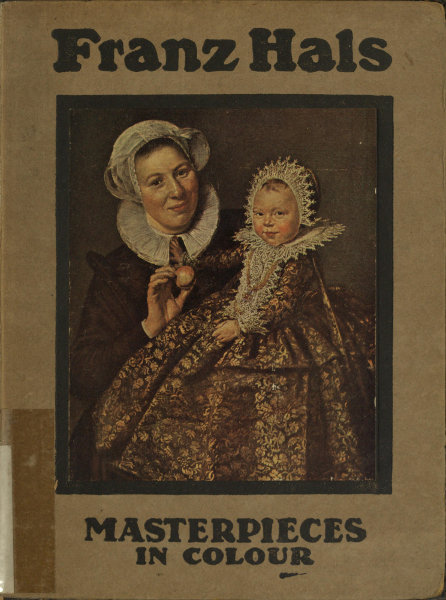
Nurse and Child
Royal Museum, Berlin |
70 |
Hals was an ancient and honourable
patrician family, intimately connected
with Haarlem for well-nigh three hundred
years. The name first appears in the annals
of the city in 1350, and again and again individuals
bearing it held the offices of Burgomaster,
Treasurer, and Schepen—Alderman
or Magistrate.
Pieter Claes Hals, Franz' father, was
appointed a magistrate in 1575. In 1577 he
was one of the Regenten, or Governors of
the city Orphanage, and in 1578 he became
President of that famous institution.
His profession has not been indicated,
but that he was a loyal and influential
citizen is proved by his holding a command
in the garrison which so heroically defended
the city against the Spaniards in 1572.
Wholesale pillage by the hated invader,
however, reduced many a wealthy burgher
family to penury, and compelled them to
seek the recovery of their fortunes elsewhere.
The venerable city of Antwerp, by reason
of the enterprise of her merchants, offered
great attractions. Thither fled many a
Haarlemer, and among them went forth
Mijnheer Schepen Hals and his newly
married wife. It must have been a great
trial to domesticated Lysbeth Coper to have
to pack up what was left of their household
crocks and seek a new home.
It was in the spring of 1579, a little
more than a year after their wedding day,
that they started upon their journey. They
made first for Mechlin, where a branch of the
family was settled, and they were welcomed
with cordial hospitality by their relatives.
(Royal Museum, Berlin)
Painted in 1650. This ancient, wrinkled dame was what they
call in seaport towns "a sailor's mother," rather a dubious
compliment to mariners! She was a "merry toper," like many of
Hals' companions, and went from tavern to tavern to get a drink.
Her real name was Alle, or Alice Boll—easily transposed. The owl
is probably a painter's skit of the screeching, scolding old hussy!
The portrait is quite remarkable for poverty of colour. Franz was
out of funds and out of paints, but he has made the old bloodless
flesh look like life. He often painted her: he loved her odd look, if
he liked not well her scorn!
One whole year the couple spent in the
city of lace, and a little son was born to
them, whom they registered in the name
of Dirk. The greater opportunities offered
to labour and capital in the city on the
Scheldt, however, were so evident, that
they once more packed up their goods and
chattels and resumed their pilgrimage.
Antwerp was already renowned as an
Art city—its painters and engravers were
of wide world fame; and Pieter Claes
Hals, in full possession of certain artistic
proclivities of his family, considered that
he might more profitably make use of them
there. Besides this, another branch of the
family was established in Antwerp, and
members thereof were in good positions.
The journey from Mechlin, short as it
was, partook of the pathetic character of
that of Joseph and Mary to Bethlehem,
inasmuch as they were no sooner housed in
temporary lodgings than Mevrouw Lysbeth
brought into the world another little son.
Vincenzius Laurenszoon Van der Vinne—a
devoted pupil in after years of this very
baby boy—says he was born late in 1580.
There is no official record of the day of
birth, but he was registered in the good
old family name of Franz.
"Franz of Antwerp" was a designation
which stuck to the great painter right on
to the end of his long career. Nothing
whatever is known of his youth, his education,
or his pursuits. For twenty years
neither he, nor his parents, are named by
biographers or historians.
In 1600 Mijnheer and Mevrouw Hals
found themselves once more at Haarlem,
with what thankfulness it would not be
difficult to narrate. Their two sons accompanied
them, but two baby girls—Cornelia
and Geertruid—were left buried in Flemish
soil. Both lads—they were grown men—at
once entered painters' studios—Dirk that
of Abraam Bloemaert, and Franz that of
Karel Van Mander.
This statement brings us up smartly, for
there has been nothing to indicate that the
brothers had served apprenticeships in Art.
We must then proceed by presumption and
surmise in the story of their training, for
we may be quite sure that these eminent
artists would not accept raw, untaught
youths as pupils.
Dirk and Franz had, of course, been
reared in Antwerp, where the most conspicuous
teachers of painting were Otho Van
Veen (1518-1629), a painter of churches and
portraits; Adam Van Noort (1557-1641),
history, large portraits, and genre; and
Tobie Verghaegts (1566-1631), landscape and
architecture.
The brothers profited by their studies
under such able masters, and at Van Noort's
they doubtless made the acquaintance of
their fellow-pupils, Pieter Paul Rubens and
his friend, Hendrik Van Balen.
At Antwerp the two Hals would also be
thrown into the company of Martin de Vos,
Erasmus Guellinus, Crispin Van der Broeck,
the Galles, the Van de Passes, the Wieriexes,
Antonie Van Liest, Geenart Van Kampen,
and other draughtsmen, painters, and engravers.
Probably Mijnheer Pieter Hals himself
was one of the company of specialists—scholars,
writers, readers, correctors, draughtsmen,
painters, etchers, scratchers, cutters, and
the like, gathered together by the enterprise
of Christopher Plantin and other leading
publishers. The two sons, therefore, had
great opportunities for the development of
their family talents.
Karel Van Mander, Franz Hals' master,
the son of a noble family, was born at
Meulebeke, in Flanders, in 1548. He settled
at Haarlem in 1583, where he established
himself as a teacher of drawing, and founded
an Academy of Painting in 1590. His style
was historical, and he did large-sized portraits
and groups as well.
In addition to his celebrity as a painter
Van Mander was noteworthy as a man of
many parts: a historian of the Netherlands,
an annotator of the classics, a poet in the
vernacular, a musician, a linguist. His most
valuable contribution to literature was his
splendid "Het Schilder Boeck" or "Book of
Painters," Dutch and Flemish.
His poem on Art, entitled "Den Handt
der Edelvry Schilderconst," is full of sage
advice with respect to the manner and
spirit in which a student should approach
his work; and he sums up his exhortations
by saying: "Success is only to be found in
painstaking and constant observation of all
externals." He gives, as a wholesome motto
to an aspiring artist, "I will be a good
painter," and, as a salutary warning against
carnal excess, the oppositive reflection:
"Hoe Schilder—hoe wifder"—"As demoralised
as a painter!"
Van Mander's "Counsels of Perfection"
for the behoof of his pupils are as excellent
as they are characteristic. "Avoid," says
he, "little taverns and bad company....
Don't let anybody see that you have much
money about you.... Be careful never to
say where you are going.... Be straight
and courteous, and keep out of brawls....
Get up early and set to work.... Be on
your guard against light-hearted beauties!"
Three years before the Hals left Antwerp
for their dear old home, Karel Van Mander
had been joined by two assistants in the
work of the Academy—Cornelis Cornelissen
(1562-1637), and Hendrik Goltzius (1558-1617).
The former was a painter of allegory,
mythology, and portraits, a member
of a celebrated artist family, and a native
of Haarlem; and the latter, the celebrated
Flemish engraver, a native of Meulebeke,
famed too as a painter of landscape, history,
and the nude.
At Haarlem were flourishing, at the
time of the return of Mijnheer and Mevrouw
Hals, several distinguished artists, and
among them Cornelis Vroom (1566-1640), a
marine painter, gifted in seafaring genre—a
merry fellow, and an habitué of low taverns,
although he lived in a fine house, with a
frescoed front, in the Zijlstraat. He introduced
the young Hals to his friends and
models.
Very many of the well-to-do citizens
affected artistic studies, and several became
efficient painters. Of these Jan Van Heemsen
(1570-1641), a wealthy burgher and a friend
of the Hals family, patronised Van Mander
and his pupils. He had considerable skill
in painting life-size figures, remarkable for
easy pose, and animated manner—very much
in the style adopted by Franz Hals.
These Antwerp and Haarlem worthies
were the "makers" of Franz Hals in the
elementals of his art; but no sooner did
he pass within the portals of Van Mander's
Academy than the door was shut and fast-barred—for
all we know of him, his life, his
work, and his associates, for eleven years;
and then, we behold him assisting at a
homely and interesting function.
In the Baptismal Registers of the Groote
Keerke is the entry of a new-born child—Herman,
the son of Franz Hals and Anneke
Hermanszoon, in March 1611. Apparently
he had been in no hurry to unite the bonds
of matrimony, and yet he had cause to
repent at leisure, for his early married life
does not appear to have been very happy.
Within five years, namely, in February
1616, the name of the unfortunate Anneke
crops up again, and this time in the police
records. Franz is charged with ill-treating
his wife, and with intemperance; and the
charges seem to have been proven, for he
was reprimanded, and only released under
solemn promise of amendment of conduct,
and, further, he was admonished to forsake
drunken company!
Poor Anneke died that self-same year,
but we must not charge Franz as the direct
cause of her premature death; if he had
become something of a wastrel, as many
affirm, she was probably a weakling, and
they had little in common.
Twelve months passed, and then, with
due regard to mourning conventions, Franz
Hals married Lysbeth Reyniers, of Spaedam,
and took her to live in the Peeuselaarsteeg.
They were kindred souls, and lived happily
together for fifty years.
To them were born many children—pledges
of mutual love and home restraint—Sara,
in 1617; Jan, in 1618; Franz, in
1620; Adriaenjen, in 1623; Jacobus, in 1624;
Reynier, in 1627; Nicolaes, in 1628; Maria,
in 1631; and Pieter, in 1633; Herman,
Anneke's son, making up the ten olive
branches.
What a happy, merry home must that
have been in the Peeuselaarsteeg! How
greatly must his domestic joys have
heartened the worthy father, and given
vein and tone to his work!
(In America. A copy by Dirk Hals, Royal Museum, Berlin)
Painted in 1616. A girl of the town gaily dressed, with open
bosom—a thing abhorred by all worthy Dutch vrouwen—sits willy-nilly
between the knees of a Falstaffian lover. He was probably
the very pork-butcher who, in after years, became one of Hals'
heaviest creditors. A saucy apprentice is holding over the amorous
pair a coronal, not of orange-blossom but of sausages! He
has gripped his master's shoulders to make him release his hold
upon the girl's arm. Hals' treatment of the group was doubtless
a remembrance of an allegorical picture he had seen at Antwerp,
"The Feast of Love," by Franz Pourbus (1540-1601), and which
now hangs in the Wallace Collection.
Haarlem story is blank—Haarlem tradition
is silent with respect to Franz Hals'
young manhood. The only hint that we
have of his existence is in 1604, when it is
recorded that he was working still in Van
Mander's Academy. There is not the least
tint of local colour, nor the faintest trace of
romance to be seen or heard until we are
brought face to face with the "Portrait of
Dr. Pieter Schrijver," now at Monsieur
Warnecks' in Paris.
Upon the picture we see "F. H." and
the date, 1613. This then is the first intimation
that Franz Hals had blossomed out as
a painter of portraits! The doctor was a
well-known Haarlem poet, writer, chemical
student, and art critic. He flourished between
the years 1570 and 1640. The portrait
shows us a middle-aged man of serious
mien, but with no peculiar characterisation
of expression or figure. It is a sombre production—black
and grey, with merely a little
brick-red here and there; but the shadows
upon the skin strike one as clever.
Franz Hals was thirty-three years of age
in 1613—an age when artists have either
dismally failed and turned aside to more
suitable employment, or when they have
established some sort of reputation and
their work is recognised, and examples of
their style are broadcast. Not so Franz
Hals; but then there are, to be sure, scores
of portraits "attributed" to him of men
and women and children to which no dates
are attached, and many of these are comparable
with the portraits of Schrijver in
technique, colour, and finish. That he worked
laboriously to maintain his family, if for
no other reason—and artists had to work
hard in those days of small payments—is
evident both directly and indirectly.
A few—very few—studies are extant, in
black crayon upon dull blue paper, which
are noteworthy for simplicity and firmness.
Two of these are in the Teyler Museum
at Haarlem, but they are evidently sketches
for his first great "Group of Shooters," in
the Stadhuis. Three or four are in England—one
at the British Museum, and the
Albertina Collection at Vienna has a few,
and that seems to be all.
Where, may we ask, are his studio canvases,
his early panel portraits, and all the
thousand-and-one sketches and freaks of a
young artist? Perchance destroyed—possibly
otherwise attributed—probably hidden
away in the high-pitched lofts of old Haarlem
houses and hofjes or asylums, and in many
an oaken chest and press.
Indirectly we are assured that he had
been, all the thirteen years of his residence
in Haarlem, an indefatigable worker in the
art of portraiture—from the simple fact of
his intimacy with Mijnheer Aert Jan Druivesteen
(1564-1617), who five times served
the high office of Burgomaster of Haarlem.
He was a man of independent means and
refined tastes, a lover of artists, and himself
also a very passable painter of landscape
and animals, which he painted solely
for amusement.
Druivesteen was a personal friend of
Franz Hals' father, and a constant visitor
at his house. From the first he greatly
encouraged the young art student, and many
a time sat to him for his portrait. Alas!
those portraits have all disappeared or are
undistinguishable.
From the influential position of his patron
it is only a fair deduction to suppose that
other city magnates and leading townspeople
also sought their portraits at the hands of
the Burgomaster's protégé.
The vogue of portraiture has always been
the token of worldly success, and eminent
personages—and the reverse—from the days
of the Pharaohs to our own, have been
eager that their physiognomies should be
handed down to posterity. This fashion
took fast hold upon the opulent burghers of
the Netherlands, and they valued a painter
in proportion as his work ministered to their
self-esteem.
Franz Hals, we may be sure, became
very soon quite alive to this, perhaps pardonable
exhibition of personal vanity. No
doubt the favourite pose in his serious portraits—arms
akimbo, and his favourite facial
expression—contemptuous satisfaction, were
the natural, yet tactful, outcome of his
observations of men and manners!
But we are getting on a little too fast,
for we must turn aside for a moment and
look at the "Portrait of Professor Jan
Hogaarts" of the Faculty of Theology in
the University of Leyden, who was an able
teacher and protagonist, and a considerable
student and writer of Latin. Franz Hals
painted his portrait in 1614, with similar
treatment as that of Dr. Schrijver. These
are the only two works, signed and dated,
during fourteen years, and then our eyes are
fastened in mute astonishment upon the
walls of the Haarlem Stadhuis, where, in
1616, was unveiled a stupendous composition.
This is a revelation unique and overwhelming.
We are in the grip of a master-hand,
and we must bow down before a
genius who has, comet-like, flashed upon
us from the great unknown! There is
nothing tentative, nothing meretricious, in
this masterpiece. It is a portrait group,
half-length, life-size, of eleven "Officers of
the Shooting Guild of St. Joris" (St. George).
The demand for great group portraits
had just set in. The men who had ridden
in on the top of the waves of new institutions
looked to have their personalities
placed in juxtaposition to those of
monarchs, rulers, and generals. Hence, go
where you will in Holland—through churches,
museums, galleries, or Town Halls, you are
faced by portrait groups of life-size figures,
whether they be of Governments and Corporations,
or Guilds and Institutions.
But, we are standing just inside the
great Audience Hall of Haarlem Stadhuis,
and we hesitate to advance, for eighty-four
vigorous and solemn gentlemen and ladies
are bending their steadfast gaze upon us,
as though resenting our intrusion! Eight
picture groups by Hals cover the walls—a
pageant of portraits—five are Schutters-stuken
(Shooting Groups), and three Regenten-stuken
(Governors of Alms Houses).
Guilds of marksmen in the Netherlands
originated at a period when there were no
standing armies, and when the Trade Guilds
were at the full height of their prosperity.
They served as rallying bases in times of
public danger, and as happy rendezvous in
days of pleasure—"Soldier-Socials" we
might call them.
Annual shooting contests for prizes were
held at the Schutters-Doelen, or butts—hence
the name usually attached to the portrait-groups—and
periodical banquets provided,
where good fellowship accompanied
good cheer, and where the toast of "Women,
Wine, and Wit" never sated!
The commission to paint the first of these
groups, "The Annual Banquet of the Officers
of the Shooting Guild of St. Joris" (St.
George), was, no doubt, given to Hals at
the instance of his good friend Burgomaster
Druivesteen, who was himself a member of
the Guild.
There are twelve Officers, including
Overste, or Colonel, Pieter Schoutts Jacobsen,
who sits in front of the table with his arms
akimbo. They are middle-aged men, some
aging, and are full-bearded and moustached,
except the two smart young standard-bearers.
The party has just finished dinner and toasts
are being drunk. Through the window of
the room is a view of trees and buildings.
The blacks and greys and greens of the
picture are relieved by the brilliant scarlet
silken scarves.
The effect of this splendid picture upon
the men of Haarlem was emphatic, and
every Shooting Guild wished to follow suit;
but the painter was in no humour to wear
himself out with toil, he preferred the relaxation
of convivial society.
In all the Dutch centres of population
were numbers of "social" and political clubs—some
perhaps were merely drinking clubs.
Among their guests the most popular was
the "Rederijkers-kammer de Wijngaar-drankes,"
which had branches everywhere.
Although nominally "The Guild of Rhetoricians,"
the study of rhetoric per se had
nothing whatever to do with its objects. It
was, in short, a free-and-easy Artists' Club.
As "Heminnaars," or Fellows, Franz and Dirk
Hals were admitted to membership in 1617.
The men of Haarlem were merry fellows—they
only put on their serious manners with
their Sunday clothes—and every tavern had
its clientèle, with flute, viol, and mandoline.
They entered impromptu into the ranks
of entertainers. No kermiss, or fair, the
country round, but had its rollicking company
of students. They played high jinks
with jolly gipsy girls, and drank with festive
yokels. This life exactly suited the two Hals
brothers; moreover, it gave them opportunities,
which Franz used significantly, for
studying character, and he gathered golden
laurels in his orgies.
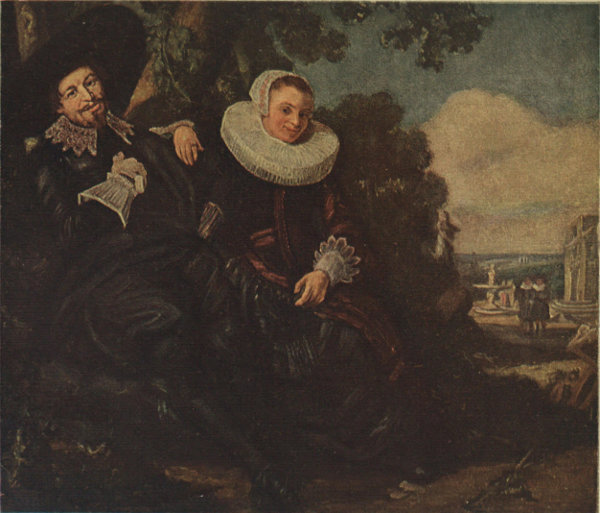
(Rijks Museum, Amsterdam)
Painted in 1624. No painter has left a more charming and more
characteristic portrait of himself and his wife than this. There they
sit, all in a garden green, as happy as happy can be. The "idea"
was Lysbeth's. She knew Franz was painting other couples and
getting wealth and fame—why not their own? She put on her best
go-to-Groote-Keerke gown and a new cap, and made Franz don his
Town Hall suit; she gauffered very carefully his cuffs, and tied
round his neck his finest Van Dyck collar. The pose is splendidly
realistic—good-humouredly she smiles, but he is in restless mood,
as was his wont, and so she just grasps his shoulder—a reminder of
the sweet restraint of happy married life! For fifty years they lived
together, sharing their sorrows and their joys.
Still the Hals, and their companions of
the tankard and the brush, were downright,
loyal honest citizens, and all were
enrolled in the ranks of the Civic Guard—Franz
and Dirk in 1618.
"The Banquet of the Shooting Guild of
St. Joris" was not the only work which
Franz Hals signed and dated in 1616; at
least two other very striking portraits were
finished. "Pieter Van der Morsch," now
labelled "The Herring Seller," was a beadle
in the service of the Municipality of Leyden,
and a member of the "Guild of Rhetoric" of
that city—an oldish man with sparse locks
and furrowed face. He is holding up a
herring, and on the canvas some one has
scratched, "WIE BEGEERT?"—"Who'll
buy?"
This portrait is the earliest dated work
which exhibits Hals' speciality—characterisation.
It now belongs to the Earl of Northbrook,
but it sold in 1780 at a public auction
in Leyden for the ridiculous sum of £1, 5s.
"The Merry Trio" belongs to the same
year, 1616. A girl of the town in gala dress
is seated, willy-nilly, between the knees of
a Falstaffian lover, whilst a saucy apprentice
boy holds over the couple a mock coronal
of sausages! The man was evidently a pork
butcher; probably one of Hals' creditors later
on. The pose and play were probably suggested
by an allegorical picture which had
charmed the young artist in Antwerp—"The
Feast of Love," by Frans Pourbus (1540-1601),
now in the Wallace Collection. This
humorous composition is in America; but
a good copy, said to be by Dirk Hals, hangs
in the Royal Museum in Berlin.
But years pass on once more, and there
is little enough of episode to record in the
life of our accomplished, jovial painter. Hals
was now a happy father, and his heart went
out to children—his own were growing fast,
and their infant moods arrested him. Down
by the sea-dunes, too, were lads and lasses—strong
and lithe of build, bronzed with the
sun and spray, full of life's gaiety. Of these
he took liberal toll—just as did Leonardo
da Vinci of posturing peasant youths and
maidens in Tuscan villages. A merry suite
of "Fisher-boys" and "Fisher-girls" danced
off his palette, and now they display his
genre delightfully in many a picture gallery.
There were also dignified patrons of Hals'
brush in Haarlem, and rich burghers and
their wives sat to him by scores. At Cassel,
dated 1620, are portraits of a Haarlem gentleman
and his spouse—the leading pair in
his procession of full-dress Mijnheers and
Mevrouws "posed for posterity," but rich
in characterisation of face and hands—the
latter a very marked feature.
The years 1622, 1623, and 1624 are "red-lettered"
for the historian of Franz Hals, for
among the portraits he dated then are three
of surpassing interest—"His own Likeness,"
"Himself and his Wife," and "The Laughing
Cavalier." The first of these belongs to the
Duke of Devonshire; it hangs at Devonshire
House in Piccadilly, and has never been
exhibited.
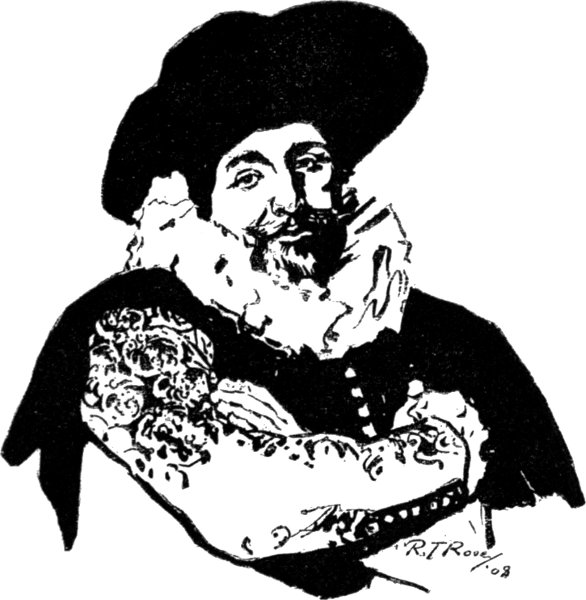
This is "Franz Hals" as he wished to
be known to posterity. His head, slightly
on one side, is marked by strong features—a
nose which shows strength of purpose, a
mouth which indicates quiet decision, and
dreamy eyes, looking craftily for new impressions.
It is a self-satisfied, reflective
face, with nothing base about it. The folded
arms show grasp of purpose and individuality
of action, whilst the figure of the man is
in repose. The costume is sumptuous, full
sleeves of heavy black silk brocade, with the
latest conceits in buttons and ruffled cuffs.
He wears the jewelled token of his Shooting
Guild and the be-buttoned cloak of a
gentleman of the period. His frill is full,
and it is of the finest edged cambric—quite
an ultra-mark of fashion! His hat is black
velvet—slouched, and steeple-crowned.[1]
Merry groups and jovial couples were, of
course, quite in Hals' way, though probably
he painted them for his own pleasure rather
than for love of gain. "Junkheer Rampf and
his Lass" (1623)—somewhere in Paris, Mons.
Cocret's "Merry Supper Party," and a
number of "Rommel-pot-speelers"—perhaps
"Drinks all round!" in English—at the
Hague, Berlin, and elsewhere, offer ample
evidence of the painter's free-and-easy
manners and humorous genre.
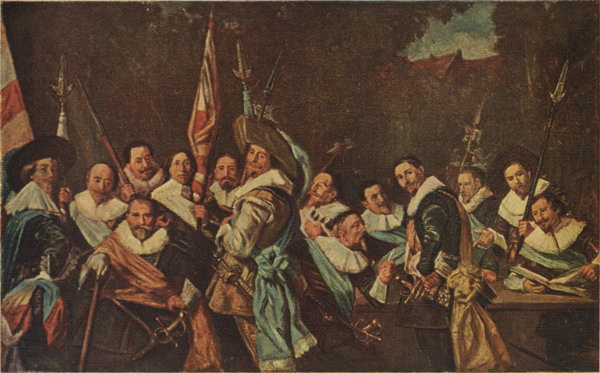
(Town Hall, Haarlem)
Painted in 1633. This, the second group of the St. Adriaen Officers,
is the finest of all the five "Schutters-Doelen" at Haarlem. For
clever arrangement of the figures and instantaneous catch of character
it is unsurpassed. The armourer had furbished up the old
halberds of the Company, which, with the banners, are quite significant
features. The costumes are peculiarly rich and the sashes
gaily ample; whilst the variety of ruffs and collars, and the trimming
of the beards, indicate the vagaries of fashion. The Colonel—Jan
Claesz Van Loo, with his hunt-stick—no doubt he was getting
gouty!—sits, looking at you full in the face. The other Officers have
all their eyes upon you; they are inviting you to join in their conviviality.
The background of trees and farm-buildings suggests the
delights of a picnic in the open air.
Mevrouw Lysbeth knew all about these
junketings, and, good soul, she made no
complaint, but on the contrary she challenged
Franz to add his own portrait with
hers to the suite of jolly partners.
She put on her best black brocade gown,
with its modish heliotrope bodice, and went to
the expense of the newest things in ruffs and
cuffs. Her hair—she was not richly dowered
that way!—she coiffed neatly round her head,
and tied on the nattiest of little lace caps.
With Franz, no doubt, she had some
trouble. He disliked very much fashionable
garments, but inasmuch as he had something
of a position to keep up as a member
of the Haarlem municipality, she persuaded
him to get into his Groote Keerke and
Stadhuis suit of black silk and stuff. She
brushed well his best beaver hat, carefully
gauffered his cambric cuffs, and pinned round
his throat the best Mechlin lace collar he
possessed. His shoes were new and neatly
bowed, and he, worthy fellow, responded to
his loving wife's playful whim by putting
on—a thing quite unusual for him—a pair
of white kid gloves.
And there they sit, Franz and Lysbeth,
all in a garden green, under a shady oak
tree, with a vision of architectural gardens
and open fertile country beyond. The pose
was most certainly her idea, not his, for
she is smiling most good-humouredly at
having gained her end! He would be up
and off, but she checks his movement, and
the hand-grasp upon his shoulder is a reminder
of the sweet restraint of happy
married life.
When this masterpiece was painted, the
Hals were in comfortable circumstances.
The success of the "Group of Shooters" had
greatly enriched Franz, and his studio was
thronged by opulent patrons, each clamouring
for his portrait.
The third picture of note in 1624 was
"The Laughing Cavalier." Why, and when,
it gained its title nobody knows—in most
catalogues it is correctly called "Portrait of
an Officer," a member of one of the Shooting
Guilds.
Whoever the gentleman may be, he had
an uncommonly good conceit of himself.
He is not laughing, but expressing disdain of
the world in general, and amused contempt
of you and me, who go to look at him, in
particular. The characterisation is so cleverly
managed that one almost fancies his expression
changes; he appears to scowl and then
to relax, just as in actual life our features
involuntarily keep up an incessant play.
His dress is unusually decorative, the colours
are few but superlatively arranged, the
whole effect is wonderfully lifelike. It was
the happiest of happy thoughts which suggested
the placing side by side, at the
Wallace Collection, masterpieces of the three
greatest portrait painters the world has seen—Velazquez,
Rembrandt, and Hals. "The
Laughing Cavalier" loses nothing by proximity
to "The Lady with a Fan" and "The
Unmerciful Servant."
But Hals had a mind to paint simpler
subjects than these, and he turned to children
once more, as exhibiting most naturally and
spontaneously variety of character and expression.
"Singing Boys," "Singing Girls,"
"Flute Players," "Mandolinists," and others,
playing only pranks and tricks, he welcomed to
his studio—another Leonardo da Vinci trait!
He noted their expanding cheeks, he
heard their melodious notes, he understood
the motions of their limbs, and fixed them
all. They make us smile with pleasure, so
natural and lifelike are they at Haarlem,
Berlin, Brussels, Cologne, Cassel, and Königsberg—many
of 1625, and more elsewhere
undated, but similarly characterised.
Two or three "Zechbruders" or "Jolly
Topers," and some gay young sparks with
mandolines—"Schalks naar" or "Buffoon,"
as each is quite erroneously styled—walked
out of Hals' studio in 1625. Doubtless they
were skits or caricatures of fellow-artists,
for the clever painters of Haarlem were not
quite "Fools" or "Buffoons," nor were they
all only "Jolly Topers."
All this time Hals was making arrangements
with his old patrons of St. Joris' Guild
for another great portrait-group to be put
up in the Stadhuis. This was finished in
1627—it represents eleven Officers.
On comparing this Group with its predecessor
we are struck with its greater freedom
and freshness. Hals was now painting
more brilliantly, and his colours blend more
naturally. The success of the first St. Joris'
Group had fired the imagination of members
of a rival Company, the St. Adriaen's Guild;
and it was determined that their Officers
should also adorn the walls of the Stadhuis.
Consequently Hals had two great groups
to do, and no sooner had the carpenter
hangers got St. Joris No. 2 into position
than their services were requisitioned for
the St. Adriaen's Group.
If profitable, nevertheless the painting
of such portrait groups was very troublesome,
and no doubt Hals was very thankful
to see the last in his studio of these pictures.
The jealousies, the corrections, and the
interruptions, in dealing with a lot of conceited
Officers, must have almost maddened
him. Each man had his own ideas—and
Hals had his. Each wished to be as prominent
as possible, and to cut a dash at
his brother officers' expense. Arrangement
after arrangement failed.
At last Hals decided the matter once and
for all. He declined positively to paint a
row of figures—he intended to make a picture.
Therefore he proposed an admirable plan,
and one which recouped him well to boot—those
who paid most should have the places
of honour!
The Colonel—generally one of the wealthiest
members of the Guild—paid the highest
fee, and he is the most conspicuous figure
in all the "Doelen" pictures. Captains paid
for second places, Lieutenants for third, and
Sergeants looked out from the back. The
Standard-bearers were exceptional individuals—the
sons of rich fathers, who paid well
for good stations.
Again, a Shooting-brother was mulcted
higher for a full-face than one who had to
put up with a three-quarter likeness—profiles
were ruled out. Once more, notice the
cunning of the painter, every one of his
"Schutters" is an athlete, with a striking
face! Each wears his best dress, his sword
hilt is of the latest Italian pattern, and each
is showing himself off to the greatest advantage—all
the drakes are swans!
The St. Adriaen's Group of 1627 consists
of twelve Officers, with Colonel Jan Claesz
Van Loo in the place of honour. Dinner is
over, and the diners are discussing the latest
bit of gossip before separating. One of the
sergeants has been caught in the act of
pocketing a bunch of grapes, and his fellow
is holding out a silver dish for its restoration.
Fashions, both of hair and clothes, of
course, are similar to those worn by the St.
Joris' Schutters, except that the younger
men are quite à la mode with respect to
their slashed and puffed full sleeves. Of the
two groups this is the least mannered, and
there is more atmosphere and greater animation.
Crude contrasting colours are softened
down, and luminous grey shadows make play
around the men. Each individual's expression
is personal and original, and the characterisation
of each is so wonderfully full
of life that, if any one of them was to walk
off the wall and greet us, we should feel that
we knew just what sort of a man he was.
This is perfect portraiture; it is more—it
is clairvoyancy in paint.
In the decade 1630-1640 Franz Hals was
acknowledged as first painter in Holland.
He stood head and shoulders above everybody
else in his freedom of treatment, unconventionality
of pose, manipulative facility,
fidelity of colouring, boldness of shadow, and
the marvellous certainty of his flesh tones.
His technique, in short, was unrivalled, and
the emphasis with which he expressed
feature and mood was astounding.
His illumination was golden, and the
animation of his figures extraordinary. Like
Michael Angelo he preferred men to women,
as exhibiting more character and less liable
to affectation. He neither wasted time in
making studies for his compositions, nor
frittered it away in elaborate corrections.
His brush knew one stroke only—his impasto
was laid on at once. Simply in details of hair,
lace, and brocade did he elaborate.
The same decade was the most brilliant
period of the Dutch School generally; the
greatest painters were all working away on
canvas and panel, making world's records in
Art. Every town, and many a country place,
had its studios and schools of painting, but
Haarlem was easily first as the home and
headquarters of painters. "Boldness and
truth" was the municipal motto, and this is
eloquent in all the work of Franz Hals.
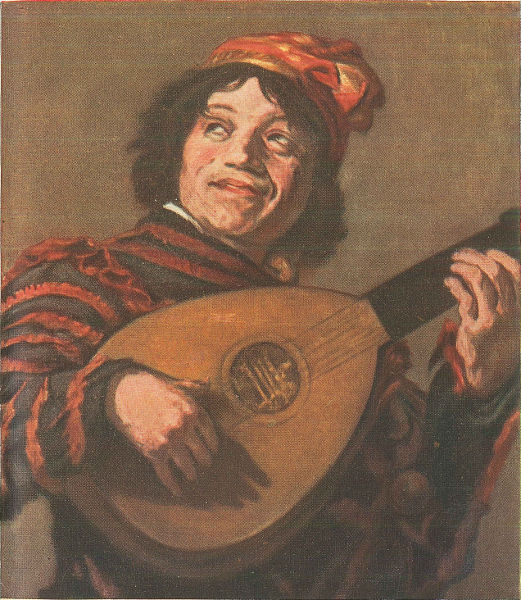
(Collection of Baron G. Rothschild, Paris. A copy by Dirk
Hals in Rijks Museum, Amsterdam)
Painted in 1625. This is a very jolly fellow! It is a portrait
of one of Hals' favourite pupils, Adriaen Brouwer, who was also
renowned for his musical gifts and his love of practical jokes; he
painted pictures too sometimes! His nickname in the studios was
"Der Naar"—"Funny Man!" The "Jolly Mandolinist" must have
caught sight of one of his lady-loves at a window, or a painting
chum. His staccato note ends in a genial smile, and he is ready for
a joke or a hand-tossed kiss. This has Hals splendidly fixed, a snapshot
would not have had a more instantaneous effect. The Spanish
costume suggests the celebration of one of the famous Haarlem
masquerades.
And Haarlem was the most prosperous
of cities. Between 1630-1640 the Tulip
mania was at its height, and Haarlem was
the metropolis of the bulb. It is said that
in one year the florists of the city cleared
twelve million golden florins.
To Haarlem, as to an artists' Mecca,
flocked teachers, students, and connoisseurs
from all lands, and among the rest came a
notable pilgrim, Anthonie Van Dyck.
Mincing along in his courtier-like manner,
in search of impressions, he wished to see
for himself the master about whom gossip
had spun such wonderful stories, and to watch
him at work. He was at The Hague, the
honoured guest of Frederick of Nassau,
Prince of Orange, painting princely patrons,
and it was not more than a Sabbath-day's
journey to Haarlem.
So one bright morning in June that year,
1630, Van Dyck, unannounced, knocked at
Franz Hals' front door. Vrouw Hals greeted
the stranger courteously—"My husband,"
she said, "is not at home, maybe he is at the
Life School; will the gentleman step in and
rest."
Jan, who was just twelve years old,
was sent to look for his father, and at
last discovered him, not at his studio, but
with some boon companions in the little
back room of his favourite tavern hard
by. Perhaps among the "Merry Topers"
there were famous Admiral Van Tromp,
killed in 1653, and his jolly comrade, Jan
Barentz, the entertaining cobbler—late a
lieutenant in the fleet, whose portrait Hals
painted many a time as a "Jolly Toper,"
with his great big hands and grinning face,
squinting at the liquor level of his tell-tale
glass.
"There is a smart gentleman, all the way
from Antwerp, to see you, dad, and he wants
you to paint his portrait," so ran on the lad.
Hals bid his boy go home, finished his
tankard and his pipe, and leisurely sauntered
along. He was in no good-humour at the
interruption, and gave the stranger a cool
welcome. At first he demurred at being
called upon to paint a man he had never
seen before, and whose features and figure
he had had no opportunity of studying.
Van Dyck, without revealing his identity,
begged him to proceed, and offered him
a tempting fee. Without more ado Hals
snatched up the first old canvas lying on
the floor, and in a couple of hours he
had painted, in a manner which greatly
astonished his sitter, a telling likeness.
Van Dyck laid down the amount he had
promised, but asked Hals whether he might,
in return, attempt to paint his portrait. Hals
was astounded, and more so as the visitor
progressed, for it was borne in upon him that
such a stylish virtuoso could be none other
than his famous rival, the great Flemish
master. "Who the devil are you?" he exclaimed.
"Why, you must be Anthonie Van
Dyck!"
Van Dyck was exigeant that Hals should
accompany him to England, where he had
been summoned by the king. No words
and no inducement could move Hals out of
Holland—it was his home, it was his
world; Dutch of the Dutch was he, bred in
the bone!
Van Dyck departed much disappointed,
but he charmed the Vrouw Lysbeth and the
kiddies by leaving behind for them twenty
silver florins. As for Hals, he went back to
his pots and his paints.
In the Schwerin Gallery is a "Portrait of
a Man" with a good deal of Franz Hals
about it, variously attributed to him and to
Van Dyck. Maybe it is the one painted in
Haarlem that hot June day in 1630.
Eight superb portraits by Hals were dated
this self-same year: "The Group of the
Beresteyn Family," and "The Gipsy Girl"
(La Bohémienne), at the Louvre; "The
Mandoline Player"—Der Schalksnaar, in
Baron Gustave Rothschild's Collection in
Paris; "Nurse and Child," and "The Jolly
Toper," at the Royal Gallery in Berlin;
"Portrait of a Man" ("ætat suæ 36") at
Buckingham Palace; Mijnheer Willem Van
Heythuysen, at the Belvedere Gallery in
Vienna—the full-length, Velazquez-like
standing portrait; and "Portrait of a
Young Girl," of the Beresteyn family at
Haarlem.
Der Schalksnaar—called also "The
Fool," "The Buffoon," "The Jester," and,
far more suitably, "The Mandoline Player"—is
allowed to be the finest character-portrait
in the world. Velazquez and Rembrandt
never did anything so acutely life-like.
It is a "snapshot," so to speak, of Adriaen
Brouwer, one of Hals' favourite and most
distinguished pupils, whose renown as a
painter of peasant genre was equalled by his
fame as an archplayer of practical jokes
and as a brilliant musician and improvisatore.
Here he is, in fancy Spanish dress,
red and yellow, with a real old Hispano-Moorish
mandoline. His nickname in the
studios was "Der Naar!" "Funny Fellow!"
His face—clean-shaven, but still something
of a stranger to soap and water—reflects,
with amazing truthfulness and vitality, the
emotions of the moment.
He laid a wager that he would make his
innamorata peep out of her window and
wave her hand at him. The staccato notes of
the serenade have not yet quite died away, the
strummer's hand has not relaxed its tension
on the strings of the instrument, as the singer
throws up a rapid glance of recognition.
"Nurse and Child" is as charming as anything
in all the works of Franz Hals. Nothing
can be imagined more natural, more simple,
more appealing. At first sight the woman—she
may be thirty—appears posed, but
her expression is that of momentary abstraction
from the restless exigencies of nursing.
She is goodness and gentleness personified,
and her pinned-up cap lappels tell of busy
little fingers close by.
The baby is to the life. He is a vigorous
youngster, the latest little son of the ancient
North Holland family of Ilpenstein, prominent
in Haarlem story. He has grabbed
his nurse's brooch whilst he turns to
have a good look at you, and, presto, he
will bury his head in her kindly bosom with
a merry laugh. His face is a tour de force—that
of a rare critic, as all healthy babies are.
I question whether any painter has painted
a child's coming smile as Hals has done here.
The dress, a splendid piece of gold brocade
in colours, must be an inspiration from
Pieter Breughel, "le Velours" (1568-1625),
whose mastery of glossy patterned stuffs is
almost inimitable. The lace looks as if Hals
had just cut lengths of rare Mechlin point
and pasted them upon his canvas. Why,
we can count every thread and knot!
The year that gave date to these widely
differing, but admirably agreeing, character-portraits
also witnessed the foundation of
Franz Hals' Life School. Very soon after
the death of Van Mander, in 1606, the famous
Academy of Painting began to decline in
popularity. The dissolution of partnership
between Cornelissen and Goltzius, and their
departure from Haarlem, caused its doors to
be closed.
Whether he wished it or not, a goodly
company of artists looked to Franz Hals
as their leader, and so the mantle of Van
Mander fell upon the shoulders of his most
distinguished pupil.
Among those who foregathered in the
new Academy were Pieter Soutman (1580-1657),
Pieter Potter, father of Paul (1587-1642),
Willem Claesz Heda (1594-1680), Jan
Cornelisz Verspronett (1597-1662), Hendrik
Gerritsz Pot (1600-1656), Pieter Molyn (1600-1661),
Pieter Fransz De Grebber (1610-1665),
Antonie Palamedesz Stevaerts (1604-1680),
Adriaen Brouwer (1605-1638), Dirk Van
Deelen (1605-1671), Cæsar Van Everdingen
(1606-1679), Pieter Codde (1610-1666), Bartholomeus
Van der Helst (1610-1670), Adriaen
Van Ostade (1610-1685), Philippe Wouwermans
(1620-1668), Isaac Van Ostade (1621-1649),
Pieter Roestraeten (1627-1698), who
married Sara, Franz Hals' eldest daughter;
Vincenzius Laurenszoon Van der Vinne
(1629-1702), and Job Berckheijde (1630-1693),
with Hals' five sons and his brother Dirk.
There is in Haarlem Stadhuis a very interesting
painting by the last of these, which
shows Franz Hals' Life School and some of
his pupils in the year 1652. Work is in full
swing, and five of the master's sons—the
youngest, Nicolaes, being twenty-four years
old—and Dirk Hals with Van Deelen, Molyn,
Berckheijde himself, and his little brother
Gerritsz, seated at a table, are drawing from
a nude model. The master is by the door,
chatting with Philippe Wouwermans, who
has just popped in to see how things are
getting on.
It is said that Hals "sweated" his pupils
by making them draw and paint subjects
for which he paid them little or nothing,
and which he sold at fair prices to meet
his weekly tavern reckonings. Adriaen
Brouwer is named as "living-in" at the
Halsian establishment, with an uncomfortable
bed, insufficient food, and scanty clothing!
Be these tales what they may, there is
characteristic evidence that Hals and his
pupils lived on good terms. An amusing
story is told by the Haarlem historian and
biographer, Jacob Campo Weyerman, in
his "Sevens-Beschrijoingen der Nederlondsche
Konst-Schilders," of the goings on
at the Life School.
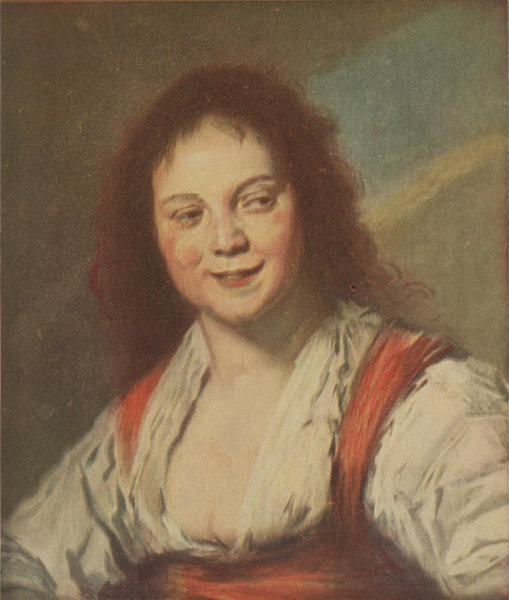
(Louvre Gallery, Paris)
Painted in 1630. They call her "La Bohémienne" in Paris, but
why we do not know. She is not a gipsy girl, but a slut out of
Haarlem Fish-market, wholly bereft of all sense of appearance, and
caring only for passing joke and gibe. The girl was a favourite
studio model also, for studies of a figure and face like hers abound
in the work of Haarlem painters. Thinly painted, in simple colours,
this is a masterpiece of pigment snapshots. Its sauciness is as
natural as may be. No doubt she and Hals exchanged many a bit of
racy banter; perhaps she dared him to paint her just as she was.
The master's addiction to strong drink
called for energetic action, and the older
pupils were accustomed of an evening to take
it in turn to fetch him home from his cups, undress
him, and tuck him comfortably into bed.
"Now when Franz, lying in bed, thought
he was alone in his room, his piety came to
the surface; for however tipsy he might be
he generally closed his halting prayer with
this petition: 'Dear Lord, take me soon up
into Heaven!' Some pupils who heard him
repeat this request night after night decided
to test one day whether their master was
really in earnest, and Adriaen Brouwer—that
ape of humanity—undertook to carry
out the joke. Brouwer, in company with
another pupil called Dirk Van Deelen, bored
four holes in the ceiling, right above Franz'
bedstead, and through these lowered four
strong ropes, which they fastened to the
four corners of the bed, and then waited
eagerly for their master's return home.
Hals returned towards night in merry
mood, and his pupils helped him to bed
according to their wont, took away the
light, and then crept quietly upstairs to set
their plan in motion. As soon as Franz
began his usual orison, 'Lord, take me up
soon into Heaven,' they drew him and his
bedstead gently up a little, whereupon Hals,
half dazed, fancying that his prayer was
being answered literally, altered his tone,
and began to cry out lustily: 'Not so fast,
dear Lord! not so fast!'"
Hardly able to restrain their mirth the
mischievous young dogs quietly let their
burden down, slipped off the ropes, and
themselves slipped away, to tell their fellows
the joke. "Franz," continues Weyerman,
"did not discover the trick until several
years after!"
The years 1631 and 1632 were lean years
in Hals' output, but the year 1633, which
gave us "Portrait of a Man" at the National
Gallery—a fresh complexioned, easy going
gentleman about thirty to forty years of
age, in an astonishingly voluminous ruff,
quite a bygone fashion in that year—saw a
chef-d'œuvre de chefs-d'œuvres, another
"Schutters-stuk," put up in the Stadhuis at
Haarlem.
"The St Adriaen's Doelen," No. 2,
consists of fourteen officers, nearly all of
whom are gazing good-humouredly right out
at their visitors, and inviting all and sundry
to join in the conviviality. Each face is a
pleasant character-study, for each man has
dined well and is content.
Colonel Jan Claesz Van Loo is seated on
the left, holding a stout walking-stick—probably
he has contracted gout since his
appearance in 1627! Seven of the officers hold
halberds—a decided novelty in accessories,
which adds greatly to the picturesque
effect. One wonders whether anybody had
whispered to Hals the news that Velazquez
had painted his "Surrender of Breda" with
halberds and lances galore! Anyhow Hals
would not be caught napping by an intrusive
Spaniard!
The Group is far and away the most
easily arranged of all the Schutters-stuken.
The waving foliage and smiling landscape
predicate breeze and sun, for the gathering
is al fresco in the gardens of Roosendaal, the
Hampton Court of Haarlem. The officer
seated upon the table is Lieutenant Hendrik
Pot—a favourite pupil—a speaking likeness.
Fashions have changed, they are richer
and more decorative with silken stitching
and laced scarves. The colours, greys,
greens, browns, and dull blues are softened
by the leafy environment. "En plein air" is
the cry of modern Impressionists, but here we
have it, where, perhaps, we should not look
for it. This is in truth one of the world's
chief masterpieces, and the efforts its execution
called forth told greatly upon its creator.
Certainly he went on painting, and probably
he went on carousing too; but silence
again settles down upon him, and a meagre
list of fifteen signed and dated portraits
completes his work until 1637.
We find him now not at Haarlem, but
at Amsterdam; not drinking, but painting—painting
what Dr. Bürgher, the art critic,
asserts is "the most astounding picture
of the Dutch School." Probably Hals
frequently visited the capital of the chief
province, there to see what other artists
were doing, and to sample the pleasures of
its convivial life.
His visit in 1657 was of considerable
duration, for he was painting "The Officers
of the Civic Guard" under their commander,
Colonel Reynier Reaels. There are sixteen
full-length, life-size figures, posed after the
manner of the Haarlem Schutters-stuken.
They are clad in dark-blue uniforms, with
the exception of the Standard-bearer—a
gorgeous individual in golden brown, with
leggings, laced and bowed, his arms akimbo,
bearing himself with such a swagger as only
Franz Hals knew how to paint.
This splendid portrait group hangs at
the Rijks Museum in Amsterdam, at no
great distance from Rembrandt Van Rijn's
"Night Watch," so we can take stock of
both together.
It is not a little significant that Amsterdamers,
famed for what the Tuscans used
to call "il Spirito del Campanile," should
have had to go to Haarlem for their man!
Were there not painters on the spot, and
what about Rembrandt, he was not very
busy in 1637? No; no one could do this sort
of thing so well as Hals.
In 1639 he completed his quintet of
Schutters-stuken or Doelen—portrait groups
in Haarlem Stadhuis; his patrons were once
more "The Officers of St. Joris' Shooting
Guild."
Here we are in the open with the wind
swaying the unfurled banners and rustling
the leaves of the trees. The rendezvous
is the orchard of the Hofje Van Oud Alkemude
de XII. Apostelen, with its garden-pavilion,
in the tower of which Hals is said
to have painted a Schutters-stuk; beyond
are the Haarlem woods.
The Group consists of nineteen Officers,
with Colonel Jan Van Loo. The men are
arranged in two somewhat stiff lines—perhaps
they all asked front places and paid
well! With his usual modesty Hals has put
himself in the back row, but in much better
guise than his next neighbour, a distinctly
blasé individual. They are all well-set-up
men, and dressed in the new fashion, tending
rather to effeminacy.
The atmosphere and illuminations are
vibrant, but the colours are restrained, the
shadows are grey, and the animation does
not equal that of the 1633 Group. Perhaps
Hals was degenerating with the passing
age—certainly he was ageing.
However, he finished off his best decade
with a remarkable little snapshot portrait,
a fisher-lad of Katwyk. "De Strandlooper"
he has called it; it hangs in Antwerp Museum.
He saw the boy running up and down the
dunes; he was an odd-looking bit of
humanity.
"Sit down just where you are," said
Hals, "fold your arms, and don't take your
eyes off me." A rough drawing was soon
knocked off, just to fix values, and then the
master added, "Come along with me now
to Haarlem, and half a Carolus guelder for
you." Then he fixed the oddest of odd
smiles, and the "Beach urchin" remains to
prove that the old man, vigorous, had lost
very little of his cunning after all.
The last twenty-five years of Hals' life
were marked by experiences wholly unlike
the circumstances of the preceding decade.
If between 1630-1640 he approached
Velazquez and painted dignified magnates
and others, with a brush dipped in gold
and a palette of luminous colours, in the
end of his days he was near Rembrandt
with no less characteristic groups and individuals,
and his hues are silvery and his
shadows impressive.
The Regenten Stuken, the "Five Governors
of the St. Elizabeth Almshouse" or
Oudemaanenhuis, exposed in the Haarlem
Stadhuis in 1641, might, for all the world, be
the work of the great Amsterdam master,
just as the latter's "Staalmeester's" of 1661
might be his.
The Group in question consists of five
most serious and reverent city fathers, seated
comfortably at their Board table. Not a
bit of worldly conceit, not a decorative adjunct
of any kind, adorns the composition,
but it is a perfect achievement. The sombre
black garments and steeple-crown hats have
a lustre of their own, and, standing well out
of the greyish-green wall behind, they throw
up wonderfully facial expression and manual
dexterity. The plain linen collars and well-starched
cuffs tone down the ashen-red
shadows upon the skin, and the clustering
locks of long black hair, tinged with grey,
form halos around the wrinkles.
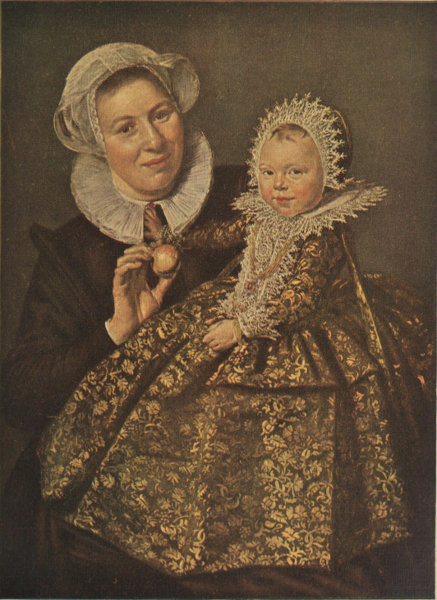
(Royal Museum, Berlin)
Painted in 1630. This is one of the very best of all Hals' compositions.
The Nurse is a buxom lass of North Holland, and the Child,
the little son of Mijnheer Julius Ilpensteen, a wealthy German
merchant, settled at Haarlem, and engaged in tulip-growing. The
expression of the youngster, just about to explode with laughter
at something droll which has caught his eye, and then shyly to
bury his head in his crooning nurse's bosom, has been caught quite
wonderfully. The dress is rich, and the Mechlin lace collar is so
actual that it might really be a "piece" cut off and pasted on the
canvas! It is said that Hals had been twitted with his fondness for
dirty, unkempt children as models for his snapshots of character, here
he has vindicated his sense of elegance.
Compare this charming subject with the character-portrait of the
"Strandlooper" at Antwerp, and Hals' grip of children's expressions
is seen to be emphatic and unlimited.
Haarlem possessed many charitable institutions
to which the general title "Hofjes"
was attached. It became the happy custom,
well on in the seventeenth century, for
wealthy citizens to build and endow almshouses,
hospitals, and the like—in the first
instances as monuments of individual prominence
and ultimately as memorials of family
pride. Founders and their relatives were
the earliest governors, and then administrative
powers were merged in trusts and municipal
offices, and foremost citizens formed
their Boards.
Franz Hals' great good-nature and his
merry haphazard way of life made him a
favourite everywhere—he was everybody's
friend. His appointment in 1643 as "Vinder"
of the Haarlem Lodge of the Artists' Guild
of St. Luke was very popular. The functions
of the office exactly suited the free-and-easy
master-painter; they were analogous to
those which attached to the corresponding
Italian office of provvidetore—controller,
caterer, and perhaps toast-master, all rolled
into one.
Nobody has testified to Vrouw Lysbeth's
satisfaction at this promotion; it was a real
ray of sunshine in the gathering clouds of
age and anxiety. No doubt she still smiled—not
as naïvely as in that garden green
in 1630, but hopefully.
But Hals was already beginning to grow
indolent. Was it the natural change of life,
or was it the effect of self-indulgence? Who
shall say? Charity thinks and speaks kindly
we know. Anyhow nine long years steal
quietly along, and all the signed and dated
work he did was just nine portraits and not
one of them of marked excellence.
Poverty began to look in at the windows
of the house in the Peeuselaarsteeg, what
time silence or indolence settled there, but
what cared the merry old painter, for love
opened the door, and kept it upon the latch—Lysbeth
did not chide Franz, and Franz
did not vex Lysbeth.
Twenty years or so before Hals had
picked up many a splendid subject for his
portrait-characterisation or portrait-caricature
in Haarlem markets, and many a flighty
markt-deern, besides the untidy fish-girl
of 1630, had been his model. Then he loved
young girls—at seventy his friends were viele
deerne of the Kraegs or common taverns.
One old lady had for many a long day
taken his fancy, not that she was comely,
sober, or fair spoken, quite the reverse, nevertheless
her striking play of features and the
wrinkling of her leathery skin had an occult
fascination for Franz.
They called her "Hille Bobbe," but her
name was Aletta or Alle Bol or Bollij; and
she lived in a hovel by the Fish-market.
Nobody ever got the better of old Hille, but
she let everybody know what she thought
of him and his!
At Lille is a "Laughing Hussy," painted
by Hals in 1645; at Berlin is the old lady
with her tankard and an owl, done in 1650;
and at Dresden the same viele deern is
scolding a yokel, who is smoking over her
stall of unboiled lobsters, 1652 (?). They
are all three most simply painted in black
and grey, and just faint traces of ochre and
red. The deep shadows point to a meagre
palette and a brush worn down, but the
result is striking and original. Nobody
knows what the owl had to do with the old
lady, probably a painters' joke at the model's
expense.
In ten more years Franz Hals signed and
dated no more than ten pictures. Was he idle?
Was he ill? Was he dissolute? We cannot
say; we have no data to go upon. The next
note we have is an alarm signal, for, in 1652,
one Jan Ykess, a baker, obtained a warrant
whereby he sued Hals for two hundred
Carolus guilders on account of comestibles
supplied to him and his wife. A distress
was issued, and the forced sale of three thin
mattresses and bolsters, a ricketty armoire,
and an old oak-table, with five oil paintings,
barely sufficed to clear the bill.
Other creditors, and there were not a
few, got nothing; apparently there were no
other assets. But two years later Hals gave
his butcher of "The Merry Trio," a painting
by Jan Razet, "St. John the Baptist preaching,"
by way of compensation.
This is indeed a sad revelation, and its
sadness is intensified by the apparent want
of filial piety on the part of Franz' sons and
daughters. They were all living, and, except
Pieter, domiciled in Haarlem. Only Maria
was unmarried. All were in good circumstances.
Nicolaes, "Vinder" in 1662, had
been a member of the Corporation since
1655. Why they did nothing to assist their
parents in their distress nobody has recorded.
There is no note of family feuds: perhaps
Franz' pride refused natural assistance.
In 1655, and again in 1660, Hals painted
and dated many portraits, as though he
was forced to do something to keep the
wolf from the door. Many of these are
remarkable, not only as the work of an
old man, but as exhibitions of new methods.
"René Descartes," at the Louvre, and "Tyman
Oosdorp," at Berlin—reminiscent perhaps of
"Jan Hornebeeck of Leyden," at Brussels,
painted in 1648—have fixed unhappy faces,
all in dull black and grey, with dark shadows
suffusing everything. Surely they are reflections
of the painter's darkening view of life
in grumbling, unmerry mood.
The clouds, however, appear to have been
at least partially dissipated, for in the latter
year we have a smiling face again, and,
perhaps, one of the last which smiled on
"Hals of Antwerp!" The Schlapphut,
"The Slouch Hat," now at Cassel, is a
real chef-d'œuvre. A young man, seated
sideways, with his arm across the back of
his chair, looks out of the grey-green-black
background with a saucy air. He is saying,
"I wonder what you think of me!" It
takes a little time to focus this impression,
for Hals has dashed on his pigments almost
too liberally, and he has gashed and smeared
the mass with his hardest brush. When we
do get the point of view, we feel disposed
immediately to snub the young upstart for
his impertinence.
In spite of these spurts, and others,
misfortune fell the way of Franz and
Lysbeth Hals. In the spring of 1662 the old
man applied to the Municipal Council for
assistance. His plea was not in vain, for,
with characteristic good-fellowship, a dole
was immediately forthcoming—fuel and
aliment—and with them a benefaction of
150 Carolus guilders (circa £26).
Old Hals could still, vigorous old fellow
that he was, hold his palette and his brush—and
to good use too—nor did he quite
lack for patrons. Upon the Board of the
Oudevrouwenhuis (Old Women's Alms
House) were several old chums of his who,
in solemn conclave met, agreed unanimously
to commission the aged master to paint
two portrait-groups—one of themselves, and
the other of the Lady Governors of the
Béguinage for old and reduced gentlewomen,
which Mijnheer Nicolaes Van Beresteyn had
founded in 1611.
This was a noble act of charity conceived
in the best possible spirit, for any fear of
Franz' ability was quite outweighed by the
wish to minister, so as not to offend in any
way, his amour propre. And Hals set to
work upon the last efforts of his life, and
finished and dated both groups in 1664. He
was eighty-four; and thus they are in the
Stadhuis, side by side with his five festive
Schutters-stuken.
The Regentessen van der Oudevrouwenhuis
(The Lady Governors of the Old
Women's Alms House) are not distinguishable
for youth or beauty, and yet the five old
faces are very attractive in their sternness.
Probably they were quite prepared to resent
any impropriety on the part of the jovial old
artist. Their pursed-up lips, their peering
gaze, and the muscular contraction of their
hands convey this impression. Their garments
are as plain as their persons, and there
is nothing decorative in the composition—everything
is subdued black and grey, but
the illumination and animation are splendidly
evident although held in check.
The Regenten van der Oudemannenhuis
(The Governors of the Old Men's Alms
House), on the other hand, has much less
force, and, compared with the earlier group
of 1641, it is nerveless and moribund. The
five Governors are old, weary, and sad. The
colours are greyish, the brushwork feeble,
and expressionless faces match the ashen
pallor of the skin. Their hands, too, have
lost their grip, and there is no curl in their
hair. Humour is no longer Hals' painting
mixture, the pathos of "the passing" is upon
him; and yet, with an evident expiring effort,
the youngest of the five old men actually
displays the gaiety of a scarlet knee-ribbon—it
is the last impression of a parting touch!
And now the brush falls from the painter's
hand; the few colours left upon his palette
are dry; and his enfeebled vigour is tired
out. No doubt the emolument he received
for these two most impressive, most touching
portrait-groups was in the nature of a
pension to keep him and his old wife in
something like comfort till the end.
For that end Franz Hals had not long to
wait. Perhaps it is as well that we have no
account of his sufferings and his death. Only
one more historical note can be adduced
to complete the life's story of "Hals of
Haarlem"—the notice of his burial. On
September 1, 1666, all that remained of him
was buried, with some amount of circumstance,
in the Groote Keerke of St. Bavon.
His body rests in the choir, with the ashes
of Haarlem's most famous sons, and, if no
meretricious sculptured memorial exists to fix
the very spot, the monogram, upon a flat
stone underfoot, "F. H.," reminds the pilgrim
to the painter's shrine of all he was and all
he did—simple and unaffected.
Poor old Lysbeth survived her husband
many years, as poor as poor could be. In
1675 she made a pathetic appeal for relief,
and the miserable pittance of fourteen sous
a week was accorded her. The dear old
soul languished and died, with apparently
no child at hand to comfort her. No record
of her last hours tells where she died—probably
in some Oudevrouwenhuis or other,
and of her grave no man knoweth.
The plates are printed by Bemrose & Sons, Ltd., Derby and London
The text at the Ballantyne Press, Edinburgh