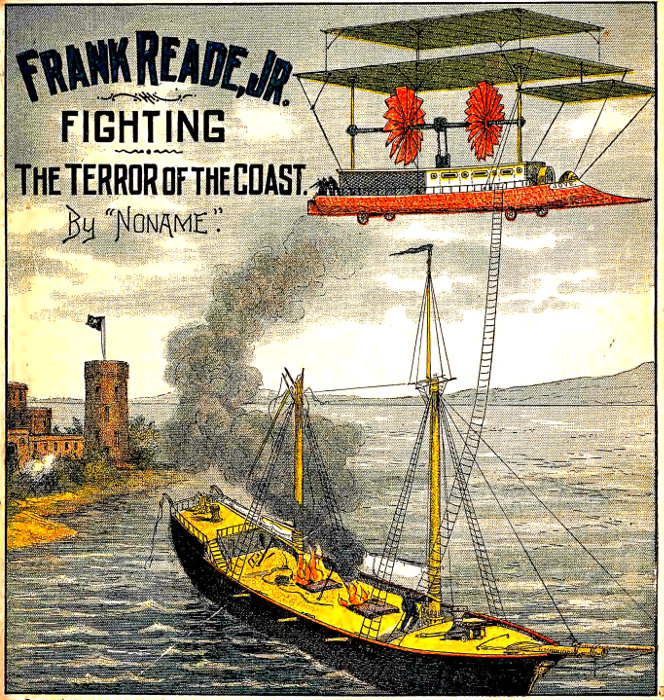
Frank Reade, Jr., Fighting the Terror of the Coast.
The Project Gutenberg eBook, Frank Reade, Jr., Fighting the Terror of the Coast, by Luis Senarens
| Note: | Images of the original pages are available through Internet Archive. See https://archive.org/details/FrankReadeweekl00SenaD |
Transcriber's Note:
The cover image was created by the transcriber and is placed in the public domain.
| Issued Weekly—By Subscription $2.50 per year. Application made for Second-Class Entry at N. Y. Post-Office. | ||
| No. 49. | NEW YORK, OCTOBER 2, 1903. | Price 5 Cents. |
| No. 49. | NEW YORK, OCTOBER 2, 1903. | Price 5 Cents. |
CONTENTS
| CHAPTER | I. | CHASING THE AIR-SHIP. |
| CHAPTER | II. | A DANGEROUS FALL. |
| CHAPTER | III. | OVERTURNED IN THE AIR. |
| CHAPTER | IV. | POMP’S ESCAPE. |
| CHAPTER | V. | THE TERROR OF THE COAST. |
| CHAPTER | VI. | SHOT BY A LAND BATTERY. |
| CHAPTER | VII. | STUCK IN THE MUD. |
| CHAPTER | VIII. | ATTACKING THE PIRATES’ LAIR. |
| CHAPTER | IX. | THE END OF ONE OF THE SHIPS. |
| CHAPTER | X. | THE PIRATES’ TREASURE. |
| CHAPTER | XI. | THE RESCUE. |
| CHAPTER | XII. | CONCLUSION. |
CHAPTER I. CHASING THE AIR-SHIP.
Toward the close of a cool, pleasant day in September, 18—, the residents of the village of Readestown were startled by seeing a horseman come dashing furiously into the town.
He was a middle-aged man, with dark, swarthy features, piercing black eyes, a black mustache and dark hair. His slender figure was clad in the costume of a native Mexican, and he rode like an expert.
The man bestrode a fine, swift bay mare, and as he went thundering through the main street enveloped in a cloud of dust at the top of the mare’s speed, he attracted considerable attention.
The horse finally paused before a palatial mansion, out of the gate of which a beautiful young woman was coming, and the Mexican politely raised his sombrero and asked in good English:
“Senora, can you direct me to the home of Frank Reade, Jr.?”
“This house is his residence,” replied the lady, curiously eyeing the man.
“Ah! Thank you! Do you know if he is in?”
“He has gone away.”
“Gone!” gasped the man in startled tones.
“Half an hour ago.”
“Are you sure?”
“Positive. I should know, as I am his wife.”
“But he will return soon?” eagerly asked the man.
“No; perhaps not for several weeks.”
“Dios mio! How unfortunate for me! The train I came on from Boston broke down a league from here, and in my haste to reach this place in season to catch him ere he departed, I hired this horse and came in the saddle.”
“What a pity you arrived too late!”
“Yes, indeed; for it is with me a matter of life or death.”
“I am astonished.”
2“He has, of course, gone in his new flying machine?”
“Exactly so, sir.”
“When I landed from Mexico I read in the daily paper that he had finished his marvelous invention, and intended to make a trial trip in it this evening.”
“Was your business important, sir?”
“Very. So much so that I came all the way here from Mexico to see him in relation to his new air-ship.”
“I am very sorry you failed to get here in time.”
“You have no idea of my own anxiety, senora.”
“Perhaps I might direct you so you could find him.”
“Do so, and I shall be very grateful indeed.”
“Well, the machine ran against the wind, which blows from the southwest, and made a successful ascension. The last I saw of it it was heading due southwest of here. Just five miles away in that direction lies the town of Foxhall, at which Frank intends to pause awhile to examine the air-ship and see how it stood the initial test. By going there with all speed, you might reach him before he sends the air-ship aloft again.”
“Thank you a thousand times. I shall try the plan.”
And doffing his hat to her again, he started his mare off in the indicated direction at a furious gallop.
Off sped the gallant beast, watched by the wife of the inventor of the flying machine, and he soon reached the open prairie and urged his steed along at a breakneck pace.
The Frank Reade, Jr., in question was a famous inventor of steam, electrical and mechanical inventions of various kinds.
He had completed building the greatest air-ship he had ever conceived of, and had added a crown to the glory of his great talent.
The inventor was then a mere youth in years, and had as companions on his pleasure trip two tried and trusted friends.
One was a rollicking Irishman, with a good-natured, freckled face, a red head, and a devil-may-care disposition, named Barney.
The other was a short darky, with long arms and a comical face, who answered to the name of Pomp.
The Mexican knew all about the three, as the newspapers of the period frequently referred to them in relation to the journeys they had made together in former inventions which Frank had conceived.
He rode along at a pace that was bound to kill his horse if he maintained it too long, and kept his burning, eager glance fixed upon the sky in expectation of seeing the strange invention.
It was a long ride, and to the rider it seemed to occupy ages.
“I shall—I must see him!” he muttered, desperately, as his mare sped over the broad expanse of prairie. “If Frank Reade, Jr., will do as I ask he shall be rewarded with a treasure which must surpass that of a king. Oh, my poor little boy! He will certainly be sacrificed by the Terror of the Coast if the inventor refuses to aid me in rescuing him!”
Tears welled up into his eyes at the thought of the peril in which his little son was placed.
But in a sudden paroxysm of resolution he dashed them away and muttered hoarsely:
“No, no, no! I must not weakly give way to tears. It is a time for action—not repining. On, my good horse, on, on, and do what you can to carry me to my destination in time to make one effort to save my child’s life.”
Urging would not make the mare go faster, for she was then doing her best, and fairly snorting from the violent exertion.
Within half an hour the town of Foxhall appeared in view, and the Mexican’s heart leaped with joy as the twinkling lights of the windows met his glance in the distance.
This feeling was rudely dashed, however, when, upon a nearer approach to the settlement, he saw a huge object rise from the ground and soar up into the sky ahead.
It then sped away from the settlement, going in a southeasterly direction, and the man gave a groan of anguish.
“There is the flying machine now!” he gasped.
Nor was he mistaken.
The peculiar object was two enormous aluminum planes on a framework of steel, held aloft by strong metal posts.
At the forward part was a smaller plane, the deflections and inflections of which changed the angle of movement of the machine.
Two enormous propellers drove the air-ship ahead by whirling at a tremendous speed, and the car was oblong forward, with a long ram, wheels at each side for running over 3the ground, and a flat stern, at which hung a rudder for use in water.
Forward on deck stood a huge electric motor for operating the drive wheels, and before it a powerful searchlight was fastened.
The after deck was covered by a bullet-proof wire cage, and the pilot occupied a small conning tower under the forward deck.
It was very evident that the principle of operating the Jove, as the ship was named, was by imitating a boy’s kite.
Simply by driving the planes against the wind caused the air to lift the machine into the sky, and once elevated, by keeping it constantly moving, suspension was sustained.
There was a man in the turret, and two men on deck.
The Mexican could plainly distinguish their outlines, and a mad, baffled feeling overwhelmed him.
“Must I lose after all the exertion I put forth?” he groaned, hoarsely. “No! By heavens, I’ll chase that machine till my steed falls dead beneath me, and I’ll scream till my voice leaves me to attract their attention.”
He raced on wildly after the flying air-ship.
He shouted, he waved his handkerchief, and he raved at his horse to go faster.
It was a wild and fearful ride, and it seemed to the unfortunate man as if the Jove was fast leaving him behind as it glided through the dusky sky.
On, on, on raced the pursuer and pursued over the open country, and several miles were thus covered.
Finally the mare tripped and fell.
The man’s heart sank as he leaped from her back to avoid being injured under her body.
“Merciful Heavens! This ends it!” he groaned, in despair, as he landed upon his feet upon the ground.
That fall killed the gallant mare.
But the man paid no heed to her, for all his time and attention were taken up staring at the Jove.
Suddenly he started, bent forward eagerly, and a thrill of joy ran through him as he saw the great air-ship go in a circle, drop lower into another strata of air, and approach him.
“They see me! They see me at last!” he gasped.
Up to him swept the huge air navigator, until at last it was hovering three hundred feet aloft, just above his head.
“Hello, there!” came a hail from above.
“Take me aboard!” screamed the Mexican.
“Were you chasing us?”
“Yes—for many miles.”
“What do you want?”
“It is a desperate case. I’ll explain——”
“Come up here and explain yourself.”
“Thank God!” fervently muttered the stranger.
As this exclamation escaped his lips a long, light rope ladder came flying down through the air.
One end of it was fastened to the air-ship.
The other end landed near the Mexican, and he rushed forward, seized it, and began to climb up.
It was a risky climb, for the ladder swayed with every movement he made while ascending.
He grimly kept on, though.
In a few moments he reached the deck aft.
Here the two men seized him and helped him up.
At the same moment the air-ship turned and dashed up higher into the atmosphere and resumed its journey south-westward.
The extra weight of the Mexican seemed to make but slight difference in the buoyancy of the machine.
He now turned his attention upon the two occupants of the cage, one of whom was Frank Reade, Jr.
CHAPTER II. A DANGEROUS FALL.
For a few moments a deep silence ensued between the three, for they were sizing each other up keenly.
The Mexican observed that Frank was a fine-looking young man, with an athletic figure, clad in a traveling costume. His handsome face showed a good disposition and a high order of courage.
Ramey was the person with him, and he held a violin, upon which he had been playing a lively tune.
Finally the Mexican spoke.
“You are Frank Reade, Jr., I believe?”
“I am,” admitted the inventor, “and you——”
“Juan Zamora, the alcalde, or head man of the town of Santa Cruz, Mexico, on the Gulf coast.”
4“I am pleased to know you, sir. What do you want of me?”
“A week ago I read an account of this extraordinary air-ship, and I came at once to Readestown to try to hire the machine.”
“I regret to say I will not let it.”
“Ah, but I will pay you a princely sum for one month’s use of the machine. I am a rich man and can afford to. Besides the sum of fifty thousand dollars, I will put a pirate’s treasure into your hands which is worth millions of dollars.”
“Your offer is extraordinary, Mr. Zamora.”
“But it is actuated by a most potent cause.”
“So I imagined. But explain your reason.”
“I shall. On the coast of Mexico there is a pirates’ retreat. It is ruled by an American outlaw called Captain Diavolo. His gang numbers several hundred men—the scum of all nations. He owns a fleet of swift ships that prey upon passing vessels. In these attacks he is always successful—all hands are killed, and the captured vessels are plundered and scuttled. Many a ship that never came back, but mysteriously disappeared, merely fell a victim to the Terror of the Coast, as we call this fiend.”
“I have never heard of him,” said Frank.
“No; for never has one of his victims escaped to tell of his crimes.”
“What has all this to do with you?”
“I am coming to that part presently. The Mexican Government did everything possible to get rid of him, but all its efforts proved to be of no avail. He successfully eluded them all. Perhaps his most relentless enemy was myself. I did all I could to break up his infernal crew, and aroused his wrath. He swore to avenge himself upon me; to carry out his vengeance, he one night invaded Santa Cruz with every man he could muster, and shot every one on sight. Having driven out the inhabitants, he plundered and set fire to many of the dwellings. My little five-year-old son, Leon, was carried away into captivity by the wretches, with myself, and Captain Diavolo told me that he was going to torture me to death. As for my child, they swore to educate him to become one of the foulest ruffians on earth, so that if he were finally captured, he would meet a violent doom.”
“Horrible!” muttered Frank, with a shudder.
“Imagine my feelings,” said Zamora. “However, let it suffice that after a week of captivity among the pirates, I saw the great treasure they had amassed and learned all the secrets of their retreat. Before the day of my execution I escaped. After many hardships I returned to my native town. It was while I was there that I learned of this flying machine, and gained the idea that I might hire it to attack my enemies and rescue my little child from their clutches.”
“So that’s what you want the Jove for, eh?”
“Exactly. I am in momentary fear that Captain Diavolo may take it into his head to kill poor little Leon, and therefore am impatient to go to his rescue as soon as possible.”
“Can’t your Government aid you?”
“Not in the least. I have already attempted to get relief from that source, but failed. Only by utilizing some such contrivance as this can I hope to succeed.”
Frank was intensely interested in the man’s story, and when Zamora had told him how he had gone to Readestown and then chased the machine, he began to ponder deeply.
An idea flashed into his mind, and he said to Barney:
“I have faith in this unfortunate man’s story.”
“Faix! I have that same,” replied the Irishman.
“And I am going to help him.”
“More power ter yer for doin’ so.”
“We have no particular purpose in view. One has arisen. Suppose we go to the Gulf Coast and wipe out this Terror? Would you like to undertake it, Barney?”
“Wud a dook swim?” grinned the Celt, for the prospect of lots of fighting and excitement just suited his taste.
Frank then shouted to Pomp, who stood steering in the conning tower:
“Did you hear what was said, Pomp?”
“’Deed I did, Marse Frank,” the coon replied.
“What do you think of my plan?”
“Sabe de pickaninny an’ wallop dem yere pirates, sah?”
“That’s my idea.”
“Gwine fo’ ter git a fo’tune fo’ doin’ dat?”
“Senor Zamora says he will show us where the pirates’ treasure is if we break up the gang, so we can take it away.”
“Close de bargain, honey; close de bargain!”
“Very well. Mr. Zamora, we will go with you to the pirates’ lair and break up the gang and rescue your child. For 5this we do not want any of your money. We will take our pay by levying on the pirates’ treasure.”
“God bless you for your kindness, Mr. Reade.”
“Say no more. We have the most dangerous kind of weapons aboard, and need make no preparations. As you can see, this machine is a perfect success. All we need do is to proceed to the Mexican Gulf and begin operations as soon as possible.”
“You have no guarantee that my story is true.”
“Oh, we trust you readily enough, for should your account not be true, we have nothing to lose.”
“I thank you and bless you from the bottom of my heart!” said the delighted man.
“You can do that when I have accomplished something,” said Frank, with a smile. “I shall, of course, expect you to do your share of the work in managing this machine.”
“Most decidedly,” assented the Mexican.
“Then come inside, and I’ll show you how she works, in order to make you familiar with the machine.”
Leaving Barney on watch in the cage on deck, the young inventor went through the door, descended several steps, and the Mexican followed and found himself in the cabin.
It was prettily furnished, and served as a dining-room.
Forward of this room were two small apartments, one containing some bunks, and the other served as a kitchen, the range being heated by electricity.
Still further forward was a large pilot-house, in which stood the darky managing the Jove’s steering wheel.
This wheel controlled the small plane forward.
A compass binnacle was beside him, and on the other side there was a table, on which were fastened several electric controllers, levers and switches, cut-outs and plugs.
By means of the latter the mechanism of the air-ship was controlled by the pilot.
At the stem of the Jove was a storeroom and a dynamo-room.
The former compartment contained food, water, arms, ammunition, armor, ropes, clothing, tools, and various other things.
In the engine-room was a huge generator, which was worked by powerful springs, its current running to the deck motor, to which the driving screws were geared.
The current also illuminated numerous incandescent lamps, and worked several fan motors in each of the rooms.
Frank explained everything to the Mexican.
He then told Zamora to turn in, as he would have to go on watch at two in the morning.
While he was speaking, Frank heard a distant yell in Pomp’s voice, and hastened up forward.
“Stop dat, chile! Stop dat!” he heard Pomp howl wildly.
“Be heavens!” chuckled Barney’s voice; “I’d be afther takin’ a batin’ first. Biff, ye divil, take that now!”
“Ouch! my eye!” yelled the coon. “Fo’ de Lor’ sakes, yo’ want to kill me wif dat bean-shooter?”
“Ha, ha, ha!” shouted the Irishman, gleefully. “It’s dook-shot I’m peggin’ at ye now, but it’s nothin’ less nor a cannon ball wud make a dent in that bullet-proof head you are wearin’.”
Following this remark came a violent rattle of shot which flew from his bean-shooter, some of which hit Pomp and made him swear like a trooper.
The Irishman was on deck, and was shooting the pellets at the coon’s head through the open windows of the tower.
Poor Pomp had to grin and take it, too, for he dared not leave the wheel, for fear of some accident happening to the Jove.
It was hard to tell how much more he would have stood of this bombardment had Frank not shouted:
“Why don’t you shut the windows, you donkey?”
“Lan’ sakes!” gasped Pomp, complying, “why didn’ I fink ob dat befo’? Golly! what a fool niggah I is!”
The Irishman and the coon were all the time playing practical jokes on one another, and the moment Barney heard Frank’s voice, he looked startled and bolted for the cage.
But he did not reach it.
Tripping over a chest, he fell to the deck.
At the same moment a slant of wind caused the air-ship to suddenly keel over, and Barney rolled over to the edge of the deck.
He gave a wild yell of horror as he felt his body going over the oval side, and nothing in reach to check his fall.
It seemed as if the Irishman was doomed, and a sickening sensation passed over him as he fell from the airship.
6The ground was at least one thousand feet below, and as he went plunging down toward it, he realized that the moment he should strike there he would instantly be killed.
CHAPTER III. OVERTURNED IN THE AIR.
When Pomp closed the windows, he did not shut off the view of Barney, but he paid no further heed to him.
All his care and watchfulness were necessary to guide the Jove properly, and he turned his glance ahead again.
Frank had heard the Irishman’s frightened yell, though, and wondered what had caused it.
Never suspecting the tragic occurrence, he went up into the cage and glanced around curiously.
“Barney!” he exclaimed.
No reply was returned.
Nor did he see the Celt.
He became alarmed at once over the man’s disappearance.
“I say, Barney, where are you?” he continued.
Still no answer was given.
Frank rushed up on deck and glared around.
A moment later he heard a groan coming from somewhere in the gloom, and then a husky voice crying:
“Fer ther love av Heaven, help me, Frank!”
“Where are you?” demanded the perplexed inventor.
“Hangin to a wheel on ther starboard soide, sor.”
Bending over, Frank saw him.
The Irishman was hanging below the flying machine, clinging to the after wheel, which his hands had encountered when he made that awful plunge earthward.
“Good heavens!” gasped Frank; “how did you get there?”
“Shure, I fell from the deck.”
“Hold on and I’ll save you.”
“Make haste, or it’s a dead man I am!”
His strength was fast waning, and Frank realized it, but the young inventor was puzzled how to act.
The Irishman was in an awkward position to be reached, but Frank quickly hit upon a plan whereby he might save his friend at a risk to himself.
Rushing into the cage he got a small coil of rope.
Hastily carrying it out on deck, he made one end fast to a cleat and dropped the other end down.
Seizing the rope, Frank slid down, and getting on a level with Barney, he found that a distance of about ten feet separated him from his friend.
“Hurry!” groaned the Celt. “I can’t howld on much longer.”
“I’ll have you in a moment.”
“Begorra, yer can’t raich me from there.”
“Oh, yes, I shall.”
“How?” demanded Barney.
“You’ll see. When I grab you, you let go your hold.”
“It’s me loife will be in your hands.”
“Oh, I realize that, and will look out for you.”
As Frank spoke he wound one arm and leg around the rope to keep a firm hold, and then began to swing the line.
Back and forth he swayed, each moment drawing closer to his imperilled companion.
Finally he swung in arm’s reach of Barney and grabbed him by the arm, at the same moment shouting:
“Let go.”
Having implicit confidence in the young inventor, the Celt obeyed, and they swung back.
There they swayed like a huge clock pendulum in mid air, Frank holding the Irishman by the arm with one hand.
Back and forth they tossed for several moments, the violent action of the line diminishing momentarily.
Finally it had almost paused.
“Are you rested?” panted Frank.
“Yis, a troifle.”
“And I’m rapidly exhausting.”
“How are we ter git out av this?”
“Can’t you hang on to the rope a little?”
“I can that. Give me a grip.”
He managed to get hold of the line.
The line was grating upon the edge of the deck above, and straining and creaking dangerously under the combined weight of the two.
For a few seconds they clung to the line, and Frank cast an anxious glance upward at it, and muttered:
“I hope it won’t break.”
“Faith, we’ll both go down if it do!”
7“Hey, Pomp!” shouted the inventor.
“Yes, sah,” replied the coon, from the pilot-house.
“Come out here—quick—we’re in danger!”
“Lawd amassy! I dassent leabe de wheel!”
“Fasten it.”
The coon obeyed reluctantly, for as soon as his hands left the spokes, the soaring machine began to get unsteady.
It would glide ahead smoothly awhile, then would suddenly plunge to one side or the other, or move up or down.
Out came the darky.
As soon as he saw the peril his comrades were in, though, he forgot all about the Jove, and roared:
“Kain’t yo’ git up, sah?”
“Not very well without help,” Frank replied.
“Whut yo’ want me to do, honey?”
“Send down a noosed line.”
Pomp complied with the greatest alacrity.
While Frank held Barney, the Irishman put the noose around his body, and Pomp fastened the end of the line.
In a remarkably short space of time the Celt was left hanging there and Frank ascended to the deck.
As soon as he regained his breath, and recovered from his exhaustion, he and Pomp hauled Barney up.
It was some time afterward before they had entirely recovered from the effects of their violent exertion, and discussed all the details of the matter.
As no one was injured, and Barney needed a good rest, he finally turned in and fell asleep.
Frank then relieved his sable friend of the wheel.
“We will assume the first watch,” he suggested.
“To be sho’,” assented Pomp. “Am yo’ satisfied wif her, Massa Frank?”
“Yes; the machine is certainly the greatest invention I have ever turned out. And she’s the simplest kind of an air-ship to work. It is only necessary to elevate the angle of the propeller plane, drive her faster, and ascend to any height. To go down, the impinging edge of the forward plane is simply depressed, and she descends. To remain at a fixed altitude we have only to keep the rudder perfectly horizontal.”
“No gas bags to bust wif dis high flyer.”
“And as long as our mechanism operates she’ll go ahead.”
“But s’posin’ de propellers done stop?”
“She would fall gently, as her planes would act on the wind like parachutes,” replied Frank, promptly.
“Dat make her safer yet, don’ it, chile?”
“Of course,” Frank assented, with a nod.
“Yo’ gwine straight to de Gulf of Mexico?”
“I am. In two or three days we’ll reach it, too.”
“Dat am if nuffin’ happen, sah.”
Frank nodded and smiled, and examined the electric motors to see that the current did not vary.
The dynamo was working under full load of five hundred volts, with an output of thirty kilowatts at the terminals, and as the gloom of night had fallen, Frank turned one of the switches.
It sent the electric current into the searchlight, and a brilliant flood of fifty thousand candle power light gushed out.
A funnel-shaped streak of white light was projected a mile ahead by the powerful lens, and the barometer showed the inventor that they had gone up to a height of nine hundred and sixty rods, or three miles.
People on the earth imagined the searchlight was a comet with an extremely long tail, when the clouds did not conceal its flight across the firmament.
Although the wind was dead ahead, and the strata they were in blew at the velocity of fifty miles an hour, the Jove was forging into it at the rate of forty miles an hour.
Frank depressed the rudder, and the machine slowly drifted downward, as she was then in an extremely cold region.
At two o’clock Zamora and Barney relieved the inventor and the coon, who thereupon turned in.
The airship traveled stiffly, steadily and well for two days, traversing the continent in a southerly direction and passing the most diversified scenery.
When night fell upon the scene again the sky had a dark, ominous appearance.
Indeed, Frank realized that as they were in the tropical cyclone region he had cause to fear a heavy storm, and for that reason he refused to retire.
Barney remained up with him that night.
Toward midnight the airship stood at an altitude of 5,280 feet in the air, when a jet-black cloud was encountered.
She was rushing toward it, and the cloud ran at her.
8In a moment she was shot into the middle of it.
Her entrance into the cloud seemed to agitate it.
At first the motion was easy, but gradually it intensified, and began to shake and toss the Jove.
Then it began to whirl.
Soon this motion grew furious.
The airship was checked in its flight, and spun around with the gyrating cloud at an appalling speed.
“A cyclone!” gasped Frank, in alarm.
“Look out!” yelled Barney. “We’re upsettin’!”
The Jove was suddenly hurled high up into the air like a mere wisp of straw in the terrible blast.
It was then dashed downward by a reacting gust, and as it fell, it swung over upon its side and suddenly capsized.
A scene of terrible confusion followed.
CHAPTER IV. POMP’S ESCAPE.
Most everything aboard the airship was stationary; but there were, of course, many loose articles, and they were sent flying in all directions when the machine capsized.
Frank was holding the wheel, and thus saved himself from being knocked about, but the Irishman was sent flying.
He was slammed against the wall, then he was rolled over and over until finally he laid on the ceiling.
A second plunge of the machine bounced him across the room, and he seized a post and clung to it.
Pomp and Zamora fared equally as hard, and every one of them suffered a tremendous thumping from the flying articles that pelted them all over.
“Look out you don’t go through a window!” shouted Frank.
“Be heavens, it’s black an’ blue I am, entoirely!” Barney groaned.
“We are falling earthward now!”
“Howly St. Pathrick! Sthop her!”
“I can’t.”
“Then we’re kilt!”
Down plunged the machine swiftly.
Its movement sent a sickening sensation through them.
A deafening thunder clap roared out close by, and at the same instant there came a flash of blinding lightning.
The shock and glare were awful.
It seemed to Frank that the airship had been struck by the bolt.
At any rate the wind got under the planes a moment after she capsized, and the speed of her descent brought an awful pressure to bear upon them.
The result was that the planes were forced up, and as the car was heaviest, it rapidly went down.
In a moment more the Jove had righted herself, and the speed of her descent rapidly diminished.
A cry of joy escaped her crew.
“Safe!” exclaimed Frank.
“Begob, I kin hardly belave me eyes!” replied Barney.
In rushed the darky and the Mexican excitedly, and the latter asked:
“Has the machine broken?”
“Oh, no,” replied Frank. “We are quite safe now.”
“’Spec she done stood on her head,” said Pomp.
“Yes, she capsized, but righted herself.”
“Hadn’t yer betther start thim propellers?” Barney asked.
“Ain’t they revolving?” queried the inventor, in surprise.
“Divil a bit.”
“Queer. I left the current on.”
“Ef de Jove was gwine ahead, honey,” said Pomp, “I reckon she wouldn’t fall dis way, would she?”
“No. Something must have happened to the machinery. I will examine it and find out.”
As the inventor spoke he set to work.
The Jove was descending in huge circles, and the two great propellers hung perfectly motionless.
Every few moments a violent gust of wind struck the machine, and spun it around like a top or dashed her ahead, up, down, or sidewise.
The lightning kept blazing, and claps of the heaviest thunder rolled and crashed incessantly.
Still they kept falling, and as the planes acted as parachutes their descent was necessarily very gradual.
Finding nothing wrong inside, Frank passed out on deck 9just as the machine dropped from the storm cloud into a perfect deluge of rain.
Although the inventor was drenched in a minute, he paid no heed to this inconvenience, but examined the motor.
Here he found the cause of the trouble.
The lightning had hit the field magnet, glanced off, and tore the insulation from the wire winding.
It thus was caused to leak, and as no magnetic influence was imparted, the Jove’s propellers failed to operate.
Frank could not repair the damage then.
“Yo’ fine de trouble, Marse Frank?” cried Pomp, joining him.
“Yes; the magnet was injured by the lightning.”
“Golly! Kain’t yo’ fix it?”
“Not now. We’ll land in a minute.”
“Whar am we, chile?”
“Blest if I know. Over Mexico somewhere.”
“Dat yere gulf kain’t be far off.”
“I quite agree with you.”
The searchlight was now deflected by Barney, and it showed Frank the ground below.
A number of tall, slender cocoa palms were scattered here and there, and among them grew numberless huge cactus plants.
“There’s danger of hitting a tree, Barney!” cried Frank.
“Faith, it’s little I kin do wid ther ruddher,” the Celt replied.
“Try to keep her off them.”
“Shure, I have me oye on thim.”
Frank watched the ship’s descent keenly.
She was going at a gradual angle for the earth, and soon arrived within fifty feet of the ground.
As she swept ahead, two huge palms loomed up directly in her path.
Barney made a desperate effort to avoid them.
“Look out!” he yelled.
“Can’t you turn her?” asked Frank, anxiously.
“Not an inch.”
“Then we’ll strike.”
“Bedad, I——”
Crash!
Barney’s remark was interrupted.
The Jove had gone in violent contact with the trees, and the shock knocked Pomp down.
Frank was more fortunate, as he clung to the rail, and the coon fell from the deck.
“Murder!” he howled.
“Thunder!” gasped Frank, in alarm.
He expected to find the darky a mangled corpse.
There was no time to see where Pomp landed, for the Jove glided backward, and then darted ahead again.
She missed the trees, and quickly struck the ground, with several of her stays broken by the collision.
As she landed at an angle upon her wheels she merely received a gentle shock, and skated ahead over the ground for a distance of several hundred feet.
Then she paused.
Out rushed Barney and Zamora.
“Do she be hurted?” asked the Celt.
“Not as badly as I expected,” Frank answered.
“I feared the worst, senor,” said the Mexican.
“Oh, she is strongly built.”
“Where’s the naygur?”
“The shock knocked him from the deck.”
“Bad cess to ther spalpeen, why did he fall at all?”
“Couldn’t help himself, I presume.”
“It’s ther undhertaker he’ll be needin’ now.”
“I fear he’s badly hurt. Come and see.”
They alighted and ran back, looking for the coon.
It was so dark, however, that they could not see except when the lightning flashed.
Although they keenly looked about whenever they had the chance, and reached the palms they had struck, they saw nothing of Pomp.
“Shure, he must have garn clane troo ther ground,” said Barney.
“It’s queer where he could have disappeared.”
“Hey, naygur!” yelled Barney.
As he ceased speaking a green cocoanut flew through the air, banged against his head, almost knocking him down, and the nut burst and drenched him with the milk it contained.
“Worra! Worra!” yelled Barney. “It’s a mane thrick fer ther loikes av you to play on me, Frank.”
10“I didn’t play any trick on you, Barney,” replied the inventor, in surprise.
“D’yer mane ter say yer didn’t soak me wid a cobble sthone?”
“I most certainly did not.”
“Feel av me head; it’s broken intoirely, an’——”
Biff! came another nut just then.
It caught Barney in the breadbasket, made him grunt, and he doubled up and fell to the ground.
As he did so the lightning flashed, and he saw the grinning face of Pomp in the top of the tree.
“It’s that ebony gorilla!” he howled, and he sprang to his feet, spit on his hands, danced up and down, and waving his fists, he yelled:
“Come down out av that, ye pug-nosed bandit, till I take a lung out av yer!”
“Ain’t gwine ter come down till yer g’way,” replied Pomp.
“Be heavens, I’ll chop down ther tree, then!”
“Shut up, Barney,” cried Frank. “I say, Pomp.”
“Yassah.”
“How did you get up there?”
“Done falled here off de boat.”
“I see. That tree top must have been under her at the time.”
“Spec so, honey.”
“Come down. Are you hurt any?”
“Lordy, no. Amn’t eben scratched. Take away dat I’ish setter, an I come down dar.”
Frank sent Barney away, and the coon reached the earth glad enough over his providential escape.
Barney was so glad to see his friend safe that he did not molest him when they returned to the Jove.
Despite the storm, the four got at the broken and damaged parts of the airship and repaired them.
Then they set a watch for the night, and turned in with the intention of departing at daybreak.
CHAPTER V. THE TERROR OF THE COAST.
“Great heavens! What is the meaning of this?”
Frank gave utterance to this startled exclamation just as the light of the rising sun streamed into the room where he had been peacefully sleeping.
A violent shake had aroused him.
Glancing up he observed half a dozen strange men in the cabin, and a keen scrutiny showed him that they were a gang of ruffians of the vilest stamp.
They were of different nationalities, were clad in rough garments, their faces were darkened by the sun, and every one of them carried weapons in their belts.
Frank sat bolt upright.
As he did so, the biggest man in the party pulled a huge navy revolver from his belt, pointed it squarely at the inventor’s head, and cried in the Mexican language:
“Stop, or I’ll fire!”
Frank was a good linguist and understood him.
The action confirmed his suspicions of these individuals who had entered while all were sleeping.
In nowise frightened by the Mexican’s action or remark, the young inventor coolly replied in Spanish:
“What do you want?”
“First, I want to know what this contrivance is?”
“A flying machine,” answered Frank.
An incredulous roar of laughter greeted this explanation, all the strangers joining in.
Finally the big man subdued his mirth, and chuckled:
“A flying machine, eh?”
“Exactly,” was Frank’s emphatic reply.
“Do you mean to say it can fly?”
“Yes; of course; how else could we get it here?”
“I’ll make you prove your assertion presently.”
“Oh, I can easily do that,” said Frank. “What next?”
“Have you any valuables aboard here?”
“That depends upon what you consider valuable.”
“Money or jewelry.”
“We have a few hundred dollars,” admitted Frank, quickly, as he observed his companions now awake.
“Oh, you have, eh? Where are they?”
“Why do you wish to know?”
“What an innocent you are, to be sure. Why, I want them.”
“You are thieves, then?”
“Never mind our characters. Shell out!”
“May I ask your names first?”
11“I don’t mind telling you. Very likely you have heard of me before, as I’m well known. I am Captain Diavolo!”
If he expected to create a sensation with this announcement he was not mistaken.
Frank did not expect to meet the person he was in quest of so soon, or under these circumstances.
He did not betray any agitation, however.
“So,” he remarked, “you are the Terror of the Coast, eh?”
“Yes; and now you know enough not to trifle with me.”
“Are you not the man who abducted little Leon Zamora?”
“Of course I am; and I’ve got the young whelp yet.”
“I presume the child is safe and well?”
“And I’m sorry to say he is!” growled the pirate, with a dark scowl. “I owe his accursed father a debt of vengeance, and I’ll take satisfaction out of the brat!”
Frank glanced at Zamora.
He had drawn Captain Diavolo out in order to let the anxious father hear that his son was safe.
The information must have filled Zamora with intense relief, and Frank quietly asked the pirate:
“Where is the little boy?”
“That’s none of your confounded business,” roared the pirate. “I did not come here to hold a confidential talk with you; we merely want your valuables.”
“Will you then depart?”
“Perhaps—with this machine.”
“What do you mean by that?”
“I’ll see if it works. If it should prove useful I’ll take it to use for my own purposes.”
“Ah, I see. Where did you come from?”
“The coast, of course.”
“Is it near here?”
“Less than a league.”
“Now tell me——”
“Shut up, I tell you! Give me your money!”
“I’ll have to get up to do that.”
“Very well; rise. But if you offer to play any tricks on me I’ll let daylight through your head!”
Frank nodded and smiled.
Leisurely rising, he put on his clothes.
The men with Captain Diavolo could not help admiring his coolness and courage in the face of the present danger.
As soon as Frank was ready he said:
“Come this way.”
“You fellows remain here,” exclaimed the captain in English to his men. “If any of those men in the berths attempt to get up, fire at them. Do you hear?”
“Ay, ay!” replied the sailors.
Frank had gone ahead into the pilot-house, and rapidly unfastening an electric wire from a binding-post, he hooked it upon the brass handle of a drawer in the wainscoting.
This drawer was locked.
Just as he finished the captain stalked in.
He still clutched his pistol in his hand, and glaring at Frank, he growled in curious tones:
“Why have you brought me in here?”
“To give you our valuables.”
“Well, where are they?”
“In that drawer.”
“Take them out.”
“Get them yourself if you want them.”
“Remember my threat! If you move, I’ll fire.”
“Oh, I can’t get away. I’m cornered.”
A sardonic grin overspread the dark, bearded face of the rascal, and laying his pistol on the floor within easy reach as he knelt before the drawer, he seized the handle.
Then he gave a pull.
But the drawer refused to open.
“It’s locked!” he exclaimed.
“Oh, no,” replied Frank. “It sticks. Use both hands.”
The thief complied and gave a long, strong pull.
At the same moment Frank turned a switch, which sent a powerful electric current into the metal handle of the drawer, through the wire he had hooked on there.
The muscles of Captain Diavolo tightened spasmodically upon the handles so that he could not release them.
“Santa Maria!” he screamed, in hoarse tones of surprise, as he glared at his hands and wondered why he could not relax his grip. “I’m full of needles!”
“You don’t say!” laughed Frank, picking up his revolver and cocking it. “How strange!”
“By the fiend! I can’t let go!”
12“So much the worse for you. That fact places you at my mercy!” said Frank, grimly.
“Oh, don’t shoot me. I haven’t done you any harm.”
“I will fire if you don’t stop struggling.”
As Frank said this, he started the big propellers.
With a loud, whirring sound they whirled around, and drove the airship ahead over the ground on her wheels.
The men in the back room became alarmed, and one of them rushed out the back door to see why the Jove was speeding along over the ground.
The machine gathered headway rapidly, and soon was speeding at the rate of forty miles an hour.
The wind got under her planes and up in the air she rose like a mighty bird, and shot ahead.
All the men now became terrified.
Rushing aft they reached the deck, and as the Jove was ascending, they sprang to the ground one after another, and rolled over and over.
Captain Diavolo was left to his fate, yelling like a demon to be relieved of the awful electric current, for he did not know what it was.
Higher and higher mounted the airship upon the wind, and all Frank’s companions hastily got up, dressed and saw what had happened to the invaders.
Then they rushed into the pilot-room.
Just as they entered Captain Diavolo gave a strong pull at the handle of the drawer, and tore it off.
As the electric wire became detached the current ceased, and the burly rascal dropped the handle.
Turning round, he came face to face with Zamora!
For an instant they stood glaring fiercely at each other, the outlaw too surprised to utter a single word.
“What have you done with my child?” cried the Mexican.
“You—here?” gasped the captain, chokingly.
“Answer my question, you beast, or I’ll strangle you!”
“You’ll never know!” hissed the pirate, vindictively.
“I’ll tear the secret from you!” shouted Zamora, excitedly, and he sprang at his enemy.
They grappled.
Zamora had the pirate by the throat.
For a few moments a fierce struggle went on.
Then they fell heavily to the floor, where the fight was resumed with the most bitter animosity.
CHAPTER VI. SHOT BY A LAND BATTERY.
In the midst of Zamora’s excitement, he evidently designed to kill Captain Diavolo, for he had his hand on the pirate’s windpipe and choked him until he was blue in the face.
“Tell me where Leon is,” the Mexican kept panting, furiously. “Tell me what you have done with my child!”
“Let go!” hoarsely gasped the pirate. “I’ll tell nothing.”
“Separate them, boys,” said Frank to his friends.
Barney and Pomp carried out this order with great difficulty, as the two fighters resented their interference.
They finally dragged Zamora away, however, and Barney exclaimed, in wrathy tones:
“Kape sthill, ye dago! D’yer want to chate ther hangman out av a beautiful job?”
“Let me get at him!” panted Zamora, furiously.
“Whoa!” roared Pomp. “Mild up dar, Bolivar! Don’ want no funerals heah. Sit down dar, or we’ll make yo’!”
And they pinned him into a chair.
Frank in the meantime had cut the current out of the live wire for fear of its setting fire to the carpet, and then he leveled the big pistol at the captain, and said, sternly:
“Hands up, sir!”
“I obey,” said Diavolo, complying quickly.
“Drop down on your knees.”
“Yes, sir; but do not fire.”
And down he went on his marrow bones, with his hands raised above his head, and the early morning sunlight streaming through the pilot-room windows upon his pale, haggard face.
The Jove was still mounting higher in the air, and the five men who had been with the captain and jumped overboard had now vanished from view in a dense thicket.
Three miles away to the southward lay the sparkling waters of the Mexican Gulf.
“Barney, bind this man,” said Frank, “and then we may learn where he has his ships and stronghold, and the little boy prisoner.”
13“What do you intend to do with me?” asked the prisoner, uneasily.
“You will see when the proper time comes,” Frank replied.
Barney quickly had him secured.
There was a sullen look upon his face as he sat on the floor glaring up at his captors, and he exclaimed:
“If you imagine you can induce me to tell you any of my secrets, you will find yourself wofully mistaken.”
“On the contrary,” replied Frank, with a smile of confidence, “you will impart to me all the information I desire.”
“Death itself has no terrors for me——”
“But living torture may.”
Diavolo turned pale.
This was just what he feared.
Frank observed his evident alarm.
“I see I’ve touched your weak point,” he remarked.
The captain made no reply, but a sullen look settled upon his hang-dog face, and he gnashed his teeth.
“Shall I bate ther head av him?” asked Barney, cheerfully.
“No,” replied Frank; “but you can fasten the end of that copper wire around his neck.”
A veritable howl escaped the pirate when Barney carried out Frank’s instructions, for he had had a sample of the wire, and knew what to expect.
“For pity’s sake, don’t let me suffer that again,” he begged.
“As long as you answer my questions,” said Frank, “I will do you no harm; refuse, and you will get a shock fully ten times stronger than the first one.”
“Speak! What shall I tell you?”
“First, where are we to find Leon Zamora?”
“At my retreat,” was the reluctant reply.
“In what part of it?”
“My castle cellar.”
“How many men have you?”
“One hundred and fifty.”
“Ships, and what kind?”
“Two schooners and a steamer.”
“All manned and armed?”
“Yes. Each has a crew of thirty or forty men, and carries guns.”
“Where are these vessels?”
“Two are cruising and one is at my stronghold.”
“Tell me where your retreat is.”
“A few miles from Santa Anna.”
“Many men there?”
“Over fifty, and the wives of all hands.”
Frank questioned him further, and learned a great many points about the pirates.
He realized several times that the captain lied and evaded his questions, but, upon the whole, he had learned nearly all he wanted to know.
In conclusion he asked the captain:
“How did you and your men happen to find this machine?”
“We were passing here by chance on our way to our settlement, when we caught view of her, and came aboard.”
“I see,” muttered Frank, nodding.
“Where are my men—prisoners?”
“No; they jumped overboard and escaped.”
“I’m glad of that.”
“No doubt.”
Frank then ordered his two chums to lock the man up in one of the rooms, and as they led him from the pilot-house, the Mexican said to the young inventor:
“With that scoundrel as a hostage, we will be sure to recover my child in exchange for him.”
“Just what I figured on,” responded Frank.
“I can pilot you to his stronghold now if you like.”
“Post me on the course, by all means,” replied Frank, eagerly; “for I wish to go there to-morrow.”
“Very well.”
They finally turned in and passed a peaceful night, and on the following day Zamora posted himself at the window and gazed out.
After a brief survey of the landscape below, he cried:
“Steer to the eastward, Mr. Reade.”
Frank changed the angle of the steering plane, and the airship turned to port, and sped along on a beam wind.
Below them laid the coast, and the storm was gone.
Not a sail was in view on the Gulf, but some leagues away the village of Santa Anna was to be seen.
There were some reefs and keys lying off the shore, on 14which the sea was breaking, and a few sea gulls skimmed through the sky beneath the Jove.
Every few minutes schools of flying fish rose from the water, fluttered their gauzy, gleaming wings, shot across a distance of a few yards, and plunged into the water again.
Here and there a few sparse palms sent their gaunt forms towering skyward from the midst of arid open places, dense jungles and huge swamps.
Finally Zamora pointed ahead and said:
“There is the pirates’ stronghold.”
“Let me see,” said Frank, curiously.
As he looked down he observed a large land-locked lagoon which was fed by a long creek from the Gulf.
Along the creek on both sides were several forts with powerful guns mounted behind stout walls of masonry.
It would be impossible for a ship hostile to the pirates to traverse the creek without being destroyed before it could reach the lagoon.
Moreover, the creek was so shallow that only vessels of light draught could pass up or down; hence war ships of almost any type could not float there.
High hills and rocks surrounded the lagoon, so that it was concealed from the view of any one on land or sea, and vigilant sentinels were to be seen keeping a close guard.
The village of the pirates consisted of a cluster of stone houses planted around the head waters of the lagoon.
In their midst rose a more imposing edifice, which was evidently used by Diavolo, and dubbed his castle.
There were numerous men, women and children thronging the narrow streets of the village, gazing up at the airship and betraying the most intense excitement.
As soon as Zamora saw the castle, he said:
“There’s the place where my child is confined.”
“I’m going down and try to get him,” Frank replied.
“Now?” asked the Mexican, in surprise and delight.
“Yes, now; tell the boys to arm themselves.”
Zamora hastened out and Frank stopped the propellers, whereupon the Jove began to settle down.
As she was going down, Frank caught view of several men at a swivel gun in one of the forts.
They were aiming the piece at the airship.
Frank rapidly made up his mind to drop a hand grenade down upon the gun to destroy it.
Before he could carry out this plan, however, there came a sudden report from the weapon.
A shot flew screaming up at the flying machine.
Frank saw it coming.
He made a rapid effort to avoid it.
But he failed to do so.
Straight at the Jove flew the shot.
It struck the planes and passed through them.
Two large holes were made in them through which the air rushed rapidly.
A cry of dismay escaped the inventor.
“They’ve crippled us!” he groaned.
In a few moments the Jove landed in the water of the lagoon with a violent splash, and the pirates gave a yell, and rushing to their rowboats, embarked, and pulled out to her.
CHAPTER VII. STUCK IN THE MUD.
The Jove was as buoyant as a cork, and readily floated upon the water when she recovered from her first plunge in the brine.
Frank had built her for such an emergency as this, and knew she could not stay under water.
But the planes were injured by the shot, and she could not be driven aloft until they were repaired.
In the meantime our friends were exposed to great danger, for all the pirates who had been in the settlement had embarked in a fleet of rowboats and were approaching.
“They are armed to the teeth, and evidently mean to attack us now,” said Frank, as his companions ran in.
“Bedad, it’s a warm reception they’ll be afther gettin’,” the Irishman replied, with a grin.
“What a pity the Jove met with this misfortune,” said Zamora, disappointedly. “I was expecting to rescue my boy and now we cannot do so, but must spend our time fighting these villains. It is a shame!”
“Gosh!” said Pomp; “dey am bery nigh us now, Marse Frank, an’ dis chile s’pecs we done bettah git ready fo’ ’em.”
The inventor nodded.
He closed the metal shutters over the windows by pulling 15a lever, and geared the steering wheel to the stern rudder.
Then he started the big propellers fanning the air, and they drove the boat through the water at a moderate rate.
“It’s as good as a sthameboat she bes,” said Barney.
“Yes. The propellers move her fairly well.”
“By jingo! dey cotch us, dough, wif dem yere rowboats.”
“I expect they will, Pomp.”
Just then one of the pirates yelled in Spanish:
“Surrender!”
“Never!” replied Frank.
“Do you want us to fire at you?”
“That’s immaterial to me.”
The inventor’s cool indifference angered the man, and he turned to his companions and gave them an order.
A volley of pistol and rifle shots followed.
They played a tattoo upon the airship, but she was proof against such weapons, and the bullets did no harm.
“Fools!” said Frank, contemptuously; “they might just as well fling pebbles against a brick wall.”
“G’way from dar now!” roared Pomp, as he dashed out on deck, with the Mexican and Irishman. “G’way, I tele yo’, chilen! D’yo’ want us to plug yo’ full ob lead, huh?”
By way of reply came a second volley.
The bullets merely flattened against the netting or glanced off, for they had not force enough to penetrate.
Protruding the muzzles of their repeating air rifles through the loopholes in the cage, the three now opened fire upon the men in the rowboats.
Many a cry of agony told that the persons aimed at had been hit by the bullets.
It surprised the natives to find that they could not reach our friends, and it alarmed them to discover that they were getting the worst of the battle.
Accordingly they rapidly retreated.
Thirty shots had been fired at them, and not a sound save a puff of wind came from the rifles, but the bullets were patterned after torpedoes and burst upon contact.
Fearful execution followed as the flying fragments of the exploded bullets scattered and hit the various ones.
Although only thirty shots had been fired, as was said, at least fifty men were wounded.
“Dey am gwine,” said Pomp.
“Frightened, I’ll bet,” Barney added.
“Chase them, Mr. Reade,” shouted the Mexican.
“No; let them go,” Frank replied from the dome. “We must try to get out of the water and repair the planes.”
“Yes; but the moment we get up in the air they will fire at the Jove and drop her again.”
“Not if we keep high out of gun range in future,” Frank answered, he sent the machine shoreward.
He was heading his invention to land at a point distant from where the gang were.
But just as she arrived within fifty feet of the shore, there came a grating sound under her keel, and then a heavy shock which ran through her, and almost felled the crew where they stood.
The Jove paused.
She had run into a mud flat.
It had been hidden under the water.
There she stuck, as if held by a vise.
“Confound it!” cried Frank, in tones of vexation, when he saw what happened. “We are in a trap.”
“Put full power into the propellers,” suggested Zamora.
Frank tried the plan.
It proved useless, however.
He finally cut out the electric current.
“It’s of no use!” he exclaimed, in an exasperated tone.
A yell of joy escaped their enemies just then, for they seemed to realize what had happened.
“Howl, ye divils!” roared Barney, shaking his fist at them angrily, “but, be me sowl! it’s a dose of hot lead I’ll pump inter yez, if I have me own way about it!”
“Whut yer gwine ter do?” shouted Pomp.
“All I can think of is to wait for the rising tide to lift us,” replied Frank, after a moment’s thought.
This plan did not suit the rest.
It meant a long delay.
Before they liberated the Jove there was a strong chance of the pirate gang getting the best of them.
Still they had to endure what followed.
Within a short time Frank saw a number of the gang appear upon the roof of the castle.
Through an opening he observed that they were hauling a gun into position to train it upon the Jove.
“See there, boys. Look up at the castle!” he exclaimed.
16“Holy floy!” roared Barney. “It’s a target they’ll make av us! D’yez moind ther ould pop-gun av thim?”
“Two shots from that piece may destroy us,” said the Mexican, in serious tones.
“Dunno!” replied Pomp, seriously. “’Spec not.”
“You forget our Gatling,” interposed Frank.
Barney gave a cheer.
He rushed inside the next moment.
“Pomp, ye rapscallion! come wid me!” he cried.
“Gwine to fotch de gun out, honey?”
“I am that.”
They both vanished.
When they were seen again they were hauling out a rapid fire gun operated by electricity.
It was one of Frank’s best inventions.
The weapon was capable of firing 1,000 shots a minute, and as the bullets hurled from the piece were steel explosive shells, it may be inferred what a dangerous piece of mechanism the gun was when in operation.
As soon as it was on deck Frank loaded it by adjusting a coil of cartridges on a reel at the breech fastened to a long ribbon.
Arranging the cold water reservoir for keeping it cool, and attaching two electric wires, the inventor was ready.
The turn of a wheel brought the muzzle to the desired elevation, and in a moment Frank touched a small lever.
That put the piece in operation.
The reports that followed were blended so closely together that they sounded like the ripping of a piece of silk.
And the flying shots fairly whistled.
As that appalling hail of bullets began to fly up at the gunners upon the roof, several fell.
The rest ran for their lives, and the weapon they had been preparing was almost destroyed.
One round was enough.
Frank smiled, and remarked:
“We are rid of them now.”
“Then we are safe?” ventured Zamora.
“Temporarily,” answered the inventor.
A quarter of an hour passed slowly by.
At the end of that time the distant booming of a gun was heard coming from the direction of the forts.
A shell flew through the air and landed in the lagoon, not far from where the Jove lay.
Frank gave a start.
A troubled look crossed his face.
“That’s bad!” he muttered.
“Whar dat shot cum from?” asked Pomp, uneasily.
“One of the forts.”
“Faith! it’s bombarded we are, thin?” asked Barney.
“I fear so.”
All could share his alarm.
They realized their jeopardy only too well.
Fast where she floated, the airship was almost at the mercy of her enemy’s guns, and it made them feel uneasy.
“To see us is impossible from the forts,” said Frank, “but a stray shot may fly this way and hit us.”
“Can’t we reply?” asked Zamora.
“No. Our gun is not a mortar, and in this case is almost useless,” replied the young inventor, sadly.
“Fo’ de lawd! must we stay heah, an’ take all dey sen’?”
“I see no help for it,” Frank answered.
The prospect made all feel decidedly blue, and they soon heard another report and saw a second shell coming.
CHAPTER VIII. ATTACKING THE PIRATES’ LAIR.
The morning was far advanced by the time the second shot came from the fort somewhere along the creek.
The ball landed in the water near the stranded Jove, and Frank anxiously gazed at the shore to see if the tide was rising.
It was impossible to lift the flying machine from the mud flat till the tide came up.
The pirates in the rowboat had all gone ashore.
“One of their shots is bound to hit us if we remain here long enough,” said Frank. “We must get ashore.”
“How kin yo’ lif’ de airship off ob de mud?” asked Pomp.
“I’ll find a means of moving her!”
As Frank made this assertion he pondered deeply, and finally passed into the engine-room.
The dynamo was working at its full capacity, and the big propellers were whirling furiously.
17Yet there was not power enough to drag the Jove off the mud flat by going ahead.
“Why not reverse the screws?” thought Frank.
It was an inspiration.
He tried the plan.
It was much easier to back the Jove from the muddy elevation than to force her over it, he soon found.
Within a few moments she was dragged free.
A subdued cheer escaped her crew.
Back she went into deep water.
Once afloat Frank changed her course.
She reached the hard shore, left the lagoon, and ran upon the land rapidly.
Then the Gatling gun was put in operation, and the crowd fled precipitately.
Ignorant of the boat’s landing, the men at the fort kept bombarding the water with shots.
Into the main street of the village ran the Jove, her huge planes towering high as she rolled along.
“Erin go bragh!” roared Barney. “We’re off!”
Bang, bang, bang! went the gun, and a veritable hail of bullets whistled through the streets and rattled against the houses as she ran.
“They fear us now, and are retreating,” cried Frank.
“Bueno!” Zamora replied, excitedly. “Head for the castle, and perhaps, in their excitement, we may save my boy.”
Pomp ran forward to join Frank.
As he passed the compartment in which Captain Diavolo had been confined, he saw the door standing open.
The coon was startled.
He paused and peered in.
Captain Diavolo was missing.
An open window showed how he escaped.
“Fo’ de lawd amussy!” gasped Pomp.
Then he saw that the pirate had severed his bonds on the edge of a piece of broken bottle lying on the floor.
He had evidently knocked the bottle from a shelf and smashed it in order to get the piece of glass.
“De prisoner hab escaped!” roared the coon, excitedly.
“That’s bad,” commented Frank, gravely.
Pomp explained matters.
When he finished the inventor stopped the Jove.
Barney and Zamora ran in, the latter shouting:
“Ain’t you going ahead?”
“No,” replied Frank. “At least not until we repair the planes. We are crippled without their aid.”
“Amn’t dis rudder a dangerous place fo’ ter done dat, sah?”
“No, Pomp; for all the pirates are gone.”
Frank rushed out on deck as he spoke, and after a keen survey of the injured parts, he returned within the machine, procured the necessary tools, and said:
“Barney, come and help me.”
“Go ahead wid yer, Misther Frank.”
“Dem yere pirates gwine to swat yer wif a shot a minute yo’ poke yo’ nose out de doah,” cautioned the coon.
“You and Zamora keep guard,” replied Frank.
“Very well,” replied the Mexican, grasping a rifle.
The young inventor and his companion thereupon left the interior and ran up the shrouds.
Quickly reaching the first plane, they set to work with a will and began repairing it.
A patch was put over the hole and riveted.
This done, they ascended to the top plane and began to work, but in a few moments a volley of distant shots was heard, and a storm of bullets flew around them.
Barney gave a cry of pain.
“Shot?” queried Frank, in alarm.
“Shure; I have a bullet in me brain!”
“And still live?”
“Och, worra, worra! I’m a dead man!”
“Let me see where it hit you?”
“Clap your oye on me neck.”
“I see it.”
“Faith, tell me ther truth——”
“About what?”
“Will I doi?”
“Humbug! You only got a scratch.”
“May ther Blessed Vargin love ther spalpeen who chucked that bullet at me!”
“Why?”
“Bekase he didn’t kill me intoirely.”
Frank laughed and resumed his work, and Pomp and the Mexican sent shot after shot toward the sharp-shooters who had fired at their companions.
That ended the shooting.
18Frank and Barney finished their task, descended to the deck, and entered the cabin.
“Now we can storm the castle from the sky,” said Frank.
“If you can get into that building,” the Mexican remarked, “you can get the treasure I told you of.”
“We must first drive out the inmates.”
“A hard job, I fear.”
“On the contrary, it will be quite easy.”
“How so, senor?”
“We will blow the building to pieces.”
“Be careful lest you injure my child.”
“Have no fear on that score, Zamora.”
Frank then entered the pilot-house, and drove the Jove ahead at the top of her speed.
She had gone up a hill.
At one side was a cliff.
Frank steered her for it.
Straight to the edge she rushed.
It made Zamora shudder as she leaped from the cliff into the air while going at a high rate of speed.
Out she flew like a gun shot.
Then she sank a trifle, but the wind cushioned her great planes and she floated steadily.
Indeed, she had plunged ahead, and the inventor elevated the forward plane, and she mounted higher.
Frank steered her in circles.
Around and around she went, and she rose to a height of several hundred feet above the village.
Everything below kept diminishing in size.
“She flies as well as she did before the accident,” said Frank.
“Faith, she does that,” assented Barney.
“Looker de fog rollin’ ober de Gulf,” said Pomp.
“It’s very dense. But bring out some bombs.”
The coon and the Celt obeyed.
The weapons alluded to resembled huge steel cartridges and were loaded with a dynamite-like powder.
Frank began to drop them out the window upon the big castle below, and every one that struck burst with a loud report, and blew up a portion of the building.
Zamora peered down through a powerful spyglass and suddenly exclaimed in anxious tones:
“The pirates are evacuating the town.”
“I see them going in their rowboats,” Frank replied.
“There go some from the castle.”
“Can you distinguish them?”
“Several—yes, and there’s Diavolo.”
“The captain, eh?”
“He carries some one in his arms, and—ah, by heavens! it’s my boy! It’s my boy, Mr. Reade.”
“I see him.”
“Down with you.”
“He’s entering a boat. There he goes out on the water!”
“Go down, I say!”
“Hush! Don’t get excited! Pomp, let her descend!”
The darky nodded his woolly head, and let the airship descend toward the lagoon.
All the escaping pirates saw the Jove; a babel of excited voices rose, and they pulled swiftly through the creek to the sea.
The fog rolled up just then and hid them.
Finally Zamora cried:
“There’s a ship—the Golden Lion—at the inlet!”
“She stands luffed up, and all are boarding her, too,” said Frank, critically. “They design to escape.”
In a remarkably short space of time all the fugitives had boarded the vessel, and she sped away.
After her flew the Jove.
But the fog swallowed the pirate cruiser, and it melted from view and was not seen again.
Frank was bitterly disappointed.
“I’ll hunt for that ship till I find her!” he exclaimed.
CHAPTER IX. THE END OF ONE OF THE SHIPS.
“She’s gone!”
Frank’s words wrung a groan of anguish from Zamora, and the declining sun lent the Mexican’s face a haggard look.
“Poor little Leon!” he muttered, tremulously. “Shall we never save you from the clutches of that incarnate fiend?”
Barney felt sorry for the man.
19“Faith, it’s a week now since ther gang escaped us on that ship,” he muttered, “an’ we’ve hunted the say an’ coasht well for thim, but there’s no findin’ thim at all, at all, since ther fog shwallied ’em that day!”
“Gwine down to de sea, Marse Frank?” asked Pomp, who held the steering wheel.
“Skim over the sea along the coast,” advised the inventor, “and we may meet the Golden Lion and save little Leon yet.”
It seemed to be a forlorn hope.
Pomp brought the flying machine to within a few hundred feet of the waves.
He then resigned his place to Barney.
“I’se gwine fo’ to cook suppah,” said he.
“Lay ther coorse,” said the Irishman to Frank.
“Go to the eastward.”
“Aist it bes,” assented Barney, revolving the wheel.
The airship was quite close to a range of frowning cliffs that hemmed the coast and advanced rapidly.
In the far distance was a solitary ship, almost becalmed, for the weather was very quiet and hot.
Ahead a cluster of palms on a narrow, flat neck of land, projected out into the Gulf, assuming the singular look as if they were growing out of the water.
The Jove shot toward them.
As she drew nearer a gun shot was heard coming from behind the palms.
Frank expected to feel the shot, but was disappointed, and ordered Barney to drive ahead till they investigated the shot.
“Peaceful people do not fire gunshots for nothing,” said Frank. “Outlaws carry arms.”
“D’ye moind that,” said Barney, pointing out at the ship they had first seen lying off at sea.
“A puff of smoke is rising from her deck.”
“It is that. An’ she’s headin’ this way.”
They failed to see a shot strike, although the puff of smoke plainly showed them that the shot had come from the deck of the distant vessel.
Frank suddenly changed his tactics.
Turning the Jove, he steered her shoreward.
“Where are yer goin’?” queried Barney.
“I’m going to land behind them rocks.”
“Phwat for?” asked the Irishman.
“To watch yonder craft from a place of concealment.”
“Ter foind out his game, av coorse.”
“Yes: his actions are very mysterious.”
A short time afterward the Jove alighted at a place where she could not be seen from the Gulf.
Frank and his companions got up on the rocks and watched the distant vessel very closely.
They imagined, of course, that she was one of Captain Diavolo’s fleet, and resolved to pounce upon her at the earliest opportunity after learning her intention.
The airship was then at least twenty leagues from the retreat of the pirates, for the long search they had for the vessel that carried Leon away had taken them far from the lair of the Coast Terrors.
“Zamora, you heard Diavolo say he had two schooners and a steamer.”
“Exactly so,” returned the dark-faced Mexican.
“Does that look like one of their ships?”
“Decidedly not. It looks more like a frigate.”
“That’s a fact. How queer!”
“I don’t know what to make of it.”
When the vessel got nearer they saw that she really was a man-of-war, but failed to recognize her nationality.
She hove in within a mile of the coast, and then suddenly ran to the west of where our friends laid.
This odd action was quickly explained by the sudden appearance of a schooner that darted around the wooded promontory, which the frigate was heading off.
Upon the schooner’s bow was the name Chimpanzee.
As soon as Zamora saw it he exclaimed, excitedly:
“Why, here comes one of Diavolo’s vessels now.”
“Yes,” replied Frank. “And see, that frigate is heading her off, and evidently means to capture her.”
“Bedad! we’ll see some fun now!” chuckled Barney.
“My Lawd!” roared Pomp. “See dar!”
The frigate had run toward what looked like a buoy, when she struck a mine and exploded it.
A deafening report ensued.
The water at the warship’s stern was blown up.
Shocked, torn and wrecked, the gallant vessel rolled, pitched and tossed furiously.
The torpedo had done its fatal work well.
20She began to go down by the stern.
“By heavens!” ejaculated Frank, in tones of intense horror, “those scoundrels purposely lured the frigate upon that marine mine to destroy her.”
“An’ dey done doed it,” groaned Pomp.
“The craft is a wreck!” exclaimed Zamora.
The piratical vessel paused.
A hoarse cheer rose from her crew.
Then a scene of great confusion ensued upon the deck of the warship, for all hands had been mustered to prepare the boats for debarkation.
It was evidently the pirate’s intention to cut off their retreat to the land by intercepting and killing them mercilessly.
With this purpose in view they were arming themselves.
“Unless we interfere,” said Frank, restlessly, “there is soon going to be some bloody work done here.”
“Fo’ suah,” assented Pomp. “Dem yer yaller coons use dar razzahs on de marines, I ’specs.”
“Can’t we interfere?” eagerly asked Zamora.
“Faith, we will that!” Barney asserted.
The young inventor saw the frigate go down, and all her ill-fated crew were left afloat in the quarter-boats.
“They are absolutely at the mercy of the demons of the Gulf,” Frank muttered. “Come on, boys!”
They quickly boarded the electric airship, and the young inventor, anxious to lend a hand to his endangered fellow-beings, turned on the current.
As the screws turned the airship rolled ahead.
Impinging on the wind, her planes lifted her from the ground, and she mounted higher as she rushed along.
Within a few moments Frank saw the schooner bearing down upon the six boats, a large crew armed to the teeth swarming over her deck.
The rascals did not hesitate about firing, and as a deadly fusillade was poured out at the marines many of the unfortunates fell killed or wounded.
“Zamora, take the wheel,” cried Frank.
“Yes, senor.”
“Hold the Jove over them.”
“I shall.”
“Get some grenades, boys.”
Pomp and Barney procured the weapons.
Armed with these deadly missiles the three passed out on deck, and began to hurl them down upon the deck of the piratical schooner.
The flying metal mowed down the rascals, and they quickly had their attention turned away from their victims.
The sight of the flying machine filled them with horror, and most of them made a rush for the forecastle, the cabin, and the open hatches to get below.
But our friends continued to hurl down the bombs, and soon the missiles set fire to the schooner.
As the blaze increased the yells of the pirates became horrible to hear, and they rushed on deck.
Wildly they rushed for their boats.
Some of them did not wait for the boats.
They simply sprang into the water and swam away.
The rascals hoped to have some time, but the fire reached their magazine by the time two of the boats were put overboard.
A fearful explosion followed.
High in the air the torn ship was blown, the bodies of over half her crew mingled with the broken planks and torn cordage.
By the time the scattered remains of the schooner came down, the naval soldiers were rowing after the two boats that escaped.
The crews of these two boats were rowing like mad for the shore, for they expected no mercy from the crew of the sunken gunboat.
Before the rascals could reach the coast, the marines hove up and surrounded them.
The pirates were surrounded.
A deadly volley of shots poured in upon the screaming wretches from all sides, and when the marines finished their shooting, not a pirate lived to tell what had happened.
CHAPTER X. THE PIRATES’ TREASURE.
Frank and his companions witnessed the extermination of the gang of pirates, and when it was completed, Barney said:
21“Begorra, there’s not wan left.”
“So much the better,” Frank answered.
“Lord amassy! but it war drefful, Marse Frank,” said Pomp.
“True; but had they been captured and court-martialed, they would have been shot, anyway,” replied the inventor.
“Sure enough,” assented Barney.
“Zamora!” called the inventor.
“Well?” the Mexican answered from his post at the wheel.
“Run her away to the eastward.”
“Ain’t you going down to interview the marines?”
“No. What’s the use? It would do no good. We have seen what happened. The scene explains itself.”
“Faith, thim sogers moight be loikin’ to know who we are,” said Barney.
“We will mystify them by giving no information.”
That settled the matter.
On went the flying machine, and they heard the marines shout up to them, and saw them beckoning, but they paid no heed to the calls.
The airship soon faded from the view of those below, and went scouring along the coast for the next few days in quest of the Golden Lion.
Unfortunately, though, they did not see her.
A number of ships were encountered, but the vessels they sought were not among them.
One morning, at breakfast, Frank said:
“It is my opinion that Captain Diavolo has taken fright, and intends to hide until we’re gone.”
“’Deed it looks dat way,” Pomp asserted.
“What shall we do then?” queried Zamora, in troubled tones, for his mind was constantly harassed by the fear that some harm had befallen his little boy.
“I’m going back to the town,” said Frank, thoughtfully.
“Shure, we’ll foind no wan there,” Barney replied.
“I don’t expect to, but we may secure their treasure if Zamora will show us its hiding place.”
“Dis am de bestest time fo’ to go dar, while de pirates am away,” assented Pomp.
With this agreement the airship was started off, and late in the afternoon arrived in view of the settlement.
The place had a deserted look.
“Not one of the gang left,” said Frank.
“Then we will not be molested in our efforts to get the treasure,” said Zamora.
“You said it was in the vault under the castle?”
“That’s where I saw it, senor.”
“Do you know how to reach it?”
“Certainly.”
“Well, we will remove it from its present place, and by the time this is done the pirates, missing us, may think we have gone away, and make their reappearance.”
“Quite a good idea.”
“We can pounce on them, and make a struggle to get your son from their clutches.”
This plan pleased Zamora.
A few minutes afterward the Jove settled down in the big square facing the castle.
Leaving Barney in charge of her, the others armed themselves, took a portable electric lantern, and strode over to Captain Diavolo’s dwelling.
The shots they had rained down upon it had almost blown the upper part to pieces, and it presented a battered look that spoiled its beauty.
There was a fine entrance, and the trio passed into a large corridor, upon which several rooms opened.
Proceeding to the rear, a broad staircase was reached, which led them into the cellar beneath the building.
By turning a switch on the lantern a bright light was caused to gush from the bull’s-eye.
Zamora led the way, as he was familiar with the place, and going to one of the stone foundation walls, he pointed at an iron door studded with huge bolt heads.
“There is the treasure vault,” he exclaimed.
“It is fastened with a huge padlock,” replied Frank.
“Bust her open,” suggested Pomp.
It was easy to do this, as Frank had provided himself with several of the hand grenades.
All hands recoiled from the door.
The inventor then hurled a bomb at the padlock; there sounded a furious explosion, a glare of light was seen, and then the lock was blown to pieces.
As this occurred the three rushed to the door, flung it open, the lantern light was projected inside, and a most thrilling scene met their view.
22The floor of the storeroom was littered with boxes, bales, casks and packages stolen from ship and shore.
They contained rich laces, silks and velvets, expensive ornaments, paintings, statuary, silverware, and other articles made of gold and other precious metals.
Several kegs were filled to overflowing with gold coins of foreign countries; there was a box containing a large assortment of bejeweled rings, pins and other jewelry, and a small casket of unset diamonds, pearls and rubies stood upon a tiny table in one corner.
A number of vases, chalices, crucifixes and similar secular objects laid on the floor, showing plainly that the Terror of the Coast did not scruple about robbing churches.
No matter in what direction the glance turned, a new object of great interest was seen.
The three gazed around spellbound.
When Frank finally recovered from his surprise, he said:
“Zamora, I am amazed at the richness of this treasure. You did not exaggerate it any. In fact, you did not do it justice. There are several million dollars’ worth of stuff here.”
“I’se gwine ter open a bank when I gits my share ob dis,” chuckled Pomp. “Wonder whar it all come from, chillen?”
“The pirates waded knee deep in blood to gain this treasure,” replied Zamora, in grave tones. “It represents many a hard-fought battle, many a human life, many widows and orphans.”
“Let us get away from here,” said Frank.
He selected the most valuable things and each one seized a parcel, and carried it from the vault.
As they reached the main cellar a terrible surprise awaited them, in the form of a horde of the pirates.
They were headed by Captain Diavolo.
Every one of the rascals carried a weapon, and the Terror pointed at the startled trio, and yelled:
“Halt!”
“Trapped!” gasped Frank.
“By golly!” said the coon; “dis am an ambush!”
“That’s the end of us!” said Zamora, bitterly.
It was very evident that the rascals had been hidden in the castle, had seen them coming, and now expected to kill or capture them, for every weapon was pointed their way.
For a full minute a deathly silence ensued.
Then the pirate captain roared:
“Drop those valuables!”
Obediently the three let their burdens fall to the floor.
“Well?” demanded Frank.
“Raise your hands!”
The three complied.
Turning to his men, Diavolo said:
“Aim at them, boys!”
“Going to shoot them now?” queried one of the gang.
“Yes; there’s no use delaying.”
These words sent a chill of horror through our friends, for they did not expect their doom was to be settled so soon.
Frank was utterly at a loss what to do.
Resistance would simply hasten their deaths.
He resolved, though, to gain a short respite by parleying, for he hoped, in a feverish way, that in the interval he might think of some method whereby he could save the party.
Therefore he said to the captain:
“You surely do not mean to kill us in cold blood?”
“Don’t I, though?” sneered the wretch.
“Give us time to prepare for our doom.”
“Not a minute, curse you! I’ve got the whip hand now, and I’ll make you pay dearly for the losses and trouble and indignity you have put me to. And as for you,” he added, furiously, shaking his fist at Zamora, “I could tear your heart from your living body, blast you! I haven’t forgotten the choking you gave me, you dog!”
“Kill me and spare the others,” pleaded the Mexican. “I am not afraid to die, since it seems impossible for me to wrest my unfortunate child from your vile clutch.”
“I’ll kill you all!” shouted the captain.
“Could we bribe you to let us go?” asked Frank.
“Not with a king’s ransom! Revenge to me is far sweeter than gold. I’ll have no mercy! Aim, boys, and when I count three, fire at them together!”
He stepped aside.
Frank gave up all hope.
Death now seemed a moral certainty.
The grim array of weapons was turned upon them and the brutal captain cried:
“One!”
Then there was a pause.
“Two!”
CHAPTER XI. THE RESCUE.
“Git away out av that!”
Boom, bang!
“Go it, ye divils! Go it!”
Crash, boom!
First it was Barney’s voice.
Then it was the roar of the grenades.
Next it was a chorus of oaths, yells, and cries of pain.
At last it was a general stampede of the pirates before they had time to fire the fatal volley with which they designed to kill Frank and his two companions.
“Hurrah! A rescue!” cried the inventor.
“Fire at them!” gasped Zamora, using his pistol.
Pomp bent over, charged on a man who was in his way, butted him like a goat, and knocked the fellow over.
“Clar de track!” he bawled. “De coon bullgine am comin’!”
Bang!
Bang!
Bang! went their pistol shots!
It was lucky Barney had taken it into his head to arm himself with grenades and follow his friends, for he had seen what happened, and made a bold charge to save them.
The pirates fled in all directions.
Many were wounded by the bursting grenades.
The electric lantern showed the Irishman where his friends were, so that he was enabled to use his arms in such a way as not to hurt them.
Some of Diavolo’s men fired back, but were so panic-stricken their aim was bad, and they did no damage.
A grand rush was made for a secret exit which they had entered, but many had fallen never to rise again.
“Chase them!” cried Frank.
“Oireland foriver!” howled Barney, for the fighting Irishman was in his glory when a row was going on.
Away they rushed in pursuit of the fleeing pirates.
Only half a dozen reached the courtyard, and the diabolical captain was in the lead.
He knew that his life would pay for his capture.
Bang!
Bang!
Bang! went a second volley from Frank’s party.
Several of Diavolo’s party fell in their tracks, wounded, and our friends chased the rest through the corridor.
As Frank dashed out the door he saw the leader and several of his men rushing toward the water.
They were heading for a rowboat.
Far over the water, lying almost hidden against the dense shrubbery and trees along the shore was a schooner.
The pirates were evidently bent upon reaching it.
“There’s Diavolo’s other craft!” cried Zamora.
“Your son is doubtless aboard of her, too,” said Frank.
“Dios mio! Can we save him now?”
“Perhaps; if we can prevent Diavolo getting aboard.”
“We can’t overtake him.”
“Oh, yes; we can.”
“How?”
“By using the airship.”
“Bueno!”
They ran to the Jove and scrambled aboard.
Within one minute more Frank had her rushing swiftly across the square, and she rose on the wind.
Up she soared like an eagle.
A turn of the wheel directed her over the water, and she shot along at a rapid pace.
Below, Frank saw Diavolo in a skiff with three men, and they were rowing furiously toward the schooner.
“Barney, take the wheel.”
“I have it.”
“Now watch that skiff vanish.”
And so saying Frank rushed inside and got several bombs.
Going out on deck, he leaned over the side, and taking careful aim, he let one of the grenades fall.
It went down as straight as an arrow.
All hands watched it with deep interest.
Bang!
It had struck squarely in the boat.
In one minute more the tiny craft was gone.
Only one of the occupants survived, and that was Diavolo.
They saw the burly rascal swimming feebly for the shore.
24He finally reached it, waded out, rushed away, and darting a scared look up at the Jove, he plunged into the bushes.
There he vanished.
“What a pity he escaped!” said Zamora, disappointedly.
“He wor wounded,” said Barney.
“It won’t be long before we meet him again, I feel quite confident,” remarked Frank, in dry tones.
“Gwine fo’ de schoonah?” queried the coon.
“Yes, yes, by all means—at once,” Frank replied.
“See!” muttered the Mexican, nervously, as he pointed at the vessel. “The crew seem to realize what has happened, and are preparing to sail away.”
“Drive the Jove over there, Barney,” cried Frank, quickly.
The airship was about five hundred feet above the sea, and she glided straight toward the schooner.
“Ahoy, there!” cried Frank, at the top of his voice.
No reply came back.
Indeed, the chances were his voice was not heard.
But he saw the crew of the vessel elevating the muzzle of a gun to bear upon the airship.
Seeing that he had better make his intentions known by actions rather than words, the young inventor hurled a bomb down at the deck.
It struck there and burst with a violent report.
That scattered the men from about the gun, and stopped the work of raising the anchor and sails.
Another bomb wounded several more, and drove the crew overboard, whereupon they took to the land.
“Now send her down, Barney.”
“Can you distinguish my child?” eagerly asked Zamora.
“No,” Frank replied. “I’ve watched keenly, and did not see a child leave the schooner. In their panic those fellows only thought of saving themselves. Doubtless they have left the boy behind.”
“It is very dangerous, then, to use more bombs, as you might hit him,” said the Mexican.
“Very true! I’ll stop. Those fellows are greatly afraid of this airship. They may not be afraid to fight people on an equal footing, but when it comes to an attack from the sky they realize their helplessness and lose courage.”
Frank had told the truth.
Shortly the airship arrived close to the schooner, and there she was driven in circles in order to keep her in the air.
Frank could now see what a lot of damage the bombs had done to the vessel.
He went inside and put on a suit of chain mail.
It was very light, as the metal was aluminum.
“I’m going aboard the schooner,” he announced.
“Let me go with you,” pleaded Zamora.
“No; it’s too dangerous. I’ll go alone.”
“Den we guard you from heah wif our rifles,” said Pomp.
“Do so, by all means.”
Frank got out a wire ladder and carried it to the deck, where he fastened one end and let the other end down.
He then descended.
When half-way down the ladder he heard volley after volley of rifle shots coming from shore, and saw the crew shooting at him from behind trees and rocks.
Scores of bullets hit the daring fellow, and hundreds whistled and hummed around him like a swarm of bees.
“Fire at them, boys!” he cried.
His friends promptly carried out his order, and an occasional yell of pain coming from the bushes told that their shots were not all wasted.
Moreover, the firing at Frank diminished.
He lost no time about getting down the rest of the ladder, and as the airship circled over the schooner he alighted.
Some of the pirates rushed from their coverts, and were about to dash over, board the vessel, and try to capture him, when a deadly volley from the Jove checked their impulse.
Frank hastened down the cabin steps.
He found the room filled with smoke.
“They’ve fired the vessel!” flashed across his mind.
He groped his way around and shouted:
25“Leon! Leon!”
But he received no reply.
“The little fellow isn’t here,” he muttered.
These words had scarcely left his lips, though, when he stumbled over a soft object lying on the floor.
One glance showed him that it was the missing boy.
He was senseless.
A cruel blow on the head, dealt by one of the pirates, had knocked him down, wounded and unconscious.
Frank picked him up.
“Now to escape!” he muttered. “If the fire reaches the magazine, the schooner will blow up and kill us!”
He reached the door with his little burden, but to his dismay found it closed with a spring lock.
The knob was broken off, and he therefore could not open it; nor were the windows big enough to let him out.
It made a chill of horror go over Frank.
“By heavens! I’m in for it now!” he gasped.