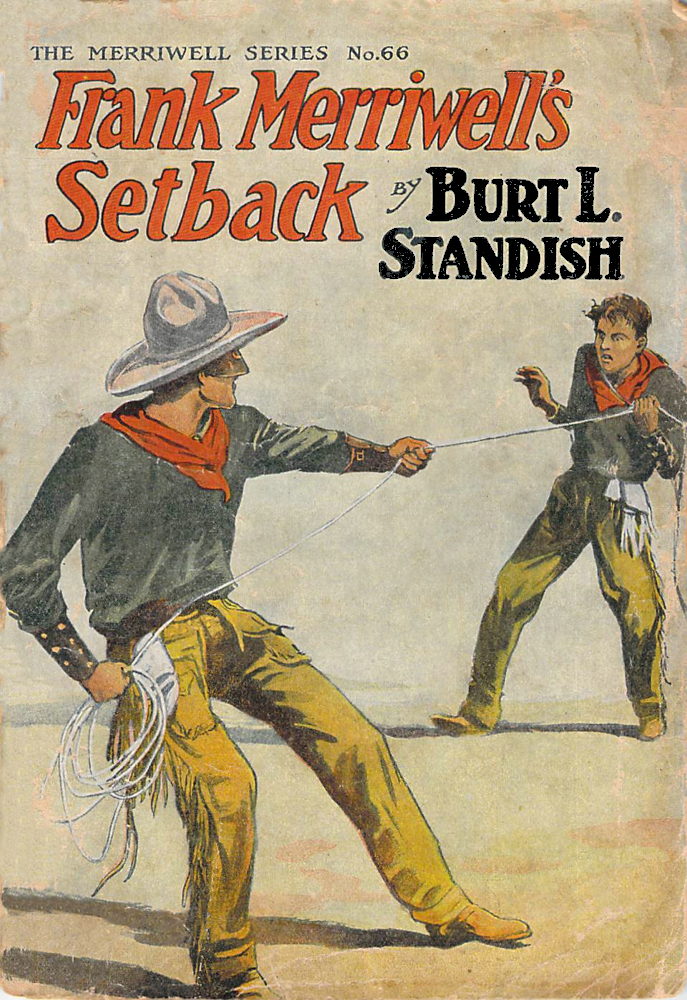
A half million enthusiastic followers of the Merriwell brothers
will attest the unfailing interest and wholesomeness of these
adventures of two lads of high ideals, who play fair with themselves,
as well as with the rest of the world.
These stories are rich in fun and thrills in all branches of
sports and athletics. They are extremely high in moral tone,
and cannot fail to be of immense benefit to every boy who reads
them.
They have the splendid quality of firing a boy’s ambition to
become a good athlete, in order that he may develop into a
strong, vigorous right-thinking man.
ALL TITLES ALWAYS IN PRINT
1—Frank Merriwell’s School Days By Burt L. Standish
2—Frank Merriwell’s Chums By Burt L. Standish
3—Frank Merriwell’s Foes By Burt L. Standish
4—Frank Merriwell’s Trip West By Burt L. Standish
5—Frank Merriwell Down South By Burt L. Standish
6—Frank Merriwell’s Bravery By Burt L. Standish
7—Frank Merriwell’s Hunting Tour By Burt L. Standish
8—Frank Merriwell in Europe By Burt L. Standish
9—Frank Merriwell at Yale By Burt L. Standish
10—Frank Merriwell’s Sports Afield By Burt L. Standish
11—Frank Merriwell’s Races By Burt L. Standish
12—Frank Merriwell’s Party By Burt L. Standish
13—Frank Merriwell’s Bicycle Tour By Burt L. Standish
14—Frank Merriwell’s Courage By Burt L. Standish
15—Frank Merriwell’s Daring By Burt L. Standish
16—Frank Merriwell’s Alarm By Burt L. Standish
17—Frank Merriwell’s Athletes By Burt L. Standish
18—Frank Merriwell’s Skill By Burt L. Standish
19—Frank Merriwell’s Champions By Burt L. Standish
20—Frank Merriwell’s Return to Yale By Burt L. Standish
21—Frank Merriwell’s Secret By Burt L. Standish
22—Frank Merriwell’s Danger By Burt L. Standish
23—Frank Merriwell’s Loyalty By Burt L. Standish
24—Frank Merriwell in Camp By Burt L. Standish
25—Frank Merriwell’s Vacation By Burt L. Standish
26—Frank Merriwell’s Cruise By Burt L. Standish
27—Frank Merriwell’s Chase By Burt L. Standish
28—Frank Merriwell in Maine By Burt L. Standish
29—Frank Merriwell’s Struggle By Burt L. Standish
30—Frank Merriwell’s First Job By Burt L. Standish
31—Frank Merriwell’s Opportunity By Burt L. Standish
32—Frank Merriwell’s Hard Luck By Burt L. Standish
33—Frank Merriwell’s Protégé By Burt L. Standish
34—Frank Merriwell on the Road By Burt L. Standish
35—Frank Merriwell’s Own Company By Burt L. Standish
36—Frank Merriwell’s Fame By Burt L. Standish
37—Frank Merriwell’s College Chums By Burt L. Standish
38—Frank Merriwell’s Problem By Burt L. Standish
39—Frank Merriwell’s Fortune By Burt L. Standish
40—Frank Merriwell’s New Comedian By Burt L. Standish
41—Frank Merriwell’s Prosperity By Burt L. Standish
42—Frank Merriwell’s Stage Hit By Burt L. Standish
43—Frank Merriwell’s Great Scheme By Burt L. Standish
44—Frank Merriwell in England By Burt L. Standish
45—Frank Merriwell on the Boulevards By Burt L. Standish
46—Frank Merriwell’s Duel By Burt L. Standish
47—Frank Merriwell’s Double Shot By Burt L. Standish
48—Frank Merriwell’s Baseball Victories By Burt L. Standish
49—Frank Merriwell’s Confidence By Burt L. Standish
50—Frank Merriwell’s Auto By Burt L. Standish
51—Frank Merriwell’s Fun By Burt L. Standish
52—Frank Merriwell’s Generosity By Burt L. Standish
In order that there may be no confusion, we desire to say
that the books listed below will be issued during the respective
months in New York City and vicinity. They may not reach
the readers at a distance promptly, on account of delays in
transportation.
To Be Published in January, 1923.
53—Frank Merriwell’s Tricks By Burt L. Standish
54—Frank Merriwell’s Temptation By Burt L. Standish
To Be Published in February, 1923.
55—Frank Merriwell on Top By Burt L. Standish
56—Frank Merriwell’s Luck By Burt L. Standish
To Be Published in March, 1923.
57—Frank Merriwell’s Mascot By Burt L. Standish
58—Frank Merriwell’s Reward By Burt L. Standish
Frank Merriwell’s Setback;
OR,
TRUE PLUCK WELCOMES DEFEAT
BY
BURT L. STANDISH
Author of the famous Merriwell Stories.
STREET & SMITH CORPORATION
PUBLISHERS
79-89 Seventh Avenue, New York
Copyright, 1900-1901
By STREET & SMITH
————
Frank Merriwell’s Setback
(Printed in the United States of America)
All rights reserved, including that of translation into foreign
languages, including the Scandinavian.
CHAPTER I. THE GIANT OF THE WHEEL.
In its various forms it was an old trick, and it ought
not to have worked on Starbright, who had come from
the famous preparatory college at Andover. But by
some chance, Dick had never heard of it, and the sophomores,
discovering this, prepared to “work” him with
it.
It was a principle with the lordly sophomores to annoy
freshmen, and the towering young giant, who had
already made himself so famous at Yale, suffered as
much at their hands as less noted mortals.
There is a streak in human nature which causes those
who have been “through the mill” to want to put
others through. This spirit accounts for “hazing,” in
all its forms.
Jack Ready started it by offering to bet Dick Starbright
ten dollars that he could not ride a bicycle from
New Haven to Guilford and back, a round-trip of
thirty-two miles, in three hours. Starbright snapped
him up quicker than a wink, for though there were
many things he could do better than bicycling, Dick
knew that he could do this, and the trip to Guilford,
along the pleasant shores for a great part of the way,
was an attractive one.
The bet was made one Wednesday evening, and
Dick was to do the riding the next Saturday afternoon.
Starbright told his friend Dashleigh about it.
“Of course you can do it!” Bert declared.
“Dead easy! Why, I could do that trip in two
hours, even if the roads are sandy. But three! I
don’t know what Ready is thinking about. He must
fancy that I can’t ride a wheel. Perhaps it is because
I started in to take part in the relay race and Merriwell
pulled me out of it and put me at other work. But
that was only because you are a faster rider than I am,
and my size and strength made me a promising candidate
for the shot-putting and hammer-throwing.”
“And you did your part well, old man. You covered
yourself with glory!”
“And I’ll show these duffers that I can ride a wheel.
I’ll see how quickly I can do the trip, and I’ll make
their eyes bulge out when they see me back.”
Dick did not get an opportunity to see Merriwell,
but he told Browning; and Browning, who had been
“let in on the ground floor,” assured Dick that he
could make it “dead easy,” and that Jack Ready was
a fool for offering such a bet.
“It will be a good way to open up Merriwell’s entertainments,”
said Ralph Bingham, when Starbright
chanced to speak to him about it. “I’d do it, if I were
you.”
Bingham was a sophomore, but Dick did not think
of that.
Carker, alone of the sophomores, objected, urging
that he disliked to see so good a fellow as Starbright
toyed with in that way.
“Well, you aren’t going to chip into the thing and
spoil the fun, just because it doesn’t suit you, are
you?” demanded Bingham. “We sophomores must
hang together. Ready is an especial friend of yours,
and he is managing the thing. Don’t you think it
would be rather a scaly trick to give the snap away?”
“If Merriwell should hear of it?”
“He’ll not hear of it. He has his hands full of
other matters just now. And he wouldn’t interfere,
anyway, for he’s no milk-and-water kid. He had to
go through the mill when he was a freshman, just
as we did, and it did him good. I like Starbright.
He’s a fine fellow. But he’s a freshman, and he’s in
great danger of coming to think that he is ‘it’! He
has boomed right up, and he’ll be wearing frills of
great importance round the gray matter of his thinking
machine the very first thing we know. Already
he believes that he’s better than any sophomore that
ever trod the campus or sat on the fence. This thing
won’t hurt him. It will do him good, and tend to
make a man of him.”
This sort of logic, directed to a fellow classman, was
irresistible.
Ready was not at all sure that Merriwell would
interfere; but, fearing that he might, for Dick was
recognized as his protégé, he contrived to keep the two
apart most of the time, managing to be with one or
the other whenever they met, and to so skilfully direct
the conversation that no opportunity presented for a
discussion of Dick’s proposed ride. As for the other
students of all classes, they shut up mum on the subject
whenever Frank came to their midst.
There was a lowering gray sky and a hint of a
change in the weather on that Saturday afternoon
when Dick wheeled up in front of the New Haven
House for his start. He rode a very high frame to accommodate
his great height. It was a heavy roadster,
not adapted to racing, but Dick had been able to crack
it up for good speed on more than one occasion.
As for his attire, Dick was comfortably clothed in a
woolen bicycle-suit somewhat the worse for wear, and
wore a visored cap. Like most Yale men, the cut and
quality of his clothing were of secondary consideration,
his only demand being that it would suit his
needs and be comfortable.
Jack Ready was there, to lead the cheer with which
Dick’s departure was greeted, swinging his cap and
yelling, after a preliminary offer to double his bet,
which offer Dick would not accept. He was sure he
would win Ready’s money, and for that reason he did
not want the bet raised.
Dashleigh was there, too, and other freshmen. There
were some juniors and seniors, also. But the larger
number gathered in front of the hotel were sophomores.
Starbright liked a bicycle, though he was too large
and heavy to become a crack rider. He was a good
wheelman, though, and he swung away with cheerfulness
through the level streets of the college city and
out toward the road that leads close along the shore of
the Sound, following as closely as he could the railway
line.
He found the wind heavy as he began to wheel over
the Sound route. The breeze was off the water and
he was forced to bore into it quarteringly, which, with
the character of the road, made the wheeling rather
too heavy for pure pleasure.
Nevertheless, Starbright “hit it up” at a good gait,
bending forward over the handle-bars and thrusting
his visored cap into the wind like the sharp prow of
a racing yacht.
Now and then a farmer stared curiously at him as he
slipped by. This grew so frequent as he neared the
first of the half-abandoned summer resorts of that
part of the Sound that he dismounted from his wheel,
feeling that something in his personal appearance
caused these men of the hoe to inspect him in that way.
Having looked his wheel over and found it all right,
Dick took off his coat and inspected that. There was
no legend pinned or chalked on its back, and nothing
about him which could draw so much attention.
“The fellows act as if they had never seen a bicycle!”
he grumbled, as he replaced his coat and remounted
for the continuance of his journey. Yet that this
could not be so seemed to be proved by the proximity
of the summer-resort hotels, which poured out scores
of wheelmen for these roads every season, to make no
mention of the bicyclists of New Haven.
On reaching the first of the summer resorts, Dick
was surprised still further to find a number of men and
women, chiefly composed of the class who get their
living in the winter from the waters of the Sound or
by taking care of the abandoned caravansaries, standing
grouped on a corner as if awaiting his coming,
and staring at him with undisguised curiosity as he
wheeled by.
“Don’t think much o’ yer wheel!” one of them
shouted. Then added: “No; I don’t think I’ll buy one
of ’em next summer!”
Stopping by a spring for a drink, he leaned the wheel
against a fence, and a country youth came forward to
look it over. Dick would have thought nothing of
this if the young fellow had not asked him if he
thought he received enough pay for that kind of
work.
“Not doing it for pay,” said Dick.
“Y’ain’t racin’ ag’in time, then?” was the bland
question.
“Not exactly.”
“Can’t say that I want to buy the wheel!”
“I haven’t any notion of selling it.”
Then the countryman stared at him.
“You ain’t Jimmy Michael?”
“Jimmy Michael, the famous bicyclist? No. What
made you think so?”
“And ain’t you advertisin’ a new kind of wheel that’s
a world corker?”
“Nothing of the kind.”
The country lad flushed and moved away with explanation.
“What’s the matter with the fellow?” Starbright
thought. “Jimmy Michael? Nobody could mistake
me for Jimmy Michael!”
Still the farmers stared at him as he wheeled by.
Sometimes, when they beheld him coming, they came
close down to the road, often the whole family, and
stared after him as he passed on.
Once a young woman waved a handkerchief roguishly
at him from a kitchen window. Dick began to
feel red and uncomfortable; and then, at the next village,
he was asked by a member of the mob that was
apparently gathered to see him, what the make of his
wheel was, and if it was to be sold cheaper than other
makes of good wheels, he inquired why the question
was asked.
For answer the man pointed to a large placard on
a wall:
“Richard Starbright, the world-famous giant of the
wheel, will this afternoon make a race against time
from New Haven to Guilford and return for the purpose
of advertising our new make of record-beater
roadsters. Starbright has beaten the record of Jimmy
Michael, and our wheels beat the world. He has
circled the globe in the interest of our wheels. Wait
for him! You cannot afford to miss seeing him!”
“You look a good deal like a Yale guy, but yer
size made us think mebbe you was the man,” the citizen
explained.
“Yes, I am the man!” said Dick hotly flushing.
“I’m a guy all right, too!”
“What’s the make o’ the wheel?” another queried,
walking round as if to inspect its fine points. “Looks
like you’ve rid it a lot. I should think they’d have sent
you out on a shinin’ new one?”
“What countries have you ridden through?” queried
a vinegary woman in spectacles. “I do hope you’ve
been through Tibet. But if you have, the natives
did’t treat ye as bad as they do some folks. I’ve got
some real good buttermilk, and if you’d like to drop
into my house a minute to rest and tell me about
Tibet I’d take it kindly. I’m so interested readin’
’bout Tibet that I can’t hardly sleep o’ night sometimes.
It’s the first house on the corner as you go
down—a little white house with green winder-blinds.”
Starbright was in a profuse perspiration.
“Thank you!” he said. “You’re very kind. But I
must really hurry on. I’ve stopped too long now.”
Then, feeling that the only way to get away from
these people was to mount his wheel, he hopped on it
and fled through the village, giving a glance at the little
white house with the green blinds as he swept by, and
thinking that perhaps the proper thing would have been
to stop there and talk Tibet to the inquisitive, spectacled
lady and sip her buttermilk while he thought
out some plan for outwitting his tormentors.
“This is Ready’s work!” he panted, as he wheeled
down the road. “I’ll have to murder that fellow! I
see there is no help for it! I shall have to take him
between my two thumbs and squash his life out as I
would any common bug!”
He tried to smile when the village was behind him.
“It’s a good joke, anyway, and it’s on your Uncle
Richard! Of course, the whole college knows of it
now, and New Haven will know it before night.
Heavens! If it should get into the newspapers!”
Dick wheeled on so fast, hardly knowing now that
he was speeding, that he found himself approaching the
next little village almost before he thought it possible.
He saw the inevitable crowd gathered on the principal
corner of the street, through which he must pass unless
he elected to make a wide détour and avoid the village
altogether. Some boys raised a cheer as he drew near,
swinging their hats with an urchin’s delight.
“I’ll not stop!” Dick grunted, shrinking from the
thought of again encountering some one who would
ask him about his world-wide travels. “They’ll want
to know if I’ve been in China, likely, and if I’ve
fought the Boxers, and how many I’ve killed!”
So he put on extra speed, lowered his visored cap,
bent over the handle-bars, and went through the street
like a streak of lightning. The boys yelled and
whooped, and he could not help hearing one citizen
remark that “Jimmy Michael ain’t in it with that
feller!”
“Here comes the bikeist!” a boy was shouting to
another group at the lower corner. “Come quick,
Sammy, ’er ye’ll be too late!”
“Geewhiskers! ain’t he a snorter?” another boy
yelled.
The group broke into a wild cheer as Dick swept
past, pedaling as if he were racing for life. When he
had escaped from these innocent tormentors, he began
to think over the situation and to ask himself if
he should go on to Guilford or stop where he was and
retrace his way to New Haven by another route. To
do that would be to lose his bet. Not that he cared so
much for the money or for the mere winning, but that
would give Ready and the sophomores a perhaps coveted
opportunity to guy him for cowardice.
No, he was in it, and there seemed to be no way out
but to make the ride according to plans and schedule
and win out, so far as that part was concerned. So
he rode on, wondering if there were no means by
which he could yet defeat the sophomores.
“Yes, this is the beginning of Frank Merriwell’s
entertainments!” he rather grimly thought. “I didn’t
know that I would be chosen to open the show in this
way, though! Merry doesn’t know anything about it,
I’m sure.”
Merriwell was planning some festivities of an athletic
character with which he and his friends and other
students were to celebrate the many victories won by
Yale that season. The college had been wonderfully
fortunate and triumphant on the gridiron, not having
lost a single game during the entire season. Never
had a Yale team equaled the performance of the football
eleven of that year under the leadership of the
redoubtable senior. And not only in football, but in
many other ways had Yale won honor with the victorious
teams Merriwell had trained and led.
There was a grim humor in Starbright which made
him appreciate the situation in which he found himself,
even though he was the victim. At first he had
paid no heed to anything placarded on the walls, but
now, looking out for those glaring signs, he soon found
one stuck against the side of a barn. It was on the
side of the barn that was invisible to him as he came
toward it.
So this had been Ready’s plan! These glittering advertisements
of the performance of the “Giant of the
Wheel,” produced, no doubt, by some New Haven
printing press, had been skilfully plastered up along
the roadside and in the villages in such a way that the
wheelman approaching them could not see them. And
the chances were small that he would look back and
discover them after he had whirled by. This accounted
for the fact that Dick had not for a time observed the
notices which drew out the curious villagers and
farmers.
In the next village, which was also of the summer-hotel
variety, though there was a substantial element
of people who resided there the year round, a larger
crowd than ever stood in the street to await his coming.
The crowd broke into a cheer as he came in sight
and wheeled up to the corner. He had resolved to ask
some questions.
“When were these placards stuck up?” he inquired.
“Yisterday. Say, mister, when’s yer book comin’
out?”
“What book?”
“Why, the feller that come along yisterday stickin’
up the bills said that you was about to put out a book
tellin’ about yer wonderful adventures with the Toltecs
while you was coastin’ down one of them old Peruvian
roads in South Ameriky.”
“What sort of looking fellow was he?”
“Well, about so high and so wide. He was a sort
of stocky chap with bright eyes and red cheeks. Come
to think of it, when he got off his wheel to stick up the
sign, I noticed that he toed in with one foot.”
“That was Jack Ready.”
“Was it? I didn’t know! I believe he did say
somethin’ ’bout bein’ always Ready.”
“Aw! that feller’s a Yale man!” a boy was heard to
sneer. “He ain’t never been in South Ameriky ner
nothin’. I know them fellers soon’s I see ’em.”
“Be you a Yale man?” an old man growled, not relishing
the idea of being drawn out and fooled in that
way by a mere college student. He had walked nearly
a mile to see the “Giant of the Wheel” go by, and he
wanted his money’s worth.
Dick was saved from answering this disconcerting
question by a young man with a pale face and large
nose, who crowded forward to inspect the wheel, saying
that he intended to purchase a bicycle the coming
season.
“I thought, mebbe, when I heard that feller talkin’
yesterday, that it was one of them headless wheels
made in Indianapolis. D’y’ever see one of ’em? You
sort of set in the handle-bars as if they was the arms of
a rockin’chair. I didn’t know but I’d like to have one
of ’em. I’m sure the feller said somethin’ ’bout headless!”
Dick thought it quite likely that the irrepressible
Ready had referred to the rider of the wheel as “headless,”
or something of like character, indicating that
he was “easy.”
“Well, perhaps I am easy,” he thought, as he
wheeled on, glad to be past another inquisitive village.
Branford Point, a favorite watering-place, turned
out a good-sized crowd to see the “Giant of the
Wheel,” but Dick concluded that he did not care to
ask further questions or make the acquaintance of the
curious people, so he flew through the place as rapidly
as he could pedal.
He was making good time, even though the road was
not of the best, in spots, and the wind blew cold from
the leaden clouds in the northeast. He was warm
enough, in spite of the wind, and sometimes, when he
reflected too strongly on the condition in which he
found himself, and of the laughing sophomores in
the campus, he grew altogether too warm.
There were other groups to meet and pass, other
farmers who hurried down to the road to look and
wonder, other boys who whooped and yelled and told
each other to “git onto de legs of de Giant,” and other
things equally uncomplimentary to the bicyclist.
But Dick, having resolved to take the whole thing
good-naturedly and philosophically, smiled back at
them; and, whenever he dismounted, he answered the
rain of questions as best he could, without revealing
that he was the victim of a sophomore joke.
But when he reached Guilford, the end of his route—Guilford,
celebrated as the birthplace of the poet,
Fitz Greene Halleck—he met a surprise that took away
his breath. In front of a conspicuous hotel was a
brass band, surrounded by Yale sophomores, with Jack
Ready prominent in their midst. They were waiting
to give the “Giant of the Wheel” a right royal reception;
and, as Dick wheeled up, almost too disconcerted
to know what to do or say, the band struck into “See
the Conquering Hero Comes!” and the sophomores
gave a yell that shook the building and almost rattled
the curbstones.
But Dick Starbright was quick-witted, and he pulled
himself together, so that he was able to dismount with
a smile and a bow.
“What sort of fool circus are you idiots trying to
make of yourselves?” he blandly demanded, walking
forward, pushing his wheel.
Ready wiggled his fingers characteristically.
“An immense one, old man, and you have been the
clown of the show. We’ll take supper at your expense
to-night. In the meantime, you will find refreshments
in the house of this publican.”
He gave his fingers another wiggle and jerked them
toward the hotel proprietor, who stood by with red
face expanded in a grin.
“It’s one on me!” Starbright admitted smilingly.
“But the end hasn’t come. Before Frank Merriwell’s
entertainments are over you Smart Aleck sophomores
will acknowledge that the freshmen know a thing or
two, and are more than your masters. And we’ll not
resort to deceit to win our victories or to give us a
chance to ‘holler’.”
CHAPTER II TO THE AID OF DADE MORGAN.
Jack Ready and the sophomores had rushed to
Guilford by train with their band, after Starbright’s
departure from New Haven, and had easily beaten him
there, with plenty of time to spare. They returned by
train, feeling supremely joyous over their success.
Dick, however, in accordance with the terms of the
wager, was forced to wheel back to New Haven over
the route he had come, again stared at and questioned
by the curious people along the road.
The leaden clouds thickened and darkened, portending
a northeaster; but, with the wind for a large part
of the trip at his back, Dick sped swiftly along, approaching
New Haven well ahead of time.
On the outskirts of the city he came upon a sight
that stirred his blood. Dade Morgan, who had been
out on a wheel accompanying Rosalind Thornton,
found himself confronted by a rough-looking man
whose brutal face was somewhat familiar to him, and
who planted himself in the center of the street as if to
intercept him.
Dade was not particularly afraid of the man, but
rather scorned him.
“Out of the way!” Dade roughly commanded.
He rang his bell furiously. Rosalind paled.
Seeing that the man did not mean to step aside,
and having no desire for an altercation with him in
Rosalind’s presence, Dade veered his wheel to pass.
The man leaped at him, thrust a foot out in front of the
wheel, stopping it, and Dade was thrown heavily over
the handle-bars.
Rosalind, who was close at his side, was also thrown
to the ground, though she saved herself from injury
and skilfully alighted on her feet.
When Starbright saw this he set his pedals in still
swifter motion, all his chivalrous instincts aroused.
Dade scrambled up; but the man struck him a heavy
blow which knocked him backward.
“Dis is me time I git even wid you fer dat insult.
See!” the ruffian growled. “Ye insulted me t’other
night, when ye hadn’t no call. Now I pays ye back!”
Rosalind gave a scream of fright. Starbright,
swinging forward like a whirlwind, saw Dade dodge
the next blow and grapple with the ruffian and saw
them begin a furious fight.
Dade, who was a good, hard fighter, had been weakened
by his fall, so that it was evident at a glance that
he was no match for his burly adversary. He struck
savagely, however, and managed to release himself
from the man’s grip.
The tough now struck at him, using a big doorkey
as brass knuckles, with the amiable intention of cutting
open the face of the “college dude.” Morgan
evaded this and landed a blow, but the fellow tripped
him and kicked him heavily as he fell.
Rosalind, screaming for help, ran to one side of the
road. Dade jumped to his feet again, and, managing
to fasten on the tough, the two went down together.
Then the whirring wheel stopped beside the struggling
couple; and, as the rough pulled loose and tried
to strike Dade in the face with the heavy brass key,
a blow from Starbright’s big fist sent him reeling.
“Anodder college dude!” growled the ruffian, wheeling
about. “Ye’ll wish’t ye’d kep’ out o’ this!”
His hand went to his hip-pocket, but he found no
weapon. Then he gathered himself and made a spring
at the newcomer. As a result, he ran his face into the
big fist on the end of a long, straight, stiffened left
arm. At the other end of the arm were something
like two hundred pounds of hard-trained muscle and
over six feet of young manhood.
A feeling of jarring surprise penetrated to the evil
brain. It was not often that he ran against anything
quite like that. He paused a moment to stare his surprise;
and Dick saw that he was a big, brawny fellow,
with heavy jaw, small head and piggish, wicked eyes,
the type so often found in the lowest slums of great
cities, but seldom seen in New Haven.
The effect of that blow rendered the man cautious.
“Dis ain’t your cut in, young feller!” he snarled.
Then, thinking to take Dick by surprise, he struck
out suddenly, with the force of a piledriver. But his
maul-like fist did not connect with Dick’s face, and the
force of the blow almost threw him to the ground.
Crack! Dick’s hard right fist sounded like the smack
of a board striking a house. The fellow reeled, but
recovered. His head was like iron.
“W’en I gits me fingers onto ye, ye’ll wilt! See!”
He dodged Dick’s next blow and rushed in with
the ferocity of a bulldog. Dick stepped lightly aside;
and the hard, white fist pounding the ruffian on the jaw
threw him senseless to the ground.
Dade Morgan, having regained his strength somewhat,
was on the point of coming to Dick’s assistance,
but drew back when he saw the man senseless on the
ground.
“That was handsome of you, Starbright!” he acknowledged.
“I’ll try not to forget it.”
Rosalind tried to stammer her thanks, but the presence
of the ruffian, even though he was insensible for
the moment, made her wildly anxious to escape from
the vicinity. Some people were approaching, those in
the lead seeming to be of the same type as the fellow
knocked out.
Before their arrival the man was stirring into consciousness,
making Rosalind more than ever wildly
anxious to proceed. So she and Dade remounted and
wheeled away.
“Perhaps the fellow is your friend,” said Starbright,
speaking to the man who arrived first. “If he is, look
after him. He interfered with that young lady and
her escort, and got what he deserved!”
Then he, too, rode on into the city.
Having reported his return, Dick put away his
wheel, and, feeling tremendously hungry, went to a
restaurant and had something to eat. It was not until
long after nightfall that he went to his rooms. The
sophomores had returned to New Haven by rail long
before.
“Gone out nagging signs!” was the scrawl left for
him on the table by Dashleigh.
Dashleigh had not heard of what had befallen his
chum on the trip to Guilford, for the joke had been
kept from the freshmen. The sophomores had feared
Starbright would learn of it through his freshmen
friends; and, besides the sophomores had other plans in
store for making it interesting for the men of the
lower class.
After changing his clothing, Dick went out to give
instructions for the “dinner” he meant to give to
Ready and other sophomores that night. When he
returned he encountered Dashleigh as the latter was
about to ascend to their apartments.
“What have you got tucked under your coat?” Dick
asked.
“Sh!” Bert warned. “It’s a sign.”
“Nagging,” or stealing, signboards is, for some inexplicable
reason, one of the standard forms of amusement
for freshmen. No one can tell just where the
fun comes in, unless it is found in imagining the
stormy anger of the storekeepers and others when
they find their signs gone.
“Had a great time!” Dashleigh panted, as he and
his chum hurried up-stairs. “Never had more fun
in my life. Ready was with us. Say, that fellow is
a corker!”
“What time did he get back?”
“Back where?”
“New Haven.”
“I didn’t know he was out of town. Anyway, he
didn’t say anything about it. We nagged a lot of
signs this evening. Ready went along to put us onto
the thing right, you see. I hardly thought he’d favor
freshmen that way, but he was just as jolly about it;
said he’d been a freshman not long ago himself, and
that he hadn’t forgot it.”
“What kind of a sign did you get?” Dick asked
dryly.
He had cause to fear the “friendliness” of Jack
Ready for unsuspecting freshmen.
“The dandiest in the lot. It’s a new blacksmith’s
sign, or a blacksmith’s new sign, and it has a picture
of a horse on it that is a real work of art.”
They had arrived at their rooms, and Dashleigh
carefully unbuttoned his overcoat and took from under
it the sign. He stared at himself and the sign in
comical amazement.
The sign had been freshly painted, and his clothing
was coated with the paint. In addition, he had
slapped the picture of the horse up against his dark
new coat as he tucked the outer coat over it, and the
impression of the horse had been transferred to the
coat. Starbright could not help laughing.
“Seems to me it is literally a horse on you! That
is more of Ready’s work.”
“Why——”
Dashleigh looked from the paint to the red face of
his friend.
“Jack Ready?” he gasped. “Say, did Jack put up
a job on me?”
“He certainly did, and he put up another on me
this afternoon.”
Dashleigh daintily put down the sign, stripped off
his overcoat, and sat flat down in a chair.
“Well, say, when I meet that fellow I’ll kill him!
Don’t you suppose there was a mistake?”
“Biggest kind of one!”
“What?”
“When we let ourselves forget that Jack Ready is a
sophomore and we are only freshmen.”
Dashleigh looked ruefully at his clothing and at the
fresh red paint of the sign. Then the humor of the
situation came to him, and he smiled, though the smile
was somewhat ghastly.
“I’m an idiot!”
“Of course you are. We’re a pair of idiots!”
“What did he do to you?”
“Tell me about the sign first.”
“Well, you see, I’ve been wanting to go out nagging
for several nights. Jack heard of it, and he told me
that he could give me some pointers. So I spoke to
some other fellows.”
“All freshmen?”
“Yep.”
“So I thought.”
“And Ready piloted us to-night. He showed me
this beautiful sign in front of the blacksmith’s, and
told me that it had been up there only a short time,
and it would be a lovely one to nag.”
“It had been up there only a short time!”
“Confound him! I see it had. I thought it felt
damp as I pulled it off the hooks, but we had a few
drops of rain this evening, and I supposed that was
the reason. Then I clapped the thing under my coat
and fled hitherward. And there the thing is. And
my beautifulest suit is ruined. Well, when I meet
him I’ll kill him!”
“It will give a good job to some coat-cleaner. Better
tackle the thing yourself, while the paint is fresh.
There is some benzine over on the shelf.”
Then, while Bert Dashleigh tried to remove the
paint from his clothing, Starbright told of his race to
Guilford and of the advertisements and greeting given
to the “Giant of the Wheel.”
“Say, we’ll have to murder that villain!” Dashleigh
whispered. “I feel to-night fit for treason, stratagem,
and spoil.”
Nevertheless, after laboring with the suit and benzine
for an hour, he hung the sign against the wall,
went out again, and, meeting Ready, greeted him with
great cheerfulness.
“Thanks for the sign!” he murmured. “I’ve hung
it on our wall, and intend to have it framed as a memento
of our adventure.”
Ready grinned.
“That blacksmith will be tearing mad in the morning.
His sign hadn’t been hanging there long.”
“Confound you! Don’t I know it hadn’t? That
blacksmith never saw that sign in his life, and he
never will!”
“It had a beautiful steed on it!” Ready purred.
“A sort of transfer picture! I transferred it to my
coat!”
Then they adjourned to Traeger’s and buried the
hatchet, after which Ready betook himself to the
dinner which Starbright was giving to the sophomores.
CHAPTER III SPORT WITH THE LASSOS.
The first of the “entertainments” was given that
night in the gymnasium. It was a roping-contest between
Bill Higgins, of Badger’s ranch, and Tom Bludsoe,
a cowboy from the neighborhood of El Paso,
who had been traveling with a “Wild West” exhibition
and had somehow become stranded in New
Haven. Drink may have had something to do with
Bludsoe’s loss of position and his consequent poverty;
but he was a fine roper, nevertheless, and in arranging
to put Higgins against him for the amusement of the
students, Merriwell was not at all sure that his friend
from Kansas would be able to win out and cover himself
with glory.
Perhaps because Merriwell had seemed in some of
the class contests to side with the freshmen, Tom
Bludsoe was enthusiastically backed by the sophomores,
while the freshmen took Higgins for their
champion.
“It chills the corpuscles of my sporting-blood to
have to turn your picture to the wall to-night, Higgins,”
said Ready, ambling into the gymnasium, after
his “feed” at the expense of Dick Starbright; “but
the sophomores have taken up Bludsoe, and I’m a
soph.”
“Oh, that there is all right!” Higgins grinned, as he
strung his riata across the gymnasium floor, to make
sure it was in good condition. “This hyer ain’t fer
blood, ye know! Jist a little fun, to please Merry
and t’other fellers! I hear tell there’s another feller
that’s got a picture he’d like to turn to the wall.”
“Dashleigh?”
“Picture of a hoss!” grunted Higgins, critically examining
his rope and working at it with his fingers
to take out an incipient kink which he fancied he had
found. “I’m going to hold that agin’ you!”
“He held it against himself!”
“Yes, so I heerd. But I’m a lover of hosses, and
I don’t like to have even a picture of one fooled
with. That makes me willin’ to champion these pore
freshmen fellers to-night, and I’ll string ropes fer ’em
fer all I’m wu’th.”
Indeed, Higgins was going into the contest with
“blood in his eye.” He believed that he was a better
roper than the man from El Paso, even if Bludsoe had
been engaged in giving public exhibitions of his roping
proficiency, and he was glad of this chance. Higgins
delighted in keeping himself in the public eye.
Though he was a noble fellow in many respects, he
was as vain as a peacock, and he “felt his oats considerably”
that night, as he stretched his riata across
the floor and walked round in his new cowboy clothing,
with his great spurs musically clinking and jingling
on his heels.
Bludsoe was a lithe, wiry man, younger than Higgins
and smaller. He wore a smooth face, which was
as bronzed as a copper mask. It was a sharp, hatchety
face, keen and shrewd—the typical face of the cowboy
of the plains, whose intense activity, combined
with the dry, sap-extracting climate, tends to keep
down all superfluity of flesh.
The opening feature of the contest was an attempt
to pull down a tin cup hung by its handle on a nail
against a post. A large roping-space had been cleared
in the gymnasium by removing some muscle-strengthening
machines and horizontal bars.
The room was filled to overflowing, the pushing,
laughing crowd seemingly the more jolly because the
night without was windy and inclement.
“Makes me think of the plains,” chirped Higgins,
as, in a lull of the noise, he heard the singing of the
wind round the building. “A feller that’s lived with
the wind as I have sort o’ likes to hear its mournful
whistle. I’ve heerd it sing that way, wrapped in my
blanket, with the stars shinin’ brighter’n diamonds;
and oncet I remember it had thet wail when me and
some other fellers was lying in a sod house, with the
Pawnees creepin’ onto us through the grass.”
It was amusing to notice how the Chickering set
and all the enemies of Merriwell invariably became
champions of whoever they thought was opposed to
him and his friends.
When Bludsoe pulled the tin cup from the post in
two throws and Higgins took three throws for the
same feat, the Chickering crowd clapped their hands
and stamped the floor in their glee.
“Say, I will have to go over to the freshmen side if
this keeps up!” Ready moaned in Merriwell’s ear. “It
plants an ache in my heart and a desire in my foot to
kick somebody. Yet I seem doomed by fate to howl
with the Chickering set. Don’t jot it down against me
in your book of remembrance!”
The next attempt of the ropers was to catch and
hold the corner of a swinging trapeze-bar, and as
Higgins turned to get his rope, which he had dropped
on a seat while talking with some friends, he roared
with rage.
His new rope, in which he took such pride, had
been split and ripped and cut in a dozen places by a
keen knife. Higgins reddened under his tan as he
surveyed the work of the unknown hand.
“If I kin lay my paws on the skunk ’t done that,
I’ll try to see if they’s enough of the rope left to hang
him with!” he exploded.
He turned slowly round, with blazing eyes, and
looked over the sea of excited faces.
“Gents, is this hyer Yale? A man mean enough to
be a hoss-thief wouldn’t do that on the ranges! All
I asks is fer the scalawag that done it to step up to
the counter and let me look at him oncet.”
There was no forward movement, and every one
seemed to glance at his neighbor. Bludsoe sneered.
“I don’t reckon that any of yer friends did that to
keep ye from bein’ beat?”
Higgins turned on him with those blazing eyes. He
saw that, in spite of the sneer, Bludsoe had no knowledge
of the author of the outrage, and his hot heart
relented. He remembered that Bludsoe was a brother
roper of the plains, and that plainsmen in a strange
land ought to be friends and not enemies.
“I won’t hold that again’ ye, pardner. If you beat
me, I’ll know that you wouldn’t do it by a trick like
that. Some skunk that never set eyes on the peraries
done that!”
Merriwell knew that another riata could not be had
in New Haven, and he was about to suggest that something
be substituted for the roping-performance, but
Higgins asked if a common rope could be had.
“But a common rope won’t give you much show!”
Frank insisted. “I’d like to have you win in this thing
if you go on with it.”
“I’m goin’ to win, b’jing!” Higgins vowed. “I’ll
win now if it kills me! Send fer a rope!”
Then he gave more explicit directions; and while
some one hurried away for the rope, Starbright came
upon the scene, and was asked to amuse the crowd by
trying to beat the gymnasium freshman record for
hammer-throwing and putting the shot, which he did.
When the hemp rope ordered by Higgins came he
amused the students by showing them how to make
a riata from an ordinary hemp rope. To make the
“loop” he spliced an end back on the rope, wrapping it
with shoemaker’s wax, also securing the ends from
fraying by wrapping them tightly with this wax. Not
a knot was used.
“The thing ought to be soaked in water fer two or
three hours,” he explained, “and then stretched with
weights, but it’ll haf to do as it is.”
“If you can win out with that rope, you will show
yourself to be a much better roper than if you had used
your own lasso,” Merry whispered encouragingly.
Then the rope-kings went at it again, catching the
trapeze-bar as it swung from side to side, roping students
who volunteered to run before them for the purpose,
pulling caps and gloves from pegs and doing
other roping-feats.
Though the rope so hastily prepared was clumsy
and inclined to kink in an aggravating way because it
had not been stretched, Higgins succeeded in doing
some remarkably good work with it, duplicating every
feat of Bludsoe.
The applause was pretty equally divided between the
ropers, for the freshmen, feeling that their champion
had been foully dealt with by some sophomore jealous
of his ability, cheered every throw of Higgins with
wild delight.
“Try the trapeze again,” said Merriwell. “Then
we’ll try the cane, and those two things ought to settle
it. Higgins is handicapped, but we’re banking that he
will beat Bludsoe anyway.”
The first throw at the trapeze fell to Bludsoe. He
stepped forward, holding the free end of the lasso in
his left hand and the big swinging noose trailing in his
right. He took a keen look at the swinging trapeze,
then threw and caught the end of the bar.
The Chickering set went wild with joy.
“That’s all right!” grinned Higgins, getting on his
feet. “I dunno ’bout this hyer rope, but I’ll make my
try.”
Merriwell asked that the trapeze be given a quicker
movement. It dropped like a bird with a broken wing,
and Higgins’ noose flew up to meet it.
The rope kinked and seemed about to fall short, but
it caught the tip end of the bar, hung and tightened,
and the descent of the trapeze was stayed.
Merriwell had secured a cane, round whose center
he wrapped a white handkerchief to make it more
conspicuous.
“I want Gene Skelding to throw this cane whirling
through the air in that direction!” he requested, indicating
the direction. “Let him throw for both Bludsoe
and Higgins.”
Skelding flushed and colored. Merriwell had made
some of the throws, and Skelding had been claiming
that the throws made by Merry for Bludsoe were not
as fair and easy as those made for Higgins.
He would have backed out, but the sophomores
pushed him forward, and he took the cane from Merriwell’s
hand, and sent it spinning end over end, as
directed.
This was one of the most difficult roping-feats that
could have been chosen, for the object was to put the
noose of the lasso over the flying cane, and so bring it
down.
Bludsoe’s noose struck the whirling cane, but simply
sent it on faster.
Then there were shouts for Higgins, and he rose
in all his cowboy dignity.
“Gents, I ain’t a-sayin’ that I’m goin’ to do this, but
I’m goin’ to try. I reckon I couldn’t do it every time
with the best rope ever strung acrost a floor. But
I’m goin’ to try!”
Skelding saw that Merriwell was watching him
closely and that the eyes of others were on him, so
that, in spite of his desire to make an unfair toss, he
did not dare to.
The wrapped cane flew out again, a whirling white
streak, and Higgins’ rope shot after it. He had nerved
himself to make the throw of his life, and he made it.
The stiff hemp rope swept through the air with the
sinuosity of a serpent, and the noose, dropping over an
end of the cane, brought the cane to the floor.
There could be no question that Higgins had won,
and won fairly; for not only had he won this trick
handsomely, but throughout the contest he had shown
that, even with the handicap of the stiff hemp rope, he
could do as good work as Bludsoe with his smooth,
supple riata.
“Curse the luck!” Skelding growled to his friends,
the Chickering set, some time afterward, when all
were in Chickering’s rooms. “Do you suppose that
Merriwell knew I cut that rope?”
“Did you cut it?” Chickering gasped.
“Of course I did. I wonder if Merriwell knew it?”
“Well, it wath the handthometht thing I’ve known
done in many a day!” purred Lew Veazie. “Chummieth,
we’ll have to dwink thome wine on that! That
wath gweat!”
“But the fellow won, anyhow!” Skelding snarled.
“And what I did only made his victory seem the
greater. It was a regular boomerang! And my plan
was to claim that some of his friends cut the thing
for him to prevent him from going to the defeat they
foresaw. I can’t make that claim now, confound it!”
CHAPTER IV AN APPARENT CHANGE OF HEART.
Sunday afternoon Dade Morgan received a call
from Donald Pike. The northeaster had turned to a
snowstorm. Pike shook from his coat the feathery
flakes as he came into Dade’s room.
“There is to be a snowball battle in the campus in
the morning, before college hours, between sophomores
and freshmen. I’m told that you’re to lead the
freshmen.”
“That’s the plan now,” said Dade. “Have a chair.”
Pike hung up his coat as if he were at home, and
seated himself. Dade closed the door, for he had a
feeling that Pike desired to say something that ought
not to go beyond the walls of the room.
“There’s only one thing in this whole business that
I don’t like,” Pike began.
“You mean of the entertainments?”
“Yes.”
“What is it?”
“Merriwell!”
“There are others I like myself better than Merriwell.”
“That sounded funny. ‘I like myself better than
Merriwell!’ Of course you do.”
“You know what I mean.”
“It seems to me that these ‘entertainments,’ as
they’re called, are planned solely to cover Merriwell
with glory. That’s the thing I don’t like. He proposed
them, of course. Some way, he always proposes
everything, and then the rest fall in like a flock
of sheep following their leader. We’re not celebrating
Merriwell’s victories, but the victories of Yale. Yet
the fellows are already calling them ‘Frank Merriwell’s
Entertainments.’”
“You’re warm!”
“I’m hot as a cake of ice!”
“I think I’ve seen you in that frame of mind before!”
commented Dade, with the utmost coolness.
“Another thing I don’t like, and which I should
think you wouldn’t like, is the way he has of pushing
Starbright forward. He seems determined to make
Starbright the king of the freshmen.”
Dade’s face darkened, and Pike saw that he had
struck a vulnerable spot. Yet Dade only said coldly:
“I don’t need to be told that!”
“And you haven’t anything to say about it?”
“I’ve had a good deal to say about it, at one time
and another.”
“You’re the real king of the freshmen, Morgan, and
you know it. All your friends know it. It’s for the
freshmen to say who shall be their leader. Yet here
comes a senior to dictate who the freshman leader
shall be!”
“I’d like to help it if I could. I don’t see any way
to help it just now.”
Pike was silent for a moment.
“Perhaps not. Merriwell seems to have the whip-hand
at present.”
He glanced toward the door.
“No need to fear that you’ll be heard outside of this
room!”
“Well, about that snowball battle in the morning?”
“We’ll do up the sophomores, all right.”
“I hope so. But that wasn’t it. You ought to be
able to do up Starbright, also, while you’re about it.”
There was not the encouragement in Dade’s face
that he hoped to see, but he went on.
“I’ve heard of soldiers being shot accidentally by
their own men! Stonewall Jackson was killed that
way!”
Dade looked at him earnestly.
“You want me to do that work?”
“Well, I thought you might thank me for a suggestion.
You hate Starbright. There’s your opportunity.
When the fight is on, a snowball with a rock hidden
in it would bring that big freshman down like a bullet
if it was thrown right.”
Dade flushed, and, getting up, took a turn round the
room.
“I’d do it myself if I were one of the freshmen
fighters. As it is, I give you the suggestion for what
it is worth.”
He began to feel that Morgan would accept and act
upon the suggestion. Dade came back and sat down.
“I ought to thank you for that, Pike,” he said in a
low tone. “I’m no better than I ought to be, and I
presume that if you had come to me yesterday, I
should have thanked you for this. But I don’t think
I’ll try to do what you say.”
Donald Pike stared.
“Getting goody-goody?”
“No, it’s not that!”
“Just the same with all of them!” Pike snarled,
under his breath.
“I don’t think I understand you if you meant that
for me.”
“Well, you are just like all the others!” Pike asserted
almost fiercely. “I don’t know why it is, for it
hasn’t worked on me that way, but nearly every fellow
who has started in here at Yale to down Merriwell
has done one of two things: He has either become
afraid of Merriwell and practically dropped out
of the fight, or he has gone over to Merriwell.”
Dade’s face was again flushing.
“There was Buck Badger! I’ve told you of him
before. He was the bitterest enemy Frank Merriwell
had for a while, and he ended by becoming a Merriwell
maniac. He thinks now that there never was
another such man on earth. Why, I’ve been told that
even Browning and Hodge, two fellows who can’t
think unless Merriwell first gives them license, were
once his enemies! You’re traveling the same road.
I was Badger’s chum and saw how he went over to
Frank Merriwell, and you’re struck with the same
symptoms. What in thunder is the matter with all
you fellows, anyway?”
“It was Starbright you wanted me to strike with a
rock, I believe?” said Morgan, not pleased with this
lecture.
“Yes.”
“Starbright isn’t Merriwell.”
“But he’s Merriwell’s protégé, and when you can’t
strike Merriwell himself, the best way to get at him
is to strike Starbright, or some other of his friends.
But you needn’t do it if you don’t care to. It was
merely a suggestion.”
“I’m still against Merriwell. Don’t let yourself forget
that, Pike!”
“But you won’t be at the end of the year.”
“And I’m still against Dick Starbright.”
“I don’t think so.”
“I’ve a reason for not trying to do what you suggest.
It isn’t because I’ve suddenly grown too good.
Perhaps I have a little honor left, Pike, though you
mightn’t think it. Not enough to boast of, I presume!”
“You haven’t heard of it, but yesterday Starbright
saved me from being half-killed by a tough that I
met while out wheeling. The place was a lonely one
in the suburbs, and I was wheeling with Miss Thornton.
I met the tough in a drinking-den a few nights
ago, and struck him with a beer-glass, after we’d had
some words. When he saw me yesterday he came at
me for revenge, tripped me off my wheel, and then,
while I was too shaken up by the jar of the fall to be
able to do much, he set on me, and would have
pounded and kicked me to a jelly. Starbright happened
along at that moment. He took a hand in the
game—and I’m here to-day, instead of being in the
hospital.”
Both were silent for a moment after the completion
of the story.
“He did you a good turn, and maybe you’re right.
But really, I didn’t think you had any soft spots about
you.”
“You thought such a thing wouldn’t make any difference?”
“Yes, honestly, that’s what I thought.”
“And you thought I had no heart at all?”
Pike was quite blunt.
“I thought you had something like a gizzard doing
duty for that organ. But it’s all right, of course! I
suppose I’d feel the same way if any fellow should
stand up for me in such a fight.”
“It wasn’t a fight on my part. I was clean knocked
out. I would have been hammered to pieces.”
“Let the thing drop, then!” Pike begged. “And
say nothing about it to any one. I didn’t know you
had changed in your feeling!”
The sneer stung Dade Morgan.
“I thought I should never let an opportunity go by
to strike at Starbright or Merriwell. I’ll get over this
in a day or two. But I can’t forget quite so quick.
Starbright will do or say something soon that will
make me forget his favor, and then I presume I’ll be
ready to hammer him up. But to-morrow, in that
battle, I’m going to play fair, so far as he’s concerned,
at least.”
“Good-by!” snarled Pike, rising. “You can keep
your face closed about this, anyway!”
“See here, Pike!”
The voice was so hard and commanding that Don
Pike stopped.
“I’m a fool! Don’t fancy for a minute that I would
mention such a matter. You’ve stood by me, even
though you’re not a freshman, and I don’t forget it.
Some other time I’ll be likely to strike at Dick Starbright.
Just now I feel a little queer about that matter,
and I can’t. That’s the truth of it.”
“I’m going!”
“Just remember that. And if you’ve any bets to
lay, put them on the freshmen.”
“If they win, Starbright will get most of the glory!
It doesn’t matter to me, though. I’m not trying to
beat him in the race for the freshmen leadership. You
are.”
Dade Morgan sat for a long time in silence after
Donald Pike’s departure. Finally he roused himself.
“I wish the fellow hadn’t come to me with that!”
he thought, rising. “Either that, or I wish that it
hadn’t been necessary for Starbright to come to my
help yesterday afternoon. I wonder what Rosalind
thinks about it? I fancied she was somewhat cool to
me after it. No doubt he is her hero now, and I’m
nothing. Well, if he wants her again, he can have
her!”
CHAPTER V STARBRIGHT SHOWS HIS LEADERSHIP.
The crisp air that blew across the famous Yale
quadrangle was filled with flying snowballs. The
freshmen, under the leadership of Dade Morgan, were
battling with the sophomores, under the command of
Jack Ready.
At one end of the quadrangle a snow-fort had been
built. It was held by the freshmen, and the sophomores
were allowed twenty minutes in which to take it.
The plan of the battle, of Merriwell’s devising, contemplated
after that the rebuilding of the fort and a
change of sides, permitting the sophomores to hold
the fort and the freshmen to become the assaulting
party.
Behind the snowy walls of the fort and out in the
open where the sophomores were collected were great
piles of snowballs, the artillery, grape-and-cannister of
the contending forces. The snow was in the best of
condition for the purpose, balling readily under pressure
into light yet compact missiles.
Ready had directed his men to begin with a fierce
“rifle-fire” of snowballs, and then charge the fort before
the freshmen could recover from the hail of balls;
and the sophomores were doing their best to follow
his instructions.
Nothing was to be used, however, but snowballs and
snow. Tackling with the hands, and all rough work,
such as kicking or striking or the use of other than
snow missiles, was strictly barred, and every offender
was to be summarily ejected from the fight, with the
loss of his services to his side.
Merriwell stood with his old friends Browning and
Hodge at one side of the quadrangle, all interested
spectators. Merriwell was the umpire to decide on
fouls of all kinds, with the power of expulsion from
the play of every offender.
The freshmen behind the walls met the rain of
freshmen snowballs with a counter-fire that was as
hot as they could make it.
“Better save our ammunition for closer quarters!”
Starbright advised, venturing to speak to Morgan.
The interference stung Morgan to the quick.
“Who’s commander here?” he snarled.
“You are. I only make the suggestion.”
Morgan moved away, and, as if to show that he disliked
the interference, he gave commands that caused
the freshman fire to grow even hotter. Seeing that
this was the order, and determined to be in the front
rank, Starbright flew to the nearest opening, and, with
an armful of snowballs, rained them on the sophomores.
He had scarcely done this when he felt a crushing
blow on the back of the head which tumbled him
half-senseless on his face. As he rose, staggering,
and felt of his head, he found blood trickling down
over his fingers.
The ball that had struck him had “exploded,” and,
noticing it at his feet, he saw that in its center there
had been a ragged rock.
The air was filled with flying snowballs. Nevertheless,
feeling wofully faint and dizzy, he turned
squarely round, cowering meanwhile behind the snow
embankment, and looked over the freshmen.
“Morgan did that!” he thought. “I’d bet anything
Morgan did that!”
Yet it seemed strange that a commander should
want to knock out one of his own men.
Starbright picked up the rock and looked at it. Then
he thrust it into his pocket and again felt of his cut
and bleeding head.
“Hello!” said Dashleigh, seeing blood on Starbright’s
fingers and the stain of it on the snow.
“Hit with this!” said Dick, producing the rock. “It
came near laying me out.”
The big fellow was reeling sick, but he tried to conceal
it. And as there was no possibility of telling who
threw the stone, he gathered himself together, tied up
his head with his handkerchief, and again went into
the fight.
Dade was now in front of him, at the head of his
men, though a short time before, as Starbright knew,
he had been in the rear.
As Dick straightened up and reentered the fight he
saw a ball strike Morgan in the back of the head, saw
the ball split open, and, as it fell, saw a ragged stone
drop out of it.
Dade went down on his face insensible.
Dick half-wheeled to ascertain from what point the
treacherous missile came, but at that moment he collided
with Dashleigh and fell.
“Pardon!” Dashleigh bellowed, racing to a point
that he thought needed defense.
The fire of the attacking party was slacking, and
Dick felt sure that an assault was to come.
Morgan lay insensible, and Dick saw a red stain on
the snow.
“Was that an accident?” was his thought. “Were
they both accidents? If so, some of our men aren’t
fighting fair, but are putting stones in the snowballs.”
It was so comtemptible a trick that his blood boiled
and he felt ashamed that such men could be among
freshmen.
But there was no time for thought. There seemed
to be no time for anything, for, under the lead of
Ready, the sophomores were advancing to the charge.
Outside, the students and other spectators were
wildly shouting and whooping. The rain of snowballs
had been so thick that the fall of Starbright and
Morgan had not been perceived even by the keen eyes
of Frank Merriwell.
“Take care of him!” Starbright commanded, speaking
to two of the freshmen.
These two were not in the fighting-line, but had been
detailed, with two others, by Morgan to manufacture
snow ammunition.
The freshmen had been weakened by Morgan’s fall,
and now were wavering and undecided. But the instant
that Starbright sprang into position at their head
and began to utter sharp, quick commands, they recognized
his natural leadership and gave him instant obedience.
“Hold them back!” Starbright roared.
Fierce as the fight had been, the ammunition was not
all exhausted; and the two men left for this purpose
began to heap a great mound of balls at the feet of the
fighters.
“Charge ’em!” came in the shrill voice of Jack
Ready; and, with their arms filled with snow, the
sophomores came on in a mighty, sweeping rush.
“Now, give it to ’em!” Starbright roared back.
Ready, in the lead, was right against the walls, with
a dozen of his men at his heels.
“Snow! snow!” Starbright bellowed.
It was a signal agreed on, having been issued by
Morgan before the beginning of the fight.
The snowballs in the hands of the freshmen were
thrown; then great armfuls of snow were picked up
and dashed into the faces and eyes of the advancing
sophomores.
Ready mounted the wall and fell over on the inside.
His men tried to emulate his example. Four of them
came over with Ready, but the others were beaten back
and almost smothered.
Then Ready and Starbright found themselves face
to face. At it they went, each digging up snow by the
armful and hurling it at the head and face of his opponent.
Ready fought blithely and chirpingly, pushing the
snow out of his mouth and eyes. But a great armful
fell on him out of the arms of the giant freshman,
and Ready fell under it.
As if in a frenzy, Starbright danced about, heaping
snow and still more snow on the prostrate freshman
leader, until, from beneath his snowy covering, Ready
was willing to confess his defeat.
“Let up!” he begged. “I’m not an Esquimaux!
My maux is full now, clean down to my twinkling
toes.”
The other sophomores had been overthrown, and the
assault had failed.
The time was so nearly up that it was seen to be
impossible for the sophomores to take the fort in the
few minutes remaining. So there was a truce.
Two of Ready’s men had been hurt, and another
of Starbright’s; but not by snowballs containing pieces
of rock.
Morgan was so weak from the effect of the blow
that it was seen he could not again assume the leadership
of the freshmen.
Sitting on a heap of snow, white and weak, he
looked up at Starbright, as the latter walked over to
inquire about his injury.
“You did that, you sneak!” he hissed.
Starbright grew red.
“If so, who did that?”
Dick showed the wound in his own head.
“I was knocked down by a snowball just before you
were, and my head was split open. I saw the ball
strike you.”
“You were behind me, then?” said Morgan.
“Yes, and I saw the ball strike you, and saw that it
held a stone. Here is the delightful piece of granite
that struck me!”
Starbright produced it.
“Well, you know I didn’t throw that!”
“I thought you did, until I saw you get one of the
same kind. Now I don’t know what to think!”
“Oh, I guess you threw it, all right!” Morgan
grunted. “You were mad because I told you to mind
your own business.”
Starbright walked away.
“I don’t know who did it,” he said to Merriwell,
explaining the whole matter. “Dade thinks I threw
the stone that struck him, but I wouldn’t be fool
enough to bang up my own head in this way.”
“I’ll try to look into the thing,” was the promise.
“Dade is too weak to go on with the play. It was a
rascally piece of business, and I’m tempted to call off
the battle because of it. The freshmen want you for
captain during the continuance of the fight if it’s to
go on. But you’re looking pretty weak.”
“Oh, I’m all right!” Dick earnestly asserted. “Give
us another man in the place of Morgan, and we’ll take
the fort from the sophomores, or know why!”
CHAPTER VI CAPTURING THE FORT.
The snowball battle was raging again, with Dick
Starbright captain of the freshmen and Jack Ready of
the sophomores.
There had been some hasty preliminary work given
to the manufacture of an abundant supply of ammunition.
Now, with great heaps of snowballs near each
man and deposited along the line of advance, and with
other snowy heaps inside the reconstructed fort, the
conflict was on once more.
“Don’t throw away your ammunition. Take time
to aim, and throw to hit something whenever you
throw. It don’t do any good to hammer the walls of
the fort. Aim at the openings and at the men behind
the walls!”
These were Starbright’s instructions, and his men
were trying to carry them out. The balls for this reason,
did not fly so thick and fast as when the sophomores
were the attacking force, but they did quite as
much execution.
Starbright intended to make the preliminary “rifle-fire”
and “cannonade” comparatively short, and charge
suddenly, in the effort to take the sophomores by surprise.
But when his forces quickly ceased raining
snowballs on the white fort and swept forward, they
found themselves confronted by the sophomores leaping
the walls and coming at them.
Ready had ordered a sortie in force, for the purpose
of surprising the freshmen. In the front of the walls
of the snow fort the contending parties came together.
Unfortunately for Ready’s plan, some of his men,
seeing the freshmen coming, did not leap over the
walls, but remained behind them; and these, now beginning
to shoot snowballs at the enemy, rained their
missiles alike on friends and foes. Within less than
a minute it was hard to tell sophomores from freshmen,
for each party, in attempting to shower and beat
down the other with armfuls of snow, found its members
transformed into snowy images of men, in which
clothing and features were hidden under the white
coating.
Again Starbright and Ready came face to face. For
a moment they stopped, looking at each other as if
trying to measure strength. Ready tossed back his
hair with a flirt of his right hand that at the same time
cleared the snow out of his face.
“I’m coming for you!” he panted.
“Here’s where the Giant of the Wheel evens the
score!” Starbright laughed back.
Then, with armfuls of snow suddenly snatched up,
they dived at each other, and the hottest fight of the
whole field began.
Starbright had the advantage by being taller; yet
Ready was as supple, lithe, and active as a panther.
The air was filled with snow. Other sophomores
and freshmen were struggling almost as fiercely on
every side, the sophomores trying to keep the freshmen
out of the fort, and the latter desperately struggling
to walk over the opposition and enter the enclosure.
Ready went down under Starbright’s assault, but
clung to one of Dick’s legs, as this could not be considered,
he thought, a violation of Merriwell’s rules.
But Starbright, not to be thus impeded, sprang
for the fort, dragging Ready; and the latter, letting
go with extraordinary suddenness, Starbright fell over
the wall upon the inside.
A half-dozen other freshmen had scaled the wall,
beating back the opposition, and these now engaged
with the defenders of the fort within.
In less than ten minutes from the time of the beginning
of the struggle the fort was in the hands of
the victorious freshmen.
Dick seized the flag which had at first been planted
on the wall, but which had been knocked down, and,
mounting to the defences, swung it over his bandaged
head and led the almost breathless freshmen in a
cheer.
It was not loud, for the freshmen were too spent to
give the cheer volume; but an exploding roar was
added to it, coming from the throat of Bill Higgins,
the cowboy, who had watched the fight with great interest
at one side of the quadrangle, out of the way of
the snowy bullets.
“Whoop!” Higgins howled, yelling again when the
freshmen yells subsided. “I’d never believed so much
fun could be got out o’ a little snow. B’jings, that’s a
sport I’ll ’naugurate on the ranges soon’s I git back
there. If I don’t wallop and throw down and bury
Saul Henderson so deep that a badger can’t dig him
out, I’m a liar! That’s the sport fer the short-grass
country!”
He was speaking to Merriwell.
“Which Badger?” Frank quietly asked.
“Which badger? Why, ye don’t reckon I know the
names of all the badgers of Kansas, do ye?”
Then, seeing the pun, he roared again.
Starbright came up to them, digging the snow out
of his hair.
“How is your head?” Bruce asked.
Starbright put a hand to his bandage.
“Oh, I was so determined to do up Jack Ready that
I forgot I had a head!”
“You didn’t fight as if you’d forgotten your head,
anyway,” said Browning. “You kept it on your shoulders
pretty well, I’m thinking.”
“Yes, that was a great fight, Starbright!” Merriwell
declared warmly. “And you showed good leadership.
I want to congratulate you.”
The words and the handshake that followed were
more to honest Dick Starbright than had been the winning
of the battle.
That evening Dade Morgan received another call
from Donald Pike.
Dade’s head was bandaged, but he had otherwise
entirely recovered. The blow of the stone hidden in
the snowball had been a heavy one, sufficiently heavy
to temporarily knock him out, but, with the exception
of the cut on the head, which promised to heal readily,
he had already thrown off its effects.
“Nice little souvenir of the fun of the morning!”
said Pike, nodding at the bandaged head. “I guess
you know you have Starbright to thank for that?”
“I did think so at first, but I don’t know now. He
denies it.”
“Of course he denies it! He’d be an idiot to confess,
wouldn’t he?”
“Then who struck him? I didn’t. How do you
account for the fact that he was also hit on the head
with a stone hidden in another snowball?”
“You’re easy, Morgan!”
“What do you mean by that?” Dade queried,
flushing.
“Just what I say. You’re dead easy. Starbright
threw that snowball. How do I know? Jimmy Seldon
saw him!”
Dade straightened in his chair, while the dark look
on his face deepened.
“Did Seldon tell you that?”
“Oh, I’m giving it to you straight! You were so
soft that you declared you’d play fair in that battle,
and the man you were to play fair with gave you that.”
“Then who hit Starbright?”
“He wasn’t hit. He fell as he was rushing toward
the walls of the fort, and was kicked on the head by
accident. The kick laid open his head; and he made
a great fuss about it for the purpose of making you
think that he, too, was hit on the head. That’s all
there was to that. Seldon was in the rear at the time,
and saw the whole thing!”
“Why didn’t Seldon come and tell me, then?”
“He’s ready to tell you now!”
Don Pike pushed the door open, and a stripling,
with a pale, nervous face, entered. He came in hesitatingly
and stood with hat in hand till Dade asked
him to take a seat.
Morgan knew Seldon well, and did not highly regard
him, though the fellow had been one of the
twenty freshmen selected to take part in the snowball
battle.
“We’ve talked it over, and Seldon is ready to tell
you all about it,” said Pike, as Seldon dropped into a
chair.
“Yes, I saw it!” Seldon avowed. “Starbright was
behind you, and he aimed that snowball straight at
your head, while pretending to be aiming it at the
sophomores. I was so close to him that I’m sure I
couldn’t be mistaken.”
“Did you see Starbright when he was struck?”
Dade asked, his heart flaming again against Dick.
“No. I don’t think he was struck. He fell, and
one of the fellows kicked him. I think so, anyway,
for I saw a fellow stumble over him. A moment later
I saw there was blood on Starbright’s fingers. But
I’m sure he wasn’t hit by a ball.”
“Why didn’t you make a report of it to Merriwell,
or to me?” Morgan demanded.
“Well, to tell the truth, I was afraid to.”
“Afraid to?”
“Afraid of Dick. He would say it was a lie, and
perhaps try to take it out of my hide. So I kept still.”
“And only told Pike?”
“Yes. Pike and I have been pretty good friends,
and we got to talking about the fight, and I told him.”
“And I insisted that he should come and tell you,”
said Pike. “I thought you ought to know it.”
Morgan looked at Seldon.
“This is all right!” he declared. “I’m glad you
came to me with it. You needn’t think I’ll blab and
get you into trouble. It’s not my way.”
“I assured Seldon that it would be perfectly safe
for him to tell you, though he was doubtful at first.”
“No, I won’t say anything about it. But I’ll get
even with Dick Starbright!”
When Seldon had gone, Pike sat talking with Morgan
for some time, trying to fan into fiercer energy
the anger which Dade again felt toward the big freshman.
Starbright was Merriwell’s friend, and Pike
had come to hate Merriwell so much that he wanted
to injure whomever Merriwell liked, though Frank
had never done anything to win such enmity from
Donald Pike. There are some natures, however, which
increasingly hate the man they try to injure, and their
hate grows more and more bitter with each failure.
Pike really feared to test strength with Merriwell,
hence resorted to the use of tools to accomplish what
he feared to attempt himself.
Scarcely was Pike gone when Roland Packard came
in with Gene Skelding. With Don Pike, they formed
a trio who seemed to live on hate of Merriwell. They
were no sooner seated than they began to talk of the
snowball fight of the morning, and of the blow which
Morgan had received.
“It was Starbright who did that,” said Skelding.
“I know, because I saw it. I was standing near one
of the monuments where I had a good view of all that
was going on. I thought, when I saw him lift his
hand to throw, that he was aiming at the sophomores,
but when I saw you drop as if you were hit by a rifle-bullet,
I knew whom he had aimed at.”
If Dade Morgan had doubted the story told by
Jimmy Seldon, this would have driven away his
doubts.
“It’s all right, fellows, and I’m obliged to you. I
shall remember that little blow against Richard Starbright.
You needn’t be afraid that I won’t. He did
me a good turn the other day, and I was feeling a bit
soft toward him, but I shall not hold back now.”
“I don’t know how you are going to even the score
with him,” Packard craftily suggested.
“Oh, there are plenty of ways,” Morgan snarled.
“I’ll find a way.”
“Or make one?”
“Or make one!”
“Well, you know that you can count on our aid in
anything you want to undertake.”
There were times when Dade Morgan despised these
tools. He saw their innate cowardice, but often he
felt forced to use them, for he knew he could not fight
the battle he had undertaken against Merriwell alone.
When his pretended friends had departed, he sat for
a long time alone, lost in thought, trying to plan some
means to “even the score” with the big freshman.
“I wish Hector King were here!” he muttered finally,
as he prepared to turn out his light. “But he
has disappeared since Merriwell unmasked him. Given
up the fight, probably. Well, I haven’t given it up!
I’ll have to be careful, though, and strike in the dark.
Merriwell and Starbright are too dangerous for me to
fight them in the open.”
Then he extinguished his light and crept into bed,
where he lay awake a long time, discarding plan after
plan as impossible or impolitic, and listening to some
freshmen singing in another part of the building.
The silver moon crept aloft in the cold sky and
looked down on the snowy and deserted campus.
Dade’s heart burned when he heard the deep, rich
voice of Dick Starbright join in the rollicking college
songs. Bert Dashleigh was with the singers, gleefully
thumping his mandolin.
By and by Dade slept.
CHAPTER VII ON LAKE WHITNEY.
The change in the weather had brought a change in
the character of “Merriwell’s Entertainments.” Down
by the famous fence on many a recent evening the
“senior committee of three,” fresh from the gymnasium
or athletic field, had discussed and laid plans for
the merrymaking. The “committee of three” consisted
of Merriwell, Browning, and Hodge, into whose
hands everything had been committed. Their first
plans had contemplated field-contests, burlesque football-games,
and similar sports, but the freezing weather
suggested something new and different, and they
promptly accepted the hint of the weather-clerk, and
made the change.
When, on Wednesday morning, it was reported that
Lake Whitney would bear skaters, the “committee of
three” decided instantly that races on ice-skates would
be the proper thing for the half-holiday entertainment
of the students that afternoon.
Except in spots, the ice was found sufficiently thick
and firm, and the new attraction drew an immense
crowd to the shore of the lake that afternoon. Huge
bonfires were built, for the air was sharp and the
ground still covered with snow, and a prettier picture
can scarcely be imagined than that of the rosy-faced
girls and young women clad in winter garments gathered
round these bonfires, while they watched the
skaters cutting figures and writing the names of themselves
and their sweethearts in the glassy ice with their
skates.
Inza and Rosalind were there, Inza having come
out with Merriwell, and Rosalind with Dade Morgan.
There was no prettier skater on the lake that afternoon
than Dade Morgan. His movements were as
graceful as those of a bird, and Rosalind watched him
with pleasure, now and then casting a sly glance at big
Dick Starbright, as if for the purpose of reading his
face. She wondered in the depths of her heart if Dick
were very jealous of Dade, and told herself that surely
he must be.
As Jack Ready had boasted that he could beat Morgan
in a mile race, and Dade had accepted the challenge,
that was the first thing on the program.
“Oh, you can beat him!” Rosalind urged in the ear
of her escort.
“Of course I can beat him!”
Dade made good his boast. Jack Ready had chirped
of himself as a “winged wonder,” but Morgan beat him
in at the finish more than twenty yards.
“Well, you see, it was this way,” Ready explained,
stepping up to Rosalind as Dade moved to meet her.
“I knew how you felt about it, and that took away
my heart. No one can skate well with the wishes of
a handsome young lady against him.”
“Oh, come off!” Morgan snarled. “I beat you fair
and square, and you know it.”
Somehow, Morgan had never appreciated the humor
of the fellow of the apple-red cheeks.
Ready wiggled his right hand in his bland way.
“There’s a fellow over there you can’t beat!”
“Who?”
“Dick Starbright.”
Rosalind’s dark face grew warm, for the words had
been caught up by Dashleigh and some other of Dick’s
friends.
Finding himself growing angry, Morgan assumed
a smile.
“It’s all right! I don’t care to race with Starbright!”
At the same time he was anxious for the race, for
he fancied that he would be able to defeat Starbright
more easily than he had Ready. His face showed
nothing of the anxiety and plotting that had recently
harassed him, and as for the wound on his head, the
effects of it had entirely passed away, though there
was a scar concealed by the hair and the cap.
As Dick was nothing loath to meet his enemy in a
skating-race, the matter was quickly arranged, with
Beckwith for the starter and one of the athletic-trainers
for the timekeeper.
As the contestants skated away, Morgan remembered
that Rosalind had not insisted that he could
defeat Starbright, as she had that he could defeat
Ready. He wondered about it, and his heart grew
hot.
“I’ll beat him, all the same!” he determined, and
started in with clean, quick strokes, remembering to
skate handsomely at the same time, for the eyes of the
spectators were on him.
To all appearances, the big freshman did not seem
to be so good or so fast a skater as his slighter rival,
but the way he went over the ice was surprising. His
stroke was longer, though not so quick, and it took
him forward with astonishing speed.
Morgan tried to draw ahead of him, but found Starbright
hanging doggedly at his heels.
Away they went like birds down to the half-mile
point, and, turning there, came flying back, with about
the same relative distance still between them, Morgan
skating with all his strength and skill, and Starbright,
seeming slow, but still right at Morgan’s heels.
The crowds on the shore began to cheer. Dade
heard it and increased his efforts. Then he heard Starbright’s
stroke quicken, and, to his dismay, saw the
big fellow go by him.
The fight to the finish was pretty. Starbright still
seemed to be skating slowly, and Merriwell, who was
watching him, saw that the giant freshman had a lot
of reserve force, and that he was not doing all that he
could.
Dashleigh danced up and down and almost broke
the ice through, so jubilant was he when he saw his
big chum in the lead.
Rosalind was paling and flushing by turns, and even
Frank, who glanced at her occasionally, could hardly
determine whether she favored Starbright most, or
Morgan.
In the final twenty-five yards Starbright seemed to
lift himself and fly, and crossed the line easily and
neatly the winner.
The smile was still on Morgan’s face as he returned
to Rosalind’s side.
“My skates are dull,” he said. “I think I could beat
him with another pair. But now we’ll see what Merriwell
will do!”
One of the interesting things of the afternoon was
to be a race between Frank Merriwell and Jack Simmons,
a junior, who was everywhere noted as the
“Skate King.”
The enemies of Merriwell were jubilant. They had
openly boasted that Frank would never dare to meet
Simmons in a race on ice-skates, though they were
forced to concede that in nearly every form of athletics
Frank was the best man who had ever been seen
in Yale. But Frank, though he had defeated Jack
Ready and some others, had never laid any claims to be
a wonder on skates.
He had not wanted to enter a race against Simmons,
for, in arranging the “entertainments,” his idea was
to give others an opportunity to show what they could
do. Therefore, he had no desire to exploit his abilities.
But he had finally consented, when Simmons
came to him and told him that he personally wished
to make the race.
The excitement over the previous contests was tame
compared with that now witnessed.
Frank came on the ice wearing the winged skates
which had been given him by Inza Burrage the previous
winter. They were as handsome as were ever
turned out by a skate-maker, and on the heels, as ornaments,
were pairs of tiny metal wings, in imitation of
the winged sandals of Mercury.
Jack Simmons wore racing-skates of the most approved
pattern. He believed that he was really the
king of skaters, and he was anxious to prove his superiority
to Merriwell in this great winter sport.
The cheering ceased when the skaters moved forward
side by side for the line, which they crossed together.
It broke out again as they sped away, and
was renewed as the racers neared the half-way point.
“Merriwell is fooling again!” growled Hodge, who
was standing with Inza.
The skaters neared the half-mile turn, with Simmons
slightly in the lead.
“He will win, you may be sure,” said Inza. “Frank
always wins!”
“Well, I’ve known him to fail, and often to come
near failing by being altogether too generous. It’s not
my way!”
Inza smiled sweetly and serenely.
“Oh, I know it isn’t, you fire-eater! You want to
murder everybody who comes against you in a contest!”
“Well, if I could beat them, you bet I’d beat them,
without any monkey-business!”
There was no “monkey-business” as Frank came
down on the home-stretch. He walked away from
the skate king with marvelous ease, the winged skates
bearing him on as if they were truly winged.
Simmons spurted in an effort to lessen the widening
distance, but found it impossible; and Frank shot
across the line far in advance of him, with Inza clapping
her hands in delight, and Hodge growling that
he knew Merriwell had “monkeyed” in the first half
of the race.
There were other races; between Beckwith and
Browning, which Bruce won, between seniors and juniors,
and between sophomores and freshmen; races of
all kinds, from singles to team-races. Combined with
all of this there were many exhibitions of fancy skating.
Some boys came down to the shore drawing their
sleds.
“A sled-race!” said Inza.
Rosalind heard it. Inza was talking to Starbright,
and Rosalind’s jealous heart was flaming.
“Starbright beat you before,” she whispered to
Morgan. “Perhaps you can beat him in a sled-race.”
“How?” Dade asked.
“Why, don’t you know? When I went to school in
our village the boys used to skate races, drawing girls
on sleds. Every fellow was anxious to draw his sweet-heart
in such a race, and to win, of course. You can
do it!”
Something in Dade’s heart made him rebel against
the proposition; but looking at Starbright, and feeling
keenly the rankling sting of his recent defeat, he determined
to offer the challenge. So he walked over
to the big freshman and proposed the sled-race.
“If Miss Burrage doesn’t object,” said Dick, his
fair face flushing. Inza did not object. She had seen
and read the jealous look of Rosalind Thornton, understood
its meaning, and was willing that the race should
take place, believing firmly that Starbright could win.
“I think it would be delightful,” she said. “Only,
if I should fall off while you are going so fast, your
skates might run away with you, Mr. Starbright, and
take you into the woods.”
Merriwell might have objected if he had been consulted,
but this was outside of the program, and he
had no wish to interfere. At the same time, he did not
quite like the look in Morgan’s eyes.
The race was to be across to the opposite point of
land, and back; and as there were to be no official
starters and timekeepers or red tape, the arrangements
were quite simple.
The sleds were brought forward, the girls seated
themselves, and Starbright and his enemy were away,
each dragging his fair load in the race across the ice.
Rosalind now and then gave Inza a stab out of her
dark eyes, but the other dark-eyed girl affected not
to notice this as they were whirled on almost side by
side.
The character of the ice made a divergence from
the direct line necessary, thus increasing the distance
to be skated.
Dick, who was not “playing” with Dade Morgan,
even if Frank Merriwell had been “playing” with the
skate king, reached the opposite point first, and
turned to retrace his way.
Looking back as he carefully swung the sled round,
he saw the crowd on the opposite shore waving handkerchiefs
and caps, and heard their encouraging cheers.
Then an increased desire to defeat Dade Morgan by
as great a margin as possible came to him.
When Morgan turned the point, more than twenty
yards behind Dick, his face was white and set. This
second defeat meant much to him. He had not
thought when he entered into it so readily that its result
might mean his permanent defeat for the freshman
leadership by his rival, but now his heart told
him this was the peril before him.
To be twice defeated in one afternoon by Starbright
might bring about the enthronement of the big freshman
as the undeniable leader of the freshmen athletic
forces.
“I will beat him!” he hissed. “He shall not defeat
me again!”
“I’m not afraid!” Rosalind encouraged, feeling also
the sting of defeat. “Go as fast as you can!”
Thus urged, Dade swept forward on the home-stretch
with all his might. He saw that an advantage could
be gained by pressing nearer the dangerous ice, and
to get that advantage he swung inward.
“We’re going so fast that there isn’t the least danger!”
he told himself. “At this speed, one could safely
pass over the thinnest ice.”
Then he swerved still more.
Suddenly Starbright, who, taking the safe course,
and was losing by this device of his opponent, heard
the cracking of ice and a scream. He stopped, turning
his skates sidewise, and almost being thrown by
the sled, which ran against his heels.
Then he saw a sight that chilled his blood. The
ice had given way under Rosalind’s sled, and she had
been thrown into a yawning opening.
She was struggling wildly in the icy waters.
The momentum had carried Dade across in safety,
and the dropping of Rosalind from the sled had pitched
him headlong.
Before he could recover, Starbright had skated back
past him, and, without hesitation, seeing that nothing
but prompt action could save the imperiled girl, had
leaped into the water to Rosalind’s assistance.
The lake was instantly covered with skaters hurrying
to the scene of the disaster, among the foremost
being Merriwell and Hodge.
Starbright secured a grip on Rosalind’s jacket, and
though the icy waters seemed to strike a chill to his
bones, he succeeded in holding her head up, and swam
slowly with her to the edge of the broken ice.
A half-dozen fellows threw themselves on the ice in
a line, with Merriwell in the lead, crawled to the dangerous
and crumbling brink, and thus drew Starbright
and Rosalind out to safety.
Fortunately, carriages were in waiting, and into
these the soaked skater and the equally soaked and
half-drowned girl were quickly placed, and the drivers
lost no time in getting their charges into the city.
“I’m awfully sorry!” said Inza, as she and Frank
returned to town. “It was partly my fault. But I
didn’t think Morgan would be such a fool.”
“There is no telling what a fellow will do when he
is angry or jealous!”
“Or a girl, either,” said Inza. “I could see that
Rosalind was both when she saw me talking with Starbright.”
CHAPTER VIII DONALD PIKE’S PLOT.
There was no more disgusted individual in New
Haven that night than Donald Pike. All his scheming
and lies seemed to have come to naught. Morgan
had not only done nothing to Merriwell or Starbright,
but had been badly worsted in every way.
He met Gene Skelding, and they talked it over, but
could get no cheer out of the situation. Roland Packard
came along, in an equally unamiable mood, and
after walking round a while together, the worthy trio
climbed up to Chickering’s rooms.
They found Rupert and some of his friends trying
on various sorts of costumes for the masked-ball of that
night.
This was another of Merriwell’s “entertainments,”
and it seemed that nearly everybody who had a right
to go was going.
“You fellows make me sick!” said Pike.
“What troubles you now, Donald?” asked Chickering.
“Lotht on the watheth thith afternoon, I’ve no
doubt!” lisped Veazie.
“A plague on the races!” Pike growled.
“Why do we fellows make you sick?” queried Julian
Ives, looking at himself admiringly in the long mirror.
Julian had arrayed himself in a glittering imitation
of chain armor, and was going to the ball in the
character of a Knight of the Round Table.
“For thinking of going to that ball.”
“Oh, I wouldn’t mith it for anything!”
“You’re just like all the rest of the fools, Veazie!”
Veazie looked immensely fierce for a moment; then
concluded to change his attitude, and mildly inquired:
“I don’t underthand you?”
“You’re just helping Merriwell out! Can’t you see
it? Now, look here! Yale wins a lot of victories—beats
Carlisle, Princeton, Harvard, and everything
else that comes its way. The claim is made by Merriwell’s
friends that Yale’s glorious victories of this
season were made possible because Merriwell had the
running of things. Merriwell sits back and smiles and
fans himself and believes that he is ‘it’!
“Then the idea is conceived that it would be the
proper thing to celebrate the victories of Yale. Immediately
Merriwell is put in charge of that, as if the
other things were not enough. He and his two inseparable
chums, Hodge and Browning, are the committee
of arrangements. They are called the ‘committee
of three,’ and they proceed to run things to
suit themselves and favor their friends. Again they
contrive to cover Merriwell with glory. Everything
is Merriwell. Will you kindly tell me if we are celebrating
the victories of Yale or the victories of Merriwell?
“And here, now, I find you fellows arraying yourselves
in chain armor and other togs, for the sole purpose
of going to Merriwell’s mask-ball, that you may
help it out with your presence and commendation. After
it’s over you’ll come home, saying what a tremendous
success it was, and so help to stick another
star on the gilt crown of Yale’s little tin god. I’m
sick of it!”
Julian Ives drew his long sword, and, holding it in
hand, stood posed before the mirror.
“Too late to help it now,” he said, “even if all you
say is true, and I guess it is. The way the fellows
are talking, that ball is going to be a howling success,
and it will be that whether I stay or go. So I’m going!”
There was small likelihood that Julian would lose
any opportunity to put himself on exhibition.
“Well, you’re a set of fools! That’s all I’ve got to
say!”
Don Pike was too uneasy in mind to remain long
in Chickering’s, and strolled out shortly, leaving Roland
Packard and Gene Skelding still there. As he
went away a thought came to him.
“Just the thing!” he said.
“What is?”
Bertrand Defarge clapped him on the back.
Pike started and bit his lip.
“I didn’t know I was talking to myself!” he said.
“It’s a bad habit, and I shall have to break myself of
it. Going to the ball?”
“Certainly. There will he hosts of pretty girls
there, and I shouldn’t want to miss it.”
“Another fool!” Pike growled, as he and Defarge
separated. “No matter what Merriwell plans, not only
his friends but his enemies turn in to make a success
of it. Is it dead luck, or is the man positively a
genius?”
Hurrying away now to a costumer, Pike hired a
cowboy-suit as nearly like that worn by Bill Higgins
as he could get, and, with the long lasso that went with
it, sneaked back to his rooms.
“Higgins has been drinking a little,” was his
thought, “though the fellow has been awfully mild
for a plainsman. He wasn’t drinking any to-day, to be
sure, but who’s to say that he didn’t fill up this evening?
He’s made himself a general nuisance here,
whooping things up for Merriwell. He’s Merriwell’s
protégé quite as much as Dick Starbright is. If I can
bring him down and roll him in the gutter of disgrace,
it will be a little something.”
The trick he contemplated was a small one, worthy
of a smaller brain than Pike was usually supposed to
possess.
In an angle of the wall near the steps which he had
seen Professor Warburton ascend but a few moments
before, Donald Pike crouched in his cowboy garb.
Hiding his face was a mask which he had also obtained
of the costumer.
“If I can just rope Warburton, and make him think
it the playful work of Bill Higgins, I couldn’t ask anything
better. Warburton is a fellow who would hate
a creature like Higgins by instinct.”
Warburton was, indeed, a man of considerable pomposity
and self-importance, whose dignity would have
been outrageously offended by such a thing as Pike
contemplated.
“If I can do it, and Warburton makes a row over
it, as he surely will, Higgins will be in such bad odor
that Merriwell will feel precious small. If the thing
gets to the faculty, or into the courts, so much the
better. I’d like to have the newspapers of New Haven
make a few roasting comments on Merriwell’s dear
friend from the Western ranches.”
Don Pike had taken roping-lessons from his former
chum, Buck Badger, and could throw a rope reasonably
well, though he could not be called an expert.
He felt sure, though, that if Warburton came down
the steps in his customary leisurely way that there
would be no difficulty in getting the noose over his
head. Even if it only struck him, that would answer,
for it would show what Higgins’ intentions were and
serve to prove, also, that Higgins was intoxicated.
Pike expected Warburton to come out as he went
in, but the man who appeared on the steps five minutes
later was masked and wore a cowboy-suit which
looked, in the rather dim light, identically like the one
worn by Pike himself.
“That costumer lied to me!” was Pike’s thought.
“He said I had the only cowboy-suit anything like
that. And I had no idea that Warburton would think
of attending that ball! He’s masked close and tight,
and does not intend to reveal his identity.”
If Pike had been given time for thought, he might
have reached radically different conclusions. He was
not given time, and thinking that if he made a mistake
he could run away and the thing would not be
serious, he let fly with his rope at a venture, and
caught the supposed Warburton round the neck, giving,
at the same time, a sharp jerk on the rope. Then
he turned to run.
The roar that went up was disillusioning; but not
more so than the noose that now dropped over Pike’s
own neck.
“What in time d’ye mean by that?” came in the
voice of Bill Higgins himself.
Then Higgins began to draw in on the rope, pulling
the startled youth toward him. Pike tried to cast
the noose off, and, failing in that, sought for his knife.
All the while Higgins was drawing the scared student
toward him, making the air blue with his exclamatory
questions and objurations.
“I’ll learn ye some sense!” Higgins howled. “I’ll
wring yer neck fer ye, b’jings! I’ll hang ye up on
one o’ these hyer trees fer the crows to eat! That’s
what! Why, you stepfather to a hoss-thief——”
He almost fell to the ground as the rope parted
under a cutting slash from Pike’s knife, and, having
freed himself, Pike darted away, with Higgins bellowing
at his heels.
Merriwell and Browning came down the steps, having
heard the outcry.
“What’s up?” Frank demanded.
Higgins turned back, finding Pike too light-footed
for him. He brought with him the rope which Pike
had dropped in his flight.
“Some feller slammed this hyer round my neck as
I come down the steps!” Higgins declared. “One o’
yer dinged student friends, I reckon, fer no real cowboy’d
do another cowboy sich a measly trick as that.
Playin’ cowboy! Well, if I git my hands onto him,
he won’t monkey no more with yer Uncle William!”
The mask-ball was the success Don Pike had known
it would be. Everybody praised it and its excellent
arrangements.
Three nights later Merriwell’s “entertainments”
concluded with a banquet at the New Haven House,
which witnessed a crush.
When the toast came round, “To Yale!” Merriwell
responded in his usual happy way.
“There was one thing I should have been pleased to
say in that little speech,” he remarked to a number
of friends later, “but it wasn’t the time and place.”
“What was that?” asked Browning.
“It’s a bit of news which I must convey to Starbright
and Morgan. As the result of an investigation,
I have discovered who threw the rocks in the snowball
battle which struck those two fellows.”
Hodge was at once interested.
“It was Jimmy Seldon! I ran the thing down, and
then confronted him, and he confessed. The fellow
has fancied from the start that he is an athlete, and
that he ought to be the real leader of the freshmen.
It was a case of unappreciated and unobserved genius!
He brooded over it. Perhaps it turned his head.
Anyway, he went into that fight determined to knock
out the men he fancied had without merit been chosen
above him. When the opportunity came, he threw his
prepared snowballs.”
“You’ll report it?” Bruce asked.
“As he left Yale and New Haven this morning, and
isn’t coming back, it isn’t worth while!”
“You told him he would have to go?”
“Well, I talked with him! He said he was going,
anyway, for he has failed in his examinations. Perhaps
that was one of the things that made him desperate.
He is better out of Yale than in it, and Yale
is better without him than with him.”
“And who roped Higgins?” asked Hodge.
“I don’t know about that, but I think it was Don
Pike. He is likely to go out of Yale, too, very suddenly,
unless he mends his ways!”
“A few other villains came near being unmasked in
this series of entertainments!” droned Browning. “I’m
keeping my weather-eye on Dade Morgan.”
“If it will show that scoundrel up in his true light,
we’ll have another series!” said Hodge.
Then he arose and proposed this toast:
“To the confusion of the few enemies of Frank
Merriwell! To the success of his legion of friends!”
CHAPTER IX ROSALIND’S REWARD.
“I should like to know what you mean by that, Mr.
Morgan?”
Rosalind Thornton stood before Dade Morgan, her
pretty lips trembling.
He had made an evening call on her at the residence
of her aunt, and was now on the point of taking an
early leave. They were standing together at the foot
of the stairs, under the red globe of the swinging hall-lamp
near the outer door.
“You don’t know how pretty you are in that mood,
Rose! But perhaps you do know? It tempts me to
steal a kiss.”
Rosalind Thornton was, indeed, a pretty girl, and
never more so than at that moment. A flash of hurt
pride made her winsomely attractive—so attractive
that Morgan almost relented from the purpose he had
formed in his heart.
She drew back and put out a little hand.
“You have no right to say such things to me!”
There was a glow of fire behind the unshed tears.
Morgan laughed in his usual reckless, nonchalant way,
and hurt Rose by saying roughly:
“Well, I didn’t call to take you out riding this
afternoon, as I promised to do—because I didn’t care
to!”
How handsome he was as he stood there looking
at her with eyes as dark as her own. She was as fully
alive to his good looks as he was to hers. There was
a mysterious something in his strong, athletic form; in
the resolute face, smiling mouth, and white, even
teeth. Dade Morgan was undeniably a handsome
youth, aside from a trick he had of dropping his lids
down over his eyes, to shut out the strange glitter
that occasionally took the beauty out of them.
It was the magnetism of his beauty and strength
that had made pretty Rosalind Thornton willing to
hurt the honest heart of big Dick Starbright—had
made her willing to turn from him and accept the
pleasant company of this man, who was his confessed
and deadly enemy.
Rosalind’s affections were warm and womanly, but
they were not of an enduring type. She was, besides,
of a petulant, jealous disposition. She had at first
accepted Dade’s attentions in the thought that this
would bring Dick Starbright to her feet as a willing
and devoted subject. Then she had suddenly found
herself captivated by Dade’s good looks and winning
smile, and wavered in her affection for Starbright,
telling herself that, if Dick did not care to come back,
Morgan would be as acceptable, perhaps more so.
“I suppose I’m a fool, Rose!”
He again moved toward her. Once more she put out
a detaining hand.
“Yes, I think you are; but do not call me Rose,
please!”
“Rosalind!”
“Nor that!”
He laid his hand on his heart in mock gallantry.
“Miss Thornton, any fellow is a fool who doesn’t
fall in love with you!”
“Thanks!”
The laughing smile which he so admired and which
he hoped to coax back to her eyes did not make its
reappearance.
“You are quite angry?”
“You didn’t care to keep your word this afternoon!”
Her lips again trembled as she thought of it—thought
of the pride and pleasure with which she had
gowned herself—the triumphant pride, which had made
her desire to sweep in Dade’s carriage in grand style
past her former lover, Dick Starbright, whom she
was still anxious to draw after her, as a conquering
captor draws a captive.
Dade laughed and dropped the lids over his eyes.
“Well, to tell the truth, I came up here to-night principally
to say that I don’t care to go out driving that
way any more.”
The girl’s cheeks paled.
“You’re an awfully pretty girl, Miss Thornton——”
She put out her hand again, but he went on.
“I don’t need to tell you that, for you know it. But
there’s no use of keeping this thing up, you see. You
might begin to think that I—I care for you. To be
frank, I don’t. I suppose you’ll say that’s brutal.”
She dropped into a seat on the stairs. Dade looked
at her a moment, still handsome and smiling.
“I hope you aren’t crying,” he said, crossing to her
side. “When you seem so distressed, you know, it
makes me—makes me almost lo—care for you!”
He tried to take her hand. She dashed it away, and
turned toward him. She was undeniably crying now.
A strange thrill came to his heart. He began to think
he had been blunt and harsh. His pride was flattered.
It was something to make a pretty girl cry—it evidenced
the fact that he was attractive to women. And
he began to ask himself why he had not been content to
go on and make her believe that he cared for her?
His vanity was lashing him, not his conscience.
“I don’t think you care to talk to me any longer,”
she declared, in a low, icy voice. “At least, I don’t
care to continue the conversation. I thought you something
which you are not—a gentleman! You were
going, I believe?”
“But perhaps I don’t care to go. Perhaps I—perhaps
I prefer to stay. If we can go on with the understanding
that what we’re doing is just for fun, just
for a jolly time and to make Dick Starbright——”
“You were going, I believe!” she icily repeated.
Her eyes were very bright now, and, with the exception
of a red spot glowing in each cheek, her face
was white. The tears had dried.
A step was heard on the outer step, making Dade
start. He stood in a listening attitude and heard footsteps
departing. Some one had been on the piazza,
and was now going away. Morgan stood a moment
in silence, then opened the door and looked out. The
electric light was more than half a block distant, and
the light in front of the house was not good. Yet he
saw a tall form moving down the street.
“If I didn’t know that he couldn’t be guilty of such
a thing, I should say that our good friend Starbright
had followed me here this evening and had been eaves-dropping,”
he said, as he withdrew his head and
shoulders from the doorway and closed the door.
“I don’t want to leave until we have settled this
matter!” he continued, still feeling that perhaps he had
acted too hastily, and that Rosalind was altogether too
pretty and winsome a girl to be thrown over in that
manner, even if he did not care for her.
“It is settled, I think!” she declared; then turned
from him and began to mount the stairs.
He looked after her, flushed and angry. He had
come to the house with the deliberate intention of telling
her that he did not care to take her driving any
more, or to continue their further intimate acquaintance,
and had half-broken down in it because of her
beauty and evident distress. Dade Morgan loved himself
better than anything else in the world, and his self-pride
had been hurt. Some way he did not feel as
care-free about the matter as he had fancied he would.
He had never cared for Rosalind Thornton, and had
used her merely as a weapon with which to strike
Starbright, but this was somewhat like the weapon
striking back at him when he sought to discard it.
Yet he did not try to speak to her again, though a
strange and fiery light came into his eyes, which,
through force of habit, he besought to conceal. Then
he put on his hat, opened the door without saying
“Good night!” and was soon trailing down the street
after the person he had fancied was Dick Starbright.
“Well, she’s off my hands!” he reflected, as he hurried
on. “I guess it’s better that way, though she is
deucedly handsome, and I might come to like her in
time, if I could ever like anybody! But that finishes
it, unless I really want to go back. I think I can do
that, if I care to try the trick. Likely I sha’n’t care to
try it. I wonder if that was Starbright? It would
be a joke if she’s been playing double, and Starbright
has been calling here all the time. But, no, he
wouldn’t do that. Starbright isn’t a chump, whatever
else he is!”
He failed to see Starbright or any one resembling
him.
“Taken an electric for down-town, I suppose!”
Then his thoughts went back to Rosalind.
“Umph! Women cry easily; but crying sometimes
makes them pretty!”
Hurt, angered, humiliated, Rosalind had rushed into
her room, thrown herself on her bed, and was crying
as if her foolish little heart were about to break.
CHAPTER X HAZERS IN MERRY MOOD.
The youth who had stood for a moment on the steps
of the residence of Mrs. Virgil Throckmorton had
indeed been Dick Starbright. He had chanced to pass
along the street, and a sudden impulse had taken him
to the door. His friend, Bert Dashleigh, had told
him that Rosalind was soon to leave New Haven. A
desire to see her and have a few words with her before
she went away sent him up the steps, where he
became an unwilling listener to some of the words
spoken by her and Morgan, for Morgan had spoken
louder than he knew.
“I guess I’ve made a mistake!” he had grumbled to
himself, his heart flaming against the conduct of the
youth whose words he had overheard; and he had
beaten a quick retreat to the street, mentally raging
against Morgan, and assuring himself that he had
been an idiot for yielding to the temptation to speak
again to Rosalind.
His thought, as he went down the street toward the
car-line, was to wait for Morgan and demand an explanation;
but he did not do this, and, flinging himself
into the first electric that came along, he rode back to
the campus. The recent snow had passed away in a
rain-storm, which had been followed by a return of
sharp, frosty weather.
He found the famous quadrangle filled with college
men, who seemed to be having a high old time about
something. Dashleigh caught him by the arm.
“What’s up?” Dick demanded.
“I don’t know. They’re roping in the freshmen.
Perhaps we’d better make ourselves scarce.”
But Starbright had already been sighted.
“Oh, Starbright! Come bow to the golden image!”
was shouted from the crowd.
Dashleigh started to run, but he found himself opposed
by Bingham and Jack Ready, who cleverly
tripped him as he put his nimble legs in motion.
“Refuse me!” said Ready, thrusting out his right
hand in a wiggling way as he planted himself before
Starbright. “Will you go of your own ’cord, or shall
we cord you?”
He had an arm linked through one of Dashleigh’s,
while Bingham was holding Dashleigh up on the other
side.
“What’s up?” Dick calmly asked.
“We are! It isn’t late, you see!”
He saw other sophomores gathering round him, but
made no attempt to run. Down near the fence was
a howling mob of students, mostly sophomores and
freshmen, who seemed to be dancing a war-dance
about a captive.
“There was a fellow in the Scripture——” Ready
began.
“Oh, there was!” Dick interrupted.
“No impertinence, freshman!” cried Ready, blowing
out his red cheeks. “There was a fellow in Scripture
who was commanded to bow before the image of
Somebody-or-other, and he refused, and awful things
happened to him!”
“Yes; I remember that he came out all right in the
end!”
“Oh, did he? I’ll have to quit quoting Scripture, or
go to studying it. But you’ll not come out all right in
the end.”
Dashleigh tripped Bingham and tried to break away.
“Oh, gentle friend, why dost thou try to flee?”
Ready purred, holding onto Bert with iron grip.
“Dost thou not see that the enemy surrounds thee?”
“What’s up?” Starbright again asked.
“Morgan! Morgan!” came as if in answer; and it
seemed strange to Starbright, too, for he was thinking
more of Morgan at the moment than he was of what
Ready was saying, or of the antics of the rollicking
sophomores near the fence.
For the sophomores, he cared little enough, having
long ago made up his mind that the only way to deal
with them was to let them have their way, if it was not
too rough, and so get rid of them in the shortest order.
Morgan, following Starbright toward the campus,
had been suddenly surrounded by a lot of sophomores
who seemed to be lying in wait near the entrance to
capture straggling freshmen. Morgan was in an ugly
mood, because of the events of the evening; and, instead
of gracefully submitting, he began to fight, using
his fists freely. In consequence of this he was roughly
thrown down, tied snug and tight with a stout cord,
and then carried bodily toward the rioting mob near
the fence, who seemed to be waiting for just such obstreperous
victims.
“I guess I’ll go along and see the fun!” said Starbright
good-humoredly, though his heart was panting
against Dade Morgan. Then to himself, as he moved
on with Dashleigh and another freshman who had
been caught in the sophomore net, he said:
“I’ll see Morgan after this thing is over, whatever it
may be. I’ll see him, ask him some questions, and
get the answers, too!”
The howling mob gave way, and Starbright saw a
large picture of the rotund proprietor of “Billie’s,” the
freshman inn. It was a mere daub on wood, displaying
the round stomach and the shining, bald head of the
genial proprietor. It had been painted by some humorous
student and placed in front of “Billie’s” one night
in lieu of a sign-board which some other student
or students had stolen. The proprietor, knowing
the ways of college youths, had smiled his benediction
on it and set it up over the show-case between his two
front parlor windows.
And now this gem of art had been surreptitiously
extracted from the tavern, and all the freshmen caught
in the sophomore drag-net that jubilant, crisp evening
were being made to go down on their knees before it
and affectionately kiss the bald head.
Morgan was hurt and indignant. He somehow
fancied that, because he was conspicuous as a leader
of the freshmen and had done many things to draw
about him a circle of adherents, he should not be
forced to do so humiliating a thing as to kneel on
the frosty sand and plant an unctuous kiss on the
pictured bald head.
“Oh, you didn’t half-salute Billie!” Bingham declared,
giving Morgan a push that almost drove his
nose through the wood on which the portrait was
drawn. “If you should plant a kiss like that on the
ruby lips of your best girl she would have odious
opinions of you.”
“Oh, let up!” Morgan growled. “This is too silly
for anything!”
“Except freshmen!” said Bingham. “Salute the
bald spot of the human billiard-cue in a respectful
manner, or——”
Two or three sophomores caught Morgan by the
neck and shoulders and forced his lips to the picture,
and held him there, in spite of his protestations, while
he kissed Billie’s bald head over and over again.
When released he was mad clean through.
Starbright was pushed up to the daub, murmuring,
though he was known never to drink:
“Oh, thou human punch-bowl, thou concocter of
that nectar of the gods! How I love thee!”
He appeared to want to take the picture to his bosom
in a rapturous embrace, but was dragged back.
“Thou varlet!” cried Ready, pleased with Starbright’s
apparent nonchalance, which was in such
marked contrast to Morgan’s fuming rage. “Avaunt,
there! A dog is not privileged to embrace a king!”
“The dog was merely trying to bite him!” chattered
Bingham.
“Your pardon!” said Starbright. “The dog mistook
his baldness for a link of sausage!”
“And thought he recognized a kinship!” laughed
Greg Carker.
At which sally from the solemn and philosophical
Carker the boisterous sophomores cackled with glee.
The twang of a mandolin was heard, as Bert Dashleigh
was made to waddle forward on all fours and
kiss the shiny pate of the pictured host. It was Dashleigh’s
own mandolin, produced by a student who had
hastily invaded Dashleigh’s room for the purpose.
“How did you get in?” Bert coolly asked, stopping
in the midst of his osculatory adorations.
“Fell through the transom,” said the student. “Why
the dickens do you always keep your door locked?
That transom is so contracted that I sprained my wish-bone.”
“Good thing if you had sprained your neck!” Bert
flung back; and was then dragged away, lest in his
fervent kissing he should lick all the paint off the wood.
Two stools were produced from some invisible
source, and, while other freshmen were compelled to
bow before and kiss the picture, Dashleigh and Starbright
were made to sit on the stools and sing:
“Oh, who will smoke my meerschaum pipe, meerschaum pipe?
Oh, who will smoke my meerschaum pipe, meerschaum pipe?
Oh, who will smoke my meerschaum pipe, when I am far away?
“Oh, who will go to see my girl, see my girl?
Oh, who will go to see my girl, see my girl?
Oh, who will go to see my girl, when I am far away?
“Oh, who will kiss her ruby lips, ruby lips?
Oh, who will kiss her ruby lips, ruby lips?
Oh, who will kiss her ruby lips, when I am far away?
“Oh, who will squeeze her snow-white hand, snow-white hand?
Oh, who will squeeze her snow-white hand, snow-white hand?
Oh, who will squeeze her snow-white hand, when I am far away?”
It was one of those popular college songs which can
run on forever, like Tennyson’s brook, and never get
weary; and while Dashleigh thumped away on the
mandolin and he and Dick bawled out every variation
and every verse they had ever heard of or could think
of, the captured freshmen were, one by one, forced
to crawl reluctantly forward and honor the proprietor
of “Billie’s.”
It was all very funny—to the sophomores, and to
students who, like Dick and Bert, could take the thing
coolly and good-humoredly. To others it was gall
and wormwood. Morgan was brought back three
times and made to moisten the top of “Billie’s” head
with his “roseate spoon-bill,” as Jack Ready facetiously
termed Dade’s lips, and Dade grew madder and madder,
until he was in a fighting-mood.
When released at last he stumbled blindly away,
vowing vengeance on the whole tribe of Yale sophomores.
As he pitched on in the semigloom, almost too
blind to see which way he was going, he heard his
name called, and, turning about, beheld what he took
to be one of the tormenting sophomores.
“If you follow me any farther, I’ll spread your nose
all over your face!” he threatened.
Whereupon the supposed sophomore drew nearer,
laughing in a silent, mirthless way.
“My dear Dade, you are losing your customary
calm!” came the warning in a familiar voice.
The supposed sophomore was Hector King.
CHAPTER XI SETTLING A SCORE.
Hector King’s disguise was so very superficial that
Dade wondered at the daring of the man. Yet it was
more effective than an elaborate disguise would have
been. His face and hands were darkened, his hair
cut short, and his dress was that of one of the numerous
“sweeps” who take care of the rooms of the Yale
students. The disguise had served so well that King
had been able to hover on the outskirts of the sophomore
mob without detection or question.
The last time Dade Morgan had seen the man
whom he had come to call Hector King, the latter
was in the disguise of a Hindu juggler. The pretended
juggler had been unmasked by Frank Merriwell,
to whom he stood revealed as Brandon Drood,
alias Dion Santenel, the hypnotist, the deadly enemy
of Frank and his father, whose ruin and disgrace he
sought with a bitterness and tenacity almost beyond
comprehension. Dade had dragged him from the
room in which Merriwell had hypnotized him, and
forced from him an important confession—Frank
having overthrown him by his own methods, in his
chosen field, and on his own battle-ground—had
dragged him away, and thus prevented Frank from
making him a prisoner and taking steps for his punishment.
“You are losing your customary calm!” Santenel
cynically repeated.
“And it seems to me you are losing your customary
caution!”
“I can look out for myself!” Santenel answered
somewhat tartly. “You lost your temper and made an
ass of yourself. How long do you suppose you can
hold your influence in Yale by acting in that way? A
man who would be a master of others must learn first
to master himself. That is the very primer of the
whole thing—the first lesson.”
“Oh, well!” Dade snarled. “That stuff made me
sick!”
He was about to say more, but ceased when he observed
that they were being followed.
“That’s a student, sure! Yes, and it’s Dick Starbright!”
“Let’s move on!” said Santenel. “I don’t care to
make intimate acquaintances among your student
friends.”
He emphasized the word “friends” in a way that
made Dade writhe, for he knew how Dade hated the
big freshman. Though they walked on, it was soon
apparent that Starbright was following them. They
did not like the lighted streets, so they turned into the
green, but Starbright sauntered after them.
“I’m going to halt and see what the scoundrel
means by that,” Dade declared, stopping. Santenel
did not object, but walked on.
Dade waited impatiently and angrily by the side of
the path.
“You’ve been following me!” he cried curtly, when
Starbright came up.
“Yes,” said Dick; “I’ve a settlement to make with
you.”
Dade coaxed the smile to his face.
“I’m not a bone, to be followed and sniffed at by
a dog like you!”
Starbright angrily reddened.
“You’ve been following me all evening!” Dade
continued.
“That’s a lie.”
Dade clenched his fist.
“You followed me to Mrs. Throckmorton’s this
evening. You stood on the steps, eavesdropping, trying
to hear what I might say. You’re a sneaking
puppy!”
He was white with wrath, and found it impossible
to keep that famous smile on his face.
“Go on!” said Dick coldly. “The more you say,
the more occasion I shall find for thumping you to
my complete satisfaction when I begin on you. I did
not follow you to Mrs. Throckmorton’s. I went there
to make a call on Miss Thornton, hearing that she is
to leave the city soon. I was a fool for going, I’ll
admit. When I mounted the steps——”
“Crept up like a sneaking dog, you mean!” interrupted
Dade, holding himself in readiness for the blow
which he expected.
“When I mounted the steps I overheard you talking
to Miss Thornton, for you were speaking so loud that
I couldn’t help hearing. You know what you said to
her. I caught only a few words, but enough to understand
the whole thing. I have seen it all along, but
have had no proof of it till now. You went with her
simply because you thought it would hurt me and make
me jealous. You thought me weak enough to throw
myself into the saloons and make a fool of myself
generally. You have seen that I did nothing of the
kind, and now, having failed in your object, you throw
her over with no feeling whatever, showing you to be
a thoroughbred cad!”
Dade was trembling, but fear of the big freshman’s
fist made him cautious. In spite of his bluster and
sharp words he had learned to respect that fist and
the man behind it.
“Is that all?” he sneered.
“No. It won’t be enough until I have taught you
to respect women. I regret that I have been compelled
to mention Miss Thornton in this matter. She
is a lady, and has had the misfortune to become acquainted
with a conscienceless villain and to be made
his tool. I shouldn’t have mentioned her name, but
I want you to understand just what I mean.”
He slipped up his sleeves.
“There is no other way to redress such things, and,
as Miss Thornton doesn’t happen to have a brother to
do this for her, I shall take the pleasure. Put up your
hands, you scoundrel, or I’ll knock you down!”
There was no mistaking the tone of Dick Starbright’s
voice. Morgan glanced round. The place
was isolated and poorly lighted, and Dion Santenel had
disappeared.
“Defend yourself!” Dick hissed.
Dade backed away, but he put up his hands, for
he saw that Starbright meant to strike him.
“Why, you puppy!” he snarled.
The freshman’s big fist caught him on the cheek and
almost lifted him from his feet.
The blow drove away every atom of fear from the
heart of Morgan and filled him with inconceivable
wrath. Gathering himself, he rushed at Starbright
with the ferocity of a mad dog. But again that huge
fist met him and knocked him backward.
“Come again!” said Starbright, as coolly as if he
were merely sparring in the gymnasium. “I want to
hammer that villainous smile off your face. Your
friends won’t think you so handsome in the morning!”
Morgan tried to calm his raging heart. He saw
that if he did not he would be knocked out in short
order. So, instead of making another mad rush, he
called to his aid all his undoubted skill, and began to
circle slowly about Starbright, looking warily for an
opening.
Twice Starbright lunged at him, and twice Morgan
dodged out of the way. Then, with a quick leap, Morgan
sprang in and landed a resounding blow.
Dick, finding an opening, then drove his terrible
right with such weight that Morgan went down on
the grass with stunning force.
Thud! A club in the hands of Dion Santenel fell
on Starbright’s head, blinding and stunning him. The
club was lifted again and hung poised in the air.
Then there was a swish of a rope, which was preceded
by light, springy footsteps, and the club, while
poised in mid-air, was plucked from the hand of Santenel.
“No, ye don’t!” came in the roaring voice of Bill
Higgins, the cowboy. “Fair play’s a jewel, and I’m
the jeweler that sees ’t gits a proper settin’, b’jing!”
Santenel knew that voice only too well. He had
met Higgins while posing as the Hindu juggler, and
knew that Higgins was the friend of Merriwell. Visions
of a capture and unpleasant interview with
Frank, and other disagreeable consequences, flashed
through his mind. The club had been torn from his
hand, and he was weaponless. So, without stopping
to further take the part of Dade Morgan, who was
struggling to his feet, Santenel hurried off and disappeared
behind the trees, Higgins looking after him, as
if he did not know whether to follow and rope him or
let him get away.
Dade rose to his feet, his face distorted with anger,
pain, and baffled hate. He dared not again face the fist
of Dick Starbright.
“I don’t care to fight you further, when you’ve
got help!” he sneered, his words trembling and his
whole form shaking. “But I’ll settle with you yet,
Starbright!”
“Any time!” said Dick, pulling down his sleeves.
“I’ve more where that came from!”
Though his head was throbbing and he felt a trickle
of blood on his face, caused by the blow of the club, he
stood erect again, firmly facing Dade Morgan.
“I’ll settle with you for this!” Morgan slowly repeated,
as if his brain were in a whirl and his mind
still incoherent. Then he flung the cowboy a look of
hate and disdain, and walked away in the direction
taken by Santenel.
“Who was that there feller? The one that hit ye
with the club?” asked Higgins, staring in the direction
Dade was taking. “I ’low I was a fool to let him go.”
It was a question that Dick could not answer.
“There was only one thing I clearly understood
about that business, and that was that you ran up
against a bigger man than you could handle!” said
Santenel, when they reached Morgan’s room.
“Oh, don’t say anything more about it!”
Santenel took a seat by the fire, while Dade applied
liberal douches of hot water to his battered head.
“But I want to know about it. I stood behind one
of those trees while you were engaged with that big
two-fisted cyclone, and I had my curiosity aroused.
My advice to you is to keep away from him. He’s
too much for you. What did he tackle you about? I
couldn’t just make out!”
Dade dropped the hot towel he had been holding
to his face, walked to a drawer, drew out a photograph
and threw it into Santenel’s lap.
“That!”
“Quarreling about this girl?”
“Yes, if you must know. I didn’t care anything
for her—not a thing! and I only went with her to spite
him and make him jealous. I was fool enough to think
it might drive him to drink. Either he didn’t care for
her as much as I supposed, or that story of his all-absorbing
appetite for liquor is a fairy-tale. I found
out that I was wasting my time, and I threw her over.
He heard about it, and he—well, you saw what he
did!”
His face crimsoned; not with shame for his treatment
of Rosalind Thornton, but because he had been
worsted so completely by Starbright, and the memory
of it stung him to the quick.
“A handsome girl!” commented Santenel. “Well,
you failed!”
He seemed in a lenient mood, and tossed the photograph
back. He remembered that he, too, had met
with a bitter failure some days before, when he thought
he had Frank Merriwell completely under his hypnotic
control, only to discover, when too late and after he
himself had been hypnotized by Frank, that Merriwell
had been playing with him all along for the purpose
of getting him in his power and unmasking him. The
recollection was quite as irritating as that which so
stung Dade Morgan.
Dade gave the photograph a savage kick, which
landed it in the fire. Santenel watched it leap into
flame and crisp and curl to ashes. A cynical smile
sat on his cold lips, and the leaping flame seemed to
light up kindred fires in the depth of his black eyes.
They were peculiar eyes; and, as he sat staring into
the grate, the pupils appeared to contract and expand
somewhat like those of a cat.
“You are wondering why I am here again?” he
said, at length, to Dade, who had gone back to his
hot towels. Dade affected a show of indifference.
“I knew you would tell me after a while—when you
got ready!”
“I’m back here because I never give up. I never
yet was defeated at anything which I seriously undertook,
and I never will be. You know my purpose?”
He spoke in a low, droning tone, seeming to direct
his words to the dim face of a girl which he fancied he
could still see in the ashes of the photograph—spoke
in so low a monotone that, though the words were
clearly heard by Dade, they could not have been overheard
by any one with less alert ears or beyond the
room.
“You have told that to me scores of times!”
“You’re no more likely to forget it than I am.
But you thought I failed and abandoned the field. You
were mistaken. You don’t know me yet as you ought.
I can still crush Merriwell and his father, and I shall
do it. That’s what I’m here to talk about—to plan
for.”
Dade did not answer, though he stood with a hot
cloth to his face, staring at Santenel in a fascinated
way. There was so strong a bond between them, and
the capabilities of the greater villain were of so sublime
and audacious a character that Dade felt drawn
to him, as an inferior mind to a superior.
Santenel was thinking, as he looked at the face in
the ashes of the photograph—thinking first of a face
somewhat like that, which he had known and loved so
many years ago, then of his life since those distant
days, and particularly of his connection with the elder
Merriwell, whom he had deeply wronged—Merriwell,
who had hounded him throughout the world, and
whom he was now determined to crush at once and
forever in the most humiliating way that his fiendish
inventiveness could suggest.
“You want to get even with the young fellow who
knocked you out a while ago?” he asked, at last arousing
himself, but speaking in that same low monotone,
as if addressing the picture. Dade, who had not taken
his eyes off the strange man, started at the sound of
his voice.
“Be careful, or you will be heard!”
Santenel sat more erect, shrugged his shoulders,
passed a hand half-dreamily over his darkened and
stained face.
“I’ve studied something of acoustics,” he answered.
“You couldn’t have heard that yourself if your ears
hadn’t been on edge.”
“I hate him!” snarled Dade, speaking of Starbright.
“I shall never rest until I’ve wiped out the insult of
those blows to-night.”
“You can’t do it by going at him face to face and
fist to fist. He would simply knock you out again.
You must try another way. Only fools and pugilists
resort to slugging-matches to settle real or fancied
wrongs. A man who is a mere bulldog fighter is only
a bungler and blunderer. There are other ways, surer
ways, safer ways.”
Dade had crushed the towel in his tremulous hand
and was still staring at Santenel, as if the reserved and
unseen power of this terrible man enchained him.
“There are two things!” Santenel droned on, dropping
his shoulders and sinking lower in his chair, as
he again seemed to talk to the fire. “I want to strike
Charles Conrad Merriwell, and you want to even your
score with Dick Starbright. Both can be done at the
same time.”
Dade leaned forward, his face working with hate
against Starbright.
“How?” he whispered. “Only tell me how?”
“I had Charles Merriwell in my power a short time
ago, and his son broke my grip and got him away. I
must get him in my power again. I can’t do it while
Frank Merriwell is here in New Haven, for his father
will not leave the place now for a number of days,
and it may be weeks and months. He fears me too
much since that. Frank must be lured out of the
city.”
“How are you to do it?” Dade demanded.
“Get him away on a ball-game, or some kind of
game.”
“The football season is over.”
“There is a polo-team at New London.”
“Merriwell might play them if they would come
here.”
“He must play them there.”
“He won’t do it.”
“He must be made to do it.”
“How?”
“That’s for you to answer. Perhaps I can help
you. But it must be done. Starbright is on his
team?”
“Yes.”
“That’s what I thought. They must play the New
London polo-team in New London. And while they
are over there I will work my plans to get Charles
Conrad Merriwell again in my power. But Frank
must be out of New Haven. Must be lured out, I
say. I can’t cope with him, and I must have a clear
track here if I am to win. I know I can win if he
can be led away. I don’t care how you do it, so it is
done. Perhaps I can help you.”
He sunk his head deeper between his shoulders, and
his eyes blazed as brightly as the fire.
“And Starbright?” Dade anxiously and tremulously
asked, for he was, at the moment, more interested in
the overthrow of Starbright than of Merriwell.
“A polo-game is a rough game, and a polo-stick
may be a dangerous weapon in the hands of the right
man. If there is not a man on the New London team
who will do the work for you, scheme some way to get
a man on that team who will. I have heard of men
having their arms broken in such games. I see no
reason why a man mightn’t be killed in such a game!”
He spoke as coldly as if his eyes were not flames of
fire and his heart a seething volcano. Dade flushed and
paled, while his breath came panting hot from between
his lips.
“I’ll do it!” he said, gasping out the promise. “I’ll
do it, somehow. I’ll need money to work the trick,
maybe, and a lot of it. Money can do anything, if a
fellow only has enough of it.”
Santenel turned on him those awful eyes. The
pupils had shrunk to a pin-point in size and Dade
shivered, for they seemed to shoot out at him points of
fire.
“You’re a devil!” he half-gurgled to himself, but
the words caught the keen ears of Santenel.
“Only a villain, with the purse of Fortunatus! How
much will you need? I’ll help you out of what I won
from Frank Merriwell in those poker-games with him,
when I was trying to conquer him and he conquered
me. There will be an added pleasure in fighting him
with his own money. The battle isn’t lost, Dade; the
fighting has only begun!”
He felt in an inner pocket, and taking out a roll of
bills, threw it to Dade.
“That’s a good deal more than I obtained from
Merriwell. But take it. We can’t afford to count the
cost. Spend it like water. A thousand dollars will
buy half the thugs in New York. Get the right men
on that New London polo-team, and do what you
please with Starbright; just so you secure for me a
clear field here in New Haven. We’ll have money
enough after we have won out!”
Dade took the roll, looked it through with paling and
flushing face, for he saw that Santenel had been more
than generous, then he tucked it away in his pocket.
“I could buy up the police force of New Haven
with that!” he laughed. “Don’t be afraid but that
I’ll put it where it will do the most good!”
CHAPTER XII MORGAN SETS THE BALL ROLLING.
“Seen yer friend goin’ away!” said Bill Higgins,
catching hold of Starbright’s arm, the next morning.
“I reckon’t you thumped him so that he’s goin’ to cut
out. Anyway, he looked like a critter that had pulled
his picket-pin and was stampedin’ from the range.”
“Oh, you mean Morgan?”
Starbright had been walking up the street from
the station toward the college when overtaken by
the cowboy.
“Yep! You give him sich a thumpin’ last night that
I reckon he’s lit out. ’Feared you’d tell of it, and he
hain’t the sand to face the laugh that the fellers will
give him.”
Starbright also had been at the railway-station,
though he had not been observed by Higgins.
“Didn’t know but there mought be an elopement,
first off!” grinned Higgins. “Durn purty young
woman come trippin’ ‘long at the same time he did,
goin’ to take the same train, and he waltzed toward
her and offered her his wing, er ruther I thought ’t
he was goin’ to offer it to her. But dinged if she
seen him at all! Mighty queer, too, for he was big
enough. But she didn’t see him—didn’t notice him,
when he tuck off his cap and scraped his foot across
the floor like a nigger fiddler at a dance, per nuthin’,
but jist sashayed right by him ’thout lookin’ at him,
and hopped onto the car steps all by her lonesome!
Say, ye don’t reckon she done that there fer a blind,
and that they was really goin’ away together, do ye?”
Starbright had observed the same performance—had
seen Rosalind Thornton come down to the station
and cut Dade Morgan dead when he came forward to
assist her to the platform of the car.
“No elopement!” said Dick. “I guess she wanted
to cut his acquaintance.”
“Well, the manners of this hyer effete East goes
ahead of me,” said Higgins. “Out on the ranches
when ye want to cut an acquaintance ye do it with a
knife. But I reckon I’ll ketch on bimeby. Had a
notion hoppin’ on that there train myself, only it
was goin’ the wrong way. I’d ‘a’ gone if’t hadn’t been
fer Merriwell. Say! I tie to that feller! I never seen
another like him. Hyer I come fer a day er two, and
I’ve been hyer I don’t know how long, a-stayin’ jist
on account of him. If them Yale perfessors would let
a feller read their books with a lasso and write with
a picket-pin, I’d enter the blamed old college myself,
jist to stay with Merriwell. Never seen no sich man
on this hyer earth. Treats every feller like a king!
And ’t don’t make no difference to him whether a
man stepped out of a bandbox er come straight off the
ranges. All he asks is that a man shall be a man!”
Dick Starbright was quite as willing, ordinarily, to
sing the praises of Frank Merriwell as any one, but
just then his thoughts were too much engrossed with
the departure of Dade Morgan and Rosalind Thornton
from the city. He did not know that Dade was
on his way to New London, with scheming brain filled
with plans for the carrying out of the wishes of Dion
Santenel, but he knew that Rosalind was on her way
home after her prolonged visit in New Haven.
He made rather a poor companion for Bill Higgins,
as he and the cowboy walked together up the street,
almost forgetting Higgins’ chatter while thinking of
all that had occurred since Rosalind came to New Haven
on a visit to her aunt. He and Rosalind were
confessed sweethearts then; now she had gone away,
and he had not even said good-by to her.
It had been his intention to at least say “good-by”
as she took the train, if a favorable opportunity came,
but Morgan had loomed into the foreground at the
wrong time, and the words had not been spoken. He
had not even gone forward, and he did not believe that
Rosalind had observed him as he stood in the crowd
at the station.
“It’s just as well, no doubt!” he thought, with a little
ache in his big, generous, manly young heart.
Yes, it was just as well. Rosalind had shown that
she had a jealous, narrow, spiteful disposition, which
was certain to bring trouble to any young man who
really cared for her. But Starbright knew that she
was, in spite of all this, a lovable girl in many other
respects; and, though the dream he had cherished concerning
himself and her was shattered and gone, and
he felt that it was better so, he could not quite cure
that ache in his heart—yet.
Starbright and Higgins separated on reaching
Chapel Street. They met again in the gymnasium late
in the afternoon, where Merriwell and some others
were skimming round on roller-skates engaged in
roller polo practise.
“Oh, he won’t accept the challenge!” Bertrand Defarge
was sneering. “He never jumps at anything
that isn’t dead sure.”
“Who ye talkin’ ’bout?” Higgins asked, for he saw
that Defarge was looking toward Merriwell.
“Merriwell!” the French youth answered, not
abashed by the presence of the cowboy, who was
known to be a “Merriwell maniac.” Higgins’ hand
went into his pocket and drew out a bulky wallet,
from which he produced a roll of bills.
“Bet ye any amount you’re minded to name that he
will!”
“Will what?” asked Starbright, stepping forward;
whereat the Chickering set, who had been grouped
round Defarge, drew back as if they feared his bulk
or the weight of his fist.
“Durn if I know!” Higgins admitted. “But he
seems to think that Merriwell’s afraid, and I’m backin’
the general proposition that Merriwell ain’t afeared
of anything! So there’s yer money. Put up er shut
up!”
“I don’t care to bet with a man who doesn’t know
what he’s talking about!” sneered Defarge.
“I know Merriwell! That’s what I’m talkin’ ’bout
and what my money’s talkin’ ’bout! Put up er shut
up!”
“Oh, come away!” begged Chickering, the professed
peacemaker, tugging at Defarge’s sleeve. “We don’t
care to bet about this thing, you know.”
“Put up er shut up!” bellowed Higgins; but Defarge
and the Chickering set moved away.
“He shut up!” Higgins observed, grimly tucking
the money back. “That’s what I intended. I
dunno a durn thing what he was talkin’ ’bout, but I
don’t ’low nobody to slander Merry.”
They soon discovered what Defarge had been talking
about. A challenge by wire had been received by
Merriwell’s polo-team from the polo-team at New
London, asking Frank to set a date for a game, but
insisting that the game should be played in New London.
This was of interest to Starbright, for he was
a member of the polo-team which Frank had organized
and was training.
Defarge came back after a while, and this time he
had a roll of bills which he had obtained from Dade
Morgan. Roland Packard and Don Pike also appeared
on the scene with goodly sums of money, which
they were willing to wager that Merriwell’s team
would not dare to accept the challenge of the New
London men.
“Why do you want to bet against Yale?” Rupert
Chickering hypocritically protested, when Gene Skelding
also appeared, clothed with funds and renewed
confidence. “Loyalty to Old Eli, you know!”
“Rot!” said Skelding. “It isn’t a question of Yale
and Old Eli. Merriwell has organized a team of his
individual friends. They represent nothing but Merriwell’s
swelled head. They are trying to make themselves
and every one else believe that they can wipe
up the earth with everything in the polo line. We
intend to prick the bubble. We’re going to show that
they won’t dare to meet any team that can play.”
“You’re sure of the New London team?”
“Yes; but it isn’t the regular New London team.
It’s a private team, just as Merriwell’s is; but it holds
some crack players. They are willing to meet Merriwell.
If he was at the head of a regular Yale team he
could refuse by saying that he would only meet college
teams. But as it is, he won’t have a leg to stand on if
he refuses. We’re going to make him play or take
water.”
That night Hodge met Merriwell in a troubled
mood. He was a member of Frank’s team, and the
bets that were being freely offered more than irritated
him, and he did not hesitate to say so.
“You’ll have to meet them, Merry, just to take the
wind out of these gas balloons!” he argued. “They
say that you won’t accept the challenge, and that if
you should you would insist on playing the match
here. Those New London fellows demanded that we
should go over there because they say they wouldn’t
have a fair show in a New Haven rink.”
“I don’t know that I shall pay any attention to the
challenge. Whoever heard of those fellows before,
anyway?”
Dick Starbright talked the matter over with Bert
Dashleigh that night in the seclusion of their room.
Dashleigh sat in an easy chair, toying with his mandolin,
which he now and then thumped when the conversation
lagged. There was a rap on the door, and
when it was opened Ready came in.
“Going into the thing?” he queried, squatting on
the arm of a chair.
Dashleigh had risen, and now put down his mandolin.
Though Ready had hazed and annoyed him in
common with other freshmen, he had great respect for
him.
“Camp down!” Ready requested, then repeated his
question.
“Into what thing?” Dick asked, wondering if Ready
was setting another sophomore trap for him and his
friend.
“Oh! Then the news hasn’t floated hitherward?
I’m to be congratulated. Thanks! I think I’ll shake
hands with myself.”
Which he did, very solemnly.
“Chance for a fortune!” he said, winking owlishly.
“Merriwell’s polo-team, of which you and I are the
most important members”—bowing toward Starbright—“has
been challenged by a little upstart-team from
hinky-dinky New London. Now, I’d like to go to
New London. Acquainted with a young lady over
there, you know. I should like to wear my beautiful
polo-suit and show her that I am a Pole. Merriwell
won’t go. At least, he says he won’t. Now, we’re
getting up a sort of combination jack-pot. Every
Merriwell enemy is walking around the streets of this
great and glorious city with his pockets turned inside
out and his hands bulging with great rolls of green-backs,
saying that Merriwell won’t go. So we’re collecting
a fund for the needy, which is going to say
that Merriwell will go, and that his team will knock
the tar out of the boasters at New London. I was
sure you’d want to get into the game; hence trotted
my feet hitherward. Subscriptions to this fund unlimited;
repayment guaranteed with one hundred per
cent. interest immediately after the New London
match.”
Then, seeing that Starbright hesitated, he continued,
as if the information was all that was needed:
“Bill Higgins heads the subscription-list with fifty
dollars, which he says he already owes for board, but
which he is willing to stack up on Merriwell. Bart
Hodge goes Higgins ten better. Browning has roused
himself long enough and sufficiently to stop smoking
and draw a check for a pretty little sum. Yours truly,
the undersigned, is into it so deep that I’ll have to
shave myself for the next five years or grow Pfeffer
whiskers if we lose. And there are likewise others
and some more. So, I thought——”
He took out a square of legal cap, on which the
signatures of various students appeared, with figures
set opposite their names. This he tossed to Starbright.
Dashleigh was going down into his pockets.
“Oh, I’m always strapped!” he grunted. “I’m
spending my allowance faster than it comes to me.
But if Starbright will lend me twenty-five, I’ll wager
it.”
Starbright passed him the paper.
“Why, you’re bound to lose!”
Ready winked another owlish wink of wisdom.
“Milord, why sayest thou so?”
“Because, as you say yourself, Merriwell has declared
that he won’t accept the challenge.”
Ready rose, reseated himself, wiggled the fingers of
his right hand from the armhole of his vest, and
winked again.
“What makes you so confident?” Dick demanded,
while Bert was looking over the list.
“I have been commanded to tell it not in Gath, to
publish it not in the streets of Askelon, yclept New
Haven; but in these rooms——”
He arose, walked solemnly about as if peering for
a possible eavesdropper, peeped under the lounge and
under some chairs, and came back.
“Put all you can beg, borrow, or steal on this proposition.
It’s a dead sure thing. The bet isn’t that our
team will win the game, but that our team will play.
We’re going to clean out the boasters that have been
tantalizingly shoving their money under our noses—clean
them out so slick that they won’t have enough to
take them home for the Christmas holidays. Why do
I know?”
He looked around again, lowered his voice and
funneled his hands.
“I know, because Charles Conrad Merriwell has
himself bet a little roll with a New London man that
Frank will accept the challenge and will beat the
New London challengers!”
Both Starbright and Dashleigh stared. The thing
was unbelievable.
“Are you sure?” Dick asked.
“Sure! The fellow came to the New Haven House
to-night, made the offer in the presence of a dozen men,
shook the cold cash under Charles Merriwell’s nose,
and Merriwell, like the true sporting man and gentleman
that he is, promptly covered the money.”
“Oh, say! let me have a hundred, somebody!” Dashleigh
begged.
“The New London man was a fool to offer such a
wager!”
“I think so myself; and a ‘fool and his money’ are
likely to be soon parted. But the idea is out, somehow,
that Frank is afraid to accept the challenge and
will not accept it under any consideration. They say
he values his reputation as a successful leader of athletic-teams
more than he does his father’s money; that
five thousand dollars is nothing to Charles Merriwell,
and a defeat of his polo-team, made up as it is of his
close friends, would be everything to Frank. So, the
fools are silly enough to think Frank won’t play, and
that they’ve got a cinch.”
“You’re sure, then, that Frank will accept?”
“Why, of course he’ll accept! If I didn’t know him
so well I’d think he was holding off this way on purpose
to get big bets out of the proposition. He will
accept the challenge to please his father. Nothing
else would make him do it, probably; but that will.”
“Say! somebody lend me two hundred dollars!”
Dashleigh begged. “If I thought my folks would do
it, I’d telegraph them to forward me two or three
months’ allowance in advance. But they wouldn’t.
You’re going to put up money on the game, too?”
“Sure!”
Jack Ready did not go away from the rooms of the
chums empty-handed; and not long after, when all
arrangements had been made and other sources laid
under contribution, Bertrand Defarge, Don Pike, Roland
Packard, Gene Skelding, the members of the
Chickering set, and many others who had been flashing
their “rolls” under the nose of every friend of
Frank Merriwell, found their offered bets covered,
and were bantered to lay wagers on the game.
It was a night of excitement, for in all the places of
resort for students, and in many other places as well,
the challenge of the New London men and the probable
action of Frank Merriwell, together with the bets that
were being offered and made, were almost the sole
topics of conversation.
Dade Morgan went to his rooms smiling and elated.
He had worked out the plan given to him by Dion
Santenel.
To his surprise he found Santenel sitting before
the grate, awaiting his coming.
These mysterious appearances and disappearances
of the man he obeyed, loved, and feared were often
quite puzzling to Morgan. Time and again he had
walked into his rooms, after carefully unlocking the
door, and found sitting there the strange man of mystery;
and often, after leaving the man there, he returned
in a very few moments to find Santenel gone
for an absence of a week or more. Santenel’s abiding-place
seemed to be as changing and unsubstantial
as that of the Wandering Jew; and where he stayed
while in New Haven Dade had never yet been able to
learn.
“Waiting for your report,” said Santenel. “I heard
a few things myself, but I thought it unwise to appear
too publicly.”
“Everything has gone on swimmingly!” was Dade’s
jubilant preface. “Things worked right from the
start. I found two men at New London who played
right into my hands. One of them I knew before, and
that made the thing easy for me. He had done dirty
work for me before, and he’s all right. They had
been talking of organizing a polo-team out of some
fellows who had been rejected or expelled from the
other team, and they organized it on the spot, and
wired their challenge.”
Then he gleefully told of the bets that had been
made, dwelling especially on the bet which Charles
Conrad Merriwell had made with one of Dade’s tools
from New London.
“The challenge will be accepted, and the game will
be played,” was Santenel’s satisfied comment. “I’ll
see that Charles Conrad Merriwell stays in New Haven
that day and meets me. You must have the game early
in the afternoon—Saturday afternoon. Not a night
game! I want plenty of time to do my work. Have
the New London men stand to that.”
He rubbed his fingers joyously, and, sinking into
the chair, stared into the grate with his burning eyes.
“Merriwell will accept the challenge!” he declared,
as he rose to go.
He was a true prophet. Frank accepted the New
London challenge the next morning.
CHAPTER XIII THE POLO KING.
Saturday morning the Yale forces trooped to New
London. The number of persons who went that morning,
or said they were going later in the day, was
really surprising. That such a mob should be drawn
to New London to see a polo-game between Merriwell’s
team and an unknown team of New London
was, on the surface, unaccountable; yet Merriwell’s
friends accounted for it by the fact that Merriwell
and the men who composed his five were wonderfully
popular, and that a tremendous interest had been
aroused by the sky-rockety character of the betting.
But there was something below the surface that they
did not see; the crafty hand and brain of Dade Morgan,
and the mysterious man who was standing behind
him urging him on. Santenel wanted the mob
bound for New London to swallow up every Yale man
who was likely to interfere with his plans concerning
Charles Conrad Merriwell. Hence Morgan sent
all of his friends and adherents, and all the enemies
of Merriwell he could muster, knowing that this would
cause a counter rally of the friends of Merriwell and
take them to New London, also.
But the elder Merriwell himself was not going.
He could not go, he told Frank, because he had received
a telegram from a broker who was handling
Western mining stock for him, and who was coming
on from New York that day for a business interview.
The importance of the occasion seemed to demand
music, and Dashleigh’s mandolin club invaded the
New London train, loaded down with cases containing
mandolins, guitars, and various other musical instruments.
The crowd was very jolly and very musical,
and bellowed such classics as “Good-by, Lady!” and
“Good-by, My Lover, Good-by!” until many of the
passengers who were not interested in such things, and
particularly some Boston drummers on their way to
Providence, who were investigating the mysteries of
a jack-pot at the other end of the car, wished that
mandolins had never been invented, or that musically
inclined students had all been born dumb.
Dashleigh and his fellow musicians were supremely
satisfied with themselves, however, and with the world
in general, proving it by bubbling over with exuberant
spirits. Dashleigh and Starbright had taken the
first train, in order that they might get ahead of the
crowd and secure good hotel accommodations. When
New London was reached, and, finding there a great
crowd assembled, Starbright put his bulky weight in
the advance, with Dashleigh and the mandolin club
trailing after him, and plowed a wide furrow through
the crowd and escaped to a hotel in time to get the
desired rooms and accommodations.
“There’s only one thing that can save my mandolin,”
said Bert, when he and Dick were ensconced in comfort
and security. “You’ll have to lend me another
tenner. And, then, it may not save it.”
“What’s that?”
“Well, I haven’t money enough to liquidate for
this gorgeousness.”
Starbright frowned.
“Been betting some more?”
“Well, you see, I couldn’t help it. And I’ve about
bet the mandolin.”
“How was that?”
“Well, you see, Rol Packard shook a fiver under
my nose, and I told him I hadn’t any more money,
but would put my mandolin against it.”
Starbright sighed.
“Dashleigh, you’ll bet the coat off your back next!”
“There are others! And I’ll be all right as soon
as I get the money I’ve already won.”
Indeed, there were “others” of Merriwell’s friends
who were as wild in their betting as Bert Dashleigh.
The game was to be called at half-past two o’clock.
Before that hour the polo-rink was crowded with men
and boys, Yale students and pretty girls, who were interestedly
watching a preliminary match-game between
two New London teams of amateurs.
Dashleigh’s mandolin club was there, in seats at
one end of the big rectangular “surface,” thumping
away in the intervals of play.
The blue colors of Yale were everywhere conspicuous,
as if to refute the assertions of Merriwell’s
enemies that Frank’s team was not an accredited Yale
institution. More blue would not have been displayed
if a regular Yale college five was about to meet a
five from another great university. The crowd grew
denser and denser, as the watches showed the approach
of the hour.
By and by the amateurs concluded their playing,
and the New London team, which was a New London
team in name only, came upon the “surface” for a
warming-up before meeting Merriwell’s men.
While they were engaged in this, Frank and his
five entered the room, their entrance immediately attracting
attention. They came in, clothed in their
roller-polo costume, with roller-skates on their feet.
Then more than half the crowd seemed to rise up;
and, led by Bill Higgins, who swung his big sombrero
and yelled like an Indian at a horse-race, they gave
Merriwell and his men a rousing cheer. Dade Morgan
whitened with rage.
“Hear the fools!” he inwardly snarled. “When
will they ever get done worshiping Merriwell?”
The difference between the two teams was marked.
Two of the opposing team looked like New York
toughs, which they were, and the captain was a truculent-looking
fellow, with eyes set close together.
When the New London team gave way for Merriwell’s,
and Frank led his men on the floor for practise,
the difference between the teams was so noticeable
that Higgins again started a cheer which seemed to
rock the building.
“I thould like to get that fellowth wope awound
hith neck and choke him!” Lew Veazie disgustedly
lisped to his chums of the Chickering set, as he listened
to the cowboy’s bellowing. “It maketh me thick!”
“You’ll be sicker before the game is over!” said
Beckwith, the big guard of the Yale football-team,
who chanced to overhear him. “It makes me ashamed
to know that you fellows are Yale men.”
“But Merriwell’s isn’t a Yale team!” snarled Skelding.
“Oh, it isn’t? Well, the best men in Yale think so.
Listen to that yelling, if you don’t believe it! Look
at those blue ribbons, if you don’t believe it! Merriwell
is the king of Yale, and you know it, you miserable
puppies!”
“If he wathn’t tho big I’d thump him!” Veazie
gasped, when Beckwith had pushed on. “Why, the
audathious villain!”
Merriwell’s team finished its practise. Silence
reigned; even Dashleigh’s mandolin club ceasing its
efforts when the hour arrived for the match-game on
which so much was staked.
The referee came upon the floor, or “surface,” with
the ball, and the teams grouped in front of the goal-cages.
This was the line-up of the teams:
Yale.
Position.
New London.
Merriwell
Rush
Crowder.
Starbright
Rush
Gates.
Ready
Center
Mehan.
Hodge
Half-back
Weathers.
Browning
Goal
Bascom.
The referee placed the rubber-covered polo-ball on
the spot in the middle of the floor. The members of
the teams, who had been standing in front of their respective
goal-cages, straightened up and leaned strainingly
forward, ready to dash for the ball when the
whistle sounded.
The referee stepped to one side of the surface when
he had placed the ball, and put his whistle to his lips.
Crowder, who was captain and rush—he of the narrow
eyes and truculent face—was in motion before
the sharp blast cut the air, but the referee did not send
him back, and the whistle blew almost immediately.
Then Frank went down the floor like a shot, and
from under Crowder’s outstretched stick uncovered
the spot and sent the ball bang against the planking
at the back of the New London cage.
Bill Higgins opened up again with the roar of a
buffalo, and the Yale men yelled.
Weathers, the New London half-back, got the ball
and sent it flying toward the middle of the surface,
where Ready blocked its passage with his feet and shot
it again toward the New London goal. Bascom was
in front of it, however, and kicked it away with a
savage snarl, as if he were kicking at an enemy’s head.
He was big and fat, with an enormous face and an
unwholesome form.
Then Weathers struck the ball; but it was stopped
by Hodge, and there was a furious mix-up near the
center of the floor, from out of the midst of which the
ball was shot by Starbright.
Mehan now took a hand and skipped the ball toward
the Yale end; and Gates, getting in ahead of Starbright
and Merriwell, shot it for the Yale goal.
Big Bruce Browning was there, however, with legs
and stick ready for duty, and he blocked the play, driving
the ball to one side.
Gates, who was a fast skater, got behind it with
his stick and again sent it toward Bruce. It missed
the goal, however, going behind it; and a struggle for
its possession ensued between Crowder and Starbright,
Crowder roughly trying to shoulder Dick out of the
way; but in the attempt he was hurled against the
planking, and the ball, dragged by Starbright’s stick
away from the wall and from behind the goal, was
caromed by him to Ready, who ran with it down the
floor and shot it toward the New London end of the
surface.
Here another fight ensued for its possession, the
ball being batted and banged about, stopped by clubs
and feet and sticks, until it was flirted out of the mêlée
by Bart Hodge and again flew toward the New
London goal.
Bascom was in place. He kicked it out of the way,
and, lunging for another kick, uncovered the ball, and
Merriwell shot the ball into the cage.
The first goal of the play had been made.
The teams now changed goals; and, while this was
being done and they were getting in readiness for
the next play, Dashleigh’s mandolin club began to
“discourse sweet music,” which was drowned, however
by the yells of the Yale men, led by Bill Higgins.
The yelling and the music ceased as the referee advanced
again toward the middle of the floor with the
ball. The contesting teams crouched in readiness
while he put the ball on the spot. Then, before walking
aside, the referee made his announcement:
“First goal, Yale; made by Merriwell. Time, two
minutes and twenty seconds.”
He put the whistle to his lips, having walked aside
while concluding the announcement, and Crowder
started. The referee waved him back; then sounded
his whistle, and the rushers darted out.
Again Merriwell got the ball and sent it flying
down the floor. It was stopped by Mehan, the New
London center; but Ready took it away from him and
sent it again toward the New London goal, where it
was stopped by the fat goal-end, who knocked it
back with his stick. Then Hodge succeeded in getting
the ball and started down the floor with it, driving
past Mehan and Weathers. But Gates, who had
skated round in a half-circle, stopped the ball with his
stick before it reached the goal-end.
Bang! Weathers drove it straight and hard to the
Yale end of the floor and against the planking,
Starbright and Merriwell drove it from the vicinity of
the Yale goal, Merriwell running it down to Starbright
and the latter passing it around Crowder by a
handsome carom against the wall and on to Hodge,
who again tried to drive a goal.
But in doing so he slipped and came down with a
thump on the floor. One of his skates had broken.
The referee’s whistle blew and time was given for
Bart to put on other skates.
Dade Morgan, who had secured a good seat in one
of the side galleries, which enabled him to look down
on the surface and observe every movement of the
players, found it difficult to keep the smile on his face.
He fiercely wanted the New London men to win—not
because of the bets which had been made, but because
he fancied the loss of the game would humiliate
Merriwell and Starbright.
He was watching Mehan and Bascom, who, with
others, were walking about the floor near their goal
with their skates skewed to the sides of their feet, in
this interval of play. Bascom and Mehan were the
men from New York who had been hired by him to
knock out Dick Starbright, by breaking his arm, or
otherwise seriously injuring him before the end of the
game.
Dade was thinking, too, as he looked at them, of
what he fancied was transpiring in New Haven at
that time, and rejoicing in the probably successful
result of the efforts of Dion Santenel to snare Charles
Conrad Merriwell.
“I’m afraid that Merriwell’s men are the better
players,” he was forced to confess to himself. “But
only one goal has been made, and there are plenty of
chances. Anyway, if one of those fellows knocks out
Starbright satisfactorily I shall be satisfied, whichever
way the game goes.”
Again the game was on, the skaters flying here and
there after the elusive sphere, swooping down on it
from all quarters, as it skipped back and forth under
the constant strokes of the sticks.
It was clearly to be seen that Merriwell’s men were
the more scientific players. They did not hammer at
the ball constantly, as if trying to smash it into dust, as
the New Londoners did, but made team plays, gliding
the ball from man to man around opposition players,
caroming it against the walls and skilfully shooting it
for goal.
The playing of the New London men was of the
slugger type, as befitted their appearance. Bascom,
their goal-tend, was savage and fierce as a chained
wolf, hopping about in front of the cage, kicking at
the ball, striking at it, and frantically warding it off
when it was shot at the cage. Now and then he lifted
his club and glared at the Yale men as they swooped
on him, as if he desired to hammer their heads. More
than once Mehan caught a Yale player round the shoulders
and pushed him about, yet the referee did not announce
a foul.
Mehan tried this once too often, jamming with terrific
force into Dick Starbright, who was skating in
the opposite direction. The result was disastrous to
the New London man, who was hurled from his feet
by the force of the impact, being literally lifted by
Starbright’s greater weight and strength. He fell
with a crash, striking his head on the floor, and lay for
a moment stunned.
The referee blew his whistle; and, as if to cover up
the confusion, Dashleigh’s band began to play.
“I’ll git even with ye for that!” Mehan growled
viciously, as he crawled to his feet.
Then it was found that in the fall he had broken
his skate, and a wait was occasioned.
“Look out for that fellow, Dick!” Frank warned.
“He has been acting ugly toward you ever since the
game began. Once, when he struck at the ball in the
air, as if his stick were a baseball bat, and missed it,
I thought he really struck at you. I believe now he
did!”
“Oh, I saw the rascal!” Dick smiled. “I’ve been
watching him ever since. But I don’t fancy he will
care to run into me again, as he did just then.”
The fierceness of the New London men seemed to
increase when the play began again, and within two
minutes they had caged the ball, catching Browning
off his guard and shooting the sphere between his legs.
Then how the friends of Dade Morgan cheered, in
spite of the fact that the goal had been won from
Yale!
“They’re fools!” Morgan snarled to himself. “I
warned them against making such a show of themselves;
but lots of fellows haven’t any more tact than
to exhibit themselves in that way.”
Yet he was so pleased that the smile came to his
face without any effort on his part.
Dashleigh’s band was again twanging away, but
its strains could not soothe the heart of Morgan, who,
in that moment of temporary victory, felt that he hated
Merriwell and Starbright more than he had ever hated
them.
When the playing recommenced it was fast and
furious, and within less than a minute Starbright made
a goal. Then Crowder drove a goal for New London,
the score was again tied, and the referee’s whistle
blew, announcing the end of the first period of the
match.
When the referee’s whistle blew again and the game
recommenced, Merriwell reached the ball first and sent
it flying for goal. Bascom stopped it with his padded
shins, kicked it away, and a fight for its possession
took place near the middle of the floor.
Then Starbright secured it and drove it again toward
the New London goal; but Weathers, the half-back,
blocked it with his feet, and it shot to one side
of the hall, with four or five men diving after it.
Ready was there, and drove it into the New London
goal, but it bounded out; and another struggle for its
possession ensued, right in front of the cage, yet far
enough away to prevent the calling of a foul. Hodge
now got the ball and shot it into the cage, and it stayed
there.
There was a transference of goals, and the game
was renewed. Again Merriwell drove the ball for the
cage; but Bascom, the goal-tend, stopped it with his
foot. Weathers skipped it back to the middle of the
floor, where there was a struggle for it, and such hot
work that the spectators were brought up standing
with a yell.
The New London men secured the ball and fought
their way toward the Yale end. But Browning was
there, and, though they made a desperate effort to
put the ball in the cage, he prevented it.
Starbright drew the ball out of the mix-up, but lost
it; and, to keep it from being caged, Ready shot it
behind the goal. It caromed against the wall, flying
to Merriwell’s side, and before Crowder could get to
him, Merriwell shot it for a goal.
It went across the room like a streak of light. Bascom
jumped to prevent it from going into the cage,
but missed it; and another goal was added to the score
of Merriwell’s side.
Again goals were changed, but before another score
was made by either team the referee’s whistle blew, announcing
the end of the second period of the game.
The work had been so hot and fierce that neither spectators
nor players had realized the quick passage of
time, and the sound of the whistle came as a surprise.
Bascom, the fat goal-tend of the New London team,
who had worked with such savage energy, was dripping
with perspiration, and all of the men were
more or less blown.
Whizz—plunk! The game was on again, and Merriwell
had again driven the ball into the New London
cage. Morgan’s face looked black. He had forgotten
to smile. He saw that Merriwell’s men were playing
now, and that the New London sluggers, though
they were fierce fighters, were really no match for the
Yale five.
The goals were changed, and the battle raged anew.
Crowder was furious. At the sound of the whistle
he tried to take the ball off the spot ahead of Merriwell,
a thing he had not yet been able to do. But Frank
took the ball, as before, and shot it past him, bang
against the netting of the cage. It bounded out, was
caught up by Weathers’ stick, and danced to the middle
of the floor. Then Mehan sent it along, and there was
another tussle near the Yale goal.
In the struggle that ensued, Mehan struck savagely
at Dick Starbright’s head. Dick saw the blow coming
and dodged, and the stick, swinging over and
banging against the floor, was broken short off.
The ball had been in the air at the time, and Mehan,
profusely apologizing, declared that the blow had not
been aimed at Dick, but at the ball; and, after another
stick had been given to him, the game was renewed.
“See here!” Dick hissed, when he was skating by the
fellow, “if that happens again, I’ll know it’s no accident,
and I’ll thump you as soon as the game is over.
See?”
Mehan whitened, but made no answer.
The New London men, appearing now to realize
that if they were not to be defeated badly they must
make a fierce fight, began another effort to cage the
ball on the Yale side. But Merriwell’s men pushed the
ball away from the neighborhood of their goal out
into the center of the floor. It came back, however,
and Bruce time and again stopped it, in a way to win
admiration from the spectators.
“They can’t get it past him!” Bill Higgins bellowed,
hopping up and down in his excitement and waving his
big sombrero, while his great spurs tinkled and jingled.
Two more skates were broken, and stops were made.
Then Bruce, trying to stop a ball, pitched forward
headlong on the floor, and Crowder, who was striking
at the ball, deflected his stick and struck Bruce heavily
over the head.
“It was an accident,” was the verdict of the referee.
Bruce’s head was bandaged, and, though he felt so
dizzy from the effect of the blow that he could hardly
stand, he remained at his post.
Then Ready drove another goal, and Bill Higgins
whooped.
“Them New London fellers’ll never git another!” he
yelled.
But they did. The New London men rallied, and
in less than two minutes made two goals, setting their
sympathizers wild with excitement.
“I ought to have prevented that,” Bruce apologized.
“If I do that again, Merry, take me off the team.”
But Frank knew that New London would not have
made those goals if Bruce had been in his usual condition,
and he kindly told the big fellow so. The pain
seemed somehow to go out of Bruce’s head after that,
so that, when the next time the ball came skipping
toward him, he blocked it promptly with his padded
shins, and sent it flying back to the other end of the
room with his stick. Again the battle was forced out
into the middle of the rink.
Two goals were made, one by Starbright and the
other by Merriwell. The New London men, growing
more and more furious, tried again and again to cage
the ball; but Bruce Browning was seemingly himself
again, and each time cleverly blocked it and kept the
Yale cage empty.
“Beat ’em out of sight!” Higgins yelled from his
seat in the balcony; and Merriwell seemed suddenly to
resolve to do this, and show the spectators what real
polo-playing looked like. He was angered, too, by
the dastardly blow which had been given Bruce and by
the attempt against Starbright.
There were not many minutes more of play, but in
that time Merriwell proved his worthiness of the title
of Polo King. Again and again the New London men
came charging down the room with a clanking roar,
for a struggle for the ball, but Merriwell’s men, seeming
to be imbued with the resolution which had come
to Frank, met them firmly, took the ball from them
easily, and, shooting it from man to man in beautiful
team play, caged it again and again. Ready caged a
goal, being followed by Bart Hodge, and he by Dick
Starbright. Each time, when these goals were made,
it was Merriwell who sent the ball to the one who made
the goal, sending it at just the right time and in just
the right way to enable the player to do the work.
Then Merriwell himself took a hand at the work
of goal-making, and caged the ball twice in less than
two minutes of play.
The New London men found that they simply were
not in it, though they tried to pull themselves together
and prevent this furious goal-making on the part of
the Yale team. Bascom hopped up and down and to
and fro in front of the cage, like the proverbial chicken
on the proverbial pan of live coals. He lunged, kicked,
flounced, and writhed; but he could not prevent the
goals, for they seemed to shoot from Merry’s stick past
his lunging feet, over them, under them, and between
them.
Everybody in the big barnlike building was standing
up in mad excitement, as the game thus drew toward
its close, and Bill Higgins was whooping as if he
meant to take off the roof.
CHAPTER XIV THE BLOW OF THE HYPNOTIST.
While the polo-teams were battling at New London,
Dion Santenel was not idle. Charles Conrad Merriwell,
sitting up-stairs in his pleasant front room at the
New Haven House, looking over a paper, heard a
knock on the door, and a colored boy came in bearing
a card.
“Fisher Stokes, stock-broker and mining-agent,
Denver, Colorado,” was what Mr. Merriwell read on
the card.
“Been waiting for you,” said Merriwell, smiling
pleasantly, when “Stokes” was shown into the room.
“Detained by a little business down-town,” the man
explained suavely, giving the apartment a comprehensive,
sweeping glance out of the corners of his dark
eyes before sinking into the chair which Merriwell politely
placed for him.
The furnishing was substantial and old-fashioned.
In the center of the room was a round-topped table
covered with a heavy slab of marble. Between the
two windows which looked out on Chapel Street and
the green was a long pier-glass. A green velvet carpet
covered the floor, and the room was furnished with
an abundance of comfortable chairs and a sofa. An
alcove bedroom opened off from this main room, its
doorway half-concealed by curtains. In addition to
this there was a bathroom. The apartments were the
best and most expensive in the house, and the house the
best that New Haven afforded.
As Fisher Stokes took all this in, he came to the
quick conclusion that the white-haired man who had
been waiting for him, seated at the round marble-topped
center-table, was comfortably situated, to say
the least.
“As I had to come on to New York, I wired you
that I would call here this afternoon to see you about
the shares in the Anaconda group in the Cripple Creek
district,” he continued, beginning to open a case which
the colored boy had brought into the room. He
looked now with his keen, dark eyes at Merriwell pretty
much as he had looked at the room and its furnishings.
“I knew you were Merriwell as soon as I saw you.
I think I should have known you, even if I had met
you by chance in the street, though we have never
met before. You see, I had a man in my office who
once worked for you in Arizona in a minor capacity.
When he found out that I was handling stocks for
you, he became so interested that he gave me a complete
description of your personal appearance and told
so many things concerning you that I have felt for
months as if we were personally acquainted. Some
of this business might have been conducted by mail and
wire, but I thought, as I was so near in New York,
that it was a duty I owed to myself and you to run
up and see you.”
There was nothing in the man’s appearance to indicate
to Merriwell that he was Brandon Drood, alias
Dion Santenel, his old and bitter enemy, from whose
power he had escaped so short a time before, through
the aid of Frank. “Fisher Stokes,” who was evidently
past middle age, was almost Frenchy in appearance,
with well-waxed mustache and imperial that hid the
lines of his thin lips and cold, cruel mouth. His thin,
straight form was encased in a dark-gray business
suit. A diamond blazed on the middle finger of his
left hand and another shone in his scarp-pin. The
fiery gleam of the eyes had been subdued and almost
banished; and, as he talked, Merriwell noticed that
his voice was soft and well modulated. It held nothing
of the real accents of Brandon Drood, nor of the
droning tones of the pretended Hindu. In all things
“Fisher Stokes” seemed to be what he professed to
be, a prosperous, alert, rather self-important mining-broker
of the West. And, as Mr. Merriwell had never
seen the real Fisher Stokes, who was handling Western
mining-shares for him, he was the more easily deceived.
“What was the name of the man?” Merriwell asked,
at once interested in Drood’s statement; for, like many
men who have made themselves immensely wealthy by
a lucky turn of fortune, Merriwell was sometimes garrulously
fond of recalling and dilating on the past and
on the days of his hardships and misfortune.
“Byron Macomber.”
“Ah, yes!”
Mr. Merriwell’s face lighted.
“Macomber was one of my most trusted clerks while
I was in Arizona. So he is with you now? I am
afraid that I failed to reward him properly for his
services to me. Tell him so, please, and that at any
time if he needs aid I shall be glad to extend it.”
Santenel had taken the papers from the leathern
case and placed them on the table.
Then the fiery gleam came into Santenel’s eyes—those
terrible, fascinating, serpentlike eyes—and they
glowed and burned, contracting and expanding their
pupils, as they eagerly studied the face of Charles
Conrad Merriwell.
“So soon!” Santenel mentally croaked. “So soon I
have him in my power! And I feared it might be
the work of hours. Yes, he is already under my influence
and does not know it. I have him again. Ah!
Charles Conrad Merriwell! You, who hounded me
over the earth until at length I turned at bay, determined
to crush you instead of permitting you to crush
me, I have you again in my power, and you shall not
escape!”
The reflective light began to fade out of the eyes of
Mr. Merriwell, to be replaced by a look of vacancy.
Then he made a struggle to arouse himself, but the
struggle was weak and ineffective. Santenel’s mysterious
power was already over him, holding his will in
subjection.
And Frank, who had saved him before, was far
off in New London, battling with the New London
polo-team!
In a little while Santenel began to talk in a low,
soothing monotone, still stabbing Merriwell’s face and
eyes with his terrible eyes.
“In those days I was not known as Dion Santenel,”
he droned, as if seeking to strengthen a memory that
he sought to stir in the mind of the man he was subjugating.
“Then I was called Brandon Drood. You
struck me, you know—struck me like a dog, for cheating
you at cards, and I planned a revenge, a sweet revenge.
I discovered, as I lay on my bed where your
blow had placed me, that I was able to hypnotize you—made
the first discovery of the fact that I have that
mysterious power over other men. I used it. I made
you imprison yourself in that tunnel in the Ragged
Queen Mine, where I supposed you would die. But
you found a way out. You regained possession of
what I thought a used-out mine, which you named the
Lost Man, and from which you dug a fortune. Then,
with that wealth at your back, you began to hound
me, pursuing me everywhere, dragging me down when
I climbed to affluence and striking at me without
mercy. But now my time has come! The worm has
turned. I have studied and plotted and planned for
this hour. For this hour I have made myself all men—coming
and going with the silence of night and like
the changing characters on the theater boards. All for
this hour! What have I not suffered, endured? For
this hour! For this hour!”
The dilating and contracting pupils seemed miniature
furnaces with their shooting flames, and the words
lulled Merriwell as the crooning lullaby of a mother
lulls to sleep the babe.
“You are in my power, and you will do as I wish!”
Santenel said at length, ceasing that low droning.
He arose and locked the door, turning the key in
the lock and hanging a cloth over it to keep out any
penetrating gaze, though the position of the door made
it most unlikely that any one could see where Merriwell
sat, bolt upright now in the chair.
Coming back, Santenel made a pass with his hands
over Merriwell’s face, commanded him to rouse up,
and Merriwell sat up yawning as if he had been
aroused from a nap. He looked at Santenel with vacant
curiosity.
“Now as to that business,” said Santenel, spreading
out some blank paper on the marble-topped table and
producing pen and ink.
“Oh, yes,” said Merriwell. “Let me see, I forgot
what it was?”
“This is the last day of your life, you know! When
the sun rises to-morrow, Charles Conrad Merriwell
will have ceased to exist. Aye! before the sun goes
down in the west to-night—goes down where the
Ragged Queen was and the Lost Man Mine now is—you
will be gone from this world!”
“Yes, yes!” Merriwell assented, without a note of
fear or regret in his voice. “That was what brought
you here? I had forgotten, but that was it.”
“But before you go I want you to write a statement,
which will show the world why you go and what
is to become of some of your property—a great deal
of your property.”
“Yes, yes!” Merriwell again assented.
Santenel produced a book of bank-checks which he
had previously filled in. There were many of them, all
for large amounts, and bearing various dates, some as
much as six months before.
“You are not so wealthy as the world thinks you,
when your debts are paid! My commissions for kiting
the Blue Bird mining-stock for you were one hundred
thousand dollars. It was no fault of mine that the
Blue Bird was a worthless hole in the ground. You
knew that, and I was only pushing your ventures. You
lost, but you gave me two notes of fifty thousand each
for my commission.”
He pushed out two notes, which Merriwell merely
stared at.
“Then I took up and developed the Golden Nugget,
at a cost to you of one hundred and fifty thousand
dollars, every cent of which I paid out of my own
pocket, though for business reasons we permitted the
world to think you advanced the money yourself. The
Golden Nugget had no golden nuggets in it, and you
lost; but, of course, I must have my money, and you
gave me two more notes for that, each of seventy-five
thousand dollars.”
He pushed them over, properly filled out, bearing
interest, and a date of five months previous.
“Then there was that big deal in Rocky Mountain
coal land, and all those other deals which you so readily
remember. The whole of it amounts to eight hundred
thousand dollars, and I should make it two millions
if I wasn’t afraid of the courts. Sometimes a man’s
desire to suddenly enrich himself bumps him up against
the courts, and he loses all that he hoped to gain and
more, too. Your son Frank is a fighter!”
These last remarks seemed to be directed to himself
and not to Merriwell, and Merriwell appeared not to
hear them.
Santenel slowly pushed the prepared notes across
the table and reached out the pen to Merriwell, the latter
taking it without hesitation.
“You will sign these notes; after which you will
prepare a written statement of the reasons which led
you to take a sudden departure from this earthly
sphere!”
Merriwell drew the notes to him, not noticing that
they were drawn payable to another name than that of
“Fisher Stokes,” and, dipping the pen in the ink-well,
he proceeded to append his name.
Santenel dried the ink of the signatures with a blotter
and placed the notes in a little heap on the marble
table. Then he shoved a sheet of paper to Merriwell
and commanded him to write.
“This is what you are to say,” commanded Santenel,
and Charles Conrad Merriwell set his pen to the paper:
“To my son Frank.
“Dear Frank: The only regret I have is in leaving
you, for I know that you love me and that you
will be shocked and grieved at my death, the death of
a suicide. But life has become unbearable to me. I
can stand it no longer. I have studiously concealed
this from you, though I fear sometimes that you have
read it in my face. I am in good mental health; but
I have ceased to have any desire to live. You have
sometimes noticed idiosyncrasies in me. The attempt
to hide from you my real feelings and my heart-sickness
of the world will go far toward explaining
them. I hope that my body will not be cast up by the
waves, and that if it should be, it may lie unburied,
though this last I know you will not permit. Pay all
my debts. I have some notes outstanding, among
others some heavy ones occasioned by wildcat mining
speculation. These I must ask you to meet. The rest
of my fortune is yours. So good-by; don’t think too
hard of me, and do not grieve, for I am not worthy
of it.
“Your unfortunate father,
“Charles Conrad Merriwell.”
This was properly dated.
“We will leave that here on the table—or, rather,
you will; and then you will do what I tell you. Just
a plunge, and it will all be over. Any man might
crave so easy an exit from the world!”
He was again fixing his terrible eyes on the now
almost vacant face of Frank’s father, thinking at the
same time of the steps he must now take to carry out
his plan to its conclusion and secure his own safety.
“You will do all that I tell you?”
“Yes,” Merriwell answered. “Everything!”
CHAPTER XV INZA TO THE RESCUE.
Spat—whiz—plunk! The game was still on at New
London, and Frank Merriwell drove and caged a ball.
The referee’s whistle blew, denoting the close of
the last period of the game; and he followed this with
the announcement of the scores:
“Goals made by Yale, fifteen; by New London,
four.”
Dade Morgan was gnawing his smiling lips, in his
seat in the balcony.
“Curse the fellows, they have failed me!” he was
thinking.
Then he saw Bascom jostle heavily against Dick
Starbright! saw a sudden altercation, and beheld Bascom’s
polo-stick flash through the air. When it fell,
Dick Starbright fell with it.
The crowd was rising and streaming out of the
building. Bascom dived to the nearest netting, which
he cut away with furious slashes of a knife, leaped
through the opening thus made, pushed aside the men
who were there, and sprang for a small door, the position
of which he had previously ascertained. Before
the extent of Starbright’s injury could be known or
a pursuit organized Bascom was gone.
Frank Merriwell was the first to reach Starbright.
He lifted Dick and saw that the polo-stick had struck
his head. There was a small gash and some blood.
But Frank saw almost immediately that, though the
blow had knocked Starbright senseless, its effects were
not likely to be of a serious character.
A doctor came out of the crowd, and an excited
group soon gathered in the “surface.”
Bart Hodge and others were trying to discover what
had become of Bascom. The other members of the
New London polo-team pushed into the crowd and
expressed their sympathy, and were free in their declarations
that Bascom must have acted in a fit of anger
on the impulse of the moment and without any malice.
Dick Starbright did not long remain unconscious.
The blow had been aimed well enough, but Dick’s upthrust
arm had deflected it and it had fallen glancingly,
producing only temporary concussion.
“Oh, he’s all right!”
The doctor said it, and the doctor laughed encouragingly.
A boy pushed toward Frank with a telegram.
Frank tore open the envelope and read:
“Man here with your father. I think D. S. Come
quick. Will meet you at wreck with automobile.
“Inza.”
Inza Burrage had sent it from New Haven.
Frank, after a cheering word to Dick Starbright,
jumped out of the room, hurrying toward the street
without changing his clothing. As a short cut, he
took the little door through which Bascom had fled.
He was about to emerge into the light from a small
and unused side entrance, when he heard a rustling
and became aware that a man who had been about to
leave the place ahead of him had drawn back and was
now apparently in hiding.
“Bascom!” was Frank’s thought.
Before the man knew that his presence had been
observed, Frank was on him, pouncing down like an
eagle.
It was indeed Bascom, who had succeeded in hiding
in the building, and who, fancying that the coast was
now somewhat clear, had decided to venture forth and
try to get out of the town before a more thorough
search might reveal his place of hiding.
Frank clutched him by the throat, bore him backward
to the floor, calling for assistance. Before it
came, however, he had found a rope and tied Bascom
up ready to turn him over to the authorities.
Then he relinquished him to Hodge, who had come
with others in answer to his call. After a few words
with this most faithful friend, Frank hurried away
for the railway-station and telegraph-office.
There he learned that a freight had been wrecked
on its way from New Haven, and that the track would
not be open for some time.
Then he fully understood Inza’s message. It would
be impossible for him to get through to New Haven
by rail, because of this wreck; and she would be at
the place where the wreck occurred, with the automobile,
ready to take him on into New Haven at the
highest speed of the auto, as soon as he reached her.
“Brave and quick-witted as ever!” was his thought.
“I wonder what she has learned of Dion Santenel
now? I thought the rascal would abandon his attempts
and be afraid to return to New Haven. But I
will get there, and I will thwart him in his scheme,
whatever it is.”
Frank might not have been so confident if he had
known just what Santenel was doing, and how he was
succeeding.
“When will there be a train through to New
Haven?” he asked of the agent.
“All trains abandoned,” was the answer.
“What about a wrecking-train?”
“It won’t take passengers, and it will go no farther
than the wreck.”
Frank did not ask anything more, except the distance
the wreck had occurred from New Haven. He heard
two men talking, and from their conversation learned
that the wrecking-train would be along in ten or fifteen
minutes, from some city down the road, and that
the chances were it would go through New London
without making a stop.
Frank’s mind was at once made up. He would try
to get on that wrecking-train, even if he had to make
a flying leap for it at great risk from the New London
platform. Then he sent a message to Inza.
“Ten minutes to spare, anyway!” he reflected. “I’ll
make a change in my clothes.”
Hurrying back to the polo-rink for this purpose, he
thought over the message from Inza. There was a
possibility that she might have been deceived as to
the identity of the man who was with his father, but
Frank knew that her eyes were keen. The chances
were that she was not deceived. In that case, there
could be no doubt that the elder Merriwell was in
serious peril.
The thought that he might be too late made Frank
wish for a special train for the scene of the wreck;
but that could not be had in New London. Nor was
anything to be gained by trying to hire a special engine.
He decided that if he missed the wrecking-train
he would try to get a special engine by wire.
When he returned to the station, having been
stopped on the way by crowds of enthusiastic men
who insisted on shaking hands with him over the great
fight he and his men had made in the polo-game, he
sent a telegram to Selton Dirk, the little New Haven
detective whom he had more than once employed,
asking Dirk to call on his father at the New Haven
House and do what in his judgment he thought proper.
“Dirk is quick and he’ll catch on,” was Frank’s
thought, as he gave this message to the operator and
asked him to hurry it through. The message went
through; but Frank did not know until later that Dirk
was out of the city and that it could not reach him.
The whistle of the engine of the special wrecking-train
was heard at this moment. Its character told
him that the train was not to stop.
Frank remained close against the wall of the station
until the engine whirled in sight, then walked toward it.
Five miles out from New Haven, at the scene of
the wreck, Inza Burrage sat in Frank Merriwell’s automobile,
with smiling confidence. She had received
his message, which said he would reach that point on
the first train through, and she believed he would do
so, even though the men who were plowing round the
wreck with spades and picks told her that the big
wrecking-train, whose coming they anxiously awaited,
would not stop at New London, and that her friend
could not possibly come through on that.
When the train came and stopped at the wreck Inza
found her faith in Merriwell justified. He was in
the caboose of the wrecking-train; and, leaping down
the clay embankment, he extended his hands to her,
climbing at once into the automobile.
“I knew you’d be waiting for me!” he said, starting
the machine.
“And I knew that you would come, even though the
men at the wreck told me you couldn’t. You always
do the things that other men can’t do, or are too timid
to do, and I knew it would be so this time.”
“It was very simple,” Frank answered. “There
were some empty flat cars on the New London siding.
I climbed upon these, took a good run along them as
if I was going at a hurdle when the wrecking-train
came along, and jumped from them to a flat car of the
train. It was a lively jump, but I made it. The conductor
didn’t want me there, and said I oughtn’t to be
there, and some other things, but he was in too big
a hurry to stop and put me off, as I knew he would
be, and I came right through at a double quick, without
further trouble.”
He gave the lever a touch and sent the automobile
forward at its highest speed.
“Father?” he questioned simply.
“I’m sure that Santenel is with him! I shouldn’t
have thought anything about it, if you hadn’t told me
that awful story of the Hindu. I saw this man, and
some way I was sure he was the Hindu, for you’ll
recollect that I saw the Hindu at the charity fair.
Well, I followed him along Chapel Street, saw him
enter the New Haven House, and heard him ask to
have his card taken up to Charles Conrad Merriwell!
Perhaps I was a bit bold in following him into the
New Haven House, but I thought it a thing I ought to
do, and there was no time to get any one else to do it.
“Before venturing to send you the telegram I hired
a boy on the street to go again to the New Haven
House and ask the proprietor if Mr. Merriwell could
be seen, and he came back and said that Mr. Merriwell
was busily engaged and was to be seen by no one.
Then I sent you the telegram, and as soon as I got your
answer I started for this point with your automobile.”
For a time there was nothing heard but the br-r-r-r-r
of the automobile, as it took the straight road before
it like a racer under Frank’s manipulation. He had
an inner feeling that Inza’s keen eyes had seen and
perceived the truth, and that his father was in the
greatest peril of his life.
The feeling that makes a cat love to toy with a
mouse which is helpless in its power and half-unconscious
filled the soul of Dion Santenel.
“If Frank Merriwell should learn that I am here
he could not reach me, unless he has the wings of a
bird!” the villain chuckled, as he looked at Charles
Conrad Merriwell. “If he should telegraph Selton
Dirk, Dirk is in New York City, sent there on a mission
by one of my trusted agents. If any ordinary
policeman should attempt to touch me, I should simply
laugh at him and make the fellow go away feeling
worse than a sneak for having suspected me. Everything
has worked to my hand. Frank is away, and
can’t even dream of the plot that sent him away, and
I am free to work my will!”
Then he began again to talk to the elder Merriwell,
speaking in the droning way he sometimes delighted
to affect, again playing with the helpless man like
the cat with the mouse. By and by he took up the
statement which Merriwell had prepared at his dictation,
smilingly read it, and placed it on the table in a
conspicuous manner, with a paper-weight to hold it
down.
After that, he looked through the notes bearing the
signature of Charles Conrad Merriwell, ascertained
that they were all right in every way on their surface,
and tucked them away in an inner pocket in a leather
wallet.
“Come! It’s time to go!” he said, speaking to Merriwell.
Merriwell aroused.
“Yes?”
“You will take the electric car at this corner for
the boat landings. There you will hire a boat or steal
one, row out a half-mile from shore, and throw yourself
overboard and sink. This letter on the table will
explain to the world why. This is my command.
You will do it. You obeyed me in the mine and fired
the blast that shut you in; you must obey me as implicitly
in this. I will it, and my will is now your
law. Go!”
His face had assumed a wolfish look, and his eyes
were again shooting out their red gleams.
“Yes!”
Merriwell made the promise and rose to his feet to
carry it out, as completely subjected to the will of the
man before him as if he were an automaton.
“But I will go first,” said Santenel, speaking to
Charles Merriwell. “Ten minutes after I am gone
you will leave this house and carry out my instructions.
Good-by!”
“Victory is mine!” chuckled Santenel, as he turned
to leave the room.
At that moment there was a whirr of wheels and the
br-r-r-r of an automobile in the street, which stopped
in front of the house. A second later and a knock
sounded on the door.
Santenel muttered a malediction, but walked to the
door and opened it.
The colored boy stood there, and with him Frank
Merriwell.
Before Santenel could recover from his surprise and
mentally resume his pretended character of “Fisher
Stokes,” the broker, Frank crowded through the doorway
and stood before him.
“You scoundrel!” Frank hissed, and with a swoop
of his hand he tore away the false mustache and imperial.
With a cry of defeat and fear Santenel leaped at
Frank, and was stricken to the floor, where he lay in a
senseless heap.
Frank Merriwell had come in time!
CHAPTER XVI THE FALL OF SANTENEL.
With difficulty Frank Merriwell held himself in
check. He was in a towering rage, and the impulse
was strong in him to hurl himself on the prostrate
form of Dion Santenel. He felt an awful thirst for
the life of the wretch who lay on the floor before
him, sent there by a mighty blow of his fist. Twice
before had such a feeling come to him—once when he
struggled with Sport Harris on the rotten bridge in
England, and again when he overthrew Santenel in
Louisville and held his life, as it were, in the hollow
of his hand.
“You miserable whelp!” he panted, looking with
loathing and contempt into the face of the man who
had sought his father’s ruin and death.
He cast a quick glance at his father, who had
dropped down, crouching, into the chair by the marble-topped
center-table.
Though Santenel had now entirely recovered consciousness,
he lay cowering on the floor, in deadly fear
of the young athlete whose wrath he had felt. The
fierce fire had gone out of his shining black eyes, to be
replaced by a gleam that was full of subdued and
cowardly hate.
Then he recollected that he had come to the room,
not in the person of Dion Santenel, or Brandon Drood,
or even of Hector King, but as “Fisher Stokes,” the
mining speculator and stock-broker of Denver.
“You are making a mistake!” he cried quickly. “I
don’t know why you knocked me down as you did.
I’d have you know, sir, that I am Fisher Stokes, of
Denver, stock-broker and mining speculator. And
I shall have you arrested for this insult and for your
unwarranted blow!”
“Bah!” Frank sneered. “Put these on, will you?”
He snatched up the false mustache and imperial
which he had torn from the man’s face but a few moments
before, and flung them at him.
Santenel sank back, pale and trembling. He saw
that further lies and threats would not serve him. The
fire died out of his eyes, to be replaced by a look of
pleading. He glanced toward the door.
Frank turned to the colored boy, who stood dumb
with amazement, and sent him with a hasty message
to Inza, who was waiting below. The boy vanished,
diving for the elevator with comical speed.
Santenel rose to his feet and looked longingly at one
of the closed windows.
“You can’t go out by the door,” said Frank, “and
if you pitch yourself out of that window it will be
pretty sure to save the hangman an unpleasant job.”
Santenel groped weakly to a chair.
“You are making a great mistake,” he quiveringly
urged. “On my honor, Mr. Merriwell, you are making
a dreadful mistake!”
“Release him from that spell!” Frank ordered, in
so commanding a tone that Santenel fairly leaped in
his chair.
“Yes, yes!” the hypnotist replied, though he wanted
to deny that the elder Merriwell was under any spell.
But he did not dare to do this; and, with a word and
a few passes of his long, thin hands, he removed the
strange influence under which Charles Conrad Merriwell
had been laboring.
The change produced was remarkable. The face resumed
its accustomed appearance and the eyes held
their natural light, except that Mr. Merriwell seemed
to be stupefied by what he beheld. He recognized
Frank, but it was clear that he did not recognize the
man who was retreating from him and who soon again
crouched uncomfortably in the chair.
“It’s all right, father. This is our mutual friend,
Santenel.”
Frank said this with an unnatural and bitter laugh.
“Our mutual friend has struck again, and again he
has failed!”
The elder Merriwell could hardly credit the words.
He recalled the entrance into the room of “Fisher
Stokes,” the pretended stock-broker. The man who
crouched and whined in the chair wore the same clothing,
yet the mustache and imperial and the jaunty business
air were gone. What had occurred after the
man’s entrance and their talk of a few moments
Charles Merriwell could not remember. The interval
was now a blank to him.
Yet, with eyes enlightened by Frank’s words, he
perceived that this was really “Fisher Stokes,” minus
the mustache and imperial, which he now saw on the
floor; and Frank had assured him that the man was
his bitter and deadly enemy, Dion Santenel.
Charles Merriwell’s brain whirled when he tried to
comprehend this transition and the peril he had been
in. A sense of terror filled him, giving to his face,
under its crown of white hair, a pitiful look.
“It must be as you say!” he managed to articulate.
Santenel was racking his clever brain for something
that would stand him in stead now, and trying at the
same time to still the trembling of his limbs and subdue
the fear that filled him.
“I am Santenel,” he gaspingly confessed. “But
there is a great mistake.”
He saw the “confession” which he had forced
Charles Merriwell to write, lying, as he had meant to
leave it, on the marble-topped table. He put out his
hand, hoping he might be able to secure it unobserved.
Frank Merriwell saw the movement, and, advancing
to the table, secured the writing, his face darkening
as he read it over, for it revealed in all its details
Santenel’s cruel plan against his father. Nevertheless,
Frank put it quietly in his pocket. He had regained
control of himself.
Santenel sat with fear-filled face and blue lips, staring
at him.
“What do you intend to do with me?” he asked,
seeing that further efforts at evasion and concealment
were useless.
There was a rap on the door, followed instantly by
entering footsteps.
“This!” said Frank.
Two officers had come in, sent by Inza in response
to the request conveyed to her by the colored boy.
Santenel rose, after another hesitating glance at the
closed windows. Then his coolness returned to him.
He advanced toward the officers.
“I am informed that you have been sent for to
place me under arrest. I demand to know with what
I am charged, for I have committed no crime. You
have no right to seize me without a proper warrant,
merely on complaint of this person!”
The smaller officer smiled and produced a paper.
“We have a warrant,” he said. “It was sworn out
by a young lady, Miss Inza Burrage, who charges
that you cut the balloon-rope on the day of the Yale-Carlisle
football-game, with the intention of causing
her death and the death of Charles Conrad Merriwell,
who was in the balloon with her. You will see, therefore,
that we can do nothing but go ahead, and we
place you under arrest.”
CHAPTER XVII FORCING HIS ENEMY’S HAND.
Frank Merriwell took his way thoughtfully toward
the rooms of Dade Morgan, whither Dade had gone
but a moment before. Dion Santenel lay in prison,
having been committed to jail that afternoon.
When Frank rapped on the door of Morgan’s room,
the freshman calmly invited him to come in. He was
sitting on his trunk, with various articles scattered
about in confusion. Appearances indicated that he
had contemplated a hasty flight from New Haven.
“Not going to leave us?” Frank asked, dropping
into the chair to which Morgan pointed.
“No! What made you think so?”
“This array, or, rather, disarray.”
“Merely getting some things together for the
laundry.”
He smiled in his pleasant way and really was so cool
that Frank could not help admiring him.
“I think I’ll close the door,” said Frank, stepping
over and shutting it. “I came up for a little talk.”
Dade did not get off the trunk.
“It is a bit cool in here. I ought to have done
that myself. You’ll pardon me.”
“Perhaps you can guess what I want to say?”
“I suppose it’s something about that polo-game.
I’m free to admit that I wanted the other fellows to
beat, Merriwell, chiefly because I don’t like certain
members of your team. I hope the fact that I bet
on the other team doesn’t stick in your crop?”
“No; I didn’t intend to talk of the polo-game. As
for that rascally goal-tend who struck Dick Starbright
on the head and laid him out, the law will take care
of him. Of course, you had nothing to do with
that?”
Dade flushed.
“It’s an insult to insinuate such a thing, Merriwell!”
“I beg your pardon, then, if I am wrong. I have
no means of knowing; but I’m fully aware of the
fact that you don’t like Starbright—and you would
do such a thing!”
Dade lowered his eyelids and turned over a pair
of golf-stockings which lay on the trunk-lid beside
him. He feared what was coming and shrank from
it.
“I didn’t come up here for polite talk, Morgan,”
Frank went remorselessly on. “We’re alone here?”
“Quite alone.”
He had thrown down the stockings and now turned
squarely toward Frank.
“You know that Hector King is in prison!”
Dade paled and perceptibly weakened.
“I don’t know the man. I heard that you had sent
somebody to jail this afternoon, but I thought it was
another name.”
“We want to be quite plain, Morgan. A man was
jailed here to-day. He is your friend, Hector King,
alias Dion Santenel, alias a dozen other things probably.
What you and he have plotted against me and
my father I don’t know; but I know of some things—enough
to send him ‘up,’ I am sure. As I said, I
will be quite frank with you. It is my way. I can’t
prove it, but I am sure that all that skyrockety betting,
on money which I believe you furnished, was
done to get me and my polo-team out of New Haven
to-day. I can’t prove it, and may not be able to prove
it, unless Santenel makes a confession that you did
that to give him opportunity to work his plans against
my father.”
“I’m sure I don’t know what you’re talking about!”
Dade protested.
“I can’t prove those things, but I think I have collected
enough evidence of various kinds against you
to convince the faculty that you are not a proper person
to be a student in Yale. Perhaps I can’t put you
in jail, but I can send you headlong out of college.”
Dade whitened still more.
“And that is what you intend to do?” he demanded,
almost fiercely.
“I don’t know. I have as yet reached no conclusion.
But I am here now to ask you to tell me why
you have struck at me? I see that there is a connection
between you and Hector King, alias Santenel.
When you entered Yale, at the beginning of this year,
you had not, so far as I know, ever seen me before.
At once you became my bitterest enemy. These things
are not done without reason. You had some powerful
reason.”
“I——”
Merriwell cut short the protest.
“You told me once, you will remember, that you
were my enemy. I did not ask why, at the time.
I can see why enmity might grow up between you and
such a man as Starbright—might grow up, I say.
Yours against me did not grow up; it was full grown
at the start, and without apparent reason. As to
whether or not I use the proofs against you which
I have, and force your expulsion from Yale, depends
in a great measure on your answer to my question:
Why are you my enemy?”
Dade Morgan sat still, but waited a moment before
replying.
“If I tell you, Merriwell, you will not believe me!”
“If you tell me the truth, I will believe you. When
I hear your story I shall know whether it is the truth
or not. You won’t be able to deceive me in the matter.”
“Why, you have a multitude of enemies in Yale!”
Dade evaded.
“But not one who was my enemy before he knew
me or saw me; not one who came to the college and
was my deadly enemy with no seeming cause whatever.
It has not been jealousy on your part, for there
can be no real ground for jealousy between a senior
and a freshman. Most of my enemies dislike me
merely because of jealousy. It hasn’t been so with
you.”
Again Morgan began to evade and shuffle. Frank
took his watch from his pocket and consulted it.
“I’ve a good many things to attend to this evening.
I have asked my question. Suit yourself about answering
it. I will not say that any answer you can
give will keep me from putting my proofs in the hands
of the faculty. Perhaps it will. I haven’t yet made
up my mind.”
“There isn’t much to tell, but if I tell you all, will
you keep mum?”
“I haven’t any promises to make. I hoped that you
would be able to say something in defense of yourself
which would incline me to let the matter drop.
Your sins have been largely against me, Morgan.
In other respects you have been a capable, even an admirable
college man. You have, I’m told, made good
progress in your classes. You have, for a freshman,
won wonderful distinction in the field of athletics.
You have gathered round you many friends—not of
a class I admire—yet a numerous following. You
are recognized as a freshman leader. This shows that
you have uncommon abilities. If you should use your
undoubted abilities in a proper way, a great future
may lie before you. It might be a great wrong for me
to set anything in your pathway. I have asked you
a question. You may be able to show that you are
not so black as appearances indicate!”
Morgan saw that “confession and avoidance,” as
the lawyers phrase it, was the only safe course left
open to him.
“Well, it isn’t much, Merriwell,” he said, assuming
a show of frankness.
“Whatever it is?” Frank invited.
“I did come to Yale as your enemy—your enemy
before I ever saw you! That sounds strange and even
mysterious, but you’ll see that there is no mystery
about it; for the man you have put in prison is my
uncle!”
Frank showed his surprise.
“I thought you were in his pay!” he admitted.
“Not in his pay. If I disliked and even hated you,
he taught me to. He taught me, schooled me to hate
you and your father—your father far worse than you.
For, as perhaps you know, your father pursued my
uncle nearly over the world, trying to ruin him or
kill him. When he made a fortune in New York,
speculating, your father took it from him by counter-speculations
which were aimed solely at him. He lost
the Ragged Queen Mine, and your father has taken
an immense fortune out of it. But for your father he
would to-day be a wealthy man, and I, as his only heir,
would be the heir to a splendid fortune. As it is, he
has but a beggarly pittance. He has been forced to
save and scrimp in many ways to get money. He
borrowed the money with which he sent me here to
Yale, and I am now living on money which he furnishes
me. He has been able at times to get hold of
and make use of considerable sums, but mostly by
borrowing. If the truth were known and payment
forced, he would to-day be a pauper.”
Frank could see that Dade was telling the truth in
the main. He believed that the story contained exaggerations,
and some concealments, but he saw that
its thread was true.
“That makes a good many things plain that were
quite dark to me before,” Frank admitted.
Dade was quick to catch at the hope thus held out.
“If our positions had been reversed, Merriwell, I
think you would have been as bitter against me as I
have been against you. It isn’t pleasant to feel that
money and fortune which rightfully are mine are in
the possession of some one else.”
“That will do, Morgan. I haven’t said that I accept
your story without reservation, and you will not
be able to win me to your way of thinking by slandering
my father. I know the history of that case much
better than you do.”
“No offense intended,” Morgan urged. “I have
given you the story as it was told to me. It explains
why Mr. Santenel is so bitter against you, and why
I have done the things that you complain of. But I
have never struck at you criminally.”
Dade’s face was firm as he made the claim, even
though it was under Frank’s searching glance.
“You look as if you don’t believe that, Merriwell;
but it is true, every word of it. I have tried to injure
you, I will admit, but in legitimate ways.”
“Are there any legitimate ways of injuring a man?”
“Well, you understand what I mean! I tried to
organize Yale sentiment against you. You were flying
pretty high when I came here, and I thought to take
you down.”
The smile had come back to his face, and with it
an air of almost defiant courage.
“And failed!” said Frank.
“Well, yes; I suppose I shall have to admit that I
didn’t accomplish just the things I intended.”
“Perhaps you think that the things you attempted
against me were allowable; but the faculty will not
think so, if I go before them with the proofs.”
Dade wavered again.
“I hope you won’t do that.”
“It will depend on you somewhat. I understand the
situation now, even though I don’t accept everything
you have said as absolute truth. I will say quite
frankly that the villain back of you is a greater villain
than you are. He has reached the end of his rope.
Perhaps his fall will serve as a lesson.”
“You’re too hard on me!” Morgan insisted. “I
have failed in my efforts against you. Santenel has
even charged me with being your friend and playing
into your hands. Well, there are things about you,
Merriwell, that I like, that any one must like! I’m
willing to call it a truce, if you say so?”
Merriwell arose to go.
“As I said at the first, I haven’t much time to spare.
If you understand your own interest, there will be a
truce on your part. As for myself, I have never done
anything to injure you. What I may do hereafter
will depend on you.”
Dade Morgan scowled at the door after Merriwell’s
departure.
“It’s a good thing that he’s squeamish. If he had
the disposition of some men, he would kick me out of
Yale without a word.”
CHAPTER XVIII DASHLEIGH IS LATE AGAIN.
The snow came again, covering the levels and the
hills and the icy expanses of the lakes. The morning
after its fall, Bert Dashleigh appeared in the campus
on skies, and was promptly challenged by numerous
freshmen friends for various races.
“Hello, old ski-zicks!” said Ready, coming on the
scene. “I’ll race you on those things. No, I don’t
mean just that, for you’ll want to wear those. I
mean I’ll race you on another pair.”
“You’ll wear the other pair?”
“Yes. I’ll wear a pair and you’ll wear a pair,
and we’ll race. The instructor told me yesterday that
my exuberant English needed pruning. He seemed to
think that was what I came to Yale for. And that’s
strange, for I thought I came here to study football.”
He was examining the skies as he talked.
“I thought you came here to torment freshmen!”
Bert mildly ventured.
“Well, yes, come to think of it, soph life would
hardly be worth living if it wasn’t for you freshies.
But I’ll take pity on you and overlook the wide difference
in our stations and condescend to race with you
on skies this afternoon, or this morning, or any other
old time. I’ve a pair in my room. The fellow who
took them up there thought they needed pruning by
the time he got them through the doorway, and
stacked them up against the wall.”
There are few more attractive winter sports than a
run into the country on Norwegian skies, especially
if the snow is in good condition for the sport, and
there are hills for swift descent.
Ready and Dashleigh made a ski-ing trip that afternoon
which yielded sport, pleasure, and healthful exercise.
“I thought likely you had something up your sleeve
when you challenged me this morning,” Dashleigh
chattered, as they were on their homeward way. “I
thought if you were with me, though, it would be
hard for you to duplicate any such trick as you sophs
played on Starbright the other day. Say, that was too
bad, billing him as the ‘Giant of the Wheel,’ when he
made his bicycle trip to Guilford!”
“A freshman has no right to presume to criticize a
sophomore,” said Ready.
But Ready was not like most of the sophomores.
He was so different from the other members of his
class that, in spite of the fact that he was an inveterate
practical joker, so far as the freshmen were concerned,
the harassed freshmen liked him surprisingly well. In
their eyes he stood among the sophomores pretty
much as Frank Merriwell stood among the seniors,
though the two were as unlike as is imaginable.
There was only one incident on the trip that seemed
worthy of an afterthought, and it was after-events
that caused it to be remembered. Not far from the
suburbs, as they were ski-ing slowly in, being somewhat
tired, a slightly built young man, with a handsome
face and dark eyes, approached them and asked
about the ice-hockey game which was to be played on
Lake Whitney soon.
“Oh, that’s the match Merriwell is getting up!” said
Ready.
Then he gave the desired information, and the
fellows on skies continued on their way.
“Had a great time!” Bert declared, when he invaded
the rooms and found there his chum, Starbright.
“Ought to have been along. Ready is a corker!”
“No freshman tricks, then?”
“Not a trick!”
He threw himself down on the lounge.
“I’m to wind up the day by attending that ‘feed’
to-night at Mrs. Whitlock’s on Whitney Avenue. I
wish you’d received an invitation, for we could go
together.”
“You mean I’d go first, and an hour later you would
come tagging along behind.”
“Now, see here! Don’t throw that at me any
more. I know I’m slow, but the fault hasn’t always
been mine. When I was late at Thurlow’s, it was the
fault of my watch. The confounded idiot who overhauled
it for me ruined it.”
“And that other time at Mrs. Throckmorton’s?”
Bert picked up his guitar and began to strum it.
Finally he put it down.
“Confound you! Why do you look at me that
way? If reasons were as plenty as blackberries, I
wouldn’t give you a single one. I know I’ve been late
a good many times, but it will not happen this evening.”
Dashleigh was fast earning for himself the reputation
of being the champion procrastinator of Yale;
not because he desired to be slow, but through laziness
and his inability to tear himself away from the
particular enjoyment in hand. For this reason, whenever
he began to strum and sing, which was often, he
was likely to forget there were such things as lessons
and classes. When talking to a group on the campus,
he was slow to tear himself away, if the subject of the
conversation was interesting. If he made a call which
he enjoyed, he was almost sure to prolong it beyond
endurance. Yet he was withal so light-hearted and
jolly, so genuinely unselfish, and so pleasant a companion,
that he was universally liked.
“I’ll be on time this evening,” he said; then he put
away the guitar and dived into some books, suddenly
remembering that there was a great quantity of unlearned
lore which it behooved him to stow in his brain
without delay if he did not want to be dropped or get
an awfully low rating.
Then he proceeded to forget all about the “feed”
at Mrs. Whitlock’s, and did not remember it again
until nearly eight o’clock that evening. It is probable
he would not have recalled it then but for a remark
made by Jeffreys.
Jeffreys was a freshman, who, with other freshmen,
had dropped into Bert’s rooms for a jolly hour
or so that evening, after Dick Starbright had gone out.
Jeffreys was “a jolly dog,” and so likewise was each
of his companions, and Bert was having such a good
time that the minutes and the hours slipped by almost
unnoticed.
“They’ll have a bang-up time at Whitlock’s!”
Jeffreys casually remarked.
Dashleigh fairly jumped out of his chair.
“Gee!”
“Who stuck a pin into you?” Jeffreys asked.
“Why, I’m billed for that entertainment to-night—myself
and the mandolin!”
“Well, if that’s so, old man, you’d better get a move
on!” Jeffreys assured.
But Bert was not listening to him. He had thrown
aside the instrument and was dragging out a dress
suit.
“If you will excuse me!” he panted. “Forgot all
about that affair. By Jove! what will they think of
me? And I told Starbright I’d be on hand to-night
on time or break something. Well, there, I’ve kept
my word; for I’ve broken that button!”
Then Bert began to “pitch himself into his clothes”
in a hurried manner, talking all the time and bemoaning
the fate that made him so forgetful. When he
was dressed in what he considered a proper manner,
he had his friends “look him over” to see that he
was all there; bade them a hasty good night, and,
with mandolin-case in hand, went out of the room like
a shot.
Finding no carriage in waiting on Chapel Street,
or the neighborhood, he hurried on and was soon in a
car. Suddenly it occurred to him that he was somewhat
hazy as to the street-number. He thought he
had written it down and had put it in his pocket, and
began to search for it, until he remembered that he
had just made a change of clothing.
“It was surely 113,” he reflected. “Yes, that was
it.”
So he alighted from the car in the neighborhood
of what he supposed was the right number, and, after
a search, approached a house which he had figured out
must be 113. To his amazement, it was wrapped in
darkness. Not a light gleamed in it. To make sure
that the house was 113, he entered the yard, and,
climbing up the steps, struck a match and looked at the
number. It was 113.
“Could it have been 131?” he asked himself, and
set out hastily for that number.
Having reached it, he stood on the street and listened.
There were lights in the house, but no sounds
of merriment, such as he fancied befitted such a gathering
as he expected to find.
“I’ll bet my next month’s allowance this isn’t the
place!” he groaned; then climbed the steps and timidly
pulled the bell.
After a little wait the door was opened by a servant,
and in answer to his inquiry he was told that Mr.
Remy lived there, not Mrs. Whitlock.
“No, I can’t tell you where the Whitlocks live,” was
the answer to his next question. “Perhaps they can
tell you at the store on the corner.”
Dashleigh began to feel desperately uncomfortable.
Nevertheless, he sprinted with his mandolin across
to the store on the corner.
“Which Whitlock?” asked the proprietor, somewhat
gruffly.
“Whitlock, of Whitney Avenue.”
“Well, there are a lot of Whitlocks on Whitney
Avenue.”
Seeing a New Haven directory, Bert pulled it down
and began feverishly to consult its pages. He stood
aghast. There surely were a “lot” of Whitlocks on
Whitney Avenue. He tried to recall the first name
of his hostess.
“Marcus, Marcellene, what in the deuce was it?
Seems to me it began with an M!”
But there were no Whitlocks on the avenue whose
first names began with M. He looked for 113, 131,
213, and 231, and everything else he could find with
the combinations of the figures 1 and 3. When he
had done this he consulted his watch. The time was
eight-thirty, and the dinner was to be given at eight.
“I’m up against it!” he groaned, while the perspiration
began to pour out on his face. “Mrs. Whitlock
told me personally that she wanted me to be there,
and it doesn’t help the matter to think that she wanted
the mandolin worse than she did me. They depended
on me chiefly for their music, and here am I and the
mandolin lost in the deserts of New Haven, with not
an oasis in sight.”
Then he attacked the directory again, emerging
from its pages more confused than ever. He even began
to think that perhaps Mrs. Marcellene Whitlock
did not live on Whitney, but on some other thorough-fare,
which he had somehow got inexplicably mixed
with that of the well-known avenue.
“I’ll begin to think soon that perhaps the name
wasn’t Whitlock, and that mine isn’t Dashleigh!”
He slammed down the directory and hurried into
the street.
Fortunately, he found a cab there.
“Take me to all the Whitlocks on Whitney
Avenue,” he begged. “And be quick about it.”
CHAPTER XIX WHAT DASHLEIGH SAW.
The cab-driver stared.
“Well, it’s this way, you see,” Bert tarried to explain.
“I’m overdue at some Mrs. Whitlock’s—Mrs.
Marcellene Whitlock’s, I think—for dinner this evening.
Big feed and all that, you understand. I was
to have been there at eight sharp, and it’s now hurrying
along toward nine. I don’t know where they live—forgot
the number—and can’t find it in the directory.
The best way, I suppose, is to take them in turn
and chase the right one down in that way. Slow
process, but I don’t know anything better.”
The driver grinned.
“P’r’aps ’twasn’t Whitlock!” he ventured. “I heard
that there was to be a big dinner at Mrs. Warlock’s,
on Whitney Avenue, this evening.”
“Warlock? Well, that may be the name. Hanged
if I know! Drive me to Mrs. Warlock’s, as fast as
you can.”
He tumbled himself and his mandolin into the
vehicle, and the driver springing to the box, they were
soon rattling away.
There was a “party” at Mrs. Warlock’s; Bert could
not doubt that, for when he jumped out in front of the
house he heard the unmistakable sounds of merriment
and music.
“Wait a minute!” he asked of the driver, and
darted up the steps.
In answer to his rather nervous ring, a white-aproned
servant appeared.
“Yes, we have a party here to-night,” was the answer
to his question.
Bert felt so much better that he was about to pass
into the house, when the driver called to him:
“Forgot something, didn’t you?”
Bert reddened again; and, dropping his mandolin
on the steps, rushed down to the street and paid for
the use of the cab. Then he tore up the steps again,
and, hurrying past the wondering servant, left his
coat and hat and mandolin in the hall, and, without
further questions, strode into what he took to be the
dining-room.
He stopped on the threshold in amazement. Some
couples were on the floor dancing. But they were all
strangers to him. Not a face there had he ever seen
before. The hostess came forward with a gracious
smile.
“I guess I have made a mistake,” Bert stammered.
“I am due at a dinner-party at Mrs. Whitlock’s.”
“This is Mrs. Warlock’s.”
“Yes, yes, I know; but I—I——”
He was retreating, covered with confusion.
“I beg your pardon!” he managed to stammer, then
dived for the outer air, picking up his hat, coat, and
mandolin as he ran.
The cab was a third of a block away, but it stopped
in answer to the bellowing hail which he gave as he
jumped down the steps, and turned round and drove
back.
“Wasn’t the place!” said Bert, in some confusion,
as he met the cab. “We’ll have to make another try.
It was a Whitney—no, I mean a Whitlock where the
party is that I am trying to reach. That was Warlock’s.”
“I told you it was Warlock’s.”
“I know you did. Take me to a Whitney Avenue
of Whitlocks, I mean to a Whitlock’s of Whitney
Avenue.”
He looked at his watch again and saw that the hour
was nearly nine.
“Heavens! I won’t dare to tell Dick of this!” he
thought, as he again stowed himself in the cab.
The driver took Bert to the first Whitlock’s of that
avenue, and it was not the place.
“Go right ahead,” Bert commanded, as he descended
from his fruitless search. “We’ve got to find that old
number, if it’s in New Haven. I’m going to swear
off on accepting invitations for myself and the mandolin
after this.”
The cab tore away again, finally stopping in front
of a house which Bert felt sure could not be the place.
“Yes, it must be,” he thought, “for there goes
Amos Belton, of the juniors.”
A dark-complexioned man, who looked young and
springy as he mounted the steps, had drawn Bert’s
attention.
“Just wait a minute till I know that I’m right,” Bert
begged of the driver, for he had learned caution. “I’ll
be down in a minute, whether it’s right or wrong!”
Then he made a dash for the house that he hoped
was Mrs. Marcellene Whitlock’s.
The young man whom he took to be Amos Belton
disappeared in the building; and Bert, following
closely after him, gave the bell a tug.
It was evidently out of repair, for no ring could
be heard. Time was too precious to wait long in uncertainty,
and when no one appeared in answer to his
rap, he pushed open the door and looked in.
He saw a light in a room at the farther end of a
long hall; and, thinking to gain information, if nothing
else, Bert put down his mandolin and advanced
toward the illumination. As he walked along the
carpeted hall, his feet making little noise, he reached
a point which enabled him to see a large part of the
interior of the room.
He stopped in bewildered surprise. In the room
was one whom at first sight he took to be Inza Burrage.
In a bewildering way there came to him a
memory of some talk he had heard that Amos Belton,
the junior, was madly in love with Miss Burrage.
Then it occurred to him that this must be Mrs. Whitlock’s,
and that Inza was one of the guests. Perhaps
Merriwell was there?
He was about to advance and speak, when the person
whom he took to be Inza turned round from the
mirror, and he had a good look at the face. It was
surprisingly like Inza’s, so much so that at first he
was sure it was Inza; but he saw a moment later that,
while the face looked so much like that of Miss Burrage,
there was a distinct difference. It was as if some
girl had tried to “make up” to look like Inza.
Then his bewilderment increased, for it came to him
that the face on which he was looking was that of the
young man who had inquired of him and Ready in the
suburbs that afternoon when the hockey-match was
to be held.
“It can’t be, though!” Bert gasped, beginning to
feel that he must be dreaming. “Perhaps this is the
fellow’s sister. Yes, that must be it.”
He had unintentionally made a noise, whereupon
the girl—if it was a girl—turned, saw him in the hall,
and, immediately drawing back, disappeared.
A moment later he heard voices; then all was still.
“I guess I’ve lost my head completely this evening!”
thought the astounded freshman. “Anyway, this isn’t
Mrs. Whitlock’s; and, as no one has hurried to give
me the glad hand, I’ll get out as quickly as I can.”
His watch told him that it was after nine when he
again reached the street, where he found the cabman
patiently awaiting his return.
“Wrong place again?” questioned cabbie.
“Yes. Make another try!”
Again the cab containing Bert and his mandolin
rattled away.
“I’ll be arrested soon as a lunatic or dangerous person!”
he groaned. “Makes me want to go home and
manufacture some lie that will let me out of the thing
easily. I might say that I had a touch of fever or
something. Well, I’m in a pretty pickle! And who in
thunder could that have been? That couldn’t have
been Inza, and it couldn’t have been the fellow that
Ready and I saw this afternoon. I shall have to tell
Ready about that.”
Two other houses which the driver said were occupied
by Whitlocks were visited. At the last of these
unhappy Bert secured a clue.
“Perhaps you are looking for the people who moved
into 141,” suggested the lady of the house. “I think
that’s the name—Whitlock, and as I came by there
this evening I heard sounds which indicated that they
were having some kind of a party.”
“Just moved in?” Bert gasped. “Then that’s it.
That’s the reason I couldn’t find the name in the
directory.”
Then he made another dive for the cab, asking himself
why folks who had just moved into a new neighborhood
didn’t say so on their cards, or in some other
manner notify people.
“No. 141,” he said to the jehu. “We’ll try that;
and, if we don’t dig up the right place this time, we’ll
give it up as a bad job.”
But it was the right place; and, although he was
“desperately late,” as he admitted, he was graciously
received. After he had feasted as well as could be expected
at that late hour, he found that there was still
an hour or more in which he and his mandolin would
be very welcome.
When Bert reached his room that night he found
Dick Starbright just turning in, and he hastily told
his chum his story, for he had decided that he must
ask him what he thought of the counterpart of Inza
Burrage he had beheld in that house on Whitney
Avenue.
“I knew you’d be late,” said Starbright. “You always
are.”
“But I wouldn’t have been if I hadn’t forgotten the
number,” Bert insisted. “But I don’t want a sermon;
I want to know what you think about that young
woman who looked so much like Inza Burrage that at
first I could have sworn it was she?”
Dick sat down and deliberately looked his chum
over.
“You haven’t been drinking?”
“Honor bright, not a thing, except a glass of wine
at Mrs. Whitlock’s. But I hadn’t even smelled the
wine when I saw that girl.”
“I shouldn’t think anything about it if it hadn’t been
for Amos Belton,” declared the big freshman. “His
presence there makes the thing a mystery to me,
though, of course, there is no mystery in it. Perhaps
he called on some young lady there who remarkably
resembles Inza Burrage. You say yourself it was not
Inza Burrage, but only looked like her.”
“That doesn’t explain anything.”
“No, perhaps not. But, as you know, it’s been reported
that he is wildly in love with Inza. She doesn’t
care anything for him, of course, for she’s crazy about
Merriwell.”
“Lucky dog, too!” nodded Bert.
“Yes, that’s what I think myself. Well, now, does
it strike you as possible that Belton, being unable to
get any encouragement from Inza, may have turned
to this girl, who looks so much like her? Seems to me
there may be your explanation.”
“But what made them disappear so strangely when
she discovered me?”
“You scared her, probably,” grinned Dick. “Perhaps
she took you for a burglar. I’ve an idea that
you looked rather wild-eyed about that time. You
were excited, and, no doubt, your face showed it.
Seeing a man standing in the hall, which she supposed
unoccupied, she was naturally frightened. Any girl
would have been.”
“But what became of Belton?”
“Well, now, ask me something easy. How do I
know?”
Dashleigh sat down in a chair. He was not satisfied.
“I heard the other day that Belton is soon to quit
Yale,” Dick volunteered.
“That doesn’t explain anything!”
“Who said it did? I merely made the remark. He
has fallen so low in his exams that he can go no
farther. Seems to me that was what I heard. Either
that or money matters forces him out of Yale. But
probably it isn’t money matters, for he could find
something to do to keep himself up.”
“Yes, if he was willing to work like a horse and
live like a hermit. That’s about the only way for a
fellow to go through Yale, or any other college, without
money.”
“And wasn’t it Horace Greeley who said that if a
man is to succeed in anything he must live like a hermit
and work like a horse? Anyway, he said something
like that.”
“Belton is from the South, isn’t he?” Dashleigh
asked. “Scarcely probable he’d work like a horse to
get through college.”
“From Washington, I think. Do you know, that
fellow looks almost like a negro to me. I don’t wonder
that Inza Burrage has never given him any encouragement.”
“I believe you’re getting struck in that direction
yourself,” Dashleigh laughed.
Starbright flushed and looked uncomfortable.
“You’re off! But there aren’t many nicer girls than
Inza.”
When Dashleigh fell asleep, his dreams placed him
in a cab, in which, throughout the remainder of the
night, he pursued Mrs. Whitlock, of Whitney Avenue,
with the relentlessness of a detective, suddenly to find
her standing before him in the person of his instructor
in mathematics, who naively assured him that what
he had really been searching for was the elusive.
“Get up!” came in the voice of Dick Starbright.
“You’re flouncing there like a fish.”
“Is it morning?” Bert asked, suddenly rousing.
“Yes, and a beautiful day. A better one for that
hockey-match this afternoon couldn’t have been made
to order!”
CHAPTER XX FRANK MERRIWELL’S DILEMMA.
When Starbright and Dashleigh appeared on the
campus they were greeted with a sensation. Dion Santenel
was no longer a prisoner. He had escaped from
the jail the previous evening.
Merriwell, Browning, and Hodge were talking
about it over by the senior fence; and though the mass
of the students had no knowledge that Dade Morgan
was in any way connected with the man who had been
placed in jail by Merriwell, the escape of the prisoner
was being discussed by little knots of Yale men gathered
here and there.
“Will it interfere with the hockey-match this afternoon?”
Bert asked.
“I don’t see why it should,” was the answer of the
student of whom Bert had inquired.
“On account of Merriwell.”
“Oh, yes; I forgot that you’re one of the fellows
who think the sun can’t rise of mornings unless Frank
Merriwell pries it up with a lever. That hockey-match
can be played without Merriwell!”
“You’re joining the Chickering set!” said Bert.
“Oh, no! Only I happen not to be insane over
Merriwell!”
There were others who asked themselves and their
acquaintances that question, but all conjecture was set
at rest by an announcement from Frank that the game
would be played.
When Frank returned to his room he found Dade
Morgan awaiting him in the corridor.
“I thought I’d like to have a few words with you,”
said Morgan.
Frank showed him into his apartments.
“I didn’t know how you might feel?” Morgan
queried.
“I don’t know that I understand you?”
“About the hockey-match.”
“It is to be played this afternoon on Lake Whitney.
The ice is being cleared of the snow now for the
game.”
“Yes, I knew that. But I wanted to know if you’d
be willing for me to play. I’m down as one of the opposition
players, you know, and after what has happened
I didn’t know how you might feel. I’d like to
play in that match, but——”
Morgan’s manner was subdued and almost penitent.
“I have had no thought of objecting to your playing
in that match, Morgan. I’ve been wondering,
though, how much you know about that escape of
Santenel.”
“No more than you do,” Morgan declared. “I was
afraid you might think I had a hand in that, though
you’ll see that I couldn’t.”
“Some one got a file to him, and he cut through the
bars,” said Frank, watching Dade closely. “He escaped
early last evening. No one seems to know how
he secured the file, and some of the prison officials
affect to believe that he had it concealed about him
when he was put in jail. Any way, he is out. If he’ll
steer clear of New Haven and let me and my father
alone hereafter, I shall not care much. You don’t
know anything about it?”
“Not a thing.”
“You’ve asked me about the hockey-match. I’ll say
this: It won’t be healthy for you to attempt any underhanded
work in that game. I shall discover it if
you do.”
Morgan began a protest.
“Ever since I’ve known that you and Santenel were
connected, I’ve been in a dilemma,” Frank went on.
“You understand what I mean.”
“I’ve cut loose from all that, Merriwell. I don’t
expect you to believe me until you’ve had the proof.
But I’ve cut loose from work of the kind you complain
against.”
“If you had any hand in helping Santenel to escape,
I shall discover it by and by. I’m talking plain to
you, Morgan. It’s not my style to beat around the
bush in a matter like this. You have tried your best
to injure me here at Yale. I haven’t forgotten it, and
I’m not likely to. I have, as I told you, proofs enough
to force you out of Yale. Perhaps I shall use them.
If I find that you had a hand in that escape, I shall certainly
use them.”
“Just give me time to show you that I’m all right,”
Dade begged. “I’m going to play fair hereafter. By
that I don’t mean that I’ve any notion of joining your
flock.”
“No one joins that who isn’t invited.”
Dade flushed.
“What I meant was that I can’t expect to become
your warm friend and supporter right off. I shall
retain the privilege of kicking against things you do,
and of working against you in an honorable manner.
But I have cut loose from everything else. I’ll prove
it in time; and as for that game this afternoon, I’ll
promise you that you won’t have a man on your team
who will fight harder to win.”
“You’re a star in athletics, Morgan. For that reason
alone I have put you on various teams. But I
have never trusted you, and I do not trust you now.
So you may look out, for I shall be watching you.”
Dade was rather pale as he went down from Vanderbilt.
He realized that he had never been in quite so
close and ticklish a place. One false step might hurl
him out of Yale in disgrace.
“You bet I’ll play fair this afternoon,” he thought.
“It stands me in hand to play fair just now, and I’m
the boy to do it when it’s necessary. But I wonder
how Santenel got out and what’s become of him?
He’ll hang round New Haven, no doubt.”
So strong was this feeling on Dade that he almost
expected to see Santenel crouching over the fire in
the grate when he returned to his room, but the hypnotist
was not there.
Hodge passed Morgan on the stairs as the latter was
descending, and entered Frank’s room with a displeased
look.
“I wouldn’t trust that fellow an inch!” he growled.
“I’m not trusting him,” said Frank. “I’m merely
watching him.”
“Of course. I’ve protested so much that you’re not
likely to listen to anything I say,” Hodge grumbled.
“But I wouldn’t even permit the scoundrel to come
into these rooms. He’d do anything. When I come
in here and know that he has just left you I find myself
looking round in search of an infernal machine
or something of the kind. That fellow has no more
honor than a rattlesnake.”
“I’m not trusting him,” Frank repeated quietly.
“Yet you will let him play on that opposition team
this afternoon. You haven’t said so to me, but I
know that you will do it, simply because he is a good
player.”
“I have no right to say who shall be on the other
team. Then, I’ve another reason, Bart,” Frank explained.
“I can watch him better while he is there
than if he were somewhere else. I am sure he will
not try to do anything risky, for he knows that he dare
not. I’ve told him just how the land lays, and, understanding
that, he will hold himself in. I shall take
steps which I hope will bring about the recapture of
Santenel. Dirk is working on the case. The police
officials feel chagrined, and they will do all they can.”
“And of course you’ll let Morgan remain in Yale?”
said Bart, with curling lips.
“I don’t know. I’m in a dilemma about it. You
see, it is this way: Morgan is such a capable fellow
that if he could be brought round right, he would
make a man worthy of Yale. With, possibly, the exception
of Starbright, he is the most promising freshman
here. If I’m lenient with him, it may bring him
to realize just how he stands. He may turn short
about and make a man of himself. While, on the
other hand, if I should brand him with the disgrace of
an expulsion from the college, he might go headlong
to the bad. That’s what makes me hesitate. I’d like
to give him a chance to become something more than
a brilliant villain.”
“Well, he will never be anything else.”
Hodge had been quite mild in his protest against
Morgan, but he said this last very positively. When
he was gone Merriwell sat for a long time thinking.
Usually he could not agree with Hodge in such matters;
but he was not sure that in this instance Hodge
was not right.
“I’ll give Morgan a chance, any way!” was his conclusion.
“I’ll let him play in that match, and I’ll watch
him.”
CHAPTER XXI OLD FRIENDS.
A large crowd hastened out to Lake Whitney that
afternoon to witness the match between the two Yale
sevens.
The snowfall had spoiled the ice for skating, but
a space sufficiently large for an ice-hockey match had
been cleared of the snow, revealing a surface to please
the eye of the most critical hockey-player.
Not only was Yale well represented, but a number
of New Haven people added their presence to the
crowd, being anxious to see the playing, chiefly because
Merriwell was on one of the teams.
Frank Merriwell and Inza Burrage drove out.
They had been much together recently, but Inza was
to leave New Haven that night for an indefinite absence.
As Frank descended from the carriage and assisted
Inza to alight, a sleigh, the only one there, came up
with the horse at a dead run. Out of the sleigh proceeded
a roar, and tumbling out after the roar fell Bink
Stubbs and Danny Griswold.
“Whoop!” squealed Danny, making a dive for Merriwell.
“Wow!” squeaked Bink, diving after his chum.
Ready puffed out his cheeks and leaped toward them
with the “glad hand.” Dozens of others appeared to
forget all about ice-hockey and gravitated toward the
two little fellows, who were now hopping up and down,
chattering out their delight and shaking hands with
every one who came forward.
“We were afraid we wouldn’t be in time,” Danny
explained. “Bink came up with me on the train this
afternoon——”
“Don’t believe him, gentlemen!” Bink begged. “He
came up with me. Why, you don’t suppose I’d be
caught dead chasing that thing around, do you? If
he hadn’t come up with me——”
“You mean if you hadn’t come up with me!”
“If you hadn’t come up with each other?” Merriwell
put in.
“Why, we wouldn’t be here, of course. Say, Ready,
heard the last joke on Danny?”
Bink turned to his old friend.
“I never expect to hear the last,” Ready averred.
“It’s fortunate that Ready knows what a liar you
are!” Danny said.
“We were coming by the gym when Danny saw a
man buying some lunch out of that old lunch-cart stationed
there, ‘Say,’ he whispered, and he took hold
of my arm as solemnly as an astronomer announcing
the discovery of a new comet, ‘I’ve discovered something!
I know what they mean now when they talk
about dinner à la carte.’ And, gentlemen, if you’ll believe
me, the ignoramus meant it.”
“When it comes to lying, you’re like the moon,”
Danny declared. “Nothing on earth can touch you.”
“Oh, yes, I’m a warm baby, but not so warm as you
were the other evening when you were singing ‘A
Hot Time.’”
“Rats! I never sing it.”
“Don’t you remember when those boys heated that
old watch and laid it nicely down on the pavement, and
you picked it up, thinking you’d struck a find?”
“Well, I didn’t sing ‘A Hot Time.’ I simply remarked
that all the hot springs were not in Arkansas.
Now, you slanderer, I’ll make it cool for you!”
He grabbed an armful of snow and dashed it into
Bink’s face.
“‘And I’ll follow suit,’ as the Jew said when he began
to chase the stolen clothing down the street.”
They were at it, and for a little while there was a
whirling mass of snow, arms, and legs, with a head
bobbing out now and then. Ready stood by and serenely
whooped his encouragement.
“It seems good to have the little idiots back again,”
Jack remarked to Merriwell.
“Idiots?”
“That’s my pet name for them. Yale has seemed
lonesome, somehow, without them.”
The pair of snow images into which Bink and Danny
were transformed had ceased fighting and were again
joking. Danny came over to Inza and again shook
her hand.
“Bink is staying in New York now, you know.
You haven’t any idea of how foolish and sentimental
he has become. Why, he’s actually fallen in love with
an heiress down there. The other day he went to the
father of his honeysuckle and asked the old gent for
the hand of his daughter.”
“Of course he instantly consented,” was Inza’s smiling
comment.
“Well, he wasn’t in a hurry, and I don’t think he’ll
give his consent now. He told Bink that before he
answered his question he’d like to know a little more
about him, and asked him what was his station. And
will you believe it, the idiot said that he usually got off
at Hyde Park!”
“You’ll get off the earth in a little while!” Bink
squeaked, catching the last words.
“We’ll have to get into the hockey-match,” said
Frank, looking at his watch. “We’re nearly an hour
late.”
The teams were taking their places on the ice amid
the hand-clappings of their supporters. They were
merely individual teams, one led by Merriwell, the
other by Beckwith, the big guard of the football
eleven. The names and the positions occupied were
as follows:
Merriwell’s.
Position.
Beckwith’s.
Browning.
Goal.
Beckwith.
Carson.
Point.
Harlan.
Dashleigh.
Cover-point.
Bingham.
Starbright.
Forward.
Ned Silver.
Ready.
Forward.
Roll Packard.
Hodge.
Forward.
Defarge.
Merriwell.
Forward.
Morgan.
“I’d like to play that game,” cried Danny, waving
his short arms encouragingly.
“You’d hoodoo the whole thing,” was Bink’s uncharitable
answer.
“Hood-doo it?” Ready mildly asked, as he struck
at an imaginary puck.
“They’re doing it!” Bink shrieked. “See that drive!
Oh, Sally!”
The puck had been “faced” in the center of the field
between the sticks of Merriwell and Morgan, the
referee had uttered the word “Play!” and Morgan
scooped the puck back to one of his men with a dexterous
movement that caused Bink to yell.
The smile appeared on Dade’s face. Since his last
severe defeat by Merriwell he had almost forgotten
the winning smile that he sought always to wear; but
it came back now.
“Oh, say, that fellow’s a wonder! Did you see
that?” Bink demanded.
“I see that you’re a fool!” Danny snarled. “Just
wait till Merriwell gets into gear. I think he could
have prevented that.”
“Oh, that’s the way with you fellows, always!”
sneered Gene Skelding, who chanced to be standing
by. “Whenever Merriwell wins, it’s an indication that
he’s the greatest player in the world; and when he
loses it is because he is so generous that he does not
wish to hurt the feelings of an opponent by defeating
him.”
The little fellows turned on Skelding with flashing
eyes.
“Oh, don’t fight!” Inza smilingly begged. “You’ll
miss some interesting playing while you’re at it.”
“It’s a good thing you interfered,” said Bink, speaking
to her a moment after. “We’d have eaten the fellow
up.”
“I knew it, and so I interfered. I was like the little
boy who ate up the piece of pie belonging to his little
brother.”
She smiled sweetly. Bink stared.
“How was that?”
“I took the weaker one’s part.”
Bink fell over gurgling in the snow, and Danny
gave him a kick to “drive some sense into him,” as he
said.
“You’re missing it all,” Inza urged.
“And we came down from New York on purpose to
see this great and glorious game!”
Bink would have tackled Danny, but the cheering of
the spectators warned him that he was indeed losing
some good playing.
Beckwith’s forwards had the puck and were forcing
it toward Merriwell’s goal. Silver pushed it to Packard
and Packard to Defarge, and the latter drove it
toward Merriwell’s flags.
“Stop it! Stop it!” Danny yelled.
“Oh, he’s doing it!” shrieked Bink. “That’s right,
Browning, old boy! Drive it back!”
Browning was a capital goal-keeper. He not only
blocked Defarge’s play, but he sent the puck skipping
back along the ice toward the goal of the opposing
team.
There were yells of “off-side,” from the spectators
as the members of the opposing teams came together,
but the play went on.
Silver tried to carom the puck against a board at the
side of the natural rink, and so shoot it toward Merriwell’s
goal, Merriwell being in front of him; but
Merriwell’s stick caught it, deviated it, and sent it between
the goal-posts of his opponents.
The puck was again faced in the center of the field
between the sticks of Morgan and Merriwell. Dade
had secured it before, and he was alertly watchful for
this advantage again.
Morgan was a handsome fellow, and as he and
Frank stood in position for the beginning of the play
their pose was worthy of the genius of a sculptor.
There was a silence, broken by the “Play!” of the
referee.
Morgan scooped at the puck as he had done before,
but to his surprise he found his quickest movement
too slow. The puck was moved by Merriwell’s stick
and shot across the ice.
Packard stopped it and sent it flying back, where it
was caught by the stick of Jack Ready, who dribbled it
forward, skating easily and gracefully; then, seeing it
was in danger of being taken from him, he managed
to pass it to Merriwell. Starbright was in a better
position than Merriwell to receive it, but to have sent
it to Starbright would have put Merriwell off-side, and
Ready believed that Merriwell could handle it better
than any one else.
The result justified his judgment, for Merriwell
promptly drove the puck between Beckwith’s goal-posts,
and another score was added to his side.
“Second blood for Merriwell!” shrieked Bink,
throwing up his cap and catching it on his head. “I’m
betting my little wad on Merriwell!”
“’Rah for Merriwell!” Danny squealed.
The play was on again, and Merriwell’s team was
working for another drive. Frank had selected and
disposed his men to the best advantage, as was shown
by their playing. But it was quickly seen that Beckwith
had been equally clever, and that he had in his
team some of the very best hockey timber in the college.
Morgan was a veritable wonder on skates.
Though Starbright on a previous occasion had
beaten Morgan in a race on skates, thus proving himself
the faster skater, he was not as nimble and sinuous
as Morgan, who seemed to have the twisting powers
of an eel and the quickness of a wildcat.
And Morgan was playing for all that was in him.
He was playing fair, too, for he knew that Merriwell
was watching him. He had greatly feared that
Frank would object to his continuance on Beckwith’s
team. Now he was setting himself to do two things:
To prove his superiority as a hockey-player and thus
endeavor to recover whatever ground he had lost in
the estimation of the freshmen, and to show Merriwell
that he had entered on a course of square dealing.
Morgan was the real leader of the Beckwith team,
even though Beckwith had made up the team and was
nominally its captain. Every one soon saw this, even
Beckwith himself. But Beckwith was a big, generous
fellow, who did not care where the honor went so long
as his team made a good showing, and possibly managed
to win the game.
Now, getting possession of the puck, Morgan, assisted
by the other forwards, pushed it down the ice,
and, in spite of the exertions of Merriwell’s men, shot
it safely for goal.
The play was renewed, and within two minutes this
was repeated.
“Hold ’em! Hold ’em!” Bink and Danny were bellowing
to Bruce. “Oh, thou lazy giant, hold ’em!”
The fight was on again, with the puck once more
going toward Merriwell’s goal. Some enthusiastic
Morganites began to bellow:
“Morgan, Morgan, you are true!
You’re an honor to the Blue!
Make a dive
And let her drive,
We will pin our faith to you.
“On your team is Silver, white,
And old Beck, so golden bright
Bingham true,
And Harlan, too!
Hold ’em down, and make ’em fight.
“Defarge, Packard, paste away!
If the Merrys get too gay,
You’ve the team,
To make them dream!
You can show them how to play.”
The playing became so brilliant that the most sated
Yale man was awakened to active interest, and soon
found himself yelling like mad for the side he favored.
Morgan secured the puck.
Biff!
It flew toward Merriwell’s goal, but Browning, the
goal-keeper, cleverly stopped it. Merriwell’s stick
caught it up and it went sailing toward the opposite
end of the ice. The forwards tried to get it as it
whizzed past them. The cover-point and cover tried
to stop it. But it did not get between the goal-posts,
for Beckwith was there—Beckwith, who as a goal-keeper
was a match for any goal-keeper in Yale, not
excepting big Bruce Browning.
The puck skipped to the middle of the cleared space,
and another fight took place for its possession.
Suddenly Morgan was declared off-side in a play,
and the puck was taken back to the center of the rink,
where it was faced again for a renewal of the game.
The off-side play had been unintentional on Morgan’s
part, due to excitement; but his dark face flamed,
nevertheless, for he had lost an advantage, and he
fancied that Merriwell would believe he had been trying
trickery. Then the game again raged.
Again Merriwell drove the puck toward Beckwith’s
goal; but it was stopped by Ned Silver, who, in trying
to send it back, made a quick play which merely skipped
the puck off the cleared ice. There was a little delay
while it was brought on; then the fight for a goal
recommenced.
The puck came once more beneath Merriwell’s stick.
“Now, drive it!” yelled Bink, who, with Danny, had
been hopping about through it all in the greatest excitement.
“Drive it!” squealed Danny.
Merriwell drove it straight as an arrow between the
goal-posts of his opponents; and the score became
three for the Merriwells, with two for Beckwith’s
men.
“That’s right!” Bink piped. “If you’ll just obey the
orders of your uncle, you’ll always do the right thing!”
When the play was resumed Beckwith’s team began
again their tactics of rushing the puck headlong, and
with volcanic energy, toward Merriwell’s goal. They
came near making a goal in less than a minute, too;
for Dashleigh, who had been doing excellent work,
slipped in, making a quick turn to drive, and, falling
headlong on the ice, left the puck uncovered for a moment.
Defarge skated in with lightning speed, and,
taking the puck, drove and dribbled it toward Merriwell’s
goal.
He tried to send it through between the goal-posts,
but Starbright blocked it, and sent it flying back.
“Hooray!” yelled Bink, for he thought Starbright
had made a goal.
But Beckwith had stopped the play; and Morgan
now drove the puck between the Merriwell flags, and
the score was tied.
The whistle of the timekeeper sounded. The first
half of the game had come to an end.
CHAPTER XXII HOT WORK.
Bink and Danny locked arms at the conclusion of
the first half of the game and walked up and down
like crowing bantam roosters, bellowing college songs,
in which the name of Merriwell figured largely.
“What are you bawling about?” Defarge demanded.
“Your favorites haven’t won the game. You’ve heard
of the fools who ‘hollered’ before they were out of
the woods?”
“Oh, go use some salt!” Danny flung back at him.
“What in the dickens did you mean by that?” Bink
asked, when an opportunity offered. “Use some salt!”
“I meant for him to get off the ice,” Danny
chuckled. “Salt or ashes, either one. I simply happened
to think of salt first.”
Then the two marched on, singing:
“Oh, our Merry is the lad, boys!
Rally round him true!
Beating the battle-drum of Eli.
He’s the best that Yale has had, boys,
Rally round him, do!
You’ll never see another at Old Eli.
“Oh, Merry forever,
Hurrah, boys! hurrah!
Oh, Merry forever,
The king without a flaw!
We’ll sing his praises true, boys,
For the honor of the Blue!
For Merriwell, the glory of Old Eli!”
The teams again went on the cleared space, the puck
was faced, and the referee sharply called “Play!”
Again, as in the beginning, Morgan secured the first
scoop of the puck. He sent it toward Merriwell’s goal-posts
and the Beckwith team again tried to rush it on.
Browning was in place, blocked it with his feet, and
skipped it off to one side. But it was in position for
another drive at Merriwell’s goal in a surprisingly
short time. Starbright tried to get it, but Packard
drove it past him, making a perilous lunge that came
near pitching him on the ice. But Hodge’s stick caught
the puck, cracked heavily against it, and the two teams
rushing after it, the fight for its possession raged at
the other end of the surface.
Then Merriwell secured the puck, shooting it back
to Ready, who boastingly claimed that he was always
“Ready” for anything. Jack proved his worthiness
of the name and drove the bit of rubber between Beckwith’s
flags.
Morgan was determined to win the game from Merriwell,
and when he and Frank again faced each other
with the puck between their sticks, awaiting the word
of the referee, this determination was increased by
the fact that Merriwell’s team was now one goal ahead.
But in spite of his determination, Merriwell’s stick
was the first to move the puck. But he could not drive
it for goal. It went down to Bingham, the opposing
cover-point, who whirled it back. Then Hodge’s stick
cracked against it, and it skipped once more toward
Beckwith’s goal-line. Harlan stopped it here, and an
exciting scrimmage occurred.
Out of the welter it flew back toward Merriwell’s
goal, against the stick of Harlan, who began to dribble
it down the ice. Fearing to lose it, he sent it back to
Bingham, who shot it to one side to Ned Silver, who
drove it, amid cries of “off-side,” for Merriwell’s goal.
Carson and Browning both tried to stop it, but they
failed. Another goal was added to Beckwith’s side,
and the score stood four to four.
“Oh, this isn’t easy work!” squealed Bink. “This
is the kind of playing that turns a fellow’s heart into a
force-pump!”
“Hang it! I’d hate to have Merry beaten after all
our howling,” Danny grumbled.
“You base skeptic!” said Inza, turning on him.
“Doubters have no place in Merriwell’s camp!”
“I ain’t ‘doubtin’ him,’ as the old country woman
said when told that her husband was having an awful
fight with a bear. ‘I ain’t doubtin’ him a mite; but
I’m kinder oneasy!’”
Morgan was fighting now with great coolness, but
with a sort of fierceness under it all that was wonderful
to see. He was marvelously skilful. He was as quick
as lightning, and as he was able to skate fast or slow,
he was not easily thrown off his feet by the body-checking,
blocking, and interference of an opponent.
He could dodge and twist as cleverly as Merriwell
himself, and he could stop with a suddenness that was
startling. Nearly every other player had at some time
during the game been thrown from his feet, some receiving
jarring falls, but nothing apparently could
overthrow Dade Morgan.
In the next two minutes of play Beckwith’s men secured
another goal through the fine work of Morgan,
making the score five in their favor to four for the
Merriwells.
Then how the friends of Morgan yelled! Bink and
Danny tried to lift a song of encouragement for Merriwell’s
men, but it was drowned in the roar that went
up for Morgan.
Dade’s face was darkly flushed, his eyes were shining
brightly and the smile had deepened. He began to
see the possibility of defeating Merriwell’s men. If
he could do that, he felt that it would reinstate him in
the good graces of all his former friends, and perhaps
give him the unquestioned leadership of the freshmen.
That would, he fancied, humiliate both Starbright and
Merriwell.
The game had begun nearly an hour late, and the
short day was rapidly drawing to a close. But none of
the players, none of the spectators, noticed this, so
great was their interest and excitement. The spectators
had come out expecting a good game, but not prepared
for such bulldog and wildcat style of hockey-fighting.
It was worth going miles to witness.
Again the play was on, with the groups round the
cleared space crowding as close up as they were permitted,
and all howling for their favorites and vociferously
applauding.
Now and then through the uproar could be heard
the shrill squeals of Bink and Danny as they piped
for Merriwell.
After a fierce struggle Merriwell secured the puck
in the open and made a rush of the entire length of the
rink, dodging three opponents and scoring a beautiful
goal, tieing the score, which was now five to five.
In the next play Beckwith’s men forced the puck to
the flags of their opponents and made a desperate effort
to get another goal. But they failed to get by
Browning. Time after time his wonderful lifting and
stopping sent the puck from his goal.
Then Beckwith’s men made another effort, and sent
the puck between the flags with a high shot which was
instantly protested. It had been made by Ned Silver,
and no one thought that Silver had tried to cheat; but
the rules provided that no player should raise his stick
above his shoulder, and Silver had done that.
The goal was not counted; and with the match still
a tie, the fight for goals was renewed.
Silver might have been ruled off the ice, but, the
referee believing no infraction of the rules had been
intended, this was not done.
Merriwell now began to push the work toward the
other end of the rink, twice sending the puck for goal,
but each time the disk was stopped by Beckwith, whose
agility was remarkable for a man of his size. Beckwith
was a great football-player, and he showed that
he was equally good as a goal-keeper in a hockey-match.
The position of goal-keeper is a hard one, and often
thankless. Though Beckwith frequently gained possession
of the puck he was never given time or room
to pass it down the rink, but was forced to shoot it
off to one side, thus preventing another try-for-goal
until the rubber could be worked back into favorable
position.
Finally Merriwell found the opening he was seeking
and drove the puck between the goal-posts, and the
score became six for his team to five for Beckwith’s.
“Fellows, we can beat them!” Morgan urged, before
the beginning of the next play. “We’ll do it.”
The response was all that he wished, so far as effort
went. But Merriwell seemed now to have struck the
winning streak. The puck went toward Beckwith’s
side, and then farther along by clever lifting and dribbling.
The musical ring of the skates and the sinewy movements
of the skaters were inspiring. Bink and Danny
lost their heads completely and yelled and squeaked
until they were hoarse.
Every inch of the way was hotly contested, and the
puck skipping back and forth, the excited spectators
could hardly tell for a time in which direction it was
really progressing.
Several times there were cries of “off-side,” but
Frank saw that his men were doing no off-side play,
and the infractions of the rule by other players seemed
inconsequential. Once, however, he saw a skater—it
was Roland Packard—advance the puck with his skate.
Merriwell would have protested against this if the puck
had not been checked and sent on toward Beckwith’s
goal. The officials did not see the trick of Packard.
Starbright secured the puck and was about to drive
it for goal, when it was “biffed” away by Morgan’s
stick. Morgan shot it to Silver, who attempted to send
it farther along.
Then Ready secured it and started with it down the
rink, dribbling it just ahead of him. He tried to “lift”
it over the heads of the cover-point and others, but it
was stopped, and came whizzing back again.
Dashleigh obtained it and sent it bang against Beckwith’s
shins, and Beckwith shot it to one side.
After some more quick work it came into Merriwell’s
possession. Morgan skated in with the speed
of lightning to prevent Frank’s play; but, swift as he
was, he was too slow. Frank’s stick pushed the puck
with a quick flirt past Morgan and between the posts,
and another goal had been added.
The score was seven to five when the timekeeper’s
whistle blew.
CHAPTER XXIII THE ABDUCTION OF INZA.
As if it were an echo of that whistle, a scream came
from the lips of Inza Burrage. Having grown tired,
she had seated herself in the sleigh which had brought
out Danny and Bink.
Merriwell turned and beheld an astounding sight.
A man he believed to be Amos Belton, the junior whom
rumor said had fallen wildly in love with Inza, was
driving rapidly down the road in the sleigh, holding
Inza to his side in a clutch she could not cast off. He
had thrown something over her head, and this smothered
her further screams, and also rendered her helpless
in his hands.
The spectators, who but a moment before had been
wildly cheering the playing of the hockey-teams, stood
as if frozen with astonishment. While they hesitated,
out of their midst leaped Merriwell, running on his
skates.
For the first time he observed the extreme lateness
of the hour. The delays caused by falls and the protest
of Silver’s play had wonderfully lengthened out
the playing time. The sun had set and night was fast
coming on.
Bink and Danny were aghast.
“Our team!” Danny squalled. “Did you ever?”
As they were not aware of Belton’s infatuation for
Inza, they had nothing on which to build a theory.
Merriwell’s leap for the nearest vehicle set the whole
crowd in motion. Starbright and Dashleigh sprang
toward a horse. Dashleigh’s mind was in a whirl, as
it went back to what he had seen in that house on
Whitney Avenue while he was searching for the
“party” given by Mrs. Whitlock. He could not help
feeling that what he had beheld there was in some way
connected with what was now happening. Yet he
could not see the connection. The girl seen in that
house was not Inza Burrage. He knew that, though
she had looked so much like her.
“I don’t know what to think!” he stammered to
Starbright.
“You can see what Belton is doing!”
“Yes, but——”
“Hello!” cried Starbright in dismay. “The harness
is cut!”
Merriwell made the same discovery concerning the
horse to which he had run. The harness had been
slashed with a sharp knife, which had cut through the
leather in several places, rendering it useless.
Merriwell darted to the next horse. The harness
of that horse was also severed. He saw beyond this
horse a sleigh which had recently been driven up, as
was evidenced by the fact that the horse seemed blown.
This animal was unblanketed, and all those brought
to the lake earlier in the afternoon had been heavily
blanketed to protect them from the wind and cold.
“The fellow came out in that sleigh!” he thought.
Seeing that the harness was intact, he sprang toward
the vehicle, at the same time glancing down the
road where the sleigh holding Inza and her abductor
was vanishing.
Hodge and Browning had jumped toward carriages
with the intention of taking the first they came to and
joining in the chase, but the harnesses were so cut and
slashed that they could not be used.
Merriwell leaped into the sleigh and turned the
horse toward the road. Then he reached over, took
the whip, and gave the animal a cut. It started down
the road at a speedy gait.
Frank’s mind was in as much of a whirl as Dashleigh’s.
He did not know what Dashleigh had seen
on Whitney Avenue, but he had heard of the infatuation
of Amos Belton for Inza. He had learned, too,
that Belton had dropped behind in his studies and was
likely to be forced out of Yale on that account. The
report which had reached him accounted for Belton’s
low grade on the theory that the junior’s mind was so
taken up by thoughts of Inza that he could not study.
But Merriwell had never dreamed that Belton would
do what he now seemed to be doing, and the only
theory on which he could build for a possible solution
was that the junior had suddenly become insane.
Filled by this fear, Merriwell gave the horse another
cut, and sent it down the road at a racing gallop.
With the horse going at top speed, Merriwell gave
a moment to the removal of his skates; then again
took up the whip.
Back by the lake students were engaged in frantic
efforts to tie and splice the cut harnesses, while most
of the great crowd was streaming on foot down the
road. In the midst of these ran Danny and Bink,
whose shrill voices Merriwell could hear amid the din.
Then Starbright loomed out of the crowd, mounted
bareback on a horse which he had cut loose from a
buggy. But he was far in the rear of Frank, and his
chances of aiding Inza seemed poor indeed.
The sleigh containing Inza and the miscreant who
had seized her was flying along straight for New
Haven, a good distance in advance of Merriwell.
Suddenly Frank noticed that his horse was losing
speed and beginning to limp. He applied the whip,
rendered heartless in his treatment of the animal by
the fear that possessed him.
But the limping increased and the speed became
slower. A half-dozen times the horse stumbled and
almost fell. Then it stopped, doggedly refusing to
make another effort. It was dead lame.
Frank realized now why this horse had been left
and the other taken. Probably Inza’s abductor had
not meant to take the other horse as he drove out, but
his own horse falling lame, he had seized the one
driven by Bink and Danny. Fortunately for his plans,
Inza was seated in that sleigh, making the work easier
for him.
Seeing that it was useless to depend further on this
animal, Frank sprang out of the sleigh.
He would have continued the chase on foot, but
glancing back, he saw Starbright coming on the horse
cut loose from the buggy. Behind Starbright, at
varying distances, streamed the students and the spectators.
“Let me have your horse!” Merriwell commanded,
as Starbright came up, for Dick seemed about to ride
by.
Starbright reined in with a jerk and slipped to the
ground.
“You’re lighter than I am,” he said, “and can get
more speed out of the beast. Take him and welcome.
You must get Inza out of the clutches of that rascal.
He must be crazy!”
Frank vaulted to the back of the big black and was
away. The horse was fleeter than the other at his
best, and Frank’s hopes began to rise. Yet so much
time had been already lost that it began to look impossible
for him to overtake the sleigh before it
reached the tangle of city streets, if it could be done
at all.
“Crazy as a loon!” was Frank’s thought as he tore
along, a terrible dread at his heart. “It’s singular that
he drives straight toward the city!”
The lights were beginning to glow in the streets
when Frank, still a considerable distance behind, saw
the sleigh turn down a side avenue and disappear behind
some buildings.
He had ridden his horse at such high speed that he
had greatly decreased the distance separating him
from the sleigh. Riding hard for the avenue down
which the sleigh and its occupant had vanished, Frank
saw them again at the crossing of another street.
Then the houses shut them from sight, and when
he again beheld the sleigh it was returning to the principal
street. When he reached that street, however,
it had again vanished.
“It is singular that Inza doesn’t cry out and attract
attention.”
His heart was chilled by the answering thought:
“No doubt she is unconscious. The villain has
choked or smothered her. She is not a girl to faint
easily otherwise. He must be crazy. This zigzagging
back and forth shows it.”
Frank seemed to be chasing a will-o’-the-wisp. At
one moment he would see the sleigh, then the driver
would send it down some side street, after which it
would appear again, to repeat this maneuver.
Observing a policeman at a corner, Frank leaped
from his horse, called the bluecoat’s attention to the
sleigh; then, leaving the horse to be cared for by other
hands, he dived into the nearest cab and instructed
the driver to follow the sleigh, and on no account to
let it get away from him.
“He’ll be a good one if he slips me!” was the
driver’s assertion, which he began to make good by
sending the cab forward at a swinging pace.
Frank, looking from the cab door, beheld the sleigh
again. It had reentered a street running parallel with
Chapel and was flying on.
“I never saw anything quite so queer,” was Frank’s
conclusion. “If the man isn’t crazy, it looks as if he
wants me to follow him.”
“There it goes!” called cabby. “Shall I just follow
it, or try to catch it?”
“Try to catch it!”
“Ga-ed up!”
The whip cracked, and the hackney stretched out
at a gallop.
It was a strange chase through the New Haven
streets—a chase that began to draw attention. The
sleigh was keeping to the less-frequented thorough-fares,
apparently for the double reason of attracting
less notice and of getting better, and therefore faster,
sleighing. On Chapel Street the wear of travel and
traffic had well-nigh dissipated the snow.
The darkness of fast-gathering night had deepened,
but the streets were fairly well lighted, and the cabman
found no great difficulty in keeping the sleigh in view,
though he could not overtake it.
Frank’s alarm increased. There were no indications
that Inza was calling to any one for help, and this
strange silence could mean nothing to him but that
she was unconscious and unable to call.
More and more he was convinced that Amos Belton
had suddenly become a raving maniac. He had always
been considered somewhat peculiar. He was
dark and taciturn, making few friendships and seeking
none.
The fact that he had some time before fallen wildly
in love with Inza Burrage was a matter of common
report. Belton had not taken pains to conceal his passion,
and on more than one occasion he had annoyed
the girl by thrusting himself into her company.
“Overtake the sleigh!” Frank called to the driver.
“I will pay you well for it.”
The command was easy to give, but not easy to
carry out. The driver had been doing his best.
Now and then people ran out of their stores or
gathered in groups on the corners as pursued and pursuer
tore by. Not another policeman had Frank seen,
and no one made an attempt to stop the sleigh, which
was now approaching the waterside and the wharves.
The ride across the city had been made in an incredibly
short time, in spite of the zigzagging character
of the route.
Frank kept the cab door open most of the time,
ready to spring out if there was any advantage thus
to be gained. The part of the city they were now in
was not as well lighted nor as thickly populated as that
they were leaving.
Again the sleigh took a side street and Frank obtained
a look at the occupants. The man was sitting
bolt upright, holding the reins, and the girl was apparently
leaning against his shoulder. Her long silence
had greatly increased Frank’s alarm and anxiety.
Inza would not remain in so passive a state unless she
were unconscious.
The cab flew round the corner, taking the side street
with the wheels tipping. Again the sleigh shifted its
course, going straight toward one of the wharves.
The driver was evidently familiar with the streets and
locality.
“He has some desperate plan in his crazy mind,”
was Frank’s conclusion, “and he has studied the thing
out in advance with all the cunning of insanity. But
he will not be able to go much farther in this direction.”
CHAPTER XXIV THE FATE OF SANTENEL.
There was no light on the long wharf down which
the sleigh was driven.
“We’ve got him now!” said the driver, twisting
round on his seat and speaking to Frank, who was
again looking out of the cab door.
“Unless he goes into the water!” was Frank’s
startled thought. “A lunatic may be expected to do
anything.”
He saw the sleigh reach the end of the wharf and
come to a stop at the side of the wharf building, then
beheld the driver alight.
A scream came as the driver roughly pulled the
muffled figure out after him.
Frank leaned half out of the cab, ready to jump
to the ground. The cabman gave the horse an extra
cut when he heard the scream, and the cab tore along
like mad.
But the man who had been in the sleigh was quick
of movement. He dragged the reeling figure toward
the water.
Then for the first time Frank saw a large steam-launch
tied up at the wharf. Toward this the man
hurried. The place was so dark that Frank could not
see the faces of those he was pursuing, and when the
cab reached the spot occupied by the sleigh the cabman
drew in, fearing to risk his horse farther.
Frank sprang out like a flash and pursued the man
on foot, leaping across the wharf with reckless bounds.
“Stop!” he called. “Stop, you villain!”
Again that scream came to urge him on; and, turning
the corner of the low building, he saw the man
roughly bundle his half-inanimate burden into the
steam-launch. The man tumbled in also, and both
instantly disappeared.
It looked clear to Frank that Amos Belton had
previously placed the launch there to aid him in his
crazy scheme. Without a moment’s hesitation, he
sprang from the wharf to the launch. The summer
awning had been removed, and the little deck was like
that of a small yacht.
A door, seeming to lead into a companionway or
cabin, was open before him, and into this Frank
pushed, sure that Inza and her abductor had vanished
through it.
He found himself in total darkness, except for the
light that came in through the door. Outside on the
wharf he heard the trample of horses’ feet and the
voice of the cabman shouting some question after him.
Not taking time to strike a match, Frank pushed
straight ahead, feeling out before him with his hands.
In a moment he came against a wall, which seemed to
bar his farther progress in that direction.
“Inza!” he called. “Inza!”
There was no answer. He heard the voice of the
cabman again, then felt a footfall jar the launch. Apparently
the cabman had leaped to the deck. The next
instant Frank found himself in total darkness.
To his astonishment, he also heard the exhaust of
a steam-pipe, and felt the launch tremble as it began
to get under way.
He stood stock-still, with wildly beating heart. Apparently
the crazy student had made him a prisoner
and was putting the launch in motion, with the intention
of running it out of the harbor.
“Well, he can’t hold me in here!” was Frank’s fierce
declaration. “And I can’t risk any delay in getting
out.”
He again shouted Inza’s name, and heard only the
exhaust of the pipe.
“That was not the cabman who leaped on deck,”
was his conclusion. “It was Belton, who came round
there to shut me in. I hope the cabman will lose no
time in giving the alarm!”
Realizing that he was quivering with excitement,
and that he needed a cool mind now if ever, Frank
stood still in the darkness, gathering together the
tangled thread of conjecture and evidence.
Then he coolly took a match from his pocket, struck
it, and looked about the room. It was very small,
with a door leading toward the stern of the launch.
“Perhaps Inza is beyond that door!” was his thought
as the match flamed up and then burned out.
He stepped to the door, rapped heavily on it, and
called Inza’s name. As before, there was no answer.
The launch seemed to be tearing through the water at
a rapid rate, presumably moving down the harbor.
Frank struck another match, took a good look at
the door, and kicked on it heavily. It sprung inward
with quivering timbers, but withstood the assault.
Again and again he kicked on the door, throwing himself
also against it with his shoulders. He was becoming
desperate now, for his prison walls were
stronger than he had at first supposed.
No better results came from an attack on the other
door; and, returning to the one he had first tried to
force, he flung himself at it with so mighty a leap
and so irresistible an impetus that it yielded.
The door flew from its hinges, and he was flung
out into another dark little room—flung with such
heavy force that he was almost stunned.
Before he could get up, he was set upon in the
darkness by a man, who seemed to rise up beside him.
Presumably he had been waiting to attack him if the
door yielded.
Believing that he had come in contact with Belton,
Frank struck heavily at the man in the gloom, thinking
the best way to fight the supposed maniac was to
knock him out at once and render him incapable of
further mischief. The man dodged the blow and
struck back with an enraged snarl, exclaiming:
“If you go out of this boat it will be to drown!”
For a moment Frank felt weak and dazed. The
blow had not reached him, yet he fairly reeled against
the wall.
He was not fighting Amos Belton, but Dion Santenel!
Could the man who looked so much like Amos Belton
be Santenel, the hypnotist? The thing seemed
impossible, yet Merriwell believed it true.
Another conviction came to him. Santenel had not
abducted Inza for the purpose of carrying her away
or harming her, but to draw him into this trap, knowing
that he would follow Inza to whatever point she
might be taken.
“You again, Santenel!” Frank hissed, lunging at
the dimly seen form of his enemy.
“So you know me?” screamed Santenel. “You triumphed
the other day; it is my turn now!”
The struggle that followed was fierce in the extreme.
Santenel’s catlike eyes seemed able to penetrate
the gloom. Raging like a madman, he bounded
to and fro, striking with the quickness of a rattlesnake.
Twice his fist found Frank’s face, each time Santenel
dodging back and ducking in the darkness in time to
escape a counter-blow.
The launch was speeding through the water.
“Where is Inza?” Frank demanded, as he leaped in
between these blows. “Tell me, you scoundrel, or I’ll
choke the life out of you!”
Santenel’s laugh was almost maniacal.
“Food for fishes!” he cried. “What you will be
mighty soon!”
Then the hypnotist, again ducking and dodging, renewed
the fight with a vindictiveness which Merriwell
had never seen equaled.
Notwithstanding that the gloom seemed to favor
Santenel, Frank at length succeeded in landing a blow
that knocked the hypnotist against the wall. He went
against it with a thud, dropped downward as if falling
in a limp heap, then straightened half up and
pitched toward a door which opened to the little deck.
Before Frank could take advantage of his successful
blow Santenel had drawn his thin body through
this door and was scrambling out of the place.
Frank lunged and caught the man by the coat as he
gained the deck. But the hypnotist slipped out of
the garment, leaving it in Frank’s hands.
Merriwell sprang after him, intending to catch him
and force him to tell what had become of Inza. He
did not believe that Inza had fallen or been thrown
overboard, in spite of Santenel’s horrible declaration
that she had become “food for fishes.”
Santenel tried to dive into and through the other
door, the one Frank had first entered, but it stuck fast
or was locked. Before the hypnotist could get it
open Frank was again on him. and the struggle that
had raged below deck was again renewed.
“Tell me what you have done with her!” Frank
hissed, getting Santenel by the throat and pushing his
head backward. The fiend tried to wriggle away.
Failing in this, he struggled to trip his assailant, in
which effort he threw himself from his feet, and, falling
with his head against the deck, was knocked into
temporary insensibility.
Seeing that he was unconscious, Frank glanced
about for a rope with which to tie him. Finding none,
he retraced his way across the little deck toward the
stern of the launch.
A hasty glance at the lights of the city showed that
the launch, no doubt with wheel tied, was steaming
straight out toward the channel. Already it was far
from the wharf it had so recently left.
“Inza!” Frank began to call, as he kicked about
with his feet for a rope. “Inza! Inza!”
There was no answer. A horrible fear weighted
him down. He wanted to begin an immediate search
for her, but he dared not until Santenel was safely secured;
for the desperate hypnotist was capable of
doing anything as soon as he recovered.
When no answer came to his cries, Frank was about
to strike a match and descend into the interior of the
launch and make a search, regardless of Santenel.
But at this moment the man recovered consciousness
and began an effort to get on his feet.
Frank rushed toward him.
“Stop!” he shouted, for he fancied he saw Santenel
drawing a weapon.
For reply, the villain hurled a heavy iron bolt at
him. Seeing this had missed, for Frank rushed
straight on, the hypnotist, with his mind apparently
muddled by his fall, gave a shriek, climbed to his feet
and leaped over the rail into the water.
Frank stood still.
“Retribution!” he muttered. “Food for fishes! It
is the hand of outraged justice, and it has fallen at
last!”
For one brief moment he saw the dark face tossed
to the top of a wave; then it disappeared. The launch
plowed on through the water.
“The last of Santenel!” was Frank’s hoarse exclamation.
In spite of his fears concerning Inza, he stood staring
at the spot where the man’s head had vanished,
though the darkness hid everything in that direction
now.
Then the memory of Inza dragged at his heart-strings
and pulled him away from the launch’s side.
“Inza! Inza!” he called again and again.
There was no response. The sweat came out on
his face and his limbs trembled.
“Heavens! Can it be possible the man spoke true?”
He groped his way into the vessel in search of a
lamp. Then, remembering that the launch was steaming
out toward the bay, he stopped this hunt, made his
way to the tiny engine, slowed it down and turned the
boat about with a whirl of the wheel.
Having done this, with a lantern he had discovered
he resumed his search for Inza. But she was not to
be found. What he had thought two cabins proved
to be a tiny cabin and a bunk-room. These seemed
to be the only rooms or semblance of rooms in the vessel.
Sick at heart, with that awful fear stunning his
brain, Frank now took charge of the launch and sent
it back toward the wharf, but guiding it so that it
would pass over or near the spot where Santenel had
thrown himself into the water.
The gloom on the water was so great that he could
see nothing but the waves, which were black and oily.
There was no sign of Santenel.
Then, with his fears for Inza driving him almost
frantic, Frank began to zigzag the launch so as to
cover a greater area of surface. There seemed a
bare possibility, if Inza had fallen overboard or been
thrown overboard, that she might have caught hold
of something and sustained herself in the water.
“She couldn’t hold on long, though!” he groaned.
“The villain told the truth! She is dead!”
He grew cold at the thought, his heart seeming to
turn to ice. But a little while before, Inza, handsome,
spirited, joyous, had been applauding the playing of
the hockey-teams on the lake. Now, as he believed,
she had passed suddenly from the land of the living.
“And her murderer has gone with her. Yes; he
was her murderer, even if he did not throw her overboard.”
Frank sat as if frozen, his eyes staring almost
blankly at the lights on the wharf toward which the
launch was now moving. He heard nothing of the
voices rising on the wharf.
As he drew nearer he became conscious that Bink
and Danny were dancing about in the glow of a lantern,
howling and exclaiming. Usually the little fellows
amused him. Now he felt that he did not want
to see them or hear them. Their seeming levity jarred
on him.
As in a dream, Frank guided the launch up to the
wharf. He scarcely observed the group of friends
who had gathered there, nor the cab and cabman in
the background. Nor did he notice the questions and
exclamations that were being shouted at him.
But as the launch grated against the wharf he pulled
himself together by a great effort and looked with
wild eyes at the crowd.
The blood which had seemed to be congealed round
his heart rushed back in a hot wave.
Inza Burrage stood in the forefront of the crowd,
alive, well, unharmed!
The last plot of Dion Santenel had been extremely
desperate—such a plot as the brains of a madman
alone could devise.
Bert Dashleigh had come near revealing it when he
blundered into that house on Whitney Avenue and beheld
the youth disguised as a girl and made up to look
like Inza.
Santenel had carried Inza in the sleigh from Lake
Whitney into the city; but, having choked her into
insensibility, he dropped her out in an alley, at which
point the youth dressed to resemble her took her place
in the sleigh. It had been Santenel, disguised as
Amos Belton, and this youth whom Merriwell chased
through the city streets.
Without doubt the disguised youth concealed himself
somewhere in the darkness of the old buildings
on the wharf.
Santenel’s plot was no doubt murderous, inspired
by feelings of baffled hate and a desire for revenge.
Three days afterward a body identified as his floated
to the wharf where the launch had laid, and was found
there by a boatman.
“I have decided not to try to force Dade Morgan
out of Yale,” said Frank, talking over the situation
afterward with Bart Hodge. “I have been in a dilemma
about it. The fellow is almost a genius in some lines.
He might go headlong to the bad if I should move
against him, while a little leniency and kindness may
let him see where he stands and turn him in the right
direction. With Santenel dead, I see no reason why
he should attempt anything further against me.”
“I guess you are right,” Hodge admitted. “There
seems to be no reason why he should strike at you
again. But it’s awfully hard for a rattlesnake to forget
that it is a rattlesnake.”
CHAPTER XXV IN FRANK’S ROOM.
“I say, Merriwell,” cried Jack Ready, strolling into
Frank’s room, his hat set rakishly over one ear and
his hands thrust into his trousers pockets, “do you
know what they call a young black cat in England?”
“Why, I’ve been in England,” said Frank, rising
from his open trunk, which he was packing, “but I
don’t believe I can tell what they call a young black
cat over there.”
“Why,” chuckled the visitor, with great satisfaction,
“they call her ‘kitty, kitty,’ just the same as we
do on this side of the water. Oh, Merry, you’re a
good thing!”
Frank laughed heartily, Ready’s jovial mood being
contagious.
“You’re steadily growing sharper and sharper, old
man,” said Merry. “You’re becoming dangerous to
fool with of late.”
“Oh, yes,” nodded Jack, striking a pose, with one
hand thrust into the opening of his vest. “The mantle
of Bink Stubbs hath descended upon me and I am ‘it.’
I am making enemies in a merry way with my persiflage.
Sprung that on two other fellows this morning.
One told me it was so old it had whiskers, while
the other got his back up and wanted to t’ump me in
my mild, blue eye. This being a practical joker is getting
to be a great responsibility, and I feel the strain.
I am glad vacation is at hand, as it will serve to give
me a short breathing-spell. Packing your paper collars
and pajamas? Leave to-morrow, I suppose?
Whither do you fly?”
“Yes, I leave in the morning,” nodded Frank. “Got
to run down to New York to attend to some business
concerning my play, ‘True Blue.’”
“Which way after that?”
“Well, Starbright has invited me to visit him.”
“I’m another. Going to accept?”
“I may.”
“Then, by all the eternal gods of Olympus! I’m
going to try to get round there myself. You hear me
chirp! You catch the silvery cadence of my voice!”
“He invited you?”
“Did he? Why, he fell on my neck and wept like
a brother at thoughts of parting. We mingled our
weeps, and we spilled brine enough to start another
ocean. It was sad, and touching, and sloppy. He
said, ‘Ready, old man, I hate to leave you—alive.’ I
said, ‘Starbright, my baby, you’re the only freshman
for whom I entertain the slightest feeling of affection,
and I’ve always felt for you—with a brickbat.’ It
was a strange, weird spectacle—a soph and a freshie
weeping in each other’s arms. Any minute I expected
he would toss me down and jump on me, but he did
nothing of the kind, and it has dawned on me that
the fellow really likes me and really meant it when
he invited me to run over and visit him with the rest
of the gang during the holidays.”
“Did you accept?”
“Not on the spot; but now—now I know you are
going—I may. Who’s going?”
“Well, I understand Browning is one—and
Hodge.”
“Browning’s all right, but Hodge—well, he’s a good
fighter when that is necessary, but he doesn’t add much
jolliness to a gathering. A joke always seems to rub
him the wrong way.”
There came a sound of many feet and voices outside,
the door was flung open, and Bruce Browning
came in, followed by Bart Hodge, Dick Starbright,
Bert Dashleigh, and Greg Carker. Bruce made
straight for a comfortable couch, on which he
dropped, brought forth a clay pipe and began to fill
it. The others greeted Merriwell, Hodge saying:
“Thought we’d come up, Frank, just to get the
crowd together for a little while before we separate
for the holidays. You don’t mind?”
“Fellows, I’m delighted to have you come in just
like this,” declared Frank. “Make yourselves at home,
every man of you.”
“That’s right,” said Ready, “if you can’t find chairs,
sit right down on the carpet; it won’t hurt it much.
What’s that thing you’re filling, Browning—a clay
pipe? Ye gods and little fishes! How have the
mighty fallen! I didn’t think you’d come down to
that! How did it happen?”
“Well,” grunted Bruce, getting into a comfortable
position, as he lighted the pipe, “you see even a clay
pipe has its advantages.”
“What are they?”
“Why, if you let one fall on the pavement or a hard
floor, you don’t have to bother to pick it up,” exclaimed
the laziest man in Yale, causing a laugh at his
expense.
“That surely is a bad case of ennui,” said Carker
reprovingly.
“What’s that?” yawned Browning. “How do you
define ennui?”
“I can define it,” declared Ready, at once. “It’s
when you’re tired of doing nothing and too lazy to do
something.”
“That’s what’s ailed Bruce ever since the football
season closed,” nodded Frank. “I had begun to fancy
that Bruce had reformed—that he’d put laziness behind
him forever. Why, he trained like a slave, and
he worked like a fiend to reduce flesh. He was in the
very pink of condition the day he went onto the field
in the Harvard game. Looked healthy and handsome.”
“Thanks,” rumbled the lazy giant. “Bow to the
gentleman for me, please, Ready. It’s too much of
a job for me to rise. I know I was a perfect Apollo,
but the task of being an Apollo was too great a strain.
I had to throw it up.”
“But not till we had downed Harvard beautifully,”
said Starbright, his fair, handsome face glowing.
“Oh, they thought they had us! They came mighty
near it in the first half, and——”
“Gave me heart-disease,” put in Dashleigh. “I’ll
never get over it. Sometimes I wake up nights now,
yelling, ‘Three yards more and Harvard’ll have a
touch-down! Hold ’em, boys—hold ’em!’”
“That was Bart’s constant cry,” said Browning.
“He begged us separately and collectively to hold ’em,
but the only thing that saved the day was Merry’s
appearance on the field at the close of the game. They
had us going all right in that half, and they’d have
scored in another minute.”
“But you made a gallant fight,” said Frank, his
eyes flashing—“a fight to be remembered always. I
am proud of every man on the team.”
“Yah!” muttered Hodge sourly. “Are you proud
of that dog Morgan? I don’t believe it!”
“In a certain way, I am proud of him,” asserted
Merry positively.
“But you were ready to wring his everlasting neck
a short time ago. You announced your intention of
kicking him out of Yale.”
“And you could have done it, all right,” put in
Carker. “He heard the rumbling of the approaching
earthquake, and he——”
“Oh, choke that earthquake business!” cut in Ready.
“Don’t use the expression; reserve it for your socialistic
lectures.”
“Fellows,” said Frank, “I admit that I was ready
and resolved to crush Dade Morgan a short time ago.”
“But you have not crushed him,” spoke Hodge.
“Why was it? Tell us. We want to know.”
“I cannot explain everything, for it will take too
much time if I do; but I will say this much, I discovered
that Morgan was not wholly responsible for
his actions toward me. Another will than his own
controlled and directed him. This may seem too remarkable
to be true, but it is a fact. The one who controlled
him hated me with a hatred that only death
could terminate. If Morgan rebelled, this monster
put on the screws and forced his tool to perform his
work. Mind you, I do not claim that Dade Morgan
naturally would be perfect or even a fine fellow; but
he was led to the very verge of murder by the wretch
who impelled him to his acts. Morgan in his right
mind and being his own master would never have gone
that far.”
“Perhaps not,” muttered Hodge; “but I believe
he’d do anything.”
“I think,” Merry pursued, “that there came a time
when Morgan was anxious to cease troubling me. I
have thought the whole matter over, and I have decided
that I know when that time arrived. Then it
was that the monster behind him put on the screws and
forced him forward against his will.”
“And if you do not wind Morgan up,” said Dashleigh,
“may not this same monster continue his dirty
work?”
Frank shook his head, with a strange, grim smile
of satisfaction.
“Neither Morgan nor myself will be troubled by
him any more,” he declared. “That man is dead.”
CHAPTER XXVI WHAT ELSIE SAID.
“Say, old fellow,” said Ready, edging up to Browning,
“lend me fifty, will you?”
“Fifty what?” grunted Bruce.
“Why, fifty dollars. I——”
“Quit your joking.”
“I’m not joking. I need the money. I’m broke.”
“My dear boy,” said Browning, “you’re not broke;
you’re cracked. Lend you fifty dollars! I see myself!”
“I am desperate,” asserted Jack wildly. “There
is no telling what a man will do when he needs
money.”
“That’s so,” admitted Bruce. “Look at all the fellows
who get married.”
“Ah!” sighed Dashleigh, “you know they say love
is blind.”
“But as a rule,” put in Carker dolefully, “marriage
is an eye-opener.”
“I,” laughed Starbright, who was sprawling on a
Morris chair, “shall refuse to be mercenary when it
comes to marriage, I shall marry for beauty.”
“My dear boy,” said Frank, “the fellow who marries
for beauty is usually the victim of——”
“A skin game,” interrupted Ready. “The dollars
are good enough for me.”
“Speaking about dollars,” said Bart, “do any of
you believe that old story about George Washington
throwing a dollar across the Potomac River?”
“Why, of course,” nodded Merry immediately.
“It’s a very likely story.”
“I fail to see it in that light. He couldn’t do it.”
“Why not? Washington was a powerful man, and,
besides, a dollar would go twice as far in those days
as it will now.”
Ready gasped and dropped with a crash upon a
chair.
“Fan me!” he said faintly. “Merriwell takes his
place at the head of the class. I think I’ll have to
touch him for the cold cash.”
“Why is it,” questioned Carker, “that people always
speak of money as cold cash?”
“I suppose,” said Merry, laughing softly, “it’s because
so many human beings have a way of freezing
to it.”
“What—again?” howled Ready, popping bolt upright
and staring at Frank. “How do you dare, sir!
In my presence, too! I am the only one who has a
right to do such things. But, really and truly, I’ve got
to borrow some spondulicks before I leave for vacation.
Got a bill from my tailor. He wrote on the
bottom: ‘Dear sir, if you pay the enclosed bill, you
will oblige me; if you don’t, I shall oblige you.’ Now,
wouldn’t that bump you!”
“Don’t talk of tailors!” grumbled Browning.
“You’ve got a regular hand-me-down suit on.”
“Bah!” retorted Jack instantly. “That suit of yours
reminds me of an unripe watermelon.”
“Why?”
“Because it’s so different. One isn’t fit to cut, and
the other isn’t cut to fit. Refuse me! Wouldn’t let
me have a small loan, eh? Well, you shall repent in
sackcloth and ashes. Yea, verily!”
Carker began whistling mournfully to himself.
“Listen to that,” murmured Frank, nudging Ready.
“I wonder if he whistles to himself when he’s alone.”
“Prithee I cannot tell,” answered Jack. “I’ve never
been with him when he was alone.”
“Fellows,” said Starbright soberly, “I know a
scheme whereby we can all make money.”
“Unwind it to us!” cried Ready.
“Let’s hear it,” urged Hodge.
“We’re listening,” said Dashleigh.
“Go on,” urged Browning.
“It’s simple,” assured Dick, still with perfect gravity.
“All we have to do is perfume our paper money.”
“Hey?” said Carker, who had stopped whistling.
“What?” grunted Browning, ceasing to puff at his
pipe.
“What are you giving us?” muttered Hodge.
“That’s right,” declared the fair-haired freshman.
“You see by perfuming our paper money we can add
a scent to every dollar.”
Frank laughed again, while Ready thumped himself
behind the ear with his clenched fist.
“Another rival!” he groaned. “This is driving me
to suicide. And still I need that money.”
“Why, my dear boy,” smiled Frank, “I heard that
you won some money from Skelding last night.”
“Oh, no!” Jack hastened to deny. “No money; I
merely won a few bets from him.”
There came a rap on the door.
“Come in,” called Merry.
But every fellow in that room, Browning included,
sprang to his feet when the door opened and they
saw Inza Burrage and her father just outside.
“Perhaps we’re intruding?” suggested Mr. Burrage
apologetically.
“Oh, no!” exclaimed Merry. “Come right in!”
He sprang forward and greeted Inza warmly with
outstretched hand. She never before had looked so
stunning and dashing. At least, Frank thought so.
“We thought we’d come round and call a moment
before you left, Frank,” she said, in her well-modulated,
musical voice. “You go——”
“To-morrow. I was packing my trunk when the
fellows strolled in. I’m glad you came, Inza.”
He drew her into the room, and the boys bowed,
greeting with enthusiasm the former mascot of the
crew. She spoke to them all, but it seemed that even
a little more color mounted to her flushed cheeks when
Starbright, the handsome giant freshman, bowed low
before her.
And keen eyes might have seen that Dick was not
quite at ease, though he made a desperate effort to
appear thus.
Mr. Burrage shook hands with the boys, having a
pleasant word for each one, but the arrival of Inza
put an end to their free-and-easy badinage and joking.
They gathered about her in an admiring circle, listening
to every word she uttered, each feeling in his
heart that she was a most bewilderingly handsome and
adorable young lady. In her presence, even Carker
forgot to be pessimistic and melancholy, and not once
did he speak of the “rumble of the approaching earthquake.”
But Starbright hung on her words in a breathless
way, and his heart leaped when she turned toward him
with one of her dazzling smiles, or spoke to him directly,
and he felt that he was being robbed of his
just due, if for a little time she gave him no special
attention.
Dick Starbright knew that Frank and Inza were
fast friends, he knew they were almost sweethearts,
he knew Inza would not be there but for Merry; yet
since the day he first saw this dark-eyed, black-haired
radiant queen of a girl something he could not hold
in check had been growing in his breast—growing,
growing, growing. He sought to tell himself that it
was no more than mere admiration for an unusually
handsome young lady, and he sought to believe that
he could readily and easily forget her; but she crept
into his dreams with her stately grace, her dark, bewildering
eyes, her laugh that thrilled the blood, her
mouth that seemed made for kisses.
And now, sitting in Merriwell’s room, with Inza
near, his blood throbbed in his big, strong body with
all the full flood of healthy, robust youth.
“Why shouldn’t I win her for my own?” he mentally
cried.
Then he looked at Frank Merriwell, and he believed
he had found his answer. Contrasting himself
with Frank, he seemed very immature, despite his size,
and there was something of greenness about him that
must count against him. How dared he think for a
single moment that he, the raw youth, could win from
this clever and experienced young man of the world!
He was crushed and abashed.
Coming out of his trance, Dick found Frank was
telling Inza of some photographs he had taken. She
wished to see them, and he said they were in an adjoining
room. She rose at once, and they passed beyond
some portières.
Though he still could hear her voice through the
open door, it seemed to Dick Starbright that something
went out of the sunshine, leaving it dull and
somber, and there was a strange sensation like a pain
in his heart.
Frank and Inza chatted over the pictures, which consisted
of a group of the Yale football-team, with
Merry the central figure, and a number of snap shots
of the team in practise and at play. The smell of
Browning’s pipe pervaded the rooms, and Merry threw
open a door leading into the hall, which gave a draft.
“I suppose you are glad the holidays have come?”
said Inza.
“I don’t know,” he admitted. “You see, it is different
with me than with other fellows. They have
homes, and fathers, and mothers, and brothers, and
sisters to which they go. Their fathers and mothers
are waiting to greet them with affection, while their
brothers and sisters will regard them with admiration
and pride. They are going to pleasant firesides,
Christmas trees and merry times. I have no home,
no mother, sisters, or brothers. True, I have a father,
but he is worn and old and strange to me, for I’ve
never seen much of him. But I love him, just the
same. Poor old man! He has suffered much, and
now, with no enemy to harass him further, I trust
he may have peace and happiness.”
Inza was touched by Merry’s words. For the first
time, it seemed, she fully realized his unfortunate position
in the world.
“I’m sorry, Frank,” she said, looking into his eyes.
“But your play has given you money so that you might
purchase a home of your own, and your father has a
fortune. He could buy a mansion.”
“He might,” admitted Merry; “but he cannot get
over the feeling that the ghost of his enemy may rise
to haunt him as of old, and he is the most restless
person I ever saw. Were he a younger man, I’m sure
nothing could keep him from traveling constantly.
Even now, I worry for fear he may take a freakish
notion to strike out suddenly for parts unknown.”
“Are you sure his mind is just right?”
“I think it is—now. A short time ago I was not
so sure; but never again will he fall beneath the spell
of Brandon Drood. Drood is dead, and his wicked
career is ended.”
“He was a dreadful man!” exclaimed Inza. “Think
how he tried to bury your poor father alive! He
should have been punished for his awful crimes.”
“I am willing to leave his soul in the hands of One
who doeth all things well,” came solemnly from
Merry’s lips.
“Where do you expect to spend the most of your
vacation?”
“Starbright has invited me to visit him in his home,
and I think I shall go there. Then I am to meet
father in New York. Several of the fellows are going
to visit Starbright.”
“Isn’t he a splendid fellow!” exclaimed the dark-eyed
girl enthusiastically. “He is so big and grand!
It was magnificent to see him tear through the enemy’s
line in the football-game. And he’s handsome,
too!”
“Here! here!” cried Merry reprovingly. “This
will never do! Why, I believe you are interested in
him, Inza!”
His heart was smitten by a pang of jealousy, for
he was like other fellows in this respect, and no one
is flawless. She laughed when she saw him looking
at her almost accusingly.
“I am,” she boldly declared. “Why shouldn’t I
be? He is your friend, and you have told me what a
great, big-hearted chap he is. You want me to like
all of your friends, don’t you?”
“Oh, yes; but there are different ways of liking
a fellow, Inza.”
“I like him as I might a big, handsome brother.”
“Oh, well! that will do. I can’t object to that.”
“Do you think,” she said teasingly, “that you could
object under any circumstances? If I really and truly
fell in love with him, could you object?”
She had him cornered, and he knew it.
“Oh, I don’t suppose I’d have a right to object!” he
laughed, though that pang of jealousy still gnawed at
his heart.
“Surely not!” Inza exclaimed. “According to your
own tell, Dick is one of the finest fellows in the world,
and were he to take a fancy to me, you ought to be
glad and happy. It would be your duty to help it
along.”
He felt that she was teasing him, but still it was
a tender spot, and it made him squirm a bit.
“Inza,” he said sincerely, “once I did my best to
keep you from marrying a man your father had selected
for you, but a man you told me you did not
love.”
“For which,” she admitted, “I owe you much. I
can see now that it would have been a fatal folly.”
“I felt that way about it, dear girl, and that was
why I did my best to keep you from taking the false
step. Had I known you really and truly loved him,
I should have remained silent. In this case it is different,
for Starbright is worthy of a fine girl; but he
is young yet—even younger than you, Inza.”
“Not much younger. A year cannot make much
difference.”
“No, not much. If I knew Starbright loved you
and you cared for him more than any one else, whatever
I might feel in my heart, I would do my best to
bring you together, and would say, ‘Bless you, my
children.’”
She laughed in her merry way.
“I believe it, Frank,” she said. “But I was jollying,
that’s all. There is no danger that Starbright
will ever care for me that way, and perhaps I’d not
care for him if he did. I am waiting to be one of
the bridesmaids when you are married to Elsie. I
shall live and die an old maid.”
She made this final declaration in the most solemn
manner possible. They were standing by a window,
now, looking out upon the bare elms and the ground
lightly covered with snow, which had fallen the
previous night.
“I’ll wager something you do not!” he exclaimed,
leaning over her shoulder.
“What will you wager?”
“A kiss,” he breathed softly. “And, as I know I’ll
win, I’ll take it now.”
“Oh, no! don’t be so hasty, sir! I’m not willing
to confess that I shall lose the wager.”
“But still,” he pleaded, “for old times, Inza. You
remember the far-away days at Fardale? You remember
the night we leaned on the gate before your
home, with the moon hidden for a moment behind a
cloud? You remember what happened then, Inza?”
She grew strangely pale, and then the blood rushed
to her cheeks in a burning flood.
“I’ll never forget, Frank!” she whispered, a tremor
running over her. “Never!”
Memory took her back to that sweet summer evening
of her girlhood days. It seemed that she could
see the peaceful, moonlighted village street and could
feel the touch of the fragrant breeze that fanned her
cheek. Then Frank was a handsome cadet at the little
military academy, and she had loved him with all
the depth of her impulsive girlish heart. He had
kissed her over the gate in that masterful, undeniable
way of his, and a million times since then she had
thought of the joy of that moment.
But years had wrought a change in them both. Between
them had risen a pretty, sweet-faced, golden-haired
girl. That girl was Inza’s dearest friend, and
sometimes her heart had cried out in rebellion against
Elsie, who had caused Frank’s thoughts to stray from
her.
“Those were happy days,” said Frank gently.
“Yes,” came faintly from her lips; “happier than I
have ever known since.”
She felt his arm slip across her shoulders, and, for
a moment, she permitted it to remain there, little
dreaming that she had again come between Frank
and Elsie.
Outside the door that opened into the hall—the door
that Merry opened to permit fresh air to sweep
through the room—stood a blue-eyed girl, rooted to
the floor, gazing in upon them, her heart throbbing
madly and painfully in her breast. It was Elsie, who
had mounted the stairs, and she saw Frank bending
over Inza, heard the murmur of their voices, beheld
him put his arm around Inza’s waist—then turned
and fled noiselessly down the stairs, not pausing until
she had reached the street; and everything that had
looked so bright but a moment before suddenly seemed
to change.
CHAPTER XXVII ELSIE’S STRANGE FLIGHT.
Buck Badger and his wife, former Winnie Lee,
were in New Haven, having come on to visit Winnie’s
relatives during the holidays. Coming up the stairs
in Vanderbilt Hall, they saw through the open doorway
Frank and Inza talking by the window. At that
moment, Frank turned, saw them, uttered an exclamation
of surprise and pleasure, and sprang forward with
outstretched hands.
“Buck!” he cried. “Is it possible? And Winnie!
Excuse me—Mrs. Badger.”
“But Winnie still, Frank,” laughed the handsome
young wife, her face suffused with color.
Frank had Badger by the hand, while Winnie and
Inza rushed into each other’s arms.
“Well, if this isn’t great!” cried Merriwell.
“That’s whatever!” came from the lips of Badger,
who quivered through all his sturdy frame.
“Talk about surprises! I’m overjoyed to see you!”
“And I,” said the young rancher, “am just roaring
glad to grip the hand of the best friend I ever had in
all my life! I can’t say more, Merriwell; but I mean
that—I mean it! You were my best friend. I’ve had
time to think the old days here at Yale all over and
over a hundred times, and I allow I’ve come to see
things in their right light. I was an onery coyote, but
you were my friend, and you kept me from going to
the dogs. You gave me Winnie,” he whispered, “the
best and truest little wife a man ever had! I can never
repay you for that, Frank!”
“Don’t talk about paying for anything,” said Merriwell.
“I am paid a thousand times for anything I
did for you by seeing your happiness, old man. But I
think you’re giving me credit for doing altogether too
much. I don’t know that I ever did much of anything
for you.”
“Yes, you did!” insisted the Kansan, with intense
earnestness. “Nobody ever did so much for me besides
you. You made a man of me! You might have
kicked me into the gutter and turned me into a dog, but
you held out your hand and pulled me up to the top
of the heap, even after I’d done you more than one
onery, mean turn. That’s whatever! Nobody but a
white man all the way through would have done as
you did, partner. You might have had me expelled
from Yale in disgrace, and that would have turned
my old man against me; but, instead of that, forgetting
all the bad things I’d tried to do to you, you
helped me get started on the right trail. I was pretty
weak in those times, Merriwell; I know it now. I
thought I was strong, but I was right ready to go
wrong. A little push from you would have sent me
wrong. And you helped me win Winnie! That was
the greatest thing you ever did for anybody, partner!”
In that moment Frank Merriwell was rewarded for
all he had endured at the hands of this repentant
young man, who had once been his enemy, and his
heart was filled with thankfulness because he had never
permitted his resentment and desire for revenge to
get the best of him and induce him to push Badger
down.
With this thought came another. He had been
lenient toward Dade Morgan just when he might have
destroyed the fellow at a single stroke. It had seemed
like weakness, after all Morgan had tried to do to
him; but now Merry was happy in the knowledge that
he had given Morgan another opportunity and had
not thrust him down.
“I’ve learned one thing,” said Badger, who seemed
determined to reveal to Frank all that his heart had
taught him since the happy day of his union with
Winnie. “It’s the coward who tries to kill his enemies;
the brave, strong man turns his enemies into
friends. That’s whatever!”
In the meantime, in ways peculiar to budding young
womanhood, Inza and Winnie were expressing their
delight over the meeting.
“I didn’t know we should find you here, but we
were speaking of you,” said Winnie. “You are handsomer
than ever, Inza.”
“And you, Winnie,” said the dark-haired girl, gazing
at her friend with love and admiration, “why,
you’re simply wonderful.”
“Oh, it’s the West and the air out there!” laughed
Buck’s wife, in blushing confusion.
“Well, I think I’ll have to try that air.”
“You don’t need it, Inza; you’re handsome anywhere,
and you require no air tonic. But how does it
happen you are here. Why, just before we reached
the steps, Elsie said it would be just lovely to find you
in New Haven.”
“Elsie?”
“Yes.”
“Why, is Elsie——? Where is she?”
“Yes,” cried Frank, who had noted Winnie’s word.
“Where is Elsie?”
“She was with us,” explained Badger. “Winnie
and I paused a moment on the steps to look around,
while she ran up-stairs ahead.”
Frank and Inza looked at each other in amazement.
“She’s not here,” said Merry breathlessly.
“No,” said Winnie. “She came back quickly, meeting
us just as we were entering. I don’t know what
ailed her, but she was very pale and said she was ill.”
“Never saw such a change come over anybody in
a minute,” declared Buck. “I don’t understand it now.
Why, a little while before she was all life and happiness,
and her cheeks were like two sun-kissed peaches,
and she——”
“That will do, sir!” cried Winnie, frowning. “You
may talk like that about me, but not about other young
ladies. Don’t forget that you are a married man.”
Then Buck and Winnie laughed, but neither Frank
nor Inza joined them.
“It’s very strange,” said Frank slowly.
“She seemed trembling, too,” explained Winnie. “I
asked her what was the matter, and she said she was
ill.”
“Quickest fit of sickness I ever saw strike anybody,”
muttered Badger.
“I urged her to come up to your rooms,” Winnie
went on; “but she said she couldn’t climb the stairs.”
“I’d brought her right up in my arms, if it hadn’t
been for the looks of the thing,” asserted Buck.
“She said she must have some air,” Winnie continued.
“We wanted to stay with her, but she wouldn’t
hear to it. Said it would attract attention. Said
she’d walk about down there.”
Again Frank and Inza glanced at each other, and
then both of them glanced toward the door, which
remained open. From the point where they had stood
by the window the head of the stairway could be seen.
The same thought came to each of them.
“Frank,” said the dark-eyed girl, “go right down
and find Elsie. Bring her up here at once.”
“I’ll do it!” he exclaimed, springing through the
doorway, without pausing to take a hat.
Down the stairs he bounded, out into the court he
rushed; and there, bareheaded and eager, he looked
around for Elsie.
She was not to be seen. From the court he rushed
out through the gate to the campus, where the light
fall of snow had been trodden by hundreds of feet.
A little group of fellows lingered by the fence, some
with the collars of their coats turned up, some with
their hands thrust deep into their pockets, some with
overcoats buttoned about them. Their heads were
close together, and they were talking earnestly about
some topic of deep interest. A few students were
hurrying across the campus, their appearance seeming
to indicate that they were making haste to reach their
rooms and pack up that they might get away for the
holidays. But nowhere could Merry see a thing of
Elsie.
“Where the dickens could she have gone?” he muttered.
“I wonder if she saw us from the stairs!”
He was seized by a feeling of guilt and a sensation
of wrong-doing. Something told him the time had
come when he must choose between Inza and Elsie,
and that he could not longer entertain more than
friendly relations with both of the girls. The thought
that Elsie had seen him with Inza by the window, and
had fled, her heart throbbing with pain, made him
desperate and wretched.
“I must find her!” he muttered hoarsely. “Not even
for the memory of old times should I have permitted
what happened to-day! Elsie! Elsie!”
He seized by the arm a hurrying student and asked
if he had seen anything of a young lady without escort.
No such person had been seen by the one questioned.
Then Merry went straight to the group by
the fence. Yes, one of them had seen Badger and
the two girls go over to Vanderbilt, and then, a few
moments later, had seen one of the girls hurry away
alone.
“Which way did she go?” asked Frank, repressing
his eagerness so that he attracted no particular attention
by his manner. Being told, he hurried over to
the street. A few cabs and trucks were there. In a
moment Merry had learned that such a girl as he described
was seen taking a cab a few minutes before.
“She’s gone!” he huskily muttered, as he turned
back. “I must find out where she is stopping, and
I’ll call on her without delay. The time has come
for me to choose and make my choice known. I’ll
do it!”
When he again entered his rooms, he found Inza
had taken Buck and Winnie into the study, where all
were chatting with Frank’s friends who had gathered
there.
Merry lost little time in drawing Buck aside and
asking where Elsie was stopping, explaining that he
had not found her.
Buck did not know, nor did Winnie, who told how
she had corresponded with Elsie, who had been in New
York, thus informing her when she would arrive in
New Haven. Elsie had called soon after their arrival,
and the trio had set out for a visit to Merry.
“But she is coming to my house to dinner this evening,”
Winnie explained. “You may see her then,
for I want you to be there, Frank. You’ll come?”
Of course Merry accepted the invitation. Winnie
added that it was to be a little party of college friends,
and that Inza would likewise be present.
Frank glanced toward the dark-haired girl, discovering
that she was engaged in earnest conversation
with Starbright, the big fellow standing in an attitude
of absorbed attention, while his blue eyes devoured
her with an expression of intense admiration
in their honest depths. Winnie noted Frank’s look,
and she pinched his arm, whispering:
“That looks very, very bad—for you. She told
me he is your friend, and I invited him to dinner to-night.
If you’re still sweet on Inza you want to be
careful that your friend Richard Starbright doesn’t
cut in and take her away from you. He is just the
sort of fellow a dark-eyed girl like Inza is liable to
get struck on.”
Again that strange pang of jealousy smote through
Frank Merriwell’s heart, but he calmly said:
“I do not believe Inza could find a finer fellow in the
whole wide world.”
CHAPTER XXVIII A DINNER-PARTY.
That evening a jolly party gathered at the home of
Fairfax Lee, Winnie’s father. Browning, Hodge,
Starbright, Dashleigh, and Merriwell were there.
Winnie and Inza, together with two girl friends,
sought to entertain them. But one person was missing;
and in vain they waited for Elsie Bellwood, who
did not come.
Frank tried to conceal the agitated state of his feelings
as best he could, and he succeeded so well that
the others enjoyed themselves. Not till dinner-time
came and passed and it was impossible to wait longer
did Merry give up hope of Elsie’s arrival. At last he
whispered to Winnie, telling her that it was useless to
wait longer, and they went down to the dining-room,
which was beautifully decorated with flowers and college
flags and trophies.
Badger sat at the head of the table, and his beautiful
little wife smiled at him from the foot. Inza was
placed between Frank and Dick Starbright, Winnie
having slyly whispered to Merry that he would have
a fair chance to hold his own against the big freshman.
Winnie’s girl friends fell to Browning and Dashleigh.
Bert was the soul of ease and politeness, but
big, lumbering Bruce was restless and awkward, although
he did his best to be entertaining.
Bart Hodge, alone, did not seem to enter fully and
heartily into the spirit of the occasion, though it was
evident that he did his best to make Badger and Winnie
feel that all old animosities had been buried and
forgotten.
In course of time the little party grew very merry,
chatting of things that interested them, from football,
baseball, rowing, and kindred sports, to ranch life and
the glorious freedom of the plains and mountains.
Badger was supremely happy. He seemed to radiate
good nature.
“Look here, Hodge!” he exclaimed, suddenly shaking
his finger at Bart, “be careful down there! That’s
my wife! You and I have tried to lift each other’s
scalps before this, but I’m willing to bury the hatchet
if you don’t flirt too hard with Mrs. Badger.”
Hodge started a little, but Buck broke into a hearty
laugh, and Bart smiled a little.
“Don’t mind him,” said Winnie. “I suppose you’ll
marry, Mr. Hodge, when the golden opportunity offers,
won’t you?”
“Well,” answered Bart deliberately, “that will depend
on how much gold there is in the opportunity.”
“Oh, you mercenary wretch!” Winnie gasped, while
Frank stared, wondering to hear Hodge crack a joke.
Browning was heard saying to the girl at his side:
“I wonder why it is that the most beautiful girls are
the stupid ones?”
“Sir!” she exclaimed, giving him a cutting look;
“am I to understand that you desire to cast reflections
on my mental capacity?”
“Oh, no!” gasped the big fellow, wishing to put
himself right in her eyes; “I think you are one of the
brightest girls I ever met.”
Then, realizing he had said the wrong thing, and
could never straighten it out, he hemmed and hawed
and nearly exploded in consternation and confusion,
causing the entire party to break into a shout of
laughter. As the merriment subsided, the jolly girl
exclaimed:
“You flatter me, sir! After all, though, beauty is
but skin-deep.”
“Just so,” gurgled Bruce, “but just think what a
host of girls there are who haven’t it half that deep.”
“That lets you out, Browning,” said Merry. “You
were in so deep that I thought you’d go under sure.”
“The trouble with me,” explained the lazy giant, “is
that I’m bothered with sleepless nights, and I sometimes
talk in my sleep daytimes. Now, what is a good
thing for sleeplessness?”
“A shotgun,” replied Badger.
“Shotgun?”
“Yes. I was troubled that way till I shot five or
six cats. Now I am completely cured.”
“What troubles me more than anything else,” put
in Dashleigh, “is thoughts of the coming exams. It’s
a constant horror to me.”
“Do the questions bother you?” asked Badger.
“Oh, no!” declared Bert. “The questions are quite
clear. It’s the answers that bother me.”
They could not restrain their laughter, for Dashleigh
had said this in a most mirth-provoking manner.
So, with joking and laughter, the feast progressed;
but for Frank the one person who would have made
the occasion a perfect one was absent; and, although
he tried to conceal the fact, his thoughts were turning
to Elsie. At length Inza spoke of her.
“Why do you suppose she is not here, Frank?” she
asked, in a low tone, under cover of the chatter of
conversation. “I do not understand it.”
“I’m afraid,” confessed Frank, “that she has been
hurt or offended by something.”
“How?” whispered the dark-eyed girl. “I don’t
understand——”
“You know she ran up-stairs ahead of Buck and
Winnie.”
“Yes.”
“And one of the doors to my rooms was open.”
“Yes.”
“We were in that room, looking at some pictures
by the window.”
“And she saw us; that may be true,” said Inza.
“She is a sensitive little soul. Frank, you must find
her—you must bring her to me. She is somewhere in
New Haven. Find her to-night. Just because we
happened to be speaking of the past, which is gone forever,
is no reason why we should make Elsie unhappy.
I’ll give her cause for happiness, Frank. Bring her
to me.”
“I will!” he exclaimed, with suppressed earnestness.
“I’ll make my excuses and leave as soon as dinner is
over.”
Badger was on his feet, making a speech in his
blunt, straightforward way. He extolled Yale and
Frank Merriwell. He spoke of the grand victories
of the eleven under command of Merry. Then he
told how much he owed to the friendship and influence
of Merriwell, till, at last, Frank laughingly entreated
him to stop.
“Well, I’ll stop,” said Buck, “but I want everybody
here to drink with me to the health of Frank Merriwell,
the squarest, whitest, manliest man that ever
lived!”
The glasses had been filled with punch, and they all
rose to drink the toast. Frank bowed his thanks,
feeling his face grow warm, despite the fact that he
had seen much of the world and been greeted with
applause and admiration in many places.
“My friends,” he said, “nothing could touch me
more than such a tribute of esteem from a Yale man,
one who has been an open and honorable foe in the
past and is now just as enthusiastic in his friendship
toward me. From the lips of any other man the compliment
could not mean as much.”
“When Buck says a thing he means it,” declared
Winnie, with a look of admiration toward her husband.
Then Merry made a brief speech, in which he referred
to the days of toil and struggle and ambition at
college—happy days, now nearly over for him.
“One of the greatest and proudest achievements,”
he asserted, “something I prize above all things, is the
fact that I have made here at Yale so many stanch,
true friends.”
When dinner was over, they returned to the parlor,
where Dashleigh tuned up his mandolin, and there
were music and singing and a good time generally.
Winnie sat down to the piano, and the others gathered
round. The old college songs were sung one after another,
Starbright joining in with his magnificent bass
voice.
Frank had excused himself to Winnie, telling her
why he was going to leave, and, in the midst of the
singing, he went out quietly with Buck, who helped
him on with his coat in the hall, gave him a hearty
hand-clasp, and wished him luck in his search for
Elsie.
As he was about to leave, Merry glanced back on
the happy party in the parlor. He saw Starbright
bending over Inza to look through some music, saw
her smile up at him when he said something in a low
tone; and, with this picture in his mind, he went out
into the frosty December night.
CHAPTER XXIX FRANK MERRIWELL’S HEART.
Frank’s quest for Elsie was vain, but he found she
had been stopping at one of the hotels. Her name
was on the register. When he asked for her, however,
he was informed that she had left that day. The clerk
could not tell him whither she had gone, save that
her trunk had been taken to the railway-station. But
this was enough to make him feel certain she had left
New Haven.
There was a pain in Frank’s heart when he turned
toward his rooms in Vanderbilt. Quite alone, he
paused by the fence. There were lights all about
him in the windows of the college buildings. A few
were dark and unlighted, but it was the gleam of
the lighted ones that gave him a feeling of sadness and
desolation. He knew many of the students had started
for their homes that night, while to-morrow there
would be a grand exodus. Going home! The thought
thrilled the vibrating chords of his heart. He had no
home to which he could go.
The sky was thickly studded with stars, gazing
down upon him like a million gleaming eyes. He
leaned on the fence and gazed up at them, and he
fancied they gave him their sympathy.
“Elsie!” he murmured; “where are you? Why did
you leave me without a word?”
Many, many times, he had lingered there at the
fence, with stanch, true friends about him. It was
there he had discussed football, baseball, sports of all
kinds, and talked over the gossip of the college. Now
he was alone!
Finally he turned toward Vanderbilt and climbed
the stairs to his room. This was his only home, but
now it seemed lonely and deserted.
He lighted the gas in his study and stood there
looking around. It was a pleasant room, yet the time
was approaching when it would know him no more.
The walls were adorned with pictures, flags, photographs,
and the many curios he had gathered in his
wanderings about the world. His desk was standing
open, the pigeonholes stuffed with the various things
which were of value to him alone. There were papers
and letters upon it. Before it stood the office chair,
with an easy rocker close at hand.
In a window alcove was a long, easy seat, piled
with cushions. Over the window in big white letters
was the word, “Yale.” Magic word, dear to the heart
of every loyal lover of Old Eli! Near the window
was the well-filled bookcase, containing many well-thumbed
volumes. Through the portières he could look
into the adjoining room and see the square table on
which lay the photographs he had inspected in company
with Inza.
Frank sat down in the rocker and fell to thinking
of many things, but his mind would always revert to
Elsie and her strange and hurried flight from New
Haven.
“The time has come!” he finally exclaimed. “This
is my last year at college, and soon I must go out into
the world for myself. I must choose between Elsie
and Inza. Perhaps I have done wrong not to choose
before, but the friendship of both girls has been very
dear to me.”
He paced the room, his mind filled with thoughts
of both the charming girls. He saw before him Elsie’s
sweet, smiling face, crowned with golden curls, he felt
the touch of her soft, sympathetic hand, heard the
music of her voice, and his heart yearned for her.
Then came Inza—dark-eyed, dark-haired, dashing,
handsome, self-possessed, and magnetic. He felt the
spell of her powerful influence, and it seemed that she
was trying to crowd gentle, modest Elsie out of his
heart.
Then he remembered her as he had last seen her,
smiling up into the face of Dick Starbright. He
shrugged his broad shoulders and continued to pace
the room. There was a knock on the door, and a
messenger-boy stood outside.
“Been here twice before, sir,” said the boy. “Lady
said I must give the letter to yer to-night, sure.”
Frank took it and gave the boy a quarter. Then,
having closed the door, as the messenger had said
there would be no reply, he hastened to tear open the
envelope. His fingers trembled a little and his heart
pounded violently in his throat. He saw his name
written on the envelope.
“From Elsie!” he murmured hoarsely. The message
was brief, and this is what he read:
“Dear Frank: I know you will think it strange
that I changed my mind so suddenly about seeing you,
and have left New Haven. I meant to come to you
and tell you that in the future we were to be nothing
but friends, but my heart failed me at the last moment.
Not because I changed my mind on that point,
but because I knew it would be very unpleasant for us
both. I have been contemplating this for some time,
as I have a very good reason for it. I know you do
not care to claim me as anything more than a friend,
if such a tie would be obnoxious to me. Good-by,
Frank! I wish you all the happiness you deserve, and
that is all the world can give you. I shall write to
Inza.
Elsie.”
He stood and stared at the writing for a long time,
now and then lifting a hand to brush back his hair.
Fie read it over and over, seeking to discover a hidden
meaning in the words. Finally he crushed the
sheet of paper in one hand and flung it from him.
“It is her choice!” he exclaimed. “I would not
force her to care for me against her will—I could not
if I would! I believe I understand what is back of
this. She has met some one else for whom she cares
more than for me. She speaks of a closer tie than
mere friendship between us being obnoxious to her,
and there is no other explanation. All right, Elsie!
I suppose it is as it should be. You wish me happiness!
I’ll have it—with Inza!”
His mind was made up in that moment. Elsie
was thrust from his mental vision, and Inza, radiant
and beautiful, rose like a queen before him.
“Inza!” he murmured. “Perhaps it is best. You—you
were the sweetheart of my boyhood days. Fate
must have intended you for me.”
Up and down the room he strode, his breast heaving,
his cheeks flushed.
“Starbright,” he laughed, “you’ll have to stand
aside, old fellow! I can’t have you take her from me!
You know, and I hardly think you’ll object. I’ll find
her at your home, and, during these merry holidays,
I’ll win her promise to be mine forever.”
He fancied the struggle was over, and he flung
open his window to admit the cold night air. It
fanned his hot forehead, and he drank it in with long,
deep breaths. Leaning on the window-sill, he looked
out upon the campus, where a solitary student walked
hastily along, the frosty ground seeming to creak
and complain beneath his feet.
Then he turned back into the room, closing the
window. A moment he stood looking down at Elsie’s
crumpled note. Suddenly a quiver ran over him, and
he stooped, picked up the paper, smoothed it out, and
thrust it into a pocket near his heart.
CHAPTER XXX DICK STARBRIGHT’S HOME.
On the southeastern shore of Seneca Lake, not
many miles from the little village of Burdett, stood
the handsome home of the Starbrights. Old Captain
Starbright had purchased this splendid country place,
intending to settle down there some time, far from
sight and sound of the grim and restless ocean, to
spend the latter part of his life in peace and quietude.
But his dream of peaceful old age in the bosom of his
family had never been realized, for he died in the cabin
of his vessel far from his native land. Gossip said
he drank himself to death.
However, he had made a comfortable fortune, and
the home he left to his widow and children was an
ideal one. He had enlarged and remodeled the old
country house till it was regarded by the neighbors
as a veritable palace. He had spent large sums on the
surrounding grounds, and his landscape gardening
was the wonder and awe of the plain people of that
section of the country. Not a few of them declared
he was determined to bankrupt himself by his foolish
extravagance in these matters; but the result of his
labors was pleasing to the eye, to say the least.
The homestead was situated on a hill that sloped
gently westward to the shore of the lake, where the
captain built a handsome boat-house. From Watkins,
on the south, to Geneva, on the north, Seneca Lake is
fifty miles long, and there is plenty of yachting to be
had, for which purpose the old mariner purchased a
handsome sloop, and Dick had been taught to handle
her with the skill of a veteran.
There were rowboats and canoes, and both Dick and
his younger brother, Phil, had built up the muscles
of their arms and backs pulling at the oar and paddle.
But now the lake was frozen over from end to end
by the week of cold weather before the holidays, and
sailing and boating could not be enjoyed. There was
plenty of skating, however, and Phil had an ice-boat,
which he had constructed with his own hands.
Dick’s mother was a handsome, kind-faced lady, refined
and sad in her manner, although her face could
light up with a smile that was like a golden sunburst.
She was very proud of her two boys, and of big,
manly Dick in particular. He was so much like her
husband as she had known him in his younger days.
Yes, Dick was like him in many respects, yet she could
see that he was finer-grained, for the old sailor had
been somewhat blunt and bluff in his ways.
No wonder Dick was finer-grained, for it were impossible
for him to be otherwise with such a mother.
Her influence had been over him always, and she was
to him the type of perfect womanhood. She liked to
think of him as like her husband in his youthful days,
and yet that thought brought to her sometimes one
great fear.
Captain Starbright had been beset by one great
weakness—his love for strong drink. All his life he
had fought against it, but it had conquered him at
last and cut short his days. The one great fear that
haunted Dick’s mother was that some time her elder
son might fall beneath the ban of intemperance; but
from the time little Dick knelt at her knee to lisp his
bedtime prayers she had sought to instil in his mind
a loathing and repulsion for the demon of strong
drink.
Phil Starbright regarded his brother as just about
“the proper thing” in every way. Phil was slenderer
and more like his mother, and Dick seemed to him a
marvel of strength, courage, and energy. At school
there had never been a fellow who could whip Dick,
and whenever Phil was in trouble Dick could easily
and readily be summoned to help him out.
Phil, also, was fitting for Yale. At Andover he
had read with breathless interest the accounts of the
Yale football-games in which Dick had taken part;
and his pride swelled and grew when report after report
told of the marvelous playing of the young freshman
giant who was known as the protégé of Frank
Merriwell.
Frank Merriwell! Phil had heard of him many
times before Dick went to Yale; he had talked of him
to Dick, and he had longed to see the most famous
college man in the country. When Dick wrote to Phil,
telling of his meeting with Merriwell and how kind
Merriwell had been to him, the younger brother felt
like turning somersaults and yelling with joy.
And then, just before the holidays, Phil received a
letter, in which Dick said he had invited Merriwell and
a number of his friends to spend a portion of the vacation
at the Starbright home, which invitation had been
accepted. Phil came near having a fit. At last he
would see Frank Merriwell! The day that he had
dreamed of was coming!
With a bounding, eager heart the Andover lad
packed up and started for home, for he could get off
a day sooner than Dick, and he wished to have everything
ready to receive his brother’s guests in the proper
manner.
Thus it came about that Merry, Browning, Ready,
and Dashleigh were warmly welcomed at the fine old
country place on Seneca Lake. And Phil’s heart
ceased to beat for a moment when Frank Merriwell
pressed his hand and said he was glad to know Dick’s
brother.
Mrs. Starbright was so happy that the sad look
had fled from her face, and she quickly made them all
feel quite at home.
“You must blame Dick for bringing such a crowd
along, Mrs. Starbright,” said Merry. “He would make
us come.”
“And I am very, very glad he did,” she earnestly
declared, in a way that left no doubt of her sincerity.
“He has written me about all of you, particularly of
you, Mr. Merriwell. I think I’ve hardly ever received
a letter from him in which he has not made some reference
to you. You were very kind to him, and I
have much to thank you for.”
“And I,” said Ready, “I have been very kind to
him, also. He will tell you how I have entertained
him as a sophomore should entertain a freshman.
Oh, I have labored with him many a night.”
“Thank you, too,” she said, “for helping him nights
with his studies. I am sure I appreciate it, Mr.
Ready.”
“With his studies!” gasped Jack, taking care she
did not hear. “Oh, my! Wouldn’t that kill you!
Think of a sophomore helping a freshman with his
studies! I’ve helped him do a jolly turn at Billie’s;
I’ve marched him about the campus in his pajamas,
and I’ve trained him through the streets with his left
trousers leg rolled to the knee and a broom on his
shoulder for a gun; but helped him with his studies—oh,
Laura!”
“But these are not all, mother,” laughed Dick.
“There are more coming. To-morrow two young
ladies and two gentlemen will arrive. One of the gentlemen
is the father of one of the young ladies, while
the other gentleman is the husband of the other young
lady. The old house will be filled, and we won’t do
a thing!”
“I think we’ll be able to find room for everybody,”
she said. “The holidays are to be very happy for me,
I’m sure.”
“I hope she’s provided plenty of fodder for the
herd,” whispered Ready to Browning. “I’m hollow
as—as your head.”
“Now, don’t try to get funny at my expense,”
warned the big senior. “I’m hungry myself, and I
don’t feel like being made a fool of.”
“It would be hard to improve on what nature did
for you in that respect,” murmured the irrepressible
sophomore.
The boys were shown up to large, pleasant rooms,
which had been prepared for them. Frank and Bruce
were given a room together, but there were two old-fashioned
beds in it, and it opened into another and
smaller room that was designated for Ready.
“Thank goodness!” said Jack, when he found he
was to have a room by himself. “I’ll not have to
sleep in the same apartment with Browning. If I
did, by the gods of Olympus! I’d get a clothes-pin
and place it straddle of his nose to keep him from
snoring. His snore is one of the most frightful things
I ever encountered. Yea, verily! I know, for I’ve
listened to it in the stilly hours of many an awful
night, and it has filled me with despair and an intense
desire to do murder.”
“Oh, shut up and get into your own quarters!”
growled Bruce. “Your mouth must be tired. It’s
been going yawp! yawp! yawp! ever since we left
New Haven. You’re the worst case of talk-and-say-nothing
I ever knew.”
“Refuse me!” chirped Ready, bowing low. “I happened
to be built that way. It soothes my nerves to
work my jaw.”
“But it tears up the nerves of everybody within
hearing,” declared Bruce.
“Well, here we are, fellows,” said Frank cheerfully.
“Starbright has a splendid home and a beautiful
mother. I’m glad I came.”
“Wait till I get down to the supper-table and I’ll tell
you better whether I’m glad or not,” said Jack. “I
wonder if they’ve really got enough for us to eat.
Even a railroad sandwich would have no terrors for
me now.”
CHAPTER XXXI A BILLIARD-MATCH.
Winnie and Inza, with Buck and Mr. Burrage, arrived
the following day and found an enthusiastic lot
of young men there at the Starbright homestead.
Frank was the first to meet Inza, and he gave her
hand a warm pressure, while telling her how glad
he was that she had come.
“We’ll have a glorious time here,” he declared.
“The finest old place in all New York! A billiard-room,
a bowling-alley, a regular gymnasium—oh, but
old Captain Starbright knew how to lay out his money
to make an ideal home! And Dick’s mother—one of
the gentlest mothers in the world. She’ll make you
welcome, you may be sure.”
She did; she took the girls to her heart and said
those things which only a woman like her would
know how to say to make them feel how glad she
was to see them. In a moment they were at their
ease.
She shook hands with Buck and Mr. Burrage.
Something she said to the young Westerner, giving
Winnie a glance, brought the color to Buck’s face
and made him throw back his shoulders and look very
proud.
Browning, with his hunger abated, smoking a pipe,
was comfortable and at his ease; but not even the
sating of Ready’s hunger had toned him down. He
was the same happy-go-lucky, talkative, joking chap.
“The happy family has assembled at last,” he proclaimed.
“We’re all here, Mrs. Starbright, and now
we’ll proceed to eat you out of house and home. Oh,
we’ll have a good time reducing you to poverty! My!
my! but I’m glad I came. Badger, you should have
seen the old-fashioned plum pudding we had for supper
last night. It was a peach! But I only got about
half of it before Browning annihilated the other half.”
“Huah!” grunted Bruce. “Don’t try so hard to be
funny.”
“Oh,” said Dashleigh, “some of Ready’s jokes last
night were really and truly funny. They would have
made a donkey laugh. Why, I actually laughed till
I cried.”
Then Bert grew furiously red when everybody
shouted, nor did his confusion abate when afterward
Ready seriously addressed him as “The Donkey.”
Mrs. Starbright took charge of the girls. Mr. Burrage
was very weary and retired to his room for a
brief rest. After washing his face and hands and
brushing his clothes, Buck was ready to be shown
about the place, and Dick took charge of him.
That afternoon Dick challenged Frank to a game
of billiards, and the party assembled in the billiard-room
to witness the match.
“Oh, Richard, my boy, you are up against the real
thing now,” chirped Ready. “Going to play a hundred
points, eight-inch balk? He’ll beat you fifty
points, or I’ll eat my hat! But you should see me
play! I’m the bird at that game. Why, I’ve often
run two points without stopping.”
“I’ll tell you what,” laughed Starbright, his eyes
flashing, “let’s play for something to make it interesting.
Will you do it?”
“Well, say a thousand dollars,” suggested Ready
carelessly. “I’ll offer that sum as a purse. It’s a mere
nothing to me.”
“I do not mean that we are to bet on the game,”
explained Dick. “But if there were a prize of some
sort——”
He paused and looked at Inza.
“Can’t you suggest something?” he asked.
She smiled back at him, and then, roguishly, she
said:
“Oh, I might suggest something—if it would be
worth struggling for.”
“Name it!” cried Frank and Dick in a breath.
“To-morrow we are to have a sleighing-party.”
“Yes.”
“Well, I will go in the sleigh of the one who wins
this match. What do you say to that?”
There was a brief pause, then both fellows cried:
“Done!”
“Oh, say!” cried Ready; “let me into this! With
such a prize in view, I can wipe you both off the
map! Give me a cue.”
“Your cue is to keep quiet,” rumbled Browning,
who was seated in a big, easy chair, placidly looking
on.
The balk-lines were freshly drawn, Frank was
given his choice of cues, and then the contestants prepared
to “string” for the start.
“Frank,” murmured Dick, “I’m going to beat you
if it is in me. You will have to play your best. I
give you fair warning.”
“All right,” Merry nodded. “It is a battle to the
finish.”
They sent the ivories rolling down the table to rebound
from the lower cushion and come gently back,
side by side. All waited anxiously for the balls to
stop. They rolled up to the head cushion, against
which they lodged and “froze.”
“Tie,” declared Bruce. “You’ll have to try it over.”
They did so, and on the second trial Dick obtained
a slight advantage, which gave him the lead. Frank
was wondering just how skilful his antagonist would
prove to be, and he watched closely the manner in
which Starbright made his first shots.
Dick studied the positions of the balls a moment,
and then made a skilful draw that brought them together
in a group. Immediately, Merry understood
that he had no easy task before him. He saw on
Dick’s face a look of resolution and determination, and
he knew the big freshman would play as if for his
very life.
“He means to win the privilege of having Inza in
his sleigh—if he can,” thought Frank. “That’s plain
enough. A careless stroke or the least let up on my
part may mean defeat.”
He knew now that he must be on his mettle to the
very finish. Glancing toward Inza, he saw her dark
eyes fastened on Dick, and she was watching the play
with breathless interest that seemed anxiety.
“Is it possible she wishes him to win?” Frank asked
himself. “It almost seems so. If I thought it, he
should win, even were I able to defeat him.”
But his heart rebelled against the thought, and again
he resolved to play the match at his best.
Having the balls together, Starbright proceeded to
nurse them in a skilful manner, running thirteen
points, and then missing an easy massé.
“Oh!” exclaimed Inza, with a catch of her breath.
“You stopped at thirteen! That’s an unlucky number.”
Then, in a moment, she laughed merrily, warning
Frank to take care to make as many as thirteen.
Merry started in. Fortunately, the ivories lay well
for him, and he ran off point after point with care
and still with swiftness till he had made thirty-one.
Then he missed on an effort to gather them in a
corner.
“That is thirteen turned round,” he laughed; “but
it may be just as unlucky.”
“I’d rather take my chances on it,” declared Dick.
Starbright seemed to have the balls in a good position,
and again he began playing with care—too much
care, perhaps, for he missed with his third shot.
“Oh!” again came from Inza’s lips. “I don’t believe
you’re even going to make it interesting.”
“I’m afraid not,” admitted Dick, with a tone of
the utmost regret. “But you may be sure I shall do
my best.”
Frank ran seventeen more points before missing,
making him forty-eight in all, while Dick had only
fifteen.
There was a look of grim determination on Dick’s
face as he began again.
“Get into the game and make a touch-down,” urged
Ready. “What are we paying our money for! With
such a prize in view, I could run a hundred—feet.
Oh, you should see me dally with the ivories! It is a
sight to make the gods weep.”
Dick took pains. He studied his shots, and got the
balls across the line at one corner and worked them
there with great skill, beginning to pile up point after
point. His playing brought applause, Merry giving
it as readily and honestly as the others.
Ten—twenty points he ran without a break. It was
a grand exhibition of skill. Inza was watching with
intense earnestness, and again Merry fancied she
might be anxious for Dick to win. Then, at a critical
point, came a miscue, and Dick’s run came to an end
with him just three points behind Frank.
“You gave me a shock, then,” confessed Merry, as
he made ready to play. “You had ’em going, and I
didn’t know that you were ever going to stop.”
“It was my opportunity,” declared Starbright regretfully.
“If I had not made that miscue!”
“That’s the way in this world,” philosophized
Ready. “Just as we have the balls rolling our way
and everything looks bright and radiant, we slip a cog
and fall down with a slam. It’s sad and disgusting,
but true—alas!”
“Will somebody be good enough to smother him,”
mumbled Browning. “Makes me think of Dismal
Jones.”
“Ha! ha!” laughed Jack, with his old flippant air.
“Refuse me! Let’s be merry. Why does a chicken
cross the road? Don’t hit me! My fingers are
crossed.”
Frank had seen enough to know now that Starbright
was a brilliant billiard-player, and more than ever he
was determined to do his level best. Nevertheless,
Merry was somewhat rusty, and thus it happened that
he missed his fifth shot.
“Now’s your chance, Dick!” exclaimed Dashleigh,
who was acting as marker. “You can get the lead
right here.”
The shot was a very hard one.
“You can’t make that, Starbright,” asserted Browning.
“I don’t believe it can be made.”
“Oh, there is a way to make any shot on the table,”
Frank asserted.
But Dick was not so sure of succeeding in this case.
He took great pains, and succeeded. It was a handsome
shot, and Merriwell gave a cry of admiration
and approval.
“That reminds me of my playing,” murmured
Ready. “It is so different, you know.”
Inza gave Dick a smile of admiring approval, which
did not escape Frank’s keen eyes. But the balls remained
separated, and Starbright’s success and the
applause that had greeted the feat seemed to rattle
the big freshman, so that he missed the very next shot.
“I must get them together and hold them,” thought
Frank. “No fancy playing in this. The fellow might
run forty or fifty any minute, and that would be my
Waterloo.”
However, his effort to bring the balls together
caused him to miss the very first attempt, and left the
ivories for Starbright, everything being favorable.
Thinking of the prize for which they were contending
had made Dick nervous, despite the fact that he
had always fancied his nerves were like iron. The
glances he had received from Inza had added to his
nervousness, so that he discovered his hand was shaking
a trifle.
Immediately he braced up, not wishing any one to
discover that he was in that condition. He was deliberate
in his movements, though inwardly eager and
in haste.
The first shot attempted was made by a rank
scratch, although he made no sign that he had not
tried for it in that manner. Instead of rattling him
more, the shock of getting the point after he thought
he had missed it served to steady his nerves. He
looked toward Inza as he came round the table. Their
eyes met, and he fancied she was urging him to do
his best.
“I will!” he resolved. “I am going to win! I’ll
beat Frank Merriwell at something!”
Dick’s brother was looking on with breathless interest,
being more excited than the big college man,
if possible. He longed for Dick to come off victor,
yet fancied such a thing could not happen, with Frank
Merriwell for an opponent.
That look from Inza aided in giving Starbright
courage. He swung into the work with remarkable
skill, making another beautiful run, reeling off point
after point.
Phil Starbright could scarcely keep still. He wanted
to dance and shout when Dick passed Frank and took
the lead. Browning looked on in amazed silence,
while Ready gasped:
“What’s this? what’s this? I fear me much the result
is to be a surprise. Be still, my fluttering heart,
be still!”
“I believe Mr. Starbright is going to beat Frank!”
whispered Winnie to Buck.
“None whatever!” returned the Westerner. “Don’t
get that idea into your head, girl. I’ve seen Frank
Merriwell before, and he’s never beaten till the game
is ended. He has nerves, while the big fellow is unsteady
and liable to go into the air any minute. You
hear me!”
Starbright ran eighteen points, which gave him a
lead of twelve.
“Now, Merry, old man,” urged Buck, “get into
gear and do your pretty work. We know you’re a bit
out of practise, but just show us how you can play
at any old game when you have to play.”
Not a word did Frank say, though he smiled faintly
at Badger. He began by making three difficult shots,
the third one bunching the balls. Then he played in
splendid form till he had added nineteen to the three,
making a run of twenty-two, which turned the tables
on Starbright, leaving Merry ten in the lead.
Dick missed his first effort, and Frank was given
the balls again. He sought to get them together for
a run, and the attempt caused him to fail to count with
his second shot.
“You want only eleven to tie, Dick!” palpitated
Phil. “You can get ’em. I’ve known you to run
thirty.”
Once more Starbright tried to steady his nerves and
play with the coolness that was a feature of Merriwell’s
work. Somehow that coolness made the big
fellow feel sure that under ordinary circumstances
Frank would completely outrank him at billiards. But
the prize lured Starbright to do his best. That Christmas
sleigh-ride with Inza was something worth working
for.
Click, click, click—the big freshman tapped off the
points, Dashleigh counting the buttons as he slid them
along the wire. One, two, three, four, five, six, seven—ha!
at last the ivories rolled hard and lay in an extremely
difficult position.
Pausing to study the shot, Dick heard Badger
whisper to Winnie that he must surely miss.
“I won’t miss!” he mentally cried.
Then, with his utmost skill and nerve, he played a
cushion-carom shot and counted.
“Good!” exclaimed Frank, promptly leading the
applause.
Dick wiped the perspiration from his face. Not
even the strain and thrill and excitement of a football-game
could set his nerves on edge like this.
Inza’s laugh caused him to thrill with pleasure.
“She’s glad I made it!” he told himself. “Now I
know I’m going to win!”
Having succeeded at that critical point, Dick soon
brought the balls together, astonishing himself by his
skill in this respect. Never before had he made so
many hard shots with absolute confidence, and the
witnesses of his work were breathless with suspense.
“He is going to win!” breathed Winnie, clutching
Buck’s arm.
“Don’t you believe it!” returned the Westerner
stiffly. “Frank won’t let him win.”
Ten points, fifteen, twenty, twenty-five—no, he
failed on the twenty-fifth.
“Eighty-eight points to Merry’s seventy-five,” announced
Dashleigh. “You’re just thirteen ahead,
Dick.”
“Thirteen?” exclaimed the freshman, with a start
of annoyance.
“The fatal number again!” exclaimed Inza, but she
laughed.
“Here’s where you have to do it, if you’re going to
do it at all, Merry,” said Browning. “Twelve more
points lets Starbright out, and you’ll ride with me to-morrow,
instead of with Inza.”
Frank needed twenty-five, and he started in to
make them, but the balls persisted in running hard,
despite his greatest care. Time after time he came
near missing, but not till he had scored ninety-four
buttons in all did he fail to count.
“Hard luck!” growled Browning.
“Now, Dick!” cried Phil; “this is your chance, and
you must do the trick.”
Starbright did not dare to glance toward Inza again;
but, fancying she was watching him and wishing for
his success, he began the task of trying to run out.
The first shot was a close shave, the cue-ball barely
brushing one of the object balls. Indeed, Browning
fancied Dick had missed, but Frank promptly declared
he had plainly seen the shot, and it was a fair count.
Dick thanked him and proceeded with the play. However,
he was extremely anxious and excited, and his
anxiety increased as he passed ninety, crept up to
ninety-five and then found himself drawing close onto
the end of the string.
The silence was intense. Indeed, it was so great
that it began to oppress Dick, and he longed for the
spectators to talk, laugh, or do something. He was
tingling from his head to his heels.
Ninety-six, ninety-seven, ninety-eight—only two
points to make.
“I told you!” whispered Winnie to Buck, in disappointment.
“He has beaten Frank!”
“Not yet!” returned the unshaken Kansan. “If he
beats Merry, he’ll be the first galoot to do the trick in
a long time. He won’t!”
Ninety-nine!
One point more to be made!
“Nobody can beat Frank Merriwell!” huskily whispered
Buck to his wife. “He’ll miss this shot, and
Merry will win.”
The silence was so great that Starbright heard
Badger’s words just as he was on the point of trying
to score the final button. He was struck with the conviction
that he must miss—that it would be a marvel
for him to defeat Frank Merriwell.
He missed!
“Well,” said Merriwell quietly, as deep breaths were
heard on every side, “you made a handsome try for
it, and that was a case of hard luck. I’ve got to make
six, and I may slip up on doing that.”
Starbright’s failure at the critical point left him
shaking all over. His last faint hope was that Merry
might fail, but Frank played with care, precision, and
coolness, and slowly but surely scored the six points
he needed, winning the match.
“Miss Burrage,” cried Frank, “remember your
promise.”
Her merry laugh rang out.
“I’ll not forget it,” she said; “but there was a time
when I thought I’d surely ride with Dick.”
That laugh cut Starbright, for it seemed full of satisfaction
and relief.
“I guess it’s all right!” he thought. “She wanted
to ride with him all the time, and she thought he’d
beat me more than he did. She is glad I lost!”
CHAPTER XXXII BOWLING.
A merry Christmas it was there at Starbright’s.
The sleighing-party was enjoyed by all who took part,
and never had Inza seemed merrier and brighter than
on that occasion. She laughed, and sang, and joked;
but Frank observed that she was not in the least sentimental,
and she took pains to turn the conversation
into another channel when it approached a dangerous
point. She seemed to enjoy talking of Dick, his home,
and his beautiful mother. Somehow these thoughts
did not please Merry, but he betrayed nothing of the
sort, and he spoke words of highest enthusiasm about
Starbright.
The dinner-party that night was one never to be forgotten.
The table was decorated with flowers and
evergreens, the lights were softened and shaded, and
Jack Ready declared the turkey was a “feast for the
woozy old gods.”
Ready came out with a new batch of jokes, some of
them fresh and some “wearing whiskers.” Merriwell
made a happy speech, and Browning ate till his ravenous
hunger was completely satisfied.
Then there was singing and music and a good time
generally. There was no Christmas tree, but the surprise
came in the form of a table-load of presents
found in a room to which all were finally invited by
Mrs. Starbright. Everybody had been remembered,
and all declared they received just what they wanted
more than anything else in the world, which probably
was an exaggeration in many instances.
On entering the room, Frank had observed a bit
of mistletoe suspended from the chandelier. At last,
Inza innocently paused directly beneath it, and, in a
moment, Merry had her in his arms, claiming the
privilege of a kiss.
But Dick had been equally observant, and he was
on hand at the same instant. Quick as a flash, she
held them both off, laughing merrily.
The others shouted and told her she could not escape
paying the forfeit.
“But what am I to do?” she asked, blushing crimson.
“Both these rude chaps seized me at the same
moment, and both claim they were first.”
“Oh, but I’m slow!” exclaimed Ready. “Why didn’t
I have my eyes open and get into that? It was ever
thus! I’m getting to be a retired number.”
“I don’t see but you’ll have to surrender to both,
Inza,” laughed Winnie.
“Oh, I can’t do that,” she protested. “They must
settle it between them somehow. Till they do, let both
keep their distance.”
Then she skipped away from them, leaving them
standing there, face to face. Dick looked straight into
Frank’s eyes, smiling a bit, but there was a challenge
in his aspect and look. More than ever Merry realized
that this big, fair-haired youth was a rival at whom
it were folly to scoff.
“How shall we settle it?” asked Merriwell pleasantly.
“I’ll let you name the manner, Dick.”
“Another game of billiards,” suggested Ready.
“That’s the trick! Ah! it takes me to solve these little
difficulties. I’m a handy chap to have round.”
“No,” said Starbright. “I have another way.”
“Name it,” urged Merry.
“We’ll bowl a string of candlepins. The one who
makes the highest score wins the privilege given by the
mistletoe.”
“Done!”
Winnie clapped her hands and Inza laughed.
“To the bowling-alley!” cried Ready, with a flourish.
“I’ll be pin-boy, and every little candle shall be
on its post to a fraction of an inch. Forward the
Light Brigade! Charge for the pins!”
So down to the alley in the basement of the house
they went. The lights were turned on by Phil, and
soon everything was ready for this second match between
Frank and Dick.
The entire house was heated by steam, and the spectators
could look on in comfort. The alley was regulation
length, well built, well kept, and handsomely
polished.
It fell to Frank to lead off. He examined the balls,
finding them all of a size and in fine condition.
“I am going to beat you at this, Merry,” asserted
Dick. “I know you are too much for me at billiards,
but I’m better at this business.”
“That being the case,” smiled Merry, “I must take
care to begin strong and hold out. Here goes.”
He sent the first ball skimming down the alley, and
it cracked into the pins, striking them fairly in the
center and splitting them, taking out three, which left
four standing on one side and three on the other.
“Oh, Laura!” exclaimed Ready, from his position
beside the pins. “This doesn’t look much like a strong
start. Seven soldiers will be good work for that
break.”
“Look out for that hole, Frank,” warned Browning.
“Keep away from it.”
Merry obeyed the injunction to the letter, and he
swept off the group of four pins with his second
ball, leaving three standing.
“That’s clever,” nodded Dick. “Let’s see if you can
clean them up.”
With moderate speed, Frank sent down a curve
for the little line of pins, but he barely missed the head
one, clipping off the last two.
“Nine for Merriwell in his first box,” announced
Dashleigh, who had been selected to keep the score.
Ready set the pins up with care, while Starbright
prepared for his first effort. He stood on the left side
of the runway, took a slow start, and sent a swift ball
into the bunch of pins, striking them on the quarter
and tearing them up as if they had been hit by a cyclone.
Only the head pin was left standing.
“Refuse me!” gasped Ready. “It’s dangerous
down here. Oh, but that was a soaker! Methinks I
smell a spare.”
He was right, for Dick drove the second ball
straight and true at the single pin, which went flying
against the padded end of the alley with a sodden
thump.
“Spare in the first box for Starbright!” cried Dashleigh,
in great delight. “It’s your turn now, Dick!
He did you at billiards, but this is different.”
“This is only the beginning,” smiled Dick. “I’m
not liable to keep that work up right along.”
“I should hope not!” exclaimed Frank.
Frank came up for the second box, trying a wide
curve, which missed the head pin and swept down one
side of the bunch. His second ball was sent straight
down the middle of the alley, but it took a slight shoot
just before hitting the pins and left two standing,
one on the center and one on the corner.
“Spares are scarce on this side,” he smiled, apparently
not a bit disturbed.
“Hard luck!” growled Browning.
“No,” said Merry, “poor bowling.”
Instead of trying to get just one of the two pins
left, he used a curve to the right for a billiard-shot,
hoping to make them both, but the head pin was
missed by a fraction of an inch, and neither fell.
“Eight pins,” cried Dashleigh. “Seventeen in all.”
“Starbright is bound to have a big start,” said Badger.
“In this kind of a game, every pin counts.”
“Don’t forget this first ball counts on your spare,
Dick,” warned Dashleigh.
Dick did not forget. He whistled the ball down
the alley, struck the pins prettily, and tore down six
of them.
“That gives him sixteen in his first box,” said Bert.
“And he has a splendid chance for another spare.”
Dick took the chance, too, for he got into the pins
finely, cleaning the alley, which caused the spectators
to utter cries of applause.
“This is hot!” muttered Frank. “You seem to be
keeping it up, old man.”
“He’s making me lots of work,” observed Ready,
as he deftly stood the fallen pins on the spot.
Frank changed his position on the alley, but again
he split the pins, leaving two standing, one on each
corner.
“No spare there!” cried Dashleigh.
“No poor bowling in that,” growled Bruce. “It
should have been a strike.”
Frank clipped off the two remaining pins with two
straight balls, which gave him ten in his third box,
making twenty-seven in all.
Starbright got into the bunch again, but secured
only five on his spare, which left the pins in a difficult
position. He did well in raking down nine with
three balls; but his lead on Frank was great, the second
spare having given him thirty-one in the second
box, and on even rolls with Merry he had forty.
“Up against the real thing now,” chirped Ready.
“This Starbright has played the game before, my
friends. You’re buncoed, Merriwell.”
On his next roll Frank was able to make but nine
pins, obtaining a total of thirty-six, while Starbright
cleaned the alley, which gave him a lead of fourteen
pins.
Merry had been trying different kinds of balls and
different positions on the alley, seeking to discover
just where he could do his best work. Now he opened
with a cross-ball, which struck the bunch on the quarter
and swept them down clatteringly. A shout went
up, for it was seen that but one pin remained standing,
and that one was tottering and swaying.
“Go down, you scoundrel!” roared Browning.
But it refused to obey the command, settling into
position.
“Robbery!” declared Starbright. “You should have
had it, Frank. All the same”—with a quick glance
at Inza—“I’m very glad you didn’t get it.”
Merry made no complaint, but sent the next ball true
as a bullet from a gun, clipping down the pin and
making a spare.
“Here’s where you gain,” said Browning.
But Starbright seemed on his mettle, and he proceeded
to duplicate Merry’s performance, making a
particularly difficult spare.
“He refuses to let me overtake him!” exclaimed
Frank.
“Gentlemen,” cried Ready, “have you no pity for
a poor working boy? Please leave a few standing
once in a while!”
Frank had decided that the cross-ball was the one
to use, and now he made ready to get all he could
on his spare. There was a hush as he picked up the
first ball and sent it spinning anglewise down the
alley.
Crash—clatter!
“Seven pins!” shouted Ready.
“Good work!” muttered Browning.
But the remaining pins were left in such a way that
it seemed impossible to get them all with a single ball.
Frank studied them a moment and did his best, but his
best left one standing. This one he removed with
the third ball.
“Fifty-three on your half,” said Dashleigh. “Sixty-three
in your sixth box.”
Starbright struck the head pin too full, which cut
out four, leaving standing two wings of three pins
each.
“Four pins with his spare ball,” said Bert. “Sixty-four
on his half. That’s all right.”
“But Frank gained three pins there,” murmured
Inza.
“Frank will win,” asserted Badger, speaking so low
that Dick could not hear. “I tell you he can’t be
beaten! That’s whatever!”
“But he has a hard task before him,” whispered
Winnie. “Mr. Starbright is a wonderful bowler.”
Dick took pains and smashed down one of the
standing wings with his second ball. His third, however,
left a pin standing, and Frank had gained another.
In the sixth box Starbright had seventy-three, with
Merriwell just ten pins behind him.
By this time Frank had the range of the alley, and
now he sent a strike-ball tearing into the pins, mowing
them all down in a twinkling.
“I knew it!” said Browning, with intense satisfaction.
“Oh, mercy!” whooped Ready. “Did you ever in
your life! Wasn’t that a bird!”
“Here is where he gets right into it,” said Buck
to Winnie. “I knew he would.”
But Starbright was not shaken in the least, and he
came near duplicating Merry’s feat, for, with his
first ball, he smashed down every pin but one.
“Now, that was genuine hard luck!” exclaimed
Frank sincerely. “That ball was just as good as
mine, but the pins did not happen to fall just right.”
Dick looked grim and determined, and he went for
the single pin, getting it easily, which gave him a
spare.
“You may get as many with your spare as he does
with his strike,” said Dashleigh, encouragingly.
“But I’d rather have the strike,” confessed Dick.
Frank cut only two pins out of the bunch with his
first ball, and it began to look bad for him; but he
placed the second ball perfectly, sweeping off all the
remaining pins but one, which gave him a score of
nineteen in his seventh box, the total being eighty-two.
He knocked down the last pin with his third ball,
which added ten more for his eighth box.
Strangely enough, Starbright did precisely the same
thing with all three balls, getting only two on his
spare, which left Merriwell but three points behind
in the seventh and eighth boxes.
“This is too close for comfort, Dick,” palpitated
Dashleigh. “You have let him come right up on you.
You must hold your lead in the last two boxes.”
Frank was in fine fettle. He had a “good eye,” and
his hand was steady, while his aim was perfect. Again
he put a ball into the heart of the bunch, striking the
head pin on the quarter, and again he cleaned the alley.
“Wow!” whooped Ready, dancing about.
“Wouldn’t I cut a cake of ice in this game! My!
My! I don’t know a thing about bowling!”
“It’s the first time in all your life that you ever
told the truth,” flung back Browning.
“Frank will win!” murmured Inza, and somehow
Winnie fancied that she seemed disappointed.
Starbright did not smile now. His strong, handsome
face looked grim and resolute. He sent a
straight, true ball shooting down the alley, and, like
a flash, every pin was swept off clean. Then what
a shout went up! Both had made a strike in the ninth!
Dashleigh leaped to his feet and danced with joy,
while Phil wished to hug his big brother.
“He’ll keep his lead now!” declared Bert to Phil.
“Don’t you fear about that!”
Merry was not smiling. He knew that overconfidence
might prove a great mistake, and yet he was determined
to win if possible. However, his first ball
slipped from his fingers and barely knocked down a
single pin on the corner.
Dashleigh wanted to whoop again, while Browning
felt like thumping somebody. Only Buck Badger remained
perfectly unshaken in his belief that Merriwell
could not fail to win.
Frank was deliberate in his movements, and he
placed the next ball to a fraction of an inch. The
result was the complete collapse of the pins and a
spare for him in his last box!
Dashleigh’s heart went into his boots, while Phil
Starbright simply sat down on a bench, gasping.
“Twenty in the ninth; one hundred and twelve
total,” said Bert huskily. “I’m afraid that does the
trick!”
The pins were up, and Starbright prepared for the
last effort. His first ball brought everybody to his or
her toes, for it went straight and true into the proper
place, and down crashed nine pins.
“Hooray!” yelled Phil, leaping up. “He’s going to
do the same thing! He’ll get a spare, too!”
But now Starbright found himself shaking a bit.
In this respect he lacked Merriwell’s nerve, for Frank
was always the coolest and steadiest when the critical
moment came.
“I must do it!” thought Dick, but in his heart there
was a faint fear that he might fail. He sent the ball
straight toward the pin, and several cried:
“He’s got it!”
But the ball curved the least bit, brushed the pin,
caused it to move off the spot at least half an inch,
but left it standing.
Dashleigh collapsed and seemed disheartened until
he made a sudden discovery.
“Hold on!” he shouted. “Merriwell has but one
ball left! He should have rolled that one off before
Dick. There is a bare chance left if Dick gets that
last pin.”
“I fail to see it,” grunted Browning.
“Why, it’s plain enough,” declared Bert. “Frank
has one hundred and twelve in his ninth box, hasn’t
he?”
“Sure.”
“And he’s made ten with two balls.”
“Right.”
“That ten goes into the last box, together with what
he gets on the next ball.”
“Correct.”
“What if he gets only one? He’ll have one hundred
and twenty-three. Dick has that already. If
Dick gets that pin, Merriwell must have two to tie
and three to win. It often happens that a man doesn’t
get but one or two on one ball. Get that pin, Dick!”
Dick got it, making his total score one hundred
and twenty-four.
“That’s enough to win any bowling-match,” muttered
Phil.
“Any but this one,” said Badger. “You’ll see that
Merriwell is a hard man to beat. I found it out some
months ago.”
Frank now took up his last ball and sent it at the
pins which Ready had placed on the spots. It struck
them, sent them whirling and crashing, and left but
a single pin standing.
“That does it,” admitted Dashleigh, at last. “He
makes one hundred and thirty-one.”
This is the score kept by Bert:
Merriwell.
Starbright.
9
9
1
16
16
8
17
2
15
31
10
27
3
9
40
9
36
4
10
50
17
53
5
14
64
10
63
6
9
73
19
82
7
12
85
10
92
8
10
95
20
112
9
19
114
19
131
10
10
124
——
——
Total 131
Total 124
Frank had won the privilege he sought to claim beneath
the mistletoe.
CHAPTER XXXIII DEFEAT AND SUCCESS.
Indoor sports were not the only kind enjoyed at
Starbright’s. There was skating on the lake, and Phil
took them out for a spin over the ice on his ice-boat.
The day after Christmas, however, an accident happened
that made the girls afraid of the ice.
It is a well-known fact that, even in the coldest
weather, any large body of water that is frozen over
has weak or open spots in the ice; “breathing-holes”
they are sometimes called.
In this respect Seneca Lake was like other lakes,
and so it chanced that, skating together, with hands
clasped, Inza and Winnie struck one of those places.
Before they could turn about, the ice broke beneath
their feet and they found themselves struggling in the
chilling water.
Several of the fellows were skating near-by, and
they were startled and horrified by the shriek that
came from the girls as they broke through. In a moment,
every youth was dashing toward the spot.
Starbright was nearest. His heart sprang into his
throat, for he realized the terrible peril of the girls,
knowing they were liable to clasp each other about
their necks and go down immediately.
Frank was only a short distance behind Dick, but
Starbright reached the spot first. As he came up,
he saw Inza’s head disappear beneath the surface, and
straight into the water he plunged, clutching at her
in the wild hope that he might be successful.
Fortunately, Dick was able to grasp Inza before
she sank beyond his reach, and he dragged her back
to the surface. Then the others came up.
Badger was there almost as soon as Frank, and they
pulled Winnie out on to the solid ice. Immediately
Merry turned his attention to Inza.
“Take her!” Starbright chattered. “Get her out
quick, Merriwell! I thought she was gone!”
“Guess she would have been if you hadn’t plunged
in after her as you did,” said Frank.
The ice was solid close to the dangerous spot, so
there was little trouble in drawing Inza out, after
which Starbright was helped from the water.
Then the girls, wrapped in the coats which the boys
stripped off and threw about them, were hurried away
to the house, where they were doctored and given
warm drinks and placed in bed.
Some hours later, when the boys were all together
again, Winnie and Inza appeared and thanked their
rescuers. Frank observed that Inza first went straight
to Dick, giving him her hand.
“I thought I was gone,” she said. “I was stunned
when I went into the water, and I couldn’t seem to do
a thing to help myself, though I knew I was sinking.
Then I felt a strong hand grasp me, and you pulled
me back to the surface. I know I owe my life to you!”
Dick’s face was crimson, and his heart thrilled as
she gave his fingers a warm pressure, looking straight
into his blue eyes.
“We all did what we could,” he stammered. “Frank
was on hand to pull you out.”
“But Starbright was the only one who really saved
you,” said Merry, with perfect generosity. “There
can be no doubt of that.”
After a little time, he slipped away unobserved and
retired to his room, in the solitude of which he sat a
long time, pondering over the things that had happened
since his arrival at the home of the Starbrights.
Once more in his heart throbbed the pain of loneliness
that had seized him in his room the night he received
the brief message from Elsie.
“I will delay no longer,” he finally murmured. “I’ll
seek Inza, and come to an understanding with her.”
Then he went down-stairs, having first looked into
the billiard-room, where Ready and Dashleigh were
indulging in a game. In the library Browning was
stretched on a Morris chair, reading a book. Through
the house Frank searched, but he found nothing of
Inza till, at last, he heard the crash of falling pins in
the basement.
“They are bowling,” he said, and descended the
stairs.
Dick and Inza were there. He had been instructing
her in bowling, and neither of them heard Frank,
who paused on the stairs.
“It was just too bad he beat you!” Inza was saying.
“I don’t believe he could do it again.”
“I don’t know about that,” laughed the big fellow.
“But I don’t think I ever wanted to win anything more
in all my life than I did that string of candlepins.”
“Did you?” she murmured, idly marking on the
score-board.
“I did!” he declared, getting close to her and watching
her write. “And I’ve felt ever since that I was
robbed of something.”
“Perhaps,” she murmured—“perhaps somebody else
wished you to win.”
“You?” he breathed, all atremble—“did you wish
that—Inza?”
“Perhaps so.”
“I didn’t know—I thought you might want Frank
to beat me. What are you writing—my name?”
“Yes—and mine.”
Having written her own name beneath Dick’s, she
began to strike out such letters as she could find in
both names. He watched her with interest.
“Let’s see,” he said, “how it is done? You take the
letters that are left, and how do you say it?”
“Love, hate, marriage; love, hate, marriage,” she
explained.
“There are seven letters left in my name,” he declared.
“It’s love for me, and never anything in this
world came truer!”
His voice betrayed his emotion.
“There are four letters left in my name,” said Inza,
her face turned from him.
“Love again!” exclaimed Dick softly. “Love for
both of us! Inza—is it—can it be—true?”
“Didn’t I say I was sorry Frank defeated you at
candlepins?” she murmured.
“By Heaven!” he hoarsely exclaimed; “he has not
defeated me after all. And I’ll not be robbed of the
privilege the mistletoe gave me!”
Then he caught her in his strong arms and kissed
her.
THE END.
No. 67 of the Merriwell Series, entitled “Frank
Merriwell’s Search,” by Burt L. Standish, has a thrilling
tale of the sea and many exciting adventures in
which Frank acts like the hero he is and proves once
more that he is without fear where duty is concerned.
WESTERN STORIES ABOUT
BUFFALO BILL
Price Fifteen Cents
Red-blooded Adventure Stories for Men
There is no more romantic character in American history than
William F. Cody, or as he was internationally known, Buffalo
Bill. He, with Colonel Prentiss Ingraham, Wild Bill Hickok,
General Custer, and a few other adventurous spirits, laid the
foundation of our great West.
There is no more brilliant page in American history than the
winning of the West. Never did pioneers live more thrilling
lives, so rife with adventure and brave deeds as the old scouts
and plainsmen. Foremost among these stands the imposing
figure of Buffalo Bill.
All of the books in this list are intensely interesting. They
were written by the close friend and companion of Buffalo Bill—Colonel
Prentiss Ingraham. They depict actual adventures
which this pair of hard-hitting comrades experienced, while the
story of these adventures is interwoven with fiction; historically
the books are correct.
ALL TITLES ALWAYS IN PRINT
1—Buffalo Bill, the Border King By Col. Prentiss Ingraham
2—Buffalo Bill’s Raid By Col. Prentiss Ingraham
3—Buffalo Bill’s Bravery By Col. Prentiss Ingraham
4—Buffalo Bill’s Trump Card By Col. Prentiss Ingraham
5—Buffalo Bill’s Pledge By Col. Prentiss Ingraham
6—Buffalo Bill’s Vengeance By Col. Prentiss Ingraham
7—Buffalo Bill’s Iron Grip By Col. Prentiss Ingraham
8—Buffalo Bill’s Capture By Col. Prentiss Ingraham
9—Buffalo Bill’s Danger Line By Col. Prentiss Ingraham
10—Buffalo Bill’s Comrades By Col. Prentiss Ingraham
11—Buffalo Bill’s Reckoning By Col. Prentiss Ingraham
12—Buffalo Bill’s Warning By Col. Prentiss Ingraham
13—Buffalo Bill at Bay By Col. Prentiss Ingraham
14—Buffalo Bill’s Buckskin Pards By Col. Prentiss Ingraham
15—Buffalo Bill’s Brand By Col. Prentiss Ingraham
16—Buffalo Bill’s Honor By Col. Prentiss Ingraham
17—Buffalo Bill’s Phantom Hunt By Col. Prentiss Ingraham
18—Buffalo Bill’s Fight With Fire By Col. Prentiss Ingraham
19—Buffalo Bill’s Danite Trail By Col. Prentiss Ingraham
20—Buffalo Bill’s Ranch Riders By Col. Prentiss Ingraham
21—Buffalo Bill’s Death Trail By Col. Prentiss Ingraham
22—Buffalo Bill’s Trackers By Col. Prentiss Ingraham
23—Buffalo Bill’s Mid-air Flight By Col. Prentiss Ingraham
24—Buffalo Bill, Ambassador By Col. Prentiss Ingraham
25—Buffalo Bill’s Air Voyage By Col. Prentiss Ingraham
26—Buffalo Bill’s Secret Mission By Col. Prentiss Ingraham
27—Buffalo Bill’s Long Trail By Col. Prentiss Ingraham
28—Buffalo Bill Against Odds By Col. Prentiss Ingraham
29—Buffalo Bill’s Hot Chase By Col. Prentiss Ingraham
30—Buffalo Bill’s Redskin Ally By Col. Prentiss Ingraham
31—Buffalo Bill’s Treasure Trove By Col. Prentiss Ingraham
32—Buffalo Bill’s Hidden Foes By Col. Prentiss Ingraham
33—Buffalo Bill’s Crack Shot By Col. Prentiss Ingraham
34—Buffalo Bill’s Close Call By Col. Prentiss Ingraham
35—Buffalo Bill’s Double Surprise By Col. Prentiss Ingraham
36—Buffalo Bill’s Ambush By Col. Prentiss Ingraham
37—Buffalo Bill’s Outlaw Hunt By Col. Prentiss Ingraham
38—Buffalo Bill’s Border Duel By Col. Prentiss Ingraham
39—Buffalo Bill’s Bid for Fame By Col. Prentiss Ingraham
40—Buffalo Bill’s Triumph By Col. Prentiss Ingraham
41—Buffalo Bill’s Spy Trailer By Col. Prentiss Ingraham
42—Buffalo Bill’s Death Call By Col. Prentiss Ingraham
43—Buffalo Bill’s Body Guard By Col. Prentiss Ingraham
44—Buffalo Bill’s Still Hunt By Col. Prentiss Ingraham
45—Buffalo Bill and the Doomed Dozen By Col. Prentiss Ingraham
46—Buffalo Bill’s Prairie Scout By Col. Prentiss Ingraham
47—Buffalo Bill’s Traitor Guide By Col. Prentiss Ingraham
48—Buffalo Bill’s Bonanza By Col. Prentiss Ingraham
49—Buffalo Bill’s Swoop By Col. Prentiss Ingraham
50—Buffalo Bill and the Gold King By Col. Prentiss Ingraham
51—Buffalo Bill, Deadshot By Col. Prentiss Ingraham
52—Buffalo Bill’s Buckskin Bravos By Col. Prentiss Ingraham
53—Buffalo Bill’s Big Four By Col. Prentiss Ingraham
54—Buffalo Bill’s One-armed Pard By Col. Prentiss Ingraham
55—Buffalo Bill’s Race for Life By Col. Prentiss Ingraham
56—Buffalo Bill’s Return By Col. Prentiss Ingraham
57—Buffalo Bill’s Conquest By Col. Prentiss Ingraham
58—Buffalo Bill to the Rescue By Col. Prentiss Ingraham
59—Buffalo Bill’s Beautiful Foe By Col. Prentiss Ingraham
60—Buffalo Bill’s Perilous Task By Col. Prentiss Ingraham
61—Buffalo Bill’s Queer Find By Col. Prentiss Ingraham
62—Buffalo Bill’s Blind Lead By Col. Prentiss Ingraham
63—Buffalo Bill’s Resolution By Col. Prentiss Ingraham
64—Buffalo Bill, the Avenger By Col. Prentiss Ingraham
65—Buffalo Bill’s Pledged Pard By Col. Prentiss Ingraham
66—Buffalo Bill’s Weird Warning By Col. Prentiss Ingraham
67—Buffalo Bill’s Wild Ride By Col. Prentiss Ingraham
68—Buffalo Bill’s Redskin Stampede By Col. Prentiss Ingraham
69—Buffalo Bill’s Mine Mystery By Col. Prentiss Ingraham
70—Buffalo Bill’s Gold Hunt By Col. Prentiss Ingraham
71—Buffalo Bill’s Daring Dash By Col. Prentiss Ingraham
72—Buffalo Bill on Hand By Col. Prentiss Ingraham
73—Buffalo Bill’s Alliance By Col. Prentiss Ingraham
74—Buffalo Bill’s Relentless Foe By Col. Prentiss Ingraham
75—Buffalo Bill’s Midnight Ride By Col. Prentiss Ingraham
76—Buffalo Bill’s Chivalry By Col. Prentiss Ingraham
77—Buffalo Bill’s Girl Pard By Col. Prentiss Ingraham
78—Buffalo Bill’s Private War By Col. Prentiss Ingraham
79—Buffalo Bill’s Diamond Mine By Col. Prentiss Ingraham
80—Buffalo Bill’s Big Contract By Col. Prentiss Ingraham
81—Buffalo Bill’s Woman Foe By Col. Prentiss Ingraham
82—Buffalo Bill’s Ruse By Col. Prentiss Ingraham
83—Buffalo Bill’s Pursuit By Col. Prentiss Ingraham
84—Buffalo Bill’s Hidden Gold By Col. Prentiss Ingraham
85—Buffalo Bill in Mid-air By Col. Prentiss Ingraham
86—Buffalo Bill’s Queer Mission By Col. Prentiss Ingraham
87—Buffalo Bill’s Verdict By Col. Prentiss Ingraham
88—Buffalo Bill’s Ordeal By Col. Prentiss Ingraham
89—Buffalo Bill’s Camp Fires By Col. Prentiss Ingraham
90—Buffalo Bill’s Iron Nerve By Col. Prentiss Ingraham
91—Buffalo Bill’s Rival By Col. Prentiss Ingraham
92—Buffalo Bill’s Lone Hand By Col. Prentiss Ingraham
93—Buffalo Bill’s Sacrifice By Col. Prentiss Ingraham
94—Buffalo Bill’s Thunderbolt By Col. Prentiss Ingraham
95—Buffalo Bill’s Black Fortune By Col. Prentiss Ingraham
96—Buffalo Bill’s Wild Work By Col. Prentiss Ingraham
97—Buffalo Bill’s Yellow Trail By Col. Prentiss Ingraham
98—Buffalo Bill’s Treasure Train By Col. Prentiss Ingraham
99—Buffalo Bill’s Bowie Duel By Col. Prentiss Ingraham
100—Buffalo Bill’s Mystery Man By Col. Prentiss Ingraham
101—Buffalo Bill’s Bold Play By Col. Prentiss Ingraham
102—Buffalo Bill: Peacemaker By Col. Prentiss Ingraham
103—Buffalo Bill’s Big Surprise By Col. Prentiss Ingraham
104—Buffalo Bill’s Barricade By Col. Prentiss Ingraham
105—Buffalo Bill’s Test By Col. Prentiss Ingraham
106—Buffalo Bill’s Powwow By Col. Prentiss Ingraham
107—Buffalo Bill’s Stern Justice By Col. Prentiss Ingraham
108—Buffalo Bill’s Mysterious Friend By Col. Prentiss Ingraham
109—Buffalo Bill and the Boomers By Col. Prentiss Ingraham
110—Buffalo Bill’s Panther Fight By Col. Prentiss Ingraham
111—Buffalo Bill and the Overland Mail By Col. Prentiss Ingraham
112—Buffalo Bill on the Deadwood Trail By Col. Prentiss Ingraham
113—Buffalo Bill in Apache Land By Col. Prentiss Ingraham
114—Buffalo Bill’s Blindfold Duel By Col. Prentiss Ingraham
115—Buffalo Bill and the Lone Camper By Col. Prentiss Ingraham
116—Buffalo Bill’s Merry War By Col. Prentiss Ingraham
117—Buffalo Bill’s Star Play By Col. Prentiss Ingraham
118—Buffalo Bill’s War Cry By Col. Prentiss Ingraham
119—Buffalo Bill on Black Panther’s Trail By Col. Prentiss Ingraham
120—Buffalo Bill’s Slim Chance By Col. Prentiss Ingraham
121—Buffalo Bill Besieged By Col. Prentiss Ingraham
122—Buffalo Bill’s Bandit Round-up By Col. Prentiss Ingraham
123—Buffalo Bill’s Surprise Party By Col. Prentiss Ingraham
124—Buffalo Bill’s Lightning Raid By Col. Prentiss Ingraham
125—Buffalo Bill in Mexico By Col. Prentiss Ingraham
126—Buffalo Bill’s Traitor Foe By Col. Prentiss Ingraham
127—Buffalo Bill’s Tireless Chase By Col. Prentiss Ingraham
128—Buffalo Bill’s Boy Bugler By Col. Prentiss Ingraham
129—Buffalo Bill’s Sure Guess By Col. Prentiss Ingraham
130—Buffalo Bill’s Record Jump By Col. Prentiss Ingraham
131—Buffalo Bill in the Land of Dread By Col. Prentiss Ingraham
132—Buffalo Bill’s Tangled Clue By Col. Prentiss Ingraham
133—Buffalo Bill’s Wolf Skin By Col. Prentiss Ingraham
134—Buffalo Bill’s Twice Four Puzzle By Col. Prentiss Ingraham
135—Buffalo Bill and the Devil Bird By Col. Prentiss Ingraham
136—Buffalo Bill and the Indian’s Mascot By Col. Prentiss Ingraham
137—Buffalo Bill Entrapped By Col. Prentiss Ingraham
138—Buffalo Bill’s Totem Trail By Col. Prentiss Ingraham
139—Buffalo Bill at Fort Challis By Col. Prentiss Ingraham
140—Buffalo Bill’s Determination By Col. Prentiss Ingraham
141—Buffalo Bill’s Battle Axe By Col. Prentiss Ingraham
142—Buffalo Bill’s Game with Fate By Col. Prentiss Ingraham
143—Buffalo Bill’s Comanche Raid By Col. Prentiss Ingraham
144—Buffalo Bill’s Aerial Island By Col. Prentiss Ingraham
145—Buffalo Bill’s Lucky Shot By Col. Prentiss Ingraham
146—Buffalo Bill’s Sioux Friends By Col. Prentiss Ingraham
147—Buffalo Bill’s Supreme Test By Col. Prentiss Ingraham
148—Buffalo Bill’s Boldest Strike By Col. Prentiss Ingraham
149—Buffalo Bill and the Red Hand By Col. Prentiss Ingraham
150—Buffalo Bill’s Dance with Death By Col. Prentiss Ingraham
151—Buffalo Bill’s Running Fight By Col. Prentiss Ingraham
In order that there may be no confusion, we desire to say
that the books listed below will be issued during the respective
months in New York City and vicinity. They may not reach
the readers at a distance promptly, on account of delays in
transportation.
To Be Published in January, 1923.
152—Buffalo Bill in Harness By Col. Prentiss Ingraham
153—Buffalo Bill Corralled By Col. Prentiss Ingraham
To Be Published in February, 1923.
154—Buffalo Bill’s Waif of the West By Col. Prentiss Ingraham
155—Buffalo Bill’s Wizard Pard By Col. Prentiss Ingraham
To Be Published in March, 1923.
156—Buffalo Bill and Hawkeye By Col. Prentiss Ingraham
157—Buffalo Bill and Grizzly Dan By Col. Prentiss Ingraham
To Be Published in April, 1923.
158—Buffalo Bill’s Ghost Play By Col. Prentiss Ingraham
159—Buffalo Bill’s Lost Prisoner By Col. Prentiss Ingraham
To Be Published in May, 1923.
160—Buffalo Bill and The Klan of Kau By Col. Prentiss Ingraham
161—Buffalo Bill’s Crow Scouts By Col. Prentiss Ingraham
162—Buffalo Bill’s Lassoed Spectre By Col. Prentiss Ingraham
To Be Published in June, 1923.
163—Buffalo Bill and the Wanderers By Col. Prentiss Ingraham
164—Buffalo Bill and the White Queen By Col. Prentiss Ingraham
BOOKS THAT NEVER GROW OLD
ALGER SERIES
Clean Adventure Stories for Boys
Price, Fifteen Cents
The Most Complete List Published
The following list does not contain all the books that Horatio
Alger wrote, but it contains most of them, and certainly the best.
Horatio Alger is to boys what Charles Dickens is to grown-ups.
His work is just as popular to-day as it was years ago.
The books have a quality, the value of which is beyond computation.
There are legions of boys of foreign parents who are being
helped along the road to true Americanism by reading these
books which are so peculiarly American in tone that the reader
cannot fail to absorb some of the spirit of fair play and clean
living which is so characteristically American.
In this list are included certain books by Edward Stratemeyer
upon whose shoulders the cloak of Horatio Alger has fallen.
They are books of the Alger type, and to a very large extent vie
with Mr. Alger’s books in interest and wholesomeness.
ALL TITLES ALWAYS IN PRINT
1—Driven From Home By Horatio Alger, Jr.
2—A Cousin’s Conspiracy By Horatio Alger, Jr.
3—Ned Newton By Horatio Alger, Jr.
4—Andy Gordon By Horatio Alger, Jr.
5—Tony, the Tramp By Horatio Alger, Jr.
6—The Five Hundred Dollar Check By Horatio Alger, Jr.
7—Helping Himself By Horatio Alger, Jr.
8—Making His Way By Horatio Alger, Jr.
9—Try and Trust By Horatio Alger, Jr.
10—Only an Irish Boy By Horatio Alger, Jr.
11—Jed, the Poorhouse Boy By Horatio Alger, Jr.
12—Chester Rand By Horatio Alger, Jr.
13—Grit, the Young Boatman of Pine Point By Horatio Alger, Jr.
14—Joe’s Luck By Horatio Alger, Jr.
15—From Farm Boy to Senator By Horatio Alger, Jr.
16—The Young Outlaw By Horatio Alger, Jr.
17—Jack’s Ward By Horatio Alger, Jr.
18—Dean Dunham By Horatio Alger, Jr.
19—In a New World By Horatio Alger, Jr.
20—Both Sides of the Continent By Horatio Alger, Jr.
21—The Store Boy By Horatio Alger, Jr.
22—Brave and Bold By Horatio Alger, Jr.
23—A New York Boy By Horatio Alger, Jr.
24—Bob Burton By Horatio Alger, Jr.
25—The Young Adventurer By Horatio Alger, Jr.
26—Julius, the Street Boy By Horatio Alger, Jr.
27—Adrift in New York By Horatio Alger, Jr.
28—Tom Brace By Horatio Alger, Jr.
29—Struggling Upward By Horatio Alger, Jr
30—The Adventures of a New York Telegraph Boy By Horatio Alger, Jr.
31—Tom Tracy By Horatio Alger, Jr.
32—The Young Acrobat By Horatio Alger, Jr.
33—Bound to Rise By Horatio Alger, Jr.
34—Hector’s Inheritance By Horatio Alger, Jr.
35—Do and Dare By Horatio Alger, Jr.
36—The Tin Box By Horatio Alger, Jr.
37—Tom, the Bootblack By Horatio Alger, Jr.
38—Risen from the Ranks By Horatio Alger, Jr.
39—Shifting for Himself By Horatio Alger, Jr.
40—Wait and Hope By Horatio Alger, Jr.
41—Sam’s Chance By Horatio Alger, Jr.
42—Striving for Fortune By Horatio Alger, Jr.
43—Phil, the Fiddler By Horatio Alger, Jr.
44—Slow and Sure By Horatio Alger, Jr.
45—Walter Sherwood’s Probation By Horatio Alger, Jr.
46—The Trials and Triumphs of Mark Mason By Horatio Alger, Jr.
Adventure Stories
Detective Stories
Western Stories
Love Stories
Sea Stories
All classes of fiction are to be found among
the Street & Smith novels. Our line contains
reading matter for every one, irrespective of age
or preference.
The person who has only a moderate sum
to spend on reading matter will find this line
a veritable gold mine.
STREET & SMITH CORPORATION,
79 Seventh Avenue,
New York, N. Y.
Transcriber’s Notes:
Missing or obscured punctuation was silently corrected.
Typographical errors were silently corrected.
Inconsistent spelling and hyphenation were made consistent only when a predominant
form was found in this book.