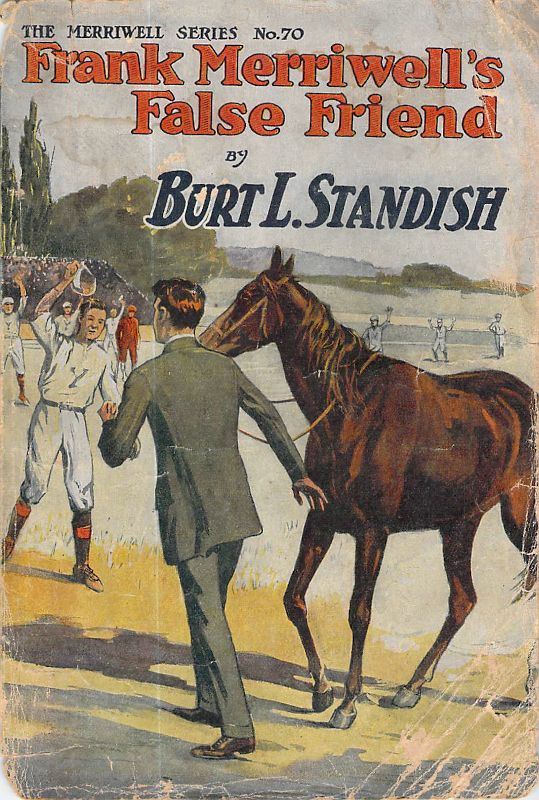
Minor errors, attributable to the printer, have been corrected. Please
see the transcriber’s note at the end of this text
for details regarding the handling of any textual issues encountered
during its preparation.
Any corrections are indicated using an underline
highlight. Placing the cursor over the correction will produce the
original text in a small popup.
Any corrections are indicated as hyperlinks, which will navigate the
reader to the corresponding entry in the corrections table in the
note at the end of the text.
BOOKS FOR YOUNG MEN
MERRIWELL SERIES
Stories of Frank and Dick Merriwell
PRICE, FIFTEEN CENTS
Fascinating Stories of Athletics
A half million enthusiastic followers of the Merriwell brothers
will attest the unfailing interest and wholesomeness of these
adventures of two lads of high ideals, who play fair with themselves,
as well as with the rest of the world.
These stories are rich in fun and thrills in all branches of
sports and athletics. They are extremely high in moral tone,
and cannot fail to be of immense benefit to every boy who reads
them.
They have the splendid quality of firing a boy’s ambition to
become a good athlete, in order that he may develop into a
strong, vigorous right-thinking man.
ALL TITLES ALWAYS IN PRINT
1—Frank Merriwell’s School Days
By Burt L. Standish
2—Frank Merriwell’s Chums
By Burt L. Standish
3—Frank Merriwell’s Foes
By Burt L. Standish
4—Frank Merriwell’s Trip West
By Burt L. Standish
5—Frank Merriwell Down South
By Burt L. Standish
6—Frank Merriwell’s Bravery
By Burt L. Standish
7—Frank Merriwell’s Hunting Tour
By Burt L. Standish
8—Frank Merriwell in Europe
By Burt L. Standish
9—Frank Merriwell at Yale
By Burt L. Standish
10—Frank Merriwell’s Sports Afield
By Burt L. Standish
11—Frank Merriwell’s Races
By Burt L. Standish
12—Frank Merriwell’s Party
By Burt L. Standish
13—Frank Merriwell’s Bicycle Tour
By Burt L. Standish
14—Frank Merriwell’s Courage
By Burt L. Standish
15—Frank Merriwell’s Daring
By Burt L. Standish
16—Frank Merriwell’s Alarm
By Burt L. Standish
17—Frank Merriwell’s Athletes
By Burt L. Standish
18—Frank Merriwell’s Skill
By Burt L. Standish
19—Frank Merriwell’s Champions
By Burt L. Standish
20—Frank Merriwell’s Return to Yale
By Burt L. Standish
21—Frank Merriwell’s Secret
By Burt L. Standish
22—Frank Merriwell’s Danger
By Burt L. Standish
23—Frank Merriwell’s Loyalty
By Burt L. Standish
24—Frank Merriwell in Camp
By Burt L. Standish
25—Frank Merriwell’s Vacation
By Burt L. Standish
26—Frank Merriwell’s Cruise
By Burt L. Standish
27—Frank Merriwell’s Chase
By Burt L. Standish
28—Frank Merriwell in Maine
By Burt L. Standish
29—Frank Merriwell’s Struggle
By Burt L. Standish
30—Frank Merriwell’s First Job
By Burt L. Standish
31—Frank Merriwell’s Opportunity
By Burt L. Standish
32—Frank Merriwell’s Hard Luck
By Burt L. Standish
33—Frank Merriwell’s Protégé
By Burt L. Standish
34—Frank Merriwell on the Road
By Burt L. Standish
35—Frank Merriwell’s Own Company
By Burt L. Standish
36—Frank Merriwell’s Fame
By Burt L. Standish
37—Frank Merriwell’s College Chums
By Burt L. Standish
38—Frank Merriwell’s Problem
By Burt L. Standish
39—Frank Merriwell’s Fortune
By Burt L. Standish
40—Frank Merriwell’s New Comedian
By Burt L. Standish
41—Frank Merriwell’s Prosperity
By Burt L. Standish
42—Frank Merriwell’s Stage Hit
By Burt L. Standish
43—Frank Merriwell’s Great Scheme
By Burt L. Standish
44—Frank Merriwell in England
By Burt L. Standish
45—Frank Merriwell on the Boulevards
By Burt L. Standish
46—Frank Merriwell’s Duel
By Burt L. Standish
47—Frank Merriwell’s Double Shot
By Burt L. Standish
48—Frank Merriwell’s Baseball Victories
By Burt L. Standish
49—Frank Merriwell’s Confidence
By Burt L. Standish
50—Frank Merriwell’s Auto
By Burt L. Standish
51—Frank Merriwell’s Fun
By Burt L. Standish
52—Frank Merriwell’s Generosity
By Burt L. Standish
53—Frank Merriwell’s Tricks
By Burt L. Standish
54—Frank Merriwell’s Temptation
By Burt L. Standish
55—Frank Merriwell on Top
By Burt L. Standish
56—Frank Merriwell’s Luck
By Burt L. Standish
57—Frank Merriwell’s Mascot
By Burt L. Standish
58—Frank Merriwell’s Reward
By Burt L. Standish
59—Frank Merriwell’s Phantom
By Burt L. Standish
60—Frank Merriwell’s Faith
By Burt L. Standish
61—Frank Merriwell’s Victories
By Burt L. Standish
62—Frank Merriwell’s Iron Nerve
By Burt L. Standish
63—Frank Merriwell in Kentucky
By Burt L. Standish
64—Frank Merriwell’s Power
By Burt L. Standish
65—Frank Merriwell’s Shrewdness
By Burt L. Standish
In order that there may be no confusion, we desire to say
that the books listed below will be issued during the respective
months in New York City and vicinity. They may not reach
the readers at a distance promptly, on account of delays in
transportation.
To Be Published in July, 1923.
66—Frank Merriwell’s Set Back
By Burt L. Standish
67—Frank Merriwell’s Search
By Burt L. Standish
OR,
An Investment in Human Nature
BY
BURT L. STANDISH
Author of the famous Merriwell Stories.
STREET & SMITH CORPORATION
PUBLISHERS
79-89 Seventh Avenue, New York
Copyright, 1901
By STREET & SMITH
Frank Merriwell’s False Friend
(Printed in the United States of America)
All rights reserved, including that of translation into foreign languages, including the Scandinavian.
5FRANK MERRIWELL’S FALSE
FRIEND.
CHAPTER I. ANXIETY AT YALE.
Yale was in perplexity and distress.
Where was Merriwell?
That question created all the trouble. He had obtained
permission to leave a few days on important
business, but the “few days” had lengthened into many
and still he remained away.
He was needed at Yale, for he had been chosen
captain of the baseball-team, and the men were in
training for the Easter trip to the South. His absence
and the uncertainty of his return seemed to have a
most baleful influence upon them, for they failed to
turn out with enthusiasm for work in the cage, and
they plainly lacked the needed spirit that year after
year has led Yale gladiators to stand ready to sacrifice
anything and everything, but honor, for the glory of
Old Eli.
The coaches were in despair, for never before had
they handled such indifferent material. It seemed impossible
6to find the usual number of new men who
took an interest in baseball, and were willing to work
with vim and enthusiasm.
The outlook was discouraging. Experienced men
shook their heads and looked blue. Was this a relapse
after their great victory over Harvard on the gridiron
the previous fall?
Among all the new men in the squad only one
showed up enough to create general comment, and that
one was the black-haired freshman, Dade Morgan.
Having resolved to try for a place on the nine, it
was not remarkable that Morgan should attract attention,
for at everything he had attempted since entering
college he had made himself a marked man. He
was a fellow who went at any task with a determination
and intensity that would have advanced a poorer
subject. Being an athlete, supple, strong, quick, sure-eyed,
and confident, it was not singular that he made
rapid advancement. It would have been far more
singular if he had not.
Morgan had played baseball before coming to college.
In fact, he had once captained a very clever
amateur team at a summer resort. He was one of
those surprisingly versatile fellows who could fill any
position. It is a well-known fact that much of the
success of a ball-team depends on putting the players
into the positions for which they are best adapted, and
that it is not often a good first-baseman does equally
well on second or third, while a remarkable outfielder
may be utterly worthless in the diamond, or vice versa.
7But Dade could handle grounders, catch flies, cover a
base, play behind the bat, even pitch with a certain
amount of skill that did not seem lessened in any position.
But it was his ambition to pitch, and for that he
began to train as soon as the squad got to work.
There were a number of new candidates for the
position, but the coaches confessed to themselves that
Morgan was the only highly promising man in the lot.
Frank Merriwell, however, had been depended on
as the mainstay in the pitching department of the
team.
Of course, Bart Hodge would fill his old position behind
the bat, and there were one or two promising men
who might serve as substitutes in case any accident
happened to him.
But Bart did not go about the work with his usual
spirit. In fact, it was hard to get him genuinely interested,
and, somehow, he seemed sad and restless,
appearing at times to be brooding over something. To
the surprise of everybody he did not say much about
Merry’s absence, save that he had not heard from
Frank and did not know why he was remaining away
so long.
The anxiety and restlessness caused by Frank’s unaccountable
failure to return spread to the professors,
who began to inquire about him day after day.
Merriwell’s enemies had been keeping pretty quiet,
for they realized that it would not be best to say too
8much at first, as he was the pride of the college, and
slurs against him would not be tolerated.
Honest men who had once been his enemies were
silent now, or his pronounced friends. In fact, it
seemed that no open enemies were to be found.
But the petty spite and meanness of the Chickering
set was simply held in restraint. Although they were
not particularly brilliant, they knew enough to realize
that it would not be healthy to express themselves too
freely in public.
As time went on and it began to seem that Merriwell
might not return to college, these creatures grew
bolder. At first they dared not speak outright, but
they hinted and slurred and sneered. Without saying
why at first, they suggested that there had been
“a very good reason” for Merriwell’s sudden departure,
and that it was not at all likely he would ever
again be seen at Yale.
Thus it came about that one sunny afternoon these
fellows were gathered at the fence along with other
students, who were discussing the baseball situation.
“I tell you what,” said Lib Benson, “I’m afraid
we’re going to get it in the neck all round this spring.
It’s a dead sure thing that the men are not taking hold
with the usual spirit, and I have it straight that the
coaches are disgusted with the material for a nine.”
“Oh, that’s always the way,” declared Irving Nash.
“It’s the same old cry that’s heard every year.”
“Not a bit of it,” put in Gene Skelding, who had
blossomed out with a handsome new pink shirt, of
9which he was very proud. “Yale seldom has much to
say, though the newspapers may be full of rot about
the nine, or the crew, or something or other. This
year it is different. We’ve tried to keep the truth
from getting into the papers, but it’s out just the
same.”
“What maketh me thick,” lisped Lew Veazie, “ith
thith thilly talk about all the twoble coming fwom the
abthence of that fellow Fwank Merriwell. It ith vewy
tirethome!”
“That’s so, chummie,” agreed Ollie Lord, standing
as high as possible on the high heels of his polished
shoes. “As if he could make any difference if he were
here!”
“He’s usually made a difference in the past,” said
Nash instantly. “He has a way of stirring things up.”
“That’s right,” agreed Lib Benson. “I wonder
where he can be and what is keeping him away. He’ll
fail in his exams sure as fate if he stays away much
longer. Even now I’m afraid he’ll have to grind
so hard that he won’t have much time for baseball,
or anything else.”
“Talking about Merriwell?” grunted Browning,
loafing up and leaning lazily against the fence. “Don’t
worry about his failing. You never knew him to fail
in anything.”
“Not even in waking you up and getting you onto
the eleven last fall,” laughed Hock Mason. “Why
aren’t you in the baseball squad, Browning? You
played with Merriwell’s ball-team last summer.”
10“And got enough of it, too. It’s altogether too
much like work, Old South Carolina; that’s why I’m
not sweating in the cage every day.”
“If Merriwell were to show up now, he’d be pretty
sure to drag you out in a hurry.”
“Never! There are plenty of others. I refuse to
be sacrificed again for the public good.”
“What is this rumor I’ve been hearing lately?”
broke in Julian Ives, thrusting his cap back and patting
down his pet bang. “It can’t be true that Merriwell
got out because he knew he must fail at exams
this spring. He has wasted his time, it is said, in
athletics and such folly, till now he is face to face with
failure in his studies, and he can’t stand that. Rather
than to be set back a year he has taken himself out of
the way, and he’ll not be seen here again.”
“And I brand that as a malicious lie!” rang out a
clear voice.
It was Bart Hodge, who had approached in time to
hear Ives’ words. There was a black look of anger
on Bart’s face, and his flashing eyes glared with scorn
and contempt at Julian.
“There is a very good reason for Merriwell’s absence,”
declared Hodge. “Starbright saw him in New
York and said he would surely be here in a day or
two.”
“But Starbright did not tell what was keeping him
away, you know,” gently said Rupert Chickering. “I
have nothing against Merriwell, and I sincerely hope
11the rumors about him are not true, but I have begun to
entertain fears.”
“Bah!” exclaimed Hodge, giving Rupert a look of
intense scorn. “Why do you still play the hypocrite,
Chickering? Everybody knows you. Everybody
knows you hate Merriwell and would do anything in
your power to injure him.”
Chickering held up his hands, his face expressing
denial, resentment, and martyrlike anguish.
“You are very unjust!” he exclaimed. “But as you
are a fellow of violent passions, I will forgive you
and try to forget your unjust judgment of me. Still, I
advise you to remember the Biblical injunction, ‘Judge
not that ye be not judged.’”
“Oh, you make me sick!” was Hodge’s rather unoriginal
retort. “You are the most sickening thing of
your whole sickening crowd. You disguise your
hatred under pretense of generosity, even of friendliness—that
is, you try to disguise it. But every one
is onto you, and it is well known that you are trying
to stab a man in the back when you say a pretendedly
kind thing about him. That brands you as a snake in
the grass, Chickering! This is plain talk, but I’ve been
waiting for just this opportunity to make it, and if you
or any of your friends wish to pick it up now or any
other time, you all know where to find me.”
Rupert heaved a deep sigh.
“It is hard to be thus misjudged,” he said sadly;
“but still I must forgive you. I don’t suppose I can
12blame you, for you must be worried into a dreadful
state of mind over Merriwell’s failure.”
“Merriwell never made a failure in his life, and he
will not begin.”
“Plainly,” said Chickering, with resignation, “it is
useless for me to tell what I have heard and know.
I would not tell it, anyhow, but it must come out in
time. I am sorry for you, Hodge, as I know you
think a great deal of Merriwell; but even you would
not like to see him flunk in his last year.”
“More of your dirty insinuations, put in your own
nasty way!” flashed Bart.
Ives and Skelding had their heads together and were
glaring at Bart, while they mumbled to each other in
low tones. Now Gene took a step forward and
grasped Chickering’s arm, hoarsely exclaiming:
“Don’t talk to the fellow, Rupert! He knows you
or your friends do not care to fight him here, and that’s
why he is making all this blow. He’s doing it for a
bluff and to obtain notoriety.”
The fire that came into Bart’s eyes made even
Skelding start back a bit. But Hodge held himself
in check enough so that his voice did not get higher
than an ordinary tone. However, it seemed so intense
that every hearer was thrilled, and not a word was
missed by those on the outskirts of the gathering.
“You, Skelding, are not a hypocrite, but you are a
malicious liar, and you know it! I have said that I’ll
fight anywhere, and that stands good for you. I never
make bluffs that I cannot back up. You do. But now
13and here I give you fair warning to keep your mouth
shut about Merriwell. If you make any further talk
about him, I promise to meet you where we cannot be
interrupted and give you the worst thrashing you ever
had in your life!”
Gene laughed and snapped his fingers.
“If I have anything I wish to say you may be sure
I shall say it, for all of your threat,” he declared; “but
I do not consider the fellow worth discussing.”
“It’s a good thing for you that you do not!”
Skelding and Ives took to mumbling to each other
again, and Jim Hooker asked Bart:
“Then you are dead certain Merriwell is coming
back? Nothing has happened to cause him to fail to
return?”
“I know he’ll be here,” was the declaration, “else
he would have communicated with his friends. Something
has happened to keep him away longer than he
intended to stay, but he’ll show up before long, and
I’ll bet my life on it.”
“There he is!” shrieked a voice. “Look, fellows—he’s
coming now! Hooray!”
CHAPTER II. ON THE CAMPUS.
14
The excitement of the moment was intense, for
Merriwell was crossing the campus toward the fence,
coming from Vanderbilt Hall.
Alone and unheralded, he had arrived. It had been
his fortune to reach his room without attracting attention,
and now he had come forth to look for his
friends and acquaintances.
When he was seen there was commotion at the fence.
The gathering gave a sudden surge, a shout, a dissolving,
and then the men went tearing toward him, shouting.
And Bruce Browning—big, lazy, useless Bruce—was
at their head!
“Hooray!” he roared.
Then he caught Frank in his arms and gave him a
regular bear-hug, while the crowd gathered and
pressed around.
“Oh, Betsey!” shouted the giant senior, as he held
Frank off and looked at him; “but you may bet your
sweet life we are glad to see you, old man!”
They grasped his hands and shook them, coming
forward one after another, even if they had to fight
to reach him. They laughed and shouted and rejoiced.
“He’s here!” they told each other, gleefully, and
15when they could not shake hands with Frank they
shook hands with each other. “Now we’re all right!”
they declared. “Just see if he does not stir things
up!”
From somewhere Jack Ready bobbed up and
wormed his way into the crowd till he reached Frank,
loudly commanding all to stand back and make room
for him.
“I salute you!” he cried, making some grotesque
movements with his hands. “Oh, great and mighty
potentate, we have missed you, yes, we’ve missed you!
In sooth, we have been getting into a very bad way
without you. Give us a wag of your fin, salubrious
one. Ah-ha! ‘Richard is himself again!’”
Then he smote himself violently on the chest with
his clenched fist and immediately fell to coughing.
“The same old Jack!” laughed Merry.
“Yes, the same old jackass,” said somebody on the
outskirts of the crowd.
Ready straightened up stiffly and glared around.
“Who made yonder insolent remark?” he fiercely demanded.
“Bring him away from me, else I may be
tempted to do him a severe kindness! It is more than
mortal flesh can bear!”
“Somebody is onto you, Jack,” smiled Frank.
“Isn’t it sad?” sighed the queer fellow, pretending
to wipe away a tear. “Just when I attempt to assume
a little dignity some blame chump has to spoil everything.
’Tis envy, kind sir. They envy me my radiant
16beauty and my graceful demeanor. Base churls!
Common clods! I scorn them all!”
He flung out one hand with a gesture of lofty pride
and scorn, his chin high in the air and his eyes closed
for a moment.
“That will do,” said Browning. “You’re nothing
but the low comedian. Get off the center of the stage.”
“Refuse me!” murmured Jack, as the big fellow
pushed him aside.
And now Starbright appeared. At first he was inclined
to hold back, being only a freshman, but Frank
caught sight of him and stepped toward him.
Dick’s face was flushed with pride and pleasure
when, before them all, the great senior, the greatest
man in his eyes that had ever attended Yale, grasped
his hand and shook it warmly, saying:
“I’m glad to see you, Dick, and I hope you are getting
into form for the nine.”
Frank longed to say more, but that was no time
nor place for it. He realized that Starbright had
opened his eyes to the fact that Inza Burrage really
and truly loved him as she had in the old days, if not
more intensely, and, regarding himself as an interloper,
Dick had withdrawn and left the field to Frank,
with the result that Merry had proposed and was accepted.
No time had been set for the marriage, but over the
gate of the old home in Fardale they had plighted their
troth, and it seemed certain that the happy day must
come at last.
17Looking into Frank’s eyes, Dick fancied he read the
truth there. Despite himself, despite his nobleness in
withdrawing, he felt a pang of pain.
Inza was lost to him!
“That’s it, Merriwell!” cried Irving Nash. “You’re
needed here to wake the men up. They say the prospects
for a winning ball-team this season are decidedly
dark.”
Merry looked serious.
“We’ll have to see how that is,” he said.
Chickering’s set had not rushed to greet him, and
now they were moving away, seeking to escape without
attracting attention. Rupert had expressed a desire
to go over and shake hands with Frank, but Skelding
had prevented it.
“Don’t give that fellow Hodge another chance to
call you down,” he advised. “Besides that, you know
Merriwell does not think much of you.”
“It is not right that I should permit his feelings to
make any difference in my treatment of him,” murmured
Rupert. “If he hates me I am sorry for him,
that’s all. He does not know what he is missing by
not having me for a friend.”
“Let’s all keep away,” said Ives. “The entire college
will go foolish over Merriwell now, see if it
doesn’t; I did hope the fellow would never show his
head here again.”
“Tho did I,” chirped Veazie. “I think he’th a
wegular wuffian! If I could do tho jutht ath well ath
18not I’d never become tho beathtly stwong ath he ith.
I wegard thuth stwength as thimply bwutal.”
“Brutal is the word, chummie,” agreed Ollie Lord.
“There ought to be a law to prevent any man from
training till he is so much stronger than other men.
It isn’t fair to the other men.”
“Don’t talk like asses!” growled Skelding. “You
know that either one of you would gladly be as strong
as Merriwell if you could; but he’s not the only athlete
in the world—or in Yale, for that matter. It’s this
bowing down and worshiping him that gives me a
pain! Why, I could be just as strong and skilful as
he is if I’d deny myself drinks and smokes and good
things to eat and keep working away every day to put
myself in form. But I like a little booze, I enjoy a
cigarette, I like to stuff my stomach full of good
things, and I won’t pelt away with dumb-bells, clubs,
chest-weights, and such things every moment I get
from my studies. What’s life good for if a fellow has
got to be a regular slave!”
“I with you wath ath thmart ath Merriwell,” lisped
Lew.
“Well, I thought I was once,” confessed Gene; “but
I found it was no use for me to try to buck against a
fellow like him who kept at his very best all the time.
I’m not fool enough now to try to fight him with my
fists. If I found another good way to get in a lick at
him I might try it.”
“That’s the only way to jar him,” said Tilton Hull,
19his high collar holding his chin very high in the air.
“Let’s go up to Rupert’s room and talk it over.”
“Yeth, yeth!” urged Veazie. “I feel the need of a
thigawette and a dwink of wine thince Gene had that
wow with that low fellow Hodge. That dithturbed
my nerveth.”
So they passed from the campus, and the sun seemed
to shine more brightly when they were gone.
Bart Hodge had shaken hands with Frank during
the rush and crush of the students to reach Merriwell,
but he did so silently and withdrew at once. He had
been ready enough to defend Merry from his defamers
a short time before, but he was not among those who
made the greatest hurrah over Frank’s return to college.
After a while Merry looked round for Hodge and
saw him standing quite by himself on the outskirts of
the throng. The expression on Bart’s face was not
one of happiness; indeed, he seemed sad and depressed.
It is possible that an inkling of the thoughts passing
through Bart’s mind came to Merry then.
The dark-eyed lad knew nothing of what had taken
place while Frank was away from college. He knew
only that he cared for Elsie Bellwood with all the intensity
of his passionate nature and that she had repeatedly
told him she would never marry at all.
Why had she made that assertion? Was it not because
she still loved Frank Merriwell? Bart believed
so, and it was his conviction that in the end Frank
20must win her, for had not he a way of winning anything
he greatly desired!
Still, he would not give up. He had told Frank
squarely and honestly that he would never cease his
efforts to obtain Elsie till he knew beyond the shadow
of a doubt that there was no hope for him.
Then, what? Who could tell? For Bart had a peculiar
disposition, and a disappointment of this sort
might wreak havoc with his sensitive organization.
Merriwell’s hand had lifted him from the path of
temptation and ruin in the past and set his feet upon
the highway leading to splendid achievements, but this
disappointment might undo all the good that had been
done and turn him back along the downward course.
Frank thought of this, and he was eager to let his
friend know what had happened, revealing to him that
the road to Elsie’s heart was open and undisputed.
“Hodge!”
Frank spoke Bart’s name and started toward him.
Then one of his many friends caught hold of him and
asked him a question, which he paused to answer.
When he looked for Bart again he looked in vain,
for Hodge had hastened away.
CHAPTER III. A SHOCK FOR BART.
21
Bart Hodge sat alone in his room. The curtains
were drawn at the windows and a lighted student’s
lamp was on the table, over which books and papers
were scattered. In Bart’s hand he held the photograph
of a pretty, sweet-faced girl, at which he was gazing
with earnest intentness, the light in his dark eyes being
one of unspeakable admiration.
It was the picture of Elsie Bellwood. Bart had been
trying to study, but his mind would revert to Elsie, try
as he might to fix it on other matters, till at last he
gave up, brought out her picture and sat there musing
over it.
His love for her had seemed to take possession of
him full blown in a moment, but cooler afterthought
had revealed to him that he had always admired her
intensely since that wild night when he had aided
Frank to save her from the wreck on Tiger Tooth
Ledge, near Fardale.
He had first seen her that night as she was lashed
to the mast of the doomed vessel which had struck upon
the terrible ledge. Led by Merriwell, the cadets had
succeeded in manning a boat and pulling off to the
vessel. On reaching the dripping deck Bart had seen
Elsie held fast to the mast by ropes, but in the gloom
22he was unable to discern if she were young or old.
Her voice, however, as she appealed to the lads for
aid when her father was assaulted by one of the sailors
had sounded musical and sweet.
The music of that voice had stirred silent chords
within Bart’s heart many times since that wild night.
But he was loyal to Merry, his best friend, and it had
seemed that Elsie and Frank cared for each other, so,
with Spartanlike heroism, he had resolutely compelled
himself to think not at all of her.
Thus he had lived with the germ of love in his heart,
refusing to permit it to sprout and grow. For a long
time he had fancied himself a “woman-hater,” but
it was all because other girls made him think of Elsie—made
him think of her as a thousand times more
winsome, pretty, and attractive. That he wished to
forget, so he avoided girls in general.
But it is not natural for a strong, manly youth to
shun womanly and attractive girls, and Hodge began
to succumb at last. He could not hold himself aloof
from them, try as he might. He was naturally attracted
by them and enjoyed their society far more
than he would confess to himself.
And the time came when, like other young men, he
fancied he cared for one of them. The first was Stella
Stanley, an actress several years older than Hodge;
but Stella had told him it was not true love and that
he would get over it.
At first he had taken this rather hard, but he came
23at last to recognize her wisdom and thank her for her
plain speech.
Then there was another, Grace Vernon, who fascinated
him for a time.
With Elsie it was different. Having once discovered
how much he cared for her, he was unable to
brush aside the knowledge, which remained with him
constantly, no matter what he did or where he was.
The knowledge that his love for her might be hopeless
simply made it all the more intense, for it was not
Bart’s nature to relinquish anything on which he had
once fairly set his heart.
But Merriwell stood as a barrier between them, and,
worse than everything else, Merriwell was his friend.
No wonder Hodge spent sleepless nights! No wonder
he spent wretched days! No wonder he lost flesh
and became more and more irritable till it became dangerous
to cross him in anything!
Still, in his loyal heart he was true to Frank Merriwell,
whom he well knew had been his best friend and
benefactor in a thousand ways when almost any other
fellow would have been a mortal foe.
As of old, Hodge would have yielded up his life for
Frank, but his love for Elsie was something stronger
and more intense than his love for life, and he could
not put that aside. As of old, he had been ready to
defend Frank against enemies and traducers; but the
sight of Frank’s happy face filled him with gloomy
forebodings and intense misery.
24Why had Merry looked so happy? Why had he
remained away from Yale so long?
Bart could not help being suspicious of that happiness.
He could not help wondering if it came through
an understanding between Frank and Elsie. And that
had been brought about while Merry was away from
college!
If this was true, Bart felt that Elsie was lost to him,
and the ambition had gone out of his life forever.
Therefore he sat alone in his room and gazed longingly,
earnestly, and almost hopelessly, at her pictured
face. Her open eyes seemed to smile back at him reassuringly,
but they did not lift the gloom from his
heart. Her lips—--
Impulsively, he lifted the picture and kissed it.
The door opened quietly and some one stepped into
the room.
“Hello, Bart, old man!” cried a hearty, familiar
voice. “What are you doing there?”
Hodge sprang up, his face flaming, and tried to hide
the picture behind him.
Frank closed the door and advanced into the room.
Hodge stood beside the table, trembling from head
to feet. His eyes were fastened on Merry and he was
speechless.
“I thought you’d come round to see me, Bart,” said
Frank. “You did not, so I came to see you, though
I’m missing time that I ought to spend in grinding.
Oh, I’ll be a greasy grind for a while now till I get on
25Easy Street again. It will take lots of stiff work for
me to catch up, but I believe I can do it.”
Still Bart stood there without speaking, looking
straight at Frank.
“What’s the matter?” Merry asked, in perplexity.
“Why do you stare at me that way? Why, hang it!
you don’t seem at all pleased to see me.”
He was surprised and hurt by Bart’s singular manner.
Hodge opened his lips to say something, but the
words did not seem to come freely, and he stuck.
Merry came close and placed his hands on Bart’s
shoulders, looking deep into the dark eyes of his
comrade.
“Tell me why you meet me like this, old man!” he
urged. “Have I done anything to cause it?”
“No.”
“Then why——”
“It’s nothing, Merriwell—nothing!” huskily muttered
Bart. “Take a chair. I’ve been thinking, and
I expect I’m in a deuced unsociable mood, but I’ll try
to be decent.”
Frank did not sit down immediately on the invitation.
Instead, he looked at Bart as if trying to read
his very thoughts.
“You’re thin,” he said. “You have lost flesh and
there are dark circles round your eyes. Are you ill?”
“No.”
“Something is the matter with you, and I fancy I
know what it is.”
26“Perhaps so.”
“I’ve come to talk it over——”
The dark-eyed lad cut him short with a gesture.
“Don’t!” he exclaimed hoarsely. “Talk of anything
else—baseball, spring sports, the Southern trip, anything!”
“What is that you have in your hand?”
Almost rudely Bart pushed Frank aside and walked
to a desk, into the drawer of which he thrust the photograph.
But when he turned round he felt certain Merriwell
knew it was a picture of Elsie and that he had
been seen pressing that picture to his lips.
“Sit down,” he invited again, with a motion toward
a chair.
Frank did so.
“There are a number of things I wish to speak
about, Bart,” said he. “One important thing is the
nine. Are you working to get into form to catch?
That’s one thing.”
“Perhaps I’m not working as hard as usual,” confessed
Hodge. “Somehow, I haven’t seemed to have
any heart in it. You know you were not here, and
that has made lots of difference.”
“I’m here now, and we must get to work, for I hear
that the outlook for a strong team is very unsatisfactory.”
“It might be better.”
“Well, if we get into our usual form, the battery
should not be so very weak, though, of course, I can’t
pitch all the games.”
27“Do you know who’s working like a fiend to get
into the box?”
“I haven’t heard.”
“That cad, Morgan! Why, he’s training every day,
and they say there’s a prospect that he’ll make it.
What do you think of that?”
“A good thing.”
“Good? Do you fancy I’ll ever catch with him
pitching? Not for my life!”
“Not even for Yale?”
“Why should I?”
“Because you should be ready to do anything for
Yale, my boy.”
“I can’t swallow that scoundrel, and I refuse to
have him thrust down my throat! That’s all there is
to it! If you can stand for him, that’s all right, but I
decline.”
“Well, we won’t get into an argument over that
now, though I want you to remember the splendid
work Morgan did on the gridiron last fall.”
“And I don’t want you to forget that up to the last
minute he pulled every string possible to down you,
Merriwell. He was as full of tricks as an egg is full
of meat.”
“Let it pass now. I hear that Starbright has not
been given much of a show with the squad. How is
that?”
“Rot! You know any man will be given all the
show he deserves.”
“And Browning?”
28“He refuses to get out.”
“And Ready?”
“He’s too flip. He’s got himself disliked by his
freshness, and I fancy he’ll have a hard pull to make
the nine.”
“Nor is he better than other men who are working
for his place. I have been promised absolute authority
this spring, and I shall have something to say about
the make-up of the team I am to captain.”
By this time Bart had begun to cool down somewhat,
and now, of a sudden, Merry reverted to the thing
about which he had attempted to speak a while before.
“Hodge, you want to stop worrying about the thing
that has troubled you so much lately. I am your truest
friend, and you must let me speak out frankly. You’ll
feel better when I have finished. I know whose picture
you held in your hand when I entered—the picture
you put in that drawer.”
Bart’s face was very pale now and he had begun to
quiver again.
“We had a plain face-to-face talk about her on
Cumberland Island not so very long ago, but the finish
of that talk left us just where we began. Since
then many things have happened, and, as far as I am
concerned, that matter has been entirely settled.”
Bart felt a tightening about his heart. So it was
true that Frank had remained away from college to
see Elsie again and to win her back to him! Somehow,
it did not seem just exactly like Merriwell, and
29yet how could Bart complain, for had not Frank held
the prior claim to her?
“Elsie is a beautiful, noble-hearted girl, whom I
cannot find words to properly extol,” Merriwell
calmly continued, his coolness and confidence causing
Bart’s heart to sink still more. “I do not wonder that
I came to admire her very much. It would have been
far more remarkable if I had not. But I have learned
that I wholly misinterpreted my feelings and emotions
toward her. Read others however well I may, I did
not properly read and analyze myself in regard to
her.”
What was Frank saying? Hodge felt a rush of
blood to his heart, which began to thump violently in
his breast.
“Events which I cannot fully describe have opened
my eyes and revealed to me the truth. I loved Elsie
and still love her as a very dear friend, and one of the
sweetest girls alive, but I do not love her and never
did love her as one should love the girl he means to
make his wife.”
Bart’s lips parted, but no sound escaped them. He
stared at Frank as if turned to stone.
“But I have learned,” Merry continued, “that I
love another with all my heart, and that knowledge
has brought me great happiness, for my love is returned,
and we are engaged to be married some time,
though the day is not set yet. Of course, you know
without being told that the other of whom I speak
is Inza Burrage.”
30Bart sprang up.
“Merriwell,” he gasped, “you—you really mean that
you are engaged—to Inza?”
“Yes, that is just what I mean. So you see, my
dear boy, that you have been worrying over a trouble
that does not exist, and the field is open and clear for
you to win Elsie.”
There was a ringing as of many bells in Bart’s ears,
and the room seemed to whirl round him.
Then he sat down quickly, all the strength having
gone out of his legs. But the happiness of the shock
made him long to shout, though his lips uttered no
sound.
CHAPTER IV. A DESPERATE ENEMY.
31
“Ginger up, there, Robinson! You’re worse than a
dead man!”
“Get in front of ’em, Dashleigh! Stop ’em with
your body if you can’t hold ’em with your hands!”
“You throw like an old woman, Mason! You’ll
break your back some day.”
“Here, here, Ready! that will do with those flourishes!
When you get hold of a ball throw it. Don’t
juggle it.”
“Say, you chap with the curly hair, don’t get so
excited. Take a little time in throwing to first, after
picking up a ball.”
“Who is that long-legged chap?” Gamp questioned.
“Here, Gamp, it’s your turn to bat.”
“Oh, murder! Who let that grounder go through
him? Carker? Is that his name? Say, Carker,
you’re a sieve! Keep your feet together and you’ll do
better.”
It was a lively scene in the great baseball cage at
Yale, for the squad of candidates for the ball-team
were hard at work and the coaches were putting them
“through the paces.”
The men were working hard, and the coaches were
32yelling and shouting at them, giving orders, criticizing,
commenting—but seldom expressing approval.
It would not do to let any man think he was doing
too well at this early stage of the work, for it might
spoil him by giving him a good opinion of his ability.
More men have been spoiled by praise than by adverse
criticism, and the professional coach knows this
very well.
It is a pretty level-headed youth who can stand
open praise without thinking himself the “only one.”
Sometimes it pays to praise a man, but it is best to
know your man before you venture to praise him. Be
sure it will do him more good than silence, or keep
your mouth shut.
In rare instances praise will serve to spur a man on
to do still better. Far oftener it will cause him to
think he is good enough already and that the other
fellows should hustle to keep in his class.
The fellow who manages or coaches a ball-team
must know this, and he must be exceedingly careful
with his praise.
In the cage the sweating crowd of candidates accepted
this criticism without a word, for it would not
do to “talk back.” When one was called down for
something he did, if he was a good man, he shut his
teeth and made an extra attempt to do it well the next
time. If he was sulky and had a bad temper, he might
tell himself he did not care a rap, and then he would
be careless and do worse the next time. In that case,
the chances were he would be quietly informed that it
33would be a waste of time for him to practise further,
and that the room he occupied in the cage was needed
for others.
Of course, there were men, and plenty of them, who
worked like slaves to improve, yet failed to make the
necessarynecessary progress, and who were dropped one after
another for that reason.
But no man of this class, willing and determined,
was dropped till the coaches were perfectly satisfied
that there was no possible chance of making good
material out of him.
The turnout this year had been most unsatisfactory,
barely more than half the usual number of candidates
coming to the cage each day.
This happened despite all efforts to get out the usual
large squad. It seemed very remarkable, but men
came to attribute it to the absence of Merriwell, which,
they said, accounted for the apathetic interest taken in
baseball.
There was at one time talk of making some move to
choose a new captain for the team, to see if that would
not bring about better results; but Merriwell had given
no notice that he would not be on hand to fill the position,
and the one who hinted openly of selecting some
one to fill his place was soon hissed down.
But now Merriwell had arrived, and his return
showed immediately by the change that took place in
the cage. He had made inquiries about the work, and,
having learned what men were practising and who
34were not, he went around among those whom he regarded
as having a chance to make the nine.
The following day a swarm of new men flocked into
the cage and went to work with a vim that astonished
and delighted the coaches. Joe Gamp, Hock Mason,
Berlin Carson, and Greg Carker were among the new
men.
Carson had given up in despair, having tried to
make the team the year before and failed; but during
the trip of Merriwell’s athletes through the West the
previous summer Frank had been given an opportunity
to see what the rancher’s son could do at the
game, and he urged Berlin to come out and make one
more attempt to get onto the varsity nine.
Frank did not have so much confidence in Greg
Carker, the pessimist, for he knew that Carker’s peculiar
temperament was such that he could never be
at his very best in anything.
Joe Gamp, however, despite his awkwardness, was
one of the best outfielders Merry had ever seen. This
was rather astonishing, for Gamp was not regarded at
college as a person having the least baseball material
in him, and he had never tried for a place on the
varsity nine.
But Merriwell had seen him play center field on
the great athletic trip, and he knew Gamp could cover
an “outer garden” in splendid style, and could throw
with almost the marvelous power of the once famed
Sockalexis, and was an unusually good hitter against
35pitchers who had not discovered his "weak spot"—high
and close to his shoulders.
With Hock Mason it was different. Frank had
seen Mason, who was from the South, catch some flies
in field practise, which he had done very well; but outside
of that Merry knew very little about the fellow
except that he was sturdy, well built, and a perfect
bulldog at anything he set out to do.
It was well enough to get such a man into the cage
and see if something could not be made of him, so
Frank urged Mason to turn out and practise. Mason
did so.
A long time before this Mason had been one of the
greatest bullies in college; but he found more than his
match in Frank, and the result of the sound thrashing
he received was very beneficial. After that it was his
belief that Merriwell must despise him, but when he
was injured and lying in a hospital it was Merriwell
who came every day to ask about him, it was Merriwell
who first reached his side when a visitor was permitted
to see him, and it was Merriwell who pressed
his hand and spoke encouraging words to him.
When he left that hospital the student from South
Carolina was cured completely of his bullying ways,
and Frank Merriwell had made a new and stanch
friend.
Still, Mason was strangely proud, and he would not
force himself on any one, for which reason it happened
that he never became one of Merriwell’s recognized
“flock.”
36Deep in his heart Mason had often longed to join
the jolly band of Merriwell’s friends, but his pride had
held him back.
Now, when Frank came and asked him to get out
for practise in the cage, Hock was ready enough to
do so, even though it seemed really preposterous that
he could ever make sufficient advancement to have a
show to get onto the nine.
Bertrand Defarge was among the men who had
taken his regular amount of work in the cage day
after day, and he was showing up pretty well, too.
But Frank knew Defarge of old, and he was aware
that such a fellow, though full of vigor, fire, and
intensity at times, could not always be relied upon,
having a temper that conquered and swayed him absolutely
at times.
Of course, Frank was on hand, and it was his presence
in the cage that seemed to make the marvelous
change in things, so that the men went at their work
with a gingery earnestness that quite surprised and
wholly delighted the hitherto disgusted and disheartened
coaches.
And Frank had managed to keep himself in excellent
form, so that he remained the admiration and
marvel of the athletic-loving students. He began his
pitching-work easily, however, knowing the folly of
starting off with too much vigor, even though he was
in perfect condition.
Even Frank was not above taking advice from the
coachers, although it is probable that not one man
37among them knew more about baseball and the work
of getting into trim for it than did Merry himself.
If any one watched the first day to see him throw
some samples of the “double-shoot” that person was
disappointed, for he indulged in nothing of the kind.
But he still had it at his command, as he very well
knew, and his wrist was hard as iron. When the time
came he would swiftly convince his doubting opponents
that the “double-shoot” was not a fanciful invention
of some romancer’s brain.
For among the hundreds of pitchers who had
worked and tried and schemed to learn his secret, it
was not probable that one had entirely succeeded,
therefore they gave up in despair, and became scoffers,
saying there was no such thing as the double-shoot.
Among the candidates for pitching-honors was
Dade Morgan, and he worked persistently and faithfully.
On the first day of Frank’s appearance in the cage
one of the coaches asked him to watch Morgan’s work
and see what he thought of it. Merry did so for a
few moments, and Dade flushed hotly when he saw
this, though he kept at it without a break.
When Frank had moved away the man who was
coaching Morgan said:
“Try to throw that drop with just the same motion
you use in throwing your other curves. You give
yourself dead away every time you start to throw a
drop. The batter would know just what was coming.”
Dade’s dark eyes flashed and drooped. For one
38moment he betrayed anger, and then he smiled sweetly,
saying:
“I’ll do my level best.”
But Bertrand Defarge quickly found an opportunity
to slip over to Morgan and sneer:
“So you got a call-down! I knew it would come
the minute Merriwell saw what you were doing. He’s
jealous, and you don’t stand the least show of making
the nine. You may as well give up trying now.”
“How about you?”
“Oh, I’m not a pitcher, and there is no chance that
I’ll rob him of any glory. Indeed, if I pan out well,
I may add to his glory by helping him in games, so
he’ll let my head alone. Yours comes off before the
Easter trip, see if it doesn’t. You may as well quit
now.”
“I’ll never quit till I have to!” returned Dade. “Get
out and let me alone! I’m sick of your croaking!”
“Go to blazes!” hissed Defarge. “I may find a way
to make you sicker!”
A number of men were hard at work fielding
ground balls and throwing to first. Mason was one
of this squad, and he was not making a great success
of it. The coaches yelled at him, but that did not seem
to do him much good.
Then Frank Merriwell, being a privileged character,
walked down and talked to Mason in a quiet, soothing
tone.
“You’re rattled, Mason,” said Merry. “Just get
rid of the idea that everybody is looking at you. They
39are not. The other men are busy taking care of their
own affairs.”
“I reckon you made a mistake when you asked me
to get out here, sah,” said the Southerner, the perspiration
standing out on his drawn and worried face.
“I judge I ain’t put up right to be howled at like this
by a lot of loud-mouthed duffers.”
“Don’t be touchy, man. You can’t succeed if you
are. We’ve all had coaches yell at us in the same
way.”
“But it’s mighty galling to a man like me.”
“Haven’t a doubt of it, but you must set your jaws
and lay right down to the work. Get your body in
front of those bounding balls every time, even if they
take your head off. Keep your heels together, and
they may stop balls when your hands fail. Jump into
the track of anything that comes your way. If it’s a
slow one, go ahead to meet it, for every second counts
in trying to cut off a runner who is sprinting to first.”
“All right. I’ll try it again, sah, but I’m mighty
afraid it isn’t my line.”
After that Mason did better stopping the balls that
came his way, even though he did not pick them all
up cleanly, but he made his worst mistake in his hurry
to throw to first. Seeing this, Frank fancied he had
given the fellow a wrong impression, and so worked
round to Hock to set him straight.
“Don’t be in such a fearful hurry to throw,” he instructed.
“You make poor throws by your hurry.”
40“But you told me a little while ago that every moment
counts in cutting off a man running to first.”
“That’s true, but it’s far better to lose a little time
in taking care to make a good throw than it is to
hustle for all you’re worth and lose the man entirely
by a poor throw. Besides that, you do not throw
right. You never get into the right position.”
“That being the case, sah, I reckon I better quit
now.”
“I don’t think you’re a quitter, Mason. Let me
tell you where you make your mistake. In your haste
to throw, if you pick the ball up with your body leaning
away from the base you wish to throw to, you do
not take time to right yourself, but you throw in that
attitude. You can’t get any force into the throw.
Besides, you swing your arm too far. Try a shorter
swing; throw from the ear. Never take a hop, skip,
and a jump before throwing, as I saw you do a few
moments ago. Even though you send the ball whizzing
across the diamond like a bullet, you have lost lots of
valuable time before you got it away from your hand,
and that may mean the loss of the runner. Pull your
hand back behind your ear, lean forward a little as
you throw, and just as it leaves your hand take a
single step. Try that. Practice it all the time.”time.”
Then Frank worked on to another man he had selected
to advise, and in this manner Merriwell assisted
the coaches. In fact, his quiet coaching was far
more efficacious than that of some of the regular
coaches who made considerable noise.
41A regular system of batting-practise was gone
through, each man being directed how to stand properly,
how to hold his bat, and how to swing. Bunting
and place hitting were practised by the more skilful
batters.
Base-running and sliding to bases was a part of the
regular work. At this the older hands showed up
well, but some of the new men were very awkward.
It caused the coaches to howl when a runner was told
to slide, and he slammed himself prone on the ground
as if going through to China and slid about ten
inches, but they howled equally as much at the one
“who let himself down in sections,” his knees striking
first.
Dade Morgan was making excellent showing. He
had a good eye for the ball when batting, and he
could sprint to first like a deer. When it came to
sliding, he slipped over the ground in an easy, graceful
manner that was deserving of applause.
Frank felt like giving Morgan a word of praise,
but remembering the past, and not knowing just what
the effect on Dade would be, he refrained from
doing so.
Dick Starbright, the giant freshman, was in the
midst of the work, and he went at it with an energy
that seemed almost savage. A change had come over
him, and the good-natured, pleasant look that had
seemed habitual had vanished before one of stern determination.
Indeed, Dick was doing everything possible to keep
42his mind from dwelling on a certain beautiful dark-eyed
girl whom he now knew was lost to him. He
studied hard, worked hard, played hard, and in this
manner succeeded fairly well in his purpose.
He had read in Frank’s happy face the result of
the trip to Fardale, but it had been exactly what he
expected.
And Frank’s talk with Hodge had seemed to transform
Bart, who had been fretful, listless, and ill-natured
before, failing to take much interest in the
cage-work or seeming to care whether Yale put a
winning team on the field or not.
Now Hodge went into the work with vim and
earnestness, and he actually smiled occasionally, which
was so remarkable that it caused more than one to
comment upon it.
Defarge had seen Merriwell talking to Mason, and
at the first opportunity the French youth spoke to the
Southerner.
“Did you get a calling down from the high muck-a-muck
of this combination?” sneeringly asked Bertrand.
“What do you mean, sah?” demanded Hock.
“Why, I saw Merriwell shooting off his mouth at
you, and I presume he was telling you just what sort
of a slouch you are, which is a habit of his, the egotistical
cad!”
“No, sah, he was not calling me down. He was
giving me a few pointers, and I appreciate his kindness
in doing so.”
“Well, you’re just like all the others,” growled
43Defarge. “He can rub it all over you and you’ll
think it’s nice, but you’d kick like a mule if anybody
else tried it.”
“I may kick like a mule, sah, if you are not careful
about your language in addressing me, and I’ll guarantee
that you’ll be within reach when I kick.”
Defarge showed his teeth.
“If you ever kicked me I’d make a hole in your skin
and let some of your confounded upstart blood out!”
he hissed.
“And if you ever tried that trick,” retorted Mason,
not in the least frightened, “I’d forget that I’ve sworn
never to strike a man who did not weigh as much
as myself, and I’d give you the blamedest thrashing,
sah, that you ever had in all your life!”
“Pouf!” said Bertrand, as he wheeled away.
“It really would do me good to thump him,” muttered
Mason, watching the fellow’s retreating figure.
“I think he’s about the only enemy of any account that
Merriwell has left in college.”
Roland Packard did not occur to him just then.
Besides, Roland had been keeping pretty quiet about
Merry since the beginning of the term, realizing that
popular sentiment was entirely against him.
The Chickering set was not regarded as worth
considering.
Defarge could find little consolation in his attempts
to deride and sneer at Merriwell, and it began to seem
to him that all the old enemies of Frank with blood
in their bodies and courage to take a stand against
44the idol of Yale had given over the struggle as worse
than useless.
Thus, when the practise work was over and the men
were preparing for the run into the suburbs, which
always followed cage training, Bertrand sulked and
growled and was disagreeable to every one.
“I’d like to get a good chance to do up Merriwell!”
he thought; but he remembered how all his former
efforts had failed and brought disgrace upon himself
in several instances, and even his hating heart quailed.
As soon as the men were ready they left the gymnasium
in a body and started at a brisk trot along one
of the widest and most comfortable streets of the
old city. The pace was not made too fast at first,
and yet it was enough to keep them going sharply.
It was an interesting spectacle to see these sturdy-limbed
youths start out in a body, their heads up,
mouths closed, cheeks flushed and nostrils dilated.
Surely a representative lot of young Americans they
were.
Frank ran lightly and easily, seeming to find it no
effort at all to get over the ground at the pace set.
Hodge was beside him, and Jack Ready had swung
in with them. Ready still ran in his own peculiar
fashion, toeing in with his left foot, a habit he had
been unable to break, try as he might. His cheeks
were rosy and his eyes bright.
“Ah-ha!” he exclaimed, as he trotted along. “This
is the kind of stuff that makes one feel fit to tackle the
gods! Yea, verily! Why, just now I believe I could
45give old Thor, the god of thunder, a rattling good
set-to!”
“Yet,” said Frank, “we know any amount of fellows
in Yale who are literally grinding their lives out,
and not one of them has sense enough to take sufficient
exercise to preserve their health.”
“Which means that a few more fools will graduate
near the head of their classes and go out into the
world with broken constitutions. What will they be
good for?”
“It’s all right for a man to graduate as near the
head of his class as possible,” Merry asserted, “in
case he gives enough time to exercise to keep his health
and strength; but when he wears his life away and
goes forth from college a physical wreck he has committed
a crime. Not only that, but he will be punished
for his crime, and there is no way for him to
escape that punishment.”
“And all the while he doesn’t dream what fun he’s
missing,” laughed Jack, thumping his breast with his
clenched hands. “Why, it’s great just to be living and
feel this way! I could fly—if I had a flying-machine.”
“You have the necessary wheels in your head,” declared
Merry.
“But you’ll never develop a pair of wings,” asserted
Hodge.
By the time they were well out into the suburbs it
had begun to grow dark. They had passed Beaver
Ponds, and were not far from West Rock, before the
46leader swung to the left by a country road and turned
back toward the city.
The men had strung out behind for a short distance.
It was impossible to tell if all of them had held out
and kept with the squad.
In fact, one of them had not. Defarge had slowly
fallen behind until he was near the rear of the squad,
and then, making an excuse to tighten up his shoe, he
knelt beside the road and let them go on without him.
“I know the way they’ll come back,” he muttered.
“And I know where I can watch them without being
seen. If Merriwell would just take a fancy to spurt,
or would get off by himself! Oh, yes! I’d make one
more try to settle his hash!”
Then he turned back, struck into a cross-lane, and
ran swiftly through the gathering gloom, his heart
filled with black thoughts and evil designs.
CHAPTER V. BAFFLED.
47
Defarge crouched behind some rocks and bushes
which grew near the top of a high ridge of ground.
Some distance below him, running parallel with the
ridge, was the road along which he knew the baseball
men must come on their way back to town. It
was rather dark down there, but the crouching youth
could see the road when he lifted his head and peered
down.
In his hands Defarge had a large, jagged rock; in
his heart was a design so dark that he dared not meditate
upon it.
Although it was cold, he felt perspiration starting
out upon his face, which he mopped with his handkerchief.
He told himself that he was justified in doing
anything in his power to down Frank Merriwell, for
had not Merry once brought about his disgrace and
nearly caused his expulsion from college?
He did not pause to consider that it was through
Frank’s generosity alone that he still remained at Yale.
Had he reasoned calmly he must have known that any
other man might have exposed him fully and compelled
him to leave.
Hark! They were coming! He heard the beat of
running feet far along the frozen road. It was likely
48that Merriwell would be among the very first, for of
old Frank had often led the squad on the return trip
to the gym.
The crouching lad quivered in every limb.
“He disgraced me before them all!” he panted.
“He made me the laughing-stock of the college! No
man can do that to a Defarge and escape! I’ve waited
a long time, but I’m going to fix him now!”
He gripped the jagged rock with feverish intensity
and peered along the darkening road. The sound of
running feet came nearer.
“Hello, Merriwell!”
Some one of the runners was hailing Frank.
“Hello!” sounded still clearer in the unmistakable
voice of the captain of the nine.
“Take the Blake road.”
“All right.”
“Merriwell is leading, as usual!” panted Defarge.
“Here he comes!”
A dark figure was coming swiftly down the dusky
road. With the stone in both hands, Defarge crouched
and watched, every muscle taut, every nerve quivering.
“He’s some rods ahead of the next man,” he
thought. “He’s played right into my hands.”
The figure was plainly that of Merriwell. Defarge
straightened a little and lifted the stone. In a moment
the unconscious young athlete would be directly beneath
the revengeful scoundrel on the ridge.
“Now!” Defarge panted the word as he swung the
49stone over his head with both hands, and hurled it with
murderous aim straight at the head of Merriwell.
There was a thud, and he saw Frank go down and
lay outstretched upon the ground.
“I’ve done it! I’ve done it!”
With that awful thought filling his heart, the wretch
crouched behind the bushes and ran quickly back along
the ridge, passing over it and disappearing.
Hidden from view, he ran as swiftly as he could
back along the course of the road down which the baseball
men had come. Pretty soon the ridge sunk and
he was in a piece of thin timber, through which he
pressed till he came to the road itself.
He halted amid some trees to let several men pass,
and then he sprang out into the road and started along
in the same direction as if he had been in the procession
all the time.
“Now let any one prove that I did it!” he laughed
to himself. “I took nobody into my confidence, and
there is no proof against me. It’s a job well done.”
As he approached the spot he was not surprised to
find the men ahead of him had stopped and were gathered
in a group.
“They’ll take him in on a stretcher,” thought Defarge.
He came up, breathing heavily, as if he had been
running all the while.
“What’s the matter?” he asked, as he approached.
“Anybody hurt?”
50“Hello, Defarge,” said one of the men. “You’ve
made good time to-day. You’re usually a tail-ender.”
“Anybody hurt?” persisted Bertrand, coming up and
stopping. “What has happenedhappened?”
“Oh, nothing much,” was the answer. “Merriwell’s
got a nasty fall, that’s all.”
“That is not all!” declared a voice that caused Defarge’s
heart to stand still, for it was that of Frank
Merriwell himself. “My fall was nothing, but I’d like
to know where this huge stone came from, for I know
it whizzed past my head just as I tripped and went
down.”
Beneath his breath Defarge muttered an oath.
Frank was absolutely unharmed, for, being in perfect
condition, the shock of the fall over a stone which
he had not seen in the road affected him to no perceptible
extent.
Indeed, when a man is in the best physical condition,
ordinary falls, that seem to jar and severely injure the
untrained, are not noticed at all. Sometimes a man
may, in perfect condition, receive shocks and sustain
falls which naturally would break the bones of the unprepared
and still escape without any apparent harm.
Thus it is that exercise, physical training, and
muscle-building prepare those who follow faithfully
the upbuilding of the body for all the hardships they
may have to encounter in life.
“The survival of the fittest” is a law of nature that
has been in full sway since the dawn of creation, and
51modern conditions have simply seemed to emphasize its
unyielding rigidness.
A weakling might have been severely, even fatally,
injured by the fall that had not harmed Merriwell at
all.
Sometimes men die from the effects of shocks which
trained athletes would have withstood without great
distress.
Thousands of weak-backed, narrow-chested, scrawny-necked
men are swiftly wearing away their lives in
offices and stores and other places of business when,
had they known and respected the laws of health, they
might be strong, and robust, and healthy.
They will stand up to their tasks as long as the
candle of life flickers and flares in their wrecked bodies,
but one by one they will lie down and die long before
there is any need of it, had they paid the slightest attention
to the demands of nature.
Frank Merriwell had not been born strong and
healthy. His mother was an invalid, and he had inherited
a weak body. But, fortunately, he had been
given brains with which to think and reason. And
he had used those brains! That was the best part
of it.
Having found that others had acquired health by
exercise and by obeying the laws of nature, he had
made a resolve to do the same. He was stubborn, and,
having made such a resolve, he kept at the work day
after day, week after week, year after year.
What a glorious reward was his! From a weak
52boy he had become a strong, supple, superb youth, a
typical young American of the very highest class, and
all by his own efforts! Was not the reward sufficient
for the effort?
It had not always been by chance, as on this occasion,
that his enemies had failed to wreak upon him the
injuries they sought to inflict. Had he been weak they
must have succeeded many times. But one by one they
had fallen before him, and he remained triumphant and
unharmed.
“The fellow bears a charmed life,” thought Bertrand
Defarge. “It’s no use—he can’t be harmed!”
Once more he felt for his handkerchief to wipe from
his face the beads of cold perspiration that started
forth; but the handkerchief was not in the pocket
where he fancied he had thrust it.
“Where could the stone have come from?” Bert
Dashleigh was asking. “You don’t suppose——”
“Hello, Defarge!” exclaimed one of a little bunch of
men that came up. “How the dickens did you get
ahead of us? We thought you behind with the tail-enders.”
“What’s the matter here?” asked another, and, to
Bertrand’s relief, they all pressed forward to learn
what had happened.
That saved Defarge from answering an unpleasant
question and explaining how he came to be ahead of
those men.
But Bart Hodge had heard the question and had
noted that no answer was given.
53When the men started on again, Bart was at Merry’s
side. He soon found an opportunity to say, using a
guarded tone:
“You still have some enemies, Frank—or an enemy,
at least.”
“Then you think——”
“Of course! Somebody tried to knock your brains
out with that stone.”
“I don’t like to think that,” declared Frank. “And
yet——”
“You can’t help it. Your enemies have been chirping
mighty soft of late, but it was because they didn’t
dare sing louder. They are not all dead, or converted.
Where is Morgan?”
“Somewhere on the road. You know I have that
fellow’s pledge.”
“Which doesn’t amount to shucks!”
“But his uncle is dead, and there is no further reason
why he should try to injure me.”
“Don’t fool yourself! He’s ambitious and proud.
He wants to pitch this spring, and it is his way to long
to be cock of the walk at anything he tries. He knows
he can’t be that with you on the team.”
“But he could not have possibly done the trick;
he did not throw that stone.”
“I don’t say he did.”
“Then what——”
“He is a fellow to use accomplices.”
Frank shook his head.
“I know all about your hatred for Morgan,” he
54said, “and I confess the justness of it; but something
tells me the fellow did not do this trick, or know anything
about it. In fact, even though he may not love
me, I do not believe he will make any further attempts
to harm me. While Santenel lived he held Morgan
under his hypnotic influence and made him do some
very nasty things. But Santenel is dead.”
“Well, Morgan still lives, and you’ll see that you
will have your troubles just as long as he remains in
college.”
Frank knew how useless it was to try to reason
Bart out of a conviction so firmly implanted in his
mind, and so he made no further effort.
Along the hard road they sped, their lungs filled
with fresh air, their entire bodies tingling with the
intoxication of perfect health.
Ahead of them gleamed the city’s lights. On either
side lights shone from the windows of houses.
They strung out on Whalley Avenue, for now they
were permitted to speed up some as the end of the run
drew near. At last they came to Elm Street and the
gym.
There the men were given cold showers, and rubbed
down with rough towels, till their bodies glowed like
furnaces.
When they left the gym they felt “like fighting
cocks,” for all of what they had done and gone
through.
Frank and Bart left the gym together.
55“Are you going to your room, Hodge?” asked
Merry.
“Not now,” was the answer.
“Well, come up to mine. I’ve got to work hard to-night,
but we can have a little chat of a few minutes
before I get down to grinding.”
“I’ve got to go somewhere else. I’ll see you to-morrow,
Merry. So-long.”
Frank wondered as Bart swung away. He would
have wondered still more had he observed where
Hodge went and what he did.
Direct to a certain store the dark-eyed lad proceeded,
and there he purchased a lantern, which he had filled
with oil and prepared for lighting. With this lantern
he struck out at a brisk walk, avoiding the vicinity of
the college buildings.
More than half an hour later Bart was searching
along the ridge of high land near where Merriwell had
fallen on the road. The lighted lantern aided him in
his search behind the mass of evergreen bushes.
He came to a place that interested him very much,
for there was every indication that some one had been
there ahead of him.
Then he uttered a low cry of satisfaction, and suddenly
snatched something from the ground.
It was a handkerchief!
CHAPTER VI. THE FIGHT WITH RAPIERS.
56
Defarge had roomed alone ever since entering college.
He was so exceedingly unpopular that it would
have been difficult for him to find a roommate had he
desired one; but he declared that on no condition
would he share his apartments with another.
His rooms were well furnished and comfortable, but
he cared little about their arrangement or decorations,
and about them there was not a single thing in the way
of ornament that would suggest to a casual visitor that
a Yale man slept and studied there.
In other rooms were flags, badges, blue ribbons, and
a hundred other things gathered by the students as tokens
to remind them of something connected with their
college-life. When they visited home at holidays they
took some of these things along to give brothers or
sisters, who treasured them with pride.
But it is probable that Defarge felt none of that love
for Yale that seems to imbue almost every man among
the great throng of students. It is even possible, astounding
though it may seem to every other Yale man—that
he would have been quite as well satisfied had it
been his fortune to attend Harvard, or any other college.
He had failed totally and entirely to imbibe the
“Yale spirit.”
57Personal conquest and advancement had been all the
French youth seemed to care for, and his utter selfishness
made him offensive to those who might have regarded
him in a friendly spirit because of similar likes
and dislikes.
He had regarded himself as a wonderful fencer, and,
indeed, his skill was most commendable. He found
little difficulty in defeating all comers until he encountered
Merriwell, upon whom by sneers and insults he
forced an engagement.
Merriwell, however, had studied fencing under a
past master of the art, and the French youth was easily
defeated by the representative American, which filled
him with unspeakable shame and chagrin.
His defeat caused Defarge to lose his head entirely,
and he took to drink without delay. That very night,
while in a state of insane intoxication, he attempted to
strike Frank in the back with an open knife. Fortunately,
Frank saw him in a mirror and was able to turn
and grapple with him.
Then followed something that astonished all who
witnessed it, for, looking straight into the eyes of the
intoxicated youth, Frank caused him to quail and become
as harmless as a lamb.
In that moment Frank discovered that he possessed
a strange power, and this power he had been called
upon to use many times afterward. Once, at least, it
had saved his life. Once it saved the life of his father.
But although Merriwell had declared that he might
make a friend of Defarge, the French youth remained
58his bitter and unyielding enemy. For a time he had
avoided Frank, but now, Merriwell having been away
from college a while, he ventured to strike again.
Alone in his room that evening, Bertrand cursed the
luck that had permitted him to fail in accomplishing
his terrible intention. And while he was cursing, the
door opened to admit Bart Hodge!
Defarge stared in astonishment. Never before had
such an amazing thing occurred and he could not understand
it now. He wondered if Hodge had by accident
wandered into the wrong room.
But Bart deliberately closed the door behind him.
There was a key in the lock. This key Hodge turned,
after which he removed it, and quietly put it into his
pocket.
“What the deuce are you doing?” cried Defarge,
who was now on his feet.
Bart advanced, his eyes fixed on those of Bertrand.
“I’ve called to see you,” said Frank Merriwell’s bosom
friend, in a peculiar tone of voice.
“You locked that door?”
“Yes.”
“Why?”
“So it would not blow open,” answered Hodge, in
the same queer way.
“Blow open! Why, there’s no danger of that! Are
you crazy?”
“I don’t think so, but I’m mad.”
There was a sort of grim, mirthless humor about
Bart that made Defarge uneasy.
59“You have no right to lock my door and put the key
in your pocket!” snarled the French youth.
“That may be true, but I’ve done it. I want to have
a little talk with you, and I do not propose to have that
talk interrupted, even though you may get noisy and
yell for assistance.”
There was a threat in this, and Defarge retreated behind
the table that stood in the center of the room.
“What’s your game?” he demanded. “Are you playing
the highwayman or the house-robber?”
“Thank you; I do not travel with your class in society.”
Still there was a look in Bart’s eyes that made Defarge
think himself in danger. Usually, Hodge was
excitable, but now he seemed strangely cool, which
gave him an air of menace.
Defarge glanced quickly round in search of some
weapon with which to defend himself.
“Sit down!” commanded Hodge. “It won’t do you
a bit of good to raise a rumpus.”
“Now, what in the name of the Old Harry do you
want?” panted Bertrand, beginning to get angry himself.
“I have a few questions to ask you.”
“Well, go ahead. I’ll answer them or not, as I like.”
“You’ll answer them before I leave this room! In
the first place, how did you happen during the run
after the cage practise to take the short cut through
Beaver Pond Lane from Crescent Street to Fitch
Street?”
60The French youth had flushed, but now he suddenly
became pale.
“I did nothing of the kind!” he declared.
“You are a liar!” said Hodge, without lifting his
voice, still keeping his eyes fastened straight on those
of the lad across the table.
Bertrand’s bosom heaved and his lips curled back
from his teeth, which gleamed white and wolfish.
“You shall answer for the insult!” panted Defarge.
“With pleasure,” was the grim retort. “I think you
must know by this time that I take special delight in
thumping you.”
“I’ll not fight you that common way! You have
not the skill of Merriwell, and you must meet me with
rapiers!”
“Hardly,” said Bart. “I know better than that.”
“You can’t avoid it.”
“Oh, yes, I can!”
“You shall not! I will force you into it!”
“And I shall insist on meeting you with the weapons
provided for us by nature, our fists.”
“Do you think I could be satisfied that way for such
an insult? No! You have come here to force a quarrel
upon me! I see that!”
“Nothing of the sort. I’ve come here to compel you
to tell the truth, and, by Heaven! I’m going to make
you do it!”
“You can never force me to anything! You want
the fight, and you shall have it! I will let out some of
your nasty American blood! I may kill you!”
61Then, with a pantherlike leap, Defarge reached the
wall against which hung a pair of crossed rapiers.
Quick as a flash, he grasped them and tore them down,
whirling them in his hands. Seizing the hilt of one,
he flung the other with a clanging sound at Bart’s feet,
shouting:
“Take it and fight for your life, you American pig,
for I swear I’ll run you through without mercy if you
don’t!”
Bart Hodge was a fighter without a drop of cowardly
blood in his well-developed body; but he had seen
Defarge handle a rapier, and he knew he was not the
equal of the wily French youth in that particular line.
He could handle his fists, or shoot a pistol with great
skill; but he was not an expert fencer, and so would
be at a disadvantage in an encounter of this sort.
But it was useless to admit this to Defarge, whose
eyes were glaring. Defarge would laugh exultantly
and come on. Indeed, he was making ready to attack
even now.
“Pick up the weapon!” commanded the French
youth. “Do your best, for I’m going to pink you—I
swear I am!”
Bertrand’s heart was full of mad joy, for he believed
his opportunity to obtain revenge on Hodge for past
grievances had come, and he meant to make the most
of it. Laughing savagely, he started to advance.
Hodge’s hand rested on the back of a chair, and he
had not altered his position when the other youth
sprang to the wall and tore down the rapiers.
62Now, without the least warning and with such
strength and quickness as only a trained athlete could
command, he grasped the chair with both hands,
swung it aloft, and hurled it straight at Bertrand’s
head.
Defarge had no time to dodge, but he put up his arm
to protect his face, and the chair sent him reeling
against the wall. Hodge followed the chair with two
swift bounds, and was on the French youth instantly.
He grasped Bertrand’s right wrist with one hand
and his throat with the other, pinning the fellow
against the wall and holding him there.
“You devil’s whelp!” grated Hodge. “You would
not hesitate at murder! I’ll guarantee that you land
in prison yet!”
Defarge had been shocked by the impact of the chair,
and for a few seconds he seemed quite helpless and
unresisting. Then he suddenly gathered himself and
tried to hurl Bart off.
Hodge kept his hold, attempting to twist the fellow’s
wrist, and thus force him to drop the rapier. But Bertrand’s
hold was not broken thus easily, and with his
left hand he tore Bart’s fingers from his throat.
“Dog!” he huskily hissed. “Throw a chair at me,
will you? Now I am going to fix you!”
Then the struggle for the possession of the rapier
began, Defarge doing his best to cast Bart away long
enough to lift and thrust with the weapon.
Bart knew it was a fight for his very life, as the
French youth was wrought to a pitch of rage that
63robbed him entirely of his reason. There was a terrible
glare in his eyes. His teeth were set and a white
froth began to form on his parted lips.
With all his strength he strove to twist away from
Bart’s grip, but Hodge held fast.
“Steady!” Bart growled. “You can’t do it!”
“I will! I will!” panted Defarge. “I’ll kill you!”
“You may find that I’m quite as hard to kill as
Frank Merriwell.”
“What do you mean?”
“You know what I mean!”
“You lie! You came here to insult me and make
lying charges against me. You shall pay for it!”
Again Defarge gave a mighty twist and tried to
fling Hodge off. They reeled against a chair, which
was overturned. Then Bart’s feet struck against the
chair, and he fell backward to the floor, his grip on
Defarge’s wrist being broken as he went down.
Down upon Hodge came his antagonist, but he tore
himself away from the fingers that tried to clutch and
hold him. With a quick spring, Bertrand rose to his
feet and stood over Hodge with the rapier uplifted.
“Now!” he hissed, with a savage laugh—“now you
get it for fair!”
Then he lunged as if meaning to pin Hodge to the
floor.
With a squirming movement to one side, Bart barely
avoided being run through by the blade.
“A miss is as good as a mile!” he thought, and at
the same time he again cast the chair at Defarge.
64Bertrand’s legs were struck and he was confused
and disconcerted for a moment, and that was enough
to give Bart time to spring up.
As he rose, Hodge had the other rapier gripped in
his hand. At last he realized that there was no way
to avoid such an encounter, and so he hurled himself
into it with the furious energy of a creature at bay.
Clash! clash! rang out the meeting blades.
Probably no stranger encounter ever occurred at
Yale than this night battle between two students armed
with deadly rapiers. The expressions on their faces
told that the struggle was of the most serious nature.
This was no mere fencing-bout for sport. On one
side, at least, it was a duel with the most deadly import.
But Defarge had been astounded by the escape of
Hodge from that thrust. The crack of the chair
against his knees had confused him. And then he was
dazed when Bart leaped up like a supple panther, gripping
the rapier, and attacked him with the gleaming
blade.
The fierceness of Bart’s assault was something impossible
to withstand long.
Sparks flew from the meeting weapons, which
gleamed and flashed and hissed through the air.
The look on the face of Bart Hodge was one of such
furious determination that the French youth involuntarily
gave way before him.
“You would have it, you devil’s whelp!” came
through Bart’s teeth. “Stand up and fight! You
65forced it on me, now make good—or take the consequences!”
With a twisting stroke, Bart had torn the weapon
from the hand of his adversary and sent it spinning
in a far corner, where it fell rattling to the floor.
The next instant, with his left hand, Frank Merriwell’s
friend and champion seized the unarmed youth
by the throat and hurled him backward upon the table
that stood in the middle of the room.
As Defarge lay there helpless and terrified, Bart
stood over him, his gleaming rapier raised as if to
make the final and fatal thrust of this most remarkable
encounter.
The helpless youth turned chalky white with fear.
“Don’t strike!” he gasped.
“Why not?” demanded the other, quivering with the
excitement of the encounter.
“You’ll kill me!”
“Just as you tried to kill me when I lay on the floor
helpless and unarmed, you cowardly sneak!”
“I didn’t mean to——”
“Don’t lie! If you lie, I’ll be tempted to finish you
off anyhow!”
“I was crazy!”
“Well, I’m rather excited myself! Why, it would
be a mercy to puncture you now! You are a miserable,
crawling snake, and you’ve tried to kill the best
man that ever lived!”
“No! no!”
66“Don’t lie, I say! You tried to kill Merriwell this
day!”
“I did not!”
The look of fury on Bart’s face seemed to become
more intense.
“The truth is the only thing that can save your
worthless life now!” he panted.
“I shall shout for help!”
“That won’t save you! No one could reach you in
time. If you shout, I swear by my life I’ll stick you
once for luck!”
There could be no doubt concerning Bart’s sincerity
in this threat, and Defarge decided not to shout.
“Confess that you tried to kill Merriwell to-day with
a stone, which you threw at his head.”
“I’ll not confess to a lie—not even to save my life!”
“But you must confess the truth. You cannot help
it. I have the proof against you.”
“The proof?”
“Yes.”
“Where?”
“Here!”
With his left hand, Hodge took out and held up before
Bertrand’s staring eyes the handkerchief he had
found that night with the aid of the lantern.
CHAPTER VII. THE FALSE CONFESSION.
67
“What is it?”
“Your handkerchief.”
“Where did you get it?”
“I found it. See, here are your initials on the corner.
I have been to the laundry where you take your
linen, and there I compared this with one of your
handkerchiefs in the place. It is your mark, and you
cannot dispute it.”
“Well, let me up. What if I do not dispute it?
What about that?”
“It proves beyond a doubt that you threw the stone
at Merriwell with deadly intent, for I found it on the
spot where you stood when you did the trick, just behind
the bushes on that high ridge beside the road.”
Something like a mumbled curse came from Bertrand’s
lips.
“Let me up,” he begged.
“Will you confess?”
“How can I confess down here this way? Let me
up.”
“All right, but you must sit down beside the table
here and sign a written confession. If you try any
tricks, I shall prick you a little with this sticker. If
you know much about me, you realize now that I mean
68business and I’ll make good every threat. If you were
harmed and made charges against me I should
swear that you attacked me with murderous intent
after I came here and accused you, and that I
did the trick in self-defense. Even if you were able
to swear to the contrary, which is not likely after I
jabbed you with this dainty tool, my word would be
as good as yours. Now, get up—and sit down there!”
Hodge stood with the weapon held ready for instant
use, and Defarge, like a whipped child, meekly obeyed.
“That’s right,” nodded the victor, with satisfaction.
“Now, don’t dare to wriggle, for if you try to get hold
of that sticker over in the corner I’ll be on top of you
like a catamount, and I’ll finish the job instanter.”
Then Bart stepped over to a desk, still keeping
nearer than Defarge to the weapon in the distant corner,
and brought over an ink-well and writing-materials.writing-materials.
“What do you think you can make me do?” asked
Defarge, with a sneer.
“You are going to write out and sign a confession.”
“Why should I?”
“Because you must. Now I know the whole business,
and you can’t deceive me by making any false
statements. I know who was behind you in what you
did—who got you to do the trick.”
Defarge was silent, filled with surprise.
“Don’t try to shield that snake,” urged Bart. “It
will be better for you if you do not. You may claim
69that he hypnotized you, or anything you like, but you
must confess that he was behind you in what you did.”
“Who?” asked Bertrand.
“Why, Morgan, of course! Didn’t he suggest this
piece of business? Own up!”
The French youth caught his breath and then said:
“Yes!”
“I knew it!” cried Bart exultantly. “I saw him
speak to you in the cage! I knew something was up
then.”
A sudden idea had taken possession of Defarge. He
felt that he was caught in the net, and he would not go
down without pulling Morgan with him. He had
gradually learned to dislike Dade almost as much as he
did Frank Merriwell. Of late it had been impossible
for him to interest Dade in his crooked schemes and
tricks, which had brought about the strong dislike he
now harbored.
“But you don’t know the kind of fellow Morgan
is,” declared Defarge. “Oh, those eyes of his! They
have such an influence over me!”
“His uncle was a hypnotist!”
“He must have hypnotized me, for I made a pledge
that I’d never lift my hand against Merriwell again,
yet, when he ordered me to do so, I could not refuse.”
Bart’s heart was throbbing wildly.
“It’s just as I thought!” he declared, feeling almost
friendly toward Defarge for this statement. “But
there’s only one way for me to prove it against him.”
“I can’t make a charge against him—I can’t!”
70“You must!”
“If he is present, it will be impossible. He’ll throw
his power over me, and I’ll be helpless to tell the
truth.”
“You shall do it here and now!”
“Please don’t make me do that! It will ruin me!
I shall be expelled from college, and all on account of
Morgan! Think of that! I could not help doing what
he told me to do. If he were not here I’d never think
of harming Merriwell. I know I did try to do so long
ago, but he was generous to me, and I vowed never to
lift my hand against him again.”
Hodge was silent a moment, and then he said:
“Merriwell is always generous, you know. I might
kick you both out of Yale, having such a chance;
but I think he will be easy with you. What I want is
for him to refuse to take that dog Morgan onto the
nine, and Morgan will make it unless Merriwell objects.
With your confession, I can convince Merriwell
of the whelp’s perfidy, and Morgan will be dropped immediately.”
This was a very simple matter, and Defarge had
feared Bart would use the confession to cause both of
them to leave college. If this was the only thing
Hodge wanted the confession for, he should have it in
short order. Inwardly, the French youth was chucking
with satisfaction.
“I told the fellow his head would come off before
the Easter trip!” he mentally chuckled. “Now, he’ll
find out!”
71Aloud he said:
“If you will promise me to show the confession to
no one but Merriwell I’ll give it to you; but you must
tell him I could not help doing just what Morgan
commanded. Ask him to be easy with me. It will ruin
me if I have to leave college before I finish my course.”
“I’ll do it,” agreed Bart, readily enough, delighted
to get the accusation against Morgan on such terms.
Defarge pretended to hesitate, but Hodge forced
him on, and he took up the pen and wrote as Bart
dictated, now and then making a suggestion. He
stated that Morgan possessed some sort of hypnotic
power, and this power Dade had exercised to compel
Bertrand to obey his commands. He had commanded
the French youth to hide beside the road and hurl the
stone down at Frank as Merry came along. Bertrand
had begged Morgan not to compel him to do that, but
Dade had remained unyielding. Thus it came about
that Defarge did the trick against his own will, and he
was very, very sorry for it and profoundly thankful
that Merriwell had not been harmed.
“Now sign it!” cried Bart exultantly. “We’ll see
if Merriwell will have any compassion on that whelp
after this.”
“What will Morgan do?” whispered Defarge, seeming
to hesitate, with the pen uplifted.
“No matter what he does!”
“But you do not think of me! He will be furious!
I dare not sign it!”
He was playing his part very well.
72“By Heaven! you must sign!” roared Bart.
“But Morgan’s power over me—what revenge will
he take? He will be sure to seek revenge on me!”
Under other circumstances, Bart might have seen
that Defarge was overdoing the terrified act.
But Bart was blinded by his own hatred of Morgan
and his desire to get this signed confession which must
convince Merriwell of Dade’s dastardy.
“Sign it!” he cried, “and I’ll protect you from Morgan!
Perhaps Morgan will never know how it came
about.”
“He must not know—he must not!” panted the
other. “You cannot help me if he finds it out. He will
put me under his influence and command me to commit
suicide, perhaps! Promise me that you will make Merriwell
agree not to let Morgan know I revealed the
truth about him.”
After a little hesitation, Bart said:
“I’ll do what I can. Go ahead and sign. You must
throw yourself on Merriwell’s generosity, and I know
you will not do so in vain.”
Then Defarge signed the lying confession, which
Bart soon folded and placed in his pocket.
“That’s all, Mr. Defarge,” said Hodge, as he rose
to his feet and walked to the door, taking out the key.
“I have obtained just what I came for, though I must
say you gave me quite a lively little time before I got
it.”
He inserted the key and threw back the bolt of the
lock.
73“Good night,” he said.
Then he opened the door, flung down the rapier, and
went out.
Alone in his room, Defarge laughed softly with satisfaction.
“You are welcome to all you got,” he said. "Now,
Mr. Dade Morgan, you’ll find that I told you the truth
when I said your head would come off, and perhaps
you’ll learn to hate Merriwell again as intensely as you
did not long ago. We’ll see if he will make a friend
of you, as he has of so many others who began by
hating him.
“Bah, Bart Hodge! you thought you had forced an
unwilling confession from me; but, instead of that, you
played right into my hands. I owe you something for
helping me along with my little schemes. Why, I have
really enjoyed this call from you!”
And he laughed again, softly, with a hissing sound
through his white teeth.
CHAPTER VIII. FRANK FORCES THE TRUTH.
74
Bart went straight to Merriwell’s room and turned
over the confession. He watched Merriwell’s face,
glowing with exultation, as Frank read the remarkable
statement of Defarge.
“Where did you get this?” Merry asked, when he
had finished.
Bart explained, and Frank listened.
“Well, this is rather astonishing, to say the least,”
Merry admitted, frowning over it.
“It proves beyond the least doubt that Morgan is
still your enemy, though he is trying to strike you
in the most dastardly way without becoming implicated
himself.”
“It seems to prove that,” Frank admitted.
“Well, now you have him in your power. But Defarge
is mortally afraid of the fellow.”
Then Hodge explained the promises he had made to
the French youth.
“That being the case,” said Merry, as he folded the
confession and put it into his pocket, “I don’t see how
we are going to use this document against Morgan.
Do you?”
“You must drop Morgan from the ball-team. That
will hurt him as much as anything.”
75“How can I do that without an explanation? Would
it be right?”
“Right? How can you stop to think of such a
thing in connection with that fellow? He ought to be
forced to leave college!”
“I agree with you in that, but it cannot be done
now, as you have given Defarge those promises, and
Defarge might fall with Morgan.”
“Then hang the promises to Defarge! That fellow
is a scoundrel, and promises to such dogs do not hold!”
“Yes, they do! With me a promise to any man,
high or low, honest or dishonest, saint or scoundrel,
holds good!”
“But you don’t mean to say that you will not do
a thing?” snarled Bart, in bitter disappointment.
“No, I do not say that; but I shall wait a while before
I make a move. I may find some other thing by
which I can drop Morgan from the team—something
that will permit me to be square and open in whatever
I do. Wait and see, Bart.”
The work in the cage went on regularly day after
day, and each day the poorer men were weeded out
from the great mass and dropped. From nearly a hundred
men the squad thinned down to fifty, to forty, to
thirty.
Still Dade Morgan remained, though Defarge had
been dropped. The latter could not understand it. Apparently
Merriwell had made not the slightest move
76after receiving the confession. One day Bertrand ventured
to ask Hodge if he had given the confession to
Frank, but Bart snarled at him furiously and would
not answer.
Indeed, Hodge was in a most disagreeable humor,
kept so by the manner in which Morgan hung on.
Fully believing the fellow a wretch of the most dastardly
dye, Bart could not understand Merry’s laxity
in not forcing Dade to get out, and this served to put
Hodge in anything but an agreeable temper.
Many times Frank had studied the confession of
Defarge. He did so while quite alone in his own
room, and he found something about it that convinced
him of falseness and insincerity.
At least ten more men would be dropped before the
team would start on the Southern trip, and out of the
eighteen or twenty men who were to play during the
Easter holidays would come the regular nine.
There was still time enough to drop Morgan, but
Frank did not wish to drop him without being satisfied
of the absolute justice of such a move. He had
watched Morgan closely, and saw there was good baseball-material
in the lithe, supple youth. More than that,
he saw that Morgan might develop into a clever
pitcher, and Frank greatly needed assistance in the
box, for he could not pitch all the games.
One night, while sitting alone and meditating over
the remarkable confession, Frank began to think of the
time he had quelled and controlled Defarge by the
power of his eyes. He remembered that the French
77youth had seemed absolutely helpless beneath his influence.
All at once, Merry sprang to his feet, exclaiming:
“It’s worth trying!”
Two minutes later he had left his room. He found
Hodge and said:
“I want you. Come along with me, and don’t say
a word.”
Bart was ready enough, for he fancied Frank had
decided at last to act against Morgan. But Merriwell
led the way to the rooms occupied by Bertrand Defarge,
and, by rare good luck, they found the French
youth there alone.
Defarge was astonished when both Merriwell and
Hodge entered without stopping to knock. He was
more astonished when Hodge again closed and locked
the door.
What were they after? With pale face, Defarge
rose, and faced Frank Merriwell. Frank’s eyes met his
squarely, and in their depths the accuser of Morgan
saw something that made him shiver.
“What—what do you want?” he weakly asked.
“We have called to see you a few moments,” said
Frank, in a calm, soothing tone. “Don’t be alarmed.
We have not the least intention of harming you physically.”
He had advanced to the table as he spoke, still
keeping his eyes fastened on Bertrand’s, who seemed
to feel a strange power creeping over him and pervading
his entire being. “Let’s sit down here by the
table where we can talk,” urged Frank.
78Defarge sank into a chair, still staring at Frank’s
eyes. As the French youth sank, so sank Merriwell,
and Hodge saw them sit looking at each other over the
table. Bart held his breath, wondering what was to
follow.
Frank seemed to put his very soul into that look, and
Defarge gradually paled and took on a limp and lifeless
expression, although he sat there looking at Merry.
With a gentle motion, Frank leaned over and lightly
touched Bertrand on the forehead. Defarge remained
motionlessmotionless, without winking.
“It is well,” said Merry. “You must now answer
my questions faithfully and truly. YouYou will do so!”
It was a command.
“I will.”
Bertrand’s voice was hollow and listless.
“Now,” said Frank, turning to Bart, with a smile,
“We’ll find out the real truth. He cannot lie to me if
he wishes.”
“What in the name of all that’s wonderful have you
done to him?” gasped the astounded fellow, approaching
the table. “Have you——”
“Yes,” nodded Merry. “You remember the time
he tried to stab me while intoxicated. I discovered
then that I possessed this power over him. To-night
I resolved to exercise it to make him speak the truth.”
Then he turned to Bertrand, while Bart looked on
and listened expectantly:
“Defarge, do you regard Morgan as a friend?”
“No.”
79“Do you like him?”
“No.”
“Do you hate him?”
“Yes.”
“Why do you hate him?”
“Because he was once friendly toward me, but now
seems to be ready to become your friend.”
“Would you like to do him an injury?”
“Yes.”
“Has he any influence over you?”
“No.”
“Not the slightest?”
“Not the slightest.”
“Then he cannot compel you to do anything he commands?”
“No.”
“He did not force you to conceal yourself beside the
road one night when the squad took a run into the
suburbs and throw a stone at me?”
“No.”
“You did that of your own accord?”
“I did.”
Frank took the confession from his pocket and held
it before Bertrand’s eyes.
“Then this confession is false?”
“Every word of it.”
“That’s all,” said Frank quietly, as he tore the
paper into shreds. “I have nothing further to ask
you. But now, while you are in this condition, I want
to force upon you the knowledge that you cannot harm
80me if you try. More than that, I want you to know
that you can never try to harm me again. I hold absolute
power over you, and you will never again lift
a hand to do me an injury.”
Defarge bowed slightly.
Merry rose and passed his hand before Bertrand’s
eyes.
“Wake up!” he said sharply. “I’ve finished with
you!”
The French youth gave a start, rubbed his eyes,
stared at Frank and Bart, and mumbled:
“Why, what—what—where-—-”
Merriwell and Hodge were retreating. Bart turned
the key in the lock.
“Good night,” said Merriwell, as the door closed behind
them.
“Well, I’ll be hanged!” muttered Hodge, when they
were outside.
CHAPTER IX. A PLOT AGAINST FRANK.
81
Bart, of course, had no further objection to offer to
Dade Morgan as a member of the nine, and the work
of choosing the players went on without any other unpleasant
incidents. When the final selections were
made, Frank was satisfied that the Yale team was competent
to put up a good game of ball and would more
than hold its own against its Southern rivals, and his
judgment was confirmed on the field.
The date scheduled for the game at Charlottesville,
Virginia, proved to be a beautiful, mild day, early in
April. It was near noon, and among the crowd gathered
to greet the players on the platform of the railroad-station
were two men strikingly unlike in appearance.
One was tall, raw-boned, sinewy; the other was
of medium height, young, slender, and flashily
dressed. The taller of the two was rough, and plainly
given to dissipation. He was about forty years of age
and a tough-looking customer. The other was in his
early twenties, but he had the face of a youthful
drinker, and there was about him an offensive air of
conceit.
The elder man was Jack Cunningham, brother of
Bill Cunningham, the famous Blue Ridge moonshiner
82and outlaw. The younger was Roland Ditson, once a
student at Yale College.
Cunningham was listening to the guarded talk of his
youthful companion. He had reddish hair and beard.
His trousers were tucked in the tops of his boots, and
he wore a woolen shirt that was open at the neck. His
build was that of a man possessing great strength and
endurance.
“I reckon yo’ don’t love this Frank Merriwell
much,” said Cunningham.
“I hate him,” replied Ditson, who was smoking a
cigarette and nervously handling his cane. The first
two fingers of his right hand were stained a sickly yellow.
“What makes yo’ hate him so ver’ much?” asked
Cunningham.
“I can’t tell the whole story; it’s too long.”
“Did he steal a girl away from yo’ some time?”
“No. We were at college together. He’s still going
to college. He set himself up as a leader as soon
as he entered.”
“An’ yo’ didn’t approve of that?”
“Well, I didn’t like it much. You can bet your life
I did not bow before him, same as most of the fellows
came to do.”
“Bucked agin’ him, did yo’, boy?”
“Dicidedly.”
“An’ he slammed yo’ down hard?”
“Confound him! he always had a way of coming out
on top. But I’ve got a score to settle, and I’m going
83to settle it! He disgraced me before the whole crowd
one night, and I swore then that I’d find a way of getting
even before I died. Oh, I suppose I’ve got the
best reason for hating him that a fellow ever had! No
matter just what it is; I don’t like to talk about that.
He did me dirt, and I’m going to get back at him.”
“Yo’ say he’s comin’ here?”
“Yes. He’s the pitcher on the Yale baseball-team,
which plays Virginia here this afternoon.”
“Well, what’s your game?”
“Virginia must win. I have learned that Merriwell
will pitch here to-day, for Yale means to take no
chances.”
“Well?”
“Virginia can’t win with Merriwell pitching for
Yale.”
“Why not?”
“Because it is impossible. The fellow is one of the
most remarkable twirlers who ever threw a ball. He
has a curve that no batter can hit, and I understand
that he is in perfect form this season. Virginia has not
a ghost of a show with Merriwell pitching.”
Ditson puffed fiercely at the cigarette, blowing some
of the smoke into Cunningham’s face. The giant
coughed and fanned it aside with his huge paw.
“What in thunder any human being wants to smoke
anything like that for is mo’ than I can understand!”
he blurted, in disgust. “The smell of it would make
a pig sick!”
84“Excuse me,” said Ditson, who did not wish to
offend the fellow.
“Why don’t yo’ be a man an’ smoke a pipe?” demanded
the other. “Does this Merriwell smoke them?”
“I believe he does not smoke at all. He’s one of the
goody-good kind that never does anything bad. Oh,
he’s a most sickening and disgusting fellow.”
“Kind of a mammy’s boy, eh?”
“In some ways, yes; but you do not want to make
a mistake by getting to think he’s weak, for he isn’t.
He is one of the strongest men at Yale—he’s an athlete.”
“Haw!” blurted Cunningham, with a gesture of contempt.
“I judge I know what that means. Them
college athletes don’t amount to anything. The best
of them would be a child in my hands.”
“Now, don’t make the mistake of underrating college
athletes,” Ditson hastened to say. “Some of them
are wonderfully strong and expert, and this Merriwell
is a leader among such men.”
“All right; have it that way if yo’ want to. I don’t
care.”
“If Merriwell does not play with the Yale team Virginia
will win, for she has a good nine, and Virgil
Paragon, her pitcher, is clever. I want her to win the
worst way. It will make Merriwell feel mean, for he’s
captain of the Yale team.”
“Well, how yo’ goin’ to do the trick?”
“That’s why I sent for you. That’s why I had you
to come here with your team.”
85“Yo’ ain’t made it clear yet.”
“I want you to carry this Merriwell off.”
“Is that all?”
“Don’t you know some place about two or three
miles outside of town where you can take him and keep
him till about six o’clock this afternoon?”
“I judge I do. I could take him out to Ben Shannon’s
place.”
“That’s all right.”
“But how’m I goin’ to get him to go, suh? I can’t
jest openly nab him right here befo’ everybody and
carry him off without raisin’ a row.”
“I’ll fix that all right so he will go along with you
without a word. When you get him out there you
must take care of him and see that he doesn’t come
back.”
“Oh, I can do that all right if I can get him to come
along without raising a fuss. But how’m I to get him
to come along, suh?”
“I’ll explain. There is a girl stopping in this town,
whom he knows. Her name is Elsie Bellwood, and
she is stopping out at the Parker plantation. Merriwell
is more or less smashed on her, and he always stands
ready to fly to her at her call.”
Cunningham rolled his quid of tobacco over his
tongue, and winked at Roland, as he observed:
“I begin to see yo’ game. I’m ter tell him she wants
to see him, git him inter my turnout, an’ whisk off.”
“Something like that, but I’ve prepared something
that will make it dead easy to fool him. I happened
86to get hold of some of her handwriting, and I’ve written
a note for you to give him. I’ve imitated her writing
and signed her name, and I think it will fool him.
He won’t be looking out for tricks, so it will be dead
easy.”
“How much money did yo’ say there was in it?”
“Fifty dollars.”
“Cash in advance?”
“Twenty-five in advance; twenty-five afterward.”
“I’ll do it. Where’s the letter an’ the money?”
“Wait. I don’t want anybody to see me give you
the letter or the money. Let’s walk out here a piece
where we’ll be alone.”
“All right.”
They made a strangely mated pair as they walked
down the station-platform and passed round behind the
freight-building.
“Here is the letter,” said Roland, as he took a square
envelope from his pocket and passed it over to Cunningham.
On the envelope was written: “Mr. Frank Merriwell,
kindness of Mr. Muldoon.”
“Who’s Mr. Muldoon?” demanded Cunningham.
“You’re Mr. Muldoon,” explained Ditson, with a
crafty smile. “That’s so he will not get onto your
real name at once. He’s posted, and he may have
heard of you, or your brother. Best not to wake up his
suspicions too quick.”
“S’pose that’s right,” nodded the giant, as he thrust
87the letter into his pocket. “Seems to me I’ve heard of
a strong man by the name of Muldoon.”
“There is such a man—William Muldoon, and he’s
a wonder.”
“Then I’m his brother, an’ I can throw Willie four
times out of five, with one hand tied behind me. Mr.
Frank Merriwell will think so when I lay fingers on
him.”
Again Roland warned the confident ruffian not to
underestimate Merriwell’s prowess.
“If you do, he’ll surprise you, just as true as you
live. He is a wonder.”
“That’s all right,” grinned Cunningham. “I know
all about them kind of wonders. Where’s yoah money,
suh?”
Ditson produced a roll of bills, the sight of which
caused the eyes of the rascal to glitter and his fingers
to twitch. In that moment it is likely he was tempted
to snatch the whole amount, run for it, and let Frank
Merriwell go his way.
“Here’s twenty-five,” said Roland, stripping off two
tens and a five and handing them over. “I’ll give you
the rest to-night after you have done the job. When
the train comes in all you have to do is go right in
among the Yale men and ask for Merriwell. They’ll
point him out to you. Give him the letter and get him
into your wagon as soon as you can. After that it’s
for you to make sure he doesn’t show up again till
after the ball-game is over.”
The train whistled in the distance.
88“There she comes!” exclaimed Cunningham.
“Yes, there she comes!” palpitated Ditson. “Get
back to the platform and be ready for your work.
Don’t make a fizzle of it.”
“There ain’t the least danger of that, suh,” confidently
declared Cunningham, as he strode away.
CHAPTER X. THE GREETING AT THE STATION.
89
Of course, the expected arrival of the Yale baseball-team
brought out a crowd to see the team come in.
The fact that Frank Merriwell, the model young
American, and the pride of the youth of the whole
country, was captain of the Yale nine, had something
to do with the gathering of a throng of young men
at the station-platform. The students from the college
had come down to greet the Yale men, and there
was more or less excitement as the train drew up at
the station.
Nor were the colors of Virginia the only ones to be
seen in the gathering at the station. One freckle-faced,
but athletic-appearing, youngster, whose clothes
were somewhat shabby, had somehow procured a knot
of dark-blue ribbon, which he wore conspicuously.
“Say, Jimmy,” called another boy, as a crowd of
youngsters gathered round the wearer of the blue,
“what do you think you’re doing, anyhow? What’s
them colors ye’re wearin’?”
“Them’s Yale colors,” was the proud and defiant
reply. “What have you got to say about it, Scrubby
Watson?”
“We want to know what you’re wearin’ them for!
Ain’t you for the home team?”
90“Well, any other time I am, but not to-day.”
“Why not?”
“Because the Yale nine is run by Frank Merriwell,
and I’m for him first, last, and all the time. He’s the
boss jim-dandy, and don’t you forget it! Why, I’ll bet
a thousand dollars that he just wipes up the earth with
U. V. to-day. There ain’t anybody can beat him, and
don’t you forget that, either!”
“Go on! He’s pretty good, but Paragon will show
him some tricks to-day. You’re a traitor, else you
wouldn’t be wearin’ that ribbon.”
“You’re a big fibber, Scrub! I’ve always been for
Frank Merriwell, and I’d be a traitor to him if I went
back on him to-day. His friends never go back on
him!”
“Well, I guess you’ve worn that long enough.”
Then the boy called Watson suddenly snatched the
ribbon from the ragged coat of the other lad. A moment
later Watson got it good and hard on the point
of the jaw, and he went down with a thud.
“That’s one of Frank Merriwell’s settlers,” declared
Jimmy, as he snatched up the ribbon. “I read all about
how he did it, an’ I’m willing to give any of you other
fellers some of the same. Come on, if you want it.”
But by this time the train had come to a stop, and the
Virginia students gave a cheer on catching sight of the
Yale men. Instantly every lad was pushing and
crowding in a mad endeavor to get nearer the car, the
trouble between Watson and Jimmy being forgotten.
The Yale men were a lusty-looking set of fellows as
91they descended from the car. The crowd swayed and
pushed and commented.
“There’s Browning—the big fellow!”
“Who’s that farmerish-looking fellow? Can he play
ball?”
“Where is Merriwell?”
“That big fellow with the light hair must be Merriwell.”
“No, that’s Starbright, the freshman who made such
a football record last fall.”
“Where’s Merriwell?”
“Who’s that black-eyed chap? He looks as if he
might sprint.”
“That’s Morgan. He’s a freshman, but he was on
the eleven last fall.”
“Where’s Merriwell?”
“Here he comes! That’s Frank Merriwell! Hurrah
for Merriwell!”
“Hurrah! hurrah! hurrah!” roared the crowd.
A look of dismay came to the handsome face of the
captain of the Yale nine as the crowd broke into a
great cheer when he appeared on the platform of the
car.
The little fellow with the freckled face and the knot
of dark-blue ribbon pinned on his jacket shinned to the
shoulders of a man and shrieked:
“There he is! There he is! There he is! That’s
Frank Merriwell, the greatest pitcher that ever lived!
Hoop-ee! Yee! Hoo-ray!”
Frank saw this excited youthful admirer, whose
92freckled face fairly gleamed with joyous admiration,
and he was forced to laugh outright. That laugh won
to Merriwell many friends in the crowd. Indeed, there
was something so magnetic and winning about this
handsome youth that his mere appearance on the platform
of the car was enough to make him friends.
Many in the crowd had heard of Frank and conceived
a prejudice against him, fancying him a college
youth with a swelled head, but even these were struck
by his handsome proportions, his graceful, muscular
figure, his fine head and that look of clean manliness
which stamped him as a fellow with lofty thoughts and
ambitions.
NoNo one could mistake any other for Frank now
that Frank had appeared. The word “leader” was
written all over him. And yet, remarkable to say, there
was not about him the least suggestion of conceit. To
be sure, he regarded himself with a certain amount of
self-esteem, and it is requisite that any man should so
look upon himself if he wishes to win the esteem of
others. But the fact that his appearance in any place
should create so much excitement and enthusiasm was
something he could not understand, and he never
ceased wondering over it. It seemed quite inexplicable,
for he could not believe that he had ever done anything
extraordinary enough to make himself thus well
known and admired.
As Frank descended the car-steps he was met by
Phil Drake, the captain of the U. V. nine, who grasped
his hand, uttering some words of welcome.
93But Merry looked round for the little freckled fellow
who had uttered such a joyous shriek on seeing
him. He found the boy in the clutch of the man upon
whose shoulders he had perched, and the man was shaking
him roughly, growling:
“Climb me for a tree, will yo’? I’ll teach yo’ better
manners, yo’ brat!”
With a sweep of his arm, Frank thrust aside all who
stood between him and the man. With a stride he was
at the man’s side. Quick and firm was his grasp on
the man’s arm.
“Don’t hurt that boy! Stop it, sir!”
With a snarl, the man whirled and——
Jack Cunningham and Frank Merriwell were face to
face!
CHAPTER XI. KING JIMMY THE FIRST.
94
“Mind yoah business, suh! The youngster climbed
all over me, an’ I’m goin’ to——”
“I wouldn’t hurt him, if I were you. He didn’t
mean any harm.”
Frank spoke quietly, softly, smoothly, looking into
the fierce eyes of the ruffian.
“That settles it!” breathed the delighted boy. “Now
I reckon you’ll let me go! If you don’t, Frank Merriwell
will do something to you!”
“Frank Merriwell?”
Cunningham repeated the name, his manner changing.
“An’ he can wallop the stuffing out of two of you,
if you are big and do chew tobacco!” instantly declared
the boy. “If you don’t think he can, just give
him a chance. Hit me a good cuff side of the head,
and I’ll bet a hundred dollars he’ll throw you clean
over the train!”
Frank could not resist his laughter at this declaration
of the freckle-faced fellow. Cunningham laughed,
also.
95“Haw! haw!” he roared. “’Pears to me the youngster
is mightily stuck on yo’, mister.”
“Stuck on him!” burst from Jimmy. “You can bet
your life I am! He’s made himself what he is, the boss
athlete of the United States, and I’m going to be just
as much like him as I can. I know some other fellows
that feel the same way about it, too.”
“Why, yo’ don’t s’pose he could wallop me, do yo’,
boy?”
“Don’t I! Say, he can do it with one hand tied behind
him, for he’s Frank Merriwell.”
“But he ain’t got any whiskers.”
“He don’t need ’em; he’s got muscle, and he knows
just how to use it.”
“Haw! haw!” roared Cunningham again. “It sure
makes me laff at the idea, an’ feelin’ tickled so I can’t
hit yo’, so I’ll let yo’ go.”
The boy seemed disappointed.
“I’d just like to see what Frank Merriwell would
done to you if you had basted me again,” he sighed.
“Won’t you please hit me a good one?”
At this Cunningham roared once more, slapping his
thigh.
“Why, yo’re a queer little staver!” he said, with a
great show of good nature. “Yo’ want to get me inter
trouble, but I refuse to be caught.”
“Well, it’s a mighty good thing for you that you
had sense enough to refuse,” nodded Jimmy.
The crowd all about was laughing, and somebody
cried:
96“Those are the kind of admirers you have, Merriwell.”
Then Frank reached down, grasped the boy, and
swung him lightly up to his shoulder.
“And I am proud to have such admirers,” he gravely
declared, a look of earnestness on his face. “I had
rather have the love and admiration of the boys of this
nation than all the wealth of the Klondike! This boy
says he wants to grow up and be like me and that there
are others who have the same desire. Those words
will serve to make me still more careful in regard to my
actions, for more than ever I realize that the example
of every man affects others.”
The crowd was suddenly silent. From some other
these words might have made no impression, or might
have sounded stilted and egotistical; from the lips of
this splendid specimen of perfect manhood they made
a deep and lasting impression on many who heard
them.
“My boy,” said Merry, “what is your name?”
“James Lee, sir; usually called Jimmy for short.”
“Well, James Lee, I thank you for your great faith
in my prowess, but I’m glad you did not involve me in
a fight, for I dislike fighting more than anything else—unless
it is lying and cheating, and things of that sort.
I prefer a fighter to a liar any day.”
“I don’t s’pose you ever told a lie in your life?”
Frank laughed again.
“I fear I have,” he confessed. “I am not a second
George Washington in that respect, but I hope I have
97never told a malicious or harmful lie, and I hope I may
never again tell a lie of any sort. I see you are wearing
our colors to-day. Do you live here?”
“Yes, sir.”
“And you are for Yale?”
“Yes, sir.”
“Why?”
“Because you are captain of the Yale team, and I
know U. V. can’t beat you!”
“Hooray for Jimmy Lee!” roared Bruce Browning,
aroused by the words of the boy.
Then from those Yale men rose a cheer, to the end
of which was tacked the name of Jimmy Lee.
And Jimmy—well, you should have seen him! He
was the happiest youngster in all Virginia. He tingled
from his head to his heels. His eyes shone and his
freckled face gleamed. These Yale men, these handsome,
athletic fellows, these followers of Frank Merriwell,
were cheering for him! Why shouldn’t he be
happy? Why shouldn’t he thrill with unspeakable delight?
And back at a distance stood Scrubby Watson and
his followers, looking on in unspeakable envy. Was
this little Jimmy Lee, whom they had often bullied?
They had been astounded when he dared hit Watson,
the king-pin of their set, for that showed a great
change had come over Jimmy. He had been following
in the footsteps of Frank Merriwell, and the result was
a shock to them. But now—well, now he would be a
god among them for some time to come! Watson
98was deposed; the mighty had fallen; the idol of the
past was dust. Up with the new king! All hail King
Jimmy, the “man” who had sat upon Frank Merriwell’s
shoulder while the Yale team cheered for him!
Jimmy looked about and saw them and smiled upon
them. Forgotten was his shabby clothes, his ragged
jacket, and patched trousers. He was clothed in robes
of royal dignity now. Oh, never would he forget that
day as long as he lived. It would always remain the
proudest day of his life. He would tell his children
and his grandchildren how, when he was a little boy,
he had sat upon the shoulder of the great Frank Merriwell
while the Yale ball-team had cheered for him!
That was glory enough to last a lifetime!
And certain it is that this little event of that day was
to have an influence on Jimmy’s entire life. It was to
make him a more self-respecting man; it was to give
him new and greater ambitions; it was to urge him onward
and upward.
Yes, King Jimmy had risen, and it was not likely
that he would be deposed. He had been working for
some time to develop himself and emulate Frank Merriwell;
he would work harder now. He would become
a leader among the smaller boys in athletic sports and
games, for the man who had sat upon Frank Merriwell’s
shoulder must know how to tell them the proper
way to develop their muscles! And they would follow
in his lead, all of them taking new interest in the work
of developing their bodies—the work that is the greatest
and happiest play for a boy.
99Thus the little event there at the station-platform
had wrought a vast amount of good in that handsome
Virginia town. Thus it was that the influence of
Frank Merriwell spread and broadened so that in after-years
it must astound Frank himself.
“Well, well, well!” cried Jack Cunningham. “I
judge it ain’t often a kid like you gets cheered in that
way.”
Jack Ready, with apple cheeks aglow, pranced forward
and posed before Jimmy.
“Ah-ha!” cried the queer fellow, “I salute you,
James the First of Charlottesville. May your power
never wane, and may your subjects be as numerous
as your freckles. James, you have a level head on
your youthful shoulders, and I will give you the great
and exceeding honor of gently touching my lily-white
hand.”
Then he grasped Jimmy’s hand and shook it vigorously.
Other Yale men followed Jack’s example, so that
Jimmy received a grand greeting as he sat there upon
the shoulder of the young American he admired more
than any other living human being. As they pressed
forward to shake Jimmy’s hand the Yale men made
jolly remarks and the crowd in the background began
to cheer.
Why, these Yale chaps were all right! Nothing
rowdyish about them! Were they fair samples of what
physical training made young men? Then great was
physical training. They had life and spirit; their eyes
100were bright and their cheeks glowed. There could be
no mistaking that clear eye and healthy cheek; alcoholic
drink had nothing whatever to do with that. The
color of the cheek was not the congested flesh of false
stimulation; it was the true tint of health which every
youth should have.
“See Jimmy!” gasped the former followers of Watson.
“They’re shakin’ hands with him!”
“My goodness, fellers, don’t you wish you was
him!”
“Settin’ up there on Frank Merriwell’s shoulder——”
“And shakin’ hands with the Yale ball-team!”
“O-o-o-oh!”
And “O-o-o-oh!” groaned Watson himself, fairly
green with envy.
“I’d like to lick him!” thought Watson. Then he
put his hand to his jaw and mentally added: “But
he can hit like thunder! I never s’posed he could slug
that way. Don’t know as I could lick him if I tried.”
You couldn’t, Watson; you’ve lost confidence in
yourself, and your day has passed, the sun of your
glory has set to rise no more. You are deposed, Watson,
and all your feeble struggles will make no difference
now. King Jimmy the First is on the throne!
“Say, this is a right good lot of fun,” put in Jack
Cunningham; “but if you’re Frank Merriwell, you’re
the very feller I’m lookin’ for.”
101“Looking for me?” asked Frank.
“Yes.”
“All right; I’ll give you my attention in a minute.
Jimmy, I want that knot of blue ribbon. I believe it
will be a mascot for me if I wear it to-day, and I’ll
give it back to you to-night.”
Off came the knot of ribbon and Jimmy handed it
over to Frank.
“I don’t want it back,” he declared. “Keep it, won’t
you, sir?”
Frank put him down.
“Yes,” he said, “I’ll keep it; but how can I pay you
for it? If there is anything——”
“I don’t want pay; but I’d like to have something to
remember you by—anything you’ll give me.”
Frank pinned Jimmy’s ribbon to his breast, while
Jimmy looked on with mist-dimmed eyes, feeling so
proud that it did not seem that there was room enough
in his breast for his swelling heart.
Then Merry felt in his pockets for something. He
paused and thought a moment. All at once it came to
him, and he quickly found a small ribbon badge, having
crossed batsticks at the top, a bit of blue with a white
Y upon it, and a silver baseball dangling at the bottom.
How Jimmy’s eyes danced when he saw that! He
almost shouted for joy. Then came the apprehension
that Frank did not really and truly mean to give it to
him, and his heart stood still in anxious dread.
“Will that do?” Merry asked.
102“Will it?” gasped Jimmy. “Will it do! Just ask
me! Oh, say! I’ll keep it just as long as I live!”
Then Frank stooped and pinned it over the heart of
the happiest and proudest boy south of Mason and
Dixon’s line.
CHAPTER XII. THE RUNAWAY.
103
“Now, sir, what can I do for you?”
Standing at a distance, watching with anxious impatience
and taking care to keep out of sight, Roland
Ditson muttered a little exclamation of satisfaction
as he saw Frank Merriwell turn to Jack Cunningham,
speaking these words.
The train was starting to pull out from the station.
“I came here to see yo’, suh,” declared Cunningham,
turning his chew of tobacco. “I’ve brought ye somethin’.”
“What is it?”
“This.”
He handed over the forged letter. A moment later
Frank was reading:
“Dear Frank: I am in serious trouble, and I wish
you to come to me alone without a moment’s delay. I
know I shall not appeal to you in vain. Tell no one
where you are going, for I do not wish it known that
I would trouble you at such a time, but I must see you—I
must! Don’t lose a minute! Mr. Muldoon will
take you in the carriage direct to the house where I am
stopping, and you will have plenty of time before the
game. Do come, dear Frank. Yours, as ever,
”Elsie."
104Frank was not looking for a trick, and his hasty
glance over the letter gave him no warning of anything
wrong. Ditson had performed a very clever job in
imitating Elsie Bellwood’s handwriting.
Merry was aware that Elsie had returned from Florida
and was stopping in Charlottesville, a fact which
Roland had somehow learned, so the note gave him no
surprise. He had anticipated seeing her while in the
place. Hodge also anticipated that pleasure—or pain.
She had taken care to let the knowledge reach him
that she was in Charlottesville.
For a moment Merry seemed to hesitate. In the
distance Ditson held his breath.
“Will the fool refuse?” he inwardly cried. “Why,
no! for he is in love with the girl!”
Frank turned to Cunningham again.
“Mr. Muldoon?” he said.
“Yes, suh,” declared the ruffian, though he feared
some one might hear and expose him. But Jack Cunningham
was known and feared in Charlottesville.
And King Jimmy was proudly displaying to his admiring
subjects the decoration of honor conferred upon
him by Merriwell the Great, therefore he did not get
at what was going on.
“You have a carriage here?” asked Frank.
“Yes, suh; right over yander.”
“How far must we go?”
“Oh, just out beyond the town a short distance.”
“How many miles?”
“Something over two, perhaps.”
105Frank looked at his watch.
“All right,” he said. “Fellows, I’ll have to leave
you for a short time, but I won’t be gone much over an
hour.”
Then without further explanation he motioned for
Cunningham to lead the way.
Roland Ditson chuckled when he saw Frank follow
the ruffian out round the station to the place where the
team was watched by a colored man.
“He’s going into the trap!” muttered Roland. “And
I’ll make a big pot on the ball-game to-day, besides getting
even with Merriwell to some extent. My fifty
dollars to that big whelp Cunningham will be well
spent, for I’ll make more than five hundred if U. V.
beats Yale to-day. And I can get more bets, too, with
plenty of odds, for it seems the general impression that
Yale is bound to win, for all of Paragon’s skill as a
pitcher.”
He had taken pains not to explain to his hired tool
his full reason for wishing to get Merriwell out of the
way, well knowing Cunningham would strike him for
more money if he knew he was to win a large sum if
Yale met with defeat.
“All right, Sam,” said Cunningham, as he took the
reins. “Here’s a plug of tobacco for you.”
He threw a piece of tobacco toward the colored man,
who caught it skilfully.
“Thank yo’, suh,” grinned the negro. “Dat off hoss
am po’erful nervous, suh, when der cayars come along,
suh.”
106“Jump right in, Mr. Merriwell,” invited Cunningham.
Frank did so, and the ruffian followed suit, swinging
the horses toward the road that led from the station.
The Yale men had started for the nearest hotel, followed
by a throng of men and boys, both white and
black. At the head of this throng marched King
Jimmy, with his head erect and the Yale badge secure
upon his breast. After him flocked his new subjects,
while behind them walked the deposed king, Scrubby
Watson, with his hands thrust into his pockets, his hat
pulled over his eyes, and his entire aspect one of hopeless
dejection.
Jimmy stared as Cunningham’s team went past with
Frank Merriwell seated beside the sandy-haired giant,
then off came the little fellow’s hat in a profound salute.
And off came the caps of the followers of King
Jimmy.
Frank waved his hand, and away went the team
through the outskirts of Charlottesville, soon turning
from the town to the country.
April in Virginia is fair and beautiful. The world
was green and fresh, and in the purple haze of the west
the Blue Ridge rose against the sky. Frank drew in
great breaths of the pure air, his eyes glowing as he
looked about at the attractive scene. The negro huts
were picturesque, and the colored men and women
smoking in the shade, with dancing pickaninnies here
and there, were sights to delight the eye of an artist.
107“Beautiful!” said Frank.
“Hey?” grunted Cunningham.
“I say this is a beautiful section.”
“Yes, I s’pose it is.”
“I presume it does not look as beautiful to you because
of long familiarity with it.”
“I dunno. I ain’t been here so long, yo’ see.”
“Haven’t? Are you employed by the Parkers?”
“The Parkers? No, suh.”
“Then how does it happen that you came to the station
for me?”
“Oh,” said Cunningham, “she just asked me, an’ I
come. I’d do anything fo’ her, suh.”
“That is likely. Any one who knows Miss Bellwood
is usually ready to do anything possible for her. Is
this your own team, Mr. Muldoon?”
“Yes, suh. Great pair of hosses. Git, there, Demon!
Hi, there, Ginger! Yes! Take ’er out!”
Cunningham cracked his whip over the horses, and
put them both into a mad run, while with a leering
grin he looked sideways at Frank to see the college
chap get pale and frightened.
“What do yo’ think of this fer goin’?” he demanded.
“Oh, it’s fair,” answered Frank, “but you haven’t
the right kind of a carriage for it.”
“Hey?” roared Cunningham, in astonishment.
“Ain’t you satisfied with this? Well, I’ll touch ’em up
a little more, suh!”
Then he rose to his feet and—swish, cut! swish, cut!—the
whip whistled through the air and twined about
108the horses. The animals tried to go out of their harnesses,
and the carriage careened along the road at a
wild rate of speed.
But when Cunningham looked to see the effect on
his companion he was astonished to discover that the
“college chap” was still unruffled and serene.
“How does this suit yo’, suh?” inquired the ruffian.
“This is very fair, if your horses can do no better.”
“Almighty gizzards!” gasped the brother of the notorious
Blue Ridge outlaw. “What do you want,
suh?”
“I wouldn’t whip the horses any more, if I were
you,” said Frank quietly. “They are already doing
their level best. Besides, it is cruel to hit them that
way.”
This seemed to make the man furious, for he
shouted:
“I judge, suh, I have a right to hit my own hosses!
I’ll give yo’ the liveliest ride yo’ evah took, by smoke!”
Then he arose and cut both the frightened horses
again. The animals made a mad leap, and—snap!—one
of the reins broke in Cunningham’s hand.
The angry man dropped back with a gasp.
“Good Lord!” he said. “The rein is broke, an’ them
critters are going to raise some dust now! Whillikens!
what a scrape!”
Now he showed alarm himself, but still the youth
at his side was perfectly calm.
“You made a fool of yourself, Mr. Muldoon,” Frank
109grimly observed. “In your attempt to frighten me you
have done a very bad job.”
“Them hosses will never stop runnin’ now till
they’ve smashed thunder out of this rig!” the man observed.
“Yo’ had better jump for it, youngster.”
Then, from another road, an old negro appeared,
seated on a wabble-wheeled cart and driving a decrepit
horse. The colored man turned into the road directly
in front of them.
“Jump!” yelled Cunningham. “Things are goin’ to
smash in a jiffy! Jump!”
He rose to leap out, but Frank’s strong hand grasped
him and flung him back on the seat, while Frank’s clear
voice rang out:
“If you want to escape a broken leg or neck keep
still! There is one chance to stop the horses!”
Then, having risen to his feet, with a long clean leap
he flung himself over the dasher of the carriage and
landed astride of the “near” horse.
CHAPTER XIII. IN THE TRAP.
110
The astounded man expected to see the college youth
flung headlong to the ground, but to his still greater
amazement, Frank landed fairly on the back of the
horse, where he clung with perfect ease.
But not a moment was to be lost, for they were close
upon the old negro, who was vainly trying to rein his
horse out of the road. Still, Frank Merriwell did not
seem at all nervous or excited. With a swift, sure
grasp he caught both the reins and then he turned the
madly running horses to one side.
Just in time. One of the carriage hubs clicked
against the car as they whirled past. But a catastrophe
had been averted for the time, at least.
Jack Cunningham stared as the “college chap” clung
to the galloping horses, drawing strong and sure on
the reins, and talking in soothing tones to the badly
frightened animals.
It was a revelation to Cunningham, but he had no
hope that the youth would be able to handle and stop
the runaways.
However, although not seeming to be making great
efforts to stop them, Merriwell continued to talk to the
terrified creatures, his voice rhythmical, soothing, and
pleasant.
111For a considerable distance the runaways continued
at their mad pace, but at last they began to slacken little
by little, reassured and checked by that soothing voice.
And so, watched by the amazed man in the carriage,
Frank slowly quieted them down until he was able to
bring them to a halt upon the road, although they were
trembling and nervous.
Merry had them by the heads the moment they
stopped, having leaped to the ground.
Jack Cunningham jumped out of the wagon, declaring,
in very picturesque language, that the trick had
been well done.
“Yo’ must have been raised with hosses, young feller?”
said the wondering ruffian.
“Not exactly,” said Frank, “but I have had some experience
with them, and I have learned that no sensible
man ever uses a whip on a horse without reason.”
“Do yo’ mean to call me a fool, youngster?”
“Well, I did not state it in exactly that language, but
I think you were foolish to whip the horses in order to
try to frighten me. That is plain.”
Cunningham glared at Merry, longing to put his
hands on the cool youth who dared talk to him thus
plainly.
“That’s sassy!” he growled.
“But it’s true, Mr. Muldoon.”
“Well, I don’t ’low everybody to tell me the truth,
so yo’ had better be careful in the future.”
“As long as it is my misfortune to be in your society,
I shall not hesitate to tell you the truth, sir.”
112Frank was gently stroking the muzzles of the horses
and patting their necks while he talked, and the animals
became calmer and calmer beneath his touch.
“Well, yo’ are a mighty queer chap!” blurted Cunningham,
who was beginning to realize that he did not
understand Merriwell at all.
“Splice that rein somehow,” said Frank, “and we’ll
go on, for I have no time to waste.”
When the horses were thoroughly quieted, Cunningham
found a piece of stout twine in his pocket. Merriwell
had a jack-knife that was also a handy kit of tools,
and with these the rein was securely spliced, Frank doing
most of the work.
“Yo’ are clever at some things,” the ruffian was
forced to confess; “an’ I judge yo’ don’t scare very
easy.”
To this Frank deigned no retort, but asked:
“How much farther have we to go?”
“Not more than a mile, suh.”
“A mile? Why, you said it was not over two miles
at the start, and I’m sure we’ve covered a longer distance
than that already.”
“Well, suh, Virginyah miles are pretty long.”
“I should say so! Well, make it as soon as you can,
for I must get back to town, but don’t use your whip
on the horses again.”
Frank vaulted lightly into the carriage, and Cunningham
followed him. Then they drove along once
more. Reaching a piece of timber, they turned into a
road that seemed little used. After driving some distance
113they came in sight of a ramshackle-looking house
with some outbuildings near.
“Is that the place?” asked Frank wonderingly.
“Yes, suh; that’s the place,” averred Cunningham.
“The girl is waiting for yo’ there.”
Elsie in such a place as that! It seemed impossible.
No wonder she had appealed to Frank for help! She
must be in dire distress.
But was this the home of the rich Mrs. Parker with
whom Elsie had been traveling in the South? It could
not be!
“Does Mrs. Parker live here?”
“Yes, I reckon that’s her name,” answered the man.
Then he gave a sharp whistle, and a colored man
loafed deliberately round a corner of the old house.
“Take care of the hosses, Toby,” ordered Cunningham.
“You know what to do, you black rascal. Give
them a good rubbing down, or I’ll tan your hide!”
“Yes, suh; all right, suh!” said Toby, moving with
greater alacrity when he recognized the man in the carriage.
Cunningham jumped out.
“Come on, suh,” he said to Frank.
Feeling bewildered, as well as dismayed, Frank
obeyed.
Where was Elsie? Why did she not appear at the
door to welcome him? Perhaps she was ill! The
thought was startling. He had not asked “Muldoon”
about that.
114“Come right in,” invited Cunningham, as he led the
way.
Frank followed. The front door had been closed,
but Cunningham thrust it open and entered. When
that door closed with a bang behind Frank, a sudden
presentiment of danger seized upon him.
Up to that time there had been nothing to arouse
his suspicions, and, knowing Elsie was in Charlottesville,
it is not at all strange that he had failed to penetrate
the deception. Had there seemed to be any reason
why any one should wish to do him harm, Merriwell
would have been on his guard before, and it is
certain he must have penetrated Cunningham’s trickery.
Now, having proceeded thus far, Frank quickly resolved
to see the matter through. He would not retreat
until he knew what was “doing,” but he would
be on his guard.
“She’s up-stairs,” said Cunningham.
Up-stairs Frank followed the ruffian, striding along
in advance in a careless manner.
“She’s right in this room,” declared the man, flinging
open a door. “Walk in.”
But Frank did not walk. In that room he had
caught a glimpse of two men who were playing cards
at a rough table.
Instantly Cunningham turned round and grasped
Merry’s collar.
“Walk in!” he repeated commandingly. “Here,
Ben, I’ve got a visitor to see yo’.”
115“Remove your hand!” said Frank, in a low, cold
tone. “Remove it instantly!”
And then, when Cunningham failed to obey, Merry
struck the man a blow that sent him up against the partition
with a terrible thud that seemed to shake the
whole house.
CHAPTER XIV. CUNNINGHAM MEETS HIS MASTER.
116
But Jack Cunningham had a hard head, and he was
not a man to be knocked out by the first blow. Somehow
he continued to cling to Frank’s collar.
Recovering quickly from the shock of Merry’s blow,
he uttered a snarl and swung back. Frank ducked, and
the huge fist of the giant went over his shoulder.
The two men who had been playing cards came running
out.
“Hey, Jack, what’s the matter?” they cried. “Want
some help?”
“No, I don’t want any help!” roared Cunningham.
“Just yo’ keep back an’ watch me knock some of the
conceit out of this college chap.”
Then he gave Frank a thrust away and spat on his
hands.
“I’m goin’ to everlastingly knock the corners off yo’,
youngster!” he declared. “Yo’ thumped me, an’ no
man ever does that without gittin’ licked, and licked
good!”
Frank saw that he was in for a hand-to-hand encounter
with the big ruffian.
Knowing now that he had been tricked and brought
to that old house for some evil reason, Merry was
117inwardly seething with anger, though outwardly he
seemed perfectly cool.
“Before we engage in this little racket,” he said,
“supposing you tell me what your name is. I’m all in
the dark. Why have you lied to me and brought me
out here?”
“Oh, just to have fun with yo’,” declared Cunningham,
tearing off his coat and flinging it down. “Yo’
are a conceited college chap, an’ I’ve taken all this
bother just to have a good chance to thump some of
the conceit out of yo’.”
“Muldoon, I told you when you used the whip on
your horses that you were a fool, but now I am forced
to add that you are a liar!”
“Muldoon?” cried one of the other men. “What’s
he callin’ yo’ that fer, Jack?”
“Why, because I’m Muldoon, brother to the strong
man,” returned Cunningham. “An’ I’m goin’ to break
this feller plumb in two. Look out, youngster!”
The upper hall, like the lower, was wide and roomy,
giving them a very fair chance for the battle.
Cunningham rushed at Merry, but Frank side-stepped,
avoiding him easily, and he gave the fellow a
body-blow that knocked a great puff of wind out of
him.
“Stand up, hang yo’!” grunted Cunningham. “Don’t
try any of yoah monkey-tricks!”
“He hit you a thumper, Jack!” cried one of the
watching men.
118Cunningham recovered, but he was surprised when
the beardless youth took the initiative and came at him,
leaping aside and then diving in.
Once more Frank landed, and this time his hard
knuckles cut the cheek of the man who had led him
into the trap.
“Why don’t you smash him, Jack?” shouted the
watching men.
“I’m goin’ to!” was the fierce retort. “Just you
see!”
But he soon found it was not such an easy task to
“smash” the young Yale athlete, who was a scientific
boxer and knew all the tricks of the professional
fighter. Just when Cunningham thought he had the
youth cornered—biff! biff! biff!—he got it in such
swift succession that he was dazed and the nimble-footed
lad slipped away. It was not long before the
ruffian began to lose his head and try to “rush.”
“Steady, Jack!” shouted one of the men. “Yo’ can’t
do him that way!”
Not a word came from the youth, whose lips were
pressed together, whose jaws were set, and whose eyes
flashed.
Frank was determined to punish this man for the
trick, and he soon had the fellow’s face bruised and
bleeding in a dozen places. But Cunningham was hard
as iron, and he possessed the “wind” and endurance
119of a mountaineer. It was not an easy thing to wear
such a man out.
Once Merriwell found a good opening, went in, his
fists flashed, and the man went down heavily. One
of the ruffian’s companions assisted him to rise, saying:
“We’ll all jump on him, Jack! We’ll do him in
short order!”
“Keep off!” roared the giant, his eyes gleaming
fiercely, while blood began to trickle from his chin.
“No whiskerless kid like that can whip Jack Cunningham!”
He swept his would-be assistant back with one arm
and advanced on Merriwell again.
“Dern yo’!” he panted, his great breast heaving.
“What right have yo’ to fight like this! You’re nothing
but a boy!”
No reply. The college youth was standing there, his
arms hanging by his sides, his bosom not seeming to
heave to any great extent from the exertion. He was
utterly fearless in his aspect, causing those men to
wonder greatly, for never before had they encountered
a lad just like this one.
If there was anything Frank Merriwell detested it
was fighting; but he had perfected himself in the art
of self-defense for such an occasion as this, and now,
highly indignant at the deception practised upon him,
he was resolved to teach this ruffian a lesson.
Had Merriwell not been a skilful boxer he must have
120fallen before the savage assaults of the ruffian long before
this.
Could he defeat Cunningham, he felt that he would
then be ready to meet the other men, even though they
both came at him at once, for something told him they
were no such savage fighters as the man with whom
he was battling.
Frank did not wait for Cunningham, but suddenly
his hands went up and he sprang forward. The ruffian
was on guard, but Merry quickly retreated, without offering
to strike a blow.
Then the man did the very thing Frank had hoped
to lead him into. He rushed once more.
The youth halted and met that rush. Cunningham
struck a ponderous blow, but the Yale youth’s head
went to the left and the hairy fist shot over his shoulder.
Frank’s left fist landed on the man’s ribs. Had
Cunningham been stripped it would have proved a
much more effective blow, but as it was his ribs seemed
to crack.
“Oh!” grunted the watching men.
Cunningham stood stock-still, an expression of pain
on his face. Frank had gone under his arm and
whirled, and he struck again, hitting his opponent in
the back of the neck, almost at the base.
With outstretched arms, the ruffian staggered forward
and was caught in the arms of one of his friends.
“That was an awful one, Jack!” gasped this man.
“Better let us fix him!”
121“Keep off!” cried the giant once more. “Jack Cunningham
can’t have it said he was licked by a kid!”
Frank was waiting when he turned. For a moment
Merry fancied the ruffian thought of drawing
a weapon, but it is possible that Cunningham’s pride
kept him from being forced to use a knife in order to
do up an unarmed lad.
“Yo’re the devil!” snarled the man; “but I’ll finish
yo’ yet!”
Indeed, he recuperated quickly, soon being ready to
resume the fight.
“That kid in town said yo’ could fight,” muttered
the man; “but I didn’t believe it. He was right, but I
swear I’ll down yo’ in the end!”
Now, however, Merriwell closed in on the man and
gave him not a moment’s rest. He saw that the only
way to put Cunningham out was to never let up until
able to strike the knock-out blow.
The man had learned a very painful lesson, and he
was not as careless as he had been; but the skill of the
athletic young boxer was far too much for him.
Again and again Frank reached Cunningham’s face,
which would bear the marks of that encounter for
many days. One of the man’s eyes was swelling fast,
threatening to close entirely.
Again Cunningham’s friends begged to be permitted
to take a hand, plainly not daring to strike in without
permission as long as he remained on his feet.
Frank gave the ruffian no chance to reply. He was
122pressing Cunningham hard. A blow that reached the
fellow’s solar plexus caused his hands to fall.
Then Merriwell found the opening he wanted, and
he struck Cunningham a fearful blow on the point of
the jaw.
The ruffian went down—and “out.”
But as he fell one of his mates struck Frank over
the head with a piece of lead pipe that was wrapped
about with several folds of cloth.
Struck down in this cowardly manner from behind,
the champion athlete of Yale fell limply across the body
of the ruffian he had whipped.
CHAPTER XV. BART AND ELSIE.
123
In the suburbs of Charlottesville, sitting at the window
of a handsome house, was a pretty, blue-eyed, fair-haired
girl, whose sweet face told of the great beauty
of her character.
The window at which the girl sat commanded a
view of the distant highway and the winding walk that
led up from the gate through the shrubbery of a beautiful
garden lawn.
The girl was watching the road and the walk, her
face expressing both eagerness and anxiety. She surveyed
every pedestrian that passed along the street, and
her heart fluttered, sending the pink flush of hope into
her cheeks, when a swiftly driven carriage appeared
coming rapidly along the street. The flush died when
the carriage passed, and a sigh of disappointment escaped
her.
The girl was Elsie Bellwood, looking fairer and
sweeter than ever, if possible.
“Will he come?” she murmured.
Of whom was she thinking? Was it Frank Merriwell,
or——
Two persons appeared, coming from another street,
and soon turned in by the gate to the grounds of the
handsome mansion.
124One of them was a sturdy-looking boy with freckled
face, who walked proudly, carrying his head high,
while upon his outthrust chest might be seen what to
him was far more precious than the medal of the Legion
of Honor—a Yale baseball-badge.
The other was dark-eyed, dark-haired, finely
formed, handsome, stern. Bart Hodge was coming,
escorted and directed by King Jimmy the First.
The girl was standing on the broad veranda, a bright
smile on her face, when they came up.
“There she is, suh,” said King Jimmy, taking off his
torn old hat, pressing his hand to his heart, over which
hung that ensign of royalty, and bowing low with
courtly grace. “This is Miss Bellwood, suh.”
Bart Hodge did not speak. His face was very pale,
but there was a glowing light in his dark eyes. She
held out her hands to him, and they trembled a little.
“Bart,” she said, “I am so glad to see you!”
With a bound he went up the steps to the veranda,
he clasped those small hands in a grasp that was almost
crushing, he looked deep into her open blue eyes,
as if he would read her very soul.
“Are you glad—are you really glad?” he breathed,
his strong body beginning to shake a little in spite of
his efforts to hold himself in control.
“I am really and truly glad, Bart,” she honestly answered,
and who could doubt the sincerity of Elsie
Bellwood when she spoke like that!
He longed to clasp her in his arms, to hold her to
125his throbbing heart as he had in that terrible yet joyous
moment on the burning steamer when he poured
into her ears the tale of his long-smothered love. He
longed to hold her thus and press a kiss on those sweet
lips—to smother that beautiful mouth in kisses.
But Bart Hodge, who had once been unable to govern
himself and his desires, had learned the value and
art of self-control from his dearest friend, Frank Merriwell,
so that he now was able to hold himself in
check.
But the eyes of King Jimmy were keen, and the
tact of King Jimmy was great, for he deliberately
turned his back upon them and seemed intensely and
wondrously interested in the beauties of the well-cultivated
lawn and the efforts of the gardener who was
laboring on a distant flower-bed. But to himself the
king whispered:
“My stars! but ain’t he just completely smashed on
her! It’s a dead gone case!”
Elsie read the truth of Bart’s continued love in his
looks; she realized that it had grown still stronger and
deeper. If she had hoped that he would put it away
from him she now saw that there was no possibility of
his making an effort to do such a thing. And, while it
enchanted her, still there was a strange intensity about
it that made her afraid.
Still, a man who could love like this was a man who
would make a most devoted husband. He would be
ready to shield from all harm the prize he had won.
He would devote the remainder of his life to her without
126reservation and without selfishness, no matter
what his past record showed him to be.
At least, thoughts like these flitted vaguely through
the mind of the girl who had met him there upon the
veranda of that beautiful Virginian home.
“Yes, I’m awfully glad you’ve come!” declared
Elsie, smiling even though it seemed that he would
crush her slender fingers in his fierce, thoughtless
grasp. “But where is—Frank?”
He dropped her hands suddenly.
“Frank?” he said, and there was a strange hoarseness
in his voice. “You are disappointed because he
did not come instead of me!”
“Crickets!” thought His Royal Highness, still maintaining
his position with his back toward them, although
he would have given the wealth of half his
kingdom to peep at them then. “That feller is jealous!
My! my! but he’s a hot one!”
“Oh, no!” Elsie quickly declared, putting both her
hands on Bart’s arms and looking again into his eyes;
“not that. I am disappointed because he did not come
with you.”
“Wonder which one she’s worse smashed on,” speculated
the king to himself. “Frank? Why, she must
mean Frank Merriwell! Jeroosalam! If that’s the
case, this feller don’t stand a ghost of a show! Why,
of course she cares most for Frank!”
King Jimmy the First was loyal to the core.
“Do you wish to see him so much?” asked Hodge,
still with the wound of jealousy rankling in his heart.
127“Of course I do, Bart. You know what a true
friend he has been to me. You know I never could
have obtained my fortune if it had not been for him.
You know he has saved my life more than once.”
“Yes, I know,” muttered Hodge. “I know he saved
your life that time when he was rowing with you and
Inza. When the boat was capsized, he saved you, instead
of Inza. Why did he do that unless he loved
you most?”
“How foolish you are, Bart! It is always Frank’s
way to help first those less able to help themselves. He
did so in that case.”
“It was his choice between you!”
“Nonsense! It was nothing of the sort! Inza is an
athletic girl, and he knew she was a splendid swimmer,
therefore she was better able to take care of herself. At
least, he thought so, and that was why he came to my
rescue first. Now, don’t be foolish, Bart—please
don’t!”
Their loyal companion, still standing with his back
toward them, was forgotten for the time being. But
his ears were wide open, and his wisdom that had
made him king was brought to bear on this case.
“That’s what she thinks about it,” he mentally commented.
“She’s honest in thinkin’ so, but I guess she’s
wrong. If Frank saved her first, I’ll bet my new pair
of suspenders that she’s the one he’s most stuck on.”
However, even the wisdom of a king may sometimes
be unwise.
128“Perhaps you are right,” admitted Hodge; “but I
don’t believe it. Let’s not talk of that.”
“That’s where you’re sensible, young feller,” whispered
James the First to himself. “If you want to
stand the least show, don’t get her to sizing you up
alongside of Frank Merriwell, ’cause you ain’t in it for
a minute. You’re a pretty good feller, but yo’ ain’t in
his class, suh.”
“But I wrote—I wanted him to come, you know,”
said Elsie, with some hesitation. “I suppose he was so
busy he did not have time, but I’ll see him at the game
this afternoon.”
“I don’t understand just what happened,” said Bart,
“but a man—a big, red-headed fellow——”
“Regular darned old pirate!” was King Jimmy’s
unspoken comment.
“——met him at the station when we arrived,”
Hodge went on, “and gave him a letter. Frank read
it, told us he must leave us for a while, jumped into a
double team with the man, and was driven off. He
didn’t tell a soul where he was going or anything about
it. It’s rather queer, I think.”
Elsie looked suddenly worried.
“I’m afraid, Bart,” she said, “that something is
wrong.”
“Wrong? Why? What can be wrong?”
“Well, I don’t just know, but my heart seems to tell
me that Frank is in serious trouble.”
“Jee-whill-i-kins!” gasped King Jimmy, almost staggering
with the shock. “I wonder if that’s so!”
129“What trouble could he get into here?” said Hodge.
“He has no enemy who would wish to do him harm—that
is, none in this place.”
“Yes he has!” exclaimed Elsie earnestly.
“Has?”
“Yes.”
“Why, who——”
“One of his old enemies at college is right here in
this place!”
“Great horn spoon!” muttered the now thoroughly
excited king. “This is getting mighty interesting.”
“Who is it?” asked Bart, also interested.
“Do you remember Roland Ditson?”
“Do I? I should say I did! Why, he was one of
the most contemptible sneaks I ever saw!”
“Roland Ditson is in Charlottesville.”
“But he hasn’t courage enough to do anything. No
one need ever fear him.”
“He might not have courage enough himself, but
there are desperate men in these parts who will do almost
anything for money. We do not see many of
them here in town, but we hear of them. You know
there is an outlaw by the name of Cunningham who
defies officers to capture him and who has carried on a
perfect reign of terror not more than a hundred miles
from here.”
Bart laughed, trying to reassure her.
“Oh, well, it’s not at all likely Mr. Cunningham has
had anything to do with Roland Ditson or is in this
130vicinity. Don’t get alarmed, Elsie. Frank can take
care of himself.”
“But Roland Ditson has been so confident that U. V.
would defeat Yale! It has seemed strange. You know
he comes here to this house, and I have been compelled
to meet him and treat him decently. He has
made some talk, and it has been his boast that Virgil
Paragon, the great U. V. pitcher, would ‘make Yale
look sick.’ I understand that he has bet lots of money
against Yale.”
“Well, he’ll lose it,” said Bart.
“You bet your boots he will,” mentally agreed King
Jimmy.
“Not if Frank does not pitch.”
“Oh, I don’t know! We’ve developed two good men
on this trip. You know Merriwell is doing only just
enough pitching to get into perfect form. When a
game looks bad, of course, he goes in and pulls us out.
We’ve found a good man in Morgan.”
“Morgan?”
“Yes.”
“Why, I thought——”
“That he was Frank’s worst enemy and would not
be taken onto the nine? Well, a change has come over
Morgan since that villainous old uncle of his died. I
don’t like the fellow at all, but I have been compelled
to confess to Merriwell that there is a prospect of Morgan
becoming a great pitcher.”
“The other——”
131“Is Starbright. He can pitch, but he does not forge
ahead quite as fast as Morgan.”
“What do I care about them chaps?” King Jimmy
whispered. “They ain’t in it with Frank Merriwell.
He’s the only feller that can beat Virgil Paragon, and
if anything’s happened to him, Yale will get walloped
out of her boots to-day.”
“But I tell you Virginia will win to-day if Frank
does not pitch. I believe Ditson is satisfied of that, and
I fear he has done something to get Frank out of the
way.”
“I hardly think that, Elsie. Don’t get nervous about
Frank. I’ll look him up when I go back to the hotel.
I must have a little chat with you first.”
“Won’t you come in?” she invited. “Mrs. Parker
will be glad to see you.”
That was no inducement, but Hodge was ready
enough to go in. However, as they were moving away,
a violent cough attracted their attention, and they
turned to perceive King Jimmy, who still stood with
his back squarely toward them.
“By Jove! I nearly forgot him!” exclaimed Bart,
diving into a pocket. “Here, young man, is the quarter
I promised you for showing me the way.”
Jimmy turned and caught the shining piece of silver
which Bart tossed to him.
“Thank yo’, suh,” he said, as he bowed low, floppy
hat in hand. “I’ll be at the ball-ground this afternoon
with all the fellers, and you can bet Yale will have some
rooters in this town.”
132“That’s the stuff!” smiled Bart. “Give us some encouragement,
James. Good-by.”
“Farewell,” said the king, with a stately wave of his
hand. “Good day, lady.” And once more he bowed,
with his hand touching the decoration of glory and
honor over his heart.
“What a polite little chap!” said Elsie, as she entered
the house with Bart. “And so dignified!”
Had they looked back they would have seen that
all the king’s dignity had vanished and that the king
had taken to his heels and was scudding away as fast
as his legs could carry him.
And to himself the king was communing thus as he
ran:
“Great jumping Jingoes! I’ll bet two hundred thousand
dollars that something has happened to Frank
Merriwell! I’ll bet that was a trick to get him out
of the way! I’m goin’ to find out, and if he’s in any
trouble he can rely on me! I’ll stand by him to the
death!”
Hurrah for King Jimmy, the loyal!
CHAPTER XVI. HODGE AND DITSON.
133
Bart and Elsie were quite alone at last. He had seen
Mrs. Parker and chatted with her a few moments, after
which, making some excuse, she retired from the airy
sitting-room and left them there. The doors were
open, but the house was quiet, and there seemed to be
no one near to overhear what might pass between
them.
Then Bart hesitated. He had come there with the
determination of again assaulting the fortress and making
a desperate attempt to carry it by storm, but now
his heart was filled with forebodings of defeat.
Elsie was looking downward, tapping the carpet
lightly with one small foot. He gazed at her with his
heart seeming to pound madly in his throat.
Surely she was the sweetest and most beautiful of all
girls! He could not doubt it. He thought of other
girls, and to him the fairest of them were as common
clay beside her.
“I love her!” he told himself. “I must win her—I
will!”
How could he begin to say what he wished to express?
With sudden determination, he rose and walked
over to the window near her.
134“This is a beautiful place, Elsie,” he said, looking
out of the window.
“Very beautiful,” she answered, rising. “Virginia
is delightful in the spring time.”
“You like it here?”
“Oh, yes.”
“You have not been lonesome?”
“Ah, but I have,” she confessed. “You know I was
quite a stranger here, and I could not help being lonesome
a little. Besides, I used to long to see you all at New
Haven.”
He drew nearer to her.
“Whom do you mean by ‘you all’?” he asked.
“Why, you and Frank, and all the friends I know
there.”
“But most of all?”
“You and Frank.”
“If Frank were to ask you that question, you would
answer, ‘You and Bart.’”
“Why, yes, I suppose I would.”
He showed a shadow of disappointment.
“I thought you did not intentionally place me first,”
he said; “but I hoped you did.”
She looked up quickly, and that glance made his
heart beat still more swiftly.
“Bart,” she said, “I would not intentionally place
either one of you before the other.”
His heart seemed to drop back into his bosom with
a thud.
135“I had hoped you did,” he repeated.
He knew he must brace up at once. He looked on
her, and the fire returned to his heart.
“Elsie,” he said swiftly, yet gently, taking her
hand, “I love you! You know that, for I have told you
so before now. My love has not changed in the least,
unless it has grown stronger. I know it has taken a
firmer hold on me, for now I feel that I cannot live
without you!”
The hot blood had rushed to his face, and he was
trembling again. He drew her toward him, and she
felt his panting breath on her cheek, which had paled
as he grew flushed.
“Don’t stop me, Elsie—please listen! You must
listen! This love is filling my heart with fire! It is
burning out my soul! Elsie, if you could love me in
return! I would do anything for you, sweetheart! I
would give you my life’s devotion! I would protect
you from every storm and hardship! I would take you
in my arms and bear you tenderly over all the rough
places in the journey of life! I know I am not worthy
of you, dear girl—I know it, but still I cannot give up
the thought that I may win you! It is like giving up
my very life! I will try to make myself worthy! I
will do everything to bring myself nearer your level,
which I know I can never reach!”
“Now, stop, Bart!” she exclaimed, with sudden firmness.
“I will not hear you talk that way about yourself.
Don’t try to make me out such a paragon of perfection,
136for I know I have my faults, just like any
other girl, and I——”
He stopped her.
“You are not like other girls in any way,” he declared,
with all the intense infatuation of youth. “You
are wholly and entirely different. You are as far above
them as——”
“Don’t, Bart!” she protested, her face crimson.
“Truly you are mistaken!”
She was laughing and confused, but she looked prettier
than ever before. He tried to draw her into his
arms, but she would not permit it.
“I don’t care!” he declared, with that same intense
earnestness. “To me you are different, and that is
enough! To me you are everything! Elsie, answer
me one question, answer me honestly: Are you still
in love with Frank?”
She hesitated with bowed head, her laughter stopped
now, the blushes fading from her face.
His heart seemed to stand quite still while he waited
for her to answer, for he felt that his future happiness
depended on the words her lips would speak.
It was plain that she was trying to analyze her own
feelings; she was trying to read the secret depths of her
heart. He could see that, and a fearful dread of the
result rose up and grasped him with a grip of iron. He
was not a coward in any sense, yet, aware as he was of
the new understanding between Frank and Inza, he felt
that he dared permit Elsie to speak without knowing
what had taken place.
137For what if Elsie were to confess that she still cared
for Frank as of old? Then he could not tell her. And
he had sought permission from Frank to tell Elsie what
had occurred.
Having made such a profession, would not Elsie be
too proud to ever alter her mind, and might it not
raise up still greater barriers between them?
“Wait!” he panted, as he fancied she was on the
point of speaking. “I want to give you more time,
dear girl. I want you to know just what your answer
means to me. Frank is my friend, and he is the finest
fellow in the world, so I am not——”
“That’s your opinion, Mr. Hodge. Beg pardon for
intruding. I am looking for Ned, and, happening to
hear voices here, I strayed in.”
The speaker was Roland Ditson, calm, cool, swaggering.
Hodge, furious at the intrusion, gave the fellow a
black look, while Elsie drew back a little.
“Don’t let me interrupt your enjoyment,” said Ditson,
with a laughing sneer. “I’m going right out; but
before I do, I want to say that the opinion of Mr.
Hodge in regard to Merriwell is not shared by everybody.”
Bart took two steps toward Roland, hoarsely demanding:
“What do you mean?”
“Just what I said,” declared Ditson, with cool defiance.
“I do not regard Merriwell as the finest fellow
138in the world, but far from it. In fact, I think
he is——”
“Hold on!” Bart’s hand was outflung. “Be careful
what you say!”
“Whew!” whistled Roland. “This is a free country,
and my tongue is my own. You can’t muzzle me
here, Hodge, and I shall express my opinion of Merriwell
if I wish.”
“Don’t do it! There is a lady present.”
“Well, it is true that I couldn’t properly say just
what I think of Merriwell in the presence of a lady.”
Bart was beginning to tremble again, but this time
it was for an emotion entirely different from the one
that had possessed him a short time before. He longed
to walk to Roland and knock him down without another
word.
“I shall be glad to go outside with you and hear
you express yourself,” said Bart, in a manner that Roland
could not misunderstand.
Now Ditson had no fancy for getting into a fight
with Hodge, who had a reputation as a chap who had
as soon fight as eat.
“Excuse me,” he said airily. “I haven’t time, you
know. I’m looking for Ned Parker. I want to tell
him that Virginia is dead sure to win the ball-game
to-day. Yale will not be in the game at all.”
“Your wisdom does you credit!” returned Bart
scornfully.
“That’s all right,” returned Roland. “You’ll see
pretty soon that I know what I know. Yale can’t
139win to-day. The die is cast, and Virginia drags her
feathers in the dust.”
Hodge became convinced that he understood the fellow’s
meaning. He remembered Elsie’s words of a
short time before. Why was Ditson so confident? For
once in his life, Bart resolved to be diplomatic. He
would seek to draw the fellow out.
“With Merriwell in the box, there is a possibility
that Virginia will not score,” he said.
“With Merriwell in the box!” laughed Ditson. “Ha!
ha! ha! Why, is that so? Well, wait and see what
Mr. Merriwell does to-day. It is my private opinion
that he will not do any pitching worth mentioning. I
tell you Virginia will bury you.”
There was that in the fellow’s manner that added to
Bart’s conviction that something was wrong. For the
first time Hodge began to be alarmed.
“What do you mean?” he demanded. “Merriwell is
in first-class trim. He is sure to do good work to-day.”
“Is he? Ha! ha! ha! Wait and see!”
“What is up?” hissed Hodge, unable to control himself
longer. “Have you been at your old dirty tricks,
Ditson? If you have—if the least harm has befallen
Frank Merriwell——”
“Don’t say it,” warned Roland, with a careless gesture
of his cane. “I don’t mind your bluffing talk,
Hodge. I know nothing about anything that has happened
to your pet, Merriwell. I only know that he is
a——”
140“Come outside and say it—come outside!” begged
Bart. “Don’t force me to hit you here!”
“Why, you big blower! you wouldn’t dare to strike
me!”
“Wouldn’t I?”
With that exclamation, Bart went forward. Roland
lifted his cane to strike. Like a panther Hodge leaped,
clutched the cane, tore it from the rascal’s grasp, and
broke it over his knee.
“That’s all!” breathed the dark-eyed lad, as he flung
the broken cane at Roland’s feet. “I won’t hit you,
though you deserve it. But if I find that you have
been at any dirty work, look out for me! I’ll give you
the worst thrashing you ever had!”
“The threat of a bully,” declared Roland. “I don’t
mind anything you may say. You had better keep
away from me. But I want you to pay me for my
cane.”
“You do? Well, it’s likely you will take it out in
wanting.”
“We’ll see about that!”
With these words Roland turned and left the room.
Elsie had not interfered, but now she came forward
swiftly, and suddenly she put her arms about Bart’s
neck, crying:
“I know now that he has done something to Frank!
Bart, you must find out about it—you must! If anything
has happened to Frank——”
She stopped, but already she had said enough—too
141much, Bart thought. There was a feeling of intense
pain in his heart, and he mentally cried:
“She loves him—she loves him still!”
But aloud he said:
“Elsie, I will do everything I can. You know that.
He is my friend—my dearest friend, and I’ll do anything
for him.”
CHAPTER XVII. JIMMY ON THE TRAIL.
142
King Jimmy the First had thrown aside the robes
of royalty for the time. He was on the trail! He was
also in disguise! From his bosom he had removed the
ensign of his exalted station, he had turned up his coat-collar,
and his old hat was pulled far down over his
eyes, while upon his upper lip was a smooch of charcoal
that was intended to represent a mustache. He was
now Old Ferret, the Sleepless Detective.
Already his investigations had revealed that the
name of the man with whom Frank Merriwell had departed
from the railway-station was Cunningham.
Cunningham—ha! why, that was the name of the desperate
Blue Ridge outlaw! S’death! Here was a clue!
It was enough for Old Ferret. The Sleepless Detective
would track the outlaw to his lair. The victim
of the outlaw’s perfidious machinations should be rescued
at all hazards.
So Old Ferret set about his task of tracking the
outlaw down. He found that the man’s associates in
town were a most disreputable set, indeed; but he went
among them boldly and told them that he had been
given an important letter to deliver to Mr. Cunningham.
It was not Jimmy Lee, of Charlottesville, who
143told this falsehood, mind you; it was Old Ferret, the
Sleepless Detective, and he did it for a good cause.
One man offered to take the letter to Cunningham,
but Old Ferret declined to transfer such an important
message into the care of any other person. He must
deliver it himself as a sacred duty. Then somebody
told the detective that Cunningham hung out at Ben
Shannon’s a great deal. Where was Ben Shannon’s?
The information was obtained, and the Sleepless Detective
took the trail afoot and alone.
On the way the great sleuth made inquiries, and he
learned that a man driving such a team as Cunningham’s
and accompanied by a smooth-faced youth had
passed along that road. Farther on he also learned
that the team had run away on that road, and the
beardless youth had leaped astride one of the horses
and pulled the animals down to a walk.
Ah, but this was information, indeed! It was the
heart of Jimmy Lee, of Charlottesville, that thrilled
with delighted admiration when he heard of this daring
feat of his idol; but it was Old Ferret, the detective,
who muttered, “He cannot escape me, for I’ll not
rest night or day till he is in the toils!” And he was
referring to Cunningham, not Frank Merriwell, when
he muttered those words.
Sometimes the trailer paused to examine with a critical
eye the tracks on the dusty road, and the look of
wisdom on his charcoal-mustached face would have
done you good to see. When he met a wayfarer, he
turned his collar still higher, pulled his hat still lower,
144and so, safe in his disguise, passed on. Perchance the
wayfarer smiled at him; but what of that so long as
he was not recognized as the great detective, Old Ferret!
And so, at last, he came to the strip of timber in
which he had learned was the home of Ben Shannon,
standing at a considerable distance from the public
road. And in due time he arrived at what he knew
without doubt was the private road that led to Shannon’s,
the lair of the outlaw.
Even a great detective must be cautious, and so Old
Ferret slipped into the woods at a distance from the
private road, the course of which he pursued without
venturing into it.
At times he stopped and crouched in the shelter of
some shrubbery bushes or behind the bole of a tree,
while he peered through the forest and listened. Being
satisfied with his investigations, he went on till he
saw through the trees the ramshackle resort of the
outlaw.
What was to be done now? Already midday was
long past. The sun was in the western sky. Old Ferret
had not eaten since early morning, but little cared
he for that. His iron frame gave no heed to fatigue or
hunger while he was on the trail.
Should he wait in hiding until night and see what
he could do then? Night! Why, that would be too
late, for then the base design of the outlaw would be
accomplished. Beyond a doubt that design was to keep
Frank Merriwell from the ball-field that afternoon.
145There could be no delay. Onward, Old Ferret, to the
rescue!
The house looked silent and deserted. There were
not even dogs around it, for which the great detective
was thankful enough, for dogs always raise a rumpus
at the wrong time.
However, while Old Ferret was meditating on the
next move, a colored man came out of the house, leaving
the front door open as he did so. He was singing
thickly to himself, and his steps were not quite steady
as he walked toward some distant sheds. Before he
reached the sheds he paused, took a bottle from his
pocket, and drank from it.
“Ha!” hissed the watchful sleuth. “Methinks I
smell something!”
It would not have been the contents of the bottle,
for he was much too far away.
However, as intoxicated colored men are seldom
seen coming from the front door of the homes of white
people in Virginia, it is possible that Old Ferret did
smell something, metaphorically speaking. And that
something gave him great encouragement to move
without delay.
Nevertheless, he waited till the colored man had disappeared
in the shed. Then he worked round till he
was very near that shed. After a time he slipped up
to the door and peered in.
The colored man was fast asleep on some straw in a
corner, his bottle by his side. Standing in the shed
were two horses. They were the very ones Cunningham
146had driven when, with Frank Merriwell at his
side, he left the railway-station that day.
Old Ferret was well satisfied. Thus far he had not
made one false step. Now he surveyed the house.
Still, as before, there were no signs of life about it.
It was strangely silent and deserted.
The daring detective slipped up close under the shelter
of its walls, and, with one ear pressed against the
moss-grown shingles, he listened as a physician listens
to the beating of a patient’s heart.
No sound from within.
Still thinking how that colored man who was sleeping
in the shed had issued from the front door, which
he had left ajar, Old Ferret was led to advance round
the corner and approach the sagging steps.
He knew he was taking his life in his hand when he
ventured into the retreat of a desperado like Cunningham,
the outlaw, but what recked he of that! Had not
his life been in peril thousands of times as he tracked
down the minions of crime!
And at the very foot of those sagging steps, lying on
the ground, Old Ferret found something to cause his
eyes to glitter. He quickly stooped and picked it up.
It was a knot of dark-blue ribbon, the same modest
knot that had been worn by Jimmy Lee when the train
bearing the Yale team drew in at the railway-station
that day.
There was now no longer the least doubt but that the
great detective was on the right track. However, the
147most desperate and daring part of his work lay before
him.
It must be confessed that his heart was performing
queer capers in his bosom as he mounted those steps
and paused to peep into the hall that the partly open
door revealed.
It was a forbidding-looking hall, too. No wonder he
felt like drawing back. Unpapered, unpainted, and
dirty it seemed on close examination.
But Old Ferret bethought himself of his disguise and
turned not back. If he were seen, he would have recourse
to his ready wit to get himself out of the scrape.
Any detective could do that, and when did the ready
wit of the real detective ever fail him in time of emergency!
Into the hall he slipped, with the velvet tread of the
panther. Never mind if one of his shoes did squeak a
little, it was just the same, “the velvet tread of the
panther.” Great detectives always walked that way
in a place like this.
Still the silence of the place was unbroken. He wondered
greatly at it, and he longed to call to Frank Merriwell.
This inclination to shout, however, he knew
was very unprofessional, and he sternly repressed it.
From room to room he went with the same cautious
tread, peering into first one and then another. Apparently
all were empty save of the battered old furniture.
There seemed to be no woman about the place. Plainly
Ben Shannon was not partial toward women.
The lower part of the house was explored. There
148was no cellar. Even Old Ferret, for all of his wonderful
nerve, might have hesitated in the teeth of a dark
cellar that abounded with rats.
There being no cellar, it was necessary for him to
proceed to the upper story of the house. The stairs
complained and tried to shout a warning, and it must
be that their vociferousness caused him to pause several
times in the ascent.
But at last the top was reached, and then, as he
halted there to survey his surroundings, he distinctly
heard a sound that made him crouch with every nerve
strained and every separate hair threatening to kick
his hat off.
A strange and awesome sound it was, coming from
whence he could not tell. A shuddering, nerve-trying
sound, like the growl of some fierce wild beast preparing
to leap upon its prey.
What could it be? Was it possible the outlaw was
guarded by tame lions? Even that thought was not
enough to break the iron nerve of Old Ferret, although
it must be confessed that it gave his nerve a mighty
wrench.
Then he heard it again.
It was a snore!
The tenseness went out of the great detective’s body,
his hair permitted his old hat to settle back upon his
head, and he straightened up with a deep sigh of relief.
“Well,” he said, “this seems to be about the sleepiest
149place I ever struck. Everybody is taking a snooze.
That’s first-class! I like it.”
But even then, knowing some one was near, it was
some time before he could summon his strength to go
on. He saw an open door, and, still with his professional
panther-tread, he slipped up to it.
The room into which Old Ferret peered was the
same one in which Frank Merriwell had caught a
glimpse of two men who were sitting at a table and
playing cards. The table was there, the men were
there; but they were not playing cards. On the table
were empty bottles that had once contained moonshine
whisky, but which were empty now. Glasses
were also there. One man lay sprawled forward on
the table, though still seated on a chair. He was sound
asleep and snoring. Another man had slipped from his
chair and lay beneath the table in a most uncomfortable
position, which he did not seem to mind in the least.
In a corner lay yet a third man, and this was the
mighty outlaw himself, although—ye gods!—what a
face he had! He was recognizable more by his red
hair and beard than anything else. His face was battered
and disfigured by blood, which had run down
upon his clothes, and, taken all together, he was a
most pitiful-looking object.
Old Ferret stared when he saw this fellow. What
did it mean? Something had happened to Cunningham,
and it had happened very much, too!
“I know!” thought the detective, in triumph. “Jiminy
goshfry! Didn’t Frank Merriwell give it to him
150good! Oh, say! Um-um! Didn’t he just paralyze
Mr. Outlaw! I’d give fourteen thousand dollars just
to have seen that scrap!”
Then came a horrible and blood-chilling thought.
What had happened to Frank Merriwell?
Old Ferret shivered in his boots, only they were not
exactly boots, and they had holes enough in them to
cause anybody to shiver.
Where was Frank Merriwell? Had these ruffians
killed him? This was the fear that caused even the
freckles of the great detective to turn pale.
“If he is dead, I will avenge him!” vowed Old Ferret,
through his clenched teeth.
Then he resumed his search, though it was with his
heart filled with dread at what he expected to discover.
Almost the first room he peered into contained the
object of his search.
Not dead! Not dying!
Bound hands and feet and tied to the floor, spikes
having been driven down to hold the ropes. Bound
and gagged!
Old Ferret hopped into that room and softly closed
the door behind him. He felt like whooping for joy,
but no great detective ever whooped, so he did not
whoop.
But he said, “Ha! I have accomplished me purpose!”
and his unutterable satisfaction was shown on his face.
CHAPTER XVIII. FACING CERTAIN DEFEAT.
151
Six innings of the game between Yale and Virginia
had been played, and Virginia was three scores in the
lead, the tally standing four to one.
The game had been begun without Merriwell, for all
efforts on the part of Hodge and others of the nine to
find Frank had failed.
Roland Ditson was triumphant. His heart was filled
with great joy, for it was his disposition to regard this
as a great victory for him. Besides that, was he not
going to make a lot of money through the defeat of
Yale?
The distress of the Yale team without its captain
and leader was apparent, though it made a fierce fight
under command of Bart Hodge, who had been given
charge by the manager.
But Hodge was so worried that he could not do his
best, and to him had been due the giving of Virginia
her first score on a passed ball.
That was in the fourth inning, Yale having made
her only score in the first. Then Morgan seemed to
get rattled, and two more scores came in on clean hits.
Without the least hesitation Hodge set Starbright
to “warming up,” intending to put him into the box
and take Morgan out.
152The sight of Starbright preparing to pitch did not
rattle Dade Morgan. Instead of that, it seemed to
cause him to brace up in a most wonderful manner.
He clenched his teeth, pressed his lips together, and
struck out the next man. The man who followed put
up a little fly that Morgan captured, and the side was
retired.
But where was Merriwell? That was the cry that
filled the heart of every man on the Yale bench. With
Merriwell absent they felt that Virginia was bound
to carry off the game. And Virginia had a team that
was in no way comparable with Yale’s. Paragon was
the only great man U. V. had, and he really was a wizard,
else how had he kept the slugging Yale men down
to three hits and one score in six innings? His support
had been far from gilt-edged.
In the sixth Virginia had obtained another score,
and Morgan had pulled himself together again after
filling the bases with one out, and had permitted no
more tallying.
There was one knot of youngsters who gathered by
themselves and looked very miserable. Early that day
they had been the followers of King Watson, but with
the accession of King Jimmy they transferred their allegiance
to him, and King Jimmy was faithful to the
great Frank Merriwell. It made no difference that he
was strangely missing, it made no difference that Watson
taunted them and sneered at them, they remained
faithful to him who had won the glory of sitting upon
the shoulder of Frank Merriwell.
153Therefore they were very miserable, and they told
themselves that “things would be different if Frank
Merriwell was here.” And they wondered and speculated
at the absence of both Frank and King Jimmy
from the ball-field.
Hodge had been compelled to give up the search
for Frank and go into the game. He was satisfied that
Ditson’s trick was simply to keep Merry out of the way
till U. V. could win, and he firmly believed that the
fellow would take good care that no real harm befell
the captain of the Yale team.
Then Bart resolved to defeat Ditson’s purpose by
encouraging the men to win, even though Frank was
not there to pitch. But Virgil Paragon, the Virginia
pitcher, proved to be the great stumbling-block. They
could not seem to get safe hits off him when hits were
needed.
Ditson, who had obtained odds when he bet on Virginia
earlier in the day, was now offering odds, and
with no takers.
Had Frank Merriwell been there, he would have
found plenty who were ready to cover his money; but
without Frank Merriwell the Yale men seemed to lack
heart and confidence.
“Just hear that blower!” growled one of the disgusted
subjects of King Jimmy. “If Frank Merriwell
was here, I’d shut him up! But I reckon it ain’t any
use as long as he ain’t here.”
Then they resigned themselves to fate.
In the sixth Morgan had again seemed on the point
154of going to pieces, and Hodge feared the third time
this should happen; therefore he resolved to put in
Starbright.
So Dick was again set to “warming up,” and Morgan
knew he was to be taken out. If he felt angry
over this, he held his temper. He had learned that
pitchers might be changed any time during the game
on a trip like this, and no pitcher was liable to win
the satisfaction of claiming truthfully that he had carried
off a game without assistance.
In the first of the seventh the Yale men were at the
bat, but Paragon toyed with them as before, not permitting
a man to reach second.
Deep was the gloom of the men from the North
when they moved out onto the field beneath that smiling
blue Virginian sky.
The crowd was delighted, as it had a right to be, for
it was an honor to defeat Yale.
Oh, where was Merriwell!
Morgan sat on the bench and saw Starbright go into
the box.
“Ha! ha!” laughed Ditson. “Our boys will make
short work of that big duffer! Why, he can’t pitch!”
Now Starbright had been doing very good work
during the trip, but on this occasion he felt the absence
of Merriwell as much as any one, not even
Hodge being excepted.
Somehow it seemed to Dick that Merriwell had always
given him strength and courage in whatever he
undertook since entering college. A look from Frank’s
155eye was enough to brace him up and give him unbounded
confidence.
He could not receive that look now, and even
Hodge’s words of instruction spoken to him just before
he entered the box were not enough to steady his
nerves and put him on his mettle.
Elsie Bellwood, her face pale, was there amid the
spectators. Inwardly she was almost frantic, but what
could she do? Bart had tried to soothe her by telling
her that Merriwell would not be harmed, but her fears
could not be so easily allayed.
Starbright was in his position. The batter came up
to strike. Hodge was under the bat, with his mask
adjusted.
Then Dick sent in the first ball, and the batter lined
it out with a tremendous crack.
The crowd rose as the man who had hit the ball
sped down to first. Gamp, Yale’s center-fielder, was
doing his best to get near the place where the ball must
fall, but it went far over his head and he chased it
into the distance, while the runner circled the bases
and came home, with the crowd roaring.
Dick Starbright was white as chalk. With difficulty
Bart choked back a groan.
“It’s all over!” he told himself. “Where is Merriwell?
If he would come now?”
Roland Ditson shouted with laughter and waved his
hat in the air.
“I told you he could not pitch!” he cried. “Oh,
Virginia will pound him all over the lot!”
156“And I’ll pound you a few after the game!” muttered
Hodge, with deep fury in his heart.
The next batter advanced to the plate. The ball had
been returned to Starbright, but the big fellow seemed
dismayed. He stood there, looking around.
“Pitch the ball!” cried somebody in the crowd.
Starbright did not stir.
“Pitch the ball!” again was the cry.
The batsman was waiting.
“One ball!” declared the umpire, when more than
twenty seconds had elapsed without Dick making an
offer to deliver.
Then the giant freshman shook himself together,
hearing, however, the guying of the crowd and feeling
it keenly.
He began to pitch, and the batter soon got a clean
hit off him, making first.
The next batter followed with a hit. Then an error
filled the bases.
“Virginia does it right here!” said Ditson. “A good
hit now means two or three more scores, which will
clinch the game.”
What was that commotion amid the crowd? Men
were standing and gazing down the road. A murmur
arose; it swelled louder and louder.
“What is it? Who is it?” the crowd cried.
Two horses were coming at a mad gallop along the
road, their hoofs ringing clear, a cloud of dust rising
behind them.
157The riders were urging their horses to the highest
rate of speed, racing along side by side.
One was a man, a handsome, determined, beardless
youth, who, though the horse he bestrode was without
a saddle, rode like a centaur.
The other was a boy, and he clung like a monkey
to the back of his horse, his eyes gleaming with excitement,
every freckle on his face seeming to sparkle with
excitement. On his upper lip was a strange black
smooch.
“Here he comes!”
Then Dick Starbright uttered a little sigh of relief.
But the batter sprang to his place, crying:
“Make him deliver the ball, Mr. Umpire, according
to the rules. Don’t let him delay the game!”
A hit now meant the winning of the game.
Dick saw—Dick knew. Down to the ground he
dropped, writhing in apparent pain, seemingly seized
with cramps, while nearer and nearer came the hoofbeats
of the galloping horses.
“Call a ball on him, Mr. Umpire!” cried the batter.
“You can’t make a sick man pitch,” said the umpire,
with a strange grin. “Mr. Hodge, where is your next
pitcher?”
Into the enclosure by the open gate dashed the horses
and their riders.
“He is here!” rang out the clear voice of Hodge, as
Frank Merriwell flung himself from the back of one
of those horses and advanced.
CHAPTER XIX. “THE MAN WHO WON THE GAME.”
158
“Yee-ee-ee!” screamed King Jimmy, the Conqueror,
as he waved his tattered hat over his head. “Here he
is, fellers!”
Then King Jimmy’s loyal subjects danced and capered
and yelled and stood on their heads and turned
cart-wheels.
Oh, it was a great and thrilling moment! Proud?
Why, Jimmy hardly deigned to breathe just plain ordinary
every-day air! It was not good enough for
him!
The Yale men were wild with delight, and the crowd
was thrilled with the intensity of it all.
Roland Ditson sneered.
“He’s arrived too late,” Ditson declared. “The
game is lost already, and he cannot save it.”
“How does the score stand?” Frank asked, as he
met Hodge, who grasped his hand.
“Five to one, in their favor,” was the answer, “and
it is the last of the seventh, with not a man out and
the bases full.”
“Give me the ball!”
Frank walked into the box, and, although their
sympathies were with Virginia, the crowd cheered him.
He wore no ball-suit, but he had simply flung aside his
159coat and prepared to pitch that inning just as he was.
There was no time for him to “warm up.”
Every man was ready now. Yale was herself again.
A little while before those men had believed it impossible
to win that game. Now, with Frank in the box,
they regarded it as won already.
Frank began to pitch. He knew the situation was
desperate, and he did not dally. He used all his skill
at the very outset. He dealt out the double-shoot
in liberal portions, and the first man to face him had
soon fanned the air to the limit and retired. The next
one met the same fate. The third fared no better, and
Virginia obtained no more scores that inning.
Those Yale men gathered about Merry seeking an
explanation, but he declined to make it until after the
game.
“No time to talk now,” he said. “We’ve got to win
this game, and that will keep us busy.”
“But we’ll win it!” they declared.
King Jimmy was surrounded by his subjects. Happy?
Why, it didn’t seem that there was room enough
for his swelling heart in his bosom.
The Yale men went to bat, and it happened that
Merriwell was the first to come up. He got a two-bagger
off the second ball Paragon delivered, and that
brought the head of the batting-list, its strongest portion,
against the U. V. pitcher.
Strange how fortune will seem to turn in a game of
ball, the same as in a game of cards. A little while
before none of those men seemed able to hit the ball;
160now they came up one after another and biffed it.
Frank scored; Ready followed him; Castleman came
round in turn—three scores before a man went out.
Then, with Hodge and Browning ahead of him on
the bags, Gamp put a fly into the hands of the left-fielder.
Carson came up and was thrown out at first.
The score was five to four, and it seemed that Yale
had suddenly come to a stand.
Carker got a good drive into right field, and Browning
came puffing home.
The score was tied, and the inning ended with it that
way.
The coming of Merriwell saved the game for Yale,
the final score standing six to five. It was a tight
squeeze, but one score was quite enough.
“And I owe everything to Jimmy Lee,” Merry declared,
when the men gathered around him after the
game.
Then he told how Jimmy, disguised as Old Ferret,
the Sleepless Detective, had come to his rescue. And
Jimmy was dragged forward and made a hero, while
his subjects looked on and yelled like wildcats in their
delight.
But when Frank sent an officer to look for the ruffians,
they had awakened from their drunken slumbers,
taken the alarm, and disappeared.
Hodge, however, had better luck in finding Ditson.
He had a very agreeable interview with Ditson—that
161is, it was agreeable to him. It may have been somewhat
painful to Ditson.
As Bart was washing the blood from his knuckles at
the hotel somebody asked him what he had been doing.
“Licking the meanest cur in Virginia,” he replied.
When the Yale team departed for the North, a great
crowd gathered at the station and cheered them off.
Elsie was there, and she pressed the hands of both
Frank and Bart, smiling upon them.
Just as Frank was about to step onto the train, somebody
cried:
ThreeThree cheers for Frank Merriwell, the man who
won the game!”
As they finished giving the cheers, Merry lifted in
his arms a ragged, freckle-faced, blushing boy, crying:
“Here, gentlemen, is the man who won the game!
Three cheers for Jimmy Lee!”
And the Yale men cheered handsomely. Then they
gave him a regular Yale yell.
And he thought he was going to die right there from
happiness.
Not until the train had rolled away did he come out
of a trancelike state. Then somebody told him to wake
up, for Frank Merriwell was gone.
“But he’s great!” said King Jimmy. “He’s the
greatest feller that ever lived in all the whole world,
and I can lick the man who says he ain’t, I don’t care
if it is Jim Jeffries!”
CHAPTER XX. DEFARGE PLOTTING AGAIN.
162
Although Bertrand Defarge had failed in his attempt
to injure Merriwell and prevent him from leading the
Yale nine to victory in the South, his malice had in
no wise abated, and the team had scarcely returned to
New Haven before he was again plotting darkly
against the young athlete.
This time he felt confident of success, but he needed
assistance to carry out the scheme, which he finally
evolved for the undoing of Merriwell. He thought
long over the men on whom he believed he could depend,
but the list of Frank’s enemies had been considerably
thinned and there were few to whom he could
look for aid in his dastardly plans or whom he dared
to take into his confidence.
At last he decided upon Roland Packard as a safe
man, strong in his hatred of Merriwell. With his malicious
plot well matured, he sent for Packard, without
divulging anything of his purpose, but hinting mysteriously
about “mutual interests” and “a man we both
hate,” which he was confident would bring Roland to
his room even though he might otherwise have ignored
the invitation; for Packard was not an admirer
of Defarge, and their hatred of Frank was the only
common ground between them.
But, as Defarge had hoped, the hint that the man
163they both were desirous of injuring was the reason for
the summons was sufficient.
As usual, Packard was in anything but a pleasant
mood when he entered Defarge’s room, and also, as
usual, he had been drinking heavily.
“Well, you sent for me,” was Packard’s greeting.
“What do you want?”
“Don’t!” whispered Defarge, slipping across the
room and closing the door securely. “Be careful not
to talk too loud. I would not have him catch on for
the world, and some one might hear us.”
“Who is ‘him’?”
“You know.”
“Merriwell?”
“Of course.”
“I supposed so. If I remember correctly, you have
not been in love with Frank Merriwell in the past.”
“Hardly,” admitted Defarge, although he took care
to keep his voice lowered. “You know I have hated
him. Sit down, Packard, and we will talk this matter
over.”
Packard finally accepted the chair which Bertrand
urged him to take. It was near a little table, on which
sat a cut-glass decanter that contained a reddish-amber
liquid. Defarge had placed that decanter in a conspicuous
position for the purpose of having it fall beneath
the eyes of his visitor.
Roland Packard, a Yale “medic,” had within a short
time made a reputation for himself as a heavy drinker.
164On entering college he had seemed no worse than
scores of other students in this respect, but circumstances
and his own disposition had led him into bad
ways. This Defarge knew very well, and he had
rightly fancied that the sight of that decanter and its
contents would attract Roland.
Defarge drew another chair near the table on which
sat the decanter. There were glasses on it also. The
curtains of the window were closely drawn.
Bertrand studied the face of his visitor closely for
a moment, and what he saw there seemed to trouble
him a little, for he shrugged his shoulders with an
unconscious gesture of dismay. He even hesitated
about offering Packard any of the contents of the decanter.
The latter seemed to understand that something
was the matter, and he frowned blackly.
“What is it?” he demanded. “Spit it right out!”
“Oh, nothing—nothing at all!” assured Bertrand,
with a quick gesture. “I happened to think—of him!”
“Why are you so confoundedly afraid to speak his
name?”
“Because I do not wish to be overheard. You do
not know everything that has happened, Packard.”
“So you are afraid of him? Well, I’m not! I’m not
afraid of a whole regiment of Merriwells!”
“Sh! That is why I sent for you. You are about
the only one left who has not surrendered to him.”
“That’s right!” grated Roland. “It used to be different.
Now everybody is bowing down to him and
worshiping him. If a man opens his mouth about
165Merriwell in a public place he has every one who hears
him on his back in a moment. Yale has gone Merriwell
mad, Defarge! Even the instructors and professors
take off their hats to him! Think of that! Why,
he’s a regular little tin god! Isn’t it enough to make
anybody sick! Isn’t it enough to drive a man to
drink!”
“I am afraid it has driven you there too frequently.”
“What do you mean?”
“You are drinking pretty hard, Packard.”
“That’s nobody’s business but my own.”
“People will talk about it; besides, it’s beginning to
show on you.”
As he made this remark, Bertrand glanced at Packard’s
purplish countenance.
And this was a medical student! This man was
one who should know that when he took alcohol into
his stomach he was introducing it by a roundabout
course to his brain!
Packard growled like a dog.
“Don’t get so personal in your remarks!” he retorted.
“I don’t like it, especially from a fellow who
is so afraid of Merriwell.”
Defarge flushed.
“You do not understand,” he declared. “Merriwell
has a strange power over me. I don’t know what it
is, but he can make me do anything he likes.”
“Hypnotism,” declared Packard.
“No!” cried the French youth. “I do not believe in
hypnotism!”
166“That doesn’t make any difference. Hypnotism is
an actuality, whether you believe in it or not. I have
known for some time that Merriwell possessed some
sort of hypnotic power, else how does he always succeed
in turning his enemies into friends?”
“He does not always succeed. He has not succeeded
in your case—or in mine.”
“He’s come near it as far as you are concerned.”
“No! It’s not true!” panted Bertrand hotly. “Here,
here,” beating on his chest, “I feel the same hatred
for him slumbering! But he can read my secrets! I
have to avoid him! I am afraid of a man who can
read my mind, for sometimes I think of things I would
not have any one but myself know.”
“Haven’t a doubt of that. We all do. I wouldn’t
like to have all my thoughts published in the Lit.”
“That’s it. Besides, he holds me under his thumb.”
“That’s bad,” said Packard, with a sneering laugh.
“No man can hold me there.”
“If he could read your thoughts he might. You do
not know everything that has happened since Merriwell
returned to college.”
“You mean since the Southern trip of the ball-team?”
“No; before that—while the men were training for
the team. You know I trained and tried to get on.”
“Yes.”
“I failed.”
“Merriwell kept you off.”
“I ruined my chances one day when I tried to spoil
167Merriwell for any use this spring. I laid for him out
along the road when the men took their run into the
country. Had not the devil protected him, I’d fixed
him by dropping a stone on his head. He fell down,
and the stone missed his head by about an inch. Had
he not fallen just at that instant—well, Frank Merriwell
would not be running the Yale nine now.”
“He certainly has Satan’s luck! He’s a man who
would not fall down once in five years, yet he fell just
then.”
“Exactly. I thought I had fixed him all right, for it
was rather dark, being in the early part of the evening.
I hustled away from that place and got into the road
behind him without being seen, coming up to him with
others. And there he was, all right and well. But the
stone——”
“Ah! the stone,” said Packard. “Did it recognize
you and sing out, ‘Hello, Defarge?’”
“It had caused him to stop. He knew somebody had
thrown it. He told them.”
“But you had been coming along the road far behind
with others. How could it have been you who
threw the stone? My dear fellow, you must have
given yourself away by your actions.”
“Not at all. But I had been at the tail-end of the
party when I dropped off and cut across through a lane
to reach the road by which I knew they would return
to town. Two of the fellows saw me sit down beside
the road as if to fix my shoe. They came up while I
was there with the gang around Merriwell, and one
168of them spoke up and asked me how the dickens I got
ahead of them.”
“Bad!” commented Packard. “Dead give away.
Put Merriwell on the scent.”
“No; Hodge.”
“The devil!”
“Just as bad! He went back there that very night
with a lantern and found my handkerchief which I had
dropped on the spot where I stood when I threw the
stone.”
Packard nodded.
“A man who throws a stone at an enemy always
makes a fool of himself by dropping a handkerchief
or doing some other foolish thing to give himself away.
I wonder why that is? I don’t understand it.”
“Well, Hodge demanded my exposure to the fac.,”
said Defarge.
“Like Hodge.”
“To save myself, I faked up a pretty little story
about being compelled by Morgan to do what I did.
I thought Merriwell would come down on Morgan’s
neck, and I had it in for Morgan.”
“He’s like all the others—beginning to crawl before
Merriwell.”
“That’s why I hate him! I thought he would stand
out, but he has thrown up the sponge. He’s even said
sharp things to me. I told him he could not make the
ball-team. I expected Merriwell would drop him from
that, at least. Instead of that, he came upon me one
night here in this room and forced me to acknowledge
169that I had lied about Morgan. More than that, he
made me promise that I would never again lift a hand
to harm him. And,” finished Defarge, in a husky
whisper, “may I drop dead if I’ve ever been able to
do so from that time to this!”
CHAPTER XXI. MERRIWELL’S RESERVE POWER.
170
“Fancy,” said Packard.
“Nothing of the sort!” declared Defarge.
“Then beyond a doubt you have been hypnotized by
the fellow. It is useless for you to squirm and deny
it, that’s just what has happened. I know he has hypnotic
power, although he does not make a practise of
displaying it. You cannot make a physical move to do
him harm?”
“No.”
“But mentally——”
“I dislike him as much as ever. I fear him more
than ever, and I keep away from him. But it is not
natural for a Defarge to fear anybody, and my heart
grows hot when I think he has brought me to this pitiful
state. I would harm him somehow! If I cannot
do it with my own hand, at least I can use my brain
to do it.”
“And succeed as you have in the past—by getting it
in the neck.”
“Not this time.”
“Why not?”
“Because I shall bring to bear on him something of
which he has no knowledge, and, so long as I keep out
171of his way, can have no intimation. But I need assistance.”
“That’s why you sent for me?”
“Exactly.”
“Do you mean that I am to pull your chestnuts out
of the fire?”
“Not that. You dislike him as much as I.”
“Well?”
“And there is nothing to hinder you from helping
along any scheme to reach him.”
“In other words, you will do the brain-work and I
will be your tool?”
“No, no, no! Why do you put it that way? Have
I not in the past always been ready enough to strike
when I could? My time is past. If I make another
open move that fellow will expose me, and out of Yale
I’ll have to go. But I can’t do anything if I would.”
Roland eyed the decanter.
“Do you keep that stuff to look at?” he asked.
“No, of course not—but you—I thought you——”
“Don’t say anything nasty now, Defarge. I’m not
drunk, but I am mighty dry. I can talk better if my
throat is oiled a little.”
“Help yourself,” invited Bertrand, rising to place
the glasses and decanter nearer his visitor.
Packard’s hand shook a little as he poured out a
brimming glass of whisky. Defarge shrugged his
shoulders again as he noticed this, and went over to a
sideboard, from which he brought a pitcher of ice-water.
172Defarge poured a very little of the liquor for
himself, mixing it with double the amount of water.
“Here’s hoping you’ll have better luck,” said Packard,
lifting his glass.
“Amen!” said the French youth, with almost ludicrous
solemnity, and their glasses clinked.
Packard tossed off the liquor without blinking, taking
a small swallow of water as a “chaser.” It
seemed to make him feel better, for he rubbed his hands
together and brightened somewhat.
“Anyhow, you know good stuff, Defarge,” he
nodded. “Now I’m ready to hear you unfold your
scheme, but I make no promises in advance.”
“You will promise not to say anything about it if
you do not go into it with me?”
“Oh, yes, of course. I didn’t mean promises of that
sort. I know Merriwell, and I know that it does seem
as if Satan himself could not get the best of the fellow.
Therefore, I look askance on any scheme to strike him
till I am satisfied that it is good. His position is so
secure now that there seems little prospect of shaking it
in the least. He is king at Yale.”
“But kings have been deposed, you know. ‘Uneasy
lies the head that wears a crown,’ and so forth. The
Easter trip of the nine has covered Merriwell all over
with the glory he loves to bask in. The prospects for
Yale on the diamond are better this year than ever before.
But the nine is made up to a large extent of
Merriwell’s friends, and no one can dispute that.
173Hodge, Browning, Ready, Gamp, Carson, and Carker
are all of his flock. Lots of good fellows have been
left out in the cold in order to squeeze those chaps in.
The ones left out are hollering for Yale and the nine
just the same, but, if I know anything of human nature,
they are simply hiding their wounds, which rankle
all the while.”
“But what has this to do with your scheme?” asked
the medical student impatiently. “Those fellows who
did not make places on the nine can’t say a word, for
Merriwell has made no blunders thus far. You cannot
count on a single one of them standing in with
you. The only men in Yale to-day who are known
to dislike Merriwell belong to Rupert Chickering’s set
of asses. They are worse than nothing and nobody.
They have won the contempt of everybody outside
their own circle.”
“I am not counting on them, or on any man in Yale.
But I know a man who can take the starch out of Merriwell.”
“I doubt it.”
“I’ll convince you.”
“Who is he?”
“His name is Hawkins. I met him in Paris last
summer. It happened that my father was able to do
him a favor, as he had gotten into some trouble
through a duel in which he came within an ace of killing
his man. Father had a pull, and enabled him to
get off and leave the country. Naturally, he feels under
obligations. He is here in New Haven.”
174Packard snapped his fingers.
“What of all that?” he asked.
“Wait a little. This fellow is not over twenty-two
or three years of age, but he is the most wonderful
swordsman I ever saw. You know I can handle a
rapier a little myself. Well, this chap can toy with
me as a cat toys with a mouse. And he can fight with
his fists and feet. You know Merriwell learned in
France to fight with his feet as well as with his fists.
Here is a man who can box as well as Merriwell, and
can kick better. It is marvelous the way he can handle
those feet. He is the only fellow I ever saw in America
who could defeat Merriwell at that trick. He can
do it! I know it! But that is not the limit. As an
athlete my man is a wonder. I have no hesitation in
saying that he can outpoint Merriwell in any feat of
strength.”
“How do you know about that last? Merriwell,
you know, believes it is a mistake for any athlete to be
continually performing great feats of strength. It is
his argument that any athlete who follows up such a
practise must overstrain and weaken himself some
time, which will do him permanent injury. I don’t like
Merriwell, but I have a belief that the fellow never displays
the full capacity of his athletic powers.”
“And I,” cried Defarge, “believe he is much overrated
in that respect.”
“I used to think so; but I have come to change my
mind. I was forced to change my mind, to tell the
truth. I didn’t like to, but I couldn’t help it.”
175“And now you think he really is a wonder?”
“I think he is a remarkable athlete. Mind you, I
dislike the fellow just as much as I ever did; but I
have been forced to acknowledge to myself that he is a
wonder.”
“Well, hanged if I’ll ever acknowledge that, even
to myself! He is athletic, I know; but he is no wonder.
I won’t believe he is a wonder!”
“That will not make him any less so, Defarge. He
has a great amount of reserve force. By that I mean
that he seldom calls into play the full amount of his
will-power and strength. When he does so, the result
is something astonishing.”
“Tell me when he has ever done it and accomplished
anything astonishing.”
"Do you remember the football-game with Harvard?
Of course you do! No Yale or Harvard man will ever
forget that game. Well, you must remember that, on
the very morning of the day of that game, Frank Merriwell
was ill in bed. He had been delirious, and in
his delirium he had fancied he was playing the game
against Harvard. He kept giving signals and calling
on the team to take the ball over the Harvard line, to
block the Harvard rush, to hold Harvard or die. A
fellow who was at his bedside a few minutes told me
all about it. He writhed and strained, and sweat
poured off him in streams.
“He was fighting that game there in bed, and the
terrible exertion, according to what the doctors said,
176was enough to kill any man—that is, any ordinary
man. The doctors thought the fever must turn against
him on account of that. But it turned in his favor, and
he grew better so fast that everybody was amazed. If
he had not been an athlete with perfect development,
marvelous strength, and almost perfect natural health,
he must have been left weak and limp for a week or
more after that fever turned—he could not have got
onto the football-field for a month or more.”
“Go on,” laughed Defarge, with curling lip. “I
rather enjoy hearing you crack up Merriwell.”
Packard frowned and looked displeased.
“I am not cracking up Merriwell; I am simply telling
you the actual facts. On the morning of the day of
that game Merriwell was in bed, kept there by the
doctors, who fancied it might prove fatal for him to
get up. But he would get up, and he did so. Then
he called the men of the team to his room and talked
to them there. As he talked, so those men say, his
eyes began to shine, a healthy glow came into his face,
he stood erect amid them, and when he grasped their
hands as they were about to leave the room, his grip
was strong and firm, as usual. In fact, it hardly
seemed that anything ailed him at all. That was the
reserve force of the man asserting itself. I have
studied enough to understand the meaning of it. Every
athlete has to a certain extent the same reserve force,
though it may not be fully developed, or may be impaired
by some organic weakness. In Merriwell it is
at its full meridian.”
177“By heavens!” cried Defarge, smiting the fist of one
hand into the open palm of the other. “You are becoming
an admirer of Frank Merriwell, Packard!”
“Nothing of the sort. I have been studying the
fellow, to discover the secret of his marvelous power,
and I believe I have discovered it. That’s all. He is a
man worth studying, and I’m not going to let his personal
friends be the only ones to do so.”
Bertrand shook his head, as if he did not quite understand
this hard-drinking medical student who made a
study of his enemies as well as his friends.
“To go on,” continued Roland, toying with his
whisky-glass, "and to show in the man the remarkable
extent of this great reserve power of which I speak,
just think of what followed on the day of that game.
Merriwell insisted on having reports of the progress
of the game brought to him constantly, and half a
dozen messengers were kept busy running from the
telegraph-office to his room in Vanderbilt. He sat
there watching the progress of the game, tracing out
every move on a diagram, and he knew just what was
taking place.
“In his mind he saw Harvard slamming Yale all
over the field in the first half, while Yale made desperate
stands at critical times, and so kept the crimson
from scoring. To watch that, for a man in his position,
captain of the Yale team, should have been enough
to put him back into bed. Did it? No! He grew
stronger! He felt that he could go onto the field and
lead his men. He began to walk the floor of his room
178like a caged panther, and with every minute he felt
the reserve force taking fuller possession of him.”
Defarge was silent now, held thus by the singular
earnestness of the speaker, who had been one of Merriwell’s
most active and bitter enemies.
“The second half of the game began,” pursued Packard,
"and Merriwell soon saw that the case had become
even more desperate. Yale was swept down before
Harvard’s rushes. In short order Harvard got a goal
from the field. When the message telling of that was
brought to Merriwell it changed him completely. He
sent the messenger for a cab, and he literally flung himself
into his football-suit. Then he went leaping down
to that cab, flung himself in, and gave the driver ten
dollars to drive like the devil to the field. You know
what happened when he arrived. Yale was making a
last-ditch stand, with Harvard having things her own
way. It looked like a touch-down for Harvard. Then
Merriwell came rushing onto the field, yelling for Yale
to ‘tear ’em up.’
“The whole Yale side saw and recognized him, and
you must remember that ten thousand people rose up
as one man and roared his name. Then he ordered
one of the men out and went in himself, despite the
protests of his friends. And that fellow, who had
been sick and delirious a short time before, was a holy
terror the moment he reached the field. Nothing could
stop him. He set everybody mad with excitement. He
made perfect Trojans of his exhausted men. He dumfounded
Harvard. He caused those ten thousand
179watching spectators on the Yale side to yell like ten
thousand maniacs. And, last of all, he got the ball
himself, went through Harvard’s tacklers, ran the
length of the field, leaped square over the head of a
Harvard man who was in his path, and made a touch-down!
You remember that, Defarge?”
Bertrand groaned and nodded.
“I guess I do!” he muttered. “Oh, if any other
man had done it!”
“No other man on the Yale team could have done
it,” asserted Packard. “When he had kicked a goal
and knew the game was won for Yale, his great
reserve power gave out and he toppled over. Now,
that is the kind of man you are up against when you
buck Merriwell. If you put a man against him, you
must have a wonder who can overcome the most remarkable
fellow Yale College has ever developed. I,
his bitter enemy, tell you this. Now, do you think
for a single moment that you have such a man?”
“I know it!” declared Defarge loudly and confidently.
“I can prove it!”
“Where is he?”
“Here!”
The door had opened to admit a remarkable-appearing
youth.
180CHAPTER XXII.
THE SCAR-FACED ATHLETE.
Packard started to his feet and turned. He saw a
well-dressed, splendidly formed youth. But it was the
face of the newcomer that instantly attracted the notice
of the medical student.
Such a face! It was wrinkled and scarred and disfigured
with red and purple discolorations. Plainly it
had been burned in the most horrible manner.
The stranger paused, but Defarge immediately said:
“Come right in, Hawkins. This is the gentleman I
wished you to meet.”
The stranger closed the door and came forward.
There was something suggestive of confidence and
power in his walk, in his every movement. Packard
immediately realized that he was in the presence of a
remarkable man.
“Mr. Packard, this is my friend Mr. Hawkins,” said
Defarge.
Hawkins put out his hand, which the medical student
accepted. The grip of the scar-faced youth was soft
as velvet, yet hard as iron. His hand was the hand
of a trained athlete, with every inch of him in perfect
condition. More and more Packard realized that
the stranger was uncommon.
“I have just been telling Mr. Packard of you,” said
181Defarge. “That is, I mentioned you to him. Mr.
Packard is a medico.”
“Indeed?” said the stranger, in a voice that was
pleasant, yet suggested power. “Why is it that medical
students seem prone to indulge in stimulants? Is
it because they acquire the habit by taking liquor to
brace their nerves before going into the dissecting-room?”
He had looked at Packard with a pair of intensely
piercing eyes, and Roland shivered a bit before that
deep stare.
“I presume you judge by the decanter here,” said
Packard, with a motion toward the table. “Well, your
friend Defarge put that there.”
“I judge from your appearance,” said the newcomer
frankly. “Your face shows that you drink more than
is good for you.”
Packard frowned. He did not fancy being told his
failings thus directly by a stranger.
“That is my business,” he said. “I presume I have
a right to drink as much as I like!”
“No, you have not.”
Roland was astounded.
“Have not?” he gasped.
“I said that.”
“Why not?”
“Because any man who has a taste for liquor, and
drinks as much as he likes, makes himself troublesome
to others in some way, and no man has a right to
trouble others unnecessarily. Besides, you set a bad
182example for other students. Although we may not
know it, every one of us does good, or works harm, by
our example.”
Packard broke into a harsh laugh.
“What the devil have you here, Defarge?” he cried.
“Is this a temperance crank?”
The effect of this speech on the stranger was not discernible,
for his scarred face remained strangely inexpressive.
“I am no crank,” he said; “but I simply tell you
the truth. Ever since the world began, the man
who has dared to tell the truth has been called a crank.
Lots of these cranks have suffered and died for their
convictions. Many of them were put to death because
they believed and preached things which the
world soon after accepted as scientific truths.”
Packard gave himself a shake. Surely this was a
remarkable chap. All at once Roland seized the decanter
and poured out a glass of whisky, which he
offered to the scar-faced youth.
“Here,” he said, “take this. It will cheer you up.up.
You must be dead sore on yourself. I’ll drink with
you; Defarge will join us. Let’s be agreeable.”
The one invited shook his head.
“No,” he said; “I am one of those peculiar persons
who practises what he preaches.”
“You do not drink?”
“No.”
“Not even beer?”
“Not a drop of anything that has alcohol in it. I
183am an athlete, and no man who seeks to reach his
highest ability as an athlete should deliberately poison
himself with alcohol.”
“But a little is good for a man. At least, it is
good just when he is on the point of making some great
exertion.”
“It is not!” positively declared the other. “It is
the very worst thing he can take.”
“Oh, get out! Anybody knows it gives him a feeling
of strength.”
“A false feeling, sir. Tests and investigations have
shown that a man can lift greater weights and perform
severer feats of strength when he has not taken a
single drop of liquor than he can when he has taken a
moderate amount to stimulate him. The liquor makes
him believe himself stronger and makes him want to
display his power, but every swallow robs him of vital
energy. Now, in your case, your face plainly shows
that you are swiftly becoming an habitual drinker.
You must stop it soon, or you will go straight to the
devil, sir.”
Packard had been standing with the glass of whisky
in his hand. As the man talked, Roland observed his
hand beginning to shake.
“Well,” he said, “at least it is good to steady the
nerves.” And he dashed off the fiery stuff at one great
swallow.
“That’s another mistaken belief,” declared Hawkins
quietly. “See! are your nerves any steadier than
mine? You drink; I do not. Are your nerves steadier
184to-day than they were before you began to drink? Can
you not remember the time when your hand never
trembled?”
“Yes, but——”
“But now your nerves shake at times, and you drink
whisky to steady them. The whisky has weakened
them already by putting a strain upon them, and that
is why they shake. When you drink more whisky
you steady them with a renewed strain; but that strain
simply results eventually in making them still weaker.
Being a student of medicine, you ought to know that.”
Packard did know it, but it seemed that he had
never thought of it seriously before. He knew plenty
of medical students who were steady drinkers, and
they seemed careless of the final result. They were a
jovial set of fellows now; but Packard suddenly realized
that the future must hold disappointment and failure
for many of them.
For one single instant a grisly phantom of future
ruin rose before Packard himself, but he quickly
brushed it aside, forcing a laugh.
“I believe in living while we live,” he declared.
“What’s the use of denying ourselves every good thing
of life in order to live a year or two longer?”
“Every good thing of life! My dear Mr. Packard,
you are making one of the greatest errors a man can
make. Look at me. I deny myself no good thing of
life. Whisky is not good. Alcohol is not good in
any form. It is only the boy with the inherited taste
for it that ever relishes his first drink. To a perfectly
185healthy fellow that first drink is repulsive. You know
it, Mr. Packard. You say you believe in living and
enjoying life. Man, you do not know what it is to
enjoy life! You cannot know what it is as long as
you do not feel perfect health pulsing all through your
body. No drinker ever feels like that. Under the
influence of the stuff he takes into his stomach, he
may feel good for a short time, but the reaction always
follows, and he suffers for his short enjoyment. It
is not a case of shortening life a year or two, but most
drinkers shorten it from ten to thirty years. And they
die wretched wrecks. What’s the use to talk about
it?”
“Didn’t you ever drink?” asked Roland wonderingly.
“Yes.”
“Ah!”
“Long ago I was fool enough to do so. I was a
boy then, and I thought it manly. But I learned my
lesson and learned it well. See this face! It marks
me for life and makes me an object of repulsion. If
I had never touched liquor, I doubt if I should have
been thus disfigured now. I entered a burning building,
in an attempt to rescue a man. Another boy was
with me. We flung open the door of a room, and
fire shot out and enveloped me. It seemed as if my
very breath took flame. I fell to the floor, and the
other chap dragged me away.”
“Wasn’t he burned?”
“No.”
186“It just happened that way. It was fate.”
“It seemed to be punishment. I hated the other
fellow, and I had tried to do him harm. He was an
athletic chap, and he would not drink. I hated him
because he seemed to think himself too good to drink.
He had been given a medal for saving a life. I got
hold of that medal. Another boy was accused of
stealing it. As I did not like the other fellow, I should
have remained quiet and let things go; but when I was
burned I thought my time had come. I confessed.
Of course, all the odium of the affair fell on me when
I recovered, and I was compelled to leave school. But
I swore then and there that I would never touch a
drink again, and that I would become an athlete capable
of defeating the fellow I had tried to down. From
that day to this I have worked steadily to build myself
up and reach a state of perfection. I believe I have
succeeded, and now I am ready for the test. All I
ask is to meet my old enemy in any kind of a contest.”
“And this enemy of whom you speak—what is his
name?”
“Frank Merriwell!” declared the youthful athlete
with the scarred face.
CHAPTER XXIII. A MAGNIFICENT ATHLETE.
187
“Ah! I suspected it!” exclaimed Packard, sitting
down.
Bertrand Defarge smiled with satisfaction, and
pushed along a chair for Hawkins, who accepted it,
permitting Defarge to take his hat.
“He is here,” said the scar-faced youth. “I learn
that he is something of an athlete, and that he is rated
as a king among you. I shall never be satisfied until I
have defeated him. It has been my controlling desire
since those days at Fardale. I have never permitted
it to lessen. I have looked at my face and said to
myself: ‘Let that aid you to remember.’”
Packard rubbed his hands with satisfaction. He
was beginning to like this fellow.
“And you have worked hard to become strong and
skilful?”
“I have worked hard in every way. I have had
the best instructors a man could have. My muscles
are firm as iron, my nerves are steady as the earth
itself, and I believe there is no man living who can
meet and defeat me in every department. I can shoot
with the best experts, either rifle or pistol. I can
fence with masters of the art and defeat them. I have
thrown some of the greatest amateur wrestlers. As
188an unknown, I have defeated professional pugilists
who were regarded as wonders. I am satisfied that I
have reached the highest point possible for me to attain,
and now all I ask is to meet this man Merriwell.”
Defarge had drawn up a chair, and was smiling his
satisfaction.
Packard’s interest had increased rapidly. To himself
he now acknowledged that this youth with the
scarred face was decidedly fascinating, to say the least.
“Of course, you realize the kind of a man Merriwell
has become?” said Roland. “He has never met his
match since entering Yale, and he has escaped unscathed
from all the traps and snares laid for him.”
Hawkins nodded grimly.
“That is just the kind of a man I have been training
to defeat,” he said. “All I ask now is the opportunity.”
“And you and I,” said Defarge, speaking to Packard,
“must furnish the opportunity for him.”
“How can we do it?” asked Roland, growing more
and more interested.
“Have you heard that Merriwell is going to give a
big supper to his friends? He calls it an athletic supper.
Do you know anything about that?”
“I’ve heard something about it.”
“That is the time to strike him. He should be led
into the trap in the presence of his great gathering of
friends.”
“But I fail to see how I am to help bring that
about.”
189“Your brother is one of Merriwell’s particular
friends.”
“Not exactly a particular friend, as he has never
belonged to Merriwell’s flock; still, I think he is regarded
by Merriwell as a friend.”
“Exactly. That is what I have been counting on.
Your brother is almost certain to receive an invitation
to this supper.”
“It is very likely that he may.”
“Well, you have been mistaken for him hundreds
of times. In fact, your very best friends have trouble
in telling you apart. Now, can’t you fix it some way
that the invitation will not reach the hand of your
brother?”
Roland whistled.
“I begin to see your little game,” he said. “It is
rather daring, to say the least.”
“But you have worked just as daring games before.
You have impersonated your brother more than once.
Dressed in his clothes, who can say you are—not—Oliver?”
Defarge’s voice sank, and he spoke the final words
slowly, staring hard at Roland. Packard noticed this
queer look and caught the strange hesitation in the
French youth’s voice.
“Well, what the dickens is the matter with you?”
he exclaimed harshly. “Why are you staring at me
like that?”
“I—I was thinking,” faltered Bertrand.
“Thinking what?”
190“That you are beginning to look different from your
brother.”
“Different? How?”
“Why, your face—it is flushed. The whisky you
drink——”
But that was not all. Bertrand could discern a
greater difference than that made by the unnatural
flush brought to Packard’s face by the intoxicants he
drank. The fellow’s countenance was somehow losing
its refinement and delicacy, and was taking on a faint
suggestion of grossness and brutality, telling that
drink had lowered Packard’s morals and filled his mind
with evil thoughts.
It is a fact that the thoughts of any boy are finally
written on his face in lines that all may read. If he
has kind, elevating, noble thoughts, his face becomes
handsome and attractive in its expression; but, no
matter how handsome he may have grown to be, if
he begins to indulge in evil, brutal thoughts, the result
will be a gradual but certain change of countenance
that will plainly indicate the trend of his mind.
Defarge had detected the growing difference in the
looks of the brothers.
“Oh, Oliver is a pale-faced fool!” petulantly exclaimed
Roland. “I’ve told him so.”
“But your flushed countenance would betray you,”
said Bertrand. “Merriwell may have been deceived
in the past, but he would not be this time. He would
recognize the difference between you and Oliver. That
would ruin the game.”
191“I fail to see quite through the game, anyhow.
Even if I were to obtain possession of my brother’s
invitation to this supper, and should attend in his
place, how could I bring about the purpose we wish
to accomplish?”
“Every guest is permitted to bring a friend to the
supper. I have heard that they are urged to bring a
friend along. That would give you the chance to take
Hawkins to that supper.”
“That’s so,” nodded Roland. “By Jove! you have
quite a clear head on you, Defarge.”
“Oh, I can plan, even if I cannot make a direct
move against Merriwell.”
“And at the supper Hawkins could challenge Merriwell
to various feats.”
“That’s the idea.”
“It could be brought about very cleverly.”
“There should be no trouble.”
“And Merriwell could not refuse to accept the challenge.”
“Of course not.”
“Defarge, it is worth considering! I believe it may
be done.”
“But your looks—your flushed face——”
“Oh, don’t worry about that. I know a little drug
that will take all the color out of my face and make
me look as pale as my goody-good brother.”
“And would you use it?”
“In a minute!”
“Then I believe you can carry out my plan.”
192Packard rubbed his hands together again.
“It’s worth trying—worth trying!” he muttered.
“Oh, it would be great sport to have Merriwell defeated
in feats of strength before all his friends!”
“But the best thing to do would be to have him defeated
at boxing first, following that with a fencing-bout.
In this bout Hawkins could——”
Defarge leaned over and whispered the rest of the
sentence in Packard’s ear:
“Run Merriwell through the body!”
“Whew!” whistled Packard once more. “Will he
do it?”
“He hates Merriwell. Why shouldn’t he? Look at
that face!”
Packard seized the decanter and turned whisky into
two glasses.
“Here!” he cried, passing one to Defarge. “To
the downfall of Merriwell! Drink it!”
Quickly the strange youth caught a glass, into which
he poured some water from the pitcher.
“I drink with you!” he exclaimed. “To the downfall
of Frank Merriwell!”
“But now,” said Packard, “before I go any farther,
before I take this step, I must be convinced that Mr.
Hawkins can stand a show with Merriwell—that there
is a possibility of his defeating Merriwell.”
“How do you wish to be convinced?” asked Hawkins,
rising.
“With my eyes.”
“You shall be.”
193Hawkins turned to Defarge, who nodded. Immediately
the youth with the scarred face began to strip.
He tossed aside his coat and vest and peeled down to
his underclothes in short order.
Packard gasped with astonishment and admiration,
for the stranger was magnificently developed, and his
muscles were those of the perfect athlete. His legs
were lithe, yet powerful and muscular; his waist was
strong and slender; his chest was full and deep; his
shoulders were broad and handsome; his arms—ah,
what arms they were! They might have belonged to
Samson! And his neck was the neck of the fully developed
athlete.
But above this superbly handsome body rose that
horribly scarred face. Packard shuddered when he
looked at it.
“Do I strip all right?” asked the stranger quietly.
“By Jupiter! you are a physical marvel!” cried the
bewildered medical student. “Apollo could not have
had a more perfect figure!”
Was it a smile of satisfaction that contorted the
scarred face of Hawkins?
“The beauty of my body is all I possess,” he said
bitterly. “My face frightens people. Sometimes, in
my own room, I put a mask over my face, tear off my
clothes, and stand before a long mirror to admire my
muscular body. Then I try to fancy myself with a
face suited to this body—such a face as I must have
had but for that fire. Oh, it is terrible to know that
194I must always wear this disfigured face! I have no
real friends! I have but one ambition in life.”
“And that is——”
“To defeat and conquer Frank Merriwell! I shall
do it, too!”
CHAPTER XXIV. PACKARD IS SATISFIED.
195
Having made this statement, the young athlete of
the scarred face turned to his clothing, as if he would
dress.
“I am not yet satisfied,” said Packard. “Let me
see you display some of your powers and skill.”
“Sit down,” invited the one addressed. “Sit on that
chair.”
He pointed at a plain wooden chair, and Packard
sat on it, as directed.
Immediately the youth of the hideous face stooped,
thrust his arm under the front crosspiece of the chair-frame,
grasped the back piece, and said:
“Hold fast to the chair and sit quite still.”
The medic did as directed. Hawkins took a deep
breath, and then his muscles began to swell and strain
as he rose. And as he straightened up he lifted the
chair from the floor with Packard upon it—up, up, up!
The muscles of that magnificent upper arm and shoulder
stood out hard and rigid! They swelled and grew
taut across the back! Up, up, till Packard was lifted
shoulder-high and held at arm’s length, still sitting on
that chair!
It was a most astounding feat of strength, and Packard
was breathless with admiration.
196But how was the fellow to put him down?
After a moment Hawkins began to stoop, lowering
his body gradually, still balancing Packard on the chair
as he let him down. Slowly, gently, deliberately the
athlete lowered that chair and its human burden, depositing
it lightly upon the floor.
“There!” cried Defarge triumphantly; “what do you
think of that?”
“It was simply astounding!” admitted Roland, jumping
up and drawing a deep breath.
“Are you satisfied?” asked Hawkins quietly.
“As to your strength, yes.”
“You believe I am stronger than Merriwell?”
“You must be. I know Merriwell seldom exhibits
the full extent of his strength, but I cannot conceive
that he is stronger than that. Can you wrestle?”
“Yes, in any style you may name. I have taken
lessons from masters of the art.”
“Then you should be able to throw Merriwell. But
the fellow is skilful in many other ways.”
“For instance?”
“He can handle his fists and feet, as I have said.”
“There are a set of boxing-gloves on the wall. You
may put on one pair and Defarge the other. Then
you may both come at me and try to hit me.”
“What will you do?”
“I will not permit either of you to hit me once.”
“Oh, come off!” laughed Packard. “We can get
you between us, and you can’t help being hit.”
“If either of you are able to hit me one fair blow
197in five minutes’ time, I will admit that I am not yet
prepared to meet Merriwell.”
“All right; we’ll show you!” cried Packard. “Move
the furniture out of the way. But, before you begin,
I want you to know that I am something of a boxer.
Once on a time I took lessons from Buster Kelley, New
Haven’s great fighter, for the purpose of getting into
shape for a go with Merriwell.”
“So much the better,” nodded the undisturbed athlete,
“for it will serve as a more satisfactory test.”
So the furniture was moved back from the center
of the room, and Packard and Defarge threw off
coats and vests, drew on the gloves, and prepared for
the encounter.
When they were ready, the athlete said:
“Before we begin I will warn you that I may often
defend myself with my feet, as well as with my hands.
I shall strike neither of you with my clenched fists, but
I may push you with either feet or hands.”
“That’s all right,” grinned Roland. “I’ll risk but
I can dodge your feet.”
“You may find it more difficult than you think. Are
you ready?”
“Ready,” said Packard.
“Ready,” said Defarge.
“Then come at me, and make it as hot as you like.”
They accepted the invitation, both springing forward.
He was away before them, dancing to one side,
quickly leading them to separate. Then, like a flash,
he flitted between them.
198Both struck at him—and missed!
He laughed in their faces. Packard followed him
up closely and struck again and again. The wonderful
youth of the scarred face parried or dodged every
blow. But Defarge came rushing in, and they seemed
to have the fellow cornered. Then, quick as a flash,
Hawkins placed one foot against Packard’s breast and
gave him a push that flung him with a heavy thud to
the floor. Defarge was tripped up and sent sprawling
over Packard, and the athlete stood back, his arms
folded, a chuckling laugh escaping his lips.
Packard got up, uttering words of mingled anger
and wonder. Why, it seemed utterly impossible to
corner the fellow! Roland vowed he’d not be caught
again by that foot-trick.
Defarge was up.
“Now!” cried Packard, “both together!”
Again they rushed; again that handsomely built
youth easily avoided them. They were separated, and
once more he flitted between them. Neither touched
him, though both tried to do so.
Packard set his teeth and followed the fellow up
once more. The athlete put his hands behind his back
and stood quite still, without guarding.
Packard struck at his head. That head moved to
one side with the quickness of a flash, and Packard
missed.
Packard struck at the man’s body. That body leaped
backward like a panther, and it was untouched.
The medical student gasped. Never in his life had
199he seen a man he fancied could handle himself like
that.
Then Defarge came charging in, and both struck at
Hawkins together. Hawkins parried the blows of one
with his left hand and the blows of the other with his
right. Then, with his left hand, he gave one of them
a thrust, at the same time pushing the other with his
right foot, and again he skipped between them and was
away.
Packard stopped and said:
“He’s a wizard! Confound him! can’t we corner
him, anyhow?”
But they could not, though for five minutes they did
their level best. When five minutes had elapsed by
the little clock on the mantel, the scar-faced athlete
stopped, saying:
“The time is up. Are you satisfied?”
“More than satisfied in this line. You are the
quickest man I ever saw. Your foot-work is something
marvelous.”
Was that strange contortion of the scarred face a smile
caused by Roland Packard’s words?
“You say you can fence?” Packard went on. “Merriwell
is the champion here since he defeated Defarge.”
“Defarge was the champion before?”
“So called.”
“But Merriwell has a thrust of his own that I am
unable to avoid,” Defarge confessed. “I have practised
it since till I am sure I can make the lead quite as
well as Merriwell himself.”
200“Try it on me,” invited the stranger. “Have you a
suit I can get into? I see you have a set of foils,
masks, and protectors.”
Defarge had several suits. He brought two of
them out, and ten minutes later the two young men
were prepared for a fencing-bout, while Packard had
retired to a corner, where he sat on a chair and
watched.
“On guard,” said Hawkins.
They were ready.
“Salute.”
They did so.
“Engage.”
Clash! They were at it.
“Do your best,” urged the strange youth. “Press
me as hard as you like. Give me Frank Merriwell’s
pet thrust when you get—ah!”
Defarge had shortened his guard like a flash,
dropped till the fingers of his left hand rested lightly
on the floor, with his body straightened out, thrusting
then with a movement that seemed too swift to avoid.
Hawkins parried with a circular movement of his
wrist, moving just one foot to one side as he did so,
and the thrust was avoided.
“By heavens!” cried Defarge, as he came up with
a spring. “He caught me with that every time.”
“And you came near catching me,” confessed Hawkins.
“To tell the truth, if you had not warned me
in advance of a peculiar movement, I believe I should
have been caught.”
201“See if you are as lucky next time.”
They were at it again, and Defarge improved the
very first opportunity to try that thrust again. But
his success was no greater than before, his opponent
seeming to escape with ease.
Then Hawkins showed that he could play with Defarge,
counting on the French youth almost at will.
With an exclamation of rage, Bertrand flung down
his foil at last.
“It makes me too mad to fence!” he snarled. “Here
I’ve spent years at it, and I find myself like a baby in
your hands!”
“And you gave Merriwell something of a go, if
I have been informed correctly,” said Packard.
“I kept him busy,” declared Defarge.
“I’m more than satisfied,” asserted the medical student.
“Hawkins is the most wonderful athlete alive,
and I’ll bank on it! He can defeat Merriwell at anything!”
“I thought you would come to that conclusion,” said
the French youth. “Will you try to help carry out
the plan I proposed?”
“Sure thing,” nodded Packard. “You may count
on me! At last I believe I shall live to see the day
when Merriwell’s colors will be lowered in the dust!
It will be the happiest day of my life!”
CHAPTER XXV. MORGAN’S WARNING.
202
Frank Merriwell was busy writing in his room. It
was the night following the incidents just related, and
the hour was late. So intent was he upon his work
that he did not hear the first knock on his door. After
a time the knock was repeated.
Merry gathered up the scattered pages of manuscript
before crossing the room and opening the door.
Dade Morgan stood outside.
“Hello, Morgan!” exclaimed Frank, when he saw
who was there. “Will you come in?”
“Yes,” said Morgan, “if you do not object. I wish
to have a little talk with you. Did I disturb you at
your studies?”
“No; I have completed studying for to-night.”
“Writing letters?”
“No. I was writing a——” Frank checked himself.
“I was writing for my own present amusement,”
he declared.
“Queer occupation,” commented Morgan, with a
deep look at Merry. “Fellow seldom writes for amusement.
But you are different from most fellows.”
“Thank you,” said Merry. “I think I may return
the compliment. Take a chair.”
203He closed the door, and Morgan accepted the invitation.
“I believe this is the first time I have ever visited
you in your room, Mr. Merriwell,” said Dade.
“I believe so.”
Morgan was pale. His training had seemed to rob
him of color, if anything. He glanced at Frank, and
then veiled his eyes with those dark, silky lashes. Only
for a moment, however, for he looked up again with
an expression of open honesty.
“Merriwell,” he said, “I know you have good reason
to hate me. My greatest wonder is that you permitted
me to remain in college.”
Frank wondered what Morgan was driving at.
“Do you wish to talk about that?” he asked quietly.
“I fancied it might be unpleasant to you.”
“It is; but of late I have been seized by a growing
desire to set myself right in your eyes. I doubt if
we can ever become friends, but I do not want you to
continue to think me a dirty dog. Oh, I know you
must have thought that about me in the past!”
“I have,” admitted Merry, with perfect candor. “I
had a right to think so.”
“Admitted; but not of late—not since——”
“You refer to Santenel?”
“Yes; not since his death. I gave you a promise
then, and I have kept it.”
“I believe you have.”
“I have wondered if you quite believed me when I
told you of the power Santenel held over me. He was
204my guardian, and he brought me up to hate you,
Frank Merriwell. He led me to believe that your
father did him the greatest wrong one man could do
another, and that you were the worthy son of such a
father. Before I ever saw you I was led to hate you
with all my heart, and a Morgan hates intensely when
he hates at all.”
“I believe you.”
“He trained me, as far as he could, to meet you in
any manner, and it was his fondest hope that I might
accomplish your overthrow by fair means or foul. He
taught me that, in this case, foul means would be quite
as honorable as fair. I came to believe it, for I looked
on you as one who would hesitate at nothing to gain
your ends. It took a long time for me to realize that
I had been falsely instructed. When I had learned
that, I had begun to hate you because I could not get
the best of you. Nothing galls a Morgan worse than
defeat, and you had left the bitter taste of defeat in
my mouth many times.”
Frank was wondering what the fellow could be leading
toward.
“The death of my uncle left me utterly in your
power,” Morgan continued, looking at Merry from
beneath those dark lashes, something like a faint, sad
smile coming to his face. “I have the tattered remnants
of his fortune left me, which will be enough to
carry me through college. I was forced to beg for
mercy, and you agreed to withhold your hand for a
time. Since then there has been a truce between us.
205I hope that truce may never be broken. But I know
you have a particular friend who hates me like poison,
and who has tried to hurt me in your eyes. I mean
Hodge. He has told you that I am still at work
against you. I do not think you have accepted his
statements, for I was permitted to remain on the ball-team.”
“Which was in need of just such a man as you
are,” said Frank.
“Thank you. It is kind of you to say that. I don’t
know how you induced Hodge to catch my pitching,
but you did that. And now I am anxious to show
that I appreciate what you have done. I think I have
detected a plot against you, and I have come to put
you on the scent.”
“More plots?” exclaimed Merry, with an air of
weariness. “Morgan, I had hoped plotting against
me was at an end while I remained at Yale.”
“I fear you hoped in vain. You are going to give
a supper to your friends to-morrow night?”
“Yes.”
“Well, I have discovered enough to know that the
plot is going to be put into operation at that time.”
“What’s the game?”
“Just what it is I cannot tell. I am not given to
listening at keyholes, Merriwell; but having scented
this thing last night, I did a little listening. I could
not get at the bottom of the whole matter, but what I
heard told me there was something wrong.”
206“Who owned the door, Morgan?”
“Defarge.”
“No!”
Frank looked surprised.
“It’s true.”
“But he—why, he can’t do anything!”
“He may not try, but the plot was laid in his room.
I watched afterward, and saw two men leave that
room.”
“Who were they?”
“One was one of the Packards.”
“Roland?”
“I presume so; but I can’t tell them apart.”
“It must have been Roland; Oliver would not be
up to such work. Roland is an old enemy of mine.”
“Then I suppose it was Roland.”
“And the other—who was he?”
“I do not know.”
“Didn’t you see his face?”
“Yes; I got a fair look at it under a street-lamp. It
startled me, for it was the most hideous face I have
ever seen. It looks as if all the flesh had been burned
off it at some time.”
“Then he was not a Yale man?”
“No.”
“Well, I’d like to know what sort of nasty work
Defarge and Packard are planning. Defarge! Why,
the fellow is sitting over a slumbering volcano! I
have told him what would happen. But he cannot
take an active part against me if he wishes.”
207“I don’t know what he is doing,” said Dade; “but
I’m certain that a plot to injure you was concocted in
that room last night. More than that, I am certain
the blow will be struck at your banquet to-morrow
evening. I came here to warn you, so that you may
be ready.”
“Thank you, Morgan,” said Frank; “I appreciate
it.”
Dade rose to go, but seemed to hesitate.
"If I ever am able to do anything more"—he spoke
a trifle huskily—“you may be sure I shall do it. I’m
going to try to even up for the past.”
Then he stopped, turned away, turned back, faltered,
held out his hand.
“Will you take it, Merriwell?” he asked, flushing
painfully.
Frank grasped it instantly.
“I’m willing to let the past die with Santenel,” he
earnestly declared.
“So am I!” said Dade sincerely. “I shall never try
to resurrect it, you may be sure. Good night, Mr.
Merriwell.”
“Good night, Morgan.”
Frank opened the door, and Morgan passed out. He
came near running into Hodge, who was coming in.
Bart stood still and looked at Dade, who stepped aside
and passed on, without a word.
There was a strange look on the face of Bart Hodge
when he entered Merriwell’s room.
208Frank closed the door, and Bart walked over and
stood with his back to the open fireplace.
Merry had one of the handsomest rooms in Vanderbilt,
but the beauty of the place was nothing to Bart
then. He stood with his hands thrust deep into his
pockets, a scowl on his dark face, staring down at the
Persian rug beneath his feet.
Merry knew something was the matter with Hodge,
and he divined what that something must be.
“You’re up late to-night, old man,” said Frank.
“And you look tired. You should be in bed. You
know how we have had the law laid down to us. Yale
must win in all directions this spring. It is our last
with her, and we must wind up and sever our connections
in a blaze of glory. Sit down, Bart; you look
tired.”
“I’m not,” Hodge growled.
“Something is the matter?”
“Perhaps so.”
“What?”
“You ought to know.”
Frank did know, but he pretended that he did not
understand.
“Is it anything about the nine?”
“Look here, Merriwell,” said Hodge sharply, lifting
his eyes and looking straight at Frank, “has it come
to taking Morgan into the circle? You know what
that man is. I do not deny that he is a rather clever
athlete, or that he can play ball; but you cannot tame
a snake enough to make it anything but a snake.snake.”
209“Even a snake may have its fangs drawn.”
“But the disposition to coil and strike remains in
the snake. Morgan has the eyes of a snake. Haven’t
you ever seen them glitter? He knows when that
snaky look gets into his eyes, and he hides it with his
drooping eyelashes. He can smile, but a man may
smile and smile, and be a villain still. I told myself
some time ago that I’d never mention Morgan’s name
to you like this again; but, by the eternal skies! when
I find him coming from your room at an hour close
on to midnight, it is too much for me! I have to
open my mouth.”
Bart was almost shaking with the intensity of his
feelings. Without permitting Frank to speak, he
went on:
“I have tried to conquer my hatred for that fellow
for your sake, Frank; I have even brought myself to
catch his pitching, which I once swore I’d never do.
When I hate a man I hate him for all time. Don’t
speak of Badger! I know I disliked him, but, somehow,
I never hated him in the way I hate Morgan.
My hatred for Morgan is all through me—it is in
every part of me. I can never make myself feel any
other way toward him. I did bring myself to use
Badger decently, though I must confess that I know
I can never really like him. But he is as much different
from Morgan as day is from night. Badger is
something like me. Perhaps that was why I disliked
him so. I haven’t any use for a fellow like me. I’ve
210wondered many times why you should have any use
for such a chap.”
“Hodge!”
“Oh, I know—I know, Frank! I appreciate it! I
was a rascal when we first met, but I was not a natural-born
snake like Morgan! I had become degraded
through self-indulgence and associating with bad companions.
My mother——”
“Is one of the sweetest women in the world, God
bless her!” broke in Frank.
Bart was touched, but he went on:
“She tried to bring me up right, Merriwell. It was
not her fault that I came so near going to the dogs.
She loves you, Merry, because you have been my true
friend. I have stuck by you through thick and thin,
and——”
“Bart, you have been my truest friend!” exclaimed
Frank sincerely, advancing and placing his hands on
the shoulders of the frowning, excited youth. “I have
understood you when others have not, and I knew the
full depths of your friendship.”
Hodge choked a little, but went on with forced
calmness:
“If that is true, are you ready to sacrifice me now,
Merriwell? I solemnly swear to you that I must step
out of the circle of your friends when Morgan steps
in. And I have heard it rumored that the fellow will
be taken into your flock directly.”
“You believed the rumor?”
“Well, I did not until—until just now. What am I
211to think when I find him coming from your room at
this hour, Merriwell? What can I think?”
“So that was all the trouble. Bart, Morgan told
me here to my face that he doubted if we could ever
become friends. He has no desire to be taken into
the flock.”
“Trickery! Deception! He is full of it! He knows
that is the best way to get in! If he showed eagerness
to be admitted, he knows you might turn him down.”
“I do not think so. At any rate, Bart, I have no
thought of taking him into the circle.”
“Frank!”
“That is true, Bart.”
“And he will not be invited to your supper?”
“No.”
“I feared he might be there. I could not sit at the
same board with him. But didn’t he come here to say
something about that?”
“Yes.”
“What?”
“He claimed that he came to warn me.”
“Of what?”
“A fresh plot against me.”
“Morgan warning you of a plot! The heavens will
fall next!”
“He thinks he has scented a plot to do something
at the dinner, but he does not know what that something
is.”
“Little good the warning will do you!”
“But I believe I’ll be able to find out all about it,
212and I’m glad you have dropped in just now. I want
you to go with me to the room of Defarge.”
“Another snake!”
“I believe you have made no mistake as far as Defarge
is concerned.”
“Is he in the plot?”
“According to Morgan, the plot was concocted in
the room of Defarge, who knows all about it.”
“But I thought you had that fellow in such shape
that he could not make a move against you?”
“He can make no direct move himself, but he may
take part in a plot against me.”
“Who else is in it?”
“Packard.”
“Roland?”
“Of course. Oliver is all right.”
“Who else?”
“A man with a scarred face. Morgan did not know
him, but he said he obtained a fair look at his face,
and it was horribly disfigured.”
“I have seen that man!” exclaimed Hodge. “He
has visited Defarge more than once. But what can
any one of those three do? Not one of them will be
present at the supper.”
“That question is one I wish to answer to my own
satisfaction. You remember that I caused Defarge to
give me a key to his door. It is here.”
Frank displayed the key, and Bart nodded.
“Defarge does not know he gave me this key,” said
Merry. “It will admit us to his room to-night. If
213he is asleep, I shall place him under the spell and question
him without waking him at all. He will never
know we have been there, and we’ll learn the full extent
of the plot. Then we’ll be prepared to meet it,
and somebody will receive a surprise.”
The face of Bart Hodge was flushed with excitement.
“Merriwell,” he cried, “you are a wonder! If you
can make one of the plotters tell you all about the
plot, without knowing he has told it, it will be something
marvelous! I do not believe such a thing can
be done.”
Frank smiled.
“Are you ready to accompany me to the room of
Defarge?” he asked.
“Sure thing!”
“Then I will convince you. Come on.”
They went out, and Merry closed and locked the
door of his room.
CHAPTER XXVI. FRANK TURNS THE TABLES.
214
Frank Merriwell’s “athletic spread” at the New
Haven House was a great success. Probably never
before had there been given such a supper in the “College
City,” for meat or fish in any form was not served.
The hearty food consisted of eggs and nuts prepared in
the most tempting manner, so that it was sometimes
impossible to tell what a dish consisted of before
tasting it.
Fruits of all sorts abounded, there being great heaps
of bananas, grapes, oranges, and things tempting to
the eye as well as the palate. There were no pies,
cakes, nor pastry of any sort on the table. Fresh
strawberries in abundance were supplied. Whole
wheat bread, corn bread, and rye bread might be had
to any amount. The liquid refreshments consisted of
pure water, milk, or “coffee” made from browned
barley. In fact, it was a “vegetarian” banquet, but
never had any one present relished a feast more than
they did that one.
“So help me,” said Jack Ready blandly, “I never
supposed vegetarian cranks had so many good, hearty
things to live on. I always imagined them as blue-nosed,
pinched, and nearly starved to death. A man
couldn’t starve on this variety of stuff if he tried.
215Anyhow, if he could, I’d be willing to starve on it a
while.”
“Mum-mum-me, too, b’gosh,” agreed Joe Gamp.
“I ain’t never had such a sus-sus-slappin’ good time
eatin’ sence I came down here to cuc-cuc-college.”
“Out on a ranch,” said Berlin Carson, “we can’t get
all these things to eat, and we have to live on beef.”
“I believe,” put in Greg Carker solemnly, “that
along with the coming social revolution will come a
revolution in eating.”
“Oh, don’t you hear the earthquakes?” shouted a
dozen fellows, in chorus, and Carker’s jaws came together
with a snap.
“That’s too bad!” said Jim Hooker sympathetically.
“A fellow ought to have a right to air his views occasionally.”
“But not to air his earthquake at a social function
like this,” said Ready. “I have no use for earthquakes
at a dinner. Give me grub, instead!”
“Good Lord!” muttered Browning to his nearest
neighbor on the right, who happened to be Hock Mason.
“If I eat any more, I shall explode, and still this
stuff don’t seem to give me that stuffed feeling I get
when I fill up on roast beef, or meat of any kind.”
“That’s right, sah,” nodded the youth from South
Carolina. “This supper has been a revelation to me,
for I never knew before how many good things there
were outside meat diet.”
“If a fellow could lose flesh on such feed, it might be
a good thing for me,” put in Ralph Bingham.
216“Where are the smokes to follow it?” inquired
Bert Dashleigh, looking round. “A banquet is never
complete without cigars and cigarettes to follow, while
the speeches are being made.”
“Gentlemen,” said Frank, “I think we will dispense
with tobacco to-night, just as we have dispensed with
its twin poison, alcohol. If we do so, I think none of
us will feel the worse, and to-morrow we’ll all feel
better.”
“But I need a smoke to help me digest my food,”
murmured Dashleigh.
“That is where you make a great error,” declared
Frank smilingly. “Smoking does not help you digest
your food. The soothing influence of the narcotic on
your nerves gives you the impression that it has helped
you, but it is a false impression, and it has done harm
instead of good. You all know I am not a crank, for
I do not go round prating about my beliefs to everybody
I meet and annoying them. I know better, for I
realize that such a course will work more harm than
good. Still, when the right opportunity comes, I am
never afraid to speak out and defend my convictions.”
“Do you believe a strict vegetarian diet is more beneficial
than a meat diet?” asked Mat Mullen.
“I believe we are prone to eat too much meat in these
days,” Frank unhesitatingly replied. “Vegetarians
put up a strong argument, and they often show that
abstainers from meat have greater endurance than
meat-eaters. Still, I am not prepared to say that man
should abstain entirely from meat-eating. He has
217eaten meat since the days when primeval man hunted
the reindeer with his stone spear and flint-headed arrows.
Such being the case, even though nature may
not have intended that he should eat meat, man has
become so accustomed to a meat diet that an abrupt
change to vegetarianism might not prove entirely
beneficial.”
“Those are words of wisdom,” said the youth with
a hideously scarred face, who, with Roland Packard at
his side, sat at a distance from Frank.
This was the first time the stranger had seemed to
address Merry directly. Bart Hodge looked at Frank,
and he saw a singular smile play about the corners of
Merry’s mouth.
“Friends,” said Merry, rising, “my original plan
was to follow this feast with music and song, but certain
things caused me to change my plans. We have
with us to-night a wonderful athlete, who has come
here for the sole purpose of pitting himself against
me and bringing about my downfall.”
Roland Packard gave a gasp of astonishment, while
the scar-faced stranger straightened up rigidly, his
eyes fastened on the cool, handsome youth who was
speaking.
“The plan was,” Merry went on, “to take me by
surprise, to challenge me across this table, to force me
into tests of strength and skill, and to show before
this assembled party of my select friends that I am in
many ways an impostor—that I am not the athlete I
pretend to be. Now, gentlemen, I have never made
218any false pretensions. I do not go about displaying
my ability for the sake of winning applause. I never
lift heavy weights in the presence of great crowds. In
fact, as far as possible, I shun all dime-museum tricks.
But I have been examined to-day by an expert, who
has pronounced me in perfect form, and, therefore, I
shall meet this wonderful athlete in the presence of you
all, if he wishes to force the test. I have made full
preparations for such a meeting, and I, like the athlete
to whom I refer, have not eaten heartily at this meal.
Gentlemen, I think you will not need to leave your
seats to witness this little affair.”
Merry touched a bell, and at the signal a pair of
folding doors at one side of the room rolled back,
showing another room, which had been cleared of
furniture. On the floor of that room a huge mat was
spread. Against the farther wall hung a pair of foils,
masks, and a set of boxing-gloves.
There was a buzz of excitement around the table.
Truly, this was a sensation.
“Who the dickens is the great athlete?” gasped Dick
Starbright, staring round.
“Is it a joke?” questioned Bert Dashleigh.
“Bet he has a lot of chorus-girls trip into that room
and dance for us!” grunted Browning.
“Behold!” said Jack Ready. “No man knoweth the
things Frank Merriwell may do! And I’ll guarantee
he’ll do any old athlete that bucks up against him.
He’s the real stuff. Trot out your blooming athlete!”
Frank now stepped from the table.
219“In a room just off the one adjoining,” he said, “are
suits for wrestling, fencing, or boxing. It will not
take us long to dress to carry out the remainder of
this program. Mr. Hawkins, are you ready, sir?”
His eyes were fastened on the scar-faced youth.
Roland Packard, who was strangely pale, whispered
in Hawkins’ ear:
“Remember that you are to injure him some way,
so that he will be unable to pitch any more. He has
taken you by surprise, so that you cannot run him
through the shoulder with your own trick rapier, but
you ought to be able to twist that arm or shoulder
somehow in wrestling. Don’t underrate him.”
“You, Roland Packard,” said Frank, “may act as
the second of your friend.”
“Roland Packard?” exclaimed several, in surprise.
“Why I thought he was Oliver!”
Brian Hawkins rose to his feet, his scarred face
contorted by a strange smile, while his bright eyes
glittered.
“To a certain extent, Mr. Merriwell,” he said, “you
have turned the tables on me; but the final result will
be unaltered. How you tumbled to the game is something
I cannot understand. As you have tumbled to
it, I confess that I am here to defeat you. I did
mean to challenge you across this table, but you got
ahead of me. Do you remember me?”
“No.”
“I am Brian Hawkins, and I was at Fardale with
you.”
220“Hawkins—good Lord!”
Bart Hodge was on his feet, staring at the youth
with the scarred face.
“Yes, Hawkins,” nodded the strange athlete. “You
remember me, Hodge. We had some trouble at Fardale,
and I believe you came out the victor; but to-night
I will show you that you are no longer in my
class by defeating your friend and superior. I have
worked steadily to put myself in condition to accomplish
this design, and the time has come.”
“Oh, say!” cried Jack Ready, “just wait till the little
affair is over! I’ll bet my enormous fortune that you
sneak away, with your tail between your legs, like a
whipped dog! Yea, verily! So mote it be, for it’s
bound to ’mote’ so.”
221CHAPTER XXVII.
THE FENCING-BOUT.
There was a buzzing hum of excitement round that
table when Merriwell and the strange athlete with the
scarred face had disappeared into the dressing-room.
All had seemed to feel that something unusual was
to take place at this feast, but not one of them seemed
to have suspected anything like this.
Merriwell had a way of doing remarkable things,
but the termination of this “athletic dinner” was an
event to be long talked of at Yale.
And the fact that Roland Packard had been permitted
to sit at that table was also very surprising, for
Merriwell had permitted it, knowing all the time the
fellow was Roland, while others had supposed him
Oliver, with the exceptions of the youth with the
scarred face and Bart Hodge.
But a short time elapsed before Frank and the
stranger both appeared, attired in light suits fit for
almost any athletic task.
Hodge and Packard were the seconds, and, for the
time, Bart put aside his intense hatred for the medical
student who hated Frank—that is, he put it aside
enough to confer with Packard and come to an understanding
about what was to take place.
It had been the intention of the plotters to make
222the fencing-bout the last thing to take place between
Merriwell and the stranger, and preparations had been
made for the use of a special foil, from which the
button could be snatched when the time came for Hawkins
to puncture Frank through the right shoulder;
but this discovery of the plot by Merry upset all these
plans, and Packard was compelled to agree to Bart’s
demand that the fencing-bout should be first and the
boxing-contest last, with a wrestling-match between.
The students gathered about the table moved their
seats so that all could look into the adjoining room
with ease.
As the principals and their respective seconds drew
aside for a moment before the fencing-bout, Packard
said to Hawkins in a low tone:
“It’s infernally strange that Merriwell should have
found out about our trap!”
“That’s right,” nodded Hawkins, looking searchingly
at Roland. “But three persons knew of it. Two
of us are here.”
“Good gracious! You can’t suspect that I told anything
about it, man?”
“Somebody must have told.”
“But I hate this fellow Merriwell. Don’t think I’d
let him get onto anything like that!”
“You drink too much whisky at times, Mr. Packard.”
“But I have not since this plot was formed—I have
not been under the influence of drink for a moment!
223I swear to you that no hint of this has escaped my
lips!”
“Then there was but one other way for it to reach
Merriwell. Defarge has said that Merriwell had the
power to force him to anything. He must have
blabbed!”
“That’s right!” grated Packard. “It has put us in
a mighty awkward place, for it gave Merriwell the
chance to turn the tables on us.”
“Yes; but I shall defeat him at everything, just the
same, so we will be triumphant in the end.”
“I pray you do!” muttered Roland. “I shall be
guyed to death if you don’t.”
“Don’t worry. I’ll soon show you that I can count
on him at will in fencing; I will throw him twice out
of three times when we wrestle, and I’ll wind up by
putting him out in the boxing-match.”
“Do it!” panted Packard, “and this will be the happiest
day I’ve seen in a year!”
“Are you ready?” called the voice of Hodge.
“We are,” answered Packard.
The foils were offered for Hawkins to make his
selection, which he quickly did. Then the masks were
adjusted, and the two young athletes stood face to face,
with Merriwell’s breathless friends looking on.
“Gentlemen, salute!” sounded the clear voice of
Hodge, to whom had fallen the privilege of giving the
signal.
The contestants responded with a sweep of their
foils.
224“On guard!”
The proper positions were assumed.
“Engage!”
Click! The foils touched and slid along each other
lightly.
Then followed such a display of light-footedness,
agility, and skill as those present had never before
witnessed. In a very few seconds it became evident
to all that the stranger with the scarred face was wonderfully
clever, but, with all his cleverness, he failed in
his first four attempts to count on Merriwell. A backward
leap, a quick side-step, or a simple turn of the
wrist sufficed to enable Frank to escape in each instance.
But in the meantime Merry had made two attempts,
and each had been balked with equal ease.
“Ye gods!” breathed Jack Ready. “Here is where
we get the real article, and no discount!”
Then, of a sudden, to the astonishment of every
spectator, the stranger tried Frank Merriwell’s own
particular and peculiar thrust. With shortened guard,
he dropped like a flash, his body straightening out and
the fingers of his left hand resting on the floor, while
his foil flashed straight out in a long thrust.
It counted!
The first point had been made by Hawkins.
It was with difficulty that Bart Hodge choked back
an expression of rage and dismay.
Packard smiled. So did Frank Merriwell! The
225scarred face of the strange youth remained hideously
expressionless.
They were at it again instantly, but both seemed
more on the alert, more skilful, more determined.
Franks turned two lightning thrusts, and with the
second one he countered so swiftly that the eye could
hardly follow his movement.
And he counted fairly!
“Honors are even,” said the stranger. “Now look
out for yourself.”
He became a perfect whirlwind. Round and round
Frank he worked, striving to find an opening, but obtaining
none, for all of his great skill. The work of
Merriwell was quite as amazing as that of Hawkins.
Then came the moment when Hawkins dropped to
the floor again and made that thrust.
Merriwell had seemed waiting for that very moment.
With a long leap to the left he was out of the
way. The moment his feet touched the floor he flung
himself forward. Hawkins was recovering with an
upward and backward spring as Merriwell dropped,
using the same thrust, and counted beautifully.
Frank’s friends could not keep still, and there was a
volley of hand-clapping.
“Try Merry’s tricks, will you?” muttered Hodge,
his eyes glittering. “Well, he’ll show you how he
meets his own style of fighting. How do you like it?”
These words were not intended for the ears of
Hawkins, but Packard heard them and cursed inwardly.
226Merriwell now had the advantage, and that seemed
to anger the stranger somewhat. The youth with the
scarred face became fiercer than ever in his assaults,
and Frank’s skill in escaping every form of attack did
not serve to soothe his wounded vanity.
Was it possible that Merriwell was his equal with
the foils? The thought that this might be true enraged
Hawkins, who exposed himself somewhat in his
next reckless attempt to push Frank.
Merriwell had been waiting for the time when his
antagonist should become impatient and anxious. In
fact, in certain ways he had been seeking to provoke
Hawkins somewhat. Now he took advantage of the
fellow’s carelessness, and, almost before the youth
with the scarred face realized it, Frank had counted
on him three times in succession.
Roland Packard was pale and angry. He had reckoned
on a great triumph, but everything was going
against his man.
Hodge was beginning to look intensely satisfied, and
Jack Ready chirped up cheerfully:
“I’m afraid Mr. Hawkins has bitten off more than
he can masticate. Merriwell is simply making a holy
show of the gentleman.”
Hawkins heard, and his heart seethed with bitter disappointment.
Was it for this he had worked all these
years? He had fancied himself perfected in the arts
required to defeat Merriwell, but he found himself
vulnerable where he had believed he was the strongest.
For a moment he was seized with a fear that Merriwell
227might defeat him, and in that moment his downfall
came. It seemed that Frank read his thoughts,
for he seized the occasion to make such an attack on
Hawkins that the youth with the scarred face was
placed entirely on the defensive.
In vain Hawkins tried to hold his own. Merriwell
had several original and peculiar tricks, all of which
were new to Hawkins and proved effective. Had they
been tried by an ordinary fencer, they might have
failed, but Merriwell made them count.
The time of the bout passed swiftly, but Hawkins
was kept on the defensive from the turning-point to
the end. When the end came, Merriwell had scored
three times the number of points of Hawkins, and was
easily the victor.
Hawkins threw down his foil.
“This is merely the beginning,” he said, though
there was a trace of bitter disappointment in his voice
and manner. “I shall defeat you, Merriwell, in the
next two matches. I have no doubt of it.”
“La, la!” said Jack Ready. “How nice a fellow
must feel when he owns such a large stock of conceit!
But let’s possess our souls in patience, and see
how he will feel when the little circus is over.”
CHAPTER XXVIII. HAWKINS CRIES “ENOUGH.”
228
If possible, Roland Packard was more disappointed
in the result of the fencing-bout than was Brian Hawkins.
At least, the youth of the scarred face was able
to better repress and hide his feelings. Packard’s face
was white and drawn, lines of anger and disappointment
marking it plainly.
“It’s always the way!” he thought. “Now I know
Satan helps that fellow Merriwell!”
Hodge came forward, speaking to Packard.
“Mr. Merriwell will permit you to name the style
of wrestling,wrestling,” he said.
“Allow us a few moments,” bowed Packard, attempting
to be coolly polite.
“Certainly,” said Hodge, with something like a
grim smile playing about his mouth.
Packard stepped over to Hawkins, who was standing
with folded arms at one side of the mat. After a
brief conference between them, Packard came back to
Bart, observing:
“Mr. Hawkins says he prefers to wrestle catch-as-catch-can,
the winner to be the one who throws his
antagonist twice out of three times. Is that satisfactory?”
“Anything is satisfactory to Mr. Merriwell,” declared
229Bart, who well knew that Frank was particularly
skilful at that style of wrestling, being successful
in getting an advantageous hold on his opponent,
or having a way of turning what seemed weak holds
to his advantage.
If Frank was pleased, he made no display of it, and
two minutes later the antagonists were crouching, facing
each other at opposite sides of the mat. Then
they began to work swiftly round, each one moving to
the right, after the style of boxers, both watching for
an opening.
The spectators scarcely breathed. It was a picture
worthy of the brush of an artist. Those youthful athletes
were like crouching panthers, their eyes shining,
their muscles taut, their nerves on edge.
Merriwell’s jaw seemed square and firmer than
usual; his mouth was firmly closed and his lips pressed
together; his nostrils were distended, and his look before
the struggle began was that of the determined
conqueror.
The look on the scarred face of Merriwell’s antagonist
cannot be described. It was savage and terrible
enough to daunt a timid person.
Of a sudden, with one great spring at each other,
they closed.
“Fair hold and no advantage!” cried Jack Ready,
as he saw they had closed evenly, chest to chest, each
man having his chin over his opponent’s right shoulder,
while there was no advantage of either one having
a low hold with both arms.
230Such a hold as this is seldom obtained in the catch-as-catch-can
style of wrestling, and it seemed to indicate
that both men were alert and skilful, neither
having permitted the other the slightest advantage.
Then came the furious and skilful struggle which
set the heart of every witness to thumping madly.
The play of their magnificent muscles could be seen
beneath their athletic suits. So swift were some of
the movements of the men that the spectators did not
catch the significance of every attempt made. From
one end of the mat to the other they went, straining,
twisting, writhing. And then——
“There goes Merriwell!”
Hawkins had succeeded at last in back-heeling
Frank, who went down. The athlete of the scarred
face flung his full weight onto Merry, thinking to
crush him to the floor, for the shoulders of the loser
must strike the floor flatly and fairly.
How did it happen? When it was all over there
was not a man among the witnesses who could tell
just how Merriwell did it, but, somehow, as he was
falling, he turned aside with a twisting movement, and
both men struck on their sides.
Their holds had been broken, but, like a flash, Hawkins’
arms closed round Merry, whom he attempted to
turn upon his back.
The strange athlete had the best hold, but Frank
resisted with all his strength. However, he could
not keep Hawkins from turning him.
Then Merriwell’s body made a “bridge.” That is,
231his heels were on the floor, and also the back of his
head, but from his heels to his head not a part of his
body touched the mat. Hawkins would not be the victor
till he had forced Merry’s shoulders down upon
the mat.
Still holding Frank in that position with a “lockhold,”
the youth of the scarred face lifted his own
body and flung its full weight upon Merry’s chest.
“Ah!” cried the witnesses.
But not a particle did Merry’s body give! It seemed
rigid as a bent hoop of so much iron!
Again Hawkins lifted himself and flung himself
down upon that arched chest, but with a like result.
Four times did Hawkins repeat this desperate attempt
to crush the shoulders of the Yale man to the
mat, and still there was not a sign that he had made
any impression on that rigid form.
But, in his desperation, Hawkins relaxed his vigilance
somewhat. There was a sudden writhing, turning
movement. Hawkins’ hold was broken, and
Merry had turned and partly risen, getting a grip on
his opponent.
Frank’s movements were swift and sure, and he literally
flung Hawkins across his back, the heels of the
scar-faced youth seeming to whistle through the air
overhead and coming down with a terrible thump
upon the floor.
The shock was so great that Hawkins had no time
to recover and “bridge” before Merry had driven his
shoulders flat on the mat.
232A great shout went up, for Merriwell had thus
snatched victory from defeat and won the first fall.
“La, la!” said Jack Ready, as the sound subsided.
“Wasn’t it just perfectly lovely?”
Frank rose to his feet, and Hawkins got up slowly.
Both were breathing heavily, for the exertion had been
terrific.
Frank showed no elation as he walked over to his
side of the mat, but, despite his efforts to appear otherwise,
Hawkins could not conceal his bitter disappointment.
Roland Packard tried to speak to the youth of the
scarred face, but his lips were dry and parched, and
no words came at his command.
“You did it!” said Hodge, in a low tone, looking
into Merry’s flushed and dripping face.
“Yes; but he’s the worst customer I ever tackled,”
confessed Frank. “I thought he had me once.”
“I, too, was afraid he had you,” acknowledged
Hodge. “He is a great wrestler. And to think that
he is Brian Hawkins, of Fardale!”
“He has wonderful strength and skill,” said Frank.
“His muscles feel like iron as they strain and play.”
“Don’t let him throw you once!” begged Bart. “If
you down him the next time, that settles the wrestling-match.”
After a few minutes of rest the wrestlers faced each
other once more. Fire seemed burning deep in the
eyes of the scar-faced youth. Round and round they
circled, ready, crouching, watching.
233Then they closed! But Merriwell was the swifter,
catching the other’s right wrist with his left hand and
thrusting his right hand under Hawkins’ left arm,
getting a hold on his neck.
“The half-nelson!” cried several of the witnesses.
It was, in truth, the famous hold of Olsen, the great
wrestler, and Hawkins was in a dangerous position.
Merriwell quickly released the fellow’s right wrist,
grasped him round the waist, following with the Cornish
“heave,” which landed the scar-faced athlete on
his back in a twinkling.
And Merriwell came down upon his chest with force
enough to drive the fellow’s shoulders hardly and
firmly down upon the mat.
Frank had not been thrown at all, and he had won
two throws in succession, which made him the victor
in the wrestling-match.
Roland Packard would have given almost any
amount of money had he been somewhere else just
then. The triumphant shouts of the excited and delighted
witnesses were most hateful in his ears.
This was not what Roland had come there to witness,
and it was something he had not anticipated
seeing. His mouth tasted bitter, and everything
seemed to swim around him. He actually gasped for
air.
Hawkins got up slowly, as if he could not quite
realize that the wrestling-match was over and he had
been defeated. He looked at Merriwell in a strange,
dazed manner.
234“How did he do it?” were the words he whispered
to himself. “Is this a dream?”
But it was stern reality. The hour of triumph for
which Hawkins had toiled many years in building up
his body was swiftly turning to an hour of galling
defeat.
Hawkins walked over to his side of the mat, his appearance
being that of a man whose every hope is shattered.
“He’s defeated at everything!” muttered Packard,
when he saw that look of dejection. “For Heaven’s
sake, brace up! Don’t let his gang see you looking
like this!”
“Wasted years!” muttered Hawkins thickly. “I
can never conquer him unless I do now, for I have
reached the highest point attainable.”
“Then go in and knock his head off in the boxing-match!”
panted the medical student. “That will be
sufficient to give you satisfaction. If you defeat him
at anything, his friends will die with shame, and it
will break his heart.”
“A heart like his is not easily broken. I’ll guarantee
that he can take defeat without a murmur.”
“Well, test him—see if he can! You are not done
up yet! He was lucky in getting that half-nelson on
you. It was pure luck, and nothing else.”
“You are right, and yet—I should not have let him
get it! I was trying for the same hold on him.”
“That was how you happened to be thrown off your
guard. You were thinking of the hold you wanted
235more than of preventing him from getting the one he
was after.”
“That’s true.”
“If you were to wrestle with him again, you could
defeat him. If you beat him at one of the three contests,
you will have an opportunity to challenge him for
another trial at everything. Your only hope now
is to do him up in the boxing-match.”
Packard’s words gave Hawkins hope, and the fellow
swiftly braced up.
After a short rest, preparations were made for the
final encounter. Hawkins was permitted to select his
gloves. By mutual understanding, it was decided that
the rules governing amateur glove-contests should be
obeyed, and there should be none of the French method
of “boxing with the feet.”
They advanced and stood face to face. Their hands
touched, and then they were on guard, sparring for
an opening.
Again Hawkins was at his best, for he realized that
his only hope for another trial with Frank lay in the
success of this encounter.
Round to the right both men worked, sparring
gently. Then they closed a little, and the work became
swifter and more exciting. Merry feinted and
sought an opening, but Hawkins guarded cleverly.
Then the scar-faced youth came in like a flash, making
a deceptive move with his right and getting in a body-blow
with his left. He danced away before Frank
236could counter, and the first point belonged to Hawkins.
Packard breathed again. But his satisfaction was
short, for Merry followed Hawkins closely, giving him
no time to recover. The work became swifter and
more savage, and Hawkins struck, reaching Frank’s
cheek lightly.
That blow was disastrous to the scar-faced youth,
however, for Merriwell countered with such terrible
force that Hawkins was knocked prostrate on the
mat.
“First down for Merriwell!” laughed Jack Ready.
“Now we are getting right down to business!”
“You’ve reached him twice to his once, Hawkins!”
cried Packard, his excitement making it impossible
for him to keep still. “That shows you can do the
trick. Up and at him!”
Already Hawkins was up, and quickly he went at
Frank. Then the spectators saw some work that
thrilled them. The play of fists was astonishingly
swift, while those two young athletes leaped and
danced about each other. Now they closed in, now
one retreated, now the other fell back; but never was
there a moment of rest until one of them found the
opening he sought and again a heavy blow was struck.
Again it was Hawkins who dropped, but he came
up like a flash, his scarred face contorted into an almost
fiendish expression. The rage of the fighter was
on him now, and he longed to tear Merriwell into
strips.
237“My, my!” said Jack Ready. “This is perfectly
awful!”
But he was hugging himself and grinning with a
look of intense delight.
“On, on!” panted Packard. “At him again, Hawkins!
He can’t stand before that long!”
But Frank Merriwell remained as calm as ever,
though he was able to move with the swiftness of a
flash of light. His powerful arms gave play to his
gloved hands, which seemed everywhere in the way
of his opponent.
Hawkins was determined, and he forced the fighting.
He wondered if he could not wear Merriwell out,
but he was wearing himself out. He fancied that his
own strength was greater than that of Merriwell, but
the demands he was making on it were too great.
Frank knew the time must come when Hawkins
would slacken that swift pace, and he was waiting for
that time. With everything else he had learned, the
youth had not learned to husband his strength and
make the very most of it in such an encounter as this.
Merriwell possessed a clear brain and good judgment
under all circumstances, and a finely developed
and well-balanced mind is a requisite of him who
would be successful as an athlete, the same as of the
man who would succeed at all things. The athlete
who possesses the splendid body and the undeveloped
mind is just as much deformed as the hunchback who
has a splendid education.
All his life Merriwell had used his brains in whatever
238he undertook. This, to a large extent, was the
secret of his phenomenal success. So, now that he was
battling with this man who had vowed to defeat him,
and who had spent years training for that purpose,
Frank used his brain and led the other to exhaust himself.
When Hawkins showed a sign of slacking up,
Frank pretended to give an opening that lured him
on again and kept him straining for victory.
At last the time came when Merry believed Hawkins
had reached the limit and was weakening. Then,
when the man tried to rest, Frank pressed him in
turn, giving him no chance.
Now Merriwell became a perfect whirlwind. He
was on all sides of Hawkins, who could only remain
on the defensive. And at length the guard of the
scar-faced youth was beaten down, and Merry
stretched him for the third time upon the floor.
“It is becoming still more awful!” gasped Jack
Ready, grinning like a monkey.
Hawkins sprang up, but barely was he on his feet
when Frank knocked him flat again.
Five times was this repeated, Merriwell giving the
other no chance to recover and get ready for defense.
With the final fall, Hawkins lay panting on the
mat. After a moment he sat up slowly, all the confidence
and conceit having departed from him.
“It’s no use,” he said, tearing off the gloves and
flinging them aside. “I give up!”
Instantly Frank had flung off his gloves and offered
239Hawkins his hand. That hand was taken, and Merry
assisted the other to his feet, saying:
“You gave me a stiff go at everything, old man!
You are a wonder, and that’s all right! One time I
thought——”
“Never mind what you thought,” said Hawkins. “I
confess now that you are my superior. I may as well
own up honestly, for everybody here would know it,
whether I said so or not.”
“But you are a good one, Hawkie, old fel!” chirped
Jack Ready. “Still, you were up against the real
thing. Fellows, three yoops for Frank Merriwell!”
“Stop!” cried Merry quickly. “You are all my
friends here, and I would not have you rejoice openly
over the defeat of another. I propose three cheers
for Brian Hawkins.”
The cheers were given at once and most heartily.
“As for Roland Packard,” said Merry, looking
round. “He——”
But Packard had found an opportunity to slip away,
without being observed, and was gone.
CHAPTER XXIX. ON NEUTRAL GROUND.
240
The sensational climax of Merriwell’s dinner was
the talk of the college for many days, and it seemed
now that Frank’s enemies must admit that they had
met their Waterloo.
Roland Packard was bitter in his resentment toward
Defarge for having lured him into a plot that had been
so completely turned against him.
Hawkins, deeply humiliated by his defeat and the
generous manner in which Frank had treated him,
had disappeared promptly from New Haven, leaving
the two chief conspirators to bear the burden of their
signal failure.
But Frank was not vindictive, and, satisfied with
the result as it had worked out, he discouraged any
further reference to the matter among his friends.
Merriwell was ever generous to a defeated enemy, and
it was particularly gratifying to him to think that, of
the long list of men who had arrayed themselves
against him, because of a spirit of jealousy, so few
now remained his foes. It was with this warm feeling
in his heart that he looked now with a smile of
pleasure at the gathering of his friends in his room.
Frank Merriwell’s room was the neutral ground on
which—or in which—all classes and conditions of
241Yale men met. The air of that room, perhaps one of
the finest rooms in splendid Vanderbilt, was thoroughly
democratic. There the man with money, or
with ancestry, cut no better figure than any other man,
unless he had done something. To be a notable in
Merriwell’s room, the student must have accomplished
something worthy of his efforts. Of course, the “good
fellow” was not barred, but he could not hope to be a
central figure merely because he was a good fellow.
The Merriwell spirit was “a do-something spirit,”
and it was strangely infectious, for all who associated
with him regularly soon acquired the habit of doing
things. Even big, lazy Browning awoke at times and
astonished everybody by the accomplishment of some
marvel. Hodge was a perfect engine of energy, although
at times he became liable to break loose and
run wild, like an untamed mustang. Jack Ready, the
eccentric sophomore, was as restless and full of ginger
as a young colt, or a half-grown kitten.
Berlin Carson, the Westerner, possessed all the
breadth and sweep of the cattle-range and the plains,
and he was fast making himself notable since coming
“under Merry’s wing.” Hock Mason, the man from
South Carolina, had once perverted his energy and
been reckoned a bully, but after the days of his reformation
he used his energy in the right direction, and
accomplished things far more worthy than beating an
enemy.
Joe Gamp, right down from New Hampshire, long,
lank, awkward, hesitating in speech, had shown that
242he had sterling qualities and could fill an emergency
on the ball-field or in the classroom. Greg Carker,
the socialistic young millionaire, whose head continually
buzzed with schemes for the elevation of the
masses and the leveling of the aristocracy, could forget
his schemes at times, could cease to rant about “the
coming earthquake,” and could do things worthy of a
young twentieth century Yale man.
Jim Hooker, who had been rescued from ostracism
by Merriwell, and given a chance to hold his head up
before all men, showed that he possessed manly qualities
and would not hesitate in the face of necessity.
Starbright, the young freshman giant and wonder, had
been brought to the fore as Merriwell’s protégé, and
no man could say he had not proved himself worthy.
But only Starbright and Merriwell knew how
worthy he had been as a friend, for it was the big,
yellow-haired man from Andover who opened Frank’s
eyes to the fact that Inza Burrage had never changed
in her devotion since the old days at far-off Fardale.
Not only that, but Dick had caused Merry to look inward
and discover that his heart, also, remained unchanged,
and that Inza was dear to him as in the days
of his boyhood. And then Dick stepped aside, making
the greatest sacrifice of his life—all for Merry! What
nobler friend could Frank have? Truly, Starbright
had done something to win for himself the seat of
highest honor amid that group of true-blue Merriwell
men.
And then there was Dashleigh—he could do something.
243He could play the mandolin and sing divinely.
He had been playing just now, and he lightly
strummed the strings as the gathered students fell to
chatting and joking.
“Dashleigh,” said Jack Ready, posing with assumed
grace before the freshman, “your playing is remarkable
for its simplicity. Why shouldn’t it be? It is perfectly
characteristic of you.”
“You’re a critic of music, I believe!” retorted Bert
scornfully.
“Why shouldn’t I be?” came solemnly from the
queer sophomore. “I have traveled a great deal with
a band.”
“You have?”
“Yes, I have a habit of wearing a band round my
hat. Besides that, I have a lovely drum in my ear.
Such advantages as those have given me the right to
be critical in musical matters.”
“I know a better critic than you who is deaf and
dumb,” declared the freshman.
“Poor fellow!” sighed Jack. “Deaf and dumb?”
“Yes.”
“What an unspeakable affliction!”
Dashleigh started to say something, and then flourished
his mandolin at Ready, as if to smite him. But
the queer fellow waltzed away.
“Say, fellows!” he cried, “I was down to Traeger’s,
with Ned Donovan and his friends, last night, and we
had a corking good time.”
244“By the bottles you had around you when I dropped
in there last evening, I fancied you were having an
uncorking good time,” observed Berlin Carson.
“Now, that’s not bad for a tenderfoot from the wild
and woolly,” nodded Jack, regarding Carson approvingly.
“My boy, you are coming. Why, gentlemen,
when he struck New Haven he was a walking arsenal!
He carried a gun on each hip, three bowie-knives in his
belt, two more in his boots, and had derringers in his
sleeves. The first night at Old Lady Harrington’s
retreat for freshmen he went to bed with his spurs on.
Just forgot to unshackle them from his boots, you
know. Of course, Mrs. Harrington made a gentle
kick in the morning, when she found his spur-tracks
in her sheets, and I understand he had to settle for
the sheets. That taught him a lesson. After that he
remembered to take his spurs off his boots before
rolling in. Oh, there’s nothing like experience as a
teacher. I have heard that he sometimes removes his
boots on going to bed now.”
Carson took this guying good-naturedly.
“That’s all right,” he said. “At least, I don’t do one
trick that I hear is customary with you. Fellows, why
do you suppose Ready puts his pocketbook under his
pillow every night when he goes to bed?”
“He cuc-cuc-can’t be afraid of ru-ru-robbers,”
grinned Joe Gamp, “’cuc-’cuc-’cause he never has
enough mum-money to tut-tempt a robber who was
lul-lul-looking for the price of a drink.”
“Still he does put his pocketbook under his pillow,
245I’ve heard,” declared Berlin. “And for that very reason
he reminds me of a thrifty business man.”
“How is that?” asked Boxer.
“Why,” said Carson, “he wants to feel that he has
money to retire on.”
Ready threw up his hands, uttered a terrible groan,
and fell heavily on Bruce Browning, who was stretched
on the couch. He rebounded with a springing movement,
however, and leaped away in time to escape a
kick from the big senior’s heavy foot.
“Please have your fits elsewhere!” rumbled Bruce,
with a glare at Jack, who was bowing profoundly and
humbly craving pardon.
“I don’t know where else I can find anything so soft
to fall on,” declared Ready.
“Say,” smiled Bruce, “will you find a way to repress
your idiocy for a short time?”
“Idiocy!” exclaimed Jack, with an expression of despair.
“Did I hear aright? And only yesterday I had
not been talking to him five minutes before he called
me an ass.”
“Why the delay?” grunted Browning.
“That reminds me of something I said the last time
I attended the theater,” Ready asserted. “The play
was over, the orchestra was playing a lively march, all
the people were moving toward the doors. I looked
up, and right over one of those doors I saw the word
’exit’ in large gilt letters. Then I said something real
witty.”
“What could it be?” murmured Dashleigh.
246“I said, ‘That lets me out,’” explained Jack. “Ha!
ha! ha! That’s what you call pure, unadulterated wit.
Have a laugh with me! Ha! ha! Why, I’m budding
into a second Sydney Smith, and Syd was the real
thing.”
“You will be nipped in the bud if you’re not careful,”
said Frank. “Sit down, Jack, and let up for a
while. You’ve had your mouth open long enough to
thoroughly ventilate your system for an hour, at
least.”
“And there has been an awful escape of gas,” said
Carson.
“You’ve run your race,” declared Greg Carker, with
a solemn wave of his hand. “Stand aside now.”
“Is the earthquake coming?” awesomely inquired
Jack. “If so, I’ll get out of the old thing’s track in a
hurry, Cark.”
“Speaking about races,” put in Bingham, the sophomore,
“I heard a strange rumor to-day. It was to the
effect that Merry has been asked by the freshmen
to give them a little coaching, and has agreed to do so.
I can’t believe it, for it seems to me that he has his
hands full without bothering with the freshmen crew.
I’m sure it isn’t true, is it, Merriwell?”
“Yes,” said Frank quietly, “it is.”
CHAPTER XXX. THE FRESHMAN COXSWAIN.
247
There was a moment of silence, and then Ready was
heard sobbing violently, as if his heart were breaking.
“What makes you feel so bad, Jack?” asked Bingham.
“Is it because we didn’t get Merriwell to coach
our crew?”
“Not that, not that!” asserted Jack, pressing his
handkerchief to his eyes and flopping one hand in a
gesture of intense sadness. “I’m so sorry for him! I
love him even as I love a nice, juicy steak, and to
think this terrible disappointment must be his! Alas!
alas!”
“What ails you?” cried Dashleigh. “Don’t get a
foolish notion into your head that the sophs will beat
us.”
“It is written in the stars,” solemnly declared Ready.
“As far as that race is concerned, you’ll not be in it
this year.”
“We’ll have a walkover,” put in Starbright, who
had been keeping still and listening to the others, but
who was aroused now. “Merry says we have the
finest freshman crew since his day in the freshman
boat.”
“Taffy,” said Jack. “But it’s a poor coach that
makes such talk to his men.”
248“He made it before he knew he was to coach us.”
“Well, then it is certain that he will now find you
in a very sloppy condition. There is nothing surer to
spoil a freshman crew than praise. Freshmen fall
easy subjects to that terrible disease known as the
swellidus headedus, and it makes monkeys of them.”
“You don’t need to have it,” said Starbright. “Nature
got ahead of the disease.”
“Young man,” said Jack, severely glaring at Dick’s
muscular figure, “if you were not so small I’d thrash
you for that insult! As it is, fearing lest I do you
permanent injury, I withhold my hand. But we’ll literally
bury you out at Lake Whitney, for all of your
new coach.”
Starbright laughed heartily.
“That’s the greatest joke you’ve cracked this evening,
Ready,” he cried, in his hearty way.
“Why, your old crew is made up in a crazy manner!”
declared Ready, who was a little touched and
dropped his bantering style for a time. “You’ve got a
coxswain as heavy as I am—yes, heavier than I am.
What sort of crazy notion is that?”
“Don’t let it worry you,” advised Dick.
“It isn’t worrying me, fellow. It’s delighting my
soul. If you are crazy to pull around that amount of
dead weight in the stern of your boat, go ahead. But
I don’t see how Merriwell can say you have a good
crew. I think he is overworked, poor fellow! I fear
I see in my mind’s eye an asylum for the insane looming
darkly before him.”
249“Sh!” said Bingham, with a cautioning motion toward
Jack. “Don’t alarm him, or it may send him off
at once. Say something soothing to him, Ready.”
“Don’t worry, gentlemen,” said Frank, standing up
and stretching his splendid arms above his head. “I
am sure I was never in better condition than at this
minute, and I’m glad to be able to give a little time to
the freshmen. I feel it my duty to give the time to
the new class, just as I gave it to your class last year,
Ready.”
“Don’t apologize! don’t apologize!” cried Jack. “It
isn’t necessary. You had good stuff to work on last
year; but just look at it this year! Oh, Laura! Think
of a boat being pulled by such Indians as Starbright,
Dashleigh, Morgan, and others of the same ilk, with
a big duffer like Earl Knight in the stern! Merriwell,
get Knight out of that boat! I beg—I implore you
to do it! The poor freshmen! My tender heart
bleeds for them, and their defeat will be bad enough
without making it worse by giving them a man like
that to drag around.”
“When he wants your advice I think he’ll ask for
it!” snapped Dashleigh, who did not fancy this free-and-easy
style of Ready with Merriwell.
“He may not know how bad he needs it till the race
is over,” said Jack. “Besides that, if I remember correctly,
he is not in the habit of asking much advice.”
“Why are you not going to row this year, Ready?”
asked Carson.
“Oh, the boys wanted to give the freshmen a
250chance!” said Jack. “I was urged to row, but I said,
’What’s the use to make it a dead sure thing at the
start?’ So they left me out. Besides, baseball is
just about all I can attend to. I’m no steam-engine,
like Merriwell. He’s the only one of his kind. He’s
the only fellow I ever saw who was able to do anything
and everything without ever making a muff.
But he can’t make a winning freshman crew out of a
lot of wooden cigar-store signs. Nay, nay, sweet
one; ’tis impossible.”
“Tell you what,” cried Dashleigh; “I’ll bet you a
hundred dollars we beat your old crew!”
“Now, that is not money enough to pay me for the
trouble of putting it up. If you had said one thousand
dollars, I might have considered it.”
“You haven’t seen a thousand dollars since you
looked in a window of a New York bank during the
trip of the ball-team,” said Starbright.
“And that’s the only time you ever saw so much
money,” put in Dashleigh.
“Base calumny!” declared Jack. “But I so little
regard such false statements that I will not even draw
my purse to disprove them. But I’ll take that bet of
yours, if you will call it fifty cents, which I happen to
have convenient in my waistcoat pocket.”
With a languid air he brought forth a silver half-dollar,
which he triumphantly displayed.
Carson snatched the piece and looked at it.
“Plugged!” he remarked, as he passed it back to
251Jack. “I thought it could not be possible that you had
all that good money.”
Ready looked distressed.
“Plugged?” he gasped, examining the money.
“Alas, too true! But I happen to know a near-sighted
beer-slinger. I shall give the half to you, Carson, and
let you go round there and enjoy yourself. The change
will do you good.”
“I couldn’t think of leaving you penniless,” declared
the Westerner, with a wave of his hand.
“They’re onto you!” cried Dashleigh, laughing.
There was a rap at the door, and Frank called
“Come in.” The door opened, and a young man with
a splendid figure entered the room with some hesitation.
“Hello, Knight!” cried Merry. “Come right in.
You’re welcome.”
“There,” said Ready to Starbright and Dashleigh,
“comes the handicap that will make you look like
thirty cents in the little affair we have been discussing.
Think of dragging around a coxswain like that!
Haven’t you a small man in your whole class that can
steer a boat?”
“Shut up, please!” warned Dick, in a low tone.
“Knight is sensitive, and he’ll think you’re making
some observation about his face.”
For Earl Knight had a terrible bluish scar that ran
the whole length of his left cheek from temple to chin.
Otherwise he was quite a good-looking fellow. But
that scar was enough to attract and fascinate any one
252who saw it for the first time, and it caused strangers
to stare at Knight wherever he went, so that in time
he became very sensitive about his misfortune.
This scar had made Knight very retiring when he
first entered college, but he was a fine, strong, athletic-looking
fellow, and his classmates finally drew him out
and induced him to take part in athletics.
When it came to rowing, it was found that Knight
had once been a coxswain on a high-school crew, or
something of the sort, and some combination of circumstances
gave him the stern of the freshman boat.
It was not long before the discovery was made that
Knight knew his business. He could steer a boat, and
he could keep a crew in trim at those times when they
were not beneath the eye of a coach. He had an encouraging
way of calling a man down pleasantly and
putting new life and effort into him, instead of getting
him mad and sulky, which is an art in itself.
Merriwell met Knight cordially, and soon had him
feeling somewhat more at ease in the midst of this
strange and remarkable gathering of students from all
classes.
Because of his diffidence, Knight was scarcely
known outside his own class. In fact, until he began
working with the freshman crew, not even Merriwell
had known there was such a man in college.
“Why, he’s as large as Merriwell!” muttered Ready,
who could not be repressed. “Say, Dashleigh, I’d like
to make that thousand-dollar bet two thousand. You
253can never win with a man like that in the stern of your
old scow. I’ll bet my life on it!”
“Make it something of value,” said Bert. “Put up
that plugged half!”
“Now, look here,” growled Ready; “I’m the only
chap who has a license to be fresh in this crowd, so
you had better quit. You can’t follow it up without
getting into trouble. I have studied the art of being
fresh and remaining alive; but an ordinary man who
tries to follow in my footsteps should take out a large
life-insurance and make his will.”
After a time, Frank plainly stated that he would excuse
all who had not been specially requested to remain,
laughing as he did so.
“Fired out!” murmured Ready sadly. “Methinks I
scent a secret conclave, and I wouldst rubber, if I
could. But I must hie myself away.”
So they filed out, bidding Frank good night, and
not one took offense at being thus plainly told that they
were to go. Starbright, Dashleigh, and Knight remained.
Some time later other members of the freshman
crew found their way to Frank’s room, where they remained
for at least an hour behind locked doors.
“It’s no use,” declared Ready; “he can’t talk victory
into them.”
CHAPTER XXXI. THE TEMPTER AND THE TRAITOR.
254
Frank Merriwell’s energy and the amount of work
he was able to accomplish astonished every one. It
seemed that he must have his hands pretty full as captain
of the ball-team, but he found time to coach the
freshmen, who relied on him far more than they did
on any one else.
It had been predicted that Merriwell would remove
Knight from the boat and put a lighter man in his
place, and there was no little surprise when he failed
to do so.
As far as possible, Frank’s work with the freshmen
was carried on privately. It seemed too early to get
out on the harbor at night, but the weather came on
warm and delightful, which gave the four crews the
opportunityopportunity they desired.
The freshmen were the first to take advantage of
a warm evening, and, under cover of darkness, they
put in an hour of hard work.
The next day Orson Arnold withdrew from the
freshman crew, and Ben Snodgrass took himself out
of the sophomore eight. Frank Merriwell was responsible
for both resignations.
Merry was a great character-reader, and somehow
he had suspected Arnold the first time he talked with
255the fellow. Arnold was one who made a great pretense
of frankness and honesty, and he was forever
calling attention to these traits of character, which he
wished people to suppose he possessed. He had a way
of telling how much he despised deceit, and Frank
soon decided that the fellow was a bluffer and needed
watching.
Then, without delay, he had set Jim Hooker to
watching the suspect. Ordinarily, Hooker would not
have relished the job, for he remembered how he had
once been suspected and spied upon, but he was ready
to do anything for Merriwell.
Hooker proved a good detective. He soon brought
Merriwell information that made Frank look both
grim and regretful.
“I thought it,” said Merry; “but I hoped I was
wrong.”
“They meet in the old back room in Jackson’s,” said
Hooker. “They do not choose to be seen together, you
know, for that would create comment. Freshmen and
sophomores do not become chums, especially if they
belong to rival class crews.”
“Jackson keeps a bad place,” said Frank. “He
should not be permitted in the city. I believe more
crooked work has been planned in his joint than in any
other place in New Haven, and I’m sorry to say that
Yale men have been in many of the plots.”
“Jackson knows you?”
Frank flushed a little, but promptly said:
“Yes, he knows me. I used to wander in there
256sometimes. I have found it necessary to go there in
search of friends, and I’ve had one or two little encounters
there. I once threatened Jackson with police
investigation if he did not refuse to let certain men
play cards for money in that famous little back room
of his. I had him on his knees before I was done with
him, and he’s been very respectful since. He always
lifts his hat to me on the street, even though I may
not choose to speak.”
“Then you have a grip on him?”
“Not now, I fancy.”
“Still, you might go there and have your way to a
certain extent.”
“Perhaps so.”
“Then I’ll find out the time, and you may see what
you can do.”
The night the freshmen took their men on the harbor,
Orson Arnold and Ben Snodgrass met in the little
back room at Jackson’s. They sneaked into the place
by the side door, taking care not to be seen, for their
days on their respective crews would terminate if they
were known to frequent that resort.
Arnold was a fellow with a fine pair of shoulders,
coal-black hair, and eyes that seldom looked any one
squarely in the face. That is, they seldom looked
higher than the chin of another. He had a way of
looking at the chin of any person with whom he was
talking, but he looked higher only for instants. He
was not a bad-looking chap, and he considered himself
something of a lady’s man, and it was his ambition to
257cut a figure at Yale. His ambition was altogether beyond
his means, as his grandmother was sending him
to college, and she had limited him to an allowance,
having repeatedly warned him that overstepping that
allowance meant the termination of his college-course.
Snodgrass had muscular arms and a broad back, but
his chest was not properly developed. His shoulders
seemed burdened by too much muscle, and already they
were beginning to roll inward somewhat. He was a
rowing-crank. Since the day he entered Yale he had
done nothing but row, row, row. It was his one engrossing
ambition to finally make the varsity. Thus
far he had succeeded only in getting onto the sophomore
eight. In his first year he had not found a place
in the freshman boat.
The fellow craved attention and admiration, and he
was determined that the sophomore crew should attract
attention this year by defeating the freshmen.
Almost always the freshmen were the winners in the
class races at Lake Whitney, being given far greater
attention than the sophomores; but this year Snodgrass
had sworn to himself that there should be a
change about of the usual order of things. If the
sophs won, attention would be drawn to their men,
and that might mean that he, Snodgrass, would be observed
at last and rated for what he believed himself
worth. In such a case, he would go onto the varsity
with a bound.
Now, it happened that Snodgrass had just what Arnold
wanted—money. He spent it freely on himself,
258but Arnold was the only man to whom he lent it freely.
A mutual attraction seemed to draw these fellows together,
and somehow they came to an understanding.
Snodgrass found Arnold could be bought, and then
there were secret meetings between them.
This night, having slipped into that dingy back
room, with the green baize table in the middle of the
narrow floor, they took care to bolt the door behind
them. Then they sat down at the table and Snodgrass
pushed the button. Pretty soon a panel in the door
at the opposite side of the room slid open, and the face
of one of the barkeepers appeared.
“What’s yours, Ors, old boy?” asked Ben.
“A gin fizz,” said Arnold.
“Ginger ale for me,” said Snodgrass.
The slide went shut with a little bang.
“Well,” said Snodgrass eagerly, “you’ve got something
to tell me?”
“My throat’s too dry to talk. Wait till I get that
fizz.”
“You hadn’t ought to drink it, you know. You’re
in training.”
“Training be—jiggered! What am I training for?”
“The regatta at Whitney.”
“Come off! You know I’m training to help lose
259that race. Why shouldn’t I take a fizz? I’m awful
dry.”
“But you’d be fired off the crew if anybody found
out you were drinking fizzes in here.”
“So I’d be fired if anybody found out I was here
talking with you. Might as well go the whole hog,
to use an elegant phrase. So I’m going to drink, and
I’m going to have a smoke.”
The slide went back and the barkeeper appeared
with the drinks. Snodgrass paid for them and placed
them on the table. Then the slide slammed again, and
they were alone.
“I’m a little thirsty myself,” said Snodgrass, taking
up the ginger ale.
“Let me get my face into that fizz!” exclaimed Arnold.
When he had drained the glass, he lighted a cigarette,
and elevated his feet to the top of the table.
“I’m tired,” he declared. “It tells on me, this infernally
hard work Merriwell is giving us. The fellow
seems to think we’re made of iron—like himself.”
“He must be made of iron to do all the things he
does,” said Snodgrass; “but I am not stuck on him
much, for I know he kept me off the varsity last
year.”
“What? Why, you were a freshman.”
“I don’t care,” growled Ben, scowling. “I was a
better man than some who made the eight, but Merriwell
ran in his particular friends, just as he has run
them onto the nine this year. He had a pull then.”
260“Well, he’s got a bigger pull now. He seems to be
the only pebble.”
“His advice is taken in everything,” complained the
sophomore bitterly. “He actually seems king of the
sporting field here. They seem to regard him as authority
on the subjects of football, baseball, rowing,
hockey, and everything else. If he was like other fellows
and simply made a specialty of something! But
he goes into everything and leads at whatever he
tries.”
Arnold took out a pair of gloves and put them on.
“What’s that for?” asked Snodgrass curiously.
“Precaution,” grinned Orson wisely.
“Precaution against what?”
“Cig tracks. You know how they stain a fellow’s
fingers. Well, Merriwell would be sure to see the yellow.
He has the cursedest, sharpest eyes I ever knew
a man to have! Don’t seem to look at you so hard, but
he sees everything. Not a blamed thing escapes his
notice. If he saw yellow on my fingers—well, that
would be my finish.”
“Then look out if you want to square that debt with
me. It’s a great chance for you, Arnold. You must
help me out by doing what I say, or I shall have to
have the money.”
Arnold turned somewhat pale.
“Don’t threaten, Snodgrass!” he exclaimed. “You
know I can’t pay the money back now. I’ve told you
so.”
261“And I gave you a chance to square the whole business.”
“By throwing the race. I’m a square chap, Snodgrass,
and it was gall and wormwood for me to agree
to your terms: but you had me foul, and what could I
do but agree?”
“Oh, nothing, of course!”
“Of course not! Why, my old chump of a grandmother
would yank me out of Yale in a hurry if she
found I had run into debt over two hundred. It’s the
first time in my life I ever did anything dishonest, and
the thought of it has driven me to drink.”
Arnold tried to squeeze out a tear, but it was plain
to his companion that he was making a weak bluff.
“Well, if you stick to your agreement there will be
no need to worry; but you must look out to keep your
place on the crew. If you are dropped, the whole
scheme goes to smash. That’s why I say be careful
about your smoking and drinking. Merriwell’s keen
eyes will soon discover it if you get a little out of condition
and keep so.”
“Oh, blow Merriwell! I’d like to thump him. I
wish we might catch him alone, Snodgrass, and give
him a good drubbing. Why can’t we do it? We
might lay for him some night and take him in a dark
place.”
“If he recognized us, we’d be spotted as his enemies,
and you know it isn’t healthy to be the enemy of Merriwell.
The Chickering set are his enemies, and they
are ostracized.”
262“They would be anyhow.”
“Oh, I don’t know. They have rich parents; and
money counts.”
“Money counts less at Yale than at any other college
in the world.”
“I know it’s claimed so, but I believe it counts here
just the same as elsewhere. Still, I will admit that I
do not care to become openly rated as the enemy of
Merriwell.”
Arnold inhaled the poisonous fumes of the cigarette
with great relish, taking it deep into his lungs
and breathing it out in a thin blue cloud, sometimes
letting a little escape with each word.
“Well, you haven’t told me what you were going to
tell, old man,” said Snodgrass. “What has Merriwell
been doing to-night?”
“Guess!”
“I can’t.”
“That’s true; you couldn’t guess!”
“Well, what is it? You have me anxious now.”
“You know he ordered us out for a pull to-night.”
“Yes.”
“Well, how do you suppose he did the coaching?”
“From another boat.”
“Chased us round?”
“Yes.”
“Not much!”
“How, then?”
“From the boat.”
“The boat?”
263“Yes; he took Knight’s place and was coxswain!”
Snodgrass whistled.
“Well, I must say that’s a new idea!” he exclaimed.
“What did Knight do?”
“Waited on a wharf.”
“This is news!” nodded the sophomore. “I wonder
if that is just the proper thing? It strikes me as being
rather queer, to say the least. I don’t think he’d want
it to be known.”
“Of course not! We are to say nothing about it.”
“By Cæsar!” exclaimed Snodgrass, smiting the
table. “It will be a double victory to defeat the freshmen!
It will be defeating Merriwell! How that will
cut him! We must do it without fail! I depend on
you, Ors.”
“And I am in such a predicament that I cannot refuse.
If I could, you may be sure, Snodgrass, I’d not
be here with you to-night, telling you all this stuff.
My conscience will never cease pricking me. But what
can a man in my place do!”
“Oh, drop it! You make me tired with that holler!”
“I can’t help speaking of it. I have sold myself for
a few paltry dollars! No, no—not that! I sold myself
to keep myself from disgrace! There was no
other way! I had to do it! It’s the first dishonest act
of my life.”
“You’ve told me that before, I think,” remarked the
sophomore dryly.
“Perhaps so. But I’m broke again, old man. Let
me have another tenner. I must have it.”
264“You’re getting too frequent. Ors, I can’t do it.”
“Can’t?” Arnold dropped his feet from the table
and flung aside the cigarette.
“No; I haven’t ten with me. I’ll let you have five.”
“But I need ten.”
“I tell you I haven’t got it! See here—that is all
the money I have.”
Snodgrass displayed the contents of his pockets, and
there was less than six dollars in all. He had known
well enough that Arnold would want money and had
come prepared.
“Well, then, I’ll have to make that five do for the
time being,” said the traitorous freshman regretfully,
as he reached over and cooly took from the money
the five dollars Snodgrass had agreed to let him have.
“Now, let’s have some more drinks and get out of
here.”
“You’ll have to pay for the drinks,” said Snodgrass.
“You have all the money now.”
“But you have just about enough left for one more
round,” said the freshman serenely. “Go ahead and
push the button. I need this in my business. Why
don’t—you—do——”
Arnold stopped, staring suspiciously at the little
slide in the door. He fancied it had moved.
“Snodgrass,” he said, leaning forward and whispering
the words, “I believe somebody has been spying
on us!”
The sophomore looked startled.
265“What makes you think so?” he asked, glancing
nervously round the room.
“I think I saw that slide in the door move. It was
open on a crack, so somebody on the other side could
hear what we were saying.”
Snodgrass uttered an oath and sprang up.
“We’ll see about that!” he muttered. “If some
fellow has been spying on us, we’ll thump the stuffing
out of him!”
He sprang toward the door, meaning to see if the
slide would open at his touch.
Instead of that, the door swung open and Frank
Merriwell stepped into the room!
CHAPTER XXXII. FRANK MAKES HIS TERMS.
266
With a gasp of dismay, Ben Snodgrass reeled back,
staring at the intruder.
Arnold had started up, his face white as parchment,
while he shook in every limb.
“Merriwell!” they both gasped.
Frank closed the door behind him.
“Sit down!” he said sternly, pointing to the chairs
by the table.
Arnold dropped back with another gasp. Snodgrass
seemed to hesitate, and then he stiffened up, as
if in refusal.
Frank fixed his steady eyes on those of Ben Snodgrass.
The sophomore made a mistake in glaring
straight back. If he had desired to refuse to obey
Merriwell he should not have looked Merriwell in the
eye. It was not often any man looked Frank squarely
in the eye and declined to obey any command he gave.
“Sit down,” said Merry, more gently than before.
And Snodgrass suddenly wilted, sliding to the
chair, upon which he sank.
But he had taken his eyes from those of Merriwell,
and now he could speak. He said:
“So you played the eavesdropper—the great and
honorable Frank Merriwell played the eavesdropper!”
267“Don’t defile the word honor with your lips!” said
Merry, without lifting his voice in the least, yet with
such deep scorn in his low tone that Snodgrass
shrank before it.
Still the fellow kept his eyes from meeting Frank’s,
and thus he was able to speak.
“You can’t deny it! You played the sneak and the
spy!”
Arnold was wondering how his companion dared
utter such words to Merriwell. But the fact that Snodgrass
did dare seemed to give Orson back some of the
courage that had been shocked out of his body by the
sudden and astonishing appearance of the man about
whom they had been talking a short time before.
Arnold knew he was well built; he knew he was
rather muscular; he knew he ought to be independent
and fearless; but it took a man with nerve to be independent
and fearless in the presence of Frank Merriwell
after being caught under such circumstances.
Orson had never been thoroughly brave, and smoking
cigarettes had not added to his stock of self-reliance.
Perhaps if he had never touched them he would
not have been caught there in that room with Snodgrass
giving away secrets about the freshman crew.
Alcohol and cigarettes! Twin destroyers of all that
is noble in human nature! We shudder sometimes at
the ruin wrought by alcohol, and we turn in disgust or
pity from the reeling drunkard; but as true as truth
exists, cigarettes to-day are working as great havoc
268among the boys and young men of our land as is
alcohol!
All know that alcohol is dangerous and a thing to
be shunned, and no youth need become its victim without
realizing just what is happening.
With cigarettes it is different. Surely there can be
no harm in smoking one of the tiny, clean-looking
rolls? Why shouldn’t a lad smoke them? All the
fellows seem to be smoking them. Oh, yes; some of
the fellows acknowledge they cannot get along without
them, but that is simply ridiculous. Certainly there is
nothing in those harmless little things that get hold of
a man and make it impossible to leave them off! It’s
easy enough to prove that by smoking a few of them
and then stopping. Just watch him, and see him prove
it beyond dispute. So he begins with his first cigarette.
And the fellow who smokes travels with the fast set.
He frequents the places they frequent. At first he
slips in and out with a guilty feeling, hoping he will
not be observed; but after a time that feeling passes
off and he enters boldly, careless, or proud, or indifferent.
He is making rapid strides on the road. Clear
the track for him and watch his pace! It’s all downhill
now, and he is gaining momentum right along.
The fellow who smokes must drink a little, of
course. Why not? The crowd he’s drifted into all do
it. A little beer, perhaps, to start with. Nasty stuff,
but he gulps it down, keeps his face straight, and pretends
that he’s happy. The second glass goes down
269harder than the first. It makes him feel queer. He
laughs at silly things, and he smokes one cigarette
after another. Oh, say! but this is having a time of it!
When it’s all over he won’t feel so well. It’s likely
he’ll swear over and over again never, never to do it
again. But a half-consumed package of cigarettes is
in his pocket, and when he begins to feel a little better,
so that he sits up and takes notice, he finds those
cigarettes, and habit puts one into his mouth.
When he realizes at last that he is going the pace,
he finds he cannot stop. He says he will smoke no
more, but he hangs to the partly used package till he
has puffed out the last little white-robed seducer. If
he had been strong, if there had been a modicum of his
strength remaining, he would have flung them away.
Arnold had begun to smoke at preparatory school.
Before that he had taken active part in manly sports of
all kinds, and thus he developed those magnificent
shoulders and splendid arms. Smoking could ruin his
moral sense and stop his advancement, but it could not
undo at once all that he had done for himself before
he began to smoke.
When he started in to train for the freshman crew
at Yale he tried to put cigarettes aside. There was
nothing else to be done. He seemed to leave them
off completely, but he continued to smoke secretly right
along.
Snodgrass had known how to work on Arnold’s
weak points. The sophomore was crafty. He did not
smoke, and he did not drink anything intoxicating.
270Snodgrass was looking out for Number One. He
knew a man who smoked and drank did not stand as
good a chance of making the varsity as one who did
neither, and so he did neither. No better man than
Arnold at the outset, cigarettes gave Arnold into his
power.
“Don’t talk to me about sneaks and spies!” said
Merriwell, with unspeakable scorn. “Two greater
sneaks than you I have never had the pleasure of seeing!”
“Be careful!” snarled Ben blackly. “I won’t stand
for it!”
“You will sit still till I tell you just what I think of
you. You are a cur, Snodgrass, and you know it!
You, Arnold, are a pitiful traitor, and I’m rather
sorry for you; but you have only yourself to blame
that you are in this rascal’s power.”
Arnold’s breast began to heave. How could he save
himself? Was there a way? Might he not break
down now and throw himself on Frank’s sympathy?
He thought of that, and straightway set about compelling
the tears to come to his eyes. Perhaps the
sight of tears would be enough to melt Merriwell.
“I had to do it!” he choked. “There was no other
way to save myself.”
Snodgrass uttered a curse and looked at Arnold
with scorn and contempt.
“For Heaven’s sake, don’t let Merriwell see you
snivel!” he hissed.
271Then he smote the table with his clenched fist, saying:
“Jackson shall answer to me for this trick! He shall
pay dearly for permitting any one to play the eavesdropper
on me. He did it, for no one could reach
that door without his permission.”
“I advise you to keep your mouth closed as far as
Jackson is concerned,” said Merry. “If you tackle
him and raise a dust, it may get out that you were
here.”
Arnold gasped again. Then Merriwell did not mean
to expose them? He was not going to make the whole
matter public? It was a great relief. Even Snodgrass
pulled in his horns somewhat.
“It was a dirty trick!” he declared. “I didn’t think
Jackson would permit it. If I were to tell the fellows
about it, it would hurt his old place.”
“But I know you’ll say nothing about it, Snodgrass.”
“Why not?”
“Because it will be a dead give-away on yourself.”
“You’ll give it away! You’ll go out and tell your
story. We’ll say you lied about it, but that Jackson
let you in to that door, where you listened without
overhearing anything in particular.”
“How will you explain your presence here? Every
man of your crew, and of the freshmen, is forbidden to
come here.”
“That’s right,” muttered Arnold.
“Oh, well, one slip——” began Ben weakly.
272“You know my statement would be believed.”
“Not against us both.”
“I think so.”
“We would swear you lied.”
“And you know deep down in your heart that I
would be believed.”
“We’d swear you were trying to get us thrown off
our crews in order to work your particular friends
on.”
“Think it over a little, Snodgrass, before you try it.
Of course, if that is the course you choose, I shall
permit you to have your own way about it. Anyhow,
off the crew you will come, sir.”
“I’m against it!” cried Arnold, resolved to play into
Frank’s hand, though not quite understanding the
move to make. “I do not fancy having a smell raised
about it.”
Ben gave him a look of scorn.
“There is only one way for you two fellows to save
yourselves,” said Frank.
“That is—how?”
“You must both withdraw from your crews. If
you do that at once, I’ll say nothing about what has
happened. If you do not withdraw at once, I shall
expose you. Those are the terms; they are unalterable.
You may choose.”
CHAPTER XXXIII. A NEW COMPACT.
273
They were forced to agree to the terms, though
Snodgrass did so with such bitterness in his heart as
he had never before known. Merry saw the fellow
look at him with a glance of unspeakable hatred, and
he knew Snodgrass would be his enemy from that day.
“I know you are bound the freshmen shall win,”
muttered Ben, “and that’s one reason why you are going
to force me to leave the sophomore crew. With
me in the boat there was less chance for your crew
to come in ahead.”
“Conceit is not lacking in your make-up, Snodgrass,”
said Merry, unable to repress his amusement.
“You seem to fancy yourself the biggest part of the
crew.”
“You can’t deny that I’ve told you the truth!” hissed
the sophomore, showing his teeth.
“I wouldn’t take the trouble to deny anything so ridiculous.
Arnold, if he’d let cigarettes and drink
alone, might be a better man than you to-day, yet he
has to get out of the freshman boat.”
“To let in some friend of yours.”
“I have two friends among the freshmen—two particular
friends, I mean. They are Starbright and
Dashleigh, and both of them are already in the boat.
274I demand that you fellows get out because you are
both crooked and unworthy to battle for the honor of
your classes. That’s what I think of you.”
“I’m not going to say what I think of you,” muttered
Ben.
“Perhaps it is just as well for you that you do not,”
came meaningly from Merry’s lips. “As I stood behind
that door listening to your talk here, I felt like
jumping in and giving you both the thrashing you deserved;
but I decided not to put my hands on you, and
I do not wish to go back on that resolution. However,
Snodgrass, if you were to become too insulting, I
might forget myself and give you a little jolting.”
“You’re a bully!”
“Is that so? As a rule, I believe bullies seek to have
the odds in their favor. I didn’t count on that when
I entered here.”
“You entered because Arnold had discovered you
were behind the door.”
“In a certain degree that is true. Yet I was ready
to come in just then, having heard enough to put me
onto your game. With Arnold out of the freshman
boat, there will be no chance for such a fluke as was
planned. With you out of the sophomore boat, you
will win no unmerited glory.”
Snodgrass ground his teeth in fury. For the time
his ambition to make the varsity was dished. But,
thank goodness! Merriwell would not be in Yale next
year, and then he would have his chance once more.
With Merriwell away he would make the crew—he
275was confident of it. Surely he had reason enough to
hate Merriwell, for had not Frank kept him from
forging to the front?
But Merry, who had so many friends, was not afraid
of making an enemy. The man who fears to make an
enemy is not worthy to have friends. The man who
fears to make an enemy seldom has friends who are
stanch and true.
In a just cause Merry had never failed to make enemies,
and he had made many of them in the past; but
about him there was a particular something that finally
won those enemies over to friends, even when he
seemed careless, or undesirous of such a result.
“Now, as you both understand the terms on which
I remain silent concerning this business,” said Frank,
“I’ll bid you good night. I shall expect you to hand
in your resignations by noon to-morrow.”
With clenched teeth, Snodgrass half-started, as if
to leap at Frank’s back, Merry having turned carelessly
away. But Frank, without so much as turning
his head to glance back, said:
“Don’t try it, Snodgrass! I shall do you harm if
you do!”
Then the muscles of the sophomore relaxed, and he
settled back on his chair, glaring till the door had
closed behind Frank.
For some moments the detected rascals were silent.
Then Arnold ventured to look at the chin of his companion.
That chin frightened him.
Snodgrass was a tempest of fury. He raved at
276Arnold and reviled him. He raved at himself. Then
he fell to expressing himself concerning Frank Merriwell,
and his words were lurid in the extreme.
Arnold, to tell the truth, felt glad to escape thus
easily. One thing he dreaded was exposure and disgrace,
and he had feared that was to follow Merriwell’s
discovery. Snodgrass seemed to understand the
relief of his companion, and he snarled:
“Well, you can pay up now, and pay up in a hurry!
I want my money, and you’ll have to fork over.”
“But I can’t, and you know it!”
“I’ve got your paper, and your grandmother will
have to pay.”
Arnold was frightened.
“Don’t force me to the wall, Snodgrass!” he implored.
“She’ll take me out of college! I don’t believe
she’ll pay you, anyhow. Give me time, and I’ll
find a way to pay you. You must give me time, old
man!”
“Time! time! time! You can’t pay if I do give you
time, and you know it! I know it! I’ve known it all
along!”
“You’ve known it?”
“Of course I have!”
“Yet you let me have the money! You did it to get
me in a trap!”
“Well, perhaps I did. I wanted to make use of you.
Now you are no earthly use to me, and I want my
money.”
277“Wait,” urged Arnold shakingly. “Don’t say I’m
no use to you. You can’t tell yet.”
“What do you mean?”
“Are you going to give up? Are you goinggoing to let
Merriwell triumph over you?”
“No; by thunder, no!”
“I thought not. But we’ve both got to obey his
command, or get it in the neck. I’m a freshman, but
he is coaching the freshmen, and I hate him. Therefore,
I don’t want them to win.”
“It would hit him hard if they failed!” panted Snodgrass.
“Sure thing,” nodded Arnold, lowering his voice to
a whisper. “We can’t make any plans here, old man,
but I believe in getting back at him, and I’ll help you
do it.”
“How can it be done?”
“Don’t know yet; but we ought to be able to find a
way. We must keep the freshmen from winning,
somehow.”
The face of Snodgrass took on a look of vindictive
resolve.
“That’s right!” he grated. “The freshmen shall not
win now! It will hurt Merriwell if they fail! We
will prevent them, Arnold.”
“If I help you, will you cancel the account against
me?”
“In case we succeed—yes.”
“Then shake on it!”
They shook hands over the table.
CHAPTER XXXIV. SNODGRASS SEEKS SATISFACTION.
278
Of course the unexpected withdrawal of Arnold and
Snodgrass from their respective crews created comment.
Both men manufactured excuses, but these excuses
proved to be rather flimsy when investigated.
They seemed to have suddenly lost their sand in the
face of the rigid training, and decided to get out. This
caused many to regard them with contempt, and Snodgrass
ate his heart out with rage toward the one he
regarded as the author of all his trouble. Never for
a moment did he regard himself as in any way to
blame.
Arnold was afraid of Merriwell; but, if possible,
just then he was more afraid of Snodgrass, who was
desperate enough for any move. The sophomore
swore by various things he was supposed to regard as
sacred that he would get even with Merriwell. He
vowed that the freshmen should meet with defeat, but
when he came to meditate on the matter some time it
did not seem to him that the simple defeat of the freshmen
would be revenge enough on Merriwell.
No; he longed for blood! He pictured himself as
jumping on Frank and giving him a terrible drubbing.
In this fanciful encounter he knocked Merriwell
down again and again. Oh, how he quivered with satisfaction
279as he felt his fists beating Merriwell’s handsome
face into a mass of cuts and bruises! How he
laughed and gloated. And at last, when he had
knocked down and out the fellow he hated, he stood
and sneered at him, with arms folded and a heart full
of triumph.
This was a glorious battle and a glorious victory;
but, unfortunately for the feelings of the revengeful
Snodgrass, he knew it could happen only in his mind.
He knew that he was no match for Merriwell, and it
made him grind his teeth with fury. He even thought
of sand-bags, brass knuckles, clubs, and such things.
He didn’t wish to kill Merriwell; not at all. The
desire to do so may have possessed him, but fear of
the consequences was enough to make him cast such
a thought aside at once. He wanted simply to have
the satisfaction of maiming and hurting Frank. Oh,
it would be great to do him up so he could not get
out to the ball-ground! In that case, of course, he
would be unable to coach the freshmen.
Arnold was frightened when Snodgrass imparted
his desires. He feared that Ben might be foolish
enough to set out to do the trick, taking him along as
a witness. He expostulated with Snodgrass.
“Forget it!” he said. “Other fellows have tried to
do Merriwell like that, and they’ve always got it in
the neck themselves. You can’t get even with him
that way.”
“I can and will!” grated the vindictive sophomore.
“You’ll get the worst thrashing you ever had.”
280“Don’t you think it. I’ll not do the job myself.
I can find a way.”
Then Snodgrass proceeded to the loafing-place of a
certain gang of young thugs. Buster Bill, the leader
of the gang, had “done time,” and, taken all together,
the thugs were a disgrace to the college city.
Snodgrass put on his old clothes, and away he went
to the vicinity of the wharves. Down there, near
where he knew Buster Bill hung out, he collared a
street urchin and questioned him.
At first the boy didn’t know anything that Snodgrass
wanted to know. He would not answer questions.
He bawled: “Leggo, you big slob! Watcher
think ye’re doin’, anyhow?” But Snodgrass persevered.
“I want to see my friend Bill Riley,” he said. “I
know he hangs out here. I’ll give you a quarter if
you’ll find Bill for me.”
“G’wan! yer can’t fool me!” said the boy. “I dunno
no Bill Riley, an’ I don’t believe you’d fork over a
quarter, annyhow.”
Snodgrass took out the money, and held it up before
the eyes of the dirty, squirming lad. The squirming
ceased, and the boy eyed the piece of silver
greedily.
“There it is,” said the college youth. “Now, show
me Bill Riley, and it’s yours.”
The boy seemed to be contemplating making a grab
for the money.
“I dunno Bill Riley,” he persisted. “What’s he do?”
281“He’s a gent,” declared Snodgrass, with assumed
loftiness. “He don’t do a thing. He lives on the interest
of his money. I met him last summer in jail.”
“Hey?” said the boy. “Where was dat?”
“Blackwell’s Island. Ever heard of it?”
“Sure, Mike! I know a feller that’s been there,
and the gang calls him Bill.”
“What’s his last name?”
“I dunno. Alwus heard him called der Buster.”
“That’s the man I want to find!” exclaimed Snodgrass.
“He told me to hunt him up if I ever came
this way.”
The boy looked incredulous.
“Why, youse ain’t like anny of his gang,” he declared.
“Anny of ’em could eat youse.”
“Perhaps so; perhaps not. But I want to find Bill,
and this quarter is yours if you take me to him.”
The urchin reflected. He was in mortal fear of
Buster Bill and “der gang,” but he wanted that quarter.
It was possible that this stranger told the truth.
It might be he knew Bill, and Bill would be glad to
see him. Did he dare to chance it for the quarter?
Snodgrass kept still, knowing it might be a mistake
to seem too anxious.
“Annyhow,” said the boy, “Bill an’ his gang will
knock the stuffin’s out of you if you’re a stranger. Dey
don’t like to be bothered when dey’re havin’ a little
settin’.”
So the boy knew where Buster Bill was to be found,
and Snodgrass tightened his hold.
282“I’ll make it fifty cents,” he declared. “Two good,
new quarters. What do you say?”
“I tell ye you’ll git your face broke sure if Bill don’t
know yer.”
“I’ll chance it.”
“Den I’ll take yer to ’em. Come on. Leggo my
collar. Gimme der money first.”
“Not on your life! I’ll pay the minute I put my
eyes on Bill—not before.”
The urchin led him amid the wharf buildings, where
the smell of the water was strong. Through an old
lumber-yard they went, coming out at last to a sagging
building.
“Sh!” cautioned the boy, as he stole forward on his
toes.
Snodgrass stepped lightly, but did not hesitate to
follow.
The boy opened an old door, and they entered the
lower part of the building. There they paused, and the
mumbling sound of voices reached them from some
place up above.
Still motioning for Snodgrass to be still, the boy
led the way to a ladder that led up through a square
scuttle-hole above. Up the ladder the lad softly
skipped, and Snodgrass followed at his heels. The
heart of the college man was thumping heavily in his
bosom, for this was more of an adventure than he
had counted on when he started out.
“Dey’re at it!” whispered the boy, pausing on the
top of the ladder.
283He looked to see if his companion showed signs of
alarm, but Snodgrass appeared as eager as ever, and
the boy slipped off the ladder to the floor of the loft.
Barely had Snodgrass followed when there arose a
sudden commotion beyond a dark door that could
scarcely be seen in that gloomy, cobwebby place.
There was a volley of oaths, a blow, and a fall.
“That’s him!” hissed the boy. “He’s knocked somebody
down! Oh, but he’s a holy terror, an’ he’ll be
red-hot now! Don’t yer t’ink ye’d better turn round?”
“Not much!”
“Den gimme der fifty. I’ve kept my part of der
bargain. He’s in dere, so jest walk in.”
Snodgrass gave the boy half a dollar, and, one
second later, the youngster went down the ladder like
a frightened cat, leaving Ben there alone.
The desperate sophomore shuddered a bit and
shrugged his shoulders.
“He’s just the kind of a man I must have!” he
thought. “I’d be a fool to back out now! Brace up,
Ben, and walk right in. Your reception may not be
cordial, but you must set yourself right. It’s to down
Merriwell, and I’m ready to face the devil to do that!”
Then he advanced to the door and thrust it open.
CHAPTER XXXV. ANOTHER COMPACT.
284
The light from one dingy and dirty window shone
into the place. Where the light of the window fell on
it was a rough table, about which four persons had
been sitting. Just now one of them was standing,
while another still lay on the floor, having raised himself
to his elbow, but without daring to rise. The
one on the floor had been knocked down by the one
who was standing.
On the table were cards, money, and two bottles of
whisky. There were no glasses to drink from. These
men drank directly from the bottle.
Rough-looking fellows they were. Plainly, at a
glance, they were young thugs of the city slums.
They had been gambling for money. The cards
were scattered carelessly, as they had been dropped
when the sudden quarrel began over the game.
The fellow standing was six feet tall, with broad
shoulders, thick, muscular arms, deep chest, heavy
legs, and the face of the genuine young ruffian. His
jaw was square, protruding, and brutal. Still, in a
certain way, there was something handsome about him.
At a glance Snodgrass knew that man was Buster
Bill. No one could doubt that he was the leader of the
gang.
285When the door opened, and Snodgrass appeared before
the startled eyes of the gang, they turned and
glared at him.
“I beg your pardon, gentlemen,” said the college
man. “I am looking for William Riley.”
“The blazes you are!” said Buster Bill. “Who in
thunder are you?”
“A spy!” cried one of the others excitedly.
“We’re pinched!” exclaimed another.
The gang seemed ready to make a fight on the spot.
Their hands sought hidden weapons. Snodgrass was
uneasy, but he did not shrink or retreat, which was a
very good thing for him. If he had betrayed signs
of alarm just then he could not have escaped without
broken bones. Instead, he calmly said:
“I am no spy, and the police are not behind me. I
came here on business of importance, and my business
is with Mr. Riley.”
Mr. Riley! That was odd enough. William Riley
had been a shocker, but Mr. Riley was worse still.
They looked at Snodgrass in doubt.
What sort of business could this man, this beardless
chap, have with Buster Bill? Generally the man who
hunted for Bill on the pretext of business carried a
warrant and a pair of handcuffs.
“Well, why in thunder don’t yer come in?” demanded
Bill himself.
Then Snodgrass entered, though he felt much more
like making a dash to get out. He walked into the
room with an assumed air of nonchalance.
286Barely was he well into the room, however, when
Buster Bill made one leap, slammed the door shut,
and put his back against it.
“Well,” he said, as he faced round, “we’ve got ye
now, anyhow!”
“That’s right,” said Snodgrass, calmly sitting down
on a box.
The other men were on their feet. The one who
had been knocked down stood over the college man,
demanding:
“Wot shall we do with him. Bill? Give der word
an’ we’ll kick der packin’ out of him!”
“Wait a little,” said the leader. “We’ll find out wot
ther bloke wants here.”
The fellow standing over Snodgrass looked disappointed.
He had been struck, and he longed to retaliate
on somebody. He had been eager to strike,
beat, and kick the intruder.
Buster Bill stepped toward the college man. Despite
his size and weight, his step was light. Snodgrass
sized him up and nodded to himself with satisfaction.
Surely here was a fellow who could give Frank Merriwell
a go “all by his lonesome.” With his gang at
his back he could wipe Merriwell off the map. All that
was needed now was to strike a bargain.
Bill pulled a chair out in front of Snodgrass and sat
down, making a motion that the others understood.
They pulled their seats out and sat all about the intruder.
He was in the midst of them, and they had him
foul. Let him whistle now, and they could pounce on
287him and kick him into jelly before the police could
reach them.
When they had seated themselves, Buster Bill
seemed to think of something, and he said:
“Skip, just take a sneak out and look round. Come
back and tell us if you see anything.”
The smallest man of the gang, a wiry young thug,
arose and slipped out of the room.
“I am sorry I interrupted your little game,” said
Snodgrass pleasantly.
“Don’t mention it,” growled Riley.
“You have a very comfortable place here,” declared
the college man.
“Uh-ha!” grunted Riley.
“Nobody likely to bother you here,” declared the
college man.
“You did,” reminded Riley.
“Well, I had hard enough work finding you.”
Skip came back and informed them that everything
seemed to be all right, with nobody round to bother
them.
“I hope you are satisfied, gentlemen,” said Snodgrass,
“that I am not a spy. I told you the truth when
I said I came here on business.”
“Wot’s in it?”
“Money,” was the answer. “I have heard of Mr.
Riley’s powers, and——”
“Call me Bill.”
“Well, I’ve heard that Bill is a holy terror and can
288lick his weight in grizzly bears. That report is what
brought me here.”
Buster Bill relaxed somewhat.
“Yer want somebody t’umped?” he asked.
“You’ve guessed it first shot.”
“Wot’s der price?”
“Fifty.”
“Fifty wot?”
“Dollars.”
“Got der dough?”
“Sure.”
“In yer clothes?”
“No; I’m not fool enough to carry so much round
with me. I don’t think I have more than two dollars
in my pockets.”
The ruffians exchanged looks of disappointment.
Ben Snodgrass had been very wise when he left his
money behind him this day.
“Are youse one of dem college guys?” asked Riley.
“Yes, I am a student.”
“I was beginning to t’ink so. Got it in fer annodder
dub an’ wants ter have him cropped, eh? Well, I’ll
do der trick fer fifty, but I’ll have ter have der dough
in advance.”
“Even you, Bill, may not find the job a cinch,” said
Snodgrass. “He’s a bad man.”
“Oh, wot yer givin’ me! If I can have a good
chance at him I’ll polish der duck off in one minute.”
“You may have as good a chance as you want. He
goes out to the ball-field every afternoon lately, and
289he has taken to walking in alone just at dark. He
always returns to Vanderbilt a certain way. There
are some scattering houses and an open spot. No
lights there to speak of. A fine chance to come on him
suddenly.”
“Well, say! you oughter be able ter do him yerself
widout callin’ on me fer help. Wot’s der matter wid
layin’ for him dere an’ soakin’ him wid a club?”
“I have to be somewhere else when it happens. If
I’m suspected, I want to prove an alibi.”
“Is dat it? Don’t s’pose it’s ’cause yer lacks der
nerve? Of course not!”
The thugs laughed roughly, and Snodgrass flushed
a little.
“It would be no disgrace to be afraid of this man,”
he asserted, somewhat haughtily.
“Well, who der blazes can it be?” cried Buster Bill.
“His name is Frank Merriwell,” said the student.
“Wot!” cried the leader of the gang. “Why, you
don’t mean der feller wot everybody is makin’ such a
fuss over? Not der cap’n of der ball-team?”
“Yes.”
“Yer wants me ter smash him?”
“Yes.”
“An’ you’ll pay fifty for the job?”
“Yes.”
“In advance?”
“Twenty-five in advance, and the balance the day
following the completion of the job.”
“That’s the easiest way of makin’ a fifty stroke I’ve
290heard of lately! It’ll be pie for me. An’, say, I’ve
been wantin’ to get a lick at him fer some time. He
makes me sick! Dey talk about him bein’ a great athlete!
I’ve seen him, an’ I know I can break him clean
in two!”
“If you have a notion that Merriwell is soft, you
are making a big mistake, and you’ll receive a severe
surprise when you tackle him. He may look soft, but
he is the hardest man you ever went against, and he
has astonishing luck. It will be well for you to have
your men along to see the sport. Perhaps you may
need their assistance before you are done with Merriwell.”
Riley was offended.
“Look here,” he cried, “I don’t like that kind of
talk! I ain’t never run against der bloke wot could do
me. An’ I’ll have der advantage of dis feller by takin’
him by surprise. Why, I’ll pulverize him before he
can lift a finger!”
“I hope so.”
“How bad do you want him done?”
“I want him sent to the hospital. If you could manage
to break a few of his ribs it would please me
greatly. At any rate, I want him thumped so badly
that he’ll have to keep under cover for four days.
That’s all I ask.”
“It’s a snap! But w’en do I git der twenty-five?
Dat has ter come down before I go inter de game.”
“I’ll pay you that to-night. I will meet you at ten
291o’clock at the west end of Barnsville Bridge and give
you the money there. Is that satisfactory?”
Riley looked at Snodgrass sharply, as if a doubt
had entered his mind, but he finally nodded, saying:
“Dat’s all right. I guess ye’re on der level, pal.”
“You needn’t worry about that. I want Merriwell
done up, and I’m ready to pay. You’ll find me on
hand with the other twenty-five at the same place the
very night you jump him. It makes no difference to
you just why I want him downed.”
“Not a blamed bit, pal! I’m out for der dough.”
“Then the bargain is made. Let’s shake hands on
it.”
Snodgrass rose and offered his hand, which the big
thug accepted, and gave a grip to seal the dastardly
compact.
CHAPTER XXXVI. BUSTER BILL SURPRISED.
292
Frank was methodical in everything he did, and
that was how he accomplished so much without being
swamped. He gave just so much time to everything.
When the work of the day was all done, he ventured
to spend a little time in idleness, but not till then.
No man ever accomplishes great things and performs
great labors unless he is methodical. The person
who goes at any task by fits and starts does not
make rapid progress. It is persistent hammering away
at anything that counts in the end. In the fable the
tortoise beat the hare; so the slow, plodding, determined
man often beats the brilliant, flighty, erratic
man of genius in the race of life.
Steady hammering at one kind of work becomes monotonous
after a time, it is true, and a man may wear
himself out before his time in such a manner. But
give him variety, let him change at certain hours of
the day from one thing to another, and the amount he
can accomplish will amaze those who look on and
never put their powers to the full test.
Frank Merriwell’s life was one of constant change
and variety. The classroom, the gymnasium, the ball-field,
293the rowing-tank, or the shell led him from one
thing to another at certain hours, and so he performed
an amount of labor that astounded lazy students.
Each afternoon he reached the field at a certain
hour. He entered into the work there with vim and
vigor. When it was over, he had a way of starting off
by himself to walk back to Vanderbilt. He preferred
to make this little walk quite alone. His friends had
found this out, and they permitted him to do so.
There may have been a secret reason why Frank
chose to walk back unaccompanied from the field. Perhaps
it would seem impolite to pry into some of his
secrets. All day long he was thinking of studies, lectures,
gymnastics, baseball, and rowing—all day except
during this walk by himself in the dusk of early
evening.
Of what was he thinking then? Why was it that he
often smiled fondly to himself, as if looking into the
face of some one very dear? Why was it that he
seemed utterly oblivious to his surroundings as he
swung along with that beautiful, easy stride? Why
was it that sometimes his lips moved, and—listen! did
he murmur a name? Was it—Inza?
But we’ll not pry into his secrets, although we understand
now how it was that, with his mind far away,
he walked straight into the trap that had been prepared
for him. At another time he might not have
been taken so by surprise, for, as a rule, he seemed constantly
on the alert. Now, before he realized anything
was wrong, a man had jumped out at him from the
294corner and struck him a terrible blow on the side of
the head.
That blow knocked Frank down!
Buster Bill had started in to earn his money, and it
must be confessed that he had made a good beginning.
He had intended to jump on Merriwell instantly,
but now he paused, astonished that even a college athlete
could be popped over so easily. That pause was
fatal to the ruffian’s plans.
Although the shock had been terrible, although his
head was ringing and he was somewhat dazed, Merriwell
quickly recovered and started to rise.
Then, with a snarl, the thug made another spring
and a kick. He meant to earn his money by fracturing
a rib with his heavy boot.
In a crouching position Frank Merriwell sprang
aside with a froglike hop. Then he straightened up.
The violence of that kick, which had reached nothing
but empty air, had thrown Buster Bill down.
When Bill, astonished beyond measure, scrambled to
his feet, he found Frank Merriwell, the Yale athlete,
waiting for him.
Not a word passed Merry’s lips, but he sailed into
that fellow in a manner that meant business. He
swung at Bill’s head, and Bill did not entirely avoid
the blow. He was hit pretty hard, but not hard
enough to knock him off his pins.
Then a hot time followed. If Buster Bill had underrated
his antagonist at the start, he soon experienced
295a change of opinion. The Yale man, for all of the
blow he had received, became the aggressor in less than
thirty seconds.
Bill, you are in trouble for fair. There you have it,
fair and square on the nose, and it was a solid jolt, too.
It started your nose to bleeding, but you don’t mind
that, of course! only boys mind when they get a
crack on the nose that starts the claret. But there is
another in the eye. That will be likely to give you a
very pretty eye to show your friends to-morrow.
You’ll be proud of it, Bill, and you will enjoy exhibiting
it to the gang.
Brace up, Buster Bill; it won’t do to let this smooth-faced,
clear-eyed, handsome fellow get in many more
like that one on the cheek. If he does, you’ll have
a mug that will arouse doubts in regard to your veracity
when you explain to-morrow that you fell down
on the hard ground just by accident. People may
listen to you, Bill; but inwardly they will be asking if
you fell or were pushed.
What ails the fellow, anyhow? Why won’t he keep
still and let you hit him back a few times, gentle William?
It doesn’t seem hardly fair for him to do all the
hitting, with the exception of that first blow; now, does
it? If you had dreamed he was going to act this way,
you would have hit him with a brick, wouldn’t you,
Bill?
Great Scott! but that was an awful jab in the wind,
Bill! It doubled you up beautifully. And then he was
rude enough to give you another one on the ear.
296What are you doing down there, William? You’ll get
your clothes dirty rolling round on the ground.
That’s right, sir; get right up, like a little man.
He’ll accommodate you by knocking you down again.
How long can you keep it up, Bill? Your head is
pretty hard, but even a wooden head must get tired of
being biffed round in such a manner.
Don’t froth, man! It’ll not do you a bit of good.
Don’t gnash your teeth, for you’ll not frighten him
that way. He doesn’t seem a bit afraid of you, and
he keeps coming right after you all the time. At least,
he might have the decency to give you a rest.
What’s that, you mighty thug, you slayer of men?
Can it be that you realize you have met your master
in this college chap at whom you sneered? Who are
you shouting to? On my life, I believe you are calling
to your friends for help!
Yes, it is true! And here they come through the
dusk on the run, four of them in all! Well, well!
you’ve surely got the college chap in a bad place now;
but if you down him at last, Bill, you can’t brag that
you did it alone, and I do not fancy that you’ll feel
very proud of the job.
297CHAPTER XXXVII.
HIS FOES “SCATTERED AROUND.”
Buster Bill had met the surprise of his life. He had
not dreamed of anything like this. Why, he would
have bet his life that he could whip any man in Yale
with one hand tied behind his back! That was before
the encounter. After the encounter he felt differently
about it.
Never in all his life had he found a man so hard to
hit as this fellow Merriwell. Never in all his career
at the ringside had he seen a man who could do such
lively foot-work. The manner in which Merriwell got
in, punched, and got away was something very exasperating
to Mr. Riley.
At first the ruffian had fancied he was doing the
rushing, and he tried to follow his nimble antagonist
about; but the time quickly came when he discovered
that he was not doing nearly as much rushing as he
had fancied.
The college man was a perfect tempest. He was
here, there, everywhere. He went under Riley’s arm
with a ducking leap, came up behind the fellow and
smote him a staggerer on the back of the head.
When that happened Mr. Riley got down on his
knees. It was a most unusual position for him, and he
wondered to find himself there. With an expression
298of dissatisfaction at the way things were occurring, he
hoisted himself in time to get a lovely jolt on the jaw.
Riley tried to induce the other chap to stand still
and be hit a few times, just to even things up a little;
but Frank Merriwell proved to be a most unaccommodating
fellow at this point. He declined to let Riley
get in another blow.
Then it was that Buster Bill began to be sorry that
he had not used a brick when he hit the fellow at the
start. A brick would have settled it at once, and there
would have been no taking chances.
But he had not fancied he was taking chances, anyhow.
We have all to live and learn. To-morrow Mr.
Riley and his friends were to make remarks about
Frank Merriwell, and, even though those remarks
would not do for printing in the program of a Sunday-school
concert, they were to be highly complimentary.
Bill snarled and frothed, but all that amounted to
nothing. He found it was no use; he could not hit
Merriwell, and he was swiftly getting cut all to
pieces. When his wind gave out, he began to feel unspeakable
alarm.
I hate to confess it about such a brave scoundrel as
Bill, but there was a moment when he actually thought
of taking to his heels and running for it.
Then he remembered that this Merriwell had the
reputation of being a sprinter. Whatever he had ever
said about college men, he had never denied that they
could run.
299Besides that, there were the fellows back there behind
the old building, waiting for him to do the job.
They were peering wonderingly through the gloom, he
knew, speculating over the astonishing encounter that
was taking place. If he ran away his days of leadership
would be over with “the gang.”
Then he thought of shouting to them, but it seemed
almost equally as disgraceful to call for help, and his
pride held his lips for a time.
Merriwell improved that time of silence by hitting
the thug some jabs that made him somewhat weary.
Not until he found himself groggy and going to pieces
swiftly did Bill yell for his companions.
Up to that time Frank Merriwell had fancied his
assailant was there quite by himself; but with that first
cry Merriwell realized there might be other ruffians
there.
Then Merry redoubled his efforts to finish Bill before
the others appeared. He heard their footsteps,
and from a corner of his eyes he saw dark forms coming
swiftly toward him.
Then Merry did his level best to dispose of Bill before
the others came up. He got in two terrible blows,
and the second one stretched the thug senseless on the
ground.
But he did not try to avoid the encounter with Buster
Bill’s friends. He met them, actually springing
forward to do so.
The one in advance received a surprise in the shape
of a hard fist on the chin, and he lay down to think
300it over and wonder just what had happened. There
were three left, and they went at Merriwell with intense
ferocity.
Surely by this time Merriwell must be pretty well
played out. It looks bad for him. These fellows are
likely to find him an easy victim now.
But are they? Merry seemed just as fierce, just as
lively, just as terrible as he had been when at his best
in the little affair with Mr. Riley. He was not aware
that he felt the least fatigue, and the way he met and
smashed into those fellows was as much a surprise to
them as his same style of conduct had been to Buster
Bill.
Where was Bill? They called to him, but he did not
answer. Could that be him on the ground? What
was he doing down there? It must be that he had
been knocked out with a slung-shot. No other explanation
could be accepted.
The same kind of slung-shot was coming at them.
Look out for it, you thugs of the long docks, or you’ll
find yourselves imitating your leader!
Why was it they could not seem to get at him and
crush him at once? Why was it that he seemed able
to keep them in the way of one another, so that they
were bothered to reach him? When one of them
opened his arms to grasp Merriwell around the waist
from behind he succeeded in clasping a friend and
throwing him down. And while he was doing this
Merriwell got in a crack at the third man that caused
him to seek a reclining position beside Buster Bill and
301the other “gent” that had hastened at the call for aid
to bump into Frank.
Then they found there were but two of them left to
down this Yale man who should be such an easy mark
for any one of them. Perhaps two would be able to
do a better job than more of them. Two would not
get in each other’s way so often.
They were not given much time to think about this,
for Merriwell followed up the fight and waded into
them.
This put the ruffians on the defensive, which was
something quite against their liking. He knocked one
of them up against the other, and then tried to drop
them both with a swinging right and left.
They separated and closed in on him from opposite
sides. He struck one and kicked the other in the
stomach. That kick had been most surprising, for the
fellow was coming up behind Frank, and looked for
nothing of the sort. It doubled him up gasping, and
while he gasped, Merriwell went in to polish off the
other chap. He found that fellow easy beside Buster
Bill, and he took pains to swing accurately without
chancing it. The blow was perfect, and the fourth
thug went down and out.
This left but one man on his pins, and he was just
recovering his breath, which had been knocked out of
him by that terrible kick. He straightened up as
Frank turned on him. Then he saw four dark forms
on the ground, and his desire was to be a long distance
away from that vicinity.
302But he knew his wind would not let him run fast,
and so he was compelled to stand up and take his
medicine like the others. He put up his guard and
ducked Merry’s first blow. In following the fellow up,
Frank caught his toe over the prostrate body of one of
the men on the ground, and went down to his knees.
Uttering a snarl of joy, the last thug sprang in.
This was his chance. He would get the best of this remarkable
college man now. He would upset him,
jump on him with both feet, half-kill him! Then,
when the others sat up and took notice of things, he
would say: “Behold, I did it!” or words to that effect.
It was a real pleasant dream, but it proved to be
nothing but a dream. He did not even hit Merriwell,
who dodged, leaped up, closed in, and kicked him reeling.
It was amazing how the Yale man could follow up
an advantage. As that fellow staggered, he went in on
him, deliberately selected the knock-out spot, and let
him have it.
That ended the fight, for the fifth one of the gang
joined his weary friends on the ground.
Frank stood in the midst of his fallen assailants,
looking about.
Two men came rushing up through the darkness.
They were Starbright and Hodge, who had decided to
walk in from the field, and happened to be coming
along behind him. They had heard the sounds of
303battle as they approached, and fancying Frank might
be in it, rushed forward to offer assistance.
“Merry,” cried Bart, “is that you?”
“Yes,” said Frank, in a calm, undisturbed tone, “I
think it is.”
“You—you’ve been attacked?” palpitated the giant
freshman, who accompanied Hodge.
“Something of the kind happened,” admitted Merry.
“Your assailants—where are they?” demanded
Hodge.
“You’ll find them scattered around here,” answered
Frank, as, with one hand in his pocket, he made a
gentle, sweeping gesture with the other.
CHAPTER XXXVIII. BEFORE THE RACE.
304
The day of the spring regatta at Lake Whitney arrived
at last, and a perfect day it was—mild, sunny,
balmy, and sweet. It seems that the sun, by some perennial
contract, always shines on this day of days at
New Haven. The trees were putting out their bright
green leaves, and there was an odor of sweetness, like
the breath of spring, in the air.
The lake was almost as smooth as a mirror. Near
the shores there were no ripples. Out in the middle
of the lake a tiny breeze stirred the water and made
it take on a deeper blue.
A vast crowd had gathered and lined the shore of
the lake to witness this contest between picked crews
from the four classes. Men were there—men of all
ages—fathers, brothers, and sons.
But pause a moment to observe the pretty girls!
Don’t you know that New Haven on any kind of a
fête day seems to be the Mecca of pretty girls? One
finds himself wondering where they all come from. It
seems that some one with an eye to artistic beauty of
varying styles must have traveled over the country,
gathering up all the pretty girls to be found, and then
rushed them on to New Haven.
305The dresses of the ladies made the crowd lively
with touches of color. Of course, they were disporting
the colors of the various classes.
Yale men could be told from visitors and townies.
They were discussing the probable result of the race.
The Chickering set had found a comfortable and
sightly spot, and there they were gathered in a body,
waiting for the excitement to begin.
“Weally, felloth,” said Lew Veazie, removing the
head of his cane from his mouth in order to speak,
“I believe the juniorth will win thith wace.”
“I hope so,” said Chickering, “though I shall feel
sorry for Merriwell, who has put so much hard work
upon the freshmen. It will be a great disappointment
for him.”
“That’s right!” nodded Gene Skelding, with a harsh
laugh, having thrust back his cap to permit the sun to
fall fairly on his beautiful brow. “It’s going to be a
jolt for Merriwell, but I have it straight, the freshmen
can’t win.”
“I’m afraid I don’t understand why not,” said
Ollie Lord, lighting a fresh cigarette.
“Why, because it is written on the Book of Fate that
they are not to win,” said Tilton Hull, looking solemnly
over his high collar, as a boy might peer over a
whitewashed board fence.
“But that doesn’t explain it to me. Does it to you,
chummie?” asked Ollie, turning to Lew.
“Hawdly,” confessed Veazie. “There mutht be
306thomething going on that we don’t know anything
about.”
“I only received a hint of it,” said Hull, lowering his
voice to a whisper, which he seemed to shoot upward
into the air, his collar held his chin so high. “We’re
willing to let the freshies and the sophs fight it out.
We have done nothing.”
“And if the sophs choose to steal one of the freshman
crew, why, that is none of our business,” said
Skelding.
“But it is not honorable!” exclaimed Rupert, with an
expression of horror.
“Don’t let that jar you,” said Gene. “The sophs
may do the stealing, while we’ll do the winning, and
Merriwell will get left all round.”
“That ith all I care for,” nodded Veazie. “Oh, I
hate that fellow! I’d like to give him a weal hard
hit with the heavy end of my cane!”
Not a great distance from the Chickering crowd
were gathered Hodge, Mason, Hooker, Browning, and
Carker. Hodge was looking strangely worried,
though he had nothing to say.
“A glorious day, gentlemen,” said Mason. “Why,
it’s like a day in the South; yes, sah. A perfect day
for such a race.”
“But I’ve got an idea something is going wrong,”
put in Carker. “I don’t know why I feel that way,
but I can’t help it.”
“Oh, say!” grunted Browning; “do you ever feel
307any other way? Why don’t you try to be cheerful and
hopeful one day, just for a change?”
“There is too much careless cheerfulness and hopeless
hopefulness in this world,” sighed Greg. “I tell
you we are rushing into grave and terrible dangers,
yet sober-minded men of to-day scarcely ever pause
to scan the black storm-cloud that is gathering. Some
day it will burst in all its fury.”
“It’s a thunder-storm this time!” grumbled Bruce.
“Well, at least that is a relief from your tiresome old
earthquake, Cark.”
“You are like all the others,” sighed Greg. “Some
day you may awaken to the truth, but I fear it will
then be too late. The storm will have burst. It is
coming with the swiftness of——”
“Oh, for Heaven’s sake, shut up!” growled Hodge,
who was watching the starting-point with an expression
of anxiety on his face. “This is a time to think
of something else. I swear I believe there is something
the matter!”
Berlin Carson came rushing up.
“Hello, fellows!” he panted. “Where is Merry?”
They did not know.
“What’s the matter?” asked Hodge. “Has anything
happened?”
“Sh!” cautioned Carson. “The sophs have stolen
the freshman coxswain.”
“Knight?”
“Yes.”
308“The dickens! What will the freshmen do?”
“They are in a mess, and they want advice from
Merriwell. That’s why I’ve been out looking for him.
But it’s no use to look farther.”
“Not a bit.”
“It’s time for the race to start now.”
“Past time.”
“Well, we’ll have to let the freshies go it the best
they can. I guess the sophs have got them, all right.
It’s too bad, after Merry has given them so much of
his time.”
“This business has been hanging fire right along,”
said Bart. “I knew there were some men who meant
that the freshmen should not win, anyhow. I think
Merriwell knew it, too, and I’m sorry he should let
those chaps get ahead of him. They’ll have it to crow
over for a month.”
Carson sat down.
“It’ll be the first time Frank has been tripped up,”
he said.
If any one of them had turned about and looked
behind them at this moment he might have seen two
fellows who disappeared into a thick mass of shrubbery,
amid which they met.
“The trick is done,” said one. “That’s why there
is a delay about the start. Give me the notes you
hold against me, Snodgrass.”
“Wait a little, Arnold,” said Ben Snodgrass. “I’ve
309ceased paying in advance since I forked over twenty-five
plunks to Buster Bill, and he failed to carry out
his part of the bargain.”
“He did the best he could. It wasn’t his fault.”
“Yes, it was.”
“How?”
“I warned him what Merriwell was, but he sneered
at college athletes.”
“And Merriwell literally whipped him and his whole
gang.”
“That’s what Starbright reported. Said he had five
of them laid out at once.”
“Well, Merriwell will meet defeat, after all, for Earl
Knight is ten miles from here at this minute, safely
held under lock and key till the race is over. I know
that, Snodgrass; so you may as well fork over the
paper.”
“You’ll get the paper, all right, after the race.”
“If the freshmen win, it’s not my fault. I’ve carried
out my part of the agreement by leading Knight
into the trap.”
“If the freshmen win without Knight, you’ll get
your money; but they can’t do it, for there isn’t another
man who can take Knight’s place and fill it as
he did. People got over sneering at Knight as a
coxswain. He was the great man of the crew, for,
somehow, he put spirit and life and confidence in
them.”
“And he could steer.”
310“He was an expert. Oh, yes, you’ll get your paper
after the race! What’s that? Listen!”
A shout came from the shore.
“The race has begun!” exclaimed Arnold.
Snodgrass did not pause to say a word, but made a
break for the shore.
CHAPTER XXXIX. VICTORY OF THE STROKE.
311
The race was on! Down the lake they came, the
freshmen and sophomores neck and neck. The great
crowd shouted and cheered. Colors waved everywhere.
It was a beautiful sight to see those rival crews,
their broad backs bending in perfect unison, their
strong arms extended and drawn back with the muscular
heave that was regular as clockwork. The dripping
oar-blades flashed in the sunshine.
Who is the coxswain in the freshman boat? Everybody
is anxious to know. It’s not a little fellow.
Why, it’s a man as large as Knight! Look closer!closer!
“Great mavericks!” muttered Berlin Carson. “Am
I dreaming? Why, that is——”
“I thought you said Knight had disappeared!” rumbled
Browning. “Who gave you that fairy-story?”
“That is Knight in the stern of the freshman boat,
sah,” put in Hock Mason.
Of course it was Knight! There could be no mistaking
that terrible scar down his left cheek, which
was plainly visible through their glasses.
“Well, it’s hard work to get ahead of Frank Merriwell!”
chuckled Berlin Carson. “He must have found
a way to trace Knight and rescue him. The freshmen
will win!”
312“It looks that way,” admitted Carker; “but in times
of greatest prosperity have come upon us our greatest
calamities.”
They felt like punching him, but of a sudden their
attention was wholly given to the race. Surely something
was wrong! See! the freshman stroke reels in
his seat! It is Starbright! Something has fallen to
the bottom of the shell—something that sounds suspiciously
like a stone.
Then the sophomores begin to forge ahead.
The consternation in the freshman boat has spread
to the shore. The race is ruined. Something had
knocked the stroke-oar out, and that settles it.
But look again! A strange thing is happening. The
coxswain, with amazing skill, grasps the senseless
stroke and swings him aft, taking his place and his
oar.
As he seized the oar the new stroke cries:
“Pull!”
Never before on Lake Whitney had such a remarkable
thing happened. The freshmen quickly recover,
and their oars rise and fall. With tremendous energy
they almost fling the boat out of the water.
The race is near the end. There can be no hope for
the unfortunate freshmen, who now have no coxswain,
save a senseless man.
The great crowd of spectators thrill with wildest
excitement. The new stroke has given that crew such
life as they had not exhibited before at any stage of
313the race. They forge ahead, recovering the lost distance
with remarkable speed.
In a moment they will be neck and neck again. Is
it possible that the race will be a draw?
Now they are together, and the spectators are cheering
wildly, while hats, handkerchiefs, and flags wave
everywhere.
And then, despite everything the sophomores can
do, the boat of the freshmen forges slowly into the
lead.
Over the line they go, with the nose of the freshman
boat one foot in advance, and the race is won—the
most remarkable race ever witnessed on Lake
Whitney.
There were ugly rumors about that stone. Of
course, somebody threw it, and, of course, the object
had been to knock out Starbright and give the race
to the sophomores. But for the remarkable work of
the coxswain, this dastardly trick would have resulted
in the defeat of the freshmen.
The name of the coxswain was on every lip. Earl
Knight had become famous for his wonderful action.
He had saved the race—a fact which no man disputed.
Of course, Merriwell’s friends were well satisfied
with the termination of this exciting contest, while his
enemies were equally depressed.
But his friends were vowing they would find out
who had thrown that stone.
314“It was a dastardly piece of business!” declared Bart
Hodge hotly. “The fellow ought to be hanged!”
“I think it would be a very good thing to give him
a coat of tar and feathers,” grunted Browning, who
was not a little aroused himself.
“Some one must have seen him do it,” said Mason.
“It’s our duty to find out who it was.”
So they set out to investigate, but everybody seemed
too excited to really know anything about it. Some
declared no stone had been thrown, but that Starbright
had fainted in the boat. Starbright’s friends,
however, knew better than that.
The Chickering set was disgusted. The result had
added another laurel to the cap of Frank Merriwell,
they thought, and they felt very bad about it. They
were among those who declared no stone had been
thrown.
Perhaps the most disgusted man was Ben Snodgrass,
who had found a spot on a high piece of land,
not far from the finishing-point. When the race was
over he vanished from that spot, and he hoped that no
one had seen him there.
He encountered Arnold, who was looking miserable
enough. Snodgrass was furious.
“Oh, you’re a dandy!” he grated. “You did a nice
piece of business, didn’t you? I thought Earl Knight
was ten miles away when the race began, safely held
under lock and key!”
“So did I,” muttered Orson huskily.
“To-morrow you pay those notes, or they go to your
315grandmother for collection!” snarled Snodgrass, as he
shook them at Arnold, having taken them from his
pockets.
Arnold was white as a sheet. With his teeth
clenched, he leaped on Snodgrass, struck him down,
snatched the notes from his hand, and tore them up.
Then he took to his heels, while the baffled plotter
arose, shaking with the rage of defeat and shame.
But at the boat-house a strange thing was happening.
The coxswain who had steered and rowed the freshman
boat to victory was bending over Dick Starbright,
whom he was seeking to restore to consciousness. His
face was beaded with perspiration, and down his left
cheek from that remarkable scar ran streaks of blue.
Starbright opened his eyes and saw the other bending
over him.
“How are you, Dick?” asked the coxswain.
“You, Frank?” gasped the big stroke, in amazement.
“Why, what—what does it mean?”
Then there was great excitement in the boat-house,
for the coxswain, whom no man observed closely in
the rush at getting started, was none other than Frank
Merriwell, who had made a grease-paint scar down his
left cheek and taken the place of Knight.
But the race was won, and Merriwell remained invincible.
THE END.
No. 71 of the Merriwell Series, entitled “Frank
Merriwell’s Strong Arm,” by Burt L. Standish, has a
thrill on every page, and tells of some games that the
reader will never forget.
RATTLING GOOD ADVENTURE
SPORT STORIES
Price, Fifteen Cents
Stories of the Big Outdoors
There has been a big demand for outdoor stories, and a very
considerable portion of it has been for the Maxwell Stevens
stories about Jack Lightfoot, the athlete.
These stories are of interest to old and young. They are
not, strictly speaking, stories for boys, but boys everywhere
will find a great deal in them to engage their interest.
The Jack Lightfoot stories deal with every branch of sport—baseball,
football, rowing, swimming, racing, tennis, and every
sort of occupation, both indoor and out, that the healthy-minded
man turns to.
ALL TITLES ALWAYS IN PRINT
1—Jack Lightfoot, the Athlete
By Maxwell Stevens
2—Jack Lightfoot’s Crack Nine
By Maxwell Stevens
3—Jack Lightfoot Trapped
By Maxwell Stevens
4—Jack Lightfoot’s Rival
By Maxwell Stevens
In order that there may be no confusion, we desire to say
that the books listed below will be issued during the respective
months in New York City and vicinity. They may not reach
the readers at a distance promptly, on account of delays in
transportation.
To Be Published in July, 1923.
5—Jack Lightfoot in Camp
By Maxwell Stevens
6—Jack Lightfoot’s Canoe Trip
By Maxwell Stevens
To Be Published in August, 1923.
7—Jack Lightfoot’s Iron Arm
By Maxwell Stevens
8—Jack Lightfoot’s Hoodoo
By Maxwell Stevens
To Be Published in September, 1923.
9—Jack Lightfoot’s Decision
By Maxwell Stevens
10—Jack Lightfoot’s Gun Club
By Maxwell Stevens
To Be Published in October, 1923.
11—Jack Lightfoot’s Blind
By Maxwell Stevens
12—Jack Lightfoot’s Capture
By Maxwell Stevens
13—Jack Lightfoot’s Head Work
By Maxwell Stevens
To Be Published in November, 1923.
14—Jack Lightfoot’s Wisdom
By Maxwell Stevens
Sea Stories
We have repeated requests for sea stories.
To those who love the sea we feel sure that the
following books will make an appeal as no other
reading matter can.
These books are all published in The Select
Library at 15 cents the copy.
58 Treasure Island
Robert Louis Stevenson
60 Dead Man’s Rock
“Q.” (A. T. Quiller-Couch)
61 The Iron Pirate
Max Pemberton
67 The Cruise of the “Cachalot”
Frank U. Bullen
83 Kidnaped
Robert Louis Stevenson
125 The Master of Ballantrae
Robert Louis Stevenson
129 Love and Shipwreck
W. Clark Russell
132 The Frozen Pirate
W. Clark Russell
There are eight books in this list. One dollar
and a half will bring them to you postage
paid. The same amount of money will never
buy better reading matter, nor more enjoyment
for you, anywhere.
PRICE, 15 CENTS
STREET & SMITH CORPORATION
79 Seventh Avenue New York City
Stories of the Prairies
WESTERN STORY LIBRARY
PRICE, FIFTEEN CENTS
For Everyone Who Likes Adventure
Ted Strong and his band of bronco-busters have most exciting
adventures in this line of attractive, big books, and furnish the
reader with an almost unlimited number of thrills.
If you like a really good Western cowboy story, then this line
is made expressly for you.
ALL TITLES ALWAYS IN PRINT
In order that there may be no confusion, we desire to say that
the books listed below will be issued during the respective months
in New York City and vicinity. They may not reach the readers
at a distance promptly, on account of delays in transportation.
To Be Published in August, 1923.
1—Ted Strong, Cowboy
By Edward C. Taylor
2—Ted Strong Among the Cattlemen
By Edward C. Taylor
3—Ted Strong’s Black Mountain Ranch
By Edward C. Taylor
To Be Published in September, 1923
4—Ted Strong With Rifle and Lasso
By Edward C. Taylor
5—Ted Strong Lost in the Desert
By Edward C. Taylor
To Be Published in October, 1923.
6—Ted Strong Fighting the Rustlers
By Edward C. Taylor
7—Ted Strong and the Rival Miners
By Edward C. Taylor
To Be Published in November, 1923.
8—Ted Strong and the Last of the Herd
By Edward C. Taylor
9—Ted Strong on a Mountain Trail
By Edward C. Taylor
To Be Published in December, 1923.
10—Ted Strong Across the Prairie
By Edward C. Taylor
11—Ted Strong Out For Big Game
By Edward C. Taylor
Don’t Overlook
The Alger Books
There is hardly a native-born American who
can read who has not at some time or other
made the acquaintance of Horatio Alger, Jr.
This author’s books, and there are a large
number of them, are among the best that a parent
can place within the reach of his son. They
are simply told, but have a quality of interest
that engages the boy’s attention at once, and
makes him a most ardent admirer of this gentle
author who for so many years worked fifteen
hours a day in order that the American boy
might find pleasure and profit in reading.
A complete list begins on page 33 of our catalog.
PRICE, 15 CENTS
STREET & SMITH CORPORATION
79 Seventh Avenue New York City
Go West
That is what Horace Greeley said,
and we echo his advice, but if you
cannot go west and want to know
something about the way life is lived
in the big, broad stretches of our
western prairies, buy the Western
Story Library, a list of which you
will find on page 45.
Every one who likes adventure
will vote this line the best investment
in reading matter he has ever
made. These stories are about Ted
Strong and his band of broncho-busters,
and bring the living, breathing
West right before your eyes.
PRICE 15 CENTS
STREET & SMITH CORPORATION
79 SEVENTH AVENUE
NEW YORK CITY
316Adventure Stories
Detective Stories
Western Stories
Love Stories
Sea Stories
All classes of fiction are to be found among
the Street & Smith novels. Our line contains
reading matter for every one, irrespective of age
or preference.
The person who has only a moderate sum
to spend on reading matter will find this line
a veritable gold mine.
STREET & SMITH CORPORATION,
79 Seventh Avenue,
New York, N. Y.
Transcriber’s Note
On p. 311, a paragraph which appears to be dialogue is lacking
an opening quotation mark. However, it is equally probable that it is
intended to be in the voice of the narrator. The unmatched closing
quotation mark has been removed.
Errors deemed most likely to be the printer’s have been corrected, and
are noted here. The references are to the page and line in the original.
The following issues should be noted, along with the resolutions.