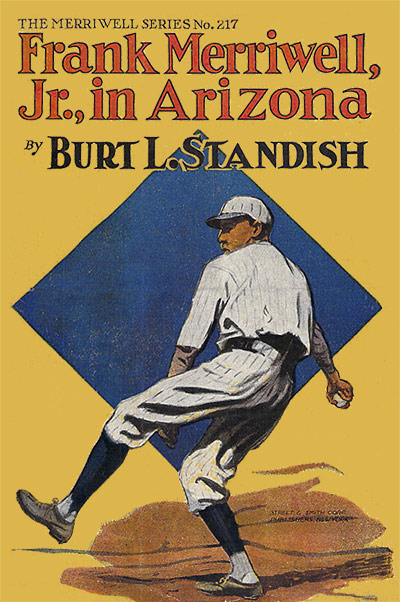
Frank Merriwell, Jr., in Arizona OR
CLEARING A RIVAL’S RECORD
By
BURT L. STANDISH
Author of the famous Merriwell Stories.
STREET & SMITH CORPORATION PUBLISHERS
79–89 Seventh Avenue, New York
Copyright, 1912
By STREET & SMITH
Frank Merriwell, Jr., in Arizona
All rights reserved, including that of translation into foreign
languages, including the Scandinavian.
Printed in the U. S. A.
CHAPTER I. A SLAVE OF THE NEEDLE.
FRANK MERRIWELL, JUNIOR, IN ARIZONA.
“Buck up, Shoup! What ails you, anyhow?”
“I’m all in, Len. I d-don’t believe I can take another
step. You see, I—I——”
The words faded into a groan, and the tottering youth
slumped to his knees, then pitched forward and sprawled
out limply in the sandy trail.
There were two of them, and they had been tramping
wearily through a defile known as Bitter-root Cañon. The
stage trail leading from Ophir, Arizona, to Gold Hill,
followed the cañon, and the two lads had been taking
this trail.
The trail was white with dust, churned up by the
wheels and hoofs that had passed over it. It wound
interminably along the cañon’s bed, twisting back and
forth through patches of greasewood and mesquite, now
hugging one wall and now the other, and again skirting
the edge of some brackish pool.
A stream flowed through the cañon, although no one
not familiar with such mysterious streams would have
guessed it. Like a good many Arizona rivers, the water
flowed under the surface, appearing only here and there
where bedrock forced it upward.
The lad who had yielded to exhaustion and had fallen
must have been nineteen or twenty years of age. He
was well dressed, although his clothes were dusty and in
disorder. His hair was of a tow color, his eyes a
washed-out blue, and his face was hueless—startlingly
white and waxlike.
The other boy was a year or two younger than his
companion, with a dark, sinister face and shifty eyes.
They had walked southward from Gold Hill for many
miles, and while the younger lad was an athlete and ordinarily
in good physical condition, yet a few days of
reckless living had sapped his endurance. He was almost
as exhausted as his companion.
“Here’s a go!” muttered the younger lad, looking
down grimly at the unconscious, deathlike face of his
friend in the trail. “Shoup hasn’t the backbone of a
jellyfish. I’ve got to do something for him, but what?”
The boy looked around him and discovered that Shoup
had fallen only a few yards from the edge of a pool. The
sight of water suggested the means for reviving the fainting
lad, and, with considerable difficulty, the other
dragged him to the pool’s edge. Wetting a handkerchief
in the pool, he bathed the pallid face. In a few moments
Shoup drew a deep breath and opened his eyes.
“You’re pretty near a wreck, Shoup,” said the boy
called Len crossly. “How do you think we’re ever going
to get to the gulch if you can’t walk four or five miles
without crumpling up in the trail?”
“I was trying to save the dope,” was Shoup’s answer,
in a weak voice. “I haven’t got much of it, and no money
to buy any more.”
“Cut that out,” the other growled angrily. “The
more of that stuff you use, the more you have to use.
It’s making you ‘dippy’ as blazes; not only that, but it
eats up your muscle and ruins your nerves. Why don’t
you quit?”
“Can’t quit. My old man used it, and my grandfather
used it. The hankering for the stuff was born
in me. What’s bred in the bone, Lenning, is bound to
come out in the flesh. No use fighting against the craving.
Here, help me to sit up.”
Lenning put his hands under Shoup’s shoulders and
lifted him to a sitting posture, twisting him about so he
could lean his back against a bowlder. With fingers
that trembled from weakness, Shoup pushed up his left
sleeve.
The skin of his arm was white as marble, and dotted
with little, black, specklike marks. Reaching into an
inside pocket of his coat, Shoup drew out a small, worn
morocco case.
“Bound to squirt a little more of that poison into your
veins, eh?” asked Lenning disgustedly.
As he put the question, he produced a box of cigarettes,
lighted one, tossed away the burned match and dropped
the box into his pocket. A sneering smile crossed
Shoup’s face.
“What’s the difference, Len,” he queried, “whether
you inhale the poison or take it my way? It brings us
both to the same place, in the end.”
“Splash! Cigarettes aren’t as bad as all that. Anyhow,
when I’m in training I cut ’em out. You’re never in
training and you never cut out that dope. If you can’t
get it just when you want it, your strength is snuffed
out like a fool candle. How long do you think you’ll
last, going on as you are now, eh?”
“That’s the least of my worries,” was the placid retort.
With his shaking right hand, Shoup pressed the needle-like
point of a small “hypoderm” into the flesh of his
left arm. An instant his quivering finger toyed with the
tiny piston, then drove it “home.” With a long sigh
of relief, he sank back.
“I’ll feel like a king pretty soon,” said he, speaking
with his eyes half closed. “You haven’t a notion how it
gingers a fellow up. Say,” and the eyes opened wide,
“why don’t you try it yourself?”
“Not on your life!” returned the other, in a sort of
horror. “The sight of you, with one foot in the grave
on account of that stuff, is enough for me.”
“Go on,” urged Shoup, his faded eyes brightening wonderfully.
“Try for yourself and see how it puts fire into
your veins, and peace and happiness into your heart.
Jove! Already I’m beginning to feel as though I could
run a hundred miles, and be as fresh at the end of the
run as when I started.”
Lenning stared at Shoup curiously.
“That’s the way you feel, but your system is all shot
to pieces and you’d drop before you’d gone half a mile,”
commented Lenning.
“Don’t you want to forget your troubles, old man?”
coaxed Shoup. “This is a sure cure for the blues.”
“No!” almost shouted Lenning, springing to his feet.
“Try to push that thing into my face again and I’ll grab
it and throw it into the water. You say you inherited
an appetite for the stuff; well, I inherited a few things,
myself, and I reckon they’re enough to stagger under
without taking on any of your failings.”
“Maybe you’ll come to it, some time,” laughed Shoup.
He was, by now, an entirely different person from
the Shoup of a few minutes before. His eyes gleamed,
and while his face remained colorless and of a dead,
waxen white, strength ran surging through him, and his
nerves steadied. It was the influence of the drug, of
course, and when that failed his condition would be more
pitiful than ever. Lenning, shivering at the spectacle
presented by his companion, turned moodily and looked
down into the pool.
Shoup put away his morocco case. Getting up, he
stepped to Lenning’s side and laid a hand on his shoulder.
“I’m a horrible example, eh?” he breathed. “All right.
You’re a good deal of an example, too. You’re a cast-off;
a week ago your uncle gave you a thousand dollars and
kicked you out of the house. Where’s the thousand
now, Lenning? ‘Rooly’ and faro have swallowed it up.”
He laughed jeeringly.
Lenning whirled on him, red with anger.
“And who helped me lose the thousand?” he cried.
“It was you! You might have the grace, seems to me,
to shut up about the loss of that money. We’ve neither
of us got a sou; but, if we can get to the gulch beyond
Dolliver’s, maybe I can borrow enough to get us out of
this country for good.”
“Who’s at the gulch?”
“A few friends of mine—at least, they used to be
friends. They’re members of the Gold Hill Athletic
Club, and they’re camping there.”
“I don’t think you’re going to get money—not altogether,”
said Shoup. “There’s something else on your
mind, too. What is it, Len?”
“Tell you later,” muttered Lenning.
“Look here: The bunch of fellows at the camp in the
gulch are having Merriwell over for a boating competition—canoe
race, or something like that. You’ve got
a grudge against Merriwell and you’d like to saw it off
with him. Am I right?”
An astounded look crossed Lenning’s face. He turned
his bewildered eyes on his friend.
“How the deuce did you guess that?” he inquired
breathlessly.
“The dope clears the brain wonderfully, Len,” grinned
Shoup. “It all came to me, just now. Sort of second
sight, I reckon. Am I right?”
“Well, what if you are?”
“Nothing, but this: I’m with you. What reason have
I to love Merriwell? No more than you. If we square
the score, suppose we do it together.”
Lenning stared gloomily at Shoup, then turned on his
heel and started off down the cañon. “Come on,” he
called, “we’d better keep a-plugging.”
Shoup made after him, his step buoyant, his spirits as
light as his step. He was paying for every hour of that
stimulated, fictitious strength with a year of his life. But
his thoughts did not—dared not—take account of the
future. It was the immediate present that concerned
him.
“You can’t get away from these family traits, Len,”
said Shoup, as they made their way southward.
“There’s a mighty tough prospect ahead of me,”
growled Lenning, “if that’s the case.”
“Well, it is the case.”
“I’m not taking your word for it. Nobody would
take your word for anything, Billy. You’re a wreck
of a man—just a burned-out hulk of what you ought to
be. That’s the way with you slaves of the needle.”
“What are you, Jode?” gibed the other. “While
you’re throwing it into me, you’d better think about yourself.”
“I’m no dope fiend,” snarled Jode Lenning. “I’ve got
a will left, and when I get good and ready I can turn
a leaf and be different.”
“I’ve got a picture of you ‘turning a leaf,’” laughed
Shoup sarcastically. “You’ll have to show me. You’re
not turning a leaf by going after Merriwell, are you?”
Lenning did not answer. Something, ahead of them
in the trail, caught his attention, just then, and brought
him to a dead stop.
“Thunder!” he exclaimed, “there’s a stage. Something’s
gone wrong with it. Where’s the team and the
driver? Wonder if they’ve had a break-down?”
CHAPTER II. MAKING A “RAISE.”
The stage that carried passengers and luggage between
the two towns of Ophir and Gold Hill was a mountain
wagon with a canopy top. This wagon, minus the horses
and driver, was at a rest in the trail.
A woman, dressed in black and with a gray shawl
over her shoulders, was sitting on the seat immediately
behind the one reserved for the driver. Back of her,
in the rear of the wagon box, was a shabby little hide-covered
trunk.
This woman, apparently, was the only passenger. The
two lads stared in the woman’s direction and continued
to wonder regarding what had happened to the stage.
“Some accident, sure,” said Shoup. “The driver must
have taken the team and gone after help.”
“I reckon that’s the how of it,” returned Lenning.
“Now,” his companion went on, “if we had money,
Len, we could ride in that rig as far as Ophir; and then,
if we had some more money, we could hire horses in
Ophir and get to the gulch in that way.”
“If we had money,” came grimly from Lenning, “we
wouldn’t go to the gulch at all.”
“Wouldn’t we?” queried Shoup. “You say we’re
going there to make a ‘touch,’ and won’t admit that your
wish to play even with Merriwell has anything to do
with it. But I know making a raise is only about half
of our work at the gulch.”
“Well, let it go at that,” said the other, with a shade
of annoyance. “No use standing here chinning when
we ought to be moving on.”
They started forward again. As they drew nearer
the stage they soon discovered what had happened.
One of the rear wheels was broken beyond repair.
The wheel had struck a bowlder and had been dished. Rim
and tire were lying on the ground, covered with half
the spokes. The rest of the spokes were sticking in the
hub.
The woman on the front seat watched the lads as they
approached. They could see that she was little and old
and wore spectacles. A lock of snow-white hair dropped
below the brim of a hat, which was evidently homemade.
Her dress was clearly her best black alpaca, and had
probably been her best for many years. The old face
slowly lighted up as the young men drew near.
Both boys lifted their hats when they had come close.
“You’ve had an accident, ma’am?” asked Lenning.
“Well, goodness me, I should say so!” was the answer.
“I’ve been sitting here for an hour, seems like, while the
driver’s gone with the horses to get a new wheel, or
something else to patch up the wagon, so we can get on
to Ophir. Do you boys live hereabouts?”
“Gold Hill,” said Lenning briefly.
“It’s been pretty lonesome, sitting here all alone, and
I don’t feel real spry, either. You see, I haven’t been
long out of a hospital, and this is quite a trip for a woman,
old as I am. But I like this country—always did. I’ll
feel a heap better, I know, after I’ve been here a spell.
Going far?”
“Ophir.”
“Dear me! Why don’t you ride when the weather’s
so warm? I’ve come from up North,” she continued,
without waiting for a reply, “and it’s real brisk November
weather, up there. Here in southern Arizona, though,
winter isn’t winter at all, is it? Years ago, when I lived
in these parts, I’ve seen the thermometer at eighty, in
the shade, on Christmas day. That wasn’t much like
Christmas. Terrible dusty, don’t you think?”
She had an old-fashioned hand reticule on her lap, and
just here she opened it to take out a handkerchief. As
she drew out the little square of linen, a roll of bills, with
a yellowback on the outside, came with it. She grabbed
the money before it could fall, and pushed it back where
it belonged. Then she dabbed at her face with the handkerchief.
Shoup drew a quick breath as he caught sight of the
money. There was an evil, greedy gleam in his eyes as
they continued to fix themselves on the hand reticule.
Lenning’s eyes also filled with longing at sight of the
roll of bills. He compressed his lips tightly, however,
and turned his head away.
“Sorry we can’t stay with you, ma’am,” said he, “and
keep you company until the driver gets back, but we’re in
a hurry. Good-by. Come on, Billy.”
Shoup smiled at the old lady and again lifted his hat
as he followed Lenning along the trail. The old lady
shook out her handkerchief at them and called a good-by
in a thin, high voice.
“Confound the luck!” grumbled Lenning, after a bend
in the trail had hidden the stage from sight, “I’m tired
enough to drop. If we could only make a raise this side
of the gulch, we could get to where we’re going a heap
easier than hoofing it.”
“You’re right, we could!” agreed Shoup. “You’d go
on to the camp in the gulch, would you,” he added mockingly,
“if we had money?”
“Yes, I would,” was the almost savage response.
“You’re fishing around to find out what I’m really up to,
and now you’re getting it flat; I want to even up with
Frank Merriwell. He’s raised Cain with me, and you
know it. What business has he got, sticking his nose
into my affairs? He’s due to get what a buttinsky ought
to get—and I’m the one that is going to hand it to him.
Watch my smoke!”
“Hooray!” chuckled Shoup softly.
“You can help, if you want to,” went on Lenning, fairly
ablaze with his fancied wrongs now that Shoup had
nagged him into starting on them, “but, by thunder,
you’ve got to keep your head clear and not make a
monkey out of yourself—or me.”
“I don’t think I’ll do that, Jode,” purred Shoup; “I
guess you’ll be tickled to death to have some one helping
you before you’re done with Merriwell. He’s a good way
from being an easy proposition. Do you think you can
bank on your friends in the gulch?”
“Why should they turn against me?”
“Pretty nearly all your friends have given you the
cold shoulder, I notice, since your uncle pulled the pin
on you.”
“I can’t believe that all of them will kick me when
I’m down,” said Lenning gloomily. “I’ve done a heap
for that Gold Hill crowd. I used to have plenty of
money, and whenever they wanted any all they had to
do was to ask me for it. A whole lot of them owe me
what they’ve borrowed, too. It’s only right they should
pay that back, anyhow.”
“My experience is,” said Shoup, “that a fellow will
always have plenty of friends when he’s got the spondulix
and can pass it out freely; but when the mazuma
gives out, and the barrel can’t be tapped any more, then
he can’t find a friend with a microscope.”
“Friends like that are no friends at all.”
“They’re all like that.”
“Merriwell’s friends are not, and I don’t see why
I can’t have a few friends just as loyal as his.”
“Well, Len,” grinned Shoup, “you’re not Merriwell.”
“I’m as good as he is!” flared Lenning.
“Not at some things.”
“I didn’t have a dad who was the world’s champion
all-round athlete, and that’s one place where he gets
the best of me. It’s Merriwell’s father’s reputation that
makes young Merriwell what he is. Take that from
him and there’s nothing left.”
“Easy, easy! You’re shy a few chips, Jode. Young
Merriwell stands on his own feet, and the biggest handicap
he has is the way people expect big things of him
because his father did big things. Although I hate Merriwell
as much as you do, yet I’ve got a whole lot of
respect for him. Now——”
Shoup came to a halt, one hand on the outside of his
breast pocket. A blank look crossed his pallid face.
“What’s the matter?” asked Lenning, halting.
“My dope case is gone!” was the answer. “I must
have dropped it along the trail somewhere.”
“Let it go, Billy! Now’s as good a time as ever to cut
away from the dope. Buck up and use your will power.
Try and be a——”
“You don’t know what you’re talking about!” cut in
the other angrily. “I’d die if I had to get along without
that. Will you go back with me and help me find it?”
“I will—nit. I’m pretty nearly fagged. If you’re
bound to have that stuff, go back and hunt it up yourself.
I’ll wait for you here.”
A look as of satisfaction crossed Shoup’s face.
“I’ll be as quick as I can,” he said, and turned back
and was soon out of sight behind the chaparral.
Moodily Jode Lenning found a place where he could
be fairly comfortable, and sat down. Every muscle in
his body was aching. A few weeks before he would
not have minded a jaunt like the one he and Shoup was
taking, but now it told on him fearfully.
He knew the reason. His wits were keen enough to
assure him that reckless living for only a few days had
sapped the strength and endurance which he had been
garnering for months.
He had been foolish, worse than foolish. But that
couldn’t be helped, and there was no use crying over
spilt milk.
The one object he had in life, just then, was squaring
accounts with Frank Merriwell. Merriwell was always
in the pink of condition—he made it a point to keep himself
so.
“I’m all shot to pieces,” growled Lenning, “and I’ve
got to go up against this paragon who never side-steps
his training and settle a big score with him. Will he be
too much for me? He will, sure, unless I can get at
him in some underhand way. That’s the idea!” he
finished.
Then, for an hour, he tried to think of some “underhand
way” in which he could make young Merriwell
feel the full force of his vengeance. Lenning was unscrupulous,
to a certain extent, and his association with
Shoup was well calculated to make him more so; nevertheless,
Lenning had some shreds of character and self-respect
left, although they formed a very imperfect
foundation on which to build for better things.
While Lenning was still busy with his thoughts, Billy
Shoup came briskly back along the trail. Lenning started
up as he drew close, and stared at the triumphant look
on his waxlike face.
“I reckon you found what you were looking for,”
said he.
“You can bet a blue stack I did,” was the answer. “It
wasn’t the dope case, either, Len.”
“Not that?” queried the startled Len. “What was it,
then?”
Shoup proudly drew from his pocket something which
he held toward Lenning in the palm of his hand. It
was a roll of bills with a “yellowback” on the outside.
“Made a raise,” he chuckled. “Transferred this from
the old lady’s hand bag to my pocket. Ain’t I the cute
boy, all right?”
CHAPTER III. A DRUGGED CONSCIENCE.
With revulsion plainly marked in his face, Jode Lenning
leaped back from the outstretched hand and the
roll of bills as he would from a coiled rattlesnake.
“Squeamish, eh?” jeered Shoup, his eyes two points
of light and boring into Lenning’s brain. “You’ve got
a lot of cause, after the way you’ve acted, to get on your
high horse with me.”
“You’re a plain thief!” gasped Lenning.
“Very plain,” sneered the other; “you’re worse, Lenning,
only it’s not so plain.”
Lenning jumped at Shoup with clenched fists.
“What do you mean by that sort of talk?” he demanded
chokingly.
“Don’t think you can scare me, Jode. You can’t. If
you want a tussle, don’t think for a minute that you’d
have the easy end of it. I know you better than anybody
else does—better even than your fool of an uncle,
who let you pull the wool over his eyes for so long.
You’re a coward. When you saw the money in that
old woman’s hand bag, you wanted it just as much as I
did, only you didn’t have the nerve to take it. Well, I
had the nerve; and I was so clever about it that she’ll
never know it’s gone until she wants to pay a bill. Now
get a grip on yourself and don’t act like a blooming
idiot.”
Lenning shivered slightly. The gleaming eyes of his
companion were still boring into his brain, and somehow
they robbed him of all desire to resent with his fists the
hard words Shoup had spoken.
“It seems to me as though, if you’re bound to steal,
you could pick out some one else for a victim,” Lenning
grumbled. “That poor old woman—I can see her face
now, with that lock of gray hair falling down from
under that rusty old hat and—and—oh, it makes me sick
just to think of it!”
He turned away in gloomy protest. Shoup laughed.
“Fine!” said he. “I didn’t know, Jode, that there was
so much maudlin sentiment wrapped up in you. How do
you know the old lady is so poor, eh? You can’t always
judge from appearances. The biggest miser I ever
knew—an old curmudgeon that looked like a tramp,
had more than a hundred thousand in the bank. There’s
two hundred in this roll, and it will stake us until luck
begins coming our way.”
The first shock of disgust had passed and Lenning
began to take a little interest in his friend’s recent
achievement.
“You didn’t lose that morocco case at all, eh?” he
asked.
“Not at all; that was merely an excuse for me to go
back to the stage and pull off my little play.”
“Suppose I had gone with you to help hunt for the
case?”
“I was pretty sure you wouldn’t.”
“Well, how did you manage it?”
“Easy. The old lady was still on the front seat, and
when she saw me coming she brightened up a lot. She
wanted to know why I was coming back, and I told her
that I had lost something in the trail and had come back
to look for it. The hand bag lay on the seat beside her.
I leaned over the side of the wagon, and began to talk.
I called her attention to the wall of the cañon, pointing
out a queer formation of the rocks, with my left hand,
and, with my right, opening the bag and taking out the
money. She never suspected a thing. It was about the
easiest job I ever pulled off.”
The shameless steps which he had followed in committing
the robbery were recited by Shoup without a
shadow of feeling or regret; on the contrary, there was
a boasting note in his voice, as though he had accomplished
something of which he was proud.
“You’re—you’re a coyote!” muttered Lenning.
“I’m a fox, Jode,” laughed Shoup, “and a slick one,
believe me. You couldn’t have turned a trick like that
without bungling.”
“I’d as soon think of stealing pennies out of a blind
man’s cup. That dope has killed your conscience. I
don’t believe you have a heart in you—when you’re under
the influence of that fiendish stuff.”
“Oh, cut that out!” grunted Shoup. “We’ve made a
raise and we’re going to use the money. We need it—you
know we need it. Come on. We’ll see how quick we
can get into Ophir and out again. We’ll hire horses
and ride to the gulch. It won’t do for us to stay long
in the town.”
They started again, Lenning dragging along, moodily
thoughtful. His thoughts, whatever they were, must
have been far from pleasant. Shoup, abnormally keen
while under the spell of the slow poison, seemed to know
what his companion was thinking about.
“You’re asking yourself, Jode,” said he jestingly,
“how you ever happened to fall so low as to be a friend
of mine. You were pretty well down yourself before
we got into each other’s company this last time. While
you’re thinking what a conscienceless wretch I am, let
your mind circle about yourself. What have you got
to be proud of?”
“Nothing,” snarled Jode.
“That is correct. If we can pick our bone with Merriwell,
we’ll both feel a whole lot better; when that’s finished,
we’ll clear out of this country and make a long
jump to Frisco. That’s the town! We can do big things
there.”
“What sort of things?” queried Lenning suspiciously.
“Oh, something safe and profitable. I’m well acquainted,
and the friends I have are the kind who’ll help
a fellow when he’s down. They’ll take you in on my
say-so, and, if you prove loyal to them, you’ll find that
they will prove loyal to you, in fair weather or foul.
We——”
Lenning cut into Shoup’s remarks with a sharp exclamation.
“Duck!” he exclaimed; “get into the brush—quick!”
At this same moment, Lenning suited his action to the
word and dove pell-mell into the chaparral beside the
trail. Without understanding the reason for this sudden
move, Shoup did likewise. The next moment, he heard
a tramp of horses’ hoofs in the trail. Riders were coming,
and Lenning had been crafty enough to understand
that it was not well, after the robbery, for them to be
seen in that part of the cañon.
Shoup chuckled. This meant, as he looked at it, that
Lenning had accepted the situation and was eager to help
his companion avoid the consequences.
Three horses came along at a gallop. Two of the
horses had a wagon harness upon them. One of these
animals was ridden by a flannel-shirted man, who was
probably the stage driver. The third animal was a saddle
horse, and was ridden by a young fellow with snapping
black eyes and in cowboy rig. One horse in the stage
team carried a wagon wheel lashed to its back.
The horses and their riders flashed by the thicket
where Lenning and Shoup lay concealed, and were
quickly out of sight and hearing. Lenning crawled
slowly back into the trail.
“If we hadn’t been quick,” said he, as Shoup joined
him, “they’d have seen us.”
“But they didn’t,” answered Shoup, “so it’s nothing
to worry over. What’s the cowboy along for?”
“Give it up. The cowboy was Barzy Blunt, of the
Bar Z Ranch. Ever heard of him?”
“No, but there are several cowboys I never heard of,
Jode. How has this fellow Blunt ever distinguished
himself?”
“Well, when Merriwell first came to Ophir, Blunt got
a grouch at him. Blunt is a cowboy athlete, but never
had any special training. He thought Merriwell was
a conceited Easterner, and made up his mind he’d take
a few falls out of him. He tried it.”
“And made a failure, eh?”
“How did you know Blunt failed?”
“Guessed it. It takes a pretty good athlete to beat
Merriwell at any sort of sport. But go on.”
“As you say, Blunt failed. Time after time he tried
to best Merriwell, but was always beaten out. At last
they became friends. There’s an old professor with
Merriwell and his pals. They found him holed away
in the Picketpost Mountains, holding down a gold ‘prospect.’
Merriwell helped the professor save the ‘prospect,’
and by and by it turned out that the man who had taken
Blunt to raise had a grubstake interest in the professor’s
claim. The man was dead, but his widow came in for
the good thing. The syndicate that has the big gold mine
in Ophir, I understand, have paid, or are going to pay,
fifty thousand for the mine. That will put Barzy Blunt
on Easy Street, for everybody says half the purchase
price will come to him when the widow is done with it.”
“Some fellows certainly have a habit of dropping into
a good thing,” murmured Shoup.
“It wasn’t a habit with Blunt. He had about as hard
a time getting along as any fellow you ever saw.”
“So he and Merriwell were enemies, and now they’re
friends?”
“Yes.”
“Look out, Jode!” joked Shoup. “Maybe Merriwell
will win you over before you have a chance to settle
accounts with him.”
“No danger,” grunted Lenning. “Merriwell hasn’t
any more use for me than I have for him. Merriwell
wouldn’t wipe his feet on me, I reckon, and you can
bet your last sou I wouldn’t give him a chance to try.
He knows the sort of father I had, and that I’m headed
wrong as a birthright, and will go wrong in spite of fate.”
“What a fellow inherits he can’t get away from,” declared
Shoup. “Merriwell, it seems, understands that.
When you know a thing’s true, what’s the use of trying
to buck against it? We’re all born with a handicap of
some sort in the race of life; we’ve got to win by doing
the thing that comes easiest.”
This was the logic of a drugged conscience, of a fellow
who was not himself at the very moment he brought
up the argument. For a lad like Jode Lenning, already
started on the downhill road, such a fellow was a dangerous
companion.
“I don’t know whether you’ve got the right of that,
or not,” said Lenning, “but I hope you haven’t. There
are times when I want to turn over a leaf and be different—and
never a time more than right now, since my uncle
has kicked me out; but——” He hesitated.
“But you want to hand Merriwell a testimonial of your
kind regards before the leaf is turned, eh?” grinned
Shoup.
“I’ll show him,” snapped Lenning, “that he had no business
butting into my affairs.”
“We’ll both show him, Len. I can be of more help
to you than you think. We’ll get horses in Ophir and
ride for the gulch. After we’re through with our work
there, we’ll clear out of this part of the country and pull
off some big things.”
“I wish to thunder,” said Lenning, “that I could look
into the future and see just what is going to happen.”
Had he been able to do that, Jode Lenning would probably
have received the surprise of his life.
CHAPTER IV. BLUNT TAKES THE WARPATH.
Frank and his chums, Owen Clancy and Billy Ballard,
sat on the front veranda of the Ophir House and
saw a horseman come pounding along the road. The
rider was a cowboy—that much could be seen at a glance.
Cowboys were no novelty in the streets of Ophir, and
this one secured attention mainly because he was pointing
for the hotel.
Gracefully he dashed at the veranda steps, just as
though he intended to gallop into the hotel; then, deftly
whirling his horse, he came to a halt broadside on to the
three lads who were watching him over the veranda rail.
So suddenly did the cowboy stop, that his horse sat down
and slid to a standstill in a flurry of dust.
“Whoop!” cried the admiring Clancy to the master
horseman, “say, old man, you’re all to the mustard.”
“Shucks!” grinned the cowboy, “stoppin’ in a horse’s
length from full gallop ain’t nothing to what old Hot
Shot can do. This here little cayuse can ride up the
side of a house, with me on his back, and then turn
a summerset off’n the ridge pole. Fact. Which is the
hombray that totes the label of Merriwell?”
“I’m the hombre,” laughed Merry.
The cowboy drew back in his saddle and peered at
him through half-closed eyes.
“Is that all there is of ye?” he inquired. “From what
I’ve heard, I reckoned ye was about ten feet high an’
went chuggin’ around like a steam engine. My notions
was kinder hazy, more’n like. Since I was a kid, my
favor-ite hero has allers been that dad o’ yourn. I allow,
that pullin’ off athletic stunts comes mighty easy for you,
arter the way you was brung up. Here’s a paper talk
I was asked to kerry in an’ pass over to ye.”
The cowboy jerked a letter from the breast of his
shirt, flipped it toward Merriwell, then rattled his spurs
and bore on with a husky “Adios!” Frank had caught
the missive deftly, and he now sat staring glumly after
the disappearing rider.
“Come out of it, Chip,” said Ballard. “Just open
that paper talk and let’s hear what it says.”
“That cowboy thinks athletics come easy for me because
dad made such a record,” muttered Frank. “I
wish to thunder people would understand that such
things can’t be handed down in a fellow’s family, like
silver spoons, and the grandfather’s clock, and the old
homestead.”
“Don’t fret about anything that cowboy said,” returned
Clancy. “He also had a notion that you were
ten feet high, and went snorting around like a locomotive.
His ideas don’t seem to be reliable, anyhow.
What’s in the letter, Chip?”
Frank tore open the envelope and drew out the inclosed
sheet. His face brightened as he read the letter.
“Here’s news, fellows,” said he; “listen.” And he
read aloud:
“‘I’ll bet something handsome you’ll be surprised when
you get this and find out some of us Gold Hill fellows
are back at the old camp in the gulch. We’re here for
a week, and we want you and Reddy, and Pink to come
out and see us to-morrow. Hotch and I challenge you
for a canoe race, or a swimming match, or any other old
thing that’s in the line of sport and excitement. We
hear that you’re soon to leave Arizona, and we can’t
let you go without having a visit with you. Of course,
we don’t expect to beat you at anything—you were born
with the athletic virus in your veins and all sports are
second nature to you—but give us a chance to do our
best against you, anyway. Come on, and stay as long
as you can.’
“And that,” Frank added, with the shadow of a frown
crossing his face, “is signed by Bleeker, the Gold Hill
chap we’re pretty well acquainted with.”
“It’s a bully letter!” Clancy declared. “What’s more,
it hits me about where I live. Staying holed up in this
hotel for the rest of the time we’re in Arizona doesn’t
appeal to me a little bit. We’ll go, of course?”
“No studies for a couple of days, Chip!” put in Ballard,
repressing his exultation. “Mrs. Boorland will
reach Ophir to-day, and then she and the professor will
be busy selling out their mine to the syndicate. The
prof told us, you remember, that he regretted the break
in our studies, but that he expected to make it up as
soon as the mine is out of the way. Let’s pile in and
enjoy ourselves. What?”
“Did you absorb what Bleek says about all sports being
second nature to me?” fretted Merry, staring gloomily at
that particular passage in the letter. “Say, I wonder if
anybody gives me credit for doing anything in my own
right? I’ve put in some pretty hard licks trying to
make a sprinter, a pitcher, and a few other things out
of myself, and yet there’s an impression around that dad’s
responsible for it all. It’s a thundering big handicap,
and I’m getting tired of it. I don’t care a picayune what
a fellow inherits, he has to stand on his own feet, and
it’s what he does himself that makes or breaks him.”
Merriwell was getting rather warm on the subject—too
warm, he suddenly realized, and put the clamps
on himself.
“Of course,” he went on, “I’m mighty lucky in having
a father in the champion class. He has been mighty
good to me, and his advice has been the biggest kind
of a help, but he has only pointed the way, and it was
left to me whether I made good or not. It’s the most
foolish thing in the world, strikes me, to think a fellow
is worthy or worthless simply because his father was one
or the other. Now——”
Merriwell paused. The stage from Gold Hill, several
hours late, was lumbering up the main street of Ophir.
He had been watching it moodily while he talked; and
then, abruptly, his moodiness vanished and he jumped
to his feet.
“By Jove!” he exclaimed, in pleased surprise. “As
sure as shooting, fellows, there’s Barzy Blunt!”
There was no doubt about it. Barzy Blunt, on horseback,
was riding along at the side of the stage; and, on
a seat of the stage, was a little old lady with spectacles,
and a shawl over her shoulders.
“Hello, Barzy!” Frank called, leaning out over the
veranda railing and waving his hand. “Wasn’t expecting
to see you. How are you, old man?”
“How’s the ranch, Barze?” shouted Clancy.
“Good old Barzy!” chirped Ballard. “You’re a wonder,
all right. Whoever had a notion you’d be turning
up in Ophir this afternoon?”
The stage had halted in front of the hotel, and Blunt
had swung down from his saddle and rushed to the side
of the vehicle. He waved a joyous greeting to the lads
on the veranda, and then very carefully helped the old
lady to alight. Pophagan, proprietor of the hotel, came
briskly out, followed by the Chinaman who acted as
porter.
“Glad to see ye, Blunt,” said Pophagan. “An’ this
here is Mrs. Hilt Boorland, ain’t it? It’s been a heap o’
years since I’ve seen Mrs. Boorland. Howdy, mum?
Feelin’ well, I hope? I been savin’ a good room for you.
I’ll take the grip, and the chink, I reckon, can manage
the trunk. Come right in whenever you’re ready. Have
a break-down, Andy?” he called to the stage driver.
“You’re a long time behind schedule.”
The roustabout shouldered the little, hide-bound trunk
and trotted into the hotel with it. Pophagan, already up
the steps, was swinging a scarred and battered satchel.
Blunt, still very carefully, was helping the old lady mount
to the veranda. Merry ran down and lent his assistance.
Andy, settling back in his seat and picking up
the reins, was sputtering about the broken wheel and
the delay. He drove on, still sputtering, bound for the
post office, where he was to leave the mail bags.
“Merriwell,” said Blunt, after his charge had safely
reached the veranda, “this is Mrs. Boorland. Mam,”
and he turned to the old lady, “this is Frank Merriwell,
and Owen Clancy, and Billy Ballard. I reckon,” and
he laughed softly, “that you’re not exactly strangers to
each other.”
“Deary me!” exclaimed the little old lady, very
much flustered. “Why, the letters Barzy wrote to me
at the hospital were just full of things about you boys.”
She got up and put her trembling arms about Merriwell.
“You don’t mind an old woman showing her affection
for you, do you? Seems like you were one of my boys,
same as Barzy. You did a lot for Barzy, you and your
friends, Frank Merriwell. I just wish I had the last
letter he wrote me! If you could see the fine things he
said about you, you’d know you’d never lack for a friend
so long as Barzy’s alive.”
She turned from Frank to Owen.
“And here’s Mr. Clancy,” she went on, “and Mr. Ballard!
Goodness sakes, I am just as pleased as I can be.
We’d have got here a lot sooner if the wheel hadn’t
broken, ’way off in the cañon. I had to wait in the stage
while the driver came on to get another wheel. Well, it
was lonesome, but I didn’t mind. Two young fellows
came along on foot, and they kind of cheered me up, only
they didn’t stay long. Now, Barzy,” and Mrs. Boorland
turned supplicatingly to the cowboy, “don’t you go and
think hard about those two young fellows. I don’t
believe they had a thing to do with it, not a thing. I
just pulled out my handkerchief, and the roll came with
it—and that’s how it was lost.”
“Never mind, mam,” said Blunt, allowing a smile to
chase away the hard look that had come over his face,
“you’re not as strong as you might be, and I’m going to
take you into the house and make you comfortable.”
“I hope I’ll see a lot of you boys while I’m here,” Mrs.
Boorland said, clinging with both hands to Blunt’s arm.
“I’ll be here for quite a little while, I reckon. Friends
of Barzy’s are always friends of mine, and mighty good
friends, too.”
She and the cowboy vanished inside the hotel.
“So that’s Mrs. Boorland!” murmured Ballard. “She’s
a nice old lady and I’m glad she’s got a wad of money
coming to her.”
“Same here,” spoke up Clancy. “It was a lucky thing
for Blunt that, when he was a homeless kid, a woman
like Mrs. Boorland took him in and made a home for
him.”
“And Blunt, ever since Mr. Boorland died,” said
Merry, “has been paying back the debt. While Mrs.
Boorland was in the hospital, he sent about all his wages
to her, and even sold his favorite riding horse to me so
he could send more when he found his wages weren’t
enough. Well, I don’t blame him at all. I’d do the
same for an old lady like that.”
A few moments later Blunt came back to the veranda.
There was an angry frown on his face as he dropped
into a chair near Merriwell.
“What’s biting you, Barzy?” Frank inquired.
“A whole lot, pard,” Blunt answered. “I’ve danced
the medicine and am going on the warpath. Do you
know a fellow with a white face, washed-out eyes, and
tow hair?”
“Well, slightly,” Merriwell answered, with a grim
smile. “He was brought on from some place unknown
by Jode Lenning to coach the Gold Hill football squad.
But he and Jode have both got their walking papers,
and where they are now is more than I know.”
“They were in the cañon this afternoon,” scowled
Blunt. “Mrs. Boorland saw them there. They were on
foot and walking this way, but they stopped to talk for
a spell. After they left and went down the cañon, this
white-faced skunk came back. He talked some more,
and when he went away for good, Mrs. Boorland found
that two hundred in bills was missing from her hand
bag.”
“Great Scott!” muttered Clancy. “Billy Shoup is up
to his old tricks.”
“He must have had his nerve with him to steal from
an old woman!” exclaimed Ballard contemptuously.
“I’ll bet a row of ’dobies that Lenning was in on the
deal as much as Shoup,” said Blunt darkly, “only he was
too much of a coward to pull off the robbery. I’m going
on the warpath and get that money back—and with interest.
You hear me!”
CHAPTER V. A SURPRISE AT THE GULCH.
“Don’t be in a rush with your suspicions, Barzy,” Merriwell
advised. “Accusing a man of robbing an old lady
like Mrs. Boorland is pretty serious business. From
what I heard her say to you, she thinks she may have lost
the money.”
“Not on your life, she doesn’t think that!” returned
Blunt. “That’s her way—always trying to screen everybody.
She didn’t lose the money. It was stolen from
the hand bag, and Shoup and Lenning are the ones that
did it. I’m going after them, and I’ll get the money
and wring their necks into the bargain. I can’t remember
when anything has happened that has worked
me up like this.”
Blunt was a cowboy, and, as Frank knew very well,
inclined to be rough and reckless whenever he thought
he was dealing with guilt or injustice. If he found
Shoup and Lenning and recovered the money, there
was no doubt but that he would attempt to give them
a lesson they’d long remember.
“When are you going to start on this warpath of
yours, Blunt?” Merriwell asked.
“Right now, just as quick as I can do it. I’ve told
mam that I had to go back to the ranch, but that was
only to ease her mind. Instead of loping for the Bar Z
I’m going to hunt the trail of Shoup and Lenning, and
run it out. If I don’t they’ll be apt to have all that
money spent. I know their caliber, all right. For the
last week they’ve been gambling in Gold Hill, I’ve heard,
getting rid of the thousand Colonel Hawtrey gave Lenning
when he kicked the fellow out of his house.”
“I guess,” said Frank, “that I’ll go with you, Barzy.”
The sloe-black eyes of the cowboy softened a little,
then flamed.
“No, you won’t, Chip!” he declared. “This is my
business and you’ll keep out of it. I know what’s on
your mind. You think there are two of them, and
that they’ll be one too many for me.” He flung back his
head and laughed derisively. “Why,” he finished,
“they’re both cowards from the ground up. They’ll be
scared to death just at the sight of me. I can handle
’em.”
“I’d like to go along, anyhow,” insisted Frank. “A
little excitement wouldn’t come amiss, just now. We’re
going to leave Arizona pretty soon, and we’d like to keep
keyed up with something or other until we go.”
“That’s you!” grinned Blunt, “but you can’t drive such
palaver down my throat. You’re afraid I’ll get into
trouble, and you’re making excuses to go along, but this
is a single-handed expedition, and I’m going to see it
through all by my lonesome. Mam is feeling pretty
chipper, and she won’t need me for a while. It isn’t that
I wouldn’t be glad of your company, Chip, but I just
want to nail these fellows myself, and do it good and
proper. You’re a crack hand at everything—get it from
your dad, of course—but Barzy Blunt is pretty good at
a thing like this. Buenos!”
Merry had not another word to say. He watched
Blunt run down the steps, pull the reins over his saddle-horn,
and spring to the back of his horse. A moment
later he had vanished in the direction of the cañon trail.
“That’s three times in one afternoon,” grumbled Merry.
“And the last time it comes from Blunt, who ought to
know better.”
“Chip’s hearing funny noises, Pink,” remarked Clancy
to Ballard. “What do you suppose has got into him?
He’s breaking out in an unexpected place.”
“Three times!” mused Ballard. “What has happened
three times, Chip? Maybe I’m thick, but I can’t follow
you.”
“Blunt said that I’m a crack hand at everything, which
is coming it rather strong, and that I get it from my dad,
of course. Everybody has suddenly begun throwing that
handicap at me.”
“Not much of a handicap,” said the red-headed chap.
“If my governor was the best all-round athlete in the
country, I’d be tickled to death over it.”
“You’re not getting me right, Clan,” returned Merry
earnestly. “I’m proud of dad, but the things he has done
he did himself, and against a whole lot of discouraging
circumstances at the outset. I want to make the same
sort of a record, see? But how can I when everybody
insists that what dad has done makes my imitation easy?
If a fellow goes wrong because his father went wrong,
he’s a pretty poor stick; and if he goes right just because
his father went right, what credit is it to him? Anyhow,
there’s nothing in that theory. If a fellow wins or loses,
it’s his own doing—his own, mind you.”
Frank was nettled. It was unusual for him to show
his feelings so plainly, but he was human, and there were
a few things that struck pretty hard at his self-restraint.
“I’m glad you didn’t run off with Blunt,” said Ballard,
after a moment, “for that would have knocked our
trip to the gulch in the head. We’re going?”
“Yes,” Frank nodded. “Early in the morning we’ll
ride for the gulch.”
“Hooray!” jubilated Clancy. “What you need, Chip,
is a little outdoor exercise—a little of the summer ozone
which we’re getting, in this part of the country, in the
middle of November. Let’s make the most of it. When
we leave southern Arizona, we’ll probably land somewhere
in the ice and snow.”
The boys saw little of Mrs. Boorland until evening.
At supper, she came down from her room and Frank
introduced her to Professor Borrodaile, who was tutoring
the three lads, getting his health back in the splendid
climate, and incidentally waiting to claim the half of
fifty thousand dollars, which he and Mrs. Boorland were
to receive for the mining claim.
The more the lads saw of the little old lady the more
they liked her. It was plain that she was all wrapped
up in Barzy Blunt; and that, when she got through
with her half of the fifty thousand, it would be passed
on to Barzy. Nor would this be long, Merriwell thought,
as he saw how frail and worn she was through years of
misfortune.
Frank and his chums were in bed early, that night,
and next morning they were up and on the road to the
gulch before either Mrs. Boorland or the professor was
stirring.
It was a crisp, bright morning. The air, pure and
clean from the wide deserts, acted like a tonic. Ballard,
in spite of himself, burst into song, and Clancy had a
time of it smothering the ragtime airs that Ballard insisted
on trying to sing.
The trail was wide and fine for the fifteen miles that
lay between Ophir and Dolliver’s. Dolliver, the ranchman,
was well known to the boys.
“What d’you reckon,” he asked of the boys, as they
halted to water their mounts, “Lenning and that white-faced
feller trailin’ along with him is doin’ in these
parts?”
The boys were startled.
“Do you mean to say they’ve been around here, Dolliver?”
Frank asked.
“That’s what,” was the reply. “They was here late
yesterday arternoon, ridin’ a couple o’ hosses. The
white-faced feller had a roll of bills enough to choke a
dog. They’re up to somethin’ crooked, I’ll bet you.”
“Which way did they go when they left here?”
“Quién sabe?” answered Dolliver. “They jest went,
an’ I didn’t see ’em when they shacked away.”
“You know Barzy Blunt?” went on Frank, casting a
look at his chums that kept them silent.
“Well, I reckon. I’ve knowed Barzy ever since he
was gopher-high.”
“Did you see him yesterday afternoon?”
“Nary I didn’t. He ain’t around in these parts. If
he was, ye can gamble he wouldn’t pass without sayin’
how-de-do to Dolliver.”
At Dolliver’s, the boys turned from the wide trail
and started into Mohave Cañon. Here the road narrowed,
and angled back and forth until the mouth of
the gulch was reached, and the riders turned to follow
the dammed-up waters that sparkled in the late forenoon’s
sun.
“I’ve a hunch,” Frank remarked, “that Blunt will get
into trouble with Lenning and Shoup.”
“Chances are, Chip,” cried Clancy, “Blunt will never
find them. They’re a foxy pair, and if they really stole
that money, then they’ll be mighty careful to keep out of
sight.”
“Maybe Shoup didn’t take the money, after all,” suggested
Ballard.
“He’s a thief, Pink,” said Frank, “and I wouldn’t put
it past him. The fellow’s not in his right mind for very
much of the time.”
“That’s so. Do you think Lenning would stand for
thieving of that sort on Shoup’s part?”
“Sure he would,” asserted Clancy. “That cub would
stand for anything that didn’t call for any particular
nerve on his part. He’s as crooked as Shoup; or, if
he isn’t, he’ll be as crooked as Shoup before he’s been
with him very long.”
“They say Lenning’s father was wild, and was killed
in a brawl somewhere in Alaska,” remarked Ballard. “I
suppose we couldn’t expect much better things of Lenning.”
“There you go, Pink!” exclaimed Merry. “What Lenning’s
father did isn’t any excuse for Lenning.”
“Right!” laughed Ballard. “Lenning’s handicap is
a bit different from yours, Chip, but I spoke before I
thought.”
The walls of the gulch widened out, and as the boys
rode along the border of the pent-up waters, they came
presently into view of three white tents, pitched on a
strip of clean, sandy beach.
Dinner was being made ready. A fire had been started,
and the campers could be seen moving about, each doing
his allotted part of the work.
Half a dozen canoes were drawn up on the sand, a
little way from the tent, and off shore a float was
anchored for the use of swimmers. It was a pleasant
scene for the three lads, just a little tired from their long
morning’s ride.
A moment after the travelers sighted the camp, the
campers sighted them. Instantly all work among the
tents came to a standstill.
“Here’s the Merriwell crowd!” whooped one of the
Gold Hill fellows.
“Good old Merry!”
“Just in time for grub pile!”
A rush was made for the newcomers, and they were
dragged from their horses, pounded on the back, and
punched in the ribs with all the delight and good feeling
imaginable.
Hotchkiss, another lad whom Frank and his chums
knew pretty well, took charge of the three horses, and
led them away to be picketed with the rest of the live
stock. Bleeker, who seemed to be in charge of the camping
party, led the visitors into the camp and showed them
their quarters.
“We’re all mighty glad you’ve come,” said Bleeker
heartily. “We’re going to have great times while you’re
here. Didn’t see anything of Lenning and Shoup on the
road, did you?”
“Lenning and Shoup?” returned Merriwell, startled.
“No, we didn’t see them, but we hear they were at Dolliver’s
late yesterday. Have they been here?”
“They were here last night, and I ordered them out of
camp. Nearly had a fight getting them to go, but we got
rid of them. Last night, though, one of our canoes was
stolen. Of course,” he finished, “it’s not much of a guess
who took it. Shoup’s a thief, and Lenning isn’t much
better. We’ll get that canoe back, though, you can bet
on that.”
CHAPTER VI. THE REVOLVER SHOT.
“Why the deuce did Lenning and Shoup come in this
direction?” asked Ballard, in a puzzled tone. “If they’d
done anything crooked on the trail from Ophir to Gold
Hill, they would be getting away from company instead
of hunting for it.”
“It looks as though Blunt was barking up the wrong
tree,” put in Clancy. “He had a revolver in his belt,
under his coat, when he came out of the hotel, and started
on the warpath, Chip. Didn’t see that, did you?”
“Is that straight, Clan?” Merry demanded, staring at
his chum with grave concern.
“Straight as a die.”
“I didn’t see it,” said Ballard.
“Well, I did. His coat flew back as he climbed into
the saddle, and for just a second I saw the gun.”
“Why didn’t you say something about it before?”
asked Frank sharply.
“It would only have got you all stirred up, Chip, without
doing any good. You ought to know Barzy Blunt by
this time, I should think.”
They were inside the tent where the three visitors
were to have their sleeping quarters. Merry, Clancy,
and Ballard had flung themselves down on a pile of
blankets. Bleeker had started to leave, but the conversation
of Frank and his chums filled him with sudden interest,
and he turned back.
“What are you chinning about?” he asked. “If Blunt
had a gun, it isn’t the first time he has gone ‘heeled,’ by
a long chalk. A cowboy, as a rule, knows how to shoot.
I’ve heard that Blunt is particularly good on the trigger.
What are you stewing about, Chip?”
“First,” said Merriwell, “I wish you’d tell me what
excuse Lenning and Shoup gave for coming here—that
is, if they gave any.”
“Lenning was after money.”
“Money? How did he expect to get money here?”
“Why, he claimed that some of the fellows in camp
owed him money they had borrowed. I reckon he was
right about it, but none of us brought any coin to speak
of out here. So those who owed Lenning couldn’t pay
him back if they wanted to. You know what a hold
Lenning had on Colonel Hawtrey before the colonel
cast him adrift. Lenning was always well supplied with
funds. He was generally a tightwad, too, but he’d loosen
up now and then, just to get some of the boys in debt
to him, so he could boss them around. It must seem
kind of queer to Lenning to be ‘strapped’ and have to
go around collecting on the I O Us.”
“Queer, he was so hard pressed,” mused Frank, “when,
if our suspicions are correct, he and Shoup should have
been flush.”
“What are your suspicions?”
Frank told about Mrs. Boorland’s loss on the trail from
Gold Hill, and how Barzy Blunt had “gone on the warpath”
to recover the money. Bleeker gave a long whistle.
“Blunt is sure a crazy cowboy when he gets his mad
up,” said he, “but he’s not so crazy as to use a gun on
anybody. He might make a grand-stand play with it,
but that’s as far as he’d go. He’s right, I think. Shoup
took the bank roll, and Lenning must have known about
it. Jode Lenning is going to the dogs as fast as he can.”
“If those fellows got the money,” queried Merriwell,
“why in thunder were they here, trying to get some
more?”
“Probably two hundred wasn’t enough.”
“Don’t forget, Chip,” spoke up Ballard, “what Dolliver
said. He told us, you know, that Shoup flashed a roll
‘big enough to choke a dog.’”
“That’s right,” said Frank. “They certainly had
money, and yet they came here and made a play for
more. I’ll be hanged if I can understand it.”
“The Gold Hill crowd was camped right in this place,
a couple of weeks ago,” went on Bleeker, “and Jode got
mad at Hotch and me and made us leave the camp. I’m
on top myself, just now, and am back in the athletic club,
and have been elected to Jode’s place as captain of the
football team. It did me good to turn on the skunk and
order him off, just as he had done to me. He was backward
about going, too, and said he and Shoup would
have to have something to eat. We gave them some provisions,
and then drove them away. They made their
threats that they’d get even with us, and, as I said, last
night, one of our canoes was stolen. That’s how they
got even, I reckon. This is the only stretch of water
in this section, where a canoe can be used, so if we hunt
long enough we’re bound to get back our lost property.”
“Lenning is getting pretty mild in the way he settles
his scores,” remarked Ballard. “When he’s worked up,
he can be rather desperate.”
“I’m betting,” said Bleeker, “that with Shoup to nag
him on, he’ll go farther than he ever went before. That
Shoup is a hard case.”
“Only thing in the way of that theory,” chimed in
Clancy, “is that Lenning lacks nerve. He’s got a white
feather in every pocket, and he shows it every time any
one gives him a chance.”
“I wouldn’t come down too hard on Jode Lenning,”
suggested Merriwell. “Dad has told me, a good many
times, that he never saw a fellow so tough there wasn’t
some good in him.”
“Lenning’s the exception,” declared Bleeker. “He’s
a schemer, through and through, and he’d be out-and-out
bad if he had the courage.”
Frank shook his head. “Lenning has had a hard
lesson,” said he, “and maybe he’ll show you Gold Hill
fellows, some day, that he has profited by it.”
Bleeker laughed incredulously.
“Chip,” he declared, “your heart’s running away with
your head. Lenning’s lawlessness was born in him.”
“Oh, splash!” grunted Merry. “That sort of talk
makes me tired. A man’s born with the same chance
every one else has to make something out of himself. If
he goes wrong, he can’t sneak behind his pedigree and
whine about it; and if he does anything worth while, why,
he’s entitled to the credit.”
“Gee,” grinned Bleeker, “I reckon I’ve started something.
Let’s change the subject. What are Blunt’s
chances for overhauling Lenning and Bleeker?”
“Not very good—if we can get at those fellows first,”
said Frank.
“Going on the warpath yourself, Chip?” inquired Ballard.
“Right after dinner. If Lenning and Shoup have Mrs.
Boorland’s money, and if they’re anywhere in the vicinity
of this gulch, we ought to be able to find them and get
back that two hundred. Blunt is probably on the wrong
trail, and we may be the means of saving him a little
trouble. While we’re looking for the money, Bleek,” he
added, “you can come along and hunt for the canoe.”
“I’ll go with
you, Chip,” answered Bleeker heartily. “But
we’re not going to waste all the afternoon on Lenning
and Shoup. We’re going to have a canoe race around
the Point, before sundown. I’m anxious to take a fall
out of you on the water. From here to the broken pine
around the Point is half a mile. I’ll pick a fellow to
paddle with me, and you can take either Pink or Red.
I’ve got a notion, old chap, that we Gold Hillers can show
you a trick or two with the paddles.”
“I hope you can, Bleek,” laughed Merriwell. “We
haven’t touched a paddle since we were up in the Wyoming
country.”
“And that seems like a year ago,” sighed Clancy. “Say,
I’m just honing for a paddle! Are you going to take
Pink or Little Reddy, Chip?”
“We’ll settle that later,” said Frank.
“Go on!” cried Ballard, with mock indignation. “I
can paddle circles all around Clancy.”
“That’s a joke,” said Clancy. “You’re too lazy to
paddle circles around anybody.”
“I’m not too lazy to knock a chip off your shoulder, you
red-headed chump!”
“Yah!” taunted Clancy, hunting around for a chip.
“Chips are scarce,” he added finally, picking a pebble
out of the sand. “How’ll this do?”
The pebble went flying from Clancy’s shoulder, and
the two chums laughed and came together. While they
were kicking and rolling among the blankets, a voice
from outside announced “grub pile.”
“If you fellows would rather fight than eat,” said Merriwell,
“stay right here and keep it up. Come on, Bleek,
I’m hungry enough to eat a pair of boots.”
It was a fish dinner the campers had that day, and a
good one. Half an hour before the fish was served, they
had been swimming up and down the gulch. From the
water to the frying pan was a quick shift—and the
quicker the shift the better, when it comes to fish.
There were ten Gold Hillers in camp, and the coming
of Frank and his chums brought the total number up to
a baker’s dozen. The ten from Gold Hill all belonged
to the athletic club, and were a splendid lot of fellows.
They were hungry, too, for the morning had been full
of exercise.
“Pass the spuds, there, Hotch!” “Trying to hog all
the canned oleo, Ming?” “A little more of the planked
shad, if you please!” “Where’s my fork?” “Confound
it, Bleek, the first thing you know the company will find
out we didn’t have forks enough to go around, and that
we’re using one between us.” “If you can’t be real polite,
then for Heaven’s sake be as polite as you can.” “I’ve
got a bone in my throat!” wailed Hotchkiss. “Hit him
on the back,” said Bleeker; “everybody hit Hotch on the
back.”
Everybody took a slam at Hotchkiss, and when they
got through with him he had been pounded to a frazzle—but
he had got rid of the bone.
“That’ll do!” he cried. “I’m no punching bag—let
up.”
“Where’s the bone?” asked Bleeker severely.
“Gone! It’s not bothering me half so much, now, as
you fellows are.”
“Prove it’s gone.”
“How?”
“Sing. Go on, Hotch.”
“I’ve eaten too much—I can’t sing.”
“Try it!” clamored the others.
“Shucks,” deprecated Hotch, “I’ve got a voice like a
foghorn. But here goes.”
He threw back his head and went at it.
“I once knew a girl in the year of eighty-nine—
A handsome young thing by the name of Emmaline—
I never could persuade her for to leave me be,
And she went and she took and she married me-e-e!”
A chorus of groans greeted Hotchkiss’ attempt.
“That’s a ranch song, Hotch,” said Bleeker sternly,
“and it is not in good taste. Try again. We——”
But Hotchkiss did not get a chance to try again.
Bleeker’s words were cut short by the clear, yet distant,
note of a firearm.
The fun stopped as though by magic. All the boys
cast startled glances at each other.
“That may be the fellows who stole our canoe!” cried
Hotch, jumping to his feet. “Come on, fellows! Here’s
a chance to nail ’em!”
He started up the gulch bank at a run, Bleeker and
Merriwell tight at his heels.
CHAPTER VII. A BLIND CHASE.
The lads were somewhat confused as to the direction
from which the report had come. They were all agreed
on one point, however, and that was that the shot had
been fired on their side of the gulch. From there on,
their ideas of the right direction varied widely. Clustered
together on the crest of the long slope of the gulch
bank, they held a hurried consultation, to decide what
their next move should be.
“I’m sure,” said Bleeker, “that the sound came from
the northwest.”
“Northeast, Bleek,” asserted Hotchkiss.
“Directly north,” a chap named Lenaway declared, with
equal conviction.
“What do you think, Merriwell?” asked Bleeker.
“It’s hard to tell,” Frank answered. “If we’d been
listening for the shot, and trying to locate it, we might
have got the direction tolerably close; but the sound came
when we weren’t expecting anything of the kind, so that
the way we ought to go is more or less of a guess. I’m
inclined to think you’re right, though, Bleek.”
“Pick out a couple to go with you, Hotch,” said
Bleeker, “and go northeast. You do the same, Len, and
go north. Merry and I will go over towards the cañon.”
Frank turned and gave Clancy and Ballard a significant
look.
“You go with Hotch, Clan,” said he, “and Pink, you
go with Lenaway.”
Clancy and Ballard understood Merriwell’s reason for
this move. If the party led by Hotchkiss, or the one led
by Lenaway, succeeded in finding Lenning and Shoup,
then there would be some one along to make an attempt
to secure Mrs. Boorland’s lost money. So far, of the
Gold Hillers, only Bleeker knew of the money that had
been stolen on the trail from Gold Hill to Ophir.
“This matter is settled, then,” said Bleeker. “The rest
of you boys go back to camp. We don’t want to leave
the camp to take care of itself and lose any more canoes.
Come on, Chip.”
The party divided, the three detachments of searchers
starting off hurriedly in as many different directions,
while several of the lads went back down the slope to
the camp.
Merriwell and Bleeker took a northwest course among
low, rocky hills. They traveled rapidly, keeping their
ears open for another report, which might serve further
as a guide.
“That was a revolver shot,” asserted Bleeker, as they
hurried on, “but it may have been farther away than we
think. In this clear, still air a report will carry a long
distance.”
“Did Lenning or Shoup have any weapons, Bleeker?”
asked Frank, in a worried tone.
“I don’t think so; at least I didn’t see any when I sent
them away from the camp, last night. If they had had
any guns, they might have tried to use them then and
make a bluff.”
“Probably,” said Frank, with a feeling of relief. “It’s
possible, too, that some one besides Blunt was doing that
shooting. There may be others in this vicinity, don’t
you think?”
“Sure thing, but it’s hardly likely. I don’t believe
there’s a soul nearer our camp than Dolliver’s.”
“Some cowboy might be riding down Mohave Cañon
from the Fiddleback Ranch.”
“Yes; but I don’t know what he’d find to shoot at.
Cowboys don’t carry revolvers all the time, like they used
to; and, if a Fiddleback man was going to town, he certainly
wouldn’t pack a six-shooter. But that couldn’t
have been Blunt doing the shooting. He wasn’t on the
track of Lenning and Shoup, at last accounts.”
“Blunt has had plenty of time to pick up the trail. He’s
a determined chap when he sets out to do anything.”
“Hotch jumped at the conclusion that Lenning and
Shoup were doing the shooting. But if they didn’t have
anything to shoot with, Hotch, of course, is wrong. Whoever
pulled the trigger was easily satisfied. Only one
shot was fired.”
Just at that moment, Merriwell glimpsed something
a few yards to the right of him. It was an object that
lay on the ground and gleamed brightly in the sun.
Swerving to one side, he picked the object up.
“What have you found, pard?” called Bleeker.
“An empty sardine tin,” Frank reported.
“That’s right,” said Bleeker, coming up and peering
at the flat can with its ragged flap. “It’s bright and new,
and hasn’t lain where you found it for very long. We
gave Lenning and Shoup a couple of tins of sardines,
and I reckon they must have camped somewhere near
this place last night.”
The lads examined the ground in the vicinity with
some care. They found a thicket of mesquite, which had
been trampled by horses—and Bleeker’s theory that Lenning
and Shoup had spent the night in that place was all
but proved.
“I reckon they stayed here,” said Bleeker. “Their horses
could browse on the mesquite beans, and it wouldn’t have
been much of a hardship for Lenning and Shoup to sleep
in the open. But why did they do it, when they could
just as well have returned to Dolliver’s?”
“Perhaps they were afraid to go to Dolliver’s; that
is, if they really took Mrs. Boorland’s money.”
“They’re hanging out in the hills for some purpose,
that’s plain,” mused Bleeker. “We might as well keep on,
Chip, and see what we can find.”
The gulch and the cañon formed a right angle, and the
course the two lads were taking was carrying them nearer
and nearer the deeper and narrower defile. The hills
among which they traveled were low, but there were
many of them, and they kept to the valleys between. Now
and then, either Merriwell or Bleeker would climb one
of the uplifts and take a look at the country around them.
They could see nothing of the fellows they were trying
to find.
“We ought to have brought our horses,” grumbled
Bleeker. “If we hadn’t started in such a rush we’d have
thought of that. Lenning and Shoup have mounts, and
if they see us first they’ll get away and we can’t stop
them.”
“It’s too late to think of our horses now,” returned
Frank. “Why do you suppose they stole your canoe, last
night?” he queried. “If they have horses, what use
would they find for a canoe?”
“Well, they might have taken that seventy-five dollar
boat just to get even with us for not letting them stay
in the camp.” Bleeker came to a halt. “We’ve come
twice as far as that revolver shot would carry,” he went
on, “and it’s a cinch we’ve had our trouble for our pains.
Suppose we give up, and go back?”
“I don’t think we’re going to have any luck,” was
Merry’s answer, “so there’s nothing for us to do but to
return to camp. But that shot is bothering me a lot,”
he added, sitting down on a convenient bowlder.
“I’m puzzled a heap, myself,” said Bleeker, hunting
a seat and dropping down on it disgustedly. “I reckon,
after all, we’d better make up our minds that some prospector
took a chance shot at a coyote. That’s as good
a guess as any, Chip. It’s fair to suppose that Barzy
Blunt is all at sea, and hasn’t a notion where to look
for Shoup and Lenning. So he couldn’t have done the
shooting. Shoup and Lenning are out of it, because
they hadn’t a gun. We’ve taken this little trip through
the hills all for nothing.”
“I’ve got a hunch you’re wrong, Bleek, yet I can’t
say where you’re wrong, or why.”
“My nerves must be in a fearful state when I get so
worked up over the report of a revolver. I wouldn’t
have thought anything about it if Shoup and Lenning
hadn’t been in our vicinity, and if they hadn’t taken our
canoe, and if you hadn’t told me what you did about Mrs.
Boorland’s money, and about Blunt going on the warpath.”
“Well, let’s give it up as a bad job and mosey back to
the camp. I’d like to keep Blunt from finding those two
fellows, for he might do something a whole lot worse than
just losing the two hundred dollars. I guess, though,
that Shoup and Lenning are foxy enough to keep away
from Blunt.”
“Our best bet is to look for the canoe. That must be
along the river, somewhere. If we can find that, we
may be able to lie low and get track of the thieves who
made off with it. I had already planned that move
for this afternoon. Why not begin at the mouth of the
gulch, Chip, and work our way back to the camp? It
wouldn’t take more than an hour or two to beat up every
thicket where the canoe could be hidden.”
“Come on, Bleek, and we’ll try it.”
They had hardly started before Merriwell came to
a quick halt, and dropped his hand on Bleeker’s arm.
“Listen!” he said.
They bent their heads, and what Merriwell had heard
came to the ears of each of them distinctly. It was the
sound of galloping hoofs.
“That’s a horse, all right,” murmured Bleeker excitedly.
“From the sound, the animal is heading this way.”
“One horse,” said Frank. “Wait till I climb this hill
and see if I can locate the animal.”
He hurried to the top of the low hill on his left, and
stared in the direction from which the hoofbeats were
coming. To the south, perhaps a hundred feet away, was
a long ridge. Well to the east of the point where he was
making his observations, he could see the head of a horseman
bobbing up and down as the animal he rode lifted
and dropped in a slow gallop. The rider was heading
west, following the other side of the ridge.
A quick survey of the ground showed Frank that the
valley which he and Bleeker were following pierced the
ridge, and, if they made good time, they could get to
that part of the ridge ahead of the rider. Thus, if the
rider did not change his course, they might be able to
intercept him. Frank bounded down the hillside and
started southward at a run.
“Hustle, Bleek,” he called. “There’s a fellow coming
on a horse, and if we hurry we can head him off.”
“That’s the stuff!” answered Bleeker, getting into motion.
“What sort of a looking fellow is he?”
“I couldn’t see anything but the top of his hat. There’s
a ridge in the way, and he’s galloping along on the other
side.”
The valley crooked in a half circle around the base of
another hill, and Merry and Bleeker raced through it
and came to the point where the ridge was broken. The
thump of hoofs was growing louder and louder.
“He’s pretty near,” whispered Bleeker.
“He’s right on us,” Merriwell flung back, and jumped
out from among the rocks.
He came within one of being trampled by the galloping
hoofs, for he leaped almost under the horse’s nose. The
animal snorted and reared back, while an exclamation of
surprise came from its rider.
As soon as Frank could get his bearings, he gave a yell
of surprise himself. The rider, as it proved, was none
other than Barzy Blunt!
CHAPTER VIII. BLUNT’S WARNING.
“What are you trying to do, pard?” called the cowboy.
“Trying to scare a fellow to death?”
“Suffering side winders!” exclaimed Bleeker. “Blamed
if it isn’t Blunt.”
“What appears to be the trouble?” asked Blunt.
“We’re trailing down a revolver shot, Barzy,” said
Merriwell. “We thought Lenning and Shoup might be
mixed up with it, somehow.”
“They were,” was the grim response. “I caught sight
of them, but they were too quick for me. When I called
on them to halt, they didn’t pay any attention; so I turned
loose with a shot just to show ’em I meant business.”
“Did you hit either of them?” Frank inquired, with
a good deal of concern.
“What do you take me for, Chip?” said Blunt. “I’m
careless a whole lot, and there are times when I’m a
pretty rough proposition, but I’m not plumb locoed. I
wasn’t trying to hit either of those junipers—but I came
mighty close to Shoup. You can bet your scalp lock
that he heard the sing of the bullet.”
“They got away?”
“They did, with ground to spare.”
Blunt crooked a knee around his saddle horn and took
up a comfortable position on his horse.
“How did you get on the track of those fellows,
Blunt?” Frank went on.
“By a happenchance. When I rode away from the
hotel, yesterday afternoon, I traveled the cañon trail
toward Gold Hill. Met Schuster, one of our boys. He
had been to the Hill for a couple of days, and was on
his way back to the ranch. It was Schuster put me wise,
Chip. He had heard a few things about Lenning and
Shoup in town. You want to look out for yourself.”
“I do?” asked Frank. “Why?”
“Schuster heard that Lenning and Shoup are after
your scalp. They want to balance accounts with you.
I reckon you know what that means to a couple of fellows
like they are.”
“Lenning and Shoup have all they can do to look out
for themselves,” Chip laughingly said, “and I don’t think
they’ll have any time to bother with me. Schuster probably
didn’t get the thing straight, anyhow. When you
overhear talk like that, Barzy, it is pretty apt to be
gammon.”
“This is how straight Schuster got it,” returned Blunt.
“Listen: Along at the same time Schuster heard that,
he also heard that Lenning and Shoup know you and
your chums were to be invited to spend a few days with
the Gold Hillers in the gulch. Lenning opined that the
gulch would be a good place to make his play. Did he
and Shoup come out to your camp?” Blunt asked, turning
to Bleeker.
“That’s what they did,” said Bleeker.
“Then Schuster wasn’t very wide of his trail on that
part of it, was he? It was the information I got from
him that brought me to Mohave Cañon early this morning.
I didn’t stop at Dolliver’s, but drilled past his shack
like a streak. Been knocking around the hills all day,
and it was less than an hour ago when I got a glimpse
of the skunks I’m after. Of course, I knew the Gold
Hillers wouldn’t let them stay in the camp; and I was
just as sure they’d hang around here, because they’re
looking for a chance at you, Merriwell, and they won’t
pull their freight till they get it.”
“I’m not going to lose any sleep or miss any fun waiting
for the blow to fall,” Merriwell laughed. “Come on
over to the camp, Blunt. There’s a canoe race on for this
afternoon and I’d like to have you help me out with a
paddle.”
“Business first, pard,” answered Blunt. “I’m going to
find Shoup and Lenning, get back that stolen money, and
then run them out of this part of the range before they
have a chance to lay hands on you.”
“Have you had anything to eat to-day?”
“This morning. At noon, I pulled up my belt a notch.
To-night, if I’ve done what I’ve laid out to do, I’ll drop
in at your camp for a little chuck. If I’m still shy on
my plans, then I’ll shack over to Dolliver’s for grub
pile.”
“I’ll get my horse and help you hunt for those fellows.”
“I feel the same as I did at the hotel yesterday,” demurred
Blunt. “This is my job, and I want every one
else to keep hands off.”
“Where are you going now?”
“I’m going it blind, but I know that if I comb the hills
close enough Shoup and Lenning can’t dodge me.”
Blunt straightened in his saddle.
“If those fellows are really after me, Barzy,” said
Frank, “you’ll do better to go with us to the camp, and
put in your time waiting and keeping your eyes skinned.”
“I’ve got a different notion. You’re the one that’s got
to keep his eyes skinned. See you later.”
With that, Blunt rattled his spurs and galloped on along
the side of the ridge.
“I can see with half an eye what he’s up to,” declared
Bleeker.
“What?”
“Why, he thinks he’s saving you a little trouble by keeping
Shoup and Lenning on the run. If they know he’s
after them and it’s a cinch they do after that shooting—they
won’t have any chance to make things lively for you,
Chip. They’ll have their hands full taking care of themselves.”
Bleeker laughed. He broke into merriment suddenly,
convulsed with some idea that had come to him on the
spur of the moment.
“What’s the joke, Bleek?” asked the wondering Merriwell.
“Why, it’s the complete change of front Barzy has
made in the last few weeks. He was as hot at you, for
a spell, as Lenning is now; but, right at this minute, he’d
fight for you till he dropped. It’s plumb humorous—to
any one that knows Barzy Blunt. You must be a wizard
to change an enemy into a friend, like that.”
“Everybody said that Blunt was rantankerous, and that
his disposition was born in him and couldn’t be changed,”
said Frank, “but I knew better. That cowboy is one of
the finest fellows that ever breathed. All you have to
do to make sure of that is to see the way he takes care
of Mrs. Boorland. Come on, Bleek, if we’re going to
hunt for that canoe.”
Bleeker cocked his eyes at the sun.
“I reckon we’ll let the canoe go, for now,” he answered.
“Since we’ve seen and talked with Blunt, I’ve made up
my mind that the canoe, wherever it is, is safe enough
for the present. Shoup and Lenning have probably hidden
it away in the bushes, and Blunt will keep them so
busy that they won’t be able to go near it. How long are
you and Clancy and Ballard going to stay with us?”
“We had two days for fun and frivolity when we left
Ophir. That means, Bleek, that we’ve got to start back
to-morrow afternoon.”
“I thought your stay might be limited, and if we have
any good times at all we’ve got to start them. So we’ll
let the old canoe go, get back to camp and start the races.
It’s a shame you can’t be with us longer. What’s the
particular rush?”
“The prof is busy selling his mining claim, and he
figures that it will take two days. When the two days
are over, we’ve got to grind at our studies and make up
for the time we’ve lost.”
“I see. Knowledge comes at an awful price, eh?
Well, let’s get back and put the canoes into the water.”
It was three o’clock before they regained the camp.
The other search parties had already arrived. They had
seen nothing of Shoup or Lenning.
Merriwell and Bleeker reported their own discoveries,
but held back the warning Blunt had delivered. Merry
had asked Bleeker to say nothing about that. He considered
the idea as altogether foolish, and not worth recounting.
Bleeker, on his part, although he may have
credited Lenning and Shoup with sinister designs against
Frank, undoubtedly thought that the two fugitives would
have too much to think about to have any spare time for
plots.
The idea of the races had been received by the whole
camp with enthusiasm. Shoup and Lenning and the lost
canoe were temporarily forgotten in the prospect of the
afternoon’s sport.
It was settled that there were to be three competing
canoes. Bleeker and Hotchkiss were to man one, Merry
and Clancy another, and Lenaway and a chap named Orr
were booked for the third.
Arizona being a dry country, there was not the chance
for water sports that was enjoyed by States more favored
by Mr. Jupiter Pluvius. Had miners, in the olden times,
not thrown a dam across the mouth of the gulch, the
gulch would have been like the cañon, with only a knee-deep
pool here and there throughout its entire length.
The dam, however, had created a reservoir some three
miles long, fed by clear mountain springs. It was the
only place in that part of the State where the twin sports
of bathing and boating could be indulged in.
“The course, fellows,” announced Bleeker, “is one that
was marked out by the late-lamented Lenning, when he
was king bee in the Gold Hill crowd. Look up the
gulch, will you? See Apache Point, over there?”
Frank and Clancy followed Bleeker’s pointing finger
with their eyes. A little more than a quarter of a mile
away, the left-hand bank of the gulch rose into a sheer
wall, some fifty feet high, with the water laving its base.
The stream narrowed at the foot of Apache Point, so
that there was room for no more than three canoes to
pass it abreast of each other.
“Around the Point,” Bleeker went on, “the gulch banks
widen out again, and this stretch of slack-water navigation
widens with it. A quarter of a mile up the other
side of the Point, on the left-hand bank, is a white flag.
The course is around the bend, to the white flag and back
again to the camp. We Gold Hillers know all about it,
Merriwell, and if you and Clancy want to paddle over it
before the race, we’ll wait for you.”
“Any snags in the course?” asked Frank. “Any obstacles
we’ll have to look out for?”
“The whole course is as clean as a whistle. The only
thing to remember is to hug the foot of the cliff when
you go round the Point. The lead boat gets the pole,
of course,” he laughed.
“I don’t think we’ll have to go over it, Bleek, before
we race. We’re ready, now.”
“Then pick out your canoe and get ready.”
There was really no choice in the canoes, and Merry
and Clancy selected one at random and got their paddles.
Bleeker, Hotchkiss, Lenaway and Orr ducked into a tent
and got out of their clothes and into bathing trunks.
Frank and his red-headed chum had only to step out of
their ordinary garments, for as underclothes they wore
gymnasium togs.
Launching their canoe, they got into it and waited for
the others to make ready and for the word to start.
CHAPTER IX. ACCIDENT OR TREACHERY?
“What’s on to follow this race, Chip?” asked Clancy,
while they were waiting.
“A half mile for single paddles,” Merry answered.
“That will give Pink a chance, if there are canoes
enough to go round.”
“Don’t fret about Pink,” called that worthy from the
bank, happening to overhear the talk between his chums.
“I’m going to run along the bank and root for the heroes
of Farnham Hall. I invented canoes, and naturally I’m
a better paddler than Red, but I can put more heart into
you from the shore than I could with a paddle.”
Clancy slapped the water with his paddle and threw a
small shower over Ballard.
“You invented the long bow, too, you old chump,”
laughed Clancy, “and you’re a champion hand at pulling
it. Come on in, the water’s fine.”
Ballard had leaped out of the way of the shower, and
was sputtering about his wet clothes.
“You’ll get all you want of the water if I’m any
prophet, you red-headed false alarm!” he shouted. “For
half a cent I’d wade out there and swamp you.”
“Somebody got a nickel?” sang out Clancy. “Throw
it to Pink and let him keep the change.”
At just this point, the other canoes glided out into the
water, taking up their positions on each side of Merry
and Clancy.
“All ready?” cried a fellow named Dart, who was acting
as starter, as the canoes lined up.
“All ready!” came the chorus from the racers.
“Then, go!”
Splash went the paddles, and the light, graceful water
craft jumped ahead like restless thoroughbreds. Before
they had gone twenty feet, Merry realized that in Bleeker
and Hotchkiss he and Clancy had foemen worthy of their
mettle. The lads in the other craft were working hard,
but were left behind almost from the start. By an unlucky
move they overturned their canoe before the Point
was reached, and the last Frank saw of them on the first
lap they were swimming for the bank, towing their water-logged
craft.
Clancy was in the stern, and he was doing the steering
in masterly fashion. Frank, wielding his paddle with
grace and power, knelt at the bow.
“Steady, Clan!” he called. “Don’t use up all your
ginger at the beginning!”
“Steady it is,” answered Clancy.
Bleeker and Hotchkiss were working like Trojans. Foot
by foot they drew ahead of the other canoe.
“Dig, you Farnham Hall fellows!” bellowed Ballard
from the bank. “What do you think this is—a picnic
excursion? Dig, I tell you! If you’re last at the finish,
don’t you ever speak to me again.”
“Come on, you Bleek!” shouted the Gold Hillers.
“Come on, Hotch!”
“Keep it up, Gold Hill! You’ve got ’em beaten.”
“Oh, you Bleeker! We’re slow at football, but I reckon
we’re there with the goods on the water.”
“It isn’t Jode Lenning you’re up against now, Merriwell!”
All this rooting on the part of the Gold Hill fellows
did not in the least disturb Merriwell or Clancy. They
were paddling like clockwork, but were saving their
energies for the last lap. After the white flag was met
and turned, they’d begin to show what they were made of.
The main thing was to keep a clear head and steady
nerves while the competing canoe was moving away from
them. And in this certainly Merriwell and Clancy were
put to a severe test.
Before the Point was reached, the stern of the other
canoe was even with Merry’s position in the bow of his
own craft. Bleeker had the inside, and he went so
close to the perpendicular wall of the cliff that his paddle
touched the base of the rocks. He looked over at Merry.
“Come on, old man!” he called.
“Not yet, Bleek,” Merry answered, with a laugh. “We
want you to get farther ahead first.”
“Much obliged! Now watch us.”
Merry and Clancy had to go farther in getting around
the Point than Bleeker and Hotch, for they were forced
farther away from the cliff. Inasmuch as the gulch
curved at the Point, the rival canoe was offered an advantage,
similar to that which comes to a pole horse
on the oval of a race track. When once more on a
straightaway, Bleeker and Hotch were leading by a full
canoe length.
The boys on the bank had not been able to get around
the Point, so some of them, including Ballard, crossed
to the opposite shore in the other canoes.
“What’s the trouble with you chumps?” shouted Ballard.
“Don’t you know the other boat’s ahead? Buckle
in—paddle like you used to. Do better than that, Red,
or I’ll swim out there and take your place.”
“Here’s where the chip off the old block gets a setback!
I reckon Merry’s dad was better with a baseball
than he was with a paddle!”
In the excitement of the moment some ill-considered
words were roared across the water. This remark, by
a Gold Hill partisan, was probably excusable, in the
circumstances, but it struck a spark from Merry’s temper.
It opened up the old, tantalizing question of heredity—the
very thing which Merriwell had called a “handicap.”
His father could pitch better than he could paddle, could
he? If that was the case, then by winning that contest
he might prove that what he had learned about canoes
had come to him in his own right.
“Good old Merry!” cried one of the Gold Hill crowd,
by way of tempering the unwise rooting of his camp-mate.
“You’re the stuff! Never say die is your slogan—and
that’s all that came down to you from the champion
in Bloomfield.”
A thrill raced along Frank’s nerves. At the risk of
giving the competitors a still longer lead, he looked
shoreward to locate the chap who had called those electrifying
words.
“Pink is a peach of a rooter—I don’t think,” grumbled
Clancy.
“Never mind, Pink,” laughed Frank, his momentary
flash of temper passing, “he’s trying to spur us across
the finish line instead of giving us a pull. Ah! There’s
the flag, Clan!”
A bit of white fluttered on the left-hand bank. Bleeker
and Hotchkiss had already made the turn and were coming
down.
“We’ll be at the finish to welcome you fellows!” jubilated
Hotch.
“Maybe you’ll do better in the singles,” shouted Bleeker.
“It’s hardly fair, anyway. You haven’t gripped a paddle
for a long time, while we’ve been at it every day for a
week.”
“Don’t fret about that, Bleek,” grinned Clancy.
He could grin, but nevertheless he was worried. He
and Merry had a lot of strength to draw on, but could
they be sure that Bleeker and Hotchkiss had not a lot
of power in reserve? The next few minutes would tell
the tale.
The canoe came around, and headed away on the final
stretch. Bleeker and Hotchkiss, the silver spray sparkling
under the strong dip of their paddles, were all of five
canoe lengths in the lead.
“Now, Clancy!” cried Merriwell. “We must get the
inside track around the Point! Let yourself out, old
man!”
Then and there the Farnham Hall lads began doing
their prettiest. They bent to their work in a way that
was beautiful to see, and the strength they had been nursing
for just that moment expended itself in a wonderful
burst of speed.
“Now you’re coming!” screeched Ballard. “Keep that
up, Chip, and you’ll pass the other canoe and leave it out
of sight!”
“Don’t lose your nerve, Bleek!” shouted the Gold Hillers.
“Crack your backs! Pull, I tell you! For the honor
of Gold Hill, you junipers! For the love of Mike, don’t
let this chance get away from you!”
“Gold Hill winners, hump, you sinners!”
It was evident to Frank, however, that Bleeker and
Hotchkiss had put the best of their energy into the first
half of the race. The wise precaution of husbanding
their muscle for the wind-up had not appealed to them.
They had wanted a good lead at the start-off—and were
probably hoping that the lead could not be overcome.
Yard by yard Merry and Clancy overhauled the canoe
ahead. Every thrust of the paddles, sturdy and strong
and swift, carried the rear craft forward for a gain.
Halfway to the point the canoes were side by side.
Bleeker and Hotchkiss had no breath nor inclination
for joshing. Their faces were white and set, and their
arms knotted at the biceps with the strain they put upon
their dipping blades. Every nerve was stretched to the
breaking point.
It was a good race, a splendid race. No matter which
canoe won, the joy of those fleeting moments as they came
down the homestretch would be happily remembered by
victor and vanquished.
Bleeker and Hotchkiss must have realized how their opponents
had been playing the game. They had played
it squarely, too, and had calmly watched their rivals lead
in the first half of the race. Now, at last, Bleeker and
his canoe mate understood that they were facing a
crisis, and that only heartbreaking work could save the
day.
They labored so well, for a considerable distance, the
canoes continued to remain side by side.
“Want us to wait for you, Bleek?” called Clancy.
Bleeker had other uses for his breath, however, than
wasting it on replies to the red-headed fellow in the other
craft.
“Once more, Clan!” cried Merriwell. “Hug the cliff—we’ve
got to!”
Half a dozen sweeps of the paddles and Merry and
Clancy were leading. A few more sweeps, and Clancy
sent their craft across the bows of their rivals.
They were on the inside now, those Farnham Hall
boys, and paddling like fiends. A few moments more and
they were under the shadow of the Point.
And then—something happened. Was it accident, or
was it design? Intent on their work, none of those in the
two canoes could tell; nor could the frantic lads on
shore.
Clancy heard a crash and roar above him. A glance
aloft showed a bowlder dropping downward from the top
of the Point. To Clancy, it looked as big as a house,
and in a flash he knew it must strike the canoe.
The red-headed chap’s heart jumped into his throat.
For a heartbeat he sat powerless, stunned by what he
saw. Then he roused up suddenly, with a yell:
“Jump, Merry! Jump for your life!”
On the instant, Clancy dropped his paddle and went
overboard. His frantic plunge overturned the canoe, and
Merry was in the water almost as soon as his chum.
The falling bowlder just grazed the overturned canoe,
splashed into the waves and sent up a geyser of foaming
spray.
CHAPTER X. DESPERATE WORK.
Merry, as well as Clancy, had heard the rush and roar
of the bowlder. But Merry was not in a position to see it,
and his first intimation of the real cause of the trouble
came with Clancy’s jump, the sweeping of the canoe,
and the splash of the bowlder in the water.
Bleeker and Hotchkiss, no less than the lads on the
shore, were thunder-struck. The second canoe was far
enough away to be out of danger, although it bobbed perilously
in the swash of the waves.
The huge rock had dropped so unexpectedly, and had
missed Merriwell and Clancy so narrowly, that all who
watched it were paralyzed for a space. Then, when the
first shock had worn away, a wild turmoil of voices went
up from the bank and from the other canoe.
“A rock was loosened and dropped from the cliff!”
called some one huskily.
“A bowlder was never known to drop from the Point!”
protested another.
“An accident, that’s all!” asserted a third. “How could
it have been anything else?”
Ballard, pale as death, was launching a canoe to the
other bank. Dart and another lad crowded in with him.
The seething waters had quieted about the foot of the
cliff, and Bleeker and Hotch were paddling close to Merriwell
and Clancy, who were swimming to get around
the Point.
“Are you all right, fellows?” Bleeker asked in a shaking
voice.
“I am,” answered Merry. “How about you, Clan?”
“Physically, I’m all to the good, but mentally I’m
badly disabled,” Clancy answered. “A fine course you
laid out for us, Bleek,” he added.
“It’s Jode Lenning’s course,” said Bleeker. “I’ve been
here a good many times, during the last six years, and I
never knew a rock to fall from the cliff before. I can’t
understand it.”
“It was an accident, Bleek,” said Frank, “and the
bowlder missed us. A miss, you know, is as good as a
mile. Better have somebody look after the canoe.”
“The fellows in one of the other canoes are towing it
in,” said Hotch.
Merry and Clancy, reaching the sloping bank below the
Point, walked up out of the water. Both were still a
little dazed by the recent mishap.
Ballard, all a-tremble from the shock, landed and hurried
to the side of his chums.
“You got out of that by the skin of your teeth,” said
he. “Thunder! I thought you were gone, for sure. That
bowlder wasn’t more than a second coming down, but it
seemed to me like a year before it hit the water.”
“It must have been an accident,” commented Dart.
“No,” said Bleeker, and threw a significant look at
Merriwell.
Bleeker had had a little time in which to collect his
thoughts, and he was doing some reasoning, with Blunt’s
warning for a background.
“I agree with Dart,” spoke up Merriwell. “I don’t
see how it could have been anything but an accident.”
“I do,” muttered Bleeker darkly. “Some of you fellows
get up on top of the Point. Hustle! See if you
can find any one there. If you lose too much time,
there isn’t a chance.”
Ballard led the rush up the steep slope, taking the
roundabout way necessary for gaining the crest of the
cliff. Several of the wondering lads followed Ballard.
They were hardly started on their climb when a canoe
from the opposite shore came nosing to the bank. It
held two of the campers. As they arose, they got a bit
of a glimpse of the water on the other side of the Point.
“Look!” one of them cried. “There’s our other canoe—and
Lenning and Shoup!”
Owing to the bend in the river, nothing could be seen
from the bank where Merry and the rest were standing.
Merry, the instant he heard the shouted warning, started
for the water’s edge and flung himself into the craft
which Bleeker and Hotchkiss had used for the race.
“Come on, Clan!” Frank called. “Here’s something
we’ve got to look into—and we must be quick about it.”
Clancy jumped for the canoe as though touched by a
live wire. Through his befogged brain an inkling of his
chum’s purpose had drifted.
In almost less time than it takes to tell it, the canoe
was racing across the water, Merry in the bow and Clancy
in the stern. Other canoes followed, for a feeling that
something more of a portentous nature was about to
happen ran through every lad’s nerves.
When well into the river, Frank could look ahead, as
the vista opened out above the Point, and see the stolen
canoe, with the two thieves aboard. Shoup was in the
stern and Lenning at the bow. Both were using their
paddles like mad, evidently trying to get across to the
other bank.
“Get busy, Clan!” called Merriwell quietly, but compellingly.
“I think we can overhaul those fellows before
they land.”
“We’ll have to go some, if we do,” was the answer.
“I guess we’ve shown that we can do that, all right.”
Shoup, taking a survey over his shoulder, saw that he
and Lenning were pursued. He spoke to Lenning, and
both bent fiercely to their paddling.
They were awkward at the work, and the canoe zigzagged
back and forth. But, in spite of the poor paddling,
it looked as though the two might reach the bank
before Merriwell and Clancy could get to them.
“Great guns!” cried Clancy, as an idea suddenly burst
on his mind.
“What’s to pay, Clan?” asked Merry, keeping his keen,
calculating eyes straight ahead.
“I’ve just thought of something, Chip. Those two
hounds are trying to get away—they were on top of the
Point—they dropped that rock down on us! By thunder,
what do you think of that!”
“I wouldn’t say that until I had some proof,” counselled
Merriwell. “Shut up, Clan, and dig in! We’ve
got to if we get close enough to lay hands on them.”
Clancy smothered his desire for further talk and put
all his vim into his paddle. He and Merry were gaining
on the other craft, but nevertheless it seemed a foregone
conclusion that Shoup and Lenning would reach shore
before they could be stopped.
And then, just when the chase appeared most hopeless,
Lenning’s paddle snapped. A shout of anger came
from Shoup. He followed it by an act as surprising to
those who looked on as it was desperate in its nature.
Rising to his feet, his own paddle in his hands, Shoup
stepped forward and brought the paddle down viciously
on the head of his companion. Lenning, who was still
in a kneeling posture, pitched forward over the side of
the frail craft and disappeared beneath the surface of the
water. The canoe went gunwale under as he fell, and
at the same moment, Shoup jumped and began swimming
for the bank.
One astounding event after another was happening
that afternoon, and this last tragic incident held the onlookers
spellbound for a moment.
The first thought that drifted through each spectator’s
mind must have been this: Why had Shoup dealt Lenning
that blow? Was it anger because the paddle had broken?
Or was there some other motive back of it?
Merriwell was first to recover his wits.
“Some of you fellows get ashore and try and head off
Shoup!” he called. “I’ll see what I can do for Lenning.
Quick with your paddle, Clan,” he added to his chum.
Lenning, stunned by the blow, had not reappeared at
the surface of the water. And he might never reappear
alive unless something was done for him at once.
These thoughts darted through Merriwell’s mind as he
and Clancy drove the canoe onward to the place where
the unfortunate youth had gone down. In less than
a minute the craft was over the spot, and Merry had
taken a long, clean dive into the river.
Ballard and Dart, and a few more were watching the
progress of events from the top of the cliff. Bleeker
and Hotch had more interest in Merriwell’s work than
in trying to halt Shoup, and stood by in their canoe to
be of what assistance they could. Clancy, hoping to be
of some aid to his chum in effecting a rescue, had likewise
taken to the water.
At such a time as that, bygones were bygones. Merriwell
forgot all his old differences with Lenning—forgot
also that Lenning might have been the one who had
rolled the bowlder off the cliff—and plunged to the fellow’s
relief just as he would have hastened to the aid
of any one else in distress.
“That’s Chip Merriwell for you,” muttered Bleeker,
kneeling and peering into the watery depths from the
side of the canoe.
“Excitement is crowding us pretty hard this afternoon,”
said Hotchkiss. “I’m fair dazed with it all. Why
in Sam Hill did Shoup pound Lenning on the head with
that paddle? I thought they were pards.”
“They were; but Shoup’s a dope fiend, and a fellow like
that isn’t responsible for what he does. I suppose he was
mad because Lenning’s paddle broke in his hands. Lenning
couldn’t help that, and Shoup——”
Merry and Clancy had been under water for what
seemed an inordinately long period. At that instant,
however, they came to the surface—and between them
was the white, dripping face of Jode Lenning.
“Bully for you, Merriwell!” shouted Bleeker enthusiastically.
“Can we help with the canoe?”
“We’ll get him ashore,” sputtered Merry, shaking his
head to get the water out of his eyes. “He’s unconscious
and won’t make any trouble. How are you making
it, Clan?” he asked of his chum.
“Well enough,” answered Clancy, blowing like a porpoise.
“Let’s get solid ground under us as soon as we
can, though. This is no easy job.”
Steadily, but surely, the two chums made their way
shoreward. Fortunately, the bank was but a little distance
away, and it was not long before they had dragged
the limp form of Lenning high and dry on the sand.
While Merriwell and Clancy sprawled out in the sun
to get their breath, Bleeker and Hotchkiss, and a few
more of the campers, worked over Lenning. The lad
was not in very bad shape, and the efforts at resuscitation
speedily met with success.
“It was your quickness, Merriwell,” declared Bleeker,
“that saved the fellow. If he had been under water a
minute or two longer, it would have been all day with
him.”
“He’s all right,” said Frank diffidently, “and that’s
the main thing. Has he opened his eyes yet?”
“He’s opening them now.”
Frank got up and walked to Lenning’s side. “How
do you feel, Jode?” he inquired, staring down into his
bewildered eyes.
Lenning shivered, and closed his eyes again.
CHAPTER XI. THE SAVING GRACE.
For several minutes Jode Lenning continued to lie on
the warm sand. He could not have been very comfortable,
for his hat was gone and his clothes were soaking
wet. Bleeker had removed his coat in order to work
over him to better advantage, and Hotch now took the
garment and wrung it out. But if Lenning was not
comfortable, he was at least getting his strength back
and beginning to feel more like himself.
When he next opened his eyes, he sat up suddenly
and looked out over the shimmering expanse of water.
His lips twitched with some passing emotion, and he
finally withdrew his gaze and fixed it upon Bleeker.
“Did Shoup hit me over the head with his paddle?”
he asked, in a low, colorless voice.
“Yes,” was the answer.
“Merriwell and Clancy pulled me out of the water?”
“That was the way of it.”
“Where’s Shoup now?”
“Suffering horn toads!” gasped Bleeker. “Say, I had
clean forgotten about that fellow. What became of
him? Anybody know?”
“I can tell you,” one of the lads spoke up. “Two or
three of us hustled ashore to try and head him off, but
he was too quick for us. There were a couple of horses,
hitched in the chaparral, and Shoup took one of them and
got away.”
A baleful glitter shone in Lenning’s shifty eyes.
“He tried to do me up,” Lenning muttered.
“Why?” asked Bleeker. “I thought you and he were
pards.”
“You never can tell what a pard like Shoup is going
to do. But I gave him cause to have it in for me. Help
me up, Bleeker. I’m not going to ask much of you, nor
bother you very long. Five minutes will do the trick.”
Bleeker reached down and took Lenning’s hand. The
lad was weak, as yet, for it would be some time before
he recovered entirely from his recent ordeal.
“Let’s go to the place where Shoup got the horse,”
went on Lenning. “I want the rest of you to come, too,
especially Merriwell.”
Those who had followed Shoup to the chaparral placed
themselves in the lead. Bleeker and Hotch followed,
with Lenning between them.
Less than twenty yards up the slope of the bank the
strange party came to the edge of the chaparral.
“Pick up that stone there,” said Lenning, pointing.
A stone about the size of a man’s two fists was indicated.
Clancy stooped and removed the stone. As he
did so, he gave vent to a low whistle, and exclamations
of astonishment came from others clustered around him.
A roll of bills had been brought into view by the removal
of the stone—a large roll with a yellowback on
the outside.
“You take the money, Merriwell,” said Lenning, “and
give it to Blunt. It’s the roll Shoup stole from Mrs.
Boorland. I didn’t know the old lady was Mrs. Boorland
until I found Blunt was after us. Shoup did the
stealing, and he did it without my knowledge or consent.
Maybe you fellows won’t believe that, but it’s a fact. I
reckon I’ve come pretty low, but I couldn’t stand for what
Shoup did. All the money’s there but twenty dollars.
Shoup used that to buy a supply of dope in Ophir and to
hire a couple of horses.”
Lenning paused. He was getting stronger, and he
drew away from Bleeker and Hotchkiss.
“I took that money from Shoup last night, while he
was asleep,” Lenning went on. “We brought our horses
over here before daylight, and hid them in the chaparral.
When we did that, I sneaked around and got the roll
under that stone, and Shoup didn’t see me. I intended
to let Blunt know, in some way, where the money was.
That’s something else you can believe or not, just as you
please, but it’s the truth.
“There was merry blazes to pay when Shoup found
the money was gone out of his pocket. He accused me
of taking it, and I admitted it. He threatened me, and
even threw me down and went through my clothes to
see if he couldn’t find it. Blunt made things so interesting
for us that Shoup didn’t have any time to keep nagging
at me. When we tried to get across the river to
the horses, directly after that bowlder dropped from the
cliff, Shoup found his chance to hand me a rap over the
head. You saw him do it; and now I’ve explained why
he had it in for me.
“Of course,” and Lenning’s glance wandered to Merriwell,
“you fellows can take me to Ophir and put me in
the lockup on a charge of highway robbery. The question
is, are you going to do it? I’ve tried to do the right
thing, and now it’s up to you either to let me go or hand
me over to the law. Which is it to be?”
“Get his horse for him,” said Merriwell, “and let him
go. He’s had a hard enough time of it, and the way
Shoup treated him proves that his story is straight.”
Lenning, most unexpectedly, had done a good deed,
and it was the saving grace of that act which led many
of the boys to agree with Merriwell. The horse was led
out of the bushes, and Lenning, with some difficulty,
climbed into the saddle.
“Where are you going?” Merriwell asked.
“I don’t know,” was the answer, “and I’m not caring
a whole lot.”
“Why don’t you buck up, Lenning, and try to be different?”
Lenning studied Merriwell for a moment with moody
eyes.
“What’s the use?” he asked, at last. “I’m down and out.
I’ve been a fool, but that doesn’t count any in my favor.
When a fellow makes his bed, he’s got to lie in it.”
“If it doesn’t suit him he can get up and make it over.”
“You’ve always been at the top of the heap, Merriwell,
so it’s easy for you to give advice. Try to be the under
dog once, and maybe you’ll change your mind about
what a fellow can or can’t do.”
Without another word, Lenning turned the horse’s
head up the slope. Hatless as he was, and with his wet
clothing clinging to his limbs, he was a melancholy figure
as he rode to the top of the bank and then vanished from
the gaze of the lads below.
“Well, I’ll be hanged!” exclaimed Bleeker. “I’m
struck all of a heap, no two ways about that. To think
that Jode Lenning should make a play of that kind! He
hasn’t a sou
in his jeans, and yet he took that roll from
Shoup and was doing what he could to get it back into
the hands of Blunt. Well, well!”
“It only goes to prove,” chuckled Merriwell, “that lawlessness
wasn’t born in Lenning, and that he can make
a pretty decent sort of a fellow out of himself if he tries.”
“I reckon,” said Bleeker thoughtfully, “that all of us
are handicapped in one way or another.”
“We are,” agreed Frank, “but it’s our own doing.”
“That so, Chip?” put in Clancy.
Merriwell stared at him for an instant, then caught
his drift and nodded emphatically.
“Yes, that’s so, Clan, and I’m not backing away from
that statement because I’ve got a little handicap of my
own. Who won that race, anyhow, Bleeker?” he finished,
with a grin.
“You and Clancy did,” was the prompt reply.
“We can try it over again to-morrow forenoon, if you
say so.”
“Not much! Single paddles are trumps, to-morrow
forenoon, and I’ll see if we Gold Hillers can’t have a
little luck. Now let’s get back to camp.”
A return was quickly made to the other shore; and,
while Merry and Clancy were in their tent, giving all the
news to Ballard, and, at the same time, getting into their
clothes, Barzy Blunt stuck his head in at the flap.
“Somebody beat me to it,” he remarked. “Call that
a fair shake, Chip?”
There was a laugh in Blunt’s voice, so the lads knew
his words were not to be taken seriously.
“Where were you while all the trouble was going
on?” demanded Frank.
“I was a heap nearer the scene of trouble than you
imagine. I’ve found out something, too, that will probably
change your opinion of Jode Lenning.”
“Come in, then,” said Merry, “and bat it up to us.
We’re getting sort of hardened to surprises, so I guess
we can stand this one.”
CHAPTER XII. BLUNT’S “SURPRISE.”
The cowboy pushed his way into the tent and sat down
beside Ballard on a pile of blankets.
“First off,” said he, “let me ask you if you’re satisfied
Schuster gave me a straight tip when I met him on the
way back from Gold Hill?”
“Why, yes,” Frank answered, “Schuster had a pretty
good line on the situation, all except that ‘getting even’
part.”
Blunt screwed up his black eyes and gave Merriwell
a keen sizing.
“What do you think about that bowlder that dropped
from the cliff?” he asked.
“Accident,” said Frank briefly.
“Well, holy smoke!” grunted the cowboy, in disgust.
“Is that what you really think, Chip?”
“It is, Barzy.”
Blunt removed his hat and ran his fingers through
his long, jet-black hair.
“You’re a little shy in your headpiece,” he remarked.
“Either that or else you’ve got a fool notion about not
wanting to go on record with what you really think.
Some of the lads outside kind of told me the way you
were leaning, and how you’d been cracking Jode Lenning
up as something of a man, in spite of his shortcomings.
What Schuster said Lenning and Shoup had up their
sleeves for you, Chip, worried me a heap. I got to thinking
more of keeping the three of you apart than I had
thought about recovering the money. Pretty soon after
I left you and Bleeker in the hills, I tied up my horse and
started to skirmishing in some difficult places on foot.
“First thing I knew I was in the brush on top of the
Point. The canoe race was going on below, and I could
hear the yells pretty near as plain as though I had been
down in the bottom of the gulch. Shoup and Lenning
were skulking back of the cliff’s edge. They had a rock
poised on the brink. Lenning was waiting to push it over,
while Shoup was looking down, ready to give the signal
at the right time.
“It was a few minutes before I got on to what they
might be up to. Just as it rushed over me, and I started
to get busy with the coyotes, Shoup gave the signal and
Lenning pushed the rock over. Then both of them took
to their heels. I was right after ’em, but they pulled a
canoe out of the bushes when they got near the water,
and slid beyond my reach.
“I started back toward the place where I had left my
horse, but stopped again when I got a glimpse of the river
and saw you and Clancy chasing the other canoe. I
saw the rest of what happened, too, including the bat
Shoup gave Lenning on the head, and the way you and
Clancy went to the rescue. I reckon that was fine, considering
all that those skunks had tried to do to you, but,
pard, it was a whole lot more than I’d have done in your
place.”
“No, it wasn’t,” said Merriwell decidedly.
“No? Seems like you’re putting me in your own class.
Chip, and you know as well as I do that I don’t belong
there. Well, we’ll let that pass. I went for my horse
with my thoughts and feelings sort of scrambled, so that
I didn’t know how I really felt. I sort of forgot about
the stolen money, and about everything else, but the way
those two sneaks pushed the bowlder down on you, and
the way you went into the drink to save the fellow that
did the most of it. Finally I got into my saddle and rode
for this camp, where I was told how you believed that
bowlder business was an accident, and that Lenning had
done the square thing with the money. Then I was
at sixes and sevens again. I didn’t want to jolt you with
the truth about Lenning, and yet I couldn’t see how you
were so dense as not to figure it out for yourself. Now,
Chip, I come to you as an eyewitness, and you’re getting
the facts. Schuster had it pretty straight, didn’t he?”
“Surest thing you know, Barzy,” Frank answered.
“Here’s the money,” he added, passing over the roll. “It’s
all there but twenty dollars. Shoup spent that in Ophir.”
“I’m glad enough to get hands on it, even if it is a
twenty short. Mam is coming in for quite a wad of coin,
on account of that mine deal, so maybe she wouldn’t have
missed this so much as she might. It was the way Shoup
took it, more than anything else, that got me all worked
up. Now, Chip, tell me this: What’s your opinion about
Lenning?”
“It was the best thing that ever happened to him when
Colonel Hawtrey kicked him out,” said Merriwell.
“There’s good stuff in Lenning and he’s going to prove it
a good many times—just as he proved it this afternoon.”
“Bosh!” said Bleeker, thrusting his head into the tent,
“you’re dippy on that point, Chip.”
“Wait and see, Bleek.”
“Supper’s ready—that’s what I looked in to tell you.
Place for you, Blunt. Going back to Ophir to-night?”
“I hear there’s a race on to-morrow forenoon,” returned
Blunt, “and I’d sort of made up my mind to hang
around and take a hand in it.”
“Good for you!” cried Merriwell.
“But,” the cowboy went on, with an odd gleam in his
black eyes, “I don’t want any more bowlders tumbling
from Apache Point if I’m to be in one of the canoes.”
“Now that Shoup and Lenning have cleared out,” cried
Clancy, “I’ll guarantee there won’t be any more rocks rolling
down the cliff. Come on and let’s eat.”
CHAPTER XIII. THE RACE FOR SINGLE PADDLES.
“Get a move on, Bleek! Ginger up, pard, ginger up!”
“Good work, Merry! That’s the way to show ’em
your heels!”
“Dig, old scout! Why don’t you dig?”
“Plenty of chance, yet, Bleek; don’t lose your nerve!”
“Chance? Why, Bleeker hasn’t a look-in—not with
Chip Merriwell paddling like that! Merry’s coming down
the stretch like a scared coyote making for home and
mother. Hoop-a-la!”
There were five canoes in that race for single paddles.
There had been seven, but two had fouled each other and
come to grief less than a hundred yards from the starting
point. Barzy Blunt and Hotchkiss, of Gold Hill, were the
unlucky ones. As soon as they had gained the shore they
joined the rooters who were running along the bank. A
ducking had not dampened their ardor in the least, and
Blunt and Hotch pranced along in their bathing trunks,
cheering and encouraging the rest of the racers.
It was late in the forenoon. The bright Arizona sun
trailed its beams over the waters of the gulch, gilding
each little ripple as it danced about the charging canoes.
The only shadow on the stream was at the place where
the gentle slopes of the gulch banks were shouldered
aside by the steep bluff known as Apache Point.
Above the Point, and around the turn in the gulch,
was a white flag. The start of the canoe race had been
from this flag. The “elbow” at the foot of the Point was
to be rounded by the racers, and the finish line was opposite
the white tents of the Gold Hill campers.
Apart from Blunt and Hotchkiss, the contesting paddlers
were young Merriwell, his chums, Owen Clancy and
Billy Ballard, Bleeker, a leader in the Gold Hill Athletic
Club, and Lenaway, another member of the club.
Merriwell, Clancy, and Ballard, crouching in the sterns
of their frail craft, had worked easily but steadily from
the start. They knew from experience that swiftness in
the get-away and a wild expenditure of energy at the beginning
caused the loss of many a race—not only on the
water but on the cinder track, as well. It is the fellow
who carefully and judiciously nurses his powers for a
spurt on the home stretch that makes the best showing,
when all’s said and done.
The length of the course to be covered in this canoe
race was about half a mile. A hundred yards from the
starting point, Frank and his chums were some distance
behind. Bleeker led, and almost neck and neck with him
were Hotchkiss and the cowboy, Barzy Blunt. Lenaway’s
canoe filled in the widening gap between the leaders
and the Farnham Hall lads in the rear.
Blunt had more strength than skill, and it was his
awkwardness that caused the crash with Hotchkiss. The
violence of the impact caused both canoes to roll over
and fill. With these two contestants out of the way, the
race began rapidly narrowing down.
One by one the canoes rounded the foot of the Point,
hugging the steep wall closely. Bleeker led the procession,
Lenaway followed, and then came Merry, Clancy,
and Ballard in the order named.
The instant Merriwell’s canoe shot away from the
Point, however, he could be seen to buckle to his work
in masterly style. First he overhauled Lenaway, and
then passed him with comparative ease.
Lenaway, realizing that the race undoubtedly lay between
Merriwell and Bleeker, strove to take what honors
he could away from Clancy and Ballard. Halfway between
the Point and the finish line, Ballard snapped his
paddle.
“How’s that for luck?” he shouted ruefully, as Clancy
and Lenaway dashed on prow to prow. “Go it, Reddy!
It’s up to you and Chip, now, to show these Gold Hillers
what we can do.”
Bleeker, a prime fellow and trained to the minute, realized
that he had the fight of his life on his hands if he
was to win against Merriwell. He made swift demand
upon all his reserve strength, and his muscles answered
superbly. But the strain of the contest was telling upon
him—mainly because he had worked too hard on the first
half of the course.
Merriwell was creeping up on the other canoe, slowly
yet steadily and relentlessly. And the remarkable part
of his work was that the tension of those exciting moments
was not evident in a single move he made. With
easy, almost careless, grace he dipped his blade, and his
light craft plunged onward like a well-trained thoroughbred.
It was evident to all that Merriwell was a “stayer,”
and that Bleeker had about shot his bolt.
Frank was somewhat surprised at Bleeker, for on the
preceding day he and Clancy had given the Gold Hill lads
an object lesson in husbanding resources for the home
stretch and not being too free with them at the beginning.
Bleeker should have profited by that experience.
Little by little Merry drew up abreast of Bleeker. The
latter’s face was set and there was a strained look about
it which proved how hard he was driving himself.
When Frank nosed on into the lead, a roar went up
from the bank. Blunt was rooting for Merry, and cheering
with all his range ardor and enthusiasm. The cowboy
had a whole-souled admiration for the Eastern lad,
and believed that no one of his age or inches could beat
him at any sport.
“Whoop!” he bellowed, jumping around on the bank
in his drenched and abbreviated costume. “Keep your
eye on my pard, will you? Throw up your hands, Bleek!
It’s as good as over.”
“Never say die, Bleek!” shouted a Gold Hiller across
the water. “Keep at it, old man! Come ahead, come
ahead!”
Bleeker was fighting gamely. He was not the lad to
quit because the tide of battle was running against him.
By an effort as remarkable as it was unexpected, he
dug down into an underlying stratum of power and
hurled his canoe onward until it was again nose to nose
with Merriwell’s.
Frank’s admiration for his plucky rival was great. To
win over such a true sportsman would be a victory
to be highly prized.
And Frank was doing his best. If Bleeker’s sudden
access of strength held out, Frank might be only second
at the swimming float where the race was to end.
“Go to it, Chip!” yelled a voice which had not been
heard before in all that riot of noise from the river bank.
“You’re generally first at the last of it, mainly because
you never get rattled by being last at the beginning.
Now’s the time to make your showing!”
A thrill shot through Merriwell as he heard that particular
voice. He was wondering a little, too, as to how
the owner of that voice happened to be at the Gold Hill
camp. Just then, however, he had no attention to spare
from his immediate work.
Bleeker’s spurt did not last. He had been too prodigal
of his strength. His canoe began dropping off, and
Merriwell came abreast of the float half a length in the
lead.
“Hoop-a-la!” shouted Barzy Blunt, cutting a few cowboy
capers on the bank. “What did I tell you, eh? Hurrah
for Chip—a chip of the old block if there ever was
one.”
Ballard, working his way to the shore with what was
left of his paddle, likewise exulted in his chum’s victory.
Clancy, reaching the float just ahead of Lenaway, joined
in the cheering.
Bleeker, although breathless with his efforts, managed
to get his canoe alongside Merriwell’s.
“Put it there, Chip,” he laughed, reaching out his
hand. “You gave me the finest bit of fun I’ve had in
many a day.”
Merriwell clasped the hand heartily.
“It was anybody’s race for a while, Bleek,” he answered.
“If we had it to do over again, more than likely
you’d trim me.”
“Not so you could notice it, old man. You’re a stayer
from Stayerville, and I take off my hat to you as the better
man.”
It was to be noticed that the cheering over Merry’s
victory was general, and the Gold Hill boys joined in it
quite as heartily as did Frank’s chums and his cowboy
friend. As Merry brought his canoe to the bank and
hopped ashore, he was greeted by the lad whose voice
he had heard so unexpectedly while the canoes were bearing
down on the float.
“Up to your old tricks, eh, Chip?” laughed this youth.
“If I had known what was on for this morning, I’d have
tried to get here earlier.”
“Hannibal Bradlaugh, by Jove!” cried Merry, taking
a grip on the hand that was pushed out to him.
Ever since Merry had come to southern Arizona he
had known the son of the president of the Ophir Athletic
Club. The clubs at Ophir and Gold Hill were rivals—bitter
rivals, at one time, but now, in a great measure,
owing to Merriwell’s efforts, all the bitterness was a thing
of the past.
“Hello, Brad!” called Bleeker, pushing forward to take
the hand Merriwell had released. “The last of that performance
was the best part of it, so you didn’t miss a
whole lot by getting here late. If you’ve come to stay
for a while, we’ll give you a chance to take a hand in
some of these water sports.”
“I’m not going to have my scalp dangling at any Gold
Hill belt,” Brad laughed, “and that’s what would happen
if I got hold of a paddle and tried to do anything. Anyhow,
I didn’t come to stay for more than a few minutes.
I’m after Chip. He’s wanted in Ophir.”
“News from Bloomfield?” Frank asked, lifting his
eyes quickly.
“No, nothing from Bloomfield. I’m sorry as blazes
to cut short your stay here——”
“We were going back to Ophir this afternoon, anyhow,”
Merry cut in, “so that part of it is all right. Pink, Clan,
and I promised the professor solemnly we’d get back
to town this evening. He’d be after us if we didn’t go,
for that’s the sort of a prof he is. What’s up, Brad?
From your looks I should say it was serious business.”
“Oh, not so blamed serious. Step over this way a
minute, will you?”
Bradlaugh drew Merriwell to one side and began talking
to him in low, earnest tones. As Merry listened,
an expression of thoughtful concern could be seen to
cross his face.
CHAPTER XIV. AN ENEMY’S APPEAL.
“You saved a fellow’s life here yesterday, didn’t you,
Chip?” Brad asked.
“Clancy and I pulled Jode Lenning out of the water,”
Frank answered.
“That’s about the way I’d expect you to tell it. Well,
Lenning has asked for a job at the Ophir mine. He
hasn’t much left in the way of reputation, and when the
super asked my father what to do, pop told him to let
Lenning hunt a berth somewhere else. Lenning came
straight to pop’s office from the mine. He told pop
that he knew he hadn’t done right, but that he had cut
loose from his rowdy friends, had turned over a new
leaf, and was going to make something of himself. Pop
thought that was a pretty good thing to do, and told him
so, but couldn’t give him any encouragement. The company
had made it a rule not to hire anybody who couldn’t
give a clean bill as to character. Lenning wanted to know
if somebody couldn’t be responsible for him, and pop
answered that it all depended on who the ‘somebody’
was. The next minute pop was almost knocked off his
feet.”
Brad paused. “Who hit him?” asked Merry, with
a twinkle in his dark eyes.
“Lenning,” said Brad promptly. “He hit pop with
a few words that almost took his breath. ‘Chip Merriwell
will be responsible for me,’ is what he said. Do you
wonder that the governor was floored?”
Frank did not. In fact, Frank was almost floored
himself.
“Pop told Lenning that he’d have to talk with you,”
Brad went on, “and Lenning wanted him to get you to
Ophir as soon as possible. Well, it wasn’t exactly that
that brought me after you, Chip. Pop telephoned to
Colonel Hawtrey, Lenning’s uncle, in Gold Hill, and the
colonel’s coming to Ophir himself to see about it. We
all know that Colonel Hawtrey hates Lenning like poison,
and, while I can’t understand why you want to help a
fellow who has done you so much dirt as Lenning has,
all the same I thought I’d hustle out here and tell you
about Hawtrey. If you want to help Lenning, you’ll
have to see pop before the colonel gets to Ophir. I
rushed to Dolliver’s in the automobile, and came on up
the cañon on foot. If you want to go back with me,
it won’t take us long to get to the car.”
Merriwell was in a quandary. At first, a blunt refusal
to do anything for Lenning was on his lips. Something
held it back.
“It’s up to you, Chip,” said Brad. “What are you
going to do? You stand pretty high with pop. I’ll bet
a good deal that one word from you would get the job
for Lenning—providing you get busy before the colonel
reaches Ophir. It’s your own business, and I’m only
butting in to help you do what you want to do.”
“I know that, Brad,” Merry answered. “I can’t tell
you what I want to do, offhand. I’ve got to think it
over.”
“You haven’t much time.”
“I’ll have to take time to get into my clothes. Dinner’s
about ready, too, and there won’t be much more delay
if we eat in camp. After that, Brad, I’ll tell you what
I’m going to do.”
“All right, old man,” assented Brad, and turned away
to shake hands with Clancy, Ballard, and a few other
fellows with whom he was acquainted.
Merriwell was still in a quandary as he went to one
of the tents and began getting out of his wet bathing
suit and into his other clothes. Jode Lenning had appealed
to him for help, and such a move was so unlike
Lenning that Merry thought there must be something
crooked back of it. On the other hand, Lenning might
really be trying to turn over a new leaf, and, if that was
the case, Frank was the last one in the world to hold
back when a word from him to Mr. Bradlaugh would
help set an enemy in the right road.
Jode Lenning and his half brother, Ellis Darrel, had
lived with their uncle, Colonel Hawtrey, in Gold Hill.
Lenning had gone wrong, but he had managed cleverly
to pull the wool over his uncle’s eyes for a year or more.
Merriwell had befriended Darrel, and, in so doing, had
earned the enmity of Lenning. The latter had done a
number of treacherous things—ugly, underhand deeds,
some of which had only failed of accomplishing desperate
ends by a narrow margin—and when the colonel finally
had his eyes opened to the truth, he cast the scheming,
unscrupulous nephew adrift.
Was Lenning trying honestly to turn over a new leaf?
This was the question Merriwell was turning over in his
mind. If he was, then he deserved and ought to have
Merriwell’s help.
Nevertheless, Merriwell could not forget the past. Lenning
had been sly, and treacherous, and cowardly. His
whole nature could not be changed in twenty-four hours,
and to be responsible for his honesty at the mine would
perhaps prove dangerous business.
The only square thing Merriwell had ever known Lenning
to do was in taking that stolen money of Mrs. Boorland’s
from Shoup and returning it to Barzy Blunt. If
the principle of right and justice had swerved Lenning,
then certainly he was trying to put himself on a proper
footing and deserved encouragement.
While Frank was considering the question that had
been so suddenly put up to him, Blunt, Clancy, and Ballard
came into the tent to dress and make ready for dinner.
They were curious to learn what errand had brought
Brad to the gulch; and Frank, after a little reflection,
told them.
“Crawling side winders!” muttered Blunt, his face
flushed with indignation and anger. “That juniper’s
the limit! Think of him calling on Chip for help when
it hasn’t been a day since he tried to smash Chip and
Clancy with that bowlder! How’s that for nerve, pards?”
“Nerve is his long suit,” grunted Ballard. “Now that
he’s out with Shoup, he’s trying to curry favor with Chip.”
“And of course Chip will give him the cold shoulder,”
put in Clancy, with an air of conviction. “He’d be foolish
to tangle up with Lenning in any way.”
“Suppose Lenning is trying to square away and do
the right thing?” queried Merriwell.
“That’s a bluff,” asserted Blunt. “Lenning is more
kinds of a crook than I know how to tell about. It’s
a cinch he wants to get in at the mine so he can pull off
some scheme or other that he’s been hatching. He’s
a master hand at schemes.”
“He’s up against a tough proposition,” went on Merriwell,
“and if he’s trying to be square I don’t want to turn
him down.”
“If you’re fool enough to help him, Merriwell,” growled
Blunt, “you’ll get yourself in trouble. Mark what I
say.”
“Give Chip credit for having a little horse sense,” said
Ballard. “Brad makes me tired. What the deuce did he
want to come out here for? He might have known Chip
wouldn’t have anything to do with Lenning’s affairs.”
“The trouble with Brad is, he never stops to reason a
thing out,” observed Clancy. “He means all right, and
I’ll bet he thought he was doing Chip a bigger favor than
he was Lenning.”
“His own uncle ought to know him pretty well,” continued
Ballard. “Let him handle Lenning.”
“I’m going in with Brad, anyhow,” said Merry, his
face set and a resolute gleam in his eyes. “You fellows
can follow along with the horses and pick up my mount
at Dolliver’s.”
“What are you going in for?” demanded Ballard suspiciously.
“I want to get deeper into this business,” was the reply.
“It won’t do any harm for me to have a talk with Mr.
Bradlaugh.”
“Maybe not,” said Blunt, “but I’ll gamble my spurs
it won’t do you any good, either. Lenning’s a cur, and
he’s proved it.”
“What’s the use of jumping on a fellow when he’s
down, Barzy?”
“It amounts to the same,” was the fierce retort, “as
putting your heel on the head of a rattler before it can
strike. Chip,” and his voice grew intensely earnest, “I
don’t want you to do anything you’ll be sorry for.”
Merriwell laughed and thumped the cowboy on the
back.
“Why, you crazy chump,” said he, “what do you take
me for? There’s the call for grub pile. Come on and
let’s eat.”
Following dinner, Frank caught up his horse, put on
the riding gear, and then mounted and took up Brad
behind him. All the Gold Hillers were sorry to see Merriwell
go, but he and his chums had only come out to
the gulch for overnight, and in two short days they had
managed to crowd a lot of sport and excitement.
“Hope we’ll see you again before you leave Arizona,
Chip,” said Bleeker, who was last to grip Merriwell’s
hand. “You’re a true sportsman, and it was an honor
to compete with you—even if we did get left. Adios, and
good luck!”
“So long, fellows!” called Frank, waving his hand.
“We’ll be along later, Chip,” sang out Clancy.
At a word, Frank’s horse broke into a gallop along
the gulch trail. The white tents faded slowly into the
background and the cheers of the Gold Hillers grew
fainter and fainter in Frank’s ears until they died out
altogether.
CHAPTER XV. TAKING A CHANCE.
Borak, the black horse Merriwell had bought of Barzy
Blunt several weeks before, was a fast traveler, and it
was not many minutes until he had deposited his two
riders at Dolliver’s ranch, at the mouth of the cañon. The
cañon trail was too rough and narrow for an automobile,
and so Brad had been compelled to leave the machine
at the rancher’s.
Leaving Borak at the hitching pole in front of the
house, Merriwell and Brad took to the car and were soon
hitting it up on the road to Ophir. Half an hour after
leaving Dolliver’s they were drawing to a halt in front
of the mining company’s offices in the town.
Mr. Bradlaugh was the Western representative of the
syndicate that owned the mine, and was in all matters
the court of last resort in questions dealing with mining,
milling, and cyaniding on the company’s premises.
Merry and Brad, tumbling out of the machine and making
their way into the outer office of the general manager,
were told by the stenographer that Mr. Bradlaugh was
busy with a caller in his private room.
“Who’s the caller?” queried Brad.
“Colonel Hawtrey.”
Brad drew a deep breath and turned to Merriwell.
“He’s here ahead of us, Chip,” said he, “but, if you’ve
made up your mind as to what you’re going to do, I
reckon you can get in there and do your talking along
with the colonel. Wait a minute.”
A mumble of voices came from beyond the door leading
to the manager’s private office. Frank could distinguish
Mr. Bradlaugh’s voice, colorless and low-pitched,
and Colonel Hawtrey’s, loud and wrathful.
Brad stepped to the door, tapped, and then opened
it and passed inside at a word from his father. A moment
later he looked out and beckoned to Merriwell.
As Frank entered the room, Colonel Hawtrey got up
and took him by the hand.
“Mighty glad to see you again, Merriwell,” said he,
“but I hope nothing Lenning has said has brought you
here.”
“Hello, my boy,” smiled Mr. Bradlaugh, waving Merriwell
to a chair. “This looks like a plot, with Hannibal
at the bottom of it. You needn’t go, Han. You’ve got
Merriwell here, now stay and see the matter through.”
Merry and Brad seated themselves.
“I hear that Jode Lenning has asked for a job at the
mine,” remarked Frank, a little embarrassed to find himself
in danger of crossing the colonel’s will at such close
quarters.
“That’s what has happened,” replied Mr. Bradlaugh.
“We need a watchman at the cyanide plant for night duty.
That’s the work Lenning applied for. It’s a responsible
position, and a man is needed badly and at once. The
superintendent, knowing Lenning’s character was not of
the best, referred the matter to me. It’s against our
policy to hire any one whose record is not clean, so I
turned Lenning down. Then he said that he thought you
would be responsible for him. I haven’t an idea that
you’re looking for such a protégé,” laughed the general
manager, “and your coming here is quite a surprise. I
called up the colonel, and he took the trouble to come
over. From what he says, I don’t believe we can consider
Lenning’s application at all.”
“If you hire him, Bradlaugh,” said the colonel, “you’ll
do it without any recommendation from me. Lenning
is a graceless scamp. The company he keeps is the worst
imaginable. Why, in a week he ran through with a thousand
dollars, which I gave him to use in making something
of himself—squandered it at the gambling tables in Gold
Hill, with that rascal Shoup to help him. His latest
exploit is such as to make me blush to think that he is
my dead sister’s son. Highway robbery—with a poor,
old lady for the victim! By George, he ought to have
been arrested and put through for that.”
“Colonel,” said Frank, “you haven’t all the facts connected
with that robbery. It was Shoup who stole the
money, and it was Lenning who took it away from him
and returned it to its rightful owner.”
The colonel’s eyes narrowed.
“Merriwell,” said he, with a trace of annoyance, “I
know more than you think. Lenning wanted to revenge
himself upon you for some fancied wrong, and that
was why he and Shoup went to the camp in the gulch.
Lenning took the money from his scoundrelly companion
and hid it away; then, aided by Shoup, he attempted to
roll a bowlder from Apache Point and smash the canoe
in which you and one of your friends were racing past
the foot of the cliff. His villainous attempts failed. He
and Shoup tried to clear out. As they crossed the river
in a stolen canoe, in order to reach their horses, Shoup
struck Lenning with a paddle. Shoup got away, and you
saved Lenning from drowning. He——”
“Clancy and I pulled Lenning out of the water,” Frank
broke in. “Possibly he would have got out himself if
we had let him alone.”
“Hardly,” came the crisp protest from the colonel.
“Lenning was stunned and unable to help himself. As
soon as he revived, he took you to the place where he
had hidden the money. Why?”
The colonel bored into Frank with his eyes as he put
the question.
“Because he wanted to do the square thing,” answered
Merriwell, “and because he wouldn’t stand for any thieving
on the part of Shoup. Shoup was mad about it, and
that’s why he hit Lenning with the paddle.”
“I’m surprised at you, Merriwell,” said Hawtrey. “That
wasn’t the reason at all. Lenning wanted all that money
for himself. When you got him out of the water, he—well,
he—well, he ‘worked you,’ to use a slang term. He
returned the money and told that yarn in order to keep
out of jail. Lenning is shrewd—you ought to know
that.”
Colonel Hawtrey was bitter against his once-cherished
nephew. He was a stern man, and the fact that Lenning
was his sister’s son in no wise tempered his merciless
spirit.
“I think you’re wrong, colonel,” said Merriwell quietly.
For a few moments a silence dropped over those in the
office. Merriwell had been still in doubt as to what he
would do up to that very moment. The colonel’s relentless
attitude brought him to a conclusion in a flash. Merriwell
believed Lenning had returned the money because
he wanted to do the right thing, while the colonel professed
to believe that it was only a makeshift to save him
from arrest. At last, Colonel Hawtrey spoke, and it
was noticeable that his voice had softened.
“You stand pretty high in my regard, my lad,” said
he to Merriwell, “and I recall the time when you believed
in Darrel and I did not. As events proved, I was an
unreasonable old fool and your judgment was correct. I
have you to thank for giving me back a nephew who is
in every way a credit to his family. But don’t make any
mistake about Jode Lenning. He’s a thorough-paced
villain, and there is not one redeeming feature in his case.
It is hard for me to sit here and talk in this way, but
Jode has made his own bed and must lie in it. He fooled
me for a long time, and I sincerely hope, Merriwell, that
you won’t let him deceive you.”
“I believe he has squared around, colonel,” insisted
Frank, “and that he ought to be helped.”
“There’s some black motive back of what he’s doing.”
“The fact that he came to the Ophir and asked for a
job proves——”
“You don’t know what it proves,” cut in Col Hawtrey
irascibly. “Lenning is deep. There is no guessing what
he has at the back of his head.”
“I think he ought to have a chance.”
“Why didn’t he take his thousand dollars, go away
somewhere where no one knows him and try to make a
man of himself? He had a chance then—a better chance
than he’ll ever get again—and he threw it away. He’s
tricky, and he’s not in earnest.”
“He was training with Shoup when he squandered
that money, colonel,” urged Merriwell. “Now he and
Shoup have quarreled, and Lenning hasn’t his influence
to fight. If Mr. Bradlaugh will take Lenning on my say-so,
I’m here to ask him to let Lenning have that job as
night watchman.”
“You’re making a rash move,” declared the colonel,
“and it is a move that will get you into trouble as sure
as fate.” He turned to Mr. Bradlaugh. “Don’t let Merriwell
do something he’ll be sorry for, Bradlaugh,” said he.
There was a grim expression on the general manager’s
face. “How am I to help myself, colonel?” he asked.
“Help yourself? Why, you can refuse to put Lenning
on your pay roll, in spite of what Merriwell says. That
is the best move you could make for all concerned.”
Bradlaugh sat back in his chair, and, for a few minutes,
was deep in thought. At last he roused up to address
Colonel Hawtrey, once more.
“You are under obligations to Merriwell, colonel,” said
he, “and so am I. He came to Ophir and immediately
identified himself with the affairs of the Ophir Athletic
Club, which, as you know, were in pretty bad shape.
He and his friends have brought a new spirit into the
club, and from being always on the losing side, now and
then we’re able to win. You remember how he coached
our football team, and steered the boys to victory?” The
colonel winced and a smile unfolded itself around Bradlaugh’s
lips. “No,” he went on, “I see you haven’t forgotten
that, colonel. Well, as president of the O. A. C.,
I’m indebted to Merriwell. If he asks me to give Lenning
a chance, and will become personally responsible
for his actions, I can’t refuse. That’s flat.”
“Merriwell is taking a long chance on Lenning,”
growled Colonel Hawtrey, “and I hate to see the boy
make such a mistake. I’m Lenning’s uncle, and it’s a
chance I wouldn’t think of taking myself.” He turned
to Frank. “Think it over,” he urged, “before you finally
make up your mind. Don’t forget that Jode has tried
several times to be tricky with you. He may be trying
it now.”
“I’ve got a hunch that he’s trying to be square, and not
to be tricky,” Merriwell answered. “And it’s a man’s
fight, colonel, for every one seems to be down on him.
He ought to be given a boost. If I’m willing to forget
the past and take a chance, you ought to be.”
“I think, and you’ll pardon me for saying it, that my
judgment is too sound. What are you going to do, Bradlaugh?”
“Lenning goes on duty at the cyanide plant to-night,”
said the general manager, “but he’s accepted solely and
provisionally as Merriwell’s protégé. I shall phone the
superintendent to that effect in a few minutes.”
The colonel frowned and got to his feet. “I wash my
hands of the consequences,” said he, “but if Merriwell
gets into trouble on account of his rashness, I shall do
all I can to help him.”
With that, Colonel Hawtrey strode out of the office,
very much wrought up over the result of his call on Mr.
Bradlaugh. As soon as he was gone, the general manager
left his chair and came around to take Merriwell’s hand.
“This move of yours does you credit, Merriwell,” said
he, “and I’m backing your judgment against the colonel’s.
But—and please consider this a tip—keep track of Lenning
as well as you can. That’s all. Hannibal,” he
laughed, turning to his son, “you’re something of a
schemer yourself. Why didn’t you tell me you were
going after Chip?”
CHAPTER XVI. THE YELLOW STREAK.
An hour after Merry and Brad had left the office of
the general manager of the Ophir Mining Company,
Merry was sitting alone on the veranda of the Ophir
House, waiting for his chums to arrive from the camp
in the gulch. He was wondering, a little dubiously,
whether he had done right by setting his judgment
against the colonel’s in the matter of Jode Lenning.
In matters of sentiment, and quite apart from ordinary
business, Merriwell knew that Colonel Hawtrey was far
from infallible. The colonel himself had mentioned the
fact that he had been wrong and Merriwell right in
affairs connected with Ellis Darrel. The same sort of
a “hunch” that had led Merry to befriend Darrel was now
spurring him on to help Lenning. If it was right in one
case, he felt in his bones it must be right in the other.
And then, too, Lenning was absolutely friendless. In
this sorry plight, he had smothered his pride and appealed
for aid to a fellow whom he considered an enemy. This
touched Merry, as he might have expressed it, pretty
close “to where he lived.” Lenning had asked for help,
and Merry would have felt like a cur if he had turned him
down.
The lad on the veranda was unable to find any fault
with himself for his generous action. He did not mix
any hard-headed logic in his reasoning, but considered
the affair almost entirely from the standpoint of doing
the right thing by a chap who was down and had every
man’s hand against him.
“I say, Merriwell!”
Frank started at the sound of the voice. Looking up,
he saw a lad leaning over the veranda rail not more than
a couple of yards away. His face was haggard, and his
clothes, although of good quality, were dusty and rumpled.
A pair of eyes, by nature of the shifty sort, were
fixed with some steadiness upon Merry’s face.
“Oh, hello, Lenning,” said Frank, with a certain amount
of constraint in his voice and manner. “I thought you
were out at the mine.”
“I was there,” came the answer, “until I heard a little
while ago that I was to have a job as night watchman,
and that I owed the job to you. That sent me to town.
Can you give me a little of your time? I—I’ve got something
I want to say to you.”
“Sure! Come up here and take a chair. We’ll palaver
as long as you please.”
“I’d rather not do my talking here. If you’re agreeable,
suppose we walk out along the road to the mine. I’ll
feel more like loosening up if I knew there’s no one
around to overhear.”
“That suits me,” and Frank left the veranda and started
south with Lenning, through the ragged outskirts of the
town.
Lenning did not travel the main street, but avoided it,
finally leading Frank out on the trail to the mine by a
roundabout course. A short mile lay between the settlement
and the Ophir “workings,” and Lenning did not
speak until the last house in the town had been left behind.
If he had much to say, Frank thought, he would
have to talk fast if he got through before they reached
the mine.
But Lenning did not propose to walk while he was
easing his mind. He found a place at the trailside where
they could sit down, and after they had made themselves
comfortable, he began:
“I reckon you think I had a good deal of nerve to drag
you into this,” said he, “but I knew if you wouldn’t give
me a good word no one else would, and the jig would be
up. I’m obliged to you. I hadn’t a notion you’d help
me, but I took the only chance I had. You’ve acted
white, and I want you to know that I appreciate it and
that I’m going to make good—if it’s possible.”
“I don’t know why it isn’t possible,” said Merriwell,
“so long as you keep away from Shoup.”
A scowl crossed the other’s haggard face. Instinctively
his hand went to the back of his head, where the paddle
had left its mark.
“You can bet all you’re worth I’ll keep away from that
crazy dub. He had a lot to do with getting me into
trouble. The responsibility isn’t all his, by a long shot,
for I was born with an inclination to be crooked—and you
can’t get away from what’s bred in the bone.”
“Who pounded that into you, Lenning? Was it
Shoup?”
“I don’t know. He was always harping on that idea,
and maybe I got a little of it from him.”
“Well, it’s the wrong idea, I don’t care where you
got it. Cut it out. Don’t hamper yourself with any such
foolishness. You’ve got a hard fight on your hands, and
if you go into it without any confidence in yourself, you’re
going to lose out.”
Lenning stared at Merriwell blankly.
“Don’t you believe that some traits are handed down
to a fellow?” he asked.
“They may be handed down, but that’s no sign a fellow’s
got to let them get a strangle hold on him,” Frank
answered, with spirit. “Some fellows,” he added, “take
all the credit if they make a show in the world; but, if
they go wrong, they put all the blame onto some one else.
You’re responsible for what you do, or don’t do. A
fellow’s a pup if he can’t take all the responsibility for
his own actions, or——”
Frank broke off with a laugh.
“Hang it!” he grunted, “I don’t know what license I’ve
got to preach. What I’ve said is the truth, though, so
we’ll let it pass and go on to something else.”
“I don’t want to go on to anything else,” said Lenning,
“at least, not just yet. This is a mighty important
matter, to me. I’ve got a yellow streak—in some things,
I’m a plain coward—and I’ve sort of thought I came by it
naturally. My father——” he paused. “I suppose,” he
went on presently, a shamed look crossing his face, “that
you’ve heard how my father was killed in Alaska, years
ago, in a row?”
“I’ve heard something about it; but you don’t have to
go into that, Lenning.”
“I want you to know,” said Lenning, almost savagely,
“I want you to understand how that idea of Shoup’s has
been taking a hold on me. My father was killed while—while
he was trying to take another man’s bag of gold
dust.”
“What has that got to do with you?” demanded Frank
sharply.
“Don’t you think I come in for any of my father’s
failings? Most people think that way.”
“Forget it. That kind of talk makes me sick. A
fellow ought to be man enough to stand on his own feet.”
“You know I’m a coward. I rolled that rock off
Apache Point, and I hoped it would ‘get’ you—providing I
could skip out and you’d never know who it was loosened
the bowlder.”
In spite of himself, Merry felt his whole nature shrink
from the fellow who was admitting such an act of treachery.
By an effort, however, he succeeded in getting the
whip hand of his feelings.
“Then,” proceeded Lenning, “when Shoup knocked me
on the head with that paddle and you pulled me out on
dry land and kept me from drowning, I felt like a hound.
That’s why I tried to square things by giving up that
money.”
“I thought you did that because Shoup had stolen it.”
“I reckon I talked that way, but it wasn’t the truth.
I took the money from Shoup and thought I’d get away
with it. When you and Clancy saved me, and when I
knew that I was done with Shoup, I began thinking
about a job at the Ophir mine. I wondered if I could
be different—if I could get the respect of people, same as
you have done—and I thought maybe I’d try it. The
super wouldn’t have me, so I went to the general manager.
He wouldn’t have me, either, until you had asked him to
give me a chance.”
Lenning swallowed hard and his voice shook as he went
on:
“What you’ve done to-day, Merriwell, has done more
to make me see what an infernal cur I’ve been, and to
want to be different, than anything else that ever happened
to me. If I can keep that yellow streak from getting the
upper hand, I’ll make good at the mine.”
“You’ve got to make good,” said Frank, “because I’ve
become responsible for you. What became of Shoup?”
“He has left the country, I reckon. I haven’t seen
him since yesterday afternoon.” Lenning muttered a
fierce exclamation. “I wish he’d hang around for a spell
so I’d have a chance to get even with him.”
“That’s a sentiment you’d better side-step. You’ll have
your hands too full straightening yourself out to get even
with anybody.”
“I reckon you’re right; I’ve got a job on my hands if
ever a fellow had. But Shoup’s crazy, plain crazy. I’m
glad I’m rid of him. I—I guess that’s about all.” He
got up from the bowlder where he had been sitting.
“You’ve done more for me than my own uncle would do.
I’ll not forget it, Merriwell. You have less reason to
help me than the colonel had. I say you’ve acted white,
and you can bet I’m going to see to it that you never have
any reason to be sorry for it.”
“Let it go at that, Lenning. I guess the best of us
make mistakes. You’re to be night watchman at the
cyanide plant?”
“Yes. It’s a responsible place. I have to watch the
valves, regulate the flow of solution, and do a lot of
other things connected with the plant. They’re just
finishing a clean-up this afternoon, and will be running
the bullion into bars this evening. The gold will have
to be kept in the laboratory safe until morning—and I’ll
be a guard as well as night watchman. I’m beginning at
sixty a month.”
It was odd to hear Jode Lenning talk of work, and of
getting “sixty a month.” When he was in favor with Colonel
Hawtrey, he had had no work to do worth mentioning,
and a liberal allowance had been given him for spending
money. Now he had to buckle down, and earn less
than his allowance had been, with his own hands.
There was something vaguely disturbing to Merriwell
in that mention of the clean-up, and of the gold which
was to be put in the laboratory safe for the night, with
Lenning for guard. That bullion might prove a temptation,
right at the beginning of Lenning’s attempt to be
honest and to turn over a new leaf. Frank mentally
resolved that he would visit the cyanide plant that night,
and stick around for a while to see how matters were
going.
“Sixty a month is a whole lot of money,” Frank remarked.
“It’s a whole lot when you make it yourself,” said
Lenning. “I reckon I’ll have to mosey back. The super
is going to show me the ropes before it’s time for me to
go on duty, and I was to report to him at four-thirty.”
“You’ve got plenty of time,” said Frank.
As he got up, he looked southward along the trail. A
cloud of dust was moving northward, and, while he
watched, three riders broke out of it—one of them trailing
a led horse with an empty saddle.
“Blunt!” gasped Lenning, wild fear surging in the
word.
He was right. One of the riders was Barzy Blunt, and
the others were Clancy and Ballard. Blunt was leading
Merry’s horse, Borak.
CHAPTER XVII. A CRY IN THE NIGHT.
Clancy, Ballard, and Blunt, on their way to town from
the gulch, came charging toward Merriwell and Lenning
at full gallop. They drew to a quick halt, very much
surprised at sight of Merry and his old enemy. Nor
were the newcomers pleasantly surprised, as they were
quick to make manifest.
“Chip, or I’m an Indian!” exclaimed Ballard.
“And I’m another Indian,” snorted Blunt, “if he isn’t
chin-chinning with one of the fellows who stole Mrs.
Boorland’s money!”
Clancy had nothing to say, but he looked his violent
disapproval of his chum’s actions.
“If that’s the way you fellows feel,” said Frank, temper
flashing in his eyes, “you can leave my horse here and
ride on.”
That Lenning was in deadly fear of Blunt was plainly
to be seen. The cowboy had taken the trail of Lenning
and Shoup, immediately after Mrs. Boorland had been
robbed, and for a time he had crowded the pair pretty
hard. Lenning, evidently, was still in doubt as to the
cowboy’s intentions toward him. His haggard face went
white as chalk, and he crouched shivering away at the
trailside.
“Don’t get excited,” sneered Blunt, leveling his cold
black eyes at the youth. “If Chip Merriwell has taken
you under his wing, I won’t lay a hand on you. How
about it, Chip?” he demanded, shifting his gaze to Frank.
“I’ve helped Lenning get a job at the Ophir mine,”
Merry answered.
“That settles it,” grunted Blunt, tossing the reins of
Borak to Frank.
Scowling blackly, the cowboy pulled down the brim of
his hat and set spurs to his horse. He had not a word
to say. Frank looked after him grimly, then laughed
a little, and vaulted into his own saddle.
With the going of Blunt, Lenning revived considerably.
Straightening his shoulders, he stepped back to the trail.
Clancy and Ballard watched him with a gaze far from
friendly.
“Good-by, Lenning,” Frank called from the saddle. “Do
your best, over there, and everything will come out all
right.”
“Thank you, Merriwell,” Lenning answered. “If I
do come out all right you can bet I’ll know who to thank
for it.”
He threw a defiant glance at Clancy and Ballard, a look
of gratitude at Merriwell, then turned on his heel and
started south. Slowly Frank put Borak in motion the
other way.
Clancy and Ballard rode on either side of Merriwell,
and both preserved a glum silence. They were displeased,
but Merry had done what he thought was right,
and the attitude of his chums did not worry him.
“Have you hooked up with that crook, Chip?” asked
Ballard, as they rode into town and headed for the
corral.
“I’m trying to help a fellow who doesn’t seem to have
a friend in the world,” was the answer. “If that’s what
you call ‘hooking up’ with a crook, Pink, I guess you’ve
nicked it.”
“It was a foolish move,” began Clancy, “and I didn’t
think——”
“It’s my move, Clan,” interrupted Merry, “so you
needn’t sob your head off about it. Your fingers won’t
be burned if the move’s a bad one.”
Nothing more was said, and the ride to the corral was
finished in an atmosphere that was not particularly pleasant
for anybody. When the horses had been taken care
of, and the three chums started on foot for the hotel,
Clancy’s loyalty to Merry got the better of his wrathful
feelings.
“Oh, well, hang this Lenning business, anyhow!” he
exclaimed. “You never go very far wrong, Chip, and if
you think you’ve done right, why, that’s enough for me.”
“Same here,” said Ballard, but rather gloomily. “Whenever
I think of Apache Point and that falling rock, I’m
mad enough to fight. You’re generous to a fault, but
it’s your own fault, and why the blazes should we take
it out on you? But it’s still my private opinion that
Lenning’s a skunk.”
“I’m not trying to change your opinion,” Merry
laughed, “so you needn’t get your back up if I want
to do a little reasoning for myself. Now, forget it.”
They did forget it, and by the time they reached the
hotel they were laughing and jollying each other in their
usual fashion. Blunt was sitting on the veranda, when
they arrived, and his burst of indignation had also subsided.
“You’re one too many for me, Chip,” he remarked,
shaking his head in a puzzled way, “but I’m not the one
to jump on you for making friends with a rattler. If
the varmint makes a strike at you, though, I reckon
I’ll show my hand quick.”
What Frank had done for Lenning was no longer discussed.
The lads got together on the less dangerous and
more interesting ground of the canoe race in the gulch,
and talked it over until the hotel Chinaman came out
in front and pounded the supper gong.
The evening meal out of the way, Barzy Blunt went
off to spend the evening with Mrs. Boorland, Clancy
and Ballard got into a game of checkers in the hotel office,
and Merry went upstairs to his room.
Frank was pestering himself with the question of that
cyanide clean-up, and the gold in the laboratory safe
which Lenning was to guard. When he had first heard
of the clean-up and the gold, he had made up his mind
to stroll out to the Ophir workings during the evening,
and sort of reconnoiter the situation at the cyanide
plant. Later, he had decided that such an act would
be foolish, and would show his distrust of Lenning. Now
he was again wondering if he had not better go to the
mine.
He recalled that he had told Mr. Bradlaugh that he
would be responsible for the way Lenning did his duty.
Suppose, on the first night of his work, Lenning should
yield to temptation and run off with a few bars of bullion?
Frank’s promise to the general manager would oblige
him to go down in his pocket and make good the mining
company’s loss.
Frank could not believe that Lenning would do such
a thing. He believed that the fellow was honestly trying
to retrieve his good name. Reformation comes slow,
however, and is not secured at a single jump. Guarding
bullion was a pretty hard position in which to place a
fellow like Lenning, on the very first night of his work.
His newly formed resolution would be put to a hard test.
Merriwell’s mind revolved around the subject until it
began to get on his nerves. At last he jumped up and
began pulling off his coat.
“I’ll go batty over this if I don’t get it out of my mind
somehow,” he muttered. “Maybe if I go to bed I can
sleep and forget it.”
He began to unlace one of his shoes, paused, then laced
it up again.
“I don’t believe I could sleep, anyhow,” he grumbled.
“The quickest way to get this out of my system is to do
a little reconnoitering around that blooming cyanide
plant.”
He looked at a tin clock which hung from a nail in the
wall. The hands indicated a quarter past nine.
“I can get back here by eleven,” he thought, “and
have plenty of time to look around at the mine. Clancy
will wonder where I am, I suppose, but what he doesn’t
know hadn’t ought to trouble him. Here goes.”
Clancy occupied the room with Merry, and, when he
came to bed, would, of course, note his chum’s absence.
It was possible that Frank might get back before Clancy
and Ballard broke away from the checkerboard; at any
rate, he would certainly be back very soon afterward.
Owing to the hostile attitude of his chums toward
Lenning, Frank did not intend to tell them where he was
going. It would only open up a subject on which he
and they could not agree, but it would tend to show that
Frank had not the confidence in Lenning which he professed.
This would have been a false impression, and yet
it would have been difficult to explain the matter so
Clancy and Ballard could understand the real motive
which sent Frank to the mine. It was a whole lot better
to slip away quietly, and then slip back again, without
inviting questions or trying to explain.
Frank went down the back stairs, then stole through
the dining room to the door that communicated with the
office. Clancy and Ballard were absorbed in their game.
“Wow!” Clancy was saying, “here I go slap into your
king row, Pink! Why don’t you wake up and make this
game interesting for me?”
“I’ll make it interesting enough, you red-headed chump,
before I’m done,” grinned Ballard.
Frank turned back from the door and gumshoed his
way into the kitchen and then out at the rear of the hotel.
There was no moon, but the sky was clear and the stars
were bright. He had no difficulty in following almost
the identical course Lenning had led him over in the afternoon.
When he struck the trail beyond the town, the
thunderous roll of the stamps from the gold mill came
to him on the night wind. There were a hundred stamps
in the mill, and they raised a din like muffled thunder.
There was a crispness in the cool air that ran through
Merry’s veins like a tonic. His step was light, and he
threw back his shoulders, sniffed the air delightedly, and
pushed on.
The desert, with its shadowy clumps of greasewood,
stretched away into the dim distance on either side of the
trail. Now and then some bird fluttered in the brush,
or some skulking animal raced across the road, but there
was no other human being going or coming along the
trail at that hour.
As Frank drew nearer the mine, the steady clamor
of the stamps grew in volume. At last, when he stood
on the slight rise overlooking the shaft house, the bunk
house, the mill, and the cyanide plant, the lad paused,
admiring the shadowy scene that lay stretched before
him.
There were lights in the windows of the bunk house, but
they were dull gleams compared with the brightness that
shone through every crack and cranny of the great building
that housed the beating stamps. There was something
ghostlike in the scene, and the effect was heightened by
the steady moaning of the mill. An uncanny sensation
ruffled Frank’s nerves, but he smothered it with a laugh
and started down the slope.
Suddenly he paused. He had heard something—something
like a smothered cry breaking through the low
growling of the stamps. What was it?
He bent his head and listened intently. Two or three
minutes passed. The sound was not repeated, and he laid
it to his imagination, or to some prowling coyote off in
the hills.
He had no sooner started on again, however, before
the muffled cry once more struck on his ears. This time
there was no mistake. It was a human voice that had
given the cry, and it seemed like a call for help.
Locating the spot from which it apparently came, Frank
started at a run to investigate the cause. Before he
had taken a dozen steps he heard the cry more distinctly,
and felt positive that some one was in distress and calling
for aid.
Sure of the location of it, by then, he darted into a
chaparral that lay directly in front of him.
CHAPTER XVIII. TRACKING TROUBLE.
Merriwell dashed into the chaparral like a whirlwind
and beat about in the bushes trying to discover where the
person was who needed help. His hunt was vain. Several
times he called aloud, from various parts of the
chaparral, but without getting any response.
“This beats the deuce!” he muttered, at last, withdrawing
from the bushes and throwing a puzzled look
about him into the dark. “What the mischief is going
on? It can’t be that I imagined I heard a cry for help.
If I didn’t, why can’t I find somebody or something to
account for it?”
He was greatly disturbed by his failure to locate the
source of that alarm. Finally he gave up, and started
to regain the road that led down the slope and in among
the mine buildings. Scarcely had he turned, however,
when that cry in the night once more smote upon his
ears.
He whirled to an about face in a flash. “Where are
you?” he called.
The cry was repeated, apparently coming from a mass
of shadow, to his left, and farther down the slope. He
plunged on into the gloom.
“I’ll find out what’s back of this if it takes a leg,” he
declared to himself.
The next moment he stumbled over some obstacle, and
fell forward. He threw out his hands instinctively to
ease his fall, but they came in contact with nothing more
substantial than thin air.
He dropped through space—not far, yet far enough to
give him quite a jolt when he landed on the hard rocks.
After a moment he scrambled to a sitting posture and
rubbed his bruised shins.
On every side of him the gloom was thick. He could
look up, however, and see an oblong patch of sky, studded
with stars.
“Thunder!” he exclaimed ruefully. “There’s an open
cut on the slope, and I’ve stumbled into it. That’s what
a fellow gets for tracking trouble over ground he doesn’t
know anything about. But that cry for help! It certainly
gets my goat.”
He had lost his cap in his fall, and he groped around
in the dark until he found it. Then, getting to his feet,
he made his way to the steep bank and began climbing.
An “open cut” is a gouge in the earth made for purposes
of exploration. Usually an “open cut” is dug or
blasted out in order to make sure of surface indications
of a vein, and sometimes it is made in the hunt for a vein
that has been lost.
Yet it made little difference how or what that particular
open cut was there. The fact of most importance to
Merry was that he had fallen into it.
His bruises were of small consequences; and many a
time he had landed from a pole vault with a harder jolt.
When a youngster keeps in the pink of physical condition,
a hard fall now and then is nothing to worry him.
Presently Frank managed to paw and scramble his way
to the top of the steep bank; and there he perched, trying
to figure out what in blazes it was that had lured him into
the pitfall. He could make nothing of it, and at last
turned his attention to the buildings below him.
That was not his first visit to the Ophir mine, by any
means. He was fairly familiar with the location of the
different buildings, and he knew that the cyanide plant
lay at a considerable distance to the left of the mill. It
surprised him, though, to discover that his wanderings
across the slope had brought him to a point directly opposite
the cyanide tanks.
Cyanide of potassium, it may be explained, is one of
the two commercially valuable solvents of gold. This
cyanide eats up the gold and holds it in solution. For
that reason, the drug is used in treating refuse from a
stamp mill. In such refuse—technically known as “tailings”—there
is always present a small amount of yellow
metal which the quicksilver on the copper plates of the
mill fails to “catch.” If it were not for the cyanide, this
gold would prove a total loss.
The tailings are thrown into tanks, arranged in rows
like a series of giant steps. From a large reservoir, high
above the rows of vats, the cyanide solution flows by
gravity into all the tanks below—entering at the bottom
and percolating through the tailings upward to the top,
where it flows off and into the row of tanks next below.
The solution takes up the gold as it flows, finally depositing
its burden of wealth on zinc shavings in what is called
the “zinc box.” From the zinc box the solution drops
down another step into a sump tank, and from there, at
stated intervals, it is pumped back into the reservoir.
Merriwell was familiar with the cyanide plant at the
Ophir mine. He had been showed around by the super,
and the work had been explained to him. Consequently
he was able to recognize the plant from the open cut
the moment his eyes rested on the black bulk of the
tanks.
For the present the tanks were out of commission.
A cyanide “clean-up” is a long and tedious operation,
and the work pauses for a longer or shorter period while
the work is going on.
“I’ll slip down among the tanks and look for Lenning,”
Frank murmured. “After I talk with him a while, I’ll
return to the hotel and go to bed. If the bullion is locked
up in a safe, I guess he won’t have any trouble taking
care of it. Funny I didn’t think of that before. The
strong box here must be a regular teaser for a cracksman.”
Carefully he gained his feet and descended the rough
slope to the tanks. At his left, as he stood by the end
of the upper tier of vats, was the laboratory building,
where the cyanide expert kept his store of the deadly
poison that stole the gold from the tailings, and where
he had his assay equipment, his furnaces, crucibles, et
cetera. The building was dark, and Frank, sure that
Lenning was not inside of it, but on duty around the
tanks, paid the structure no attention.
Comparatively close to the mill, where the rumble of
the stamps drowned every other noise, to call for Lenning
was useless. Frank would have to plunge in among the
tanks and look for him. Scrambling over the tailings
piles that cluttered the ground, he began his search.
Lenning was not in the vicinity of the first row, and
Frank dropped to the next tier. He wasn’t there, either.
In spite of the gloomy shadows cast by the big vats, the
lad was able to see with tolerable clearness. The third
and last row remained to be investigated, but here the
same ill luck rewarded Frank’s search. Lenning was
not in evidence around the tanks.
Possibly, Frank thought, the new watchman might be
in the mill. Or, if he was not there, some of the night
shift might know where he could be found. Just as
Frank was turning to start for the mill, he saw a flash
of light through one of the windows of the laboratory.
He halted and stared, a trifle bewildered.
Not five minutes before he had looked at the laboratory,
and the windows had all been dark. How did it happen
that now there was a light in one of them?
“Not much of a mystery about that,” he finally decided.
“Some one has gone into the place and lighted a lamp.
It may be Lenning; or, if not Lenning, then some one
who has been helping with the clean-up. I’ll——”
The muttered words died on Frank’s lips. Under his
eyes, as he continued to watch the window, the light
winked out and again left the laboratory in darkness.
“I guess that’s easily explained, too,” he presently decided.
“The fellow that lighted the lamp put it out again.
It was Lenning, of course. As I went hunting for him
among the tanks, he had to go to the laboratory for something.
That’s how I happened to miss him. He has got
what he wanted, and so he has put out the light and will
soon be coming back. I’ll wait here for him.”
Frank kept his eyes fixed on the dark side of the laboratory
building, where he knew the door was located. Every
moment he expected Lenning to appear, walking toward
him out of the shadow of the laboratory wall. But the
seconds grew into minutes, and still Lenning did not come.
The waiting lad was forced to the conclusion that there
was something strange about all this.
“If there’s anything wrong,” he thought, “I ought to
find the superintendent, and report. But how do I know
there is anything wrong? Maybe all I see is a part of the
night’s work, and if I went to the super he’d only have
the laugh on me. I’d better investigate a little before I
spread any news of trouble.”
The roaring mill, with its glittering lights, suggested
quick help in the case of emergency. Frank had a vague
notion that it would be well to go there and make some
inquiries before investigating the laboratory. But, if he
went to the mill, the fellow who had struck a light in the
laboratory would have time to come out and get away
unseen. If it was Lenning, then he would miss him,
and would have to begin his search all over.
Another thought came to him, as he moved slowly
upon the laboratory, and Frank was surprised that it had
not occurred to him before. A night watchman, moving
about among those dark tanks, would certainly carry a
lantern. Frank had been stumbling blindly around the
tanks, hunting for Lenning, when, if he had considered
the matter thoroughly, he need only have looked for a
bobbing light.
“I must be getting ‘dippy’ over this Lenning business,”
he reflected. “I’m making mysteries where there are only
commonplace, every-night events. Probably I’ll find Lenning
sitting in a chair in front of the laboratory, guarding
the bullion as comfortably as possible.”
He moved on to the side of the laboratory with considerable
confidence. At one of the dark windows he
halted and peered into the interior of the structure. A
quick breath escaped his lips.
What he saw, in the black gloom of the laboratory, was
a long, quivering shaft of light. It crossed the big
room, coming from a mass of shadow and trembling over
some object whose nature Frank was not able to determine.
But a thrill of apprehension ran through him.
Surely that penciled gleam was from a bull’s-eye lantern!
An honest watchman never made use of such a
light—or, at least, no watchman whose duty kept him
around a lot of big cyanide tanks!
With this for a starting point, Frank’s thoughts took
a dizzy and horrifying leap into a tangle of conjectures.
Perhaps Lenning was working at the safe! It might be
that he had asked for that job at the mine with the sole
idea of getting a chance at the bullion! And it was Frank
who had recommended the fellow to Mr. Bradlaugh!
A sick feeling ran through the lad as he stood leaning
against the wall and looking into the laboratory. Then,
against these forbidding fancies, he marshaled all that
Lenning had said to him that afternoon—how he was
going to do the square thing, and that Merry would never
have cause to regret befriending him.
It did not seem possible that——
Frank’s reflections were suddenly interrupted. Above
the mutterings of the stamps, his keen ear caught a
crunch of sand behind him. Alarmed, he started to whirl
around; but, before he could turn, he was caught by the
shoulders and thrown violently sideways. As he fell,
his head crashed against the stone sill of the window, and
he remembered nothing more. Blank darkness rolled
over him, suddenly and completely.
CHAPTER XIX. MISSING BULLION.
Had Merriwell not been as tough as sole leather, that
ugly fall might have had serious consequences. As it
was, he was merely stunned, and in a minute or two he
was sitting up on the ground, rubbing the side of his head
and trying to guess what had happened.
Although he could not remember it, yet at the moment
he was seized and thrown sideways, a startled cry had
escaped his lips. Ears accustomed to hearing sounds
through the clamor of the mill had caught that cry, and
Merriwell was conscious of a dark form hastening in his
direction.
“What’s the matter here?” demanded a voice, as the
form halted at Merriwell’s side. “That you, Lenning?”
“No, Burke, it’s not Lenning,” Merry answered, recognizing
the man as the recently appointed superintendent
at the mine, “it’s Merriwell.”
“Merriwell! What the blazes are you doing here, at
this time o’ night?”
“Looking for Lenning.”
“Well, he ought to be around the tanks somewhere.”
“I couldn’t find him,” said Frank, and jumped to his
feet. He was dizzy for a moment and leaned back
against the wall of the building. “He wasn’t anywhere
around the tanks,” he went on, “and I started for the laboratory.
When I got this far I stopped and looked
through the window. Somebody grabbed me from behind,
all at once, and jammed my head against the window
sill. When I came to I was sitting up on the ground,
and you were hustling toward me. I haven’t the least
idea how long my wits were woolgathering, but it couldn’t
have been long.”
“It wasn’t,” answered Burke, his voice showing his
concern. “You yelled, and I was prowling around and
happened to hear. I wasn’t more than a minute in getting
here.”
“What the mischief is going on, Burke?”
“Search me. Everything has been as quiet and peaceable
around these diggings as a Sunday-school picnic, right
up to now. You say you couldn’t find Lenning?”
“No.”
“You don’t suppose he was the one who came up behind
you and——”
“Lenning? Great Scott, no! Why should he want
to slam me into the laboratory wall?”
“He didn’t use to be a very warm friend of yours.”
“I know, but things are different, now. You see, I’m
helping him to square away and——”
“Yes, yes, I’m next to all that. He wouldn’t have
been taken on here, if it hadn’t been for you. I haven’t
much use for the fellow, though, even if you have. That’s
why I was strolling around the tanks when I ought to
have been ‘hitting the hay.’ Thought it was just as well
to keep an eye on Lenning for the first few nights. Say,
Merriwell,” and the super smothered a laugh as he spoke,
“is that why you’re out here to-night?”
“You’re too darned keen, Burke,” laughed Merriwell.
“I heard you finished a cyanide clean-up, this afternoon,
and were to have some bullion in the laboratory safe for
overnight.”
“That’s correct. Four ten-pound bars were locked in
the safe about eight o’clock.”
“Well,” Frank proceeded earnestly, “don’t think for a
minute that I’m not trusting Lenning. I just happened
around to have a talk with him during his first night on
duty.”
“He wasn’t on duty. If he had been, you’d have found
him. How does that look—for a new hand?”
“There’s some reason for it, I’ll bet.”
“Yes,” said the super dryly, “there must be a reason;
but, whatever it is, it’s no credit to Lenning. Come on
and we’ll see if we can find him.”
Burke walked hurriedly along the side of the laboratory
to the door, Frank following close at his heels. The
bruise on the side of Frank’s forehead was not serious
enough to bother him, and his head was as clear as a
bell. The consequences of the fall had spent themselves
on the first shock, and only the bruise remained to remind
him of his disagreeable experience.
As his wits grew active, they picked up his interrupted
chain of reflections where they had been broken off. He
recalled the gleam of the bull’s-eye, and his suspicions of
Lenning. Although he wanted to believe the fellow innocent
of any treacherous work, yet his mysterious absence
was the strongest bit of circumstantial evidence
against him.
“The door’s unlocked,” announced Burke, halting at
the entrance and drawing a long breath of relief, “and that
means that Lenning is probably inside. Queer, though,
that he hasn’t got a light.”
He pushed open the door and was about to step into
the dark interior of the laboratory. Frank suddenly
reached out a restraining hand and gripped his arm.
“Don’t be in a rush, Burke,” he warned. “When I
was looking through the window I saw the gleam of a
bull’s-eye lantern.”
“Thunder!” cried Burke, alarmed.
Shaking Frank’s hand from his sleeve, he flung himself
into the darkness of the big room. Frank, tremendously
excited, posted himself in the open door and watched
and waited.
The ray from the lantern had vanished. That was a
disturbing fact in itself. Listening with all his ears,
Merry tried to follow the movements of the super by
the noise he made in moving around. This was difficult,
owing to the loud roaring of the stamps.
At last, Burke struck a match. The glimmer moved a
few paces through the dark and then touched the wick
of a lamp. In a moment there was light, and the large,
brick-floored room slowly took form under Frank’s staring
eyes.
The furnaces stood duskily out of the half gloom,
quartering-down tables, glass-inclosed assayer’s scales, a
pyramid of crucibles, a heap of charcoal, a huge safe in
a distant corner—Frank saw all these dimly. The lamp
stood on a table in the center of the room, with Burke’s
tall form reared upward beside it.
“There doesn’t seem to be any one here but us,” said
the super, “although there are plenty of places where a
man could hide. Close the door, lock it on the inside,
and keep the key in your pocket. We’ll make a search
to see what we can find, if anything.”
The key was in the lock. Frank followed the super’s
orders, and then went around helping him in his search.
Burke, lamp in hand, peered here and there in every
place where a prowler would have a chance to conceal
himself. In a few minutes it became evident that the
lad and the super were the only ones in the laboratory.
Burke moved to the corner where the safe stood, and
a shout of consternation burst from him. “Look there!”
he gasped, as Frank rushed to his side.
With a shaking finger the super was pointing to the
safe. The big door had been wrenched open, and broken
scraps of steel and iron lay in a clutter in front of it.
“By Jove!” whispered Merry hoarsely. “There’s been
a robbery.”
“I should say so,” ground out Burke. “There’ll be
merry blazes to pay, now. See this!”
He bent over the wrecked door of the safe and pointed
out a rim of some soft substance that had been plastered
around the edge.
“What’s that?” queried Frank.
“Only a little evidence of how the safe was wrecked.
Soft soap and nitroglycerin did the work. The soap
was ridged around the edge of the door, and then the
explosive was poured in and touched off. I’ve heard
how such things are done. Hold the lamp a minute.”
Frank took the light, and the super went down on his
knees and pushed head and shoulders into the safe. An
instant later he drew back.
“Those four bars of bullion are gone,” he reported. “I
was positive of that, of course, before I looked, but now
there isn’t a shadow of a doubt. Yeggmen have cracked
the safe and made off with the bars. Here’s a go!” he
growled, starting to his feet and giving Frank a troubled
look. “When you saw the gleam of that bull’s-eye through
the window, the cracksman had just about finished the
job. One of them must have been outside, posted as a
lookout. He was the scoundrel who crept up behind you.
While you were stunned, the thieves got away with the
gold. Give me the key to the door, Merriwell, and stay
here a minute.”
Burke snatched the key as Frank offered it to him,
dashed for the door, unlocked it, and flung it wide, then
plunged away into the night. The lad, left alone with his
reflections, put the lamp back on the table and dropped
down on a bench. What his thoughts were need not be
discussed, but they were sufficiently unpleasant.
The superintendent had been gone only a short time
when Frank, through the open door of the laboratory,
saw half a dozen lanterns emerge from the stamp mill,
separate and go scurrying off into the night in as many
different directions. A little later, Burke returned.
“I’ve started men out to beat up the camp,” he reported,
“and I’ve telephoned to Mr. Bradlaugh. He will
get hold of Hawkins, the deputy sheriff, and get him on
the trail as soon as possible. It’s a long chance, Merriwell,
whether we ever get back that missing bullion. Lenning
is pretty foxy.”
“Lenning?” echoed Frank.
“Sure. You know he is at the bottom of this robbery,
don’t you? All he wanted the job for was to be in a position
to get hold of that bullion.”
“He’s not a cracksman, Burke!” protested Frank. “The
work here was done by a man who knew the business.
Don’t make any snap judgments on the spur of the moment.
Lenning was brought up by Colonel Hawtrey, and I
don’t think he ever had a chance to take lessons in cracking
safes. Give him the benefit of the doubt.”
“Let’s look this business square in the eyes,” answered
Burke determinedly. “Lenning was at the bottom of it,
but he certainly had help. That was part of the scheme.
Some fellow who knew how acted as his confederate.
While Lenning was around the place, after the bullion
was locked up, it was easy for him to let his confederate
into the laboratory. Probably Lenning himself was the
lookout, while the confederate was tinkering with the safe.
The noise of the explosion was drowned in the roar from
the stamp mill. After all, Merriwell, it must have
been Lenning who grabbed you and shoved you against
the wall. You can consider that you got off pretty luckily,
I think.”
“How much was that bullion worth?” queried Frank,
with a sinking heart.
“It was base bullion—all this cyanide product, as we
turn it out, is a good way from being the pure stuff.
There were about six hundred ounces at, say, ten dollars
an ounce. Placer gold runs double that, you know.”
“Six thousand dollars!” muttered Frank. “If Lenning
took the gold, and if we don’t get it back, I’m in for that
amount. Ouch! I wonder what dad will say when he
hears of this brilliant piece of work?”
CHAPTER XX. THE FINGER OF SUSPICION.
Merriwell was very much out of sorts with himself. It
did not seem possible that Lenning could play such a
game and make it win. And yet, he was missing and the
bullion was missing. Lenning’s past record rose up
against him, and clinched the circumstantial evidence.
Nevertheless, a lingering doubt stirred itself far down in
Merriwell’s mind.
“Chirk up, son!” said Burke, in a kindly tone. “I
don’t believe Mr. Bradlaugh will come down very hard
on you. You’ve made the biggest kind of a hit with the
general manager, and you can bet something handsome
he’ll let you off as easy as he can.”
“Business is business,” Merry answered glumly. “I
put myself on record and became responsible for Lenning.
It was on my say-so alone that Lenning got the
job here. I’m not asking any favors from Mr. Bradlaugh,
but I’ll be dinged if I call on dad to fork over the
six thousand. I’ll go out and find a mine, or something,
and pay it all myself.”
“That’s the spirit. Anyhow, don’t go looking for the
mine until we make sure the bullion can’t be recovered.
The thieves haven’t got very much the start of us, and
Hawkins is a regular terror when he cuts loose on the
track of a lawbreaker. Pin your faith to Hawkins, boy,
and hope for the best.”
“Maybe,” said Frank, after a little hard thinking, “Lenning
isn’t mixed up in the robbery, after all.”
“Don’t fool yourself about that. You’re not helping
matters any by starting on the wrong track. Lenning is
gone. That’s the strongest point against him. How can
you get around that?”
“He may have met with foul play——”
Burke laughed scoffingly.
“Nonsense! Everything points to the fact that he
engineered all the foul play himself.”
“Wait a minute, Burke,” urged Merriwell. “When
I was coming to the mine, I heard something like a call
for help. It was a smothered sort of cry, just as though
some one was having a hard time using his voice.”
Burke began to show some interest.
“Where did you hear the cry?” he asked.
“Just as I started down the slope toward the mine. I
was in the trail, at the time, and it wasn’t until the cry
was repeated that I gave much attention to it. You see,
the stamps made so much noise that I couldn’t be sure.
After a while I thought I located the sound in a clump of
greasewood. I pounded around in the bushes but couldn’t
find any one. Just as I had given up and was starting
on again, I heard the shout once more. This time it was
still farther away from the trail, seemingly. I tried to
follow it, and tumbled head over heels into one of your
open cuts. It’s the cut just above the cyanide works.
After I got out of that hole, I came down to the tanks
and tried to find Lenning. Now, what did those cries
for help mean?”
“Nothing,” answered Burke. “Some coyote was yelping
in the hills. The yelp of a prowling brute like that,
when it gets mixed with the noise of the stamps, gives
a queer impression sometimes.”
“Well,” said Frank doubtfully, “maybe you are right,
Burke, but I don’t think so.”
“If you really heard a cry,” was the skeptical rejoinder,
“why couldn’t you find the person that gave it?”
“I may have missed him in the dark.”
“That’s possible, too, but not probable.”
“Another thing,” went on Merriwell, “I think Lenning
was honest in his intentions, and that he meant to do the
right thing here. He came to the hotel to see me, in the
afternoon, and we walked out on the trail a short distance
and had a talk. He wanted to thank me for helping him
get a job here. He said he was going to make good, and
that I’d never be sorry for what I’d done.”
“Oh, he’s smooth,” said Burke. “If he hadn’t been,
how could he have pulled the wool over his smart old
uncle’s eyes for so long? He had an object in going to
town—and his object wasn’t to thank you for helping
him. That was merely a makeshift to cover his real
purpose.”
“What do you think his real purpose was?”
“That’s a poser. Maybe, though, he wanted to get
word to his confederate—to tell him that he’d got the
job, and that the work could be pulled off to-night.”
“That’s a guess, Burke, and maybe a wild one.”
“If it comes to that, Chip, we’re guessing about everything
except one thing—and that thing’s as plain as
print.”
“What is that?”
“Why, that Lenning is at the bottom of the whole
black business. It must have been Lenning. But we’re
wasting time here. I don’t know that we can do much,
but we can try. Suppose we rummage around for clews?”
They rummaged for half an hour, but all they discovered
was a blank. Just what sort of clews Burke
was looking for, Frank did not know, but he helped
the super paw around the laboratory, hoping against
hope that something might turn up. In the midst of
their fruitless search, Mr. Bradlaugh and Hawkins, the
deputy sheriff, hurried into the building.
“Here’s a fine kettle of fish, Burke!” cried the exasperated
general manager. “Mighty queer we can’t hang
onto our gold, after we get hold of it. Has Lenning
turned up?”
“No,” said the super, “he has vanished, and the gold
has vanished. I reckon one explains the other.”
“I reckon it does. Why,” and Mr. Bradlaugh’s
glance took stock of Merry for the first time, “how did
you get the news, Merriwell? And how did you beat
Hawkins and me to the mine.”
“I was mixed up in the robbery,” Frank answered.
Hawkins, a good friend of Frank’s, laughed at that.
“How was it, son?” he inquired.
Frank went over his experiences for the benefit of
Mr. Bradlaugh and the deputy sheriff.
“Thought, mebby, you’d made a mistake in recommendin’
Lenning, hey?” grinned Hawkins. “That why
you came out to the mine?”
“No,” Frank answered, “I’ve got a lot of confidence in
Lenning. I didn’t think he’d do such a thing, and I’m
not positive he did it now.”
“Don’t dodge the facts, my boy,” interposed Mr. Bradlaugh.
“I think it’s pretty plain, myself. Lenning’s
record is all against him.”
“It must have been Lenning, Chip,” asserted Hawkins.
Just as before, when Merry had stood up for Lenning
and asked Mr. Bradlaugh to give him a place, every one
was against the boy. His friendlessness was even more
evident than it had ever been.
“If Lenning made off with the bullion,” said Frank,
“then I’m out six thousand dollars—in case Hawkins
fails to get it back.”
“We’ll talk about that later,” said Mr. Bradlaugh significantly.
“A bargain’s a bargain,” said Frank firmly. “You’ll
have to give me time, though, Mr. Bradlaugh. I’ve got
to do something to get hold of that six thousand myself.
That’s what it’s liable to cost me for taking a chance on
Lenning.”
“Hold your bronks a spell, son,” put in Hawkins.
“Don’t forget that I’m on the job, or that I’d work harder
for you than I would for any one. I’ve said a number
o’ times that you’re the clear quill; and when I toot my
bazoo to that effect about any one, it’s a sure sign they’re
pretty solid with me. I want to tell you that I’ve laid
hold of this proposition with both hands, because Mr.
Bradlaugh told me Lenning was your protégé. I don’t
reckon you had much savvy when you tried to help the
coyote, but you acted accordin’ to your lights. When a
feller does that-a-way, he’s entitled to credit. Just
on your account, son, I exerted myself more’n common.
I managed to get hold of half a dozen men and hosses,
and they’re shacking off to lay for Lenning and his burglar
pal, between here and the border. That’s where
they’ll make for, I reckon—mostly they all do. Mexico’s
safer than the U. S., arter a job same as this. Don’t
be down in the mouth till Hawkins throws up his hands
and says there’s nothin’ doin’. It ’u’d tickle me plumb
out o’ my boots to get back that bullion for you.”
There was no doubt of the deputy sheriff’s feelings in
the matter, and Frank felt grateful.
“You’re a good friend, Mr. Hawkins,” said he. “If
I can help any, I wish you’d tell me how.”
“You can help by goin’ to the Ophir House and turnin’
in,” laughed the deputy. “Not much can be done at
night. With daybreak, though, you can climb a-straddle
of Borak and report to me for orders.”
“I don’t want to go back to the hotel,” demurred
Frank. “I want to stay right around here, and be
Johnny-on-the-spot if anything turns up.”
Hawkins and Mr. Bradlaugh went over to the safe
and gave it a critical examination.
“Good job of safe blowin’,” declared the deputy. “Some
old hand did the business. Couldn’t have been Lenning.”
“That’s what I’ve been trying to tell Burke,” said
Frank, grasping at this straw of hope and trying to swing
it in Lenning’s favor.
“But,” went on Hawkins, “it’s not a one-man job.
There was two of ’em—mebby more. Lenning was one—he
must have been.”
There was the same old positiveness in convicting
Lenning. Merry had heard that “it must have been Lenning”
several times. Yet, blindly, the youngster still
clung to the scrap of faith he still had in Lenning.
“What have you done, Burke?” Hawkins inquired,
turning from his examination of the safe to face the
super.
“I’ve sent half a dozen men from the mill to curry
the chaparral around the camp,” Burke answered. “I
don’t think they’ll discover anything, but it was about
all I could do.”
Hawkins nodded his approval.
“Any of ’em reported yet?” he asked.
“No, not yet. They’ve been out for some time, though,
and I reckon it won’t be long before some of ’em come
straggling in.”
The words were hardly out of Burke’s mouth before
a couple of the mill men came running into the room with
their lanterns. They were jubilant, and the very appearance
of them caused those in the laboratory to feel a
thrill of hope.
“Found something?” demanded Hawkins.
“Bet we have,” answered one.
“Lenning?”
“Well, no; but we got hold of a couple of fellers,
and they’re comin’ this way. Wait till they come. I
reckon we’d better let ’em talk for themselves.”
Then two more came into the room—and the sight of
them made Merriwell dizzy.
CHAPTER XXI. BLIND LUCK.
It was about eleven o’clock, and one hour past their
usual time for hunting their bunks, when Clancy and Ballard
pushed away from their checkerboard.
“An even thing, Red,” said Ballard, with a good deal
of satisfaction, “and that’s the way I like to quit.”
“You’ve kept me up for an hour longer than usual,
Pink,” yawned Clancy, “just to saw off even. If I
hadn’t given you the last three games, we wouldn’t have
got to bed to-night.”
“I’ve got a picture of you giving anybody a game,”
jeered Ballard. “You played for all there was in it, and
I merely demonstrated the fact that I’m as good as you
are.”
“Oh, well,” murmured the red-headed youth, “if it
pleases you to think that, I’m agreeable. Wonder where
Chip is?”
“In bed, of course, just where I’m going to be in a
brace of shakes. Come on.”
They hustled upstairs, and Clancy stepped into the room
jointly occupied by himself and Merry. A call from
Clancy brought Ballard on the jump.
“What do you think?” asked Clancy. “Chip, isn’t here.
Where the nation do you suppose he is?”
“Ask me an easier one,” answered Ballard. “It isn’t
like him to skip out without telling us what he’s up to.”
Clancy had an idea.
“I’ll bet a plugged nickel against a chink wash ticket,”
said he, “that Chip’s absence has something to do with
Lenning.”
“What has it to do with Lenning?”
“I’ve dug up that much, Pink, and it’s up to you to
think out the rest. I’ve started something, now you finish
it.”
“If I tried to finish everything you started,” snorted
Ballard, “I’d have my hands full. But I guess I can
fill in the gaps of this particular proposition, all right.”
“Well, what’s the answer?”
“Chip has gone out to the mine to bolster up Lenning’s
good resolutions. That would be like him, wouldn’t it?
Just remember, please, that we interrupted a confab Chip
and Lenning were having when we came in from the
gulch. More than likely Chip has gone to the cyanide
plant to wind up that conversation.”
“You’ve hit it, old man,” beamed Clancy. “I know
as much as anybody, if I could only think of it, but that
gilt-edged theory certainly got past me. Look here, Pink.
Suppose we take a stroll out toward the mine, meet Chip,
and escort him back to the hotel?”
“You’re on! But if Chip doesn’t happen to be at the
mine——”
“Well, if we don’t find him, we’ll have a nice little
walk. And it’s a fine old night for a walk, Pink.”
“If I’d known you’re as wide-awake as all that, Red,”
grumbled Pink, “I’d have had another game out of you.”
“You would—not. If we don’t stir up a little excitement
during this stroll of ours, so I can get my mind off
checkers, I’ll be beating you in my sleep. Come on, if
you’re ready.”
They descended the stairs, passed through the office,
and out at the front of the hotel. Then, turning south,
they traversed the length of the main street.
Ophir was an orderly little place. A great many Easterners
had come to the town, in the employ of the syndicate
that operated the mine, and they exerted an influence
in the settlement that was all on the side of law and
order.
The street was quiet, and almost deserted. At the
end of it, Clancy and Ballard found themselves in the
trail that led directly to the Ophir “workings.” The
road stretched southward in a clear, whitish streak against
its background of dusky desert.
“Chip has got me going in this Lenning affair,” confessed
Ballard, as they walked leisurely along the trail.
“Same here, Pink,” said Clancy. “When Chip takes
the bit in his teeth you might as well stand back and let
him go.”
“He never does that unless he’s mighty sure he’s on
the right track.”
“Sure not, but one of these days he’s liable to run
full-tilt over the wrong course. Between you and me,
Pink, I believe that’s what he’s doing now. Lenning had
a lot of nerve to refer Mr. Bradlaugh to Chip.”
“That was the right move, though, if Lenning really
wanted help from Merry. Lenning was wise to that.”
“I guess he’s wise to a lot of things that Merry will
never know anything about. Hang it all! I wish
Shoup had taken Lenning out of the country with him.
They’re a fine pair, those two, and one isn’t much better
than the other.”
As the lads strolled on they kept an expectant watch
ahead. At any moment they believed Merriwell might
show up in the trail, traveling townward. But they
did not see him. The stamps were rumbling in the distance,
and as the noise grew in volume, Ballard halted
with a shiver.
“There’s something about that moaning of the stamp
mill, at the dead of night like this,” he remarked, “that
gives me the creeps.”
“Don’t get scared, little Bright Eyes,” murmured
Clancy soothingly. “Remember, I’m along.”
“Oh, you go to blazes!” grunted Ballard. “If it was
a case of spooks, Red, you’re the last fellow I’d want for
company. Now——”
Ballard had started on again. Then, suddenly biting
his words short, he halted once more.
“What’s the trouble, Pink?” inquired Clancy. “See
anything in the bushes?”
“No, I don’t see anything,” returned Ballard, “but my
ears are pretty good, and I’m hearing something.”
“What?”
“Listen yourself. Maybe it will break out again.”
The lads were almost at the top of the rise where the
trail pitched downward into the mining camp. Consequently
they were so close to the stamp mill that its
racket interfered with the sounds they were listening for.
But the noise came again, and it was clear enough.
“It’s the whinny of a horse,” said Clancy.
“That’s how it struck me,” answered Ballard. “The
horse is in a thicket, over there on the left of the road.
What’s a horse there for, at this time of night?”
“Probably it’s a stray horse, Pink. Horses break loose
occasionally, you know.”
“Well,” declared Ballard, “I’m going to find out
whether it’s a stray horse or not. If the animal’s loose,
we’ll lead it on to the mine. Chances are, that’s where
it came from.”
“Lead on, old man. If trouble lurks in yonder thicket,
don’t forget that Clancy is ready to shoulder his share.”
There wasn’t much trouble in the thicket, that is, not
so far as the lads could see. What they did find, however,
were a couple of horses, saddled, bridled, and hitched
to a white thorn bush. Here, certainly, was food for
reflection.
“What do you know about this?” demanded Ballard.
“There’s no law against a couple of riders leaving their
horses in a patch of scrub, Pink,” remarked Clancy.
“It’s queer, anyhow. Where are the riders?”
“Not being a mindreader, I’ll have to give that up. If
the riders are not here now, they’ll probably be around
before long. Horses are worth money, you know, and
they’re not left for good in any such way as this. Possibly——”
“Sh-h-h!” cut in Ballard excitedly, grabbing his chum’s
arm, and dragging him back into the greasewood.
“They’re coming now,” he added, in a husky whisper, his
lips close to Clancy’s ear.
According to Clancy’s matter-of-fact ideas, there was
not much sense in hiding from those two horsemen. But
Ballard had ideas of his own—and nerves that had been
somewhat ruffled by the uncanny booming of the stamps.
He had insisted on pulling Clancy down into the brush,
and Clancy was content to remain there.
Two dark figures were crashing through the bushes,
tearing their way toward the horses, as fast as they could
go. Between them the men were carrying something. It
looked like a bag, and that the bag was heavy was proved
by the fact that it caused them a lot of trouble.
The men did not exchange a word, but buckled in and
hustled as though their lives depended on it. It was dark
in the chaparral, and Clancy and Ballard could not see
the men very distinctly, but they had no difficulty in
following their movements.
When the horses were reached the bag was dropped.
Each man leaped to an animal and tore loose the bridle
reins. One mounted. The other lifted up the bag and
attempted to throw it over the horse behind the mounted
man. The bag slipped and dropped again.
The man on the horse swore softly. It was the first
sound either he or his companion had uttered.
The fellow on the ground made another attempt, and,
this time, succeeded in getting the bag back of the saddle
cantle. Clancy and Ballard could see that it was heavily
weighted, and that the weight was divided in each end of
the bag, so that the contents held it to the horse’s back.
Then the other man scrambled to get into his saddle,
and, in almost less time than it takes to tell it, both were
mounted and ready for flight.
Just here Clancy yielded to a reckless impulse. Had
he thought twice about the matter, he would probably
have suppressed himself. But he was excited, and perhaps
not accountable for what he did.
Starting up suddenly, he gave vent to a yell.
“Hold up, you fellows!” he shouted. “What have you
got there?”
His answer was a wild rattle of spurs and swish of
quirts.
“Ride!” shouted one of the horsemen, in a voice that
was strangely familiar. “They’re laying for us!”
The horses dashed out of the chaparral at frenzied
speed. Something fell heavily, and the lads knew it must
be the bag. It had been torn from the horse’s back by
the bushes, or had been dislodged by the horse’s wild
movements. Anyhow, the bag dropped—and the horsemen
did not pause to recover it. Their anxiety to get
away astounded Clancy and Ballard.
“What did you want to butt in for, Red?” demanded
Ballard, watching the dim figures receding at breakneck
speed into the distant shadows.
“I don’t know,” answered Clancy. “I was curious, I
suppose. If I had it to do over again, I’d keep still. What
I said scared them, though, and that’s why they went on
without the bag. Let’s see what’s in the thing.”
The boys stepped toward the heavily weighted bag and
Clancy began untying the cord at the top of it.
CHAPTER XXII. A SLIGHT MISTAKE.
“Tell me what this is, Pink,” said Clancy, “and you
can have it.”
The red-headed chap had pulled a short, thick bar from
the bag. The surface of the bar was rough, and plainly
it was of some sort of metal.
Ballard took the bar and weighed it in his hands; then
he held it in one hand and rubbed the other hand over it.
“Feels like a chunk of lead,” said he. “Weighs nine
or ten pounds, I should think. Wait till I strike a match
and get a better look at it.”
The bar did not improve any upon being examined in
the flare of a match. It had a brown, dingy look, and
Ballard dropped it with an exclamation of disgust.
“Anything else in the bag, Red?” he asked.
“Three more bars, just like that one,” was the reply.
“I’d like to know why those fellows were taking so
much trouble with that stuff. Looked to me as though
they were running off with it.”
“That’s an easy guess. They’re a couple of thieves,
Pink, and they’ve been stealing.”
“Where have they been stealing?”
“At the mine; there’s no other place handy where
there’s anything valuable. Thunder!” The exclamation
broke excitedly from Clancy, for at last the right idea
had dawned upon him. “Pink,” he cried, “this stuff is
bullion!”
“Bullion?”
“It’s a cinch. Those fellows were trying to get away
with it, and we happened around just in time to block
proceedings. Say, old man, we’re starring ourselves to-night!”
“I thought bullion was gold,” observed Ballard.
“That’s what it is.”
“Well, gold is yellow. Strikes me this bullion is off-color
a good deal.”
“Probably it’s base bullion—gold mixed with other
kinds of metal.”
“I guess you’re right, Red,” said Ballard, after a brief
period of thought. “Those two fellows stole the bullion
at the mine—and left their horses here while they were
doing it. We blundered on the horses, and then you cut
loose with a yell that scared them into thinking some one
from the Ophir Mine was ‘laying for them.’ They pulled
out in such a hurry they lost the bag, and didn’t dare
come back after it. It’s a case of blind luck. Now, let’s
carry the bag to the mine and get the reward.”
Clancy dropped the one bar that had been brought out
for purposes of inspection back into the bag, and began
binding the cord around the open end.
“Wasn’t there something familiar about the voice of
that robber, Pink?” asked Clancy. “Seems to me I have
heard it somewhere before.”
“Come to think of it,” said Ballard, “the voice did have
a familiar ring. Where the deuce have I heard it?”
Both lads racked their brains for a few moments. It
was Clancy who finally recalled the owner of the voice.
“It was that pasty-faced Shoup!” he declared. “Lenning’s
particular crony, Billy Shoup.”
“That’s right!” cried Ballard. “A job like this is about
what we might expect of Shoup. But who was
the
other fellow? It’s so dark in here I couldn’t see
much of either of them. The other fellow didn’t do any
talking, did he?”
“No; neither of them wasted much time in talk. I
wonder,” and Clancy drew a quick breath, “if that second
fellow was Lenning?”
“Why, no!” exclaimed the startled Ballard. “Lenning
is night watchman at the cyanide works.”
“That doesn’t cut any ice. He might have got the job
as watchman just to make this robbery easier for him
and Shoup.”
“Those two wouldn’t work together, Clan; that is, not
after what happened in the gulch.”
“You wouldn’t think so, if they were any other fellows
than Shoup and Lenning. But you never can tell what
those chaps will do. They may have patched up their
differences, and got together for this piece of lawless
work.”
“Perhaps you’ve hit it off, Red, but I wouldn’t be sure
about it. Right now we’ve got to think of getting on to
the mine. If Shoup and that other fellow should make
up their minds to come back here and get the bag, you
and I would be in a fine row of stumps.”
This was a point that hadn’t occurred to the lads until
that moment. It helped to spur them on toward the
mine with the bag of bullion. Each holding an end of
the sack, they made their way out of the chaparral and
back to the trail; then, looking behind them in the direction
taken by the two riders to make sure they were
not returning, they crossed the rise and started down
the slope beyond.
At this point, three or four lanterns appeared at a little
distance, bobbing around like so many fireflies. The lights,
it soon became manifest, were converging toward a certain
place—and that place was the ground on which
Clancy and Ballard were standing.
“There are some of the miners, now,” said Clancy.
“They’re coming this way, too,” added Ballard. “Aiming
for us, Red, if I’m any prophet.”
“Listen!” exclaimed Clancy.
“Halt, there!” bellowed a voice, making itself heard
above the stamps. “Don’t try to run, or you’ll be sorry
for it.”
“Just as though we could run with a load as heavy
as this!” said Clancy, in a disgusted tone. “What do
those miners take us for?”
Four lanterns clustered close, drawing in upon the
two chums from four different directions.
“Try to shoot,” threatened a voice, “and we’ll beat you
to it. You’re prisoners.”
“We haven’t anything to shoot with,” called Ballard.
“And what do you mean by saying we’re prisoners?”
“You know well enough.”
Two of the men with lanterns jumped up on either
side of the boys, and each had his arm gripped by a
muscular hand.
“Here’s the bag of loot, Sim!” exulted one of the
men.
The man called Sim appeared to be the leader. He
was a bushy-bearded fellow in greasy overclothes, and
he held up his lantern to get a good look at the faces of
the boys.
“What!” he roared. “Say, ain’t I seen you kids some’r’s
before?”
“I guess you have, if you work at the Ophir Mine,”
replied Clancy. “We’re chums of Frank Merriwell’s.”
“Well, sufferin’ Ike!” gasped Sim. “It can’t be that
you’ve been robbin’ the safe in the labr’tory.”
“You think we’re the thieves that ran away with this
bullion?” gulped Ballard, horrified.
“We was out lookin’ for the thieves,” apologized Sim,
“an’ we hopped onto you two with the bullion. What
was we to think?”
“You’ve made a slight mistake, that’s all,” laughed
Clancy.
“Where’d you git that bag of loot?”
Both Clancy and Ballard took a hand in explaining that
part of it. The explanation was accepted at once, and
the jubilant miners had a good laugh over the mistake
they had made.
“You’ve done a mighty big thing, you two,” declared
Sim. “Come on to the labr’tory with the boodle. Hank
and I will scoot on ahead an’ sort of ease off the tension
that’s prevailin’ in the vicinity of the cyanide works. Joe,
you and Lafe come along with Ballard and Clancy. Better
tote the bag for ’em, I reckon; they’ve purty nigh done
enough work for one night.”
Sim and Hank rushed away with their lanterns. Joe
and Lafe relieved the two boys of the bag, and the four
made such good time toward the laboratory building that
they bid fair to reach it neck and neck with Sim and
Hank.
As a matter of fact, Clancy and Ballard were only a
little way behind the two who had gone on ahead; and
when they stepped into the building, the first person
they saw was Merriwell. Frank was thunder-struck.
“Howdy, Chip,” grinned Clancy.
“Thought we’d find you here, old man,” added Ballard.
“Great Scott!” murmured Frank. “What are you doing
here?”
“A whole lot more than we expected to do when we
started out,” said Clancy. “You see, Chip, we just about
knew you had come to the mine for a talk with Lenning.
I had figured that out——”
“With some help from me,” struck in Ballard forcibly.
“Yes,” corrected Clancy, “with some help from Pink.
Having settled that in our minds, we started along the
trail to meet you and escort you back to the hotel. But,
instead of meeting you, we encountered some one else.”
At this juncture, Joe and Lafe tramped in with the
bag and dropped it, with a thud, on the brick floor.
“What’s that?” demanded Hawkins, pointing to the
bag.
“That’s the bullion,” said Clancy, “four bars of it.”
“We gathered it in on our way to the mine,” added
Ballard, “and came mighty near being gathered in ourselves
by a bunch of men with lanterns.”
“Meanin’ us,” beamed Sim. “At first we took ’em for
the robbers.”
Mr. Bradlaugh, dazed by the sudden trend of events,
pushed forward.
“Do you mean to say, my lads,” he asked, “that you recovered
the stolen bullion on your way here from town?”
“Yes,” came from both Clancy and Ballard.
“How in the world did you do it?” queried the perplexed
general manager.
“It was a case of blind luck,” said Ballard, and, for
the second time, he and Clancy explained how they had
found the horses in the chaparral, and had later been
fortunate enough to recover the bag of bullion.
“Well, of all the darn-fool plays I ever heard of,”
grunted Hawkins, “that takes the banner. Why, you boys
didn’t even know there’d been a robbery here.”
“Didn’t even know we’d got hold of bullion, at first,”
laughed Ballard, “and after looking at one of the bars
at that.”
“It’s one of those things,” said the overjoyed Mr. Bradlaugh,
“which could happen about once in a thousand
times.”
“Once in a million times,” declared Burke. “Merriwell,
you’re lucky to have two such fellows for pards.”
“That’s what we’ve been trying to impress upon him for
a long time,” remarked Ballard plaintively. “Now I
guess he knows what a fine pair of star actors we are.”
“You’re all to the mustard, both of you!” cried the
delighted Merriwell.
“All that’s left for me to do, I suppose,” growled
Hawkins, “is to find Lenning and Shoup. This business
is being wound up in short order, Mr. Bradlaugh.”
CHAPTER XXIII. THE SOLUTION TANK.
Hawkins’ remark reminded every one in the laboratory,
and particularly Merriwell, that Lenning was still to be
found and dealt with. Merriwell’s faith in Lenning was
growing. He had drawn certain inferences from the
story told by his chums which strengthened his trust in
his protégé.
“I think, Hawkins,” said Frank, “that it’s pretty clear
now that Lenning wasn’t one of the robbers.”
“What makes it clear?” demanded the deputy sheriff.
Mr. Bradlaugh and Burke were opening the bag and
examining the bars of bullion. Frank’s statement and
Hawkins’ question claimed their attention, and they
straightened up and looked around.
“Clancy and Ballard,” Merriwell replied, “recognized
the voice of Shoup. The other fellow didn’t speak, so
they were not able to recognize him by his voice. Now,
Lenning and Shoup are enemies. It would have been impossible
for them to work together.”
“Shucks!” grunted the deputy. “They only pretended
to be enemies, sos’t Lenning could fool you into helping
him get a job here.”
This was a most astounding theory. Furthermore, it
was so wildly improbable that Merry and his chums had
to laugh.
“You don’t understand what happened between Lenning
and Shoup out at the camp in the gulch, Hawkins,”
said Frank. “Shoup struck Lenning over the head with
a paddle, knocked him out of a canoe, and came within
one of drowning him. I guess they weren’t pretending
they had a row—not to that extent.”
Merriwell suddenly paused. He was talking in a loud
voice—a voice that echoed in tremendous volume through
the big room. He wondered what was the cause; and
then, in a moment, he realized that the roar of the stamps
had ceased. Twenty batteries, of five stamps each, had
gone abruptly out of commission in the gold mill. The
silence that hovered over the mining camp was most profound.
Merry had been talking against the roar of the
stamps, and when the roar ceased his voice was still
lifted.
“What’s the matter with the mill?” he inquired.
“The stamps have been ‘hung up’ for an hour,” answered
Burke, “so the amalgamators can dress down the
plates.”
“It happens twice in every twenty-four hours,” put in
Mr. Bradlaugh, “once on the night shift and once while
the day men are on duty. We——”
Sim, who had started back to his work in the mill,
returned and thrust his head in at the door just at that
moment.
“Something queer goin’ on among the tanks, Burke,”
he reported.
“Something queer, Sim?” echoed the super. “What do
you mean by that?”
“Step outside once an’ use your ears.”
Not only Burke, but all the others, stepped from the
laboratory building and stood at attention, facing the
grim, black tanks. Thump, thump thump! came a hollow,
reverberating note. There was nothing else, merely
that thump, thump, thump! It came sometimes at regular
intervals and sometimes a bit wildly and uncertainly.
“What is it?” inquired Mr. Bradlaugh.
“Blest if I can sabe it,” said Sim.
“How long has it been going on?”
“Don’t know that, either. Mebby it’s been goin’ on
for quite a spell, an’ that the roar of the stamps sort
of smothered it. Now, when the stamps is all hung up,
the thumpin’ can be heard plain.”
“It comes from the tanks,” put in Hawkins; “maybe
it’s a leaky valve poundin’.”
“There’s nothing in the pipes,” said Burke. “The
cyanide plant is out of commission until to-morrow.
Sounds as though some one was striking a club against
the side of a tank. We ought to be able to run it down
and find out what causes it.”
Burke started off, mounting a plank incline that led to
the lower row of tanks, and then moving slowly along
a plank gangway that spanned the tanks’ tops. Merry,
Clancy, and Ballard followed him.
It was difficult to decide just where the thumping sound
came from. The hollow, resonant note was very deceiving.
A little search, however, proved conclusive that
it did not emanate from the lower tier of vats, so Burke
and Merry and his chums mounted to the next tier.
While they were hunting over the gangway that crossed
the second tier, they were suddenly startled by a yell
from Hawkins. Looking upward, they saw the deputy
sheriff standing on a ladder, visible from his waist up over
the top of the big solution tank. His form was silhouetted
against a background of starry sky, and he was making
grotesque and excited gestures with his arms.
“I’ve found what you’re lookin’ for,” he called. “Bring
a lantern and come here. It’s in the solution tank.”
“That’s as it should be,” laughed Burke; “the solution
tank is the proper one to offer a solution of the mystery.”
A lantern was secured, and Burke and the three lads
hastened to climb to the huge tank that topped all the
others. Those below, including Mr. Bradlaugh, went
around the edge of the massed tanks and gained the
reservoir from the other side.
Merry and his chums climbed to the rim of the tank
and hung over it, looking downward into its black, cavernous
depths. Thump, thump, thump! came the mysterious
racket from below, now wilder, louder, more
insistent.
Hawkins climbed to the rim of the tank, and pulled
up the ladder and lowered it down on the inside. Then
he took the lantern that Burke handed to him and began
descending into the gloom. A little pool of light went
with him, and brought the interior of the tank slowly
into view.
As the deputy reached the foot of the ladder and flashed
the lantern about him, a cry of wonder burst from his
bearded lips. The cry was echoed by all those who
were hanging to the rim of the wooden reservoir and
peering downward.
Jode Lenning was found!
Bound hand and foot, and with a cloth tied tightly over
his lips, he was lying on the bottom of the vat, close
up against its rounded side. His head was turned so
that his eyes, glimmering weirdly, looked upward into
the faces overhead. As he lay there, he brought his
bound heels against the wooden staves, beating out a sort
of tempo which the mill hand, Sim, had been first to
hear.
“By thunder,” gasped Clancy, “it’s Lenning!”
“Sure as you’re a foot high!” echoed Burke.
“Those two thieves must have tied him and dropped
him into the tank,” said Ballard. “Gee, but that was
rough on him!”
“It would have been rougher still,” went on the super,
with a black frown, “if he had stayed there until morning,
when the solution in the sump tank was to be pumped
back into the reservoir. It’s a deadly poison.”
A shudder ran through Merriwell.
“I thought Lenning had been the victim of foul play,”
was all he said.
Hawkins, putting down the lantern beside him, began
releasing Lenning. First he removed the cloth from
his lips.
“The safe has been broken open,” were Lenning’s first,
halting words; “Shoup was one of the thieves—I don’t
know who the—the other man was. Follow them! You’ll
have to hurry or——”
“Never mind, Jode,” interrupted Hawkins, in a kindly
voice. “Shoup and the other fellow got away, but the
bullion was recovered.”
“The bullion—was re-recovered, you say?” faltered
Jode.
“Yes.”
A sob of relief rushed through Lenning’s lips.
“I—I was afraid it would be laid to me,” he cried.
“I didn’t want that to happen after Merriwell had got
me the place, and had become responsible for what I did.”
“Everything’s all right, Lenning,” Merriwell called
down, “so don’t fret.”
Hawkins got the cords off Lenning’s feet and hands,
and then helped him up the ladder and down to the
hard ground outside the tank. Mr. Bradlaugh was there
to catch him by the hand.
“Did—did you think I—I took the bullion?” Lenning
asked weakly.
Mr. Bradlaugh had nothing to say.
CHAPTER XXIV. MERRIWELL’S FAITH.
Although Lenning had been roughly treated, he had
suffered no serious injury. The worst of his sufferings
had come while lying in the big, empty tank, kicking his
heels against the staves and hoping against hope that
some one would hear him, in spite of the clamor from
the mill.
“I thought no one would ever come,” said he, leaning
back in a chair in the laboratory and speaking to Hawkins,
Bradlaugh, Burke, Merriwell, Clancy, and Ballard. “I
never knew a stamp mill made so much noise before,” he
added whimsically.
“How did the thieves manage to get the best of you?”
queried Burke.
“They jumped on me from behind. I had come in
here for a lantern, and had stepped out and was locking
the door. That’s when they got me. Before I knew
what was going on, some one was on my back, and another
fellow had clapped a hand over my mouth. I
couldn’t yell, and I couldn’t get away. It was mighty
tough, I tell you, when they got the ropes on me and
I was lying on my back and looking up into the face
of Shoup. I knew right off what he was up to. I yelled
for help, and I managed to get in a few more yells before
they got me gagged. No one heard me, though.”
“You’re wrong there, Lenning,” said Merry. “I heard
you. I was coming down the trail into the camp at the
time, and it was hard for me to locate the place where
the cry came from. I thought it was up the slope, in
the chaparral.”
“You were coming here?” asked Lenning. “What for?”
“Just to see you for a while. Thought you wouldn’t
mind a little chinning during your first night on duty.”
“Well,” went on Lenning, “those fellows got rid of
me by dropping me into the big tank. Then they skipped
out. How did you get back the bullion? I can’t understand
how you did that, and let Shoup and the other
fellow get away from you.”
So Clancy and Ballard had to tell again of their experiences
while on the way from town to the mine.
“That was mighty lucky,” said Lenning, when the story
was finished. “I reckon I’m playing in good luck all
around. It was tough, though, that this had to happen
the first night I got to work here.”
“It was, Lenning,” agreed Mr. Bradlaugh, “but still,
all’s well that ends well, you know. You’d better go to
the bunk house and turn in. I’ll have Burke put some
one else on in your place for the rest of the night.”
“I’d a heap rather stick it out. I’m feeling pretty
good, and if I’m to do this work I’d better keep at it.”
Merry could see that this remark of Lenning’s pleased
the general manager and the superintendent.
“It looks very much, Lenning,” said Mr. Bradlaugh,
“as though Merriwell’s faith in you had been justified.
I’m going to relieve Merriwell from any further responsibility
in your case, and from this on you’re to stay
here on your own responsibility. Get that? I hope you’ll
make such a record, my lad, that your uncle will feel
that he has made a mistake in your case.”
“Colonel Hawtrey is the least of my worries,” scowled
Lenning. “I’m not trying to be square because I expect
anything from him. I’m much obliged to you, Mr. Bradlaugh,
and you can bet I’ll do my best to hold this job.”
“That’s as much as I could ask of any one on the
work. Eh, Burke?”
The super nodded his full agreement.
“What did that companion of Shoup’s look like, Lenning?”
Hawkins asked.
“I can’t tell you anything about him,” was the reply.
“He kept himself out of sight most of the time, and
whenever I did see him he had a handkerchief tied over
his face. He was a big fellow, though, and, from his
talk, I reckon he was a pretty tough proposition.”
“He’s a yeggman, and no mistake. I’m going to do
my best to get both of those fellows. Going back to
town, Mr. Bradlaugh?”
“At once,” answered the general manager.
“Then I believe I’ll ride with you. There’s a little
telegraphing and telephoning I’ve got to take care of.”
“We’ll go along, Mr. Bradlaugh,” spoke up Merriwell,
“if you’ve got room.”
“Plenty of room, Chip,” said the general manager.
Burke remained with Lenning, while Frank and his
chums and the deputy sheriff made for the car. They
were soon on their way back to Ophir.
“I’m stumped,” admitted Hawkins, as they scurried on
through the night.
“So am I,” said Mr. Bradlaugh.
“What’s got you on the hip?” inquired the deputy.
“Lenning. I could have taken my oath that he was
one of those who had tried to steal the bullion.”
“That’s what I was turnin’ over in my mind, Mr.
Bradlaugh. Merriwell had sized the fellow up a whole
lot better than any of the rest of us.”
“He had faith in him all the time.”
“There was one spell,” laughed Merry, “when you fellows
came pretty near arguing me over to your way
of thinking. But I’m glad I hung on. Lenning hasn’t
many friends—and he needs a lot of good ones.”
“He has one good one,” said Hawkins, “and that’s a
cinch.”
“And he has more friends now,” remarked Mr. Bradlaugh,
“than he had a few hours ago.”
CHAPTER XXV. “WARMING UP.”
“Ho, hum!” yawned Owen Clancy, stirring drowsily
in his chair on the veranda of the Ophir House, “this
is certainly the easy life. Trouble is, fellows, it’s too
darned easy. About all the exercise we get is when
we mosey out to the athletic club and boot the pigskin
around. I’m getting sluggish.”
“Come over and slug me,” Billy Ballard invited, from
the other end of the veranda. “Feeling kind of sluggish
myself, Red, and if you’re pining for exercise, here’s
your chance.”
“Tush, tush!” scoffed the red-headed chap. “Taking
a fall out of you, Pink, wouldn’t be exercise, but a walk-away.
Everything’s too deuced humdrum around here
to suit me. Say, Chip, can’t you mix us up something
with real snap and ginger in it? Nothing has happened
for a week—not since Ballard and I got back the bullion
that had been stolen from the Ophir Mine. That livened
up things a whole lot.”
Young Merriwell looked up from the paper he was
reading.
“Ten yards in four downs,” he remarked absently.
“The new football rules this year will bring a revival
of the old smashing line drives of the past. I wish we’d
got this news before Ophir played the Gold Hillers.”
Merry showed a disposition to become absorbed once
more in the article he was reading. Clancy headed him
off.
“Bother the new rules! I asked you if you couldn’t
fix up a little excitement for us, Chip. Life in southern
Arizona is becoming flat, stale, and unprofitable. Every
morning the prof makes us grind to the limit; every afternoon
we loaf around until four, and then go out to
the club field and punt, tackle the dummy, or fall on the
ball. It’s getting mo-no-to-nious.”
“I guess the climate is playing hob with you, Clan,”
grinned Merry, throwing aside the paper. “Early December,
and here we are in our shirt sleeves, loafing in
the shade and trying to be comfortable. But buck up.
It won’t last forever. It won’t be long now before we’ll
be pulling up stakes and hiking toward the ice and snow.”
“What’re we waiting for?”
“The prof’s mining deal is hanging fire. Almost any
mail from the East may bring the letter that winds it up.”
“Then I wish things would warm up while the deal
is being wound up.”
“That’s always the trouble with a chap that’s got
brick-red hair,” complained Ballard. “He’s a volcano,
and can’t be happy unless he has a violent eruption every
fifteen minutes.”
“I’ve got a notion,” scowled Clancy, “to imitate an
earthquake and shake you off the porch.”
“Go on and shake,” urged Ballard, chuckling. “I’d
like to get a strangle hold on an earthquake just once
and make it behave.”
With a whoop the red-headed chap projected himself
out of his chair and in the direction of his chum. But
he never reached Ballard’s end of the porch. Merry
put out a foot and neatly tripped him.
“Here, now!” protested Clancy, slamming into a porch
post and grabbing it in his arms to keep from going
down. “Who invited you to take a hand in this, Chip?
Maybe you want me to roll you off the porch before I
do business with Pink?”
“Spell ‘able,’” said Merry, squaring around in his
chair.
“Too hot,” answered Clancy, after a moment’s reflection.
“Oh, slush!” muttered Ballard disgustedly. “It’s too
hot now, but a moment ago he was anxious to have things
warm up. He’s bluffing, that’s all.”
Clancy took no notice of the good-natured gibe, but
crossed the veranda to a thermometer that hung beside
the hotel door.
“Only seventy-five,” he announced, then reached for
the newspaper Merry had dropped and tore off a piece of
it. “It ought to be more than that,” he added.
Taking a match from his pocket he fired the scrap of
paper and held it close to the bulb of the thermometer.
“What’s that for?” demanded Ballard.
“Warming things up,” answered Clancy. “Beginning
with the thermometer. Gee, look at the mercury climb!
Eighty-five, ninety, ninety-five——”
“Here!” interposed Merry. “Don’t you know that’s
the town’s official thermometer? You might as well
tinker with the weather bureau, Clan. Everybody in
Ophir swears by that instrument.”
“I’ll have ’em swearing at it before long,” was Clancy’s
calm rejoinder. “A hundred and fifteen,” he added, as
he dropped the charred paper. “That’s going some.”
Just as he was backing away from the thermometer,
Woo Sing, the Chinese roustabout, came blandly out on
the veranda. He looked cool and comfortable in his
roomy silk kimono.
“Velly fine day, Missul Melly,” he grinned.
“Pretty hot, Sing,” answered Merry, pretending to mop
his face with a handkerchief.
“You callee hot?” demurred Woo Sing. “Goodness
glacious! Me allee samee cool as cucumber.”
He took a slant in the direction of the thermometer,
gave it a casual glance, then jumped and brought his eyes
closer to the top of the column of mercury.
“Gee Klismus!” he gasped, and the sweat began to
start out on his parchmentlike face. “Him plenty hot—hot
as blazes. My gettee fan befo’ my gettee sunstluck!”
With that he slumped weakly back into the hotel, peeling
off his kimono as he went.
“That proves,” said Merry, joining in with the laughter
of his chums, “that this climate business is about
two-thirds imagination.”
“Sh-h!” whispered Clancy, “here comes the prof. He
looks about as warm as a hundred and fifty pounds of
ice. Let’s see what effect the thermometer has on him.”
Merry pulled his shirt open at the throat, fell back in
his chair, and began mopping his face. Ballard leaned
over the veranda rail and gasped like a spent fish.
Clancy was also panting, seemingly in the last stages
of exhaustion.
Professor Phineas Borrodaile had a book in his hand,
one finger between the leaves to mark his place. He
was bareheaded, and was evidently coming out to sit
in the shade and read comfortably.
“Well, well, young gentlemen,” he murmured, coming
to a startled halt as his eyes rested on the boys, “you
act as though you were overcome with the heat. Why,
I had not noticed that the weather was at all uncomfortable.
It seems to me very pleasant, ve-ry pleasant.”
“Look—at the thermometer!” gasped Merry huskily,
smothering his face in his handkerchief.
The professor walked over to the instrument and
studied it. Another moment and he was tremendously
excited.
“What is this?” he cried. “A—a hundred and ten
degrees Fahrenheit? Mirabile dictu! There must be
something wrong with the thermometer.”
In spite of the professor’s guess that there was something
wrong, the perspiration began to bead his brow.
Taking his book under one arm, he allowed a hand to
grope for a handkerchief in the tail pocket of his long
black coat.
“Who says there’s anything wrong with that there
thermometer?” growled a voice. “Why, the hull town
gits its temperature from that machine! Whenever it
says the weather’s so and so, you can gamble your
spurs that’s what it is.”
Pophagan, proprietor of the hotel, shoved out upon
the veranda.
“But look, Mr. Pophagan,” quavered the professor,
dabbing at his bald head with his handkerchief and beginning
to loosen his collar. “It’s one hundred and ten—in
the shade!”
“That’s right,” whispered Pophagan faintly, staring
at the instrument. “Sufferin’ sinners, but it’s hot.
Hadn’t noticed it before. Hottest early December I ever
seen in Ophir.”
“There are some new spots on the sun,” remarked
the professor, unbuttoning his vest and fanning himself
with his book, “and they always have the effect of disarranging
the seasons. Mercy! I feel as though I was
suffocating.”
Pophagan threw off his hat and jerked off his coat.
“It come on sudden,” he panted. “I’m allers subject
to heat spells like this. Purty nigh got done up
oncet with a sunstroke in the Harqua Halas.”
“Merriwell,” queried the professor, in alarm, “you are
not light-headed, are you? You don’t feel as though
you were going to succumb to this excess of solar
caloric?”
Merry, handkerchief over his face, was squirming in
his chair.
“I’m all right, professor,” he answered, in a smothered
voice.
Clancy stood at the end of the porch, leaning against
the wall of the hotel with his back to the professor and
Pophagan. His shoulders were heaving convulsively.
Ballard continued to lean over the rail, keeping his
face averted and doing his best to stifle his laughter.
“Better go into the hotel, young gentlemen,” suggested
the professor, “and get some fans. I’m going. I feel as
though I was being incinerated.”
“Me, too,” chimed in Pophagan. “If this gits much
worse, we’ll all be burnin’ up. Can’t remember a time
like this since the summer o’ ninety-six. You could fry
eggs in the sun that year. Rattlesnakes an’ coyotes got
grilled in the desert afore they could hunt their holes.
There was a drummer stoppin’ with me then, an’ he
wore a celluloid collar. He went out to sell a bill o’
goods an’ the collar exploded. Pair o’ rubber boots I
had melted into a chunk. Whoosh!”
Pophagan, closely followed by the professor, melted
into the hotel. The youngsters on the porch pulled themselves
together, exchanged glances, and went into another
spasm of laughter.
“Got to keep this going,” sputtered Clancy, lighting
another piece of paper and fanning it back and forth
around the bulb of the thermometer. “This is the most
fun I’ve had since Pop and Woo Sing went hunting
cats.”
“We’ll have the whole town fried to a frazzle,” hiccuped
Ballard. “I never thought a thermometer made
the weather before, but this seems to prove it.”
“You don’t have to do that, boys, to get things warmed
up,” remarked some one, with a laugh, from the foot
of the veranda steps. “I’m bringing you a proposition
that will do more to warm things up than all the overheated
thermometers in Arizona.”
All the lads whirled to give their attention to the man
who had just spoken.
“Colonel Hawtrey!” exclaimed Merriwell.
CHAPTER XXVI. A CHALLENGE.
How long the mining magnate from Gold Hill had
been enjoying the performance on the veranda, the boys
did not know. He had caught Clancy red-handed, however,
trying to drive the mercury out of the top of the
thermometer.
“It beats all,” laughed Clancy, “what a fellow can
make people do just by fooling with a thermometer.”
“The power of suggestion is tremendous,” said the
colonel, “if rightly handled. It is so in everything, my
lads. Start a train of suggestions properly and, if they
lead in the right direction, you can mold nearly any one
to your will. But that isn’t what I came over here
to talk about.”
The colonel had climbed the veranda steps while talking,
and he now shook hands warmly with Merry and
his chums. Ballard pushed out a chair for him, and
he lowered himself into it with a genial smile, while his
eyes roved from one to another of the glowing young
faces in front of him.
In some things Colonel Hawtrey was a stern old
martinet. The better part of his life had been spent
in the military service of his country, and this may have
developed the relentless side of his nature. He had a
will of iron, backed by a judgment that was apt to make
a mountain of errors out of a molehill of mere mistakes.
He was a lover of sports, however, and was the backbone
and mainstay of the Gold Hill Athletic Club. He
believed that, quite apart from physical prowess, the
right spirit in athletics developed inevitably all a youth’s
manly qualities. And he had no patience with any one
in whom manliness and personal integrity were lacking
in the slightest degree.
That something of an unusual nature had brought
the colonel from Gold Hill that afternoon Merriwell
was positive. And that it might prove as interesting
as it was unusual was evident from the colonel’s manner.
“What’s in the wind, colonel?” queried Ballard curiously.
“Clancy, here, is feeling like a castaway on a
two-by-four island. If he can’t have a little healthy excitement
before long, his pranks will probably get us all
into trouble.”
“I’ve got everybody in a sweat around this hotel,” said
Clancy; “that is,” he added, “with the kind assistance of
Chip and Pink.”
“We’re all in it,” acknowledged Merry. “But what
sort of a proposition have you got, colonel?”
“Darrel suggested the idea last night,” returned the
colonel, “and it struck me as being a pretty good one.
How long before you’re going to leave this part of the
country, Merriwell?”
“As soon as the professor and Mrs. Boorland get the
money for that mine. The check has to come from
the East.”
“Do you think you’d have time to match an Ophir
nine against a team from Gold Hill? This would be a
very pleasant diversion, it seems to me, and I know it
would be highly enjoyed by all the fans in both towns.”
“Bully!” exclaimed Clancy, all enthusiasm on the
instant.
“Now you are shouting, colonel!” seconded Ballard,
with equal zest.
“Fine idea, colonel!” said Merriwell. “All the big
teams go South for their spring practice, and here in
southern Arizona we’ll be getting ahead of them by two
or three months.”
“Back at Farnham Hall,” went on the red-headed
chap, enthusing more and more as the idea took firmer
hold of him, “they’re thinking of skates, and toboggans,
and ice hockey, and here we’re planning to go out on a
diamond and bang the horsehide through the balmy air.
Chip,” and he turned to his chum, “if that letter came
from the East before the game, I guess we could delay
our start for the North long enough to take a fall out
of the Gold Hillers, couldn’t we?”
“Sure,” Merry heartily agreed. “I suppose this game
would be pulled off in a few days, colonel?”
“Why, yes,” was the answer, “just as soon as you
can pick up a nine. We had thought of playing next
Saturday, on the theory, you understand, that we’d have
to hurry matters if we succeeded in getting a game with
you before you left. If you can stay longer, make it a
week from next Saturday, if that suits you better, or
any other day that tallies with your convenience.”
“This is Wednesday,” Frank mused, “and that would
leave only two days for getting a team together and
practicing a little in case we play on the last day of
this week. But we’d better make it next Saturday,” he
added.
“Good!” exclaimed the colonel. “You’ve run up a
long score of athletic victories since you’ve been in Ophir,
Merriwell, and I give you fair warning that Gold Hill
is going to do its best to give you a parting shot you’ll
long remember.”
“Of course,” said Merry, “if Gold Hill didn’t work
hard to win, the game wouldn’t be worth while.”
“We’ll have the advantage of you, unless the Ophir
Athletic Club can give you all the players you need who
are up to snuff. Our boys will come direct from our
own club, and they have been playing ball ever since
that football game a few weeks ago. Bleeker, and the
rest of those who had gone into camp in the gulch, got
back to Gold Hill several days ago, and they have been
gingering up on the diamond ever since.”
“It’s a cinch, then, that your team will have a big advantage.
I can use a few from the Ophir Club; Clancy,
Ballard, and I will play, and then we’ll have to go
hunting for the rest of our material. It will be quite
a job to get the team together and pound it into any
sort of shape in two days; but—well,” and Merry smiled,
“there’s a spice about doing things on short notice,
colonel, and it rather appeals to me. We——”
At this moment, Pophagan, palm-leaf fan in one hand
and a handkerchief in the other, came slowly out on
the veranda. He appeared surprised to find those on the
veranda paying so little attention to the weather.
“Howdy, kunnel,” said he. “Ain’t you feelin’ the heat
none?”
“I’m very comfortable, thank you, Pophagan,” the
colonel answered, with a sly wink at the boys.
“Don’t mean to say you haven’t looked at the thermometer?”
“What’s the use? I don’t look to a thermometer for
information as to whether I’m comfortable or not.”
“No? Well, all of Ophir gits its temperature right
from this here weather machine o’ mine. I want to
tell you, Colonel Hawtrey, that we’re havin’ a spell o’
weather right this minute that ain’t been equaled since
ninety-six. Whoosh! Jest take a look at that mercury
and see how high she is.”
“You look, Pophagan,” laughed the colonel, “and report.”
The proprietor of the hotel lurched over to the thermometer
and recoiled from it in amazement.
“Jumpin’ sand hills!” he exclaimed. “I’ll be dad-burned
if this don’t beat all get-out. What d’ye think?”
and he whirled on Colonel Hawtrey with popping eyes.
“That there thermometer has gone down more’n thirty-five
degrees in half an hour. Blamed remarkable, that’s
what I call it. Dern nigh gives me a chill.”
Pophagan threw away the fan and put his handkerchief
in his pocket.
“Reckon I better go and tell the perfesser an’ the
chink afore they catch their death o’ cold tryin’ to be
comfortable.”
With that he vanished through the hotel door. Colonel
Hawtrey cast an amused glance after the lank, retreating
form.
“It would be hard for a person to believe that a thing
like that could happen,” he remarked, “unless he witnessed
it with his own eyes. The whole affair is absurd
on the face of it, and yet there is no doubt of the genuineness
of Pophagan’s sentiments. Well, well! That
is carrying suggestion to an extreme.”
“I wonder,” said Ballard, a little pensively, “if he’s
trying to turn the joke on us?”
“Not on your life,” answered Clancy. “If that thermometer
registered zero, when the temperature was really
where it is now, Pop would put on his ear muffs and
his fur-lined overcoat.”
“That’s the trouble with a good many of us,” said
the colonel. “Often we’re not ruled by common sense,
but by a very foolish habit.”
There were several things connected with this incident
of the thermometer which Merriwell was to remember
later; and the most of them had, for a basis, the few
comments made by Colonel Hawtrey.
“It’s definitely settled, then,” went on the colonel, “that
the ball game is to be played next Saturday?”
“Yes,” Merriwell answered. “We’ll have to do a
little hustling to get our nine together, but I think we
can make it.”
“You know pretty well where you’re to get your
material?”
“I’ve been going over that in my mind, colonel, and
I think I have every position filled.”
“You’ll pitch, of course?”
“Sure thing,” put in Clancy promptly. “We couldn’t
get along without Chip in the pitcher’s box.”
“You’re our stumblingblock, Merriwell,” the colonel
laughed. “Gold Hill is full of rumors regarding your
wonderful ability as a pitcher. I don’t suppose we have
any one who can hold a candle to you, and we’ll have
to make up what we lack by good work on other parts
of the diamond.”
“Who will be the battery for Gold Hill?”
“Darrel and Bleeker. Darrel was always our star
pitcher, and perhaps it was a good thing for our boys
that he fractured his left arm some time ago instead of
his right.”
Hawtrey frowned as he remembered the events connected
with the fracturing of that left arm of Ellis
Darrel’s.
“What sort of a catcher is Bleek?” Merry asked, more
by way of getting the colonel’s mind off a disturbing
train of reflections than for the purpose of acquiring
any useful information.
“He’s good anywhere,” was the answer, “and particularly
good behind the bat.” The colonel got up.
“We’ll be here Saturday afternoon,” he added, “and
you can count upon facing a team that will make the
affair interesting to you.”
With a friendly nod he passed down the steps and
made his way up the street.
“This gives us something to take up our time, anyway,”
remarked Clancy, with a good deal of satisfaction.
“We’re up against a hard proposition,” said Ballard,
looking very much concerned. “Chip, it will never do for
us to leave Arizona with a defeat behind us.”
“I don’t think we’re going to,” Merry answered. “You
can bet your last copper, though, that we’re not going
to have a walk-away. Let’s figure out the make-up, fellows.
Pink, take a pencil and paper and put Jode Lenning’s
name at the head of the list.”
Ballard and Clancy straightened suddenly in their
chairs and gave Merriwell a startled look.
CHAPTER XXVII. THE LINE-UP.
Merry’s friendship for Lenning had been dead against
the sentiments and the judgment of Clancy and Ballard.
That Merry’s insight into the fellow’s nature had been
more keen and more correct than their own, Clancy and
Ballard were forced to admit. Nevertheless, they still
felt that Lenning was more or less of a crook, and it
surprised them to have Merry mention his name at all
in connection with the prospective nine.
“What’s biting you?” asked Frank, meeting the stare
of his chums good-naturedly.
“Can’t you find enough players without taking on Lenning?”
queried Ballard.
“Possibly, Pink, but I want him.”
“The rest won’t stand for it, Chip,” blurted out Clancy.
“Why won’t they?”
“Well, it’s—it’s—— Oh, hang it, you know why they
won’t, Chip, without my going into details.”
“Whom do you mean by ‘they,’ Red?”
“The Ophir fellows—and the Gold Hillers, too. Lenning
has proved that he isn’t square. I guess that’s
enough to make every one give him the cold shoulder.”
“If you’re going to dig into a fellow’s past, Clan, and
judge him by what he was rather than by what he is
now, of course I haven’t got anything to say. But I
don’t call that being square, either.”
“We were off a bit when we accused Lenning of helping
Shoup run away with the bullion,” put in Ballard,
“but we haven’t had much proof, as yet, that Lenning
has squared away and intends to do the right thing from
now on.”
“We’re going to give him a chance, fellows,” Merry
cried, “and we’ll begin by selecting him for this pick-up
nine.”
“There’ll be objections——”
“All right,” cut in Merry impatiently, “if the objections
come I’ll try and meet them. Put down Jode Lenning’s
name first, Red.”
Clancy secured pencil and paper and, not without some
reluctance, wrote as his chum directed.
“Where will Lenning play?” queried Ballard, striving
to make the most of what he considered an unwise selection.
“Don’t know about that yet,” was the answer. “For
the next man put down Mexican Joe for backstop.”
Again Clancy and Ballard displayed astonishment, but
this time it was of another sort.
“Who the mischief is Mexican Joe?” Ballard inquired.
“Never heard of him before.”
“He works in the blacksmith shop at the mine,” said
Merriwell, “and Mr. Bradlaugh was telling me about him
only the other day. He used to catch for a Mexican
team, and they say he has the prettiest throw to second
of any amateur in Arizona. We’ve got to have Mexican
Joe.”
“I wonder,” grinned Clancy, “if he’ll do his signalling
in the greaser lingo? If he does, Chip, you’re liable to
get balled up.”
“I’ll chance that part of it, old man,” said Merry. “Put
down Owen Clancy for the first bag and Billy Ballard
for center field.”
“Got that,” reported Clancy, writing rapidly, “and also
Chip Merriwell for pitcher.”
“Bradlaugh, junior, for short.”
“Check.”
“Barzy Blunt, second base.”
“He’s a pitcher, isn’t he?” struck in Ballard.
“He is, and a good one, but I’m told he’s equally good
as a baseman. If I have to be relieved, Barzy can be
shifted to the pitcher’s box. Mose Handy will cover the
third sack, and Jerry Spink will take care of left field.”
“You’ve got your nine, Chip,” reported Clancy, totting
up, “and Lenning is left for right field. Want any substitutes?”
“Got to have. Benaway, Shaw, and Reckless will sit
on the benches and be prepared to fill in. I hear they are
good all-around ball players.”
“It’s a good team,” commented Clancy, after studying
the list for a few moments, “with possibly one or
two exceptions.”
“Strikes me, fellows,” said Merry, “it’s a mighty fine
line-up. I’ll go over to Mr. Bradlaugh’s office and speak
for Mexican Joe, Lenning, and Brad. I wish you two
fellows would hunt up the others. If you can find them,
have them all report at the Ophir athletic field not later
than four this afternoon. This will be just preliminary
to some hard work to-morrow.”
Merry grabbed his cap from the veranda floor, where
he had dropped it, and started briskly to his feet.
“You can count on Pink and me to interview the rest
of the fellows, Chip,” returned Clancy.
“Stir around,” Frank answered, on his way down the
veranda steps. “There’s not much time between now
and four. If some of the fellows can’t get out to the
clubhouse by four, then any time up till five will do.”
It was not many minutes until Merry was in the office
of the general manager of the Ophir Mining Company.
Mr. Bradlaugh greeted him with a smile and a warm
handclasp.
“Have you heard,” the lad asked, “that we’re to have
a ball game here next Saturday?”
“I have,” was the answer, “and I’m pleased almost
to death, Merriwell. Colonel Hawtrey left this office
not more than five minutes ago. He told me about it.
You’ll have to do some tall hustling, my lad, if you dig
up a nine that can hold the Gold Hillers. Of course,
our nine has got to win. We can’t consider any other
result. It would be too bad to have you wind up your
stay in Ophir with a defeat on the ball field.”
“I believe we’ve picked a winning team,” said Merry.
“Here’s the line-up, Mr. Bradlaugh,” and he handed
Clancy’s list to the general manager.
Mr. Bradlaugh leaned back in his office chair and began
examining the list. He had no more than dropped his
eyes to the first name than he gave a start, and looked up.
“Lenning, Merriwell?”
“Yes,” nodded Frank. “He’s a good player, if all I
hear is true, and we need him.”
“Er-hem!” coughed the general manager. “No doubt
he’s a good player, and would be a decided acquisition, but
is it a judicious selection?”
“I think so,” answered Frank calmly.
“There are liable to be objections,” suggested Mr.
Bradlaugh, “and if you persist in keeping Lenning in the
nine, in spite of them, there will be discontent among the
players. You know too much about sports, Merriwell,
for me to remind you what discontent means among
a lot of players.”
“The point is here, Mr. Bradlaugh,” Frank observed,
with considerable warmth: “Lenning is doing his best
to be square, but nobody seems to have much use for
him. He needs friends, and he hasn’t any. Here’s a
chance for him to win back a few of the friends he has
lost. I believe in giving him the chance.”
The general manager wrinkled his brows dubiously.
“I appreciate what you are trying to do, and the generous
motive back of it,” said he; “but is it wise to
arouse discontent and pave the way for a possible defeat?
I’m putting the thing up to you frankly.”
“I’ll tell you just as frankly, Mr. Bradlaugh,” said
Merry, with spirit, “that I don’t see why there should be
any discontent. Let’s go ahead with Lenning until we
see what happens, anyhow.”
The general manager nodded, still dubious, but content
to leave the matter in Merry’s hands. He studied the
rest of the list.
“With the probable exception of Lenning,” he reported,
“I think you have made wise selections. I’ll arrange to
give Mexican Joe a three days’ vacation. He’s a wonder
as a backstop. Brad, of course, will be delighted. If
Lenning plays, I’ll have Burke lighten his duties at the
cyanide works. Perhaps you’d better go out to the mine
and see Joe personally?”
“Thank you, Mr. Bradlaugh; I had thought of that.
And when I see Mexican Joe, I’ll also talk with Lenning.”
The general manager nodded. “My car’s in front,”
said he, “and I have nothing pressing for the rest of
the afternoon. I’ll take you out to the mine.”
As Mr. Bradlaugh pulled down the roll top of his desk,
preparatory to leaving, Frank noticed that his face wore
a troubled look. Was it, he asked himself, because he had
selected Lenning for one of his players? It hardly
seemed possible that so small a matter could affect the
general manager so seriously.
CHAPTER XXVIII. LENNING YIELDS TO PERSUASION.
The short mile separating Ophir from the mine was
quickly covered by the big car. There was little time for
conversation during the ride, and what little talk the general
manager indulged in had nothing to do with Lenning,
but concerned Mexican Joe entirely.
“Burke got hold of Joe less than two weeks since,”
remarked Mr. Bradlaugh. “The boy came here from a
mine near Wickenburg, with the best recommendations I
ever saw for a Mexican. He’s as strong as a horse and
as spry as a wild cat; what’s more to the point, he knows
his business, and is straight as a string. Just now, Merriwell,
Joe is a comparative stranger. He flocks by himself
pretty much, but he is well liked by those who have
come to know him. Burke, the superintendent, can’t say
too much in his favor.”
“How old is he?” Frank asked.
“Eighteen.”
A disappointment awaited the general manager and
Merriwell when they stopped at the blacksmith shop
for a few words with Mexican Joe. Joe had been given
leave of absence by Burke to go to the bedside of a sick
relative who lived near Gold Hill.
The superintendent, who saw the car at the blacksmith
shop, strolled down from the little headquarters office to
find out what the general manager wanted. His face
lighted up when he heard about the forthcoming ball
game.
“You’ve got to have Joe, Merriwell,” he declared. “Our
miners play ball a little, between shifts, and I’ve seen Joe
behind the bat. He’s a wonder as a backstop.”
“But if he’s away,” Frank answered, intensely disappointed,
“how can we possibly have him?”
“He’ll be back to-morrow morning, and I’ll arrange to
have him go out to the clubhouse whenever you say.”
“Good! Make it to-morrow afternoon at two-thirty.”
“He’ll be there; and I can promise you that, on the day
of the game, there’ll be a big attendance from these diggings.
But don’t you let Gold Hill down you!”
“We’re going to do our best, Burke,” laughed Merriwell.
“Where is Lenning?”
“Lenning?” the super echoed, giving Frank a quick
glance, and then shifting his gaze to the general manager.
“Merriwell,” Mr. Bradlaugh explained passively, “has
chosen Lenning for one of his players.”
It seemed, for a moment, as though Burke was going
to voice a protest of his own against the availability of
Lenning. He thought better of it, however.
“Lenning ought to be at the bunk house now,” said he.
“He’s still the night watchman, you know, and doesn’t go
on duty until seven-thirty.”
“You go over to the bunk house, Merriwell, and talk
with him,” suggested Mr. Bradlaugh. “I’ll stay here
with Burke.”
Frank was glad that he was to be alone when he talked
with Lenning. In a private interview there would be
less restraint, and a freer expression of views and motives,
than could have been the case if the general manager
or the superintendent had been present.
Lenning was found sitting on a bench in the shadow
of the bunk-house wall. His back was against the wall
and his eyes were turned upward, staring into vacancy.
Evidently he was in a thoughtful mood, and gave no heed
to Frank when he came around the corner of the bunk
house.
At a little distance, Frank halted. The friendly shout
which was on his lips was smothered, and he stood silently
at gaze for a few moments studying the form on the
bench.
Lenning had a sinister face and eyes that showed a
tendency to waver and shift about, looking anywhere but
at the person with whom he happened to be talking.
Neither face nor eyes, it must be admitted, were calculated
to inspire confidence. And yet, as Merry knew
well, such appearances are not to be taken as final in
judging a person’s character.
Just at that moment, Lenning’s face wore an overwhelming
expression of sadness, perhaps of contrition.
He did not have to go far into his past to find abundant
cause for self-reproach and regret.
Lenning, when he had posed as the favorite nephew of
Colonel Hawtrey, had been allowed everything for his
comfort that money could buy. His only work had been
to act as his uncle’s secretary, and he had worn expensive
clothes and had been supplied with more of the good
things of life than often come the way of most boys.
Now, by contrast, he was an ordinary hand at the
cyanide plant, and the serviceable corduroys in which he
was clad were frayed and stained with oil and dust.
From almost a drone, living on another’s bounty, Jode
Lenning had become a worker, and was earning his own
support.
Here was proof of Lenning’s resolve to be different
from what he had been, and it was one of the things that
had impelled Merriwell to befriend the fellow when all
others had turned against him. With an odd feeling
of heightened respect for the lad on the bench, Frank
moved forward with a cheery, “Hello, Jode!”
Lenning gave a start, lowered his eyes, and turned.
The next moment he had started to his feet, a pleased
smile wreathing his lips.
“Howdy, Merriwell?” he called, taking the newcomer’s
outstretched hand. “What brings you over this way?
Had a notion you’d left Arizona by this time.”
“I wouldn’t do that, Len,” answered Frank, “without
coming around to say good-by. Can’t tell just how soon
we’ll go, but it won’t be for a few days yet. What sort
of a ball player are you, old chap?”
The question rather surprised Lenning.
“Oh,” he answered noncommittally, “I know the game,
after a fashion. But I’m no great shucks at it.”
“I guess you’re pretty good, from what I hear. I’m
picking up some fellows for a game next Saturday.
How’d you like to make one of the nine?”
“You—you don’t want me, do you?” Lenning inquired
curiously.
“Sure I want you.”
“Who’s going to play?”
“Ballard, and Clancy, and I; then Mexican Joe, if we
can get him, and a few chaps from the O. A. C.”
“I reckon you better count me out,” said Lenning, turning
his face away. “It wouldn’t be pleasant for your
chums, or the O. A. C. fellows, to have me around.”
“Bother that! I’m bossing this nine, and I guess that
whatever I say will have to go. Don’t be foolish, Len.
I’ve got a special reason for wanting you in that game.”
“What reason?” Lenning, steadily enough, brought
back his gaze and fixed it on Merriwell.
“For one thing,” explained Frank, “there’s nothing like
a good, stiff contest on a ball field to level the differences
one chap may have against another. I’ve seen out-and-out
enemies play together, help each other in a pinch,
according to league rules, and then, when the game was
done, forget that they’d ever had a grouch. Something
queer about what the diamond can do in a case of that
kind, but it’s a fact, all the same.”
Lenning’s face clouded and filled with distrust.
“You think, Merriwell,” said he, “that I haven’t any
friends, and that this game would probably make some for
me. Is that it?”
“Well, yes, something like that.”
“Don’t you know,” went on Lenning, paling a little
under his tan, “that if I failed in a close play some one
would say that I was trying to throw the game? Nobody
has any confidence in me. Every one has the notion
that I’m a crook, and can’t get over it. My cue is to keep
away from people. I’m sorry, Merriwell, because if
there’s one person on earth I’d hate to disappoint, it’s
you.”
“I don’t think that’s the proper spirit, Lenning,” insisted
Frank. “You’re all right, but how is any one going
to know it if you don’t get out and show them? I’m
planning on you. You’re one of the first fellows I thought
about when the idea of the game was sprung on me this
afternoon.”
“Who sprung it?”
“Colonel Hawtrey.”
“And your pick-up nine is going to play a team from
Gold Hill?”
“Yes.”
“That does settle it. Even if I could get along with
the Ophir crowd, I’ll bet the Gold Hillers would refuse to
play if they knew I was in the game.”
There was bitterness in the boy’s voice.
“Why,” he went on, “the colonel himself would be the
first to kick up trouble. I’m asking no odds of my uncle.
He’s cut loose from me, and I’m not blaming him. I’ve
got my own way to make, and I’m going to do it without
trying to curry favor with Colonel Hawtrey. You’ll
have to find another player in my place, Merriwell.”
Frank had not expected Lenning to take such a stand.
Although it was beginning to look as though his choice of
Lenning for the nine, if not unwise, might be hopeless, yet
he continued to try persuasion.
“I’ve got my heart set on this,” said he, “and you might
at least go over to the athletic field with me and join in
the preliminary round-up.”
“Haven’t time for athletics,” was the answer. “I have
to work nights, you know, so I can’t very well stay up all
day.”
“Mr. Bradlaugh says that he’ll relieve you of your work
between now and Saturday, if you’ll play.”
Lenning’s interest showed itself immediately.
“Mr. Bradlaugh said that, did he?” he asked, as though
surprised.
“Yes.”
“Did he say he thought it was all right for me to get
into that game?”
“That part of it was left with me, Len,” Frank answered.
“You like to play ball, don’t you?”
Lenning’s face lit up with a sudden glow, and his eyes
sparkled. But it was only for a moment. A dejected
expression quickly drove away the flash of feeling.
“I don’t think that has anything to do with it, Merriwell,”
he returned.
“Then, you won’t play? You won’t give yourself a
chance to make good on the diamond?”
There was something about the phrase “make good”
which evidently struck the right chord in Lenning’s new
resolutions.
“I’d do a heap for you, Merriwell,” said he, in a low
tone, “and if you really are anxious to have me go over
to the clubhouse grounds this afternoon, and it’s all right
with Mr. Burke, I’ll go. But I won’t promise to play
until I see how matters stack up on the diamond. How
does that strike you?”
“Get your hat, Len, and come along,” answered Merriwell,
pleased to secure even that much of a concession.
CHAPTER XXIX. PLAIN ENGLISH.
Clancy and Ballard were not successful in rounding up
all the fellows Merriwell had asked them to see. On such
short notice, however, they did very well.
Jerry Spink, who was booked for left held, had gone
to the Tin Cup Ranch with an important letter for his
father, who was part owner of the cattle outfit. He was
expected back some time Thursday, and the boys left
word for him to report at the clubhouse by two-thirty
Thursday afternoon, if he got back in time.
Benaway, picked for one of the reserves, was a clerk
in the general store and post office. The proprietor of
the store had sent him to a placer mine to collect a bill,
and it was expected that he would return some time during
the evening. A message was likewise left for him.
Shaw was down with tonsillitis, and he set up a terrible
wail of disappointment when he learned what was going
on, and realized his inability to help out.
Barzy Blunt, Mose Handy, and Lin Reckless were all
the fellows Ballard and Clancy could get together. Spink
and Benaway would be on hand the following day, however,
without fail.
The six lads, brimming over with enthusiasm because
of the game scheduled with Gold Hill, reached the Ophir
clubhouse at about four-thirty. Neither Merry, nor any
of those he had gone to see, had arrived.
“Chip will be along before many minutes,” said Clancy.
“Let’s get a couple of balls and begin limbering up on the
diamond.”
They were hard at it when the Bradlaugh car halted at
the clubhouse and unloaded Mr. Bradlaugh, his son, Hannibal—who
had been picked up on the way through town—Jode
Lenning, and Merriwell.
The party came onto the athletic field by a passage between
the end of the clubhouse and the gymnasium.
Merriwell was first to come into view of those on the
diamond.
“Hoop-a-la!” shouted Barzy Blunt, waving his cap.
“Here’s Chip with the rest of the bunch. You can bet
a ripe persimmon he wouldn’t——”
The rest of the cowboy athlete’s remark did not appear.
Words suddenly froze on his lips. Just behind Merriwell
was Lenning, and for Lenning, Blunt had no use
whatever.
“Suffering cats!” muttered Blunt, as soon as he could
recover the power of speech. “Say, Ballard, why is that
no-account juniper trailing Chip?”
Clancy and Ballard had kept quiet about Merry’s determination
to work Lenning into the nine. They had a
feeling that their chum’s move was to prove distinctly
unpopular, and they fought shy of mentioning it. The
secret would soon be out, now, and Clancy and Ballard
awaited the result with a good deal of trepidation.
Blunt was a firm friend of Merriwell’s, but when fate
gave him Blunt for a surname she indicated his character
unerringly. He was blunt of speech and had a hot temper,
and it was a habit of his to flash out his feelings
in plain English, with small regard for consequences.
Nor was the cowboy the only one on the diamond who
had been jolted into silence by the sight of Lenning.
Handy and Reckless likewise manifested all the symptoms
of severe frost.
Clancy and Ballard tried to save the situation by a little
joshing and horseplay. It was a half-hearted attempt,
however, and could not make a breach in the forbidding
wall with which Blunt, Handy, and Reckless had surrounded
themselves.
Merry was quick to sense the chill in the air, and he
hurriedly seconded the efforts of Clancy and Ballard to
put matters on a better footing. Brad, on the ride out to
the clubhouse, had had several minutes to accustom himself
to the presence of Lenning. Loyally he rallied to
Merry’s support. Brad’s father, also, did what he could
to ease off the tension.
“Hello, fellows!” Frank called good-naturedly. “I
wonder if you’re all as hungry to get after the horsehide
as I am? This game with Gold Hill suits me right up to
the handle. Barzy, you look like a three-time winner.
Handy, you look as fit for the national game as you did
for the gridiron, a few weeks ago. Reckless, old chap,
how’s tricks?”
In this breezy fashion, Frank strove to smooth out the
disagreeable twist in the situation. Lenning was there
by his persuasions, and he felt that the fault would be his
if the lad was humiliated in any way.
“I think we owe a vote of thanks to Colonel Hawtrey
and Chip Merriwell for this chance to clash with Gold
Hill on the diamond,” piped Brad. “We’ve got to work
like the dickens, though, if we get in shape for the game
between now and Saturday.”
“You must all pull together, my lads,” put in the general
manager significantly.
Neither Blunt, nor Handy, nor Reckless had a word to
say. After their first cool scrutiny of Lenning, they proceeded
to ignore him.
“Where’s the wonderful Mexican backstop, Chip?”
queried Clancy.
“Couldn’t get hold of him to-day,” Frank answered,
“but he’ll be along to-morrow. What about Spink, Benaway,
and Shaw, Clan?”
Clancy reported as to the three players Merry had mentioned.
“That’s tough about Shaw,” Merry observed, “but, on
the whole, we’re making out a good deal better than I expected.
I can depend on you fellows, can I?” The question
was aimed particularly at Blunt, Handy, and Reckless.
“I reckon you can, Chip,” drawled Blunt, a gleam of
temper playing in his sloe-black eyes. “How have you
fixed the make-up of the team?”
“You’re down for second, Barzy, and if they hit me
too hard you’ll probably have to move up to the pitcher’s
box.”
“That’s a joke,” and the grin that half formed itself
about the cowboy’s lip’s led Merry to think he was forgetting
Lenning. “You’re the best amateur twirler in
these parts, and if you can’t handle the Gold Hillers
there’ll be no use calling on me. I’m satisfied to hold
down the second bag. You and this greaser from the
mine will be the battery for Ophir, eh?”
“Probably. Clancy’s at first, Handy’s at third, and
Brad goes to short. Ballard, Spink, and Lenning will
be in the outfield.”
Here Handy proceeded to take part in the conversation.
“Lenning?” he echoed.
Merry faced around and gave Handy a square look.
“I said Lenning would be in the outfield,” he remarked.
“Oh!” Handy grunted. That was all, but if ever a
monosyllable shook its rattles and got ready to strike that
one did.
The nature of Lin Reckless belied his name. He was
canny, and just at that moment realized the value of
holding himself in check. He had both balls, and he began
juggling them with one hand, and whistling softly.
“I reckon I might as well tune up my bazoo and go
on record right here, Chip,” said Blunt. “You ought
to know, by now, that I never walk around a ten-acre
lot in order to call a spade an agricultural implement. I’m
not going to do it now. I’d hate myself for a month of
blue moons if I ever played ball with a snake in the grass
like Jode Lenning. Instead of leaving Reckless on the
bench, you can put him in the outfield. Lenning will
have his hands full looking after that job you got for
him, if I’m any prophet.”
It was a barbed shaft, and Lenning squirmed when it
struck him. His face went white on the instant.
Frank’s face was almost as white as Lenning’s. With
a quick move he placed himself alongside the lad under
discussion. Before he could speak, Handy broke in.
“Blunt’s got it about right, Chip,” said he. “I don’t
want to hurt Lenning’s feelings, or put you in any sort of
hole, but I can’t see why you should expect us fellows to
play ball with Lenning.”
“I expect you to have some consideration for me,” said
Frank hotly, “even if you haven’t any for Lenning. He’s
here by my invitation. I have asked him, just as I asked
you, to help make up the nine. If you don’t want a
team, and don’t care for a game with Gold Hill, say so
here and now, and we’ll declare it off.”
Merriwell resented, with all the force of his nature,
these flings at Lenning. He felt that his anger was getting
beyond control, and he was glad that Mr. Bradlaugh
took a hand in the matter at that moment.
“You ought to know better than to talk that way,
Blunt,” said Mr. Bradlaugh sharply. “And you, too,
Handy. Merriwell is getting the team together, and you
ought to have enough confidence in him to approve of
whatever he does.”
“Whenever I’ve got anything on my mind,” answered
Blunt, “I try to get rid of it in plain English. Now that
I’ve had my say about Lenning, I’ll drop in a few words
for Chip. You’re the clear quill, pard,” he went on to
Merry, “and I’d fight for you any day you can find in
the almanac; but when it comes to associating with a
crook and a schemer, I reckon I’ve got a right to pick and
choose for myself.”
“Sure you have,” approved Handy.
Reckless was still whistling and juggling the two balls.
He seconded everything that Blunt and Handy were saying,
but felt that some consideration was due Merriwell
in the matter, and declined to express himself.
“It’s a darned shame,” blurted out Brad indignantly,
“that you two chumps couldn’t have talked this over privately
with Chip instead of shooting off a big noise where
it will do the most harm. You make me tired!” and he
turned on his heel and walked off.
Truth to tell, the helpless writhing of Jode Lenning was
more than Brad could endure. Lenning himself suddenly
turned and moved away in the direction from which he
had come, his head bowed dejectedly.
“Blunt,” said Merriwell scathingly, “you and Handy
ought to be ashamed of yourselves. Is it your style to
jump on a fellow when he’s down? If I put into this
plain English you’re harping about all I think of you two,
it would be different from what you’ve said about Lenning,
but it would sound a whole lot worse.
You might have had the common decency to keep still while Lenning
was around.”
The vigor with which Merry expressed himself rather
startled Blunt and Handy. But Frank was not yet done.
“Look back a little in your own life, Blunt,” said he
meaningly. “I guess you will find something there that
will help you to understand how you have made Lenning
feel.”
The cowboy fell back a step, with twin devils blazing
in his eyes. Merriwell’s words had probed a sore only recently
healed, and for a second Blunt felt all the old
agonizing smart caused by the rough handling. Then, as
quickly, his rage passed.
“I reckon you got me there, Chip,” said he. “I went
a heap farther with Lenning than I meant to, but that’s
how I feel.”
Frank did not answer. Turning, he hurried after Lenning,
vanishing between the end of the clubhouse and
the south wall of the gymnasium building.
“Fine business, I must say,” growled Ballard. “If this
kind of a spirit lasts up till next Saturday, I can see where
we get off.”
“It won’t last,” said Handy. “Lenning’s out of it now,
just as he ought to be, and everything is all right.”
But Mr. Bradlaugh shook his head forebodingly.
CHAPTER XXX. GETTING THE NINE IN SHAPE.
Lenning was well started on the trail to Ophir when
Merriwell overtook him.
“I’m mighty sorry,” was all Frank could say, as he
dropped a hand on the other’s arm.
“You see how it is, Merriwell,” Lenning returned, in
a tense voice, lifting his pale, drawn face for a quick look
at his companion.
“Yes, I see how it is,” Frank acknowledged. “I had
no right to put you in that position.”
“I should have had sense enough not to come. Don’t
blame yourself any. And don’t find too much fault with
Blunt and Handy. I mixed the dose for myself, and it’s
no more than right that I should swallow it.”
During the walk back to town Frank did what he could
to soothe Lenning’s injured feelings. Lenning listened
quietly to his talk, and really seemed in a better frame
of mind when he and Frank parted in front of the Ophir
House.
While waiting for Clancy and Ballard to arrive, Frank
had ample time for a little hard thinking on the veranda.
At first he had been tempted to throw up the proposed
game with Gold Hill and have nothing further to
do with it. He was beginning to see now that such a
move on his part would be childish.
He had had ample warning not to try to drag Lenning
into the baseball game. He had gone ahead in spite of
the warning, and for the disaster of the afternoon he
alone was to blame.
When his reflections took stock of Blunt and Handy,
he felt the hot blood beginning to pound in his veins.
But this was childish, too. Lenning, not so very long
before, had given everybody abundant excuse for thinking
of him just what Blunt and Handy thought.
After all, Lenning was only paying the score he had
run up. It was a debt he had to meet. When he was
through with the battle, he would be all the better for a
few scars to remind him of it.
This train of thought put Frank himself in a more
tolerant mood by the time Clancy and Ballard got back
to the hotel. They went in to supper together, and, by
tacit agreement, dismissed the incident of the afternoon
without any further discussion.
On the following morning there came a grind at the
books under the eagle eye of Professor Borrodaile; then,
after dinner and early in the afternoon, Frank and his
chums went out to the baseball grounds and were greeted
by the whole team, as originally selected by Frank, with
the exception, of course, of Lenning and Shaw.
Mexican Joe was introduced to Frank by Brad. Joe
was of about the same height and build as Jode Lenning,
and, in addition, the two had a facial resemblance that
was most remarkable. Naturally, the Mexican lad’s face
was of a swarthier hue, and this of itself made the difference
between them most pronounced.
While Benaway and Reckless pounded out flies and
grounders for most of the team, Merry and Joe were off
to one side warming to the work with jump balls, drops,
and curves. Merry showed a skill and control that caused
the Mexican backstop to open his eyes, and Joe, on his
part, convinced Merry that he was all that Mr. Bradlaugh
had cracked him up to be.
That Thursday afternoon’s work brought Frank entirely
under the spell of the game—the sport he loved best
of all. For weeks he had not had the leather sphere in
his hands, and now the very touch of it thrilled him
through and through.
On first meeting Blunt and Handy, Thursday afternoon,
Frank was conscious of a feeling toward them that
was distinctly unfriendly; and they, on their part, had
as little to say to Frank as possible. But when, at five
o’clock, a grand rush was made for the bathrooms in the
gym, the magic of baseball had wrought its work, and
every member of the team was full of hope, and enthusiasm,
and friendly consideration for the rest of his teammates.
Merriwell, Blunt, and Handy met and mingled
just as they had always done, and just as though the disagreeable
incident of the preceding afternoon had never
happened.
This is not to say that Frank had forgotten Lenning,
for such was far from being the case. He was still sorry
for the friendless chap, and still eager to do him a good
turn. What is more, he believed more firmly than ever
that many barriers between Lenning and his former
friends might be leveled if Lenning could have a part
in Saturday’s game. It was queer how that conviction
persisted and intensified in Merriwell’s mind.
Friday afternoon the Ophir nine played a game with
a scrub team. The second nine was poor, for Merriwell
had gathered in all the good material, and the regular
team had no difficulty in running up a good, big score.
More and more Frank was pleased with the excellent
work of Mexican Joe. The backstop was about as talkative
as a cigar-store Indian. He played silently, swiftly,
surely, and his signals showed such an intelligent comprehension
of the right balls that Frank’s admiration was
aroused.
“You’re a corker, Joe!” he declared, slapping the Mexican
youth on the back when the afternoon’s work was
over with.
A gratified smile crossed Joe’s swarthy face.
“You more of a corker as me,” he averred, and so
eased himself of the only remark he had made during an
hour and a half of hard work.
When Frank and his chums got back to the Ophir
House, late that Friday afternoon, they were all tired,
but happy and confident.
“We’ve got a fast nine,” declared Ballard, “and we’re
going to put it all over that Gold Hill team. You hear
me!”
“They’re a snappy lot, no two ways about that,” agreed
Clancy. “I hate to give Darrel, Bleek, Hotchkiss, and the
rest of that outfit the sort of a jolt they’re due for to-morrow,
but if they’re bound to have a game they’ll have
to take the consequences.”
“That’s right,” said Merriwell. “They’re going to make
it pretty interesting for us, though, and it’s just possible
that they’ll open a bag of tricks that will surprise us.”
“What sort of a pitcher is Darrel?” queried Ballard.
“It’s mighty odd that, all the time he was with us up
Mohave Cañon, he never let out a peep about being a
ball tosser.”
“He’s good,” asserted Merriwell.
“How do you know, Chip?” demanded Clancy.
“I know because Darrel’s the sort that doesn’t do things
by halves. If he set out to learn to pitch, you can bet
he has trained his ‘wing’ in a way to make us sit up and
take notice. There’ll be an exciting time on the ball
ground to-morrow afternoon. Bank on that, Red.”
“I’ll be disappointed if there isn’t, Chip,” grinned
Clancy, “but you and that greaser marvel are going to take
care of Darrel and Bleeker, with ground to spare.”
“I hope you’re right.”
“I know I’m right! When Darrel opens his box of
tricks, Chip, he’ll find that you have got a few on tap that
are just a little better.”
“Thanks, old man,” laughed Merry. “It would be hard
for me to do any worrying while you’re around.”
“Everything’s going swimmingly, Chip,” remarked Ballard,
“and there hasn’t been a hitch since—since Wednesday
afternoon.”
“That’s the trouble,” Frank answered. “I’m afraid,
Pink, that the luck is too good to last.”
This remark of Merriwell’s proved to be prophetic. A
blow between the eyes was dealt Merry less than an
hour after supper. It wasn’t a knock-out, but it came
close to being one.
The blow arrived by messenger from the Ophir Mine,
and was neatly wrapped up in a note written by Burke,
the superintendent. Merriwell was alone on the veranda
at the time the message came to hand, and he drew up
close to a lighted window so that he could see to read it.
At first he was dazed, and could hardly believe that he
read aright. After rubbing his eyes, he perused the note
a second time. Then it was that the dread news burst
upon his realization like a thunderclap.
“Blazes!” he gasped, crushing the note in his hand and
looking around despairingly. “What the mischief are we
going to do now? On the last day, and in the afternoon,
too! Why in the deuce couldn’t——” He bit his words
short and tossed his hands deprecatingly. “But it couldn’t
be helped, it couldn’t be helped!” he muttered.
Gloomily enough, he walked to a chair at the far end
of the veranda and slumped down into it. Who’d have
thought that such a thing could happen? The Ophir
club, it seemed absolutely certain, was going to meet its
Waterloo! There did not appear to be a possible way
out of that tangle of hard luck.
While Frank was sitting there among the deep shadows
of the veranda and floundering helplessly in a mire of reflections,
a horseman galloped up to the hitching pole in
front of the hotel, swung to the ground, buckled his reins
around the pole, and then bounded lightly up the veranda
steps.
The light from a window, shining over him, showed that
he was a mere lad. His face was open and frank, and a
mat of thick, curly hair fringed the bottom of his cap.
He paused on his way across the veranda to the hotel
entrance. The figure in the chair, at the far end of the
veranda, had caught the newcomer’s eye. Muttering an
exclamation, he started toward the youth with the bowed
head and hopeless air.
“Hello, Chip, old pal!” the lad cried. “What are you
doing out here all by your lonesome?”
Merriwell, at the sound of that voice, was on his feet
in a twinkling.
“Darrel, by Jove!” he exclaimed, happily surprised.
“What brings you to Ophir, Curly?”
“Business,” laughed Darrel. “I’ve got a letter for you
from Colonel Hawtrey.”
“I hope there’s no bad news in the letter. Hang it all,
I’ve had enough bad news for one night!”
“I guess it wouldn’t strike you as being serious,” Merry
returned, with a short laugh. “Say, Curly, how’d you
like to have Ophir present you with that game to-morrow?”
“I wouldn’t like it. I don’t want Ophir to present us
with anything but the hardest game we Gold Hillers ever
played. Do that, Chip, and I’ll be blamed if I care who
wins. But read this letter,” Darrel broke off, handing the
missive to Merriwell. “When you have done that, we’ll
hold a powwow. I’ve got something to tell you, pard,
and like enough it will surprise you. I don’t think the
colonel has written anything that will give you much of
a jolt.”
“I’ve had my one big surprise for to-night. Curly,”
said Merriwell, with a rueful laugh, “so I guess that anything
you can spring won’t take me off my feet.”
He withdrew to the window to read the colonel’s letter.
When he had finished, he turned back to Darrel, with a
low whistle, which proved that there must have been something
surprising in the letter, after all.
CHAPTER XXXI. HATCHING A PLOT.
“You know what there is in this letter, Curly?” Frank
asked.
“Pretty nearly,” was the reply. “Uncle Alvah is afraid,
from something he has heard, that you’re going to have
Jode Lenning in your team. If that is your plan, he sincerely
hopes you’ll reconsider; for the move would arouse
resentment in Gold Hill, and might lead to the canceling
of the game. You know, of course, that Lenning’s past
record is all against him, that he’s a vicious young scamp,
and so forth, and so forth. Isn’t that about what the
colonel wrote to you, Chip?”
“Just about,” Frank answered glumly.
“I heard, although I don’t know how straight I got it,
that some of the Ophir chaps refused to play with Jode,
and that he’s out of the game for good. Is that right?”
“There were objections when I tried to get Lenning on
our nine, and Blunt and Handy aired their grievance right
in front of Lenning. That fixed it. Lenning couldn’t
go on when he saw how those two felt about it.”
“What’s the matter with Blunt and Handy?” demanded
Darrel, his voice quivering with anger. “Are they so all-fired
righteous that they can’t associate with a fellow who’s
trying to live down his past?”
Darrel’s attitude set Merriwell to wondering. He had
suffered at his half brother’s hands more than any one
else, and yet here he was, apparently championing his
cause and taking his part.
“It’s hard to tell what’s biting Blunt and Handy, Ellis,”
said Frank. “Looks like they’re trying to make out that
they’re ready for harps and halos, while they’re only
convincing people that they’re snobs, with little, two-by-four
dispositions that are anything but heavenly.”
“Well, even at that, the feeling against Jode is pretty
general, isn’t it?”
“There are more than Blunt and Handy against his playing
ball to-morrow, but the rest have the decency to keep
their objections to themselves.”
“Isn’t there any possible chance for getting Jode into
the game, Chip?”
Darrel spoke earnestly, almost eagerly.
“Do you mean to say, Curly,” asked Merriwell, “that
you’d like to see him play against Gold Hill?”
“I’d like to see him give a good account of himself on
the diamond. He has squared away, and is trying to make
something of himself. I think it would help him to brush
up against fellows who used to be his friends, and corral
a little of the good feeling that breaks out in a snappy,
well-fought game of ball.”
“Well, I’ll be darned!” muttered Merriwell. “What
would the colonel say if he heard you talk like that?”
“I don’t know as that would make any difference. I
think a heap of the colonel, Chip, but I haven’t reached
the point where he does my thinking for me. I’m not
sore at Lenning. We have had our differences, and I’ve
managed to come out on top. Jode is the under dog, and
now that he’s trying to be white, I’d like to help him.”
“Put it there, Darrel!” cried Merriwell heartily, thrusting
out his hand. “I wish Blunt and Handy were here
to absorb your sentiments. Hearing you talk like that
ought to make them feel pretty small.”
“The colonel wanted me to come over to Ophir to-night,”
went on Darrel, “in order to get that letter into
your hands. You know the sort of a fellow Uncle Alvah
is. He’ll crowd a chap mighty hard if he’s given half a
chance. He’s more bitter against Jode than he ever was
against me—and I reckon you know what that means.
I’ve argued with him to give Jode another chance, but
he’s as hard and set in his way as the rock of Gibraltar.
You can’t budge him. There’s only one thing that might
pull him over a little in Jode’s direction, Chip.”
“What’s that?”
“You know how wrapped up the colonel is in every
sort of sport? Well, his biggest favorite of all the sports
is the national game. He’s the most inveterate fan that
ever came down the pike. What’s more, he’s too good a
sportsman to be much of a partisan. Naturally, he likes
to see the Gold Hill fellows win; but to-morrow, if an
Ophir chap makes a star play, you’ll find the colonel
cheering himself blue in the face. Simmer the thing
right down, and it’s the game itself he loves—the man in
the box with the clever ‘wing,’ the chap who makes a
running catch with all the odds against him, the fellow who
steals and slides to the bag, keeping the base on a close
decision. You understand what I mean, Chip, a heap better
than I can tell it. That’s what gets under the colonel’s
skin. A little, snappy baseball, and he’s sure to bring his
best side uppermost.”
“I don’t get you exactly,” said Merriwell. “What has
the colonel’s love for baseball to do with Jode?”
“If Jode’s in the game, and makes good with a few star
plays, it will start the good suggestions to working in his
favor. See what I mean?”
By a queer twist of the imagination, Merriwell began
thinking of the thermometer which Clancy had manipulated
on the veranda of the Ophir House, two or three
days before. The colonel’s very words, in commenting
on the thermometer incident, recurred to Frank: “Start
a train of suggestions properly, and, if they lead in the
right direction, you can mold nearly any one to your
will.” Was that foolish little joke of Clancy’s to bear
fruit in the affairs of Jode Lenning?
“I see what you mean, all right, Curly,” said Frank,
“but Lenning has told me that he doesn’t care to curry
any favor with the colonel. He has decided to make his
fight single-handed, without putting himself under obligations
to any one. Good idea, too, strikes me.”
“What he’d do in that ball game, Chip,” declared Darrel,
“is part of his fight. He’d not only impress the colonel,
but a rush of true sportsmanship over the diamond
would blot out all the hard feelings Jode’s old friends are
holding against him. Just one snappy double play, in the
last of the ninth, with the score tied and the bases full,
might make or mar Lenning’s whole future. Maybe it
seems foolish to talk like that, but human nature is a queer
problem, Chip. I’ve studied it a little, and there are times
when it only takes a mere trifle to start a flood of sentiment
moving in a right or wrong direction.”
“I think you’re right about the things that are liable
to happen during a ball game, Curly,” Merriwell answered,
“but would luck favor Lenning? Is he a good enough
player so that he could confront an issue like that and
make good?”
“Jode? Why, he’s one of the best ball players in this
part of Arizona. An all-around player, Jode is. I’ve
known him to pitch a no-hit game, to put up one of the
smoothest performances as backstop that I’ve ever seen,
to play first, and short, and all around the diamond in a
way that made everybody sit up and stare. He knew that
baseball was the colonel’s favorite game, and he studied
and worked to perfect himself in it.”
“More to make a hit with the colonel than anything
else?”
“I suppose that was his real motive at that time. Since
then, though, everything has changed.”
“Well, admitting all that this game might mean to Lenning,
how are we to get him into it?”
“That’s what I came over here to talk with you about.
By all means, Jode must play. Couldn’t you make a decided
stand in his favor? If you threatened to quit, yourself,
unless Jode was given a chance on your team, I think
all the objections would melt away. Don’t you?”
“I don’t want to get any player into the game by making
threats,” demurred Merry. “That’s not my style, anyhow,
Curly. And, even if I took such a stand, Lenning
himself wouldn’t put up with it. There’s such a feeling
against him that he’s made up his mind to stay out of
the game. Up to now, I’ve given him a whole lot of credit
for that.”
“Somehow,” insisted Darrel, “we’ve got to have Lenning
play. Can’t you think of some plan, Chip?”
Frank walked back and forth the length of the shadowy
veranda, racking his brain to evolve some expedient or
other that would fit the case. Suddenly the message from
Burke occurred to him, and he whirled on Darrel and
thrust the crumpled note into his hand.
“Read that, Curly,” said he. “Maybe it opens up a
situation which can be used to help Lenning. I’m giving
you a lot of information about our troubles, but I guess it
won’t hurt our chances much. The whole thing is a
mighty delicate matter, and will have to be handled with
gloves.”
“I’ll handle it,” returned Darrel, “if you give me a tip
as to what to do.”
He stepped over to the lighted window and slowly read
the message which had caused Frank so much chagrin
and disappointment. Darrel turned from the window with
a puzzled face.
“What’s the idea?” he asked. “I don’t exactly grasp
it, Chip.”
“Why, I had thought that, if it could be arranged, a
substitute——”
“Strike me lucky!” gasped Darrel. “That’s just the
thing, by George! Say, Chip, that idea is a humdinger!”
“I don’t know about that. The success of it hangs on
a good many contingencies. You’ll first have to win over
Lenning to the scheme——”
“Leave that to me. He works nights, doesn’t he? I’ll
go over to the mine and see him the moment I leave
here.”
“Then, again,” said Merriwell gravely, “there’s a suggestion
of trickery about the move that I don’t like.”
“Trickery nothing! It’s strategy, that’s all. Consider
the motive, Chip. The play is being made for a good
purpose—a purpose that could not be accomplished in any
other way.”
“Well, it’s up to you, Curly. You belong with the
other team, and if you’re willing to put the deal through
I don’t see why I should object.”
“Don’t worry about that. I’ll have a good, long talk
with my half brother, and I’ll bet I can make him see
things as I do.”
Darrel was full of generous enthusiasm. With a final
word for Merry, he darted down the veranda steps, unhitched
his horse, mounted, and bore away in the direction
of the Ophir Mine.
The plot had been hatched, and Darrel had gone actively
to work to carry it out. Were they right or wrong
in taking the stand they had done? Merry fretted over
that part of it for a little while, and came to the conclusion
that if Darrel, the captain of the Gold Hill team,
thought the proceeding was justified, then no one else had
any reason to complain.
Half an hour later, as Merriwell crawled into bed, he
was taking an optimistic view of events to come. The disappointment
that had come to him with Burke’s message
would be obliterated by the success of Darrel in carrying
out their plot. And, somehow or other, he had a feeling
that Darrel was going to be successful.
CHAPTER XXXII. THE DAY OF THE GAME.
The whole of Saturday, Frank and his chums had
planned to devote to that contest with Gold Hill. Morning
dawned bright and cloudless; but that is not saying much,
for bright and cloudless mornings prevail in southern
Arizona for three hundred and sixty days out of every
year.
This was a land in which summer sports were to be
enjoyed the whole year round. For those who liked that
sort of thing the climate had its appeal, but Merriwell
and his friends were beginning to think that the rigor of
frost and snow, at the usual time, would form a pleasant
change in that monotonous round of balmy weather.
Saturday was free from the grind which, for five days
in the week, the professor insisted on during the hours
from eight to twelve. Nearly the whole forenoon, therefore,
Merriwell was free to spend on the clubhouse
grounds.
All his players had presented themselves, with the exception
of Mexican Joe. It was around Joe that the plot
which concerned Lenning was to revolve, and the absence
of the catcher caused Frank some apprehension.
There was a little practice on the diamond, but not
enough to tire the players, and some time before noon
Merry, Clancy, and Ballard were back at the hotel. Already
people were beginning to arrive in town for the
game. They came afoot, on horseback, and in buckboards
and mountain wagons.
There were miners and ranchers, Indians, Mexicans,
and Chinamen. The Bar Z Ranch, where Blunt worked,
sent a big delegation of cowboys—and they were all there
to root for Barzy.
News of the game had traveled like wildfire over the
cattle ranges and the mining districts. Young Merriwell
had been pretty much in everybody’s eye during the time
he had sojourned in Arizona, and much of the outpouring
was due to a desire to see the lad who had proved
himself such a worthy chip off the old block.
As a sporting event, the baseball game promised to
be Merry’s farewell performance. This, in itself, was a
powerful lure in gathering the crowds.
As early as one o’clock the movement set in from
Ophir toward the clubhouse and the athletic field. The
game was not called until three, but the eagerness of the
people to secure good seats led them to make an early
start for the grounds.
“There’ll be some crowd on hand to see us land on
the Gold Hillers, Chip,” remarked Clancy, as they stood
on the hotel veranda and watched the flow of people along
the main street of the town.
“Or to see the Gold Hillers land on us,” Frank
laughed.
“Not at all, not at all,” insisted the red-headed chap.
“It would be too awful if we got stung at this athletic
game just before we shook the Arizona dust from our
brogans for good. Here, where we have been consistently
victorious, we must wind up our activities with a success
that will eclipse all the others. Victory shall perch on
the Ophir banners, to the end that
finis
coronat opus may
be justly exemplified. I repeat, friends and fellow citizens,
that——”
“Choke off that old windjammer, Chip!” begged Ballard,
coming out on the veranda at that moment with his
suit case. “He’s got a notion that he’s making a public
speech.”
“I’ve got other notions, Pink, if it comes to that,” said
Clancy, giving his chum a look of intense disapproval.
“One of them is that you’re little Billy Buttinski, and
spoil many a good thing because you’re jealous.”
“Jealous—of you? Why, you red-headed snipe——”
“Tut, tut!” interposed Clancy, waving his hand restrainingly,
“men have been shot for less than that. But
don’t push me too far, Pink, don’t push me too far.”
Ballard was about to reply, keeping up his end of the
good-natured give and take, when he caught sight of some
one hurrying toward the hotel along the sidewalk.
“Here’s our prize greaser, fellows!” he announced.
“Wonder why he wasn’t around this morning?”
“Knows he didn’t need the practice, I guess,” answered
Clancy. “If the rest of us can measure up to the
standard set by him and Chip, Gold Hill won’t get a score
across the pan.”
Frank got his eyes on the approaching backstop and
watched him keenly and critically. The appearance of
the lad was the first intimation he had had of the success
of Darrel in carrying out the plot of the preceding evening.
Now, as his eyes followed the catcher along the
sidewalk and to the steps of the veranda, Merriwell experienced
a thrill of profound satisfaction. Darrel, it
was evident at a glance, had done his work wonderfully
well.
Clancy and Ballard had not been taken into Merry’s
confidence regarding that note which had arrived from
Burke. Had they been with Frank at the time of its
receipt, very likely they would have been given the whole
disturbing message. Later, after his talk with Darrel,
Frank was glad that his chums were in ignorance of
Burke’s note. Now he was purposely keeping them in
the dark.
“Howdy, Joe!” shouted Clancy. “You’re looking as
husky as a keg of nails.”
The other’s swarthy face parted in a genial smile; but,
true to his taciturn disposition, he had nothing to say in
reply.
“Think we’re going to win, Joe?” queried Ballard, by
way of testing the catcher’s confidence.
The other ducked his head emphatically.
“That’s right, Joe,” grinned Clancy, “I wouldn’t talk
if it’s painful. If you’d only learn the deaf-and-dumb
alphabet you could express yourself with your hands. I
believe you’d be a fluent talker if you’d use your fingers.”
The catcher continued to grin expansively, but could
not be coaxed into doing any talking.
Merriwell had been watching Clancy and Ballard with
sharp eyes while they were concerning themselves with
the backstop. An expression of humorous relief crossed
his face, and he reached out, caught the newcomer by the
arm, and drew him to one end of the veranda. From
the motions the two indulged in, Clancy and Ballard could
see that they were going over the signals.
“I don’t see the use of that,” grunted Clancy. “Joe had
’em down pat yesterday afternoon, and it’s a cinch he
wouldn’t forget ’em this quick.”
“Nothing like being sure,” said Ballard.
For nearly half an hour, Merriwell and the catcher
continued to go through their signals and to converse in
low tones. At the end of that time, Mr. Bradlaugh came
along in his car to take the lads to the grounds.
“All aboard, my lads!” he shouted.
As they piled into the car, Frank noticed that Mr.
Bradlaugh was eying the catcher with a strange, dubious
expression. For a moment Frank experienced a thrill
of dismay, but he was reassured the next moment when
Mr. Bradlaugh remarked:
“Joe will show them to-day what a real high-class fellow
behind the bat can do in helping to win a game. I
hear that you’re more than pleased with your catcher,
Merriwell?”
“I am,” Frank answered, with emphasis.
When the car reached the grounds, grand stand and
bleachers were crowded. Automobiles were lined up beyond
the stand, and every point that commanded a good
view of the diamond was filled.
Gold Hill was well represented, and more than half of
the grand stand was occupied by stanch supporters of the
rival team. Gold Hill and Ophir did a lot of friendly
joshing back and forth, and the yells and cheers rang in
Frank’s ears as he got out of the car and hurried to the
dressing room in the gym.
All the rest of the men who were to play with the
Ophir team, or to sit on the benches as substitutes, were
clad in their uniforms, and were waiting for Frank and
those with him to arrive. They were greeted warmly,
and Blunt slapped the backstop on the shoulder as he
passed him with his dingy old suit case.
“We’re expecting great things of you, you old greaser
wonder!” exclaimed the cowboy.
“That’s what, Joe!” seconded Handy.
“And you’re not going to disappoint us,” added Reckless.
“I know that just as well as I know that I’m
alive.”
The catcher’s reply was a wide smile, but not a word.
As he passed on and vanished into the dressing room,
Merriwell also smiled—but it was a smile of another sort.
While Merry was getting into his baseball togs, a din
of frenzied cheering was borne to him from the grand
stand and bleachers. He knew, from the mere volume
of sound, that the Gold Hill team had appeared from
their dressing rooms under the grand stand, and had scattered
over the diamond to warm up.
A few moments later, Merry stepped out among his
players, gathered them around him, and calmly scrutinized
their flushed and eager faces.
“We’ve had two days of practice, fellows,” said he,
“and we’re going up against a team that has been in
harness for weeks. But don’t let that bother you. It’s
the spirit you put into your work that counts. Be on
your toes every minute. Come on!”
He flung open the gym door, bounded through it, and
started at a trot toward the ball field. The backstop was
at his side, and close at his heels trailed Clancy and Ballard.
After them came the rest of the team.
A broadside of cheers went up from the spectators.
Gradually the volume of sound separated into staccato
notes and pauses, and clear and high rolled the chant,
“Merry, Merry, good old Merry!”
Frank flushed. He wondered what that crowd would
think if it knew what “good old Merry” had up his
sleeve?
Off to one side, Darrel and Bleeker were working out.
Both waved their hands in friendly greeting to Merriwell,
as he and his swarthy-faced catcher began their preliminary
practice.
While passing the balls to his companion, Merry was
taking note of the work of the Gold Hillers. It was
snappy, and quick, and true, and the way the horsehide
flashed around and across the diamond was enough to
make the Ophirites wonder a bit how that game was going
to come out.
Darrel called in his men, and Frank sent the Ophir
players into the field. Then began an exhibition which
was not calculated to inspire much confidence in the Ophir
partisans. Blunt muffed a throw from the home plate,
Spink juggled a fly that had been lifted right into his
hands, and Brad and Handy crashed together in trying
to smother a low drive, and caused a ridiculous flurry between
third base and second. Everybody seemed bent on
showing just what a poor performer he could be, on
occasion, and there were more jeers than cheers while
Ophir was warming up.
Frank was thankful to have the comedy of errors cut
short by the umpire, who had produced the little pasteboard
box and was shaking the new ball out of it. The
backstop was getting into his chest protector and turning
his cap, preparatory to putting on the mask. Another
moment, and Frank was in the pitcher’s box and
the umpire had tossed him the white sphere. “Play ball!”
came the command.
CHAPTER XXXIII. POOR SUPPORT.
Frank was perfectly cool and composed, and never
more thoroughly master of himself than when he stepped
into the box. He knew that fate had played him up
prominently while he had been in that part of the country,
and that what fate had failed to do the florid imaginations
of a good many people had been quick to accomplish.
Many of the spectators, no doubt, expected to find in
young Merriwell a pitcher who was half a wizard and half
a magician. Frank realized that onlookers of this class
were due for a severe disappointment. He was glad of
it, for he had no patience with the wild stories about
him which had been flying over that section of the
country.
Bleeker was the first man to toe the plate for the Gold
Hillers. Clancy, from first, had to do all the ragging,
for the backstop remained as silent as usual.
“Now for the first victim, Chip. This is Bleek. You
know Bleek? Well, he’s going to look pretty bleak when
you get through with him. Start the circus!”
“Don’t be hard on your old friends, Chip,” grinned
Bleeker.
There was an air of jaunty confidence about Bleeker
which suggested three-baggers and home runs. Frank
believed that this was a good place to take a reef in
Bleek’s aspirations.
He led off with a jump ball, and the speed behind it
made the spectators jerk themselves together wonderingly.
The sphere spanked into the backstop’s mitt with
a report like that of a rifle. Somewhere on its erratic
course Bleek had taken a swat at the deceptive object.
“Strike!” shouted the umpire.
A chorus of jeers went up from around the diamond.
Bleek, hardly realizing what had happened, stood looking
foolishly at the end of his bat.
“Wake up, old man!” warned Darrel from the bench.
“Mind your eye, and don’t reach for the wide ones.”
From the way Merry started the next ball it looked
like it was going to be another lightning express, but when
it crossed the plate it was jogging along like a slow
freight. Bleek, expecting something speedy, smashed at
the sphere before it was within a yard of him.
“Strike two!” barked the umpire.
A roar of laughter floated out over the field from the
Ophirites in the grand stand and on the bleachers.
“What’s the use?” yelled some one. “He can’t see
’em!”
“Pound it on the nose the next time, Bleek!” begged a
Gold Hiller.
“Kill it! Kill it!”
“Baste it out!”
Bleeker nerved himself for a supreme attempt, but in
vain. Merry handed him an inshoot which found the
hole in his bat, and he tramped to the benches with a
flush of chagrin.
“Merry’s certainly all to the mustard,” he grunted, as
he dropped down among his teammates. “He’s got some
fancy capers that will fool the best of ’em. If Hotch connects
with the ball it will be an accident.”
“Watch Merriwell, fellows,” urged Darrel. “See how
he does it, then maybe you’ll be ready for him when you
go in for your own stickwork.”
Obedient to orders, the Gold Hill players studied Merry
and tried to get “wise” to his curves. But, just as they
thought they had discovered something, they saw something
else that proved the supposed discovery wasn’t any
discovery at all.
Hotchkiss, second baseman for the Gold Hillers, was
the next man up. He was a left-handed batter, and
Frank, who could pitch equally well with either hand, fell
back on his left wing.
“Jumpin’ tarantulers!” boomed a cowboy. “Watch
him, will ye? He’s usin’ his south paw!”
The first was a lightninglike bender, which coaxed a
strike out of Hotch.
“That’s the way to start ’em, Chip!” cried Brad. “One,
two, three—that’s the style.”
“Darn it, Chip,” cried Hotch, “why don’t you gi’ me
a chance? Ain’t you a friend o’ mine?”
The catcher signaled for a wide one, but Hotch was
making good use of his eyes, and allowed it to pass.
The third cut a corner of the plate. Hotch fouled it
back of third base, and had the second strike called on
him.
The next signal called for a drop. Frank started it
pretty high, and Hotch grinned and shook his head.
Then he looked dazed when the umpire called him out.
“Rotten!” grunted Hotch, throwing himself down beside
Bleeker. “That last ball was over my shoulders.”
“You’re wrong, Hotch,” answered Bleek. “It was
lower than that. Now, El,” he shouted, as the captain of
the team went to bat, “lace it out. For the love of Mike,
show Merriwell we’re alive.”
Darrel just managed to do that. He connected with
the second one over, and Merry smothered it without
leaving his tracks.
The Ophirites began to whoop and howl. Their boys
were making good, and they jubilated as only miners and
cowboys can.
The first man to face Ellis Darrel for Ophir was the
backstop. He stepped into the batter’s box with a smile,
and cheerfully rapped out the first one over. A fellow
named Dart, who played shortstop for the Gold Hillers,
cuffed it down and snapped it to first. The ball beat
the catcher by a yard.
“Tough luck, Joe,” commiserated Clancy, himself stepping
to the plate. “Now,” he called, “put one over, Darrel,
and I’ll show you what I can do.”
Darrel had good control and plenty of speed. Clancy
decided to let the first ball pass, and then listened while
the umpire called a strike on him.
“Don’t go to sleep, Red,” laughed Bleeker.
“Just getting waked up for the next one,” chuckled
Clancy.
“Here she is.”
Clancy sawed the air, and spank went the ball in Bleek’s
mitt.
“Not waked up yet?” jeered Bleek. “Well, well!
How long are you going to wait?”
“I guess I’ve waited long enough,” said Clancy, and
his bat met the next one on the nose.
It sailed over Darrel’s head, was muffed by Hotchkiss
at second, then picked up and sent to first like a streak
of greased lightning. It looked, from where Merriwell
sat, as though Clancy had beat it out. But the umpire
decided otherwise, and the crestfallen Clancy jogged
away to the bench.
Merriwell was next.
“Be easy with this one, El,” suggested Bleeker.
“It would be a feather in my cap if I could fan him,”
laughed Darrel.
“That’s been done a good many times, Curly,” Merriwell
grinned.
The first ball was a strike. It looked a little wide to
Frank, and he did not reach for it.
The second ball was a wide one, and so was the third.
The fourth ball was just about where Frank wanted it,
and he smashed it for a couple of bases.
“Whoop!” roared Barzy Blunt; “we’re off, we’re off!
Three tallies, pards! I’ll not be satisfied with anything
less than three runs this inning.”
Ballard was the next one up. Merriwell stole third,
and he’d have got home if Ballard had given him a
chance. But Ballard fouled once back of the home plate,
and then struck out.
“That’s awful, Chip,” groaned Ballard, passing the
pitcher’s box on his way to center field.
“Never mind, Pink,” answered Frank. “We’re hitting
Curly, and next time we’re at bat I believe we’ll do something.”
Lenaway, left fielder for the Gold Hillers, was the next
man to confront Merry.
“Remember what you did before, Chip!” called Clancy.
“Don’t try to hog the whole game yourself. Start a man
this way and give me a chance to limber up. Start something,
old man.”
Lenaway swung at the second ball. He must have
caught it on the handle, for it dropped in front of the
plate and rolled briskly down toward Clancy, just inside
the path.
“It’s mine, Chip!” yelped Clancy, and darted at the
rolling sphere.
The red-headed chap booted the ball, and by the time
he had laid hold of it, Lenaway was roosting comfortably
on first. Frank had run to cover the base. He now
went back to the mound, wondering what in the deuce
had got into Clancy.
“Wow!” cried Lenaway. “You can handle a paddle,
Red, a heap easier than you can field a grounder.”
“Don’t talk to me,” grunted Clancy, in a spasm of self-reproach,
“I’m sore enough.”
“Well, return the ball so I can take a lead.”
“There it goes,” and Clancy tossed the sphere to Merry.
“Now, then,” shouted Darrel, coming down to the
coaching line back of first, “nobody down, fellows! On
your toes, everybody. Ginger up, and we’ll make a showing.
Go down toward second, Len—go on! I’m here
to keep you out of danger.”
Dart, the shortstop, picked up a bat and stepped to
the plate. Merry got him for three balls and two strikes,
and then Dart lined one out toward Brad. It was an
easy one, but Brad’s fingers were all thumbs, and the
ball went through him like a sieve. The fielder raced in
and picked up the ball, whipping it over to second just
an instant too late. Dart reached the bag, and Blunt,
apparently, forgot that Lenaway was on third.
“The ball, Barzy!” cried Merriwell.
Sudden realization of the fact that the man on third
had taken a dangerous lead toward home startled Blunt.
He threw to the plate instead of to Merry, and he threw
wild. While the catcher was chasing the ball Lenaway
got across the first score, and Dart went to third.
There was much glorying in the Gold Hill section of
the grand stand. No one out, one run, and a man on
third! Certainly the prospects were gratifying.
Mingo, the Mexican first baseman, followed Dart to
bat. Merry struck him out, and then expeditiously fanned
Rylman, the third baseman. Doolittle, right fielder, belied
his name, and hoisted a fly to Spink in left field. Spink
played beanbag, with it, dropped it, picked it up, then
dropped it again. During the farce, Dart darted home
and Doolittle gained second.
Stark, center fielder, fanned, and Doolittle died on
third. But ragged support had given the Gold Hillers
two runs. The swarthy-faced backstop pulled a long
face and Merriwell walked to the bench, trying to figure
out the errors in the first half of the second. They were
so many that he had to give it up.
CHAPTER XXXIV. WORSE—AND MORE OF IT.
Colonel Hawtrey was flying around the Gold Hill section
of the stand, now and then rising in his seat to cheer
or to hand a little good-natured raillery to his friend, Mr.
Bradlaugh.
“Thought you had some ball players over here, Bradlaugh,”
he shouted, while runs were crossing the pan for
Gold Hill.
“So did I,” laughed the general manager. “The game’s
young yet, colonel. Wait till we’re a little farther along.”
“You fielders have got to take a brace,” Merry was
saying to some of his teammates. “Clancy, I’m surprised
at you! Brad, I wonder how your father enjoyed that
play of yours? Now, then, all get together and do something.”
Brad, who was first at bat, tried hard to retrieve himself.
Perhaps he tried too hard, for overanxiety is worse
than not being anxious enough. Yet, be that as it may,
his little pop-up was bagged neatly by Dart, and Brad
turned from the path to first and made for the bench.
Then Blunt tried for a hit, but Darrel was pitching
great ball, and nothing happened. Handy followed, and
managed to get to first but Spink spoiled all his chances
by getting a grounder to Rylman and being thrown out
at first.
Bleeker was up again in the first half of the third.
Frank had made up his mind, by then, that he and the
backstop would have to do most of the work, and he
was pitching ball that made the fans open their eyes.
He did not allow a man to reach first, but struck them out
as fast as they came to the plate.
In this round, which added a goose egg to the Gold
Hill score, Ellis Darrel was included.
Reckless, in the last half of the third, aroused Ophir
hopes by dropping the ball into left field. Lenaway made
a grand effort to get under it, but it slipped over the ends
of his fingers.
“Now, Joe,” begged Blunt, as the catcher picked out his
bat, “bring Reckless in, and come in yourself.”
The backstop smiled genially, and proceeded to sacrifice
Reckless to second. He almost got to first on the
bunt, but was called out by the umpire.
“Now, do your prettiest, Clan,” urged Merry. “You’ll
never have a better chance to do something.”
“Watch me, that’s all,” grinned the red-headed chap.
“Here’s where I make up for some of my errors.”
Then an awful thing happened. Clancy hit a long fly.
The coacher thought the fielder couldn’t possibly get it,
and started Reckless to third. But the fielder, making a
magnificent running catch, took the ball in out of the
wet and whipped it to second.
That was all; and the best chance Ophir had yet had
to score was lost. The Gold Hillers began to sing, and
some of the more demonstrative marched in a procession
around the grand stand, using their megaphones to “rub
it into” the Ophirites.
The score remained two to nothing. By magnificent
work, Merriwell and his swarthy backstop continued adding
ciphers to the Gold Hill score, but they were not able
to get any runs for themselves.
“Something’s bound to happen yet, colonel,” said Mr.
Bradlaugh, in the second half of the eighth. “I shouldn’t
wonder if the balloon would go up about here.”
“The score would have been twenty to nothing,” declared
Colonel Hawtrey, “if Merriwell and that Mexican
catcher hadn’t stood like a wall between our boys and
first. By Jove! I never saw steadier or more clear-headed
work, and right in the face of the worst support I ever
heard of. You can thank your battery, Bradlaugh, for
getting off easy this afternoon.”
“Perhaps,” answered the general manager hopefully,
“we’ll be able to thank our battery for more than that.”
“I can admire your grit, anyhow,” laughed Hawtrey,
“even if I can’t applaud your judgment. You are right
about one thing, though, Bradlaugh: A game is never
finished until the last man is out.”
The Gold Hillers, who had hoped to roll up a big
score, were now contenting themselves with merely holding
their opponents. Two runs would be enough. They
would win one of the hardest games ever contested on
the Ophir diamond.
“We’ve got to have three tallies, fellows,” was the
word Frank was circulating among his men. “All together,
now! We’ve fooled with these Gold Hill chaps
long enough.”
Frank was cheerful, even sanguine. Even when Darrel
fanned the first three men to come to bat, Merriwell
continued to cheer up his discouraged teammates.
“We’re going to win,” said he confidently. “I’ve got a
hunch to that effect.”
“Pretty soon it will be too late to start,” returned Blunt
gloomily.
“It’s never too late to start, Barzy, so long as the under
dog has a chance to bat.”
“Well, we’ve only got one more chance.”
“That will be enough—providing we improve it.”
During the first half of the ninth, Gold Hill came within
a hair’s breadth of getting another run. A throw to the
plate, relayed to Merriwell and passed to the backstop,
who made a marvelous catch and tagged out the runner,
was all that prevented the score from coming in.
“Who made that throw from deep center?” shouted
Colonel Hawtrey, rising in his seat.
“Ballard, Merriwell’s chum,” some one replied.
“Bravo, Ballard!” cheered the colonel. “Now you’re
playing ball! And you Mexican boy, down there!”
The Ophir catcher, with a queer movement, turned
and looked up at the colonel.
“That was fine, do you hear?” went on the colonel enthusiastically.
“I must shake hands with you for that.”
The backstop turned on his heel and walked to the
benches with bowed head.
“It’s about over, Bradlaugh,” said the colonel, lifting
his voice high in order to be heard through the buzz of
conversation that surrounded him. “So far as results are
concerned, we could just as well leave now.”
“Don’t be in a rush,” answered Mr. Bradlaugh. “I
still think something is going to happen that will turn
the tide in our favor.”
“Hope springs perennial in the breast of the baseball
fan,” laughed Hawtrey.
“Merriwell gets to bat in the last half. He’ll do something.”
“How do you figure that?” demanded Hawtrey. “Spink
is first up, then Reckless, then Mexican Joe, then Clancy.
Merriwell comes after that. What chance has Merriwell
got to do any stickwork? Three will fan before his turn
at the plate—Darrel will look out for that.”
“Maybe Darrel will slip up in his calculations,” said the
general manager doggedly.
With his hands thrust deep into his pockets, Mr. Bradlaugh
sat in growing hopelessness while Spink and Reckless
fanned. It looked as though it was all over. Many
of the Gold Hillers in the automobiles began to toot their
horns triumphantly, and to prepare to leave. Those in
the grand stand and on the bleachers were already congratulating
each other.
With two out, the swarthy backstop was leading the
forlorn hope. What could he accomplish, in the face of
defeat that seemed absolutely certain?
There was nothing about the catcher, as he picked up
his club and stepped to the plate, which suggested that
he was either nervous or discouraged. He was there to
do his best, and thoughts of failure did not seem to bother
him in the least.
No one, not even the Ophirites, had much to say to
the backstop. It seemed, to almost every one except Merriwell
and the catcher, as though the game was irretrievably
lost. Merry and the catcher, however, were still
hoping against hope.
Darrel, perhaps too confident of victory, allowed a
ball to cross the plate just about where the catcher wanted
it. With a crack that sounded like the report of a rifle
he lifted the horsehide far out between left and center.
The smack of bat against ball at once claimed the attention
of the crowd.
Those who were on the point of leaving stood in their
tracks and faced around to follow proceedings on the
diamond.
“It’s only a flurry,” the Gold Hillers said to each other.
“There are two out, and not a ghost of a chance for Ophir
tying the score. They’re dying hard, though.”
Stark, in center field, managed to pick up the ball and
to fling it in. He was so quick with it that the catcher
was prevented from making a try for third.
Clancy was the next batter. His flagging hopes had
been revived. After him came Merriwell. If Clancy
could only make good use of the swatstick, a whole chain
of gorgeous possibilities would flash through the murky
skies that encompassed Ophir.
“Keep your nerve, Clan,” called Merry. “Remember,
it’s all up to you. Lace it out, old chap. Not that way,”
he added, with a laugh, as the nervous Clancy swung at
the sphere and missed.
Clancy ground his teeth, and into his wildly beating
heart there entered the determination to do or die.
Again Darrel sent the ball at him. The bat moved a
little in his hands, but did not come down.
“He had a notion!” some one yelled, as the umpire
called a ball. “Coax him again, Darrel. He can’t get
a hit!”
Once more Darrel “wound up,” and let the ball go.
This time, to the dismay of the Ophirites, Clancy cracked
it out. It sped hotly past the pitcher, and was finally
scooped up by short.
The complexion of affairs had changed. The backstop
was on third, and Clancy was hugging first. Handy
went down to the coaching line. Merriwell, a smile on
his face, stepped to the plate.
“All I want is a good one, Curly,” said he, “and we’ll
sew up the game right here.”
A wild commotion broke out among the spectators.
Those who had started to leave sat down again, and
some who had left crowded back into the grand stand.
Was it possible, every onlooker was asking himself, that
Ophir could snatch victory from the jaws of defeat in
such a spectacular manner?
Merriwell was at the bat. Here was the point that
aroused the wildest fears of Gold Hill, and the fondest
hopes of Ophir.
CHAPTER XXXV. WON IN THE NINTH.
Nerves, everywhere around the ball field, were drawn to
breaking tension. On Merriwell alone depended the fortunes
of the day for Ophir.
It was the last half of the ninth inning. There were
two out and two on bases. A hit by Merriwell would
certainly bring in the catcher, and, if the hit happened
to be a two-bagger, a couple of scores might be put
across the pan. This is as far as the wildest dreams of
the Ophirites allowed them to go.
Ellis Darrel was keyed up to the highest pitch of
achievement. If he could strike out Merriwell—something
which he had not been able to do so far—the danger
point would be safely passed. He made up his mind
that he would fan him.
It was something which Darrel hated to do. There
was no one whom Darrel thought more of, or to whom
he owed a greater obligation, than Frank Merriwell,
junior.
With face a little white and eyes gleaming restlessly
Darrel shot a ball across the plate. It was not the sort
of a ball Merry wanted, so he let it pass.
A discontented murmuring came from the wild-eyed
Ophirites as the umpire called the strike.
There was silence in the crowded grand stand, over
the bleachers, and among the automobiles. All eyes were
fixed, as by a weird fascination, on the trampled ball
field, holding the players steadily under gaze, and keeping
nervous track of the base runners and of the lithe,
slender figure holding the bat.
Darrel let fly with another ball. It was wide. The
third one delivered was also too far off to count. But the
next one——
Merriwell, with a terrific swing, met it squarely. With
a smack that could be heard for half a mile in the quiet
air, the bat started the ball skyward.
Wild cheers broke from the crowd, and the hardest
cheering was done by Colonel Hawtrey. What did he
care how that magnificent hit might benefit Ophir at
the expense of Gold Hill? He had just witnessed the
finest example of pluck in the face of overwhelming
discouragement which it had ever been his lot to
observe.
“Go it, Merriwell!” shouted the old colonel, hopping
up and down and thrashing his arms in the air. “See
how many bases you can tear off before the ball comes
in.”
“There’s the greaser, spilling over the home plate!”
howled a delirious voice.
“And here comes Clancy! Hoop-a-la! Watch him
go. That red head looks like a comet.”
Blunt was standing up on the players’ bench, roaring
at the top of his voice. What he said, however, was lost
in the general hubbub.
While Clancy was covering the ground as though it
burned his feet, the fielders were scrambling to get the
ball. Farther and farther out they went, clear down into
the distant oval of the cinder track.
Clancy came home—the score was tied. Still the
ball was not coming back.
“Come in, Merry!” howled a hundred frantic voices.
“Come in! You’ve knocked out a home run!”
This was really the case. The voices of the coachers
were drowned in Merriwell’s ears, and he had to keep
track of the ball himself. He was disposed to play
safe. In the face of the general yell for him to get in
the winning tally, however, he plunged for home with all
the speed that was in him. By then the ball was coming,
and those who had shouted for Merry to finish his
circle of the bases were beginning to feel sorry that their
ardor had carried them away.
The ball was relayed from second by a beautiful
throw. Bleeker nabbed it and reached for Merry. But,
at that moment, Merry’s feet were on the plate.
“Safe!” bellowed the umpire.
That was the signal for bedlam to be turned loose.
There was still a chance for Ballard to bat, but the
game was won, and what was the use of prolonging the
agony?
Spectators scrambled into the field and a rush was
made for the panting and dusty Merriwell. Those who
could not get near Merry rushed at Clancy, and those
who failed to reach Clancy made a set at the swarthy
backstop.
It was remembered that honors were due equally to
the three lads who had brought in the runs. It was the
catcher who had started the batting rally, and had he
not got a hit there would have been no chance for
Clancy and Merriwell.
Colonel Hawtrey was one of those who had failed to
come close to Merry and Clancy and had turned to the
backstop.
“My boy,” said he, his voice a-thrill with excitement,
“you started a bit of the finest and most sportsmanlike
work I have ever seen pulled off on a ball ground. I
wish to congratulate you, and——”
The colonel paused. The streams of sweat, which
were pouring down the backstop’s face, were leaving little
gutters of white in the swarthy hue of his cheeks.
“You’re not a Mexican!” exclaimed the colonel.
“No,” agreed the youth, standing his ground. “I never
said I was a Mexican, colonel.”
“That voice!” gasped Hawtrey, recoiling. “That——”
He suddenly ceased speaking. His face hardened and
his eyes became two glowing points of white-hot steel.
“I know you!” went on the colonel savagely. “You
couldn’t get into the game by fair means, and so you
disguised yourself, smearing your face with some kind
of stain to make you look like a Mexican. You double-dealing
scoundrel! You——”
Just at this point Darrel stepped to the front and
thrust an arm affectionately through that of his half
brother.
“Don’t blame Jode for it, colonel,” said Darrel. “I’m
the one who engineered the scheme.”
“And I’m the one who helped you,” said Merry, moving
up on Lenning’s other side.
Colonel Hawtrey passed a dazed hand across his forehead.
“Do you mean to say, Ellis,” he muttered, “that you—you
admit having deceived me?”
“I admit persuading Jode to fix himself up as Mexican
Joe,” answered Darrel. “It was his only chance to get
into the game, you see. He had to come in as Merriwell’s
substitute, although posing at the same time as
Mexican Joe.”
“Why did you want him in the game?” demanded the
colonel.
“We wanted to see him do some good work and win
back your friendship and that of a few of the lads who
have turned against him.”
“Perhaps he has succeeded,” said the colonel coldly,
“but it is a case of double-dealing which I will not
countenance.”
Hawtrey, elbowing the crowd aside, started toward the
clubhouse.
“I say, colonel!” called Mr. Bradlaugh.
“I’m going to town, Bradlaugh,” said the colonel,
without looking back. “If you want to see me, it will
have to be at the Ophir House.”
“Don’t fret, boys,” said Mr. Bradlaugh to Merry, Lenning,
and Darrel. “He’ll feel better after a while. I’ll
see what I can do with him.”
With that Mr. Bradlaugh hurried after his irate friend.
CHAPTER XXXVI. THE PLOT THAT FAILED.
“You can see what’s happened, Darrel,” said Lenning,
turning with a weary air to his half brother. “The
colonel is down on me worse than ever; and he’s down
on you, too.”
Merry, Darrel, and Lenning were surrounded by a
crowd about equally composed of Gold Hill and Ophir
players. The revelation that had stripped the mask from
the supposed Mexican Joe, leaving in his place the friendless
Jode Lenning, had come as a stunning surprise.
“I’d like to know something about this, Chip,” said
Ballard. “It strikes me that you haven’t been square
with us.”
“He was as square as he could be, Pink,” answered Darrel.
“After the plot was hatched he couldn’t very well
give it away, could he?”
“Where the deuce is Mexican Joe?” asked Clancy.
“I got a note from Burke last evening,” Merriwell exclaimed,
“which informed me that Joe had been called
suddenly back to the bedside of his sick relative. That
put me strictly up against it, till Darrel blew in and
suggested that Lenning be substituted for Mexican Joe,
but without telling any one the difference.”
“I had a hard time getting Jode’s consent,” said Darrel,
“but finally, more to please Chip and me than anything
else, he agreed. I secured that stain for him in
town, and Burke got him some clothes that looked enough
like the greaser’s to pass muster. He was a pretty close
imitation of the real thing, eh, fellows?” Darrel laughed,
slapping his half brother heartily on the back.
“I should say so!” exclaimed Clancy. “Why, we had
the real Mexican with us for a couple of days, and yet
I couldn’t see any difference between the two.”
“Nor I,” said Ballard. “Lenning was a dead ringer
for Mexican Joe.”
“What was the plot aimed at, Chip?” asked Blunt.
“It was aimed at you fellows and the colonel. We
thought Lenning would make such a good record in the
game that he would win the approval and good will of
the colonel and the boys from Gold Hill and Ophir.
But,” Merry finished regretfully, “I guess we made a
miss of it, and that the plot failed.”
“Not much it didn’t fail—that is, not entirely,” Blunt
resumed. “Lenning has shown himself a good deal of
a man, by jumping into this thing like he did, and I for
one feel as though I had made a blamed fool of myself.”
He turned to Lenning. “Will you shake hands,” he asked.
A gratified smile wreathed itself about Lenning’s lips.
“You bet I will, Blunt!” he exclaimed. “The plot
certainly worked out all right if it gave me Barzy Blunt
for a friend.”
“Shucks!” grunted Blunt, deeply touched. “I reckon
I acted like a coyote, t’other day, when I allowed I
wouldn’t have you in this nine of Chip’s. I’m sorry I
tuned up like I did.”
“Just forget it, Blunt,” smiled Lenning.
“I feel a good deal the same as Barzy does,” spoke
up Handy. “If it hadn’t been for you, Lenning, dropping
into our team as a substitute for the Mexican, I
reckon we would have lost out. Will you shake with
me?”
And, beginning right there, Jode Lenning held an impromptu
reception. Reckless was next to grip his hand
after Handy had released it; then came Clancy and Ballard,
and every player that was left in both teams.
“I guess you fellows didn’t fall down on that plot, after
all,” laughed Clancy. “You made good on the diamond,
Lenning, and that has shown a few of us what pesky
idiots we were.”
“I—I want you to understand, fellows,” said Lenning,
his voice trembling and his eyes misty, “that I appreciate
your show of confidence in me. I have turned over
a new leaf, and I’m not particularly anxious to curry
any favor with Colonel Hawtrey. I gave him cause to
treat me as he did, and I don’t want him to think
I’m sneaking around, trying to get him to take me back
and help me. I wouldn’t go back if he offered to take
me. I’m earning my way now, and I want to be independent.”
“That’s the talk!” approved Barzy Blunt.
“Come on over to the gym, fellows,” called Merry,
“and let’s get under the showers. I think we’ll all feel
better for a bath and a rubdown.”
“It’s like going home, El,” Lenning whispered to Darrel,
with a catch in his voice.
Silently Darrel’s arm went around his half brother and
tightened affectionately.
The plot may have failed in so far as it concerned
Colonel Hawtrey, but in other ways, equally far-reaching,
it had been a success.
CHAPTER XXXVII. WOO SING AND THE PIG.
“Suffering snakes!” exclaimed Barzy Blunt, coming
to a halt in the trail, “what in blazes is that, fellows?”
“It might be a steam calliope breaking out in high
C,” grinned Owen Clancy, “only this part of Arizona
runs more to cantaloupes than calliopes, so——”
Billy Ballard groaned heavily.
“Pa-ro-no-masia,” he said, clearly and distinctly. “Get
that?”
“No,” said young Merriwell decidedly, “I don’t get
it, Pink, and I don’t want to. Sounds worse than the
measles.”
“I reckon I’ve had it,” remarked Blunt seriously. “If
it’s catching, I know I have. When I was a kid I made
it a rule to corral everything from mumps to meningitis.
Can you have it twice?”
“I’m vaccinated,” said Clancy, “so I guess it wouldn’t
be fatal even if I did catch it. What are the symptoms,
Pink?”
“In your case, Red,” Ballard explained, “the symptoms
are ‘cantaloupe’ and ‘calliope.’ Professor Phineas
Borrodaile, who is long on polysyllables, explained the
term to me.”
“Well, come across. What sort of a silly-bull is this
pa-ra-what-d’you-call-it?”
“Slay him!” whispered Ballard weakly. “There are
more symptoms.”
Feigning wrath, Clancy bristled up to Ballard.
“I’ll be slaying you, Pink,” he growled, “if you don’t
tell me what I’ve got so I can get rid of it.”
“Keep your distance, Clancy!” ordered Ballard. “I
can see another pun in your eye. If you make it, somebody
will have to hold me or I’ll give you a jab with my
powerful right.”
“That would be a pun-jab, and—— Ouch! Quit it,
Chip! Let go!”
Merry had grabbed his red-headed chum with both
hands.
“Will you let up of your own accord, Clan,” hissed
Merry, “or have I got to strangle you?”
“I’ll quiet down if Pink will kindly explain what he
means,” said Clancy.
“A fellow who puns has pa-ra-no-masia,” explained
Ballard.
“Oh, that’s it!” murmured Clancy, pretending a great
relief. “A fellow who puns ought to be punished, I suppose.”
“He ought to be punched,” declared Ballard; “and right
here——”
But, just at this point, the sound which Blunt had first
heard, and which had aroused his curiosity, came suddenly
closer. It was loud, and shrill, and ear-splitting.
Nor was it hard to determine the cause of it, now that it
was so close.
“A pig, by thunder!” exclaimed the cowboy.
The words were still on his lips as a small and highly
excited porker came plunging wildly into view around a
turn in the trail. There was a rope tied to one of the
pig’s hind legs, and attached to the end of the rope was
a Chinaman.
The Chinaman’s silk kimono was split up the back, one
of the sleeves had been torn away, and what remained of
the garment was covered with dust and grime. His flapping
trousers were also considerably out of repair, and
one of his sandals was gone.
“Why,” cried Merry, “it’s Woo Sing!”
Woo Sing was the Chinese roustabout at the Ophir
House, the hotel at which Merry and his chums had
put up during the whole of their stay in Ophir, Arizona.
Ordinarily, Woo Sing was very bland and peaceable,
but now it was evident that his Oriental temper was
getting the best of him.
“Whoosh!” he shouted, on catching sight of the boys.
“One piecee pig makee heap tlouble. Woo Sing no likee
pig, by Klismus! Somebody give Woo Sing club, by
gee clickets, him makee pig bologna sausage chop-chop.”
The pig, for the moment, had stopped struggling and
stopped squealing. With his round, wicked little eyes
he was surveying the four lads in the trail.
“Where’d you get the porker, Sing?” inquired Ballard.
“Pophagan he wantee. Him sendee Woo Sing to
gettee. I pay fi’ dol’ fo’ pig, and he makee fitty dol’
damage with tlouble. Pophagan no sendee Sing fo’ pig
ally mo’. Him tly sendee, Sing quit job, by glacious!”
All the boys studied the angry Chinaman for a moment,
and then the humor of the situation broke over
them, and they began to laugh.
“You makee laugh, huh?” chattered the Chinaman
wrathfully. “You ketchee heap plenty fun flom China
boy’s tlouble! By jim’ Klismus, I been so mad I likee
make fight. Mebbyso, you takee pig with stling bymby
flom one place to some othel place. Pig makee tlouble
fo’ you,
then China boy laugh allee same Sam Hill.
Now China boy no can laugh. Whoosh! Giddap,” he
added, shaking the rope in an attempt to make the pig
resume the journey townward.
The pig, however, seemed to have ideas of his own on
the subject of starting. Planted firmly in the trail, he
merely let out a protesting squeal every time Woo Sing
jerked the rope.
“He makee squeal, no makee move!” cried the exasperated
Chinaman.
“He’s balky, Sing,” observed Blunt, tipping a humorous
wink at the other lads. “You’ve got the rope around
the wrong end of that pig. If you had it hitched in
front, you know, you could pull him along.”
“In flont?” cried the Chinaman, in horror. “Me no
gettee in flont of pig fo’ hunnerd dol’. It plenty bad to
tlavel behind, where China boy makee watch pig do his
devil tlicks. P’laps pig makee move if China boy givee
kick.”
With that, Sing hauled off with the foot which still
wore a sandal. In less than a second the Chinaman’s
foot and the pig had a rear-end collision. The pig let
out an angry squeal, and started—but not in the right
direction. Instead of striking out along the trail on
the way to Ophir, the pig began running circles around
Sing.
In just two rounds the Chinaman’s feet were neatly
lashed together by two coils of rope. Another round,
and the pull on the rope jerked the bound feet out from
under their owner, and he sat down in the trail with more
haste than grace.
By that time, the pig evidently came to the conclusion
that he had done enough circling, and started off
on the straightaway. He did not head toward Ophir,
however, but away from the town and in the direction
of Bitter Root Cañon.
For possibly two yards he dragged the helpless Chinaman
after him, then the Chinaman’s weight, pulling
against the loop around the pig’s leg, caused the rope
to slip off, and the unmanageable little porker found
himself free to travel where he pleased.
Frank and his friends had been attempting to do something
to relieve the Chinaman’s distress. Woo Sing
was sputtering like a package of firecrackers, however,
and the situation was so funny that the boys had to laugh
in spite of themselves. Their enjoyment interfered with
their efforts to aid, and they had barely surrounded the
pig and the Chinaman when the pig broke loose.
Ballard, as it happened, was right in the pig’s way.
Without taking the trouble to go around Ballard, the pig
charged for his legs, and knocked them out from under
him. For about a second Ballard was standing on his
head.
“Me losee fi’ dol’, him gettee ’way!” wailed Woo Sing,
untangling himself from the rope and jumping to his
feet. “Whoa, pig! Come, pig; come, pig!”
The Chinaman was flying at speed after the escaped
porker.
“Help ketchee, help ketchee!” he flung over his shoulder,
in an imploring voice, as he raced onward.
“That’s the darndest, most contrary pig I ever saw in
my life!” fumed Ballard.
“He’s not used to chinks,” laughed Blunt, “and that’s
all the trouble.”
“Pink tried to hog all the Chinaman’s trouble,” said
Clancy, “and now he’s sore because he got just a little
of it.”
“Gee!” exclaimed young Merriwell; “the pig’s going
like a streak, and he’ll be in the cañon in about two minutes.
No chance of overhauling him so long as he sets
a pace like that.”
The trail Frank and his friends were traveling was
the one leading from town to the clubhouse and athletic
field of the Ophir Athletic Club. This was also the main
trail to Gold Hill; and, at the point where the clubhouse
road branched away, the pig had exercised considerable
discrimination by keeping right on toward Gold Hill.
The frantic Woo Sing was leading the pursuit. His
tattered garments were fluttering and snapping around
him in the wind of his flight, and his long queue was
standing straight out behind. The pig was a mere flurry
of dust in the distance.
At the place where the trail forked to lead to the clubhouse,
Frank drew to a halt.
“We can’t all of us go on and help Sing, fellows,”
said he. “There’s work for us at the golf links, and we
can’t waste time getting there. Ballard, you and Blunt
go on and help recapture the pig. Clan and I will hunt
up Mr. Bradlaugh and Colonel Hawtrey and see what we
can do for Lenning.”
“There’s your chance, Pink,” laughed Clancy. “Go
ahead and stir yourself. But I’d advise you not to get
too much in the pig’s way. If he makes a dead set at
you, just swing around, get on his back, and ride. Do
that, and it won’t be long before you tire him out and get
him so he’ll eat out of your hand.”
“You go to blazes!” growled Ballard. “If you know
so much about catching runaway pigs, maybe you’d better
go with Blunt and let me trail along with Chip.”
“Come on, Bal,” cried the cowboy, and started off,
running awkwardly in his feet-pinching, high-heeled
boots.
Without waiting for further talk, Ballard took after
Blunt. Merry and Clancy watched until the little cloud
of dust, representing the pig, had crossed the rim of the
cañon and vanished down the steep slope; then, turning,
they set their faces toward the clubhouse.
“That was more fun than a box of monkeys, Chip,”
chuckled Clancy. “I wish I could be around to see how
the chase comes out.”
“They’ll catch the pig, of course,” laughed Merriwell.
“It means five dollars to Sing, and he’ll never give up
until he lays the porker by the heels. Ballard and Blunt
couldn’t very well give up the chase and leave the Chinaman
to go it alone.”
For a few moments the two chums walked onward,
chuckling and snickering over recent events; then, as
they drew near the clubhouse, Merry’s face suddenly
straightened.
“Now, Clan,” said he, “we’re right up to one of the
hardest jobs we ever tackled. Let’s get serious.”
CHAPTER XXXVIII. A GOOD WORD FOR LENNING.
It was Monday forenoon, and the second day after
Merriwell’s pick-up nine had clashed on the diamond with
the team from Gold Hill.
As a result of Jode Lenning’s clever work during that
game, he won over all the ball players, and made many
friends among the spectators; but the one man Merry and
Darrel had wished to reconcile with Lenning became angry
at what he termed Lenning’s deception, and seemed more
bitterly set against the young fellow than ever. That one
man was Colonel Hawtrey.
Lenning, happy in the thought that many of the friends
he had lost had been regained, returned with a light heart
to his work at the Ophir Mine. At the Ophir House,
directly after the baseball game, Mr. Bradlaugh, president
of the Ophir Athletic Club and general manager for
the syndicate that operated the gold mine, had labored
hard with Colonel Hawtrey to soften him in his attitude
toward Lenning. He had not been very successful, but
he had given Frank a tip that, Monday forenoon, he and
the colonel were to play a game of golf on the Ophir club
links, and he suggested that Frank appear personally and
speak a good word for Lenning.
What the ball game had failed to accomplish, Frank
might succeed in bringing about by explaining that, whatever
duplicity Lenning had used in the game, had been
at the suggestion and by the advice of Merriwell himself
and of Darrel.
It was a delicate mission, this that was taking Frank
to the golf links that forenoon, and he had every reason
to consider it, as he had observed to Clancy, “one of the
hardest jobs he had ever tackled.”
The club links lay to the south of the clubhouse, and
Merry and Clancy had hardly reached the clubhouse door
before they glimpsed two white-clad figures and two
diminutive lads with bags out on the course. One of
the white-clad figures was on its knees, building a tee.
“There they are, Clan,” remarked Merriwell soberly.
“Sure thing, Chip,” laughed Clancy, a little uneasily.
“Let’s mosey over and have our little interview.”
Perhaps it was not an opportune moment in which to
interrupt two golf enthusiasts, but Merry reflected that he
and Clancy were there by invitation of Mr. Bradlaugh,
and it seemed the part of wisdom to get their interview
with the colonel over as soon as possible.
It was the colonel’s first drive, and he was carefully
weighing his driver in his hands as the boys came up.
“Hello, Merriwell,” he called out genially; “and here’s
Clancy, too. Did you come out to see me get the better
of Bradlaugh? This,” he laughed, “is going to be one
time when Gold Hill puts Ophir down and out.”
Mr. Bradlaugh nodded to the boys, and gave Merry a
suggestive wink. That wink said, as plain as words, that
Merriwell had better chip in with his word for Lenning
while the colonel was feeling in such an amiable mood.
“I don’t want to butt in here, colonel,” said Frank, “but
Clancy and I didn’t come to see your match with Mr.
Bradlaugh, but to have a bit of a talk with you.”
A look of surprise crossed the colonel’s face, and
then his brows lowered with just a shade of suspicion.
He tucked his driver under his arm, gave a regretful
look at the waiting ball, and then pushed his hands resignedly
into his trousers pockets.
“Go ahead, Merriwell,” said he. “I wouldn’t allow
many young fellows to stand between me and the ball
I’m going to put over that bunker, I can tell you. I
realize, though, that I’m vastly indebted to you in a good
many ways. What’s on your mind?”
“There’s just one thing, colonel,” returned Merriwell
earnestly, “which I’d like to see accomplished before
Clancy, Ballard, and I pull up stakes and quit southern
Arizona.”
“Only one thing, eh?” said the colonel, with a faint
smile. “Well, what is it?”
Frank was brought right up to the critical point, first
crack out of the box. He had steeled himself for the
ordeal, however, and answered calmly:
“It’s about Jode Lenning, colonel. I’d—I’d like to see
you take down the bars a little, and be friends with him.”
The faint smile had passed from Hawtrey’s face. The
brows lowered again.
“Be friends with that young ne’er-do-well?” he observed.
“That’s the thing you’d like to see accomplished
before you leave Arizona?”
“Yes, sir,” Frank answered hopefully.
“When do you expect to leave?”
Frank’s hopes continued to grow. Why all this talk
if the colonel was not inclined to be in a receptive mood
regarding his cast-off nephew?
“Why, we’re going to leave just as soon as Professor
Borrodaile receives his check from Mr. Bradlaugh’s syndicate
for the mine in the Picketpost Mountains. Just
when that will be I don’t know.”
“I can tell you, my boy,” struck in Mr. Bradlaugh.
“I had a telegram from New York yesterday, saying the
check would be here in to-day’s mail. The stage will
bring it this forenoon.”
“That means, then,” said Merriwell, “that we’ll probably
get away to-morrow.”
“Too soon.” scowled the colonel. “You’re not giving
me time enough.”
“About how much time do you want, Hawtrey,”
queried Mr. Bradlaugh, “in order to show a merciful and
forgiving spirit toward your own flesh and blood?”
Colonel Hawtrey faced Mr. Bradlaugh slowly and
looked him full in the eyes.
“About fifty years,” he answered harshly, “and then
some.” His tone changed a little as he turned back to
Merriwell. “I’m sorry, my lad,” he went on. “I suppose
you’ll think I’m a hard-hearted old wretch, but this
matter that seems so simple to you is really quite complicated.
As I’ve said before, Jode has made his own
bed, and now he must lie in it.”
“I’d like to explain,” Frank continued gloomily, “that
Jode got into the ball game because Darrel and I begged
him to. If there was any deception, Darrel and I are
responsible for it.”
“I suppose that Jode is sending you to me with all this
talk,” commented the colonel. “It would be like him.”
“He has nothing to do with it, colonel,” protested
Frank. “In fact, he says he doesn’t want to curry any
favor with you. He says you did exactly right to set
him adrift, and that, from now on, he intends to make
his own way in the world and stand on his own feet. He
doesn’t want any help from you.”
“That’s a very laudable purpose—if Jode really means
what he says. But—you never can tell about that. I’ve
had enough of the young cub.”
“He means what he says now, colonel,” averred Frank
earnestly, hating to give up championing Lenning’s cause.
“It’s my opinion that you’re wrong in thinking that.
It’s also my opinion that you’re showing very poor judgment,
as well as a very generous and forgiving nature,
by having anything whatever to do with Jode. You’ll
be sorry, I fear, before you’re done with that scapegrace.”
“Merriwell’s judgment,” suggested Mr. Bradlaugh, “has
proved to be pretty good since he has been with us.”
“I’ll agree with you there, Brad,” nodded the colonel;
“but,” and he laughed, “there’s always got to be a first
time when a fellow’s judgment goes wrong.”
“You ought to make Merriwell feel good over this
Lenning affair before he leaves Ophir, colonel,” observed
Mr. Bradlaugh casually. “It wouldn’t cost you much
but a little pinch in your pride.”
“It’s a matter of principle, not pride, with me,” growled
Hawtrey. “I’d do a good deal for you, my boy,” he
added, turning to Frank, “but you could hardly expect
me to break a principle just to make you ‘feel good,’ as
Bradlaugh puts it.”
“Lenning is trying to do right,” Mr. Bradlaugh persisted.
“He’s as steady as a clock, out at the mine.”
“Glad to hear it. You can’t depend on him, though,
Bradlaugh. He’s liable to go wrong again at any time.
Lenning’s my nephew, and I hate to say it, but there’s
nothing to be gained by shying at the truth.”
Colonel Hawtrey, as though he considered these words
final, put himself in position and let drive at the ball. The
white sphere went arching magnificently across the
bunker.
“Beautiful!” murmured Mr. Bradlaugh. “You’re in
great form to-day, Hawtrey.”
The colonel laughed good-humoredly. Turning, he
slapped Merriwell affectionately on the shoulder.
“Don’t fret about Lenning,” said he, “for you’ll find
that——”
The colonel was interrupted by a man on a horse, who
galloped up and came to a quick stop at that moment.
It was Burke, the superintendent at the mine.
“Hello, Burke!” exclaimed Bradlaugh, who was just
getting ready to make his drive. “What’s on your mind
this beautiful morning?”
“We’ve got to have a new night watchman at the cyanide
plant,” Burke answered.
Everybody’s attention was captured on the instant.
“Where’s Lenning?” demanded the general manager.
“He went away yesterday and hasn’t come back,” said
the superintendent.
CHAPTER XXXIX. STARTLING NEWS.
The night watchman at the cyanide works had very
important duties to perform. Jode Lenning, in spite of
his youth, had been filling the position to the satisfaction
of everybody at the mine. Burke’s announcement, therefore,
came as a tremendous surprise.
“Went away?” repeated Mr. Bradlaugh. “Didn’t he
tell you he was going?”
“Oh, certainly,” replied the superintendent, “he told
me he was going, and that he would be back in plenty
of time to go on duty at the tanks. Borrowed my saddle
horse, too—the sorrel with the white stocking foot.
Up to an hour ago, though, he hadn’t got back. Had to
fill in his place last night with a man from the night
shift in the mill.”
Colonel Hawtrey was taking this all in with significant
glances, directed now at Frank and now at Mr. Bradlaugh.
His face wore a grim “I-told-you-so” expression.
“What time did he leave the mine?” asked Mr. Bradlaugh.
“About nine in the morning.”
“Did he say anything about what he intended to do?”
“No. But he did remark, I remember, that he had
quite a long ride to make; and, last evening when he
failed to return, the man in charge of our powder house
told me that Lenning had given him a dollar for some
dynamite, a length of fuse, and a cap.”
This merely intensified the mystery.
“What the deuce do you suppose he wanted of that
dynamite?” muttered Mr. Bradlaugh.
“Lenning’s schemes go pretty deep sometimes,” frowned
the colonel. “He’ll not come back, Burke. I don’t believe
he intended to come back, when he left the mine.
I’ll ride over in a day or two and give you a check for
your horse and riding gear. I don’t consider that I’m
in any way responsible for your missing property, understand,
but Lenning is a relative of mine, and I don’t want
any of my friends to suffer financial loss through him.”
“I believe he’ll come back,” said Burke. “All my opinions
about that boy have changed since he’s been working
at the mine. I think he’s trying to be square, and
to clear his record.”
“I’d give fifty thousand dollars this minute,” declared
the colonel, “if I could know that what you say is a
fact. But,” he added, “actions speak louder than words.
Before many hours have passed we’ll hear what Lenning
has been up to. Maybe he just got tired of a life
of honest endeavor and made a sudden break to get
away from it. I was afraid that, sooner or later, the life
out there would get too monotonous for him.”
“We’re going to give him the benefit of the doubt,”
said Mr. Bradlaugh. “He was going to take a long ride,
and may have met with an accident, or have been delayed
in some other way. Just leave the mill hand on the work
for a day or two, Burke, and we’ll wait for Lenning to
show up, or to send us word.”
“Thought I’d better report the thing to you, Mr. Bradlaugh,”
Burke remarked. “If any other hand had turned
up missing, I’d not have bothered you with the matter,
but I realize that Lenning is a sort of protégé of Merriwell’s,
and I wanted to let him know what had happened.”
“I think the affair will come out all right, Merriwell,”
said Mr. Bradlaugh to Frank, “and that there’s no need to
do any worrying.”
“Whether it comes out all right or whether it doesn’t,
Brad,” spoke up the colonel, “we’ve got a little business
together on the links. Go ahead and get started.”
Mr. Bradlaugh turned to make his drive.
“Lenning had a reason for not getting back as he said
he’d do,” Frank asserted confidently. “When he shows
up at the mine, he’ll explain the delay in a manner that
will be satisfactory to everybody. I’m just as sure of
that as I am that I’m alive this minute.”
The youngster’s loyalty to Lenning won a nod of approval
from Mr. Bradlaugh. While the latter was swinging
at the ball, Frank, Clancy, and Burke turned and
started for the trail in front of the clubhouse. The superintendent
rode slowly at the side of the two boys.
“What in the world do you suppose Lenning wanted
that dynamite for?” Burke asked.
“Search me!” Frank answered, vastly puzzled.
“While you’re asking conundrums,” chimed in Clancy,
“what did he want to take a ride for—and a long one, at
that?”
“Yesterday was Sunday.” Burke reminded Clancy, “and
the mill is shut down. Most of the men pull out for a
ride or a walk.”
“But Lenning has to be on duty every night, hasn’t
he? If he was going to take a ride that lasted all day,
when would he get his share of sleep?”
“Probably he could do without that for one day. You
see, he——”
Burke bit off his words abruptly. His eyes were fixed
on the trail that led from the main road to Gold Hill to
the clubhouse.
“Who’s that over there?” he asked, with a hint of a
laugh in his voice. “The man, whoever he is, seems to
be having a little trouble.”
Against the clear, bright sky a man on a mule stood
out in clean-cut prominence. The man was tall and angular,
while the mule was long and equally angular. The
mule was at a standstill, his long ears laid back, and the
rider was pounding his bony sides desperately in an attempt
to get him to move.
“Holy smoke!” chuckled Clancy; “why, that’s Professor
Phineas Borrodaile, our tutor, and he’s trying to
make Pophagan’s mule, Uncle Sam, carry him on to the
clubhouse.”
“Uncle Sam appears to be an obstinate brute,” laughed
Burke.
“He’s worse than that,” grinned Merriwell. “When
Uncle Sam starts, he’s liable to begin all at once and go
straight up in the air before he moves ahead. We know
a little about that mule, and the professor ought to be
pretty well acquainted with him by this time. He—— Ah,
look at that, will you?”
Uncle Sam had suddenly resented the sting of the
quirt. As though propelled by springs he had all at
once bounded upward.
Daylight showed between the professor and the saddle,
but he kept himself from going overboard by grabbing
at the saddle horn with both hands. This time, at least,
the upward jump was not followed by a movement forward;
on the contrary, Uncle Sam continued to rise in
the air, but not altogether, as at first. The brute was full
of tricks and vagaries, and he began to rise now forward
and now at the rear, canting himself from one position
into the other with a lightninglike, seesaw motion
that must have been intensely disagreeable to Professor
Borrodaile. It was rather edifying to the super and the
boys, however.
The professor’s hat was jarred off, and the skirts of
his long, black coat billowed about him with each upward
spring of the mule. The rider, flung alternately toward
the front of the quadruped and then toward the back,
was put to it to remain in the saddle. Language could
be heard, flowing copiously across the bleak sands from
the professor—words of many syllables, some Latin and
a little Greek, but all well calculated to express the professor’s
annoyance.
Burke bowed his head and shook with suppressed
mirth. Clancy snickered. Merry, knowing the professor
was safe from injury, took his own toll of enjoyment.
All three of them laid a course calculated to bring them to
the part of the trail at that moment occupied by the professor
and Uncle Sam.
Before they reached the scene of the professor’s
trouble, the learned gentleman had slipped wrathfully
from the saddle to the ground and had planted himself
in front of his refractory steed. Clinging to the bridle
reins with one hand, the “prof” shook a finger in the
mule’s face and commenced telling the brute what he
thought of him.
“You belong to the stone age, you obnoxious quadruped,”
he cried, “when the genus homo ruled the rest
of creation with clubs and granite hammers! Your unmannerly
attempts to relieve yourself of my weight,
should bring upon you punishment of a most severe nature.
If I were possessed of any instrument at all adequate,
I should use it savagely in an attempt to subjugate
you. As it is. I can merely pit my strength against
your own, and pull. Will you come, you vicious, long-eared
peace disturber? Will you?”
Hanging to the reins with both hands, the professor
lay back on the bridle with all his strength. For a moment,
Uncle Sam resisted; then, urged by some mulish,
mischievous instinct, the brute allowed himself to relax
abruptly and to lurch forward. As a result, the professor
went backward, almost heels over head.
The reins were suddenly released. Freedom, perhaps,
was what Uncle Sam had desired and had been working
for. The instant he found himself free, he whirled
around on his hind feet and would have cleared out in
the direction of Ophir had Frank not deftly seized the
flying reins.
The professor got up dazedly. Rubbing the small of
his back, he passed his eyes over those who had just
arrived upon the scene of his trouble with the mule.
Then, recognizing those who had suddenly grouped
around him, his face brightened.
“Ah, Merriwell!” he murmured; “and Clancy!”
“And Mr. Burke, from the mine,” added Clancy,
smothering his enjoyment as he picked up the professor’s
hat. “I guess you know Mr. Burke?”
“I believe we have met,” was the reply. “I was in a
hurry to get from Ophir to the clubhouse, and so I borrowed
Pophagan’s mule. That was a mistake,” he added
ruefully, taking his hat from Clancy and carefully settling
it on his head, “a very great mistake. If any one is in
a hurry to transport himself from one place to another,
about the worst thing he can do is to take Uncle Sam.
A most perverse brute, young gentlemen! I assure you
that I have spent nearly an hour on the road from Ophir
to the clubhouse.”
“What was your hurry, professor?” inquired Merry,
hiding his smile by turning toward Uncle Sam.
“News of most tremendous importance reached Ophir.
I wanted to convey it to Mr. Bradlaugh. I was informed
that he is playing golf on the club links, so I took Uncle
Sam and started for the links.”
“Important news?” asked Clancy, brushing the professor’s
clothes with his hands. “Anything exciting, professor?”
“It has excited me,” was the reply, “because I am indirectly
concerned in what has happened. Did I tell you
that payment for the mine in the Picketposts was due to
arrive this morning, by mail from the East?”
“I don’t think you told us, professor,” returned Frank,
“but Mr. Bradlaugh gave us the information a short time
ago. The stage must be in by this time. Did you get
your money?”
“Not at all, I’m sorry to say. You see, the stage was
robbed while coming through the cañon, robbed, and——”
“Robbed!” came the startled exclamation from Merriwell,
Clancy, and Burke.
“Yes, robbed,” repeated the professor. “There wasn’t
much aboard but the mail pouches. They were taken,
and in one of them was my certified check, and also the
check for Mrs. Boorland. The—the event is most deplorable.
I can ill afford to lose twenty-five thousand
dollars. You see, young gentlemen, I had been counting
upon that money to afford me rest and comfort in my
declining years. Now it is gone! I—I thought I had
better tell Mr. Bradlaugh.”
CHAPTER XL. ANOTHER BLOW.
A period of stunned silence settled over the little group
in the trail. Uncle Sam suddenly and finally dispelled
the stillness by tossing up his head and emitting a long
and discordant “hee-haw!” The professor, whose nerves
were in a lamentable state, jumped straight into the air.
When he came down, he turned an indignant look at the
mule.
“So!” he mumbled. “That animal is the most provoking
creature that ever lived. One can never tell what
he is going to do, nor when he is going to do it. Where
are the golf links, Merriwell?”
“Over there, professor,” Frank answered, pointing toward
the golf grounds. “We just left Mr. Bradlaugh.
He and Colonel Hawtrey are out of sight, just now, behind
that bit of a rise, but you can find them without
much trouble.”
“I believe I will go on, then, and acquaint Mr. Bradlaugh
with this most distressing occurrence.”
“Don’t you want to ride?” asked Clancy.
“I prefer to walk,” was the answer. “I will be under
obligations to you, Merriwell, if you will see that Uncle
Sam is returned to Pophagan.”
“Just a minute, professor,” struck in Burke. “Can’t
you tell us something about this robbery? Just where
did it happen, and how did the news reach Ophir?”
“The stage driver brought the news to town, and when
I left, Hawkins, the deputy sheriff, was getting one or
two men to ride with him and begin pursuit of the
thieves.”
“Any passengers on the stage this morning?”
“No; there was only the driver and the mail pouches.
The express company was supposed to have money aboard
this morning’s stage for the Ophir bank, but, fortunately,
the shipment failed to arrive. The robbers, presumably,
had heard of the expected shipment of funds, and so
were disappointed when they had to content themselves
with only the mail pouches. I am a loser to the extent
of——”
“Don’t worry over your lost check, professor,” interrupted
Burke. “You’ll not lose a cent. Whether it
was a check or a draft, payment will at once be stopped,
and another check or draft will be sent to you.”
The professor was woefully ignorant of business matters.
“You are sure of this, Mr. Burke?” he asked, brightening.
“I am positive. See Mr. Bradlaugh, however, and tell
him about what has happened. He will take the necessary
steps to protect you. How many robbers were in
the gang?”
“Two, and they seemed to be young fellows. They
had handkerchiefs tied over their faces, and rode out
from behind a mass of bowlders, a mile or two north of
the place where the road leaves the cañon. Pistols were
shown, but not used. The driver had nothing at all in
the way of a weapon—which, perhaps, was a most fortunate
thing for the driver. I—I really believe I had
better be going now. I hope, Merriwell, that you will
have no difficulty in getting that vicious quadruped back
into his owner’s hands.”
“I’ll take chances, on that,” Frank laughed, and vaulted
into the saddle. “Want to ride, Clan?” he asked, of his
red-headed chum.
“I love to ride,” grinned Clancy, “especially mules.”
With that, he climbed up behind Merriwell.
The professor did not pause to see how quietly Uncle
Sam behaved under Merry’s guiding hand. Already the
professor was striding off toward the golf links.
Without any ill-natured move whatever, Uncle Sam
had allowed himself to be turned around, and had started
over the return course to Ophir. His gait was never very
rapid, and Burke restrained the impatience of his own
mount in order to ride beside the boys.
“That is the first time, to my knowledge, that the Gold
Hill-Ophir stage has ever been held up,” remarked the
super. “This part of the country has been tolerably free
from crimes of that sort. As a rule, we’re about as
peaceable a community as you’d find anywhere. Mrs.
Boorland was robbed of her money in the gulch—but a
sneak thief did that; and then there was that attempted
theft of bullion from the mine. Up to the time those
two crimes were attempted, nothing of the sort had excited
the community since—I don’t know when. Hawkins
is getting considerable work during the last few
weeks.”
“He didn’t have any luck chasing those fellows who
tried to make off with the bullion,” said Merriwell.
“Billy Shoup and that unknown safe cracker he had
with him were too many for Hawkins,” said Clancy.
“Hawkins is pretty persistent,” observed Burke. “He
hasn’t given up finding those fellows.”
“It was Shoup who took Mrs. Boorland’s money,” went
on Merriwell, “and it was Shoup, again, with an unknown
companion, who tried to steal the bullion. I’m
wondering if the fellow isn’t mixed up in the robbery
this morning?”
“Possibly,” mused Burke. “If he is, he has got himself
into hot water for fair. Stealing mail bags is a crime
against the government, and the secret-service men are
relentless fellows to deal with. No stone will be left
unturned to bring the thieves to book, you can gamble
on that. They—— Well, well,” he broke off quizzically,
“what sort of a procession is that, ahead there?”
The boys and the super were close to the point where
the clubhouse trail joined the Gold Hill road. Along the
latter trail, at that moment, a queer little procession was
moving in the direction of Ophir.
Billy Ballard was in the lead. He had some object tied
to a cord, and was pulling it slowly through the dust of
the road behind him.
Just behind Ballard was a pig—the same small porker
with which Merriwell and Clancy had become acquainted
a little earlier in the forenoon. The pig was tied to a
rope by a hind leg, and Woo Sing, as before, was attached
to the rope.
Barzy Blunt brought up the rear of the procession.
He was armed with a long switch.
As Ballard dragged the mysterious object through the
dust, he would let it lie still for a moment, and the pig
would run forward to get hold of it. This was Ballard’s
signal to jerk it out of the pig’s way.
Sometimes the pig would trot along after the receding
object so rapidly that the Chinaman had a hard time keeping
up; and then again there were times when the pig
grew discouraged, and lagged, and Blunt would have to
reach over Woo Sing’s shoulder and apply the gad.
It was a humorous performance, although none of
the four concerned in it—which includes the pig—seemed
to think of it in that light.
“This little trip of mine from town to the clubhouse,”
laughed Burke, “has been full of surprises, pleasant and
otherwise. Now, that, I should say, is about as comical
as the professor’s troubles with Uncle Sam. Whose pig
is it? And what are Ballard and Blunt doing, along with
the chink?”
Merry and Clancy explained, and, by the time the explanation
was finished, they had reached the procession.
Those with the pig came to a halt, and Ballard promptly
jerked in the object he was dragging, and held it aloft
in his hands. The object proved to be a dirty, half-shelled
ear of corn.
What made the situation all the funnier to Merry,
Clancy, and Burke were the very serious expressions worn
by Ballard, Blunt, and Woo Sing—especially Woo Sing.
If there had been a joke about coaxing the pig to town
with an ear of corn, it had long since passed out of the
consciousness of those with the pig.
“Whoop!” shouted Clancy. “You fellows ought to
have a drum corps along. What show do you fellows
belong to, anyhow?”
“Chip,” said Ballard sadly, “you handed Blunt and me
a hard job when you sent us with Woo Sing to get
back that pesky porker. We had to run our legs off in
the cañon before we could get hands on the pig; and,
even then, he got away from us half a dozen times before
we finally landed him.”
“We’ve had a dickens of a time!” grunted Blunt.
“Barked our shins on bowlders, scratched our hands and
face in the chaparral, say nothing of having the pig knock
us down and run all over us. Jumping sand hills! Say,
if I had it to do over again, I’d rather let the pig go and
pay Pophagan five dollars out of my own pocket.”
“Pig plenty hard to ketchee,” sighed Woo Sing. “Him
allee same stleak of lightning, by jim’ Klismus! Now
we think we ketchee, now we no ketchee. Velly tough
luck. My no likee, by jing! My tellee Pophagan my no
likee. Pophagan no likee, him gettee ’nother China boy.
Whoosh!”
Burke was almost smothered. “Where did you get
the corn?” he asked.
“Sing had it in his pockets all the time,” growled Ballard.
“The ground and lofty tumbling he did with the
pig shelled the ear a little, but enough corn was left for
a coaxer. It was my idea,” and Ballard’s heavy face
lightened somewhat. “We’ve been teasing the pig all
the way from the cañon, but it’s slow work, and I’m
about ready to throw up the job. What’re you chumps
laughing about?” he demanded hotly.
“That’s what I want to know,” scowled Blunt, bending
over to rub one of his shins. “If you think it’s
funny chasing a pig over all outdoors, you’d better try
it once.”
“You made good, anyhow,” chuckled Merry. “That’s
the principal thing, fellows. Whether you’re chasing a
pig, or running a race of any other sort, you ought to
feel like shaking hands with yourselves when you win.”
“It’s no joke,” snorted Ballard, “and I want you to stop
that fool grinning.”
“The joke was on the pig,” said Clancy. “And I think
it’s a pretty how de do when three husky fellows like you
will make such a rumpus over one small porker.”
“That’ll do,” cried the cowboy. “A while ago I felt
like massacring the pig, but now I’m beginning to feel as
though I’d like to massacre you. What about it, Pink?”
“Count me in,” answered Ballard. “Only make a complete
job of it, that’s all, Barzy.”
“By the way,” said Blunt, having a sudden thought that
sent his attention galloping on another course, “what’s
Jode Lenning doing out this way?”
“Lenning!” exclaimed Merriwell. “You don’t mean to
say you saw him?”
“Looked like him, although he and the other fellow
were a good way off. They were pelting along on horseback,
as tight as they could go—came out of a gulch and
rushed along the trail to beat the band. Each of ’em
had something over the saddle in front of him that looked
like a bag. They didn’t come very near where we were,
so we didn’t have a chance to give ’em a close sizing;
but the fellow was Lenning—I’d almost stake my head
on it.”
A queer feeling raced through Merriwell’s nerves. He
was wondering if, after all, Lenning had left the mine
for some such work as had taken place in the cañon that
morning? Another moment and he had fought down the
rising suspicion.
“What sort of a horse was the fellow riding?” asked
Burke; “I mean,” he added, “the one you thought was
Lenning?”
“Sorrel,” reported the cowboy, “a sorrel, with one white
forward foot.”
The superintendent drew in a quick breath, and rested
his eyes on Merriwell.
CHAPTER XLI. A DARK OUTLOOK FOR LENNING.
Merriwell and Burke looked at each other so long
and so significantly that Ballard became curious.
“What’s biting you two, anyhow?” he asked.
In the fewest possible words, Frank told Ballard and
Blunt about the robbery in the cañon.
“Thunder!” exclaimed Ballard. “Why, the stage went
past us with both horses on the run while we were tangled
up with that pig. I wondered then why the mischief the
driver was in such a tearing hurry.”
“That must have been right after the robbery,” said the
excited cowboy, “and the driver was in a rush to get to
town and spread the news. Gee, but this is a stunner!”
“Those two fellows we saw on horseback were the
robbers,” went on Ballard. “The things they had in
front of them were the mail bags!”
“Great head, Pink!” approved Clancy.
“But, of course,” observed Blunt, “the juniper we
thought was Lenning couldn’t have been Lenning at all.
Looked a heap like him, though.”
“Um!” grunted Burke; “I don’t know about that. Lenning
left the mine yesterday and hadn’t returned up to
something like an hour ago. He took my horse when he
went—and my horse is a sorrel, with a white stocking
foot.”
Frank was sorry the superintendent had thought it
necessary to throw in any comments about Lenning. The
only result would be to crowd suspicion upon the absent
watchman, when, in all likelihood, he was as blameless of
the robbery as Burke himself.
The superintendent, however, was never backward
about airing his views. Ballard stared as he listened to
Burke, and then turned and looked at Barzy Blunt.
Blunt’s face was a study. Up to the time of that ball
game with Gold Hill, the cowboy had had no sort of use
for Jode Lenning. In fact, right to Lenning’s face, Blunt
had declared that no respectable fellow would take part
in a game in which a crook like Lenning was booked to
play.
But the game itself had changed all that. Blunt, and
all the players, had been won over by Lenning’s clever
work, and by his meeting in masterly fashion that thrilling
moment when victory or defeat for Ophir hung on his
efforts alone.
Had the enthusiasm inspired by Lenning’s splendid
work in a crisis developed a friendship that could not
last? Frank watched Blunt critically.
“I reckon you haven’t got it right, Burke,” said the
cowboy finally. “It wasn’t so mighty long ago when
I’d have believed Lenning equal to any sort of skullduggery.
It used to make me sore to see Chip, there,
standing up for the fellow, getting him a job, and all
that; but, on the day of that ball game, I made up my
mind that Chip Merriwell’s judgment was warranted not
to come out in the wash. ‘What’s good enough for
Chip,’ I said to myself, ‘is good enough for me, and right
here’s where I quit handing it to Lenning every time a
chance comes my way.’ I’d be a pretty measly sort of
a coyote if I shook hands with Lenning on Saturday and
then turned against him Monday. Sorrel horse or no,
that couldn’t have been Lenning we saw in the cañon.”
“Bully for you, Barzy!” exclaimed Merriwell, deeply
gratified by the stand the cowboy had taken.
Burke shook his head, by way of dissent.
“The circumstantial evidence is pretty strong,” said he.
“The same kind of circumstantial evidence, Burke,”
returned Merry, “that led you to think Lenning had made
off with that bullion. Remember that? Lenning was
missing, and the bullion was missing, so you thought——”
“This isn’t the same, Chip, not by a whole row of
’dobies,” broke in the superintendent. “Lenning’s record
is all against him.”
“So it was the night the bullion was taken,” said Frank
warmly, “and Lenning has been making a mighty fine
record since then.”
“Well, this sort of talk won’t get us anywhere. It
doesn’t make any difference, just now, whether Lenning
was one of the thieves or whether he wasn’t. The main
point is, Ballard and Blunt saw the thieves galloping off
after the stage was held up. Hawkins ought to be put
in possession of what they know without loss of a moment’s
time. I’m going to hustle for town and tell some
one who can get the news to the deputy sheriff in short
order.”
His spurs rattled, and he kicked up the dust on the
road to Ophir.
“It gets my goat,” muttered Ballard, “the way Lenning
drops into trouble. Just as he gets started on the
right road, something like this has to happen and put
him all to the bad again. I’ll be hanged if I can understand
how he manages it.”
“Somebody else manages it for him,” said Clancy.
“That’s an easy guess. It was Shoup that engineered
the bullion plot.”
“Who engineered this one?” queried Ballard.
“Maybe it was Shoup again.”
“Did the fellow you saw with the one who looked
like Lenning resemble Billy Shoup?” asked Frank.
“No more than I do,” said Blunt. “He was a square,
chunk of a man. Of course, you understand we weren’t
near enough to see either of ’em very clearly.”
“I understand that. Well, let’s get to town, fellows.
I’m all worked up about this thing. The professor’s
check was in that batch of stolen mail, and if he doesn’t
get it back we’ll have to hang out here until another
check can come on from New York.”
“How many more will that mule carry?” inquired Ballard,
looking at Uncle Sam wistfully.
“He’s loaded to the guards now, Pink,” answered
Clancy. “If you got on with Chip and me, we’d swamp
him. Besides,” and here the red-headed chap’s voice
grew rather lofty, “you don’t know how to ride a mule,
anyway. There’s a knack about it that only comes of
long practice.”
“Oh, splash!” grunted Ballard. “You’re sitting up
there like a frog on a toadstool. Let’s see what sort of a
mule rider you are.”
He was standing within arm’s length of Uncle Sam,
and he reached out suddenly and touched the mule’s
flank with one end of the ear of corn. Thereupon Uncle
Sam tried to stand on his head, Blunt had to dodge his
flying heels, and Ballard, in trying to get out of the way,
stumbled over the pig and fell flat. As for Clancy, in
spite of his implied prowess as a mule rider, he was jolted
off, and Merriwell had all he could do to stick in the
saddle.
“There, Pink, cut that out!” cried Merry. “We want
to get back to town, and we don’t want any more foolishness.
This business of Lenning’s needs attention.”
“I’m anxious to get back to town, too,” said Ballard,
picking himself up, “but we can’t leave Woo Sing. Suppose
we rope the pig and let it ride in Clancy’s place,
Chip? I don’t believe the mule will know the difference.”
“Good idea,” approved Merry. “Tie the pig and boost
it up here.”
“Velly fine!” cried the Chinaman, his slant eyes sparkling.
Blunt, Ballard, and Woo Sing fell upon the small
porker, and, while the air was torn with squeals, they
bound his feet together and then hoisted him to Uncle
Sam’s back. There was a good deal of wriggling and
squirming on the pig’s part, but Uncle Sam took it good-naturedly,
and ambled off.
Clancy, Ballard, Blunt, and Woo Sing kept pace with
the mule, and they all arrived in town together. The
pig was unloaded in the waiting pen, out back of the
hotel, and Uncle Sam was turned into the small corral
where he passed most of his time. The Chinaman was
so happy over the safe ending of his work with the pig
that he almost shed tears.
“Melliwell,” he snuffled, “you do a heap plenty fo’
Woo Sing. China boy nev’ fo’gettee.”
“Not a word for us,” said Ballard disgustedly, as he
walked away with Frank and the rest, “and Blunt and I
helped capture the porker in the cañon. I always said
that chink had a wooden head. Next time he goes pig
catching, by George! he can take Clancy and Chip.”
There was a buzz of excitement in Ophir’s main street.
Everywhere the stage robbery was being discussed.
Riders were leaving town by twos and threes, all heading
for the cañon, and fired with a desire to do something
to help run the robbers to earth.
The boys saw Burke just as they turned to mount the
steps leading to the hotel veranda. Burke was sitting on
his horse by the hitching pole in front. He had just
mounted, it appeared, preparatory to returning to the
mine.
“Hawkins was gone long before I got here,” said he,
“but I sent word to him by two or three of those who
just pulled out for the cañon. Maybe they’ll see the
deputy sheriff, and maybe they won’t. I’ve done the best
I could, though.”
“Telephone in, will you, Burke,” requested Merry, “in
case Lenning is at the mine when you get there?”
“Glad to,” was the answer, “but,” and a grim look
crossed the superintendent’s face as he spoke, “don’t
waste any time waiting for the message, Chip. Lenning’s
in this up to his eyes.”
It was dinner time at the Ophir House, and the gong
which called guests to meals had long since sounded.
Frank and his friends, as soon as they could get some of
the dust off their faces and hands, went into the dining
room and took their places at the table.
As the robbery had been the one exciting topic in the
street, so was it now the principal event discussed by
those at the tables. Lawlessness is always a theme that
draws universal attention, and this was particularly the
case in a town like Ophir.
Although a Western town with a past that was pretty
turbulent, in later years it had settled down into a peaceful
and orderly little burg. The robbery, therefore, had
caused a ripple of excitement, since crime of any sort
was in such decided contrast to the ordinary mood of the
place.
Frank was no more than half through his meal when,
somewhat to his surprise, Pophagan called to him from
the dinning-room door: “Ye’re wanted at the phone,
Merriwell!”
“There it is!” exclaimed Blunt, with much satisfaction.
“Burke’s calling to tell you that Lenning’s at the mine.”
“That must be the case!” exclaimed Frank, hurrying
from the room to answer the call.
The rest of the boys finished their meal hurriedly, and,
by the time they were done and out in the office, Frank
came out of the little booth where he had been receiving
his message. There had been a change in his face.
It no longer wore a pleased expression, but was heavy
and troubled.
“What’s to pay, pard?” demanded Blunt.
“The message wasn’t from Burke,” said Merry, “and
that’s about all I can tell you now. Will you take a ride
with me, Barzy?”
“A ride? Where?”
“Tell you later. This is a rush order, and we’ve got to
be on the move.”
“Sure, I’ll ride with you, Chip—anywhere.”
“Come on, then,” said Merriwell, and hurriedly led
the way out of the office.
CHAPTER XLII. THE MYSTERIOUS MESSAGE.
Frank was leading the way to the town corral, bent on
getting his horse, Borak. Blunt, who had leave of absence
from the Bar Z Ranch, was likewise keeping his
cowpony at the corral. When clear of the main street,
Frank turned, to find Clancy and Ballard trotting along
behind him. He stopped.
“I say, Clan,” said he, “you and Pink are not in
this.”
“If not, why not?” demanded Ballard. “This party
isn’t so blamed exclusive that Red and I can’t go along,
is it?”
“You’ve nicked it, old man. The orders are for two,
and no more.”
“Who sent the orders?”
“Give it up. They come through Dolliver.”
“Oh, Dolliver! Think it has anything to do with the
robbery?”
“I hope not,” said Frank. “My biggest wish just
now is that it has something to do with Lenning.”
“Don’t you know that, Chip?” queried Clancy.
“I don’t know a thing about why we’re going out there.
It’s a hurry-up call, and no more than two are to come.”
“Then that settles it,” said Ballard. “Two are to go,
and you’ve chosen Blunt. Take your ride, Chip, but if
you don’t get back in a reasonable time, Red and I will
get a couple of horses and follow you.”
“No,” Frank answered hastily, “don’t do that. I wasn’t
to tell anybody but the chap who came with me where we
were going. You fellows just stay here, keep mum, and
wait till we get back—if it isn’t until next week. Understand?”
“That’s a big order, Chip,” said Clancy, “but I guess we
can fill it.”
“We’re going to Dolliver’s now,” Frank went on. “I
haven’t a notion where we’ll go from Dolliver’s, or what
we’re to do. So long, fellows!”
Rather gloomily Clancy and Ballard bade Chip and
Barzy good-by, and wished them luck. The uncertainty
in which Clancy and Ballard were left was not at all
soothing to their nerves.
Blunt proceeded silently with Merriwell to the corral.
It was not until they were mounted, and galloping stirrup
to stirrup toward the Ophir Mine on their way to Dolliver’s
that Blunt allowed himself to talk.
“It was Dolliver that got you on the wire, Chip?”
“Yes,” Frank nodded.
“What sort of a powwow did he give you?”
“I told Clan and Pink practically all of it, Barzy.
Dolliver said that some one was just at his ranch and
wanted him to telephone to me. It was noon, and this
person who wanted the message sent told Dolliver he
thought I could be caught at the Ophir House without
any trouble; but, if I wasn’t there, then Dolliver was to
try and get you.”
“Dolliver didn’t say who the fellow was that wanted
one or t’other of us?”
“I asked him that, but he wouldn’t answer. He said
I was to come to his place as quick as I could, was to
bring just one person with me, and wasn’t to tell anybody
but my companion about the message nor where I was
going.”
“Suffering cats!” Blunt exclaimed. “This has got me
worked up a-plenty, Chip. It’s a whale of a mystery, eh?”
“That’s what it is.”
By then, the boys were galloping past the mine, and the
roar of the stamp mill was loud in their ears. Their
course carried them on beyond the mine, and, as they got
farther and farther away from it, the song of the
stamps died by degrees into silence.
Dolliver’s ranch was fifteen miles from Ophir. Frank
and his chums knew the place well, for they had made
free use of Dolliver’s telephone, several weeks before,
when the Ophir football squad was in camp at Tinaja
Wells, in Mohave Cañon.
Dolliver’s home was entirely surrounded by a wild, unsettled
country. Close to the pioneer’s adobe, the bridle
path through the cañon began its course, separating from
the road that was used by wagons freighting for the Fiddleback
outfit.
“You don’t think this can be any sort of trap, do you,
pard?” asked Blunt suddenly, while they were pounding
along.
“Trap?” Frank laughed. “What sort of a trap,
Barzy?”
“Give it up. If somebody wanted to get us into
trouble, I reckon this would be a good way to do it.”
“I don’t know of anybody who’d want to get us into
trouble. Anyhow, Dolliver wouldn’t. He’s a pretty
good sort of a chap, that Dolliver.”
“You can bet your spurs on that!” declared the cowboy
heartily. “I’ve known Dolliver ever since I was
knee-high, and he’s sure the clear quill. You’re positive
it was Dolliver talking at t’other end, of the line?”
“When you’ve heard Dolliver’s voice once,” said Frank,
“you couldn’t mistake it for anybody else’s. Sure it was
Dolliver talking.”
“The whole thing is so blamed queer that it sort of
set me to wondering.”
“We’re winding up our stay in Arizona with a lot of
blue fire and tremelo trimmings,” went on Frank. “If it’s
going to do anybody any good, though, I don’t see how I
can have any kick coming.”
“You’d like a heap to see Lenning and the colonel on
good terms before you leave, wouldn’t you?”
“Nothing would suit me better, Barzy.”
“What luck did you have with the colonel at the golf
grounds?”
“None at all. He’s bitter against Lenning.”
“Reckon I told you we’d have our trouble for our
pains if we tried to put in a good word for Lenning,
didn’t I? Hawtrey is a crabbed old proposition, and
when he fastens himself to an idea you can’t pry him
loose with a crowbar. It may be a fool idea, too, but that
don’t count.”
“He said he’d like to oblige me by being friends with
Lenning, but that I was asking him to break through a
principle—which was something he wouldn’t do for anybody.”
“The colonel doesn’t take any stock in Lenning’s trying
to act square with everybody. He’d rather watch a
game of baseball than eat, but he’d never let himself get
carried away to the extent that he’d overlook a grouch
or forget an injury. He’s a pretty fine old fellow, too, if
you come at him on the right side.”
Talking occasionally, but more often pounding along
the trail in silence, the boys at last came to Dolliver’s
lonely little cabin. They had hardly drawn rein before
the rancher stepped through his front door.
“Put up yore critters, boys,” said he, “an’ then come
into the house. It won’t take me long to tell ye what I
left out in palavering over the phone.”
With that, Dolliver stepped back through his front door.
“Pretty short about it,” remarked Frank.
“He’s worked up about something,” said Blunt. “He
hasn’t any time for the extra frills when he’s bothered
like that.”
They rode around the cabin to the corral, stripped the
riding gear from their horses, and turned the animals
into the small inclosure. A moment later, they were inside
the house, occupying a couple of chairs and facing
the rancher.
Dolliver had his pipe going, and his eyes were glittering
strangely.
“Reckon ye’re some s’prised to be brought out here like
this, eh?” he asked.
“Well, a little,” Frank acknowledged.
“Why’d ye come on such scant information?”
“Mainly because you gave us the information, Dolliver.”
“That’s you!” said Dolliver, with something like a
cackle in his hairy throat. “Merriwell, ye’re plumb queer.
I figgered that out some weeks back, when ye was up to
Tinaja Wells, in camp. When a feller does ye dirt, ye
don’t allers hide out in the bresh with a gun and wait
fer him to come trompin’ by. Not you! Ye lay fer him
with the glad hand, if he’ll only give ye half a chance.
Blunt knows that,” he added significantly.
The red leaped into the cowboy’s face, and then slowly
faded.
“I was a fool,” the cowboy grunted. “Chip didn’t lay
for me with the glad hand, either—not so you could notice.
He licked me good and proper, right over there in
Mohave Cañon. I needed the trimming.”
“Keno! And ye got what ye needed, Barzy. Ever
since then ye’ve been purty sensible.” Again a smothered
chuckle sounded in the rancher’s tanned throat.
“Merriwell,” he continued, smoothing down the fire in his
pipe with his thumb, “I hear ye’re purty soon to leave
these parts, but I want to tell ye that ye’ve done a man’s
work since ye’ve been in Ophir.”
“Don’t lay it on too thick, Dolliver,” Frank laughed.
“I’ve made a few friends down this way, I guess, but
they had as much to do with that as I had.”
“Mebbyso, mebbyso,” and the wave the rancher gave
his hand signified that he had some opinions of his own
on that matter. “But this palaver ain’t gittin’ us fur on
the road ye’ve got ter travel.”
“Who asked you to send that message to us?” Frank
asked.
“Ye ain’t goin’ to know it till ye find it out,” replied
Dolliver. “I reckon that’s plain, ain’t it?”
“Yes, I suppose so; but when are we to find it out?”
“Purty quick. I opine ye know Mohave Cañon about
as well as the next one, eh? Anyways, it’s plain to you
betwixt here and Tinaja Wells?”
“I’ve gone over it enough so I ought to know it.”
“Correct. Well, I’m powerful glad ye brought Barzy
along. Ye’re the two fellers that chap asked for. ‘If
ye can’t git Merriwell,’ says he, ‘git Blunt.’ Fust choice
was you, an’ next was Barzy. Ye’re to leave yer ridin’
stock with me an’ travel up the cañon afoot. That’s all.”
“Where are we to go?” asked Frank, puzzled.
“Ye’re to keep goin’ till some un stops ye. I couldn’t
tell ye a thing more if I was ter be hung fer it. Better
be movin’, boys. I don’t know whether there’s any time
ter waste or not, but I opine not.”
Without delaying further, Merry and Blunt left the
cabin, crossed the main wagon road, and struck into
the bridle path that led through the cañon. So far from
clearing the mystery, Dolliver had only deepened it by
his few remarks.
“I’d like to know what we’re up against,” grumbled
Blunt, as he and Merry trudged onward between the
high, rugged walls of the defile.
“I guess we’ll find out before we go very far,” Merriwell
answered.
In this he was correct. They had hardly put more
than a mile between them and Dolliver’s when a voice
hailed them from behind a mass of bowlders at the foot
of the clifflike wall on their left.
They halted, recognizing the voice that had called to
them and yet wondering if their imagination was playing
them a prank. But they were not mistaken. A form
appeared around the edge of the pile of bowlders—a form
that they recognized at once.
“Lenning!” Merriwell exclaimed.
CHAPTER XLIII. PLAYING IN HARD LUCK.
Jode Lenning’s face was pinched and haggard. He was
also wearing a suit of clothes in which Merriwell had
never seen him before, and yet which struck an oddly
familiar note in Merriwell’s memory.
Frank had suspected that this mysterious call from
Dolliver might have something to do with Lenning; but
that he and Blunt should find him, hiding in Mohave
Cañon and apparently disguised, furnished most of the
surprise that entered into the situation.
“Come over here, Chip, you and Blunt,” Lenning
called. “I’ve got something to tell you, and there are a
good many reasons why we should not do our talking
in the cañon trail.”
The cowboy was plainly bewildered. His brows knotted
into a frown, and silently he followed Merriwell to the
heap of bowlders.
“We can look each way from here,” Lenning said
nervously, “and we can see whoever comes in time to get
out of sight before they get close to these rocks.”
“Who are you expecting, Jode?” Frank asked.
“Shoup,” was the answer, “and a fellow who is with
him and is called Geohegan. They’ll come, I’m pretty
sure.”
“Shoup! What makes you think he’s still in this part
of the country?”
“I’ve got plenty of reason for thinking so,” said Lenning
angrily. “Before I talk more about him, though,
just tell me what’s happened, will you?”
“What’s happened?” repeated Frank. “Where?”
“In Ophir. Hasn’t something happened there recently?”
“Two things have happened,” spoke up Blunt, his face
dark with doubt and suspicion of Lenning. “One happened
yesterday and the other this morning. You borrowed
a horse from Burke and went for a long ride—but
you didn’t come back. Then——”
“I’ll tell you about that,” broke in Lenning eagerly.
“What happened this morning?”
“The stage from Gold Hill was held up.”
“That’s it, that’s it,” Lenning half whispered, dropping
a trembling hand on the cowboy’s arm. “Do they think
I had anything to do with holding up the stage? That’s
what I want to know.”
Blunt studied the haggard face before him and looked
into the shifty, dark eyes. His voice was less hard as
he went on.
“There were two of the robbers, and one of them
looked like you, Lenning. What’s more, he rode a
horse that answers the description of Burke’s.”
Lenning struck his hands together sharply.
“So that’s what he tried to do!” he muttered fiercely;
“that was his game all along! Isn’t there any chance
at all for a fellow who wants to do right—who’s trying
to clear his record? I suppose, now, that everybody
thinks Jode Lenning is up to his old tricks, and was one
of those who robbed the stage?” Lifting himself high
above the bowlders, Lenning looked up and down the
cañon. “I wish they’d come!” he gritted. “Why can’t
they come now?”
At that moment, doubtless, Blunt had the same idea
that ran through Merriwell’s brain. Lenning seemed
“flighty” and out of his head. Had his troubles unbalanced
him?
“Don’t fret about anything, Jode,” said Frank. “Take
things easy. There are a lot of fellows, back in Ophir,
who feel sure you hadn’t anything to do with robbing
the stage. Why did you leave the mine? Where did
you go, and why did you take the dynamite?”
A flicker of a smile crossed Lenning’s face.
“It won’t take long to explain all that, Chip,” said he,
dropping down below the top of the pile of bowlders
again. “Do you remember, several weeks ago, when
Colonel Hawtrey put in a charge of dynamite near our
camp in the gulch? He had discovered evidences of
mineral, and I put down the hole for him and he loaded
it. That blast was never set off. You know why. Well,
while I’ve been at the Ophir Mine I’ve been thinking of
that mineral ‘prospect,’ and I made up my mind to set
off the charge and see what it would uncover. That’s
why I borrowed Burke’s horse for a long ride, and that’s
why I took the dynamite.”
“That explanation is simple, sure enough,” Frank
laughed. “The mouth of the gulch isn’t very far from
here, and the place where the colonel began his blasting
operations isn’t much farther. You went there, put more
dynamite and a capped fuse on top of the other charge,
and then set off the load?”
“That’s what I did, Chip.”
“What did you find?”
Lenning pushed one hand into his pocket and drew
out a small piece of ore. The ore was white quartz,
powdered thickly with yellow specks.
“Great guns!” gasped Blunt, staring. “Say, if you’ve
found much of that, Lenning, you’ve got a big thing.”
“Yes, if it belonged to me. But it doesn’t. It belongs
to the colonel.”
“It belongs to the fellow that gets his monuments up
first, and files his location. If the colonel hasn’t done
that, Lenning, the claim is as much yours as his.”
“It’s the colonel’s by right of discovery,” asserted Lenning,
“and I’m not going to try and beat him out in
locating it. All I wanted to set off the charge for was
to satisfy my curiosity. I reckon I’ve explained why
I left the mine, haven’t I? It doesn’t look much as
though I had planned to hold up the stage, does it?”
“No,” said Frank.
“You have explained why you left the mine,” spoke up
Blunt, “but you haven’t explained why you didn’t go
back.”
“Look here.” Lenning held out his hands close together.
The wrists were red and swollen. “And look
here.” He caught hold of the side of the coat he was
wearing. “Can’t you guess anything from all that?”
he asked.
“We don’t want to do any guessing, Jode,” returned
Frank kindly, “what we want are the facts.”
Once more Lenning straightened erect and looked
searchingly up and down the defile. He discovered nothing,
and quickly dropped down again by the side of Merriwell
and Blunt.
“This is what happened,” said he. “I set off the blast.
After that I went down into the bottom of the gulch to
get Burke’s horse. Naturally, I had secured the animal
at a good safe distance from the place where I was exploding
the dynamite. Two fellows jumped at me from
the chaparral—one of them was Shoup and the other was
this chap, Geohegan. They threw me down, and for a
few moments I was stunned. When I got my wits back
Shoup was covering me with a revolver. He ordered me
to remove my clothes. When I had done that, Geohegan
drew a bead on me while Shoup removed his own clothes
and got into mine. Then I was made to put on Shoup’s
garments, and the two tied me hand and foot and left
me. When they came, I reckon they had only one horse
between them; but, when they left, each had a mount,
for Shoup had taken Burke’s horse. You believe me?”
Lenning broke off to ask. “I know it’s a fishy story, but
it’s the truth. I don’t want you to think that I’m lying.”
Blunt remained silent, clearly incredulous. Frank,
however, had confidence in Lenning and felt sure he was
telling the truth.
“Go on with the rest of it, Jode,” said he. “It’s a
strange yarn, but it rings true.”
“Things happened early in the afternoon, yesterday,”
Lenning proceeded. “Those scoundrels left me bound
and helpless, and I remained right on the spot where they
had dropped me for the rest of that afternoon and all
night.”
Lenning shivered, and a light of horror rose in his
shifty eyes.
“I’m a coward,” he whispered. “No one can know
what I suffered, all through those black hours of the
night, lying helpless on the slope of the gulch wall. I
yelled and shouted for help, but of course there was
no one within miles of me. I was afraid some prowling
mountain lion would spring upon me, or a wild cat or—or—I
can’t begin to tell you of all the things I was
afraid of. And yet I had to lie there all through the
night, every minute an hour and every hour an eternity.
When dawn came, I began to have a little nerve, and
when the sun rose I began to think about trying harder
to free myself. It was astonishingly easy, when I once
got around to it.”
“How did you do it?” queried Blunt.
“Well, I twisted and rolled up the slope until I reached
some of the rocks that had been thrown out by the blast.
They had jagged corners, sharp as a knife. I turned on
my back and scraped the ropes that bound my hands
against the ledge of one of the broken fragments. Pretty
soon I had freed my hands. It did not take me long
after that to get the ropes off my feet. Then I started
for Dolliver’s. I had it in mind to telephone from there
to Mr. Bradlaugh, so that he would know why I had
been delayed. You see,” and a bitter smile played about
Lenning’s lips, “I had a notion Burke might think I had
stolen his horse and run away. I didn’t know anything
about the stage robbery, although I felt positive Shoup
and Geohegan were up to something unlawful, and were
going to try and make it appear as though I had a hand
in it. The sun was high, the forenoon was more than
half gone, and I was in a hurry to reach Dolliver’s and
telephone to Mr. Bradlaugh.
“But I was weak as a cat, Merriwell. I had brought a
lunch with me from the mine and had eaten it at noon.
Of course I had had no supper or breakfast, and the horrors
of the night were pretty well calculated to wear me
out. It took me some time to get down the cañon, and
I was less than halfway to Dolliver’s when I heard a
sound of galloping. I thought at once that Shoup and
Geohegan were coming back to look after me, and crawled
out of sight among the rocks. Then,” and Lenning
laughed huskily, “luck began to turn my way.”
“What happened?” asked Frank, absorbed in Lenning’s
recital.
“About the strangest thing you could imagine, Chip,”
replied Lenning; “something that’s stranger even than
what I’ve already told you. Shoup and Geohegan were
really coming up the cañon, and each had a bag in front
of his horse. They stopped within a stone’s throw of
where I was hiding, hid the two bags among the bowlders,
and then mounted and rode on as fast as they could. I
thought they were going to see what had become of me,
but possibly I was mistaken. If they had only gone to
the gulch, they would have been back long before this.
People say I’m a good schemer. Well, I did some scheming
then. First I changed the two bags from where
Shoup and Geohegan had left them, then I went on to
Dolliver’s and told him what I wanted him to do. He
gave me something to eat, and I rushed back here. And
here I’ve been ever since, waiting for you to come—and
for Shoup and Geohegan to show up.”
“What if Shoup and Geohegan do show up?” asked
Blunt.
“We’ll capture them,” answered Lenning fiercely. “The
three of us could turn the trick.”
“Where are the bags, Lenning?” queried Merriwell.
“Around back of this pile of bowlders. This way, if
you want to see them.”
He stumbled around the base of the huge rock pile,
Merriwell and Blunt following him. In the narrow space
between the rocks and the foot of the steep cañon wall
lay the two mail bags. They had not, as yet, been
tampered with in any way.
Here was evidence of the truth of Lenning’s wild story—evidence
that could not be doubted.
CHAPTER XLIV. A FRUITLESS VIGIL.
Lenning certainly had been playing in hard luck. He
had started into the hills with the very innocent idea
of setting off a blast in the gulch, and fate had played
him a scurvy trick by bringing down on him two scoundrels
like Shoup and Geohegan. Toward the end of
Lenning’s weird experience, however, fortune had smiled,
and the plunder secured by the road agents had fallen
into his hands.
“You’ve had a pretty tough time of it, Jode,” said
Merriwell, his eyes on the mail bags, “but you’ve made
a star play in getting back this government property.
Great work! There was about one chance in a thousand
that these mail pouches would come close enough for
you to get a whack at them, but the chance came your
way and you made the most of it. Where did Shoup
and Geohegan unload the sacks?”
“Across the cañon, a little farther up,” Lenning replied.
“And you toted ’em down here and stowed ’em in a
different place so as to hold ’em out on the measly junipers?”
asked Blunt, his sloe-black eyes beginning to
glow.
“Yes.”
“And, according to your notion, Shoup and Geohegan
will surely return for their loot, at which time you, and
Chip, and I will make a surround and take a little of
the deputy sheriff’s work off his hands?”
“That’s what I was thinking.”
“Bueno! All that makes
the biggest kind of a hit with
me. Chip, those two curs will certainly come back after
the bags, and we can work through the program just
as Lenning has chalked it up. It’s a great plan, by
thunder!”
“It’s a plan for the deputy sheriff,” said Merriwell,
“and he’s the fellow who ought to be on the job. Why
didn’t you figure it that way, Jode?” he asked. “Why
did you send for Blunt and me, instead of Hawkins?”
Lenning swerved his eyes quickly to Merriwell.
“You understand, don’t you, that I had to have my
two best friends?” he asked. “I couldn’t take chances
with Hawkins, nor with any one else. Had the deputy
sheriff found me here, like this, with both mail bags in
my possession, his first move would have been to arrest
me for holding up the stage. My record is against me;
circumstances are against me. Hawkins would never
swallow that yarn I gave you fellows.”
“I reckon that’s correct,” agreed Blunt. “You had to
make something of a mystery out of that telephone message
to Chip in order to play safe.”
“That’s it,” Lenning nodded. “I only wanted two to
come, because two would be enough for my work here.
I wanted those two to be my best friends, so they’d
take my word as to what had happened. I didn’t want
Chip to know who had sent for him, or to tell anybody
where he was going, because, if the news got out, some
one else who wasn’t so friendly might have taken it into
their heads to come to the cañon and interview me. I
had to fight shy of that.”
“By glory,” breathed Blunt, “but you’ve sure got a
head for plans! You worked through that complicated
puzzle with ground to spare.”
“I guess you sabe, all right,” pursued Lenning grimly,
“that if you were not friends of mine you’d say right
off that I’d told you a cock-and-bull story, and that I was
really one of the thieves, but that I had lost my nerve
and was trying to pull out of a bad scrape without taking
any of the consequences.”
“We’re a good way from thinking that, Jode,” said
Merriwell earnestly.
“I’m no end grateful to you for hanging on to your
confidence in me. There are others, though, who won’t
be so considerate. I can’t go back to Ophir without
taking Shoup and Geohegan along. Understand? If I
do, I shall be arrested. I’ve figured that all out, and
know what I’ve got to do.”
Merriwell and Blunt had not looked at the affair from
this angle. They were not slow to perceive that Lenning
was right, however. His record, in the matter of the
robbery, had to be cleared by the capture of the real
robbers, or he would surely be regarded with suspicion
himself.
“You’re right, Lenning,” declared Merriwell, his face
taking on a resolute cast, “we shall have to capture Shoup
and Geohegan. The next question is, how are we to do
it? Are you armed?”
“No.”
“Neither are we. Undoubtedly the two road agents are
pretty well heeled. There are three of us and only two
of them, but, with guns, they’ll have far and away the
best of it, unless——”
Merriwell’s voice trailed away into silence and he
dropped his head thoughtfully.
“Unless what, pard?” said Blunt.
“Why,” and Frank looked up, “unless we can use a
little strategy. If we can engineer a bit of a surprise,
perhaps we could capture those fellows before they have
a chance to draw their weapons and shoot.”
“Now you’re shouting, Chip!” jubilated the cowboy.
“Strategy, that’s the thing. Let’s hatch up something
and then slam it at those junipers before they sabe what
we’re about.”
This was the idea, and the three lads fell to work on
it without delay. They finally concluded that they would
watch and listen vigilantly, and when they heard or saw
the road agents approaching they would hustle across
the cañon to the place where the mail bags had originally
been left. There they would hide themselves, leap out on
the thieves when they bent to pick up the sacks, and trust
to strength, and quickness, and the surprise of the attack
to accomplish their purpose.
It seemed like a desperate plan, although Barzy Blunt
chuckled over it and appeared to consider it a joke more
than anything else. Merriwell, although fully resolved,
had grave apprehensions regarding the outcome. Lenning
was almost panic-stricken, but his needs were great
enough to master his fears.
For the rest of the afternoon the lads took turns scanning
the cañon from the top of the pile of bowlders. The
evening shadows began to lengthen, and Blunt suggested
that some one go to Dolliver’s after food.
It was decided that the cowboy should make the trip.
Lenning begged him to hurry, for, if Shoup and Geohegan
should come while he was away, the plan for a capture
might fail because there were only two left to
carry it out.
Blunt was gone only half an hour. It had been an
anxious half hour for Merriwell and Lenning, but it
had passed without bringing any sign of the two road
agents.
“I told Dolliver what we were up to,” said Blunt, while
he and his companions were eating the cold rations he
had brought. “He’s a good old scout, that Dolliver person,
and he wished us all sorts of luck. Said if we didn’t
make our capture before morning he’d tote breakfast for
three up the cañon.”
“If anything at all happens,” returned Merriwell, “it
will happen before morning.”
“That’s my notion to a t-y, ty,” agreed the cowboy.
A long and fruitless vigil followed. The lads took
turn about doing guard duty, and while one kept on the
alert, the other two slept.
Frank had his turn at sentry-go about midnight. It
wasn’t a particularly pleasant piece of work.
The bottom of the cañon was as dark as a pocket.
Overhead was a broad streak of sky, glittering with
stars, edged by the jagged crests of the cañon’s walls.
The silence that reigned in the depths of the defile was
intense. The heavy breathing of Blunt and Lenning
seemed to rumble around the rock pile, and even the
ticking of Frank’s watch grew in volume until it equaled
that of an eight-day clock.
Now and then the weird quiet was broken by the distant
wail of a panther, or the far-off yelp of a coyote.
During the three hours of Frank’s watch, however, no
hoofbeats sounded among the rocks, and no human
prowlers came in quest of the mail bags.
It was three in the morning when Frank roused Blunt
to relieve him. The cowboy got up with a yawn.
“Anything happened, Chip?” he asked.
“No.”
“Blamed queer! I can’t understand why those two
holdup men leave their loot for so long.”
“I can’t, either. Maybe they’re having a hard time
dodging Hawkins and his posse.”
“Like enough. Hawkins is a regular bloodhound when
he strikes a criminal’s trail. I hope we’re able to accomplish
something here, just on Lenning’s account. He
had it about right when he said he’d only have to show
himself in Ophir to be arrested. The fact that he was
found with the mail bags would be enough to land him
in jail. Say, he’s up against it for fair.”
“He’s playing in the hardest kind of luck, Barzy, and
no mistake,” Frank agreed.
“He’s got a fight on his hands if he ever clears his
record.”
“That’s the fight he’s been making ever since he broke
with Billy Shoup. Whenever he takes a step forward
and begins to hope he’ll win out, something happens to
make him slip back. Everybody’s so darned anxious to
believe the worst of him.”
“That’s what a fellow gets for having a black past.
People, as a rule, judge a man by what he was, and not
so much by what he is or what he’s trying to be. That
yarn Lenning sprang on us to account for his failure
to get back to the mine, and for the way he got hold of
the mail bags, was certainly a beaut. Not more than two
in a million would have taken any stock in it, but Lenning
sure picked the two. Even at that, Chip, now and
then a doubt comes sneaking into my head.”
“What sort of a doubt?”
“Why, that Lenning is putting one over on us, somehow.
I know I hadn’t ought to have any suspicions, but
a fellow can’t always help what he thinks.”
“Don’t turn against Lenning, Barzy,” urged Merriwell.
“Before long something will happen to prove that he’s
given us the right of it. The mail bags come pretty
nearly proving that he has told the truth, I think.”
“I’ll hang on to Lenning as long as you do, pard,”
said the cowboy. “Now, find a nice soft rock, curl up,
and catch your forty winks. I’ll keep a lookout for the
road agents.”
It was several minutes before Frank dozed off. His
bed was hard and far from comfortable, but he slept
soundly, nevertheless. When he awoke there was a
sound of voices in his ears, and the sun was looking over
the rim of the eastern wall of the defile. He sat up.
Dolliver was standing at the base of the bowlder heap,
talking with Blunt and Lenning.
“Here’s news, Chip,” jubilated the cowboy, looking
around. “Dolliver brings our breakfast, and also a report
he just received over the phone from town. What
do you think has happened?”
“I’m not in shape to guess conundrums, Barzy,” Frank
answered. “What’s the news?”
“Hawkins and his posse have captured Shoup and
Geohegan—and Shoup was wearing Lenning’s clothes and
riding a sorrel with a white forward foot. How’s that?”
“Bully!” cried Frank, and the next moment he was
on his feet with a cheer.
CHAPTER XLV. RISING HOPES.
The skies were brightening for Jode Lenning. His
story of what had happened in the gulch has been borne
out by the capture of the road agents and by the discovery
that Shoup was wearing Lenning’s clothes and riding
Burke’s horse. Blunt was beaming and Lenning was
radiant.
“Ye’ve had yer fuss around this rock pile all fer
nothin’,” remarked Dolliver.
“Glad of it,” Frank laughed. “Where did Hawkins
catch those fellows, Dolliver?”
“On the trail between here and Ophir. Shoup an’
t’other chap are swearin’ by all they’re worth that they
don’t know a thing about the holdup, but Burke’s hoss
an’ Lenning’s clothes are two things Shoup can’t explain.
Hawkins is now trying to get the road agents to tell what
they done with the mail bags. They won’t tell. I opine
they think they stand a show to dodge the consequences
if they keep mum about that missin’ mail.”
“We’ll get the bags to town as soon as possible,” said
Frank.
“Good idee,” approved Dolliver. “Put away this here
grub, fust thing, then come down to my shack an’ git yore
hosses.”
“Did you telephone anything about the mail bags, Dolliver?”
asked Lenning.
“Nary a word. I jest kept all that was goin’ on here
to myself. You fellers can explain about the mail bags.
It’s none o’ my put in.”
There were three happy youngsters who sat at the foot
of the bowlder heap that morning and ate the grub Dolliver
had brought to them. A cheerful mind is a good
appetizer, and the lads were not long in cleaning up
the supply of food. After that the mail bags were shouldered,
and the return to Dolliver’s was made.
On the way down the cañon the boys acquainted the
rancher with many matters of which he had been in
ignorance. The story told by Lenning was gone over for
his benefit, and struck as hard a blow at his credulity as
it had at Merriwell’s and Blunt’s. But recent events
had clinched the truth of the yarn, so all Dolliver could
do was to believe and marvel.
“Sounds purty far-fetched, an’ that’s a fact,” declared
the rancher, “but ye can’t dodge facts, not noways.
Everything’s workin’ around purty good fer you, Lenning.
I’m glad as blazes that I made up my mind to
help ye with that telephonin’ yesterday. There was one
spell that I reckoned I hadn’t better have anythin’ ter do
with ye; then, when it kinder struck me how Merriwell
was yore friend, and that his jedgment was a heap better’n
the ordinary run, I jest nat’rally made up my mind
ter do what I could.”
“I’m obliged to you, Dolliver,” said Lenning.
“Let it go at that. I’m a rough old propersition, I
reckon, but I like ter help a feller when he’s down. An’
you was purty well down, wasn’t ye, when ye stuck yer
head in at my door yesterday an’ asked would I send that
myster’ous message ter town?”
“I was,” said Lenning, with emphasis.
“So I allowed,” and the chuckle sounded in the rancher’s
hairy throat.
Once at the ranch, Frank and Blunt lost little time
getting their horses under saddle.
“One of us will have to carry the mail bags, Barzy,”
said Frank, “and one of us will have to carry Lenning.”
“You let Lenning ride with you, Chip,” the cowboy
suggested. “This cayuse of mine never carried double,
and I don’t know how he’d act. I’ll agree to make him
tote the mail bags, though. Got any rope, Dolliver?”
Dolliver secured a reata, and Blunt used it to make
the two bags fast behind his saddle. When the cowboy
mounted, his horse showed some temper at the unaccustomed
load at the saddle cantle by pitching and plunging.
It was not much of a fracas, and Blunt quickly
got the animal steadied down.
“Takes quite a hoss ter git the best o’ you, Barzy,”
grinned Dolliver. “Ye can ride, boy.”
Merriwell took Lenning up behind him. The latter, before
they started, reached out a grateful hand toward the
rancher.
“Some time, Dolliver,” said Lenning, “I hope I can do
something for you. Until that time comes, my thanks
will have to be your pay.”
“Shucks!” grunted Dolliver. “Think I have ter take
money for every blame’ thing? I don’t want nothin’
more. What I’d like a whole lot, though, would be ter
have a couple of friends like Merriwell an’ Blunt.”
“You’ve got ’em, pard,” said the cowboy. “Eh, Chip?
If you ever get in a hole, send us a hurry-up call and
we’ll come a-smokin’. Adios, Dolliver.”
“So long!” called Frank.
Lenning waved his hand. Then, the next moment, both
horses were galloping along the trail toward Ophir.
“I’m pulling out of this a good deal better than I
thought I would,” remarked Lenning. “I suppose I’ll
have to get another job, though. Burke wouldn’t hold
my place at the tanks for me.”
“That’s where you’re wrong,” Frank answered. “Mr.
Bradlaugh told Burke to give you the benefit of the doubt,
and to let one of the mill hands fill in as night watchman
until you come back.”
“Mr. Bradlaugh did that?”
“Sure! I was around when he gave orders to the
super.”
“Then I’m mighty glad the general manager isn’t going
to be disappointed in me,” Lenning said, with a good
deal of feeling. “That ball game, last Saturday, made me
a host of friends, Chip.”
“Good friends and true!” declared Frank. “By work
like this, up Mohave Cañon, you’re making yourself
solid with everybody, Jode.”
“Things looked pretty dark for me for a while.”
“I’ve heard folks tell that it’s always darkest just before
day,” put in the cowboy. “That’s the case with
you, I reckon, Lenning.”
It was a glorious morning. Arizona mornings, especially
in early December, are always glorious. Southern
Arizona has the finest climate in the world during the
winter, and the finest part of every perfect day comes
directly after sunrise.
Mile after mile rolled out from under the galloping
hoofs of the horses. For a long time the three lads rode in
silence, and it was Lenning who was first to speak.
“I think, fellows,” said he, “that I had better go directly
to the mine.”
“Of course,” Frank agreed. “What you want to do,
Jode, is to slip into your blankets at the bunk house and
pound your ear good and hard. To-night, I suppose,
you’ll have to go on duty at the tanks.”
“That’s right. The mail bags, though, ought to be
taken into town as soon as possible.”
“I’ll see that they reach the post office in good shape,”
said Barzy Blunt. “I’m the fast mail between Dolliver’s
and Ophir this morning,” he added whimsically. “The
mail’s twenty-four hours’ late, but it won’t lose much
more time while I’m getting it over the road.”
“The professor’s check for twenty-five thousand ought
to be in one of those bags.”
“Is that right?” asked Lenning.
“Yes,” said young Merriwell. “Mr. Bradlaugh got a
telegram saying the payment for that mine in the Picketpost
Mountains would be along yesterday. The professor
was scared stiff when he heard of the robbery. He
thought he had lost the money for good.”
“You were waiting for the professor to close up his
mining deal before you left for the North, weren’t you?”
went on Lenning.
“That’s all that has been keeping us.”
“Then I suppose you’ll be leaving pretty soon?”
“Just as soon as we can.”
Both Lenning and Blunt fell silent. They hated to
think that Merriwell, Clancy, and Ballard were presently
to leave Ophir, and for good.
Frank and his chums had made many friends during
their stay in southern Arizona, and, for Blunt and Lenning,
at least, their going would leave a big gap in the
little mining town.
“I hate to think of it, pard,” said the cowboy presently,
in a subdued tone.
“Same here,” added Lenning, with just the barest shake
in his voice.
“You and your pards, Chip,” proceeded Blunt, “have
done a whole lot for athletics in this section of the Southwest.
You blew in here, I remember, with pretty nearly
everybody down on you, but you started right in and
cleaned up on the unpopular sentiment. I reckon there
won’t be anybody but will hate to see you pull up stakes.”
Frank was conscious of many regrets himself. Never
would he forget the clear, beautiful days, the happy
friendships, or the exciting experiences which he had
encountered in that far-away corner of the Southwest.
“We’ve had a good time here, fellows,” said he, “but
we didn’t come to Ophir to camp down indefinitely. We
have stayed a whole lot longer than we intended. Clancy,
Ballard, and I are on a roughing-it trip. The trip was
originally planned for six months, you know, but it may
be longer than that. You see, we’re missing school, and
dad is a stickler about having me keep up my studies along
with the athletics. Professor Borrodaile rather helped
us over that part of the difficulty. He has become our
private tutor, and when we do get back to Farnham Hall,
we’ll be up with the rest of our class. Besides that, we’re
having a whole lot of fun that we shouldn’t have had
otherwise. I’m sorry to leave Ophir, but we’ve got to
move—that’s all.”
Again silence settled over the three boys. Barzy and
Jode, no doubt, were thinking of what they owed Chip
Merriwell. They owed him a good deal, too, for Frank
was a true chip off the old block and had passed around
many of the teachings which had been handed down to
him by his illustrious father.
Presently, almost before the boys dreamed they were
so near, the croon of the stamps at the mine broke on
their ears. At the trail which forked from the main
road to lead to the mining camp, Frank and Jode turned,
leaving the cowboy to hustle on into town with the recovered
mail pouches.
“I’ll report to King, the expert in charge of the
cyanide works,” Lenning said, after Merry had hitched
Borak by the bunk house, “and then I’ll hunt my blankets.
Are you going to stop, Chip?”
“I’ll just speak a word with Burke,” Frank answered.
He accompanied Lenning toward the cyanide plant,
climbing the slope that led to the mill, and lingering near
the long ore platform. Then he watched while Lenning
made his way to the laboratory building, disappeared inside,
and, after a few minutes, reappeared and climbed
the slope in Frank’s direction.
Fate, at that moment, had once more taken Lenning’s
affairs in hand. All the details of an accident were
forming, and the accident itself was about to project
itself suddenly into the peaceful activities of the camp.
Frank and Jode, as it chanced, were so placed at
that moment as to become active participants in the near
tragedy which was about to be launched.
CHAPTER XLVI. THE RUNAWAY ORE CAR.
Colonel Hawtrey got the better of Mr. Bradlaugh on
the golf links that Monday forenoon. This event, no
doubt, pleased the colonel mightily, and yet there was
something at the back of the colonel’s consciousness which
disturbed him.
Young Merriwell had come to him and had spoken a
good word for the colonel’s cast-off nephew. Rather
brusquely the colonel had refused to meet Merriwell’s
advances on Lenning’s behalf. This, as Hawtrey fondly
assured himself, was because the Lenning matter was
less an affair of pride than of principle. Yet, for all
that, the colonel was sorry that he had been so unyielding.
After Merriwell had left the golf links with Burke
and Clancy, Professor Borrodaile had appeared excitedly
and announced the robbery of the stage. Instantly, Colonel
Hawtrey had thought of Lenning’s mysterious absence
from the mine, and, almost as quickly, he had
settled it to his own satisfaction that Lenning must have
had a hand in the robbery.
So far from making the colonel contented on the
score of turning a deaf ear to Merriwell’s plea for Lenning,
the information about the robbery and the colonel’s
deductions merely disquieted him the more.
In the afternoon Colonel Hawtrey went back to his
home in Gold Hill. Here he came directly under the
influence of his other nephew, Ellis Darrel.
Darrel, at one time, had occupied a position almost
identical with Lenning’s at that moment. There was this
difference, however, that Darrel’s hands were clean of
any crooked work. He had been plotted against, and the
colonel had cast him off unjustly.
Merriwell, believing in Darrel, had helped him to regain
his place in his uncle’s regard. And now Darrel,
perhaps influenced by Merriwell’s example, was trying
to befriend his half brother, Lenning.
The colonel and Darrel had had many talks regarding
Lenning. In these interviews Darrel had tried to patch
up the differences between the colonel and Jode. In this
he had no success whatever. The colonel had finally
forbidden Darrel to mention Lenning’s name.
Back from his game with Mr. Bradlaugh, and thoroughly
ill-humored because of his disturbing thoughts
about Lenning, the colonel repaired to his study. Here
Darrel met him and attempted to broach the forbidden
subject of his half brother.
“That will do, Ellis!” cried the colonel sharply. “I
want no more of your views on the subject of Jode. He
has proved himself a crook and a coward—two classes
of people I have no use for whatever.”
“I am only asking you to give him a chance, Uncle
Alvah,” pleaded Darrel.
“Merriwell seems to be taking good care of Jode. As
for a chance, why, the young scoundrel will have to
make his own chances for himself. If he could only
prove that he had a little courage, a little honesty. I
might feel differently toward him. But he’s a coward,
he has a yellow streak—and that makes him a disgrace
to the family.”
“Then you won’t——”
“I’ll not discuss this any longer with you,” snapped
the colonel, and flung himself into a chair and picked up
a paper.
Later in the day news came to Gold Hill that the
two road agents who had held up the stage had been
seen in Bitter Root Cañon, and one of them rode a sorrel
horse with a white stocking foot and was believed to be
Lenning.
“I don’t doubt it,” growled the colonel. “Is there no
depth to Lenning’s baseness? If he is bound to pile
disgrace upon disgrace, I wish, for the sake of the rest
of us, he would migrate to some other part of the
country.”
“I doubt the report, colonel,” said Darrel stoutly. “Jode
has turned over a new leaf and he is trying honestly to
live down the past. He had no hand in that robbery.”
“What means his absence from the mine?” cried the
colonel heatedly. “Put two and two together, Ellis! For
Heaven’s sake, don’t try to appear so dense. Lenning
was seen in the cañon, near where the stage was robbed—and
he was riding a horse that answers the description
of Burke’s.”
“Blunt and Ballard thought Lenning was the fellow
they saw,” qualified Darrel. “They weren’t sure of it.”
“Well, I’m sure of it, so we’ll let it go at that.”
The irascible old colonel went to bed that night in a
bad temper. He did not sleep, however, but lay and
tossed restlessly. Visions came to him—visions of Jode
and of his only sister, Jode’s mother. In these midnight
fancies the face of Jode was haggard and repentant, and
the face of the mother was pitiful and pleading. Finally,
along toward morning, the colonel could bear his thoughts
no longer.
He got up and, for two or three hours, he paced the
confines of his bedroom. Something was urging him
to probe the facts in Jode’s case. He remembered that
he had promised Burke he would visit the mine and settle
for the horse and the riding gear. Why not go to the
mine that morning?
When Ellis Darrel came down to breakfast, he discovered
that his uncle had gone away. Blixen, the most
spirited driving horse in the stable, had been put to the
road wagon, and Colonel Hawtrey had been last seen
making for the Ophir trail.
“It’s something about Jode that’s taking him in that
direction,” thought Darrel happily. “The old chap isn’t
so hard-hearted as he wants me to think.”
All the way along the trail through Bitter Root Cañon
Blixen gave the colonel a handful. The horse had not
been out of the stable for two or three days, and was
even more spirited and hard to manage than usual. Perhaps
it was a good thing for the colonel that Blixen
took all his attention. He had no leisure for disagreeable
thoughts about Lenning.
The journey from Gold Hill to Ophir had not absorbed
much of Blixen’s surplus energy, for he tore through
the latter town at a tremendous clip. Hawtrey had to
twist the reins around his hands and curb the plunging
roadster with all his strength.
When well out of Ophir and close to the mine, the
colonel passed Barzy Blunt, galloping the other way,
with two bags roped behind him to the back of his horse.
The colonel was too busy with Blixen to get a good
look at the bags. Blunt shouted something to him as
they rapidly passed each other, but he could not distinguish
the words.
With a grind of wheels the road wagon lurched into
the mining camp and up to the door of the headquarters
adobe. A Mexican stood at the door.
“Where is the superintendent?” the colonel inquired.
“Him gone to stamp mill,” was the answer.
The colonel turned and started to drive up the slope
toward the head of the mill. In taking this move it was
necessary for him to cross the narrow railroad track
by which loaded ore cars were carried full to the ore
platform and empty away from it. To understand clearly
what took place, a little description of the method of
delivering ore to the Ophir Mill will be necessary.
The ore cars were of iron and supplied with suitable
brakes. They were filled at the various shaft houses
and drawn by teams up the incline to the ore platform.
Here the teams were taken away, the brakes on the cars
were set, and the wheels blocked with stones, and the
unloading begun. When the unloading was finished,
the blocking was knocked away, and the cars slid down
the sleep slope of their own momentum.
The track at the head of the mill formed a loop.
Thus the empty cars, when released, rolled down the hill
and back to the main track before their momentum was
lost.
This morning, in some mysterious manner, a loaded
car broke away and started down the incline. The brakes
on the car had not been set—which was an infringement
of the rules—and the teamster who had left the car in
position for unloading had been content merely to block
the wheels.
Fate worked out many little details in bringing about
the near tragedy that morning, and this matter of the
runaway car was but one of them. The colonel, just
as the car broke loose and began slipping slowly down
the steep grade, was driving across the rails, far below,
planning to come up the slope to the mill by the wagon
road.
In some manner a forward wheel caught in one of the
rails. Blixen, impatient of the sudden and unexpected
pull on the traces, stopped and began to back. A shout
from somewhere, booming clearly above the roar of the
stamps, apprised the colonel of his danger from the
ore car.
Snatching the whip from its socket, he struck Blixen
sharply. The horse plunged ahead, breaking away from
the carriage. The colonel, by the pull on the lines,
was dragged over the dashboard and flung across the
tracks. His limp hand released the reins, and Blixen
raced on among the buildings and ore dumps of the
camp.
But the colonel, stunned by his rough contact with
the iron rail, lay unconscious across the track. He was
in deadly peril. There was no one near enough to drag
him out of his dangerous predicament, and the heavy
ore car was plunging toward him at frightful speed.
Burke, coming suddenly out upon the ore platform
at the head of the mill, gasped as he stared downward
and took in the tragic scene. The next moment, he
groaned and staggered back.
“Nothing can save him!” he cried huskily. “The
runaway car will grind him to pieces!”
But the superintendent was wrong in his conclusions.
At the very moment the car broke from its moorings,
Merriwell was standing beside the track, halfway down
the hill. He was waiting for Lenning to climb to his
side from the laboratory building.
Lenning, having seen Burke come to the ore platform,
changed his course. Instead of making straight
toward Merriwell, who was part way down the hillside,
he started for the crest of the hill at the place where
Burke had appeared.
He was close to the track, a little below the ore platform,
when the runaway car came charging down the
grade. Merriwell was perhaps three hundred feet below
him. Far below Merriwell, lying unconscious across
the rails, was Colonel Hawtrey. Lenning, his ears accustomed
to the roar of the stamps, heard and distinguished
the stricken, hopeless cry of the super from
the platform above. And then, in a flash, the outcast
nephew planned a move which might save his uncle.
“The switch!” he yelled, motioning with his hands.
“The switch, Merriwell! Throw it!”
Merriwell, although frantically alive to the colonel’s
danger, yet managed to keep his wits about him. Ten
feet below him was a switch by which cars were sometimes
placed upon a short spur track. If Merry could
throw the switch before the car reached it, the car
would be hurled to the siding and the colonel would be
saved.
But, as Merry quickly realized, the car was coming
so rapidly that the switch could not be thrown before
the leaping ore carrier was past the spur. Then Merry
realized something else.
Utterly oblivious of danger to himself, Jode Lenning
had crouched beside the rails and then leaped recklessly
at the flying car. Fortune favored him. Although
cruelly buffeted by his landing on the loaded ore, Lenning
gained the car and laid hands on the brake. Then,
to Merriwell, Jode’s purpose became clear. Jode would
put on the brakes, thus slackening the car’s speed and
giving Merriwell time to throw the switch.
The next moment Merry had flung himself at the target
and twisted the hand lever.
CHAPTER XLVII. THE YELLOW STREAK GONE.
All this had happened in a very brief space of time.
The many details which, combined, made the accident
possible, stretched over a period of some duration, but
the accident itself passed from beginning to conclusion
in a few ticks of a watch.
Sick and unnerved, Merriwell leaned against the target.
The screech of the ore car’s wheels rasped wildly
in his ears. He had a glimpse of the runaway ore carrier
sliding from the loop track to the switch, with
Jode kneeling on the ore and clinging to the brake
wheel.
The next instant Merriwell realized that Jode, by his
daring work, had plunged himself into a fresh catastrophe.
The spur track was short and lay on level ground.
There was no barrier at the end of it, but a plunge downward
for half a dozen feet right from the ends of the
rails. Lenning, with the car and its load, must take that
plunge!
The events of Lenning’s past life were such as to
lead people to believe that he was a coward, and had a
yellow streak. Yet how could that be when he voluntarily
threw himself into terrible danger to save his
uncle?
Under Merriwell’s horrified eyes the ore car sped out
to the end of the spur and dived downward. Not a
cry escaped Lenning as, white-faced and rigid, he tipped
off into space with the load of ore.
Colonel Hawtrey was himself a witness of his nephew’s
plunge from the end of the spur track. His senses returned
to him quickly and he lifted himself on one elbow.
As it chanced, his eyes were fixed on the spot where
Jode and the car were shooting off into space from the
spur.
Burke was another eyewitness. Quickly as he could
come, he rushed down the hill and hurried out to the
end of the little siding. There he and Merriwell stood together,
looking down.
The car lay bottom up on the ground below. The ore
it had carried was scattered widely.
“Do you see him?” Burke whispered hoarsely in Merriwell’s ear.
“Yes,” Merriwell answered, and forthwith began descending
to the foot of the slight slope.
Lenning had been thrown quite a little distance from
the car, and was lying face downward in the sand and
gravel. He was silent and motionless.
“Jode!” called Frank, kneeling beside him and touching
his shoulder.
There was no answer from the lad who had fought
so hard to clear his record. With a sinking sensation
at his heart, Frank lifted Jode in his arms and turned
his face upward. His cheek and temple were gashed
and bleeding, and his eyes were closed.
“Can’t he talk?” asked Burke. “Is he unconscious?”
Frank nodded. “Let’s take him somewhere,” said
he; “to the bunk house, where we can get him on a
bed. He must be badly hurt, Burke.”
“I don’t see how he ever came through that alive!”
muttered the superintendent.
A crowd had gathered, racing to the scene from the
cyanide works, from the blacksmith shop, from the mill.
“That was the bravest thing I ever saw!” declared
King, the cyanide expert. “Is he going to live, Burke?”
“Of course he’s going to live!” declared Frank, white-lipped
but with a voice of conviction. “What do you
think now,” he added, “you fellows that thought Jode
was a thief and had a yellow streak?”
“If he had ever had a yellow streak,” returned King,
“he has wiped it out for good and all.”
“King,” said Burke quietly, “telephone to town for a
doctor. The rest of you men,” he added, “go back to
your work. Everything possible will be done for Lenning—I
don’t need to tell you that. Come on, Merriwell,”
he finished, “and let’s get him to the bunk house.”
As carefully as they could, Frank and the super lifted
Lenning between them and bore him away to the long,
low building where the miners and mill men had their
sleeping quarters.
They had hardly laid Lenning down on his cot, before
Colonel Hawtrey, his face ashen, pushed into the bunk
house and up to the side of the unconscious boy. The
colonel’s clothing was torn and his hat was gone, but he
was giving no thought to himself.
For a moment he stared into the haggard, bleeding
face of his nephew; then he turned to Frank and the
superintendent.
“Tell me about this,” he said, in a queer, dry voice.
“I missed some of the details. The ore car broke loose,
I remember that; then I tried to get out of the way, and
one of the front wheels of my carriage became locked
in the track; I struck Blixen with the whip, and the
singletree broke, and I was jerked over the dashboard.
When I came to myself, the ore car, with Jode aboard,
was pitching off the end of the spur tracks. Fill in the
gaps for me, please.”
“Jode yelled to me,” said Frank, “to run and throw the
switch. At the same time Jode jumped aboard the car
as it rushed past him. If he hadn’t put on the brakes,
the car would have got by the switch before I could
have thrown it. That’s all, colonel. Jode tipped off
the end of the spur with the car and the ore.”
The colonel moistened his dry lips with his tongue.
“Is—is he dead?” he asked, in a low voice.
“No,” replied Burke.
“Send for a doctor and do everything possible to
save him.”
“We have sent for a doctor, colonel, and I don’t think
there’ll be any trouble about saving him. He was in
splendid physical condition to stand such a shock. But
if the car had fallen on him, or the ore—well, there’d
have been another story to tell.”
Without a word, Colonel Hawtrey drew a chair to the
head of the bed and sat down to wait. And all the
while he was waiting he never took his eyes from Jode’s
unconscious face.
In less than twenty minutes the doctor was at the mine.
Removing his coat, he rolled up his sleeves and went
to work with professional briskness.
“What is your verdict, doctor?” inquired Colonel
Hawtrey, after the examination had been finished.
“A fractured leg is about all the damage, colonel,”
was the answer, “so far as I can see. He may be
hurt internally, but I don’t think so. We’ll know more
about that later on. Jode has been doing some great
work, eh? He not only recovers the stolen mail bags
and sends them to town, but he caps his exploits by
saving your life, colonel. There must be something
pretty fine about a fellow who can do all that.”
“Saved the mail bags?” repeated Hawtrey. “What
do you mean by that?”
Just here Frank took the conversation into his own
charge, and proceeded to tell the colonel all that had
happened in Mohave Cañon. The colonel’s face was a
little pale as he listened, but his expression did not
undergo a change in any particular. He was an iron
man, with an iron control of his feelings.
The doctor set the broken leg; then, when it was done,
he took measures to revive the injured lad. Under the
doctor’s ministrations it was not long before Jode opened
his eyes.
At first his gaze was troubled and bewildered. Finally,
realization came to him and he stretched out his hand to
Merriwell.
“Chip,” said he, “we had to do it quick, but we did
it well. I—I wonder how I ever had the nerve!”
“Never mind about that, old man,” answered Frank,
with twitching lip and blurred eyes. “You saved the
colonel. It was you, Jode. I had mighty little to do
with it.”
The colonel arose from his chair and stepped to the
side of the cot. For a moment uncle and nephew gazed
into each other’s eyes.
“I have wronged you, my lad,” said the colonel. “Are
we going to let bygones be bygones?”
“If you want it that way, colonel,” Jode answered.
And then their hands met in one long, lingering clasp.
Merriwell stepped out of the bunk-house door, and stood
in the clear, bright sunshine.
“At last!” he murmured.
CHAPTER XLVIII. CONCLUSION.
Jode Lenning’s experience with Shoup and Geohegan,
his recovery of the stolen mail bags, and his rescue
of Colonel Hawtrey from the runaway ore car were
topics of discussion in that part of Arizona for a good
many days.
Geohegan, it developed, was the cracksman who, on a
former occasion, had helped Shoup break into the safe
at the cyanide works and make off with four bars of
bullion. Hawkins had been hunting for Shoup and
Geohegan on the score of that attempted robbery, and
he had about given up finding the rascally pair, when
they dropped into his hands through that holdup in
the cañon.
Shoup, although a young fellow, was a drug fiend.
He had gone from bad to worse, until now he had committed
a crime which, in all likelihood, would have to
be expiated in some government prison.
In the confession which Geohegan made, it appeared
that the two thieves had blundered upon Lenning entirely
by chance. Taking his clothes and his horse was a plan
of Shoup’s. After hiding the mail bags in the cañon, the
two robbers had gone into the gulch. Here they discovered
some of Hawkins’ posse, and fled to escape them.
They were followed relentlessly, and finally captured.
Two drafts for twenty-five thousand dollars each, one
for the professor and one for Mrs. Boorland, were found
in one of the stolen mail pouches. Thus the matter of
the mine in the Picketpost Mountains was wound up,
and nothing further remained to delay the departure
of Frank and his chums from southern Arizona.
The one thing Frank had wished for with all his
heart—the reconciliation between Colonel Hawtrey and
Lenning—had been accomplished. The lad now felt that
he could leave Ophir with a cheerful spirit.
Among the first to pay Lenning a visit in the Ophir
bunk house and congratulate him on his brightening
prospects were Clancy and Ballard.
“Don’t congratulate me, fellows,” said Lenning. “Give
Merriwell the credit. He was my friend when every
one else had turned against me. Whenever I needed a
boost in the right direction, I could always count on
him to give it. I’ll never forget Chip, and I’ll never
cease to be grateful to him.”
“Chip is all to the mustard,” said Clancy loyally, “and
I can only find fault with him about one thing.”
“What is that?”
“He wouldn’t let Pink and me go along with him and
Blunt when they answered that mysterious call from
Dolliver. See what a lot of excitement we missed!”
“That was a case, Clancy,” smiled Lenning, “where
two of you were company and four would have been a
crowd.”
“All right,” assented Ballard cheerfully, “we’ll leave
it that way. Going to Gold Hill to live, Jode, as soon
as that broken pin is mended?”
“No,” replied Lenning, “I’m going to stay right here
and work for Mr. Bradlaugh and Mr. Burke. The colonel
has done the fine thing by me, and he’d do more, but
I don’t intend to let him. From now on I shall make
my own way in the world.”
And for this determination, Clancy, Ballard, and all the
rest of Lenning’s friends thought more of him than
ever.
It was Wednesday when Frank and his chums took
their leave of Ophir. The last thing Frank did, before
getting out of the town, was to send Borak to Barzy
Blunt with a card. The card presented Barzy with
Frank’s compliments and best wishes, and begged him to
accept Borak as a present.
Borak had once belonged to Blunt. When dire necessity
urged, the cowboy had been compelled to sell the
famous black steed. Frank had purchased the animal,
but had always intended, on leaving Arizona, to return
the saddler to his former owner.
When the stage, which was to take the boys to Gold
Hill, the nearest railroad point, pulled up at the door
of the Ophir House, Pophagan, Woo Sing, and a host
of others were gathered on the veranda to bid Merriwell,
Clancy, and Ballard good-by. A miner, whose regard
Frank had won by coaching the Ophir football squad
to victory, presented each of the lads with a nugget of
placer gold to be made into a scarfpin.
“You’re sartinly the clear quill, kids,” said the miner,
“and we’re a heap proud to have had ye among us. Pure
gold, them nuggets is, and I reckon as how you’re all
three the same. Come back to us some time. Don’t let
this be the last time we see ye.”
“Maybe we will,” said Frank, shaking hands all around
with a smothered feeling in his throat. “You’ve been
mighty good to us, all you Ophir people.”
“That’s no jolly,” said the red-headed chap.
“We almost feel like we belonged to Ophir,” added
Ballard.
The professor had gone on to Gold Hill the day
before, and the boys were to meet him in that town, and
they were all to proceed northward together.
When the lads had shaken hands until their arms
ached, they climbed into the stage, and the driver
whipped up his team. As they rolled down the straggling,
familiar street, cheers went up from the hotel and
were echoed all along the sidewalks.
“Three cheers for Merriwell, Clancy, and Ballard!”
rang out the cry, and they were given again and again
with a hearty good will.
“Seems almost like we were leaving home,” sniffed
Clancy.
“That’s right, Red!” agreed Ballard.
But Merriwell said nothing. He could not trust himself
to speak.
THE END.
“Frank Merriwell, Jr.’s Mission” will be the title of
the next volume of the Merriwell Series, No. 218.
Burt L. Standish has outdone himself in this latest narrative.
It is a tale of sympathetic understanding and real
friendship, as well as a story of action and excitement.
BOOKS FOR YOUNG MEN
MERRIWELL SERIES
ALL BY BURT L. STANDISH
Stories of Frank and Dick Merriwell
Fascinating Stories of Athletics
A half million enthusiastic followers of the Merriwell brothers will
attest the unfailing interest and wholesomeness of these adventures
of two lads of high ideals, who play fair with themselves, as well as
with the rest of the world.
These stories are rich in fun and thrills in all branches of sports
and athletics. They are extremely high in moral tone, and cannot
fail to be of immense benefit to every boy who reads them.
They have the splendid quality of firing a boy’s ambition to become
a good athlete, in order that he may develop into a strong, vigorous,
right-thinking man.
ALL TITLES ALWAYS IN PRINT
101—Frank Merriwell’s Nomads
102—Dick Merriwell on the Gridiron
103—Dick Merriwell’s Disguise
104—Dick Merriwell’s Test
105—Frank Merriwell’s Trump Card
106—Frank Merriwell’s Strategy
107—Frank Merriwell’s Triumph
108—Dick Merriwell’s Grit
109—Dick Merriwell’s Assurance
110—Dick Merriwell’s Long Slide
111—Frank Merriwell’s Rough Deal
112—Dick Merriwell’s Threat
113—Dick Merriwell’s Persistence
114—Dick Merriwell’s Day
115—Frank Merriwell’s Peril
116—Dick Merriwell’s Downfall
117—Frank Merriwell’s Pursuit
118—Dick Merriwell Abroad
119—Frank Merriwell in the Rockies
120—Dick Merriwell’s Pranks
121—Frank Merriwell’s Pride
122—Frank Merriwell’s Challengers
123—Frank Merriwell’s Endurance
124—Dick Merriwell’s Cleverness
125—Frank Merriwell’s Marriage
126—Dick Merriwell, the Wizard
127—Dick Merriwell’s Stroke
128—Dick Merriwell’s Return
129—Dick Merriwell’s Resource
130—Dick Merriwell’s Five
131—Frank Merriwell’s Tigers
132—Dick Merriwell’s Polo Team
133—Frank Merriwell’s Pupils
134—Frank Merriwell’s New Boy
135—Dick Merriwell’s Home Run
136—Dick Merriwell’s Dare
137—Frank Merriwell’s Son
138—Dick Merriwell’s Team Mate
139—Frank Merriwell’s Leaguers
140—Frank Merriwell’s Happy Camp
141—Dick Merriwell’s Influence
142—Dick Merriwell, Freshman
143—Dick Merriwell’s Staying Power
144—Dick Merriwell’s Joke
145—Frank Merriwell’s Talisman
146—Frank Merriwell’s Horse
147—Dick Merriwell’s Regret
148—Dick Merriwell’s Magnetism
149—Dick Merriwell’s Backers
150—Dick Merriwell’s Best Work
151—Dick Merriwell’s Distrust
152—Dick Merriwell’s Debt
153—Dick Merriwell’s Mastery
154—Dick Merriwell Adrift
155—Frank Merriwell’s Worst Boy
156—Dick Merriwell’s Close Call
157—Frank Merriwell’s Air Voyage
158—Dick Merriwell’s Black Star
159—Frank Merriwell in Wall Street
160—Frank Merriwell Facing His Foes
161—Dick Merriwell’s Stanchness
162—Frank Merriwell’s Hard Case
163—Dick Merriwell’s Stand
164—Dick Merriwell Doubted
165—Frank Merriwell’s Steadying Hand
166—Dick Merriwell’s Example
167—Dick Merriwell in the Wilds
168—Frank Merriwell’s Ranch
169—Dick Merriwell’s Way
170—Frank Merriwell’s Lesson
171—Dick Merriwell’s Reputation
172—Frank Merriwell’s Encouragement
173—Dick Merriwell’s Honors
174—Frank Merriwell’s Wizard
175—Dick Merriwell’s Race
176—Dick Merriwell’s Star Play
177—Frank Merriwell at Phantom Lake
178—Dick Merriwell a Winner
179—Dick Merriwell at the County Fair
180—Frank Merriwell’s Grit
181—Dick Merriwell’s Power
182—Frank Merriwell in Peru
183—Frank Merriwell’s Long Chance
184—Frank Merriwell’s Old Form
185—Frank Merriwell’s Treasure Hunt
186—Dick Merriwell Game to the Last
187—Dick Merriwell, Motor King
188—Dick Merriwell’s Tussle
189—Dick Merriwell’s Aero Dash
190—Dick Merriwell’s Intuition
191—Dick Merriwell’s Placer Find
192—Dick Merriwell’s Fighting Chance
193—Frank Merriwell’s Tact
194—Frank Merriwell’s Puzzle
195—Frank Merriwell’s Mystery
196—Frank Merriwell, the Lionhearted
197—Frank Merriwell’s Tenacity
198—Dick Merriwell’s Perception
199—Dick Merriwell’s Detective Work
200—Dick Merriwell’s Commencement
201—Dick Merriwell’s Decision
202—Dick Merriwell’s Coolness
203—Dick Merriwell’s Reliance
204—Frank Merriwell’s Young Warriors
205—Frank Merriwell’s Lads
206—Dick Merriwell in Panama
207—Dick Merriwell in South America
208—Dick Merriwell’s Counsel
In order that there may be no confusion, we desire to say that
the books listed below will be issued during the respective months in
New York City and vicinity. They may not reach the readers at a
distance promptly, on account of delays in transportation.
To be published in January, 1929.
209—Dick Merriwell, Universal Coach
210—Dick Merriwell’s Varsity Nine
To be published in February, 1929.
211—Dick Merriwell’s Heroic Players
212—Dick Merriwell at the Olympics
To be published in March, 1929.
213—Frank Merriwell, Jr., Tested
214—Frank Merriwell, Jr.’s, Conquests
215—Frank Merriwell, Jr.’s, Rivals
To be published in April, 1929.
216—Frank Merriwell, Jr.’s, Helping Hand
217—Frank Merriwell, Jr., in Arizona
To be published in May, 1929.
218—Frank Merriwell, Jr.’s, Mission
219—Frank Merriwell, Jr.’s, Ice-boat Adventure
To be published in June, 1929.
220—Frank Merriwell, Jr.’s, Timely Aid
221—Frank Merriwell, Jr., in the Desert
Round the World Library
Stories of Jack Harkaway and His Comrades
Every reader, young and old, has heard of Jack Harkaway. His remarkable
adventures in out-of-the-way corners of the globe are really
classics, and every one should read them.
Jack is a splendid, manly character, full of life and strength and
curiosity. He has a number of very interesting companions—Professor
Mole, for instance, who is very funny. He also has some very strange
enemies, who are anything but funny.
Get interested in Jack. It will pay you.
ALL TITLES ALWAYS IN PRINT
By BRACEBRIDGE HEMYNG
1—Jack Harkaway’s School Days
2—Jack Harkaway’s Friends
3—Jack Harkaway After School Days
4—Jack Harkaway Afloat and Ashore
5—Jack Harkaway Among the Pirates
6—Jack Harkaway at Oxford
7—Jack Harkaway’s Struggles
8—Jack Harkaway’s Triumphs
9—Jack Harkaway Among the Brigands
10—Jack Harkaway’s Return
11—Jack Harkaway Around the World
12—Jack Harkaway’s Perils
13—Jack Harkaway in China
14—Jack Harkaway and the Red Dragon
15—Jack Harkaway’s Pluck
16—Jack Harkaway in Australia
17—Jack Harkaway and the Bushrangers
18—Jack Harkaway’s Duel
19—Jack Harkaway and the Turks
20—Jack Harkaway in New York
21—Jack Harkaway Out West
22—Jack Harkaway Among the Indians
23—Jack Harkaway’s Cadet Days
24—Jack Harkaway in the Black Hills
25—Jack Harkaway in the Toils
26—Jack Harkaway’s Secret of Wealth
27—Jack Harkaway, Missing
28—Jack Harkaway and the Sacred Serpent
29—The Fool of the Family
30—Mischievous Matt
31—Mischievous Matt’s Pranks
32—Bob Fairplay Adrift
33—Bob Fairplay at Sea
34—The Boys of St. Aldates
35—Billy Barlow
36—Larry O’Keefe
37—Sam Sawbones
38—Too Fast to Last
39—Home Base
40—Spider and Stump
41—Out for Fun
42—Rob Rollalong, Sailor
43—Rob Rollalong in the Wilds
44—Phil, the Showman
By Stanley Norris
45—Phil’s Rivals
By Stanley Norris
46—Phil’s Pluck
By Stanley Norris
47—Phil’s Triumph
By Stanley Norris
48—From Circus to Fortune
By Stanley Norris
49—A Gentleman Born
By Stanley Norris
50—For His Friend’s Honor
By Stanley Norris
51—True to His Trust
By Stanley Norris
52—Facing the Music
By Stanley Norris
53—Jungles and Traitors
By William Murray Graydon
54—The Rockspur Eleven
By Burt L. Standish
55—Treasure Island
By Robert Louis Stevenson
56—In Fort and Prison
By William Murray Graydon
57—The Rockspur Rivals
By Burt L. Standish
58—George Arnold’s Pluck
By John De Morgan
59—The Golden Harpoon
By Weldon J. Cobb
60—The Rockspur Nine
By Burt L. Standish
61—Always on Duty
By John De Morgan
62—On the Wing
By Weldon J. Cobb
63—Twenty Thousand Leagues Under the Sea
By Jules Verne
64—A Legacy of Peril
By William Murray Graydon
65—Lost in the Ice
By John De Morgan
66—The Young Railroader
By Stanley Norris
67—The Tour of the Zero Club
By Capt. Ralph Bonehill
68—The Young Railroader’s Flyer
By Stanley Norris
69—The Silent City
By Fred Thorpe
74—The Young Railroader’s Long Run
By Stanley Norris
75—The Treasure of Star Island
By Weldon J. Cobb
76—The Young Railroader’s Comrade
By Stanley Norris
77—In Unknown Worlds
By John De Morgan
78—The Young Railroader’s Promotion
By Stanley Norris
79—A Trip to Mars
By Weldon J. Cobb
80—The Young Railroader’s Chance
By Stanley Norris
81—Rob Ranger’s Mine
By Lieut. Lounsberry
82—Zip, the Acrobat
By Victor St. Clair
83—Rob Ranger’s Cowboy Days
By Lieut. Lounsberry
84—On His Merit
By Victor St. Clair
85—Out For Sport
By Wallace Kincaid
86—Where Duty Called
By Victor St. Clair
87—Engineer Ralph
By Frank H. MacDougal
88—Fortune’s Winding Trail
By Roy Franklin
89—The Boy Conjurer
By Victor St. Clair
90—The Go-Ahead Boys’ Legacy
By Gale Richards
91—With Odds Against Him
By Weldon J. Cobb
92—Sunset Ranch
By Stanley Norris
93—Chums of the Prairie
By Stanley Norris
94—The Young Range Riders
By Stanley Norris
95—Jack Lightfoot, the Athlete
By Maxwell Stevens
96—Jack Lightfoot’s Crack Nine
By Maxwell Stevens
97—Jack Lightfoot Trapped
By Maxwell Stevens
98—Jack Lightfoot’s Rival
By Maxwell Stevens
99—Jack Lightfoot in Camp
By Maxwell Stevens
100—Jack Lightfoot’s Canoe Trip
By Maxwell Stevens
101—Jack Lightfoot’s Iron Arm
By Maxwell Stevens
102—Jack Lightfoot’s Hoodoo
By Maxwell Stevens
103—Jack Lightfoot’s Decision
By Maxwell Stevens
104—Jack Lightfoot’s Gun Club
By Maxwell Stevens
105—Jack Lightfoot’s Blind
By Maxwell Stevens
In order that there may be no confusion, we desire to say that
the books listed below will be issued during the respective months in
New York City and vicinity. They may not reach the readers at a
distance promptly, on account of delays in transportation.
To be published in January, 1929.
106—Jack Lightfoot’s Capture
By Maxwell Stevens
107—Jack Lightfoot’s Head Work
By Maxwell Stevens
To be published in February, 1929.
108—Jack Lightfoot’s Wisdom
By Maxwell Stevens
109—The Pride of Annapolis
By Com. Luther G. Brownell
To be published in March, 1929.
110—The Haunted Hunter
By Edward S. Ellis
111—An Annapolis Adventure
By Com. Luther G. Brownell
To be published in April, 1929.
112—The Two Scouts
By Edward S. Ellis
113—An Annapolis Hero
By Com. Luther G. Brownell
To be published in May, 1929.
114—Among the Redskins
By Edward S. Ellis
115—Making Good in the Navy
By Com. Luther G. Brownell
To be published in June, 1929.
116—Tracked Through the Wilds
By Edward S. Ellis
117—A Dash for Glory
By Com. Luther G. Brownell
Nick Carter Still Lives!
For many years the stories of the
adventures of Nicholas Carter, the
great American detective, have been
favorites with busy men in all walks
of life. The reason is not hard to find.
They afford splendid relaxation and
complete entertainment.
Some of the Nick Carter stories are
among the greatest detective stories
ever written and will remain so, as long
as the English language is read.
Look over the list of these titles in
the NEW MAGNET LIBRARY and
buy yourself a real treat.
NICK CARTER STORIES
New Magnet Library
Not a Dull Book in This List
ALL BY NICHOLAS CARTER
Nick Carter stands for an interesting detective story. The fact
that the books in this line are so uniformly good is entirely due to
the work of a specialist. The man who wrote these stories produced
no other type of fiction. His mind was concentrated upon the creation
of new plots and situations in which his hero emerged triumphantly
from all sorts of troubles and landed the criminal just where
he should be—behind the bars.
The author of these stories knew more about writing detective stories
than any other single person.
Following is a list of the best Nick Carter stories. They have been
selected with extreme care, and we unhesitatingly recommend each of
them as being fully as interesting as any detective story between cloth
covers which sells at ten times the price.
If you do not know Nick Carter, buy a copy of any of the New
Magnet Library books, and get acquainted. He will surprise and delight
you.
ALL TITLES ALWAYS IN PRINT
901—A Weird Treasure
902—The Middle Link
903—To the Ends of the Earth
904—When Honors Pall
905—The Yellow Brand
906—A New Serpent in Eden
907—When Brave Men Tremble
908—A Test of Courage
909—Where Peril Beckons
910—The Gargoni Girdle
911—Rascals & Co.
912—Too Late to Talk
913—Satan’s Apt Pupil
914—The Girl Prisoner
915—The Danger of Folly
916—One Shipwreck Too Many
917—Scourged by Fear
918—The Red Plague
919—Scoundrels Rampant
920—From Clew to Clew
921—When Rogues Conspire
922—Twelve in a Grave
923—The Great Opium Case
924—A Conspiracy of Rumors
925—A Klondike Claim
926—The Evil Formula
927—The Man of Many Faces
928—The Great Enigma
929—The Burden of Proof
930—The Stolen Brain
931—A Titled Counterfeiter
932—The Magic Necklace
933—’Round the World for a Quarter
934—Over the Edge of the World
935—In the Grip of Fate
936—The Case of Many Clews
937—The Sealed Door
938—Nick Carter and the Green Goods Men
939—The Man Without a Will
940—Tracked Across the Atlantic
941—A Clew from the Unknown
942—The Crime of a Countess
943—A Mixed-up Mess
944—The Great Money-order Swindle
945—The Adder’s Brood
946—A Wall Street Haul
947—For a Pawned Crown
948—Sealed Orders
949—The Hate that Kills
950—The American Marquis
951—The Needy Nine
952—Fighting Against Millions
953—Outlaws of the Blue
954—The Old Detective’s Pupil
955—Found in the Jungle
956—The Mysterious Mail Robbery
957—Broken Bars
958—A Fair Criminal
959—Won by Magic
960—The Piano Box Mystery
961—The Man They Held Back
962—A Millionaire Partner
963—A Pressing Peril
964—An Australian Klondike
965—The Sultan’s Pearls
966—The Double Shuffle Club
967—Paying the Price
968—A Woman’s Hand
969—A Network of Crime
970—At Thompson’s Ranch
971—The Crossed Needles
972—The Diamond Mine Case
973—Blood Will Tell
974—An Accidental Password
975—The Crook’s Double
976—Two Plus Two
977—The Yellow Label
978—The Clever Celestial
979—The Amphitheater Plot
980—Gideon Drexel’s Millions
981—Death in Life
982—A Stolen Identity
983—Evidence by Telephone
984—The Twelve Tin Boxes
985—Clew Against Clew
986—Lady Velvet
987—Playing a Bold Game
988—A Dead Man’s Grip
989—Snarled Identities
990—A Deposit Vault Puzzle
991—The Crescent Brotherhood
992—The Stolen Pay Train
993—The Sea Fox
994—Wanted by Two Clients
995—The Van Alstine Case
996—Check No. 777
997—Partners in Peril
998—Nick Carter’s Clever Protégé
999—The Sign of the Crossed Knives
1000—The Man Who Vanished
1001—A Battle for the Right
1002—A Game of Craft
1003—Nick Carter’s Retainer
1004—Caught in the Toils
1005—A Broken Bond
1006—The Crime of the French Café
1007—The Man Who Stole Millions
1008—The Twelve Wise Men
1009—Hidden Foes
1010—A Gamblers’ Syndicate
1011—A Chance Discovery
1012—Among the Counterfeiters
1013—A Threefold Disappearance
1014—At Odds with Scotland Yard
1015—A Princess of Crime
1016—Found on the Beach
1017—A Spinner of Death
1018—The Detective’s Pretty Neighbor
1019—A Bogus Clew
1020—The Puzzle of Five Pistols
1021—The Secret of the Marble Mantel
1022—A Bite of an Apple
1023—A Triple Crime
1024—The Stolen Race Horse
1025—Wildfire
1026—A Herald Personal
1027—The Finger of Suspicion
1028—The Crimson Clew
1029—Nick Carter Down East
1030—The Chain of Clews
1031—A Victim of Circumstances
1032—Brought to Bay
1033—The Dynamite Trap
1034—A Scrap of Black Lace
1035—The Woman of Evil
1036—A Legacy of Hate
1037—A Trusted Rogue
1038—Man Against Man
1039—The Demons of the Night
1040—The Brotherhood of Death
1041—At the Knife’s Point
1042—A Cry for Help
1043—A Stroke of Policy
1044—Hounded to Death
1045—A Bargain in Crime
1046—The Fatal Prescription
1047—The Man of Iron
1048—An Amazing Scoundrel
1049—The Chain of Evidence
1050—Paid with Death
1051—A Fight for a Throne
1052—The Woman of Steel
1053—The Seal of Death
1054—The Human Fiend
1055—A Desperate Chance
1056—A Chase in the Dark
1057—The Snare and the Game
1058—The Murray Hill Mystery
1059—Nick Carter’s Close Call
1060—The Missing Cotton King
1061—A Game of Plots
1062—The Prince of Liars
1063—The Man at the Window
1064—The Red League
1065—The Price of a Secret
1066—The Worst Case on Record
1067—From Peril to Peril
1068—The Seal of Silence
1069—Nick Carter’s Chinese Puzzle
1070—A Blackmailer’s Bluff
1071—Heard in the Dark
1072—A Checkmated Scoundrel
1073—The Cashier’s Secret
1074—Behind a Mask
1075—The Cloak of Guilt
1076—Two Villains in One
1077—The Hot Air Clew
1078—Run to Earth
1079—The Certified Check
1080—Weaving the Web
1081—Beyond Pursuit
1082—The Claws of the Tiger
1083—Driven from Cover
1084—A Deal in Diamonds
1085—The Wizard of the Cue
1086—A Race for Ten Thousand
1087—The Criminal Link
1088—The Red Signal
1089—The Secret Panel
1090—A Bonded Villain
1091—A Move in the Dark
1092—Against Desperate Odds
1093—The Telltale Photographs
1094—The Ruby Pin
1095—The Queen of Diamonds
1096—A Broken Trail
1097—An Ingenious Stratagem
1098—A Sharper’s Downfall
1099—A Race Track Gamble
1100—Without a Clew
1101—The Council of Death
1102—The Hole in the Vault
1103—In Death’s Grip
1104—A Great Conspiracy
1105—The Guilty Governor
1106—A Ring of Rascals
1107—A Masterpiece of Crime
1108—A Blow for Vengeance
1109—Tangled Threads
1110—The Crime of the Camera
1111—The Sign of the Dagger
1112—Nick Carter’s Promise
1113—Marked for Death
1114—The Limited Holdup
1115—When the Trap Was Sprung
1116—Through the Cellar Wall
1117—Under the Tiger’s Claws
1118—The Girl in the Case
1119—Behind a Throne
1120—The Lure of Gold
1121—Hand to Hand
1122—From a Prison Cell
1123—Dr. Quartz, Magician
1124—Into Nick Carter’s Web
1125—The Mystic Diagram
1126—The Hand that Won
1127—Playing a Lone Hand
1128—The Master Villain
1129—The False Claimant
1130—The Living Mask
1131—The Crime and the Motive
1132—A Mysterious Foe
1133—A Missing Man
1134—A Game Well Played
1135—A Cigarette Clew
1136—The Diamond Trail
1137—The Silent Guardian
1138—The Dead Stranger
1140—The Doctor’s Stratagem
1141—Following a Chance Clew
1142—The Bank Draft Puzzle
1143—The Price of Treachery
1144—The Silent Partner
1145—Ahead of the Game
1146—A Trap of Tangled Wire
1147—In the Gloom of Night
1148—The Unaccountable Crook
1149—A Bundle of Clews
1150—The Great Diamond Syndicate
1151—The Death Circle
1152—The Toss of a Penny
1153—One Step Too Far
1154—The Terrible Thirteen
1155—A Detective’s Theory
1156—Nick Carter’s Auto Trail
1157—A Triple Identity
1158—A Mysterious Graft
1159—A Carnival of Crime
1160—The Bloodstone Terror
1161—Trapped in His Own Net
1162—The Last Move in the Game
1163—A Victim of Deceit
1164—With Links of Steel
1165—A Plaything of Fate
1166—The Key Ring Clew
1167—Playing for a Fortune
1168—At Mystery’s Threshold
1169—Trapped by a Woman
1170—The Four Fingered Glove
1171—Nabob and Knave
1172—The Broadway Cross
1173—The Man Without a Conscience
1174—A Master of Deviltry
1175—Nick Carter’s Double Catch
1176—Doctor Quartz’s Quick Move
1177—The Vial of Death
1178—Nick Carter’s Star Pupils
1179—Nick Carter’s Girl Detective
1180—A Baffled Oath
1181—A Royal Thief
1182—Down and Out
1183—A Syndicate of Rascals
1184—Played to a Finish
1185—A Tangled Case
1186—In Letters of Fire
1187—Crossed Wires
1188—A Plot Uncovered
1189—The Cab Driver’s Secret
1190—Nick Carter’s Death Warrant
1191—The Plot that Failed
1192—Nick Carter’s Masterpiece
1193—A Prince of Rogues
1194—In the Lap of Danger
1195—The Man from London
1196—Circumstantial Evidence
1197—The Pretty Stenographer Mystery
1198—A Villainous Scheme
1199—A Plot Within a Plot
1200—The Elevated Railroad Mystery
1201—The Blow of a Hammer
1202—The Twin Mystery
1203—The Bottle with the Black Label
1204—Under False Colors
1205—A Ring of Dust
1206—The Crown Diamond
1207—The Blood-red Badge
1208—The Barrel Mystery
1209—The Photographer’s Evidence
1210—Millions at Stake
1211—The Man and His Price
1212—A Double-Handed Game
1213—A Strike for Freedom
1214—A Disciple of Satan
1215—The Marked Hand
1216—A Fight with a Fiend
1217—When the Wicked Prosper
1218—A Plunge into Crime
1219—An Artful Schemer
1220—Reaping the Whirlwind
1221—Out of Crime’s Depths
1222—A Woman at Bay
1223—The Temple of Vice
1224—Death at the Feast
1225—A Double Plot
1226—In Search of Himself
1227—A Hunter of Men
1228—The Boulevard Mutes
1229—Captain Sparkle, Pirate
1230—Nick Carter’s Fall
1231—Out of Death’s Shadow
1232—A Voice from the Past
1233—Accident or Murder?
1234—The Man Who Was Cursed
1235—Baffled, But Not Beaten
1236—A Case Without a Clew
1237—The Demon’s Eye
1238—A Blindfold Mystery
1239—Nick Carter’s Swim to Victory
1240—A Man to Be Feared
1241—Saved by a Ruse
1242—Nick Carter’s Wildest Chase
1243—A Nation’s Peril
1244—The Rajah’s Ruby
1245—The Trail of a Human Tiger
1246—The Disappearing Princess
1247—The Lost Chittendens
1248—The Crystal Mystery
1249—The King’s Prisoner
1250—Talika, the Geisha Girl
1251—The Doom of the Reds
In order that there may be no confusion, we desire to say that
the books listed below will be issued during the respective months in
New York City and vicinity. They may not reach the readers at a
distance promptly, on account of delays in transportation.
To be published in January, 1929.
1252—The Lady of Shadows
1253—The Mysterious Castle
1254—The Senator’s Plot
To be published in February, 1929.
1255—A Submarine Trail
1256—A War of Brains
To be published in March, 1929.
1257—Pauline—A Mystery
1258—The Confidence King
To be published in April, 1929.
1259—A Chase for Millions
1260—Shown on the Screen
To be published in May, 1929.
1261—The Streaked Peril
1262—The Room of Mirrors
To be published in June, 1929.
1263—A Plot for an Empire
1264—A Call on the Phone
READ
When you want real recreation in your leisure
hours, read! Read the Street & Smith
Novels!
They are the cheapest and most interesting
reading matter published in America to-day.
No jazz—no sex—just big, clean, interesting
books. There are hundreds of different titles,
among which you will find a lot of exactly the
sort of reading you want.
So, when you get tired of rolling around in
your Lady Lizzie or listening to the blah-blah
of your radio, hie yourself to the nearest news
dealer, grab off a copy of a good detective,
adventure or love story, and then READ!
Read the Street & Smith Novels. Catalogue
sent upon request.
Street & Smith Corporation
79 Seventh Avenue New York City
Printed in the U. S. A.
Transcriber’s Note:
The Contents has been provided
by the transcriber.
Punctuation has been standardised. Spelling has been
retained as published in the original publication
except as follows:
Page 9
neither of us got a soo changed to
neither of us got a sou
Page 14
As the drew out the little square changed to
As she drew out the little square
Page 24
you can bet your last soo changed to
you can bet your last sou
Page 43
I’ll go you, Chip changed to
I’ll go with you, Chip
Page 54
they didn’t pay any atention changed to
they didn’t pay any attention
Page 65
Then and there the Farnum Hall lads began changed to
Then and there the Farnham Hall lads began
Page 71
the frail craft and disapeared beneath changed to
the frail craft and disappeared beneath
Page 78
with some diffiiculty, climbed changed to
with some difficulty, climbed
Page 78
hasn’t a soo in his jeens changed to
hasn’t a sou in his jeans
Page 80
had up their sleves for you changed to
had up their sleeves for you
Page 85
it was his awkardness that caused changed to
it was his awkwardness that caused
Page 101
I’v got a hunch that changed to I’ve got a hunch that
Page 112
my private oponion that changed to
my private opinion that
Page 119
From the zinc boz the solution drops changed to
From the zinc box the solution drops
Pages 131 and 138
The first pages of Chapters XX and
XXI, transposed in the
original publication, have been ordered correctly in this
ebook
Page 133
Supose we rummage around changed to Suppose we rummage around
Page 140
Between you and me, Ping, I believe changed to
Between you and me, Pink, I believe
Page 146
who was the the other fellow changed to
who was the other fellow
Page 165
Mirable dictu! changed to Mirabile dictu!
Page 187
Shaw was down with tonsilitis changed to
Shaw was down with tonsillitis
Page 192
sound a whole lot worst changed to
sound a whole lot worse
Page 209
finish coronat opus changed to finis coronat opus