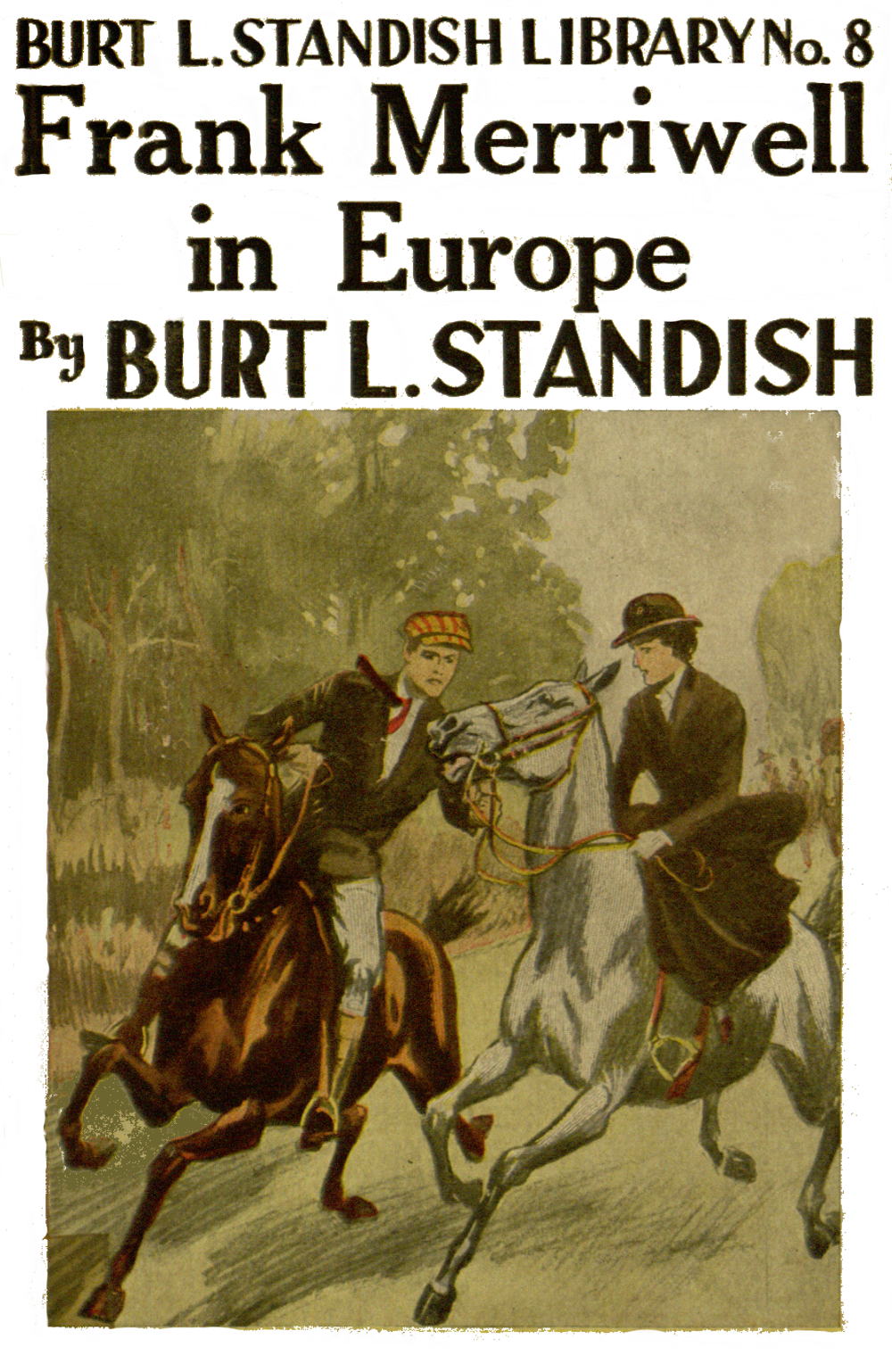
In all the world there is no name more beloved by youthful readers
than that of BURT L. STANDISH.
For many years his stories of Frank Merriwell have been the
inspiration of thousands of boys who desire to succeed in athletics.
Without preaching, Mr. Standish drives home proof after proof
that right living is the only way to live. Hence, the popularity of
the Merriwell stories.
ALL TITLES ALWAYS IN PRINT
BURT L. STANDISH LIBRARY
In order that there may be no confusion, we desire to say that the
books listed below will be issued during the respective months in New
York City and vicinity. They may not reach the readers at a distance
promptly, on account of delays in transportation.
To be published in July, 1930.
1—Frank Merriwell’s Schooldays
2—Frank Merriwell’s Chums
To be published in August, 1930.
3—Frank Merriwell’s Foes
4—Frank Merriwell’s Trip West
5—Frank Merriwell Down South
To be published in September, 1930.
6—Frank Merriwell’s Bravery
7—Frank Merriwell’s Hunting Tour
To be published in October, 1930.
8—Frank Merriwell in Europe
9—Frank Merriwell at Yale
To be published in November, 1930.
10—Frank Merriwell’s Sports Afield
11—Frank Merriwell’s Races
To be published in December, 1930.
12—Frank Merriwell’s Party
13—Frank Merriwell’s Bicycle Tour
NOTE THE NEW TITLES LISTED
Western Story Library
For Everyone Who Likes Adventure
Ted Strong and his band of broncho-busters have most exciting adventures
in this line of attractive big books, and furnish the reader
with an almost unlimited number of thrills.
If you like a really good Western-cowboy story, then this line is
made expressly for you.
ALL TITLES ALWAYS IN PRINT
1—Ted Strong, Cowboy
By Edward C. Taylor
2—Ted Strong Among the Cattlemen
By Edward C. Taylor
3—Ted Strong’s Black Mountain Ranch
By Edward C. Taylor
4—Ted Strong With Rifle and Lasso
By Edward C. Taylor
5—Ted Strong Lost in the Desert
By Edward C. Taylor
6—Ted Strong Fighting the Rustlers
By Edward C. Taylor
7—Ted Strong and the Rival Miners
By Edward C. Taylor
8—Ted Strong and the Last of the Herd
By Edward C. Taylor
9—Ted Strong on a Mountain Trail
By Edward C. Taylor
10—Ted Strong Across the Prairie
By Edward C. Taylor
11—Ted Strong Out for Big Game
By Edward C. Taylor
12—Ted Strong Challenged
By Edward C. Taylor
13—Ted Strong’s Close Call
By Edward C. Taylor
14—Ted Strong’s Passport
By Edward C. Taylor
15—Ted Strong’s Nebraska Ranch
By Edward C. Taylor
16—Ted Strong’s Cattle Drive
By Edward C. Taylor
17—Ted Strong’s Stampede
By Edward C. Taylor
18—Ted Strong’s Prairie Trail
By Edward C. Taylor
19—Ted Strong’s Surprise
By Edward C. Taylor
20—Ted Strong’s Wolf Hunters
By Edward C. Taylor
21—Ted Strong’s Crooked Trail
By Edward C. Taylor
22—Ted Strong in Colorado
By Edward C. Taylor
23—Ted Strong’s Justice
By Edward C. Taylor
24—Ted Strong’s Treasure
By Edward C. Taylor
25—Ted Strong’s Search
By Edward C. Taylor
26—Ted Strong’s Diamond Mine
By Edward C. Taylor
27—Ted Strong’s Manful Task
By Edward C. Taylor
28—Ted Strong, Manager
By Edward C. Taylor
29—Ted Strong’s Man Hunt
By Edward C. Taylor
30—Ted Strong’s Gold Mine
By Edward C. Taylor
31—Ted Strong’s Broncho Boys
By Edward C. Taylor
32—Ted Strong’s Wild Horse
By Edward C. Taylor
33—Ted Strong’s Tenderfoot
By Edward C. Taylor
34—Ted Strong’s Stowaway
By Edward C. Taylor
35—Ted Strong’s Prize Herd
By Edward C. Taylor
36—Ted Strong’s Trouble
By Edward C. Taylor
37—Ted Strong’s Mettle
By Edward C. Taylor
38—Ted Strong’s Big Business
By Edward C. Taylor
39—Ted Strong’s Treasure Cave
By Edward C. Taylor
40—Ted Strong’s Vanishing Island
By Edward C. Taylor
41—Ted Strong’s Motor Car
By Edward C. Taylor
42—Ted Strong in Montana
By Edward C. Taylor
43—Ted Strong’s Contract
By Edward C. Taylor
44—Ted Strong’s Stolen Pinto
By Edward C. Taylor
45—Ted Strong’s Saddle Pard
By Edward C. Taylor
46—Ted Strong and the Sioux Players
By Edward C. Taylor
Frank Merriwell in Europe
OR
Working His Way Upward
By BURT L. STANDISH
Author of the famous Merriwell stories.
STREET & SMITH PUBLICATIONS
INCORPORATED
79-89 Seventh Avenue, New York, N. Y.
Copyright, 1896, 1903
By STREET & SMITH
Renewal granted Gilbert Patten, 1924
───
Frank Merriwell in Europe
All rights reserved, including that of translation into foreign
languages, including the Scandinavian.
Printed in the U. S. A.
FRANK MERRIWELL IN EUROPE.
CHAPTER I. THE ARRIVAL AT TANGIER.
“Hurrah, Ephraim, here we are at last!”
It was Frank Merriwell who spoke. He was standing
on the deck of a steamer which was approaching the
coast of Morocco. Beside him stood his old chum and
former schoolmate, Ephraim Gallup, from Vermont.
“Is thet Tangier?” came from Ephraim, as he gazed
ashore with interest.
“It is.”
“Funny looking place, I must say. Not a bit like the
United States. But it’s a heap sight better nor them
places we stopped at in South Africy, by gosh.”
“Let us hope so. I trust we have a more quiet time
here than we did there.”
“Great catfish, Frank, so do I! Why, it was awful,
the things thet happened to us in Africy. No, I don’t
want no more sech happenin’s in mine, by gum!”
As old readers of the Frank Merriwell stories know,
Frank was now on a grand tour to different quarters
of the globe. On the death of his guardian he had come
into possession of much money, and his guardian had desired
that he do some traveling before settling down.
Frank was to take with him a professor and one boyish
companion. At present the professor, Horace Scotch,
was not with the youth, but Ephraim was, and the two
had just come up from the lower coast of Africa, where
they had passed through numerous adventures, as related
in “Frank Merriwell’s Hunting Tour.”
“Look, Ephraim!” went on Frank. “Yonder is Tangier,
lying like a snow-white pearl on the shore of the
blue Mediterranean. It is a sight to quicken the blood.”
He pointed to the white walls of a city that could be
plainly seen.
“It looks purty fair from here,” admitted the Vermonter;
“but ‘cordin’ to yeour own statement abaout it,
it won’t look so well when we git there.”
“That is very true; but it is the gateway to a strange
land for us—a land of strange people, strange customs,
of wonders and marvels innumerable. Besides that, I am
tired of the sea, and I long to get ashore once more.”
“By gum! I don’t blame ye fer that. But I’d
ruther git ashore where folks are civilized. I’ve seen
enough uv black men an’ heathen.”
Frank laughed.
“Surely we have had our fill of them; but I would not
like to return home without visiting Morocco.”
Before long the speed of the steamer began to lessen,
and it finally came to a stop, the anchor chains rattling,
as the anchors were dropped.
“Hang it all!” exclaimed Ephraim, clutching Frank’s
arm. “Will yeou jest look there! Is that a gang uv
crazy critters comin’ to attack the steamer, ur what do
they want?”
Some boats were pulling off from the shore, and behind
them was a swarm of tattered Arabs, half naked,
wading in the water, advancing toward the vessel, waving
their arms wildly, and uttering strange cries.
“Evidently that is one of the queer things we are to
see in this country,” said Frank, quietly.
The boats reached the steamer, and the passengers
were hurried into them by the boatmen. Frank and
Ephraim succeeded in getting into one boat, and were
called on to pay for their passage immediately after they
had left the steamer.
The boats moved toward the throng of tattered terra-cotta-colored
human beings, some of whom had waded in
the water to the middle of their thighs.
As soon as this disreputable-looking horde was reached
it precipitated itself upon the boats. The passengers
were seized by the jabbering gang, as if they were to be
put to death without delay.
One old fellow grabbed Ephraim and tried to drag him
from the boat.
“Git aout!” squawked the boy from Vermont.
He hit the old Arab a back-handed blow with the flat
of his hand, knocking the man over in a twinkling.
But the old Arab was not to be baffled in such a manner.
Dripping with water, he scrambled up and grappled
with the excited youth.
Seeing a catastrophe was coming, Frank lost no time
in climbing out of the boat to the shoulders of a burly
mulatto, where he sat in a comfortable position, waving
his hat and shouting:
“Go it, boys! I’ll bet two to one on Vermont! Yankee
Doodle forever!”
“Stand off, ye black pirut!” howled Ephraim, who had
been somewhat blinded by the splashed water. “Keep
yeour dirty hands off me, or I’ll——Wa-ow!”
Over went the boat, precipitating the boatman and the
Yankee lad into the water, where there was a general
floundering about, much to the amusement of the other
passengers.
Frank Merriwell’s hearty laugh rang out.
“If this is a sample of what we’ll strike in Morocco,
we’ll have fun,” he cried.
Ephraim came to the surface, spouting like a whale.
“Hang ye!” he squealed, standing up and shaking
his fist at the bewildered Arab. “Yeou wait till we git on
dry land, critter! I’ll fix ye!”
Then he began to wade ashore.
“I am surprised, Ephraim,” said Frank, soberly, “that
you should make such a racket over a matter like this.
The tan-colored gentleman simply wished to carry you
ashore, as the water is too shoal to permit the boats to
approach nearer. You will observe that all the passengers
are going ashore in that manner.”
The lad from Vermont looked around, seeing that
Frank spoke the truth. The ladies were being carried
ashore in chairs, while the male passengers bestrode the
necks of the Arabs and negroes.
“Wal, why in thutteration didn’t they tell a feller what
they was arter!” growled Ephraim, looking ashamed and
disgusted. “They acted jest ez if they wanted to murder
the hull on us.”
When the shore was reached, Frank paid for the transportation
of both himself and Ephraim, as the old fellow
whom the Vermonter had upset demanded payment.
“Here we are!” Merriwell cried. “And now we will
find a hotel.”
Inquiry revealed that there was one European hotel in
the city, and Frank secured a guide to pilot them thither.
Ephraim grumbled as they made their way along. He
was dripping with water, and presented a ludicrous aspect,
but the populace in the streets did not smile upon
him. He was greeted in a stoical, indifferent manner,
as if he were a worm of very small importance. Men
drew aside from the boys, and women avoided them,
while children fled in terror.
“Real sociable people,” chuckled Frank. “Judging by
the way they act, any one would think we must be blood-thirsty
savages.”
Nearly all the people in the streets were enveloped in
a sort of long, white woolen cloak, with a large cowl,
generally worn straight up on the heads, so that the
whole city presented the aspect of a convent of Dominican
monks.
Some of these hooded people passed gravely, slowly
and silently, a dreamy look in their eyes, as if their
thoughts were far away; some remained seated or
crouching along the walls, or at the corners of houses, immovable
and with fixed eyes, like the enchanted ones of
the “Arabian Nights.”
On their way to the hotel they passed through several
narrow, winding streets, flanked by small white
houses, without windows, and with small, mean doorways,
through which it could not be easy to enter.
In many of the streets nothing was to be seen but the
whiteness of the walls and the blue sky overhead.
Nearly all the streets were littered with rotten vegetables,
feathers, rags, bones, and sometimes with deceased
cats and dogs.
As may be imagined, the odors were often anything
but agreeable.
At long intervals were seen groups of Arab children,
playing or reciting verses from the Koran in a nasal
drone.
Beggars were plentiful, squatting along the streets.
Here and there the nostrils of the boys were assailed
by the odor of garlic, burnt aloes, benzoine, fish, and
things unnamable.
The square was reached, and was found to be a little
rectangular place, surrounded by wretched shops.
At one side was a fountain, around which was a crowd
of Arabs and negroes, engaged in drawing water in
various vessels.
At the other side of the square, veiled women were
seated on the ground, offering bread for sale.
The little square was thronged with almost naked vagabonds,
rich Moors, Jews, employees of the legations, the
houses of which were near at hand; interpreters and beggars
galore.
For the time, Ephraim forgot that he had received a
ducking. He looked around, his jaw dropping.
“Hanged ef this don’t beat the deck!” he muttered.
“Never saw nothing like this before.”
“It is rather interesting,” replied Frank. “I fancied
you would find it so.”
At this moment a veiled girl suddenly broke away
from two men, who seemed to be acting as her escorts,
gave a low cry of joy, rushed toward the boys, and flung
her arms about Merriwell’s neck, sobbing:
“Frank! Frank! they said you were dead!”
Never in his life was Frank Merriwell more astonished.
He could scarcely believe he had heard aright.
Ephraim Gallup caught his breath and gurgled:
“Wal, by gum!”
Shouts of surprise and rage broke from the men who
had accompanied the girl. Quickly drawing short,
curved swords from beneath their cloaks, they sprang
toward the lads.
“Unhand her, Christian dogs!” roared one, flourishing
his sword, as if he would cut Frank down in a moment.
“Take me away!” implored the girl. “I am willing to
go with you now! Do not let them touch me again!”
That appeal was enough to arouse the chivalry in
Frank’s nature. Swinging her to one side, he drew a revolver.
“Stand off!” he ordered, sternly.
“And keep off!” squealed Ephraim, as he let his
clinched fist shoot out and catch one of the men under the
ear.
It was a heavy blow, and the old Moor was knocked
down in a twinkling.
A roar went up from all sides, and a rush was made for
the two lads, who found themselves surrounded by a
furious and raging mob.
It had come about with marvelous swiftness, so that
even Frank was a trifle bewildered.
Some of the mob brandished daggers and scimiters,
and all seemed thirsting for the blood of the two youths.
The old fellow who had been knocked down got upon
his feet, waved his arms, and shouted forth an order.
In the twinkling of an eye, the lads found themselves
overwhelmed. The revolver was dashed from Frank’s
hand, the girl was torn from his grasp, and he received a
blow that staggered and dazed him.
Ephraim was used no less severely.
The second Moor, the one who had shouted at Frank
in English, now ordered the mob back. He addressed
them in Arabic, and they seemed to give over the assault
on the boys with great reluctance, drawing back slowly.
Not knowing what might follow this move, Frank held
himself in readiness for anything, regarding the old
Moor with no little curiosity.
The man turned on the boys, gazing at them gloweringly,
as if he longed to annihilate them, yet hardly
dared. After some moments, he spoke.
“Knaves,” he growled, “you should die. Do you
know what you have done, miserable Christians?”
“Attempted to defend a girl who appealed to us, but I
made a sad failure of it,” replied Frank, looking around
for the mysterious girl, but seeing nothing of her.
“You have defiled her with your touch, and she is the
Pearl of Tangier! But that is not all. You struck Ben
Ahmet, who is her uncle and protector, and who is also a
descendant of Mohammed, the sacred one.”
“Is that so!” drawled Ephraim, dryly. “Wal, I
wouldn’t ‘a’ struck Ben ef I hedn’t thought it necessary.
As he’s a trifle older then I be, I’m sorry I hit him at all.
Jest tell him I apologize.”
“Bah! That will not wash away the stain. Your blood
would have flowed if he had ordered it so. From this
hour you are marked. If you remain in Morocco you
shall not escape just punishment for your offense. It is
best that you delay not in leaving the country.”
Frank whistled.
“This is interesting,” he said, coolly. “We have just
arrived.”
“It matters not. If you would live, depart at once.”
“Well, we will think it over. We can’t go till the
steamer leaves, unless we swim across the straits, and
that would be too much trouble.”
“I have spoken.”
“And who be yeou?” demanded Ephraim.
“I am Ali Mustaf, the Cadi of Thwat, favored by the
Prince of Believers and Vicegerent of God upon Earth.”
“Wal, gol dern my cats!” gasped the boy from Vermont.
“We didn’t know we’d run up against anything
like that. Will yeou excuse us for livin’!”
“You have heard. Take heed.”
Ali Mustaf turned and waved his hands to the throng,
whereupon the mob slowly and reluctantly dispersed, giving
the boys many black looks, and muttering sullenly.
Ali Mustaf and Ben Ahmet moved away.
“What in the world became of that girl?” muttered
Frank, looking about. “She disappeared in a twinkling.”
“She was carried away by some uv the craowd,” said
Ephraim. “One uv them old varmits must hev told
them to take her away.”
“And she knew me.”
“She did?”
“Surely. Didn’t you hear her call me by name?”
“I guess I did. But haow in thunder did she happen
to know yeou?”
“That is a mystery—one I would give something to
solve.”
Then Frank’s face became clouded again, and he bit
his lip, looking about in an unsatisfied way.
“How shall I find her again?” he murmured. “I did
not see her face. I should not know her if I saw her.”
“I kainder guess we’ll have aour hands full, without
botherin’ abaout her. Mister Mustaf informed us that
we was marked.”
“That was a bluff to scare us out of the country.
These swarthy fellows do not like Christians. They
dare not harm us, however. If they did, they would not
have stopped when they were crowding around us a short
time ago.”
“Mebbe yeour right, Frank. Yeou ’most alwus be,
but somethin’ kainder tells me we’ll have more trouble
with Mister Mustaf and Mister Ahmet.”
“I could not go away without making another attempt
to see that mysterious girl. Something tells me she is in
serious trouble. Besides that, my curiosity is aroused,
and I must know how she learned my name. It is possible
I have met her before. More than that, I have
thought of another possibility.”
“What is it?”
“She spoke perfect English.”
“Yes.”
“Which is remarkable, as everything indicated she
could not be more than sixteen or seventeen.”
“Wal?”
“Moorish girls of that age are not likely to have opportunities
to learn the English language.”
“I s’pose not.”
“Can’t you see what I am driving at?”
“Dunno’s I kin. I’m kainder thick-headed.”
“Why, she may not be a native of this country at all—she
may be an English or American girl.”
“Great gosh!”
“And she may be a captive. It is possible she has been
kidnaped for the harem of some miserable old Moor. The
thought makes my blood boil. Ephraim, we have a mission
in Morocco. It is to find that girl and rescue her, if
needs be. We will do it!”
“We will do it!”
Before the eyes of the wondering rabble the dauntless
boys clasped hands.
CHAPTER II. FRANK SEEKS INFORMATION.
When they looked around for the guide whom they
had employed to lead them to the only European hotel in
the city it was found that the fellow had fled, affrighted
by the encounter which had taken place in the square.
The boys were about to look for another guide when,
with cries of surprise and joy, a small, red-whiskered
man, dressed in a tourist’s traveling suit, such as is worn
in hot countries, came hurrying toward them.
“Hang me ef I don’t b’lieve I’ve seen him afore!” exclaimed
the boy from Vermont. “Them whiskers look
nattral. It is——”
“Professor Scotch, as I live!” joyfully shouted Frank
Merriwell. “Will wonders never cease! This is miraculous.”
The little man ran forward and caught Frank’s hands,
looked into his face, as if making sure he was not mistaken,
and then clasped the boy in his arms.
For some time the little man was nearly overcome with
joyful emotions, and Frank was scarcely less delighted.
It was, in truth, Professor Horace Scotch, Frank’s
guardian, who had thus marvelously appeared in Tangier.
Mutual explanations followed quickly. Frank told
how he happened to be there, and then the professor
related how on arriving in London he had received a letter
from the boy, but had been disappointed beyond measure
when Frank did not appear in due time. He had
written scores of letters and sent many telegrams, but
had been unable to learn anything more than that Frank
had left Buenos Ayres in a vessel bound for South Africa,
but which had been lost at sea.
The professor had nearly given up all hope of ever
seeing his protégé again, thinking Frank must be dead.
He resolved, however, to make every effort to ascertain
the facts as to Frank’s fate, and had left London for that
purpose.
The United States Consul at Tangier was an old friend
of the professor, and thus it came about that Scotch had
visited him.
Then the boys came.
The professor was so agitated that his explanation was
somewhat incoherent, but Frank was able to get the drift
of it.
When his excitement had subsided a bit, the little man
began to scold. He soundly berated the boy for running
off to South America without permission and continuing
over the world on his own hook.
Frank listened quietly, a smile on his face.
“There, there, professor,” he finally said. “What’s
the use of making a fuss about it. Wait till we get to
the hotel, and I will explain more fully why I went to
South America.”
So the professor led the way to the hotel.
The professor had obtained a native servant by the
name of Azza, and the fellow was immediately dispatched
for the luggage of the two boys, being given a written
order by them.
While waiting for the luggage, the trio talked matters
over.
Azza returned with the luggage in due time.
Both lads lost no time in exchanging their clothing for
suits of white duck, suitable for the climate.
“There!” exclaimed Ephraim. “I feel better, by gum!
Them wet duds warn’t comfortable.”
A square meal followed, and then Frank told the professor
of their adventure since arriving in Tangier.
“Merciful goodness!” gasped the little man, with uplifted
hands. “It’s a wonder you were not both killed.
These Moors are dreadful creatures, and they do not consider
the life of a Christian of any consequence. I have
heard of Ben Ahmet. He is very rich.”
“I don’t care about him,” said Frank. “What I want
to know is if that girl was truly his niece.”
The professor called Azza, and Frank questioned the
fellow.
Azza declared that Ben Ahmet had a niece who was
known far and wide as “the Pearl of Tangier,” a title
which had been given her when she was yet a child. It
was rumored that she was very beautiful. Her name was
Igela.
Igela’s father, unlike most Moors, had traveled much
outside his own country. Originally he was a very poor
merchant, but it was said he had traveled as far as
London and had learned tricks of trade from Christian
dogs, so that he came back to his own country and soon
made a fortune.
He was an exporter of goods, largely handling the caps
made at Fez. One of his customers, a great English
merchant, once visited him, and was received graciously
in the Moor’s house. This was but shortly before the
death of Igela’s father.
Igela was the old merchant’s only child. He regretted
much that she was not a boy, for she displayed much
business capability.
The old merchant left his property to his child, intrusting
her to the care of his brother, Ben Ahmet.
Ben Ahmet had also made much money, but he was
quite unlike his brother. He hated Christians so that he
would not do business with them, and he would not speak
a word of their language, although he understood much
of it.
Seeing that Igela was budding into womanhood and
was very beautiful, Ben Ahmet made her conceal her face
with a veil. Still she was known far and wide as the
Pearl of Tangier.
There were many who sought Igela for a wife, but it
was said that she had acquired strange notions of marriage,
and had refused to accept the man whom her uncle
chose, saying she would suit herself in that matter.
That was all Azza knew about her.
“Very interesting,” commented Frank; “and still unsatisfactory.
It seems that Igela knew me to-day, and
that she can speak almost perfect English. Who is Ali
Mustaf?”
“He is a powerful cadi, or tax-gatherer,” answered
Azza. “It is said that he seeks the Pearl for a wife.”
“Ha! Then that explains his remarkable interest in
her, and it likewise explains why she fled from him. This
is becoming as interesting as a romance. I feel in duty
bound to offer her my assistance. But how am I to
do so?”
That was a question not easily answered, and Frank
puzzled over it for a long time.
Professor Scotch was alarmed by what had happened,
by Frank’s manner, and by the threat which the Moor had
uttered against the boys. He was in favor of getting
out of Morocco without delay, but Frank had no thought
of being frightened away thus quickly.
“Look here, Azza, old boy,” he said, “I’ll make it
worth your while if you will take a note to Igela. Can
you do it?”
“I can try.”
“Well, that is something.”
In vain the professor urged him not to send a note,
nor to attempt to communicate in such a manner with
the mysterious girl.
“Don’t get fluttery, professor,” advised Frank, coolly.
“If you try to be too strict with me, I may take a fancy
to run away again.”
The professor groaned.
“You are incorrigible,” he declared. “It is impossible
to do anything with you.”
So Frank wrote the note and sent Azza out with it,
offering him a tempting reward if he would deliver it
into the hand of Igela, and warning him to give it up to
no other person. He worded it briefly as follows:
“To Igela, ‘The Pearl of Tangier’:
“Are you in trouble? Do you need assistance. If so,
tell me how I may aid you.
“Frank Merriwell.”
Azza was away from the hotel for nearly two hours.
At length he returned and placed a folded paper in
Frank’s hand, saying simply:
“This is her answer.”
Eagerly Frank opened the paper, but in a moment a
look of disappointment came over his face.
“It is written in Arabic,” he said. “I cannot read it.”
Azza bowed low.
“It will give me great pleasure to read it for you,” he
said.
Frank scanned the fellow closely.
“Can you read writing?” he asked, as if somewhat
doubtful.
Azza assured him that he could both read and write.
Frank hesitated a moment, and then passed the note to
the servant. Azza translated it as follows:
“I am in great trouble, and you can aid me. Come
this evening at nine. Azza will guide you. Trust all
to him.
“Igela.”
Frank frowned, and then he questioned the Arab.
Azza told how he had found the house of Ben Ahmet,
and had lingered till he saw one of the sheriff’s servants
whom he knew. By the servant he had sent word to
Igela, and she had finally appeared at the parapet of the
terrace. Then Azza had attached Frank’s note to a
small stone, which he had tossed to her. She had read it,
had written the reply, and then had instructed Azza to
guide Frank to a certain spot that evening, saying she
would be there.
Frank was not quite satisfied with this story.
“It is rather remarkable that she could read my note,
written in English, and could not write a reply in English,”
he said, watching the face of the Arab closely.
“She was much excited,” Azza calmly explained.
“She feared much that she might be seen.”
“But that doesn’t explain why she did not write in
English.”
“She must have forgotten in her haste and excitement.”
Frank was forced to confess to himself that such a
thing would be very natural, but still he questioned Azza.
It became evident, after a little, that the Arab was very
shrewd or perfectly truthful, and the boy was inclined to
think him the latter.
Frank went to his room and pondered over the matter
for some time. He realized that by many he would be
considered foolish in his attempt to aid this unknown
girl.
But his curiosity was thoroughly aroused. He could
conceive of no possible way that she could have known
him in the past, and yet she had fled to him for assistance,
calling him by name.
A mystery of that sort was quite enough to make
Frank determined to seek the solution.
And never had he turned away when appealed to by
beauty in distress. That this girl was in trouble and
hoped for assistance from him was certain.
“I will go to her to-night,” he resolved. “I will aid
her, if it lays in my power to do so. That is settled.”
Ephraim came into the room and found Frank putting
on a lead-colored garment, which he wore beneath his
outer shirt.
Frank showed his comrade the note from Igela, and
explained what the girl had written.
Ephraim looked doubtful, and shook his head in a
sober way.
“I’m afeared yeour goin’ to git into a heap uv trouble,
Frank,” he said. “I’ll bet a big squash Mister Ahmet is
kainder keepin’ watch uv yeou, an’ he’ll know ef ye try
to see the gal.”
“Oh, you are getting to be a veritable croaker, Ephraim.
I am not afraid of Ben Ahmet, and I am determined
to have a talk with Igela.”
“Wal, I ruther guess yeou’ll do jest as yeou durn
please, fer I’ve alwus noticed yeou do. Yeou’d better
take me along with ye.”
“Not on this trip, Ephraim. I am going to go it
alone.”
Still Frank was doubtful, although he would not confess
it, even to himself. He carefully examined his revolvers,
taking both of them.
Professor Scotch came in and expressed his curiosity
over a queer little cabinet which Frank had taken from
his trunk.
“Oh, that’s a curiosity I picked up,” explained the boy.
“I fancied it might come in handy some time, and I mean
to carry it home with me.”
“But what in the world is it?” asked the professor,
endeavoring to open it, but being unable to do so. “How
do you get into the thing?”
“This way.”
Frank touched the cabinet, and the top flew open, while
up shot the head of a serpent with forked tongue and
fiery eyes, seeming to hiss and strike at the professor.
CHAPTER III. THE PROFESSOR IS PUZZLED.
Professor Scotch gave a shriek of terror, and fell over
backward.
“Save me!” he roared. “I’m a dead man! Kill the
thing!”
“What’s all this about?” asked Frank, in apparent surprise.
“What is the matter with you, professor?”
“Snakes! snakes!”
“Snakes? What are you talking about? Where?”
“There! Why, where is it? It has gone!”
The professor sat up and stared in amazement at the
cabinet, which was wide open, but no snake was in
sight.
“Too bad!” said Frank, turning to Ephraim. “I did
have a faint hope that the professor would leave it off,
but it is still plain that he sometimes looks on the wine
when it is red.”
“What’s that?” roared the little man, who had a big,
hoarse voice. “What do you mean? Do you insinuate
that I have been drinking?”
“Of course I do not wish to hurt your feelings,
but——”
“I tell you I saw a snake!”
“Too bad!” sobbed Frank, getting out his handkerchief,
and pretending to wipe a tear from the corner of
his eye.
“But I am positive of it.”
“They always are.”
“It must be right here somewhere. Look around
for it.”
“I wouldn’t, professor—you may see something worse.”
The professor was aroused. He had permitted the
United States Consul to treat him rather generously with
strong drink since coming to Tangier, but he was positive
that had nothing to do with the appearance of the snake,
and he was angry with Frank for insinuating anything
of the sort.
“Look out!” he rumbled, grasping his cane and thrusting
it into the cabinet. “I’ll poke the reptile out, or—Whoop!
Murder! Take it off!”
With a shrilling squeal, a large rat had jumped out of
the cabinet and seemed to run along the cane toward the
professor’s hand.
The little man dropped the stick in an instant, and
once more fell flat upon the floor, where he made a wild
scramble to get away, and stopping only when he had
reached a distant corner, where he sat up on the floor, his
back against the wall, his eyes popping from his head.
“Where is the beast?” he gurgled, hoarsely.
Frank turned to Ephraim, wringing his hands in apparent
distress.
“The professor has gone mad!” he moaned.
“Mad!” roared the little man, gathering courage, as
he saw nothing of the rat. “Who wouldn’t be mad to
have a slimy serpent strike at him, and then be attacked
by a red-eyed rat?”
“Too bad! too bad!” sighed Frank. “I fear he will
become violent. We must send for a doctor immediately.”
“Doctor!” howled Scotch. “I don’t want a doctor. I
tell you I’m all right! But I know when I see a snake
and a rat. The snake hissed at me, and the rat tried to
get on my hand.”
“It is a very bad case,” came soberly from Frank,
while Ephraim turned his head to hide a broad grin.
Scotch got on his feet, and danced around like a maniac.
“Confound it all!” he shouted. “There’s nothing the
matter with me! I am all right! I know what I see!”
Frank followed him up, patted him on the back, caressed
his hand, and said, soothingly:
“Of course you know—to be sure you do. There was
a whole drove of snakes, and more than a hundred rats.”
“No, there wasn’t!” snarled the little man, grinding
his teeth. “Don’t tell me that! Think I’m a fool?”
“Too bad!” sighed Frank, giving Ephraim a lugubrious
look that nearly convulsed the lad from Vermont. “This
is the way with them every time. Now he is sure he
didn’t see any snakes and rats. That is proof positive
that he is in a dangerous condition. Wouldn’t it be terrible
if we found it necessary to have him taken in charge
and cared for constantly?”
Professor Scotch gave an exhibition of a wild and
somewhat original war dance. When he was out of
breath, he paused in front of Frank, shaking his fist in
the boy’s face as he gasped:
“I see through your little game. You want to get rid
of me! You want to go as you please! You want to do
as you choose! That’s why you ran away to South
America. But it won’t work, you young rascal! I’ll
stick by you now, though you may bring my gray hairs
in sorrow to the grave.”
Then he tramped up and down the room like a caged
tiger. Coming near the cabinet, he lifted his foot to give
it a kick, but, at that instant, a hollow voice that seemed
to come from the cabinet itself, said:
“Beware! Touch me not!”
And then a grinning skull popped into view and nodded
familiarly at the little man.
The professor gave a howl, and rushed out of the room,
leaving the two boys, who were in paroxysms of laughter.
When the boys had ceased to laugh somewhat, Frank
approached the cabinet, rolling up a little ball of invisible
cord as he did so. Without hesitation, he took hold of
the skull and thrust it back into the compartment from
which it had popped into view.
“There,” he said, “I rather fancied this cabinet would
afford me some amusement when I bought it from that
traveling magician. The professor forgot that I sometimes
practice ventriloquism, and so he fancied that it
was the skull that spoke. If he had continued to monkey
around that cabinet I would have shown him some other
things of a surprising nature.”
Then he arranged everything in the cabinet, which he
closed and returned to his trunk.
Under cover of darkness, guided by the dark-skinned
Azza, Frank left the hotel shortly before nine.
Azza avoided the square, and stole along the dark and
narrow streets with a swift, cat-like tread.
Frank followed closely, making sure his revolvers were
ready for instant use.
Both man and boy were enveloped in the hooded cloak
so common in Tangier.
The shoes which Frank wore had cork soles, so his
footsteps made very little noise.
At intervals they brushed against persons who were
moving in the narrow streets, and Frank seemed to see
sharp eyes peering at him from beneath beetling brows.
Tangier was not a pleasant city to roam about in after
nightfall.
It seemed to Frank that it was a city well adapted to
dark deeds—a place where crime might thrive with little
fear of punishment.
As far as possible, Azza avoided the pedestrians who
were moving on the streets.
In every nook and angle dark shadows lurked, like
crouching assassins, and more than once the boy clutched
his revolver, ready to draw and defend himself from attack.
They passed through a maze of winding streets, so that
the boy became quite bewildered. He had thought to remember
every turn, so he could return to the hotel without
a guide, if necessary, but he was soon forced to confess
to himself that such a thing would be beyond his
ability to accomplish.
All at once, the silence of the night was broken by a
distant fusillade of shots, and Azza halted suddenly.
They had reached one of the wider streets, which leads
to the gate of Sokko.
Far along the street there was a glare of many
torches, swaying, moving, advancing.
Frank wondered what it could mean, and questioned
his guide.
“Look, and you shall see,” said Azza, drawing the
boy still farther back, so that they might readily step into
the shadow of a wall and let the torches pass.
Frank did look, and he saw a surging crowd of human
beings, revealed by the flaring torchlight, which flickered
over their dusky faces. They were dressed grotesquely
in cloaks and robes and winding garments, and all seemed
greatly excited. Now and then they fired into the air
with muskets and pistols.
Dogs were barking, there were sounds of plaintive
music, and the great throng kept up a droning and nasal
chant, now and then broken by strident cries.
Near the van of the procession was a coal-black horse,
fiery and headstrong, held in check by the powerful Arabs
who walked on either side. On the back of the horse
was something in the shape of an upright coffin.
Frank gazed at this strange procession with interest
and wonder.
“What does it mean?” he asked. “Is it a funeral?”
“No,” replied Azza; “it is the wedding march of a
young girl. She is in that casket. These people are her
parents and friends, who are accompanying her to the
home of her husband.”
“Well, that is certainly very strange and remarkable.”
“To a Christian it may seem strange,” admitted Azza;
“but it is the custom here.”
When the procession had passed, they crossed the street
and went onward along the dark and winding ways.
At last, with a warning hiss, the Arab halted.
Instinctively, Frank felt for his weapons once more,
for, although he could not see his surroundings, he felt
that he was in a rather unsavory quarter of the city. The
smells which assailed his nostrils seemed to assure him
of that.
Azza uttered a soft signal, and then they waited. Twice
he repeated the signal. At the third call a muffled figure
glided out of the shadows and approached them.
“It is Igela,” whispered the Arab.
Frank’s heart leaped. There no longer seemed a doubt
they would meet the mysterious girl who was known
as the Pearl of Tangier.
She came toward them in a hesitating, doubtful way,
till Azza assured her that all was well. Even then she
seemed oppressed by terror and dread. When Frank
stepped toward her she shrank away.
“You need have no fear of me,” he said, softly. “I
am your friend.”
She did not reply, but she still seemed much alarmed.
Frank did his best to reassure her.
“You are in distress,” he said. “Tell me how I may
serve you.”
“Not here,” she whispered. “We shall be seen. Come.”
Her hand touched his, and she led him toward the
wall, where a small door opened.
“Now I will see the adventure through to the end,” he
thought, and he followed her recklessly.
Azza followed, closing the door noiselessly. Frank
could feel the fellow close behind him.
The boy seemed to know it was a rash adventure, but,
with a reckless abandon that sometimes assailed him, he
went on, eager to know what would follow.
The girl led him through a narrow passage and into
a room where a lamp dimly burned. From this room
they passed across an open court, entering by another
small door, and traversing another long passage.
From this they entered a room that was lighted by a
swinging lamp of fantastic pattern. On the floor was
a thick carpet of Rabat, while the walls were hung with
yellow and red tapestries. Mattresses and cushions were
piled everywhere, and the colors of the rainbow met the
eye on every hand.
Frank looked around with interest. The room seemed
to be unoccupied when they entered.
Having made a hasty survey of the apartment, Frank
turned toward the girl; but at that moment there was
a noise behind him, and he wheeled to see two fierce-looking,
bewhiskered, turbaned Moors rush into the room.
They were Ben Ahmet and Ali Mustaf!
“Dog of a Christian!” snarled Ali Mustaf. “You have
walked into the trap, and now, by my beard, you shall
die!”
Ben Ahmet cried out something in his own language,
flourishing a scimiter as if he longed to strike the boy’s
head from his body.
Instead of being overcome with terror, Frank was
astonishingly cool. He surveyed the two Moors complacently.
“So it was a trap,” he quietly said. “Well, I should
have known it, but I did trust this old wretch.”
And then, with remarkable swiftness, he made a spring
and let one hard fist shoot out from the shoulder.
Frank’s knuckles caught Azza on the chin, and the
scoundrel was lifted off his feet and hurled with a dull
thud against the wall, from which he dropped in a limp
heap to the floor.
“That was easy,” laughed the reckless youth, as if he
really enjoyed the situation. “Now, Ben, it is your
turn.”
Ben Ahmet flourished his scimiter, and Ali Mustaf
lifted a long-bladed knife, crying:
“Back, dog of a Christian, or, by Allah! this shall
pierce your heart!”
“Oh-ho! So that’s the trick. Well, if I stand back,
what do you propose to do? Tell me that.”
“You are trapped, knave.”
“Are you sure? I will acknowledge that I allowed
yonder base slave to deceive me; but it is a strong trap
that can hold me.”
“By the beard of the Prophet, you speak boldly, boy.”
“I speak the truth. What do you intend to do with
me?”
“You shall never pass from beneath this roof alive.”
Frank whistled softly.
“That is agreeable information! So you mean to
murder me?”
“You would have lured away the Pearl of Tangier.”
“And you would force her to marry you against her
wishes, you old reprobate! And you are old enough to
be her father—yes, her grandfather! You ought to be
tarred and feathered!”
Ali Mustaf looked as if he longed to sink his glittering
dagger in the heart of the dauntless youth.
“Your tongue shall be torn out by the roots!” he
grated, furiously. “Your body shall be cast to the swine,
Christian dog!”
“You continue to make pleasant promises; but you may
discover it is not possible to make them all good. I expect
to be frisking around on terra firma long years after
you are sleeping sweetly under the daisies.”
Having walked into the trap, Frank was determined
not to show a tremor, knowing it would be the worse
for him if these men saw that he entertained the least
fear.
Azza had crawled to his feet, and he was keeping his
beady eyes on the boy, a savage expression on his crafty
face. Plainly he longed to have revenge for the blow
that had driven him like a bag of sawdust against the
wall.
The girl had remained speechless since entering the
room, much to Frank’s surprise. He had thought she
would be much wrought up over the appearance of her
uncle and Ali Mustaf, but she betrayed no emotion.
Sudden suspicion assailed the boy. Could it be possible
that she had conspired to lead him into this trap?
“Igela,” he cried, “did you know these men were lying
in wait for me? It is not possible that you betrayed me.”
“She did,” declared Ali Mustaf, with fierce satisfaction.
“She brought you here that we might finish you this
time.”
“I will not believe it! It is not possible she could be
capable of such treachery! Tell me it is not true, Igela!
Speak! Say this old wretch lies!”
“It is true!” said the girl. “I aided them in trapping
you.”
CHAPTER IV. A BOY OF NERVE.
Never in his life was Frank Merriwell more taken
aback and chagrined than at that moment. He could
scarcely believe he had heard aright.
Ali Mustaf laughed harshly.
“See what a fool you have been, Christian dog!” he
sneered.
Azza, the treacherous servant, joined in the laughter.
“I aided her in trapping you,” he declared.
“Which is certainly something to be very proud of,”
came contemptuously from the boy. “But you shall receive
your just deserts, you dirty wretch!”
Now Frank was thoroughly aroused, and he showed
his anger in his flashing eyes. He had walked into the
snare against the warnings of his better judgment, but
he had not dreamed of treachery on the part of the girl.
Even now he could not understand why she should betray
him.
“How have I wronged you that you should do such a
thing?” he asked, earnestly. “Tell me that, Igela!”
She turned away, something like a smothered laugh
coming from beyond the veil that concealed her face.
Such treachery appalled Frank, and filled him with
wonder unutterable. He could not understand it. Had he
been lured to that place to be plundered? Was it possible
that this fair girl who was known as the Pearl of
Tangier was the decoy that secured victims for a set of
robbers and assassins?
Even if this were true, it did not explain how she happened
to know his name, when she saw him in the Square
of Tangier for the first time.
All at once Frank started. His eyes had fallen on the
girl’s hand, and he was filled with astonishment.
One swift step the boy took, and then he made a spring,
crying:
“I propose to see the face of the one who betrayed me!”
In a twinkling he had snatched away the veil which
concealed the face of the girl.
The face of a coal-black negress was revealed!
“Igela!” exclaimed the boy, scornfully. “You are not
Igela!”
The girl fell back against the wall, with a cry of fear.
Ben Ahmet and Ali Mustaf uttered fierce oaths in their
beards, starting toward the boy.
In the twinkling of an eye Frank whipped out both his
revolvers, retreated till his back was against the wall,
and cheerfully called:
“Walk right up, gentlemen—walk up and take your
medicine! You shall receive it in large and liberal doses.
Walk up—walk up!”
It is needless to state that they were in no hurry about
accepting his pleasant invitation. The sight of those
glittering revolvers brought them to an abrupt halt.
“What think you, dog of a Christian?” snarled Ali
Mustaf. “Do you fancy you can fight us all?”
“Well, I can make it mighty warm for you.”
“And do you fancy there is a chance for you to escape
from this place alive?”
“You can never make an American give up till he is
dead. As long as there is a spark of life remaining in his
body he will fight.”
“But the odds, miserable boy—think of that.”
“Three men and a treacherous black wench against
one Yankee boy—why, that is nothing at all. Don’t
think you can frighten me in that way, Ali, old boy.”
“Ha! Think you that is all? Fool! There is but
one way that you can leave this room, and it is by this
passage. Look!”
The cadi flung open the door at his back, and the light
showed Frank that the passage was literally filled with
dark-faced ruffians, all of whom were armed to the teeth.
They would have swarmed into the room, but Ali Mustaf
bade them remain where they were, and closed the door
again.
The crafty Moor turned to the boy, expecting to see
him overcome with fear. He was much astonished to
note that Frank stood up with a dauntless look on his
handsome face, showing not the least sign of trepidation.
“Fool!” snarled the cadi once more. “Do you understand
what you have seen? Or are your wits too dull for
that?”
“I understand that I have seen a lot of cutthroats who
are awaiting the call to do your dirty work,” was the
calm reply.
“By the beard of the Prophet! you are a strange
youth! You must know they are longing to shed your
blood. They hate and despise all Christians, and to them
it is a great delight to shed the blood of a Christian dog.
If I gave the signal, they would rush in here and cut you
down.”
“Very good. But you will not give the signal.”
“I will not?”
“No.”
“Why not, dog?”
“Because it would be the signal for your death.”
“What mean you?”
“I mean that I should take particular pains to send a
bullet through your wretched carcass the instant the signal
was given.”
Ali Mustaf’s swarthy skin grew sallow, and he recoiled
a bit.
“Allah save me!” he muttered, in Arabic. “The young
dog means it! It is a marvel that he has no fear.”
Then the two Moors exchanged some words, keeping
their eyes upon Frank all the while.
Frank well understood the peril of his situation, and
he felt that all the chances were against him. At the
same time he had no thought of giving up as long as he
could struggle for his life.
While the men were consulting together Frank’s brain
was busy trying to devise some plan of escape. He felt
that much depended on his wits.
In a few moments Ali Mustaf turned to the boy once
more.
“Put down your weapons,” commanded the old tax-gatherer,
with a severe frown. “Put them down at once.
You can never escape alive if you threaten, but I may decide
to spare you if you surrender quietly.”
Frank laughed scornfully.
“Because I walked into this trap so quietly it is plain
that you believe me a much greater fool than I am,” he
said. “I do not propose to surrender myself a helpless
captive into your hands; but I do propose to hold you a
prisoner till I am once more safe in the streets of Tangier.”
“By my beard!” gasped the cadi. “Who ever heard
of such impudence! Boy, you must be insane!”
“Think you so? Well, madmen are dangerous, and I
advise you to look out for me. If you do not obey my
orders there is no telling what I may see fit to do to you.”
“Your orders!” frothed Ali Mustaf. “Dog! I am
not your slave!”
“But you are my captive, and I shall shoot you full of
holes if you try to skip me. That is plain United States,
and I trust you understand it thoroughly.”
Once more the cadi turned to Ben Ahmet, speaking a
few low, swift words. Immediately the old sheriff would
have left the room, but Frank’s voice rang out sharply:
“Tell him to stop, Ali Mustaf—tell him to stop, or I
will shoot him!”
It was not necessary for Ali Mustaf to repeat the boy’s
words. Ben Ahmet seemed to understand, and he
stopped, grinding out an Arabic oath.
“Good enough!” nodded Frank. “Now we will get
down to business. Ali Mustaf, you must do as I direct, if
you have any desire to prolong your existence in this vale
of tears. I am the ringmaster in this little circus, and I
am liable to use the whip.”
“What would you have me do?” sullenly growled the
cadi.
“First, I would have you cast down that knife. Drop
it, you old pirate, or I’ll drop you!”
Frank’s eyes flashed, and Ali Mustaf made haste to
cast aside the dagger, as if it had suddenly grown red-hot.
“So far it is all right,” nodded the determined youth.
“Now you are to order your side-partner, Uncle Ben, of
the profuse whiskers, to drop his scimiter. That is a real
ugly looking weapon, and I wouldn’t care to have it frisking
around my neck.”
The cadi spoke to Ben Ahmet, and the sheriff reluctantly
dropped the curved weapon.
“What next, dog?” sullenly demanded Ali Mustaf.
“Do you think you have one chance in a thousand of escaping?
Then you deceive yourself greatly.”
“That’s all right; don’t you worry about me. Just
do as I tell you, if you are anxious about your own health.
Something further, Ali, old boy, and that is you’ve altogether
too familiar a manner of addressing me as ‘dog.’
I don’t like it. It is not my name, and I object to it.
Hereafter, you will not use it when you speak to me. Do
you catch on?”
The cadi snarled again, showing his yellow teeth
through his grizzly beard.
“Now,” coolly continued Frank, “the next thing on
the programme will be something else. You are to step
to the door and order the gang of dusky-skinned followers
of the True Prophet outside to retire. You are to inform
them that everything is settled in here, and you will not
need their assistance.”
Ali Mustaf seemed quite ready to do this, but Frank
checked him immediately, calling out sharply:
“Hold on a bit! I want to say this much: Although I
do not speak Arabic, I can understand it pretty well, and
it will not be pleasant for you if you tell the slaves outside
anything but what I have directed. If you do tell
them anything different, so help me Jack Robinson, I’ll
put two or three bullets between your shoulder blades!
Go ahead, old boy.”
Ali Mustaf hesitated, his face black as a stormcloud.
And as he hesitated he saw something that caused a wild,
exultant light of triumph to leap into his eyes.
Behind Frank a panel in the wall opened noiselessly.
At the opening appeared a black face, and then a pair of
powerful black hands closed around the throat of the unfortunate
boy!
CHAPTER V. THE DUNGEON.
Those iron fingers crushed into flesh and sinew till the
bones of Frank Merriwell’s neck cracked with the terrible
pressure. He could not cry out, he could not breathe, he
could not turn about and face his unseen assailant.
In a moment Frank dropped his revolvers and clutched
at those hands, seized the wrists, and tried to tear them
away.
All in vain!
The black man beyond the panel seemed to have the
strength of a Samson and be possessed with a fiendish
desire to crush the life out of the boy.
There was a buzzing sound in Frank’s head, and it
swiftly swelled to a roar. A blood-red mist swam and
swayed before his eyes, and through this he saw the exultant
faces of Ali Mustaf and Ben Ahmet grinning.
Frank felt that he must tear those iron hands from his
throat or he was lost, and he made frantic efforts to do
so, but the frightful pressure had robbed him of his
strength, and his efforts were like the struggles of an infant.
Then it seemed that many lights flared before his
vision, rockets burst into scintillating stars of ten thousand
colors, and all the universe was whirling through a
fiery sea of space.
The roaring in his head had swelled to the thunder of
a Niagara, and then died to the soft murmur of a lapping
brook. He seemed to hear tinkling fountains, delightful
music and sweet voices calling, calling, calling——
Frank sat up. All was dark and dank about him, with
a musty, underground smell. He drew his breath with
difficulty, and there was a terrible pain in his throat and
neck, which now and then sent a dagger dart to the very
top of his head. He knew something had happened, and
he felt that he had been injured, but his senses were confused,
and he could not remember.
He put out one hand. It touched a slimy wall of stone.
He felt beneath him. Wet ground there. He put out
the other hand. Nothingness.
Then he heard some one breathing heavily close at
hand, and the sound—harsh, rasping, blood-chilling, like
the gasping of a strangling person—seemed to turn him
to stone for some minutes. He sat there, listening to
that horrible breathing, fully convinced that a mortally
wounded human being was dying near at hand.
As he sat thus, with a rush, memory returned. He
knew he had been led into a trap by treacherous Azza.
He remembered holding off the two old Moors until he
had been seized by an unseen assailant, and then——
That frightful sound continued near at hand, turning
the boy’s blood icy cold. Had he been thrown into a
dungeon where lay some other victim of the blood-thirsty
Moors—some other unfortunate Christian, it might be?
He held his breath to listen, and the sound stopped.
“He is dead!” thought the horrified lad.
But, a moment later, the rasping breathing began
again, and then Frank made a singular discovery.
The sounds came from his own throat, which had been
fearfully crushed by the iron fingers which had fastened
on it.
He lifted his hand to his neck, and found it terribly
sore to his touch.
“It is a wonder that I am yet alive,” he told himself.
And then came the thought that it might be much
better for him if he were dead and out of his misery.
Beyond a doubt he was a prisoner, confined in some
horrible place, doomed to perish there alone.
Alone! That was a terrifying thought. It seemed
even more horrible than his fancy of a few seconds before
that a dying man was near.
A sudden desire to cry out, to shout, to scream, came
upon him. He opened his lips to do so, but no more
than a hoarse gasp, that was half a groan, came from
them.
He was seized by a feeling of despair—a mad longing
to spring up and rush away somewhere, anywhere.
Staggeringly, feebly he got upon his feet, but then he
was seized by another fear, and he stood still.
Dense and fearful darkness lay all around him, and he
could not see what pitfalls might be on every hand.
The situation was one to chill the strongest heart, to
turn the blood of the bravest man to water.
“This is some secret dungeon beneath the city, and I
shall never escape from it of my own efforts,” thought
the boy. “Who is there to save me? The professor
does not know I left the hotel. I could not tell him, for
he would have forbidden it. I was forced to leave Ephraim
behind to take up the attention of the professor
while I got out. Ephraim knows I was going somewhere
to meet this mysterious Igela, as I supposed, but he does
not know where I was going. How will they trace me?”
That was a question to which he could not find a ready
answer.
“Even if Ephraim and the professor were to confront
Ali Mustaf and Ben Ahmet and accuse them, the two rascally
old wretches would plead utter ignorance, and there
is little chance for a Christian to obtain his rights in this
country. The professor might get the United States Consul
to do something, but I have my doubts.”
Frank fully understood how desperate and almost hopeless
his situation must be. At first he wondered that he
had not been killed outright, and then he came to believe
that Ali Mustaf and Ben Ahmet had hated him so that
they had thrown him into the dark underground place to
perish by inches in order that he might suffer wretchedly.
And then it was possible that they had believed
him dead when they cast him in there.
For all of the boy’s gloomy thoughts, he found his
strength returning, and strength brought hope. He
would not give up as long as life and energy were left in
his body.
But what could he do?
“If I had a light!”
He uttered the words aloud, finding that his voice had
regained its power in a measure, but it sounded hoarse,
unnatural and muffled.
As the words left his lips, there was a sudden squeaking
and a hurried scampering sound that seemed to make his
hair stand up.
“Rats!”
They were there in large numbers.
“Great Scott!” gasped the boy. “I had rather face a
tiger than a swarm of rats in a dark cellar!”
Nervously he felt through his pockets. His purse was
gone, but it had not contained much money. Not a
weapon was left him, his clasp-knife having been taken,
with other things.
Then he uttered a cry of joy.
His fingers had found his waterproof match safe,
which he constantly carried.
That had not been taken from him.
“A match!” he palpitated. “That will show me something!”
In another moment he had taken the match safe from
his pocket, but, in his nervousness, he dropped it.
With a muttered exclamation of dismay, he stooped to
find it.
A moment later a gasping cry of horror came from his
lips.
His hands touched something cold and slippery, and
that touch was enough to make him shudder and quake.
Frank fell back, and for some minutes he crouched
there in the darkness of that terrible place, feeling cold
chills run down his back.
“I must have those matches,” he finally muttered, although
the words were broken and unsteady. “It is a
case of must, and I’ll find them, even if I have to feel the
thing all over.”
He seemed to feel himself in the midst of unseen horrors,
and he longed to rush from the spot, but he knew
that there would not be one chance in a hundred of his
finding the matches if he moved away.
Setting his teeth and nerving himself for the task, he
felt about for the match safe—and found it!
With a feeling of unutterable joy and relief he clutched
the metallic case. His fingers found the spring, and it
opened to his touch.
Snap—splutter—flare!
A match was lighted. It flared up, and then burned
steadily.
Frank immediately looked for the object which he had
touched, and there it was before him—a human skeleton.
The bones were stripped clean of flesh, and the skull
grinned up at him in a ghastly manner. The light of the
burning match glistened on the white spots, and showed
a dank, green mold that was forming in places on the
skeleton.
It was a most ghastly and nerve-shaking spectacle.
All at once, as Frank stood there, turned to stone, staring
at the uncanny object, the skull began to rock from
side to side! It was no hallucination—it actually moved!
To the staring, astounded and horrified lad it seemed
that the thing was about to speak. Indeed, Frank found
himself listening, with hushed breath and stilled heart,
for the hollow-sounding words that should issue from
that fleshless head.
The boy was spellbound—hypnotized with horror.
And then, just as the flame of the match burned his
fingers, a half-grown rat darted out of the skull and scampered
away.
The match fell and lay, a dying spark, on the damp
ground.
In a moment the boy had lighted another match. He
looked at the skeleton. It now lay silent and motionless,
but scarcely less terrible to the eye.
“A victim of those miserable old Moors,” thought
Frank. “And this foretells my own fate! I am to die
here, and my bones are to bleach and rot beside the bones
of this unfortunate wretch, who was, perhaps, a Christian
like myself.”
Then he was seized by a tempest of rage, an ungovernable
fury against the men who had cast him into that
dungeon of death. He longed for the power to slay
them, to blot them from the face of the earth.
“God help me!” he madly cried. “I must not die
here—I will not die here! I will live to get square with
them!”
Hours passed, and every hour seemed a day.
Frank explored the place where he was confined, and
found it a large underground vault or cellar. There was
a passage leading from it to some slippery stairs of
stone. At the head of the stairs was a stone door. Hercules
could not have moved that door from its position.
Frank explored all parts of his prison, and what he
discovered was of a most discouraging nature.
There seemed no possible way of escaping.
Most boys would have given up in despair, but Frank
still clung to hope, vowing he would live to “get square”
with his captors.
His matches were running low, and the thought of
being left with no redemption from continued darkness
was far from pleasant.
He had returned to the spot where he had found the
skeleton, when he was startled to hear a jarring, scraping
sound far along the passage.
In a moment the boy was on the alert, his heart thumping
violently, his whole body quivering with excitement.
Some one was coming.
At the farther end of the passage there was seen a
gleam of light.
“They are coming to finish me!” thought Frank. “It
must be that. Well, they may have a heavy job.”
He had no weapon save his bare hands, but he was
desperate, and he felt capable of coping with several
men. He would be fighting for his life, and he would
possess all the fury of a cornered tiger.
The light moved, and he could see that its bearer was
coming down the steps of stone, moving rapidly.
Swiftly the boy moved toward the passage, making no
noise. He would be ready to meet the bearer of the
light the moment the vault was entered.
Peering along the passage, he saw a strange figure
approaching—a girl, muffled and veiled, holding a lighted
lamp of quaint and curious make above her head.
Her face below the eyes was hidden by a veil.
“Can it be?” thought Frank, in amazement. “Is this
Igela! or is it the black wench that entrapped me?”
The flaring light was of a baffling nature, and he could
not make out much save that it was a girl beyond the
shadow of a doubt.
The thumping of his heart became so loud that he
feared she must hear it. He pressed one hand over it,
trying to smother the sound of its heavy and rapid pulsations.
Through his head the blood was rushing like a
riotous, roaring river.
His mind was filled with a thousand wild conjectures
and speculations. His thoughts were in a mad tumult.
It seemed to the eager boy that the girl advanced with
the slowness of a snail, and still he dreaded to have her
come nearer. Never before in his life had he been so
wrought up, and he began to realize that his confinement
in that horrible place had worked havoc with his nerves.
Many of the sensations Frank experienced as he waited
for the girl to approach were new to him, and he wondered
at himself. A thought that he must go mad if
forced to remain long in that vault flashed like a bloodied
rocket through his brain.
Then he noticed that the hand of the girl which held
the lamp was shaking as if she had the palsy. It was
a fair, plump hand, but it seemed about to loose its hold
and let the lamp fall.
The girl halted, and it was plain that she was nearly
overcome with fear. She seemed on the verge of flight.
“She must not run away now!” thought the excited
youth. “If she tries it, I shall overtake her before she
can reach the steps.”
He bent forward, ready to make a dash if she turned
to retreat.
“Frank!”
She spoke his name, and it was the voice he had heard
once before in the Square of Tangier. For all that it
echoed strangely in that underground place, he was sure
that he recognized it.
“Igela!”
He spoke the name softly, so that she might not be
frightened.
He saw her start, saw her lean forward doubtfully,
her attitude being that of a person who fancies he has
heard something, but is not sure.
“Igela!”
He repeated the name.
“Allah be praised!” sobbed the girl, again starting forward.
“He answers me! He lives! He is here!”
Then Frank advanced toward her saying:
“I am here, and I am alive.”
She swayed, and he caught the lamp from her hand
with a deftness that saved it from falling. His free arm
encircled her. He longed to see the face hidden by that
veil.
In a moment the girl had recovered, and she started
from him, saying swiftly:
“Am I a child that I lose my strength thus! I am
strong now. How you escaped from Bab-el-Maroc I
know not. Great was my wonder and joy to see you in
Tangier. Ben Ahmet told me you were dead, and Ali
Mustaf swore it was true.”
Frank was not a little puzzled by her words. He would
have questioned her, but she suddenly started, catching
him by the arm, and panting:
“Listen! Is it some one I hear coming this way?”
Both listened, but heard nothing save the rustling
movement of a rat.
“We must get away soon,” whispered the girl. “If
they should come—if they should find us here! We
must go!”
“But how did you know where to find me?” asked
Frank, whose curiosity was great. “How did you know
where they had placed me?”
“I heard them talking. They did not know I was listening.
They spoke of you, saying they had disposed
of you at last, and that you would never escape to
trouble them more. I stilled my heart—I listened, and I
heard them say where they had placed you. Then, when
my time came, I hastened here. The door was barred,
but with all my strength I dragged the bar away. Then
it was that my courage nearly failed me. I prayed to
Allah. I took up the lamp and here I am.”
“Brave little girl! They had left me here to die—to
starve and be devoured by rats!”
“And I will save you! But, oh, Frank! how are we
to get out of Tangier? I cannot! You must go alone—you
must leave me to my fate!”
Her voice broke in a sob, and he drew her closer to
him, mystified, bewildered, but dauntless.
“That I will never do,” he boldly declared. “You
shall come with me. We will seek the protection of the
United States Consul. He will aid us.”
“No, Frank, it is not possible. He will have no power
to hold me from Ben Ahmet. It is not possible that we
may escape together. That we must give up. You will
be fortunate if you are able to escape with your life.
Come, let us hurry from this place.”
CHAPTER VI. FRANK’S VISITOR.
He longed to question her more, longed to solve the
mystery that infolded the strange girl, but, well understanding
the danger of discovery by the Moors, he permitted
her to lead the way along the passage.
The stairs were reached, and Igela sprang up them as
lightly as a fawn.
At the top of the stairs the heavy door was standing
partly open. Beyond that door they might come face
to face with Ben Ahmet and Ali Mustaf.
Frank was not armed. He would have given almost
anything for a revolver at that moment. With such a
weapon in his possession, he would have felt able to cope
with half a dozen Moors.
The door was reached, and they passed beyond it, leaving
the horrors of the underground dungeon behind.
Every nerve in Frank’s body was at a high tension,
and he was ready for anything they might encounter.
They came into a long, low room, the walls of which
were bare and whitewashed. The room was unfurnished
and gloomy, with no opening windows to admit light and
air.
Igela led the way through this room and into a passage,
where she paused to listen, her hand trembling on Frank’s
arm. He grasped her fingers, and gave them a reassuring
pressure.
Then they stole along the passage, making as little
noise as possible. Past a door that looked into an empty
room they made their way, and, as they came to a
strong door, Igela made him put out the light.
In the darkness his arm stole around her, and she let
him hold her thus while she listened.
Being satisfied that all was well, she opened the door,
and a rush of air smote Frank in the face, telling him that
the door opened to the outside world.
How grateful that fresh air was to the boy who had
been imprisoned in a place that was close and dank!
He drew it into his lungs with a keen sense of delight,
and he seemed to become himself once more—cool, nervy,
self-reliant.
But they were not yet on the street, as he quickly discovered.
They were in the court which he had once before
crossed that night.
There was no moon, but the stars told that the night
was well spent, and morning approaching. Igela seemed
to read the stars, for she whispered:
“We must hasten. You must be far from here when
day comes.”
Across the court they hurried, passed through another
door and another passage, and came at last to a door that
let them out upon the street.
They had seen no one—not even a sleeping servant.
Fortunate, indeed, had they been, and Frank felt that
Providence had smiled on them.
“You are free,” whispered Igela, with something like
a sob. “Go! We shall never meet again. Leave Tangier
without delay. Ben Ahmet has the sultan’s favor,
and the sultan is all powerful here. Go, Frank! May
Allah protect you! Farewell.”
He did not release her.
“I will not go like this!” came swiftly from his lips.
“I must know the truth—I must understand this mystery.
Igela, lift that veil. The stars are bright, and my eyes
have become accustomed to darkness. I must see your
face. Lift your veil!”
She raised her hand to obey, and, at that moment, it
seemed as if the very heavens came crashing and thundering
upon Frank’s head. He fell prostrate upon the
ground, where he lay like a creature death-stricken by a
thunderbolt!
How long he lay insensible in the street Frank never
knew. When his senses returned and he sat up, he saw
an old water carrier staring wild-eyed at him.
Frank spoke to the man, but the water carrier seemed
frightened, and hastened away, muttering prayers in the
Berber tongue.
And now the terrible pain that had been in his throat
was in his head. He put up his hand, and it was red with
blood when he took it away.
“I was struck down,” he muttered.
It was morning. In the East was a gray light that
was spreading and growing rosy. It was the blush of
the newly risen day.
In a short time the boy gathered his scattered wits.
He remembered all that had happened—remembered that
Igela had aided him to escape—remembered that the
heavens had seemed to crash upon his head just as she
was about to lift her veil.
And he had not seen her face! To him she remained
a baffling mystery.
Who struck him down?
What had become of her?
Then came another question that puzzled him more
than all.
Why had he not been slain?
He looked around. Near at hand was a small door set
in the bare white wall. It was firmly closed.
“We came out of there,” he told himself. “Some one
must have been in that nook near by. We were seen, and
I was knocked over. Then she was dragged back.”
The thought made him feel desperate. He longed to
arise and batter down the door, walk into the house, and
save her from her persecutors.
“I am faint and weak and I can do nothing. I will
mark this spot, so I may find my way back to it.”
Then he arose and moved away with an uncertain step,
having taken note of the appearance of the door, so he
felt sure he would recognize it if he saw it again.
Tangier is not an easy city for a foreigner to find his
way through, as Frank discovered. He moved slowly,
noting every peculiarity of the narrow, crooked street.
Muffled figures passed him, gazing aslant at him from
beneath beetling brows. All seemed to wonder that a foreigner
and a Christian should be astir, wandering
through the streets at that hour in the morning.
That was what Frank fancied at first, but he finally
lifted his hand to his throbbing head again, and he understood
why they stared at him so strangely.
He was hatless, and the blood from his wound had
dripped down the side of his face. He knew he must
be an object to attract the curiosity of any beholder.
He found the square, and then it was not difficult to
make his way to the hotel.
As Frank had expected, he found Professor Scotch and
Ephraim nearly distracted with fear and suspense. When
they saw him their joy was boundless.
It did not take the lad long to relate his adventures,
having first bathed the wound on his head, and bound it
up with a cloth.
“Well, for genuine downright foolhardiness!” began
the professor.
“You should remember that I was in the company of
Azza, your trusted servant,” said Frank, smiling grimly.
“Hang that rascal! If I ever get hold of him— Well,
he will wish I hadn’t! He ought to be horse-whipped!”
“He’d oughter be shot!” cried Ephraim.
“Well, I scarcely fancy we shall see him again while
we remain in Tangier,” said Frank, quietly. “That does
not worry me nearly so much as the mystery that surrounds
the Pearl of Tangier. If I do not find a way to
solve that mystery I shall regret it all my life. She
must be saved from those miserable old Moors.”
“It is easy to say that, my boy; but how are we to
save her?”
“You must lay the case before the United States Consul,
professor.”
“What good would that do? He would have no right
to interfere between a girl and her uncle, who is her
lawful guardian. It is not possible for us to help her
now.”
“That’s pleasant! But you do not know, professor.”
“I know that we are going to get out of this city as
soon as possible. You will be killed if we remain here
much longer.”
“Professor, in the United States you are my guardian,
but we are in a heathen country now, and I refuse to be
dragged away till I am sure I have done everything in
my power to aid that unfortunate girl.”
“Are you in love with her?”
“No; but my manhood has been appealed to, and I feel
that it is my duty to save her, if I can.”
“Yeou may not be in love with her,” drawled Ephraim;
“but, by thutter! she’s smashed on yeou.”
“There is something remarkable about that,” said
Frank. “The girl seems to know me, and she speaks as
if there had been something between us in the past.
That seems impossible, for I have no recollection of her,
and she appears to be a devout little Mohammedan. Is
this not mystery enough to pique the curiosity of anybody?”
“Your curiosity may cost you your life.”
“Oh, you are a croaker, professor. Besides my curiosity
to know more about the girl, I want to get even
with Ali Mustaf and Ben Ahmet, as I swore I would
when I was a captive in that underground dungeon.”
Professor Scotch made a gesture of despair.
“Wait till I get you back to the United States!” he
cried. “I’ll throw up my job as your guardian quicker
than a wink.”
The professor found it useless to argue with the boy,
and he gave it up.
Frank remembered what Igela had said about Bab-el-Maroc,
and he sought to know what she meant. He
found out that there was a gate of the city of Fez by
that name, and also a castle so called.
The castle belonged to Ben Ahmet, and was situated
outside of Fez.
Igela had spoken of Frank’s escape from Bab-el-Maroc,
but the boy had never been there, which made the mystery
all the deeper.
Having eaten breakfast, and rested through much of
the forenoon, Frank accompanied the professor on a visit
to Mr. Adams, the United States Consul.
The houses occupied by the members of the foreign
legations were situated near the square. They were all
very modest little buildings, but they had the appearance
of palaces in the midst of the paltry dwellings by which
they were surrounded.
Mr. Adams received the professor pleasantly, and
shook hands with Frank, saying:
“It really does one good to look into the face of a lively,
wide-awake American youth.”
Seated in the cozy little parlor, Frank related the story
of his adventures since entering Tangier.
Mr. Adams listened with interest which grew to wonder
and astonishment. By the time Frank had finished
the man was breathless. “My boy, my boy!” he exclaimed,
“you are indeed fortunate to be alive! Ben
Ahmet is rich and powerful, and has the favor of the sultan.
If he had murdered you, you never would have
been heard of again, and all efforts to trace you would
have been baffled. You are only a ‘Christian dog,’ and
your life is of little consequence in this miserable land.”
“But the girl,” cried Frank; “can nothing be done to
save her from old Ali Mustaf, whom she loathes?”
“I fear not. It is in the power of Ben Ahmet to make
her marry whoever he may choose, and Ali Mustaf will
get her, if Ben Ahmet wills it so.”
Such a thing was terrible for the boy to contemplate,
and it did not seem possible that there was no law to prevent
it. It was almost impossible for Frank to realize
that he was in a land where might ruled with a heavy,
blood-stained hand, and where the innocent and helpless
cried out in vain for mercy and justice.
“I do not propose to give up,” declared Frank, resolutely.
“Fortune has smiled on me many times, and it
may smile again. It is not very far across the straits to
Spain. In Spain we could defy Ben Ahmet and Ali
Mustaf to drag Igela back to Morocco.”
“But what could you do with her if you succeeded in
getting her out of the country? She is a Moorish
maiden, and it is scarcely probable that you want to
marry her.”
“I would not permit it if he did!” roared Scotch.
“I am not contemplating matrimony just at present,”
smiled Frank. “But I am determined to solve this mystery,
and I will succeed.”
Mr. Adams shook his head gravely.
“You are rash and headstrong,” he said. “Take my
advice and let the Pearl of Tangier alone.”
He refused to aid Frank in any way, but was courteous
and polite. When Frank and the professor left the house
and started to return to the hotel the boy’s heart felt like
lead in his bosom.
Shortly after the hotel was reached Ephraim Gallup
came rushing into their room, caught hold of Frank excitedly,
and spluttered.
“Gol derned ef yeou hain’t lost her naow!”
“What do you mean?” demanded the other boy.
“She’s gone.”
“Who?”
“Igela.”
“Gone where?”
“Flew the coop—left the city.”
“How do you know?”
“Saw um go.”
“Saw them? Whom?”
“Igela, Ali Mustaf, Ben Ahmet and a gang of black-skinned
fellers, all armed to the teeth. They rode away
after a caravan. I was jest ramblin’ araound, an’ I got
outside the city, so that’s haow I happened to see um go.”
“Are you sure it was Igela?”
“Yep. She saw me.”
“She did?”
“Yep. So did Ben Ahmet. By thutteration! it’s a
mighty good thing I’ve got long laigs. Ef I hedn’t I
wouldn’t be here naow. Old Ben sot three uv them black
fellers arter me, an’ yeou’d oughter seen me tear up the
dust an’ git aout uv that. They chased me a piece, yellin’
like mad, but I got erway, an’ here I be.”
Frank took a quick turn up and down the room.
“So they have dragged Igela away!” he muttered.
“Without doubt, they are bound for Fez and the castle of
Bab-el-Maroc. I shall follow.”
CHAPTER VII. A MAD VENTURE.
Frank was determined. Professor Scotch objected in
vain. He appealed to Ephraim, and the Yankee lad said:
“I’ll stick ter Frank. I don’t keer where he goes!”
Frank set about pleading the professor to succumb,
and he was persuasive to a degree that astounded Ephraim.
Indeed, it seemed that the boy almost hypnotized
Scotch and led him to consent to follow the old Moors
who were carrying Igela away.
The professor himself was amazed when he gave in,
and he remained in a dazed condition while Frank called
the proprietor of the hotel and bargained for three horses,
which he instructed the professor to pay for.
The horses were quickly furnished, and Scotch paid
for them, muttering a feeble remonstrance, but feeling
unable to resist the power of the boy’s steady eyes, which
never left his face for an instant.
Frank had triumphed, but he showed no exultation.
His face was grim and set, and it seemed that he had
formed a resolution from which nothing could turn him.
In company with the professor and Ephraim, he went
out to seek information. He learned that two caravans
had lately started for Fez, either of which might be overtaken
by nightfall by hard riding.
That was what he wished to know.
Ali Mustaf and Ben Ahmet would travel with one of
those caravans. Frank, Ephraim and the professor
would travel with the other. Frank would bide his time,
and he felt sure he would be able to meet Igela and speak
with her.
It was a wild and desperate project at which a man
would have hesitated, but Frank was a youth to whom
nothing seemed impossible.
Back to the hotel they went. While they ate, the
horses were ordered saddled and brought around. Frank
had looked them over, and found them tough little Arab
horses, looking as if they could travel and stand hardship.
That satisfied him.
After eating, Frank went to his trunk, from which he
took a brace of revolvers, having lost his others the night
before. In his trunk he also carried a light, short-barreled
Winchester repeater, and this he took out.
His eyes fell on the magician’s cabinet, and a thought
struck him. He hesitated, and then muttered:
“Who knows? These Moors are superstitious, and
they might prove valuable. I will take such as I can
carry.”
From the cabinet he extracted numerous things which
he concealed about his person. Among other things was
a small electric battery.
Ephraim armed himself in a manner similar to Frank.
The professor had a strong aversion for firearms, and
so he went about entirely unarmed.
Frank did not forget to take some strong field glasses.
When everything was ready they descended and left
the hotel.
Three black men were holding the horses at the door,
and the proprietor was there to see them off.
“How far are you going?” he asked, regarding them
curiously.
“Not far,” answered Frank. “It is probable you will
see us back to-morrow.”
The proprietor shook his head gravely.
“I fear for that,” he said. “You had better keep
within a few miles of the city, for the plains at a distance
are infested with robber bands, any of which would not
hesitate to do murder. I do not understand why you are
going outside the city, anyway, for there is nothing to
be seen.”
Frank was not inclined to satisfy his curiosity, and they
rode away, waving him a farewell, which he returned.
Not till they were beyond the city’s limits did the professor
think that he had not told his friend, the United
States Consul, of this foolhardy expedition. He would
have turned back at once, but Frank said:
“Very well, professor, you may go; but we shall not
wait for you, as we have no time to lose if we hope to
overtake one of those caravans before nightfall.”
The professor had turned his horse about. A groan
left his lips, and it changed to a cry of horror as he
lifted his eyes to the high posts which stood on either
side of the gate in the white wall of the city.
“Look!” he gasped. “It is horrible!”
The boys looked, and on each of those posts they saw
a human head that had been severed from the body.
These heads had been suspended by the hair to some
curved points which projected from the posts, and they
hung there in all their ghastly horror, dripping blood
and gazing with sightless eyes toward the desert for
which the boys and the professor were bound.
“Wal, I be gol derned!” gurgled Ephraim, his voice
sounding husky and catching in his throat. “Them’s
purty things to look at!”
“They are heads of criminals,” explained Frank. “I
have heard that it is the custom of this country to suspend
the heads of criminals at the gates of the cities in this
manner. They are placed there as a warning to others.”
“A warning to us,” said the professor, his voice shaking.
“It tells us we had better get out of this wretched
country without delay. It is a warning to be heeded.”
“Nonsense! Come on, professor; we are losing time.”
“Go on! I am going back.”
“Good-by, professor.”
At a signal from Frank the two lads rode onward.
The professor watched them a few moments, and then
rode after them, calling:
“Hold on; I will go.”
Of this Frank had felt confident all the time.
Away to the south they rode, having been told to bear
a little to the east. Frank had a compass, and he did not
believe they would get lost in the desert so they could not
find their way out.
Long, level plains lay before them. Here and there
they could see small huts made of sun-baked clay.
Occasionally they passed by fields where some crude
efforts at tilling the soil had been made, but the greater
part of the country was bleak and bare.
The sun beat down mercilessly on the bare plain. The
grass was withered and brown, and patches of sandy soil
reflected the heat.
There were no roads, but for some time after leaving
Tangier they could follow in the track made by many
caravans that had passed that way. Gradually this track
became fainter and fainter, till at last it was lost entirely.
The solitude of the plains was depressing, the silence
was awesome.
Frank began to realize the magnitude of his undertaking,
and, for the first time, he doubted the wisdom of the
attempt; but he said nothing, riding onward in silence,
his face firm and resolute.
Professor Scotch was silent and gloomy, while Ephraim’s
jests seemed to fall flat and be lost on the others.
The sun swung lower and lower, but its rays seemed to
lose none of their scorching heat.
“What ef we should not find one of them air carryvans
ter-night, Frank?” asked Ephraim, rather anxiously.
“We will find it in the morning,” was the calm reply.
Scotch groaned.
“And have to stay all alone on the desert to-night,” he
exclaimed. “We would be devoured a hundred times by
wild beasts.”
“It’s not wild beasts we have to fear so much as wild
men,” said Frank. “We must keep our eyes about us.”
“What’d we eat for supper?” asked the boy from Vermont,
who possessed a very healthy appetite. “That’s
what I’d like to know.”
“We would not eat until we found the caravan in the
morning.”
“If we did not find the caravan,” put in the professor,
“we might starve. There is a fine chance to starve out
here.”
“I scarcely think we will starve. I have provided for
that.”
“You have? Why, you have brought no provisions.”
“No; but I have brought something that will keep us
from starving.”
“What is it?”
“Some nuts.”
“What kind of nuts?”
“Koola nuts, which I found in Bakalailand, far to the
south. The natives down there eat this nut when they
cannot obtain food, and it keeps up their strength and
preserves them from hunger for many days. It is a
wonderful little nut, but it is dangerous.”
“Haow’s that?” asked Ephraim.
“It is a very easy thing to fall into the habit of eating
it to obtain relief from over-exertion, and this habit fastens
itself on a person like drinking or smoking. It
shows no ill result at first, but it is ruinous to one who
persists in its use. It will make such a person a tottering
wreck, like a victim of the morphine habit. Like all
good things, the koola nut may be used to excess. In the
United States several concerns advertise decoctions made
from the koola nut, recommending them to athletes, bicyclists
and all who exert themselves in sports and pastimes.
College lads are taking to its use, in case they
play football, baseball or anything of the sort. Some of
them will become addicted to the habit, and it may ruin
them. Bicyclists have found it refreshing and invigorating
after a long run, and they are becoming victims of
the habit. Hundreds, yes thousands, will be weakened
and broken down by it. It is——”
“Hold on, Frank,” cried Ephraim. “Jest let the kooly
nut rest a while, an’ see what you make uv this.”
He pointed across the plain to where a tiny cloud of
dust could be seen. In the midst of the dust was a moving
mass that became more and more distinct with each
passing moment.
“Horsemen,” said Frank Merriwell, grimly. “Look to
your weapons, Ephraim. We may have trouble.”
Professor Scotch’s teeth chattered.
“We are all done for!” he groaned. “This is the end
of this foolish expedition. I knew how it would come.”
“Wal, we’ll raise a little rumpus before they chaw us
up,” said Ephraim, in his quaint way. “I’d feel a little
safer ef I was to hum on the farm, but ef I’ve gotter
fight I’ll fight fer all I am worth, yeou bet!”
Frank was examining his rifle, making sure it was in
perfect working order.
The body of horsemen approached with great swiftness,
so that in a short time they could be seen quite distinctly.
Frank surveyed them through his field glass.
They numbered more than half a hundred, and were
dressed in long, flowing robes of many colors. About
their heads they wore turbans. They were armed with
muskets.
Beyond the horsemen Frank saw a caravan of camels
that was approaching, and he immediately decided that
the people of the caravan had seen himself and his companions
and had sent out the band of horsemen to intercept
them.
“Ten to one they are Ben Ahmet’s vassals,” was his
thought. “It is possible he has received word from Tangier
that we are on the desert, and he has sent his slaves
to murder us. Well, we will die hard.”
As they approached, the horsemen began shouting and
waving their long-barreled rifles over their heads. They
rode recklessly, madly, and the sound of the horses’
hoofs was like sullen thunder.
The leader was an old man with a long white beard,
wearing about his head a bright-colored turban. He rode
his coal-black horse like a youth of twenty years.
“Jingoes! they can ride!” muttered Frank, admiringly.
“They remind me of American cowboys.”
“They kinder make me think it’s unhealthy araound
here,” gurgled Ephraim. “I’m beginning to wish I
hedn’t come.”
“Brace up,” came sharply from Frank. “Everything
depends on our nerve now. If we show signs of weakness,
there is not one chance in a hundred for us. Keep a
stiff backbone, Ephraim.”
“It’s a fine thing to say ‘brace up,’” fluttered the agitated
professor, “but what show have we against that gang of
cutthroats?”
“We are not going to lie down and die, professor.”
Of a sudden, with a wild yell, the horsemen divided
and swept around the party in opposite directions, passed
and swept around again.
“Like Indians in the Western States,” breathed Frank,
seeing them string out till there were two parties of
horsemen riding in opposite directions, and both surrounding
the professor and the two boys.
These evolutions were continued for some time, with
the caravan of camels steadily approaching while it was
going on. When the Arabs had shown their skill as
riders, the old leader, or sheik, gave a signal that caused
them to wheel into one compact mass. Then the chief
rode boldly toward the professor and boys.
“I s’pose he thinks aour hair is standin’ by this time,”
drawled Ephraim.
“Be cool,” directed Frank. “I will meet him.”
CHAPTER VIII. AMATEUR MAGIC.
Frank dismounted and calmly advanced to meet the old
Arab, having given his rifle to Ephraim.
“What do you desire of us, sir?” asked Frank, as they
came near together.
The old man glowered at the boy, and then asked, in
rather poor English:
“Is there no man with you? Ain-el-Khair has no time
to waste with boys.”
Frank flushed a bit, drawing himself up proudly, as
he returned:
“Though I am a boy, I am the leader of this party. If
you have any business with us, you will do it with me.”
“By the beard of the Prophet, you speak boldly for a
youth! But you do not know me, else you would grovel
in the dust at my feet.”
“I am not in the habit of groveling in the dust for any
one,” said the boy, proudly. “I scarcely think I would
begin with you.”
The scowl on Ain-el-Khair’s face deepened.
“I say you do not know me,” he repeated.
“Ah, but I know you well,” declared Frank. “You
are a robber and a great rascal. You hate your enemies,
and you slay them with delight. Your hands are stained
with blood, but your conscience does not trouble you.”
“Dog of a Christian!” roared the old sheik, quivering
with passion. “Do you dare speak thus to me?”
“Why should I fear? You cannot harm me!”
This statement was sufficient to cause Ain-el-Khair’s
face to change from an expression of fury to one of derision
and amusement.
“Fool!” he sneered. “It must be that you have lost
your senses. I have more than half a hundred men behind
me, and they would wipe three Christians off the
face of the earth in a moment.”
“If you had a thousand men, you could not harm me.
I am protected by a power you know nothing of.”
The old sheik knew not what to make of the boy, and
so he said:
“I will not pass words with you. My followers have
arrived, and we must move on. When you have paid
tribute, we will leave you.”
“We shall not pay tribute to you.”
“What? Knave, do you dare refuse? Then I will
slay you with my own hand!”
Ain-el-Khair drew a long-barreled pistol, which he
pointed at the boy; but Frank did not seem at all frightened.
The caravan of camels had halted, and the Arabs were
gathered in a group at a little distance, watching what
was passing between the old sheik and the boy. Much
nearer were the professor and Ephraim, who had also
dismounted, their horses standing close at hand.
“I tell you it is not possible for you to harm me, Ain-el-Khair,”
Frank again declared. “If you think you can,
take aim and shoot. I dare you to do so.”
The old robber was not one to be dared in such a manner.
He lifted the long-barreled pistol, and, without
hesitation, fired at the boy.
When the pistol spoke Frank pretended to take the bullet
from his teeth. He stood erect and unharmed, holding
a round ball of lead between thumb and finger,
smiling at the astounded Arab.
Ain-el-Khair staggered, his eyes bulging from his
head.
“Allah save me!” he gasped. “He is not harmed!”
“Not in the least,” said the lad, easily. “You might
fire a hundred bullets at me, and not one of them would
do any harm.”
“You must be a sorcerer.”
“I am the greatest sorcerer alive. I cannot be slain,
but I have power to slay by touch.”
That was too much for the sheik to believe, and he
plainly expressed his unbelief.
Immediately Frank stepped forward and grasped both
of Ain-el-Khair’s hands. A yell of fear and pain came
from the lips of the old Arab, who began to squirm and
dance in a most amazing manner, trying to tear his hands
away. After a moment of this, Frank released him,
stepping back.
The robber chief stared at the boy, with fear showing
plainly in his bulging eyes. This Christian was truly a
great sorcerer.
“Are you satisfied?” demanded Frank; “or would you
see more?”
Ain-el-Khair did not speak.
“Look!” cried the boy. “Behold my protectors. Had I
willed it thus a hundred of them would have planted
their poison fangs in your flesh when I touched your
hands.”
Out of the boy’s sleeves, his pockets, and various
parts of his clothing hissing serpents writhed and twisted.
They twined along his arms, twisted about his legs and
his neck, popped into view, and vanished. All the while
he was moving his hands up and down and around, seeming
to pick them off his body and cast them into the air,
where they instantly vanished. Of a sudden he slapped
his hands, and every serpent disappeared.
“Are you satisfied?” Frank again demanded.
“I am satisfied,” confessed the sheik. “You are a great
sorcerer. What wouldst thou have me do?”
A sudden thought flashed through the boy’s brain.
“Take me to Ben Ahmet,” he answered. “It is he
whom I seek.”
“Ben Ahmet!” cried Ain-el-Khair. “A thousand
curses on him! He has led the sultan to place a price on
my head. I have heard that he is in Tangier, and that
is why I am here. I hope to meet him face to face
when he attempts to return to Fez.”
“He is already on his way. He left Tangier this
morning, and, with his fighting men, he is somewhere on
the desert. We have followed to overtake him. We
have little money with us, but if you can aid us against
Ben Ahmet, I will promise you a goodly sum. What is
your answer?”
“We will sit down together and talk it over. Perhaps
it can be done.”
So they sat upon the ground, Ain-el-Khair taking care
to keep at a distance from the boy whom he now feared
and respected.
Frank had played a desperate game, and it looked as
if he had won. If Ain-el-Khair had fired at the boy’s
head the game would have ended suddenly in a tragedy,
but the old sheik discharged the pistol at Frank’s breast,
and, although the bullet pierced the outer clothing, no
harm was done.
From the traveling magician of whom he had purchased
the cabinet the boy had obtained a bullet-proof
shirt. This he had donned before accompanying Azza
in response to the appeal supposed to come from Igela,
which may account, in a measure, for his unusual recklessness.
The small electric battery which came with the magician’s
cabinet was very powerful, and was supplied
with some fine wires that ran down Frank’s sleeves to his
hands. Before going out to meet the robber sheik Frank
had taken care to see that the battery was in working order,
and he had given the old rascal a severe shock when
he grasped his hand.
The serpent trick was one of the illusions he had
learned from the magician, and it had proved very valuable
in working on the superstitious fears of Ain-el-Khair.
Even after they had seated themselves face to
face upon the ground, the sheik was constantly watching
for the swaying head of a snake to appear somewhere
about the boy’s person. The old robber was sure a hundred
serpents must be concealed in Frank’s clothes.
The astonishment of Professor Scotch can be much better
imagined than described. To him it had seemed that
Frank was crazy when he advanced to meet the old chief,
and what followed that meeting filled him with unspeakable
amazement. He could not understand why Frank
did not fall when the sheik fired point-blank at him, nor
could he imagine why Ain-el-Khair danced and yelled
when Frank grasped his hands.
By the time the serpents began to appear and disappear
about the boy’s person the professor realized that
Frank was attempting to overawe the Arab by a display
of legerdemain.
“It is folly,” muttered the professor. “We shall be
murdered just the same.”
“Wal, I dunno abaout that,” drawled Ephraim Gallup.
“By gum! I kainder cal’late Frank knows what he’s
doin’ of.”
The boy from Vermont was beginning to believe Frank
could accomplish almost anything he undertook, no matter
how difficult it might be.
For nearly half an hour the boy and the old sheik sat
face to face on the ground, talking earnestly. The robber
chief was seen to make excited gestures, as if much
aroused by something Frank had told him.
The sheik’s followers witnessed this interview with unbounded
astonishment. They could not understand what
it meant.
Finally the old sheik and the boy arose, and Ain-el-Khair
made a gesture that caused his fighting men to
leap upon their horses and come tearing down at the two
about whom they gathered, paying not the slightest attention
to the professor and Ephraim.
The chief made a brief speech in Arabic, and his words
were greeted with loud yells from his followers.
Then the band parted, and Frank walked back to his
anxious friends.
“For Heaven’s sake! what does all this mean?” fluttered
the agitated professor. “Explain it at once.”
“It means that I have made a compact with Ain-el-Khair,”
declared Frank, smiling triumphantly. “He
hates Ben Ahmet and Ali Mustaf most heartily, and he is
looking for them now.”
“What kind of a compact have you made?”
“I have agreed to give him a garment that will make
him bullet-proof if he will aid us in rescuing Igela from
Ben Ahmet. He says he will do so, and will guard us
to within a short distance of the wall of Tangier.”
“But how can you give him a garment that will make
him bullet-proof?”
“By giving him the shirt I have on. You must stand
between me and the Arabs while I remove it. Bring two
of the horses on the same side.”
This was done, and Frank hastily and deftly removed
the shirt, while Ain-el-Khair supposed the young sorcerer
was manufacturing the garment by some mysterious
process.
“I hope he will be able to get it on,” said the boy
anxiously.
A great shout went up from the Arabs as Frank advanced
toward them, with the garment in his hand. The
sheik met the boy and received the shirt, examining it
curiously. He asked many questions about it, and Frank
assured him that no bullet could pierce it.
Then Ain-el-Khair made one of his followers don the
shirt, after which the fellow was forced to stand up while
the old sheik fired a shot at him at a distance not more
than ten feet.
The wearer of the shirt staggered a bit, but remained
unharmed by the bullet.
When Ain-el-Khair saw this he turned to Frank and
made a most profound salaam, saying:
“You have kept your word, Christian sorcerer, and now
you shall see that Ain-el-Khair can keep his.”
Then he lost no time in donning the shirt, which, fortunately,
was large enough, although it was a “tight fit.”
The caravan of camels had been captured by the sheik,
and he was holding them for tribute; but he quickly decided
not to bother with them longer, but to ride at once
with horses in search of Ben Ahmet.
In a short time the desert robbers were on the move,
and Frank rode at the side of Ain-el-Khair, with Ephraim
and the professor close behind.
It was a queer adventure, and Frank was inclined to
wonder if he would not awaken and discover that it was
a dream.
Night came on the desert, and the caravan had not been
sighted. Still Ain-el-Khair pressed on, and he was
finally rewarded by seeing the gleam of a camp-fire.
Toward the light they rode. When they had come
near enough for him to tell, the old sheik declared a caravan
had halted there for the night.
“We will attack it,” he said, “and I pray Allah we may
find my enemy there.”
Straight toward the caravan they rode, and like a
whirlwind the desert robbers dashed down upon it. The
fighting men of the caravan fired a few shots, but, discovering
they were greatly outnumbered, quickly ceased,
throwing down their muskets and crying to be spared.
Ain-el-Khair looked for Ben Ahmet—and found him!
The old sheik had joined that caravan, and Ali Mustaf was
at his side. They stood before one of the small tents.
“Praise Allah,” cried the robber sheik, exultantly,
speaking in Arabic. “I have found you, Ben Ahmet!
You are the one who caused the Sultan to put a price on
my head, but you shall not live to see me destroyed. I
have come to kill you.”
“But I will kill you first!” shouted the sheik, as he lifted
a pistol and fired straight at the breast of the robber
chief.
Ain-el-Khair felt the bullet strike against his wonderful
shirt, but he was not harmed by it, and, a moment later,
he shot Ben Ahmet through the head.
Seeing this, Ali Mustaf uttered a yell of terror and
fled in the darkness.
In a moment Frank leaped from his horse and tore open
the front of the tent.
“Igela!” he called; “are you here?”
With a cry of joy she sprang into his arms!
CHAPTER IX. ON TO FRANCE.
It was morning when four exhausted, dust-covered
persons rode into Tangier and hastened to the house of
the United States Consul. They were Professor Scotch,
Ephraim Gallup, Frank Merriwell and Igela.
Ain-el-Khair had kept his word in every particular.
He had escorted them almost to the very gate of the city.
“We must get out of Morocco before the truth is
known concerning the attack on that caravan,” said
Frank. “We shall be branded as robbers, and a price
will be placed on our heads.”
“Which is a very pleasant thing to contemplate!” said
the professor.
At the house of the United States Consul a surprise
awaited them. Mr. Adams listened to their story, and
then said:
“There seems to be a case of mistaken identity mixed
up in this affair. Last night a young man who has just
crossed the desert from Fez, after escaping from the
castle of Bab-el-Maroc, came to me for protection and
aid. He has told me his story, which, together with what
I have heard from Mr. Merriwell, has thrown some light
on a very singular matter.”
He opened a door and called to a person in an adjoining
room. A moment later a rather thin and pale youth
entered the parlor.
“Permit me to introduce you to Mr. Frank Parker,
gentlemen,” said the consul. “Mr. Parker is from London.
Mr. Parker—Mr. Merriwell, Professor Scotch,
Mr. Gallup, all from the United States. And this is——”
He was interrupted by a cry from Igela, who had been
standing and staring at Frank Parker as if turned to
stone. Her eyes passed from Parker’s face to that of
Frank Merriwell; from one to the other she looked a
score of times, and then she ran into Parker’s arms.
“Remarkable!” exclaimed Scotch—“very remarkable!
Why, Frank, this Parker looks enough like you to be your
brother—your twin brother. It is an astonishing resemblance.”
“That is true,” smiled Frank; “and I fancy I have
been taken for Mr. Parker by more than one person.
Igela, Ben Ahmet and Ali Mustaf all believed that I was
Parker. Ben Ahmet believed it, even though he had left
Parker confined in the castle of Bab-el-Maroc, hundreds
of miles away. Igela believed I had escaped from that
castle and come here to Tangier, which explains some
things she said to me. The whole matter is clearing up.”
It was clearing up, but, somehow, Frank felt as if he
had lost something of wonderful value. He saw Igela in
the arms of his counterpart and then he turned away.
Mr. Adams hastily and briefly explained how Igela’s
father, having lost the wife he loved, and being very fond
of his daughter, whom he regarded as a mere child, had
carried her with him on one of his business expeditions to
London. There she had met Frank Parker and had
fallen in love with him. From that moment it was the
girl’s aim and ambition to perfect herself in the English
language, which she studied persistently, speaking it with
her black servant, who had once been in England, and
knew the language. This explained how it came about
that the Pearl of Tangier could speak such perfect English.
Igela returned to Morocco with her father, but she
did not forget Frank Parker, who had promised to come
for her some day and take her away with him. Her
father died, and she fell into the hands of her uncle.
Then she wrote an appeal to Parker, telling him he must
come soon, or she would be forced to marry.
Parker had traveled in France and Spain by himself;
but he dared not tell his folks that he was going to Morocco
and why he was going. He obtained consent to
visit Paris, and, without delay, he hastened to Morocco,
crossed the desert to Fez, saw Igela, tried to carry her
off, was captured and confined in a dungeon, from which
he was never to be released.
For an English youth he was a wonder. He found an
opportunity to attack and slay the keeper who had brought
him food, and he escaped in the man’s clothes. By rare
fortune he had been able to get across the desert to
Tangier.
When they had heard this story from the lips of Mr.
Adams, Frank told how Igela had been rescued, and that
it was likely the entire party would be branded as robbers
with very little delay.
“You must all get out of the country immediately,”
said Mr. Adams. “I know a very wealthy gentleman
who is lying off Tangier in his steam yacht, in which he
contemplates a cruise up the Mediterranean. You must
get aboard that yacht without delay, and he must take you
all away. If the girl goes she must be taken through
Tangier as a boy—she must be disguised.”
Arrangements for the attempt were quickly made, and
the party succeeded in getting on board the yacht, which
carried them from Tangier to Marseilles, in France.
By that time Frank Parker had related his story in detail
a score of times, and all confessed it a most wonderful
and remarkable adventure.
Igela had discarded her veil in the house of the United
States Consul, and she declared she would never wear it
again. She was very pretty.
“I am going to London to become a Christian,” she
said, laughing.
“You are going to London to become——”
Parker whispered the final words in her ear, and she
laughed again, her dark eyes glowing, her cheeks warm
with color.
In Paris the party separated, for Parker and the girl
hastened onward toward London.
“And now to see the sights of Paris,” said Frank. “No
more Arabs for me.”
“Nor me, by gosh,” replied Ephraim.
Accommodations were procured at a leading hotel, and
after a few days of much-needed rest all hands set out
to “do” Paris in earnest.
All would have gone well, but Professor Scotch had
suddenly taken it into his head to visit the tomb of a
very great personage buried in that vicinity.
And he wanted to take Frank with him, so that the
youth got little chance to go elsewhere, excepting on
the sly.
At last, at the end of two weeks, Frank began to feel
bored.
“I didn’t come to Paris to see tombs,” he declared,
almost fiercely. “Think of coming to Paris, the gayest
city in the world, to visit tombs! Besides that, I have
seen the tomb of Napoleon already, and that is quite
enough.”
“But——” objected the professor.
“It’s no use,” cried the boy. “I won’t go!”
“An’ when he says he won’t, yeou kin bet yeour boots
he won’t,” drawled Ephraim Gallup, who was lounging
in an easy-chair, with his long legs piled on top of a
small table. “I know him.”
“I never saw such a boy!” stormed the professor, in
his big, hoarse voice. “What is the use to travel in order
to broaden one’s knowledge of the world unless one
sees everything he can? If your uncle had lived——”
“I’d still be in the military school at Fardale. There’s
no question about that.”
“But think of the things you have not seen in Paris!”
“Think of the things I have seen! Thirteen tombs!
Oh, say! I’ve had a great time seeing things put down
in the guidebooks, but now I’d like to see something the
guidebooks do not mention.”
Professor Scotch held up both hands, a look of horror
on his face.
“Dear! dear!” he gasped. “I fear you are becoming
depraved. It is dreadful!”
“Can’t help it,” confessed Frank, with a sigh. “It’s
in the air. One catches it in Paris. If it were not for
you, professor, I believe I would visit the Moulin Rouge
to-night.”
“What is the Moulin Rouge? My, my! But it must
be a terrible place!”
“It is the most famous dance hall in all Paris.”
“Dreadful, dreadful! See how you would go astray
if it were not for my protecting care. Er—ah—what do
they do at this terrible Moulin Rouge?”
“They dance, professor. The artists’ models go there,
and they kick off your hat and chuck you under the chin
and do other things. They are said to be very handsome,
if one does not mind powder and paint. All the
Americans go to the Moulin Rouge. They wouldn’t
think of going to such a place at home, but in Paris it is
different and all right.”
“Scandalous! I am ashamed of my countrymen.
And how much does it cost to visit this dreadful place?”
“Not much, professor—a little something for beer, or
wine, whichever you may choose to drink.”
“Ha! hum! Hum! ha! But you know I never drink
beer, and I take wine only when I feel that the condition
of my system makes me require a tonic.”
“Well, what do you say, professor—do we visit the
Moulin Rouge?”
“Goodness, no! We cannot take such chances; but—er—ah!—I
think it would be a good plan for me to—er—just
drop around there and see if it is a—ah!—suitable
place for you boys to visit. Ahem!”
It was with no little difficulty the boys kept their faces
straight, for they felt a strong inclination to burst into
laughter. Indeed, Frank gave Ephraim such a comical
wink that the boy from Vermont fairly doubled up in his
effort to hold in, and then gave an explosive snort.
“What’s that?” roared the professor, jumping and
whirling about. “Are you laughing at me, sir?”
“I ain’t larfin’,” declared Ephraim.
“Then what are you doing, sir?”
“I’m cryin’.”
“Crying?”
“Yep.”
“Why are you crying?”
“Because yeou won’t take us with ye to this air Moulin
Rouge. Boo-hoo!”
“There, there, there! That will do! I am ashamed
of you! When I have satisfied myself that it is a suitable
place, I will take you there—not before. When—ah!—at
what time does this place open?”
“It will open early to-night, professor,” said Frank,
“for this is the night after the Grand Prix, and the French
horses all beat the English in the races to-day. Oh, those
races, professor! And you would not let us take
them in!”
“Horse racing is very immoral—very. There can be
no question about that. I am not certain the Moulin
Rouge is immoral, and so I am going to investigate.”
He looked at his watch, eyed the boys a moment, and
then added.
“I think I will not dine at the hotel to-night. Needn’t
expect me. If the Moulin Rouge is all right, I may be
back for you. You are tired of sight-seeing, so it will
do you good to stay in the hotel and rest. Don’t worry
if I am not back till quite late. Be good, boys.”
Then the professor found his high hat and cane and
walked sedately out of the room.
The moment the door was closed Ephraim leaped up
and gave a kick of delight that came near bringing down
the chandelier, while Frank lay back in his chair and
laughed heartily but silently.
“There,” said Merriwell, “I told you I’d find a way to
shake him to-night. It’s a dreadful bore to follow him
around and watch him running here and there over the
city, guidebook in hand, trying to find another tomb that
is worth looking at. Churches and palaces and public
buildings in such quantities as we have stacked up against
lately are enough to give a fellow that tired feeling. Besides
that, to-night is the night of nights in Paris. We
didn’t get to the races, but we will go out and watch the
Parisians make merry, and we will not have the professor
to encumber us.”
“I’ll be hung ef yeou didn’t work it slick, Frank,” cried
Ephraim, admiringly. “I didn’t think we could git rid
uv him nohaow.”
“But we did, and we had better leave the hotel very
soon, for fear he may change his mind and come back.”
So it happened that the boys left the hotel shortly after
the professor went out. Later they were seated at the
corner table of the Café de la Paix, which juts the farthest
out into the Avenue de l’Opera and the Boulevard Capucines.
This particular table afforded them the finest boulevard
view to be obtained in Paris, and they were fortunate in
obtaining it. It was located exactly under the “de la”
of the “Café de la Paix,” which was painted in red letters
on the awning over their heads.
About this table flowed the tide of pedestrians from
the avenue and the boulevard, and from their admirable
position the boys could watch the square in front of the
opera house, the boulevard and the three great streets
running into it from the river.
Of course the boys were obliged to order drinks that
they might sit there at that table, but the liquid remained
untouched, while they watched the throngs that came and
went like great waves of life.
“There,” said Frank, with a sigh of relief. “If we remain
here an hour or so, we’ll see everybody worth seeing
in Paris.”
Near them was a crowd of New Yorkers, young men
and women, drinking wine and making merry in the open
air after a fashion that would have filled them with horror
had they seen a similar party doing such a thing at the
corner of Broadway and Fifth Avenue.
It was near six in the afternoon, one of the most propitious
times for seeing the boulevards.
“These air French youngsters make me sick,” drawled
Ephraim, as he watched some boys with broad velvet collars
and stocks go by. “What makes ’em dress that air
way?”
“They think it is English, you know,” smiled Frank.
“Wal, the only place I’ve been where folks don’t seem
to be tryin’ to do something English is in Africy, among
the niggers. In New York they was tryin’ to be English,
an’ it was the same in Valparaiso and Buenos Ayres.
Naow they seem to have it here in Paris. By gum! I am a
Yankee from the crown uv my feet to the sole uv my head,
an’ I don’t make no monkey uv myself tryin’ to act like
the English an’ dress like um.”
“Sir, awe you aware, sir, that there may be English
gentlemen present who may take—aw—exceptions to
your langwage? Such remarks awe of an insulting
ordah, don’t yer ’now. You may-aw—get youahself into
a blooming bit of trouble by such langwage.”
The individual who said this was young in years, with a
light-draft mustache, an eyeglass and the dress of an
English tourist. He paused near the table and surveyed
the boys with an aggravating stare. He was a rather
well-built young fellow, but there was a decidedly vapid
expression on his face.
The moment Frank saw this person he decided it was
not their first meeting. The face was familiar.
There was an unoccupied chair at the table, and, with
insolent coolness, the stranger appropriated it.
“Wal, gol dern my eyes!” spluttered Ephraim. “Fer
a crust that beoats anything I ever struck!”
“Aw!” drawled the stranger, “I wish to give you some
advice, don’t yer ’now.”
“Wal, jest yeou save it for them that wants it, mister.”
“Verwy rude, cwecher,” said the unknown, screwing
the single-barreled eyeglass into his eye and surveying
Ephraim. “I wondah why they don’t keep such things
in America. By Jawve! it is a genuwine cuwieosity.”
“Darn my punkins!” exploded the boy from Vermont.
“Yeou’re a freak, that’s what yeou be!”
“Sir, this may lead to—a—aw—challenge.”
“Challenge be hanged!” came hotly from the aroused
Yankee boy. “Ef yeou’re an Englishman, I kin lick the
stuffin’ aout uv yeou.”
“Sir, one Englishman is good faw three nawsty Americans.”
“Wal, I be derned ef it has proved that way in the past!
The Yankees licked yeou in the fust place with a handful
uv ragged, barefooted, half-starved fellers, an’ then, when
yeou wasn’t satisfied an’ tried to play the bully on the
high seas, the Yankees gave ye another good wallopin’.
An ef yeou want it, yeou kin have some more uv the same
medicine, only we’ll lick yer a darned sight wus the next
time. We might jest ez well have it aout over Venezuela
as anything else, but thutter! We’ll give ye
Yankee Doodle and the Monroe Doctrine right aout uv
the muzzles uv aour guns, and, by——”
Frank placed a restraining hand on his companion’s
arm.
“Be quiet, Ephraim,” he said. “Sir,” turning to the
stranger, “we have not the advantage of knowing you,
and still I——”
“My name is Awthur Lumley, of London. I have a
cawd, and——”
“Never mind your card,” smiled Frank. “I know you
now, and I compliment you on your acting. You are
Harvey Wynne, at one time a reporter on a New York
newspaper.”
CHAPTER X. “A MORT, ESPION!”
“’Sh!”
With a gesture of alarm and a quick look around, the
young man grasped Frank’s arm.
“Be careful!” he warned, speaking in a low tone, the
vapid expression having vanished from his face. “I
recognized you, and I thought I would try my disguise
on you. I do not wish to be known here.”
Frank was surprised, but repressed any expression of
his feelings.
“I knew, the moment I set eyes on you, that I had seen
you before,” he said, “and your get-up is so thoroughly
English that I did not know but you were an Englishman,
or an Anglo-maniac.”
“Then you think my make-up good?” asked the young
man, rather anxiously.
“Excellent.”
“And my English accent?”
“Great.”
“I am glad to hear it. But you have sharp eyes. You
are a remarkable boy, and I knew it when I interviewed
you after your wonderful escape from being cast from
the cupola of the World building by an enemy who was
trying to kill you. How long have you been in Paris?”
“Two weeks.”
“Took in London on your way, I suppose?”
“I have not yet seen London, but shall visit it later. I
have been traveling in South America and Africa.”
The young man lifted his eyebrows and regarded Frank
with fresh interest.
“That’s queer. You seem to be rather original in the
thing you do. Don’t think I quite understand you.”
“I be gol derned ef I understand anything uv this air
business!” said Ephraim, in bewilderment. “I’m twisted,
by thutter!”
“Permit me to introduce Mr. Harvey Wynne, a newspaper
reporter. Mr. Wynne, Mr. Gallup, of Vermont, a
Yankee boy to the backbone, and a traveling companion
of mine.”
Ephraim shook hands with Wynne, but still seemed
dazed.
“And you ain’t no Englishman, arter all?” he asked.
“Not much,” smiled Wynne, “although I am passing
as such here, and I wish to be known as Arthur Lumley,
of London. Here is a card with my correct name and the
paper I am employed upon.”
He gave each of the boys a card, on which was engraved
“Harvey Wynne, Special Correspondent, New
York.” Frank placed the card in his pocket.
“You must have an object in wishing to be known by
a name other than your own,” said Merriwell.
“I have.”
Wynne looked around. The throngs were weaving
along the broad walks, and no one seemed to pay the
least attention to the two boys and the young man at the
corner table in front of the Café de la Paix. The Americans
at the table near at hand were talking and laughing
loudly. The Frenchmen at the other tables were
sipping their drinks, smoking their cigars, and watching
the people who were passing. They talked animatedly
among themselves, with expressive gestures and shrugs,
but did not lift their voices harshly after the manner of
the wine-flushed Americans.
All the crowd seemed filled with a feeling of jollity.
Men and women saluted each other gayly. It was the
night after the Grand Prix, and everybody wished to
be considered a winner at the races. The pompous gentlemen
of the boulevards who cut their white goatees as
do military men of the Second Empire, hoping that the
ruddiness of their cheeks, which is due to excessive
wine-drinking, will be attributed to the suns of Tunis or
Algiers, were much less pompous than usual. Old men
wore a boyish air, and boys were more boyish than their
wont.
Seeing no one was observing them, Wynne said, speaking
in a low tone:
“I have been sent here by my paper on a rather delicate
mission.”
Although Frank’s curiosity was aroused, he asked no
questions, simply raising his eyebrows.
“I think I can trust you,” said the young correspondent.
“I am not in the habit of talking much about my business,
but I have a premonition that I am going to get into
trouble, and I feel a strong desire to confide in some one.”
“Anything you tell us in confidence will be regarded
as sacred, Mr. Wynne,” declared Frank.
“I believe so, and I am going to tell you my mission
here. I have been sent to investigate these recent bomb-throwing
outrages, and to discover the strength, secrets,
and members of the secret society of anarchists known
to have their headquarters in this city. A somewhat
delicate mission, as you will admit.”
“Decidedly so.”
“But what makes it all the more delicate is the fact
that my mission here is known to the very men I have
been sent to watch, and I have reasons to believe they
have spotted me for assassination.”
“Well, that certainly is a most interesting state of
affairs. You will have to get out of France.”
“Not till I have carried out the work for which I was
sent here,” came resolutely from Wynne’s lips. “They
may kill me, but they cannot frighten me away.”
“Gol derned ef that ain’t the kind uv stuff!” exclaimed
Ephraim, with satisfaction. “That air is Yankee Doodle
to the backbone! By thunder, I ruther like yeour style,
Mister Wynne!”
Wynne smiled a bit, saying:
“Easy with that name, for you cannot tell what ears
are listening. Call me Lumley, please.”
“All right, Mr. Lumley; I’ll call ye anything that
suits yeou.”
“Now,” said the young newspaper man, “I will explain
just why I decided to make a confidant of you
lads. You see, I have——”
A woman brushed past the table, and a bit of paper
fluttered from her hand, falling before the boys. On the
paper something was written in red. Frank caught it up
and read:
“A mort, espion!” (To death, spy.)
“Who threw it?” palpitated Wynne, excitedly.
“That woman going there!” Frank quickly answered.
“See, the one glancing over her shoulder. She wears a
veil. No, by Jove!—it is a mask!”
“Then I’m after her,” breathed the young newspaper
correspondent. “Will see you later—perhaps.”
Away he went in pursuit of the strange woman, and
both were quickly swallowed up by the moving throng.
For some moments after Wynne’s departure both boys
sat still, looking toward the spot where he was last seen.
Ephraim was the first to speak:
“Gol dern my hide!” he muttered. “We’ve faound
something interestin’ this evenin’, an’ that’s sure es
apples make cider.”
“That’s what we have,” nodded Frank, with an expression
of satisfaction, not unmingled with dismay. “But
we did not find out where the fellow is stopping, and he
did not ask us where we put up. He may not be able
to find us again, if he should want to, and we may look for
him in vain.”
“That’s so.”
“He may be hurrying to his death at this minute.”
“Did yeou notice that air paper dropped right daown
in front uv yeou?”
“Yes, it fluttered to my side of the table in falling.”
“Darned ef it didn’t look to me es if it was meant fer
yeou all the time.”
“That is not possible. That masked woman must be
connected with the anarchists, and there is no reason in
the world why I should be regarded as a spy.”
“Unless it was because yeou was talkin’ with Wynne.
The paper may have been meant ez a warnin’ fer ye, so
yeou wouldn’t have anything to do with him.”
“I do not think it was meant for me at all. But come,
we have remained here long enough. It is getting dark,
and I am growing hungry.”
“Be yeou going back to the hotel?”
“I think not. We will dine out doors to-night. I have
heard it is the fashion after Grand Prix. We will go to
the Champs Elysées, and visit the shows after we eat.
Come on.”
The Champs Elysées was blazing with light and alive
with merry people, who were dining beneath the trees,
which were all aglow with Chinese lanterns.
Women were sitting bareheaded everywhere, chatting,
laughing, eating, drinking and chaffing with their male
companions. Then men were immaculate in evening
dress, dazzling white shirts and shiny silk hats.
Already it seemed that every table was taken, for it
was Grand Prix night, and all Paris was dining outdoors.
From the Place de la Concorde up to the Avenue Matignon
stretched the white tables with their little lamps,
and the bottles of red wine flickering in the light.
It was like fairyland. The fountains were splashing
and tinkling, bands of music were heard everywhere, and
the voices of singers came from the café chantants,
sounding shrilly above the chorus of rattling china. Hundreds
of people were laughing and talking, and on the
avenue the cabs rumbled by, their lamps approaching
and disappearing like thousands of flickering fireflies.
From one restaurant to another the boys wandered,
finding all the tables filled, much to their dismay.
“Who would have thought it could be like this so early
in the evening!” said Frank, disconsolately. “There are
hundreds waiting for tables already.”
“An’ I’m hongry enough to eat a stew made uv old
boot-tops,” declared the boy from Vermont. “Seein’ all
these folks stowin’ the good fodder away makes me
hongrier. I’ve gotter eat purty soon, ur I’ll lay right
daown an’ cough up the ghost, Frank.”
“We’ll try the Ambassadeurs,” said Frank. “It’s the
best place I know of, and I don’t suppose there is one
chance in a thousand of getting a table there; but it will
do no harm to try.”
So to the Ambassadeurs they went, and, by a rare piece
of fortune, they chanced to obtain a table.
“Gol derned ef this ain’t slick,” chuckled the Yankee
lad, as he settled down in a satisfied way. “Here we kin
eat, and we’ll see a show at the same time.”
“Well, I don’t know as we’ll see much at this distance
from the stage,” said Frank; “but we can hear the music
of the songs, without being bothered to make out the
words. This beats the roof gardens of New York, for
it is on the ground, and there’s gravel under foot and
trees over our heads.”
It was indeed a strange and inviting place to dine. Between
them and the mirror-backed stage were rows of
boxes on either side. They were at the extreme rear,
where there was a wide balcony. The whole place
glowed with light, for there were gas jets everywhere.
The stage was loaded with flowers, and the entertainment
seemed to please, for the audience was applauding it boisterously.
Indeed, the audience was so good-natured that
it seemed equally pleased with trained dogs and monkeys
at one minute, or a singer at the next.
During his stay in Paris, Frank had noticed a peculiarity
of the French amusement seekers—they seemed determined
to be pleased. At the café chantants, an artist
was sure of tumultuous applause; but a buffoon and
horseplay awakened equal enthusiasm.
After a time Frank found a waiter at his elbow, and
gave his order. The order was filled with surprising
quickness, and the boys began to enjoy themselves, chatting,
listening to bits of conversation, or harkening to the
distant singing.
In this manner the time passed swiftly. They discussed
their recent meeting with Harvey Wynne, and
wondered if they would see him again. They speculated
on what Professor Scotch was doing just then, and if he
had found the Moulin Rouge suitable for them to visit.
Finally, the last course was served, and they were feeling
more than satisfied with themselves and everything
else. Those who had finished nearby had lighted cigars
or cigarettes, and both boys felt a strong temptation to
follow the example.
“If it wasn’t for one thing, I think I would smoke,”
said Frank.
“What is that air one thing?” asked Ephraim, curiously.
“I hope to enter college when I return home, and I
do not wish to get in the habit of smoking, for they
say it is not easy to break off at college, and I mean to
take part in athletics. Smoking injures a fellow’s wind.”
“Then don’t yeou smoke, Frank, and yeou’ll make ’em
hustle when yeou git inter college. Yeou was hot stuff
at Fardale, and yeou’ll be hotter now. They’ll have to
hustle to keep within hailin’ distance uv yeou.”
Frank smiled.
“I take a great interest in athletics and sports of all
kinds,” he said, “and I could not go to college without
making a try for a chance on the teams.”
“Yeou’ll git there. Why, yeou was a bird at baseball—could
pitch ur ketch, ur play any other old place. And
when it came to football—jeewizh! but yeou was a
howler!”
At this moment a most startling thing occurred. Down
on the table between them dropped a spluttering, smoking
something. It sent out a spray of sparks, and it filled
every one near with the utmost terror.
“Le bombe! le bombe!” was the wild cry that went up,
and there was a mad scamper to get out of the way.
Men shouted hoarsely and women shrieked. Everything
was cast into uproar and confusion in the twinkling
of an eye.
CHAPTER XI. PLEASURE AND PERIL.
Frank Merriwell did not lose his presence of mind.
Like a flash, he caught up the thing, which was a short
piece of gas pipe, and pinched off the burning fuse with
his thumb and finger, burning his hand as he did so.
Placing the bomb carefully on the table, he leaped up
and plunged after the crowd, having caught sight of the
person who dropped the thing on the cloth before him.
It was the woman who wore the mask!
Ephraim was dazed for some minutes, and then he tried
to follow his friend, but found Frank had disappeared.
Frank did not stop until he was outside of the Ambassadeurs’
and some distance away. Then he realized
that Ephraim was not with him, and he looked around.
“I can’t bother with him now,” he muttered. “He
will find his way back to the hotel. That woman is
somewhere just ahead.”
He saw a woman that seemed to look like the unknown,
but when he reached her side, he found that her
face was not masked, and the look she gave him made
him turn quickly away.
Still he was not satisfied. That might be the woman,
it might be she had disposed of the mask. So he followed
her to the Jardin de Paris, and there he lost her in the
mad mob that was making merry about the band-stand.
The place was thronged with people who were shouting
and laughing and racing about the asphalt pavement.
Handsome women, gorgeously gowned and bedecked with
diamonds, had joined hands with swells in evening dress
and they were sweeping through the crowd, yelling boisterously.
The French swells had cut down the Chinese
lanterns with their sticks, removed the dripping candles,
and stuck them on the tops of their silk hats with the
burning tallow, thus making living torches of themselves.
Now, for the first time, Frank fully realized what was
meant by the expression, “Gay Paris.” Never before had
he seen anything like this. Past him raced a youth in
evening dress, dripping with candle grease, holding by
the hand a beautiful girl in a dinner gown, with her silk
and velvet opera cloak slipping from her shoulders, both
screaming with laughter.
A band of roysterers, with joined hands, were spinning
around a stately dignitary, who could not escape from
the circle. Another party was storming the women who
were running the shooting gallery. A girl in a linen
blouse and flat straw hat was dancing vis-a-vis with another
girl who wore diamonds in ropes, surrounded by
admiring and applauding men.
“Great Scott!” gasped Frank, in a bewildered way.
“What have I struck here! This lays over anything I
have yet seen in this rather lively little town!”
The merrymaking spirit was catching. Frank forgot
the strange woman of the masked face, and he longed to
join in the rushing, the shouting, the waltzing and the
singing. His warm boyish blood was tingling in his
veins.
Of a sudden the band struck into an air that was hailed
with a howl of recognition and delight from three thousand
throats.
It was “The Man that Broke the Bank at Monte Carlo.”
The musicians seemed to know they had hit something
that would please that crowd, and they were not mistaken.
The three thousand who had howled with joy as the
first note struck into the song, marching and strutting
and yelling till the mad chorus could be heard as far as
the boulevards.
Frank felt that he had been repaid for visiting Paris.
At last he had seen the class of Parisians that he had
heard about and read about, yet had failed to discover
up to this night. He realized that they appeared only at
unusual intervals, but now he felt certain they lived up to
their reputation when they did appear.
And Frank found himself singing with the rest. He
had been seized by the delirium of revelry, and he entirely
forgot himself. It seemed that the occasion had been
made for his especial delight, and he threw himself into
the spirit of the moment.
When the high note of the chorus was reached the
three thousand men and women stood on their tiptoes,
and the musicians leaped upon their chairs, holding their
instruments as high above their heads as they could without
losing control of the note.
When the piece was ended Frank was ready for anything.
He would have plunged into the whirling vortex
of humanity, but a voice in his ear arrested him. That
voice hissed:
“A mort, espion!”
He whirled like a panther, and in a twinkling had
caught the speaker’s wrist.
It was the masked unknown!
Frank was not a little surprised by his success in grasping
her. She made a sharp effort to break away, failed,
and then panted:
“Let go!”
The words were spoken in French, but Frank could
understand and speak French very well.
“Not so fast,” he returned, quickly. “I have had considerable
trouble with you. Will you be kind enough
to grant me a few moments?”
He spoke smoothly, suavely, politely.
“Let go!” she panted again, her free hand disappearing
in the folds of her dress. “Release me, sir!”
“In a moment. I beg you to grant me one favor—remove
that mask.”
For the third time she hissed:
“Let go!”
“Grant me the favor I ask—a look at your face.”
“You will not let go? Then you shall have this!”
Her hand came out from the folds of her dress, it swept
through the air, something bright glinted in the gaslight.
She had struck straight at Frank Merriwell’s heart
with a dagger!
But the boy was watching her with the eyes of a hawk,
and he had taken note of the movement when that hand
disappeared from view. He saw it flash forth with the
knife, and he caught and held it, although the force of
the stroke was so great that the point of the dagger cut
his coat slightly.
“I beg a thousand pardons for this seeming rudeness,”
he said, still with the utmost politeness, and without lifting
his voice. “It is unavoidable, you know.”
The masked unknown felt that she was helpless in his
hands.
“If you do not let go, I shall scream, and I will swear
you have insulted me,” she swiftly said.
“What, then?”
“You will see how swiftly this crowd will resent an insult
to a lady. If you would escape harm, let me go.”
“I will take my chances. This is Grand Prix night,
and you will make yourself ridiculous if you accuse me of
insulting you. Ladies who are abroad to-night without
escorts are not in a position to be too particular.”
“I am not alone.”
“No?”
“I have friends near at hand.”
“They should be with you.”
“If I cry out, they will come.”
“And then—what?”
“I failed to stab you in the breast; they will strike at
your back.”
“Brave friends! Why should they do so? What have
I done to make myself the enemy of you and your
friends?”
“You know. Why do you ask?”
“But I do not know, and that is why I ask. Twice
you have tried to kill me to-night, and——”
“Only once.”
“How about the bomb at the Ambassadeurs’?”
“It was not a real bomb—it was harmless.”
“Harmless? And do you mean to say it was dropped
before me for a joke? Is that what you would have me
believe?”
“No, no—there was no joke about it. It was the second
warning. You received the first in front of the
Café de la Paix.”
“Then that was meant for me?”
“Yes.”
“But why? I do not understand it at all. What have
I done that you should warn me? And why did you
warn me?”
“So you would leave Paris without delay. To save
your life. If you remain in this city forty-eight hours
longer nothing can save you.”
“Well, that is very interesting! I had begun to think
I should see Paris without any adventure in particular,
but I have changed my mind. Things are coming with a
rush. You claim to be very friendly toward me—to have
a desire to save my life; and yet you would have finished
me just now if I had not caught your hand. I do not
think I quite understand you. If you are so much my
friend, pray remove that mask for a moment. I always
wish to know my friends, so I can salute them when we
meet.”
The unknown was growing angry. She made a quick,
panther-like struggle, but Frank was a young athlete,
wonderfully strong in his hands, and she was helpless.
Nevertheless, that struggle attracted the attention of
those near at hand, and they saw there was something
more than the usual rollicking going on. They began
to gather about the two with a rush.
And then Frank felt a heavy blow on the side of the
head. It sent him staggering. He heard some one cry
out something about assaulting a lady, and he knew the
masked mystery had freed her wrists from his grasp.
At that moment it would not have surprised the boy
if another attempt had been made on his life. He was
expecting it, and he whirled on his feet like a cat.
The unknown female had disappeared into the throng.
“Slipped away again!” muttered Frank, in dismay.
“And I know as little about her now as I did the first
time I saw her.”
Some of the crowd demanded to know just what had
happened, and some seemed to look on Frank as a ruffian
who had attacked a lady.
Frank had no fancy to explain then and there, so he
quickly moved away, and escaped from the inquisitive
throng.
But he found that the roystering had suddenly ceased
to interest or amuse him. He was seized with an intense
desire to solve the mystery of the masked unknown, and
he wandered away from the merry throng into the streets.
It was not difficult to find quiet streets, for the people
had congregated in the restaurants, the squares, the show-places
and the gardens.
Frank wondered if Ephraim had returned safely to the
hotel, and if the professor had found anything at the
Moulin Rouge livelier than could be seen at the Jardin
de Paris.
Then he thought of Harvey Wynne. What had become
of the fellow? He had started in pursuit of the
elusive woman in the mask. Had he overtaken her?
If so, what had befallen Wynne?
He would have given something to meet the dauntless
newspaper correspondent just then and compare notes
with him. He fancied he could tell Wynne a few things
of interest.
And so, wondering not a little over what had happened,
he finally came to a place that he had once visited in
company with a guide, who had agreed to take him to see
“the thieves of Montmartre.” He had been in the guide’s
care, and so none of the disreputable frequenters of the
place had molested him, although he had paid well for
the privilege of being taken there, going without Professor
Scotch’s knowledge.
Frank remembered that he had seen some individuals
in this place who looked like anarchists of the fierce and
unwashed sort, and a sudden desire to visit the place once
more took possession of him. He did not stop to think it
over, but, almost before he realized what he was doing,
he was rapping on the heavy door set in the dark wall.
Frank had noted the signal given by his guide, and he
rapped in exactly the same manner.
In a few seconds a panel in the door slid open, and a
ray of light shot into the boy’s face. Frank knew he
was being inspected by Henri Bornier, the keeper of
the Red Flag, as the place was called.
That inspection seemed to satisfy Bornier, for he
opened the door and admitted the boy, although he asked:
“Why do you come alone? You should be with a
guide. I know you. You were here four days ago.”
“That’s right,” nodded Frank, “and I did not come
with a guide to-night because guides are not easy to find.”
Bornier muttered something, and Frank followed him
into a room where there were three long tables, at which
a number of persons were sitting, smoking, drinking,
talking covertly, with sidelong glances, and appearing
suspicious of all around them.
The walls were decorated with fantastic bill posters,
unframed oil-paintings of a lurid order, beer mugs, death-masks,
and so forth. There was no bar.
Beyond this room there was yet another, which was
reached by a narrow door. The walls of this room were
painted with scenes of celebrated murders, executions on
the guillotine, photographs of anarchists, together with
famous police officers. It was a ghastly room, lighted by
yellow lamps, which gave out an uncanny glow.
In this room men and women were, the men crafty
and cunning in their movements, the women bold and
unwomanly. They were drinking, talking and laughing,
but their voices were unpleasant, and their laughter mirthless.
Yet it was said that any one could visit this place in
company with a guide and be quite safe. He would be
expected to pay liberally for drinks, and to treat everybody.
The guide would charge him an exorbitant price
for his services, and would collect the sum before the
Red Flag was left behind. If the sight-seeing individual
objected, and made a rumpus, he would be held till the
price was collected by force; but, even though he had
much money about his person, no more than the sum
named would be taken. The rest would be returned to
his pockets.
Henri Bornier was shrewd. He would not permit out
and out robbery in his place, knowing the police would
make short work of him if he did. The police did not
mind if the guides charged exorbitant prices for their
services, and Bornier sold his wine for five times its
worth; and they laughed at the manner of forcibly collecting
these charges.
Frank was obliged to pause for inspection in the first
room. The suspicious-eyed men looked him over. Bornier
explained that he had been there once before, and
had proved himself a very good customer. He added
that the young American would be pleased to have everybody
drink with him.
So Frank paid for the drinks without a murmur, and
then, in due time, passed on into the next room, when
he met with a surprise that nearly took his breath.
CHAPTER XII. THE SHADOW OF PERIL.
Harvey Wynne was there!
The moment Frank saw the young newspaper correspondent
an exclamation of recognition leaped to his
lips, but he choked it back.
Wynne was in company with a professional guide, who
was showing him the bloody pictures, and explaining all
about each one.
Frank realized that the eyes of almost every person in
the room had been turned toward the door as he entered.
One of the women, who had been singing, stopped and
stared at him as if she longed to grasp him by the throat.
“By Jawve!” Wynne was drawling, as he surveyed
the gory picture of a celebrated anarchist; “this is weally
shocking, don’t yer ’now. Aw—er—it actually makes
me verwy ill.”
He turned away, saw Frank, looked at the boy in a
blankly curious way, but did not seem to recognize him
at all.
Then Frank seemed to understand that both Wynne
and he were being watched in a most jealous manner by
the eyes of the unpleasant gang in that room.
Bornier called for Frank’s name, suavely begging pardon
for having forgotten it, and, when the boy had told
him, proceeded to introduce Merriwell to the assembled
rascals.
“This,” he said, “is Peri Montparnasse, a celebrated
pickpocket. He can relieve you of your purse so gently
that you could never know anything about it till you
came to need it and feel for it. In his line he is a very
great artist. This is François Lenoir, a most successful
housebreaker, a gentleman and a scholar. He is the
poet of the Red Flag. It would charm you so very much
to hear him recite one of his most soothing and delightful
poems all about robbing and murdering. This is
Fabian Vaugirad, who bears the very great honor of
having been arrested one hundred and ninety-three times.
And this is Emile Durant, who has never been arrested,
but—let me whisper it—is one of the most desperate anarchists
in all Paris. He is a scientist, a surgeon, a man
of the most wonderful attainments, and a leader of the
anarchists.”
These final words were breathed in Frank’s ear, as if it
were all true, and Bornier dared not speak it aloud even
there.
Frank was a trifle dazed. On his previous visit to the
place, he had been told by the proprietor that all the men
he saw lounging about were very desperate characters,
but Bornier had not openly introduced them, recounting
the crimes for which each was celebrated as he did so.
The boy wondered if the proprietor of the place had held
this in reserve that he might have something of a sensational
nature to interest his guest on a second visit—wondered
if this was Bornier’s custom.
But what caused the lad the greatest wonderment was
concerning the truth of Bornier’s words. If the man
spoke the truth, how was it he dared so boldly tell the
crimes of his patrons, and how was it that none of them
showed alarm at being thus exposed?
Surely, if Bornier spoke the truth, these men should be
hiding from the police, and should not be gathered here
in a place concerning which every officer in Paris must
be perfectly informed.
With these thoughts came a momentary belief that the
proprietor of the Red Flag was lying, and that these fellows
were hired to sit there and look fierce that they
might be shown to visitors and described as great criminals.
But Frank was a shrewd reader of character, and, looking
over the faces of the rascals introduced, he was forced
to confess to himself that they had the appearance of
being able to commit all the crimes which Bornier had
laid at their doors. They were of a certainty a most
scoundrelly looking crowd.
These rascals bowed to the boy as they were introduced,
but none of them offered to shake his hand, much to
Frank’s satisfaction.
And now Merriwell began to doubt the wisdom of coming
here unattended by a guide. He wondered if the rascals
would not fancy they had a perfect right to rob
him under such circumstances.
That, however, was not what troubled him the most.
In the eyes of the women he had seen a threat, and in
the eyes of more than one of the men he read a blood-thirsty
desire.
Having been introduced, Frank ordered drinks, which
were brought. He barely touched his lips to the contents
of his glass, and then placed it on a table.
When he lifted the glass it seemed that every eye in
the room was on him, and when he scarcely wet his lips
with the liquid he fancied he detected anxiety, and this
seemed followed by disappointment as he placed the glass
upon the table.
“Monsieur does not drink,” growled Durant. “Is it
an insult he would mean to give M. Bornier?”
“By no means,” smiled Frank, as if he were quite at his
ease. “I never drink. I have done everything else here,
as is the custom, and no one can be offended because I
decline to do what I have never done.”
Durant looked little satisfied, and was on the point of
saying something more when Bornier hastily cut in:
“The young American is quite right to decline to drink
if it is not his custom. As no offense is meant, none shall
be taken.”
He bowed very low to the boy, who was very much
relieved.
Durant scowled blackly, plainly in a very bad mood.
Bornier began to show the boy the pictures, explaining
about each as they passed. While this was in progress,
Frank caught Wynne looking at him fairly, and the
young newspaper man placed a finger on his lips.
It was a signal for silence, and it gave Frank Merriwell
a thrill, for something about it seemed to plainly
say, “Danger.”
Frank pretended to be greatly interested in the pictures,
but he was acutely alive to all that was taking place in the
room.
One by one, the women were going out, and soon all
had left. In a corner, over his bottle of poor red wine,
an unshaven, ragged fellow began to sing a song. It
was a doleful thing, and it made Frank’s blood cold.
The singer seemed to fall off into a drunken doze before
the song was finished; but Lenoir, the poet, continued
with the entertainment by reciting some doggerel
about the slow and horrid strangulation of a police spy.
This did not make Frank feel any more at ease, but,
from his manner, one could not have surmised that he
was in the least disturbed.
Wynne had taken a seat. He was sucking the head of
his stick, staring about him in a blank manner, and saying
some witless thing now and then.
Lenoir finished his “poem,” and Vaugirad tried to start
up a conversation with Wynne. He asked the young
newspaper man where he was from, and Wynne said
London. Then Vaugirad asked twenty more questions,
and Wynne lied deftly in answering each one.
But Frank saw something that was unseen to the young
newspaper correspondent.
Behind Wynne’s back sat Emile Durant, listening to
every word, the expression of a murderer on his evil face.
His attitude and the baleful glow in his eyes gave the boy
a feeling of nameless horror.
And now it seemed to Frank that he had unwittingly
walked into a deadly trap. A feeling of oppression, a
sense of deadly and terrible danger, bore down on him.
Bornier appeared uneasy. Frank half believed the
man was dreading something he felt sure must happen.
Even the pictures of the noted anarchists on the walls
seemed to glower at the two young Americans, and it appeared
that the bloodstained head of the fellow beneath
the guillotine was about to denounce them with its open
mouth.
The long, snaky fingers of Montparnasse, the pickpocket,
were twisting and curling over each other as his
hands met on the table where they rested. How easily
they might snatch a purse or close about the throat of a
victim.
Lenoir was striding up and down the room like an
actor, his head bowed on his breast, his attitude seeming
to indicate that he was deep in meditation. It was plain
that he sought to give the impression that he was putting
together another “poem.”
But Frank caught a hasty glance that was shot now
and then from beneath the poet’s heavy eyebrows, and
there seemed something besides meditation in those
glances.
No longer was the boy inclined to doubt that the men
around him were capable of committing almost any
crime.
For what were they waiting?
Frank sought to catch Wynne’s eye again. He longed
to signal that they should leave the place together, and
make haste to leave it at once.
Frank did not want to get up and leave Wynne there,
and he felt sure that the fellow was remaining with a
hope of discovering something that would be of service
to him.
At last Frank decided that it was best to start to leave,
hoping Wynne would follow. He paid all charges
against him, and then, having thanked Bornier for his
courtesy, began to bid the rascals good-night.
Durant arose to his feet.
“You should not go so very soon, my friend,” he said,
and there was a sneer in his face and his voice.
“It is late,” said Frank, “and my guardian may already
be on his way to police headquarters to notify them that
I am missing.”
“Your guardian?”
Durant lifted his eyebrows, and he laughed. That
laugh was an insult. It distinctly said: “You lie; you
have no guardian.”
“Exactly,” bowed the boy, feeling the hot blood coming
to his cheeks, yet retaining his composure, “I am traveling
with my guardian, and he——”
That hateful laugh cut him short.
“You do look young,” said Durant, “but looks in your
case are deceptive. I fancy you are not the boy you
appear to be.”
“You are mistaken, sir. It is plain that you are seeking
trouble, and Monsieur Bornier is not the man to see
one of his visitors insulted here. Monsieur Bornier, I
will go. I thank you.”
Durant made a spring. He planted himself squarely
in the small doorway.
“You will not hurry,” he said. “You cannot go!”
CHAPTER XIII. WHAT HAPPENED TO FRANK.
“By Jawve!”
Harvey Wynne started and stared at the fierce little
man in the doorway as if thoroughly astounded.
“By Jawve!” repeated the newspaper correspondent,
acting his part perfectly. “What cawn be the meaning
of this? It is blooming singular, don’t yer know.”
Frank knew well enough what it meant. It meant
trouble, and the boy seemed to feel that it was trouble of
no ordinary nature.
Still Frank was cool and deliberate. He turned to the
proprietor of the place, a ring of indignation in his voice,
as he demanded:
“Is this your boasted protection to visitors, Monsieur
Bornier? Am I to be forcibly detained and robbed in
your place?”
Bornier was distressed. It was plain that he did not
like the turn affairs were taking, and yet he seemed
unable to interfere. He thrust out his hand in a helpless
protest, but Durant cut in, his voice rasping like a
coarse file:
“Sit down, monsieur. You will not be robbed of your
money, but you have something that you consider far
more valuable.”
Frank did not mistake the meaning of the little wretch.
If it was not a case of money, then, surely, it must be
one of life.
And now the boy felt his fighting blood rising. No
longer was he awed by his uncanny surroundings, and the
threatening shadow that had seemed to hang like a
thundercloud over the place.
“Stand aside!” he cried, his voice ringing out clear.
“Stand from that door, man, or, by the gods of war! you
will wish you had!”
There was fire in Frank Merriwell’s eyes, there was
electricity in every gesture, and the words left his lips
like musket shots.
Wynne arose.
“By Jawve!” he drawled. “It weally looks like a wow,
don’t yer ’now! If there is anything I detest it is a
nawsty wow.”
Then Wynne advanced toward the door, shaking his
cane at Durant in a fierce way that was ludicrously weak
and foppish.
“Get wight away fwom that door!” he squawked. “If
you attempt to detain me, sir, I will cwack your blooming
head with this stick!”
Frank saw the newspaper correspondent had aroused
to the peril of the situation, and that gave the boy a
feeling of satisfaction. He had not wished to leave
the place unaccompanied by Wynne, but now Wynne was
ready to get out, if possible.
Durant made a sign, and the other desperate characters
of the place flocked to his side.
“You will not leave this place till we say you may
go,” declared the anarchist, his lips curling back from
his wolfish teeth. “One of you—perhaps both—may not
leave it at all.”
“But I say, old chappie, what is the meaning of this?”
demanded Wynne, apparently in a flutter. “Will you tell
us what we have done?”
“One of you is a spy.”
“A spy?”
“Yes.”
“What sort of a spy?”
“A spy who is very dangerous—a spy who will do
us unspeakable harm if he is allowed to escape.”
Wynne looked at Frank, and that look spoke as plainly
as words. It said, “We must make a dash for it.”
The boy felt for his revolvers. He found both weapons
ready to his touch, and out they came.
“Stand aside!” he cried, as he flung up the shining
“guns.” “If you do not clear the way, somebody will
eat bullets!”
That he meant it there could be no doubt. The ruffians
were not quite prepared for this rapid movement,
and they dodged and ducked to the right and left, getting
away from the muzzles of the revolvers. Even Durant
sprang aside.
But Frank had not taken one step toward the door
when it was blocked by another form.
The masked unknown was there!
“Stop!” she cried, with upflung hand. “I do not fear
your bullets. Shoot if you dare!”
The eyes that gleamed through the twin holes in her
mask were like two stars. Her gesture was one of
utter fearlessness.
Frank hesitated.
“It is Mademoiselle Mystere!” said Durant, with satisfaction.
“She will tell us if either of these is the spy.”
“One of them is the spy,” declared the woman of the
sable mask.
“It will not do for either to escape if one is disposed
of,” said Vaugirad, in a cutting whisper that was heard
in every part of the room.
Montparnasse’s long fingers were working, twining
and wrapping themselves about each other, and there
was a look of mingled hesitation and eagerness on his
foxy face.
Only Bornier seemed uncertain and distressed.
“Not here!” he cried—“you shall not do the work
here!”
There was a moment of great suspense—a moment of
supreme uncertainty. Then Durant snarled:
“Who shows the white liver now is a traitor! It
must be done!”
One of his hands went into the breast of his coat and
came out again. His fingers grasped the hilt of a wicked-looking
knife.
Other weapons appeared, but Bornier cried again:
“Not here! I have your pledge! Would you break
your oath to a comrade?”
Durant’s manner seemed to change somewhat. He
thrust aside the knife.
“No,” he snarled, “we will not break the oath, but
blood will be shed. That is bound to come, you shall
see.”
Frank felt that not another moment could be wasted.
Yet he did not wish to shoot down a woman, and a
woman blocked the doorway. His revolvers disappeared,
and, with a fierce cry, he leaped at Mademoiselle Mystere.
Hands were thrust out to grasp the boy, and some
of them reached him. The woman struck him fair
in the face, but he did not mind the blow in the least.
He sought to tear himself free, to cast his assailants to
the right and left. In the meantime Harvey Wynne
suddenly awoke. He lay about him vigorously with his
cane, sending one or two fellows reeling. He saw Frank
break clear just as the heavy stick had cut a pathway
to the door, and, springing through, he shouted:
“Come on, Merriwell!”
He believed Frank was close at his heels, and he made
a rush straight for the outer door. Two men arose up
before him. He laid the head of one open with his
heavy cane, and a sharp blow broke the wrist of the other.
The door was reached. His hands fell on the bars, and
they were jerked from their sockets. Chains rattled, and,
a second later, he flung himself headlong out into the
night.
Wynne ran from the spot, but only for a short distance.
He whirled about, calling to Frank, but receiving
no answer. Then, for the first time, the thought came
to him that he might have deserted his friend and countryman
in that place of deadly peril.
Not a moment did Wynne pause after that thought
struck him, but back to the door of the Red Flag he
dashed, ready to charge in there again, and place himself
at Frank Merriwell’s side, no matter how great the
peril.
The door was closed and barred. He beat upon it.
There was no answer. The place seemed dark and
deserted.
“Oh!” gasped Harvey Wynne. “What have I done!
Where is that boy with the nerves of iron?”
The thought that he had deserted Frank to a frightful
fate made Wynne feel the utmost humiliation and self-contempt.
He was thoroughly disgusted and ashamed of
himself. He pictured Merriwell weltering in his blood
within that dreadful place.
Then Wynne dashed away to find a police officer. An
officer was soon found, and the excited young American
told his story.
The officer looked incredulous.
“In Bornier’s?” he questioned, doubtfully.
“Yes, sir the place that is called the Red Flag!”
“Why, it’s impossible.”
“How so?”
“Bornier never has any desperadoes around him.
Those chaps are mild as new milk. Bornier keeps them
there for show purposes, and gives them fictitious records
for all sorts of crimes, but never one of them all has
committed a crime beyond the most petty roguery. Do
you think the police would permit such a place to exist
if Bornier’s pickpockets, burglars, anarchists, and murderers
were what he represents them to be? Oh, you
have made a mistake! You were in some other place, or
you may have been taking too much wine.”
Wynne insisted. After a time he induced the officer
to accompany him to Bornier’s. They were readily admitted.
A very tough crowd was gathered in both rooms, but
Wynne saw but a single face that he had noticed there
before. Durant, Lenoir, Vaugirad and Montparnasse
were gone. Mademoiselle Mystere was gone. Bornier
alone was there. He received them smilingly, and he denied
having ever seen Wynne before.
“My dear friend,” he said, with a deprecating smile
and a shrug, “you are so very much mistaken. These
people nearly all have been here one or two hours. Ask
them. There has been no fight here. I know nothing of
this young man for whom you search.”
Wynne became furious.
“Look here!” he cried: “you may convince this officer,
but I know better. This does not drop here. I plainly
see I can do nothing to-night; but you will hear from
me again!”
And he left the Red Flag.
CHAPTER XIV. AMERICAN BLOOD.
Frank made a desperate effort to follow Wynne
through the doorway. He had felt himself grasped again
by several hands, his hard fists cracked upon evil faces,
and he had torn himself out of his coat in his mad
struggle.
In vain.
They fastened to him like leeches. They twined about
him like the arms of a deadly octopus. Samson himself
would have found them troublesome.
Down upon his knees the boy was forced, and now it
seemed that they had him foul. Something like a gasp
of satisfaction came from those fierce men who had hurled
themselves on one brave American lad. They had been
astounded by his nerve and the tiger-like manner in
which he had fought, and they were relieved to see him
go down.
There were no cries. They were struggling silently,
madly—a frightful battle.
Frank felt them crushing upon his back, felt a hand
come around and close on his throat, felt his wind shut
off in a moment by the long, coiling fingers of Montparnasse.
“They’ll have to kill me before I give up!” he thought,
and, with true American grit, he continued the battle
against terrible odds.
They were astounded that he did not succumb at once.
He heard Durant order them to make way for him to get
in a blow. The boy knew that meant a crack on the
head, and he succeeded in squirming aside.
There was a cry of pain, a curse, and the fingers about
his throat relaxed their life-crushing hold.
Frank had avoided the blow, which had reached Montparnasse,
the pickpocket.
And now, with a marvelous burst of strength, the boy
cast them from him, rising with one clinging leech-like to
his back.
“Mon Dieu!” panted Lenoir, in wonder and admiration.
“Will nothing hold him!”
“Down with the dog!” grated Durant, madly. “We
should be able to handle one boy!”
Frank was on his feet, but he found it no easy thing to
shake the man who clung to his back. That man twisted
a leg about the boy and tried to cast him down again.
Another struck at Frank with a short club. The boy
ducked down and once more a blow that was intended
for him reached one of his foes.
With a snarling cry of pain, the man on his back fell
away.
“Free for the moment!” came through the set teeth of
the dauntless lad. “Now for a weapon! I will make
red work here!”
It was for his very life, and there was no reason why he
should hesitate. He found one of his revolvers, and tried
to draw it; but the weapon caught in his pocket, and the
effort was baffled.
Mademoiselle Mystere was still in the doorway, her
eyes gleaming cat-like through the holes in the mask she
wore. She noted every movement of the struggle, and
she swayed by its shifting fortunes like a reed bowed before
gusts of wind. Both hands, white, soft and slender,
were clasped over her heart.
“Who would think one of his years could fight like
that!” she panted. “It is wonderful—it is glorious!
He is like a gladiator! He will not be conquered! If
I were not a spy, I could love him! His face—his!
Ah, but he is handsome! He is like a strong young
lion!”
She forgot herself, she forgot everything but the brave
boy who was making that wonderful fight for life. She
swayed and panted, she leaned forward, gasping for
breath, she held out her hands, she wrung them, she
sobbed.
And the battle went on. Frank had lost precious moments
in trying to draw a revolver. They were on him
again, like a lot of famished wolves. Snapping and
snarling, they sought to tear him down.
Montparnasse tried once again to fasten his long
fingers on the boy’s throat. With a swinging-round
shoulder blow, Frank planted a fist under the left ear of
the pickpocket.
Montparnasse went down like a stricken ox.
And now Bornier hastened to aid the men who had
failed to conquer and subdue one lone American boy.
He was getting desperate, for the other visitor had escaped,
and he knew not how soon the police might be
down on the place.
“Quick!” he cried. “Will you be all night at this!
Finish your work quickly!”
“But he will not be crushed down.”
“A blow that will draw no blood—on the head! That
will do it.”
“We have struck at him—and all the blows have been
wasted.”
“Fools! Bunglers! The sandbag! That will fix
him.”
Frank heard all this, although still fighting. He fully
realized his peril. If he were struck from behind by a
sandbag, it would end the battle in a moment. With all
his strength he fought to force his way to the wall, against
which he might place his back. If he could not escape
by the door, he would do his best to hold these human
wolves off yet a little longer, hoping that Wynne might
return to his aid.
“Stop him!”
Bornier understood the boy’s purpose, and he directed
the others. This enraged Durant, who fumed fiercely.
“Get back!” he snarled at Bornier. “You are in the
way! We can do better without you.”
“You have not done much thus far,” flashed the proprietor
of the Red Flag in return.
Frank retreated step by step. They penned him in
and they forced him against a table. Had he been able
to look behind him, he would have seen and avoided it.
And then, although he had scarcely shown a sign of
weakness, he was crowded hard upon the table. A sandbag
struck him a glancing blow on the head. He had
tried to avoid it entirely, but failed. That blow dazed
him for a moment, and that moment was enough.
Down upon the table he was flung, something twined
about him, and they held him there, for his arms were
bound, and he was snared at last.
They made sure of him. The cords cut into his flesh as
they drew them hard and tight. Knot after knot they
made, and soon he was quite helpless.
“Now for the proof,” directed Durant.
Deft fingers flitted from pocket to pocket. Out came a
card—the one Wynne had given him in front of the Café
de la Paix. Durant could read English, and when he told
them what was on that card, something like a muffled
howl of fury escaped their lips.
“It is the spy! There can be no doubt! Death to the
spy!”
Frank smiled scornfully. He had fought them, one
against seven, and till the sandbag had been used he was
a match for them all.
“He cannot deny he is the spy!” cried Vaugirad in the
boy’s face. “He will not deny it now!”
“What is the use?” came from the lad’s lips. “You
would not believe me if I did deny it. I will not waste
my breath.”
“Brave! brave! brave!” panted the masked woman, who
was leaning weakly against the door-casing. “And I
brought him to this! Why are there not more in the
world like him! I could worship him! But he must die!”
She pressed both her hands over her throbbing heart,
and her words were whispered so faintly that they reached
no ears but her own.
“It would be a waste of breath,” snarled the panting
Durant. “We know you are the one. You come here
to pry into our secrets, to expose them to the world.
Fool! Do you think you can do what the police of Paris
have failed to accomplish? We have our agents everywhere,
and no one can make a move to harm us that we
do not know. The hour of anarchy’s triumph is here!
The revolution of the world is about to open. Blood will
run, empires will fall, riches shall be scattered, and from
the ruins a new order of things shall arise. Some of us
will not live to see it; some may live to see it. But you,
you American spy! you will be long gone—decayed,
turned to dust!”
Durant seemed to forget himself in his excitement. He
shook out his disheveled hair, his face working with
passion, his thin lips curling back from his wolfish teeth,
his hands extended like claws that seemed longing to fasten
on the boy and rend him limb from limb.
Bornier made a move as if to grasp the fiery little
wretch, and then held off, plainly in awe. But the proprietor
of the Red Flag was agitated and alarmed.
“Remember one of them escaped,” he said. “Who can
tell when he may return with the police? Are you all
drunk, or are you mad? Take the spy away!”
“That is right,” bowed Lenoir. “We must lose no time
in placing him where he will never be found by the
police.”
“We shall place him where he will never again see the
light of day,” declared Vaugirad, hoarsely.
“And send others there,” urged Bornier. “Not one of
you must remain, but others must be here when the police
come.”
“We will see to that.”
Then a gag was forced between Frank Merriwell’s
teeth, where it was securely tied. This done, the boy
was quickly enveloped in the smothering folds of a
blanket, after which he was lifted and carried along by
ready hands.
It seemed to the boy that he was taken from Bornier’s
to the open air, and he fancied his captors passed along
where their feet made echoes between crowding walls.
Of this he was not sure, for the blanket was baffling, and
it was with great difficulty that he breathed at all.
At length some steps were descended, and then he was
flung down like a sack of wheat, striking with a shock
on the hard ground. The blanket was rudely torn from
him, and he heard the footsteps of his enemies retreating
in the darkness.
Frank was relieved, although he could not understand
why they did not finish the job by killing him without
delay.
He drew in deep breaths, but the air of the place was
none too pure.
Already his jaws were aching from the strain of the
gag, which forced them wide apart. He made desperate
but ineffectual efforts to dislodge that gag and force it
from his mouth.
There was bare, damp ground beneath his body, and
this led him to believe himself in a cellar.
He thought how, not a month before, he had been in a
similar predicament in Tangier, and how a girl had come
to his rescue.
“But there is no girl in Paris who will do that,” thought
the unfortunate boy.
He thought of Harvey Wynne, and wondered why the
young newspaper correspondent had deserted him in his
time of peril. A feeling of disappointment came upon
him. He had thought better of Wynne than that; he
had believed the reporter was made of the right kind of
stuff.
Now that it was past, he thought of many ways in
which he might have escaped from the Red Flag. If he
had done this thing, or the other, they would not have
captured him as they did.
Frank did not remain there more than ten or fifteen
minutes before it seemed that he would die from the terrible
pain in his jaws, which were held rigidly by the
hard gag. He could not close his mouth to swallow, and
it seemed that his throat was filling and he would strangle.
“This is really a very jolly little time!” he thought.
“This gagging business makes it just a trifle unpleasant,
however.”
Then he heard a sound as of an open door, heard a
light footfall, turned his head, and saw a gleam of light.
Some one was coming! Without doubt his foes were
returning to finish their work. He had not much longer
to live.
Down some stairs came the bearer of a lamp, and a
cry of astonishment would have escaped Frank’s lips if
the gag had not held it back.
It was Mademoiselle Mystere, the masked unknown!
The boy was astonished and dazed for the moment,
and, when he had recovered a bit, the woman of mystery
was close at hand.
Then he saw something that gave him a shock. She
bore the lamp in her left hand; in her right she held a
gleaming dagger, on which the lamplight glinted.
“She has been chosen as the executioner!” was the
thought that flashed through the boy’s mind. “She has
come to kill me! It is probable she is one of the anarchist
band, and they drew lots to see who should do the work.
“It fell to her. Well, she shall not see me quail.”
The woman bent over him, holding the lamp so the
light fell fairly on his face. She lifted the knife, as if
about to strike. Bound and helpless as he was, Frank
could not defend himself from the fatal stroke. He
looked straight into her eyes—and smiled!
“He fears nothing!” panted the strange woman. “He
is the bravest one in all the wide world! It is too bad
that he must die!”
Then she lowered the knife, and, with its keen edge,
cut the cord that held the gag in the boy’s mouth.
Frank worked his jaws some moments, and then, when
he could speak, he said:
“Thank you. You are very kind. That beastly thing
was getting mightily unpleasant, you know.”
“Is it possible you understand you are to be killed?”
she asked, fiercely.
“Well, I should imagine that I might think something
of the kind was to happen to me. I beg your pardon, but
I am not quite a fool.”
“And still you do not seem to fear. I do not understand
you yet! Do you wish to die?”
“Well, I am not exactly yearning for it. I wouldn’t
mind living a short time longer just for the fun of the
thing.”
“But I tell you that you are doomed to die. They
are drawing now to see who shall do the work.”
“That is pleasant information! You make me feel real
jolly. But I did fancy they had drawn, and the job had
fallen to you.”
“No. They do not know I am here. I slipped through
when they did not see me. I could not stay away. I
wanted to see you again before you were killed.”
“Which is exceedingly thoughtful and considerate!
As you happen to be the one who got me into the scrape,
I presume you wished to gloat over me a little. Well,
go ahead; I think I am able to stand it.”
“No, no, no! You wrong me—you do not understand
me!”
“That’s right.”
“Perhaps I did bring you to this. It was for the good
of the cause. My brother is an anarchist, and he is in
prison. I am an anarchist, and I am free. I was sent to
find the spy, and I found you.”
“In which you made a very bad break, mademoiselle.
I am not the spy; but I do not suppose I could make you
believe that in a week of Sundays, so I will not use up
my energy trying.”
“Oh, it is no use to say that now! The card was in
your pocket——”
“Given me by another; but never mind—go on.”
“You are young. It cannot be you are one who has
set his life to work against our noble order. You were
sent by the newspaper, and you would promise never to
molest anarchists again if set free.”
“I have not molested them thus far, my dear girl.”
“Do not say it—I know!” she panted, impatiently. “No
time is to be lost. They may finish and come very soon.
Then it will be too late. I can save you.”
Frank lifted his eyebrows.
“Yes?”
“It is true.”
“Well, you will earn my everlasting gratitude if you
do; but I do not see why you should.”
“Ah! Till I saw you fight them all in Bornier’s—till
I saw you knock them right and left with your fists—till
I saw you rise to your feet with them all upon you—till
then I had thought I hated you as a spy. But you
were so like a strong young lion—so like a gladiator battling
for his life! All in a moment it came to me that I
did not want to see you killed. My heart nearly burst in
my bosom. I pressed on it with my hands to hold it
there, and I watched you when you fought. You were
so brave—so noble! Never had I seen one like you! I
prayed for you!”
“Well, by Jove!” gasped Frank. “That was a sudden
conversion! Only I wish it had taken place before
that.”
She leaned over him, having placed the lamp on the
ground. The light glinted on her eyes, which shone
through the holes in the mask. Her panting breath fluttered
the lower edge of the sable covering of her face.
The boy saw her chin was well-formed, her neck was
round and white.
“Perhaps it is not too late!” she went on. “Look at
me! I have this knife—I can set you free!”
“Do so, and I will never forget the favor. You will
not be sorry if you aid me to escape from this place. I
promise you that.”
“Wait! I have more to say. I am not——”
There was a grating sound, and a heavy step on the
stairs, from whence came a gleam of light.
“God of Heaven!” panted the masked unknown. “It
is too late! The executioner is coming!”
CHAPTER XV. NEAR DEATH.
In truth the executioner was coming. Already he had
stepped upon the first stair, and now there was no escape.
Mademoiselle Mystere caught up the lamp and blew out
the light in a twinkling. It was done so swiftly that the
man on the stair did not discover there had been a light
in the cellar.
“Keep still! Trust me!”
The words were panted into Frank Merriwell’s ear,
and then the mysterious unknown glided away into the
darkness.
Down the stairs came the executioner. In his hand he
bore a lamp, and the light showed his evil face, with the
thin, cruel lips that so often curled back over the wolfish
teeth.
It was Emile Durant.
It had fallen upon him to do the bloody work of putting
the spy out of the way, and he was coming to do the deed.
The light flickered over the dark face of the anarchist,
making it look more evil than before. One look at him
would have told any one that he was bent on some dreadful
piece of business. There was a frightful expression
in his beady eyes, and his dry lips had parted a bit, so his
yellow teeth showed beneath the narrow little black mustache.
The anarchist reached the foot of the stairs and turned
toward the boy. He came forward with a steady step,
which showed he did not shrink from his task, horrible
though it was.
Frank glanced about for Mademoiselle Mystere. She
seemed to have vanished completely, but there were dark
nooks in the cellar where she might be lurking.
The lamplight caused Durant’s small figure to throw
a huge shadow along the ground, up the wall, and against
the ceiling overhead. The shadow kept close at his heels,
like a crouching giant. It seemed likely to fall upon him
and crush him. It hovered like a black and evil thing.
Durant saw the boy, and he was soon crouching at
Frank’s side. He was astonished to see the gag was no
longer in Merriwell’s mouth.
“How did you get it out?” he asked, wonderingly. “I
thought it was put there to stay until removed.”
“Oh, it was put in hastily,” said the boy. “It came out
easily enough.”
Durant scowled. He did not like this immediate reply,
and he was astonished to find the captive did not beg or
cry out in terror.
“Well, it makes no difference,” he growled. “If you
were to yell your head off, no one would hear you outside
this cellar.”
“That being the case, I am not going to attempt to yell
my head off, thank you. It would be a clean waste of
breath.”
The little anarchist uttered a curse.
“Fool!” he grated. “You do not seem to realize that
you are doomed to die. I am here to kill you!”
“Well, I presume you will do it in a decent sort of way.
I am not hankering to be tortured to death.”
Durant drew back. What manner of human being
was this who could face death thus calmly?
For some moments the man was silent. He believed
the boy had not yet come to realize that everything was
in earnest, and was not a practical joke.
And Frank was wondering if Mademoiselle Mystere
could save him—if she would.
“She must be given time,” thought the boy. “I must
take up Durant’s attention. He must not hear or see her.”
So Frank said:
“As long as I am to be killed, and there is no escaping
such a fate, would you mind telling me just what this is
about? Why have you taken so much pains to put me
out of the way?”
“You are a spy, sent here by a prying newspaper, and
you are dangerous to our brotherhood. If you are not
put out of the way, you may learn some of our secrets and
reveal them to the world. All this you know very well.”
“My dear sir, you have made one of the biggest mistakes
of your life. I am exactly what I have represented
myself to be—a youth who is traveling for pleasure. If
you give me a little time, I could prove all that I claim.
I could prove that I am not connected with a newspaper,
and never have been.”
“Bah! What about your card, which we found in one
of your pockets?”
“That card was given me by a young man whom I
met here in this city. It was the only one I had. If
you had looked in my coat, which was torn from my back,
it is pretty certain you would have found my cardcase, in
which were my cards with my right name upon them.”
“A trick! It would not go. It is useless to talk.”
“But I happen to feel very much like talking just now,
as it may be the last opportunity I will have in this
world. If you would not interrupt me, I’d talk all night—really
I would. Now, you know it is not polite to interrupt
a gentleman who is speaking, and you Frenchmen
are the embodiment of politeness, so I trust you will
make no breach of decorum in my case. If I see that you
are about to lay violent hands upon me, I shall begin to
talk, and I shall keep right on as long as you will permit.”
Durant showed his teeth in a grin that was anything
but pleasant.
“Very good,” he sneered. “Very funny. But this
will stop your joking. It will sober you down very
much.”
He produced his knife, a most wicked-looking instrument.
“I should say it might,” agreed Frank. “I am sorry I
have offended you in any way, Monsieur Durant. Indeed,
I think I am going to be very much cut up about it.”
Durant stared. He caught the pun, and he wondered
if the boy had actually meant it for a joke. Frank
winked in a most mischievous manner, and the man
swore.
“It is too bad to cut the throat of a fellow with so much
sand,” he declared. “Are all American boys like you?”
“Nearly all of them. It’s a way we have over the pond.
It’s all in getting used to it, you know.”
“You would make a good anarchist.”
“Think so?”
“It is certain. You would not be afraid of anything.
If you were chosen to assassinate the president, you would
do it, even if you knew it meant certain death for you. If
we were to let you live, would you become one of us?”
“What’s that? Become an anarchist?”
“Yes.”
“Well, I have never considered the matter.”
“I will give you ten seconds to consider it.”
“And then?”
“If you agree to become one of us, I will lay the matter
before the brotherhood. If you do not——”
Durant ended with a suggestive gesture with the knife
in his hand.
“Ten seconds is a short time.”
“Think—not talk!”
Durant bent over the helpless lad, clutching his
shoulder with his free hand. The wicked knife was held
in a position for a sweep across the boy’s throat.
Where was Mademoiselle Mystere?
Then a nerve-breaking thought came to Frank. Perhaps
the woman had been sent there by the villains to excite
his hopes—to torture him thus, and then to desert
him to his fate. Perhaps Durant was working on the
same scheme. If Frank said he would join the anarchists,
it was possible the little wretch would laugh in
his face, and then cut his throat.
“Your answer,” demanded Durant—“is it yes or no?”
“No!”
“Then die!”
“Not yet!”
Crack—a stone descended on the head of Emile Durant,
and the little ruffian dropped in a senseless heap, struck
down by the woman of the mask.
She flung aside the stone, which she had found in the
cellar, and with which she had crept cat-like behind Durant.
“Now,” she panted, dropping beside Frank Merriwell,
“I have become a traitor to save you—all because I like
your boldness. What a fool I am.”
She cut his bonds, and set him free.
Those cords had cut into the boy’s flesh so that circulation
of the blood had been arrested, and he found himself
benumbed, although free.
Mademoiselle Mystere had dragged the unconscious
Durant from the lad, across whose legs the anarchist had
fallen. The little wretch lay upon the ground, and the
light from the lamp shone athwart his evil face. The
jaw had fallen, and the thin lips still exposed those wolfish
teeth. The little mustache, coal-black in color, curled
down around the corners of his cruel mouth. His eyes
were closed, but there was a sneer on his face. Across
one temple was a streak of blood.
After a little, Frank sat up and looked down at that
face. Truly it was the face of one who would delight in
riot and ruin, who would revel in burning and bloodshed,
who would tear out his very life to overthrow the existing
order of things.
Merriwell felt that it was little short of a marvel that
Durant, who had come there to slay a helpless spy, now
lay senseless on the ground, while the supposed spy was
free from the cords that had held him like bands of iron.
“By Jove!” muttered the boy; “that is an ugly mug.
I wonder if he really meant to give me a chance as one
of the brotherhood?”
“Surely he did,” declared the masked unknown. “He
admired your nerve, and he believed you would make a
good anarchist—one who could be depended on to execute
the orders of those high in power and authority. I
did hope that you might consent to join the band, for that
would have kept me from turning traitor—from lifting
my hand against one of the brotherhood. But when you
refused, then I knew I must strike quickly, or it would be
all over with you.”
“Well, I am greatly obliged. You did the job nicely,
and I congratulate you. You struck him hard enough to
crack his skull.”
“Ah! what a miserable creature I am!” she cried, passionately.
“What will not a woman do if she is in love!”
“Cæsar’s ghost!” thought Frank. “I am in a pretty
box! When she finds I am not in love with her, she will
hate me again, and then I will stand a good chance of getting
her dagger right where I live. That’s pleasant to
contemplate!”
But he was no longer bound, and he could make one
more struggle for life. There was no little satisfaction in
that thought. Almost anything was preferable to his
position of a short time before.
He felt one of Mademoiselle Mystere’s arms slip around
his neck, and she was breathing swiftly, hotly at his ear:
“You must take me to America—anywhere that is far
from Paris and the brotherhood! I have done all this for
you! I have made myself false to my oath, and I shall
be despised ever after by my own brother and his comrades.
Think of that, my hero! Think what a poor fool
of a girl has done for you!”
The situation was far from pleasant for Frank Merriwell,
who could but compare this strange woman with a
tigress.
He thought of dark-eyed Inza, whom he had known at
Fardale, and who had been the “Queen of Flowers” at
Mardi Gras in New Orleans. He thought of Elsie Bellwood,
with blue eyes and golden hair—Elsie whom he
had saved from many dangers, and who loved him tenderly,
truly.
A strong desire to repulse this unknown girl came over
him—a desire to thrust her away.
And it might cost him his life.
He reached up and took her hand, soft and warm, to
gently remove her arm from about his neck. She clung
closer, whispering:
“Promise—promise me! You must give me your
word!”
“How can I tell you that? I have not even seen your
face.”
“It is true; I had forgotten. You shall see it now.”
She snatched away the mask, pushed him back, held
him by the shoulders with both hands, and turned her
face so the lamplight shone full upon it.
“Look!” she panted. “Did I lie when I told you I was
handsome? Are you satisfied now?”
The mask had fallen, and he saw that she was handsome
in a wild, fierce way, with eyes black as the depths
of eternal night, lips red and full, curving like a Cupid’s
bow, and the flush of excitement and passion in her
cheeks.
Frank did not speak. Truly there was a fascination in
her eyes, a sort of hypnotic power, that held him spellbound.
There was a stir and a faint groan beside them, and
the boy flung her off in a twinkling, turning all his attention
to Durant, who showed signs of reviving.
He was not swifter than Mademoiselle Mystere herself,
who was on the man in a moment, her hands at his
throat, her knee pressed into his stomach.
“Quick—the cords!” she fluttered. “Bind his hands
and feet—bind him securely! Make every knot tell, and
do not lose a second.”
Frank caught up the rope, and obeyed her directions
with alacrity. If Durant was able to raise an alarm when
he revived, there was little chance for them to escape.
He would bring the other anarchists down on them with a
rush.
“His feet,” panted the girl. “Now you have them.
Make it solid—so. Over with him on his face. Draw it
tight. He must not be able to wiggle so much as a finger.
Around here—and here again. Give me that end—now
pull.”
And thus they worked together.
“The gag,” called Mademoiselle Mystere. “He is coming
around! Quick with the gag, before he can raise an
alarm!”
The gag was found and thrust into Durant’s mouth, his
jaws having been pried apart.
Barely had they succeeded in their work when the man’s
eyes opened, and he stared at them. In a moment it was
evident that he knew fortune had turned against him, for
he saw Frank bending over him. Deadly and undying
hatred shot from his eyes, and he tried to start up, but fell
back, a groan coming hollowly, chokingly from behind
the gag.
The girl had turned away swiftly, that Durant might
not see her face, and her features were hidden by the
mask when she looked back. In Frank’s ear she whispered:
“He has never seen me unmasked.”
There was astonishment and accusation in Durant’s
eyes. He looked at her questioningly, and, for a moment,
she seemed to turn away in shame. Then she turned
back boldly, saying, as if answering the man’s question:
“Yes, it is I. I struck you, Emile Durant. I did so to
save this lad.”
She spoke wildly, yet with the utmost confidence, as if
it was quite settled between herself and Frank.
Durant squirmed and scowled. It was plain that he
longed to speak, and he looked bitter curses from his eyes.
“We are wasting time here,” said Frank. “We must
be getting away before others of the band come.”
“You are right,” admitted Mademoiselle Mystere.
“We will go. Farewell, Emile. Tell the brotherhood
that their secrets are safe with me. Tell them the spy
shall never bother them more. In saving one I love I am
a traitor, but that is all. My heart is still true to the
cause, and I shall pray for its success. Farewell.”
The helpless Frenchman squirmed again, his face furious.
He frothed at the mouth, and hoarse gurglings
came from his throat. The cords stood out on his neck
and temples, and he started up, falling back with a despairing
moan.
“It is useless,” declared the masked girl. “Every knot
is solid, and you cannot break the cord. You may as well
keep still and make the best of it.”
She took up the lamp, and led the way.
Frank had no weapon, and so he picked up the stone
with which the strange girl had struck Durant senseless.
“One more effort for life,” he thought. “Shall we
succeed in getting out of the snare? We must!”
He followed the masked mystery.
They ascended the stairs and reached the door, which
opened to her touch. In the doorway she paused to listen.
A distant murmur of voices came to their ears.
Mademoiselle Mystere made a sharp gesture of anger and
dismay.
“They are waiting for Emile,” she whispered; “and they
are between us and the door. We cannot get out without
passing them.”
“And the door——”
“Is locked, bolted and chained. It cannot be opened
quickly.”
“Have you a pistol?”
“No.”
“Your only weapon is your knife?”
“Yes.”
“That is not enough; but we must do our best.
Come on.”
He would have taken the lead, but she held him back.
“I know every step of the way, and you must trust in
me. Keep hold of me, and I will lead you through the
dark, for the lamp must be extinguished.”
She put out the light, and then her hand fluttered to his
in the darkness. It grasped his fingers and gave them a
sharp pressure. He heard her softly close the door that
opened into the cellar.
“Come on,” she said, in turn. “We must find a way
to the street, if it leads through blood!”
CHAPTER XVI. THE SPY.
With no little trouble they had finally reached a position
where, by drawing a door slightly ajar, they could
look into a room where seven men were seated, listening
attentively to one who was standing and speaking.
These men were seated around a long, bare wooden
table. The one who was on his feet stood in the place
of honor at the head of the table.
They were bizarre. Some were small and heavy. One
was thin, with drooping shoulders, sunken chest, skinny
neck, forward thrust, with a long head, bulging at the
temples, and straight, fine hair. He wore spectacles, and
looked like a person who had studied much. His skin
was yellow beneath the lamplight.
Another had a big head, with a lion-like mane of hair.
His hands were coarse and pudgy, and his eyelids over-hung
his eyes so that he was forced to lean far backward
to look up at the speaker.
One little Frenchman was wonderfully narrow between
the eyes, which were moving, moving, moving all the
time. He seemed the embodiment of energy and restlessness.
Peri Montparnasse, with his long, twining, snaky
fingers, was there. François Lenoir, his long hair back-flung,
his attitude studied and stagey, was there. Fabian
Vaugirad, with his square jaw and bull-like neck, was
there.
The man who was standing wore a full beard, and, in
a certain way, he was handsome. He looked very mild
and harmless, for all of his beard, and he spoke in a voice
that was soft, soothing and musical. It was plain, however,
that he was not a Frenchman, for he was often
forced to pause and grope for a word, and his pronunciation
was broken.
In his hand this man held something that gave Frank
Merriwell a start.
It was a bomb!
The man was explaining about the construction of the
deadly thing in his fingers. He told that if it should slip
and fall upon the table every one in that room would be
instantly killed, and the building would be wrecked!
And the men around the table betrayed not the least
excitement or alarm.
Before the speaker lay other bombs, some round balls
with fuse attachments, some made in pieces of gaspipe,
six inches in length, some formed one way, and
some another.
Near the bombs sat a tiny square box, very harmless
in appearance.
Mademoiselle Mystere pressed close to Frank, whispering
in his ear:
“That man is Novesky, the great Russian nihilist and
manufacturer of death-dealing devices. He was forced
to flee from Russia, and he is in hiding in France. He
is married and has several children. It is said that he
is the tenderest and most considerate of husbands and
fathers, yet for the cause to which his life is devoted he
would shed rivers of blood without a qualm.”
“Strange creatures these!” thought the boy. “I cannot
understand them at all. They must be mentally unbalanced.”
One by one Novesky picked up the bombs and explained
about them, telling how to handle them, and for
what purpose each was designed. He seemed to be very
careless in his manner of handling the deadly things, and
still Frank saw that he was not. Each bomb was carefully
returned to the table when Novesky had finished
explaining about it and its use.
At last the nihilist came to the small square box.
“This, my brothers, is the most deadly and effectual
instrument of all,” he said. “It is something that you
may conceal to-day and set for its work to-morrow, the
next day, a week from now. It will not fail; it will
accomplish its mission at the hour set. You may be in
England, may be afar on the ocean, bound for some
foreign land; when the hour and the minute arrives, this
little instrument will fulfill its mission. It is called the
infernal machine.”
Then he set about describing the workings of the
deadly invention, telling them how to handle it and how
to set it for an explosion.
Frank was fascinated, and he quite forgot his own
position of peril. He listened with the keenest interest.
Once again Mademoiselle Mystere whispered in his ear,
and this time she said:
“Even if you could prove beyond the shadow of a
doubt that you are not a spy, what you have heard while
standing here is enough to condemn you to death. Knowing
that you know what you do, they would not let you
escape for fortunes.”
“Very pleasant information, indeed!” thought the boy,
but he did not whisper the words for her to hear.
From that moment Frank’s impatience grew. The
delay in escaping from the building might be fatal. If
he could get out without further delay—if he could inform
the police that these men were gathered here. Such
a move might crush anarchy in Paris, and it was for his
interest to have those men captured, executed, or imprisoned.
Even if he escaped, they would not forget him,
and they might follow like hounds on his track if he
were to flee from France.
The anarchists were growing impatient. Some of them
glanced toward the door, which was in the shadow of a
heavy curtain. Why was Durant so long in the cellar?
Surely he had taken time enough to finish his work
twice over.
Novesky finished speaking and sat down. There was
no applause, but the strange band fell to conversing in
a subdued way. They did not drink, and they had the
air of scholars and scientists.
Lenoir got upon his feet, and they gave him their
attention. He flung back his long hair, struck an attitude,
and recited a poem. It was about the wrongs of
the masses and the red day that was coming when anarchy
should triumph and the blood of aristocrats should flow
like crimson rivers in the streets of Paris.
He sat down, and it was plain that his fiery words had
wrought upon them. They showed it in their eyes, their
faces, and their words and gestures. They shook hands
with each other, and they nodded over what they had
heard.
Then somebody asked for Durant, and all fell to wondering
why he did not return from the cellar.
“He has had time enough twice over to finish the spy,
drop him through the manhole into the sewer, and return,”
said Vaugirad.
“That is true—quite true,” purred Montparnasse.
“Some one should go down and see why he is so long,”
suggested Lenoir. “I am ready to do so. Shall I go?”
“Go on, go on,” urged one and all.
The poet-burglar arose to his feet. (He was no
burglar at all, and Montparnasse was not a pickpocket;
that was a little fiction of Bornier’s to interest those who
visited his place.) He turned toward the door behind
which stood Frank Merriwell and his masked companion.
“He is coming!” whispered Mademoiselle Mystere.
“All is lost! We shall not be able to escape!”
“Follow me!” returned the dauntless boy. “We will
make a break for liberty, and, taking them by surprise,
as we shall, we may succeed. It is one chance in a
thousand; but we must take that chance.”
Frank nerved himself for the struggle that was to
come. He gripped the stone in hand, ready to bring
it down with crushing force on the head of Lenoir.
Tinkle-tinkle-ting! From some hidden spot a tiny
bell rang out, causing the anarchists to start and look at
each other. Lenoir paused on his way to the door and
turned back.
“It is Verlain—it must be,” said Montparnasse.
“What can have caused him to leave his post and come
here at this hour?”
“Something is up!” declared Vaugirad. “Admit him
quickly.”
Two of them hastened from the room, and Frank drew
a long, long breath of momentary relief.
Those who remained behind speculated on the meaning
of the signal.
In a few moments there was a sound of feet, and
then one of the men who had hastened to answer the
signal came bursting into the room. Behind him entered
two men who clutched something that was enfolded in
a blanket. The other end of this something was carried
by yet another.
The door was closed, and the object they had brought
into the room was dropped on the floor. Every man was
on his feet, and all were asking questions.
“There has been a great mistake,” declared one of the
new arrivals, who was Verlain. “Charron, our agent, is
here. There he stands. He it was who notified us that
the spy was coming, and now he says we have made a
blunder—we have the wrong one. The one in the cellar
is not the spy.”
“Is not?” cried several of the astonished anarchists.
“Then who is the spy?”
“We have him here! Look!”
The blanket was removed from the bundle it had concealed,
and a man, securely bound and gagged, was revealed.
Montparnasse lifted a lamp from the table and
held it so the light fell on the face of the helpless captive.
“The Englishman!” he cried.
“The spy!” asserted Charron.
“Harvey Wynne!” gasped Frank.
Mademoiselle Mystere clasped a hand over the boy’s
lips, whispering in his ear:
“Silence! They will hear you!”
But the anarchists were making considerable noise,
and the boy was not heard.
Harvey Wynne was conscious, and his keen eyes
roved from face to face of the terrible men around him.
He was mentally noting the appearance of each one.
For a little time the anarchists were so astonished that
they could no more than talk confusedly among themselves,
with many shrugs and gestures.
“If the one in the cellar is not the spy, who is he?”
asked Lenoir.
“He must be what he represented himself to be—a
tourist,” said Vaugirad. “Mademoiselle Mystere is responsible
for the blunder.”
“It is unaccountable how she could have made it.”
“By this time the youngster in the cellar is dead. He
may no longer be in the cellar; Durant may have cast
the body through the manhole.”
“And even if he were alive and unharmed, it would
not do to let him go free. It would be necessary to
destroy him.”
Novesky spoke.
“The shedding of innocent blood is always deplorable,”
he said; “but it cannot be helped sometimes, and we
should let nothing stand between us and the advancement
of our noble cause.”
“Right!” flashed Lenoir.
“How did you happen to capture the true spy?” asked
Montparnasse.
“He returned to the Red Flag with an officer,” explained
Verlain. “Charron was there and saw him. He
recognized the spy instantly, and we followed him. When
he had left the police and was making his way home, we
came upon him where it was dark, and we soon had him
down. Then it was not difficult to call a cab, and make
the driver believe we were taking a drunken comrade
home. This is Grand Prix night, you know, and the
whole city is carousing.”
“Grand Prix night?” thought Frank Merriwell. “And
is it possible all these things have happened in one night?
Why, it seems as if days must have passed since we first
saw Mademoiselle Mystere in front of the Café de la
Paix.”
The masked girl drew closer to the boy.
“There is no hope for us,” she whispered. “Now they
will give us no opportunity to escape.”
“We must fight.”
“It is useless.”
“I am not so sure of that.”
“I cannot lift a hand against them.”
“Well, I can. I have a scheme. Will you listen?”
“Go on.”
“Go in there, make some excuse, and pass through.
Go to the door and unbolt it. Fling it wide open, and
leave it thus. Then return to this room. When I see
you come back, I shall know you have left the door open,
and I will make a dash. Together we may get out upon
the street.”
“It is useless, I tell you.”
“Why so?”
“Even though we were to reach the street, we could
not get away.”
“Why not?”
“They would follow hot after us, like hounds that smell
the fox himself. The streets are dark, and this is the one
quarter of Paris that may be called low and bad. They
would run us down, and finish the work in the street.”
“Well, even if they do, it is better than being butchered
here, like sheep. We can make a break for life.”
It required considerable urging, but she finally consented.
“For you I will try it,” she said.
She clung about his neck a moment, and it was well the
anarchists were speaking excitedly in the room close at
hand, else they might have heard her breathing hoarsely.
With a sob, she tore herself from him. Then she boldly
opened wide the door and walked into the room.
They were astonished to see her enter by that door, and
they shot a score of questions at her. She lied glibly,
declaring she had gone to the cellar to see the executioner
finish the spy. She said she had hidden in the cellar and
watched Durant cut the throat of the helpless captive.
She laughed as she told how the blood had spurted.
“Merciful Heaven!” thought the listening boy. “What
a creature she is! She has nerves of steel, and a heart
of iron!”
Then Durant had finished the captive in the cellar?
They asked her that. Yes, the wretch was dead.
But he was not the spy; she had made a mistake. She
would not believe it; she pretended to be very angry.
And then Charron stepped forward, and told her of her
error.
The masked mystery seemed quite overcome. She had
received Charron’s description of the spy, and she explained
how she had come to settle on Frank Merriwell
as the one.
When they told her Wynne was the spy, she seemed
eager to slay him with her own hand. They grasped her,
and held her back, whereupon she grew angry, and flung
herself out of the room.
“She is an admirable actress,” thought the watching
boy. “Too bad she is connected with such wretches as
these. Why, she could become another Bernhardt!”
He knew that she would not be long away, and he was
right. She returned just as Lenoir was once more starting
for the cellar to see what kept Durant so long.
“He is cleaning up the blood-stains, so the police can
find no sign if they come upon us,” declared the masked
girl.
Frank prepared for the rush, and then he was staggered
by a sudden thought.
What if he escaped? They would be sure to kill
Wynne with great haste. He would not be given time to
arouse the police and bring them back to rescue the young
newspaper correspondent.
For a moment the boy hesitated, and then a most desperate
resolution formed in his mind. He tore open the
door, leaped into the room, shot toward the table, and
snatched up one of the bombs.
So quickly was this done that the boy was given an opportunity
to retreat to the door that led toward the street
and freedom. In that doorway he paused, the bomb held
high above his head.
Vaugirad held a pistol, which was pointed straight at
the boy.
“Shoot!” cried Frank, in French. “When you fire, I
shall drop this bomb, and we will all be blown into a thousand
pieces! It means death for every one of us!”
The men cowered and shrank back, their faces blanching.
They saw that the boy had snatched up the bomb
which Novesky had proclaimed the most deadly of the
collection. If it were dropped to the floor, it must explode.
“Upon him!” hissed Lenoir. “Tear it from his hand!”
“Stop!” commanded the Russian Nihilist. “It cannot
be done! The bomb will fall, and that will mean
death and destruction! Hold a moment!”
They cowered, and then Montparnasse tried to creep
toward the lad.
“Back!” shouted Frank, fiercely. “Keep back, or by
the eternal skies! I will cast this thing to the floor!”
Montparnasse fell back, cursing beneath his breath.
Vaugirad whirled on Mademoiselle Mystere.
“How is it you said the boy was dead, and he is here
alive?” he demanded. “Have you gone mad, girl?”
“There is no time for words,” came harshly from
Frank Merriwell’s lips. “I am not dead, but very much
alive, as you can see. However, I am quite ready to die
with the rest of you, if you do not obey me in everything.
Do you understand?”
They were silent. Their faces showed great fear and
fury. They could not understand how this situation had
come about, and so they were still somewhat bewildered.
“Set that man free,” commanded Frank, pointing to
Wynne. “If you refuse—if you hesitate—I swear by all
I hold dear to blow you all to atoms!”
He looked as if he meant every word he uttered. In
his eyes was the glare of one that had become reckless of
his own life.
“Lenoir,” said the boy, “you will take your knife and
set the captive at liberty. You are to cut his bonds, but
not harm him. If you harm him, I will drop the bomb,
and this brotherhood will cease to exist in a twinkling.”
And so Lenoir was forced to obey. He got down on
his knees and cut the cords which held Harvey Wynne.
The young newspaper correspondent got up, saying:
“Merriwell, you are a terror! Your match does not
live!”
Frank stepped aside from the door.
“Go out this way,” he directed, “and do not stop till
the street is reached. Do not stop even then, but get
away as fast as you can. I will take care of myself.”
“But I cannot desert you now. I did once, and I am
ashamed——”
“Do as I tell you, and be lively about it.” Wynne
obeyed.
Frank waited till he was sure the fellow was outside the
building, and then said:
“I am going now. If you attempt to crowd me, I shall
kill somebody with this bomb. Beware! Keep back!”
Then he retreated through the doorway and made a
dash for freedom. He reached the street, but barely had
he done so, when there was a frightful explosion behind
him. He was cast upon his face, beaten upon and buried
by débris. After some moments he struggled up and
dragged himself from the mass. Then he saw that the
building he had just left was in ruins.
CHAPTER XVII. BY A HAIR’S BREADTH.
Just how that explosion came about will never be
known. It is probable that, in springing after the escaping
boy, one of the men overturned the table, casting
the bombs upon the floor.
The building was entirely wrecked. Amid the ruins
were found the bodies of several men and a woman.
Some of the men were horribly mangled, and it was said
that others had been blown to atoms, so their bodies could
not be gathered.
The woman was not mangled, but she had been instantly
killed. She was taken to the morgue, and Frank
Merriwell saw her there upon a marble slab. She was
still very beautiful, with a bit of color in her cheeks, and
her parted lips showing her snowy teeth. Her eyes were
closed, and she seemed to be sleeping.
No one seemed to know her; but she was not given a
nameless grave. Frank saw that she was buried and that
a headstone was placed above her, on which was inscribed,
“Mlle. Mystere.” That was all.
Frank and Wynne had escaped from the vicinity of the
explosion, and, having consulted together, decided not to
tell the Paris police what they knew, as they might be detained
and caused no end of trouble.
When Professor Scotch heard the story, he was appalled.
“Mercy me! mercy me!” he gasped, holding up his
hands. “I had much better taken you to the Moulin
Rouge! There you could not have been in such danger.”
To Frank it seemed like a fantastic dream. He could
scarcely realize that all those events had actually taken
place.
“Anyway, I have seen enough of Paris, and I am ready
to move on,” he said.
“Me, too, by gum!” nodded Ephraim Gallup.
No time was lost in quitting the city.
Frank had already made up his mind where to go
next.
“I want to see something of Spain,” he said. “Let us
go to Madrid.”
“Any sport there?” queried Ephraim.
“Well, I reckon there is a little,” returned Frank. He
was thinking of the bull fights, of which he had often
read.
There was a long talk. Professor Scotch wanted Frank
to go direct to London. But the youth was stubborn
and said he would not go until he had visited Madrid.
So the following day saw them on their way to the
principal city of Spain.
Arriving at Madrid they put up at a first-class hotel
fronting the main square of the city.
Then Frank went sight-seeing in earnest, along with
Ephraim and the professor, and thus the days slipped by
pleasantly enough.
The horrible happenings at Paris were forgotten, and
Frank enjoyed himself immensely.
The same, however, cannot be said of the professor.
To tell the truth, the Spaniards were still sore over the
way their country had been treated by the United States
during the trouble in Cuba, and it was only by pretending
to be Englishmen that they passed in many public places
without getting into trouble.
One day they got into something of a warm row in
the streets and the professor rushed back to the hotel full
of excitement and alarm. When the boys followed they
found him walking up and down one of their rooms in
great nervousness.
“I won’t stand it!” said Professor Scotch. “No, I
won’t stand it. Why, we may all be murdered!”
“Come off, professor!” cried Frank, disdainfully.
“That the Spanish are hot-blooded and quick-tempered I
will admit, but I do not believe they would deliberately
murder us, even if they knew we were Americans. Some
of the more excitable might mob us, but I do not fancy
they would go any further.”
The professor wagged his head knowingly.
“You can’t tell,” he said. “It was a crazy notion of
yours, Frank, this coming here to Madrid. I didn’t
want to come, but you made me feel that I would be
guilty of ‘robbing you of a wider knowledge of the world,’
as you put it, if I did not let you visit Spain.”
Frank winked at Ephraim.
“That was it exactly, professor,” he nodded. “And
now, with one exception, we have seen all I desire to see
of Spain. Madrid is to Spain what Paris is to France
or London to England. I have studied the people, have
seen palaces, fountains, museums, triumphal arches and
so forth. I have passed the statue of Murillo, traversed
the street of the Turk, where General Prim was assassinated,
visited the Square of Cortez and the Square of the
Orient, beheld the royal palace, and done other things
too numerous to mention. And now—now——”
“Now——”
“I am going to see the bull fights.”
“Horrible! I cannot allow it—I forbid it, sir!”
“Be careful, professor!”
“Er—er—what do you mean, Frank?”
“Remember the Moulin Rouge in Paris. I wanted to
visit that, and you would not permit it till you had investigated.
You went off to investigate, and while you
were gone I visited another place, and got into the worst
scrape of my life. Beware, professor.”
Scotch shivered.
“What can I do with you?” he cried, in despair.
“Take me to see the bull fights,” smiled Frank, in a
jolly way.
“But it is a terrible and degrading spectacle—something
that should not be tolerated in a civilized country.”
“Remember that we have prize fights in the United
States.”
“I do not countenance prize fights, but bull fights are
worse.”
“Oh, I don’t know about that. There are various opinions
on that point.”
“And you boys are liable to get into trouble there.
You know how you got into trouble, Frank, because you
insisted that the United States could wipe Spain off the
face of the earth. That scar-faced fellow wanted to murder
you.”
“He might have done it, too, b’gosh! ef Frank hadn’t
knocked the stuffin’ aout uv him with that round-shoulder
blow uv his,” put in the boy from Vermont.
“His friends followed us to the hotel,” said Professor
Scotch. “They will be watching for us, and the best
thing we can do is to get out of Madrid and Spain as
soon as possible.”
“I’ll not go till I have seen the bull fights, professor,”
asserted Frank Merriwell, obstinately. “Why, what did
you think I rushed you off to Madrid for? Did you
fancy it was because I was so eager to see this city?
Well, you were mistaken. I heard that the bull fighting
season was at its height here, and I came for the sole purpose
of witnessing the spectacle.”
The professor groaned and sank into a chair, mopping
his face with a handkerchief.
“I have thought you a man, Frank,” he said, sadly;
“but I see you are still a boy, and a very wayward, unruly
and unreasonable boy, at that.”
“I’ll get to be a man soon enough, professor. What’s
the use to decay before your time! Come, come! brace
up, and say you will go with us to see the bull fights. I
secured seats two days ago.”
“What?”
The little man shot up from his chair, glaring at the
boy.
“You dared to do such a thing without my consent?”
he roared. “You should be ashamed of yourself! How
much did the seats cost?”
“One hundred reals each.”
“Whoop!” shouted the professor, staggering. “Why
didn’t you buy out the whole bull ring? Wow! One
hundred reals each! Three hundred reals! How much
is that, anyway? Why didn’t you start a bull ring of
your own! Great Homer! But what made you go in
for such cheap seats?” he cried, with biting sarcasm.
“Why didn’t you get a few seats set with diamonds and
stuffed with swan’s-down! Shades of Cicero! Three
hundred reals! How much is that, anyway?”
“Oh, about three doubloons.”
“Eh? Three doubloons? Why, that ain’t so bad, although
it is pretty extravagant. Hang this Spanish
money! I can never get used to it, anyway. You nearly
gave me heart failure when you said you paid a hundred
reals each for the seats.”
The boys laughed heartily at the little man, who had
once more collapsed on a chair, mopping his face.
“Of course you will go now that I have the seats?”
Frank said, coaxingly.
“Well, I—er—it seems a shame to waste so much
money for seats, and then not use them.”
“And so it is. This will be the event of the season in
Madrid, professor. Señorita Zuera will be there.”
“Who is she?”
“One of the bull fighters.”
“What? Why, she must be a dreadful creature! She
must be coarse and masculine, and—er—all that. It is a
disgrace! A woman bull fighter! Think of it!”
“We have thought of it, and Ephraim and I have decided
to see Señorita Zuera. You may as well come
along, professor. Madrid is talking of nothing else save
this bull fight. It is said that it will be the greatest fight
ever seen here. The bulls are unusually large and
vicious. They are from the pastures of the Duke of
Veragua and the Marquis de la Merced, and have been
reared especially for the fights.”
“You seem to have obtained considerable information
concerning this wretched affair.”
“I could not help it if I kept my ears open. Look, professor,”
directed Frank, at the open window, where he
could gaze into the square; “already the people are moving
toward the circus. The living tide is setting in that
direction. There will be thousands ahead of us.”
“But you have the seats,” fluttered the little man.
“You have bought them and paid for them. They can’t
take them from us.”
Frank repressed a smile of satisfaction, for he saw the
professor was giving in.
“No, they cannot take them from us; but it will be all
the more comfortable for us if we go early.”
The professor looked from the window. In truth, the
tide of human beings was setting in a certain direction,
and all Madrid was gayly bedecked. Men and women
wore bright colors. They were calling to each other merrily,
like a lot of children starting out for a frolic. The
great fountain in the square was splashing, and the sun
was shining its brightest. It was alluring, and Professor
Scotch felt the desire to join the throng growing on him.
The wide sidewalks were swarming, the streets were
full of carriages, throngs of students, uproariously boisterous,
were pushing along after the fashion of students
everywhere, blasts from diligent horns could be heard,
together with the cracking of whips and clanking of
sabres; then came a regiment and a band of music.
That music settled the matter for the professor. It
seemed to get into his very veins. He fell to dancing,
and then stopped suddenly, aware that the boys were
laughing.
“Oh, well,” he said, “I suppose we may as well go to
this brutal bull fight. It will be a disgrace, and you must
both promise never to tell a soul that we attended such a
beastly and degrading exhibition. Come on.”
He was the first to get his hat and hurry from the room.
CHAPTER XVIII. THE BULL FIGHT.
It was one o’clock in the afternoon, and the fights began
at three. When they reached the square it seemed
that everybody was moving toward the circus, which was
located in the suburb of Salamanca, beyond the Prado,
outside the gate of Alcala.
The professor was astonished to see fine gentlemen and
ladies on their way to the circus, but he was still more
astonished to see fathers and mothers taking their children
there.
That it was the greatest of all great holidays in Spain
was evident by the appearance and conversation of the
people. Everybody was smiling and laughing, bowing
to friends and acquaintances, calling to each other and
seeming very happy indeed.
This feeling of gayety communicated itself to the boys.
Frank and Ephraim joked with each other; they jollied
the professor, but his face remained grave and unyielding.
It was a long walk, but the suburb was finally reached,
and they approached the circus, where an enormous
crowd had gathered before the doors.
“Good gracious!” exclaimed Professor Scotch. “Has
the entire city of Madrid gone insane? See them sway
and push! See them beat each other with their hands!
Hear them shout!”
“It must be a great show, or it would not excite them
in this manner, eh, professor?”
“If it were not for their magnificent cathedrals, their
palaces, and their wonderful paintings, I should say they
were still an uncivilized people,” growled the little man.
“Is it possible that we must crush ourselves through with
this howling mob?”
“Ha! ha! ha!” laughed Frank, who was in a merry
mood. “It is plain that you have never attended a
Thanksgiving football game in New York, professor.”
“Never, sir, never! You know I distinctly disapprove
of football, and I did my best to suppress it at Fardale.”
“At which you made a sad failure.”
“I was succeeding very well till you came and stirred
them up by leading the team to victory against Irvington.
That was an outrage; but you did make a wonderful run
with the ball. I was afraid they would catch you, and
the first thing I knew Professor Gunn was pulling at my
coat, and asking me to get down off his shoulders and not
disgrace myself before the whole academy by yelling like
a crazy idiot. Think of that! And you were responsible
for it all.”
Frank laughed again, saying:
“If all I have read of bull fights is true, we’ll see something
more exciting than that here. Around this way,
professor. We’ll not attempt to force a way through that
crowd. I have bought seats for the shady side.”
“You seem to know all about it, as if you had been
here before.”
“I have.”
“What? When?”
“Oh, I strolled out here yesterday with Ephraim and
purchased tickets.”
“You rascal! It is getting to be an impossibility to
keep track of you.”
They passed around to another entrance, where the
crowd was dressed better and was not fighting so fiercely
to get in, although there was considerable crowding.
Civil guards, with revolvers in their belts, were doing
their best to maintain order. Soldiers were coming up in
bodies, escorted by bands of music. Water venders and
orange sellers filled the air with their cries. Ticket speculators
were rushing here and there through the crowd,
called by hundreds of voices and waving bunches of
tickets, clasped between their fingers, over their heads.
The grandees of Spain, the aristocrats, ministers, generals,
all that was beautiful, splendid and powerful in the
great city, could be seen arriving. The uproar was deafening.
“Gol dern my hide ef I ever see anything like this air!”
gasped Ephraim. “It beats all natur, by gum!”
“It does take the biscuit,” admitted Frank. “I must
confess it lays over the rush for a football game in the
United States.”
“It is terrible!” gasped the professor, who was rather
pale.
At length, they succeeded in entering the circus. And
then they paused in profound amazement.
The interior of the circus was immense. As they had
noticed it from the outside, it had not seemed so large, as
it was a round building, painted yellow, very low, and
having no windows. Once inside, it was seen that it
could hold twenty thousand spectators without encroachment
on the great space set aside for the performances.
The arena was large and circular. It was large enough
for ten ordinary circuses such as are seen in the United
States and called immense.
Around the ring was a solid barrier, almost as high as
a man’s shoulders. On the inside was a small elevation,
two feet from the ground, to enable the toreadors to
easily vault over in running to escape from the bull.
The first barrier was followed by still another, which
was higher yet, as the bull sometimes leaped the first.
Between the two barriers there was a walk, where the
toreadors promenaded before the fight, so that they
might be seen by all the people. And the personages of
note, who were allowed to break over the rules, walked
about within the barriers also.
Beyond the outer barrier were rows of stone seats, rising
one above the other, every seat numbered. Beyond
the seats were boxes and a gallery. The boxes were large
enough to hold three families each.
“Come, professor,” said Frank; “we will circulate.”
“Circulate? What do you mean by that?”
“We will go around and look the place over.”
“Will they allow it?”
“I guess so; I see others are doing so. Come on.”
So they began to wander around. In a few moments
they came through a passage to a yard where there were
many horses gathered.
“Ah!” exclaimed Frank. “These are the poor creatures
who are to be ripped and slaughtered by the enraged
bull.”
“Is it possible!” exclaimed the professor, with uplifted
hands. “And some of them are really good horses. It
is beastly—murderous!”
“Don’t express your sentiments so openly,” cautioned
Frank. “If you should be overheard by a Spaniard who
understood English—well, he might be offended.”
“That’s so, b’gosh!” nodded Ephraim, “and ye can’t
’most alwus sometimes tell what they’ll do when they’re
offended. They’re liable to cut up rusty.”
Next they visited the dark bull pens and peered through
the gloom at the savage creatures with gleaming eyes and
long white horns. The sight of those needle-pointed
horns made Ephraim shiver.
“One uv them’d go through a feller mighty easy,” he
observed.
Finally, they came to the principal entrance, where
were displayed the banderillas which were to be stuck into
the necks of the bulls to torture the animals and provoke
them to the greatest fury.
Here they saw a number of men in very gay attire,
some with one arm or one leg gone, some hobbling about
with canes, and some using crutches.
“Old soldiers, by gum!” said Ephraim. “Reg’lar old
Grand Army fellers.”
“Not much,” smiled Frank. “Those are old toreadors
who have been maimed for life in bull fights.”
“Brutal! brutal!” gurgled the professor, growing black
in the face. “It makes me ill to think of it.”
Frank next bought a paper called the Buletin de los
Toros, which contained a programme of the day’s doings,
and descriptions of the various persons who would take
prominent parts in the fights. The description of Señorita
Zuera, the wonderful female bull fighter, headed them all,
and she was said to be very handsome.
Then they wandered through many corridors and up
and down numerous stairways, surrounded all the while
by a moving crowd, laughing, shouting and making a
great noise.
Finally they came out to the ring, and were ushered to
their seats.
By the time they were seated the circus was full. It
was a sea of heads, hats, fans and moving hands. The
crowd seemed compact, so there was not room for any one
to get out.
“We’ll have to stay here now, professor,” chuckled
Frank. “There is no escape.”
“I resign myself to fate,” said the little man, solemnly
fumbling with his red whiskers.
“Hadn’t you better tie a handkerchief over them?” suggested
the mischievous Frank.
“Eh? Over what?”
“Those whiskers. You know bright red enrages the
bulls, and one of them may crawl right up here to call
on you.”
“Get out! Go on with your nonsense! But, really,
why did you get seats so near the ring? What if one of
those beasts should break over among us?”
“I was determined to be where we could see well, professor,
and you will note that I obtained seats on the
shady side, among the best people. The people over here
are better dressed than those who are baking in the sun
on the other side.”
This was true. On the sunny side there were a thousand
bright colors from dresses, parasols and fans. It
seemed like a gay masquerade.
On the shady side, the colors were more somber, and
black predominated.
Suddenly the band began to play, and the bulls could
be heard bellowing in their dark pens.
It was so bewildering that the two American lads were
somewhat giddy, and the professor was fairly exhausted
before there was a sign of the beginning of the performance.
Above the door where the bull was to enter rose a
sort of balcony, called the Toril. On this balcony were
those who were to announce the feats.
Suddenly a great fanfare of trumpets came from this
balcony.
The hour for the affair to begin had arrived!
Frank never forgot the cold thrill that ran through his
veins when he heard that blast of trumpets and knew the
spectacle was about to begin.
At the sound of that blast, twenty thousand eyes were
turned toward the entrance gate, which opened immediately,
admitting the toreadors in full dress.
The band gave a burst of music as they came in, and
the great throng of people arose as one man and greeted
them with a wild yell, a flourish of hats and handkerchiefs,
and a demonstration of unbounded joy and admiration.
The espadas were in advance, and, as they were the
ones who always slew the bulls, they received the greatest
attention. There were three of them, dressed in silk,
satin and velvet, the colors being orange, blue and carnation.
These heroes of the bull ring were covered with
fringes, galloons, spangles and ornaments of gold and silver,
while they wore red and yellow capes, white silk
stockings, silk girdles and fur caps.
“Gol dern my eyesight!” gurgled Ephraim Gallup,
catching his breath. “But they do look ’tarnal slick!”
“Folly! folly!” muttered the professor, in a dazed way.
Following the toreador came the banderilleros, whose
duty it was to plant the torturing barbs in the necks of the
bulls. They were dressed much like the toreadors, only
not quite so gaudily.
Then came the picadores on horseback, armed with
long lances, with which they were to hold the bulls at bay.
They wore embroidered jackets and broad-brimmed, low-crowned
gray hats.
A mighty roar went up from the throats of the spectators,
for, riding at the head of the picadores, was Señorita
Zuera, the Queen of the Bull Fighters.
She was more gaudily dressed than any of the others,
and she rode a really mettlesome and fiery horse.
Frank had brought his field glasses, and he immediately
trained them on this remarkable girl, for girl he saw
she was.
“Is it possible!” he muttered. “I would not have believed
it.”
“What is it?” fluttered the professor.
“She is young.”
“Impossible!”
“Not more than eighteen or twenty.”
“It can’t be!”
“And strikingly handsome.”
“Nonsense!”
“It is true.”
“She is made up to look young and handsome; but she
must be coarse and brutal. It cannot be otherwise.”
Frank handed Scotch the glasses.
“Take a look for yourself, and see what you think.”
The professor glued them to his eyes, adjusted them to
suit his vision, and then regarded the girl long and earnestly.
“Hum! Ha!” He coughed in a hesitating manner.
“Well, what do you think now?” asked Frank.
“She really looks young,” the man confessed, with
great reluctance. “And she is not so repulsive as I
thought she would appear.”
“By gum!” gurgled Ephraim, getting his breath for the
first time. “Jest give me them air glasses. I want to git
a peek at that gal.”
The professor was somewhat reluctant about surrendering
the glasses, but Ephraim obtained them and got a
“peek.”
“By gum! ef she ain’t a ripper!” he exclaimed. “She
jest takes the custard, b’gosh!”
Behind the picadores came the servants, dressed in their
holiday costume. In a majestic manner all crossed the
arena toward the royal box. It was most picturesque
and impressive.
In front of the royal box the entire party formed in a
group and made a salute. Then the alcalde arose and
tossed the key of the bull pens into the arena, giving a
signal for the fight to begin. A gasp of intense eagerness
and expectation ran over the great throng of spectators.
A guard picked up the key and placed himself before
the door, beyond which the bull could now be heard bellowing.
The espadas ran to the first barrier, and vaulted
over. The others scattered to various positions, Señorita
Zuera dashing to the farther side of the arena, and giving
an exhibition of superb horsemanship by going at full
speed right up to the barrier, where her horse whirled on
its hind legs as if on a pivot.
She received a round of applause.
Some of the picadores retired to await their turn, and
then every eye was fastened on the door through which
the bull must enter.
Despite himself, Frank felt his heart thumping in his
bosom as it had never thumped before. A choking sensation
came upon him, and he gasped for breath.
“Great Scott!” he muttered, in dismay. “What is the
matter with me! Is it possible that I am going to lose
my nerve?”
The roaring of the bull made the horses of the picadores
tremble, and the picadores themselves, experienced bull
fighters, turned pale.
Then came another fanfare of trumpets, and the door
burst open, admitting an enormous bull, which dashed
into the arena with blazing eyes, uttering a terrible bellow.
That bellow was echoed by a tremendous shout from
the throats of the thousands of spectators. It was their
greeting to the bull.
As the animal shot into the ring, a manderillo flung a
barb, to which was attached a rosette, into his shoulder.
The bull shook his head, but seemed to pass his first tormentor
in a sort of blind rage.
Pausing a single moment, the bull gave another roar,
and then charged at the nearest picadore. The fellow
was unable to withstand the fury of that first rush. He
tried to ward the animal off with his lance, but he failed to
plant it properly, and then man and horse went down, the
horse ripped open in a twinkling by those terrible horns.
The first blood had been spilled, and the spectators
yelled with mad delight. The picadore was down, and
the crowd shrieked in a joyful way:
“He is killed! He is killed!”
One might have thought the picadore had committed a
mortal offense against every man, woman and child present,
and they were rejoicing to see him justly punished.
But the bull seemed satisfied with its work on the horse,
and it whirled to charge on the next picadore, leaving the
fallen one to scramble up and hastily limp away toward
the barrier, which he lost no time in placing between himself
and another attack.
The second picadore was no less fortunate than the
first, and one of the bull’s horns opened a great gash in
the horse’s breast, from which a torrent of blood issued.
The picadore was frightened, lost his head, leaped from
the saddle, and fled for the barrier.
The crowd rose up and howled its derision and wrath.
“Coward!” shrieked the great throng. “Lazy creature!
Wretch! Impostor! Go hide! Never dare show yourself
again!”
Over the barrier leaped the fellow, and Frank, who was
near at hand, saw he was as pale as a ghost and literally
shaking with terror.
Perhaps that picadore had been in a dozen bull fights
before, and never quailed or lost his nerve for a moment;
but this time he was unmanned in a twinkling, as an actor
is sometimes overcome by stage fright when such a thing
seems the least likely to happen.
The bull did not pursue the wounded horse, which
leaped away, spurting blood at every jump. No; the
furious animal charged a third picadore, and it seemed
that nothing could stop its rush, for the horse swerved
just as the fellow tried to plant his lance, and once more
the bull did its dreadful work.
Then, with a wild bellow of satisfaction and defiance,
the animal ran into the middle of the arena and stopped,
its horns dripping crimson, its eyes full of fiendish fury.
Behind the bull lay two dying horses, struggling in their
blood, their bodies ripped open. Another horse was staggering
around the arena, blood gushing from the terrible
wound in its breast.
And now the spectators went wild. They leaped to
their feet and howled their delight, waving hats, parasols,
fans and papers in the air. The fight had begun to their
entire satisfaction.
Frank was both horrified and fascinated. He had felt
himself turn ghastly pale and sicken, and yet he was
chained to his seat, and his eyes had watched every movement
of the bull. At his side he heard Ephraim Gallup
gasping for breath. When the bull rushed to the center
of the ring and stopped the boy from Vermont groaned:
“I wish I was aout uv this! By gum! I’d give a
dollar ef I was to hum on the farm!”
Professor Scotch was so overcome that he could not
speak. He was choking and swallowing in a convulsive
way.
“Look!” howled the crowd. “The banderilleros!
Bueno! Brava!”
Several men rushed at the bull and planted darts in his
neck and shoulders. He charged them, and they escaped
one after the other. They were very agile and daring.
Then came others just when the bull seemed infuriated
beyond measure. They flaunted scarlet cloths in the animal’s
face, provoking him still more. He charged one
after the other, and they dodged and avoided him, flying
from him, and then turning to come back and torment him
again.
Sometimes the bull would pursue one of them to the
barrier, and the fellow would barely vault over in time
to escape those bloody horns. The bull would strike its
head with terrible force against the barrier, kick, bellow,
roar and then charge on the dead horses.
Then the now utterly infuriated bull saw Señorita
Zuera, who was calmly sitting in the saddle, awaiting
the assault.
With lowered head and smoking nostrils, the blood-dripping
animal charged straight for the girl, and another
wild and terrible shout went up from the throats of
the spectators.
CHAPTER XIX. TO THE RESCUE.
Frank felt himself turn cold from head to feet. Up to
this moment nothing of flesh and blood had seemed able
to withstand the fury of the bull’s charge.
The girl did not quail. With her lance in position, she
calmly awaited the onset.
Frank’s hands shook as he held the glasses to his eyes.
And then, in astonishment and admiration, he gasped:
“She has not paled! She smiles!”
He knew that the lance in the girl’s hand could not
greatly harm the bull. It had a sharp point, but it was
so made that it could not penetrate very deeply. And yet
she was to defend herself with such an instrument!
The horse did not swerve, and the girl succeeded in
planting the point of her lance properly. Even though
she was successful in this, Frank looked to see her hurled
from the saddle.
No! She sat there like a rooted tree, and with her
lance she held the bull at bay. It was a marvel of
strength and science. The animal bellowed and struggled
to get at the horse, but the lance held him off.
Then the crowd went wild again. They laughed, they
yelled, they clapped their hands with delight.
“It is wonderful!” muttered Frank, still watching the
girl through his glasses. “How she does it I cannot tell.
And she smiles again!”
“Gol derned ef she ain’t a corker!” came admiringly
from Ephraim. “It’s wu’th comin’ jest to see her do that
air little trick.”
At last, finding all his efforts in vain, the bull turned
and rushed away. In a twinkling the banderilleros were
around him, and again those maddening darts were
planted in his neck and shoulders.
As he felt the fourth dart, the bull uttered a terrible
roar, and charged after one of the fleeing men. The fellow
was but a short distance in advance of those crimson
horns, and he was running for his life.
The barrier was reached, and the man made the leap,
but the bull leaped with him, and both went over into the
walk between the two barriers.
Again were the spectators given an opportunity to
shriek:
“He is killed! He is killed!”
It seemed that the bull had fallen upon the man, but
such was not the case, and the banderillero scrambled to
his feet and was dragged over the second barrier in time
to escape death on those frightful horns.
Frank was one who helped drag the fellow over the
high barrier, and he felt the man quivering with a great
terror. He looked in the banderillero’s face and then uttered
an exclamation of surprise, for it was the man with
the scar, whom he had knocked down only some hours
before. He had heard the fellow called Gonzalez by a
companion who ran to his assistance.
Gonzalez recognized the boy, uttered a snarl, and tore
away.
“Cowardly American!” he grated, in Spanish. “Do
you think I fear the bull? Bah! I spit on the bull, as
Spain spits on the United States.”
“And then, if you remained within reach of the bull,
he would do you up just about as quickly as the United
Stales would do up Spain,” retorted the boy, who felt his
patriotic blood stirred.
“I have not forgotten that you struck me,” hissed the
scar-faced fellow. “We shall meet again.”
“Very good. All I ask is that you do not come upon
me when my back is turned.”
There was such an uproar that these words between the
man and boy were not heard by the spectators. The bull
was now running back and forward in the walk, beaten
by sticks and fists. Gonzalez sprang into the walk, just
as the bull, finding an open door, darted into the ring
again.
The door was closed, and then all the men in the arena
dashed at the bull once more. One passed behind him,
giving his tail a pull, one dropped a scarlet cloth over the
animal’s horns, another snatched a rosette from the shaft
of a dart, and still another allowed the bull to charge,
planted a pole in the ground, vaulted into the air, and let
the creature pass beneath him.
It was amazing, bewildering, marvelous. Frank felt
his blood stirred by the wonderful feats. He had been
sickened by the spectacle a few moments before, so that
there was a dreadful nausea at his stomach, but now he
was quivering with satisfaction and fascinated by what he
saw.
All these tricks were accomplished as if the men were
frolicking with a harmless lamb. They laughed and
shouted like children at play, and the audience, fairly carried
away with enthusiasm, gave them round after round
of applause.
Then the trumpets sounded again, and the bull suddenly
found himself deserted, much to his apparent astonishment.
All the bull’s late tormentors had retreated at
the signal.
The gate opened again, and one of the fighters came
forward, sword in hand. The spectators knew it was the
crisis of the drama, the bull was to die.
“Villasca—Antonio Villasca! Bravo! bravo!” they
shouted.
He bowed, smiling all around. He was cool and confident,
as if quite certain of accomplishing, without difficulty,
the momentous task before him.
Zuera remained in the ring. She had repulsed the bull,
and she had a right to remain there to the death.
The band played a jingling, lively piece, and Villasca
advanced with a springy step toward the bull.
The animal saw him. It pawed the ground and uttered
a roar; its tail arose in the air, and then, with lowered
head, it charged.
Villasca stood his ground, aiming with his sword, and
then, when the bull was right upon him, seeing he could
not get in a fatal stroke, he moved aside with a single
step.
The dripping horns of the bull grazed his hip, but he
was unharmed.
The crowd shrieked its delight, clapping hands and
laughing.
“Good Villasca! Brave Villasca! Look at him! He
did not even turn pale! He will kill the bull with the first
stroke! Bravo! bravo!”
Like a cat, the bull whirled, furious at being tricked
in such a manner. In a twinkling, the animal charged
again, and this time Villasca made a greater exertion in
getting out of the way, but escaped unharmed again.
However, he had planted his sword, and the bull recovered
after passing, turning about with marvelous
adroitness. Like a panther, the creature rushed again.
This time, with a hasty aim, Villasca struck with his
gleaming sword.
He failed!
Planting his sword awkwardly, he simply succeeded in
wounding the bull. The sword fell from his hand, and
he barely saved himself by a great leap.
What a howl of rage went up from the spectators. It
seemed that the laughing, applauding multitude had been
turned, in a twinkling, into one vast body of furious animals.
Everybody seemed to stand up, screaming and
hurling abuse at the man they had applauded a few moments
before. Every one forgot that Villasca had killed a
score of savage bulls in other fights. He had failed now;
and he failed awkwardly. That was enough.
“Assassin! Impostor! Go hide yourself! Let yourself
be killed!”
They reviled him, they spat at him, they threw orange
peel and stubs of cigars at him. It seemed that they would
have torn him limb from limb if they could have placed
their hands on him.
But the bull did not hesitate. Once more he charged
after the discomfited espada.
Villasca knew that he must kill the bull, or his bull
fighting days would be over. Every paper in Madrid
would revile him if he failed, and he made an effort to recover
his sword. He tried to do it adroitly, laughing in
the face of the bull.
Again he failed. One of those sharp horns cut his leg,
leaving a streak of red. He was wounded! Blood was
flowing down his leg!
Then the mad mob called down blessings on the bull,
imploring him to kill the wretch; and Villasca, who was
not seriously wounded, grew confused, dodged, and fell
to the ground.
There was a wild cry, and across the arena dashed
Señorita Zuera, going to the rescue. She did not hesitate,
but rode between the bull and the fallen espada.
Villasca scrambled up and darted away a short distance,
where he halted in a manner that showed how confused
he was.
Zuera had saved him, but she was in danger. The
horse could not get out of the way, and the bull struck
the creature.
Down went horse and rider in a heap!
How the crowd shrieked! A great yell of mingled terror
and delight went up.
“The coward! He has deserted her! She will be
killed!”
She seemed stunned, for she did not attempt to arise.
The bull tore the horse, and then turned his attention
to the girl.
“Great Scott!” cried Frank. “Are they all benumbed!
Will they let her be killed before their very eyes!”
Scarcely had the last words left his lips when he sprang
up, leaped into the ring, and darted to the rescue of the
helpless girl.
Professor Scotch tried to grasp and hold the excited
lad, but failed. With one bound, Frank sailed over the
heads of those near him and reached the first barrier, another
bound took him into the ring, and he snatched a
scarlet cloth from the hands of a hesitating banderillero.
Waving this cloth, he dashed straight toward the raging
bull.
Cries of wonder came from the spectators. Not one of
all the Spaniards who had paid the price of admission
would have thought to go to the rescue of the girl. They
would not have interfered if she had been killed by slow
torture.
Frank saw nothing but the bull and the imperiled girl.
He did not see other persons coming to the rescue, the
banderilleros and picadores. His one thought was to divert
the attention of the bull from the fallen girl.
Being a swift runner, he reached the bull in a moment,
flaunted the cloth in its face, and turned its attention to
himself.
The bull hesitated. In that moment, Frank saw the
espada’s sword at his feet, and he snatched it up.
Then the bull charged.
The boy had seen Villasca attempt to kill the bull, and
he seemed to understand how it should be done. Still, he
had not time for thought, and what he did was done with
the rapidity of instinct.
He dropped the cloth, aimed with the sword, and struck
the bull fairly in the neck. He felt the weapon plunge
into the mad animal, and leaped aside at the same instant.
The bull staggered, a torrent of blood sprang from its
mouth, and then it fell as if struck by lightning!
For a single instant it seemed that the crowd could not
realize what had happened, and then, as they saw the bull
was really dead, they gave a burst of tempestuous applause,
such as had not before been heard that day.
“Beautiful boy! You angel! God bless you! God
bless you!”
They were crazed with delight and admiration. Never
before had such a thing happened in a Madrid bull ring.
It was a marvel.
Frank could scarcely realize that he had accomplished
this wonderful feat. With the bloody sword in his hand,
he stood looking down at the bull in a dazed way. To
the crowd it seemed that he was quite cool, and that he
had been quite cool and confident all the time.
Seeing there was no further danger from the bull, he
returned to Señorita Zuera.
She was on her feet, gazing at him in a curious, wondering
way. He took off his hat and bowed very low to
her, saying, in Spanish:
“I trust you are not harmed, señorita?”
“Not at all,” she answered, in a musical tone of voice.
“I was stunned for a moment, and I should have been
killed but for you.”
He bowed again.
“Then I am happy in having been able to serve you,
señorita.”
She looked at him admiringly, and now he saw that she
was, indeed, young and handsome. There was no paint
or powder on her face. Her cheeks did not need paint,
for they were tinted with the blush of perfect health, while
her skin seemed smooth as marble and soft as silk. Her
hair and eyes were dark. She had delicate, arching eyebrows,
long silken eyelashes, red lips, milk-white teeth,
and a throat that was smooth and white as alabaster.
There was something fascinating and dashing about
her beauty, something that affected him like wine in his
veins.
“You have gotten yourself into trouble, señor,” she
said. “Villasca is furious; I can see that.”
Indeed, the unlucky espada was in a great rage. He
was gnashing his teeth and glaring at the boy, muttering
fierce and bitter curses. He realized that he had been
disgraced forever by his own cowardice and confusion,
and this foreign lad had become a hero in the eyes of the
spectators. How he hated Frank Merriwell! He swore
to have the boy’s life—to drive a dagger through his
heart.
And now the boy and girl were surrounded by toreadors
and the servants of the bull ring. Frank saw Gonzalez
scowling blackly. The fellow seemed longing to rush
upon the lad. Indeed, he was speaking swiftly to another
man at his side, and both were regarding the boy with
murderous looks.
Indeed, it seemed that all those men were ready to fling
themselves on the unknown slayer of the bull and kill
him on the spot. But the blood-dripping sword was still
in Frank’s hand, and they had seen him do execution with
it. They feared that sword.
Zuera seemed to read the thoughts expressed on their
faces. She stepped swiftly to Frank’s side, saying, softly:
“Come away, señor. You are in danger. Come
with me.”
They passed through the circle and walked toward the
box of the alcalde. When the spectators saw them thus,
another great cheer went up.
“Beautiful boy!” screamed the spectators. “He has
Villasca’s sword! Keep it! keep it! He is a great espada!”
And then, in their wild enthusiasm, the crowd began
to fling presents to Frank—hats, canes, flowers, cigars,
money, anything, in fact, that their hands found.
“Take them,” directed Zuera—“take them and bow!
The people will be offended if you do not.”
So Frank picked up the money, the cigars and the
flowers. The money and cigars he put in his pockets.
Zuera caught up the hats and tossed them back to their
owners, laughing merrily and calling to each one. Frank
bowed his thanks, feeling his face flushing and his heart
leaping. It is not strange that he was somewhat bewildered,
for his was an experience such as never before
befell an American youth.
At last they came to the box of the alcalde, and Frank
saw the magistrate and several personages of authority
in a most excited discussion. At first the boy was not
noticed, but the attention of the chief magistrate was
called to him after a time. The dignitary turned and
glared down at the lad, and a sudden hush settled over the
vast throng of spectators.
“Boy, who are you?”
“I am Frank Merriwell, señor.”
“English?”
“No, señor, American.”
Frank uttered the words distinctly, with a feeling of
pride, and yet not in an offensive or boasting manner.
Zuera gave a little exclamation of astonishment and
alarm, and a hoarse murmur rang over the throng of
spectators.
Frank knew very well that he was in the heart of a
country inclined to be hostile to the United States and
friendly toward England, but the boy would have scorned
to save himself from any peril by denying his nationality
and proclaiming himself something that he was not.
There was another excited discussion within the alcalde’s
box, and then the magistrate demanded:
“Do you know you have committed a grave offense by
entering the bull ring without permission during a fight,
Señor Merriwell?”
“I was not aware of it, señor,” answered the lad, calmly.
“But had I known it was an offense punishable by imprisonment
or death, I could not have hesitated when I
saw a lady in danger.”
This answer produced a sensation. There were those
among the spectators who started to cheer, while others
hissed. Great excitement ensued. Somebody shouted:
“Brave American!”
Then there was a commotion, and general riot seemed
about to break out. Two men were seen fighting; others
joined in the battle. Thousands of spectators shouted
and screamed.
Frank remained perfectly calm. Indeed, his calmness
was astonishing to himself.
The alcalde turned to the others in the box. He was
assailed on all sides by excited gentlemen. Plainly some
were greatly angered, while others were defending the
young American.
Ephraim Gallup arose and shouted:
“Yeou’re all right, Frank, and I’ll stand by ye till the
caows come hum, b’gosh! I’m comin’ right down there.”
Professor Scotch caught hold of the excited Yankee
boy and pulled him back into the seat, clinging to him in
a frantic manner.
“I tell yeou I’m goin’ daown and back him up!” roared
Ephraim, smiting one clinched hand into the open palm
of the other. “He’s a jim-cuckoo, that’s what he is.”
“Do not leave me!” implored the professor. “I shall
be murdered by these creatures! They have gone mad!”
“But I tell yeou I’m going to back him up. Come on,
professor, we’ll both go daown.”
Frank, however, motioned for Ephraim to remain in
his seat, and the professor succeeded in persuading the
excited lad to do so.
The civil guards came in and subdued the riot among
the spectators.
When she could be heard, Señorita Zuera addressed
the alcalde.
“It is true that I should have been killed by the bull if
this brave youth had not come to my rescue,” she declared.
“I entreat pardon for him.”
The alcalde frowned.
“That is not for me to grant, señorita,” he said.
Then he waved his hand, and several of the civil guards
rushed into the arena. They placed themselves about
Frank Merriwell, and the boy was marched off, a captive,
while the spectators howled their applause or anger.
CHAPTER XX. AFTER THE FIGHT.
As soon as they could escape, Professor Scotch and
Ephraim Gallup left the bull ring. They tried to discover
where Frank had been taken, but were unsuccessful.
They were met with black looks and were given scant
courtesy. Some of whom they sought information declared
that the boy would be imprisoned.
As they marched back to the hotel Ephraim raged and
raved as if he had quite lost his head. He vowed that
Frank should have a square deal. He vowed that the
United States would wipe Spain off the face of the earth
if Frank were harmed. He was stared at in astonishment
by the wondering people they passed. It was well
for him that English was not understood by those Spaniards
who overheard him. It is certain that he would
have been arrested and imprisoned, if nothing more serious
had happened to him.
The professor was on the verge of tears.
“It’s all that daring boy’s fault!” he declared. “He is
continually getting into scrapes! Oh, my! oh, my!
What shall we do?”
“Do?” cried Ephraim. “Why, we’ll apply to the
United States Consul. By chaowder! we’ll find aout ef a
citizen uv the United States can be put inter prison like a
caow in a pound jest because he saved the life uv a gal!”
“I’m afraid——”
“Well, I ain’t, b’gosh! We was fools to come inter
this air heathen country; but, naow I’m here, I ain’t
afraid uv anything!”
“Be careful! We may get into trouble. Look out
what you say.”
“Jee thutter! I’m a Yank, an’ I’m a Yank to the
backbone! I won’t be muzzled!”
“But it is best to be cautious. If Frank had said he
was English——”
“I’d jumped him, an’ I’d never had anything to do with
him arterward. The English may be all right; but that
ain’t any reason why a Yankee should be ashamed to say
what he is. You’d never ketch an Englishman sayin’ he
was anything else, by gum! They’re praoud because
they’re English, but there ain’t one uv them that’s a darn
bit praouder uv it than I be because I’m a Yankee.”
“Policy, my boy——”
“Policy be gol derned!”
“You know the English say that Americans boast too
much.”
“Don’t keer ef they do! I’ve seen some Englishmen
in America that didn’t do a thing but brag.”
“How did you like it?”
“Why, I thought they was fools!”
“Well, then, you should see what is thought of an
American who goes abroad and proclaims himself boastfully
everywhere. He makes a fool of himself, just as
the boasting Englishman in America does.”
“B’gosh! I never thought uv that.”
“You see that it is true?”
“Wal,” drawled Ephraim, rather reluctantly, “I s’pose
it is.”
“It is, certainly. It would be well for the American
if he would learn a little reserve from his English cousin.
There is a beautiful trick of keeping one’s mouth closed.”
Ephraim thought this over a minute, and then he burst
out:
“That’s all right; but when I’m asked ef I’m English,
I’m goin’ to say, ‘Not by a dern sight! I’m Yankee clean
to the bone, an’ don’t ye forgit it!’ Ef Frank Merriwell
had said he was English when they asked him——Oh,
say! it’s no use to talk abaout that! I know Frank!
He’s got Yankee Doodle and Hail Columby blood runnin’
in ev’ry vein.”
“But we are in a country that entertains a hostile feeling
toward the United States just at present, and the people
here are very fiery-tempered and dangerous. There
is such a thing as diplomacy, and——”
“Hang diplomicy ef a feller’s got ter have it at ther
cost uv his honor. Frank done right, an’ I’ll back
him up.”
The professor was in despair.
“You do not seem to comprehend that we may not
have a chance to back him up. He may be carried off
and imprisoned, and we may never see him again. We
may be warned to get out of the country—or we may be
arrested.”
Scotch gasped out the final words in a manner that
showed he was alarmed beyond measure by what had
taken place. It was with no small difficulty that Ephraim
repressed a feeling of contempt for the agitated little man.
The blood of the boy from Vermont was thoroughly
aroused, and, boylike, he could not be easily suppressed.
His respect, admiration and love for Frank were unbounded.
To him Frank’s arrest by the civil guards
seemed one of the greatest outrages ever committed.
To the professor it also seemed an outrage, but the little
man dared not express himself after the manner of the
boy. Scotch, who was naturally timid, had read much
of the Spaniards, and he feared them. What he had seen
that day caused him to fear them still more.
“Be quiet—do be quiet!” he urged, as Ephraim continued
to express his feelings. “If some one should
hear you—some one who understood English!”
“Wal, what ef they did?”
“They are a dreadful people! Think how they delight
in shedding blood! Think of the spectacle we witnessed
this day! Why, they seem to revel in gore. Women
and children laugh and shout to see horses ripped open!
And their delight seemed the greatest when it appeared
that the bull had killed one of his tormentors, or was
about to do so.”
“Wal,” confessed Ephraim, “I be hung ef I didn’t feel
ez ef I’d kinder like ter see ther critter sail in and kill
ther hull gang.”
“But your feeling was entirely different from theirs.
You felt that way because they were torturing the animal—because
it seemed brutal to you, and it enraged you.
The Spaniards felt that it would be a satisfaction to see
some of the poor wretches killed because they had bungled
in their acts. It was not from a feeling of sympathy
for the bull or the poor horses.”
Ephraim knew this was true, and he felt a great contempt
for the Spaniards because of it.
“At skewl,” he said, “it alwus turned aout that the
biggest bully was the biggest coward. Jest as long as he
felt sure he could lick everybody else he seemed gol dern
brave, but when he found anybody else could lick him and
dast stan’ up to him, he squelched right daown. The
Spanish act to me like a nation uv bullies. They’ve got
the swelled head, an’ they think they kin lick everybody
else; but when they find aout diffrunt, they’ll squelch
mighty sudden.”
The professor shook his head.
“I am not so sure of that. With all their bullying propensities,
they are very proud, and I fancy they are a
people who would rather die fighting than give up. They
cannot be easily conquered.”
“Neither kin a bully; but once yeou git him daown, he’s
daown for good.”
“Which is not at all true with the Spanish. Although
they may play the bully, they do not like to stay down
when they have been beaten.”
“Wal, I don’t keer a gol dern abaout that. All I want
is for ’em to let up on Frank, and let up sudden.”
This discussion continued all the way back to the hotel.
Ephraim urged the professor to do something at once,
but Scotch declared that he must have time to think it
over, and they went to their room.
When they arrived there, they met a great surprise.
Frank Merriwell was there, seated in an easy-chair,
calmly looking over the Buletin de los Toros!
Both Ephraim and the professor came near fainting.
They stopped in the doorway and stared, open-mouthed,
at the boy.
“Come in,” called Frank, cheerfully. “I trust you
have enjoyed yourselves very much?”
“Whoop!” shouted the boy from Vermont. “It’s him!”
“It is!” roared the professor, delightedly. “It certainly
is!”
Ephraim lunged forward and caught the hand of his
companion and friend, giving it a squeeze that flattened
Frank’s fingers.
“Hang my eyesight!” he cried. “We never expected
to find yeou here!”
“We thought they had carried you to prison,” said
Scotch.
Frank laughed.
“And so they might but for Señorita Zuera,” he declared.
“She interceded for me, declaring that I had saved
her life, and I was released on one condition.”
“What was that?”
“That I would leave the country immediately.”
“We can’t leave it any too quick to suit me, b’gosh!”
cried Ephraim.
“We will start immediately—at once,” fluttered the
professor.
Finding Frank was at liberty, Ephraim seemed quite
changed. He declared that they would be foolish to remain
where they were in danger of being stabbed in the
back at any time. Once more his former fear of the
Spaniards came over him, and the professor was astonished
by his altered manner and language.
“Oh, there is no great rush,” smiled Frank. “They
finally gave me forty-eight hours in which to leave Madrid.”
“It’s too much,” declared Professor Scotch. “We will
go as soon as we can get a train.”
“That will not be to-night.”
“Is there no train out of Madrid to-night?”
“Oh, yes; but we have no time to bundle up and rush
away on it. Besides that, I want a good night’s rest.
We have done nothing but hustle around since coming
here, and I mean to be fresh when we start out.”
The professor was eager to get away, but Frank would
not stir, and the professor found it quite useless to argue.
“Well,” he sighed, “I suppose you will stay, and the
chances are that you will get into some other scrape before
I can get you away.”
“Ah!” cried Ephraim; “that was a great trick yeou
done, Frank! Haow in the world did you ever kill that
bull with one jab?”
“It was an accident,” was the modest reply. “I had to
do something, and I caught up the sword to defend myself.
When the bull rushed at me, I drove the sword for
his neck, and I happened to hit the vital spot. A fortunate
accident, that’s all.”
“It was nerve and skill, b’gosh!” cried the lad from
Vermont. “Can’t make me b’lieve it was any accident.”
There came a knock at the door. The professor and
Ephraim looked at each other in alarm.
“I told you!” gasped the little man. “They’ve come
to arrest you now!”
“Ephraim, open the door,” directed Frank.
Ephraim suddenly braced up, strode across the room
and flung open the door.
Señorita Zuera stood there!
CHAPTER XXI. ZUERA.
She came in quickly, motioning for Ephraim to close
the door behind her. Then she hurried to Frank, caught
his hand, bent and kissed it, murmuring, in Spanish:
“My preserver! Brave American!”
Frank felt the hot blood rush into his face. He drew
his hand away swiftly but gently.
“Señorita!” he exclaimed.
She turned her dark eyes up to his. He saw the glow
of admiration deep in their ebon depths.
“Ah, but you are brave, señor!” she half whispered,
half murmured. “But you must have fought the bulls
before?”
“Never.”
“Then it is wonderful!”
“I never saw a bull fight before.”
“Wonderful!”
She still wore the gay dress of the bull ring. Over this
she had thrown a cloak. As he looked at her now he
wondered more than ever that this beautiful girl, who appeared
so refined and gentle, should be the “Queen of the
Bull Fighters.”
She seemed to read his thoughts, and her face, which
had been somewhat pale on entering, slowly became crimson,
while the long, dark lashes drooped over those eyes
of pellucid black.
“Do not look at me like that!” she entreated. “I know
it must seem strange to you—an American. My father
was a bull fighter, and, when he was crippled, he taught
me to become a picadore. Thus I have been able to
support him. He is dead now, and I am alone. I must
live. With one exception, I am the only female bull
fighter in Spain. It pays so very well that I have thought
I might soon be able to leave the ring forever.”
“If you are not killed.”
“To-day came my first accident. But for you the bull
must have finished me. Villasca lost his head; Barbastro
would not come to my aid. I was stunned. Then
you came.”
“Who is Barbastro?”
“He is one of the espadas.”
“Why wouldn’t he come to your rescue?”
“He hates me.”
“Hates you?”
“Yes, señor.”
“Such a thing seems incomprehensible. Why does he
hate you?”
She hesitated a moment, and then, with a sudden burst
of confidence, she explained:
“He insulted me once, señor, and I cut him across the
face with a whip. He has told me often that he hoped
I might be killed by one of the bulls. He has said he
would not lift a hand to save me.”
“The wretch!” cried Frank, in indignation. “I wondered
that some one did not rush to your assistance.”
“Barbastro was the one who should have done so, and
now you know why he did not.”
The hot blood was in her face. It had cost her something
to tell this.
“But it is not Barbastro you have to fear, señor,” she
went on, swiftly. “I came here to warn you.”
“Of whom?”
“Villasca.”
“Ah!”
“He has sworn to kill you.”
The professor had been listening. He understood
Spanish very well, and now he cried:
“I told you, Frank! We should get out of Madrid at
once.”
Frank motioned for him to be silent.
“I presume Villasca is enraged because I was fortunate
in saving you—because I happened to kill the bull when
he failed.”
“That is one reason; but there is another.”
“Another?”
“Yes, señor.”
“What?”
Again she hesitated. Now she was more than ever
confused. She fastened her eyes on the floor, and her
little foot tapped the carpet nervously.
“I beg your pardon, señorita,” said the boy, with swift
intuition. “I fear I have no right to question you so
closely. I did not know.”
“It is right,” came hastily from her lips. “You should
know, and so I must tell you. You will better understand
your peril.”
Still she hesitated, seeming to find it an awkward subject
to approach.
Ephraim began to grin. Whistling softly, he walked
to the window and looked out. The sun was setting, and
twilight was coming on in the square below. Lights were
twinkling. Throngs of people were returning slowly and
soberly from the bull fights. It seemed that they had
spent all their enthusiasm. They were not calling to
each other, and there was no sound of merry laughter.
It seemed an entirely different crowd from the hilarious
throng that had rushed to the fights some hours before.
After some moments of confusion, Zuera spoke:
“Señor, it is like this: Villasca has been much with
me since Señor Menandez was forced to fly from the
country.”
“Señor Menandez? You must understand that I do
not know all these people who are known to you.”
She made a gesture that seemed to say she was resolved
to tell him everything.
“Raphael Menandez is my lover,” came softly from her
lips. “He is very handsome, but he is a revolutionist, and
he was for giving up Cuba. He was accused of inciting
the people to revolt. The queen issued an order for his
arrest and imprisonment; but he heard of it—he was informed
by friends—and he fled from the country. Since
then Señor Villasca has sought to take his place.”
Frank was relieved to learn that this girl had a lover.
A romance interested him, and Señorita Zuera had a romance.
He realized that he had not even asked her to sit
down, and he did so without delay, but she declined, saying
she could not stop.
“Villasca is furiously jealous,” she declared. “He followed
me here. At this minute he may be watching in
the square below.”
She approached the window, and peered forth cautiously.
After some moments she exclaimed:
“Yes, señor—there he is—there by the fountain! I
knew he had followed me. Still I do not think he saw
me enter the hotel.”
“The rascal!” exclaimed Frank, hotly. “Can it be that
he meditates doing you some harm? If I thought he
did——”
“No, no—not that! He will not harm me, for he
knows I carry a dagger, and I would not hesitate to strike.
It is you, señor—he will try to kill you! You are an
American, and Antonio Villasca would find a way to escape
justice. He would be shielded. You must leave
Madrid!”
“I told you! I told you!” broke in Professor Scotch.
“We will leave Madrid this very night, señorita.”
“If you leave Madrid to-night, you will go alone,” came
quietly from Frank’s lips. “I do not fancy running
away like a frightened hare. I have decided to remain
in this city as long as I am permitted to stay here by the
government.”
The little man wrung his hands.
“When I get you back to the United States I shall
throw up my job as your guardian!” he cried.
Frank smiled.
“You will change your mind, professor. You know
it is necessary for me to have some sort of a guardian,
and you come in very handy. We will talk this matter
over later.”
Frank had looked from the window and observed Villasca
lounging by the fountain in the square. He was
watching the hotel with the eye of a hawk.
“You do not fear Villasca?” said Zuera.
“Not at all,” was the calm answer, in which there was
not the least sign of boasting.
“I believe you!” she cried. “You did not fear the bull!
And you killed him with the first stroke! It was beautiful!
I had thought the Americans all cowards—now I
know there is one who is brave—very brave!”
“Thank you,” he bowed. “There are others. Do you
know where Señor Menandez is at the present time?”
“In England. He is going to the United States. His
own country has made him an outcast, and he will labor
for Cuba.”
“And was he also a bull fighter?”
“Oh, no, señor! Had he cared to enter the fights, he
would have become the greatest espada in Spain.”
“Do you expect to join him?”
“Some time, señor.”
“And Villasca——”
An expression of scorn came to her face.
“Bah!” she cried, with an outflinging of one hand.
“Never need he speak to me again! I shall have nothing
to say to him. He is in disgrace. Señor Rodriguez,
who manages the bull fights, has told Villasca that he
would have him no more.”
“And he will be all the more desperate because of that.
Señorita, something tells me that you have cause to look
out for Villasca. If he is really in love with you, he may
go to desperate straits. You need a protector. Señor
Menandez should be here.”
“Do not fear for me, but look out for yourself, Señor
Merriwell. I have warned you, and now I will go.”
Still she seemed reluctant to leave him. Her eyes
smiled up into his, and he thought he had never before
seen such wonderful eyes. At last, with a sudden impulse,
she gave him her hand. Then she turned to go.
As Frank was accompanying her to the door, there
came a sudden, sharp knock.
Zuera stopped abruptly, betraying agitation. Her
hand dropped on Frank’s arm.
“If it should be Villasca!” she whispered.
“He will meet with a warm reception,” said the boy,
as he strode toward the door, which he unhesitatingly
flung open.
A small man, in plain clothes, stood at the door. He
was a stranger to Frank, but Zuera recognized him instantly.
“Señor Rodriguez!” she exclaimed, in great surprise.
“Señorita Zuera!” cried the man, with an astonished
lifting of the eyebrows.
Plainly he had not expected to see her there.
Frank looked from one to the other, and then, bowing
politely, he invited the man to enter. The boy was still
ready to defend Zuera if needs be, but something told
him it was not necessary.
Rodriguez came in, hat in hand. His eyes were keen
and restless, his step brisk, and his manner that of a man
of business.
“I hardly thought to find you here, señorita,” he said.
“And I did not fancy I should meet you here, señor,”
she returned, with a faint smile. “I came to express
my thanks to the brave young American.”
“Very good. I came to express my admiration of his
skill, and to make him a business proposition.”
Frank pricked up his ears. Just what did the man
mean?
“Will you be seated, señor?” and the lad motioned
toward a chair.
“Señorita Zuera is standing,” said the little Spaniard,
with a polite bow. “I thank you.”
“I am going, Señor Rodriguez,” assured the girl.
“Not because I have come. Wait, señorita. You saw
it all. My business with Señor Merriwell is not of a
private nature, and I should prefer that you were present
when I make him the proposal. Will you sit down and
wait?”
She hesitated, and then, seeing that he really meant it,
returned to a chair and sat down.
Ephraim Gallup, who did not understand Spanish, was
bewildered. He wondered what it meant. He had prepared
to fight when Rodriguez appeared, and he seemed
somewhat disappointed now that there seemed no prospect
of an encounter.
“Kinder guess he’s here to tell us to git aout uv taown
in a hurry,” muttered the Vermonter. “Can’t hurry too
much to suit me, b’gosh! I ain’t stuck on this air taown.”
Rodriguez was indeed a man of business. He did not
beat around the bush, but he came at once to the point.
“Señor Merriwell,” he said, “I saw you kill the bull.
It was most beautifully done. I was not aware that bull
fighters were raised in America, but it was plain to me
that you have had experience in the art. To-day I lost
one of my espadas. Villasca’s place must be filled for
the fights that are to come. I am sure you would be a
great attraction. What you did to-day is known all over
Madrid, and the papers will spread the report all over
Spain. There will be great curiosity to see you. I will
engage you to fill Villasca’s place.”
Frank was thoroughly astonished. In a moment he
fell to laughing.
“It is impossible, señor,” he declared. “I have been
warned to leave Madrid within forty-eight hours.”
“That is nothing. I can attend to that, and I will arrange
it so you need not go. It will pay you to remain.”
“But I am not a professional bull fighter.”
Rodriguez looked as if inclined to be doubtful.
“You are skillful. You pierced the bull’s heart with a
single stroke. Never have I seen it done more handsomely.”
“It was an accident.”
“You are far too modest, señor. Such accidents do
not happen. You stood your ground like a veteran,
and it was plain you felt your ability to kill the bull. If
you had not killed him with that stroke, he must have
killed you.”
“It was my luck. In a tight place, my luck never fails
me. That is all.”
“Ah, you Americans! I have been led to believe you
were all boasters. It is not true. Señor, I beg you to
consider. You are to name your price.”
“And I assure you that never before in all my life have
I killed a bull.”
“Then how dared you enter the ring and place yourself
before the bull to-day? Can you answer me that?”
“I did not pause to consider the danger, Señor Rodriguez.
I saw a girl in deadly peril, and I hastened to her
rescue. I could not help doing so. The impulse came
upon me too strongly to be resisted. It was the most
natural thing in the world to do.”
The manager of the circus seemed unable to believe
that any one who knew nothing of bull fighting would
dare do what Frank Merriwell had done that day, even
though it were in defense of a girl who was in deadly
peril. He was much too polite, however, to openly say
as much.
“It is plain that you must swiftly become a skillful bull
fighter,” he declared. “I will give you an opportunity.
You are to name your price.”
Frank saw that a flat refusal was the only thing that
would turn the man away.
“Señor Rodriguez,” he said, “you have not money
enough in Madrid to purchase my services, even though
I was certain I would be successful at it. I am an
American, and Americans do not fancy bull fighting. I
attended the fight to-day out of curiosity—nothing more.
I do not care to see another bull fight. To your people
it is a pleasant pastime; to an American it is something
quite different. I trust you will pardon me for speaking
so plainly, but I felt that I must make you understand.
I thank you for the honor you have done me, but I assure
you it is quite impossible to induce me to accept such
an offer.”
Professor Scotch came forward.
“Señor,” he said, in rather poor Spanish, “I am this
youth’s guardian, and I can tell you that he speaks the
truth. I would not permit him to engage in such a degrading
and brutal occupation, and that settles it.”
The professor’s face flushed, and he repressed his excitement
with great difficulty. He had cast aside his
timidity, and was ready to express himself in still more
forcible language, but Frank checked him.
Rodriguez arose, politely expressing his regret. He
saw it was useless to say anything more.
Señorita Zuera also arose, and Frank accompanied
them to the door.
When they were gone Frank found Professor Scotch
tearing around the room like a maniac, and almost frothing
at the mouth.
“An insult!” roared the little man. “The idea! To
think that an American would have anything to do with
a brutal bull fight!”
“You should take the offer in the spirit in which it
was made, professor,” smiled the boy. “Señor Rodriguez
considered that he was doing me an honor.”
It was some time before the professor cooled down.
Frank explained everything to Ephraim, who had been
wondering what it was all about.
“Wal, I be hung!” exclaimed the Vermonter. “I
kinder cal’late yeou’re the fust Yankee boy that was ever
made such an offer.”
It was growing dark, and the boys were hungry. The
trio finally descended and obtained supper.
After supper, seated comfortably in their rooms, they
discussed the events of the day until Professor Scotch
fell asleep in his chair.
“Now, Ephraim,” said Frank, “as long as we are to
leave Madrid so soon, I propose to go out and look the
city over once more in the evening. Will you come?”
“What’ll the professor say?”
“He is asleep, and he can say nothing till we return.
Are you with me?”
“Ain’t we liable to run inter some kind uv trouble?”
“Not if we mind our own business. I will just write
a little note for the professor, telling him not to worry,
and leave it where he will find it in case he awakens before
we return.”
Frank did so, and the two lads stole out of the room,
leaving Professor Scotch snoring in the easy-chair.
The Square of Puerta del Sol was aglow with lights
and swarming with people. The sidewalks were wide
enough for four carriages to pass along side by side, and
these sidewalks were thronged with crowds. Carriages
were darting here and there across the square. By the
fountain, on a single paving stone, were a match vender, a
civil guard, a student, a beggar and a soldier, all in one
group. Generals, officials, peasants, ladies and toreadors
were passing everywhere. And every one seemed talking
about the bull fights.
There were boys with newspapers for sale, the same
as in the United States. On every hand persons were
lifting hats and greeting friends. Street venders, with
their wares hung about their necks, were crying, “Largo,
largo.” A band of music was playing. The fountain
shot streams of water high into the air.
The streams crossed beautifully, shimmering in the
gaslight, and fell tinkling into the fountain basin. There
was a feverish gayety that immediately seized upon the
two American lads, causing their blood to leap through
their veins and bringing laughter to their lips.
“By Jove!” exclaimed Frank. “This is the only city
that I have seen in Spain that impresses me favorably.
It is like Paris, or a little more so, if anything.”
“I dunno but this air travelin’ will sp’ile me for ther
farm,” grinned Ephraim. “It’ll be kinder monotonous
to go back there and dig ‘taters arter seein’ so much uv
the world.”
They strolled about, taking note of everything that
pleased them. They gazed into the lighted windows of
the shops, and they watched the shifting crowds. As the
hours advanced, the crowds seemed to grow denser.
More than once did Frank hear himself spoken of by
those who were discussing the bull fights. He heard
enough to learn that his action was regarded with surprise,
wonder and admiration. It was universally acknowledged
that he must be a trained bull fighter.
At length he was recognized, and it was not long before
the boys found a group of young men and boys following
them about. That was not pleasant, and they set
about shaking them, which was found rather difficult.
After making some quick turns, Frank darted into a café,
with Ephraim at his heels.
The café was an immense saloon, ornamented with
large mirrors. There were tables everywhere, and from
two to eight persons were seated around each table, smoking
and playing dominoes. The clicking of the markers
as they were turned and re-turned by a hundred hands
sounded like a rain of hailstones. Mingled with this was
a steady hum of voices.
Many of the men wore, upon their shoulders, mantles
of dark cloth, with a large hood. All seemed very earnest
over their games. They were sipping chocolate from little
cups, or indulging in stronger drinks, and eating small,
soft cakes.
As Frank and Ephraim came in quickly a party of three
arose from one of the tables in a corner not far from the
door. Frank made for that table, and the boys sat down
there.
“Who would have thought I should be recognized in
the street?” Frank said, with some vexation. “They
stared at me as if I were some wild animal.”
“Hang me ef yeou ain’t as famous as a Spanish toreador!”
exclaimed Ephraim, proudly. “I ruther guess
they’ll begin to think Yankees kin do some things.”
“Be quiet,” commanded Frank. “Don’t be so ready to
tell every one that we are Yankees.”
Ephraim looked at his companion in profound astonishment.
“I be jeewizzled!” he gurgled. “Yeou ain’t ashamed
uv it, be ye?”
“Not in the least, but Yankees are not thought much of
in this country, and there is no reason why we should go
around seeking trouble by proclaiming everywhere that
we are from the United States. Caution is not cowardice.”
“Thutteration! Never heard yeou talk like that afore!
Yeou ain’t generally any too cautious, b’gosh!”
“You never knew me to go around seeking trouble,
Ephraim. I intend to avoid danger when it is possible.
After I get into a scrape I want to see it through. It is
the foolish fellow that does foolhardy things when there
is no need of it. If such a person should suddenly and
unexpectedly find himself in a position of great peril, he
would be liable to lose his nerve. At school, as you know,
it was not the fellow who walked nearest the brink of a
precipice to astonish and awe his companions who always
turned out to be the pluckiest lad of them all. If suddenly
called on to risk his life to save that of another, it
might be the fellow who kept farthest from the brink who
first dashed to the rescue.”
“Wal,” drawled Ephraim, “yeou’re the funniest feller I
ever see! Sometimes I jest think I be thoroughly acquainted
with ye, an’ then again some other time I think
I don’t know ye at all. Yeou’re fuller uv contradictions
than a bar’l uv old cider is uv jags.”
Frank laughed, and ordered some chocolate and cakes
of a waiter. The boys were quickly served with chocolate
and bollos, as the little cakes were called. On the
top of each cup of chocolate a little milk was swimming,
but the chocolate itself was almost as thick as molasses,
and it was hot enough to burn one’s throat.
Since entering Spain, Frank had learned to like this
chocolate extremely well, and the little cakes were palatable,
to say the least. Ephraim, who had been reared
on pork and potatoes, found it no easy thing to accustom
himself to the different cooking of different countries.
“Never saw a feller like yeou, Frank,” he grumbled, as
Frank sipped the hot chocolate as if it were the most delicious
and cooling beverage in the world. “Why, yeou
kin eat the—the—what yer call it?—them things that
burn a chap all aout inside.”
“Chorizos?”
“Yeh, them’s um. Why, clear kayann pepper ain’t in it
a minute with them air things. A feller must hev a cast-iron
stomach to keep um from burnin’ a hole right aout
through.”
“You are like the professor about your food. Why, he
has nearly starved since coming to Spain. He will not
eat the puchero, which is the national dish here.”
“Wal, nobody kin tell what it’s made of.”
“Oh, yes; in the first place comes a good slice of boiled
meat, around this are the wings of a fowl, pieces of sausage,
vegetables and ham, and over all this are plenty of
beans, such as the Spaniards call garbanoz. Sometimes
there are other things——”
“By gum! yeou’re right; and what them other things
be even yeou can’t tell. Oh, yeou kin eat it ef yeou want
to, but I’d give all I’m wuth, abaout naow, to have one
slappin’, heapin’ plate uv yaller-eyed beans, baked in hog
fat.”
Ephraim rolled his eyes and wiped his mouth with the
back of his hand as his imagination pictured the delights
of such a dish.
Of a sudden, Frank gave a start, and then his hand
reached out and touched Ephraim’s sleeve.
“Don’t turn around—keep still,” he directed. “I want
to tell you something.”
“Let her rip,” said Ephraim, cautiously, aware that his
companion had made an unpleasant discovery.
“Directly behind you, two tables away, is Gonzalez, the
fellow whom I knocked down.”
“Wal, that’s gol dern pleasant!” drawled the boy from
Vermont. “Has he spotted us?”
“I think so.”
“Is he watchin’ us?”
“I am sure he is, although he does not look this way.
Keep still; let me hear what he is saying.”
CHAPTER XXII. THE REVOLUTIONIST.
The scar-faced banderillero was in the company of
three other fellows who looked decidedly villainous and
desperate. He seemed to be talking to them, but Frank
discovered, in a moment, that every word was meant for
his ears.
“You need not tell me the Americans are ever brave!”
came scornfully from Gonzalez’s lips. “They are all
cowards! It is a nation of cowards.”
“But remember how the young American rushed into
the ring and slew the bull,” said one of the others, who
plainly spoke with the deliberate purpose of giving the
scar-faced rascal an opportunity to insult the listening lad.
“Bah!” cried Gonzalez. “He did not know the danger.
He saw us playing with the bull, and he thought
the creature harmless.”
“But he faced the bull’s charge, and he killed the animal
with a single stroke.”
“Which was fortunate for him, and it was all a mistake.
He was so frightened that he closed his eyes and
struck. Why, he was white as a ghost, and he trembled
all over when the bull fell dead. It was with the greatest
difficulty that he kept on his feet. It is certain that he
came near fainting. Brave! Why, he is the biggest
coward that ever lived! He is a cur!”
Frank felt the hot blood flushing his cheeks, and yet he
held himself in check, knowing the fellow was seeking to
draw him into a quarrel. To resent the insult would be
a play into Gonzalez’s hands.
One of the banderillero’s companions laughed harshly.
“You have a very poor opinion of Americans, señor,”
he said: “but I think you are right.”
“I know I am right,” Gonzalez asserted, more offensively
than before. “Now, if that brave American were
here at this moment, and he should hear me call him a
coward and a cur—as I do!—he would not dare stand up
like a man and resent it.”
“I think you are mistaken, señor.”
The voice was smooth and musical. A bearded man,
in a heavy cloak, who had been sitting at a table close to
Gonzalez’s elbow, was the speaker. He had turned and
uttered the words in a very cool and quiet manner. That
he was a Spaniard was evident by his pronunciation and
appearance.
Gonzalez was astonished. He whirled quickly and
glared at the stranger, scowling blackly, while his companions
allowed their hands to slip to their bosoms in a
sinister way.
The bearded stranger had a hat lopped over his eyes.
He was smoking a small cigar.
“I beg your pardon for breaking in, señor,” he said,
suavely; “but I heard you speaking slightingly of the
Americans, and I could not refrain from correcting what
I believe is a mistaken impression. I believe the Americans,
in general, are as brave as our own people.”
Gonzalez showed his teeth.
“Indeed!” he exclaimed, fiercely. “Then I should advise
you to go to America and live among the brave
Yankees. It will be much more agreeable than for you
to live in Spain, in case you continue to freely express
your admiration of the Americans. Americans are not
admired in Spain.”
“They are misunderstood.”
“Bah! they are sneaks! They stole Cuba from us.”
“If they desired Cuba so much, Spain could not prevent.”
“What do I hear?” roared Gonzalez. “This is treason!”
“It is plain sense, señor. Cuba was misgoverned by
Spain——”
“Treason!” roared Gonzalez, once more, and his companions
echoed the cry.
There was a commotion in the café. Men sprang up
in their seats, their eyes blazing. The stranger was
quickly surrounded by an excited crowd.
“By Jove!” muttered Frank. “That fellow has placed
himself in an awkward position. I cannot understand
this. Is it a part of the trick to get at me?”
He was keenly on the alert, but Gonzalez and his companions
seemed to have forgotten the American lads.
They were packed about the daring stranger, whom they
cursed in a way that told they longed to strangle him.
One of them demanded the stranger’s name, but this he
declined to give, rising to his feet and drawing his cloak
about him. Then he attempted to leave the café. A
hand darted out and grasped the stranger’s whiskers, and,
in a twinkling, they were jerked from the man’s face.
The beard was false!
A cry of satisfaction and triumph broke from the lips
of the man who had snatched the beard away.
“Esparto!” he shouted. “I knew it was he!”
The fierce crowd fell back a bit before the man who had
so suddenly lost his disguise.
“Esparto, the Valencian!” they exclaimed.
The stranger—now a stranger no longer—drew himself
up proudly, his dark eyes flashing defiance.
“Yes, señors, I am Esparto,” he admitted. “What
would you have with me?”
In Spain the Valencians are known as very fierce and
daring, being great fighters. It is necessary to kill a
Valencian to conquer him.
Gonzalez, the scar-faced banderillero, seemed astounded
for the moment, and then his face took on an expression
of malignant satisfaction and triumph.
“So the revolutionist has returned to Madrid!” he
sneered. “Did he come back to see Señorita Zuera? or
did he come to arouse the people against the government?”
Esparto regarded the fellow with a look of deep contempt.
“It is nothing to you why I returned,” he declared.
“You have neither the courage to become a revolutionist
or to support the government. Gonzalez, you are a cur.”
The man with the scar writhed, showing his fierce teeth.
His hand was thrust into his bosom, and the fingers closed
around the haft of a very keen knife.
“You shall regret your words, Señor Esparto!” he
grated. “I will take care that you do.”
“Take care that my knife does not split your cowardly
heart, Señor Gonzalez. Keep beyond my reach.”
“What in thunder is all the raow about, Frank?” asked
Ephraim, who did not understand what was being said.
“That fellow is in a bad scrape,” Merriwell swiftly
answered. “He is a revolutionist who is well known in
Madrid, and he was here in disguise. From what has
passed, I should say he is none other than the lover of
Señorita Zuera.”
“Great gosh! And he has come back here to see her?”
“It is most likely.”
“Wal, he has put his foot in it!”
“It looks like it. He betrayed himself by daring to
speak in favor of Americans, and now he is in a bad
scrape.”
Forgetting that they were in the least peril, the boys
watched with the greatest interest all that was passing.
By this time every man in the saloon knew that Esparto,
the Valencian, had come there in disguise, and that he
had been unmasked. This knowledge created unbounded
excitement.
Not all the men in that place were the enemies of
the revolutionist. Some of them were inclined to be revolutionists
themselves, but they did not dare express themselves
openly. For this reason Esparto’s enemies could
be heard, while his friends kept silent, and it seemed that
he had no friends.
Esparto’s eyes told that he held Gonzalez in the greatest
contempt, but his tongue spoke even plainer.
“How will you make me regret my words, señor?” he
asked. “Not by meeting me man to man, I will make
oath. That you have not the courage to do.”
“You shall be delivered over to the officers. You will
suffer as a traitor.”
“I thought it would be in some such manner that a
coward would seek retaliation. I am no traitor to Spain,
but I stand for her advantage and advancement. Because
I say all Americans are not cowards is no token
that I would not be among the first to fight for Spain if I
believed America had actually wronged my country.”
“Your country! Bah! You have no country! You
are an outcast—an outlaw!”
“It is so,” confessed Esparto, with a touch of sadness.
“In America speech is free. In Spain it is different.
Some things may be said; but some other things may not
be whispered. The one who says Spain has not dealt
justly and liberally with Cuba is branded as a traitor.
The one who advocated home rule in Cuba is said to be
the enemy of Spain, and his life is at stake. And yet our
country was plunging deeper and deeper into debt each
day in order to sustain the great army that was fighting
to whip the insurgents in Cuba. The debt we may never
pay, but who thinks of that!
“Ah! do not think the people of Spain are all fools!
No, no! They have endured many things, and have not
murmured. But all the time they are learning a great
lesson. They have seen the things which have been done
by the United States and by France, and they have
thought what things might be done here. France showed
us the way. Wait a little. The scenes of the French
Commune may be repeated in Spain! The streets of
Madrid may run red with blood! Then will the people
reveal their power! Then will they rise for their freedom!
Beware of that time! Some day Spain shall become
a republic!”
“Treason! treason!” shouted several voices.
But the listeners had been profoundly impressed and
greatly stirred by the fiery words of the daring revolutionist.
Not a few felt that Esparto was foretelling
what must come upon Spain. Not a few felt that it was
coming very soon. The great masses were restive beneath
the burden thrown upon them, and that burden
was increasing with each passing day. It did seem that
the time was ripe for a general uprising in Spain.
Those who listened to Esparto turned to look into
each other’s eyes, seeking to read the thoughts of their
companions.
After that cry of treason there was a little silence, and
then Gonzalez snarled:
“If never before had there been anything against Señor
Esparto, you have now said enough to seal your fate.
Send for the civil guards! Close the doors, and do not
let the traitor escape!”
“Stand aside!”
Esparto strode toward the door.
The revolutionist had not taken two steps when a
hand that clutched a keen knife arose above his back.
But that knife was not planted between Esparto’s
shoulders.
A pistol shot rang out, there was a cry of pain, and
the knife fell to the floor!
Esparto whirled like a cat, and he saw behind him the
would-be assassin clinging to a hand that had been shattered
by the bullet.
But that was not all he saw.
Standing upon a chair was an American lad who held
a smoking revolver in his grasp.
Esparto knew his life had been saved by Frank Merriwell’s
shot.
Then there was a great commotion in that saloon.
Knives leaped into a hundred hands, and cries broke from
as many throats. It seemed as if that shot had been the
signal for a general riot. The friends of Esparto were
not ready to stand still and see him cut down, and a general
fight broke out in a minute.
A rush was made for Frank, but the boy leaped to the
top of a table, and he held a revolver in either hand.
With those weapons he stood the crowd off for a few
seconds, saying to Ephraim:
“Open the window behind me! Be quick! It is our
only chance to escape!”
Ephraim was somewhat dazed, but he soon recovered,
and, as nearly all the attention of the crowd was given to
Esparto and Frank, he succeeded in reaching the window.
But he could not open it!
In the meantime Frank’s peril was increasing with
each passing second, and he knew he could not hold back
that crowd of excited Spaniards much longer.
“It is the American who killed the bull!” shouted many
voices.
“Kill him!” snarled Gonzalez, seeking to urge the mob
on. “He has shot Pedor Dominican!”
“Open that window!” Frank again called, in English,
to Ephraim.
“Hang the old thing! I can’t git her open.”
“Open it some way—any way!”
“All right—here goes!”
Crash—jingle—jangle!
The boy from Vermont had caught up a chair and
smashed the window, breaking out sash, glass and all.
That jangling crash betrayed the boy’s scheme to the
mob.
“Stop them!” yelled Gonzalez. “The window—don’t let
them get out by the window!”
“Back!” rang out Frank Merriwell’s voice. “If you
crowd me I shall shoot!”
Ephraim leaped out through the window, whirling to
see if Frank would make the attempt to follow.
From one table to another Frank leaped, and then,
doubling up like an acrobat, he sailed through and out
into the open air by way of the window.
He struck on his feet, like a cat, and then whirled to
see if Esparto was making an effort to escape.
The revolutionist had seized the opportunity, caught up
a chair, and cleared a path to the door with the weapon.
He sprang out by the door as Frank turned to look back.
“All right!” half laughed the boy, whose usual daring,
in a time of deadly danger, was now fully displayed,
making him seem utterly reckless. “Adios, my Spanish
friends! You are very easy indeed! We will see you
later—nit!”
Then he caught hold of Ephraim, hissing:
“Skip, old man—skip swiftly!”
A man came leaping to their side, softly crying:
“If the young Americans would escape, let them follow
me. Otherwise they will be sure to run into the
hands of officers and be arrested. Come!”
Frank recognized the voice of Esparto.
Pursuers were coming after the revolutionist, crying
loudly.
“Come on, Ephraim!” said Frank.
Away they went after the friendly Spaniard, who could
run like a deer. He darted into a narrow passage between
two buildings, sprang in at a doorway, with the
boys at his heels, led them up one flight of stairs and
down another, brought them into a street that was poorly
lighted, turned several corners, and then passed through
yet another building.
CHAPTER XXIII. LEAVING MADRID.
As Frank, Ephraim and the Spaniard walked along a
quiet street, breathing heavily, Esparto turned to Frank,
saying, warmly:
“Young señor, I have you to thank for my life. A
knife would have finished me but for you. I am grateful.”
“It is possible I have you to thank for my life,” said
the boy. “I had just become aware that my friend and
myself were in a very bad scrape when you interested
yourself in the affair.”
“Yes, señor. It was very foolish of you to come
there.”
“I did not know what sort of a place I was getting
into.”
“Gonzalez meant to kill you. To me that was plain,
and I sought to give you an opportunity to escape by
creating a diversion. I did not look to find myself exposed,
but somebody saw my beard was not natural, and
it was snatched away. Still, I had many friends there,
and I knew it. What I feared was that you would not
get out. I looked for you to hasten away, but you remained.”
“I did not feel like getting out and leaving you to be
cut to death. I had heard of you.”
“And still Spaniards think Americans have no courage!
You had heard of me?”
“Yes, Señor Esparto.”
“From whom?”
“Señorita Zuera.”
“Zuera? Then you must have seen her since the bull
fight.”
“I have. She came to the hotel where I am stopping.”
“She came there?” questioned Esparto, wonderingly.
“Yes, to warn me that Villasca might seek to kill me.”
“Of that I have no doubt. He is a scoundrel. It was
a wonderful thing you did to-day in killing the bull, and
I thank you, young señor, a thousand times, for saving
Zuera. I was with the spectators, but I was so far back
that it was impossible for me to reach the ring in time to
save her. Barbastro should have been on hand when
Villasca failed. Brave little Zuera!”
“She is indeed brave; but it seems a dreadful thing
that she should follow such a dangerous business.”
“Ah! She shall follow it no more! I have come
back to her. I have come to take her away. We will
escape from Spain and go to America together. Spain
has made me an outcast, and I shall have to adopt another
country. I shall interest myself in Cuba. When
the revolution comes in Spain, as it must come soon, I
may return here. Not till then.”
“You may not find it so easy to get out of Spain. It
will be known that you are in Madrid, and then they will
watch for you.”
“I tricked them once,” laughed Esparto, confidently,
“and I can do so again. They will not capture me.”
“I trust you are right. You have done me a great
service to-night, and it is but fair that I should do what I
could in return. I will give you letters of introduction to
persons in America whom it will be a good thing for you
to know.”
“You are very kind, young señor. You are as generous
as you are brave. I will accept such letter ... with
thanks.”
“Where can we go that I may write them, for it is
possible I shall not see you again after we part to-night?”
“That is true. I shall be forced to change my disguise,
and I shall leave Madrid as soon as possible after seeing
Zuera. If you are wise, you will not delay in getting out
of Spain. To-morrow it may be charged against you that
you aided Esparto, the revolutionist, and you may find
yourself arrested. It can avail you nothing to remain
here, and it may cost you your liberty—your very life.
Be warned and get away as soon as possible.”
“I will do so, señor.”
Frank was impressed by the words of the Valencian,
for he realized that the shot he had fired in the saloon
might make him a criminal in the eyes of the Spanish government.
Obstinacy is not courage, and no one knew it
better than Frank.
“You are wise,” said Esparto. “Villasca hates you
and it is plain that Gonzalez has no love for you. Your
enemies may combine against you.”
“I will leave Madrid by the first train in the morning.”
“Very good. I may be on the same train, but you will
not know me. And now I shall lose no time in hastening
to Zuera. If you come with me, you may write those letters
in her house.”
“I will come. I wish to see her once more and bid her
farewell. Lead on, Señor Esparto.”
It did not take the party long to reach the house in
which the beautiful bull fighter resided.
They were warmly received, and once again Frank
was thanked for what he had done.
“If you ever come over to America you must call upon
me,” said Frank, to both the girl and her lover. And he
wrote down his home address.
It was arranged that Señor Esparto and Zuera should
leave Madrid the next day. Their flight was, of course,
a secret one, and their absence was not discovered by their
enemies until it proved too late to follow them.
When Frank and Ephraim got back to their hotel they
found the professor anxiously awaiting their return.
He had heard ugly rumors, and was afraid the boys
were dead.
“We leave for London to-morrow, at seven in the
morning,” he said.
And all the argument in the world would not budge
him.
“Well, it’s just as well,” said Frank. “I’ve had enough
of these blood-thirsty Spaniards.”
“By gum! so hev I,” came from the Vermont boy.
“Let’s git out, an’ to some spot where a feller kin talk
English, by gosh!”
To avoid trouble, they went to the depot in a round-about
way. No enemies were encountered, and soon they
were speeding northward.
Three days later found Frank and his friends in London.
They took lodging at St. John’s Wood, and proceeded
to see the sights without delay.
Ephraim felt more at home here than in either Paris or
Madrid, and the boys proceeded to enjoy themselves
hugely until one day Ephraim was summoned to come
home.
The parting was keenly felt by both.
But a day later something happened that upset Frank
a good deal more.
What that was is best told in this notice, which appeared
immediately afterward in a leading English paper:
“It is feared that the dynamite outrages of a dozen
years ago are about to be renewed in London. Although
an effort has been made to suppress the facts, it is now
known that an attempt was made last Saturday to wreck
the Houses of Parliament, and it might have been successful
but for the suspicions of a young American tourist,
who gave his name as Frank Merriwell, and who saw a
mysterious old man deliberately abandon a satchel on the
stairs leading up into Westminster Hall. Mr. Merriwell
heard a singular ticking sound that seemed to come from
the satchel, and he directed the attention of a policeman to
it. The satchel was immediately removed and opened,
when it was found to contain an infernal machine that
was on the point of exploding. By his prompt action in
notifying the officer, Mr. Merriwell undoubtedly prevented
a frightful explosion, that must have wrecked
the houses and killed scores of persons, as Saturday was
‘visiting day,’ and the place was thronged. The mysterious
old man who left the satchel has not been found, but
the police are industriously working on the case.”
And thus it came about that, much to his disgust, before
he had been a week in London, Frank found himself under
the close surveillance of the English police. Wherever
he went, there always seemed to be an officer in uniform
or in plain clothes who was watching him.
“Confound it!” he angrily cried, as he flung himself
into an easy-chair, after a day of sight-seeing from the
top of an omnibus. “I am getting decidedly sick of this
business.”
“Eh?” said Professor Scotch, looking up from his journal,
in which he had been writing. “What did you say?”
“I say I am getting sick and tired of this business.”
“To what do you refer, my boy?”
“This being dogged about like a criminal by the police.
I have been watched and tracked ever since the discovery
of that infernal machine, just as if I did not tell all I
knew about it at the time. I have been summoned to
Scotland Yard, where I was questioned and cross-questioned,
as if I were a witness on the stand. It seems as
if I have been compelled to give the addresses of almost
all the respectable persons I know. To-day, when I left
the house, I suspected that I would be followed, and I
resolved to give the fellow who followed me a merry
chase. I took a ’bus to Westminster Bridge, where I left
it and tramped back to Charing Cross. There I took
another ’bus to Paddington, where I left it and took another
through Oxford Street and Holborn. Then I took
another line and went northward to the Queen’s Elm, returning
by Holloway Road, City Road, Caledonian Road,
Euston Road, Portland Road, Regent Street and Piccadilly.
And, say—what do you think?”
“Eh? What do I think?”
“Yes. I presume you think sometimes.”
“Sir, sir! It has been demonstrated that even apes
think.”
“In that case there can be no further doubt but you
sometimes think. I beg your pardon.”
“What’s that?” spluttered the little man, leaping to his
feet. “Do you mean to compare me to an ape? You insolent
young scoundrel! You saucy young rascal! It is
more than I can endure!”
“Keep cool, professor. Of course I didn’t mean anything
of the sort. I must have somebody to joke with,
now that Ephraim has left me and returned ‘hum to the
farm,’ and I sometimes forget your age.”
“Ephraim Gallup was not to blame for going home. I
presume he decided it was his only chance of getting home
with his life, for you were continually getting into scrapes,
and the scrapes grew worse and worse as you progressed.”
“He went home because his ‘folks’ succeeded in getting
an appealing letter to him at last. His mother could not
endure the thought that her boy was ‘racin’ up an’ daown
the universe from one end uv creation to t’other. But
you did not answer my question. What do you think?”
“I don’t know.”
“Well, I was followed everywhere to-day, from the time
I left the house till I returned.”
“Is that all?”
“Is that all! I should say it was quite enough. Every
time I took a different ’bus line, a little, dried-up sort of
a man, with a melancholy mustache that curled around
the corners of his mouth and an eye that never by any
chance seemed to be looking in my direction, changed
with me. At Queen’s Cross I got mad. I demanded to
know what he was following me around for. I grabbed
him by the shoulders and talked fiercely to him. Then
I was ashamed of myself, for he seemed nearly frightened
to death, and he begged my pardon twenty times, saying
he was out to see the sights, and he would take particular
care not to ride on another ’bus with me.”
“Well?”
“Well, he was not on the ’bus when I started back, and
I began to think I had made a fool of myself. There was
a garrulous old lady, dressed like a fright, with cork-screw
curls, out-of-date bonnet, black mits and spotted
veil. She said she was on a ‘tower,’ and she was bound
to see all the sights. She was a character, and she made
fun for me. She said she was traveling alone, as her
man was too scared to leave the hotel where they were
stopping. I volunteered to show her some of the sights,
for I thought I could have a barrel of fun with her. And
so I showed her around.”
“Very kind of you, Frank; very kind.”
Frank groaned.
“Yes, awfully kind! I took a tumble to myself, after
spending two hours showing her the ‘sights.’”
“Took a tumble?”
“Exactly.”
“What do you mean?”
“I was helping the old lady down from the ’bus. Her
dress caught, and then I saw she wore a pair of men’s
trousers underneath. That aroused me, and I looked
her over carefully. May I be hanged, if it wasn’t the
same dried up little man who had been following me in
the first place! His mustache was gone, and he had
changed his disguise, but it was the same man.”
“Well! well! I do declare!”
“I declared a trifle about then myself. I quietly informed
him that I knew him, and that I would give him
a jolly good thrashing if I caught him again. And
then I skipped.”
“Well, you got rid of him at last.”
“Did I! Look here, professor.”
Frank led Scotch to the window, and pointed to a
wretched-looking beggar who was loafing along on the
opposite side of the way.
“See there.”
“Eh? Well, sir?”
“That is the man!”
“Good gracious!”
Frank returned to his chair, and flung himself down.
“It is too much,” he said; “it is altogether too much!
Did I commit a crime against the government by discovering
that infernal machine? or what have I done? I
can’t stand this business! Somebody will get damaged
if it keeps on.”
“Easy, Frank, easy,” cautioned the professor, entreatingly.
“Now, don’t get into trouble in London, I beg of
you! You nearly lost your life in Paris, and we were
forced to flee from Madrid and from Spain. It seems to
me that we might get along in London without a repetition
of those experiences.”
“Well, I am not going to be dogged around in this way
much longer. If it continues, I shall go to Scotland Yard
and make a complaint. It is altogether too much for me
to endure.”
“Now, I beg you not to get mixed up with the police.
London police are peculiar. They arrest you if you toss
a scrap of paper from a cab window into the street. I
know how you will talk if you go to Scotland Yard, and
I’m sure you’ll get into trouble.”
“You are altogether too afraid of getting into trouble,
professor. A little trouble does not worry me, although
I never go around looking for it. A small row with the
London police would make it all the more interesting. By
Jove! I believe I’ll go out and have a session with that
fellow who has been chasing me around.”
He arose quickly, but the professor caught hold of him.
“Don’t, Frank! Have some regard for my feelings.
We will change our lodgings.”
“And let them think we are trying to avoid them by
sneaking away! Not on your life, professor! I am not
that kind of a hairpin!”
“Well, we won’t mind them. To-morrow we will go
and see Westminster Abbey.”
“I’ve seen it.”
“We will go to the British Museum.”
“And dig over old musty books and squint at antique
manuscripts. Excuse me! It would be altogether too
jolly. My nerves would not stand the pressure.”
“Then we will visit Kensal Green Cemetery, where
Thackeray and Tom Hood are buried.”
“Say, that would be simply hilarious! I fear I should
die from pure enjoyment! I’m afraid you will have to
excuse me, professor. My heart is too weak to stand the
strain.”
“I never saw such a boy! Where shall we go?”
“I say, we’ll go to the Derby! To-morrow is the day.
Now, it is useless for you to say no, professor. You declined
to allow me to attend the races in Paris, but I do
not mean to miss the Derby. All Americans who come
to London see the Derby. It wouldn’t do to go back to
the United States and confess that we did not attend.
It is settled, professor.”
Scotch groaned.
“Well,” he said, “I suppose I’ll have to humor you this
time; but I do not know what your poor dead uncle would
think of me if he knew I permitted you to witness such
degrading spectacles.”
Frank laughed.
“In his younger days, Uncle Asher was somewhat
sporty himself, professor. If he were alive and here, I
am sure he would take me to see the Derby. Don’t let it
worry you. And to-night we will go to the theater.”
CHAPTER XXIV. THE DERBY.
It was a bright, sunny day. The Clapham Road was
thronged with every make of vehicles known to London
streets. There were open trucks, with kitchen chairs
for seats, omnibuses, covered with advertisements, hansoms,
with hampers on top; drays, vans and carryalls. In
the moving line were coaches, with ringing horns and
jangling harnesses, while costermongers’ carts could be
seen everywhere. And every vehicle had its load of passengers,
from the four-horse coach to the costermonger’s
cart, the latter often carrying six men and being drawn by
one poor little donkey.
To watch this procession, thousands of people thronged
the two sidewalks and filled the windows of the houses.
It is a jolly, roistering crowd that goes to the Derby,
as Frank was not long in discovering. All along the line
parties were singing popular songs; some were playing
cards on small tables placed in their vans; some were
beating time on their knees, and some were dancing up
and down the limited confines of their wagons.
By making an effort for it, Frank had succeeded in obtaining
a splendid seat upon one of the coaches. The
professor was at his side, trying to look glum and disconsolate,
as if he did not approve of such things at all.
“Hi, there, sir!” bawled a ragged urchin, who had been
racing along beside the coach, occasionally turning handsprings
and cartwheels; “your whiskers are sunstroked,
sir.”
“The insolent young rascal!” growled the professor,
whose fiery-red beard was a continual source of mingled
pride and chagrin to him.
“’Ope you’ll pick a winner, sir,” cried another bare-legged
ragamuffin. “You might throw us your moldy
coppers, sir.”
“Nice boy,” smiled the professor, as he fished around
in his pocket and brought forth a nickel, which he tossed
to the second boy.
In the procession the costermongers were the most
prominent. They could be readily distinguished by their
dress. They all wore a white and blue dotted handkerchief,
and long-tailed coats covered with huge pearl buttons.
Some of them wore trousers slashed at the bottom
on the outer seam, Mexican style.
The costers all seemed in a decidedly jovial mood.
Some of them were accompanied by wives or sweethearts.
Their sweethearts banged their hair after a fashion that
distinguished them, and nearly all wore a broad silver
chain and a most amazing bonnet slanting down in front
over the hair and eyes, and shooting up at the back to
tower high in the air. These bonnets were covered with
ribbons, velvet and dyed feathers.
The costers seemed to feel that they owned the road,
although they remained quite jovial if not crowded, and
they often stood up in their carts to call to people on the
coaches, addressing everybody in a most familiar manner.
After nearly two hours of steady driving, the coach on
which Frank and the professor rode began to draw away
from the suburbs of handsome villas. Parks were seen,
and villages were passed through.
In every village carts could be seen standing in front of
the public houses, in which the occupants of the carts were
sometimes drinking. Sometimes they were stretching
their limbs by dancing on the village green, men and girls
together, shouting and laughing.
It was a decidedly noisy and good-natured crowd, and,
above all, a remarkably thirsty crowd. Some of the carts
carried kegs of ale, and the occupants of those carts
seemed continually drinking from their pewter mugs.
“Dreadful! dreadful!” muttered Professor Scotch. “I
never beheld anything like this before. It seems as if
every one was bent on a debauch.”
“It’s the way at the Derby, professor,” laughed Frank.
“By Jove! it’s a sight worth seeing. I am glad we did
not miss the Derby.”
At last they came to fields; passed between the high
stone walls of some vast estate; passed hundreds of children
in uniform ranged behind a hedge and cheering
wildly, just as if they were not orphans who lived in the
great dismal building in the background; passed from the
level road to the hills and the downs, where the white dust
arose in clouds and shut out the view like a fog, through
which came the creaking of wheels, the cracking of whips
and the occasional blast of a horn.
Then they arrived at a place where it seemed that an
army had encamped. Every dust-covered hedge was
lined with horses and donkeys, while others were picketed
at the end of ropes that allowed them to graze.
Through this mass of horses they seemed to pass for
miles before the racetrack was reached. On all sides
were rows upon rows of carts, hansom cabs and omnibuses,
all abandoned for the time.
And then, at last, Frank beheld the highest grandstand
in the world, crowded with people, who had already
obtained favorable positions to watch the races.
The track was reached. From the top of the coach
Frank beheld a spectacle such as he had never before witnessed.
Before him was a valley which was thronging
with human beings and covered with what seemed to be
unnumbered circuses. Everywhere were booths and
tents, making long, irregular avenues. Everywhere were
flags and canvas pictures, crowds of people moving in
black blocks, swaying, pushing, shoving.
And there was no admission fee to the races, unless one
sought a seat on the grandstand!
The coaches faced the grandstand from the opposite
side of the track, packed closely together, and forming
a barrier three rows deep, seemingly locked and entangled
beyond all possibility of ever getting away again.
On the top of nearly every coach ladies and gentlemen
were lunching, chatting, laughing and making merry.
The sight made Frank hungry, and, as they had not
brought a lunch, he proposed to the professor that they
should leave the coach and find something to eat.
“Never!” cried the little man, in terror. “It would be
impossible to find our way back here again.”
“Then I shall go alone.”
In vain the professor forbade it. Frank leaped down,
laughing, and quickly disappeared in the throng.
It did not take him long to find a place where he could
obtain sandwiches and other things, and he satisfied his
hunger, after which he carried a lunch to the professor.
Scotch was hungry enough, and glad to get the lunch,
but he begged Frank not to go away again.
“I came here to see the sights, professor, and I am not
going to tie myself to the top of a coach. Will you
come?”
But the little man could not be induced to abandon his
place of safety on the top of the coach, and so Frank
wandered away alone.
He visited the merry-go-rounds, the chutes, the shooting-galleries,
the swings, the boxing-booths, and then he
came to where the bookmakers were standing in couples,
dressed as nearly alike as possible, shouting themselves
hoarse and red in the face.
As Frank stood listening to the man who was bawling
huskily from the nearest stand, he felt a touch on the arm,
and an insinuating voice said in his ear:
“I ’opes as ’ow you’re not thinkin’ of putting your good
money with that gent, young sir. ’E’s not to be trusted.
You might as well throw your good money hinto the wide,
wide sea, sir. Now, sir, hit’s myself, ’Arry ’Awkins, of
Deptford, wot can tell you ’ow to lay your stuff as to
pick the winner. The gents wot patronize me get quids
for hevery bob they put hup. I don’t waste my toime
’anging ’round pubs, but I’m hup hevery mornin’ on these
downs a-watching the ’orses, hand I know what I tells
yer is straight. You can trust ’Arry ’Awkins, of Deptford,
hevery time.”
A smooth-faced fellow, in Scotch plaid and a bright
red necktie, smiled into the boy’s face in a most enticing
manner.
It was a tout, who was trying to sell tips on the races,
and Frank immediately remembered that the fellow had
been a passenger in a little coster’s cart that had hung
close by him all the way from the Surrey side.
“I have no intention of betting on the races,” declared
the boy; “so you are wasting your time with me.”
Mr. ’Awkins regarded him with a look of profound
admiration.
“I see, sir,” he said, with a broad wink. “You knows
too much to throw away your good stuff, sir. Hi take
hit you’re from Hamerica, sir?”
“Didn’t I tell you that you were wasting your time,”
came rather sharply from Frank. “You can’t work the
riffle with me, my man.”
“Beggin’ yer pardon, sir; beggin’ yer pardon! You
’ave made a mistake in me, sir! I ham not that kind. You
’ave a bright face——”
Frank laughed.
“My dear fellow, you can’t catch a Yankee lad with
taffy. I have no money to throw away. Look for some
other sucker.”
Then he wheeled about sharply and moved away.
A clown on stilts strode along and stepped over Frank’s
shoulder. In a little open space a man was allowing anybody
to break stones on his chest with a sledge hammer.
There were minstrels of all nationalities, who were singing
songs. Yellow-haired girls on stilts found their way
about, and sang to the people on the coaches. Beggars
were there, and hungry men fought in the dirt for the
chicken bones that fell from a plate; exhausted boys and
drunken men, who were sleeping under the very feet of
the crowd.
And then, in the midst of the crowd, Frank felt something
thrust into his hand. It was a slip of paper, and
something was written on it. He looked at the writing,
and this is what he read:
“You are marked. You are followed. Return to your
coach. You are in deadly danger here. Beware of the
man with the death-cold hand. It is the grip of doom.”
Frank looked around swiftly, catching a glimpse of
’Arry ’Awkins in the swaying crowd. The hot blood
leaped to the boy’s face.
“So it is that fellow who is following me,” he thought.
“I might have known it.”
Quickly thrusting the warning note into his pocket, he
started to force his way through the crowd toward Mr.
’Awkins.
Then there was a sudden commotion, a swaying and
shouting, and Frank found himself crowded and hustled.
In the midst of all this commotion something cold and
clammy, like the hand of a dead man, fastened on his
wrist. It gave him a shock. He tried to twist away, but
the fingers were like iron bands. Something told him
that he was in truth in great danger.
Then ’Arry ’Awkins came beating his way through the
mob that hemmed the boy in, caught the lad by the collar,
struck out and smote somebody in the face, and
yanked Frank away.
Breathless, bewildered, at a loss to understand it, Frank
allowed the man from Deptford to force a road through
the mob and pull him after.
The swaying mass dissolved in a moment, and it
seemed that nothing unusual had occurred; but a boy
stood looking at his wrist, where there were fingerprints
that sunk deep into the flesh.
The grip of doom! What did it mean? Frank asked
himself the question. He had not seen the owner of that
death-cold hand, but the icy touch had sent a shudder to
his heart.
“Hexcuse me, sir,” said Mr. ’Awkins; “but I saw as ’ow
you was being ’ustled and I gave you a ’and. ’Ave you
lost your purse?”
“I never carry a purse in such places.”
“Which is wise of you, young sir. I feared as ’ow
you ’ad lost your purse.”
And then, before the boy could say more, the man from
Deptford slipped away and was quickly lost in the crowd.
Frank moved toward the coaches, wondering over
what had happened. He understood that it could not
be a joke, as it was not probable he would be singled out
as the victim for such a jest in that great gathering. If
not a joke, then there was surely some deep significance
in it all.
And why had ’Arry ’Awkins rushed to his assistance?
Had the tout struck the owner of that dead-cold hand?
Frank felt in his pocket, and found the warning note.
Marked and followed! In deadly danger! Why was
he marked and followed? and why was he in deadly danger?
It was all darkly mysterious, and the boy’s curiosity
was aroused, as well as his anger.
Of a sudden, as he drew near the coaches, he started
and uttered an exclamation of great amazement.
“Am I dreaming?”
Passing close at hand was a young and beautiful girl,
clinging to the arm of a much over-dressed youth. Frank
believed he recognized the girl at a glance, but it did not
seem possible. He stared at her, and then became convinced
that he had made no mistake. With a second exclamation,
he started forward, his hand outstretched, his
hat lifted.
“Inza Burrage!”
CHAPTER XXV. A MYSTERY.
The girl saw him, and he observed that her face paled
and then flushed. He did not doubt but she recognized
him, but she turned coldly away. The over-dressed youth
gave Frank a look that seemed to say he longed to crack
the American lad over the head with the cane he carried,
and they passed on.
Frank felt as if he had received a blow in the face. He
stood there, dazed, and watched them melt into the moving
throng and disappear. Then, when it was too late,
he started forward to make sure it was Inza.
He did not find them; they had vanished.
It is utterly impossible to describe the emotions which
filled the boy’s heart as he once more turned to seek his
coach. Never in his life had he been so confused as by
the events of the last few minutes.
“I may have been deceived,” he muttered. “It could
not have been my old chum, Inza; and yet my last letter
from Fardale said Bernard Burrage contemplated taking
a trip abroad for his health. It may have been; but why
did she cut me?”
He seemed to think in a confused manner, and he paid
little heed to his surroundings. He was quite unaware
that the races were being run, and that the crowd was
yelling and cheering like a lot of lunatics.
“It must be that she did not recognize me,” he said,
speaking to himself. “She did not expect to see me here,
and I have changed some since we last met in New
Orleans. That’s it—that’s the explanation.”
But it did not satisfy him. She had looked him
squarely in the face, and she had heard him speak her
name, as he started forward, with hat raised and hand
outstretched. Over and over came the thought that it
was surely Inza, and she had given him the cut direct.
Who was the flashy youth with her? The question
struck him like a blow.
“He looked English,” thought the wondering boy. “It
seems that I have heard her speak of her English relations.
Now I know I have. That must have been a
cousin. He gave me an insolent stare, confound him!
I’d like to crack his head!”
Frank’s jealousy was beginning to stir his blood. He
longed to see Inza and her companion again, but knew
there was not one chance in a thousand of finding them
in that great throng.
When he reached his coach he found the little professor
standing on the highest seat and cheering like mad over a
very close race. Frank climbed up and sat down, continuing
to meditate on the events of the last half-hour, and
paying very little heed to the hot heat that was being run
on the track.
The professor was surprised to find Frank there, and
he was still more surprised to find the boy did not enthuse
in the least over the races.
“What’s the matter with you?” demanded the little
man, in his big, hoarse voice. “You must be seriously
ill!”
“Don’t bother me,” said Frank.
But the professor did bother him. He would not let the
boy alone, but continued to ply him with questions.
Frank did not think it best to tell of the remarkable
warning he had received and of the grip of the icy hand,
but he did tell how he had seen Inza Burrage and she had
failed to recognize him.
“Miss Burrage?” exclaimed Scotch, who had known
the girl at Fardale. “In England? You must be mistaken!”
“I am not,” declared the boy, positively. “I have tried
to think that I was, but I have given that up. It was
Inza, and she gave me the cut. I will find her, and demand
an explanation.”
“Find her! Well, if you couldn’t find her after losing
sight of her in this crowd, it is not likely you will be able
to find her in London. There is little show for that.”
Frank was forced to confess to himself that this was
true, but still he felt that something would bring them
together again.
Instead of watching the races, Frank watched the faces
in the shifting throng, longing and hoping to catch a
glimpse of Inza once more.
He was disappointed. The last race was run, and then
came the desperate hurrying of departure. Frightened
horses were harnessed in great haste, the different members
of coaching parties were collected, horns began to
blow and whips to crack, and the vast multitude that had
been gathering for many hours strove to get away all at
once.
At last, the track was left behind, the downs were
cleared, and the Clapham Road was reached, where the
procession of the forenoon was found moving toward
London.
And now the crowd seemed almost riotous. Those
who had won on the races were hilarious over their success,
and those who had lost shouted and sang, that they
might forget their misfortune.
Everybody seemed to have wooden doll-babies stuck in
their hatbands, which Frank discovered was a time-honored
custom at the Derby. Some had bought hollow
tubes and dried peas to blow through the tubes, and they
were shooting away at everybody and anybody in a most
reckless fashion. Some of the costers had obtained paper
caps and false noses, and were playing the part of clowns
on their way home. Not a few of them were provided
with accordions, from which they pumped all sorts of
wheezy tunes. And all along the line the horns were
sounding and the whips cracking.
At the public houses the carts were gathered again, but
there was very little dancing on the greens. Under the
hedges some of the weary and overloaded merrymakers
had stowed themselves to rest, and were sleeping soundly,
for all of the noise of the passing procession.
It was quite dark when the London asphalt was
reached. The street was brightly lighted, and either side
was thronged with spectators. Again the beggars were
entreating every one to throw out a few “moldy coppers,”
and hoping every one had a successful day.
When Frank and the professor reached their lodgings,
after taking supper, both were well satisfied to sit down
and rest after the events of the day.
“I wouldn’t go through it again for a fortune,” declared
the professor, grimly.
“I wouldn’t have missed it for anything,” asserted
Frank, decidedly.
The landlady came up with their mail. She handed
Frank a sealed envelope, which she said had been left at
the door by a muffled man less than a minute after the
boy entered the house.
“I see as ’ow hit is a mourning henvelope, young sir,”
she said. “I ’opes as ’ow none hof your friends or relatives
hare dead.”
A mourning envelope! The sight of it gave the boy
a start, but what astounded him most was his name written
on the envelope. It was in a peculiar black hand,
and the boy immediately decided that the writer had
made an effort to disguise his chirography.
But what startled him the most was that on this black-edged
envelope his name was written in blood-red ink!
The landlady stood around, waiting for Frank to open
the envelope, casting a crooked eye at him in an inquisitive
and suspicious manner.
“Very good, Mrs. Bumley,” said the boy, regaining his
composure. “Thank you.”
She did not take the hint, but lingered about, saying:
“I ’opes it ain’t nothink serious, young sir. It was a
strange-looking gent wot ’anded the letter to me. He
were all muffled and bundled, and his ’at were lopped
hover his eye in a manner wot said as ’ow he didn’t care
for to have his fetoores hobserved. I wondered were he
an hintimate friend hof yours, young sir.”
“Then you did not obtain a fair look at his face, so
you would know him again if you saw him?”
“Hit’s not my fault that I didn’t, but hit were dark,
and I didn’t ’ave a fair show. I must hadmit that I would
not know him if I were to meet him face to face to-morrow.”
“Thank you again, Mrs. Bumley. That is all.”
Still she refused to take the hint.
“Singular ’ow hanybody can write on a mourning henvelope
with red hink,” she said, insinuatingly. “You
don’t seem in any ’urry to hopen it.”
“I sometimes do not read my letters before retiring at
night, as they are liable to make me wakeful. Good-night,
Mrs. Bumley.”
“Good-night, gentlemen,” came reluctantly from her
lips. “I ’opes you sleep well. Good-night.”
She went out, closing the door in a soft, stealthy way,
which was natural with her.
“What a prying old hen she is!” exclaimed Frank,
angrily.
The door opened quickly and silently, and Mrs. Bumley
thrust her head in, cocking her crooked eye toward
the boy.
“Did I ’ear you speak to me, sir?” she asked.
“No, madam! Good-night.”
“Good-night. Pleasant dreams.”
The door closed again, whereupon Frank promptly
arose and locked it.
“There!” he muttered; “that will keep her out. Just
take a look at this thing, professor. It is a curiosity.”
“Good gracious!” exclaimed the little man, having adjusted
his spectacles and peered at the envelope. “How
remarkable!”
“It is a trifle bizarre. We will see what it contains.”
He tore open the envelope and extracted the single
sheet of paper which it contained. On that sheet, written
in the same scrawling backhand, the ink being red, were
these words:
“You have felt the grip! When it closes on you again
it will crush out your life! There is no escape.”
“Cæsar’s ghost!” gurgled the professor, when he had
made out what was written there. “What is the meaning
of that, Frank?”
“It is a threat, but why I am threatened is more than
I can understand. Let’s make a comparison.”
Then he took from his pocket the note which he had
received at the racetrack that day, unfolded it, and placed
it on the little center table beside the one just received.
“See if you can discover a likeness in the handwriting,
professor,” he invited.
“Eh? What’s this? Where did you get this?”
Then Frank told the professor of his adventure at the
Derby, much to the little man’s astonishment and dismay.
“Dreadful!” exclaimed Scotch. “It seems to have been
an attempt on your life.”
“That’s the way it looks,” admitted the boy.
“Are you to be followed by it here? I did hope we
might escape trouble here in London! It seems that
you are fated to be continually in deadly peril!”
“Well, I must confess that I am not given time for
my blood to grow stagnant. As soon as one thing
passes, another comes on.”
“It is an outrage! Why it is I am unable to say.
What have you done now, that an attempt should be
made on your life?”
“That is what I would like to have you tell me.”
“It must be because you discovered the infernal machine
in the House. I can see no other explanation.”
“And that is not a satisfactory explanation, for it does
not seem that any one but a maniac or set of maniacs
would hound me and attempt to take my life because of
that.”
“True, true.”
“I believe it is something more—something deeper.
Look how I have been watched by the police. And then
there was that fellow at the Derby, who gave his name as
’Arry ’Awkins. Who and what was he?”
“It is impossible to say.”
“I was intensely angry with him until he plunged into
the mob and got me out of what seemed to be a bad
scrape. I could not be angry with the fellow after that.
But he did not give me an opportunity to question him.
He skipped.”
“Frank,” cried the little man, who was becoming
greatly agitated, “I believe there is but one thing for us
to do.”
“What is that?”
“We should return to the United States without delay.
Wherever you go, you get into serious trouble and
danger. The conditions could not have been favorable
when you started on your travels abroad.”
“Nonsense! I hope you are not as superstitious as
that, professor! That is childish, and you must know it.”
The professor stiffened up.
“Oh, very well!” he growled. “Go on to your destruction!
I see you are determined to do so. Don’t mind
me. Don’t heed my advice. I am of no consequence.
I am simply your guardian, and so I do not cut any ice!”
“Easy, professor! You are getting slangy. I am inclined
to be somewhat curious, and I will admit that my
curiosity is aroused. I want to solve this mystery; I
want to know just what this business means. Besides
that, Inza Burrage is somewhere in London.”
“And you might as well look for a needle in a haystack
as to search for her. You will waste your time, Frank.”
“Oh, I don’t know. I shall write home, to know if she
is here, and to obtain her address. I shall not leave London
till I receive an answer to the letter.”
Scotch flung up both hands in despair.
“Have your own way!” he groaned. “It looks as if I
might take you back to America in a coffin—if I am lucky
enough to take you back at all.”
Frank laughed, seeming quite at ease, but fully settled
in his mind and determined. He fell to studying the
handwriting on the two sheets of paper before him.
After a few minutes, he said:
“There is no resemblance. They were written by entirely
different persons. The first is a warning of a
friendly sort; but the second came from an enemy.”
The professor once more adjusted his spectacles and
surveyed the writing. He spent at least fifteen minutes
over the two notes, and then he straightened up, agreeing
with Frank.
“You are quite right, quite right. The two notes were
not written by the same person. The first is written in
an undisguised hand, but it is plain that the writer of the
second made an effort to disguise his writing.”
“I don’t know but the police would be interested in
these,” said the boy. “I may take a notion to carry them
to the police.”
“I shall not sleep a wink to-night,” declared the little
man. “We must make sure the door is secure and the
windows are fastened. Even then, it is possible we may
not awaken in the morning.”
“Or if we do wake up, we may find ourselves dead,
as Barney Mulloy would say.”
“It is a very cheerful prospect—very!” groaned the
little man, tramping nervously about the room.
“Oh, don’t get excited, professor. This is nothing
compared to Madam Tussaud’s Wax Works, and you
know you took me to see them, Chamber of Horrors and
all. You did not sleep well for three nights after that.”
“Boo!” cried Scotch, as he made haste to examine the
window-fastenings. “Why do you speak of such things?”
Before Scotch retired for the night, he carefully piled
every chair in the room, and the center table, against the
door.
“There,” he said, with some satisfaction, “if they come
in that way, they’ll be pretty sure to awaken us.”
But they were not troubled. The night passed peacefully,
and they were aroused at the usual hour by Mrs.
Bumley’s knock on the door, and her voice informed
them that it was “time to be hup.”
After breakfast, Frank decided to take a spin on his
bicycle, which he had hired for the purpose of morning
exercise while in London. He got out the polished
wheel, and waved a farewell to the professor, who was
looking from the window.
It was between nine and ten when he reached one of the
riding stables near Rotten Row, and he was seized by a
sudden desire to take a dash through Hyde Park and up
past Kensington Gardens, so he left his bicycle at the
stable, and obtained a horse. As he had an eye for horseflesh,
the ’ostler was not able to thrust a worthless animal
upon him. He obtained one with dash, vim and
spirit, and with a mouth of iron.
The show of Rotten Row lasts from nine in the morning
to eleven. Once on a time it took place in the afternoon,
but fashion has changed that. At ten in the morning
there are between six hundred and seven hundred
horses on the Row, providing the day is favorable and it
is in “the season.”
The Row is set aside for the better class. It is one of
the great show places of London.
Frank let his horse take him along at a smart canter.
Fashion and wealth were on every hand. He knew he
was among the bloods of the great English metropolis.
Suddenly he drew hard on the bit, for coming toward
him were two riders whom he recognized.
They were Inza Burrage and her companion, the flashily-dressed
youth of the day before.
CHAPTER XXVI. AN ENCOUNTER IN ROTTEN ROW.
In a moment they were face to face.
“Now we’ll see if she fails to recognize me,” thought
Frank.
He gracefully lifted his hat.
At that instant Inza seemed to observe him for the first
time. He saw the color leave her face, and she quickly
turned her head away.
It was as if a shot had been fired point-blank at Frank,
and it nearly unseated him.
There was no longer a doubt in his mind. This girl
was Inza, and she had refused to recognize him.
The boy had thought himself prepared for anything,
but he discovered his mistake, for once more he was
dazed, and they had passed before he recovered.
Then, with a fierce exclamation, he reined his horse
about and followed them.
He saw Inza lean toward her companion and say something,
whereupon the youth looked back, seeing that
Frank had turned about. This fact he communicated to
the girl, and they started forward at a swifter gait.
Frank actually ground his teeth. It was quite a new
experience to him to be given the cold shoulder in such
a manner, and all his nature rose up in rebellion against
such treatment from one whom he had once saved from
the teeth of a mad dog and again rescued from a frightful
death beneath the wheels of a railway locomotive.
Frank felt injured as he had never before felt in all his
life. It was a new experience for him.
“I must know her reason for this,” he muttered. “I
suppose it is the proper thing for a gentleman who receives
the cut to close his mouth and keep still about it;
but I can’t do that without knowing why I was thrown
down in such a manner by her.”
And so he followed them sharply to the Hyde Park
corner, where he was close upon them. There they
turned about quickly, and he stopped his horse in front of
them, again lifting his hat, and saying:
“Miss Burrage, may I have a word with you?”
The young fellow with Inza thrust his horse almost
against the animal Frank bestrode.
“Insolent fellow!” he said, through his teeth. “Permit
us to pass.”
The blood surged into Frank’s face, but he held himself
well in check, his voice being hard and icy as he
spoke.
“I did not address you, sir.”
“But I addressed you!”
The stranger forced his horse yet nearer, trying to
drive Frank aside, his proud face growing dark with
passion.
Frank held his ground.
“Miss Burrage,” he said, with the greatest politeness,
“I do not think you will refuse me an explanation. It
seems to be due me.”
She gave him one cutting, killing look with her dark
eyes, and then haughtily turned away once more, her red
lips curling with scorn. This added to Frank’s bewilderment
and wonder, and it cut him like a sword thrust.
“You have your answer, fellow,” hissed the girl’s escort.
“Let us pass.”
“No!” came firmly from the lips of the American boy.
“Not till I know the reason for this! It is unjust and unkind,
and I feel that an explanation is due me.”
“You do?”
“Yes.”
“Well, you will not get it!”
Swish! the whip in the hand of the stranger cut through
the air. He had aimed the blow at Frank’s horse, but the
Yankee lad caught the whip with a lightning movement,
and snatched it from the hand of the owner.
“Two may play at that game,” he half laughed. “With
my compliments!”
Once more the whip cut the air.
Frank aimed the blow at the fellow’s shoulders, but
Inza’s escort flung up his arm to ward off the blow, so
that he received the lash fairly across the face, where it
left a livid welt.
The sound of the whip frightened the girl’s horse, and
the animal sprang away, despite her efforts to hold it in
check.
“The Old Nick take you!” grated Inza’s escort, with
his hand to his face. “You shall pay dearly for that
blow!”
Frank was ready for anything just then, and the prospect
of a duel had no terrors for him. Indeed, it filled him
with a feeling of fierce satisfaction.
“I shall be pleased to settle with you at any time or
place,” he bowed, tossing the whip to its owner.
Then he reined about, and saw Inza’s horse bearing her
away at a mad gallop, while she struggled to hold it in
check. A dog ran from the walk and barked at the
horse, filling it with greater fear, and it shied, nearly unseating
the girl.
“A runaway!” muttered Frank. “She has lost control
of the creature. She will be thrown and killed if the
horse is not stopped!”
In another moment he was tearing along the Row in
pursuit.
Then it was that Frank soon discovered what sort of
mettle there was in the animal he bestrode. The creature
seemed to fly over the ground in a most astonishing manner,
and he soon saw he was overhauling the girl with
remarkable swiftness.
“Steady, Inza!” he called, as he came along behind her.
“Keep your seat, and I will pull the brute down in a
moment.”
He forged along beside her, bent forward, grasped the
bit of the frightened animal, and then began the struggle
to check the animal without throwing the girl.
If Inza had not been in the saddle, Frank would have
brought the creature up with a round turn; but he dared
not attempt such a thing, and so he bore a steady hand
on the bit of the snorting and terrified horse, speaking
soothingly and pulling the animal down at the same time.
Hundreds of spectators watched the effort, and scores
expressed their satisfaction and admiration as Frank succeeded
in calming the runaway and getting the creature
well in hand.
When the boy had brought the horse to a stand, two
mounted officers came dashing up, and congratulated him
on his success.
“It was well done, young sir,” said one of them.
“Neither of us could have done better, and we both have
our opportunities every day.”
“It was nothing,” smiled Frank.
Then he turned to Inza, who was rather pale, but calm.
“You seem to be all right, Miss Burrage.”
She hesitated, her head drooped, and then she said:
“I am all right, thanks to you. But for you I should
have been unseated. I had quite lost control of the
horse.”
“I am happy to know I have been of service to you.”
These words seemed to cut her deeply, for the warm
blood sprang to her cheeks, and she quickly said:
“It is not the first time you have saved me from injury
or death. I have much to thank you for, Mr. Merriwell.”
“Mr. Merriwell! Once you were not so formal.”
“Forgive me, Frank!” she cried, impulsively. “I know
I am mean and horrid. I had no right to treat you so,
but—but——”
“Never mind explaining it here, Inza,” said the boy,
swiftly, knowing they were watched by curious eyes, and
that there were listening ears close at hand. “You may
tell me later. Of course you will permit me to call now?”
“Of course. Here, take this card. It has my address
written upon it. I shall be pleased to see you at any
time.”
“This afternoon?”
“If you like.”
“I will call.”
“Very well.”
“What hour?”
“Any time after two.”
“Then you may look for me by two-thirty.”
“Put up that card. Here comes Glanworth, and I
know he is in a frightful passion. He will long to kill
you.”
“Who is he?”
“My cousin. He has a dreadful temper, and he is
proud as Lucifer. You struck him. Look out for him,
Frank.”
“Trust me, Inza. As he is your cousin, I shall take
much from him, but he mustn’t attempt to use his whip.
That was where he made the mistake before.”
Glanworth came up, flinging his horse on its haunches,
and saying, swiftly:
“I see this fellow has succeeded in forcing his attentions
on you, cousin. An accident gave him the opportunity.
Like all Americans, he has no idea of propriety,
or even of common decency.”
Frank smiled sweetly.
“A short time ago,” he said, “it would not have been
healthy for you to have made such an observation. Then
I was in anything but a pleasant mood. Since then,
things having come to my satisfaction, my mood has
changed. I shall not quarrel with you, sir.”
This seemed to add fuel to Glanworth’s anger.
“You are a blooming snob!” he fiercely exclaimed. “I
do not believe you would have the courage to meet a gentleman,
anyway!”
“I might if I were forced into such an affair,” returned
Frank, smiling.
“Then here—here—here is my card! I will shoot——”
“Stop, Kennington!” ordered Inza, commandingly, her
hand falling on his arm, as he was fumbling, with fluttering
fingers, to extract a card from the case he had taken
from his pocket. “I forbid this! There can be no quarrel
between you two. You do not know Frank Merriwell.
He is a dead shot with rifle or pistol, and you
would not stand a show.”
“Then we’d fight it out with swords.”
“And he was the champion fencer at the military school
where he was educated. He is an expert with almost
every kind of a weapon, and he could kill you in a duel,
if you met.”
“Bah! He would not dare to meet me!”
But Kennington Glanworth uttered the words in a
manner that showed he was not nearly so eager to force
the American lad into a duel as he had seemed to be a
short time before.
“If you think I do not dare to meet you,” said Frank,
quietly, “we will let it go at that. I am quite willing you
should think so.”
“I know it,” sneered Glanworth.
“Very well. You should be well satisfied.”
Then Frank turned to Inza, to whom he spoke a few
words, after which he lifted his cap, reined about, and
rode away.
He was well satisfied with the result of his adventure
on Rotten Row.
CHAPTER XXVII. PROPERLY PUNISHED.
That afternoon Frank called on Inza in Warrington
Terrace, where Bernard Burrage was stopping.
Mr. Burrage, who was an invalid, greeted the boy pleasantly.
“I am pleased to meet you again, Mr. Merriwell,” he
said. “And I thank you for the service you rendered
my daughter this forenoon. You will pardon me if I do
not rise from my chair. The old trouble, you know.”
“I hoped to see you much improved in health, Mr. Burrage,”
said the boy, with an air that stamped his words
as more than superficial politeness. “Did you not find
the climate agreed with you in the Southern States?”
“Oh, it was very well in the winter; but I could not
stay there in the summer. I am afraid my search for
health is vain. We have friends and relatives here, and
that is why we stopped in London. Later we shall go to
Italy, and I hope for improvement there.”
“I sincerely trust that you may not be disappointed,
sir.”
Then Frank sat on a chair Inza had placed for him,
and chatted agreeably with Mr. Burrage for half an
hour, speaking briefly of the countries he had visited and
of his adventures, when questioned by the invalid.
“You are a strange youth, Frank Merriwell,” declared
Bernard Burrage, regarding him with no little wonderment.
“One would never know you had seen anything of
the world if he did not drag the facts from you by questions,
and I am certain it has never before been the fortune
of another youth to travel so much and meet with
such adventures. We have heard from you indirectly
since Inza received your last letter, and so we knew of
your wonderful experiences as king of a cannibal island
and in search of the ‘missing link’ in the wilds of Africa.”
“Heard from me?” exclaimed Frank, in surprise.
“How?”
“Through Elsie Bellwood,” said Inza, quietly. “She
wrote me.”
Frank started, overwhelmed by a sudden thought. Just
what had Elsie written Inza? The girls had been warm
friends, and, after being rescued from the island of cannibals,
Frank had been much with Elsie on Captain Bellwood’s
trading vessel.
In the world there were two girls whom Frank Merriwell
admired above all others, and it seemed that his
friendship for one was quite as strong as for the other.
They were Inza Burrage and Elsie Bellwood.
In the company of either of these girls Frank seemed
to forget the other for the time. They were vastly different
in appearance and temperament, although both
were remarkably pretty. Inza had dark hair and eyes,
while her disposition was passionate and resentful. Elsie
had sunny hair and blue eyes, and her disposition was
gentle and trusting.
In an honest, boyish way, Frank had made love to both
of these girls. He had tried to make both understand
that he did not contemplate marriage for years to come,
and that he did not bind them by any vows or pledges.
He was young, they were young; the years to come might
bring many changes.
Surely this was honest and manly, and anything further
would have been folly between mere boys and girls.
But both girls regarded him as the greatest hero in all
the wide world, and, girl-like, both thought they could
never, never, never care for another fellow as they cared
for him. Inza would have promised to marry him—some
time—if he had asked her; but that was something he had
avoided, knowing such boy-and-girl vows were seldom
kept.
Elsie was so conscientious that she had thought it
wrong to accept more than the simplest attentions from
Frank. She had thought it would be betraying her
friend.
Frank had laughed at her. In the Florida swamps he
had saved her from kidnapers, and in Africa he had
rescued her from a gorilla. After such experiences it
would have been most remarkable had their friendship
continued simple and prosaic. It would not have been
human, and, for all of his unusual qualities and accomplishments,
Frank was human.
But now he fancied he understood why Inza had
treated him as she had when they met in London. Elsie—dear,
honest little Elsie—had written her friend about
Frank, and all Inza’s passionate jealousy had been
aroused.
Frank looked at Inza, and she gave him something like
an accusing glance. Then he knew he had hit upon the
truth.
“Yes,” said Mr. Burrage, without observing the glances
which passed between the boy and girl, “Inza and Elsie
are such warm friends, you know. Elsie was very enthusiastic
about you.”
“Very,” said Inza.
After a time, Mr. Burrage seemed tired, and the boy
and girl fell to chatting by the window, while the invalid
dozed in the easy-chair.
“Poor father!” said the girl. “It does not take much
to tire him now.”
“And still he seems improved since I saw him in New
Orleans.”
“Oh, he is; he is much better, else he would not have
been able to take the voyage across.”
There was a little silence. Mr. Burrage’s eyes were
closed, and he was breathing heavily and regularly.
“We must speak low,” whispered the girl. “Let him
rest.”
“Yes, let him rest,” said Frank, drawing his chair
nearer to her. “And now tell me about yourself, Inza.”
“I didn’t know as you would care to ever hear anything
about me again,” she murmured, and he saw the warm
color creep up into her cheeks.
“What nonsense, Inza! Is that why you cut me yesterday,
and again to-day, on the Row?”
“N-no.”
“Why was it?”
“Oh, I don’t know. That is—I——”
She stopped in confusion, her face crimson now. She
did not wish to make the confession.
Frank secured her hand. She tried to draw it away,
but he did not permit her to succeed. He leaned toward
her, whispering:
“I will tell you why it was, Inza. Elsie Bellwood wrote
you something you did not like. Ah, I am right!”
“Something I did not like?” she repeated, attempting
an evasion. “Why, Elsie is my dearest friend. Even
if she did write something I did not like, how could that
affect us?”
Frank laughed softly.
“Inza, tell me the truth,” he urged. “Of course there
was a reason why you treated me so.”
With a sudden toss of her head, she looked him straight
in the eyes, something more than a suggestion of defiance
in her manner.
“Well, suppose that Elsie did write something I did
not like. What was it? Tell me that.”
“And tell you something you already know. I do not
believe Elsie Bellwood would write anything that was not
strictly true. You know I was with her on Captain Bellwood’s
vessel for a long time, and Elsie is one of my
dearest friends.”
“Nothing more?”
“No, nothing more than a dear friend.”
“But she says she loves you—she did say it! And she
told how you were together, and how you—you kissed
her! She said she knew it was wrong all the time, but
she did care for you so much. And she asked me to forgive
her.”
“Bless her honest little heart!” smiled Frank. “And
did she tell you that we had agreed to tell you everything?”
“Yes.”
“And you were jealous?”
“Yes.”
“And you resolved never to have anything to do with
me again?”
“Yes. I vowed over and over that I would never,
never speak to you again.”
“But you have.”
“How could I help it? You stopped my horse; perhaps
you saved me from being killed. I had to thank
you.” And then, with a sudden change of manner, she
went on: “I am not going to be foolish, Frank; Elsie is
a splendid girl. I tell you, I will be one of the bridesmaids,
and you must have a swell wedding.”
Frank held in check the laughter that bubbled to his
lips.
“You would make a charming bridesmaid, Inza; but
you would look better as the bride. However, we will
not consider that now. Neither of us should think seriously
of such matters for years. Perhaps I may have the
opportunity to stand as best man for Kennington Glanworth
when you are married—if he does not kill me in
a duel.”
“What nonsense, Frank! He is my cousin.”
“Once or twice removed?”
“Oh, I believe he is a second cousin.”
“In that case, I see nothing to prevent the union. Bless
you, my children, bless you.”
“You are a bigger tease than ever. Kennington has
been very kind to me since we came to London, that is
all. He aided me in trying to avoid you, like the good
fellow he is. You must not blame him. I was to blame.”
“Then you should be punished.”
“Be careful, sir! I know you are very daring, but——”
“Oh, you want to beg off. Well, you cannot. The
more I think of the matter, the stronger becomes my conviction
that you should be severely punished.”
He leaned toward her, looking very severe. He still
held her hand firmly within his grasp.
“Be careful,” she warned. “Father may awaken.”
“But not in time to save you from your punishment,”
he whispered, and then he kissed her.
They sat by the window and chatted a long time, while
Mr. Burrage dozed in his chair.
Finally there came the sound of a stir in the hall and
on the stairs. Excited voices were heard; a man’s and
a woman’s.
“It is the landlady,” said Inza. “She seems to be having
trouble with somebody. I never heard anything like
that in this house before.”
“I tell you I knows the gent,” asserted the voice of a
man; a voice which sounded familiar to Frank. “It is a
matter of business, and I will see ’im. I hobserved ’im
a-settin’ at the window.”
“Wait till I speak to him,” entreated the woman. “If
he knows you, it is likely he will see you.”
“I am not habsolutely certain of that, ma’am. It is a
matter of business, ma’am—werry important. I will go
right hin.”
And then, for all of the protests of the landlady, a man
entered the room, flinging open the door with no little
violence.
Frank sprang up and faced the intruder while Inza uttered
a little cry, and retreated a bit. The sleeping invalid
awoke, and stared at the newcomer in a bewildered
way.
It was Mr. ’Arry ’Awkins, of Deptford. He had put
aside his loud suit of Scotch plaids, and was plainly
dressed in well-worn clothes. His face was cleanly shaved,
but seemed to be somewhat flushed, as if he had been indulging
freely in stimulating drinks.
“Mr. Merriwell, sir!” he said, removing his hat and
bowing profoundly. “I thought as ’ow I were not mistooked;
I were werry certain it were you I saw a-settin’
at the window.”
At first Frank was inclined to be decidedly angry, but
he immediately remembered the great service Mr. ’Awkins
had rendered him when he was in mysterious and possibly
deadly danger at the Derby, and he held his anger in
check, saying, sharply:
“You should not have forced yourself in here, sir.
These are not my rooms, but I happen to be making a call
here.”
The man from Deptford bowed most humbly.
“Beggin’ yer pardon, young sir,” he said, “I must say
as ’ow I did not know of that. I ’opes yer will hexcuse me,
governor and young miss. You see it is this here way, I
didn’t know this were not young Mr. Merriwell’s room,
and so I set myself to come, for all of the missus outside.”
“This is a most unwarranted intrusion!” came rather
sharply from Mr. Burrage’s lips. “If you have pressing
business——”
“Hexactly, sir—hexactly,” said Mr. ’Awkins, still more
humbly. “My business is with young Mr. Merriwell.
I will state it hat once, and make it werry short.”
“Do so,” urged Frank, who regretted that his tête-à-tête
with Inza had been interrupted in such a manner.
“You see, I knowed they were for robbing you, young
sir, at the Derby. It were your scarfpin they were after,
and that were why they took to shovin’ you so. Says I
to myself, says I, ‘Now there’s a fine young gent from
hover the pond, and he does not know the way of the
rascals, and he will lose heverythink.’ So I rushed into
them, sir, and I took hout your scarfpin quick, so nobody
helse would get it, and I pulled you haway, so it were
possible you could get hout with your purse, which you
had said you never carried.”
Having made this remarkable statement, Mr. ’Awkins
displayed the scarfpin, which Frank had missed when he
undressed the night before.
“Hallow me to return this here beautiful and waluable
little pin to you, sir,” said the man from Deptford; “and
hallow me to hexpress the ’ope that you did not lose
hanything helse.”
CHAPTER XXVIII. THE EXPLOSION.
Frank fancied he saw through the rascal’s guile, and
yet he could not repress a smile, for surely Mr. ’Awkins
was very slick about it. The boy believed he now understood
why the fellow had appeared so extremely solicitous
for his safety when he saw him hustled by the
mob. ’Awkins had spotted the pin in conversation with
Frank, and he had improved an excellent opportunity to
obtain possession of it.
It was quite likely that ’Awkins had overestimated the
value of the pin, which was not worth more than four or
five dollars, and had been quite disappointed when he
tried to dispose of it. He had not parted with it for the
price offered by the “fence” to whom he had taken it,
and, seeing Frank in the window, he had suddenly conceived
the scheme of returning it, as if that had been his
intention all along.
“You are extremely clever,” said the boy, as he quickly
took the pin from the man’s hand, observing with surprise
that Mr. ’Awkins gave it up readily without demanding
a reward before parting with it; “but I think
you overstepped yourself this time.”
“’Ow is that, young sir?”
“I am not going to pay you for snatching my scarfpin,
now that I have it in my possession.”
“As you consider right and proper, young sir,” bowed
the man, very humbly. “I hassure you as ’ow it is a
pleasure to be hable to protect the hinnocent from the
wultures who try to pluck them. That is reward henough
for ’Arry ’Awkins, of Deptford.”
Frank was forced to laugh.
“I must say you are very modest in your demands.”
“Modesty is one of my chief wirtooes, sir. If I were
not so werry modest I might be a rich man now.”
“You might, if you escaped prison; but you would have
to take desperate chances on that.”
“And is this the way you thanks me for saving your
pin, sir!” came reproachfully from Mr. ’Awkins. “Well,”
he sighed, “it is hoften thus.”
He pretended to wipe some moisture from the corner
of his eye with a high-colored handkerchief. He was in
no hurry about leaving, and it seemed plain that he still
lingered with the hope of receiving something for his
“honesty.”
“If you would give me your haddress, young sir, I
might be hinduced to call at your rooms to-morrow,” he
said. “It may be as ’ow you will look at this matter in a
werry different light hafter a bit, sir.”
“I scarcely think it is probable, and you may save yourself
the trouble of calling on me. Good-day, Mr. ’Awkins.”
“Good-day, sir,” said the man from Deptford, but he
did not make a move to go.
“There is no reason why you should remain longer,”
said Frank, in a businesslike manner. “You may go.”
“Werry well. Mabe as ’ow I ’ad better leave my haddress,
in case you should change your mind.”
“You may save yourself the trouble.”
“It is ’ard to be wrongly judged, sir, but it is hoften
the way in this world. Good-day, young sir.”
Mr. ’Awkins seemed to give up in despair, and he was
about to leave the room when something of a startling
nature happened.
There was a crash of glass, and an object came through
the window and landed on the floor within three feet of
Frank Merriwell.
A single glance was enough to show the boy what the
object was, for a smoking, burning fuse was attached
to it!
Inza uttered a cry of terror, while her father exclaimed:
“What is it?”
“A bomb!” gasped ’Arry ’Awkins.
“A bomb!” echoed Frank.
The fuse was very short, and the spark of fire was
swiftly eating toward the deadly ball.
Without hesitation, Frank caught up the spluttering
thing and sprang toward the broken window with it in his
hand!
It was a quick-witted, daring and nervy act—the act of
a boy whose brain seemed to work with lightning rapidity,
and whose hand was scarcely slower than his brain.
The window was reached, and with all his strength the
lad flung the thing through the jagged opening in the
glass.
It made a sweeping curve through the air, struck the
ground and exploded.
The detonation was terrific. A mass of earth, paving
stones, fire and smoke leaped upward from the place
where the bomb struck, and there was a jangling crash
of glass from hundreds of windows, while the buildings
near at hand seemed to stagger and reel.
Frank was hurled back from the window by the force
of the explosion and flung, breathless and benumbed to
the floor.
But he had saved his own life and that of three other
persons.
That a deliberate, desperate and dastardly attempt had
been made upon the lives of Frank Merriwell and those
with him in that room was certain. That all had escaped
through Frank’s quick-witted and nervy action was little
short of a marvel.
During the excitement and confusion that followed the
explosion, ’Arry ’Awkins disappeared. When investigating
parties came to search for him, he could not be
found.
That the bomb was thrown into that room at all was
not known save by those in the room till they told of it
themselves. It was believed at first that the bomb had
been purposely exploded in the street.
When Frank leaped to the window with the deadly
thing in his hand he saw a man running away as fast
as his legs could carry him. No more than a fleeting
glimpse did the boy obtain of the man, who turned his
head to look over his shoulder just as he darted around a
corner.
When it was all over, Frank thought of this man.
“He threw the bomb,” was the lad’s immediate decision.
Then he tried to remember just how this man had
looked, and he fancied he would know the fellow if he
should see him again.
Mr. Burrage was prostrated by the excitement, but he
weakly expressed his admiration for the boy who had
saved their lives by his quick and daring action.
Inza, brave little girl, did her best to soothe her agitated
parent, but when she would have begged Frank to remain
with them a little while she found the boy was gone.
Frank’s first thought was to pursue the man he had
seen running away, but when he reached the corner beyond
which the fellow had vanished he saw how useless
it would be to look for the rascal.
A crowd of excited persons had gathered in the street,
and the police came in a deliberate hurry, after the manner
of London officers.
Frank returned to Inza and her father.
“Oh, you brave, noble fellow!” cried the girl, hugging
him, impulsively. “You saved us from being killed!”
“It is true,” said Mr. Burrage, faintly. “It was a wonderfully
brave action. But why was that bomb thrown
in here?”
“That is a question I cannot answer,” confessed the
boy; “but I mean to know. You have no enemies in
London who would attempt to kill you?”
“None in all the world that I know.”
“Then it must be that the attempt was made to destroy
me.”
“But why should such a terrible thing be done?”
“That is a mystery. Several mysterious things have
happened of late, and I will know the meaning of them
before I leave London.”
“Have you enemies, Frank?”
“I should say so; but I did not know that any of them
were in this city. Wherever I have gone I have made
enemies. It seems to be my fate to make bitter enemies
or firm friends of everybody I meet. At school it was
thus, and it has been the same since I left school. In
South America, Africa, France and Spain I made enemies
who would not have hesitated at anything to injure
or destroy me. And now they seem to be thicker than
ever here in London.”
“Oh, Frank!” cried Inza, “you will be killed some time.
I know you will!”
“My enemies have made so many failures that I am
encouraged to think myself almost invulnerable.”
“You are brave and you are fortunate, but you cannot
always escape. Some time they will get the best of you.”
“That will be when my ‘time’ has arrived. You see I
have become a fatalist. I do not believe anybody will
die till their ‘time’ comes.”
“It is very nice to believe that—if you can,” said the
invalid; “but I cannot accept such a belief. What will
you do about this dastardly attempt at murder?”
“I shall tell all I know to the police; but I doubt if
they will be able to accomplish anything. In the dynamite
outrages, years ago, they were quite impotent. It
may be that those outrages are to be resumed. And it is
possible that I have incurred the enmity of the scoundrels
who are in the business by my discovery of the infernal
machine in the House of Parliament.”
Neither Mr. Burrage nor Inza had heard of this, and
so he told them all about it. Then the police came to investigate,
and were told exactly what had happened.
Had it been in the United States, a dozen reporters
would have been on hand by that time; but Frank saw
no reporters for at least an hour.
Frank could not suspect ’Arry ’Awkins of being connected
in any way with the person who threw the bomb,
for the man from Deptford had been placed in deadly
peril by the thing.
It seemed that Mr. ’Awkins had been badly frightened,
and had improved the opportunity to get away without
delay.
When Frank returned to his rooms that evening he
was able to tell Professor Scotch a yarn that threw the
little man into a state of great consternation.
“This settles it!” he declared. “We’ll leave London
immediately.”
“Not on your life!” returned the boy, emphatically.
“Think I am going to run away without knowing what
all this racket means? Not much!”
“It is suicidal to remain!” shouted the professor. “I
shall force you to go!”
“You will have a jolly time doing it.”
“This is outrageous! I suppose you would insist on
remaining here if you knew you would be blown up!”
“Not quite. Let’s sit down and talk this matter over
sensibly. Come now. I want to explain why I am not
going to be driven away.”
After a time, the boy induced Scotch to sit down and
listen. He then explained that in case such determined
and desperate efforts had been made against his life, it
was not likely he could escape his enemies simply by leaving
London. They did not seem to be the kind of enemies
who would be baffled so easily; but they would follow,
and they might find a much better and safer place
for them to do their terrible design than in the heart of
crowded London.
The professor advised slipping out of London secretly
and in disguise, if necessary; but Frank ridiculed such a
thing, saying it might throw the suspicions of the police
upon them.
“And you know I have been watched by the police for
some time. It is likely they are still keeping me under
surveillance, and they might arrest us both as suspicious
characters if we tried to skip in disguise. It won’t do,
professor.”
The professor groaned.
“Between the police and bomb-throwers, we are in a
decidedly pleasant predicament,” he said, huskily.
And so it came about that they remained in London.
For two days after the explosion nothing of importance
occurred.
Frank visited Mr. Burrage and Inza both days. Once
he strolled with her in Kensington Gardens, and they
spent a pleasant afternoon together.
London by night had a fascination for Frank. Although
it was seldom he could induce the professor to accompany
him, he often rode or strolled about the city.
With his usual fearlessness, Frank resolved to visit the
East End, even though he had been warned not to do so,
and the professor had ordered him to keep away.
The region of the Whitechapel murders had a strong
fascination for Frank. Once he visited the section by
day, and he was astonished and appalled by the degradation
and dirt he saw there. The alleys were dark and
filthy, and squalor reigned supreme.
But Frank was determined to see the quarter by night,
and on the Saturday evening after the explosion, he
dressed himself in shabby clothes, so he would not attract
attention, and proceeded to the East End.
Petticoat Lane attracted him, and thither he went. He
found the place divided into three thoroughfares, made
by two rows of handcarts, drays, and booths arranged
along each gutter.
Everything was for sale there, and there was a great
crowd of wretched, ill-clothed, poverty-stamped human
beings passing along the lanes between the handcarts.
The hucksters were shouting their wares and abusing
each other mercilessly. They called each other cheats,
robbers and jailbirds, and seemed to consider it a part of
the regular order of business. They swore at each other,
but they did not come to blows.
One man accused another of murdering his father in
order to get the old man’s clothes to sell. At this the
other laughed and cried:
“Never mind that liar hover there. ’E takes that way
to get rid of his old cholera blankets what he has robbed
from ’ospitals. Of course ’e sells ’em cheap; they didn’t
cost him nothink. Go on an’ buy his old blankets an’
ketch the cholera.”
Frank made his way into Petticoat Lane, and then
wandered into other streets. On all the well-lighted
streets were cars lighted by oil lamps, and hucksters trying
to sell their goods.
The laborers, having been paid off, were out in force,
and it seemed that they had been drinking to a man.
Some were noisy and merry, while some were sullen and
bent on fighting.
The public houses were open on all sides, blazing with
gas and glittering with mirrors and filled with drinking
men and women. Frank could never accustom himself to
the bold abandon with which women walked into groggeries
and took their drinks with the men.
Sausages and fish were cooking in the small fish houses,
where the great wide front windows were open, allowing
to escape rays of smoky light and the odor of burning fat.
He saw stout, respectable workingmen’s wives, with
great baskets on their arms, who were out to do their
shopping at the markets and stores.
He saw trembling, drink-besotted hags and starving,
wild-eyed young men, the faces of the latter often marked
by the most hideous of evil purposes, murder in their
eyes.
It was a place full of flaring lights and inky shadows,
and the boy felt that he could never forget what he saw
there. The faces of the starving youths made the deepest
impression on him, and he wondered if there were such
faces to be seen elsewhere in the world. They were hopeless,
brutal, despairing.
He saw dockers and drunken sailors, and he saw thin-limbed,
dirty children with the faces of old men and
women.
At last, sick at heart, Frank decided that he had seen
enough. He turned his face toward the West End.
But he had not gone far before he halted suddenly,
with a muttered exclamation.
He looked fairly into the face of a man who was passing,
and he fancied he had seen that face before.
“I believe it is the fellow who threw the bomb!” exclaimed
the boy, softly.
And he started to follow the man.
CHAPTER XXIX. SURPRISES FOR FRANK.
It was not the first time Frank had played the part of
a shadower.
He believed he had not been observed by the person
he was following, and he took care not to let the man suspect
that there was a tracker behind him.
The man led Frank straight to one of the lowest music
halls in the great city.
Frank did not hesitate to enter the place, and he paid
the small admission price.
The hall was packed with men, but not a woman was
to be seen, save on the stage, where a girl in short dresses
was singing in a high-pitched key, accompanied by a miserable
orchestra.
The men had brought bottles of bitter ale with them.
Some had brought fried soles, wrapped in paper.
They were eating the soles, and drinking from the
bottles.
The seats were long benches without arms. From the
ends of these benches spectators were frequently shoved
into the aisles, causing no end of amusement.
The men who were thus pushed from their seats seldom
or never took offense; but they arose and pounded in the
face and ribs of the ones who had taken their places,
which they generally recovered.
To Frank’s astonishment, several of these impromptu
battles were taking place when he entered. In America
the parties thus engaged would have been promptly
ejected, or there must have ensued a general riot in a
very short time.
But the singer on the stage did not seem to mind it,
the orchestra continued to inflict its torture, and the show
went on as if nothing of consequence was happening,
which was true.
Frank slipped into a seat in a corner, and looked
around for the man he had shadowed.
The fellow was not far away, and he was talking in a
low tone to a man who was sitting beside him.
After a few moments, Frank obtained a fair look at
this man’s face.
He came near uttering a great shout of astonishment.
The face was familiar to him, but it seemed that it
must be the face of a dead man.
“I am mistaken,” muttered the excited boy. “It cannot
be! That man was blown into a thousand pieces!”
Breathlessly, he leaned forward, and he heard the man
distinctly utter some words in French.
At the same time, he once more saw the man’s face
fairly.
He fell back, dazed and bewildered, faintly gasping:
“It is Emile Durant, or his ghost!”
Frank looked again. He could scarcely believe the
evidence of his eyes, and yet——
“I cannot be mistaken. That fellow is the red-handed
wretch, Emile Durant. And he is here in London. His
companion at this moment is the man I believe threw the
bomb in Warrington Terrace.”
It did not take the boy long to put things together,
and he began to understand the meaning of the mysterious
attacks upon his life.
Durant hated Frank with undying hatred. He had
seen the boy in London, and he had determined that Merriwell
must die. It was possible that the first attempt on
Frank’s life had been made in the Houses of Parliament.
The infernal machine had been placed there to kill him,
if possible, with the others who were expected to perish in
the general destruction.
Another attempt had been made at the Derby, and it
now seemed that it had been thwarted by ’Arry ’Awkins.
The third attempt had been made in Warrington Terrace.
Frank felt that the first warning he had received must
have come from a friendly source. The writing was entirely
different from that which was written in red ink
and delivered after the Derby.
And now that he had found out one of his foes, who
could have sent him the friendly warning?
Surely not ’Arry ’Awkins, the illiterate tout and skillful
sneak-thief. That was not to be thought of for a moment.
Frank wondered if Durant had traced him to
London, or if the anarchist had fled from Paris, and had
come upon him by accident in the English capital.
Frank knew he could have no more unscrupulous and
deadly enemy than Emile Durant, who seemed to have become
an anarchist because he knew it would afford him
an opportunity to glut his thirst for bloodshed, destruction
and ruin.
Frank had ever fancied that, to a certain extent, anarchists
were governed by a mistaken and distorted belief
that they were patriots whose mission it was to
slaughter and destroy the rich and powerful and overturn
the existing governments, in order that the poor, the
weak and the oppressed might be given a fair and even
show in the world.
He had never looked with the slightest favor on anarchy,
but he had sometimes felt sympathy for the misguided
wretches who believed the cause just.
But he could feel no sympathy for such a creature as
Emile Durant, and he wondered that even the anarchists
could call such a wretch brother, and accept him as a
leader.
The bomb-thrower with Durant understood French,
but spoke it imperfectly. It was evident they were conversing
in that language so that they might not be understood
by those around them.
Frank would have given much to hear what passed,
but he could catch only a word now and then.
Then came another surprise for the boy.
Sitting close to the two men, and leaning against the
wall, was a man who seemed to be in a drunken slumber.
It was ’Arry ’Awkins!
“Is it possible that he is a greater rascal than I thought,
and one of the gang?” was the question Frank put to
himself.
A roughly-dressed young fellow came in and looked
around. After a time, he sighted Durant and the bomb-thrower.
Immediately he approached them.
Then came the crowning surprise of all.
This person was none other than the stylish and supposed-to-be
aristocratic Kennington Glanworth!
Glanworth knew the men, and he spoke to them. He
sat down beside them, and Frank edged a little nearer.
Then the listening boy heard Glanworth soundly berating
the bomb-thrower. The young man had been
drinking, and he was very angry.
Glanworth seemed to be furious because the bomb had
been thrown into the rooms occupied by Mr. Burrage
and Inza.
“You ought to be hanged, Linton, for that little piece
of business!” he snarled, glaring at the bomb-thrower.
Linton protested that he had not the least idea who
occupied the rooms, and declared that his only object had
been to “dispose of the boy.”
“You are a bungler at best,” growled Glanworth; “and
you should not be intrusted with such jobs.”
Then Durant warned them to lower their voices, and
Frank could not understand what followed.
But the boy had heard quite enough, and he wondered
if he could find policemen near at hand and bring them
down on the three villains.
His own position was one of extreme peril, as he very
well knew.
“I must get out at once,” he decided. “It would be all
up with me if I were seen and recognized by one of that
trio.”
Then the very thing which he feared happened, for
Kennington Glanworth turned squarely about, saw him,
and recognized him!
Glanworth leaped to his feet, as if struck by a red-hot
arrow.
“A thousand fiends!” he grated. “It is Merriwell!”
“I had better hustle,” muttered Frank, as he sprang
toward the door.
“Stop him!” shouted Glanworth. “Stop that fellow!”
“Hall right, my ’earty,” said a big ruffian, placing himself
in Frank’s path. “Has ’e snatched somethink?”
He reached out to grasp the boy.
Frank ducked, avoided the hand, arose quickly, and
struck the big man on the chin with terrific force.
It sounded as if the man’s jaw cracked when the fist
of the boy landed, and the big fellow was fairly lifted off
his feet by the blow.
The man fell on his back, and Frank leaped over his
body, darting out by the door, and dived around the corner
into a dark alley.
His enemies were not far behind, but he was congratulating
himself on escaping them, when, of a sudden, he
felt himself clutched by hands of Titanic strength.
He had been caught from behind, and he tried to squirm
about to defend himself.
He was astounded by the wonderful strength of his
unknown assailant, for he seemed like a child in the hands
of this person.
“Let go!” panted the boy.
There was no response, but a hand crept up and fastened
itself on Frank’s throat—a hand that was cold,
clammy and deathlike.
For a moment Frank seemed paralyzed with horror.
He had felt that touch before, and he knew it well.
It was the grip of doom!
He had been warned that when the icy hand closed on
him again it would crush out his life.
“I must break away!” was his one thought.
He fought with desperate energy, trying to tear that
deadly grasp from his throat, for the chilling fingers had
stopped his breathing and were choking him to death.
It seemed that the bones in his neck cracked beneath
the frightful pressure, and that those terrible fingers
must crush through flesh and sinew.
Horrible pains darted through his chest, which seemed
on the point of bursting. There was a great roaring in
his head, upon which he fancied the blows of a great
hammer were falling.
Then a bright glare of light flared before his eyes, as
if the whole of London had taken fire in an instant.
The roaring in his head was like some mighty Niagara.
The light died to appalling darkness, and flared forth
again, changing to a hundred colors.
Everything began to whirl around and around, following
which he thought himself on a railroad train.
“This is strange,” he thought. “Never before have I
traveled on a train that could make such speed. We must
be covering more than a hundred miles an hour. It is
decidedly jolly.”
No longer did he struggle. He lay supine and helpless
in the grasp of the dreaded being with the death-cold
hands.
In a moment it seemed that he had left the train and
lay reclining on a barge of flowers that was floating down
a sun-kissed river into the blue haze of the distance.
He felt quite at ease, and the perfume of the flowers
was most delightful. Amid the flowers bees were humming
and butterflies were flitting.
Looking forward, he saw that where the blue haze lay
the river broadened to a great bay. The haze became
bluer and blacker, until it lay on the bosom of the water
like a pall.
Then, for the first time, he observed in the boat a grim,
stern-faced old man who was guiding the craft.
“Where are you taking me?” asked the boy.
The old man made no reply in words, but he lifted his
hand and pointed toward the eternal darkness that lay
heavy and impenetrable on the surface of the water.
“It is Charon, the grim boatman,” thought Frank, “and
he is ferrying me over the Styx. This is death!”
They floated onward, and with the darkness came
sleep—a cold, chilling, but peaceful slumber.
CHAPTER XXX. A DELECTABLE TRIO.
Horrible pains, cold, heat, burning thirst, a choking
sensation, a frantic desire to draw a deep breath, to
move, to cry out—all these Frank felt.
Was it possible he still lived?
He asked himself the question, for the belief that he
was dead seemed to have fixed itself upon him.
Then came the impression that he was indeed dead,
and that he was suffering the tortures of the damned.
But what had he done in life to merit such torment?
He had ever tried to be honest and square, to treat all
men justly, and to injure no one who let him alone. In
life he had even fancied himself something of a Christian
in his way.
And he had been condemned, like the vilest sinner, to
eternal torment?
He would not believe a Supreme Being could do such
a thing, and so, for all of the agony he was enduring,
he began to think that he still lived.
Then he heard voices near at hand. At first the words
were jumbled and unintelligible, but after a time he could
make out some things which were said.
He breathed, but every breath caused him the most
acute pains, the most indescribable torment.
It seemed that his windpipe was raw from one end to
the other, and the air which he drew through it was
liquid fire.
Then came the thought that he might be in deadly danger
still and, although it cost him terrible torture, he remained
in the same fixed position, making no move to
ease his cramped limbs and aching body.
He seemed to recognize some of the voices he heard,
but it was a long time before he could connect the voices
with their owners.
At last, however, he made out that one of the speakers
was Emile Durant, the fierce-eyed anarchist from Paris.
Another speaker was Kennington Glanworth, and
Frank heard this fellow saying:
“Of course it is a decidedly unpleasant piece of business,
but the blooming fool would have made us no end
of trouble.”
“Ha! Zat ees right,” said Durant. “I know zat boy
in Paree. He was one wondare.”
“Well, he is done for now,” said another voice. “Luptus
finished him this time. It does not take the dummy
long to end them when he gets those icy hands of his on
their throats.”
“He is one dev-val!” cried Durant. “He would keel
his own moder for a dreenk.”
“Such a job as this is not likely to meet the approval
of our friends,” said Glanworth. “Some of them might
denounce us if they knew. I will confess that I am
rather scared myself.”
“Scare!” cried the French anarchist. “Bah! What
you scare for? You must haf ze nerfe. What eef you
was tole to blow up ze Tower? You may be set to do zat
job some time.”
“That would be different. It would be for the cause to
which I am pledged.”
“Eet would be more dangare than zis job, and you
deed not do zis.”
“Still I was willing it should be done, and that——”
“Ees notting. All zat make me feel bad ees zat I
deed not keel zat boy myself. I hate heem—mon Dieu!
how I hate heem! He be ze ruain of ze brozarehood in
Paree.”
“And he stood between me and one I care for very
much,” declared Glanworth. “Since she met him here in
London she has scarcely been civil to me, and we were
fast becoming more than friends and cousins before
that.”
“Let ze girls alone,” advised the Frenchman. “Zat
ees what I tell all zot work for ze int’res’ of ze people.
Woman she all ze time get man into trouble.”
“You know why I am one of you,” said Glanworth.
“My father labored for the cause till he was banished.
If proof could have been brought against him, he would
have been imprisoned, but suspicion was not proof, and
so he was banished. Poor father! He died in America,
still laboring for our glorious cause.”
By this time Frank was able to open his eyes. He did
so cautiously, and he saw the trio seated at a table, on
which was a bottle of whiskey and glasses. The third
man, whose voice he had not recognized, was the bomb-thrower.
“They think me dead,” flashed through the boy’s mind.
“Perhaps it will be the best for me to continue to play
dead.”
He maintained perfect silence, for all that he was
cramped and aching in all parts of his body.
He had been thrown down in the corner of the
wretched room, which was miserably furnished, the
floors and walls being bare.
The men at the table filled their glasses and drank, Durant
offering a toast to the success of their cause.
“This body must be disposed of,” said Glanworth, casting
a glance toward the huddled form in the corner, and
shuddering.
“Luptus will attend to that,” assured the bomb-thrower.
“It must not be removed from here till long after midnight.”
“Of course not. We will take no chances of being seen.”
“What is to be done with it?”
“It is to be sewed in a bag and sunk in the river.”
“Well, that is decidedly pleasant information!” thought
the supposed dead boy.
Frank knew he was weak and helpless, therefore in no
condition to battle with his enemies. There was little hope
for him to escape.
“I suppose one of us had better remain here and watch
the body till Luptus comes for it,” said the bomb-thrower.
“Bah! No need of zat,” growled Durant. “He ees
dead.”
“Yes, but——”
“Put ze body in ze odare room, and lock ze door. Nobodee
find eet zare. Zere ees no blood to make zem
look.”
“That is a good plan,” nodded Glanworth, who did
not relish the idea of being left alone with a corpse, in
case it might fall to his lot.
Durant arose.
“He will make no noises to disturb anybodee.” said
the little anarchist. “He weel nevare disturb anybodee
again.”
“We’ll see about that,” thought Frank. “I may still
be able to create quite a disturbance for you.”
Durant walked over and kicked Frank in a vicious
manner.
“Littul dev-val!” he snarled. “Where ees Montparnasse,
Lenoir, Vaugirad, Verlain and Novesky? Blown
to ten thousand pieces, and all by you! I swear I would
leeve to see you dead, and now I haf kept zat pledge.”
Frank longed to leap up and grapple with the little
wretch, but he remained perfectly quiet, as if not a spark
of life remained in his body.
“What’s the use to kick him?” said the bomb-thrower.
“He can’t feel you now. He is finished. Let him alone.”
“I’d like to haf heem feel me for one leettul minute!”
grated Durant, as he gave the boy another brutal kick.
“Come, come,” said Glanworth. “What’s the good of
that! Pick him up and dump him in the back room.
I’ll unlock the door.”
He did so.
“Take hold,” ordered Linton, the bomb-thrower.
“I don’t want to touch him,” shivered Glanworth,
drawing back, as if still afraid of Frank. “Two of you
are enough.”
“I am enough for zat job,” declared Durant, as he
caught the supposed-to-be dead boy by the heels and
dragged him across the floor.
Frank permitted himself to be dragged in this manner,
like a sack of flour. Having hauled the boy into
the dark little back room, Durant let his heels drop to the
floor with a thump.
“Stay zere till you are taken out to sink to ze bottom
of ze river,” growled the malicious little Frenchman, as
he turned and left the room.
The door closed, the key rattled in the lock, the bolt
turned with a rusty, grating sound, and Frank was a
captive in that stuffy little room. Listening, he heard
the footsteps of his enemies die out in the distance.
CHAPTER XXXI. THE DOOMED.
Frank sat up. To do so caused him a mighty effort,
and he groaned with pain, while his head became giddy,
and he feared that he would faint.
“You’ve got to brace up, old man,” he hoarsely muttered.
“This is for your very life. You may be able to
escape.”
He touched his throat, and cried out with pain. His
breath seemed to whistle in his windpipe, while his heart
fluttered and stopped, and acted in a most unnatural
manner.
“I am badly broken up,” he thought. “Never felt just
like this before. Can’t seem to get into shape.”
He sought the wall, found it, placed his back against it,
and there he sat in the darkness, limp as a rag, weak as a
kitten, wondering if his strength would ever return.
It was well that his enemies did not reappear just then.
He might have struggled to his feet and fought in a
feeble manner, but he would have been easily overpowered.
Frank had a mighty will. He resolved to recover his
strength, knowing how much he needed it just then, and
slowly, little by little, it came back to him.
They had said that Luptus would return and dispose
of him. Who was Luptus? Was he the fearful being
with the death-cold hands? If so, Frank feared him more
than all of the other three.
There was something mysterious and terrible about the
possessor of those hands. That he should possess such
marvelous strength and such icy hands seemed inexplicable.
Frank was not naturally revengeful, but he felt that he
owed it to society, as well as to himself, to live and bring
to punishment Emile Durant and his companions in crime.
After a time he got upon his feet and found the door,
which he tried to open.
It was indeed locked.
With his hand against the wall, he felt his way around
the room.
He came to a curtain, which he quickly stripped aside,
and beyond the curtain was a window.
A low exclamation of satisfaction came from his lips.
“If this window is not barred—if this is not a veritable
prison——”
He felt for the bars, and found none. The window was
shakey, and he did not have much trouble in opening it.
Looking out, he found a wall before him and within
reach of his arm. Looking downward, he saw that he
was at least four stories from the ground.
“Can’t jump down there,” he immediately decided.
What could he do?
The air which came up from below told of garbage and
foul things, but it was not close and stuffy out there, and
he seemed to gain fresh strength.
He crept out through the window, and began to feel
around with a hand and a foot, clinging to the sill.
At first he touched nothing, and it was so dark in there
that he could not see very well.
After some moments, his foot found a projecting brick
on the opposite wall. With the aid of this, he balanced
himself between the two walls, continuing his inspection.
Leaning forward, he found he was able to reach another
window, which he believed opened into the room in which
he had first found himself on recovering consciousness.
“If I can get in there, it is possible I may find no
locked doors between myself and liberty,” he thought.
Then he sought to brace himself and obtain a foothold
between the two walls, where he could reach the window.
In the course of a few minutes he succeeded.
He was outside the window, and he tried to open it.
In this he failed, and it became evident that the window
was fastened on the inside.
“Only one thing is left for me to do,” he thought, “and
that is to smash the glass. It will make more or less
noise, but it must be done.”
Bracing himself so there was little chance of slipping
and falling, he carefully took off his coat, which he
wrapped about his right hand, with which he intended
to break in the window.
He lifted his hand to carry out the project.
Then he paused and listened, hearing the sound of
voices and heavy footsteps.
To his dismay, he heard the footsteps entering the room
before him.
“It is my enemies!” he huskily whispered. “They are
returning to carry me out and sink me in the river!”
Now he felt that he was in frightful peril. As soon
as they entered that little closed room they would see
that he had escaped by the window.
He had escaped from the room, but he was still within
two yards of that window, and it would be a simple
thing to recapture him.
What could he do?
A ray of light shone out through a hole in the curtain.
He found the hole, and peered into the room.
What he saw brought a gasp of astonishment from
his lips, and he very nearly lost his hold and fell.
There were five men in that room. Three of them
had glittering revolvers in their hands, with which they
menaced another, whose hands were bound behind his
back.
Another man, standing near and looking on, was a
tall, round-shouldered, shabbily dressed person. His neck
was craned forward, his head was round as a bullet,
and small, while his eyes shone with a fierce and murderous
light.
Then Frank saw his hands. They were large and
muscular, and unnaturally white, save where they were
soiled by dirt.
The boy knew he was looking at the icy hands which
he had twice felt.
Those fingers were working, as if their owner longed
to fasten them on the neck of the bound and helpless
captive.
And that captive was ’Arry ’Awkins, the man from
Deptford!
“A-r-r-r-r!” snarled Durant, shaking his revolver
under ’Arry’s nose. “We have caught you zis time!”
“I’ll ’ave to hadmit as ’ow you has, gents,” was the
cool reply; “but I’d like to hask why you ’ave caught
me?”
“You know very well,” said Linton, also menacing
’Awkins with a revolver. “There is no reason why you
should ask us.”
“Gents, not wishin’ to be himpolite, I will confess as
’ow it’s likely I hought to know, but I am sorry to hadmit
that I do not.”
“Bah!” cried Durant. “Zat ees one lie!”
“I am not hable to prove that you hare mistaken, but
if you will untie my ’ands, I will make a strong hargument,”
said ’Arry.
“Cæsar!” thought the boy outside the window, in admiration.
“That fellow has nerve! I wouldn’t have
thought it of him.”
“Why are we wasting time?” asked Glanworth, nervously.
“I do not relish this kind of work, and——”
“You will have to take your share in it,” declared
Linton; “for you are as much in danger by this man
as any of the rest of us.”
“We all be in ze great dangare,” said Durant. “We
be in dangare so long as zis dev-val live.”
“Hanybody would think as ’ow I were a cannibal, and
you were in danger of being heaten hup,” came from the
captive.
“You are worse than a cannibal so far as we are concerned,”
said Linton. “You would not only destroy us,
but you would destroy many others who are working
for the good cause.”
“That’s werry strange,” muttered ’Awkins, shaking his
head in a puzzled manner. “I never knew I were so
hextremely dangerous.”
“Zat nevare fool us,” declared Durant. “You do ze
treek well, but we know you are Orson Irons, ze great
detective of Scotland Yard.”
Frank started so that he came near slipping and falling.
“Is it possible!” he panted. “And I thought him a
rascal all along! I see through it all. He has been
watching me. By Jove! he is a consummate actor, and
he has nerve!”
’Awkins laughed.
“Supposing as ’ow I were what you say, gents, what
would you do habout it?” he asked.
“Keel you!” snarled the Frenchman. “Keel you
dead!”
“And do you fancy you would be able to escape the
officers who know I came to this quarter to-night?” demanded
the captive, now speaking without the least
accent save that which is most natural and perfect in
using the English language.
“They will never know what became of you,” declared
Linton. “You will disappear from the face of the earth,
and your fate will remain a mystery.”
“Ziz ees wasting time!” cried Durant. “Feenish him!”
It seemed that he was on the point of shooting the
helpless man through the head, but Glanworth caught his
hand and thrust the muzzle of the revolver aside.
“No blood!” came hoarsely from the young man’s
lips. “Blood leaves stains, and stains are dangerous.”
“Who ees ’fraid!” snarled the little Frenchman.
“Easy!” came sharply from Linton. “Do not lose
your head, Durant. Why should we do the job when
we have one here who will attend to that? Leave him
with Luptus.”
“That’s right,” came quickly from Glanworth. “I do
not want to see it. Leave him with Luptus. His hands
will finish the job.”
“Go, get out!” snarled the fiery little anarchist. “Your
blood ees made of water! I want to stay and see ze man
die!”
“Well, I do not care about that,” came huskily from
Linton, whose face was pale. “This business is somewhat
out of my line, but I believe the job must be done
for the welfare of the cause.”
“You go!” grated Durant. “Both leave me! I will
see zat Luptus do ze job. Go now!”
He almost drove them from the room, closing and
fastening the door. Then he turned and made a signal
to the creature with the terrible hands.
With a horrid, inarticulate sound, the creature sprang
on the captive and fastened those deadly fingers on his
throat!
CHAPTER XXXII. OUT OF PERIL—CONCLUSION.
Crash! jangle! crash!
The window was shattered in a moment, and a boy
came leaping through the opening, and landed in the
room amid a shower of falling glass.
Durant had whirled like a cat, his revolver ready for
use.
He saw the face of the boy that came through the window,
and it filled him with astonishment and fear.
“Zat dev-val boy!” he gasped. “Hees not dead!”
“Not yet!” returned Frank. “I am rather lively for a
dead boy.”
“Zis time you die!”
Durant flung up the hand that held the revolver, a spot
of smoke and fire leaped from the muzzle, and the boy
went down.
“Ha! ha! ha!” laughed the little anarchist, in a manner
that showed he was half a madman. “Zat time he be
feexed!”
“Not quite!”
Frank had dropped in time to avoid the bullet, and
now he came up, grasping the back of a chair. This
weapon he swung about his head and hurled at Durant.
The Frenchman put up his hand, but he was not in
time to ward off the chair, and it knocked him down.
One glance Frank gave the fellow, and he saw that
Durant lay as if stunned.
Then the boy turned his attention to the trapped detective
and the man with the deadly hands.
The captive’s eyes were starting from their sockets,
and his face was turning purple. Already he was too
far gone to make more than a feeble resistance.
Frank saw that he must do something instantly, or
Luptus would finish the unfortunate wretch in his grasp.
Frank caught the table, tipped it on its side, placed a
foot on one leg, grasped another, and then gave a wrench.
The leg was torn away, and the boy held a terrible
weapon in his hand. With this he whirled toward the
two men, lifted it, and brought it down on Luptus’ head.
That blow was enough.
The mute dropped to the floor, and Frank caught the
detective’s swaying form in his arms, keeping him from
falling also.
“Brace up, Irons, if that’s your right name!” panted
Frank. “It’s our only show. We must get out of here
before the other two return with more of their kind.”
The man caught his breath with a fierce gasping sound,
rolled his eyes toward the boy, and then fell over limply.
“It’s no use,” muttered Frank. “He’s done up. I’ll
have to get him out. Can I do it?”
He could try, and this he was ready enough to do.
He dragged the helpless man toward the door. As he
was about to turn the key in the lock, a thought came to
him.
What if Linton and Glanworth were waiting outside?
What if they were to see him coming out bearing the
limp body of the detective?
“The chances are they would riddle us with bullets,”
thought the boy.
Then he went back to where the lamp sat on a bracket
against the wall, and extinguished it.
Once more he found the door, still bearing the detective,
turned the key, carried the man outside, and closed the
door behind him.
At the head of a flight of stairs he paused to listen.
Was it possible Linton and Glanworth had been alarmed
by the racket of the struggle and had taken to flight?
The thought gave the lad renewed hope, and he was
about to descend the stairs when he heard a sound in the
room behind him.
There was a stir, as if one or both of the men were reviving.
He could hear them moving, and then, of a sudden,
there were sounds of a struggle.
Astounded, Frank listened yet a little longer.
“As I live, I believe they are fighting in there!” he muttered.
“Both have recovered, and they are having it out
in the dark. God have mercy on Emile Durant if those
deadly hands find his throat!”
Then he bore the detective down the stairs.
That night a body of officers, headed by Orson Irons
and Frank Merriwell, returned to that place.
They found two dead men in that room.
Durant had finished Luptus with a knife, but the icy
hands, now cold and rigid in death, were fastened on the
throat of the little anarchist.
“It is a suitable end for such a wretch as Emile Durant,”
said Orson Irons. “‘The grip of doom’ ended
his life, but it will harm no others.”
Several arrests were made that night, Miles Linton
being taken.
Kennington Glanworth, however, had disappeared completely,
nor did the London police ever place their hands
on him. He had concealed himself, and he managed
to make his escape from the city in some way.
When Professor Scotch heard the story of Frank’s
adventures, he was so furious that he almost tore his hair.
“Went to the East End without my permission, did
you?” roared the little man, prancing up and down before
Frank, who was quietly seated in a chair. “I knew
you had gone somewhere you ought not to when you
failed to return at the proper time. Oh, you are a splendid
boy to heed the wishes of your guardian! It’s a wonder
you were not brought home in a coffin!”
“I am here all right,” said the boy, smilingly. “I
should advise you to bind some cracked ice on your
head, professor. It may cool you off somewhat.”
“You are determined to be killed!”
“If I am killed, it will not be any of your funeral, as
they say out West in the United States.”
When the London papers came out and told how the
life of Orson Irons, the Scotland Yard detective, was
saved by the bravery of the same American youth who
discovered the infernal machine in the Houses of Parliament,
Professor Scotch read the account with great satisfaction
and pride.
“It’s just like him,” muttered the little man, with no
small satisfaction. “He is a reckless rascal, but he is a
representative American boy, true blue and pure grit all
through.”
It was some time before Inza Burrage knew the black
truth about Kennington Glanworth, her cousin. Frank
did not tell her, but she found it all out at last.
Frank and Inza were much together during their stay
in London, and the Yankee boy found no more foes to
trouble him.
Orson Irons had warned Frank of his peril at the
Derby, and he it was who had been appointed at headquarters
to shadow the boy.
It had been learned at Scotland Yard that Frank had
an enemy among the anarchists, and it was believed that
it might be worth while to keep a strict guard over the
lad.
Irons had been instructed to be sure to see every one
Frank knew, and that was the reason why the detective
had forced his way into the rooms occupied by Mr. Burrage
and Inza.
The detective was proud to acknowledge that Frank
had saved his life, and before the boy left London, Irons
gave him a handsome scarfpin as a remembrance token.
“You know I picked one from your scarf at the
Derby,” laughed the man from Scotland Yard. “I was
bound to have some excuse for calling on you again, and
the pin came handy. This is to show that my intentions
were ‘strictly honorable.’”
“You’re all right,” said Frank. “But the next time
we meet, you had better trust me.”
“I will—and I’ll tell you what I am after,” said the detective,
with a laugh.
“I trust you have no more such frightful adventures,”
said Inza, when she and Frank talked the affair over.
“It’s not likely,” said Frank. “I’ve changed my mind
about traveling any more for the present.”
“And what will you do next?”
“I am going to try for Yale, Inza.”
“College?”
“Yes.”
“Good for you. I know you will cut as much of a
dash there as you did at Fardale.”
Frank’s determination pleased Professor Scotch very
much.
“That’s right,” he said. “Let us leave Europe before
I have to carry you away in a coffin.”
A week later the pair left, and what Frank’s future adventures
were will be related in another story of this
series, entitled “Frank Merriwell at Yale.”
Frank’s parting with Inza was very friendly. They
promised to write to each other constantly.
And here we will leave our hero, saying, as the professor
says:
“A wonderful boy—truly a wonderful boy! An up-and-down,
manly American boy!”
THE END.
No. 9 of the Burt L. Standish Library, entitled
“Frank Merriwell at Yale,” is a rattling good college story
that will delight every boy who reads it, for it is full of
punch and jollity from the first page to the last.
NICK CARTER STORIES
New Magnet Library
Not a Dull Book in This List
ALL BY NICHOLAS CARTER
Nick Carter stands for an interesting detective story. The fact
that the books in this line are so uniformly good is entirely due to
the work of a specialist. The man who wrote these stories produced
no other type of fiction. His mind was concentrated upon the creation
of new plots and situations in which his hero emerged triumphantly
from all sorts of troubles and landed the criminal just where
he should be—behind the bars.
The author of these stories knew more about writing detective stories
than any other single person.
Following is a list of the best Nick Carter stories. They have been
selected with extreme care, and we unhesitatingly recommend each of
them as being fully as interesting as any detective story between cloth
covers which sells at ten times the price.
If you do not know Nick Carter, buy a copy of any of the New
Magnet Library books, and get acquainted. He will surprise and delight
you.
ALL TITLES ALWAYS IN PRINT
901—A Weird Treasure
902—The Middle Link
903—To the Ends of the Earth
904—When Honors Pall
905—The Yellow Brand
906—A New Serpent in Eden
907—When Brave Men Tremble
908—A Test of Courage
909—Where Peril Beckons
910—The Gargoni Girdle
911—Rascals & Co.
912—Too Late to Talk
913—Satan’s Apt Pupil
914—The Girl Prisoner
915—The Danger of Folly
916—One Shipwreck Too Many
917—Scourged by Fear
918—The Red Plague
919—Scoundrels Rampant
920—From Clew to Clew
921—When Rogues Conspire
922—Twelve in a Grave
923—The Great Opium Case
924—A Conspiracy of Rumors
925—A Klondike Claim
926—The Evil Formula
927—The Man of Many Faces
928—The Great Enigma
929—The Burden of Proof
930—The Stolen Brain
932—The Magic Necklace
933—’Round the World for a Quarter
934—Over the Edge of the World
935—In the Grip of Fate
936—The Case of Many Clews
937—The Sealed Door
939—The Man Without a Will
941—A Clew from the Unknown
943—A Mixed-up Mess
945—The Adder’s Brood
947—For a Pawned Crown
949—The Hate that Kills
951—The Needy Nine
953—Outlaws of the Blue
955—Found in the Jungle
957—Broken Bars
958—A Fair Criminal
959—Won by Magic
960—The Piano Box Mystery
961—The Man They Held Back
962—A Millionaire Partner
963—A Pressing Peril
964—An Australian Klondike
965—The Sultan’s Pearls
966—The Double Shuffle Club
967—Paying the Price
968—A Woman’s Hand
969—A Network of Crime
970—At Thompson’s Ranch
971—The Crossed Needles
972—The Diamond Mine Case
973—Blood Will Tell
974—An Accidental Password
975—The Crook’s Double
976—Two Plus Two
977—The Yellow Label
978—The Clever Celestial
979—The Amphitheater Plot
981—Death in Life
982—A Stolen Identity
983—Evidence by Telephone
984—The Twelve Tin Boxes
985—Clew Against Clew
987—Playing a Bold Game
988—A Dead Man’s Grip
989—Snarled Identities
990—A Deposit Vault Puzzle
991—The Crescent Brotherhood
992—The Stolen Pay Train
993—The Sea Fox
994—Wanted by Two Clients
995—The Van Alstine Case
996—Check No. 777
997—Partners in Peril
998—Nick Carter’s Clever Protégé
999—The Sign of the Crossed Knives
1000—The Man Who Vanished
1001—A Battle for the Right
1002—A Game of Craft
1003—Nick Carter’s Retainer
1004—Caught in the Toils
1005—A Broken Bond
1006—The Crime of the French Café
1007—The Man Who Stole Millions
1008—The Twelve Wise Men
1009—Hidden Foes
1010—A Gamblers’ Syndicate
1011—A Chance Discovery
1013—A Threefold Disappearance
1014—At Odds with Scotland Yard
1015—A Princess of Crime
1016—Found on the Beach
1017—A Spinner of Death
1018—The Detective’s Pretty Neighbor
1019—A Bogus Clew
1020—The Puzzle of Five Pistols
1021—The Secret of the Marble Mantel
1022—A Bite of an Apple
1023—A Triple Crime
1024—The Stolen Race Horse
1025—Wildfire
1026—A Herald Personal
1027—The Finger of Suspicion
1028—The Crimson Clew
1029—Nick Carter Down East
1030—The Chain of Clews
1031—A Victim of Circumstances
1032—Brought to Bay
1033—The Dynamite Trap
1034—A Scrap of Black Lace
1035—The Woman of Evil
1036—A Legacy of Hate
1037—A Trusted Rogue
1038—Man Against Man
1039—The Demons of the Night
1040—The Brotherhood of Death
1041—At the Knife’s Point
1042—A Cry for Help
1043—A Stroke of Policy
1044—Hounded to Death
1045—A Bargain in Crime
1046—The Fatal Prescription
1047—The Man of Iron
1048—An Amazing Scoundrel
1049—The Chain of Evidence
1050—Paid with Death
1051—A Fight for a Throne
1052—The Woman of Steel
1053—The Seal of Death
1054—The Human Fiend
1055—A Desperate Chance
1056—A Chase in the Dark
1057—The Snare and the Game
1059—Nick Carter’s Close Call
1060—The Missing Cotton King
1061—A Game of Plots
1062—The Prince of Liars
1063—The Man at the Window
1064—The Red League
1066—The Worst Case on Record
1067—From Peril to Peril
1068—The Seal of Silence
1069—Nick Carter’s Chinese Puzzle
1070—A Blackmailer’s Bluff
1071—Heard in the Dark
1072—A Checkmated Scoundrel
1073—The Cashier’s Secret
1074—Behind a Mask
1075—The Cloak of Guilt
1076—Two Villains in One
1077—The Hot Air Clew
1078—Run to Earth
1079—The Certified Check
1080—Weaving the Web
1081—Beyond Pursuit
1082—The Claws of the Tiger
1083—Driven from Cover
1084—A Deal in Diamonds
1085—The Wizard of the Cue
1086—A Race for Ten Thousand
1087—The Criminal Link
1088—The Red Signal
1089—The Secret Panel
1090—A Bonded Villain
1091—A Move in the Dark
1092—Against Desperate Odds
1093—The Telltale Photographs
1094—The Ruby Pin
1095—The Queen of Diamonds
1096—A Broken Trail
1097—An Ingenious Stratagem
1098—A Sharper’s Downfall
1099—A Race Track Gamble
1100—Without a Clew
1101—The Council of Death
1102—The Hole in the Vault
1103—In Death’s Grip
1104—A Great Conspiracy
1105—The Guilty Governor
1106—A Ring of Rascals
1107—A Masterpiece of Crime
1108—A Blow for Vengeance
1109—Tangled Threads
1110—The Crime of the Camera
1111—The Sign of the Dagger
1112—Nick Carter’s Promise
1113—Marked for Death
1114—The Limited Holdup
1115—When the Trap Was Sprung
1116—Through the Cellar Wall
1117—Under the Tiger’s Claws
1118—The Girl in the Case
1119—Behind a Throne
1120—The Lure of Gold
1121—Hand to Hand
1122—From a Prison Cell
1123—Dr. Quartz, Magician
1124—Into Nick Carter’s Web
1125—The Mystic Diagram
1126—The Hand that Won
1127—Playing a Lone Hand
1128—The Master Villain
1129—The False Claimant
1130—The Living Mask
1131—The Crime and the Motive
1132—A Mysterious Foe
1133—A Missing Man
1134—A Game Well Played
1135—A Cigarette Clew
1136—The Diamond Trail
1137—The Silent Guardian
1138—The Dead Stranger
1140—The Doctor’s Stratagem
1141—Following a Chance Clew
1142—The Bank Draft Puzzle
1143—The Price of Treachery
1144—The Silent Partner
1145—Ahead of the Game
1146—A Trap of Tangled Wire
1147—In the Gloom of Night
1148—The Unaccountable Crook
1149—A Bundle of Clews
1150—The Great Diamond Syndicate
1151—The Death Circle
1152—The Toss of a Penny
1153—One Step Too Far
1154—The Terrible Thirteen
1155—A Detective’s Theory
1156—Nick Carter’s Auto Trail
1157—A Triple Identity
1158—A Mysterious Graft
1159—A Carnival of Crime
1160—The Bloodstone Terror
1161—Trapped in His Own Net
1162—The Last Move in the Game
1163—A Victim of Deceit
1164—With Links of Steel
1165—A Plaything of Fate
1166—The Key Ring Clew
1167—Playing for a Fortune
1168—At Mystery’s Threshold
1169—Trapped by a Woman
1170—The Four Fingered Glove
1171—Nabob and Knave
1172—The Broadway Cross
1173—The Man Without a Conscience
1174—A Master of Deviltry
1175—Nick Carter’s Double Catch
1176—Doctor Quartz’s Quick Move
1177—The Vial of Death
1178—Nick Carter’s Star Pupils
1179—Nick Carter’s Girl Detective
1180—A Baffled Oath
1181—A Royal Thief
1182—Down and Out
1183—A Syndicate of Rascals
1184—Played to a Finish
1185—A Tangled Case
1186—In Letters of Fire
1187—Crossed Wires
1188—A Plot Uncovered
1189—The Cab Driver’s Secret
1190—Nick Carter’s Death Warrant
1191—The Plot that Failed
1192—Nick Carter’s Masterpiece
1193—A Prince of Rogues
1194—In the Lap of Danger
1195—The Man from London
1196—Circumstantial Evidence
1197—The Pretty Stenographer Mystery
1198—A Villainous Scheme
1199—A Plot Within a Plot
1200—The Elevated Railroad Mystery
1201—The Blow of a Hammer
1202—The Twin Mystery
1203—The Bottle with the Black Label
1204—Under False Colors
1205—A Ring of Dust
1206—The Crown Diamond
1207—The Blood-red Badge
1208—The Barrel Mystery
1209—The Photographer’s Evidence
1210—Millions at Stake
1211—The Man and His Price
1212—A Double Handed Game
1213—A Strike for Freedom
1214—A Disciple of Satan
1215—The Marked Hand
1216—A Fight with a Fiend
1217—When the Wicked Prosper
1218—A Plunge into Crime
1219—An Artful Schemer
1220—Reaping the Whirlwind
1221—Out of Crime’s Depths
1222—A Woman at Bay
1223—The Temple of Vice
1224—Death at the Feast
1225—A Double Plot
1226—In Search of Himself
1227—A Hunter of Men
1228—The Boulevard Mutes
1229—Captain Sparkle, Pirate
1230—Nick Carter’s Fall
1231—Out of Death’s Shadow
1232—A Voice from the Past
1233—Accident or Murder?
1234—The Man Who Was Cursed
1235—Baffled, But Not Beaten
1236—A Case Without a Clew
1237—The Demon’s Eye
1238—A Blindfold Mystery
1239—Nick Carter’s Swim to Victory
1240—A Man to Be Feared
1241—Saved by a Ruse
1242—Nick Carter’s Wildest Chase
1243—A Nation’s Peril
1244—The Rajah’s Ruby
1245—The Trail of a Human Tiger
1246—The Disappearing Princess
1247—The Lost Chittendens
1248—The Crystal Mystery
1249—The King’s Prisoner
1250—Talika, the Geisha Girl
1251—The Doom of the Reds
1252—The Lady of Shadows
1253—The Mysterious Castle
1254—The Senator’s Plot
1255—A Submarine Trail
1256—A War of Brains
1257—Pauline—A Mystery
1258—The Confidence King
1259—A Chase for Millions
1260—Shown on the Screen
1261—The Streaked Peril
1262—The Room of Mirrors
1263—A Plot for an Empire
1264—A Call on the Phone
1265—Nick Carter’s Convict Client
1266—The House of the Yellow Door
1267—Nick Carter’s Round-up
1268—A Masterly Trick
1269—For a Madman’s Millions
1270—The Four Hoodoo Charms
1271—The Man in the Auto
1272—The Jeweled Mummy
1273—The Vanishing Emerald
1274—A Live Wire Clue
1275—The Vampire’s Trail
1276—The Crimson Flash
1277—The Vanishing Heiress
1278—The Red Triangle
1279—Nick Carter’s Subtle Foe
1280—Nick Carter’s Chance Clue
1281—A Master Criminal
1282—The Silver Hair Clue
1283—Written in Blood
1284—Bandits of the Air
1285—Nick Carter’s Last Card
1286—The Taxicab Riddle
1287—A Stolen Name
1288—A Play for Millions
1289—The House of Whispers
1290—The Woman in Black
In order that there may be no confusion, we desire to say that
the books listed below will be issued during the respective months
in New York City and vicinity. They may not reach the readers at
a distance promptly, on account of delays in transportation.
To be published in July, 1930.
1291—Nick Carter’s Egyptian Clue
1292—The Connecting Link
1293—A Woman of Mystery
To be published in August, 1930.
1294—The Dead Accomplice
1295—Nick Carter’s Counterplot
To be published in September, 1930.
1296—The Seven Schemers
1297—The Mysterious Cavern
To be published in October, 1930.
1298—The Crime of a Century
1299—The Man with a Crutch
To be published in November, 1930.
1300—Out for Vengeance
1301—The Poisons of Exili
To be published in December, 1930.
1302—A Double Identity
1303—The Babbington Case
1304—The Midnight Message
If your dealer cannot supply you with the
S. & S. novels, write to the publishers.
Street & Smith Corporation
79 Seventh Avenue New York City
Everybody Reads
The Street & Smith Novel
High-brow public opinion has changed radically
during the past few years, so far as
placing a proper valuation on paper-covered
reading matter is concerned.
In the old days, anything between paper
covers was a dime novel and, therefore, to
be avoided as cheap and contaminating.
Since men like Frank O’Brien have pointed
out to the world the fact that some of the
best literature in the English language first
appeared between paper covers, such books
are welcomed in the best of families.
The STREET & SMITH NOVELS are
clean, interesting, and up-to-date. There are
hundreds of different titles, and we invite your
careful consideration of them from a standpoint
of value and of literary excellence.
Street & Smith Corporation
79 Seventh Avenue New York City
Printed in the U. S. A.
Transcriber’s Notes:
Missing or obscured punctuation was silently corrected.
Typographical errors were silently corrected.
Inconsistent spelling and hyphenation were made consistent only when a predominant
form was found in this book.