FRANK FAIRLEGH — SCENES FROM THE LIFE OF A PRIVATE PUPIL BY FRANK E. SMEDLEY — WITH TWENTY-EIGHT ILLUSTRATIONS BY GEORGE CRUIKSHANK A NEW EDITION METHUEN & CO. LONDON 1904
“How now! good lack! what present have we here?
A Book that goes in peril of the press;
But now it's past those pikes, and doth appear
To keep the lookers-on from heaviness.
What stuff contains it?”

Davies of Hereford
This Issue is founded on the First Edition, published by A. Hall,
Virtue, & Co., in the year 1850.
“Yet here... you are stayed for
... There; my blessing with you,
And these few precepts in thy memory
See thou character——-”

“Home-keeping youth have ever homely wits.
I rather would entreat thy company
To see the wonders of the world abroad,
Than living dully, sluggardis'd at home,
Wear out thy youth with shapeless idleness.”

“Where unbruised youth, with unstuff'd brain,
Doth couch his limbs, there golden sleep doth reign.”
 Shakspeare
“NEVER forget, under any circumstances, to think and act like a gentleman,
and don't exceed your allowance,” said my father.
“Mind you read your Bible, and remember what I told you about wearing
flannel waistcoats,” cried my mother.
And with their united “God bless you, my boy!” still ringing in my ears, I
found myself inside the stage-coach, on my way to London.
Now, I am well aware that the correct thing for a boy in my situation
(i.e. leaving home for the first time) would be to fall back on his seat,
and into a reverie, during which, utterly lost to all external
impressions, he should entertain the thoughts and feelings of a
well-informed man of thirty; the same thoughts and feelings being clothed
in the semi-poetic prose of a fashionable
novel-writer. Deeply grieved, therefore, am I at being forced both to set
at nought so laudable an established precedent, and to expose my own
degeneracy. But the truth must be told at all hazards. The only feeling I
experienced, beyond a vague sense of loneliness and desolation, was one of
great personal discomfort. It rained hard, so that a small stream of
water, which descended from the roof of the coach as I entered it, had
insinuated itself between one of the flannel waistcoats, which formed so
important an item in the maternal valediction, and my skin, whence,
endeavouring to carry out what a logician would call the “law of its
being,” by finding its own level, it placed me in the undesirable position
of an involuntary disciple of the cold-water cure taking a “sitz-bad”. As
to my thoughts, the reader shall have the full benefit of them, in the
exact order in which they flitted through my brain.
First came a vague desire to render my position more comfortable, ending
in a forlorn hope that intense and continued sitting might, by some
undefined process of evaporation, cure the evil. This suggested a
speculation, half pleasing and half painful, as to what would be my
mother's feelings could she be aware of the state of things; the pleasure
being the result of that mysterious preternatural delight which a boy
always takes in everything at all likely to injure his health, or endanger
his existence, and the pain arising from the knowledge that there was now
no one near me to care whether I was comfortable or not. Again, these
speculations merged into a sort of dreamy wonder, as to why a queer little
old gentleman opposite (my sole fellow-traveller) was grunting like a pig,
at intervals of about a minute, though he was wide awake the whole time;
and whether a small tuft of hair, on a mole at the tip of his nose, could
have anything to do with it. At this point my meditations were interrupted
by the old gentleman himself, who, after a louder grunt than usual, gave
vent to his feelings in the following speech, which was partly addressed
to me and partly a soliloquy.
“Umph! going to school, my boy, eh?” then, in a lower tone, “Wonder why I
called him my boy, when he's no such thing: just like me, umph!”
I replied by informing him that I was not exactly going to school—(I
was nearly fifteen, and the word “school” sounded derogatory to my
dignity)—but that, having been up to the present time educated at
home by my father, I was now on my way to complete my studies under the
care of a private tutor, who only received six pupils, a very different
thing from a school, as I took the liberty of insinuating.
“Umph! different thing? You will cost more, learn less, and fancy yourself
a man when you are a boy; that's the only difference I can see:” then came
the aside—“Snubbing the poor child, when he's a peg too low already,
just like me; umph!”
After which he relapsed into a silence which continued uninterrupted until
we reached London, save once, while we were changing horses, when he
produced a flask with a silver top, and, taking a sip himself, asked me if
I drank brandy. On my shaking my head, with a smile caused by what
appeared to me the utter wildness and desperation of the notion, he
muttered:—
“Umph! of course he doesn't; how should he?—just like me”.
In due course of time we reached the Old Bell Inn, Holborn, where the
coach stopped, and where my trunk and myself were to be handed over to the
tender mercies of the coachman of the Rocket, a fast coach (I speak of the
slow old days when railroads were unknown) which then ran to Helmstone,
the watering-place where my future tutor, the Rev. Dr. Mildman, resided.
My first impressions of London are scarcely worth recording, for the
simple reason that they consisted solely of intense and unmitigated
surprise at everything and everybody I saw and heard; which may be more
readily believed when I add the fact that my preconceived notions of the
metropolis had led me to imagine it perhaps might be twice the size of the
town nearest to my father's house; in short, almost as large as Grosvenor
Square.
Here, then, I parted company with my fellow-traveller, who took leave of
me thus:—
“Umph! well, good-bye; be a good boy—good man, you'd like me to say,
I suppose; man, indeed! umph! don't forget what your parents told you”;
then adding, “Of course he will, what's the use of telling him not? just
like me”;—he dived into the recesses of a hackney-coach, and
disappeared.
Nothing worthy of note occurred during my journey to Helmstone, where we
arrived at about half-past four in the afternoon. My feelings of surprise
and admiration were destined once more to be excited on this (to me)
memorable day, as, in my way from the coach-office to Langdale Terrace,
where Dr. Mildman resided, I beheld, for the first time, that most
stupendous work of God, the mighty Ocean; which, alike in its wild
resistless freedom, and its miraculous
obedience to the command, “Thus far shalt thou come, and no further,”
bears at once the plainest print of its Almighty Creator's hand, while it
affords a strong and convincing proof of His omnipotence.
On knocking at the door of Dr. Mildman's house (if the truth must be told,
it was with a trembling hand I did so) it was opened by a man-servant,
whose singularly plain features were characterised by an expression
alternating between extreme civility and an intense appreciation of the
ludicrous.
On mentioning my name, and asking if Dr. Mildman was at home, he replied:—
“Yes, sir, master's in, sir; so you're Mr. Fairlegh, sir, our new young
gent, sir?” (here the ludicrous expression predominated); “hope you'll be
comfortable, sir” (here he nearly burst into a laugh); “show you into
master's study, sir, directly” (here he became preternaturally grave
again); and, opening the study door, ushered me into the presence of the
dreaded tutor.
On my entrance Dr. Mildman (for such I presumed a middle-aged gentleman,
the sole tenant of the apartment, to be) rose from a library table, at
which he had been seated, and, shaking me kindly by the hand, inquired
after the health of my father and mother, what sort of journey I had had,
and sundry other particulars of the like nature, evidently with the
good-humoured design of putting me a little more at my ease, as I have no
doubt the trepidation I was well aware of feeling inwardly, at finding
myself tête-à-tête with a real live tutor, was written in very
legible characters on my countenance. Dr. Mildman, whose appearance I
studied with an anxious eye, was a gentlemanly-looking man of
five-and-forty, or thereabouts, with a high bald forehead, and good
features, the prevailing expression of which, naturally mild and
benevolent, was at times chequered by that look which all schoolmasters
sooner or later acquire—a look which seems to say, “Now, sir, do you
intend to mind me or do you not?” Had it not been for this, and for an
appearance of irresolution about the mouth, he would have been a decidedly
fine-looking man. While I was making these observations he informed me
that I had arrived just in time for dinner, and that the servant should
show me to my sleeping apartment, whence, when I had sacrificed to the
Graces (as he was pleased to call dressing), I was to descend to the
drawing-room, and be introduced to Mrs. Mildman and my future companions.
My sleeping-room, which was rather a small garret than otherwise, was
furnished, as it appeared to me, with more regard
to economy than to the comfort of its inmate. At one end stood a small
four-post bedstead, which, owing to some mysterious cause, chose to hold
its near fore-leg up in the air, and slightly advanced, thereby impressing
the beholder with the idea that it was about to trot into the middle of
the room. On an unpainted deal table stood a looking-glass, which, from a
habit it had of altering and embellishing the face of any one who
consulted it, must evidently have possessed a strong natural taste for the
ludicrous: an ancient washing-stand, supporting a basin and towel, and a
dissipated-looking chair completed the catalogue.
And here, while preparing for the alarming ordeal I was so soon to
undergo, let me present to the reader a slight sketch of myself, mental
and bodily; and, as mind ought to take precedence of matter, I will
attempt, as far as I am able after the lapse of time, to paint my
character in true colours, “nought extenuating, nor setting down aught in
malice”. I was, then, as the phrase goes, “a very well-behaved young
gentleman”; that is, I had a great respect for all properly constituted
authorities, and an extreme regard for the proprieties of life; was very
particular about my shoes being clean, and my hat nicely brushed; always
said “Thank you” when a servant handed me a plate, and “May I trouble
you?” when I asked for a bit of bread. In short, I bade fair in time to
become a thorough old bachelor; one of those unhappy mortals whose lives
are alike a burthen to themselves and others—men who, by magnifying the
minor household miseries into events of importance, are uneasy and
suspicious about the things from the wash having been properly aired, and
become low and anxious as the dreadful time approaches when clean sheets
are inevitable! My ideas of a private tutor, derived chiefly from Sandford
and Merton, and Evenings at Home, were rather wide of the mark,
leading me to expect that Dr. Mildman would impart instruction to us
during long rambles over green fields, and in the form of moral
allegories, to which we should listen with respectful attention and
affectionate esteem. With regard to my outward man, or rather boy, I
should have been obliged to confine myself to such particulars as I could
remember, namely, that I was tall for my age, but slightly built, and so
thin, as often to provoke the application of such epithets as “hop-pole,”
“thread-paper,” etc., had it not been that, in turning over some papers a
few days since, I stumbled on a water-colour sketch of myself, which I
well remember being taken by a young artist in the neighbourhood, just
before I left home, in the hope of
consoling my mother for my departure. It represented a lad about fifteen,
in a picturesque attitude, feeding a pony out of a very elegant little
basket, with what appeared to be white currants, though I have every
reason to believe they were meant for oats. The aforesaid youth rejoiced
in an open shirt-collar and black ribbon à la Byron, curling hair
of a dark chestnut colour, regular features, a high forehead, complexion
like a girl's, very pink and white, and a pair of large blue eyes, engaged
in regarding the white currant oats with intense surprise, as well indeed
they might. Whether this young gentleman bore more resemblance to me than
the currants did to oats, I am, of course, unable to judge; but, as the
portrait represented a very handsome boy, I hope none of my readers will
be rude enough to doubt that it was a striking likeness.
I now proceeded to render myself thoroughly wretched, by attempting to
extricate the articles necessary for a change of dress from the very
bottom of my trunk, where, according to the nature of such things, they
had hidden themselves; grammars, lexicons, and other like “Amenities of
Literature,” being the things that came to hand most readily. Scarcely had
I contrived to discover a wearable suit when I was informed that dinner
was on the table; so, hastily tumbling into my clothes, and giving a final
peep at the facetious looking-glass, the result of which was to twist the
bow of my Byron tie under my left ear, in the belief that I was thereby
putting it straight, I rushed downstairs, just in time to see the back of
the hindmost pupil disappear through the dining-room door.
“Better late than never, Fairlegh. Mrs. Mildman, this is Fairlegh; he can
sit by you, Coleman;—'For what we are going to receive,' etc.;—Thomas,
the carving-knife.”
Such was the address with which my tutor greeted my entrance, and, during
its progress, I popped into a seat indicated by a sort of half wink from
Thomas, resisting by a powerful act of self-control a sudden impulse which
seized me to bolt out of the room, and do something rash but indefinite,
between going to sea and taking prussic acid; not quite either, but
partaking of the nature of both. “Take soup, Fairlegh?” said Dr. Mildman.
“Thank you, sir, if you please.”
“A pleasant journey, had you?” inquired Mrs. Mildman.
“Not any, I am much obliged to you,” I replied, thinking of the fish.
This produced a total silence, during which the pupils exchanged glances, and Thomas concealed an
illicit smile behind the bread-basket.
“Does your father,” began Dr. Mildman in a very grave and deliberate
manner, “does your father shoot?—boiled mutton, my dear?”
I replied that he had given it up of late years, as the fatigue was too
much for him.
“Oh! I was very fond of carrying a gun—pepper-when I was-a spoon-at
Oxford; I could hit a—mashed potato—bird as well as most men; yes, I was
very sorry to give up my double-barrel—ale, Thomas.”
“You came inside, I believe?” questioned Mrs. Mildman, a lady possessing a
shadowy outline, indistinct features faintly characterised by an
indefinite expression, long ringlets of an almost impossible shade of
whity-brown, and a complexion and general appearance only to be described
by the term “washed out”.
“Yes, all the way, ma'am.”
“Did you not dislike it very much? it creases one's gown so, unless it is
a merino or mousseline-de-laine; but one can't always wear them, you
know.”
Not being in the least prepared with a suitable answer, I merely made what
I intended to be an affirmative ahem, in doing which a crumb of bread
chose to go the wrong way, producing a violent fit of coughing, in the
agonies of which I seized and drank off Dr. Mildman's tumbler of ale,
mistaking it for my own small beer. The effect of this, my crowning gaucherie,
was to call forth a languid smile on the countenance of the senior pupil,
a tall young man, with dark hair, and a rather forbidding expression of
face, which struggled only too successfully with an attempt to look
exceedingly amiable; which smile was repeated with variations by all the
others.
“I'm afraid you do not distinctly perceive the difference between those
important pronouns, meum and tuum, Fairlegh? Thomas, a clean
glass!” said Dr. Mildman, with a forced attempt at drollery; but Thomas
had evaporated suddenly, leaving no clue to his whereabouts, unless sundry
faint sounds of suppressed laughter outside the door, indicating, as I
fancied, his extreme appreciation of my unfortunate mistake, proceeded
from him.
It is, I believe, a generally received axiom that all mortal affairs must
sooner or later come to an end; at all events, the dinner I have been
describing did not form an exception to the rule. In due time Mrs. Mildman
disappeared, after which Dr. Mildman addressed a remark or two about Greek
tragedy to the tall pupil, which led to a dissertation
on the merits of a gentleman named Prometheus, who, it seemed, was bound
in some peculiar way, but whether this referred to his apprenticeship to
any trade, or to the cover of the book containing his history, did not
appear. This conversation lasted about ten minutes, at the expiration of
which the senior pupil “grinned horribly a ghastly smile” at the others,
who instantly rose, and conveyed themselves out of the room with such
rapidity that I, being quite unprepared for such a proceeding, sat for a
moment in silent amazement, and then, becoming suddenly alive to a sense
of my situation, rushed frantically after them. My speed was checked
somewhat abruptly by a door at the end of the passage being violently
slammed in my face, for which polite attention I was indebted to the
philanthropy of the hindmost pupil, who thereby imposed upon me the
agreeable task of feeling in the dark for a door-handle in an unknown
locality. After fumbling for some time, in a state of the greatest
bewilderment I at length opened the door, and beheld the interior of the
“pupils' room,” which, for the benefit of such of my readers as may never
have seen the like, I will now endeavour shortly to describe.
The parlour devoted to the pupils' use was of a good size, nearly square,
and, like the cabin of a certain “ould Irish gentleman,” appeared to be
fitted up with “nothing at all for show”. In three of the corners stood
small tables covered with books and writing materials for the use of Dr.
Mildman and the two senior pupils; in the fourth was a book-case. The
centre of the room was occupied by a large square table, the common
property of the other pupils; while a carpet, “a little the worse for
wear,” and sundry veteran chairs, rather crazy from the treatment to which
many generations of pupils had subjected them (a chair being the favourite
projectile in the event of a shindy), completed the catalogue. Mr. Richard
Cumberland, the senior pupil, was lounging in an easy attitude on one side
of the fireplace; on the other stood, bolt upright, a lad rather older
than myself, with a long unmeaning face, and a set of arms and legs which
appeared not to belong to one another. This worthy, as I soon learned,
responded to the name of Nathaniel Mullins, and usually served as the butt
of the party in the absence of newer or worthier game. Exactly in front of
the fire, with his coat-tails under his arms, and his legs extended like a
pair of compasses, was stationed Mr. George Lawless, who, having been
expelled from one of the upper forms at Eton for some heroic exploit which
the head master could not be persuaded to view
in its proper light, was sent to vegetate for a year or two at Dr.
Mildman's ere he proceeded to one of the universities. This gentleman was
of rather a short thick-set figure, with a large head, and an expression
of countenance resembling that of a bull when the animal “means mischief,”
and was supposed by his friends to be more “thoroughly wide awake” than
any one of his years in the three kingdoms. The quartette was completed by
Mr. Frederick Coleman, a small lad, with a round merry face, who was
perched on the back of a chair, with his feet resting on the hob, and his
person so disposed as effectually to screen every ray of fire from
Nathaniel Mullins.
“You are not cold, Fairlegh? Don't let me keep the fire from you,” said
Lawless, without, however, showing the slightest intention of moving. “Not
very, thank you.”
“Eh! quite right—glad to hear it. It's Mildman's wish that, during
the first half, no pupil should come on the hearthrug. I made a point of
conscience of it myself when I first came. The Spartans, you know, never
allowed their little boys to do so, and even the Athenians, a much more
luxurious people, always had their pinafores made of asbestos, or some
such fireproof stuff. You are well read in Walker's History of Greece,
I hope?” I replied that I was afraid I was not. “Never read Hookeyus
Magnus? Your father ought to be ashamed of himself for neglecting you
so. You are aware, I suppose, that the Greeks had a different sort of fire
from what we burn nowadays? You've heard of Greek fire?”
I answered that I had, but did not exactly understand what it meant.
“Not know that, either? disgraceful! Well, it was a kind of way they had
of flaring up in those times, a sort of 'light of other days,' which
enabled them to give their friends a warm reception; so much so, indeed,
that their friends found it too warm sometimes, and latterly they usually
reserved it for their enemies. Mind you remember all this, for it is one
of the first things old Sam will be sure to ask you.”
Did my ears deceive me? Could he have called the tutor, the dreaded tutor,
“old Sam”? I trembled as I stood—plain, unhonoured “Sam,” as though
he had spoken of a footman! The room turned round with me. Alas for
Sandford and Merton, and affectionate and respectful esteem!
“But how's this?” continued Lawless, “we have forgotten
to introduce you in form to your companions, and to enter your name in the
books of the establishment; why, Cumberland, what were you thinking of?”
“Beg pardon,” rejoined Cumberland, “I really was so buried in thought,
trying to solve that problem about bisecting the Siamese twins—you
know it, Lawless? However, it is not too late, is it? Allow me to
introduce you, Mr. Fairplay———”
“Legh, sir,” interrupted I.
“Ah, exactly; well, then, Mr. Fairlegh, let me introduce this gentleman,
Mr. George Lawless, who has, if I mistake not, been already trying, with
his usual benevolence, to supply a few of your deficiencies; he is, if he
will allow me to say so, one of the most rising young men of his
generation, one of the firmest props of the glorious edifice of our rights
and privileges.”
“A regular brick,” interposed Coleman. “Hold your tongue, Freddy: little
boys should be seen and not heard, as Tacitus tells us,” said Lawless,
reprovingly.
The only reply to this, if reply it could be called, was something which
sounded to me like a muttered reference to the Greek historian Walker,
whom Lawless had so lately mentioned; and Cumberland continued:—
“You will pay great attention to everything Lawless tells you, and
endeavour to improve by following his example, at a respectful distance—ahem!
The gentleman on your right hand, Mr. Mullins, who is chiefly remarkable
for looking ['like a fool,' put in Coleman, sotto voce], before he
leaps, so long, that in general he postpones leaping altogether, and is in
the habit of making ['an ass of himself,' suggested Coleman]—really,
Freddy, I am surprised at you—of making two bites at a cherry—you
will be better able to appreciate when you know more of him. As to my
young friend Freddy here, his naturally good abilities and amiable temper
['Draw it mild, old fellow!' interrupted the young gentleman in question]
have interested us so much in his favour that we cannot but view with
regret a habit he has of late fallen into, of turning everything into
ridicule ['What a pity!' from the same individual], together with a
lamentable addiction to the use of slang terms. Let me hope his
association with such a polished young gentleman as Mr. Fairlegh may
improve him in these particulars.”
“Who drank Mildman's ale at dinner?” asked Coleman; “if that's a specimen
of his polished manners, I think mine take the shine out of them, rather.”
"I assure you,” interrupted I, eagerly,
“I never was more distressed in my life; it was quite a mistake.”
“Pretty good mistake—Hodgson's pale ale for Muddytub's swipes—eh,
Mull?” rejoined Coleman.
“I believe you,” replied Mullins.
“Well, now for entering your name; that's important, you know,” said
Lawless; “you had better ring the bell, and tell Thomas to bring the
books.”
I obeyed, and when Thomas made his appearance informed him of my desire to
enter my name in the books of the establishment, which I begged he would
bring for that purpose. A look of bewilderment that came over his face on
hearing my request changed to an expression of intelligence, as, after
receiving some masonic sign from Lawless, he replied:—
“The books, sir; yes, sir; bring 'em directly, sir “.
After a few minutes he returned with two small, not overclean, books,
ruled with blue lines. One of these Lawless took from him, opened with
much ceremony, and, covering the upper part of the page with a bit of
blotting paper, pointed to a line, and desired me to write my name and
age, as well as the date of my arrival, upon it. The .same ceremony was
repeated with the second.
“That's all right: now let's see how it reads,” said he, and, removing the
blotting paper, read as follows: “'Pair of Wellingtons, £1 15s.; satin
stock, 25s.; cap ribbon for Sally Duster, 2s. 6d.; box of cigars, £1 16s.
(mem. shocking bad lot)—5th Nov., Francis Fairlegh, aged 15'.—So
much for that; now, let's see the next: 'Five shirts, four pair of
stockings, six pocket-handkerchiefs, two pair of white ducks—5th
Nov., Francis Fairlegh, aged 15'.”
Here his voice was drowned in a roar of laughter from the whole party
assembled, Thomas included, during which the true state of the case dawned
upon me, viz.—that I had, with much pomp and ceremony, entered my
name, age, and the date of my arrival in Mr. George Lawless's private
account and washing books!
My thoughts, as I laid my aching head upon my pillow that night, were not
of the most enviable nature. Leaving for the first time the home where I
had lived from childhood, and in which I had met with affection and
kindness from all around me, had been a trial under which my fortitude
would most assuredly have given way, but for the brilliant picture my
imagination had very obligingly sketched of the happy family of which I
was about to become a member; in the foreground of which stood a group of
fellow-pupils, a united brotherhood of congenial souls,,
containing three bosom friends at the very least, anxiously awaiting my
arrival with outstretched arms of welcome. Now, however, this last hope
had failed me; for, innocent (or, as Coleman would have termed it, green)
as I then was, I could not but perceive that the tone of mock politeness
assumed towards me by Cumberland and Lawless was merely a convenient cloak
for impertinence, which could be thrown aside at any moment when a more
open display of their powers of tormenting should seem advisable. In fact
(though I was little aware of the pleasures in store for me), I had
already seen enough to prove that the life of a private pupil was not
exactly “all my fancy painted it”; and, as the misery of leaving those I
loved proved in its “sad reality” a much more serious affair than I had
imagined, the result of my cogitations was, that I was a very unhappy boy
(I did not feel the smallest inclination to boast myself man at
that moment), and that, if something very much to my advantage did not
turn up in the course of the next twenty-four hours, my friends would have
the melancholy satisfaction of depositing a broken heart (which, on the
principle of the Kilkenny cats, was all I expected would remain of me by
that time) in an early grave. Hereabouts my feelings becoming too many for
me at the thought of my own funeral, I fairly gave up the struggle, and,
bursting into a flood of tears, cried myself to sleep, like a child.
CHAPTER II — LOSS AND GAIN
“And youthful still, in your doublet and hose, this raw
rheumatic day?”

“His thefts were too open; his filching was like an
unskilful singer, he kept not time.... Convey, the wise
it call. 'Steal!' foh! a fico for the phrase!”—
Shakspeare.

“From Greenland's icy mountains.”—Heber.
AMONGST the minor phenomena which are hourly occurring in the details of
everyday life, although we are seldom sufficiently close observers to
perceive them, there is none more remarkable than the change wrought in
our feelings and ideas by a good night's rest; and never was this change
more strikingly exemplified than on the present occasion. I had fallen
asleep in the act of performing the character of chief-mourner at my own
funeral, and I awoke in the highest
possible health and spirits, with a strong determination never to “say
die” under any conceivable aspect affairs might assume. “What in the
world,” said I to myself, as I sprang out of bed, and began to dress,—“What
in the world was there for me to make myself so miserable about last
night? Suppose Cumberland and Lawless should laugh at, and tease me a
little at first, what does it signify? I must take it in good part as long
as I can, and if that does not do I must speak seriously to them—tell
them they really annoy me and make me uncomfortable, and then, of course,
they will leave off. As to Coleman, I am certain———Well,
it's very odd!”—this last remark was elicited by the fact that a
search I had been making for some minutes, in every place possible and
impossible, for that indispensable article of male attire, my trousers,
had proved wholly ineffectual, although I had a distinct recollection of
having placed them carefully on a chair by my bedside the previous night.
There, however, they certainly were not now, nor, as far as I could
discover, anywhere else in the room. Under these circumstances, ringing
the bell for Thomas seemed advisable, as it occurred to me that he had
probably abstracted the missing garment for the purpose of brushing. In a
few moments he answered the summons, and, with a face bright from the
combined effects of a light heart and a severe application of yellow soap,
inquired, “if I had rung for my shaving water?”
“Why, no—-I do not—that is, it was not—I seldom shave of
a morning; for the fact is, I have no beard to shave as yet.”
“Oh, sir, that's no reason; there's Mr. Coleman's not got the leastest
westige of a hair upon his chin, and he's been mowing away with the
greatest of persewerance for the last six months, and sends his rashier to
be ground every three weeks, regilar, in order to get a beard—but
what can I do for you, sir?”
“Why,” replied I, trying to look grave, “it's very odd, but I have lost—that
is, I can't find—my trousers anywhere. I put them on this chair last
night, I know.”
“Umph! that's sing'lar, too; I was just a coming upstairs to brush 'em for
you; you did not hear anybody come into your room after you went to bed,
did you, sir?”
“No; but then I was so tired—I slept as sound as a top.”
“Ah! I shouldn't much wonder if Mr. Coleman knew something about 'em:
perhaps you had better put on another pair, and, if I can find 'em, I'll
bring 'em back after breakfast.”
This was very good advice, and, therefore, of course, impossible
to follow; for, on examining my trunk, lo and behold! dress pantaloons,
white ducks, et hoc genus omne, had totally disappeared, and I
seemed to stand a very good chance of making my first appearance at my
tutor's breakfast-table in an extemporary “kilt,” improvised for the
occasion out of two towels and a checked neckcloth. In this extremity
Thomas, as a last resource, knocked at Coleman's door, informing him that
I should be glad to speak to him—a proceeding speedily followed by
the appearance of that gentleman in propria persona.
“Good-morning, Fairlegh! hope you slept well. You are looking cold; had
not you better get some clothes on? Mildman will be down in a minute, and
there will be a pretty row if we are not all there; he's precious
particular, I can tell you.”
“That is exactly what I want to do,” replied I; “but the fact is, somebody
has taken away all my trousers in the night.”
“Bless me! you don't say so? Another case of pilfering! this is getting
serious: I will call Lawless—I say, Lawless!” “Well, what's the
row?” was the reply. “Have the French landed? or is the kitchen chimney on
fire? eh! What do I behold! Fairlegh, lightly and elegantly attired in
nothing but his shirt, and Thomas standing like Niobe, the picture of woe!
Here's a sight for a father!”
“Why, it's a bad job,” said Coleman; “do you know, here's another case of
pilfering; Fairlegh has had all his trousers stolen in the night.”
“You don't say so!” rejoined Lawless: “what is to be done? It must be
stopped somehow: we had better tell him all we know about it. Thomas,
leave the room.”
Thomas obeyed, giving me a look of great intelligence, the meaning of
which, however, I was totally at a loss to conceive, as he went; and
Lawless continued:—
“I am afraid you will hardly believe us,—it is really a most
unheard-of thing,—but we have lately missed a great many of our
clothes, and we have every reason to suspect (I declare I can scarcely
bear to mention it) that Mildman takes them himself, fancying, of course,
that, placed by his position so entirely above suspicion, he may do it
with impunity. We have suspected this for some time; and lately one or two
circumstances—old clothesmen having been observed leaving his study,
a pawn-ticket falling out of his waistcoat pocket one day as he went out
of our parlour, etc.—have put the matter beyond a doubt; but he has
never gone to such an extent as this before. Mind you don't mention a word
of this to Thomas, for, bad as Mildman
is, one would not wish to show him up before his own servant.”
“Good gracious!” cried I, “but you are joking, it never can be really
true!” Reading, however, in the solemn, not to say distressed, expression
of their faces indisputable evidence of the reality of the accusation, I
continued: “I had no idea such things ever could take place, and he a
clergyman, too!—dreadful! but what in the world am I to do? I have
not got a pair of trousers to put on. Oh! if he would but have taken
anything else, even my watch instead, I should not have minded—what
shall I do?”
“Why really,” replied Coleman, “it is not so easy to advise: you can't go
down as you are, that's certain. Suppose you were to wrap yourself up in a
blanket, and go and tell him you have found him out, and that you will
call a policeman if he does not give you your clothes instantly; have it
out with him fairly, and check the thing effectually once for all—eh?”
“No, that won't do,” said Lawless. “I should say, sit down quietly (how
cold you must be!) and write him a civil note, saying, that you had reason
to believe he had borrowed your trousers (that's the way I should put it),
and that you would be very much gratified by his lending you a pair to
wear to-day; and then you can stick in something about your having been
always accustomed to live with people who were very particular in regard
to dress, and that you are sorry you are obliged to trouble him for such a
trifle; in fact, do a bit of the respectful, and then pull up short with
'obedient pupil,' etc.”
“Ay, that's the way to do it,” said Coleman, “in the shop-fellow's style,
you know—much obliged for past favours, and hope for a continuance
of the same—more than you do, though, Fairlegh, I should
fancy; but there goes the bell—I am off,” and away he scudded,
followed by Lawless humming:—
“Brian O'Lynn had no breeches to wear,
So he took an old catskin, and made him a pair.”
Here was a pretty state of things: the breakfast bell had rung, and I, who
considered being too late a crime of the first magnitude, was unable even
to begin dressing from the melancholy fact that every pair of trousers I
possessed in the world had disappeared; while, to complete my misery, I
was led to believe the delinquent who had abstracted them was no less a
person than the tutor, whom I had come fully prepared to regard with
feelings of the utmost respect and veneration.
However, in such a situation, thinking
over my miseries was worse than useless; something must be done at
once—but what? Write the note as Lawless had advised? No, it was
useless to think of that; I felt I could not do it. “Ah! a bright idea!—I'll
try it.” So, suiting the action to the word, I rang the bell, and then
jumping into bed muffled myself up in the bedclothes.
“Well, sir, have you found them?” asked Thomas, entering.
“No, Thomas,” replied I dolefully, “nor ever shall, I fear; but will you
go to 'Dr. Mildman, and tell him, with my respects, that I cannot get up
to breakfast this morning, and, if he asks what is the matter with me, say
that I am prevented from coming down by severe cold. I am sure that
is true enough,” added I, shivering.
“Well, sir, I will, if you wish it; but I don't exactly see the good of
it; you must get up some time or other.”
“I don't know,” replied I gloomily, “we shall see; only do you take my
message.”
And he accordingly left the room, muttering as he did so, “Well, I calls
this a great deal too bad, and I'll tell master of it myself, if nobody
else won't”.
“Tell master of it himself!”—he also suspected him then. This
crushed my last faint hope that, after all, it might turn out to be only a
trick of the pupils; and, overpowered by the utter vileness and depravity
of him who was set in authority over me, I buried my face in the pillow,
feeling a strong inclination to renew the lamentations of the preceding
night. Not many minutes had elapsed when the sound of a heavy footstep
slowly ascending the stairs attracted my attention. I raised my head, and
beheld the benevolent countenance (for even then it certainly did wear a
benevolent expression) of my wicked tutor, regarding me with a mingled
look of scrutiny and pity.
“Why, Fairlegh, what's all this?—Thomas tells me you are not able to
come down to breakfast; you are not ill, I hope?”
“No, sir,” replied I, “I don't think I am very ill, but I can't
come down to breakfast.”
“Not ill, and yet you can't come down to breakfast! pray, what in the
world prevents you?”
“Perhaps,” said I (for I was becoming angry at what I considered his
unparalleled effrontery, and thought I would give him a hint that he could
not deceive me so easily as he seemed to expect), “perhaps you can tell
that better than I can.”
"I, my boy!—I'm afraid not; my
pretensions to the title of doctor are based on divinity, not physic:—however,
put out your tongue—that's right enough; let me feel your hand—a
little cold or so, but nothing to signify; did this kind of seizure ever
happen to you at home?”
Well, this was adding insult to injury with a vengeance; not content with
stealing my clothes himself, but actually asking me whether such things
did not happen at home! The wretch! thought I; does he suppose that
everybody is as wicked as himself?
“No,” I answered, my voice trembling with the anger I was scarcely able to
repress; “no, sir, such a thing never could happen in my dear father's
house.”
“There, don't agitate yourself; you seem excited: perhaps you had
better lie in bed a little longer; I will send you up something warm, and
after that you may feel more inclined to get up,” said he kindly, adding
to himself, as he left the room, “Very strange boy—I can't make him
out at all”.
The door closed, and I was once more alone. “Is he guilty or not guilty?”
thought I; “if he really has taken the clothes, he is the most
accomplished hypocrite I ever heard of; yet he must have done so,
everything combines to prove it—Thomas's speech—nay, even his
own offer of sending me 'something warm'; something warm, indeed! what do
I want with anything warm, except my trousers? No! the fact was beyond
dispute; they were gone, and he had stolen them, whilst I, unhappy youth,
was entirely in his power, and had not therefore a chance of redress. 'But
I will not bear it,' cried I, 'I'll write to my father—I'll run away—I'll———'”
“Hurrah!” shouted Thomas, rushing into the room with his arm full of
clothes, “here they are, sir; I have found the whole kit of them at last.”
“Where?” exclaimed I eagerly.
“Where? why in such a queer place!” replied he, “stuffed up the chimbley
in master's study; but I have given them a good brushing, and they are
none the worse for it, except them blessed white ducks; they are almost
black ducks now, though they will wash, so that don't signify none.”
“Up the chimney, in master's study!” here was at last proof positive; my
clothes had been actually found in his possession—oh, the wickedness
of this world!
“But how did you ever find them?” asked I.
“Why! I happened to go in to fetch something, and I see'd a little bit of
the leg of one of them hanging down the
chimbley, so I guessed how it all was, directly. I think I know how they
got there, too; they did not walk there by themselves, I should say.”
“I wish they had,” muttered I.
“I thought somebody was up too early this morning to be about any
good,” continued he; “he is never out of bed till the last moment, without
there's some mischief in the wind.”
This was pretty plain speaking, however. Thomas was clearly as well aware
of his master's nefarious practices as the pupils themselves, and
Lawless's amiable desire to conceal Dr. Mildman's sins from his servant's
knowledge was no longer of any avail. I hastened, therefore (the only
reason for silence being thus removed), to relieve my mind from the burden
of just indignation which was oppressing it.
“And can you, Thomas,” exclaimed I, with flashing eyes, “remain the
servant of a man who dares thus to outrage every law, human and divine?
one who having taken upon himself the sacred office of a clergyman of the
Church of England, and so made it his especial duty to set a good example
to all around him, can take advantage of the situation in which he is
placed in regard to his pupils, and actually demean himself by purloining
the clothes of the young men” (I felt five-and-twenty at the very least at
that moment) “committed to his charge?—why, my father———”
What I imagined my father would have said or done under these
circumstances was fated to remain a mystery, as my eloquence was brought
to a sudden conclusion by my consternation, when a series of remarkable
phenomena, which had been developing themselves during my harangue in the
countenance of Thomas, terminated abruptly in what appeared to me a fit of
most unmitigated insanity. A look of extreme astonishment, which he had
assumed at the beginning of my speech, had given place to an expression of
mingled surprise and anger as I continued; which again in its turn had
yielded to a grin of intense amusement, growing every moment broader and
broader, accompanied by a spasmodic twitching of his whole person; and, as
I mentioned his master's purloining my trousers, he suddenly sprang up
from the floor nearly a yard high, and commenced an extempore pas seul
of a Jim Crow character, which he continued with unabated vigour during
several minutes. This “Mazurka d'ecstase,” or whatever a
ballet-master would have called it, having at length, to my great joy,
concluded, the performer of it sank exhausted into a chair, and regarding
me with a face still somewhat the worse
for his late violent exertions favoured me with the following geographical
remark:—
“Well, I never did believe in the existence of sich a place as Greenland
before, but there's nowhere else as you could have come from, sir, I am
certain.”
“Eh! why! what's the matter with you? have I done anything particularly
'green,' as you call it? what are you talking about?” said I, not feeling
exactly pleased at the reception my virtuous indignation had met with.
“Oh! don't be angry, sir; I am sure I did not mean to offend you; but
really I could not help it, when I heard you say about master's having
stole your things. Oh lor!” he added, holding his sides with both hands,
“how my precious sides do ache, sure-ly!”
“Do you consider that any laughing matter?” said I, still in the dark.
“Oh! don't, sir, don't say it again, or you will be the death of me,”
replied Thomas, struggling against a relapse; “why, bless your innocence,
what could ever make you think master would take your clothes?”
“Make me think? why, Lawless told me so,” answered I, “and he also said it
was not the first time such a thing had occurred either.”
“You'll have enough to do, sir, if you believe all our young gents tell
you; why, master would as soon think of flying as of stealing anything. It
was Mr. Coleman as put them up the chimbley; he's always a playing some
trick or another for everlasting.”
A pause ensued, during which the whole affair in its true bearings became
for the first time clear to my mind's eye; the result of my cogitations
may be gathered from the following remark, which escaped me as it were
involuntarily—“What a confounded ass I have made of myself, to be
sure!”
Should any of my readers be rude enough to agree with me in this
particular, let them reflect for a moment on the peculiar position in
which I was placed. Having lived from childhood in a quiet country
parsonage, with my father and mother, and a sister younger than myself, as
my sole companions, “mystification”—that is, telling deliberate
falsehoods by way of a joke—was a perfectly novel idea to me; and,
when that joke involved the possibility of such serious consequences as
offending the tutor under whose care we were placed, I (wholly ignorant of
the impudence and recklessness of public school boys) considered such a
solution of the mystery inconceivable. Moreover, everything around me was
so strange, and so entirely different
from the habits of life in which I had been hitherto brought up, that for
the time my mind was completely bewildered. I appeared to have lost my
powers of judgment, and to have relapsed, as far as intellect was
concerned, into childhood again. My readers must excuse this digression,
but it appeared to me necessary to explain how it was possible for a lad
of fifteen to have been made the victim of such a palpably absurd
deception without its involving the necessity of his not being “so sharp
as he should be”.
The promised “something warm” made its appearance ere long, in the shape
of tea and toast, which, despite my alarming seizure, I demolished with
great gusto in bed (for I did not dare to get up), feeling, from the fact
of my having obtained it under false pretences, very like a culprit all
the while. Having finished my breakfast, and allowed sufficient time to
elapse for my recovery, I got up, and, selecting a pair of trousers which
appeared to have suffered less from their sojourn in the chimney than the
others, dressed myself, and soon after eleven o'clock made my appearance
in the pupils' room, where I found Dr. Mildman seated at his desk, and the
pupils apparently very hard at work.
“How do you find yourself now you are up, Fairlegh?” inquired my tutor
kindly.
“Quite well, sir, thank you,” I replied, feeling like an impostor.
“Quite recovered?” continued he.
“Everything—entirely, I mean,” stammered I, thinking of my trousers.
“That's well, and now let us see what kind of Latin and Greek lining you
have got to your head.”
So saying, without appearing to notice the tittering of the pupils, he
pointed to a seat by his side, and commenced what I considered a very
formidable examination, with the view of eliciting the extent of my
acquaintance with the writers of antiquity, which proved to be extremely
select. When he had thoroughly satisfied (or dissatisfied) himself upon
this point, he recommended Horace and Xenophon to my particular notice,
adding, that Coleman was also directing his attention to the sayings and
doings of the same honourable and learned gentlemen—and that,
therefore, we were to work together. He then explained to me certain rules
and regulations of his establishment, to which he added a few moral
remarks, conveying the information, that, if I always did exactly what he
considered right, and scrupulously avoided everything he deemed wrong, I
might relieve my mind from all fears of his
displeasure, which was, to say the least, satisfactory, if not
particularly original.
Exactly as the clock struck one Dr. Mildman left the room (the morning's
“study,” as it was called, ending at that hour), leaving us our own
masters till five, at which time we dined. Lest any kind reader should
fancy we were starved, let me add, that at half-past one a substantial
luncheon was provided, of which we might partake or not as we pleased. As
well as I remember we generally did graciously incline towards the
demolition of the viands, unless “metal more attractive” awaited us
elsewhere—but I am digressing.
CHAPTER III — COLD-WATER CURE FOR THE HEARTACHE
“Oh! grief for words too deep,
From all his loved ones parted,

He could not choose but weep,
He was so lonely-hearted.”
 —Shortfellow.
“How does the water come down at Lodore?

Dashing and flashing, and splashing and clashing,
All at once and all o'er, with a mighty uproar,
And this way the water comes down at Lodore.”
 —Southey.
“PRAY, Fairlegh, what did you mean by not coming down till eleven
o'clock?” asked Cumberland in an angry tone.
“Did its mamma say it was always to have its breakfast in bed, a dear?”
sneered Lawless.
“When she fastened that pretty square collar round its neck,” chimed in
Coleman.
“Just like a great gal,” added Mullins.
“Mildman was exceedingly angry about it, I can tell you,” continued
Cumberland, “and desired me to speak seriously to you on the subject; such
abominable idleness is not to be tolerated.”
“It was not idleness,” answered I, warmly; “you all know very well, why I
could not come down, and I don't think it was at all right or kind of you
to play me such a trick.”
“Eh—now don't say that—you will hurt my feelings; I declare it
is quite affecting,” said Coleman, wiping his eyes with Mullins's
handkerchief, of which he had just picked his pocket.
"I'd have given five pounds to have seen
old Sam's phiz, when he was trying to make out what ailed young stupid
here, whether he was really ill, or only shamming,” said Lawless; “depend
upon it, he thinks it was all pretence, and he can't bear anything of that
sort; that was why he began spinning him that long yarn about 'meriting
his approbation by upright and straightforward conduct,' this morning. I
saw what the old boy was aiming at in a minute; there's nothing puts him
out so much as being deceived.”
“Won't he set him all the hard lines to construe, that's all!” said
Mullins.
“It will be 'hard lines' upon him if he does,” observed Coleman.
“Hold your tongue, Freddy! your puns are enough to make one ill,” said
Cumberland.
“Well, I don't know whether you are going to stand here all day baiting
your pinafore, Cumberland?” interrupted Lawless; “I'm not, for I've got a
horse waiting for me down at Snaffles's, and I am going to ride over to
Hookley; there's a pigeon-match coming off to-day between Clayton, of the
Lancers—(he was just above me at Eton, you know)—and Tom
Horton, who won the great match at Pinchley, and I have backed Clayton
pretty heavily—shall you come?”
“No,” replied Cumberland, “no, I am going down to F———Street.”
“As usual, the board of green cloth, eh? you will go there once too often,
if you don't mind, old fellow.” “That's my look out,” replied Cumberland.
And away they went to their different pursuits, each, as he left the room,
making me a very low obeisance; Coleman taking the trouble to open the
door again after he had gone out, to beg, “that, if I were going to write
to my mother, I would tell her, with his love, that she need not make
herself in the least uneasy, as he had quite got over his last
little attack”. In a few minutes they had all quitted the house, and I
remained the sole tenant of the pupils' room.
Many a long year has passed over my head since the day I am now
describing, and each (though my life has been on the whole as free from
care as that of most of the sons of Adam) has brought with it some portion
of sorrow or suffering to temper the happiness I have enjoyed, and teach
me the much required lesson, that “here we have no abiding place”. I have
lived to see bright hopes fade—high and noble aspirations fall to
the ground, checked by the sordid policy
of worldly men—and the proud hearts which gave them birth become
gradually debased to the level of those around them, or break in the
unequal struggle—and these things have pained me. I have beheld
those dear to me stretched upon the bed of sickness, and taken from me by
the icy hand of death; and have deemed, as the grave closed over them,
that my happiness, as far as this world was concerned, was buried with
them. I have known (and this was grief indeed) those loved with all the
warm and trustful confidence of youth prove false and unworthy of such
deep affection; and have wished, in the bitterness of my soul, that the
pit had shut her mouth upon me also, so I had but died with my faith in
them unshaken. Still, although such sorrows as these may have produced a
more deep and lasting effect, I do not remember ever to have felt more
thoroughly desolate than upon the present occasion. The last scene, though
trifling in itself, had made a great impression upon me, from the fact
that it proved, as I considered, the animus of the pupils towards me.
“Every man's hand was against me.” Even the oaf Mullins might insult me
with impunity; secure that, in so doing, if in nothing else, he would be
supported by the rest. Then I had offended my tutor, all my predilections
in whose favour had returned with double force, since I had satisfied
myself that he was not addicted to the commission of petty larceny;
offended him by allowing him to suppose that I had practised a mean
deception upon him. Moreover, it was impossible to explain my conduct to
him without showing up Coleman, an extreme measure for which I was by no
means prepared. Besides, every one would think, if I were to do so, that I
was actuated by a paltry spirit of malice, and that would have been worse
to bear than anything. No—turn my gaze to whichever side I. would,
the horizon seemed alike clouded; there was no comfort for me anywhere. I
looked at my watch—two o'clock! Three long hours to dinner-time, in
which I might do what I liked. What I liked! there was mockery in
the very sound. What was there for me to do? go out and see more new faces
looking coldly on me, and wander up and down in strange places alone,
amidst a crowd? No! I had not the heart to do that. Sit down, and write
home, and by telling them how miserable I was, render them unhappy too?—that
was worst of all. At length I found a book, and began reading as it were
mechanically, but so little was I able to fix my attention that, had I
been questioned at the end of the time as to the subject of the work I had
been perusing, I should have been utterly
at a loss for an answer. I had fairly given it up as hopeless, and closed
the book, when I heard footsteps in the passage, followed by the sudden
apparition of the ever-smiling Mr. Frederick Coleman, who, closing the
door after him, accosted me as follows:—
“What, Fairlegh, all in the downs, old fellow?—'never say die!'—come,
be jolly—look at me”.
As he said this I involuntarily raised my eyes to his features, and
certainly if ever there were a face formed for banishing blue devils by a
glance, it was his. It was a round face, not remarkable for beauty of
outline, inasmuch as it bore a strong resemblance to that of the gentleman
on the blue China plates, in two pigtails and a petticoat, who appears to
pass a mild ornithological and botanical existence in studying intently
certain fishy-looking birds, and a cannon-ball tree, which form the
leading feature of the landscape in his vicinity. With regard to
expression, however, Coleman had a decided advantage over the Chinese
horticulturist, for, whereas the countenance of the latter gentleman
expresses (if indeed it can be said to express anything) only meek
astonishment, Coleman's small black eyes danced and sparkled with such a
spirit of mischief and devilry, while such a fund of merriment, and, as it
now for the first time struck me, of good-nature also, lurked about the
corners of his mouth, that it seemed impossible to look at him without
feeling that there was something contagious in his hilarity.
“Why,” said I, “everything here is so new to me, so entirely different
from all I have been accustomed to before, and the unkind—that is,
the odd way in which Lawless and the rest of you seem to behave to me,
treating me as if you thought I was either a fool or a baby—it all
seems so strange, that I confess I am not over-happy.”
“Precious odd if you were, I think,” replied Coleman; “and it was a horrid
shame of me to hide your trousers as I did this morning. Oh! how
delightfully miserable you did look, as you stood shivering up in the
cold! I'm sorry for it now, but I'm such a chap for a bit of fun, that if
a trick like that comes into my head, do it I must. Oh! I get into no end
of scrapes that way! Why it was but the other day I put a piece of
cobbler's wax on the seat of Mildman's chair, and ruined his best
Sunday-going sit-upons; he knew, too, who did it, I'm sure, for the next
day he gave me a double dose of Euclid, to take the nonsense out of me, I
suppose. He had better mind what he's at, though! I have got another dodge
ready for him if he does not take care!
But I did not mean to annoy you: you behaved like a brick, too, in not
saying anything about it—I am really very sorry.”
“Never mind,” said I; “it's all right again now: I like a joke as well as
anybody when I know it's only fun; the thing I am afraid of now is, that
Dr. Mildman may think I wanted to deceive him, by pretending to be ill,
when I was not.”
“I daresay he has got a pretty good notion how it is,” said Coleman, “but
we'll get Thomas to tell him what I was up to, and that will set it all
straight again.”
“That will be very kind indeed,” replied I; “but will not Dr. Mildman be
angry with you about it?”
“Not he,” said Coleman, “he never finds fault unless there's real
necessity for it; he's as good a fellow as ever lived, is old Sam, only
he's so precious slow.”
“I am glad you like him, he seems so very kind and good-natured,” said I,
“just the sort of person one should wish one's tutor to be. But about
Cumberland and Lawless; what kind of fellows are they when you come to
know them?”
“Oh, you will like Lawless well enough when he gets tired of bullying
you,” replied Coleman; “though you need not stand so much of that as I was
obliged to bear; you are a good head taller than I am—let's look at
your arm; it would be all the better for a little more muscle, but that
will soon improve. I'll put on the gloves with you for an hour or so every
day.”
“Put on the gloves!” repeated I; “how do you mean?—what has that to
do with Lawless?”
“Oh, you muff! don't you understand?—of course, I mean the
boxing-gloves; and when you know how to use your fists, if Lawless comes
it too strong, slip into him.”
“He must bully a good deal before I am driven to that,” replied I; “I
never struck a blow in anger in my life.”
“You will see before long,” rejoined Coleman; “but at all events there is
no harm in learning to use your fists; a man should always be able to
defend himself if he is attacked.”
“Yes, that's very true,” observed I; “but you have not told me anything of
Cumberland. Shall I ever like him, do you think?”
“Not if you are the sort of fellow I take you to be,” replied he; “there's
something about Cumberland not altogether right, I fancy; I'm not very
strait-laced myself, particularly if there's any fun in a thing, not so
much so as I should be, I suspect; but Cumberland is too bad even for me; besides, there's no fun in what he
does, and then he's such a humbug—not straightforward and honest,
you know. Lawless would not be half such a bully either, if Cumberland did
not set him on. But don't you say a word about this to any one; Cumberland
would be ready to murder me, or to get somebody else to do it for him—that's
more in his way.”
“Do not fear my repeating anything told me in confidence,” replied I; “but
what do you mean when you say there's something wrong about Cumberland?”
“Do you know what Lawless meant by the 'board of green cloth' this
morning?”
“No—it puzzled me.”
“I will tell you then,” replied Coleman, sinking his voice almost to a
whisper—“the billiard table!”
After telling me this, Coleman, evidently fearing to commit himself
further with one of whom he knew so little, turned the conversation, and,
finding it still wanted more than an hour to dinner, proposed that we
should take a stroll along the shore together. In the course of our walk I
acquired the additional information that another pupil was expected in a
few days—the only son of Sir John Oaklands, a baronet of large
fortune in Hertfordshire; and that an acquaintance of Coleman's, who knew
him, said he was a capital fellow, but very odd—though in what the
oddity consisted did not appear. Moreover, Coleman confirmed me in my
preconceived idea, that Mullins's genius lay at present chiefly in the
eating, drinking, and sleeping line—adding that, in his opinion, he
bore a striking resemblance to those somewhat dissimilar articles, a muff
and a spoon. In converse such as this, the time slipped away, till we
suddenly discovered that we had only a quarter of an hour left in which to
walk back to Langdale Terrace, and prepare for dinner; whereupon a race
began, in which my longer legs gave me so decided an advantage over
Coleman that he declared he would deliver me up to the tender mercies of
the “Society for the Prevention of Cruelty to Animals,” for what he was
pleased to call “an aggravated case of over-driving a private pupil”.
We had not more than five minutes left when we arrived at Dr. Mildman's
door, Coleman affording a practical illustration of the truth of the
aphorism, that “it is the pace that kills”; so that Thomas's injunction,
“Look sharp, gentlemen,” was scarcely necessary to induce us to rush
upstairs two steps at a time. In the same hurry I entered my bedroom,
without observing that the door was standing ajar rather suspiciously, for
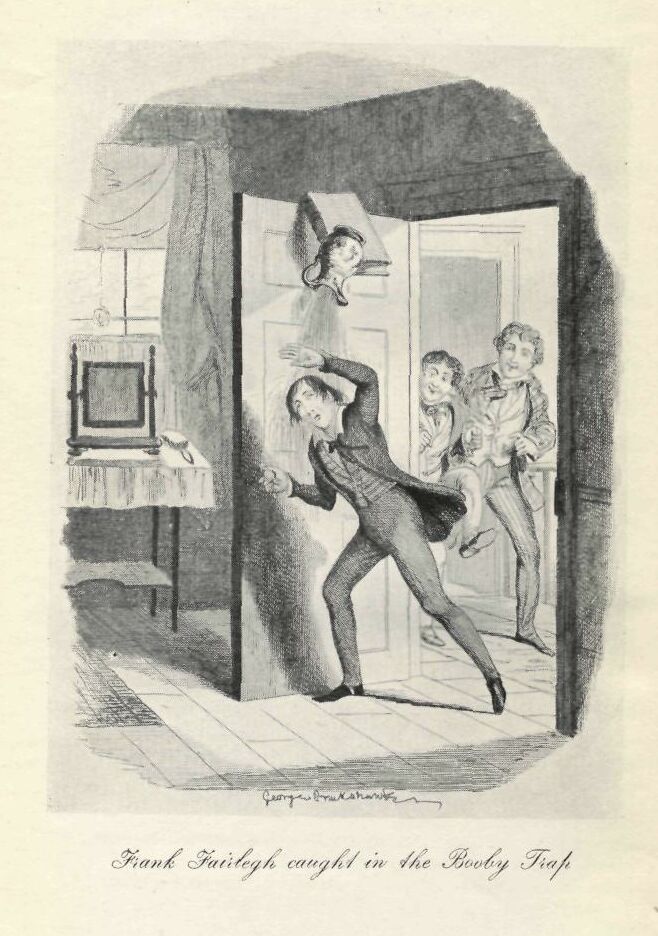
which piece of inattention I was rewarded
by a deluge of water, which wetted me from head to foot, and a violent
blow on the shoulder, which stretched me on the ground in the midst of a
puddle. That I may not keep the reader in suspense I will at once inform
him that I was indebted for this agreeable surprise to the kindness and
skill of Lawless, who, having returned from his pigeon-match half-an-hour
sooner than was necessary, had devoted it to the construction of what he
called a “booby trap,” which ingenious piece of mechanism was arranged in
the following manner: The victim's room-door was placed ajar, and upon the
top thereof a Greek Lexicon, or any other equally ponderous volume, was
carefully balanced, and upon this was set in its turn a jug of water. If
all these were properly adjusted, the catastrophe above described was
certain to ensue when the door was opened.
“Fairly caught, by Jove,” cried Lawless, who had been on the watch.
“By Jupiter Pluvius, you should have said,” joined in Coleman, helping me
up again; for so sudden and unexpected had been the shock that I had
remained for a moment just as I had fallen, with a kind of vague
expectation that the roof of the house would come down upon me.
“I suppose I have to thank you for that,” said I, turning to Lawless.
“Pray, don't mention it, Pinafore,” was the answer; “what little trouble I
had in making the arrangement, I can assure you, was quite repaid by its
success.”
“I'll certainly put on the gloves to-morrow,” whispered I to Coleman—to
which he replied by a sympathetic wink, adding:—
“And now I think you had better get ready, more particularly as you will
have to find out 'how to dress jugged hair,' as the cookery-books
say”.
By dint of almost superhuman exertions I did just contrive to get down in
time for dinner, though my unfortunate “jugged hair,” which was anything
but dry, must have presented rather a singular appearance. In the course
of dinner Dr. Mildman told us that we should have the whole of the next
day to ourselves, as he was obliged to go to London on business, and
should not return till the middle of the day following—an
announcement which seemed to afford great satisfaction to his hearers,
despite an attempt made by Cumberland to keep up appearances, by putting
on a look of mournful resignation, which, being imitated by Coleman, who,
as might be expected, rather overdid the thing, failed most signally.
CHAPTER IV — WHEREIN IS COMMENCED THE ADVENTURE OF THE MACINTOSH, AND OTHER MATTERS
“How oft the sight of means to do ill deeds,
Makes ill deeds done.”

“Come, tailor, let us see't;

Oh! mercy.... What masking stuff is here?

What's this? a sleeve?”

“Disguise, I see; thou art a wickedness
Wherein the pregnant enemy does much.”

“A horse! a horse! my kingdom for a horse!”
 —Shakspeare.
ON returning to the pupils' room Lawless commenced (to my great delight,
as I thereby enjoyed a complete immunity from his somewhat troublesome
attentions) a full, true, and particular account of the pigeon-match, in
which his friend Clayton had, with unrivalled skill, slain a sufficient
number of victims to furnish forth pies for the supply of the whole mess
during the ensuing fortnight. At length, however, all was said that could
be said, even upon this interesting subject, and the narrator, casting his
eyes around in search of wherewithal to amuse himself, chanced to espy my
new writing-desk, a parting gift from my little sister Fanny, who, with
the self-denial of true affection, had saved up her pocket-money during
many previous months in order to provide funds for this munificent
present.
“Pinafore, is that desk yours?” demanded Lawless.
Not much admiring the sobriquet by which he chose to address me, I
did not feel myself called upon to reply.
“Are you deaf, stupid? don't you hear me speaking to you?—where did
you get that writing-desk?”
Still I did not answer.
“Sulky, eh? I shall have to lick him before long, I see. Here you, what's
your name? Fairlegh, did your grand-mother give you that writing-desk?”
“No,” replied I, “my sister Fanny gave it to me the day before I left
home.”
“Oh, you have got a sister Fanny, have you? how old is she, and what is
she like?”
“She is just thirteen, and she has got the dearest little face in the
world,” answered I, earnestly, as the recollection of her bright blue eyes
and sunny smile came across me.
"How interesting!” sighed Coleman; “it
quite makes my heart beat; you could not send for her, could you?”
“And she gave you that desk, did she?—how very kind of her,” resumed
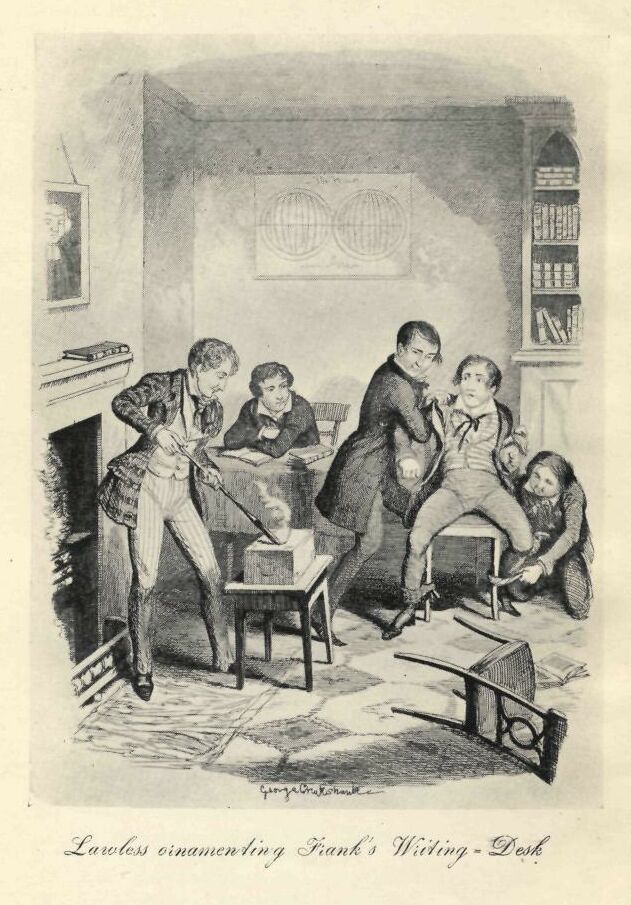
Lawless, putting the poker in the fire.
“Yes, was it not?” said I, eagerly. “I would not have any harm happen to
it for more than I can tell.”
“So I suppose,” replied Lawless, still devoting himself to the poker,
which was rapidly becoming red-hot. “Have you ever,” continued he, “seen
this new way they have of ornamenting things? encaustic work, I think they
call it:—it's done by the application of heat, you know.”
“I never even heard of it,” said I.
“Ah! I thought not,” rejoined Lawless. “Well, as I happen to understand
the process, I'll condescend to enlighten your ignorance. Mullins, give me
that desk.”
“Don't touch it,” cried I, bounding forward to the rescue; “I won't have
anything done to it.”
My design was, however, frustrated by Cumberland and Lawless, who, both
throwing themselves upon me at the same moment, succeeded, despite my
struggles, in forcing me into a chair, where they held me, while Mullins,
by their direction, with the aid of sundry neckcloths, braces, etc., tied
me hand and foot; Coleman, who attempted to interfere in my behalf,
receiving a push which sent him reeling across the room, and a hint that
if he did not mind his own business he would be served in the same manner.
Having thus effectually placed me hors de combat, Lawless took
possession of my poor writing-desk, and commenced tracing on the top
thereof, with the red-hot poker, what he was pleased to term a “design
from the antique,” which consisted of a spirited outline of that
riddle-loving female the Sphinx, as she appeared when dressed in top-boots
and a wide-awake, and regaling herself with a choice cigar! He was giving
the finishing touch to a large pair of moustaches, with which he had
embellished her countenance, and which he declared was the only thing
wanting to complete the likeness to an old aunt of Dr. Mildman's, whom the
pupils usually designated by the endearing appellation of “Growler,” when
the door opened, and Thomas announced that “Smithson” was waiting to see
Mr. Lawless.
“Oh yes, to be sure, let him come in; no, wait a minute. Here, you,
Coleman and Mullins, untie Fairlegh; be quick!—confound that desk,
how it smells of burning, and I have made my hands all black too. Well,
Smithson, have you brought the things?”
The person to whom this query was addressed was a young
man, attired in the extreme of the fashion, who lounged into the room with
a “quite at home” kind of air, and, nodding familiarly all around,
arranged his curls with a ring-adorned hand, as he replied in a drawling
tone:—
“Ya'as, Mr. Lawless, we're all right—punctual to a moment—always
ready 'to come to time,' as we say in the ring”.
“Who is he?” whispered I to Coleman.
“Who is he?” replied Coleman; “why the best fellow in the world, to be
sure'. Not know Smithson, the prince of tailors, the tailor par
excellence! I suppose you never heard of the Duke of Wellington, have
you?”
I replied humbly that I believed I had heard the name of that illustrious
individual mentioned in connection with Waterloo and the Peninsula—and
that I was accustomed to regard him as the first man of the age.
“Aye, well then, Smithson is the second; though I really don't know
whether he is not quite as great in his way as Wellington, upon my honour.
The last pair of trousers he made for Lawless were something sublime, too
good for this wicked world, a great deal.”
During this brief conversation Smithson had been engaged in extricating a
somewhat voluminous garment from the interior of a blue bag, which a boy,
who accompanied him, had just placed inside the study-door.
“There, this is the new invention I told you about; a man named Macintosh
hit upon it. Now, with this coat on, you might stand under a water-fall
without getting even damp. Try it on, Mr. Lawless; just the thing, eh,
gents?”
Our curiosity being roused by this panegyric, we gathered round Lawless to
examine the garment which had called it forth. Such of my readers as
recollect the first introduction of Macintoshes will doubtless remember
that the earlier specimens of the race differed very materially in form
from those which are in use at the present day. The one we were now
inspecting was of a whity-brown colour, and, though it had sleeves like a
coat, hung in straight folds from the waist to the ankles, somewhat after
the fashion of a carter's frock, having huge pockets at the side, and
fastening round the neck with a hook and eye.
“How does it do?” asked Lawless, screwing himself round in an insane
effort to look at the small of his own back, a thing a man is certain to
attempt when trying on a coat. “It does not make a fellow look like a Guy,
does it?”
"No, I rather admire the sort of thing,”
said Cumberland.
“A jolly dodge for a shower of rain, and no mistake,” put in Coleman.
“It is deucedly fashionable, really,” said Smithson—“this one of
yours, and one we made for Augustus Flareaway, Lord Fitz-scamper's son,
the man in the Guards, you know, are the only two out yet.”
“I have just got it at the right time then,” said Lawless; “I knew old Sam
was going to town, so I settled to drive Clayton over to Woodend, in the
tandem, to-morrow. The harriers meet there at eleven, and this will be the
very thing to hide the leathers, and tops, and the green cutaway. I saw
you at the match, by-the-by, Smithey, this morning.”
“Ya'as, I was there; did you see the thing I was on?”
“A bright bay, with a star on the forehead! a spicy-looking nag enough—whose
is it?”
“Why, young Robarts, who came into a lot of tin the other day, has just
bought it; Snaffles charged him ninety guineas for it.”
“And what is it worth?” asked Lawless.
“Oh! he would not do a dirty thing by any gent I introduced,” replied
Smithson. “I took young Robarts there: he merely made his fair profit out
of it; he gave forty pounds for it himself to a man who bred it, only the
week before, to my certain knowledge: it's a very sweet thing, and would
carry him well, but he's afraid to ride it; that's how I was on it to-day.
I'm getting it steady for him.”
“A thing it will take you some time to accomplish, eh? A mount like that
is not to be had for nothing, every day, is it?”
“Ya'as, you're about right there, Mr. Lawless; you're down to every move,
I see, as usual. Any orders to-day, gents? your two vests will be home
to-morrow, Mr. Coleman.”
“Here, Smithson, wait a moment,” said Cumberland, drawing him on one side;
“I was deucedly unlucky with the balls this morning,” continued he in a
lower tone, “can you let me have five-and-twenty pounds?”
“What you please, sir,” replied Smithson, bowing.
“On the old terms, I suppose?” observed Cumberland.
“All right,” answered Smithson; “stay, I can leave it with you now,” added
he, drawing out a leather case; “oblige me by writing your name here—thank
you.”
So saying, he handed some bank-notes to Cumberland, carefully replaced the
paper he had received from him in his pocket-book, and withdrew.
"Smithey was in great force to-night,”
observed Lawless, as the door closed behind him—“nicely they are
bleeding that young ass Robarts among them—he has got into good
hands to help him to get rid of his money, at all events. I don't believe
Snaffles gave forty pounds for that bay horse; he has got a decided curb
on the off hock, if I ever saw one, and I fancy he's a little touched in
the wind, too and there's another thing I should say——”
What other failing might be attributed to Mr. Robarts' bay steed we were,
however, not destined to learn, as tea was at this moment announced. In
due time followed evening prayers, after which we retired for the night.
Being very sleepy I threw off my clothes, and jumped hastily into bed, by
which act I became painfully aware of the presence of what a surgeon would
term “certain foreign bodies”—i.e., not, as might be imagined,
sundry French, German, and Italian corpses, but various hard substances,
totally opposed to one's preconceived ideas of the component parts of a
feather-bed. Sleep being out of the question on a couch so constituted, I
immediately commenced an active search, in the course of which I succeeded
in bringing to light two clothes-brushes, a boot-jack, a pair of spurs,
Lemprière's Classical Dictionary and a brick-bat. Having freed
myself from these undesirable bed-fellows I soon fell asleep, and passed
(as it seemed to me) the whole night in dreaming that I was a pigeon, or
thereabouts, and that Smithson, mounted on the top-booted Sphinx, was
inciting Lawless to shoot at me with a red-hot poker.
As Coleman and I were standing at the window of the pupils' room, about
ten o'clock on the following morning, watching the vehicle destined to
convey Dr. Mildman to the coach-office, Lawless made his appearance,
prepared for his expedition, with his hunting-costume effectually
concealed under the new Macintosh.
“Isn't Mildman gone yet? Deuce take it, what a time he is! I ought to be
off—I'm too late already!”
“They have not even put his carpet-bag in yet,” said I.
“Well, I shall make a bolt, and chance it about his seeing me,” exclaimed
Lawless; “he'll only think I'm going out for a walk rather earlier than
usual, if he does catch a glimpse of me, so here's off.”
Thus saying, he placed his hat upon his head, with the air of a man
determined to do or die, and vanished.
Fortune is currently reported to favour the brave, and so, to do her
justice, she generally does; still, at the best of times, she is but a
fickle jade, at all events she appeared determined to prove herself so in
the present instance; for scarcely had
Lawless got a dozen paces from the house, before Dr. Mildman appeared at
the front door with his great coat and hat on, followed by Thomas bearing
a carpet-bag and umbrella, and, his attention being attracted by
footsteps, he turned his head, and beheld Lawless. As soon as he perceived
him he gave a start of surprise, and, pulling out his eye-glass (he was
rather short-sighted), gazed long and fixedly after the retreating figure.
At length, having apparently satisfied himself as to the identity of the
person he was examining, he replaced his glass, stood for a moment as if
confounded by what he had seen, and then turning, abruptly re-entered the
house, and shut his study-door behind him with a bang, leaving Thomas and
the fly-driver mute with astonishment. In about five minutes he
re-appeared, and saying to Thomas, in a stern tone, “Let that note be
given to Mr. Lawless the moment he returns,” got into the fly and drove
off.
“There's a precious go,” observed Coleman; “I wonder what's in the wind
now. I have not seen old Sam get up the steam like that since I have been
here. He was not half so angry when I put Thomas's hat on the peg where he
hangs his own, and he, never noticing the difference, put it on, and
walked to church in it, gold band and all.”
“I wouldn't be Lawless for something,” observed I; “I wonder what the
note's about?”
“That's just what puzzles me,” said Coleman. “I should have thought he had
seen the sporting togs, but that's impossible; he must have a penetrating
glance indeed if he could see through that Macintosh.”
“Lawless was too impatient,” said Cumberland; “he should have waited a few
minutes longer, and then Mildman would have gone off without knowing
anything about him. Depend upon it, the grand rule of life is to take
things coolly, and wait for an opportunity: you have the game in your own
hands then, and can take advantage of the follies and passions of others,
instead of allowing them to avail themselves of yours.”
“In plain English, cheat instead of being cheated,” put in Coleman.
“You're not far wrong there, Freddy; the world is made up of knaves and
fools—those who cheat, and those who are cheated—and I, for
one, have no taste for being a fool,” said Cumberland.
“Nor I,” said Mullins; “I should not like to be a fool at all; I had
rather be——”
“A butterfly,” interrupted Coleman, thereby astonishing Mullins to such a
degree that he remained silent for some
moments, with his mouth wide open as if in the act of speaking.
“You cannot mean what you say; you surely would not wish to cheat people,”
said I to Cumberland; “if it were really true that one must be either a
knave or a fool, I'd rather be a fool by far—I'm sure you could
never be happy if you cheated any one,” continued I. “What does the Bible
say about doing to others as you would have others do to you?”
“There, don't preach to me, you canting young prig,” said Cumberland
angrily, and immediately left the room.
“You hit him pretty hard then,” whispered Coleman; “a very bad piece of
business happened just before I came, about his winning a lot of tin from
a young fellow here, at billiards, and they do say that Cumberland did not
play fairly. It was rather unlucky your saying it; he will be your enemy
from henceforth, depend upon it. He never forgets nor forgives a thing of
that sort.”
“I meant no harm by the remark,” replied I; “I knew nothing of his having
cheated any one; however, I do not care; I don't like him, and I'm just as
well pleased he should not like me. But now, as my foreign relations seem
to be rapidly assuming a warlike character (as the newspapers have it),
what do you say to giving me a lesson in sparring, as you proposed, by way
of preparation?”
“With all my heart,” replied Coleman.
And accordingly the gloves were produced, and my initiatory lesson in the
pugilistic art commenced by Coleman's first placing me in an exceedingly
uncomfortable attitude, and then very considerately knocking me out of it
again, thereby depositing me with much skill and science flat upon the
hearth-rug. This manouvre he repeated with great success during some half
hour or so, at the end of which time I began to discover the knack with
which it was done, and proceeded to demonstrate the proficiency I was
making, by a well-directed blow, which, being delivered with much greater
force than I had intended, sent Coleman flying across the room. Chancing
to encounter Mullins in the course, of his transit he overturned that
worthy against the table in the centre of the apartment, which, yielding
to their combined weight, fell over with a grand crash, dragging them down
with it, in the midst of an avalanche of books, papers, and inkstands.
This grand coup brought, as might be expected, our lesson to a
close for the day, Coleman declaring that such another hit would
inevitably knock him into the middle of next week, if not farther, and
that he really should not feel justified
in allowing such a serious interruption to his studies to take place.
“And now, what are we going to do with ourselves?” asked I; “as this is a
holiday, we ought to do something.”
“Are you fond of riding?” inquired Coleman.
“Nothing I like better,” replied I; “I have been used to it all my life; I
have had a pony ever since I was four years old.”
“I wish I was used to it,” said Coleman. “My governor living in London, I
never crossed a horse till I came here, and I'm a regular muff at it; but
I want to learn. What do you say to a ride this afternoon?”
“Just the thing,” said I, “if it is not too expensive for my pocket.”
“Oh no,” replied Coleman; “Snaffles lets horses at as cheap a rate as any
one, and good 'uns to go, too; does not he, Cumberland?”
“Eh, what are you talking about?” said Cumberland, who had just entered
the room; “Snaffles? Oh yes, he's the man for horse flesh. Are you going
to amuse yourself by tumbling off that fat little cob of his again, Fred?”
“I was thinking of having another try,” replied Coleman; “what do you say,
Fairlegh? Never mind the tin; I daresay you have got plenty, and can get
more when that's gone.”
“I have got a ten-pound note,” answered I; “but that must last me all this
quarter: however, we'll have our ride to-day.”
“I'll walk down with you,” said Cumberland; “I'm going that way; besides,
it's worth a walk any day to see Coleman mount; it took him ten minutes
the last time I saw him, and then he threw the wrong leg over, so that he
turned his face to the tail.”
“Scandalum magnatum! not a true bill,” replied Coleman.
“Now, come along, Fairlegh, let's get ready, and be off.” During our walk
down to Snaffles' stables Cumberland (who seemed entirely to have
forgotten my mal à propos remark) talked to me in a much more
amiable manner than he had yet done; and the conversation naturally
turning upon horses and riding, a theme always interesting to me, I was
induced to enter into sundry details of my own exploits in that line. We
reached the livery stables just as I had concluded a somewhat egotistical
relation concerning a horse which a gentleman in our neighbourhood had
bought for his invalid son, but which, proving at first too spirited, I
had undertaken to ride every day for a month
in order to get him quiet; a feat I was rather proud of having
satisfactorily accomplished.
“Good-morning, Mr. Snaffles; is Punch at home?” asked Coleman of a stout
red-faced man, attired in a bright green Newmarket coat and top-boots.
“Yes, sir. Mr. Lawless told me your governor was gone to town, so I kept
him in, thinking perhaps you would want him.”
“That's all right,” said Coleman; “and here's my friend, Mr. Fairlegh,
will want a nag too.”
“Proud to serve any gent as is a friend of yours, Mr. Coleman,” replied
Snaffles, with a bob of his head towards me, intended as a bow. “What
stamp of horse do you like, sir? Most of my cattle are out with the
harriers to-day.”
“Snaffles—a word with you,” interrupted Cumberland.
“One moment, sir,” said Snaffles to me, as he crossed over to where
Cumberland was standing.
“Come and look at Punch; and let's hear what you think of him,” said
Coleman, drawing me towards the stable.
“What does Cumberland want with that man?” asked I.
“What, Snaffles? I fancy he owes a bill here, and I daresay it is
something about that.”
“Oh, is that all?” rejoined I.
“Why, what did you think it was?” inquired Coleman.
“Never mind,” I replied; “let's look at Punch.”
And accordingly I was introduced to a little fat, round, jolly-looking
cob, about fourteen hands high, who appeared to me an equine counterpart
of Coleman himself. After having duly praised and patted him I turned to
leave the stable, just as Cumberland and Snaffles were passing the door,
and I caught the following words from the latter, who appeared rather
excited:—
“Well, if any harm comes of it, Mr. Cumberland, you'll remember it's your
doing, not mine”.
Cumberland's reply was inaudible, and Snaffles turned to me, saying:—
“I've only one horse at home likely to suit you, sir; you'll find her
rather high-couraged, but Mr. Cumberland tells me you won't mind that”.
“I have been mentioning what a good rider you say you are,” said
Cumberland, laying a slight emphasis on the say.
“Oh, I daresay she will do very well,” replied I. “I suppose she has no
vice about her.”
“Oh dear, no,” said Snaffles, “nothing of the sort.—James,” added
he, calling to a helper, “saddle the chestnut mare, and bring her out
directly.”
The man whom he addressed, and who was a fellow with
a good-humoured, honest face, became suddenly grave, as he replied in a
deprecatory tone:—
“The chestnut mare? Mad Bess, sir?”
“Don't repeat my words, but do as you are told,” was the answer; and the
man went away looking surly.
After the interval of a few minutes a stable door opposite was thrown
open, and Mad Bess made her appearance, led by two grooms. She was a
bright chestnut, with flowing mane and tail, about fifteen-and-a-half
hands high, nearly thorough-bred, and as handsome as a picture; but the
restless motion of her eye disclosing the white, the ears laid back at the
slightest sound, and a half-frightened, half-wild air, when any one went
up to her, told a tale as to her temper, about which no one in the least
accustomed to horses could doubt for an instant.
“That mare is vicious,” said I, as soon as I had looked at her.
“Oh dear, no, sir, quiet as a lamb, I can assure you. Soh, girl! soh!”
said Snaffles, in a coaxing tone of voice, attempting to pat her; but Bess
did not choose to “soh,” if by “sohing” is meant, as I presume, standing
still and behaving prettily; for on her master's approach she snorted,
attempted to rear, and ran back, giving the men at her head as much as
they could do to hold her.
“She's a little fresh to-day; she was not out yesterday, but it's all
play, pretty creature! nothing but play,” continued Snaffles.
“If you are afraid, Fairlegh, don't ride her,” said Cumberland; “but I
fancied from your conversation you were a bold rider, and did not mind a
little spirit in a horse: you had better take her in again, Snaffles.”
“Leave her alone,” cried I, quickly (for I was becoming irritated by
Cumberland's sneers, in spite of my attempt at self-control), “I'll ride
her. I'm no more afraid than other people; nor do I mind a spirited horse,
Cumberland; but that mare is more than spirited, she's ill-tempered—look
at her eye!”
“Well, you had better not ride her, then,” said Cumberland.
“Yes, I will,” answered I, for I was now thoroughly roused, and determined
to go through with the affair, at all hazards. I was always, even as a
boy, of a determined, or, as ill-natured people would call it, obstinate
disposition, and I doubt whether I am entirely cured of the fault at the
present time.
“Please yourself; only mind, I have warned you not to ride her if you are
afraid,” said Cumberland.
"A nice warning,” replied I, turning
away;—“who'll lend me a pair of spurs?”
“I've got a pair here, sir; if you'll step this way I'll put them on for
you,” said the man whom I had heard addressed as “James,”—adding, in
a lower tone, as he buckled them on, “for Heaven's sake, young gentleman,
don't mount that mare unless you're a first-rate rider.”
“Why, what's the matter with her? does she kick?” inquired I.
“She'll try and pitch you off, if possible, and if she can't do that,
she'll bolt with you, and then the Lord have mercy upon you!”
This was encouraging, certainly!
“You are an honest fellow, James,” replied I; “and I am much obliged to
you. Ride her I must, my honour is at stake, but I'll be as careful as I
can, and, if I come back safe, you shall have half a crown.”
“Thank you, sir,” was the reply, “I shall be glad enough to see you come
back in any other way than on a shutter, without the money.”
Of a truth, the race of Job's comforters is not yet extinct, thought I, as
I turned to look for Coleman, who had been up to this moment employed in
superintending the operation of saddling Punch, and now made his
appearance, leading that renowned steed by the bridle.
“Why, Fairlegh, you are not going to ride that vicious brute to be sure;
even Lawless won't mount her, and he does not care what he rides in
general.”
“Nevermind about Lawless,” said I, assuming an air of confidence I was
very far from feeling; “she won't eat me, I daresay.”
“I don't know that,” rejoined Coleman, regarding Mad Bess with a look of
horror; “Cumberland, don't let him mount her.”
“Nay, I can't prevent it; Fairlegh is his own master, and must do as he
likes,” was the answer.
“Come, we can't keep the men standing here the whole day,” said I to
Coleman; “mount Punch, and get out of my way as fast as you can, if you
are going to do so at all”—a request with which, seeing I was quite
determined, he at length unwillingly complied, and having, after one or
two failures, succeeded in throwing his leg over the cob's broad back,
rode slowly out of the yard, and took up his station outside in order to
witness my proceedings.
“Now, then,” said I, “keep her as steady as you can for a minute, and as
soon as I am fairly mounted give her her head—stand clear there.”
I then took a short run, and, placing one
hand on the saddle, while I seized a lock of the mane with the other, I
sprang from the ground and vaulted at once upon her back, without the aid
of the stirrup, a feat I had learned from a groom who once lived with us,
and which stood me in good stead on the present occasion, as I thereby
avoided a kick with which Mad Bess greeted my approach. I next took up the
reins as gently as I could, the men let go her head, and after a little
plunging and capering, though much less than I had expected, her ladyship
gave up hostilities for the present, and allowed me to ride her quietly up
and down the yard. I then wished Cumberland (who looked, as I thought,
somewhat mortified) a good-afternoon, turned a deaf ear to the eulogies of
Mr. Snaffles and his satellites, and proceeded to join Coleman. As I left
the yard my friend James joined me, under the pretence of arranging my
stirrup leather, when he took the opportunity of saying:—
“She'll go pretty well now you're once mounted, sir, as long as you can
hold her with the snaffle, but if you are obliged to use the curb—look
out for squalls!!!”
CHAPTER V — MAD BESS
“Away, away, my steed and I,
Upon the pinions of the wind,
All human dwellings left behind,
We sped like meteors through the sky,

With glossy skin and dripping mane,
And reeling limbs, and reeking flank,
The wild steed's sinewy nerves still strain
Up the repelling bank.

We gained the top, a boundless plain
Spreads onward.

My heart turned sick, my brain grew sore,
And throbbed awhile, then beat no more,
The sky spun like a mighty wheel,
And a slight flash sprang o'er my eyes,
Which saw no farther.”

Mazeppa.
OUT of consideration for the excitable disposition of Mad Bess we took our
way along the least bustling streets we could select; directing our course
towards the outskirts of the town, behind which extended for some miles a
portion of the range of hills known as
the South Downs, over the smooth green turf of which we promised ourselves
a canter. As we rode along Coleman questioned me as to what could have
passed while he was seeing Punch saddled, to make me determine to ride the
chestnut mare, whose vicious disposition was, he informed me, so well
known, that not only would no one ride her who could help it, but that
Snaffles, who was most anxious to get rid of her, had not as yet been able
to find a purchaser. In reply to this I gave him a short account of what
had occurred, adding my more than suspicion that the whole matter had been
arranged by Cumberland, in which notion he entirely agreed with me.
“I was afraid of something of this sort, when I said I was sorry you had
made that remark about cheating to him this morning—you see, he
would no doubt suppose you had heard the particulars of his gambling
affair, and meant to insult him by what you said, and he has done this out
of revenge. Oh, how I wish we were safely at home again; shall we turn
back now?”
“Not for the world,” said I—“you will find, when you know me better,
that when once I have undertaken a thing, I will go through with it—difficulties
only make me more determined.”
“Ah!” said Coleman, “you should get somebody to write a book about you,
that is the kind of disposition they always give to the heroes of novels,
the sort of character that will go and run his head against a brick wall
to prove that it is the harder and thicker of the two—they knock out
their brains though, sometimes, in doing it, when they happen to have any—it
is very pretty to read about, splendid in theory, but I much doubt its
acting so well if you come to put it in practice.”
“You may laugh at me, if you please,” replied I; “but depend upon it, a
man of energy and determination will undertake great deeds, aye, and
perform them too, which your prudent, cautious character would have
considered impossibilities.”
“Perhaps it may be so,” was the reply; “I know I am not the sort of stuff
they cut heroes out of—woa, Punch! steady, old boy; holloa, what
ails him? this is getting serious.”
During this conversation we had been gradually leaving the town behind us
and approaching the downs, and had arrived at a point where the road
became a mere cart-track, and the open country lay spread for miles before
us. Our two steeds, which had up to the present time conducted
themselves with the greatest propriety, now began to show signs of
excitement, and, as the fresh air from the downs blew against their
nostrils, they tossed their heads, snorted, and exchanged the quiet
jog-trot pace at which we had been proceeding, for a dancing, sidelong
motion, which somewhat disturbed Coleman's equanimity, and elicited from
him the expressions above recorded. The road at the same time becoming
uneven and full of ruts, we agreed to turn our horses' heads, and quit it
for the more tempting pathway afforded by the green-sward. No sooner,
however, did Punch feel the change from the hard road to the soft elastic
footing of the turf, than he proceeded to demonstrate his happiness by
slightly elevating his heels and popping his head down between his
forelegs, thereby jerking the rein loose in Coleman's hand; and,
perceiving that his rider (who was fully employed in grasping the pommel
of his saddle in order to preserve his seat) made no effort to check his
vivacity, he indulged his high spirits still further by setting off at a
brisk canter.
“Pull him in,” cried I, “you'll have him run away with you; pull at him.”
Whether my advice was acted upon or not I was unable to observe, as my
whole attention was demanded by Mad Bess, who appeared at length resolved
to justify the propriety of her appellation. Holding her in by means of
the snaffle alone had been quite as much as I had been able to accomplish
during the last ten minutes, and this escapade on the part of Punch
brought the matter to a crisis. I must either allow her to follow him,
i.e., to run away, or use the curb to prevent it. Seating myself,
therefore, as firmly as I could, and gripping the saddle tightly with my
knees, I took up the curb rein, which till now had been hanging loosely on
the mare's neck, and gradually tightened it. This did not, for a moment,
seem to produce any effect, but as soon as I drew the rein sufficiently
tight to check her speed, she stopped short, and shook her head angrily. I
attempted gently to urge her on—not a step except backwards would
she stir—at length in despair I touched her slightly with the spur,
and then “the fiend within her woke,” and proceeded to make up for lost
time with a vengeance. The moment the mare felt the spur she reared until
she stood perfectly erect, and fought the air with her forelegs. Upon this
I slackened the rein, and, striking her over the ears with my riding-whip,
brought her down again;—no sooner, however, had her forefeet touched
the ground than she gave two or three
violent plunges, which nearly succeeded in unseating me, jerked down her
head so suddenly as to loosen the reins from my grasp, kicked viciously
several times, and, seizing the cheek of the bit between her teeth so as
to render it utterly useless (evidently an old trick of hers), sprang
forward at a wild gallop. The pace at which we were going soon brought us
alongside of Punch, who, having thoroughly mastered his rider, considered
it highly improper that any steed should imagine itself able to pass him,
and therefore proceeded to emulate the pace of Mad Bess. Thereupon a short
but very spirited race ensued, the cob's pluck enabling him to keep neck
and neck for a few yards; but the mare was going at racing speed, and the
length of her stride soon began to tell; Punch, too, showed signs of
having nearly had enough of it. I therefore shouted to Coleman as we were
leaving them: “Keep his head up hill, and you'll be able to pull him in
directly”. His answer was inaudible, but when I turned my head two or
three minutes afterwards I was glad to see that he had followed my advice
with complete success—Punch was standing still, about half a mile
off, while his rider was apparently watching my course with looks of
horror. All anxiety on his account being thus at an end, I proceeded to
take as calm a view of my own situation as circumstances would allow, in
order to decide on the best means of extricating myself therefrom. We had
reached the top of the first range of hills I have described, and were now
tearing at a fearful rate down the descent on the opposite side. It was
clear that the mare could not keep up the pace at which she was going for
any length of time: still she was in first-rate racing condition, not an
ounce of superfluous flesh about her, and, though she must have gone more
than two miles already, she appeared as fresh as when we started. I
therefore cast my eyes around in search of some obstacle which might check
her speed. The slope down which we were proceeding extended for about a
mile before us, after which the ground again began to rise. In the valley
between the two hills was a small piece of cultivated land, enclosed (as
is usual in the district I am describing) within a low wall, built of
flint-stones from the beach. Towards this I determined to guide the mare
as well as I was able, in the hope that she would refuse the leap, in
which case I imagined I might pull her in. The pace at which we were going
soon brought us near the spot, when I was glad to perceive that the wall
was a more formidable obstacle than I had at first imagined, being fully
six feet high, with a ditch in front of
it. I therefore selected a place where the ditch seemed widest, got her
head up by sawing her mouth with the snaffle, and put her fairly at it. No
sooner did she perceive the obstacles before her than, slightly moderating
her pace, she appeared to collect herself, gathered her legs well under
her, and, rushing forward, cleared wall, ditch, and at least seven feet of
ground beyond, with a leap like a deer, alighting safely with me on her
back on the opposite side, where she continued her course with unabated
vigour.
We had crossed the field (a wheat stubble) ere I had recovered from my
astonishment at finding myself safe, after such a leap as I had most
assuredly never dreamt of taking. Fortunately there was a low gate on the
farther side, towards which I guided the mare, for though I could not
check, I was in some measure able to direct, her course. This time,
however, she either did not see the impediment in her way, or despised it,
as, without abating her speed, she literally rushed through the gate,
snapping into shivers with her chest the upper bar, which was luckily
rotten, and clearing the lower ones in her stride. The blow, and the
splintered wood flying about her ears, appeared to frighten her afresh,
and she tore up the opposite ascent, which was longer and steeper than the
last, like a mad creature. I was glad to perceive, however, that the pace
at which she had come, and the distance (which must have been several
miles), were beginning to tell—her glossy coat was stained with
sweat and dust, while her breath, drawn with short and laboured sobs, her
heaving flanks, and the tremulous motion of her limbs, afforded convincing
proofs that the struggle could not be protracted much longer. Still she
continued to hold the bit between her teeth as firmly as though it were in
a vice, rendering any attempt to pull her in utterly futile. We had now
reached the crest of the hill, when I was not best pleased to perceive
that the descent on the other side was much more precipitous than any I
had yet met with. I endeavoured, therefore, to pull her head round,
thinking it would be best to try and retrace our steps, but I soon found
that it was useless to attempt it. The mare had now become wholly
unmanageable; I could not guide her in the slightest decree; and, though
she was evidently getting more and more exhausted, she still continued to
gallop madly forwards, as though some demon had taken possession of her,
and was urging her on to our common destruction. As we proceeded down the
hill our speed increased from the force of gravitation, till we actually
seemed to fly—the wind appeared to
shriek as it rushed past my ears, while, from the rapidity with which we
were moving, the ground seemed to glide from under us, till my head reeled
so giddily that I was afraid I should fall from the saddle.
We had proceeded about half way down the descent when, on passing one or
two stunted bushes which had concealed the ground beyond, I saw, oh,
horror of horrors! what appeared to be the mouth of an old chalk-pit,
stretching dark and unfathomable right across our path, about 300 yards
before us. The mare perceives it when too late, attempts to stop, but from
the impetus with which she is going is unable to do so. Another moment,
and we shall be over the brink! With the energy of despair I lifted her
with the rein with both hands, and drove the spurs madly into her flanks;—she
rose to the leap, there was a bound! a sensation of flying through the
air! a crash! and I found myself stretched in safety on the turf beyond,
and Mad Bess lying, panting, but uninjured beside me.
To spring upon my feet, and seize the bridle of the mare, who had also by
this time recovered her footing, was the work of a moment. I then
proceeded to look around, in order to gain a more clear idea of the
situation in which I was placed, in the hope of discovering the easiest
method of extricating myself from it. Close behind me lay the chalk-pit,
and, as I gazed down its rugged sides, overgrown with brambles and rank
weeds, I shuddered to think of the probable fate from which I had been so
almost miraculously preserved, and turned away with a heartfelt expression
of thanksgiving to Him who had mercifully decreed that the thread of my
young life should not be snapped in so sudden and fearful a manner.
Straight before me the descent became almost suddenly precipitous, but a
little to the right I perceived a sort of sheep-track, winding downwards
round the side of the hill. It was a self-evident fact that this must lead
somewhere, and, as all places were alike to me, so that they contained any
human beings who were able and willing to direct me towards Helmstone, I
determined to follow it. After walking about half a mile, Mad Bess (with
her ears drooping, and her nose nearly touching the ground) following me
as quietly as a dog, I was rejoiced by the sight of curling smoke, and, on
turning a corner, I came suddenly upon a little village green, around
which some half dozen cottages were scattered at irregular distances. I
directed my steps towards one of these, before which a crazy sign, rendered by age and exposure to the
weather as delightfully vague and unintelligible as though it had come
fresh from the brush of Turner himself, hung picturesquely from the branch
of an old oak.
The sound of horse's feet attracted the attention of an elderly man, who
appeared to combine in his single person the offices of ostler, waiter,
and boots, and who, as soon as he became aware of my necessities,
proceeded to fulfil the duties of these various situations with the
greatest alacrity. First (as of the most importance in his eyes) he rubbed
down Mad Bess, and administered some refreshment to her in the shape of
hay and water; then he brought me a glass of ale, declaring it would do me
good (in which, by the way, he was not far from right). He then brushed
from my coat certain stains which I had contracted in my fall, and finally
told me my way to Helmstone. I now remounted Mad Bess, who, though much
refreshed by the hay and water, still continued perfectly quiet and
tractable; and, setting off at a moderate trot, reached the town, after
riding about eight miles, without any further adventure, in rather less
than an hour.
As I entered the street in which Snaffles' stables were situated I
perceived Coleman and Lawless standing at the entrance of the yard,
evidently awaiting my arrival.
When I got near them Coleman sprang eagerly forward to meet me, saying:—
“How jolly glad I am to see you safe again, old fellow! I was so
frightened about you. How did you manage to stop her?”
“Why, Fairlegh, I had no idea you were such a rider,” exclaimed Lawless;
“I made up my mind you would break your neck, and old Sam be minus a
pupil, when I heard you were gone out on that mare. You have taken the
devil out of her somehow, and no mistake; she's as quiet as a lamb,” added
he, patting her.
“You were very near being right,” replied I; “she did her best to break my
neck and her own too, I can assure you”
I then proceeded to relate my adventures, to which both Lawless and
Coleman listened with great attention; the former interrupting me every
now and then with various expressions of commendation, and when I had
ended he shook me warmly by the hand, saying:—
“I give you great credit; you behaved in a very plucky manner all through;
I didn't think you had it in you; 'pon my word, I didn't. I shall just
tell Cumberland and Snaffles a bit of my
mind, too. Here, Snaffles, you confounded old humbug, where are you?”
“Oh, don't say anything to him,” said I; “it's never worth while being
angry with people of that kind; besides, Cumberland made him do it.”
“That does not signify; he knew the danger to which he was exposing you,
perhaps better than Cumberland did. He had no business to do it, and I'll
make him beg your pardon before we leave this yard. Here, you ostler
fellow, where's your master?” shouted Lawless, as he turned into the yard,
where I soon heard the loud tones of his voice engaged in angry colloquy
with Snaffles, whose replies were inaudible.
In a short time the latter approached the spot where I was standing, and
began a very long and humble apology, saying that he should never have
thought of giving me the mare if he had not seen at a glance that I was a
first-rate rider, and much more to the same purpose, when Lawless
interrupted him with:—
“There, cut it short; Mr. Fairlegh does not want any more of your blarney;
and mind, if anything of the sort occurs again, I shall hire my horses
somewhere else, and take care to let all my friends know why I do so. Now,
let's be off; it's getting near dinner-time.”
So saying, he turned to leave the yard, a movement which, as soon as I had
found my friend James, returned his spurs, and given him the promised
half-crown, I proceeded to imitate: and that ended the episode of Mad
Bess.
CHAPTER VI — LAWLESS GETS THOROUGHLY PUT OUT —
...” What 'tis
To Have a stranger come—
It seems you know him not
No, sir! not I.”
 —Southey.

“Either forbear... or resolve you
For more amazement: if you can behold it,
I'll make the statue move indeed.”
 —Winter's Tale.

“Since the youth will not be entreated, his own peril on his
forwardness....   You shall try but one fall.”
 —As You Like It.
ON reaching home the door was opened by Thomas, who accosted us with:—
“Here's such a bit of fun, gentlemen! The new pupil's arrived, and ain't
he a rum un, jest? Oh, I never!”
"Why, how do you mean? what's he like,
then?” asked Lawless.
“Oh, he's very well to look at, only he's as tall as a life-guardsman; but
he's sich a free and easy chap, and ain't he got a pretty good notion of
making himself comfortable, too!—that's all. But come in, gents,
you'll soon see what I mean. He chucked the flyman who brought him here
half a guinea, and when I asked him if he did not want the change, for the
fare was only half a crown, he merely said 'Pooh!' and told me not to
talk, for it tired him.”
With our feelings of curiosity somewhat excited by this account we
hastened into the pupils' room, anxious to behold the individual who had
so greatly astonished Thomas.
Seated in Dr. Mildman's arm-chair, and with his legs resting upon two
other chairs, so arranged as to form a temporary sofa, reclined a young
man, apparently about eighteen, though his length of limb, and the almost
herculean proportions of his chest and shoulders, seemed rather to belong
to a more advanced age. He raised his head as we entered, disclosing a set
of features which, in spite of an expression of languor and indifference,
must have been pronounced unusually handsome. His complexion was a rich
nut-brown; the high forehead, white as snow, contrasting well with the
dark hue of his hair, which, in short clustering curls, harmonised well
with the classical outline of his head, reminding one involuntarily of the
young Antinous. The short curling upper-lip, and well-chiselled nostril,
told a tale of pride and resolution, strongly at variance with the mild
sleepy appearance of the large dark hazel eyes, to which the long silken
lashes that shaded them imparted an almost feminine expression. He did not
attempt to alter his position as we approached, but, merely turning his
head, gazed at us steadfastly for a moment, and then observed in a slow,
half-absent manner:—
“Oh, the other pupils, I suppose—how do you do, all of you?”
Lawless, who was foremost, was so much surprised, and so little pleased at
this nonchalant style of address, that he made no reply, but turning on
his heel proceeded to leave the room, in order to divest himself of his
hunting costume, muttering as he went, “Cool enough that, by Jove, eh!”
The duty of doing the polite having thus devolved upon Coleman, he winked
at me by way of preliminary, and, making
a low bow in the true dancing-master style, replied as follows:—
“Your penetration has not erred, Mr. Oaklands; we are the other
pupils; and in answer to your obliging inquiries, I have much pleasure in
informing you that we are all in perfect health and very tolerable
spirits; and now, sir, in return for your kind condescension, allow me, in
the absence of my superiors, to express a hope that you are feeling pretty
comfortable—ahem!”
Having thus delivered himself, Coleman drew up his figure to its utmost
height, and, folding his arms with an air of pompous dignity, awaited an
answer.
“Oh yes, I'm comfortable enough,” was the reply; “I always am; only I'm so
done up, tired as a dog—the least thing fatigues me; I'm as weak as
a rat! Don't they give you sofas here, Mr. What's-your-name?”
“My name is Norval—I mean Coleman; my father divides his time
between feeding his flocks on the Grampian Hills, and fleecing his clients
in Lincoln's Inn; though I must confess that ever since I can remember, he
has dropped the shepherd, and stuck to the solicitor, finding it pays
best, I suppose. Regarding the sofa, we have not one at present, but Dr.
Mildman went to town this morning; I did not till this moment know why.
But now I see it all—he was doubtless aware you would arrive to-day,
and, finding he could not get a sufficiently comfortable sofa for you in
Helmstone, he is gone to London on purpose to procure one. There is still
time to write by the post, if there is any particular way in which you
would like to have the stuffing arranged.”
This speech made Oaklands raise his head, and look Coleman so fixedly in
the face, with such a clear, earnest, penetrating gaze, that it appeared
as if he would read his very soul. Having apparently satisfied himself, he
smiled slightly, resumed his former attitude, and observed in the same
half-sleepy tone:—
“No, I'll leave all that to him; I am not particular. What time do you
dine here?”
I replied (for the look I have described seemed to have had the wonderful
effect of silencing Coleman), “At five o'clock”.
“Very good; and I believe there's a Mrs. Mildman, or some such person, is
there not? I suppose one must dress. Will you be so kind as to tell the
servant to bring some hot water, and to look out my things for me at a
quarter before five? I hate to be obliged to hurry, it tires one so.”
Having said this, he took up a book which
was lying by his side, and, murmuring something about “talking being so
fatiguing,” soon became buried in its contents.
Whilst I was dressing for dinner Lawless came into my room, and told me
that he had been speaking to Cumberland with regard to the way in which he
had behaved to me about the mare, and that Cumberland professed himself
exceedingly sorry that the affair had so nearly turned out a serious one,
declaring he meant it quite as a joke, never expecting that when I saw the
mare I should venture to mount her.
“So you see,” continued Lawless, “he merely wanted to have a good laugh at
you—nothing more. It was a thoughtless thing to do, but not so bad
as you had fancied it, by any means.”
“Well,” replied I, “as he says so, I am bound to believe him; but his
manner certainly gave me the impression that he intended me to ride her.
He went the right way to make me do so, at all events, by hinting that I
was afraid.”
“Ah! he could not know that by intuition, you see,” said Lawless; “he
thought, I daresay, as I did, that you were a mere molly-coddle, brought
up at your mother's apron-string, and had not pluck enough in you to do
anything sporting.”
“It's not worth saying anything more about,” replied I; “it will never
happen again: I am very much obliged to you, though.”
“Oh, that's nothing,” said Lawless; “if Cumberland had really meant to
break your neck, I should have fallen out with him; that would have been
too much of a good thing: however, as it is it's all right.”
And so the conversation ended, though I felt far from satisfied in my own
mind as to the innocence of Cumberland's intentions.
On reaching the drawing-room I found the whole party assembled with the
exception of Mr. Henry Oaklands, who had not yet made his appearance. At
the moment of my entrance Mrs. Mildman, who had not seen the new arrival,
and who, like the rest of her sex, was somewhat curious, was examining
Coleman (who stood bolt upright before her, with his hands behind him,
looking like a boy saying his lesson) as to his manners and appearance.
“Very tall, and dark hair and large eyes,” continued Mrs. Mildman; “why,
he must be very handsome.”
“He seems as if he were half-asleep,” observed I.
"Not always,” said Coleman; “did you see
the look he gave me? he seemed wide-awake enough then; I thought he was
going to eat me.”
“Dear me I why he must be quite a cannibal! besides, I don't think you
would be at all nice to eat, Mr. Coleman,” said Mrs. Mildman, with a
smile.
“Horrid nasty, I'm sure,” muttered Mullins, who was seated on the very
edge of his chair, and looked thoroughly uncomfortable, as was his wont in
anything like civilised society.
At this moment the door opened, and Oaklands entered. If one had doubted
about his height before, when lying on the chairs, the question was set at
rest the instant he was seen standing: he must have measured at least six
feet two inches, though the extreme breadth of his chest and shoulders,
and the graceful setting-on of his finely formed head, together with the
perfect symmetry and proportion of his limbs, prevented his appearing too
tall. He went through the ceremony of introduction with the greatest ease
and self-possession; and though he infused rather more courtesy into his
manner towards Mrs. Mildman than he had taken the trouble to bestow on us,
his behaviour was still characterised by the same indolence and
listlessness I had previously noticed, and which indeed seemed part and
parcel of himself. Having bowed slightly to Cumberland and Lawless he
seated himself very leisurely on the sofa by Mrs. Mildman's side, altering
one of the pillows so as to make himself thoroughly comfortable as he did
so. Having settled it to his satisfaction, he addressed Mrs. Mildman with:—
“What a very fatiguing day this has been; haven't you found it so?”
“No, I can't say I have,” was the reply; “I daresay it was warm
travelling: I'm afraid, in that case, Dr. Mildman will not have a very
pleasant journey—he's gone to town to-day.”
“Ah, so that short, stout young gentleman” (the first two adjectives he
pronounced very slowly and distinctly) “told me.”
“Mr. Coleman,” insinuated Mrs. Mildman.
“Pleasant that,” whispered Coleman to me.
“Take care,” replied I, “he will hear you.”
“I'm afraid,” continued Oaklands, “the old gentleman will be quite knocked
up. I wonder he does not make two days' journey of it.”
“Dr. Mildman is not so very old,” observed Mrs. Mildman, in rather
an annoyed tone of voice.
"I really beg pardon, I scarcely know why
I said it,” replied Oaklands, “only I somehow fancied all tutors were
between sixty and seventy—very absurd of me. My father sent all kind
of civil messages to the o—— to Dr. Mildman, only it is so
much trouble to remember that sort of thing.”
At this point the conversation was interrupted by the announcement of
dinner. Oaklands (from whom I could not withdraw my eyes, so unlike
anything I had ever met with before was he) was evidently preparing to
hand Mrs. Mildman down to dinner, as soon as he could summon sufficient
energy to move, but, perceiving Cumberland approach her for that purpose,
he appeared to recollect himself, smiled slightly as if at what he had
been about to do, and, taking me by the arm, said:—
“Come, Master Curlylocks, you shall be my lady, and a very pretty girl you
would make, too, if you were properly bemuslined”; adding, as we went
downstairs together, “You and I shall be great friends, I'm sure; I like
your face particularly. What a lot of stairs there are in this house!
they'll tire me to death.”
When we returned to the pupils' room after dinner Lawless found, lying on
the table, the note Dr. Mildman had written in such a mysterious manner
before he left home in the morning, and proceeded to open it forthwith.
Scarcely had he glanced his eye over it, when he was seized with so
violent a fit of laughter, that I expected every moment to see him fall
out of his chair. As soon as he had in some measure recovered the power of
speaking he exclaimed:—
“Here, listen to this! and tell me if it is not the very best thing you
ever heard in your lives “. He then read as follows:—
“'It is not without much pain that I bring myself to write this note; but
I feel that I should not be doing my duty towards your excellent father,
if I were to allow such extreme misconduct on the part of his son to pass
unreproved. I know not towards what scene of vulgar dissipation you might
be directing your steps, but the simple fact (to which I was myself
witness) of your leaving my house in the low disguise of a carter's
smock-frock, affords in itself sufficient proof that your associates
must belong to a class of persons utterly unfitted for the companionship
of a gentleman. Let me hope this hint may be enough, and that conduct so
thoroughly disgraceful in one brought up as you have been may not occur
again. I presume I need scarcely say that, in the event of your disregarding my wishes upon this point, the
only course left open to me would be to expel you, a measure to which it
would deeply grieve me to be obliged to resort.'”
His voice was here drowned by a chorus of laughter from all present who
were aware of the true state of the case, which lasted without
interruption for several minutes. At length Lawless observed:—
“I'll tell you what, it will be a death-blow to Smithson; a Macintosh made
by him to be taken for a smock-frock! he'll never recover it.”
“Mildman might well look like a thunder-cloud,” said Coleman, “if that was
the notion he had got in his head; what a jolly lark, to be sure!”
“How do you mean to undeceive him?” inquired Cumberland.
“Oh, trust me for finding a way to do that,” replied Lawless; “'the low
disguise of a carter's smock-frock,' indeed! What fun it would be if he
were to meet my governor in town to-day, and tell him of my evil courses!
why, the old boy would go into fits! I wonder what he means by his 'scenes
of vulgar dissipation'? I daresay he fancies me playing all-fours with a
beery coalheaver, and kissing his sooty-faced wife; or drinking alternate
goes of gin-and-water with a dustman for the purpose of insinuating myself
into the affections of Miss Cinderella Smut, his interesting sister. By
Jove! it's as good as a play!”
More laughter followed Lawless's illustration of Dr. Mildman's note. The
subject was discussed for some time, and a plan arranged for enlightening
the Doctor as to the true character of the mysterious garment.
At length there was a pause, when I heard Coleman whisper to Lawless:—
“Thomas was pretty right in saying that new fellow knows how to make
himself comfortable, at all events”.
“He's a precious deal too free and easy to please me,” muttered Lawless,
in an undertone; “I shall take the liberty of seeing whether his
self-possession cannot be disturbed a little. I have no notion of such
airs. Here, Mullins!”
And laying hold of Mullins by the arm, he pulled him into a chair by his
side, and proceeded to give him some instructions in a whisper. The
subject of their remarks, Harry Oaklands, who had, on re-entering the
room, taken possession of the three chairs near the window, was still
reclining, book in hand, in the same indolent position, apparently
enjoying the beauty of the autumnal sunset, without concerning himself in
the slightest degree about anything which might be going on inside the
room.
Lawless, whose proceedings I was watching
with an anxious eye, having evidently succeeded, by a judicious mixture of
bullying and cajollery, in persuading Mullins to assist him in whatever he
was about to attempt, now drew a chair to the other side of the window,
and seated himself exactly opposite to Oaklands.
“How tired riding makes a fellow! I declare I'm regularly baked, used
completely up,” he observed, and then continued, glancing at Oaklands,
“Not such a bad idea, that. Mullins, give us a chair; I don't see why
elevating the extremities should not pay in my case, as well as in other
people's.”
He then placed his legs across the chair which Mullins brought him, and,
folding his arms so as exactly to imitate the attitude of his opposite
neighbour, sat for some minutes gazing out of the window with a
countenance of mock solemnity. Finding this did not produce any effect on
Oaklands, who, having slightly raised his eyes when Lawless first seated
himself, immediately cast them upon the book again, Lawless stretched
himself, yawned, and once more addressed Mullins.
“Shocking bad sunset as ever I saw—it's no go staring at that. I
must have a book—give me the Byron.”
To this Mullins replied that he believed Mr. Oaklands was reading it.
“Indeed! the book belongs to you, does it not?”
Mullins replied in the affirmative.
“Have you any objection to lend it to me?”
Mullins would be most happy to do so.
“Then ask the gentleman to give it to you—you have a right to do
what you please with your own property, I imagine?”
It was very evident that this suggestion was not exactly agreeable to
Mullins; and although his habitual fear of Lawless was so strong as
completely to overpower any dread of what might be the possible
consequences of his act, it was not without much hesitation that he
approached Oaklands, and asked him for the book, as he wished to lend it
to Lawless.
On hearing this Oaklands leisurely turned to the fly-leaf, and, having
apparently satisfied himself, by the perusal of the name written thereon,
that it really belonged to Mullins, handed it to him without a word. I
fancied, however, from the stern expression of his mouth and a slight
contraction of the brow, that he was not as insensible to their
impertinence as he wished to appear.
Lawless, who had been sitting during this little scene with his eyes closed, as if asleep, now roused
himself, and saying, “Oh, you have got it at last, have you?” began
turning over the pages, reading aloud a line or two here and there, while
he kept up a running commentary on the text as he did so:—
“Hum! ha! now let's see, here we are—the 'g-i-a-o-u-r,'—that's
a nice word to talk about. What does g-i-a-o-u-r spell, Mullins? You don't
know? what an ass you are, to be sure!—
'Fair clime, whose every season smiles
Benignant o'er those blessed isles'—
blessed isles, indeed; what stuff!—
''Tis Greece, but living Greece no more;'
that would do for a motto for the barbers to stick on their pots of bear's
grease!—
'Clime of the unforgotten brave;'
unforgotten! yes, I should think so; how the deuce should they be
forgotten, when one is bored with them morning, noon, and night, for
everlasting, by old Sam, and all the other pastors and masters in the
kingdom? Hang me, if I can read this trash; the only poetry that ever was
written worth reading is 'Don Juan'.”
He then flung the book down, adding:—
“It's confoundedly cold, I think. Mullins, shut that window.”
This order involved more difficulties in its execution than might at first
be imagined. Oaklands, after giving up the book, had slightly altered his
position by drawing nearer the window and leaning his elbow on the sill,
so that it was impossible to shut it without obliging him to move. Mullins
saw this, and seemed for a moment inclined not to obey, but a look and a
threatening gesture from Lawless again decided him; and with slow
unwilling steps he approached the window, and laid his hand on it, for the
purpose of shutting it. As he did so, Oaklands raised his head, and
regarded him for a moment with a glance like lightning, his large eyes
glaring in the twilight like those of some wild animal, while the red
flush of anger rose to his brow, and we all expected to see him strike
Mullins to the ground. Conquering himself, however, by a powerful effort
of self-control, he folded his arms, and, turning from the window,
suffered Mullins to close it without interruption. Still I could perceive,
from the distended nostril and quivering
lip, that his forbearance was almost exhausted.
“Ah, that's an improvement,” said Lawless; “I was getting uncommonly
chilly. By the way, what an interesting virtue patience is; it is a
curious fact in Natural History that some of the lower animals share it
with us; for instance, there's nothing so patient as a jack-ass——”
“Except a pig,” put in Mullins; “they're uncommon—”
“Obstinate,” suggested Coleman.
“Oh, ah! it's obstinate I mean,” replied Mullins. “Well, you know donkeys
are obstinate, like a pig; that's what I meant.”
“Don't be a fool,” said Lawless. “Deuce take these chairs, I cannot make
myself comfortable anyhow—the fact is, I must have three, that's the
proper number—give me another, Mullins.”
“I can't find one,” was the answer; “they are all in use.”
“Can't find one! nonsense,” said Lawless; “here, take one of these; the
gentleman is asleep, and won't object, I daresay.”
When Mullins was shutting the window his head had been so turned as to
prevent his observing the symptoms of anger in Oaklands, which had
convinced me that he would not bear trifling with much longer. Presuming,
therefore, from the success of his former attacks, that the new pupil was
a person who might be insulted with impunity, and actuated by that general
desire of retaliation, which is the certain effect bullying produces upon
a mean disposition, Mullins proceeded, con amore, to fulfil
Lawless's injunction. With a sudden snatch he withdrew the centre chair,
on which Oaklands' legs mainly rested, so violently as nearly to throw
them to the ground, a catastrophe which was finally consummated by Lawless
giving the other chair a push with his foot, so that it was only by great
exertion and quickness that Oaklands was able to save himself from
falling.
This was the climax; forbearance merely human could endure no longer:
Lawless had obtained his object of disturbing Harry Oaklands'
self-possession, and was now to learn the consequences of his success.
With a bound like that of an infuriated tiger, Oaklands leaped upon his
feet, and, dashing Mullins into a corner with such force that he remained
lying exactly where he fell, he sprang upon Lawless, seized him by the
collar of his coat, and after a short but severe struggle dragged him to
the window, which was about eight feet
from the ground, threw it open, and taking him in his arms with as much
ease as if he had been a child flung him out. He then returned to the
corner in which, paralysed with fear, Mullins was still crouching, drew
him to the spot from whence he had removed the chair, placed him there
upon his hands and knees, and saying, in a stern voice, “If you dare to
move till I tell you, I'll throw you out of the window too,” quietly
resumed his former position, with his legs resting upon Mullins' back
instead of a chair.
As soon as Coleman and I had in some degree recovered from our surprise
and consternation (for the anger of Oaklands once roused was a fearful
thing to behold), we ran to the other window, just in time to see Lawless,
who had alighted among some stunted shrubs, turn round and shake his fist
at Oaklands (who merely smiled), ere he regained his feet, and rang the
bell in order to gain admittance. A minute afterwards we heard him stride
upstairs, enter his bedroom, and close the door with a most sonorous bang.
Affairs remained in this position nearly a quarter of an hour, no one
feeling inclined to be the first to speak. At length the silence was
broken by Oaklands, who, addressing himself to Cumberland, said:—
“I am afraid this absurd piece of business has completely marred the
harmony of the evening. Get up, Mr. Mullins,” he continued, removing his
legs, and assisting him to rise; “I hope I did not hurt you just now.”
In reply to this Mullins grumbled out something intended as a negative,
and, shambling across the room, placed himself in a corner, as far as
possible from Oaklands, where he sat rubbing his knees, the very image of
sulkiness and terror. Cumberland, who appeared during the whole course of
the affair absorbed in a book, though, in fact, not a single word or look
had escaped him, now came forward and apologised, in a quiet, gentlemanly
manner (which, when he was inclined, no one could assume with greater
success), for Lawless's impertinence, which had only, he said, met with
its proper reward.
“You must excuse me, Mr. Cumberland, if I cannot agree with you,” replied
Oaklands; “since I have had time to cool a little, I see the matter in
quite a different light. Mr. Lawless was perfectly right; the carelessness
of my manner must naturally have seemed as if I were purposely giving
myself airs, but I can assure you such was not the case.”
He paused for a moment, and then continued, with a half-embarrassed smile:—
"The fact is, I am afraid that I have
been spoiled at home; my mother died when I was a little child, and my
dear father, having nobody else to care about, thought, I believe, that
there was no one in the world equal to me, and that nothing was too good
for me. Of course, all our servants and people have taken their tone from
him, so that I have never had any one to say to me, 'Nay,' and am
therefore not at all used to the sort of thing. I hope I do not often lose
my temper as I have done this evening; but really Mr. Lawless appears
quite an adept in the art of ingeniously tormenting.”
“I am afraid you must have found so much exertion very fatiguing,”
observed Coleman, politely.
“A fair hit, Mr. Coleman,” replied Oaklands, laughing. “No! those are not
the things that tire me, somehow; but in general I am very easily knocked
up—I am indeed—most things are so much trouble, and I hate
trouble; I suppose it is that I am not strong.”
“Wretchedly weak, I should say,” rejoined Coleman; “it struck me that you
were so just now, when you chucked Lawless out of the window like a cat.”
“Be quiet, Freddy,” said Cumberland, reprovingly.
“Nay, don't stop him,” said Oaklands; “I delight in a joke beyond measure,
when I have not the trouble of making it myself. But about this Mr.
Lawless, I am exceedingly sorry that I handled him so roughly; would you
mind going to tell him so, Mr. Cumberland, and explaining that I did not
mean anything offensive by my manner?”
“Exactly, I'll make him understand the whole affair, and bring him down
with me in five minutes,” said Cumberland, leaving the room as he spoke.
“What makes Cumberland so good-natured and amiable to-night?” whispered I
to Coleman.
“Can't you tell?” was the reply. “Don't you see that Oaklands is a regular
top-sawyer, a fish worth catching; and that by doing this, Cumberland
places him under an obligation at first starting? Not a bad move to begin
with, eh? Besides, if a regular quarrel between Lawless and Oaklands were
to ensue, Cumberland would have to take one side or the other; and it
would not exactly suit him to break with Lawless, he knows too much about
him; besides,” added he, sinking his voice, “he owes him money, more than
I should like to owe anybody a precious deal, I can tell you. Now, do you
twig?”
“Yes,” said I, “I comprehend the matter more clearly, if that is what you
mean by twigging; but how shocking it
all is! why, Cumberland is quite a swindler—gambling, borrowing
money he can't pay, and——”
“Hush!” interrupted Coleman, “here they come.”
Coleman was not mistaken: Cumberland had been successful in his embassy,
and now entered the room, accompanied by Lawless, who looked rather
crestfallen, somewhat angry, and particularly embarrassed and
uncomfortable, which, as Coleman whispered to me, was not to be wondered
at, considering how thoroughly he had been put out just before.
Oaklands, however, appeared to see nothing of all this; but, rising from
his seat as they entered, he approached Lawless, saying:—
“This has been a foolish piece of business, Mr. Lawless; I freely own that
I am thoroughly ashamed of the part I have taken in it, and I can only
apologise for the intemperate manner in which I behaved.”
The frank courtesy with which he said this was so irresistible, that
Lawless was completely overcome, and, probably for the first time in his
life, felt himself thoroughly in the wrong. Seizing Oaklands' hand,
therefore, and shaking it heartily, he replied:—
“I'll tell you what it is, Oaklands—we don't Mr. each other here—you
are a right good fellow—a regular brick, and no mistake; and as to
your shoving me out of the window, you served me quite right for my
abominable impertinence. I only wonder you did not do it ten minutes
sooner, that's all; but you really ought to be careful what you do with
those arms of yours; I was like a child in your grasp; you are as strong
as a steam engine.”
“I can assure you I am not,” replied Oaklands; “they never let me do
anything at home, for fear I should knock myself up.”
“You are more likely to knock other people down, I should say,” rejoined
Lawless; “and, by the way, that reminds me—Mullins! come here,
stupid, and beg Mr. Oaklands' pardon, and thank him for knocking you
down.”
A sulky, half-muttered “shan't,” was the only reply.
“Nay, I don't want anything of that kind; I don't indeed, Lawless; pray
leave him alone,” cried Oaklands eagerly.
But Lawless was not so easily quieted, and Oaklands, unwilling to risk the
harmony so newly established between them, did not choose to interfere
further; so Mullins was dragged across the room by the ears, and was
forced by Lawless, who stood over him with the poker (which, he informed
him, he was destined to eat red-hot if he became restive), to make
Oaklands a long and formal apology, with
a short form of thanksgiving appended, for the kindness and condescension
he had evinced in knocking him down so nicely, of which oration he
delivered himself with a very bad grace indeed.
“And all went merry as a marriage-bell,” until we were summoned to the
drawing-room, where we were regaled with weak tea, thin bread and butter,
and small conversation till ten o'clock, when Mrs. Mildman proceeded to
read prayers, which, being a duty she was little accustomed to, and which
consequently rendered her extremely nervous, she did not accomplish
without having twice called King William, George, and suppressed our
gracious Queen Adelaide altogether.
CHAPTER VII — THE BOARD OF GREEN CLOTH
“What have we here—a man or a fish?”
 —The Tempest.

'"The devil he baited a trap,
With billiard balls and a cue;

And he chose as marker,

An imp much darker
Than all the rest in hue.
And he put on his Sunday clothes,
And he played with saint and with sinner,

For he'd found out a way

To make the thing pay,
And when losing, He still was the winner!”
 —Old Legend.
THE moment Dr. Mildman arrived at home the next day Lawless watched him
into his study, and, as soon as he was safely lodged therein, proceeded,
by the aid of sundry nails and loops previously placed there for the
purpose, to hang his Macintosh right across the passage, so that no one
could leave the study without running against it. He then ambushed himself
near the open door of the pupils' room, where, unseen himself, he could
observe the effect of his arrangements. Coleman and I, also taking a
lively interest in the event, ensconced ourselves in a favourable position
for seeing and hearing. After waiting till our small stock of patience was
nearly exhausted, we were rewarded by hearing the study-door slowly open,
followed by the tread of a well-known footstep in the passage. The next
sound that reached our ears was a quick
shuffling of feet upon the oil-cloth, as if the person advancing had
“shyed” at some unexpected object; then came the muttered exclamation,
“Bless my heart, what's this?” And immediately afterwards Dr. Mildman's
face, wearing an expression of the most thorough perplexity and
bewilderment, appeared cautiously peeping from behind the Macintosh.
Having apparently satisfied himself that no enemy was concealed there, and
he had nothing further to fear, but that the whole plot was centred as it
were in the mysterious garment before him, he set himself seriously to
work to examine it. First he pulled out his eye-glass and, stepping back a
pace or two, took a general survey of the whole; he then approached it
again, and taking hold of it in different places with his hand, examined
it in detail so closely that it seemed as if he were trying to count the
number of threads. Being apparently unwilling in so difficult an
investigation to trust to the evidence of any one sense, he replaced his
eye-glass in his waistcoat pocket, and began rubbing a portion of the
skirt between his hands; the sense of touch failing, however, to throw any
new light upon the subject, as a sort of forlorn hope, he applied his nose
to it. The result of this was an indescribable exclamation, expressive of
intense disgust, followed immediately by a violent sneeze; then came a
long pause, as though he were considering of what possible use such a
garment could be. At length a ray of light seemed to break in upon the
darkness, and once more laying hands on the Macintosh he proceeded, after
unhooking it from the nails on which it hung, slowly and deliberately to
put it on, with the back part foremost, somewhat after the fashion of a
child's pinafore. Having at length accomplished this difficult operation,
he walked, or rather shuffled (for his petticoats interfered greatly with
the free use of his limbs), up and down the hall, with a grave, not to say
solemn, expression of countenance. Appearing perfectly satisfied after one
or two turns that he had at last solved the enigma, he divested himself of
the perplexing garment, hung it on a peg appropriated to great-coats, and
approached the door of the pupils' room.
By the time he entered Lawless was seated at his desk studying Herodotus,
while Coleman and I were deeply immersed in our respective Euclids.
After shaking hands with Oaklands, and addressing some good-natured
remarks to each of us in turn, he went up to Lawless, and, laying his hand
kindly on his shoulder, said, with a half-smile:—
"I am afraid I have made rather an absurd
mistake about that strange garment of yours, Lawless; I suppose it is some
new kind of greatcoat, is it not?”
“Yes, sir, it is a sort of waterproof cloth, made with Indian rubber.”
“Indian rubber, is it? Well, I fancied so; it has not the nicest smell in
the world. I certainly thought it was a smock-frock, though, when I saw
you go out in it. Is not it rather awkward to walk in? I found it so when
I tried it on just now, and buttoning behind does not seem to me at all a
good plan.”
“No, sir, but it is meant to button in front; perhaps you put it on the
back part foremost.”
“Hem!” said Dr. Mildman, trying to look as if he thought such a thing
impossible, and failing—“it is a very singular article of dress
altogether, but I am glad it was not a smock-frock you went out in. I
hope,” continued he, turning to Oaklands, with an evident wish to change
the conversation, “I hope they took good care of you when you arrived last
night?”
This was turning the tables with a vengeance! Lawless became suddenly
immersed in Herodotus again.
“Oh! the greatest,” was the reply; “I had so much attention paid me that I
was almost upset by it. I was not quite overcome, though,” he
continued, with a sly glance towards Lawless, “and Mrs. Mildman gave us
some very nice tea, which soon restored me.”
“Well, I'm glad they managed to make you comfortable among them,” observed
Dr. Mildman, turning over his papers and books, preparatory to beginning
the morning's study.
“Hadn't you better ask him when he expects the sofa will be down?”
suggested Coleman to Oaklands, in a whisper.
“No, you jackanapes,” was the reply, “and don't you make me laugh when
that old gentleman is in the room, for there's nothing more fatiguing than
the attempt to smother a laugh.”
Coleman's only answer to this, if answer it could be called, was a
grimace, which had the desired effect of throwing Oaklands into a fit of
laughter, which he found it very hard labour indeed to stifle; nor had his
countenance quite recovered from the effects of his exertions, when he was
summoned to the Doctor's table to undergo an examination similar to that
which had appeared so formidable to me a few days before; and thus
terminated the notable adventure of the carter's frock, though I observed that after a week or two had elapsed
the Macintosh was handed over to Thomas, and Smithson was called upon to
tax his inventive powers to furnish Lawless with a less questionably
shaped garment of the same material.
A few days after this, as I was walking with Coleman, he suddenly
exclaimed:—
“Well, of all the antediluvian affairs I ever beheld, the old fellow now
coming towards us is the queerest; he looks like a fossil edition of
Methuselah, dug up and modernised some hundred years ago at the very
least. Holloa! he's going mad I believe; I hope he does not bite.”
The subject of these somewhat uncomplimentary remarks was a little old
gentleman in a broad-brimmed white hat, turned up with green, and a black
cloth spencer (an article much like a boy's jacket exaggerated), from
beneath which protruded the very broad tails of a blue coat, with rather
more than their proper complement of bright brass buttons, while drab
gaiters and shorts completed the costume.
The moment, however, I beheld the countenance of the individual in
question, I recognised the never-to-be-mistaken mole at the tip of the
nose of my late coach companion to London. The recognition seemed mutual,
for no sooner did he perceive me than he stopped short, and pointed
straight at me with a stout silver-mounted bamboo which he held in his
hand, uttering a sonorous “Umph!” as he did so; to which somewhat unusual
mode of salutation may be attributed Coleman's doubts as to his sanity.
“Who'd ever have thought of meeting you at Helmstone, I should like to
know?” exclaimed he in a tone of astonishment.
“I was going to say the same thing to you, sir,” replied I; “I came down
here the very day on which we travelled together.”
“Umph! I came the next; well, and what are you doing now you are here?
Schoolmaster lives here, I suppose—tutor, you call him, though,
don't you?”
I informed him of my tutor's name and residence, when he continued:—
“Umph! I know him; very good man, too good to be plagued by a set of
tiresome boys—men, though, you call yourselves, don't you? Umph! Is
he a man too?” he inquired, pointing to Coleman.
“I've been a man these seventeen years, sir,” replied Coleman.
"Umph, a man seventeen years ago! a baby,
more likely: what does he mean? what does he mean?”
I explained that he probably intended a pun upon his name, which was
Coleman.
“A pun, Umph? he makes puns, does he? funny boy, funny boy, I daresay. How
does the Doctor like that, though? Make puns to him, he'd punish
you, Umph? Stupid things puns—made one myself then, though—just
like me. Well, give the Doctor my compliments—Mr. Frampton's—I
live at No. 10 Castle Street,—he knows me, and ask him to let you
come and dine with me next week; bring funny boy too, if he likes to
come;” and away he posted, muttering “Umph! plaguing myself about a pack
of boys, when I might be quiet—just like me!”
We did not fail to deliver Mr. Frampton's message to Dr. Mildman on our
return home, who willingly gave us the required permission, saying that he
knew but little of the old gentleman personally, though he had resided for
several years at Helmstone, but that he was universally respected, in
spite of his eccentricities, and was reported to have spent great part of
his life abroad. The next time I met my new friend he repeated his
invitation to Coleman and myself, and, on the day appointed, gave us an
excellent dinner, with quite as much wine as we knew what to do with;
amused and interested us with sundry well-told anecdotes of adventures he
had met with during his residence in foreign lands, and dismissed us at
nine o'clock with a tip of a guinea each, and an injunction to come and
see him again whenever we pleased.
For many succeeding weeks nothing of any particular moment occurred to
interrupt the even tenor of the new course of life I had entered upon. The
liking which Oaklands seemed to have taken to me at first sight soon
ripened into a warm friendship, which continued daily to increase on my
part, as the many noble and lovable qualities of his disposition appeared,
one by one, from behind the veil of indolence which, till one knew him
well, effectually concealed them. Coleman, though too volatile to make a
real friend of, was a very agreeable companion, and, if it were ever
possible to get him to be serious for a minute, showed that beneath the
frivolity of his manner lay a basis of clear good sense and right feeling,
which only required calling forth to render him a much higher character
than he appeared at present. For the rest, I was alternately bullied and
patronised by Lawless (though he never ventured on the former line of
conduct when Oaklands was present), while Cumberland, outwardly professing great regard for me, never let slip
an opportunity of showing me an ill-natured turn, when he could contrive
to do so without committing himself openly.
A more intimate acquaintance with Mullins only served to place beyond a
doubt the fact of his being a most unmitigated, and not over-amiable,
fool. The word is a strong one, but I fear that, if I were to use a milder
term, it would be at the expense of truth.
For my tutor I soon began to conceive the warmest feeling of regard and
esteem; in fact, it was impossible to know him well, and not to love him.
Simple as a child in everything relating to worldly matters, he united the
deepest learning to the most elevated piety, while the thoroughly
practical character of his religion, carried, as it was, into all the
minor details of everyday life, imparted a gentleness and benignity to his
manner which seemed to elevate him above the level of ordinary mortals. If
he had a fault (I suppose, merely for the sake of proving him human, I
must allow him one), it was a want of moral courage, which made it so
disagreeable to him to find fault with any of us, that he would now and
then allow evils to exist, which a little more firmness and decision might
have prevented; but, had it not been for this, he would have been quite
perfect, and perfection is a thing not to be met with in this life.
Cumberland, after the eventful evening on which he acted as peacemaker
between Lawless and Oaklands, had persevered steadily in his endeavour to
ingratiate himself with the latter; and, by taking advantage of his weak
point, his indolence and dislike of trouble, had, at length, succeeded in
making Oaklands believe him essential to his comfort. Thus, though there
was not the smallest sympathy between them, a sort of alliance was
established, which gave Cumberland exactly the opportunities he required
for putting into execution certain schemes which he had formed. Of what
these schemes consisted, and how far they succeeded, will appear in the
course of this veracious history.
The winter months, after favouring us with rather more than our due
allowance of frost and snow, had at length passed away, and March, having
come in like a lion, appeared determined, after the fashion of Bottom the
weaver, “to roar that it would do any man's heart good to hear him,” and
to kick up a thorough dust ere he would condescend to go out like a lamb,
albeit, in the latter state, he might have made a shilling per pound of
himself at any market, had he felt suicidally inclined.
"This will never do,” said Oaklands to
me, as, for the third time, we were obliged to turn round and cover our
eyes, to avoid being blinded by the cloud of dust which a strong east wind
was driving directly in our faces; “there is nothing in the world tires
one like walking against a high wind. A quarter to three,” added he,
taking out his watch. “I have an appointment at three o'clock. Will you
walk with me? I must turn up here.”
I assented; and, turning a corner, we proceeded up a narrow street, where
the houses, in a great measure, protected us from the wind. After walking
some little distance in silence Oaklands again addressed me:—
“Frank, did you ever play at billiards?”
I replied in the negative.
“It's a game I've rather a liking for,” continued he; “we have a table at
Heathfield, and my father and I often played when the weather was too bad
to get out. I used to beat the old gentleman easily though at last, till I
found out one day he did not half like it, so then I was obliged to make
shocking mistakes, every now and then, to give him a chance of winning;
anybody else would have found me out in a minute, for I am the worst hand
in the world at playing the hypocrite, but my father is the most
unsuspicious creature breathing. Oh! he is such a dear old man. You must
come and stay with us, Frank, and learn to know him and love him—he'd
delight in you—you are just the sort of fellow he likes.”
“There's nothing I should like better,” answered I, “if I can get leave
from head-quarters; but why did you want to know if I played at
billiards?”
“Oh, I have been playing a good deal lately with Cumberland, who seems
very fond of the game, and I'm going to meet him at the rooms in F——Street
to-day; so I thought, if you knew anything of the game, you might like to
come with me.”
“Cumberland is a first-rate player, isn't he?” asked I.
“No, I do not think so: we play very evenly, I should say; but we are to
have a regular match to-day, to decide which is the best player.”
“Do you play for money?”
“Just a trifle to give an interest to the game, nothing more,” replied
Oaklands; “our match to-day is for a five-pound note.”
I must confess that I could not help feeling extremely uneasy at the
information Oaklands had just given me. The recollection of what Coleman
had said concerning some gaming affair in which Cumberland was supposed
to have behaved dishonourably, combined
with a sort of general notion, which seemed to prevail, that he was not
exactly a safe person to have much to do with, might in some degree
account for this; still I always felt a kind of instinctive dislike and
mistrust of Cumberland, which led me to avoid him as much as possible on
my own account. In the present instance, when the danger seemed to
threaten my friend, this feeling assumed a vague character of fear; “and
yet,” reasoned I with myself, “what is there to dread? Oaklands has plenty
of money at his command; besides, he says they play pretty evenly, so that
he must win nearly as often as Cumberland; then, he is older than I am,
and of course must be better able to judge what is right or wrong for him
to do.” However, remembering the old adage, that “lookers-on see most of
the game,” I determined, for once, to accompany him; I therefore told him
that, though I could not play myself, it would be an amusement to me to
watch them, and that, if he had no objection, I would go with him, to
which proposition he willingly agreed. As we turned into F——Street
we were joined by Cumberland, who, as I fancied, did not seem best pleased
at seeing me, nor did the scowl which passed across his brow, on hearing I
was to accompany them, tend to lessen this impression. He did not,
however, attempt to make any opposition to the plan, merely remarking
that, as I did not play myself, he thought I should find it rather dull.
After proceeding about half way down the street Cumberland stopped in
front of a small cigar-shop, and, turning towards a private door, on which
was a brass plate with the word “Billiards” engraved on it, knocked, and
was admitted. Leading the way up a dark, narrow staircase, he opened a
green baize door at the top, and ushered us into a tolerably large room,
lighted by a sky-light, immediately under which stood the billiard-table.
On one side was placed a rack, containing a formidable arrangement of
cues, maces, etc., while at the farther end two small dials, with a brass
hand in the centre for the purpose of marking the scores of the different
players, were fixed against the wall. As we entered, two persons who were
apparently performing certain intricate manoeuvres with the balls by way
of practice immediately left off playing and came towards us. One of
these, a little man, with small keen grey eyes, and a quick restless
manner, which involuntarily reminded one of a hungry rat, rejoiced in the
name of “Slipsey,” and proved to be the billiard-marker; his companion was a tall stout personage, with a
very red face, rather handsome features, large white teeth, and a
profusion of bushy whiskers, moustaches, and imperial of a dark-brown
colour. His dress consisted of a blue military frock coat, which he wore
open, to display a crimson plush waistcoat and thick gold watch-chain,
while his costume was completed by a pair of black and white plaid
trousers, made in the extreme of the fashion, with a broad stripe down the
outside of the leg. This personage swaggered up to Cumberland, and, with a
manner composed of impertinent familiarity and awkwardness, addressed him
as follows:—
“How d'ye do, Mr. Cumberland? hope I see you well, sir. Terrible bad day,
gentlemen, don't you think? dusty enough to pepper the devil, as we used
to say in Spain, hey? Going to have a touch at the rolley-polleys, I
suppose.”
“We shall be disturbing you, Captain Spicer,” said Cumberland, who, I
thought, had tact enough to perceive that his friend's free and easy
manner was the reverse of acceptable to Oaklands.
“Not at all, not at all,” was the reply; “it was so terrible unpleasant
out of doors that, as I happened to be going by, I thought I'd look in to
see if there was anything up; and as the table was lying idle I got
knocking the balls about with little Slipsey here, just to keep one's hand
in, you know.”
“Well, then, we had better begin at once,” said Cumberland, to which
Oaklands assented rather coldly.
As he was pulling off his greatcoat he whispered to me, “If that man stays
here long, I shall never be able to stand it: his familiarity is
unbearable; there is nothing tires me so much as being obliged to be civil
to that kind of people”.
“How is it to be?” said Cumberland, “whoever wins four games out of seven
is the conqueror, wasn't that it?”
“Yes, I believe so,” was Oaklands' reply.
“A very sporting match, 'pon my life,” observed the Captain; “are the
stakes high?”
“Oh no! a mere nothing: five, or ten pounds, did we say?” inquired
Cumberland.
“Just as you like,” replied Oaklands, carelessly.
“Ten pounds, by all means, I should say; five pounds is so shocking small,
don't you think? not worth playing for?” said the Captain.
“Ten let it be then,” said Cumberland; and after a few preliminaries they
began playing.
I did not understand the game
sufficiently to be able to give a detailed account of the various chances
of the match, nor would it probably greatly interest the reader were I to
do so. Suffice it, then, to state, that, as far as I could judge,
Oaklands, disgusted by the vulgar impertinence of the Captain (if Captain
he was), thought the whole thing a bore, and played carelessly. The
consequence was, that Cumberland won the first two games. This put
Oaklands upon his mettle, and he won the third and fourth; the fifth was
hardly contested, Oaklands evidently playing as well as he was able,
Cumberland also taking pains; but it struck me as singular that, in each
game, his play seemed to depend upon that of his adversary. When
Oaklands first began Cumberland certainly beat him, but not by many; and,
as he became interested, and his play improved, so in the same ratio did
Cumberland's keep pace with it. Of course, there might be nothing in this;
the same causes that affected the one might influence the other; but the
idea having once occurred to me, I determined to watch the proceedings
still more closely, in order, if possible, to make up my mind on the
point. After a very close contest Oaklands also won the fifth game; in the
sixth he missed a difficult stroke, after which he played carelessly,
apparently intending to reserve his strength for the final struggle, so
that Cumberland won it easily. Each had now won three games, and on the
event of the seventh depended the match. Again did Oaklands, who was
evidently deeply interested, use his utmost skill, and his play, which
certainly was very good, called forth frequent eulogiums from the Captain,
who offered to bet unheard-of sums on the certainty of his winning (which,
as there was no one in the room at all likely to accept his offer, was a
very safe and innocent amusement), and again, pari passu, did
Cumberland's skill keep pace with his. After playing neck and neck, till
nearly the end of the game, Cumberland gained a slight advantage, which
produced the following state of affairs:—It was Oaklands' turn to
play, and the balls were placed in such a position, that by a brilliant
stroke he might win the game, but it required great skill to do so. If he
failed, the chances were so much in Cumberland's favour as to render his
success almost a certainty. It was an anxious moment: for my own part, I
felt as if I scarcely dared breathe, and could distinctly hear the
throbbing of my own heart, while the Captain, after having most liberally
offered to bet five hundred pounds to five pence that he did it, remained
silent and motionless as a statue,
watching the proceedings, with his eye-glass screwed after some mysterious
fashion into the corner of his eye. And now, carefully and deliberately,
Oaklands pointed his cue—his elbow was drawn back for the stroke—for
the last time his eye appeared to measure and calculate the precise spot
he must strike to produce the desired effect—when suddenly, and at
the exact moment in which the cue struck the ball, a sonorous sneeze from
the rat-like billiard-marker resounded through the room; as a necessary
consequence, Oaklands gave a slight start and missed his stroke. The
confusion that ensued can “better be imagined than described,” as the
newspapers always say about the return from Epsom. With an exclamation of
anger and disappointment Oaklands turned away from the table, while the
Captain began storming at Slipsey, whom he declared himself ready to kick
till all was blue, for the trifling remuneration of half a farthing. The
marker himself apologised, with great contrition, for his delinquency,
which he declared was quite involuntary, at the same time asserting that,
to the best of his belief, the gentleman had made his stroke before
he sneezed: this Oaklands denied, and appealed to Cumberland for his
opinion. After trying in various ways to avoid giving a direct answer, and
appealing in his turn to Captain Spicer (who was so intensely positive
that the sneeze had preceded the stroke, that he was willing to back his
opinion to any amount), Cumberland very unwillingly owned that, if he was
forced to say what he thought, he believed Oaklands had made his stroke
before the sneeze caused him to start, but that it was a near thing, and
he might very possibly be mistaken. This was quite enough for Oaklands,
who declared that he was perfectly satisfied, and begged Cumberland to
play, which, with some apparent reluctance, he did, and, as was almost a
matter of certainty, proved the conqueror.
“'Pon my life, in all my experience, I never knew a gentleman lose a match
in such a tremendously unfortunate way,” observed the Captain. “I am
certain that if you had not been flurried, Mr. Oaklands, sir, you could
have done the trick as clean as a whistle. Allow me to place the balls as
they were then—I know how they stood to a nicety—there, that's
it to a demi-semi fraction; oblige me, sir, just as a personal favour, by
trying the stroke once more.”
Thus invoked, Oaklands approached the table, and, without a moment's
deliberation, struck the ball, and succeeded in doing with perfect ease
the very thing which a minute before would have won him ten pounds.
"There! I was super-certain you could do
it; the match was yours, sir, as safe as the bank, if that wretched little
abortion there hadn't made that disgusting noise. Play him again, sir;
play him again: Mr. Cumberland's a pretty player, a very pretty player;
but you're too strong for him, Mr. Oaklands; it's my firm conviction
you're too strong for him.”
“What do you say to giving me my revenge, Cumberland?” asked Oaklands.
“Oh! I can have no possible objection,” replied Cumberland, with
the slightest imaginable assumption of superiority in his tone, which
annoyed my ear, and which I felt sure would produce the same effect upon
Oaklands. The next game Oaklands won; and they continued to play the rest
of the afternoon with various success, and for what appeared to me very
high stakes. I calculated that, by the time they left off, Oaklands must
have lost more than thirty pounds; and yet, in spite of this, to a
superficial observer he appeared to be the better player of the two: he
certainly made the most brilliant strokes, but he also made blunders, and
failed now and then; while Cumberland's score mounted up without one's
exactly knowing how; he never seemed to be playing particularly well, and
yet there was always something easy for him to do; while, when Oaklands
had to play, the balls got into such awkward positions that it appeared as
if they were leagued against him.
Besides this, many things concurred to strengthen me in my pre-conceived
idea, that Cumberland was accommodating his play to that of Oaklands,
whom, I felt certain, he could have beaten easily, if he had been so
inclined. If this were really the case, the only conclusion one could come
to was, that the whole thing was a regularly arranged plot: the object of
which was to win as much as he could of Oaklands' money. The marker's
sneeze too, occurring so very opportunely for Cumberland's interest; and
the presence of the Captain, who, by his eulogiums on Oaklands' skill, had
excited him to continue playing, while, by his observations and advice, he
had endeavoured (whenever it was possible) to raise the amount of the
stakes; all this favoured my view of the case. Still these were but
suspicions; for I was utterly without proof: and could I on mere suspicion
tell Oaklands that he was a dupe, and Cumberland a knave? No, this would
never do; so I determined, as people generally do when they are at their
wits' end, and can hit on nothing better,
to wait and see what time would bring forth, and act according to
circumstances.
Should any of my readers think such penetration unnatural in a boy of my
age, brought up in a quiet country parsonage, let them remember that,
though utterly ignorant of the ways of the world, I was what is called a
quick, sharp boy; that I had been informed Cumberland was not a person to
be trusted, nay, that he was known to have cheated some young man before;
and that, moreover, my very unworldliness and ignorance increased my
suspicions, inasmuch as it seemed to me that playing billiards, at a
public table, for what I considered large sums of money, was neither more
nor less than gambling; and gambling I viewed in the light of a patent
twenty-devil-power man-trap, fresh baited (in the present case with a
billiard cue and balls) by the claws of the Evil One himself;
consequently, I was prepared to view everything that passed with the
greatest mistrust; and, in such a frame of mind, I must have been blind
not to have perceived something of what was going on.
CHAPTER VIII — GOOD RESOLUTIONS
“Blest are those
Whose blood and judgement are so well commingled,
That they are not a pipe for Fortune's linger
To sound what stop she please.”
 —Hamlet.

“There's a sweet little cherub that sits up aloft.”
 —Naval Song.
AS we were preparing to take our departure I observed the Captain exchange
glances with Cumberland, who turned to Oaklands, saying:—
“Don't wait for me; I have one or two places to call at in my way back,
and I shall only make you late;—when you get home, give Thomas a
hint to keep back dinner five minutes or so—old Mildman won't say
anything about it, if he fancies it's the servant's fault.”
To this Oaklands replied, “that it was rather a shame, but he'd see what
he could do for once”; and, with a very distant bow to the Captain, we
left the room. As soon as we were in the street Oaklands accosted me with:—
“Well, Frank, what do you think of billiards?”
"Why,” replied I, after a moment's
thought, “as to the game itself, it's a very pretty game, and when you can
play well, I have no doubt a very interesting one; too much so, perhaps.”
“Too interesting! why, that's the beauty of it; almost every other game is
a bore, and tires one, because one does not get sufficiently interested to
forget the trouble of it; what can you mean by too interesting?”
“You won't be angry at what I am going to say, will you?” said I, looking
up in his face.
“Angry with you, my dear boy! no fear of that; always say just what you
think to me, and, if it happens to be disagreeable, why it can't be
helped; I would rather hear a disagreeable truth from a friend any day,
than have it left for some ill-natured person to bring out, when he wants
to annoy me.”
“All I meant to say was this,” I replied; “it seems to me that you get so
much excited by the game, that you go on playing longer, and for higher
stakes, than you intended to do when you began,—surely,” continued
I, “it cannot be right to lose such sums of money merely for amusement; is
it not gambling?”
“I believe you are right, Frank,” replied Oaklands, after a short pause,
during which he had apparently been revolving the matter in his mind;
“when one comes to think seriously about it, it is a most unprofitable way
of getting rid of one's money; you will scarcely credit it,” continued he,
half-smiling, “but I declare to you I have been playing almost every day
for the last two months.”
“So long as that?” interrupted I, aghast.
“There or thereabouts,” said Oaklands, laughing at the tone of horror in
which I had spoken; “but I was going to say,” he continued, “that till
this moment—looking upon it merely as an amusement, something to
keep one from going to sleep over a newspaper in that vile reading-room—I
have never taken the trouble to consider whether there was any right or
wrong in the matter. I am very much obliged to you for the hint, Frank;
I'll think it all over to-night, and see how much I owe Master Cumberland,
and I'll tell you to-morrow what conclusion I have come to. I hate to do
anything in a hurry—even to think; one must take time to do that
well.”
We had now reached home, and, mindful of his promise, Oaklands begged
Thomas to use his interest with the cook, for the purpose of postponing
dinner for a few minutes, in order to
give Cumberland a chance of being ready—to which Thomas replied:—
“Very well, sir, anything to oblige you, Mr. Oaklands,” muttering to
himself as he went off, “wonder what that chap Cumberland is up to now; no
good, I'll be bound”.
In another minute we heard his voice in the lower regions, exclaiming:—
“I say, cook, mustn't dish up for the next ten minutes; master ain't quite
finished his next Sunday's sermon; he's got hitched just at thirdly and
lastly, and mustn't be disturbed; not on no account”;—which produced
from that functionary the following pathetic rejoinder:—
“Then, it's hall hup with the pigeon pie, for it will be burnt as black as
my blessed shoe by that time!”
As I was descending the stairs, ready to go out, the next day, Oaklands
called me into his room, and, closing the door, said:—
“Well, Fairlegh, I have thought over all you said yesterday,—made up
my mind—and acted upon it”.
“Bravo!” replied I, “I am so glad, for, whenever you will but rouse
yourself, you are sure to act more rightly and sensibly than anybody else;
but what have you done now? Let me hear all about it.”
“Oh, nothing very wonderful,” answered Oaklands; “when I came to look at
my pocket-book, I found I had lost, from first to last, above one hundred
and fifty pounds.”
“Good gracious!” cried I, aghast at the magnitude of the sum; “what will
you do?”
Oaklands smiled at my look of horror, and continued:—
“About one hundred pounds of this I still owe Cumberland, for, after my
ready money was gone, I merely set down on paper all I won or lost, as he
said I could pay him at any time, just as it suited me best; and I thought
I would wait till I got my next quarter's allowance, pay him out of that,
and be very economical ever after. Well, when I saw what the sums amounted
to, I found this plan certainly would not answer, and that I was getting
into a mess; so I made up my mind to put an end to the thing at once,—and
sat down to write to my father, telling him I had been playing billiards
every day for some time past with a friend,—of course I did not
mention who,—and that, without being at all aware of it, my losses
had mounted up till I owed him one hundred pounds. I mentioned at the same
time that I had a pretty long bill at Smithson's; and then went on to say
that I saw the folly, if not worse than folly, of what I had been doing;
and that I applied to him, as the best
friend I had in the world,—and I am sure he is too, Frank,—to
save me from the consequences of my own imprudence.”
“I am very glad you did that; it was much the wisest thing,” interrupted
I.
“As soon as I had written my letter,” continued Oaklands, “I went to
Cumberland, and told him that I found I had been going on over fast,—that
I owned he was too good a player for me,—and that I therefore did
not mean to play any more—and would pay him as soon as I received my
father's answer.”
“And what did he say to that?” inquired I.
“Why, he seemed surprised and a little annoyed, I fancied. He denied being
the best player, and begged I would not think of paying him yet, saying
that I had been unlucky of late, but that, if I would go on boldly, luck
was sure to change, and that I should most likely win it all back again.”
“And you?”
“Oh! I told him that was the true spirit of gambling; that I did not
choose to owe so much to any man as I owed him, and that pay him I would.
Well then, he said, that if I did not like to trouble my father about such
a trifle, and yet was determined to pay him, it could be very easily
managed. I asked how? He hummed and ha'd, and at last said that Smithson
would advance me the money in a minute—that I should only have to
sign a receipt for it, and need not pay him for years—not till I was
of age, and not then if I did not like—that no one would be any the
wiser—and he was going on with more in the same style, when I
stopped him, by answering very abruptly, that such an arrangement was not
to my taste, and that I was not yet reduced be borrowing money of my
tailor.”
“Quite right, I am so glad you told him that,” interposed I; “what did
he say then?”
“Something about not intending to offend me, and its being a thing done
every day.”
“By him perhaps,” said I, recollecting the scene I had witnessed soon
after my arrival.
“Why! what do you mean?” said Oaklands.
“I'll tell you when you have done,” replied I; “but I want to know how all
this ended.”
“There was not much more. He tried to persuade me to go again to-day, and
play another match. I told him I was engaged to ride with you. Then he
looked as if he was going to be angry. I waited to see, and he wasn't, and
so we parted.”
"And what think you of Cumberland now?”
inquired I. “I can't say I altogether like the way in which he has behaved
about this,” replied Oaklands; “it certainly looks as if he would have had
no objection to win as much as he could from me, for he must have known
all along that he was the best player. It strikes me that I am well out of
the mess, and I have to thank you for being so too, old fellow.”
“Nay, you have to thank your own energy and decision; I did nothing
towards helping you out of your difficulties.”
“Indeed! if a man is
walking over a precipice with his eyes shut, is it nothing to cause him to
open them, in order that he may see the dangers into which the path he is
following will lead him?”
“Ah! Harry, if you would but exert yourself, so as to keep your own eyes
open——”
“What a wide-awake fellow you would be!” interposed Coleman, who, after
having tapped twice, without succeeding in making himself heard (so
engrossed were we by the conversation in which we were engaged), had in
despair opened the door in time to overhear my last remark. “I say, gents,
as Thomas calls us,” continued he, “what have you been doing to Cumberland
to put him into such a charming temper?”
“Is he out of humour then?” inquired Oaklands. “I should say, rather,”
replied Coleman, winking ironically; “he came into our room just now,
looking as black as thunder, and, as I know he hates to be spoken to when
he is in the sulks, I asked him if you were going to play billiards with
him to-day.”
Harry and I exchanged glances, and Coleman continued:—
“He fixed his eyes upon me, and stared as if he would have felt greatly
relieved by cutting my throat, and at last growled out, 'No; that you were
going to ride with Fairlegh'; to which I replied, 'that it was quite
delightful to see what great friends you had become'; whereupon he ground
his teeth with rage, and told me 'to go to the devil for a prating fool';
so I answered, that I was not in want of such an article just at present,
and had not time to go so far to-day, and then I came here instead. Oh,
he's in no end of a rage, I know.”
“And your remarks would not tend to soothe him much either,” said I.
“Oaklands has just been telling him he does not mean to play billiards
again.”
“Phew!” whistled Coleman, “that was a lucky shot of mine; I fancied it
must have been something about Oaklands
and billiards that had gone wrong, when I saw how savage it made him. I
like to rile Cumberland sometimes, because he's always so soft and
silky; he seems afraid of getting into a good honest rage, lest he should
let out something he does not want one to know. I hate such extreme
caution; it always makes me think there must be something very wrong to be
concealed, when people are so mighty particular.”
“You are not quite a fool after all, Freddy,” said Oaklands,
encouragingly.
“Thank ye for nothing, Harry Longlegs,” replied Coleman,—skipping
beyond the reach of Oaklands' arm. A few mornings after this conversation
took place Oaklands, who was sitting in the recess of the window (from
which he had ejected Lawless on the memorable evening of his arrival),
called me to him, and asked in a low tone of voice whether I should mind
calling at the billiard-rooms when I went out, and paying a month's
subscription which he owed there. He added that he did not like going
himself, for fear of meeting Cumberland or the Captain, as if they pressed
him to play, and he refused (which he certainly should do), something
disagreeable might occur, which it was quite as well to avoid. In this I
quite agreed, and willingly undertook the commission. While we were
talking Thomas came into the room with a couple of letters, one of which
he gave to Oaklands, saying, it had just come by the post, while he handed
the other to Cumberland, informing him that the gentleman who brought it
was waiting for an answer. I fancied that Cumberland changed colour
slightly when his eye fell upon the writing. After rapidly perusing the
note, he crushed it in his hand, and flung it into the fire, saying:—
“My compliments to the gentleman, and I'll be with him at the time he
mentions”.
“Well, this is kind of my father,” exclaimed Oaklands, looking up
with a face beaming with pleasure; “after writing me the warmest and most
affectionate letter possible, he sends me an order for three hundred
pounds upon his banker, telling me always to apply to him when I want
money, or get into difficulties of any kind; and that if I will promise
him that this shall be the case, I need never be afraid of asking for too
much, as he should be really annoyed were I to stint myself.”
“What a pattern for fathers!” exclaimed Coleman, rubbing his hands. “I
only wish my old dad would test my obedience in that sort of way;—I'd
take care I would not annoy him by asking
for too little; he need not fret himself on that account. Ugh!” continued
he, with a look of intense disgust, “it's quite dreadful to think what
perverted ideas he has on the subject; he actually fancies it his business
to spend his money as well as to make it; and as for sons, the less
they have the better, lest they should get into extravagant habits,
forsooth! I declare it's quite aggravating to think of the difference
between people: a cheque for three hundred pounds from a father, who'll be
annoyed if one does not always apply to him for money enough! Open the
window there! I am getting faint!”
“Don't you think there's a little difference between sons as well as
fathers, Master Fred, eh?” inquired Lawless. “I should say some sons might
be safely trusted with three-hundred-pound cheques; while others are
certain to waste two shillings, and misapply sixpence, out of every
half-crown they may get hold of.”
“Sir, I scorn your insinuations; sir, you're no gentleman,” was the reply,
producing (as was probably intended) an attack from Lawless, which Coleman
avoided for some time by dodging round chairs and under tables. After the
chase had lasted for several minutes Coleman, when on the point of being
captured, contrived, by a master-stroke of policy, to substitute Mullins
in his place, and the affair ended by that worthy being knocked down by
Lawless, “for always choosing to interfere with everything,” and being
kicked up again by Coleman, “for having prevented him from properly
vindicating his wounded honour”.
“Who's going near the Post-office, and will put a letter in for me?” asked
Oaklands.
“I am,” replied Cumberland; “I've got one of my own to put in also.”
“Don't forget it or lose it, for it's rather important,” added Oaklands;
“but I need not caution you, you are not one of the harebrained sort; if
it had been my friend Freddy, now——”
“I'll tell you what it is, Mr. Oaklands,” said Coleman, putting on an air
of offended dignity, in which, though very much exaggerated, there was at
the bottom the smallest possible spice of reality—a thing, by the
way, one may often observe in people who have a very strong appreciation
of the ridiculous, and who, however fond they may be of doing absurd
things for the sake of being laughed at, do not approve of their
buffooneries being taken for granted—“I'll tell you what it is, sir—you
have formed a most mistaken estimate of
my character; I beg to say that any affair I undertake is certain to be
conducted in a very sedate and business-like manner. My prudence I
consider unimpeachable; and as to steadiness, I flatter myself I go
considerably ahead of the Archbishop of Canterbury in that article. If I
hear you repeat such offensive remarks, I shall be under the painful
necessity of elongating your already sufficiently prolonged proboscis.”
“Come and try,” said Oaklands, folding his arms with an air of defiance.
Coleman, reckoning on his adversary's dislike of exertion, and trusting to
his own extreme quickness and activity to effect his escape scot-free,
made a feint of turning away as if to avoid the contest, and then, with a
sudden spring, leaped upon Oaklands, and succeeded in just touching his
nose. The latter was, however, upon his guard, and while, by seizing his
outstretched arm with one hand, he prevented him from attaining his
object, he caught him by the coat-collar with the other, and detained him
prisoner.
“I've got you this time, at all events, Master Freddy; now what shall I do
with you, to pay you off for all your impertinence?” said Oaklands,
looking round the room in search of something suitable to his purpose. “I
have it,” continued he, as his eyes encountered the bookcase, which was a
large square-topped, old-fashioned affair, standing about eight feet high,
and the upper part forming a sort of glass-fronted closet, in which the
books were arranged on shelves. “Great men like you, who go ahead of
archbishops and so on, should be seated in high places.” So saying he
lifted Coleman in his arms, with as much ease as if he had been a kitten;
and, stepping up on a chair which stood near, seated him on the top of the
bookcase, with his head touching the ceiling, and his feet dangling about
six feet from the ground.
“What a horrid shame!” said Coleman; “come help me down again, Harry,
there's a good fellow.”
“I help you down!” rejoined Oaklands, “I've had trouble enough in putting
you up, I think; I'm a great deal too much tired to help you down again.”
“Well, if you won't, there's nobody else can,” said Coleman, “unless they
get a ladder, or a fire-escape—don't call me proud, gentlemen, if I
look down upon you all, for I assure you it's quite involuntary on my
part.”
“A decided case of 'up aloft': he looks quite the cherub, does he not?”
said Lawless.
"They are making game of you, Coleman,”
cried Mullins, grinning.
“I hope not,” was the reply, “for in that case I should be much too high
to be pleasant.”
“They ought to keep you there for an hour longer for that vile pun,” said
Cumberland. “Is your letter ready, Oaklands, for I must be going?”
“It is upstairs, I'll fetch it,” replied Oaklands, leaving the room.
“Well, as it seems I am here for life, I may as well make myself
comfortable,” said Coleman, and, suiting the action to the word, he
crossed his legs under him like a tailor, and folding his arms leaned his
back against the wall, the picture of ease.
At this moment there was a gentle tap at the door; some one said “Come
in,” and, without a word of preparation, Dr. Mildman entered the
apartment. Our surprise and consternation at this apparition may easily be
imagined. Cumberland and Lawless tried to carry it off by assuming an easy
unembarrassed air, as if nothing particular was going on; I felt strongly
disposed to laugh; while Mullins looked much more inclined to cry; but the
expression of Coleman's face, affording a regular series of “dissolving
views” of varied emotions, was the “gem” of the whole affair. The
unconscious cause of all this excitement, whose back was turned towards
the bookcase, walked quietly up to his usual seat, saying, as he did so:—
“Don't let me disturb you—I only came to look for my eye-glass,
which I think I must have dropped”.
“I see it, sir,” said I, springing forward and picking it up; “how lucky
none of us happened to tread on it and break it!”
“Thank you, Fairlegh, it is an old friend, and I should have been sorry to
have any harm happen to it,” replied he, as he turned to leave the room,
without having once raised his eyes from the ground. Coleman, who up to
this moment had considered a discovery inevitable, gave me a sign to open
the door, and, believing the danger over, was proceeding to relieve his
feelings by making a hideous face at his retiring tutor, when the
bookcase, affected no doubt by the additional weight placed upon it,
suddenly gave a loud crack.
“Bless my heart,” said Dr. Mildman, looking up in alarm, “what's that?
Gracious me!” continued he, starting back as his eyes encountered Coleman,
“there's something alive up there! why it's—eh?” continued he,
levelling his newly restored eye-glass at the object of his alarm; “yes, it certainly is Coleman;
pray, sir, is it usually your 'custom of an afternoon,' as Shakspeare has
it, to sit perched up there cross-legged, like a Chinese mandarin? It's a
very singular taste.”
“Why, sir,” replied Coleman, for once completely taken aback, “you see I
didn't—that is, I wasn't—I mean, if I hadn't—I
shouldn't.”
“Hum,” resumed Dr. Mildman, with whom he was rather a favourite, and who,
now that he had satisfied himself it was not some wild animal he had to
deal with, was evidently amused by Coleman's embarrassment, “that sentence
of yours is not particularly clear or explanatory; but,” continued he, as
a new idea occurred to him, “how in the world did you get up there? you
must have flown.”
“I didn't get up, I was—that is, he——” stammered
Coleman, remembering just in time that he could not explain without
involving Oaklands.
“And how are you ever to get down again?” said Dr. Mildman.
“Has the pretty bird flown yet?” cried Oaklands, hastily entering the
room; when, observing the addition the party had received during his
absence, he started back, murmuring in an under tone, “The old gentleman,
by Jove!” Quickly recovering himself, however, he sprang upon a chair,
and, seizing Coleman in his arms, whisked him down with more haste than
ceremony; and going up to Dr. Mildman said respectfully, “That was a bit
of folly of mine, sir; I put him up there; I merely did it for a joke, and
I hadn't an idea you would come in and find him”.
“Never mind,” replied Dr. Mildman, good-naturedly, “as you have contrived
to get him down again safely there is no harm done;” adding as he left the
room, “that young man is as strong as Hercules. I hope he'll never take it
into his head to pop me up anywhere, for I am sure he could do it if he
chose.”
CHAPTER IX — A DENOUEMENT —
“Play not for gain but sport; who plays for more
Than he can lose with pleasure, stakes his heart.”
 —Herbert.

“If you are so bold as to venture a blowing-up, look closely
to it! for the plot lies deadly deep... but of all things have
a care of putting it in your pocket,... and if you can shun
it, read it not;... consider well what you do, and look
to yourself,... for there is danger and jeopardy in it.”—
—Dr. Eachard.
IN the course of my walk that afternoon I called at the billiard-rooms in
F—— Street, in order to pay Oaklands' subscription. On
inquiring for Mr. Johnson, the proprietor, I was told that he was engaged
at present, but that if I did not mind waiting for a few minutes, he would
be able to attend to me. To this I agreed, and was shown into a small room
downstairs, which, from its sanded floor, and a strong odour of stale
tobacco which pervaded it, was apparently used as a smoking-room. It
opened into what seemed to be a rather spacious apartment from which it
was divided by a glass half-door, across the lower panes of which hung a
green blind: this door, on my entrance, was standing slightly ajar. The
day being cold, there was a bright fire burning on the hearth; near this I
seated myself, and, seduced by its drowsy influence, fell into a kind of
trance, in which, between sleeping and waking, my mind wandered away to a
far different scene, among well-known forms and familiar faces that had
been strangers to me now for many a long day. From this day-dream I was
aroused by sounds, which, proceeding from the adjoining apartment,
resolved themselves, as I became more thoroughly awake, into the voices of
two persons apparently engaged in angry colloquy.
“I tell you,” said a gruff voice, which somehow seemed familiar to me—“I
tell you it is the only chance for you; you must contrive to bring him
here again, and that without loss of time.”
“Must I again repeat that the thing is impossible?” was the reply, in
tones I knew but too well; “utterly impossible; when once his mind is made
up, and he takes the trouble to exert himself, he is immovable; nothing
can shake his determination.”
“And is this your boasted skill and management?” rejoined
the first speaker; “how comes it, pray, that this overgrown child, who
seemed the other day to be held as nicely in leading-strings as need be—this
raw boy, whose hot-headedness, simplicity, and indolence rendered him as
easy a pigeon to pluck as one could desire; how comes it, I say, that he
has taken alarm in this sudden manner, so as to refuse to come here any
more? you've bungled this matter most shamefully, sir, and must take the
consequences.”
“That's just the point I cannot make out,” replied the second speaker,
who, as the reader has probably discovered, was none other than
Cumberland; “it's easy enough for you to lay it all to my mismanagement,
Captain Spicer, but I tell you it is no such thing; did I not accommodate
my play to his, always appearing to win by some accident, so that the fool
actually believed himself the better player, while he was losing from
twenty to thirty pounds a day? Didn't I excite him, and lead him on by a
mixture of flattery and defiance, so that he often fancied he was
persuading me to play against my will, and was so ready to bet that I
might have won three times what I have of him, if you had not advised me
to go on quietly, and by degrees? Did not you refuse when I wished you to
take him in hand yourself, because you said I understood him best, and
managed him admirably? No, I believe that detestable young Fairlegh is at
the bottom of it: I observed him watching me with that calm, steadfast
glance of his, that I hated him for from the first moment I saw him; I
felt certain some mischief would arise from it.”
“Yes!” replied Spicer, “that was your fault too: why did you let the other
bring him; every fool knows that lookers-on see most of the game.”
“I was afraid to say much against it, lest Oaklands should suspect
anything,” rejoined Cumberland; “but I wish to Heaven I had now; I might
have been sure no good would come from it—that boy is my evil
genius.”
“I have no time for talking about geniuses, and such confounded stuff,”
observed Spicer, angrily, “so now to business, Mr. Cumberland: you are
aware you owe me two hundred pounds, I presume?”
Cumberland grumbled out an unwilling assent, to which he appended a
muttered remark not exactly calculated to enhance the Captain's future
comfort.
“Like a good-natured fool,” continued Spicer, “I agreed to wait for my
money till you had done what you could with this Oaklands.”
“For which forbearance you were to receive fifty pounds
extra, besides anything you could make out of him by private bets,” put in
Cumberland.
“Of course I was not going to wait all that time for my money for
nothing,” was the reply; “you have only as yet paid me fifty pounds, you
tell me you can't persuade Oaklands to play again, so there's nothing more
to be got from that quarter, consequently nothing more to wait for. I must
trouble you, therefore, to pay me the two hundred pounds at once; for, to
be plain with you, it won't do for me to remain here any longer—the
air does not agree with my constitution.”
“And where on earth am I to get two hundred pounds at a minute's notice?”
said Cumberland; “you are as well aware the thing is impossible as I am.”
“I am aware of this, sir,” replied the Captain with an oath, “that I'll
have my money; ay, and this very day too, or I'll expose you—curse
me if I don't. I know your uncle's address: yes! you may well turn pale,
and gnaw your lip—other people can plot and scheme as well as
yourself: if I'm not paid before I leave this place, and that will be by
to-night's mail, your uncle shall be told that his nephew is an insolvent
gambler; and the old tutor, the Rev. Dr. Mildman, shall have a hint that
his head pupil is little better than a blackleg.”
“Now listen to me, Spicer,” said Cumberland quietly; “I know you might do
what you have threatened, and that to me it would be neither more nor less
than ruin, but—and this is the real question—pray what
possible advantage (save calling people's attention to the share, a pretty
large one, you have had in making me what I am) would it be to you?”
“To me, sir? eh! why, what do you mean, sir? your uncle is a man of
honour, and, of course, as such would pay his nephew's debts for him, more
particularly when he knows that if he refuses to do so that nephew will be
sent to jail; yes, to jail, sir.”
“There; blustering is of no use with me, so you may save yourself that
trouble, Captain,” replied Cumberland; “as to sending me to jail, that is
absurd; you can't arrest a minor for debt, and I shall not be of age these
two years. My uncle is, as you say, what is called a man of honour, but he
is not one of those over-scrupulous fools who will pay any demand, however
dishonest and unreasonable, rather than tarnish the family honour,
forsooth! No! he will pay what the law compels him, and not a farthing
more I leave you to decide whether the law is likely to be of much use to
you in the present case. Now, listen to
me; though you cannot obtain the money by the means you proposed, you can,
as I said before, do me serious injury; therefore, if for no other reason
but to stop your mouth, I would pay you the whole if I could, but I have
not the power of doing so at present. What I propose then is this—Oaklands
will pay me, in a day or two, one hundred pounds; this I will hand over to
you at once, and will give you a written promise to pay you the rest in
the course of the next six months; for before that time I must raise money
somehow, even if I have to sell every farthing I expect to come into to
the Jews, in order to do it.”
“Won't do,” was the reply; “the ready isn't enough; I must leave this
country in a day or two, and I must have money to take with me; come, one
hundred and fifty pounds down, and I'll let you off the other fifty.”
“It's impossible, I can get no other money yet, excepting the sum Oaklands
is to pay me.”
“Yes! and how the devil am I to be sure he will pay you directly; I'm
pretty certain the fool's hard up himself; he hasn't paid cash for a month
past.”
“If that's all you're afraid of, I can soon convince you to the contrary;
here's a letter to his father's banker, which I am going to put into the
post directly, with a cheque for three hundred pounds in it; there, hold
it up to the light, and you can see the figures yourself.”
“By Jove! so it is,” exclaimed Spicer: “I say, Cumberland,” he continued,
and then the voices almost sunk into a whisper, so that I could not catch
more than a word here and there, but by the tone I judged that the Captain
was making some proposition, to which Cumberland refused to agree.
At length I heard the former say, “Fifty pounds down, and a receipt in
full “.
Cumberland's reply was inaudible, but when the Captain spoke again I
caught the following words: “Not the slightest risk, only you do as I say,
and——”
At this moment the outer door of the room in which I was sitting opened,
while the one communicating with the other apartment was violently slammed
to from the farther side, and I heard no more.
The newcomer was a little slipshod girl in dirty curlpapers, who informed
me that her master was sorry he could not see me that day as he was
particularly engaged, but if I would do him the favour of calling
to-morrow, at the same hour, he should be at leisure, etc. To this I
answered something, I scarcely knew what, and, seizing my hat, rushed out at the front door, to the
great astonishment of the curl-papered damsel, who cast an anxious glance
at the pegs in the hall, ere she could convince herself that I had not
departed with more hats and coats than legitimately belonged to me.
It was not until I had proceeded the length of two or three streets, that
I could collect my ideas sufficiently to form anything like a just
estimate of the extraordinary disclosures with which I had so unexpectedly
become acquainted, and no sooner had I in some measure succeeded in so
doing, than the puzzling question presented itself to me, what line of
conduct it would be advisable to adopt, in consequence of what I had
heard. I asked myself too, to begin with, what right I had to make any use
of a private conversation, which accident alone had caused me to overhear?
Would not people say I had behaved dishonourably in having listened to it
at all? But then again, by preserving Cumberland's secret, and concealing
his real character from Oaklands, should not I, as it were, become a party
to any nefarious schemes he might contemplate for the future? Having
failed in one instance in his attempt on Oaklands' purse, would he not
(having, as I was now fully aware, such a strong necessity for money)
devise some fresh plan, which might succeed in its object, were Oaklands
still ignorant of the real character of the person he had to deal with?
And in such case should not I be answerable for any mischief which might
ensue? Nay, for aught I knew, some fresh villainy might be afloat even
now; what plan could Spicer have been urging, which Cumberland seemed
unwilling to adopt, if not something of this nature, and which might be
prevented were Oaklands made aware of all the circumstances?
This last idea settled the business. I determined to reveal everything to
Oaklands in confidence, and to be guided in my subsequent conduct by his
opinion. Having once arrived at this conclusion, the next thing was to
carry my intentions into effect with as little loss of time as possible. I
consequently started off at speed in a homeward direction, and succeeded
in reaching my destination in rather less than ten minutes, having, at
various times in the course of my route, run against and knocked over no
less than six little children, to the manifest discomposure and
indignation of as many nursery-maids, who evidently regarded me as a
commissioned agent of some modern Herod, performing my master's work
zealously.
On arriving at home my impatience was
doomed to be disappointed, for Oaklands, who had gone out soon after I
did, was not yet returned. This delay, in the feverish state of anxiety
and excitement in which I was, appeared to me intolerable; and, unable to
sit still, I kept striding up and down the room, clenching my fists, and
uttering exclamations of impatience and vexation; which unusual conduct on
my part so astonished and alarmed the worthy Thomas that, after remaining
in the room till he had exhausted every conceivable pretext for so doing,
he boldly inquired whether “I did not feel myself ill, no how?” adding his
hope, that “I had not been a-exhaling laughing gas, or any sich
rumbustical wegitable?” after which he favoured me with an anecdote of “a
young man as he know'd, as had done so, wot conducted hisself more like a
hideotic fool than a sanatory Christian, ever after”. Perceiving at length
that his attentions were rapidly reducing me to the same state of mind as
that of his friend, he very considerately left me.
After half an hour of anxious expectation, in the course of which I must
have walked at least a mile or two over Dr. Mildman's parlour carpet,
Oaklands and Lawless returned together. I instantly called the former
aside, and told him I wished to speak to him alone, as I had something of
importance to communicate. To this he replied that it was very near
dinner-time; but that, if I would come up to his room, I could talk to him
while he dressed. As soon as we were safely closeted together I began my
relation, but scarcely had I got beyond “You asked me to go to the
billiard-rooms, you know “—when a hasty footstep was heard upon the
stairs; some one knocked at the door, and immediately a voice, which I
knew to be that of Cumberland, asked to be let in, “as he had something
particular to say”.
“The plot thickens,” said Oaklands, as, without rising from his seat, he
stretched out an immense length of arm, and opened the door.
“Hear what I have to say first,” cried I; but it was too late, and
Cumberland entered, breathless, and with his usually sallow complexion
flushed with exercise and excitement.
“The most unfortunate thing”—he began; and stopping to draw breath,
he added, “I have run all the way from the post-office, as hard as my legs
would carry me—but I was going to tell you—as I went down, I
met Curtis of the —th, who told me their band was going to play in
Park Square, and asked me to go with him to hear it; and I'm afraid that, as I stood in the crowd, my pocket
must have been picked, for when I got to the post-office I found that my
letter, my pocket handkerchief, and I am sorry to say your letter also,
had disappeared—so, remembering you had told me your letter was of
importance, I thought the best thing I could do was to come home as fast
as I could, and tell you.”
“By Jove,” exclaimed Oaklands, “that's rather a bore though; there was my
father's cheque for three hundred pounds in it; I suppose something ought
to be done about it directly.”
“Write a note to stop the payment; and—let me see—as it is too
late for the post now, if you will make a parcel of it, I'll run down and
give it to the guard of the mail, begging him to deliver it himself as
soon as he gets to town—the cheque can't be presented till to-morrow
morning, so that will be all right.”
“What a head you have for business, to be sure!” said Oaklands; “but why
should you have the trouble of taking it? I dare say Thomas will go with
it when we have done dinner, or I can take it myself.”
“Nay,” replied Cumberland, “as I have contrived to lose your letter, the
least I can do is to take the parcel; besides, I should like to speak to
the guard myself, so as to be sure there's no mistake.”
While this was going on it may be imagined that my thoughts were not idle.
When Cumberland mentioned the loss of the letter my suspicions that some
nefarious scheme might be on foot began for the first time to resolve
themselves into a tangible form, but when I perceived his anxiety to have
the parcel entrusted to him, which was to prevent the payment of the
cheque, the whole scheme, or something nearly approaching to it, flashed
across me at once, and, without reflecting for a moment on what might be
the consequences of doing so, I said:—
“If Oaklands will take my advice, he will not entrust you with anything
else, till you can prove that you have really lost the letter, as you say
you have done”.
Had a thunderbolt fallen in the midst of us, it could scarcely have
produced greater confusion than did this speech of mine. Oaklands sprang
upon his feet, regarding me with the greatest surprise as he asked “if I
knew what I was saying?” while Cumberland, in a voice hoarse from passion,
inquired, “What the devil I meant by my insolence? what did I dare to
insinuate he had done with the letter, if he had not lost it?”
"I insinuate nothing,” was my reply; “but
I tell you plainly that I believe, and have good reason for believing,
that you have not lost the letter, but given it to your gambling friend
and accomplice, Captain Spicer, who, in return for it, is to give you a
receipt in full for the two hundred pounds you owe him, and fifty pounds
down.” On hearing this Cumberland turned as pale as ashes, and leaned on
the back of a chair for support, while I continued, “You look surprised,
Oaklands, as well you may; but when you hear what I have to tell, you will
see that I do not make this accusation without having good grounds to go
upon “.
“I shall not stay here,” said Cumberland, making an effort to recover
himself, and turning towards the door, “I shall not remain here to be any
further insulted; I wish you good-evening, Mr. Oaklands.”
“Not so fast,” said Oaklands, springing to the door, and locking it; “if
all this be true, and Fairlegh would not have said so much unless he had
strong facts to produce, you and I shall have an account to settle
together, Mr. Cumberland; you will not leave this room till I know the
rights of the affair. Now, Frank, let us hear how you learned all this.”
“Strangely enough,” replied I; and I then gave him an exact account of all
that had passed at the billiard-rooms, repeating the conversation, word
for word, as nearly as I could remember it, leaving Oaklands to draw his
own inferences therefrom. During the whole of my recital Cumberland sat
with his elbows resting on the table, and his face buried in his hands,
without offering the slightest interruption, scarcely indeed appearing
aware of what was going on, save once, when I mentioned the fact of the
door between the two rooms being slightly open, when he muttered something
about “what cursed folly!” When I had finished my account Oaklands turned
towards Cumberland, and asked in a stern voice “what he had to say to this
statement?” Receiving no answer, he continued: But it is useless, sir, to
ask you: the truth of what Fairlegh has said is self-evident—the
next question is, What is to be done about it?” He paused for a moment as
if in thought, and then resumed: “In the position in which I now stand,
forming one of Dr. Mildman's household, and placed by my father under his
control, I scarcely consider myself a free agent. It seems to me,
therefore, that my course is clear; it is evidently my duty to inform him
of the whole affair, and afterwards to act as he may advise, Do you agree
with me, Frank?”
"It is exactly what I should have
proposed, had you not mentioned it first,” was my answer.
“For God's sake, Oaklands, don't,” exclaimed Cumberland, raising himself
suddenly; “he will write to my uncle—I shall be expelled—my
character lost—it will be utter ruin;—have pity upon me—I
will get you back your money, I will indeed, only don't tell Mildman.”
“I have treated you up to the present time as a gentleman and a friend,”
replied Oaklands; “you have proved yourself unworthy of either title, and
deserve nothing at my hands but the strictest justice; no one could blame
me were I to allow the law to take its course with you, as with any other
swindler, but this I shall be most unwilling to do; nothing short of Dr.
Mildman's declaring it to be my positive duty will prevail upon me. But
our tutor ought to be informed of it, and shall: he is a good,
kind-hearted man, and if his judgment should err at all, you may feel sure
it will be on the side of mercy. Fairlegh, will you go down and ask Dr.
Mildman if I can speak to him on a matter of importance, now, at once? you
will find him in his study. Let me know when he is ready, and we will come
down; for,” added he, turning to Cumberland, “I do not lose sight of you
till this business is settled one way or other.”
When I had told my errand Dr. Mildman, who looked a good deal surprised
and a little frightened, desired me (on receiving my assurance that the
business would not do as well after dinner) to tell Oaklands to come to
him immediately. To this Oaklands replied by desiring me to hold myself in
readiness for a summons, as he should want me presently. Then, linking his
arm within that of Cumberland, he half-led, half-forced, him out of the
room. In another minute I heard the study-door close behind them.
“Now, Fairlegh,” said Dr. Mildman, when, in about a quarter of an hour's
time, I had been sent for, “I wish you to repeat to me the conversation
you overheard at the billiard-room, as nearly word for word as you can
remember it.”
This I hastened to do; the Doctor listening with the most profound
attention, and asking one or two questions on any point which did not at
first appear quite clear to him. When I had concluded he resumed his
inquiries by asking whether I had seen the parties who were speaking. To
this I answered in the negative.
“But you imagined you recognised the voices?”
“Yes, sir.”
“Whose did you take them to be?”
"One I believed to be Cumberland's, the
other that of a Captain Spicer, whom I had seen when I was there before.”
“How often have you been there?”
“Twice, sir; once about a week ago, and again to-day.”
“And have you the slightest moral doubt as to the fact of the persons you
heard speaking being Cumberland and this Captain Spicer?”
“Not the slightest; I feel quite certain of it.”
“That is all clear and straightforward enough,” observed Dr. Mildman,
turning to the culprit. “I am afraid the case is only too fully proved
against you; have you anything to say which can at all establish your
innocence?”
“It would be of no use if I were to do so,” said Cumberland, in a sullen
manner; “it is all a matter of assertion; you choose to believe what they
say, and if I were to deny it, you would not believe me without proof, and
how can I prove a negative?”
“But do you deny it?” inquired Dr. Mildman, regarding him with a clear,
scrutinising look. Cumberland attempted to speak, but, meeting Dr.
Mildman's eye, was unable to get out a word, and turned away, concealing
his face in his handkerchief.
“This is a sad piece of business,” said Dr. Mildman; “I suppose you mean
to prosecute, Oaklands?”
“I shall be most unwilling to do so,” was the reply; “nor will I, sir,
unless you consider it my positive duty; I would rather lose the money ten
times over than bring such a disgrace upon Cumberland.”
“You are a kind-hearted fellow,” replied the Doctor; “it really is a very
difficult case in which to know how to act. As a general principle, I am
most averse to anything like hushing up evil.”
“For Heaven's sake have pity upon me, Dr. Mildman,” cried Cumberland,
throwing himself on his knees before him; “I confess it all. I did allow
Spicer to keep the cheque; he threatened to expose me, and I did it to
escape detection; but promise you will not prosecute me, and I will tell
you where he may be found, so that something may be done about it yet. I
will pay anything you please. I shall come into money when I am of age,
and I can make some arrangement. I don't care what I sacrifice, if I have
to dig to earn my bread, only do not disgrace me publicly. Remember, I am
very young, and oh! if you knew what it is to be tempted as I have been!
Oaklands, Fairlegh, intercede for me; think how you should
feel, either of you, if you were placed in my situation!”
“Get up, Mr. Cumberland,” observed Dr. Mildman, in a grave, impressive
manner; “it is equally needless and unbecoming to kneel to man for
forgiveness—learn to consider that position as a thing set apart and
sacred to the service of One greater than the sons of men—One, whom
you have indeed grievously offended, and to whom, in the solitude of your
chamber, you will do well to kneel, and pray that He who died to save
sinners may, in the fulness of His mercy, pardon you also.” He paused, and
then resumed: “We must decide what steps had better be taken to recover
your cheque, Oaklands; it is true we can send and stop the payment of it—but
if you determine not to prosecute, for Cumberland's sake, you must let off
this man Spicer also, in which case it would be advisable to prevent his
presenting the cheque at all, as that might lead to inquiries which it
would be difficult to evade. You said just now you knew where this bad man
was to be found, Mr. Cumberland.”
“Yes, sir, if he is not at the billiard-rooms in F—— Street,
his lodgings are at No. 14, Richmond Buildings,” said Cumberland.
“Ay, exactly,” replied Dr. Mildman; and, resting his head upon his hand,
he remained for some minutes buried in thought. Having at length
apparently made up his mind, he turned to Cumberland, and said:
“Considering all the circumstances of the case, Mr. Cumberland, although I
most strongly reprobate your conduct, which has grieved and surprised me
more than I can express, I am unwilling to urge Oaklands to put the law in
force against you, for more reasons than one. In the first place, I wish
to spare your uncle the pain which such an exposure must occasion him; and
secondly, I cannot but hope that at your age, so severe a lesson as this
may work a permanent change in you, and that at some future period you may
regain that standing among honourable men, which you have now so justly
forfeited, and I am anxious that this should not be prevented by the
stigma which a public examination must attach to your name for ever. I
will therefore at once go with you to the abode of this man Spicer,
calling on my way at the house of a legal friend of mine, whom I shall try
to get to accompany us. I presume we shall have no great difficulty in
procuring restitution of the stolen letter, when the culprit perceives
that his schemes are found out, and that it is consequently valueless to
him. Having succeeded in this, we shall endeavour
to come to some equitable arrangement in regard to his claims on you—do
you agree to this?” Cumberland bowed his head in token of assent, and Dr.
Mildman continued:—
“And you, Oaklands, do you approve of this plan?” “It is like yourself,
Doctor, the perfection of justice and kindness,” replied Oaklands, warmly.
“That is well,” resumed Dr. Mildman; “I have one more painful duty to
perform, which may as well be done at once—you are aware, Mr.
Cumberland, that I must expel you?”
“Will you not look over my fault this once?” entreated Cumberland;
“believe me, I will never give you cause for complaint again.”
“No, sir,” was the reply; “in justice to your companions I cannot longer
allow you to remain under the same roof with them: it is my duty to see
that they associate only with persons fitted for the society of gentlemen,
amongst whom, I am sorry to say, I can no longer class you. I shall myself
accompany you to town to-morrow, and, if possible, see your uncle, to
inform him of this unhappy affair. And now, sir, prepare to go with me to
this Captain Spicer;—on our return you will oblige me by remaining
in your room during the evening. Oaklands, will you ask Lawless to take my
place at the dinner-table, and inform your companions that Cumberland has
been engaged in an affair, of which I so strongly disapprove, that I have
determined on expelling him, but that you are not at liberty to disclose
the particulars? I need scarcely repeat this caution to you, Fairlegh; you
have shown so much good sense and right feeling throughout the whole
business that I am certain you will respect my wishes on this head.”
I murmured some words in assent, and so ended one of the most painful and
distressing scenes it has ever been my fate to witness.
CHAPTER X — THE BOATING PARTY
“Fair laughs the morn, and soft the zephyr blows,
While proudly riding o'er the azure realm,
In gallant trim the gilded vessel goes,
Youth on the prow, and pleasure at the helm.”
 —Gray's Bard.

“Shall I not take mine ease in mine inn?”
 —Henry IV.
THE dinner passed off heavily; every attempt to keep up a continued
conversation failed entirely; and a general feeling of relief was
experienced when the time arrived for us to retire to the pupils' room.
Even here, however, the state of things was not much better. Lawless and
the others having in vain attempted to learn more of the affair from
Oaklands and myself than we felt at liberty to tell them, lounged over a
book, or dozed by the fire; whilst we, unable to converse on the subject
which alone engrossed our thoughts, and disinclined to do so upon any
other, were fain to follow their example. About half-past eight Dr.
Mildman and Cumberland returned, and, after dinner, which was served to
them in the Doctor's study, Cumberland retired to his room, where he
remained during the rest of the evening. Oaklands then received a summons
from the Doctor, and, on his return, informed us that (as we had already
heard) Cumberland was to be expelled. He added that Dr. Mildman intended
to take him to town himself the next morning, as he was anxious to see
Cumberland's uncle, who was also his guardian: he would probably,
therefore, not return till the following day, in consequence of which we
should have a whole holiday, and he trusted to us to spend it in a proper
manner, which, as Coleman remarked, proved that he was of a very confiding
disposition indeed, and no mistake.
When we went up to bed Oaklands beckoned me into his room, and, as soon as
he had closed the door, gave me an account (having obtained Dr. Mildman's
permission to do so) of the interview with Spicer. They found him, it
seemed, at his lodgings, preparing for his departure. At first he took a
very high tone, denied the whole thing, and was extremely blustering and
impertinent; but on being confronted with Cumberland, and threatened by Dr. Mildman's legal friend with
the terrors of the law, he became thoroughly crestfallen, restored the
three-hundred-pound cheque, and consented, on the payment of fifty pounds,
in addition to the fifty pounds he had already received, to give up all
claims upon Cumberland, whereupon they paid him the money down, made him
sign a paper to the above effect, and left him.
“And so, my dear Frank,” said Oaklands, “there is an end of that affair,
and, if it only produces as much effect upon Cumberland as it has produced
upon me, it will read him a lesson he will not forget for many a long day.
I blame myself excessively,” he continued, “for my own share in this
matter; if it had not been for my easy, careless way of going on, this
scheme would never have been thought of—nay, I might, perhaps, have
been able to rescue Cumberland from the hands of this sharper; but in this
manner we neglect the opportunities afforded us of doing good, and—Frank,”
he continued, with a sudden burst of energy, “I will cure myself of this
abominable indolence.” He paused for some minutes in thought, and then
added, “Well, I must not stand here raving at you any longer; it is
getting very late: goodnight, old fellow! I shall be glad enough to tumble
into bed, for I'm as tired as a dog: it really is astonishing how easily I
am knocked up.”
The absurdity of this remark, following upon the resolution he had
expressed with so much energy but a minute before, struck us both at the
same instant, and occasioned a fit of laughter, which we did not check
till we recollected with what dissonance any approach to mirth must strike
the ear of the prisoner (for such he was in fact, if not in name) in the
adjoining apartment.
“Now, sir; come, Mr. Fairlegh, you'll be late for breakfast,” were the
first sounds that reached my understanding on the following morning: I say
understanding, as I had heard, mixed up with my dreams, sundry noises
produced by unclosing shutters, arranging water-jugs, etc., which appeared
to my sleep-bewildered senses to have been going on for at least half an
hour. My faculties not being sufficiently aroused to enable me to speak,
Thomas continued, “You'll be late, Mr. Fairlegh”; then came an aside, “My
wig, how he do sleep! I hope he ain't been a-taking lauddelum, or
morpheus, or anything of a somnambulous natur. I wouldn't be master,
always to have six boys a weighing on my mind, for all the wealth of the
Ingies.—Mr. Fairlegh, I say!”
“There, don't make such a row,” replied I, jumping out
of bed and making a dash at my clothes; “is it late?”
“Jest nine o'clock, sir; master and Mr. Cumberland's been gone these two
hours. Shocking affair that, sir; it always gives me quite a turn when any
of our gents is expelled: it's like being thrown out of place at a
minute's warning, as I said to cook only this morning. 'Cook,' says I,
'life's a curious thing,' there's——”
“The breakfast bell ringing, by all that's unlucky,” exclaimed I; and
downstairs I ran, with one arm in, and one out of my jacket, leaving
Thomas to conclude his speculations on the mutability of human affairs as
he best might, solus.
“How are we going to kill time to-day?” inquired Oaklands, as soon as we
had done breakfast.
“We mustn't do anything to outrage the proprieties,” said Coleman;
“remember we are on parole d'honneur.”
“On a fiddlestick,” interrupted Lawless; “let's all ride over to the Duke
of York, at Bradford, shoot some pigeons, have a champagne breakfast, and
be home again in time for the old woman's feed at five o'clock. I daresay
I can pick up one or two fellows to go with us.”
“No,” said Oaklands, “that sort of thing won't do to-day. I quite agree
with Freddy, we ought not to do anything to annoy the Doctor upon this
occasion; come, Lawless, I'm sure you'll say so too, if you give it a
moment's thought.”
“Well, he's a good old fellow in his way, I know, but what are we to be at
then? something I must do, if it's only to keep me out of mischief.”
“It's a lovely day; let us hire a boat, and have a row,” suggested
Coleman.
“That's not against the laws, is it?” asked Oaklands.
“Not a bit,” replied Coleman; “we used to go pulling about like bricks
last summer, and Mildman rather approved of it than otherwise, and said it
was a very healthy exercise.”
“Yes, that will do,” said Lawless; “I feel savage this morning, and a good
pull will take it out of me as well as anything. Now, don't go wasting
time; let's get ready, and be off;” and accordingly in less than half an
hour we were prepared, and on our way to the beach.
“How are we going to do it?” inquired Lawless; “you'll take an oar,
Oaklands?”
Oaklands replied in the affirmative.
“Can you row, Fairlegh?”
I answered that I could a little.
"That will do famously, then,” said
Lawless; “we'll have a four-oar; Wilson has a capital little boat that
will be just the thing; Freddy can steer, he's a very fair hand at it, and
we four fellows will pull, so that we need not be bothered with a boatman.
I do abominate those chaps, they are such a set of humbugs.”
No objection was made to this plan. Lawless succeeded in getting the boat
he wished for; it was launched without any misadventure, and we took our
places, and began pulling away merrily, with the wind (what little there
was) and tide both in our favour.
The morning was beautiful: it was one of those enjoyable days, which
sometimes occur in early spring, in which Nature, seeming to overleap at a
bound the barrier between winter and summer, gives us a delightful
foretaste of the good things she has in store for us. The clear bright
sea, its surface just ruffled by a slight breeze from the south-west,
sparkled in the sunshine, and fell in diamond showers from our oars as we
raised them out of the water, while the calm serenity of the deep blue sky
above us appeared, indeed, a fitting emblem of that heaven, in which “the
wicked cease from troubling, and the weary are at rest”.
The peaceful beauty of the scene seemed to impress even the restless
spirits of which our little party was composed, and, by common consent, we
ceased rowing, and suffered the boat to drift with the tide, merely
pulling a stroke now and then to keep her head in the right direction.
After drifting for some twenty minutes or so in the manner I have
described Lawless, who never could remain quiet long, dropped the blade of
his oar into the water with a splash that made us all start, exclaiming as
he did so:—
“Well, this may be very sentimental and romantic, and all that sort of
thing, but it doesn't strike me as particularly entertaining. Why, you
fellows were all asleep, I believe.”
“Heigho!” exclaimed Oaklands, rousing himself, with a deep sigh, “I was in
such a delicious reverie; what a barbarian you are, Lawless! you seem
utterly ignorant of the pleasures of the dolce-far-niente.”
“Dolce-far-devilskin!” was the reply, in tones of the greatest
contempt. “I would not be as lazy as you are, Oaklands, for any money. You
are fitter to lounge about in some old woman's drawing-room, than to
handle an oar.” “Well, I don't know,” answered Oaklands, quietly, “but I
think I can pull as long as you can.”
"You do, do you?” rejoined Lawless, “it
will be odd to me, if you can. I don't think I was stroke-oar in the crack
boat at Eton for a year, without knowing how to row a little; what do you
say to having a try at once?”
“With all my heart,” replied Oaklands, divesting himself of his waistcoat,
braces, and neckcloth—which latter article he braced tightly round
his waist—an example speedily followed by Lawless, who exclaimed, as
he completed his preparations:—
“Now, you young shavers, pull in your oars, and we'll give you a ride, all
free, gratis, for nothing”.
Mullins and I hastened to comply with Lawless's directions, by placing the
oars and seating ourselves so as not to interfere with the trim of the
boat; while he and Oaklands, each taking a firm grasp of his oar,
commenced pulling away in real earnest. They were more evenly matched than
may be at first imagined, for Lawless, though much shorter than Oaklands,
was very square-built and broad about the shoulders, and his arms, which
were unusually long in proportion to his height, presented a remarkable
development of muscle, while it was evident, from the manner in which he
handled his oar, that he was the more practised rower of the two. The
boat, urged by their powerful strokes, appeared to fly through the water,
while cliff and headland (we were rowing along shore about half a mile
from the beach) came in view and disappeared again like scenes in some
moving panorama. We must now have proceeded some miles, yet still the
rival champions continued their exertions with unabated energy and a
degree of strength that seemed inexhaustible. Greatly interested in the
event, I had at first watched the contending parties with anxious
attention, but, perceiving that the efforts they were making did not
produce any visible effects upon them, and that the struggle was likely to
be a protracted one, I took advantage of the opportunity to open a letter
from my sister, which I had received just as I was leaving the house. I
was sorry to find, on perusing it, that my father had been suffering from
an inflammatory attack, brought on by a cold which he had caught in
returning from a visit to a sick parishioner, through a pouring rain. A
postscript from my mother, however, added that I need not make myself in
the least uneasy, as the apothecary assured her that my father was going
on as well as possible, and would probably be quite restored in the course
of a week or so. On observing the date of the letter I found I ought to
have received it the day before. Arguing from this (on the
“no-news-being-good-news” system) that I
should have heard again if anything had gone wrong, I dismissed the
subject from my mind, and was reading Fanny's account of a juvenile party
she had been at in the neighbourhood, when my attention was roused by
Coleman, who, laying his hand on my shoulder, said:
“Look out, Frank, it won't be long now before we shall see who's best man;
the work's beginning to tell”.
Thus invoked, I raised my eyes, and perceived that a change had come over
the aspect of affairs while I had been engaged with my letter. Oaklands
and Lawless were still rowing with the greatest energy, but it appeared to
me that their strokes were drawn with less and less vigour each succeeding
time, while their flushed faces, and heavy breathing, proved that the
severe labour they had undergone had not been without its effect. The only
visible difference between them was, that Lawless, from his superior
training, had not, as a jocky would say, “turned a hair,” while the
perspiration hung in big drops upon the brow of Oaklands, and the knotted,
swollen veins of his hands stood out like tightly strained cordage.
“Hold hard!” shouted Lawless. “I say, Harry,” he continued, as soon as
they left off rowing, “how are you getting on?”
“I have been cooler in my life,” replied Oaklands, wiping his face with
his handkerchief.
“Well, I think it's about a drawn battle,” said Lawless; “though I am free
to confess, that if you were in proper training, I should be no match for
you, even with the oar.”
“What made you stop just then?” inquired Oaklands; “I'm sure I could have
kept on for a quarter of an hour longer, if not more.”
“So could I,” replied Lawless, “ay, or for half an hour, if I had been put
to it; but I felt the work was beginning to tell, I saw you were getting
used up, and I recollected that we should have to row back with the wind
against us, which, as the breeze is freshening, will be no such easy
matter; so I thought if we went on till we were both done up we should be
in a regular fix.”
“It's lucky you remembered it,” said Oaklands; “I was so excited, I should
have gone on pulling as long as I could have held an oar; we must be some
distance from Helmstone by this time. Have you any idea whereabouts we
are?”
“Let's have a look,” rejoined Lawless. “Yes, that tall cliff you see there
is the Nag's Head, and in the little bay beyond
stands the village of Fisherton. I vote we go ashore there, have some
bread and cheese, and a draught of porter at the inn, and then we shall be
able to pull back again twice as well.”
This proposal seemed to afford general satisfaction; Mullins and I resumed
our oars, and, in less than half an hour, we were safely ensconced in the
sanded parlour of the Dolphin, while the pretty bar-maid, upon whom also
devolved the duties of waitress, hastened to place before us a smoking
dish of eggs and bacon, which we had chosen in preference to red herrings—the
only other dainty the Dolphin had to offer us—Coleman observing that
a “hard roe” was the only part of a herring worth eating, and we had had
that already, as we came along.
“I say, my dear, have you got any bottled porter?” inquired Lawless.
“Yes, sir, and very good it is,” replied the smiling damsel.
“That's a blessing,” observed Coleman, piously.
“Bring us up a lot of it, my beauty,” resumed Lawless, “and some pewter
pots—porter's twice as good out of its own native pewter.”
Thus exhorted, the blooming waitress tripped off, and soon returned with a
basket containing six bottles of porter.
“That's the time of day,” said Lawless; “now for a corkscrew, pretty one;
here you are, Oaklands.”
“I must own that is capital, after such hard work as we have been doing,”
observed Oaklands, as he emptied the pewter pot at a draught.
“I say, Mary,” asked Coleman, “what's gone of that young man that used to
keep company along with you—that nice young chap, that had such
insinivatin ways with him?”
“I'm sure I don't know what you're talking about, sir; I've nothink to say
to no young man whatsumever,” replied the damsel addressed, shaking her
curls coquettishly.
“Ah!” sighed Coleman, “if I were but single now.”
“Why, you never mean to say you've got a wife already, such a very young
gentleman as you are?”
“Not only that, but a small family with a large appetite,” continued
Coleman, pathetically.
“Well, I never,” exclaimed the bar-maid, surprised, for once, out of her
company manners; then, observing a smile, at her expense, going the round
of the party, she added, “I see how it is; you are making fun of me, sir;
oh, fie, you're a wicked young
gentleman, I know you are.”
“Never mind him, my dear,” said Lawless, “but give me another bottle of
porter.”
In converse such as this the meal and the half-dozen of porter were
finished; in addition to which Lawless chose to have a glass of
brandy-and-water and a cigar. Having been rendered unusually hungry by the
sea air and the unaccustomed exercise of rowing, I had both eaten and
drunk more than I was in the habit of doing, to which cause may be
attributed my falling into a doze; an example which, I have every reason
to believe, was followed by most of the others. I know not how long my nap
had lasted, when I was aroused by hearing Coleman exclaim:—
“Why I think it rains! Lawless, wake up! I don't much like the look of the
weather.”
“What's the row?” inquired Lawless, leisurely removing his legs from the
table on which they had been resting, and walking to the window—a
feat, by the way, he did not perform quite as steadily as usual. “By
Jove!” he continued, “the wind's blowing great guns; we must look sharp,
and be off—we shall have the sea getting up.”
Accordingly, the bill was rung for and paid; Mary received half a crown
and a kiss from Lawless, and down we ran to the beach, where difficulties
we were little prepared for awaited us.
CHAPTER XI — BREAKERS AHEAD!
“Now would I give a thousand furlongs of sea for an acre of
barren  ground.... The wills above be done! but I would
fain die a dry death.”

“I have great comfort from this fellow: methinks he hath
no drowning mark upon him.”—Tempest.
THE wind, which we had observed was rising when we landed, had increased
during our stay at the inn, and was now blowing almost a gale from the
south-west; whilst the sea, which we had left smooth as a lake, was
rolling in and breaking on the beach in somewhat formidable waves.
“I tell you what,” said Coleman, as soon as he had observed the state of
affairs, “I won't attempt to steer in such a sea as that; it requires
great skill and judgment, besides a stronger hand than mine, to keep the
boat's head right; if I were to let her
turn her broadside to one of those waves, it would be a case of 'Found
drowned' with some of us, before long.”
“What's to be done, then?” inquired Oaklands. “I am sure I can't do it:
it's a thing I'm quite ignorant of; all my boating having been on the
river.”
“Let's hire one of those amphibious beggars out there to steer for us,”
proposed Lawless, pointing to a group of fishermen who were lounging round
an old boat, not far from where we stood; “they're up to all the right
dodges, you may depend. Here, my men! which of you will earn half a guinea
by steering our boat for us to Helmstone?”
“I wouldn't, master, for ten times the money,” replied an old
weather-beaten boatman, in a tarpaulin hat; “and if you'll take an old
man's advice, gentlemen, you'll none of you venture out in that
cockle-shell this afternoon; the wind's getting up every minute, and we
shall have a rough night of it.”
“Nonsense,” replied Lawless; “I've often been out in worse weather than
this. Are you, all of you, frightened by that old woman's croaking?”
continued he, turning to the group of men.
“He's no old woman,” replied a sturdy fellow, in a rough pea-jacket; “he's
been a better sailor than ever you'll be, and he's right now too,” he
added. “It's as much as a man's life is worth to go to sea in that bit of
a thing, with the waves running in as they do now—and with such a
set of landlubbers as them for a crew,” he muttered, turning away.
“Suppose we try and get something to take us home by land,” suggested
Oaklands; “and leave the boat for some of these good fellows to bring
home, as soon as the weather will allow.”
“You'll have to walk, sir,” replied one of them, civilly; “I don't believe
there's a cart or horse in the place; they all went inland this morning
with fish, and won't return till to-morrow.”
“There, you hear that,” said Lawless, who had just drunk enough to render
him captious and obstinate. “I'm not going to walk to please anybody's
fancy; I see how it is,—I did not bid high enough. A couple of
guineas for any one who will come with us,” added he.
“A couple of guineas is not to be got every day,” observed a sullen,
downcast-looking man, who had not yet spoken; “and it is not much odds to
me whether I sink or swim now; those custom-house sharks,” added he, with
an oath, “look so close after one, that one can't do
a stroke of work that will pay a fellow nowadays. Money down, and I'm your
man, sir,” he added, turning to Lawless.
“That's the ticket,” said Lawless, handing him the money. “I'm glad to see
one of you, at least, has got a little pluck about him. Come along.”
I could see that Oaklands did not at all approve of the plan, evidently
considering we were running a foolish risk; but, as nothing short of a
direct quarrel with Lawless could have prevented it, his habitual
indolence and easy temper prevailed, and he remained silent. I felt much
inclined to object, in which case I had little doubt the majority of the
party would have supported me; but a boyish dread, lest my refusal should
be attributed to cowardice, prevented my doing so. With the assistance of
the by-standers we contrived to launch our little bark without further
misadventure than a rather heavier sprinkling of salt water than was
agreeable. Rowing in such a sea, however, proved much harder work than I,
for one, had any idea of; we made scarcely any way against the waves, and
I soon felt sure that it would be utterly impossible for us to reach
Helmstone by any exertions we were capable of making. The weather too was
becoming worse every minute: it rained heavily, and it was with the
greatest difficulty we were able to prevent the crests of some of the
larger waves from dashing into our boat; in fact, as it was, she was
already half full of water, which poured in faster than Coleman (who was
the only person not otherwise engaged) could bale it out.
“Upon my word, Lawless, it's madness to attempt to go on,” exclaimed
Oaklands; “we are throwing away our lives for nothing.”
“It certainly looks rather queerish,” replied Lawless. “What do you say
about it, my man?” he asked of the person whom he had engaged to steer us.
“I say,” replied the fellow in a surly tone, “that our only chance is to
make for the beach at once, and we shall have better luck than we deserve,
if we reach it alive.”
As he spoke a larger wave than usual broke against the bow of the boat,
flinging in such a body of water that we felt her stagger under it, and I
believed, for a moment, that we were about to sink. This decided the
question; the boat's head was put about with some difficulty, and we were
soon straining every nerve to reach the shore. As we neared the beach we
perceived that even during the short
time which had elapsed since we quitted it, the sea had become
considerably rougher, and the line of surf now presented anything but an
encouraging appearance. As we approached the breakers the steersman
desired us to back with our oars till he saw a favourable opportunity; and
the moment he gave us the signal to pull in as hard as we were able. After
a short pause the signal was given, and we attempted to pull in as he had
directed; but, in doing this, we did not act exactly in concert—Lawless
taking his stroke too soon, while Mullins did not make his soon enough;
consequently, we missed the precise moment, the boat turned broadside to
the beach, a wave poured over us, and in another instant we were
struggling in the breakers. For my own part, I succeeded in gaining my
legs, only to be thrown off them again by the next wave, which hurried me
along with it, and flung me on the shingle, when one of the group of
fishermen who had witnessed the catastrophe ran in, and seizing me by the
arm, in time to prevent my being washed back again by the under-tow,
dragged me out of the reach of the waves.
On recovering my feet my first impulse was to look round for my
companions. I at once perceived Lawless, Mullins, and Oaklands, who were
apparently uninjured, though the latter held his hand pressed against his
forehead, as if in pain; but Coleman was nowhere to be seen. “Where is
Coleman?” exclaimed I.
“There is some one clinging to the boat still,” observed a by-stander.
I looked anxiously in the direction indicated, and perceived the boat
floating bottom upwards, just beyond the line of breakers; while, clinging
to the keel, was a figure which I instantly recognised to be that of
Coleman. “Oh, save him, save him; he will be drowned!” cried I, in an
agony of fear.
“Ten guineas for any one who will get him out!” shouted Lawless; but
nobody seemed inclined to stir.
“Give me a rope,” cried I, seizing the end of a coil which one of the
boatmen had over his shoulder, and tying it round my waist.
“What are you going to do?” asked Lawless.
While he spoke a large wave separated Coleman from the boat, and, as it
poured its huge volume upon the beach, bore him along with it. With the
swiftness of thought I sprang forward, and succeeded in throwing my arms
round him, ere the next advancing wave dashed over us. And now my
foresight in fastening the rope around
me proved, under Providence, the means of saving both our lives. Though
thrown to the ground by the force of the water I contrived to retain my
grasp of Coleman, and we were hauled up and conveyed beyond the reach of
the surf by the strong arms of those on shore, ere another wave could
approach to claim its victims.
On recovering my consciousness (I had been partially stunned by the
violence of my last fall) I found myself lying on the beach, with my head
resting on the breast of Oaklands.
“My dear, dear Frank, thank God that you are safe!” exclaimed he, pressing
me more closely to him.
“What of Coleman?” asked I, endeavouring to raise myself.
“They are taking him to the inn,” was the reply; “I will go and see if I
can be of any use, now I know you are unhurt; but I could not leave you
till I felt sure of that.”
“I fancied you seemed in pain just now,” said I.
“I struck my head against some part of the boat when she capsized,”
returned Oaklands, “and the blow stunned me for a minute or two, so that I
knew nothing of what was going on till I saw you rush into the water to
save Coleman; that roused me effectually, and I helped them to pull you
both out. Frank, you have saved his life.”
“If it is saved,” rejoined I. “Let us go and see how he is getting on; I
think I can walk now, if you will let me lean upon your arm.”
With the assistance of Oaklands I contrived to reach the inn without much
difficulty; indeed, by the time I got there (the walk having served in
great measure to restore my circulation) I scarcely felt any ill effects
from my late exertions. The inn presented a rare scene of confusion:
people were hurrying in and out, the messenger sent for the doctor had
just returned, breathless, to say he was not to be found; the fat
landlady, in a state of the greatest excitement, was trotting about making
impracticable suggestions, to which no one paid the slightest attention,
while Coleman, still insensible, lay wrapped in blankets before a blazing
fire in the parlour, with the pretty barmaid on her knees beside him
sobbing piteously, as she chafed his temples with some strong essence.
“That's the time of day!” exclaimed Lawless, as his eye fell upon a
printed card which the landlady had just thrust into his hand, headed,
“The directions of the Humane Society for the restoration of persons
apparently drowned”. “We shall have it now all right,” added he, and then
read as follows: “The first observation we must
make, which is most important, is, that rolling the body on a tub—”
“Bring a tub,” cried the landlady eagerly, and off started several of the
by-standers to follow her injunctions—
“Is most injurious,” continued Lawless; “but holding up by the legs with
the head downwards”—(a party of volunteers, commanded by the
landlady, rushed forward to obtain possession of Coleman's legs)—“is
certain death,” shouted Lawless, concluding the sentence.
While this was going on I had been rubbing Coleman's hands between my own,
in the hope of restoring circulation; and now, to my extreme delight, I
perceived a slight pulsation at the wrist; next came a deep sigh, followed
by a tremulous motion of the limbs; and, before five minutes were over, he
was sufficiently restored to sit up, and recognise those about him. After
this, his recovery progressed with such rapidity that ere half an hour had
elapsed he was able to listen with interest to Oaklands' account of the
circumstances attending his rescue, when Lawless, hastily entering the
room, exclaimed: “Here's a slice of good luck, at all events; there's a
post-chaise just stopped, returning to Helmstone, and the boy agrees to
take us all for a shilling a head, as soon as he has done watering his
horses. How is Freddy getting on?—will he be able to go?”
“All right, old fellow,” replied Coleman. “Thanks to Fairlegh in the first
instance, and a stiff glass of brandy-and-water in the second, 'Richard's
himself again!'”
“Well, you've had a near shave for it this time, however,” said Lawless;
“there is more truth than I was aware of in the old proverb, 'If you are
born to be hanged, you will never be drowned'; though, if it had not been
for Frank Fairlegh, you would not have lived to fulfil your destiny.”
In another ten minutes we were all packed in and about the post-chaise;
Coleman, Oaklands, and myself occupying the interior, while Lawless and
Mullins rode outside. The promise of an extra half-crown induced the
driver to use his best speed. At a quarter before five we were within a
stone's-throw of home; and if that day at dinner Mrs. Mildman observed the
pale looks and jaded appearance of some of the party, I have every reason
to believe she has remained up to the present hour in total ignorance as
to their cause.
CHAPTER XII — DEATH AND CHANGE
“The voice which I did more esteem
Than music on her sweetest key;

Those eyes which unto me did seem
More comfortable than the day;

Those now by me, as they have been,
Shall never more be heard or seen;

But what I once enjoyed in them,
Shall seem hereafter as a dream.

“All earthly comforts vanish thus;
So little hold of them have we;

That we from them, or they from us,
May in a moment ravished be.

Yet we are neither just nor wise
If present mercies we despise,

Or mind not how these may be made
A thankful use of what we had.”
 —Wither.

“Up springs at every step to claim a tear
Some youthful friendship form'd and cherish'd here.”
 —Rogers.

“Time flies away fast!
The while we never remember—
How soon our life here
Grows old with the year
That dies with the next December.”
 —Herrick.
AS I was undressing that night Coleman came into my room, and grasping my
hand with his own shook it warmly, saying: “I could not go to sleep,
Frank, without coming to thank you for the noble way in which you risked
your own life to save mine to-day. I laughed it off before Lawless and the
rest of the fellows, for when I feel deeply, I hate to show it; but
indeed,” (and the tears stood in his eyes while he spoke), “indeed I am
not ungrateful.”
“My dear Freddy,” returned I, “do not suppose I thought you so for a
moment; there, say no more about it; you would have done the same thing
for me that I did for you, had our positions been reversed.”
“I am not so sure of that,” was his reply; “I should have wished to do so;
but it is not every one who can act with such promptitude and decision in
moments of danger.”
"There is one request I should like to
make,” said I.
“What is it?” replied he quickly.
“Do not forget to thank Him, whose instrument I was, for having so
mercifully preserved your life.”
A silent pressure of the hand was the only answer, and we parted for the
night.
Owing, probably, to over-fatigue, it was some little time before I went to
sleep. As I lay courting the fickle goddess (or god as the case may be,
for, mythologically speaking, I believe Somnus was a he), I could
not help contrasting my present feelings with those which I had
experienced on the first night of my arrival. Then, overcome by the
novelty of my situation, filled with a lively dread of my tutor, bullied
and despised by my companions, and separated for what I deemed an
interminable period from all who were dear to me, my position was far from
an enviable one.. Now, how different was the aspect of affairs! With my
tutor, who, from an object of dread, had become one of esteem and
affection, I had every reason to believe myself a favourite; I was on
terms of the closest friendship with those of my companions whose intimacy
was best worth cultivating; while with the others I had gained a standing
which would effectually prevent their ever venturing seriously to annoy
me; and, above all, I had acquired that degree of self-confidence, without
which one is alike impotent to choose the good or to refuse the evil. And
it was with an honest pride that I reflected, that this improvement in my
position was mainly owing to a steady adherence to those principles, which
it had been the constant aim of my dear parents to instil into me from my
childhood. I fell asleep at last, endeavouring to picture to myself the
delight of relating my adventures on my return home; how my mother and
sister would shudder over the dangers I had escaped, while my father would
applaud the spirit which had carried me through them. The vision was a
bright and happy one: would it ever be realised?
To our surprise, we learned the next morning that Dr. Mildman had arrived
by the last coach the previous evening, having fortunately met with
Cumberland's uncle at his house of business in town, and delivered his
nephew into his safe custody without further loss of time. The breakfast
passed over without the Doctor making any inquiry how we had amused
ourselves during his absence, nor, as may easily be believed, did we
volunteer information on the subject. On returning to the pupils' room I
found a letter, in my sister's handwriting, lying on
the table. With a feeling of dread for which I could not account, I
hastened to peruse it. Alas! the contents only served to realise my worst
apprehensions. My father's illness had suddenly assumed a most alarming
character, inflammation having attacked the lungs with such violence that
the most active measures had failed to subdue it, and the physician, whom
my mother had summoned on the first appearance of danger, scarcely held
out the slightest hope of his recovery. Under these circumstances my
mother wished me to return home without loss of time, as my father, before
he became delirious, had desired that I might be sent for, expressing
himself most anxious to see me; and the letter concluded with a line in my
mother's handwriting, exhorting me to make every exertion to reach home
without delay, if I wished to find him alive. For a minute or two I sat
with the letter still open in my hand, as if stunned by the intelligence I
had received; then, recollecting that every instant was of importance, I
sprang up, saying, “Where's Dr. Mildman? I must see him directly.”
“My dear Frank, is anything the matter? you are not ill?” inquired
Oaklands anxiously.
“You have received some bad news, I am afraid,” said Coleman.
“My father is very ill, dying perhaps,” replied I, while the tears, which
I in vain endeavoured to restrain, trickled down my cheeks. After giving
way to my feelings for a minute or two, the necessity for action again
flashed across me.
“What time is it now?” inquired I, drying my eyes.
“Just ten,” replied Oaklands, looking at his watch.
“There is a coach which starts at the half-hour, is there not?”
“Yes, the Highflyer, the best drag on the road,” returned Lawless; “takes
you to town in five hours, and does the thing well too.”
“I must go by that then,” replied I.
“What can I do to help you?” asked Coleman.
“If you would put a few things into my bag for me, while I speak to the
Doctor,” rejoined I.
“I will go and get a fly for you,” said Lawless, “and then I can pick out
a nag that will move his pins a bit; that will save you ten minutes, and
you have no time to lose.”
On acquainting Dr. Mildman with the sad intelligence I had received, and
the necessity which existed for me to depart immediately, he at once gave
me his permission to do so; and, after
speaking kindly to me, and showing the deepest sympathy for my distress,
said he would not detain me longer, as I must have preparations to make,
but should like to see me the last thing before I started, and wish me
good-bye.
I found, on reaching my own room, my carpet-bag already packed: Coleman
and Thomas (whose honest face wore an expression of genuine commiseration)
having exerted themselves to save me all trouble on that head. Nothing,
therefore, remained for me to do, but to take leave of my fellow-pupils
and Dr. Mildman. After shaking hands with Lawless and Mullins (the former
assuring me, as he did so, that I was certain not to be late, for he had
succeeded in securing a trap, with a very spicy little nag in it, which
would have me there in no time) I hastened to take leave of my tutor. The
kindhearted Doctor inquired whether I had sufficient money for my journey,
and, begging me to write him word how I got home, shook me warmly by the
hand, saying, as he did so, “God bless you, my boy! I trust you may find
your father better; but if this should not be the case, remember whose
hand it is inflicts the blow, and strive to say, 'Thy will be done'. We
shall have you among us again soon, I hope; but should anything prevent
your return, I wish you to know that I am perfectly satisfied with the
progress you have made in your studies; and, in other respects, you have
never given me a moment's uneasiness since you first entered my house.
Once more, good-bye; and remember, if ever you should want a friend, you
will find one in Samuel Mildman.”
The fly-horse proved itself deserving of Lawless's panegyric, and I
arrived at the coach-office in time to secure a seat outside the
Highflyer. After taking an affectionate leave of Oaklands and Coleman, who
had accompanied me, I ascended to my place; the coachman mounted his box,
exactly as the clock chimed the halfhour the horses sprang forward with a
bound, and ere ten minutes had elapsed Helmstone lay at least a couple of
miles behind us.
I accomplished my journey more quickly than I had deemed possible, and had
the melancholy satisfaction of reaching home in time to receive my
father's blessing. The powerful remedies to which they had been obliged to
have recourse had produced their effect; the inflammation was subdued; but
the struggle had been protracted too long, and his constitution, already
enfeebled by a life of constant labour and self-denial, was unable to
rally.
Having given me a solemn charge to
cherish and protect my mother and sister, he commended us all to the care
of Him who is emphatically termed “the God of the fatherless and widow”;
and then, his only earthly care being ended, he prepared to meet Death, as
those alone can do to whom “to die is gain”. When the last beam of the
setting sun threw a golden tint around the spire of the little village
church those lips which had so often breathed the words of prayer and
praise within its sacred walls were mute for ever, and the gentle spirit
which animated them had returned to God who gave it!
In regard to this portion of my career, but little more remains to be
told. My father's income being chiefly derived from his church preferment,
and his charities having been conducted on too liberal a scale to allow of
his laying by money, the funds which remained at my mother's disposal
after winding up his affairs, though enough to secure us from actual
poverty, were not sufficient to allow of my continuing an inmate of an
establishment so expensive as that of Dr. Mildman. On being informed of
this change of circumstances the Doctor wrote to my mother in the kindest
manner; speaking of me in terms of praise which I will not repeat, and
inquiring what were her future views in regard to me; expressing his
earnest desire to assist them to the utmost of his ability. At the same
time I received letters from Oaklands and Coleman full of lamentations
that I was not likely to return; and promising, in the warmth of their
hearts, that their respective fathers should assist me in all ways,
possible and impossible. Mr. Coleman, senior, in particular, was to do
most unheard-of things for me; indeed, Freddy more than hinted that
through his agency I might consider myself secure of the
Attorney-Generalship, with a speedy prospect of becoming Lord Chancellor.
I also found enclosed a very characteristic note from Lawless, wherein he
stated, that if I really was likely to be obliged to earn my own living,
he could put me up to a dodge, by which all the disagreeables of having so
to do might be avoided. This infallible recipe proved to be a scheme for
my turning stage-coachman! After citing numerous examples of gentlemen who
had done so (amongst whom the name of a certain baronet stood forth in
high pre-eminence), he wound up by desiring me to give the scheme my
serious attention, and, if I agreed to it, to come and spend a month with
him when he returned home at midsummer; by the end of which time he would
engage to turn me out as finished a “Waggoner” as ever handled the
ribbons.
To these letters I despatched suitable
replies, thanking the writers for their kindness, but refusing to avail
myself of their offers, at all events for the present; and I finished by
expressing a hope, that, be my fate in life what it might, I should still
preserve the regard and esteem of the friends whose affection I prized so
highly.
For some months after my father's death I continued to live at the
rectory; Mr. Dalton, the new incumbent, who had been his curate, and was
unmarried, kindly allowing my mother to remain there till her plans for
the future should be so far arranged as to enable her to determine in what
part of the country it would be advisable for her to reside. It had been
my father's wish and intention, when I should have attained a fit age, to
send me to one of the universities: a wish my mother was most anxious to
carry into effect. In order to accomplish this wish with her reduced
means, it would have been necessary for her, not only to have practised
the strictest economy, but also, in great measure, to have sacrificed my
sister's education, as she would have been utterly unable to afford the
advantage of masters. To this, of course, I would not consent; after much
discussion, therefore, the idea of college was reluctantly given up, and,
as a last resource, my mother applied to an uncle of hers, engaged in the
West India trade, begging him to endeavour to procure for me a clerkship
in some mercantile establishment. She received a very kind reply, saying
that, although he considered me too young at present to be chained to a
desk, he should advise me to apply myself diligently to the study of
French and book-keeping; and ending by offering me a situation in his own
counting-house when I should be eighteen. As my only alternative lay
between accepting this offer (however little suited to my taste), or
remaining a burden upon my mother, it may easily be imagined that I lost
no time in signifying my desire to avail myself of his kindness; and, ere
a couple of months had elapsed, I had plunged deeply into the mysteries of
book-keeping, and could jabber French with tolerable fluency. I was still
working away at “Double Entry,” and other horrors of a like nature, when
one morning I received a large business-like letter, in an unknown hand,
the contents of which astonished me not a little, as well they might; for
they proved to be of a nature once more entirely to change my prospects in
life. The epistle came from Messrs. Coutts, the bankers, and stated that
they were commissioned to pay me the sum of four hundred pounds per annum,
in quarterly payments, for the purpose of
defraying my expenses at college; the only stipulations being, that the
money should be used for the purpose specified, that I did not contract
any debts whatsoever, and that I made no inquiries, direct or indirect, as
to the source from which the sum proceeded. In the event of my complying
with these conditions, the same allowance was to be continued to me till I
should have taken my degree.
The immediate consequence of this most unexpected communication was, our
devoting the greater part of a morning to vain speculations as to the
possible source from which this liberal offer might have proceeded. After
guessing every one we could think of, likely or unlikely, we ended, as is
usual in such cases, by becoming decidedly more puzzled than when we
began. The only person with whom I was acquainted, possessing both the
will and the power to do such a thing, was Sir John Oaklands; but he had
already, in the kindest manner, tried to persuade my mother to allow me to
accompany Harry to Trinity College, Cambridge, begging to be permitted to
defray the expenses of my so doing himself; an offer which she (not
choosing to place herself under so heavy an obligation to a comparative
stranger) had, with many expressions of gratitude, declined. After
consulting with our friend Mr. Dalton, it was decided that I should
signify to Messrs. Coutts my readiness to comply with the required
conditions, begging them to convey my best thanks to my mysterious
benefactor, and to inform him that it was my intention (subject to his
approval) to enter my name at Trinity without loss of time. In answer to
this I received the following laconic epistle:—
“Messrs. Coutts beg to inform Mr. Frank Fairlegh, that, in reply to his
favour of the 21st ult., they are desired to state, that the sum of four
hundred pounds per annum will be placed at his disposal whenever he
applies for it”.
I now resumed my studies under the superintendence of Mr. Dalton, who had
taken a good degree at Cambridge; and, alike delighted at my escape from
the counting-house, and anxious to do credit to my benefactor's
liberality, I determined to make the best use of my time, and worked con
amore. In this manner the next year and a half passed away without
anything worthy of remark occurring. I was happy to perceive a gradual improvement taking place in my
mother's health and spirits, while Fanny was developing into a very pretty
and agreeable girl.
Towards the expiration of this period Mr. Dalton saw fit to take unto
himself a wife, a circumstance which induced my mother to accept the offer
of a cottage belonging to Sir John Oaklands, which was suited to her
limited means. It was situated within the park gates, about a mile from
Heathfield Hall, and, though small, appeared well-built, and exceedingly
pretty.
This was an arrangement of which I highly approved, as it enabled me to
renew my intercourse with Harry, who, having left Dr. Mildman's, was
spending a few months at home with his father previous to his
matriculation at Trinity. I found him but little altered in any respect,
save that he had become more manly-looking. For the rest, he was just as
good-tempered, kind-hearted, and, alas! indolent as ever. He informed me
that Lawless also was going to Cambridge, and that Coleman, when he
learned what a party of us there would be, had been most anxious to
accompany us; but his father, unfortunately, did not approve, and he was
now articled to a solicitor, with a view to his succeeding eventually to
his father's practice.
Time rolled on, and another three months beheld us duly installed in our
rooms at Trinity, and dividing our time between reading (more or less, in
accordance with our various idiosyncrasies), boating on the Cam,
billiard-playing at Chesterton, et hoc genus omne.
Of the details of my college life I shall say but little, a piece of
forbearance for which I consider myself entitled to the everlasting
gratitude of my readers, who, if they have not had their curiosity on that
subject more than satisfied by the interminable narrations of “Peter
Priggins,” and his host of imitators, must indeed be insatiable. Suffice
it then to say, that, having from the first determined, if possible, to
obtain a good degree, I made a resolute stand against the advances of
Lawless (who, in consequence of his father's having, for some reason best
known to himself and the Premier, received a peerage, had now become an
“honourable”) and the “rowing set,” amongst whom, by a sort of freemasonry
of kindred souls, he had become enrolled immediately on his arrival. After
several fruitless attempts to shake my determination, they pronounced me
an incorrigible “sap,” and, leaving me to my own devices, proceeded to try
their powers upon Oaklands. They met with but little success
in this quarter, however; not that with him they had any indomitable love
of study to contend with, but that “all that sort of thing was too much
trouble; he really didn't believe there was a single fellow among the
whole lot who had the slightest appreciation of the dolce far niente”.
When, however, they found out that upon an emergency Harry could excel
them all—whatever might be the nature of the feat to be performed—and
that I could cross a country, pull an oar, or handle a bat with the best
of them, they set us down as a pair of eccentric geniuses, and as such
admitted us to a kind of honorary membership in their worshipful society;
and thus, 'twixt work and play, the first two years of my residence at
Cambridge passed happily enough.
CHAPTER XIII — CATCHING A SHRIMP
“Give me that boy.”
 —Shakspeare.

“I was there
From college, visiting the son.”
 —Princess.

“To bring in, Heaven shield us, a lion among ladies, is a
most dreadful thing.”
 —Shakspeare.
“A MIGHTY stupid chapter that last!” “True for you, A reader, but how was
it to be avoided? It was necessary to give you that short summary of my
proceedings, the better to enable you to understand all that is to follow,
and so, don't you see?”
“Yes, that will do. Above all things, Master Frank, avoid being prosy; it
is the worst fault an author can fall into.”
“Reader, you're very cross!”
It was towards the close of the long vacation that, one morning as I was
sitting at breakfast with my mother and sister, a note was brought to me.
On opening it, it proved to be from Coleman, whose father had lately taken
a country-house near Hillingford, a small town about fifteen miles from
Heathfield, where he was now about to give a grand ball to all the
neighbourhood by way of house-warming. At this ball Freddy (with whom I
had kept up a constant correspondence, though we had never met since I
left Dr. Mildman's) was most anxious I should be present, and his letter
was really a master-piece of persuasion:
not only should I meet all the beauty and fashion of the county, but he
had for some days past employed himself in paving the way for me with
several of the most desirable young ladies of his acquaintance, who were
now, as he assured me, actually pining to be introduced to me. Moreover,
the Honourable George Lawless had promised to be there; so we were safe
for fun of some sort, Lawless's tastes and habits being about as congenial
to the atmosphere of a ball-room, as those of a bull to the interior of a
china-shop.
[These manifold temptations, together
with the desire of again meeting Freddy himself, proved irresistible, and
I decided to go. Oaklands, who had received a similar invitation, was
unluckily not able to accept it, as his father had fixed a shooting-party
for that day, at which, and at the dinner that was to follow, Harry's
presence was indispensable.
It was in the afternoon of a glorious September day that I set off on
horseback for Hillingford. I had accompanied the sportsmen in the morning,
and had walked just enough to excite without fatiguing myself; and now the
elastic motion of the horse (a valuable hunter of Sir John's)—the
influence of the fair scene around me, as I cantered over the smooth turf
of Heathfield Park, and along the green lanes beyond it—the prospect
of seeing again an old companion of my boyhood's days—all
contributed to produce in me an exhilaration of spirits which seemed to
raise me above the kleinigkeiten, the little, nesses (as the
Germans so well express it) of this world, and to exalt me to some higher
and nobler sphere. Out of this day-dream I was at length aroused by the
clatter of horses' feet and the rattle of wheels in the lane behind me,
while a man's voice, in tones not of the most gentle description, accosted
me as follows: “Now then, sir, if you've got a licence to take up the
whole road, I'll just trouble you to show it!” With a touch of the spur I
caused my horse to bound on one side, and, as I did so, I turned to look
at the speaker. Perched high in mid-air, upon some mysterious species of
dog-cart, bearing a striking resemblance to the box of a mail-coach, which
had contrived, by some private theory of development of its own, to
dispense with its body, while it had enlarged its wheels to an almost
incredible circumference; perched on the top of this remarkable machine,
and enveloped in a white greatcoat undermined in every direction by
strange and unexpected pockets, was none other than the Honourable George
Lawless! The turn-out was drawn by a pair of
thorough-breds, driven tandem, which were now (their irascible tempers
being disturbed by the delay which my usurpation of the road had
occasioned) relieving their feelings by executing a kind of hornpipe upon
their hindlegs. The equipage was completed by a tiger, so small, that
beyond a vague sensation of top-boots and a livery hat, one's senses
failed to realise him.
“Why, Lawless!” exclaimed I; “you are determined to astonish the natives,
with a vengeance: such a turnout as that has never been seen in these
parts before, I'm certain.”
“Frank Fairlegh, by Jove! How are you, old fellow? Is it my trap you're
talking about? what do you think of it? rather the thing, isn't it, eh?” I
signified my approval, and Lawless continued, “Yes, it's been very much
admired, I assure you;—quiet, mare! quiet!—not a bad sort of
dodge to knock about in, eh?—What are you at, fool?—Tumble
out, Shrimp, and hit Spiteful a lick on the nose—he's eating the
mare's tail. Spicy tiger, Shrimp—did you ever hear how I picked him
up?” I replied in the negative, and Lawless resumed:—
“I was down at Broadstairs, the beginning of the long —wretched
place, but I went there for a boat-race with some more fellows; well, of
course, because we wanted it to be fine, the weather turned sulky, and the
boat-race had to be put off; so, to prevent ourselves from going
melancholy mad, we hired a drag, and managed to get together a team, such
as it was. The first day we went out they elected me waggoner, and a nice
job I had of it; three of the horses had never been in harness before, and
the fourth was a bolter. It was pretty near half an hour before we could
get them to start; and, when they were off, I had enough to do to keep
their heads out of the shop-windows. However, as soon as they began to get
warm to their work, things improved, and we rattled along merrily. We were
spinning away at about twelve miles an hour when, just as we were getting
clear of the town, we came suddenly upon a covey of juvenile blackguards
who were manufacturing dirt pies right in the centre of the road. As soon
as I saw them I sung out to them to clear the course, but before they had
time to cut away we were slap into the middle of them. Well, I thought it
was to be a regular case of Herod, and that there would be at least half a
dozen of them spifflicated, but they all managed to save their bacon,
except Shrimp—one of the wheels went over him and broke him
somewhere. Where was it, Shrimp?”
"Left arm, sir, if you please,” replied
Shrimp in a shrill treble.
“Ay, so it was,” continued Lawless. “As soon as I could contrive to pull
up I sent the groom back, with orders to find a doctor, get the boy
repaired, and tell them to come to me at the hotel in the morning, and I'd
pay for all damages. Accordingly, while I was eating my breakfast next
morning, an amphibious old female in a blue pea-jacket was shown in to me,
who stated she was Shrimp's mother. First, she was extremely lachrymose,
and couldn't speak a word; then she got the steam up, and began slanging
me till all was blue: I was 'an unchristian-like, hard-hearted, heathen
Turk, so I was, and I'd been and spiled her sweet boy completely, so I
had; such a boy as he was too, bless him; it was quite a sight to hear him
say his Catechism; and as to reading his book, he'd beat the parson
himself into fits at it'. Fortunately for me, she was a little touched in
the wind, and, when she pulled up to take breath for a fresh start, I
managed to cut in. 'I tell you what it is, old lady,' said I, 'there's no
need for you to put yourself into a fury about it; misfortunes will happen
in the best-regulated families, and it seems to me a boy more or less can
make no great odds to any one—no fear of the breed becoming extinct
just at present, if one may judge from appearances; however, as you seem
to set a value upon this particular boy, I'll tell you what I'll do: I'll
buy him of you, and then, if anything should go wrong with him, it
will be my loss and not yours. I'll give you twenty pounds for him, and
that's more than he would be worth if he was sound.' By Jove, the old girl
brightened up in a moment, wiped her eyes with the sleeve of her coat, and
said: 'Five pounds more, and it's a bargain'. And the end of it all was,
the brat got well before I left the place; I paid the old woman her money,
and brought Shrimp away with me, and it hasn't turned out such a bad spec
either, for he makes a capital tiger; and now I've broken him in, I would
not take twice the money for him. You'll be at old Coleman's hop to-night,
I suppose; so bye! bye! for the present.”
Thus saying he drew the whip lightly across the leader's back, the horses
sprang forward, and in another moment he was out of sight.
Half an hour's ride brought me within view of Elm Lodge, the house lately
taken by Mr. Coleman, senior. As I rang at the bell a figure leaped out of
one of the front windows, and came bounding across the lawn to meet me,
and in another minute my hand was seized
and my arm nearly shaken off by Coleman.
“Freddy, old boy!” “Frank, my dear old fellow!” were our mutual
exclamations, as we once more shook hands with an energy which must have
highly edified a pompous footman whom my ring had summoned. After the
first excitement of our meeting had a little subsided we found time to
examine each other more minutely, and note the changes a couple of years
had wrought in us. Coleman was the first to speak.
“Why, Frank, how you are altered!” “If you were but decently civil, you
would say 'improved' instead of 'altered,'” replied I; “but you'll never
learn manners.”
“Oh, if you want compliments I'll soon get up a few, but it strikes me
they are not required. A man with such a face and figure as yours soon
finds out that he is a deucedly good-looking fellow. Why, how high do you
stand?”
“About six feet without my boots,” replied I, laughing at Coleman, who
kept turning me round, and examining me from top to toe, as if I had been
some newly discovered animal.
“Well, you are a screamer, and no mistake,” exclaimed he at length. “Be
merciful towards the young ladies tonight, or the floor will be so
cumbered with the heaps of slain that we shall have no room to dance.”
“Never fear,” rejoined I, “the female breast is not so susceptible as you
imagine; and I'll back your bright eyes and merry smile to do more
execution than my long legs and broad shoulders any day.”
“No soft sawder, Master Frank, if you please; it's an article for which
I've a particular distaste: people never make pretty speeches to one's
face without laughing at one behind one's back afterwards by way of
compensation.”
“Which rule of course applies to the remarks you have just been making
about me,” returned I.
“You've caught me there fairly,” laughed Coleman; “but come along in, now,
I want to introduce you to my mother and the governor; they are longing to
see you after all I've told them about you, though I can't say you look
much like the thin delicate youth I have described you.”
Mr. Coleman, who was a short, stout, red-faced old gentleman, with a bald
head and a somewhat pompous manner, came forward and welcomed me warmly,
saying all sorts of complimentary things
to me in extremely high-flown and grandiloquent language, and referring to
my having saved his son's life, in doing which, however, he quite won my
heart by the evident pride and affection with which he spoke of Freddy.
The lady of the house was a little, round, merry-looking woman, chiefly
remarkable (as I soon discovered) for a peculiar mental obliquity, leading
her always to think of the wrong thing at the wrong time, whereby she was
perpetually becoming involved in grievous colloquial entanglements, and
meeting with innumerable small personal accidents, at which no one laughed
so heartily as herself.
About half-past nine that evening some of the guests began to arrive,
amongst the foremost of whom was Lawless, most expensively got up for the
occasion in a stock and waistcoat, which, as Coleman observed, required to
be seen ere they could be believed in. As the arrivals succeeded each
other more rapidly, and the rooms began to fill, Lawless took me by the
arm and led me to a corner, whence, unnoticed ourselves, we could observe
the whole scene.
“This will be a very full meet, Fairlegh,” he began; “I'm getting
confoundedly nervous, I can tell you; I'm not used to this sort of affair,
you know; I used always to shirk everything of the kind, but my Mater
has got it into her head, since she's become 'My Lady,' that she must
flare up and give balls, because 'ladies of rank always do so,' forsooth;
and so she's taken me in hand, to try and polish me up into something like
'a man of fashion,' as she calls those confounded puppies one sees
lounging about drawing-rooms. Well, as I didn't like to rile the old woman
by refusing to do what she wanted, I went to a French mounseer, to teach
me my paces; I've been in training above a month, so I thought I'd come
here just as a sort of trial to see how I could go the pace.” “This is
your debut, in fact,” returned I. “My how much?” was the reply.
“Oh, I see, starting for the maiden stakes, for untried horses only—that
sort of thing—eh? Yes, it's the first time I've been regularly
entered; I hope I shan't bolt off the course; I feel uncommon shy at
starting, I can assure you.”
“Oh, you'll do very well when you're once off; your partner will tell you
if you are going to make any mistake,” replied I.
“My partner, eh? You mean one of those white-muslined young ladies, who is
to run in double harness with me, I suppose?—that's another sell;—I
shall be expected to talk to her, and I
never know what to say to women; if one don't pay 'era compliments, and do
a bit of the sentimental, they set you down as a brute directly. What an
ass I was to come here! I wish it was bedtime!”
“Nonsense, man; never be afraid!” exclaimed Freddy, who had just joined
us; “I'll pick you out a partner who's used to the thing, and will do all
the talking herself, and be glad of the opportunity of giving her tongue a
little exercise; and here comes the very girl, of all others—Di
Clapperton.” Then turning towards a tall, showy-looking girl, who had just
arrived, he addressed her with—“Delighted to see you, Miss
Clapperton; a ball-room never appears to me properly arranged till it is
graced by your presence: here's my friend, the Hon. George Lawless, dying
to be introduced to you”.
“Pleasure—ar—dancing—with you, eh?” muttered the Hon.
George, giving a little quick nod between each word, and getting very red
in the face.
The young lady smiled a gracious assent, and saying, “I think they are
forming a quadrille—shall we take our places?” marched him off in
triumph.
“Frank, are you provided; or can I do anything for you?” inquired Coleman.
“Who is that interesting-looking girl, with dark hair?” asked I, in
return.
“What, the she-male with the white camellia in her head, leaning on the
arm of that old fellow with a cast-iron face? What a splendid pair of eyes
she has got! I'll rind out her name, and get you introduced,” replied
Coleman, disappearing in the crowd. In a minute or two he returned, and
informed me that the young lady's name was Saville. “You've not made such
a bad hit either,” continued he; “they tell me she's to be a great
heiress, and old Ironsides there is her guardian. They say he keeps her
shut up so close that nobody can see her; he would hardly let her come
to-night, only he's under some business obligations to my governor, and he
persuaded him to bring her, in order to give me a chance, I suppose.”
“What an expression of sadness there is in those deep blue eyes of hers! I
am afraid she is not happy, poor thing!” said I, half thinking aloud.
“Why, you're getting quite romantic about it!” returned Coleman; “for my
part, I think she looks rather jolly than otherwise;—see how she's
laughing with my cousin Lucy; by Jove, how her face lights up when she smiles!—she's very decidedly pretty.
Well, will you be introduced?—they are going to waltz.”
I signified my assent, and Coleman set off in search of his father to
perform the ceremony, not having courage enough himself to face “old
Stiff-back,” as he irreverently termed the young lady's guardian.
“I am sorry to refuse your young friend, Mr. Coleman,” was the reply to my
introduction; “but Miss Saville never waltzes.”
“Come, don't be crabbed, Vernor; young people ought to enjoy themselves;
recollect, we were young ourselves once!”
“If old Time had dealt as leniently by me as he seems to have done by you,
Coleman, I should consider myself young yet,” replied Mr. Vernor. “I
believe I have spoken my ward's wishes upon this point; but, if it would
be more satisfactory to your friend to hear her decision from her own lips
I can have no objection.—Clara, my dear, this gentleman, Mr.
Fairlegh, does you the honour of wishing to waltz with you.”
Thus accosted, Miss Saville raised her eyes to my face for a moment, and,
instantly casting them down again, coloured slightly, as she replied: “If
Mr. Fairlegh will excuse me, I had rather not waltz”.
I could, of course, only bow in acquiescence, and was turning away, when
old Mr. Coleman stopped me with:—
“There, wait a minute, Mr. Fairlegh; my little niece, Lucy Markham, will
be only too glad to console you for your disappointment; she's never so
happy as when she's waltzing”.
“If you are impertinent, uncle, I'll make you waltz with me till you're
quite tired, by way of punishment!” replied his niece, as she accepted my
proffered arm.
During a pause in the waltz I referred to the refusal just received, and
asked my partner (a lively little brunette, with very white teeth and a
bewitching smile) whether her friend Miss Saville were not somewhat of a
prude?
“Poor dear Clara—a prude?—oh no!” was the reply. “You mean
because she would not waltz, I suppose?”
I bowed my head in assent, and she continued:—
“I gave you credit for more penetration, Mr. Fairlegh; did you not see it
was all that horrible Mr. Vernor, her guardian?—he chose her not to
waltz; and she is too much afraid of him to dare to do anything he does
not approve;—he would hardly let her come here to-night, only Uncle
Coleman worried him into it”.
"She is exceedingly pretty,” remarked I;
“there is something peculiar in the expression of those beautiful blue
eyes which particularly pleases me; an earnest, trustful look, which—you
will laugh at what I am going to say—which I have never seen before,
except in the eyes of a dog!”
“Oh! I know so well what you mean,” replied my partner; “I have observed
it often, but I never should have known how to express it. What a good
idea!”
“May I ask whether you are very intimate with her? Is she an old friend of
yours?”
“No, I never saw her till my uncle took this house; but Mr. Vernor
sometimes brings her with him when he drives over on business, and she
comes and sits with me while they are puzzling about their parchments. I
like her so much; she seems as agreeable and good as she is pretty.”
“How is it,” asked I, “that my friend Freddy did not know her by sight
even?—he had to inquire her name this evening.”
“Why, Frederick is generally obliged to be in town, you know; and I have
observed that when he is down here Mr. Vernor never brings her with him.”
“He had better make a nun of her at once,” said I.
“Perhaps she won't be a nun!” said, or rather sang Lucy. And here we
joined the waltzers again, and the conversation ended.
CHAPTER XIV — THE BALL
“I could be pleased with any one,
Who entertained my sight with such gay shows
As men and women, moving here and there,
That coursing one another in their steps,
Have made their feet a tune.”
 —Dryden.

“And run through fire I will for thy sweet sake.”

“Come now, what... shall we have,
To wear away this long age of three hours,
Between our after-supper and bed-time?”
 —Midsummer Night's Dream.
“By Jove! this is hot work!” exclaimed Lawless, flinging himself down on a
sofa so violently as to make an old lady, who occupied the farther end of
it, jump to an extent which seriously disarranged an Anglo-Asiatic nondescript, believed in by her as a turban,
wherewith she adorned her aged head. “If I have not been going the pace
like a brick for the last two hours, it's a pity; what a girl that Di
Clapperton is to step out!—splendid action she has, to be sure, and
giving tongue all the time too. She's in first-rate training, 'pon my
word: I thought she'd have sewn me up at one time—the pace was
terrific. I must walk into old Coleman's champagne before I make a fresh
start; when I've recovered my wind, and got a mouthful of hay and water,
I'll have at her again, and dance till all's blue before I give in.”
“My dear fellow,” said I, “you must not dance all the evening with the
same young lady; you'll have her brother call upon you the first thing
to-morrow morning to know your intentions.”
“He shall very soon learn them as far as he is concerned, then,” replied
Lawless, doubling his fist. “Let me have him to myself for a quiet twenty
minutes, and I'll send him home with such a face on him that his nearest
relations will be puzzled to recognise him for the next month to come at
least. But what do you really mean?”
“That it's not etiquette to go on dancing with one young lady the whole
evening; you must ask some one else.”
“Have all the bother to go over again, eh? what a treat! Well, we live and
learn; it will require a few extra glasses of champagne to get the steam
up to the necessary height, that's all. And there they are going down to
supper; that's glorious!” and away he bounded to secure Miss Clapperton's
arm, while I offered mine to the turbaned old lady, to compensate for her
late alarm.
After supper the dancing was resumed with fresh energy, the champagne
having produced its usual exhilarating effects upon the exhausted frames
of the dancers. Notwithstanding my former repulse, I made a successful
attempt to gain Miss Saville's hand for a quadrille, though I saw, or
fancied I saw, the scowl on Mr. Vernor's sour countenance grow deeper as I
led her away. My perseverance was not rewarded by any very interesting
results, for my partner, who was either distressingly shy, or acting under
constraint of some kind, made monosyllabic replies to every remark I
addressed to her, and appeared relieved when the termination of the set
enabled her to rejoin her grim protector.
“Of all the disagreeable faces I ever saw, Mr. Vernor's is the most
repulsive,” said I to Coleman; “were I a believer in the power of the
'evil eye,' he is just the sort of
looking person I should imagine would possess it. I am certain I have
never met him before, and yet, strange to say, there is something which
appears familiar to me in his expression, particularly when he frowns.”
“He is a savage-looking old Guy,” replied Freddy, “and bullies that sweet
girl shockingly, I can see. I should feel the greatest satisfaction in
punching his head for him, but I suppose it would be hardly the correct
thing on so short an acquaintance, and in my father's house too; eh?”
“Not exactly,” replied I, turning away with a smile.
When Lawless made his appearance after supper it was evident by his
flushed face, and a slight unsteadiness in his manner of walking, that he
had carried his intentions with regard to the champagne into effect; and,
heedless of my warning, he proceeded to lay violent siege to Miss
Clapperton, to induce her to waltz with him. I was watching them with some
little amusement, for the struggle in the young lady's mind between her
sense of the proper, and her desire to waltz with an Honourable, was very
apparent, when I was requested by Mrs. Coleman to go in search of a cloak
appertaining to the turbaned old lady whom I had escorted down to supper,
and who, being delicate in some way or other, required especial care in
packing up. Owing to a trifling mistake of Mrs. Coleman's (who had
described a red, worsted shawl as a blue cloth cloak, which mistake I had
to discover and rectify) my mission detained me some minutes. As I
re-entered the ball-room, shawl in hand, I was startled by the crash of
something heavy falling, followed by a shriek from several of the ladies
at the upper end of the room; and on hastening to the scene of action I
soon perceived the cause of their alarm.
During my absence Lawless, having succeeded in overcoming Miss
Clapperton's scruples, had recommenced waltzing with the greatest energy;
but unfortunately, after going round the room once or twice, “the pace,”
as he called it, becoming faster at every turn, the combined effects of
the champagne and the unaccustomed exercise rendered him exceedingly
giddy, and just before I entered the room he had fallen against a small
table supporting a handsome China candelabrum, containing several wax
lights, the overthrow of which had occasioned the grand crash which I
heard. The cause of the shriek, however, still remained to be discovered,
and a nearer approach instantly rendered it apparent. One of the wax
candles, which had not been extinguished in its fall, had rolled against
the ball-dress of Miss Saville, who happened to be
seated next the table, and set it on fire. After making an ineffectual
attempt to put it out with her hands, she became alarmed, and as I
approached started wildly up, with the evident intention of rushing out of
the room. Without a moment's hesitation I sprang forward, caught her in my
arms, and, flinging the worsted shawl over her dress, which was just
beginning to blaze, enveloped her in it, and, telling her if she only
remained quiet she would be perfectly safe, laid her on the floor, while I
continued to hold the thick shawl tightly down, till, to my very great
delight, I succeeded in extinguishing the flames.
By this time several gentlemen had gathered round us, eager with their
advice and offers of assistance. Having satisfied myself that the danger
was entirely over I raised Miss Saville from the ground, and, making way
through the crowd, half led, half carried her to the nearest sofa. After
placing her carefully upon it I left her to the care of Mrs. Coleman and
Lucy Markham, while I sought out the turbaned old lady whose shawl I had
so unceremoniously made use of, and succeeded in making my peace with her,
though, I believe, in her own secret breast, she considered Miss Saville's
safety dearly purchased at the expense of her favourite whittle. As I
approached the sofa again, the following words, in the harsh tones of Mr.
Vernor's voice, met my ear:—
“I have ascertained our carriage is here; as soon, therefore, as you feel
strong enough to walk, Clara, my dear, I should advise your accompanying
me home; quiet and rest are the best remedies after such an alarm as
this”.
“I am quite ready, sir,” was the reply, in a faint tone of voice.
“Nay, wait a few minutes longer,” said Lucy Markham kindly; “you are
trembling from head to foot even yet.”
“Indeed I am quite strong; I have no doubt I can walk now,” replied Miss
Saville, attempting to rise, but sinking back again almost immediately
from faintness.
“Can I be of any assistance?” inquired I, coming forward.
“I am obliged to you for the trouble you have already taken, sir,”
answered Mr. Vernor coldly, “but will not add to it. Miss Saville will be
able to proceed with the assistance of my arm in a few minutes.”
After a short pause the young lady again announced her readiness to
depart; and, having shaken hands with Mrs. Coleman and Lucy Markham,
turned to leave the room, leaning on Mr.
Vernor's arm. As I was standing near the door I stepped forward to hold it
open for them, Mr. Vernor acknowledging my civility by the slightest
imaginable motion of the head. Miss Saville, as she approached me, paused
for a moment, as if about to speak, but, apparently relinquishing her
intention, merely bowed, and passed on.
“Well, if it's in that sort of way fashionable individuals demonstrate
their gratitude for having their lives saved, I must say I don't admire
it,” exclaimed Coleman, who had witnessed the cool behaviour of Mr. Vernor
and his ward; “it may be very genteel, but, were I in your place, I should
consider it unsatisfactory in the extreme, and allow the next inflammable
young lady who might happen to attract a spark in my presence to consume
as she pleased, without interfering; and peace be to her ashes!”
“It was most fortunate that I happened to have that thick shawl in my
hand,” said I; “in another minute her whole dress would have been in a
blaze, and it would have been next to impossible to save her. What courage
and self-command she showed! she never attempted to move after I threw the
shawl around her, till I told her all danger was over.”
“Very grand, all that sort of thing,” returned Freddy; “but for my own
part I should like to see a little more feeling. I've no taste for your
'marble maidens'; they always put me in mind of Lot's wife.”
“Eh! Mrs. Lot?” interrupted Lawless, coming up to us: “why was she like
me? do you give it up? Because she got into a pretty pickle—there's
a riddle for you. I say, I made a nice mess of it just now, didn't I?
that's what comes of going to these confounded balls. The fact was,” he
continued, sinking his voice, “the filly bolted with me; she took uncommon
kindly to the champagne at supper; in consequence, she was so fresh when
we started that I couldn't hold her; she kept pushing on faster and
faster, till at last she was fairly off with me; we did very well as long
as we stuck to the open country, but at last we contrived to get among
some very awkward fences; the first stiff bit of timber we came to she
made a rush at, and down we came, gate—I mean table, candlestick,
and all, a regular smash; and to make matters worse, one of the candles
set the other young woman's petticoat alight.”
“In fact, after a very severe run, you were nearly being in at the death,”
suggested Coleman.
"By Jove, it was nothing to laugh at,
though!” remarked Lawless; “she'd have been regularly cooked, if Prank
Fairlegh hadn't put her out when he did, and I should have been tried for
'Unjustifiable Girl-icide,' or 'Maliciously setting fire to a marriageable
female,' or some such thing; and I daresay the young woman wasn't insured
anywhere: I should have got into a pretty mess; it would have been a worse
job than breaking Shrimp.”
“Frederick, look here!” cried Lucy Markham, who was passing the place
where we stood; “see how Mr. Fairlegh's sleeve is scorched; surely,” she
continued, turning to me, “your arm must be injured.”
“It begins to feel rather painful,” replied I; “but I daresay it's nothing
to signify.”
“Come to my room,” exclaimed Freddy anxiously; “why did you not mention it
before?”
“Really I scarcely felt it in the excitement of the moment,” returned I;
“it can't be of any consequence.”
On removing the coat-sleeve, however, a somewhat considerable burn was
apparent, extending about half way from the wrist to the elbow, and which,
the moment it was exposed to the air, became excessively painful.
Fortunately, among the guests who had not yet taken their departure was
the surgeon of the neighbourhood, who was speedily summoned, and who,
after having applied the proper remedies, recommended me to carry my arm
in a sling for a few days, at the end of which time, he assured me, it
would cause me little inconvenience.
As it was, by great good luck, my left arm which was injured, I submitted
to this mandate with tolerable resignation, and returned to the
drawing-room to be pitied by the tongues of the old, and the bright eyes
of the young ladies, to an extent which (as at that time of day I was
somewhat addicted to the vice of shyness) was more flattering than
agreeable.
It was between two and three o'clock when Lawless and I prepared to take
our departure for the inn at which we were to sleep. Being a lovely night
Coleman volunteered to accompany us for the sake of the walk, telling the
servants not to sit up for him, as he had a latch-key in his pocket—an
article, regarding the possession of which a constant civil war was
carried on between his mother and himself, wherein by dint of sundry
well-contrived stratagems, and deeply laid schemes, he invariably gained
the victory.
“I tell you what,” said Lawless, “the row and bother, and
the whole kick-up altogether, has made me alarmingly hungry; the only
decent bit of chicken I managed to lay hands on at supper Di Clapperton
ate: precious twist that girl has, to be sure; even after all the ground
she's been over to-night, going a topping pace the whole time too, she
wasn't a bit off her feed; didn't she walk into the ham sandwiches—that's
all! I'd rather keep her for a week than a fortnight, I can tell you;
she'd eat her head off in a month, and no mistake. Here, waiter,” he
continued, “have you got anything to eat in the house?”
“Yes, sir, splendid barrel of oysters down by coach last night; capital
brown stout, sir—real Guinness's!”
“That's it, my man,” was the rejoinder; “trot 'em out, by all means.
Freddy, old boy,” he continued, “come along in with us, and have some.”
“Well, I don't mind astonishing the natives for once in a way,” replied
Freddy; “but it's dreadfully debauched, eating oysters and drinking porter
at this time of day or night, whichever you are pleased to call it; you'll
ruin my morals.”
“The devil fly away with your morals, and he won't be overloaded either,”
was the polite rejoinder; and in we all went together. The oysters and
porter soon made their appearance, and had ample justice done them; then,
as a matter of course, spirits and water and cigars were produced, “just
to prevent the oysters from disagreeing with us”; and we sat talking over
old times, and relating various adventures which had occurred to us since,
without troubling our heads about the flight of minutes. At length
Coleman, pulling out his watch, exclaimed: “Past four o'clock, by the
powers! I must be getting to bed—I've got a lease to draw to-morrow,
and my head won't be over-clear as it is.”
“Nonsense,” replied Lawless; “bed's all a popular delusion; we can't be
better off than we are—sit still.” But on Coleman's persisting in
his wish to depart, Lawless continued: “Well, take another glass, and then
Frank and I will walk home with you, and see you safe, for it's my belief
that you're getting 'screwed.,' or you'd never think of going to bed”.
Freddy and I exchanged glances, for if any of our party were in the
condition expressed by the mysterious word “screwed,” it certainly was
Lawless himself. After sitting some little time longer, we once more
sallied forth, with the avowed intention of seeing Coleman home.
CHAPTER XV — RINGING THE CURFEW
“If the bell have any sides the clapper will  find 'em.”—
—Ben Jonson.

“——ringing changes all our bells hath marr'd,
Jangled they have and jarr'd
So long, they're out of tune, and out of frame;

They seem not now the same.
Put them in frame anew, and once begin
To tune them so, that they may chime all in.”
 —Herbert.

“Great then are the mysteries of bell-ringing: and this may
be said in its praise, that of all devices which men have sought
out for obtaining distinction by making a noise in the world, it
is the most harmless.”
 —The Doctor.
AS we proceeded through the town Lawless, despite our endeavours to
restrain him, chose to vent his superabundant spirits by performing sundry
feats at the expense of the public, which, had the police regulations of
the place been properly attended to, would have assuredly gained us a
sojourn in the watch-house. We had just prevailed upon him to move on,
after singing “We won't go home till morning” under the windows of “the
Misses Properprim's Seminary for Young Ladies,” when a little shrivelled
old man, in a sort of watchman's white greatcoat, bearing a horn lantern
in his hand, brushed past us, and preceded us down the street at a
shuffling trot.
“Holloa!” cried Lawless, “who's that old picture of ugliness? Look what a
pace the beggar's cutting along at! what on earth's he up to?”
“That's the sexton and bell-ringer,” returned Coleman; “they keep up the
old custom at Hillingford of ringing the curfew at daybreak, and he's
going about it now, I suppose.”
“What jolly fun!” said Lawless; “come on, and let's see how the old cock
does it; “and, suiting the action to the word, off he started in pursuit.
“We'd better follow him,” said I; “he'll be getting into some mischief or
other, depend upon it.”
After running a short distance down the street, on turning a corner we
found Lawless standing under a small arched door-way leading into a
curious old battlemented tower, which did not form part of any church or
other building of the same date as itself, but stood alone, showing, as it reared its time-worn head high
above the more modern dwellings of which the street was composed, like
some giant relic of the days of old. This tower contained a peal of bells,
the fame of which was great in that part of the country, and of which the
townspeople were justly proud.
“All right!” cried Lawless; “the old scarecrow ran in here like a
lamp-lighter, as soon he saw me bowling after him, and has left the key in
the lock; so I shall take the liberty of exploring a little; I've a strong
though undeveloped taste for architectural antiquities. Twopence more, and
up goes the donkey! come along!”
So saying, he flung open the door, and disappeared up some steps leading
to the interior of the tower, and, after a moment's hesitation, Coleman
and I followed him.
“Don't be alarmed, old boy!” observed Lawless, patting the sexton (who
looked frightened out of his wits at our intrusion) so forcibly on the
back as to set him coughing violently; “we're not come to murder you for
the sake of your lantern.”
“This gentleman,” said Coleman, who by the cunning twinkle of his eye was
evidently becoming possessed by the spirit of mischief, “has been sent
down by the Venerable Society of Antiquaries to ascertain whether the old
custom of ringing the Curfew is properly performed here. He is, in fact,
no other than the Noble President of the Society himself. That gentleman
(pointing to me) is the Vice-President, and I, who have the honour of
addressing you, am the unworthy Secretary.”
“That's it, Daddy,” resumed Lawless, coolly taking up the lantern, and
lighting a cigar; “that's the precise state of the poll, I mean case; so
now go to work, and mind you do the trick properly.”
Thus adjured, the old man, who appeared completely bewildered by all that
was going on, mechanically took hold of a rope, and began slowly and at
stated intervals tolling one of the bells.
“Where are your assistants, my good man?” inquired Coleman after a short
pause.—The only answer was a stare of vacant surprise, and Coleman
continued, “Why, you don't mean to say you only ring one bell, to be sure?
oh, this is all wrong:—what do you say, Mr. President?”
“Wrong?” replied Lawless, removing the cigar from his mouth and puffing a
cloud of smoke into the sexton's face, “I should just think it was,
most particularly and confoundedly wrong. I'll tell you what it is, old
death's-head and cross-bones; things can't be allowed to go on in this manner. Reform, sir, is wanting, 'the
bill, the whole bill, and nothing but the bill'. I mean to get into
Parliament some day, Fairlegh, when I am tired of knocking about, you know—but
that wasn't exactly what I was going to say.”
“Suppose we show him the proper way to do it, Mr. President!” suggested
Freddy, catching hold of the rope of one of the bells.
“Off she goes,” cried Lawless, seizing another.
“Gentlemen, good gentlemen, don't ring the bells, pray,” implored the old
man, “you'll raise the whole town; they are never rung in that way without
there's a fire, or a flood, or the riot act read, or something of that
dreadful natur the matter.”
But his expostulations were vain. Lawless had already begun ringing his
bell in a manner which threatened to stun us all; and Coleman saying to
me, “Come, Frank, we're regularly in for it, so you may as well take a
rope and do the thing handsomely while we are about it; it would be
horridly shabby of you to desert us now,” I hastened to follow his
example.
Now it must be known that when I arrived at the inn, before supper, owing
probably to a combination of the fatigue of the day, the excitement of the
evening and the pain of my arm, I felt somewhat faint and exhausted, and
should have greatly preferred going at once quietly to bed; but, as I was
aware that by so doing I should break up the party I resolved to keep up
as well as I could, and say nothing about it. Finding myself refreshed by
the bottled porter, I repeated the dose several times, and the remedy
continuing to prove efficacious, without giving the thing a thought, I
drank more deeply than was my wont, and was a good deal surprised, when I
rose to accompany the others, to discover that my legs were slightly
unsteady, and my head not so clear as usual. Still I had been far from
approving the proceedings of my companions, and had any one told me, when
I entered the tower, that I was going to ring all the good people of
Hillingford out of their beds in a fright, I should indignantly have
repelled the accusation. Now, however, owing to the way in which Coleman
had requested my assistance, it appeared to my bewildered senses that I
should be meanly deserting my friends the moment they had got into
difficulties, if I were to refuse; but when he used the word “shabby,” it
settled the business, and, seizing a rope with my uninjured hand, I began
pulling away vigorously.
"Now, then, you wretched old beggar,”
shouted Lawless, “don't stand there winking and blinking like an owl; pull
away like bricks, or I'll break your neck for you; go to work, I say!” and
the miserable sexton, with a mute gesture of despair, resuming his
occupation, a peal of four bells was soon ringing bravely out over hill
and dale, and making “night horrible” to the startled inhabitants of
Hillingford.
After the lapse of a few minutes a distant shout was heard; then a
confused noise of people running and calling to each other in the streets
reached our ears; and lastly the sound of several persons rapidly
approaching the bell-tower became audible.
“We're in for a scrimmage now, I expect,” said Lawless, leisurely turning
up his sleeves.
“Not a bit of it,” replied Freddy; “only leave it to me, and you'll see.
All you fellows have got to do is to hold your tongues, and keep on
ringing away till your arms ache; trust me to manage the thing all right.
Lawless, keep your eye on ancient Methuselah there, and if he offers to
say a word just knock him head over heels by accident, will you?”
“Aye, aye, sir,” replied Lawless, shaking his fists significantly at the
sexton.
At this moment a short fat man with a very red face (who we afterwards
learned was no less a person than the mayor of Hillingford in his public,
and a mighty tallow-chandler in his private, capacity) appeared, attired
in a night-cap and greatcoat, and bearing the rest of his wardrobe under
his arm, followed by several of the townspeople, all in a singular state
of undress, and with the liveliest alarm depicted on their countenances.
The worthy mayor was so much out of breath by his unwonted exertions that
some seconds elapsed before he could utter a word, and in the meantime we
continued ringing as though our lives depended upon it. At length he
contrived to gasp out a hurried inquiry (hardly audible amidst the
clanging of the bells) as to what was the matter. To this Coleman replied
by pointing with one hand to a kind of loop-hole, of which there were
several for the purpose of supplying light and air to the interior of the
tower, while with the other hand he continued ringing away more lustily
than before.
“Bless my soul!” exclaimed the mayor, raising himself on tiptoe, and
stretching his short neck in a vain endeavour to peep through the
loop-hole, “it must be a fire in West Street!”
Two or three of the by-standers
immediately rushed into the street, calling out, “A fire in West Street!
send for the engines”.
At this moment Freddy caught the eye of a tall, gaunt-looking man in a
top-boot and plush breeches, but without coat or waistcoat, and wearing a
gold-laced cocked hat on his head, hind part before, from beneath which
peeped out a white cotton night-cap. Having succeeded in attracting the
attention of this worthy, who in his proper person supported the dignity
of parish beadle, Coleman repeated the same stratagem he had so
successfully practised upon the mayor, save that in this instance he
pointed to a loop-hole in a completely opposite direction to the one he
had indicated previously. The beadle immediately ran out, muttering ere he
did so, “I was certain sure as they was all wrong”.—In another
minute we heard him shouting, “It's in Middle Street, I tell you, there's
a fire in Middle Street!”
Coleman now turned to the mayor, who, having somewhat recovered his
breath, was evidently preparing to question the sexton as to the
particulars of the affair, and exclaimed in a tone of deep feeling, “I am
surprised to see a person of your high station standing idle at a moment
like this! take a rope, sir, and lend a hand to assist us, if you be a
man”.
“To be sure, to be sure,” was the reply, “anything for the good of the
town,” and, grasping an unoccupied rope, he began pulling away with all
his might.
The hubbub and confusion now became something unparalleled—people
without number kept running in and out of the tower, giving and receiving
all kinds of contradictory orders; volunteers had been found to assist us,
and the whole peal of eight bells was clashing and clanging away above the
tumult, and spreading the alarm farther and wider; men on horseback were
arriving from the country eager to render assistance; women were
screaming, dogs barking, children crying; and, to crown the whole, a
violent and angry debate was being carried on by the more influential
members of the crowd as to the quarter in which the supposed conflagration
was raging—one party loudly declaring it was in Middle Street, while
the other as vehemently protested it was in West Street.
The confusion had apparently attained its highest pitch, and the noise was
perfectly deafening, when suddenly a shout was raised, “The engines! clear
the way for the engines!” and in another moment the scampering of the
crowd in all directions, the sound of
horses' feet galloping, and the rattle of wheels, announced their
approach. While all this was going on Coleman had contrived silently and
unperceived to substitute two of the by-standers in my place and his own,
so that Lawless was the only one of our party actually engaged in ringing.
Seizing the moment, therefore, when the shout of “The engines!” had
attracted the attention of the loiterers, he touched him on the shoulder,
saying, “Now's our time, come along,” and, joining a party who were going
out, we reached the door of the bell-tower unobserved.
The scene which presented itself to our view as we gained the open street
would require the pencil of a Wilkie, or the pen of a Dickens, to
describe. The street widened in front of the bell-tower, so as to make a
kind of square. In the centre of the space thus formed stood the
fire-engine drawn by four post-horses, the post-boys sitting erect in
their saddles, ready to dash forward the moment the firemen (who in their
green coats faced with red, and shining leather helmets, imparted a
somewhat military character to the scene) should succeed in ascertaining
the place at which their assistance was required. The crowd, which had
opened to admit the passage of the engine, immediately closed round it
again in an apparently impenetrable phalanx, the individual members of
which afforded as singular a variety of costume as can well be imagined,
extending from the simple shirt of propriety to the decorated uniforms of
the fire-brigade. As every one who had an opinion to give was bawling it
out at the very top of his voice, whilst those who had none contented
themselves by shouting vague sentences devoid of particular meaning of any
kind, the noise and tumult were such as beggared description. There was
one short, stout, red-faced little fellow (for I succeeded in catching
sight of him at last) with a mouth of such fearful dimensions that when it
was open the upper half of his head appeared a mere lid, whose intellects
being still partially under the dominion of sleep, evidently imagined
himself at the Election, which had taken place a short time previously,
and continued strenuously vociferating the name of his favourite
candidate, though the cry of “Judkins for ever!” did not tend greatly to
elucidate matters. Suddenly, and at the very height of the confusion, the
bells ceased ringing, and for a moment, as if influenced by some
supernatural power, the crowd to a man became silent.
The transition from the Babel of sounds I have been describing
to such perfect tranquillity was most striking, and impressed one with an
involuntary feeling of awe. I was aroused by Coleman, who whispered in an
undertone, “The sexton has peached, depend upon it, and the sooner we're
off the better”.
“Yes, and I'll go in style too; so good-bye, and take care of yourselves,”
exclaimed Lawless, and, springing forward, before any one was aware of his
intention, he forced his way through the crowd, overturning sundry members
thereof in his progress, until he reached the fire-engine, upon which he
seated himself with a bound, shouting as he did so: “Forward, forward! do
you want the place to be burnt to the ground? I'll show you the way; give
'em the spur; faster, faster, straight on till I tell you to turn—faster,
I say!”
The appearance of authority, coupled with energy and decision, will
usually control a crowd. The firemen, completely taken in by Lawless's
manner, reiterated his orders; the post-boys applied both whip and spur
vigorously—the horses dashed forward, and, amidst the enthusiastic
cheering of the mob, the engine disappeared like a flash of lightning.
“Well, I give the Honourable George credit for that,” exclaimed Coleman,
as soon as we had a little recovered from our surprise at Lawless's
elopement with the fire-engine; “it was a good idea, and he worked it out
most artistically; the air with which he waved his hat to cheer them
forward was quite melodramatic. I've seen the thing not half so well done
by several of the greatest generals who ever lived—gallant
commanders, whom their men would have followed through any amount of the
reddest possible fire during the whole of Astley's campaigns, that is, if
the commissariat department (consisting of the pot-boy stationed at the
side-scenes with the porter) did its duty efficiently.”
“Freddy, they're beginning to come out from the bell-tower,” interrupted
I; “we shall be called upon to answer for our misdeeds if we stay much
longer; see, that long man in the cocked hat is coming towards us.”
“So he is,” returned Coleman; “it strikes me they've found us out; follow
me, and try and look as if it wasn't you as much as possible, will you?”
So saying, he began to make his way out of the crowd unperceived, an
example I hastened to follow; but we were not destined to effect our
purpose quite so easily. The point Coleman wished to gain was an arched
gateway leading into a stable-yard, from which he hoped, by a foot-path
with which he was acquainted, across some fields, to reach without molestation the inn where I was to
sleep. But, in order to effect this, we were obliged to pass the door of
the bell-tower, from which several people, who appeared angry and excited,
were now issuing. The foremost of those, the cock-hatted official before
mentioned, made his way up to us, exclaiming as he did so:—
“Here, you young gen'lmen, just you stop a bit, will yer? His Wusshup, the
mayor, seems to begin to think as somebody's been a making a fool of him.”
“A very natural idea,” returned Coleman; “I only wonder it never occurred
to him before; as far as my limited acquaintance with him will allow me to
judge, the endeavour appears to have been perfectly successful. I wish you
a very good-morning.”
“That's all wery fine, but I must trouble yer to come along o' me; his
Wusshup wants to speak to yer,” replied the beadle, seizing Coleman by the
coat-collar.
“That is a pleasure his 'Wusshup' must contrive to postpone till he has
caught me,” answered Freddy, as with a sudden jerk he succeeded in freeing
himself from his captor's grasp, while, almost at the same moment, he
dealt him a cuff on the side of the head which sent him reeling back to
the door of the bell-tower, where encountering the mayor, who had just
made his appearance, he came headlong to the ground, dragging that
illustrious functionary down with him in a frantic endeavour to save
himself. Profiting by the confusion that ensued Freddy and I sprang
forward, darted through the archway, and, making the best use of our legs,
soon found ourselves in the open fields, and quite beyond the reach of
pursuit.
CHAPTER XVI — THE ROMAN FATHER
“If a dream should come in now to make you afear'd,
With a wind-mill on his head, and bells at his beard;
Would you straight wear your spectacles here at your toes,
And your boots on your brows, and your spurs on your nose?”
 —Ben Jonson.

“No——-he
With more than Roman fortitude is ever
First at the board in this unhappy process
Against his last and only son.”
 —The Two Foscari.
DREAMS, ye strange mysterious visions of the soul! Ye wild and freakish
gambolings of the spirit, freed from the incubus of matter, and unfettered
by the control of reason, of what fantastic caprices are ye the
originators —what caricatures of
the various features of our waking life do ye not exhibit to us, ludicrous
and distorted indeed, but still preserving through their most extravagant
exaggerations a wayward and grotesque likeness to the realities they
shadow forth! And stranger even than your most strange vagaries, is the
cool matter-of-fact way in which our sleeping senses calmly accept and
acquiesce in the medley of impossible absurdities you offer to their
notice. We conceive ourselves, for instance, proceeding along a green lane
on horseback; the animal upon which we are mounted becomes suddenly, we
know and care not how, a copper tea-kettle, and we ride quietly on without
testifying, or even feeling, the least symptom of surprise, as though the
identity of hackneys and tea-kettles was a fact generally recognised in
natural history; the kettle perhaps addresses us, it converses with us on
all the subjects which interest us most deeply; and we discuss our various
hopes and fears, joys and sorrows, loves and hates, with no other
sentiment, save a degree of pleasure at the very sensible and enlightened
views which the utensil takes of the matter. I might multiply examples, ad
infinitum, to illustrate my meaning; but to those who are familiar with
the phenomena alluded to one instance will suffice; while those who have
never experienced them will probably, at all events, take refuge in
disbelief, and lament themselves with a self-satisfying sorrow over the
fresh proof it adduces of the truth of the Israelitish monarch's aphorism,
that “all men are liars “.
Be this as it may, my sleep (when, at length, after the excitement I had
undergone, sleep condescended to visit me, which was not until, contrary
to all the rules of good breeding, Somnus had allowed me to call upon him
repeatedly in vain) was disturbed by all sorts and kinds of visions.
Lawlesses innumerable, attended by shoals of top-booted shrimps—the
visionary shrimp being a sort of compromise between the boy so called and
the real article—drove impossible dog-carts drawn by quadrupeds
whose heads and necks bore a striking resemblance to the waltz-loving
Diana Clapperton, up and down ball-rooms, to the unspeakable terror of
squadrons of turbaned old ladies. Deafening peals of bells, rung by troops
of Freddy ColeMEN (which I take to be the correct plural of Coleman), were
rousing night-capped nations from their slumbers in alarm, to whom flocks
of frightened mayors were bleating forth bewildered orders, which resulted
in perplexing everybody; and through it all, mixed up and combined with
everything, the pale interesting face of Clara Saville, characterised by an expression of the deepest
sadness, gazed at me reproachfully out of its large trustful eyes, and
rendered me intensely miserable. From dreams such as these I was not sorry
to be aroused by the sun shining brightly through my window-shutter; and,
on consulting my watch, I found, somewhat to my surprise, that I had slept
till nearly midday.
On reaching the breakfast-room my first inquiry was for Lawless, in reply
to which, I was informed that he had returned (on the fire-engine) about
half an hour after I came in; that immediately upon his arrival he had
called for unlimited supplies of rum, lemons, and other suitable
ingredients, wherewith he manufactured a monster brewing of punch in a
washing-tub for the benefit of the firemen, with whom he had somehow
contrived to establish the most amicable relations; he then assisted in
discussing the beverage he had prepared, which appeared to produce no
particular effects until, wishing to rise to return thanks when they drank
his health, he suddenly lost his balance, and being carried to bed by the
waiter and boots, had not yet reappeared. Not liking to disturb him, I
breakfasted alone, and then strolled out to look after Freddy. I found him
sitting in the study, busily engaged in drawing the lease he had mentioned
to us the night before. On seeing me, however, he sprang up, and, shaking
me by the hand, inquired how I was after our adventures.
“That's all right, so far,” was his reply to my assurance that my injured
arm was going on favourably, and that I felt no other ill effects of any
kind. “I tell you what,” he continued, “my governor's in no end of a rage
about the bell-ringing affair: that old fool of a mayor recognised me it
seems, and vows vengeance, threatening to do all sorts of things to me,
and the governor swears he'll aid and abet him in anything he chooses to
do. They had better take care what they are at, or they may find I'm not
to be bullied with impunity; but come along into the drawing-room; I don't
mind facing the elders now I've got you to support me; and really, what
between my father's accusations and my mother's excuses, it's as good as a
play.”
“You're abominably undutiful, Master Fred,” replied I, as I turned to
follow him.
On reaching the drawing-room we found Mr. Coleman standing with his arms
folded with an air of dignified severity, so exactly in the centre of the
hearth-rug that he seemed to belong to the pattern. Seated in a low
arm-chair on the right-hand side of the fireplace was Mrs. Coleman, apparently absorbed in the
manufacture of some mysterious article of knitting, which constantly
required propitiating by the repetition of a short arithmetical puzzle,
without which it would by no means allow itself to be created. At her
feet, engaged in the Sisyphian labour of remedying the effects of “a great
fall” in worsteds, scissors, and other “articles for the work-table,”
knelt Lucy Markham, looking so piquante and pretty, that I could not help
wondering how my friend Freddy contrived to keep himself heart-whole, if,
as I imagined, he was thrown constantly into her society. The party was
completed by a large, sleek, scrupulously white cat, clearly a privileged
individual, who sat bolt upright in the chair opposite Mrs. Coleman,
regarding the company with an air of intense self-satisfaction, and
evidently considering the whole thing got up for her express delectation.
Mr. Coleman received me with pompous civility, hoping I felt no ill
effects from my exertions in the earlier part of the evening—taking
care to lay a marked emphasis on the word earlier. Lucy acknowledged my
presence by a smile and a slight inclination of the head, but without
altering her position. Worthy Mrs. Coleman, however, jumped up and shook
hands warmly with me, thereby providing Lucy with full employment for the
next ten minutes in picking up the whole machinery of the knitting.
“Very glad indeed to see you, Mr. Lawless,” commenced Mrs. Coleman.
“It's Fairlegh, mother,” interposed Freddy.
“Yes, my dear, yes, I knew it was Mr. Fairlegh, only I'm always making a
mistake about names; but I never forget a face I have once seen; and I'm
sure I'm not likely to forget Mr. Fairlegh's after the noble way in which
he behaved last night” (here Mr. Coleman turned away with a kind of
ironical growl, and began caressing the cat). “I declare when I saw him
setting Clara Saville's dress on fire, so nicely made as it was too——”
“My dear aunt,” remonstrated Lucy, “it was Mr. Lawless who threw down the
candelabrum, and set Clara's frock alight.”
“Yes, my love, I know, I saw it all, my dear; and very kind it was of him,
I mean afterwards, in speaking to me of it; he said he was so very sorry
about it—and he called it something funny, poor young man—'no
end of a something or other '———”
“Sell,” suggested Freddy.
“Oh yes, that was it, no end of a sell. What did he mean by that, my
dear?”
"I strongly disapprove,” observed Mr.
Coleman (who still continued stroking the cat as he spoke, which process
he performed by passing his hand deliberately from her head, along her
back, to the very tip of her tail, which he retained each time in his
grasp for a moment, ere he recommenced operations), “I highly disapprove
of the absurd practice, so common with young men of the present day, of
expressing their ideas in that low and incomprehensible dialect, termed
'slang,' which, in my opinion, has neither wit nor refinement to redeem
its vulgarity, and which effectually prevents their acquiring that easy
yet dignified mode of expression which should characterise the
conversation of the true gentleman. In my younger days we took
Burke for our model; the eloquence of Pitt and Fox gave the tone to
society; and during our hours of relaxation we emulated the polished wit
of Sheridan; but it is a symptom of that fearful levelling system which is
one of the most alarming features of the present age; instead of striving
to raise and exalt———”
“Really, my dear Mr. Coleman, I beg your pardon for interrupting you,”
cried his wife, “but this is the second time you've lifted my poor little
cat off her hind legs by her tail; and though she's as good as gold, and
lets you do just what you like to her, it can't be pleasant for her, I'm
sure.”
The only reply to this, if reply it can be called, was an angry “Psha!”
and, turning on his heel, Mr. Coleman strode with great dignity towards
the window, though the effect was considerably marred by his stumbling
against an ottoman which stood in the way, and hurting his shin to an
extent which entailed rubbing, albeit a sublunary and un-Spartan
operation, as a necessary consequence. A pause ensued, which at length
became so awkward that I was about to hazard some wretched commonplace or
other, for the sake of breaking the silence, when Mrs. Coleman addressed
me with:—
“You'll take some luncheon, Mr. Lawless, I'm sure. Freddy, ring the
bell!”
“He'll be ready enough to do that,” growled Mr. Coleman; “you could not
have asked a fitter person.”
“Of course he will, a dear fellow,” replied Mrs. Coleman; “he's always
ready to oblige anybody.”
“I disapprove greatly of such extreme facility of disposition,” observed
Mr. Coleman; “it lays a young man open to every temptation that comes in
his way; and, for want of a proper degree of firmness and self-respect, he
gets led into all kinds of follies and excesses.”
"Now, my dear Mr. Coleman,” returned his
wife, “I cannot bear to hear you talk in that way; you are too hard upon
poor Freddy and his young friends; I'm certain they meant no harm;—if
they did ring the bells by way of a joke, I daresay they had drunk
rather more champagne than was prudent, and scarcely knew what they were
about; and really all they seem to have done was to make people get up a
little sooner than usual, and that is rather a good thing than otherwise,
for I'm sure if you did but know the trouble I have sometimes in getting
the maids out of bed in the morning—and that lazy fine gentleman of
a footman too, he's just as bad.—Why, what's the matter now?”
“I really am astonished at you, Mrs. Coleman,” exclaimed her husband,
walking hurriedly across the room—although this time he took good
care to avoid the ottoman, “encouraging that boy of yours in such
scandalous and ungentlemanly proceedings as those he was engaged in last
night! No harm, indeed! I only hope (that is, I don't hope it at all, for
he deserves to be punished, and I wish he may) that the laws of his
country may think there's no harm in it. Mr. Dullmug, the mayor, intends,
very properly in my opinion, to appeal to those laws; that is a thing, I
am proud to say, no Englishman ever does in vain. You may smile, sir,” he
continued, detecting Freddy in the act of telegraphing to me his dissent
from the last doctrine propounded. “You may ridicule your old father's
opinion, but you'll find it no laughing matter to clear yourself, and
justify your conduct, in a court of justice. They may bring it in
conspiracy, for I daresay you plotted it all beforehand; they may bring it
in riot and illegal assembly, for there were three of you engaged in it;
they may bring it in treason, for you incited his majesty's subjects to
commit a broach of the peace, and interfered with the proper officers in
the discharge of their duty: 'pon my word I don't know that they may not
bring it in murder, for the poor child that had the measles in the town
died between six and seven o'clock this morning, and no doubt the
confusion had something to do with accelerating its death. So, sir, if
you're not hanged, you're certain to be transported; and don't ask me to
assist you; I've lived by supporting the law for fifty years, and I'm not
going in my old age to lend my countenance to those who break it, and set
it at nought, though my own son be one of them. I have spoken my mind
plainly, Mr. Fairlegh, more so perhaps than I should have done before a
guest in my own house, but it is a
matter upon which I feel deeply. I wish you good-morning, sir.” So saying,
he turned away, and stalked majestically out of the room, closely
followed, not to say imitated, by the cat, who held her tail erect, so as
to form a right angle with the line of her back, and walked with a
hypocritical air of meek dignity and chastened self-approval.
“That's what I call pleasant and satisfactory,” exclaimed Freddy, after a
pause, during which each member of the party exchanged glances of
consternation with somebody else. “Who would ever have imagined the
possibility of the governor's turning cantankerous—assuming the
character of the Roman father upon the shortest possible notice, and
thirsting to sacrifice his son on the altar of the outraged laws of his
country! What an interesting victim I shall make, to be sure! Lucy must
lend me that wreath of roses she looked so pretty in last night, to wear
at the fatal ceremony. And my dear mother shall stand near, tearing out
those revered locks of hers by handfuls.” (The reader should perhaps be
informed that Mrs. Coleman rejoiced in a false front of so open and
ingenuous a nature, that from its youth upwards it never could have been
guilty of deceiving any one.) “May I ring and tell John to have all the
carving knives sharpened? it would be more satisfactory to my feelings not
to be slaughtered with a blunt weapon.”
“Don't talk in that way, Frederick,” cried Mrs. Coleman. “I'm sure your
father would never think of doing such dreadful things; but I believe
you're only making fun of him, which isn't at all right of you. I'm not a
bit surprised at his being angry with you, when you know how steady he
always says he was as a young man (not that I ever quite believe it,
though); he never went ringing bells, however late he might stay
out at night, that I heard of (though I should never have known it if he
had, very likely). I don't myself see any great harm in it, you know, Mr.
Fairless, particularly after your saving poor Clara Saville, and Freddy
from drowning, when you were all boys together—indeed I shall always
have the highest opinion of you for it, only I wish you had never done it
at all, either of you, because of making your father so angry, you I mean,
Frederick.”
“Have you received any account of Miss Saville this morning?” inquired I,
anxious to change the conversation; for I could see that Freddy, despite
his assumed indifference, was a good deal annoyed at the serious light in
which the old gentleman seemed to look upon our escapade.
“I should be glad to know that she was none the worse for all the alarm
she must have suffered.”
“No, we have not heard anything of her,” replied Lucy. “Should we not send
to inquire after her, aunt?”
“Certainly, my dear Lucy; I am glad you have reminded me; I always meant
to send, only all this has put it out of my head.”
“Now, Frank, there's a splendid chance for you,” exclaimed Freddy;
“nothing can be more correct than for you to call and make the proper
inquiries in person; and then if old Stiff-back should happen not to be at
home, and you can contrive to get let in, and the young lady be not
actually a stone——”
“Indeed, Frederick, she is nothing of the kind,” interrupted Lucy warmly;
“if you only knew her, you would be astonished to find what deep warm
feelings are concealed beneath that calm manner of hers; but she has
wonderful self-control. I could see last night how much she was grieved at
being obliged to go away without having thanked Mr. Fairlegh for saving
her.”
“Give her a chance to repair the error to-day, by all means, then,” said
Freddy; “and if you should succeed in gaining an interview, and she really
is anxious to do a little bit of the grateful, and old Vernor does not
kick you downstairs, I shall begin to regret that I didn't extinguish her
myself.”
“I really have a great mind to follow your advice,” returned I; “it is
only proper to inquire after the young lady, and they need not let me in
unless they like.”
“If you should see her, Mr. Lawlegh,” said Mrs. Coleman, “tell her from me
how very much vexed I was about the candelabrum being thrown down and
setting fire to her dress; it was made of the very best Dresden china, and
must have cost (only it was a present, which made it all the more
valuable, you know) fifteen or sixteen guineas; and I'm sure I wonder, now
I come to think of it, why it did not flare up and burn her to death; but
you were so quick and clever, and entirely spoilt that beautiful whittle
of old Mrs. Trottles, with the greatest presence of mind; and I'm sure we
ought all to be thankful to you for it; and we shall be delighted to see
her when she has quite recovered it, tell her, particularly Lucy, who is
nearest her own age, you know.”
“Let me see,” said Freddy, musing; “Mrs. Trottles must be seventy-two if
she is a day; 'pon my word, Lucy, you're the youngest-looking woman of
your age I ever met with; if I had not
heard my mother say it myself, I'd never have believed it.”
“Believed what, Freddy? What have I said?” asked Mrs. Coleman.
“That Lucy was Mrs. Trottles' most intimate friend, because she was
nearest her own age,” returned Freddy.
“No such thing, sir; I said, or I meant to say—only you are so
tiresome with your jokes, that you puzzle one—that Lucy being her
own age, I mean Clara's, Mr. Fairless was to tell her how very glad she
would be—and very natural it is for young people to like young
people—to see her; and I hope you'll remember to tell her all I have
said exactly, Mr. Fairless, for I'm always anxious to try to please and
amuse her, she's so very dull and stupid, poor thing!”
To perform this utter impossibility I faithfully pledged myself; and,
taking a hasty farewell of the ladies, hurried out of the room to conceal
a fit of laughter which had been gradually becoming irrepressible.
“Laugh away, old boy,” cried Freddy, who had accompanied me into the hall;
“no wonder I'm an odd fellow, for, as Pat would say, my mother was one
before me, and no mistake. I wish you luck with the fair Clara—not
that you'll see her—old Vernor will take care of that somehow or
other; even if he's not at home, he'll have locked her up safely before he
went out, depend upon it.”
“You do not mean that in sober earnest?” said I.
“Perhaps not actually in fact,” replied Freddy, “but in effect I believe
he does. Clara tells Lucy she never sees any one.”
“She shall see me to-day, if I can possibly contrive it,” said I. “Oh for
the good old days of chivalry, when knocking the guardian on the head, and
running away with the imprisoned damsel afterwards, would have been
accounted a very moral and gentlemanlike way of spending the morning!”
“Certainly, they had a pleasant knack of simplifying matters, 'those
knights of old,'” replied Freddy; “but it's not a line of business that
would have suited me at all; in balancing their accounts, the kicks always
appear to have obtained a very uncomfortable preponderance over the
halfpence; besides, the causa belli was a point on which their
ideas were generally in a deplorable state of confusion: when one kills a
man, it's as well to have some slight notion why one does it; and
the case comes home to one still more closely if it's somebody else who's
going to kill you.”
“You're about right there, Master Freddy,” said I, smiling as I shook
hands with him, and quitted the house. %
CHAPTER XVII — THE INVISIBLE GIRL —
“Aye, that's a dolt indeed, for he doth nothing but talk of
his horse.”
 —Merchant of Venice.

“Yond young fellow swears he will speak with you. What's
to be said to him? He's fortified against any denial.”
 —Twelfth Night.

“Be subject to no sight but mine; invisible
To every eyeball else.”
 —Tempest.
ON arriving at the inn, to which I was forced to return to order my horse,
I perceived Lawless's tandem waiting at the door, surrounded by a crowd of
admiring rustics, with Shrimp, his arms folded with an air of nonchalant
defiance, which seemed to say, “Oh! run over me by all means if you
choose,” stationed directly in front of the leader's head. On entering the
parlour I found Lawless busily engaged in pulling on a pair of refractory
boots, and looking very hot and red in the face from the exertion.
“How are you, Fairlegh? how are you? That stupid fool has made 'em too
tight for anybody but Tom Thumb, and be hanged to him. Ever read fairy
tales, Fairlegh? I did when I was a little shaver, and wore cock-tailed
petticoats—all bare legs and bustle—'a Highland lad my love
was born'; that style of thing, rather, you know; never believed 'em,
though: wasn't to be done even then; eh? Well, this is a puzzler; I can't
get 'em on. Where's the fellow they call Boots? Here, you sir, come and
see if you can pull on these confounded namesakes of yours, and I'll tip
you half a crown if you succeed; cheaper than breaking one's back, eh?”
“Where are you off to, supposing you should ever get those boots on?”
asked I.
“Eh? I am going to call on the young woman I set alight at the hop last
night, and tell her I'm quite down in the mouth about it; explain that I
didn't go to do it; that it was quite a mistake, and all owing to the
other young woman's being so fresh, in fact; and then offer to rig her out
again, start her in new harness from bridle crupper,
all at my own expense, and that will be finishing off the affair
handsomely, won't it?”
“I should advise your leaving out that last piece of munificence,” replied
I; “she might think it an insult.” “An insult, eh? Oh, if she's so proud
as all that comes to I'd better stay away altogether; I shall be safe to
put my foot into it there, a good deal faster than I have into these
villainous boots—that's it, Sampson, another pull such as that and
the deed's done,” added Lawless, patting the human Boots on the back
encouragingly.
“I was just going to ride over to inquire after Miss Saville myself,” said
I.
“That's the very thing, then,” was the reply. “I'll drive you there
instead; it will be better for your scorched fin (pointing to my injured
arm) than jolting about outside a horse, and you shall tell me what to say
as we go along; you seem to understand the sex, as they call the
petticoats, better than I do, and can put a fellow up to a few of the
right dodges. I only wish they were all horses, and then I flatter myself
I should not require any man's advice how to harness, drive, train, or
physic them.”
“The ladies are infinitely indebted to you,” replied I, as I ran upstairs
to prepare for our expedition.
A drive of rather less than an hour and a half, during which the
thorough-breds performed in a way to delight every lover of horseflesh,
brought us to the park gate of Barstone Priory, where Mr. Vernor resided.
After winding in and out for some half-mile amongst groups of magnificent
forest-trees, their trunks partially concealed by plantations of rare and
beautiful shrubs, a sudden turn of the road brought us in front of the
Priory—an ancient, venerable-looking pile of building, which had
evidently, as its name implied, once belonged to some religious community.
The alterations it had undergone, in order to adapt it to its present
purpose, had been carried out with more taste and skill than are usually
met with in such cases. The garden, with its straight terrace-walks and
brilliant flower-beds, contrasted well with the grey stone of which the
building was composed, while the smooth-shaven lawn, with an old, quaintly
carved sundial in the centre, and, above all, the absence of any living
creature whatsoever, imparted an air of severe formality to the scene,
which, as the eye rested upon it, seemed to realise all one had read of
monastic discipline and seclusion; and one half expected to see a train of
dark-veiled nuns or sandalled friars winding slowly forth from the
hall-door.
"What a singular old shop!” exclaimed my
companion, regarding the structure with a look of displeased criticism;
“wretched little windows as ever I saw; they must be all in the dark
inside on a dull day, and every day would be dull if one lived there, I
should think. It would puzzle a fellow to tell whether that building was
clerical or lay, fish or flesh; a castle that had taken a serious turn, or
a church out for the day in plain clothes; how people can like to live in
such a mouldy, rusty, musty old barn, that looks as full of ghosts as a
cheese is of mites, I can't conceive.”
“There certainly is an appearance of gloom and loneliness about the
place,” replied I; “but I think it is chiefly owing to the absence of any
living object—a herd of deer in the park, a group of children and
dogs playing on the lawn—anything to give animation to the picture,
would be the greatest improvement.”
“I should just think it would,” returned Lawless. “Fancy a pack of hounds
under that jolly old oak yonder, the huntsman and whips in their bits of
pink, and a field of about fifty of the right sort of fellows on
thorough-breds, dawdling about, talking to one another, or taking a canter
over the turf, just to settle themselves in the saddle; that would be a
sight to make old Vernor look a little better pleased than he did last
night, sing out for his boots and buckskins, and clap his leg over the
first four-footed beast that came in his way, even if it should happen to
be the old cow.”
“I hope I may be there to see if he does,” replied I laughing.
On inquiring whether Mr. Vernor was at home we were answered in the
affirmative by a tall, gaunt-looking man-servant, with a stern, not to say
surly, countenance, the expression of which was in some degree
contradicted by a pair of quick, restless little grey eyes, which in any
other face one should have said twinkled merrily beneath the large
grizzled eyebrows which o'ershadowed them.
Having, at Lawless's request, procured a nondescript hobbledehoy of
indefinite character to stand at the horses' heads (we had left Shrimp
behind, by common consent, that he might be no restraint on our
conversation), he conducted us across the hall into a kind of
morning-room, fitted up with oak panels, and with a very handsome old
carved oak chimney-piece reaching half-way to the ceiling. He was leaving
the room to inform his master of our arrival when Lawless stopped him by
saying:—
“Here, just wait a bit; tell the young woman—that is to say, don't tell her anything; but I mean,
let Miss Saville be made aware (I see you're awake, for all your long
face), put her up to our being here; don't you know, eh?” “Tip him,”
whispered I.
“Eh, stop a bit; you're a very honest fellow, and it's right to reward
faithful servants; and—you understand all about it, eh?”
One portion of this somewhat incoherent address he did understand,
evidently, for without altering a muscle of his face, he put out his hand,
took the money, and left the room with the same unconscious air of
imperturbability which he had maintained throughout the whole conference.
“Good move that, eh?” exclaimed Lawless, as soon as the door was closed;
“that'll fetch her out of her hole, for a guinea. Mind, I shall do my best
to cut you out, Master Frank. I don't see why I haven't a right to quite
as large a share of her gratitude as you have, for if I hadn't set her on
fire you'd never have put her out; so, in fact, she owes it all to me—don't
you see?”
“I'm afraid there's a little sophistry in that argument,” replied I; “but
we had better wait till we find whether we shall have the opportunity
afforded us of trying our powers of fascination before we quarrel about
the effects to be produced by them. I cannot say I feel over sanguine as
to the success of your somewhat original negotiation with that raw-boned
giant in the blue plush sine qua nons, as Coleman calls them.”
“Time will show,” rejoined Lawless, turning towards the door, which opened
at this moment to admit Mr. Vernor; and, alas! him only.
His reception of us, though perfectly easy and well-bred, was anything but
agreeable or encouraging. He answered our inquiries after Miss Saville's
health by informing us, cursorily, that no ill effects had ensued from her
alarm of the previous evening. He received Lawless's apologies with a
calm, half-ironical smile, and an assurance that they were not required;
and he slightly thanked me for my obliging assistance in words perfectly
unexceptionable in themselves, but which, from a peculiarity in the tone
of voice more than anything else, impressed one with a sense of insult
rather than of compliment. Still, in compliance with certain expressive
looks from Lawless, who evidently was most unwilling to be convinced of
the failure of his little bit of diplomacy, I used every means I could
think of to prolong the visit. I first admired, then criticised, the
carving of the chimney-piece; I dived into a book
of prints which lay upon the table, and prosed about mezzo-tint and line
engraving, and bored myself, and of course my hearers also, till our
powers of endurance were taxed almost beyond their strength; and, at last,
having completely exhausted not only my small-talk, but my entire stock of
conversation of all sorts and sizes, I was regularly beaten to a
stand-still, and obliged to take refuge in alternately teasing and
caressing a beautiful black and tan setter, which seemed the only member
of the party thoroughly sociable and at his ease.
At length it became apparent even to Lawless himself that the visit could
not be protracted longer, and we accordingly rose and took our leave, our
host (I will not call him entertainer, for it would be a complete
misnomer) preserving the same tone of cool and imperturbable politeness to
the very last. On reaching the hall we encountered the surly old footman,
whose features looked more than ever as if they had been carved out of
some very hard species of wood.
“I say, old boy, where's the young lady, eh?” exclaimed Lawless, as soon
as he caught sight of him; “she never showed so much as the tip of her
nose in the room; how was that, eh?”
“If she com'd into the room when gentlemen was calling, master would eat
her without salt,” was the reply.
“Which fact you were perfectly aware of when you took my tip so quietly
just now?”
“In course I was, why should I not be?”
“Done brown for once, by Jove!” muttered Lawless as he left the hall; “a
raw-boned old rogue, I'll be even with him some day, though——,
we shall see, eh?”
While Lawless was busily engaged in settling some of the harness which had
become disarranged the old footman came up to me and whispered, “Make use
of your eyes as you drive through the park, and mayhap you'll spy some game
worth looking after, young gentleman”.
Surprised at this unexpected address, I turned to question him as to its
meaning, but in vain; for no sooner had he finished speaking than he
re-entered the hall and shut the door behind him.
What could he intend me to understand, thought I; he evidently wished to
imply something beyond the simple meaning of the words “game worth looking
after”; could he mean to——no! the thing is impossible—“absurd!”
exclaimed I, as a wild idea shot through my brain and I felt myself colour
like a girl.
"What's absurd?” exclaimed Lawless,
gathering up the reins as he spoke; “what are you talking about? why,
you're ranting and staring about you like a play-actor; what's the matter
with you, eh, Frank?”
“Nothing,” replied I, taking my seat; “don't drive too fast through the
park, I want to look at the view as we go along.”
In obedience to the gaunt domestic's mysterious injunction I made the best
use of my eyes as we retraced our way through the park, and for my pains
had the satisfaction of beholding a solitary rabbit, half-hidden under a
dock-leaf, and sundry carrion crows.
CHAPTER XVIII — THE GAME IN BARSTONE PARK
“The fringed curtains of thine eye advance and say what
thou see'st yond.”
 —Tempest.

“Accost, Sir Andrew, accost.”
 —Twelfth Night.

“Let us go thank him and encourage him.
My Guardian's rough and envious disposition
Strikes me at heart—Sir you have well deserved.”
 —As You Like It.
WE had arrived within a quarter of a mile of the gate, and I had just
settled to my thorough dissatisfaction that the old footman must be a
humorist, and had diverted himself by making a kind of April-fool out of
season of me, when, through the trees, which at that spot stretched their
huge branches across the road so as to form a complete arch, I fancied I
perceived the flutter of a woman's dress; and, in another moment, a turn
in the drive disclosed to my view a female form, which I instantly
recognised as that of Clara Saville.
Without a minute's hesitation I sprang to the ground before Lawless had
time to pull up, and, saying to him, “I shall be back again directly; wait
for me, there's a good fellow,” I hastily entered a winding path, which
led through the trees to the spot where I had seen the young lady, leaving
my companion mute from astonishment. Up to this moment, acting solely from
a sort of instinctive impulse which made me wish to see and speak to Miss
Saville, I had never considered the light in which my proceedings might
appear to her. What right, I now asked myself, had I to intrude upon her
privacy, and, as it were, force my
company upon her, whether she wished it or not? Might she not look upon it
as an impertinent intrusion? As these thoughts flitted through my brain I
slackened my pace; and had it not been for very shame could have found in
my heart to turn back again. This, however, I resolved not to do; having
committed myself so far, I determined to give her an opportunity of seeing
me, and, if she should show any intention of avoiding me, it would then be
time enough to retrace my steps and leave her unmolested. With this design
I proceeded slowly up the path, stopping now and then as if to admire the
view, until a turn of the walk brought me in sight of a rustic bench, on
which was seated the young lady I had before observed. As soon as she
perceived me she rose and turned towards me, disclosing, as she did so,
the graceful form and lovely features of my partner of the preceding
evening. The morning costume, including a most irresistible little
cottage-bonnet lined with pink, was even more becoming to her than the
ball-dress; and when, instead of the cold air of constraint which had
characterised her manner of the previous evening, she advanced to meet me
with a slight blush and the most bewitching smile of welcome that ever set
man's heart beating, I thought I had never seen anything so perfectly
beautiful before.
“I must ask your forgiveness for venturing thus to intrude upon you, Miss
Saville,” began I, after we had exchanged salutations; “but the temptation
of learning from your own lips that you had sustained no injury was too
strong to be resisted, more particularly after the disappointment of
finding you were from home when I did myself the pleasure of calling on
Mr. Vernor to inquire after you.”
“Nay, there is nothing to forgive,” replied Miss Saville; “on the
contrary,” she continued, blushing slightly, “I was anxious to see you, in
order to thank you for the eminent service you rendered me yesterday
evening.”
“Really it is not worth mentioning,” returned I; “it is only what any
other gentleman in the room would have done had he been in my situation;
it was good Mrs. Trottle's shawl saved you; I could have done nothing
without that.”
“You shall not cheat me out of my gratitude in that way,” replied she,
smiling; “the shawl would have been of little avail had it not been so
promptly and energetically applied; and, as for the other gentlemen, they
certainly were very ready with their
offers of assistance after the danger was over. I am afraid,” she
continued, looking down, “you must have repented the trouble you had taken
when you found what a thankless person you had exerted yourself to save.”
“Indeed, no such idea crossed my mind for an instant; the slight service I
was able to render you was quite repaid by the pleasure of knowing that I
had been fortunate enough to prevent you from sustaining injury,” said I.
“You are very kind,” was the reply; “but I can assure you I have been
exceedingly annoyed by imagining how wholly destitute of gratitude you
must have considered me!”
“Lucy Markham told me such would be the case,” replied I, smiling.
“Did she?—a dear warm-hearted girl—she always does me
justice!” exclaimed Miss Saville, as she raised her beautiful eyes,
sparkling with animation, to my face. She then, for the first time,
observed my injured arm, and added quickly, “but you wear your arm in a
sling; I hope—that is—I am afraid—-I trust it was not
injured last night!”
“It is a mere trifle,” replied I; “he wristband of my sleeve caught fire,
and burnt my arm, but it is nothing of any consequence, I can assure you.”
“I am sure you must have thought me sadly ungrateful,” returned my
companion; “you exerted yourself, and successfully, to save my life,
receiving a painful injury in so doing, whilst I left the house without
offering you the thanks due even to the commonest service imaginable.”
“You were not then aware that I had burnt my arm, remember; and forgive me
for adding,” returned I (for I saw that she was really distressed at the
idea of my considering her wanting in gratitude), “that it did not require
any unusual degree of penetration to perceive that you were not altogether
a free agent.”
“No, indeed,” replied she, eagerly catching at the idea, “Mr. Vernor, my
guardian—he always means to be very kind I am sure; but,” she added,
sinking her voice, “he is so very particular, and he speaks so sternly
sometimes, that—I know it is very silly—but I cannot help
feeling afraid of him. I mention this, sir, to prevent your judging me too
harshly, and I trust to your generosity not to take any unfair advantage
of my openness; and now,” she added, fixing her large eyes upon me with an
imploring look which would have melted the toughest old anchorite that ever chewed grey peas, “you will not
think me so very ungrateful, will you?”
“My dear Miss Saville,” replied I, “let me beg you to believe I never
dreamt of blaming you for a moment; on the contrary, I pay you no
compliment, but only mention the simple truth, when I tell you that I
admired your behaviour throughout the whole affair exceedingly; your
presence of mind and self-control were greater than, under the
circumstances, I could have supposed possible.” As she made no reply to
this, but remained looking steadfastly on the ground, with her head turned
so as to conceal her face, I continued—“I hope it is unnecessary for
me to add, that you need not entertain the slightest fear of my making any
indiscreet use of the frankness with which you have done me the honour of
speaking to me—but I am forgetting half my business,” added I,
wishing to set her at ease again, “I am charged with all sorts of kind
messages to you from good Mrs. Coleman and Miss Markham; I presume you
would wish me to tell them I have had the pleasure of ascertaining that
you have sustained no ill effects from your alarm.”
“Oh yes, by all means,” replied Miss Saville, looking up with a pleased
expression, “give my kind love to them both, and tell dear Lucy I shall
come over to see her as soon as ever I can.”
“I will not intrude upon you longer, then, having delivered my message,”
said I; “I have kept my companion, the gentleman who was so unfortunate as
to overturn the candelabrum, waiting an unconscionable time already; he is
very penitent for his offence; may I venture to relieve his mind by
telling him that you forgive him?”
“Pray do so,” was the reply; “I never bear malice; besides, it was
entirely an accident, you know. How thoroughly wretched he seemed when he
found what he had done; frightened as I was, I could scarcely help
laughing when I caught a glimpse of his face, he looked so delightfully
miserable,” added she, with a merry laugh. After a moment's pause she
continued—“I'm afraid Mr. Vernor will think I am lost, if he should
happen to inquire after me, and I'm not forthcoming”.
“Surely,” said I, “he can never be so unreasonable as to blame you for
such a trifle as remaining five minutes too long. Does he expect you to be
a nun because he lives in a priory?”
“Almost, I really think,” was the reply; “and now, good-bye, Mr.
Fairlegh,” she continued—“I shall feel happier
since I have been able to explain to you that I am not quite a monster of
ingratitude.”
“If that is the case, I am bound to rejoice in it also,” answered I,
“though I would fain convince you that the explanation was not required.”
Her only reply to this was an incredulous shake of the head; and, once
more wishing me good-morning, she tripped along the path; and, when I
turned to look again, her graceful figure had disappeared among the trees.
With a flushed brow and beating heart (gentle reader, I was barely twenty)
I hastened to rejoin my companion, who, as might be expected, was not in
the most amiable humour imaginable, having had to restrain the impatience
of two fiery horses for a space of time nearly approaching a quarter of an
hour.
“Really, Lawless,” I began, “I am quite ashamed.” “Oh, you are, are you?”
was the rejoinder. “I should rather think you ought to be, too. But it's
always the way with you fellows who pretend to be steady and moral, and
all that sort of thing: when you do find a chance of getting into
mischief, you're worse a great deal than a man like myself, for instance,
who, without being bothered with any particular principles of any kind,
has what I call a general sense of fitness and propriety, and does his
dissipation sensibly and correctly. But to go tearing off like a lunatic
after the first petticoat you see fluttering among the bushes in a
gentleman's park, and leaving your friend to hold in two thorough-bred
peppery devils, that are enough to pull a man's arms off, for above a
quarter of an hour, it's too bad a great deal. Why, just before you came,
I fully expected when that mare was plunging about on her hind legs——”
“How lovely she looked!” interrupted I, thinking aloud.
“You thought so, did you?” rejoined Lawless; “I wish you'd just had to
hold her; her mouth's as hard——”
“Her mouth is perfect,” replied I emphatically; “quite perfect.”
“Well, that's cool,” muttered Lawless; “he'll put me in a passion
directly;—pray, sir, may I ask how on earth you come to know
anything about her mouth?”
“How do I know anything about her mouth?” exclaimed I. “Did I not watch
with delight its ever-varying expression?—mark each movement of
those beautiful lips, and drink in every syllable that fell from them?—not
observe her mouth! Think you, when we have been conversing together for
the last quarter of an hour, that I could fail to do so?”
"Oh he's gone stark staring mad!”
exclaimed Lawless; “strait-waistcoats, Bedlam, and all that sort o' thing,
you know;—conversing with my bay mare for the last quarter of an
hour, and drinking in every syllable that fell from her beautiful lips—oh,
he's raving!”
“What do you mean?” said I, at length awaking to some consciousness of
sublunary affairs—“Your mare!—who ever thought of your mare?
it's Miss Saville I'm talking about.”
“Miss Saville!” repeated Lawless, giving vent to a long whistle,
expressive of incredulity; “why, you don't mean to say you've been talking
to Miss Saville all this time, do you?”
“To be sure I have,” replied I; “and a very interesting and agreeable
conversation it was too.”
“Well,” exclaimed Lawless, after a short pause; “all the luck in this
matter seem's to fall to your share; so the sooner I get out of it the
better. It won't break my heart, that's one comfort;—if the young
woman has the bad taste to prefer you to me, why, it can't be helped, you
know;—but what did she say for herself, eh?”
“She sent you her forgiveness for one thing,” replied I; and I then
proceeded to relate such particulars of the interview as I considered
expedient; which recital, and our remarks thereupon, furnished
conversation during the remainder of our drive.
CHAPTER XIX — TURNING THE TABLES
“'You should also make no noise in the streets.'

“'You may stay him.'

“'Nay, by're lady, that I think he cannot.'

“'Five shillings to one on't with any man that knows the
statutes, he may stay him. His wits are not so blunt as, God help, I
would desire they were. It is an offence to stay a man against
his will. Dost thou not suspect my place? dost thou not suspect
my years? O that he were here to write me down an ass! but,
masters, remember that I am an ass: though it be not written
down, yet forget not that I am an ass.”
 —Much Ado About Nothing.
ABOUT a week had elapsed after the events which I have just recorded, when
one morning, shortly before my return to Cambridge, I received a letter
from Coleman, detailing the finale of the bellringing affair. It ran as
follows:—
"My Dear Frank—Doubtless you are,
or ought to be, very anxious to hear how I contrived to get out of the
scrape into which you and the Honourable George managed to inveigle me,
having previously availed yourselves of my innocence, and succeeded,
through the seductive medium of oysters and porter, in corrupting my
morals, then leaving me, poor victim! to bear the blame, and suffer the
consequences, of our common misdemeanour. However, mine is no pitiful
spirit to be quelled by misfortune, and, as dangers thickened around me, I
bore up against them bravely, like—like—(was it Julius Cæsar
or Coriolanus who did that sort of thing?) but never mind—like a
Roman brick, we'll say; the particular brick is quite immaterial, but I
must beg you to believe the likeness was something striking. To descend to
particulars.—Hostilities were commenced by that old ass, Mayor
Dullmug, who took out a summons against me for creating a riot and
disturbance in the town, and the first day the bench sat I was marched off
by two policemen, and locked up in a little dirty room, to keep cool till
their worships were ready to discuss me. Well, there I sat, kicking my
heels, and chuckling over a heart-rending little scene I had just gone
through with my mother, whose dread of the terrors of the law was greatly
increased by the very vague ideas she possessed of the extent of its
powers. The punishment she had settled in her own mind as likely to be
awarded me was transportation, and her farewell address was as follows:
'If they should be cruel enough to order you to be transported for
fourteen years, Freddy, my dear, I shall try to persuade your father
(though he's just like a savage North American Indian about you) to get it
changed “for life” instead, for they always die of the yellow fever for
the sharks to eat them, when they've been over there three or four years;
and four years are better than fourteen, though bad's the best, and I'm a
miserable woman. I read all about it last week in one of Captain Marryat's
books, and very shocking I thought it,'—Having ventured to hint that
if I was carried off by the yellow fever at the end of a year or two, the
length of my sentence would not signify much to me when I was dead, I was
rebuked with 'Don't talk in that shocking way, Frederick, as if you were a
heathen, in your situation, and I hearing you your collect every Sunday,
besides Mrs. Hannah More, who might have been a saint if ever there was
one, or anything else she liked, with her talents, only she was too good
for this wicked world, and so she went to a better, and wrote that
charming book Colebsin Search
of a Wife'.—Oh! my poor dear mother's queer sentences! I was
becoming shockingly tired of my own company, when it occurred to me that
it would be the correct thing to carve my name on the Newgate stone à
la Jack Sheppard; and I was just putting a few finishing strokes to
the N of Coleman, wherewith, in characters at least six inches long, I had
embellished a very conspicuous spot over the chimney-piece, when I was
surprised 'with my chisel so fine, tra la,' (i.e., with a red-hot poker,
which I had been obliged to put up with instead, it being the only
implement attainable,) by the officials, who came to summon me, and who
did not appear in the slightest degree capable of appreciating the
beauties of my performance. By them I was straightway conducted into the
awful presence of sundry elderly gentlemen, rejoicing in heads all more or
less bald, and faces expressing various degrees of solemn stupidity, who
in their proper persons constituted 'the bench'. Before these grave and
reverend signiors did Master Dullmug and his satellites
“'Then and there,
Rehearse and declare'
all my heinous crimes, offences and misdemeanours; whereupon the aforesaid
signiors did solemnly shake their bald heads, and appear exceedingly
shocked and particularly puzzled. Well, at last I was called upon for my
defence, and, having made up my mind for some time what line I would take,
I cut the matter very short, by owning to have assisted in ringing the
bells, which I confessed was an act of folly, but nothing more, and that
the idea of its constituting an offence punishable by law was absurd in
the extreme. This sent them to book, and, after turning over sundry
ponderous tomes, and consulting various statutes of all sorts and sizes,
besides whispering together, and shaking their heads once and again, till
I began to fear that their necks would be dislocated, they arrived at the
conclusion that I was right, or thereabouts. This fact the eldest, most
bald, and most stupid of the party, chosen by common consent, doubtless in
virtue of these attributes, as spokesman, proceeded to communicate to me
in a very prosy harangue, to which he appended a lecture—a sort of
stock article, which he evidently kept constantly on hand, with blanks
which could be filled up to suit any class of offenders. In this harangue
he pointed out the dangers of juvenile tricks, and the evils of
dissipation, winding up with the assurance that, as I seemed deeply
sensible of the error of my ways, they, the magistrates,
would, on my making a suitable apology to that excellent public
functionary, the Mayor of Hillingford, graciously deign to overlook my
misconduct. During his long-winded address a new idea struck me, and when
he had concluded I inquired, with all due respect, whether 'I was to
understand that it was quite certain I had committed no offence punishable
by law?' To this he replied, 'that I might set my mind completely at ease
upon that point; that though, morally speaking, I had been guilty of a
very serious misdemeanour, in the eye of the law I was perfectly
innocent'. 'In that case, gentlemen,' replied I, 'the liberty of the
subject has been infringed; I have been kept in illegal confinement for
some hours, and I believe I have my remedy in an action for false
imprisonment against Mr. Dullmug. Does not the law bear me out in what I
state?' Again they had recourse to their books, and were unwillingly
forced to confess that I was right.' Then,' continued I, 'so far from
making any apology to Mr. Dullmug, unless that gentleman consents to beg
my pardon, and gives me a written apology for the unjust and
illegal prosecution to which he has subjected me, I shall at once take the
necessary steps to proceed against him.' Oh! Frank, I would have given
something to have had you there, old boy! when I announced this
determination; there was such a shindy as I never before witnessed: old
Dullmug was furious, and vowed he'd never apologise: I declared if he
didn't, nothing should prevent me from bringing my action: the magistrates
tried to persuade me, but I was inflexible; and (by Jove! I was very near
forgetting the best part of it all) my governor, who was in court, the
moment he found the law was on my side, turned suddenly round, swore I had
been shamefully used, and that if it cost him every farthing he possessed
in the world, he would see justice done me. So the end of it was that old
Dullmug was forced to write the apology; it now lies in my writing-desk,
and I look upon it as one of the proudest trophies man ever possessed. So,
Master Frank, considering all things, I think I may reckon I got pretty
well out of that scrape.
“Ever your affectionate,
“F. C.
“P.S.—What have you said or done to render old Vernor so bitter
against you? Clara Saville tells Lucy, that, when she informed him of her
having met and conversed with you alone in the park that day, he flew into
such a rage as she had never seen him in
before, and abused you like a pickpocket; and she says she feels certain
that, for some cause or other, he entertains a strong personal dislike to
you. Entre nous, I don't think the fair Clara seems exactly to
sympathise with him in this feeling. Considering that you had somewhat
less than half an hour to make play in, from Lucy's account you do not
seem to have wasted much time. Ah! Master Frank, you are a naughty boy; I
can't help sighing when I reflect, how anxious your poor dear mother must
feel about you, when she knows you're out.”
“Still the same light-hearted merry fellow as ever,” exclaimed I, as I
closed the letter; “how long, I wonder, will those buoyant spirits of his
resist the depressing effect which contact with the harsh realities of
life appears always sooner or later to produce? Strange, what he says
about that Mr. Vernor; I am not conscious that I ever met the man till the
evening of the ball, and yet I fancied there was something which seemed
not utterly unfamiliar to me in the expression of his face. Vernor!
Vernor! I don't believe I ever heard the name before—it's very odd.
Of course, what he says about Miss Saville is all nonsense; and yet there
was something in her manner, which made me fancy, if I had time and
opportunity—pshaw! what absurdity—I shall have enough to do if
I am to imagine myself in love with every nice girl who says, 'Thank you'
prettily for any trifling service I may chance to render her. Î am sure
she is not happy, poor thing! Seriously, I wish I were sufficiently
intimate with her to be able to afford her the advice and assistance of a
friend, should such be ever required by her. I should take the liberty of
asking old Vernor what he meant by his extraordinary behaviour towards me,
were I to see much more of him; there's nothing like a little plain
speaking. But I need, not trouble my brains about the matter; I shall
probably never meet either of them again, so what does it signify? She
certainly is the loveliest girl I ever saw, though! heigho!” and, with a
sigh, for which I should have been somewhat puzzled rationally to account,
I took up my gun, and set off for a day's shooting with Harry Oaklands.
CHAPTER XX — ALMA MATER
“He's a good divine that follows his own instructions; I can
easier teach twenty what were good to be done, than be one of
the twenty to follow my own teaching. The brain may devise
laws for the blood, but a hot temper leaps over a cold decree.”
 —Merchant of Venice.
TIME, that venerable and much-vituperated individual, who, if he has to
answer for some acts savouring of a taste for wanton destruction—if
he now and then lunches on some noble old abbey, which had remained a
memorial of the deep piety and marvellous skill of our forefathers—if
he crops, by way of salad, some wide-spreading beech or hoary patriarchal
oak, which had flung its shade over the tombs of countless generations,
and, as it stood forming a link between the present and the past, won
men's reverence by force of contrast with their own ephemeral existence—yet
atones for his delinquencies by softening the bitterness of grief,
blunting the sharp edge of pain, and affording to the broken-hearted the
rest, and to the slave the freedom, of the grave;—old Time, I say,
who should be praised at all events for his perseverance and steadiness,
swept onward with his scythe, and cutting his way through the frost and
snow of winter, once more beheld the dust of that “brother of the east
wind,” March, converted into mud by the showers of April, and the summer
was again approaching. It was on a fine morning in May, that, as Oaklands
and I were breakfasting together in my rooms at Trinity, we heard a tap at
the door, and the redoubtable Shrimp made his appearance. This interesting
youth had, under Lawless's able tuition, arrived at such a pitch of
knowingness that it was utterly impossible to make him credit anything; he
had not the smallest particle of confidence remaining in the integrity of
man, woman, or child; and, like many another of the would-be wise in their
generation, the only flaw in his scepticism was the bigoted nature of his
faith in the false and hateful doctrine of the universal depravity of the
human race. He was the bearer of a missive from his master, inviting
Oaklands and myself to a wine-party at his rooms that evening.
“I suppose we may as well go,” said Oaklands; “I like a positive
engagement somewhere—it saves one the trouble of thinking what one
shall do with oneself.”
"You can accept it,” replied I, “but it
would be a waste of time which I have no right to allow myself; not only
does it make one idle while it lasts, but the next day also, for I defy a
man to read to any purpose the morning after one of Lawless's symposia.”
“Call it supper, my dear boy,” returned Oaklands, stretching himself; “why
do you take the trouble to use a long word when a short one would do just
as well? If I could but get you to economise your labour and take things a
little more easily, it would be of the greatest advantage to you;—that
everlasting reading too—I tell you what, Frank, you are reading a
great deal too hard; you look quite pale and ill. I promised Mrs. Fairlegh
I would not let you overwork yourself, and you shall not either. Come, you
must and shall go to this party; you want relaxation and amusement, and
those fellows will contrive to rouse you up a bit, and do you good.”
“To say the truth,” I replied, “that is one of my chief objections to
going. Lawless I like, for the sake of old recollections, and because he
is at bottom a well-disposed, good-hearted fellow; but I cannot approve of
the set of men one meets there. It is not merely their being what is
termed 'fast' that I object to; for though I do not set up for a sporting
character myself, I am rather amused than otherwise to mix occasionally
with that style of men; but there is a tone of recklessness in the
conversation of the set we meet there, a want of reverence for everything
human and divine, which, I confess, disgusts me—they seem to
consider no object too high or too low to make a jest of.”
“I understand the kind of thing you refer to,” answered Oaklands, “but I
think it's only one or two of them who offend in that way; there is one
man who is my particular aversion; I declare if I thought he'd be there
to-night I would not go.”
“I think I know who you mean,” replied I; “Stephen Wilford, is it not? the
man they call 'Butcher,' from some brutal thing he once did to a horse.”
“You're right, Frank; I can scarcely sit quietly by and hear that man
talk. I suppose he sees that I dislike him, for there is something in his
manner to me which is almost offensive; really at times I fancy he wishes
to pick a quarrel with me.”
“Not unlikely,” said I; “he has the reputation of being a dead shot with
the pistol, and on the strength of it he presumes to bully every one.”
“He had better not go too far with me,” returned Oaklands,
with flashing eyes; “men are not to be frightened like children; such a
character as that is a public nuisance.”
“He will not be there to-night, I am glad to say,” replied I, “for I met
him yesterday when I was walking with Lawless, and he said he was engaged
to Wentworth this evening; but, my dear Harry, for Heaven's sake avoid any
quarrel with this man; should you not do so, you will only be hazarding
your life unnecessarily, and it can lead to no good result.”
“My dear fellow, do I ever quarrel with anybody? there is nothing worth
the trouble of quarrelling about in this world; besides, it would be an
immense fatigue to be shot,” observed Harry, smiling.
“I have no great faith in your pacific sensations, for they are nothing
more,” rejoined I; “your indolence always fails you where it might be of
use in subduing (forgive me for using the term) your fiery temper;
besides, in allowing a man of this kind to quarrel with you, you give him
just the opportunity he wants; in fact you are completely playing his
game.”
“Well, I can't see that exactly; suppose the worst comes to the worst, and
you are obliged to fight him, he stands nearly as good a chance of being
killed as you do.”
“Excuse me, he does nothing of the kind; going out with a professed
duellist is like playing cards with a skilful gambler; the chances are
very greatly in his favour: in the first place, nine men out of ten would
lose their nerve entirely when stationed opposite the pistol of a dead
shot; then again, there are a thousand apparent trifles of which the
initiated are aware, and which make the greatest difference, such as
securing a proper position with regard to the sun, taking care that your
figure is not in a direct line with any upright object, a tree or post for
instance, and lots of other things of a like nature which we know nothing
about, all of which he is certain to contrive to have arranged favourably
for himself, and disadvantageously for his opponent. Then, having as it
were trained himself for the occasion, he is perfectly cool and collected,
and ready to avail himself of every circumstance he might turn to his
advantage—a moment's hesitation in pulling the trigger when the
signal is given, and he fires first—many a man has received his
death-wound before now ere he had discharged his own pistol.”
“My dear boy,” said Harry, “you really are exciting and alarming yourself
very unnecessarily; I am not going to quarrel with Wilford or anybody
else; I detest active exertion of every
kind, and consider duelling as a fashionable compound of iniquity,
containing equal parts of murder and suicide—and we'll go to
Lawless's this evening, that I'm determined upon—and—let me
see—I've got James's new novel in my pocket. I shall not disturb you
if I stay here, shall I? I'm not going to talk.”
Then, without waiting for an answer, he stretched himself' at full length
on (and beyond) the sofa, and was soon buried in the pages of that best of
followers in the footsteps of the mighty Wizard of the North—Walter
Scott—leaving me to the somewhat less agreeable task of reading
mathematics.
CHAPTER XXI — THE WINE-PARTY
“This night I hold an old-accustomed feast,
Whereto I have invited many a guest,
Such as I love.”

“A fair assembly, whither should they come?

Servant.—Up——-!

Romeo.—Whither?

Servant.—To supper.”
 —Shakspeare.

“All is not false that seems at first a lie.”
 —Southey.

“Do you bite your thumb at us, sir?

I do bite my thumb, sir!

Do you quarrel, sir?

Quarrel, sir!   No, sir!

If you do, sir, I am for you.”
 —Shakspeare.
LET the reader imagine a long table covered with the remains of an
excellent dessert, interspersed with a multitude of bottles of all shapes
and sizes, containing every variety of wine that money could procure, or
palate desire; whilst in the centre stood a glorious old china bowl of
punch, which the guests were discussing in tumblers—wine-glasses
having been unanimously voted much too slow. Around this table let there
be seated from fifteen to twenty men, whose ages might vary from nineteen
to three- or four-and-twenty; some smoking cigars, some talking
vociferously, some laughing, some though they were decidedly the minority,
listening: but all showing signs of
being more or less elated by the wine they had taken. Let the reader
imagine all this, and he will have formed a pretty correct idea of the
supper-party in Lawless's rooms, as it appeared about ten o'clock on the
evening subsequent to the conversation I have just detailed.
“Didn't I see you riding a black horse with one white stocking yesterday,
Oaklands?” inquired a young man with a round jovial countenance, which
might have been reckoned handsome but for the extreme redness of the
complexion, and the loss of a front tooth, occasioned by a fall received
in the hunting field, whose name was Richard, or, as he was more commonly
termed, Dick Curtis.
“Yes,” replied Oaklands, “I daresay you did; I was trying him.”
“Ah! I fancied he was not one of your own.” “No; he belongs to Tom Barret,
who wants me to buy him; but I don't think he's strong enough to carry my
weight; there's not substance enough about him; I ride nearly eleven
stone.”
“Oh! he'll never do for you,” exclaimed Lawless. “I know the horse well;
they call him Blacksmith, because the man who bred him was named Smith; he
lives down in Lincolnshire, and breeds lots of horses; but they are none
of them, at least none that I have seen, what I call the right sort; don't
you buy him,—he's got too much daylight under him to suit you.”
“Too long in the pasterns to carry weight,” urged Curtis.
“Rather inclined to be cow-hocked,” chimed in Lawless.
“Not ribbed home,” remarked Curtis.
“Too narrow across the loins,” observed Lawless.
“He'll never carry flesh,” continued Curtis.
“It's useless to think of his jumping; he'll never make a hunter,” said
Lawless.
“Only hear them,” interrupted a tall, fashionable-looking young man, with
a high forehead and a profusion of light, curling hair; “now those two
fellows are once off, it's all up with anything like rational conversation
for the rest of the evening.”
“That's right, Archer, put the curb on 'em; we might as well be in
Tattersall's yard at once,” observed another of the company, addressing
the last speaker.
“I fear it's beyond my power,” replied Archer; “they've got such an
incurable trick of talking equine scandal, and taking away the characters
of their neighbours' horses, that nobody
can stop them unless it is Stephen Wilford.”
The mention of this name seemed to have the effect of rendering every one
grave, and a pause ensued, during which Oaklands and I exchanged glances.
At length the silence was broken by Curtis, who said:—
“By the way, what's become of Wilford? I expected to meet him here
to-night.”
“He was engaged to dine with Wentworth,” said Lawless; “but he promised to
look in upon us in the course of the evening; I thought he would have been
here before this.”
As he spoke a tap was heard at the room-door.
“Well, that's odd,” continued Lawless; “that's Wilford for a ducat; talk
of the devil,—eh, don't you know? Come in.”
“You had better not repeat that in his hearing,” observed Archer, “though
I believe he'd take it as a compliment on the whole; it's my opinion he
rather affects the satanic.”
“Hush,” said Curtis, pressing his arm, “here he is.”
As he spoke the door opened, and the subject of their remarks entered. He
was rather above the middle height, of a slight but unusually elegant
figure, with remarkably small hands and feet, the former of which were
white and smooth as those of a woman. His features were delicately formed
and regular, and the shape of his face a perfect oval; strongly marked
eyebrows overshadowed a pair of piercing black eyes; his lips were thin
and compressed, and his mouth finely cut; his hair, which was unusually
glossy and luxuriant, was jet black, as were his whiskers, affording a
marked contrast to the death-like pallor of his countenance. The only
fault that could be found in the drawing of his face was that the eyes
were placed too near together; but this imparted a character of intensity
to his glance which added to, rather than detracted from, the general
effect of his appearance. His features, when in repose, were usually
marked by an expression of contemptuous indifference; he seldom laughed,
but his smile conveyed an indication of such bitter sarcasm that I have
seen men, whom he chose to make a butt for his ridicule, writhe under it
as under the infliction of bodily torture. He was dressed, as was his
wont, entirely in black; but his clothes, which were fashionably cut,
fitted him without a wrinkle. He bowed slightly to the assembled company,
and then seated himself in a chair which had been reserved for him at the upper end of the table, nearly
opposite Oaklands and myself, saying as he did so: “I'm afraid I'm rather
late, Lawless, but Wentworth and I had a little business to transact, and
I could not get away sooner”.
“What devil's deed have they been at now, I wonder?” whispered Oaklands to
me.
“Manslaughter, most likely,” replied Archer (who was seated next me, and
had overheard the remark), “Wilford appears so thoroughly satisfied with
himself; that was just the way in which he looked the morning he winged
Sherringham, for I saw him myself.”
“Send me down the claret, will you, Curtis?” asked Wilford. “Punch is a
beverage I don't patronise; it makes a man's hand shaky.”
“If that is the case,” returned Archer, “you ought to make a point of
drinking it for the good of society, my dear Wilford; let me help you to a
glass.”
“Nonsense, Archer, be quiet, man; here, taste this cool bottle, Wilford;
claret's good for nothing if it's at all flat,” exclaimed Lawless, drawing
the cork of a fresh magnum as he spoke.
“I differ from you in that opinion, Archer,” returned Wilford, fixing his
keen black eyes upon the person he addressed with a piercing glance;
“society is like the wine in this glass,” and he filled a bumper to the
brim with claret as he spoke; “it requires a steady hand to keep it within
its proper bounds, and to compel it to preserve an unruffled surface”; and
so saying he raised the glass to his lips without spilling a drop, still
keeping his eyes fixed upon Archer's face with the same withering glance.
“Well, I have often heard of looking daggers at a person,” continued
Archer, who had been drinking somewhat deeply during the evening, and now
appeared possessed by a spirit of mischief leading him to tease and annoy
Wilford in every way he could think of; “but Wilford does worse, he
positively looks pistols—cocked and loaded pistols—at one.
Fairlegh, I shall screen myself behind your broad shoulders; I never could
stand fire.” So saying he seized me by the elbows, and, urging me forward,
crouched down behind me, affecting the extremity of terror.
The scowl on Wilford's brow deepened as he spoke, but, after a moment's
hesitation, apparently considering the affair too absurd to take notice
of, he turned away with a contemptuous smile, saying, “You make your punch
too strong, Lawless”.
Archer instantly recovered his erect attitude, and with a flushed face seemed about to make some angry
reply, when Lawless, who appeared nervously anxious that the evening
should pass over harmoniously, interposed.
“Archer, you're absolutely incorrigible; keep him in order, Fairlegh, eh?
give him some more punch, and fill your own glass—it has been empty
I don't know how long. I'll find a toast that will make you drink—bumpers
round, gentlemen, 'to the health of the prettiest girl in Hertfordshire'.
Are you all charged? I beg to propose
“Excuse my interrupting you, Lawless,” exclaimed I—for I felt
certain who it was he was thinking of; and the idea of Miss Saville's name
being mentioned and discussed with the tone of licence common on such
occasions, appeared to me such complete profanation, that I determined, be
the consequences what they might, to prevent it—“Excuse my
interrupting you, but I should feel greatly obliged by your substituting
some other toast for the one you are about to propose”.
“Eh, what! not drink the young woman's health? why I thought you admired
her more than I do: not drink her health? how's that, eh?”
“I shall be most happy to explain to you the reasons for my request at
some other time,” replied I; “at present I can only add that I shall
consider it as a personal favour if you will accede to it.”
“It does not appear to me to require an OEdipus to discover Mr. Fairlegh's
reasons for this request,” observed Stephen Wilford; “he evidently does
not consider the present company deserving of the high honour of drinking
the health of a young lady whom he distinguishes by his
admiration.”
“Not over-flattering, I must say,” muttered Lawless, looking annoyed.
“I suppose he's afraid of our hearing her name, lest some of us should go
and cut him out,” suggested Curtis in an undertone, which was, however,
perfectly audible.
“In the meanwhile, Lawless, I hope you're not going to indulge your
friend's caprice at the expense of the rest of the company,” resumed
Wilford; “having raised our expectations you are bound to gratify them.”
Lawless, who evidently hesitated between his desire to assert his
independence and his wish to oblige me, was beginning with his usual, “Eh?
why, don't you see,”—when I interrupted him by saying, “Allow me to
set this matter at rest in a very few words. Lawless, I hope, knows me
well enough to feel sure that I could not intend
any disrespect either to himself or to his guests—I believe it is
not such an unheard-of thing for a gentle-man to object to the name of any
lady whom he respects being commented upon with the freedom incidental to
a convivial meeting like the present—however that may be, I have
asked Lawless as a favour not to drink a certain toast in my presence;
should he be unwilling to comply with my request, as I would not wish to
be the slightest restraint upon him at his own table, I shall request his
permission to withdraw; on this point I await his decision. I have only
one more observation to make,” continued I, looking at Wilford, who was
evidently preparing to speak, “which is, that if, after what I have just
said, any gentleman should continue to urge Lawless to give the toast to
which I object, I must perforce consider that he wishes to insult me.”
As I concluded, there was a murmur of applause, and Archer and one or two
others turned to Lawless, declaring it was quite impossible to press the
matter further after what I had said; when Wilford, in a cold, sarcastic
tone of voice, observed: “I am sorry Mr. Fairlegh's last argument
should have failed in convincing me, as easily as it seems to have done
some others of the party; such, however, unfortunately being the case, I
must repeat, even at the risk of incurring a thing so terrible as that
gentleman's displeasure, my decided opinion that Lawless, having informed
us he was going to drink a particular toast, should not allow himself to
be bullied out of it, in compliance with any man's humour”.
This speech, as it might be expected, produced great excitement; I sprang
to my feet (an example followed by several of the party), and was about to
make an angry reply, when Oaklands, who up to this moment had taken no
part in the discussion, but sat sipping his wine with his usual air of
listless contentment, apparently indifferent to, if not wholly unconscious
of, all that was going on, now rose from his seat, and having obtained
silence said: “Really, gentlemen, all this confusion appears to me very
unnecessary, when a word from our host will end it. Fairlegh has asked you
not to propose a certain toast; it only remains for you, Lawless, to say,
whether you intend to do so or not.”
Thus urged, Lawless replied, “Eh? no, certainly not; Frank Fairlegh's a
trump, and I would not do anything to annoy him for more than I can tell:
besides, when I come to think of it, I believe he was right, and I was
wrong—but you see, women are a kind of cattle I don't clearly
understand—if it was a horse now——”
A burst of laughter at this
characteristic remark drowned the conclusion of the speech, but the
announcement that the toast was given up appeared to produce general
satisfaction; for, since I had spoken, the popular opinion had been
decidedly in my favour.
“The cause of this little interruption to the harmony of the evening being
removed,” resumed Oaklands, “suppose we see whether its effects may not as
easily be got rid of. Every man, I take it, has a right to express his own
opinion, and I think Fairlegh must allow that he was a little hasty in
presupposing, that by so doing an insult was intended. This being the
case, he will, I am sure, agree with me that he ought not to take any
notice of Mr. Wilford's remark.”
“Yes, to be sure, that's it—all right, eh?” exclaimed Lawless;
“come, Fairlegh, as a favour to me, let the matter end here.”
Thus urged, I could only reply, that “I was quite willing to defer to
their judgment, and do whatever they considered right “—and as
Wilford (though I could see that he was annoyed beyond measure at having
failed in persuading Lawless to give the toast) remained silent, merely
curling his lip contemptuously when I spoke, here the affair ended.
As soon as the conversation became general Oaklands turned to me with a
mischievous smile, and asked, in an undertone, “Pray, Master Frank, what's
become of all the wisdom and prudence recommended to me this morning? I am
afraid you quite exhausted your stock, and have not reserved any for your
own use. Who's the fire-eater now, I wonder?”
“Laugh away, Harry; I may have acted foolishly, as is usually the case
where one acts entirely from impulse; but I could not have sat tamely by
and heard Clara Saville's name polluted by the-remarks of such men as
Curtis and Wilford—I should have got into a row with them sooner or
later, and it was better to check the thing at once.”
“My dear boy,” returned Oaklands, “do not imagine for a moment that I am
inclined to blame you; the only thing that I could not help feeling rather
amused at, was your throwing down the gauntlet to the gentleman opposite,
when I recollected a certain lecture on prudence, with which I was
victimised this morning.”
“As you are strong, be merciful,” replied I; “and, whenever I do a foolish
thing, may I always have such a friend at hand to save me from the
consequences.”
"That's a toast I will drink most
willingly,” said Oaklands smiling; “the more so, as it reverses the
position in which we generally stand with regard to each other, the
alteration being decidedly in my favour; but—” he continued,
interrupting himself, “what on earth are they laughing at, and making such
a row about?”
“Oh, it's merely Curtis romancing with the most unmitigated effrontery,
about something that neither he, nor any one else, ever did out hunting,”
replied Archer; “a tremendous leap, I fancy it was.”
“Do not be too sure that it is impossible,” replied I; “a horse once
cleared the mouth of a chalk pit with me on its back, when I was a boy;
Lawless remembers it.” “Eh! what? Mad Bess!” returned Lawless; “I should
think I did too; I rode there afterwards and examined the place—a
regular break-neck-looking hole as ever I saw in my life. Tell 'em about
it, Frank.”
Thus called upon, no choice was left me but to commence the recital,
which, although there are few things to which I have a greater objection
than being the hero of my own story, I accordingly did. Several remarks
were made as I concluded, but, owing either to my well-known dislike of
exaggeration, or to the air of truthfulness with which I had told the
tale, nobody seemed inclined to doubt that the adventure had occurred in
the manner I related, although it was of a more incredible nature than the
feat Curtis had recounted. This fact had just excited my attention, when
Wilford, turning to the man on his right hand, observed: “It's a great
pity that some one hasn't taken notes of this evening's conversation; they
would have afforded materials for a new volume of the adventures of Baron
Munchausen”.
My only answer to this remark, which was evidently intended for my
hearing, was a slight smile, for I had determined I would not again be
betrayed into any altercation with him, and, being now on my guard, I felt
pretty sure of being able to maintain my resolution. To my annoyance
Oaklands replied: “If your remark is intended to throw any discredit upon
the truth of the anecdote my friend has related, I must be excused for
observing that Lawless and I, though not actually eyewitnesses of the
leap, are yet perfectly aware that it took place”.
“Was that observation addressed to me, Mr. Oaklands?” inquired Wilford,
regarding Oaklands with an insolent stare.
"To you, sir, or to any other man who
ventures to throw a doubt on what Fairlegh has just stated,” replied
Oaklands, his brow flushing with anger.
“Really,” observed Wilford, with a contemptuous sneer, “Mr. Fairlegh is
most fortunate in possessing such a steady and useful friend: first, when
he dictates to Lawless what toasts he is to propose at his own table, and
threatens the company generally with the weight of his displeasure should
they venture to question the propriety of his so doing, Mr. Oaklands
kindly saves him from the consequences of this warlike declaration, by
advancing the somewhat novel doctrine, that his friend, having spoken
unadvisedly, ought not to act up to the tenor of his words. Again, Mr.
Fairlegh relates a marvellous tale of his earlier days, and Mr. Oaklands
is prepared to visit the most trifling indication of disbelief with the
fire and faggots of his indignation. Gentlemen, I hope you are all good
and true Fairleghites, or you will assuredly be burned at the stake, to
satisfy the bigotry of Pope Oaklands the First.”
During this speech I could perceive by the veins on his forehead, swollen
almost to bursting, his firmly set teeth, and his Viands clenched till the
blood was forced back from the nails, that Oaklands was striving to master
his passion; apparently he succeeded in a great measure, for, as Wilford
concluded, he spoke calmly and deliberately: “The only reply, sir,” he
began, “that I shall deign to make to your elaborate insult is, that I
consider it as such, and shall expect you to render me the satisfaction
due to a gentleman”.
“No, Harry,” exclaimed I, “I cannot permit this: the quarrel, if it be a
quarrel, is mine; on this point I cannot allow even you to interfere. Mr.
Wilford shall hear from me.”
“No, no!” exclaimed Lawless; “I'm sure you must see, Wilford, that this is
not at all the sort of thing, eh? recollect Oaklands and Fairlegh are two
of my oldest friends, and something is due to me at all events, eh?—Archer—Curtis—this
cannot be allowed to go on.”
By this time the party had with one accord risen from their seats, and
divided into groups, some collecting round Wilford and Lawless, others
about Oaklands and myself, and the confusion of tongues was perfectly
deafening. At length I heard Wilford's voice exclaim: “I consider it
unfair in the extreme to lay all this quarrelling and disturbance to me,
and, as it is not at all to my taste, I beg to wish you a very good
evening, Lawless”.
"You will do no such thing,” cried
Oaklands, and, bursting through the cluster of men who surrounded him and
endeavoured to detain him, he sprang to the door, double-locked it, and,
placing his back against it, added, “no one loaves the room till this
affair is settled one way or other.” The action, the tone of voice, and
the manner which accompanied them, reminded me so forcibly of a deed of a
somewhat similar nature at Dr. Mildman's, when Oaklands first heard of the
loss of his letter containing the cheque, and began to suspect foul play—that
for a moment the lapse of years was forgotten, and it seemed as though we
were boys together again.
Whenever Oaklands was excited by strong emotion of any kind, there was a
proud consciousness of power in his every look and motion, which possessed
for me an irresistible attraction: and now, as he stood, his noble figure
drawn up to its fullest height, his arms folded across his ample chest in
an attitude of defiance a sculptor would have rejoiced to imitate; his
head thrown slightly back, and his handsome features marked by an
expression of haughty indignation; when I reflected that it was a generous
regard for my honour which excited that indignation, I felt that my
affection for him was indeed “passing the love of women,” and that he was
a friend for whom a man might resolve to lay down his life willingly.
While these thoughts passed through my brain Lawless and several of the
more influential members of the party had been endeavouring to persuade
Wilford to own that he was in the wrong, and ought to apologise, but in
vain; the utmost concession they could get him to make was, that “he was
not aware that he had offered any particular insult to Mr. Oaklands, but
if that gentleman chose to put such a construction upon his words, he
could not help it, and should be ready to answer for them when and where
he pleased”.
They were then, as a last resource, about to appeal to Oaklands, when I
interfered by saying “that the insult, if insult it was, had originated
from the part I had taken in the proceedings of the evening, and was
directed far more against me than Oaklands; that under these circumstances
it was impossible for me to allow him to involve himself further in the
affair. If my veracity were impugned, I was the proper person to defend
it; there could be but one opinion on that subject.”
To this they all agreed, and at length Oaklands himself was forced
reluctantly to confess he supposed I was right.
“In this case, gentlemen,” I continued, “my course is clear;
I leave my honour in your hands, certain that in so doing I am taking the
wisest course; honourable men and men of spirit like yourselves will, I
feel certain, never recommend anything incompatible with the strictest
regard for my reputation as a gentleman; neither will you needlessly hurry
me into an act, the consequences of which might possibly embitter the
whole of my alter life. In order that personal feeling may not interfere
any more with the matter, my friend and I will withdraw; Lawless will
kindly convey to me your decision, on which, be it what it may, I pledge
myself to act;—-I wish you a very good-night.”
Then telling Lawless I should sit up for him, and taking leave of two or
three members of the party with whom I was most intimate, I drew Oaklands'
arm within my own, and, unlocking the door, left the room, Wilford's
fierce black eyes glaring at us with a look of disappointed fury, such as
I have witnessed in a caged tiger, being the last object I beheld.
CHAPTER XXII — TAMING A SHREW
“I remember a mass of things, but nothing distinctly;
A quarrel.”

“I do repent; but Heaven hath pleased it so
To punish me with this.”

“We will compound this quarrel.”

“'What's that?'—'Why, a horse.'
“'Tell thou the tale.'”

“Nay, I will win my wager better yet,
And show more signs of her obedience.”

“Now go thy ways, thou hast tamed a curst shrew.”
 —Shakspeare.
“WHY did you prevent me from giving that insolent scoundrel the lesson he
deserved?” was Oaklands' first observation as we left the quadrangle in
which Lawless's rooms were situated; “I do not thank you for it, Frank.”
“My dear Harry,” replied I, “you are excited at present; when you are a
little more cool you will see that I could not have acted otherwise than I
did. Even supposing I could have borne such a thing myself, what would
have been said of me if I had allowed
you to fight in my quarrel? no honourable man would have permitted me to
associate with him afterwards.”
“But I don't see that the quarrel was yours at all,” returned Oaklands;
“your share of it was ended when the toast affair came to a conclusion;
the rest of the matter was purely personal between him and myself.”
“How can that be, when the origin of it was his doubting, or pretending to
doubt, the truth of the anecdote which I related?” inquired I. “No; depend
upon it, Harry, I have acted rightly, though I bitterly regret now having
gone to the party, and so exposed myself to all this. I have always looked
upon duelling with the greatest abhorrence; to run the risk of committing
murder (for I can call it by no milder name), when at the very moment in
which the crime is consummated you may fall yourself, and thus even the
forlorn hope of living to repent be cut off from you, appears to me little
short of madness. On one point I am resolved—if I do go out with
him, nothing shall induce me to fire at him; I will not die a murderer, at
all events.”
“Should your life indeed be sacrificed,” said Oaklands, and his deep voice
trembled with emotion as he spoke, “I will follow this man as the avenger
of blood, fix a mortal insult upon him wherever I meet him, and shoot him
like a dog, convinced that I shall perform a righteous act in so doing, by
ridding the world of such a monster!”
I saw by his manner that it would be useless to attempt to reason with him
at that moment—his warm feelings, and the fiery though generous
impulses of his impetuous nature, had so completely gained possession of
him, that he was no longer a reasonable creature—we therefore walked
in silence to my rooms, where we parted; I declining his offer to remain
with me till I should learn the decision of Lawless and his friends, on
the plea of wishing to be alone (which was, indeed, a true one), although
my chief reason for so doing was to prevent the possibility of Oaklands
saying anything in his present excited state of mind, which, if repeated,
might in any way involve him with Wilford.
My first act, when I found myself once more alone, was to sit down, and
endeavour calmly to review the situation in which I was placed. In the
event of their deciding that the affair might be arranged amicably, my
course was clear—I had only to avoid Wilford as much as possible
during the time I should remain at Cambridge, and, if ever
I were obliged to be in his company, to treat him with a cool and studied
civility, which would leave him no pretext for forcing a quarrel upon me.
On the other hand, if they should think it imperative upon me to go out
with him, then indeed was the prospect a gloomy one. Wilford, whose
ruthless disposition was so well known as to have become, as it were, a
by-word among the set he mixed with, was not a man to be offended with
impunity, and as, moreover, I had made up my mind not to return his fire,
the chances were strongly against my escaping with life.
I am no coward; on the contrary, like most men whose physical energy is
unimpaired, I am constitutionally fearless, and in moments of danger and
excitement have never found myself wanting; still it would be affectation
to deny that the prospect of a sudden and violent death, thus unexpectedly
forced upon me, impressed my mind with a vague sensation of terror,
mingled with regret for the past, and sorrow for the future. To be thus
cut off in the bright spring-time of vigorous manhood, when the warm blood
of youth dances gladly through the veins, and every pulse throbs with the
instinct of high and noble daring—to die with hopes unattained,
wishes ungratified, duties unperformed—to leave those we love
without one parting look or word to struggle on through this cold
unsympathising world alone and unprotected—and, above all, to lose
one's life in an act the lawfulness of which was more than questionable—all
these things contributed to form a picture, which it required either a
very steadfast or an utterly callous heart to enable one to gaze upon
without blanching. I thought of the misery I should entail upon my family;
how, instead of fulfilling my father's dying injunctions to take his
place, and devote myself to comfort and protect them, I should wound my
mother's heart anew, and spread the dark mist of sorrow over the fair
prospect of my sister's young existence; and I cursed my fastidious folly
in objecting to the toast, to which, in my self-accusation, I traced all
that had afterwards occurred. Then, with the inconsistency of human
nature, I began to speculate upon what would be Clara Saville's feelings,
were she to learn that it was to prevent the slightest breath of insult
being coupled with her name that I was about to peril, not only my life,
but, for aught I knew, my hopes of happiness here and hereafter. As the
last awful possibility occurred to me, the burden of my misery became too
great for me to bear, and, retiring to the privacy of my own chamber, I
flung myself on my knees, and poured forth
an earnest prayer for pardon for the past, and deliverance for the future.
When I again returned to my sitting-room my mind had nearly recovered its
usual tone, and I felt prepared to meet and to go through whatever might
be before me with calmness and determination. As I was uncertain how long
it might be before Lawless would arrive, I resolved, in order to avoid the
horrors of suspense, to employ myself, and taking up the mathematical
treatise upon which I was engaged, and by a vigorous effort of mind
compelling my attention, I read steadily for about half an hour, at the
end of which time the sound of hasty footsteps was heard ascending the
stairs, and in another minute the door was flung open, and Lawless and
Archer entered the apartment.
“Reading mathematics, as I'm a slightly inebriated Christian!” exclaimed
Archer, taking the book out of my hands; “well, if that isn't pretty cool
for a man who may be going to be shot at six o'clock to-morrow morning,
for anything he knows to the contrary, I'm no judge of temperature.”
“Oh! bother mathematics,” rejoined Lawless, flinging the book which Archer
held out to him at a bust of Homer adorning the top of my bookshelves,
which it fortunately missed—“Frank, old boy! it's all right—you're
not to have a bullet through your lungs this time—shake hands, old
fellow! I'm so glad about it that I've—”
“Drunk punch enough to floor any two men of ordinary capacity,” interposed
Archer.
“Of course I have,” continued Lawless, “and I consider I've performed a
very meritorious act in so doing;—there was the punch, all the other
fellows were gone away, somebody must have drunk it, or that young
reprobate Shrimp would have got hold of it; and I promised the venerable
fish-fag his mother to take especial care of his what do ye call 'ums—morals,
isn't it? and instil by precept, and—and—”
“Example,” suggested Archer.
“Yes, all that sort of thing,” continued Lawless, “a taste for, that is,
an unbounded admiration of, the sublime and beautiful, as exemplified
under the form of—”
“Rum punch, and lashings of it,” chimed in Archer; “but suppose you were
to tell Fairlegh all that has passed since he came away, or let me do it
for you, whichever you like best.”
“Oh! you tell him, by all means,—I like to encourage ingenuous
youth; fire away, Archer, my boy!”
Thus urged, Archer informed me that upon
my departure there had been a somewhat stormy discussion, in which the
events of the evening were freely canvassed; and at last they came to a
unanimous decision that any man was at liberty to withdraw, if a toast was
proposed to which he objected, and that, if the toastmaster preferred
giving it up rather than allow him to leave the party, he had a perfect
right to do so. This being the case, they decided that Wilford, having
been in the wrong, ought to confess he had spoken hastily, and that, if he
would do so, and would add that he had meant nothing offensive either to
me or Oaklands, there the matter might rest. This for a long time he
positively refused to do; at length, finding he could get no one to
support him, he said that, as I had owned I was wrong in attempting to
prevent his expressing his opinion, he considered that, in all other
respects, I had behaved in a gentlemanly way; therefore, if he had said
anything which implied the contrary, he was willing to withdraw it. But,
in regard to Mr. Oaklands, he considered he had interfered in a very
uncalled-for manner; and he could only repeat, if that gentleman felt
himself aggrieved by anything he had said, the remedy was in his own
hands. As soon as he had spoken he withdrew.
The question was again debated, and at length they came to the conclusion
that what Wilford had said amounted to an ample apology as far as I was
concerned, which I was bound to accept; and that Oaklands, having agreed
to consider the quarrel mine, could not take any further notice of it;
therefore, the affair was at an end.
“Well,” said I, as he finished his recital, “I must ever feel grateful to
you both for the trouble you have taken on my account, and the kind
feeling you have shown towards me throughout. I will not pretend to deny
that I am very glad the matter has been amicably arranged, for,
circumstanced as I am, with everything depending upon my own exertions, a
duel would have been ruin to me; but I must say I think the whole business
thoroughly unsatisfactory, and it is only my conviction that a duel would
make matters worse, instead of mending them, which leads me to agree to
the arrangement. I sincerely hope Oaklands will not hear what Wilford said
about him, for he is fearfully irritated against him already.”
“I'll tell you what it is,” interrupted Lawless; “it's my belief that
Wilford's behaviour to you to-night was only assumed for the sake of
provoking Oaklands. Master Stephen hates
him as he does the very devil himself, and would like nothing better than
to pick a quarrel with him, have him out, and, putting a brace of slugs
into him, leave him—”
“Quivering on a daisy,” said Archer, completing the sentence. “Really I
think,” he continued, “what Lawless says is very true; you see Oaklands'
careless, nonchalant manner, which is always exactly the same whether he
is talking to a beggar or a lord, gives continual offence to Wilford, who
has contrived somehow to exact a sort of deference and respect from all
the men with whom he associates till he actually seems to consider it his
right. Then, Wilford's overbearing manner irritates Oaklands; and so,
whenever they have met, the breach has gone on widening, till now they
positively hate one another.”
“How is it you are so intimate with him?” asked I; “for nobody seems
really to like him.”
“Well, hang me if I can tell,” replied Lawless; “but, you see he has some
good points about him, after all; for instance, I never saw him out with
the hounds yet that he didn't take a good place, aye, and keep it too,
however long the run and difficult the country. I killed the best horse I
had in my stables trying to follow him one day in Leicestershire last
season; my horse fell with me going over the last fence, and never rose
again. Wilford, and one of the whips, who was merely a feather-weight,
were the only men in at the death. I offered him three hundred guineas for
the horse he rode, but he only gave me one of his pleasant looks, and said
it wasn't for sale.”
“You've seen that jet-black mare he rides now, haven't you, Fairlegh?”
asked Archer.
“Yes; what a magnificent creature it is!” was my reply.
“Did you ever hear how he came by it?”
On my answering in the negative, Archer continued: “Well, I wonder at
that, for it was in everybody's mouth at one time: it's worth hearing, if
it were but to show the determined character of the man. The mare belonged
to Lord Foxington, Lord Sellborough's eldest son. I believe he gave five
hundred guineas for her. She was a splendid animal, high-couraged, but
temperate. In fact, when you were on her she hadn't a fault, but in the
stable she was a perfect devil; there was only one man who dared go near
her, and he had been with her from the time she was a filly: so that, when
Foxington bought the mare he was forced
to hire the groom too. The most difficult thing of all was putting on the
bridle; it was generally half an hour's work before she would let even
this groom do it. After dinner one day Foxington began talking about this
animal, saying what a brute she was to handle, and adding what I have just
told you, as to the impossibility of putting on the bridle, when Wilford,
who was present, made some remark, which showed he did not believe in the
impossibility. Upon which Foxington inquired whether he doubted the fact
he had just heard? Wilford replied that he was sure his lordship fully
believed in the truth of what he had just stated; but, for his own part,
he had so often found impossibilities of this nature yield to a little
courage and determination, that he confessed he was somewhat sceptical.
Now, it so happened that Foxington, soon after he bought the mare, had
thought just as Wilford did, and determined that he would put the bridle
on. Accordingly he attempted it, and the matter ended by his getting
regularly driven out ol the stable by the animal, with a tolerably severe
bite in the fleshy part of his shoulder. Wilford's remark, therefore, as
may be imagined, rather nettled him; and he inquired, somewhat tartly,
whether Wilford believed he could put the bridle on? and, if so, whether
he were willing to try? Wilford replied, in his usual cool tone, that he
had an idea he could do so, but that he had no particular inclination to
try, as it would probably be some trouble, and the weather was too hot to
render active exertion desirable. At this Foxington laughed derisively,
saying that it sounded very like a put-off. 'Not at all,' returned
Wilford; 'and to show you that I never say a thing without being ready to
act up to it, I am willing to stake five hundred guineas against the mare
herself that I go up to her and put the bridle on without any assistance,
and without a stick or anything whatsoever in my hands.' Foxington
accepted the bet gladly, reckoning himself safe to pocket the five hundred
guineas. The affair was to come off the next morning at Foxington's
stables, at eleven o'clock. His lordship had invited all the men who had
been present when the bet was made to come and witness the event,
expecting a complete triumph over Wilford. While they were standing about
waiting Foxington told them of his own attempt, and his conviction, from
the experience he had then gained, that the thing could not be done; and
the general opinion was that Wilford, under the influence of wine, had
foolishly boasted of a thing which he would not
be able to accomplish, and was certain to lose his money. As the time drew
near, and he did not make his appearance, an idea began to gain ground
that he meant to shirk the affair altogether; and Foxington was becoming
exceedingly irate, when, just as the clock was on the stroke of eleven,
the sound of a horse's feet was heard, and Wilford cantered quietly up,
looking as if he felt no personal interest whatever in the event. On his
arrival they proceeded at once to the stable in which the mare stood. She
was kept in a loose box, with her clothes on, but her head entirely free.
“I ought, by-the-by,” said Archer, interrupting himself, “to have told you
that I had the account from a man who was there at the time, and saw the
whole thing.
“Well, as soon as they went into the stable, the mare left off feeding,
and, turning round so as to face them, stood with her ears pricked up,
gazing wildly at them. Wilford just glanced at her, and then leisurely
divested himself of his coat, waistcoat, and neckcloth, turned up the
wristbands of his shirt, and, taking the bridle from the groom, announced
that he was ready. As soon as the door was open, Wilford fixed his eyes
sternly on the mare, and walked towards her. To the surprise of every one
the animal allowed him to approach quietly and pat her, without showing
any symptoms of vice. Men began to exchange inquiring glances with each
other, and those who had betted heavily against him trembled for their
money; but Foxington, who was better acquainted with the animal,
exclaimed, 'Wait a minute, he has not tried to touch her head yet'.
Wilford now moved his hand forward along the neck, patting her, and
speaking soothingly to her as he advanced; but, as he approached the head,
she became impatient and fidgety, and when he attempted to take hold of
the ear, in order to put on the bridle, she flung up her head, reared, and
ran back a few steps, where she stood, shaking her mane and pawing the
ground. After remaining in this position a few seconds, she suddenly laid
back her ears, and, showing the whites of her eyes, ran at Wilford with
her mouth wide open, and as soon as she got within distance made a
ferocious bite at him. By springing on one side with great agility he just
contrived to avoid it; then, dropping the bridle, he threw himself into a
sparring attitude (you know he's a capital boxer), and, as the mare again
ran at him, hit out, and, striking her just on a particular spot by the
ear, brought her down like a bullock. As soon as she recovered her legs
she renewed the attack, and Wilford received
her as before, delivering his blow with the same coolness and precision.
When the animal rose the second time she seemed partially stunned, and
stood for a moment with her head hanging down and her ears drooping; but
on Wilford's making a step towards her she again plunged forward, and
attempted to seize him with her teeth. Once more did Wilford evade her
bite by springing on one side, and seizing his opportunity succeeded in
planting his hit, and, for the third time, felled her to the ground. When
she again rose, however, she showed no disposition to renew the attack,
but stood trembling violently, with the perspiration running down her
sides. She now allowed Wilford to approach her, to stroke her head, pull
her ears, and finally to put the bridle on, and lead her out, completely
conquered; and so my Lord Foxington lost the best horse in his stables,
and Wilford gained his bet, and added to his character for invincibility,
which, by the way, he cared about much the most.”
“It was a bold deed,” returned I, as Archer concluded his story, “but one
does not like a man the better for having done it; there seems to me a
degree of wanton cruelty in punishing an animal so severely, unless he had
been actually forced to do it. Public executioners may be necessary for
the prevention of crime; but that is no reason why one need volunteer as
an amateur hangman.”
“Everybody thought it an uncommonly plucky thing at the time, and there
was an immense fuss made with him afterwards,” replied Archer.—“Why,
Lawless, are you asleep? rouse up, man—to bed—to bed.
Good-night, Fairlegh, you'll sleep all the better for knowing you are not
to be shot at cock-crow.”
So saying, he took Lawless by the arm and marched him off, though, it must
be confessed, his gait, as he descended the stairs, was somewhat unsteady.
CHAPTER XXIII — WHAT HARRY AND I FOUND WHEN WE LOST OUR WAY
“It is too true an evil—gone she is.

Unhappy girl!    Ah! who would be a father!”

“Far in the lane a lonely hut he found,
No tenant ventured on th' unwholesome ground,
Here smokes his forge: he bares his sinewy arm,
And early strokes the sounding anvil warm;
Around his shop the steely sparkles Hew,
As for the steed he shaped the bending shoe.”
 —Gay's Trivia.

“'Be who thou wilt... thou art in no danger from me, so
then tell me the meaning of this practice, and why thou drivest
thy trade in this mysterious fashion——'

“'Your horse is shod, and your farrier paid—what need you
cumber yourself further, than to mount and pursue your
journey?'”

—Kenilworth.
ON the afternoon of the day after Lawless's wine-party Oaklands and I were
walking down to the stables where his horses were kept (he having, in
pursuance of his plan for preventing my over-reading myself, beguiled me
into a promise to ride with him), when we encountered Archer.
“I suppose you have heard the news par excellence,” said he, after
we had shaken hands.
“No,” replied I, “what may it happen to be?”
“Only that Lizzie Maurice, the pastry-cook's daughter, disappeared last
night, and old Maurice is going about like a distracted creature this
morning, and can't learn any tidings of her.”
“What, that pretty girl with the long ringlets, who used to stand behind
the counter?” asked I. “What is supposed to have become of her?”
“Yes, that's the identical young lady,” returned Archer. “All that seems
to be known about her is, that she waited till her father went out to
smoke his pipe, as he usually does for an hour or so every evening, and
then got the urchin who runs of errands to carry a bundle for her, and set
out without saying a word to any one. After she had proceeded a little
way, she was met by a man muffled up in a cloak, who took the bundle from
the boy, threw him a shilling, and told him to go home directly. Instead of doing so, however, he let them
proceed for a minute or two, and then followed them. They went at a quick
pace along one or two streets, and at length turned down a lane, not far
from the bottom of which a gig was waiting. Another man, also muffled up,
was seated in the gig, into which the girl was handed by her companion,
who said to the second man in a low tone, 'All has gone well, and without
attracting notice'. He then added in a warning voice—'Remember,
honour bright, no nonsense, or'—and here he sunk his voice so that
the boy could not catch what he said; but the other replied, 'On my word,
on my honour!' They then shook hands; the second man gathered up the
reins, drew the whip across the horse, which sprang forward at speed, and
they were out of sight in a moment. The person who was left gazed after
them for a minute or so, and then, turning briskly on his heel, walked
away without perceiving the boy, who stood under the shadow of a doorway.
On being questioned as to what the men were like, he said that the first
kept his face entirely concealed, but he was rather tall, and had black
hair; the second was a stout man, with light hair and a high colour—for
a dark lantern which he had in the gig with him happened to throw its
light on his face as he was lighting it.”
“At what time in the evening did all this take place?” inquired Oaklands.
“Between nine and ten,” replied Archer. Oaklands and I exchanged glances;
the same idea had evidently struck us both.
“Has any one seen Wilford this morning?” asked Oaklands.
“Seen him!” returned Archer; “yes, to be sure, he and Wentworth have been
parading about arm and arm all over the town: they were with me when I met
poor old Maurice, and asked him all sorts of questions about the affair.
Wilford seemed quite interested for him.”
“Strange!” observed Oaklands musing. “I don't make it out. I would not
willingly wrong, even in thought, an innocent man. Archer,” he continued,
“you have a shrewd keen wit and sound judgment; tell me in confidence,
man, who do you think has done this?”
“Nay, I am no diviner to guess other men's secrets,” replied Archer; “and
these are subjects about which it is not over safe to hazard conjectures.
I have told you all I can learn about it, and it is for you to draw your
own conclusions, It is no use repeating things to you of which you are already aware; I might as well
tell you dogs bark and cats mew—that Wilford has black hair, and
Wentworth is a stout man with a high colour—or any other well-known
truism. But I am detaining you—good-morning.” So saying, he shook
hands with us and left us.
After walking some distance in silence Oaklands exclaimed abruptly: “It
must be so! it is Wilford who has done this thing—you think as I do,
do you not, Frank?”
“I am sure we have not evidence enough to prove it,” replied I; “but I
confess I am inclined, as a mere matter of opinion, to agree with you,
though there are difficulties in the way for which it is not easy to
account. For instance, why should Wilford have gone to that party last
night and have incurred the risk of entrusting the execution of his
schemes to another, instead of remaining to carry them out himself?”
“That is true,” said Oaklands thoughtfully, “I do not pretend to
understand it all clearly; but, somehow, I feel a conviction that Wilford
is at the bottom of it.”
“You should recollect, Harry, that you greatly dislike this man—are,
as I conceive, prejudiced against him—and are therefore, of course,
disposed to judge him harshly.”
“Yes I know all that; still you'll see it will come out, sooner or later,
that Wilford is the man. Her poor old father! I have often observed how he
appeared to doat upon that girl, and how proud he was of her: his pride
will be converted into mourning now. It is fearful to think,” continued
Oaklands, “of what crimes men are guilty in their reckless selfishness!
Here is the fair promise of an innocent girl's life blighted, and an old
man's grey hairs brought down with sorrow to the grave, in order to
gratify the passing fancy of a heartless libertine.” He paused, and then
continued, “I suppose one can do nothing in the matter, having no stronger
grounds than mere suspicion to go upon?”
“I should say nothing likely to be of the slightest benefit,” replied I.
“Then the sooner we get to horse the better,” returned Oaklands; “hearing
of a thing of this kind always annoys me, and I feel disposed to hate my
species: a good gallop may shake me into a better humour.”
“And the dolce-far-niente?” I inquired.
“Oh! don't imagine me inconsistent,” was the reply. “Only somehow, just at
present, in fact ever since the breeze
last night, I've found it more trouble to remain quiet than to exert
myself; so, if you would not tire me to death, walk a little faster,
there's a good fellow.”
After a brisk ride of nearly two hours along cross-roads, we came out upon
a wild heath or common of considerable extent.
“Here's a famous place for a gallop,” exclaimed Oaklands; “I never can
make up my mind which is the fastest of these two horses; let's have a
race and try their speed. Do you see that tall poplar tree which seems
poking its top into the sky on the other side the common? that shall be
the winning-post. Now, are you ready?”
“All right, go ahead,” replied I, bending forward and giving my horse the
rein. Away we went merrily, the high-couraged animals bounding beneath us,
and the fresh air whistling round our ears as we seemed to cut our way
through it. For some time we kept side by side. The horse Oaklands rode
was, if anything, a finer, certainly a more powerful animal than the one
on which I was mounted; but this advantage was fully compensated by the
fact of his riding nearly a stone heavier than I did. We were, therefore,
on the whole, very fairly matched.
After riding at speed, as well as I could reckon, about two miles,
Oaklands, to his great delight, had gained nearly a horse's length in
advance of me—a space which it seemed beyond my powers of jockeyship
to recover. Between us, however, and the tree he had fixed on as our goal
lay a small brook or water-course near the banks of which the ground
became soft and marshy. In crossing this the greater weight of man and
horse told against Oaklands, and gradually I began to creep up to him. As
we neared the brook it struck me that his horse appeared to labour heavily
through the stiff clay. Now or never, then, was my opportunity; and
shouting gaily, “Over first, for a sovereign—good-bye, Harry,” I
gave my horse the spur, and, putting him well at it, cleared the brook
splendidly, and alighted safely on the farther bank.
Determined, if possible, not to be outdone, Harry selected a point, by
crossing at which he could contrive to cut off a corner, and thus gain
upon me considerably. In order to accomplish this it was necessary for him
to take his leap at a spot where the brook was some feet wider than
ordinary. Relying, however, on the known good qualities of the animal he
rode, he resolved to attempt it. Settling himself firmly in his saddle, he
got his horse well together, and then throwing up his whip-hand and (as
Lawless would have termed it) “sticking
in the persuaders,” he charged the brook at speed.
It was a well-imagined and bold attempt, and, had his horse been fresher,
would have succeeded in winning the race; but we had kept up a fair pace
during the whole of our ride, and now our gallop across the common, and
more particularly the severe pace over the marshy ground, had tried his
horse's wind considerably. Still, however, the noble animal strove to the
utmost of its power to answer the call made upon it, and by a vigorous
effort succeeded in clearing the brook; but the ground on the other side
was rugged and broken, and, apparently exhausted by the exertion he had
made, he stumbled, and after a slight struggle to preserve his footing
fell heavily forward, pitching Harry over his head as he did so.
Fortunately the ground was soft and clayey, and neither man nor horse
seemed to have sustained any injury, for I had scarcely time to draw rein
ere they were on their legs again, and, as Harry's first act was to spring
lightly into the saddle, I determined to secure the race at once; and
cantering up to the poplar tree, which was now within a hundred yards of
me, I snapped off a bough in token of victory. As I turned back again I
observed that Harry had dismounted and was examining his horse's foot.
“Nothing wrong, is there?” asked I, as I rejoined him.
“Yes, everything's wrong,” was the reply; “you've been and gone and won
the race, you villain you—I've tumbled nose and knees into a
mud-hole, and spoiled my white cord oh-no-we-never-mention-ums—and
'the Cid' has wrenched off one of his front shoes in the scrimmage.”
“And that's the worst of all the misfortunes,” said I, “for here we are
some ten or twelve miles from Cambridge at least, in a region utterly
unknown, and apparently devoid of inhabitants; so where we are to find a
smith passes my poor skill to discover.”
“You're wrong about the inhabitants, I flatter myself,” replied Harry. “Do
you see the faint white mist curling above those trees to the right? I
take that to be smoke; where there's smoke there must be fire; fire must
have been kindled by some human being or other—through that
individual we will endeavour to obtain an introduction to some blacksmith,
conjointly with sufficient topographical information to enable us to reach
our destination in time for a certain meal called dinner, which has
acquired an unusual degree of importance in my eyes within the last hour
or so. I have spoken!”
“Like a book,” replied I; “and the next thing is to bring
your sapient deductions to the test of experiment. There is a cart-track
here which appears to lead towards the smoke you observed; let us try
that.” So saying, I also dismounted, and throwing my horse's bridle over
my arm we proceeded together on foot in the direction Oaklands had
indicated.
Ten minutes' walking brought us into a rough country lane, winding
picturesquely between high banks and green hedges, affording an agreeable
contrast to the flat, unenclosed tracts of corn-land so general throughout
Cambridgeshire. After following this lane about a quarter of a mile, we
came upon a small, retired ale-house, surrounded by trees. As we
approached the door a stout, vulgar-looking woman, dressed in rather
tawdry finery, ran out to meet us; on coming nearer, however, she stopped
short as if surprised, and then re-entered the house as quickly as she had
left it, calling to some one within as she did so. After waiting for a
minute or two she came back, accompanied by a tall, disagreeable-looking
man in a velveteen shooting-jacket, with a remarkably dirty face, and
hands to match.
“Is there a blacksmith living anywhere near here, my good man?” inquired
Oaklands.
“Mayhap there is,” was the reply in a surly tone. “Can you direct us how
to find him?” continued Oaklands.
“What might you want with him when you've found him?” was the rejoinder.
“My horse has cast a shoe, and I want one put on immediately,'” replied
Oaklands, who was getting impatient at the man's unsatisfactory, not to
say insolent, manner.
“Mayhap you won't get it done in quite such a hurry as you seems to
expect! There's a blacksmith lives at Stony End, about five miles farther
on. Go straight up the lane for about three miles, then turn to the right,
then twice to the left, and then you'll see a finger-post that ain't got
nothing on it—when you come to that——”
“Which I never shall do, depend upon it,” replied Oaklands. “My good man,
you don't imagine I'm going to fatigue myself and lame my horse by walking
five miles up this unlucky lane, do you? If things really are as bad as
you would make them out to be, I shall despatch a messenger to summon the
smith, and employ myself in the meanwhile in tasting your ale, and
consuming whatever you may happen to have in the house fit to eat.” I
observed that the landlord and his wife, as I presumed her to be, exchanged very blank looks when
Oaklands announced this determination. When he ceased speaking she
whispered a few words into the ear of the man, who gave a kind of surly
grunt in reply, and then, turning to Harry, said, “Mayhap I'll shoe your
horse for you myself if you'll make it worth my while”.
“You will? why, I thought you said there was not a smith within
five miles?”
“No more there ain't, only me.”
“And you've been worrying me, and tiring my patience all this time, merely
to secure yourself a better bargain? Oh, the needless trouble people give
themselves in this world! Shoe the horse, man, and make your own charge;
be sure I'll not complain of it, only be quick,” replied Oaklands.
“P'r'aps that worn't all,” returned the fellow gruffly; “but if ye be in
such a mighty hurry, bring 'un along here, and I'll clap a shoe on 'un for
ye in a twinkling.”
So saying, he led the way through an old gate, and down a stable-yard
behind the public-house, at the bottom of which, under a kind of
half-barn, half-shed, was a blacksmith's shop, fitted up with a forge and
other appliances for shoeing. Our conductor (who having divested himself
of the velveteen jacket, which he replaced with a leather apron, seemed
now much more in his proper element) displayed greater quickness and skill
in making and applying the shoe, than from his previous conduct I should
have anticipated; and I began to flatter myself that our difficulties were
in a fair way to be overcome.
I was drawing up the girths of my horse's saddle, which had become
somewhat loosened from our gallop, when Oaklands, who had been sitting on
a gate near, industriously flogging his boot with his riding-whip, jumped
down, saying, “If you'll keep an eye to the horses, Prank, I'll go and see
if I can get some of the worst of this mud brushed off”.
“Better stay where you are! I shall a done direc'ly,” observed the smith;
“you ain't wanted at ther house, I tell yer.”
“You should stick to your original trade, for your manners as an innkeeper
are certainly not calculated to fascinate customers, my friend,” replied
Oaklands, walking towards the house.
The man muttered an oath as he looked after him, and then applied himself
to his work with redoubled energy. Above ten minutes had elapsed, the shoe
was made, fitted to the hoof, and the
process of nailing on nearly concluded, but still Oaklands did not return.
I was tying my horse's rein up to a hook in the wall, with the intention
of seeking him, when I heard the noise of wheels in the lane, followed
immediately by the clatter of a horse's feet, ridden at speed—both
sounds at the moment ceased, as if the parties had stopped at the
inn-door. The blacksmith also heard them, and appeared for a moment
uncertain whether to continue his work or not; then, uttering an impatient
exclamation, he began twisting off and clenching the points of the nails
as though his life depended on his haste. Perceiving that Oaklands' horse
would be ready for him to mount directly, I turned to unfasten my own,
when the sound of men's voices raised high in angry debate became audible;
then a confused noise as of blows and scuffling ensued, mingled with the
screams of women; and immediately the blacksmith's wife ran out, calling
to her husband to hasten in, for that “they had come back and
quarrelled with the strange gentleman, and now they were fighting, and
there would be murder done in the house”.
Without waiting to hear more I ran hastily up the yard, followed by the
blacksmith and the woman. On reaching the front of the house I perceived,
waiting at the door, a gig, in which was seated a man, dressed in a suit
of rusty black, while under the shade of the trees a boy was loading up
and down a magnificent black mare, which I instantly recognised as the
identical animal Wilford had become possessed of in the manner Archer had
related to me. The sounds of blows and struggling still continued, and
proceeded, as I now ascertained, from the parlour of the ale-house. As the
readiest method of reaching the scene of action, I flung open the window,
which was not far from the ground, and without a moment's hesitation
leaped into the room.
CHAPTER XXIV — HOW OAKLANDS BROKE HIS HORSEWHIP —
“Away to heav'n, respective lenity,
And fire-eyed fury be my conduct now.”

“Use every man after his desert, and who should 'scape
whipping?”

“He swore that he did hold me dear
As precious eyesight, and did value me
Above this world, adding thereto moreover
That he would wed me.”

“Men's vows are women's traitors.”

“To promise is most courtly and fashionable; performance
is a kind of will or testament which argues a great sickness in
his judgment that makes it.”

—Shakspeare.
THE sight which met my eyes as I gazed around was one which time can never
efface from my memory. In the centre of the room, his brow darkened by the
flush of concentrated indignation, stood Oaklands, his left hand clenching
tightly the coat-collar of a man whom I at once perceived to be Wilford,
while with his right hand he was administering such a horse-whipping as I
hope never again to see a human being subjected to. Wilford, who actually
writhed with mingled pain and fury, was making violent but ineffectual
struggles to free himself. Near the door stood Wentworth, the blood
dropping from his nose, and his clothes dusty and disordered, as if from a
fall. Crouching in a corner at the farther end of the room, the tears
coursing down her fear-blanched cheeks, and her hands clasped in an agony
of terror and despair, was a girl, about nineteen years of age, whom I had
little difficulty in recognising as Lizzie Maurice, the daughter of the
old confectioner, of whose elopement we had been that morning informed. On
perceiving me she sprang forward, and clasping my knees implored me to
interfere and endeavour to separate them. I was not, however, called upon
to do so, for, as she spoke, his riding-whip broke short in Oaklands'
hand, and dashing down the fragments with an exclamation of impatience, he
flung Wilford from him with so much force that he staggered forward a few
paces, and would have fallen had not Wentworth caught him in his arms,
just in time to prevent it.
Oaklands then turned to the girl, whom I
had raised from the ground and placed on a chair, and addressing her in a
stern impressive manner, said: “I will now resume what I was saying to you
when yonder beaten hound dared to lay hands upon me. For the last time the
choice is offered to you—either return home, and endeavour, by
devoting yourself to your broken-hearted old father, to atone as best you
may for the misery you have caused him; or, by remaining here, commence a
life of infamy which will end sooner or later in a miserable death.” He
paused; then, as she made no reply, but sat with her face buried in her
hands, sobbing as if her heart would break, he continued, “You tell me,
the vile tempter who has lured you from your duty promised to meet you
here to-day, and, bringing a clergyman with him, to marry you privately;
now if this is the truth——”
“It is, it is,” she faltered.
“If so,” resumed Oaklands, “a knowledge of the real facts of the case may
yet save you. This scoundrel who has promised to marry you, and who
belongs to a rank immeasurably above your own, is already notorious for
what are termed, by such as himself, affairs of gallantry; while the
wretched impostor whom he has brought with him to act the part of
clergyman is the marker at a low billiard-table, and no more a clergyman
than I am.”
“Is this really so?” exclaimed the girl, raising her eyes, which were
swollen and red with weeping, to Wilford's face; “would you have deceived
me thus, Stephen—you, whom I have trusted so implicitly?”
Wilford, who, since the severe discipline he had undergone, had remained
seated, with his head resting on his hand, as if in pain, apparently
unconscious of what was going on, glared at her ferociously with his
flashing eyes, but made no reply. The girl waited for a minute; but,
obtaining no answer, turned away with a half shudder, murmuring,
“Deceived, deceived!” Then addressing Oaklands, she said, “I will go home
to my father, sir; and if he will not forgive me, I can but lie down and
die at his feet—better so than live on, to trust, and be deceived
again”.
“You have decided rightly, and will not repent it,” remarked Oaklands in a
milder tone of voice; then, turning to the blacksmith (who had made his
appearance, accompanied by his wife, the moment the affray had ended), he
continued: “you must procure some conveyance immediately to take this
young person back to Cambridge, and your wife must accompany her”. Observing that the man hesitated, and cast an
inquiring glance towards Wilford, he added sternly, “If you would not be
compelled to answer for the share you have taken in this rascally business
before the proper authorities, do as I have told you without loss of
time”.
The man having again failed in an attempt to attract Wilford's attention,
asked in a surly tone, “Whether a spring-cart would do?” and, being
answered in the affirmative, left the room.
Lizzie Maurice withdrew to prepare for her return home, the woman
accompanied her; Oaklands strode to the window, and remained watching the
operation of harnessing the horse to the tax-cart. Wilford still retained
the same attitude, and neither spoke nor moved. Wentworth having glanced
towards him once or twice, as if to divine his wishes, receiving no sign,
lit a cigar, and leaning His back against the chimney-piece began to smoke
furiously, whilst I devoted myself to the pages of an old sporting
magazine. Thus passed five minutes, which seemed as if they would never
come to an end, at the expiration of which time the tax-cart, driven by a
stout country lad, drew up to the door, and the two women making their
appearance at the same moment, Oaklands turned to leave the room. As he
did so Wilford, for the first time, raised his head, thereby disclosing a
countenance which, pale as death, was characterised by an expression of
such intense malignity as one might conceive would be discernible in that
of a corpse reanimated by some evil spirit. After regarding Oaklands
fixedly for a moment, he said, in a low, grating tone of voice, “You have
foiled me once and again—when next we meet, it wilt, be my turn!”
Oaklands merely smiled contemptuously, and quitted the house.
Having mounted our horses, we ordered the lad who drove the spring-cart to
proceed at his fastest pace, while we followed at a sufficient distance to
keep it in sight, so as to guard against any attempt which might be made
by Wilford to repossess himself of his victim, without positively
identifying ourselves with the party it contained. We rode in silence for
the first two or three miles; at length I could refrain no longer, and,
half uttering my thoughts aloud, half addressing my companion, I
exclaimed, “Oh, Harry, Harry, what is all this that you have done?”
“Done!” replied Oaklands, with a heightened colour and flashing eyes,
“rescued an innocent girl from a villain who would have betrayed her, and
punished the scoundrel about half so
severely as he deserved; but that was my misfortune, not my fault. Had not
the whip broken——”
“You know that is not what I mean,” returned I; “but this man will
challenge you, will—you are aware of his accursed skill—will
murder you. Oh! that fiendish look of his as you left the room—it
will haunt me to my dying day.”
“And would you have had me leave the poor girl to her fate from a coward
fear of personal danger? You are strangely altered since you defied a room
full of men last night rather than allow Clara Saville's name to be
uttered by their profane lips; or, which is nearer the truth,” he
continued with a kind smile, “your affection for me blinds you.”
“Not so, Harry,” replied I; “but it is the recollection of my own
feelings, when, while waiting for Lawless's report last night, I believed
I should be forced to meet this Wilford—it is the misery, the
self-reproach, the bitter penitence of that moment, when, for the first
time, I was able to reflect on the fearful situation in which by my own
rashness I had placed myself, a situation in which crime seemed forced
upon me, and it appeared impossible to act rightly—it is the
remembrance of all these things which causes me to lament that you, my
more than brother, should have involved yourself in similar difficulties.”
“But, Frank,” he began—then, interrupting himself, he seized my
hand, and pressing it warmly between his own, exclaimed, “My dear old
fellow, forgive me if I have spoken unkindly to you; but this man has
maddened me, I believe”. He paused, and then continued in a calmer voice,
“Let me tell you how it occurred, and you will see I could scarcely have
acted otherwise than I have done. You know I went into the public-house to
brush off the mud after my tumble. The instant my step sounded in the
passage, a girl tripped lightly down the stairs and ran towards me,
exclaiming joyfully, 'You have come at last, then!' On finding that it was
not the person she expected she stopped in alarm, and I perceived to my
astonishment that it was Lizzie Maurice. She recognised me at the same
moment, and apparently a new idea struck her, for she again approached me,
saying, 'Mr. Oaklands, tell me, sir, for heaven's sake, has anything
happened to Wilford?' Then, with woman's tact, perceiving her mistake, she
blushed deeply, adding in a timid voice, 'I fancied you might have been
riding with that gentleman; and seeing you alone, I was afraid some
accident might have befallen your
companion'. All this convinced me that my suspicions had not been
misplaced; and the thought occurred to me that possibly it might not yet
be too late to endeavour to restore her to her father, while the
recollection of Archer's account of the old man's distress determined me
to make the attempt.
“Taking her, therefore, by the hand, I led her into the parlour, and,
begging her to listen to me for five minutes, told her I was aware of her
elopement, and entreated her to return home again, adding that her father
was brokenhearted at her loss. She shed tears when I mentioned the old
man's grief, but positively refused to return home.
“Finding persuasion to be of no avail, I thought I would appeal to her
fears: so I informed her that I was aware of the name of the villain who
had enticed her away; that I would seek him out and expose him, and that I
should instantly acquaint her father with her place of refuge, and advise
him to come provided with proper powers to reclaim her. This produced more
effect, and, after some hesitation, she told me proudly that I had done
her foul wrong by my doubts; that Mr. Wilford meant to make her his lawful
wife; but that, in order to prevent his great relations hearing of it till
he could break it to them cautiously, it was advisable to keep the affair
quiet—(the old story, in short, private marriage and all the rest of
it)—a friend of Wilford's, therefore, to avoid exciting suspicion,
had kindly driven her over there the night before, and she was now
expecting her lover to come, and bring a clergyman with him, who would
marry them by licence on the spot; when she heard my step she thought they
had arrived. The air of truth with which she told her tale carried
conviction with it.
“I was about to represent to her the improbability of Wilford's intentions
being as honourable as she fondly imagined them, when a gig drove up to
the door, containing Wentworth and a fellow whom I recognised as one of
the billiard-markers in —— Street, dressed in a seedy suit of
black for the occasion; immediately afterwards Wilford arrived on
horseback. The whole thing was now perfectly clear. Wilford, having made
the girl believe he intended to marry her, persuaded Wentworth, who is
completely his tool, to carry her off for him; after which he went to
Lawless's wine-party, in order to show himself and thereby avert
suspicion. He then bribed the billiard-marker to play parson, got
Wentworth to bring him, and going out as if merely for a ride had joined
them here. I was considering what would be the best course
to pursue, and was just coming out to consult you, when the door was flung
open, and Wilford and Wentworth entered hastily. The moment Wilford's eyes
fell upon me he started as if a serpent had stung him, and his brow became
black as night.
“Advancing a step or two towards me, he inquired, in a voice hoarse with
rage, what I was doing there. I replied, 'Endeavouring to prevent some of
his evil designs from succeeding'. He tried to answer me, but his
utterance was literally choked by passion; and turning away, he strode up
and down the room gnashing and grinding his teeth like a maniac. Having in
some degree recovered his self-control, he again approached me, drew
himself up to his full height, and, pointing to the door, desired me to
leave the room.
“I replied I should not do so until I had given the young lady a piece of
information respecting the character of one of the party—and I
pointed to the billiard-marker, who had not yet alighted—I should
then, I added, learn from her own lips whether she still wished to remain
there, or would take my advice and return to her father.
“Again Wilford ground his teeth with rage, and desired me, in a voice of
thunder, to 'leave the room instantly '; to which I replied flatly that I
would not.
“He then made a sign to Wentworth, and they both approached me, with the
intention of forcing me out. Fearing that their combined efforts might
overpower me (for Wentworth, though short, is a broad-shouldered, strong
man, and Wilford's muscles are like iron), I avoided their grasp by
stepping backwards, and, hitting out with my right hand as I did so,
caught Wentworth full on the nose, tapping his claret for him, as the
pugilists call it, and sending him down like a shot. At the same moment
Wilford sprang upon me with a bound like a tiger, and seizing me by the
throat a short but severe struggle took place between us. I was too strong
for him, however; and finding this, he would gladly have ceased
hostilities and quitted me, kindly postponing my annihilation till some
future day, when it could be more conveniently accomplished by means of a
pistol-bullet. But, as you may imagine, my blood was pretty well up by
this time, and I determined he should not get off quite so easily.
Seizing, therefore, my whip in one hand, I detained him without much
trouble with the other—his strength being thoroughly exhausted by
his previous exertions—and administered such a thrashing as will
keep him out of mischief for a week to come, at all
events. It was while this was going on that you made your appearance, I
think; so now you are au fait to the whole affair—and pray,
what else could I possibly have done under the circumstances?”
“It is not easy to say,” replied I. “I think the horse-whipping might have
been omitted, though I suppose the result would have been the same at all
events, and it certainly was a great temptation. The brightest side of the
business is your having saved the poor girl, who I really believe is more
to be pitied than blamed, having only followed the dictates of her woman's
nature, by allowing her feelings to overrule her judgment.”
“You have used exactly the right expression there,” said Oaklands; “in
such cases as the present, it is not that the woman is weak enough to be
gulled by every plausible tale which may be told her, but that she has
such entire confidence, such pure and child-like faith in the man she
loves, that she will believe anything rather than admit the possibility of
his deceiving her.”
“The deeper villain he, who can betray such simple trust,” replied I.
“Villain, indeed!” returned Oaklands. “I would not have been in Wilford's
place, to have witnessed that girl's look when the conviction of his
baseness was forced upon her, for worlds; it was not a look of anger nor
of sorrow, but it seemed as if the blow had literally crushed her heart
within her—-as if the brightness of her young spirit had fled for
ever, and that to live would only be to prolong the duration of her
misery. No; I would rather have faced death in its most horrible form,
than have met that look, knowing that my own treachery had called it
forth.”
We rode for some little distance in silence. At length I inquired how he
meant to arrange for Lizzie Maurice's return to her home, as it would not
do for us, unless he wished the part we had taken in the affair to be
known all over Cambridge, to escort her to her father's door in the order
of procession in which we were then advancing.
“No, I was just thinking of that,” replied Oaklands. “It appears to me
that the quietest way of managing the affair will be to pay the boy for
the horse and cart at once, telling him to set Lizzie Maurice down within
a short distance of her father's shop, and then to drive back with the
woman. Lizzie can proceed on foot, and will probably at this time of the
evening (it was nearly seven o'clock) be able to enter the house without
attracting attention: we will, however, keep her in sight, so as to be at
hand to render her assistance should she require it.
I do not myself feel the slightest doubt that her father will believe her
tale, and treat her kindly. I shall, however, leave her my direction, and
should she require my testimony in support of her veracity, or should the
old man be unwilling to receive her, she must inform me of it, and I will
call upon him, and try to bring him to reason.”
“That will not be necessary, depend upon it,” returned I; “he will only be
too glad to recover her.”
“So I think,” replied Oaklands.
“What course shall you take with regard to Wilford?” inquired I.
“I shall never mention the affair to any one, if he does not,” answered
Oaklands; “neither shall I take any step whatever in the matter. I am
perfectly satisfied, with the position in which I stand at present, and if
he should not enjoy an equal share of contentment, it is for him to
declare it—the next move must be his, and it will be time enough for
me to decide how to act when we see what it may be. I shall now tell
Lizzie Maurice of my plan for her, and inform her that as long as I hear
she is living quietly at home, and leading a respectable life, my lips
will be sealed with regard to the occurrences of to-day.” So saying, he
put his horse into a canter, and riding up to the side of the cart,
conversed with the girl in a low tone of voice for several minutes; then,
drawing out his purse, handed some money to the driver, and rejoined me.
“She is extremely grateful to me for my promise of silence,” he commenced;
“seems very penitent for her fault, and declares that this is a lesson she
shall never forget. She agrees to my plan of walking, and tells me there
is a side-door to the house, by which she can enter unobserved. She
promises to confess everything to her father, and hopes to obtain his
forgiveness; and appears altogether in 'a very proper frame of mind,' as
the good books say.”
“Long may she remain so,” returned I; “and now I am happy to say there are
some of the towers of Cambridge visible, for, like you, I am becoming
fearfully hungry.”
“And for the first time during the last twenty-four hours I am actually
beginning to feel as tired as a dog,” rejoined Harry, shrugging his
shoulders with an air of intense satisfaction.
CHAPTER XXV — THE CHALLENGE
“Patience perforce with wilful choler meeting
Makes my flesh tremble in their different greeting.
I will withdraw; but this intrusion shall,
Now seeming sweet, convert to bitter gall.”

“More matter for a May morning.”

“Here's the challenge, read it.”

“If this letter move him not, his legs cannot.”

“Ominous! he comes to kill my heart.”
 —Shakspeare.
OLD MAURICE, the pastry-cook, had welcomed his daughter gladly, as one
returned from the grave, and had learned from her own lips, with mingled
tears of joy and gratitude, how, thanks to noble Harry Oaklands, she had
escaped unscathed from the perils and temptations to which she had been
exposed; many days had elapsed, the Long Vacation had commenced, and the
ancient town of Cambridge, no longer animated by the countless throngs of
gownsmen, frowned in its unaccustomed solitude, like some City of the
Dead, and still no hostile message came from Wilford. Various reports were
circulated concerning the reappearance of Lizzie Maurice; but none of them
bore the faintest resemblance to the truth, and to no one had the
possibility of Oaklands' interference in the matter occurred, save, as it
afterwards appeared, to Charles Archer.
For above a week Wilford was confined to his room, seeing only Wentworth;
and it was given out that he had met with a severe fall from his horse,
and was ordered to keep perfectly quiet. At the expiration of that period
he quitted Cambridge suddenly, leaving no clue to his whereabouts. This
strange conduct scarcely excited any surprise amongst the set he moved in,
as it was usually his habit to shroud all his proceedings under a veil of
secrecy, assumed, as some imagined, for the purpose of enhancing the
mysterious and unaccountable influence he delighted to exercise over the
minds of men.
Oaklands remained a few days at Cambridge after Wilford's departure, as he
said, to pack up, but, as I felt certain, to prevent the possibility of
Wilford's imagining that he was anxious in any way to avoid him. Finding
at length that his rooms were dismantled, and that he would not in all
probability return till the end of the Long Vacation, Harry ceased to
trouble his head any further about the matter, and we set off for
Heathfield, accompanied by Archer, whom Harry had invited to pay him a
visit.
We found all well at our respective homes; my mother appeared much
stronger, and was actually growing quite stout, for her; and Fanny looked
so pretty, that I was not surprised at the very particular attentions paid
her from the first moment of his introduction by the volatile Archer (who,
by the way, was a regular male flirt), attentions which I was pleased to
perceive she appreciated exactly at their proper value. We soon fell into
our old habits again, Oaklands and Archer setting out after breakfast for
a stroll, or on a fishing expedition, which usually ended in Harry's
coming to an anchor under some spreading oak or beech, where he remained,
“doing a bit of the dolce,” as Archer called it, till luncheon
time; whilst I, who could not afford to be idle, read hard till about
three o'clock, and then joined in whatever amusement was the order of the
day.
“Frank, may I come in?” exclaimed Fanny's silvery voice outside my study
door, one morning during my working hours when I had been at home about a
fortnight.
“To be sure you may, you little torment,” replied I; “are you coming to
learn mathematics, or to teach me crochet? for I see you are armed with
that vicious little hook with which you delight to torture the wool of
innocent lambs into strange shapes, for the purpose of providing your
friends with innumerable small anomalous absurdities, which they had much
rather be without.”
“No such thing, Mr. Impudence, I never make any article which is not
particularly useful as well as ornamental. But, Frank, dear,” she
continued, “I should not have interrupted you, only I wanted to tell you
something—it may be nothing to signify, and yet I cannot help
feeling alarmed about it.”
“What is it, darling?” said I, putting my arm round her taper little
waist, and drawing her towards me.
“Why, Mr. Oaklands has been here this morning; he came to bring mamma a
message from Sir John, inviting us all to dine with him to-morrow.”
“Nothing very alarming so far,” observed I; “go on.”
“Mamma said we should be extremely happy to do so, and quitted the room to
find a recipe she had promised to the housekeeper at the Hall.”
"And you were left alone with Harry—that
was alarming certainly,” said I.
“Nonsense,” returned Fanny, while a very becoming blush glowed on her
cheek; “how you do interrupt me! Mr. Oaklands had kindly offered to
explain a difficult passage in Dante for me, and I was standing on a chair
to get down the book—”
“Which he could have reached by merely stretching out his arm, I daresay,
only he was too idle,” interposed I.
“Indeed he could not,” replied Fanny quickly, “for he was sitting in the
low easy-chair, and trying to fasten mamma's spectacles on Donald's nose.”
(Donald being a favourite Scotch terrier belonging to Harry, and a great
character in his way.) “Well, I had just found the book,” she continued,
“and we were going to begin when a note was given to Mr. Oaklands, which
had been brought by a groom from the Hall, with a message that the
gentleman who had left it was waiting at the inn in the village for an
answer. Mr. Oaklands began to read it in his usual quiet way, but no
sooner had he thrown his eye over the first few lines than his cheeks
flushed, his brow grew dark, and his face assumed that fearfully stern
expression which I have heard you describe, but had never before seen
myself. As soon as he had finished reading it he crushed the paper in his
hand, and sprung up, saying hurriedly, 'Is Frank———?' He
then took two or three steps towards the door, and I thought he was coming
to consult you. Suddenly, however, some new idea seemed to cross his mind,
and, stopping abruptly, he strode towards the window, where he remained
for a few moments, apparently buried in thought. At length he muttered,
'Yes, that will be better, better in all respects'; and turning on his
heel, he was about to quit the room, leaving his hat on the table, when I
ventured to hand it to him, saying, 'You are going without your hat, Mr.
Oaklands'. He started at the sound of my voice, and seeming for the first
time to recollect that I was in the room, he took the hat from me, begging
pardon for his inattention, and adding, 'You must allow me to postpone our
Italian lesson till——till to-morrow, shall we say? I find
there is a gentleman waiting to see me.' He paused as if he wished to say
more, but scarcely knew how to express himself. 'You saw,' he continued,
'that is—you may have observed that—that in fact there was
something in that note which annoyed me—you need not say anything
about it to Mrs. Fairlegh; she is rather given to alarming herself
unnecessarily, I fancy,' he added with a
faint smile; 'tell Frank I shall not be at home till dinner time, but that
I shall see him in the evening.' He then shook my hand warmly, and,
holding it for a moment in his own, fixed his eyes on my face with a
strange, half-melancholy expression that frightened me, and once more
saying 'good-bye,' he pressed his hat over his brows, and bounding across
the lawn, was out of sight in an instant. His manner was so very odd, so
unlike what it generally is. Dear Frank, what is the meaning of all this?
I am sure there is something going to happen, something—”
“You silly child,” replied I, affecting a careless composure I was far
from feeling, “how you frighten yourself about nothing. Harry has probably
received a threatening letter from a Cambridge dun, and your lively
imagination magnifies it into a—(challenge, I was going to add, but
I substituted)—into something dreadful.”
“Is that what you really think?” questioned Fanny, fixing her large blue
eyes upon my face inquiringly.
I am the worst hand in the world at playing the hypocrite, and with ready
tact she perceived at once that I was attempting to deceive her.
“Frank,” she resumed, “you have seen but little of me since we were
children together, and deem, possibly, that—I am a weak, silly girl,
unfit to be trusted with evil tidings; but indeed, dear brother, you do me
injustice; the sorrows we have gone through” (and her eyes filled with
tears as she spoke), “the necessity for exertion in order to save mamma as
much as possible, have given me more strength of character and firmness of
purpose than girls of my age in general possess; tell me the truth, and
fear not that power will be given me to bear it, be it what it may; but,
if I think you are trying to hide it from me—and do not hope to
deceive me; your face proves that you are as much alarmed at what you have
heard as I am myself, and probably with far better reason—I shall be
unable to forget it, and it will make me miserable.”
“Well then,” replied I, “thus far I will trust you. I do fear, from what
you have told me, that Oaklands has received some evil tidings relative to
a disagreeable affair in which he was engaged at Cambridge, the results of
which are not fully known at present, and which, I am afraid, may yet
occasion him much care and anxiety.”
“And I had fancied him so light-hearted and happy,” said Fanny
thoughtfully; “and is this all I am to know about it then?”
“All that I feel myself at liberty to tell at present,” replied I; “recollect, darling, it is my
friend's secret, not my own, or you should hear everything.”
“Then you will tell me all your secrets if I ask you?” inquired Fanny
archly.
“Whom should I trust or confide in, if not my own dear little sister?”
said I, stroking her golden locks caressingly. “And now,” continued I,
rising, “I will go and see whether I can do any good in this affair; but
when Master Harry is in one of his impetuous moods he gets quite beyond my
management.”
“Oh! but you can influence him,” exclaimed Fanny, her bright eyes
sparkling with animation; “you can calm his impetuosity with your own
quiet good sense and clear judgment—you can appeal to his high and
generous nature—you can tell him how dear he is to you, how you love
him with more than a brother's love: you can and will do all this—will
you not, dear Frank?”
“Of course I shall do everything that I am able, my dear child,” replied
I, somewhat astonished at this sudden outburst; “and now go, and be quiet,
this business seems rather to have excited you. If my mother asks for me,
tell her I am gone up to the Hall.”
“What warm-hearted creatures women are!” thought I, as I ran, rather than
walked, through the park; “that little sister of mine, now—no sooner
does she hear that my friend has got into a scrape, of the very
nature of which she is ignorant (a pretty fuss she would be in if she were
aware that it was a duel, of which I am afraid), than she becomes quite
excited, and implores me, as if she were pleading for her life, to use my
influence with Harry to prevent his doing—something, she has not the
most remote notion what. I wish she did not act quite so much from
impulse. It's lucky she has got a brother to take care of her; though it
does not become me to find fault with her, for it all proceeds from her
affection for me; she knows how wretched I should be if anything were to
go wrong with Harry,”—and then I fell into a train of thought as to
what it could be which had so suddenly excited him: something connected
with Wilford, no doubt; but what?—my fears pointed to a challenge,
and my blood ran cold at the thought. He must accept it; neither my
influence, were it increased a hundredfold, nor that of any one else,
could make him apologise; besides, it is not very easy to imagine a
satisfactory apology for horse-whipping a man till he cannot stand. And
what course likely to be of any use could I take? On one point I was
resolved—nothing should induce me
to become his second. What would be my feelings in case of a fatal result
were I to reflect that I had made all the arrangements for the murder of
the friend I loved best in the world—that I had actually stationed
him opposite the never-failing pistol of his most bitter enemy, and placed
in his hand a deadly weapon wherewith to attempt the life of a
fellow-creature, when the next moment he might be called upon to answer
before the Judge of all mankind for the deeds which he had done in the
flesh? No! I could not be his second. As my meditations reached this
point, I overtook the groom who had brought the eventful note, and who was
leisurely proceeding on foot towards the Hall with that peculiar gait
observable in men who spend much of their time on horseback, which
consists of a compromise between walking and riding, and is strongly
suggestive of their inability to realise the fact that they have not at
all times and seasons a perpetual horse between their legs.
“Have you seen Mr. Oaklands, Harris?” inquired I, as the man touched his
hat respectfully.
“Yes, sir, I may say I've seen him, and that's all,” was the reply. “I
brought him a note to the cottage, and was a waiting for orders, when he
came tearing out, ordered me to get off, sprang into my saddle, and
without stopping for me to let down the stirrups, drove his heels into
'Tom Trot'—that's the new grey horse, sir, if you please—and
was out of sight like old boots.”
Not having time to institute an inquiry into the amount of velocity with
which the ancient articles referred to by Mr. Harris were accustomed to
vanish, I asked if he knew who brought the note.
“A groom in a dark, claret-coloured livery, mounted on a splendid
coal-black mare, nearly thorough-bred, but with more bone and substance
about her than you generally see in them sort, and as clean on her pins as
an unbroke colt. Sir John ain't got such a horse in his stables, nor Mr.
Harry neither,” was the reply.
This was conclusive evidence; the livery and the mare were alike
Wilford's.
Leaving the groom to conjecture what he pleased, I hurried on, and,
reaching the Hall, inquired of the old butler whether Harry was at home.
“No, sir,” was the reply, “they ain't any of them at home. Mr. Harry came
home a horseback about a quarter of an hour ago, and called Mr. Archer
into his own room, and they had a confab, and then Mr. Archer went out a
riding on the same horse Mr. Harry came
back upon, and would not take any o' the grooms with him—and afore
that Sir John had ordered the phaeton, and Mr. Henry being come home he
asked him to go with him; so you see, Mr. Fairlegh, they're none of 'em at
home, sir.”
“I'll go into the library and write a note, Edmonds,” said I, as a new
idea entered my head. “You know Sir John is kind enough to let me order a
horse whenever I require one—will you tell Harris to have one
saddled for me in ten minutes' time?”
“Certainly, Mr. Fairlegh; we all of us have Sir John's orders to attend to
you, sir, the same as to Mr. Henry, and you're a young gent as it's a
pleasure to serve too, if you'll excuse me taking the liberty of telling
you so,” replied the good old man, as he showed me into the library.
The idea which had come into my head (and it was more for the sake of
doing something that I determined on it, than from any great hope I
entertained of its proving of much avail) was to ride over to Hillingford,
and consult Freddy Coleman on the subject. Perhaps his clear head and
quick wit might enable him to devise some scheme by which, without
betraying Harry's confidence, or bringing the slightest imputation on his
honour, this duel might be prevented. What else could I do? It was quite
clear to me that the note Harry had received was a challenge from Wilford,
and that the gentleman waiting at the inn was some one whom he had
prevailed upon to act as his second, probably Wentworth. Harry's first
impulse had evidently been to come to me, and ask me to be his second;
but, doubtless, guessing the distaste I should have to the office, and
reflecting on the difficulties in which, if anything serious were to
ensue, I might be involved, he had determined on asking Archer instead.
Archer, by instantly setting off on horseback alone, had clearly agreed to
his request, and was gone to make the necessary arrangements; and Harry
had gladly accompanied Sir John, in order to be out of the way, and so
avoid my questions and any attempts I might have made to induce him to
alter his purpose. Were I to inform Sir John on his return, it would be an
unpardonable breach of confidence towards Harry; were I to give notice to
the authorities, so as to enable them to take measures for preventing the
duel, it would always be said by Wilford that I did so with Harry's
connivance, because he was afraid to meet him: thus my hands were tied in
every way, and, as I said before, I could think of nothing better than to
ride over and consult Coleman, whose powers of getting
out of a scrape I had seen pretty well tested in the affair of the
bell-ringing. I therefore scrawled a hasty note to my mother, telling her
that I was going to take a long ride, and she had better not wait dinner
for me; and leaving a message for Oaklands with the servant who announced
the horse, that I should see him in the evening, flung myself into the
saddle, rode quietly till I was out of sight of the house, and then
started at a gallop for Hillingford. Unwilling to meet any of the Coleman
family, I left my horse at the inn, and, pulling my hat over my brows, to
avoid, if possible, being recognised by their servant, rang the bell, and
desired him to tell Mr. Frederic that a gentleman wanted to speak with him
on particular business.
CHAPTER XXVI — COMING EVENTS CAST THEIR SHADOWS BEFORE
“If you think your mystery in stratagem can bring this instru-
ment of honour again into his native quarter, be magnanimous
in the enterprise, and go on; I will grace the attempt for a
worthy exploit if you speed well in it.”

“Now I see the bottom of your purpose.”

“You see it lawful then.”

“I love him, sir,
Dearer than eyesight, space and liberty,
Beyond what can be valued rich or rare,
No less than life, with grace, health, beauty, honour;
A love that makes breath poor, and speech unable—”

“Adieu! these foolish drops do somewhat drown my manly
spirit.”
 —Shakspeare.
“FREDDY, can I have half an hour's private conversation with you?” asked
I, as soon as we had exchanged salutations.
“To be sure you can; but,” he added, catching a glimpse of the anxious
expression of my face, “there is nothing wrong, is there?”
I made a gesture indicative of silence, and he opened a door into a sort
of lawyer's office, saying, in a low voice:—
“Come in here, we shall not be interrupted; the governor's in London, and
the women are out walking”. “So much the better,” replied I, “for the
business I am come upon is strictly private, and will not brook delay.” I
then told him as concisely as possible the whole affair from beginning to end; he listened attentively
to my recital, merely asking a question now and then to elucidate any
particular point he did not clearly understand. I fancy he made a gesture
of surprise when I first mentioned Wilford's name, and when I had
concluded, he asked,
“Wilford, you say, this man's name is? What is his Christian name?”
“Stephen.”
“And he's a young fellow?”
“About three or four and twenty.”
“And you want to prevent his being able to shoot Harry Oaklands at five
o'clock to-morrow morning?”
“I do not know the hour, but I conclude the meeting will probably take
place to-morrow morning. Wilford would not wish to remain in the
neighbourhood longer than necessary, lest he should attract attention.”
Coleman mused for some minutes, and then muttering as though he were
thinking aloud—
“It might be done, so; yes, that would do. I suppose,” he said, at length
addressing me, “if Master Wilford were taken into custody on a
magistrate's warrant at half-past four a.m., that would suit your ideas
very nicely? I can so arrange the matter that Wilford will never be able
to trace the laying the information to our door.”
“But how can you avoid that?” inquired I.
“Why, if you must know,” replied Freddy, “I am acquainted with a man who
would give a hundred pounds any day to stop our friend Stephen from
fighting a duel.”
“What, do you know Wilford then?” asked I.
“Ray-ther,” was the reply, accompanied by a very significant wink—“just
a very few—I should say we're not entire strangers, though I
have never enjoyed the honour of much personal intercourse with him; but I
do not so deeply regret that, as, from your account, it seems rather a
dangerous privilege.”
“How in the world do you know anything about him?”
“Oh! it's a long story, but the chief points of it are these: The
aforesaid Mr. Wilford, if he can continue to exist till he is
five-and-twenty, comes into five thousand pounds a year; but if we don't
interfere, and Harry Oaklands has the luck to send a bullet into him
to-morrow morning, away it all goes to the next heir. Wilford is now
three-and-twenty, and the trustees make him a liberal allowance of eight
hundred pounds per annum, on the strength of which he spends between two
thousand pounds and three thousand pounds: of course, in order to do this, he has to raise money on his
expectancies. About two months ago he wanted to sell the contingent
reversion of a large estate in Yorkshire, from which the greater part of
his future income is to be derived; and a client of ours thought of buying
it—ergo, we were set to work upon the matter: whilst we were
investigating his right, title, and all that sort of thing, lo and behold!
a heavy claim, amounting to some thousands, is made upon the property—by
whom, do you think, of all people in the world?—none other than our
old acquaintance, Richard Cumberland!”
“Good heavens!” exclaimed I, “how strange!”
“Cumberland,” continued Freddy, “has become somehow connected with a lot
of bill-brokers,—low stock-jobbers,—in fact, a very shady set
of people, with whom, however, in our profession, we cannot avoid being
sometimes brought into contact; he appears, indeed, himself to be a sort
of cross between black-leg and money-lender, improved by a considerable
dash of the gambler, and presenting altogether a very choice specimen of
the thorough and complete blackguard. Somehow or other he contrives to
have cash at command, and, instead of being pigeoned, has now taken to
pigeoning others; and, to give the devil his due, I fancy he does a very
pretty stroke of business in that line. He is a good deal improved in
manner and appearance since you remember him; and among people who don't
know him very intimately, he affects the man about town: in short, he is
quite at the top of his profession. Wilford became acquainted with him at
one of the Newmarket meetings, lost money to him, and borrowed money of
him, giving him as security a contingent charge upon the estate of double
the amount—ergo, don't you see, if Wilford should by any chance get
his quietus from Harry's pistol, he won't live to come into his property,
in which case Master Dicky Cumberland is minus some thousands. Now, if I
contrive to give him a hint, depend upon it he stops the duel. I will
caution him not to let my name appear—he will not hear yours; so in
this way I think we may manage the affair, and defy the old gentleman
himself, though he's a very cunning lawyer, to trace it to us.”
“Well,” said I, “as I see no other means of saving Oaklands' life—for
this Wilford is a noted duellist, and no doubt thirsts to wash out the
insult he has received in blood—I suppose we must do it; but it is
an underhand proceeding which I do not at all like.”
“There you go with your chivalric, high-flown, romantic notions, you would stand coolly by, and see
the best friend you have in the world butchered before your eyes, rather
than avail yourself of a splendid chance of saving him, which Fortune has
thrown in your way, because, forsooth, it involves a little innocent
manoeuvring!—for heaven's sake, my dear boy, get off your stilts,
and give common sense fair play.”
“I can only repeat what I have just said,” replied I; “I will do it,
because I believe it is the only thing to save Harry; but I do not like
it, and never shall.”
“I cry you mercy, Signor Francisco dc Fairlegh, the veritable Don Quixote
of the nineteenth century,” laughed Freddy; “and now, most chivalrous sir,
where do you imagine it probable that this evil faiteur, this man
of powder and pistols, hangs out?”
“He is most likely at the inn at Carsley, a village on the London road,
about four miles from us,” replied I; “I don't know of any other place in
the neighbourhood where he could be lodged. But I'll tell you what I'll do—the
name of the inn is the White Horse—if I should prove wrong in
fancying he is there, I will send a message to that inn to say where he
may be found.”
“Exactly,” returned Freddy, entering the White Horse, Carsley, in his
tablets; “now I think I know all about it, and it shall not be my fault if
this duel comes off to-morrow morning. Good-bye, old fellow! I wish you
did not look quite so grumpy about it, but it's all those mediæval
prejudices of yours. I daresay you'd think it a much more manly way of
stopping the business to electrotype yourself in brass and steel, throw
yourself across a cart-horse plated to match, and shouting, 'Fairlegh to
the rescue!' run a long pole, pointed with iron, through Wilford's
jugular. Now, I consider mine much the most philosophical way of doing the
trick; in fact, conducting a dodge of this kind always affords me intense
satisfaction, and puts me into the highest possible spirits. Have you ever
seen the war dance, in which the Hotto-potto-cum-from-the-wash-ki Indians
usually indulge before they set out on an expedition?—A quarter to
three,” he continued, pulling out his watch, “the coach to London passes
in five minutes, I shan't have time to show it you—it begins so.”
Thus saying, he flung himself into a perfectly indescribable attitude, and
commenced a series of evolutions, more nearly resembling the contortions
of a dancing bear, than any other Terpsichorean exhibition with which I
was acquainted. Having continued this until he had made himself very unnecessarily hot, he wound up the performance
by flinging a summerset, in doing which he overturned himself and the
coal-scuttle into a box of deeds; whereby becoming embarrassed, he
experienced much difficulty in getting right end upwards again. “There,”
he exclaimed, throwing himself into an arm-chair commonly occupied by his
father's portly form—“There! talk of accomplishments—show me a
fashionable young lady who can do that, and I'll say she is
accomplished. It's rather warm work, though,” he continued, wiping his
brow, “unless one wears the appropriate costume, which, I believe,
consists of a judicious mixture of red and yellow paint, three feathers,
and the scalp of your opposite neighbour. Pleasant that,” he added,
pointing to the reversed coal-scuttle—“that's a new addition, not of
'Coke upon Littleton,' but of Coal upon—what's the suit? aye, Buffer
versus Stoker. I shall have to make out a case of circumstantial
evidence against the cat, or I'm safe for a rowing from the governor.
Good-bye, old boy! don't fancy I'm mad; I'm not the fool I seem, though I
confess appearances are against me just at present. There's the coach, by
Jingo, three bays and a grey—no chance of the box—is this a
hat? off we go.” So saying, he shook my hand warmly, bounded down the
steps, and the next moment was rattling away towards London as fast as
four horses could hurry him.
It was with a heavy heart, and a foreboding of coming evil, that I mounted
my horse, and slowly retraced my way towards Heathfield. Coleman's
exuberant spirits, which, I believe, were partly assumed with a view to
cheer me by diverting my attention from the painful subject which
engrossed it, had produced an effect diametrically opposite to that which
he had intended, and I felt dissatisfied with the step I had taken,
doubtful of the success of his mission, anxious to a degree, which was
absolutely painful, about the fate of Harry, and altogether thoroughly
miserable. I reached home in time for dinner, during which meal my
abstracted manner and low spirits were so apparent as to set my mother
speculating on the chances of my having over-heated myself and “got a
chill,” whilst Fanny's anxious questioning glances, to which I was well
aware I could furnish no satisfactory reply, produced in me a degree of
nervous excitement which was unbearable, and, the moment the cloth was
withdrawn, I left the room and rambled forth into the wildest parts of the
park. The quiet peaceful beauty of the scene, and the refreshing coolness
of the evening air, had, in a great
measure, calmed the excitement under which I laboured, and I was turning
my steps towards the Hall when I met Oaklands and Archer, who, finding I
was not at the cottage, had come in search of me. Half an hour's
conversation served to render all my previous conjectures matters of
certainty. The challenge had been given and accepted, Wentworth was to be
Wilford's second, and he and his principal were staying at the inn at
Carsley.
The spot chosen for the scene of action was a plot of grass-land situated
about half-way between Carsley and Heathfield, so as to be equally
accessible to both parties; the time appointed was five o'clock the
following morning. Archer was to act as Oaklands' second; everything had
been managed with the greatest caution, and they did not believe a single
creature, excepting themselves, had the slightest suspicion that such an
event was likely to take place. They had resolved not to tell me till
everything was settled, as they feared my opposition. Having thus taken me
into their confidence, Archer left us, saying, that “probably Oaklands
might like to have some private conversation with me, and he would join us
again in half an hour”. Rejoiced at this opportunity, I entered at once
upon the subject which most interested me, and used every argument I could
think of to induce Harry not to return Wilford's fire.
Oaklands heard me for some time in silence, and I began to fear my efforts
would be fruitless, when suddenly he turned towards me, and said—his
fine eyes beaming with an almost womanly expression of tenderness as he
spoke—“Would this thing make you happier in case I fall?” A silent
pressure of the hand was my only answer, and he added in a low voice,
“then it shall be as you wish”. A pause ensued for my own part, the
thought that this might be our last meeting completely overpowered me; I
did not know till that moment the strength and intensity of my affection
for him. The silence was at length interrupted by Oaklands himself, and
the low tones of his deep rich voice trembled with emotion, as they fell
mournfully on the stillness of the evening air. “My father!” he said,
“that kind old man, whose happiness is wrapped up in my welfare—it
will break his heart, for he has only me to love. Frank, my brother!” he
added, passing his arm round my neck, as he had used to do when we were
boys together, “you are young; your mind is strong and vigorous, and will
enable you to meet sorrow as a man should confront and overcome whatever
is opposed to him in his path through
life. I will not disguise from you that, looking rationally and calmly at
the matter, I have but little hope of quitting the field to-morrow alive.
My antagonist, naturally a man of vindictive disposition, is incensed
against me beyond all power of forgiveness, and his skill is fully equal
to his malice: should I fall, I leave my father to your care; be a son to
him in the place of the one he will have lost. This is not a light thing
which I ask of you, Frank! I ask you to give up your independence, your
high hopes of gaining name and fortune by the exercise of your own talents
and industry, and to devote some of the best years of your life to the
weary task of complying with the caprices, and bearing the sorrows, of a
grief-stricken old man. Will you do this for me, Frank?”
“I will,” replied I; “and may God help me, as I execute this trust
faithfully!”
“You have relieved my mind of half its burden,” returned Oaklands warmly.
“I have only one thing more to mention—When I came of age last year
my father's liberality made over to me an ample income for a single man to
live on: excepting a few legacies to old servants, I have divided this
between your good little sister and yourself, which I thought you would
prefer to my leaving it to you alone.”
“Harry I indeed, I cannot allow you to do this; others must surely have
claims upon you.”
“There is not a being in the world who has a right to expect a farthing at
my death,” answered he; “the next heir to the entailed estates is a
distant relation in Scotland, already wealthy. My father has always been a
careful man, and, should he lose me, will have a larger income than he can
possibly be able to spend; besides, as the duties I have led you to
undertake must necessarily prevent you from engaging actively in any
profession, I am bound in common fairness to provide for you.”
“Be it so, then,” replied I—inwardly breathing a prayer that I never
might possess a sixpence of the promised fortune.
“One thing more,” added Harry. “When you return to Trinity—poor old
Trinity, shall I ever visit you again!—find out how Lizzie Maurice
is going on, and if she should marry respectably in her own rank, ask my
father to give you a hundred pounds as a wedding present for her; only
hint that it was my wish, and he would give twenty times the sum. And now
good—pshaw!” he continued, drawing his hand across his eyes, “I
shall play the woman if I talk to you
much more—good-night, Frank—do you accompany us to the ground
to-morrow morning?”
“I will go with you,” returned I, with difficulty overcoming a choking
sensation in my throat; “I may be able to be of some use.”
“Here comes Archer,” said Oaklands, “so once more good-night; I must get
home, or my father will wonder what is become of me.”
My heart was too full to speak, and pressing his hand I turned abruptly
away, and walked quickly in the opposite direction.
CHAPTER XXVII — THE DUEL
“The sun begins to gild the western sky,
And now it is about the very hour.

They will not fail,
Unless it be to come before their time;
So much they spur their expedition.”
 —Shakspeare.

“Now go thy way: faintness constraineth me
To measure out my length on this cold bed.”
 —Shakspeare.

“And me they bore.....
To one deep chamber shut from sound, and due
To languid limbs and sickness.”
 —Tennyson's Princess.
I DID not return to the cottage until the usual hour for going to bed, as
I did not dare subject myself to Fanny's penetrating glance in my present
state of excitement. The moment family prayers were concluded I took my
candle, and, pleading fatigue, retired to my room. Knowing that sleep was
out of the question in my then frame of mind, I merely substituted the
clothes I intended to wear in the morning for those I had on, and,
wrapping my dressing-gown round me, flung myself on the bed. Here I lay,
tossing about, and unable to compose myself for an hour or two, the one
idea constantly recurring to me, “What if Coleman should fail!” At length,
feverish and excited, I sprang up, and throwing open the window which was
near the ground, enjoyed the fresh breeze as it played around my heated
temples. It was a lovely night; the stars, those calm eyes of heaven,
gazed down in their brightness on this world of sin
and sorrow, seeming to reproach the stormy passions and restless strife of
men by contrast with their own impassive grandeur. After remaining
motionless for several minutes, I was about to close the window when the
sound of a footstep on the turf beneath caught my ear, and a form, which I
recognised in the moonlight as that of Archer, approached.
“Up and dressed already, Fairlegh?” he commenced in a low tone as he
perceived me; “may I come in?”
In silence I held out my hand to him, and assisted him to enter.
“Like me,” he resumed, “I suppose, you could not sleep.”
“Utterly impossible,” replied I; “but what brings you here—has
anything occurred?”
“Nothing,” returned Archer; “Oaklands retired early, as he said he wished
to be alone, and I followed his example, but could not contrive to sleep.
I don't know how it is, I was engaged in an affair of this nature once
before, and never cared a pin about the matter; but somehow I have got
what they call a presentiment that harm will come of to-morrow's business.
I saw that man, Wilford, for a minute yesterday, and I know by the
expression of his eye that he means mischief; there was such a look of
fiendish triumph in his face when he found the challenge was accepted—if
ever there was a devil incarnate, he is one.”
A sigh was my only answer, for his words were but the echo of my
forebodings.
“Now I will tell you what brought me here,” he continued; “don't you think
that we ought to have a surgeon on the ground, in case of anything going
wrong?”
“To be sure,” replied I; “I must have been mad to have forgotten that it
was necessary—what can be done?—it is not every man that would
choose to be mixed up with such an affair. Where is it that William
Ellis's brother (Ellis of Trinity Hall, you know) has settled?—he
told me he had purchased a practice somewhere in our neighbourhood.”
“The very man, if we could but get him,” replied Archer; “the name of the
village is Harley End; do you know such a place?”
“Yes,” returned I, “I know it well; it is a favourite meet of the hounds,
about twelve miles hence. I'll find him, and bring him here—what
time is it? just two—if I could get a horse I would do it easily.”
“My tilbury and horse are up at the village,” said Archer;
“now Harry's horses are at home, they could not take mine in at the hall.”
“The very thing,” said I, “we shall not lose a moment in that case. Is
your horse fast? I shall have to try his mettle.”
“He'll not fail you,” was the reply, “but don't spare him—I would
rather you should ruin fifty horses than arrive too late.”
On reaching the inn we had to rouse a drowsy hostler in order to procure
the key of the stables, and it was half-past two before I was able, to
start.
The road to Harley End was somewhat intricate, more than once I took a
wrong turning, and was forced to retrace my steps; being aware also of the
distance I had to perform, I did not dare to hurry the horse too much, so
that it only wanted a quarter to four when I reached my destination. Here,
however, fortune favoured me. Mr. Ellis, it appeared, being an ardent
disciple of Isaac Walton, had resolved to rise at day-break in order to
beguile sundry trout, and, at the entrance of the village, I met him
strolling along, rod in hand. Two minutes sufficed to make him acquainted
with the object of my mission, and in less than five minutes more (a space
of time which I employed in washing out the horse's mouth at an opportune
horse-trough, with which I took the liberty of making free) he had
provided himself with a case of instruments and other necessary horrors,
all of which he described to me seriatim, as we returned, with an
affectionate minuteness for which I could have strangled him.
We started at a rattling pace on our homeward drive, hedgerow and fence
gliding by us like slides in a magic lantern. Archer's horse did not belie
the character he had given of him. With head erect, and expanded nostril,
he threw his legs forward in a long slashing trot, whirling the light
tilbury along at the rate of at least eleven miles an hour; and fortunate
it was that he did not flinch from his work, for we had between thirteen
and fourteen miles to perform in an hour and ten minutes in order to reach
the appointed spot by five o'clock. In our way we had to pass within a
quarter of a mile of Heathfield Hall; all seemed quiet as we did so, and I
heard the old clock over the stables strike a quarter to five.
“We shall be in capital time,” said I, drawing a long breath, as I felt
relieved from an anxious dread of being too late. “It was a near thing
though, and if I had not met you as I did, we should scarcely have done
it.”
“Famous horse,” replied Ellis; “but you've rather over-driven
him the last two or three miles; if I were Archer, I should have a little
blood taken from him—nothing like venesection; it's safe practice in
such cases as the present. You've a remarkably clear head, Fairlegh, I
know; now I'll just explain to you the common sense of the thing: the
increased action of the heart forces the blood so rapidly through the
lungs, that proper time is not allowed for oxygenisation——”
“We shall be in sight of the place when we have advanced another hundred
yards,” interrupted I, as we turned down a green lane.
“Shall we?” replied my companion, standing up in the gig, and shading his
eyes with his hand. “Yes, I see them, they're on the ground already, and,
by Jove, they are placing their men; they must have altered the time, for
it wants full ten minutes of five now.”
“If they have,” replied I, lashing the horse into a gallop, as I
remembered that this unhappy change would probably frustrate Coleman's
scheme, “if they have, all is lost.”
My companion gazed upon me with a look of surprise, but had no time to ask
for an explanation, for at that moment we reached the gate leading into
the field, around which was collected a group, consisting of a gig and a
dog-cart (which had conveyed the respective parties, and a servant
attendant upon each, to the ground), and two or three labouring men, whom
the unusual occurrence had caused to leave their work, and who were
eagerly watching the proceedings—whilst, just inside the gate, a
boy, whom I recognised as Wilford's tiger, was leading about a couple of
saddle-horses, one of them being the magnificent black thorough-bred mare,
of which mention has been already made.
Pulling up the horse with a jerk which threw him on his haunches, I sprang
out, and, placing my hand on the top rail of the gate, leaped over it,
gaining, as I did so, a full view of the antagonist parties, who were
stationed at about two hundred yards from the spot where I alighted.
Scarcely, however, had I taken a step or two towards the scene of action
when one of the seconds, Wentworth, I believe, dropped a white
handkerchief, and immediately the sharp report of a pistol rang in my ear,
followed instantaneously by a second. From the first moment I caught sight
of them my eyes had become riveted by a species of fascination, which
rendered it impossible to withdraw them, upon Oaklands. As the
handkerchief dropped I beheld him raise his arm, and discharge his pistol in the air, at the same moment he gave
a violent start, pressed his hand to his side, staggered blindly forward a
pace or two, then fell heavily to the ground (rolling partially over as he
did so), where he lay perfectly motionless, and to all appearance dead.
On finding all my worst forebodings thus apparently realised, I stood for
a moment horror-stricken by the fearful sight I had witnessed. I was first
roused to a sense of the necessity for action by Ellis, the surgeon, who
shouted as he ran past me:—
“Come on, for God's sake, though I believe he's a dead man!”'
In another moment I was kneeling on the turf, assisting Archer (who
trembled so violently that he could scarcely retain his grasp) to raise
and support Oaklands' head.
“Leave him to me,” said I; “I can hold him without assistance; you will be
of more use helping Ellis.”
“Oh! he's dead—I tell you he is dead!” exclaimed Archer in a tone of
the most bitter anguish.
“He is no such thing, sir,” returned Ellis angrily; “hand me that lint,
and don't make such a fuss; you're as bad as a woman.”
Though slightly reassured by Ellis's speech, I confess that, as I looked
upon the motionless form I was supporting, I felt half inclined to fear
Archer might be correct in his supposition. Oaklands' head, as it rested
against me, seemed to lie a perfectly dead weight upon my shoulder; the
eyes were closed, the lips, partly separated, were rapidly assuming a
blue, livid tint, whilst from a small circular orifice on the left side of
the chest the life-blood was gushing with fearful rapidity.
“Open that case of instruments, and take out the tenaculum. No, no! not
that; here, give them to me, sir; the man will bleed to death while you
are fumbling,” continued Ellis, snatching his instruments from the
trembling hands of Archer. “You are only in the way where you are,” he
added; “fetch some cold water, and sprinkle his face; it will help to
revive him.”
At this moment Wilford joined the group which was beginning to form round
us. He was dressed as usual in a closely-fitting suit of black, the
single-breasted frockcoat buttoned up to the neck, so as not to show a
single speck of white which might serve to direct his antagonist's aim. He
approached with his wonted air of haughty indifference, coolly fastening
the button of his glove. On perceiving me he slightly raised his hat,
saying:—
“You are resolved to see this matter to its conclusion, then, Mr. Fairlegh; no one can be better aware
than you are how completely your friend brought his fate upon himself”.
He paused as if for an answer; but, as I remained silent, not being able
to trust myself to speak, he added, gazing sternly at the prostrate form
before him—“Thus perish all who dare to cross my path!” Then casting
a withering glance around, as he marked the indignant looks of the
by-standers, he turned on his heel and stalked slowly away.
“He'd best quicken his pace,” observed one of the countrymen who had
joined the group, “for there's them a coming as may stop his getting away
quite so easy.”
As he spoke the gate of the field was thrown open, and a couple of men on
horseback rode hastily in. Wilford, however, as soon as he perceived their
approach, made a sign to the boy to bring his horse, and, springing
lightly into the saddle, waited quietly till they came near enough for him
to recognise their faces, when, raising his voice, he said in a tone of
the most cutting sarcasm:—
“As I expected, I perceive it is to Mr. Cumberland's disinterested
attachment that I am indebted for this kind attempt to provide for my
safety; it so happens you are a quarter of an hour too late, sir. I have
the honour to wish you good-morning.”
Thus saying, he turned his horse's head, and cantered across the field.
The man he had addressed, and in whom, though he was considerably altered,
I recognised the well-remembered features of Richard Cumberland, paused,
as if in doubt what to do; not so his companion, however, who, shouting,
“Come on, sir, we may nab him yet,” drove the spurs into the stout
roadster he bestrode and galloped furiously after him, an example which
Cumberland, after a moment's hesitation, hastened to follow, though at a
more moderate rate. Wilford suffered the foremost rider to come nearly up
to him, and then, quickening his pace, led him round the two sides of the
field; but perceiving the gate was closed, and that men had stationed
themselves in front of it to prevent his egress, he doubled upon his
pursuers, and, putting the mare for the first time to her full speed,
galloped towards the opposite side of the field, which was enclosed by a
strong fence, consisting of a bank with oak palings on the top and a wide
ditch beyond. Slackening his pace as he approached this obstacle, he held
his horse cleverly together, and, without a moment's hesitation, rode at
it. The beautiful animal, gathering her legs well under her, faced it boldly, rose to the rail, and,
clearing it with the greatest ease, bounded lightly over the ditch, and
continued her course on the further side with unabated speed. Apparently
determined not to be outdone, his pursuer, whipping and spurring with all
his might, charged the fence at the same spot where Wilford had cleared
it; the consequence was his horse rushed against the rail, striking his
chest with so much violence as to throw himself down, pitching his rider
over his head into the ditch beyond, whence he emerged, bespattered with
mud, indeed, but otherwise uninjured. As he reappeared his companion rode
up to him, and, after conversing with him earnestly for a minute or so,
turned and left the field, without exchanging a word with any other
person.
During this transaction, which did not occupy one-fourth of the time it
has taken us to describe, Ellis had in a great measure succeeded in
staunching the flow of blood, and a slight shade of colour became again
visible in Oaklands' cheek.
“He will bear moving now,” said Ellis quickly, “but you must find
something to lay him upon; take that gate off its hinges, some of you
fellows—that will answer the purpose capitally. Come, bestir
yourselves; every moment is of importance.”
Thus urged, five or six sturdy labourers, who had been standing round,
gazing with countenances of rude but sincere commiseration on the wounded
man (for Harry's kind-heartedness and liberality made him very popular
amongst the tenantry), started off, and returned in an incredibly short
space of time with the gate; upon this were spread our coats and
waistcoats, so as to form a tolerably convenient couch, upon which, under
Ellis's direction, we lifted with the greatest caution the still
insensible form of Harry Oaklands.
“Now,” exclaimed Ellis, “raise him very slowly on your shoulders, and take
care to step together, so as not to jolt him;—if the bleeding should
break out again, the whole College of Surgeons could not save him. Where's
the nearest house he can be taken to? He'll never last out till we reach
the Hall.”
“Take him to our cottage,” said I eagerly; “it is more than half a mile
nearer than the Hall.”
“But your mother and sister?” asked Archer.
“Of course it will be a great shock to them,” replied I; “but I know them
both well enough to feel sure they would not hesitate a moment when
Harry's life was in the balance. Do you
want me for anything, or shall I go on and prepare them for your arrival?”
“Do so, by all means,” replied Ellis; “but stay—have you a bedroom
on the ground-floor?”
“Yes,” returned I, “my own.”
“Get the bed-clothes open,” continued Ellis, “so that we can put him in at
once; it will save me half an hour's time afterwards, and is a thing which
should always be thought of on these occasions.”
“Anything else?” inquired I.
“Yes, send somebody for the nearest surgeon; two heads are better than
one,” said Ellis.
Remembering, as I approached the cottage, that the window of my room by
which Archer and I had quitted it the previous night would be unfastened,
I determined I would enter there, and, proceeding to my mother's door,
call her up, and break the news as gently as the exigency of the case
would permit, leaving her to act by Fanny as she should think best.
Accordingly, I flung up the window, sprang in, and, throwing myself on the
nearest chair, sat for a moment, panting from the speed at which I had
come. As I did so, a timid knock was heard at the door. I instinctively
cried, “Come in!” and Fanny entered.
“I have been so anxious all night about what you told me yesterday, that I
could not sleep, so I thought I would come to see if you were up,” she
commenced; then, for the first time remarking my breathless condition and
disordered dress, she exclaimed, “Good Heavens! are you ill? you pant for
breath, and your hands and the sleeves of your coat are saturated with
water—with—oh! it is blood; you are wounded!” she cried,
sinking in a chair, and turning as pale as ashes.
“Indeed, darling, you are alarming yourself unnecessarily; I am perfectly
uninjured,” replied I soothingly.
“Something dreadful has happened!” she continued, fixing her eyes upon me;
“I read it in your face.”
“An accident has occurred,” I began; “Oaklands——”
“Stop!” she exclaimed, interrupting me, “the two shots I heard but now—his
agitation—his strange manner yesterday—oh! I see it all; he
has been fighting a duel.” She paused, pressed her hands upon her eyes, as
if to shut out some dreadful vision, and then asked, in a low, broken
voice, “Is he killed?”
“No,” replied I, “on my word, on my honour, I assure you he is not; the
bleeding had ceased when I left him, which is a very favourable symptom.”
Fanny sighed heavily, as if relieved
from some unbearable weight, and, after remaining silent for about a
minute, she removed her hands from her face, and said, in a calm tone of
voice:—
“And now, what is to be done? can I be of any use?”
Astonished at the rapidity with which she had regained her self-control
and presence of mind after the violent emotion she had so recently
displayed, I replied:—
“Yes, love, you can, the Hall is too far off, and they are bringing him
here”.
As I spoke these words she shuddered slightly, but seeing I was doubtful
whether to proceed, she said, “Go on, pray”.
“Would you,” I continued, “break this to my mother, and tell her I believe—that
is, I trust—there is no great danger—and—and—do
that first.”
With a sad shake of the head, as if she mistrusted my attempt to reassure
her, she quitted the room, whilst I obeyed Ellis's instructions by
preparing the bed; after which I unclosed the hall-door, and, despatching
the gardener's boy to fetch the surgeon, stood anxiously awaiting the
arrival of the party. I had not done so many minutes when the measured
tramp of feet gave notice of their approach, and in another instant they
came in sight.
CHAPTER XXVIII — THE SUBSTANCE OF THE SHADOW
“Recovery, where art thou?

Daughter of Heaven, where shall we seek thy help?”

“Come thou and chase away
Sorrow and Pain, the persecuting Powers,
Who make the melancholy day so long,
So long the anxious night.”

“I look for thy approach,
O life-preserving Power! as one who strays
Alone in darkness o'er the pathless marsh,
Watches the dawn of day.”
 —Southey.
“ALL well so far,” replied Ellis, in answer to my look of inquiry; “the
bleeding has ceased, and he is fast recovering consciousness. Where is the
room? We must get him into bed at once.”
When we had placed him in the bed
Oaklands lay for a short space with his eyelids closed, uttering a low
groan at intervals; at length the quiet appeared in some measure to
restore him, and, slowly opening his eyes, he gazed languidly around,
asking in a low voice, “Where am I?”
“Let me beg you not to speak, Mr. Oaklands,” said Ellis; “your safety
depends upon your keeping silence; you are at the cottage of your friend
Fairlegh.”
As he heard these words Harry perceived me standing near the bed, and
smiled faintly in token of recognition; then, making a sign for me to
stoop down to him, he whispered, “My father—you must break this to
him—go, Frank”.
“This instant,” replied I, and I turned to leave the room, beckoning to
Ellis, as I did so, to follow me. “Tell me the truth,” exclaimed I, as he
closed the door behind him, “will he live or die?”
“It is too early in the business to pronounce a decided opinion,” was the
answer; “nor can I venture as yet to do so; everything depends upon the
course the ball may have taken, and that, as soon as the other surgeon
arrives, we must endeavour to ascertain; all I can say at present is, that
I have seen worse cases recover. There is one thing,” he added, “which may
be a satisfaction for you to know—if you had not brought me, or some
one in my profession, to the ground, he would have bled to death where he
fell; no one but a surgeon could have stopped that bleeding.”
“If we had been too late I should never have forgiven myself, and we very
nearly were so,” returned I. “I cannot understand how it was.”
“I can explain it,” said Archer, who now joined us. “You left me up at the
village, you remember, Fairlegh, when you started to fetch Mr. Ellis;
well, just as I was leaving it to return to the Hall, a boy ran past me at
the top of his speed, and began knocking at one of the cottage doors hard
by; surprised to see any one about at so early an hour in the morning, I
inquired what was the matter. 'Master's just had word brought him that
some gem'men is a going to fight a jewel at five o'clock, and I be come to
call the constable, for master to give him a warrant to take 'em hup.'
'And who is your master?' questioned I. 'Justice Bumbleby,' was the
answer. This was enough for me; I made the best of my way to the Hall,
woke Oaklands, who was sleeping as calmly as a child, poor fellow! and he
immediately sent his own groom, the lad
who went with us to the field, to inform Wilford and his second of what I
had heard, and to propose that the meeting should take place a quarter of
an hour earlier than the time originally agreed on, to which they
willingly consented.”
“This then,” thought I, “is the reason why Coleman's scheme failed, and
Cumberland arrived too late;—well, one good thing is, it will
clearly prove that neither Archer nor Oaklands connived at the intended
interruption.”
The deep, the agonising grief of Sir John Oaklands, on receiving from my
lips the account of his son's danger, was most painful to witness, and I
was obliged to yield to his desire to return with me to the cottage,
although Ellis had strictly forbidden his being allowed to see Harry, lest
the excitement should prove injurious to the patient in the precarious
state in which he lay. On my return I found the surgeon of the
neighbourhood, Mr. (or as he was more commonly styled Dr.) Probehurt, had
arrived, and that they were endeavouring to extract the ball, which, after
a long and painful operation, they succeeded in doing. From the marks on
the coat and waistcoat, it appeared that Wilford had aimed straight for
the heart; but his deadly intentions had been providentially frustrated by
the accident of Oaklands having a half-crown piece in a small pocket in
his waist-coat, against which the ball had struck, and, glancing off,
passed between two of the ribs, finally lodging amongst the muscles
immediately under the shoulder-blade. The great effusion of blood had been
occasioned by its having divided one of the smaller arteries, which Ellis
had succeeded in securing on the spot. The wound was, therefore, a very
severe one; but it was impossible to pronounce upon the exact amount of
danger at present, as the course which the ball had taken trenched closely
on so many important organs, that time alone could show the extent of the
injury sustained. With this opinion, in which (strange to say) both
doctors agreed, we were fain to content ourselves, and we passed the rest
of the day in alternately watching by the wounded man and attempting to
comfort and support Sir John, whom we had the greatest difficulty in
keeping out of Harry's room, till Ellis asked him abruptly “whether he
wanted to murder his son?” after which nothing short of force could have
induced him to enter it. One of his first acts, having consulted with Dr.
Probehurt, who graciously approved of the measure, was to enter into an
arrangement with Ellis, to induce him to
remain constantly with Harry till his health should be perfectly
re-established, if, indeed, that happy event was ever destined to occur.
As Sir John's liberality was unbounded, and Ellis's professional prospects
rather hazy—his practice at Harley End being chiefly confined to the
very poor, who went on the advice gratis system, and expected to have
medicine given them into the bargain—the negotiation was soon
concluded to the satisfaction of both parties.
Towards evening Harry became more restless; the pain of his wound
increased, and feverish symptoms began to make their appearance. As the
night advanced he grew delirious, and before morning was in a high state
of fever. For many days his life was despaired of. Ellis never left his
bedside, save to snatch an occasional hour's sleep on a sofa, when I took
his place. Sir Benjamin Brodie was summoned from town, and held a
consultation with Dr. Probehurt and Ellis.
Sir John's grief was something fearful to witness. Although naturally a
strong-minded man, this unlooked-for blow and the subsequent anxiety had
completely unnerved him. At times he would cry like a child; at others he
would sit for hours without opening his lips, his head resting dejectedly
on his hands, the image of despair: he could with difficulty be prevailed
upon to take sufficient nourishment for his support, and appeared scarcely
to notice anything that was going on. On these occasions Fanny was the
only person whose influence was of the slightest avail; with her own hands
she would prepare some delicacy of which she knew he was fond, and when
with a melancholy shake of the head he rejected it, she would seat herself
at his feet, and, taking his hand within her own, whisper kind words of
hope and consolation to him, till the old man's heart was softened, and he
could refuse her nothing. Sometimes even this failed, and then she would
begin singing in a low sweet voice some plaintive simple air that he loved
to hear, till the tears would steal down his grief-worn cheeks, and,
laying his hand upon her fair young brow, he would bless her, and say that
the God who was about to take his noble son from him, had sent an angel to
be a daughter to him in his stead. And so the weary days wore on—still
vibrating between life and death, the strong man, his matchless powers now
reduced to the weakness of infancy, lay stretched upon the couch of
suffering, whence it appeared too probable he might never be removed, save
to the last sad resting-place of frail humanity—the grave.
About the eighth day the ligature with
which Ellis had tied the artery came away, and the wound assumed a rather
more favourable appearance, but the fever remained unsubdued, and the
delirium continued. Each day which passed without improvement added to the
length of Dr. Probehurt's solemn visage, and I could see that in his own
mind he had little or no hope of the patient's recovery. Ellis was by far
the most sanguine of the party, and, whenever we urged our gloomy
forebodings upon him, invariably replied—“Yes, I know all that—it
would have killed' any other man, but it won't kill him. Wait a bit, and
you'll see.”
A fortnight had now elapsed, and the continued burden of his grief began
to tell visibly upon Sir John. The ruddy hue of health faded from his
cheeks; his eyes grew dim with weeping, his hands shook, and his firm
manly step became feeble and uncertain; it seemed as if in that short
space of time he had grown ten years older. My mother also began to look
ill and harassed, and Fanny, though she still kept up wonderfully, and was
the life and soul of us all, waxed paler and thinner every day, while, for
my own part, I could neither eat, drink, nor sleep to any efficient
purpose, and divided my time between watching in the sick-room and pacing
up and down the garden, beyond the precincts of which I never ventured,
from a nervous dread lest anything might go wrong in my absence.
On one occasion Ellis, completely wearied out, had thrown himself on a
sofa to snatch an hour's repose, while I took his place by Harry's
bedside. It was between two and three o clock in the morning, and the
first rays of early dawn, stealing in through the partially closed
shutters, and mingling with the faint glimmer of the night-lamp, threw a
pale and ghastly light over the surrounding objects, when I fancied that I
heard my name pronounced in a low, scarcely audible voice. I glanced at
Ellis, but his hard and regular breathing proved him to be sound asleep. I
next turned towards the bed where Harry lay, and, carefully shading the
lamp with my hand, advanced with noiseless step towards it. As I
approached I perceived the patient's eyes were open, and, oh, happiness I
once more animated by the mild light of reason.
“Harry,” whispered I, “did you call? Do you know me?”
A faint smile passed across his pallid features as he replied in a voice
so weak and low, that I was obliged to stoop
my head almost to a level with his lips, ere I could catch his words—“Know
you, dear Frank! why not?”
“Thank heaven,” murmured I, “he is no longer delirious!”
As I again turned towards him, he endeavoured to stretch out his hand to
me, but his strength was unequal even to that slight exertion, and his arm
dropped heavily by his side; as it did so, he spoke again—“Frank,
what is all this? I cannot—I am very weak—very tired.”
“Lie still, dear Harry, and do not try to talk—it may do you harm.
You have been very ill, but God in His mercy will soon, I trust, restore
you to health.” I then crossed over to Ellis's sofa, and laid my hand
lightly upon his shoulder. “Oaklands is no longer delirious,” said I, as
he started up; “he knows me, and has spoken to me.”
“Is he?—does he?—has he?”—exclaimed Ellis in an eager
whisper. “I told you it would never kill him. Why didn't you call me
before? but it's always the way; if I do by any chance fall asleep once in
a week, there isn't another head properly so called in the whole house,
they might as well be chair nobs—Yes, I know,” he continued, as I
attempted to get in a word of explanation, “if you couldn't wake me before
it happened, that doesn't prevent your giving me the medicine-chest now,
does it?”
I may as well take this opportunity of mentioning that Ellis, though in
the main one of the best-tempered fellows in the world, whenever he was
particularly interested or excited, became extremely cross and snappish,
and was certain at such times to scold every one who fell in his way,
without the slightest regard to age, sex, or station. However, it was
always over in two or three minutes, and I have seen him laugh till the
tears ran down his face, when the rude things he had said were repeated to
him afterwards. While he was staying with his brother at Cambridge, it
used to be a favourite amusement with some of the men to start a subject
which they knew would excite him, for the sake of “getting a rise out of
the doctor,” as they termed it. But I am digressing.
The medicine Ellis gave Harry threw him into a heavy sleep, from which he
did not awake until late in the morning, when he appeared perfectly
conscious. The fever had in great measure abated, and on Dr. Probehurt's
arrival he was fain to confess a surprising improvement had taken place,
and that, if not positively out of danger, the patient was in a fair way
to become so. As for Ellis, he was exactly like one beside himself. He ran
all over the house—into bedrooms and all sorts of places where he had not the slightest business, shaking
hands with every one, and repeating, “I knew it—I knew it—I
always told you so—it would have killed any other man, but it
couldn't kill him!”
Let us pass in silence over the first interview between Sir John Oaklands
and his son. There are some of the deeper feelings of our nature, planted
in our bosoms by the hand of God Himself, which, when called forth to
their fullest extent by the chances of life, reveal so clearly their
divine origin, that those who witness their display stand reverently by,
and, with throbbing hearts and averted eyes, bow the head as in presence
of some holy thing; and if such pure and sacred influences shed their
lustre over that meeting, and the old man wept tears of deep and fervent
thankfulness on the neck of the son whom he had, as it were, received from
the dead, far be it from us, with sacrilegious hand, to remove the veil
which shrouds the hallowed mysteries of feeling.
From that day Oaklands began to amend slowly, and, at the end of another
week, even the cautious Dr. Probehurt declared all immediate danger was
over; for which admission, however, he took care fully to indemnify
himself, by detailing at length every possible evil which might accrue for
the future. The state of weakness to which Harry's once herculean frame
was reduced was melancholy to witness; for many days he was unable to turn
in his bed without assistance, and even when he began to recover his
strength, it was by very slow and lingering degrees. Utterly unable to
support himself, he was lifted from his bed to a sofa, and wheeled into
the drawing-room, where all our powers of entertainment were called into
requisition to relieve the monotony of such a state of existence. In doing
this, Fanny made herself pre-eminently useful; by a sort of intuition she
appeared to divine everything he could possibly want before he asked for
it, and contrived to have it waiting his pleasure as if by magic; and yet
it was done so quietly, that I believe Harry had not a notion to whom he
was indebted for the forestalment of his every wish. Did his lips appear
parched and dry from the low fever which still hung about him—unobserved
by any one, Fanny would glide out of the room, and in another minute his
servant would enter with a tray containing jelly, lemonade, or some
refreshment of a like nature; and Harry would say, with a languid smile,
that the fairies must have been at work, for that Wilson had brought him
the very thing he was wishing for. As he grew stronger, and required less attention, I yielded to his
request, and once more resumed my studies, reading doubly hard in order to
make up for lost time. The duel had taken place early in June, but it was
not until the latter end of August that the surgeons would allow of their
patient's removal to the Hall. Under Ellis's directions a kind of litter
was prepared, drawn by a stout Shetland pony, and hung upon a complicated
arrangement of springs, by which means all possibility of jolting was
avoided. With the assistance of this vehicle, Harry was enabled to take
short airings in the park, and, when it was found that no ill effects
ensued, a fine day was chosen, and Heathfield Hall flung wide its ample
gates to receive once more within its walls the heir of that noble
property. It was a glad day for every one—the old servants shed
mingled tears of joy and sorrow; of joy that their young master had been
spared to come among them again, and of sorrow when they gazed on his
pallid cheeks and long thin hands, and thought of the amount of suffering
that manly frame must have undergone ere it could have become such a wreck
of its former self.
After his return home Oaklands progressed very slowly; he so far recovered
as to walk about the house and garden with the assistance of Ellis's arm;
but the wound in his side still presented an unsatisfactory appearance,
and obstinately refused to heal. Ellis's skill and attention were
unparalleled; he took the greatest interest in the case, and though he
pretended that his zeal was entirely professional, yet it was clear the
fascination which Harry seemed unconsciously to exercise over every one
who became intimate with him, had subdued even the sturdy doctor, and that
he had conceived the strongest affection for his patient.
The only one of the party on whom the fatigue and anxiety appeared to have
produced any lasting effect was dear little Fanny, and she continued to
look much more pale and thin than I liked to see her. Her spirits, also,
seemed less gay and buoyant than usual, and when Sir John and Harry left
us, and she had no longer any motive for exertion, a kind of languor came
over her, producing a listless distaste for all her former employments;
and she would sit for hours poring over one of the Italian poets, without
exchanging a word with any one. In order, if possible, to rouse her from
this state of apathy, I used every means in my power to interest and amuse
her; but, unfortunately, my time was now so fully occupied that I had
little leisure to bestow upon her. I was
to take my degree at the commencement of the new year; and, as I had made
up my mind to try for honours, I had not a moment to lose, and read eight
hours a day. The rest of my time was devoted to Sir John and Harry (save
an odd hour or two for a constitutional scamper with my gun through the
preserves to keep down the rabbits, or a gallop across country to prevent
the hunters from getting too fat), and our kind friends were never so well
pleased as when they could persuade us all to come to them. My sister,
however, seemed to prefer dreaming over her book to the exertion of
accompanying us to the Hall, and even when she did so, appeared unequal to
the labour of amusing Harry, and devoted herself to the more easy task of
pleasing Sir John, who, happy beyond expression in the prospect of his
son's recovery, was in the highest good humour with everybody and
everything. Becoming at length far from satisfied about Fanny, I mentioned
my uneasiness to my mother, who comforted me by the assurance, that she
considered it merely the natural consequences of the fatigue and anxiety
she had undergone, a sort of reaction of the spirits, for which time and
rest would prove the most effectual cure.
And once again the leaves upon the trees grew brown, presenting, in their
varied richness, those exquisite shades of colouring that gladden a
painter's eye—and the swallows, those summer parasites, taking alarm
at the first sharp blast from the north, had departed to prosecute their
annual pursuit of sunshine under difficulties, leaving the honest robin
redbreast to renew his friendship with the race of men—when I,
dissatisfied and anxious about those I was leaving behind me, and nervous
in the highest degree as to the result of the struggle for distinction in
which I was about to engage, once more took up my abode at Trinity.
CHAPTER XXIX — THE STRUGGLE IN CHESTERTON MEADOW
“Men
Put forth their sons to seek preferment out.

Some to the studious universities,
For any or for all these exercises.”

“Stand, sir, and throw us that you have about you;
If not, we'll make you sit, and rifle you.”

“A rescue! a rescue! Good people bring a rescue or two!”

“Construe me, art thou a gentleman?   What is thy name?
Discuss!”
 —Shakspeare.
HAVING now no one to interfere with me, I determined to read as hard as my
powers, mental and bodily, would allow, so as to give my talents, be they
great or small, full scope, and endeavour to evince my gratitude to my
unknown benefactor in the only manner that lay open to me, i.e., by
proving to him that his liberality had not been thrown away. As the men
began to come up, I took care to let it be generally known among my
friends that I was reading steadily and in earnest, with a view of going
out in honours; and when they became convinced that this was the case, and
that whenever I “sported oak” there was positively “no admittance,” they
left me to my fate, as one who, in the words of Lawless, “having strayed
from the paths of virtue and—eh!—what do you call it? —jollity—had
fallen a victim to the vice of mathematics—not a hope of recovery—a
regular case of hydrostatics on the brain—eh! don't you see?”
Besides the regular college tutor, I secured the assistance of what, in
the slang of the day, we irreverently termed “a coach,” which vehicle, for
the conveyance of heavy learning (from himself to his pupils), consisted
of a gentleman who, but few years older than those whom he taught,
possessed more practical knowledge, and a greater aptitude for the highest
scientific research, than it had ever before been my fate to meet with
combined in any one individual. Under his able tuition I advanced rapidly,
and reading men began to look upon me as a somewhat formidable rival.
Several of my opponents, however, were men of first-rate talent, whose
powers of mind, as I could not for a moment disguise from myself, were infinitely superior to my own, and with
whom my only chance of competing successfully would be by the exercise of
indefatigable perseverance and industry. Daylight, therefore (which at
this season did not make its appearance over early), found me book in
hand, and midnight saw me still seated at my desk—sometimes with a
wet towel bound round my head, to cool the throbbing of my heated brow; at
others, with a tea-pot of strong green tea by my side, to arouse and
stimulate my wearied faculties: conventional specifics, of which, by the
way, I very quickly discovered the fallacy.
A fear of completely knocking up, however, induced me to preserve some
little method in my madness. I laid down a rule to walk for a couple of
hours every day, and thus, although I grew pale and thin, no very
dangerous effects appeared likely to ensue from my exertions.
One evening, about a week before the examinations were to begin, I was
taking my usual constitutional after Hall; and, careless which way I
turned my steps, crossed the river at Moore's, and followed the footpath
which led over the fields to the village of Chesterton. There had been a
cattle fair at some place in the neighbourhood, which had drawn together a
number of disreputable characters, and, in the course of my walk, I passed
two or three parties of rather suspicious-looking men. Having nothing
valuable about me, however, I continued my walk. I had advanced some half
mile or more, when I was roused from my meditations by a cry of “Thieves I
thieves! help! hoy! thieves, I say!” accompanied by the noise of blows.
When these sounds first reached me I was close to a hedge and stile,
across which the footpath led, and from the farther side of which the
cries proceeded. It was growing dark, but there still remained light
enough to distinguish objects at a moderate distance. To bound over the
stile and cast my eyes around was the work of a moment, nor was I much
longer in taking part in an affray which was going on.
The person whose cries I had heard was a stout little man, respectably
dressed, who was defending himself vigorously with what seemed in the
twilight a club, but which turned out eventually to be an umbrella,
against the attacks of a tall, strapping fellow, in a rough frieze coat,
who was endeavouring to wrest his weapon from him. A still more formidable
adversary was, however, approaching in the shape of a second ruffian, who
had armed himself with a thick stake out of the hedge, and was creeping
cautiously up behind the shorter man, with the
evident intention of knocking him on the head. I instantly determined to
frustrate his benevolent design, nor was there much time to lose, if I
wished my assistance to prove of much avail. Shouting, therefore, as well
to intimidate the scoundrels as to let the person attacked know that there
was succour at hand, I sprang upon the man who held the cudgel, and,
seizing his uplifted arm, succeeded in averting the coming blow from the
head of the intended victim, who, ignorant of the impending danger, was
making most furious thrusts at his assailant with the point of his
umbrella, a novel mode of attack, which seemed to perplex and annoy that
individual in no small degree.
I had, however, but little time allowed me to make observations, as the
fellow with whom I had interfered, as soon as he perceived that he had
only an unarmed man to deal with, appeared determined not to give up his
hopes of plunder without a struggle, and, freeing his wrist by a powerful
jerk, he aimed a blow at me with the bludgeon, which, had it taken effect,
would at once have ended all my anxieties, and brought this veracious
history to an abrupt and untimely conclusion. Fortunately, however, for
“my gentle public” and their humble servant, I was able, by dodging on one
side, to avoid the stroke; and, seeing that matters had now become
serious, I closed with him, and, after a short but severe struggle, had
the satisfaction of depositing him flat on his back on the green sward. As
he fell he dropped his stick, of which I immediately possessed myself,
and, planting my foot upon his chest to prevent his rising, I turned to
see how the other combatants were getting on. Dame Fortune had not, in
this instance, acted up to her usual principle of favouring the brave, for
the hero of the umbrella, having struggled gallantly for the preservation
of his property and person, had apparently at length been overpowered,
and, when I turned towards him, was lying on the ground, while his
assailant was endeavouring to rifle his pockets, a matter which was
rendered anything but easy of accomplishment by reason of the energetic
kicks and struggles of the fallen warrior. It was clear that if I would
not have the unfortunate little man robbed before my very eyes, I must go
to his assistance. Giving, therefore, my prostrate foe a tap on the head
with the stake, by way of a hint to lie still, I advanced to the rescue
with uplifted weapon. No sooner did the rascal perceive my approach, than,
quitting the fallen man, he sprang up, and, without waiting to be
attacked, took to his heels and ran off
as fast as his legs would carry him, an example which his companion,
seeing the coast clear, hastened to emulate.
My first act, as soon as the thieves had departed, was to assist the old
gentleman to rise. As soon as he was on his legs again he shook himself,
as if to ascertain that he was uninjured, and exclaimed:—
“Umph! they're gone, are they? the scoundrels, high time they should, I
think; where's my umbrella? umph! second I've lost this year—just
like me”.
The voice, the manner, but, above all, the emphatic grunts and the final
self-accusing soliloquy, “just like me,” could proceed but from one
person, my old Helmstone acquaintance, Mr. Frampton; though by what
strange chance he should be found wandering by owl-light in a meadow near
Cambridge passed my comprehension to conceive. Feeling secure from the
alteration which had taken place in me since I had last seen him—an
alteration rendered still more complete by my academical costume—that
he would be unable to recognise me, I determined to amuse myself a little
at his expense before I made myself known to him. In pursuance of this
plan I picked up his umbrella and handed it to him, saying in an assumed
voice as I did so, “Here is your umbrella, sir”.
“Thank ye, young man, thank ye, cost five-and-twenty shillings last Friday
week; umph! might have got a cotton one for less than one quarter the
money, that would have done just as well to thump thieves with—a
fool and his money—just like me, umph!”
“I hope you are not injured by your fall, or by the rough treatment you
have been subjected to?” inquired I.
“Umph! injured?” was the reply; “I've got a great bump on the back of my
head, and burst all the buttons off my waistcoat—I don't know
whether you call that being injured; but I can tell you I got away from
the Thugs at Strangleabad without any such injuries: umph!”
“It was fortunate that I happened to come up just when I did,” observed I.
“Umph! glad you think so,” was the answer; “if that stick had come down
upon your skull, as the blackguard meant it to do, you would not have
found it quite so fortunate, I've a notion. Umph! all the same, I'm much
obliged to you; I might have been robbed and murdered too, if it had not
been for you, young man, and if you'll walk home with me to the 'Hoop'—there's
a name for an inn!—I'll give you a couple of sovereigns. and that's more than you've earned before
to-day, I'll be bound—umph!”
“I shall be delighted to see you safe home, sir, but you will excuse my
declining your pecuniary offer, though I must plead guilty to the charge
of not having earned as much—I believe I might say, in my whole life
before.”
“Umph! I see—a gentleman, eh? and I to offer him money—just
like me—a lord, or a duke, I shouldn't wonder—there are all
sorts and sizes of 'em here, they tell me—ask him to dinner. Umph!
perhaps you'll do me the honour of dining with me, young man—my
lord, I mean—mulligatawny—cat smothered in rice, which they
call curry—kibobs, and kickshaws—the cook is not so bad for a
white; but you should go to India if you care about eating—that's
the place for cookery, sir.”
“I shall have much pleasure in accepting your invitation,” replied I, “if
you will allow me to run away directly after dinner: I am reading for my
degree, and time is precious with me just now.”
“Umph! so it should be always. I see, now I come to look at you, you are
one of the cap-and-gown gentlemen.” (Then came an aside—“Cap,
indeed! it's a fool's cap would fit one half of 'em best!”) “Pray, may I
ask what college you belong to, Mr. ——?”
“Legh is my name, sir—Legh of Trinity.”
“Umph! Trinity; just the man I wanted to get hold of. My name's Frampton,
Mr. Lee: they know me well at the India House, sir. When we've had a bit
of dinner, and washed this horrid fog out of our throats with a few
glasses of wine, I shall be glad to ask you a question or two. Umph!”
“Any information it may be in my power to afford you,” I began——
“That'll do, sir, that'll do,” was the reply. “Perhaps you won't be quite
so ready when you hear what it is I want.” Then, in an undertone—“Tell
me a parcel of lies, most likely; I know how these young scamps hang by
one another, and think it high fun 'to do the governor,' as they call it.
Umph!”
On our arrival at the Hoop we were ushered into one of the best
sitting-rooms the inn afforded, where a blazing fire soon effaced all
traces of the wet-blanket-like fog in which we had been so lately
enveloped. I was shown into a comfortable dressing-room to get ready for
dinner, an opportunity of which I availed myself to render my appearance
as unlike what it had been in former days as circumstances would allow,
before again subjecting myself to Mr.
Framptqn's scrutiny. For this purpose, I combed my hair back from my face
as far as possible, and brushed my whiskers—an acquisition of which
I had only lately become possessed—as prominently forward as the
growth of the crop permitted. I poked my shirt-collar entirely out of
sight, and tied my black neckcloth stiffly up under my chin, and finally
buttoned my coat, so as to show off the breadth of my chest and shoulders
to the greatest advantage. Thus accoutred, and drawing myself up to my
full height, I hastened to rejoin Mr. Frampton. My arrangements seemed
thoroughly to have answered their purpose, for he gazed at me without
evincing the slightest symptom of recognition. He shook me by the hand,
however, and thanked me more cordially than he had yet done for the
assistance rendered him, and then rang for dinner. The bill of fare
embraced all the Asiatic luxuries he had enumerated, to which, on the
strength of having invited a guest, sundry European dishes were added; and
with appetites sharpened by our recent adventures, we did full justice to
the good cheer that was set before us.
CHAPTER XXX — MR. FRAMPTON'S INTRODUCTION TO A TIGER
“Had I been seized by a hungry tiger,
I would have been a breakfast to the beast.”
 —Shakspeare.

“He started
Like one who sees a spectre, and exclaimed,
'Blind that I was to know him not till now!'”
 —Southey.

“Go to, you are a counterfeit knave!”—Shakspeare.
“I HOPE you feel no ill effects from your adventure, sir: you resisted the
fellow's attack most spiritedly, and would have beaten him off, I believe,
if you had possessed a more serviceable weapon than an umbrella,” observed
I to Mr. Frampton, as we drew our chairs to the fire after dinner.
“Umph! all right, sir, all right: a little stiff or so across the back,
but not so bad as the tiger at Bundleapoor. I'm not as young as I used to
be, and there's a difference between young men and old ones. Young men are
all whalebone and whipcord, and it's nothing but hopping, skipping, and
jumping with them all day long; when you're
turned of sixty-five, sir, the whalebone gets stiff, the whipcord wears
out, the skip and jump take their departure, and the hop becomes an
involuntary accompaniment to the rheumatism—confound it! Umph!”
“You have been in India, I presume; I think I heard you refer to some
adventure with a tiger,” returned I.
“I've been everywhere sir—north, south, east, and west. I ran away
from school at twelve years old, because the master chose to believe one
of the ushers rather than me, and flogged me for lying when I had spoken
the truth. I ran away, sir, and got aboard a ship that was bound for the
East Indies, and for five-and-forty years I never saw the white cliffs of
Old England; and, when I did return, I might as well have left it alone,
for all who knew and cared for me were dead and gone—all dead and
gone, dead and gone!” he repeated in a tone of sorrowful earnestness. Then
came an aside: “Umph! wonder what I told him that for; something for him
to go and make fun of with the other young scapegraces, instead of minding
their books:—just like me!”
“You must have seen many strange things, and met with various adventures
worthy of note, in the course of your wanderings,” remarked I.
“I must have been a fool if I hadn't,” was the answer. “P'rhaps you think
I was—umph! Young folks always think old ones fools, they say.”
“Finish the adage, sir, that old folks know young ones to be so, and then
agree with me that it is a saying founded on prejudice, and at variance
with truth.”
“Umph! strong words, young gentleman, strong words. I will agree with you
so far, that there are old fools as well as young ones—old fools,
who, in their worldly wisdom, stigmatise the generous impulses and warm
affections of youth as folly, who may yet live to regret the feelings they
have crushed, and the affections they have alienated, and find out that
the things which they deemed folly may prove in the end the truest
wisdom.” Then came the soliloquy: “There I go again—just like me!
something else for him to laugh at; don't think he will, though—seems
a good lad—wish t'other boy may be like him—umph!” He paused
for a minute, and then observed abruptly, “Umph! about the tiger at
Bundleapoor. You call to-night's an adventure, sir: wonder what you'd have
said if you'd been there!”
“As I was not, would it be asking too great a favour, if I request you to
relate the anecdote?”
“Aye, boy, boy, I see you know how to come round an old
traveller: set him gossiping about all the fine things he has seen and
done in his younger days, and you win his heart at once. Well, fill your
glass, sir, and we'll see about it,” was the reply.
I obeyed, Mr. Frampton followed my example, and, after sipping his wine,
and grunting several times to clear his throat, began the following
recital:—
“Umph! ha! let me recollect. When I was a young shaver, having lived in
the world some twenty years or so, I was engaged as a sort of
supernumerary clerk in the house of Wilson and Brown at Calcutta; and,
having no one else who could be so easily spared, they determined to
despatch me on a business negotiation to one of the native princes, about
eight hundred miles up the country.
“I travelled with a party of the — Dragoons, commanded by a Captain
Slingsby, a man about five years older than myself, and as good a fellow
as ever lived. Well, somehow or other, he took a great fancy to me, and
nothing would do but that I should accompany him in all his sporting
expeditions—for I should tell you that he was a thorough sportsman,
and, I believe, entertained some wild notion that he should be able to
make one of me. One unfortunate morning he came into my tent, and woke me
out of a sound sleep into which I had fallen, after being kept awake half
the night by the most diabolical howls and screams that ever were heard
out of bedlam, expecting every minute to see some of the performers step
in to sup, not with, but upon, me.
“'Come, Frampton, wake up, man,' cried Slingsby; 'here's great and
glorious news.'
“'What is it?' said I—'have they found another hamper of ale among
the baggage?'
“'Ale! nonsense,' was the reply. 'A shikkaree (native hunter) has just
come into camp to say that a young bullock was carried off yesterday, and
is lying half eaten in the jungle about a mile from this place; so at
last, my boy, I shall have the pleasure of introducing you to a real live
tiger.'
“'Thank ye,' said I, 'you're very kind; but if it's at all inconvenient to
you this morning you can put it off: another day will do quite as well for
me—I'm not in the least hurry.'
“It was of no use, however; all I got for my pains was a poke in the ribs,
and an injunction to lose no time in getting ready.
“Before we had done breakfast the great man of the neighbourhood, Rajah
somebody or other, made his appearance
on his elephant, attended by a train of tawnies, who were to undertake the
agreeable duty of beating. Not being considered fit to take care of myself—a
melancholy fact of which I was only too conscious—it was decreed
that Slingsby and I should occupy the same howdah. Accordingly, at the
time appointed, we mounted our elephant; and having a formidable array of
guns handed up to us, we started.
“As my companion, and, indeed, every one else concerned in the matter,
evidently considered it completely as a party of pleasure, and seemed
prepared to enjoy themselves to the utmost, I endeavoured to persuade
myself that I did so too; and, consoled by the reflection that if the
tiger had positively eaten half a bullock yesterday afternoon, it never
could be worth his while to scale our elephant, and run the risk of being
shot, for the sake of devouring me, I felt rather bold than otherwise.
After proceeding for some distance through the jungle, and rousing, as it
seemed to me, every beast that had come out of Noah's Ark, except a tiger,
our elephant, who had hitherto conducted himself in a very quiet and
gentlemanly manner, suddenly raised his trunk and trumpeted several times—a
sure sign, as the mahout informed us, that a tiger was somewhere close at
hand.
“'Now then, Frampton,' cried my companion, cocking his double-barrel,
'look out!'
“'For squalls,' returned I, finishing the sentence for him.—'Pray,
is there any particular part they like to be shot in? whereabouts shall I
aim?'
“'Wherever you can,' replied Slingsby; 'be ready—there he is, by
Jupiter!' and, as he spoke, the long grass about a hundred yards in front
of us was gently agitated, and I caught a glimpse of what appeared a
yellow and black streak, moving swiftly away in an opposite direction.
—'Tally ho!' shouted Slingsby, saluting the tiger with both barrels.
An angry roar proved that the shots had taken effect, and in another
moment a large tiger, lashing his sides with his tail and his eyes glaring
with rage, came bounding towards us.
“'Now what's to be done?' exclaimed I—'if you had but left him
alone, he was going away as quietly as possible.'
“Slingsby's only reply was a smile, and seizing another gun, he fired
again. On receiving this shot the tiger stopped for a moment, and then,
with a tremendous bound, sprang towards us, alighting at the foot of a
small tree not a yard from the elephant's head.
'That last shot crippled him,' said my
companion, 'or we should have had the pleasure of his nearer acquaintance—now
for the coup de grâce—fire away!' and as he spoke he leaned
forward to take a deliberate aim, when suddenly the front of the howdah
gave way, and to my horror Slingsby was precipitated over the elephant's
head, into, as it seemed to me, the very jaws of the tiger. A fierce growl
and a suppressed cry of agony proved that the monster had seized his prey;
and I had completely given up my friend for lost, when the elephant,
although greatly alarmed, being urged on by the mahout, took a step
forward, and, twisting his trunk round the top of the young tree, bent it
down across the loins of the tiger, thus forcing the tortured animal to
quit his hold, and affording Slingsby an opportunity of crawling beyond
the reach of its teeth and claws. Forgetting my own fears in the imminence
of my friend's danger, I only waited till I could get a shot at the tiger
without running the risk of hurting Slingsby, and then fired both barrels
at his head, and was lucky enough to wound it mortally. The other
sportsmen coming up at the moment, the brute received its quietus, but
poor Slingsby's arm was broken where the tiger had seized it with its
teeth, and his shoulders and chest were severely lacerated by its claws,
nor did he entirely recover the shock for many months.{1} And this was my
first introduction to a royal tiger, sir. I saw many of 'em afterwards,
during the time I spent in India, but I can't say I ever had much liking
for their society—umph!”
This anecdote brought others in its train—minutes flew by apace, the
wine grew low in the decanters, and it became apparent to me that if I
would not lose the whole evening, and go home with my brains muddled
beyond all possibility of reading, I must take my departure. Accordingly,
pulling out my watch, I reminded Mr. Frampton of my previous stipulation
to be allowed to run away as soon as dinner was concluded, adding that I
had already stayed longer than was altogether prudent. The reply to this
announcement was, “Umph! sit still, sir, sit still; I'm going to ring for
another bottle of port”.
1 The main facts of the foregoing anecdote are taken from
Capt. Mundy's very interesting Pen and Pencil Sketches.
Finding, however, that I was determined, he gave up the point, adding:
“Umph! well, if you must go, you must, I suppose—though you might
refuse a worse offer;—but, if you really are anxious about your
studies and wish to distinguish
yourself, I won't be the man to hinder you—it's few enough of 'em
are like you here, I expect”; then, sotto voce, “wish t'other young
monkey might be”. “You hinted before dinner at some information I might be
able to give you?” said I interrogatively.
“Umph! did I?—aye, so I did—you see, Mr. Lee, there's a young
fellow at Trinity, about your age I should fancy, whom I used to know as a
boy,—and—he was a very good boy—and—and—his
mother's a widow; poor thing—a very nice boy, I may say, he was—and
as I feel a sort of interest about him I thought that you might, perhaps,
give one an idea of how he's going on—just a notion—you
understand—umph!”
“Exactly, sir,” returned I, “and what may be the name of your friend?”
“Frank Fairlegh,” was the answer.
“You could not have applied to a better person,” replied I. “Frank
Fairlegh!—why, he was one of my most intimate friends.”
“Was—umph!”
“Why, yes, it's more was than is, certainly—for since I've been
reading hard, it's a positive fact that I've scarcely seen his face.”
“That looks as if he wasn't over fond of reading, then, eh?—umph!”
“You may put that interpretation upon it, certainly,” replied I, “but
mind, I don't say it's the true one. I consider it would not be right in
me to tell tales out of school; besides there's nothing to tell—everybody
knows Frank Fairlegh's a good fellow—ask Lawless—ask Curtis.”
“Umph! Lawless? what? that wild young scamp who goes tearing about the
country in a tandem, as if a gig with one horse wasn't dangerous enough,
without putting on a second to make the thing positively terrific? he must
be badly off for something to do, if he can find no better amusement than
trying how nearly he can break a fool's neck, without doing it quite;—umph!
Curtis—why, that's the name of the young gentleman—very gentle—who,
the landlord tells me, has just been rusticated for insulting Dr.
Doublechin, and fastening a muzzle and chain on one of the men they call
'bull-dogs,' saying, forsooth, that it wasn't safe to let such ferocious
animals go about loose—nice acquaintance Mr. Frank Fairlegh seems to
choose, and you know the quotation, 'Noscitur a sociis'.”
“Oh,” replied I, “but he has others; I have seen him in company with Mr.
Wilford.”
"Wilford? the noted duellist, that
scoundrel who has lately shot the son of Sir John Oaklands, as fine a
young man as ever I set eyes upon?—for I have often seen him when I
was living at Helmstone; if I thought, sir, that Fairlegh was a friend of
that man—I'd—I'd—well, sir,” he exclaimed, seeing my
eyes fixed upon him with a degree of interest I could not conceal, “it's
nothing to you, I suppose, what I may intend to do by Mr. Frank Fairlegh!
I may be his grandfather for anything you can tell to the contrary; and I
may choose to cut him off with a shilling, I imagine, without its
affecting you in any way—umph?”
“Scarcely so, Mr. Frampton,” replied I, turning away to hide an
irrepressible smile, “if it is in consequence of what I have told you that
you are angry with poor Frank.”
“Angry, sir, angry”—was the answer—“I'm never angry—there's
nothing worth being angry about in this world. Do you take snuff, sir?
I've some that came from—Umph! eh!” he continued, fumbling in all
his pockets—“hope I haven't lost my box—given me by the Begum
of Cuddleakee—splendid woman—only complexion too strong of the
tawny—Umph! left it in the other room, I suppose—back in a
moment, sir—Umph! umph!” and, suiting the action to the word, he
went out, slamming the door behind him.
As the reader may suppose, I was equally surprised and pleased to find
that my old friend not only remembered our former intimacy, but felt so
warm an interest in my welfare as to have put himself quite in a rage on
hearing of my supposed delinquencies. Although it had been the means of
eliciting such strong indications of his continued regard for me, I felt
half sorry for the deception I had practised upon him—the only thing
that could be done now, however, was to make myself known to him without
delay, and his absence from the room enabled me to put in practice a plan
for doing so which I had had in my mind all along. Accordingly, going up
to the chimney-glass I shook my hair forward, so that it fell in waving
curls about my face and forehead—took the stiffener out of my
neckcloth and, knotting the latter closely round my throat, turned down my
shirt-collar, so as to resemble as nearly as possible the Byron-tie of my
boyhood—then unbuttoning and throwing open my coat I resumed my
seat, arranging the candles so as to throw the light full upon my face as
I did so. I had scarcely completed my arrangements when I heard Mr.
Frampton's footstep in the passage, and
in another moment he entered the room. “All right, Mr. Lee, all right,
sir; I found the box in my other coat-pocket; I was afraid the thieves
might have forestalled me; but—Umph!—eh!—why?—who?”
Catching sight of me as he spoke, he stopped short, and, shading his eyes
with his hand, gazed earnestly at me, with a look half-bewildered,
half-incredulous. Taking advantage of his silence I inquired in my natural
tone and manner whether he had seen Dr. Mildman lately.
“Umph! eh! Dr. Mildman?” was the reply—“why it can't be—and
yet it is—the boy Frank Fairlegh himself! Oh! you young villain!”
and completely overcome by the sudden and unexpected nature of the
surprise he sank back into a chair, looking the picture of astonishment.
Springing to his side, and pressing his hand warmly between my own, I
exclaimed, “Forgive me for the trick I have played you, sir. I knew you
the moment I heard your voice, when I was helping you up to-night, and,
finding you did not recognise me, I could not resist the temptation of
preserving my incognito a little longer, and introducing myself as a
stranger.”
“Oh! you young scapegrace,” was the rejoinder, “if ever I forgive you,
I'll—umph!—that I will”—then changing his tone to one of
much feeling, he continued, “So you hadn't forgotten the old man then,
Frank? good boy, good boy”.
I had seated myself on a stool at his feet, and as he spoke he patted my
head with his hand, as if I had been a favourite dog.
“And all the things you said against yourself were so many lies, I
suppose? Umph! you are no friend to the homicide Wilford?”
“True to the ear, but false to the sense, sir,” replied I. “Harry Oaklands
is the dearest friend I have on earth; we love each other as brothers—between
the man whose hand was so lately raised to shed that brother's blood, and
myself, there can be little friendship—if I do not positively hate
him, it is only because I would not willingly hate any one. Lawless was an
old fellow-pupil of mine, and, though he has many follies about him, is at
bottom more kind-hearted and well-disposed than people give him credit
for; we still continue friends, therefore, but, our habits and pursuits
being essentially different, I see very little of him—with Curtis I
never exchanged half a dozen words in my life.”
“Umph! I understand, I understand; and how is Harry Oaklands? better
again, eh?”
The reply to this query led to my being
obliged to give Mr. Frampton a succinct account of the duel, and it was
not till I explained my intention of trying for honours, and made him
comprehend the necessity of my being fully prepared for the ensuing
examination, that he would hear of my departure; and, when at last he did
allow me to go, he insisted on accompanying me to the gate of Trinity, and
made me promise to let him see me as often as I was able during his stay
in Cambridge, where, he informed me, he proposed remaining till after the
degrees wore conferred.
CHAPTER XXXI — HOW I RISE A DEGREE, AND MR. FRAMPTON GETS ELEVATED IN
MORE WAYS THAN ONE
“This is as strange a thing as e'er I looked on.”—The Tempest.
“These news, my lords, may cheer our drooping spirits.”—King
Henry VI.
“And liquor, likewise, will I give to thee, And friendship shall combine,
and brotherhood.”—King Henry V.
THE week passed away like a dream, and with a beating heart and throbbing
pulse I went through the various examinations, and engaged with my
competitors in the struggle for honours. Anxious in the highest degree as
to the result of my labours, I scarcely ate, drank, or slept, and, had the
necessity for exertion been protracted much longer, my mind could not have
borne the continued strain, and I should probably have had a brain fever.
It was the eventful Friday morning on which the list was to come out, and
in the course of an hour or two my fate would be known. Utterly worn out
by a night which anxiety had rendered sleepless, I had hastily swallowed a
cup of tea, and, turning away from the untasted eatables, flung myself,
wrapped in a dressing-gown, on the sofa. I had not, however, lain there
above a quarter of an hour, when a tap was heard at the door, and Mr.
Frampton made his appearance, attired as usual in the well-remembered blue
coat, with brass buttons, drab shorts, and gaiters, with the broad-brimmed
hat, lined with green, fixed sturdily on his head, as if it was not made
to take off at any time.
"Umph! found my way up, you see! Fellow
you call the gyp wanted to make me believe you were out—thought I
looked too like a governor to be let in, I suppose; but it wouldn't do,
sir; old birds are not to be caught with chaff; and he spoke with an air
of such intense honesty that I felt sure he was lying, and told him so.—Don't
get up, boy, don't get up; you look as jaded as a hunted antelope. Why,
you've never touched your breakfast; you'll kill yourself if you go on at
this rate.”
“It will not last much longer, sir,” said I; “in about another hour or so
my fate will be known. The list comes out this morning. Some of my friends
were to call for me, and we were to make a party to go down to the Senate
House together, for there is sure to be a crowd; but I shall let them go
without me, for I'm in such a state of nervous anxiety that I feel fit for
nothing.”
“Umph! I'll go with them, if they've no objection,” returned Mr. Frampton.
“If I should happen to get knocked over in the scuffle, I shall want
somebody to pick me up again. I shall like to see how near the tail of the
list they stick your name, Frank—umph!”
At this moment the door was flung open, and Lawless, Archer, and one or
two more men of my acquaintance came tumbling over one another into the
room, laughing vociferously at some unknown jest. Owing to the shape of
the apartment, the place where Mr. Frampton had seated himself was not
easily to be seen as you entered, consequently none of them observed him.
“Fairlegh, old boy!” began Archer—
“Eh! here's such a tremendous go!” broke in Lawless. “Where's the
smelling-bottle? Archer swears he has just seen the ghost of Noah's
great-grandfather, as he appeared when dressed in his Sunday clothes!”
“'Pon my word it's true, and what will you lay it's a lie?” sang Archer.
“Oh! if you had but seen him, Fairlegh; he looked like—hang me if I
know anything ugly enough to compare him to.”
“Was he at all like me, sir?—umph!” inquired Mr. Frampton in his
gruffest tone, putting on the broad-brimmed hat, and rising slowly from
his seat as he spoke.
“The very apparition itself, by Jingo!” exclaimed Archer, starting back in
alarm, half real, half affected, thereby nearly overturning Lawless, who
was just behind him.
"Hold hard there, young fellow; where
are you jibbing to? You'll smash my panels in a minute, if you don't look
out—eh?—why surely it's the old boy from Helmstone,” continued
Lawless aside; “Mr. Frampton—sir, your most obedient.”
“Same to you, sir,” was the reply; “glad to see your spirits don't seem
likely to fail you, Mr. Lawless—laughing at me, all of 'em, impudent
young dogs—what's t'other one's name, Frank? the one that took me
for a ghost—umph!”
“Allow me to introduce you—Mr. Frampton, Mr. Archer, Mr. Green, Mr.
Lacy, Mr. Richards.”
The individuals named delivered themselves of a series of nods and jerks
as I pronounced their various patronymics, and Mr. Frampton took off his
hat, and made a polite bow to each man separately; then turning to Archer,
he said:—
“Pray, sir, may I inquire when and how you became so intimate with Noah's
great-grandfather as to mistake me for him?—umph!”
“Well, sir,” said Archer, who was evidently taken somewhat aback by this
direct appeal, “it is an affair—that is, a circumstance—what I
mean to say is—the thing, as you must see, was completely—in
fact it was quite by accident, and promiscuously, so to speak, that I
mistook you for the respectable antediluvian—I should say, for his
ghost.”
“Umph! don't think I look much like a ghost, either. Not that there are
such things in reality; all humbug, sir. A man goes and eats beef and
pudding enough for two, has the night-mare, fancies next morning he has
seen a ghost, and the first fool he tells it to believes him. Well, Mr.
Lawless, not made a ghost of yourself by breaking your neck out of that
Infernal Machine of yours yet. Get his ex-majesty Louis Philippe to go out
for a ride with you in that, and his life would be in greater danger than
all the Fieschis in France could ever put it in. Umph!”
“The horses are in first-rate condition,” returned Lawless, “enough to
pull a fellow's arms off till they've done about ten miles; that takes the
steel out of them a bit, and then a child may guide them. Happy to take
you a drive, Mr. Frampton, any time that suits you—eh?”
“Thank ye, sir, when that time comes I'll let you know; but I hope to live
a few years longer yet, and therefore you'll excuse my not accepting your
kind offer. Besides, if Mr. Archer was to see the ghost of Noah's
great-grand-father in a tandem, he'd
never get over it.” Then came the aside: “Umph! had him there, the young
jackanapes”.
“Well, Fairlegh, are you coming with us?” asked Lacy; “the list must be
out by this time.”
“No; 'pon my word I can't,” replied I. “I'm good for nothing this
morning.”
“Serve you right, too,” said Lawless, “for refusing the second bowl of
punch last night. I told you no good would come of it, eh?”
“Positively we ought to be going,” interposed Richards; “we'll bring you
some news presently, Fairlegh, that will set you all right again in no
time.”
“I only wish you may prove a true prophet,” replied I. “Umph! if you'll
allow me, I'll accompany you, gentlemen,” said Mr. Frampton; “make one of
your party, umph!”
Several of those thus appealed to exchanged glances of horror, and at last
Archer, who was rather an exclusive, and particularly sensitive to
ridicule, began:—
“Why, really, sir, you must excuse—”
“Umph! excuse? no excuses are required, sir; when you've lived as long as
I have, you'll learn not to care in what company you sail, so as it's
honest company. Noah's great-grandfather found out the truth of that, sir,
when he had to be hail-fellow-well-met with tiger-cats and hippopotamuses
in the ark—hippopotami, I suppose you classical men call it—though,
now I come to think of it, he never was there at all. But you will let an
old man go with you, there's good boys,” continued Mr. Frampton in a tone
of entreaty; “not one of you feels more interest in Frank Fairlegh's
success than I do.”
“Come along, governor,” exclaimed Lawless, taking him by the arm, “you and
I will go together, and if anybody gets in your way, down he goes if he
were as big as Goliath of Gath. You shall see the list as soon as any one
of them, for you're a trump—a regular brick!”
“With a very odd tile on the top of it,” whispered Archer, pointing to the
broad brim.
“Now, then,” continued Lawless, “fall in there. Follow the governor. To
the right about face! March!” So saying, he flung open the door, and
arm-in-arm with Mr. Frampton hurried down the stairs, followed by the
others in double-quick time. When they were all gone I made an effort to
rouse myself from the state of lassitude and depression into which I had
fallen, and succeeded so far as to
recover sufficient energy to attempt the labour of dressing, though my
hands trembled to such a degree that I could scarcely accomplish it, and
was forced to postpone the operation of shaving to some more favourable
opportunity.
Having made my outer-man respectable, I re-entered the sitting-room, and
waited with impatience for the return of my friends. Oh! the horrors of
suspense! that tooth-ache of the mind, in which each moment of anxiety r
stretched on the rack of expectation, appears to the overwrought senses an
eternity of gnawing anguish!—of all the mental tortures with which I
am acquainted, defend me from suspense!
I had worked myself up into a thorough fever, and was becoming so excited
that I was on the point of rushing out to learn the worst at once, when
sundry shouts, mingled with peals of laughter, reached my ear—sounds
which assured me that news was at hand. And now, with the inconsistency of
human nature, I trembled at, and would willingly have delayed, my friends'
arrival, lest it might bring me the certainty of failure, to which even
the doubt and suspense I had been so lately chafing at appeared
preferable. The sounds grew louder and louder—they were approaching.
Oh! how my heart beat! in another moment they would be here. Sinking into
a chair, for my knees trembled so that I could scarcely stand, I remained
with my eyes fixed upon the door in a state of breathless anxiety. More
shouting! surely that was a cheer—
“Hurrah! hurrah! out of the way there! room for the governor!”—a
rush of many feet up the stairs—more, cheering—the door is
thrown open, and a party of from fifteen to twenty undergraduates come
pouring in, with Mr. Frampton in the midst of them, carried in triumph on
the shoulders of Lawless and another man, and waving a list in one hand,
and the broad-brimmed hat in the other.
“Bravo, Fairlegh! all right, old fellow! never say die! hurrah!” exclaimed
half a score voices, all at once, while both my hands were seized and
nearly shaken off, and I was almost annihilated by congratulatory slaps on
the back from my zealous and excited friends.
“Well,” exclaimed I, as soon as I could make myself audible amidst the
clamour, “I suppose by your congratulations I'm not plucked, but how high
do I stand?” “Silence there!” shouted Lawless. “Order! order! hear the
governor; he's got the list. Fire away, sir.”
Thus appealed to, Mr. Frampton, who was
still mounted on the shoulders of his supporters, having cleared his
throat and grunted proudly, with an air of majesty read as follows:—
“Nonsense,” exclaimed I, springing up, “the thing's impossible!”
“What an unbelieving Jew it is,” said Archer; “hand him the list, and let
him read it himself. Seeing is believing, they say.”
Yes, there it was, beyond all possibility of doubt; with my own eyes did I
behold it. “Fairlegh, fourth Wrangler!” Why, even in my wildest moments of
hope my imagination had never taken so high a flight. Fourth Wrangler! oh!
it was too delightful to be real. So overcome was I by this unexpected
stroke of good fortune, that for a minute or two I was scarcely conscious
of what was going on around me, and returned rambling and incoherent
answers to the congratulations which were showered upon me. The first
thing that roused my attention was a shout from Lawless, demanding a
hearing, for that “the governor,” as he persisted in calling Mr. Frampton,
was going to make a speech. The cry was immediately taken up by the
others, who for some moments defeated their own purpose by calling
vociferously for “silence for the governor's speech!” Having at length,
from sheer want of breath, obtained the required boon, Mr. Frampton,
waving his hand with a dignified gesture, began as follows:—
“Umph! on this happy occasion, gentlemen—set of noisy young scamps!—on
this happy occasion, I say”—(shouts of encore! bravo! etc.)—“what
I was going to say was—umph!” (a cry of “You have said it,” from a
man near the door, who thought he could not be seen, but was). “Much
obliged to you, sir, for your observation,” continued Mr. Frampton, fixing
his glance unmistakably on the Detected One, “but I have not said it, nor
does it seem very likely I ever shall say it, if you continue to interrupt
me with your wretched attempts at wit.” (Cries of “Hear! hear! don't
interrupt the governor! Shame! shame!” and an aside from Mr. Frampton,
“Had him there, umph!” during all of which the detected individual was
striving to open the door, which several men, who had perceived his
design, held firmly against him.) “What I was going to say,” resumed the
speaker, “when that gentleman who is trying to leave the room interrupted me” (more cries of “Shame!”),
“was, that I beg, in the name of my friend, Frank Fairlegh, to invite you
all to a champagne breakfast in his rooms to-morrow,” (tremendous
cheering, and a cry of “Bravo, governor! you are a brick!” from Lawless),
“and in my own name to thank you all, except the gentleman near the door,
who has not yet, I see, had the grace to leave the room, for the patience
with which you've listened to me,” (laughter, and cries of “It was a shame
to interrupt him,” at which the Detected One, with a frantic gesture,
gives up the door, and, turning very pale, glances insanely towards the
window), “and for the very flattering attentions which you have all of you
generally, and Mr. Archer in particular, done me the honour of paying me.”
A perfect tornado of cheers and laughter followed Mr. Frampton's speech,
after which I thanked them all for the kind interest they had expressed in
my success, and begged to second Mr. Frampton's invitation for the
following day. This matter being satisfactorily arranged, certain of the
party laid violent hands on the Detected One, who was a very shy freshman
of the name of Pilkington, and, despite his struggles, made him go down on
his knees and apologise in set phrase to Mr. Frampton for his late
unjustifiable conduct; whereupon that gentleman, who enjoyed the joke, and
entered into it with as much zest as the veriest pickle among them,
sternly, and with many grunts, rebuked and then pardoned him.
The champagne breakfast on the following morning who shall describe! What
pen, albeit accustomed to the highest nights imaginable, may venture to
depict the humours of that memorable entertainment! How, when the company
were assembled, it was discovered Mr. Pilkington was missing, and a party,
headed by Lawless, proceeded to his rooms, which were on the same
staircase, and brought him down, vi et armis, in a state of mind
bordering on distraction, picturesquely attired in a dressing-gown,
slippers, and smoking-cap, of a decidedly oriental character; and how,
when they had forced him into a seat of honour at Mr. Frampton's right
hand, that gentleman discovered in him a striking likeness to his
particular friend the Rajah of Bundleoragbag, which name, being instantly
adopted by the company, he was invariably addressed by ever after. How, as
the champagne circulated, the various members of the party began to come
out strong, according to their several idiosyncrasies, every man who had a
peculiarity exhibiting it for the benefit of the others; while those who
had not were even more amusing, either
from their aping the manners of somebody else, or from the sheer absurdity
of uttering insipid commonplaces in such an atmosphere of fun and frolic.
How, later in the day, after healths had been drunk, and thanks returned,
till every one, save Pilkington, was hoarse with shouting, that individual
was partly coaxed, partly coerced into attempting to sing the only song he
knew, which proved to be, “We met”; in which performance, after making
four false starts, and causing a great many more meetings to take place
than the author of the song ever contemplated, he contrived, in a voice
suggestive of a sudden attack of cholera, to get as far as the words, “For
thou art the cause of this anguish, my mother,” when he was interrupted by
such a chorus of laughter as completely annihilated him for the rest of
the day.
How Mr. Frampton, without giving the slightest warning of his intention,
or there being anything in the subject of the conversation generally to
lead thereunto, began to relate his adventure with the tiger of
Bundleapoor; while Lawless favoured the company with a full, true and
particular account of a surprising run with the royal stag-hounds; and
Archer, who had grown sentimental, with tears in his eyes, entered into a
minute detail of certain passages in a romantic attachment he had
conceived for a youthful female branch of the aristocracy, whom he
designated as Lady Barbara B.; and how these three gentlemen continued
their various recitals all at one and the same time, edifying the company
by some such composite style of dialogue as the following:—
“So, sir, Slingsby roused me by a kick in the ribs, saying —umph!”—“Fairest,
loveliest of thy sex,”—“Shove on your boots and buckskins, stick a
cigar in your mouth, and clap your leg over,”—“An elephant half as
high again as this room; take a couple of double-barrelled rifles, and”—“Slap
at everything that comes in your way; no craning, ram in the persuaders,
and if you do get a purl”—“Look upon it as the purest, brightest gem
in your noble father's coronet, for true affection”—“Flung him clean
into the tiger's jaws, sir, and the beast”—“Drew her handkerchief
across her eyes, and said, in a voice which quivered with emotion, 'Love
between two young creatures, situated as we are, would be utter madness,
Charles'. To which I replied, 'Barbara, my own sweet girl,'”—“Mind
your eye, and look out for squalls, for that's a rasper, and no mistake”.
How all this took place, together with much more notable merriment, not
many degrees removed from “tipsy mirth and jollity,” we will leave to the
fertile imagination of the reader to depict. Suffice it to say that, ere
we broke up, Mr. Frampton had distinctly pledged himself to ride one of
Lawless's horses the next hunting-day, and to accompany Archer on a three
weeks' visit to the country seat of Lady Barbara B.'s noble father, with
some ulterior views on his own account in regard to a younger sister.
CHAPTER XXXII — CATCHING SIGHT OF AN OLD FLAME
“Give me thy hand... I'm glad to find thee here.”
 The Lover's Melancholy.

“Half light, half shade,
She stood, a sight to make an old man young.”
 The Gardener's Daughter.
UTTERLY worn out, both in mind and body, by hard reading and confinement,
I determined to return to Heathfield forthwith, with “all my blushing
honours thick upon me,” and enjoy a few weeks' idleness before again
engaging in any active course of study which might be necessary to fit me
for my future profession. When the post came in, however, I received a
couple of letters which rather militated against my intention of an
immediate return home. A note from Harry Oaklands informed me, that having
some weeks ago been ordered to a milder air, he and Sir John had chosen
Clifton, their decision being influenced by the fact of an old and valued
friend of Sir John's residing there. He begged me to let him hear all the
Cambridge news, and hoped I should join him as soon as Mrs. Fairlegh and
my sister would consent to part with me. For himself, he said, he felt
somewhat stronger, but still suffered much from the wound in his side. The
second letter was from my mother, saying she had received an invitation
from an old lady, a cousin of my father's, who resided in London, and, as
she thought change of scene would do Fanny good, she had accepted it. She
had been there already one week, and proposed returning at the end of the
next, which she hoped would be soon enough to welcome me after the
conclusion of my labours at the university.
Unable to make up my mind whether to remain where I was for a week longer,
or to return and await my mother's arrival at the cottage, I threw on my
cap and gown and strolled out, the
fresh air appearing quite a luxury to me after having been shut up so
long. As I passed through the street where old Maurice the pastry-cook
lived I thought I would call and learn how Lizzie was going on, as I knew
Harry would be anxious for information on this point. On entering the shop
I was most cordially received by the young lady herself, who had by this
time quite recovered her good looks, and on the present occasion appeared
unusually gay and animated, which was soon accounted for when her father,
drawing me aside, informed me that she was going to be married to a highly
respectable young baker, who had long ago fallen a victim to her charms,
and on whom she had of late deigned to take pity; the severe lesson she
had been taught having induced her to overlook his intense respectability,
high moral excellence, and round, good-natured face—three strong
disqualifications which had stood dreadfully in his way when striving to
render himself agreeable to the romantic Fornarina. I was answering their
inquiries after Oaklands, of whom they spoke in terms of the deepest
gratitude, when a young fellow, wrapped up in a rough pea-jacket, bustled
into the shop, and, without perceiving me, accosted Lizzie as follows:—
“Pray, young lady, can you inform me—what glorious buns!—where
Mr.—that is to say, which of these funny old edifices may happen to
be Trinity College?”
On receiving the desired information, he continued, “Much obliged. I
really must trouble you for another bun. Made by your own fair hands, I
presume? You see, I'm quite a stranger to this quaint old town of yours,
where half the houses look like churches, and all the men like the parsons
and clerks belonging to them, taking a walk in their canonicals, with
four-cornered hats on their heads—abortive attempts to square the
circle, I conclude. Wonderful things, very. But when I get to Trinity, how
am I to find the man I want, one Mr. Frank Fairlegh?” Here I took the
liberty of interrupting the speaker, whom I had long since recognised as
Coleman—though what could have brought him to Cambridge I was at a
loss to conceive—by coming behind him, and saying, in a gruff voice,
“I am sorry you keep such low company, young man”.
“And pray who may you be that are so ready with your 'young man,' I should
like to know? I shall have to teach you something your tutors and dons
seem to have forgotten, and that is, manners, fellow!” exclaimed Freddy,
turning round with a face as red as a turkey-cock,
and not recognising me at first in my cap and gown; then looking at me
steadily for a moment, he continued, “The very man himself, by all that's
comical! This is the way you read for your degree, is it?” Then with a
glance towards Lizzie Maurice, he sang:—
“'My only books
Were woman's looks,
And folly all they taught me'.
It's a Master of Hearts you're striving to become, I suppose?”
“Nonsense,” replied I quickly, for I saw poor Lizzie coloured and looked
uncomfortable; “we don't allow bad puns to be made at Cambridge.”
“Then, faith, unless the genius loci inspires me with good ones,”
returned Freddy, as we left the shop together, “the sooner I'm out of it
the better.”
Ten minutes' conversation served to inform me that Freddy, having been
down to Bury St. Edmund's on business, had stopped at Cambridge on his way
back in order to find me out, and, if possible, induce me to accompany him
home to Hillingford, and spend a few days there. This arrangement suited
my case exactly, as it nearly filled up the space of time which must
elapse before my mother's return, and I gladly accepted his invitation. In
turn, I pressed him to remain a day or two with me, and see the lions of
Cambridge; but it appeared that the mission on which he had been
despatched was an important one, and would not brook delay; he must
therefore return at once to report progress. As he could not stay with me,
the most advisable thing seemed to be that I should go back with him.
Returning, therefore, to my rooms, I set Freddy to work on some bread and
cheese and ale, whilst I hastened to cram a portmanteau and carpet-bag
with various indispensables. I then ran to the Hoop, and took an
affectionate farewell of Mr. Frampton, making him promise to pay me a
visit at Heathfield Cottage; and, in less than two hours from the time
Coleman had first made his appearance, we were seated together on the roof
of a stage-coach, and bowling along merrily towards Hillingford.
During our drive Coleman recounted to me his adventures in search of
Cumberland on the day preceding the duel, and gave me a more minute
description than I had yet heard of the disreputable nature of that
individual's pursuits. From what Coleman could learn, Cumberland, after
having lost at the gaming-table large sums of
money, of which he had by some means contrived to obtain possession, had
become connected with a gambling-house not far from St. James's Street,
and was supposed to be one of its proprietors. Just before Coleman left
town, there had been an exposé of certain shameful proceedings
which had taken place at this house—windows had been broken, and the
police obliged to make a forcible entrance; but Cumberland had as yet
contrived to keep his name from appearing, although it was known that he
was concerned in the affair, and would be obliged to keep out of the way
at present. “We shall take the old lady by surprise, I've a notion,” said
Freddy, as the coach set us down within ten minutes' walk of Elm Lodge. “I
did not think I should have got the Bury St. Edmund's job over till
to-morrow, and wrote her word not to expect me till she saw me; but she'll
be glad enough to have somebody to enliven her, for the governor's in
town, and Lucy Markham is gone to stay with one of her married sisters.”
“I hope I shall not cause any inconvenience, or annoy your mother.”
“Annoy my grandmother! and she was dead before I was born!” exclaimed
Freddy disdainfully. “Why, bless your sensitive heart, nothing that I can
do annoys my mother: if I chose to bring home a mad bull in fits, or half
a dozen young elephants with the hooping-cough, she would not be annoyed.”
Thus assured, nothing remained for me but silent acquiescence, and in a
few minutes we reached the house.
“Where's your mistress?” inquired Freddy of the man-servant who showed us
into the drawing-room.
“Upstairs, sir, I believe; I'll send to let her know that you are
arrived.”
“Do so,” replied Coleman, making a vigorous attack upon the fire.
“Why, Freddy, I thought you said your cousin was away from home?” inquired
I.
“So she is; and what's more, she won't be back for a fortnight,” was the
answer.
“Here's a young lady's bonnet, however,” said I.
“Nonsense,” replied he; “it must be one of my mother's.”
“Does Mrs. Coleman wear such spicy affairs as this?” said I, holding up
for his inspection a most piquant little velvet bonnet lined with pink.
“By Jove, no!” was the reply; “a mysterious young lady! I say, Frank, this
is interesting.”
As he spoke the door flew open, and Mrs. Coleman
bustled in, in a great state of maternal affection, and fuss, and
confusion, and agitation.
“Why, Freddy, my dear boy, I'm delighted to see you, only I wish you
hadn't come just now;—and you too, Mr. Fairlegh—and such a
small loin of mutton for dinner; but I'm so glad to see you—looking
like a ghost, so pale and thin,” she added, shaking me warmly by the hand;
“but what I am to do about it, or to say to him when he comes back—only
I'm not a prophet to guess things before they happen—and if I did I
should always be wrong, so what use would that be, I should like to know?”
“Why, what's the row, eh, mother? the cat hasn't kittened, has she?” asked
Freddy.
“No, my dear, no, it's not that; but, your father being in town, it has
all come upon me so unexpectedly; poor thing! and she looking so pretty,
too; oh, dear! when I said I was all alone, I never thought I shouldn't
be; and so he left her here.”
“And who may her be?” inquired Freddy, setting grammar at defiance, “the
cat or the governor?”
“Why, my love, it's very unlucky—very awkward indeed; but one
comfort is we're told it's all for the best when everything goes wrong—a
very great comfort that is if one could only believe it; but poor Mr.
Vernor, you see he was quite unhappy, I'm sure, he looked so cross, and no
wonder, having to go up to London all in a hurry, and such a cold day
too.”
At the mention of this name my attention, which had been gradually dying a
natural death, suddenly revived, and it was with a degree of impatience,
which I could scarcely restrain, that I awaited the conclusion of Mrs.
Coleman's rambling account. After a great deal of circumlocution, of which
I will mercifully spare the reader the infliction, the following facts
were elicited:—About an hour before our arrival, Mr. Vernor,
accompanied by his ward, had called to see Mr. Coleman, and, finding he
was from home, had asked for a few minutes' conversation with the lady of
the house. His reason for so doing soon appeared; he had received letters
requiring his immediate presence in London on business, which might
probably detain him for a day or two; and not liking to leave Miss Saville
quite alone, he had called with the intention of begging Mrs. Coleman to
allow her niece, Lucy Markham, to stay with her friend at Barstone Priory
till his return, and to save her from the horrors of solitude. This plan
being rendered impracticable by reason of Lucy's absence.
Mrs. Coleman proposed that Miss Saville
should remain with her till Mr. Vernor's return, which, she added, would
be conferring a benefit on her, as her husband and son being both from
home, she was sadly dull without a companion. This plan having removed all
difficulties, Mr. Vernor proceeded on his journey without further delay.
Good Mrs. Coleman's agitation on our arrival bad been produced by the
consciousness that Mr. Vernor would by no means approve of the addition of
two dangerous young men to the party; however, Freddy consoled her by the
ingenious sophism that it was much better for us to have arrived together
than for him to have returned alone, as we should now neutralise each
other's attractions; and, while the young lady's pleasure in our society
would be doubled, she would be effectually guarded against falling in love
with either of us, by reason of the impossibility of her overlooking the
equal merits of what Mrs. Coleman would probably have termed “the survivor
“. Having settled this knotty point to his own satisfaction, and perplexed
his mother into the belief that our arrival was rather a fortunate
circumstance than otherwise, Freddy despatched her to break the glorious
tidings, as he called it, to the young lady, cautioning her to do so
carefully, and by degrees, for that joy was very often quite as dangerous
in its effects as sorrow.
Having closed the door after her, he relieved his feelings by a slight
extempore hornpipe, and then slapping me on the back, exclaimed, “Here's a
transcendent go! if this ain't taking the change out of old Vernor, I'm a
Dutchman. Frank, you villain, you lucky dog, you've got it all your own
way this time; not a chance for me; I may as well shut up shop at once,
and buy myself a pair of pumps to dance in at your wedding.”
“My dear fellow, how can you talk such utter nonsense?” returned I, trying
to persuade myself that I was not pleased, but annoyed, at his
insinuations.
“It's no nonsense, Master Frank, but, as I consider it, a very melancholy
statement of facts. Why, even putting aside your 'antécédents,' as
the French have it, the roasted wrist, the burnt ball-dress, and all the
rest of it, look at your present advantages; here you are, just returned
from the university, covered with academical honours, your cheeks paled by
deep and abstruse study over the midnight lamp; your eyes flashing with
unnatural lustre, indicative of an overwrought mind; a graceful languor
softening the nervous energy of your manner, and imparting additional
tenderness to the fascination of your
address; in fact, till you begin to get into condition again you are the
very beau ideal of what the women consider interesting and romantic.”
“Well done, Freddy,” replied I, “we shall discover a hidden vein of poetry
in you some of these fine days; but talking of condition leads me to ask
what time your good mother intends us to dine?”
“There, now you have spoilt it all,” was the rejoinder; “however, viewed
abstractedly, and without reference to the romantic, it's not such a bad
notion either. I'll ring and inquire.”
He accordingly did so, and, finding we had not above half an hour to wait,
he proposed that we should go to our dressing-rooms and adorn before we
attempted to face “the enemy,” as he rudely designated Miss Saville.
It was not without a feeling of trepidation, for which I should have been
at a loss to account, that I ventured to turn the handle of the
drawing-room door, where I expected to find the party assembled before
dinner. Miss Saville, who was seated on a low chair by Mrs. Coleman's
side, rose quietly on my entrance, and advanced a step or two to meet me,
holding out her hand with the unembarrassed familiarity of an old
acquaintance. The graceful ease of her manner at once restored my
self-possession, and, taking her proffered hand, I expressed my pleasure
at thus unexpectedly meeting her again.
“You might have come here a hundred times without finding me, although
Mrs. Coleman is kind enough to invite me very often,” she replied. “But I
seldom leave home; Mr. Vernor always appears to dislike parting with me.”
“I can easily conceive that,” returned I; “nay, although, in common with
your other friends, I am a sufferer by his monopoly, I can almost pardon
him for yielding to so strong a temptation.”
“I wish I could flatter myself that the very complimentary construction
you put upon it were the true one,” replied Miss Saville, blushing
slightly; “but I am afraid I should be deceiving myself if I were to
imagine my society were at all indispensable to my guardian. I believe if
you were to question him on the subject you would learn that his system is
based rather on the Turkish notion, that, in order to keep a woman out of
mischief, you must shut her up.”
“Really, Miss Saville,” exclaimed Coleman, who had entered the room in
time to overhear her speech, “I am shocked to find you comparing your
respectable and revered guardian to a
heathen Turk, and Frank Fairlegh, instead of reproving you for it, aiding,
abetting, encouraging, and, to speak figuratively, patting you on the
back.”
“I'm sure, Freddy,” interrupted Mrs. Coleman, who had been aroused from
one of her customary fits of absence by the last few words, “Mr. Fairlegh
was doing nothing of the sort; he knows better than to think of such a
thing. And if he didn't, do you suppose I should sit here and allow him to
take such liberties? But I believe it's all your nonsense—and where
you got such strange ideas I'm sure I can't tell; not out of Mrs.
Trimmer's Sacred History, I'm certain, though you used to read it
with me every Sunday afternoon when you were a good little boy, trying to
look out of the window all the time, instead of paying proper attention to
your books.”
During the burst of laughter which followed this speech, and in which Miss
Saville, after an ineffectual struggle to repress the inclination, out of
respect to Mrs. Coleman, was fain to join, dinner was announced, and
Coleman pairing off with the young lady, whilst I gave my arm to the old
one, we proceeded to the dining-room.
CHAPTER XXXIII — WOMAN'S A RIDDLE
“Let mirth and music sound the dirge of care,
But ask thou not if happiness be there.”
 The Lord of the Isles.

“And here she came...
And sang to me the whole Of those three stanzas.”
 The Talking Oak.

“Yet this is also true, that, long before,
My heart was like a prophet to my heart,
And told me I should love.”
 Tennyson.
“DON'T you consider Fairlegh to be looking very thin and pale, Miss
Saville?” inquired Coleman, when we joined the ladies after dinner,
speaking with an air of such genuine solicitude, that any one not
intimately acquainted with him must have imagined him in earnest. Miss
Saville, who was completely taken in, answered innocently, “Indeed I have
thought Mr. Fairlegh much altered since I had the pleasure of meeting him
before”; then, glancing at my face with
a look of unfeigned interest, which sent the blood bounding rapidly
through my veins, she continued: “You have not been ill, I hope?” I was
hastening to reply in the negative, and to enlighten her as to the real
cause of my pale looks, when Coleman interrupted me by exclaiming:—
“Ah! poor fellow, it is a melancholy affair. In those pale cheeks, that
wasted though still graceful form, and the weak, languid, and unhappy, but
deeply interesting tout ensemble, you perceive the sad results of—am
I at liberty to mention it?—of an unfortunate attachment.”
“Upon my word, Freddy, you are too bad,” exclaimed I half angrily, though
I could scarcely refrain from laughing, for the pathetic expression of his
countenance was perfectly irresistible. “Miss Saville, I can assure you—let
me beg of you to believe, that there is not a word of truth in what he has
stated.”
“Wait a moment, you're so dreadfully fast, my dear fellow, you won't allow
a man time to finish what he is saying,” remonstrated my tormentor—“attachment
to his studies I was going to add, only you interrupted me.”
“I see I shall have to chastise you before you learn to behave yourself
properly,” replied I, shaking my fist at him playfully; “remember you
taught me how to use the gloves at Dr. Mildman's, and I have not quite
forgotten the science even yet.”
“Hit a man your own size, you great big monster you,” rejoined Coleman,
affecting extreme alarm. “Miss Saville, I look to you to protect me from
his tyranny; ladies always take the part of the weak and oppressed.”
“But they do not interfere to shield evil-doers from the punishment due to
their misdemeanours,” replied Miss Saville archly.
“There now,” grumbled Freddy, “that's always the way; every one turns
against me. I'm a victim, though I have not formed an unfortunate
attachment for—anything or anybody.”
“I should like to see you thoroughly in love for once in your life,
Freddy,” said I; “it would be as good as a comedy.”
“Thank ye,” was the rejoinder, “you'd be a pleasant sort of fellow to make
a confidant of, I don't think. Here's a man now, who calls himself one's
friend, and fancies it would be 'as good as a comedy' to witness the
display of our noblest affections, and would have all the tenderest
emotions of our nature laid bare, for him to poke fun at—the
barbarian!” “I did not understand Mr.
Fairlegh's remark to apply to affaires du cour in general, but
simply to the effects likely to be produced in your case by such an
attack,” observed Miss Saville, with a quiet smile.
“A very proper distinction,” returned I; “I see that I cannot do better
than leave my defence in your hands.”
“It is quite clear that you have both entered into a plot against me,”
rejoined Freddy; “well, never mind, mea virtute me involvo: I wrap
myself in a proud consciousness of my own immeasurable superiority, and
despise your attacks.”
“I have read, that to begin by despising your enemy, is one of the surest
methods of losing the battle,” replied Miss Saville.
“Oh! if you are going to quote history against me, I yield at once—there
is nothing alarms me so much as the sight of a blue-stocking,” answered
Freddy.
Miss Saville proceeded to defend herself with much vivacity against this
charge, and they continued to converse in the same light strain for some
time longer; Coleman, as usual, being exceedingly droll and amusing, and
the young lady displaying a decided talent for delicate and playful badinage.
In order to enter con spirito into this style of conversation, we
must either be in the enjoyment of high health and spirits, when our
light-heartedness finds a natural vent in gay raillery and sparkling
repartee, or we must be suffering a sufficient degree of positive
unhappiness to make us feel that a strong effort is necessary to screen
our sorrow from the careless gaze of those around us. Now, though Coleman
had not been far wrong in describing me as “weak, languid, and unhappy,”
mine was not a positive, but a negative unhappiness, a gentle sadness,
which was rather agreeable than otherwise, and towards which I was by no
means disposed to use the slightest violence. I was in the mood to have
shed tears with the love-sick Ophelia, or to moralise with the melancholy
Jaques, but should have considered Mercutio a man of no feeling, and the
clown a “very poor fool” indeed. In this frame of mind, the conversation
appeared to me to have assumed such an essentially frivolous turn, that I
soon ceased to take any share in it, and, turning over the leaves of a
book of prints as an excuse for my silence, endeavoured to abstract my
thoughts altogether from the scene around me, and employ them on some
subject less dissonant to my present tone of feeling. As is usually the
result in such cases, the attempt proved a dead failure, and I soon found
myself speculating on the lightness and
frivolity of women in general, and of Clara Saville in particular.
“How thoroughly absurd and misplaced,” thought I, as her silvery laugh
rang harshly on my distempered ear, “were all my conjectures that she was
unhappy, and that, in the trustful and earnest expression of those deep
blue eyes, I could read the evidence of a secret grief, and a tacit appeal
for sympathy to those whom her instinct taught her were worthy of her
trust and confidence! Ah! well, I was young and foolish then (it was not
quite a year and a half ago), and imagination found an easy dupe in me;
one learns to see things in their true light as one grows older, but it is
sad how the doing so robs life of all its brightest illusions.”
It did not occur to me at that moment that there was a slight injustice in
accusing Truth of petty larceny in regard to a bright illusion in
the present instance, as the fact (if fact it were) of proving that Miss
Saville was happy instead of miserable could scarcely be reckoned among
that class of offences.
“Come, Freddy,” exclaimed Mrs. Coleman, suddenly waking up to a sense of
duty, out of a dangerous little nap in which she had been indulging, and
which occasioned me great uneasiness, by reason of the opportunity it
afforded her for the display of an alarming suicidal propensity, which
threatened to leave Mr. Coleman a disconsolate widower, and Freddy
motherless.
As a warning to all somnolent old ladies, it may not be amiss to enter a
little more fully into detail. The attack commenced by her sitting bolt
upright in her chair, with her eyes so very particularly open, that it
seemed as if, in her case, Macbeth or some other wonder-worker had
effectually “murdered sleep”. By slow degrees, however, her eyelids began
to close; she grew less and less “wide awake,” and ere long was fast as a
church; her next move was to nod complacently to the company in general,
as if to demand their attention; she then oscillated gently to and fro for
a few seconds to get up the steam, and concluded the performance by
suddenly flinging her head back, with an insane jerk, over the rail of the
chair, at the imminent risk of breaking her neck, uttering a loud snort of
triumph as she did so.
Trusting the reader will pardon, and the humane society award me a medal
for this long digression, I resume the thread of my narrative.
“Freddy, my dear, can't you sing us that droll Italian song your cousin
Lucy taught you? I'm sure poor Miss Saville must feel quite dull and
melancholy.”
“Would to Heaven she did!” murmured I
to myself. “Who is to play it for me?” asked Coleman. “Well, my love, I'll
do my best,” replied his mother; “and, if I should make a few mistakes, it
will only sound all the funnier, you know.”
This being quite unanswerable, the piano was opened, and, after Mrs.
Coleman's spectacles had been hunted for in all probable places, and
discovered at last in the coal-scuttle, a phenomenon which that good lady
accounted for on the score of “John's having flurried her so when he
brought in tea”; and when, moreover, she had been with difficulty
prevailed on to allow the music-book to remain the right way upwards, the
song was commenced.
As Freddy had a good tenor voice, and sang the Italian buffa song
with much humour, the performance proved highly successful, although Mrs.
Coleman was as good as her word in introducing some original and decidedly
“funny” chords into the accompaniment, which would have greatly
discomposed the composer, if he had by any chance overheard them.
“I did not know that you were such an accomplished performer, Freddy,”
observed I; “you are quite an universal genius.”
“Oh, the song was capital!” said Miss Saville, “and Mr. Coleman sang it
with so much spirit.”
“Really,” returned Freddy, with a low bow, “you do me proud, as brother
Jonathan says; I am actually— that is, positively—”
“My dear Freddy,” interrupted Mrs. Coleman, “I wish you would go and fetch
Lucy's music; I'm sure Miss Saville can sing some of her songs; it's—let
me see—yes, it's either downstairs in the study, or in the boudoir,
or in the little room at the top of the house, or, if it isn't, you had
better ask Susan about it.”
“Perhaps the shortest way will be to consult Susan at once,” replied
Coleman, as he turned to leave the room.
“I presume you prefer buffa songs to music of a more pathetic
character?” inquired I, addressing Miss Saville.
“You judge from my having praised the one we have just heard, I suppose?”
“Yes, and from the lively style of your conversation; I have been envying
your high spirits all the evening.”
“Indeed!” was the reply; “and why should you envy them?”
“Are they not an indication of happiness, and is not that an enviable
possession?” returned I.
“Yes, indeed!” she replied in a low voice, but with such passionate
earnestness as quite to startle me. “Is
laughing, then, such an infallible indication of happiness?” she
continued.
“One usually supposes so,” replied I.
To this she made no answer, unless a sigh can be called one, and, turning
away, began looking over the pages of a music-book.
“Is there nothing you can recollect to sing, my dear?” asked Mrs. Coleman.
She paused for a moment as if in thought, ere she replied:—
“There is an old air, which I think I could remember; but I do not know
whether you will like it. The words,” she added, glancing towards me,
“refer to the subject on which we have just been speaking.”
She then seated herself at the instrument, and, after striking a few
simple chords, sang, in a sweet, rich soprano, the following stanzas;—
I

“Behold, how brightly seeming
All nature shows:
In golden sunlight gleaming,
Blushes the rose.
How very happy things must be
That are so bright and fair to see!
Ah, no! in that sweet flower,
A worm there lies;
And lo! within the hour,
It fades—it dies.

II

“Behold, young Beauty's glances
Around she flings;
While as she lightly dances,
Her soft laugh rings:
How very happy they must be,
Who are as young and gay as she!
'Tis not when smiles are brightest,
So old tales say,
The bosom's lord sits lightest—
Ah! well-a-day!

III

“Beneath the greenwood's cover
The maiden steals,
And, as she meets her lover,
Her blush reveals
How very happy all must be
Who love with trustful constancy.
By cruel fortune parted,
She learns too late,
How some die broken-hearted—
Ah! hapless fate!”
The air to which these words were set
was a simple, plaintive, old melody, well suited to their expression, and
Miss Saville sang with much taste and feeling. When she reached the last
four lines of the second verse, her eyes met mine for an instant, with a
sad, reproachful glance, as if upbraiding me for having misunderstood her;
and there was a touching sweetness in her voice, as she almost whispered
the refrain, “Ah! well-a-day!” which seemed to breathe the very soul of
melancholy.
“Strange, incomprehensible girl!” thought I, as I gazed with a feeling of
interest I could not restrain, upon her beautiful features, which were now
marked by an expression of the most touching sadness—“who could
believe that she was the same person who, but five minutes since, seemed
possessed by the spirit of frolic and merriment, and appeared to have eyes
and ears for nothing beyond the jokes and drolleries of Freddy Coleman?”
“That's a very pretty song, my dear,” said Mrs. Coleman; “and I'm very
much obliged to you for singing it, only it has made me cry so, it has
given me quite a cold in my head, I declare;” and, suiting the action to
the word, the tender-hearted old lady began to wipe her eyes, and execute
sundry other manoeuvres incidental to the malady she had named. At this
moment Freddy returned, laden with music-books. Miss Saville immediately
fixed upon a lively duet which would suit their voices, and song followed
song, till Mrs. Coleman, waking suddenly in a fright, after a tremendous
attempt to break her neck, which was very near proving successful, found
out that it was past eleven o'clock, and consequently bed-time.
It can scarcely be doubted that my thoughts, as I fell asleep (for,
unromantic as it may appear, truth compels me to state that I never slept
better in my life), turned upon my unexpected meeting with Clara Saville.
The year and a half which had elapsed since the night of the ball had
altered her from a beautiful girl into a lovely woman. Without in the
slightest degree diminishing its grace and elegance, the outline of her
figure had become more rounded, while her features had acquired a depth of
expression which was not before observable, and which was the only thing
wanting to render them (I had almost said) perfect. In her manner there
was also a great alteration; the quiet reserve she had maintained when in
the presence of Mr. Vernor, and the calm frankness displayed during our
accidental meeting in Barstone Park,
had alike given way to a strange excitability, which at times showed
itself in the bursts of wild gaiety which had annoyed my fastidious
sensitiveness in the earlier part of the evening, at others in the deep
impassioned feeling she threw into her singing, though I observed that it
was only in such songs as partook of a melancholy and even despairing
character that she did so. The result of my meditations was, that the
young lady was an interesting enigma, and that I could not employ the next
two or three days to better advantage than in “doing a little bit of
OEdipus.” as Coleman would have termed it, or, in plain English, “finding
her out “;—and hereabouts I fell asleep.
CHAPTER XXXIV — THE RIDDLE BAFFLES ME!
“Your riddle is hard to read.”
 —Tennyson.

'"Are you content?
I am what you behold.
And that's a mystery.”
 The Two Foscari.
THE post next morning brought a letter from Mr. Vernor to say that, as he
found the business on which he was engaged must necessitate his crossing
to Boulogne, he feared there was no chance of his being able to return
under a week, but that, if it should be inconvenient for Mrs. Coleman to
keep Miss Saville so long at Elm Lodge, he should wish her to go back to
Barstone, where, if she was in any difficulty, she could easily apply to
her late hostess for advice and assistance. On being brought clearly
(though I fear the word is scarcely applicable to the good lady's state of
mind at any time) to understand the position of affairs, Mrs. Coleman
would by no means hear of Miss Saville's departure; but, on the contrary,
made her promise to prolong her stay till her guardian should return,
which, as Freddy observed, involved the remarkable coincidence that if Mr.
Vernor should be drowned in crossing the British Channel, she (his mother)
would have put her foot in it. The same post brought Freddy a
summons from his father, desiring him, the moment he returned from Bury
with the papers, to proceed to town immediately. There was nothing left
for him, therefore, but to deposit himself upon the roof of the next
coach, blue bag in hand, which he accordingly did, after having spent the
intervening time in reviling all
lawyers, clients, deeds, settlements, in fact, every individual thing
connected with the profession, excepting fees.
“Clara and I are going for a long walk, Mr. Fairlegh, and we shall be glad
of your escort, if you have no objection to accompany us, and it is not
too far for you,” said Mrs. Coleman (who evidently considered me in the
last stage of a decline), trotting into the breakfast-room where I was
lounging, book in hand, over the fire, wondering what possible pretext I
could invent for joining the ladies.
“I shall be only too happy,” answered I, “and I think I can contrive to
walk as far as you can, Mrs. Coleman.” “Oh! I don't know that,” was the
reply, “I am a capital walker, I assure you. I remember a young man, quite
as young as you, and a good deal stouter, who could not walk nearly as far
as I can; to be sure,” she added as she left the room, “he had a wooden
leg, poor fellow!”
I soon received a summons to start with the ladies, whom I found awaiting
my arrival on the terrace walk at the back of the house, comfortably
wrapped up in shawls and furs, for, although a bright sun was shining, the
day was cold and frosty.
“You must allow me to carry that for you,” said I, laying violent hands on
a large basket, between which and a muff Mrs. Coleman was in vain
attempting to effect an amicable arrangement.
“Oh, dear! I'm sure you'll never be able to carry it—it's so
dreadfully heavy,” was the reply.
“Nous verrons,” answered I, swinging it on my forefinger, in order
to demonstrate its lightness.
“Take care—you mustn't do so!” exclaimed Mrs. Coleman in a tone of
extreme alarm; “you'll upset all my beautiful senna tea, and it will get
amongst the slices of Christmas plum-pudding, and the flannel that I'm
going to take for poor Mrs. Muddles's children to eat; do you know Mrs.
Muddles, Clara, my dear?”
Miss Saville replied in the negative, and Mrs. Coleman continued:—
“Ah! poor thing! she's a very hard-working, respectable, excellent young
woman; she has been married three years, and has got six children—no!
let me see—it's six years, and three children—that's it—though
I can never remember whether it's most pigs or children she has—four
pigs, did I say?—but it doesn't much signify, for the youngest is a
boy and will soon be fat enough to kill—the pig I mean, and they're
all very dirty, and have never been
taught to read, because she takes in washing, and has put a great deal too
much starch in my night-cap this week—only her husband drinks—so
I mustn't say much about it, poor thing, for we all have our failings, you
know.”
With suchlike rambling discourse did worthy Mrs. Coleman beguile the way,
until at length, after a walk of some two miles and a half, we arrived at
the cottage of that much-enduring laundress, the highly respectable Mrs.
Muddles, where, in due form, we were introduced to the mixed race of
children and pigs, between which heads clearer than that of Mrs. Coleman
might have been at a loss to distinguish; for if the pigs did not exactly
resemble children, the children most assuredly looked like pigs. Here we
seemed likely to remain for some time, as there was much business to be
transacted by the two matrons. First, Mrs. Coleman's basket was unpacked,
during which process that lady delivered a long harangue, setting forth
the rival merits of plum-pudding and black draught, and ingeniously
establishing a connexion between them, which has rendered the former
nearly as distasteful to me as the latter ever since. Thence glancing
slightly at the overstarched night-cap, and delicately referring to the
anti-teetotal propensities of the laundress's sposo, she contrived so
thoroughly to confuse and interlace the various topics of her discourse,
as to render it an open question, whether the male Muddles had not got
tipsy on black draught, in consequence of the plum-pudding having
overstarched the night-cap; moreover, she distinctly called the latter
article “poor fellow!” twice. In reply to this, Mrs. Muddles, the skin of
whose hands was crimped up into patterns like sea-weed, from the
amphibious nature of her employment, and whose general appearance was,
from the same cause, moist and spongy, expressed much gratitude for the
contents of the basket, made a pathetic apology to the night-cap, tried to
ignore the imbibing propensity of her better half; but, when pressed home
upon the point, declared that when he was not engaged in the Circe-like
operation of “making a beast of hisself,” he was one of the most
virtuousest of men; and finally wound up by a minute medical detail of
Johnny's chilblain, accompanied by a slight retrospective sketch of Mary
Anne's departed hooping-cough. How much longer the conversation might have
continued, it is impossible to say, for it was evident that neither of the
speakers had by any means exhausted her budget, had not Johnny, the
unfortunate proprietor of the chilblain above alluded to, seen fit to
precipitate himself, head-foremost, into a washing-tub of nearly scalding water, whence his mamma,
with great presence of mind and much professional dexterity, extricated
him, wrung him out, and set him on the mangle to dry, where he remained
sobbing, from a vague sense of humid misery, till a more convenient
season.
This little incident reminding Mrs. Coleman that the boiled beef,
preparing for our luncheon and the servants' dinner, would inevitably be
overdone, induced her to take a hurried farewell of Mrs. Muddles, though
she paused at the threshold to offer a parting suggestion as to the
advisability, moral and physical, of dividing the wretched Johnny's share
of plum-pudding between his brothers and sisters, and administering a
double portion of black draught by way of compensation, an arrangement
which elicited from that much-wronged child a howl of mingled horror and
defiance.
We had proceeded about a mile on our return, when Mrs. Coleman, who was a
step or two in advance, trod on a slide some boys had made, and would have
fallen had I not thrown my arm round her just in time to prevent it.
“My dear madam,” exclaimed I, “you were as nearly as possible down; I hope
you have not hurt yourself.”
“No, my dear—I mean—Mr. Fairlegh; no! I hope I have not,
except my ankle. I gave that a twist somehow, and it hurts me dreadfully;
but I daresay I shall be able to go on in a minute.”
The good lady's hopes, however, were not destined in this instance to be
fulfilled, for, on attempting to proceed, the pain increased to such an
extent, that she was forced, after limping a few steps, to seat herself on
a stone by the wayside, and it became evident that she must have sprained
her ankle severely, and would be utterly unable to walk home. In this
dilemma it was not easy to discover what was the best thing to do—no
vehicle could be procured nearer than Hillingford, from which place we
were at least two miles distant, and I by no means approved of leaving my
companions in their present helpless state during the space of time which
must necessarily elapse ere I could go and return. Mrs. Coleman, who,
although suffering from considerable pain, bore it with the greatest
equanimity and good nature, seeming to think much more of the
inconvenience she was likely to occasion us, than of her own discomforts,
had just hit upon some brilliant but totally impracticable project, when
our ears were gladdened by the sound of wheels, and in another moment a
little pony-chaise, drawn by a fat,
comfortable-looking pony, came in sight, proceeding in the direction of
Hillingford. As soon as the driver, a stout, rosy-faced gentleman, who
proved to be the family apothecary, perceived our party, he pulled up,
and, when he became aware of what had occurred, put an end to our
difficulties by offering Mrs. Coleman the unoccupied seat in his chaise.
“Sorry I can't accommodate you also, Miss Saville,” he continued, raising
his hat; “but you see it's rather close packing as it is. If I were but a
little more like the medical practitioner who administered a sleeping
draught to Master Romeo now, we might contrive to carry three.”
“I really prefer walking such a cold day as this, thank you, Mr.
Pillaway,” answered Miss Saville.
“Mind you take proper care of poor Clara, Mr. Fairlegh,” said Mrs.
Coleman, “and don't let her sprain her ankle, or do anything foolish, and
don't you stay out too long yourself and catch cold, or I don't know what
Mrs. Fairlegh will say, and your pretty sister, too—what a fat pony,
Mr. Pillaway; you don't give him much physic, I should think—good-bye,
my dears, good-bye—remember the boiled beef.”
As she spoke, the fat pony, admonished by the whip, described a circle
with his tail, frisked with the agility of a playful elephant, and then
set off at a better pace than from his adipose appearance I had deemed him
capable of doing.
“With all her oddity, what an unselfish, kind-hearted, excellent little
person Mrs. Coleman is!” observed I, as the pony-chaise disappeared at an
angle of the road.
“Oh! I think her charming,” replied my companion warmly, “she is so very
good-natured.”
“She is something beyond that,” returned I; “mere good-nature is a quality
I rate very low: a person may be good-natured, yet thoroughly selfish, for
nine times out of ten it is easier and more agreeable to say 'yes' than
'no'; but there is such an entire forgetfulness of self, apparent in all
Mrs. Coleman's attempts to make those around her happy and comfortable,
that, despite her eccentricities, I am beginning to conceive quite a
respect for the little woman.”
“You are a close observer of character it seems, Mr. Fairlegh,” remarked
my companion.
“I scarcely see how any thinking person can avoid being so,” returned I;
“there is no study that appears to me to possess a more deep and varied
interest.”
“You make mistakes, though, sometimes,” replied
Miss Saville, glancing quickly at me with her beautiful eyes.
“You refer to my hasty judgment of last night,” said I, colouring
slightly. “The mournful words of your song led me to conclude that, in one
instance, high spirits might not be a sure indication of a light heart;
and yet I would fain hope,” added I in a half-questioning tone, “that you
merely sought to inculcate a general principle.”
“Is not that a very unusual species of heath to find growing in this
country?” was the rejoinder.
“Really, I am no botanist,” returned I, rather crossly, for I felt that I
had received a rebuff, and was not at all sure that I might not have
deserved it.
“Nay, but I will have you attend; you did not even look towards the place
where it is growing,” replied Miss Saville, with a half-imperious,
half-imploring glance, which it was impossible to resist.
“Is that the plant you mean?” asked I, pointing to a tuft of heath on the
top of a steep bank by the roadside.
On receiving a reply in the affirmative, I continued: “Then I will render
you all the assistance in my power, by enabling you to judge for yourself
“. So saying, I scrambled up the bank at the imminent risk of my neck; and
after bursting the button-holes of my straps, and tearing my coat in two
places with a bramble, I succeeded in gathering the heath.
Elated by my success, and feeling every nerve braced and invigorated by
the frosty air, I bounded down the slope with such velocity, that, on
reaching the bottom, I was unable to check my speed, and only avoided
running against Miss Saville, by nearly throwing myself down backwards.
“I beg your pardon!” exclaimed I; “I hope I have not alarmed you by my
abominable awkwardness; but really the bank was so steep, that it was
impossible to stop sooner.”
“Nay, it is I who ought to apologise for having led you to undertake such
a dangerous expedition,” replied she, taking the heath which I had
gathered, with a smile which quite repaid me for my exertions.
“I do not know what could have possessed me to run down the bank in that
insane manner,” returned I; “I suppose it is this fine frosty morning
which makes one feel so light and happy.”
“Happy!” repeated my companion incredulously, and in a half-absent manner,
as though she were rather thinking aloud than addressing me.
“Yes,” replied I, surprised; “why
should I not feel so?”
“Is any one happy?” was the rejoinder.
“Very many people, I hope,” said I; “you do not doubt it, surely.”
“I well might,” she answered with a sigh.
“On such a beautiful day as this, with the bright clear sky above us, and
the hoar-frost sparkling like diamonds in the glorious sunshine, how can
one avoid feeling happy?” asked I.
“It is very beautiful,” she replied, after gazing around for a moment;
“and yet can you not imagine a state of mind in which this fair scene,
with all its varied charms, may impress one with a feeling of bitterness
rather than of pleasure, by the contrast it affords to the darkness and
weariness of soul within? Place some famine-stricken wretch beneath the
roof of a gilded palace, think you the sight of its magnificence would
give him any sensation of pleasure? Would it not rather, by increasing the
sense of his own misery, add to his agony of spirit?”
“I can conceive such a case possible,” replied I; “but you would make us
out to be all famine-stricken wretches at this rate: you cannot surely
imagine that every one is unhappy?”
“There are, no doubt, different degrees of unhappiness,” returned Miss
Saville; “yet I can hardly conceive any position in life so free from
cares, as to be pronounced positively happy; but I know my ideas on this
subject are peculiar, and I am by no means desirous of making a convert of
you, Mr. Fairlegh; the world will do that soon enough, I fear,” she added
with a sigh.
“I cannot believe it,” replied I warmly. “True, at times we must all feel
sorrow; it is one of the conditions of our mortal lot, and we must bear it
with what resignation we may, knowing that, if we but make a fitting use
of it, it is certain to work for our highest good; but if you would have
me look upon this world as a vale of tears, forgetting all its glorious
opportunities for raising our fallen nature to something so bright and
noble, as to be even here but little lower than the angels, you must
pardon me if I never can agree with you.”
There was a moment's pause, when my companion resumed.
“You talk of opportunities of doing good, as being likely to increase our
stock of happiness; and, no doubt, you are right; but imagine a situation,
in which you are unable to take advantage of these opportunities when
they arise—in which you are not a
free agent, your will fettered and controlled on every point, so that you
are alike powerless to perform the good that you desire, and to avoid the
evil you both hate and fear—could you be happy in such a situation,
think you?”
“You describe a case which is, or ought to be, impossible,” replied I;
“when I say ought to be, I mean that in these days, I hope and believe, it
is impossible for any one to be forced to do wrong, unless, from a natural
weakness and facility of disposition, and from a want of moral courage,
their resistance is so feeble, that those who seek to compel them to evil
are induced to redouble their efforts, when a little firmness and decision
clearly shown, and steadily adhered to, would have produced a very
different result.”
“Oh that I could think so!” exclaimed Miss Saville ardently: she paused
for a minute, as if in thought, and then resumed in a low mournful voice,
“But you do not know—you cannot tell; besides, it is useless to
struggle against destiny: there are people fated from childhood to grief
and misfortune—alone in this cold world”—she paused, then
continued abruptly, “you have a sister?”
“Yes,” replied I; “I have as good a little sister as ever man was
fortunate enough to possess—how glad I should be to introduce her to
you!”
“And you love each other?”
“Indeed we do, truly and sincerely.”
“And you are a man, one of the lords of the creation,” she continued, with
a slight degree of sarcasm in her tone. “Well, Mr. Fairlegh, I can believe
that you may be happy sometimes.”
“And what ami to conjecture about you?” inquired I, fixing my eyes upon
her expressive features.
“What you please,” returned she, turning away with a very becoming blush—“or
rather,” she added, “do not waste your time in forming any conjectures
whatever on such an uninteresting subject.”
“I am more easily interested than you imagine,” replied I, with a smile;
“besides, you know I am fond of studying character.”
“The riddle is not worth reading,” answered Miss Saville.
“Nevertheless, I shall not be contented till I have found it out; I shall
guess it before long, depend upon it,” returned I.
An incredulous shake of the head was her only reply, and we continued
conversing on indifferent subjects till we reached Elm Lodge.
CHAPTER XXXV — A MYSTERIOUS LETTER
“Good company's a chess-board—there are kings,
Queens, bishops, knights, rooks, pawns.
The world's a game.”
 Byron.

“My soul hath felt a secret weight,
A warning of approaching fate.”
 Rokeby.

“Oh! lady, weep no more; lest I give cause
To be suspected of more tenderness
Than doth become a man.”
 Shakspeare.
THE next few days passed like a happy dream. Our little party remained the
same, no tidings being heard of any of the absentees, save a note from
Freddy, saying how much he was annoyed at being detained in town, and
begging me to await his return at Elm Lodge, or he would never forgive me.
Mrs. Coleman's sprain, though not very severe, was yet sufficient to
confine her to her own room till after breakfast, and to a sofa in the
boudoir during the rest of the day; and, as a necessary consequence, Miss
Saville and I were chiefly dependent on each other for society and
amusement. We walked together, read Italian (Petrarch too, of all the
authors we could have chosen, to beguile us with his picturesque and
glowing love conceits), played chess, and, in short, tried in turn the
usual expedients for killing time in a country-house, and found them all
very “pretty pastimes” indeed. As the young lady's shyness wore off, and
by degrees she allowed the various excellent qualities of her head and
heart to appear, I recalled Lucy Markham's assertion, that “she was as
good and amiable as she was pretty,” and acknowledged that she had only
done her justice. Still, although her manner was generally lively and
animated, and at times even gay, I could perceive that her mind was not at
ease; and whenever she was silent, and her features were in repose, they
were marked by an expression of hopeless dejection which it grieved me to
behold. If at such moments she perceived any one was observing her, she
would rouse herself with a sudden start, and join in the conversation with
a degree of wild vehemence and strange, unnatural gaiety, which to me had
in it something shocking. Latterly, however, as we became better
acquainted, and felt more at ease in
each other's society, these wild bursts of spirits grew less frequent, or
altogether disappeared, and she would meet my glance with a calm
melancholy smile, which seemed to say, “I am not afraid to trust you with
the knowledge that I am unhappy—you will not betray me”. Yet, though
she seemed to find pleasure in discussing subjects which afforded
opportunity for expressing the morbid and desponding views she held of
life, she never allowed the conversation to take a personal turn, always
skilfully avoiding the possibility of her words being applied to her own
case: any attempt to do so invariably rendering her silent, or eliciting
from her some gay piquant remark, which served her purpose still better.
And how were my feelings getting on all this time? Was I falling in love
with this wayward, incomprehensible, but deeply interesting girl, into
whose constant society circumstances had, as it were, forced me? Reader,
this was a question which I most carefully abstained from asking myself. I
knew that I was exceedingly happy; and, as I wished to continue so, I
steadily forbore to analyse the ingredients of this happiness too closely,
perhaps from a secret consciousness, that, were I to do so, I might
discover certain awkward truths, which would prove it to be my duty to
tear myself away from the scene of fascination ere it was too late. So I
told myself that I was bound by my promise to Coleman to remain at Elm
Lodge till my mother and sister should return home, or, at all events,
till he himself came back: this being the case, I was compelled by all the
rules of good-breeding to be civil and attentive to Miss Saville (yes,
civil and attentive—I repeated the words over two or three times;
they were nice, quiet, cool sort of words, and suited the view I was
anxious to take of the case particularly well). Besides, I might be of
some use to her, poor girl, by combating her strange, melancholy,
half-fatalist opinions; at all events, it was my duty to try, decidedly my
duty (I said that also several times); and, as to my feeling such a deep
interest about her, and thinking of her continually, why there was nothing
else to think about at Elm Lodge—so that was easily accounted for.
All this, and a good deal more of the same nature, did I tell myself; and,
if I did not implicitly believe it, I was much too polite to think of
giving myself the lie, and so I continued walking, talking, reading
Petrarch, and playing chess with Miss Saville all day, and dreaming of her
all night, and being very happy indeed.
Oh! it's a dangerous game, by the way,
that game of chess, with its gallant young knights, clever fellows, up to
all sorts of deep moves, who are perpetually laying siege to queens,
keeping them in check, threatening them with the bishop, and, with his
assistance, mating at last; and much too nearly does it resemble the game
of life to be played safely with a pair of bright eyes talking to you from
the other side of the board, and two coral lips—mute, indeed, but in
their very silence discoursing such “sweet music” to your heart, that the
silly thing, dancing with delight, seems as if it meant to leap out of
your breast; and it is not mere seeming either—for hearts have been
altogether lost in this way before now. Oh! it's a dangerous game, that
game of chess. But to return to my tale.
About a week after the expedition to Mrs. Muddles's had taken place,
Freddy and his father returned, just in time for dinner. As I was dressing
for that meal Coleman came into my room, anxious to learn “how the young
lady had conducted herself” during his absence; whether I had taken any
unfair advantage, or acted honourably, and with a due regard to his
interest, with sundry other jocose queries, all of which appeared to me
exceedingly impertinent, and particularly disagreeable, and inspired me
with a strong inclination to take him by the shoulders and march him out
of the room; instead, however, of doing so, I endeavoured to look amiable,
and answer his inquiries in the same light tone in which they were made,
and I so far succeeded as to render the amount of information he obtained
exceedingly minute. The dinner passed off heavily; Miss Saville was
unusually silent, and all Freddy's sallies failed to draw her out. Mr.
Coleman was very pompous, and so distressingly polite, that everything
like sociability was out of the question. When the ladies left us, matters
did not improve; Freddy, finding the atmosphere ungenial to jokes, devoted
himself to cracking walnuts by original methods which invariably failed,
and attempting to torture into impossible shapes oranges which, when
finished, were much too sour for any one to eat; while his father, after
having solemnly, and at separate intervals, begged me to partake of every
article of the dessert twice over, commenced an harangue, in which he set
forth the extreme caution and reserve he considered it right and advisable
for young gentlemen to exercise in their intercourse with young ladies,
towards whom he declared they should maintain a staid deportment of
dignified courtesy, tempered by distant
but respectful attentions. This, repeated with variations, lasted us till
the tea was announced, and we returned to the drawing-room. Here Freddy
made a desperate and final struggle to remove the wet blanket which
appeared to have extinguished the life and spirit of the party, but in
vain; it had evidently set in for a dull evening, and the clouds were not
to be dispelled by any efforts of his;—nothing, therefore, remained
for him but to tease the cat, and worry and confuse his mother, to which
occupations he applied himself with a degree of diligence worthy a better
object. During a fearful commotion consequent upon the discovery of the
cat's nose in the cream-jug, into the commission of which delinquency
Freddy had contrived to inveigle that amiable quadruped by a series of
treacherous caresses, I could not help remarking to Miss Saville (next to
whom I happened to be seated) the contrast between this evening and those
which we had lately spent together.
“Ah! yes,” she replied, in a half-absent manner, “I knew they were too
happy to last;” then seeing, from the flush of joy which I felt rise to my
brow, though I would have given worlds to repress it, that I had put a
wrong construction on her words, or, as my heart would fain have me
believe, that she had unconsciously admitted more than she intended, she
added hastily, “What I mean to say is, that the perfect freedom from
restraint, and the entire liberty to—to follow one's own pursuits,
are pleasures to which I am so little accustomed, that I have enjoyed them
more than I was perhaps aware of while they lasted”.
“You are out of spirits this evening. I hope nothing has occurred to annoy
you?” inquired I.
“Do you believe in presentiments?” was the rejoinder.
“I cannot say I do,” returned I; “I take them to be little else than the
creations of our own morbid fancies, and attribute them in great measure
to physical causes.”
“But why do they come true, then?” she inquired. “I must answer your
question by another,” I replied, “and ask whether, except now and then by
accident, they do come true?”
“I think so,” returned Miss Saville, “at least I can only judge as one
usually does, more or less, in every case, by one's own experience,—my
presentiments always appear to come true; would it were not so! for they
are generally of a gloomy nature.”
“Even yet,” replied I, “I doubt whether you do not
unconsciously deceive yourself, and I think I can tell you the reason; you
remember the times when your presentiments have come to pass, because you
considered such coincidences remarkable, and they made a strong impression
on your mind, while you forget the innumerable gloomy forebodings which
have never been fulfilled, the accomplishment being the thing which fixes
itself on your memory—is not this the case?”
“It may be so,” she answered, “and yet I know not—even now there is
a weight here,” and she pressed her hand to her brow as she spoke, “a
vague, dull feeling of dread, a sensation of coming evil, which tells me
some misfortune is at hand, some crisis of my fate approaching. I daresay
you consider all this very silly and romantic, Mr. Fairlegh; but if you
knew how everything I have most feared, most sought to avoid, has
invariably been forced upon me, you would make allowance for me—you
would pity me.”
What answer I should have made to this appeal, had not Fate interposed in
the person of old Mr. Coleman (who seated himself on the other side of
Miss Saville, and began talking about the state of the roads), it is
impossible to say. As it was my only reply was by a glance, which, if it
failed to convince her that I pitied her with a depth and intensity which
approached alarmingly near the kindred emotion, love, must have been
singularly inexpressive. And the evening came to an end, as all evenings,
however long, are sure to do at last; and in due course I went to bed, but
not to sleep, for Clara Saville and her forebodings ran riot in my brain,
and effectually banished the “soft restorer,” till such time as that early
egotist the cock began singing his own praises to his numerous wives, when
I fell into a doze, with a strong idea that I had got a presentiment
myself, though of what nature, or when the event (if event it was) was
likely to “come off,” I had not the most distant notion.
The post-bag arrived while we were at breakfast the next morning; and it
so happened that I was the only one of the party for whom it did not
contain a letter. Having nothing, therefore, to occupy my attention, and
being seated exactly opposite Clara Saville, I could scarcely fail to
observe the effect produced by one which Mr. Coleman had handed to her.
When her eye first fell on the writing she gave a slight start, and a
flush (I could not decide whether of pleasure or anger) mounted to her
brow. As she perused the contents she grew deadly pale, and I feared she
was about to faint: recovering herself,
however, by a strong effort, she read steadily to the end, quietly
refolded the letter, and, placing it in a pocket in her dress, apparently
resumed her breakfast—I say apparently, for I noticed that, although
she busied herself with what was on her plate, it remained untasted, and
she took the earliest opportunity, as soon as the meal was concluded, of
leaving the room.
“I'm afraid I must ask you to excuse me till after lunch, old fellow,”
said Coleman, “you see we're so dreadfully busy just now with this
confounded suit I went down to Bury about—'Bowler versus
Stumps'; but if you can amuse yourself till two o'clock we'll go and have
a jolly good walk to shake up an appetite for dinner.”
“The very thing,” replied I; “I have a letter to Harry Oaklands which has
been on the stocks for the last four days, and which I particularly wish
to finish, and then I'm your man, for a ten-mile trot if you like it.”
“So be it, then,” said Freddy, leaving the room as he spoke.
As soon as he was gone, instead of fetching my half-written epistle I
flung myself into an arm-chair, and devoted myself to the profitable
employment of conjecturing the possible cause of Clara Saville's strange
agitation on receiving that letter. Who could it be from?—perhaps
her guardian;—but if so, why should she have given a start of
surprise?—nothing could have been more natural or probable than that
he should write and say when she might expect him home—she could not
have felt surprise at the sight of his handwriting—but if not from
him, from whom could it come? She had told me that she had no near
relations, no intimate friend. A lover perchance—well, and if it
were so, what was that to me?—nothing—oh yes! decidedly
nothing—a favoured lover of course, else why the emotion?—was
this also nothing?—yes, I said it was, and I tried to think so too:
yet, viewing the matter so philosophically, it was rather inconsistent to
spring from my seat as if an adder had stung me, and begin striding up and
down the room as though I were walking for a wager. In the course of my
rapid promenade, my coat-tail brushed against and nearly knocked down an
inkstand, to which incident I was indebted for the recollection of my
unfinished letter to Oaklands, and, my own thoughts being at that moment
no over-pleasant companions, I was glad of any excuse to get rid of them.
On looking about for my writing-case, however, I remembered that, when
last I made use of it, we were sitting in the boudoir, and that there it
had probably remained ever since;
accordingly, without further waste of time, I ran upstairs to look for it.
As good Mrs. Coleman (although she most indignantly repelled the
accusation) was sometimes accustomed to indulge her propensity for napping
even in a morning, I opened the door of the boudoir, and closed it again
after me as noiselessly as possible. My precautions, however, did not seem
to have been necessary, for at first sight the room appeared untenanted;
but as I turned to look for my writing-case a stifled sob met my ear, and
a closer inspection enabled me to perceive the form of Clara Saville, with
her face buried in the cushions, half-sitting, half-reclining on the sofa,
while so silently had I effected my entrance that as yet she was not aware
of my approach. My first impulse was to withdraw and leave her
undisturbed, but unluckily a slight noise which I made in endeavouring to
do so attracted her attention, and she started up in alarm, regarding me
with a wild, half-frightened gaze, as if she scarcely recognised me.
“I beg your pardon,” I began hastily, “I am afraid I have disturbed you—I
came to fetch—that is to look for—my—” and here I
stopped short, for to my surprise and consternation Miss Saville, after
making a strong but ineffectual effort to regain her composure, sank back
upon the sofa, and, covering her face with her hands, burst into a violent
flood of tears. I can scarcely conceive a situation more painful, or in
which it would be more difficult to know how to act, than the one in which
I now found myself. The sight of a woman's tears must always produce a
powerful effect upon a man of any feeling, leading him to wish to comfort
and assist her to the utmost of his ability; but, if the fair weeper be
one in whose welfare you take the deepest interest, and yet with whom you
are not on terms of sufficient intimacy to entitle you to offer the
consolation your heart would dictate, the position becomes doubly
embarrassing. For my part, so overcome was I by a perfect chaos of
emotions, that I remained for some moments like one thunder-stricken,
while she continued to sob as though her heart were breaking. At length I
could stand it no longer, and scarcely knowing what I was going to say or
do, I placed myself on the sofa beside her, and taking one of her hands,
which now hung listlessly down, in my own, I exclaimed:—
“Miss Saville—Clara—dear Clara! I cannot bear to see you so
unhappy, it makes me miserable to look at you—tell me, what can I do
to help you—to comfort you—something must be possible—you
have no brother—let me be one to
you—tell me why you are so wretched—and oh! do not cry so
bitterly!”
When I first addressed her she started slightly, and attempted to withdraw
her hand, but as I proceeded she allowed it to remain quietly in mine, and
though she still continued to weep, her tears fell more softly, and she no
longer sobbed in such a distressing manner. Glad to find that I had in
some measure succeeded in calming her, I renewed my attempts at
consolation, and again implored her to tell me the cause of her
unhappiness. Still for some moments she was unable to speak, but at length
making an effort to recover herself she withdrew her hand, and stroking
back her glossy hair, which had fallen over her forehead, said:—
“This is very weak—very foolish. I do not often give way in this
manner, but it came upon me so suddenly—so unexpectedly; and now,
Mr. Fairlegh, pray leave me; I shall ever feel grateful to you for your
sympathy, for your offers of assistance, and for all the trouble you have
kindly taken about such a strange, wayward girl, as I am sure you must
consider me,” she added, with a faint smile.
“So you will not allow me to be of use to you,” returned I sorrowfully,
“you do not think me worthy of your confidence.”
“Indeed it is not so,” she replied earnestly; “there is no one of whose
judgment I think more highly; no one of whose assistance I would more
gladly avail myself; on whose honour I would more willingly rely; but it
is utterly impossible to help me. Indeed,” she added, seeing me still look
incredulous, “I am telling you what I believe to be the exact and simple
truth.”
“Will you promise me that, if at any time you should find that I could be
of use to you, you will apply to me as you would to a brother, trusting me
sufficiently to believe that I shall not act hastily, or in any way which
could in the slightest degree compromise or annoy you? Will you promise me
this?”
“I will,” she replied, raising her eyes to my face for an instant with
that sweet, trustful expression which I had before noticed, “though I
suppose such prudent people as Mr. Coleman,” she added with a slight
smile, “would consider me to blame for so doing; and were I like other
girls—had I a mother's affection to watch over me—a father's
care to shield me, they might be right; but situated as I am, having none
to care for me—nothing to rely on save my own weak heart and
unassisted judgment—while those who should guide and protect me
appear only too ready to avail
themselves of my helplessness and inexperience—I cannot afford to
lose so true a friend, or believe it to be my duty to reject your
disinterested kindness.”
A pause ensued, during which I arrived at two conclusions—first,
that my kindness was not altogether so disinterested as she imagined; and
secondly, that if I sat where I was much longer, and she continued to talk
about there being nobody who cared for her, I should inevitably feel
myself called upon to undeceive her, and, as a necessary consequence,
implore her to accept my heart and share my patrimony—the latter,
deducting my sister's allowance and my mother's jointure, amounting to the
imposing sum of £90 14s. 6d. per annum, which, although sufficient to
furnish a bachelor with bread and cheese and broad-cloth, was not exactly
calculated to afford an income for “persons about to marry”. Accordingly,
putting a strong force upon my inclinations, and by a desperate effort
screwing my virtue to the sticking point, I made a pretty speech,
clenching, and thanking her for her promise of applying to me to help her
out of the first hopelessly inextricable dilemma in which she might find
herself involved, and rose with the full intention of leaving the room.
CHAPTER XXXVI — THE RIDDLE SOLVED
“Think'st thou there's virtue in constrained vows,
Half utter'd, soulless, falter'd forth in fear?
And if there is, then truth and grace are nought.”
 Sheridan Knowles.

“For The contract you pretend with that base wretch,
It is no contract—none.”
 Shakspeare.

“Who hath not felt that breath in the air,
A perfume and freshness strange and rare,
A warmth in the light, and a bliss everywhere,
When young hearts yearn together?
All sweets below, and all sunny above,
Oh! there's nothing in life like making Love,
Save making hay in fine weather!
Hood.
UPON what trifles do the most important events of our lives turn! Had I
quitted the room according to my intention, I should not have had an
opportunity of seeing Miss Saville alone again (as she returned to
Barstone that afternoon), in which case
she would probably have forgotten, or felt afraid to avail herself of my
promised assistance, all communication between us would have ceased, and
the deep interest I felt in her, having nothing wherewith to sustain
itself, would, as years passed by, have died a natural death.
Good resolutions are, however, proverbially fragile, and, in nine cases
out of ten, appear made, like children's toys, only to be broken. Certain
it is, that in the present instance mine were rendered of none avail, and,
for any good effect that they produced, might as well never have been
formed.
As I got up to leave the room Miss Saville rose likewise, and in doing so
accidentally dropped a, or rather the, letter, which I picked up, and was
about to return to her, when suddenly my eye fell upon the direction, and
I started as I recognised the writing—a second glance served to
convince me that I had not been mistaken, for the hand was a very peculiar
one; and, turning to my astonished companion, I exclaimed, “Clara, as you
would avoid a life of misery, tell me by what right this man dares to
address you!”
“What! do you know him, then?” she inquired anxiously.
“If he be the man I mean,” was my answer, “I know him but too well, and he
is the only human being I both dislike and despise. Was not that letter
written by Richard Cumberland?”
“Yes, that is his hateful name,” she replied, shuddering while she spoke,
as at the aspect of some loathsome thing; then, suddenly changing her tone
to one of the most passionate entreaty, she clasped her hands, and
advancing a step towards me, exclaimed:—
“Oh! Mr. Fairlegh, only save me from him, and I will bless you,
will pray for you!” and completely overcome by her emotion, she sank
backwards, and would have fallen had not I prevented it.
There is a peculiar state of feeling which a man sometimes experiences
when he has bravely resisted some hydra-headed temptation to do anything
“pleasant but wrong,” yet which circumstances appear determined to force
upon him: he struggles against it boldly at first; but, as each victory
serves only to lessen his own strength, while that of the enemy continues
unimpaired, he begins to tell himself that it is useless to contend longer—that
the monster is too strong for him, and he yields at last, from a mixed
feeling of fatalism and irritation—a sort of
“have-it-your-own-way-then” frame of mind, which seeks to relieve itself
from all responsibility by throwing the burden on things in general—the
weakness of human nature—the force of circumstances—or any
other indefinite and conventional scapegoat, which may serve his purpose
of self-exculpation.
In much such a condition did I now find myself; I felt that I was
regularly conquered—completely taken by storm—and that nothing
was left for me but to yield to my destiny with the best grace I could. I
therefore seated myself by Miss Saville on the sofa, and whispered, “You
must promise me one thing more, Clara, dearest—say that you will
love me—give me but that right to watch over you—to protect
you, and believe me neither Cumberland, nor any other villain, shall dare
for the future to molest you”.
As she made no answer, but remained with her eyes fixed on the ground,
while the tears stole slowly down her cheeks, I continued—“You own
that you are unhappy—that you have none to love you—none on
whom you can rely;—do not then reject the tender, the devoted
affection of one who would live but to protect you from the slightest
breath of sorrow—would gladly die, if, by so doing, he could secure
your happiness”.
“Oh! hush, hush!” she replied, starting, as if for the first time aware of
the tenor of my words; “you know not what you ask; or even you, kind,
noble, generous as you are, would not seek to link your fate with one so
utterly wretched, so marked out for misfortune as myself. Stay,” she
continued, seeing that I was about to speak, “hear me out. Richard
Cumberland, the man whom you despise, and whom I hate only less than I
fear, that man have I promised to marry, and, ere this, he is on his road
hither to claim the fulfilment of the engagement.”
“Promised to marry Cumberland!” repeated I mechanically, “a low,
dissipated swindler—a common cheat, for I can call him nothing
better; oh, it's impossible!—why, Mr. Vernor, your guardian, would
never permit it.”
“My guardian!” she replied, in a tone of the most cutting irony:
“were it not for him this engagement would never have been formed; were it
not for him I should even now hope to find some means of prevailing upon
this man to relinquish it, and set me free. Richard Cumberland is Mr.
Vernor's nephew, and the dearest wish of his heart is to see us united.”
“He never shall see it while I live to prevent it!”
replied I, springing to my feet, and pacing the room with angry strides.
“Oh, it was all plain to me now! when I had fancied her guardian's
features were not unfamiliar to me, it was his likeness to Cumberland
which had deceived me; his rudeness on the night of the ball; the strange
dislike he appeared to feel towards me;—all was now accounted for.
His opinion of me, formed from Cumberland's report, was not likely to be a
very favourable one; and this precious uncle and nephew were linked in a
scheme to destroy the happiness of the sweetest girl living, the
brightness of whose young spirit was already darkened by the shade of
their vile machinations: but they had not as yet succeeded; and if the
most strenuous and unceasing exertions on my part could serve to prevent
it, I inwardly vowed they never should. Let Master Richard Cumberland look
to himself; I had foiled him once, and it would go hard with me but I
would do so again.”
Having half thought, half uttered the foregoing resolutions, I once more
turned towards Miss Saville, who sat watching me with looks of interest
and surprise, and said: “This is a most strange and unexpected affair; but
remember, dear Clara, you have appealed to me to save you from Cumberland,
and, to enable me to do so, you must tell me exactly how matters stand
between you, and, above all, how and why you were induced to enter into
this engagement, for I hope—I think—I am right in supposing—that
affection for him had nothing to do with it”.
“Affection!” she replied, in a tone of voice which, if any doubts still
lingered in my mind, effectually dispelled them; “have I not already said
that I hate this man as, I fear, it is sinful to hate any human being? I
disliked and dreaded him when we were boy and girl together, and these
feelings have gone on increasing year by year, till my aversion to him has
become one of the most deeply-rooted instincts of my nature.”
“And yet you allowed yourself to be engaged to him?” inquired I. “How
could this have been brought about?”
“You may well ask,” was the reply; “it was folly; it was weakness; but I
was very young—a mere child in fact; and they made me believe that
it was my duty; then I hoped, I felt sure that I should die before the
time arrived to fulfil the engagement; I fancied it was impossible to be
so miserable, and yet to live: but Death is very cruel—he will not
come to those who pine for him.”
“Clara,” interrupted I, “I cannot bear
to hear you say such things; it is not right to give way to these feelings
of despair.”
“Is it wrong for the unhappy to wish to die?” she asked, with a calm
child-like simplicity which was most touching. “I suppose it is,” she
continued, “for I have prayed for death so often, that God would have
granted my prayer if it had been a right one. When I closed my eyes last
night, oh! how I hoped—how I longed—never to open them again
in this miserable world—for I felt that evil was at hand: you
laughed at my presentiment: it has come true, you see.”
“Believe me, you do wrong in giving way to these despairing thoughts—in
encouraging these morbid fancies,” returned I. “But time presses; will you
not tell me the particulars of this unhappy engagement, that I may see how
far you stand committed to this scoundrel Cumberland, and decide what is
best to be done for the future?”
“It is a long story,” she replied; “but I will tell it you as shortly as I
can.”
She then proceeded to inform me, that her mother having died when she was
an infant, she had become the idol of her surviving parent, who,
inconsolable for the loss of his wife, lavished all his tenderness upon
his little girl. She described her childhood as the happiest part of her
life, although it must have been happiness of a tranquil nature, differing
greatly from the boisterous merriment of children in general; its chief
ingredient being the strong affection which existed between her father and
herself. The only guest who ever appeared at the Priory (which I now for
the first time learned had been the property of Sir Henry Saville) was his
early friend, Mr. Vernor, who used periodically to visit them, an event to
which she always looked forward with pleasure, not so much on account of
the presents and caresses he bestowed on herself, as that his society
appeared to amuse and interest her father. On one of these occasions, when
she was about nine years of age, Mr. Vernor was accompanied by a lad some
years older than herself, whom he introduced as his nephew. During his
visit, the boy, who appeared gifted with tact and cunning beyond his
years, contrived so much to ingratiate himself with Sir Henry Saville,
that before he left the Priory, his host, who had himself served with
distinction in the Peninsula, expressed his readiness to send him, on
attaining a fit age, to one of the military colleges, promising to use his
interest at the Horse Guards to procure a commission for him. These kind intentions, however, were fated not to
be carried out. An old wound which Sir Henry had received at Vimiera broke
out afresh, occasioning the rupture of a vessel on the lungs, and in the
course of a few hours Clara was left fatherless. On examining the private
papers of the deceased, it appeared that Mr. Vernor was constituted sole
executor, trustee for the property, and guardian to the young lady. In
these various capacities he immediately took up his residence at Barstone,
and assumed the direction of everything. And now for the first time did
his true character appear—sullen and morose in temper, stern and
inflexible in disposition, cold and reserved in manner, implacable when
offended, requiring implicit obedience to his commands; he seemed
calculated to inspire fear instead of love, aversion rather than esteem.
The only sign of feeling he ever showed was in his behaviour towards
Richard Cumberland, for whom he evidently entertained a strong affection.
The idea of a military career having been abandoned at Sir Henry Saville's
death, much of his time was now spent at the Priory. Although he was
apparently fond of his little companion, and endeavoured on every occasion
to render himself agreeable to her, all his habitual cunning could not
conceal from her his vile temper, or the unscrupulous means of which he
was always willing to avail himself in order to attain his own ends. He
had been away from the Priory on one occasion more than a year, when he
suddenly returned with his uncle, who had been in town on business. He
appeared sullen and uncomfortable, and she imagined that they must have
had a quarrel. She was at that time nearly fifteen, and the marked
devotion which Cumberland (who during his absence had greatly improved
both in manner and appearance) now paid her, flattered and pleased her;
and, partly for this reason, partly because she had already learned to
dread his outbreaks of temper, and was unwilling to do anything which
might provoke one of them, she allowed him to continue his attentions
unrepulsed. This went on for some weeks, and her old dislike was beginning
to return as she saw more of her companion, when one morning Mr. Vernor
called her into his study, and informed her that he considered she had
arrived at an age when it was right that she should become aware of the
arrangements he had made for her, in accordance with the wishes of her
late father. He then showed her a letter in Sir Henry Saville's
handwriting, dated only a few weeks before his death, part of which was to
the following effect; “You urge the
fact of your nephew's residing with you as an objection to my scheme for
your living at Barstone, and assuming the guardianship of my daughter, in
the event (which, if I may trust my own sensations, is not very far
distant) of her being left an orphan. From what I have seen of the boy, as
well as on the score of our old friendship, my dear Vemor, that which you
view as an objection, I consider but an additional reason why the
arrangement should take place. A marriage with your nephew would ensure my
child (who as my sole heiress will be possessed of considerable wealth)
from that worst of all fates, falling a prey to some needy fortune-hunter;
and, should such a union ever be contemplated, let me beg of you to
remember, and to impress upon Clara herself, that had I lived it would
have met with my warmest approbation.”
Having shown her this letter, Mr. Vemor went on to say that he had noticed
with pleasure Richard's growing attachment, and the marked encouragement
she had given him, and that, although they were too young to think of
marrying for some years, and, as a general principle, he was averse to
long engagements, yet, under the peculiar circumstances in which they were
placed, he had yielded to his nephew's importunity, and determined not
only to lay his offer before her, but to allow her to accept it at once,
if (as from her manner he could scarcely be mistaken in supposing) her
inclinations were in accordance with his.
Taken completely by surprise at this announcement, overpowered by the idea
that by the encouragement she had given Cumberland she had irretrievably
committed herself—strongly affected by her father's letter—having
no one to advise her, what wonder that the persuasions of the nephew,
backed by the authority of the uncle, prevailed over her youth and
inexperience, and that the matter ended in her allowing herself to be
formally engaged to Richard Cumberland.
Little more remained for her to tell; reckoning that he had gained his
point, Cumberland became less careful in concealing the evil of his
disposition, and her dislike to him and fear of him increased every day.
At length this became evident to Mr. Vemor, but it appeared only to render
him still more determined to bring about the match; and when once, nearly
a twelvemonth before, she had implored him to allow her to break off the
engagement, he had exhibited so much violence, declaring that he possessed
the power of rendering her a beggar, and even threatening to turn her out
of doors, that she had never dared to recur to the subject.
For many months, however, she had seen nothing of her persecutor, and she
had almost begun to hope that something had rendered him averse to the
match, when all her fears were again aroused by a hint which Mr. Vemor had
thrown out as he took leave of her at Mrs. Coleman's, desiring her to
exercise great circumspection in her behaviour, and to recollect that she
was under a solemn engagement, which she might before long be called upon
to fulfil. The letter from Cumberland, she added, spoke of his immediate
return to claim her hand, and a few lines from Mr. Vemor ordered her to
await their arrival at Barstone.
“And now,” she continued, looking up with that calm hopeless smile which
was so painful to behold, “have I not cause to be unhappy, and was I not
right in telling you that no one could be of any assistance to me, or
afford me help?”
“No!” replied I warmly; “I trust and believe that much may be done—nay,
everything; but you are unequal to contend with these men alone; only
allow me to hope that my affection is not utterly distasteful to you.
Would you but give me that right to interfere in your behalf!”
“This is ungenerous—unlike yourself,” she interrupted. “Have you
already forgotten that I am the promised bride of Richard Cumberland? Were
I free, indeed——”
“Oh! why do you pause?” exclaimed I passionately. “Clara, hear me—you
deem it ungenerous in me to urge my suit upon you at this moment—perhaps
think that I would take advantage of the difficulties which surround you,
to induce you to promise me your hand as the price of my assistance. It is
true that I love you deeply, devotedly, and the happiness of my whole life
is centred in the hope of one day calling you my own; but I would use my
utmost endeavours to save you from Cumberland, even though I knew that by
so doing I forfeited all chance of ever seeing you again. Tell me, would
you wish this to be so—am I to believe that you dislike me?”
As she made no reply, merely blushing deeply, and casting down her eyes, I
ventured to continue: “Clara, dearest Clara, do you then love me?”
Well, reader, I think I've told you quite as much about it as you have any
business to know. Of course she did not say she loved me—women never
do upon such occasions; but I was just as well contented as it was.
Mendelssohn has composed songs without words (Lieder ohne Worte),
which tell their own tale very prettily, and there have been many eloquent
speeches made on a like silent system.
Suffice it to add, that the next ten minutes formed such a nice, bright,
sunshiny little piece of existence as might deserve to be cut out of the
book of time, and framed, glazed, and hung up for the inspection of all
true lovers; whilst no match-making mamma, fortune-hunting younger
brother, or girl of business on the look-out for a good establishment,
should be allowed a glimpse of it at any price.
CHAPTER XXXVII — THE FORLORN HOPE
“—Cumberland seeks thy hand;
His shall it be—nay, no reply;
Hence till those rebel eyes be dry.”
 The Lord of the Isles.
FREDDY COLEMAN was cheated of his walk that afternoon; for an old maiden
lady in the neighbourhood, having read in a Sunday paper that the plague
was raging with great fury at Constantinople, thought it as well to be
prepared for the worst, and summoned Mr. Coleman to receive directions
about making her will—and he, being particularly engaged, sent
Freddy in his stead, who set out on the mission in a state of comic
ill-humour, which bid fair to render Mrs. Aikinside's will a very original
document indeed, and foreboded for that good old lady herself an
unprecedented and distracting afternoon.
I had assisted Mr. Coleman in conducting Clara Saville to the carriage
which arrived to convey her to Barstone, and had received a kind glance
and a slight pressure of the hand in return, which I would not have
exchanged for the smiles of an empress, when, anxious to be alone with my
own thoughts, I started off for a solitary walk, nor did I relax my pace
till I had left all traces of human habitation far behind me, and green
fields and leafless hedges were my only companions. I then endeavoured in
some measure to collect my scattered thoughts, and to reflect calmly on
the position in which I had placed myself, by the avowal the unexpected
events of the morning had hurried me into. But so much was I excited, that
calm reflection appeared next to impossible. Feeling—flushed with
the victory it had obtained over its old antagonist, Reason—seemed,
in every sense of the word, to have gained the day, and, despite all the
difficulties that lay before me—difficulties
which I knew must appear all but insurmountable, whenever I should venture
to look them steadily in the face—the one idea that Clara Saville
loved me was ever present with me, and rendered me supremely happy.
The condition of loving another better than one's self, conventionally
termed being “in love,” is, to say the least, a very doubtful kind of
happiness; and poets have therefore, with great propriety, described it as
“pleasing pain,” “delicious misery,” and in many other terms of a like
contradictory character; nor is it possible that this should be otherwise:
love is a passion, wayward and impetuous in its very nature—agitating
and disquieting in its effects, rendering its votary the slave of
circumstances—a mere shuttlecock alternating between the extremes of
hope and fear, joy and sorrow, confidence and mistrust—a thing which
a smile can exalt to the highest pinnacle of delight, or a frown strike
down to the depths of despair. But in the consciousness that we are
beloved, there is none of this questionable excitement; on the contrary,
we experience a sensation of deep calm joy, as we reflect that in the true
affection thus bestowed on us we have gained a possession which the cares
and struggles of life are powerless to injure, and which death itself,
though it may interrupt for awhile, will fail to destroy. These thoughts,
or something like them, having entrenched themselves in the stronghold of
my imagination, for some time held their ground gallantly against the
attacks of common sense; but at length, repulsed on every point, they
deemed it advisable to capitulate, or (to drop metaphor, a style of
writing I particularly abominate, perhaps because I never more than half
understand what it means) in plain English, I, with a sort of grimace,
such as one makes before swallowing a dose of physic, set myself seriously
to work to reflect upon my present position, and decide on the best line
of conduct to be pursued for the future.
Before our conference came to an end, I had made Clara acquainted with my
knowledge of Cumberland's former delinquencies, as well as the reputation
in which he was now held by such of his associates as had any pretension
to the title of gentlemen, and added my conviction, that, when once these
facts were placed before Mr. Vernor, he must see that he could not,
consistently with his duty as guardian, allow his ward to marry a man of
such character. Cumberland had no doubt contrived to keep his uncle in
ignorance of his mode of life, and it
would only be necessary to enlighten him on that point to ensure his
consent to her breaking off the engagement. Clara appeared less sanguine
of success, even hinting at the possibility of Mr. Vernor's being as well
informed in regard to his nephew's real character as we were; adding, that
his mind was too firmly set on the match for him to give it up lightly. It
was finally agreed between us, that she was to let me know how affairs
went on after Mr. Vernor's return, and, in the meantime, I was to give the
matter my serious consideration, and decide on the best course for us to
follow. The only person in the establishment whom she could thoroughly
trust was the extraordinary old footman (the subject of Lawless's little
bit of diplomacy), who had served under her father in the Peninsula, and
accompanied him home in the character of confidential servant. He had
consequently known Clara from a child, and was strongly-attached to her,
so that she had learned to regard him more in the light of a friend than a
servant. Through this somewhat original substitute for a confidant, we
arranged to communicate with each other.
As to my own line of conduct, I very soon decided on that. I would only
await a communication from Clara to assure me that Mr. Vernor's
determination with regard to her remained unchanged, ere I would seek an
interview with him, enlighten him as to Cumberland's true character,
acquaint him with Clara's aversion to the match, and induce him to allow
of its being broken off. I should then tell him of my own affection for
her, and of my intention of coming forward to demand her hand, as soon as,
by my professional exertions, I should have realised a sufficient
independence to enable me to marry. As to Clara's fortune, if fortune she
had, she might build a church, endow an hospital, or buy herself bonnet
ribbons with it, as she pleased, for not a farthing of it would I ever
touch on any consideration. No one should be able to say, that it was for
the sake of her money I sought to win her.
Well, all this was very simple, straightforward work;—where, then,
were the difficulties which had alarmed me so greatly? Let me see—Mr.
Vernor might choose to fancy that it would take some years to add to the
£90 14s. 6£d. sufficiently to enable me to support a wife, and might
disapprove of his ward's engaging herself to me on that account. What if
he did? I wished for no engagement—let her remain free as air—her
own true affection would stand my friend, and on that I could rely, content, if it failed me, to—to—well,
it did not signify what I might do in an emergency which never could
arise. No! only let him promise not to force her inclinations—to
give up his monstrous project of wedding her to Cumberland—and to
leave her free to bestow her hand on whom she would—and I should be
perfectly satisfied. But suppose, as Clara seemed to fear, he should
refuse to break off the engagement with his nephew—suppose he should
forbid mo the house, and, taking advantage of my absence, use his
authority to force on this hateful marriage! All that would be extremely
disagreeable, and I could not say I exactly saw, at the moment, what means
I should be able to employ, effectually to prevent it. Still it was only a
remote contingency—an old man like him, with one foot, as you might
say, in the grave (he could not have been above sixty, and his
constitution, like everything else about him, appeared of cast-iron), must
have some conscience, must pay some little regard to right and wrong: it
would only be necessary to open his eyes to the enormity of wedding beauty
and innocence such as Clara's to a scoundrel like Cumberland—aman
destitute of every honourable feeling—oh! he must see that the thing
was impossible, and, as the thought passed through my mind, I longed for
the moment when I should be confronted with him, and able to tell him so.
And Clara, too! sweet, bewitching, unhappy Clara! what must not she have
gone through, ere a mind, naturally buoyant and elastic as hers, could
have been crushed into a state of such utter dejection, such calm,
spiritless despair! her only wish, to die—her only hope, to find in
the grave a place “where the wicked cease from troubling, and the weary
are at rest!” But brighter days were in store for her—it should be
my ambition to render her married life so happy, that, if possible, the
recollection of all she had suffered having passed away, her mind should
recover its natural tone, and even her lightness of heart, which the chill
atmosphere of unkindness for a time had blighted, should revive again in
the warm sunshine of affection.
Thus meditating, I arrived at Elm Lodge in a state of feeling containing
about equal parts of the intensely poetical and the very decidedly hungry.
On the second morning after the events I have described, a note was
brought to me whilst I was dressing. With trembling fingers I tore open
the envelope, and read as follows:—
“I promised to inform you of what occurred on my
return here, and I must therefore do so, though what I have to communicate
will only give you pain. All that my fears pointed at has come to pass,
and my doom appears irrevocably sealed. Late on the evening of my return
to Barstone, Mr. Vernor and his nephew arrived. I shall never forget the
feeling of agony that shot through my brain, as Richard Cumberland's
footstep sounded in the hall, knowing, as I too well did, the purpose with
which he was come. I fancied grief had in great measure deadened my
feelings, but that moment served to undeceive me—the mixture of
horror, aversion, and fear, combined with a sense of utter helplessness
and desolation, seemed, as it were, to paralyse me.
“But I know not why I am writing all this. The evening passed off without
anything particular taking place. Mr. Cumberland's manner towards me was
regulated by the most consummate tact and cunning, allowing the deep
interest he pretends to feel in me to appear in every look and action, yet
never going far enough to afford me an excuse for repulsing him. This
morning, however, I have had an interview with Mr. Vernor, in which I
stated my repugnance to the marriage as strongly as possible. He was
fearfully irritated, and, at length, on my repeating my refusal, plainly
told me that it was useless for me to resist his will—that I was in
his power, and, if I continued obstinate, I must be made to feel it. Oh!
that man's anger is terrible to witness: it is not that he is so violent—he
never seems to lose his self-control—but says the most cutting
things in a tone of calm, sarcastic bitterness, which lends double force
to all he utters. I feel that it is useless for us to contend against
fate: you cannot help me, and would only embroil yourself with these men
were you to attempt to do so. I shall ever look back upon the few days we
spent together as a bright spot in the dark void of my life—that
life which you preserved at the risk of your own. Alas! you little knew
the cruel nature of the gift you were bestowing. And now, farewell for
ever! That you may find all the happiness your kindness and generosity
deserve, is the earnest prayer of one, whom, for her sake, as well as your
own, you must strive to forget.”
“If I do forget her,” exclaimed I, as I pressed the note to my lips, “may
I——Well, never mind, I'll go over and have it out with that
old brute this very morning, and we'll see if he can frighten me.” And so
saying, I set to work to finish dressing, in a great state of virtuous
indignation. “Freddy,” inquired I, when
breakfast was at length concluded, “where can I get a horse?”
“Get a horse?” was the reply. “Oh! there are a great many places—it
depends upon what kind of horse you want: for race-horses,
steeple-chasers, and hunters, I would recommend Tattersall's; for hacks or
machiners, there's Aldridge's, in St. Martin's Lane; while Dixon's, in the
Barbican, is the place to pick up a fine young carthorse—is it a
young cart-horse you want?”
“My dear fellow, don't worry me,” returned I, feeling very cross, and
trying to look amiable; “you know what I mean; is there anything rideable
to be hired in Hilling-ford? I have a call to make which is beyond a
walk.”
“Let me see,” replied Freddy, musing; “you wouldn't like a very little
pony, with only one eye and a rat-tail, I suppose—it might look
absurd with your long legs, I'm afraid—or else Mrs. Meek, the
undertaker's widow, has got a very quiet one that poor Meek used to ride—a
child could manage it:—there's the butcher's fat mare, but she won't
stir a step without the basket on her back, and it would be so troublesome
for you to carry that all the way. Tomkins, the sweep, has got a little
horse he'd let you have, I daresay, but it always comes off black on one's
trousers: and the miller's cob is just as bad the other way with the
flour. I know a donkey—”
“So do I,” was the answer, as, laughing in spite of myself, I turned to
leave the room.
“Here, stop a minute!” cried Freddy, following me, “you are so dreadfully
impetuous; there's nothing morally wrong in being acquainted with a
donkey, is there? 1 assure you I did not mean anything personal; and now
for a word of sense. Bumpus, at the Green Man, has got a tremendous horse,
which nearly frightened me into fits the only time I ever mounted him, so
that it will just suit you; nobody but a green man, or a
knight-errant, which I consider much the same sort of thing, would
patronise such an animal—still, he's the only one I know of.”
Coleman's tremendous horse, which proved to be a tall, pig-headed,
hard-mouthed brute, with a very decided will of his own, condescended,
after sundry skirmishes and one pitched battle, occasioned by his positive
refusal to pass a windmill, to go the road I wished, and about an hour's
ride brought me to the gate of Barstone Park. So completely had I been
hurried on by feeling in every stage of the affair, and so entirely had
all minor considerations given way to the paramount object of securing Clara's happiness, with which, as I
now felt, my own was indissolubly linked, that it was not until my eye
rested on the cold, grey stone of Barstone Priory, and wandered over the
straight walks and formal lawns of the garden, that I became fully aware
of the extremely awkward and embarrassing nature of the interview I was
about to seek. To force myself into the presence of a man more than double
my own age, and, from all I had seen or heard of him, one of the last
people in the world to take a liberty with, for the purpose of informing
hint that his nephew, the only creature on earth that he was supposed to
love, was a low swindler, the associate of gamblers and blacklegs, did not
appear a line of conduct exactly calculated to induce him, at my request,
to give up a scheme on which he had set his heart, or to look with a
favourable eye on my pretensions to the hand of his ward. Still, there was
no help for it; the happiness of her I loved was at stake, and, had it
been to face a fiend instead of a man, I should not have hesitated.
My meditations were here interrupted by a cock-pheasant, which, alarmed at
my approach, rose immediately under my horse's nose; an unexpected
incident which caused that brute to shy violently, and turn short round,
thereby nearly unseating me. Having by this manoeuvre got his head towards
home, he not only refused to turn back again, but showed very unmistakable
symptoms of a desire to run away. Fortunately, however, since the days of
“Mad Bess,” my arms had grown considerably stronger, and, by dint of
pulling and sawing the creature's apology for a mouth with the bit, I was
enabled to frustrate his benevolent intentions, and even succeeded in
turning him round again; but here my power ceased—for in the
direction of the Priory by no possibility could I induce him to move a
step. I whipped and spurred, but in vain; the only result was a series of
kicks and plunges, accompanied by a retrograde movement and a shake of the
head, as if he were saying, No! I next attempted the soothing system, and
lavished sundry caresses and endearing expressions upon him, of which he
was utterly undeserving; but my attentions were quite thrown away, and
might as well, for any good they produced, have been bestowed upon a
rocking-horse. At length, after a final struggle, in which we were both
within an ace of falling into a water-course which crossed the park in
that direction, I gave the matter up as hopeless; and with a sigh (for I
love not to be foiled in anything I have attempted, and, moreover, I could
not help looking upon it as an unlucky omen) dismounted, and leading my rebellious steed by the rein,
advanced on foot towards the house. As I did so a figure abruptly turned
the corner of a shrubbery walk, which ran at right angles to the road, and
I found myself face to face with Richard Cumberland!
For a moment he remained staring at me as if he scarcely recognised me, or
was unwilling to trust the evidence of his senses, so confounded was he at
my unexpected apparition; but as I met his gaze with a cold, stern look,
he seemed to doubt no longer and advancing a step towards me said, in a
tone of ironical politeness:—“Is it possible that I have the
pleasure of seeing Mr. Fairlegh?”
“None other, Mr. Cumberland,” returned I, “though I could hardly have
flattered myself that my appearance would have recalled any very
pleasurable associations, considering the last two occasions on which we
met.”
“Ah! you refer to that unfortunate affair with Wilford,” replied
Cumberland, purposely misunderstanding my allusion to Dr. Mildman's. “I
had hoped to have been able to prevent the mischief which occurred, but I
was misinformed as to the time of the meeting—I trust our friend
Oaklands feels no ill effects from his wound.”
“Mr. Oaklands, I am sorry to say, recovers but slowly; the wound was a
very severe one,” returned I coldly. “Well, I will not detain you any
longer, it is a lovely morning for a ride,” resumed Cumberland; “can I be
of any assistance in directing you? the lanes in this neighbourhood are
somewhat intricate—you are not perhaps aware that the road you are
now following is a private one.” “Scarcely so private that those who have
business with Mr. Vernor may not make use of it, I presume,” rejoined I.
“Oh! of course not,” was the reply—“I did not know that you were
acquainted with my uncle; though now I come to think of it, I do recollect
his saying that he had met you somewhere. He seldom receives visitors in
the morning;—in fact, when I came out, I left him particularly
engaged. Perhaps I can save you the trouble of going up to the house; is
there any message I can deliver for you?” “I thank you,” replied I, “but I
do not think the business which has brought me here could be well
transacted through a third person; at all events, I will take my chance of
being admitted:”—I paused, but could not refrain from adding,
“besides, if my memory fails not, you were a somewhat heedless messenger
in days of yore.”
This allusion to his embezzlement of Oaklands' letter stung him to the
quick: he turned as white as ashes, and
asked, in a voice that trembled with passion, “Whether I meant to insult
him?”
“I spoke heedlessly, and without deliberate intention,” I replied; “but
perhaps it is only fair to tell you that for the future there can be no
friendly communication between us; we must either avoid each other
altogether, which would be the most desirable arrangement, or meet as
strangers. The disgraceful conduct of the boy I could have forgiven and
forgotten, had not its memory been revived by the evil deeds of the man.
Richard Cumberland, I know you thoroughly; it is needless for me to add
more.”
As I spoke his cheek flushed, then grew pale again with shame and anger,
while he bit his under lip so severely that a red line remained where his
teeth had pressed it. When I concluded, he advanced towards me with a
threatening gesture, but, unable to meet the steadfast look with which I
confronted him, he turned abruptly on his heel, and muttering, “You shall
repent this,” disappeared among the shrubs.
CHAPTER XXXVIII PACING THE ENEMY
“'Sir,' said the Count, with brow exceeding grave,
'Your unexpected presence here will make
It necessary for myself to crave
Its import? But perhaps it's a mistake.
I hope it is so; and at once, to waive
All compliment, I hope so for your sake.
You understand my meaning, or you shall.'”
 Beppo.
“IS your master—is Mr. Vernor at home?” inquired I of the
grim-visaged old servant, who looked, if possible, taller and more wooden
than when I had last seen him.
“Well, I suppose not, sir!” was the somewhat odd reply.
“You suppose!” repeated I; “if you have any doubt, had you not better go
and see?”
“That won't be of no manner of use, sir,” was the rejoinder; “I should not
be none the wiser.”
It was clear that the old man was a complete original; but his affection
for Clara was a virtue which in my eyes would have atoned for any amount
of eccentricity; and as I was anxious to stand well in his good graces, I
determined to fall in with his humour;
accordingly I replied with a smile, “How do you make out that—did
you never hear that seeing is believing?”
“Not always, sir,” he answered, “for if I'd a trusted to my eyesight—and
it ain't so bad neither for a man that's no great way off sixty—I
should have fancied Muster Wernor was a sitting in the liberrary; but he
told me he was not at home hisself, and he ought to know best.”
“Tell him I won't detain him long,” returned I, “but that I am come on
business of importance.”
“'Tain't of no manner of use, young gentleman,” was the reply; “he told me
he wasn't at home, and he said it uncommon cross too, as if he meant it,
and if I was to go to him twenty times he'd only say the same thing.”
“What's your name, my good friend?” inquired I. “Peter Barnett, at your
service, sir,” was the answer. “Well, then, Peter, we must contrive to
understand one another a little better. You have known your young mistress
from a child, and have a sincere regard for her—is it not so?”
“What, Miss Clara, God bless her!—why, I love her as if she was my
own flesh and blood; I should be a brute if I didn't, poor lamb.”
“Well, then, when I tell you that her happiness is very nearly connected
with the object of my visit—when I say, that it is to prevent her
from being obliged to do something of which she has the greatest
abhorrence that I am anxious to meet Mr. Vernor—I am sure you will
contrive that I shall see him.”
As I concluded, the old man, muttering to himself, “That's it, is it?”
began to examine me from top to toe with a critical glance, as if I had
been some animal he was about to purchase; and when he reached my face,
gazed at me long and fixedly, as though striving to read my character.
Apparently the result of his scrutiny was favourable, for after again
saying in a low tone, “Well, I likes the looks of him,” he added, “This
way, young gentleman—you shall see him if that's what you want—it
ain't a hanging matter, after all”. As he spoke, he threw open the door of
the library, saying, “Gentleman says his business is wery partikler, so I
thought you'd better see him yourself”.
Mr. Vernor, who was seated at a table writing, rose on my entrance, bowed
stiffly to me, and, casting a withering glance on Peter Barnett, signed to
him to shut the door. As soon as that worthy had obeyed the command, he
resumed his seat, and, addressing me
with the same frigid politeness which he had shown on the occasion of my
first visit to him, said, “I am somewhat occupied this morning, and must
therefore be excused for inquiring at once what very particular business
Mr. Fairlegh can have with me”. His tone and manner, as he spoke, were
such as to render me fully aware of the pleasant nature of the task before
me; namely, to make the most disagreeable communication possible, to the
most disagreeable person to whom such a communication could be made.
Still, I was regularly in for it; there was nothing left for me but to “go
a-head”; and as I thought of Clara and her sorrows, the task seemed to
lose half its difficulty. However, it was not without some hesitation that
I began:—
“When you learn the object of my visit, sir, you will perceive that I have
not intruded upon you without reason”. I paused; but, finding he remained
silent, added—“As you are so much occupied this morning, I had
better perhaps enter at once upon the business which has brought me here.
You are probably aware that I have had the pleasure of spending the last
few days in the same house with Miss Saville.” As I mentioned Clara's
name, his brow grew dark as night; but he still continued silent, and I
proceeded. “It is, I should conceive, impossible for anyone to enjoy the
privilege of that young lady's society, without experiencing the warmest
feelings of admiration and interest. Towards the termination of her visit,
accident led me to the knowledge of her acquaintance with Mr. Cumberland,
who I then learned, for the first time, was your nephew. I would not
willingly say anything which might distress or annoy you, Mr. Vernor,”
continued I, interrupting myself, “but I fear that, in order to make
myself intelligible, I must advert to an affair which I would willingly
have forgotten.”
“Go on, sir,” was the reply, in a cold sarcastic tone of voice—“pray
finish your account without reference to my feelings; I am not likely to
alarm your sensibility by any affecting display of them.”
As the most sceptical could not have doubted for a moment the truth of
this assertion, I resumed: “From my previous knowledge of Mr. Cumberland's
character, I could not but consider him an unfit acquaintance for a young
lady; and, on hinting this, and endeavouring to ascertain the extent of
Miss Saville's intimacy with him, I was equally shocked and surprised to
learn that she was actually engaged to him, and that you not only
sanctioned the engagement, but were even desirous that the match should take place. Feeling sure that this
could only proceed from your being ignorant of the character of the class
of persons with whom your nephew associates, and the more than
questionable reputation he has thereby acquired, I considered it my duty
to afford you such information as may enable you to ascertain for yourself
the truth of the reports which have reached my ear.”
“Exceedingly conscientious and praiseworthy: I ought to feel infinitely
indebted to you, young gentleman,” interrupted Mr. Vernor sarcastically;
“of course you made the young lady acquainted with your disinterested and
meritorious intentions '?”
“I certainly thought it right to inform Miss Saville of the facts I have
mentioned, and to obtain her permission, ere I ventured to interfere in
her behalf.”
As I spoke, the gloom on Mr. Vernor's brow grew darker, and I expected an
outburst of rage, but his self-control was stronger than 1 had imagined,
for it was in the same cold ironical manner that he replied, “And may I
ask, supposing this iniquitous engagement to have been broken off by your
exertions, is Virtue to be its own reward? will you sit down content with
having done your duty? or have you not some snug little scheme in petto,
to console the disconsolate damsel for her loss? If I am not mistaken, you
were professing warm feelings of admiration for my ward a few minutes
since.”
“Had you waited till I had finished speaking, you would have perceived,
sir, that your taunt was undeserved. I have no wish to conceal anything
from you—on the contrary, one of my chief objects in seeking this
interview was to inform you of the deep and sincere affection I entertain
for Miss Saville, and of my intention of coming forward to seek her hand,
as soon as my professional prospects shall enable me to support a wife.”
“And have you succeeded in inducing the lady to promise, that, in the
event of my allowing her to break off her present engagement, she will
wait for the somewhat remote and visionary contingency you have hinted
at?”
“I have never made the attempt, sir,” replied I, drawing myself up
proudly, for I began to think that I was carrying forbearance too far, in
submitting thus tamely to his repeated insults; “my only desire is to
convince you of the necessity of breaking off this preposterous
engagement, which is alike unsuitable in itself, and distasteful to Miss
Saville; for the rest, I must trust to time, and to the unshaken constancy
of my own affection (with which it is
only fair to tell you the young lady is acquainted), for the
accomplishment of my hopes. Had I the power to fetter your ward by a
promise which she might afterwards be led to repent, nothing should induce
me to make use of it.”
“Really, your moderation is quite unparalleled,” exclaimed Mr. Vernor;
“such generosity now might be almost calculated to induce a romantic girl
to persuade her guardian to allow her to marry at once, and devote her
fortune to the purpose of defraying the household expenses, till such time
as the professional expectations you mention should be realised; and Clara
Saville is just the girl who might do it, for I am afraid I must distress
your magnanimity by informing you of a circumstance, of which, of course,
you have not the slightest idea at present, namely, that if Miss Saville
should marry with her guardian's consent, she will become the possessor of
a very considerable fortune: what think you of such a plan?”
“Mr. Vernor,” replied I, “I was aware that the communication I had to make
to you was calculated to pain and annoy you, and that circumstances
obliged me to urge my suit at a moment most disadvantageous to its
success; I did not therefore imagine that our interview was likely to be a
very agreeable one; but I own I did expect to have credit given me for
honourable motives, and to be treated with the consideration due from one
gentleman to another.”
“It grieves me to have disappointed such moderate and reasonable
expectations,” was the reply; “but, unfortunately, I have acquired a habit
of judging men rather by their actions than their words, and forming my
opinion accordingly; and by the opinion thus formed I regulate my conduct
towards them.”
“May I inquire what opinion you can possibly have formed of me, which
would justify your treating me otherwise than as a gentleman?” asked I, as
calmly as I was able, for I was most anxious not to allow him to perceive
the degree to which his taunts irritated me.
“Certainly; only remember, if it is not exactly what you approve, that I
mention it in compliance with your own express request—but first,
for I am unwilling to do you injustice, let me be sure that I understand
you clearly:—you state that you are unable to marry till you shall
have realised by your profession an income sufficient to support a wife;
therefore, I presume that your patrimony is somewhat limited.”
“You are right, sir; my poor father was
too liberal a man to die rich; my present income is somewhat less than a
hundred pounds per annum.”
“And your profession?”
“It is my intention to begin reading for the bar almost immediately.”
“A profession usually more honourable than lucrative for the first ten
years or so. Well, young gentleman, the case seems to stand very much as I
imagined, nor do I perceive any reason for altering my opinion of your
conduct. Chance throws in your way a young lady, possessing great beauty,
who is prospective heiress to a very valuable property, and it naturally
enough occurs to you, that making love is likely to be more agreeable, and
in the present instance more profitable also, than reading law;
accordingly, you commence operations, and for some time all goes on
swimmingly, Miss Saville, like any other girl in her situation, having no
objection to vary the monotony of a long engagement by a little innocent
flirtation; affairs of this kind, however, seldom run smoothly long
together, and at some moment, when you were rather more pressing than
usual, the young lady thinks it advisable to inform you, that in
accordance with her father's dying wish, and of her own free will, she has
engaged herself to the nephew of her guardian, who strangely enough
happens to be an old schoolfellow of yours, against whom you have always
nourished a strong and unaccountable feeling of dislike. Here, then, was a
famous opportunity to display those talents for plotting and manoeuvring
which distinguished Mr. Fairlegh even in his boyish days; accordingly, a
master-scheme is invented, whereby the guardian shall be cajoled and
brow-beaten into giving his consent, enmity satisfied by the rival's
discomfiture and overthrow, and talent rewarded by obtaining possession of
the young lady and her fortune. As a first step you take advantage of a
lover's quarrel to persuade Miss Saville that she is averse to the
projected alliance, and trump up an old tale of some boyish scrape to
induce her to believe Cumberland unworthy of her preference, ending,
doubtless, by modestly proposing yourself as a substitute. Inexperience,
and the natural capriciousness of woman, stand your friend; the young lady
appears for the moment gained over, and, flushed with success, the bold
step of this morning is resolved upon. Such, sir, is my opinion of your
conduct. It only remains for me to inform you that 1 have not the
slightest intention of breaking off the engagement in
consequence of your disinterested representations, nor, under any
circumstances, would I allow my ward to throw herself away upon a needy
fortune-hunter. There can be nothing more to say, I think; and as I have
some important papers to look over this morning, I dare say you will
excuse my ringing the bell.”
“One moment, sir,” replied I warmly, “although your age prevents my taking
notice of the unprovoked insults you have seen fit to heap upon me——”
“Really,” interposed Mr. Vernor, in a deprecating tone, “you must pardon
me; I have not time for all this sort of thing to-day.”
“You shall hear me!” exclaimed I passionately; “I have listened in silence
to accusations calculated to make the blood of any man, worthy to be so
called, boil in his veins—accusations which, at the very moment you
utter them, you know to be entirely false: you know well Miss Saville's
just and deeply rooted aversion to this match, and you know that it
existed before she and I had ever met; you know the creditable nature of
what you term the 'boyish scrape,' in which your nephew was engaged—a
scrape which, but for the generous forbearance of others, might have ended
in his transportation as a convicted felon; and this knowledge (even if
you are ignorant of the dishonourable and vicious course of life he now
leads) should be enough to prevent your sanctioning such a marriage. I
pass over your insinuations respecting myself in silence; should I again
prefer my suit for Miss Saville's hand to you, it will be as no needy
fortune-hunter that I shall do so; but once more let me implore you to
pause—reconsider the matter—inquire for yourself into your
nephew's pursuits—ascertain the character of his associates, and
then judge whether he is a fit person to be entrusted with the happiness
of such a being as Clara Saville.”
“Vastly well, sir! exceedingly dramatic, indeed!” observed Mr. Vernor,
with a sneer; “you really have quite a talent for—genteel comedy, I
think they call it; you would be perfect in the line of character termed
the 'walking gentleman'—have you ever thought of the stage?”
“I perceive,” replied I, “that by remaining here, I shall only subject
myself to additional insult: determined to carry out your own bad purpose,
you obstinately close your ears to the voice alike of reason and of
conscience; and now,” I added, in a stern tone, “hear my resolve: I have
promised Miss Saville to save her from Richard
Cumberland; as the fairest and most honourable way of doing so, I applied
to you, her lawful guardian and protector; I have failed, and you have
insulted and defied me. I now tell you, that I will leave NO MEANS untried
to defeat your nefarious project, and, if evil or disgrace should befal
you or yours in consequence, upon your own head be it. You may smile at my
words, and disregard them as idle threats which I am powerless to fulfil,
but remember, you have no longer a helpless girl to deal with, but a
determined man, who, with right and justice on his side, may yet thwart
your cunningly devised schemes;—and so, having given you fair
warning, I will leave you.”
“Allow me to mention one fact, young sir,” returned Mr. Vernor, “which
demands your serious attention, as it may prevent you from committing a
fatal error, and save you all further trouble. Should Clara Saville marry
without my consent, she does so penniless, and the fortune devolves upon
the next heir; ha!” he exclaimed, as I was unable to repress an
exclamation of pleasure, “have I touched you there?”
“You have indeed, sir,” was my reply; “for you have removed the only
scruple which stood in my way. No one can now accuse me of interested
motives; 'needy fortune-hunters' do not seek to ally themselves to
portionless damsels; allow me to offer you my best thanks for your
information, and to wish you good-morning, sir.”
So saying, I rose and quitted the room, leaving Mr. Vernor, in a state of
ill-suppressed rage, to the enjoyment of his own reflections.
On entering the hall, I found old Peter Barnett awaiting me. As I
appeared, his stiff features lighted up with a most sagacious grin of
intelligence, and approaching me, he whispered:—
“Did ye give it him strong?” (indicating the person he referred to by an
expressive jerk of his thumb towards the library door). “I heard ye
blowing of him up—but did ye give it him reg'lar strong?”
“I certainly told Mr. Vernor my opinion with tolerable plainness,” replied
I, smiling at the intense delight which was visible in every line of the
strange old face beside me.
“No! Did ye?—did ye? That was right,” was the rejoinder. “Lor! how I
wish I'd a been there to see; but I heard ye though—I heard ye a
giving it to him,” and again he relapsed into a paroxysm of delight.
“Peter,” said I, “I want to have a little private conversation with you—how
is that to be managed? Is there any place near where you could meet me?”
“You come here from Hillingford, didn't
ye, sir?” I nodded assent. He continued:—“Did you notice a hand-post
which stands where four roads meet, about a mile and a half from here?”
“I saw it,” returned I, “and even tried to read what was painted on it,
but of course, after the manner of all country direction posts, it was
totally illegible.”
“Well, when you get there, take the road to the left, and ride on till ye
see an ale-house on the right-hand side, and stay there till I come to
ye.”
“I will,” replied I, “but don't keep me waiting longer than you can help—there's
a good man.”
An understanding grin was his only answer; and mounting my unpleasant
horse (who seemed much more willing to proceed quietly when his head was
turned in a homeward direction), I rode slowly through the park, my state
of mind affording a practical illustration, that Quintus Horatius Flaccus
was about right in his conjecture that Care sometimes indulged herself
with a little equestrian exercise on a pillion.{1}
1 “Post equitem sedet atra cura.”
CHAPTER XXXIX — THE COUNCIL OF WAR
“Oh! good old man: how well in thee, appears
The constant service of the antique world!”
 —As You Like It.

“Now will I deliver his letter; for the behaviour
of the young gentleman gives him out to be of
good capacity and breeding.”
 —Twelfth Night.

“Farewell! be trusty, and I'll quit thy pains.
Farewell! commend me to thy mistress.”
 —Romeo and Juliet.
THE place of meeting appointed by Peter Barnett was easily discovered, and
having tied up my horse under a shed, which served the double purpose of
stable and coach-house, I took possession of a small room with a sanded
floor, and throwing myself back in a most uneasy easy-chair, began to
think over my late interview, and endeavour to devise some practicable
plan for the future. The first thing was to establish some means of free
communication with Clara, and this I hoped to accomplish by the assistance
of Peter Barnett. I should thus learn Mr. Vernor's proceedings, and be
able to regulate my conduct
accordingly. If, as I dreaded, he should attempt to force on the marriage
immediately, would Clara, alone and unassisted, have sufficient courage
and strength of purpose to resist him? I feared not; and how was I
effectually to aid her? The question was more easily asked than answered.
It was clear that her fortune was the thing aimed at, for I could not
believe either Mr. Vernor or his nephew likely to be actuated by
disinterested motives;—and it was to their avarice, then, that Clara
was to be sacrificed—had she been portionless she would have been
free to marry whom she pleased. Of all sources of evil and misery, money
appears to be the most prolific; in the present case its action was
twofold—Clara was rendered wretched in consequence of possessing it,
while the want of it incapacitated me from boldly claiming her hand at
once, which appeared to be the only effectual method of assisting her.
My meditations were at this point interrupted by the arrival of my future
privy counsellor, Peter Barnett, who marched solemnly into the room, drew
himself up to his full height, which very nearly equalled that of the
ceiling, brought his hand to his forehead in a military salute, and then,
closing the door cautiously, and with an air of mystery, stood at ease,
evidently intending me to open the conversation.
“Well, Peter,” began I, by way of something to say, for I felt the
greatest difficulty in entering on the subject which then occupied my
thoughts before such an auditor. “Well, Peter, you have not kept me
waiting long; I scarcely expected to see you so soon: do you imagine that
Mr. Vernor will remark your absence?”
“He knows it already,” was the reply. “Why, bless ye, sir, he ordered me
to go out hisself.” “Indeed! how was that?”
“Why, as soon as you was gone, sir, he pulled the bell like mad. 'Send Mr.
Richard here,' says he. 'Yes, sir,' says I, 'certingly; only he's not at
home, sir.' When he heard this he grumbled out an oath, or sumthin' of
that nature, and I was going to take myself off, for I see he wasn't
altogether safe, when he roars out 'Stop!' ('You'd a said “halt,” if you'd
a been a officer or a gentleman, which you ain't neither,' thinks I.)
'What do you mean by letting people in when I have given orders to the
contrairy?' says he. 'Who was it as blowed me up for sending away a gent
as said he wanted to see you on partiklar business, only yesterday?' says
I. That bothered him nicely, and he didn't know how to be down upon me;
but at last he thought he'd serve me
one of his old tricks. So he says, 'Peter, what are you doing to-day'?' I
see what he was at, and I thought I'd ketch him in his own trap. 'Very
busy a cleaning plate, sir,' says I. This was enough for him: if I was a
cleaning plate, in course I shouldn't like to be sent out; so says he, 'Go
down to Barnsley, and see whether Mr. Cumberland is there'. 'But the
plate, sir?' 'Never mind the plate.' 'It won't never look as it ought to
do, if I am sent about in this way,' says I. 'Do as you're ordered, and
leave the room instantly,' says he, grinding his teeth reg'lar
savage-like. So I took him at his word, and come away to see you as hard
as I could pelt; but you've put him into a sweet temper, Mr. Fairlegh.”
“Why, that I'm afraid was scarcely to be avoided,” replied I, “as my
business was to inform him that I considered his nephew an unfit person to
marry his ward.”
“Oh! did you tho'?—did you tell him that?” cried my companion, with
a chuckle of delight; “that was right: I wonder how he liked that!”
“As he did not exactly agree with me in this opinion, but, on the
contrary, plainly declared his intention of proceeding with the match in
spite of me, it is necessary for me to consider what means I can best use
to prevent him from accomplishing his object; it is in this that 1 shall
require your assistance.”
“And what does Miss Clara say about it, young gentleman?” inquired the old
man, fixing his eyes on me with a scrutinising glance.
“Miss Saville dislikes Richard Cumberland, and dreads the idea of being
forced to marry him above everything.” “Ah! I know she does, poor lamb;
and well she may, for there ain't a more dissipateder young scoundrel to
be found nowhere than Mr. Wernor's precious 'nephew,' as he calls him,
tho' it's my belief he might call him 'son' without telling a lie.”
“Indeed! I was not aware that Mr. Vernor had ever been married.”
“No; I never heard that he was reg'lar downright married; but he may be
his son, for all that. Howsurn-ever, p'raps it is so, or p'raps it ain't;
I'm only a tellin' you what I fancies, sir,” was the reply. “But what I
wanted to know,” he continued, again fixing his eyes on my face, “is, what
does Miss Clara say to you? eh!”
“You put home questions, my friend,” replied I, colouring slightly;
“however, as Miss Saville tells me you are faithful and trustworthy, and
as half-confidences are never of any
use, I suppose you must hear all about it.” I then told him as concisely
as possible of my love for Clara, and my hopes of one day calling her my
own; pointing out to him the difficulties that stood in the way, and
explaining to him that the only one which appeared to me insurmountable
was the probability of Mr. Vernor's attempting to force Clara into an
immediate marriage with Cumberland. Having thus given him an insight into
the true state of affairs, I showed him the necessity of establishing some
means of communication between Clara and myself, as it was essential that
I should receive the earliest possible information in regard to Mr.
Vernor's proceedings.
“I understand, sir,” interrupted Peter, “you want to be able to write to
each other without the old 'un getting hold of your letters: well, that's
very easily managed; only you direct to Mr. Barnett, to be left at the Pig
and Pony, at Barstone; and anything you send for Miss Clara, I'll take
care and give her when nobody won't be none the wiser for it; and any
letters she writes I'll put into the post myself. I'd do anything rather
than let that young villain Cumberland have her, and make her miserable,
which his wife is safe to be, if ever he gets one; and if you likes her
and she likes you, as seems wery probable, considering you saved her from
being burnt to death, as they tell me, and is wery good-looking into the
bargain—which goes a great way with young ladies, if you'll excuse
the liberty I takes in mentioning of it—why, the best thing as you
can do, is to get married as soon as you can.”
“Very pleasant advice, friend Peter,” returned I, “but not so easily acted
upon; people cannot marry nowadays without something to live upon.”
“Well, ain't Miss Clara got Barstone Priory, and plenty of money to keep
it up with? Won't that do to live upon?”
“And do you imagine I could ever feel content to be the creature of my
wife's bounty? prove myself a needy fortune-hunter, as that old man dared
to term me?” exclaimed I, forgetting the character of my auditor.
“Barstone Priory to live in, and more money than you know what to do with,
ain't to be sneezed at neither,” was the answer; “though I likes your
independent spirit too, sir: but how do you mean to manage, then?”
“Why, Mr. Vernor hinted that if his ward married without his consent, her
fortune was to be forfeited.”
“Ah! I believe there was something of that nature in the will: my poor
master was so wrapped up in old Wernor that he wrote just wot he told him;
if he'd only a lived to see how he was
going to use Miss Clara, he'd a ordered me to kick him out of the house
instead.”
“Perhaps that pleasure may be yet in store for you, Peter,” replied I,
laughing at the zest with which he uttered the last few words, and an
involuntary motion of the foot by which they were accompanied; “but this
power, which it seems Mr. Vernor really possesses, of depriving Miss
Saville of her fortune, removes my greatest difficulty; for in that case,
if he should attempt to urge on this match, I can at least make her the
offer of sharing my poverty: there is my mother's roof to shelter her,
and, if her guardian refuses his consent to our marriage, why, we must
contrive to do without it, that is all. So now, Peter, if you will wait a
few minutes, I will give you a note for your young mistress, and then get
to horse without further loss of time;” and calling for pen, ink, and
paper, I hastily scribbled a few lines to Clara, informing her of the
events of the morning, and of my unalterable determination to save her
from a union with Cumberland; begging her, at the same time, to continue
firm in her opposition, to acquaint me with everything that might occur,
and to rely upon me for protection in the event of anything like force
being resorted to. I then entrusted my note to old Peter, begged him to
watch Master Richard Cumberland closely, told him that upon his care and
vigilance depended in great measure the happiness of his young mistress's
life; tipped him handsomely, though I had some trouble in making him take
the money; and, mounting my ill-disposed horse, rode back to Hillingford,
on the whole tolerably well satisfied with my morning's work.
I found two letters awaiting my return: one from my mother, to say that
she should be at Heathfield Cottage on the following day, and begging me
to meet her; the other from Ellis, telling me that at length he hoped
Oaklands was in a fair way to recover, it having been ascertained that a
piece of the wadding of the pistol had remained behind when the ball was
extracted; this had now come away, and the wound was healing rapidly. As
his strength returned, Harry was growing extremely impatient to get back
to Heathfield; and Ellis concluded by saying that they might be expected
any day, and begging me at the same time to remember that from the first
he had always declared, in regard to his patient, that it would have
killed any other man, but that it could not kill him.
Days glided by, the absentees returned, and matters fell so completely
into their old train again that the occurrences
of the last eight months seemed like the unreal creations of some fevered
dream, and there were times when I could scarcely bring myself to believe
them true.
Harry Oaklands had recovered sufficiently to resume his usual habits; and,
except that he was strictly forbidden to over-exert or fatigue himself (an
injunction he appeared only too willing to obey), he was nearly
emancipated from medical control. Fanny had in great measure regained her
good looks again; a slight delicacy of appearance, however, still
remained, giving a tone of spirituality to the expression of her features,
which was not before observable, and which to my mind rendered her
prettier than ever: the listlessness of manner which had made me uneasy
about her in the autumn had vanished, and her spirits seemed good; still,
she was in a degree altered, and one felt in talking to her that she was a
child no longer. Like Undine, that graceful creation of La Motte Fouqué's
genius, she appeared to have changed from a “tricksy sprite” into a
thinking and feeling woman.
One morning Oaklands and Ellis came to the cottage together, the latter in
a great state of joy and excitement, produced by a most kind and judicious
exercise of liberality on the part of Sir John. About a month before, the
grave and pompous Dr. Probehurt had been seized with an illness, from
which in all probability he would have recovered had he not steadily
refused to allow a rival practitioner to be called in, in order that he
might test a favourite theory of his own, embodying a totally novel mode
of treatment for the complaint with which he was attacked. Unfortunately,
the experiment failed, and the doctor died. Sir John, who had been long
anxious to evince his gratitude to Ellis for the skill and attention he
had bestowed upon his patient, the moment he heard of the event determined
to purchase the business: he had that morning completed the negotiation,
and offered the practice to Ellis, stating that he should consider his
accepting it in the light of a personal favour, as in that case he would
be always at hand, should Harry feel any lasting ill effects from his
wound. Ellis's joy was most amusing to witness.
“I tell you what, sir,” he exclaimed, seizing me by a button of the coat,
“I'm a made man, sir! there isn't a better practice in the county. Why,
poor Probehurt told me himself old Mrs. Croaker Crawley alone was worth a
hundred pounds per annum to him:—four draughts and two pills
everyday—prescription very simple—R. Pil. panis compos, ii.
nocte sum.; haust. aqua vitæ 1/2, aqua pura 1/2
saccar. viii. grs. pro re nata. She's a strong old girl, and on
brandy-and-water draughts and French-roll pills may last for the next
twenty years. Noble thing of Sir John, very; 'pon my word, it has quite
upset me—it's a fact, sir, that when Mr. Oaklandstold me of it I sat
down and cried like a child. I'm not over tender-hearted either: when I
was at Guy's I amputated the left leg of a shocking accident, and
dissected the porter's mother-in-law (whom he sold us cheap for old
acquaintance' sake) before breakfast one morning, without finding my
appetite in the slightest degree affected; but when I learned what Sir
John had done, I positively cried, sir.”
“I say, Ellis,” interrupted Harry, “I am telling Miss Fairlegh I shall
make you take her in hand; she has grown so pale and thin, I am afraid she
has never recovered all the trouble and inconvenience we caused her.”
“If Miss Fairlegh would allow me, I should recommend a little more air and
exercise,” replied Ellis: “are you fond of riding on horseback?”
“Oh, yes!” replied Fanny, smiling, and blushing slightly at thus suddenly
becoming the topic of conversation; “that is, I used to delight in riding
Frank's pony in days of yore; but he has not kept a pony lately.”
“That is easily remedied,” returned Harry; “I am certain some of our
horses will carry a lady. I shall speak to Harris about it directly, and
we'll have some rides together, Fanny; it was only this morning that I
obtained my tyrant's permission to cross a horse once more,” he added,
shaking his fist playfully at Ellis.
“The tyrant will agree to that more willingly than to your first request.
What do you think, Fairlegh,” continued Ellis, appealing to me, “of his
positively wanting to go out hunting?”
“And a very natural thing to wish too, I conceive,” replied Harry; “but
what do you think of his declaring that, if I did not faithfully promise I
would not hunt this season, he would go into the stables and divide, what
he called in his doctor's lingo, the flexor metatarsi of every
animal he found there, which, being interpreted, means neither more nor
less than hamstring all the hunters.”
“Well, that would be better than allowing you to do anything which might
disturb the beautiful process of granulation going on in your side. I
remember, when I was a student at Guy's——”
“Come, doctor, we positively cannot stand any more of your 'Chronicles of
the Charnel-house' this morning; you
have horrified Miss Fairlegh already to such a degree that she is going to
run away. If I should stroll down here again in the afternoon, Fanny, will
you take compassion on me so far as to indulge me with a game of chess? I
am going to send Frank on an expedition, and my father and Ellis are off
to settle preliminaries with poor Mrs. Probehurt, so that I shall
positively not have a creature to speak to. Reading excites me too much,
and produces a state of—— What is it you call it, doctor?”
“I told you yesterday I thought you were going into a state of coma, when
you fell asleep over that interesting paper of mine in the Lancet,
'Recollections of the Knife'; if that's what you call excitement,”
returned Ellis, laughing——
“Nonsense, Ellis, how absurd you are!” rejoined Oak-lands, half-amused and
half-annoyed at Ellis's remark; “but you have not granted my request yet,
Fanny.”
“I do not think we have any engagement—mamma will, I am sure, be
very happy”—began Fanny, with a degree of hesitation for which I
could not account; but as I was afraid Oaklands might notice it, and
attribute it to a want of cordiality, I hastened to interrupt her by
exclaiming, “Mamma will be very happy—of course she will; and each
and all of us are always only too happy to get you here, old fellow; it
does one's heart good to see you beginning to look a little more like
yourself again. If Fanny's too idle to play chess, I'll take compassion
upon you, and give you a thorough beating myself.”
“There are two good and sufficient reasons why you will not do anything of
the kind,” replied Oaklands: “in the first place, while you have been
reading mathematics, I have been studying chess; and I think that I may,
without conceit, venture to pronounce myself the better player of the two;
and in the second place, as I told your sister just now, I am going to
send you out on an expedition.”
“To send me on an expedition!” repeated I—“may I be allowed to
inquire its nature—where I am to go to—when I am to start—and
all other equally essential particulars?”
“They are soon told,” returned Oaklands. “I wrote a few days since to
Lawless, asking him to come down for a week's hunting before the season
should be over; and this morning I received the following characteristic
answer: 'Dear Oaklands, a man who refuses a good offer is an ass (unless
he happens to have had a better one). Now, yours being the best offer down
in my book at present, I say, “done,
along with you, old fellow,” thereby clearly proving that I am no ass. Q.
E. D.—eh? that's about the thing, isn't it? Now, look here, Jack
Basset has asked me down to Storley Wood for a day's pheasant shooting on
Tuesday: if you could contrive to send any kind of trap over about
lunch-time, on Wednesday, I could have a second pop at the long-tails, and
be with you in time for a half-past six o'clock feed as it is not more
than ten miles from Storley to Heathfield. I wouldn't have troubled you to
send for me, only the tandem's hors de combat. I was fool enough to
lend it to Muffington Spoffkins to go and see his aunt one fine day. The
horses finding a fresh hand on the reins, began pulling like steam-engines—Muffington
could not hold them—consequently they bolted; and after running over
two whole infant schools, and upsetting a retired grocer, they knocked the
cart into “immortal smash” against a turnpike-gate, pitching Spoffkins
into a horse-pond, with Shrimp a-top of him. It was a regular sell for all
parties: I got my cart broken to pieces, Shrimp was all but drowned, and
Muffington's aunt cut him off with a shilling, because the extirpated
squadron of juveniles turned out, unfortunately, to have been a picked
detachment of infantry from her own village. If you could send to meet me
at the Feathers' public-house, which is just at the bottom of Storley
great wood, it would be a mercy, for walking in cover doesn't suit my
short legs, and I'm safe to be used up.—Remember us to Fairlegh and
all inquiring friends, and believe me to remain, very heartily, yours,
George Lawless.'”
“I comprehend,” said I, as Oaklands finished reading the note, “you wish
me to drive over this afternoon and fetch him: it will be a great deal
better than merely sending a servant.”
“Why, I had thought of going myself, but, 'pon my word, these sort of
things are so much trouble—at least to me, I mean; and, though
Lawless is a capital, excellent fellow, and I like him extremely, yet I
know he'll talk about nothing but horses all the way home; and not being
quite strong again yet, you've no notion how that kind of thing worries
and tires me.”
“Don't say another word about it, my dear Harry; I shall enjoy the drive
uncommonly. What vehicle had I better take?”
“The phaeton, I think,” replied Oaklands, “and then you can bring his
luggage, and Shrimp, or any of his people he may have with him.”
“So be it,” returned I; “I'll walk back
with you to the Hall, and then start as soon as you please.
CHAPTER XL — LAWLESS'S MATINÉE MUSICALE
“I was deep in my tradesmen's books, I'm afraid,
But not in my own, by-the-by;
And when rascally tailors came to be paid,
There'll be time enough for that, said I.”
 —Song—The Old Bachelor.

“Here's a knocking, indeed! Knock, knock, knock.
Who's there? Faith, here's an English tailor come hither.
——Come in, tailor——
Knock, knock.    Never at quiet!
What are you?   I had thought to have let in
Some of all professions.    Anon—anon.”
 —Macbeth.
I SCARCELY know any excitement more agreeable than driving, on a fine
frosty day, a pair of spirited horses, which demand the exercise of all
one's coolness and skill to keep their fiery natures under proper control.
Some accident had happened to one of Sir John's old phaeton horses, and
Harry, who fancied that, as he was not allowed to use any violent
exercise, driving would be an amusement to him, had taken the opportunity
of replacing them by a magnificent pair of young, nearly thorough-bred
chestnuts; and these were the steeds now entrusted to my guidance. Not
being anxious, however, to emulate the fate of the unfortunate Muffington
Spoffkins, I held them well in hand for the first three or four miles, and
as they became used to their work, gradually allowed them to quicken their
pace, till we were bowling along merrily at the rate of ten miles an hour.
A drive of about an hour and a quarter brought me within sight of the
little roadside public-house appointed for my rendezvous with Lawless. As
I drew sufficiently near to distinguish figures, I perceived the gentleman
in question scientifically and picturesquely attired in what might with
great propriety be termed no end of a shooting jacket, inasmuch as its
waist, being prolonged to a strange and unaccountable extent, had, as a
necessary consequence, invaded the region of the skirt to a degree which
reduced that appendage to the most absurd and infinitesimal proportions.
This wonderful garment was composed of
a fabric which Freddy Coleman, when he made its acquaintance some few days
later, denominated the Mac Omnibus plaid, a gaudy répertoire of
colours, embracing all the tints of the rainbow, and a few more besides,
and was further embellished by a plentiful supply of gent.'s sporting
buttons, which latter articles were not quite so large as cheese-plates,
and represented in bas-relief a series of moving incidents by flood and
field. His nether man exhibited a complicated arrangement of corduroys,
leather gaiters and waterproof boots, which were, of course, wet through;
while, to crown the whole, his head was adorned with one of those round
felt hats, which exactly resemble a boiled apple-pudding, and are known by
the sobriquet of “wide-awakes,” “cos they av'n't got no nap about
'em”. A stout shooting pony was standing at the door of the ale-house,
with a pair of panniers, containing a portmanteau and a gun-case, slung
across its back, upon which was seated in triumph the mighty Shrimp, who
seemed to possess the singular property of growing older, and nothing
else; for, as well as one could judge by appearances, he had not increased
an inch in stature since the first day of our acquaintance. His attitude,
as I drove up, was one which Hunt would have delighted to perpetuate.
Perched on a kind of pack-saddle, his legs stretched so widely apart, by
reason of the stout proportions of the pony, as to be nearly at right
angles with his upper man, he “held aloft” (not a “snowy scarf,” but) a
pewter pot, nearly as large as himself, the contents of which he was
transferring to his own throat, with an air of relish and savoir faire,
which would have done credit to a seven-feet-high coalheaver. The group
was completed by a gamekeeper, who, seated on a low wooden bench, was
dividing some bread and cheese with a magnificent black retriever.
“By Jove! what splendid steppers!” was Lawless's exclamation as I drove
up. “Now, that's what I call perfect action; high enough to look well,
without battering the feet to pieces—the leg a little arched, and
thrown out boldly—no fear of their putting down their pins in the
same place they pick them up from. Ah!” he continued, for the first time
observing me, “Fairlegh, how are you, old fellow? Slap-up cattle you've
got there, and no mistake—belong to Sir John Oaklands, I suppose. Do
you happen to know where he got hold of them?”
“Harry wanted a pair of phaeton horses, and the coachman recommended
these,” replied I; “but I've no idea where he heard of them.”
“Rising five and six,” continued
Lawless, examining their mouths with deep interest; “no do there—the
tush well up in one, and nicely through in the other, and the mark in the
nippers just as it should be to correspond: own brothers, I'll bet a
hundred pounds—good full eyes; small heads, well set on; slanting
shoulders; legs as clean as a colt's; hoofs a leetle small, but
that's the breed. Whereabouts was the figure, did you hear?—five
fifties never bought them, unless they were as cheap as dirt, eh?”
“That was about their price, if I remember correctly,” replied I. “Harry
thought it was too much to give; but Sir John, the moment he saw his son
would like to have them, wrote the cheque, and paid for them on the spot.”
“Well, I'll give him all the money any day, if he's tired of his bargain,”
rejoined Lawless; “but we won't keep them standing now they're warm. Here,
Shrimp, my greatcoat—get off that pony this instant, you luxurious
young vagabond. Never saw such a boy in my life to ride as that is—if
there is anything that can by possibility carry him, not a step will he
stir on foot—doesn't believe legs were meant to walk with, it's my
opinion. Why, this very morning, before they brought out the shooting
pony, he got on the retriever; and he has such a seat too, that the dog
could not throw him, till Basset thought of sending him into the water: he
slipped off in double-quick time then, for he has had a regular
hydrophobia upon him ever since his adventure in the horse-pond. What, not
down yet? I shall take a horsewhip to you, sir, directly.”
Thus admonished, Shrimp, who had taken advantage of his master's
preoccupation to finish the contents of the pewter pot, tossed the utensil
to the gamekeeper, having previously attracted that individual's attention
by exclaiming, in a tone of easy familiarity—“Look out, Leggings!”—then,
as the man, taken by surprise, and having some difficulty in saving
himself from a blow on the nose, allowed the pot to slip through his
hands, Shrimp continued, “Catch it, clumsy! veil, I never—now mind,
if you've gone and bumped it, it's your own doing, and you pays for
dilapidations, as ve calls 'em at Cambridge. Coming, sir—d'rec'ly,
sir—yes, sir.” So saying, he slipped down the pony's shoulder, shook
himself to set his dress in order as soon as he reached terra firma, and
unbuckling Lawless's driving coat, which was fastened round his waist by a
broad strap, jumped upon a horse-block, and held out the garment at arm's
length for his master to put on. The
gun-case and carpet-bag were then transferred from the pony to the
phaeton, and, resigning the reins to Lawless, who I knew would be
miserable unless he were allowed to drive, we started. Shrimp being
installed in the hind seat, where, folding his arms, he leaned back,
favouring us with a glance which seemed to say, “You may proceed, I am
quite comfortable”.
“It was about time for me to take an affectionate farewell of Alma Mater,”
observed Lawless, after he had criticised and admired the horses afresh,
and at such length, that I could not help smiling at the fulfilment of
Oaklands' prediction—“it was about time for me to be off, for the
duns were becoming rather too particular in their attentions. I got a
precious fright the other day, I can tell you. I was fool enough to pay
two or three bills, and that gave the rest of the fellows a notion that I
was about to bolt, I suppose, for one morning I was regularly besieged by
them. I taught them a trick or two, though, before I had done with them:
they won't forget me in a hurry, I expect.”
“Indeed! and how did you contrive to fix yourself so indelibly in their
recollections?” asked I.
“Eh! 'though lost to sight, to memory dear'—rather that style
of thing, you know. So you want to hear all about it, eh? Well, it was a
good lark, I must say; I was telling it to Basset last night, and it
nearly killed him. I don't know whether you have seen him lately, but he's
grown horribly fat. He has taken to rearing prize bullocks, and I think he
has caught it of 'em; rides sixteen stone, if he rides a pound. I tell him
he'll break his neck some of these days, if he chooses to go on hunting—the
horses can't stand it. However, he went into such fits of laughter when I
told him about it, that he got quite black in the face, and I rang the
bell, and swore he was in an apoplexy, but the servant seemed used to the
sort of thing, and brought him a jug of beer, which resuscitated him.
Well, to return to my mutton, as the Mounseers have it—the very day
I intended to leave Cambridge, Shrimp came in while I was breakfasting,
with a great coarse-looking letter in his hand.
“'Please, sir, Mr. Pigskin has called with his little account, and would
be very glad if you could let him have the money.'
“Pleasant, thinks I. 'Here, boy, let's have a look at this precious little
account—hum! ha! hunting-saddle, gag-bit for Lamplighter, head-piece
and reins to ditto, "racing-saddle for
chestnut mare,' etc., etc., etc.; a horrid affair as long as my arm—total
£96 18s. 2d.; and the blackguard had charged everything half as much again
as he had told me when I ordered it. Still, I thought I'd pay the fellow,
and have done with him, if I had got tin enough left; so I told Shrimp to
show him into the rooms of a man who lived over me, but was away at the
time, and there let him wait. Lo! and behold! when I came to look about
the tin, I found that, instead of having ninety pounds at the banker's, I
had overdrawn my account some hundred pounds or more; so that paying was
quite out of the question, and I was just going to ring the bell, and beg
Mr. Pigskin to call again in a day or two, by which time I should have
been 'over the hills and far away,' when Shrimp made his appearance.
“'Please, sir, there's ever so many more gents called for their money.
There's Mr. Flanker, the whipmaker, and Mr. Smokem, from the cigar-shop,
and Trotter, the bootmaker, and—yes, sir, there's a young man from
Mr. Tinsel, the jeweller: and, oh! a load more of 'em, if you please,
sir.'
“This was agreeable, certainly; what to be at I didn't know, when suddenly
a bright idea came across me.
“'What have you done with 'em?' asked I.
“'Put 'em all into Mr. Skulker's rooms, sir.'
“'That's the ticket,' said I. 'Now, listen to me. Look out, and see if
there are any more coming;—if there are, show 'em up to the others;
take 'em a couple of bottles of wine and some glasses, and tell them I
must beg them to wait a quarter of an hour or so, while I look over their
bills; and as soon as the room is full, come and tell me.'
“In about ten minutes Shrimp reported that he could not see any more
coming, and that he thought 'all the gents I dealt with was upstairs'.
“'That's the time of day!' exclaimed I, and taking out the key of the
room, which Skulker had left with me, in case I might like to put a friend
to sleep there, I slipped off my shoes, and creeping upstairs as softly as
possible, I locked the door. 'Now then, Shrimp,' said I, 'run and fetch me
some good stout screws, a gimblet and a screwdriver.' He was not long
getting them, and in less than five minutes I had them all screwed in as
fast as if they had been in their coffins, for they were kicking up such a
row over their wine that they never heard me at work. Well, as soon as I
had bagged my game, Shrimp and I packed up the traps and sent them to the
coach-office—found a coach about to start in half an hour, booked
myself for the box, and then strolled
back to see how the caged birds were getting on. By this time they had
come to a sense of their 'sitivation,' and were hammering away, and
swearing, and going on like troopers; but all to no purpose, for the door
was a famous strong one, and they had no means of breaking it open. Well,
after I had had a good laugh at the row they were making, I tapped at the
door, and 'discoursed' 'em, as Paddy calls it. I told them that I was so
much shocked by the want of consideration, and proper feeling, and all
that sort of thing, which they had shown, in coming and besieging me as
they had done, that I felt it was a duty I owed to society at large, and
to themselves in particular, to read them a severe lesson; therefore, on
mature deliberation, I had sentenced them to imprisonment for the term of
one hour, and to wait for their money till such time as I should further
decree, which I begged to assure them would not be until I might find it
perfectly convenient to myself to pay them; and I wound up by telling them
to make themselves quite at home, entreating them not to fatigue
themselves by trying to get out, for that they had not a chance of
succeeding; inquiring whether they had any commands for London, and
wishing them a very affectionate farewell for some time to come. And then
down I ran, leaving them roaring and bellowing like so many mad bulls—got
to the office just in time, and tipping the coachman, drove three parts of
the way to town, feeling as jolly as if I had won a thousand pounds on the
Derby.”
“And what became of the locked-up tradesmen?” inquired I.
“Oh! why they stayed there above two hours before anybody let them out,
amusing themselves by smashing the windows, breaking the furniture to
pieces (one of them was an upholsterer, and had an eye to business, I dare
say), and kicking all the paint off the door. However, I have written to
Skulker, to get it all set to rights, and send me the bill, so no harm's
done—it will teach those fellows a lesson they won't forget in a
hurry, and the next time they wish to bully a Cantab, they'll recollect my
little 'Matinée musicale,' as I call it. Oh! they made a sweet row,
I can assure you, sir.”
The chestnuts trotted merrily on their homeward journey, and the noble
oaks of Heathfield Park, their leafless branches pointing like giant arms
to the cold blue sky above them, soon came in sight.
“You are a great deal too early for dinner, Lawless,”
said I, as we drove up; “suppose you walk down to our cottage, and let me
introduce you to my mother and sister; you'll find Oaklands there most
likely, for he talked of going to play chess.”
“Eh! your mother and sister! by Jove, I never thought of them; I declare I
had forgotten there were any ladies in the case—I can't go near them
in this pickle, I'm all over mud and pheasant feathers, they'll take me
for a native of the Sandwich Islands, one of the boys that cooked Captain
Cook—precious tough work they must have had to get their teeth
through him, for he was no chicken; I wonder how they trussed him, poor
old beggar. No! I'll make myself a little more like a Christian, and then
I'll come down and be introduced to them if it's necessary, but I shall
not be able to say half a dozen words to them: it's a fact, I never can
talk to a woman, except that girl at old Coleman's hop, Di Clapperton; she
went the pace with me, and no mistake. By the way, how's the other young
woman, Miss Clara Sav——”
“If you really want to dress before you come to the cottage,” interrupted
I hastily, “you have no time to lose.”
“Haven't I? off we go then,” cried my companion. “Here, you lazy young
imp,” he continued, seizing Shrimp by the collar of the coat, and dropping
him to the ground, as one would a kitten, “find my room, and get out my
things directly—brush along.”
So saying, he sprang from the phaeton, and rushed into the hall, pushing
Shrimp before him, to the utter consternation of the dignified old butler,
who, accustomed to the graceful indolence which characterised his young
master's every movement, was quite unprepared for such an energetic mode
of proceeding.
Forgetting that politeness required me to wait for my companion, I threw
the reins to a groom, and started off at a brisk walk in the direction of
the cottage.
Lawless's concluding words had aroused a train of thought sufficiently
interesting to banish every other recollection. Sweet Clara! it was quite
a month since I had parted from her, but the soft tones of her silvery
voice still lingered on my ear—the trustful expression of her bright
eyes—the appealing sadness of that mournful smile, more touching in
its quiet melancholy, than many a deeper sign of woe, still presented
themselves to my imagination with a vividness which was almost painful. I
had received a note from her about a week before, in which she told me
that Cumberland had been absent from the Priory for some days, and, as
long as this was the case, she was
comparatively free from annoyance, but that Mr. Vernor's mind was
evidently as much set upon the match as ever; nothing, however, she
assured me, should induce her to consent, for much as she had always
disliked the scheme, she now felt that death were far preferable to a
union with a man she despised; and she ended by saying, that whenever she
felt inclined to give way to despair, the remembrance of my affection came
across her like a sunbeam, and rendered her happy even in the midst of her
distress.—Oh! what would I not have given, to have possessed the
dear privilege of consoling her, to have told her that she had nothing to
fear, that my love should surround and protect her, and that, under the
hallowing influence of sympathy, happiness for the future would be
increased twofold, while sorrow shared between us would be deprived of
half its bitterness!—in fact, long before I arrived at the cottage,
I had worked myself up into a great state of excitement, and had
originated more romantic nonsense than is promulgated in a “seminary for
young ladies,” in the interval between the time when the French teacher
has put out the candle, and the fair pupils have talked themselves to
sleep, which, if report does not belie them, is not until they have
forfeited all chance of adding to their attractions by getting a little
beauty-sleep before twelve o'clock.
“Ah, Frank! back already! what have you done with Lawless?” exclaimed
Oaklands, raising his eyes from the chessboard as I entered our little
drawing-room.
“He will be here shortly,” replied I, “but he positively refused to face
the ladies till he had changed his shooting costume, so I left him up at
the Hall to adonise. But how goes the game? who is winning?”
“As was certain to be the case, I am losing,” answered Fanny.
“Well, I won't disturb you,” returned I, “and perhaps you will have
finished before Lawless makes his appearance; where is my mother,
by-the-by?”
“She only left the room just as you returned,” replied Fanny quickly; “she
has been sitting here ever since Mr. Oaklands came.”
“I do not wish to know where she has been, but where she is,” rejoined I;
“I want to tell her that Lawless is coming to be introduced to her; is she
upstairs?”
“I believe she is,” was the reply, “but you will only worry her if you
disturb her; mamma particularly dislikes being hunted about, you know: you
had better sit still, and she will be down again in a few minutes.”
“There is no such thing as free-will in
this world, I believe,” exclaimed I, throwing myself back in an
easy-chair; “however, as you do not very often play the tyrant, you shall
have your own way this time. Harry, the chestnuts did their work to
admiration; Lawless was delighted with them, and talked of nothing else
half the way home.”
“I don't doubt it—your queen's in danger, Fanny,” was the answer.
Seeing that my companions appeared entirely engrossed by their game, I
occupied myself with a book till I heard the ominous sounds, “Check!
excuse me, the knight commands that square; you have but one move—checkmate!”
“Who has won? though I need not ask. How dare you beat my sister, Master
Harry?”
“I had some trouble in doing it, I can tell you,” replied Oaklands; then
turning to Fanny, he continued, “had you but moved differently when I
castled my king to get out of your way, the game would have been entirely
in your own hands, for I was so stupid, that up to that moment I never
perceived the attack you were making upon me.”
“Really I don't think I had a chance of beating you: Frank must take you
in hand next, he is a much better player than I am.”
“Indeed I am not going to be handed over to Frank, or any one else, in
that summary way, I can assure you; I intend to have another game of chess
with you tomorrow, after we come in from our ride.—I forgot to tell
you that Harris says the little grey Arab carries a lady beautifully—however,
1 left orders for one of the boys to exercise her well this afternoon,
with a side-saddle and a horse-cloth, to enact the part of a lady. At what
hour shall we ride to-morrow? it is generally fine before luncheon at this
time of year, I think.”
“Oh! you are very kind,” replied Fanny hurriedly, “but I am afraid I
cannot ride to-morrow.”
“Why not? what are you going to do?” inquired Oaklands.
“I am not going to do anything particularly,” returned Fanny, hesitating,
“but I don't know whether my habit is in wearable order, and—well, I
will talk to mamma about it. By-the-by, I really must go and see what has
become of her all this time,” she continued, rising to leave the
apartment.
“I thought there was nothing my mother disliked so
much as being hunted about,” rejoined I; “I wonder you can think of
disturbing her.”
A playful shake of the head was her only reply, and she quitted the room.
CHAPTER XLI — HOW LAWLESS BECAME A LADY'S MAN
“Doublet and hose should show itself courageous to petticoats.
Therefore, courage!”
 —As You Like It.

“From the crown of his head, to the sole of his foot, he is all mirth.
He hath a heart as sound as a bell, and his tongue is the clapper;
For what his heart thinks, his tongue speaks.
“I hope he is in love.”
 —Much Ado about Nothing.
“FRANK, I am not at all satisfied about your sister,” began Oaklands, as
the door closed after her. “She does not look well, and she seems entirely
to have lost her spirits.”
“I thought as you do before I went up for my degree,” replied I; “but
since my return I hoped she was all right again. What makes you imagine
her out of spirits?”
“Oh! several things; she never talks and laughs as she used to do. Why,
all this afternoon I could scarcely get half a dozen words out of her; and
she seems to have no energy to do anything. How unwilling she appeared to
enter into my scheme about the riding! She evidently dislikes the idea of
exertion of any kind: I know the feeling well; but it is not natural for
her; she used to be surprisingly active, and was the life and soul of the
party. But what, perhaps, has caused me to notice all this so
particularly, and makes me exceedingly uncomfortable, is, that I am afraid
it is all owing to me.”
“Owing to you, my dear Harry! what can you mean?” inquired I.
“Why, I fear that business of the duel, and the great care she and your
mother took of me (for which—believing as I do that, under
Providence, it saved my life—I can never be sufficiently grateful),
have been too much for her. Remember, she was quite a girl; and no doubt
seeing an old friend brought to the house apparently dying, must have been
a very severe shock to her, and depend upon it, her nerves have never
recovered their proper tone. However, I shall make it my business to
endeavour to interest and amuse her, and you must do
everything you can to assist me, Frank; we'll get all the new books down
from London, and have some people to stay at the Hall. She has shut
herself up too much; Ellis says she has; I shall make her ride on
horseback every day.”
“Horseback, eh!” exclaimed Lawless, who had entered the cottage without
our perceiving him. “Ay, that's a prescription better than all your
doctor's stuff; clap her on a side-saddle, and a brisk canter for a couple
of hours every day across country will set the old lady up again in no
time, if it's your mother that's out of condition, Frank. Why, Oaklands,
man, you are looking as fresh as paint; getting sound again, wind and
limb, eh?”
“I hope so, at last,” replied Harry, shaking Lawless warmly by the hand;
“but I've had a narrow escape of losing my life, I can assure you.”
“No; really I didn't know it had been as bad as that I By Jove, if he had
killed you, I'd have shot that blackhearted villain, Wilford, myself, and
chanced about his putting a bullet into me while I was doing it.”
“My dear Lawless, I thank you for your kind feeling towards me; but I
cannot bear to hear you speak in that light way of duelling,” returned
Oaklands gravely; “if men did but know the misery they were entailing on
all those who cared for them by their rash acts, independently of all
higher considerations, duelling, and its twin brother, suicide, would be
less frequent than they are. When I have seen the tears stealing down my
father's grief-worn cheeks, and witnessed the anxious, painful expression
in the faces of the kind friends who were nursing me, and have reflected
that it was by yielding to my own ungoverned passions that I had brought
all this sorrow upon them, my remorse has often been far harder to bear
than any pain my wound has caused me.”
At this moment, my mother and Fanny making their appearance, I hastened to
introduce Lawless, who, being greatly alarmed at the ceremony, grew very
red in the face, shuffled my mother into a corner of the room, and upset a
chair against her, stumbling over Harry's legs, and knocking down the
chessboard in the excess of his penitence. Having, with my assistance,
remedied these disasters, after stigmatising himself as an awkward dog,
and comparing himself to a bull in a china-shop, he turned to Fanny,
exclaiming:—
“Delighted to have the pleasure of seeing you at last, Miss Fairlegh; it
is several years since I first heard of
you. Do you remember the writing-desk at old Mildman's, eh, Frank? no end
of a shame of me to spoil it; I have often thought so since; but boys will
be boys, eh, Mrs. Fairlegh?”
My mother acquiesced in this obstinate adherence to their primary
formation on the part of the junior members of the nobler sex with so much
cordiality that Lawless was encouraged to proceed. “Glad to find there's a
chance of seeing you out with us some of these days, ma'am; shall we be
able to persuade you to accompany us to-morrow?”
“Yes, I think it very likely that I may go,” returned my mother, who
imagined he was referring to some proposed drive; “in what direction will
it be, pray?”
“Direction, eh? Why that of course depends very much on what line he may
happen to take when he breaks cover,” returned Lawless. My mother, who had
been previously advised of Lawless's sporting metaphors, concluding that
the “he” referred to Sir John Oaklands, calmly replied:—
“Yes, certainly, I was mentioning the ruins of Saworth Abbey to Sir John
yesterday; do you know them?”
“I should think I did—rather,” exclaimed Lawless, forgetting his
company manners in the interest of the subject. “Why, I have seen more
foxes run into in the fields round Saworth than in any other parish in the
country. Whenever the meet is either at Grinder's End or Chorley Bottom,
the fox is safe to head for Saworth. Oh! I see you're up to the whole
thing, Mrs. Fairlegh; we shall have you showing all of us the way across
country in fine style to-morrow. 1 expect there'll be some pretty stiff
fencing though, if he should take the line you imagine, but I suppose you
don't mind anything of that sort; with a steady, well-trained hunter (and
a lady should never ride one that is not), there's very little danger—take
care to keep out of the crowd when you're getting away; don't check your
horse at his fences; have a little mercy on his bellows over the heavy
ground; and with a light weight like yours you might lead the field. Why,
Frank, you ought to be proud of Mrs. Fairlegh. I tell you what—the
first time the hounds meet near Leatherly, I'll have my mother out,
whether she likes it or not. I'll stand no nonsense about it, you may
depend; she shall see a run for once in her life, at all events. Mrs.
Fairlegh, ma'am,” he continued, rising and shaking her warmly by the hand,
“excuse my saying so, but you're a regular brick—you are indeed!”
The scene at this moment would not have
made a bad study for a painter. Oaklands, having struggled in vain to
preserve his gravity, was in fits of laughter. Fanny, who had from the
first perceived the equivoque, was very little better, while my mother,
completely mystified, sat staring at Lawless, whom she evidently
considered a little insane, with an expression of bewildered astonishment,
not unmixed with fear. As soon as I could contrive to speak (for Lawless's
face, when he had discovered the effect he had produced, completely
finished me, and I laughed till the tears ran down my cheeks), I explained
to him that it was my sister, and not my mother, who was thinking of
riding, while the notion of hunting originated wholly and solely in his
own fertile imagination.
“Eh? What! she doesn't hunt?—ah! I see, put my foot in it pretty
deep this time; beg pardon, Mrs. Fairlegh—no offence meant, I assure
you. Well, I thought it was a very fast thing for an old——I—that
is, for a lady to do. I fancied you were so well up in the whole affair,
too: most absurd, really; I certainly am not fit for female society. I
think, when the hunting season's over, I shall put myself to one of those
tip-top boarding-schools to learn manners for a quarter; the sort of shop,
you know, where they teach woman her mission—(how to get a rich
husband, eh, Frank?)—for three hundred pounds a year, washing and
church principles extra, and keep a 'Professor' to instruct the young
ladies in the art of getting out of a carriage on scientific principles,
that is, without showing their ankles. Didn't succeed very well with my
sister Julia, though; the girl happens to be particularly clean about the
pasterns, so she declared it was infringing on the privileges of a
free-born British subject, vowed her ankles were her own property, and she
had a right to do what she liked with 'em, and carried out her principles
by kicking the Professor's shins for him. Plucky girl is Julia; she puts
me very much in mind of what I was when I was her age at Eton, and pinned
a detonating cracker to old Botherboy's coat-tail, so that, what between
the pin and the explosion, it's my belief he would have found himself more
comfortable in the battle of Waterloo, than he felt the first time he sat
down. Ah! those were happy days!”
Thus running on, Lawless kept us in a roar of laughter, till Oaklands,
pulling out his watch, discovered it was time to return to the Hall, and
prepare for dinner. It turned out, on examination, that the habit did
require altering, so the ride was put off till the necessary repairs should be executed. As the next day proved
too frosty to hunt, Lawless and I, under the auspices of the head-keeper,
set to work to slaughter the supernumerary pheasants, Sir John and Harry
joining us for a couple of hours, though Ellis would not allow the latter
to carry a gun. We had a capital day's sport, and got home just in time to
dress, and Sir John having contrived in the course of the afternoon to
carry off my mother and Fanny, we were a very comfortable little party.
Sir John took my mother down to dinner, and Lawless paired off with Fanny,
an arrangement which, as his eccentricities evidently afforded her great
amusement, I was not sorry for.
“Why, Fanny,” whispered I, when we joined the ladies in the drawing-room,
“you are growing quite frisky; what a row you and Lawless were making at
dinner-time! I have not heard you talk and laugh so much for many a day.”
“Oh! your friend is famous fun,” replied Fanny—“perfectly
irresistible; I assure you I am delighted with him—he is something
quite new to me.”
“I am so glad you have asked Lawless here,” observed I to Oaklands; “do
you see how much pleased and amused Fanny is with him?—he appears to
have aroused her completely—the very thing we were wishing for.
He'll be of more use to her than all of us put together.”
“He seems to me to talk a vast deal of nonsense,” replied Harry, rather
crossly, as I fancied.
“And yet 1 can't help being amused by it,” replied I; “I'm like Fanny in
that respect.”
“I was not aware your sister had a taste for that style of conversation. I
confess it's a sort of thing which very soon tires me.”
“Splendid old fellow, Sir John,” observed Lawless in an undertone, seating
himself by Fanny; “I never look at him without thinking of one of those
jolly old Israelites who used to keep knocking about the country with a
plurality of wives and families, and an immense stud of camels and
donkeys: they read 'em out to us at church, you know—what do you
call 'em, eh?”
“One of the Patriarchs, I suppose you mean,” replied Fanny, smiling.
“Eh—yes, that's the thing. Noah was rather in that line before he
took to the water system, wasn't he? Well, now, if you can fancy one of
these ancients, decently dressed in a blue coat with brass buttons, knee
shorts and silk stockings, like a Christian, it's my belief he'd be the
very moral (as the old women call it) of Sir John; uncommonly handsome he must have been—even better
looking than Harry, when he was his age.”
“Mr. Oaklands is so pale and thin now,” replied Fanny.
“Eh! isn't he just?” was the rejoinder. “Many a man has been booked for an
inside place in a hearse for a less hurt than his; and I don't know that
he is out of the wood, even yet.”
“Why, you don't think him worse?” exclaimed Fanny anxiously. “Nothing has
gone wrong—you have not been told—are they keeping anything
from me?”
“Eh! no! 'pon my word; Ellis, who is getting him into condition, say's
he's all right, and will be as fresh as a colt in a month or two. Why, you
look quite frightened.”
“You startled me for a moment,” replied Fanny, colouring slightly; “any
little relapse renders Sir John so uncomfortable that we are naturally
anxious on his account.”
“I am sure Lawless is boring your sister,” observed Oaklands, who had been
sitting quite at the farther end of the drawing-room, cutting open the
leaves of a new book. “I know that worried look of hers so well:—I
shall go and interpose on her behalf.—Lawless,” he continued,
crossing over to him, “the billiard-room is lighted up, if you like to
challenge Fairlegh to a game.”
“Billiards, eh?” returned Lawless; “why, really, if you had walked as many
miles to-day as I have, I don't think you'd much fancy trotting round a
billiard-table. Besides, I'm very well off where I am,” he added, with
what was intended for a gallant glance towards Fanny; “here's metal more
attractive, as the fellow says in the play.”
Oaklands' only reply was a slight curl of the lip, and, turning to Fanny,
he said, “Are you at all inclined to take your revenge? We shall have time
for a good game if we begin at once; will you come into the music-room, or
shall I fetch the chess-men here?”
“Is it not rather late?” replied Fanny hesitatingly.
“Not if we begin now,” returned Oaklands.
“Mr. Lawless was offering to show me some tricks with cards; as they will
not take so long a time as a game of chess, perhaps that would be most
advisable this evening.”
“Whichever you prefer; I will ring for cards,” replied Oaklands coldly. He
then waited until the servant had executed the order, and, as soon as
Lawless had attracted public attention to his performance, left the room
unobserved.
Wonderful things did the cards effect
under Lawless's able management—very wonderful indeed, until he
showed you how they were done; and then the only wonder was that you had
not found them out for yourself, and how you could have been stupid enough
to be taken in by so simple a trick: and very great was Lawless on the
occasion, and greater still was Ellis, who was utterly sceptical as to the
possibility of performing any of the tricks beforehand, and quite certain,
as soon as he had seen it, that he knew all about it, and could do it
easily himself, and who, on trying, invariably failed; and yet, not
profiting one bit by his experience, was just as sceptical and just as
confident in regard to the next, which was of course attended by a like
result. Very wonderful and very amusing was it all, and much laughter did
it occasion; and the minutes flitted by on rapid wings, until my mother
discovered that it was time for us to start on our walk to the cottage, a
mode of progression of which Sir John by no means approved; he therefore
rang the bell, and ordered the carriage. While they were getting it ready
Harry's absence was for the first time observed, and commented on.
“Did anybody see when he left the room?” inquired Sir John.
“Yes,” replied I, “he went away just as Lawless began his performances.”
“Dear me! I hope he was not feeling ill,” said my mother.
“Ill, ma'am!” exclaimed Ellis, “impossible; you don't know Mr. Oaklands'
constitution as well as I do, or such an idea could never have occurred to
you; besides, you can't for a moment suppose he would think of being taken
suddenly ill without having consulted me on the subject. I must go and see
after him, ma'am, directly, but it's quite impossible that he should be
ill;” and as he spoke he left the room with hurried steps.
“My dear Fanny, how you made me jump! I hope you haven't done any
mischief,” exclaimed my mother, as Fanny, moving suddenly, knocked down
the card-box, and scattered the contents on the carpet.
“I am sadly awkward,” returned Fanny, stooping to pick up the box; “I do
not think it is injured.”
“My dear child, it does not in the least signify,” said Sir John, taking
her kindly by the hand; “why, you have quite frightened yourself, you
silly little thing; you are actually trembling; sit down, my dear, sit
down—never mind the cards. Frank, if you'll ring the bell, Edmunds
will see to that.”
“No, no! we'll pick 'em up,” exclaimed
Lawless, going down on all fours; “don't send for the butler; he's such a
pompous old boy; if I were to see him stooping down here, I should be
pushing him over, or playing him some trick or other. I shouldn't be able
to help it, he's so jolly fat. What a glorious confusion! kings and queens
and little fishes all mixed up together!—here's the knave of clubs—hail-fellow-well-met
with a thing that looks like a salmon with a swelled face! Well, you have
been and gone and done it this time, Miss Fairlegh—I could not have
believed it of you, Miss Fairlegh, oh!”
“Mind you pick them up properly,” retorted Fanny; “if you really were such
a conjurer as you pretended to be just now, you would only have to say
'hocus pocus,' and the cards would all jump into the box again in proper
order.”
“Then I should lose the pleasure of going on my knees in your service.
There's a pretty speech for you, eh! I'll tell you what—you'll make
a lady's man of me now, before you've done with me. I'm polishing rapidly—I
know I am.”
“It's all right!” exclaimed Ellis, entering. “I found Mr. Oaklands lying
on the sofa in the library; he says he feels a little knocked up by his
walk this morning, and desired me to apologise for his absence, and wish
everybody good-night for him. I say, Fairlegh,” continued he, drawing me a
little on one side, “has anything happened to annoy him?”
“Nothing particular, that I know of,” replied I; “why do you ask?”
“I thought he looked especially cross; and he called our friend Lawless an
intolerable puppy, and wondered how any woman of common sense could
contrive to put up with him—that's all,” rejoined Ellis.
“Fanny refused to play chess with him, because she thought it too late in
the evening;—that cannot have annoyed him?”
“Oh, no!” was the reply. “I see exactly what it is now: since the
granulating process has been going on so beautifully in the side, his
appetite has returned, and as he must not take any very active exercise
just yet, the liver is getting torpid. I must throw in a little blue pill,
and he'll be as good-tempered as an angel again; for, naturally, there is
not a man breathing with a finer disposition, or a more excellent
constitution, than Mr. Oaklands. Why, sir, the other day, when I had been
relating a professional anecdote to him, he called me a 'bloodthirsty
butcher,' and I honoured him for it—no hypocrisy there, sir.”
At this moment the carriage was
announced, and we proceeded to take our departure, Lawless handing Fanny
in, and then standing chattering at the window, till I was obliged to give
him a hint that Sir John would not like to have the horses kept standing
in the cold.
“You've made a conquest, Miss Fan,” said I, as we drove off: “I never saw
Lawless pay such attention to any woman before; even Di Clapperton did not
produce nearly so strong an effect, I can assure you.”
“I am quite innocent of any intention to captivate,” replied Fanny. “Mr.
Lawless amuses me, and I laugh sometimes at, and sometimes with, him.”
“Still, my dear, you should be careful,” interposed my mother; “though
it's play to you, it may be death to him, poor young man! I got into a
terrible scrape once in that way myself, when I was a girl; laughing and
joking with a young gentleman in our neighbourhood, till he made me an
offer one morning, and I really believe I should have been persuaded into
marrying him, though I did not care a bit about him, if I had not been
attached to your poor dear father at the time: now you have nothing of
that sort to save you; so, as I said before, my dear, mind what you are
about.”
“I don't think Mr. Lawless's heart will be broken while there is a pack of
hounds within reach, mamma dear,” replied Fanny, glancing archly at me as
she spoke.
As we were about to proceed to our several rooms for the night, I
contrived to delay my mother for a moment under pretext of lighting a
candle for her, and closing the door, I said:—
“My dear mother, if, by any odd chance, Fanny should be inclined to like
Lawless, don't you say anything against it. Lawless is a good fellow; all
his faults lie on the surface, and are none of them serious; he is
completely his own master, and might marry any girl he pleased tomorrow,
and I need not tell you would be a most excellent match for Fanny. He
seems very much taken with her; and no wonder, for she is really
excessively pretty; and when she is in spirits, as she was to-night, her
manner is most piquante and fascinating.”
“Well, my dear boy,” was the reply, “you know your friend best, and if he
and Fanny choose to take a fancy to each other, and you approve of it, I
shall not say anything against it.”
Whereupon I kissed her, called her a dear, good old mother, and carried up
for her, in token of affection, her work-box, her reticule, her candle and
a basket, containing a large bunch of
keys, sundry halfpence and three pairs of my own stockings which wanted
mending, a process which invariably rendered them unwearable ever after.
CHAPTER XLII — THE MEET AT EVERSLEY GORSE
“We'll make you some sport with the fox Ere we case him.”
 —All's Well that Ends Well.

“Oh! for a fall, if fall she must,
On the gentle lap of Flora;
But still, thank Heaven, she clings to her seat.”
 —Hood.

“She held his drooping head,
Till given to breathe the freer air,
Returning life repaid their care;
He gazed on them with heavy sigh—
I could have wished e'en thus to die.”
 —Rokeby.
IT had been arranged between my mother and Oaklands, in the earlier part
of the evening on which the events described in the last chapter took
place, that Fanny should have her first ride on the day but one following,
by which time it was supposed that the habit would be fit for service, and
the young lady's mind sufficiently familiarised with the idea, to overcome
a rather (as I considered) unnecessary degree of alarm which I believe
would have led her, had she been allowed to decide for herself, to
relinquish it altogether. The only stipulation my mother insisted on was,
that I should accompany my sister in the character of chaperon, an
arrangement to which, as it was quite evident that Lawless intended to
form one of the party, I made no objection. Accordingly, on the day
appointed, Oaklands made his appearance about ten o'clock, mounted on his
favourite horse, and attended by a groom, leading the grey Arab which was
destined to carry Fanny, as well as a saddle-horse for me.
“Bravo, Harry! it does one good to see you and the 'Cid' together again,”
exclaimed I, patting the arched neck of the noble animal; “how well he is
looking!”
“Is he not?” replied Oaklands warmly; “the good old horse knew me as well
as possible, and gave a neigh of pleasure when first I spoke to him. Is
Fanny nearly ready?”
“She will be here directly,” replied I; and the words had scarcely escaped my lips when she made her
appearance, looking so lovely in her hat and habit, that I felt sure it
would be all over with Lawless as soon as he saw her.
“Why, Fanny,” exclaimed Oaklands, dismounting slowly and with effort, for
he was still lamentably weak, “I have not seen you in a habit so long, I
declare I should scarcely have known you; the effect is quite magical.”
A smile and a blush were her only reply; and Oaklands continued, “Will you
not like to mount now? Lawless will join us; but he means' to abandon us
again when we get near Eversley Gorse, for the superior attractions of a
run with the subscription pack.”
“Oh, I hope the hounds will not come in our way,” exclaimed Fanny; “if you
think there is any chance of their frightening my horse, I had better not
ride to-day.”
“I do not think you need feel the least alarm; though spirited, Rose Alba
is perfectly quiet; besides, we are not bound to ride towards Eversley,
unless you approve of doing so,” replied Oaklands.
As he spoke, Lawless rode up just in time to catch the last few words. He
was dressed in an appropriate hunting costume, and sat his horse (a
splendid black hunter, whose fiery temper rendered all those in whom the
bump of caution was properly developed remarkably shy of him) as easily as
if he formed part of the animal. As he checked his impatient steed, and
taking off his hat, bowed to Fanny, his eyes sparkling, and his whole
countenance beaming with pleasure and excitement, he really looked quite
handsome. The same idea seemed to strike Fanny, who whispered to me, “If
ever your friend has his picture taken, it should be on horseback”.
“Good-morning, Miss Fairlegh!” cried Lawless, as flinging the rein to a
groom, he sprang from the saddle, and bounded towards us; “glad to see you
in what I consider the most becoming dress a lady can wear—very
becoming it is too,” he added, with a slight bend of the head to mark the
compliment. “What did I hear you say about not riding to Eversley? You
never can be so cruel as to deny me the pleasure of your company, and I
must go there to join the meet. I would not have hunted to-day, though, if
I had known you wished to ride in another direction.”
“It was only that Fanny was afraid the hounds might frighten her horse,”
replied I.
“Oh, not the least danger; I'll take care of all that,” returned Lawless;
“the little white mare is as gentle as
a lamb: I cantered her across the park myself yesterday on purpose to try—the
sweetest thing for a lady I ever set eyes on. You have got some good
cattle in your stables, Harry, I must own that.”
“Hadn't we better think of mounting? Time will not stand still for us,”
observed I.
“Let me assist you, Fanny,” said Oaklands, advancing towards her.
“Thank you,” replied Fanny, drawing back: “but I need not give you the
trouble; Frank will help me.”
“Here, get out of the way!” cried Lawless, as I hesitated, fancying from
the shade on Oaklands' brow that he might not like to be interfered with;
“I see none of you know how to help a lady properly. Bring up that mare,”
he continued, “closer—that's it; stand before her head. Now, Miss
Fairlegh, take a firm hold of the pummel; place your foot in my hand—are
you ready?—spring! there we are—famously done! Oh, you know
what you are about, I see. Let me give you the rein—between the
fingers; yes—the snaffle will manage her best; the curb may hang
loose, and only use it if it is necessary; let the groom stand by her till
I am mounted; the black horse is rather fidgety; soh! boy, soh! quiet!—stand
you brute!—there's a good boy; steady, steady—off we go!”
As Lawless pushed by me at the beginning of this speech, Oaklands advanced
towards him, and his pale cheek flushed with anger. Apparently, however,
changing his intention, he drew himself up haughtily, and, turning on his
heel, walked slowly to his horse, mounted, and reining him back a few
paces, sat motionless as an equestrian statue, gazing on the party with a
gloomy brow until we had started, when, suddenly applying the spur, he
joined us in a couple of bounds, and took his station at Fanny's left
hand. Lawless having appropriated the off side, devoted himself to the
double task of managing the Arab and doing the agreeable to its fair
rider, which latter design he endeavoured to accomplish by chattering
incessantly.
After proceeding a mile or two, Lawless sustaining the whole burden of the
conversation, while Oaklands never spoke a word, we came upon a piece of
level greensward.
“Here's a famous place for a canter, Miss Fairlegh,” exclaimed Lawless;
“lean a little more towards me—that's right. Are you ready?—just
tickle her neck with the whip—not too hard—jerk the rein
slightly—gently, mare, gently!—there's a good horse, that's
it! Eh! don't you see she settles into
her pace as quietly as a rocking-horse—oh! she's a sweet thing for a
feather-weight;” and restraining the plunging of the fiery animal he rode,
he leaned over, and patted the Arab's arched neck, as they went off at an
easy canter.
I was about to follow their example, but observing that Oaklands delayed
putting his horse in motion, it occurred to me that this being the first
ride he had taken since his illness, the exertion might possibly be too
much for his strength; I waited, therefore, till he joined me, when I
inquired whether he felt any ill effects from the unwonted exertion.
“No,” was the reply. “I feel an odd kind of fluttering in my side, but it
is only weakness.”
“Had you not better give it up for to-day, and let me ride back with you?
I dare say Lawless would not care about hunting for once, and would see
Fanny home.”
“I will not go back!” he replied sternly; then checking himself, he added
in a milder tone, “I mean to say it is not necessary—really I do not
feel ill—besides, it was only a passing sensation, and is already
nearly gone.”
He paused for a moment, and then continued, “How very dictatorial and
disagreeable Lawless has grown of late, and what absurd nonsense he does
talk when he is in the society of ladies! I wonder your sister can
tolerate it.” “She not only tolerates it,” returned I, slightly piqued at
the contemptuous tone in which he spoke of Lawless, “but is excessively
amused by it; why, she said last night he was quite delightful.”
“I gave her credit for better taste,” was Oaklands' reply; and striking
his horse impatiently with the spur, he dashed forward, and in a few
moments we had rejoined the others.
“I hope illness has not soured Harry's temper, but he certainly appears
more prone to take offence than in former days,” was my inward comment, as
I pondered over his last words. “I am afraid Fanny has annoyed him; I must
speak to her, and give her a hint to be more careful for the future.”
Half an hour's brisk riding brought us to the outskirts of a broad common,
a great portion of which was covered by the gorse or furze from which it
took its name. Around the sides of this were gathered from sixty to eighty
well-mounted men, either collected in groups, to discuss the various
topics of local interest which occupy the minds of country gentlemen, or
riding up and down in parties of two and three together, impatient for the
commencement of their morning's sport;
while, in a small clear space, nearly in the centre of the furze-brake,
were stationed the hounds, with the huntsman and whippers-in. “There!”
exclaimed Lawless, “look at that! Talk about operas and exhibitions! where
will you find an exhibition as well worth seeing as that is? I call that a
sight for an empress. Now are not you glad I made you come, Miss
Fairlegh?”
“The red coats look very gay and picturesque, certainly,” replied Fanny;
“and what loves of horses, with their satin skins glistening in the
sunshine! But I wish Rose Alba would not prick up her ears in that way;
I'm rather frightened.”
While Lawless was endeavouring to convince her there was no danger, and
that he was able and willing to frustrate any nefarious designs which
might enter into the graceful little head of the white Arab, a young man
rode up to Oaklands, and shaking him warmly by the hand, congratulated him
on being once more on horseback.
“Ah, Whitcombe, it's a long time since you and I have met,” returned
Harry; “you have been abroad, I think?” “Yes,” was the reply; “Charles and
I have been doing the grand tour, as they call it.” “How is your brother?”
“Oh, he's all right, only he has grown a great pair of moustaches, and
won't cut them off; he has taken up a notion they make him look killing, I
believe. He was here a minute ago—yes, there he is, talking to
Randolph. Come and speak to him, he'll be delighted to see you.” “Keep
your eye on Fanny's mare,” said Oaklands, as he rode past me, “she seems
fidgety, and that fellow Lawless is thinking more about the hounds than he
is of her, though he does boast so much of the care he can take of her. I
shall be with you again directly.”
“Do you see the gentleman on the bright bay, Miss Fairlegh?” exclaimed
Lawless; “there, he's speaking to Tom Field, the huntsman, now; he has got
his watch in his hand; that's Mr. Rand, the master of the hounds; you'll
see some fun directly. Ah! I thought so.”
As he spoke, at a signal from the huntsman, the hounds dashed into cover,
and were instantly lost to sight in a waving sea of gorse, save when a
head or neck became visible for a moment, as some dog more eager than the
rest sprang over a tangled brake, through which he was unable to force his
way.
“Oh, you beauties!” resumed Lawless
enthusiastically, “only watch them; they're drawing it in first-rato
style, and there's rare lying in that cover. Now see how the furze shakes—look
at their sterns nourishing; have at him there—have at him; that's
right, Tom—cheer 'em on, boy—good huntsman is Tom Field—there
again!—a fox, I'll bet five hundred pounds to a pony—hark!—a
whimper—now wait—a challenge! another and another—listen
to them—there's music—watch the right-hand corner—that's
where he'll break cover for a thousand, and if he does, what a run we
shall have! Look at those fools,” he added, pointing to a couple of
cockney-looking fellows who were cantering towards the very place he had
pointed to, “they'll head him back as sure as fate; hold hard there—why
does not somebody stop them? By Jove, I'll give them a taste of the double
thong when I get up with them, even if it's the Lord Mayor of London and
his brother. Look to your sister, Frank, I'll be back directly.”
“Wait one minute,” shouted I, but in vain; for before the words were well
out of my mouth, he had driven the spurs into his eager horse, and was
galloping furiously in the direction of the unhappy delinquents who had
excited his indignation. My reason for asking him to wait a minute was,
that just as the hounds began drawing the cover, I had made the agreeable
discovery that the strap to which one of my saddle-girths was buckled had
given way, and that there was nothing for it but to dismount and repair
the evil; and I had scarcely concluded the best temporary arrangement I
was able to effect, when Lawless started in pursuit of the cockneys.
Almost at the same moment a countryman, stationed at the outside of the
gorse, shouted “Tally-ho!” and the fox broke cover in gallant style, going
away at a rattling pace, with four or five couple of hounds on his traces.
In an instant all was confusion, cigars were thrown away, hats pressed
firmly down upon the brow, and, with a rush like the outburst of some
mighty torrent, the whole field to a man swept rapidly onward.
In the meanwhile Fanny's mare, which had for some minutes shown symptoms
of excitement, pawing the ground with her fore-foot, pricking up her ears,
and tossing her head impatiently, began, as Lawless rode off, to plunge in
a manner which threatened at every moment to unseat her rider, and as
several horsemen dashed by her, becoming utterly unmanageable, she set off
at a wild gallop, drowning in the clatter of her hoofs Fanny's agonised
cry for help. Driven nearly frantic by the
peril in which my sister was placed, I was even yet prevented for a minute
or more from hastening to her assistance, as my own horse, frightened by
the occurrences I have described, struggled so violently to follow his
companions as to render it very difficult for me to hold, and quite
impossible to remount, him, so that when at length I succeeded in
springing on his back, the hounds were already out of sight, and Fanny and
her runaway steed so far ahead of me, that it seemed inevitable some
accident must occur before I could overtake them, and it was with a
sinking heart that I gave my horse the rein, and dashed forward in
pursuit.
The course which Lawless had taken when he started on his wildgoose chase
was down a ride cut through the furze, and it was along this turfy track
that Rose Alba was now hurrying in her wild career. The horse on which I
was mounted was a young thorough-bred, standing nearly sixteen hands high,
and I felt certain that in the pursuit in which I was engaged, the length
of his stride would tell, and that eventually we must come up with the
fugitives; but so fleet was the little Arab, and so light the weight she
had to carry, that I was sorry to perceive I gained upon them but slowly.
It was clear that I should not overtake them before they reached the
outskirts of the common, and then who could say what course the mare might
take—what obstacles might not be in her way!
On—on we go in our headlong course, the turf reechoing to the
muffled strokes of the horses' feet, while the furze, waving in the wind,
seemed to glide by us in a rapid stream. Onward—still onward; the
edge of the gorse appears a dark line in the distance—it is passed;
we are crossing the belt of turf that surrounds it—and now, in what
direction will the mare proceed? Will she take the broad road to the left,
which leads again to the open country by a gentle ascent, where she can be
easily overtaken and stopped; or will she turn to the right, and follow
the lane, which leads across the terrace-field to the brook, swollen by
the late rains into a river? See! she slackens her pace—she wavers,
she doubts—she will choose the road! No; by Heaven! she turns to the
right, and dashing down the lane like a flash of lightning, is for a
moment hidden from view. But the space of time, short as it was, when her
speed slackened, has enabled me to gain upon her considerably; and when I
again catch sight of her she is not more than fifty yards ahead. Forward!
good horse—forward! Life or death hangs upon thy fleetness. Vain hope! another turn brings us
in sight of the brook, swollen by the breaking up of the frost into a
dark, turbulent stream. Fanny perceives it too, and utters a cry of
terror, which rings like a death-knell on my ear. There seems no
possibility of escape for her; on the left hand an impenetrable hedge; on
the right a steep bank, rising almost perpendicularly to the height of a
man's head; in front the rushing water; while the mare, apparently
irritated to frenzy by my pursuit, gallops wildly forward. Ha! what is
that? a shout! and the figure of a man on horseback appears on the high
ground to the right, between Fanny and the stream. He perceives the
danger, and if he dare attempt the leap from the bank, may yet save her.
Oh! that I were in his place. Hark! he shouts again to warn us of his
intention, and putting spurs to his horse, faces him boldly at it. The
horse perceives the danger, and will refuse the leap. No! urged by his
rider, he will take it yet—now he springs—it is certain
destruction. A crash! a fall! they are down! No; he has lifted his horse
with the rein—they are apparently uninjured. Rose Alba, startled by
the sudden apparition, slackens her pace—the stranger, taking
advantage of the delay, dashes forward, seizes the rein, and succeeds in
stopping her; as he does so, I approached near enough to recognise his
features—
Unlooked for happiness! Fanny is saved, and Harry Oaklands is her
preserver!
My first act on joining them was to spring from my horse and lift Fanny
out of the saddle. “Are you really unhurt, my own darling?” exclaimed I;
“can you stand without assistance?”
“Oh yes!” she replied, “it was only the fright—that dreadful river—but—”
and raising her eyes timidly she advanced a step towards Oaklands.
“But you would fain thank Harry for saving you. My dear Harry,” continued
I, taking his hand and pressing it warmly, “if you only knew the agony of
mind I have suffered on her account, you would be able to form some slight
idea of the amount of gratitude I feel towards you for having rescued her.
I shudder to think what might have been the end had you not so
providentially interposed; but you do not listen to me—you turn as
pale as ashes—are you ill?”
“It is nothing—a little faint, or so,” was his reply, in a voice so
weak as to be scarcely audible; and as he spoke, his head dropped heavily
on his shoulder, and he would have fallen from his horse had not I caught
him in my arms and supported him.
Giving the horses into the custody of a
farming lad (who had seen the leap, and run up, fearing some accident had
occurred), I lifted Oaklands from the saddle, and laying him on the turf
by the roadside, supported his head against my knee, while I endeavoured
to loosen his neckcloth. Neither its removal, however, nor the unfastening
his shirt-collar, appeared to revive him in the slightest degree, and
being quite unaccustomed to seizures of this nature, I began to feel a
good deal frightened about him. I suppose my face in some degree betrayed
my thoughts, as Fanny, after glancing at me for a moment, exclaimed,
wringing her hands in the excess of her grief and alarm, “Oh! he is dead—he
is dead; and it is I who have killed him!” Then, flinging herself on her
knees by his side, and taking his hand between both her own, she
continued, “Oh, Harry, look up—speak to me—only one word;—he
does not hear me—he will never speak again! Oh! he is dead!—he
is dead! and it is I who have murdered him—I, who would gladly have
died for him, as he has died for me.” As she said this, her voice failed
her, and, completely overcome by the idea that she had been the cause of
Harry's death, she buried her face in her hands and wept bitterly.
At this moment it occurred to me that water might possibly revive him, and
rousing Fanny from the passion of grief into which she had fallen, I made
her take my place in supporting Oaklands' head, and running to the stream,
which was not above fifty yards from the spot, filled my hat with water,
sprinkled his face and brow with it, and had the satisfaction of seeing
him gradually revive under the application.
As consciousness returned, he gazed around with a bewildered look, and
passing his hand across his forehead, inquired, “What is all this? where
am I? Ah! Frank, have I been ill?”
“You fainted from over-exertion, Harry,” replied I, “but all will be well
now.”
“From over-exertion?” he repeated, slowly, as if striving to recall what
had passed; “stay, yes, I remember, I took a foolish leap; why did I do
it?”
“To stop Fanny's mare.”
“Yes, to be sure, the water was out at the brook, and I thought the mare
might attempt to cross it; but is Fanny safe? Where is she?”
“She is here,” replied I, turning towards the place where she still knelt,
her face hidden in her hands. “She is here to thank you for having saved
her life.”
“Why, Fanny, was it you who were
supporting my head? how very kind of you! What! crying?” he continued,
gently attempting to withdraw her hands; “nay, nay, we must not have you
cry.”
“She was naturally a good deal frightened by the mare's running away,”
replied I, as Fanny still appeared too much overcome to speak for herself;
“and then she was silly enough to fancy, when you fainted, that you were
actually dead, I believe; but I can assure you that she is not
ungrateful.”
“No, indeed,” murmured Fanny, in a voice scarcely audible from emotion.
“Why, it was no very great feat after all,” rejoined Harry. “On such a
jumper as the Cid, and coming down on soft marshy ground too, 1 would not
mind the leap any day; besides, do you think I was going to remain quietly
there, and see Fanny drowned before my eyes? if it had been a precipice, I
would have gone over it.” While he spoke, Harry had regained his feet;
and, after walking up and down for a minute or so, and giving himself a
shake, to see if he was all right, he declared that he felt quite strong
again, and able to ride home. And so, having devised a leading-rein for
Rose Alba, one end of which I kept in my own possession, we remounted our
horses, and reached Heathfield without further misadventure.
CHAPTER XLIII — A CHARADE—NOT ALL ACTING
“And then, and much it helped his chance—
He could sing, and play first fiddle, and dance—
Perform charades, and proverbs of France.”
 —Hood.

“I have often heard this and that and t'other pain mentioned
as the worst that mortals can endure—such as the toothache,
earache, headache, cramp in the calf of the leg, a boil, or
a blister—now, I protest, though I have tried all these,
nothing seems to me to come up to a pretty sharp fit of
jealousy.”
 —Thinks I to Myself.
LAWLESS'S penitence, when he learned the danger in which Fanny had been
placed by his thoughtlessness and impetuosity, was so deep and sincere
that it was impossible to be angry with him; and even Oaklands, who at
first declared he considered his conduct unpardonable, was obliged to
confess that, when a man had owned his fault frankly, and told you he was
really sorry for it, nothing remained
but to forgive and forget it. And so everything fell into its old train
once more, and the next few days passed smoothly and uneventfully. I had
again received a note from Clara, in answer to one I had written to her.
Its tenour was much the same as that of the last she had sent me.
Cumberland was still absent, and Mr. Vernor so constantly occupied that
she saw very little of him. She begged me not to attempt to visit her at
present; a request in the advisability of which reason so fully
acquiesced, that although feeling rebelled against it with the greatest
obstinacy, I felt bound to yield. Harry's strength seemed now so
thoroughly re-established, that Sir John, who was never so happy as when
he could exercise hospitality, had invited a party of friends for the
ensuing week, several of whom were to stay at the Hall for a few days;
amongst others Freddy Coleman, who was to arrive beforehand, and assist in
the preparations; for charades were to be enacted, and he was reported
skilful in the arrangement of these saturnalia of civilised society, or,
as he himself expressed it, he was “up to all the dodges connected with
the minor domestic enigmatical melodrama”. By Harry's recommendation I
despatched a letter to Mr. Frampton, claiming his promise of visiting me
at Heathfield Cottage, urging as a reason for his doing so immediately,
that he would meet four of his old Helmstone acquaintance, viz.,
Oak-lands, Lawless, Coleman, and myself. The morning after Coleman's
arrival, the whole party formed themselves into a committee of taste, to
decide on the most appropriate words for the charades, select dresses,
and, in short, make all necessary arrangements for realising a few of the
very strong and original, but somewhat vague, ideas, which everybody
appeared to have conceived on the subject.
“Now, ladies and gentlemen,” began Freddy, who had been unanimously
elected chairman, stage-manager, and commander-in-chief of the whole
affair, “in the first place, who is willing to take a part? Let all those
who wish for an engagement at the Theatre Royal, Heathfield, hold up their
hands.”
Lawless, Coleman, and I were the first who made the required signal, and
next the little white palms of Fanny and Lucy Markham (whom Mrs. Coleman
had made over to my mother's custody for a few days) were added to the
number.
“Harry, you'll act, will you not?” asked I.
“Not if you can contrive to do without me,” was the
reply. “I did it once, and never was so tired in my life before. I suppose
you mean to have speaking charades; and there is something in the feeling
that one has so many words to recollect, which obliges one to keep the
memory always on the stretch, and the attention up to concert pitch, in a
way that is far too fatiguing to be agreeable.”
“Well, as you please, most indolent of men; pray, make yourself quite at
home, this is Liberty Hall, isn't it, Lawless?” returned Coleman, with a
glance at the person named, who, seated on the table, with his legs
twisted round the back of a chair, was sacrificing etiquette to comfort
with the most delightful unconsciousness.
“Eh? yes to be sure, no end of liberty,” rejoined Lawless; “what are you
laughing at?—my legs? They are very comfortable, I can tell you, if
they're not over ornamental; never mind about attitude, let us get on to
business, I want to know what I'm to do?”
“The first thing is to find out a good word,” returned Coleman.
“What do you say to Matchlock?” inquired I. “You might as well have
Blunderbuss while you are about it,” was the reply. “No, both words are
dreadfully hackneyed; let us try and find out something original, if
possible.”
“Eh? yes, something original, by all means; what do you say to
Steeplechase?” suggested Lawless.
“Original, certainly,” returned Freddy; “but there might be difficulties
in the way. For instance, how would you set about acting a steeple?”
“Eh? never thought of that,” rejoined Lawless; “I really don't know,
unless Oaklands would stand with a fool's cap on his head to look like
one.”
“Much obliged, Lawless; but I'd rather be excused,” replied Harry,
smiling. “I've got an idea!” exclaimed I. “No, you don't say so? you are
joking,” remarked Freddy in a tone of affected surprise. “Stay a minute,”
continued I, musing. “Certainly, as long as you and Sir John like to keep
me,” rejoined Coleman politely.
“Yes! that will do; come here, Freddy,” added I, and, drawing him on one
side, I communicated to him my ideas on the subject, of which, after
suggesting one or two improvements on my original design, he was
graciously pleased to approve. Of what this idea consisted, the reader
will be apprised in due time. Suffice it at present
to add, that Fanny having consented to perform the part of a barmaid, and
it being necessary to provide her with a lover, Lawless volunteered for
the character, and supported his claim with so much perseverance, not to
say obstinacy, that Coleman, albeit he considered him utterly unsuited to
the part, was fain to yield to his importunity.
For the next few days Heathfield Hall presented one continual scene of
bustle and confusion. Carpenters were at work converting the library into
an extempore theatre. Ladies and ladies'-maids were busily occupied
in manufacturing dresses. Lawless spent whole hours in pacing up and down
the billiard-room, reciting his part, which had been remodelled to suit
him, and the acquisition of which appeared a labour analogous to that of
Sisyphus, as, by the time he reached the end of his task, he had
invariably forgotten the beginning. Every one was in a state of the
greatest eagerness and excitement about something—nobody exactly
knew what; and the interest Ellis took in the whole affair was wonderful
to behold. The unnecessary number of times people ran up- and down-stairs
was inconceivable, and the pace at which they did so terrific. Sir John
spent his time in walking about with a hammer and a bag of nails, one of
which he was constantly driving in and clenching beyond all power of
extraction, in some totally wrong place, a line of conduct which reduced
the head-carpenter to the borders of insanity.
On the morning of the memorable day when the event was to come off, Mr.
Frampton made his appearance in a high state of preservation, shook my
mother by both hands as warmly as if he had known her from childhood, and
saluted the young ladies with a hearty kiss, to their extreme
astonishment, which a paroxysm of grunting (wound up by the usual
soliloquy, “Just like me!”) did not tend to diminish. A large party was
invited in the evening to witness our performance, and, as some of the
guests began to arrive soon after nine, it was considered advisable that
the actors and actresses should go and dress, so that they might be in
readiness to appear when called upon.
The entertainments began with certain tableaux-vivants, in which
both Harry and I took a part; the former having been induced to do so by
the assurance that nothing would-be expected of him but to stand still and
be looked at—an occupation which even he could not consider very
hard work: and exceedingly well worth looking at he appeared when the
curtain drew up, and discovered him as the Leicester in Scott's novel of
Kenilworth; the magnificent
dress setting off his noble figure to the utmost advantage; while Fanny,
as Amy Robsart, looked prettier and more interesting than I had ever seen
her before. Various tableaux were in turn presented, and passed off
with much éclat, and then there was a pause, before the charade,
the grand event of the evening, commenced. Oaklands and I, having nothing
to do in it (Fanny having coaxed Mr. Frampton into undertaking a short
part which I was to have performed, but which she declared was so exactly
suited to him that she would never forgive him if he refused to fill it),
wished the actors success, and came in front to join the spectators.
After about ten minutes of breathless expectation the curtain drew up and
exhibited Scene 1st, the Bar of a Country Inn; and here I shall adopt the
play-wright's fashion, and leave the characters to tell their own tale:—
Scene I.
Enter Susan Cowslip, the Barmaid (Fanny) and John Shortoats, the Ostler
(Lawless).
John. Well Susan, girl, what sort of a morning hast thee had of it? how's
master's gout to-day?
Susan. Very bad, John, very bad indeed; he has not got a leg to stand
upon; and as to his shoe, try everything we can think of, we can't get him
to put his foot in it.
[Extempore soliloquy by Lawless. Precious odd if lie doesn't, for he's not
half up in his part, I know.]
John. Can't thee, really? well, if that be the case, I needn't ask how his
temper is?
Susan. Bad enough, I can tell you; Missus has plenty to bear, poor thing!
John, Indeed she has, and she be too young and pretty to be used in that
manner. Ah! that comes of marrying an old man for his money; she be
uncommon pretty, to be sure; I only knows one prettier face in the whole
village.
Susan (with an air of forced unconcern). Aye, John, and whose may that be,
pray? Mary Bennett, perhaps, or Lucy Jones?
John. No, it ain't either of them.
Susan. Who is it then?
John. Well, if thee must needs know, the party's name is Susan.
Susan (still with an air of unconsciousness). Let me see, where is there a
Susan? let me think a minute. Oh! one
of Darling the blacksmith's girls, I dare say; it's Susan Darling!
John (rubbing his nose, and looking cunning). Well, 'tis Susan, darling,
certainly; yes, thee be'st about right there—Susan, darling.
Susan (pouting). So you're in love with that girl, are you, Mr. John? A
foolish, flirting thing, that cares for nothing but dancing and finery; a
nice wife for a poor man she'll make, indeed—charming!
John. Now, don't thee go and fluster thyself about nothing, it ain't that
girl as I'm in love with; I was only a-making fun of thee.
Susan (crossly). There, I wish you wouldn't keep teasing of me so; I don't
care anything about it—I dare say I've never seen her.
John. Oh! if that's all, I'll very soon show her to thee—come along.
(Takes her hand, and leads her up to the looking-glass.) There's the Susan
I'm in love with, and hope to marry some day. Hasn't she got a pretty
face? and isn't she a darling? (Susan looks at him for a minute, and then
bursts into tears; bell rings violently, and a gruff voice calls
impatiently, Susan! Susan!)
Susan. Coming, sir, coming. (Wipes her eyes with her apron.)
John. Let the old curmudgeon wait! (Voice behind the scenes, John!—John
Ostler, I say!) Coming, sir; yes, sir. Sir, indeed—an old brute; but
now, Susan, what do'st thee say? wilt thee have me for a husband? (Takes
her hand.)
(Voice. John! John! I say. Susan! where are you? And enter Mr. Frampton,
dressed as the Landlord, on crutches, and with his gouty foot in a sling.)
Landlord. John! you idle, good-for-nothing vagabond, why don't you come
when you're called—eh?
Susan. Oh, sir! John was just coming, sir; and so was I, sir, if you
please.
Landlord. You, indeed—ugh! you're just as bad as he is, making love
in corners, (aside, Wonder whether she does really,) instead of attending
to the customers; nice set of servants I have, to be sure. If this is all
one gets by inn-keeping, it's not worth having. I keep the inn, and I
expect the inn to keep me. (Aside. Horrid old joke, what made me put that
in, I wonder? just like me—umph.') There's my wife, too—pretty
hostess she makes.
John. So she does, master, sure-ly.
Landlord. Hold your tongue, fool—what do you know about it? (Bell
rings.) There, do you hear that? run
and see who that is, or I shall lose a customer by your carelessness next.
Oh! the bother of servants—oh! the trouble of keeping an inn!
(Hobbles out, driving Susan and John before him. Curtain falls.)
As the first scene ended the audience applauded loudly, and then began
hazarding various conjectures as to the possible meaning of what they had
witnessed. While the confusion of sounds was at the highest, Oaklands drew
me on one side, and inquired, in an undertone, what I thought of Lawless's
acting. “I was agreeably surprised,” returned I, “I had no notion he would
have entered into the part so thoroughly, or have acted with so much
spirit.”
“He did it con amore, certainly,” replied Oaklands with bitterness;
“I considered his manner impertinent in the highest degree, I wonder you
can allow him to act with your sister; that man is in love with her—I
feel sure of it—he meant every word he said. I hate this kind of
thing altogether—I never approved of it; no lady should be subjected
to such annoyance.”
“Supposing it really were as you fancy, Harry, how do you know it would be
so great an annoyance? It is just possible Fanny may like him,” rejoined
I.
“Oh, certainly! pray let me know when I am to congratulate you,” replied
Oaklands with a scornful laugh; and, turning away abruptly, he crossed the
room, joined a party of young ladies, and began talking and laughing with
a degree of recklessness and excitability quite unusual to him. While he
was so doing, the curtain drew up, and discovered
Scene II.—Best room in the inn.
Enter Susan, showing in Hyacinth Adonis Brown (Coleman), dressed as a
caricature of the fashion, with lemon-coloured kid gloves,
staring-patterned trousers, sporting-coat, etc.
Susan. This is the settin'-room, if you please, sir. Hyacinth (fixing his
glass in his eye, and scrutinising the apartment). This is the
settin'-woom, is it? to set, to incubate as a hen—can't mean that, I
imagine—provincial idiom, pwobably—aw—ya'as—I dare
say I shall be able to exist in it as long as may be necessary—ar—let
me have dinnaar, young woman, as soon as it can be got weady.
Susan. Yes, sir. What would you please to like, sir?
Hyacinth (looking at her with his glass
still in his eye). Hem! pwetty gal—ar—like, my dear, like?—(vewy
pwetty gal!)
Susan. Beg pardon, sir, what did you say you would like?
Hyacinth. Chickens tender here, my dear?
Susan. Very tender, sir.
Hyacinth (approaching her). What's your name, my dear?
Susan. Susan, if you please, sir.
Hyacinth. Vewy pwetty name, indeed—(aside, Gal's worth cultivating—I'll
do a little bit of fascination). Ahem! Chickens, Susan, are not the only
things that can be tendar. (Advances, and attempts to take lier hand.
Enter John hastily, and runs against Hyacinth, apparently by accident.)
Hyacinth (angrily). Now, fellar, where are you pushing to, eh?
John. Beg parding, sir, I was a-looking for you, sir. (Places himself
between Susan and Hyacinth.)
Hyacinth. Looking for me, fellar?
John. I ha' rubbed down your horse, sir, and I was a wishin' to know when
you would like him fed. (Makes signs to Susan to leave the room.)
Hyacinth. Fed?—aw!—directly to be su-ar. (To Susan, who is
going out.) Ar—don't you go.
John. No, sir, I ain't a-going. When shall I water him, sir?
Hyacinth (aside, Fellar talks as if the animal were a pot of mignonette).
Ar—you'll give him some wataar as soon as he's eaten his dinnaar.
John. Werry good, sir; and how about hay, sir?
Hyacinth (aside, What a bo-ar the fellar is; I wish he'd take himself
off). Weally, I must leave the hay to your discwession.
John. Werry well, sir; couldn't do a better thing, sir. How about his
clothing? shall I keep a cloth on him, sir? (Winks at Susan, who goes out
laughing.)
Hyacinth. Yaas! You can keep a cloth on—ar—and—that will
do. (Waves his hand towards the door.)
John. Do you like his feet stopped at night, sir?
Hyacinth. Ar—I leave all these points to my gwoom—ar—would
you go?
John. I suppose there will be no harm in water-brushing his mane?
Hyacinth (angrily). Ar—weally I—ar—will you go?
John. Becos some folks thinks it makes the hair come off.
Hyacinth (indignantly). Ar—leave
the woom, fellar! John. Yes, sir; you may depend upon me takin' proper
care of him, sir; and if I should think o' anything else, I'll be sure to
come and ask you, sir. (Goes out grinning.)
Hyacinth. Howwid fellar—I thought I should never get wid of him—it's
evident he's jealous—ar, good idea—I'll give him something to
be jealous about. I'll wing the bell and finish captivating Susan. (Rings.
Re-enter John.) John. Want me, sir? Here I am, sir—fed the horse,
sir.
Hyacinth (waving his hand angrily towards the door). Ar—go away,
fellar, and tell the young woman to answaar that bell. (John leaves the
room, muttering, If I do I'm blessed. Hyacinth struts up to the glass,
arranges his hair, pulls up his shirt-collar, and rings again. Re-enter
Susan.) Hyacinth. Pway, Susan, are you going to be mawwied? Susan
(colouring). No, sir—a—yes, sir—I can't tell, sir.
Hyacinth. No, sir—yes, sir—ar—I see how it is—the
idea has occurred to you—it's that fellar John, I suppose? Susan.
Yes, sir—it's John, sir, if you please. Hyacinth. Well—ar—perhaps
I don't exactly please. Now, listen to me, Susan. I'm an independent
gentleman, vewy wich (aside, Wish I was)—lots of servants and
cawwiages, and all that sort of thing. I only want a wife, and—a-hem—captivated
by your beauty, I'm wesolved to mawwy you. (Aside. That will do the
business.) Susan. La! sir, you're joking.
Hyacinth. Ar—I never joke—ar—of course you consent!
Susan. To marry you, sir? Hyacinth. Ar—yes—to mawwy me. Susan.
What! and give up John? Hyacinth. I fear we cannot dispense with that
sacwifice.
Susan. And you would have me prove false to my true love; deceive a poor
lad that cares for me; wring his honest heart, and perhaps drive him to
take to evil courses, for the sake of your fine carriages and servants?
No, sir, if you was a duke, I would not give up John to marry you.
Hyacinth. Vewy fine, you did that little bit of constancy in vewy good
style; but now, having welievedyour feelings, you may as well do a little
bit of nature, and own that, womanlike, you have changed your mind.
Susan. When I do, sir, I'll be sure to let you know.
(Aside. A dandified fop! why, John's worth twenty such as him.) I'll send
John in with your dinner, sir. [Curtsies and exit, leaving Hyacinth
transfixed with astonishment.']
Scene III.—Front of inn.
Enter Susan with black ribbons in her cap. Susan. Heigho! so the gout's
carried off poor old master at last. Ah! well, he was always a great
plague to everybody, and it's one's duty to be resigned—he's been
dead more than two months now, and it's above a month since mistress went
to Broadstairs for a change, and left John and me to keep house—ah!
it was very pleasant—we was so comfortable. Now, if in a year or two
mistress was to sell the business, and John and me could save money enough
to buy it, and was to be married, and live here; la! I should be as happy
as the day's long. I've been dull enough the last week though—for
last Monday—no, last Saturday—that is, the Saturday before
last, John went for a holiday to see his friends in Yorkshire, and there's
been nobody at home but me and the cat—I can't think what ailed him
before he went away, he seemed to avoid me like; and when he bid me
goodbye, he told me if I should happen to pick up a sweetheart while he
was gone, he would not be jealous—what could he mean by that? I dare
say he only said it to tease me. I ought to have a letter soon to say when
mistress is coming back. [Enter boy with letter, which he gives to Susan,
and exit.] Well, that is curious—it is from Broadstairs, I see by
the post-mark. Why, bless me, it's in John's handwriting—he can't be
at Broadstairs, surely—I feel all of a tremble. (Opens the letter
and reads.) “My dear Seusan, Hafter i left yeu, I thort i should not ave
time to go hall the way to York, so by way of a change i cum down here,
where I met poor Mrs., who seemed quite in the dumps and low like, about
old master being dead, which is human natur cut down like grass, Seusan,
and not having a creetur to speak to, naturally took to me, which was an
old tho' humbel friend, Seusan—and—do not think me guilty of
hincon-stancy, which I never felt, but the long and short of it is that we
was married “(the wretch!)” yesterday, and is comin' home to-morrow, where
I hopes to remian very faithfully your affexionate Master and Mrs.
“John and Betsey Shortoats.”
[Susan tears the letter, bursts into tears, and sinks back into a chair
fainting—curtain drops.]
CHAPTER XLIV — CONFESSIONS
“....And sure the match Were rich and honourable.”
 —Two Gentlemen of Verona.

“We that are true lovers run into strange capers.”
 —As You Like It.

“....That which I would discover,
The law of friendship bids me to conceal.”
 —Two Gentlemen of Verona.

“Tarry I here, I but attend on death;
But fly I hence, I fly away from life.”
“DEAR me! what can it possibly mean? how I wish I could guess it!” said
the youngest Miss Simper.
“Do you know what it is, Mr. Oaklands?” asked the second Miss Simper.
“I'm sure he does, he looks so delightfully wicked,” added the eldest Miss
Simper, shaking her ringlets in a fascinating manner, to evince her faith
in the durability of their curl.
The eldest Miss Simper had been out four seasons, and spent the last
winter at Nice, on the strength of which she talked to young men of
themselves in the third person, to show her knowledge of the world, and
embodied in her behaviour generally a complete system of
“Matrimony-made-easy, or the whole Art of getting a good Establishment,”
proceeding from early lessons in converting acquaintances into flirts, up
to the important final clause—how to lead young men of property to
propose.
“Really,” replied Oaklands, “my face must be far more expressive and less
honest than I was aware of, for I can assure you they have studiously kept
me in the dark as to the meaning.”
“But you have made out some idea for yourself; it is impossible that it
should be otherwise,” observed the second Miss Simper, who had rubbed off
some of her shyness upon a certain young Hebrew Professor at the last
Cambridge Installation, and become rather blue from the contact.
“Have you?” said the youngest Miss Simper, who, being as nearly a fool as
it is possible to allow that a pretty girl of seventeen can be, rested her
pretensions upon a plaintive voice and a pensive smile, which went just far enough to reveal an irreproachable
set of teeth, and then faded away into an expression of gentle sorrow, the
source of which, like that of the Niger, had as yet remained undiscovered.
“Oh, he has!” exclaimed the eldest Miss Simper; “that exquisitely
sarcastic, yet tantalising curl of the upper-lip, tells me that it is so.”
“Since you press me,” replied Oaklands, “I confess, I believe I have
guessed it.”
“I knew it—it could not have been otherwise,” exclaimed the blue
belle enthusiastically.
The youngest Miss Simper spoke not, but her appealing glance, and a slight
exhibition of the pearl-like teeth, seemed to hint that some mysterious
increase of her secret sorrow might be expected in the event of Oaklands'
refusing to communicate the results of his penetration.
“As I make it out,” said Harry, “the first scene was Inn, the second
Constancy, and the third Inconstancy.”
“Ah! that wretch John, he was the Inconstancy,” observed the eldest Miss
Simper, “marrying for money!—the creature!—such baseness 1 but
how delightfully that dear, clever Mr. Lawless acted; he made love with
such naïve simplicity, too; he is quite irresistible.”
“I shall take care to let him know your flattering opinion,” returned
Oaklands with a faint attempt at a smile, while the gloom on his brow grew
deeper, and the Misses Simper were in their turn deserted; the eldest
gaining this slight addition to her worldly knowledge, viz., that it is
not always prudent to praise one friend to another, unless you happen to
be a little more behind the scenes than had been the case in the present
instance.
“Umph! Frank Fairlegh, where are you? come here, boy,” said Mr. Frampton,
seizing one of my buttons, and towing me thereby into a corner. “Pretty
girl, your sister Fanny—nice girl, too—umph!”
“I am very glad she pleases you, sir,” replied I; “as you become better
acquainted with her, you will find that she is as good as she looks—if
you like her now, you will soon grow very fond of her—everybody
becomes fond of Fanny.”
“Umph! I can see one who is, at all events. Pray, sir, do you mean to let
your sister marry that good-natured, well-disposed, harum-scarum young
fool, Lawless?”
“This is a matter I leave entirely to themselves; if
Lawless wishes to marry Fanny, and she likes him well enough to accept
him, and his parents approve of the arrangement, I shall make no
objection: it would be a very good match for her.”
“Umph! yes—she would make a very nice addition to his stud,”
returned Mr. Frampton, in a more sarcastic tone than I had ever heard him
use before. “What do you suppose are the girl's own wishes? is she willing
to be Empress of the Stable?”
“Really, sir, you ask me a question which I am quite unable to answer;
young, ladies are usually reserved upon such subjects, and Fanny is
especially so; but from my own observations, I am inclined to think that
she likes him.”
“Umph! dare say she does; women are always fools in these cases—men
too, for that matter—or else they would take pattern by me, and
continue in a state of single blessedness,” then came an aside, “Single
wretchedness more likely, nobody to care about one—nothing to love—die
in a ditch like a beggar's dog, without a pocket-handkerchief wetted for
one—there's single blessedness for you! ride in a hearse, and have
some fat fool chuckling in the sleeve of his black coat over one's
hard-earned money. Nobody shall do that with mine, though; for I'll leave
it all to build union work-houses and encourage the slave-trade, by way of
revenging myself on society at large. Wonder why I said that, when I don't
think it! just like me—umph!”
“I am not at all sure but that this may prove a mere vision of our own too
lively imaginations, after all,” replied I, “or that Lawless looks upon
Fanny in any other light than as the sister of his old friend, and an
agreeable girl to talk and laugh with; but if it should turn out
otherwise, I should be sorry to think that it is a match which will not
meet with your approval, sir.”
“Oh! I shall approve—I always approve of everything—I dare say
he'll make a capital husband—he's very kind to his dogs and horses.
Umph! silly boy, silly girl—when she could easily do better, too.
Umph 1 just like me, bothering myself about other people, when I might
leave it alone—silly girl though, very!”
So saying, Mr. Frampton walked away, grunting like a whole drove of pigs,
as was his wont when annoyed.
The next morning I was aroused from an uneasy sleep by the sun shining
brightly through my shutters, and, springing out of bed, and throwing open
the window, I perceived that it was one of those lovely winter days which appear sent to assure us that fogs,
frost, and snow will not last for ever, but that Nature has brighter
things in store for us, if we will bide her time patiently. To think of
lying in bed on such a morning was out of the question, so, dressing
hastily, I threw on a shooting jacket, and sallied forth for a stroll. As
I wandered listlessly through the park, admiring the hoar-frost which
glittered like diamonds in the early sunshine, clothing the brave old
limbs of the time-honoured fathers of the forest with a fabric of silver
tissue, the conversation I had held with Mr. Frampton about Fanny and
Lawless recurred to my mind. Strange that Harry Oaklands and Mr. Frampton—men
so different, yet alike in generous feeling and honourable principle—should
both evidently disapprove of such a union: was I myself, then, so blinded
by ideas of the worldly advantages it held forth, that I was unable to
perceive its unfitness? Would Lawless really prize her, as Tennyson has so
well expressed it in his finest poem, as
“Something better than his dog, a little dearer than his horse”?
and was I about to sacrifice my sister's happiness for rank and fortune,
those world-idols which, stripped of the supposititious attributes
bestowed upon them by the bigotry of their worshippers, appear, in their
true worth-lesaness, empty breath and perishable dross? But most probably
there was no cause for uneasiness; after all, I was very likely worrying
myself most unnecessarily: what proof was there that Lawless really cared
for Fanny? His attentions—oh! there was nothing in that—Lawless
was shy and awkward in female society, and Fanny had been kind to him, and
had taken the trouble to draw him out, therefore he liked her, and
preferred talking and laughing with her, rather than with any other girl
with whom he did not feel at his ease. However, even if there should be
anything more in it, it had not gone so far but that a little judicious
snubbing would easily put an end to it—I determined, therefore, to
talk to my mother about it after breakfast: she had now seen enough of
Lawless to form her own opinion of him; and if she agreed with Oaklands
and Mr. Frampton that his was not a style of character calculated to
secure Fanny's happiness, we must let her go and stay with the Colemans,
or find some other means of separating them. I had just arrived at this
conclusion, when, on passing round the stem of an old tree which stood in
the path, I encountered some person who
was advancing rapidly in an opposite direction, meeting him so abruptly
that we ran against each other with no small degree of violence.
“Hold hard there I you're on your wrong side, young fellow, and if you've
done me the slightest damage, even scratched my varnish, I'll pull you
up.”
“I wish you had pulled up a little quicker yourself, Lawless,” replied I,
for, as the reader has doubtless discovered from the style of his address,
it was none other than the subject of my late reverie with whom I had come
in collision. “I don't know whether I have scratched your varnish, as you
call it, but I have knocked the skin off my own knuckles against the tree
in the scrimmage.”
“Never mind, man,” returned Lawless, “there are worse misfortunes happen
at sea; a little sticking-plaster will set all to rights again. But look
here, Fairlegh,” he continued, taking my arm, “I'm glad I happened to meet
you; I want to have five minutes' serious conversation with you.”
“Won't it do after breakfast?” interposed I, for my fears construed this
appeal into “confirmation strong as holy writ” of my previous suspicions,
and I wished to be fortified by my mother's opinion before I in any degree
committed myself. All my precautions were, however, in vain.
“Eh! I won't keep you five minutes, but you see this sort of thing will
never do at any price; I'm all wrong altogether—sometimes I feel as
if fire and water would not stop me, or cart-ropes hold me—then
again I grow as nervous as an old cat with the palsy, and sit moping in a
corner like an owl in fits. Last hunting-day I was just as if I was mad—pressed
upon the pack when they were getting away—rode over two or three of
the tail hounds, laid 'em sprawling on their backs, like spread eagles,
till the huntsman swore at me loud enough to split a three-inch oak plank—went
slap at everything that came in my way—took rails, fences, and
timber, all flying, rough and smooth as nature made 'em—in short,
showed the whole field the way across country at a pace which rather
astonished them, I fancy;—well, at last there was a check, and
before the hounds got on the scent again, something seemed to come over
me, so that I could not ride a bit, and kept cranning at mole-hills and
shirking gutters, till I wound up by getting a tremendous purl from
checking my horse at a wretched little fence that he could have stepped
over, and actually I felt so fainthearted that I gave it up as a bad job,
and rode home ready to eat my hat with
vexation. But I know what it is, I'm in love—that confounded Charade
put me up to that dodge. I fancied at first that I had got an ague, one of
those off-and-on affairs that always come just when you don't want them,
and was going to ask Ellis to give me a ball, but I found it out just in
time, and precious glad I was too, for I never could bear taking physic
since I was the height of sixpenny worth of halfpence.”
“Really, Lawless, I must be getting home.”
“Eh! wait a minute; you haven't an idea what a desperate state I'm in; I
had a letter returned to me yesterday, with a line from the post-office
clerk, saying no such person could be found, and when I came to look at
the address I wasn't surprised to hear it. I had written to give some
orders about a dog-cart that is building for me, and directed my letter to
'Messrs. Lovely Fanny, Coachmakers, Long Acre'. Things can't go on in this
way, you know—I must do something—come to the point, eh?—What
do you say?”
“Upon my word,” replied I, “this is a case in which I am the last person
to advise you.”
“Eh I no, it is not that—I'm far beyond the reach of advice, but
what I mean is, your governor being dead—don't you see—I
consider you to stand in propria quae maribus, as we used to say at
old Mildman's.”
“In loco parentis is what you are aiming at, I imagine,” returned
I.
“Eh! Psha, it's all the same!” continued Lawless impatiently; “but what do
you say about it? Will you give your consent, and back me up a bit in the
business?—for I'm precious nervous, I can tell you.”
“Am I to understand, then,” said I, seeing an explanation was inevitable,
“that it is my sister who has inspired you with this very alarming
attachment?”
“Eh! yes, of course it is,” was the reply; “haven't I been talking about
her for the last ten minutes? You are growing stupid all at once; did you
think it was your mother I meant?”
“Not exactly,” replied I, smiling; “but have you ever considered what Lord
Cashingtown would say to your marrying a poor clergyman's daughter?”
“What! my governor? oh! he'd be so delighted to get me married at any
price, that he would not care who it was to, so that she was a lady. He
knows how I shirk female society in general, and he is afraid I shall
break my neck some of these fine days, and leave him the honour of being the last Lord Cashingtown as
well as the first.”
“And may I ask whether you imagine your suit likely to be favourably
received by the young lady herself?”
“Eh! why, you see it's not so easy to tell; I'm not used to the ways of
women, exactly. Now with horses I know every action, and can guess what
they'd be up to in a minute; |for instance, if they prick up their ears,
one may expect a shy, when they lay them back you may look out for a bite
or a kick; but, unluckily, women have not got movable ears.”
“No,” replied I, laughing at this singular regret; “they contrive to make
their eyes answer nearly the same purpose, though. Well, Lawless, my
answer is this—I cannot pretend to judge whether you and my sister
are so constituted as to increase each other's happiness by becoming man
and wife; that is a point I must leave to her to decide; she is no longer
a child, and her destiny shall be placed in her own hands; but I think I
may venture to say that if your parents are willing to receive her, and
she is pleased to accept you, you need not fear any opposition on the part
of my mother or myself.”
“That's the time of day,” exclaimed Lawless, rubbing his hands with glee,
“this is something like doing business; oh! it's jolly fun to be in love,
after all. Then everything depends upon Fanny now; but how am I to find
out whether she will have me or not? eh? that's another sell.”
“Ask her,” replied I; and, turning down a different path, I left him to
deliberate upon this knotty point in solitude.
As I walked towards home my meditations assumed a somewhat gloomy
colouring. The matter was no longer doubtful, Lawless was Fanny's declared
suitor; this, as he had himself observed, was something like doing
business. Instead of planning with my mother how we could prevent the
affair from going any farther, I must now inform her of his offer, and
find out whether she could give me any clue as to the state of Fanny's
affections. And now that Lawless's intentions were certain, and that it
appeared by no means improbable he might succeed in obtaining Fanny's
hand, a feeling of repugnance came over me, and I began to think Mr.
Frampton was right, and that my sister was formed for better things than
to be the companion for life of such a man as Lawless. From a reverie
which thoughts like these had engendered, I was aroused by Harry Oaklands'
favourite Scotch terrier, which
attracted my attention by jumping and fawning upon me, and on raising my
eyes I perceived the figure of his master, leaning, with folded arms,
against the trunk of an old tree. As we exchanged salutations I was struck
by an unusual air of dejection both in his manner and appearance. “You are
looking ill and miserable this morning, Harry; is your side painful?”
inquired I anxiously.
“No,” was the reply, “I believe it is doing well enough; Ellis says so;”
he paused, and then resumed in a low hurried voice, “Frank, I am going
abroad.”
“Going abroad!” repeated I in astonishment, “where are you going to? when
are you going? this is a very sudden resolution, surely.”
“I know it is, but I cannot stay here,” he continued; “I must get away—I
am wretched, perfectly miserable.”
“My dear Harry,” replied I, “what is the matter? come tell me; as boys we
had no concealments from each other, and this reserve which appears lately
to have sprung up between us is not well: what has occurred to render you
unhappy?”
A deep sigh was for some minutes his only answer; then, gazing steadily in
my face, he said, “And have you really no idea?—But why should I be
surprised at the blindness of others, when I myself have only become aware
of the true nature of my own feelings when my peace of mind is destroyed,
and all chance of happiness for me in this life has fled for ever!”
“What do you mean, my dear Harry?” replied I; “what can you refer to?”
“Have you not thought me very much altered of late?” he continued.
“Since you ask me, I have fancied that illness was beginning to sour your
temper,” I replied.
“Illness of mind, not body,” he resumed; “for now, when life has lost all
charm for me, I am regaining health and strength apace. You must have
observed with what a jaundiced eye I have regarded everything that Lawless
has said or done; what was the feeling, think you, which has led me to do
so? Jealousy!”
“Jealousy?” exclaimed I, as for the first time the true state of the case
flashed across me—“Oh! Harry, why did you not speak of this sooner?”
“Why, indeed! because in my blindness I fancied the affection I
entertained for your sister was merely a brother's love, and did not know,
till the chance of losing her for ever opened my eyes effectually, that
she had become so essential to my
happiness that life without her would be a void. If you but knew the agony
of mind I endured while they wore acting that hateful charade last night!
I quite shudder when I think how I felt towards Lawless; I could have
slain him where he stood without a shadow of compunction. No, I must leave
this place without delay; I would not go through what I suffered yesterday
again for anything—I could not bear it.”
“Oh! if we had but known this sooner,” exclaimed I, “so much might have
been done—I only parted from Lawless five minutes before I met you,
telling him that if Fanny approved of his suit, neither my mother nor I
would offer the slightest opposition. But is it really too late to do
anything? shall I speak to Fanny?”
“Not for worlds!” exclaimed Oaklands impetuously; “do not attempt to
influence her in the slightest degree. If, as my fears suggest, she really
love Lawless, she must never learn that my affection for her has exceeded
that of a brother—never know that from henceforth her image will
stand between me and happiness, and cast its shadow over the whole future
of my life.”
He stood for a moment, his hands pressed upon his brow as if to shut out
some object too painful to behold, and then continued abruptly, “Lawless
has proposed, then?”
“He has asked my consent, and his next step will of course be to do so,”
replied I.
“Then my fate will soon be decided,” returned Oak-lands. “Now listen to
me, Frank; let this matter take its course exactly as if this conversation
had never passed between us. Should Fanny be doubtful, and consult you, do
your duty as Lawless's friend and her brother—place the advantages
and disadvantages fairly before her, and then let her decide for herself,
without in the slightest degree attempting to bias her. Will you promise
to do this, Frank?”
“Must it indeed be so? can nothing be done? no scheme hit upon?” returned
I sorrowfully.
“Nothing of the kind must be attempted,” replied Oaklands sternly; “could
I obtain your sister's hand tomorrow by merely raising my finger, I would
not do so while there remained a possibility of her preferring Lawless. Do
you imagine that I could be content to be accepted out of compassion? No,”
he added, more calmly, “the die will soon be cast; till then I will
remain; and if, as I fear is only too certain, Lawless's suit is
favourably received, I shall leave this place instantly—put it on
the score of health—make Ellis order me abroad—the German
baths, Madeira, Italy, I care not, all
places will be alike to me then.”
“And how miserable Sir John will be at this sudden determination,”
returned I, “and he is so happy now in seeing your health restored!”
“Ah! this world is truly termed a vale of tears,” replied Harry
mournfully, “and the trial hardest to bear is the sight of the unhappiness
we cause those we love. Strange that my acts seem always fated to bring
sorrow upon my father's grey head, when I would willingly lay down my life
to shield him from suffering. But do not imagine that I will selfishly
give way to grief—no; as soon as your—as soon as Lawless is
married, I shall return to England and devote myself to my father; my duty
to him, and your friendship, will be the only interests that bind me to
life.”
He paused, and then added, “Frank, you know me too well to fancy that I am
exaggerating my feelings, or even deceiving myself as to the strength of
them; this is no sudden passion, my love for Fanny has been the growth of
years, and the gentle kindness with which she attended on me during my
illness—the affectionate tact (for I believe she loves me as a
brother, though I have almost doubted even that of late) with which she
forestalled my every wish, proved to me how indispensable she has become
to my happiness. But,” he continued, seeing, I imagined, by the painful
expression of my face, the effect his words were producing on me, “in my
selfishness I am rendering you unhappy. We will speak no more of this
matter till my fate is certain; should it be that which I expect, let us
forget that this conversation ever passed; if, on the contrary, Lawless
should meet with a refusal—but that is an alternative I dare not
contemplate.—And now, farewell.”
So saying, he wrung my hand with a pressure that vouched for his returning
strength, and left me. In spite of my walk, I had not much appetite for my
breakfast that morning.
CHAPTER XLV — HELPING A LAME DOG OVER A STILE
“Marry, I cannot show it in rhyme;
I have tried.... No, I was not born under a rhyming planet;
Nor I cannot woo in festival terms.”
 —Much Ado About Nothing.

“Now, let the verses be bad or good, it plainly amounts to a
regular offer. I don't believe any of the lines are an inch
too long or too short; but if they were, it would be wicked
to alter them, for they are really genuine.”
 —Thinks I to Myself.

“We shall have a rare letter from him.”
 —Twelfth Night.
IT was usually my custom of an afternoon to read law for a couple of
hours, a course of training preparatory to committing myself to the tender
mercies of a special pleader; and as Sir John's well-stored library
afforded me every facility for so doing, that was the venue I
generally selected for my interviews with Messrs. Blackstone, Coke upon
Lyttelton, and other legal luminaries. Accordingly, on the day in
question, after having nearly quarrelled with my mother for congratulating
me warmly on the attainment of my wishes, when I mentioned to her
Lawless's proposal, found fault with Fanny's Italian pronunciation so
harshly as to bring tears into her eyes, and grievously offended our old
female domestic by disdainfully rejecting some pet abomination upon which
she had decreed that I should lunch, I sallied forth, and, not wishing to
encounter any of the family, entered the hall by a side door, and reached
the library unobserved. To my surprise I discovered Lawless (whom I did
not recollect ever to have seen there before, he being not much given to
literary pursuits) seated, pen in hand, at the table, apparently absorbed
in the mysteries of composition.
“I shall not disturb you, Lawless,” said I, taking down a book. “I am only
going to read law for an hour or two.”
“Eh! disturb me?” was the reply; “I'm uncommon glad to be disturbed, I can
tell you, for hang me if I can make head or tail of it! Here have I been
for the last three hours trying to write an offer to your sister, and
actually have not contrived to make a fair start of it yet. I wish you
would lend me a hand, there's a good fellow—I know you are up to all
the right dodges—just give one a sort of notion, eh? don't you see?”
“What! write an offer to my own sister? Well, of all the quaint ideas I
ever heard, that's the oddest—really you must excuse me.”
“Very odd, is it?” inquired Coleman,
opening the door in time to overhear the last sentence. “Pray let me hear
about it, then, for I like to know of odd things particularly; but,
perhaps, I'm intruding?”
“Eh? no; come along here, Coleman,” cried Lawless, “you are just the very
boy I want—I am going to be married—that is, I want to be,
don't you see, if she'll have me, but there's the rub; Frank Fairlegh is
all right, and the old lady says she's agreeable, so everything depends on
the young woman herself—if she will but say 'Yes,' we shall go ahead
in style; but, unfortunately before she is likely to say anything one way
or the other, you understand, I've got to pop the question, as they call
it. Now, I've about as much notion of making an offer as a cow has of
dancing a hornpipe—so I want you to help us a bit—eh?”
“Certainly,” replied Freddy courteously; “I shall be only too happy, and
as delays are dangerous I had perhaps better be off at once—where is
the young lady?”
“Eh! hold hard there! don't go quite so fast, young man,” exclaimed
Lawless aghast; “if you bolt away at that pace you'll never see the end of
the run; why, you don't suppose I want you to go and talk to her—pop
the question viva voce, do you? You'll be advising me to be married by
deputy, I suppose, next. No, no, I'm going to do the trick by letter—something
like a Valentine, only rather more so, eh? but I can't exactly manage to
write it properly. If it was but a warranty for a horse, now, I'd knock it
off in no time, but this is a sort of thing, you see, I'm not used to; one
doesn't get married as easily as one sells a horse, nor as often, eh? and
it's rather a nervous piece of business—a good deal depends upon the
letter.”
“You've been trying your hand at it already, I see,” observed Coleman,
seating himself at the table; “pretty consumption of paper! I wonder what
my governor would say to me if I were to set about drawing a deed in this
style; why, the stationer's bill would run away with all the profits.”
“Never mind the profits, you avaricious Jew,” replied Lawless. “Yes, I've
been trying effects, as the painters call it—putting down two or
three beginnings to find out which looked the most like the time of day—you
understand?”
“Two or three?” repeated Coleman, “six or seven rather, voyons.
'Mr. Lawless presents his affections to Miss Fairlegh, and requests the
hon....' Not a bad idea, an offer in
the third person—the only case in which a third person would not be
de trop in such an affair.”
“Eh! yes, I did the respectful when I first started, you know, but I soon
dropped that sort of thing when I got warm; you'll see, I stepped out no
end afterwards.”
“'Honoured Miss,'” continued Coleman, reading, “'My sentiments, that is,
your perfections, your splendid action, your high breeding, and the many
slap-up points that may be discerned in you by any man that has an eye for
a horse...'”
“Ah! that was where I spoiled it,” sighed Lawless.
“Here's a very pretty one,” resumed Freddy. “'Adorable and adored Miss
Fanny Fairlegh, seeing you as I do with the eyes' (Why she would not think
you saw her with your nose, would she?)' of fond affection, probably would
induce me to overlook any unsoundness or disposition to vice...'”
“That one did not turn out civilly, you see,” said Lawless, “or else it
wasn't such a bad beginning.”
“Here's a better,” rejoined Coleman. “'Exquisitely beautiful Fanny,
fairest of that lovely sex, which to distinguish it from us
rough-and-ready fox-hunters, who, when once we get our heads at any of the
fences of life, go at it, never mind how stiff it may be (matrimony has
always appeared to me one of the stiffest), and generally contrive to find
ourselves on the other side, with our hind legs well under us;—a
sex, I say, which to distinguish it from our own, is called the fair sex,
a stock of which I never used to think any great things, reckoning them
only fit to canter round the parks with, until I saw you brought out, when
I at once perceived that your condition—that is, my feelings—were
so inexpressible that...!'” “Ah!” interposed Lawless, “that's where I got
bogged, sank in over the fetlocks, and had to give it up as a bad job.”
“In fact your feelings became too many for you,” returned Coleman; “but
what have we here?—verses, by all that's glorious!”
“No, no! I'm not going to let you read them,” exclaimed Lawless,
attempting to wrest the paper out of his hand.
“Be quiet, Lawless,” rejoined Coleman, holding him off, “sit down
directly, sir, or I won't write a word for you: I must see what all
your ideas are in order to get some notion of what you want to say;
besides, I've no doubt they'll be very original.”
I

“'Sweet Fanny, there are moments
When the heart is not one's own,
When we fain would clip its wild wing's tip,
But we find the bird has flown.

II

“'Dear Fanny, there are moments
When a loss may be a gain,
And sorrow, joy—for the heart's a toy,
And loving's such sweet pain.

III

“'Yes, Fanny, there are moments
When a smile is worth a throne,
When a frown can prove the flower of love,
Must fade, and die alone.'
—“Why, you never wrote those, Lawless?”
“Didn't I?” returned Lawless, “but I know I did, though—copied them
out of an old book I found up there, and wrote some more to 'em, because I
thought there wasn't enough for the money, besides putting in Fanny's name
instead of—what, do you think?—Phillis!—there's a name
for you; the fellow must have been a fool. Why, I would not give a dog
such an ill name for fear somebody should hang him; but go on.”
“Ah, now we come to the original matter,” returned Coleman, “and very
original it seems.”
IV

“'Dear Fanny, there are moments
When love gets you in a fix,
Takes the bit in his jaws, and, without any pause,
Bolts away with you like bricks.

V

“'Yes, Fanny, there are moments
When affection knows no bounds,
When I'd rather be talking with you out a-walking,
Than rattling after the hounds.

VI

“'Dear Fanny, there are moments
When one feels that one's inspired, And... and...'
—“It does not seem to have been one of those moments with you just
then,” continued Freddy, “for the poem comes to an abrupt and untimely
conclusion, unless three blots, and
something that looks like a horse's head, may be a hieroglyphic mode of
recording your inspirations, which I'm not learned enough to decipher.”
“Eh! no; I broke down there,” replied Lawless; “the muse deserted me, and
went off in a canter for—where was it those young women used to hang
out?—the 'Gradus ad' place, you know?”
“The tuneful Nine, whom you barbarously designate young women,” returned
Coleman, “are popularly supposed to have resided on Mount Parnassus, which
acclivity I have always imagined of a triangular or sugar-loaf form, with
Apollo seated on the apex or extreme point, his attention divided between
preserving his equilibrium and keeping up his playing, which latter
necessity he provided for by executing difficult passages on a golden (or,
more probably, silver-gilt) lyre.”
“Eh! nonsense,” rejoined Lawless; “now, do be serious for five minutes,
and go ahead with this letter, there's a good fellow; for, 'pon my word,
I'm in a wretched state of mind—I am indeed. It's a fact, I'm nearly
half a stone lighter than I was when I came here; I know I am, for there
was an old fellow weighing a defunct pig down at the farm yesterday, and I
made him let me get into the scales when he took piggy out. I tell you
what, if I'm not married soon I shall make a job for the sexton; such
incessant wear and tear of the sensibilities is enough to kill a
prize-fighter in full-training, let alone a man that has been leading such
a molly-coddle life as I have of late, lounging about drawing-rooms like a
lapdog.”
“Well, then, let us begin at once,” said Freddy, seizing a pen; “now, what
am I to say?”
“Eh! why, you don't expect me to know, do you?” exclaimed Lawless aghast;
“I might just as well write it myself as have to tell you; no, no, you
must help me, or else I'd better give the whole thing up at once.”
“I'll help you, man, never fear,” rejoined Freddy, “but you must give me
something to work upon; why, it's all plain sailing enough; begin by
describing your feelings.”
“Feelings, eh?” said Lawless, rubbing his ear violently, as if to arouse
his dormant faculties, “that's easier said than done. Well, here goes for
a start: 'My dear Miss Fairlegh'”.
“'My dear Miss Fairlegh,'” repeated Coleman, writing rapidly, “yes.”
“Have you written that?” continued Lawless; “ar—let me think—'I
have felt for some time past very
peculiar sensations, and have become, in many respects, quite an altered
man'.” “'Altered man,'” murmured Freddy, still writing. “'I have given up
hunting,'” resumed Lawless, “'which no longer possesses any interest in my
eyes, though I think you'd have said, if you had been with us the last
time we were out, that you never saw a prettier run in your life; the meet
was at Chorley Bottom, and we got away in less than ten minutes after the
hounds had been in cover, with as plucky a fox as ever puzzled a pack—'”
“Hold hard there!” interrupted Coleman, “I can't put all that in; nobody
ever wrote an account of a fox-hunt in a love-letter—no, 'You've
given up hunting, which no longer possesses any interest in your eyes';
now go on.”
“My eyes,” repeated Lawless reflectively; “yes: 'I am become indifferent
to everything; I take no pleasure in the new dog-cart, King in Long Acre
is building for me, with cane sides, the wheels larger, and the seat, if
possible, still higher than the last, and which, if I am not very much out
in my reckoning, will follow so light—'”
“I can't write all that trash about a dog-cart,” interrupted Freddy
crossly; “that's worse than the fox-hunting; stick to your feelings, man,
can't you?”
“Ah! you little know the effect such feelings produce,” sighed Lawless.
“That's the style,” resumed Coleman with delight; “that will come in
beautifully—'such feelings produce'; now, go on.”
“'At night my slumbers are rendered distracting by visions of you—as—as——'”
“'The bride of another,'” suggested Coleman.
“Exactly,” resumed Lawless; “or, 'sleep refusing to visit my——'”
“'Aching eye-balls,'” put in Freddy. “'I lie tossing restlessly from side
to side, as if bitten by——'”
“'The gnawing tooth of Remorse;' that will do famously,” added his scribe;
“now tell her that she is the cause of it.”
“'All these unpleasantnesses are owing to you,'” began Lawless.
“Oh! that won't do,” said Coleman; “no—'These tender griefs' (that's
the term, I think) 'are some of the effects, goods and chattels'—psha!
I was thinking of drawing a will—'the effects produced upon me by——'”
“'The wonderful way in which you stuck
to your saddle when the mare bolted with you,'” rejoined Lawless
enthusiastically; “what, won't that do either?”
“No, be quiet, I've got it all beautifully now, if you don't interrupt me:
'Your many perfections of mind and person—perfections which have led
me to centre my ideas of happiness solely in the fond hope of one day
calling you my own'.”
“That's very pretty indeed,” said Lawless; “go on.”
“'Should I be fortunate enough,'” continued Coleman '“to succeed in
winning your affection, it will be the study of my future life to prevent
your every wish—'”
“Eh! what do you mean? not let her have her own way? Oh! that will never
pay; why, the little I know of women, I'm sure that, if you want to come
over them, you must flatter 'em up with the idea that you mean to give 'em
their heads on all occasions—let 'em do just what they like. Tell a
woman she should not go up the chimney, it's my belief you'd see her nose
peep out of the top before ten minutes were over. Oh! that'll never do!”
“Nonsense,” interrupted Freddy; “'prevent' means to forestall in that
sense; however, I'll put it 'forestall,' if you like it better.”
“I think it will be safest,” replied Lawless, shaking his head solemnly.
“'In everything your will shall be law,'” continued Coleman, writing.
“Oh! I say, that's coming it rather strong, though,” interposed Lawless,
“query about that?”
“All right,” rejoined Coleman, “it's always customary to say so in these
cases, but it means nothing; as to the real question of mastery, that is a
matter to be decided post-nuptially; you'll be enlightened on the subject
before long in a series of midnight discourses, commonly known under the
title of curtain-lectures.”
“Pleasant, eh?” returned Lawless; “well, I bet two to one on the grey
mare, for I never could stand being preached to, and shall consent to
anything for the sake of a quiet life—so move on.”
“'If this offer of my heart and hand should be favourably received by the
loveliest of her sex,'” continued Coleman, “'a line, a word, a smile, a——'”
“'Wink,'” suggested Lawless.
“'Will be sufficient to acquaint me with my happiness.'”
“Tell-her to look sharp about sending an answer,” exclaimed Lawless; “if
she keeps me waiting long after that
letter's sent, I shall go off pop, like a bottle of ginger-beer; I know I
shall—string won't hold me, or wire either.”
“'When once this letter is despatched, I shall enjoy no respite from the
tortures of suspense till the answer arrives, which shall exalt to the
highest pinnacle of happiness, or plunge into the lowest abysses of
despair, one who lives but in the sunshine of your smile, and who now,
with the liveliest affection, tempered by the most profound respect,
ventures to sign himself, Your devotedly attached—'”
“'And love-lorn,'” interposed Lawless in a sharp, quick tone.
“Love-lorn!” repeated Coleman, looking up with an air of surprise;
“sentimental and ridiculous in the extreme! I shall not write any such
thing.”
“I believe, Mr. Coleman, that letter is intended to express my feelings,
and not yours?” questioned Lawless in a tone of stern investigation.
“Yes, of course it is,” began Coleman.
“Then write as I desire, sir,” continued Lawless authoritatively; “I ought
to know my own feelings best, I imagine; I feel love-lorn, and 'love-lorn'
it shall be.”
“Oh! certainly,” replied Coleman, slightly offended, “anything you please,
'Your devotedly attached and lovelorn admirer'; here, sign it yourself,
'George Lawless'.”
“Bravo!” said Lawless, relapsing into his accustomed good humour the
moment the knotty point of the insertion of “love-lorn” had been carried;
“if that isn't first-rate, I'm a Dutchman; why, Freddy, boy, where did you
learn it? how does it all come into your head?”
“Native talent,” replied Coleman, “combined with a strong and lively
appreciation of the sublime and beautiful, chiefly derived from my
maternal grandmother, whose name was Burke.”
“That wasn't the Burke who wrote a book about it, was it?” asked Lawless.
“Ah! no, not exactly,” replied Coleman; “she would have been, I believe,
had she been a man.”
“Very likely,” returned Lawless, whose attention was absorbed in folding,
sealing and directing the important letter, “Miss Fairlegh”. “Now, if she
does but regard my suit favourably.”
“You'll be suited with a wife,” punned Coleman.
“But suppose she should say 'No,'” continued Lawless, musing.
“Why, then, you'll be non-suited, that's all,” returned the incorrigible
Freddy; and making a face at me, which (as I was to all appearance
immersed fathoms deep in Blackstone) he
thought I should not observe, he sauntered out of the room, humming the
following scrap of some elegant ditty, with which he had become
acquainted:—
“'If ever I marry a wife,
I'll marry a publican's daughter,
I 'll sit all day long in the bar,
And drink nothing but brandy-and-water'”.
Lawless having completed his arrangements to his satisfaction, hastened to
follow Coleman's example, nodding to me as he left the room, and adding,
“Good-bye, Fairlegh; read away, old boy, and when I see you again, I hope
I shall have some good news for you”.
Good news for me! The news that my sister would be pledged to spend her
life as the companion, or, more properly speaking, the plaything, of a man
who had so little delicacy of mind, so little self-respect, as to have
allowed his feelings (for that he was attached to Fanny, as far as he was
capable of forming a real attachment, I could not for a moment doubt) to
be laid bare to form a subject for Freddy Coleman to sharpen his wit upon;
and to reflect that I had in any way assisted in bringing this result
about, had thrown thorn constantly together—oh! as I thought upon
it, the inconceivable folly of which I had been guilty nearly maddened me.
Somehow, I had never until this moment actually realised the idea of my
sister's marrying him; even that night, when I had spoken to my mother on
the subject, my motive had been more to prevent her from lecturing and
worrying Fanny than anything else. But the real cause of my indifference
was, that during the whole progress of the affair my thoughts and feelings
had been so completely engrossed by, and centred in, my own position in
regard to Clara Saville, that although present in body, my mind was in
great measure absent. I had never given my attention to it; but had gone
on in a dreamy kind of way, letting affairs take their own course, and
saying and doing whatever appeared most consonant to the wishes of other
people at the moment, until the discovery of Oaklands' unhappy attachment
had fully aroused me, when, as it appeared, too late to remedy the misery
which my carelessness and inattention had in a great measure contributed
to bring about.
The only hope which now remained (and when I remembered the evident
pleasure she took in his society, it appeared a very forlorn one) was that
Fanny might, of her own accord, refuse Lawless.
By this time the precious document produced by the joint exertions of
Lawless and Coleman must have reached its destination; and it was with an
anxiety little inferior to that of the principals themselves that I looked
forward to the result, and awaited with impatience the verdict which was
to decide whether joy should brighten, or sorrow shade, the future years
of Harry Oaklands.
CHAPTER XLVI — TEARS AND SMILES
“Our doubts are traitors;
And make us lose the good we oft might win,
By fearing to attempt.”
 —Measure for Measure.

“'Well, every one can master grief but he that has it.'
'Yet say I he's in love.'
'The greatest note of it is his melancholy.'
'Nay, but I know who loves him.'”
 —Much Ado About Nothing.

“Joy, gentle friends! joy, and fresh days of love,
Accompany your hearts.”
 —Midsummer Night's Dream.
READING law did not get on very well that day. De Lolme on the
Constitution might have been a medical treatise, for aught I knew to the
contrary; Blackstone a work on geology. After a prolonged struggle to
compel my attention, from which I did not desist until I became suddenly
aware that, for the last half-hour, I had been holding one of the
above-named ornaments to the profession the wrong way upwards, I
relinquished the matter as hopeless, and, pulling my hat over my brows,
sallied forth, and turned my moody steps in the direction of the cottage.
Feeling unwilling in my then humour to encounter any of its inmates, I
walked round to the back of the house, and throwing open the window of a
small room, which was dignified by the name of the study, and dedicated to
my sole use and behoof, I leaped in, and closing the sash, flung myself
into an easy-chair, where, again involuntarily resuming the same train of
thought, I gave myself up a prey to unavailing regrets. On my way I had
encountered Freddy Coleman going to shoot wild-fowl, and he had accosted
me with the following agreeable remark: “Why, Frank, old boy, you look as
black as a crow at a funeral; I can't think what ails you all to-day. I
met Harry Oaklands just now, seeming as much down
in the mouth as if the bank had failed; so I told him your sister was
going to marry Lawless, just to cheer him up a bit, and show him the world
was all alive and merry, when off he marched without saying a word,
looking more grumpy than ever.”
“Why did you tell him what was not true?” was my reply.
“Oh! for fun; besides, you know, it may be true, for anything we
can tell,” was the unsatisfactory rejoinder.
In order the better to enable the reader to understand what is to follow,
I must make him acquainted with the exact locale of the den or
study to which I have just introduced him. Let him imagine, then, a small
but very pretty little drawing-room, opening into a conservatory of such
minute dimensions, that it was, in point of fact, little more than a
closet with glazed sides and a skylight; this, again, opened into the
study, from which it was divided by a green baize curtain; consequently,
it was very possible for any one to overhear in one room all that passed
in the other, or even to hold a conversation with a person in the opposite
apartment. Seeing, however, was out of the question, as the end of a high
stand of flowers intervened—purposely so placed, to enable me to lie
perdu in the event of any visitors calling to whom I might be unwilling to
reveal myself. On the present occasion, the possibility of any one in the
drawing-room seeing me was wholly precluded, by reason of the curtain
already mentioned being partially drawn.
I had not remained long in thought when my reverie was disturbed by some
one entering the outer room and closing the door. The peculiar rustle of a
lady's dress informed me that the intruder was of the gentler sex; and the
sound of the footstep, so light as to be scarcely audible, could proceed
from no other inmate of the cottage but Fanny.
Even with the best intentions, one always feels a degree of shame in
playing the eaves-dropper; a natural sense of honour seems to forbid us,
unnoticed ourselves, to remark the actions of others; yet so anxious was
I, if possible, to gain some clue to the state of my sister's affections,
that I could not resist the temptation of slightly changing my position,
so that, concealed by a fold of the curtain, and peeping between two of
the tallest camellias, I could command a view of the drawing-room. My ears
had not deceived me; on the sofa, up to which she had drawn a small
writing-table, was seated Fanny; her elbow was supported by the table
before her, and her head rested on one
of her little white hands, which was hidden amid the luxuriant tresses of
her sunny hair. Her countenance, which was paler than usual, bore traces
of tears. After remaining in this attitude for a few moments, motionless
as a statue, she raised her head, and throwing back her curls from her
face, opened the writing-case and wrote a hurried note; but her powers of
composition appearing to fail her before she reached the conclusion, she
paused, and, with a deep sigh, drew from a fold in her dress a letter,
which I instantly recognised as the remarkable document produced by the
joint talents of Lawless and Coleman. As she perused this original
manuscript, a smile, called forth by the singular nature of its contents,
played for an instant over her expressive features, but was instantly
succeeded by an expression of annoyance and regret.
At this moment a man's footstep sounded in the passage, and Fanny had
scarcely time to conceal her letter ere the door was thrown open, and
Harry Oaklands entered.
The change of light was so great on first coming into the room out of the
open air, that, not until the servant had withdrawn, after saying, “You
will find Mr. Fairlegh in the study, sir,” was Harry able to perceive
that, excepting himself, Fanny was the sole occupant of the apartment.
“I hope I am not disturbing you,” he began, after an awkward pause, during
which his cheek had flushed, and then again grown pale as marble. “The
servant told me I should find Frank here alone, and that you and Mrs.
Fairlegh were out walking.”
“Mamma is gone to see the poor boy who broke his leg the other day; but I
had a little headache, and she would not let me go with her.” “And Frank?”
“Frank went out soon after breakfast, and has not yet returned; I think he
said he was going to the Hall—he wanted to find some book in the
library, I fancy—I wonder you did not meet him.”
“I have not been at home since the morning; my father carried me off to
look at a farm he thinks of purchasing; but, as Frank is out, I will not
interrupt you longer; I dare say I shall meet him in my way back. Good—good-morning!”
So saying, he took up his hat, and turned abruptly to leave the room.
Apparently, however, ere he reached the door, some thought came across him
which induced him to relinquish this design, for he stood irresolutely for
a moment, with the handle in his hand,
and then returned, saying in a low voice, “No, I cannot do it!—Fanny,”
he continued, speaking rapidly, as if mistrusting his self-control, “I am
going abroad to-morrow; we may not meet again for years, perhaps (for life
and death are strangely intermingled) we may meet in this world no more.
Since you were a child we have lived together like brother and sister and
I cannot leave you without saying good-bye—without expressing a
fervent wish that in the lot you have chosen for yourself you may meet
with all the happiness you anticipate, and which you so well deserve.”
“Going abroad?” repeated Fanny mechanically, as if stunned by this
unexpected intelligence.
“Yes; I start for the Continent early to-morrow morning: you know I am
always alarmingly hasty in my movements,” he added, with a faint attempt
at a smile.
“It must be on account of your health,” exclaimed Fanny quickly. “Ah!” she
continued, with a start, as a new and painful idea occurred to her, “the
fearful leap you took to save me—the exertion was too much for you;
I knew—I felt at the time it would be so; better, far better, had I
perished in that dark river, than that you should have endangered your
valuable life.”
“Indeed, it is not so, Fanny,” replied Oaklands kindly, and, taking her
hand, he led her to the sofa, for she trembled so violently it was evident
she could scarcely stand; “I am regaining strength daily, and Ellis will
tell you that complete change of scene and air is the best thing for me.”
“Is that really all?” inquired Fanny; “but why then go so suddenly? Think
of your father; surely it will be a great shock to Sir John.”
“I cannot stay here,” replied Harry impetuously, “it would madden me.” The
look of surprise and alarm with which Fanny regarded him led him to
perceive the error he had committed, and, fearful of betraying himself, he
added quickly, “You must make allowance for the morbid fancies of an
invalid, proverbially the most capricious of all mortals. Six weeks ago I
was in quite as great a hurry to reach this place as I now am to get away
from it—”
He paused, sighed deeply, and then, with a degree of self-control for
which I had scarcely given him credit, added, in a cheerful tone, “But I
will not thrust my gloomy imaginings upon you; nothing dark or
disagreeable should be permitted to cloud the fair prospect which to-day
has opened before you. You must allow me,” he
continued, in a calm voice, though the effort it cost him to preserve
composure must have been extreme—“you must allow me the privilege of
an old friend, and let me be the first to tell you how sincerely I hope
that the rank and station which will one day be yours—rank which you
are so well fitted to adorn—may bring you all the happiness you
imagine.”
“Happiness, rank and station! May I ask to what you refer, Mr. Oaklands?”
replied Fanny, colouring crimson. “I may have been premature in my
congratulations,” replied he; “I would not distress or annoy you for the
world; but under the circumstances—this being probably the only
opportunity I may have of expressing the deep interest I must always feel
in everything that relates to your happiness—I may surely be
excused; I felt I could not leave you without telling you this.”
“You are labouring under some extraordinary delusion, Mr. Oaklands,”
rejoined Fanny, turning away her face, and speaking very quickly; “pray
let this subject be dropped.”
“You trifle with me,” replied Oaklands sternly, his self-control rapidly
deserting him, “and you know not the depth of the feelings you are
sporting with. Is it a delusion to believe that you are the affianced
bride of George Lawless?”
As he spoke, Fanny turned her soft blue eyes upon him with an expression
which must have pierced him to the very soul—it was not an
expression of anger—it was not exactly one of sorrow; but it was a
look in which wounded pride at his having for a moment believed such a
thing possible, was blended with tender reproach for thus misunderstanding
her. The former feeling, however, was alone distinguishable, as, drawing
herself up with an air of quiet dignity, which gave a character of
severity to her pretty little features of which I could scarcely have
believed them capable, she replied, “Since Mr. Lawless has not had
sufficient delicacy to preserve his own secret, it is useless for me to
attempt to do so; therefore, as you are aware that he has done me the
honour of offering me his hand, in justice to myself I now inform you that
it is an honour which I have declined, and, with it, all chance of
attaining that 'rank and station' on which you imagined I had placed my
hopes of happiness. You will, perhaps, excuse me,” she added, rising to
leave the room; “these events have annoyed and agitated me much.”
“Stay!” exclaimed Oaklands, springing up impetuously, “Fanny, for Heaven's
sake, wait one moment! Am I dreaming?
or did I hear you say that you had refused Lawless?”
“I have already told you that it is so,” she replied: “pray let me pass;
you are presuming on your privileges as an old friend.”
“Bear with me for one moment,” pleaded Oaklands, in a voice scarcely
audible from emotion. “You have not refused him out of any mistaken
notions of generosity arising from difference of station? In a word—for
I must speak plainly, though at the risk of distressing you—do you
love him?”
“Really—” began Fanny, again attempting to quit the room, and
turning first red, then pale, as Oaklands still held his position between
her and the door.
“Oh! pardon me,” he continued in the same broken voice, “deem me presuming—mad—what
you will; but as you hope for happiness here or hereafter, answer me this
one question—Do you love him?”
“No, I do not,” replied Fanny, completely subdued by the violence of his
emotion.
“Thank God!” murmured Oaklands, and sinking into a chair, the strong man,
overcome by this sudden revulsion of feeling, buried his face in his hands
and wept like a child. There is no sight so affecting as that of manhood's
tears. It seems natural for a woman's feelings to find vent in weeping;
and though all our sympathies are enlisted in her behalf, we deem it an
April shower, which we hope to see ere long give place to the sunshine of
a smile; but tears are foreign to the sterner nature of man, and any
emotion powerful enough to call them forth indicates a depth and intensity
of feeling which, like the sirocco of the desert, carries all before it in
its resistless fury. Fanny must have been more than woman if she could
have remained an unmoved spectator of Harry Oaklands' agitation.
Apparently relinquishing her intention of quitting the room, she stood
with her hands clasped, regarding him with a look of mixed interest and
alarm; but as his broad chest rose and fell, convulsed by the sobs he in
vain endeavoured to repress, she drew nearer to him, exclaiming:—
“Mr. Oaklands, are you ill? Shall I ring for a glass of water?” Then,
finding he was unable to answer her, completely overcome, she continued,
“Oh! what is all this? what have I said? what have I done? Harry, speak to
me; tell me, are you angry with me?” and laying her hand gently on his
shoulder, she gazed up in his face with a look of the most piteous
entreaty.
Her light touch seemed to recall him to
himself, and uncovering his face, he made a strong effort to regain
composure, which, after a moment or two, appeared attended with success;
and taking her hand between his own, he said, with a faint smile:—
“I have frightened you—have I not? The last time I shed tears was at
my mother's funeral, and I had never thought to weep again; but what pain
of body and anguish of mind were powerless to accomplish, joy has effected
in an instant. This must all seem very strange to you, dear Fanny; even I
myself am surprised at the depth and vehemence of my own feelings; but if
you knew the agony of mind I have undergone since the night of that
hateful charade—Fanny, did it never occur to you that I loved you
with a love different to that of a brother?”
As she made no reply, merely turning away her head, while a blush, faint
as the earliest glance of young-eyed Morning, mantled on her cheek, he
continued, “Yes, Fanny, I have known and loved you from childhood, and
your affection has become, unconsciously as it were, one of the strongest
ties that render life dear to me; still I frankly confess, that till the
idea of your loving another occurred to me, I was blind to the nature of
my own affection. To be with you, to see and talk to you daily, to
cultivate your talents, to lead you to admire the beauties that 1 admire,
to take interest in the pursuits which interested me, was happiness enough—I
wished for nothing more. Then came that business of the duel, and the
affectionate kindness with which you forestalled my every wish; the
delicate tenderness and ready tact which enabled you to be more than a
daughter—a guardian angel—to my father, in the days of his
heavy sorrow—sorrow which my ungoverned passions had brought upon
his grey head—all these things endeared you to me still more. Next
followed a period of estrangement and separation, during which, as I now
see, an undefined craving for your society preyed upon my spirits, and, as
I verily believe, retarded my recovery. Hence, the moment I felt the
slightest symptoms of returning health, my determination to revisit
Heathfield. When we again met, I fancied you were ill and out of spirits.”
“It was no fancy,” murmured Fanny in a low voice, as though thinking
aloud.
“Indeed!” questioned Harry; “and will you not tell me the cause?”
“Presently; I did not mean to speak—to interrupt you.”
“My sole wish and occupation,” he
continued, “was to endeavour to interest and amuse you, and to restore
your cheerfulness, which I believed the anxiety and fatigue occasioned by
my illness to have banished; and I nattered myself I was in some degree
succeeding, when Lawless's arrival and his openly professed admiration of
you seemed to change the whole current of my thoughts—nay, my very
nature itself. I became sullen and morose; and the feeling of dislike with
which I beheld Lawless's attentions to you gradually strengthened to a
deep and settled hatred; it was only by exercising the most unceasing
watchfulness and self-control that I refrained from quarrelling with him;
but so engrossed was I by the painful interest I felt in all that was
passing around me, that I never gave myself time to analyse my feelings;
and it was not until the night of the charade that I became fully aware of
their true character; it was not till then I learned that happiness could
not exist for me unless you shared it. Conceive my wretchedness when, at
the very moment in which this conviction first dawned upon me, I saw from
Lawless's manner that in his attentions to you he was evidently in
earnest, and that, as far as I could judge, you were disposed to receive
those attentions favourably. My mind was instantly made up; I only waited
till events should prove whether my suspicions were correct, and in case
of their turning out so, feeling utterly unfit to endure the sight of
Lawless's happiness, determined immediately to start for the Continent.
Prank, who taxing me with my wretched looks, elicited from me an avowal of
the truth, told me Lawless was about to make you an offer; Coleman
(probably in jest, but it chimed in too well with my own fears for me to
dream of doubting him) that it had been accepted. The rest you know. And
now, Fanny,” he continued, his voice again trembling from the excess of
his anxiety, “if you feel that you can never bring yourself to look upon
me in any other light than as a brother, I will adhere to my determination
of leaving England, and trust to time to reconcile me to my fate; but if,
by waiting months, nay years, I may hope one day to call you my own,
gladly will I do so—gladly will I submit to any conditions you may
impose. My happiness is in your hands. Tell me, dear Fanny, must I go
abroad to-morrow?”
And what do you suppose she told him, reader? That he must go? Miss
Martineau would have highly approved of her doing so; so would the late
Poor-law Commissioners, and so would many a modern Draco, who, with the life-blood that should have gone to warm
his own stony heart, scribbles a code to crush the kindly affections and
genial home-sympathies of his fellow-men. But Fanny was no female
philosopher; she was only a pure, true-hearted, trustful, loving woman;
and so she gave him to understand that he need not set out on his travels,
thereby losing a fine opportunity of “regenerating society,” and
vindicating the dignity of her sex. And this was not all she told him
either; for, having by his generous frankness won her confidence, he
succeeded in gaining from her the secret of her heart—a secret
which, an hour before, she would have braved death in its most horrible
form rather than reveal. And then her happy lover learned how her
affection for him, springing up in the pleasant days of childhood, had
grown with her growth, and strengthened with her strength; until it became
a deep and all-absorbing passion—the great reality of her
spirit-life; for love such as hers, outstripping the bounds of time, links
itself even with our hopes beyond the grave;—how, when he lay
stretched upon the bed of suffering, oscillating between life and death,
the bitter anguish that the thought of separation occasioned her,
enlightened her as to the true nature of her feelings; how, as his
recovery progressed, to watch over him, and minister to his comfort, was
happiness beyond expression to her;—how, when he left the cottage,
everything seemed changed and dark, and a gulf appeared to have interposed
between them, which she deemed impassable;—how, in the struggle to
conceal, and, if possible, conquer her attachment, she studiously avoided
all intercourse with him, and how the struggle ended in the loss of health
and spirits;—how, during his absence, she felt it a duty still to
bear up against these feelings of despair, and to endure her sad lot with
patient resignation, and succeeded in some degree, till his return once
again rendered all her efforts fruitless;—and how she then avoided
him more studiously than before, although she saw, and sorrowed over the
evident pain her altered manner caused him;—how, always fearing lest
he should question her as to her changed behaviour, and by word or sign
she should betray the deep interest she felt in him, she had gladly
availed herself of Lawless's attentions as a means of avoiding Harry's
kind attempts to amuse and occupy her—attempts which, at the very
moment she was wounding him by rejecting them, only rendered him yet
dearer to her;—and how she had gone on, thinking only of Harry and
herself, until Lawless's offer had brought her unhappiness to a climax, by
adding self-reproach to her other
sources of unhappiness. All this, and much more, did she relate; for if
her coral lips did not frame every syllable, her tell-tale blushes filled
up the gaps most eloquently.
And Harry Oaklands?—Well, he did nothing desperate; but after his
first transports had subsided into a more deep and tranquil joy, he sat,
with her little white hand clasped in his own, and looked into her loving
eyes, and for one bright half-hour two of the wanderers in this vale of
tears were perfectly and entirely happy.
CHAPTER XLVII — A CURE FOR THE HEARTACHE
“One woman's fair, yet I am well; another is wise, yet I am
well; another virtuous, yet I am well; but till all graces
be in one woman, one woman shall not come in my grace. Rich
she shall be, that's certain; wise, or I'll none; virtuous,
or I'll never cheapen her; fair, or I'll never look on her;
mild, or come not near me; noble, or not I for an angel; of
good discourse, and an excellent musician.”
 —Much Ado About Nothing.
“YES! they were very happy, Fanny and Oaklands, as they revelled in the
bright certainty of their mutual love, and entranced by the absorbing
contemplation of their new-found happiness, forgot in the sunshine of each
other's presence the flight of moments, whilst I, involuntarily
contrasting the fair prospect that lay open before them with the dark
cloudland of my own gloomy fortunes, had soon traversed in thought the
distance to Barstone Priory, and become immersed in fruitless speculations
as to what might eventually be the result of Mr. Vernor's sordid and cruel
policy. It was now longer than usual since I had heard from Clara;
suspense and impatience were rapidly increasing into the most painful
anxiety, and I had all but determined, if the next day's post brought no
relief, to disobey her injunctions to the contrary, and once again make an
attempt to see her. Oh! it is hard to be banished from the presence of
those we love—with an ear attuned to the gentle music of some
well-remembered voice, to be forced to listen to the cold, unmeaning
commonplaces of society—with the heart and mind engrossed by, and
centred on, one dear object, to live in a strange, unreal fellowship with
those around us, talking, moving, and acting mechanically—feeling,
as it were, but the outward form and
shadow of one's self, living two distinct and separate existences,
present, indeed, in body, but in the only true vitality—the life of
the spirit—utterly and completely absent. From reflections such as
these, I was aroused by observing the deepening shades of evening, which
were fast merging into night; and collecting my ideas, I remembered that
there were many things which must be said and done in consequence of the
unexpected turn events had taken. No human being is so completely isolated
that his actions do not in some degree affect others, and in the present
instance this was peculiarly the case. Sir John and my mother must be let
into the secret, and poor Lawless must learn the unsuccessful termination
of his suit. But now, for the first time, the somewhat equivocal situation
in which chance had placed me presented itself to my mind, and I felt a
degree of embarrassment, almost amounting to shame, at having to make my
appearance, and confess that I had been lying perdu during the
whole of the preceding scene. Accident, however, stood my friend.
“I wonder where Frank is all this time!” exclaimed Harry, in reply to a
remark of Fanny's referring to the lateness of the hour: “I want to see
him, and tell him of my happiness; I made him almost as miserable as
myself this morning; he must be at the Hall, I suppose, but I'm sure your
servant told me he was at home.”
“She only spoke the truth if she did,” said I, entering the drawing-room
as coolly as if nothing unusual had occurred.
Fanny started up with a slight shriek, and then, glancing at me with a
countenance in which smiles and tears were strangely commingled, ran out
of the room to hide her confusion, while Harry Oaklands—well, I
hardly know what Harry did, but I have some vague idea that he hugged me,
for I recollect feeling a degree of oppression on my breath, and an
unpleasant sensation in my arms, for the next five minutes.
“So you have heard it all, you villain—have you?” he exclaimed, as
soon as his first transports had a little subsided. “O Frank! my dear old
fellow, I am so happy! But what a blind idiot I have been!”
“All's well that ends well,” replied I, shaking him warmly by the hand;
“they say lookers-on see most of the game, but in this case I was as blind
as you were; it never for a moment occurred to me that Fanny cared for you
otherwise than as a sister. Indeed, I have
sometimes been annoyed that she did not, as I considered, properly
appreciate you; but I understand it all now, and am only too glad that her
pale looks and low spirits can be so satisfactorily accounted for.”
“Frank,” observed Oaklands gravely, “there is only one thing which casts
the slightest shade over my happiness; how are we to break this to
Lawless? I can afford to pity him now, poor fellow I I know by my own
feelings the pang that hearing of a rival's success will cost him.”
“I don't think his feelings are quite as deep and intense as yours,
Harry,” replied I, smiling involuntarily at my reminiscences of the
morning; “but I am afraid he will be terribly cut up about it; he was most
unfortunately sanguine: I suppose I had better break it to him.”
“Yes, and as soon as possible too,” said Oaklands, “for I'm sure my manner
will betray my happiness. I am the worst hand in the world at
dissimulation. Walk back with me and tell him, and then stay and dine with
us.”
“Agreed,” replied I; “only let me say half a dozen words to my mother;
“and, rushing upstairs, I dashed into her room, told her the whole matter
on the spot, incoherently, and without the slightest preparation, whereby
I set her crying violently, to make up for which I kissed her abruptly
(getting very wet in so doing), pulled down the bell-rope in obedience to
the dictates of a sudden inspiration that she would be the better for a
maid-servant, and left her in one of the most fearful states of confusion
on record, flurried into a condition of nerves which set camphor-julep
completely at defiance, and rendered trust in sal-volatile a very high act
of faith indeed.
While Oaklands and I were walking up to the Hall, we overtook Coleman
returning from shooting wild-fowl. As we came up with him, Oaklands seized
him by the shoulder, exclaiming:—
“Well, Freddy, what sport, eh?”
“My dear Oaklands,” returned he gravely, removing Harry's hand as he
spoke, “that is a very bad habit of yours, and one which I advise you to
get rid of as soon as possible; nobody who had ever endured one of your
friendly gripes could say with truth that you hadn't a vice about
you.”
“For which vile pun it would serve you right to repeat the dose,” replied
Oaklands, “only that I am not in a vindictive mood at present.”
“Then you must have passed the afternoon in some
very mollifying atmosphere,” returned Freddy, “for when I met you three
hours ago, you seemed as if you could have cut anybody's throat with the
greatest satisfaction.”
The conscious half-cough, half-laugh, with which Oaklands acknowledged
this sally, attracted Coleman's attention, and mimicking the sound, he
continued, “A—ha—hem! and what may that mean? I say, there's
some mystery going on here from which I'm excluded—that's not fair,
though, you know. Come, be a little more transparent; give me a peep into
the hidden recesses of your magnanimous mind; unclasp the richly bound
volume of your secret soul; elevate me to the altitude of the Indian herb,
or, in plain slang—Young England's chosen dialect—make me 'up
to snuff'.”
“May I enlighten him?” asked I.
“Yes, to be sure,” replied Oaklands; “I'll go on, for I am anxious to
speak to my father. Freddy, old boy! shake hands; I'm the happiest fellow
in existence!” so saying, he seized and wrung Coleman's hand with a
heartiness which elicited sundry grotesque contortions, indicative of
agony, from that individual, and, bounding forward, was soon lost to sight
in the deepening twilight.
“And so, you see,” continued I, after having imparted to Coleman as much
as I considered necessary of the state of affairs, a confidence which he
received with mingled exclamations of surprise and delight—“and so,
you see, we've not only got to tell Lawless that he is refused, poor
fellow I but that Fanny has accepted Oaklands; very awkward, isn't it?”
“It would be with anybody else,” replied Coleman; “but I think there are
ways and means of managing the thing which will prevent any very desperate
consequences in the present instance; sundry ideas occur to me; would you
mind my being in the room when you tell him?”
“As far as I am concerned, I should be only too glad to have you,”
returned I, “if you do not think it would annoy him.”
“I'm not afraid of that,” was the rejoinder; “as I wrote the offer for
him, it strikes me I'm the very person he ought to select for his
confidant.”
“Do you think,” he added, after a moment's thought, “Harry would sell
those phaeton horses?”
“That's the line of argument you intend to bring forward by way of
consolation, is it? Well, it is not such a bad notion,” replied I; “but
don't be too sure of success, 'Equo ne crédite Tueri': I doubt its
being in the power of horse-flesh to
carry such a weight of disappointment as I fear this news will occasion
him.”
“Well, I've other schemes to fall back upon if this should fail,” returned
Freddy; “and now let us get on, for the sooner we put him out of his
misery the better.”
“Where's the master?” inquired I, encountering Shrimp as we crossed the
hall.
“He's upstairs, sir; in his own room, sir; a-going it like bricks, if you
please, sir; you can hear him down here, Gents.”
“Stop a minute—listen!” said Coleman; “I can hear him now.”
As he spoke, the sound of some one running quickly in the room overhead
was distinctly audible; then came a scuffling noise, and then a heavyish
fall.
“What's he doing?” asked Coleman.
“He's a-trainin' of hisself for some match as must be a-coming off, sir;
leastways so I take it; he's been a-going on like that for the last hour
and a quarter, and wery well he's lasted out, I say; he'll be safe to win,
don't you think, Gents?”
“Out of the way, you imp!” exclaimed Coleman, seizing Shrimp by the
collar, and swinging him half across the hall, where, cat-like, he fell
upon his legs, and walked off, looking deeply insulted.
“I can't make out what he can be doing,” continued Freddy. “Come along!”
so saying, he sprang up the staircase, two steps at a time, an example
which I hastened to imitate.
“Come in!” cried the voice of Lawless, as Coleman rapped at the door; and
anxious to discover the occasion of the sounds which had reached our ears
in the hall, we lost no time in obeying the summons. On entering the
apartment a somewhat singular spectacle greeted our sight. All the
furniture of the room, which was a tolerably large one, was piled on two
lines on either side, so as to leave a clear course along the middle; in
the centre of the space thus formed were placed two chairs about a yard
apart, and across the backs of these was laid the joint of a fishing-rod.
As we entered, Lawless—who was without shoes, coat, or waistcoat—exclaiming,
“Wait a minute, I've just done it”—started from one end of the room,
and, running up to the chairs in the centre, leaped over the fishing-rod.
“Ninety-nine!” he continued; then, proceeding to the other end, he again
ran up to and sprang over the barrier, shouting as he did so, in a tone of
triumph, “A hundred!” and dragging an
easy-chair out of the chaotic heap of furniture, he flung himself into it
to all appearance utterly exhausted.
“Why, Lawless, man!” cried Freddy, “what are you doing? Have you taken
leave of your senses all of a sudden?”
“Eh! I believe 1 should have, if I had not hit upon that dodge for keeping
myself quiet.”
“A somewhat Irish way of keeping quiet,” returned Freddy; “why, the
perspiration is pouring down your face—you look regularly used up.”
“Well, I am pretty nearly done brown—rather baked than otherwise,”
replied Lawless; “let me tell you, it's no joke to jump five hundred times
over a stick three feet high or more.”
“And why, in the name of all that's absurd, have you been doing it then?”
“Eh I why, you see, after I had sent our letter, I got into such a
dreadful state of impatience and worry, I didn't know what to do with
myself; I could not sit still at any price, and, first of all, I thought
I'd have a good gallop, but I declare to you I felt so reckless and
desperate, that I fancied I should go and break my neck; well, then it
occurred to me to jump over that stick till I had tired myself out—five
hundred times have I done it, and a pretty stiff job it was, too. And now,
what news have you got for me, Frank?”
“My dear Lawless,” said I, laying my hand on his shoulder, “you must
prepare for a disappointment.”
“There, that will do,” interrupted Lawless; “as to preparation, if my last
hour's work is not preparation enough for anything, it's a pity. What!
she'll have nothing to say to me at any price, eh?”
“Why, you see, we have all been labouring under a delusion,” I began.
“I have, under a most precious one,” continued Lawless—“regularly
put my foot in it—made a complete ass of myself—eh! don't you
see? Well, I'm not going to break my heart about it after all; it's only a
woman, and it's my opinion people set a higher price upon those cattle
than they are worth—they are a shying, skittish breed, the best of
them.”
“That's the light to take it in,” exclaimed Coleman, coming forward; “if
one woman says 'No,' there are a hundred others will say 'Yes'; and, after
all, it's an open question whether a man's not better off without 'em.”
“Eh! Freddy boy, our fine letter's been no go—turned out a regular
sell, you see, eh?”
“Well, that only proves the young
lady's want of taste,” replied Coleman; “but we had not exactly a fair
start. You have more to bear about it yet; the article you wished for was
gone already—the damsel had not a heart to bestow. Tell him how it
was, Frank.”
Thus urged, I gave a hurried outline of the affair as it really stood,
dwelling much on the fact that Oaklands and Fanny had become attached in
bygone years, long ere she had ever seen Lawless—which I hoped might
afford some slight consolation to his wounded self-love. As I concluded,
he exclaimed: “So Fanny's going to marry Harry Oak-lands—that's the
long and short of it all. Well, I'm uncommonly glad to hear it—almost
as glad as if I was going to marry her myself; there is not a better
fellow in the world than Harry, though he has not regarded me with the
most friendly looks of late. I was beginning not to like it, I can tell
you, and meant to ask him why he did it; but I understand it all now. What
a bore I must have been to them both! I declare I'm quite sorry; why, I
would not have done it for any money, if I'd been up to the move sooner.
Oh! I must tell Harry.”
“You certainly are the most good-natured fellow breathing, Lawless,” said
I.
“Eh! yes, take me in the right way, I am quiet enough, a child may guide
me with a snaffle; but stick a sharp bit in my mouth, and tickle my sides
with the rowels, and I rear up before, and lash out behind, so that it
would puzzle half the rough-riders in the country to back me. I always
mean to go ahead straight enough if I can see my way clearly before me,
but it's awkward driving when one gets among women, with their feelings,
and sympathies, and all that style of article. I'm not used to it, you
see, so no wonder if I run foul of their sensibilites and
sentimentalities, and capsize a few of them. I've got pretty well knocked
over myself though this time. Misfortunes never come alone too, they say;
and I've just had a letter from Leatherley to tell me Spiteful got loose
when the groom was leading him out to exercise, and trying to leap a fence
staked himself so severely that they were obliged to have him shot. I
refused eighty guineas for him from Dunham of the Guards only a month ago;
I shall have my new tandem cart home, and no horses to run in it.”
“How well those chestnuts would look tandem!” observed Coleman carelessly;
“I wonder whether Harry would sell them?”
“By Jove! I shouldn't like to ask him,” exclaimed Lawless quickly; “it is
too much to expect of any man.”
“Oh! as to that,” replied Coleman, “I
dare say I could contrive to find it out, without exactly asking him to
sell them.”
“My dear fellow, if you would, I should be so much obliged to you,”
replied Lawless eagerly; “if I could but get those horses to start the new
cart with, I should be as happy as a king—that is,” he continued,
checking himself, “I might become so; time, don't you see, resignation,
and all that sort of thing—heigh ho!—By the way, how far is it
from dinner? for jumping over those confounded chairs has made me
uncommonly peckish, I can tell you.”
“He'll do,” said Coleman, as we separated to prepare for dinner.
It was easy to see by Sir John's beaming face, and the hearty squeeze he
gave my hand when I entered the drawing-room, that Harry would not have to
fear much opposition to his wishes on the part of his father. The dinner
passed off pleasantly enough, though even when the meal was concluded, and
the servants had left the room, no allusion was made (out of delicacy to
Lawless) to the subject which engrossed the thoughts of many of the party.
As soon, however, as the wine had gone the round of the table, Lawless
exclaimed: “Gentlemen! are you all charged?” and receiving affirmatory
looks from the company in general, he continued, “Then I beg to propose a
toast, which you must drink as such a toast ought to be drunk, con
amore. Gentlemen, I rise to propose the health of the happy couple
that is to be.”
“Umph! eh I what?—what are you talking about, sir?—what are
you talking about?” inquired Mr. Frampton, hastily setting down his wine
untasted, and speaking quickly, and with much excitement.
“Do you see that?” whispered Lawless, nudging me, “he's off on a false
scent; he never could bear the idea of my marrying Fanny, he as good as
told me so one day; now be quiet, and I'll get a rise out of him.” He then
continued, addressing Mr. Frampton: “You're getting a little hard of
hearing, I'm afraid, sir; I was proposing the health of a certain happy
couple, or rather of two people, who will, I hope, become so, in the
common acceptation of the term, before very long”.
“Umph! I heard what you said, sir, plain enough (wish I hadn't), and I
suppose I can guess what you mean. I'm a plain-spoken man, sir, and I tell
you honestly I don't like the thing, and I don't approve of the thing—I
never have, and so once for all—I—umph! I won't drink your
toast, sir, that's flat. Umph! umph!”
“Well,” said Lawless, making a sign to
Harry not to speak, “you are a privileged person, you know; and if Sir
John and my friend Harry here don't object to your refusing the toast,
it's not for me to take any notice of it; but I must say, considering the
lady is the sister of your especial favourite Frank Fairlegh, and the
gentleman one whom you have known from boyhood, I take it as particularly
unkind of you, Mr. Frampton, not even to wish them well.”
“Eh! umph! it isn't that, boy—it isn't that,” returned Mr. Frampton,
evidently taken aback by this appeal to his kindly feeling. “But, you
see,” he added, turning to Sir John, “the thing is foolish altogether,
they are not at all suited to each other; and instead of being happy, as
they fancy, they'll make each other miserable: the boy's a very good boy
in his way, kind-hearted and all that, but truth is truth, and he's no
more fit to marry Fanny Fairlegh than I am.”
“Sorry I can't agree with you, Mr. Frampton,” replied Sir John Oaklands,
drawing himself up stiffly; “I thank Mr. Lawless most heartily for his
toast, and drink it without a moment's hesitation. Here's to the health of
the young couple!”
“Well, I see you are all against me,” exclaimed Mr. Frampton, “and I don't
like to seem unkind. They say marriages are made in heaven, so I suppose
it must be all right. Here's the health of the happy couple, Mr. Lawless
and Miss Fairlegh!”
It was now Lawless's turn to look out of countenance, and for a moment he
did appear thoroughly disconcerted, more especially as it was next to
impossible to repress a smile, and Freddy Coleman grinned outright;
quickly recovering himself, however, he resumed, “Laugh away, Freddy,
laugh away, it only serves me right for playing such a trick. I've been
deceiving you, Mr. Frampton; Miss Fairlegh is indeed going to be married,
but she has had the good taste to choose a fitter bridegroom than she
would have found in such a harum-scarum fellow as I am. So here's a long
life, and a merry one, to Fanny Fairlegh and Harry Oaklands; you won't
refuse that toast, I dare say?”
“Umph! Harry Oaklands!” exclaimed Mr. Frampton aghast; “and I've been
telling Sir John he wasn't good enough for Frank's sister—just like
me, umph!”
“My dear Lawless,” said Harry, taking a seat next the person he addressed,
which movement he accomplished during an immense row occasioned by Mr.
Frampton, who was grunting forth a
mixed monologue of explanations and apologies to Sir John, by whom they
were received with such a hearty fit of laughing that the tears ran down
his cheeks—“My dear Lawless, the kind and generous way in which you
take this matter makes me feel quite ashamed of my behaviour to you
lately, but I think, if you knew how miserable I have been, you would
forgive me.”
“Forgive you! eh?” returned Lawless; “ay, a precious deal sooner than I
can forgive myself for coming here and making you all uncomfortable.
Nobody but such a thickheaded ass as I am would have gone on all this time
without seeing how the game stood. I hate to spoil sport; if I had had the
slightest idea of the truth, I'd have been off out of your way long ago.”
“You are a noble fellow!” exclaimed Harry, “and your friendship is a thing
to be proud of. If there is any way in which I can testify my strong sense
of gratitude, only name it.”
“I'll tell you,” said Coleman, who had caught the last few words—“I'll
tell you what to do to make him all right—sell him your chestnuts.”
“The phaeton horses?” replied Harry. “No, I won't sell them.”
“Ah! I thought he would not,” murmured Lawless, “it was too much to expect
of any man.”
“But,” continued Oaklands, “I am sure my father will join me in saying,
that if Lawless will do us the favour of accepting them, nothing would
give us greater pleasure than to see them in the possession of one who
will appreciate their affections as they deserve.”
“Nay, they are your property, Harry,” returned Sir John; “I shall be
delighted if your friend will accept them, but the present is all your
own.”
“Eh! give 'em me, all free gratis, and for nothing!” exclaimed Lawless,
overpowered at the idea of such munificence. “Why, you'll go and ruin
yourself—Queen's Bench, whitewash, and all the rest of it!
Recollect, you'll have a wife to keep soon, and that isn't done for
nothing they tell me—pin-money, ruination-shops, diamonds, kid
gloves, and bonnet ribbons—that's the way to circulate the tin;
there are some losses that may be gains, eh? When one comes to think of
all these things, it strikes me I'm well out of it, eh, Mr. Frampton?—Mind
you, I don't think that really,” he added aside to me, “only I want Harry
to fancy I don't care two straws about it; he's such a feeling fellow is
Harry, lie would not be properly jolly if he thought I took it to heart
much.”
“Umph! if those are your ideas about
matrimony, sir,” growled Mr. Frampton, “I think you are quite right to
leave it alone—puppy-dogs have no business with wives.” “Now don't
be grumpy, governor,” returned Lawless, “when you've had your own way
about the toast and all. Take another glass of that old port, that's the
stuff that makes your hair curl and look so pretty” [Mr. Framp-ton's chevelure
was to be likened only to a grey scrubbing-brush], “we'll send for the new
dog-cart to-morrow, and you shall be the first man to ride behind the
chestnuts.” “Thank ye kindly, I'll take your advice at all events,”
replied Mr. Frampton, helping himself to a glass of port; “and as to your
offer, why I'll transfer that to him (indicating Coleman), 'funny boy,' as
I used to call him, when he was a boy, and he doesn't seem much
altered in that particular now. Umph!”
This, as was intended, elicited a repartee from Coleman, and the evening
passed away merrily, although I could perceive, in spite of his attempts
to seem gay, that poor Lawless felt the destruction of his hopes deeply.
On my return to the cottage, the servant informed me that a man had been
there, who wished very particularly to see me; that she had offered to
send for me, but that he had professed himself unable to wait.
“What kind of looking person was he?” inquired I. “He was an oldish man,
sir; very tall and thin, with grey hair, and he rode a little rough pony.”
“Did he leave no note or message?” “He left this note, sir.”
Hastily seizing it, I locked myself into my own room, and tearing open the
paper, read as follows:—
“Honoured Sir,—In case I should not see you, has my time will be
short, I takes the liburty of writin' a line, and ham 'appy to hinform
you, as things seem to me awl a-goin' wrong, leastways I think you'll say
so when you 'ears my tail. Muster Richard's been back above a week, and he
and the Old Un is up to their same tricks again; but that ain't awl—there's
a black-haired pale chap cum with a heye like a nork, as seems to me the
baddest of the lot, and that ain't sayin' a little. But there's worse news
yet, for I'm afraid we ain't only get to contend hagainst the henemy, but
there's a traytur in the camp, and that in a quarter where you cares
most. Meet me tomorrow mornin' at the old place at seven o'clock, when
you shall 'ear more from, Your umbel servant, to command,
“Peter Barnett, “late Sergeant in the —th Dragoons.”
Reader, do you wish me a good-night?—many
thanks for your kindness, but if you have any hope that your wish will be
realised, you must be of a very sanguine temperament, or you have never
been in love.
CHAPTER XLVIII — PAYING OFF OLD SCORES
“'Oh most delicate fiend!
Who is't can read a woman?
Is there more?'
'More, sir, and worse.'”
 —Cymbeline.

“The Chamberlain was blunt and true, and sturdily said he—
'Abide, my lord, and rule your own, and take this rede from
me, That  woman's faith's a brittle  trust.  Seven twelve-
months didst thou say? I'll pledge me for no lady's truth
beyond the seventh day.'”
 —Ballad of the Noble Moringer
IT is a weary thing to lie tossing restlessly from side to side,
sleepless, through the silent watches of the night, spirit and matter
warring against each other—the sword gnawing and corroding its
sheath. A weary and harassing thing it is even where the body is the
aggressor—when the fevered blood, darting like liquid fire through
the veins, mounts to the throbbing brow, and, pressing like molten lead
upon the brain, crushes out thought and feeling, leaving but a dull
consciousness of the racking agony which renders each limb a separate
instrument of torture. If, on the other hand, it be the mind that is
pestilence-stricken, the disease becomes well-nigh unbearable, as it is
incurable; and thus it was with me on the night in question. The suspense
and anxiety I had undergone during the preceding day had indisposed me for
sustaining any fresh annoyance with equanimity, and now, in confirmation
of my worst fears, that hateful sentence in old Peter's note, warning me
of treachery in the quarter where I was most deeply interested, rose up
before me like some messenger of evil, torturing me to the verge of
distraction with vague doubts and suspicions—fiends which the bright
spirits of Love and Faith were powerless to banish. The old man's meaning
was obvious; he imagined Clara inconstant, and was anxious to warn me
against some supposed rival; this in itself was not agreeable; but I
should have reckoned at once that he must be labouring under some delusion, and disregarded his suspicions
as unworthy of a moment's notice, had it not been for Clara's strange and
unaccountable silence. I had written to her above a week before—in
fact, as soon as I became at all uneasy at not having heard from her,
urging her to relieve my anxiety, if but by half a dozen lines. Up to this
time I had accounted for not having received any answer, by the
supposition that Mr. Vernor had, by some accident, detected our
correspondence, and taken measures to interrupt it. But this hypothesis
was evidently untrue, or Peter Barnett would have mentioned in his note
such an easy solution of the difficulty. Yet, to believe Clara false was
treason against constancy. Oh! the thing was impossible; to doubt her
sincerity would be to lose my confidence in the existence of goodness and
truth on this side the grave! The recollection of her simple, child-like
confession of affection—the happiness my love appeared to afford her—the
tender glance of those honest, trustful eyes—who could think of
these things and suspect her for one moment? But that old man's letter!
What did it—what could it mean? His allusion to some dark, hawk-eyed
stranger—ha!—and as a strange, improbable idea glanced like
lightning through my brain—like lightning, too, searing as it passed—I
half sprung from the bed, unable to endure the agony the thought had
costume. Reason, however, telling me that the idea was utterly fanciful
and without foundation, restrained me from doing—I scarcely know
what—something desperately impracticable, which should involve much
violent bodily action, and result in attaining some certain confirmation
either of my hopes and fears, being my nearest approach to any formed
scheme. Oh! that night—that weary, endless night! Would morning
never, never come! About five o'clock I arose, lighted a candle, dressed
myself, and then, sitting down, wrote a short note to my mother, telling
her that an engagement, formed the previous evening, to meet a friend,
would probably detain me the greater part of the day; and another note to
Oaklands, saying that I had taken the liberty of borrowing a horse,
begging him to speak of my absence as a thing of course, and promising to
tell him more when I returned. I then waited till a faint grey tint in the
eastern sky gave promise of the coming dawn; when letting myself
noiselessly out, I took my way towards the Hall. It was beginning to get
light as I reached the stables, and, arousing one of the drowsy helpers, I
made him saddle a bay mare, with whose high courage, speed, and powers of endurance I was well
acquainted, and started on my expedition.
As it was nearly eighteen miles to the place of meeting, I could scarcely
hope to reach it by seven o'clock, the time mentioned in old Peter's note;
but action was the only relief to my anxiety, and it may easily be
supposed I did not lose much time on the road, so that it was but ten
minutes after seven when I turned down the lane in which the little
alehouse appointed as our rendezvous was situated. I found old Peter
waiting to receive me, though the cloud upon his brow, speaking volumes of
dark mystery, did not tend to raise my spirits.
“Late on parade, sir,” was his greeting—“late on parade; we should
never have driven the Mounseers out of Spain if we'd been ten minutes
behind our time every morning.”
“You forget, my friend, that I have had eighteen miles to ride, and that
your notice was too short to allow of my giving orders about a horse over
night.”
“You do not seem to have lost much time by the way,” he added, eyeing my
reeking steed. “What a slap-up charger that mare would make! Here, you
boy, take her into the shed there, and throw a sack or two over her, wash
out her mouth, and give her a lock of hay to nibble; but don't go to let
her drink, unless you want my cane about your shoulders—do ye hear?
Now, sir, come in.”
“What in the world did you mean by that note, Peter?” exclaimed I, as soon
as we were alone; “it has nearly driven me distracted—I have never
closed my eyes all night.”
“Then it's done as I intended,” was the satisfactory reply; “it's prepared
you for the worst.”
“Nice preparation!” muttered I, then added, “Worst! what do you refer to?
Speak out, man—you are torturing me!”
“You'll hear it sooner than you like; try and take it easy, young
gentleman. Do you feel yourself quite prepared?”
I am afraid my rejoinder was more energetic than correct; but it appeared
to produce greater effect than my entreaties had done, for he continued:—
“Well I see you will have it out, so you must, I suppose; only if you
ain't prepared proper, don't blame me. As far as I can see and hear—and
I keeps my eyes and ears open pretty wide, I can tell you—I feels
convinced that Miss Clara's guv you the sack, and gone and taken up with another young man.” As he delivered
himself of this pleasant opinion, old Peter slowly approached me, and
ended by laying his hands solemnly on my shoulders, and, with an
expression of fearful import stamped on his grotesque features, nodded
thrice in my very face.
“Nonsense!” replied I, assuming an air of indifference I was far from
feeling; “such a thing is utterly impossible—you have deceived
yourself in some ridiculous manner.”
“I only wish as I could think so, for all our sakes, Mr. Fairlegh; but
facts is like jackasses, precious stubborn things. Why are they always
a-walking together, and talking so loving like, that even the old un
hisself looks quite savage about it? And why ain't she never wrote to you
since he cum—though she's had all your letters—eh?”
“Then she has received my letters?”
“Oh, yes! she's always had them the same as usual.”
“And are you sure she has never written to me?”
“Not as I know on; I've never had one to send to you since she's took up
with this other chap.”
“And pray who or what is this other chap, as you call him, and how comes
he to be staying at Barstone?”
“Well, sir, all as I can tell you about him is, that nigh upon a fortnight
ago Muster Richard come home, looking precious ill and seedy; and the wery
next morning he had a letter from this chap, as I take it. I brought it to
him just as they rung for the breakfast things to be took away, so I had a
chance of stopping in the room. Direc'ly he sot eyes on the handwriting,
he looked as black as night, and seemed all of a tremble like as he
hopened it. As he read he seemed to get less frightened and more cross;
and when he'd finished it, he 'anded it to the old un, saying, 'It's all
smooth, but he's taken it into his head to come down here. What's to be
done, eh? 'Mr. Vernor read it through, and then said in an under tone,'
'Of course he must come if he chooses'. He then whispered something of
which I only caught the words, 'Send her away'; to which Richard replied
angrily, 'It shall not be; I'll shilly-shally no longer,—it must be
done at once, I tell you, or I give the whole thing up altogether'. They
then went into the library, and I heard no more; but the wery next day
come this here hidentical chap—he arrived in style too—britzska
and post-horses. Oh! he's a reg'lar swell, you may depend; he looks
something like a Spaniard, a foreigneering style of physiography, only he
ain't so swarthy.”
“Don't you know his name?” inquired I.
“They call him Mr. Fleming, but I don't believe that's his right name;
leastways he had a letter come directed different, but I can't remember
what it was: it was either—let me see—either a hess or a W; I
think it was a hess, but I can't say for certain.”
“But what has all this to do with Miss Saville?” asked I impatiently.
“Fair and easy; fair and easy; I'm a-coming to her direc'ly—the
world was not made in a day; you'll know sooner than you likes, I expects,
now sir. Well, I didn't fancy him from the first; he looks more like
Saytin himself than any Christian as ever I set eyes on, except Boneypart,
which, being a Frenchman and a henemy, was not so much to be wondered at:
however, he was wery quiet and civil, and purlite to Miss Clara, and said
wery little to her, while Muster Richard and the old un was by, and she
seemed rather to choose to talk to him, as I thought, innocent-like, to
avoid the t'other one; but afore long they got quite friends together, and
I soon see that he meant business, and no mistake. He's as hartful and
deep as Garrick; and there ain't no means of inweigling and coming over a
woman as he don't try on her: ay, and he's a clever chap, too; he don't
attempt to hurry the thing; he's wery respectful and attentive, and seems
to want to show her the difference between his manners and Muster
Richard's—not worreting her like; and he says sharp things to make
Muster Richard look like a fool before her. I can't help larfing to mysolf
sometimes to hear him,—Muster Dickey's met his match at last.”
“And how does Cumberland brook such interference?”
“Why, that's what I can't make out; he don't like it, that's clear, for I
have seen him turn pale with rage; but he seems afraid to quarrel with
him, somehow. If ever he says a sharp word, Mr. Fleming gives him a
scowling look with his wicked eyes, and Muster Richard shuts up direc'ly.”
“And you fancy Miss Saville appears disposed to receive this man's
advances favourably? Think well before you speak; do not accuse her
lightly, for, by Heaven! if you have not good grounds for your
insinuations, neither your age nor your long service shall avail to shield
you from my anger! every word breathed against her is like a stab to me.”
As, in my grief and irritation, I threatened the old man, his brow
reddened, and his eye flashed with all the fire of youth. After a moment's
reflection, however, his mood changed, and, advancing towards me, he took
my hand respectfully, and pressing it
between his own, said:—
“Forgive me this liberty, sir, but I honours you, young gentleman, for
your high spirit and generous feeling; your look and bearing, as you said
them words, reminded me of my dear old master. It can't be no pleasure to
me, sir, to blame his daughter, that I have loved for his sake, as
if she had been a child of my own—but truth is truth;” and as he
uttered these words, the big drops stood in his eyes, unfailing witnesses
of his sincerity. There is something in the display of real deep feeling,
which for the time appears to raise and ennoble those who are under its
influence; and as the old man stood before me, I experienced towards him a
mingled sentiment of admiration and respect, and I hastily endeavoured to
atone for the injustice I had done him.
“Forgive me, Peter!” exclaimed I; “I did not mean what I said,—sorrow
and annoyance made me unjust to you, but you will forgive it?”
“No need of that, sir,” was the reply; “I respects you all the more for
it. And now, in answer to your question, I will go on with the little that
remains to tell, and you can judge for yourself. Miss Clara, then, avoids
Mr. Richard more than hever, and talks kind and pleasant like with this
Mr. Fleming—walks out with him, sometimes alone—rides with him—don't
seem so dull and mopish like since he's been here, and has never hanswered
your letters since she took up with him.” As he concluded his catalogue of
proofs, I threw myself into a chair, and sat with my hands pressed tightly
on my brow for some minutes; my brain seemed on fire.
At length, starting up abruptly, I exclaimed: “This is utterly unbearable!
I must have certainty, Peter; I must see her at once. How is that to be
done?”
“You may well ask,” was his reply; “better wait till I can find an
opportunity, and let you know.”
“Listen to me, old Peter,” continued I, laying my hand on his shoulder;
“there is that within me this day which can overcome all obstacles—I
tell you I must see her, and I WILL!”.
“Well, well, don't put yourself into a passion; the only chance as I knows
of is to ketch Miss Clara out walking; and then ten to one Mr. Fleming
will be with her.”
“Let him!” exclaimed I; “why should I avoid him? I have not injured him,
though he may have done me foul and bitter wrong; it is for him to shrink
from the encounter.”
“I know what the end of this will be,”
returned Peter Barnett; “you'll quarrel; and then, instead of off coats
and having it out like Britons, there'll be a purlite hinvitation given,
as kind and civil as if you was a-hasking him to dinner, to meet as soon
as it's light to-morrow morning, and do you the favour of putting a brace
of bullets into you.”
“No, Peter, you do not understand my feeling on this subject; should you
be right in your suspicions (and, although my faith in your young mistress
is such that nothing but the evidence of my own senses can avail to shake
it, I am fain to own circumstances appear fully to warrant them)—should
these suspicions not prove unfounded, it is her falsehood alone
that will darken the sunshine of my future life. Fleming, or any other
coxcomb who had taken advantage of her fickleness, would be equally
beneath my notice. But enough of this; where shall I be most likely to
meet her?”
“You knows the seat in the shrubbery walk under the old beeches, where you
saw Miss Clara the first time as ever you cum here?”
“Only too well,” answered I, as the recollection of that morning
contrasted painfully with my present feelings.
“Well, you be near there about eleven o'clock; and if Miss Clara don't
walk that way, I'll send down a boy with hinformation as to the henemy's
movements. Keep out of sight as much as you can.”
“It shall be done,” replied I.
Old Peter paused for a moment; then, raising his hand to his forehead with
a military salute, turned away and left me.
Eight o'clock struck; a girl brought me in breakfast; nine and ten sounded
from an old clock in the bar, but the viands remained untasted. At a
quarter past ten I rang the bell, and asked for a glass of water, drained
it, and, pressing my hat over my brow, sallied forth. The morning had been
misty when I first started, but during my sojourn at the inn the vapours
had cleared away, and as, by the assistance of an old tree, I climbed over
the paling of Barstone Park, the sun was shining brightly, wrapping dale
and down in a mantle of golden light. Rabbits sprung up under my feet as I
made my way through the fern and heather; and pheasants, their varied
plumage glittering in the sunlight, ran along my path, seeking to hide
their long necks under some sheltering furze brake, or rose heavily on the
wing, scared at the unwonted intrusion. At any other time the fair scene
around me would have sufficed to make
me light-hearted and happy, but in the state of suspense and mental
torture in which I then was, the brightness of nature seemed only to
contrast the more vividly with the darkness of soul within. And yet I
could not believe her false. Oh, no! I should see her, and all would be
explained; and as this thought came across me, I bounded eagerly forward,
and, anxious to accelerate the meeting, chafed at each trifling obstacle
that opposed itself to my progress. Alas! one short hour from that time, I
should have been glad had there been a lion in my path, so that I had
failed to reach the fatal spot.
With my mind fixed on the one object of meeting Clara, I forgot the old
man's recommendation to keep out of sight; and flinging myself at full
length on the bench, I rested my head upon my hand, and fell into a
reverie, distorting facts and devising impossible contingencies to
establish Clara's innocence. From this train of thought I was aroused by a
muffled sound as of footsteps upon turf, and in another moment, the
following words, breathed in silvery accents, which caused my every pulse
to throb with suppressed emotion, reached my ear:—
“It is indeed an engagement of which I now heartily repent, and from which
I would willingly free myself; but—”
“But,” replied a man's voice, in the cold sneering tone of which, though
now softened by an expression of courtesy, I had almost said of
tenderness, I instantly recognised that of Stephen Wilford,—“but,
having at one time encouraged the poor young man, your woman's heart will
not allow you to say 'No' with sufficient firmness to show that he has
nothing further to hope.”
“Indeed it is not so,” replied the former speaker, who, as the reader has
doubtless concluded, was none other than Clara Saville; “you mistake me,
Mr. Fleming; if a word could prove to him that his suit was hopeless, that
word should soon be spoken.”
“It is not needed!” exclaimed I, springing to my feet, and suddenly
confronting them; “that of which the tongue of living man would have
failed to convince me, my ears have heard, and my eyes have seen! It is
enough. Clara, from this moment you will be to me as if the grave had
closed over you; yet not so, for then I could have loved your memory, and
deemed that an angel had left this false and cruel world to seek one
better fitted to her bright and sinless nature!—Farewell, Clara! may
you be as happy as the recollection (which will haunt you at times, strive as you may to banish it), that
by your falsehood you have embittered the life of one who loved you with a
deep and true affection, will permit!” and overcome by the agony of my
feelings, I leaned against the bench for support, my knees trembling so
that I could scarcely stand.
When I appeared before her so unexpectedly, Clara started back and uttered
a slight scream; after which, apparently overwhelmed by my vehemence, she
had remained perfectly silent; whilst her companion, who had at first
favoured me with one of his withering glances, perceiving that I was so
completely engrossed as to be scarcely conscious of his presence, resumed
his usual manner of contemptuous indifference. He was, however, the first
to speak.
“This gentleman, whom I believe I have the pleasure of recognising,” and
here he slightly raised his hat, “appears, I can scarcely suppose, a
friend, but, at all events, an intimate of yours, Miss Saville; if you
wish me—that is, if I am at all de trop——” and he
stepped back a pace or two, as if only awaiting a hint from her to
withdraw, while with his snake-like glance riveted upon her features, he
watched the effect of his words.
“No, pray do not leave me, Mr. Fleming,” exclaimed Clara hurriedly; “Mr.
Fairlegh must see the impossibility of remaining here. I am momentarily
expecting Mr. Cumberland and my guardian to join us.”
“I leave you,” replied I, making an effort to recover myself; “I seek not
to pain you by my presence, I would not add to your feelings of
self-reproach by look or word of mine;” then, catching Wilford's glance
fixed upon me with an expression of gratified malice, I continued, “For
you, sir, I seek not to learn by what vile arts you have succeeded thus
far in your iniquitous designs; it is enough for me that it should have
been possible for you to succeed; my happiness you have destroyed; but I
have yet duties to perform, and my life is in the hands of Him who gave
it, nor will I risk it by a fruitless quarrel with a practised homicide.”
The look of concentrated hatred with which he regarded me during this
speech, changed again to scornful indifference, as he replied, with a
contemptuous laugh, “Really, sir, you are labouring under some singular
delusion; I have no intention of quarrelling; you appear to raise phantoms
for the pleasure of combating them. However, as far as I can comprehend
the affair, you are imputing to me an honour belonging rather to my friend
Cumberland; and here, in good time, he
comes to answer for himself. Cumberland, here's a gentleman mistaking me
for you, I fancy, who seems labouring under some strange delusions about
love and murder; you had better speak to him.” As he concluded,
Cumberland, attended by a gamekeeper leading a shooting pony, came up,
looking flushed and angry.
“I should have been here sooner,” he said, addressing Wilford, “but Browne
told me he had traced poachers in the park; the footsteps can be otherwise
accounted for now, I perceive.” He then made a sign for the keeper to
approach, and, turning towards me, added, “You are trespassing, sir”.
His tone and manner were so insolent and overbearing, that my blood boiled
in my veins. Unwilling, however, to bring on a quarrel in such a presence,
I restrained my indignation, and replied, “I know not what devil sent you
here at this moment, Richard Cumberland; I have been sorely tried, and I
warn you not to provoke me further”.
“I tell you, you are trespassing, fellow; this is the second time I have
caught you lurking about; take yourself off instantly, or—” as he
spoke he stepped towards me, raising his cane with a threatening gesture.
“Or what?” inquired I, at length thoroughly roused; and, drawing myself up
to my full height, I folded my arms across my chest, and stood before him
in an attitude of defiance.
As I did so, he turned deadly pale, and for a moment his resolution seemed
to fail him; but catching the sound of Wilford's sneering laugh, and
relying on the assistance of the gamekeeper, who, having tied the pony to
a tree, was fast approaching the scene of action, he replied, “Or receive
the chastisement due to such skulking vagabonds!” and springing upon me,
he seized my collar with one hand, while with the other he drew the cane
sharply across my shoulders.
To free myself from his grasp by a powerful effort was the work of a
moment, while almost at the same time I struck him with my full force,
and, catching him on the upper part of the nose, dashed him to the ground,
where he lay motionless, and apparently stunned, with the blood gushing
from his mouth and nostrils.
CHAPTER XLIX — MR. FRAMPTON MAKES A DISCOVERY
“In a tandem I see nothing to induce the leader to keep his
course straightforward, but an address on the part of the
charioteer as nearly as can be supernatural.... And, for my
own part, I think leaders of tandems are particularly apt to
turn short round. And the impudence with which they do it,
in some instances, is past all description, staring all the
while full in the faces of those in the carriage, as much as
to say, 'I must have a peep at the fools behind that are
pretending to manage me'.”
 —Thinks I to Myself.

“But he grew rich, and with his riches grew so
Keen the desire to see his home again,
He thought himself in duty bound to do so.
Lonely he felt at times as Robin Crusoe.”
 —Beppo.
ALL that passed immediately after the events I have described left but a
succession of vague and confused images on my memory. I have some dim
recollection of seeing them raise Cumberland from the ground, and of his
showing symptoms of returning animation; but I remember nothing distinctly
till I again found myself a tenant of the little sanded parlour in the
village inn. My first act was to ring for a basin of cold water and a
towel, with which I well bathed my face and head; in some degree refreshed
by this process, I sat down and endeavoured to collect my scattered
senses.
I had succeeded in my immediate object, and suspense was at an end. I had
obtained certain proof of Clara's falsehood; with her own lips I had heard
her declare that she repented her engagement, and wished to be freed from
it; and the person to whom she had confided this was a man whose
attentions to her were so marked that even the very servants considered
him an acknowledged suitor. What encouragement could be more direct than
this? Well, then, she was faithless, and the dream of my life had
departed. But this was not all; my faith in human nature was shaken—nay,
destroyed at a blow. If she could prove false, whom could I ever
trust again? Alas! the grief—the bitter, crushing grief—when
the consciousness is forced upon us that one with whom we have held sweet
interchange of thought and feeling—with whom we have been linked by
all the sacred ties of mutual confidence—with whose sorrows we have
sympathised, and whose smiles we have
hailed as the freed captive hails the sunshine and the dews of heaven—that
one whom for these things we have loved with all the deepest instincts of
an earnest and impassioned nature, and for whose truth we would have
answered as for our own, is false and unworthy such true affection—oh!
this is bitter grief indeed! Deep sorrow, absorbing all the faculties of
the soul, leaves no room for any other emotion; and in the one idea, that
Clara Saville—Miss Clara Saville, whom my imagination had depicted
the simple, the loving, the true-hearted—was lost to me for ever, I
forgot for somç time the existence of Wilford or the fact that in my anger
I had stricken down and possibly seriously injured Cumberland. But as the
first agony of my grief began to wear off, I became anxious to learn the
extent of the punishment I had inflicted on him, and accordingly
despatched a boy to Peter Barnett, requesting him to send me word how
matters stood.
During his absence it occurred to me that, as Wilford had been introduced
to her under a feigned name, Clara must be utterly ignorant of the evil
reputation attaching to him, and that—although this did, not in any
way affect her heartless conduct towards me—it was only right that
she should be made aware of the true character of the man with whom she
had to deal; therefore, painful as it was to hold any communication with
her after what had passed, 1 felt that the time might come when my neglect
of this duty might afford me cause for the most bitter self-reproach.
Accordingly, asking for pen, ink, and paper, I sat down and wrote the
following note:—
“After the occurrences of this morning, I had thought never, either by
word or letter, to hold further communication with you; by your own act
you have separated us for ever; and I—yes, I can say it with truth—am
glad that it should be so—it prevents all conflict between reason
and feeling. But I have what I deem a duty to perform towards you—a
duty rendered all the more difficult, because my motives are liable to
cruel misconstruction; but it is a duty, and therefore must be done. You
are, probably, as little aware of the true character of the man calling
himself Fleming as of his real name; of him may be said, as of the Italian
of old, that 'his hate is fatal to man, and his love to woman'; he is
alike notorious as a duellist and a libertine. My knowledge of him arises
from his having in a duel wounded, almost unto death, the dearest friend I
have on earth, who had saved an innocent girl from adding to his list of
victims. If you require proof of this
beyond my word, ask Mr. Stephen Wilford—for such is really his name—in
your guardian's presence, whether he remembers Lizzie Maurice and the
smart of Harry Oaklands' horsewhip. And now, having warned you, your fate
is under your own control. For what is past I do not reproach you; you
have been an instrument in the hands of Providence to wean my affections
from this world, and if it is His good pleasure that, instead of a field
for high enterprise and honest exertion, I should henceforth learn to
regard it as a scene of broken faith and crushed hopes, it is not for me
to rebel against His will. And so farewell for ever!—F. F.”
I had not long finished writing the above when the boy returned, bringing
the following missive from old Peter:—
“Honoured Sir,
“The topper as you've give Muster Richard ain't done him no more harm,
only lettin' hout a little of his mad blood, and teachin' 'im when he
speaks to a gemman to haddress 'im as sich; 'is face is swelled as big as
too, and he'll 'ave a sweet pair of black hyes to-morrer, please goodness,
which is a comfort to reflect on. Touchin' uther matturs, I've got scent
of summut as may make things seeme not so black as we thort, but it's
honly in the hegg at present, and may never come to a chickin, so don't go
settin' too much on it; but if you've nothin' better to do, ride over agen
the day arter to-morrer, by which time I may have more to communicate,
“Your humbel servent to command,
“Peter Barnett.”
I pondered for some minutes on what this enigmatical document might
portend; but a little reflection served to convince me that neither Peter
nor any one else could discover aught affecting the only feature of the
whole affair which deeply interested me; on that point I had obtained the
information of my own senses, and there was nothing more to hope or fear.
I had learned the worst; the blow had fallen, and it only remained for me
to bear it with what fortitude I might. Accordingly I enclosed my note to
Clara in one to Peter Barnett, telling him I could see no reason for
coming there again, and that in all probability I should not take the
trouble of doing so, adding that if he had anything new to communicate he
had better do so in writing; and then, ordering my horse, I rode slowly
home, feeling more thoroughly miserable
than I had ever done before in the whole course of my life.
The next morning was so fine that all kinds of pleasurable schemes were
proposed and acceded to. Oaklands and Fanny rode out together in all the
unrestrained freedom of an engaged tête-à-tête. The new dog-cart had
arrived, and the chestnuts were to make their début; consequently,
Lawless spent the morning in the stable-yard, united by the closest bonds
of sympathy with the head-groom and an attendant harness-maker, the latter
being a young man whose distinguishing characteristics were a strong
personal savour of new leather, hands gloved in cobbler's wax and
harness-dye, and a general tendency to come off black upon everything he
approached. Sir John and the rest of the party were to fill a britchska,
and the place of rendezvous was the ruins of an old abbey about eight
miles distant.
Feeling quite unfit for society, I had excused myself on the plea (not
altogether a false one) of a bad headache, and having witnessed their
departure from the library window, I drew an easy-chair to the fire, and
prepared to enjoy the luxury (in my then state of feeling an unspeakable
one) of solitude. But I was not fated to avail myself of even this small
consolation, for scarcely ten minutes had elapsed when the library door
was opened, and Mr. Frampton made his appearance.
“Umph! eh! umph!” he began; “I've been seeing that young fool Lawless
start in his new tandem, as he calls it. A pretty start it was too; why,
the thing's as high as a stage-coach—ought to have a ladder to get
up—almost as bad as mounting an elephant! And then the horses, fiery
devils! two men at each of their noses, and enough to do to hold 'em even
so! Well, out comes Master Lawless, in a greatcoat made like a coal-sack,
with buttons as big as five-shilling pieces, a whip as long as a
fishing-rod in his hand, and a cigar in his mouth. 'There's a picture!'
says he. 'A picture of folly,' says I; 'you're never going to be mad
enough to trust yourself up there Behind those vicious brutes?' 'Come,
governor, jump in, and let's be off,' was all the answer I got. 'Thank
ye,' says I; 'when you see me jumping in that direction, pop me into a
strait-waistcoat, and toddle me off to Bedlam.' 'Eh! won't you go? Tumble
in then, Shrimp!' 'Please, sir, it's so high I can't reach it.' 'We'll
soon see about that!' cries Lawless, flanking him with the long whip.
Well, the little wretch scrambled up somehow, like a monkey; and as soon
as he was safely landed, what does he
do but lean back, fold his arms, and winking at one of the helpers, squeak
out, 'Oh, crickey! ain't this spicy, just!' 'You're never going to take
that poor child?' says I; 'only think of his anxious mother! 'Well, sir,
if you'll believe it, they every one of 'em burst out laughing—helpers,
brat and all—as if I'd said something very ridiculous. 'Never mind,
governor,' says Lawless; 'depend upon it, his mother knows he's out,' and
catching hold of the reins, he clambers up into his seat, shouting, 'Give
'em their heads! Stand clear! Chut! chut! 'As soon as the brutes found
they were loose, instead of starting off at a jog-trot, as reasonable,
well-behaved horses ought to do, what do you suppose they did? The beast
they tied on in front turned short round, stared Lawless in the face, and
stood up on its hind legs like a kangaroo, while the other animal would
not stir a peg, but, laying down his ears, gave a sort of a screech, and
kicked out behind. 'Pretty, playful things,' said Lawless, flipping the
ashes off the end of his cigar. 'Put his head straight, William. Chut!
chut! 'But the more he chutted the more they wouldn't go, and began
tearing and rampaging about the yard till I thought they'd be over me, so
I scrambled up a little low wall to get out of their way, missed my
footing, and tumbled over backwards on to a dung-heap, and before I got up
again they were off; but if that young jackanapes don't break his neck
some of those days, I'm a Dutchman! Umph! umph!”
“Lawless is a capital whip,” replied I, “and the chestnuts, though fiery,
are not really vicious. I don't think there is much danger.”
“Ah young men! young men! you're all foolish alike. I don't know how you'd
get on, if you hadn't a few old stagers like me to think for you and give
you good advice.—And that puts me in mind that I want to have half
an hour's serious conversation with you, Frank. Can you listen to me now?”
“I am quite at your service, sir,” replied I, resigning myself to my fate
with the best grace I could command.
“Umph! Well, you see, Frank, I've no chick nor child of my own, and I've
taken a kind of a fancy to you from a boy; you were always a good boy and
a clever boy, and you've gone on well at college, and distinguished
yourself, and have been a credit to the man that sent you there.—By
the bye, didn't you ever want to know who it was sent you there?”
“Often and often,” replied I, “have I longed to know
to whose disinterested kindness and generosity I was indebted for so great
an advantage.”
“Umph! Well, you must be told some day, I suppose, so you may as well know
now as at any other time. The man that sent you to college ain't very
unlike me in the face. Umph!”
“My dear, kind friend,” replied I, seizing his hand and pressing it
warmly, “and is it indeed you who have taken such interest in me? How can
I ever thank you?”
“I want no thanks, boy; you did better than thank me when you came out
fourth wrangler; why, I felt as proud that day when they were all praising
you as if it had been my own son. Say no more about that; but now you've
left college, what are your wishes—what do you think of doing?
Umph!”
“I had thought of reading for the bar, deeming it a profession in which a
man stands a fair chance of distinguishing himself by honourable exertion;
I am aware it is somewhat uphill work at starting, but Mr. Coleman has
promised to introduce me to several men in his branch of the profession,
and to give me all the business he can himself, so I should not be quite a
briefless barrister. But if there is anything else you wish to recommend,
any other career you would advise me to pursue, I am very indifferent,
that is, I am not at all bigoted to my own opinion.”
“Umph! I never had any over-strong affection for lawyers—gentlemen
that eat the oysters themselves and leave their clients the shells!
However, I suppose there may be such things as honest lawyers to be met
with, and it's better for every man to have a profession. Well, now,
listen to me, Frank, I—umph!—your sister's going to be
married, to be married to a young man for whom I've a very great respect
and affection; Sir John Oaklands is a thorough specimen of a fine old
English gentleman, and his son bids fair to become just such another, or
even a yet higher character, for Harry's got the better headpiece of the
two. However, I don't like your sister to marry into such a family without
a little money of her own to buy a wedding-bonnet; so you give her this
letter, and tell her to mind and get a becoming one. We may trust a woman
to take care of that, though, eh, Frank? Umph!”
“Really, sir, your kindness quite overpowers me; we have no possible claim
upon your liberality.”
“Yes, you have, boy—yes, you have,” replied Mr. Frampton, “the
strongest claim that can be; you have
saved me from falling a victim to the worst disease a man can suffer under—you
have saved me from becoming a cold-hearted, soured misanthrope; you have
given me something to love, some pure unselfish interest in life. And now
we are on this subject, I may as well tell you all my plans and wishes in
regard to you: I have no soul belonging to me, not a relation in the wide
world that I am aware of, and I determined, from the time when I first
sent you to college, that if you conducted yourself well and honourably, I
would make you my heir.—Don't interrupt me,” he continued, seeing
that I was about to speak, “let me finish what I have to say, and then you
shall tell me whether you approve of it. You not only came up to, but far
surpassed, my most sanguine expectations, and I saw therefore no reason to
alter my original intentions. But it is stupid work for a man to wait till
all the best days of his life are passed, without funds sufficient to
render him independent, to feel all his energies cramped, his talents
dwarfed, and his brightest aspirations checked, by a servile dependence on
the will and caprice of another—waiting for dead men's shoes—umph!
and so, Frank, as I feel pretty tough and hearty for sixty-five, and may
live, if it please God, another ten or fifteen years to plague you, it's
my wish to make you your own master at once, and I'll either assist you to
enter any profession you please, or if you like to settle down into a
country gentleman, and can pick up a nice wife anywhere, I can allow you
one thousand pounds a year to begin with, and yet have more than I shall
know how to spend during the rest of my days in the land of the living.
For my own part, this last plan would give me the greatest satisfaction,
for I should like to see you comfortably married and settled before I die.
Now, what do you say to it? Umph!”
What did I say?—what could I say? I got up, and having once again
pressed his hands warmly between my own, began pacing the room, quite
overcome by this unexpected liberality, and the conflicting nature of my
own feelings. But two short days ago, and such an offer would have been—as
I then fondly imagined—the only thing wanting to secure my
happiness; possessed of such ample means of supporting her, I could at
once have gone boldly to Mr. Vernor, and demanded Clara's hand—nor
could he have found just cause for refusing my request; and now, when what
once appeared the only insurmountable obstacle to our union was thus
removed, the thought that, by her faithlessness and inconstancy, she had
placed a barrier between us for ever,
was indeed bitter. Surprised by the excess of my emotion, for which, of
course, he was totally unable to account, Mr. Frampton sat gazing at me
with looks of astonishment and dismay, till at length he broke out with
the following interrogatory, “Umph! eh? why, Frank—umph! anybody
would think you had just heard you were going to be arrested for debt,
instead of having a fortune given you—Umph!”
“My dear, kind friend,” replied I, “forgive me. Your unparalleled
liberality, and the generous interest you take in me, give you a father's
right over me, and entitle you to my fullest confidence; such an offer as
you have now made me would have rendered me, but one short week ago, the
happiest of mortals; now, my only chance of regaining anything like
tranquillity of mind lies in constant and active employment.”
I then gave him as briefly as I could an outline of my singular
acquaintance with Clara Saville, our engagement, and the events which had
led to my breaking it off, to all of which he listened with the greatest
interest and attention. In telling the tale I mentioned Wilford and
Cumberland by name, as he knew the former by reputation, and had seen the
latter when a boy at Dr. Mildman's; but I merely spoke of Clara as a young
lady whom I had met at Mr. Coleman's, and of Mr. Vernor as her guardian.
When I concluded, he remained for a moment buried in thought, and then
said, “And you are quite sure she is false? Are you certain that what you
heard her say (for that seems to me the strongest point) referred to you?”
“Would I could doubt it!” replied I, shaking my head mournfully.
“Umph!—Well, I dare say—she's only like all the rest of her
sex: it's a pity the world can't go on without any women at all,—what
is her name?—a jilt!”
“Her name,” replied I, shuddering as he applied the epithet of jilt to her—for,
deserved as I could not but own it was, it yet appeared to me little short
of profanation—“her name is Clara Saville.”
“Umph! eh? Saville!” exclaimed Mr. Frampton. “What was her mother's name?
Umph!”
“I never heard,” replied I. “Her father, Colonel Saville, was knighted for
his gallant conduct in the Peninsula. Her mother, who was an heiress, died
abroad: her guardian, Mr. Vernor—”
“Umph! Vernor, eh! Vernor! Why that's the fellow who wrote to me and told
me—Umph! wait a bit, I shall be back directly. I—eh!—umph!
umph! umph!”
And so saying, Mr. Frampton rushed out
of the room in a perfect paroxysm of grunting. It was now my turn to be
astonished, and I was so most thoroughly. What could possibly have caused
Mr. Frampton to be so strangely affected at the mention of Clara's name
and that of her guardian? Had he known Mr. Vernor in former days? Had he
been acquainted with Clara's father or mother? Could he have been attached
to her as I had been to Clara, and like me, too, have become the dupe of a
heartless jilt? A jilt—how I hated the word! how the blood boiled
within me when that old man applied it to her! And yet it was the truth.
But oh! the heart-spasm that darts through our breast when we hear some
careless tongue proclaim, in plain intelligible language, the fault of one
we love—a fault which, even at the moment when we may be suffering
from it most deeply, we have striven sedulously to hide from others, and
scarcely acknowledged definitely to ourselves. In vague musings, such as
these, did I pass away the time till Mr. Frampton returned. As he
approached, the traces of strong emotion were visible on his countenance;
and when he spoke his voice sounded hoarse and broken.
“The ways of God are indeed inscrutable,” he said. “Information, which for
years I have vainly sought, and would gladly have given half my wealth to
obtain, has come to me when I least expected it; and, in place of joy, has
brought me deepest sorrow. Frank, my poor boy! she who has thus wrung thy
true heart by her cruel falsehood is my niece, the orphan child of my
sister!”
In reply to my exclamations of surprise, he proceeded to inform me that
his father, a man of considerable property in one of the midland counties,
had had three children: himself, an elder brother, and a sister some years
his junior, whose birth deprived him of a mother's love. His brother
tyrannised over him; and on the occasion of his father's second marriage,
he was sent to school, where he was again unfortunate enough to meet with
harsh treatment, against which his high spirit rebelled; and having no
better counsellors than his own inexperience and impetuosity, he
determined to run away and go to sea. A succession of accidents conspired
to prevent his return to his native country, until, being taken as clerk
in a merchant's counting-house at Calcutta, he was eventually admitted
into partnership, and acquired a large fortune. As he advanced beyond
middle life, he felt a strong wish to return to England, seek out his
family, and revisit the scenes of his boyhood; but on carrying his project into execution, he learned that
his father and brother had both paid the debt of nature, while his sister,
the only one of his relatives towards whom he had ever entertained much
affection, had married a Colonel Saville; and having accompanied her
husband to Spain, had died there without leaving any offspring. The last
piece of information he had acquired from a Mr. Vernor, to whom he had
been recommended to apply. His surprise, therefore, when he heard of the
existence of Clara, may easily be imagined. A long conversation ensued
between us, with the consequences of which the reader will be better
acquainted when he shall have read the following chapter.
CHAPTER L — A RAY OF SUNSHINE
“When you shall please to play the thief for a wife, I'll
watch as long for you.”
 —Shakspeare.

“Hold! give me a pen and ink! Sirrah, can you with a grace
deliver a supplication?
—Titus Andronicus.
THE result of my conversation with Mr. Frampton was, that I agreed to ride
over on the following day to the little inn at Barstone, see old Peter
Barnett, hear his report, and learn from him further particulars
concerning Clara Saville's parentage, in order to establish beyond the
possibility of doubt the fact of her relationship to Mr. Frampton, who, in
the event of his expectations proving well-founded, was determined to
assert his claim, supersede Mr.Vernor in his office of guardian, and
endeavour, by every means in his power, to prevent his niece's marriage
either with Wilford or Cumberland. The only stipulation I made was, that
when I had obtained the requisite information, he should take the affair
entirely into his own hands, and, above all, promise me never to attempt,
directly or indirectly, to bring about a reconciliation between Clara and
myself. Not that I bore her any ill-will for the misery she had caused me.
On the contrary, my feeling towards her had been from the very first one
of grief rather than of anger. But a girl who could possibly have acted as
Clara had done, was not one whom I ever should wish to make my wife. I
could not marry a woman I despised.
After Mr. Frampton had left me, I sat pondering on the singular train of
circumstances (chances, as we unwisely, if not sinfully, term them) which
occur in a man's life—how events
which change the whole current of our existence appear to hang upon the
merest trifles—the strange, mysterious influence we exercise over
the destinies of each other—how by a word, a look, we may heal an
aching heart or—break it. It is, I think, in a poem of Faber's that
the following lines occur—(I quote from memory, and therefore,
perhaps, incorrectly):—
“Perchance our very souls
Are in each other's hands.”
Life is, indeed, a fearful and wonderful thing—doubly fearful when
we reflect, that every moment we expend for good or evil is a seed sown to
blossom in eternity. As I thought on these things, something which Mr.
Frampton had said, and which at the time I let pass without reflection,
recurred to my mind. He had asked me whether I was certain that the words
I heard Clara address to Wilford referred to me. Up to this moment I had
felt perfectly sure they did; but after all, was it so certain? might they
not equally well apply to Cumberland? was there a chance, was it even
possible, that I had misunderstood her? Oh, that I dare hope it! gladly
would I seek her pardon for the injustice I had done her—gladly
would I undergo any probation she might appoint, to atone for my want of
faith in her constancy, even if it entailed years of banishment from her
presence, the most severe punishment my imagination could devise; but then
the facts, the stubborn, immovable facts, my letters received and
unanswered—the confidential footing she was on with Wilford—the—But
why madden myself by recapitulating the hateful catalogue? I had learned
the worst, and would not suffer myself to be again beguiled by the mere
phantom of a hope. And yet, so thoroughly inconsistent are we, that my
heart felt lightened of half its burden; and when the pleasure-seekers
returned from their expedition, I was congratulated by the whole party
upon the beneficial effects produced on my headache by perfect rest and
quiet. Lawless and Coleman made their appearance some half-hour after the
others, and just as Mr. Frampton had promulgated the cheering opinion that
they would be brought home on shutters, minus their brains, if they ever
possessed any. It seemed the chestnuts having at starting relieved their
minds by the little ballet d'action which had excited Mr.
Frampton's terrors, did their work in so fascinating a manner, that
Lawless, not being satisfied with Shrimp's declaration that “they was the stunnin'est 'orses as hever he'd sot
hyes on,” determined (wishing to display their perfections to a higher
audience) that one of the party should accompany him on his return;
whereupon Freddy Coleman had been by common consent selected, much against
his will. However, “the victim,” as he termed himself, escaped without
anything very tremendous happening to him, the chestnuts (with the slight
exception of running away across a common, rushing through a flock of
geese, thereby bringing a premature Michaelmas on certain unfortunate
individuals of the party in a very reckless and unceremonious manner, and
dashing within a few inches of a gravel-pit, in a way which was more
exciting than agreeable) having conducted themselves (or more properly
speaking, allowed themselves to be conducted) as well-bred horses ought to
do.
When the party separated to prepare for dinner, I called Fanny on one
side, and gave her Sir. Frampton's letter: on opening it a banker's order
for three thousand pounds dropped out of it—a new instance of my
kind friend's liberality, which really distressed more than it gratified
me.
During the course of the evening Harry Oaklands expressed so much anxiety
about my ill looks, appearing almost hurt at my reserve, that I could hold
out no longer, but was forced to take him into my confidence.
“My poor Frank!” exclaimed he, wringing my hand warmly, as I finished the
recital, “to think that you should have been suffering all this sorrow and
anxiety, while I, selfishly engrossed by my own feelings, had not an idea
of it; but you ought to have told me sooner.”
“Perhaps I should; but it has been, from the very beginning, such a
strange, melancholy affair, so unlikely ever to turn out happily, that I
have felt a strong repugnance to speak of it to any one; and even now I
must beg you not to mention it to Fanny, at all events till my last act in
the business is performed, and Mr. Frampton takes the matter into his own
hands.”
“After all,” rejoined Oaklands, “I feel there must be some mistake; she
never can be false to you—never love that villain Wilford. Oh,
Frank! how can you bear to doubt her?”
“It is indeed misery to do so,” replied I, sighing deeply; “and yet, when
one's reason is convinced, it is weakness to give way to the suggestions
of feeling.”
“If Fanny were to prove false to me, I should lie down and die,” exclaimed
Oaklands vehemently.
“You might wish to do so,” replied I; “but grief does
not always kill; if it did, in many cases it would lose half its
bitterness.”
A look was his only answer, and we parted for the night.
Daylight the next morning found me again in the saddle, and I reached the
little inn by eight o'clock. On my arrival, I despatched a messenger to
old Peter Barnett, telling him I wished to see him, and then, determining
that I would not allow myself to hope, only again to be disappointed, I
rang for breakfast, and set resolutely to work to demolish it; in which I
succeeded very respectably, merely stopping to walk round the room and
look out of the window between every second mouthful. At length my envoy
returned, with a message to the effect that Mr. Barnett would come down in
the course of the morning, but that I was by no means to go away without
seeing him, and that he hoped I would be careful not to show myself, as
the enemy were out in great force, and all the sentries had been doubled.
“What does he mean by that?” inquired I of the boy who delivered the
message—an intelligent little urchin, who was evidently well up in
the whole affair, and appeared highly delighted at the trust reposed in
him, to say nothing of the harvest of sixpences his various missions
produced him.
“Vy, sir, he means that the gamekeeper has had two extra assistants
allowed him since you vos there the other day, sir, and they has strict
orders to take hup anybody as they finds in the park, sir.”
“They need not alarm themselves,” replied I; “I shall not intrude upon
their domain again in a hurry. Now look out, and let me know when Peter
Barnett is coming.”
So saying, I gave him the wished-for sixpence, and with a grin of
satisfaction he departed.
With leaden feet the hours crawled along, and still old Peter Barnett did
not make his appearance; when, about twelve o'clock, a horseman passed by,
followed by a groom. As he rode at a very quiet pace, his face was easily
recognised, and I saw at a glance it was Mr. Vernor. Fortunately he never
looked towards the window at which I was standing, or he must have seen
me. Scarcely ten minutes had elapsed, when old Peter arrived, breathless
from the speed at which he had come; his grotesque but expressive features
gleaming with delight and sagacity, while his merry little eyes danced and
twinkled as if they would jump out of their sockets. Reassured, in spite
of myself, by his manner, I exclaimed, as I closed the parlour door behind him, “Well, Peter; speak out, man—what
is it?”
“Oh! my breath!” was the reply, “running don't suit old legs like it does
young uns. I say, sir, did ye see him go by?”
“I saw Mr. Vernor pass a few minutes since,” replied I.
“Ah! that's what I've been a-waiting for; we're safe from him for the next
four hours: he didn't see you, did he?”
“No,” returned I, “he was fortunately looking another way.”
“Well, it's all right then, everything's all right; oh! lor, I'm so
happy.”
“It's more than I am,” replied I angrily; for feeling convinced that
nothing could have occurred materially to affect the position in which
Clara and I stood towards each other, the old man's joy grated harshly on
my gloomy state of mind, and I began to attribute his excessive hilarity
to the influence of the ale-tap. “You will drive me frantic with your
ridiculous and unseasonable mirth. If you have anything to communicate
likely to relieve my sorrow and anxiety, in the name of common sense speak
out, man.”
“I beg your pardon, sir; I was so happy myself, I was forgetting you: I've
got so much to tell you, I don't know where to begin rightly; but,
however, here goes—to the right-about face! March!” He then
proceeded to give me, with much circumlocution, which I will mercifully
spare the reader, the following account. After he had left me at the
conclusion of our last interview, feeling, as he said, “more wretcheder”
than he had ever done before, in going through the park, he observed two
persons, a man and a woman, in close conversation; on his approach they
separated, but not until he had been able to recognise Wilford, and one of
the female servants, Clara's personal attendant. “This,” as he continued,
“set him a-thinking,” and the result of his cogitations occasioned the
mysterious hint thrown out to me in his note. On receiving my letter for
Clara, he found an opportunity of delivering it in person, inquiring, when
he did so, both when she had last heard from, and written to, me; at the
same time informing her that he had a very particular reason for asking.
He then learned what he had more than suspected from the interview he had
witnessed in the park, namely, that since Wilford had been in the house,
she had not only never received one of my letters, but had written to me
more than once to ascertain the cause
of such an unaccountable silence. These letters she had, as usual, given
to her maid to convey to Peter Barnett; and the girl, cajoled and bribed
by Wilford, had evidently given them to him instead. This induced Peter,
as he expressed it, “to open his heart to his young mistress,” and with
deep contrition he confessed to her the suspicions he had entertained of
her fickleness, how he had communicated them to me, and how circumstances
had forced me to believe them. Clara, naturally much distressed and
annoyed by this information, blamed him for not having spoken to her
sooner, assured him that he had wronged her deeply in imagining such
things, and desired him somewhat haughtily to lose no time in undeceiving
Mr. Fairlegh. He then inquired whether she wished to send any answer to my
note; on which she read it through with a quivering lip, and replied,
“Yes, tell him, that as he finds it so easy to believe evil of me, I agree
with him that it will be better our acquaintance should terminate”. She
then motioned to him to leave the room, and he was obliged to obey; but,
glancing at her as he closed the door, he perceived that she had covered
her face with her hands, and was weeping bitterly. He next set to work
with the waiting-maid, and by dint of threats of taking her before Mr.
Vernor, and promises, if she confessed all, that he would intercede with
Clara for her forgiveness, he elicited from her the whole truth—namely,
that by the joint influence of bribes and soft speeches, Wilford had
induced her to hand over to him her mistress's letters, and that he had
detained every one either to or from me. “Well, sir,” continued he, “that
was not such a bad day's work altogether, but I ain't been idle since. Mr.
Fleming, or Wilford, as you says he is, started off the first thing this
morning for London, and ain't cumming back till the day after to-morrow;
so, thinks I, we'll turn the tables upon you, my boy, for once—that
ere letter dodge was very near a-ruining us, I wonder how it will hact the
t'other way: and a lucky thought it was too, Muster Fairlegh, for sich a
scheme of willainy as I've descivered all dewised against poor dear Miss
Clara—”
“A scheme against Miss Saville!” exclaimed I; “what do you mean?”
“I'm a-going to tell you, sir, only you're in such a hurry, you puts me
out. After the thought as I was a-mentioning cum into my head, off I w
 with you, ain't ye?' 'Let's look, my man,' says I, peeping
over him as he sorted the letters. Presently he cum to one as seemed to
puzzle him. 'W. I. L.,' says he, 'W.I. L. F.—' 'Oh!' says I, 'that's
the gent as is a-stay-ing at our 'ouse, give us 'old on it.' 'And here's
one for Mr. Wernor, and that's all,' says he, and he guv me the letter
and walked off. 'That's right, Peter,' says I to myself, 'we shall know
a little more of the henemy's movements, now we've captivated some of
their private despatches, by a coo-dur-mang, as the Mounseers call it;
'so I locks myself into the pantry, and sits down, and breaks the seal.”
“You opened the letter!” exclaimed I.
“In course I did; how was I to read it if I hadn't? all's fair in love and
war, you know—the blessed Duke of Wellington served Bony so many a
time, I'll be bound; besides, hadn't he opened Miss Clara's, the
blackguard? Well, sir, I read it, and it's lucky as I did; oh! he's a bad
un, he's a deal wickeder than Muster Richard hisself, and that's saying
something—it's from a Captain —”
“Really, Peter, I cannot avail myself of information obtained in such a
manner,” interrupted I.
“Ah! but you must though,” was the reply, “if you want to prevent this
black willain from carrying off Miss Clara, and marrying her, nolus
bolus.”
“Carrying off Miss Clara! what do you mean?”
“I was a-going to tell you,” returned old Peter, with a cunning grin,
producing a crumpled letter, “only' you wouldn't listen to me.”
As I (not being prepared with a satisfactory answer) remained silent, he
smoothed the letter with his hand, and read as follows:—
“My dear Sir,—I was unfortunately out of town when your letter
arrived, and it had to be sent after me; but I hope you will get this in
time to prevent your having to come to London., which is unnecessary, as I
have been able to carry out all your arrangements as you would wish. A
carriage, with four horses, will be kept in readiness, so that it can be
brought to any point you may direct at half an hour's notice. I presume
you and I, with Wilson [that's his valet], are sufficient to carry off the
girl—young lady, I mean, even if there be any papa or brother in the
case, who would be the better for a little knocking down; but if you like
more assistance, I can lay my hand on two or three sprightly lads, who
would be very glad to make themselves useful. You are flying at high game
this time. Do you really mean matrimony, or is it to be the old scheme, a mock marriage? I ask, because
in the latter case I must look out for somebody to play parson. Wishing
you your usual luck,
“I remain, yours to command,
“Ferdinand Spicer, “Captain in the Bilboa Fencibles.”
“Spicer!” I exclaimed, as he concluded; “I knew a Captain Spicer once, who
was a person likely enough to lend himself to a scheme of this vile
nature. Well, Peter, the information is most important, however
questionable the means by which it has been acquired. The matter must be
looked to; but first, I want to learn a few particulars about Miss
Saville's relations on the mother's side.” I then proceeded with a string
of questions furnished me by Mr. Frampton, by the answers to which I
ascertained, beyond a doubt, that Clara was indeed his niece, the orphan
child of his favourite sister. Having established this point to my own
satisfaction, and the unbounded delight of Peter Barnett, who at length
began to entertain a not unreasonable hope that his pet daydream of
kicking Mr. Vernor out of Barstone Priory might, at some time or other be
realised, I said, “Now, Peter, I must somehow contrive to see your young
mistress, and try to obtain her forgiveness; but as I cannot say I managed
the matter over-well the other day, I will put myself into your hands, to
be guided by you entirely”.
“Ah! I thought what was a-coming; well, that is speaking sensible-like for
once; but do you think you could write anything as would persuade her to
meet you? She's precious angry, I'm afraid, with us both, and small blame
to her either; for hit ain't over-pleasant to be suspected when one's
innocent, and she has a high spirit, bless her!—she wouldn't be her
father's own daughter if she hadn't.”
“I can write a few lines to her, and try,” replied I mournfully, for the
old man's words sounded like a death knell to my hopes.
“Come, don't be out of spirits, and down-casted-like, sir,” urged Peter;
“suppose she did make up her mind she'd give you the cold shoulder, she'd
be sure to change it again to-morrow, women is such wersytile creeturs;
besides, she couldn't do it if she wanted to; it would break her heart, I
know. I wonder where she'd find such another sweetheart?” continued he, sotto
voce, as he turned to get the writing materials; “good-looking,
high-spirited, uncommon pleasant to talk to, six foot one if he's an inch, and as upright as if I'd had
the drilling of him myself.”
With an eager, yet trembling hand (for I was in such a state of agitation
that I could scarcely write), I snatched a pen, and hastily scrawled the
following words:—
“Clara, will you—can you forgive me? It is of the utmost importance
that I should see you and speak to you without delay, if but for five
minutes; strange and unexpected things have come to light, and it is
necessary for your happiness, nay, even for your very safety, that you
should be made acquainted with them. Clara, dearest Clara, grant me this
boon, if not for my sake, for your own; if you knew the misery, the agony
of mind I have endured for the last two days, I think you would pity,
would pardon me.
“F. F.”
“There,” said I, as I hastily sealed it, “I have done all I can, and if
she will not see me, I shall be ready to go and blow Wilford's brains out
first, and my own afterwards. So, my good Peter, be off at once, for every
moment seems an hour till I learn her decision.”
“Wait a bit, sir,—wait a bit; you haven't heard my plan yet. You
can't set your foot in the park, for there's the keeper and two assistants
on the look out; and if you could, you dare not show your nose in the
house, for there's Muster Richard with his lovely black hyes a-setting in
the liberary, and he's got ears like an 'are, besides two or three of the
servants as would tell him in a minute. No, this is the way I means to
manage—Miss Clara generally rides a-horseback every day, and I rides
behind her; and before I came out, I ordered the horses as usual. So, if
she's willing to come, we'll go out at the back gate by the great oak, a
quarter of a mile farther down this lane, and when we've got out of sight
of the park paling, you've nothing to do but set spurs to your horse, and
join us;—therefore, if you hears nothing to the contrairy, when I've
been gone half an hour, you mount your nag, ride quietly up the lane, and
keep your hyes open."
CHAPTER LI — FREDDY COLEMAN FALLS INTO DIFFICULTIES
“I am he that am so love-shaked,—
I pray you, tell me your remedy.”
 —As You Like It.

“I am sprighted with a fool, frighted, and angered worse.”
 —Cymbeline.
OH! that tedious half-hour! I should like to know, merely as a curious
matter of calculation, how many minutes there were in that half-hour—sixty-five
at the very least; the hands of my watch stuck between the quarter and
twenty minutes for full a quarter of an hour, and as for the old Dutch
clock in the bar, that was worn out, completely good for nothing, I am
certain, for I ordered my horse round to the door above ten minutes too
soon by that, and I'm sure I didn't start before my time,—it would
have been folly to do so, you know, because it was possible old Peter
might send at any moment before the expiration of that half-hour. But at
last even it came to an end—and no message had arrived; so, burning
with impatience, I sprang into the saddle, and with difficulty restraining
myself from dashing off at a gallop, I reined in the mare, and proceeded
at a foot's pace up the lane.
After riding about a quarter of a mile, I perceived a small hand-gate just
under a magnificent oak, which I at once recognised as the tree old Peter
had described. Unwilling to attract the notice of the gamekeeper and his
myrmidons by loitering about in the lane, I discovered a gap in a hedge on
the other side the road, and, after glancing round to see that I was
unobserved, I rode at it, and leaped into the opposite field, where,
hidden behind a clump of alders, I could perceive all that passed in the
road. But for a long time nothing did pass, save a picturesque donkey,
whose fore-feet being fastened together by what are called “hobbles,"{1}
advanced by a series of jumps—a mode of progression which greatly
alarmed the sensitive nerves of my mare, causing her to plunge and pull in
a way which gave me some trouble to hold her.
After I had succeeded in quieting her, I dismounted, and, tightening the
saddle-girths, which had become loosened during her struggles, got on
again; still no one came. At length, just as I was beginning to despair, I
heard the
1 Query, whether so called because they oblige the wearer to
hobble ?
sound of horses' feet, and old Peter,
mounted on a stout cob, rode to the wicket-gate, and heldit open, while
Clara on a pretty chestnut pony cantered up, and passed through it.
Oh! how my heart beat, when, reining in her pony, she glanced round for a
moment, as if in search of something, and then, with a slight gesture of
disappointment, struck him lightly with her riding-whip, and bounded
forward. Old Peter seemed still more puzzled, and looked up and down the
road with an air of the most amusing perplexity, before he made up his
mind to follow his mistress. About a hundred yards from this spot, the
lane turned abruptly to the left, skirting a second side of the square
field in which I had taken up my position; by crossing this field,
therefore, I conceived I should cut off a great angle, and regain the road
before they came up.
Setting spurs to my horse then, I rode off at speed, trusting to find some
gate or gap by which I might effect my exit. In this calculation, however,
I was deceived; instead of anything of the sort, my eyes were greeted by a
stiff ox-fence, with a rather unpleasantly high fall of ground into the
lane beyond,—a sort of place well fitted to winnow a hunting-field,
and sift the gentlemen who come out merely to show their white gloves and
buckskins, from the “real sort,” who “mean going,” and are resolved to see
the end of the run. However, in the humour in which I then was, it would
not have been easy to stop me, and holding the mare well together, I put
her steadily at it. Fortunately, she was a first-rate fencer, and knew her
work capitally, as she proved in the present instance, by rising to the
leap, clearing the fence in beautiful style, and dropping lightly into the
lane beyond, without so much as a stumble, just as Clara and her attendant
turned the corner of the road and came in sight. My sudden appearance
frightened Clara's pony to a degree which justified me in riding up and
assisting her to reduce it to order. Having accomplished this not very
difficult task, I waited for a moment, hoping she would be the first to
speak, but finding she remained silent, I began, “Really, I am most
unfortunate; I had no idea you were near enough for me to startle the
pony,—I hope I have not alarmed you”.
“How can you risk your life so madly,” she replied, in a tone of reproach,
“and for no reason, too?”
“Is my safety indeed an object of interest to you?” inquired I; then,
unable to restrain myself any longer, I continued, “Clara, dearest Clara,
have you forgiven me? Indeed, I have been punished sufficiently; I have
been so utterly, so intensely miserable.”
“And have I been happy, do you think?
Frank, it was cruel of you to doubt me—you, to whom I have told
everything—you, who of all the world should have been the last to
mistrust me; I never could have doubted you.”
“It was cruel; it was ungenerous in the extreme, I own it—and yet,
believe me, dear Clara, I did not doubt you lightly; proofs, that to my
short-sightedness appeared incontrovertible, were brought against you; the
letters I wrote, entreating you if but by a line or message to relieve, my
anxiety, remaining unanswered—letters which I was assured you had
received—your sudden intimacy with that hateful Wilford—”
“Stay!” she exclaimed, interrupting me, “let me explain that at once; it
is easy to show you how that is to be accounted for—”
“Indeed, Clara, it is unnecessary,” I began.
“If not for your satisfaction, at least for my own, let me explain how
this sudden good understanding with one so lately a stranger to me arose:”
she continued, “Richard Cumberland, on his return, seemed resolved to
throw off all disguise, and determined to make me feel that I was in his
power; his attentions became most intolerable, and all my endeavours to
repulse him appeared but to increase the evil. This went on till I was
obliged to remain in my own room the greater portion of every day, and
actually dreaded the approach of dinner-time, when I knew I should be
forced to endure his society. The arrival of Mr. Fleming, or Wilford, as
you say his real name is, was therefore a great relief to me. Cumberland,
for some reason or other, appears most anxious to keep on good terms with
him—why, I cannot tell, for I am much mistaken if he does not both
hate and fear him. Mr. Wilford, who, whatever his real character may be,
possesses great tact and penetration, and can behave like a most refined
and polished gentleman, appeared to discover by intuition that
Cumberland's attentions were distasteful to me, and contrived in a
thousand different ways to relieve me from them, always doing so with the
most perfect sang-froid and apparent unconsciousness. Although,
from the first moment I saw him, I felt an instinctive mistrust and fear
of him, I could not but feel grateful for the delicate tact with which he
came to my assistance; and as the only effectual way to distance Richard
Cumberland appeared to be conversing with Mr. Wilford, I can well
understand even a more intelligent observer than my faithful old Peter
fancying that I gave him encouragement. I was
further induced to admit his society from the fact, that he never
attempted in the slightest degree to take unfair advantage of the unusual
intimacy which circumstances had produced between us. He had never even
alluded to Cumberland's attentions (though he must have been long aware of
them, and of the annoyance they occasioned me) till that unfortunate
morning when the encounter took place between you in the Park.
“At the breakfast-table that day, some scheme had been proposed which
would have involved my riding alone with Mr. Cumberland; on my
endeavouring to avoid doing so, provoked beyond endurance, he forgot his
usual caution, and made some brutal allusion to the time when his will,
and not my caprice, would be the law, doing so with such coarse violence
that I left the room in tears. Mr. Vernor summoned me shortly afterwards
to walk with him, in order, as I believe, to lecture me; but his purpose
was frustrated by Mr. Wilford's joining us. Just before we met you, my
guardian was accidentally called away, when Mr. Wilford expressed his
indignation at the scene which had taken place at breakfast, and his
surprise that I found it possible to endure such insolence, adding, that
he had ventured to remonstrate with Mr. Cumberland on the subject, but had
been angrily repulsed. I really felt obliged to him for what I deemed his
disinterested kindness; and, in the course of conversation, allowed him to
elicit from me an account of my early engagement to Richard Cumberland;
and the words which you so strangely overheard, referred, as you may
easily believe, to that.”
“Of course they did,” exclaimed I. “What a self-tormenting idiot I have
made of myself! However, I was only rightly served for ever having doubted
your faith; but, dearest Clara, you must be subject no longer to the
insolent attentions of Cumberland, or the sinister designs of Wilford; and
it is at length my happiness to possess the power, as well as the will, to
save you from further molestation; strange things have come to light.”
I then informed her of the existence of Mr. Frampton, and his relationship
to her; told her of his generous intentions in my behalf, and how, thanks
to these circumstances, her consent was the only thing wanting to our
immediate union. With mingled surprise and pleasure she listened to my
recital; and with downcast eyes and most becoming blushes, gave ear to my
entreaties for pardon, and hopes that she would not throw any unnecessary
delay in the way of our marriage. Before
I left her, I had received full forgiveness for my unjust doubts and
suspicions, and was allowed to indulge in a not unfounded hope that Mr.
Frampton's recovery of his niece would only prove the precursor to my
obtaining a wife. It was agreed that, on the following day but one, Mr.
Frampton—who had to go to London to consult with his lawyer touching
the legalities of the affair—should come to Barstone, and, bearding
Mr. Vernor in his den, establish his claim. As Wilford was not to return
till the same day, and as I proposed accompanying Mr. Frampton, I thought
I should be alarming Clara unnecessarily if I were to inform her of
Wilford's designs. I therefore merely cautioned her against him generally,
begging her never to trust herself with him alone, and adding, that I
hoped she would see nothing more of him before she was placed under the
protection of her uncle, of whom I drew—as he so well deserved at my
hands—a most favourable picture, though I did not attempt to conceal
his eccentricities either of manner or appearance, considering it better
she should be prepared for them beforehand. So we rode on side by side,
happy in each other's society, the bright sunshine, which threw its golden
mantle over the gnarled limbs and wide-spreading branches of the old trees
beneath which we passed, being scarcely brighter or more genial than the
joy which shed its sunlight on our hearts, replacing the dreary shadows of
the past with fair hopes and gladsome prospects for the future; and when
we parted, which was not till we had ridden a circuit of some miles, and
exercise had brought back the rose to Clara's pale cheeks, and joy the
smile to her lip, we did so in the full assurance that, after our next
meeting, man's self-interest and injustice should be powerless to
interfere further with our happiness. Were these bright hopes ever fated
to be realised?
After cautioning old Peter to watch over his young mistress as a mother
over her child, telling him I should return in time to frustrate any plan
Wilford might devise, and begging him, if anything unexpected should
occur, instantly to despatch a messenger to me, I took leave of Clara with
one of those lingering pressures of the hand which tell, better than
words, of full hearts, to which it is indeed grief to separate; and
setting spurs to my horse, I rode back to Heathfield as different a being
from what I was when I left it, as though I had literally “changed my
mind” for that of some other individual.
My first care on reaching the Hall was to relieve Mr. Frampton's anxiety,
and when he learned that his niece was
not the jilt he had deemed her, but quite perfection (for that was what I
stated, with the same quiet certainty of promulgating an incontrovertible
fact, with which I should have declared twice two to be four), his delight
knew no bounds, and the way in which he shook my hands, and slapped me on
the back, and told me, with many grunts, that I should “marry the girl,”
even if he had to thrash old Vernor with his own hand in order to obtain
possession of her for me, was enough to do any one's heart good to
witness. I had no lack of talking to get through myself either; first
Harry Oaklands had to be told the successful issue of the day's adventure,
then Fanny was to be taken into our confidence; and next, the greatest
caution was to be observed, and many deep and politic schemes concocted,
in order to bring my mother to a proper comprehension of the whole matter
without completely overwhelming her—all which cunning devices were
frustrated by Mr. Frampton, who got at her surreptitiously, and told her
the entire affair in a short, sharp and decisive harangue, which
completely upset her for the rest of the evening, and left a permanent
impression on her mind, that somehow or other I had behaved very ill.
Early on the following morning Mr. Frampton went off to town to consult
his lawyer, promising to return in time for dinner, if possible, but at
all events so as to be ready to start on our Barstone campaign the first
thing the next day, that no time might be lost in freeing Clara from the
disagreeables, if not positive dangers, which surrounded her. As I was
crossing the hall after seeing Mr. Frampton off, Lawless seized me by the
arm, and drawing me on one side, began: “I say, Frank, I want a word with
you; there's something gone wrong with Freddy Coleman. I never saw him so
down in the mouth before; there's a screw loose somewhere, depend upon
it.”
“Something wrong with Freddy,” repeated I, “impossible! why I was laughing
with him a quarter of an hour ago; he was making all sorts of quaint
remarks on the chaise that came for Mr. Frampton, and poking fun at the
post-boy. Where is he?”
“Eh? wait a bit, I'll tell you directly; he had a letter brought him just
as Governor Frampton started, and as he cast his eye over it, he first got
as red as a carrot, then he turned as pale as a turnip, and bolted off
into the library like a lamplighter, where he sits looking as if he had
been to the wash, and come back again only half-starched.”
“That's better than if he were 'terribly mangled,' to carry on your
simile,” returned I; “but didn't you ask him what was the matter?”
“Eh? no, I've made such a mess of
things lately, that I thought I'd better leave it alone, for that I was
safe to put my foot in it one way or other, so I came and told you
instead.”
“Well, we'll see about it,” replied I, turning towards the library;
“perhaps he has received some bad news from home: his father or mother may
be ill.”
On entering the room we perceived Coleman seated in one of the windows,
his head resting on his hand, looking certainly particularly miserable,
and altogether unlike himself. So engrossed was he that he never heard our
approach, and I had crossed the room, and was close to him, before he
perceived me; consequently, the first word I uttered made him jump
violently—an action which elicited from Lawless a sotto voce
exclamation of, “Steady there, keep a tight hand on the near rein; well,
that was a shy!”
“Freddy,” began I, “I did not mean to startle you so; but is anything the
matter, old fellow?”
“You've frightened me out of six months' growth,” was the reply; “matter!
what should make you think that?”
“Well, if you must know,” returned Lawless, “I told him I thought there
was a screw loose with you, and I haven't changed my mind about it yet
either. Any unsoundness shown itself at home, eh? I thought your governor
looked rather puffy about the pasterns the last time I saw him, besides
being touched in the wind, and your mother has got a decided strain of the
back sinews.”
“No, they're well enough,” replied Freddy with a faint smile.
“Then you've entered your affections for some maiden stakes, and the
favourite has bolted with a cornet of horse?”
“That's more like it,” returned Coleman, “though you've not quite hit it
yet—but I'll tell you, man, if it's any satisfaction to you to hear
that others are as unlucky as yourself, or worse, for what I know. I'm not
greatly given to the lachrymose and sentimental, in a general way, but I
must confess this morning to a little touch of the heartache. You see,
Frank,” he continued, turning to me, “there's my cousin Lucy Markham, the
little girl with the black eyes—”
“You forget that she was staying with us last week,” interrupted I.
“To be sure she was,” resumed Freddy; “this vile letter has put everything
out of my head—well, she and I—we've
known each other since we were children—in fact, for the last four
or five years she has nearly lived with us, and there's a great deal in
habit, and propinquity, and all that sort of thing. 'Man was not made to
live alone,' and I'm sure woman wasn't either, for they would have nobody
to exercise their tongues upon, and would die from repletion of
small-talk, or a pressure of gossip on the brain, or some such thing; and
so a complication of all these causes led us in our romantic moments to
indulge in visions of a snug little fireside, garnished with an
intelligent household cat, and a bright copper tea-kettle, with ourselves
seated one in each corner, regarding the scene with the complacent gaze of
proprietors; and we were only waiting till my father should fulfil his
promise of taking me into partnership, to broach the said scheme to the
old people, and endeavour to get it realised. But lately there has been a
fat fool coming constantly to our house, who has chosen to fancy Lucy
would make him a good fooless; and although the dear girl has nearly
teased, snubbed, and worried him to the borders of insanity, he has gone
on persevering with asinine obstinacy, till he has actually dared to pop
the question.”
“Well, let her say 'no' as if she meant it,” said Lawless; “women can, if
they like, eh? and then it will all be as right as ninepence. Eh! don't
you see?”
“Easier said than done, Lawless, unfortunately,” replied Coleman; “my fat
rival is the son of an opulent drysalter, and last year he contrived to
get rid of his father.”
“Dry-salted him, perhaps?” suggested Lawless.
“The consequence is,” continued Coleman, not heeding the interruption, “he
is as rich as Croesus; now Lucy hasn't a penny, and all her family are as
poor as rats, so what does he do but go to my father, promises to settle
no end of tin on her, and ends by asking him to manage the matter for him.
Whereupon the governor sends for Lucy, spins her a long yarn about duty to
her family, declares she'll never get a better offer, and winds up by
desiring her to accept the dolt forthwith; and Lucy writes to me, poor
girl! to say she's in a regular fix, and thinks she'd better die of a
broken heart on the spot, unless I can propose any less distressing but
equally efficient alternative.”
“What does your governor say? that she'll never have a better offer?”
asked Lawless.
“Yes,” replied Freddy, “and, in the common acceptation of the term, I'm
afraid it's a melancholy truth.”
“Hum! yes, that'll do,” continued Lawless
meditatively. “Freddy, I've thought of a splendid dodge, by which we may
obtain the following advantages. Imprimis, selling the governor no
end; secundis, insuring me a jolly lark—and 'pon my word I
require a little innocent recreation to raise my spirits; and, lastly,
enabling you to marry your cousin, and thus end, as the pantomimes always
do, with a grand triumph of virtue and true love over tyranny and
oppression! So now, listen to me!”
CHAPTER LII — LAWLESS ASTONISHES MR. COLEMAN
“'Now, all your writers do consent that ipse is he; now,
are you not ipse, for I am he?' “'Which he, sir?' “'He,
sir, that must marry this woman. Therefore, you clown,
abandon—which is, in the vulgar, leave the society—which,
in the boorish, is company of this female—which, in the
common, is woman—which together is, abandon the society of
this female; or clown.... I will o'errun thee with policy;
therefore tremble, and depart.'”
 —As You Like, It.
“AS far as I understand the matter,” said Lawless, nodding sapiently, “the
great obstacle to your happiness is the drysalter, and the chief object
you desire to attain is his total abolition, eh?”
Coleman assenting to these premises, Lawless continued, “Supposing, by
certain crafty dodges, this desirable consummation arrived at, if you
could show your governor that you had four or five hundred pounds a year
of your own to start with, one of his main objections to your union with
this female—young woman would be knocked on the head?”
“My good fellow,” returned Freddy with a slight tone of annoyance, “I'm as
fond of a joke as any man, but when I tell you that I am foolish enough to
take this matter somewhat deeply to heart—that if Lucy is forced to
marry the brute, she'll be wretched for life, and I shall not be much
otherwise—I think you'll choose some other subject for your mirth.”
“Why, Freddy, old boy, you don't suppose I'm poking fun at you, do you?
Why, I would not do such a thing at any price—no! 'pon my honour,
I'm as serious as a judge, I am indeed; but the best way will be to tell
you my plan at once, and then you'll see the logic of the thing. In the
first place, your governor says that Lucy is to
marry the drysalter, because he's the best offer she's ever likely to
have, doesn't he?”
“Yes, that's right enough, so far,” replied Freddy.
“What's the drysalter worth? whereabouts is the figure?”
“Two thousand a year, they say,” returned Freddy with a sigh.
“And I shall come into nearer five, in a month's time,” returned Lawless;
“got the whip hand of him there, and no mistake.”
“You!” exclaimed Coleman, astonished.
“Eh, yes! I, my own self—the Honourable George Lawless at your
service, age five and twenty—height five feet nine—rides under
ten stone—sound wind and limb—five thousand per annum, clear
income and a peerage in perspective—ain't that better than a
drysalter, eh?”
“Why, Lawless, you are gone stark staring mad,” interrupted I; “what on
earth has all that got to do with Freddy and his cousin?”
“Don't stop him,” cried Coleman, “I begin to see what he is aiming at.”
“Eh! of course you do, Freddy, boy,” continued Lawless; “and it's not such
a bad dodge either, is it? Your governor lays down the broad principle
that the highest bidder shall be the purchaser, and on this ground backs
the drysalter; now if I drive over this morning, propose in due form for
your cousin's hand, and outbid the aforesaid drysalting individual, the
governor must either sacrifice his consistency, or accept my offer.”
“Well, and suppose he does, what good have you done then?” asked I.
“Eh, good?” returned Lawless, “every good to be sure; and first and
foremost knocked over the drysalter—if I'm accepted, he must be
rejected, that's a self-evident fact. Well, once get rid of him, and it's
all plain sailing—I find a hundred reasons for delaying to fulfil my
engagement; in a month's time I come into my property (the jolly old aunt
who left it me tied it up till I was five and twenty—and the old
girl showed her sense too, for ten to one I should have made ducks and
drakes of it when I was young and foolish); very well—I appoint
Freddy agent and receiver of the rents—(the fellow that has it now
makes five hundred a year of it, they tell me); and then suddenly change
my mind, jilt Miss Markham, and if Governor Coleman chooses to cut up
rough, he may bring an action of 'breach of promise,' lay the damages at
five thousand, and so get a nice little round sum to buy the young woman's wedding clothes when she
marries Freddy. That's the way to do business, isn't it, eh?”
“'Pon my word it's a grand idea,” said Coleman; “how came you ever to
think of it? But, my dear Lawless, are you really in earnest about the
receivership?”
“In earnest? to be sure I am; I always intended it.”
“I'm sure I'm very much obliged to you,” replied Freddy, in a tone of
grateful surprise; “it's the kindest thing in the world; but about the
first part of your plan, I don't know what to say.”
“You never can think of carrying out such a mad scheme,” remonstrated I;
“I thought, of course, you were only in jest.”
“Can you propose anything better, eh?” asked Lawless.
“Why, I don't know,” returned I, musing. “Suppose Freddy were to go and
tell his father of his attachment, and say that the receivership, with a
small share in the business, would enable him to support a wife
comfortably—how would that do?”
“No use,” said Freddy; “as long as that aggravating drysalter, with his
two thousand per annum, is in the field, my father would consider it his
duty to say 'No'.”
“Eh? yes, of course,” rejoined Lawless, “fathers always do consider their
duty to be intensely unpleasant on all such occasions, and it's a duty
they never neglect either—I will say that for them. No! depend upon
it, mine is the only plan.”
“Really, Frank, I don't see what else is to be done,” urged Freddy; “the
danger from the drysalter is great and imminent, remember.”
“Well, you and Lawless can settle it between you: you are a pair of
eccentric geniuses, and know how you like to manage your own affairs
better than a sober-minded man such as I am.”
“I tell you what, Mr. Sober-minded-man, I mean to take you with me on my
expedition; I shall want somebody to pat me on the back—besides,
your proper, well-behaved manner will give an air of respectability to the
affair.”
“Really you must—” began I.
“Really I won't,” retorted Lawless; while Coleman, seizing me by the arm,
drew me on one side.
“Frank, without any joke, I think this freak of Law-less's may enable me
to get rid of my rival—this Mr. Lowe Brown—and I should take
it as the greatest kindness if you would go with him, and keep him in
order; of course I must not be seen at all in the matter myself.”
“Well, if you are really in earnest,
and want me to go, I'll do it,” replied I; “though I don't see that I
shall be of much use.”
“Shall I write and put Lucy up to it, or not?” rejoined Coleman
meditatively.
“If you take my advice, you will not,” replied I; “in fact, the success of
your scheme depends very much on keeping her in the dark as to Lawless's
not being a bona fide offer. Either her simple woman's mind would
dislike the trickery of the thing altogether, or she would excite
suspicion by falling into the plot too readily. I would merely write her a
cheering note, telling her that you were likely to get an appointment
which would enable you to marry; urging her to be firm in her refusal of
your abomination, Mr. Brown; hinting that a broken heart would be
premature, if not altogether superfluous, and giving her a few general
notions that the affair would end happily, without touching upon Lawless
at all.”
“Perhaps it would be as well,” replied Freddy; “at all events it will add
greatly to the fun of the thing.”
“And let me tell you, that's a consideration by no means to be lost sight
of,” put in Lawless, who had overheard the last remark. “Depend upon it,
it's a man's duty—partly to himself, partly to his neighbour—never
to miss an opportunity of recruiting his exhausted and care-worn frame,
and all that sort of thing, by enjoying a little innocent recreation: 'nec
semper'—what do ye call it?—'tendit Apollo,' eh?”
“That's quite my view of the case,” said Freddy, whose elastic spirits
were fast recovering their accustomed buoyancy. “I hate the dolefuls—Care
killed a cat.”
“If that's the worst thing Care ever did, I'll forgive her, eh?” said
Lawless, “for cats are horrid poaching varmints, and make awful havoc
among the young rabbits. Well, Fairlegh, have you made up your mind?”
“Yes,” replied I, “I am at your service for this morning; but understand,
I merely go as a spectator of your prowess.”
“As you like, man. I'll order the chestnuts—go and polish up a
little—and then for walking into Governor Coleman, and bowling out
the drysalter.”
The chestnuts whirled us over to Hillingford in less than an hour.
Lawless, delighted at being allowed to put his project into execution, was
in wild spirits, and kept me in fits of laughter the whole way, by his
quaint remarks on men and things.
“Is the governor visible, John?” was his address to the footman who answered the door, and who,
apparently not being favoured by Nature with any superfluous acuteness of
intellect or sweetness of disposition, merely stared sulkily in reply.
“The fellow's a fool,” muttered Lawless, “and can't understand English.
Hark ye, sirrah,” he continued, “is your master at home?”
As the hero of the shoulder-knot vouchsafed an affirmative reply to this
somewhat more intelligible query, we alighted, and were straightway
ushered into the drawing-room, where we found Mr. and Mrs. Coleman, and,
as Lawless afterwards expressed it, “a party unknown,” who was
immediately, with much pomp and ceremony, introduced to us by the name of
Mr. Lowe Brown, an announcement which elicited from my companion the
whispered remark, “The drysalter himself, by jingo! this looks like
business, old fellow; there's no time to be lost, depend upon it”.
“Ah I Mr. Lawlegh,” exclaimed Mrs. Coleman, shaking hands cordially with
Lawless, “I thought we were never going to see you again, and I'm sure I
was quite delighted, though the servant kept you so long waiting at the
gate, till I got Mr. Brown to ring the bell; and Mr. Fairless too, so kind
of him, with those beautiful chestnut horses standing there catching cold,
in that very high gig, which must be so dangerous, if you were to fall
out, both of you.”
“No fear of that, ma'am,” replied Lawless; “Fairlegh and I have known each
other too long to think of falling out in a hurry—firm friends,
ma'am, as your son Freddy would say.”
“Poor Freddy,” returned Mrs. Coleman affectionately, “did he send any
message by you, to say when he is coming home again? We shall have some
good news for him, I hope—for he was always very fond of his cousin
Lucy.”
“Family affection is a fine thing, ma'am,” said Lawless, winking at me,
“and ought to be encouraged at any price, eh?”
“Very true, Mr. Lawlegh, very true; and I am glad to find you think so,
instead of living at those nasty clubs all day, turning out wild, smoking
cigars like a German student, and breaking your mother's heart with a
latchkey, at one o'clock in the morning, afterwards, when you ought to
have been in bed and asleep for the last three hours. Good-bye, and God
bless you.”
The six concluding words of Mrs. Coleman's not
over-perspicuous speech were addressed to Mr. Lowe Brown, who rose to take
leave. This gentleman (for such I presume one is bound to designate him,
however little appearance might warrant such an appellation) was a snort,
stout, not to say fat personage, with an unmeaning pink and white face,
and a smug self-satisfied manner and look, which involuntarily reminded
one of a sleek and well-conditioned tom-cat. Old Mr. Coleman rose also,
and shaking his hand with great empressement, left the room with
him in order to conduct him to the door with due honour.
“Look at the servile old rogue, worshipping that snob's two thousand
pounds per annum,” whispered Lawless; “we'll alter his tune before long.
Fascinating man, Mr. Brown, ma'am,” he continued, addressing Mrs. Coleman.
“Yes, I'm glad you like him; he's a very good quiet young man, and
constantly reminds me of my poor dear aunt Martha, who is a peaceful saint
in Brixton churchyard, after this vale of tears, where we must all go,
only she hadn't two thousand pounds a year, though she was so lucky at
short whist, always turning up honours when she liked.”
“Trump of a partner she must have been, and no mistake!” said Lawless
enthusiastically. “I suppose she didn't leave the recipe behind her,
ma'am?”
“No, Mr. Fairless, no! at least I never heard she did, though I've got a
recipe of hers for cherry-brandy, which she was so fond of, and a very
good one it is, poor thing! But Mr. Brown, you see, with his fortune,
might look so much higher, that, as Mr. Coleman says, it's a chance she
may never have again, and it would be madness to throw it away, in her
circumstances too.”
“Did Mr. Brown think of marrying your aunt, then, ma'am?” asked Lawless
with an air of would-be innocence.
“No, my dear—I mean, Mr. Lawlegh, no—she died, and he went to
Merchant Tailor's School together, that is in the same year; we were
making it out last night—no, it's Lucy, poor dear, and a famous
thing it is for her, only I'm afraid she can't bear the sight of him.”
At this moment Mr. Coleman returned, and Lawless, giving me a sly glance,
accosted him with a face of the most perfect gravity, begging the favour
of a few minutes' private conversation with him, a request which that
gentleman, with a slight appearance of surprise, immediately granted, and
they left the room together.
During their absence, good Mrs. Coleman confided to
me, with much circumlocution, her own private opinion, that Lucy and Mr.
Brown were by no means suited to each other, “because, you see, Mr.
Fairless, my dear, Lucy's clever, and says sharp funny things that make
one laugh, what they call piquante, you know, and poor Mr. Brown,
he's very quiet and good-natured, but he's not used to that sort of thing;
and she, what you call, laughs at him”; ending with a confession that she
thought Freddy and Lucy were made for each other, and that she had always
hoped some day to see them married.
Dear, kind-hearted, puzzle-headed little woman! how I longed to comfort
her, by giving her a glimpse behind the scenes! but it would have entailed
certain ruin; she would have made confusion worse confounded of the best
laid scheme that Machiavelli ever concocted.
When Lawless and Mr. Coleman returned from their tête-à-tête, it
was easy to see, by the nattered but perplexed expression discernible in
the countenance of the elder, and a grin of mischievous delight in that of
the younger gentleman, that the stratagem had succeeded so far, and that a
cloud had already shaded the fair hopes of the unconscious Mr. Lowe Brown.
“Ah—a—hem! my dear Mrs. Coleman,” began her spouse, his
usually pompous manner having gained an accession of dignity, which to
those who guessed the cause of it was irresistibly absurd.
“A-hem—as I am, I believe, right in supposing Mr. Fairlegh is
acquainted with the object of his friend's visit—”
“All right, sir!” put in Lawless; “go ahead.”
“And as I am particularly requested to inform you of the honour” (with a
marked stress on the word) “done to a member of my family, I conceive that
I am guilty of no breach of confidence in mentioning that Mr. Lawless has
proposed to me, in due form, for the hand of my niece, Lucy Markham,
offering to make most liberal settlements; indeed, considering that the
fortune Lucy is justified in expecting at her father's death is very
inconsiderable—an income of four hundred pounds a year divided
amongst thirteen children, deducting a jointure for the widow, should my
sister survive Mr. Markham—”
“Never mind the tin, Mr. Coleman,” interrupted Lawless, “you don't catch
me buying a mare for the sake of her trappings. In the first place,
second-hand harness is never worth fetching home; and in the next, let me
tell you, sir, it's your niece's good points I admire: small head well set
on—nice light neck—good slanting shoulder
—pretty fore-arm—clean about the pasterns—fast springy
action—good-tempered, a little playful, but no vice about her; and
altogether as sweet a thing as a man need wish to possess. Depend upon it,
Mr. Coleman,” continued Lawless, who, having fallen into his usual style
of speech, was fairly off, “depend upon it, you'd be very wrong to let her
get into a dealer's hands—you would indeed, sir; and if Mr. Brown
isn't in that line it's odd to me. I've seen him down at Tattersall's in
very shady company, if I'm not much mistaken; he's the cut of a leg, every
inch of him.”
Want of breath fortunately obliging him to stop, Lawless's chief auditors,
who had gleaned about as much idea of his meaning as if he had been
haranguing them in Sanscrit, now interposed; Mrs. Coleman to invite us to
stay to luncheon, and her husband to beg that his niece Lucy might be
summoned to attend him in his study, as he should consider it his duty to
lay before her Mr. Lawless's very handsome and flattering proposal.
“And suppose Lucy should take it into her head, by any chance, to say Yes”
(“Never thought of that, by Jove!—that would be a sell,” muttered
Lawless, aside),—“what's to become of poor dear Mr. Lowe Brown?”
inquired Mrs. Coleman anxiously.
“In such a case,” replied her lord and master, with a dignified wave of
the hand, pausing as he left the room, and speaking with great solemnity,—“in
such a case, Mr. Lowe Brown will perceive that it is his duty, his direct
and evident duty, to submit to his fate with the calm and placid
resignation becoming the son of so every way respectable and eminent a man
as his late lamented father, my friend, the drysalter.”
CHAPTER LIII — A COMEDY OF ERRORS
“Content you, gentlemen,
I'll compound this strife.... He of both
That can assure my nieces greatest dower,
Shall have her love.”
 “I must confess your offer is the best,
And let your father make her the assurance,
She is your own.”
 —Taming of the Shrew.
POOR pretty little Lucy Markham! what business had tears to come and
profane, with their tell-tale traces, that bright, merry face of thine—fitting
index to thy warm heart and sunny disposition! And yet, in the quenched
light of that dark eye, in the heavy
swollen lid, and in the paled roses of thy dimpled cheek, might be read
the tokens of a concealed grief, that, like “a worm i' the bud,” had
already begun to mar thy sparkling beauty. Heed it not, pretty Lucy—sorrow
such as thine is light and transient, and succour, albeit in a disguise
thou canst not penetrate, is even now at hand. As the young lady in
question entered the luncheon-room, returning Lawless's salutation with a
most becoming blush, the thought crossed my mind, that in his position I
should be almost tempted to regret I was destined to perform the lover's
part “on that occasion only”. Such, however, were not the ideas of my
companion, for he whispered to me, “I say, Frank, she looks uncommon
friendly, eh?—I don't know what to make of it, I can tell you; this
is getting serious”.
“You must endeavour by your manner to neutralise your many fascinations,”
replied I, striving to hide a smile, for he was evidently in earnest.
“Neutralise my grandmother!” was the rejoinder; “I can't go and be rude to
the young woman. How d'ye do, miss?” he continued gruffly; “how d'ye do?
you see, we left Fred—” (here I nudged him, to warn him to avoid
that subject)—“that is, we left Heathfield,—I mean started
early—Let me help you, Mrs. Coleman;—precious tough customer
that chicken seems to be—elderly bird, ma'am, and no mistake—who'll
have a wing?”
“Really, Mr. Lawless, you are very rude to my poor chicken; it's out of
our own farm-yard, I assure you; and the turkey-cock, his sister, that's
Lucy's mother, sent him here; she has thirteen children you know, poor
thing, and lives at Dorking; they are famous for all having five toes, you
know, and growing so very large, and this must be one of them, I think.”
“They were Dorking fowls mamma sent you, aunt; you don't keep turkeys,”
interposed Lucy, as Lawless fairly burst out laughing—an example
which it was all I could do to avoid imitating.
“Yes, to be sure, my dear, I said so, didn't I? I remember very well they
came in a three-dozen hamper, poor things, and were put in the back
kitchen because it was too late to turn them out; and as soon as it was
light they began to crow, and to make that noise about laying eggs, you
know, so that I never got a wink of sleep after, thinking of your poor
mother, and all her troubles—thirteen of them, dear me! till Mr.
Coleman got up and turned them out,
with a bad cold, in his dressing-gown and slippers.”
“Freddy begged me to tell you that he would write to you tomorrow,”
observed I, aside to Lucy; adding the enigmatical message, that “he had
some good news to communicate, and that matters were not so bad as you
imagined.”
“Ah! but it doesn't—he can't know—Mr. Fairlegh,” she added,
looking at me with an earnest, inquiring glance; “you are his most
intimate friend; has he told you the cause of his annoyance?”
“Allow me to congratulate you, Mr. Fairlegh, on the very excellent match
your sister is about to make—the Oaklands family is one of the
oldest in the county,” said Mr. Coleman with an air of solemn politeness.
“Oh! yes, we are all so glad to hear of it, your sister is so pretty, and
we had been told there was some young scamp or other dangling after her.”
“Um! eh? oh! that's rather too much, though,” said Lawless, turning very
red, and fidgeting on his chair; “pray may I ask, Mrs. Coleman, whether it
was a man you happened to hear that from? because he must be—ar—funny—fellow—ar—worth
knowing—ar—I should like to make his acquaintance.”
“Why, really!—let me see—was it Jones the grocer, or Mrs.
Muddles when she brought home the clean linen? I think it was Jones, but I
know it came with the clean clothes, and they had heard it from some of
the servants,” returned Mrs. Coleman.
“I'll boil Shrimp alive when I get back,” muttered Lawless, “and have him
sent up in the fish-sauce.”
“Yes,” replied I to Lucy, as soon as the conversation again became
general, “Freddy gave me an outline of the cause of his disquietude; but
from a hint Lawless dropped in our way here to-day, Mr. Lowe Brown is
likely to have a somewhat powerful rival, is he not?”
“Oh! then you know all, Mr. Fairlegh,” she replied; “what am I to do? I am
so unhappy—so bewildered!”
“If you will allow me to advise you,” returned I, “you will not positively
refuse Lawless; on the contrary, I should encourage him so far as to
ensure the dismissal of Mr. Brown, at all events.”
“But would that be light? besides, I should be forced to marry Mr.
Lawless, it I once said Yes.”
“I should not exactly say Yes,” replied I, smiling at the naïve simplicity
of her answer; “I would tell my uncle that, as he was aware, I had always
disliked the attentions of Mr. Brown,
and that I begged he might be definitely informed that it would be useless
for him to attempt to prosecute his suit any farther. I would then add,
that it was impossible for me to agree to accept at once a man of whom I
knew so little as of Lawless, but that I had no objection to his visiting
here, with a view to becoming better acquainted with him. By this means
you will secure the positive advantage of getting rid of the drysalter, as
Freddy calls him, and you must leave the rest to time. Lawless is a
good-natured, generous-spirited fellow, and if he were made aware of the
true state of the case, I do not think he would wish to interfere with
Freddy's happiness, or annoy you by addresses which he must feel were
unacceptable to you.”
“But what will Freddy say if I appear to encourage Mr. Lawless? you don't
know how particular he is.”
“If you will permit me, I will tell him exactly what has passed between us
to-day, and explain to him your reasons for what you are about to do.”
“Will you really be so kind?” she answered, with a grateful smile; “then I
shall do exactly as you have told me. How shall I ever thank you for your
kindness?”
“By making my friend Freddy a good wife, and being married on the same day
that I am.”
“That you are! are you joking?”
“Never was more serious in my life, I can assure you.”
“Are you really going to be married? Oh! I am so glad! Is the lady a nice
person? do I know her?”
“The most charming person in the world,” replied I, “and you know her
intimately.”
“Why, you can't mean Cla——”
“Hush!” exclaimed I, as a sudden silence rendered our conversation no
longer private.
“Lucy, my dear, may I request your company for a few minutes in my study?”
said Mr. Coleman, holding the door open with an air of dignified courtesy
for his niece to pass out. She had acquired double importance in his eyes,
since the eldest son of a real live peer of the realm had declared himself
her suitor.
“Allow me, governor—ar—Mr. Coleman, I mean,” said Lawless,
springing forward, “it's for us young fellows to hold doors open, you know—not
old reprobates like you,” he added in an undertone, making a grimace for
my especial benefit at the retreating figure of the aforesaid irreverently
apostrophised legal luminary.
“Ah!” said Mrs. Coleman, by whom this by-play had been unobserved, “I wish
all young men were like you, Mr.
Lawless: we see very little respect to grey hairs nowadays.”
“Very little indeed, ma'am,” returned Lawless, winking furiously at me;
“but from a boy I've always been that way inclined: I dare say that you
observed that I addressed Mr. Coleman as 'Governor' just now?”
“Oh yes, I think I did,” replied Mrs. Coleman innocently.
“Well, ma'am, that's a habit I've fallen into from unconsciously giving
utterance to my feelings of veneration. To govern, is a venerable
attribute—governor signifies one who governs—hence my
inadvertent application of the term to your revered husband, eh?”
“Ah!” returned poor Mrs. Coleman, thoroughly mystified, “it's very kind of
you to say so, I'm sure. I wonder whether I left my knitting upstairs, or
whether it went down in the luncheon-tray.”
In order to solve this important problem, the good lady trotted off,
leaving Lawless and myself tête-à-tête.
“I say, Frank,” he began, as the door closed after her, “did you put the
young woman up to trap at all? I saw you were 'discoursing' her, as Paddy
says, while we were at luncheon, eh?”
“No,” replied I, “it was agreed that she was not to be let into the
scheme, you know.”
“By Jove! then all those kind looks she threw at me were really in
earnest! I tell you what, I don't half like it, I can assure you, sir! I
shall put my foot in it here too, if I don't mind what I'm at. Suppose,
instead of marrying Freddy, she were to take it into her head she would
like to be a peeress some day, what would become of me, eh?”
At this moment Mr. Coleman returned, his face beaming with dignity and
self-satisfaction. Approaching Lawless, he motioned him to a chair, and
then, seating himself exactly opposite, gave one or two deep hems to clear
his throat, and then began:—
“I am empowered by my niece, standing as I may say in loco parentis—(for
though her parents are not positively defunct, still they have so
completely delegated to me all control and authority over their daughter,
that they may morally be considered dead)—I am empowered, then, by
my niece to inform you, in answer to your very flattering proposal of
marriage, that although she has not had sufficient opportunity of becoming
acquainted with your character and general disposition, to justify her in
at once ratifying the contract, she agrees to sanction your visits here in the character of her suitor.”
(Lawless's face on receiving this announcement was as good as a play to
behold.) “In fact, my dear sir,” continued Mr. Coleman, warming with the
subject, “as my niece at the same time has signified to me her express
desire that I should definitely and finally reject the suit of a highly
amiable young man of fortune, who has for some time past paid his
addresses to her, I think that we may consider ourselves fully justified
in attributing the slightly equivocal nature of her answer to a pardonable
girlish modesty and coyness, and that I shall not be premature in offering
you my hearty congratulations on the successful issue of your suit—a-hem
I—” And so saying, Mr. Coleman rose from his seat, and taking
Lawless's unwilling hand in his own, shook it with the greatest empressement.
“Thank ye, gov—that is, Mr. Coleman—uncle, I suppose I shall
soon have to call you,” said Lawless, with a wretched attempt at hilarity;
“it's very flattering, you know, and of course I feel excessively, eh 1
uncommon, don't you see?—Get me away, can't you?” he added in an
angry whisper, turning to me, “I shall go mad, or be ill, or something in
a minute.”
“I think the tandem has been here some time,” interposed I, coming to his
assistance; “the horses will get chilled standing.”
“Eh! yes! very true, we must be cutting away; make ourselves scarce, don't
you see?” rejoined Lawless, brightening up at the prospect of escape.
“Let me ring for the ladies,” said Mr. Coleman, moving towards the bell.
“Eh! not for the world, my dear sir, not for the world,” exclaimed
Lawless, interposing to prevent him—“Really, my feelings—your
feelings, in fact, all our feelings, have been sufficiently excited—steam
got up—high pressure, eh?—some other day—pleasure.
Good-morning. Don't come out, pray.”
And so saying, he fairly bolted out of the room, an example which I was
about to follow, when Mr. Coleman, seizing me by the button began:—
“I can see, Mr. Fairlegh, that Mr. Lawless is naturally uneasy and annoyed
at Mr. Brown's attentions: but he need not be—pray assure him of
this—Mr. Brown is a highly estimable young man, but his family are
very much beneath ours in point of rank. I shall write to him this
afternoon, and inform him that, on mature deliberation, I find it
impossible to allow my niece to contract a matrimonial alliance with any
one in trade—that will set the
matter definitely at rest. Perhaps you will kindly mention this to your
friend?”
“I shall be most happy to do so,” replied I, “nor have I the slightest
doubt that my friend will consider the information perfectly
satisfactory.” And with many assurances of mutual consideration and esteem
we parted.
Oh! the masks and dominoes of the mind! what mountebank ever wore so many
disguises as the heart of man? If some potent spirit of evil had suddenly
converted Elm Lodge into the palace of Truth, the light of its master's
countenance would have grown dark as he read the thoughts that were
passing in my breast; and instead of bestowing upon me the attentions due
to the chosen friend of the wealthy suitor to his portionless niece, he
would have done his best to kick me down the steps as an impostor plotting
to marry his son to a beggar. When will men learn to value money at its
real worth, and find out that warm loving hearts and true affections are
priceless gems that wealth cannot purchase!
We drove for some time in silence, which was at length broken by Lawless,
who in a tone of the deepest dejection began:—
“The first tolerably deep gravel pit we come to, I must trouble you to get
out, if you please”.
“Get out at a gravel pit! for goodness' sake, why?” inquired I.
“Because I intend to back the tandem into it, and break my neck,” was the
unexpected answer.
“Break your neck! nonsense, man. Why, what's the matter now? Hasn't your
mad scheme succeeded beyond all expectation?”
“Ah! you may well say that!” was the rejoinder. “Beyond all expectation,
indeed! yes, I should think so, rather. If I'd expected anything of the
kind, it's thirty miles off I'd have been at the very least by this time—more,
if the horses would have done it, which I think they would with steady
driving, good luck, and a feed of beans.”
“Why, what is it you fancy you've done, then?”
“Fancy I've done, eh? Well, if that isn't enough to make a fellow punch
his own father's head with vexation. What have I done, indeed! why I'll
tell you what I've done, Mr. Frank Fairlegh, since you are so obtuse as
not to have found it out by your own powers of observation. I've won the
heart of an innocent and unsuspecting young female,—I've destroyed
the dearest hopes of my particular friend,—and I've saddled myself
with a superfluous wife, when my
affections are reposing in the cold—ar—what do you call it,
tomb, eh? of the future Lady Oaklands—If that isn't a pretty fair
morning's work, it's a pity, eh?”
“My dear Lawless,” replied I, with difficulty repressing a laugh, “you
don't really suppose Lucy Markham means to accept you?”
“Eh! why not? Of course I do, didn't Governor Coleman tell me so? an old
reptile!”
“Set your mind at ease,” replied I; and I then detailed to him my
conversation with Lucy Markham, and convinced him that her partial
acceptance of his proposal, which had been made the most of by Mr.
Coleman, was merely done at my suggestion, to ensure the dismissal of Mr.
Lowe Brown. As I concluded, he broke forth:—
“Ah! I see, sold again! It's an easy thing to make a fool of me where
women are concerned; they're a kind of cattle I never shall understand, if
I were to live as long as Saint Methuselah, and take Old Parr's life pills
twice a day into the bargain. Anything about a horse, now—”
“Then you'll postpone the gravel-pit performance ad infinitum?”
interrupted I.
“Eh? yes! it would be a pity to go and sacrifice the new tandem, if it is
not absolutely necessary to one's peace of mind, so I shall think better
of it this time,” was the rejoinder.
“By the way,” resumed Lawless, as we drove through Heathfield Park, “I
must not forget that I've got to immolate Shrimp on the altar of my
aspersed reputation—call his master a 'scamp,' the amphibious little
reprobate? a brat that's neither fish, flesh, nor fowl, nor good
red-herring—that spent his pitiful existence in making mud pies in a
gutter, till I was kind enough to—”
“Run over him, and break his arm,” added I.
“Exactly,” continued Lawless, “and a famous thing it was for him too. Just
see the advantages to which it has led; look at the education I have given
him; he can ride to hounds better than many grooms twice his age, and
bring you a second horse, in a long run, just at the nick of time when you
want it, as fresh, with that featherweight on its back, as if it had only
just come out of the stable; he can drive any animal that don't pull too
strong for him, as well as I can myself; he can brew milk-punch better
than a College Don, and drink it like an undergraduate; he can use his
fists as handily as—Ben Caunt, or the Master of T——y,
and polish off a boy a head taller than himself in ten minutes, so that
his nearest relations would not
recognise him; and he won five pounds last year in a Derby sweepstakes,
besides taking the long odds with a pork-butcher, and walking into the
piggycide to the tune of thirty shillings. No,” continued Lawless, who had
quite worked himself into a state of excitement, “whatever follies I may
have been guilty of, nobody can accuse me of having neglected my duty in
regard to that brat's education; and now, after all my solicitude, the
young viper goes and spreads reports that a 'scamp,' meaning me, is about
to marry your sister! I'll flay him alive, and put him in salt
afterwards!”
“But, my dear Lawless, out of the host of servants at Heathfield, how do
you know it was Shrimp who did it?”
“Oh, there's no mischief going on that he's not at the bottom of; besides,
a boy is never the worse for a flogging, for if he has not done anything
wrong beforehand, he's sure to make up for it afterwards; so it comes
right in the end, you see.”
Thus saying, he roused the leader by a scientific application of the
thong, dashed round the gravel-sweep, and brought his horses up to the
hall-door in a neat and artistlike manner.
CHAPTER LIV — MR. VERNOR MEETS HIS MATCH
“If thou dost find him tractable to us,
Encourage him, and tell him all our reasons.
If he be leaden, icy cold, unwilling,
Be thou so too.”
 —Richard III.

“For the intent and purpose of the law,
Hath full relation to the penalty,
Which here appeareth due.”
 “Tarry a little, there is something else.”
 —Merchant of Venice.

“Your looks are pale and wild,
and do import some misadventure.”
 —Romeo and Juliet.
ANY tender-hearted reader who may feel anxious concerning the fate of the
unjustly suspected Shrimp, will be glad to learn that this hopeful
candidate for the treadmill (not to mention a more airy and exalted
destiny), escaped his promised castigation, for, the moment we alighted,
Freddy Coleman dragged us into the library, and Lawless, in the excitement
of relating the morning's adventure, entirely forgot his threatened
vengeance. Lawless's account of the affair was, as may well be imagined,
rich in the extreme, worth walking
barefoot twenty miles to hear, Freddy Coleman declared afterwards; and an
equally laborious pilgrimage would have been quite repaid by witnessing
the contortions of delight with which the aforesaid Freddy listened to
him.
“So you have positively settled the drysalter, and stand pledged to marry
my cousin Lucy, if she approve of you on further acquaintance? What will
you give me to hand her over to you?”
“Give you, eh? the soundest thrashing you ever had in your life—one
that will find you something to think about for the next fortnight, and no
mistake. The idea of putting the young woman's affections up to auction!
why, you're worse than your old governor, he only wants to sell her to the
highest bidder.”
“Well, he's been sold himself this time, pretty handsomely,” replied
Freddy; “I only hope it will be a lesson to him for the future.”
“It strikes me he'd be all the better for a few more lessons of the sort,
eh? go through a regular 'educational course,' as they call it. Governors
nowadays get so dreadfully conceited and dictatorial—they know best—and
they will have this—and they won't have that. It's no joke to be a
son, I can tell you.—'Latchkey, sir! only let me hear of your daring
to introduce that profligate modern invention into my house, and I'll cut
you off with a shilling.'”
“'The most unkindest cut of all,'” quoted Freddy. “Worse than 'cut behind'
for the small boys, who indulge their locomotive propensities by sitting
on the spikes at the backs of carriages, eh?” said Lawless. “Sharp set
they must be, very!” put in Freddy. “Well, of all the vile puns I ever
heard, that, which I believe to be an old Joe Miller, is the worst,”
exclaimed I. “Not to subject myself any longer to such wretched attempts,
I shall go and dress for dinner.”
“By way of obtaining re-dress! Well, I hope we shall be better
suited when we meet again,” rejoined Freddy, fairly punning me out of
the room.
Mr. Frampton returned from town late that evening, but in high health and
spirits, having been closeted for some hours with his legal adviser, who
had given him clear instructions as to the course he was to pursue to
obtain possession of his niece on the following day.
When I retired to my room that night, I was too much excited to sleep, but
it was excitement of a pleasurable nature. I lay picturing to myself the
next day's scene— the surprise
and anger of Mr. Vernor—the impotent fury of Cumberland's
disappointed avarice—the grotesque joy of old Peter Barnett—and,
above all, the unspeakable delight of rescuing my sweet Clara from a home
so unfitted to her gentle nature, and removing her to an atmosphere of
kindness and affection; and with such pleasant thoughts wandering through
my brain, towards morning I fell into a sound sleep. The sun was shining
brightly when I again unclosed my eyes, and, hastily dressing, I hurried
down to the breakfast-room, where I found Mr. Frampton already engaged in
discussing a very substantial meal.
“Umph! I didn't expect you would have turned lie-abed this morning, of all
the days in the year, Master Frank,” was his salutation on my entrance.
“I really am ashamed of myself,” replied I, sitting down to the
breakfast-table; “but my thoughts were so busy, and my mind so filled with
anticipations of coming happiness, that I did not contrive to get to sleep
till quite morning.”
“Umph! serve you right—you never should anticipate anything; depend
upon it, it's the surest way to prevent what you wish for coming to pass.
When I was in the Mahratta country, I anticipated I was going to marry the
Begum of Tincumrupee—splendid woman! kept forty-two elephants for
her own special riding, and wore a necklace of pearls as big as hazel
nuts. What was the consequence? Instead of fulfilling my expectations, one
fine morning she changed her mind, took up with a tawny, and ordered me to
be strangled, only I got timely notice of her benevolent intentions, and
lost no time in putting myself under the protection of my old crony,
Blessimaboo, the Rajah of Coddleafellah. Umph!”
“Let me give you another cup of coffee, since the lady with the
unpronounceable name did not succeed in her amiable design of destroying
your swallowing powers for ever,” returned I.
“Umph! I won't say No—there's nothing like serving out good rations
to your men before they go into action; I've seen campaigning enough to
know that.”
“On the strength of which argument I shall cut you another slice of ham,”
rejoined I, suiting the action to the word. At length even Mr. Frampton's
excellent appetite appeared exhausted, and he declared himself ready to
face old Vernor if he should prove as cantankerous as a rhinoceros in
hysterics; after which statement we proposed to start on our expedition.
During his visit to town on the
previous day, Mr. Frampton had purchased a very handsome light travelling
carriage, which, with post-horses, was now in waiting to convey us to
Barstone. On our way thither, my companion informed me of the particulars
of his interview with his legal adviser, and the powers with which he was
invested, and which were to be brought to bear upon Mr. Vernor, if, as was
to be expected, he should attempt to resist the claim. As the effect of
the information thus acquired will appear in the course of this veritable
history, I need say no more concerning the matter at present. We then
proceeded to lay down the plan of operations, which embraced an innocent
little stratagem for more effectually taking “the change” out of Mr.
Vernor, as Lawless would have termed it. It was agreed, in pursuance of
this scheme, that I should open the conversation, by informing Clara's
guardian that, owing to an unexpected change in my fortunes, I was now in
possession of means amply sufficient to maintain a wife, and had therefore
come to renew my suit for the hand of his fair ward, merely introducing
Mr. Frampton as a friend of mine, who was prepared to furnish proof of the
truth of my statement, if Mr. Vernor were not satisfied with my bare
assertion. According to the way in which he should behave when this
communication was made to him, were we to regulate our after conduct. I
now learned for the first time that Frampton was not my benefactor's real
name, but one which he had adopted when he commenced his wanderings, and
which he determined to retain on learning, as he imagined he had done
indisputably, that his family was extinct. This accounted for the
otherwise strange fact, that Mr. Vernor should have remained in ignorance,
up to the present period, of the existence of his ward's uncle. Lady
Saville's maiden name, as I had been previously told, was Elliot, and my
companion's real title, therefore, was Ralph Elliot. So occupied were we
in discussing these interesting topics, that we had reached the gates of
Bar-stone Park before our conversation began to flag; but the sight of the
old quaintly built lodge, realising, as it did, the object of our visit,
raised a host of varying thoughts and feelings too powerful for utterance;
and, by mutual consent, we finished our drive in silence.
A servant, whose face was unknown to me, answered the door; and replying
in the affirmative to my inquiry whether Mr. Vernor was at home led the
way to the library.
“What name shall I say, sir?”
“Merely say, two gentlemen wish to see
Mr. Vernor upon business,” was my reply; and in another moment I was once
again face to face with Clara's guardian. He looked older and thinner than
when I had seen him before, and care and anxiety had left their traces
even on his iron frame: he was less erect than formerly, and I observed
that, when his eyes fell upon me, his lip quivered, and his hand shook
with suppressed irritation. Still his face wore the same cold, immovable,
relentless expression as ever; and when he spoke, it was with his usual
sarcastic bitterness.
“I cannot imagine under what possible pretext Mr. Fairlegh can expect to
be regarded in this house in any other light than as an unwelcome
intruder, after his late outrageous conduct,” was the speech with which he
received me.
“If you refer, sir, to the well-merited chastisement I inflicted on your
nephew, I can only say, that Mr. Cumberland alike provoked the quarrel and
commenced the attack; if you have received a true account of the matter,
you must be aware it was not until your nephew had struck me more than
once with his cane that I returned the blow.”
“Well, sir, we will not discuss the affair any farther, as I presume it
was scarcely for the purpose of justifying yourself that you have come
hither to-day.”
“You are right, sir,” returned I; “and not to prolong a conversation which
appears disagreeable to you, I will proceed at once to the purport of my
visit. You have not, I imagine, forgotten the occasion of my former
intrusion, as you termed it?”
“No, sir,” he replied angrily, “I have not forgotten the presumptuous
hopes you entertained, nor the cool effrontery with which you, a needy man—not
to use any stronger term—preferred your suit for the hand and fortune”
he added, laying a strong emphasis upon the last word, “of my ward, Miss
Saville.”
“That suit, sir, I am now about to renew,” replied I, “but no longer as
the needy fortune-hunter you were pleased to designate me. My friend here
is prepared to show you documents to prove, if you require it, that I am,
at this moment, in possession of an income amply sufficient to support a
wife, and that, should my proposal find favour with your ward, I am in a
position to offer her an establishment embracing not only the comforts but
the refinements of life, and am prepared to make as liberal settlements as
can reasonably be required of me: her
own fortune I wish to have placed entirely under her own control.”
As I spoke his brow grew dark as night, and rising from his chair, he
exclaimed, “I'll not believe it, sir! This is some new trick—I know
your scheming talents of old; but, however,” he continued, seeing, no
doubt, from my manner, that I was in a position to prove the truth of my
assertions, “rich or poor, it makes no difference in my decision; I have
but one answer to give—I have other prospects in view, other
intentions in regard to the disposal of my ward's hand, and, once for all,
I finally and unhesitatingly reject your offer.”
“I believe, sir,” replied I, restraining by an appealing glance Mr.
Frampton, whose zeal in my cause was becoming almost ungovernable, and who
was evidently burning to be at him, as he afterwards expressed it—
“I believe, sir, I am right in imagining Miss Saville is of age, in which
case I must insist upon your laying my proposal before her, and on
receiving her decision from her own lips.”
“She is of age, sir, but her late father, knowing how liable girls are,
from their warm feelings, and ignorance of the ways of the world, to
become the prey of designing persons, wisely inserted a clause in his
will, by which it is provided, that in case of her marrying without my
consent, her fortune shall pass into my hands, to be disposed of as I may
consider advisable. I need scarcely add, that in the event of her marrying
Mr. Fairlegh, she will do so without a farthing.”
“Umph! eh? perhaps not, sir—perhaps not; you seem to me to look upon
this matter in a false light, Mr. Vernor—Umph! a very false light;
and not to treat my young friend with the degree of courtesy which he and
every other honourable man has a right to expect from any one calling
himself a gentleman. Umph! Umph!”
“Really I cannot be expected to discuss the matter farther,” replied Mr.
Vernor, with greater irritation of manner than he had yet suffered to
appear. “I have not formed my opinion of Mr. Fairlegh hastily, nor on
insufficient grounds, and it is not very probable that I shall alter it on
the representations of a nameless individual, brought here for the evident
purpose of chorusing Mr. Fairlegh's assertions, and assisting to browbeat
those who may be so unfortunate as to differ from him. You must find such
a friend invaluable, I should imagine,” he added, turning towards me with
a supercilious smile. “Umph! nameless individual, sir—nameless individual, indeed! Do you know who you are
talking to?” Then came the aside, “Of course he does not, how should be?
Umph!”
“I think you must by this time see the folly of attempting to prolong this
absurd scene, Mr. Fairlegh,” said Mr. Vernor, addressing me, without
noticing Mr. Frampton's observation otherwise than by a contemptuous
glance; “I presume we have come to the last act of this revival of the old
comedy, 'A Bold Stroke for a Wife,' and I think you are pretty well aware
of my opinion of the performance.”
“Umph! eh?—I fancy you'll find there's another act before the play
is ended yet, sir,” returned Mr. Prampton, who was now thoroughly roused;
“an act that, with all your cunning, you are not prepared for, and that
even your unparalleled effrontery will be insufficient to carry you
through unmoved. You say, sir, that by the will of the late Sir Henry
Saville, his daughter's inheritance descends to you in the event of her
marrying without your consent. May I ask whether there is not a certain
contingency provided for, which might divert the property into another
channel? Umph!”
“Really, sir, it is long since I looked at the will,” exclaimed Mr.
Vernor, for the first time dropping his usual tone of contemptuous
indifference, and speaking quickly and with excitement—“May I
inquire to what you refer?”
“Was there not a clause to this effect, sir?” continued Mr. Frampton
sternly; and, producing a slip of paper, he read as follows:—
“'But whereas it was the firm belief and conviction of the aforesaid Clara
Rose Elliot, afterwards Lady Saville, my late lamented wife, that her
brother Ralph Elliot, supposed to have perished at sea, had not so
perished, but was living in one of our colonies, I hereby will and direct,
that in the event of the said Ralph Elliot returning to England, and
clearly proving and establishing his identity, three hundred pounds per
annum shall be allowed him out of my funded property, for his maintenance
during the term of his natural life; and I further will and direct, that
in the event of my daughter, Clara Saville, by disobedience to the
commands of her guardian, Richard Vernor, forfeiting her inheritance as,
by way of penalty, I have above directed, then I devise and bequeath the
before mentioned funded property, together with Barstone Priory and the
lands and rents appertaining thereunto, to the aforesaid Ralph Elliot, for
his absolute use and behoof '.”
As he listened to the reading of this portion of the will, Mr. Vernor's
usually immovable features assumed an expression of uneasiness which
increased into an appearance of vague and undefined alarm; and when Mr.
Frampton concluded, he exclaimed hurriedly, “Well, sir, what of that? The
man has been drowned these forty years.”
“Umph! I rather think not,” was the reply, “I don't look much like a
drowned man, do I? Umph!”
So saying, he strode up to Mr. Vernor, and, regarding him with a stern
expression of countenance, added: “You were pleased in your insolence,
just now, to term me a 'nameless individual'; these papers,” he continued,
producing a bundle, “will prove to you that Ralph Elliot was not drowned
at sea, as you imagine, but that the nameless individual whom in my person
you have treated with unmerited insult, is none other than he”.
“It is false!” exclaimed Mr. Vernor, turning pale with rage. “This is all
a vile plot, got up in order to extort my consent to this marriage. But
I'll expose you—I'll—”
At this moment the library door was thrown violently open, and old Peter
Barnett, his face bleeding and discoloured, as if from fighting, and his
clothes torn and muddy, rushed into the centre of the apartment.
CHAPTER LV — THE PURSUIT
“Let not search and inquisition fail to bring
again those... runaways.”
 —As You Like It.

“Fetch me that handkerchief,
My mind misgives.”
 —Othello.

“Sharp goads the spur, and heavy falls the stroke,
Rattle the wheels, the reeking horses smoke.”
 —The Elopement.
ON the sudden appearance of old Peter in the deplorable condition
described in the last chapter, we all sprang to our feet, eager to learn
the cause of what we beheld. We were not long kept in suspense, for as
soon as he could recover breath enough to speak, he turned to Mr. Vernor,
saying, in a voice hoarse with sorrow and indignation:—“If you knows
anything of this here wickedness, as I half suspects you do, servant as I
am, I tells you to your face, you're a willain, and I could find in my
heart to serve you as your precious
nephew (as you calls him) and his hired bullies have served me”.
“How dare you use such language to me?” was the angry reply. “You have
been drinking, sirrah; leave the room instantly.”
“Tell me, Peter,” exclaimed I, unable longer to restrain myself, “what has
happened? Your mistress—Clara—is she safe?”
“That's more than I knows,” was the reply; “if she is now, she won't be
soon, without we moves pretty sharp; for she's in precious unsafe company.
While we was a-looking after one thief, we've been robbed by t'other: we
was watching Muster Wilford, and that young scoundrel Cumberland has cut
in and bolted with Miss Clara!”
“Distraction!” exclaimed I, nearly maddened by the intelligence; “which
road have they taken? how long have they been gone?”
“Not ten minutes,” was the reply; “for as soon as ever they had knocked me
down, they forced her into the carriage, and was off like lightning; and I
jumped up, and ran here as hard as legs would carry me.”
“Then they may yet be overtaken,” cried I, seizing my hat; “but are you
sure Wilford has nothing to do with it?”
“Quite certain,” was the answer; “for I met him a-going a-shooting as I
cum in, and he stopped me to know what was the matter: and when I told
him, he seemed quite flustered like, and swore he'd make Cumberland repent
it.”
“Mad, infatuated boy!” exclaimed Mr. Vernor; “bent on his own ruin.” And
burying his face in his hands, he sank into a chair, apparently insensible
to everything that was passing.
“Now, Peter,” I continued, “every moment is of importance; tell me which
road to take, and then get me the best horse in the stable, without a
moment's delay. I will bear you harmless.”
“I've thought of all that, sir,” rejoined Peter Barnett. “It's no use your
going alone; there's three of them besides the postboys. No! you must take
me with you; and they've knocked me about so, that I don't think I could
sit a horse, leastways not to go along as we must go, if we means to catch
'em. No! I've ordered fresh horses to your carriage, it's lighter than the
one they have got, and that will tell in a long chase; you must
take me to show you the way, Muster Fairlegh.”
“Well, come along, then. Mr. Frampton, I'll bring you your niece in
safety, or this is the last time we shall meet, for I never will return
without her.”
“Umph! eh? I'll go with you, Frank;
I'll go with you.”
“I would advise you not, sir,” replied I; “it will be a fatiguing, if not
a dangerous expedition.”
“Ain't I her uncle, sir? umph!” was the reply. “I tell you I will go.
Danger, indeed! why, boy, I've travelled more miles in my life, than you
have inches.”
“As you please, sir,” replied I; “only let us lose no time.” And taking
his arm I hurried him away.
Glancing at Mr. Vernor as we left the library, I perceived that he still
remained motionless in the same attitude. As we reached the hall-door, I
was glad to find that Peter's exertions had procured four stout horses,
and that the finishing stroke was being put to their harness as we came
up.
“Who is that?” inquired I, as my eye caught the figure of a horseman,
followed by a second, apparently a groom, riding rapidly across the park.
“That's Mr. Fleming, sir,” replied one of the helpers; “he came down to
the stable, and ordered out his saddle-horses in a great hurry; I think
he's gone after Mr. Cumberland.”
“What are we waiting for?” exclaimed I, in an agony of impatience. “Peter!—Where's
Peter Barnett?”
“Here, sir,” he exclaimed; making his appearance the moment after I had
first observed his absence. “It ain't no use to start on a march without
arms and baggage,” he added, flinging a wrapping greatcoat (out of the
pocket of which the butts of a large pair of cavalry pistols protruded)
into the rumble, and climbing up after it.
“Now, sir,” exclaimed I; and half-lifting, half-pushing Mr. Frampton into
the carriage, I bounded in after him: the door was slammed to, and, with a
sudden jerk, which must have tried the strength of the traces pretty
thoroughly, the horses dashed forward, old Peter directing the postboys
which road they were to follow. The rocking motion of the carriage (as,
owing to the rapid pace at which we proceeded, it swung violently from
side to side) prevented anything like conversation, while, for some time,
a burning desire to get on seemed to paralyse my every faculty, and to
render thought impossible. Trees, fields and hedges flew past in one
interminable, bewildering, ever-moving panorama, while to my excited
imagination we appeared to be standing still, although the horses had
never slackened their speed from the moment we started, occasionally
breaking into a gallop wherever the road would permit. After proceeding at
this rate, as nearly as I could reckon,
about ten miles, old Peter's voice was heard shouting to the postboys, and
we came to a sudden stop. “What is it?” inquired I eagerly; but Peter,
without vouchsafing any answer, swung himself down from his seat, and ran
a short distance up a narrow lane which turned off from the high road,
stopped to pick up something, examined the ground narrowly, and then
returned to the carriage, holding up in triumph the object he had found,
which, as he came nearer, I recognised to be a silk handkerchief I had
seen Clara wear.
“I didn't think my old eyes could have seen so quickly,” was his
observation as he approached; “we was almost over-running the scent,
Muster Fairlegh; and then we should 'a been ruined—horse, fut, and
artillery. Do you know what this is?”
“Clara's handkerchief! It was round her neck when I met her two days ago.”
“Ay! bless her!” was the old man's reply. “And she's been clever enough to
drop it where they turned off here, to let us know which way they have
taken her. Lucky none of 'em didn't see her a-doin' it.”
“How fortunate you observed it! And now where does this lane lead to?”
“Well, that's what puzzles me,” returned Peter, rubbing his nose with an
air of perplexity. “It don't lead to anything except old Joe Hardman's
mill. But they're gone down here, that's certain sure, for there was that
handkerchief, and there's the mark of wheels and 'osses' feet.”
“Well, if it is certain they have gone that way,” continued I, “let us
lose no time in following them. How far off is this mill?”
“About a couple of miles out of the road, sir,” replied one of the
postboys.
“Get on then,” said I; “but mind you do not lose the track of their
wheels. It's plain enough on the gravel of the lane.”
“All right, sir,” was the reply; and we again dashed forward.
As we got farther from the high road, the ruts became so deep that we were
obliged to proceed at a more moderate pace. After skirting a thick wood
for some distance, we came suddenly upon a small bleak desolate-looking
common, near the centre of which stood the mill, which appeared in a
somewhat dilapidated condition. A little half-ruinous cottage, probably
the habitation of the miller, lay to the right of the larger building; but
no signs of Carriage or horses were to
be perceived, nor, indeed, anything which might indicate that the place
was inhabited.
As we drew up at the gate of a farmyard, which formed the approach both to
the mill and the house, Peter Barnett again got down, and having carefully
examined the traces of the wheel-marks, observed, “they've been here, that
I'll take my Bible oath on. The wheel-tracks go straight into the yard.
But there's some fresh marks here I can't rightly make out. It looks as if
a horse had galloped up to the gate and leaped hover it.”
“Wilford!” exclaimed I, as a sudden idea came into my head. “We have not
got to the truth of this matter yet, depend upon it. There is some
collusion between Wilford and Cumberland.”
“Umph! rascals!” ejaculated Mr. Frampton. “But 'they shall both hang for
it, if it costs me every farthing I possess in the world.”
“It's Mr Fleming's black mare as has been hover 'ere,” said one of the
postboys, who, I afterwards learned, was a stable-helper at Barstone, and
had volunteered to drive in the sudden emergency. “I knows her marks from
any hother 'orse's. She's got a bar-shoe on the near fore-foot.”
“Is there nobody here to direct us?” asked I. “Let me out. Who is this
miller, Peter?” I continued, as I sprang to the ground.
“Well, he's a queer one,” was the reply. “Nobody rightly knows what to
make of him. He's no great good, I expects; but good or bad, we'll have
him out.”
So saying, he opened the gate, and going to the cottage-door, which was
closed and fastened, commenced a vigorous assault upon it. For some time
his exertions appeared productive of no result, and I began to imagine the
cottage was untenanted.
“We are only wasting our time to no purpose,” said I. “Let us endeavour to
trace the wheel-marks, and continue our pursuit.”
“I'm certain sure there's some one in the house,” rejoined old Peter,
after applying his ear to the keyhole; “I can hear 'em moving about.”
“We'll soon see,” replied I, looking round for some implement fitted for
my purpose. In one corner lay a heap of wood, apparently part of an old
paling. Selecting a stout post which had formed one of the uprights, I
dashed it against the fastenings of the door with a degree of force which
made lock and hinges rattle again. I was about to repeat the attack, when
a gruff voice from within the house shouted, “Hold hard there, I'm
a-coming,” and in another minute the
bolts were withdrawn, and the door opened.
“What do you mean by destroying a man's property in this manner?” was the
salutation with which we were accosted.
The speaker was a short thick-set man, with brawny arms, and a head
unnaturally large, embellished by a profusion of red hair, and a beard of
at least a week's growth. The expression of his face, surly in the
extreme, would have been decidedly bad, had it not been for a look of
kindness in the eye, which in some degree redeemed it!
“What do you mean by allowing people to stand knocking at your door for
five minutes, my friend, without taking any notice of them? You obliged us
to use summary measures,” replied I.
“Well, I wor a-laying on the bed when you cum. I slipped down with a sack
of flour this morning, and hit my head, so I thought I'd turn in and take
a snooze, do you see;” and as he spoke he pointed to his face, one side of
which I now perceived was black and swollen, as if from a blow.
“That's a lie, Joe! and you knows it,” said Peter Barnett abruptly.
“You speaks pretty plainly at all events, Master Barnett,” was the reply,
but in a less surly tone than he had hitherto used.
The man was clearly an original; and it was equally evident that Peter
knew how to deal with him, and that I did not. I therefore called the
former on one side, and desired him, if bribing was of any use, to offer
the miller fifty pounds, if through his information we were enabled to
overtake the fugitives. Upon this a conversation ensued between the pair,
which appeared as if it would never come to a termination; but just as my
patience was exhausted, and I was about to break in upon them, Peter
informed me that if I would engage to pay Hard-man fifty pounds, and to
protect him from Wilford's anger, he would tell me everything he knew, and
put me on the right track. To this I agreed, and he proceeded to give me
the following account:—
In the course of the previous day, a vagabond of his acquaintance, who
called himself a rat-catcher, but was a professional poacher and an
amateur pugilist, came to him, and told him that a gentleman who had a
little job in hand wanted the use of the cottage, as it was a nice
out-of-the-way place, and that, if he would agree, the gent would call and
give him his instructions. He inquired
of what the job consisted; and on being told that a girl was going to run
away from home with her sweetheart—that being, as he observed,
merely an event in the course of nature—he agreed. In the evening he
was visited by Wilford, and a man who was addressed as Captain. They
directed him to have a room in the cottage ready by the next morning for
the reception of a lady; and at the same time a sealed paper was handed to
him, which he was directed to lock up in some safe place, and in the event
of the lady and her maid-servant being given into his custody unharmed, he
was to deliver up the paper to a gentleman who should produce a signet
ring then shown him. This being successfully accomplished, he and his
friend the poacher were alike to prevent the lady's escape, and protect
her against all intrusion, till such time as Wilford should arrive to
claim her; for which services the worthy pair were to receive conjointly
the sum of twenty pounds.
In pursuance of these instructions, he had locked up the paper, and
prepared for locking up the lady. About half an hour before we made our
appearance, a carriage had arrived with four smoking posters; it contained
two females inside; the Captain and a gentleman (whom the miller
recognised as Mr. Cumberland of Barstone Priory) were seated in the
rumble, while his friend the poacher was located on a portmanteau in
front.
Cumberland and his companion alighted, and the former immediately asked
for the paper, producing the ring, and saying that the plan had been
changed, and that the lady was to go on another stage. Joe Hardman,
however, was not, as he expressed it, “to be done so easy,” and positively
refused to give up the paper till the lady was consigned to his custody. A
whispered consultation took place between Cumberland and the Captain, the
carriage door was opened, and the lady and her maid requested to alight.
Joe then ushered them into the room prepared for them, the windows of
which had been effectually secured, locked them in, and leaving the
poacher on guard, hastened to get the paper, which, on receiving the ring,
he delivered up to Cumberland. No sooner, however, had Cumberland secured
the document than he made a signal to the Captain; they both threw
themselves upon Hardman, and endeavoured to overpower him. He resisted
vigorously, shouting loudly to the poacher for assistance, an appeal to
which that treacherous ally responded by bestowing upon him a blow which
stretched him on his back, and damaged his
physiognomy in the manner already described. Having put him hors de
combat, they took the key from him, released the lady, forced her and
her maid to re-enter the carriage, and drove off, leaving him to explain
her absence as best he might.
They had not been gone more than ten minutes when Wilford and his groom
rode up at speed, and on learning the trick which had been played upon him
swore a fearful oath to be avenged on Cumberland, and after ascertaining
which direction they had taken, followed eagerly in pursuit.
He added, that his chief inducement for making this confession, was his
conviction that something dreadful would occur unless timely measures were
taken to prevent it. He declared Cumberland's manner to have been that of
a man driven to desperation; and he had noticed that he had pistols with
him. Wilford's ungovernable fury, on being informed how he had been
deceived, was described by Hardman as enough to make a man's blood run
cold to witness. Having, in addition, ascertained the route they had
taken, and the means by which we should be likely to trace them, we
returned to the carriage,—my heart heavy with the most dire
forebodings,—and inciting the drivers, by promises of liberal
payment, to use their utmost speed, we once again started in pursuit.
CHAPTER LVI — RETRIBUTION
“Fell retribution, like a sleuth-hound, still
The footsteps of the wicked sternly tracks,
And in his mad career o'ertaking him,
Brings, when he least expects it, swift destruction,
And with a bitter, mocking justice, marks
Each sin that did most easily beset him.
The eye that spared not woman in its lust,
Glaring with maniac terror, sinks in death.
The homicidal hand, whose fiendish skill
Made man its victim, crushed and bleeding lies.
The crafty tongue, a ready instrument
Of that most subtle wickedness, his brain,
Babbles in fatuous imbecility.”
 —Holofernes, a Mystery.

“We meet to part no more.”
 —Amatory Sentiment.
AFTER proceeding about a mile, at a pace which consorted ill with the
fever of impatience that tormented me, we came once again upon the high
road; and having got clear of ruts and mud-holes, were enabled to resume
our speed. Half-an-hour's gallop
advanced us above six miles on our route, and brought us to the little
town of M—. Here we were compelled to stop to change our smoking
horses, and had the satisfaction of learning that a carriage, answering to
old Peter's description of the one we were in pursuit of, had changed
horses there about twenty minutes before our arrival, and that a gentleman
and his groom had since been observed to ride at speed through the town,
and to follow the course taken by the carriage without drawing bridle.
Whilst making these inquiries, four stout posters had been attached to our
vehicle, and we again dashed forward. Another half-hour of maddening
suspense followed, although the postboys, stimulated by the promise of
reward, exerted themselves to the utmost, till the carriage swung from
side to side with a degree of violence which rendered an overturn by no
means an improbable contingency. No signs of the fugitives were to be
discerned, and I was beginning to speculate on the possibility of their
having again attempted to deceive us by turning off from the high road,
when an exclamation from Peter Barnett (who, from his exalted station, was
able to command a more extended view than ourselves) attracted my
attention. We were at the moment descending a hill, which from its
steepness obliged the postilions to proceed at a more moderate pace.
Thrusting my head and shoulders out of one of the front windows, and
raising myself by my hands, I contrived to obtain a view of the scene
which had called forth Peter's ejaculation. Rather beyond the foot of the
hill, where the ground again began to ascend, a group of persons,
apparently farming labourers, were gathered round some object by the
wayside, while almost in the centre of the road lay a large dark mass,
which, as I came nearer, I perceived to be the dead carcase of a horse;
another horse, snorting with terror at the sight of its fallen companion,
was with difficulty prevented from breaking away by a groom, who, from his
dark and well-appointed livery, I immediately recognised as a servant of
Wilford's.
With a sensation of horror, such as I do not remember ever before to have
experienced, I shouted to the postboys to stop, and, springing out,
hastened to join the crowd collected by the roadside. They made way for me
as I approached, thereby enabling me to perceive the object of their
solicitude. Stretched at full length upon the grass, and perfectly
motionless, lay the form of Wilford; his usually pale features wore the
livid hue of death, and his long black
hair was soaked and matted with blood, which trickled slowly from a
fearful contused wound towards the back of the head. His right shoulder,
which was crushed out of all shape, appeared a confused mass of mud and
gore, while his right—his pistol arm—lay bent in an
unnatural direction, which showed that it was broken in more places than
one. He was perfectly insensible, but that he was still alive was proved,
as well by his hard and painful breathing, as by a low moan of agony to
which he occasionally gave utterance. “How has this happened?” inquired I,
turning away with a thrill of horror.
“Well, as I make out, the mare crushed him when she fell upon him; but he
knows best, for he saw it all,” replied one of the countrymen, pointing to
the groom, who now came forward.
On questioning the servant, I learned that Wilford, before he went out
shooting that morning, had ordered his saddle-horses to be ready for him
at a certain hour, adding, that the black mare, of which mention has been
so often before made in this history, was to be saddled for his own
riding. Immediately after Peter Barnett had returned with the news of Miss
Saville's abduction, Wilford had called for his horses in great haste,
told the servant to follow him, and ridden off at speed, through fields
and along by-lanes, till he arrived at Hardman's mill. There he was made
acquainted (as I knew from the miller's confession) with the deception
which had been practised upon him, and, muttering imprecations against
Cumberland, he started in pursuit, riding at such a pace that the groom,
although well mounted, had the greatest difficulty in keeping up with him.
At length they caught sight of a carriage with four horses descending the
steep hill already mentioned, and proceeding at a rate which proved that
time was a more important consideration than safety to those it contained.
Regardless of the dangerous nature of the ground, Wilford continued his
headlong course, and overtook the fugitives just at the bottom of the
hill. Riding furiously up to the side of the vehicle, he shouted to the
drivers to stop, in a voice hoarse with passion. Intimidated by his
furious gestures, and uncertain whether to obey or not, the postboys, in
their irresolution, slackened their speed, when Cumberland, urged
apparently to desperation, leaned out of the window with a cocked pistol
in his hand, ordered the drivers to proceed, and turning to Wilford,
desired him to give up the pursuit, or (levelling the pistol at him as he
spoke) he would blow his brains out.
Wilford, taking no notice of the threat, again shouted to the postilions
to stop, and was about to ride forward to compel their obedience, when
Cumberland, after hesitating for a moment, suddenly changed the direction
of the pistol, and aiming at the horse instead of the rider, fired.
Simultaneously with the report, the mare plunged madly forward, reared up
till she stood almost erect, pawed the air wildly with her fore-feet, and
then dropped heavily backwards, bearing her rider with her, and crushing
him as she fell. The ball had entered behind the ear, and passing in an
oblique direction through the brain, had produced instant death. Without
waiting to ascertain the effect of his shot, Cumberland again compelled
the postboys to proceed, and by the time the groom reached the scene of
action the carriage was rapidly getting out of sight. The servant being
unable to extricate his master from the fallen horse, was about to ride
off for assistance, when some labourers, attracted by the report of the
pistol, had come up, and by their united efforts had succeeded in freeing
the sufferer, but only, as it seemed, to die from the serious nature of
the injuries he had sustained.
“Umph! eh!—the man's a dead man, or next door to it,” exclaimed Mr.
Frampton, who had joined me while the groom was giving the above recital.
“Nevertheless, we must do what we can for him, scoundrel as he is. How's a
doctor to be obtained. Umph?”
“Where does the nearest surgeon live?” asked I.
“There ain't none nearer than M——” was the reply, naming the
town through which we had passed.
“I must leave you to settle this matter,” continued I; “too much time has
already been lost for me to attempt to overtake Cumberland with the
carriage; I must follow them on horseback. Take off the leaders and shift
the saddle on to the led horse; he seems the freshest.”
“Umph! go and get shot, like the wretched man here,” put in Mr. Frampton.
“You shan't do it, Frank.”
“With his fate before me, I will be careful, sir,” replied I; “but think
of Clara in the power of that villain! Your niece must be rescued at all
hazards; still, even for her sake, I will be cautious.—Is that horse
ready?”
“If you please, sir,” said one of the postilions, a quick, intelligent
lad, who, while we were speaking, had removed the saddle from the dead
mare to the back of the off leader, “if you will take me with you, I can
show you how to stop them.” He then explained, that about five miles
farther on there was a turnpike at the top of a long hill, which a heavy
carriage must ascend slowly, and that
he knew a short cut across some fields, by means of which, if we made the
best of our way, we might reach the turnpike in time to close the gate
before those of whom we were in pursuit should arrive. This plan appeared
so sensible and comparatively easy of execution, that even Mr. Frampton
could offer no objection to it, and, mounting our horses, we again resumed
the chase.
And now, for the first time since I had heard of Clara's abduction, did I
at all recover my self-command, or venture to hope the affair would be
brought to a favourable issue. But the change from inaction to vigorous
exertion, and the refreshing sensation of the cool air as it whistled
round my throbbing temples, tended to restore the elasticity of my
spirits, and I felt equal to any emergency that might arise. After
following the high road for about a mile, we turned down a lane on the
right, and leaving this when we had proceeded about half a mile farther,
we entered a large grass field, which we dashed over in gallant style, and
making our way across sundry other fields, and over, through, and into
(for the post-horses, though not by any means despicable cattle in their
degree, were scarcely calculated for such a sudden burst across country as
that to which we were treating them) the respective hedges and ditches by
which they were divided, we regained the high road, after a rattling
twenty minutes' gallop. The point at which we emerged was just at the top
of a very steep hill, up which the road wound in a serpentine direction.
“Are we before them, do you think?” inquired I of my companion, as we
reined in our panting steeds.
“I'm sure as we must be, sir, by the pace we've come. I didn't think the
old 'osses had it in 'em; but you does ride slap hup, sir, and no mistake—pity
as you ain't on the road, your honour.”
“If I pass behind those larch trees,” asked I, smiling at the postboy's
compliment, “I can see down the hill without being seen, can I not?”
His reply being in the affirmative, I advanced to the spot I had
indicated, and, to my delight, perceived a carriage and four making its
way up the hill with as great rapidity as the nature of the ground
rendered possible. Turning my horse's head, I rejoined my companion, and
we rode on to the turnpike.
Half a dozen words served to convey my wishes to the turnpike-man, as many
shillings rendered him my firm friend, and half the number of minutes
sufficed to close and effectually bolt and bar the gate.
The postboy having by my orders tied up
the horses to a rail on the other side of the gate, we all three entered
the turnpike-house, where, with breathless impatience, I awaited the
arrival of the carriage. In less time than even I had imagined possible,
the sound of horses' feet, combined with the rattle of wheels, and the
shouting of the drivers, when they perceived the gate was shut, gave
notice of their approach.
“Wait,” exclaimed I, laying my hand on the boy's arm to restrain his
impetuosity, “wait till they pull up, and then follow me, both of you; but
do not interfere unless you see me attacked, and likely to be
overpowered.”
As I spoke, the horses were cheeked so suddenly as to throw them on their
haunches, and, amidst a volley of oaths at the supposed inattention of the
turnpike-man, one of the party (in whose coarse bloated features and
corpulent figure I at once recognised my ci-devant acquaintance of
the billiard-room, Captain Spicer) jumped down to open the gate. This was
the moment I had waited for, and bounding forward, followed by my
satellites, I sprang to the side of the carriage. A cry of joy from Clara
announced that I was recognised, and with an eager hand she endeavoured to
let down the glass, but was prevented by Cumberland, who was seated on the
side nearest the spot where-! was standing. In an instant my resolution
was taken: wrenching open the carriage door, and flinging down the steps,
I sprang upon him, and seizing him by the coat-collar before he had time
to draw a pistol, I dragged him out head foremost, an I, giving way to an
ungovernable impulse of rage, shook him till I could hear all the teeth
rattle in his head, and threw him from me with such violence that he
staggered and fell. In another moment Clara was in my arms.
“Clara, dearest! my own love!” whispered I, as, shedding tears of joy, she
rested her head upon my shoulder, “what happiness to have saved you!”
There are moments when feeling renders us eloquent, when the full heart
pours forth its riches in eager and impassioned words; but there are other
times, and this was one of them, when language is powerless to express the
deep emotion of the soul, and our only refuge is in silence. Clara was the
first to speak.
“Frank—tell me—what has become of Mr. Fleming—the
pistol-shot—that maddened plunging horse—I am sure something
dreadful has happened.”
“He is indeed severely injured by the fall,” replied I, wishing the truth
to break upon her by degrees; “but I was
unable to remain to learn a surgeon's opinion—and this reminds me
that I have still a duty to perform; Cumberland must be detained to answer
for his share in this transaction;” and leading Clara to a bench outside
the turnpike-house, I proceeded to put my intentions into practice.
But whilst I had been thus engrossed, affairs had assumed a somewhat
different aspect. The turnpike-man was actively engaged in a pugilistic
contest with Captain Spicer, who, on his attempting to lay hands on him,
had shown fight, and was punishing his adversary pretty severely.
Cumberland's quick eye had perceived the horses the moment he had regained
his feet, and when he saw that I was fully occupied, he had determined to
seize the opportunity for effecting his escape. Springing over the gate,
he untied one of the horses, and striking down the boy who attempted to
prevent him, rode away at a gallop, at the moment I reappeared upon the
scene; while the second horse, after struggling violently to free itself,
had snapped the bridle and dashed off in pursuit of its retreating
companion. This being the case, it was useless to attempt to follow him;
and not altogether sorry that circumstances had rendered it impossible for
me to be his captor, I turned to assist my ally, the turnpike-man, who, to
use the language of the “Chicken,” immortalised by Dickens, appeared in
the act of being “gone into and finished” by the redoubtable Captain
Spicer. Not wishing to have my facial development disfigured by the
addition of a black eye, however, I watched my opportunity, and springing
aside to avoid the blow with which he greeted me, succeeded in inserting
my fingers within the folds of his neckcloth, after which I had little
difficulty in choking him into a state of incapacity, when he submitted to
the indignity of having his hands tied behind him, and was induced to
resume his seat in the rumble as a prisoner, till such time as I should
learn Mr. Framp-ton's opinion as to the fittest manner of disposing of
him. I then replaced Clara in the carriage, which by my orders had turned
round, rewarded the turnpike-man, as well as the boy to whose forethought
and able guidance I was mainly indebted for my success, and taking my seat
beside my prisoner, we started on our return.
One naturally feels a certain degree of awkwardness in attempting to make
conversation to a man, whom only five minutes before one has nearly
succeeded in strangling, however thoroughly the discipline may have been
deserved—and yet silence is worse; at least I found it so; and after clearing my throat once or twice, as if
I had been the person half-throttled rather than the throttler, I began:—
“It is some years since we have met, Captain Spicer”.
The individual thus addressed turned round quickly as I spoke, and
favoured me with a scrutinising glance—it was evident he did not
recognise me.
“Have you forgotten the billiard-room in F—— Street, and the
way in which your pupil and associate, Mr. Cumberland, cheated my friend
Oaklands?”
The captain, on having this somewhat unpleasant reminiscence of bygone
hours forced upon him, turned—I was going to say pale, but that was
an impossibility—rather less red than usual ere he replied:—
“I beg pardon, Mr. Fairlegh, but I'd quite forgotten you, sir; 'pon my
conscience I had. Ah, that was a foolish piece of business, sir; but Mr.
Cumberland, he always was a bad un.”
“The man who encouraged and assisted him, not to mention working on his
fears and godding him to desperation, is scarcely the person to blame
him,” replied I sternly.
“Ah! you don't know all, sir; he was a precious sight worse than you're
awake to yet, Mr. Fairlegh. I could tell you things that would surprise
you; and if I thought that you would save yourself the trouble of taking
me any farther than M——, which is, I believe, the nearest
place where I can pick up a coach to London, I don't know that I should
mind explaining matters a bit. What do you say, sir? you are lawyer enough
to know that you can't do anything to me for this morning's work, I dare
say.”
“I am not so certain of that,” replied I; “abduction and manslaughter are
legal offences, I believe.”
“I had nothing to do with the last job,” was the reply; “I could not have
prevented Cumberland shooting the mare if my own brother had been riding
her.”
This I believed to be true, and I was far from certain that, although
morally guilty, Captain Spicer had committed any offence for which he
could be punished by law; moreover, as he had been a good deal knocked
about in his conflict with the turnpike-man, and I had more than
half-strangled him with my own hands, I felt leniently disposed towards
him. I therefore replied:—
“Tell me, truly and honestly, supposing you can for once contrive to do
so, all you know about this business; and if, as I imagine, you have only
been the tool of others in the affair,
it is possible my friend, Mr. Frampton, may be induced to let you off “.
Upon this hint, the captain having prevailed upon me to remove his
extempore handcuffs, and passed his word not to attempt escape, proceeded
to give me the following particulars:—
About a year or so before he had acted in some mysterious capacity at a
gambling-house, of which Cumberland was part proprietor, and which was one
of Wilford's favourite resorts. The debts which, as a boy, Cumberland had
begun to contract, had increased till he became deeply involved; and after
availing himself of every kind of subterfuge to postpone the evil day, was
on the point of being arrested by his principal creditor, a money-lender,
to whom he owed seven hundred and fifty pounds. Shortly before the day on
which he had promised to meet the demand, Spicer, getting a cheque cashed
at a banker's in the city, was present when an agent of Wilford's paid in
to his account two thousand pounds, which circumstance he mentioned to
Cumberland. That evening Cumberland induced Wilford to play picquet; they
played high, but fortune varied, and at the end of the game Cumberland
rose a winner of eighty pounds, for which Wilford wrote him a cheque. On
examining his banker's book shortly afterwards, Wilford discovered that a
cheque for eight hundred pounds had been presented and duly honoured,
which proved, on minute inspection, to be the cheque written for
Cumberland, and of course a forgery. For reasons of his own, one of which
no doubt was to obtain absolute power over Cumberland, Wilford refused to
prosecute. When, some months after this transaction, Spicer was summoned
to assist in carrying off Clara, Cumberland sought him out, told him that
he had a scheme to frustrate Wilford and gain possession of Clara, and
proved to him that he had by some means obtained five thousand pounds in
specie, of which he offered him one thousand pounds if he would assist
him, his object being to escape to America, and live there upon Clara's
fortune. Captain Spicer, tempted by the magnitude of the sum mentioned,
aware that his character was too well known in London to render that city
a desirable place of residence, and having a strong idea that he could
turn his talents to account among the Yankees, stipulated that, in
addition to the sum proposed, Cumberland should pay his passage out, and
agreed to the plan. The further details of the plot have been already
partially explained. Aware of Wilford's predilection for keeping up
appearances, and conducting his
intrigues with so much cunning as in many instances to divert suspicion
into some other channel, Cumberland sought him out, and telling him that
he had observed his passion for Clara, professed that her money was his
only object, spoke of his desire to reside in America, and wound up by
offering, if Wilford would give up the forged paper, and agree to allow
him a certain sum quarterly out of Clara's fortune, to run off with her,
and hand her over to him. To this Wilford, relying on Spicer, and
determining to retain the forged cheque as a guarantee for Cumberland's
fidelity until Clara was placed in the hands of Hardman, agreed. With the
results of this arrangement the reader is already acquainted.
As my disreputable companion came to the end of his recital we drove up to
the door of the principal inn of the little town of M——.
CHAPTER THE LAST — WOO'D AND MARRIED
“''Tis a strange compact, still I see no better,
So by your leave we'll sit and write this letter.”
 Ye Merrie Bacheloure.

“The ancient saying is no heresy,
Hanging and wiving goes by destiny.”
 Merchant of Venice.
THE heart of the wandering Swiss bounds within him at the sound of the “Ranz
des Vaches,”—dear to the German exile are the soul-stirring
melodies of his fatherland; but never did the ear of German or of Swiss
drink in with greater delight the music that his spirit loved than did
mine the transport of grunting by which Mr. Frampton welcomed his niece,
the daughter of his childhood's friend, his fondly remembered sister.
“Umph! eh! so you've let that rascal Cumberland slip through your fingers,
Master Frank? Umph! stupid boy, stupid. I wanted to have him hanged.”
“I am afraid, sir, the law would scarcely have sanctioned such a
proceeding.”
“Umph! why not, why not? He richly deserved it, the scoundrel—daring
to run off with my niece. Dear child! she's as like her poor-umph—umph!
the Elliots were always reckoned a handsome race. What are you laughing
at, you conceited puppy? It's my belief that
when I was your age I was a great deal better looking fellow than you are.
Some people admire a snub nose; there was the Begum of Cuddleakee,
splendid woman—Well, what do you want, sir, eh?”
The last words were addressed to Captain Spicer, to whom (as since our
late truce he had become all amiability) I had entrusted the commission of
ascertaining Wilford's state, and who now appeared at the door, and
beckoned me out of the room.
“I shall be with you again immediately,” said I, rising; and, replying to
Clara's anxious glance by a smile and a pressure of the hand, I hastened
to obey the summons.
“Wilford is in a sad state, Mr. Fairlegh,” he began, as I closed the door
behind me; “dreadful, 'pon my life, sir; but here's the surgeon, you'd
better speak to him yourself.”
In a little ante-room adjoining the chamber to which Wilford had been
conveyed, I found the surgeon, who seemed an intelligent and gentlemanly
person. He informed me that his patient had not many hours to live; the
wound in the head was not mortal, but the spine had received severe
injuries, and his lower extremities were already paralysed; he inquired
whether I was acquainted with any of his relations; adding, that they
ought to be sent for without a minute's delay.
“Really I am not,” replied I; “I never was at all intimate with him; but I
have heard, that even with those whom he admitted to his friendship, he
was strangely reserved on such subjects.”
“Better question the servant,” suggested the surgeon; “the patient himself
is quite incapable of giving us any information; the concussion has
affected the brain, and he is now delirious.”
The only information to be gained by this means was, that the servant
believed his master had no relations in England; he had heard that he had
been brought up in Italy, and therefore imagined that his family resided
there; he was able, however, to tell the name of his man of business in
London, and a messenger was immediately despatched to summon him. Having
done this, at the surgeon's request I accompanied him to the chamber of
the sufferer.
As we entered, Wilford was lying in bed supported by pillows, with his
eyes half shut, apparently in a state of stupor; but the sound of our
footsteps aroused him, and opening his eyes, he raised his head and stared
wildly about him. His appearance, as he
did so, was ghastly in the extreme. His beautiful black hair had been
shorn away at the temples to permit his wound to be dressed, and his head
was enveloped in bandages, stained in many places with blood; his face was
pale as death, save a bright hectic spot in the centre of each cheek,
fatal evidence of the inward fever which was consuming him. His classical
features, already pinched and shrunken, their paleness enhanced by
contrast with his black whiskers, were fixed and rigid as those of a
corpse; while his eyes, which burned with an unnatural brilliancy, glared
on us with an expression of mingled hate and terror. He seemed partially
to recognise me, for, after watching me for a moment, his lips working
convulsively, as if striving to form articulate sounds, he exclaimed in a
low hoarse voice:—
“Ha! on the scent already! The staid sober lover—let him take care
the pretty Clara does not jilt him. I know where she is?—not
I—that's a question you must demand of Mr. Cumberland, sir. I beg
your pardon, did you say you doubted my word?—I have the honour to
wish you good-morning—my friend will call upon you. What! Lizzy
Maurice! who dares to say I wronged her?—'tis false. Take that old
man away, with his grey hair—why does he torment me?—I tell
you the girl's safe, thanks to—to—my head's confused—the
'long man,' as Curtis calls him, Harry Oaklands, handsome Harry Oak-lands.
What did I hear you mutter? that he horsewhipped me?—and if he did,
there was a day of retribution—ha! ha!—Sir, I shot him for it;
shot him like a dog—I hated him, and he perished—the strong
man died—died! and what then?—what becomes of dead men? A
long-faced fool said I was dying, just now—he thought I didn't hear
him—I not hear an insult! and I consider that one—I'll have
him out for it—I'll”—and he endeavoured to raise himself, but
was scarcely able to lift his head from the pillow, and sank back with a
groan of anguish. After a moment he spoke again, in a low, plaintive
voice, “I am very ill, very weak—send for her—she will come—oh
yes, she will come, for she loves me; she knows my fiery nature—knows
my vices, as men call them, and yet she loves me—the only one who
ever did—send for her—she will come, it is her son who wishes
for her”. Then, in a tone of the fondest endearment he continued, “Lucia,
bella madre, il tuo figlio tia chiama”.
“He has been speaking Italian for some time,” observed the surgeon in a
whisper.
“That man Spicer told me he thought he
was of Italian extraction,” replied I.
Low as were our voices, the quick ear of the sufferer caught the name I
had mentioned.
“Spicer,” he exclaimed eagerly; “has he returned? Well, man, speak! is she
safely lodged? Cumberland has done his part admirably then. Oh! it was a
grand scheme!—Ha! played me false—I'll not believe it—he
dares not—he knows me—knows I should dog him like his
shadow till we met face to face, and I had torn his false heart out of his
dastardly breast. I say he dares not do it!” and yelling out a fearful
oath, he fell back in a fainting fit.
Let us draw a veil over the remainder of the scene. The death-bed of the
wicked is a horrible lesson, stamped indelibly on the memory of all who
have witnessed it. Happy are they whose pure hearts need not such fearful
training; and far be it from me to dim the brightness of their guileless
spirits by acquainting them with its harrowing details.
Shortly after the scene I have described, internal hemorrhage commenced;
ere another hour had elapsed the struggle was over, and a crushed and
lifeless corpse, watched by hirelings, wept over by none, was all that
remained on earth of the man whom society courted while it feared, and
bowed to while it despised—the successful libertine, the dreaded
duellist, Wilford! I learned some time afterwards that his father had been
an English nobleman, his mother an Italian lady of good family. Their
marriage had been private, and performed only according to the rites of
the Romish Church, although the earl was a Protestant. Availing himself of
this omission, on his return to England he pretended to doubt the validity
of the contract, and having the proofs in his own possession, contrived to
set the marriage aside, and wedded a lady of rank in this country. Lucia
Savelli, the victim of his perfidy, remained in Italy, devoting herself to
the education of her son, whom she destined for the Romish priesthood. Her
plans were, however, frustrated by the information that the earl had died
suddenly, leaving a large fortune to the boy, on condition that he never
attempted to urge his claim to the title, and finished his education in
England. With his subsequent career the reader is sufficiently acquainted.
On hearing of her son's melancholy fate, Lucia Savelli, to whom the whole
of his fortune was bequeathed, retired to a convent, which she endowed
with her wealth.
As Barstone was out of our way from M——to
Heath-field, and as Clara was too much overcome by all she had gone
through to bear any further agitation, we determined to proceed at once to
my mother's cottage, and despatched Peter Barnett to inform Mr. Vernor of
the events of the day, and communicate to him Mr. Frampton's resolution to
leave him in undisturbed possession of Barstone, for a period sufficiently
long to enable him to wind up all his affairs and seek another residence.
The return to Heathfield Cottage I shall not attempt to describe. Clara's
tears, smiles and blushes—Fanny's tender and affectionate solicitude—my
mother's delighted, but somewhat fussy, hospitality—and my own
sensations, which were an agreeable compound of those of every one else—each
and all were perfect in their respective ways. But the crème de la
crème, the essence of the whole affair, that on which the tongue of
the poet and the pen of the romance-writer must alike rejoice to
expatiate, was the conduct of Mr. Frampton; how he was seized, at one and
the same moment, with two separate, irresistible, and apparently
incompatible manias, one for kissing everybody, and the other for lifting
and transporting (under the idea that he was thereby facilitating the
family arrangements) bulky and inappropriate articles which no one
required, all of which he deposited, with an air composed of equal parts
of cheerful alacrity and indomitable perseverance, in the drawing-room,
grunting the whole time as man never grunted before; a wild and
unlooked-for course of proceeding which reduced my mother to the borders
of insanity. Finding that argument was not of the least avail in checking
his rash career, I seized him by the arm, just as he was about to
establish on my sister's work-table a large carpet-bag and an umbrella,
which had accompanied him through the adventures of the day, and, dragging
him off to his own room, forced him to begin to prepare for dinner, while
I turned a deaf ear to his remonstrance, that “It was quite absurd to—umph!
umph!—prevent him from making himself useful, when there was so much
to be done in the house. Umph!” Having promulgated this opinion, he shook
me by the hand till my arm ached, and, declaring that he was the happiest
old man in the world, sat down and cried like a child.
Worn out by the fatigues and anxieties of the day, we gladly followed my
mother's suggestion of going to bed in good time, although I did not
retire for the night till I had seen Harry Oaklands, and given him an
account of our adventures. Wilford's
fate affected him strongly, and, shading his brow with his hand, he sat
for some moments wrapped in meditation. At length he said, in a deep low
tone, “These things force thought upon one, Frank. How nearly was this
man's fate my own! How nearly was I being hurried into eternity with a
weight of passions unrestrained, of sins unrepented of, clinging to my
guilty soul! God has been very merciful to me.” He paused; then, pressing
my hand warmly, he added, “And now, good-night, Frank; to-morrow I shall
be more fit to rejoice with you in your prospects of coming happiness;
to-night I would fain be alone—you understand me”. My only reply was
by wringing his hand in return, and we parted.
Reader, such thoughts as these working in a mind like that of Harry
Oaklands, could not be without their effect; and when in after years,
having by constant and unceasing watchfulness conquered his constitutional
indolence, his voice has been raised in the senate of his country to
defend the rights and privileges of our pure and holy faith—when
men's hearts, spell-bound by his eloquence, have been turned from evil to
follow after the thing that is good, memory has brought before me that
conversation in the library at Heathfield; and, as I reflected on the
effect produced on the character of Oaklands by the fearful death of the
homicide Wilford, I have acknowledged that the ways of Providence are
indeed inscrutable.
I was roused from a deep sleep at an uncomfortably early hour on the
following morning, by a sound much resembling a “view halloo,” coupled
with my own name, shouted in the hearty tones of Lawless; and, flinging
open the window, I perceived that indefatigable young gentleman employed
in performing some incomprehensible manouvres with two sticks and a large
flint stone, occasionally varying his diversion by renewing the rough
music which had broken my slumbers.
“Why, Lawless, what do you mean by rousing me at this unreasonable hour?
it's not six o'clock yet. And what in the world are you doing with those
sticks?”
“Unreasonable, eh? well, that's rather good, now! Just tell me which is
the most unreasonable, to lie snoring in bed like a fat pig or a fatter
alderman, such a beautiful morning as this is, or to be out and enjoying
it—eh?”
“You have reason on your side, so far, I must confess.”
“Eh? yes, and so I always have, to be sure. What am I doing with the
sticks, did you say? can't you see?”
“I can see you are fixing one in the
ground, taking extreme pains to balance the stone on the top of it, and
instantly endeavouring to knock it off again with the other; in which
endeavour you appear generally to fail.”
“Fail, eh? It strikes me that you are not half awake yet, or else your
eyesight is getting out of condition. Six times running, except twice,
when the wind or something got in the way, did I knock that blessed stone
off, while I was trying to wake you. Epsom's coming round soon, don't you
see, so I'm just getting my hand in for a slap at the snuff-boxes. But
jump into your togs as fast as you can, and come out, for I've got such a
lark to tell you.”
A few minutes sufficed to enable me to follow Lawless's recommendation,
and long before he had attained the proficiency he desired in his
“snuff-box practice,” I had joined him.
“There!” he exclaimed, as he made a most spiteful shot at the stone,
“that's safe to do the business. By Jove, it has done it too, and no
mistake,” he continued, as the stick, glancing against the branch of a
tree, turned aside, and ruining a very promising bed of hyacinths, finally
alighted on a bell-glass placed over some pet flower of Fanny's, both of
which it utterly destroyed.
“Pleasant that, eh?—ah, well, we must lay it to the cats—though
if the cats in this part of the country are not unusually robust and
vicious, there's not a chance of our being believed.”
“Never mind,” remarked I, “better luck next time. But now that you have
succeeded in dragging me out of bed, what is it that you want with me?”
“Want with you, eh?” returned Lawless, mimicking the half-drowsy,
half-cross tone in which I had spoken; “you're a nice young man to talk
to, I don't think. Never be grumpy, man, when I've got the most glorious
bit of fun in the world to tell you, too. I had my adventures yesterday as
well as you. Who do you think called upon me after you set out? You'll
never guess, so I may as well tell you at once; it was—but you shall
hear how it happened. I was just pulling my boots on to try a young bay
thoroughbred, that Reynolds thinks might make a steeple-chaser—he's
got some rare bones about him, I must say. Well, I was just in the very
act of pulling on my boots, when Shrimp makes his appearance, and
squeaking out, 'Here's a gent, as vonts to see you, sir, partic'lar,'
ushers in no less a personage than Lucy Markham's devoted admirer, the
drysalter.”
“What! the gentleman whose business we
settled so nicely the day before yesterday? Freddy Coleman's dreaded
rival?”
“Eh? yes, the very identical, and an uncommon good little follow he is
too, as men go, I can tell you. Well, you may suppose I was puzzled enough
to find out what he could want with me, and was casting about for
something to say to him, when he makes a sort of a bow, and begins:—
“'The Honourable George Lawless, I believe?'
“'The same, sir, at your service,' replies I, giving a stamp with my foot
to get my boot on.
“'May I beg the favour of five minutes' private conversation with you?'
“'Eh? oh yes, certainly,' says I. 'Get out of this, you inquisitive little
imp of darkness, and tell Reynolds to tie the colt up to the pillar-reins,
and let him champ the bit till I come down; that's the way to bring him to
a mouth;' and, hastening Shrimp's departure by throwing the slippers at
his head, I continued, 'Now, sir, I'm your man; what's the row, eh?'
“'A-hem! yes, sir, really it is somewhat a peculiar—that is a
disagreeable business. I had thought of getting a friend to call upon
you.'
“'A friend, eh? oh! I see the move now—pistols for two, and coffee
for four; invite a couple of friends to make arrangements for getting a
bullet put into you in the most gentlemanly way possible, and call it receiving
satisfaction,—very satisfactory, certainly. Well, sir, you shall
soon have my answer: no man can call George Lawless a coward; if he did,
he'd soon find his eyesight obscured, and a marked alteration in the
general outline of his features; but I never have fought a duel, and I
never mean to fight one. If I've smashed your panels, or done you any
injury, I am willing to pay for repairs, and make as much apology as one
man has any right to expect from another; or, if it will be a greater ease
to your mind, we'll off coats, ring for Shrimp and Harry Oaklands' boy to
see fair play, and have it out on the spot, all snug and comfortable; but
no pistoling work, thank ye.'
“Well, the little chap didn't seem to take at all kindly to the notion,
though, as I fancied he wasn't much of a bruiser, I offered to tie my
right hand behind me, and fight him with my left, but it was clearly no
go; so I thought I'd better hold my tongue, and leave him to explain
himself. After dodging about the bush for some time, he began to get the
steam up a little, and when he did
break cover, went away at a rattling pace,—let out at me in style, I
can tell you. His affections had been set on Lucy Markham ever since he
had had any, and I had been and destroyed the happiness of his whole life,
and rendered him a miserable individual—a mark for the finger of
scorn to poke fun at. Shocking bad names he did call himself, to be sure,
poor little beggar! till 'pon my word, I began to get quite sorry for him.
At last it came out, that the thing which chiefly aggravated him was, that
Lucy should have given him up for the sake of marrying a man of rank. If
it had been any one she was deeply attached to, he would not have so much
minded; but it was nothing but a paltry ambition to be a peeress; she was
mercenary, he knew it, and it was that which stung him to the quick.
“Well, as he said this, a bright idea flashed across me, that I could
satisfy the little 'victim,' as he called himself, and get my own neck out
of the collar, at one and the same time; so I went up to him, and giving
him a slap on the back that set him coughing like a broken-winded hunter
after a sharp burst, I said, 'Mr. Brown, I what the females call
sympathise with you;—your thing-em-bobs—sentiments, eh? are
perfectly correct, and do you credit. Now listen to me, young feller;—I'm
willing to do my best to accommodate you in this matter, and, if you're
agreeable, this is the way we'll settle it. You don't choose Lucy should
marry me, and I don't choose she should marry you;—now if you'll
promise to give her up, I'll do the same. That's fair, ain't it?' 'Do you
mean it really?' says he. 'Really and truly,' says I. 'Will you swear?'
says he. 'Like a trooper, if that will please you,' says I. 'Sir, you're a
gentleman—a generous soul,' says he, quite overcome; and, grasping
my hand, sobs out, 'I'll promise'. 'Done, along with you, drysalter,' says
I, 'you're a trump;' and we shook hands till he got so red in the face, I
began to be afraid of spontaneous combustion. 'There's nothing like
striking when the iron's hot,' thinks I; so I made him sit down there and
then, and we wrote a letter together to old Coleman, telling him the
resolution we had come to, and saying, if he chose to bring an action for
breach of promise of marriage against us, we would defend it conjointly,
and pay the costs between us. What do you think of that, Master Frank?
Eh?”
“That you certainly have a more wonderful knack of getting into scrapes,
and out of them again, than any man I ever met with,” replied I, laughing.
Before we had finished breakfast Peter
Barnett made his appearance. On his return to Barstone, he was informed
that Mr. Vernor had been seized with an apoplectic fit, probably the
result of the agitation of the morning. He was still in a state of stupor
when Peter started to acquaint us with the fact, and the medical man who
had been sent for considered him in a very precarious condition. Under
these circumstances, Mr. Frampton immediately set out for Barstone, where
he remained till the following morning, when he rejoined us. A slight
improvement had taken place in the patient's health; he had recovered his
consciousness, and requested to see Mr. Frampton. During the interview
which ensued, he acknowledged Mr. Frampton's rights, and withdrew all
further opposition to his wishes.
After the lapse of a few days, Mr. Vernor recovered sufficiently to remove
from Barstone to a small farm which he possessed in the north, where he
lingered for some months, shattered alike in health and spirits. He
steadily refused to see either Clara or myself, or to accept the slightest
kindness at our hands; but we have since had reason to believe, that in
this he was actuated by a feeling of compunction, rather than of
animosity. Nothing is so galling to a proud spirit, as to receive favours
from those it has injured. In less than a year from the time he quitted
Barstone Priory, a second attack terminated his existence. On examining
his papers after his decease, Peter Barnett's suspicions that Richard
Cumberland was Mr. Vernor's natural son were verified, and this discovery
tended to account for a considerable deficiency in Clara's fortune, the
unhappy father having been tempted to appropriate large sums of money to
relieve his spendthrift son's embarrassments. This also served to explain
his inflexible determination that Clara should marry Cumberland, such
being the only arrangement by which he could hope to prevent the detection
of his dishonesty.
Reader, the interest of my story, always supposing it to have possessed
any in your eyes, is now over.
Since the occurrence of the events I have just related the course of my
life has been a smooth, and, though not exempt from some share in the
“ills that flesh is heir to,” an unusually happy one.
In an address, whether from the pulpit or the rostrum, half the battle is
to know when you have said enough—the same rule applies with equal
force to the tale-writer. There are two errors into which he may fall—he
may say too little, or he may say too much. The first is a venial sin, and easily forgiven—the second
nearly unpardonable. Such, at all events, being my ideas on the subject, I
shall merely proceed to give a brief outline of the fate of the principal
personages who have figured in these pages ere I bring this veritable
history to a close. Cumberland, after his flight from the scene at the
turnpike-house, made his way to Liverpool, and, his money being secreted
about his person, hastened to put his original plan into execution. A
vessel was about to start for America, by which he obtained a passage to
New York. In the United States he continued the same vicious course of
life which had exiled him from England, and, as a natural consequence,
sank lower and lower in the scale of humanity. The last account heard of
him stated that, having added drinking to the catalogue of his vices, his
constitution, unable to bear up against the inroads made by dissipation,
was rapidly failing, while he was described to be in the most abject
poverty. The captain of an American vessel with whom I am slightly
acquainted, promised me that he would gain more particulars concerning
him, and, if he were in actual want, leave money with some responsible
person for his use, so as to ensure him against starvation. The result of
his inquiries I have yet to learn.
Old Mr. Coleman was, as may be imagined, dreadfully irate on the receipt
of the singular epistle bearing the joint signatures of Lawless and Mr.
Lowe Brown, and was only restrained from bringing an action for breach of
promise by having it strongly represented to him that the effect of so
doing would be to make himself and his niece ridiculous. Freddy and Lucy
Markham had the good sense to wait till Mr. Coleman had taken the former
into partnership, which he fortunately inclined to do almost immediately;
being then, with the aid of Lawless's receivership, in possession of a
very comfortable income, the only serious objection to the marriage was
removed; and the father, partly to escape Mrs. Coleman's very singular and
not over-perspicuous arguments, partly because he loved his son better
than he was himself aware, gave his consent.
George Lawless is still a bachelor. If questioned on the subject, his
invariable reply is, “Eh, married? Not I! Women are a kind of cattle,
don't you see, that I never did understand. If it was anything about a
horse now—” There are some, however, who attribute his celibacy to
another cause, and deem that he has never yet seen any one calculated to
efface the memory of his sincere though eccentric attachment to my sister
Fanny.
It was on a bright summer morning that
the bells of the little church of Heathfield pealed merrily to celebrate a
triple wedding; and fairer brides than Fanny, Clara and Lucy Markham, or
happier bridegrooms than Harry Oaklands, Freddy Coleman and myself, never
pronounced the irrevocable “I will”. There were smiles on all faces; and
if there were a few tears also, they were such as angels might not grudge
to weep—tears of pure, unalloyed happiness.
Years have passed away since that day—years of mingled light and
shade; but never, as I believe, have either of the couples then linked
together shown, by thought, word or deed, that they have failed in
gratitude to the Giver of all good things, who in His mercy had granted
them the rare and inestimable blessing of sharing the joys and sorrows of
this world of trial with a loving and beloved companion.
Clara and I reside at Barstone Priory, which is also Mr. Frampton's home,
when he is at home; but his wandering habits lead him to spend much of his
time in a round of visits to his friends; and Heathfield Hall and Cottage,
Leatherly and Elm Grove, are in turn gladdened by the sound of his kindly
laugh and sonorous grunts.