Many masters of our beautiful language have
endeavoured to depict the glories of a morning
among the South Sea Islands, and I am in no
mood to emulate their achievements. I can only
say that when Frank, after a long night’s sleep,
the first really satisfying sleep he had enjoyed for
five months, arose at the call of “Coffee” at 5 A.M.,
he emerged into a sense of loveliness that, boy as
he was, sank into his very soul. The atmosphere
was so sweet and pure, the odour of the land so
entrancing, the beauty of the islands and limpid
seas so far beyond anything he had ever dreamed
of, that he found himself wonderingly comparing
his surroundings with what he remembered of his
childish dreams of heaven.
But he was rudely awakened from these unwonted
visions by the hoarse voice of the mate
shouting “Turn to.”
He hastily gulped down his coffee, regretted his
loss of a smoke, and strode out on deck ready for
work. The men forrard made no sign of their
existence, and after waiting about two minutes Mr.
Jenkins turned to the second mate and said, “Go
forrard, Mr. Cope, and give those fellows a rouse.
I s’pose they’ve overslept.”
The second mate marched to the forecastle door
and reiterated the mate’s order to “Turn to,” but
was met with a volley of oaths and evil advice as to
his future.
He made no reply, but returned and reported to
the mate, who immediately seized an iron belaying-pin
and was about to rush forward when he was
stopped by the second mate, who seized his arm,
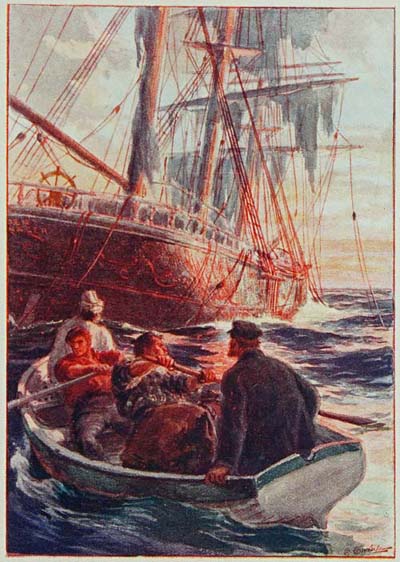
and pointed to the space between the ship and the
beach, where only a very short distance away a
whaleboat was coming at a great rate directly
towards them.
“It’s the old man,” said the second mate in a low
tone, “and he seems to have a pretty gang with
him. I shouldn’t wonder if he means mischief; at
this time in the morning, too.”
The mate looked thoughtfully at the boat for a
moment, and then turning to the second mate said
quietly, “I believe you’re right; at any rate I’ll get
ready for emergencies before they arrive, and you’d
better do the same.”
So they both hurried into the saloon, and seeking
their berths, charged their revolvers and pocketed
them; then coming on deck, the mate awaited
calmly the arrival of the boat alongside with the
skipper, who had gone ashore overnight in the
first boat that was available. He had not long to
wait, for the boat, propelled by four stalwart
natives, dashed alongside in great style, and the
mate standing on the gangway saw to his disgust
that the superior officer was drunk, and that he
was accompanied by three men who had “beach-comber,”
or unattached loafer, writ large upon
them. However he waited quietly until the skipper
swayingly mounted the rail, then said calmly,
“Good morning, Captain Swainson.”
I cannot put the skipper’s reply down, because it
was not only abusive but couched in very foul
language. It raised the mate’s wrath, and he was
about to make a hot reply when he became aware
of the presence of one of the beach-combers, a
huge brutal man who looked ripe for anything
from pitch-and-toss to manslaughter. This visitor
laid his hand on Mr. Jenkins’ shoulder, saying,
“Now, Mister Chief Mate, mind yer stops. I’m a
friend of the cap’s, and I’ve come off to have a
little sociable conversation with you about your
mutinous behaviour on the passage out.”
“And I’m another friend of his,” said the second
visitor, pushing in.
“Count me in,” shouted the third, who had now
gained the deck, and there the mate stood, confronted
by as nasty a situation as could well be
imagined.
The skipper, looking as malignant as a monkey,
rubbed his hands and emitted an exultant chuckle,
then said, “Aha, me hero, boot’s on t’other leg now.
I’ll make ye sing small enough before I’ve done
with ye. Will you kindly inform me” (with profound
sarcasm) “why the hands haven’t been turned
to yet? I want you to understand that I’ll have
discipline aboard this ship or I’ll know the reason
why.”
The mate only turned on his heel and replied,
“I’ll talk to you when you’re sober. As for you,” turning
fiercely to the loafers, “if you interfere with me
in any way, look out for yourselves. I’m heeled
and don’t fear a whole regiment of beach-combers.
Come on, Mr. Cope, let’s leave these gentlemen to
their pleasures and get the hands to work.”
So saying he strode forward, gripping a belaying-pin
from the rail as he went, and on arriving at the
forecastle door he shouted, “Now then, are you
fellows all dead in there? Turn to.”
There was an almost inarticulate rumble of oaths
in reply, but the mate had heard enough to put the
draught upon his smouldering rage, and leaping
into the forecastle he seized the foremost man, the
big German, by the throat, and flinging himself
backwards, they both fell in a kicking heap on deck.
The second mate sprang forward, and dragging the
sailor off the mate flung him sideways into the
scuppers, the mate just springing to his feet in time
to meet the rush of the other men. Unfortunately
he had dropped his weapon in the struggle with
the first man, and had not time to get his pistol out.
The second mate was in the same case, and for
a moment it looked as if they would be overpowered.
But as usual the unexpected happened,
there was a scuffling rush from aft, and into the
fight broke the three visitors like a whirlwind,
striking and kicking with such hearty goodwill at
the mutineers that in the short space of a minute
the struggle was over, and the victory of law and
order was complete. The mate and second mate,
panting and bleeding, stood astonished and glared
at their helpers, the foremost of whom said, “It’s
all right, Mister Mate, I come aboard with the idea
of puttin’ you through, but I ben skipper myself too
long an’ ben in too many tight places to have any
sympathy with mutineers, and I’m glad to have ben
of any service to ye. My name is Haynes, an’ I’m
willing to be chummy if you are. Shake,” and he
held out a hairy fist.
The mate gripped his hand gratefully, and said,
“Thank’ee, Cap’n Haynes, but now if you’ll excuse
me I’ve got to get these blighters goin’; duty first,
y’know.” And turning to the discomfited crowd
he shouted, “Now get along an’ wash decks, an’ the
first man I see skulking I’ll clap the irons on him.”
There was an immediate move to the work, and
in five minutes the usual everyday business of
cleaning the ship was going forward as if nothing
had happened.
This time Frank and his chums had taken no
part in the proceedings, but they had not failed to
notice all that went on, and as they handed along
water or worked at the pump they meditated upon
the advantages of a plucky front shown to opposing
forces. And when breakfast-time came they
eagerly compared notes upon the upshot of the
morning’s work, much to the advantage of the
mate and the disadvantage of the skipper.
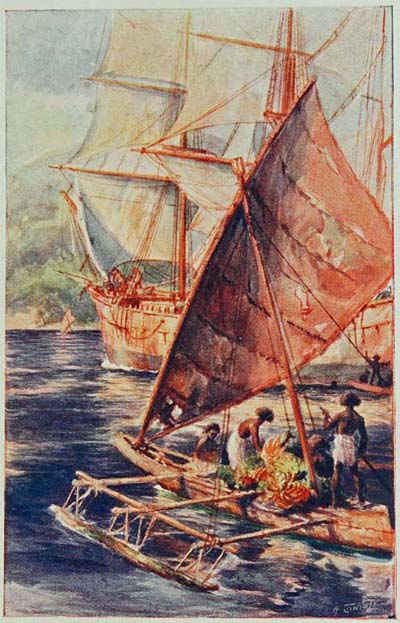
But they soon forgot all about it in their admiration
of the natives, who as the day set in had come
off laden with fruit and sundries for sale. They
were a splendid set of fellows, looking fierce
enough for a regular cannibal raid, with their
enormous bushy heads of hair frizzed out like a
huge halo all around, and their necklaces of
sharks’ teeth gleaming upon their shiny, tawny
bodies. But they were peaceable enough now and
only bent on trade, on getting rid of the loads of
fruit they had brought in exchange for money,
Frank being astounded at the quantity he obtained
for a shilling.
He however could not think of much else
because of his admiration of the antics of those
islanders in the water. They seemed to be even
more at home there than in their canoes, and as a
good swimmer himself he felt what a difference
there was between what we know as swimming
and the fish-like antics of men who were almost
brought up in the water. What with the noise and
excitement consequent upon the constant arrival of
more and more natives Frank got no breakfast,
only a little fruit, so that when turn-to time came
he was angry with himself, and loath to turn away
from this most interesting experience.
But there was much work to be done, and the
mate was obviously bent upon getting a full day
out of his men, although in doing so he gave himself
no rest, and of course the boys had their full
share. So busy were they that they did not notice
the absence of the skipper and his body-guard of
beach-combers, who, finding no liquor on board,
had not tarried to breakfast, but had gone early,
taking a ceremonious leave of the mate, and assuring
him of their readiness to come and help if he
had any more trouble with his crew. He did not
answer, but smiled grimly, thinking that any
trouble that he was likely to have would probably
come from quite a different direction, that is, from
the skipper.
Now began for the boys, who had indeed well
deserved it, a really first-class time. The mate and
second mate having obtained the upper hand of
the crew, kept it by making them work, getting the
ship in apple-pie order after her long passage, and
the boys were put upon all the best jobs, working
at whatever they could do that would teach them
to have confidence in themselves; while the usual
scheme of things in such ships was reversed, that is,
all the dirty, and what is generally known as menial
work, instead of being put upon the boys, was done
by the men.
If this should seem unfair to any reader, I would
beg to remind him that these lads, having paid
liberally for the privilege of being taught their
profession, had no business to be placed in the
position of lackeys to the men, who are always
ready to shift all unpleasant work upon boys’
shoulders, whether they are premium apprentices
or not. But their present position was entirely
due to their own efforts, and the extraordinary
condition of affairs on board. Moreover, although
neither of the officers dared go ashore, knowing
the simmering state of revolt among the men, they
gave the boys every chance to do so, and thus the
lads got a knowledge of boat-handling which is so
very useful to a sailor.
But this I am sorry to say had its evil side, for
the two seniors having had experience of shore-going
pastimes on the previous voyage, when they
were under no sort of supervision, took advantage
of their liberty to introduce Frank to the dubious
delights of Scotch whisky, for which he was proud
to pay as being the only possessor of cash in the
house. And it was curious to see how the shirker
Harry, who, as we have seen, was almost useless
on board, became when on shore quite a swaggering
tar, and put on so many frills that it became
necessary to take him down a few pegs and
threaten to stop him from coming ashore at all
by reporting his behaviour to the mate. This he
resented exceedingly, and sulked a good deal, but
little was thought of that until, one evening when
the boys had been allowed to run ashore as usual,
Harry was missing.
Now they had all four mixed freely with the
natives; had visited their houses, and taken part
in some very curious and unconventional proceedings
which need not be particularised, except by
the general statement that these boys were growing
into men very fast. Yet as far as was known by
Frank and the two seniors, Harry had never
dreamed of desertion; in fact the idea, when first
mooted by Williams, was scouted by the other two
as absurd. However, after scouring the town and
visiting all their accustomed haunts until they were
ready to drop from fatigue, they were compelled to
return to the ship without him.
They met the mate at the gangway, and the first
thing he said was, “This is the last time you go
ashore here with my leave, you ungrateful young
swine. It’s always the way. Be easy, and you get
imposed on. But where’s Harry?”
There was a dead silence for a few moments, the
lads feeling as if they could hear their hearts beat.
“D’ye hear me?” roared the mate, now
thoroughly alarmed.
Frank faltered out, “We don’t know, sir, we
couldn’t find him. We’ve hunted everywhere we
could think of, and that’s what made us so late.”
As soon as the dread truth soaked into the mate’s
brain, his fury was terrible to witness. He was
almost insane at the thought that after all his
care in dealing with his worthless skipper, and
his mastery over the very difficult circumstances
of his position, this calamity should fall upon
him, Harry being the son of a particular friend
of the owners’, who had especially commended
him to the mate’s care. Matters were all the more
complicated, in that the skipper had not been near
the ship since he had gone ashore the morning
after her arrival, and although this was nothing
less than criminal on his part, it would not in any
way absolve the mate for losing the boy.
In vain did the second mate try and comfort
him, pointing out how absolutely free from blame
he was except in the one detail of letting the boys
run ashore for an hour. But the poor fellow could
not pardon himself, and sleep being an impossibility,
he sat and suffered through the night.
About 3 A.M., when he had arrived at that stage
of sleeplessness when the idea of ever having slept
seems ridiculous, and had turned over in his mind
a thousand schemes for recovering his lost apprentice
and had rejected them all as useless, he thought
he heard a sound on deck.
Now there is no place so quiet as a ship at anchor
in a snug harbour on a calm night, and there is no
place where an unwonted sound is so easily heard.
Consequently the mate fairly bristled with apprehension,
and as he lay in his bunk he was like a
cat ready to pounce. Then he saw a gleam of
light flash across the cabin, and in a moment he
was out of his bunk, his trusty revolver clutched in
his right hand, and peering out of the pitchy dark
of his cabin he saw the forms of three men in the
pale glimmer of the young moonlight stealing
across the saloon deck. Without a moment’s
hesitation he raised his revolver and fired three
shots in quick succession, the noise and stench of
the exploding powder filling the narrow space
almost to suffocation.
There were many confused noises of pain, of
rage, and of fear; but Mr. Jenkins calmly retreated
to his room, and lit the dark lantern which all ship’s
officers possess, and emerging once more from his
cabin met the second mate, also with his lantern
and weapon in hand. Their greetings were curt,
and their investigations resulted in finding two
badly wounded men of the crew, the big German
before mentioned, and an Irish-American of whom
I have hitherto said nothing.
These culprits were too frightened and weak
from loss of blood to say anything in reply to
questions, so leaving them for a while the two
officers hurried on deck, finding no one there;
but the second mate rushed to the stern, remembering
that the boat had been passed there instead
of being hoisted, and flashing his lantern down at
her, saw two cowering figures in her stern-sheets
completely demoralised with fright. He sternly
bade them come up, emphasising his readiness and
willingness to shoot if they did not.
Tremblingly they answered, “Ay, ay, sir, we’ll
come up; don’t shoot, for God’s sake,” and began
to haul the boat alongside. They mounted the
ladder and began to scurry forward, when the
second mate stopped them and bade them carry
their shipmates with them, the mate having in the
meantime roughly improvised a couple of tourniquets
for their wounds, and stopped the bleeding
therefrom.
They did so very humbly and carefully, and
when they had gone the mate said solemnly,
“Looky here, Cope, I believe if it hadn’t been for
those blessed boys you and I would have had our
throats cut to-night. I’ve heard say that it’s an ill
wind that blows nobody any good, but I feel sure
that we owe our lives to the misfortune of that
infernal young scalawag Carter having chosen
to-night to run away. I don’t care now. I feel
regularly happy. And if I only had a drop of
something stronger than this pump grog I would
celebrate.”
“Yes, an’ it would go to your head like fire,”
said the second mate. “Be thankful, man, that
they can’t say that about us. I like my tot as well
as the next man, but I’m bound to say that when
there’s trouble about I want to be able to say there
wasn’t any grog in it, anyhow. Now go and turn
in, and I’ll keep watch until daylight. I’ve had a
good sleep, while you must be regularly fagged
out.”
“Thankee, Cope, I will,” replied the mate, “but
keep your eyes skinned for those devils in case
they are up to mischief again.”
“All right, sir,” rejoined the second mate, “I’ll
keep my lamps trimmed for them. But you try
and get some sleep.”
So the mate went to his bunk and fell instantly
into a sound sleep, while Mr. Cope paced the deck
and watched the gentle night fade away and take
on the glory of the dawn, but never for a moment
did he relax his vigilant watch on the fore end of
the ship. And as he pondered over the events of
the voyage so far, he felt sad to think how the
mate, who was one of the kindest and best-natured
fellows alive, should have been driven by untoward
circumstances to become in the eyes of some of
his fellow-men a veritable tyrant, enforcing his will
by the use of deadly weapons.
But he was a healthy-minded young man, and
soon shook off any morbid feelings that the hour
and the reaction pressed upon him, and so fully
did he occupy the time with these various mental
exercises, that it gave him quite a start to hear the
cook call out “Coffee.” He slipped below and
warned the steward not to awaken the mate. Then
having swallowed his refreshing draught, he went
forward and had a quiet chat with the boys as to
the possibilities of Harry being found, but without
much hope of anything being done.
Then a man from forward approached and
diffidently said that the two wounded men were
in a high fever, and evidently very ill. This immediately
reminded Cope of his first duty, and he
went and hoisted an urgent signal for a doctor and
the police, feeling sure that it would be just what
Mr. Jenkins would have done.
Then, having started such of the hands as were
capable of working to wash decks, he went and
called his superior and informed him of what he
had done, being delighted to hear in return that in
Mr. Jenkins’ opinion he had done just right. In
half-an-hour a police-boat was seen coming off
with the doctor on board. She was soon alongside
and the officer in charge put in possession of the
facts. The doctor and the second mate went forward
to the forecastle, and for the next hour that
gloomy chamber bore no bad resemblance to a dirty
hospital ward, while the groans of the sufferers were
pitiable to hear.
At the same time the police-officer was in nowise
astonished to hear that the mate had not seen his
commander since the day after their arrival, and
told Mr. Jenkins that the consignee of the cargo
had seriously debated the question of putting him
on board his ship by force, and daring him to
come ashore again. The officer said, moreover,
that from the capers the skipper had been cutting,
it was certain that he must have spent a good deal
of money or accumulated a heavy debt, which would
certainly have to be liquidated before the vessel’s
departure. He, moreover, promised to leave no
stone unturned to secure the restoration of the
runaway apprentice, but owned that in a port like
Levuka, where there were so many schooners
popping in and out, it would be difficult indeed to
catch him if he had chosen to go to sea. Ashore,
he could almost guarantee his being caught. And
with this scant comfort Mr. Jenkins had to be
content.
Presently the doctor reappeared, looking as became
a man who had done a good day’s work.
He said, “Well, Mr. Mate, you’ve given those
fellows something to remember you by, and they
won’t forget me in a hurry either. My word, but
they did squimmidge. Never mind, it’s all over
now, and they are doin’ as well as can be expected.
Here are the pills,” and he held out two small
bullets. “And now, Mr. Mate, just a toothful of
whisky or squareface or anything of that nature,
and I’ll absence myself chop chop. I’ve got a lot
of grousing beggars ashore waiting for me who’ll
swear I’ve been neglectin’ them on purpose.”
“So sorry, doctor,” replied the mate, “but there
isn’t so much as a smell of firewater aboard this
ship. I had to give it all a passage coming out,
or I’m blessed if I think we should have got here
at all.”
“Oho,” the doctor laughed, “that’s the explanation,
is it? Well, Mr. Mate, you have my sympathy. But
I’m not surprised, judgin’ from the way your jovial
skipper’s been making Rome howl since he came
ashore. He’s one of my patients now, you may like
to know. I’m doin’ my best to save him from a fit
of the rats, but I don’t know how it will turn out,
I’m sure. He’s very shaky. Come on, inspector.”
“I think not, Doc,” answered the police-officer.
“I’d better stay aboard here and let Mr. Jenkins
go ashore and see his skipper. He’s got a report
to make that won’t keep, and from what I can see
of things, the ship won’t suffer from my presence
here until he comes back.”
And then, while the mate bent his shore-going
rig, the police-officer held an earnest colloquy with
his chief boatman as to the disappearance of Harry,
making arrangements for a thorough scouring of
the countryside for the foolish lad.
Five minutes afterwards the mate was hurrying
shoreward, while, to a casual observer, nothing
unusual was taking place on board the barque.
The available men and the lads were busy about
their usual duties getting the vessel ready for sea,
her Fiji cargo having been discharged, and nothing
remaining to be done but prepare for the resumption
of the voyage.
Frank and his two chums went about their work
with a penitential air, the sense of disaster impending,
although they repeatedly assured themselves
that they were in no way to blame for the loss of
their berthmate. In addition, they were puzzled
beyond measure at the extraordinary events which
had taken place during the night, entirely outside
their knowledge. They had slept so soundly that
no item of the fray had reached them, although if
it had they would have been scarcely surprised,
for by this time all three of them, Frank especially,
had grown to regard such events as quite within
the range of any day’s happenings, so speedily do
we all become accustomed to our surroundings.
It was nearly noon before the mate returned,
looking triumphant, like a man who had overcome
all his difficulties. It appeared he had met the
skipper in the presence of the ship’s agent, and had
completely justified himself in the latter gentleman’s
eyes, and also in the opinion of the authorities,
who, with a common sense which may be looked
for in vain in older countries, considered that he
had acted extremely well, and told him so.
The episode of the boy Harry’s loss had been
lightly glossed over as a thing that boys were
prone to, and the mate completely exonerated.
No wonder he was exultant, and if occasionally
he wondered how he should meet the father of
the lad upon his return home, he consoled himself
by remembering that the skipper would have to
answer for it first.
So things resumed their normal course on board,
except for the two wounded men in the forecastle,
who were indeed in evil case, full of pain and the
consciousness of frustrated designs. Otherwise
everything went on just as usual. It does, you
know, on board ship as well as on shore. There
must indeed be an utter break-up, an entire disintegration
of all things when the ordinary work
of getting meals goes wrong. Whoever mutinies
or fights or gets killed, the cook and steward keep
busy with their pots and kettles, and the grub
comes up to time whether there is anybody to
partake of it or not. It is the necessities of life
which bind our doings up, not the great heroic
deeds. I have seen a cook rise calmly and go to
his galley at 5 A.M. to prepare coffee when everybody
else in the ship except the steward felt certain
that she would not live through another watch.
And we were all so glad of that coffee, although
we did not praise the cook.
The next morning brought the skipper on board
in charge of an official who said that if the ship
was ready for sea it would be well if she went at
once. To which the mate was most agreeable,
only making slight demur on the ground that he
was two hands short. That, said the official,
he had considered and had brought with him
four Hawaiian Kanakas, well-drilled seamen who
would work their passage to Honolulu with great
pleasure.
In respect of the missing boy, the official gravely
said he was very sorry, but not a trace of him
could be found, and the ship could not be delayed
while a fruitless search was being made for a
youngster who, by all accounts, was a wastrel who
would never be any good. With this the mate was
fain to be content, and, having seen the skipper
comfortably bestowed in his bunk, with the prospect
of an acute attack of delirium tremens before
him, Mr. Jenkins returned on deck and gave orders
to man the windlass, the wind being very kindly for
departure.
The anchor came up easily, the four Kanakas
being stalwart, cheery fellows, who gave all the
strength they had to the work, and paid no heed
to the lowering looks of the white men who unwillingly
toiled with them. And in an hour the
Sealark had her white wings spread again for the
long sea-road to the Sandwich Islands, where she
was to discharge the remainder of her cargo.
It happened to be Frank’s trick at the wheel as
the ship sped away from the land, and do what he
would he felt unable to help being sorry to put to
sea again. Having cultivated the ability common
among sailors of detaching his mind entirely from
the business of steering, which he did all the more
perfectly because mechanically, he dwelt mentally
upon all the strange scenes he had witnessed in the
semi-savage town they were just leaving. Then he
thought of Harry, the misguided youngster who
had taken a step which would probably break a
fond parent’s heart, who had thus flung away as a
dirty rag all his prospects, and proved his utter
inability to understand the meaning of life.
This led him to think of his own dear folks at
home, and to remember with a start that it was
now six months since he had heard anything of
them. Whether it was the soft influence of parting
from the first port he had ever visited, with all its
varied and pleasant associations, he did not know,
but as he thought of home he felt curiously
choky and unhappy, while his eyes grew dim with
tears.
He was quite lost to all his surroundings on the
narrow quarter-deck, the white sails above him,
and the resplendent sea and sky, when, with a
sudden tightening sensation at his waist and a
cold chill over his scalp, he became aware of the
skipper standing before him with an awful face.
The glaring eyes protruded from between swollen,
reddened lids, the cheeks looked like slabs of
diseased meat where they were not overgrown
with weedy hair, and from between the thick
purple lips came a breath so foul that quite involuntarily
Frank turned his head away.
A voice as harsh and unnatural as a dead man’s
might be imagined to sound said, “Boy, what are
all these devils doin’ aft here? You’re a devil too,
ain’t you? I’d kill you if I could, but I can’t kill
the devil, I can’t kill the devil. Ah, spare me,
spare me,” and the miserable man sank down on
his knees muttering terrible things which, fortunately,
Frank did not understand.
Of course Frank was frightened, but I like to
remember that he kept on steering even though
his heart was bumping against his ribs as if it
would break through. Then he lifted his voice
and yelled at its utmost pitch, “Mr. Jenkins,
Mr. Cope, come aft, the captain’s mad!”
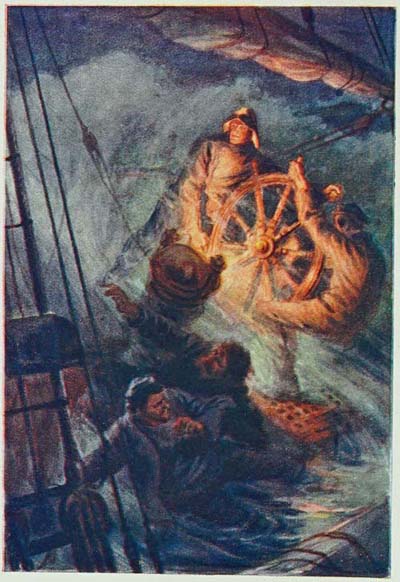
Immediately the poor demented creature sprang
to his feet and flew at Frank, who, agile as a
monkey, vaulted over the wheel-box and seized the
wheel on the other side, still shouting lustily and
keeping a keen eye on the maniac, who now, by
some sudden twist in his poor brain, dived under
the grating, and with a horrid chuckling laugh
began playing with the gear by which the rudder
was moved.
Fortunately by this time Frank’s cries had been
heard, and the two officers, hurrying aft with eager
inquiry, flung themselves upon the skipper and
dragged him below. There they secured him so
safely that, strive as he would, he could not get
loose again. Then, with the versatility of sailors,
they returned to their work of getting the anchors
and cables secured and the ship prepared for open
sea. All the attention they had paid to Frank was
comprised in the simple question Mr. Cope put to
him, “Did he do anything to you?” And when
Frank answered “No, sir,” he expressed his satisfaction
by a curt nod.
But Frank had received a shock that left him
shivering as if from cold. It was far too heavy
a strain to put upon a lad of his age. And it is
all the more satisfactory to be able to record that
he stood it successfully and still steered the ship
as straightly as before. Yet he did not at all realise
what was the matter with the skipper, until being
relieved he went forward to his berth, and in
answer to the eager questioning of Johnson, told
him of all that had happened, with as much of the
skipper’s conversation as he was able to recall.
“Ah,” said Johnson, wagging his head wisely,
“the old swine is paying for his fling in Levuka.
He’s got what the Yanks call snakes in his boots,
and serve him jolly well right too.”
“Snakes in his boots!” replied Frank in a horrified
tone; “whatever do you mean?”
“Why, what the doctors call delirium tremens,”
said Johnson sententiously. “When a man has
been drinkin’ heavy for a long time he gets a fit
of madness, sees things that ain’t there, mostly
snakes, and spiders, and rats crawling all about
where he is, and carries on something shockin’.”
“Oh dear, oh dear!” shudderingly rejoined Frank.
“I wonder you can talk about it like that. What
a frightful thing. I feel half mad thinking of it.
And if you could have seen his face! It frightened
me almost to death. If that’s the fruits of drunkenness,
I’ll never touch another drop of the beastly
stuff as long as ever I live.”
“Good boy,” sneered Williams, who had just
come in, “that’s what they call in the books, the
effect of a horrible example. But who’s going
to be such a juggins as to get like that? Not me,
anyhow. I’m going to have my grog and enjoy
myself.”
Frank didn’t see his way to any reply, so he
remained silent with the skipper’s awful face in
his mind’s eye.
These unpleasantnesses, however, did not long
affect the lads, who had far too many objects of
interest around them to allow them to dwell upon
the troubles of other people. They were now
sailing through perhaps the most romantic and
beautiful sea in the world, their route being studded
with lovely islands, the sea swarming with fish, the
air joyful with birds. They had, moreover, frequent
visits from passing canoes, for the natives
of those islands, confident in the quietude of their
environing seas, think nothing of journeying a
couple of hundred miles or so in craft that civilised
men would hardly care to cross a narrow
river in.
It was great fun to see the four jovial Hawaiians
exchanging salutations with these wanderers, and
greater fun still to learn from the dusky mariners
how to snare the many fish that gambolled about
them by day and by night. They, of course,
thought nothing of the tremendous strain upon
the mate of having to navigate the ship amidst
that maze of islands, having the entire responsibility
thrown upon him without any recompense
or compensating circumstances. And all the while
the man who was receiving pay for this onerous
work was lying helpless below, having gotten over
the worst of his madness, and was now slowly
working his way back again to complete health
under the careful attention of the man to whom
he had behaved in so shameful a manner.
But taking it all round there was a peaceful,
happy time for everybody. The men forrard,
having lost the two malcontents, had settled down
to their work in good shape, and finding that the
Kanakas were rattling good seamen at all such
work as handling sails, steering, and keeping look-out
(at this last their eyes were like twin telescopes),
besides being ever good-natured and willing, they
chummed up with them splendidly.
Then the food was good, for Mr. Jenkins had
laid in a good supply of vegetables and fruit, having
been empowered to do so by the consignee,
after that gentleman had found out how helpless
to attend to business the skipper was. And to
crown all, the weather was persistently fine, even
delightful, while the ship, owing to the way in
which Mr. Jenkins had kept the hands at work
in harbour, was in splendid trim, working easier
than she had ever worked before during that
passage. So day by day slipped away, Frank feeling
more and more satisfied with his lot, putting
on strength both of body and mind, and accumulating
unconsciously a store of reserve force against
the time when it should be needed in other and
stormier scenes.
At last, when they had cleared the Phœnix
Islands and had a clear long stretch before them
up to the Sandwich group, the skipper made his
appearance on deck, a mere shadow of a man,
looking as if he had still one foot in the grave.
He was treated with grave and distant courtesy
by the officers, but took no part whatever in the
working of the ship. But neither did he make any
admission of his wrong-doing or appear at all grateful
for the faithful service bestowed upon the ship
by those under him, service which had saved
her from disaster and everybody on board from
innumerable miseries.
As an instance of the depths to which his neglect
had dragged him, it was not until they had been
out a fortnight from Levuka that the mate came
forward one morning to the boys’ house and
handed to each of them a letter which he said
the captain had found among his papers, letters
which had been waiting in Levuka for the ship’s
arrival, and had thus been kept from their rightful
owners.
This sounds almost incredible, but I know of a
case in a ship upon which I served where the
skipper actually destroyed in a drunken fit all the
letters for the crew which he had received in Rangoon,
and scoffingly said that his action “would
save ’em a lot of trouble; what did they want with
letters?”
Of course Frank could not help feeling indignant
at this shameful treatment, but the joy of thus receiving
unexpectedly in open sea a budget of news
from his loved ones was so great that he speedily
forgot the offence and lay upon the main hatch in
the beautiful sunshine (it was Sunday afternoon
and nothing was a-doing), soaking his soul in the
outpourings of love from that far-away home
circle.
How he regretted now the curt letter he had
sent home from Levuka, for, smarting under a
sense of neglect, he had merely told them that
he was well and liked the sea, and that he hoped
the voyage would be a long one, thinking that they
had forgotten all about him. And now here was
the proof of their never-ceasing thought of him.
As he realised how great a sin that drunkard aft
had committed against him and them, he felt beside
himself with rage, the rage of the budding man,
and he rushed to his bunk, got out his writing
materials, and in his first fury wrote such a letter
to his people as he had never dreamed himself
capable of putting on paper.
And still the good ship glided on o’er sunny seas
’neath glowing skies, until the glorious panorama
of Oahu burst into view at the break of a golden
morning, and Frank wondered that the thrill he
felt at the sight of Kandavu would not come again.
Speedily and in seaman-like fashion the Sealark was
brought to her moorings, the anchor rattled down,
she was safe in port once more, and—the credit of
it all went to the creature who had been a positive
danger to her instead of any help whatever. This
is one of the grim ironies of sea life, but fortunately
did not touch Frank’s mind; although he knew it,
he did not feel it, and it was well.
Now Honolulu is a far more advanced port
than Levuka. But there are many opportunities for
debauchery, and this doubtless Captain Swainson
well knew as he rigged himself out in his best
clothes and prepared to leave his ship again.
But Mr. Jenkins was waiting for him as he came
on deck with the jovial agent by his side, to whom
the skipper had been unreeling a lurid yarn about
the difficulties he had overcome of worthless officers
and mutinous crew.
“I want a word with you before you go ashore,
Captain Swainson,” said the mate in grim, dry
tones.
“Oh, I can’t stop now,” hastily replied the
skipper. “Can’t you see I’m busy? And the
agent’s waiting too. I’ll see you later on in the
day. Get the——”
But he got no farther, for the mate, standing
squarely in front of him, said—
“If you don’t care to listen to what I’ve got
to say quietly, and while you are sober, I shall
say it before such listeners as you will tremble
to see. I’ve had enough of your capers, and I’ll
have no more.”
“Now look here, Mr. Mate,” interrupted the
agent, “this won’t do, you know. You mustn’t
behave like this. You forget yourself.”
The mate’s blood grew hot. But he restrained
himself with a mighty effort, and answered quietly—
“Oh no, I don’t, sir. I forget nothing. But
that man there was drunk all the time the ship
was in Levuka, and mad with the horrors half the
way here, and if he’s going on the same way in
Honolulu, I’m going to stop him, that’s all, if
there’s any use in a British consul.”
The skipper looked at the agent in helpless
fashion, and the agent, putting on a big official
tone, said, “Now, Mr. Mate——”
But Mr. Jenkins stopped him, and said in a tone
that carried conviction—
“Now, Mr. Agent, I have nothing to say to you
at all. Only if Captain Swainson isn’t on board
this ship to-morrow attending to his duty, it will
be my business to know why, and the telegraph
office is as free to me as to anybody else. That’s
all I’ve got to say; and now I’ve my duties to
attend to, and I wish you good day.”
And he turned on his heel, and left the pair to
digest his words.
They got into a boat and went ashore, wondering
what the outcome would be, while the mate’s
orders flew like hail, and the ship was rapidly put
in harbour trim, and the discharging gear got ready
for transhipment of cargo. In this way the day
passed rapidly, and Frank hardly had time to
note the beauties of the island harbour wherein
they lay until knock-off time, when the gentle
native folk with soft caressing words came on
board, bringing loads of gifts as they called them,
but really gifts that called for a far greater return.
The four Hawaiians were now in their element
among their fellows, and full of glee at being home
again. They repaid with rich interest the kindly
treatment they had received, and introduced the
visitors with rapid outpourings of broken English.
There was, however, one serious bar to any extended
trade—no one had any money. Frank’s
little store had all been spent in Levuka, and the
sailors had not received a penny, although they
had now nearly seven months’ wages due, and by
unwritten ship law were entitled to liberty and
a month’s wages. This, however, they could not
get from the mate, they knew; and so they did
not ask, hoping to get at the skipper some time
when he was on board.
Now the mate’s spirited protest had much
impressed the agent, who was a keen tradesman,
and without unduly pressing the skipper, he made
it clear to him that it would be well to go slow,
in case the mate should “behave ugly,” as he
put it. And so he kept the skipper well in hand,
allowing him to have only a gentle fling, and
seeing him depart from the beach that night for
his ship only partially drunk, and without any
means of strengthening the hold the liquor had got
upon him. The mate was on deck when he came,
and duly noted his condition, but said not a word.
And the skipper reeled to his bunk, his head all
awhirl with projects for the mate’s discomfiture,
but saying nothing at all.