om," said Frank, addressing himself
to the quarter-master, as the two
were standing their watch that
evening, "how came you to go to sea?"
"I was born a sailor, sir," answered
the man. "My father, and my grandfather
before him, followed the sea for
a livelihood. They were smugglers, living among
the rocks and crags on the southern coast of
England.
"My home was not such a one as would have
suited you, sir; but it was a pleasant place to me,
and I often look back to the days of my boyhood,
although passed amid scenes of danger, as
the happiest ones of my life. Our house, as we
called it, was a cave in the side of a high mountain,
at the foot of which was a long, narrow, and
rocky passage, that led to the ocean. At the
end of this passage, next to the mountain, was a
small but deep bay, where a vessel could ride at
anchor in safety without being seen by any one
outside. In front of the cave was a small grass
plot, which overlooked a vast extent of sea and
land, and from which the distant shores of France
could be seen. This was my post, where I sat
many a night, watching for the return of my
father, who was the captain of the smugglers. It
was my business to watch for revenue-cutters,
and to give the signal of danger in case any appeared
off the coast at the time father was expected
to return.
"It would have been a lonely watch in that
cave for one who was not accustomed to it, for I
never had a companion; but, having been brought
up to that kind of a life, I was never at a loss to
know how to pass away the time. The fishing in
the basin was excellent, and I had a small boat, the
exact model of my father's little schooner, with
which I sometimes amused myself for hours together
in running in and out of the channel, which,
owing to its rocky nature, was very difficult of
passage. It was here that the cutters were always
given the slip. Father never approached the
coast except during the night, and many a time
have I seen the swift little schooner come bounding
over the waves, with every stitch of her canvas
stretched, followed close in her wake by a
cutter. The latter would be certain of his prize
when he saw the schooner heading straight toward
the rocks; but, the first thing he knew, the smuggler
would be out of sight in the channel. No
light was necessary, for father knew every inch of
the ground, and before the man-o'-war could lower
his boats and discover the place where his prize
had so mysteriously disappeared, father would
have his goods landed, and, ere the cutter was
aware of it, he would run out of the channel under
his very nose, and make all sail for France. No
one outside of the band was ever known to enter
the channel; for, even in broad daylight, a person
would have declined making the trial, as the waves
dashed and roared among the rocks in a manner
that seemed to threaten destruction to any thing
that came within their reach.
"The schooner was several times overhauled
and boarded while at sea, but father never lost a
cargo. He always succeeded in fooling the revenue
chaps in some manner. I remember one time
in particular, when I made a trip on board the
schooner as mate. We made the run in our usual
time, easily eluding the cutters that were watching
us, and arrived off the coast of France with every
thing in order. One dark night we landed our
goods, and, after receiving our money, we ran
down to a little town, to purchase some necessary
articles, and to take in our return supply. A lot
of jabbering French policemen sprang on board
of us, almost before we had touched the wharf,
and commenced rummaging the hold; but they, of
course, went away disappointed in their hopes of
finding something to condemn us. We lay in port
alongside of a little Dutch trading vessel, that was
our exact model and build in every particular,
until night, when we received our goods, ran by
the police, and stood out to sea. We got along
nicely until just before daylight, when an 'Irish-man's
hurricane,' as we call a calm, set in, accompanied
by a heavy fog, and we lay motionless on
the water, with the sails flapping idly against the
masts. It was provoking, and a more uneasy
set of men than that schooner's crew I never saw.
We remained becalmed for nearly an hour, anxiously
waiting for the wind to spring up, when I
happened to step for'ard, and heard a noise like
the washing of the waves against the side of a
vessel. I hastily ran aft and reported the matter
to father, who silently stationed his men, and
walked for'ard, with his speaking-trumpet in his
hand, while we stood at our posts, almost fearing
to breathe, lest it should be heard on board of
the strange vessel, which was still concealed from
our view by the thick fog.
"At length, to our inexpressible relief, we felt
a puff of wind; then came another and another,
each one increasing in force, until the sails began
to draw, and the schooner commenced moving
slowly through the water. We stood off on the
starboard tack, intending to give our invisible
neighbor a wide berth; but he had also caught
the wind, and we could hear him moving along
almost in front of us. At length the fog lifted a
little, and we saw a large revenue-cutter standing
directly across our bows, scarcely a cable's length
distant. We luffed, to allow him to pass, when a
hail came from his deck:
"'Schooner ahoy!'
"'Yah,' shouted father through his trumpet.
"'What schooner is that?'
"'Dis? Dis is my schooner. You know it.'
"We all held our breath in suspense, wondering
what would be the result of this strange answer,
when we distinctly heard the voice say:
"'It's that rascally Dutchman again.' Then,
in a louder tone, came the question, 'Did you
keep a good look-out for that smuggler, as we
requested?'
"'Yah! But I haven't saw him.'
"'O, shiver your ugly figure-head,' was the
answer. 'I've a good notion to put a six-pound
shot into you, you wooden-headed sour-krout
eater. This makes twice that we have been fooled
by you. Now off you go, and don't you cross
our hawse again.'
"Father made no reply, and the cutter put her
helm down, and started off. We passed under
her stern, and in a few moments she disappeared
in the fog. The next night we entered the channel,
and landed our goods in safety. We afterward
learned that the cutter, which had been
closely watching our movements, had boarded the
Dutch schooner, (which I have before mentioned,
and which sailed about two hours in advance of
us,) and so certain were they that they had at
last gobbled the smuggler, that they seized the
vessel, and unceremoniously slapped the captain
and his crew in double irons. The skipper was
so terrified that he forgot his English, and jabbered
away in Dutch; and it was not until the
ship's papers had been overhauled, that the cutter
discovered her mistake. When the revenue fellows
ran foul of us, they were again deceived by
the resemblance between the two vessels, and the
manner in which father had imitated the Dutch
skipper's language. About a year after that we
had a stopper put on our operations, by one of
our own men.
"The cave had two entrances—one by a rope
ladder from the basin below, which we could draw
up in times of danger, and the other by a path
through the mountains, which was known only to
a few of the band whom father thought he could
trust. But his confidence was abused. There is
a black sheep in every flock, and we had one
among us—a man who, tempted by the offer of
reward that was held out for our apprehension,
betrayed us, and broke up our harboring-place.
"It was this man's business to go to Bath, a
small town about two miles from the cave, to dispose
of our goods to the merchants in that place,
and receive the funds. Young as I was, I almost
knew that the fellow would one day get us into
trouble. He was a short, powerfully-built man,
with a most villainous countenance. He was always
silent and morose; could not bear to have you
look him in the eye; in short, he was just the
man that I would have picked out from among a
hundred as a traitor. Father seemed to repose
entire confidence in him, and always asked his advice
in times of danger; but, as much as I respected
his judgment, I could not conquer the feeling with
which I had always regarded the man, and I was
constantly on the watch.
"One night the schooner sailed as usual, but
this man, under pretense of sickness, remained
behind, with instructions from father, in case he
got better, to go to the village and collect some
money due him for goods.
"'All right,' answered the mate; 'I'll attend
to it.' Then, as soon as father had got out of
hearing, he muttered, 'I'll collect something for
you that you won't expect.'
"As soon as the schooner had cleared the channel,
and was fairly out to sea, the rapidity with
which that man got well was astonishing. He
staid about the cave all day, scarcely saying a
word to me, and at night departed by the secret
path for the village. I was very uneasy, for a
dread of impending evil constantly pressed upon
me, and I determined to watch the path, and be
ready for any emergency.
"On the cliff, at the entrance of the channel
that led to the bay, was a pile of dry wood, that
was to be lighted in case of danger. This I replenished,
placing materials for striking a light
close at hand, and then returned to the cave to
keep watch of the path.
"Two days passed without the occurrence of
any thing unusual, and the night came on which
the schooner was expected to return. I divided
my attention between the secret path and the
offing, and at length a blue light, moving up and
down in the darkness, told me that the schooner
was approaching. I answered the signal, and
stood peering through the darkness to get a
glimpse of the approaching vessel, when I heard
a rustling behind me, and looking down the path
I discovered, to my dismay, a party of armed
men approaching, headed by the traitor, who said,
in a low voice:
"'It's all right now. Catch that brat before
he has time to light the signal of danger, and let
the schooner once get into the channel, and we
have got them fast.'
"The person spoken of as 'that brat' was myself,
and I knew that the salvation of the schooner
depended upon my exertions. In an instant I
had determined upon my course, and, springing
from the cave, I ran toward the rope ladder that
led to the basin below, and commenced descending.
A moment afterward the mouth of the cave was
filled by the burly form of the traitor, who exclaimed:
"'There he is—shoot him!' and, suiting the
action to the word, he leveled his pistol and fired.
I felt a sharp pain shoot through my shoulder; a
faintness seized upon me, and, being unable longer
to retain my hold upon the ladder, I disappeared
in the basin. My sudden immersion in the cold
water revived me, and, being an excellent swimmer,
I struck out, intending to climb the cliff on
the opposite side, and fire the pile. I exerted
myself to the utmost, for I could see by the lights
in the mouth of the cave that the traitor and his
men were preparing to follow me; but, it seemed,
in my hurry and excitement, that I scarcely moved
through the water. At length, however, I reached
the opposite shore, and after climbing the cliff,
(which I did with the utmost difficulty, for my
wounded arm was hanging almost useless at my
side, and I had not stopped to look for the path,)
I ran at the top of my speed toward the pile.
The schooner having seen my signal, and supposing,
of course, that all was right, was still standing
toward the mouth of the channel. A moment
more, and I would have been too late.
"I had considerable difficulty in finding my
flint, and then it seemed impossible to strike a
light; but, just as the foremost of my pursuers
reached the top of the cliff, I succeeded in catching
a spark; in a moment more, the whole pile was
in a blaze. I could not refrain from giving a shout
of triumph as I saw the flames shooting upward
toward the sky, lighting up the whole face of the
rocks, until every object was as clearly defined as
in broad daylight. I heard an exclamation of surprise
on board the schooner, followed by a few
hastily-spoken orders; then I knew that I had succeeded,
and the schooner was safe. But I was not
a moment too soon, for the little vessel was rapidly
nearing the mouth of the channel, and once enclosed
by those rocky walls, once under the influence
of those waves that dashed so madly over the
rocks, retreat would have been impossible.
"I was allowed scarcely a moment to congratulate
myself upon my success, for my pursuers,
finding themselves foiled, determined to wreak
their vengeance upon me. They could plainly
see me by the light of the burning pile, and the
quick discharge of half a dozen pistols sent the
bullets thickly around me. It was death to remain
where I was, so, taking a last look at the
cave, I threw myself over the cliff, and struck out
for the schooner.
"My father, having seen me when I took the
leap, laid the schooner to, and lowered a boat to
pick me up. I tell you, sir, I was a proud youngster
when I stood on that deck, receiving the
thanks and the congratulations of those I had
saved. I forgot the pain of my wound, and the
dangers from which I had escaped, in the joy I
experienced at finding myself once more safe
among my friends."
Their watch ending with Tom's interesting reminiscence,
they then turned in for the night.
The next morning the attack upon the bluffs
was renewed, without resulting to the advantage
of either side, and at night the vessels again withdrew,
and retreated down the river. The Trenton
returned to her old landing, and Frank, at his request,
was again placed in command of one of the
guns of the battery. But he was not destined to
hold the position long, for, now that the "beauties"
had dismounted that troublesome gun, General
Sherman had advanced his works until he
could go no further without getting into the enemy's
line. At length, one morning, a flag of truce
was raised within their fortifications, and hostilities
were at once suspended. Then came that celebrated
interview between the generals, during
which the soldiers on both sides clambered out
of the rifle-pits, and conversed face to face with
the men with whom they had so long been engaged
in deadly conflict.
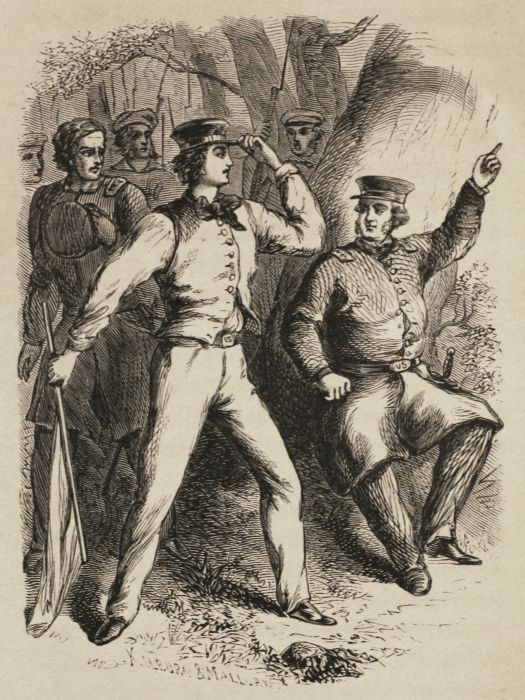
"How are you now, Johnny?" inquired Frank,
seating himself on one of the guns, and waving his
hat to a rebel officer who stood in the rifle-pits,
gazing at the battery with great interest. "What
does that flag of truce mean? Are you going to
surrender?"
"Don't know," replied the rebel; "but, I say,
Yank, will you let a fellow come over there?"
"Certainly. Come on."
The rebel accordingly laid aside his weapons,
and walked over to the battery, where, after examining
the guns very curiously, he entered into
conversation with Frank, in the course of which
he informed him that they were a "played-out
concern," and could not possibly hold out more
than a week longer.
But they did not "hold out" so long; for, on
the next day, the fourth of July, the victorious
army entered the city, and raised the Stars and
Stripes over the "Sebastopol of the Rebels."
Here we leave our hero, reposing before Vicksburg
on his well-earned reputation as a gallant
young officer, waiting to be ordered to new scenes
of excitement and danger further down the Mississippi
and up her tributary streams. Through
these scenes we shall conduct our readers in a
concluding volume, which will close Frank's career
on our Western waters.
THE END.
R. W. CARROLL & CO.,
Publishers, Booksellers, and Stationers,
73 WEST FOURTH STREET,
OPERA-HOUSE BUILDING,
CINCINNATI, OHIO
Call attention to their List of Standard, Useful, and Interesting Works:
The Works of Shakespeare. Complete. 8vo., shp. $4.50
Turkey antique, $10.
Vagaries of Van Dyke Browne. An Autobiography in Verse.
By Wm. P. Brannan. 1 vol., 16mo., $1.75.
Lights and Shadows of Army Life; or,
Pen Pictures from the Camp, the Battlefield, and the Hospital,
By Rev. W. W. Lyle, Chaplain U. S. A. 1 vol., 12mo., $1.75.
Discourses from the Pulpit. By Rev. Wm. M. Daily, A. M., LL.D.,
late President Indiana University. With portrait. 1 vol.,
12mo., $1.50.
The Mystic Circle and American Hand-book of Free-MASONRY.
By George H. Gray. 1 vol., 12mo., illus. New Edition. $2.
The Illustrated Book of Manners; A Manual of Good Behavior and Polite Accomplishments.
By Robert De Valcourt. Illustrated, 16mo., $1.75.
The Odd-Fellows' Minstrel; A Collection of Odes for All Occasions,
for the Use of the Fraternity. By J. Fletcher Williams,
P. G. S. of Grand Lodge of Minnesota. 1 vol., flexible cloth, 75 cents.
The Heroes of the War for the Union, and their Achievements.
With a portrait of General Grant. By Rev. P. V. Ferree,
M. D. 1 vol., 12mo., $2.
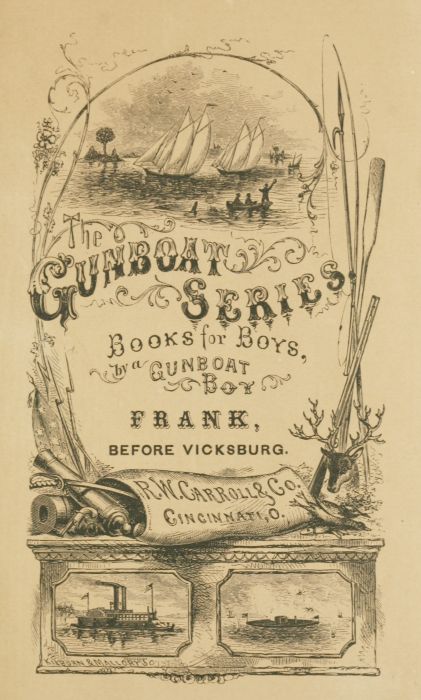
The Gun-Boat Series. By H. C. Castlemon, "The Gun-boat Boy." Comprising:
FRANK, THE YOUNG NATURALIST. Illustrated, $1.25.
FRANK IN THE WOODS. Illustrated, $1.25.
FRANK ON A GUN-BOAT. Illustrated, $1.25.
FRANK BEFORE VICKSBURG. Illustrated, $1.25.
FRANK ON THE LOWER MISSISSIPPI. Illustrated, $1.25.
Incidents of the War: Humorous, Pathetic, and Descriptive.
By Alf. Burnett, Comic Delineator, Army Correspondent, etc. 1
vol., 12mo., illustrated. Cloth, $1.25.
[SEE NEXT PAGE]
The Sioux Massacre in Minnesota: A History of the
Great Massacre by the Sioux Indians in Minnesota;
including the personal
narratives of many who escaped. By Charles S. Bryant, A. M.,
and A. B. Murch. 1 vol., 12 mo., 504 pages, cloth, $1.75.
Trial of Clement L. Vallandigham by a Military Commission,
and the Proceedings in Habeas Corpus. 1 vol., 8 vo. Paper, 75
cents; law sheep, $2.
Internal Rules and Regulations for Vessels of the Mississippi Fleet.
Issued by order of Rear-Admiral David D. Porter. 8 vo.,
stitched, 25 cents.
Thrilling Adventures of Pauline Cushman, the Famous Federal Spy.
1 vol., 12 mo., stitched, 25 cents.
Poems. By Alice McClure Griffin. From the Riverside Press.
1 vol., 12mo., cloth, gilt tops, $1.
Lawson on Consumption. A Practical Treatise on Phthisis Pulmonalis.
By L. M. Lawson. M. D., Professor of the Theory
and Practice of Medicine in the Medical College of Ohio, etc. 1 vol.,
8 vo., sheep, $3.50.
A History of the Discovery of the Circulation of the BLOOD.
By P. Flourens, Sec. of the Academy of Sciences, Paris.
Translated from the French by J. C. Reeve, M. D. 1 vol., 16 mo., cl., $1.
A Popular Manual of Practical Microscopy.
By John King, M. D. Illustrated with 114 cuts. 8 vo., $2.50.
The Eclectic Practice of Medicine.
By William Byrd
Powell, M. D., and R. S. Newton, M. D. 1 vol., 8 vo., sheep, $4.
The Concordia. By A. D. Fillmore.
A splendid Book
of Church Music, with ample Lessons for Schools, in round notes, containing
over 400 pages. $1.50 per copy; $12 per dozen.
The Polyphonic; or, Juvenile Choralist.
By A. D. and
C. L. Fillmore, containing a great variety of Music and Hymns, new
and old, designed for Schools and Youth generally, and adapted to use
in Religious Meetings and in the Home Circle. Three Parts, in 1 vol.,
128 pages. Paper covers, 30 cents per copy; $3 per dozen. Stiff covers,
35 cents per copy; $3.60 per dozen.
Teachers and Sabbath-Schools supplied by the dozen or hundred, at
a liberal discount.
Nelson's Mercantile Arithmetic, for Commercial Schools
and Colleges.
By Richard Nelson. 1 vol., cloth, $1.25.
The Little Speaker. By J. C. Zachos. 60 cents.
The High School Speaker. By J. C. Zachos. $1.
 Liberal discounts to the Trade. Any Work on our List sent,
post-paid, on receipt of price.
Liberal discounts to the Trade. Any Work on our List sent,
post-paid, on receipt of price.
R. W. CARROLL & CO.,
73 West Fourth Street, Cincinnati.
TO PHYSICIANS AND MEDICAL STUDENTS.
R. W. CARROLL & CO.
KEEP AT ALL TIMES
A COMPLETE STOCK.
-OF-
MEDICAL BOOKS,
TO WHICH THE ATTENTION OF
PHYSICIANS AND STUDENTS
IS DIRECTED.
AMONG THEM WILL BE FOUND THE LATEST EDITIONS OF ALL
THE LEADING AUTHORS IN THE USE AS TEXT-BOOKS
IN THE COLLEGES, COMPRISING
Works on Materia Medica and Pathology,
Works on Surgery,
Works on Mechanical and Operative Dentistry,
Anatomical Books,
Domestic Medicine,
etc., etc., etc.,
RECENTLY ISSUED:
A NEW AND COMPLETE MEDICAL CATALOGUE,
(PRICES ATTACHED,)
Which will be sent on receipt of a Postage Stamp.
The Trade Supplied on Liberal Terms.
R. W CARROLL & CO., Publishers,
73 West Fourth Street, Cincinnati.
A NEW AND STIRRING SET OF
JUVENILES
EACH VOLUME HANDSOMELY ILLUSTRATED.
These are the only works published relating to Adventures in the Gun-boat
Service on our Western waters. The Author speaks
from actual experience.
Frank, the Young Naturalist,
Frank in the Woods,
Frank on a Gun-boat,
Frank before Vicksburg,
Frank on the Lower Mississippi.
By H. C. CASTLEMON,
THE "GUN-BOAT BOY."
These works are the productions of a young officer, who has been
serving his country in the gun-boat service on our Western waters.
They are written in a chaste style, filled with stirring adventures, and
are admirably adapted to interest and improve the rising generation.
The tone of the entire series is healthy, while it takes a wide range,
detailing the adventures, amusements, and exploits of Frank and his
Cousin Archie, from early boyhood to the end of the Rebellion, against
which they both fought.
5 volumes, elegantly printed and bound, in a neat box, $6.25.
Any volume sold separately, price $1.25.
Sent by mail, post paid, on receipt of price.
For sale by all Booksellers in the United States.
R. W. CARROLL & CO., Publishers,
73 West Fourth St., (Opera-House Building,)
CINCINNATI, O.
SHAKESPEARE
R. W. CARROLL & CO.
CALL ATTENTION TO THEIR EDITION OF THE
Complete Works of Wm. Shakespeare.
One Vol., Large Octavo, Elegantly Illustrated.
Sheep, $4 50; Turkey antique, $10.
This is the handsomest one-volume edition published. It is printed
from clear, bold type, illustrated with steel engravings, and comprises
the complete Dramatic and Poetical Works, from the text of the
late George Steevens, with a Glossary and Notes, and a Memoir by
Alexander Chalmers.
Sent by mail, postage paid, on receipt of price. 
A STANDARD WORK ON FREEMASONRY.
JUST READY, A NEW EDITION OF
THE MYSTIC CIRCLE,
AND
American Hand-Book of Masonry
By George H. Gray, Sr.
This excellent work contains a brief History of Freemasonry in
Europe and America—Symbolic Chart—Ancient Constitution of the
Grand Lodge of England—Abiman Rezon—Constitutional Rules—Resolutions,
Decisions, and Opinions of Grand Lodges and Enlightened
Masons, on Questions liable to arise in Subordinate Lodges, and a Code
of By-Laws for Subordinate Lodges—Instructions, Suggestions, and
Forms for Secretaries of Lodges.
One vol., illustrated, handsomely bound, $2.00. Sent by mail, post-paid.
R. W CARROLL & CO., Publishers,
73 West Fourth Street, Cincinnati.
NEW POEMS BY WM. P. BRANNAN.
Vagaries of Vandyke Browne,
AN AUTOBIOGRAPHY IN VERSE.
BY WM. P. BRANNAN,
AUTHOR OF "THE HARP OF A THOUSAND STRINGS"
1 Vol., elegantly Printed on Laid Paper, and exquisitely Bound in New
Style Cloth, $1.75.
Sent by Mail, Postage Paid, on Receipt of Price.
Mr. Brannan is well known, to the people of the West especially,
as an artist, and an occasional contributor of poetry to the Press. His
"Harp of a Thousand Strings," a burlesque sermon, has been long
recognized as the best of its class. The present volume is one of
superior merit for the wit and humor of the Autobiography, the pathos,
imagination and smooth versification of the Occasional Pieces scattered
in profusion throughout. This work is destined to place Mr.
Brannan high in the rank of American Poets, and to give him position
as a leader among the Bards of the West.
NOTICES OF THE PRESS.
"The breezy freshness of the prairie pervades his thought, and breathes
in many of his lines."—Portland Daily Press.
"The collection of Poems does honor to the author, whose name is so
familiar to Western people, that the mere announcement of the work
will be sufficient to secure a host of readers."—Cincinnati Gazette.
"This autobiographic verse is made to link together a number of
fugitive poems which have the true gold of poetry, without alloy."—Cincinnati
Commercial.
"The Poems display a tender and refined sensibility, and the book is
one to buy."—Boston Saturday Evening Gazette.
"The author manifests more than ordinary skill in versification."—Salem
Register.
R. W CARROLL & CO., Publishers,
73 West Fourth St., Opera-House Building, Cincinnati.
MUSICAL WORKS OF A. D. FILLMORE.
R. W. CARROLL & CO.
Call attention to the following list of Mr. Fillmore's Works, which
are published by them:
HARP OF ZION:
A large Book of Church Music, in Figure-faced Notation on the Staff.
The work contains a concise course of lessons, and a series of Practical
Exercises for Schools; also, a number of fine secular pieces, designed
for Social and School Practice. $1.25 per copy; $12 per dozen.
(In preparation—entirely new.)
CONCORDIA:
A Splendid Book of Church Music, with ample lessons for Schools, in
round notes, containing over four hundred pages. $1.50 per copy; $15
per dozen.
POLYPHONIC:
Designed for Sunday-Schools. Bound in boards, 35 cents per copy; $3.60
per dozen. Paper covers, 30 cents per copy; $3 per dozen.
Liberal discounts, on the above works, to Sunday-Schools, Teachers,
and the Trade. Sent by mail, post-paid, on receipt of price.
A Pleasant Volume for the Fireside.
HUMOROUS, PATHETIC, AND DESCRIPTIVE
INCIDENTS OF THE WAR.
BY ALF. BURNETT,
HUMORIST AND ARMY CORRESPONDENT.
With a Sketch of his Life; and Humorous Illustrations, from Original
Designs, by Thee. Jones. 1 vol., 12 mo., cloth. $1.25.
Mr. Burnett has a reputation, throughout the entire country, as a
first-class Humorist. In this volume he has gathered incidents both
grave and gay, to convulse with laughter, and to subdue with tears. It
is a book which will be readily welcomed by a large class of readers, and
contains much worthy of preservation.
Sent by mail, post-paid, on receipt of price.
R. W CARROLL & CO., Publishers,
73 West Fourth Street, Cincinnati.
OPERA-HOUSE BOOKSTORE,
CINCINNATI, O.
WHOLESALE DEPARTMENT.
R. W. CARROLL & CO.,
WHOLESALE
Booksellers and Stationers,
KEEP CONSTANTLY ON HAND
THE LARGEST AND BEST ASSORTED STOCK OF
BOOKS AND STATIONERY,
OF EVERY IMAGINABLE KIND,
To be found in any one House in the Mississippi Valley. They offer
these at
REDUCED PRICES,
And will always sell on as favorable terms as the market will permit,
or as any other House can give. Among the great variety
of articles sold by
R. W. CARROLL & CO.
are the following:
SCHOOL BOOKS OF EVERY KIND, USED IN THE WEST,
Law Books, Medical Books,
Scientific Books, Theological
Books, Agricultural Books, and all
Varieties of Miscellaneous Books, including
Histories, Biographies, Travels,
Novels, and Illustrated Works; Photograph
Albums and Cards, Plain and Fancy Letter and
Note Paper, Foreign and Domestic Stationery, Foolscap
and Flatcap Paper, Gold Pens, Inkstands, Steel
and Quill Pens, Lead Pencils, Chess Boards,
Cribbage Boards, Paper Weights, Paper
Cutters, Card Cases, Pocket Books,
Portfolios, Writing Desks, Pocket
Cutlery, Diaries, Memorandum,
Scrap and Blank Books.
In fact their stock includes every variety of Books and Stationery,
which they invite Dealers to examine before purchasing, as they are
confident they offer the greatest facilities, and can give satisfaction.
R. W. CARROLL & CO.,
73 West Fourth. St., Cincinnati.