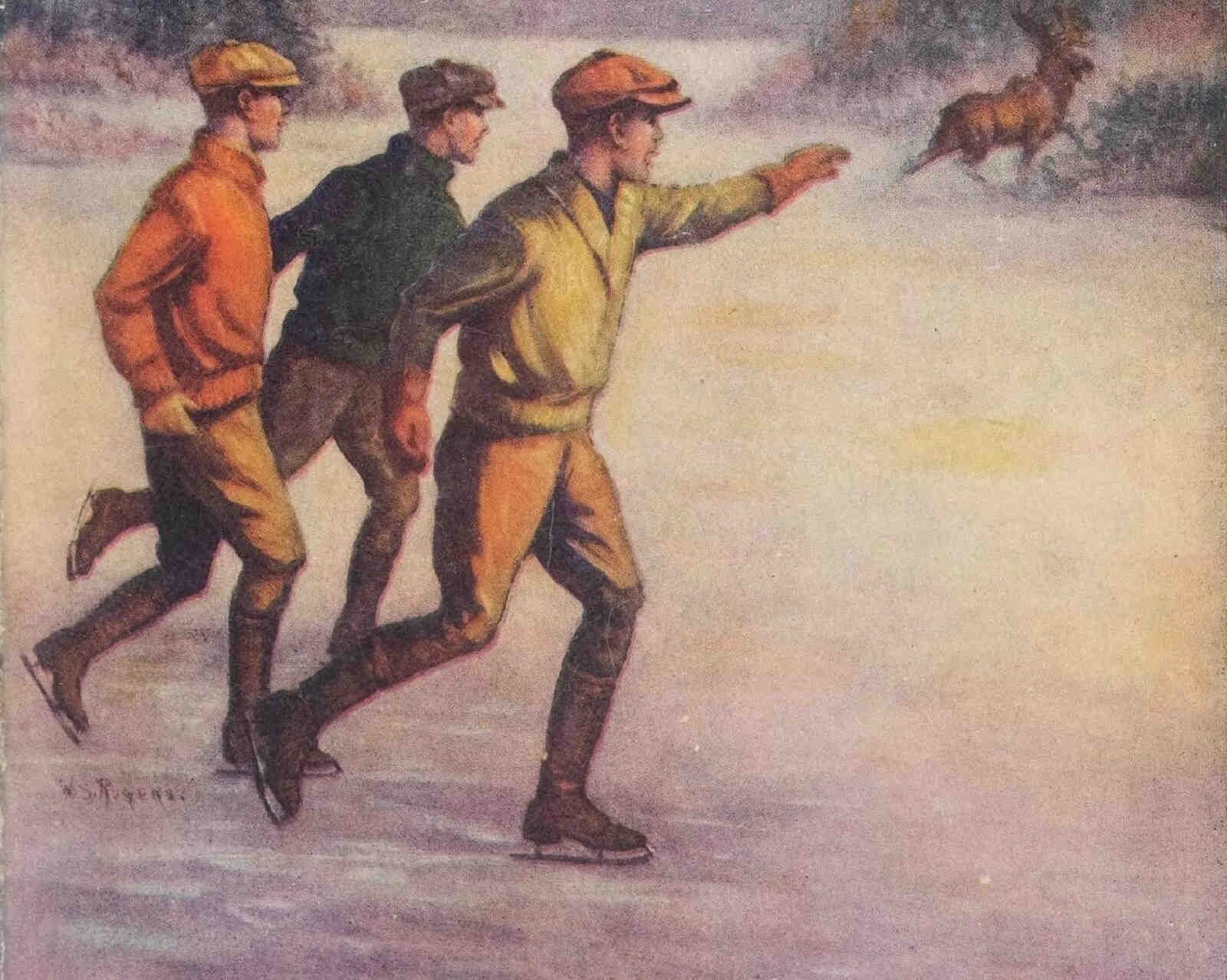
The cover was adapted from the original by the transcriber and is placed in the public domain.
Spellings have been standardised only when a dominant version was found in the original.
Typographical errors have been corrected.
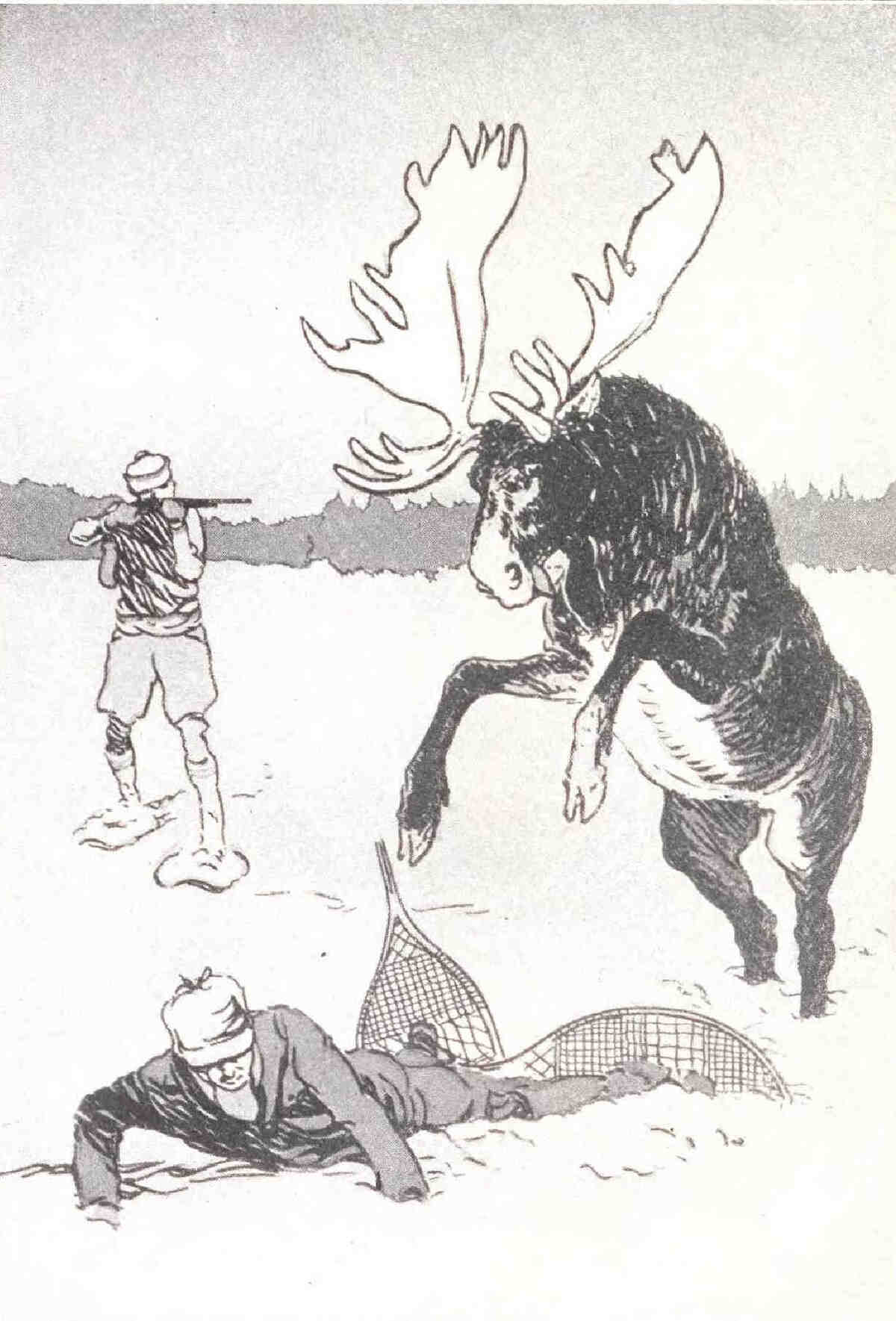
CRACK! HIS RIFLE SPOKE JUST AS THE GREAT MOOSE LIFTED HIS
FOREFEET HIGH IN THE AIR TO STRIKE
Author of “Frank Allen—Pitcher,”
“Frank Allen and His Motor Boat,” etc.
NEW YORK
GARDEN CITY
GARDEN CITY PUBLISHING CO., INC.
1926
THE FAMOUS
FRANK ALLEN SERIES
BY
GRAHAM B. FORBES
See back of book for list of titles
COPYRIGHT, 1926, BY
GARDEN CITY PUBLISHING COMPANY, INC.
Frank Allen at Old Moose Lake
MADE IN THE U. S. A.
CHAPTER I PREPARING FOR THE CAMP
FRANK ALLEN AT
OLD MOOSE LAKE
“And I’ll be happy!” came the loudly sung final
line of a popular song, the words of which had been
changed to inform the hearer that a camping party
was most in the mind of the singer.
Lanky Wallace, the slim, athletic, quick-thinking
pal of Frank Allen, was sauntering along the street
towards Frank’s home, a rifle carried jauntily on his
right shoulder, the singing being done by that young
man for the sole purpose of attracting the attention
of his friend.
Frank’s head popped out of an upper front window
of the house.
“Don’t! Don’t! You’ll get arrested for disturbing
the peace!” he cried, as Lanky looked up at him.
“What’s that? Get arrested for singing?” and
Lanky struck a hurt attitude.
“Oh, that’s different! I didn’t know that was
what you were doing. I thought you were calling
hogs or selling peanuts!” called Frank, while Lanky
swung the gun quickly from his shoulder as if he
might bring it up to kill such an insulting speaker.
“Be down in a minute!” called Frank again, as
he slammed the window to the bottom and disappeared
into his room.
In a few minutes the two boys were together on
the street, each with his rifle, headed for the homes
of other boys.
Paul Bird, Ralph West and Buster Billings were
sought and found, and when each had his rifle on
his shoulder, the five young fellows started back
toward the main road north.
“We ought to have some good target practice this
morning,” said Frank, while the boys, all bunched
together, made along the road. “Camping up at
Old Moose Lake is going to call for some regular
shooting, and too much practice isn’t enough.”
“Guess we’re the lucky boys,” remarked Lanky,
after they had gotten to the edge of town and were
approaching the woods in the rolling land beyond
Columbia.
One of the boys asked him the “why” for the
remark.
“Well, if Frank hadn’t been out West just when
he was and if he hadn’t been where he was when we
found dad’s treasure in the hills, and if dad hadn’t
given Frank the Rocket, the best little old motor
boat ever born, and if we hadn’t been coming down
the Harrapin River just at the time we heard the
cries of Mrs. Parsons and——”
“Say, listen!” Paul Bird interrupted the long-drawn
out sentence of Lanky Wallace. “Are you
making a speech or something?”
“—and,” continued Lanky, paying no heed to the
interruption, “if we hadn’t seen that auto leave there,
if we hadn’t luckily stumbled on to the rowboat
taking the stolen stuff to Jed Marmette’s, if we
hadn’t followed up the lead and seen old Jed stealing
some of the stuff and if we hadn’t broken down that
night, run out of gas, when we raced to Coville, all
might have been different about this camping party.”
Lanky was quite right in this. The boys had
planned a camping party at this autumn season, and
Mrs. Parsons, the wealthy widow just above the
city of Columbia who had been robbed of her jewels
and silver, was so grateful to Frank and his friends
for what they had done that she had offered them the
use of the late Mr. Parsons’ camp at Old Moose
Lake for their camping expedition when she learned
they had made plans for one.
In the preceding volume, called “Frank Aden and
His Motor Boat,” is told the story of the manner in
which Frank and his boy friends had come into the
activities of the robbery in time to catch the thieves
redhanded and also to find for Mrs. Parsons her
jewels and the silverware, most of which had come
to her from her ancestors and those of her husband,
who had died only two years before.
It so happened that Mrs. Parsons had accepted some
questionable rumors for fact and had accused the
boys of knowing more than they did. Her chagrin
after the disclosure and her gratitude over the good
work done by Frank Allen, Lanky Wallace, Paul
Bird and Ralph West, caused her to reward them
first with a very, very delightful picnic at her country
home, a palatial spot facing the Harrapin River.
It was following this picnic that, hearing the boys
had been planning a camping expedition for the
autumn season, she graciously tendered to Frank
and his friends the use of a beautiful camp
which had been the pride of Mr. Parsons in his
lifetime, an offer the boys had cheerfully accepted.
“It was mighty good of Mrs. Parsons to offer us
the camp up at Old Moose Lake,” said Frank, in reply
to Lanky’s humorous recital. “She says it is
stocked with food and she said she was going to
order some more sent there, so we’ll have plenty of
chance to keep alive, if eating is the only thing we
have to do to keep alive.”
“No,” said Lanky, very sagely shaking his head in
the negative, “we can’t keep alive unless we bring
down fourteen deer, a couple of hundred pickerel,
and——”
“And kill yourself getting it all home,” laughed
Paul Bird.
By this time the chums had come to the grove
where they proposed to hold their target practice,
and Frank, with his usual sense of safety, led the
way from the road almost a quarter of a mile, coming
at last to a ravine which broadened out at one
point to a great bowl, its sides of rock and sand.
“We can set up the target over that bed of sand,”
and Frank pointed to one stratum of fine sand which
broke out in the side of the ravine. “That will allow
the bullets to imbed in something soft and we
won’t take any chances on their glancing off.”
“That’s provided any one hits the target—except
me, of course, I know my shots will all hit it all
right——”
Once again Lanky Wallace was telling the other
boys what he was going to do, joking with them.
“Listen to Mr. Lanky Wallace, who hates himself!”
cried Ralph West. “How close do you expect
to stand to hit that sand bed?”
“Come on, fellows,” broke in Frank. “Get that
old piece of board and lean it against the sand bed,
then pin the targets on. I’m anxious to shoot with
my rifle——”
“That’s more than Lanky’s shooting with!”
laughed Buster Billings. At this Lanky reached for
Buster, but not quickly enough. That live lad was
expecting the necessity for moving out of the way,
and was successful.
The boys soon had the target placed properly, and
then tossed up for the firing order, with Frank getting
third shot, Paul and Lanky coming first and
second, respectively.
Crack! Paul’s first shot broke the stillness, for
the other boys paid the courtesy of keeping quiet
while the contestant was sighting.
“Hit the atmosphere!” cried Lanky. “Watch me
move that sand bed for you!” he added as he stepped
up to the line to take Paul’s place.
Crack! Lanky’s rifle rang out—and there was
a hole in the bullseye to show where he had struck.
“Just requires a man who knows how to handle
it,” he calmly said as he raised his rifle for the next
shot.
Crack!
“Wow! Where did that one go? Trying to hit
the top of that hemlock?” yelled Ralph West, for
there was not a mark on the board to show where
Lanky’s second shot had gone.
“Just take a look in the bullseye and you’ll find
both of them. I just pile them one on top of another!”
Lanky calmly let his rifle drop to the
ground.
Ralph and Buster raced to the target and looked
carefully. It was Ralph who spoke:
“Both in the same spot!”
Frank Allen did not attempt to restrain his smile,
for he knew that Lanky was a good shot, one of the
best in Columbia, and he was amused by the bombastic
attitude that Lanky had taken, realizing that
Lanky, unassuming ordinarily, was just putting this
on to-day for the fun of it. Frank knew that Lanky
himself had not been certain whether or not he had
put his second shot on top of the first.
Lanky took his third shot, permitted him by their
unwritten rules that when a boy hit the bullseye he
was entitled to another shot at once.
This time Frank watched the level of Lanky’s
rifle, and smiled broadly again as he realized that
Lanky was deliberately shooting over the top of the
ravine. When his shot rang out there was no additional
mark on the target.
“Just look in the bullseye where the others went,”
he calmly said, and the same two boys, Paul and
Buster, hurried to the target to see if this could possibly
be true.
Lanky turned to Frank, saw the broad smile on
Frank’s face, and whispered to him:
“Shot over the top of the ravine. Bet they’ll say
I hit in the center again.”
Just then Paul, spokesman for the two, called
out:
“Right in the center again! That’s some shooting,
Lanky! Three of them right in the middle!”
Frank did not restrain himself any longer.
“You fellows certainly are easy. Don’t you know
that Lanky deliberately shot away over the top of
the target, just to see if you could find his mark in
the center?”
“Hay!” yelled Lanky Wallace. “Wait a minute.
Who are the judges? I appeal to the judges. They
said I hit in the middle again. How about it,
Paul?”
If any one else had said anything about it, perhaps
Paul Bird would have stood by his guns and
may have reiterated his decision. But Paul knew
that Frank’s eye was good, and he knew that Frank
Allen had caught on to some kind of joke.
Frank stepped to the line and pushed Lanky
aside. And Lanky gave way for his friend, laughing
heartily at the way in which he had put over a
practical joke on the boys.
Frank Allen’s rifle was a repeater, and when he
took his stand in front of the target he determined
he would fire three times very quickly to see what
were the results.
Crack! Crack! Crack!
As he sighted and made his first shot he drew
back the ejector and made the second, following
which he as quickly made the third.
“Wow!” yelled two of the boys whose sight was
best. “Made the ring of the bullseye on all three
of them and didn’t pile them up, either!”
Even from the distance at which they stood, all
of the boys could see that Frank had put three
straight shots, made as closely together as was possible,
at the edge of the bullseye, each one scoring.
“That was great——”
“Help—Help!”
A girl’s voice just over the top of the ravine to
their right reached the boys. It was a sincere cry
for help.
All bantering stopped. The boys turned their
eyes toward the spot from which the cries had come.
“Help! Help!”
Two different voices sounded this time.
“Helen and Minnie!” cried Frank, as he took a
firmer grip on his rifle and leaped for the opening up
the right side of the ravine, from which direction
the cries, mingled now with another voice, had
come.
“And in trouble!” came from Lanky. “Come
on, fellows, make it snappy! They may need us
the worst way!”
CHAPTER II FRANK IS THREATENED
As the boys scrambled out of the ravine they
again heard the screams of the girls, one of them a
decidedly louder scream than was made by the
others.
Over a small ridge the five lithe, active young fellows
went, and, in full view there now unfolded to
them the panorama of a frightful scene!
On a ledge forming a step in a steep incline of a
hill stood Minnie Cuthbert, Frank’s best girl friend.
She was frantically trying to grasp the limb extending
downward from a tree in an effort to swing
out on it. Further along the ledge stood two other
girls, one of them Helen Allen, Frank’s sister, the
other Dora Baxter.
Rushing toward Minnie, and now only a few
yards from where she stood on the lower part of
the ledge, its mouth issuing foam and its head covered
with it, flecks of foam flying over its back, came
a beautiful dog—evidently mad!
There could be no question as to the intent of the
animal.
Crack! A rifle shot rang through the woods.
Without more than a passing aim, relying on that
sense of direction which had brought Frank several
target practice triumphs, he had raised his repeating
rifle to his shoulder and brought the dog to the
ground in the midst of a leap which would have
carried it to the feet of the screaming, struggling girl.
As the dog, shot full in its final leap, struck at
her feet, Minnie made a final jump high in the air,
and landed back of the rolling animal which passed
the spot where she had been standing, rolled over
several times on the ledge, ending against the perpendicular
wall of the hillside.
“Minnie! Minnie! Wait a minute!” Frank
yelled to the frantic girl as, not being in the grip of
the dog, she rushed headlong down the incline to
the glen below.
Minnie stopped, turned, and saw the dog lying
on the ledge above her, saw the other girls walking,
though excitedly, toward her.
By this time Frank had dashed across the intervening
space and had reached her side.
“You’re safe now! Where did that dog come
from?” he asked her. “What were you doing
here?”
But Minnie’s tongue was not ready to function
just yet. She was breathing hard. Her breast was
heaving sharply, her face was of a grayish pallor,
her wide eyes glassy, her lips trembling, her body
aquiver.
Frank took her hand and held it for a moment,
thinking she might faint, but as the other boys approached
and the girls, too, the color came back to
her cheeks, her eyes became normal, and she was
able to stammer:
“We were nutting, and all of a sudden this dog
came rushing toward us. It ran around in a big
ring, and I saw the foam flying. I realized that it
was mad!”
“It was mad!” exclaimed Helen Allen. “It ran
around in a big ring and we thought it was going
to go back to the road, but we started running away
from it, anyhow. Then it ran again at us, and we
screamed and ran back.”
Frank turned the dog over, after a quick glance
had told him it was breathing no more, and all of
them saw the red spot where the bullet had reached
its mark—squarely in the side of the head.
“This hunting dog was dead when it struck at
Minnie’s feet,” observed Ralph West.
“I’ll claim to the world that’s some shooting,”
said Lanky. “Good thing you had some target
practice—especially following my good lessons.”
And there was a merry smile on the lean fellow’s
face as he permitted a laughing remark to fit into
the situation.
The boys and girls marveled at the shot that Frank
Allen had made at a time when only a good shot
would answer the requirements.
“I wonder who it belongs to,” murmured Frank,
taking a very careful look at the dog again. “I
don’t remember seeing one like him around here
lately.”
None of the party remembered a dog of its
kind.
“Did it come from the road?” asked Frank,
turning to Helen.
The girls replied in chorus that it did.
“It has every resemblance of a mad dog,” said
Frank, “but I thought dogs went mad in the middle
of the summer. This is nutting time, autumn, and
no time for a dog to go mad.”
“Frank,” spoke up Lanky slowly, deliberately,
“do you know something—this is a good dog—it
belongs to some one who values it—and I believe
we ought to have a veterinarian come out here and
see it.”
The idea struck Frank at once as being an important
one, whereupon, after a moment’s thought,
he said:
“I believe you’re right, Lanky. We’ll get Doc
Whittaker to look at it and hear what he has to
say. And we’ll have his support in case our guess
is right. We have killed this dog—that is, I have—and
I’ll have to pay for it, and pay well, too, unless
I’m able to prove that it was mad.”
“But it was rushing at me to bite me!” cried
Minnie. “You could tell the man who owns it just
that. That’s certainly good enough reason!”
“He—ah, Bill! He—ah, Bill!” came a voice followed
by several shrill whistles. Some one from the
road was calling a dog.
“The owner—now!” said Paul Bird excitedly.
The entire crowd was quiet for several seconds,
until the same call and the same whistled signal
came again, this time much closer.
“Here you are, mister! Come down this way!”
Frank made a trumpet of his hands and called back
to the man.
A moment later a burly man, dressed in a heavy
brown suit, a rather lengthy, drooping mustache
partially covering an ugly looking mouth, broke
through a small bunch of brush and came out at the
top of the hillock next to them.
“I think that is your dog over here,” said Frank,
speaking directly to the man.
“He—ah, Bill! Come here!” called the man,
but no dog answered.
“It can’t come, mister, it’s dead.”
Frank spoke to the man very plainly, and in a tone
of voice that was quiet, each word enunciated distinctly.
“Dead!” Whereupon the man rushed down the
little dale or glen that separated them, and came up
to the hillock where the boys and girls were huddled
together. Two other men came over the farther
hillock behind him, attracted by the conversation.
The large man gave one look at the dog lying on
the ledge, a bloody spot showing very conclusively
what had happened, each of the boys carrying rifles
as further mute evidence.
“Who killed that dog? Who killed it?” he demanded
threateningly, drawing himself to his full
height and glaring at the boys menacingly.
For a tense moment all were silent.
“I killed the dog,” said Frank, then.
“What’s that? You killed my dog?” and the man
made as if to leap on Frank to throttle him.
“Hold off, there,” Frank’s voice was piercing in
its deadly quiet. “Don’t come too close to me.
Listen to what I’ve got to say.”
“Well, what’ve you got to say, you——”
“And don’t say that, either,” said Frank. “Just
keep cool a minute. Some one else in the world can
be just as right as you are. That dog was shot
just as it was making a wild leap at one of these
girls. See the foam all over its head? The dog
was mad, and I killed it before it could hurt one
of these girls.”
By this time the other two men had come up to
where the crowd was standing, one of them being
close to Frank.
Frank saw this and stepped farther away, thus
putting the distance, several yards, between himself
and anyone else.
“That dog was not mad—that dog was worth
two hundred dollars, and you’ve got to pay for it!”
yelled the man, anger breaking out in every tone,
every movement.
“I beg your pardon, mister——”
“Jeek, that’s my name. Fordham Jeek, from
Bellport, young fellow, and you’re going to pay me
for that dog.”
The name of this man was familiar to all the
boys. They had heard of him on several occasions
when down at Bellport, and had also heard of him
from a certain element around Columbia.
He was a race-track follower, not of the higher
type, but one of those about whom there is usually
some question, some whispered rumor that will not
quite stand the scrutiny of daylight or repeating
aloud—a reputation which cannot be called savory.
Those who have followed Frank Allen from the
time of the story, “Frank Allen’s Schooldays,” the
first volume of the series, down to the volume just
previous to this story, which was “Frank Allen and
His Motor Boat,” know that Frank Allen was an
upstanding boy who could think straight and always
fairly, one who did his utmost in anything at
which he went, a boy who was popular among his
schoolmates and also among the older people, primarily
because he was not given to conceit nor
bombast, but was always just a wholesome, healthy,
American boy who loved the out-of-doors, who
was honest and square in all his dealings, and who,
though a leader in athletics, was also a leader in his
studies at school.
For a long minute Frank thought over the attitude
of this man Jeek, of the situation with his two
cronies present, and he noticed they were a rough
looking pair.
“Mr. Jeek,—” Frank spoke in a low tone of voice,
though not a tone of quaver nor of weakening in
it—“I haven’t the slightest idea of paying for that
dog. I am sorry, yes. I am, truly, because I love
dogs as much as you do.”
“Love dogs, me eye!” yelped Jeek. “What did
you kill a two hundred dollar dog for—you—you——”
“I killed that dog, as I told you, because it was
mad and because it was making a wild leap to bite
one of these girls. It had run around them in a wide
circle, foaming at the mouth, and would have done
serious injury. It was actually leaping straight for
one of the girls when I shot.” Frank calmly recited
the general incident.
“Your name is Allen, isn’t it? I’ll make your
father pay for this dog, young fellow.”
“No, you won’t do that,” quietly replied the boy.
“And you’ll not make me pay, either. That dog
was mad.”
“It was not mad! You’re lying, just lying to
get out of it. I’ll make you pay or I’ll make your
father pay, or I’ll make you pay in a way you’ll never
forget!” wildly yelled Jeek, as he turned to leave.
“Just put this in your pipe, young smart aleck—you’ll
pay in a way you’ll never forget!”
With that the three men departed. As they
reached the next hillock on their way to the road,
Jeek turned:
“Two hundred dollars by to-morrow or you’ll regret
the day you ever saw me!” he yelled, shaking
his fist.
A minute later the boys and girls heard the poorly
timed explosions of a cheap automobile on the road.
CHAPTER III A BIG REWARD IS OFFERED
“Well—that’s that!” said Lanky Wallace as the
sounds of the car died away.
“I don’t know whether that’s that or something
else,” Frank replied. “That fellow Jeek doesn’t
look good to me, and the two fellows he had with
him looked as if they’d rather knock a fellow in
the head than eat a square meal.”
The girls were still trembling over the excitement
of the mad dog and its subsequent shooting, and
the arrival of the men with their threats of harm.
Frank wished to dispel the gloom which had
fallen on the little party, and now proposed that
they continue with the nutting. On the other hand
Minnie Cuthbert proposed that the boys go on with
their target practice, the girls to sit and watch the
contest. But now the boys seemed more inclined
to gathering nuts than to gathering target scores.
“I believe that grove over further toward the
river ought to have some fine nuts, and I don’t think
any others have been after them, because it’s rather
rough getting there,” suggested Frank, nodding
toward the Harrapin River.
The entire party decided at once on going, for,
like merry, happy young folks, it did not matter
so very much that they found many nuts—not so
much as the good time and the adventure of hunting
for them.
Up and down, over little hillocks and through
brush-covered glens, sometimes moving in a bunch
and often moving single file through narrow places,
they made their way through the woods until they
came to the bank of the Harrapin and then turned
upstream.
“There is the grove!” Frank pointed up the river
a short distance, and, from where they stood, the
little party saw that it was a fine grove for nutting.
Five minutes later they realized that Frank’s guess
was good—that no one else had come through this
rough woods to get the nuts.
In the meanwhile heavy clouds had drawn across
the skies, finally permitting the broad expanse of
gray, snow-filled clouds to predominate over the
blue.
Several times Lanky and Frank looked up through
the clearings and had noted the coming of a fall
storm.
It was getting very much cooler, with the gray
clouds hanging lower and lower, but the merry
laughing and talking, jesting and snatches of song
drowned out any thought or fear of getting caught
in a storm.
The boys had filled their pockets and their hats
with nuts, the hats having been set aside, all in a
row beside a tree. And now the first little flakes
of snow began falling.
“The first of winter,” said Ralph West. “It
won’t be long before skating and sleighing will be
fine.”
Very shortly they prepared to go home, but
stopped at the spot where target practice had been
started long enough to try a few more shots.
“Let me shoot once!” cried Minnie when it was
Frank’s turn at the target. “I want to shoot a
bear.”
She took Frank’s repeating rifle, and, after being
shown by Frank how to keep it pointed away from
the others and towards the target, she lifted it to her
shoulder, closed the wrong eye, and tried to sight.
“I can’t see anything!”
While the laughing and joking continued, Frank
taught Minnie how to sight along the rifle, how to
hold it properly, and after many rather grotesque
attempts, she took careful aim and fired.
At the crack of the rifle she thrilled with the
pleasure of it, though startled to think she had
started a bullet on its way to the target.
“Where did it go? Where did it hit?” she cried.
“Last I saw of it it was on its way up the river!”
called Lanky Wallace. “You know, Minnie, it went
right over the top of that tree,” he added, pointing
high in the air.
But, undaunted, she tried again, and this time the
target showed a hole, though at the outer ring.
A few more shots were fired, with Minnie gradually
learning, for she was hitting the target or
close around it each time.
All things must have an end, and finally they
started toward home, burdened with nuts, though
the distance to town was not great.
As they trooped in a group down the broad walk
of the avenue toward Frank’s house, whither it had
been determined they would go for a short while,
the girls to make fudge while the boys cracked the
nuts, they spied Mr. Allen, Frank’s father, coming
slowly along the street from town.
Helen left the others and ran ahead to meet her
father.
Mr. Allen, who had almost lost his life in the
fire at his department store on the night of the
robbery of Mrs. Parsons, and to save whose life
Frank had raced his Rocket down the Harrapin
River to the town of Coville to obtain a heart stimulant
which could not be found in Columbia or
near-by towns, still carried a heavy stick. He
leaned on this and he and Helen waited at the front
walk for the others.
“How do you feel, dad,” said Frank, coming up
with the crowd.
“Fine. Getting stronger every day. What have
you been doing—target practice, nutting, and all
that? Fine! It’s worth while to be young.”
Frank asked how repairs were going on at the
store, and learned that the work was almost finished.
The place had been quite seriously damaged by fire
and water in the conflagration, and the cellar timbers
had been weakened to a very considerable extent.
It was the weakening of these timbers during
the fire that had caused the accident to Mr. Allen.
Into the house trooped the crowd, led by Frank.
The noise of the young folks called Mrs. Allen to
the front of the house, with her long apron as
evidence that she had been in the kitchen getting
something good to eat ready for her brood.
“Out of the kitchen, mother!” called Helen, as
she ushered every one in. “We’re making fudge
while the boys crack the nuts, and you and dad are
to wait in the living room until we’re done.”
So it went, and in a short while the girls came
into the spacious front room with the plates of
chocolate fudge, while the boys brought in a few
extra nuts beyond those which had been used in the
fudge, with salt generously sprinkled over them.
It was Helen who told the story of the mad dog,
and of Frank’s having killed it, and it was Minnie
Cuthbert who continued the story by telling about
Fordham Jeek, of Bellport, and his threats.
“What about it, Frank?” asked Mr. Allen.
“Shall we pay him for the dog? It’s too bad to
have a fine dog killed.”
“Dad,” replied Frank, “paying that fellow Jeek
two hundred dollars or any other sum for the dog
won’t bring the dog back to life, will it? If a dog
is a menace to human life, then we must get rid of
the dog. That dog was a menace at the time it was
shot. My decision is that there is nothing to be
paid.”
“Is that the man who is a race-track follower?”
asked Mr. Allen. And on getting an affirmative
reply he went on: “He’s a slippery eel, if what I
have heard is true. And, besides being slippery, I
suppose he is a little to be feared, too.”
“I’ve no fear of him, dad” said Frank. “I
have found that when a man does a whole lot of
threatening he isn’t dangerous in the open.”
“That’s just it, my boy,” quietly replied the elder
Allen. “If he were dangerous in the open he would
have made you promise to pay for the dog right
then—or fought.”
“There’s Mr. Van Kirk!” came a sudden cry
from Helen, as she saw the rich old man, thin and
straight as an arrow, more like a young soldier in
stature than anything else, though he invariably carried
a crooked hickory stick in his right hand.
“Let’s call him in. I love to hear him talk!”
“Sure,” said Mr. Allen, craning his neck to look
out the window. “Tell Jacob to come in here.”
With that Frank’s sister ran to the door and
hailed the lonely old man of Columbia, a man who
had seen the latter part of the Indian wars in the
West country, who had been a huntsman all his
life, and who knew the ways of the wild.
All the young folks gave him a hearty welcome
when he came in and shook hands with Mr. and
Mrs. Allen, and then with all the others.
“Mr. Van Kirk,” said Frank, as he saw the gray-haired
old gentleman properly seated on one of the
most comfortable of the large easy chairs, “we boys
are going to a camp pretty soon and we are just
wondering if you can’t give us some advice.”
“Well, Frank, I guess that is about as easy for
me to do as for most folks. Advice is the finest
and worse thing in the world. Fact is, anything
that’s free is about worthless. Where are you going
to camp?”
They told him of the offer made by Mrs. Parsons
up at Old Moose Lake, just on the edge of the
mountains.
The lined face of the gray old hunter was very
expressive of emotions, the eyes twinkled and around
them came the slowly formed wrinkles of a smile
as he lifted his hand to the long beak of a thin nose
and stroked it carefully.
“Tell you, Frank. If you’re going up to Old
Moose Lake you’ve got a prize to look for. I wish
I could go up there myself! There’s a big bull
moose, a tremendous fellow and a fighter, too.
Parsons and I saw him last just before Parsons
died. I have been told he is still there. He’s a
monster. Tell you what I’ll do——”
He paused while the boys listened with their
mouths open, their eyes glistening in rapt attention.
“I’ve got a little extra money that I’d like to
spend. I’ve got it in for that old bull moose—he
almost got me the last time I was there. I’ll offer
a hundred dollars to the boy among you who brings
down that old fellow!”
A hundred dollar prize put up by this champion
old hunter to the boy who would get that big bull
moose!
CHAPTER IV JEEK THREATENS AGAIN
It was the day of the last football game of the
season. Not much of a day to speak of, either.
It was cold, drear, the skies were leaden colored
and heavy, and, with a north wind blowing down
the field while flakes of snow whirled and twisted
on their way to the earth, it was not an altogether
pleasant game.
It was a game that had not been intended, but on
account of the attitude which the town of Coville,
located down the river and on the opposite bank,
had taken during the season, there was little else
for the boys of Columbia to do but to grant an
after-season game.
“We can play it through and end the season,”
said Frank Allen. “But I am fearful that the minds
of several of the fellows won’t be as much on the
game as on the camping expedition in a few days.”
The morning had opened with an attempt at a
drizzle, which turned quickly to sleet, and the field
was holding out the promise of being heavy and
slippery.
By the middle of the morning, though, when the
boys had become accustomed to the thought of
playing their last game on a field that would not
allow much individual fast work, the wind from the
north came suddenly in.
At noon the mud of the morning had frozen hard,
the skies had gathered lower and turned colder in
their appearance, while the snow flakes drifted and
whirled and twisted, first up, then down, sideways,
hither and yon, touching the ground and being blown
into little drifts against buildings, fences, sidewalks,
trees and even foot and hoof-prints in the streets.
It was an enthusiastic crowd, but not a large one,
that watched the final game. Coville tried hard to
break through the impregnable line of Columbia,
but it was a useless attempt.
However, there was compensation evident,
for Columbia did not find it at first an easy
task to get down the field against these warriors
of Coville. It was in the third quarter
that the first touchdown was made, after battering
the Coville line so often that a soft
spot was worn in it—and then the game went
swiftly over to Columbia. The morale of Coville
broke with the initial touchdown, and the fierce
defensiveness of Coville broke against the onslaughts
of the boys of Columbia who, led by a thinker,
smashed, battered and wore down one place in the
line.
“Glad we played you,” said Frank as he shook
hands with the Coville captain. “You’ve got a good
team, captain, and next year all these schools along
the river are going to have a hard time even to hold
you.”
“It’s good of you to say so, Allen,” replied the
husky young Covillian. “We didn’t make much
impression on you to-day, though.”
“Yes, you did! You made us use up two quarters
trying to make a place where we could go through.
And you held us so that we couldn’t go around.
And you stopped most of our attempts to pass the
ball. I’ll say you did mighty well. It’s just that
we have played so long together we know what the
other fellow is thinking and doing every second.”
Frank felt this way, else he would not have spoken
to his adversary. It would be different in another
year, when the Columbia team would be broken up
and scattered, and the same team work would no
longer exist.
“I hear you fellows are going in camp up on
Old Moose lake,” said the Coville captain as they
walked away from the field arm in arm. “I’ve
heard some great stories of camping up there. They
say the fishing is simply great. And, say, have you
heard the story of the old bull moose that so many
men have tried to get? My father told me yesterday
that he had been there twice with parties who
wanted to get him, but they say he is as wise as
a fox.”
Frank listened to this with eager ears, for the
story which Mr. Van Kirk had told them was the
first he had ever heard of this monster of the woods.
He asked several questions, but the boy from Coville
very quickly exhausted his store of knowledge.
That evening, in the front room of the Allen home,
with no one to interrupt, Frank and his three chums
went carefully over all the preparations for the
trip.
“If it keeps up the way it is and doesn’t turn any
colder,” said Frank, “we’ll go by water up to Todds,
using the Rocket. But if it turns much colder in
the next two days and if the river freezes over,
it looks to me as if skates would take us most of
the way.”
“Do you know the exact way?” Buster Billings
asked.
“Sure!” Frank replied. “I’ve got it right here
on this sketch. It’s a sketch that Mr. Parsons used to
have, and Mrs. Parsons gave it to me only yesterday.
See here?” He pulled from his pocket a piece of
paper which had been used until the folds had worn,
and then had been pasted on a sheet of cloth. “We
go up the Harrapin to Todds, and there we leave
the boat—unless we skate, in which case we get off
the river and take to land. From there it is a
straight trip eastward through the mountains by
trail to the lake. I don’t know what all these marks
are, but I presume they are other camps along the
trail at different places in the mountains where there
are other lakes.”
The matter of food was discussed, but there was
little to be carried, since Mrs. Parsons had promised
to send up food to add to the store already at the
camp.
“So, you see, fellows,” went on Frank, “our
rifles, fishing outfits, heavy clothes, a couple of good
ropes, plenty of ammunition, plenty of matches, a
couple of flashlights, one or two compasses, and
skates are about all we’ll need.”
The boys all agreed that it was the better plan to
travel light.
“To-morrow morning I have to make a trip up-river
a short distance with the Rocket, and you
fellows can be gathering together all the things that
we need and checking over the list. Lanky, suppose
you act as secretary to this expedition, and make out
the list and see that every fellow has his part.”
Frank Allen was strictly the leader, the one who
thought things out, and so it held in this case.
It was just after breakfast the next morning that
Frank went to Minnie Cuthbert’s home and asked
her to go on the trip up the river with him.
“Just a little trip on an errand for dad. He says
he would rather I would go than any one else, and
I want to try out the Rocket before we start to the
camp,” he said as he invited her to join him.
Minnie accepted at once, and donned a heavy
coat and close-fitting hat, looking bright, lithe and
active, as she skipped down the steps to come alongside
Frank for a brisk walk to the wharf.
“I have a package I want you to take with you
to your camp,” Minnie said to Frank when the
Rocket was well under way.
Curious, naturally so, Frank asked what the
package contained, but Minnie refused to divulge
the proposed contents.
They fell to chatting gaily over the various little
happenings of “the crowd,” as the motor boat, under
medium speed, facing into a brisk, chilly wind,
glided easily through the water.
“Have you heard anything more from that big
brute whose dog you killed?” she suddenly asked,
changing the trend of the conversation.
Frank told her he had heard nothing.
“But you’re going to hear from him, Frank,” she
went on. “He had a mean look in his eye that day.
I heard father say something last night that didn’t
sound good. He said that Jeek was a dangerous
character and that the only reason he was not in jail
was that others were afraid to tell the truth about
him.”
“Oh, well,” Frank turned the subject off lightly,
“I hardly expect any trouble. You know, we sent
the doctor up there to look at the dog.”
“You hadn’t told me. What did he say?”
“He told me,” replied Frank, “that the dog was
mad without doubt. He said, when I asked him
about the season, that frequently a high-spirited dog
went mad at other seasons than mid-summer, though
the cases were rare. But, the point that I was most
interested in was that he signed a statement and
gave it to me to the effect that the dog was mad
when killed.”
“What good will that do if that brute causes
you trouble?” she asked.
“Well,” returned Frank good-naturedly, “it shows
that I didn’t do anything so very wrong when I shot
the dog.”
Frank saw the landing to which he was headed
only a short distance away and sent the Rocket in
toward shore.
A farmhouse stood back on the right bank of the
Harrapin, a well-kept place. A long motor boat,
loaded with packs which resembled the supplies of
a camping party, was lying alongside the landing
place, taking up every available foot of space.
Carefully, slowly, Frank eased the Rocket up to
the spot, trying to see a place where he might touch.
There was none.
Whereupon, he brought the Rocket alongside the
other boat, sliding as easily as he could against it,
but bumping it, nevertheless.
Then he took one end of the rope and stepped on
to the other boat, from there to the landing, and
carefully tied. Minnie very gingerly stepped into
the other boat, too, and came ashore.
“Hi, there! What’s the matter? Got no sense?
Get that skiff of yours away so I can get out. What
do you mean locking me in that way? Trying to
hog the river?”
Frank turned to see whose was this heavy, coarse,
fierce voice, and faced Fordham Jeek!
“Oho, it’s you, eh? What’re you trying to do?
Get stuff out of my boat?” and the big fellow
showed his yellow teeth and pushed his head forward
from the broad shoulders.
Frank was looking him straight in the eye, while
two shifty men stood behind the man from Bellport.
“Best thing we can do for you, young fellow, is
to throw you into the river. What’s on my boat
that you want?” the big man kept on.
“Listen, you!” returned Frank, calm of voice and
cool. “You’ve said just about enough. I’m here
to attend to some business and not to have you
throwing insults.”
“Don’t talk to your betters that way, you low-down
dog killer!” yelped Jeek.
“Move along, big boy,” quietly answered Frank.
“I’m not hunting for trouble. Want to get out?
I’ll move off while you get away,” with which he
motioned Minnie aboard, followed her, and backed
the Rocket.
“Thought you’d change your tune!” sneered Jeek.
“You ain’t paid for the dog yet. Going to pay for
it? What? Better pay in money or I’ll take it out
of your hide.”
Frank kept silent. He circled around and came
back to the landing as the other boat pulled away.
“Oh, Frank, he’s a dreadful man! Better keep
your eyes open or he’ll do you harm,” remarked
Minnie, when they were again alone.
“Don’t worry, Minnie,” was Frank’s answer.
“He won’t dare do anything very bad.”
But in this Frank Allen was mistaken.
CHAPTER V “I’ll FIX HIM YET!”
“Twelve o’clock and all’s well!” cheerily sang
out Lanky Wallace as the clock struck in the City
Hall tower.
Four energetic lads, Frank Allen, Lanky Wallace,
Paul Bird and Buster Billings, had packed everything
they needed on board the Rocket, swaying
gently to and fro in the Allen boathouse on the Harrapin
River, at the foot of Main street in Columbia.
It had been planned to get away at noon, and they
were now ready.
“Everything’s ready!” said Frank. “Ease her
out.”
The Rocket slid gently, easily, gracefully out of
the “well” and was promptly caught by the current
of the river.
Lanky threw the flywheel over, the chug of the
motor was the immediate response, for they had
spent a half-hour tuning the cold motor up.
The practiced hand of Frank Allen, commander-in-chief
of the Old Moose Lake expedition, turned
the wheel, and the nose of the lithe little craft stood
up-river.
“Right on time. I hope that’s a good omen,”
observed Frank. “We’re off for an exciting time
if our hopes hold up.”
During the middle of the morning Mr. Van Kirk,
who had hunted in practically every wild in the
United States, whose rifle had always been ready
and accurate, whose knives were on exhibit in his
room, each with a special history of moments of
peril and of success, came down to the wharf and
there chatted with the boys on the eve of their
putting out to camp on Old Moose Lake, where
they hoped they might come in contact with the
big moose bull for the capture or killing of
which the old hunter had offered a goodly
reward.
“We’ll bring you the antlers,” said Frank, during
the talk.
“I don’t want the antlers, but I do want to see
them. The boy who gets the prize is the one who
should have the antlers. And they’ve got a spread
of almost five feet,” said Mr. Van Kirk.
“Five feet! That’s a whole lot of spread for the
antlers to have!” exclaimed Frank, who had heard
a great deal in the last few days about moose and a
little about this particular bull.
“Yes. And this old fellow is a giant, too!” the
old fellow replied. “I don’t need to describe him
to you. You’ll know him when you see him. He’s
the king of that territory, actually the monarch of
all he surveys.”
Thus it was that the boys, as they chugged up the
Harrapin, had their minds full of the old moose bull
that had been the cause of many hunts and that had
outfought and outwitted many attempts at capture.
The air was cutting cold on the deck of the Rocket,
with the breeze blowing downstream while they were
making their way against it. A sky banked with
lead-gray clouds presaged snow before they got very
far. Along the bank of the river most of the bushes
and trees had lost their leaves, the skeleton branches
thrust out from the shoreline like long, bony fingers
of crooked shape, quivering and shaking as the chill
winds struck them.
“The only thing warm around here is the motor,”
said Lanky. “I wouldn’t mind being a motor to-day
myself.”
“What time do you think we’ll reach Todds?”
asked Paul Bird.
Frank suggested that they should reach the little
settlement on the upper reaches of the Harrapin late
in the afternoon—it should not be more than a four-hour
ride.
Finally they passed the last of the spots along the
river to which they had become accustomed, and
now Frank was more watchful of his helmsmanship.
“There’s the snow starting!” cried Buster Billings,
reaching out for a tiny flake which drifted around
in the wind.
In ten minutes more the cohorts of which that
small flake had been the forerunner came upon them,
and the wind’s velocity increased slightly.
“Wow! Looks at if we’re going to plow the
snow to the lake!” remarked Lanky, dancing from
one foot to the other on the deck.
“It has every appearance of it right now,” replied
the boy at the wheel. “But it ought to begin
snowing. Goodness knows it’s about time for winter
to start. We’ve been having little flecks of snow
for several days.”
“Well, it’s started now,” and Lanky pointed up-river
where, as rain often does, the snow was falling
heavily. It appeared, from this distance, as if
a wall of impenetrable thickness was built up against
them.
The gray clouds came lower and lower, seemingly
hanging almost to the water, darkening the river
so that it looked as if evening were upon them, but,
as a compensation, the wind died down somewhat.
Another hour passed. The deck of the Rocket was
well covered with snow, but the motor had not
missed a single stroke.
As evening drew on, as the clouds continued hanging
low, the boys saw, through the snow, the place
which had been described as Todds—little more
than a landing place at the upper stretches of the
river, the outpost ahead of the trails across the
mountains to the east.
As the Rocket drew in close to shore and came
alongside the heavy logs of the landing place, they
heard a hail from a long, low, rambling building
and saw a bewhiskered man, old in looks behind the
beard, but youthful in his agile bound as he came
leaping down the hewn log steps and took charge.
“Mighty glad to see you, boys. Where are you
going?” he called out heartily as he shook hands
in a big, frank way.
“Camping over on Old Moose Lake,” said Frank.
“Came up from Columbia this afternoon and going
to tie up here until we are ready to go back.”
“Fine! Fine! Come along in and get warmed
up. I’ll take care of the boat and the packs. Just
get in there by the fire,” and he waved a hand toward
the door from which he had come.
Within the place a great log fire was burning in an
open fireplace, and two men, dressed in heavy
woollen shirts and wool-topped boots, turned to nod
a hearty welcome as the lads trooped in.
“Going to Old Moose Lake, eh?” one of the men
asked, when told by the boys that was where they
were headed. “Well, it’s a great place right now.
What camp, did you say—old man Parsons’s?”
Both men were interested in the boys’ tale of their
big camping expedition, and Frank led up to a question
about the old bull moose they had heard so much
about.
“Old King, eh?” laughed one of the men, filling
his pipe after having knocked out the ashes on the
heel of his heavy boot. “By the great horn spoon,
you’ll never get old King. That’s a foxy critter.
Say, old man Van Kirk—know him? Old man
Van Kirk came up here a couple of seasons ago,
before he had that accident, and old King almost
got him for true. Yes, sir, I was up there with
him, just north of Old Moose Lake, and that bull
moose nigh got him.”
This whetted the appetite of the boys for more
news, and they got plenty of it—a great deal of it
being legend, pieces of tales that had been handed
about from one guide to another, for it seemed that
the big moose bull had been roaming the woods in
that section for a long time.
When they sat down to a meal spread for all on
one large table, with a roaring log fire warming up
the dining room, oil lamps hanging from the rafters
overhead to light the place, the run of conversation
about the moose kept on, with these two guides, not
so old, as the boys soon discovered, adding more and
more to the stories. Frank caught the wink of one
of them during a particularly exciting recital of an
episode, and he then took all they said with a large
pinch of salt.
However, there was little doubt that there was a
moose bull at Old Moose Lake that was a leader and
a fighter, and that he had been sought by many
huntsmen before themselves.
“I don’t want you to think,” said Frank, “that we
came up to get this moose. We came up for a
camp—to fish and hunt and do anything else that
happens to suit the occasion. We’re just out for
some fun. It was Mr. Van Kirk who told us
about the moose,” and here Frank told of the prize
which had been offered.
“There’s plenty of fishing up there, but the lake
will be frozen over by to-morrow or the next day.
It’s getting mighty cold, you know,” said one of the
guides. “Which trail are you going to follow?”
The boys said they had been told of two trails.
“That’s right. Two trails. One of them’s
around the mountains and the other is right through
the hills. The short one is through the hills, saves
about ten miles. But with all the snow that’s falling
outside I doubt if you can go through.”
Frank smiled pleasantly at this and suggested that
not much snow could fall between now and the next
morning—certainly not enough to stop them from
going through the mountain trail.
“Don’t know about that. I’ve seen some mighty
heaps of snow fall overnight,” said the guide who
appeared to be the more talkative of the two. “Liable
to be enough fall to-night to fill the trails, and
the only way is to be guided over.”
Frank could not see that. He was not up here
to hire guides for a little camping expedition. However,
he did not voice his opinions.
An hour’s talk followed supper, and then Frank
and his chums turned in, asking that they be called
early the next morning.
There was a rough boathouse at Todds and Frank
had made arrangements to have the Rocket taken to
this shelter and hoisted up out of the water. He
had brought along a big tarpaulin, and this was to
be roped over the craft.
The first cold break of day saw the boys up and
around, the snow still falling, though not so heavily.
Breakfast was given to them at once, but the two
guides were not present.
After this the boys unlimbered all of their packs,
made two of them over again, and strapped everything
up, shouldering their burdens carefully.
Then, warming their boots inside, they started away.
The keeper of the place gave them minute instructions
as to the trail through the mountains, making
no effort to keep them from going that way.
“Just bear straight for the east. It’s a little distance
out before the trail divides and you take the
one to the right. You can’t miss it then, the trail’s
plain until you get ten miles through. Then there
are two different forks, and you take the one that
leads to the left, starting higher through the hills.
So long, boys, and good luck to you!” he called, as
the boys stepped out of the door and started in the
direction pointed out.
As Frank and his chums started away from Todds
they did not see three men who had come up some
time before and who had spied upon them. These
men were Fordham Jeek and his two unworthy
cronies. The men stood at the opposite end of the
hotel, peeping out from the side of the building.
Jeek spat into the snow rather angrily.
“Going up to Old Moose Lake, eh?” he muttered.
“Up to old man Parsons’ place, eh? And he ain’t
paid me for my dog, the dirty dog-killer. He’ll pay
for it, though! I’ll fix him yet!”
CHAPTER VI EYES IN THE DARK
The four boys hit a fairly good pace as they left
Todds and made along the single trail toward the
mountains, but three miles back from the Harrapin
River.
From somewhere in a little clump of trees through
which they were passing a rabbit jumped out.
“Get him!” cried Lanky Wallace, slinging his
rifle around to catch it in his free hands.
The little fellow, scared out of a warm spot in
the grove, or perhaps out foraging for something
green to eat, was getting across the surface of the
snow in a hurry.
Crack! Bang! Crack! Bang!
Each of these boys had pulled his firearm around
at sight of the streak of motion, almost the color of
the snow. And each of them had pulled down a
quick bead on the animal; letting fly two bullets and
two doses of shot.
“Came close!” called Frank, for the snow spat
upward in several spots just ahead of or to one side
of the rabbit, but the little fellow kept on and disappeared
in the next grove.
“First shot of the expedition,” Buster Billings
said. “I came nearest because I shot first.”
This brought a laugh from the other boys. For
it was difficult to tell who had fired first.
“That was good work, fellows,” said Frank.
“All four of us, from an unexpected start, got our
rifles and shotguns into action at about the same
time.”
The rabbit was safe somewhere else, they had
shown to themselves that they knew how to get into
action, and the boys trooped on through the snow
even happier than they had been.
The sun was not shining, yet the morning was
brighter than the day before, and the snow was falling
less hard.
“Wonder what these footprints are,” remarked
Lanky, who was slightly in the lead, with Frank
close behind him.
“I’ve been noticing them all the way. They are
headed opposite to the way we are going, and from
the fact they are not yet filled with snow, it seems
three people came in this morning,” replied Frank
Allen.
Lanky continued looking toward the prints in the
trail, finally remarking about a peculiar heel-print.
“Look, Frank,” he pointed. “One of the fellows
must have an iron plate on his heels. Every now
and then you can see a print in which a crescent
shape shows, like those things they use to stop a heel
from wearing down.”
But the boys were little interested in this. They
looked casually at the prints for a while, trudging
onward, but did not stop for a closer examination.
A full hour passed, and they came to a dividing of
the trail.
“Here’s the one to take. Here’s where we start
saving those ten miles,” came from Frank. “They
said it was thirty miles by the road around the mountains
and only twenty if we took the trail straight
through.”
“What that makes me think is this,” said Lanky,
swinging along behind Frank, giving up his leading
position. “How can the trail around the hills reach
Old Moose lake?”
“I presume there is another divide in the trail
lower down,” suggested Frank. “Maybe the lake
is reached on one side by one trail and on the opposite
side by another.”
Another hour passed away, finding the boys well
up in the mountain trail, climbing higher.
The evergreen trees, hemlocks and pines were
covered with the finer particles of snow. The trail
itself was completely covered. Now and then the
boys found it necessary to catch the overhanging
branches of a tree to swing themselves along more
easily, especially where the trail, in places, grew
narrow.
A third hour passed away, indicated by Buster
Billings’ watch, finding the young fellows well in
the midst of the mountains, having dropped far down
into a valley during the last half hour.
In the meanwhile the skies had become leaden-colored
again, cast over with the winter shade, and
snow was flying thicker than at any other time of the
morning.
“We can’t be far from the second divide, the one
where we have to make the careful choice,” Frank
said as they stopped in the valley before following
the trail up between two hills to their right, where
it made a sharp turn.
“And it won’t be so easy to find, either,” said
Paul, “unless the trails are plainer than this one is.”
Just as Buster Billings called out that the fourth
hour had passed, Frank pointed to a sign nailed on
a tree just ahead of them.
“Maybe that sign has something to do with the
trails.”
But they were doomed to disappointment.
“Put out all camp fires—protect our forests,” read
the sign.
It had been placed there during one of the campaigns
for forest protection.
“But,” remarked Frank as he stood in front of the
sign and thought it over, “this sign must have been
placed at this spot for some reason. I believe we
are at the divide in the trails. See? There are
three different openings leading away—look there!
Footprints on the one right there!”
Four boys stood and looked carefully, each thinking
out the situation. Though Frank was the
leader, one boy cannot do all the thinking for such
a group of quick-minded young fellows as these.
“If there are three, those footprints are on the
trail we were supposed to take,” said Paul Bird.
Frank agreed that this seemed the right conclusion.
“And the sign was posted at this spot because of
its being a place where all men going through this
trail must stop,” he went on, after agreeing with
Paul.
They followed the trail on which the footprints
were being rapidly obliterated by the falling flakes.
Heavier and heavier fell the snow as the boys
proceeded, making their way around a hill and then
dropping again into a small valley, catching here and
there on bushes to hold themselves back on the stiff
incline.
Reaching the bottom of the trail, which turned off
to the left again, the snow was falling so hard they
were able to see but a short distance ahead.
“Fellows,” Frank stopped at the bottom and
looked in all directions, “we’re not on any trail.
This is a blind one. It takes us nowhere.”
The other three boys looked about them, in one
direction, in another, and back up the way they
had come.
“It’s sure this doesn’t go any farther,” agreed
Lanky Wallace.
“Let’s get back to the top and look things over
again,” Frank suggested, leading the way.
Reaching the top, where the trails had seemed to
divide, they studied the situation.
“I believe that one to the right is the plain one,”
Frank nodded toward the one he meant. “It isn’t
the way they told us to go, if these three are trails.
On the other hand, if that over there is a trail, then
the one right there is the correct one.”
The boys studied the problem over carefully, each
one making sure that he would leave nothing out of
consideration. Then they determined on the one
which Frank had mentioned.
Another twenty minutes led them to an old tumble-down
hut near a clump of hemlocks which had been
out of sight from the top—and this trail proceeded
no further.
“This thing is dangerous to enter. A little wind
will knock it down,” Lanky leaned against the hut
gingerly as if to push it gently over.
“Why enter it at all?” asked Paul Bird.
“Because it looks as if we might not get very
much farther,” said Frank. “I don’t know how it
looks to you fellows, but it is afternoon now, and
we are not on the right track. Best thing we can
do is to keep our bearings pretty well so we can
come back to this place in case we have to.”
“Oh, it won’t come to that,” spoke up Buster
Billings. “We can find our way all right. Let’s
go back to the top, Frank, and go over the directions
we were given.”
This was also Frank’s idea, and they trudged back
through the almost blinding snow, not soft in its
texture, but hard and packing as it fell. At the
crest they very carefully talked over the instructions
which they had been given. Then they decided on
another apparent trail, and set off.
One hour passed, with the four boys fairly butting
their way through the heavy snowstorm, hearing a
bitter wind sweeping through the trees far above
their heads.
“Look! To our left!” called Lanky Wallace,
stopping, and pointing off through a small clump
of brush.
“It’s the same hut!” said Frank. “Only we’re
looking at it from the other side!”’
A council again was called. Here were four boys
out in the mountains, fully ten or twelve miles
from Todd’s, and, if their estimates were good, about
eight or ten miles from Old Moose Lake, unable to
figure out which way they should go.
“Shall we go back to Todds and get a fresh
start?” asked Paul Bird.
“Sure not!” Lanky Wallace gave the answer.
“If we went back there we’d get the same directions
we got before, wouldn’t we? And then we’d come
to the same place. I believe we lost ourselves somewhere
else.”
“That is exactly what I think,” Frank agreed
with Lanky. “I’ll tell you, fellows, what I think
we should do—let’s pitch camp right here by this
hut. Just as Lanky says, it would not be best to
get under it because of this wind, but let’s get near,
protected by the brush and trees, and stay all night.
It is getting late in the day, and we ought to rest.
Then to-morrow we’ll start again.”
So the packs were unlimbered, blankets drawn out,
a fire was soon started, and, without taking any food,
for they had brought only enough for one meal
from Todds, they camped in the clump of hemlocks
near the hut.
Until dark they stood around the fire and talked,
for a time forgetting their plight and joking about
things which had happened during the weeks past.
At dark they prepared to turn in, rolled in their
blankets, the snow continuing to fall heavily.
It was some time in the middle of the night, with
no moon up, that Frank was suddenly startled from
his sleep by a mysterious sound. He sat bolt upright.
Ahead of him a pair of glaring balls of
green fire danced!
He realized that some one else was at his side,
and saw, from the corner of his eye, Lanky Wallace
staring at the same thing.
The pairs of fire-balls moved slightly, then one
went out as the other moved, and then they both
showed up again.
Stealthily, very slowly, Frank reached for his
rifle, his eyes on the balls of fire.
He got the rifle steadily to his shoulder, took careful
aim, and pulled the trigger.
Crack!
Instantly the balls of fire disappeared—and the
other two boys awoke!
CHAPTER VII SOMEONE ELSE IN THE CABIN
“What was it?” asked Buster Billings, involuntarily
reaching for his rifle.
“Grab the flashlight, Lanky! You fellows get
your guns,” commanded Frank instantly, as he
leaped from his folds of blanket. “We’ll see what
that was!”
In a trice all four of the boys were making their
way toward the spot where Lanky and Frank had
seen the pair of fiery balls.
“There are the tracks,” ejaculated Lanky Wallace,
as he pointed to the snow, where they could see the
tracks of an animal very plainly.
They followed the tracks for a short distance,
seeing red spots here and there, but nothing of the
beast itself.
Back to the camping place they walked when they
saw it would be useless to follow further, and here
they discussed the matter, deciding that a guard
had to be placed for the night.
“How did you know it wasn’t a man?” asked
Paul Bird of Frank.
“I didn’t, except that the eyes were so bright.
But I believe I would have fired anyhow, because if
it were a man he had no business at this hour of the
night lurking around a camp when the fire is dying
out and we could be plainly seen.”
They drew lots, and Buster Billings lost, but
Frank, looking at his watch and seeing that the hour
was only eleven, decided that the watches should be
short, this decision causing a second drawing, the
lot falling to Lanky Wallace.
Paul started the watch by building up the fire with
branches from one of the near-by bushes, and Lanky
did the same when it came his turn to take the
watch, Paul calling him at three o’clock in the morning.
The two boys stood whispering awhile before
Paul wrapped up for his sleep.
During the early morning the snowstorm abated,
and when the first streaks of dawn came Lanky
awakened the other boys, after having built the fire
into a roaring one. No snow was falling, and there
was promise of a bright sun.
Frank’s first thought when he awoke was about
the animal. He asked both Paul and Lanky
whether there had been any more prowling around.
“Neither of us saw anything,” said Lanky Wallace,
speaking for both.
The boys gathered about the roaring fire, and
then got out their food packs, making ready for
breakfast.
As the sun’s rays fell across the peaks of the
mountains, the boys sat and ate their meal, chatting
and laughing as carefree as boys could be.
“For a bunch of fellows who are lost in these
mountains, we’re taking things mighty easy,”
laughed Lanky.
“Yes,” rejoined Frank, “when we know we’re
not really lost. We know we can go back the way
we came. But we don’t know that we can go where
we wish to go.”
Around the old hut they went, peeping in to see
what was inside, then made their way the short distance
up to the peak where the trail divided.
“There’s smoke!” called Buster, as he reached the
top first and looked out over the hills.
“Well, let’s start for the smoke,” said Lanky.
“According to my guess we ought to follow that
trail on the left side, then,” said Frank. “The
trouble is we don’t know whether it’s a trail, but it
surely does look as if one led down that way,” he
continued, pointing in the direction he intended.
Away they started, optimistic because of the
bright, sunny day, and also because they had plenty
of rest and were much refreshed.
“Look at that!” called Paul Bird before they had
gone more than half the distance down the declivity
to the valley below, pointing off to their right.
There, in plain view, with a little red spot marking
its last resting place, lay a medium-sized timber
wolf.
All thought of the trail was forgotten as the boys
left it and went to where the body lay on top of the
Snow.
“You surely hit it fair enough,” remarked Lanky,
turning the dead animal over so that the head could
be plainly seen.
A dull blotch below the eyes showed where the
bullet had plowed its way through.
“Took it a long time to die,” said Frank.
“Well, maybe the bullet hit a bone and glanced in
so that the brain wasn’t hurt immediately,” suggested
Lanky. “In the papers you read sometimes
of a man who is struck by a bullet in what seems
a vital spot and yet who lives three or four hours.”
“How far are we right now from that hut?”
“Not more than half a mile,” sad Frank, trying
to measure by the difference in angles which they
had pursued.
“Well, we did better than we did with the cotton-tail,
anyhow,” said Frank as he turned from the
wolf and led the party back to the trail.
“I’m going to get a picture of it,” Paul Bird commented,
going back to where the animal lay, getting
out his small camera. “Just proves what we did,
doesn’t it?”
Back on the trail they turned their attention to
finding their way out, and, having gone to the valley
they saw where they had made the mistake the
day previous. They had been balked by the appearance
of the valley, it seeming to show no way out,
whereas, in reality, a turn past a small bunch of
evergreens showed them that a narrow way led between
the next two hills in front of them, and when
they followed this, they saw it turn sharply to the
right and incline upward.
Suddenly there came the whir of bird wings, and
all the boys turned quickly to see what they were.
“Partridges! And the hunting season is on yet!”
cried Frank.
“Let’s leave the packs here so we can find our way
again, and go after them!” suggested Lanky Wallace.
Whereupon packs were thrown to the ground,
guns were slung across their arms, and they stole
forward in the direction taken by the birds.
The partridges had come to earth in a small thicket
of leafless brush about an eighth of a mile off to the
left.
But Frank and Lanky were not very well armed
for bird hunting. Rifles intend no scattering of
shot, but demand that a close bead shall be drawn,
for only a single shot will reach the prey.
The boys realized this, but they were intent on
the fun of taking the chance. Besides, they wanted
to see what Paul and Buster could do.
Creeping more slowly and more stealthily, they
were close to the brush when there came a whir,
and the covey arose from the ground.
Three quick shots sounded one after the other.
Then——
Bang! A single shot followed the other three,
and one of the partridges fluttered in the air, seemed
to stumble on wing, and then dropped quickly to the
ground.
“Fine shot!” called Frank, turning to see who it
was. Paul’s lucky shot had brought down the only
bird.
Paul ran forward and picked up the only partridge
that had been dropped from the covey.
“Shall we follow them around?” asked Frank,
noting that the covey had come to ground again in
another thicket. The boys were for it at once, and
they started to steal forward.
This kept up for an hour, until they had circled
the little valley and were almost back to the starting
point, three birds having been dropped from a total
of about thirty shots.
They decided the birds would make a partial lunch
for them when the noon hour came, provided they
had not yet reached the Parsons’ camp.
Back again to the arduous task of making the
trail, though with enough food for conversation for
two long hours.
“There’s a lake!” yelled Paul as they reached the
top of a hill in the trail and saw a level, frozen,
snow-covered plain. “That can’t be anything else,
can it?”
“Must be Old Moose Lake,” decided Frank at
once. “We have gone about the right distance.
And look! Over there is smoke beyond that hill—there’s
a camp there!”
The boys stood looking across the hills to this spot,
and seeing the lake stretch away into the distance
and lost to view without the opposite bank being
seen.
A half-hour more along the trail and they were
at the edge of the lake, where they could see two islands—for
they stood out of the level plain with trees
growing thereon, while no trees or growth were on
the plain itself.
Along the edge of the lake they trudged, heading
toward the spot where the smoke rose from among
some trees.
Ten minutes brought them to a cabin near the
lake shore and they hallooed from the outside to attract
attention.
The heavy log door opened and a man’s head
poked out.
“Is this Old Moose Lake?” Frank asked.
The man answered in the affirmative.
“Will you please tell us where the Parsons’ camp
is?” Frank continued.
“Sure, boys! Just follow the trail along the
lake until you come to a big camp, a bungalow.
Then turn sharp to the right, go up between two
hills, and follow that trail for about a mile. It’s
plain going one way, but it ain’t so plain coming
back, ’cause there’s a fork beyond those hills.”
The man came out of the cabin meanwhile, and
was pointing in the direction the boys should take.
“You boys ain’t old man Parsons’ boys, are you?”
he asked.
Whereupon Frank vouchsafed the information
that they were given permission to camp at the place
by Mrs. Parsons, and after thanking the man they
continued on their way.
“I guess we followed directions all right,” remarked
Lanky Wallace. “Only we didn’t know we
were doing quite so well.”
“You’re right, Lanky,” laughed Frank.
The bungalow was a strong, staunch-looking place
out here in the wilds, and the boys were attracted
to it, wondering whose it was.
Following directions implicitly, they turned and
climbed the trail between the hills, then over a small
divide, down through a glen, or small valley, and
out again to a smooth place along the lake shore.
Once again the lake stretched away before them,
and they stood admiring it.
“And we are seeing just what we were told we
would see. That bungalow is in the spot where we
were told it would be, so the next is our place,” remarked
Frank.
Up a slight incline they went, through a clump of
hemlocks and firs, with brush abounding, and then
they looked again.
In a clear place ahead of them stood a modern
house of rather large size, though a single story,
one large chimney at the center of it, smoke issuing
in volume from that chimney!
“Some one is in the place right now!” exclaimed
Frank.
“That’s mighty funny! It seems to me Mrs. Parsons
told us no one was up here,” said Paul Bird.
“But some one is there!” exclaimed Frank.
“The next thing is this: Does he, or they, belong
there? And does this mean trouble?”
CHAPTER VIII “THROW UP YOUR HANDS!”
The four boys drew together and held a conference
in order to decide two things: first, whether
there were interlopers in the camp house and, second,
how to handle the situation in the event these
people did not belong there.
“If they belong there—if Mrs. Parsons sent them
up here without our knowing it,” said Frank, “we
must be careful to do nothing which is wrong.
And——”
“And,” interrupted Lanky Wallace, “if they do
not belong here, then we must get rid of them in
some way. It looks this way, Frank—if some one
is in there that don’t belong, and it surely seems so
right now, we’ve got to get them out and they’re
not going to want to go out.”
This was putting the matter fairly.
“I’ll tell you what we can do,” suggested Frank
when the boys had canvassed all the facts as they
existed. “We can walk up to the place and look
through the windows to see what is going on within.
If there to a chance to hear anything we might get
some idea from the conversation whether they belong
there or not.”
With this the boys started forward, quite naturally
keeping their guns to their arms, ready for
action.
But there was no need to use stealth or secretiveness.
No one made any attempt to call out to them
as they approached, and, getting near the lodge, they
scattered out, Frank and Lanky choosing places at
the front, while the other boys went to the rear of
the house.
Stooping beneath one of the windows at the front,
Frank brought his head up to the level of the sill
very slowly, peeping to see what was within.
There, stretched at their full length in two of the
large lounging chairs in the spacious living room at
the front of the house, toasting their toes before the
roaring fire, were two tramps!
The position of the two boys, Frank and Lanky,
was a poor one, because the tramps were facing
them. Therefore, the boys slipped around to another
window, in order that they might not be so
easily seen.
“I guess this is pretty soft,” one of the tramps
was saying to the other.
“Yes, you’re right, Blinky, pretty soft. And
there’s enough stuff in the kitchen to run us some
time, too.”
Frank and Lanky looked at each other, smiling.
“Wonder who is the guy that owns this shack,
Snadder,” said the first tramp. “Let’s get another
drink.”
With this the two tramps got out of their chairs,
showing a bit more alacrity than their comfort would
seem to have justified.
One of them, the one addressed as Snadder, was
a tall, very thin man, so tall that he stooped at the
waist and a little more at the shoulders, as if constantly
bending down to hear some one smaller than
himself. The side view of his face showed him to
have a long, beak nose and a growth of beard which
might have been a week old.
The other was almost his opposite. As he staggered
rather than walked toward the dining room,
the two boys saw a low-sized man, very fat, with a
pudgy round face and a nose that fitted perfectly
with the general rotundity, and, as he turned to look
back at Snadder, for he was leading the way, they
saw that his eyelids squinted down very closely and
that a moustache adorned his upper lip, looking like
the stub end of a broom.
Lanky and Frank slipped along the side of the
house toward the dining room to watch the next act
in the performance.
The two tramps wobbled over to the heavy oak
sideboard in the dining room, opened the door at
the bottom, and lifted from there a bottle. Instead
of pouring the liquor into glasses they lifted the
bottle to their lips and drank long and heartily.
As one finished and handed the bottle to the other
he smacked his lips and wiped them with his shirt
sleeve, the other drinking and doing likewise. To
all appearances they drained the bottle to the last
drop.
“Well,” said Snadder, the tall one, “if they left
that bottle here for medicinal purposes, it sure has
done the trick! I feel just as well as can be. How
about it?”
“I feel better’n you do,” said Blinky.
“What you mean you feel better’n I do?”
“Jesh whosh I shay,” Blinky stammered back at
the other. “That’s right kind liquor. Makes me
feel like the time I trained with Fighting Bob.”
Frank and Lanky exchanged glances. It was
plain these two fellows had imbibed enough of the
liquor to make them drunk.
Smash! As the two boys turned their eyes again
to the room, they saw Snadder reach for the bottle
and hurl it at Blinky—missing him by a small margin,
but striking the opposite wall of the room where
the bottle fell in bits.
Blinky made a rush for the huge mantel over the
fireplace of the front room, and grabbed down a
knife that hung there. Then he turned on the slim
one.
For a moment they stood glaring at each other,
neither making any further move toward combat.
Just at this moment Paul and Buster came from
their vantage points and reported what they had
seen—a kitchen messed up as if hogs had been
turned loose, empty cans strewn about the floor,
dishes lying on the table, all drawers of the pantry
being pulled out and dumped on the floor.
Inside there were no sounds to indicate either the
continuance of the fight or a peace contract. Frank
lifted his head and looked through the window.
Blinky was yet standing at the mantel with the knife
in his hand, defensively glaring at Snadder, while
the long, thin one had reached in the meanwhile for
a carving knife that lay on the dining table. As
they watched, Snadder started stealthily forward,
intent on getting to Blinky on his tiptoes.
“Better stay ’way from me,” whimpered Blinky.
“You come near me and I’ll stick this knife in you.”
But Snadder was undaunted by this, and four
youthful pairs of eyes watched the coming of the
fray with boyish interest.
Snadder’s hand was upraised, and Frank saw that
he held the knife by its point, with the handle downward.
Having gone around the dining table, where the
full swing of his arm would not be hindered, they
saw a quick movement on the part of the tall man,
and the knife swished through the air toward Blinky!
It seemed to be going true to its aim, but Blinky
slouched forward a trifle, it seemed an accident, and
the point of the carving knife struck squarely in
the top plank of the mantel, swaying to and fro!
With that Snadder started to rush forward.
But Blinky had sobered somewhat in that moment,
and his right hand moving upward, he hurled
the knife at the head of his advancing antagonist.
With a quick dodging motion Snadder got out of
the way and the hunting knife came hurtling straight
at the head of Frank Allen outside the window!
Crash! There was the sound of splintering glass
as the knife shot over the head of the stooping boy,
who had ducked lower, and fine particles of glass
flew on top of the heads of all four of them.
Frank’s head came up instantly and he looked to
see what would happen next. He realized that if
they got into a fight the command of the situation
would be in their hands.
Frank saw that Blinky, the undersized one, having
hurled the knife without success, had grasped a
chair in his hands and was just swinging it about
his head, ready to brain Snadder if he approached.
“Quick, Lanky!” whispered Frank, getting his
head down from the window. “You and Paul go
to the front door, and Buster, you go to the rear
door and see if you can get inside. When I think
you’re there, or when I see the front door open, I’ll
stick a rifle through this window. Get around there
right away and we’ll get these fellows.”
The three boys ran quickly to do their part of the
work.
In the meanwhile Frank looked again and saw
Snadder hesitate before attempting to close in on his
muscular adversary.
“Come on, Blinky, I ain’t mad any more. What’s
the use of us fighting?” he said.
“Well, they ain’t no use of fighting,” answered
the fat one. “But I’m mad yet, and you ain’t telling
the truth. If you come near me I’ll brain you
with this chair.”
Much of the drunkenness had disappeared in this
sharp interchange, and Blinky’s words were not
spoken as thickly as several minutes before.
“Come on, Blinky, can’t you believe me? We’ve
been pals a long time and they ain’t no use fighting,”
argued Snadder.
But Blinky was not ready just yet to relinquish
the defensive situation of which he had command.
Just then Frank saw the front door open very
slightly and knew that he had two boys there, with
their guns, ready to close in. He rose immediately
from the stooped position, poked his rifle through
the broken pane of the window, and called out:
“Throw up your hands, both of you!”
Snadder and Blinky turned to the window from
which the words came and saw a young man standing
behind a rifle that was leveled at both of them.
Snadder, lithe and quick, turned in a flash toward
the front door.
It opened wide, and Lanky and Paul stood in the
opening, each with a firearm pointing directly at the
tall fellow.
“Throw up your hands, fellows!” again came the
command from Frank Allen. “Lanky, if he makes
a move, shoot him!”
Both of the tramps lifted their hands very slowly
above their heads, Blinky putting the chair down
carefully before he obeyed the command.
Buster Billings walked into the dining room at
this juncture, his shotgun ready for use.
“Buster, go over there and search them, while
we keep them covered,” said Frank.
CHAPTER IX SEEKING ANOTHER CASTLE
The two tramps were not armed, and Frank
Allen went around to the front door to enter the
great living room.
“You ain’t got nothing on us,” grumbled Snadder,
the taller one of the pair, as the boys permitted them
to drop their hands.
“No, but you fellows have got something on you
that belongs to this place,” replied Frank. “I want
you to disgorge right now.”
“What do you mean, disgorge?” asked Snadder.
“Unload all the stuff out of your pockets that belongs
to this house,” replied Frank.
At first the men denied they had anything. But
the evidence was too plain, for a silver spoon showed
in the shirt pocket of Snadder.
A few spoons were dumped out, and then a cigar
case, all the pieces bearing the initial “P” on them,
indicating to Frank’s mind, that they belonged to
Mrs. Parsons.
“You’re not going to have us arrested for that,
are you?” Blinky whined.
“No,” replied Frank decidedly. “We’re not going
to have you arrested, but we’re going to tell you
to get out of this camp and stay out. This camp
belongs to us right now, and we’re going to have it
alone.”
Snadder’s mind, always seeking that which was
crooked, now thought the boys had no more right
here than he and Blinky. And he mentioned the
fact, suggesting that all of them bunk here together.
“We can bring in your wood for you and do any
other heavy jobs,” he ended the suggestion.
“Nothing doing!” Frank declared. “We have a
right here. The owner of this place gave us permission
to camp here, and we’re surely going to do it.
And more—she’s a friend of ours and we’re going
to protect all of her property, too.”
“Aw, come on, partner,” argued Snadder. “You
boys will need somebody to watch the place while
you’re fishing or hunting. And there is other work
we can do.”
“Not to-day, thank you!” Frank was firm.
“I am sorry that you have to get out where it’s
cooler, but you’ve got to go. If you had acted
decently in here it might have been different.”
“If you drive us out of here we’ll get even with
you,” threatened the tall man, Snadder.
This remark was too much for Lanky Wallace,
who had allowed all the conversation to go along
without saying anything. But he broke in at this
juncture:
“Listen, Snadder! You’re just fixing things so
as to get yourself into a peck of trouble. If we
see either of you fellows around doing any mischief,
or if we see you sneaking around this place, I’ll
promise you it won’t go easy with either one of you.”
With this he bristled over close to the tramps, and
they started moving for the door.
There was a short hickory handle lying on a chair
near the door, and as they approached it Snadder
snatched up the handle in a flash and hurled it
squarely at the group of boys.
Paul’s arm caught it when he lifted the arm to
protect his head from the flying missile.
Instantly Lanky Wallace made a lunge for the
tramp, but that fellow had gotten through the door,
pulling it quickly enough to stop the progress of the
young Columbian.
Outside the two tramps walked half backwards,
keeping an eye on the door and shaking their fists
as they went. The mackinaws they wore were of
good material and were warm despite their ragged
appearance.
The four boys, standing at the side windows,
watched the two tramps trudge through the snow-covered
trail along the bank of Old Moose Lake,
moving off to the eastward.
“I wonder if there is a camp in that direction,”
said Frank, nodding toward the tramps.
“Sure. I’ll bet there are a dozen camps around
the lake. Just look, Frank. It’s clear and you
can see how far it stretches,” replied Lanky, indicating
with his finger the broad distances across
the lake.
True enough, it must have been a wide expanse
of water, for they could see no trees to indicate
the opposite shore, though little hillocks here and
there, with trees growing on them, suggested the
existence of islands in the lake.
“Do you know,” said Frank, after a long silence,
the tramps moving farther and farther away, finally
disappearing around a clump of trees more than a
quarter of a mile distant, “I believe the lake is
freezing over, or has frozen over, and that the snow
isn’t deep. You see, the snow probably fell into
the water and melted until the water froze, and it
hasn’t snowed much since then. I’m going to see.”
All four of the boys went out of the house and
to the shore of the lake. Frank reached out the
butt of his rifle and tapped the surface. There
was not more than two inches of snow on top,
and a coating of ice over the waters beneath.
“Hit it harder,” suggested Paul Bird.
“Not with my rifle butt,” answered Frank. “Get
a stick and we’ll see.”
Lanky bethought himself of the hickory handle
and brought it from the living room of the house
in a minute, then tried the ice to see what its strength
was.
It seemed to be reasonably solid. Then the boys
ventured their feet on it, and the lake stood under
them all right.
“Skating! This is going to be great!” cried
Buster Billings, himself a good skater and a lover
of the sport.
Back to the house they trudged, a happy band of
boys, looking forward to some great times in the
northern woods.
Having built up the fire by the addition of a log
pitched by two of them on the dying embers, Frank
spied a picture lying face upward on the mantel
above the fireplace.
It was a snapshot photograph of a moose!
It had been taken at a range of a hundred yards,
in all probability, and the big fellow was looking
to one side.
On the back of the picture was written the words,
“The King.”
“Look, fellows,” cried Frank. “Here is his
picture—the big fellow that Mr. Van Kirk offered
the reward for.”
In the meanwhile Snadder and Blinky, proceeding
along the shores of the lake, angry at having been
put out of such an easy home, wondered where they
could find another of like kind, if at all.
“I’ll get even with them kids,” muttered Snadder,
leading the way along the trail.
“Maybe we will and maybe we won’t. There
are four of them boys and they’ve got guns, and
they don’t look like they would run from any one,”
remarked Blinky.
Turning past a clump of trees, the men reached
a small hill, around which the trail led, and then
climbed between two more eminences which seemed
to butt right to the lake. Reaching the top of these
two, they saw ahead of them a log cabin—perhaps
half a mile distant.
“Ain’t no smoke coming out—guess it’s empty,”
said Snadder, pointing to it.
“And the door locked and the key thrown away,”
whined Blinky.
“Yeh, that’s the way with you. Honestly, Blinky,
a man oughtn’t to travel around with you. You’re
always finding the dark clouds to look at.”
As they neared the log cabin they were surprised
to notice that two sticks of wood, not covered with
snow, were lying in front of the place. This indicated
to Snadder’s mind, and it cannot be said
that tramping had not improved his training in
deduction, that some one was either in the cabin
or had been there this very morning, inasmuch as
the snow had stopped during the night.
All of this he remarked to Blinky, his teammate.
They arrived at the cabin, walking up to it as
if they belonged there, knocked on the door, received
no response, and pushed their way in.
The ashes in the fireplace were warm, though no
live coals were there. There were two rooms to
the place, the rear one having a bunk fastened to
the side of the wall and an oil stove standing on a
box opposite the bunk.
“Here’s food, anyhow,” said the taller of the
two, picking up a can of goods to look at it and
to determine whether it was empty. “And there’s
some more under the bunk! Look!”
The tramps pulled all of it out without further
ceremony, and then poked around into all the corners
of the place, learning what else might be waiting
for their very ready hands.
“’Tain’t so good as the place we had, but I don’t
guess the landlord will come around so soon, either,”
Snadder smiled pleasantly at his humor.
“Warm ashes in the fireplace says the landlord
has been here,” whispered Blinky. “Wouldn’t be
surprised but he’s out hunting a little game, or
maybe there’s more than one landlord.”
“Well, we’ll just pretend we’re invited to this
place and we’ll make a fire and have some coffee.”
Snadder lighted the oil stove, placed the coffee pot
thereon, and the two tramps started a blaze in the
fireplace of the front room, determined that whatever
comfort could be gotten they would enjoy at
once.
“Gosh, look!” said Snadder, as he looked out of
the window and pointed toward a clump of trees
only a half a hundred yards away, in the center
of which another cabin, much larger than this,
nestled comfortably.
No indication of life, no smoke issuing from the
chimney, and a much larger and more commodious
place than the one in which they were.
“Looks like we’re sons of Old Lady Luck,” he
laughed, rubbing his hands in front of the fire.
“Yes,” again came the whining tones of the little
fat, squint-eyed tramp, “and the first thing we
know, Old Lady Luck will be spanking her sons,
too.”
CHAPTER X A CRASH IN THE NIGHT
Led by Frank Allen, the boys turned to the job
of cleaning up the house, in reality a bungalow of
the mountains.
On counting the opened cans of food they learned
that Snadder and Blinky had not purloined very much
of it, and taking an inventory of the remainder,
they reckoned there was sufficient to carry them
over a period of a month or more, even though the
other boys, down in Columbia, who had promised
to come up, should arrive.
Mrs. Parsons had spared no thought. She
showed very clearly that she had kept in close touch
with the things which Mr. Parsons, her late husband,
had formerly brought to the camp for his own
use.
The broken glass was gathered up carefully and
thrown into a large metal receptacle outside the
rear door into which they also threw all the empty
cans.
“How about the window pane?” asked Lanky.
“We ought to fix it, or we’ll have trouble keeping
this place warm.”
“I saw a piece of glass in that pantry,” said
Buster. “It looked to be about the same size.”
They obtained the sheet of glass, found it was
unbroken, and the next problem appeared—how
to get the new pane to stay in without putty.
However, they succeeded in getting the new pane
in the sash quite securely, using the triangular
shaped tacks which held the old one, and, using no
putty whatever, relying on the smooth scraping of
the woodwork behind the glass and the tightness of
the tacks to keep out most of the cold air.
“Buster,” called Lanky, while he was on the
outside, pressing the tacks in with the blade of a
knife, “I’ll have to drive these in further, and I
can’t reach them with my right hand. Will you get
that left-handed hammer on the table in the kitchen?”
Buster Billings hurried to the rear of the house
at once, and sought in all parts of the kitchen for the
hammer. In the meanwhile the other three boys
were enjoying the joke. Presently Buster returned.
“I can’t find it, Lanky. There isn’t any kind of
hammer there.”
“Oh, well,” Lanky was thoroughly disgusted,
“I’ll have to get it for myself. It’s a shame that
a fellow can’t get any help from you guys.” With
the words he strode, with seeming anger toward
the rear, while Frank and Paul guffawed loudly.
“There’s no reason why he ought to get so sore at
me.” Buster felt very hurt over Lanky’s actions.
Whereupon more loud laughing came from the
two boys.
This job finished, they all turned to the general
cleaning of the dining room and the living room,
another large stick of wood having been thrown on
the fire.
Night came on, and with it the wind rose high,
whistling through the trees around the house and
fairly howling as it hurried through the branches
of the giant white pine at the side.
The boys discussed the temperature, wondering
if it were dropping, for they looked forward to a
tighter freezing of the lake.
“If this wind keeps up it might blow a lot of the
snow off the lake.” Frank was planning for the
next day. “That would make skating mighty fine,
provided the temperature is low enough to freeze it
harder.”
“Yes, and if we had some bread we’d have a
sandwich if we had some ham,” laughed Lanky.
“Don’t start on me, champion kidder,” Frank
rejoined. “Pick on some one your size.”
After a while the boys made down the bunks and
all crawled in, first putting a log on the fire to
keep the place heated overnight. Lanky wanted to
know where the sleeping porch was, because he
could not sleep without plenty of fresh air. Had
it not been that they feared Lanky might get the
better of all three of them, they would have put him
outdoors so that he could have all the air he wanted.
Early in the morning they were up, and the big
question of how to get water came to mind, inasmuch
as they had used all the water in the two
buckets in the kitchen.
An axe was brought into play, and all four of the
boys proceeded to the lake, and out a distance of
twenty-five feet.
There they cut a square hole, about three feet
long and wide, finding that the ice was already more
than four inches thick. Here they dipped the
buckets and brought in fresh, cold water to wash
for the day.
“Now is the time we ought to take a morning
plunge. I just dote on cold water plunges,” laughed
Lanky, peering into the hole.
Nothing daunted, and to even the score, Buster
Billings gave Lanky a shove toward the hole in the
ice.
But Lanky’s long legs took him over the hole,
where his heels struck the ice at an angle, and he
slid on his back several yards. Getting quickly to
his feet, he saw Buster disappearing into the house.
But Lanky had not taken his cold plunge.
Their breakfast was a matter of but a few minutes
after their morning’s ablutions had been made.
They sat up to it and partook of it with a zest.
The wind had died down somewhat, though still
blowing hard.
“What shall we do to-day?” Buster Billings
asked, when the dishes had been washed and all
put away as in a town house. The boys were determined
to be as methodical and as cleanly as this
very handsome camp demanded of its occupants.
“Seems to me that we ought to lay out all of our
stuff to-day, clean our guns, get out the fishing
tackle, and generally prepare for the real purpose
of our camp,” Frank suggested. “There’s almost
a day’s work just getting our staff untangled and
cleaned up.”
It did require most of the day. The boys laughed
and joked as they worked, and Buster twice found
his tackle badly twisted and snarled when he had
gone out for buckets of water.
“Wonder where the tramps went,” Lanky said,
happening to think of the intruders of the previous
day. “Think they found a camp farther along the
lake?”
There was nothing else to guess, inasmuch as
the men had not come back this way, or, at least,
the boys had not seen them come back.
“One of the things we should do, and we ought
to do it each day, too,” remarked Frank. “That is,
we ought to cut down a tree and put logs on the pile
behind the house. When we came here we found
logs ready cut and we ought to leave with the pile
the same size.”
“Do that on the last day,” suggested Lanky
lazily.
“And it won’t be done,” Frank laughed. “To-morrow,
before we do anything else, we’re going
to take those two axes and cut enough wood to replenish
the pile. That’s only fair.”
“I think that’s fair, too,” agreed Lanky. “There
are only two axes. Of course there is none for me,
and I don’t know who else.”
“One of those axe handles is an exact fit for your
hand,” remarked Paul Bird. “You see, you square
the length and breadth of your hand and subtract
it——”
“That proves it!” cried Buster.
This evening the boys tried a different menu,
opening cans of food which they had not yet tried,
and each of the four took turns at preparing something
for the others. But while Lanky was doing
his part of the cooking, all the other boys kept
their eyes on him. They were not sure in whose
plate Lanky would put sawdust, sand, or anything
else he could lay his hands on. He was perfectly
trustworthy—maybe, they thought.
It was not a late hour at night when the boys
fastened the outer doors securely and went to bed,
deciding on getting out early the next day to try
some fishing at the hole which they had cut in the
ice, even though it was close to the shore.
The wind had risen during the afternoon, and as
they retired it was whistling, humming and moaning
through the trees and screaming as it passed over
the top of the chimney. Nevertheless, they all at
once fell into a sound sleep.
It was just before daybreak, just at the darkest
part of the night, that the wind broke all bounds.
Crash! Cr—rro—ash! Plunk! Clink! Clink!
The entire earth seemed to heave upward, hurling
everything in its path!
All the boys woke at the same time, thoroughly
startled. The house was rocking to and fro. The
wind was whistling and howling, curtains were flying,
and they felt the chill bite as cold air rushed
into the house.
Where were they? Was the house turned over?
CHAPTER XI JEEK ENTERS
Four boys were out of their bunks in a trice.
Four pairs of eyes peered through the darkness.
Four pairs of ears listened to the howling of the
wind and the crunching noise of something pressing
hard on timbers. Four active minds tried to determine
what was wrong.
It was Frank Allen, who, by his method of preparedness,
saved the moment.
The beam of a flashlight shot forward from where
he stood beside his bunk, lighting up a small circle,
which circle darted here and there, hunting, ferreting
out the cause of this noise.
The house still stood to all appearances. A
heavy wind howled into the room.
Frank moved quickly to the living room, followed
by the other boys, and there they saw that the entire
sash of the window on the east had been smashed
in, the branches of a tree protruded through the
opening into the room, and, driven by the wind, it
swung to and fro, the crunching being the weight of
the tree against the side of the house.
“Get into your boots, fellows, and get your heavy
coats on,” commanded Frank quickly, even as he
advanced to light the hanging oil lamp.
The first two matches, flaring up for a moment,
bravely trying to hold their own, went out before
the onslaught of the stiff breeze that came in past
the intruding branches.
The third trial was successful, Frank having
learned from the first two experiences what needed
to be done to save the match.
The hanging lamp was lighted, and even though
the wind raced through, it burned steadily.
“Get the two axes, fellows,” Frank called to his
three companions, while he hurried back to the bunk
to get his boots and his mackinaw.
Outside, standing at the east side of the house
in the front, they saw that a giant white pine tree, a
great fellow that had stood waving its branches
in many a storm over a period of scores of years,
had given way at last to the onslaught of this steady
wind.
It had fallen across the house in such a manner
that, unless they found a way at once of relieving the
weight, the giant might continue its fall and cave
in the roof of the house, for a very large part of
the tree extended well past the eaves.
The trunk still swayed at a distance of about ten
feet above the roof, and therein lay the danger.
“Lanky, you find a log, or a couple of them, and
try to wedge ’em in between the ground and the
trunk so as to brace it against the wind!” came
the sharp command of Frank, who, at the first
sight, decided what had to be done.
“Buster, you and Paul get that rope behind the
house and we’ll tie the trunk back and see if we
can fix it so that it will swing!” he gave the next
command.
In a very few minutes Frank saw two logs
wedged tightly under the trunk, relieving the pressure
somewhat. But he realized that if the tree should
suddenly give way above the logs, there would be
nothing less than a large torn hole in the roof.
The rope was cast about the trunk, about fifteen
feet from the spot near the ground where it had
snapped, and this line was taken back to a tree to
the eastward, a low-built hemlock which had a strong
butt.
The rope had been hooked at a point where the
branch grew out from the great white pine,
so there was no danger of the rope’s slipping downward.
This being done, and the wind not having abated
its steady blow for a single second, the next move
came:
“All three of you fellows grab the end of that
rope and commence pulling steadily, as hard as you
can, while I cut her away at the bottom.”
Frank took one of the axes, and, taking a position
on the opposite side to that on which the rope
was tied, he commenced cutting away the remaining
hold of the torn trunk.
Crunching, creaking, slapping up and down, moving
first to one side and then to the other, the great
pine tried to settle down on the roof.
Frank’s reliance was the wedge, for he hoped
that this would act as a sort of swinging joint,
and once the trunk was severed, and with the pull
on the rope applied in the opposite direction, the
upper part of the trunk would slide away from the
house.
Crack! Crack! Crack!
The strokes of the axe fell steadily, each one
fairly on top of the one before. The tree creaked
and groaned.
Then, of a sudden, with one single blow, well
directed, Frank sent the axe through the wood that
still acted as an anchor, gave a loud yell to the boys
to pull hard, and, with a swing downward, then
back up, then down, the tree rocked.
It was a moment of anxiety—but the boys won!
The steady pull on the rope, with the wedges
acting away from the house, caused the trunk to
settle downward and to slide backward, toward
the east—and the lads saw the butt end strike
the ground twenty feet away, only the topmost
branches of the big pine striking the roof of the
house.
The sky in the east cracked open slightly, and the
light of the sun came through. Daylight was upon
them.
“Fellows, we sure saved the roof of the house!”
Frank heaved a sigh of relief when the tree finally
settled into place.
“Yes, and there’s the firewood that we have to
get out to-day,” laughed Lanky Wallace. “I’ll carry
in the two logs over there under the tree, and that’s
my part of the work.”
Inside the house things did not look so pleasant.
The east window was completely out, the panes
were all broken, and there was nothing in sight with
which to make repairs.
The boys stirred up the fire, but the wind blew
ashes all over the room as it darted through the
fireplace and escaped up the chimney, whiffing in one
direction and then sucking in.
“Let’s find boards and nail them across that
window. That’s all there is left to do,” said Frank.
“But where are the boards?” asked Paul.
Frank waited not a moment. He knew as well
as the other boys there were no boards at the house,
but he also realized that he did not know what was
in that shack down by the lake.
As full daylight came upon them, he strode out
of the house and down to the shack to learn what
was there. And on opening the door he saw several
things—three canoes standing on end and about a
dozen thin boards, ten inches wide, stacked up in
the corner, among other things.
Grabbing three of the boards, he came out of the
shade, forgetting that he must hold them flat side
down, and the wind caught the full ten inch width
and whirled him around like a top, spinning him
twice around and landing him in a heap in the snow.
It was Lanky Wallace who saw the occurrence.
He came dashing from the house to help.
Frank was not injured, but he had been knocked
around so suddenly and without any chance to protect
himself or to regain his balance, so that in
falling he went across the boards stomach first, the
breath being knocked out of him.
Between the two boys the boards were lugged up
to the broken window, and they yelled for a saw and
a hammer.
It was Buster who got the tools, while Paul grabbed
up nails which he saw lying on the mantel over
the stove in the kitchen. Fifteen minutes later the
wind was partially shut off from the room—at least
enough to permit the boys to have a fire inside.
“Now, fellows, let’s get some newspapers—there
ought to be some around here somewhere. We’ll
make some flour paste and line the inside of these
boards so that the air can’t get in so easily,” Frank
ordered next.
When this was done, the boys prepared their
breakfast and started the fire in the living room,
chatting the while over the excitement of the falling
tree.
“I thought the end of the world had come,” said
Paul.
“I knew it!” laughed Lanky.
During the morning the boys took turns cutting
the great white pine into firewood. First the
branches had to be trimmed away, laying bare the
trunk. Then came the arduous labor of cutting it
into four long pieces so that it could be more easily
handled and turned over.
It was in the afternoon, their young bodies tired,
yet refreshed by a good dinner, they started out on
the lake to fish.
All idea of using the spot which they had used
as a water hole was cast aside, none of the boys
thinking they could get fish so near to the shore line.
So, trudging out on the lake, not having brought
their skates, they reached a point fully an eighth
of a mile distant from the shore and here cut a
square of about two feet.
They dropped lines in and waited for a while
without results. Then, of a sudden, one bob went
under and Lanky Wallace brought a medium sized
pickerel out—one that had been too anxious to
find something to eat.
“First hit!” gleefully yelled Lanky. “That’s the
way to play this game! You fellows want me to
show you how? It’s just this way,” and Lanky
got the fish off the hook, baited it again, and stood
around the hole for fully a half hour, getting nothing
more—while the other boys each got a bite and
each landed his fish.
With four fish, they went back to the camp, where
two of the boys, Frank and Buster Billings, dressed
them for the evening meal.
In the meantime Lanky and Paul went out for a
stroll along the lake to look things over preparatory
for the morrow, when they intended getting down
to the business of camping—that is, getting some
game and fish. They considered the little expedition
of the afternoon as a try-out, just to see whether the
fish were biting.
In a few minutes the two boys came back to the
camp hurriedly, breaking into the kitchen where
Frank and Buster were at work.
“We’ve got some news, but it isn’t very good!”
exclaimed Paul. “Up the road by the lake we saw
three men coming with packs on their backs,
and they look like Jeek and his two cronies.”
Frank was not disturbed by this news.
“I suppose they are camping up here somewhere,”
he very slowly remarked. “Lots of people come up
here, you know.”
“Yes, that’s true. But that fellow Jeek isn’t a
happy sort of neighbor to have, is he?”
“Can’t be any worse than the tramps,” replied
Frank.
“I’m not sure of that. Jeek has a bad reputation
while the tramps looked like just ordinary hoboes.”
Paul thought that more importance was vested
in the arrival of Jeek and his pals than Frank was
willing to concede. What Frank was thinking no
one knew. He held his counsel and continued to
receive the news with a smile.
“There they go—right past the place!” exclaimed
Paul, pointing to three men who were keeping in
the trail, passing to the east.
“Maybe they’ll meet those tramps and make a
happy family reunion,” laughed Lanky, and with
that the subject was changed.
CHAPTER XII JEEK MEETS THE TRAMPS
Jeek, Fallon, and Carey, pals of several years
standing, and birds of a feather, made their way
along the lake trail steadily, their packs not so large
as those carried by the boys, for the reason that
they had already been to their camp once and had
gone back to Todds to get more food.
“Those kids are not in sight,” muttered Fallon as
they passed the Parsons’ camp, the fellow looking
out of the side of his eye at the place.
“They’re there, though,” answered Jeek. “See
the smoke pouring from that chimney? Chances
are they are out hunting or fishing on the lake.”
Nothing more was said about the boys, while the
trio proceeded along the trail, knowing it well.
“Hay!” suddenly called Jeek, as he lifted his
head upon reaching the crest of the trail and looked
down to see smoke issuing from one of the two
cabins by the lake.
“What’s all this? Somebody in there? Fallon,
I thought you locked that place,” cried Jeek, turning
accusingly on his friend.
Fallon admitted that he had not locked the place,
not thinking it necessary in view of their being away
but a few days at Todds.
Having no idea of what was happening, not
knowing whether they would be met in a friendly
way or not, Jeek drew a revolver from beneath his
mackinaw and led the way straight across the intervening
space to the log cabin.
Bang! Bang! Bang! Thrice he rapped at the
heavy door with the butt of the revolver.
“Who’s there?” came a call from within the
cabin.
Jeek tried the door, but it did not yield.
“Open this door and find out!” he cried.
Inside the cabin Snadder looked at Blinky and
Blinky looked back, neither able to calculate on
the best defense to make, both feeling guilty.
Again came the knocking on the door with the
gun.
Snadder strode to the door and threw the latch
to one side, just as Jeek placed his shoulder against
the strong door, and, as it swung inward, the heavy
race-track follower staggered into the living room,
trying to catch his balance, his arms going into the
air, while the gun seemed to Snadder as large as a
cannon.
Instantly the two tramps had their hands in the
air, before commanded to do so, for they were
plainly outnumbered and did not know what arms
the other men might have nor whether such arms
might be used.
“What are you guys doing here?” blurted out
Jeek angrily.
“Just came in here out of the cold, mister,”
Snadder tried to conciliate the three newcomers.
“Eating up the stores, too, eh?” went on Jeek,
striding into the small rear room to see empty cans
scattered on the floor beneath the bunk.
“Sure, we ate a little, mister. But we’re willing
to pay you,” whined Blinky, hoping he could get
affairs on a more friendly basis by such an offer.
It was evident, however, that Jeek and his two
companions were not going to let the tramps get by
so easily.
“Best thing you can do is to get out of here!”
said Fallon, making room by stepping further into
the place. This left an unobstructed passage through
the doorway.
A great deal more light was thus let into the
room, and both the tramps instantly recognized, as
Jeek pulled off his mackinaw, this burly man of the
race-tracks.
Blinky started to recall the acquaintance, but
Snadder was too quick and interrupted long enough
to hinder Blinky, at the same time putting a hand
on Blinky’s shoulder and squeezing it slightly.
“Mister,” he said to Fallon, “can’t we make some
kind of a deal? We’re broke, flat broke! We ain’t
got a cent, and nothing to eat. Can’t we stay here
and work for you fellows?”
“Not a chance!” Fallon’s voice came with a roar
as he realized these two strangers were afraid. His
courage was aroused by the lack of any aggressiveness.
“Get out of here and get out quick. Suppose
we want you two dirty hounds around here with
gentlemen?”
Though Snadder was a common tramp, though he
was without means of living and down in the world,
as the saying goes, yet he had a sense of humor and
his mind was not sluggish.
“Where do you get that stuff about gentlemen?
You think you’re the only gentlemen around here?”
he bristled up.
Fallon’s courage fell slightly, but he had to stand
his ground. His hand started for a spot beneath
his coat.
“Wait a minute,” Snadder fairly yelped, losing
temper now, for his own recollection of things of
the past was not bad. “You pull a gun on me and
I’ll twist your head off!”
Jeek reached for the gun which he had in his hand
when he entered, but which he had tossed to the
mantel shelf when he removed his mackinaw.
“You, too, Jeek!” called Snadder. “Maybe you
don’t remember me so good, but don’t you point
that gun at me!”
Jeek started as he heard his name called in such
familiar fashion by this tramp. His hand did not
grasp the weapon.
Snadder took advantage of the situation on the
second, knowing that he had the upper hand for a
little while, at least. He now proceeded to make
the best of it.
“You remember Blinky, don’t you, Jeek?” he
said. “Well, I’m Snadder, who used to cook in
hashhouses and Blinky was a stableman on some of
the same race-tracks where you used to be. Guess
you remember us, eh?”
A frown came scowling across the face of the
burly race-track follower, and his upper lip curled
away from his teeth of yellow tinge.
“I don’t know either of you!” he spat out the
words in contempt of the two men and of Snadder’s
words.
“You don’t, eh?” Snadder wondered why this
man didn’t wish to continue the acquaintance of
several years ago. “Maybe you will remember
Blinky better if I remind you of the time that the
two of you doped that horse Maybe So and you
put too much dope and the horse took sick. And
maybe if I remind you——”
“Shut up!” roared Jeek. “I don’t know nothing
about any of that crooked stuff. I was never on a
race-track——”
Blinky, usually whining in his attitude, now was
bristling with anger over the failure of Jeek to
recognize him after he had helped the tout and
paddock bettor in many a race-track game.
He shook a pudgy, fat fist at the burly red-faced
man, anger almost hindering him from uttering
words; but he managed to say:
“Maybe you don’t remember the time you swiped
a hypodermic needle and used it on two horses in
the same stable where I was working, and maybe you
don’t remember that you paid me ten bucks to keep
still when they started investigating!”
This appeared to hit Jeek a little harder than
Snadder’s remarks. As a result he yelped at Fallon
to close the door, which, during all this conversation,
had been standing wide open, cooling the rooms
down to an uncomfortable temperature.
“Tell you what you fellows do,” he snapped,
when the door had been closed. “Get in a pile of
logs and cut us a fresh supply right away. Meanwhile
we’ll talk this over among ourselves and see
what can be done about you.”
Snadder knew he and Blinky had won in their
skirmish, and yielded to the suggestion of Jeek,
for there was at least this much in prospect; that,
after the three men talked over the matter, Snadder
and Blinky might have a place to sleep and something
to eat for a few days more.
In an hour’s time they had brought in enough
logs to keep the fire going for two days, and they
had also enough additional wood cut on the outside
for two days after that.
“Tell you what we’ll do,” said Jeek, when the
announcement was made that the tramps had done
their part of the bargain. “You two fellows go
over to that other cabin, start a good fire there,
get the place warmed up good, and then we’ll take
that place and you can have this for a few days—don’t
know how long, because we’re going to hunt
for that big bull moose and maybe we’ll be going
to town pretty soon.”
The truce was made, the two tramps soon had the
larger cabin toasty warm and the transfer was made,
the two tramps having to haul over the canned food
to the larger cabin. Jeek was determined that he
should govern the amount which they had.
By this time the afternoon was spent and darkness
was coming on them. As Snadder and Blinky
were hauling in an armful of the canned goods, they
heard Jeek in the living room of the larger place
saying:
“Them boys have got to pay for that dog—one
way for another. They’re up here at the Parsons’
camp, and they’ve come after the old king moose,
same as we have. Now, they ain’t going to get
it, because I’m going to see they get chased back to
Columbia.”
Snadder nudged the fat Blinky, and both listened.
“Did you try to make his father pay for the dog?”
asked Carey.
“Didn’t have time. We were in a hurry to get
up here, and they tell me old man Allen has just
had a fire and an accident, so I figured he wouldn’t
be in a humor to pay. But we can make that boy
pay, all right,” Jeek rambled on.
Whatever Carey said was in a low tone of voice,
and the tramps did not get the import of it.
But they decided that the same boys that had put
them out of the Parsons’ camp were the ones that
Jeek meant. The fact that the letter “P” was on
some of the silver led to this conclusion.
Snadder stuck his head into the doorway, speaking:
“Jeek, are you talking about them boys about a
mile back in that good-looking camp? They put
us out of their camp a couple of days ago, and I’ve
got it in for one of them, the young fellow that’s
the leader. He acted too smart to suit me.”
Jeek scrutinized the face of the tramp rather
closely before he made any reply, for this might
get him into too tight a fix.
“What did they look like?” he asked guardedly.
Snadder described each of the boys very minutely.
“Yes, they’re the young upstarts. They belong
at a town down the Harrapin River—Columbia.
All swell-headed,” he added. “They killed my dog
the other day and I was going to use him at this
camp. Dog was worth a couple of hundred dollars.”
Jeek went on to explain what he thought of the group
of boys.
“Can’t you make them pay for killing a dog in
this state? Mighty funny laws if you can’t,” suggested
Snadder.
“I don’t know nothing about the laws of the state,
but I know they’re going to pay for that dog—somehow.
Fact is, I don’t know as they belong in
this region right now, anyhow. I think their health
would be better back home.” Jeek threw out these
remarks as bait to the tramps.
But, from the conversational point of view, there
was no reaction. Snadder knew that Jeek would
do some thinking.
CHAPTER XIII IN PERIL
Having had a meal of the fish and having spent
a jolly time around the big log fire in the living
room of the palatial camping house of the Parsons’s
and the camp clock showing the time to be nine
o’clock at night, the boys determined to go to bed.
All plans were set for an early morning expedition
on skates out over Old Moose Lake, ending
in the catching of some more fish.
It was not yet break of day when the boys got
out of their bunks, all eager, fresh from the night
of solid rest. Their breakfasting was done in a
hurry, since it was their intention to be far out on
the lake at sunrise or a few minutes thereafter.
Paul Bird grabbed up the camera as they started
away from the camp, remarking that he might need
some pictures of himself catching the longest string
of the biggest fish.
“I surely hope the lake is well frozen over,”
said Lanky, as he stooped with the others at the
shore line and adjusted his skates.
“It is.” Frank got to his feet and glided around
easily. “The lake has been chilled a long time and
it hasn’t required very much of this freezing temperature
to put a thick surface on it.”
The boys had found four inches of ice at a point
an eighth of a mile from shore, and they had little
reason to expect that thinner ice would occur anywhere
else.
Before they left, they built a good fire in the
living room, there being two reasons in the mind of
Frank for doing this. First, it would be comfortable
when they came in, probably considerably chilled,
and second, the smoke would guide them when they
were ready to return to the camp.
Out over the lake they started, all four of them
swinging along rhythmically, all four having guns
strapped on their backs, their fishing lines carried in
small packs in one hand, while Paul carried his
camera in the free hand, and Lanky carried an
axe.
They were fully a mile from shore, going across
what appeared to be the narrow end of the lake,
when the first of the sun’s rays came up to light a
waiting world.
“Fellows,” muttered Frank, as he looked and saw
the colors change and merge one into the other and
then become bolder in shade as the sun’s rays shot
over the horizon, “if a painter were to put that on
a canvas, if it were possible for him to do it, people
would criticise him and say it wasn’t true to nature.”
“I believe you’re right,” Lanky agreed. “I
would never have believed it myself—yet there it is.
It isn’t well to criticise a person too quickly about
a thing of this kind. You never know what he
saw. Paul,” he added as he turned toward his
chum, “you can’t get that, can you?” nodding his
head toward the sunrise.
“Not a chance with this machine,” Paul replied
dolefully. “I only wish I could. It would be a
wonderful picture.”
The boys looked forward again, skating around
a part of the lake before attempting to fish.
“What’s that?” Lanky pointed quickly off to their
left, bringing himself to an immediate stop.
The boys looked after the excited Lanky’s pointing
finger.
Just at the shore of the lake, perhaps a quarter of
a mile distant, stood three moose cows, huddled together,
and to one side from them stood, pawing the
ground, a bull moose.
Further along, across a little clearing between two
clumps of hemlocks and pines which fringed the lake,
the boys saw a monster animal, with a spread of
horns which seemed several times larger than the
body itself. It was a giant moose bull, its head held
back, and they heard a roar of battle issue from it!
“P-s-st!” Frank hissed through his teeth. “The
wind’s blowing our way. Let’s keep close together
and move that way very, very slowly. Don’t talk,
don’t move fast, don’t even breathe. Let’s see if
we can get one!”
Like Indians of an older day, sneaking upon their
prey, they formed in single file, presenting only one
body to the animals, and started forward very
quietly. But four pairs of eyes were watching the
shore like hawks making ready to swoop down.
Suddenly they saw the larger bull put his head
toward the ground and charge directly at the smaller
one. Not lifting the head, he came forward at an
increasing pace, evidently intent on running the
other animal down by the sheer weight of his great
body.
The smaller bull moose stood at bay, his forepaws
scraping at the ground, waiting the oncoming antagonist.
The boys stopped to watch the result of the charge.
Just as the giant reached the smaller one, the
latter leaped aside agilely, his right paw lifted up
and came down, outstretched with tremendous force,
tearing a piece off the shoulder of the large fellow!
“Fine!” breathed Frank, enjoying the stroke
which the smaller animal had made.
Quick as a flash of light, however, the giant
wheeled on his hind legs, hurling himself into the
air, and darted against the other. A roar of defiance
was heard by the boys from the smaller animal
that now leaped again to one side, his forepaw
striking sharply at the giant.
But the big fellow was not to be easily beaten.
He could use pawing tactics, too! So he raised
himself on his hind legs and fairly sprang at the
smaller moose, his great forepaws striking downward
in sharp cutting movements, though neither
struck its target.
The boys moved forward again, trying to get as
close as possible to the fray before it was ended.
They were fortunate, all because of the agility of
the animal being attacked, and they had cut down
half the distance, being within easy ear-shot of the
grunts and angry roarings of the two animals, the
one defending his position as head of his little herd,
the other determined to maintain his right to absolute
kingdom over the domain.
Three times the little fellow had struck and inflicted
wounds on the giant moose, when the big
fellow got in a telling piece of work. Making a
rush as if to attack the smaller one with his hoofs,
with his head held high and his forepaws reaching
out to strike, he suddenly threw his head forward
and down, put tremendous energy behind the great
body, and, just as the smaller moose threw out both
his paws to strike and tear the aggressor, the big
fellow’s antlers went under the body of the smaller
one, the great body stopped, his head came tossing
backward, and the smaller fellow was thrown into
the air. The large one shook his head with a snap,
and the boys saw the defender go down to the snow-covered
ground for the count.
“I got it!” almost screamed Paul when he realized
that he had leveled and snapped his camera just at
the critical moment of the fight.
Instantly the great moose bull turned, sniffed the
air, saw the group of boys, and bellowed to the huddled
cows that were fifty yards away.
All three of the cows wheeled and ran toward the
trees, while the big fellow darted that way, joining
them as they reached the grove.
Crack! Crack! Frank had unlimbered his rifle
as soon as he realized what the enthusiasm of Paul
had done, and fired twice at the big bull—without
avail. The other boys, also brought their firearms
around. But they were too late. The moose had
gotten to safety and were rushing off through the
woods as hard as they could go. At the same time,
the smaller moose bull pulled himself to his legs, and
injured though he was by the tearing of the great
antlers of the giant, he limped rapidly away along
an opposite path.
“Too bad,” said Paul. “It was my fault. But,
gee, fellows, you don’t realize what a picture I got!
I snapped it just as the big one threw the little fellow
over!”
“You’re forgiven if you got that picture.” Frank
tried to be forgiving and pleasant, a difficult task.
“But, oh, Paul, if you didn’t get it, you’re going to
hang by your thumbs for sixteen long hours.”
The excitement held the boys for a little while.
They discussed the practicability of following the
trail of the moose through the woods, hoping they
might come on them and have a better shot.
“Do you know,” Frank said during the discussion,
“I believe that must be the old king moose that
we’ve heard so much about.”
The boys heartily agreed, for it would seem that
none other but the monarch of these woods, so much
talked of by huntsmen, would have charged down
on the herd and tried to take the cows away from
their protector.
“Well, fellows,” remarked Buster Billings, when
the discussion had seemed to go as far as it could,
“the sun is getting up. Let’s do some fishing. I
want to see Lanky be a champion again, just as he
was yesterday.”
“You go to thunder,” laughingly cried Lanky.
The boys turned back to the lake, skating, under
the leadership of Frank, toward one of the islands
which reared its head half a mile away.
“Here’s a good place, boys,” called the leader.
“Lanky, unhook the axe and do some champion ice-cutting.”
“This axe doesn’t fit my hand,” muttered Lanky.
After the laugh was over he started cutting, laying
out a two-foot square, and in a very few minutes
the boys had the block of ice out on the surface, the
waters of the lake exposed to view. Then one of
their lines baited quickly went in.
The sun was well up in the east by this time, and it
was the observant Frank who noticed that a shadow
was cast across the opening by the boys who were
standing on the eastward side of the hole. Their
attention was called to this, whereupon they moved
around to the opposite side.
Their experience the day previous had been that
an immediate bite came, but this morning it did not
happen. No fish seemed in a mood to try for its
breakfast just yet.
“Maybe they’re not out of bed, yet,” said Lanky.
After a few minutes the boys decided to move
farther back from the hole. This they did, dropping
back a full twenty-five feet.
In doing so, Buster’s line became tangled with
one of the others, and he ran forward to take out
the tangle. The other boys were laughing and joking
at the time, and did not notice what was happening.
Without any warning, and, so far as they could
afterward see, without any reason, the ice at the
hole suddenly cracked, parted from the main body,
and Buster went feet first into the lake, the four lines
tangling about his body and feet as he fell.
A cry went up from Buster as he struck the freezing
cold water, and all three of his companions
darted forward in a flash, but stopped quickly again
as they saw how large was the piece which had
severed from the main body of ice.
Buster’s head did not come to the surface. Instead,
he came bobbing up against the ice at a point
several feet from the hole. His comrades saw that
something must be done without waiting.
“Quick, fellows!” cried Frank. “Get down flat
on the ice! We’ve got to crawl there and get him
out!”
CHAPTER XIV CAUGHT IN A MOUNTAIN DEN
It required scarcely a moment of time for these
boys, facing danger, seeing one of their number in
deadly peril, to carry out their maneuver to save
him from a watery grave.
Forgetting everything else, even forgetting much
of the “safety first” preachment, they sent Lanky
out ahead, flat on his stomach, while Paul came next
and Frank Allen anchored on the feet of Paul.
Frank stood while the other two tandemmed to the
edge of the ice.
In the meanwhile Buster, a good swimmer, dived
when he realized that his head was striking the covering
of ice on top of the lake, and came up again,
this time at the very edge of the break.
In that moment Lanky reached out a long arm
and grabbed the boy by the shoulder.
Buster realized at the touch that help was grasping
for him, and he made a desperate effort to stroke
himself to the hole.
“Hold steady, Frank!” called Paul, but Frank
could see easily enough what was being done.
Lanky’s fingers gripped again for the shoulder of
Buster just as the boy’s head popped above the surface
of the water.
This brought Buster over clear of the break. The
next thing was to get him out.
“Put me closer!” gasped Lanky as he stretched
his arms again to get Buster—just as poor Buster
started to go down again.
A hurried grab, a quick twining of an arm under
one of Buster’s shoulders, and Lanky was holding
him, head clear of the water. Buster seemed unable
to help himself.
Lanky’s other arm went under the other shoulder
of the boy, he gasped back to Frank to pull, and
Frank, putting his entire strength behind the effort,
started backward, digging his skates into the ice to
hold himself steady. Step by step, inch by inch,
digging at each step, Frank felt the weight coming
out of the water, until, when it seemed the effort
had to stop, he felt a sudden release and knew that
Buster was free.
Quickly he pulled the two sliding boys, with their
dead weight, for several yards, then dropped Paul’s
feet. Then all three of the boys went to work on
Buster.
He gasped several times, spit water out, but he
could not move either arms or legs! In going into
the water and in making stroking efforts to get to
the hole, he had twisted the four lines around himself
in such manner that his arms and legs were almost
completely pinioned.
Five minutes later they had Buster to his feet,
shivering from the thorough wetting with freezing
water, but free of all entangling alliances, as Lanky
afterward called the lines.
Twenty minutes later they went into the commodious
camp house and hailed with glee the freely
burning log fire which welcomed them back.
“Did you get a picture of the fish you caught?”
Buster laughingly inquired of Paul when he had
gotten into a blanket and had hung his wet clothes
before the great fire to be dried. In the meantime
Frank was making a pot of hot coffee for all.
“Don’t want pictures of catching suckers,” dryly
replied the young snapshot enthusiast.
The day was broken up by the occurrence, but
while the clothes dried the boys enjoyed themselves
drinking coffee and talking about the experience,
throwing in a joke now and then, since the serious
side of it had passed.
“Now that we’ve had a tenderfoot spoil our day’s
fishing,” said Frank, “what do you say if we go out
on some different kind of exploring to-morrow?”
The other boys acquiesced at once. They would
have agreed to any suggestion for activity which
might have been offered. They were up here to
have some fun and not to decorate the inside of the
camp. So, going over the various things which
might be done, they finally decided on leaving fishing
aside for a day or two and, taking their firearms,
go into the mountains to the south of the lake,
mountains which looked down upon them in all their
bleak whiteness from the front door of the cabin.
Two wrist watches and the alarm clock were all
brought into accord, the boys setting their watches
by the clock, laughingly remarking that the chances
were that the alarm clock was most nearly right.
Instead of putting on pieces of the dry wood, they
tried a large log of the green wood which they had
chopped previously, and enjoyed, all during the late
evening, the crackling of the log as the water boiled
out, sometimes making steam within the wood-cells,
snapping with minute explosions.
It was before daybreak again when they rose from
their bunks, their clothing all perfectly dry, and
rushed through the washing of their faces and hands
and the preparations for breakfast. Taking turns
at cooking breakfast had been the agreement, though
the boy who was cook got many criticisms on the
results of his culinary efforts. No mercy was shown
in this regard. However, it was remarked by
Lanky Wallace that none of the boys failed to eat
every scrap of food that was placed before him, it
mattered not what he had previously said about the
cook nor what he said about the food while he was
eating it.
“Well,” called out Lanky as he devoured his part
of a rather sumptuous meal for the morning’s start,
“do we leave a fire here to-day so that Buster can
have a place to dry his clothes when we get back?”
This brought a storm of protest from that young
man.
“I guess, since we have enough wood cut to last
us a while, we might as well leave a fire,” remarked
Frank when the miniature tempest had subsided.
“I don’t know that I like the idea of leaving the
place with a fire in it, but if we use dry wood that
won’t crackle out of the fireplace too much, we might
take a chance.”
Thus it was that dry logs were placed on the great
fire in the living room just prior to the boys grabbing
up their guns and starting on the day’s voyage
of adventure.
Straight toward the hills the young hunters strode,
looking in neither direction as they went, for the
first streaks of dawn had not yet shown themselves,
and they figured they would see the sun rise from
among the mountains if they hurried.
Just as they were half way up one of the larger
hills, which stood about half a mile from the camp,
they saw the majestic lights thrown ahead to herald
the coming of the king of day.
Then they agreed that they had not seen a beautiful
thing the previous morning, but merely a poor
sample of what could be viewed in this great region
of mountains and lakes. The colors were more
pronounced, more varied, and the four boys stood
entranced at the side of the hill as they looked out
over the tops of hemlocks, white pines, cedars and
tamaracks.
Turning from this, when the sun had fought off
the last vestiges of darkness and had taken full command
of the skies for the next few hours, they
trudged their way up the side of the hill, grabbing
here and there to hold on some tree or spreading
bush as the trail grew narrow in places and steep declivities
yawned below.
Over the sheering top of the hill they went,
dropped off into the valley, and there they caught
sight of what they hoped for—a chance to shoot!
A covey of partridges flushed and flew down further
into the glen between the hills, while the boys
made an effort to get their weapons around from
their backs where they were slung. It was too late
to take a pot shot. The best thing was to follow
down into the glen and learn what could be done.
This was not a broken trail, only a path which
they, themselves, were making, for they were off the
beaten track, into hills through which no trails ran.
“We must watch which way we come through
here,” said Frank. “It would be very easy to get
lost because it is not a regular path. Let’s put a
marker here and there.”
“What’s the use?” said Lanky. “Our footprints
are enough to guide us out of here when we wish to
start.”
“How about just a little bit of a snowstorm blowing
up?” asked Frank. “You know, we’ve seen
snow come quickly, and snow is falling ahead of
you even if the footprints might be fine just where
you are at the moment. It doesn’t take much snow
to cover what little tracks we have made.”
Whether this answer satisfied Lanky or not mattered
little. Frank’s common-sense was so often
evident that the boys decided on putting up rags to
show their way, whereupon they used cleaning cloths
and handkerchiefs from that time, tying them to
trees as they went along, not too close together.
In the glen they followed the coveys of partridges
around, taking shots when they could, but getting
absolutely nothing, though Paul tried his former
trick of taking last and careful shot when the birds
were flushed.
Up out of the glen they finally came, wearied of
running the covey “around a mile track,” putting it
as Lanky did.
As they were climbing the opposite side of this
hill, getting farther into the mountains, the lads
stopped for a while to look at a mountain brook
which was completely frozen over.
“What’s this?” Buster spied tracks in the snow
at the foot of the cascade which the brook made before
darting down into the glen below.
“Bear tracks?” cried Frank as he looked carefully
at them.
The four boys studied them carefully, decided
they might be bear tracks, though they had not
heard of bear in this part of the country.
“However,” remarked Frank as they discussed
the idea, “there might be a few spare ones. You
can never tell. Anyhow, let’s follow the tracks and
see what we find at the other end of the trail.”
The boys started after the tracks, seeing that they
led forward and back along the same route, seeming
to indicate that the animal had come for water and,
finding none, had retraced its steps to its lair.
Frank led the way up the steep incline, watching
ahead to see that the animal did not turn out without
their noticing it.
Presently the tracks turned sharply to the left
and led into a cave. The opening was not a large
one and was between two trees which grew as guardians
to the mouth of this castle.
At the opening the boys peered, saw only darkness,
and then stood discussing what was the best
procedure in such a case.
Smoking the animal out was not to be considered
because they had no paper with them and no way
to get a fire started if the paper was at hand. Shooting
blindly within was just as quickly overruled,
for there was no object at which to aim. Again
and again they peered, but saw no eyes, nothing to
indicate the presence of the animal save the tracks
which led in and out.
“Let’s crawl in,” suggested Lanky, offering a solution.
This seeming to be the only way to learn what
they wished to know, Lanky put his lean body
through the hole first, followed quickly by Paul, and
then by Frank.
Buster was left outside to act as a guard, for
fear something untoward might happen.
The boys had brought no flashlight with them.
Frank had some matches in his case which he always
carried for such emergencies.
He struck one of these, but it sucked out instantly,
indicating that this cave had an outlet somewhere
at the other end.
“Let’s crawl further back,” said Frank, leading
the way.
Stooping to see where they were going, even in
the darkness, and to save their heads from the rock
roof, they slowly, little by little, foot by foot, got
back a few more yards into the cave.
Once again Frank struck a match, but it flickered
and went out. He tried a second time, but without
success.
Looking back, seeing that the cave was straight,
they moved on farther, not knowing why, for if
they met anything they would not be able to carry
combat against it.
Once more Frank struck a match—this time it
flared up and lighted the way ahead of them a few
yards.
“Look!” yelled Lanky. A dozen snakes of all
sizes were coiled or lying in the path, guarding the
entire width of the passage way! The boys gasped
as they saw the creatures ready to strike. They
turned involuntarily to go back to the opening.
With a grunt a great form heaved up ahead of
them—and they saw they were cut off from going
out by the way they had come!
CHAPTER XV ROBBED
The boys gasped, not any more in fright than in
surprise. It was a bear that blocked their path.
Frank made a megaphone of his hands, calling to
Buster at the opening of the cavern:
“Oh, Buster! Buster! Call back that you can
hear!”
Immediately they saw, past the bear, the head of
their guard as he poked it into the mouth of the cave
and called.
“Buster,” Frank spoke clearly, enunciating plainly
so that he would be perfectly understood, “there’s a
bear between us and yourself. Make a noise and
attract his attention. But don’t shoot. Just make
a loud noise so that he will look away.”
Buster let out a howl as if a wild ghost had gotten
loose from some age-old graveyard. It had the required
effect. The animal turned to see what was
the cause for the noise, whereupon all three of the
boys within the cave, led by Frank, charged at it
with a set of wild howls and cries, all calculated to
scare the animal before it could get ready to fight.
The effect was ludicrous. Like a child in the
dark which is suffering from fear, the animal
jumped—and then scurried to one side of the cave
with a howling grunt.
Crack! Frank raised his rifle and fired point-blank,
inducing another wild howl from the animal
which they heard stumbling and grunting as it ran
heavily through the darkness of the cave.
The three boys got to the mouth of the cave and
one by one went through the hole, Frank remaining
until last, facing back into the cave to watch for
another charge by the animal. But the scare had
been sufficient.
“We followed his tracks and we found him—I’ll
say we found him!” exclaimed Lanky, laughing
heartily over the tight place in which they had been.
“The uncomfortable part was that he almost found
us, eh?” added Paul.
Around the hill or small mountain the boys
trudged through the packed snow, finally deciding
there was little more to be gained. The adventure
through which they had been was, they concluded,
just exactly enough for the day. Back by the way
they had come they hiked, watching their signal
rags, picking them up as they went, knotting them
together for further use.
At the cabin everything was as they had left it,
with the fire just dying down, the rooms all comfortably
warm, though the temperature had dropped to
a small extent, the skies turning to a leaden-color
as the day waned.
Having gotten together a meal, all of them taking
part in the necessary labor of preparation, they
started plans for the next day. It was left to Frank
to decide on the procedure.
“Here’s what I suggest,” he said, evidencing the
fact that his mind had already been at work on the
plan. “Up in the rafters there is something that
has every resemblance to a small tent. After we get
through eating let’s take a look at it, and if my guess
is right, let’s plan on going over to the other side
of Old Moose Lake for a camp overnight, and——”
“Let’s get that moose!” suggested Paul.
“Or some more fish!” spoke up Buster. “I forgot
to get those I went in after yesterday. I was
in such a hurry!”
The laugh subsided to pay attention again to
Frank.
“We’ll hunt for deer over there, or anything else
that gets in our way. We’ll stay over there over
night and perhaps we’ll have a chance at daybreak
to get one.”
No suggestion could have brought more unanimous
consent than did this one, as a result of
which the meal was hardly finished, the dishes
cleaned and put away before two of the boys got
down the khaki-colored bundle from the rafters—which
turned out to be a tent.
“Let’s right now set down a list of all the things
we should have with us.” Frank’s adherence to
method came to the fore. “First, there is the tent.
Then some matches—several of us should carry
them in cases that are waterproof. Enough food
for the evening meal to-morrow and the next morning’s
breakfast. We can go without lunch in the
middle of the day.”
Suggestions flowed thick and fast from the enthusiastic
boys, Frank’s pencil working hard to keep
up with the list of things which should be carried.
He kept calling attention to the necessity of not trying
to carry the entire cabin along. Just enough
of the necessary things to last them two days and
one night.
Following the plan of the previous days, they
arose before the break of dawn, being a goodly part
of the way across the lake when day broke. There
was no beautiful sunrise this morning. Instead,
the skies were heavy, angry, gray in color, forbidding.
“Good thing we brought compasses,” remarked
Frank as the four pairs of skates clicked along the
ice. “We’ve nothing to guide us back, since we
left no fire.”
They were heading as nearly northeast as possible,
having figured this was the long way over and
would place them at the greatest distance from the
camps.
One hour of steady skating brought them to a
bluff-like shore of the lake, where hills on that side
came abruptly down to the water, where woods were
thick, almost dense, in their growth, and where two
small streams trickled down from the hills to find
their outlet to the lake.
“Here’s a place that looks good for a temporary
camp,” Frank suggested. “And it would seem that
deer or any other game should come to the lake
through that grove of trees.”
“Let’s pitch camp right here, then,” answered
Paul, as he and Lanky put down their respective
ends of the bundle which represented the tent.
Fifteen minutes later the tent was up and a campfire
was started. Blankets were placed within the
tent, as well as their food supplies, and everything
looking to a home here for a day and a night was
attended to with dispatch.
Long before the noon hour had come Lanky and
Buster came in with four pickerel, conclusively proving
to the others, so they argued, that they were the
chief food providers of the expedition. It was a
difficult job to prepare and cook the fish under such
trying circumstances, but the task was finally completed
and the work was enjoyed by all four since
all had a part in the job. There was no one to “kid,”
since all were guilty of whatever might be wrong—all
four were to be praised for whatever was done
well.
Frank laid plans for the afternoon, which was to
consist of hiking through the woods to learn what
kind of tracks were to be found, killing whatever
game might get in front of their guns, but calling
the attention of the boys to the particular point that
dusk should find them ready to make a stand for
deer above the watering holes.
With their axe they made holes in several places
along the two crystal streams flowing from the hills
into the lake, hoping any deer might give thanks
enough to come close to the stand.
The boys took their properly appointed places before
dusk, having gotten no game during the afternoon.
Hours passed without any sight of noise of
deer or other game, until finally the stand was abandoned.
The campfire once more built up, the boys
turned in for the night.
As the day waned and night came on they noted
that the skies seemed heavier, coming closer to earth,
the light gray color changing to a darker shade.
All predicted snow.
During the night a heavy snow fell, so very heavy
that morning found two feet on the ground, their
firewood covered deeply, and the necessity facing
them of having to scrape away a great deal of it to
make a place for another fire. The need for breakfast
was pressing upon them.
It was Buster who went back toward the grove to
find more dry wood, breaking it off from dead limbs
of bushes and low trees. It was Buster who came
running back toward the boys:
“Listen!” he called in a stage whisper. “There
are deer up there at the water holes we made! But
I believe the holes are frozen over again!”
The boys quickly grabbed their firearms, strapped
on their belts of ammunition, and crept hurriedly
over the rise to the spot where Buster had seen the
animals seeing water.
Near one of the places where they had cut holes
in the ice-covered creek they saw three deer licking
at the snow.
“Let’s get closer,” breathed Frank, leading the
way carefully, stooping low, hoping the wind would
not carry to the deer any odor or noise.
They edged up inch by inch along the rise, then
dropped over into the brush, through a small end of
the grove, seeing the deer standing not more than
fifty yards away from them! Two of them lifted
their heads and sniffed the air. The third continued
sniffing the ground to find water.
Frank slowly raised his rifle to take bead. The
other boys also took aim. Just as it seemed everything
was ready for the triggers to be pulled, the
two deer which had raised their heads wheeled suddenly,
as if in fright, snorted, and slid away at a
rapid pace into the woods.
Crack! Bang! Crack! Bang!
Two rifles and two shotguns sang out their leaden
song of death. The deer that had remained at the
waterhole reared itself on its hind legs, tried to turn
away, staggered in the air, its forepaws came back
to earth with a thud, and the animal fell to the
ground!
“I got it!” yelled Buster Billings, jumping up
from his shooting position and starting to rush forward.
The other three boys uttered exactly the
same exclamation and also darted toward the deer
which had been dropped.
The race was short, all four of them reached the
dead animal at the same time, all four saw exactly
the same sight—two bullets and many small shot
had struck it!
Dragging the deer back to their camp, they hung
it on a pole placed between two forks which they
built, its feet trussed up carefully. It was ready
for them to carry home. Paul got out his camera
to get photographic evidence. After breakfast they
decided to start at once for the cabin, instead of
spending the remainder of the day at hunting. The
heavy snow had rather put a damper on any further
plans, while their success at getting a deer was sufficient
recompense for the trip across Old Moose
Lake.
Taking their time, changing carriers now and
then, with Frank watching the compass and judging
their direction, they made their way toward the Parsons’
camp.
It was shortly after the noon hour when they arrived
at the camp, having to walk the entire distance
instead of skate. Weary, they trudged up to the
rear door, hung the deer outside, and entered the
house.
As the door closed behind the fourth of the boys,
the first three caught sight of the rooms of the
bungalow. Everything was topsy-turvy! The
food shelves were empty, the box of tablewear was
gone, chairs were overturned, the two hanging lamps
were gone!
The place had been ransacked in their absence!
CHAPTER XVI THE TRAIL IN THE SNOW
Wonder, amazement, then anger. After the first
exclamation of surprise the boys stepped quickly
into the great living room, looked in all directions.
Not a word passing from one to the other for several
minutes.
“Ransacked! Robbed!” at last Frank managed to
think aloud for himself and the rest of the boys.
Knives, forks and spoons gone, hanging lamps
gone, several of their most useful cooking utensils
gone, their fishing tackle gone, the stock of
ammunition gone, every can and package of food gone!
Completely ransacked!
Frank yanked open the heavy front door and
peered outside. There, plainly visible, though covered
a little by the snow, were tracks in the white
blanket that carpeted the earth to show that several
men had come in by this way and had left by this
way!
The boys stood looking at the trail of footprints
out to the main trail along the lake.
“They came in here just at the end of that snowstorm—which
means some time early this morning,”
said Frank, decisively.
“Leaving not a thing to eat nor eat it with!”
Lanky Wallace roamed back to look at the scene of
devastation.
“It’s the work of that fellow Jeek!” explosively
said Frank Allen, shutting the front door, walking
back to the others.
The boys stood and discussed the situation in its
every detail, trying first to ascertain what they
should do.
“Well,” remarked Lanky after the talk had run
on for a while, “we’ve got venison outside—better
cut it up right away and take care of it. We can
cook it over the fire in here, and if we are without
knives and forks, we yet have our hands with good
fingers on them.”
“Yes,” said Buster as he came around from another
search over the shelves, “they left us some salt
and pepper, I notice, and they also left us that big
fork over there on the hook. They didn’t take the
dishes, so we can eat venison before we have to
start home.”
“We’re not going to start home!” Frank spoke
up very sharply. “We’re going to find these fellows.
They can’t come in and rob a place without having
some trouble about it!”
Though the other boys had said nothing about
that side of it, they agreed with their leader heartily
in his attitude, starting to lay plans at once.
“It looks as if this fellow Jeek has finally decided
to get even for killing his dog. He thinks he can
chase us back to town by getting all our food—but
that’s stealing!” exclaimed Frank. “He has left
tracks in the snow, a perfect trail, and we’ll follow
it up to the end.”
“When do we start?” asked Lanky, ready to
go.
Frank walked again to the door, looked out at
the weather, saw the clouds were low again, that it
was getting dark, and wondered whether an immediate
start were not the best.
“Not at once!” he decided, turning back to the
waiting boys. “We have come a long distance on
a small amount of food. We have the stuff that
was left—that’s that much. And we have the venison.
Let’s turn to right now, prepare that deer for
the feast, cook it on the fire in here, get our bodies
well fit to take care of the trip—and then go after
these fellows.”
“But it looks as if a snow might come and cover
up the trail,” suggested Paul.
Frank agreed this was right, but the chance had
to be taken, since without sustenance they would
stand a poor chance of putting up a battle against
these men—not necessarily a battle of weapons or of
fists, but a battle to outwit them and get their goods
once more in their possession.
Though the camping expedition had seemed to be
wiped out, though enthusiasm was for a time at a
very low ebb, the youthful view of the silver lining
behind the blackest of clouds came to their aid. Enthusiasm
once more entered their systems, the deer
was cut properly after having been skinned, and the
quarters allowed to hang for a while in the open to
freeze. All the animal heat had disappeared while
they brought it across the lake, but they wished to
make sure. And a few more hours would do no
harm, provided it did not snow.
At mid-afternoon they started the roasting process,
one hour later they were feasting around the
great broad oaken table, using their fingers where
knives and forks had heretofore been in use, but with
appetites that had been whetted to a keen edge.
When they had finished their dinner of venison,
the boys carefully cleaned up, hid away the remainder
of the food which they had brought back from
the over-lake expedition, pulled their guns down
from the mantel, cleaned them, and made general
preparations to follow the trail in the snow.
“We’ve got to find where that trail leads, then
we have to decide, after we get on the ground, what
to do,” said Frank. “We can’t make our plans too
far ahead.”
Even as they were talking over matters and were
getting down their weapons, Lanky bethought himself
of something which he had seen a few days before,
and he wondered if, by any chance, he might
see the same thing. Out of the room he went,
through the great door at the front of the cabin, and
looked into the snow to study the tracks.
Here and there the snow, just the last few flakes
which had fallen, had almost obliterated the tracks
of the feet; that is, the sharpness was dulled to some
extent. But, not content with the sight of the first
tracks nearest the door, Lanky bent far over and followed
them for a distance of almost a hundred yards.
In the meanwhile, attracted by the sudden decision
of the lean fellow, the other boys had gone to one
of the windows, and from this vantage-point they
watched the peculiar actions of their friend.
But Lanky, just about to give up, discovered what
he had gone out to find, and came running back to
the cabin, waving to the boys as he saw them looking
out at him. They opened the door hurriedly, asking
what he had found.
“Had an idea in the old bean!” he exclaimed, entering
the door and pushing the boys back. “Listen,
Frank! Remember what we noticed the other
day down at Todds—the print with the metal crescent
on it? Well, it’s here! Sure as shooting!
Come on out here and I’ll show it to you.”
He led the way out of the cabin, Frank alongside,
as they took two sides of the tracks, so that they
would not be obliterated, and Lanky led straight to
the particular prints which he had found. Frank
stooped over to look, the other two boys following
inquisitively.
“There it is. Plain as day. The print with the
crescent mark on the left heel. That bird that was
at Todds is also along with the fellows who looted
our cabin. See?” and he pointed to the marks
which were so evident at a spot where the snow had
failed to hide the prints from view.
“I also notice there are four men this trail,”
said Frank, as he more carefully studied the tracks.
“The next question is, who can the four be? Jeek
had two others with him, which makes three. Of
the tramps there were only two. Now, where do
the four come in?”
This question was too hard for the boys just now.
They thought over it for a few minutes, but decided
to give it up.
There was no time to be wasted. The skies had
not cleared and the chances were yet they would
have more snow.
Frank suggested they go back to the cabin and
get ready to leave at once. This they did. Coming
out of the cabin, each one armed, everything in
thorough readiness, they proceeded to follow the
trail through the snow.
It did not lead to the trail along the lake, but
crossed this at a point a quarter of a mile away from
the cabin, and started for the mountains alongside
those in which the boys had been two days before
when they encountered the bear and the snakes.
It was difficult to follow, inasmuch as the snow
had not yet packed down hard, and because they
wished to be sure when the trail made any change.
Though they chatted a little, a word here and
there, in general they kept their eyes glued to the
trail in the snow.
Of a sudden they saw a division in the trail—two
of the tracks led up toward the mountains while two
others turned sharply to the left and took a direction
back to the lake trail.
“There were four!” exclaimed Frank. “They divided
here, two of them going one way and two
the other. Now, the question is, which way do we
follow? Which of these two sets of fellows has
our stuff?”
“Why, the ones who are going up into the hills,
of course,” Lanky answered promptly. “Let’s follow
that way, and if we’re wrong we can come
back and go the other.”
Still Frank stood at the dividing of the trail in the
snow, not yet decided on which way he should
lead. When he finally reached the conclusion that
Lanky’s suggestion might be the best, he turned
and started up the mountain side, keeping in the
tracks.
“I notice the print with the crescent shaped piece
on the heel has disappeared,” said Lanky after they
had proceeded several yards. “You fellows go
ahead—I’m going back to see if it goes the other
way.”
Leaving them, he darted down the path again,
reached the division of the trails, studying the prints
closely which led away from this one. There, plain
as day, step by step, he could see the print, plainer
now than it had been when they started, showing
that the snowfall had ended when the men got this
far.
By the time he had rejoined the boys they had
proceeded up the trail several hundred yards, finding
the climb growing more difficult as they went, but
undaunted by any such hardship.
At the crest of this high hill they looked down into
another glen, but noticed that the tracks turned to
the left to follow a small plateau which connected
with another mountain in that direction.
Frank strained his eyes to discover any sign of
habitation, but saw nothing that might indicate the
presence of living beings. Not a sign of smoke, no
hut nor cabin, just the snow everywhere, with these
tracks leading across the plateau.
“Do you think we ought to make any effort to hide
so as not to be seen as we go?” asked Buster.
“Hardly any use to try,” dryly remarked Frank.
“We have to follow this trail, and our hope merely
lies in the trees here and there which might protect
us from being seen. I am wondering whether they
might expect us to follow them.”
Lanky expressed the opinion that they expected
the boys to break camp and start for home when
they saw their cabin had been despoiled of all useful
and necessary articles.
“Here’s where they drop into that valley,” Frank
remarked when they had gone another quarter of a
mile. “Wonder if this leads to a cabin or anything
of the kind. Maybe it goes to a cave.”
“They’d fit well in a cave full of snakes!” snorted
Paul Bird. “Just where they belong!”
CHAPTER XVII TRAPPED IN A HOLE
The trail continued to be a plain one, made by
two pairs of feet. The boys had followed it for a
considerable time before attention was called to the
fact that the prints were going in but one direction!
“Well, of all boobs that’s us!” declared Lanky
when this fact was finally noted.
“It’s peculiar!” Frank stood against a tree, looking
carefully at the trail. “I wonder how long
since the prints ceased going in two directions.”
Sheepishly the boys looked at the trail, each one
now cognizant of this fact, and wondering, with
Frank, when the prints had ceased showing travel
in both directions.
“It would indicate,” went on Frank, “that these
fellows did not come from this direction—they are
merely going this way. Unless, of course—and
we must not forget that point—they came through
here before the snow fell.”
“I believe we can eliminate that possibility,”
Lanky spoke up. “There would be a faint track,
at least, to show that they had come to our place from
these hills. It surely does look queer. Wonder if
this trail could possibly lead to some settlement below
the mountains?”
“If that is true,” Frank’s eyes followed out over
the hills, “we’ll catch up with them somewhere, and
they’ve got to give us back everything they have.”
Not getting anywhere in their guesses over this
circumstance to which they had given no heed previously,
they plodded on through the snow, trudging
along the same path followed by the two men
somewhere ahead of them.
“Whoa!” suddenly cried Paul Bird, who now was
leading the single file followers of the trail.
“What’s this? Are they leaving our stuff along
the trail?” He stooped to pick up something lying
in the snow—a silver-plated knife!
“We’re on the right track!” Lanky exploded.
“Wow! This is fine! Must have dropped out of
their pockets or the bundle they were carrying.
Ahead of us are the fellows with our stuff!”
There was no other conclusion to be reached.
This knife was mute evidence that they had not
missed their guesses at the point where the trail
divided. They were on the right track.
“But I still cannot understand why the trail divided
and why two came this way and two went
the other way,” Frank remarked.
“I believe I can,” Buster chimed in, not often given
to offering solutions to such problems. The boys
turned to listen to what he had to offer. “I believe
Jeek and one of his pals were with those two tramps.
I believe the two tramps are on this trail and that
Jeek and his companion went back to Jeek’s camp
on the lake.”
For a moment there was no answer to this. Finally
Lanky spoke up to give his opinion:
“That sounds all right, because at Todds we saw
the print of that crescent piece on the heel—must
have belonged on the shoe of one of the men with
Jeek.”
Frank shook his head. That was not entirely
sound.
“The tramps may have come that way, too. Notice
this: the tramps were here when we got here.
Jeek and his pals did not come until afterward.”
This puzzled the boys for a while. Frank was
right in his statements, and there was no other way
out. So, quiet, thinking over it, the boys turned
once more to follow the trail.
It was getting toward evening, and with the closing
of the day the clouds hung lower, gray, while
a wind sprang up from the northwest, a cold, piercing
wind that promised to force the boys back to
their camp over night.
“Let’s follow this trail to the next hill and take a
good look. Of course,” said Frank, “they are
maybe twelve hours ahead of us and they can go a
long distance in twelve hours. But if we cannot see
anything we’ll turn back to the cabin and come back
here the first thing in the morning.”
Keeping straight ahead, more enthusiastic than
they had been for the past half-hour, they made for
the crest of the next rise, hoping they would see the
end of their trail, see something to indicate that
success was theirs.
At last, coming to the crest, making the last few
yards of the steep incline with something of an
effort, blowing hard, they stopped to rest and to
peer ahead—hoping.
“Look!” Frank gasped slightly, as his right hand
went up to indicate a spot where he had seen something.
“There’s a cabin over there behind that
clump of trees. Can you see it? Just barely visible—right
there!”
There was no doubt of it! A hut was behind
that clump, and the trail which they had followed
to the crest of this hill seemed to lead in that direction!
“It surely looks as if that might be the place. I
wish we had a glass with us to take a better sight
at it,” muttered Lanky, while he shaded his eyes
against the burning white of the snow.
“It’s a shack, all right,” Frank verified by looking
more keenly at it. “Whether it is the one we want
is another question. But it is the first one we have
seen—and because this seems to be a lone trail, I
shouldn’t be surprised that these fellows are in that
shack.”
“How do we get there? Go straight to it and
take a chance on being picked off? Or, do we sneak
up to it?” Paul asked.
“There isn’t any chance of sneaking up to it all
the way,” Lanky expressed his opinion. “We’ll
just have to follow this trail, because if it leads to
the shack we are on the right one, and if the trail
does not lead to the shack, then the shack doesn’t
interest us one particle.”
With a goal of some sort in view, maybe the right
goal, the boys went across the crest of the hill and
followed the trail down toward the shack, situated
on the farther hill behind the clump of hemlocks
and pines.
“When we get closer to that place we’ll have to
use some care,” said Frank. “If they are the thieves
who got our stuff they are going to welcome us
rather roughly.”
The trail took a long curve as it sloped downward,
and, as the boys saw, it was a fortunate curve for
them, inasmuch as it kept them hidden for a period
from sight of the shack.
No smoke issued from the place, they could see
as they got closer to it, indicating that the men being
trailed had not built a fire, probably fearful that
it would attract attention.
Reaching a point where the trail might have
turned back up the same hill, they noted that it
turned off in the other direction, swinging toward
the cabin behind the trees. At this point they came
out into full view from the cabin.
But no sound came, no one was in sight, no indication
that they had been seen or were feared. But
the trail was now most decidedly trending toward
that little old building.
The boys moved more slowly, at the leadership
of Frank, who was wary because of the lack of anything
human. His mind was so set upon the fact
that the thieves would meet them with fire or some
other show of fight or defense that he could not
understand why everything was so very quiet and
peaceful.
“Don’t you think we ought to get our guns
ready?” asked Lanky, speaking in a guarded tone of
voice.
“Yes, get them ready. But it doesn’t seem as if
any one is going to say anything. Maybe they’re
not expecting visitors,” replied Frank.
By this time the boys had reached a point not
more than three hundred yards from the cabin, the
trail was plain and was headed straight for the
clump of trees. There seemed little doubt as to the
goal reached by the two men whom they were
trailing.
Now they reached the first of the clump of trees
which surrounded the cabin. Still there came no
outcry from the place.
Sneaking carefully through the trees, dodging
from one to the other, the boys slowly crept upon
the shack, stopping now and then to study the situation.
The trail led straight toward the building,
not deviating from a straight line any more than
was necessary to dodge trees.
They were approaching it from one side, feeling
that they could not be seen quite so readily, unless
the inmates were peeping through any cracks which
might be in the place.
It was a half-log, half-board place, leaning as if
it had been pushed over by strong winds, with no
window or other opening on their side, a door opening
out toward the direction from which they had
come. The door was closed, evidently, though they
could not be certain at the angle from which they
approached.
Foot by foot they got closer to the shack, finally
getting to the last few trees that stood about twenty
feet distant.
With a nod of his head Frank indicated the front,
and the boys followed him around, keeping their
eyes steadily fastened on the chinks, cracks, or crevices
in the building, fearful each moment that some
one would take a shot at them with a firearm.
“Two of you fellows, Paul and Buster, stay outside,”
whispered Frank. “Keep your guns ready.
Lanky and I will go in to see what’s there. See the
tracks?”
He pointed to the footprints which led directly to
the front door. There was no longer any doubt.
They had followed their quarry to the place where
they were hidden. No other tracks indicated that
the men had left the place. There was only one
direction to the prints. The men were still within
that place!
“Be ready to move quickly,” whispered Frank.
“All ready? We’ll run for that front door.
Go!”
Frank darted across the twenty feet of space
which separated them from the shack. Lanky was
alongside. There came no sound from within.
Frank tried the door very gingerly. To the boys’
great surprise it opened when the latch was lifted.
Inside it was as dark as pitch. As the day was
almost gone, but little light fell through the door to
give any indication of what was within. Frank
felt certain two men were inside, yet there came no
sound. It was all very strange. His decision was
made, though.
With a bound, his strong, athletic body thrown
forward with all the agility of which he was capable,
Frank Allen leaped to the center of the shack. His
feet struck leaves and twigs, going through them.
One foot struck solid ground as it crushed the
leaves downward, while the other struck nothing!
He threw out his arms to catch his balance! Suddenly
he felt a push, just as he fought to regain his
balance, and his foot was thrown clear of the ground.
Down, down he went, striking leaf-covered ground
below!
Bang! A gun discharged just over his head, and
another form came toppling into the hole, almost on
top of him. Lanky had leaped into the cabin immediately
behind Frank, striking on the covering
of leaves, and he, too, had gotten a push. His finger
being on the trigger of his weapon, it had discharged
into the air.
Frank and Lanky both in a hole in the center
of this shack—shoved in by unseen hands!
CHAPTER XVIII PRISONERS IN THE SHACK
Frank Allen staggered to his knees, then to his
feet, reaching out to grasp at the branches which
whisked past his face, scratching him severely.
Under him were also branches and twigs, put there
in all probability to stop the force of the fall as they
dropped in.
Hearing the single shot, waiting a moment to see
some sign of life in the shack, Buster and Paul came
on a run to the door, peered in, saw nothing, and
leaped inside to help Lanky and Frank.
As they rushed into the shack, going as far as the
camouflage of leaves and twigs, they were seized
from behind and pushed forward. Each of them,
throwing out his arms to save himself felt a grip
on his weapon, and as the two boys went into
the hole, barely missing the other two who were
already there, the guns were jerked from their
grasps.
By this time Frank was on his feet, his own rifle
up so that he could use it, but there was no one in
sight. The two boys who came hurtling into the
pit disturbed things for the moment, so that he could
not shoot, for he was determined to fire on those
who had pushed him in. Frank realized he had
been caught in a trap.
“You boys all safe down there?” came a question
from one of the men above, a voice which Frank
recognized at once as that of the tramp, Snadder.
“We’ve got your guns now, so there ain’t no use
trying any funny tricks.”
Lanky helped Buster to his feet, and the four
boys were now standing alongside each other, all
looking up, the twigs and branches crackling beneath
them as they tried to move from one spot to
another.
“Guess you boys won’t throw any more folks out
of their bunks, will you? How you feel? Comfortable?”
called Snadder again.
Frank anxiously watched for the fellow to come
within sight on the floor of the cabin above, but he
was too wary. The tramp knew the two boys who
had first gone down into the hole were in possession
of their weapons.
Looking up to the floor level, it was easily seen
that the hole was no less than ten feet deep, and, as
their eyes became accustomed to the darkness the
boys saw that it was just large enough for four of
them comfortably.
“You are the fellows, then who took all our stuff
at our camp, are you?” asked Frank.
“You put us out of there, didn’t you?” parried
Snadder. He was keeping himself out of sight.
Frank had his rifle ready for quick use, having determined
that if a leg or an arm showed up over
their heads he would injure the owner and gain a
little advantage.
There was, however, he thought to himself, the
danger that if he shot at either of the tramps, they,
in turn, would fire on the boys, perhaps to kill, for
they had two guns with them now, and the boys
were at the very great disadvantage of being huddled
together in a close space.
On the other hand, thought Frank, would they
not be afraid to shoot? Not because of the result
of the shooting. But would they not be fearful of
showing a part of their bodies, which they would
have to do in order to shoot?
“You took all our knives, forks, spoons, lamps,
fishing tackle and that stuff—what was the big idea,
Snadder?” Frank went on with his questions.
There was a chuckle from overhead.
“Couldn’t stay long in that place without all that
stuff, could you?” came back the reply from the
leader of the two tramps.
“No, especially when you took our food, too.
What are you going to do with all that stuff? Any
chance of buying it back?” Frank asked, thinking
he might start a trade with the fellows.
“I wouldn’t mind selling you the stuff,” said
Snadder. “But orders is orders, you know.”
That remark was exactly what Frank was waiting
to hear—an intimation that some one else had
something to do with the looting of their cabin while
they were away.
“What became of Jeek—did he go over to his
own camp after you left ours?” Frank pursued his
questions again.
“Yep. No use to come with us, you know,”
Snadder was chuckling very happily. He felt no
fear of carrying on the conversation further, so he
continued: “Pretty nice plan we laid out, eh?
Coming right along to this shack and letting you
trail us through the snow. And we didn’t bother
you one bit when you rushed in here to get us.”
All four of the boys huddled in a close space in
the small hole, each looking upward, two of them
with their weapons ready for action, and, while the
talk went on, gaining additional information at
every sentence.
“You two fellows ought to be willing to let us
out of here for a little cash, and also let us have our
stuff back,” Frank called up to them after a few
moments of silence.
“How much you got?” Blinky blurted out before
he was stopped by Snadder. This, too, gave them
a lead—that Blinky would be willing to listen to a
cash offer from the boys, and, maybe, break ranks
with the others.
“Awful sorry, boys, that we can’t take any money
right now,” Snadder broke in, to interrupt Blinky.
“You see, we’ll get your money in the long run,
anyhow. Jeek wants you to pay for his dog, and
I wouldn’t be surprised if the price ain’t gone up
now.”
The young leader of the camping expedition had
guessed the situation perfectly. Jeek wanted money,
and he had contrived this method of extorting it
from them. It was nothing less than extortion, obtaining
money from him under duress.
“What stuff did Jeek take with him?” Frank
asked. “Of course, he must have taken some of the
stuff and given you fellows the rest of it.”
“You’re an inquisitive young fellow,” came back
Snadder. “Why don’t you think he’d trust that
stuff with us?”
Nice parrying this was on the part of the tramp,
who, as has been said, was not possessed of a poorly
working mind at all. He was not quite the lowest
form of hobo, but might have done better for himself
if led into other channels in the years past.
“My guess is that he took the food and the lamps,”
said Frank, essaying a little laugh in order to relieve
any tension which might exist, “and you fellows
took the tableware. But he really should have let
you have the food, too, because you’ve got to have
it over here to feed yourselves and your prisoners.”
“Haw! Haw! Haw!” It was a big gruff laugh,
but one of mirth that Snadder let out, while Blinky
also whined a little laugh as if he might be afraid
to let out the force of his lungs.
“Say, boys,” said Snadder when he ceased laughing,
“that’s real funny. Do you know, we ain’t
going to feed any prisoners. That’s orders. We’ve
got enough for a snack for ourselves, excepting coffee,
but we can get along all right with snow to
drink.”
Orders? Then, it had been planned that the boys
might follow along the trail. Of course, it was!
Was it not as plain as day that no fire was built in
the cabin, that this particular one, specially prepared
for just such a trick as this, had been used, and that
Jeek, in all probability, knew where it was and its
excellent fitness for trapping people? Certain it
was that the hole had not been dug for this particular
bit of work.
There was silence for a time, the boys standing
in the hole, unable to carry on a conversation because
of the fear of being overheard, while the two guards
above probably sat on the floor by the door.
“Getting cold down there?” finally Snadder called
out. “We’re going out in front and build a fire
for ourselves. Sorry we can’t have you come
along.”
The boys heard the two tramps go through the
door, and felt the rush of cold air when the door
was left open. Until this time they had not realized
it was cold.
“Can’t we scale this wall and get out?” Frank
whispered to his chums.
As quickly as the thought was expressed, two of
the boys stooped and threw Frank on their shoulders,
thinking they might toss him to the top of
the hold before these men came back. The plan,
instantly crystallizing into action, was to have a
rifle on them before they could defend themselves.
It was too late. Just as Frank’s arm went up
to reach for the ground, a gun butt came down with
a sharp crack across his hand, and with a little cry
of pain, Frank dropped again into the hole.
“Stay down there quietlike,” snapped Snadder.
“Don’t try any funny tricks. Blinky,” he called to
his partner, “you build that fire and I’ll watch these
slippery kids.”
It had been a chance worth taking, and nothing
was left but to figure on some other way of getting
out.
Night had evidently fallen, for no light came
through the opening from above, and after a short
while the prisoners noticed the yellow light of fire
above their heads, indicating that Blinky had made
good as a builder of a campfire.
The two tramps changed watch all night, one
warming while the other watched. Down in the
hole, partially protected from the down rush of the
wind, the boys huddled close together, keeping each
other warm, snatching bits of sleep as well as they
could in their uncomfortable positions.
Finally morning came, and a chill one it was.
They saw the first faint rays of light as the sun
came over the tops of the mountains to light up the
valley in which this shack was located.
“Well, boys,” called Snadder, “wake yet? Have
a good night’s rest? We’re going to get a little
breakfast ready now. It won’t amount to much
without coffee, but the boss will be along in a little
while.”
“Is Jeek coming over to collect his money?”
called Frank.
The tramp affirmed his previous statement. So,
as they felt the pangs of hunger and as their tongues
rolled around their mouths in their longing for water,
the lads waited for the coming of the leader of this
gang.
It was not a long time to wait. They heard the
welcoming calls of the two tramps, one of them
from the door and the other from somewhere outside.
Jeek, big and burly, they could hear exchanging
gruff morning greetings, and watched for him
to come to the edge of the pit. But he did not.
Too wary, he stood back a distance.
“How you boys feel this morning?” he called.
“Thought you could get away with your rough stuff,
eh? Can’t fool with Fordham Jeek, boys. But I
can’t blame you for your ignorance. You just
didn’t know any better.”
The boys held their tongues. Frank wondered
how soon something would be said about the dog,
but there was no more than a moment wanted by
Jeek.
“You boys ready to pay for my dog?” he called.
“Price is two hundred and fifty, cash, and you get
your stuff back, maybe.”
“What makes the price of the dog go up?” called
Frank.
“All the traffic will bear, young fellow. You’re
in a hole right now, and when a fellow’s in a hole
he usually has to pay. How about it? Is it a
bargain?”
Lanky nudged Frank and shook his head in the
negative. But there was no necessity for his doing
that.
“No, I’m not going to pay for that dog. It
doesn’t matter what you do with us, you don’t get
paid for the dog.” Frank stood his ground firmly.
Jeek made no reply to the boys. Instead, they
heard him giving instructions to Snadder and Blinky.
The instructions were for these two to go back to
the Jeek camp, get plenty to eat, and hurry back to
this place to hold guard a while longer. Then he
gave his attention to the boys in the hole.
“You kids might think you’re mighty wise, but
you ain’t. If you had been you wouldn’t have come
here. So, that’s that. Now, I say you’re going to
pay for that dog or you’re going to stay here longer
than you want. And you needn’t get any fancy
ideas in your head that you’re going to escape, because
you ain’t.”
The boys kept silence after Jeek had spoken, the
others waiting for their leader, Frank, to carry on
any negotiations.
“And, what’s more,” Jeek went on after a moment
of waiting, “you’re not going to get nothing to eat
nor nothing to drink until you’ve changed your bull-headed
minds. Just put that down in your little
notebook!”
CHAPTER XIX CAPTURING THE CAPTORS
All was quiet above them in the cabin for a few
seconds, except for the shuffling of feet to evidence
the movement of the two crooks, Jeek and Fallon,
toward the door.
“They’ll stay there without a bit to eat until they
rot, or they’ll pay for that dog,” Jeek’s angry words
came to the boys as the door was reached. Then
they heard the slamming of the door and even heard
the latch fall into place.
“All of which means,” said Frank, “that we’ve got
to find a way of getting out of here as soon as we
can.”
The boys were huddled close together at the bottom
of the hole, but all of them knew well enough
that ten feet was as nothing, for they had practiced
often enough at wall-scaling to lift one man out of
this place in a minute.
Talking in very low tones of voice, fearing lest
they might be heard outside the cabin by Jeek, they
laid their plans for scaling, waiting for several minutes
in the hope that Jeek and Fallon might get well
out of hearing.
But they had reckoned on a weakness that Jeek did
not have. They figured he was leaving them alone.
He was, but not for long. Just as the boys made
their first move to scale the walls of the hole, Jeek
and Fallon came into the place, dragging a log.
From where the boys stood at the bottom of the
pit they saw the men stand the log on end for a moment
and then drop it with a dull thud across the top
of the hole. Leaves and twigs showered down upon
them when the heavy log fell into place.
It had happened so quickly and so unexpectedly
that the boys had entirely forgotten the advantage
they had in using their rifles. Jeek and Fallon
had their bodies in sight long enough to have
brought both of them down wounded—but the
prisoners had let the opportunity get away from
them.
“That won’t stop us,” whispered Frank. “If
they drop another one, have your rifle ready and
we’ll plug them both in the legs. Shoot carefully
and don’t kill—just shoot at their legs so we can
cripple them enough to keep them from covering this
over.”
Once again they figured without an accurate
knowledge of this wily Jeek. The two men staggered
in under the load of another large log, but
this one was set up at an angle, after the door had
been carefully closed, shielding them in the darkness,
and the plunking sound of the log told the boys that
it had dropped in place across the hole.
Still another was brought, and a fourth was laid
over. They were well and quite securely fastened
down in their prison.
“Well, boys,” Jeek’s voice came to them in a mock
politeness, “I am very sorry to be called away, but
Mr. Fallon and I have to go back further into the
mountains to another cabin where we have some
private articles we need. We’ll be by this way this
evening and we’ll drop in to see if you’re going to
pay for the dog. So long, boys, and don’t get lonesome.”
The slam of the heavy door above told the prisoners
that the men had really gone. Whereupon
without a moment’s hesitation, Frank planned the
scaling of the walls of their pit.
Lanky Wallace had the bottom position, Buster
atop of him, and then came Frank at the very top,
Paul helping to brace at the bottom.
Frank first felt the logs carefully to see whether
they moved easily and which way to move one of
them. He figured on rolling one of them to the
side, thus leaving enough room to crawl between.
The effort was a failure. He tugged at the next
one, but it failed to roll. He tried to force it upward,
but to no avail. Jeek had laid the fourth
log across the other three at right angles, thus placing
a heavyweight on those which formed the ceiling
to this hole.
“No use,” muttered Frank in a stage whisper.
“I’ll get down for a little while and then we’ll try
again.”
After ten minutes they re-formed the scaling position,
with Frank again at the top. Success did
not smile any more pleasantly on them the second
time than the first.
“I can’t move either of those logs a single inch,”
said Frank as he climbed down to the floor of twigs
and leaves. “They’ve got them laid on tightly. In
the first place, I don’t see how those two fellows got
the logs in and dropped them over the hole so neatly.
They must be awfully heavy.”
In the darkness of the hole the four boys stood
close together, each breathing hard as a result of the
exertions, each trying to think of a plan by which
they might thwart the schemes of these crooks.
“When it comes right down to the last,” said Buster,
“we can promise to pay for the dog when they
come back this evening, and we can then get out.”
“We’ll be out of here somehow this very day, and
we don’t pay that crook anything for anything!
But if I get out of here in time to run him down,
I’ll make him pay for the dirty trick he has played
on us!” Frank was determined, and he was thoroughly
angry over the affair.
“We surely missed our——”
Just as Lanky started to say something there came
a shrill whistle outside the cabin, and all the boys
listened intently. Again came the whistled signal,
this time one that all the boys recognized.
It was the peculiar whistle of their former high
school chum, Jack Eastwick—it could be no other!
No one else had ever whistled like that!
Instantly Lanky’s fingers went to his mouth and
he sent out a blast from his lips calculated to awaken
the dead.
For a second all was still. Then the boys in the
hole heard the door open, and a voice called out:
“Frank! Are you in here?”
“Sure! Who is it? Is that Jack Eastwick?”
cried Frank, his heart welling up with joy.
Jack answered that it was, and then there went up
a series of wild yells from the four boys in the hole.
This was followed by exclamations, questions, and
a rush of feet through the door of the cabin.
“We’re down here in a hole! There are logs over
the top. Be careful. Try to lift those logs off one
at a time—how many fellows up there?” called
Frank.
The reply told them there were four—Jack Eastwick,
Tom Budd, Herman Hooker and Ralph
West, all former students at Columbia High.
Frank gave instructions for the removal of the
logs, but these young fellows needed no instructions.
All they needed was about five minutes of Father
Time, and they had all four of the logs rolled out
of the way.
At the end of the next five minutes the four boys
in the hole stood outside the door of the cabin with
the four boys who had saved them.
“Here, fellows, let’s get inside this place. We’ll
tell you all about it. One fellow look through this
crack and watch the trail, while we tell you about
it.”
With this remark Frank started the story, interrupted
now and again by the other three as the story
ran along, until the four newcomers knew what had happened.
“How did you fellows know we were here?”
asked Frank when he had ended his recital.
“Well, we got to the cabin late last night, and
found no one there and the place looking as if you
had moved out, except that we saw several pieces
of your clothes. We stayed there over night, and
this morning, seeing the tracks in the snow, we followed
your trail. We didn’t know where you were
going, nor why; but we followed what seemed like
an army walking in the snow,” was Jack’s explanation
of their proceeding.
“Did you meet any one on the way?” Frank
asked.
“No, we never saw a human being from the time
we started. We were about to stop, but decided that
we’d keep on just to see where the end would be—and
yet we were never sure it was you fellows,”
went on Jack Eastwick.
Now that they were out of the hole and reinforcements
were at hand, the boys commenced to
make plans.
“Those two tramps, Snadder and Blinky, ought to
be here shortly, and we ought to capture them,” said
Frank. “Then, the next thing, is to get Jeek and
his pals.”
Lanky suggested that they look around the cabin,
so, each one bringing from his pockets the matches
he had, they began carefully striking these, the while
one of the boys stood guard at the crack.
The first match flared up, and they got their bearings
in the cabin. When the second match was
lighted they spied a bundle lying in one corner of
the place. Buster Billings got it, opened the package,
which was done up in a towel, and found all
their knives, forks and spoons!
In a few minutes more they found more of the
stuff which had been stolen—accounting for everything
except the two hanging lamps and the dishes.
These were missing. The boys searched the cabin
thoroughly, striking one match after another, but to
no avail.
“Well,” remarked Frank when the fruitless search
was ended, “let’s get things ready for these two
tramps when they come in. Naturally, they won’t
expect us to be out, and they’ll enter very bravely.
We’ll just land them in the hole——”
“No, indeed,” interrupted Jack Eastwick.
“There are enough of us fellows to grab both of
them and truss them up nicely. Let’s tear that towel
to pieces, tie the ends, make some nice ropes, and tie
them securely.” Jack’s plan was accepted by Frank
at once.
Every boy had a weapon, including Buster and
Paul, whose firearms were standing in one corner
of the cabin.
“When will they be here?” was asked by some
one.
This none of them could answer. It became just
a game of waiting. Jeek had sent the tramps back
to the camp, and he had expected them to return to
guard these boys for the day.
The boy at the crack, Herman Hooker, was relieved
by Tom Budd. Everything was ready for a
rousing welcome.
The four boys first on the scene, forgetting their
troubles now that they were out of the hole, stood
in a circle making plans for the days to follow and
also telling of their experiences up to the present
time.
“Ps-st!” suddenly came from Tom Budd’s lips, as
he turned and motioned the others to keep still.
“Here they come! They are about a quarter of a
mile off yet.”
With this the boys took their places, closed the door
carefully, allowed the latch to drop into place, and
kicked the pile of leaves over so that it would appear
as if they had never been disturbed by the crowd.
They watched the signals and caught the whispered
warning from Tom Budd as that young man
looked through the crack at the oncoming Snadder
and Blinky.
Up to the door the tramps came, and, just as the
two opened the door and walked guilelessly in, two
pairs of arms reached out from each side, each pair
grabbing one tramp!
CHAPTER XX FORCING A CONFESSION
The two tramps were thrown to the ground
quickly, and just as quickly were the towel-made
ropes wrapped about their arms and legs, trussing
them tightly and safely against any further struggles.
Snadder fought hard, much harder than the
pudgy, slow, phlegmatic Blinky. Twice the tall fellow
tried to bite the boys on the wrists or hands as
they worked, and was so savage that Frank gave
him a sharp slap in the face with his hand in order
to quiet him and to let him know this was not a
mere boy’s prank.
The wide open door permitted plenty of light to
enter the shack, and when the tramps were lying on
the floor of the place they had an opportunity of seeing
that reinforcements of considerable quantity had
arrived during their absence.
“How do you fellows feel as captives now?”
Frank asked them. “We are going to do a little
better by you, though, than you did by us. We’ll be
more lenient, and when you wish a drink you may
have it.”
This reminded the other three boys who had been
captives that they were in need of water, and they
obtained it very quickly by rushing through the door,
grabbing up handfuls of the snow and permitting it
to melt in their parched mouths. The excitement
was over for a little while.
“Where did Jeek go?” asked Frank, after the
tramps had been given some moments to think over
the reversal of their situation.
Snadder replied sulkily that he did not know, and
if he did know he wouldn’t tell, anyhow.
“That is left entirely to you, Snadder,” Frank
took the matter quietly. “We’ll get them, though,
and it won’t do you any harm to give us the facts.
We just wanted to know how long we had to wait.”
Snadder held his counsel, his expression a decidedly
sulky one, angry for a while, but after the
boys had stood around on the outside chatting for
half an hour Frank noticed that the anger appeared
to have left the tall fellow. As for Blinky, his expression
was simply that of one who takes things as
easily as he can, tries to accept bad luck as bad
luck, a thing he had spent most of his life having.
“Snadder,” Frank’s pleasant voice was once more
addressed to him, “you have been badly treated.
Jeek should never have left here until you came
back. Don’t you realize that he knew we would get
out in the meanwhile and that we’d capture you when
you returned?”
This was well thought out on Frank’s part. His
plan was to get Snadder to thinking Jeek had left
things in such a way that the tramps would be captured
and the boys take the tramps to jail for robbing
the camp.
“He is satisfied, of course,” went on Frank, while
the other boys listened intently, “to get the money
he was asking and then to leave things so that we
could capture you fellows who stole our stuff and
take you back to jail with us.”
This had a decided effect on Snadder. Frank
noted the change in the facial expression of the
tramp. He waited quietly for the fellow’s reply.
But the tramp fooled them:
“If things was so friendly between you and Jeek,
why do you want to know when he is coming back?”
Frank’s expression did not undergo the slightest change.
“Well, Snadder, I am surprised at your lack of
understanding,” he said. “You don’t think we are
going to let him keep any money he got from us,
do you? We know he didn’t go back to his own
camp, because these other boys would have met him.
So he must have gone somewhere else. And if he
went somewhere else, we want to know where it is
so we can get him. It wouldn’t be fair to take you
two fellows to jail for robbing our camp and not
take him.”
Snadder took this in quiet, and lay on the floor
of the cabin thinking over things. For a while he
made no attempt to continue the conversation, the
boys again going outside the cabin to chat over matters.
Frank re-entered the shack after a while, and
spoke:
“Snadder, you know we found lots of the things
you stole from our place, and we’ve decided to put
you two fellows in jail. So we’ll fix up your arms
a bit stronger and we’ll start in now. It’s no use to
try to get any more out of you. We’ll just have to
wait for some other time to get Jeek.”
Then he turned to the band of young fellows:
“Tie their arms tighter, and we’ll make them walk
ahead of us. We have the goods on them, so we’ll
just put them in jail right now.”
This had the desired effect on the taller one of the
two tramps. He had no wish to go to jail if there
was any chance to evade it—and Snadder figured
there was nothing now to be gained by trying to protect
Jeek any longer.
“I’ll tell you about it,” he blurted out suddenly,
wriggling around in his bonds. “Jeek went back
to the camp by another path. There is one that is
shorter and quicker.”
“Then he is not coming back here this afternoon?
Not going to relieve you fellows again?” said Frank
quickly.
“Yes, he told us he would come here so that we
could get something to eat,” Snadder answered reluctantly.
Frank was satisfied by this statement that Jeek
had gone back to the cabin—for a while. He was
just enough satisfied that he asked for directions,
and then, alone, leaving every one of the boys at
the shack to watch the two tramps, he went out to
follow trails through the snow to learn whether
Snadder had told the truth.
When he came to the spot where the trail was to
divide, as told by Snadder, he found there was a
trail which led off in another direction, though it
did not seem to bear back toward Old Moose Lake.
However, Frank followed it for a while, and discovered
that it made a turn around the hills and bore
back in the correct direction.
Learning this, he went back to the shack and informed
the boys quietly what he had found.
Whereupon, the bonds on the arms of the two tramps
were made tighter and their legs were freed of the
towel ropes.
“Now, Snadder, we’re going over to that camp
to get Jeek and his buddies,” said Frank, speaking
sharply and with determination. “If you’ve told
us the truth, it will go easier with you. If you have
not told us the truth, then you go to the pen just as
quick as we can land you there.”
This was accepted by the two tramps, and the hike
was started, the boys dividing up all the wares that
had been stolen, putting them away in various pockets,
their guns thrown across their arms.
Snadder was put in the lead, with Blinky behind
him, while the boys stretched out behind, Frank
leading them, so that he could talk to the two tramps
and keep them appraised of the necessity for leading
correctly.
What the distance was they did not know, but
they thought, at least Frank did, that it could not
be so very great, else Jeek and his pal would not
so readily have agreed to change shifts.
They were rounding the second of the series of
hills when, coming to a narrow place in the trail
with a steep declivity to their right, Snadder made
a sudden rush forward, disappearing around a bend
ahead of them. Blinky made no effort to move
faster.
Frank’s involuntary thought was to pass Blinky
and to go after Snadder, but as he closed up quickly
to do this he realized that Blinky could very easily
stagger against him and push him off the precipice,
for Blinky was keeping close to the side of the hill.
So, instead of following out his first idea, Frank
held his nerve, and, with the muzzle of his rifle
against the back of Blinky, he urged that fellow to
move more rapidly.
Around the bend of the cliff they saw Snadder
moving on the path as if nothing had happened.
“Listen, Snadder,” Frank called ahead to the
tramp, “don’t try any more tricks like that one or
I’ll just drop you in your tracks and we’d carry you
in to jail.”
Realizing that his trick had not availed anything,
the tall fellow kept straight ahead until they reached
a hill which looked down on the camp of Jeek and
his two cronies.
“Snadder!” yelled Frank, spying the place at the
edge of the lake, the cabins coming into view, “you
fellows can stay right here for a little while and four
of us will go down there.”
With this Frank detailed four of the boys to
watch the two prisoners, while he took three others
with him to go down to Jeek’s camp and learn what
they could do.
“It depends on the way you two fellows act now,
as to what we’ll do,” Frank said to the tall tramp.
“If you make a move or do anything to spoil our
plans, it is going to go hard with you.”
The four boys moved away, dropping easily
down the hill, watching the smoke issuing from the
larger of the two cabins, taking the chance that Jeek
and his cronies would never think of trouble coming
from the boys whom they had left so well imprisoned.
It took but a few minutes to get down to the level
of the lake and to get behind a small grove of trees
to watch the cabin.
“They are just sitting in there doing nothing,”
muttered Lanky, who with Paul, Buster and Frank,
had come down on the final errand.
Gradually the boys closed in on the cabin, sneaking
through the little grove of trees until they were
within fifty yards of the place.
“It’s a dash now, fellows,” Frank said. “Lets
all get to the front door as quickly as we can, and
go in there suddenly. Ready?”
At the signal the four boys dashed across the open
space, up to the door of the cabin, and, throwing
it wide open, all four rushed into the place.
Not a soul in sight! The fire was booming, showing
the men had recently been there. But there was
now no sign of the presence of Jeek or any one of
his companions.
“Gone out somewhere for some reason, and we’ll
just wait here a while,” Frank gave his orders to
the others.
At once, they took seats, with the exception of
one, who was stationed at the window to watch for
the coming of the campers. A full hour went by
without any disturbance, without any sign. Then
Buster called that the men were coming.
Walking straight toward the cabin, their arms
filled with material of various kinds, the lads saw
Jeek, Fallon and Carey.
“More of our stuff!” muttered Frank. “They’ve
been down to our camp and ransacked it some more!”
In a few minutes the three crooks came trudging
through the snow to the door of the camp, opened
it, and strode in, throwing down their packages on
the floor in a heap.
“Throw up your hands!” Frank gave the order
of a sudden, stepping out from behind a chair.
Jeek whirled as if to make a rush at the young
fellow, but three more heads came from behind
various articles of furniture, each with a rifle or
shot gun aimed at the three. And Jeek’s hands went
into the air.
“Tie them up, Lanky,” Frank delivered the order,
but Lanky needed no invitation. Two ropes that
had been lying on the floor were brought into use,
and the three men were very soon tied tightly.
“Now, Jeek,” said Frank, smiling in an engaging
manner, “things have taken a little turn. We’ve got
Snadder and Blinky, and now we’ve got you fellows.
And we’ve caught you redhanded.”
Jeek, the burly, foaming with anger over this coup
which had been put over on him, merely rolled back
his ugly upper lip from the yellowed teeth and snarled
at the boys.
“We don’t know how long you fellows will have
to go to the penitentiary for this, but it will be for
long enough, no doubt,” Frank went slowly on.
“And you haven’t collected for the dog yet.”
“You’ll get yours when I get loose,” muttered
Jeek.
“But we’re not going to let you loose,” answered
Frank. “You can have your choice, though, of
things. You can go to jail at Columbia for robbery
and a few more charges, or you can sign a written
statement about all of it so that you won’t bother
us any more.”
Jeek accepted this statement in silence. Evening
was fast coming on. The boys placed another log
on the fire. Lanky went back to the hill to signal
the other boys to bring Snadder and Blinky in. All
was quiet. Finally Jeek spoke.
“What do you want me to sign?”
CHAPTER XXI IN THE DEAD OF NIGHT
“We want you to sign a confession, Jeek, that
you engineered this theft of our goods, and that
you are the one who employed these two tramps to
capture us in that shack and hold us captive,” replied
Frank Allen, speaking very slowly, very distinctly,
and with much determination.
“I won’t do it!” growled Jeek sullenly.
“That’s all right with me,” replied Frank coolly.
“You can do that or go to the pen, for we’ll surely
send you there.”
Having said this, he gave instructions to his comrades
to gather up all the goods which belonged to
them, and also those things that the rascals had
brought to the cabin.
In a few minutes more the other four boys came
in with Snadder and Blinky.
“Fellows,” said Frank, “we’ll divide up this stuff
so that four can carry all of it, and the other four
will carry their guns to guard our prisoners. We’ll
close up this place and take these fellows to our camp.
From there we start to-morrow morning for Columbia.”
Jeek watched the preparations progress, the ugly,
malevolent expression never leaving his face.
When all was ready Frank gave the order to proceed,
the five prisoners were lined up ahead of them
and told to take the lake trail toward the Parsons’
camp.
It was almost dusk, but Frank knew that the white
of the snow would give them plenty of light to see
the men in front of them as they trudged forward
along the trail.
Just exactly thirty minutes brought them to their
own camp where a fire was hastily started, the lamps
hung back and lighted, the boys pulling out the pieces
of venison they had carefully hidden, preparing for
an evening meal.
“Sorry that we cannot let our prisoners have any
of this,” Frank said to the five men. “But we have
barely enough for ourselves. Besides, you took
enough of our food to balance this.”
The five men had been tied at the feet after the
arrival at the boys’ camp, and they were allowed to
lie in whatever positions they could assume, while the
eight boys went on merrily with their meal, cleaned
away all the dishes, and sat about the roaring fire.
“This spoils our camp, fellows,” Lanky remarked
as there came a lull in the conversation. “I wanted
to try to get that big moose bull, but there isn’t a
chance now. We’ve got to take these fellows to
Columbia and we won’t feel like coming back.”
Paul said that he was satisfied because he had gotten
a good picture of the giant bull moose making
short shrift of another bull moose.
The other boys chimed in with varying expressions
about their regrets at having to go back to town,
more especially the four newcomers who had barely
arrived on the scene.
In the meanwhile Frank calmly went to the wide
oak table, and, taking a fountain pen from his kit,
together with paper, sat working over some writing
which seemed very important. The others paid no
attention to him.
Finally, the conversation of the boys got on the
nerves of Snadder, and he broke forth:
“Say, kid, I’ll give up. Tell you what I’ll do.
I’ll sign any kind of paper you want me to sign,
provided its the truth, if you’ll let me and Blinky
go free!”
Frank turned to look at the man as he spoke,
then bent over the table and continued his writing
without remark. After a moment of quiet the conversation
of the boys went on.
Fifteen minutes passed, then Frank slowly arose
from the table, took a sheet of paper in his hands,
and, walking over to where Snadder lay on the floor
of the cabin, he calmly read what was on the
sheet.
It was to the effect that Snadder and Blinky had
come into the hills uninvited, had broken into the
Parsons’ house and, being chased out, had entered
another, after which they had made a contract with
Jeek whereby they were to be paid money for the
work they would do in robbing the Parsons’ camp and
then holding the boys, provided the boys were caught,
as captives until all their money could be taken from
them.
“Is that the truth?” Frank asked Snadder when he
had finished reading.
Snadder said that it was and that he was willing
to sign the statement.
“I’ll add another sentence,” said Frank, “in which
we agree to turn you loose and bring no action against
you, provided you leave this country at once, provided
you have nothing more to do with Jeek, and
provided also that you herein state that Jeek has
already paid you some money.”
Frank was guessing at this last statement, but it
was a shrewd guess, and Snadder agreed to sign all
of it.
Thereupon, the tramp was helped to the table, only
his hands being released when he got there, while
two of the boys stood ready to pounce upon him if he
made a suspicious movement.
When Snadder had signed the document, Blinky
was brought to the table where he, too, signed.
Then both tramps were taken to the door and told
they might start for Todds at once.
At the same time Frank handed to each of them
a large piece of the venison and some crackers in
order that they might get through without further
hunger.
“It’s not a great walk, and you know the way.
Start for Todds, and don’t stop. If we find you
to-morrow morning, there’s going to be the jail for
you at once without further delay.”
The two tramps had high regard for the quiet,
stern voice of Frank Allen, higher regard for the
firearms which all eight of the lads possessed, and no
particular regard for Jeek. Besides, Snadder had
whatever money Jeek had handed to him.
Back in the great living room the boys looked at
the sheet which the two tramps had signed, Frank
putting it away very carefully among his things in
a small kit after all of them had looked at it.
They paid no attention to the three men who lay
on the floor. All of this, however, was boring into
the nervous system of Jeek with a vengeance. Even
Frank did not know how definitely, how forcefully,
his plan was working out.
“Say, young fellow,” finally Jeek said in a tone
not at all resembling the gruff one he had been using,
“I guess you’re a pretty square-shooting guy. You
sure treated those two guys square.”
Frank turned from his seat before the fire to hear
what Jeek might further have to say.
“I’ve been wrong about all this,” Jeek went on,
humility in every tone as he spoke. “If you’ll let
us go and won’t bother us I’ll sign that paper.
What you got on it?”
“On what?” Frank asked the man.
“Oh, gee, I ain’t no fool. On that sheet you
wrote for me to sign before you wrote the one for
Snadder,” and there was a slight smile on his face
as he spoke.
Frank carefully pulled the paper from his kit
again, where he had put it with the second one, reading
it carefully to Jeek.
Not quite the same as the one previously read, it
said that Jeek agreed the boys had shot his dog under
circumstances which were unavoidable and that
the boys owed him nothing for the animal; that Jeek
had stolen and had bribed Snadder and Blinky to
steal the food and other goods from the Parsons’
house; that he and his two companions would leave
this section of the country immediately and would
not return during the present season under the penalty
of this confession being used against them.
“You can use that against me all my life,” muttered
Jeek when the reading was completed.
“Sure!” Frank agreed. “That’s just what I propose
to do. I am going to give this to my father
to keep, and if ever you cause any of us any trouble
I am going to use it as a confession of having stolen
goods from Mrs. Parsons.”
Jeek studied over the document for a while, the
boys quietly waiting for him to reach a decision. It
came at last.
“All right, I’ll sign. I guess these other fellows
will, too. Do we get off right away?” he asked.
Frank agreed they could all leave at once, provided
they started immediately for Todds and provided
all three of them signed.
Not long afterward the three men were standing
in the snow, without rifles or any other paraphernalia,
all of which they were forced to leave at their
own camp, while the boys waved a good-bye to them,
wishing them well.
“We’ll bring your rifles in when we come, and I’ll
send them to you at Bellport,” called Frank as they
left.
The men paid no heed to the remark. Off through
the trail they started, disappearing in a short while
into the snow-backed scenery.
Eight husky young fellows of varying builds, but
all athletic, all lovers of the out-of-doors, four of
them just up to seek whatever adventure there might
be, the other four being looked upon as practiced old
woodsmen because they already had had several days
at the camp, took seats around the roaring log fire,
and the four newcomers listened intently to the tales
which the others had to tell of their experiences.
The plans for the morrow had yet to be discussed—not
a word had been said. The new boys wished
to know what was to be the program, leaving it to
the four old-timers, as they termed themselves, to
say what adventures should be in store.
“I rather think we ought to organize a hunt for
the big moose,” said Frank, when they turned to
him for a suggestion.
“That’s the idea—and I’ll get another picture!”
called out Paul. “I have one fine one and I want
another. I’ll get it while you fellows do the shooting.
That will be proof of the pudding!”
Once more the boys told the four newcomers
about the battle they had witnessed, describing it
minutely, inducing in the minds of the four recent
arrivals a warm desire to see the animal.
The time for bed had approached, as told both by
the weary yawns of the boys and also by the alarm
clock. It was decided they should get out early in
the morning, in order to get across the lake to see
whether they could get a trace of the moose.
Already they had decided on saving some of the
venison for their return to Columbia in order that
they might have something to exhibit as evidence of
their prowess in the woods.
No one was yet asleep, and the boys were calling
from one to the other, while the wind howled outside
as if a blizzard were upon them.
Suddenly there came loud rappings on the heavy
front door!
Bang! Bang! Bang!
“Who is that?” cried Frank, jumping from his
bunk and making for the front room.
“Quick! Quick! Open the door! It’s Snadder
and Blinky! For heaven’s sake save us! Open the
door quick!”
The boys were silent. They looked at each other
askance. Was this some trick or not? Frank’s
mind worked quickly, shrewdly, and he determined,
from the sound of their voices that this was real,
more real, perhaps, than the boys realized.
He strode to the door to throw it open.
CHAPTER XXII HUNTING TIMBER WOLVES
As the door was thrown wide open, Snadder and
Blinky staggered in and fell to the floor, almost completely
exhausted, breathing hard, excited, afraid!
Frank slammed the door shut immediately, dropping
the latch into place while the other boys gathered
in a circle about the two tramps.
“What is the matter?” he asked, looking down
at Snadder.
“Wolves!” gasped the tall fellow, trembling in
every part of his body. “Wolves! Almost got us!”
“Wolves!” The word passed around the circle
of boys, bringing with it the fear and, too, the longing
to get these beasts whose reputations had long
been known from books.
But how did timber wolves happen to be in these
Eastern woods? This question at once passed
through Frank’s mind. He had been led to understand
that the great, gray wild animals which prey
on anything alive belonged to the northwestern
woods. He knew of their wild habits and of the
havoc these animals wrought on the sheep ranches
of the West, but he had never heard of any of them
in the eastern part of the country.
“Are you sure they were wolves?” asked Frank.
“Where are they now?”
Snadder was sitting up, as was Blinky, and Snadder
now staggered to his feet, making his way shiveringly
to the fire.
“Up in the hills. We stopped up there in one of
the valleys where the wind wouldn’t strike us, behind
some trees, when we heard them all of a sudden.
They came at us with a rush and we got into
the trees out of their way. Then along came Jeek
and the other two guys, and the beasts went after
them. They ran for all they were worth along the
trail, but they had to climb some trees, too.”
“How did you get here?” asked Frank, keeping
up the questioning.
“When the beasts went after Jeek and the other
fellows we got down and ran this way, because we
thought we could get here ahead of them,” answered
the tramp. “And we kept coming, too!”
By further questions the boys learned that Jeek
and his two cronies were probably out there in the
mountains, held in the trees by these snarling brutes
which would keep them up until daylight, or maybe
longer. The boys did not know enough of the
habits of these animals to know what they would do.
“With this freezing wind blowing, Jeek and his
friends will get rather cold, won’t they?” asked
Frank.
“They’ll freeze to death right where they are,”
moaned Blinky in the same whining voice. “They
had climbed part way up a hill and I’ll bet the wind
is getting them.” He shivered at thought of the
blizzard-like wind blowing outside, the wailing and
moaning of which, and the whistling, all could hear
as they stood around the cozy fire.
“Fellows,” decided Frank, “four of us will take
our rifles and shotguns and go after them. Snadder
and Blinky must come along to show us where they
are. We mustn’t let men freeze to death!”
They decided on the four, and Frank, knowing
that the newcomers wanted to be in on any excitement,
choose Jack Eastwick and Tom Budd, the
third being Lanky Wallace, Lanky, whom he knew
he could always trust to act quickly and to think
largely as he thought.
It was fully an hour before they came to the hill
where Snadder said the wolves had the three men
treed.
“Right over in this valley, on the other side.” He
pointed along the trail.
A new moon was just rising over the hills, and a
faint, pale, trembling light filtered through the few
clouds. A high wind blew, but the sky was extraordinarily
clear for this season.
Dropping down the trail into the valley, picking
their steps as they went, listening against the whistling
and humming of the wind through the trees,
the four boys followed the lead of the two tramps,
both of whom peered ahead fearfully.
“There they are!” Snadder suddenly stopped in
his tracks, pointing to a place several hundred yards
ahead of them. “I can hear them now!”
Sure enough, the snarling sounds of the wolves
came to all of them, for they had dropped so far
below the top of the hills that the wind was merely
a moan above them.
Slowly the boys made their way along the trail,
their eyes trained hard on the spot which Snadder
had indicated. Blinky was shivering and shaking
with fear, while Snadder kept close to the boys, not
permitting himself to get too far in front.
A hundred yards away the wolves must have
sensed the coming of some one else. There were
at least eight in the pack.
Through the faint light, aided by the whiteness
of the snow, the boys saw three animals wheel from
beneath a tree, sniff the air, snarl several times, and
then the three wolves charged straight toward the
boys!
“Scatter! Quick!” commanded Frank. “Get
behind trees! Shoot to kill!”
Suiting his own action to his words, Frank Allen
leaped behind a tree just as Blinky shinned up as far
as he could from the ground. Snadder dashed for
another tree near-by.
Crack! Frank’s rifle spoke as he hastily drew
bead on the leader of the small pack. The shot
missed!
Snarling and barking, the three gray wolves came
on, all in a bunch, straight toward the spot where
Frank stood.
Again he drew bead on the leader, this time trying
for its breast instead of the head.
Crack! Crack! Two shots reverberated through
the little valley as Frank pulled the trigger of his
rifle and Lanky also fired.
In a heap went the leader, and instantly the other
two animals stopped, reared high in air, and turned
on the body of their mate.
Crack! Crack! Bang! Bang! Four shots rang
out, as all the boys had positions and had their
rifles and shotguns in line. The other two wolves
dropped where they had turned. At this the rest of
the wolf pack turned and went howling away through
the timber.
Just then three human forms came from out of
the shadow of the tree, Jeek, Fallon and Carey.
“Say, young fellow,” stammered Jeek as he joined
the group standing around the three slain animals,
“I’m much obliged to you boys for coming. I was
freezing to death up in that tree and I didn’t know
whether them animals was going to climb up and
get us or not!”
He held out his hand to Frank, who took it in the
most friendly way, realizing that Jeek was really
thankful and grateful to the boys for what they had
done.
“You owe your thanks to Snadder and Blinky,”
he said to Jeek. “They came to the camp and got
us out. My, but it is cold down in this valley!”
They moved each of the animals with their feet,
to be certain they were dead. One of them was not
quite gone, but it was gasping, and Lanky stood off
to fire a fatal shot into its head to put it out of its
suffering.
“What are timber wolves doing in these woods?”
Frank could not refrain from asking the question,
even though he felt the others knew no more about
the answer than himself.
“I’ll tell you where they’re from!” Jeek exclaimed
as they stood looking down at the animals, thinking
over Frank’s question. “They’re from a circus!
Remember that circus that had a fire about a year
ago down at Bellport? Frey’s circus? Remember
some of its animals got away and they never did get
all of them back?”
Frank then recalled, as did the other boys, the
furor which was caused at the time when announcement
was made that wild animals had broken loose
from their cages when a fire had destroyed one of
the tents of the circus.
“As I recall it,” Frank said, “one of the keepers
said he opened some of the cages rather than see the
animals burn to death.”
“That’s it! That’s it!” Jeek replied enthusiastically.
“These must be the animals that were in
that fire.”
This appeared to be the only possible explanation,
in view of the fact that no wolves of the kind were
known to be in this particular section of the country.
“Well, which way are you fellows going? You
can come back to our cabin and get warm, if you
wish,” said Frank.
“Naw, we’re going right on to Todds. Might
as well keep on. It ain’t much further than to go
back to your cabin. Much obliged to you,” Jeek
turned and started up the hill, leading his two cronies.
The two tramps followed slowly behind them.
The four boys, again looking to see the animals,
turned up the opposite hill, following the trail back
to their own camp.
“Peculiar,” remarked Lanky. “Mighty peculiar.
Here, we went through all sorts of trouble to capture
those fellows. Then we sent them back toward
civilization hating us, and we didn’t like them any
too well, and then we rushed out here and saved
them.”
“That’s the way things go, I guess,” replied
Frank. “But we couldn’t do anything else, could
we?”
The boys heartily agreed they could not. Not to
have succored these men when the call came for
help would have been a most inhuman thing, despite
what they had done to the boys in the several days
past.
More than an hour later, with the alarm clock
pointing to an hour well past midnight, these four
boys trudged up to the Parsons’ house, all lighted,
with smoke pouring from the chimney, to find the
other four sitting around the fire in various attitudes,
all waiting for their return.
It took another hour to tell the story, to recite all
the details, and to hear the questions which, quite
naturally, were asked by those who had stayed on
guard and had missed the adventure.
To their bunks finally went all of them, a weary
crowd but a decidedly happy one, and when the alarm
rang out its summons in the morning, before the
break of day, eight partly refreshed boys sat up to
rub their eyes and wish that all alarm clocks were
buried deep in Davy Jones’ locker.
“Why this unseemly hour, when graveyards yawn,
and so forth?” sleepily said Lanky, as he stretched
himself and drawled out a very poor quotation of
Shakespeare.
“That’s not a careless alarm clock,” laughed
Frank. “That fellow is on the job.”
“Buy one, says I, that isn’t so honest about its
work,” muttered Jack Eastwick. “Alarm clocks
aren’t any good, anyhow.”
But the boys tumbled out of their bunks, dressed,
made up the dying fire in the living room, and then
prepared their breakfast, eating heartily.
Their skates were strapped on when they reached
the edge of the lake, their rifles thrown across their
backs, Paul’s camera hung from the other shoulder,
as eight young fellows left the camp for a roam
around the lake to see what might be seen.
Straight across to the opposite side Frank led
them, having decided they would try going through
the woods on the north side of the lake, hoping thus
to run into something that might satisfy the longing
of all of them for more adventure.
The sun was well up when they touched the opposite
side, removed their skates, threw them across
their shoulders by straps, and started through the
woods, led by Frank. For a while nothing was
heard, there was no sign of life. Then in the far
distance they heard the sound of an axe, steady, persistent,
and a moment later came to them the booming
sound of a great tree falling to the ground.
Somewhere in that direction was a logging camp.
Frank led that way. A mile passed under their feet
as they trudged ahead, the snow a little less than
knee-deep, making the going hard.
Straight ahead of them they saw several men at
work in the woods, using axes on the pines and
hemlocks. The boys headed for the place where
the nearest men were chopping. Two were wielding
a saw, after one had used the axe on the opposite
side.
The boys stood watching the work, unnoticed by
the men. Yet they were within fifty feet.
Suddenly the two sawyers stopped, drove a wedge
in the place where the saw had been, and the tree
started over.
“Look out!” yelled Frank, seeing it was falling
their way. He ran as quickly to one side as possible,
stumbling over a log as he went, falling flat on his
face, and the great pine was toppling down on him
before he could rise to his feet!
CHAPTER XXIII KING MOOSE FIGHTS BACK
Frank’s position was one of imminent danger.
He was stunned slightly by the fall as he tripped over
the log, which was the reason he did not rise quickly
enough to get away from the fall of the tree.
The other boys cried in dismay as they realized
one of their number was caught. Lanky, who was
nearest to Frank, turned quickly as he heard the
cries, saw the predicament in which his chum was,
and started to run back to lift him away.
The two sawyers, who, as they stepped away from
the tree, noticed the boys and saw one of them go
to the ground in the path of the falling giant of the
forest, now leaped back toward the trunk, casting
their saw aside, and both heaved their tremendous
strength against the butt in an effort to change its
path.
It all happened in a few seconds. The six boys
stood breathless, frozen to their position, their faces
covered with sickening horror as they saw the
spreading branches of the pine settle and heard the
tremendous crush and crash and thud of the trunk
as the tree reached the ground.
But the work of the sawyers was excellently done,
and had been executed in the nick of time. The
great white pine toppled to one side of its original
position, and, striking a sapling, its fall was broken.
His senses coming back to him as the branches
reached out and scratched at him, Frank crawled
from under, coming up on the side opposite Lanky,
who, himself had been in danger because of his endeavor
to help his chum.
Buster Billings saw Frank.
“Are you hurt, Frank?” he cried.
“No. But I surely had the breath knocked out of
me when I fell. That was a close call!”
When the boys had assured themselves that their
leader was safe, and when Lanky had told him what
the sawyers had done, Frank walked over and
thanked them heartily for the manner in which they
had so quickly saved him from being crushed.
“That’s all right, buddie,” said one of them, a
great, broad-shouldered, gruff man, with a week’s
growth of beard on him. “But you boys ought to
be careful when you come through where trees are
falling. One of them strike you dead, sure!”
The boys were interested in watching the woodsmen
at their work, whereupon they lingered for more
than half an hour watching them drop marked
trees, each piece of work being done deftly, surely.
They asked questions about the transportation of
the trees, learning that they are pulled out through
the snow and are piled up to be run down the rivers
to the mill as soon as the freezes of the winter are
ended.
“How about moose around here?” Frank asked
one of the men when they had become somewhat acquainted.
“Ever see any moose bulls?”
“Surest thing you know,” replied the big man of
the woods. “Ever heard of the king of the lakes?
Old King Moose? He is the biggest thing in these
parts. He’s around up here somewhere, but I don’t
know where.”
When the next tree had been felled the big fellow
turned to the group of boys and regaled them with
several stories about the great king of the forests
who had fought and whipped every moose bull until
he was the monarch of everything.
“Any chance to find him?” asked Frank.
“Oh, yes, there’s a good chance to find him! But
you boys can’t get him! No, sir. Been some of
the best hunters in these north woods after that fellow,
and never any one of them got anything but a
chasing. That old fellow knows how to run men
the same as he runs other bulls. He’s a terror.”
A short while afterward the boys sauntered away,
turning toward the far end of the lake, beyond the
hills where they had seen the deer, hoping they might
come across the big moose.
But success did not come to them. Several hours
they spent trudging through the snow, finally wending
their way back to the lake, where they attached
their skates to their shoes and made ready for the
long return trip.
The heavy wind of the night before had blown the
snow from the level plain of the lake’s surface so
that it was in great heaps and banks, more especially
at the points where the islands stuck their heads out
of the lake.
“Wonder why we can’t do some sledding down
those hills beyond the camp?” asked Jack Eastwick
while they stroked steadily, regularly, heading back
across the great expanse of smooth ice.
The idea struck the band of boys favorably, and,
as they kept up their regular pace, they made plans
for building a long sled for the purpose.
Frank’s find of boards in the shack back of the
camp-house was a foundation for their plans, but
they had no idea where they could find steel pieces
for the runners.
“Don’t need them,” muttered Buster. “We can
use plain wood and it win get slick enough after you
have used it once or twice.”
“How about bending a piece of hickory or something
else for runners?” put by Tom Budd.
“Can’t bend wood so easily unless it has some
sap in it,” Lanky replied. “Have to wait until
spring for that, and when spring comes you don’t
want a sled.”
Reaching the camp in the middle of the afternoon,
the boys warmed before the fire, got something to
eat, and proceeded at once to execute their plans for
a sled. The boards were very soon obtained, several
heavier pieces for making runners, and by seeking
all over the place they found enough nails to make
the work complete.
At dusk, when the day was closing, the boys
looked down on a piece of work that was done.
They had a sled.
“Next thing is to see if the thing runs,” said
Lanky.
“It’ll run if you get to the top of a hill and start
it downhill with enough of a load on it,” replied
Jack Eastwick.
This started Lanky to laughing, whereupon the
boys knew he had some idea inside his brain which
was hunting for a way out.
“Fellows,” he said, “there’s one thing I have been
wondering about ever since we studied it in school.
What did people do before Newton discovered gravitation?”
Frank looked at Lanky with an amused smile.
“You see,” Lanky went on soberly, as if the
weight of the world were on his shoulders and all
the peoples of the world were waiting for him to
speak, “how did things fall to the earth before Newton
discovered gravitation? Couldn’t do it, could
they?”
Buster started to answer Lanky, to explain to
Lanky that gravitation always existed, but the other
boys drowned out the explanation with their hearty
laughter.
“Let’s eat!” called one of them, starting for the
cabin, and, though it had been but two hours since
they had eaten a very good meal, the boys prepared
another and did away with it.
“I surely hope this night will be more quiet than
last night,” said Frank. “We’re all tired and we
need some rest. Let us get to bed early, and to-morrow
we’ll get out to hunt for that moose bull.
I will never be satisfied until I have tried to bring
him down.”
After this several days, including Sunday, passed
quickly. All of the boys went hunting and fishing,
and though they did not see the big bull moose—or
in fact any moose or deer—they did manage to bring
down half a dozen partridges and two wildcats.
The fight with the wildcats was a thrilling one. The
first of these beasts was laid low by Lanky, but it
took Frank, Paul, and Herman Hooker to get the
second.
“Wildcats are not so bad,” said Frank. “But I
want that moose.”
Late that day they caught sight of a lynx—a
member of the wildcat family—but though Frank,
Paul and two others shot at the beast, it got away
in the snow.
At fishing the crowd was far more successful.
They got two fine mess of pickerel and perch, and
Frank managed to catch a muskellonge that weighed
ten or eleven pounds. He had hard work landing
this catch, but finally did it successfully.
“Gee, now we can eat fish for a week!” cried Paul.
“But before you cut him up I want a picture,” he
added, and the photo was speedily snapped.
Then came a day of more snow and high winds,
and the boys remained indoors, playing games, telling
stories, and trying their hand at making candy.
“Wish we could get out and look for that big bull
moose again,” sighed Frank, one night when they
were preparing for bed.
“Wow, Frank’s got the moose on the brain,”
chuckled Buster.
“I guess we all have,” returned Herman Hooker,
as the light was put out. “Let’s hunt for him to-morrow.”
To this the others agreed.
The night passed quietly, and the next morning
found the boys up betimes, prepared to seek the
moose. All morning passed away without a trace
of the big fellow, which sent the boys back to camp
intent on putting the new sled into use.
Thus it was that the afternoon saw a long sled
being dragged up the trail which the boys had followed
when seeking the tramps who had stolen their
goods. Reaching a point well above the lake level,
they set it around and started downhill. At first
it was slow in getting away, the boys helping it
along, but finally it gained momentum and carried
them to the bottom, but not far out on the lake.
Three times they tried it, noticing that each time
the sled carried them farther out. It was on the
fourth trip, when the wood of the runners seemed
to be perfectly smoothed by friction, that they found
a real ride, the sled carrying them a long distance
out on Old Moose Lake.
Frank proposed they go to the Jeek camp to get
that man’s belongings. This they did, using the
sled to carry the stuff back to their own, so that evening
found them in their own cabin, the fire going,
and only tales to tell and hopes to express, inasmuch
as they had not seen the moose bull again after the
fight.
“Maybe he doesn’t belong around here—maybe
we can find him only by going deeper into the
woods,” remarked Frank. “I believe he must have
a lair, or whatever a moose has for a home, somewhere
back in the woods on the other side of the
lake.”
This caused the boys to decide, after a discussion
of the question, that they leave the cabin on the morrow
very early, skating across to the farther side,
there set up a temporary camp, put food away safely,
and then spend a day or two hunting through the
country beyond the lake for the elusive king of the
forest.
Plans were carried out exactly as they had been
made.
The next morning’s sunrise found them almost at
the opposite side of the lake, and an hour after sunrise
saw a camp set up, tent in place, food safely
hidden, firewood gathered, stakes made for the
cooking.
Leaving their skates at the camp, carrying nothing
but their firearms, with carefully loaded ammunition
belts about their waists, they sallied forth
to find the moose.
“If we don’t find him to-day,” said Frank, as
they left the camp, “I believe we should stay here
all night and go out early to-morrow morning for
him again. It was in the early morning that we
saw him before.”
Not taking the direction which would lead them
again to the woodsmen’s camp, knowing the moose
would not deliberately come up to a place where the
work was going on, they bore off at an angle opposite
that which they had pursued when they left
the woodsmen some days previous.
Two small creeks were frozen over, either of
which might have been a waterhole. The boys
crossed these, going deeper and deeper into the evergreen
woods.
“Not even a thing for Paul to take a picture of,”
Lanky remarked when they stopped in an opening to
look the country over.
Off to one side they saw the mountains stretching
away, and, as Frank thought, they should find something
by going back in that direction. Getting their
bearings, in order not to be lost, they made for the
mountains which strung out to the south.
Suddenly Frank came to a halt and stopped all
the boys.
Toward the hills, in a grove of trees, he saw moving
things. Eight pairs of eyes studied the distance
carefully.
Scattering out in a long line so that each was no
closer than ten yards from the other, the boys swept
forward toward the trees like a wave of soldiers
just over the trenches heading for the enemy.
Frank was at the center, where he could call to the
boys quickly and yet not have to yell too loud.
Yard by yard, through snow less than knee-deep,
they made for the trees, seeing the animals more
plainly as they went. There was no doubting it—a
moose bull and several cows were in that bunch of
trees, browsing about.
Within a hundred yards the boys saw a great bull
lift his head, hold it high, seeming to sniff, and then
turn directly toward them. He saw the boys coming.
Instantly he trotted off toward the right, the cows
all following on a gallop. It was the Old King
Moose himself!
The boys ran as hard as they could toward that
end of the grove, and the bull turned back. He
stopped to look at his enemies. The boys closed in.
The big bull moose pawed the ground with his fore
feet, and the lads knew he was angry.
His head went up, a loud bellow came from him,
and he charged straight for them!
CHAPTER XXIV THE VICTORIOUS HUNTERS
“Scatter away out!” yelled Frank. “Get away
from him and get to those trees! Keep your guns
ready!”
The boys had stopped at the first evidence of the
moose’s charge, but now they scattered still further,
so that the big fellow could charge on but one of
them at a time.
The one he chose for his first victim was Frank,
who was at the center of this string of boys.
As he came straight for Frank, the boy started
moving in a circle off to the right, the moose changing
his own path so that he would meet Frank. His
red eyes, flashing fire, his head tossed back, snorting,
he made directly for the boy!
As the big bull came bearing down on Frank at
full speed, the young fellow stopped like a dead
weight, changed his path and darted past the moose
to his left as the big animal threw out its forefeet
to strike Frank down.
It was a close call, and Frank realized that he was
facing an enemy that was not only angry, determined
to put down this man-enemy, but was also wily and
had a body which, though large, could be handled
with agility.
“Don’t shoot yet!” Frank yelled. “Get to the
trees!”
The boys went on a burst of speed, though their
feet dragged heavily through snow that was almost
up to the knees. Frank turned and saw the moose
coming at them again with his eyes wider and more
fiery, coming to protect his charges, the cows, from
the hands of men. This time the animal was headed
straight for Lanky.
Frank stopped, raised his rifle, took aim, and let
go.
A loud snarl and a snort came from the big
animal as the moose reared high in the air on his
hind legs and lashed out furiously with its forelegs.
In the meanwhile Lanky got away farther from it.
The animal now turned its attention to the direction
from which the shot had come, and bore straight
for Frank again, but Frank was close to a tree, so
he ducked behind it before the moose could charge
him.
As the animal passed the tree, Jack Eastwick
raised his rifle and fired. Two of the other boys
did the same with their shotguns. A wild snorting
told them that something was hurting the big fellow
or that the shooting was making him angrier.
The cows were huddled together in the little grove.
The moose bull wheeled, stood on his hind legs,
and brought down his forefeet to the ground with a
terrific clicking sound.
He stood near the cows, sniffing, snorting, snarling,
his right forepaw stamping the ground, his body
quivering.
Of a sudden he made a lunge forward, his head
down, his great spread of antlers looking as if they
were many yards wide, dashing straight at Buster
Billings!
Buster became frightened for the moment. He
darted from behind the tree and made for another,
yelling loudly as he went.
Frank’s rifle spoke, the bullet went true to the
hind flank of the moose. It reared high in pain
and turned back toward Frank. Buster for the
moment was out of danger.
Angrier than ever, fighting mad, red eyes dancing,
head swinging from side to side, nostrils fairly
blowing fire out into the cold air, the King of the
lake country made a lunge at Jack Eastwick, whose
position was to the right of Frank.
Jack, behind a tree, calmly took bead on the great
beast and pulled the trigger just as the moose threw
his head downward. The shot missed the point at
which it was aimed, and, instead, struck the moose
in the shoulder.
Into the air he reared, again that loud bellow of
anger or of pain, perhaps both, and the big body
came down against the tree with such mighty force
that the trunk broke off, the tree falling sharply
away.
Frank gasped, for it seemed that Jack Eastwick
was caught behind it. But Jack, as he saw the
animal throw its entire weight at the tree, had
leaped away quickly enough to be out of reach.
As the tree went over, the animal went with it,
falling to its knees.
In that instant three of the boys had their guns
on it, and each one fired. But the shots must have
missed in the hurry, for there came no cry of pain as
there had been before. Instead, the snarl was
strictly one of anger as the moose came quickly back
to his feet, wheeling to attack.
Straight at Buster once more he went, full head
on, his antlers close to the ground, his effort being
to toss the boy as he had tossed that moose a few
days before.
Buster lost his nerve again, but this time was
not to get away so easily. Two big trees stood back
of him. He turned to run, and dashed headlong
into the trees which stood close together.
Back he bounced, stunned by the force of the
impact, just as the great moose lifted his forefeet
high in air to strike.
Frank’s position was only twenty feet away.
Crack! His rifle spoke as he drew bead on the
eye of this big animal, getting center just at the
moment when the body was still, poised high in air.
Buster staggered to one side and fell to the ground.
The moose dropped his forefeet with a clack to the
ground, not missing Buster’s body more than a foot,
and staggered blindly against the trees.
The boys stood as if rooted.
For a moment the great animal wavered in his
struggle to stand, then the front legs seemed to
crumble beneath the weight, the body settled forward,
the head dropped to one side, and then the
entire body toppled against the trees!
Frank watched it all with wonderful interest.
“I believe we got it!” he called. “Don’t go too
close! Let’s be sure!”
With that he walked in a wide circle around the
trees to see what the animal looked like from the
front.
At sight of Frank the bull moose tried to raise
his body, but could not, and the eye closed. From
the other eye a stream of blood was flowing. His
aim had been true.
The cows, huddled together some distance away,
looked at the scene as if they expected their great
protector to rise and fight again. But his fighting
days were over. A younger hunter than he had
ever attacked had brought him down. The King
had bowed his head at last in defeat.
“How are we going to get him back to camp?”
asked Lanky. “We’ve got to take him, you know.”
“The sled! Sure!” yelled Jack Eastwick.
A cry of joy went up from all the boys at this
suggestion. They had built just the means of
transportation for getting this big fellow out of the
woods.
Slowly the struggle for life was giving up.
Frank’s bullet must have gone to the brain. The
body showed convulsive movements for a while, and
then slowly, very slowly, first one leg, then the other
reached out, and the entire body sank to the ground.
The King was no more.
Frank suggested that four of the boys go back
immediately for the sled, which was still over at the
cabin, fully two hours away, while the others remained
to take care of the body, fearing that some
animal might get it.
Their protector did not rise. These man-enemies
stayed around. Quietly the cows edged
away from the scene, and when the boys turned,
thinking of them, to see what had happened to them,
they were far down the alley of trees, disappearing
in a break in the hills behind the grove.
Several hours it took the four boys to get the sled
back to this point, and several hours more were
consumed in getting the big carcass loaded and
moved across to the cabin, the boys having to stop
at their temporary camp to pick up things there,
loading these, too, on top of the sled.
Eight husky boys pulled the sled across the lake,
coming up to the shoreline at dusk, weary yet enthusiastic.
They had done what many other huntsmen had failed to do.
That evening saw them making plans to break
camp early in the morning, using the sled to take
their moose back to Todds, but not knowing how
they could get it down to Columbia.
“Why, the Harrapin is frozen over, sure!” said
Tom Budd. “We’ll just drag the sled all the way.
No chance for you fellows to get your motor boat
out until the thaw comes.”
Early the next morning, things having been packed
the previous evening, these eight boys started trekking
back the long trail to Todds, elated over their
expedition, with tales aplenty to tell their friends,
for the bringing down of this moose bull had filled
them with excitement.
At Todds they found the keeper of the hotel
waiting for them to come. He said he had been
expecting them because he had heard of the trouble
between them and Jeek, Jeek having told him the
boys would leave his hunting paraphernalia there.
Frank was not certain what he should do, but
finally decided that the hotel-keeper could be trusted,
and left Jeek’s belongings, thus lightening their load
very considerably.
When the hotel-keeper heard of the manner in
which they had brought down the great moose bull,
he heartily congratulated the boys, and refused to
take pay for the meal he placed before them as a
noon-day help.
“Can we make it by to-night to Columbia?”
Frank asked him.
“Sure my boy,” came the big-throated reply.
“You can skate down the Harrapin pulling your
sled faster than you motored up, eh? What?
Can’t you?”
“Sounds reasonable,” Frank replied, smiling
pleasantly.
Immediately after the noon-day meal the boys
rested for fifteen minutes, then pulled out along the
frozen river for Columbia. Eight strong boys pulling
on the rope, skating evenly, regularly, soon
brought the sled and its precious load within sight
of their home town.
Up to the boatlanding they came, unheralded, just
at the close of the day, dragged their sled up the incline,
and started through the streets of Columbia
for the home of Frank Allen. This was to be their
goal.
The attention they attracted was so great that
they were halted before they turned off Main Street
to the street on which Frank lived, and questions
were fired at them and explanations demanded.
Friends gathered around to congratulate the boys,
while one of the newspaper men got alongside and
asked questions so that he could write the story of
their prowess.
Arriving home at last, they stormed the Allen
house, Helen and her mother hurrying to the door
as the heavy tramp and loud talking and laughing
of the boys were heard. Mr. Allen sat in the front
room as the boys trooped in. Mr. Van Kirk was
paying a visit to the Allen family, and was there
to greet the boys on their return.
Helen hurried to the telephone to call Minnie
Cuthbert, but some one else had telephoned to Minnie
from downtown, and she came hurrying into the
house even while Helen was calling.
“Congratulations!” She rushed across the room
to shake hands with Frank and welcome him, and
all his friends, back. She had stopped long enough
outside the house to see the moose on the sled.
Mr. Van Kirk went out, followed by the troop
of boys, to identify the big animal.
“That’s the King, Frank! That’s the fellow!
Now, tell me all about it,” he said excitedly.
Time after time, for each new visitor who came
to the house, the boys told the story. Lanky laid
stress on the fact that Frank had brought down the
big moose at a critical moment, but Frank treated it
all modestly.
“I’m going up first thing in the morning to thank
Mrs. Parsons, and I want all you fellows to go
along,” said Frank, when the party began to break up.
At once all the boys agreed. They were happy
enough to thank her in the heartiest fashion for the
great camping expedition which she had given them
a chance to enjoy.