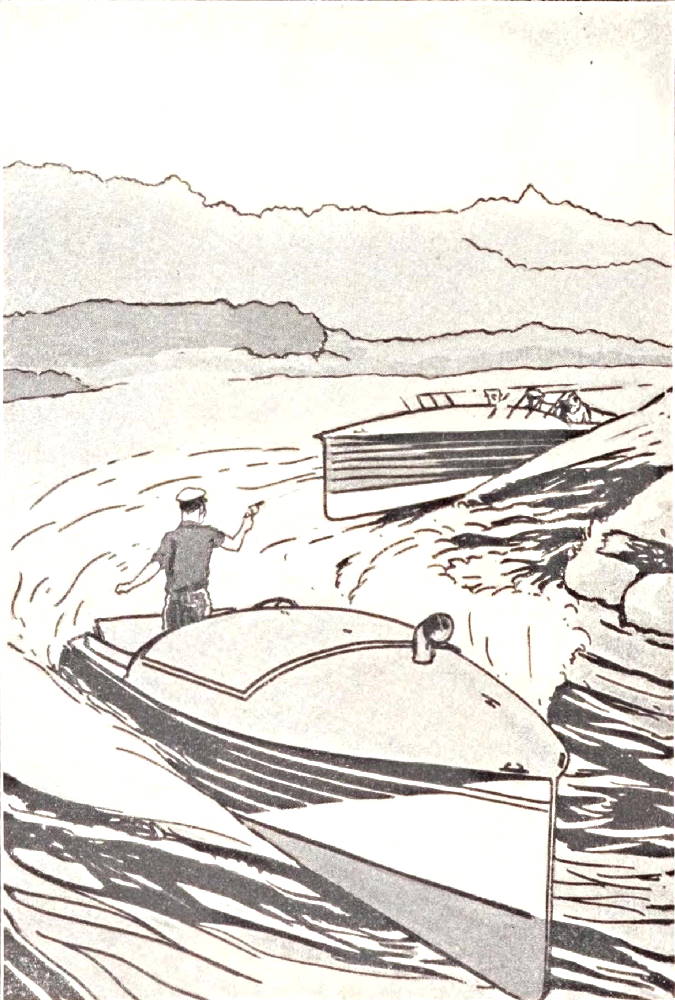
“THERE HE IS!” CRIED LANKY EXCITEDLY, POINTING TO THE MOTOR
BOAT THAT LOOMED DIRECTLY IN FRONT OF THEM
Frank Allen and His Motor BoatFrontispiece (Page 203)
OR
Racing to Save a Life
BY
GRAHAM B. FORBES Author of “Frank Allen’s Schooldays,” “Frank
Allen—Pitcher,” “Frank Allen at
Rockspur Ranch,” etc.
GARDEN CITY NEW YORK
GARDEN CITY PUBLISHING CO., INC.
1926
FRANK ALLEN SERIES
BY
GRAHAM B. FORBES
See back of book for list of titles
COPYRIGHT, 1926, BY
GARDEN CITY PUBLISHING COMPANY, INC.
MADE IN U. S. A.
FRANK ALLEN
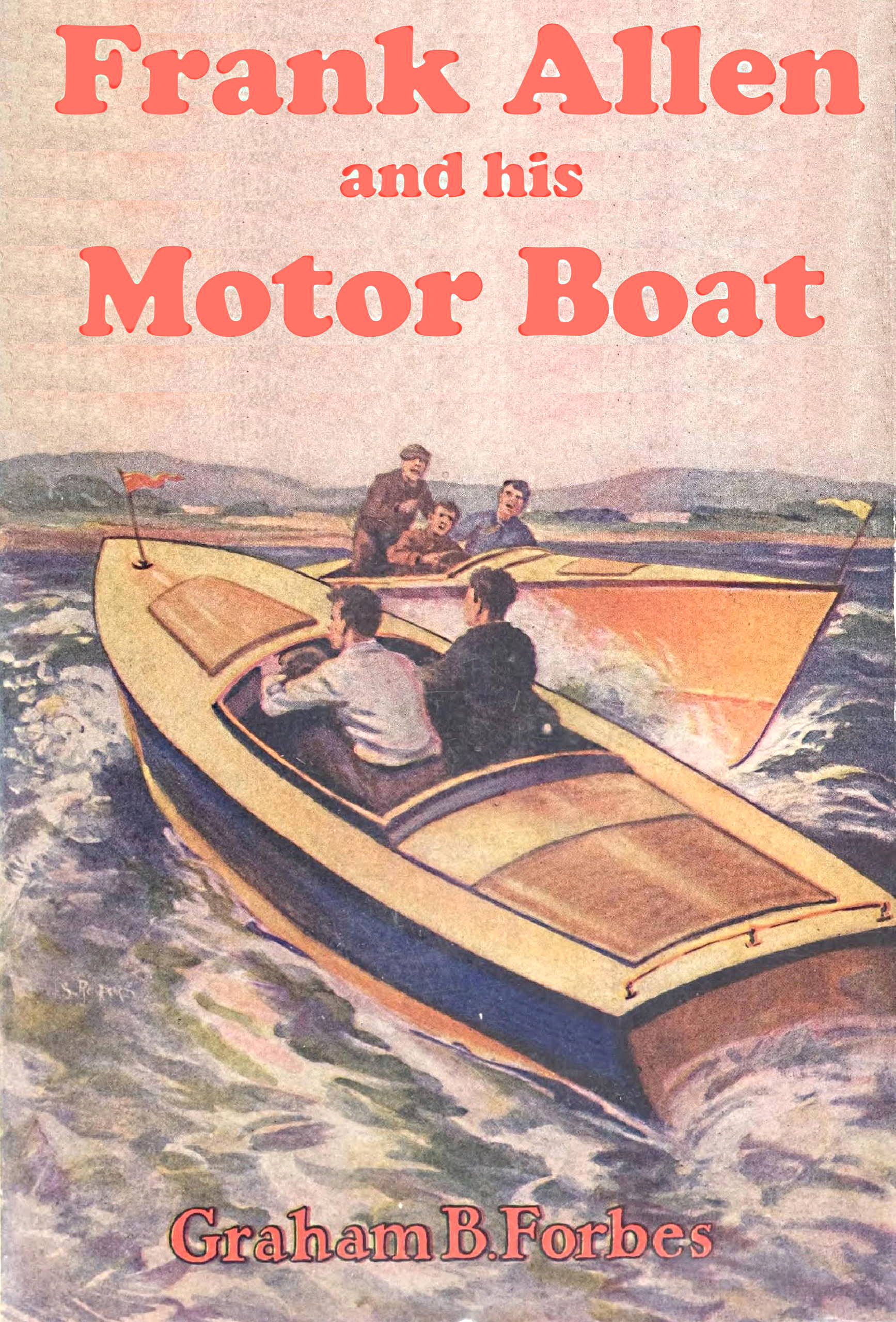
AND HIS MOTOR BOAT
CHAPTER I
TUNING THE ROCKET
“Cunningham really wants a race, does he?
Well, I’m ready after to-day to give him a chance
to beat the Rocket; but, Lanky, he’ll have to handle
the Speedaway better than he handles himself or he
will find himself taking the rough water of this little
boat mighty quickly.”
Frank Allen and Lanky Wallace were out on the
Harrapin river giving the regular daily try-out to
the Rocket. Lanky’s father, after their return from
a recent trip to the West, had presented Frank with
this neat, little, rakish-modeled motor boat for three
reasons: first, because he liked the upstanding leader
of the Columbia boys and felt that his own son,
Clarence (though Lanky was the name known best)
could be in no better company; second, because he
was himself a lover of the great out-of-doors and
felt that kinship to Frank which the outdoor life
develops in men; and third, he felt that Frank
had done him a great turn out at Gold Fork when
he had so successfully outwitted those who had
tried to rob him of the gold which was rightfully
his.
“You know, sweet little Clarinda—” and Frank
started “kidding” his pal.
“Listen, boy,” Lanky spoke up quickly, “the
Harrapin’s wetter than usual to-day. One of us
might get damp.”
“As I was saying,” and Frank’s eyes sparkled,
“Clarice,” keeping a watch on Lanky, “you know
that a gas engine has fifty-seven varieties of tricks
in it, just like a good Missouri mule, and before I
get into any contests I am going to learn a few of the
tricks this one has.”
At the moment there seemed to be no reason why
Frank Allen should doubt the faithfulness of his
motor, for it was running smoothly, hitting regularly,
and had been responding to-day to its master’s
touch. Which very fact was stated by Lanky
Wallace.
“That’s all right, Lanky—what you say. But
you heard me compare a gas engine to a mule, didn’t
you? That is using other words to say that when
you think things are the smoothest is when they are
getting ready to be the worst.”
The words had just left Frank’s lips and reached
Lanky Wallace’s ears when there was a loud pop
and the engine’s explosions ceased.
“Oh, ye prophet!” and Lanky started laughing.
“Here! Grab the wheel, hold her straight ahead,
and let me tickle this thing into action,” and Frank
let Wallace have his place.
His wrenches in hand, he took out a spark plug
and immediately found this particular trouble.
Cleaning the plug and respacing the two points across
which the spark leaps, he replaced the plug and
started the engine. Again it worked smoothly, and
he threw it into gear with the propeller shaft.
“I wonder who Cunningham is, really,” he said
as he wiped his hands on some waste and stood again
alongside Lanky Wallace.
“Beats me. But I don’t like him, no matter who
he is nor where he’s from. There’s something about
him that isn’t square, Frank. His eyes are shifty
and he seems too anxious to be the leader in everything
in Columbia. I don’t see what Minnie sees in
him——”
The mention of Minnie Cuthbert’s name along
with Cunningham’s was not at all pleasing to Frank
Allen, and a little frown stole across his face. There
was silence between the two boys while the Rocket
continued up the river at a medium pace, taking
them on an errand for Frank’s father.
“Well,” Frank broke into the put-put of the exhaust,
“I guess it’s just a strange face and new ways
and new words and lots of great things he has
done, and all of that. They say a woman’s intuition
is unerring, but I believe that you and I have
better intuition in this case than the girls have. I’m
going to venture this: I don’t believe Cunningham
is here for any good reason, and I believe that fast
motor boat of his is for some other purpose than
just to challenge us fellows to a race.”
Silence fell again between the two boys while the
Rocket passed one after another of the beautiful,
green, wooded islands which dot the Harrapin and
make it one of the prettiest water-courses in the
country. From among the trees on each of them
peeped out pretty houses or cottages or partly built
summer homes, the finished houses possessed of neat
boat landings where week-end parties often stopped
during the solstice days and spent a merry time as
guests.
“What a summer!” suddenly exclaimed Lanky.
“How?”
“Well, first out at Rockspur and Gold Fork, and
lots of fun and go almost every minute, and dad’s
map being stolen, and the sudden appearance of Lef
Seller, and the hot chase we had, and Lef’s getting
away, and your finding all the gold for dad, and
his giving you a bunch of it, and now back here—all
of it, you know.”
“And don’t forget we’ve got to have a good camp
yet before the summer’s gone,” put in Frank. “I’ve
been thinking of it all the summer and I don’t want
to see the time get away from us before we pull that
off.”
“You’re sure right,” agreed Lanky.
For a while they chatted about the pleasant times
in store for them on a camping trip, then the conversation
again drifted back to their adventures in the
West. All the while Frank was listening, even
through the spoken words, to the action of the
motor, feeling all the time as if something might be
wrong with it.
“Something’s out of adjustment,” he said to his
companion, breaking suddenly into one of Lanky’s
speeches. “This motor is good, a perfect daisy, a
four-cycle type that is hardly without equal, and yet
it isn’t acting right, Lanky. I’m not so awfully expert
that I can figure it all out, but there is a noise
here that isn’t right. Listen! Just as I pick her up
for some speed, there’s a peculiar sound.”
With this Frank increased the speed of the boat,
and in perhaps sixty seconds the Rocket was heading
up the Harrapin at a pace which Frank had not
previously held it to.
“Gee, Frank,” cried Lanky enthusiastically, “what
chance has Fred Cunningham with this? This is
speed, I’ll say!”
“Righto—it’s speed. Look at her nose! Up and
after ’em! Look back of us at the wash. But also
listen to that sound. Some of these days when I
need speed and think I’m going to get it, I’m going
to find myself in trouble if I don’t find the cause
for it,” and Frank’s tone was one of extreme worry.
“What’s the use of worrying? I don’t hear anything
half as much as I see some speed. This is
great!”
Gradually the speed of the Rocket was lessened,
for Frank was not inclined to take chances on something
which he did not understand.
“How far do we go?” asked Lanky.
“Up to Crescent Island. Father asked me to deliver
that message in my coat pocket up to Mr.
Sneed on the Island. I guess it must have been
important, or he would have sent it by mail.”
Around a long bend of the river they went, past
one of the prettiest of the island group, whereon a
handsome summer home stood back of the shrubbery.
“I wonder why Mrs. Parsons keeps that big place
on the island and also her home on the shore of the
river,” idly observed Lanky Wallace, nodding over
to the very handsome old home on the shore of the
river, standing back on a knoll, protected from the
view of the river boats by great trees and row upon
row of shrubs.
“I understand she has become a sort of miser since
Mr. Parsons died. I have heard that she keeps lots
of her family heirlooms and silver and all that sort
of thing up there.
“I’ve heard all sorts of mysterious things about
her place, among them that she has secret chambers
to keep her money and jewels,” and Lanky looked
back at the place. “But, Frank, I don’t believe
half of those stories. You know that lots of the
small talk we hear in town about many folks isn’t
so.”
“That’s true enough,” agreed Frank. “Of course,
there is the old saying that where there’s smoke there
is also fire, but I can’t help but think that a sensible
person who is rich is not going to keep stuff of
that sort about the place, exposed to thieves and burglars.”
“I wonder if she’s afraid to stay there unguarded.”
“Then why doesn’t she move into town, where she
would be close to neighbors and friends?”
“On advice of counsel, I must refuse to answer,”
said Lanky banteringly, striking a mock heroic attitude.
Just at this juncture the expected happened.
Frank’s exclamation of “Now! what’s the matter?”
showed that his fears were being realized. The
engine stopped dead, and the Rocket was going
upstream merely because of its own headway.
Lanky Wallace took the wheel at the suggestion
of Frank, so that he himself could get down to
tinker with the engine.
Once, twice, three times he tried to get it started,
but there was no success.
Without any show of temper, but a determined
look of the conqueror, Frank Allen rolled his sleeves
back, chose the wrenches he wanted, and started to
work.
“While we’re drifting, Lanky, hold her in toward
shore, and when we’re close enough you might as
well ease her up to some good spot to tie. I’m going
to fix this thing if I know how.”
First the plugs were taken out. They showed
considerable fouling, but when he had cleaned and
replaced them there was no success. What Frank
noticed particularly was the resistance which the
motor offered to being turned over.
A half-hour of drifting passed away, Lanky in
charge of the wheel, and then a slight bump told
the boys that he had brought the Rocket’s nose up
against a soft place in the bank. Lanky leaped off
with a line and ran to a low-bending tree, a very
convenient willow, and tied.
They had drifted back to a point just upstream
from the Parsons house.
Several boats out in midstream passed them, but
the two boys, busy in the cockpit, paid no heed to
those who were going their own ways. The afternoon
was wearing on.
The first thing Frank had discovered was that two
of the valve springs were weak, or appeared to be
so, and he placed the only spare ones he had—two
new ones from the tool kit—where they belonged,
then had Lanky try the engine by slowly turning
it over to note the effect.
Next came his examination of the carburetor,
where so much of the trouble of a gas engine lies,
and found that the needle valve was dirty. This
being cleaned, an examination of the float having
been made, and all parts then carefully put together,
Lanky grabbed the flywheel and gave it a spin.
Away it went with a whir!
“Now, which of three things was wrong?” laughed
Frank, as the motor spit and sputtered and then went
to running evenly.
“All three!” exclaimed Lanky. “It’s not for me
to choose the right one—so I’ll just play safe and
say it was all of them at the same time.”
The two boys washed their hands, Lanky
loosened the fastening to the tree, gave a huge shove
to the boat to cast it far off shore, leaped on it as it
moved away, and grabbed an oar to propel it further
from shore, paddle-like, so that the propeller would
not foul.
Then, its nose slowly turned upstream, the engine
running smoothly, the Rocket picked up speed under
the hand of Frank, and out to midstream they went,
toward the Parsons Island.
“There’s Cunningham right now!” exclaimed
Wallace, pointing to a rapidly moving boat which
was rounding the upper side of the narrow island.
It was a trim craft, the Speedaway, and worth
watching as it skimmed around the island and made
its way toward the same side of the river as was the
Rocket.
“What’s the fool mean? Look at him! Heading
straight at us!” cried Frank, throwing his wheel
over to get passing space and blowing his whistle.
“Drat his hide!” muttered the other. “Turning
directly at us and not slowing down.”
Once again Frank eased the Rocket to the port.
At once the Speedaway’s direction was changed, the
boat answering quickly to the wheel, as its speed was
kept.
A long slim V of water washing behind as its bow
cut the river with its burst of speed, the Cunningham
craft was bearing directly at the Rocket, a deliberate
attempt to run it down!
CHAPTER II
THE SCREAM IN THE DARK
Lanky Wallace looked aghast as the Speedaway
bore squarely at them, aimed at tearing the Rocket
in two.
Frank Allen, realizing what a dastardly attempt
was being made to disable the boat and probably to
injure Lanky and himself, knowing that only the
coolest maneuvering would save them, was as steady
as a post.
With one swing of his arm to the motor he increased
speed and with the coolest deliberation turned
the nose of the Rocket squarely for the Speedaway.
His hope was two-fold: that he would scare off the
other men and that he might be in a better position
to throw his own craft hard over to one side at the
last moment before any impact.
His movement was entirely successful in at least
one respect—that he got into position quickly for
his own next move.
In a flash of time the two boats were almost
touching noses. Then came the necessary alertness
and deftness of movement. With a hard tug at his
wheel Frank threw the Rocket to one side.
Crunch! The sides of the two boats rubbed each
other all the way from stem to stern. As quickly as
this happened Frank threw the wheel hard in the
opposite direction, with the effect that it threw the
Speedaway around, and did so with such a jerk
that a large box fell overboard on the other side.
“Hey, you blame fool! What do you mean trying
to run me down? What kind of dirty tricks are you
up to?” yelled Fred Cunningham as they passed.
Frank, hearing the splash and not knowing that it
was not a man overboard, for he had seen two other
men beside Cunningham in the boat, immediately cut
off speed and continued the long turning movement
started when he so quickly gave the push to the
stern of the Speedaway.
Her nose now downstream, Frank and Lanky saw
that the Speedaway had also made a wide turn and
was coming back toward a box which was floating
in the river. The speed of the Rocket lessened as it
neared the other motor boat.
The two men in the Speedaway were busily engaged
in reaching for the floating box, which appeared
to be an empty one, and were thus averting their
faces. His quick eyes taking in the scene, however,
Frank got enough of a glimpse of the men to be able
to recognize them again if he should ever see them.
“Say, what kind of business is this? Do you
know that you could have swamped this boat and put
us all into the river?” called Cunningham.
“That’s about what you had coming to you,”
called Frank. Since Cunningham was playing this
kind of trick and since there was nothing to be
gained by having any argument about the guilt of
one or the other, Frank merely showed his contempt
for the other.
By this time the two other men had rescued the
box and had placed it on the deck forward.
“Do you think that raft of yours has any speed
in it?” asked Cunningham sneeringly. “If you think
so, I’ll give you a race any time you want it.”
“That’s exactly what I’ll be glad to do. Any
time you say and where you say we’ll show you what
a regular boat can do that doesn’t spend its time
running other people down,” called Frank quite
coolly.
“What’s that?” called Cunningham threateningly,
getting out from the cockpit as the two boats lay
alongside each other.
Frank was equally ready, and saw that a lack of
movement on his part might be misinterpreted. Out
he stepped from the cockpit of the Rocket and
started toward the side.
“I said this boat was ready for a race any time,
and I said it was not in the nasty habit of trying to
run into other people. Did you get me plainly?”
“Race you any time you say, then. Better put
two or three more engines into your rowboat,” again
sneered Cunningham, as he stepped back into the
cockpit of the Speedaway.
With that he threw the motor into gear and moved
away from the Rocket, which now slowly turned its
nose upstream.
Frank and Lanky were both quiet. Wallace
wanted to talk, but he knew Frank well enough to
know that the young captain of the Rocket did not
wish to say anything. Under such conditions Frank
Allen was always most quiet.
The afternoon sun was slanting its way down into
the west and the cooler breezes of the river were
flitting past their tousled heads, cooling them off a
bit after the rather exciting moments they had
had.
It was just at dusk that the boys came to Northeast
Bend in the Harrapin and saw the island for
which they were headed.
As quickly as it was possible to do, without taking
too many chances on injuring the craft, Frank
brought it up to the landing with the engine dead.
Lanky leaped ashore and tied to the landing post,
while Frank made sure he had the note in his pocket
before stepping off.
“Well, we’re going to have a moonlight ride on
the Harrapin to-night—provided there’s a moon,”
laughed Frank, as he came hurrying back to the
Rocket and found Lanky stretched out astern, viewing
the sky.
“Good enough, only it’s going to cost someone
something to eat when we get back to town, for
I’m as hungry as one of those bears they talk
about.”
“I think father ought to be the one to buy it.
What do you say if you come on to the house and
we’ll have a snack laid out for us that will improve
conditions in the department of the interior.”
“That’s the most sensible thing you’ve said since
we started—so far as I can recall.”
In the meanwhile Lanky pulled his frame up
from the stern seat, stretched, jumped to the landing,
cast off, and the Rocket was ready to go. The
stream slowly turned the boat’s nose downward as
Frank threw the wheel over. A moment later the
motor was going, the gear shifted, and the Rocket
started on its homeward journey.
“Better get the lights going, Lanky. And while
you’re at it, get the searchlight uncovered and start
it. Might as well have all the light we need. This
is the first time we’ve navigated at night, and there
are about two hours of it to do.”
Lanky took up his task, whistling the while, but
suddenly ceased the music and cried:
“Say, Frank, there’s not a bit of juice. What’s
the big idea? Can’t light one of them.”
“Throw the main switch on.”
“I have, but not a bit comes through. The line’s
dead.”
Here was something more to concern them.
Frank Allen knew he did not dare go far down the
river without lights, for the many islands in the
river and the tortuous path it followed at times would
put their own safety at risk, while anything that
might be floating in the stream would be an additional
risk. On top of all would be the risk to themselves
and to others should they meet a motor boat
or a rowboat coming upstream.
“Here, take the wheel and hold her in the middle
of the river,” he directed Lanky, as he threw the
engine out of gear with the drive and started to
seek for the trouble.
Fifteen minutes passed without any degree of success,
and actual darkness was on them.
“Put her nose over to shore, Lanky. No use
taking any chances. We’ve got to find the trouble.”
Whereupon Lanky did his duty, and the Rocket
was soon tied to the bank, the engine was stopped,
and the two boys began their search for the trouble.
They started at the battery end to trace out the
wiring.
Doing the work carefully, not dodging about after
one connection or another, working methodically, as
was Frank’s wont in all things, they came across
a grounded connection which was causing the
trouble.
“What has always got me,” said Lanky, as Frank
declared it was a ground, “is that you call that kind
of a connection a ground, or you say the current is
grounded, when there’s no ground near the boat.”
“Simple as can be to a high-class, first-grade, expert
electrical engineer such as yours truly,” declared
Frank, poking out his chest and striking an attitude.
“Yes, like I’m a good jeweler!”
“Now, little playmate, wilt thee kindly cast off the
vessel from yonder coral reef?” Frank continued
his attitude.
Lanky went shoreward, loosed the rope, and
threw it on board at the bow, gave the Rocket a
push and leaped aboard himself, hastily grabbing the
oar once again to push the stern away from the
shallow water.
“Put-put!” and the engine started as he gave the
flywheel a spin, Frank at the wheel ready to throw
it in gear and get to midstream. All lights were
going properly.
Silence now held the boys for a while as Frank
picked his way easily to midstream and headed for
Columbia.
“You know,” Lanky suddenly broke the stillness,
still, except for the muffled exhaust of the motor,
“I’ve been wondering about that fellow Cunningham,
Frank. What the mischief is that fellow up to?
What does he want around here? Who are those
two men who were with him? Why did he try to
run us down to-day? And any other questions I
may have forgotten.”
“You haven’t forgotten any. But you sure can
have the first chance to answer all or any of them,
too. I don’t know the answers. Wish I did.”
Lanky was silent again. Frank joined him.
The Rocket was skimming the Harrapin at a fair
pace, no great amount of speed, however, being
shown, for Frank Allen was not anxious to run into
trouble. The searchlight was lighting the river
fifty yards in front of them, first flashing across to
the tree-lined banks as they came to great curves in
the river, and again lighting up some one of the
emerald-like isles, though now looming up out of
the water like spectres. No moon was up.
“Getting down toward home. There’s the Parsons
island ahead of us. We’ll pass it on this side,
and then I believe I know the river better from that
point to home.”
“What’s that over there?” excitedly cried Lanky,
as he pointed to a shadowy thing which had been
brought up out of the river as the searchlight swung
toward the shore.
Back again Frank swung the light, disclosing a
rowboat tied to the bank, with a form, much resembling
a living being, at the bow of the boat.
But the light was not strong enough to bring out
details.
“Some one tied there for a while, I guess,” and
Frank turned the searchlight again toward the middle
of the stream.
“Look! A signal!” Lanky had seen a flare of
light in the direction of the boat.
“Rats, Lanky, you’re letting this darkness get on
your nerves.”
“Well—maybe. Anyhow, if it wasn’t a signal of
anything else it was a signal or sign that he was
lighting his pipe.”
Then a distant hail came to their ears above
the put-put of the motor. They were almost on a
line between the Parsons island and the Parsons
home on shore. Frank stooped and cut off the
motor, permitting the boat to drift with its
headway. Both the boys listened. There was no
sound.
“Guess I’m the one that let the light and the sound
get on my nerves. What time is it, Lanky?”
“Half-past nine o’clock.”
“That’s early for anything wrong to be happening
anywhere, so I guess there’s nothing happening.
Those sounds are common to the river, no doubt,”
and Frank stepped over to grasp the flywheel and
start the engine.
“Help!” It came across the water from the shore
of the Parsons estate.
Frank straightened and listened. Lanky was sitting
bolt upright. Once again there came the shrill
scream of a woman. No other sound.
“Wonder what it is, Lanky!”
“Some one in trouble over at the Parsons place.”
In a trice Frank grasped the flywheel, gave it a
twist, the motor started, and they swung to the shore.
Wallace went forward, hoping to catch any sound
that might come across the lessening expanse of
water.
Cutting off the motor, throwing the nose around
so as to strike the bank easily, with Lanky ready to
leap ashore with a line, Frank maneuvered the
Rocket expertly.
Just as Lanky Wallace jumped ashore, as Frank
held tight to the wheel, there came again the shrill
scream of a woman from the Parsons house!
CHAPTER III
THE PARSONS JEWELS
Up the inclined bank went the two boys, determined
now to get to the Parsons house, whence
the cries came.
Dodging through the shrubbery, which whipped
their faces in the inky darkness, tripping and stumbling
over the gnarled roots of some of the older
vines, as they missed their steps, they came to the
broad expanse of lawn in front of the estate which
faced the river.
Once more came that cry of a frightened woman!
It seemed to come from the rear of the house.
Dashing up the steps to the front porch, Frank tried
the door. It was locked. Still another cry from
the woman!
“Around to the rear!” cried Frank, as Lanky and
he turned back from the resisting front door.
They dashed as fast as their legs could carry them
around the large building, coming to the rear porch,
or gallery, which faced toward the river road, and
up to which a broad driveway led.
Swish! The starting of a motor! Then a light
flashed and an automobile moved out from the drive
at the garage a hundred feet away!
“There they go!” both boys cried in the same
breath, just as a loud cry came from within:
“Help! Let me out!”
It was just over their heads. Frank looked up,
but could see nothing. The night was as black as
ink.
Rushing up the steps to the wide back porch, the
two boys tried the door. It gave to their touch.
Both tried to get in at the same time, and for a
second wedged each other.
Again Mrs. Parsons, for in all probability it was
she, screamed, and Frank dived through the dark
for the direction indicated by her voice.
“Find a light, Lanky, quick!” he cried, feeling
about for the door.
While Frank fumbled along the wall, trying
to find the door or closet wherein Mrs. Parsons was
imprisoned, Lanky was in turn fumbling in his
pockets for a match, which, finding at last, he
scratched. The feeble light flared up, and the quick
eyes of both boys located the push button. Each
made a dive to get it, but Lanky being nearest
reached it and flooded the room with the necessary
light.
In another moment Frank was smashing against
the door behind and beyond which the woman was
screaming even more lustily, more excitedly, than before.
As it gave before his second onslaught, he saw
she was lying on the floor, her arms and feet pinioned,
a rag which had been used as a hurriedly
made gag lying alongside her head.
Loosening her arms quickly and lifting her bodily
to her feet, Frank and Lanky both supported her
to a chair.
It was Mrs. Parsons, the wealthy recluse of the
county. She was thoroughly hysterical.
“My jewels! My silver! They’ve stolen it all
and got away! What shall I do? What shall I
do?”
Frank tried to quiet her, but for a few minutes
it was of no avail. She was thoroughly excited
over her experience and her loss, wildly hysterical
about it, crying one moment and screaming the
next.
What seemed to the boys a very long time was
only a few minutes, and then she quieted enough
to tell, between gasps and moans, something of what
had happened.
Mrs. Parsons said that she had returned to her
house from a trip to Columbia just after dark and
that her automobile had been put up. She came into
the house, and her maid being out for her regular
weekly day off, she had prepared a little supper for
herself. In doing this she had not gone any further
than the kitchen, the pantry, and the small room off
the kitchen which she used as a breakfast room and
which, under circumstances such as these, she used
also as a dining room.
Having finished her supper she sat in the same
small room checking over her balance in bank as
shown by her bankbook as against her own check
stubs.
“How long were you engaged at this?” asked
Frank.
He was decidedly anxious to get to the heart
of the story, yet realized that she must tell the tale
in her own way, even though the miscreants were
putting more and more distance between themselves
and this place at every minute that she detailed the
story.
“Oh, I suppose it was fully an hour that I sat
here checking and thinking idly about different things,
then——”
She proceeded with her story, about as follows:
She had heard a noise of a peculiar kind several
times, but had paid no heed to it, thinking the
noises were caused by the wind, coupled with the
queer noises that one always hears at night. Living
alone in this house for so long she had become
quite accustomed to extraordinary noises, and had
enjoyed herself on many occasions concentrating
on some of them and guessing what they were.
“Suddenly I felt as if some one were behind me,”
and she turned quickly, apprehensively, around, expecting
to see some one.
“As I twisted around to see what could be behind
me,” she gasped, “a man seized me by my shoulders
and another placed a hand over my mouth. I
screamed as I jerked and for a moment freed myself
from his grasp over my mouth. But in a
second he again placed his hand over my mouth,
the other hand going around my throat, and I could
not even breathe.”
“Then they placed you in the pantry?” asked
Frank.
“Yes, they dragged me over there, one of them
tied a rag around my face, to gag me, and then they
bound my hands and feet.”
“How did you get the gag off so that you could
scream so loudly—for we were attracted by your
screams?”
“I guess it was because I twisted and squirmed
so much. Anyway, finally, while I was almost
frantic over the noises I could hear of their packing
up my silver and loading it into a box and
carrying it out, I managed to free myself from
the gag, and then I started screaming as hard as I
could.”
“But why scream, when you knew you were so
far from neighbors?”
“You heard me, didn’t you? You heard me from
the road and came. That’s why I screamed.”
“Yes, we heard you from out on the river.
That’s how far your screams carried,” replied
Frank, speaking softly so as to reassure her. “Now,
let’s call the police and get them out here.”
“Yes, yes, call the police!” she cried, gaining
strength and with it her composure. “Let’s look
around and see what is gone, too.”
Lanky hurried to the telephone, being directed
to its location by Mrs. Parsons, and sent in a call
for the police headquarters in Columbia, reporting
the robbery and asking for men to be sent at once.
The night lieutenant replied that he would send two
special men immediately. It may be added here that
Frank’s old friend, Chief Hogg, was no longer at
headquarters in Columbia. His health had given
out and he was away on a long vacation and another
man the boys did not know was now at the head of
the police department.
In the meanwhile Mrs. Parsons and Frank started
through the house. In the dining room they saw the
sideboard drawers all pulled out, and linens strewn
on the floor.
“All my silverware—gone!” she moaned, her
hands to her face. “Thousands of dollars’ worth
of the very finest sterling silver dishes and all my
flat silver, too! There’s the plated ware on the sideboard—they
did not want that. Oh, what shall I
do. All my silver gone, gone!”
Frank surveyed the scene quietly, not knowing
how much of the ware there might have been. Nor
had he any idea of what amount it would take to
make “thousands of dollars’ worth.”
“Let us not touch anything here, Mrs. Parsons,”
Frank suggested, as Mrs. Parsons stooped to put
one of the drawers in its place in the sideboard.
“Let us leave things just as they are until the police
get here.”
She stood quietly and looked at the disturbed condition
of things for a while. Then she said:
“I wonder if they could have gotten my jewels
upstairs. Let’s see!”
She started off with the sudden recollection that
these same men could have gotten more than the
silverware.
Up the steps to the second floor they went, into
her own apartment. There the dresser drawers
were scattered about the floor, everything in the
closets was down, showing that a search had been
made for valuables.
Over in one corner of the room, in a place that
was rather out of sight, a small safe was standing,
its door wide open.
“The safe! My jewelry!”
The safe was empty. Papers and large legal envelopes
lay on the floor, but otherwise the safe was
absolutely, completely, hopelessly empty.
Mrs. Parsons sat stiffly down on the bed and
cried, moaning the while about the loss of her
jewels.
“How much was there, Mrs. Parsons?” asked
Frank, after taking in the whole scene and waiting
for the first shock to pass.
“Literally thousands upon thousands of dollars.
There were jewels there which my grandfather and
my own father and mother had left to me, and much
that Mr. Parsons had bought for me at different
times. Oh, there were rings and necklaces and
bracelets and pins and scores, scores of small pieces
of all kinds! And there were four large diamonds
which were unmounted, all in a small iron box.”
The robbers had made a good haul while they
were at it. Evidently they had known something
of the lie of the land, had figured where everything
was, or had been told where things were. And,
thought Frank, they had not done all this after they
had bound and gagged the wealthy widow. There
was so much to be done that they had probably been
in the house while she was away, and the small noises
they made upstairs were those which she had heard
and had permitted to pass unheeded.
Having looked carefully about the room, having
seen how thoroughly these fellows had worked,
Frank proposed they go downstairs to await the
police.
They had not long to wait. They had barely
gained the landing below when the police knocked
at the front door, having come around from the
broad front of the house.
Frank admitted them while Mrs. Parsons, still
almost overcome at the fright and also at the realization
of her loss, sat in a large chair, sobbing, patting
her eyes with her handkerchief the while.
The whole story was told again, this time a few
little details being added which explained to Frank
the very things he had thought were true that these
fellows had been in the house all the time, and that
they had caught and bound her when they had
finished upstairs and had come down to rifle the
lower part of the house.
“Have you any idea who did this, Mrs. Parsons?”
asked one of the men from the police department.
“If I had, would I have you out here? Wouldn’t
I have you chasing them right now?”
“I mean, madam, would you recognize them if you
saw them again?”
“No, because they wore handkerchiefs over their
faces, and that is all I saw as I turned to see what
was behind me.”
“Did you notice their clothes or anything?”
“No—oh, yes! I’ll tell you something,” and she
smiled for the first time. “When that fellow put
his hand roughly over my face the second time, one
of his fingers got between my lips and I bit down
hard on him, so hard that he jerked it away, but he
had it back again before I could draw my breath
and scream. I know I bit him so hard that it will
show.”
The policeman smiled.
“Pretty hard work to find one fellow out of
thousands whose finger was bitten.”
“And, besides,” broke in Frank Allen, “they are
a long distance from here right now. That car
started away mighty fast.”
“What car? Did you see them? Did you get
here in time to see them get off in a car?”
The man from police headquarters swung on
Frank.
“Yes, we heard the screams and came running
here. Just as we came to the rear of the house
we heard a car door slam, saw the lights flash on,
and the car pulled out from the garage.”
“Where were you when you heard Mrs. Parsons?”
“Out on the river,” answered Frank.
“And you heard her scream from here away
out in the river, from the rear of this house to that
broad lawn and out there?” questioned the man.
“Sure. How would we have come here if we
hadn’t heard the noise?” asked Frank in turn.
The two men from police headquarters drew
aside and held a whispered consultation. Then the
chief of the two came back.
“Mrs. Parsons, how long after the two men left
did these young fellows come in here to turn you
loose? How did they get in?”
“How would she know the answer to the last
question?” asked Frank. “We found the rear door
open, and we broke down the pantry door, as you
can see by looking at it.”
“You have been in this house several times as the
guest of Mrs. Parsons, have you not?” asked the
policeman. “When she entertained you while you
were at high school?”
“Oh, officer,” cried the widow. “What do you
mean? Frank Allen could have had nothing to do
with this!”
CHAPTER IV
WHEN FIRE LIGHTS THE SKY
The accusation, hardly to be called veiled, rather
startled Frank Allen. Lanky, close chum of
Frank’s that he was, moved as if to strike the policeman,
but refrained on sober second thought, since
it would certainly have placed him in a bad light.
“You are inclined to jump at conclusions without
much thought,” remarked Frank quietly, though
in that quietness there was the glint and swish of a
rapier blade. “We thought you were coming up
here to help find the thieves and not to waste time
making wild accusations.”
“Zat so, young man? Well, my advice to you
is to keep a quiet tongue or things won’t be so quiet
for you.”
This exchange of remarks brought Mrs. Parsons
around from her hysterical fright to a feeling of resentment.
“Pray, let us not have any trouble of the kind.
We have had enough trouble to worry us. Let us
proceed to learn whether we might not find a way
to gain proof against the men who have done this.”
“I quite agree with you, Mrs. Parsons. If there
are such things as clues which will help us fasten
this on the men who did it, let’s try to find the clues.”
Frank was keeping his cool demeanor.
“I’ll see to the clues.” The policeman still held
to his manner, which was bellicose, to say the least.
“We do not need your help, young man, and you
may leave.”
“This is my house, sir!” The widow spoke
angrily. “Mr. Allen will stay here until he pleases
to leave.”
“No, Mrs. Parsons, I think it wise that I leave.
I thank you ever so much for what you have said,
but since it might merely slow things down if I
stayed, I will be getting back home, for it is already
late.”
With this Frank and Lanky bowed themselves
out of the house and were gone down the river
bank.
Walking at a medium pace across the great spread
of carpeted grass, the two boys said nothing to
each other, though both were thinking deeply.
The vines and shrubs cracked and swished as they
pushed their way through these, and both came
out at the river bank at practically the same time—and
with the same thought.
For both were looking, or trying to look, through
the darkness to a point upstream. Seeing in this
inky blackness was impossible. Even their boat,
the Rocket, was a slightly darkened blob against
the river.
Not until the boat had been pushed into the
stream and Frank had guided it away after Lanky
had turned the engine over, was the silence between
these two friends broken.
“What does it mean?” asked Wallace.
“It really, down to brass tacks, doesn’t mean anything,
Lanky, as you will realize if you think of it
for a minute. We know we haven’t done anything
wrong, don’t we? So, all it can mean is that the
police force has one more member on it than we
thought who hasn’t all that’s coming to him.”
“But it doesn’t alter the fact that he has accused
us of having something to do with this robbery.”
“He also hasn’t altered the fact that we didn’t,
has he? You’ve got to battle with facts when you
get after things of this kind. Now, I know a fact
which I should like to place before your attention—there
was an old boat tied up to the river bank just
above us when we landed.”
“Yes, and I was remembering the same thing when
we came through the brush. But you can’t see
anything in the dark. Let’s go back and see if it’s
there.”
“Sure, it isn’t there! What’s the use of going
back? If the fellow had no reason whatever for
being there he would have moved by this time,
because it has been more than an hour, maybe nearly
two hours. And if he did have something to do
with it, he wouldn’t be there yet.”
“But those fellows who got into the auto when
we came to the house—how about them? What
connection would they have with the boat, for they
had a car?”
Lanky had asked a question that meant something.
What, indeed, could the car have to do with the
boat?
Frank was silent, thinking, as was Lanky.
The steady put-put of the exhaust broke the silence,
and Frank steered a course well toward the
farther side of the Harrapin, thinking to skirt close
to the next island, for in doing so at the wide bend
of the river below he would gain a short distance.
Wallace was standing close to Frank in the cockpit,
and their words were not spoken, when they did
speak, very loudly. The submerged exhaust did
not bother them greatly.
“Wish we could have got some idea of the shape
of that car,” muttered Frank Allen. “When he
flashed on the lights to get away we might have had
gumption enough to have noticed the license tag.”
“I did,” replied his mate. “There wasn’t any.”
“What? Are you quite sure?”
“Well,” and Lanky drawled his reply to the question,
“maybe I oughtn’t to have said that. As I
recall the impression on my mind when they started
off, the red light did not show any license tag beneath
it.”
“We didn’t even notice whether they turned up
the road or down, either, so there’s that much information
that we lost. Instead, we dashed up
those steps and into the house.”
“They must have had a lot of time to do what
they did.” Lanky spoke suddenly after another
period of silence. “They could not have done all
that after they bound her in the pantry.”
“That’s what I think. They probably were already
in the house before she got home. But that
brings up this question, Lanky—if their car was
standing at the spot where we saw them get in at
the time she came home, why didn’t the driver of
her own car notice it and tell them?”
“Gee, that’s a fact! Now, what does that mean?
Does it mean that they arrived after she did? Does
it mean they entered the house after she arrived
home, proceeded upstairs and finished the work,
and then came down and got her?”
“Doesn’t sound reasonable. Let’s see what we
would have done if we had been the culprits.”
Frank was reasoning it out slowly. “If I had gone
in there after she returned, and I had known she
was there, I would not have taken a chance on proceeding
upstairs, making noise which she might have
heard and reported over the telephone before I could
get downstairs to quiet her.”
“How about this?” Suddenly a thought struck
through Wallace’s mind. “Could not these fellows
have left their car outside somewhere, out of sight,
and the driver of it could have brought it up after
she had returned home and after her own driver
had gone away?”
The idea was a good one, and Frank turned to
look fairly at his friend before he answered.
“Hey! Hold off there! What the dickens!”
The sudden cry had come from out the darkness
on the river. Frank’s head was back again to the
forward end of the Rocket. Squarely in his path
was a dark object of considerable size!
With a wide sweep of the wheel he threw the
Rocket hard over to the port side, his right hand
reaching down to slow the motor so as to decrease
the impact when he struck.
But the Rocket missed the object.
It was a rowboat with three men in it, and a
large box or trunk-like object in the stern. Frank
threw his searchlight into play and dropped it
squarely on the rowboat.
But the man at the oars was pulling hard on them,
getting out of range of the light.
“Why don’t you watch where you’re going?”
came out across the river to them.
Frank and Lanky said nothing. The searchlight
was reaching out in an effort to locate them, but
when it found the mark, two of the men ducked
low in the boat while the third one was plying the
oars as hard as his strength permitted.
“Isn’t that the same boat?” gasped Lanky.
Frank said nothing. Instead, he changed the
course of the Rocket, but he was too late to get immediately
after the fellows. The island was
squarely in front of him, the one he had aimed at
passing on this side to shorten the run down the
river.
Around it to the far side he went, then swung
as closely as good navigation of the Rocket would
permit, to get back to the course made by the rowboat.
Several minutes were consumed in making this
return to the former location, and the path had led
completely around the island in an attempt to head
off the rowboat.
Back upstream they went, the searchlight playing
here and there, seeking for the little craft.
“I’d be careful, Frank,” muttered Lanky Wallace.
“If there’s anything wrong about these fellows,
they’re very apt to do some shooting.”
“I’ll take the chance,” and Frank gritted his teeth.
Over toward the farther shore they went, then
swung back again, but the searchlight of the Rocket,
though flung first to one side and then the other,
failed to reveal the boat.
“That’s mighty queer. That boat is on the river.
It has no motor. It can’t move away fast. We
are faster than it is. So, it is not far from here
right now.”
“But it isn’t in sight. It is so plagued pitchy
dark that one can’t see, anyhow,” replied the other.
“But we’ve come right across their path. They
can’t have gotten far.”
“No—you’re right. But they’ve gotten out of
sight whether they got far away or not.”
“Suppose they turned, too, when they saw us
turning, and went to the upper side of the island?
Let’s take a look?”
Lanky said nothing. But he was thinking that
he did not relish the plan. He knew that a bullet
could come out of that darkness very easily, for
the willows hung far over the water on the upper
side of this island, as he well recalled, and the boat
could easily have slid somewhere beneath them.
Frank navigated toward the island, the searchlight
playing about, like some great sepulchral hand
reaching out to grasp, in weird, ghostlike fashion,
whatever it might find.
Though they searched the waters and around
the island for several minutes, no trace of the
rowboat was to be found. It had completely vanished
in the night.
“Frank,” declared Lanky, as they moved down
the river after the fruitless hunt, “that rowboat
is on the upper side of the island, under those
willows, snugly tucked away, and there was at
least one gun pointed our way in case we ran in
there.”
“Maybe you’re right. Even at that I don’t see
that we need to risk our skins hunting for something
that may be as peaceable as a baby.”
“Not much, and you know it!” exclaimed Lanky.
“That boat was something crooked, or they
wouldn’t have dodged out of sight. If everything
was all right it would have been in plain sight
when we came up around that island.”
“You’re absolutely right, Lanky. And it was
that very idea in my own mind that caused me to
want to hunt it out.”
The Rocket was now headed straight for Columbia.
Only a few more miles and they would be
at home—at a rather late hour, and probably with
two families worrying over the two boys.
“We might have been thoughtful enough to have
called our people from Mrs. Parsons and let them
know where we were,” ruefully remarked Frank.
“As if we could have been so thoughtful under
such circumstances as those. I think we did a
wonderful thing when we thought to call up even
the police station with all that excitement.”
They looked straight ahead for several minutes.
The minds of these two youths, both active ones,
were fully engaged on the happenings of the evening,
which had, to say the least, come rather thick
and quite fast.
“Was that a trunk or a box in that boat?” asked
Frank.
“Looked to me like a large box—about the size
of one I saw earlier in the day in the Speedaway.”
“Huh?” This had set Frank to thinking.
“And that rowboat looked as much like the one
we saw at the bank above the Parsons place as
any other rowboat would look.”
“That’s putting two and two together, Lanky, as
rapidly as that policeman did.”
“What’s that?” Lanky’s startled voice cried as
he pointed ahead of them toward the city of Columbia,
whose electric lights were now dancing
across the waters.
The two boys studied a bright reflection in the
sky for some seconds, both figuring what this
might be.
“It’s a fire, and a big one, too—or at least it is
big enough to look mighty big in the skies,” said
Frank slowly.
“Where can it be? In the heart of town? Or is
it further away?”
“Don’t know. But my guess is that it’s right where
dad’s place is. See that smokestack there to the
right? That’s right across the street from dad’s
store. How far is the fire from that stack?”
“It’s right there, Frank! Sure as can be, that
is your father’s place on fire—and it looks like it
is a real one, too!”
Midnight, almost, with a great fire in the Allen
department store—his father’s place of business—and
he on the river, unable to be of aid!
Frank gave the motor all its speed. The
Rocket fairly leaped out of the water on its way!
CHAPTER V
THE TOLL THAT FIRE COLLECTS
Everything in the town of Columbia seemed
to be astir. As Frank and Lanky came rapidly
down the Harrapin to the landing at the Boat Club
they heard the clanging of bells, the tooting of
automobile horns, the blowing of steam whistles,
and the sound of many voices, all in a babel.
“It is dad’s place, all right!” Frank’s remark
was more in the nature of a groan than anything
else, though he was not usually given to taking
things that way. But, at the end of a day of excitement
of several kinds, at the end of a day
wherein he had been openly accused of a theft of
silverware and jewels by the policeman from headquarters,
this outbreak of the fiery monster in his
father’s place was calculated to give him a sinking
of the heart.
“I believe it is, too,” came from his friend.
They made the landing and tied the boat as
quickly as safety would permit, having first drifted
it into its house. Frank looked hurriedly about
to see that nothing of an inflammable nature was
exposed to anything which might start a fire, and
then, ready to leave, he threw off the main switch.
Out of the building they went on the shoreward
side, and started the dash for the fire.
“Dad’s place, is right!” Frank gasped, as they
turned into the main street leading uptown and
could see the exact location of the blaze.
Crowds had gathered quickly, the streets were
fairly jammed, people being there in all manners
of dress, for it was close to the midnight hour
and Columbia had, in a very large measure, retired
for the night when the summons came.
Lines of hose were lying about the streets, all
drawn tight like so many wriggling snakes of huge
size, as the two boys neared the square where the
fire was.
At the corner below the Allen store, standing
close to a fireplug, stood one of the city’s engines,
manned by two coal-dust-covered firemen, adding
to the pressure of the water line.
The police had taken charge of the situation, and
were holding back, by means of a patrol, the great
crowds of people so that they would not hinder
the hurrying firemen in their work.
Sparks and flying pieces of burning wood were
being hurled in every direction.
Frank and Lanky, leaping lines of hose, dodging
the firemen, roughly breaking their way
through the cordons of people here and there,
dashed headlong for the fire.
“Hi! Come back there! Get back of the line!”
yelled one policeman, as Frank broke through a
crowd of onlookers.
Before he could dodge or wriggle through somewhere
else the burly fellow had him by the shoulder.
“That’s my father’s place!” cried Frank. “Let
me through so I can help him. Maybe he’s in
there!”
The policeman looked the boy over, and then,
slowly through his brain came a recollection of this
young fellow and his athletic exploits in Columbia.
“All right, young feller,” he said, and Frank was
released. “I’ll let ye go, but take care when ye
reach the main line up there. Orders is orders,
and we’re not to let any one through.”
Again Frank and Lanky stretched their legs for
the fire, this time being slowed down considerably
by the heat which rushed down upon them from
the blaze which was rapidly gaining.
As they turned around the corner from the street
on which the store faced, and looked down the side
street this sight greeted their eyes:
The entire northwest corner of the Allen Department
Store was ablaze, flames leaping from
the tier of windows running up the freight elevator.
The flames had probably started at some
floor near the bottom of the building and had been
drawn straight upward through the elevator shaft,
which acted as a giant flue, or stack. The danger
lay in their spreading to each of the floors.
Frank stood motionless as the sight lay before
him. Lanky stood panting beside him, their eyes
taking in the scene from top to bottom.
“There’s dad!” Frank moved swiftly across the
street to where he saw his father helping direct the
work of the firemen. “What can I do, dad?”
“Nothing right now, boy. The thing is just
trying to get a start. Those iron doors at the elevator
openings will hold the flames from each of
the floors, if only we can keep them in check for
a little while.”
But Frank was hardly willing, like the red-blooded
boy he was, to stand idly by and permit
this to be going on without some effort on his part
to help.
“Dad—” he grabbed his father by the sleeve—“what
do you say if I take some of that fire-fighting
powder and try to get it down the shaft?”
“That’s the idea! But don’t you do it! Let
some of the firemen do that. They’re better prepared.”
Frank paid no further heed. He called to
Lanky, and then led the way to the warehouse
across the alley from the store. In his pocket was
a key which he always carried, for he stored much
of his athletic material there from time to time.
Unlocking the door and quickly closing it behind
them as the two boys entered, Frank found the
spot where the stock of fire-fighting powder was
kept. He and Lanky took three packages each,
as much as they could safely carry.
“How’ll we get up there?” asked Lanky.
“Go through the lodge rooms next door. Let’s
get over there and get to that adjoining roof.
Some of the firemen can bring a ladder up.”
As they came out of the warehouse Mr. Allen
was there to meet them, with the chief of the department
alongside.
“Here, Frank, the chief will attend to that.”
“No, keep as many men down here with the
water as you can. Give me a couple of men to
bring up a ladder through the lodge next door, and
we’ll get to the roof. Then we can douse this
powder down the shaft and slow it up enough to
fight.”
“We’ll put a hose up there, too!” cried the chief.
“Look out for the garage over there!” went up
a shout from the crowd just at this juncture, and
they all turned to look.
Great fiery embers were floating down on the
roof of the garage which stood on the opposite side,
wherein was stored barrel upon barrel of oil and
where a great deal of oily waste was lying around,
gas also being kept in the tanks which were fed
from the sidewalk.
“Put a hose on that garage!” called the chief.
“Now, Tom, you and Andy get a ladder and go
with these two boys. Get to the roof adjoining.
Tell Micky to send a hose up through the stairway
next door and try to get it to the roof.”
The two boys got around the corner, the police
keeping the surging crowds back, and started up
the steps to the lodge room at the top. Reaching
there, panting hard for breath, the two boys faced
the door of the lodge room, closed, locked.
But Frank knew better than to go this way. In
all such buildings there is an opening to the roof
from the hallway, and Frank’s observation was
that this opening was usually at the rear. So it
was in this case.
In another moment the two firemen with the
ladder hoisted it in place. One of them scrambled
to the top, unhooked the hatch, threw it on to the
roof, and all four of them were very quickly out
on top.
“Just in time!” cried the first fireman. “And
luckily for us, the wind is blowing the other way—off
the building instead of on to it.”
Making their way quickly across to the parting
wall, having pulled the ladder up behind them, they
now placed it against the wall and all four scaled
to the roof of the Allen store.
One of the firemen grabbed a bag of the fire-powder
from Frank’s arm, and both of them rushed
toward the elevator shaft, where blazes were breaking
through the wooden door. Laying the powder on
the roof, they again dragged the ladder up from
the wall, and, using it as a battering ram, they
very quickly knocked the burning door inward.
Out leaped a perfect rush of flames, their long
red hungry tongues leaping and crackling in fiendish
glee as the opening gave a first-class draft for
the fire below in the shaft.
Crack! The first bag of fire-powder was hurled
into the shaft, spilling downward. Crack, went another.
Then another, and one more, in quick succession,
each carefully aimed through the center
of the opening.
By this time the firemen with the hose were
calling for the ladder, which was passed down to
them by the two firemen on the roof while Frank
and Lanky continued hurling the powder at the
opening until all six bags were gone.
Frank recalled that the salesman of the powder
had stated that it was merely a deterrent of fire,
and would not extinguish a large blaze—only hold
it in check for a few moments.
So it did in this case. The flames of a sudden
grew smaller, and Frank realized that their time to
get water down the shaft had arrived.
“Water!” went the cry from one of the firemen
on the roof, as he signaled to the street below,
where a burly fellow stood at the water plug with
hand on wrench ready to give them the water.
Instantly the hose swelled and twisted and
turned, writhing to get away from them, but six
men, including Frank and Lanky, were at the nozzle
end of the hose, keeping it to its duty.
Swish! The first rush of water came, stopped,
and then a full stream came pumping through the
nozzle. Straight into the elevator shaft it went.
The flames leaped up in defiance, and the water
struck again.
“We’ve got it now!” came from one of the firemen
in a muffled voice. “It may break through
one of the other floors, but it can’t do any more
harm in this shaft.”
Seeing that the fire through the shaft was now
held in check, or would be in a few minutes more,
as black smoke commenced rolling up, Frank went
over the side and started down. Lanky was immediately
behind him, having first asked the firemen
if four of them could handle the nozzle.
“Gee, I hope it hasn’t gotten through any of
those floor doors,” remarked Frank, as they
reached the top floor of the lodge building and
walked down the stairs.
“I don’t suppose it has, but even if it has they
can hold it now, because the fellows on top will
stop it from going up the flue,” remarked Lanky.
Down at the street level once more, they turned
to where the fire had been raging. Sparks were
no longer flying as freely as they had, and the sky
was not so well lighted by the flames.
Crash! Crash! A sound as of a floor falling.
Just at this moment the fire chief came running
toward Frank.
“Mr. Allen’s down in the basement! He went
in there a minute ago!”
“Is father in there?” blurted Frank Allen dazedly.
“So one of the men says. I told him to keep
out of there, but he went in by the front door a
few minutes ago this fellow says, and he just came
back to tell me.”
“That’s a fact. Went running in, and I yelled
at him, because there’s no telling what’s in there
yet.”
Frank turned and started for the front door.
“Here, here!” the chief grabbed for Frank.
“Hold on! I’ll go in there and find him! Stay
out of there!”
But he had spoken too slowly, and even his words
would not have stopped the boy. Lanky went leaping
behind his chum, but the chief grabbed Wallace
and threw him to one side, telling him to stay out,
while he, the chief, went dashing through the door
behind Frank.
A heavy pall of smoke hung over the entire first
floor, and as the door opened and closed behind
him, Frank Allen felt a heavy rush of heat and
wondered how his father could have gone through
it.
“Dad! Dad!” he cried, but then decided to keep
his mouth closed, for he had sucked in a mouthful
of the choking smoke, and his lungs seemed to be
bursting.
Holding his breath, he rushed along the broad
aisle toward the rear. Flames were licking around
the elevator shaft, just breaking through. Around
the stairway opening the floor was gone! It had
caved in, and flames were now starting to leap
through to the first floor.
How should he get below? His father was
probably down there. Probably had been directly
over this spot when the cave-in happened, caused
by the flames having eaten away the floor supports
in the basement.
A groan came from the right of them. Like
a flash Frank leaped in that direction. He recalled
the narrow stairs which led to the vault in
the basement from the rear office, while the broader
stairway was used for customers.
Barely able to hold his breath, gasping and gulping,
the boy made his way to that narrow stairway,
down its sinuous path, heard the groan again, and
himself fell to the floor as he slipped on the steps.
The flames in the farther part of the basement
were leaping and crackling, lighting the entire
space. Mr. Allen was crawling along the floor,
groaning and moaning, having tumbled through
when the floor caved in.
CHAPTER VI
AN UGLY INTIMATION
Grabbing his father under the arms, Frank half
carried, half supported him to the stairway, just
as the chief came scrambling down.
They very soon brought the man into the open
air. Everything was at a high pitch of excitement,
as the word had gone around the crowd
that Mr. Allen had been injured, perhaps killed.
A half-dozen other rumors were in the air, all
caused by the knowledge that a part of the building
had caved in and that Frank Allen and the
chief had been seen dashing into the place.
As the three emerged from the building, doctors
grabbed them, for the chief and Frank were choking
from the smoke, while Mr. Allen was now
unconscious.
In a short while the chief was himself, as was
also Frank, while Mr. Allen had been hurried off
to a hospital. Being informed of this when he
had come around, Frank, too, was driven quickly
to the hospital. Mrs. Allen and Frank’s sister
Helen were out in the Canadian Rockies on a visit.
The chief now directed the fire-fighting to better
effect since he knew the situation more
thoroughly within the building. In an hour the
fire was completely out.
At the hospital aid was given to Mr. Allen, who
had suffered bruises from the fall through the floor,
probably also from pieces of timber or goods which
fell on top of him, and, as the doctors said, maybe
internal injuries were inflicted.
It was too early to make a close examination,
and Frank could only content himself with hearing
the carefully worded reports of the physicians and
the nurse.
Morning came to find a very weary young man
still waiting nervously around the hospital for better
word of his father’s condition.
Lanky Wallace, who had tried to be of assistance
to Frank after the accident, but who had gone
home at his earnest solicitation, now came to the
hospital and took him away for breakfast.
After breakfast Frank went to the store, and,
with several of the clerks, attended to laying out
plans for repairs and also for getting things
straight.
The actual damage, from a financial point of
view, was not great, though the entire stock had
been subjected to damage by water and smoke.
The cleaning and brightening of the store would
require some days.
Before going home to get a rest which was so
needed, he sat in conference with his father’s
friends and the banker, making preparations for
the contractor to take charge of all repair work.
This done, and noon-time having arrived, Frank
returned to the hospital, to receive the joyful news
that his father had regained consciousness and was
able to talk with him, though only for a limited
number of minutes.
Frank explained what had been done, and the
smile on his father’s face indicated that a great
deal of worry had been removed. The doctor
standing close by nodded his approval of the things
which Frank related.
“Getting his mind in a quiet frame will help
much toward bringing him around,” remarked the
physician. Then Frank was told to leave and, also,
that he must not return to see his father until late
in the evening, when the promise was that he would
be even more improved.
Evening came, finding Frank much rested and
back at the hospital. The nurse was the only one
present, and informed him that his father was decidedly
better, his consciousness fully regained, that
no signs had yet shown themselves to indicate any
internal injuries—that, in short, all was going well.
In the meantime Mrs. Allen and Helen were
planning to return home as speedily as possible, as
both wished to be at the side of husband and father
at this time of trouble. But the trip was a long
one and would take over a week to accomplish, for
they were not even near the railroad.
On the second morning after the fire Lanky and
Frank were together and were joined along the
streets by several of the boys, among them being
Ralph West. Rapid fires of questions as to the
condition of his father were hurled at Frank, and
every one seemed pleased at the cheery news that
he was apparently better.
“Tell me about this robbery up the river,” said
Ralph, when they had a moment together. “It has
been in the papers, and I saw you and Lanky had
been there shortly after it happened.”
“I haven’t seen the article, Ralph, but Lanky and
I got there right after it all happened and turned
Mrs. Parsons loose. But this fire and dad’s getting
hurt knocked out of my mind most of the
thoughts of the robbery.”
He told Ralph some parts of the story, the high
lights of it, following Ralph’s questions.
“Why are you asking so many questions about
it?” asked Frank, for Ralph was not generally
given to gathering such close details.
“Because I heard on the street a while ago that
the chief is going to have a hearing of some sort
and that they are going to ask you and Lanky over
there.”
“That wouldn’t be out of the way,” replied Frank.
“They wish to get all the information they can
in order to locate those thieves, I presume, and certainly
Lanky and I were there very closely behind
them—in fact, we were there at the same time they
were and saw them go—and something we might
tell the chief that Mrs. Parsons hadn’t told or
didn’t know, may help.”
Though he did not mention it to Ralph, Frank
had not forgotten the accusation made by the policeman
while at the Parsons place, and, though he
knew it was a false one, it was an uncomfortable
feeling to realize that some one, whether in authority
or not, whether a thinking man or not, had
accused him of complicity of some sort.
“Frank,” said Lanky, as he came up and joined
the two, “what do you say if you and I and any
of the others who care to do so go up to the Parsons
place to see what we can learn? You know,
we might see something in daytime that we couldn’t
see at night.”
“It may be of no use,” replied Frank. “How do
we know they have not already found the fellows?”
At this juncture a policeman waved to the boys
from across the street, and came up to Frank.
“The chief is going to have a hearing to-day
and wants you to be present. Also you,” turning
to Lanky. “It will be at two o’clock.”
“Can we go?” Ralph West immediately asked,
meaning Paul Bird and himself.
“Sure, you can go! But I don’t know whether
the chief will let you in.”
“We’ll go and try,” both the boys agreed.
Just before two o’clock all four of them were
at the chief’s office, but Paul and Ralph were refused
admission. At this refusal, which had been
expected, they told Frank and Lanky they were
going to remain within easy distance, because they
wanted to get in on the search and its expected
excitement, if one should be started.
In the chief’s office Frank and Lanky saw Mrs.
Parsons, the chief, the two policemen who had been
there when called to the place by telephone, and,
much to the surprise of both the boys, Fred Cunningham
was sitting there.
As these two boys were the last, evidently, who
had come of those invited or summoned, the chief
greeted them quietly and at once started his hearing.
Mrs. Parsons first told her story, practically the
same as she had told two nights before, the difference
lying primarily in her quietness of manner
as opposed to the rather hysterical recital she had
formerly made.
Then followed the two statements by Frank and
by Lanky, both the same, for they had seen the
same things.
Following this came the statements of the two
policemen who had appeared on the scene after
having been called.
Frank felt much relieved when the principal of
the two did not make any allusions such as those
which he had made at the Parsons place.
“Now, I’d like each of you to be prepared
to answer questions,” the chief sat forward toward
his desk, taking it by both sides with his
hands in rather a pugnacious attitude, or one
that was calculated to show that he meant business.
“First, how far, Mr. Allen, were you out in
the river when you heard the cries of Mrs. Parsons?”
“I should say we were a hundred yards from
shore.”
“How long did it take you to land and get to
the house?” asked the chief.
“Perhaps five minutes, though one cannot very
well guess at the time. We got to shore, tied,
and ran through the underbrush, but it was very
dark and we probably were longer than we might
have been had it been daylight.”
Then the chief skipped over the whole narrative
to the next question, which was one of opinion:
“If you were in my place, would you say the
robbers were in the house when Mrs. Parsons got
home or that they got in after she arrived home?”
Frank smiled a little, for he and Lanky had
talked over the same question.
“Wallace and I talked about that very thing
when we got back to the boat. From the things we
saw in the upper room and from what Mrs. Parsons
told us about the queer noises she heard, I believe
they were already in the house.”
“All right,” answered the chief. “Now, then,
if there was a car which took those men away,
will you please tell me why it wasn’t there when
Mrs. Parsons came home?”
“Really, since I was not there at that time and
since my guess isn’t any better than that of any
one else, I don’t know.” Frank felt a little nettled
at being the target for questions of opinion.
“Well, Mr. Allen,” pursued the chief, “perhaps
you have some idea, since you and your friend have
talked about it.”
“I have,” said Frank. “I believe the car arrived
at the roadway and let the men out. They then
proceeded to the house, and the car did not come
for them until some prearranged signal had been
given.”
At this remark Fred Cunningham leaned over
and said something in a whisper to one of the
police.
The chief turned toward him immediately.
“Mr. Cunningham, we’re going to hear your
story in a little while. Please do not talk with
others meanwhile.”
So Cunningham had a story to tell! Frank
wondered what it would be.
“Now, Mr. Allen, will you please express your
opinion as to whether the robbery could have been
committed earlier in the day and the robbers could
have come back a second time?”
This was an angle that Frank did not see the
end of. Further, the chief seemed to be questioning
him as if he knew more than he had told.
“Mr. Berry,” he replied, “I have no idea of what
these men may have done. I told you what I saw,
and I cannot see that my guesses would be any
good. If I were able to guess at such things
with a reasonable amount of accuracy, I’d be out
hunting for these men right now, for it was a
shame to have robbed Mrs. Parsons and to have
tied her in that pantry.”
“All right, but I have one more question I would
like to ask, and then I may be through. It is this:
What were you doing that day on the river with
your motor boat? That is, please account for your
time.”
Again Frank saw the veiled intent of accusation.
There was something deeper here than he
knew.
But he accounted for the time in a general way
by saying they had gone up the river on an errand
for his father, had some mishaps with the motor
and with the electric lighting system, and were
running along at a reasonable speed late in the
evening when they heard the cries of the imprisoned
woman.
“Ordinarily, would it take you so long to run up
the river on such an errand and come back?”
“Certainly not, sir, but you must remember that
I had trouble with the motor.”
“Will you please tell me, then, why you were
tied to the shore just above the Parsons place and
lay there for two hours on that afternoon? Will
you please tell why you were tied at the only point
along the shore where there is an open path
through the underbrush to the lawn of the Parsons
house? And will you please tell me where
you were for those two hours?”
Frank told them it was motor trouble, that
he had tied there because it was the first place he
could get to when the motor stopped and that
any other place would have been just as good.
“But you have not told me why you were not in
that boat for two hours.”
“Sir? Who said I was not in that boat for
two hours? I certainly was there every minute.
I did not even get on shore, as my friend tied the
boat and came back aboard to help me with the
motor.”
“The word has been brought to me that your boat
lay there for two hours and that you were not on
board.”
“The person who told you that told an untruth.
I never put my foot on shore that afternoon.”
“Mr. Cunningham,” as the chief turned to him,
“did you see Mr. Allen’s boat tied there while
you were out in your own?”
“Yes, sir, I did.”
“And do I understand that you are sure that
neither Mr. Allen nor his friend were in the boat
for two hours?”
“That’s it, exactly,” replied Cunningham.
“How does Mr. Cunningham know that I was not
there for two hours? Where was he all that time?”
Quickly Frank threw in the question. Cunningham
went pale.
CHAPTER VII
A BREACH
This quick retort on the part of Frank Allen
threw the hearing into dismay for a few moments.
The question had not occurred to the chief of
police, who, it was now becoming more evident,
was willing to place the blame on the most convenient
shoulders, and, Frank thought to himself,
he may have been influenced by the policeman who
had so openly accused him of knowledge of the
crime at the Parsons place two nights before.
Cunningham did not reply. Instead he fidgeted
in his chair, and looked at the chief, who was nonplussed.
“That is a fair question,” he said slowly. “Mr.
Cunningham, will you please explain why you are
so sure this young man and his friend were not
in the boat for two hours?”
“It is not possible for me to explain,” was the
very deliberately pronounced reply of Fred Cunningham.
“I got my information from a source
which I do not care to name.”
“Then you do not say that you actually saw my
Rocket tied to the shore for two hours?” asked
Frank, directing the question at Cunningham.
“No, I did not say I saw it myself. But the man
who told me is a thoroughly reliable one.”
“Is he any more reliable than the information
he gave you?” Again Frank shot a direct question.
“Now, now, that will not do. I am carrying on
this hearing,” broke in the police chief.
“I just wish to remark,” Frank was not to be
stopped, “that if the informant of Mr. Cunningham
is no more reliable about any other information
than he was about this, I cannot see that anything
Mr. Cunningham can say will be of any value to
you, Mr. Berry.”
“Do you mean to say that this information is
not true?” asked the chief.
“I mean to say exactly that and nothing more.
Now, Mr. Berry, this stranger, unknown to any
one in town, comes in here and places before you
some hearsay evidence that is not the truth. Instead
of asking me privately my whereabouts on
that day, you proceed to accept his statement as
if it were the truth. I am known in this town,
while he is not. You have known me a long time,
and you have known my father. You have not
known this man at all, nor do you know anything
about him.”
The chief looked fairly at Frank, at first inclined
to temper, but he bit his lip and held back whatever
it was that he started to say. For a moment
everything was quiet.
“Further,” said Frank, “I will answer no more
questions. Any further questions I have to answer
will be in a court room and will be under
oath, when all other people, too, will be under
oath.”
With this the young man rose to go. The chief
stood and raised his hand.
“I wish you to remain right here until I have
finished this hearing.”
“I will remain until you have finished your hearing,
but I will decline to answer any more questions.
You have no right to demand replies from me, and
I will not reply.”
The chief sat only after Frank had re-taken his
seat, and the hearing then became a humdrum of
asking several minor questions of the others, all of
which had been told before.
As they left the room, Lanky took Frank’s arm,
but not a word passed between the two boys.
Ralph and Paul joined them outside, but it was
plain to both the boys that Frank and Lanky did
not care to talk at this time, and they contented
themselves with walking along the street.
Just as they reached the next corner, a bevy of
the girls of the old high school crowd spied the
four boys, for whom they had been looking.
In the bunch of girls was Minnie Cuthbert, looking
sweeter than ever since her return from Rockspur
Ranch.
“We hope you haven’t forgotten that to-morrow
is the day of the picnic,” Minnie told them.
“Everything is ready, and we have planned on going
down the river to the picnic grounds we used
last year. But why the long faces?” and she
laughed merrily at the quiet of the four boys.
Frank was the first to regain his happy manner.
“Sure, we’re going. That is, I am. You can
leave the others at home, but I’m going to gobble
all the sandwiches and ice-cream you’ve got.”
“That’s what we have, and if you think you can
eat all of it, you’re welcome to try. Where is
Mr. Cunningham? Have you seen him? We
wish him to go along, too.”
This was precisely like waving a red flag in the
face of a bull, except that Frank did not storm.
He just had a violent feeling of wanting to throw
the fellow into the river or of doing something else
desperate with him. Then a sinking feeling followed.
“I haven’t seen him in the last few minutes. He
was up the street a while ago.”
“Come on, girls, let’s go and find him, because
we have not invited him yet,” and Minnie Cuthbert
led the girls away in the quest of the good-looking
stranger who had seemed to capture all of them.
It was late afternoon, and the four boys made
their way to the high school grounds, where they
sat down under one of the trees, Paul and Ralph
listening to the story which Frank and Lanky told
them. The entire story was told to them in detail,
for Frank felt that, if he did this, he might
get some help or suggestions and felt that a stray
idea might come to the surface which would help
them locate the men who had robbed Mrs. Parsons.
After this little meeting broke up Frank went
to the hospital to see his father, finding him resting,
but nervous, and the nurse said that he did not
appear to be doing quite so well as he had during
the earlier part of the day.
The day of the picnic broke bright, clear, sunny,
perfectly wonderful for such an outing as had been
planned. Vehicles of every kind, but most of them
new automobiles, were pressed into service to take
the crowd of high school students to the picnic
grounds. Frank asked Lanky Wallace, Paul Bird
and Ralph West to go there in the Rocket, especially
since Minnie Cuthbert had refused Frank’s request
to take her and said she was going to go with the
crowd of girls.
The Rocket had to be given a load of gas and oil,
which caused the four boys to be a little later in
getting away than had been planned, but finally
they were ready to push the trim boat out of its
house.
Before doing so, Frank saw that the engine would
turn over easily, and, as it emerged from the house,
Lanky gave the wheel a twist and the put-put started
merrily.
Paul and Ralph had not yet had the pleasure of
a ride in the new boat, nor had they done any more
than give it a cursory inspection. Now, aboard
for a real ride, they bent to looking around for the
things that made the craft complete.
“This is far better than going down in a car,”
remarked Paul. “But according to my ideas we
are wasting time to-day. What we ought to do
is to search for some clues to the Parsons robbery.
Picnics are fine when there’s nothing else to do.”
To this the boys all agreed, even Frank. What
was puzzling Frank, though never a hint did he
give, was what it was about Cunningham, the
stranger, that caused him to get along so easily with
the girls, and especially why Minnie Cuthbert, the
girl he liked so well, should be attracted to the fellow,
even to the point where she was willing to refuse
Frank’s attentions.
They ran down to the picnic grounds in a very
short while, the motor humming along beautifully.
No particular speed was shown, nor did Frank wish
to try for any, as he felt that he would rather warm
the engine up little by little, feeling the boat along
for several more days, after which he would give
it a good test if the chance was offered for a race
with Cunningham’s Speedaway.
The girls were at the picnic grounds, as, indeed
were most of the boys, when they swung in toward
the shore to land.
“Wonder where the Speedaway is,” remarked
Wallace.
Frank did not know. It was enough to see
Fred Cunningham standing there on the bluff
alongside of Minnie, appearing to take most of her
time.
“What’s doing?” called Ralph, as he jumped
ashore. “Let’s stir up something to keep from
going to sleep. Let’s eat or have some games.”
“Eat! That’s the big idea! Let the games go!
Let’s eat!” roared the attenuated Lanky Wallace
as he climbed the stairs cut in the side of the bluff
and came to the grassy grounds.
But the girls vetoed any spoiling of their plans.
Moreover, the truck containing the best part of
the luncheon had not yet arrived, they declared.
But the noon-hour came, as noon hours do when
young folks are on picnics, and the girls spread the
cloths on the ground, laying out the paper dishes
which had been supplied in large quantities, while
the boys helped break into baskets and bundles to
get at the food. The two large ice-cream freezers
got the attention of Paul, Ralph, and Buster
Billings.
During the lunch, when all had been seated
and it had been agreed that no one person
should wait on any of them, but all should scramble
as best they could for things which were not being
passed quickly enough, the conversation suddenly
veered to the races which had been proposed some
days before, and about which Cunningham had
made some very boastful remarks.
It was Irene Rich, the girl who probably was
most anxious to be in the company of Fred Cunningham
but who had not thus far succeeded, who
started the talk.
“How about that race?” she cried, just as a
lull fell for a moment in the conversation, as pieces
of fried chicken were demanding attention. “I’ll
bet on the Speedaway!”
“Atta girl!” came from Cunningham. “You’re
a judge of boats!”
“Also of those who run them!” she bantered.
“And that’s agreed!” came instantly from the
stranger. “The Speedaway, though, doesn’t need
much brains to run it—she’s naturally the best boat
along the Harrapin or any other river. She’s
ready to run anything ragged that gets into a race
with her.”
“I thought Frank Allen was going to race his
Rocket against her.” Irene was pursuing the matter
insistently.
“That’s what Frank Allen is going to do,” that
personage spoke up. “The Rocket is ready any
time, including to-day.”
“I haven’t the Speedaway here this afternoon,”
said Cunningham, “and I am mighty sorry.
Moreover, I’ve got to be out of town on some business
for a few days. But as soon as I get back
I’ll be ready.”
“How about one week from to-day?” asked
Frank Allen.
“Fine! That’s agreed, is it?” Cunningham replied.
“I’ll be back in a few days and we’ll run
the race one week from to-day. Let’s attend right
now to all the details of distance, starting, passengers,
and everything else.”
So, while the luncheon proceeded, all details were
set forth, some being the cause of disagreement,
but some one was prepared to meet any of these
points, and everything was determined for the race.
As they left the lunch Frank got a chance to
speak with Minnie, asking her and two of the girls
to take a short ride in the Rocket. Though Minnie
acted rather coolly, she agreed to go, and in
a few minutes three of the girls were with Frank
in his boat, and had put out from the shore.
“Look at that cloud,” one of the girls said. “Is
there any danger of being caught in a rain?
There’s no place on the boat to keep dry.”
Frank cast his eye toward the cloud, but he did
not feel that there was any immediate danger of
a rain, and proceeded down the river a distance
before giving the subject much more thought, in
the meanwhile trying to engage Minnie in conversation
while the other girls sat forward.
But Minnie was not as free with her bright talk
as was her wont, and Frank was disturbed over
it. In fact, Minnie mentioned the name of Fred
Cunningham during the conversation a little oftener
than Frank thought was necessary.
During a fifteen minute run the girls had forgotten
about the cloud, but now it was making itself
evident. A stiff little breeze gusted across the
boat.
“We’re going to get caught in a rain!” those in
front cried as a few drops of water fell.
Frank, who had paid no attention to the change
in the weather in his deep thought about Minnie’s
change toward him, now took a look at things.
“This is going to be a stiff little rain. We’re
nearest to this island. Let’s land and get in that
hut. It will keep off the rain.”
He changed the course of the Rocket slightly,
for they were approaching an island in midstream.
The rain was peppering down a little more as they
made the landing, and, while Frank tied the boat,
the girls dashed for the shelter of the rickety looking
hut which stood at the edge of the shore, a
great elm tree spreading out to reach it but not
quite doing so.
But it did them little good. As the storm broke
in full intensity, the water poured through the roof
as if there were none there. The girls huddled together
in one corner, but even that did them little
good. The rain came in a perfect sheet. Ten
minutes of this and their dresses were soaked.
“I think you should have used a great deal more
care about this,” Minnie said to Frank coldly.
“It surely is not a very nice thing to bring your
friends out and then get them soaked in this manner.
I don’t appreciate it a bit.”
There was nothing for Frank to say. He had
just succeeded in widening the breach a little more,
though certainly he had intended no such thing.
CHAPTER VIII
SHARP WORDS
Even more quickly than the rain storm had developed
did it pass away—and the bright summer
sun came out in its resplendent glory. Frank and
the girls emerged from the hut, drenched to the
skin, the girls’ dresses hanging to them like so many
rags.
“I am just as sorry as I can be, girls,” said
Frank in an apologetic tone of voice. “Had I
thought the rain was going to be so severe, even
had I thought we were going to have a shower, I
would not have come. But, there’s nothing to be
done about it but to be miserably wet and uncomfortable
until we get back.”
Minnie seemed to be in a tempest, her expression
one of anger when Frank spoke.
“Your attention was called to it when we started,”
she shot at him as they reached the Rocket at the
shore.
“Quite true, Minnie. But do you think for a
moment that I came down here to get myself wet,
too, just for the fun of getting you girls wet?
Just remember that I got as much of it as any one
else.”
“I don’t think Frank is to blame one bit,” one
of the other girls spoke up. “Let’s make the best
of it. The sun will dry us out a little, and the
wind on the river will help. The only thing is that
we’ll look like we’ve been rough dried.”
Into the Rocket climbed all the girls, while Frank
shoved easily off and took charge of the engine
and the wheel.
The cheery reaction of the sunshine as opposed
to the drear of the rain and clouds and the breeze
of the water, the open air, and the feeling of freedom—all
combined to return the little group to
something more resembling normal, and in a very
few minutes, before they had half traversed the
return distance to the picnic grounds, all the girls
were laughing and giggling, making light of the
incident.
Frank was delighted to see the turn of affairs,
and even more pleased to notice that Minnie seemed
to be regaining her former spirits, denoted by a little
more freedom in her conversation with him. She
sat on a steamer stool at the edge of the cockpit
while he held the Rocket to its course.
“Please let me run it, won’t you?” she asked.
Whereupon the length of time it took Frank to
permit her to take the wheel in hand and assume
charge of their path was measured by the speed with
which he could slip to one side and let her get into
the pit.
“Girls, isn’t this fine? I’m going to capture that
port yonder. Fire when you are ready, men!”
Minnie, a driver of an automobile herself, fearless
of mechanical things, swung the Rocket far out
of the midstream and made a run around the little
island standing in the center of the Harrapin’s
course just opposite the picnic grounds.
The crowd on shore had returned to the grounds,
for, as Frank learned afterward, they too, had been
caught in the rain and had sought shelter under
benches, inside of cars and wagons, and under
doubled cloths which had been spread as tents.
Some one from the picnic grounds noticed that
Minnie was steering the Rocket, and sent the news
around. This very largely accounted for the interest
exhibited by all of them in gathering along
the little bluff of the shore, watching.
Minnie took the speedy little craft gracefully
around the island, making a three-quarter turn,
and then dashed straight for shore.
Frank gave her directions to go slightly upstream
before making the turn down again to the grounds,
and then cut off the engine.
“It must be truthfully said,” laughed Lanky, as
he watched, “that Frank’s nerve for one thing and
his fear of hurting Minnie’s feeling for another
thing, causes him to allow her to make the landing.”
But it was smoothly done, a feat of which Minnie
herself was not sure when she essayed it, but which
she was determined to try now that she had the
wheel.
Out of the boat all of the passengers jumped as
they touched, Frank tying, and the crowd was all
around them.
“Where were you during the rain?”
“Did you make Whipper’s Island?”
“Did you go into that hut?”
“Look how wet they got!”
Questions, statements, suggestions, quips and
gibes, all came thick and fast from the crowd of
young folks. Finally, the explanation was given,
Minnie enlarging it as much as one can who is
happy over a feat well performed and who, therefore,
had almost forgotten the unkind remarks and
cutting looks which she had directed at Frank Allen.
“I must have you drive the Speedaway!” cried
Fred Cunningham coming forward and making a
very successful attempt to separate Minnie from the
others.
“I certainly should love to. Can’t we get it out
to-morrow?” she asked.
“No, because I am going to be out of town. You
see, I have some business which I must attend to.
My two friends are anxious to have me with them
on a business deal.”
“Did you hear that, Frank?” whispered Lanky.
“I did.”
“Rather nervy, I’ll say.”
“Well, he has the right to do it, I suppose,” returned
the owner of the Rocket.
“Humph, he ought to have his head punched,” was
the growled-out reply.
Just after lunch, about the time Frank and his
group had started for the boat ride, others had strung
a tennis net beyond the trees in an opening which
was reasonably smooth, though far from perfect.
Fortunately, some thoughtful person had put the
rackets beneath the seat of an automobile, protected
from the rain, and now these were unlimbered from
their hiding places and a game proposed.
It had not occurred to Frank to bring along the
two folding stools aboard the Rocket, but this did
not alter the fact that it was a rather nervy thing
for Fred Cunningham to step aboard the little boat
shortly afterward and take both of them, using one
for himself and one for Minnie as they took seats
alongside the tennis court to watch.
“What do you think of that?” Lanky asked Frank.
“I think if whatever nerve he has continues to develop,
he ought to be able to get along in this world,”
was Frank Allen’s very apt reply. “But he has
shown me what a bonehead I carry on top of my
own shoulders, anyhow.”
“I agree,” Lanky rejoined, without a smile.
However, the act was just one more little coal
added to the fire of dislike which was well kindled
in the breast of Frank, for, though he did not resent
the act as one of gallantry when he had forgotten it,
he did resent the nerve of this fellow who had gone
aboard his boat under the circumstances which existed
and in face of the rift which was between them.
Instead of his feeling any jealousy, he had a feeling
that this fellow was trying to take entire charge of
things, trying to make light of Frank before his
friends.
The game of tennis went merrily on, though the
ground was wet and slippery, the balls soon became
the same, and the rackets gradually became slow.
In fact, the players knew the gut were ruined, but
none of them would stop from playing. To-morrow
was time enough to think of the cost.
It was just as the afternoon was getting along to
a close, when the happy crowd of young folks was
commencing to weary, that some one made a remark
again about the race between the Rocket and the
Speedaway.
“It will be only a few days more,” called out Fred
Cunningham. “I have been watching the Rocket
of Allen’s, and I saw the way it acted this afternoon.
It really will be a shame the way the Speedaway will
run off from the Rocket.”
“I shouldn’t be surprised but what you expect to
run several rings around me,” declared Frank Allen,
making a very brave attempt to make the speech
laughingly.
“Now, that hadn’t occurred to me; but I believe it
can be done.” Cunningham, instead of taking it
up in the same bantering fashion, made a serious
matter of it.
“Well, as you said, it will be only a few days.
In the meanwhile I think I shall install a couple of
pair of wings on the Rocket,” answered Frank.
For a while the conversation ran in this wise, and
then veered off to a discussion of the Parsons robbery
case, a subject which had thus far been taboo
with Frank’s closest friends.
The boys supposed none of the girls knew the inside
facts of what had been going on, and the five of
them, Frank, Lanky, Paul, Ralph, and Buster
felt that they could keep this particular subject clear
of any personal references.
But they missed their guess, for Irene Rich was
the one who spoiled their hopes with the remark:
“Frank was up there, and he ought to know a
whole lot. Why not tell us all about it, Frank?”
Fred Cunningham appeared to be interested in what
was going on, and looked from one to the other as
questions and urgings passed around the little crowd.
“But there isn’t anything to tell that you don’t
already know,” Frank tried to stem the tide. “The
newspapers have told what we saw, Lanky and I.”
“Sure they have,” Lanky now interrupted.
“What’s the use of serving it all over again—cold?”
“But who do they think did it? Wasn’t that awful—robbing
Mrs. Parsons and scaring her almost
to death putting her in that closet?” went on another
girl.
Fred Cunningham rose from his seat and walked
around the group, fearful that something might be
said which he would not hear.
“I think,” said Frank, “that it’s getting late and
we ought to commence packing. It will be dark by
the time we get back to town.”
“That is right,” spoke up Cunningham, a guest,
but willing to get away from the grounds.
So, there being little else to do, the crowd being
weary of the day, packing operations were started
immediately.
The boys who were closest to Frank gathered
about him, each doing his own part toward packing,
but there seemed to be a natural gravitation of his
friends toward one little group.
“Say,” Paul Bird spoke up quietly, as he was standing
near Frank at one time, “what do you say if
several of us go up there to-morrow to see if we can
find anything.”
“That’s the idea! We know more to start with
than any one else, and we ought to be able to find
something, provided there is anything to be found,”
Lanky put in.
“A lot of time has passed,” interposed Frank. “I
am not opposed to the idea, but I am fearful that we
won’t find anything that will be of benefit.”
“It certainly would be too late to hunt for any
tracks of automobiles or anything of that kind,” said
Buster. “Even if we had a chance this morning, the
rain has spoiled whatever chance remained.”
“It doesn’t seem to me that hunting for automobile
tracks would help us, anyhow,” said Frank. “I
don’t think the automobile had very much to do with
it.”
“It took those men away, didn’t it?” asked Ralph.
Frank smiled quietly. That question had been
asked before, as also the other one—where was the
automobile when Mrs. Parsons came into the house?
“What time can we get started? I want to go
to the hospital and then I want to see the contractors
in the morning, but I’ll be ready to go after that.
Say about ten o’clock?”
It was agreed at once that all the boys should be
down at the boat-house at ten o’clock, and Lanky
was given the job of seeing that oil and gas were
aboard, and Buster’s job was to have lunch for all on
board, inasmuch as they would spend the day up the
river.
Minnie joined the group of boys after a short
while.
“I am having a little lawn party at the house to-morrow
afternoon in honor of Mr. Cunningham,”
she said. “Won’t you boys be there?”
This invitation was a bombshell in the crowd.
They all looked at Frank for an answer.
“Sorry, Minnie, but all of us have agreed to make
a little trip of exploration to-morrow to try out the
Rocket, and we won’t be able to go. If it were the
next day, now——”
“It can’t be the next day. I can’t change my arrangements,
and you can change yours.”
“Well, the other boys may do as they see fit, though
I think they feel as if they are bound to make this
trip, but I am going to make it, whether or no.”
Frank’s position rather startled Minnie. She was
not accustomed to having people attempt to alter her
plans.
Just at this moment Fred Cunningham walked over
to the crowd.
“I say, fellows, surely you will be there. I want
to get away on a business trip the day after. Surely
your trial of the Rocket can wait another day.”
“I am afraid it has waited too long.”
“Going to hunt up the place where you had your
two hours of engine trouble?” Cunningham shot
covertly at Frank.
“No. But I’m going to find the rowboat that gets
in the way at nighttime and learn where it keeps its
boxes that it carries aboard.” Why Frank made such
a remark he was never able to explain. But Cunningham
went as white as a sheet.
CHAPTER IX
THE MYSTERIOUS ROWBOAT
Fred Cunningham turned away from the crowd
and walked over to where Irene Rich was tying the
last of the bundles when Frank shot this decidedly
pointed shaft at him.
This action on Cunningham’s part reacted on
Frank’s mind, and he, now amazed at what he had
said and the result it had produced, grew quiet
while he made his preparations to get aboard the
Rocket.
Minnie Cuthbert came over to his side while he
was making ready to cast off from the river bank.
“Frank, may I ride back with you to town? I’d
like to go up the river instead of riding back in a
car.”
“Surest thing you know!” he exclaimed. Not only
was he delighted to take Minnie along because he
wished her company, but he also felt that Cunningham
would realize that he had not done so much damage
as he thought.
“Won’t you please tell me,” she asked when they
had got away from shore and Lanky, Paul, and
Ralph had gone forward to allow the two to be alone
at the cockpit, “what you meant when you said what
you did to Fred? And why did he turn and leave so
suddenly?”
“I wish I could tell you, Minnie. But right now
I may not tell you the truth. I am guessing at some
things. That wild guess may be right and it may
be wrong. At any rate, it had an effect that surprised
me.”
“What does it all mean? Has it anything to do
with that robbery at Mrs. Parsons? I’ve heard so
many things dropped that I am very curious.”
The Rocket had swung far out into the middle of
the stream and under the increasingly expert hand
of Frank Allen, it turned its nose toward Columbia,
past the dredge which was cutting a channel close
to one of the islands, and, as the golden glow of the
sun fell aslant the quiet waters of the Harrapin,
they were started for home, weary of the day’s picnic,
but wide awake, all of them, to the new things which
had opened up in this quick exchange of words.
At the bow of the boat, Paul, Lanky, and Ralph
were close together, whispering exchanges about the
most recent happening.
“What do you think Frank knows?” Paul was
asking.
“I don’t think he knows any more than we do,”
answered Lanky. “But he made a wild guess, and
he seems to have struck home. This fellow Cunningham
knows a whole lot more than we have been
thinking he does.”
At the cockpit Frank and Minnie were standing.
“Yes,” he replied to her question, “it had something
to do with the Parsons robbery, but I don’t
know just yet what its real significance is.”
“Why so mysterious about it, Frank? You know
I am not going to say anything.”
“Well, Minnie, you tell me what you have heard.
Tell me what Cunningham has told you about me,
and then maybe I can put two and two together.”
“He hasn’t talked about you, Frank. You know
very well that I would never stand for anything of
that kind.”
Frank had hoped that he would learn something
that Fred might have said about him in an effort to
hurt him in the eyes of Minnie Cuthbert, but now
it appeared that he had been too careful or too shrewd
to say anything, or that Minnie was hiding something
from him—and he did not believe the latter.
“Did he not tell you what occurred over in the
rooms of the chief of police in the hearing yesterday
afternoon?”
“Not a word. What happened?”
“Hasn’t he told you that I stand suspected of
knowing something about this robbery?”
Minnie gasped in amazement at this question.
“You have something to do with it? Have you
really, Frank? What is it? Surely you are not
implicated——”
“Do you think I am?” he looked straight into her
eyes as he put the question.
“Oh, Frank, please forgive me! I did not mean to
hurt you! Did not mean it that way! Only what
you said so surprised me that I had to ask for more.”
“What I want to know is whether Cunningham
told you that I was suspected of knowing something
about it. Or did he say anything else that might
injure my reputation?”
“No, I do not recall that he said anything except
one time this morning when we were talking about
your pitching the games, and he said something about
the brunette at Bellport being so interested in you—and
that you were interested in her. You were over
there after we got back from Rockspur, weren’t
you?”
“Yes, on father’s business. I went to see no girl—brunette
or blonde.”
Frank’s mind was much relieved that the coolness
had been caused by this rather than anything else.
He had felt all day that Cunningham was poisoning
the girl’s mind against him by implicating him in
some manner in the Parsons case. But now that the
coolness had been produced by Cunningham’s very
sly connection of this brunette, whoever he meant,
with himself—that was another thing.
Minnie asked again what it was that Frank had
done to be implicated in any manner, but Frank
merely asked her to await developments.
“This much is certain, Minnie: I don’t know a
thing about that robbery, but I certainly propose to
know something. And I am not going to be long
about it, either.”
Paul, Lanky and Ralph heard the statement of
their friend, and they saw in his tense expression,
his firmness of manner, the same determination to
win which they had seen often enough on the athletic
field to recognize at a glance.
“Trust Frank to get to the bottom of the affair,”
remarked Ralph.
“I sure hope so,” came from Paul.
They reached Columbia at dusk, warped easily
into the boat-house, and made for home, Frank walking
out with Minnie.
“Gee, I’m glad Minnie and Frank have made
up,” said Lanky, as the three boys walked up to
town ahead of the young couple. “Not that
they’ve had a fuss, but that Cunningham fellow has
been throwing sand on the track. I wish I could
find a first-class reason for punching his eye for
him.”
“Why not on general principles?” laughed Ralph.
“No—I want something very specific, so that I
can feel that I have a job to finish well.”
The other two boys felt largely the same way toward
the good-looking stranger who had forced himself
on them.
Parting for the evening, with their plans laid for
the next day, they went home, while Frank and Minnie
took their time, chatting gaily about things in
general, Minnie taking a little more pains to keep
away from Cunningham as a subject for conversation.
“But he is such a nice boy,” she thought to herself,
when Frank had bade her good-bye. “I am sure he
isn’t quite so great a villain as Frank seems to think.”
Before Frank could go to the Rocket, even though
the other boys were up early and doing their tasks
toward the day’s trip, he had to call at the hospital
to learn about his father, since the news of the evening
before had been only average, nothing to make
him feel cheerful.
“He’s getting along well, I think,” cheerily said
the nurse on this bright morning. “Had a good
night’s sleep, and seems to be resting. Go in and
see him.”
They chatted for a while, Frank doing most of
the talking, telling of the day previous, the picnic, and
ending by saying that he was going out to-day to
help Mrs. Parsons. As yet Mr. Allen had not been
told much of the details, merely that Mrs. Parsons
place had been robbed. Mr. Allen was a sick man.
“All ready, fellows?” asked Frank as he reached
the boat-house and saw the four boys lined up.
“Let’s get her out, then!”
So the Rocket was started on her voyage up the
Harrapin, a voyage of exploration for clues or direct
knowledge—a voyage intended to turn up something
before the day was ended.
“Can you show us what kind of speed she’s got
in her, so we’ll know in advance whether you’re going
to win against the Speedaway?” asked Paul.
“Pretty coarse way you have of getting a speedy
joy ride,” Frank smiled at his good friend. “Wait
until we clear out of these boats and get past the island
there and we’ll show them, won’t we, Lanky?”
“I’ll say we will! Wait a minute! I’m a sea-faring
man, I am, and I’ve got to speak correctly.
You can lay to that we will sir, aye, aye! Blow
me, just show these landlubbers what she’s got in
her.” Ending this speech, Lanky bent his shoulders
forward and hitched his trousers in imitation of
vaudeville sailors.
Getting past the few boats that were on the river
in front of Columbia, clearing past the first of the
islands, Frank gradually opened up the speed of the
Rocket. Taking the very middle of the stream, moving
against the current, the bow lifted clear, and the
Rocket skimmed at a merry pace for four miles, the
boys uttering exclamations of delight the while. The
speed was the best that Frank had yet gotten out of
the Rocket, but at that he realized that he was not
up to the top-notch.
“The Speedaway’s in for a trimming, sure!” cried
Ralph hilariously. “It’s too bad Fred Cunningham
isn’t along to see this so that he wouldn’t have to
waste his gasoline.”
Making one of the wide bends of the river, seeing
two other boats beyond, Frank blew his whistle
in signal, and also cut down the speed, fearing that
he might run into trouble.
“Where do we go first?” Lanky asked.
“I think the wise plan is to go up to the Parsons
place and look around. I’d like to get to the place,
Lanky, where we saw that rowboat tied, if we can
find it, for I’ve an idea in my head.”
Frank only shook his head negatively when asked
what his idea might be.
“Might not be worth anything. Let’s wait until
we get there and see if I am right. If I am right,
fellows, we’ve got something to think about.” At
this there came a chorus from all four, begging,
pleading with Frank to tell—to no avail.
In a short while they were standing off the shore
of the Parsons place. Frank ran a quarter of a
mile up the river, and then turned and came slowly
downstream, drifting.
Lanky lay forward as far as he could stretch, his
eyes glued on the shore line. Once he looked quickly
back to catch Frank’s eye, but that young man was
easing the Rocket over to shore, his eyes also fixed
on the slightly inclining bank.
Touching at practically the same spot where they
had landed before, all the boys climbed out and
started for the broad lawn of the Parsons estate,
Lanky and Frank finding it much easier to make
their way this time than during the darkness a few
nights before.
Mrs. Parsons was on the lawn, directing the cutting
thereof by a burly laborer who was operating a hand-powered
lawn-mower. To Frank’s pleasant greeting,
she replied:
“What is it that gives me the pleasure of this
visit?” speaking very frigidly.
“Clarence Wallace and I have brought three of our
friends along, Mrs. Parsons, this morning to see if
there is anything we can learn here that might lead
to the capture of those men who robbed you.”
“I think the police can do that perfectly well.”
“Perhaps they can,” Frank replied pleasantly.
“But it so happens that two of us are decidedly interested
in having something done at once.”
“I think something is being done,” she replied.
Frank saw that she had turned completely against
him, for she had never been so cold before to him.
“If anything is being done beyond accusing honest
boys of dishonest acts and motives, then I have
not been informed, and I am much more interested
in the information than even you are, Mrs. Parsons,
for, you must remember that ‘he who steals my
purse steals trash!’”
Whether the semi-quotation was lost on the
woman Frank did not know, but he was afterwards
to learn.
“So far, you are here without my invitation,” she
said just as coldly as ever, “and I must ask that you
leave the place.”
“We will, Mrs. Parsons, by the road at the rear
of the house.”
Frank bowed politely to her and strode across the
lawn toward the road at the rear, taking pains to pass
as close to the house as possible, in order to observe.
Out on the road the boys stopped while Frank
gave directions to seek for automobile marks at the
side of the road. Very slowly they proceeded.
Stopping at one point, Frank looked across the distance
stretching toward the river, his eyes carefully
searching the trees and shrubbery. Suddenly he
gasped, and pointed to an opening.
“Lanky, you go down to that opening right away.
When you get to it go slowly, and back out to the
river, while I watch.”
In five minutes Lanky was there, backing away
through the opening. When he reached the water’s
edge, his shoulders were still visible to Frank.
Looking to see where he was, Lanky saw a pasteboard
box in which lunch might have been, a discarded
tobacco bag, and a piece of rope on the bank.
Here was where that rowboat had been tied when
they came down the river the night of the robbery!
CHAPTER X
THE ROWBOAT IS FOUND
Lanky Wallace involuntarily gasped as he realized
what Frank had sought—and here was a clue
at the very start. He wildly waved his arms for
the other boys to come.
“He’s found something!” cried Frank, as he led
the boys across the lawn of Mrs. Parsons like hounds
in full chase.
Mrs. Parsons, her eyes having never left the boys
from the time they passed her on the lawn, now
watched this strange thing—four of them running
at full speed toward a point on the river to which
one of them had gone a few minutes before.
“Henry,” she said to the hired man, “go down
there at once and see what those boys are doing.
There is something here that needs watching.”
Henry started away as he was told, but his pace
was not calculated to get him there too soon, for
Henry did not know what he was expected to do
when he found what the boys should be doing, and
Henry remembered, as burly as he was, that there
were five of these live young fellows.
“Look, Frank!” Lanky cried as quickly as the
other boys came to the river bank, Frank well in the
lead. “This must be the spot where the rowboat
was tied the other night.”
“I rather think it is. Let’s study it all very carefully,”
Frank looked downstream to where the
Rocket was riding the current of the Harrapin.
“First, are we the right distance above the Rocket,
because, if you remember, we had time to throw our
searchlight before we heard the scream.”
Lanky called Frank’s attention to the fact that they
were not abreast the rowboat when they first saw it,
nor even when they were searching for it through
the heavy darkness with the electric spotlight.
“All right, let’s agree on that point to start with.
Now, Lanky, you know as much as I do about the
happenings on that night. If we agree that this
lunch-box, this empty tobacco bag, and the piece of
rope are indications that the rowboat was here, what
other reason is there? I want to see if you are getting
to the same conclusion that I have reached.”
Lanky had it in his mind, however, for he, too,
had been thinking of the same thing Frank had
when Frank first spied the opening through the trees
and the shrubbery to the river’s bank.
“Remember the match that was lighted in the rowboat
that night, and how it stood out above everything?”
“What—a signal?” cried Ralph West, while Paul
and Buster stood with mouths open, listening.
“Precisely,” replied Frank Allen. “I believe there
was a signal that night from this boat to some one
on that road. Why was this boat tied at the only
actually open space along this part of the river?”
“That seems to answer our question about the
automobile,” Lanky slowly reasoned things out.
“That’s it! The automobile was in the road back
of the house, instead of standing by the garage, and
it received a signal from this rowboat! Now here
comes our next question: When and why did the
fellow in the rowboat signal to the fellow in the
automobile?”
Ralph, Buster and Paul, not having been there,
could only picture the scene in imagination, but
Frank and Lanky were revisualizing what they had
seen that pitch-dark night on the river.
“Gee, this is getting exciting!” cried Buster.
“I’ll say it is,” added Ralph.
“Regular detective story,” put in Paul.
“Well, we—ll—” Lanky was thinking hard over
another point, and he was drawling to gain plenty of
time to think before replying—“Frank,” he looked
suddenly at his good friend, his forehead wrinkling
in a frown, “if my memory serves me rightly, we
heard the scream of Mrs. Parsons about a minute
or two after we saw the flare.”
Frank agreed that the time might be right.
“But,” he added, “do you recall we thought we
heard a sound from shore as if some one were answering?”
“Sure! I had not forgotten that! You stopped
the motor and kidded yourself that we were both
allowing the darkness and the mysterious sounds
of the river to get on our nerves.”
Frank smiled as he recalled plainly what remarks
he had made. At the time it happened he little
thought he would be nudging his memory to serve
him in recalling all the things that had occurred, nor
that he would have strong personal reasons for retracing
all the detailed steps of that night.
“We haven’t answered the question yet why and
when the signal was given.”
“What is this—an examination?” Ralph broke in.
“I wish I could help!”
“Absolutely, this is an examination,” said Lanky
Wallace. “This is the greatest little examination
you ever saw. Frank is thinking certain things and
he is using me to trace all the steps of his reasoning
in order to assure himself that he is right. Eh,
old boy?”
“Right you are—and if you come to the same
conclusions I have, we’re going to get on the track
of somebody.”
“I have it!” cried Lanky, touching Frank on the
arm. “See the house from here?” and he turned
to point to the house. There stood the hired man,
Henry, just at the edge of the lawn! “Hey!
What’re you standing there listening to?”
“The madam said for you to clear out of here.”
“You clear out yourself!” called Frank, starting
toward the fellow. “We’re doing no harm to any
one.”
Henry did not wait any longer. He said, “All
right,” and started back for the lawn. The boys
watched him leave.
“Now, what were you saying, Lanky?”
“I was saying that you can see the house from
here. The room that was ransacked is right there
on the corner in front. Suppose there came a signal
from there—it could be seen from here.”
“But why would a signal come from there?”
“Well, suppose they had finished their work,
suppose they were not in need of the automobile; if
they signaled from up at the window, then a signal
from here, like the lighted match, would let them
know their signal had been seen and it would also
act as a signal to the fellow in the automobile.”
“Exactly!” cried Frank. “That’s the way I have
it figured out. Now, the next question is: Did they
ransack the dining room between the time Mrs.
Parsons screamed—or the first scream we heard—and
the time we got to the rear door?”
“They surely did, Frank,” agreed Wallace. “I
believe they could have done it.”
“All right!” The other three boys listened in
admiration to this exciting disclosure of the details
of the robbery. “But that means we have how many
in the gang?”
“Four, of course!” came in quick reply from
Lanky.
“Well, then, if that’s agreed, let’s go to the
Rocket and we’ll do some more hunting.”
Frank led the way back on to the lawn of the
Parsons place, skirted the trees and shrubs downstream,
finally starting through at the point where
they had left their motor-boat.
Arriving there, all climbed aboard, not a word
having been spoken the while, not a word spoken
now. The three boys, Paul, Buster and Ralph, were
consumed with curiosity, as the saying goes, wondering
what the next move was to be. They had
not long to wait.
“We’ll go hunting for that rowboat now, Lanky,”
said Frank, as the Rocket was shoved off from
shore. “It is somewhere along the river. We’ll
just spend the rest of the day finding it.”
“I suppose the first place to start the hunt will be
at the point where we almost struck it?” asked
Lanky.
“Absolutely! Let’s try to locate that spot, and
then follow, for you will remember it was going
across stream, headed for the opposite side of the
river just above the island we circled trying to find
it.”
Paul and Ralph was sitting at the bow of the
Rocket whispering to each other, their remarks concerning
their hopes that they would locate the little
craft.
Frank eased the Rocket well out to the middle of
the Harrapin, the sun bearing down heavily on them
now, for it was getting toward noon.
“How about something to eat? Let’s have the
eats!” Buster Billings demanded when they were
well started down the stream, the Rocket riding the
water smoothly.
“I’m agreeable; but what do you say to waiting
until we get to that island and we’ll eat in the shade?”
suggested Lanky.
It appeared to Lanky and Frank, as the Rocket
glided along down the river, that the distance from
the Parsons place to the island where they had encountered
the rowboat that night was shorter now
than before. One remarked it to the other, as if
reading each other’s minds.
“This is the place, Lanky, that we met the rowboat,
and there’s the direction it took. Now, I’m going
around the island, following the same path we
did before, and see what the result is.”
Suiting the action to the word, Frank Allen held
the Rocket over toward the island, swung around it
at the lower end, and came up on the farther side,
until he was abreast the upriver side of it.
“Now, don’t you think this is about where we
were?”
Wallace agreed that, as nearly as could be told
in the daylight, this was the spot where they had
started their hunt.
“And right over there is where I claim that rowboat
went under the trees and stayed while we sought
it,” Lanky turned and pointed to the upper part of
the island, where old willows dropped and spread
their branches down close to the water, entirely hiding
the shoreline.
“All right. Since you think so, I move we eat
our lunch under those trees. Let’s get where you
think they were, and see what the outcome is.”
Frank put the Rocket hard over, and gradually
brought it under the trees, though it was a close
shave to make it fit under the low-hanging branches.
“Why, fellows,” cried Paul Bird, “even in the daytime
this is a good hiding place. Look, you can’t
see out, and it is a sure thing no one could see in!
Just think what it must be after dark, especially on
such a pitch-dark night as you say that one was!”
Frank was won over to Lanky’s idea, after studying
the situation very carefully.
The boys fell to on the food with a will such as
only hungry, manly, athletic fellows, can show.
They attacked the sandwiches front and rear.
And, be it said in all truth right here, neither
Frank nor Lanky, serious as they were in the matter
gave any heed to further quest for clues or information
of any sort until the food was devoured and the
containers had been buried deep in the soil of the
shore.
But, having partaken heartily of everything that
had been brought along, the boys walked around this
part of the island, curiously looking here and there,
not for anything in particular, but as observant boys
will do when in a strange place.
“Now, fellows, since I am willing to concede the
point to Lanky about this being the hiding place
that night, let’s see if we can figure where the thing
went. I believe it had something to do with that
robbery, and I wish to run it down.”
The Rocket slowly, very carefully, nosed out of
the willow-nook and turned straight for upstream.
“You see, it was headed this way when we met it,
and the chances are there is a spot on this side
where it found a landing—its goal, I might say.”
The boys took the cue of their leader, Frank, and
while he brought the Rocket farther over to the opposite
side of the river, they strained their eyes to
watch for any trace of it.
An hour passed slowly by, with the Rocket making
its way steadily up the Harrapin, the boys watching
the shore. But no success was theirs.
“How far shall we go, do you say?” Frank asked
Lanky. “Do you suppose it could be any farther
up the river than we have come?”
“I don’t believe so,” slowly replied Wallace.
“You see, it was a rowboat, which, if my line of
reasoning is any good, means there was not a great
distance to go. If the distance had been greater
they surely would have used a motor boat.”
Frank agreed with this, for it seemed a logical
conclusion to reach, excepting for the one item of
noise, which Frank suggested, but which Lanky set
aside.
They decided to turn the Rocket downstream, hold
it back as well as possible, even to the extent of drifting
once in a while, the better to give a chance of
studying the brush along the shore of the river.
Another fifteen minutes passed, and it was noticeable
they were moving with the current a little faster
than they had come up against it.
It was Frank who, happening to glance up from
the wheel at the right moment, saw something which
attracted his attention at the shore.
“Look! Do you see anything?” he cried.
“It’s a rowboat!” exclaimed Lanky. “And I believe
it’s the same one! Let’s get to it.”
Frank started the engine, swung the Rocket out
toward midstream, and turned its nose back toward
the spot where he had seen the boat among the weeds,
pulled well up from the river.
CHAPTER XI
THE MYSTERY BOX
Lanky Wallace leaped to shore as the Rocket
was brought slowly in, and Paul cast the line to him.
It took several minutes to tie the motor boat properly,
but when it was done the other boys stepped gingerly
off.
They gathered about the rowboat, as if it were
some strange animal, five pairs of eyes centered upon
it.
“If this is the boat, we ought to be a little more
careful about being seen, for the owner of it may be
somewhere near here, and he knows much more
than we do.”
Frank spoke cautiously as he very slowly turned
to look beyond the shoreline of the river for any
habitation. On this side the bank was grown with a
dense thicket.
The rowboat was of the same general appearance
as a thousand other rowboats. It was of average
size and of the same semi-flat design which the boys
might have seen all along the Harrapin. The oars
were lying about five feet away, side by side, not
hidden. The boat was not tied—merely pulled up
from the river so that it would not float away.
Frank stood quietly looking at it, taking in everything
about the boat and its surroundings, which
were weeds and coarse shrubbery of the river-bank
variety.
Why were they led to choose this particular boat?
What reason had they for thinking that this rowboat,
and this one only, had been the one which they
had met that night on the river? Why could it
not have been some other rowboat, farther upstream
or downstream? Why could not the rowboat they
were seeking not just as well be out on the river
somewhere, busy at a rowboat’s regular tasks?
These were some of the thoughts which flashed
through Frank’s mind as the five boys stood looking
upon it.
“Let’s see what is beyond the thicket,” suggested
Lanky, turning to lead the way through the undergrowth.
“It was just a hunch, that was all,” mused Frank,
not moving away. They had come out to look for
a rowboat, a rowboat of very common design, perhaps,
and certainly one which they had seen hastily,
in the dark, under the glare of a dancing searchlight,
in moments of excitement. To choose this particular
one was certainly following a hunch.
If they had seen three rowboats pulled up from
the stream, as this one was, which would they have
chosen, even though all three had been of different
sizes and general shapes?
Lanky, Buster, Paul and Ralph were starting
through the brush and had gotten twenty or thirty
feet from the boat before Frank followed.
“Psst!” came a sound from the leader of the Indian
file, and Lanky signaled back to Frank to come
forward.
“There’s a house and a barn, and here’s a path
leading to them!”
That was true, but, again Frank was trying to
find a reason for this blind following of a trail which
had opened up to them so very suddenly.
Surely there were hundreds of just such houses
and barns along the banks of the Harrapin, places
inhabited by small farmers who dwelt along the
stream, and all of them probably owned a small boat
with which to cross the river or fish. Certainly,
there was nothing about this particular house and this
particular barn to cause them any anxiety or any
feelings of discovery.
Where would this trail lead them? What was
there to make them think the robbers or the loot or
any information about either lay at the end of the
trail?
“Let’s sneak up there and see what is the lie of the
land,” murmured Lanky, ready to proceed at a signal
from Frank.
There was no move on the part of the latter.
There was no expression of face or body to indicate
to Lanky that his suggestion had been heard. He
looked at Frank’s troubled expression in question,
wondering why there was no instant desire to
move.
“What’s the matter, Frank? Don’t you think this
is the right place? There is the boat——”
“We—ll, all right, let’s see what we see. Let’s go
along mighty carefully. Don’t disturb anything.”
Like Indians stalking their prey, every nerve at
tension, every muscle under perfect control, ready
for action of any kind, the inner urge of adventure
pulsing through the veins of four of them, they crept
slowly, stealthily, forward.
The sun was slanted down toward the west, indicating
midafternoon of a bright summer’s day.
The path followed no straight line to its goal. So,
after twisting and turning, dodging high weeds on
both sides, holding some of them carefully back to
prevent the swishing sounds which they might create,
the seekers came close to the barn.
Before they realized where they were they broke
out at the corner of a tumble-down structure with
a loft, one which had been allowed to drift, with the
years, into decay.
Lanky, in the lead, came to a halt, holding his
hand up in quick signal.
Coming down through the weeds and tall grass of
a lot between the farmhouse and this barn was the
figure of a man, moving slowly, picking his way
along the weed-grown path.
“Get back!” breathed Frank in a whisper, reaching
for Lanky’s shoulder to draw him back. “Let’s
see who it is and what he is doing.”
The five boys crouched in the rank growth, and,
each trying to peer through the weeds, they waited
for the man to come to the barn.
Seconds seemed like hours, but Frank, who, by
going to the left side of the trail, had the point of
vantage, soon saw the man get to the barnyard
proper and move across toward the weather-beaten
structure.
He signalled to the others that the man was in
sight, and Lanky craned his head to get a good view.
Frank’s attention was drawn from the man by the
sharp intake of breath on the part of Lanky Wallace:
“That’s the man who was rowing that boat!” he
exclaimed whisperingly to Frank.
The man went inside, and in another moment his
face appeared at a door which he opened at the rear,
the side on which the boys were hiding. Stealthily
the man looked in all directions.
“That’s Jed Marmette,” muttered Frank to Lanky,
who had, meanwhile, quietly crept over to the side of
his friend. “Marmette is the man who was arrested
several months ago, if you will remember, for bootlegging.
But they were never able to get him with
the goods.”
“Sure, I recall!” murmured Lanky, as the recollection
of the story came to him. “They thought
they had found a lot of evidence, but he was able to
show that he had nothing to do with it. I remember
it well.”
The man still stood at the half-door peering
around, his iron-gray hair falling to one side as he
brushed it over with his hand nervously, otherwise
being of very unkempt appearance.
Gradually the door was closed, and the boys plainly
heard the hook as it was brought into place.
“I’m going to slip up close. You fellows listen
for any trouble or noise. I’m going to see what that
fellow is doing there. Maybe he’s as innocent as a
baby, but I’m not taking any chance. Listen for
any signal from me, and then come.”
Frank crouched low, and then, when he felt that he
could clear the open space quickly, he was off. In the
flash of a second he was at the corner of the barn
and around toward the front.
The other boys, stooping and watching with eyes
that strained and ears that were sharply set for every
sound, waited for any eventualities. Second after
second passed away, but nothing of untoward significance
came to their ears.
In the meanwhile, Frank reached the corner at the
front of the barn and then carefully made his way
toward the door which was closed and saw a hook
holding it from the inside. Obtaining a small sliver
of wood, he worked through the crack at the jamb
of the door until he had raised the wire hook within
and let it slowly, silently drop out of the staple at
the side.
Stealthily opening the door and fastening it from
the inside again, he peered around the barn, accustoming
his eyes to the semi-darkness.
Above him in the loft he heard a cautious tread.
The boards creaked as some one moved about. Jed
Marmette was there. For what purpose?
Frank’s mind was in a whirl of ideas, of guesses,
of plans. His first involuntary thought was to go
quietly up the ladder to the loft and see what this
man was about. The lay of the land up there he
did not know, however, and on second thought, the
more sober one and the one of sounder judgment, he
decided to wait for the man to descend, after which
he would explore.
After many minutes had passed, during which he
heard different kinds of sounds, some of which he
imagined he knew, others entirely foreign to any
notion he could arrange in his mind, Frank heard
the stealthy tread again, as if the man were approaching
the loft ladder.
Quietly the boy now tiptoed to one of the stalls,
and there crouched while he saw the feet of the man
dangle downward through the hole, reach for and
gain the ladder, followed by the body, the shoulders,
and the head.
In one hand the thick, heavy-set, gray-haired, but
none-the-less active man was carrying a package
about the size of a cigar box, wrapped in brown
wrapping paper. He carried it gingerly as he carefully
grasped the ladder with one hand round after
round, throwing his body toward the ladder to balance
himself as the hand released one round and
grasped the next lower down.
Reaching the floor of the barn he stood to get his
breath, and then, turning toward the door, Frank saw
the package more plainly. As Marmette reached
the door he exchanged the package from one hand
to the other in order to unfasten the hook, and Frank
heard many small particles fall from one side of the
box, which must have been of metal, to the other.
Letting himself out through the door, the man
placed the box on the ground and very carefully
locked the door from the outside with a large padlock.
Frank’s face lighted with a merry smile as he
thought of his own predicament—inside the barn
with the rear door locked from the inside!
Slipping over to the front door he peered through
and saw the man leave the barn, going straight toward
the lot by which he had come.
Then, going to the rear, he quietly lifted the lock
on the back door and slipped out, the four boys
watching him as the door opened.
He signaled to them to keep back. Lanky was
watching Jed Marmette as he made his way toward
the farmhouse.
Frank took no chance on his going to the boys.
Instead, he called to them, in a stage whisper, and
told three of the boys to watch the man while Lanky
was to come over to him.
“He took a metal box out, Lanky, and it’s got
something inside that sounds like a whole lot of
things; for instance, the way that a lot of buttons
or nails or something of the kind might sound inside
a metal box. The box is wrapped in paper. He
got it up in the loft.”
“Let’s follow and see what he does with it.”
“All right. Get him located, and we’ll follow.”
By this time the man was almost to the farmhouse,
but they saw him turn to the right and stride over
toward an old-fashioned grape arbor.
Along the weedy pathway the two boys ran as
quickly as stealth permitted, now and then peering
up to see where the man was and what he was doing.
He had gone, by the time they approached
within safe distance, into the grape arbor.
“You stay right here and I’ll sneak as near as I
can. If I need any help, come quickly.”
With this admonition, Frank stole through the
weeds, circling toward the grape arbor, hoping to
find some point where he might see through. But
no such point appeared, and Frank, determined to
get whatever information he could, took the long
chance of creeping through the weeds straight up the
arbor.
Here he saw plainly! Jed Marmette had dug a
hole under the arbor. Into that hole he was now
placing the box. He then covered it carefully with
the earth, tamped it down, smoothed everything off
and then replaced, so it appeared, a large flagstone
which was turned up to one side. This flag fitted
over the new-made hole and did away with all newness!
Frank backed out of the weeds, crouchingly made
his way back to Lanky, beckoned him to follow and,
without words, they got back to the barn thence to
the trail behind.
Here Frank laid a new scheme of exploration, and
took Lanky with him while the other boys, Paul,
Buster and Ralph, watched.
Into the rear of the barn, up the ladder to the loft,
and then a search. Frank led, for he felt he knew
where the sounds had been made—and success was
his at once.
Under a small amount of hay was a large box,
or chest, roughly looking like the one they had seen
the night on the rowboat.
It required no tug, no hardship—just the lifting of
the lid, after pitching the hay aside, and there they
saw, within the chest, piece after piece of silver of
all kinds, the dining-room treasure which Mrs. Parsons
had lost!
CHAPTER XII
STOPPED BY THE HAND OF FATE
Though such an idea had been finding a home in
the brain of Frank Allen, it was a distinct shock
to him when he saw the contents of that chest.
Lanky gasped in the utmost surprise, and looked
at the many pieces with wide eyes.
There were knives and forks, and many spoons of
all sizes and kinds; there were plates and salad pieces,
small pitchers and shells, some gold lined and others
plain sterling silver; literally hundreds and hundreds
of pieces, enough for a dozen families.
Lanky Wallace looked at Frank, and Frank looked
at his chum. Across the face of each stole a smile,
just a wee smile of one who knew his honor could
now be vindicated.
No sound of warning had come from below, yet
Frank quietly closed the lid, strewed the hay over the
box as carefully as it had been done when they found
it, and led the way toward the ladder leading to the
floor below. Down he went first, followed very
closely by Lanky.
In a few minutes more they were on the trail leading
up from the river, beckoning to Buster, Paul and
Ralph to join them. Not a word thus far had been
spoken by either.
Not knowing what had been found, completely at
a loss to understand why Frank and Lanky said
nothing, Paul and Ralph and Buster followed meekly
behind, picking their way along the trail, until they
had reached the Rocket’s landing place.
“Let’s get it out into the stream as quietly as possible,”
whispered Frank as they climbed aboard,
and Lanky, whose particular business it appeared to
have become, waited to push the Rocket well into the
river.
Away it shoved off, Lanky grabbed an oar from
its convenient place to pole the boat out against the
fouling of the propeller blades, and Frank headed the
Rocket toward midstream, trying to get far enough
to drift with the river’s current before starting the
engine.
Still not a word came from either of the two boys
as to the happenings within that barn on Jed Marmette’s
place.
Having gotten a full eighth of a mile below the
landing, Frank gave Lanky the signal to start the
motor, and the muffled exhaust set up its song.
“Well?” Paul could hold himself no longer.
“Please tell what you saw up in the barn! You
must have seen something of interest or you
wouldn’t be so quiet.”
“All right, fellows,” replied Frank graciously (for
he surely could afford to be in a gracious mood right
now) “gather close up and we’ll tell you what we
saw.”
As the sun was sinking farther and farther into
the west, as the long, last, struggling rays which it
threw out upon the world were cast across the rippling
current of the Harrapin River, Frank and
Lanky, piece by piece, told what they had seen at
the arbor and what they had seen in the loft of the
old barn.
The three listeners sat with mouths open, their
eyes bulging, listening to this tale as children do to
the wonders of princes and princesses and giants and
kings in fairy tales.
“And all the Parsons’ stuff is in that chest?” Paul
asked the question.
“I don’t think it is. I think all the silverware
and such heavy pieces as they stole downstairs in
the dining room are in that chest, but I believe the
jewels which they got upstairs in her safe are in
that metal box which is buried.”
“Why do you suppose he buried it?” again Paul
queried.
“Hump——”
“Do you think he was putting it there so that no
one would find it in case they were discovered?”
“I certainly do not!” spoke up Lanky Wallace.
“And I’ll bet Frank agrees with me, too! I believe
that fellow was double-crossing his partners—that’s
what I think! I believe he put that box of
jewels, which is the easiest of all things to get off
with, away in a safe place so that he could come
back himself some of these days and get it—after
his pals are in jail or away from this part of the
country.”
“But, suppose Jed goes to jail?” asked Paul.
“Listen, Paul Bird! You’d better start using
your head pretty soon. This detective agency has
no place for weak sisters. We run a first-class, efficient
detective agency, we do! Don’t we, Frank?”
teased Lanky.
“Why kid me?” Paul stuck to his questioning.
“Oh, listen to him! Say, Mr. President, we’ll
have to call this operative. He’s a mess!”
This had the effect of quieting Paul, who wondered
what could be wrong with his question. Suppose
Jed Marmette went to jail, what would become
of the jewels?
“Youthful aide-de-camp to the world’s leading
detectives, will you kindly notice that when Jed Marmette
starts to jail we’ll have the little box of jewels
safely back in Mrs. Parsons’ hands?”
Paul said nothing more, yet they had not answered
his question for him. For his question must not, of
course, include the knowledge which Jed Marmette
did not have—that he had been seen burying the
jewel box.
Quietly the Rocket drifted along for a while, the
motor running slowly and smoothly, Frank making
no effort to get back to Columbia in a hurry. He
was trying to lay out a plan in his own mind, and
held the boat to the center of the stream while he
thought it all out.
“You know,” said Frank, speaking to Lanky
more than to the other two boys, “those two fellows
in the boat that night were the same two who
were with Cunningham that same day when he tried
to run us down.”
“Sure,” agreed Wallace instantly.
“Next, you remember they dropped a large box
of some kind off the Speedaway when I swerved
and struck them aft.”
“Yes,” again agreed Lanky. “And it’s my impression
the box they dropped off the Speedaway that
day and the box we saw on the rowboat that night
and the box we saw in the loft to-day are all the same
box.”
“I’ve just been wondering if that is true.”
Again silence reigned on the Rocket.
Frank called for the lights, which Lanky attended
to without further ado. The sun’s rays had passed
out below the horizon, the day was coming to an end,
and the boys were getting toward home in the beautiful
hour of twilight.
The whole scene was different. Things which
had appeared plain and definite during the sun’s
hours were now blots and blurbs on the dancing surface
of the river. Paul and Ralph and Buster saw
things which were new to them.
What was the proper move to make? Frank asked
himself the question time after time. Should he go
back and recover the trunk or chest of silverware and
also the metal box of jewels and restore them to the
widow from whom they had been stolen?
Frank knew that he and his four friends in this
boat, without any help, could very easily return to the
Marmette place an hour or two later, quietly recover
both the large chest and the smaller box, and he believed
they could get away without being discovered.
But, if this was done, what would be the result?
Simply that he and Lanky, already accused of
knowing something of the robbery, would still stand
accused by those whose minds had become poisoned.
True, the goods would be returned, but the attitude
of the poisoned minds would be that the boys had
become fearful and had restored the stolen goods in
fear of being caught with them in their possession.
On the other hand, if some plan were worked out
by which the actual thieves could be caught removing
the stolen goods or dividing their booty among themselves,
two very necessary ends would be achieved:
First, their own skirts would be shown to be clean
of the robbery; second, the thieves would be removed
from further contaminating contact with
society.
Certainly, the locating of the thieves was the way
to proceed. But how do it?
Could they expect help from the police department?
Were they to carry their news to Chief Berry
would that dignitary of the law send out his officers
in an effort to find the men, or would they merely
uncover and bring in the booty without locating the
thieves, thus leaving Frank and Lanky in a rather
anomalous position?
The distant lights of the town were coming into
sight as the Rocket made the last bend in the river
when Lanky finally broke the silence which had
fallen upon the lads.
“What shall we do, Frank? Shall we go to the
chief or shall we follow this thing out ourselves?”
Frank was not surprised at the question, realizing
that Lanky had probably spent the many minutes of
silence in going over the same questions which had
kept his own mind busy.
“It seems the only thing we can do, Lanky. If
we keep this knowledge to ourselves we are apt, in
some unforeseen manner, to find ourselves in a tight
box.”
“I had thought of that, too,” replied the long lad.
“If some one else discovers anything, or if something
slips, we’ll be in for trouble.”
“Absolutely!” Frank rehearsed the chance for
trouble. “For instance, it is plain as can be that
since we know where that silver is, it is our duty to
see that, so soon as possible, it is returned to the
rightful owner. If, through any fear on our part
that we may not get right and just treatment, we
permit the thieves to get away with it, we are accessories
after the fact, aren’t we?”
The other boys nodded their assent to this statement.
“This very evening we could have retrieved every
piece of the silver, and I haven’t the slightest doubt
we could also have gotten that box of jewels. Why
didn’t we?”
No one replied; they waited for Frank to reply to
his own question.
“Simply because we were selfish, thoughtful only
of our own reputations. That’s rough, but it’s true,
isn’t it?”
“But if we don’t think of our own reputations
when our motives are impugned, who is going to
help us?” Lanky came fighting back to the aid of
themselves and their first ideas.
“Quite so, Lanky,” Frank replied slowly, as they
drew nearer and nearer to Columbia. “But the
facts are just as I have stated. Now, if they be
true, what is our best move? Isn’t it to report to
the chief of Police?”
The boys felt that there was nothing but to admit
it was the straightforward thing to do—leaving their
reputations in the hands of the chief or of the public
when the story should be told.
It being agreed among them, no other course suggesting
itself to any of them, they fell silent while the
Rocket headed straight for its boat-house on the
Harrapin.
“Well,” said Paul, “I’ve enjoyed the day immensely,
and we’ve learned more than we expected to
when we started. Now, as to the outcome.”
“I feel that things will come out all right in the
end,” Frank replied serenely. “There is a path that
we must follow—the rules of right living demand
that—and we shall merely follow that path. It runs
straight, to say the least.”
The Rocket ran slowly, easily, quietly into the boat-house,
and everything was made ready for the night.
It was already well past dark, and along the river
front all was still.
The door at the river side was closed and locked,
the ignition locked, and the key placed where the
boys could find it, the battery switch thrown safely
off, and the day was done in so far as the motor boat
was concerned.
“Now, it’s up to the chief’s office for us, and if
he isn’t there we’ll have to find him.”
They stopped at the first drug store to quench their
thirst with soda-water, and from there proceeded in
the direction of the police headquarters.
Stopping along the street to pass remarks with
other boys of their acquaintance, answering questions
about the speed of the Rocket, they found themselves
a few blocks nearer to the large brick structure
without having attracted any undue attention.
This, though unplanned, was the best way to
proceed.
Buster Billings met his father on the way and
was asked to look after a family matter of extreme
importance. Buster could not have refused, even if
he had wished to, so after promises on the part of
the other boys to tell him everything that passed
in police headquarters and with assurances that his
name would be given to the chief as knowing something
of the matter, he said good-bye and went on
his way.
Finally, when the others reached the police department,
Frank led the way in. He saw Chief Berry
sitting in his office, his feet comfortably cocked up
on his desk.
Just then one of the attendants at the hospital
came rushing up, touched Frank on the shoulder
and whispered:
“Come to the hospital quickly. The doctor wants
you.”
Before Frank could ask questions, before he could
get any information, the attendant was gone.
Frank turned and dashed for the hospital at full
speed, all of the other boys right behind him.
Not waiting to reach the gate, Frank vaulted the
fence and raced for the building. Just inside stood
the doctor.
“Frank!” he cried, “They just told me you were
here. You’ve got to act quickly. Your father’s
weaker, suddenly, and there’s only one thing I know
to be done. The drug we need for his heart is not
in town nor at Bellport, and we’ve only one chance
to get it—a druggist at Coville has it. I’ve just
telephoned. Can you make it there in your boat—is
it fast enough—can it be trusted to come back at
once? It’s life or death. You’ve got to get to
Coville and back with the utmost speed!”
Frank stood dazed for a moment.
“Tell the druggist I’m coming!” he cried, turning
to the door.
CHAPTER XIII
RACING FOR A LIFE
Fate had taken a hand in affairs. Frank Allen,
one of the most loving and obedient of sons, had
grown up to his present age with a fine respect and
a high regard for his father. He was now stricken
by this news from the lips of the doctor.
“It’s life or death!” resounded in his ears as he
turned to run out of the hospital.
Paul, Ralph and Lanky had overheard the words
of the doctor—and could not misunderstand. But,
as is always the case, the news came to their ears
with an entirely different meaning. Though they
regarded Frank highly, though they loved him,
though there was little they would not do for him
and with him as their guide, the words meant not so
much to them as they meant to their sturdy, aggressive
leader.
“It’s life or death!”
The words were thundered at him by an inner
consciousness, literally throbbing in his mind.
“Frank, can we go with you? We are going.
Tell us what to do and we’ll do it!” From Lanky
came the words, quiet, meaningful, the words of a
friend ready to help in a crisis.
“The quickest possible way to Coville is by river.
It’s our only way now,” muttered Frank. He was
still in a daze at the news which had been given to
him by the doctor.
“You come along slowly. Don’t run. Take your
time. I’ll have the Rocket ready!” and Lanky
turned on his heel and made a dash out of the door
of the silent hospital while the others stood in a
small group near the door.
The words of Lanky Wallace galvanized all of
them into action. He had thought of the thing to
do—prepare the Rocket for the trip, and he alone had
started toward the river to attend to the duty of
getting the boat out of the house.
Just as the other boys started for the door a girlish
figure came in—Minnie Cuthbert.
“Oh, Frank!” she exclaimed as she reached out
her hand to his. “I’m so sorry to hear the news.
Is there anything I can do? Please tell me—anything!”
“The doctor says there’s only one thing to be done—to
get a drug which the druggists around here
don’t seem to have. A Coville druggist has it, so
he told me. The quickest way to get it is to drive
the Rocket down. I’m going now to get it.”
They looked fairly into each other’s eyes, this girl
whose attractiveness held Frank in its grip, and this
one boy who had been the magnet for most of the
attention of Minnie Cuthbert.
“Is there nothing I can do for you?” she asked.
“If I can go with you in the motor boat, or if there
is anything I can do for you while you are gone—tell
me, and I’ll be more than glad to be of service.”
“There isn’t a thing you can do—now—Minnie.
God and the doctor have put everything into my
hands. The Rocket must make her real race to-night—for
the life of dad. And mother and Helen!
Oh, what will they find when they reach here!
Lanky has gone ahead to get the Rocket out. I’m
going now—every minute means something. The
doctor says it’s life or death.”
There was the drama which is forced upon people
frequently in this life. A pleasure craft, given to
be a thing for joy only, trimmed and tried for its
foremost activity in the ownership of Frank Allen—the
race against the Speedaway—was now called
into action by the Fates to race against the greatest
contestant in the activities of life—Death.
Yet Frank, still not quite out of the realm of
dreams, still suffering the rude shock of the news
which the doctor had given to him, comprehended
mentally something of the awful tragedy which he
faced or which faced him, but the body was unwilling
to act in unison with the demands of the moment.
It is not a simple thing to be told, without warning
of any kind, to be told with words that come as
scathingly and as relentlessly as a bolt of lightning
from a stormless sky, that one’s father, beloved, is
lying at death’s door and that one’s own action is
the only possible thing which might save him to the
contact of the worldly things.
He stepped quickly, lightly, to the front door,
screened and swinging half open in the breeze which
was blowing in from the river, and followed the two
boys who had gone out to the broad veranda ahead
of him.
“There isn’t a minute to spare!” he said, his cap
thrown to his head. “It’s life or death!”
The three boys fairly raced for the foot of the
avenue, Frank knew that good old Lanky was probably
even now swinging open the doors and loosening
the fastenings of the Rocket, ready for the race.
“Hey! Hey!” came a cry from the crossing of
Fourth Street as the boys tore at full speed to the
river.
“Frank! Frank Allen!” came the cry.
All three of the boys halted almost instantly, for
the loud cry came from one who seemed to call for
a purpose.
It was Chief Berry, hurrying around the corner.
He beckoned to Frank.
“Frank, it is my very sad duty to say to you that
you must come to my office at once. I want you to
explain something which has just been brought to
my attention.”
“I can’t! I’ve got to go to Coville. My father
is dying, and the doctor just told me that I must
get to Coville for a medicine which is necessary to
save him.”
“I cannot help it—you’ve got to come to my office!”
sternly announced the officer of the law.
Frank was unmindful, however, of anything that
any one might tell him, of any obstacles which might
be placed in his way. There was only one goal,
only one activity. Dominated only by the one
thought, he turned and started away.
“Wait a minute, young man!” exclaimed the officer
of the law. “I say you must come to my office
with me at once.”
“And I told you that I must go to Coville. Now,
I’m going to Coville. Whatever you have to ask
me or say to me can wait!” Again Frank started.
“I’ll place you under arrest!”
“Listen!” Frank Allen turned and faced the chief
of police. “Don’t say anything like that to me when
I’m in trouble, or, Chief Berry, I’ll forget myself
and I’ll forget your position. I’ll smash your face
if you make a move to stop me.”
Frank Allen, determined, knowing only one duty
in the whole world, and the chief of police, knowing
only that he was trying to stop a boy whom he had
always known as an upstanding, honest, honorable
one on hearsay evidence which had come to him late
that afternoon, faced each other for only one minute,
and then, like the flash of a bullet, Frank Allen
left the corner and was gone.
Racing to the boat-house, putting every ounce of
his strength into the legs which carried him to the
Rocket for his race down the Harrapin River and
back again, Frank’s mind was not in any way
crowded with thoughts of the chief of police.
It was only after he leaped aboard the Rocket
which, as he reached the boat-house, was being pushed
out of the little place by Lanky Wallace, that he gave
any thought to the words of the officer of the law.
The other two boys had overheard all that passed,
and only Paul, of the two, was anxious. Ralph
West was dumbly, silently, unthinkingly, following
Frank, without heed to any one or anything else.
The Rocket moved out to the river, was met by
the current and her nose turned downstream, while
Lanky threw the flywheel around with a spin, and
they were off.
Frank turned the searchlight full on the stream,
seeking for anything which might interpose itself
as an obstacle, but the river was clear. Stars peeped
out overhead, and a new moon shyly looked down.
Though the words of the chief of police puzzled
Frank, though he thought he recognized in them a
threat, there was something far more important for
him to do—his father lay at the point of death
back there in the hospital, the only drug the doctor
knew which would save him was down the river at
Coville, and nothing could get that drug back in
time to save this precious life but the Rocket and
himself.
Picking his way carefully downstream for half a
mile, getting out of the zone where trouble might
rise, he found himself very shortly pushing the
Rocket faster and faster, her nose well up out of
water, the steady noise of the muffled exhaust telling
him that all was going well. The breeze, to help him
along his way, was at his back.
Paul and Ralph lay prone on their stomachs as far
forward as they dared to go, while Lanky Wallace
kept his place at the side of the cockpit where he
could hear any word that Frank might utter.
Faster and faster went the Rocket. The speed
was far beyond any expectation of Frank’s, the air
rushing past his face causing his eyes to squint until
they were almost closed, his hand now and then directing
the searchlight to keep the path ahead well
lighted.
Miles slipped from under them in the night, and
Frank, no other thought in mind save the goal at
Coville as quickly as it could be made, urged the
Rocket on its way, having every foot of speed the
engine could give.
No word passed between the boys. The two forward
gasped now and then as a rush of air suddenly
shot down their open mouths.
Ahead of them loomed a broad raft of logs, and
Paul turned his head involuntarily to signal or to
call to Frank.
But the searchlight had picked it up and Frank
held the Rocket far enough over to make around one
end of the raft without lessing speed.
Was there any chance that the doctor may have
failed, in the excitement at the hospital, in his own
sincere and earnest solicitation over the condition
of Mr. Allen—was there any chance that he might
have forgotten to telephone to Coville so that the
man might have the drug ready?
Could he make it down there and then, returning
against the strong current of the Harrapin River and
the wind as well, be back in Columbia in time to
save his father?
Would this race be a futile one? Was the fast-moving
specter of Death to win this contest?
Frank thought of all the kind things his father had
said and done, of the counsel his father had given to
him. He thought too of his mother and Helen rushing
on toward Columbia, now nearly there, and of
what they would have to face if he, Frank, did not
get the drug back in time.
He was facing the greatest strain he had ever faced—racing
his motor boat in an effort to save the life
of his father—himself, the son, trusted with the one
mission which meant so much to the family, the life
of his father!
Frank’s involuntary effort was to push on the
wheel, to urge, to force the Rocket to increased speed,
to make it fly. What was there that could be done
to give her greater speed? Surely, this was not all
he could get from this boat!
He leaned over to see that everything exterior was
functioning properly.
Out of the darkness to one side came the shrill
sound of a tug’s whistle, and Frank threw the searchlight
over to find it. It was dead ahead, whistling
the passing signal, which Frank returned at once.
“Wow! Where are ye goin’ in such a hurry?”
came a yell from aft of the tug as the Rocket shot
by only two boat-lengths away, at the same time
striking into the wash from the tug and casting
spray in goodly amounts over the two boys forward.
Paul and Ralph released their holds to wipe the
spray from their eyes.
Just at this moment something came up the river
from the port side, long and slim, running directly
across the path of the Rocket!
The searchlight was shooting a little high, and its
rays were cast upward instead of along the surface
of the river.
There was no time to throw it into place. The
spray and the rocking of the motor boat in the wash
of the tug had decreased their ability to see clearly
for just a few seconds. They were almost upon this
obstacle, whatever it was.
Frank saw two ends of it—recognized they were
running squarely into the midships of a launch which
was crossing their path slowly!
Action was demanded! Something must be done!
This thing would be cut in two! Their own boat
would be injured! They might lose in this race for
a life!
Frank threw the Rocket’s nose far over, the rudder
acted instantly, the Rocket careened, and Paul
Bird went tumbling into the river.
CHAPTER XIV
WILL THE RACE BE LOST?
Ralph West hung to the tie-hook at the bow
with all his might and main, and succeeded in staying
on the Rocket.
Cries went up from the thing in front, which was
a motor boat with several men aboard, while Lanky
Wallace yelled as loudly as he could to attract Frank’s
attention to the fact that Paul Bird had gone over.
But Frank needed no cry, nor warning, to tell him
what had happened. As he threw the Rocket so far
over to evade a collision with the other boat—and
succeeded, missing the other craft by the width of
a hair, he saw Paul thrown by centrifugal force into
the water.
Frank knew that Paul could swim. But—was it
possible that Paul had been thrown with enough force
to cast him against the other boat, or might the other
boat hit him in the water and thus bring unconsciousness
to him?
There was no time to look around. No time to go
into reverse, for he would first have to check speed
forward. No time to throw a lifeline or a belt.
It was swifter, surer action that was demanded at
this moment.
All the alertness, the ability to think quickly and
to think surely, the mental strength of Frank Allen,
this boy who had been through just as tight places
on the field and the track, who had several times before
thought himself out of a hole, came to his aid
now.
Holding the wheel hard over, Frank sent the
Rocket on a complete circle, and within a radius of
about one hundred yards he brought the boat back
again toward the downstream, but above the point
where the collision had so nearly taken place.
During this narrow circle, with centrifugal force
tending to cast Ralph West off the bow of the Rocket,
Lanky Wallace was holding tight to the gunwale,
stooping low in an effort to keep his center of gravity
close to the boat.
As the Rocket now faced downstream again, Frank
cut off the speed, and reached for the searchlight.
But the plug had fallen out in the trip around, and
no light was cast forward!
“Paul! Paul! Are you all right?” yelled Frank
as soon as he realized that his chance of seeing the
boy was gone.
“Here!” came a voice from the water, and Frank
got the propeller into reverse, churning the Harrapin
into a wild foam in order not to go past the point and
also in order that he might not run down his friend.
Suddenly a hand shot up out of the water, and
Lanky grabbed quickly to give the boy help. In
another minute a very wet Paul Bird came into the
boat from the waters of the Harrapin River.
“Wow! Some wetting!” he gasped.
In the meanwhile the other boat had gone its way
quietly, or it seemed quietly, for no sound had come
from it after the cry that preceded the sudden swerve
of the Rocket which averted the collision.
There was no chance to continue down the river
without lights, and Frank called to Lanky to hold
the wheel while he made the repair.
However, Lanky Wallace was not to be denied
that single thing which he could do, for it had become
his part of the operation of the Rocket to see that the
lights were in order.
Instead of obeying Frank and taking hold of the
wheel, Lanky, knowing what had happened, or surmising
it as well as Frank, groped his way to the
searchlight and felt around for the loose wire. He
found it in a moment, felt along the fallen wire until
he found the plug, and slipped it back into the
socket of the swinging search. It almost seemed
that they heard the swish of the light when the connection
was made and the beam suddenly shot out
and lighted the Harrapin in a bright glare.
“Where is that other boat?” asked Lanky Wallace,
looking around and moving the light to and fro over
the river. But no motor boat was in sight. Advantage
had been taken, if there was any advantage
wanted by the occupants thereof, and it had disappeared.
“Paul, throw on that rubber coat that’s in the
locker aft,” Frank said to his friend. “I’m as sorry
as can be that we gave you that ducking, but it
couldn’t be helped. I had to dodge those fellows,
whoever they were. Wonder why they didn’t stop
to help—surely they knew that some one had gone
overboard.”
“I’ll be all right in a little while,” answered Paul.
“I’ll get into this slicker. Keep her going, Frank.
Let’s see if we can’t miss everything between here and
Coville.”
He said it with a hearty laughing sound in his
voice that brought about a feeling of cheeriness to
the others, who had become nervous as a result of the
double incident.
Frank put the propeller into gear again with the
engine, and the Rocket answered as the steady muffled
sound of the exhaust told them the engine ran
smoothly and was ready to do its part of this arduous
night’s duties.
As the Rocket regained its speed, Frank carefully
wiped the surface of the river clean with the bright
beams of the electric light, and, seeing nothing as they
proceeded, he allowed the speed to increase until,
within a few minutes, they were again rushing headlong
down the Harrapin.
“Hope that delay won’t cost too much,” breathed
Frank through gritted teeth as he firmly grasped the
wheel and held the Rocket down the center of the
river.
Paul and Ralph were no longer lying forward on
their stomachs, trying to see things first. Instead,
they were both seated firmly aft of the cockpit, each
holding a rope so that no more such accidents should
happen.
Paul’s teeth chattered for a while, as the wind
struck against him, but the slicker soon had him
warmed, in prisoning the heat of his body, and though
the clothes were soaked thoroughly, he was suffering
no inconvenience.
Frank’s eyes were even more watchful of the river
than they had been before, and his grip on the wheel
was firmer, every muscle tensed, ready for action.
A log or two came swinging into sight, floating,
but as they were moving downstream with the steadily
flowing current with the narrower part toward the
boat, he was easily able to evade them, though each
of them brought a slight twinge of nervousness.
“How long have we been coming? How far are
we?” asked Lanky.
“It’s quite a distance yet to Coville,” muttered
Frank, speaking slowly. “We ought to make it
pretty soon, but it’s going to take speed to get us
there and back again, I’m afraid. I only wish there
had been some quicker way to get to that drugstore
than this. And, the worst of it is, that we have to
go back yet, and we’ll be going against the current.”
“Don’t let that worry you, Frank,” replied Lanky
reassuringly. “The Rocket’s showing what’s in her.
We’ll get back in nothing flat.”
It was quite true that the Rocket was showing
what was in her, for the bow stood far out of the
water now, with the load well aft, and the wash of
the river showed behind them that they were cutting
a slight, though rapid, furrow through the water.
Time brings about a healing influence, and time
also brings about a lack of watchfulness. Just so
it was this night.
As the conversation between the boys went on,
not spiritedly, but continuous nevertheless, Frank’s
grip on the wheel was relaxed, though his eyes
seemed never to leave the river ahead.
They came to a hairpin bend in the stream, one
which was famous as a place for picnics on the point
which jutted into the Harrapin. The searchlight,
fixed ahead, swung around as Frank negotiated, or
started to negotiate, the bend which he had never met
before while in command of a craft.
Like a huge mountain there suddenly loomed
from out of the darkness a great bulk which blocked
their path!
“Look out!” yelled Lanky, as the thing came into
sight.
But Frank had seen it, had seen the lights on either
side, had seen the tremendous bulk of the thing
which looked down upon them frowningly.
Again the call came to the relaxed muscles to act.
Again the mind of wearied Frank Allen awoke to
the necessity for dodging the danger which impended.
Again Frank’s alertness was to the fore.
This time Lanky was ready to help, and a willing
and sure hand he gave as he swung his long body
low to the deck of the Rocket, and braced against
Frank who stood behind the wheel, turning it as
hard as possible, while his foot reached down to
cut off the speed of the engine.
An old-time barge, its broad, straight-front nose
high out of the water, was floating easily along upstream,
with a tugboat at its side, the steady puff-puff
of the tug plainly heard as the rush of the wind
died down.
This time there was some co-operation, however,
from those on the other craft. They had seen the
flashlight ahead of them in the bend, and the helmsman
of the tug had been wondering what it was.
He had been alert to any danger.
There was a clanging and clinking of bells, and
then the sudden swish of the water as the towboat’s
rudder went into reverse and the engineer tried hard
to slow the pace of the great load which was hitched
alongside.
The Rocket’s propeller was again in reverse, for
the second time within a very short while, and the
motor boat came against the side of the towboat,
where great manila ropes stood outward from the
gunwales, and slid with a bump to the midships of
the tug.
“Hi, there!” called a heavy voice from the wheel-room
of the tug. “What’s down there? Why not
a signal?”
“Beg your pardon, captain,” called back Frank.
“I didn’t see you soon enough. I thought the river
was clear and did not slow down much to make this
bend.”
“Go easy, boy,” answered the man at the wheel of
the tug, as half a dozen faces showed up in the dim
lights here and there on the sturdy craft. “Always
take that bend same as you would in an auto. Can’t
always tell about these roads.”
There was a heartiness about the voice that was
reassuring to the boys on the Rocket’s deck—the
heartiness that is so often met among sea-faring
men.
The boys jollied and talked with the man aboard
the tug for a few minutes, long enough to be courteous,
and thanked the skipper for his work in holding
back the speed of the huge bulk until they could
get control of their own craft.
Then Frank got the Rocket under way again, and
was soon well past the obstacle, past the hairpin bend
of the river, and headed downstream again toward
Coville.
“There it is!” Paul Bird, his spirits still high notwithstanding
his ducking in the river, was the first
to sight the far-off lights of the town to which they
were going.
All the boys looked through the darkness, past the
strong beam of the searchlight as it tried to find
everything on the surface of the water, and saw the
flickering lights of the town.
“But I can’t understand,” Frank was still thinking
of the incident, “what became of that motor boat
back there and why it disappeared right at the
moment when most folks would have stopped to
help.”
“Guess they were like a whole lot of folks on the
roads,” replied Lanky Wallace. “You see lots of
them in cars who won’t stop to give a fellow a helping
hand when they see he’s in trouble.”
Fifteen minutes more of steady running of the
Rocket brought them to the landing place at Coville,
and there, standing under an electric light, was a man
waving to them to come to him.
It was the druggist with the package for the doctor
at the hospital in Columbia.
“Doc told me to meet you boys down here at the
wharf—and here is the package. Keep your motor
running and turn her upstream right away. And
here’s another package I brought. It’s a lot of cold
drinks for you and a sandwich for each one. You’ll
need them, boys.”
“That’s mighty good of you.” Frank felt very
grateful to the man for his kindness. “Send the
bill up to the doctor and it’ll be paid right away.
Thank you ever so much.”
Lanky reached out for the packages as the Rocket
ran in close to the wharf, running alongside, Frank
holding a foot off so that they might slip easily
by and start back up the Harrapin with the least possible
loss of time. Minutes were counting now.
Frank realized it, and feared it as well.
“Gee, that was good of him,” Paul was munching
on one of the sandwiches, the Rocket back in the
middle of the river, the engine humming at full speed,
and the bow of the motor craft holding high out of
the water as it moved rapidly forward.
Mile after mile slipped from under them, Frank’s
grip on the wheel sure and steady, while Paul and
Ralph lay back and went to sleep. Lanky, though,
was alert to every movement of the boat.
“Here’s where we passed that boat, about,” he
muttered to Frank, when it seemed that many, many
hours had passed.
Just then the motor spit, puffed, throbbed, popped
at the exhaust, and came to a dead stop. Something
had gone wrong. Frank recognized that series
of noises of a gasoline engine. It could be nothing
else. Out on the Harrapin, miles away from home,
fighting their way back to Columbia as hard as they
could, they were out of gasoline!
CHAPTER XV
SCHEMING VOICES IN THE NIGHT
“What’s the matter?” asked Lanky, who, though
he had been much with Frank, failed to recognize
the kind of trouble, but merely knew that they were
in trouble when they could least afford it.
“Out of gas!” muttered Frank, though his reply
was mechanical. He was already thinking hard as
to what they should do.
“Out of gas?” echoed the tall youth. “Oh,
Frank, are you sure?”
“Certainly am,” was the laconic reply. “See for
yourself, if you don’t believe it. Gee, but it’s rotten
luck, just at a time like this!” and Frank gritted
his teeth and heaved a long sigh.
The momentum of the Rocket at the time the
engine stopped, when Frank quickly threw it out of
gear, was great enough to carry it quite a distance
against the stream’s current.
“Wasn’t that an island over there?” came the
question from Frank as he recalled what had been
said by Lanky only a few moments before. “Here,
Lanky, grab the oar and paddle awhile, and I’ll turn
toward that island and drift back. The current will
take us down stream, and we ought to land at the
island, provided I can get far enough over to that
side.”
Already Frank was turning the Rocket to the opposite
side, trying to get in line with the island, above
it, so that he might drift back to the boat landings
which he remembered were on the upstream side, for
this place had for a long time been a summer resort
island.
Lanky grasped the oar, as he had been bidden, and
began using it to good effect, aiding the Rocket to
make through the current as it began to turn down
the river. The trick was to hold it upstream as
much as possible while Frank maneuvered at the
wheel to get across.
He reached for the searchlight, turned it toward
the island, the long beam of light seeking here and
there to find the landing. Then, suddenly, it went
out!
Lanky Wallace quickly pulled the oar from the
water and started to fix the searchlight, when Frank
called to him to stop, asking him to keep on paddling
instead, as this was much more necessary than
that the light should be fixed.
Ahead of him, since his eyes had become somewhat
accustomed to the night-lights of the river,
though darkness was prevailing, he could see the
trees of the island and knew that a little more time
would bring to his eyes the bulk of the landing.
The other boys, Paul and Ralph, were not conscious
of any trouble, sleeping soundly on the small
after deck.
It was a long guess on Frank’s part, yet, when
analyzed, it was the only sensible thing to do, this attempt
to land on the island. If there were other
boats tied there, and it was altogether probable there
would be, it should not be very difficult for them to
obtain an amount of gasoline sufficient to take them
back to Columbia. And, whether this should prove
true or no, the landing at the island instead of drifting
aimlessly down the stream would be by all odds
the wisest thing to do.
In a few minutes, sent more and more rapidly
down the stream, Frank saw through the darkness,
or what might be described as a night half-light, the
landings at the island. As he drew closer he was
able to make out the blurred outlines of other boats
tied there, rocking slowly to and fro with the lapping
of the passing current.
Now came the problem in Frank’s mind of making
a landing safely without bumping into other boats
or without putting the Rocket against the landing
with too much force, nose first.
“Lanky! Quick! Get forward with your oar.
No! Take the oar!” for Lanky had started to lay
it aside in obeying the sudden command. “Hold it
out in front and reach the landing. Then hold us
back from hitting too hard!”
Lanky did as he was told and his long arms and
body reached forward of the bow, with the oar held
as far in front of him as was possible, until he
touched the landing with its blade. All his muscles
froze tight as he felt the rush of the Rocket toward
the landing. For a second it seemed he would be
swept back, but he held tensely to his position. The
strength of the lad’s arms was great enough, and
success came of the trial. The Rocket’s speed
slowed down.
Bump! It was only slight, not enough to do damage
to the bow of the boat, but it awoke the sleeping
Paul and Ralph.
“What’s the matter?” cried Paul, rubbing his eyes
and tried to locate himself. “Are we back in town?”
“No, just at the island where we had that accident.
Out of gas and trying to find some,” muttered Lanky
Wallace.
Frank’s imaginings now were of the worst, though
he tried to keep a stiff upper lip, and did so, thinking
hard as to the best course to take. How long
would they be in their quest for gas? What would
this loss of time mean in the race for a life that he
was making? Would his father, fighting for his
life back at the Columbia hospital, be strong enough
to hold out until he could get back with the heart
stimulant? Would the doctor fight for all he was
worth while waiting for him, and would he succeed
in staying the fatal moment until he could arrive
to give his father one more chance at life?
All four of the boys stepped to the landing, Lanky
taking the end of the rope to make it fast to the tie-stake.
“What’s the first move? Where do we find gas?”
Paul asked.
“Let’s look around and see what we’ll do,” slowly
said Frank. “I think the best thing is for you two
fellows,” indicating Paul and Ralph, “to remain here
and watch the boat. Lanky and I will scout around
to find some gas. We’ve got to do it quickly, too.”
“Tell you, Frank!” Lanky was spurred into action.
“Let’s hunt in these boats and see what we can
find. You go one way and I’ll go the other. If
you find it, whistle, and I’ll do the same.”
“Yes,” drawled Frank, thinking the while.
“Look, Lanky. If you find a can of gas in one of
the boats, or any way to get some, try to leave the
owner a note telling him who we are so that we
shan’t be stealing. Hear? Got a pencil and paper?
Write the owner a note and tell where he can find us.”
Lanky Wallace started in one direction along the
boat landing and Frank in the other.
As Frank came to the first of the several boats
which were tied there, he looked through the gloom
to see if there might be a can of gasoline aboard,
carried as an extra for the sake of precaution.
The first boat was not so provided, nor was the
second, and he wondered if Lanky were having the
same sort of luck along his part of the wharf.
“But,” thought Frank, “its the law of averages, as
the salesmen all say. That means that if we look
into enough boats, provided there are enough boats
tied up there, we’ll find a can of gas, or maybe a gas-tank
filled that we can get at.”
He had looked in three boats and had come to the
end of the string. Through the darkness he tried
to discern more of them tied to the landing. Stooping
low, in order to peer on a level with the wharf,
and aiming his gaze out over the water, he tried
hard to see at least one more boat.
Faintly, hazily through the gloom, he thought he
saw one other craft moving up and down on the
stream, with its nose to the landing.
“That’s the law of averages,” he smiled to himself
at his own humor. But, deep down in Frank’s
heart was a feeling akin to despair, though it could
not be called that properly. He was not despairing,
but hope was having a struggle to reach out far
enough to grasp at the very small straws which were
floating his way.
Picking his way along the wharf, which was of
oddly laid planks, trying to hurry yet fearing to trip
if he should run, Frank went toward the one remaining
craft which he could see more plainly now, though
there were trees growing at that spot, their great
branches hanging out over the wharf.
Suddenly a great hole yawned in front of him!
Planks had been removed from the wharf, or had
rotted out. It was too wide to leap, and one of
the big trees leaned out, its branches like ghost-arms,
to grasp at him.
Turning carefully, picking his steps, he stepped
from the wharf to the sandy shore behind, and started
around the big tree trunk. He was in the midst of
half a dozen of them, forming a shady retreat at
this point of the island.
Pitchy darkness prevailed. Frank realized that
the gnarled roots of the great old trees were sticking
up from the ground like giant knees peeping from
a sandpile, and he picked his way carefully.
At the farther end of this little grove of trees a
match suddenly flared, lighting a limited area, and
the man holding the match lifted it to his cigar and
carefully lighted it, the yellow glow of the light reflected
on the man’s face by the cup of his hands.
Frank Allen stopped. Three men were there, he
felt quite certain, though the others were but shadows
dimly limned by the match’s glow.
This was a queer hour of the night for three men
to be standing at such a place, evidently talking together
in low tones, for he had heard no sound of
voices as he came. And it was quite evident they
had not heard him.
Yet, he thought, if this were not a queer time of
night for him to be groping around on this island,
why should he be sitting in judgment and assume
that this was a queer time for these men to be
abroad? It was possible that they belonged on the
island, residents during the summer.
Whether to step forward to ask them for help was
the question. He decided this was the best action
to take, and certainly he stood a far better chance of
getting the gasoline.
Thereupon he groped forward, still picking his
steps, and in being so careful of his own safety, he
was, quite naturally, quiet in his action.
The three men had become two. One of them
had disappeared as another match lighted up the little
area only a few yards away.
“Yes, I mean Jed Marmette.” Frank’s keen ears
caught the words. He stopped instantly, all his
senses even more alert as this name came to him.
Forgotten for the moment was all thought of his
errand, his quest for the necessary gasoline to get
him back to Columbia.
Not that he was forgetful of the duty owing to
his father, of the necessity for getting the stimulant
back to the doctor at the hospital. But, his mind
having been filled with the things which he had
learned on the farm of Jed Marmette, is it at all out
of the ordinary for him to have hesitated and to have
lost this time in seeking to learn why that name was
spoken here, in this lonely spot, at this unseemly hour
of the night?
Moreover, was it to be expected that he would
now be able to get any help from these people? For
if they were using this name, it was almost certain
they had something to do with the stolen goods that
were in that barn loft.
The next sentence he could not hear, spoken so
quietly as it was—and he moved, stealthily, every
nerve keenly applied to getting closer unseen and
unheard.
“If we get there to-night and load it all in suitcases
we can make a getaway before any one is the wiser,”
said one of the voices.
A grunt was the only response, and the two stood
there smoking in perfect silence while Frank Allen’s
ears were turned to catch every sound.
What had become of the third one of the party?
And, if they were going to the Marmette place (provided
that was where they were talking about going)
why were they waiting here?
But that question was very soon answered. It
seemed, and Frank often thought of it afterward,
that all the Fates combined at this eerie hour of night
to help him.
“If the kid would only hurry and get his bags we
could get away from here. If I knew how to run
that blamed boat I’d start her off right now,” said
one of the shadows.
“Oh, well, what’s the use of getting impatient.
We’ve loafed along for a while now, things have
died down, we’ve got the police guessing, the stuff is
safe, and we’ll soon be on our way,” the other
shadow replied.
With this there came the flare of a match as one
of them lighted still another cigarette. Frank started
violently as the glow became bright, fearing lest he
be discovered, and held his breath in fear that they
might hear.
“It is a good thing we’ve got a can of gasoline on
board. That was a wise idea, getting an extra five
gallons. We can get a long distance away before
daybreak, and then take a train. I wonder what’s
keeping him so long.” One of them was still very
impatient to be on the way.
A five-gallon can of gasoline aboard that boat!
The thought struck Frank fairly in the middle
of the brain, and he wondered whether it might be
possible to get it.
Just then the Fates stepped in.
“Let’s walk along and see if we can help,” one of
the men suggested.
With this the two walked quietly away from
Frank toward the center of the island.
Their boat was the one he had seen. It was tied
to the wharf near by and it had a five-gallon can
of gasoline on board, waiting for him to help himself?
CHAPTER XVI
RACING BACK TO HIS FATHER
In Frank’s mind there was no idea of theft. Just
as he asked Lanky Wallace to do, he now did.
When these two men had calmly and slowly sauntered
away from the trees, Frank stole silently to
the boat and climbed aboard.
Here to his hand was a five-gallon can of gasoline
waiting for proper use. And he knew the best use
to which it could be put! For a moment he hesitated.
Then, digging deep into one pocket he pulled
out a pencil and a scrap of paper, writing thereon
the name and address of a gasoline man in Columbia
and saying that he had taken a five-gallon can of
gasoline, to be charged to F. A. He was not going
to give his own name to these unknown ones.
In what might have been another minute he was
on the wharf with the can and had made his way
stumblingly through the little grove of trees, over the
gnarled knees and rough spots of the ground, breaking
out again on the wharf at the point where the
planks had been removed or had rotted away.
Just then came a shrill whistle! Through the silent
night-atmosphere it had a ghostly sound, but he
knew what it meant—Lanky Wallace had found a
store of gas!
Frank knew also that both of them, chums, were
making their separate ways back to the boat, each
with the needed fuel.
There was on Frank Allen’s face a smile as he
stooped once again and grabbed up the can which
he had filched from the thieves who had broken into
the Parsons’ house.
Not resting a single time, he made his way back
to the Rocket, moving swiftly, surely, as he recalled
every step of the way along the wharf.
Back at the Rocket he found Paul Bird and Ralph
West, each on the qui vive, for they had heard the
whistle of one of the boys, not being sure which it
was, but knowing that a can of gasoline had been
found or a cache of some kind was there for their
taking.
These two boys, loyal to the last ditch, had conversed
in low tones over the plight in which they
found themselves, each anxious to know what the two
leaders were doing, but knowing that if help of
any kind were to be found on that part of the island,
one of these two boys would find it.
“Got a can of gas!” he muttered, an optimistic
tone in his voice as Frank told the news to the waiting
boys.
“Did you whistle?” asked Paul.
“No. That must have been Lanky. He’ll be
along in a minute with another,” replied Frank.
At that moment out of the gloom came the long,
lean body of the lad, lugging at his side a can of
gas, the same size as Frank’s!
When Frank saw Lanky and Lanky saw Frank
they each fell to chuckling. But Frank had the
better of it.
They hurried in their efforts and poured both cans
into the gas tank aboard the Rocket—Lanky’s much-rehearsed
duty of pushing off from land or wharf
then became necessary, and the Rocket moved out
from the landing at the island.
But all four of the lads heard the sudden explosions
of a motor from the distance, along the wharf,
and they knew that a boat at the farther end of
the landing-wharf was moving quickly out into the
stream of the Harrapin.
Frank alone knew that a race was on between
the two craft. One of them had to win!
“What is that boat?” asked Paul Bird.
“Those are the fellows who loaned me one of the
cans of gasoline, only they don’t know yet that they
loaned it to me,” laughed Frank Allen grimly.
“How about fixing our searchlight before we get
going?” asked Lanky. “We’ll need it to make any
speed.”
“Let’s save every minute we can, Lanky,” replied
Frank. “You work on the searchlight and I’ll get
her out and start upstream as fast as we can without
the light.”
Suiting the action to the word, Frank turned the
Rocket as he backed away from the landing, and
soon was headed up the Harrapin.
It was slow work, while Lanky and Paul worked
on the connections at the light.
As yet Frank had had no time to tell the other boys
what he had overheard, and reserved the telling of
it now until they had finished the work which was
necessary to be done. Frank realized as he swung
the Rocket into the stream that he would have to
use the light before he could go very fast. But,
at any rate, they were saving a little time.
The Rocket had gone about a mile up the river
when Lanky found the connection which was loose,
and, having made it tight, switched on the search.
Immediately Frank gave the Rocket the full speed
of the engine. The fast little craft almost moved
out from under the boys as it leaped forward under
the suddenly applied power, the propeller churning
up the water furiously.
Ahead of them, its beams darting here and there,
jumping about the river to pick up anything which
might do them injury or which might hold them
back, the searchlight played under the guiding hand
of Lanky Wallace.
“Fellows,” said Frank, “if you’ll stand close so
that I can keep my eyes on the river, I’ll tell you
something that I just learned.”
Instantly the three boys were alert with interest.
“That boat that just went out of the island ahead
of us is on the way to Jed Marmette’s place to get
that stuff up there. It’s going up to-night and they
are going to make their getaway.”
Nothing that Frank might have said could have
brought to all three of the boys a greater shock of
surprise than this.
They started to ask questions, but he stopped
them:
“Wait a minute. Don’t be so fast with the questions.
I’ll tell you all about it.”
Whereupon he recited the proceedings in the little
grove of giant trees, the three boys keen to hear each
word, and not a question from any of them to interrupt
him.
“Now, they’ve pulled out. We’ve got to beat it
back just as fast as possible to get this medicine to
dad, and, if the doctor says I may leave, I’m going
to see the police and get up there as quickly as we
can.”
“But suppose—” started Lanky.
“I’ve thought about that, too,” answered Frank,
knowing what Lanky had intended when he hesitated.
“In case dad is not doing so well, I’m going
to ask you three fellows to go to the police, tell
them the story, tell them everything I saw as well
as what you saw; and then take them up on the
Rocket yourselves. Lanky knows exactly where the
place is, and you’ll have to depend on Lanky’s ability
to run the Rocket.”
“But, Frank,” asked Paul Bird, “what boat was
that at the island—the one that’s ahead of us?”
“The one from which I got the gasoline,” Frank
answered, though his tone was a noncommittal one.
“Don’t you know what the boat’s name is?” Paul
continued.
“It bore a mighty strong resemblance to the Speedaway,”
came the low-spoken words from Frank.
“The Speedaway!” All three of the boys muttered
the word at the same time.
“I said it very much resembled the Speedaway. I
could not make out the name, and I didn’t stop to
look closely at it. I was in a hurry to get the gasoline
and I was in a hurry to get away before they
returned.”
“But,” urged Paul, “that is Fred Cunningham’s
boat, and you did not say you saw him!”
“I didn’t,” Frank held back from making any accusation
or from saying anything which might be
interpreted as an accusation. “There were only two
men there when I got close, though I know there
were three men when I first saw them, and I also
know they were waiting for some one to join them.
He must have come along just as I succeeded in
getting away.”
“Wonder how well filled their gas tank is,” muttered
Lanky. “If they had a full tank they could
get quite a distance. The extra gas would have
given them the additional chance.”
All stood in silence while Frank held the wheel
of the Rocket and sent the sturdy little craft up the
Harrapin at a speed that might have been a little
less than the speed they had when going downstream,
but they did not notice any difference.
Frank’s mind was on the question of whether there
was any possibility of their catching the boat ahead
of them, perhaps of passing it. Yet, thought he, the
chance was very remote, inasmuch as they had gotten
away a full three minutes before the Rocket. Not
for a moment did he consider the idea that the Speedaway,
if that were the boat, could outdistance the
Rocket. Frank Allen considered that the men ahead
of him were merely the same distance ahead as at
the start.
“I wonder if that is the boat which crossed our
path and caused Paul to go over,” remarked Ralph.
“If it is, I want to catch the fellows that are in
it and duck all of them,” Paul replied.
Frank paid no heed to the two boys who now
started bantering each other, all crouching low to
the deck of the boat as it sped along.
“Lanky,” spoke up Frank after everything had
grown quiet, “when we get to Columbia I’ll run up
to the hospital, and I wish you’d get to police headquarters
as quickly as you can, tell them the story
of those fellows—where they are going and what
we saw to-day. Tell them that the Rocket will see
them through. And I wish Paul and Ralph would
find some gasoline and fill up the tank.”
The boys agreed at once to this program.
“I have an idea we’re going to have a race this
night after those fellows, and we’ll need plenty of gas
aboard. So, be sure about it. We’re getting near
town now, and I must get this package up to the
hospital post haste,” Frank went on.
As they neared the landing place at Columbia
Frank cut off the engine, relying on its momentum
to send the Rocket to the boat-house, so that he could
listen for the exhaust of the boat ahead of them.
“That’s it!” cried Lanky, as all the boys plainly
heard the steady put-put of an exhaust ahead of
them up the river.
“We’ve come along behind them,” Frank said
quietly. “The Rocket must be a pretty speedy boat,
after all.”
They warped the craft into the landing place, did
not attempt to enter the boat-house, but, instead, tied
at the outside. The instant they touched Frank was
on the wharf and started on a dead run for the
hospital. He had no idea of the time of night or
early morning, whichever it might be.
The three boys now conferred in low tones as to
the duties of each, and Lanky started away for
police headquarters, all unmindful of the hour of
night.
Frank dashed up the steps of the hospital, and
there at the head of the steps leading to the second
floor stood the doctor. Behind the medical man
were Mrs. Allen and Frank’s sister Helen, who had
reached Columbia an hour before.
“Is he all right?” gasped Frank.
“All right, Frank. We need this stimulant badly,
but we’ve held him steady while you were gone.
You made a quick trip.”
“I thought we would never get back here! We
had trouble.”
The doctor took the package and hurried into the
room where his patient lay. Frank greeted his
mother and sister with a kiss and followed close
behind.
The doctor made up his mixture for the hypodermic
injection, and he and the nurse administered it
to Mr. Allen, who lay on the cot breathing slowly,
his mouth wide open as if he were trying hard to
get as much air as possible. Frank’s heart went
out to his father and suffered with him and for him.
Would the fight be won? Would his father survive?
Had the race been a winning one?
All was silent as they stood by, the doctor intently
watching the patient with the practiced eyes
of the man who has stood with many close to the
shadow and who has seen the battle for life won
and lost many times.
It seemed they stood there looking down on the
man for an interminable period, when, with a smile
on his kindly face, the doctor turned and laid a hand
on Frank’s shoulder and grasped Mrs. Allen’s hand.
“He’s winning.” He spoke very quietly.
Tears came to Frank’s eyes, tears of sheer joy.
It had been worth the while, that race to Coville!
He had helped bring his father back! The doctor
listened with his stethoscope, lay it down on the
small table at the head of the cot, and again there
appeared that sweet, kindly smile.
“You must go now, boy, and get a rest. Come
back in the morning, and I’m sure we’ll find him
considerably better. He’s safe now, thanks to our
getting that stimulant in time,” the doctor spoke in
low tones. “Run along now and get a rest.”
“Yes, go home by all means, and get a good sleep,”
said Mrs. Allen.
“You’ll need it—after such a run on the river,”
added Helen. Then she added impulsively: “Oh,
Frank, it was grand of you to get that medicine!
I’m so proud of you!”
Frank walked slowly out of the room into the
hall and down the long flight of steps to the first
floor.
How much better the whole world seemed! How
much lighter the load on his shoulders. The doctor
said his father would be better in the morning and
his mother was here to lift part of the burden from
his shoulders.
Reaching the front door, walking out into the
night, Frank saw three people running down Main
Street, and, just behind, came two more. As he
darted under a street light Frank recognized the lean
form of Lanky Wallace in the lead.
He had the police! They were on their way to
the Rocket! Down the steps he bounded, over the
fence of the hospital yard, and before they reached
the boat-landing, Frank had caught up with them.
Another race was on!
CHAPTER XVII
THE LOOT AND THE LOOTERS
“Is there plenty of gas?” he asked as he leaped
on the deck of the Rocket, addressing himself to
Paul and Ralph.
“Plenty. We got it at the gas station up the
street, and had just got it when we saw you coming.
How is your father?” It was Paul speaking.
“Getting along all right, the doctor says,” Frank
answered with a smile of gratitude to the thoughtful
boy who, even in his moment of excitement,
knowing that they were now proceeding on an errand
fraught with much adventure, had not forgotten the
trials through which his friend had gone. “And
mother and Helen have arrived and are with him,”
he added.
“Good!” shouted Lanky.
In another moment, with the police chief and his
men aboard, the four boys got the Rocket out into
the stream, turned its nose against the current, and
started away.
“Now, Allen,” the chief edged over close to the
cockpit where Frank was maneuvering the boat, “can
you tell me what this story is? Wallace tried to
tell me about it, but I haven’t got it all in my head.”
Frank replied by telling the chief that he would
be glad to tell him the story in detail just as soon
as he got the Rocket around and going at a better
speed.
“They’re ahead of us only so much as the time
since we landed—how long has that been, fellows?”
he asked the boys.
“A little more than half an hour. Time has been
going slow, all right, but things have been going
fast.”
Lanky had peered at his wrist watch before replying.
“That’s long enough to put them up at Jed Marmette’s
place,” Frank muttered, while the bow of
the Rocket stood up from the river’s surface and
the muffled exhaust told them they had full speed
ahead. “Keep the spotlight ahead of us, Lanky,
and watch close, so I can talk to the chief. They’re
just about landing there now if they haven’t had
any trouble.”
Frank detailed the story of the day’s exploits.
He began with the search across the Parsons’ lawn;
the discovery of the place where the rowboat had
been landed and which they had seen on the night
of the robbery; continued with the story of their
lunch under the willows where the same rowboat
had in all probability hidden from them on that
same night; went on through the part of having to
do with the discovery of the Marmette farm, with
the old rowboat tied at the bank, of the trip of Jed
Marmette to the barn, of his burying a small box
under the grape arbor, and of their looking into
the trunk.
He told of the things which they had seen in
the trunk; then of their return to town for the
purpose of informing the chief of police; then of
the sudden summons for a trip to Coville; ending
with the race back up the river after they had learned
at the island of the proposed trip of another motor
boat that night to the farm of Jed Marmette for
the sole purpose of getting away with the loot from
the Parsons place.
“Have you any idea who the men are?” asked
the chief, when Frank had finished the story.
“I haven’t the slightest, Mr. Berry. The only
thing that I am guessing at is that the Speedaway
is the boat that left the island to-night and went up
ahead of us.”
“What about Fred Cunningham? Did you see
him? Is he on the Speedaway? Surely, he is not
mixed up in this thing!” and the chief of police
showed his surprise.
“No, I did not see Cunningham. I don’t know
who is running the boat, and I am not sure it is
the Speedaway. I said I was guessing. I couldn’t
see well in the dark what boat it was, but it had her
lines.” Frank wished to get his position very plain
and definite with the chief.
Silence prevailed for several minutes, while Frank
looked far ahead along the river, trying to make short
cuts so that every foot of the distance which could
be would be saved. The only sound was the exhaust
of the Rocket as it slipped its best along the
Harrapin River.
“I am trying to picture this whole thing over again.
Will you tell me why you went back to the Parsons
place?”
“Sure,” Frank replied like a shot. “Lanky Wallace
and I both had the same idea—that the rowboat
we met on the river that night as we came home
was the same rowboat that we saw in front of the
Parsons place at the river bank. And both of us
were puzzled about the fact that those men left
in a car after Mrs. Parsons had come home in a car,
yet her chauffeur had not seen the robber’s car—and
everything pointing to their being in the house
all the time.”
“Why didn’t you tell me these things at the hearing?”
asked the chief.
“Because I wanted to tell what I knew and not
what I was guessing at. Also, chief, don’t you
remember that you practically accused Lanky and
me of having a hand in the robbery?”
The chief did not make answer to this.
“And why did you try to have me come to your
office when you saw I was in trouble? Something
was the matter. Some one had put some kind of
a notion into your head. Is that so?”
The chief was standing at the cockpit, saying
nothing while Frank continued to pour out his
thoughts.
“Those men down at the island said to-night
they had the police fooled, so they’ve caused some
kind of a story to get to your ears. Now, chief,
there’s more to this than we think. They planned
things out pretty well, and it is only an accident
that we have any trail of them.”
Frank continued to talk at and to the chief while
he kept an eye on the river, covered as it was with
the spotlight handled by the lean lad. He went on:
“I’ll make the guess that they got the loot into
that rowboat a short distance up the river, then
one of them took the auto into town while the others
saw to the safe conduct of the stuff to Jed Marmette’s
place. And they’ve trusted the stuff with
Jed because they felt that he would not get away.
But he was double-crossing them, just as thieves
will do.”
“I guess that part is right.” The chief spoke
for the first time in several minutes.
“If they get that stuff packed into suitcases at
Marmette’s place, they will load it aboard the boat
they’ve got, and then, to play safe, they can run up
the river for a short distance and get away by train,”
continued Frank. “Only, they’ll get away without
the jewels in that box unless some one takes an
inventory.”
The chief started noticeably.
“By jove,” he exclaimed, “that’s a fact! They
are taking suitcases to pack that stuff in, and that
means that Jed will have to make good with the
jewels. Wonder what that might do to things?”
Frank was developing the same idea in his own
mind. The whole thing was exciting to the last
degree. There might be a showdown between Jed
Marmette and these two men who seemed to have
engineered and carried out the plans for the robbery—in
which case there might yet be a chance to
catch them.
“There’s the place!” Lanky called out in a hoarse
whisper. “Shall I keep the spotlight open or shut
it off?”
Frank peered far over the wheel and they saw
they had reached the island where the willows grew
so far over the river.
“Turn it off, Lanky. I’ll slip in as easily as I
can, though we’ve got to keep the motor going.
Every one keep still.”
When the light snapped out they were in total
darkness for several seconds, but finally their eyes
accustomed themselves to the peculiar light that
stretches over bodies of water at night.
Frank reduced the speed of the Rocket, and it
seemed that the exhaust did not make as much noise
as they might have expected. However, any one
with an ear for such noises could easily have recognized
the exhaust of a motor-engine from a long
distance.
“Look! See that light?” The chief pointed to
a yellow spot which dodged here and there for a
moment through the bushes and small trees along
the river bank on Marmette’s side.
“I’m going in right here and we’ll crawl up there,”
Frank suggested, looking at the chief, who nodded
his approval of the scheme.
In a few minutes they touched at the bank, running
slowly with the motor cut off, the three boys
poling with the oar and pulling along by grabbing
at bushes and trees until the Rocket touched at a
firm spot.
All crawled off the craft and made their way up
to the bank through the bushes. They were about
a hundred yards below the flicker of light which
they could see moving toward the bank.
“I’ll take the lead,” said the chief. “You boys
be ready with your guns and we’ll catch these fellows.”
He was issuing instructions to his policemen.
Slowly, stealthily, in Indian file, they made their
way along the river’s bank, now and then catching
a glimpse of the yellow lantern-light.
Not a word was spoken by any of them, though
the boys behind the police were breathless in their
excitement. Frank wanted to see more of what was
going on, but he had to sacrifice his desire to the
general scheme of keeping quiet and unseen as well.
The darkness of the night was an ally of the robbers.
Now they were close enough to hear angry words
passing between men, but not plainly enough to
give them an understanding.
A few paces more and they were fairly upon the
group of four men—three of them together, while
a fourth one held a lantern and led the way. They
were on the path which the boys had followed before,
the one leading from the river bank to the
barn.
Stealthily, like cats, lifting their feet slowly, without
causing the slightest noise of a bush or twig,
the entire party moved along with their chief still
leading, never having stopped his advance upon
these men.
Now they were within a few yards of the spot
where they would cross at right angles the path
leading to Marmette’s barn. And the little group
from Jed Marmette’s was at the crossing!
With the little light shed by the lantern over the
scene, they saw that two men were holding a third
one, each carried a suitcase, and the man with the
lantern also carried a traveling case. The loot was
ready to be gotten away with!
“Look here, Marmette,” one of the men spoke in
low but harsh tones, deadly anger buried in his
words. “We’re going to play fair. You’re to get
a hundred dollars. That’s what you get, and we’ll
pay you. But you’ve got to tell us where that box
is.”
“I told you I don’t know anything about no box,”
sullenly replied the man in the center.
One of the men put down his suitcase as they
came to a halt on the river bank. The man with the
lantern also set down his bag.
The fellow who had set down his suitcase first
now reached back of the center man and brought a
rope more tightly around him. The watching party
saw that Jed Marmette was bound tightly with a
heavy rope, his only freedom being his legs.
“You know that the chest was not in that place
when we put it there. Some one uncovered it. You
were the only one who knew where it was, and you
uncovered it. You’ve been into it. You got that
little box out of there, and we want to know where
it is.” The second man spoke tensely, hoarsely, a
severe threat in every tone of his low-voiced words.
Again the prisoner said he knew nothing of the
box.
“All right then, bo, we’ll see what we can do about
it,” and he, too, set his suitcase on the ground.
With this he helped the first man tighten the rope
around Jed Marmette, pinioning his arms securely
to his sides, fixing him so that he could offer no
resistance.
The party of trailers stood in the shadow of the
bushes, looking on at this drama between thieves,
catching every word that was said, seeing every
move that was made.
The chief made no attempt to regain the silver
which was in all probability in the three suitcases.
Paul and Ralph wondered why he waited. Why
did he not step forward, armed as all of the police
were, and get these fellows while the chance was
good? There were only three, really, as the fourth
was trussed so that he could do nothing.
But the chief was waiting for further disclosures.
It was evident they were getting more and more information
as this drama unfolded itself, and all
of this conversation could be used against the thieves
when the trial came.
“Now, Jed, we’ll give you one more chance.
When we leave here you’ve got no more than a
Chinaman’s chance.”
“I don’t know a thing about where that box is,”
gruffly, morosely came the answer from the prisoner.
“If you don’t tell us where that box is, do you
know what will happen?” The leader was speaking
slowly, intently, trying to make Jed know how serious
the matter was.
But Jed was quiet this time.
“When we start out in that boat—” his thumb indicating
the motor boat—“you go with us. And
when we get to the middle of the river you go overboard.
We’ve got enough rope to tie your feet,
and you haven’t got a chance. See? Now, tell
what you know, or down you go.”
Every one waited for the man to reply, which he
did:
“All right, I’ll tell. That young feller that has
that motor boat came up here with some of his
friends and got the box!”
He was accusing Frank Allen of getting the
jewels!
CHAPTER XVIII
THE ROCKET RACES THE SPEEDAWAY
Lanky Wallace made a move as if would leap
out and throttle the fellow for making such an accusation.
Frank’s arm restrained him, though, and the chief
of police quickly signaled for all of them to be
quiet.
“Marmette, you’re not telling the truth. That
young fellow knew nothing about this. If he had
known as much as you say, he would have had the
police on us by this time.”
The leader of the little gang spoke menacingly to
the prisoner. There was no answer from Jed Marmette,
and he continued:
“You’ve hidden that box somewhere. No use to
lie out of it. Come across, or you go down in the
river. No more foolishness!”
These were tense moments. Frank Allen wondered
why the chief did not step forward and take
command of the situation, for he was surely backed
by a crowd large enough to take these three prisoners.
What had Jed Marmette done with the jewels?
Was it possible that he had seen the boys or was
this merely a ruse which had risen suddenly in his
mind?
“I tell you those young fellows were up here
in their boat—I seen ’em! And there were five
of them—too many for me to stop. They went
into the barn, two of them, while the other three
watched outside. And they got away with the box.
I seen ’em!”
Frank was startled by the things this fellow Marmette
was telling. Then, he had really seen them!
He had known they were there—had seen them go
into the barn—else how would he have known they
were five?
What would the chief think now? But what was
the use of worrying about it? Frank knew where
the jewels were buried, under the grape arbor, and
it would be an easy matter to recover the metal
box just as soon as these fellows were taken prisoner.
“You’re lying, Marmette! You can’t pull that
stuff on us. We’ll put him aboard, fellows, and
throw him in. Get that other rope ready. Is everything
ready to go?”
The leader was preparing to settle matters for
Jed Marmette.
“Throw up your hands—all of you!”
Into the small circle cast by the lantern’s light
stepped the chief of police, his revolver drawn. The
other police were directly behind him, all with drawn
weapons. It had been done so quickly that even
Frank, behind them, did not realize that the chief
had given his signal to act.
The four conspirators turned at the sound of
the voice. The fellow with the lantern made a
move toward the boat, still holding the light.
“Halt! Stand where you are or I’ll fire!” commanded
Chief Berry. The fellow stood still.
“Now, get your hands up, all of you!”
This command was obeyed.
“Boys, while I keep them covered, you take the
ropes and tie them. Slip the handcuffs on those two
big fellows, and tie the one with the lantern. Hang
the lantern where we can have light.” The chief
was in full control of the situation.
“Chief,” whispered Frank while the men performed
their duties. “Let us four go up there and
get the box of jewels. I know where they are buried—in
the grape arbor!”
“Sure,” the chief acquiesced in the scheme.
“Take the boys and go along. Here is a box of
matches and here is a flashlight,” and he slipped a
long cylinder out of his pocket, handing it to Frank.
Immediately the four boys started along the trail
leading to the barn, through the barnyard, and
thence up toward the grape arbor by the dilapidated
old farmhouse. The flashlight helped them on the
way.
Not a word passed between the boys as they filed,
Indian fashion, through the long weeds. It was
only when they reached the grape arbor that anything
was said. It was Frank who spoke:
“I wonder why Marmette tried to pull such a
stunt as that? Yet, of course he didn’t know we
were standing there listening to all of it.”
“Just the same, Frank,” Lanky argued the matter,
“if we had not been there his story would not have
gotten him anywhere. That fellow didn’t believe
it—wasn’t he going to drown Jed?”
At this moment they were at the entrance to the
grape arbor. Frank flashed the light under the
dark place and saw that the stone was still in place!
Frank started the work post haste.
“Paul, you and Ralph pull that flagstone aside.
There is a new hole right there and the box is in
there.”
The two boys heartily grabbed the stone and laid
it aside. One of them stooped and started pulling
aside the dirt with his hands, but Frank halted him.
“You can’t get it away quickly enough that way.
The hole is deep. Lanky, find a spade or a stick of
wood.”
In only a moment or two Lanky Wallace found
a sharp stick that could be used for the purpose,
and went at the work of uncovering the metal box
with a willing vim.
Pound after pound of the soft earth came out
of the hole, but there was no evidence of the box
containing the jewels.
Frank was becoming nervous with the excitement
of this search, and, particularly, because there was
as yet no indication of success.
“Push the stick straight down to see how far it
goes before it strikes the box!” he hoarsely called
to the boys.
Lanky sent the stick downward, then pushed on
it with his foot, but, despite the stick’s length of
about a foot and one-half, it struck nothing to impede
its progress.
“That box isn’t there, fellows!” said Frank. “I
know the hole was not that deep. Jed Marmette took
it out and has hidden it somewhere else!”
Just now it came forcibly home to Frank Allen
that the boys had been seen by Jed Marmette. Of
course, he knew they had not taken the jewels, as
well as Marmette knew it, but Marmette had used
this fact as his excuse for not having the jewels,
and, unthoughtedly, unknowingly, he had evidenced
to Frank that, having seen the five boys on the place
and having feared they would come back or send
back to get the metal box, he had dug it up and
placed it in some other spot after they had gone.
The three boys looked askance at Frank.
“What’ll we do?” he took the question from their
lips before they had done so. “We’ll go into the
house and see what evidences there are there of Jed’s
having placed it somewhere around inside.”
With this all four of them trooped into the small
farmhouse, and their nostrils were struck by the
odors of dankness, of old coffee, of burned grease,
showing that this ill-kept man did not permit the
fresh air that nature so freely gave to every living
being to pass through the house.
The beams of the flashlight darted here and there,
and Frank handed his supply of matches to Lanky
to use so that they could get a better light. In a
few seconds Paul saw an oil-lamp, which was immediately
lighted, and with this as an aid they stood
at the center of the back room and carefully studied
the general features.
Nothing in this room gave the boys any indication
of a hiding place, and Frank led the way, holding
the lamp, into the next room, a combination of bedroom
and general living room. Two broken chairs,
a wobbly old table, a box used for a washstand or
dresser and a cot were the only pieces of furniture.
All four of the boys stood, rather breathless, at
the doorway and peered in.
“What’s that?” Frank nodded his head toward
the broad, old-fashioned fireplace. “Go over there
and see what those ashes are. It looks to me like
burned string lying there.”
Lanky was the first to get there. He knelt and
studied the hearth closely, not disturbing anything
with his hands.
“This is a piece of burned string, Frank,” he said,
“and it looks as if this is the ash of a piece of paper.
Looks to me as if he had burned the wrapper around
the box.”
“Yep, look here!” It was Paul Bird who had
found something else. “Here is a little fresh earth,
yellow, too!”
The lamp was brought close, and all four of the
boys on their knees looked carefully and closely at
the little specks of brown or yellow on the floor.
There was no mistaking it—it was damp earth from
outside under the grape arbor!
“I don’t think that this was brought in on his
feet,” ventured Ralph West, “for I don’t see any
heel print right here, and the heel would have brought
it in.”
For a long minute the four boys looked here and
there along the floor, at the hearth, at the fresh
particles of earth, and at each other.
“Let us go through everything in this room,” said
Frank decisively. “I believe he has unwrapped the
box, burned the paper and string, and has hidden the
box somewhere in the house, so that he could guard
it more closely.”
With this the boys, having set the lamp on one
of the wooden boxes, started a search of the room.
Under the cot, behind the boxes, back of the clothes
hanging on the hooks along the wall opposite the
fireplace, they looked closely for a metal box. But
to no avail. Several minutes were passed in this
search.
From here the search spread into the kitchen, or
combination kitchen and dining room. Into all sorts
of boxes and tin cans and cardboard containers they
went, finding particles of food in all these places.
A looking glass on one wall was brought down for
fear the jewel-box might rest behind it.
The search was getting nowhere, excepting failure.
“Let’s look in the stove,” said Lanky Wallace,
as he reached for the lid-lifter and started to raise
part of the top.
“That gives me an idea!” cried Frank, wheeling
on his heel and looking toward the bedroom which
was now dark.
Grabbing up the lantern he strode into that room,
the other boys directly and very breathlessly behind
him. What kind of idea had their leader now?
They instinctively felt it was a good one, and probably
a winner—but what was it?
“That box was black. All such document boxes
are black—they are made of thin iron and are
japanned, as they call it.”
Frank was starting the disclosure of his idea by
setting down a premise on which to work logically
to his conclusion.
“Now, if it is black, then the logical place to hide
it is where everything else is black. Is that right?”
“Up the flue!” exclaimed Lanky Wallace happily.
Before Frank could answer, before he could turn
to make an investigation, the lean lad had dived
past him to the fireplace, had stooped to the hearth,
and a long arm was reaching far up the flue—on
to the ledge which is formed at the top of all fireplaces,
and out of there, covered with soot, bringing
down a perfect storm of the black, sifting, fine powder,
he brought a metal box!
He shook it. There was no doubt. It was
black—it was metal—and it contained a great many
pieces of things which seemed to be small.
Frank took it and looked at the lock. It was
locked, he ascertained. Was this the thing they
wanted? Every circumstantial indication pointed
to an affirmative. But he thought they should be
sure, rather than take back a box full of something
else than jewels.
He remembered seeing an old case-knife on the
kitchen table, and one of the boys brought it quickly.
With this they pried open the top, tearing the lock
loose, and opened the cover. There, exposed to
their gaze in the dim yellow glow of the oil-lamp,
lay diamonds, sapphires, rings, necklaces, all sorts
and kinds of jewels and fancy pieces of women’s
jeweled wear! The loot from the Parsons’ safe!
They had expected this—yet they gasped in surprise
and delight.
“Come on, fellows. We’ve got what Jed Marmette
stole from his thieving friends, and we’ve
found the jewels for Mrs. Parsons. This is all too
good to be true! Let’s get back to the chief.”
Frank took the box, tucked it under his arm, and
indicated that they should turn out the oil-lamp while
he switched on his flashlight.
Out of the house they trooped, a happy crowd of
boys, all but the end of the mystery solved—in fact,
the mystery itself was solved, the trial and conviction
of these thieves being the only thing left.
The flashlight darted hither and yon as the four
boys found the trail and started for the barnyard.
Bang! A shot rent the air just as they got to
the barn. It came from the direction of the crowd
on the river bank!
All was quiet for a moment, then they heard the
call of one man.
“Halt! Halt, or I’ll kill!”
Another crack of a weapon tore through the air.
The boys stopped dead in their tracks at the first
shot, as they heard the command to halt. But
started on a wild run for the river bank when the
second shot was fired.
Crashing and breaking through the weeds and
brush, they came to the little cleared place, where
they saw the entire party looking toward the river.
The chief was just taking aim to fire again. The
motor boat was already out from shore, its motor
had started, and the occupant was turning it downstream!
“What’s the matter? Who is it?” cried Frank.
“It’s Fred Cunningham! He was the third one.
He got away and is on that motor boat!”
CHAPTER XIX
WHEN THE ROCKET SHOWED HER SPEED
It was the Speedaway! And it was Fred Cunningham
running it! He was a party to this robbing
of Mrs. Parsons—at least, all the evidence was
that he was a party to the plan to get away with the
loot this night!
Out into the stream the Speedaway was moving,
the engine running in excellent shape.
“Get your boat and catch him!” cried the chief
of police. “Men, watch those fellows close. Don’t
let one of them get away. Shoot to kill if one of
them starts. I’ll go with the boys to help ’em get
off!”
Saying this, the chief pushed Frank roughly by
the shoulder, and all five of them, the four boys
and the chief, dashed through the weeds and brush
along the bank of the river to the point where the
Rocket was tied.
Out on the river they could plainly hear the put-put
of an exhaust. They reached the Rocket.
Frank stopped a moment to listen.
“He’s going downstream, chief. If I catch him
I’ll take him to the jail. But how shall we get
you?”
“Send some one back here to get us,” replied the
chief sharply, as he urged the boys to get aboard and
start quickly.
Already Paul and Ralph were on board, and Lanky
had untied and thrown the rope to the deck of the
sturdy little craft that was now entering another
race for the day.
Over to the deck of the boat Frank went, Lanky
cast the boat off from shore, leaping aboard at the
same moment. Frank gave a twist to the flywheel
of the motor and they were off on the race!
It was when he reached to take the flywheel that
he laid down the package which he had been carrying.
“Chief,” he called as the motor started and they
were moving out to the stream, “I’ve got the box
of jewels. I forgot to give them to you. We found
the place where he had them hidden—so they’re
safe!”
“Fine work, lad! Good luck to you! Catch that
fellow and we’ve done a good day’s work!” called
back Chief Berry.
Lanky had the searchlight going in another second,
flooding the river’s surface in front of them.
Downstream they started, skirting past the island
on the bank side instead of going around it,
thus saving some distance.
The steady exhaust of their own engine kept
them from hearing anything of the boat which was
in front. And, quite naturally, their failure to hear
the engine of the Speedaway caused Frank to raise
a question as to whether they might miss the wily
fellow in front.
What if he should duck to one side of the river
in the darkness of the early morning—for it was
well pass the midnight hour and the darkest time
of the night—and disappear in the shadows of the
growth along some island or along one of the shores
of the Harrapin?
Studying over this problem, Frank brought a solution
to mind and determined that after they had run
a mile or so he would put his plan into effect.
It was not a meandering or shambling or loitering
gait that the Rocket had taken—quite the contrary.
The bow of the craft was well up from the surface
of the river, the propeller blades were churning and
whirling the water into foam behind them, and the
breeze created by the speed was at once cooling and
invigorating.
Frank had his accustomed position in the cockpit,
his steady hand on the wheel. Ralph and Paul had
their places, flat on the after deck, helping hold the
bow out of the water and permitting the Rocket
to skim and glide along the Harrapin at the fastest
rate of speed it had ever made.
This was a race worth the while—a race with a
thief to be caught or one who had conspired with
thieves, and also a race between the two motor boats.
“See him?” asked Frank of Lanky, as that long
lad twisted the searchlight from side to side.
“Not a see,” muttered Wallace. “If this light
were only stronger we might see him ahead of us.
I can’t even hear the exhaust.”
Just at this moment Frank cut off the motor. All
was silent on the Rocket. From far ahead of them
came the steady, rapidly firing put-put of the Speedaway!
It was ahead of them down the stream!
Were they gaining or losing in the race? It was almost,
if not quite, impossible to determine.
Before they could lose much of their momentum
Frank had whirled the flywheel over again, the
heated engine picked up explosions at the first turn,
and the Rocket seemed to fairly leap from under
them as it dashed forward.
Feeling sure of their quarry now, Frank’s mind
went back to some of the doings of the past few
hours and the past few days. To his mind came,
for a second, a thought of his father, and he wondered
if everything at the hospital was going on as
the doctor had said it would and that his father would
show improvement after his heart had been stimulated
by the drug. Then came a brief thanksgiving
that his mother had reached home.
Who was Fred Cunningham? Was he one of
the gang of thieves or had he merely fallen in with
these fellows because he owned a fast motor boat
and they could use one?
Why had he come to Columbia, unheralded by
any one who knew him or knew anything of him?
Was it he and his influence that had caused Mrs.
Parsons to turn against Frank and his boy friends
after they had been the cause of her release?
How had these men got the silver and the jewels
to that rowboat? Had they gone up the river or
down? Was their car really standing outside on
the road during the time when Mrs. Parsons’ car
came in?
And, since there were two robbers who looted
the house and tied Mrs. Parsons, who was it driving
the automobile that took the thieves away?
That is, there must have been a third one if the
auto was really standing outside the place and had
received a signal from the house.
After all, was the lighting of the match on the
river a signal?
“Stop the motor again and see if we can hear him,”
Lanky interrupted Frank’s thoughts.
Frank cut off the engine, and from a distance
down the river came the sound of the exhaust from
the Speedaway. Instantly the engine was started
again.
“Was it closer this time?” asked Frank.
“I couldn’t tell with certainty, but I believe it was.
I believe we’ve gained a little, but the next mile will
tell the story. He has to go around the broad island,
and he’s running without lights—taking all
kinds of chances.”
“Well, he ran upriver without lights,” replied
Frank. “I wondered while we were coming up behind
him to-night how he was doing it.”
There was no way to increase speed. The engine
was doing its utmost. There was only one
way to gain—except that the Rocket might be faster
than the Speedaway—and that was to beat Cunningham
at maneuvering.
Frank set his mind to the task. From the several
recent trips up and down the river he began to put
together the knowledge he had gained.
Standing steadfastly at the wheel, his entire being
now put into this purpose of catching the man
on the Speedaway, Frank Allen cut off every inch
in the bends and around the islands that could possibly
be cut.
“Better be careful, old boy,” called Lanky, as
Frank made one close shave past a bank at a bend
in an effort to cut off distance.
“Can’t—right now.” Frank smiled as the spirit
of this race seized full control of him. He was determined,
more than ever, to catch the Speedaway!
Taking a long chance at losing some of the space
that he felt he had gained, he suddenly cut off the
engine and listened.
They were nearer! They were gaining rapidly!
There was no doubt of it now.
The lights of Columbia came in sight on the far
side of the river. Their engine was running full
tilt and the Rocket was bounding forward like a
smoothly running race-horse.
“We’ll catch him right in front of the town!”
called Lanky Wallace as he swung the searchlight
about the river.
“Hope so. It’ll make things easy. But maybe
he has a gun,” suggested Frank.
“Couldn’t have, unless it was on the boat. The
chief’s men disarmed them,” laconically replied
Lanky.
The lights of the town, only a few in number
but enough to act as beacons to the boys, came closer
and closer. They could not yet discern the Speedaway
ahead of them, though they knew it must be
close.
“What do we do when we catch up?” Paul Bird
sat up and asked. “Better lay out a plan so we’ll
all do the right thing.”
Frank was once again making a short cut on the
last bend above Columbia. “Well,” he said, “we
shall try to get alongside. Then you two fellows
go over and engage him if he shows fight, while
I hold the Rocket close up, and Lanky can take the
tie line with him to tie him.”
That was all there was to the plan. Just general
in nature. No use, thought Frank, of crossing this
particular bridge until they got to it. Time enough
to do the right thing after they had caught up with
their man.
“There he is!” cried Lanky excitedly, pointing to
the motor boat that loomed directly in front of them
as Frank made the last twist to gain ground.
Cunningham was peering back over his shoulder
as the searchlight from the Rocket lighted that part
of the river.
Suddenly he veered to one side; probably, thought
Frank, in an effort to get to the side opposite Columbia
and there beach his craft and run for it.
Lanky shot the search behind him.
“Look out!” Frank fairly screamed as he saw
a tremendous obstacle loom in front of the Speedaway,
less than fifteen feet away—too close to permit
the helmsman to again maneuver his boat.
Up out of the darkness, totally unexpectedly, arose
the great bulk of a barge, loaded and piled high with
boxes and bales, the towboat on the farther side.
So exciting had been the chase that neither Fred
Cunningham in the first boat nor Frank and
his friends in the second had seen the small lights
of the tug as it steadily pulled its great burden upstream.
Crash! There was nothing else to be expected!
Into the side of the big barge went the Speedaway,
full power ahead!
There was a noise of splintering wood, cries and
yells of warning and of horror from the men on
the barge, yells from the four boys on the Rocket.
The bow of the Speedaway telescoped as if a giant
were squeezing down on it, and the stern dipped
deeply into the stream.
There was a flash of light for a second, then the
gasoline tank exploded, spreading gasoline to all
parts of the water.
The Rocket, being far enough to the rear, could
be properly maneuvered to avoid a repetition of such
an accident.
Frank Allen threw the boat over slightly, cut off
the engine and tried to reverse. Even in his excitement,
though, he realized that his momentum was
too great to permit anything of the kind.
Throwing the engine into action again, he went
down past the barge and made a wide circle, coming
back upstream in a minute or two after the
plunge of the Speedaway against the barge.
The three boys watched closely as Lanky Wallace
turned the searchlight from point to point, seeking
to find the wreck.
Débris was scattered over all parts of the rapidly
flowing Harrapin.
“Where is Cunningham?” asked Paul Bird.
The wreck of the Speedaway was slowly settling
into the river as the water rushed into it and the
weight of the engine helped to drag it down.
The skipper of the towboat was now around on
their side of the barge and five or six men had ropes,
ready to cast them for a rescue.
Suddenly a head bobbed up out of the water. It
was Fred Cunningham! There was a faint cry for
help, and he sank again.
“Lanky, hold the light there. Paul, take the wheel
and keep going around in a circle,” ordered Frank,
at the same time grabbing the boy and pulling him
into the cockpit.
Splash! Over the side of the Rocket went Frank
Allen, to rescue the fellow who, if not actually his
enemy, was certainly no friend to the boy who was
risking his own life to keep him from drowning.
CHAPTER XX
WHEN ALL ENDS WELL
Though Frank Allen was an expert swimmer,
the best in Columbia and the surrounding country,
he found trouble in going to the aid of Fred Cunningham.
The explosion of the tank had spread blazing
gasoline over the surface of the river; the wreck
of the Speedaway was settling by the stern quite
rapidly; the hundreds of splintered pieces were moving
here and there, jagged and rough, a menace
to the swimmer; the barge had come to a stop and
was rocking to and fro while the tug held it.
Men aboard the barge were yelling and calling
warnings and suggestions and the searchlight of the
Rocket danced about the water as Lanky tried to
compensate for the failure of Paul Bird, not very
expert at the wheel, to hold the Rocket where it
belonged.
Down into the river went the intrepid boy, bent
on bringing Cunningham to the surface if possible—and
determined that it was possible.
It seemed hours to the three boys on the Rocket
before they spied Frank’s head on the surface, bobbing
suddenly from the water, and saw that he was
tugging at a heavy load.
“Here, Ralph! You take the searchlight! Keep
it squarely on Frank and I’ll get the boat over!”
Lanky got Ralph West into active service, and,
as he felt he could handle the Rocket better than
Paul Bird was doing, he took hold of the wheel
and brought the Rocket around to the spot where
Frank struggled to keep himself above water and
hold the other at the same time.
“Paul, give him a hand! Grab him when I get
up close!” called Wallace, the engine cut down to
low speed, as he glided easily toward the boy in the
water.
It was the work of but a few more seconds to
get Frank out of the water and to drag Fred Cunningham
along with him.
“Let’s try to save him,” gasped Frank, unmindful
of his own condition.
A cry went up from the barge when they pulled
the two boys over to the deck of the Rocket, and
now the skipper of the towboat yelled:
“Ahoy there! Can I help you any? Is he all
right, or can you get him over to town?”
“I’ll attend to him. Thank you ever so much!”
called Frank, as three of the boys turned their attention
to the injured lad. Lanky had already
started the Rocket for the landing at Columbia.
The searchlight was bearing straight ahead, since
it had been abandoned in that position, and Lanky
could see his way.
Frank gave instructions to the others at once,
with a snap like an officer, and they went to work
with vim.
Just as they touched the landing at Columbia
Frank heaved a sigh of relief—Fred Cunningham
was showing signs of coming back to life. Frank
saw the first flush and noted that he was gasping for
breath.
As they landed they saw a dozen people standing
on the wharf, having been attracted by the crash
of the motor boat against the barge and also by the
sight of the fire.
Into an automobile the boys placed Cunningham’s
limp body quickly, Frank giving directions:
“Get him to the hospital! Quick! Don’t waste
a minute!”
As the automobile pulled out, Frank turned, soaking
wet, a laughable sight notwithstanding the seriousness
of it all and the stress and tragedy of the
race.
“I’m going back for the chief. You fellows
want to come along?” he asked.
The question was almost unnecessary. Lanky
and Paul and Ralph, weary and worn as they were,
ready to drop off to sleep except for the excitement
of the day and night, were ready to follow their
leader. But a thought came suddenly to Frank.
“I’ll tell you, fellows. Paul and Ralph ought to
stay here to take care of that fellow and see that
he doesn’t get away if he revives quickly. Maybe
he’s not badly hurt and he could be released from
the hospital. You two fellows stay here and see
that things are ready when we get back. Tell the
doctor I’ll be back in an hour or so to see dad—and
all that, you know. Tell mother, too, if she’s still
at the hospital.”
The two boys, sensible, realizing a division of
forces was now the best, grabbed Frank and Lanky
by the hands, wished them well and promised to see
about Cunningham.
Before the Rocket left the wharf, they brought
back a bottle of hot coffee and warm rolls, which
Frank and Lanky barely gave thanks for as they
grabbed, in their hunger, for the viands.
Just as the sun broke through the far horizon and
shot its first shafts of light into the world, the
Rocket got away from the landing at Columbia
and started back to the Jed Marmette farm.
Though as tired as two boys can ever be, a morning
breeze which blew across the Harrapin was an
invigorating one, their worries were almost over—the
principal ones were over except for Frank’s
father, and the boys fell to chatting gaily while
they raced the Rocket upstream as rapidly as the
engine would take it.
“Frank,” said Lanky, as they had gained their
full speed and stood looking ahead of them along
the river, “the Rocket is a better boat than the Speedaway.”
“Right now, you mean?” laughed Frank.
“No, I mean she always was. She gained on the
Speedaway to-night in straight running.”
“Not to-night.” Frank felt in a teasing humor.
“Well, last night, then. But, believe me, Frank,
you surely did do some clever headwork! By jove,
that was good the way you made those bends and
beat him to the punch.”
Full daylight was upon them as they made the
landing at the Marmette place.
“Did you catch him? I know you did!” called
the chief as the Rocket warped into the shore.
“I’ll say we caught him—out of the water!” cried
Lanky from the bow. “He smashed into a barge
and tore his boat all to pieces!”
The chief had to hear the entire story before he
brought his charges on board, which was done very
shortly.
The two strangers and Jed Marmette were led
aboard, their arms pinioned and locked with handcuffs.
“Here is the jewel box!” said Frank, when they
were ready to leave the shore. He reached down into
a locker and brought out the black iron box, no
longer mat-surfaced with soot, but shining brightly
from the new japanning on it.
The chief took it, raised the cover and peered
within. Then he gasped with surprise. Here,
surely, was a fortune which these fellows had almost
made away with. He carefully closed the box
and tied it with a piece of the rope which his sharp
knife clipped off from the arms of Marmette.
The trip down the river was without event. The
chief asked many questions of the two boys, and
the boys, in turn, asked how things had gone after
they had left so hurriedly.
“What’s all the crowd about? Some one hurt?”
asked Chief Berry, pointing to the throng that had
gathered at the river in Columbia.
They had not long to wait for the answer. As
glasses in the hands of some of the people told them
the approaching boat was the Rocket, a series of
wild cheers went up, hats were thrown into the air,
and as rapidly as cheers died away someone started
them over again.
“What’s it all about?” asked Frank.
“Sounds as if they’re cheering this boat for some
reason.” The chief seemed to understand.
“Three cheers for Frank Allen and Lanky Wallace!”
they heard some one cry from the shore, and
the cry was followed by wild cheering by the crowd.
Frank brought the Rocket up to the main landing,
with the crowd laughing, cheering, waving and talking,
and allowed the chief and his policemen to take
the three prisoners off the boat. Then he very easily
pulled out and circled to the boat-house where the
Rocket slipped in easily, seeming still to have the
same go and pep that it had in the beginning.
“She doesn’t seem to be a bit tired,” said Frank.
To this Lanky replied that the indicator on the
gas tank said she ought to be feeling quite run down,
inasmuch as the pin was standing close to the word
“empty.”
“Oh, well, before we take her out again we can
fill her,” and the two boys walked out of the house
and locked the door.
Instantly they were seized by friends in the crowd,
and a thousand questions of all kinds were shot at
them.
Frank spied the doctor in the crowd, and before
answering any of the questions, before hardly being
civil to his friends, he called to that gentleman:
“Doctor, how’s dad? Any good news this morning?”
“Nothing else but good news, boy!” the doctor
waved back at him. “Don’t worry—he’s getting
along nicely. Going to get well, quick!”
Tears of joy welled up into the lad’s eyes as he
heard these words so cheerily spoken by the man
who had fought so sturdily at his father’s bedside.
Just then Minnie Cuthbert accompanied by Helen
Allen made her way through the crowd close about
these two boys and grasped Frank by the hand.
“You’re a real hero! I’m so glad you did all those
things they tell about you,” she exclaimed, her eyes
shining brightly.
“Who tells about me?” asked Frank.
“Why, Paul Bird and Ralph West haven’t done
anything else since early this morning but tell every
one on the streets and telephone all those they didn’t
see!” she laughed.
So that was what caused this crowd to be here!
“Come on, Lanky, let’s get away from here as
soon as we can. I want to catch those two fellows
and lay them across my knee,” muttered Frank in
an undertone to his chum.
The two boys finally got free of the crowd, Minnie
and Helen walking along with the heroes of the
hour, while the crowd followed behind, talking loudly,
cheering every once in a while.
“There’s Mrs. Parsons. She’s trying to attract
your attention.” Minnie nudged Frank and nodded
toward the street, where an automobile was moving
slowly along.
Looking that way, he could not help but see the
excited beckonings of the wealthy widow up the
river, who had been robbed.
“Frank, I want to apologize to you and to your
friends for the way in which I have acted. I’m
not going to explain anything—I’m just awfully
sorry for the way I treated you.”
“Mrs. Parsons,” and Frank spoke very evenly,
though pleasantly, “that is all right. I know that
things were awfully exciting, and you probably
didn’t think of lots of things. I don’t blame you at
all.”
“And that’s the way all of us feel,” spoke up
Lanky.
“I am awfully glad to hear you say that. I’ll
tell you!” and a happy smile spread over her face,
“won’t you organize a party and come up to my place
on a great big picnic—just any day you say? Minnie,
can’t you organize it?”
“Surely! We’ll make it day after to-morrow,
too!” cried the young lady.
“You are to bring absolutely nothing to eat with
you. I shall have all the things that a really nice
picnic needs. Now, I’m going to depend on you,
Minnie, to get up the picnic and be there day after
to-morrow—the whole day!” Saying this she gave
a nod to the driver of her car and waved the young
people a happy good-bye.
“I guess I can organize a picnic, all right,” Minnie
laughed gaily, as she took Frank’s arm and they
stepped back to the sidewalk. “She ought to give
you boys a first-class picnic, and I’ll see that she
does.”
The girls said good-bye, and then over to the hospital
walked Frank, his clothes dried on him, but
looking slouchy, rough-dried, and anything but the
neatly dressed boy that Frank Allen was. Lanky
walked alongside.
There the news the nurse gave was of the very
best, and Frank walked into the room, to see his
father lying on the bed smiling happily, holding up
his arms as if he would take his boy in them.
Fred Cunningham had suffered contusions which
were very painful, and the doctor kept him in bed,
announcing that he would not allow the young man
to leave the hospital for several days.
At the preliminary hearing it was learned,
through telegrams which Chief Berry sent out,
coupled with the admissions of the men themselves,
added to which were letters on their persons, that
these men were professionals who looted the homes
of wealthy people after careful, painstaking study
of the locale, of the habits of the people, their
friends, and their goings and comings.
It was shown that Fred Cunningham was a tool
of one of them who had some things on the young
man. It could not be learned exactly what that
“something” was, though it was surmised that it
was a boyish indiscretion which had been multiplied
strongly by the man in order to force the boy
to do his bidding.
The picnic turned out as Minnie Cuthbert had
planned it should: a perfect repayment by Mrs.
Parsons for all the insulting looks and remarks she
had made about these boys. The picnic was an
entire success.
But Mrs. Parsons was to do still more for Frank
and his chums, and what that was will be related in
the next volume, to be called, “Frank Allen at Old
Moose Lake; or, The Trail in the Snow.” In that
volume we shall learn the particulars of a stirring
vacation in a winter camp and solve a very perplexing
mystery.
THE END
The New Western Series
Exciting, Thrilling Stories of the Old West
TEXAS MEN AND TEXAS CATTLE
E. E. Harriman
THE SCOURGE OF THE LITTLE “C”
J. E. Grinstead
THE LONE HAND TRACKER
William W. Winter
WHEN DEATH RODE THE RANGE
William W. Winter
RAW GOLD
Clem Yore
DON QUICKSHOT LOOKING FOR TROUBLE
Stephen Chalmers
THE LAST SHOT
William MacLeod Raine
STRAIGHT SHOOTING
W. C. Tuttle
SAD SONTAG PLAYS HIS HUNCH
W. C. Tuttle
THE SENTENCE OF THE SIX GUN
Anthony M. Rud
THE OUTLAWS OF FLOWER-POT CANYON
Frank C. Robertson
THE CLEAN-UP ON DEAD MAN
Frank C. Robertson
THE MASTER SQUATTER
J. E. Grinstead
SIX GUN QUARANTINE
E. E. Harriman
THE VALLEY OF SUSPICION
J. U. Giesy
TREASURE TRAIL
Robert Russell Strang
MOUNTAIN MEN
Ernest Haycox
BATTLING HERDS
W. C. Tuttle
HOSTAGES OF HATE
Anthony M. Rud
TAKE-A-CHANCE TAMERLANE
Stephen Chalmers
HASKELL OF THE DUG-OUT HILLS
Frank C. Robertson
GUNPOWDER VALLEY
Murray Leinster
RUSTLERS’ RANGE
George C. Shedd
TROUBLE TRAIL
Clem Yore
Garden City Publishing Company, Inc.
Garden City New York
The Movie Boys Series
By VICTOR APPLETON
THE MOVIE BOYS ON CALL, or Filming the Perils of A Great City. THE MOVIE BOYS IN THE WILD WEST, or Stirring Days Among the Cowboys and Indians.
THE MOVIE BOYS AND THE WRECKERS, or Facing the Perils of the Deep. THE MOVIE BOYS IN THE JUNGLE, or Lively Times Among the Wild Beasts. THE MOVIE BOYS IN EARTHQUAKE LAND, or Filming Pictures and Strange Perils. THE MOVIE BOYS AND THE FLOOD, or Perilous Days on the Mighty Mississippi. THE MOVIE BOYS IN PERIL, or Strenuous Days Along the Panama Canal.
THE MOVIE BOYS UNDER THE SEA, or The Treasure of the Lost Ship. THE MOVIE BOYS UNDER FIRE, or The Search for the Stolen Film. THE MOVIE BOYS UNDER UNCLE SAM, or Taking Pictures for the Army. THE MOVIE BOYS’ FIRST SHOWHOUSE, or Fighting for a Foothold in Fairlands. THE MOVIE BOYS AT SEASIDE PARK, or The Rival Photo Houses of the Boardwalk.
THE MOVIE BOYS ON BROADWAY, or The Mystery of the Missing Cash Box.
THE MOVIE BOYS’ OUTDOOR EXHIBITION, or the Film that Solved the Mystery. THE MOVIE BOYS’ NEW IDEA, or Getting the Best of Their Enemies. THE MOVIE BOYS AT THE BIG FAIR, or The Greatest Film Ever Exhibited. THE MOVIE BOYS’ WAR SPECTACLE, or The Film that Won the Prize.
Garden City Publishing Co., Inc.
Garden City New York
The Dave Fearless Series
By ROY ROCKWOOD
DAVE FEARLESS AFTER A SUNKEN TREASURE, or The Rival Ocean Divers DAVE FEARLESS ON A FLOATING ISLAND, or The Cruise of the Treasure Ship DAVE FEARLESS AND THE CAVE OF MYSTERY, or Adrift on the Pacific DAVE FEARLESS AMONG THE ICEBERGS, or The Secret of the Eskimo Igloo DAVE FEARLESS WRECKED AMONG SAVAGES, or The Captives of the Head Hunters DAVE FEARLESS AND HIS BIG RAFT, or Alone on the Broad Pacific DAVE FEARLESS ON VOLCANO ISLAND, or The Magic Cave of Blue Fire DAVE FEARLESS CAPTURED BY APES, or In Gorilla Land DAVE FEARLESS AND THE MUTINEERS, or Prisoners on the Ship of Death DAVE FEARLESS UNDER THE OCEAN, or The Treasure of the Lost Submarine DAVE FEARLESS IN THE BLACK JUNGLE, or Lost Among the Cannibals DAVE FEARLESS NEAR THE SOUTH POLE, or The Giant Whales of Snow Island DAVE FEARLESS CAUGHT BY MALAY PIRATES, or The Secret of Bamboo Island DAVE FEARLESS ON THE SHIP OF MYSTERY, or The Strange Hermit of Shark Cove DAVE FEARLESS ON THE LOST BRIG, or Abandoned in the Big Hurricane DAVE FEARLESS AT WHIRLPOOL POINT, or The Mystery of the Water Caves DAVE FEARLESS AMONG THE CANNIBALS, or The Defense of the Hut in the Swamp
Garden City Publishing Company, Inc.
Garden City New York
The Larry Dexter Series
By RAYMOND SPERRY
LARRY DEXTER AT THE BIG FLOOD, or The Perils of a Reporter
LARRY DEXTER AND THE LAND SWINDLERS, or Queer Adventures in a Great City
LARRY DEXTER AND THE MISSING MILLIONAIRE, or The Great Search
LARRY DEXTER AND THE BANK MYSTERY, or Exciting Days in Wall Street
LARRY DEXTER AND THE STOLEN BOY, or A Chase on the Great Lakes
LARRY DEXTER AT THE BATTLE FRONT, or A War Correspondent’s Double Mission
LARRY DEXTER AND THE WARD DIAMONDS, or The Young Reporter at Sea Cliff
LARRY DEXTER’S GREAT CHASE, or The Young Reporter Across the Continent
Garden City Publishing Company, Inc.
Garden City New York
The FRANK ALLEN SERIES — Transcriber’s Notes
By GRAHAM B. FORBES
FRANK ALLEN’S SCHOOLDAYS, or The All Around Rivals of Columbia High
FRANK ALLEN PLAYING TO WIN, or The Boys of Columbia High on the Ice
FRANK ALLEN IN WINTER SPORTS, or Columbia High on Skates and Iceboats
FRANK ALLEN AND HIS RIVALS, or The Boys of Columbia High in Track Athletics
FRANK ALLEN—PITCHER, or The Boys of Columbia High on the Diamond
FRANK ALLEN—HEAD OF THE CREW, or The Boys of Columbia High on the River
FRANK ALLEN IN CAMP, or Columbia High and the School League Rivals
FRANK ALLEN AT ROCKSPUR RANCH, or The Old Cowboy’s Secret
FRANK ALLEN AT GOLD FORK, or Locating the Lost Claim
FRANK ALLEN AND HIS MOTORBOAT, or Racing to Save a Life
FRANK ALLEN CAPTAIN OF THE TEAM, or The Boys of Columbia High on the Gridiron
FRANK ALLEN AT OLD MOOSE LAKE, or The Trail in the Snow
FRANK ALLEN AT ZERO CAMP, or The Queer Old Man of the Hills
FRANK ALLEN SNOWBOUND, or Fighting for Life in the Big Blizzard
FRANK ALLEN AFTER BIG GAME, or With Guns and Snowshoes in the Rockies
FRANK ALLEN WITH THE CIRCUS, or The Old Ringmaster’s Secret
FRANK ALLEN PITCHING HIS BEST, or The Baseball Rivals of Columbia
Garden City Publishing Company, Inc.
Garden City New York
pg 8 Changed Rocket was going up-stream to: upstream pg 19 Changed between the Pasons to: Parsons pg 23 Changed Lanky was siting to: sitting pg 26 Changed for the police head-quarters to: headquarters pg 36 Changed spread of carpetted to: carpeted pg 93 Added missing quote before: Let’s get her out pg 95 Changed period to comma: Perhaps they can, Frank replied pg 99 Changed if you are geting to: getting pg 102 Added comma after: finished their work pg 121 Changed way along the trial to: trail pg 121 Changed Rocket toward mid-stream to: midstream pg 136 Added hyphen to: Racing to the boathouse: boat-house pg 136 Added hyphen to: reached the boathouse: boat-house pg 137 Changed Ralph lay pone to: prone pg 143 Changed to be denied hat to: that pg 145 Changed soon had him warmed, inprisoning to: imprisoning pg 176 Changed colon to semi-colon after: seen in the trunk pg 194 Changed switched on his flash-light to: flashlight pg 212 Changed good news his morning to: this pg 214 Added quote before: won’t you organize a party