ROBERT F. HEIZER
For nearly a century, historians, geographers, and anthropologists have
attempted to solve the problem of locating Francis Drake's anchorage in
California, but the opinion of no one investigator has been universally
accepted. Indeed, it seems likely that the problem will forever remain
insoluble in detail, although it may well be reduced to the possibility
that one of two bays, either Drake's or Bodega, was the scene of Drake's
stay in California.
Historically and ethnographically, Drake's California visit is
exceedingly important. He was the first Englishman to see and describe
the Indians of Upper California, and the third Caucasian to mention
them. The account of the voyage given in The World Encompassed by Sir
Francis Drake (London, 1628) (of uncertain authorship but usually
attributed to Francis Fletcher) gives the earliest detailed description
of California Indian life, including such particulars of native culture
as ceremonial behavior and linguistic terms. This account is reproduced
in Appendix II, below.
Historians and geographers have long since stated their reasons and
qualifications for presenting certain conclusions about the location of
Drake's anchorage, but anthropologists have never insisted vigorously
enough that their contribution might be the most decisive of all in
solving the problem. If it can be shown that the Indian language and
culture described in the accounts of Drake's voyage to California are
clearly those of one or another of the coastal Indian tribes, there will
then be definite and unequivocal reasons for believing that in 1579
Drake landed on a part of the California coast inhabited by that tribe.
Preliminary attempts at this type of solution have already been made,
first by the greatest authority on the California Indians, Professor A.
L. Kroeber,[1] and more recently by William W. Elmendorf and myself.[2]
In order to establish the background for the present study, it will be
advisable to recapitulate the various opinions and claims. They may be
listed under the headings: geographical, historical, and
anthropological.
Geographical.—George C. Davidson, eminent and versatile scientist,
first approached the problem of the location of Drake's California
anchorage in 1858.[3] In the following years, as his familiarity with
literary and cartographical sources expanded, he published other
works,[4] and in 1908[5] he made his final statement. Davidson first
thought that Drake's landfall had been in San Francisco Bay, but after
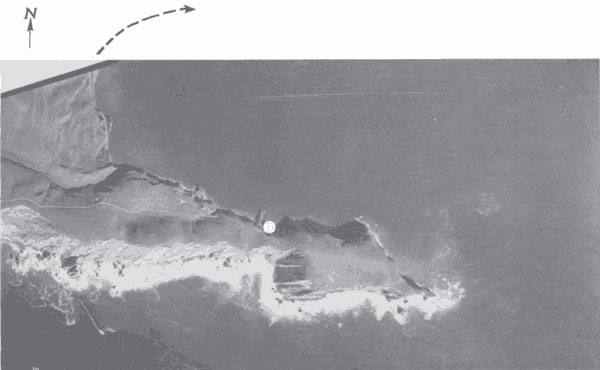
more careful study he concluded that Drake's Bay was the anchorage (see
pl. 20). Davidson's views have been carefully and critically reviewed by
Henry R. Wagner[6] and J. W. Robertson.[7] Among other contributions
relating to the problem of Drake's anchorage should be mentioned the
works of Hubert Howe Bancroft[8] and the studies of Edward E. Hale,[9]
as well as the searching analysis of Alexander G. McAdie and a more
recent but similar paper by R. P. Bishop.[10]
Historical.—Although the trail was blazed by Davidson, it is Wagner
who first claims our attention. He has concluded, after an exhaustive
study of all available evidence, that Drake anchored first in Trinidad
Bay and later in Bodega Bay. The harbor now called Drake's Bay was not,
according to Wagner, the site of Drake's landfall in 1579. Robertson,
next mentioned above, is the author of a critical review of previous
"arguments advanced by certain historians in their selection of 'The
Harbor of St. Francis.'"
Anthropological.—Wagner's major work on Drake bears abundant evidence
that this historian, at least, is cognizant of the value of the
ethnographic check method. However, he has not utilized all available
documentary or ethnographic data to the fullest extent—a procedure of
the utmost importance.
Davidson used the ethnographic method of solving the problem when he
identified the Limantour Estero shellmound site with the Indian village
depicted on the border map Portus Novae Albionis of the Jodocus
Hondius map Vera totius expeditionis nauticae (Amsterdam, 1590?)[11]
and cited as evidence a tradition of the Nicasio Indians. In his day,
many Coast Miwok Indians from Drake's Bay and Bodega Bay must have been
still living. If at that time he had obtained from them the information
which can no longer be found, owing to the extinction of the tribe, he
would have performed an inestimable service.
In 1908, S. A. Barrett published his important work on Pomo
ethnogeography in which he reproduced the California data on the voyage
of Drake and made a brief evaluation.[12] After attempting a linguistic
check with the word Hioh and directing attention to the
feather-decorated baskets as Pomo-like, Barrett concludes that "these
facts therefore point further to the tenability of the belief that
Drake's landing was somewhere north of San Francisco bay, possibly even
north of Point Reyes, though Pomo of the Southern and Southwestern
dialectic area may have journeyed down to Drake's bay bringing their
boat-shaped and ornamented baskets...."[13]
In Professor Kroeber's Handbook of the Indians of California there is
an ethnographical analysis of a paraphrased version of The World
Encompassed, together with an inquiry (more searching than that of
Barrett's in 1908) into the identification of the words, such as Hioh,
Patah, Tobah, and Gnaah, which appear in the Fletcher account.[14]
Kroeber summarizes: "The ethnologist thus can only conclude that Drake
summered on some piece of the coast not many miles north of San
Francisco, and probably in the lagoon to which his name now attaches. He
is assured that the recent native culture in this stretch existed in
substantially the same form more than 300 years ago, and he has
tolerable reason to believe that the Indians with whom the great
explorer mingled were direct ancestors of the Coast Miwok."[15]
A verification of Kroeber's view has recently been presented in a short
paper written by Heizer and Elmendorf[16] on the identification of the
Indian words in the sixteenth-century accounts of Francis Fletcher and
Richard Madox.[17] (Madox's account is reproduced in App. I, below.) In
this paper it is shown that Drake must have landed in territory occupied
by the Coast Miwok-speaking natives (fig. 1), but the exact location of
his landing is not positively indicated since there are four bays along
Coast Miwok territory in which Drake might conceivably have
anchored.[18] Of these four bays, Bolinas, Drake's, Tomales, and Bodega,
only two, Drake's and Bodega, can be considered seriously.
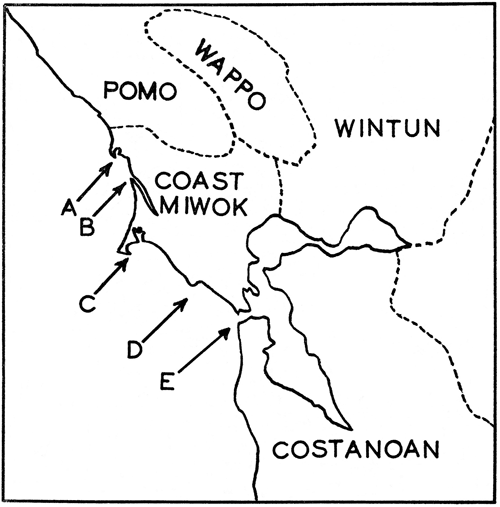
Fig. 1. Location of west-central California Indian
linguistic groups.
A, Bodega Bay; B, Tomales Bay; C, Drake's Bay; D,
Bolinas Bay; E, San Francisco Bay.
A final piece of evidence, this time archaeological, has recently come
to light in the plate of brass left by Drake in 1579. This plate was
originally found at Laguna Ranch (pl. 21) on Drake's Bay in 1934
(?),[19] was moved elsewhere, and was rediscovered in 1936.[20] Although
some skeptics have questioned the genuineness of the plate of
brass,[21] they have not altered the facts establishing the plate's
authenticity as shown by the investigations of such scholars as Allen
Chickering,[22] Professor Herbert E. Bolton,[23] and Drs. Fink and
Polushkin.[24] Consequently, the problem of Drake's anchorage is nearer
solution. Although the plate is a portable object, it was probably not
carried far. It could have been carried to Drake's Bay from Bodega Bay;
but, on the other hand, it could always have been at Drake's Bay. In the
absence of evidence that it was moved early in its history, it may not
be claiming overmuch to assume that the post with the plate of brass was
originally erected in Drake's Bay.
So much, then, for an abbreviated review of the opinions on the location
of Francis Drake's California anchorage. Arguments have been advanced,
by other students, that Drake anchored in Trinidad, Bodega, or Drake's
Bay. It is my purpose here to analyze, as carefully as possible, the
ethnographic data contained in Francis Fletcher's account in The World
Encompassed, with the hope of determining in which of these bays Drake
actually stayed in June, 1579. The Trinidad Bay landfall theory will
first be investigated, in an attempt to determine whether the Indians
mentioned in Fletcher's account are identifiable with the Yurok tribe
which, in historic times, occupied this territory.
Henry R. Wagner is the chief proponent of the Trinidad Bay theory, and
bases his conclusion upon two lines of evidence, (1) cartographical and
(2) ethnographical.[25] The Jodocus Hondius map, with a small inset of
the Portus Novae Albionis, does resemble Trinidad Harbor, but since
all admit that the Hondius "Portus" is imperfectly drawn, and only
generally impressionistic, it can hardly be maintained that it resembles
less the outline of Bodega Bay or Drake's Bay. Wagner points out that
there was a Yurok village near the spot indicated on the Hondius map as
occupied by an Indian town.[26] But in Drake's Bay and Bodega Bay, the
outlines of which also resemble that of the Portus Novae Albionis,
there are also Indian shellmounds in about the same relative position as
the village shown on the Hondius map.
Fletcher's reference to a "canow" has led Wagner to identify this with
the Yurok dugout log canoe. If Fletcher's "canow" were described in any
detail, it would settle the problem of whether it meant a Yurok dugout
log canoe or a Coast Miwok tule balsa such as was used in Drake's or
Bodega Bay. Kroeber has also commented upon this unenlightening word,
saying, "Either custom changed after Drake's day, or his canoe is a
loose term for the tule balsa which was often boat-shaped, with raised
sides, especially when intended for navigation." Wagner says in answer,
"To this it may be objected that ... tule balsas were in use in
Drake's Bay in 1595 and were so recognized without difficulty." They
were recognized indeed, but by a Spanish sailor already familiar with
the type. Fletcher in his offhand manner dismissed the native boat with
a word which he was familiar with. Perhaps the strongest argument in
favor of identifying Fletcher's "canow" as a tule balsa lies in the
fact that he states that a single person came out to the Golden Hinde.
If it had been a Yurok dugout, and particularly in the open bay of
Trinidad, one man could not have managed the canoe. For example, the
Bruno de Hezeta account of Trinidad Bay in 1775 states: "Before they
[the Spaniards] drew near the land to drop anchor four canoes carrying
twenty-four men came out to receive them. They drew near the ships and
were given food and beads, with which they went away without
fear...."[27] It might also be worth noting that Fletcher states that
the person in the canoe remained "at a reasonable distance staying
himself," and would accept only a hat, "refusing vtterly to meddle with
any other thing...." One other account may be cited to support the
identification of the "canow" with the balsa. Sebastián Cermeño, in
1595 at Drake's Bay, wrote, "... many Indians appeared on the beach and
soon one of them got into a small craft which they employ, like a
çacate of the lake of Mexico."[28]
By inference, the native house described by Fletcher has been identified
as a Yurok house. I do not think this claim will hold, since the house
in Fletcher's account is described as semisubterranean, circular,
conical-roofed, covered with earth, and with a roof entrance, whereas
the Yurok dwelling (not the sweathouse), built wholly of planks, is
rectangular, is a surface structure except for an interior rectangular
pit, has a round door entering just above the ground and through the
side wall, and bears a double-ridged roof with two slopes.[29] Thus, the
house described by Fletcher cannot be a Yurok house of Trinidad Bay. On
the other hand, as will be shown in detail later, the house described by
Fletcher is the central California earth-covered dwelling, typical of
the Coast Miwok of Drake's Bay and Bodega Bay.
Wagner, in his attempt to show that Drake landed at Trinidad Bay, makes
a further point. He says: "An additional indication that Drake was in
this bay [Trinidad] may be gleaned from the finding there of knives in
1775 by Bruno Heceta.... It seems probable, then, that the knives found
at Trinidad by Heceta were relics of Drake's expedition."[30] It is
scarcely credible that numbers of iron knives, sword blades, and such
implements could have been preserved through two centuries of use. Since
the wooden-sheathed knives were expressly stated to be ill-made, and in
view of Fray Miguel de la Campa's statement in 1775 that "one of them
[i.e., one of the Indians] made his [knife] from a nail which he had
found in a piece of wreckage and had beaten out with a stone,"[31] it is
more than likely that the Trinidad Indians' knives were pounded out of
pieces of iron found imbedded in local sea-borne wreckage.[32] Logic and
probability lead inevitably to the conclusion that there is nothing in
the fact that knives were found at Trinidad Bay in 1775 from which to
suspect or to postulate Drake's presence in that place two centuries
earlier.
Now for a brief comparison of some specific Indian culture elements and
examples of the language, as reported in The World Encompassed and in
Richard Madox's narrative, with those of Yurok Indian culture. Madox was
chaplain on Edward Fenton's expedition of 1582, and in his diary are
some notes on California which he jotted down after conversation with
some members of the crew which had sailed with Drake two years earlier.
The flat shell disk beads of the account are not an element of Yurok
material culture. The standard Yurok shell bead is the hollow tusk shell
(Dentalia indianorum), which is long, cylindrical, and of small
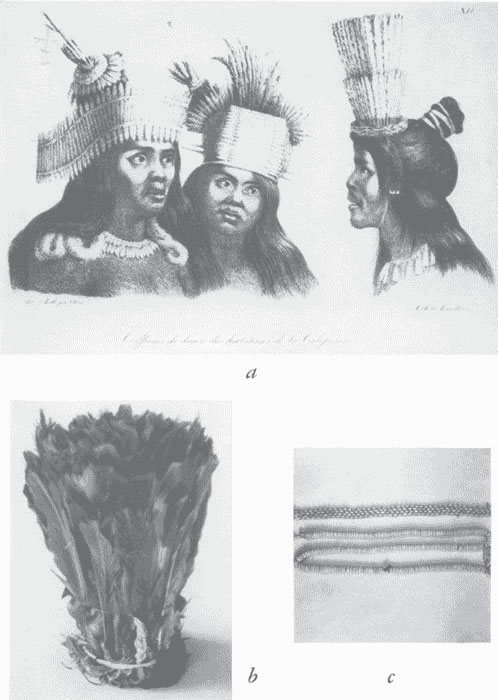
diameter. The feathered net caps may possibly find cognates in the
flicker headbands of the Yurok, though these bands were known over the
whole
of interior and coastal California (cf. pl. 18, a). The
feathered baskets, however, cannot possibly be Yurok, since their
manufacture and use is restricted to the Pomo-Miwok-Wappo tribes which
lived far to the south of the Yurok. The "canow" of Fletcher, as had
been pointed out, can hardly be equated with the heavy Yurok river- and
ocean-going dugout canoe. This brief comparison should be convincing
evidence that Drake's chronicler did not describe the Trinidad Bay
Yurok; but there is added evidence in the word forms of the Madox
vocabulary. Madox gives "bread" as Cheepe, which the Yurok render
pop-sho. "Sing" is given as Gnaah in The World Encompassed, the
Yurok word being wer-o-rur. "Chief" is given by Fletcher and Madox as
Hioh or Hioghe, the Yurok word being si-at-lau.
The decision of whether or not Drake entered Trinidad Bay, which is not
convenient as a port, and is, moreover, rock-studded,[33] must rest in
part upon a study of the Hondius Portus Novae Albionis, of which,
Wagner says, "... perhaps a very close approximation to the actual
configuration of the bay [in which Drake anchored] cannot be expected."
Certainly the native customs, houses, and language do not offer the
slightest support to the theory that Drake observed the Yurok
Indians.[34]
Wagner, then, has attempted to prove that Drake landed in Bodega Bay;
Davidson and McAdie, that he anchored in Drake's Bay; whereas Kroeber,
Heizer and Elmendorf, Barrett, and Bancroft failed to reach a decision
on which bay gave anchorage to the Golden Hinde.
In the following pages I shall analyze by comparative ethnographic
technique the cultural data relating to the California Indians as given
in the several accounts of the Drake visit in 1579. These sources are:
1. The World Encompassed account, which I judge to be the
fullest and most reliable.[35]
2. The Famous Voyage account, which is abbreviated and
therefore less complete in detail.[36]
3. The second declaration of John Drake (1582), a brief
independent account of the occurrences in California (see
below, App. I).[37]
4. Richard Madox's notes on "Ships Land" (New Albion), which
contain a revealing vocabulary of the Indian language.[38]
An exhaustive ethnography of the Coast Miwok has never been published.
The main sources of Coast Miwok ethnography used in this paper may be
enumerated as follows:
1. Data contained in various historical accounts. These are,
for the most part, incidental data and are not, even in total
amount, extensive. The accounts will be cited at the
appropriate places below.
2. Published ethnographic notes such as are given in S. A.
Barrett's The Ethno-Geography of the Pomo and Neighboring
Indians, A. L. Kroeber's Handbook of the Indians of
California, and many others which likewise will be cited
below.
3. The extensive manuscript notes on the Coast Miwok in the
possession of Dr. Isabel Kelly. Dr. Kelly has kindly lent her
material for the purpose of checking ethnographic items.
On June 17 (Old Style), Drake's ship entered "a conuenient and fit
harborough." The next day, "the people of the countrey shewed
themselues; sending off a man with great expedition to vs in a canow."
On the 21st, the ship was brought near shore, her goods were landed, and
defense works were erected. Numbers of natives made their appearance for
a brief time, then returned to their homes in a near-by village. At the
end of two days (June 23), during which no natives had been seen, there
appeared "a great assembly of men, women, and children." As the narrator
says, the local people seen on the 23d had probably "dispersed
themselues into the country, to make knowne the newes...." There follows
in the narrative a long and detailed account of the activities of the
natives who remained assembled near the camp of the English. Finally,
after three more days (the account says June 26), word of the strange
newcomers had spread even further, and there "were assembled the
greatest number of people, which wee could reasonably imagine, to dwell
within any conuenient distance round about." Among these were the
"king," the Hioh of the Indians, and "his guard, of about 100 tall and
warlike men."
This sequence of visits is of some interest. If Drake landed at Drake's
Bay, the natives seen by him on June 18 and 21 were certainly local
Coast Miwok living close at hand around the bay. The influx of people
on the 23d probably means that they were drawn from relatively near-by
Coast Miwok villages—from near Olema, or from both shores of Tomales
Bay. But even larger crowds of natives came on the 26th, and among them
were the Hioh and his retinue. The group arriving on the 26th probably
came from some distance. If this crowd gathered at Drake's Bay, they
could well have been recruited from Bodega Bay, and possibly included a
number of Southern Pomo neighbors. The elapsed time (i.e., between June
21 and June 26) can be readily accounted for by two factors: (1) time
for communication to be established from Drake's to Bodega Bay and for
the return of the Bodega people, and (2) time for convocation of the
group, decision on a plan of action, and preparation for the elaborate
ceremony performed at the English camp on the 26th.
If, however, Drake landed in Bodega Bay, the situation would be somewhat
different. The visitors of the 18th and 21st would be Bodega Coast
Miwok. Those arriving on the 23d could have been Tomales Bay or Olema
Coast Miwok, and the arrival on the 26th of the Hioh with his retinue
and followers might mark the presence of Southern Pomo, or, less
probably, Central Pomo who were concentrated in the interior some fifty
miles north of Bodega Bay.
It is credible, then, that Drake landed in either Drake's Bay or Bodega
Bay, since the native words listed by Fletcher and Madox all belong to
the Coast Miwok language and not to any Pomo dialect.[39] It is
improbable that the ceremonies, customs, and material culture forms
described by Fletcher can be specifically attributed to the Pomo, as
intimated by Wagner,[40] for at least three reasons: (1) Northern Coast
Miwok and Southern Pomo cultures are practically indistinguishable; (2)
the words Hioh and Gnaah seem to be Coast Miwok words rather than
words of Pomo attribution; and (3) if Drake landed in Coast Miwok
territory it is unlikely that the Pomo would be permitted to enter the
territory of their southern neighbors and to perform a ceremony which
the Coast Miwok themselves were as well able to do.
Following is an examination of the day-by-day account of Fletcher.
June 18.—A single man in a "canow" (probably a tule balsa) came out
to the ship and delivered an oration. The canoeman also brought with
him, and threw into the ship, a bunch of black feathers tied in a round
bundle, and a small basket filled with an herb ("Tobah"), both of which
were tied to a short stick.
In 1595, Sebastián Cermeño noted almost exactly the same thing in
Drake's Bay,[41] and something very similar was observed by Francisco
Mourelle in Bodega Bay in 1775.[42] Cermeño says: "On the day on which
the ship anchored in the bay, about four o'clock in the afternoon, many
Indians appeared on the beach and soon one of them got into a small
craft which they employ like a çacate of the lake of Mexico. He came off
to the ship, where he remained quite a time talking in his language, no
one understanding what he said." Mourelle's statement is similar: there
is no mention of a speech by the Indians in "tule canoes," but they
presented the Spanish with plumes of feathers, "bone rosaries" (shell
bead necklaces?), garlands of feathers which they wore around their
heads, and a canister of seeds which tasted like walnuts.
The feather bundle cannot be specifically identified, but it may be the
ceremonial black feather bundle (pl. 18, b) most often associated with
the central California Kuksu cult. Some of these have been illustrated
by Professor Kroeber[43] and R. B. Dixon.[44] The small basket filled
with the herb called Tobah or Tabah has led some students to
identify this herb as tobacco (Nicotiana sp.) John P. Harrington
quotes the sections from The World Encompassed which contain mention
of Tabah or Tobah, and assumes that the word has reference to
tobacco (Nicotiana bigelovii).[45] Upon what grounds he identifies the
herb mentioned by Fletcher as tobacco is not stated, since the local
words for tobacco are different,[46] nor is it stated in the account
that the herb was smoked. Wagner doubts that the herb called Tobah was
tobacco, and in this he and I are in agreement. It cannot be determined
whether or not a Nicotiana was referred to by Fletcher, nor is it likely
that this question will ever be settled. What does seem clear is that
"Tobah" is not an Indian word, but the name applied to the herb by the
English narrator.[47] This supposition is enhanced by the fact that The
Famous Voyage mentions the herb by the name "tabacco," a word already
known in England before Drake started on his voyage around the
world.[48] It may be concluded that Fletcher's word "Tobah" or "Tabah"
comes from the English word "tabacco," "tobacco," "tabaco," and is not a
California Indian word. In this conclusion I am in agreement with
Professor Kroeber.[49]
June 18-21.—There is no mention of Indians between the 18th and the
21st of June. After referring to the man in the "canow," Fletcher
continues, "After which time, our boate could row no way, but wondring
at vs as at gods, they would follow the same with admiration." This
would indicate that June 19 and 20 were spent exploring the bay in a
small boat to discover a proper spot for careening the treasure-laden
ship, which had sprung a leak at sea.
June 21.—On this day the ship was brought near shore and anchored.
Goods were landed, and some sort of stone fortification was erected for
defense. The Indians made their appearance in increasing numbers until
there was a "great number both of men and women." It is clearly apparent
that the natives were not simply curious, but acted, as Fletcher points
out, "as men rauished in their mindes" and "their errand being rather
with submission and feare to worship vs as Gods, then to haue any warre
with vs as with mortall men." It would seem that the natives
demonstrated clearly their fear and wonderment at the English, and it is
certain that they behaved as no other natives had done in the experience
of the chronicler. The English gave their visitors shirts and linen
cloth, in return for which (as Fletcher thought) the Indians presented
to Drake and some of the English such things as feathers, net caps,
quivers for arrows, and animal skins which the women wore. Then, having
visited for a time, the natives left for their homes about
three-quarters of a mile away. As soon as they were home, the Indians
began to lament, "extending their voices, in a most miserable and
dolefull manner of shreeking." Inserted between the passages dealing
with the departure of the Indians to their homes and their lamenting is
a description of their houses and dress. The houses are described as
"digged round within the earth, and haue from the vppermost brimmes of
the circle, clefts of wood set vp, and ioyned close together at the top,
like our spires on the steeple of a church: which being couered with
earth, suffer no water to enter, and are very warme, the doore in the
most part of them, performes the office of a chimney, to let out the
smoake: its made in bignesse and fashion, like to an ordinary scuttle in
a ship, and standing slopewise: their beds are the hard ground, onely
with rushes strewed vpon it, and lying round about the house, haue their
fire in the middest...." The men for the most part were naked, and the
women wore a shredded bulrush (tule? Scirpus sp.) skirt which hung
around the hips. Women also wore a shoulder cape of deerskin with the
hair upon it.
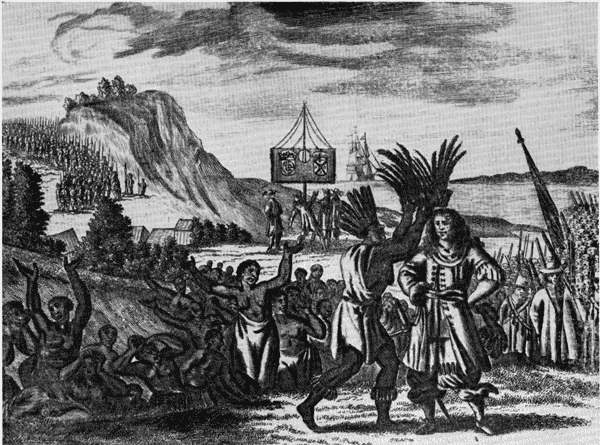
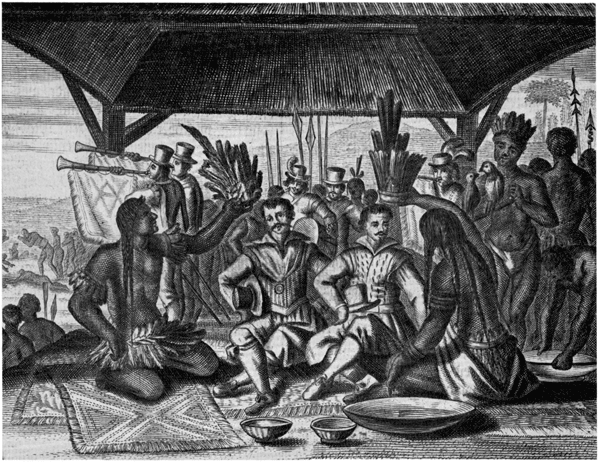
Another representation of the "crowning" of Francis
Drake.
(From an old engraving; provenience not known.)
From the foregoing facts some important conclusions can be drawn.
First, the wonderment of the natives is but an extension of attitudes
they had daily shown from the 17th to the 20th; and similar
manifestations continued throughout the long stay of the English.[50]
The English were looked upon as unusual, perhaps supernatural, visitors,
since nothing is more clear than the fact that they were not treated as
ordinary mortals. Kroeber has suggested that the Indians regarded the
English as the returned dead, and there is much to be said for this
view, as will be shown later. The doleful shrieking, weeping, and crying
are evidence sui generis that the presence of the English was in some
way associated with ghosts or the dead.[51]
The circular semisubterranean house, roofed over with poles and
earth-covered, is also characteristic of a wide area of central
California. The Coast Miwok of Drake's Bay and Bodega Bay[52] used these
houses, as did the Pomo.[53] It is clearly not a temporary brush-covered
house like those seen in the Bodega-Tomales Bay region.[54] The "caules
of network" undoubtedly refer to the well-known net caps of central
California,[55] a type so widespread that exact localization or
provenience is impossible.
The Fletcher account is fairly specific on particulars of dress—women
wore shredded bulrush skirts and deerskin shoulder capes, and men were
ordinarily naked. The bulrush or tule-fiber clothing is attested for
Bodega Bay[56] and Drake's Bay,[57] but it is also found generally
throughout central California. Men were generally naked in California,
so Fletcher does not note here a distinctive cultural trait. The wearing
of deerskin capes by the women is not strictly substantiated by the
observations of later explorers, although Cermeño (1595) said that the
women in Drake's Bay "covered their private parts with straw and skins
of animals."[58] Archibald Menzies noted that the women in Tomales Bay
wore a deerskin wrapped around their middle and reaching to the
knees,[59] and Francisco Eliza said that near Bodega Bay "the women
cover themselves from the waist down with deer skins."[60] Colnett
mentions the Indian dress of deerskins in Bodega Bay.[61]
June 23.—On this day, after a two-day absence, "a great assembly of
men, women, and children" appeared at the camp of the English. The
Indians stopped at the top of the hill at the bottom of which Drake's
camp was pitched, and one man made "a long and tedious oration:
deliuered with strange and violent gestures, his voice being extended to
the vttermost strength of nature...." At the conclusion of the speech or
oration, all the other Indians reverently bowed their bodies "in a
dreaming manner" (?) and cried "Oh" in approbation. Then the men,
leaving their bows, women, and children behind them, came down to the
English with presents and gifts. While the men were gift giving, the
women cried and shrieked piteously, tore their cheeks with their
fingernails until the blood flowed, tore off the single covering from
the upper parts of the body, and, holding their hands high, cast
themselves on the ground with great violence, regardless of
consequences. The English, grieved at this spectacle of sacrifice,
attempted to dissuade the Indians by praying and indicating by signs
that their God lived above. During this "performance" (prayers, singing
Psalms, and reading chapters of the Bible), the Indians "sate very
attentiuely: and obseruing the end of euery pause, with one voice still
cryed, Oh, greatly reioycing in our exercises." The natives were
watching with great interest what seemed to them a ceremonial
performance (which it actually was, but not in the sense in which the
Indians understood it). The singing of Psalms interested the Indians
most, and whenever the natives came, says Fletcher, their first request
was Gnaah, an entreaty that the English should sing. After the Indians
and English had exchanged ceremonial performances of a religious
nature, the Indians again departed, giving back to the English
everything they had received.
The oration by the man at the top of the hill may perhaps be likened to
a speech that Cermeño made note of, when, in 1595, he was at Drake's
Bay: "... Indians from near by kept coming and the chief talked a long
time."[62] It is not improbable that the speaker mentioned by Fletcher
was a messenger dispatched to announce the later coming of the big
chief.[63] Or, the orator may simply have been a local village chief who
delivered a long address or salutation to the English. The existence, at
least, of such orators is known.[64] The signal of approbation, "Oh,"
has already been remarked upon by S. A. Barrett: "The expressions of
assent and pleasure which are here noted are those commonly used not
only by the Moqueluman Coast Miwok peoples of this region but by the
Pomo to the north where such expressions as o, yo, iyo, varying
with the locality, are heard, as evidences of approval of the sentiment
expressed by the speaker, or of satisfaction with the performance of a
dance."[65] When the preliminaries were over, the men came down the
hill, and the women remained behind, lamenting, and lacerating their
flesh. Crying and tearing the cheeks with the fingernails, as an
ethnographic practice in connection with mourning, is documented for the
Coast Miwok[66] and Pomo.[67] The word Gnaah, by which (so Fletcher
states) the Indians asked the English to sing, can possibly be likened
to the Coast Miwok koyá, "sing."[68] If it is granted that Gnaah is
equivalent to koyá, there is good reason to believe that Coast Miwok
were the main frequenters of Drake's camp, since Fletcher says, "...
whensoever they resorted to vs, their first request was Gnaah, by
which they intreated that we would sing." The words for "sing" in
neighboring Indian tongues are so unlike Gnaah that no idea of
connection can be entertained.
June 26.—After three days, there "were assembled the greatest number
of people which wee could reasonably imagine to dwell within any
conuenient distance round about." Included in the crowd were the "king"
and his "guard" of about one hundred men. Before the king showed
himself, two "Embassadors or messengers" appeared, to announce his
coming and to ask for a present "as a token that his comming might be in
peace." Drake complied, and soon the "king with all his traine came
forward." The king and his retinue "cryed continually after a singing
manner" as they came, but as they approached nearer they strove to
"behaue themselues with a certaine comelinesse and grauity in all their
actions." In the front of the procession came a man bearing the "Septer
or royall mace," a black stick about four and a half feet long, to which
were tied long, looped strings of shell disk beads, and two "crownes," a
larger and a smaller, made of knitwork and covered with a pattern of
colored feathers. Only a few men were seen to wear the disk bead
necklaces ("chaines"). Fletcher observes that in proportion to the
number of "chaines" a man wears, "as some ten, some twelve, some
twentie, and as they exceed in number of chaines, so are they thereby
knowne to be the more honorable personages." Next to the scepter bearer
was the king (Hioh), surrounded by his guard. On his head he wore a
net cap ("cawle") decorated with feathers in the same manner as the
"crownes" described above, "but differing much both in fashion and
perfectness of work." From the king's shoulders hung a waist-length coat
of the skins of "conies." Members of his guard each wore a coat of
similar cut, but of different skins. Some of the guard wore net caps
"stuck with feathers," or covered with a light, downy substance,
probably milkweed down. Only those persons who were close to the king
wore the down-filled or down-covered net caps and feather plumes on
their heads.
Following the procession of the king and his guard came the "naked sort
of common people." Their long hair was gathered behind into a bunch in
which were stuck plumes of feathers, but in the front were only single
feathers which looked "like hornes." Every Indian had his face painted
in black or white or other colors, and every man brought some sort of
gift. The procession was brought up behind by the women and children.
Each woman carried against her breast a round basket or so, filled with
a number of articles such as bags of Tobah; a root called Petah,
which was made into meal and either baked into bread or eaten raw;
broiled pilchard-like fishes; and the seed and down of milkweed (?). The
baskets are carefully described by Fletcher as "made in fashion like a
deep boale ... [and] about the brimmes they were hanged with peeces of
shels of pearles, and in some places with two or three linkes at a
place, of the chaines aforenamed: thereby signifying, that they were
vessels wholly dedicated to the only vse of the gods they worshipped:
and besides this, they were wrought vpon with the matted downe of red
feathers, distinguished into diuers workes and formes."
As the crowd of people came near, they gave a general salutation and
were then silent. The scepter bearer, prompted by another man who
whispered, delivered in a loud voice an oration which lasted half an
hour. When the oration was ended, "there was a common Amen, in signe
of approbation giuen by euery person...." Then the company, leaving the
little children behind, came down to the foot of the hill where the
English had their camp. Here the scepter bearer began to sing and danced
in time to the song. The king, his guard, and all the others joined in
the singing and dancing, except the women, who danced but did not sing.
The women had torn faces, their bodies showed bruises and other
lacerations which had been self-inflicted before the Indians had
arrived. After the assembly of natives had concluded their dance, they
indicated by signs that Drake should be seated. This done, the king and
several others delivered orations to Drake, and, concluding with a song,
placed the crown upon his head and hung all the shell disk bead
necklaces around his neck. Many other gifts were tendered to Drake, and
the name Hioh was bestowed upon him. Fletcher interpreted this
ceremony as the giving up of the kingdom to Drake, a thought hardly
ascribable to the Indians. It is quite clear, however, that Drake was
individually and specially honored by the leader of the California
natives, and was invested with a name, Hioh.
After the "crowning" was concluded, the common people, both men and
women, dispersed among the English, "taking a diligent view and survey
of every man." When a native found an Englishman who pleased his fancy,
and the youthful Englishmen were preferred, a personal "sacrifice" in
the form of weeping, moaning, shrieking, and tearing of the face with
the fingernails was offered. As might be expected, such a scene was
embarrassing and uncomfortable to the English, and the strongest efforts
were of no avail in disabusing the Indians of their "idolatry." After a
time the Indians quieted down and began to show to the English "their
griefes and diseases which they carried about with them, some of them
hauing old aches, some shruncke sinewes, some old soares and canckred
vlcers, some wounds more lately receiued, and the like, in most
lamentable manner crauing helpe and cure thereof from vs: making signes
that if we did but blowe vpon their griefes, or but touched the diseased
places, they would be whole." The English applied various unguents to
the affected places, continuing the treatment as the natives resorted to
the camp from time to time.
Now to analyze the happenings of June 26. The "Embassadors or
messengers" of Fletcher are probably correctly identified, since the
custom of having messengers who announce the coming of a chief and his
party is known to have existed at least among the Pomo[69] and probably
among the Coast Miwok, although there is no specific mention of such a
practice among the latter. Even the custom that messengers should ask
for a present for the "king" (i.e., chief) is known to have been
observed by the Pomo.[70] It is impossible to identify the man who bore
the "scepter" or "mace," a black stick about four and a half feet long,
but the scepter itself seems identifiable with the staff known
ethnographically to have been used in the central California Kuksu or
ghost ceremony.[71]
The assemblage of the black stick with pendant "feathered crowns" and
clamshell disk beads has not been noted by any modern ethnographer, but
the flat, circular, centrally drilled white beads of clamshell are
familiar (pl. 18, c). They were made from clamshells dug at Bodega
Bay, the source of these beads for most of the Indians of central
California.[72] It is of some interest to note that in later times the
beads have been very abundant, and that in the last 350 years the
manufacture and use of clamshell disk beads have been much increased.
The net "crownes" covered with a pattern of colored feathers are
described by Fletcher in terms so general that exact identification is
difficult. They may have resembled some of those illustrated by Dixon,
who collected them from the Northern Maidu.[73] At least, net caps with
feather decorations were commonly used in Coast Miwok[74] and Pomo[75]
ceremonies. The king's guard was probably composed of a number of male
initiates of a secret society who naturally would separate themselves
from the women and children when engaged in ceremonial duties.[76] The
net cap of the king or Hioh was different from that of the others, and
it is not improbable that it was one of the flicker-quill headbands so
well known for the area (pl. 18, a).[77] This identification is at
best tentative, however, since there was in this area a bewildering
array of types of feather-decorated ceremonial headgear. The king's coat
of conyskins seems to have been distinguished from those of his guard.
The guards' coats may have been made of pocket gopher or mountain beaver
skins, and the king's coat was possibly of woven rabbitskin blankets,
common to both the Pomo and the Coast Miwok.[78] What seems unusual is
that there is no mention in Fletcher's account of the feather cloaks or
skirts used in later times on ceremonial occasions. I have been unable
to find any ethnographic data on a special skin coat for chiefs or
ceremonial leaders. The down-filled head net undoubtedly refers to the
central Californian net cap.[79] The feather plumes mentioned by
Fletcher as worn on the head by persons close to the king may have been
of several of the numerous types used in central California. Examples
are illustrated by Dixon[80] and Kroeber.[81] The repeated mention by
Fletcher of the use of feathers indicates clearly that their ceremonial
use was highly developed at this period. The single feathers resembling
"horns" are an ethnographic feature of the costume of the ghost dancer
among the Pomo,[82] and although there is no documentary evidence that
the Coast Miwok wore feathers in such a manner, it seems likely, in view
of the very close correspondence between Pomo and Coast Miwok ceremonial
features, that they did so. The practice of painting the body is an
almost invariable feature of Coast Miwok[83] and Pomo[84] ceremonies.
The gifts brought by the women in round baskets included bags of Tobah
(already discussed), broiled fish, the seed and down of some plant
(milkweed?),[85] and a root called Petah or Patah. Neither the Pomo
nor the Coast Miwok remember today any root or bulb with a name
resembling Petah or Patah. Elmendorf and I have agreed with Kroeber
that Petah is probably to be linked with the word "potato" in one or
another of its various forms. Kroeber thinks that the description
indicates the wild onion (Brodiaea), called putcu in Coast Miwok,
and this is not improbable. However, soaproot (Chlorogalum), which was
sometimes baked into a bread, would also fill the description. It is
called haka by the Coast Miwok, and it is barely possible, though
hardly probable, that haka could have been heard and recorded as
Patah or Petah. Since Fletcher speaks of Petah as a root, it
seems improbable that he was describing acorns (called ümba in Coast
Miwok); yet even this remote possibility may be entertained, since Madox
recorded cheepe as bread, and Coast Miwok tcipa means acorn bread.
The word Petah, and botanical identification, must remain in limbo
until further data are at hand.
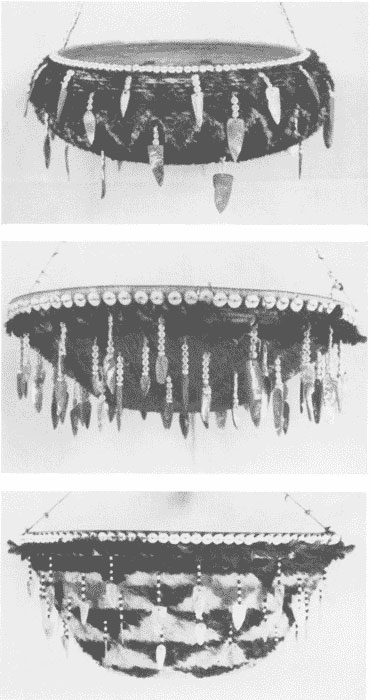
The feather-decorated baskets offer evidence, as Barrett and Kroeber
have indicated, that Drake landed on the coast immediately north of San
Francisco Bay. The baskets (pl. 19) are described as shaped like a deep
bowl, covered with a matted down of red feathers worked into various
patterns, and further embellished with pendant drops of pearl shell
(Haliotis) and two or three disk beads in various places. Such baskets
were made only by the Coast Miwok,[86] Pomo,[87] Lake Miwok, and Wappo.
Kroeber states that these baskets "served as gifts and treasures; and
above all they were destroyed in honor of the dead."[88] It is clear
that, in 1579, feathered baskets similar in manufacture and use to the
native baskets of today were known in this Coast Miwok area.
The scepter bearer, prompted in a low voice by another man, delivered a
long oration. The Coast Miwok have such orators; among those Indians the
office of speechmaker is a special one.[89] The Pomo have orators,[90]
as do most other central Californians. The Amen, or sign of general
approbation, following the oration has already been commented upon. Then
the natives performed a dance to the accompaniment of a song led by the
scepter bearer (or orator)[91] and joined in by the men, while the women
danced but remained silent. Among the Pomo and Coast Miwok each ceremony
has a song in connection with its observance.
[92]
The episode of the crowning has no parallel in native custom or
ceremonial behavior, probably because "crowning" was a unique experience
for the Indians as well as the English. This fact should be kept in mind
in judging and estimating the natives' actions and reactions—they were
as puzzled as the English. Drake was specifically honored by the
Indians, and there is no reason to doubt Fletcher when he states that
the name Hioh was given to him. It has been suggested that Hioh was
a term of salutation or an interjection,[93] but there is no reason to
believe that this was so. The word finds possible equivalents in Coast
Miwok for chief, hoipu, hoipa, or friend, oiya.[94] Since the
Interior Miwok word for chief is haiapo, there is a bare possibility
that the hoi of today may have been rendered hai in 1579, though
there is no direct evidence to support this suggestion. It should be
mentioned here that the Madox account independently verifies Fletcher's
remarks on the episode of the crowning, as well as the word for "king"
(chief?), which Madox renders as Hioghe.[95]
The close scrutiny of the English by the Indians following the
"crowning" ceremony indicates that the main business of the day (i.e.,
the ceremonial crowning by secret society initiates) was over, and that
the general public could now take part in the festivities. Of great
interest are Fletcher's statements to the effect that the most youthful
Englishmen were repeatedly selected as recipients of personal sacrifice
and adoration which took the form of lamenting, moaning, weeping,
wailing, and self-lacerating. Only one conclusion can be drawn: the
Indians supposed that they were looking upon relatives returned from the
dead, and hence performed the usual mourning observances.
After all these ceremonies were concluded, the Indians showed the
English their infirmities, aches, sores, and wounds, and it was made
clear that if the English would but blow upon them they would be made
well. This accords fairly well with the curing aspect of certain local
ceremonies. For example, the Kuksu doctor of the Pomo might cure by
blowing "his whistle over the various parts of his body, particularly
those recognized by the patients as the seats of pain."[96] There is no
mention of the use of whistles in connection with the ceremony enacted
by the Indians. Whistles are so commonly used in local ceremonies that
their omission is noteworthy. The detailed nature of the account
indicates that this feature was not so strongly developed in 1579 as it
is today in local native custom.
General observations, and occurrences from June 27 to July 23.—The
natives were almost constant visitors, and it is noted that ordinarily
every third day they brought their "sacrifices" (?). From this and other
indications it seems possible that the ceremonial number of the Indians
was three. The ceremonial number of the adjoining Pomo is four.[97] The
Coast Miwok ceremonial number was probably four, though there is no
direct evidence to support this supposition. The Indian bow is spoken of
as weak and "more fit for children than for men," a remark to be
expected from the English, who were even then employing the famous
longbow. The English were impressed with the strength of the natives,
but, for Indians accustomed to transporting everything on their backs,
their feats of strength seem not surprising. It is also noted that the
natives were good at running and that this was the ordinary means of
travel. The English admired the native surf fishing. Kroeber has
interpreted the passage, "if at any time, they chanced to see a fish, so
neere the shoare, that they might reach the place without swimming, they
would neuer, or very seldome misse to take it," as signifying diving for
fish in the surf. Since this unusual practice is not otherwise recorded
ethnographically for any coastal Californian tribe, some other
explanation may be in order, and I suggest that Fletcher may have had
reference to surf fishing with a round hand net, a practice known to
have been followed by the Coast Miwok.[98] One gets the impression that
the English found much to admire in their native friends.
Drake, his gentlemen, and others of the ship's company made an
expedition into the interior to see the native villages and the country
round about. The houses were all of the semisubterranean, circular type
discussed previously. Two animals were seen, as also herds of deer and
great numbers of "conies," a name which, as used by Fletcher, seems to
fit no known animal living today in this coastal area.[99]
The country was named Albion "in respect of the white bancks and
cliffes, which lie toward the sea ...," and a post was set up with an
engraved brass plate nailed to it. The white cliffs are one of the most
conspicuous features of Drake's Bay.[100] That the plate of brass has
been found at Drake's Bay is a fact of the greatest significance.
Upon the departure of the English, the Indians were sorrowful, and they
burned a "sacrifice" of a string of disk beads and a bunch of feathers.
The burning of shell beads in memory and honor of the dead, a custom
which Fletcher may have described, is known for the Coast Miwok,[101]
Pomo,[102] and neighboring groups.[103]
Aside from those actions of the natives which are usually associated
with their attitudes toward the dead (weeping, moaning, self-laceration,
use of feathered baskets, sacrifice of shell beads and feathers in the
fire), there are other evidences that the English were regarded as the
returned spirits of the dead. First is Fletcher's observation that the
Indians were "standing when they drew neere, as men rauished in their
mindes, with the sight of such things as they neuer had seene, or heard
of before that time: their errand being rather with submission and feare
to worship vs as Gods, then to haue any warre with vs as with mortall
men. Which thing as it did partly shew it selfe at that instant, so did
it more and more manifest it selfe afterwards, during the whole time of
our abode amongst them." Except for the sole occasion, at the conclusion
of the ceremony on June 26, when the Indians embraced the youthful
Englishmen, the natives seem to have avoided touching the whites. This
is most understandable if it is believed that they looked upon the
English as the dead returned,[104] for bodily contact with a dead person
or spirit was certain, in their minds, to have disastrous results.
Further evidence of this may be contained in the statement: "Our General
hauing now bestowed vpon them diuers things, at their departure they
restored them all againe; none carrying with him any thing of whatsoeuer
hee had receiued...." There is one more bit of inferential evidence
along this line which comes from the Madox account. This is the phrase
Nocharo mu, "touch me not" (i.e., notcáto mu, "keep away"). It may
be asked why Madox recorded this particular phrase out of the many his
informant must have heard. The answer is perhaps to be found in the
simple fact that the English heard this phrase uttered a great many
times, and it stuck in their memory. In view of the fact that the
natives held the English in fear as dead people, the phrase "touch me
not" might often have been used toward amorous sailors, or against any
form of bodily contact.
In the second deposition of John Drake, cousin to Francis Drake (see
below, App. I), there is no new information. There is, however,
independent corroboration of the weeping and self-laceration referred
to repeatedly in the World Encompassed account. The natives are
mentioned as having bows and arrows and as being naked, both of which
items are mentioned by Fletcher. The Indians' sadness at the departure
of the English, as remarked by John Drake, is a further verification of
Fletcher's observations as presented in some detail in The World
Encompassed.
The brief Madox account is of particular interest since a number of
words in the Indian language, a song, and the episode of the crowning
are mentioned. The linguistic items are given as follows:
| Cheepe bread | Nocharo mu tuch me not |
| Huchee kecharoh sit downe | Hioghe a king |
As Elmendorf and I have already pointed out, the vocabulary may be
assigned conclusively to the Coast Miwok language.[105] Cheepe,
"bread," is equivalent to modern Coast Miwok tcipa, "acorn bread."
This word alone is the clearest possible evidence that Drake's Indian
acquaintances were Coast Miwok. Huchee kecharoh, "sit down," probably
is an incorrect translation of the phrase. The closest approximation in
modern Coast Miwok is atci kotcáto, "step into the house," and hoki
kotcádo, "go into the house" (tc is phonetically equivalent to the
sound ch as in chin). It is possible to explain these differently
stated meanings of these phonetically similar phrases as owing to
incorrect inductions of meaning under specific circumstances. Kelly's
Coast Miwok ethnographic informants stated that, according to old
custom, whenever people came to a house they were asked to walk in and
were offered a seat in the rear of the house, and food was placed before
them. In some such situation, particularly if the English had occasion
to be often in the Indian village, they may have repeatedly heard the
invitation, "step into the house." Likewise, the phrase Nocharo mu,
"touch me not," may have been translated by Madox (or his informant)
only vaguely, since it represents a situation rather than a concrete
object, which would be less liable to misinterpretation. Modern Coast
Miwok offers a close parallel in the form of notcáto mu, which may be
literally translated "stay over there," or "stay away" (notca,
"farther," "yonder").
Madox's word for king, Hioghe, is similar to that given by Fletcher
(Hioh or Hyoh), except that the ghe ending is unusual. From the
words of the Indian song given by Madox (see below), in which heigh
(i.e., hai) appears, it might be suspected that the gh is silent;
yet why is the terminal e present? It may be that if Hioghe were
exactly similar phonetically to Hioh, there would not be a terminal
e in Hioghe. Thus Madox's' Hioghe may indicate a terminal sound
(short or weak e?) and therefore be close to modern Coast Miwok
hoipa (and Sierra Miwok haiapo). That the gh might be an
indication of the p sound is possible, or, again, it could represent
Madox's attempt to render a weak or indefinite labial sound which was
imperfectly remembered by his informant. Too close a phonetic
transcription of an Indian language by Elizabethan Englishmen should not
be expected—there was little standardization in English spelling[106]
at that time. The foregoing is not advanced as an argument to show that
the terminal "e" was sounded, but is merely presented as a possibility.
Elizabethan English commonly used an unpronounced terminal "e." The song
of the Indians "when they worship god" is given by Madox as Hodeli oh
heigh oh heigh ho hodali oh. No Coast Miwok or Pomo song on record
accords exactly with that given by Madox, although some are quite
similar. For example, a Coast Miwok Suya song transcribed by Kelly is
a repetitive line Yo ya he yo he o. Other examples from the Coast
Miwok are not available, but some Pomo ceremonial songs may be cited.
Stephen Powers[107] gives a Sanel Pomo song:
Hel-lel-li-ley
Hel-lel-lo
Hel-lel-lu
E. M. Loeb[108] gives several Pomo songs which are associated with the
Kuksu or ghost ceremony:
1. He yo he yo he yo
He yoha eheya ye
To ya he yo ho ho
2. Tali, tali, yo yo weya yo, weya yo, ha hi he ya he hotsaii ya hi ho.
3. He ha le me, le lu hi ma humane, hu ...
Other Pomo songs used in ceremonies are given by Loeb:[109]
1. Ū ū hulai leli ha ha.
2. He he la le ha hi hi hi, ya ya ya, hu wa!
3. Yo yo hale e he na gagoyá ō he he!
4. Ho yu ko, he he, a ha a a. Hi ye ko, lai ye ko, He tsi ye.
5. Yo ho yo ho yaho, he yo ho waha.
These examples show how generally similar are the Coast Miwok[110] and
Pomo ceremonial songs of today to the song of 1579 given by Madox. Here
again an exact correspondence should not be expected, since it is not
known whether the song given by Madox was one associated with a
particular ceremonial occurrence, nor is it known how changeable these
songs are. And again, in the time that has passed and in the changing
course of circumstances since 1579, some exactness has almost inevitably
been sacrificed. Madox's statement that the natives sang "one dauncing
first wh his handes up, and al ye rest after lyke ye prest and people"
verifies Fletcher's description of the singing and dancing at the time
of the great ceremony of June 26.
Professor George Davidson was the second investigator to use an Indian
tradition as evidence of the Drake's Bay location of the 1579
visit.[111] The source of the tradition is in J. P. Munro-Fraser's
History of Marin County,[112] and is stated as follows:
First of all comes an old Indian legend which comes down
through the Nicasios to the effect that Drake did land at this
place [Drake's Bay]. Although they have been an interior tribe
ever since the occupation by the Spaniards and doubtless were
at that time, it still stands to reason that they would know
all about the matter. If the ship remained in the bay
thirty-six days it is reasonable to suppose that a knowledge of
its presence reached every tribe within an area of one hundred
miles and that the major portion of them paid a visit to the
bay to see the "envoys of the Great Spirit," as they regarded
the white seamen. One of these Indians named Theognis who is
reputed to have been one hundred and thirty years old when he
made the statement, says that Drake presented the Indians with
a dog, some young pigs, and seeds of several species of
grain.... The Indians also state that some of Drake's men
deserted him here, and, making their way into the country,
became amalgamated with the aboriginals to such an extent that
all traces of them were lost, except possibly a few names
[Nicasio, Novato] which are to be found among the Indians.
Wagner feels that there is no reason or evidence to indicate that the
Nicasio Indian tradition refers to Drake,[113] a conclusion with which I
agree. If any early expedition did leave pigs with the Coast Miwok, it
could have been the Spanish one of 1793, which attempted unsuccessfully
to form a settlement at Bodega Bay. Felipe Goycoechea, in 1793
specifically mentions seeing some pigs and chickens which the Spanish
had left earlier in the year with the Indians at that place.[114] With
Wagner's statement that, if any credit can be given to the pig episode,
Cermeño may have been the donor,[115] I cannot agree, mainly for the
reason that Cermeño's crew were hungry and would not have given the
Indians any pigs if they had had them. The story of the dog is
interesting since neither the Pomo nor Coast Miwok had dogs in
pre-Spanish times, and the evidence indicates that dogs were introduced
shortly after 1800.[116] Aside from these facts, the supposed Nicasio
tradition does not have a true ring—it is not the type of story that
Indians are accustomed to tell.
A belief among the Coast Miwok[117] and some Pomo[118] tribes that the
home of the dead is associated with Point Reyes should perhaps be taken
into account. The belief is that this seaward projection is associated
with the dead, who follow a string leading out through the surf to the
land of the dead. It is barely possible that this belief, which is quite
clearly of Coast Miwok origin, is a legendary reminiscence of Drake's
visit which seems to have been, in part at least, interpreted by the
Indians as the return of the dead. It may be superfluous to mention that
no Indian has ever stated his idea of the origin of this legend,[119] or
of its association with the visit of Drake's party; yet there remains
the possibility that the occurrence made an impression so deep that
Point Reyes became in this way associated with the home of the dead in
the west, from which the English were supposed to have come and gone. If
this tradition were associated with Drake, it would, of course, signify
that his anchorage was behind Point Reyes in Drake's Bay. On the other
hand, this remarkable point which juts far out into the ocean is a
prominent feature of Coast Miwok territory, and by reason of its unique
topography might have been associated with local ceremonial
beliefs.[120]
I may conclude this discussion by saying that no direct evidence of
Drake's visit in 1579 is to be found in recorded local Indian
traditions. In view of the long time that has intervened, no native
legendary evidence is to be expected. Euhemerism is ordinarily rather an
unproductive and hazardous approach for the historian.
The results of this survey can now be weighed and a solution to the
problem of the location of Drake's California anchorage suggested.
It has been shown that there is not a scrap of ethnographic evidence to
suggest that Drake landed in Trinidad Bay and saw the Yurok Indians. The
Hondius Portus Novae Albionis might apply equally to Bodega Bay or
Drake's Bay, and by itself can only rise to the level of supporting,
rather than primary, evidence. Thus, in reference to the Trinidad Bay
theory, the map cannot alone and unaided prove the point against the
overwhelming evidence to the contrary.
The ethnographic evidence indicates strongly, indeed almost
conclusively, that Drake landed in territory occupied by Coast Miwok
Indians.[121] Since Pomo culture and Coast Miwok Indian culture were so
similar as to be almost indistinguishable, the culture described by
Fletcher might refer to either Coast Miwok or Pomo, and no solution
would be forthcoming were it not for the additional fact that all the
unquestionably native words (Hioh, Gnaah, Huchee kecharo, Nocharo
mu, Cheepe) are of Coast Miwok derivation. It may therefore be
concluded that Drake had contact mainly with the Coast Miwok. Any effort
to prove that the customs described point expressly to the Pomo as
Drake's visitors would have to deny the linguistic proofs and rest upon
the unlikely assumption that Pomo and Coast Miwok culture were markedly
divergent in 1579.[122] The Pomo ethnographic data cited here are
therefore to be looked upon not as unique Pomo cultural traits, but as
supplementary, comparative material which is at a premium for the Coast
Miwok. But there are two bays in Coast Miwok territory to which Drake
might have brought his ship. These are Drake's Bay and Bodega Bay.
No internal evidence points specifically to either Drake's or Bodega
Bay—the accounts lack geographical detail,[123] the ethnographic Coast
Miwok culture was in operation in both bays, and contemporary maps are
so inaccurate and open to variable interpretation that nothing definite
can be ascertained from their inspection. What is needed, therefore, is
some hint or lead which will break this stalemate. There are two such
leads. The first is the plate of brass left by Drake and recently found
at Drake's Bay. Granted the authenticity of the Drake plate, it now does
not rank as an isolated find, however spectacular, but rather as good
supporting evidence of the conclusion based upon my ethnographic
analysis. The second point of evidence is Fletcher's statement that
"this country our generall named Albion, and that for two causes; the
one in respect of the white bancks and cliffes, which lie toward the
sea: the other, that it might have some affinity, euen in name also,
with our owne country, which was sometime so called." The Famous
Voyage version says almost the same, except that the country was named
Nova Albion, which agrees more closely with the wording of the Drake
plate. Wagner has discussed the white cliffs,[124] but his argument is
unconvincing. There is no good reason to doubt that the cliffs mentioned
were at the bay, since Fletcher implies that the naming took place
before the departure.[125] And it must be remembered that white cliffs
which face toward the sea[126] are at Drake's Bay and not at Bodega.
In June, 1579, then, Drake probably landed in what is now known as
Drake's Bay. He remained there for five weeks repairing his ship, and
found the Indians the most remarkable objects of interest with which he
came in contact. From a comparative analysis of the detailed
descriptions of the native ceremonies, artifacts, and language I
conclude that in the fullest authentic account, The World Encompassed,
it is the Coast Miwok Indians that are referred to.
THE SOURCES
There are in existence at least three useful independent accounts of Sir
Francis Drake's California visit in 1579. These are: (1) the World
Encompassed and the similar Famous Voyage accounts; (2) the second
deposition of John Drake, and (3) the valuable notes of Richard Madox.
The Famous Voyage and The World Encompassed.—The Famous Voyage,
first printed in 1589, was compiled by Richard Hakluyt from three
sources—John Cooke's manuscript, the Anonymous Narrative, and the
Francis Fletcher manuscript.[A-1] The World Encompassed, which
probably was in manuscript form a few years after Drake's return to
England, did not appear in print until 1628. The sources of this account
are the Fletcher manuscript, the Edward Cliffe account, and the
relations of Nuño da Silva and López de Vaz.[A-2] It is obvious to any
reader that the Famous Voyage and World Encompassed accounts of the
California Indians are closely similar in wording, the chief difference
between the two being that the latter account is fuller than the
former.[A-3] The richer detail does not indicate literary padding, since
the additional information is ethnographically sound. One gets the
impression that the Famous Voyage version is an abridgement of The
World Encompassed account itself, or perhaps its source, though if this
is so in fact only the bibliographers can tell. Henry R. Wagner has
carefully analyzed the various accounts of the Drake voyage,[A-4] and is
inclined, no doubt with good reason, to treat the World Encompassed
version as "untrustworthy"; yet this characterization hardly holds for
what it tells of the California Indians, which, within limits of
interpretation, is a straightforward, detailed ethnographic record, of
convincing authenticity.
It is fairly certain that Francis Fletcher's "Notes" was the source of
the description of California Indian manners and customs, since, as
Wagner points out, the descriptions of the Patagonians and Fuegians in
the first half of the Fletcher manuscript (the second half is now lost)
agree very closely in wording with the descriptions of the California
coast Indians.[A-5]
Of Francis Fletcher, chaplain and diarist of the Drake expedition, O. M.
Dalton says:
... it may ... be suggested that Fletcher was not such a
romancer as has sometimes been supposed. There is really a
large amount of information condensed in his few pages,—as
much, or perhaps more, than is to be found in many chapters of
later and more diffuse historians or travellers. That he should
have seen strange and unprecedented occurrences in the light of
his own limited knowledge and of the narrow experience of his
time, was after all a psychological necessity. His narrative,
like the sea-god Glaucus in Plato's Republic, is obscured by
strange incrustations; nevertheless with a little patience the
fictitious shell may be removed and the solid fact discovered
intact beneath it.... It is apparent that the whole passage
describing Drake's interview with the "King," on which some
ridicule has been cast, is chiefly absurd because the narrator
inevitably reads into the social conditions of an uncultured
tribe something of the European etiquette of the day.... It was
only natural that a difficulty should have been experienced by
minds, not scientifically trained, in finding an appropriate
terminology by which to describe unfamiliar objects.... Other
instances might be quoted, but the above are sufficient to show
that Fletcher described scenes that actually passed before his
eyes, while the inferences he drew from them were erroneous. It
is only fair, if small things may be compared with great, that
the humble chronicler of a later day should be accorded the
same liberal method of interpretation which has long been
granted to classical authors.[A-6]
John Drake's Second Declaration.—John Drake was the orphan son of
Robert Drake, who was the uncle of Francis Drake. John Drake accompanied
his cousin on the voyage round the world, and subsequently went along on
the Edward Fenton expedition, was shipwrecked in the River Plate (1582),
taken captive by the Indians, and escaped only to fall into the hands of
the Spanish. John Drake was questioned by the authorities, and in his
second deposition there is a brief account of the occurrences in
California, 1579.[A-7]
There he [Francis Drake] landed and built huts and remained a
month and a half, caulking his vessel. The victuals they found
were mussels and sea-lions. During that time many Indians came
there and when they saw the Englishmen they wept and scratched
their faces with their nails until they drew blood, as though
this were an act of homage or adoration. By signs Captain
Francis told them not to do that, for the Englishmen were not
God. These people were peaceful and did no harm to the English,
but gave them no food. They are of the colour of the Indians
here [Peru] and are comely. They carry bows and arrows and go
naked. The climate is temperate, more cold than hot. To all
appearance it is a very good country. Here he caulked his large
ship and left the ship he had taken in Nicaragua. He departed,
leaving the Indians, to all appearances, sad.[A-8]
Richard Madox's Account of California.—In 1932, Miss E. G. R. Taylor
discovered in the diary of Richard Madox, Chaplain aboard Edward
Fenton's ship in 1582, some remarks on Drake's visit on the California
coast in 1579.[A-9] Madox was not a member of the Drake expedition, and
it is safe to assume that his notes consist of information received in
conversation with some of Fenton's crew who had accompanied Drake. These
could have been William Hawkins, John Drake, Thomas Hood, and Thomas
Blackcollar.[A-10] Miss Taylor notes Madox's categorical statement that
"Syr Frances Drake graved and bremd his ship at 48 degrees to ye north"
together with evidence from other sources, and concludes that "it would
appear that Drake's anchorage must be sought in Oregon rather than in
California, perhaps in Gray's Bay, or at the mouth of the Raft River."
Miss Taylor had hoped to get a clue from the Madox vocabulary, but was
unsuccessful. Henry Wagner has answered Miss Taylor's Oregon claim
effectively,[A-11] and the identification of the Madox vocabulary as
Coast Miwok is further proof that the statement "at 48 degrees" is an
error. The log raft depicted by Madox and discussed by Miss Taylor and
Mr. Wagner is a typical Peruvian sailing raft, as reference to S. K.
Lothrop's detailed paper will demonstrate;[A-12] it has no relation
whatsoever to California.
The relevant portion of Madox's account is as follows:
In ships land wh is ye back syde of Labradore and as Mr. Haul
[Christopher Hall] supposeth nye thereunto Syr Frances Drake
graved and bremd his ship at 48 degrees to ye north. Ye people
ar for feature color apparel diet and holo speach lyke to those
of Labradore and is thowght kyngles for they crowned Syr
Frances Drake. Ther language is thus.
- Cheepe bread
- Huchee kecharoh sit downe
- Nocharo mu tuch me not
- Hioghe a king
Ther song when they worship god is thus—one dauncing first wh
his handes up, and al ye rest after lyke ye prest and people
Hodeli oh heigh oh heigh ho hodali oh
Yt is thowght yt they of Labradore [do] worship ye son and ye
moon but [whether they] do of calphurnia I kno not....
[A-13]
EXTRACT FROM "THE WORLD ENCOMPASSED BY SIR FRANCIS DRAKE"
London: Printed for Nicholas Bovrne, 1628. "Carefully collected
out of the Notes of Master Francis Fletcher Preacher in this
employment, and diuers others his followers in the same."
(Pp. 64-81.)[B-1]
In 38 deg. 30 min. we fell with a conuenient and fit harborough, and
Iune 17. came to anchor therein: where we continued till the 23. day of
Iuly following. During all which time, notwithstanding it was in the
height of Summer, and so neere the Sunne; yet were wee continually
visited with like nipping colds, as we had felt before; insomuch that if
violent exercises of our bodies, and busie imployment about our
necessarie labours, had not sometimes compeld vs to the contrary, we
could very well haue beene contented to haue kept about vs still our
Winter clothes; yea (had not necessities suffered vs) to haue kept our
beds; neither could we at any time in whole fourteene dayes together,
find the aire so cleare as to be able to take the height of Sunne or
starre.... [Omitted here is a lengthy discourse on the weather.]
The next day after our comming to anchor in the aforesaid harbour, the
people of the countrey shewed themselues; sending off a man with great
expedition to vs in a canow. Who being yet but a little from the shoare,
and a great way from our ship, spake to vs continually as he came rowing
on. And at last at a reasonable distance staying himselfe, he began more
solemnely a long and tedious oration, after his manner: vsing in the
deliuerie thereof, many gestures and signes, mouing his hands, turning
his head and body many wayes; and after his oration ended, with great
shew of reuerence and submission, returned back to shoare againe. He
shortly came againe the second time in like manner, and so the third
time: When he brought with him (as a present from the rest) a bunch of
feathers, much like the feathers of a blacke crow, very neatly and
artificially gathered vpon a string, and drawne together into a round
bundle; being verie cleane and finely cut, and bearing in length an
equall proportion one with another; a speciall cognizance (as wee
afterwards obserued) which they that guard their kings person, weare on
their heads. With this also he brought a little basket made of rushes,
and filled with an herb which they called Tabah. Both which being tyed
to a short rodde, he cast into our boate. Our Generall intended to haue
recompenced him immediately with many good things, he would haue
bestowed vpon him: but entring into the boate to deliuer the same, he
could not be drawne to receiue them by any means: saue one hat, which
being cast into the water out of the ship, he tooke vp (refusing vtterly
to meddle with any other thing, though it were vpon a board put off vnto
him) and so presently made his returne. After which time, our boate
could row no way, but wondring at vs as at gods, they would follow the
same with admiration.
The 3. day following, viz. the 21. our ship hauing receiued a leake at
sea, was brought to anchor neerer the shoare, that her goods being
landed, she might be repaired: but for that we were to preuent any
danger, that might chance against our safety, our generall first of all
landed his men, with all necessary prouision, to build tents and make a
fort for the defence of our selues and goods: and that wee might vnder
the shelter of it, with more safety (what euer should befall) end our
businesse; which when the people of the country perceiued vs doing, as
men set on fire to war, in defence of their countrie, in great hast and
companies, with such weapons as they had, they came downe vnto vs; and
yet with no hostile meaning, or intent to hurt vs: standing when they
drew neare, as men rauished in their mindes, with the sight of such
things as they neuer had seene, or heard of before that time: their
errand being rather with submission and feare to worship vs as Gods,
then to haue any warre with vs as with mortall men. Which thing is it
did partly shew it selfe at that instant, so did it more and more
manifest it selfe afterwards, during the whole time of our abode amongst
them. At this time, being willed by signes to lay from them their bowes
and arrowes, they did as they were directed, and so did all the rest, as
they came more and more by companies vnto them, growing in a little
while, to a great number both of men and women.
To the intent therefore, that this peace which they themselues so
willingly sought, might without any cause of breach thereof, on our part
giuen, be continued; and that wee might with more safety and expedition,
end our businesses in quiet; our Generall with all his company, vsed all
meanes possible, gently to intreate them, bestowing vpon each of them
liberally, good and necessary things to couer their nakednesse, withall
signifying vnto them, we were no Gods but men, and had neede of such
things to couer our owne shame; teaching them to vse them to the same
ends: for which cause also wee did eate and drinke in their presence,
giuing them to vnderstand, that without that wee could not liue, and
therefore were but men as well as they.
Notwithstanding nothing could perswade them, nor remoue that opinion,
which they had conceiued of vs, that wee should be Gods.
In recompence of those things which they had receiued of vs, as shirts
linnen cloth, &c. they betsowed vpon our generall, and diuerse of our
company, diuerse things, as feathers, cawles of networke, the quiuers of
their arrowes, made of fawne-skins, and the very skins of beasts that
their women wore vpon their bodies. Hauing thus had their fill of this
times visiting and beholding of vs, they departed with ioy to their
houses, which houses are digged round within the earth, and haue from
the vppermost brimmes of the circle, clefts of wood set vp, and ioyned
close together at the top, like our spires on the steeple of a church:
which being couered with earth, suffer no water to enter, and are very
warme, the doore in the most part of them, performes the office of a
chimney, to let out the smoake: its made in bignesse and fashion, like
to an ordinary scuttle in a ship, and standing slopewise: their beds are
the hard ground, onely with rushes strewed vpon it, and lying round
about the house, haue their fire in the middest, which by reason that
the house is but low vaulted, round and close, giueth a maruelous
reflexion to their bodies to heate the same.
Their men for the most part goe naked, the women take a kinde of
bulrushes, and kembing it after the manner of hempe, make themselues
thereof a loose garment, which being knitte about their middles, hanges
downe about their hippes, and so affordes to them a couering of that,
which nature teaches should be hidden: about their shoulders, they weare
also the skin of a deere, with the haire vpon it. They are very obedient
to their husbands, and exceeding ready in all seruices: yet of
themselues offring to do nothing, without the consents, or being called
of the men.
As soone as they were returned to their houses, they began amongst
themselues a kind of most lamentable weeping & crying out; which they
continued also a great while together, in such sort, that in the place
where they left vs (being neere about 3-quarters of an English mile
distant from them) we very plainely, with wonder and admiration did
heare the same; the women especially, extending their voices, in a most
miserable and dolefull manner of shreeking.
Notwithstanding this humble manner of presenting themselues, and awfull
demeanour vsed towards vs, we thought it no wisedome too farre to trust
them (our experience of former Infidels dealing with vs before, made vs
carefull to prouide against an alteration of their affections, or breach
of peace if it should happen) and therefore with all expedition we set
vp our tents, and entrenched ourselues with walls of stone: that so
being fortified within ourselues, we might be able to keepe off the
enemie (if they should so proue) from comming amongst vs without our
good wills: this being quickly finished we went the more cheerefully and
securely afterward, about our other businesse.
Against the end of two daies (during which time they had not againe
beene with vs) there was gathered together a great assembly of men,
women, and children (inuited by the report of them which first saw vs,
who as it seemes, had in that time, of purpose dispersed themselues into
the country, to make knowne the newes) who came now the second time vnto
vs, bringing with them as before had beene done, feathers and bagges of
Tobah for presents, or rather indeed for sacrifices, vpon this
perswasion that we were Gods.
When they came to the top of the hill, at the bottome whereof wee had
built our fort, they made a stand; where one (appointed as their cheife
speaker) wearied both vs his hearers, and himselfe too, with a long and
tedious oration: deliuered with strange and violent gestures, his voice
being extended to the vttermost strength of nature, and his words
falling so thicke one in the neck of another, that he could hardly fetch
his breath againe: so soone as he had concluded, all the rest, with a
reuerend bowing of their bodies (in a dreaming manner, and long
producing of the same) cryed Oh: thereby giuing their consents, that
all was very true which he had spoken, and that they had vttered their
minde by his mouth vnto vs; which done, the men laying downe their bowes
vpon the hill, and leauing their women and children behinde them, came
downe with their presents; in such sort, as if they had appeared before
a God indeed: thinking themselues happy, that they might haue accesse
vnto our generall, but much more happy, when they sawe that he would
receiue at their hands, those things which they so willingly had
presented: and no doubt, they thought themselues neerest vnto God, when
they sate or stood next to him: In the meane time the women, as if they
had been desperate, vsed vnnaturall violence against themselues, crying
and shreeking piteously, tearing their flesh with their nailes from
their cheekes, in a monstrous manner, the bloode streaming downe along
their brests; besides despoiling the vpper parts of their bodies, of
those single couerings they formerly had, and holding their hands aboue
their heads, that they might not rescue their brests from harme, they
would with furie cast themselues vpon the ground, neuer respecting
whether it were cleane or soft, but dashed themselues in this manner on
hard stones, knobby, hillocks, stocks of wood, and pricking bushes, or
whateuer else lay in their way, itterating the same course againe and
againe: yea women great with child, some nine or ten times each, and
others holding out till 15. or 16. times (till their strengths failed
them) exercised this cruelty against themselues: A thing more grieuous
for vs to see, or suffer could we haue holpe it, then trouble to them
(as it seemed) to do it.
This bloudie sacrifice (against our wils) beeing thus performed, our
Generall with his companie in the presence of those strangers fell to
prayers: and by signes in lifting vp our eyes and hands to heauen,
signified vnto them, that that God whom we did serue, and whom they
ought to worship, was aboue: beseeching God if it were his good pleasure
to open by some meanes their blinded eyes; that they might in due time
be called to the knowledge of him the true and euerliuing God, and of
Iesus Christ whom he hath sent, the salutation of the Gentiles. In the
time of such prayers, singing of Psalmes, and reading of certaine
Chapters in the Bible, they sate very attentiuely: and obseruing the end
at euery pause, with one voice still cryed, Oh, greatly reioycing in our
exercises. Yea they tooke such pleasure in our singing of Psalmes, that
whensoeuer they resorted to vs, their first request was Gnaah, by
which they intreated that we would sing.
Our General hauing now bestowed vpon them diuers things, at their
departure they restored them all againe; none carrying with him any
thing of whatsoeuer hee had receiued, thinking themselues sufficiently
enriched and happie, that they had found so free accesse to see vs.
Against the end of three daies more (the newes hauing the while spread
it selfe farther, and as it seemed a great way vp into the countrie)
were assembled the greatest number of people, which wee could reasonably
imagine, to dwell within any conuenient distance round about. Amongst
the rest, the king himselfe, a man of goodly stature and comely
personage, attended with his guard, of about 100. tall and warlike men,
this day, viz. Iune 26. came downe to see vs.
Before his coming, were sent two Embassadors or messengers to our
Generall, to signifie that their Hioh, that is, their king was comming
and at hand. They in the deliuery of their message the one spake with a
soft and low voice, prompting his fellow; the other pronounced the same
word by words after him, with a voice more audible: continuing their
proclamation (for such it was) about halfe an houre. Which being ended,
they by signes made request to our Generall, to send something by their
hands to their Hioh, or king, as a token that his comming might be in
peace. Our Generall willingly satisfied their desire; and they, glad
men, made speedy returne to their Hioh: Neither was it long before
their king (making as princely a shew as possibly he could) with all his
traine came forward.
In their comming forwards they cryed continually after a singing manner
with a lustie courage. And as they drew neerer and neerer towards vs, so
did they more and more striue to behaue themselues with a certaine
comelinesse and grauity in all their actions.
In the forefront came a man of a large body and goodly aspect, bearing
the Septer or royall mace (made of a certaine kind of blacke wood, and
in length about a yard and a halfe) before the king. Whereupon hanged
two crownes, a bigger and a lesse, with three chaines of a maruellous
length, and often doubled; besides a bagge of the herbe Tabah. The
crownes were made of knitworke, wrought vpon most curiously with
feathers of diuers colours, very artificially placed, and of a formall
fashion: The chaines seemed of a bony substance: every linke or part
thereof being very little, thinne, most finely burnished, with a hole
pierced through the middest. The number of linkes going to make one
chaine, is in a manner infinite: but of such estimation it is amongst
them, that few be the persons that are admitted to weare the same: and
euen they to whom its lawfull to vse them, yet are stinted what number
they shall vse; as some ten, some twelue, some twentie, and as they
exceed in number of chaines, so are they thereby knowne to be the more
honorable personages.
Next vnto him that bare this Scepter, was the king himselfe with his
guard about him: His attire vpon his head was a cawle of knitworke,
wrought vpon somewhat like the crownes, but differing much both in
fashion and perfectnesse of worke; vpon his shoulders he had on a coate
of the skins of conies, reaching to his wast: His guard also had each
coats of the same shape, but of other skins: some hauing cawles likewise
stucke with feathers, or couered ouer with a certaine downe, which
groweth vp in the country vpon an herbe, much like our lectuce; which
exceeds any other downe in the world for finenesse, and beeing layed
vpon their cawles by no winds can be remoued: Of such estimation is this
herbe amongst them, that the downe thereof is not lawfull to be worne,
but of such persons as are about the king (to whom it is permitted to
weare a plume of feathers on their heads, in signe of honour) and the
seeds are not vsed but onely in sacrifice to their gods. After these in
their order, did follow the naked sort of common people; whose haire
being long, was gathered into a bunch behind, in which stuck plumes of
feathers, but in the forepart onely single feathers like hornes, euery
one pleasing himselfe in his owne deuice.
This one thing was obserued to bee generall amongst them all; that euery
one had his face painted, some with white, some with blacke, and some
with other colours, euery man also bringing in his hand one thing or
another for a gift or present: Their traine or last part of their
company consisted of women and children, each woman bearing against her
breast a round basket or two, hauing within them diuers things, as
bagges of Tobah, a roote which they call Petah, whereof they make a
kind of meale, and either bake it into bread, or eate it raw, broyled
fishes like a pilchard; the seed and downe aforenamed, with such like:
Their baskets were made in fashion like a deepe boale, and though the
matter were rushes, or such other kind of stuffe, yet was it so
cunningly handled, that the most part of them would hold water; about
the brimmes they were hanged with peeces of the shels of pearles, and
in some places with two or three linkes at a place, of the chaines
aforenamed: thereby signifying, that they were vessels wholly dedicated
to the onely vse of the gods they worshipped: and besides this, they
were wrought vpon with the matted downe of red feathers, distinguished
into diuers workes and formes.
In the meane time our Generall hauing assembled his men together (as
forecasting the danger, and worst that might fall out) prepared himselfe
to stand vpon sure ground, that wee might at all times be ready in our
owne defence, if anything should chance otherwise than was looked for or
expected.
Wherefore euery man being in a warlike readinesse, he marched within his
fenced place, making against their approach a most warlike shew (as he
did also at all other times of their resort) whereby if they had beene
desperate enemies, they could not haue chosen but haue conceiued terrour
and feare, with discouragement to attempt anything against vs, in
beholding of the same.
When they were come somewhat neere vnto vs, trooping together, they gaue
vs a common or a generall salutation: obseruing in the meane time a
generall silence. Whereupon he who bare the Scepter before the king,
being prompted by another whom the king assigned to that office,
pronounced with an audible and manly voice, what the other spake to him
in secret: continuing, whether it were his oration or proclamation, at
the least halfe an houre. At the close whereof, there was a common
Amen, in signe of approbation giuen by euery person: And the king
himself with the whole number of men and women (the little children
onely remaining behind) came further downe the hill, and as they came
set themselues againe in their former order.
And being now come to the foot of the hill and neere our fort, the
Scepter bearer with a composed countenance and stately carriage began a
song, and answerable thereunto, obserued a kind of measures in a dance:
whom the king with his guard and euery other sort of person following,
did in like manner sing and daunce, sauing onely the women who danced
but kept silence. As they danced they still came on: and our Generall
perceiuing their plaine and simple meaning, gaue order that they might
freely enter without interruption within our bulwarke: Where after they
had entred they yet continued their song and dance a reasonable time:
their women also following them with their wassaile boales in their
hands, their bodies bruised, their faces torne, their dugges, breasts,
and other parts bespotted with bloud, trickling downe from the wounds,
which with their nailes they had made before their comming.
After that they had satisfied or rather tired themselues in this manner,
they made signes to our Generall to haue him sit down; Vnto whom both
the king and diuers others made seuerall orations, or rather indeed if
wee had vnderstood them, supplications, that hee would take the Prouince
and kingdome into his hand, and become their king and patron: making
signes that they would resigne vnto him their right and title in the
whole land and become his vassals in themselues and their posterities:
Which that they might make vs indeed beleeue that it was their true
meaning and intent; the king himselfe with all the rest with one
consent, and with great reueuerence, ioyfully singing a song, set the
crowne vpon his head; inriched his necke with all their chaines; and
offering vnto him many other things, honoured him by the name of Hyoh.
Adding thereunto (as it might seeme) a song and dance of triumph;
because they were not onely visited of the gods (for so they still
iudged vs to be) but the great and chiefe god was now become their god,
their king and patron, and themselues were become the onely happie and
blessed people in all the world.
These things being so freely offered, our Generall thought not meet to
reiect or refuse the same: both for that he would not giue them any
cause of mistrust, or disliking of him (that being the onely place,
wherein at this present, we were of necessitie inforced to seeke reliefe
of many things) and chiefely, for that he knew not to what good end God
had brought this to passe, or what honour and profit it might bring to
our countrie in time to come.
Wherefore in the name and to the vse of her most excellent majesty, he
tooke the scepter crowne and dignity, of the sayd countrie into his
hand; wishing nothing more, than that it had layen so fitly for her
maiesty to enioy, as it was now her proper owne, and that the riches and
treasures thereof (wherewith in the vpland countries it abounds) might
with as great conueniency be transported, to the enriching of her
kingdome here at home, as it is in plenty to be attained there: and
especially, that so tractable and louing a people, as they shewed
themselues to be, might haue meanes to haue manifested their most
willing obedience the more vnto her, and by her meanes, as a mother and
nurse of the Church of Christ, might by the preaching of the Gospell,
be brought to the right knowledge, and obedience of the true and
euerliuing God.
The ceremonies of this resigning, and receiuing of the kingdome being
thus performed, the common sort both of men and women, leauing the king
and his guard about him, with our generall, dispersed themselues among
our people, taking a diligent view or suruey of euery man; and finding
such as pleased their fancies (which commonly were the youngest of vs)
they presently enclosing them about, offred their sacrifices vnto them,
crying out with lamentable shreekes and moanes, weeping, and scratching,
and tearing their very flesh off their faces with their nailes, neither
were it the women alone which did this, but euen old men, roaring and
crying out, were as violent as the women were.
We groaned in spirit to see the power of Sathan so farre preuaile, in
seducing these so harmelesse soules, and laboured by all means, both by
shewing our great dislike, and when that serued not, by violent
with-holding of their hands from that madnesse, directing them (by our
eyes and hands lift vp towards heauen) to the liuing God whom they ought
to serue; but so mad were they vpon their Idolatry, that forcible
with-holding them would not preuaile (for as soone as they could get
liberty to their hands againe, they would be as violent as they were
before) till such time, as they whom they worshipped, were conueyed from
them into the tents, whom yet as men besides themselues, they would with
fury and outrage seeke to haue againe.
After that time had a little qualified their madnes, they then began to
shew and make knowne vnto vs their griefes and diseases which they
carried about them, some of them hauing old aches, some shruncke
sinewes, some old soares and canckred vlcers, some wounds more lately
receiued, and the like, in most lamentable manner crauing helpe and cure
thereof from vs: making signes, that if we did but blow vpon their
griefes, or but touched the diseased places, they would be whole.
Their griefes we could not but take pitty on them, and to our power
desire to helpe them: but that (if it pleased God to open their eyes)
they might vnderstand we were but men and no gods, we vsed ordinary
meanes, as, lotions, emplaisters, and vnguents most fitly (as farre as
our skills could guesse) agreeing to the natures of their griefes,
beseeching God, if it made for his glory, to giue cure to their diseases
by these meanes. The like we did from time to time as they resorted to
vs.
Few were the dayes, wherein they were absent from vs, during the whole
time of our abode in that place: and ordinarily euery third day, they
brought their sacrifices, till such time, as they certainely vnderstood
our meaning, that we tooke no pleasure, but were displeased with them:
whereupon their zeale abated, and their sacrificing, for a season, to
our good liking ceased; notwithstanding they continued still to make
their resort vnto vs in great abunddance, and in such sort, that they
oft-times forgate, to prouide meate for their owne sustenance: so that
our generall (of whom they made account as of a father) was faine to
performe the office of a father to them, relieuing them with such
victualls, as we had prouided for our selues, as, Muscels, Seales, and
such like, wherein they tooke exceeding much content; and seeing that
their sacrifices were displeasing to vs, yet (hating ingratitude) they
sought to recompence vs, with such things as they had, which they
willingly inforced vpon vs, though it were neuer so necessarie or
needfull for themselues to keepe.
They are a people of a tractable, free, and louing nature, without guile
or treachery; their bowes and arrowes (their only weapons, and almost
all their wealth) they vse very skillfully, but yet not to do any great
harme with them, being by reason of their weakenesse, more fit for
children then for men, sending the arrow neither farre off, nor with any
great force: and yet are the men commonly so strong of body, that that,
which 2. or 3. of our men could hardly beare, one of them would take
vpon his backe, and without grudging carrie it easily away, vp hill and
downe hill an English mile together: they are also exceeding swift in
running, and of long continuance; the vse whereof is so familiar with
them, that they seldom goe, but for the most part runne. One thing we
obserued in them with admiration: that if at any time, they chanced to
see a fish, so neere the shoare, that they might reach the place without
swimming, they would neuer, or very seldome misse to take it.
After that our necessary businesses were well dispatched, our generall
with his gentlemen, and many of his company, made a journy vp into the
land, to see the manner of their dwelling, and to be the better
acquainted, with the nature and commodities of the country. Their houses
were all such as wee haue formerly described, and being many of them in
one place, made seuerall villages here and there. The inland we found to
be farre different from the shoare, a goodly country, and fruitful
soyle, stored with many blessings fit for the vse of man: infinite was
the company of very large and fat Deere, which there we sawe by
thousands, as we supposed, in a heard: besides a multitude of a strange
kind of Conies, by farre exceeding them in number: their heads and
bodies, in which they resemble other Conies, are but small; his tayle
like the tayle of a Rat, exceeding long; and his feet like the pawes of
a Want or Moale; vnder his chinne, on either side, he hath a bagge, into
which he gathereth his meate, when he hath filled his belly abroade,
that he may with it, either feed his young, or feed himselfe, when he
lifts not to trauaile from his burrough: the people eate their bodies,
and make great account of their skinnes, for their kings holidaies coate
was made of them.
This country our generall named Albion, and that for two causes; the
one in respect of the white bancks and cliffes, which lie toward the
sea: the other, that it might haue some affinity, euen in name also,
with our owne country, which was sometime so called.
Before we went from thence, our generall caused to be set vp, a monument
of our being there; as also of her maiesties, and successors right and
title to that kingdome, namely; a plate of brasse, fast nailed to a
great and firme post; whereon is engrauen her graces name, and the day
and yeare of our arriuall there, and of the free giuing vp, of the
prouince and kingdome, both by the king and people, into her maiesties
hands: together with her highnesse picture, and armes in a piece of
sixpence currant English monie, shewing it selfe by a hole made of
purpose through the plate: vnderneath was likewise engrauen the name of
our generall &c.
The Spaniards neuer had any dealing, or so much as set a foote in this
country; the vtmost of their discoueries, reaching onely to many degrees
Southward of this place.
And now, as the time of our departure was perceiued by them to draw
nigh, so did the sorrowes and miseries of this people, seeme to
themselues to increase vpon them; and the more certaine they were of our
going away, the more doubtfull they shewed themselues, what they might
doe; so that we might easily iudge that that ioy (being exceeding great)
wherewith they receiued vs at our first arriuall, was cleane drowned in
their excessiue sorrow for our departing: For they did not onely loose
on a sudden all mirth, ioy, glad countenance, pleasant speeches, agility
of body, familiar reioycing one with another, and all pleasure what euer
flesh and bloud might bee delighted in, but with sighes and sorrowings,
with heauy hearts and grieued minds, they powred out wofull complaints
and moanes, with bitter teares and wringing of their hands, tormenting
themselues. And as men refusing all comfort, they onely accounted
themselues as cast-awayes, and those whom the gods were about to
forsake: So that nothing we could say or do, was able to ease them of
their so heauy a burthen, or to deliuer them from so desperate a
straite, as our leauing of them did seeme to them that it would cast
them into.
Howbeit seeing they could not still enjoy our presence, they (supposing
vs to be gods indeed) thought it their duties to intreate vs that being
absent, we would yet be mindfull of them, and making signes of their
desires, that in time to come wee would see them againe, they stole vpon
vs a sacrifice, and set it on fire erre we were aware; burning therein a
chaine and a bunch of feathers. We laboured by all meanes possible to
withhold or withdraw them but could not preuaile, till at last we fell
to prayers and singing of Psalmes, whereby they were allured
immediately to forget their folly, and leaue their sacrifice vnconsumed,
suffering the fire to go out, and imitating vs in all our actions; they
fell a lifting vp their eyes and hands to heauen as they saw vs do.
The 23. of Iuly they tooke a sorrowfull farewell of vs, but being loath
to leaue vs, they presently ranne to the tops of the hils to keepe vs in
their sight as long as they could, making fires before and behind, and
on each side of them, burning therein (as is to be supposed) sacrifices
at our departure.
Not farre without this harborough did lye certain Ilands (we called them
the Ilands of Saint Iames) hauing on them plentifull and great store of
Seales and birds, with one of which wee fell Iuly 24. whereon we found
such prousion as might serue our turne for a while.