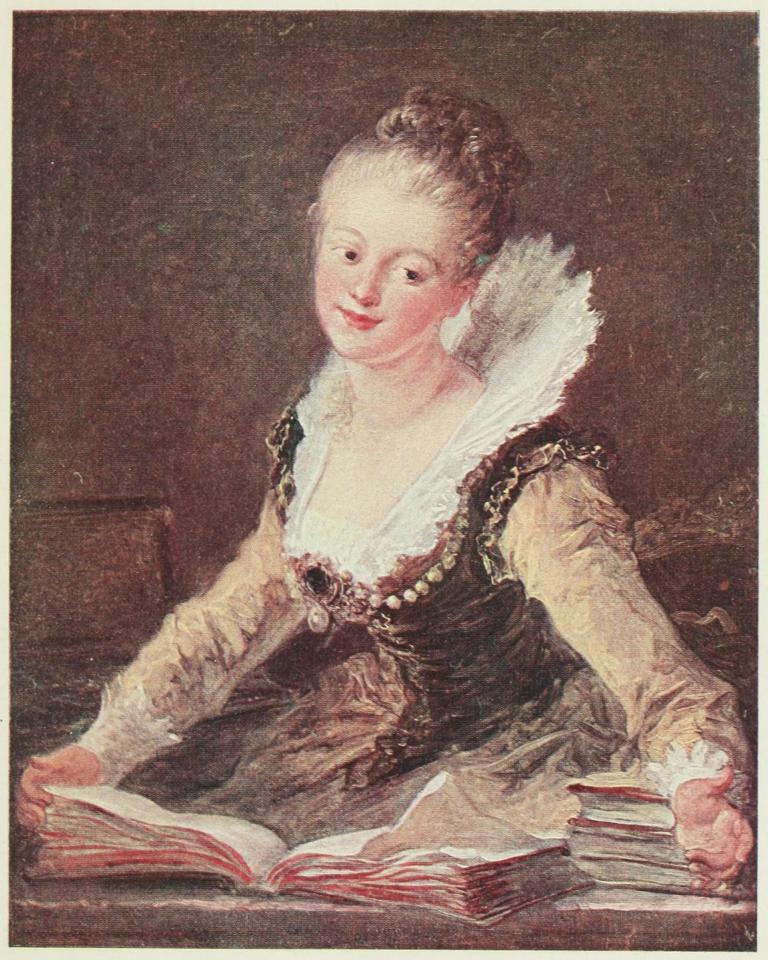
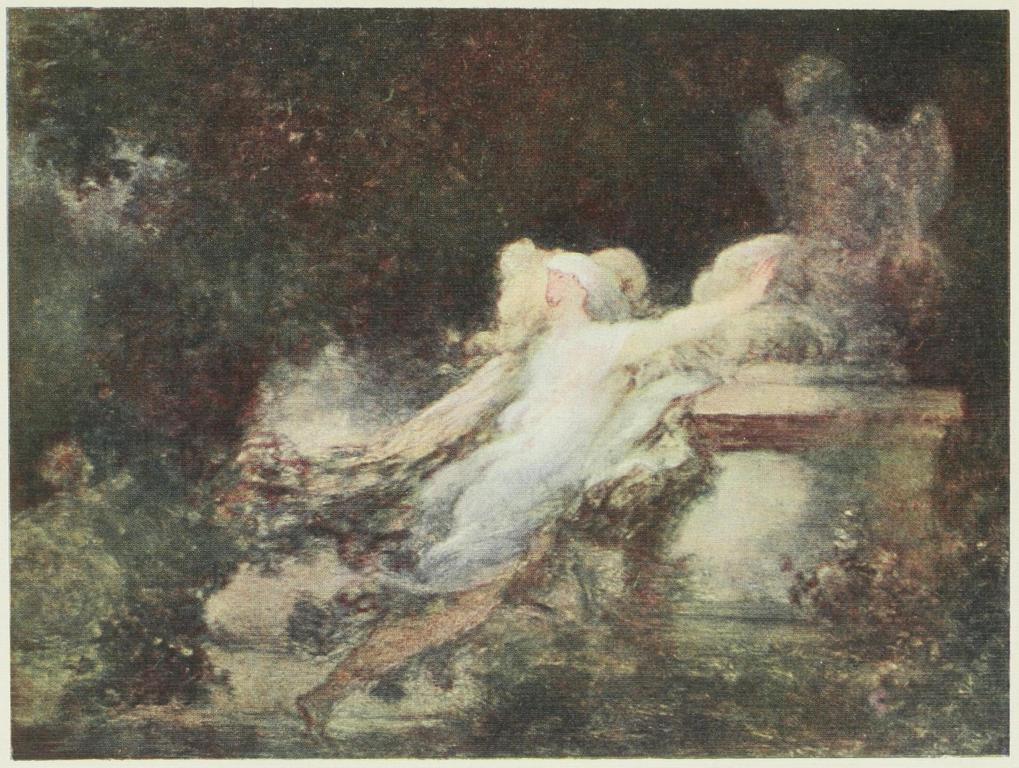
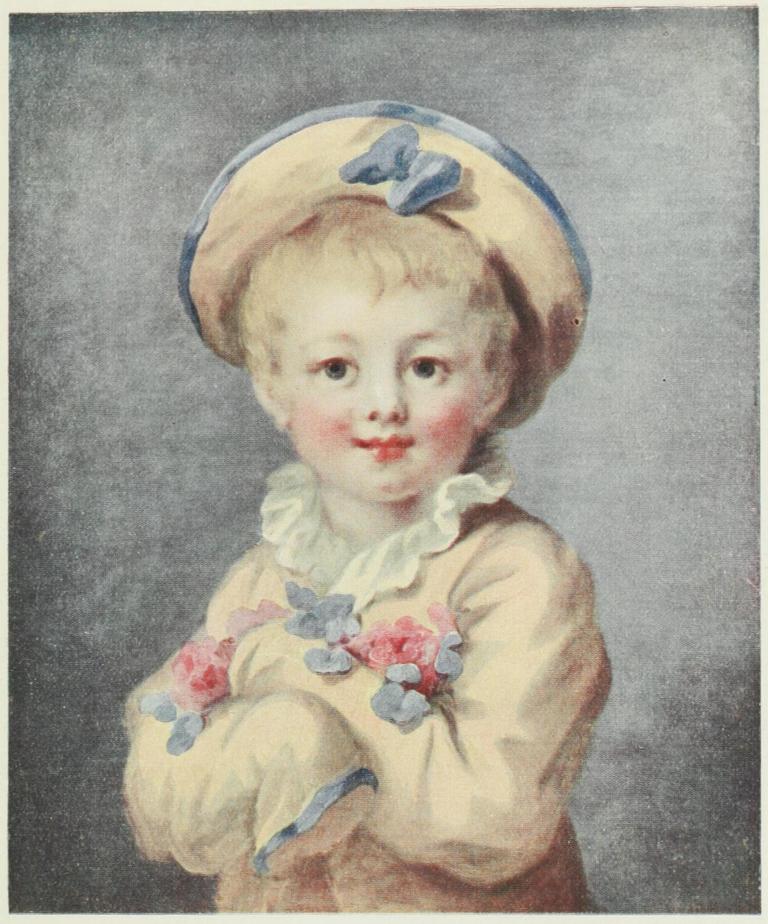
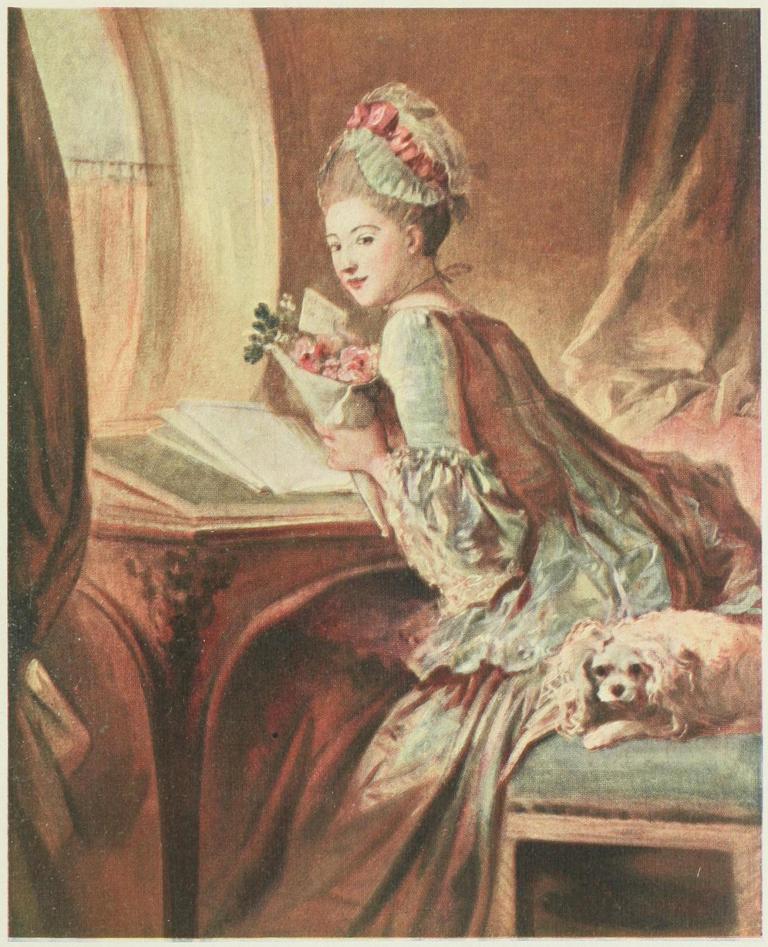
When Fragonard came back to Paris on the
edge of his thirtieth year it was to find that a
great change had come over his master Boucher.
The old, light-hearted, genial painter was showing
signs of the burning of the candle of life
at both ends. His art also was being bitterly
assailed by the new critics—the new philosophy
was asking for ennobling sentiments from the
painted canvas, and the teaching of a moral
lesson from all the arts. Boucher stood frankly
bewildered, blinking questioning eyes at the
frantic din. Old age had come upon him,
creeping over the shrewd kindly features, dulling
the exquisite sight. He could not wholly ignore
the change that was taking place in public taste.
The ideas of the philosophers were penetrating
public opinion. The man of feeling had arisen
and walked in the land. They were beginning
to speak of the great antique days of Greece
and Rome. Fickle fashion was about to turn
her back upon Dresden shepherds and shepherdesses
and leafy groves, and to take up her
abode awhile with heroes and amongst picturesque
ruins.
Arrived in Paris, Fragonard at once set himself
to the task of painting the historic or
mythologic Academy-piece expected from the
holder of the Prix de Rome on return from the
Italian tour. He painted “The High Priest
Coresus slaying himself to save Callirhoë,”
which, though badly hung at the Salon, and
still to be seen at the Louvre, was hailed with
high praise by the academicians and critics.
The only adverse criticisms of coldness and
timidity levelled against it sound strange in the
light of his after-career, which, whatever its
weaknesses, was not exactly marked with coldness
nor eke with timidity.
For two years thereafter he essayed the
academic style.
But the praises of Diderot and Grimm failed
to fill his pockets; and he decided to paint no
more academic pieces for the critics’ praise.
He had indeed no taste for such things, no
sympathy with ancient thought nor with the
dead past. He was, like his master, a very son
of France—a child of his own age, glorying in
the love of life and the beauty of his native land.
Having done his duty by his school, he turned
his back upon it gleefully, as Boucher had also
done before him, and set himself joyously to the
painting of the life about him.
His great chance soon came, and in strange
guise.
It so happened that a young blood at the
court, one Baron de Saint-Julien, went to the
painter Doyen with his flame, and asked him to
paint a picture of the pretty creature being swung
by a bishop whilst he himself watched the display
of pretty ankles as the girl went flying through
the air. Doyen had scruples; but recommended
Fragonard for the naughty business.
Fragonard seized the idea readily enough,
except that he made the frail girl’s husband
swing the beauty for her lover’s eyes, using the
incident, as usual, but as the trivial theme for
a splendid setting amidst trees, glorying in the
painting of the foliage—as you may see, if
you step into the Wallace galleries, where is
the exquisite thing that brought Fragonard
fame—the world-famous “Les hazards heureux
de l’Escarpolette.”
The effect was prodigious. De Launay’s
brilliant engraving of it popularised it throughout
the land. Nobles and rich financiers, and
all the gay world of fashion besides, now strove
to possess canvases signed by Fragonard.
Boucher was grown old and ailing; and just as
Boucher had been the painter of the France of
fashion under the Pompadour, so Fragonard was
now to become the mirror of the court, of the
theatre, of the drawing-room, of the boudoir, of
the age of Du Barry.
Finding a ready market for subjects of
gallantry, he gave rein to his natural bent, and
straightway leaped into the vogue. Pictures
were the hobby of the nobility and the rich;
and France under the Pompadour, and particularly
at this the end of her reign, was madly
spendthrift upon its hobbies and fickle fancies.
The pretty house, delicately tinted rooms, fine
furniture, dainty decorations, and charming
pictures, were a necessity for such as would be
in the fashion.
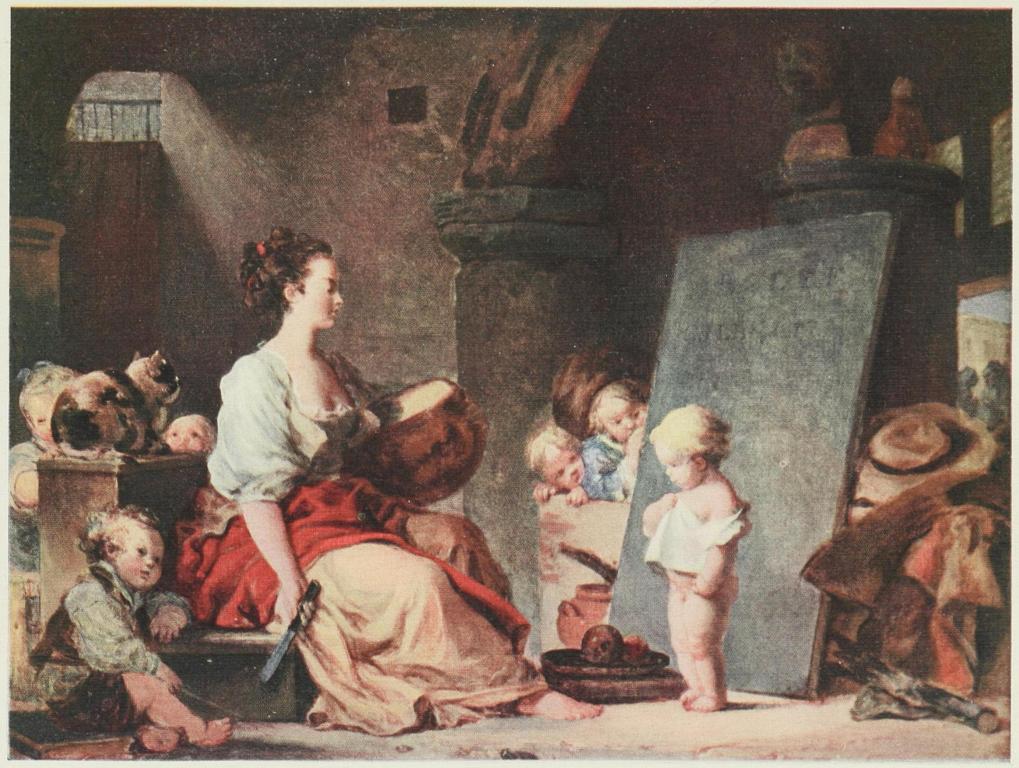
PLATE IV.—THE SCHOOLMISTRESS
(In the Wallace Collection)
After his marriage Fragonard’s brush turned to the glorification of
family life; and one of the most beautiful designs he conceived in
this exquisite series was the picture of the schoolmistress and her
small pupils—here chasteness of feeling has taken the place of
levity; and purity of statement is evidenced even in the half-nude
little fellow who is receiving his first lesson in culture.
You shall look in vain for the affected innocence,
the naïve mawkishness, the chaste sentimentality
of Greuze in the master-work of
Fragonard. He knew nothing of these things—cared
less. His was an ardent brush; and he
used it ardently; but always you shall find him
using his subject, however naughty, as the mere
excuse for a glorious picture of trees. He is one
of the great landscape-painters of France.
He had many qualities that go to make a
decorative painter. Indeed, it is to the Frenchmen
of the seventeen-hundreds to whom we
may safely go for pictures that make the walls
of a drawing-room a delight. Unlike the Italians,
they are pleasing to live with. His painting of
“La Fête de St. Cloud,” in the dining-room
of the Governor of the Bank of France, is one of
the decorative landscapes of the world.
He was now producing works in considerable
numbers—it is his first, his detailed period, somewhat
severe in arrangement and style as to
composition and handling—the years of “Love
the Conqueror,” the “Bolt,” the “Fountain of
Love,” of “Le Serment d’Amour,” the “Gimblette,”
“Les Baigneuses,” the “Sleeping Bacchante,”
the “Début du modèle,” and the like.
His master, Boucher, was grown old; he could
not carry out the commissions for the decoration
of rooms and for paintings with which he was
overwhelmed; and it was in order to help forward
his brilliant pupil, his “Frago,” that he now
introduced him to his old friend and patron the
farmer-general Bergeret de Grandcour—a man
of great wealth, a lover of art, and an honorary
member of the Royal Academy—who became
one of Fragonard’s most lavish patrons and
most intimate friends. Bergeret de Grandcour
commissioned several panels in this, Fragonard’s
thirty-fifth year—the year of his painting the
superb “Fête de St. Cloud.” This is towards
the end of that period of minute and detailed
painting which he did with such consummate
skill, yet without bringing pettiness into his
largeness of conception.
Meantime, Choiseul’s masterly mind, having
secured peace abroad, saw that France, if she
were to keep her sovereign State, must be first
cleansed from the dangers that threatened from
within. He turned to the blotting out of the
turbulent order of the Jesuits, whose vindictive
acts against, and quarrels with, the Parliaments,
and whose galling and oppressive tyranny, had
roused the bitter hatred of the magistracy and
of the people throughout the land. Choiseul
they treated as their bitterest enemy. He decided
to blot them out, root and branch, from France.
The popular party closed up its ranks. Choiseul
had not long to wait. The chance came in odd
fashion enough. An attempt by the Order to
end the Pompadour’s scandalous relations with
the king was the quaint thing—the match that
started the explosion. With all his skill of state-craft,
Choiseul leaped to the weapon. In secret
concert with the king’s powerful favourite he
struck at them through the bankruptcy of their
banking concerns in the West Indies, caused by
their losses in the wars with England; and Louis
abolished the society out of the land, secularising
its members, and seizing its property.
The Pompadour lived but a short while to
enjoy her triumph. Worn-out by her vast activities,
and assailed by debt, she fell ill of a cough
that racked her shrunken body. She died, transacting
the king’s business and affairs of State, on
the 15th of April 1764, in her forty-second year.
Whatever may be said of this cold-blooded,
calculating, grasping woman, who crushed down
every nice instinct of womanhood to win a king’s
favour, who knew no scruple, who was without
mercy, without pardon or forgiveness, without
remorse; bitter and adamant in revenge; who
turned a deaf ear to the cries from the Bastille;
whose heart knew no love but for self; it must
be allowed that at least for Art she did great and
splendid service. She not only encouraged and
brought out the best achievement of her age;
she did Art an even more handsome benefit. She
insisted on artists painting their age and not
aping the dead past.
To Fragonard personally she rendered no
particular service. His real achievement began
on the eve of her death, when she was a worn-out
and broken woman. Nor had Fragonard
ever that close touch with the royal house or its
favourites during any part of his lifetime that
meant so much to the fortunes of his master,
Boucher.
There were two patrons for whom Fragonard
was about to create a series of masterpieces in
the decoration of their splendid and luxurious
homes—works of Art which were to have
strange adventures and histories. They were
both women.
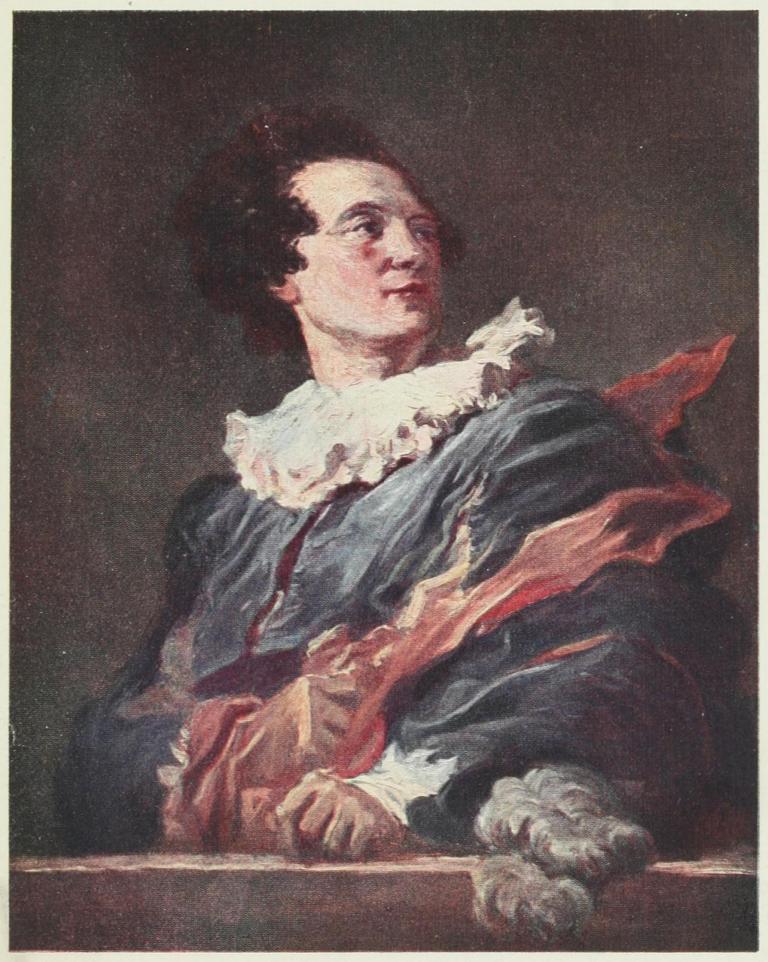
PLATE V.—FIGURE DE FANTASIE
(In the Louvre)
Here we have one of the rare examples of Fragonard’s painting
of a man’s portrait. It is in strange contrast to his more delicate
handling of domestic subjects.
For the prodigal and eccentric dancer, the
notorious Mademoiselle Guimard, he undertook
the painting of a series of panels. The Guimard
was the rage of Paris—she of the orgic suppers
and the naughty dances with her comrade Vestris.
Frago, who is said to have been more than a
friend of the reckless one of the nimble feet,
undertook the decoration of her house in the
Chaussée d’Antin, known to the bloods as the
Temple of Terpsichore. He painted for the same
room a portrait of the frail beauty as an
opera-shepherdess—the simple pastoral life was the pose
of this unsimple age. He was engaged upon
the business, off and on, for several years; and
the many delays at last fretted the light one.
Fragonard, anything but energetic, liked always
to take his own time at his work. The Guimard
got to pestering him—she had a sharp tongue—and
at last, one fine day, upbraided him roundly,
taunting him with a sneer that he would never
get the work finished. Fragonard lost patience
and temper, goaded by her ill-manners, her abuse,
and her biting tongue. “It is finished,” said he;
and walked out of the house. The Guimard could
never get him back; but one day he slipped in
alone, painted the set dancer’s-smile from the
dancer’s mouth, and placed there instead a snarl
upon her lips.
Before this breach between them Fragonard
had painted several portraits of the Guimard.
However, the work for the lady was to have
far-reaching results little dreamed of. For the
completion of the room, Fragonard procured the
commission for David, then twenty-five; and
David never forgot the service rendered. He was
to repay it tenfold when black days threatened;
and with rare courage, when even the courage
of gratitude was a deadly dangerous commodity.
However, this was not as yet; the sun shone
in the skies; and all was gaiety and laughter
still.
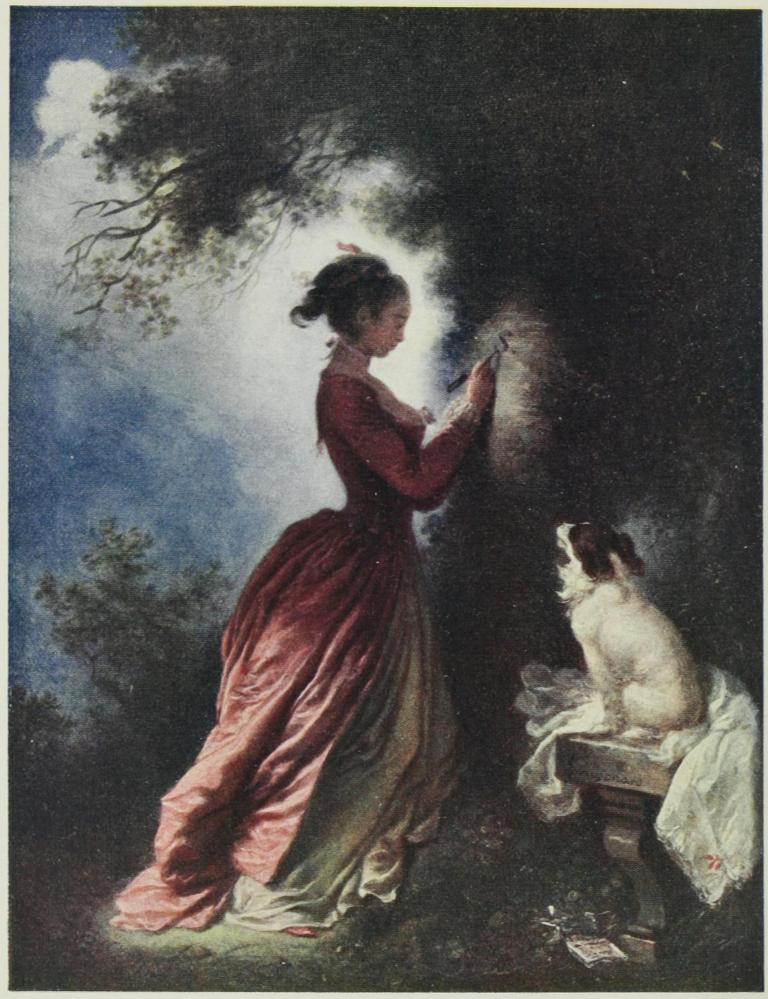
The “Chiffre d’Amour,” the picture of a pretty
girl who cuts her lover’s monogram in the bark
of a tree’s trunk, the shadowed tree and figure
telling darkly against the glamorous half light
beyond, was one of Fragonard’s happiest inspirations
of these years, as any one may see who
steps into the Wallace galleries. Here also
may be seen to-day the exquisite “Fair-haired
Boy.” The boldly painted “L’Heure de Berger”
was wet upon the canvas about this year, though
its boldness of handling foretells his later manner,
whilst the spirit of Boucher is over all.
Four years after the death of the Pompadour
the patient neglected queen, amiable dull Marie
Leczinska, followed her supplanter to the grave.
The king’s grief and contrition and his solemn
vows to mend his ways came somewhat over-late;
they lasted little longer than the drying of
his floods of tears over the body of his dead
consort.
On the Eve of Candlemas, the first day of
February 1769, at a convivial party in Paris that
was not wholly without political significance, a
Jesuit priest raised his glass To the Presentation!
adding after the toast—“To that which
has taken place to-day, or will take place to-morrow,
the presentation of the new Esther,
who is to replace Haman and release the Jewish
nation from oppression!”
He spoke figuratively—it was safer so. But
’twas understood. Indeed, the pretty sentiment
was well received by the old aristocrats and
young bloods about the table; and they drank
a bumper to the pretty Madame du Barry. For
the Jesuits had no love for the king’s minister
Choiseul—and the madcap girl was but the lure
whereby the king was to be drawn from his
great minister. So religion rallied about the
frail beauty, and hid behind her extravagant
skirts—one of which cost close on £2000—and,
with the old nobility, drank damnation to the
king’s minister and To the devil with the new
thought and with parliaments. Long live the
king and the divine right of kings!
Our worthy priest seems to have had the ear
of destiny, though he dated his certainty near
upon a couple of months too soon.
So it came about that before a year was out
the old king was become the doting creature of
a light-o’-love of Paris, the transfigured milliner
and street-pedlar, Jeanne, natural child of one
Anne Béqus, a low woman of Vaucouleurs. This
Jeanne, of no surname and unknown father, a
pretty, kindly, vulgar child of the gutters, with
fair hair and of madcap habits, was some twenty-six
years of age, when—being reborn under a
forged birth-certificate at the king’s ordering, as
Anne de Vaubernier, and being married by the
same orders to the Count du Barry, an obliging
nobleman of the court—she appeared at Versailles
as the immortally frail Countess du Barry.
The remonstrances of Choiseul with the king
against this new degradation of the throne of
France, and his unconcealed scorn and disgust
of the upstart countess, made a dangerous enemy
for France’s great minister, and was to cost him
and his France very dear.
The king’s infatuation brought royalty into
utter contempt amongst the people. It was to
cost France a terrible price—and Fragonard not
least of all.
One of the first gifts from the king to the Du
Barry was the little castle of Louveciennes; and
she proceeded with reckless extravagance to
furnish her handsome home. Drouais, the artist,
sold to her for 1200 livres (double florins), as overdoors
for one of the rooms, four panels that
he had bought from Fragonard. They have
vanished; but they served Fragonard a good
turn—he received an order to decorate Du
Barry’s luxurious pavilion of Luciennes, which
she had had built to entertain the king at her
“little suppers.”
Thus it chanced that for this wilful light-o’-love
Fragonard painted the great master-work
of his life—the five world-famous canvases of the
series of “The Progress of Love in the Heart of
Maidenhood,” or, as they are better known, “The
Romance of Love and Youth”—the old king
masquerading therein as a young shepherd, and
the Du Barry as a shepherdess. In “The
Ladder” (“L’Escalade” or “Le Rendezvous”)
the Du Barry plays the part of a timid young
girl who starts as she sees her shepherd-lover to
be the king; the “Pursuit” follows; then the
“Souvenirs” and “Love Crowned.” The last of
the five, the discarded mistress in “Deserted,”
was only begun; and was not completed by
Fragonard until twenty years later at Grasse, to
complete the set.
What it was that struck a chill into the frail
Du Barry’s favour, so that the masterpieces of
Fragonard never entered within her doors, is
not fully known. Whatsoever the cause, these
canvases were rejected by her. It is said that
the work was found to be disappointing, being
lacking as to the indecencies by the Du Barry
and the king, who preferred the more suggestive
panels of Vien. It is true that Fragonard’s
earlier four panels which she possessed were
in questionable taste, and that these five were
pure; indeed, their trivial story matters little
amidst the massy foliage and the majestic trees
that spring into the swinging heavens. Fragonard
suspected, and somewhat resented the
suspicion, that he was being made to paint in a
sort of artistic duel with Vien. At any rate,
Vien was chosen. So it came that the discarded
pictures lay in Fragonard’s studio for over twenty
years, when we shall see them, rolled up, making
a chief part of the strange baggage of Fragonard’s
flight from his beloved Paris.
The fact was that the Du Barry was of the
gutter. She had the crude love of fineries of
the girl promoted from the gutter. She loved
display. But into her home she brought the
vulgar singers of the lowest theatres, where the
Pompadour had brought the wits and leading
artists of her time. The old culture was gone.
Louis laughed now at ribald songs, and was
entertained by clowns.
It is part of the irony of life that Fragonard,
who never entered into the favourite’s friendship,
should have become the recognised artist of her
day. It was a part of that grim irony that
caused the Du Barry, whose age he honours, to
reject the most exquisite work of his hands—in
which his art is seen at its highest achievement,
the tender half-melancholy of the thing stated
with a lyric beauty that displays his genius in
its supreme flight.
A search through the Du Barry’s bills—and
there are four huge bound volumes of them—reveals
the list of pictures painted by Boucher,
by Vien, by Greuze, and by others, for the
spendthrift woman; but of transaction with
Fragonard there is no slightest hint.