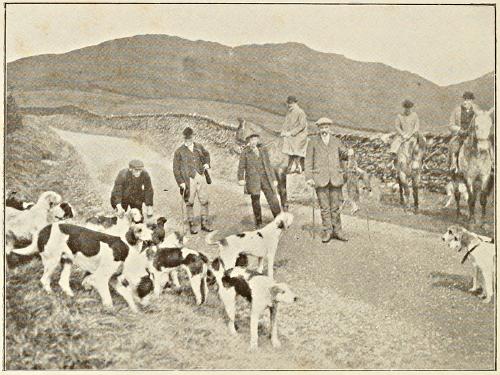
“The hounds but chop, the game is strong,
That pace of plight cannot be long,
Hark! Tally-ho’s from yon far height,
And now the whiners wend in sight,
Through Silver Ghyll for Skiddaw Fell,
They’ll kill him if he goes to h—l!”
No description of fell hunting would be complete
without a reference to John Peel, the famous
Cumbrian Master and Huntsman.
Although Peel was well known in his own
country, his fame did not extend beyond the North,
until the old song, “D’ye ken John Peel?”
became popular. The spirited verses had little
vogue until after Peel’s death in 1854, when the
song suddenly became fashionable. The original
song differs in some respects from the modern
version, particularly in the first line. “D’ye ken
John Peel with his coat so gay?” is sung to-day,
whereas the original is, “Did ye ken John Peel
wi’ his cwote seay gray?”
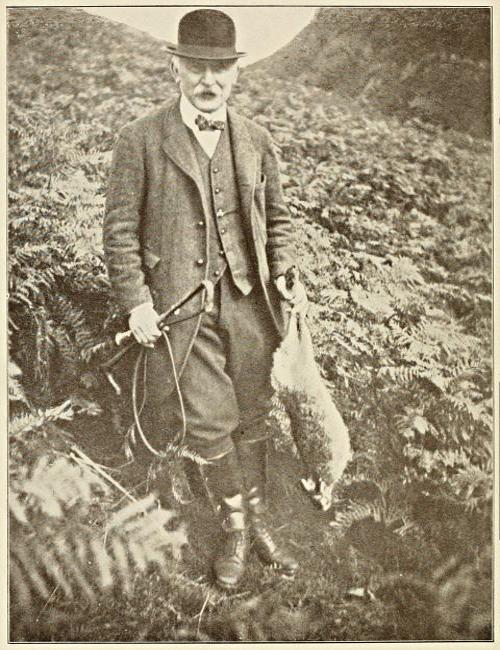
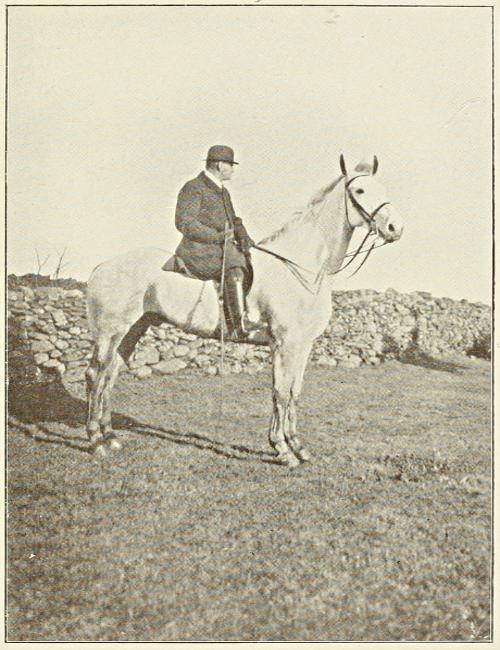
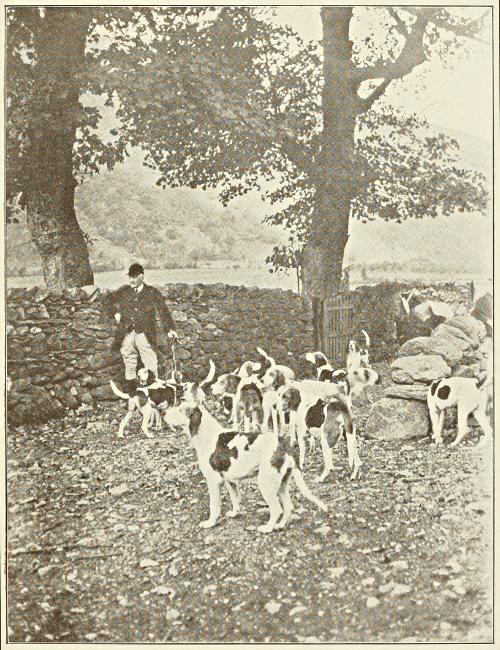
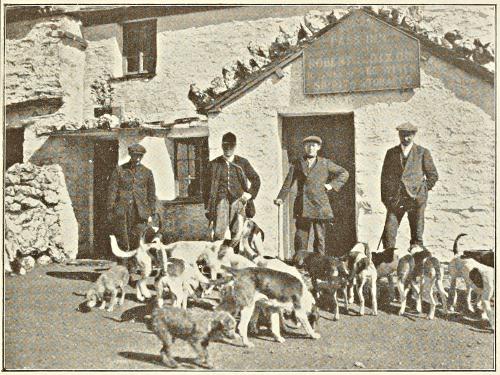
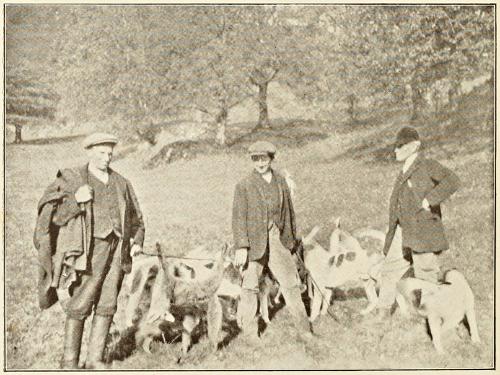
BLENCATHRA FOXHOUNDS: ON RIGHT, GEORGE TICKELL, ESQ.,
EX-DEPUTY MASTER (1907-1919).
Peel never wore a scarlet coat, his jacket was
made of home-spun Cumberland wool, known
locally as “hoddengray.”
The late Mr. Jackson Gillbanks, of Whitefield,
gave a good pen-picture of John Peel,
and I take the liberty of quoting it here. He
said—
“John Peel was a good specimen of a plain
Cumberland yeoman. On less than £400 per
annum he hunted at his own expense, and unassisted,
a pack of foxhounds for half a century.
John has in his time drawn every covert in the
country, and was well known on the Scottish
borders. Except on great days he followed the
old style of hunting,—that is, turning out before
daylight, often at five or six o’clock, and hunted
his fox by the drag. He was a man of stalwart
form, and well built; he generally wore a coat of
home-spun Cumberland wool—a species called
‘hoddengray.’ John was a very good shot, and
used a single-barrel, with flint lock, to the last.
Though he sometimes indulged too much, he was
always up by four or five in the morning, no
matter what had taken place the night before;
and, perhaps, to this may be attributed his
excellent health, as he was never known to
have a day’s sickness, until his last and only
illness.”
Mr. Gillbanks was also the author of the
following verses, published in the Wigton Advertiser:—
“The horn of the hunter is silent,
By the banks of the Ellen no more
Or in Denton is heard its wild echo,
Clear sounding o’er dark Caldew’s roar.
For forty years have we known him—
‘A Cumberland yeoman of old’—
But thrice forty years they shall perish
Ere the fame of his deeds shall be cold.
No broadcloth or scarlet adorn’d him,
Or buckskins that rival the snow,
But of plain ‘Skiddaw gray’ was his raiment,
He wore it for work, not for show.
Now, when darkness at night draws her mantle,
And cold round the fire bids us steal,
Our children will say, ‘Father, tell us
Some tales about famous John Peel!’
Then we’ll tell them of Ranter and Royal,
And Briton, and Melody, too,
How they rattled their fox around Carrock,
And pressed him from chase into view.’
And often from Brayton to Skiddaw,
Through Isel, Bewaldeth, Whitefiel,
We have galloped, like madmen, together,
And followed the horn of John Peel.
And tho’ we may hunt with another,
When the hand of old age we way feel,
We’ll mourn for a sportsman and brother,
And remember the days of John Peel.”
The late Sir Wilfrid Lawson also gives a good
description of Peel. He says:
“I have seen John Peel in the flesh, and have
hunted with him. He was a tall, bony Cumbrian,
who, when I knew him, used to ride a pony he
called ‘Dunny,’ from its light colour, and on this
animal, from his intimate knowledge of the
country, he used to get along the roads, and see a
great deal of what his hounds did. Peel’s grey
coat is no more a myth than himself, for I well
remember the long, rough, grey garment, which
almost came down to his knees. No doubt drink
played a prominent part—if it were not, indeed,
the ‘predominant partner’ in these northern
hunts. I have heard John Peel say, when they
had killed a fox: ‘Now! this is the first fox we’ve
killed this season, and it munna be a dry ’un!’—words
of that kind being a prelude to an adjournment
to the nearest public-house, where the party
would remain for an indefinite time, reaching, I
have heard it said, even to two days.”
In the book “Sir Wilfrid Lawson (A Memoir),”
by the Right Hon. George W. E. Russell, it says:
“The famous John Peel, who is ‘kenn’d’ over
the English-speaking world, was a Master of Foxhounds
on a very primitive and limited scale, and
hunted his own hounds in Cumberland for upwards
of forty-six years. He died in 1854. By this
time Wilfrid Lawson was twenty-five years old,
and desperately fond of hunting. So, on the death
of John Peel, with whom he had hunted ever since
he could sit in a saddle, he bought Peel’s hounds,
amalgamated them with a small pack which he
already possessed, and became Master of the
Cumberland Foxhounds.”
The famous song, “John Peel,” was written by
Woodcock Graves, an intimate friend of Peel.
Graves emigrated to Tasmania in 1833, and spent
the last years of his life there, far from the hunting
country of his younger days.
John Peel was born at Grayrigg, and in later
years lived at, and hunted from, his cottage at
Ruthwaite.
The hunting man desirous of having a few days’
sport on the fells, can take his choice of five packs,
i.e. the Ullswater, Coniston, Blencathra, Eskdale
and Ennerdale, and the Mellbrake. The Ullswater
hounds are kennelled at Patterdale; nearest railway
stations, Penrith and Troutbeck (Cumberland).
Mr. W. H. Marshall, of Patterdale Hall, is Master,
and Joe Bowman is huntsman. Whipper-in,
B. Wilson.
The Coniston are kennelled at Green Bank,
Ambleside; nearest station, Windermere. Mr.
Bruce Logan, of “Westbourne,” Bowness, is
Master, and George Chapman is huntsman.
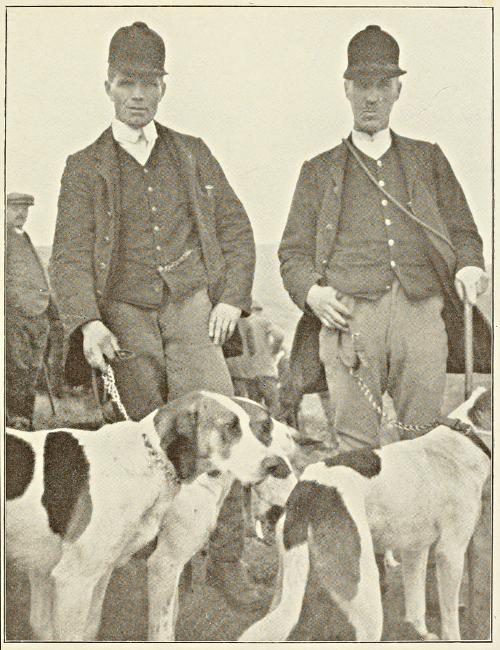
FELL COUNTRY HUNTSMEN.
The Blencathra are kennelled at the Riddings,
near Threlkeld; railway stations, Threlkeld and
Keswick. Master, Mr. R. J. Holdsworth, Seat
Howe, Thornthwaite, Keswick. Deputy Master,
Mr. Andrew Anderson, Lair Beck, Keswick.
Secretary, Jonathan Harryman, Howe, Portinscale,
Keswick. Huntsman, Jim Dalton. Whipper-in,
E. Parker.
The Right Hon. The Speaker (Mr. J. W.
Lowther) was Master of the Blencathra from 1903
to 1919. He resigned the Mastership in 1919.
Mr. George Tickell, of Shundraw, Keswick, was
Secretary for fourteen years, and on the death of
the late Mr. John Crozier, who was Master from
1839 to 1903, he held the Mastership until the
appointment of Mr. J. W. Lowther. He then
acted as Deputy-Master from 1907 to 1919, when
he retired.
Mr. Tickell has hunted regularly since he was a
boy at school, thus covering a total of nearly
seventy years. He is still (1919) hale and hearty,
and regularly attends the meets of the Blencathra.
The Eskdale and Ennerdale are kennelled in
Eskdale. Master, Mr. W. C. Porter, Field Head,
Eskdale, R.S.O. Railway station, Ravenglass.
The late Tommy Dobson was Master of this pack
from 1857 to 1910. Huntsman, the Master.
The Mellbrake are kennelled at Hope Lorton.
Masters, Mr. Robinson Mitchell, Mr. E. A. Iredale
and Mr. D. B. Robinson. Secretary, Mr. R.
Rawling, Lanthwaite Green, Cockermouth. Huntsman,
R. Head. Whipper-in, J. Norman. Nearest
railway station, Cockermouth.
The Mellbrake and the Eskdale and Ennerdale
are somewhat isolated from the other Hunts, but
it is often possible to attend meets of the Coniston,
Blencathra and Ullswater during the week. Once
or twice a season the Blencathra visit Wythburn,
at the head of Thirlmere Lake, where they remain
for the inside of a week. If during that week the
Coniston and Ullswater are in their home countries,
they can easily be reached from Windermere or
Ambleside, by motor or cycle. If the visitor
wishes to put in most of his time with an individual
pack, he will find comfortable hotels and inns
within easy reach of the kennels. There is, of
course, a good deal of luck about hunting anywhere,
but particularly so on the fells, where weather
conditions are apt to interfere with sport. The fell
packs usually account for from fifteen to twenty-five
brace of foxes in a season, the number, of
course, varying with the character of the seasons.
In the 1918-19 season, the Ullswater brought to
hand close upon thirty-five brace, while the other
packs all did remarkably well. Considering the
roughness of the country, such records are very
good indeed.
Joe Bowman, the veteran huntsman of the
Ullswater, is a personality in Lakeland hunting.
He has carried the horn with this pack—with one
short interval—since 1879, and is still hale and
hearty. His fame as a huntsman reaches far
beyond the borders of his own wild country, for he
is well known to most keen hunting folk.
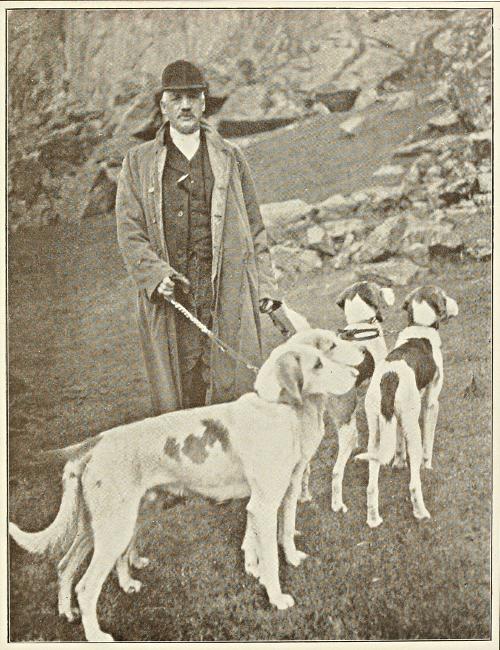
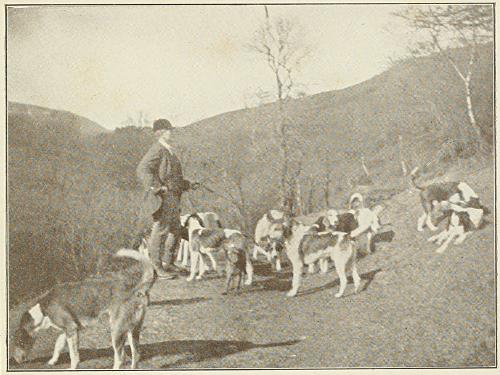
ULLSWATER FOXHOUNDS: JOE BOWMAN, THE HUNTSMAN.
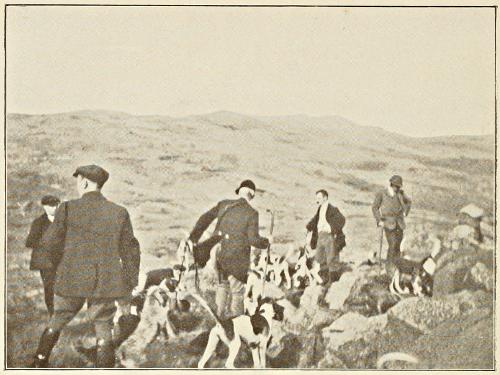
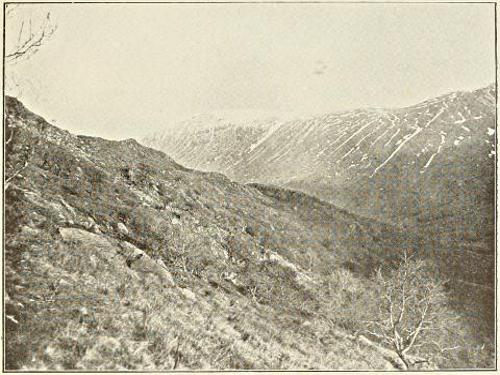
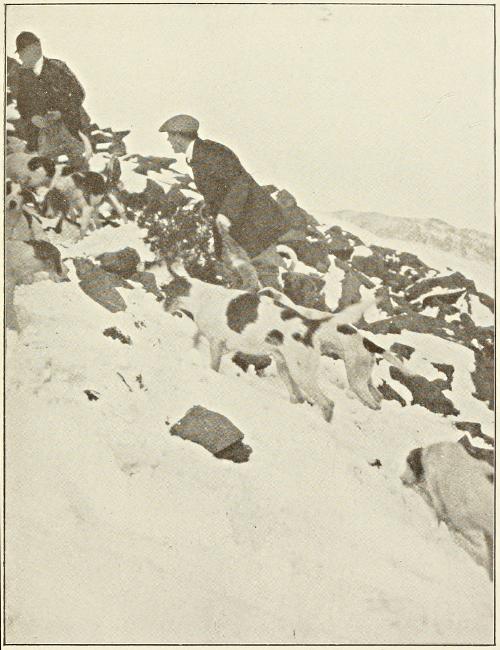
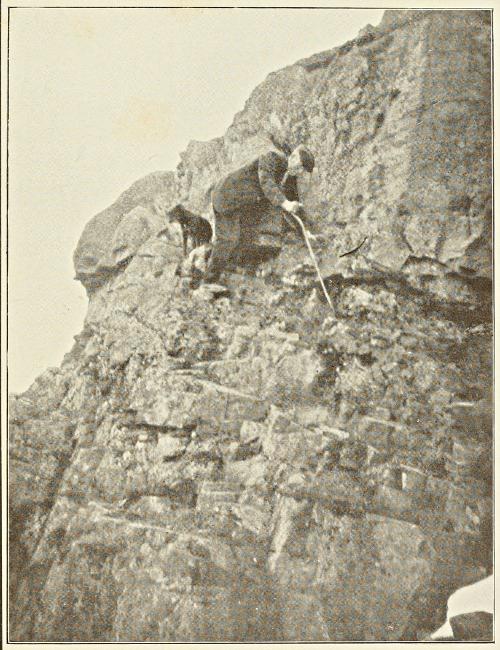
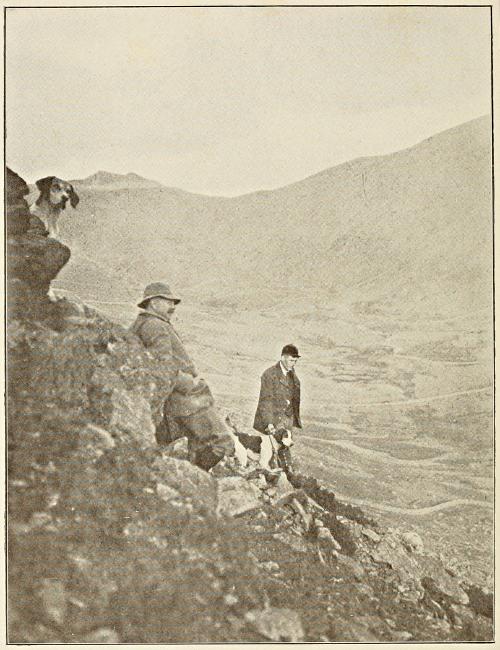
BLENCATHRA FOXHOUNDS: GONE TO GROUND ON ARMBOTH FELL.
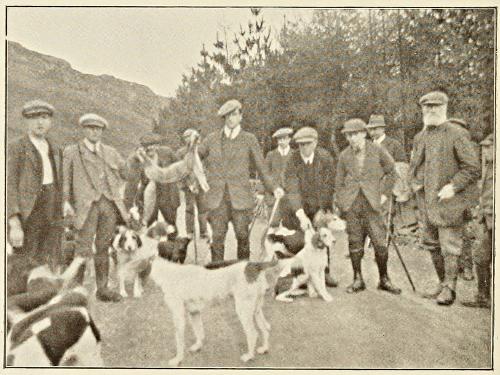
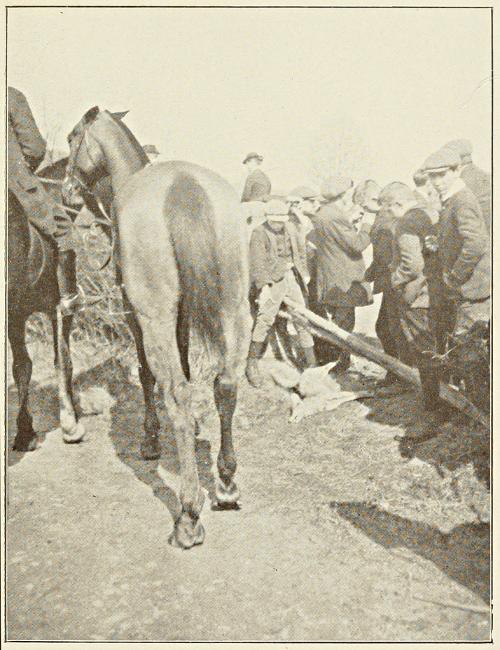
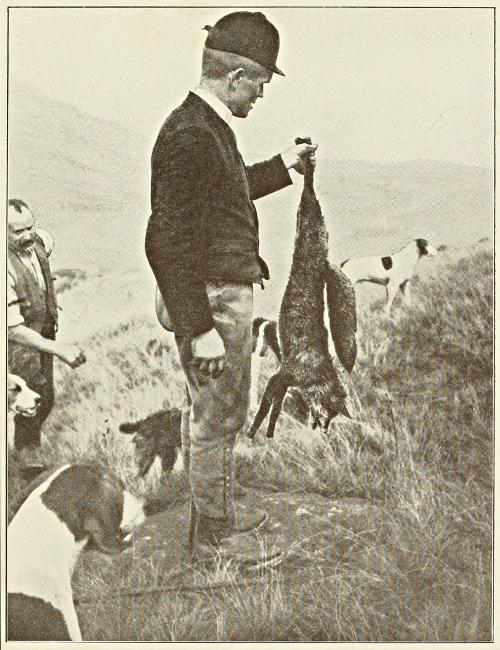
BLENCATHRA FOXHOUNDS: AFTER A KILL AT RAVEN CRAG, NEAR
THIRLMERE LAKE, NOV. 7TH, 1919.
Except in certain parts of the low country,
which are visited once or twice a season, riding
to the fell hounds is out of the question. Even in
the aforementioned districts it is a case of riding
to points, and nicking in with hounds when the
opportunity presents itself. There are places
where, should you be lucky, you may chance to
see the best part of a run from a main road below
the fell. Such a place is the road which circles
Thirlmere Lake, from which I have watched many
a good hunt with the Blencathra. As a rule,
however, it pays best to climb the fell, from which
vantage point you are more likely to keep in
constant touch with hounds. If you hang about
the roads hounds may come back to you, but again
they may not, and it requires a good deal of
patience and self-control to remain where you are
on the off-chance. Once on the fell top, it pays
to stay there until hounds either drive their fox
for the last time into the dale or run him to ground
in some rocky “borran” (earth). It is much
easier and quicker to walk round the fell tops
than descend to the dale and have to climb out
again.
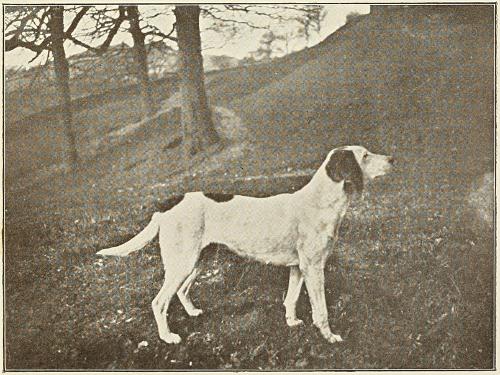
In addition to the type of hound used, the
method of hunting on the fells differs from that in
the riding countries. There hounds are thrown
into covert, from which in a few minutes they get
away almost on top of their fox. While the same
thing sometimes happens with the fell hounds, as
a rule, their fox is lying in some snug kennel at a
height of two thousand feet or more, and before
hounds can run him they must find him. To do
this they quest for the drag, or in other words,
they search for and pick up the line of a fox which
during the night has visited the dale, and then
before daybreak has returned to his mountain
fastness. If the fox has cut his return trip rather
fine, and hounds are out early, as they very often
are in spring, the drag may prove a warm one.
If it is cold and the fox long gone, it may require
a lot of working out.
Anyhow, the same end is eventually attained,
i.e. hounds gradually work up to the spot where
their fox is lying. It may be on the ledge of some
crag, or amongst the rocks strewn about the fell
breast. Wherever it is, Reynard may wait till
hounds are close to him, or he may steal away and,
if unseen, gain a long start. As a rule, however,
there are a few keen hunters scattered about the
fell tops before hounds leave the dale, and the fox
is lucky if he can slip away without the sharp eyes
of some shepherd spying his movements. A
series of shrill view-halloas soon bring hounds to
the spot, and the run begins in earnest. Although
such a halloa saves time when a fox has stolen
away, it is a much prettier sight to see hounds
find and unkennel their fox in a crag by themselves.
It is an exciting moment when Reynard
springs up from his heather-covered ledge and
goes shooting through the dangerous crag-face,
en route for the open fell top. Hounds may be
practically all round him at the time, but he
dodges first one way and then another until he
is clear, and amongst the rocks and rough débris
of the fell-side, he is more than a match for the
fastest hound.
If it is a clear day, with not too much wind, you
can both see and hear hounds at some distance.
If there is a mist, the music is your only guide to
the whereabouts of the pack. If scent is at all
good, not many minutes will elapse ere hounds
have disappeared beyond your ken. You follow
on, keeping to the good going on the fell top, and
ere long you hear them again in another dale, still
running strong. A thorough knowledge of the
country and the run of the foxes will enable you
to go far and more or less keep in touch, even on a
misty day. If you are a stranger, you will be wise
to stick to some local hunter, who will pilot you
safely, although possibly at a rather faster pace
than you deem compatible with such rough going.
Mist is the fell hunter’s greatest bugbear. It may
roll up suddenly and block out your entire view,
shrouding you in a damp, grey mantle. Then all
you can do is to pray for an occasional rift in the
vaporous screen which will afford you a glimpse
of your whereabouts, and possibly reveal the
hounds.
Sometimes when the dales are thick with mist
the fell tops stand out quite clear, and you look
down on to a white sea. Next to mist hard
weather—especially when there is much ice on the
crags—may stop hunting for a time. Snow is
not so bad, for though it makes hard work of it for
followers, hounds can get through it all right, and
scent is often good when the white covering is
damp.
I must not dwell on the dark days, however,
for there are times when weather, scent, and all the
rest of it goes right, and a day of this kind is a day
to remember. The morning is fine and still, and
the atmosphere so clear that every rock and stone
stands out distinctly. The distant hills are tinted
from indigo to mauve, and you wish you could
transfer the glorious panoramic view to canvas.
You are out early, having made a slow and easy
ascent of the fell, and you sit down where you can
command a view of the dale and the rough ground
below you. Far away in the bottom you espy the
huntsman’s scarlet coat, and those little white
dots moving here and there are the hounds.

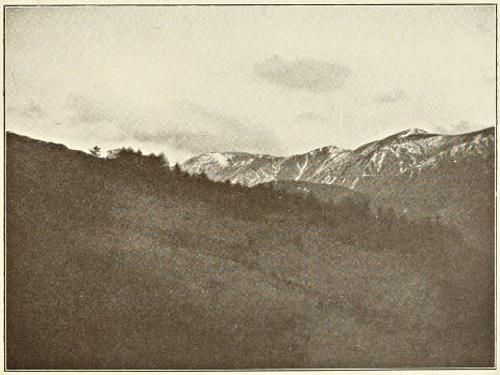
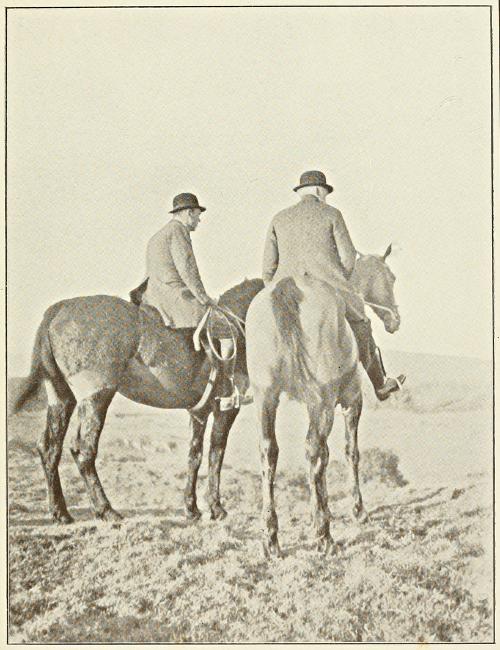
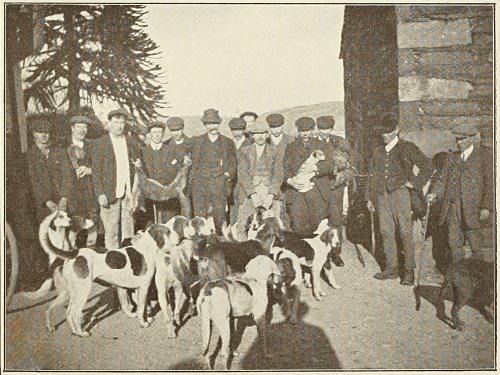
ULLSWATER FOXHOUNDS: OPENING MEET AT BROTHERSWATER,
OCT. 11TH, 1919.
A faint note sounds, and then another, and
gradually the music swells and grows louder.
Hounds have struck a drag, and are making their
way towards a frowning crag which juts out from
the rough breast beneath you. Your companion,
a hill-shepherd, moves off a few paces in order to
get a better view, then suddenly turns and points
with his stick, exclaiming, “Sista, yonder he
gars!” You look quickly towards the point
indicated, and there you see him, a fine fell fox,
his brush held stiff and straight behind him,
moving along with the smooth gliding action
peculiar to his kind. Once he halts and looks
back, then he resumes his easy pace. Your companion
runs a few yards down the breast, and
you are treated to a sample of a dalesman’s view-halloa.
Scream after scream rings out, echoing
from the crags. The fox, still in view, and unhurried,
stops at the sound, glances back, then
mends his pace and disappears round the end of a
jutting crag. Hounds come like mad to the halloa,
scrambling up the steep ground at a wonderful
pace. The leaders strike the line, and there is a
burst of music as the remainder of the pack settle
to it, and go racing through the breast. You
watch them until hidden by a shoulder of the hill,
then scan the fell head anxiously for their reappearance.
They are almost out of hearing, but
suddenly the cry is carried back to you clear and
distinct, and you see them climbing out at the
fell head, looking like white ants in the distance.
One glimpse you get, and they are gone over the
fell top, heading for the rough ground beyond.
Although you meditate following them, your
better judgment prevails, for this dale has not
been previously disturbed, and you know that a
litter has been bred there. It is more than likely
that the fox will return ere long, so you walk a
short distance up the narrow trod leading to the
tops, and sit down to listen. Scattered about
the fell slopes are the little Herdwick sheep, tiny
things in comparison with a Southdown, but famed
for their quality as mutton. Overhead, wheeling in
wide spirals, a buzzard is rising to a dizzy height,
his shrill “whee-u, whee-u,” sounding clear and
distinct. Over the fell head you hear the raucous
cry of a raven, and catch sight of a black speck
floating into the distance. A stoat, not yet in his
winter coat of white, darts in and out amongst
the rocks below you, and you watch his antics
until a distant sound catches your ear. You
listen intently, yes, there it is again, surely the
cry of a hound, although still a long way off.
They must be coming back, for the sounds are
nearer now, and louder. You take the glasses
from their case, and scan the fell head. Yes,
there they come, running fast, and their fox
cannot be very far in front at that pace.
Quickly you scan the ground between, and at
last you see him coming gamely along, but far
from fresh. Below you is a well-known earth,
which is no doubt his refuge, but to-day there
are figures standing about it, so his entrance will
be barred.
You lose sight of him, then a view-halloa rings
out, and a whip cracks sharply. He has swerved
from the figures on the earth and hounds are
gaining fast. Gradually they edge him lower and
lower, until the last rock left behind, he is threading
a narrow trod amongst the bracken. It is “all
over bar the shouting,” as you dash down the
long grass slope, clear the intervening wall, and
drop panting into the allotment on the other side.
A scramble through a stony beck, ending with a
sharp run, brings you in sight of hounds, racing
from scent to view. A sharp turn, a gleam of
white fangs, and Stormer rolls him over, to be
buried beneath a living avalanche of white, and
black and tan. Who-hoop! Who-hoop!
Such is a day worth living for with a fell pack.
A quick find, a fast hunt, a good place to see it
from, and a kill in the open; what more could the
heart of hunter desire? The man who does much
fell hunting will get his share of such days, and
when they come they amply repay him for any
past disappointments.
The regular followers of the fell packs consist
chiefly of shepherds, dalesmen and the like, comparatively
few of the local “gentry” being sufficiently
keen to take more than a passing interest
in the sport. The fine air on the tops, and the
strenuous exercise, beat all your doctor’s medicine,
but I am afraid in these modern days people believe
more in the latter than the former. The working
men in the dales are the keenest of hunters. No
matter on what task they are engaged, when hounds
come near, they down tools and join in the chase.
They work hard, too, at unearthing a fox which has
got to ground amongst the rocks, where crowbar
and hammer are often required to loosen up the
huge boulders.
On the fells the huntsman is the only man who
wears a scarlet coat, and he is assisted by a
whipper-in, who may perhaps wear hunting-cap
and dark grey jacket, relieved by a touch of red
on the collar and a scarlet waistcoat.
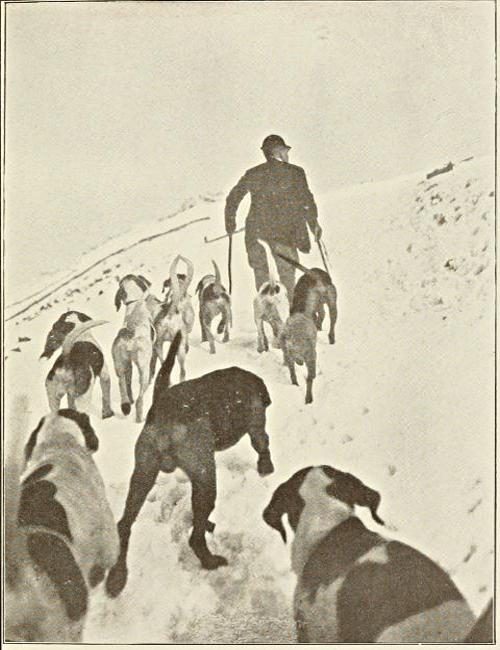
The huntsman is followed by three or four fell
terriers in couples, and generally a hound or two
as well. These last are usually young hounds, or
older members of the pack which he is prepared to
let go when occasion warrants. Usually the
whipper-in will take the highest ground, leaving
the huntsman to go below. He often takes more
coupled hounds with him to the tops, to “louse”
them at some convenient moment. The terriers
form a most important item of the Hunt. Without
them it would be impossible to locate and evict a
fox after he had got to ground.

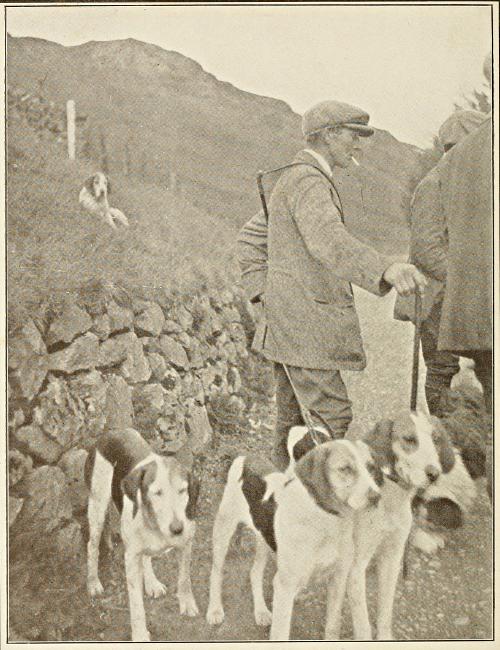
ULLSWATER FOXHOUNDS: JOE BOWMAN, HUNTSMAN (SINCE 1879).
Most of these terriers are cross-bred, showing
more or less Bedlington blood, as evinced by the
light-coloured, silky hair on their heads. Silky
body covering is not wanted on a fell terrier, for if
the coat is too fine, the dog is unable to withstand
wet and cold properly. These terriers vary considerably
in size, but a very short-legged dog is
handicapped on rough ground or in the snow.
A biggish terrier is decidedly useful in places where
he can work up to his fox, but in the majority
of Lakeland borrans or earths, a smaller dog is
to be preferred. A fox always takes good care
to choose his defensive position underground, and
a terrier has to attack him from below, and is thus
at a disadvantage. Sometimes the positions are
reversed, and the fox squeezes himself into a
narrow crack, where he is unable to turn, thus
exposing himself to a rear attack. As a rule,
however, he is “head on” to his canine enemy,
and then if he refuses to bolt, a battle royal ensues.
A big dog-fox is no mean foe, and the combatants
on both sides often get severely mauled. A sure
sign that a fox is shifting his quarters underground
is when the terriers cease marking, and the hounds
begin to rush about the borran. It is surprising
how a fox will bolt and escape his foes on such
occasions. He creeps quietly to some convenient
outlet, pauses an instant, then slips away, often
unseen until he has placed some distance between
himself and the hounds. Even after a mauling
he will often beat hounds uphill on rough
ground, and end by getting to earth somewhere
else.
Some of the Lakeland borrans are very deep
places. It sometimes happens that although the
terriers reach and possibly account for the fox,
they are unable to return, and it may mean days
of strenuous work ere the men can extricate them.
At long intervals, more serious events occur, and
despite all that can be done by willing hands, a
rescue is impossible. Certain stone quarries and
other places in Lakeland hold sinister reputations
in this respect.
Some of the quarry “rubbish heaps” are composed
of “big stuff” in the way of rocks, and are
dangerous to open up, as the excavating process
causes the upper material to unexpectedly rush in.
In addition to shutting off the terriers, such a rush
may easily bury or severely injure the men who
are at work. I have seen one or two very narrow
escapes of this kind, and they are decidedly
unpleasant experiences.
It is, of course, usual for a man or two to mount
guard at such borrans when hounds are advertised
to meet in the neighbourhood, but even the keenest
hunter becomes fed-up waiting perhaps for hours
on a cold day, with only an occasional and distant
sound of hounds to cheer his watch.
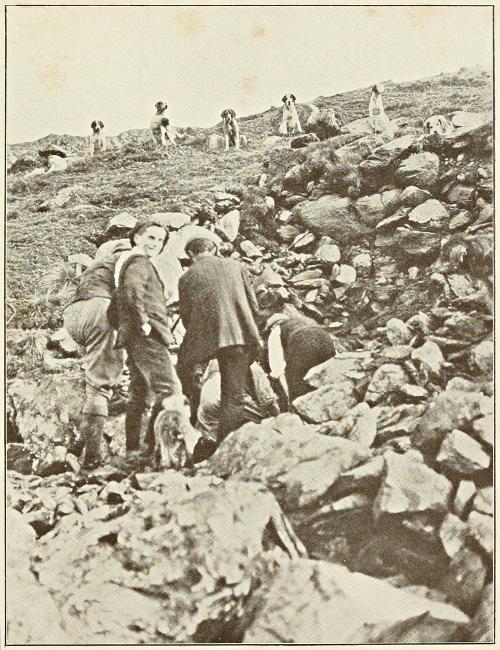
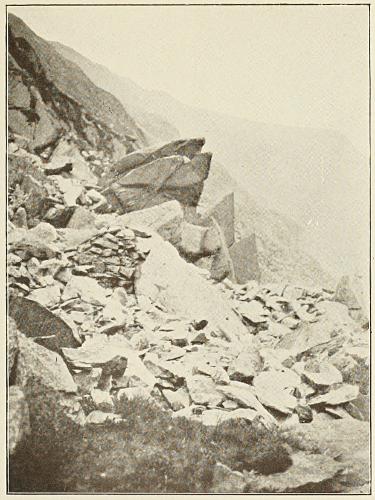
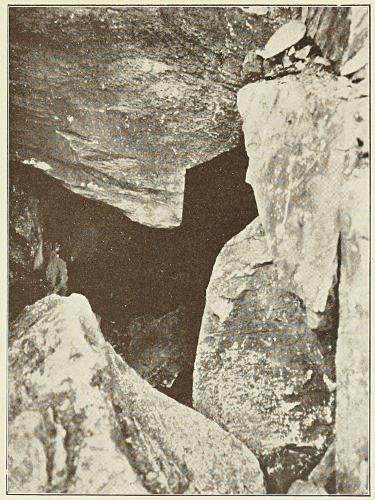
CONISTON FOXHOUNDS: “GONE TO GROUND.”
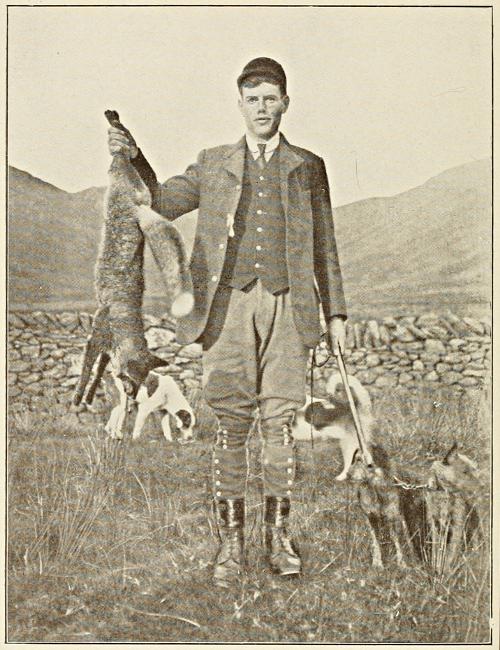
ULLSWATER FOXHOUNDS: B. WILSON, THE WHIPPER-IN.
Some foxes are almost impossible to keep out
of such places. Despite halloing and whip-cracking
they will be in, no matter what you do.
Others, again, sheer off at the slightest hint, and
seek refuge elsewhere. Sometimes a fox has to
get to ground where he can, and I have seen one
get into what on the surface appeared to be quite
a simple spot, defy all the best efforts of terriers
and men to dislodge him.
As may be imagined, the huntsman to a fell
pack must be a hard and tireless walker, for he has
many miles of rough ground to cover from the time
he leaves kennels in the morning until his return
at dusk or later. Even he gets tired at times,
but if it is humanly possible he will get all his
hounds back to kennels before dark, or, at any
rate, the same night.
Sometimes hounds have to be left out, but by
the following day most of them will have found their
way home again. On these occasions one or two
of them may visit the farms or other places where
they spend the summer, if anywhere near them;
and after a feed or a sleep, resume their journey.
It is surprising how hungry one gets on the
fells. I remember on one occasion following
hounds from the Scandale valley, near Ambleside,
over Fairfield, across Deepdale, and out again to
the summit of Helvellyn. I was with the huntsman,
and both of us had eaten our lunch some
hours previously. On the summit of Helvellyn
is a seat, and round it that afternoon were scattered
a lot of banana peelings. We were so hungry
that we barely refrained from eating the latter.
We have often laughed over it since, and I
remember I made up for it with bread and cheese
and beer when we got down off the mountain at
dusk.
It is always advisable to take sufficient food
with you on these occasions, for you are never
quite certain when you are going to get the next
meal.
Although some of the best sport is experienced
in the cold weather, I have enjoyed some very good
hunts in October, as well as spring. When foxes
begin to bother the lambs, hounds are called upon
to account for the offenders. It is, of course,
necessary to meet very early at this time of year, as
the sun soon dispels the dew, and scent is then often
conspicuous by its absence. It well repays one
for leaving one’s bed at an unearthly hour, however,
when hounds do get away with their fox, for the
temperature is such that one can sit about the
tops in comfort, and thoroughly enjoy both the
magnificent views and the sport. Many a May
fox is rolled over by the fell packs, for the
dalesmen’s flocks have to be made safe from any
marauding vixen which takes toll of them for her
cubs.
Harking back for a moment to fell terriers,
people’s ideas appear to differ very considerably
as regards the make and shape of a dog used solely
for sport.
A terrier for work on the fells must be able to
squeeze through very narrow places, be active
withal, and sufficiently high on the leg to enable
him to follow the huntsman through snow or rough
ground without tiring. Some people imagine
that a terrier when creeping through a narrow
place works himself along on his chest, and they
conclude that a wide-chested, short-legged dog
is the best for the purpose. As a matter of fact,
the dog lies on his side, and works himself ahead
with his legs. For this reason, an apparently big
dog, that is, one fairly high on the leg, narrow, but
deep through the heart, can get into some remarkably
tight places. Terriers of the Sealyham type,
short-legged, and broad-chested, whilst able to
work in big badger earths, or wide drains, fail when
it comes to negotiating narrow cracks and crevices
in the rocks, such as foxes are so fond of taking
refuge in, on the fells. It matters not how a
terrier is bred, or what sort of a mongrel he is, so
long as he is a worker, game and courageous to go
up to his fox, bolt him, or make an end of him.
“Handsome is as handsome does” is the motto
on the fells, where nothing but real hard workers
are tolerated for a moment.
Once a year there are certain shepherds’
meetings held in the Lake country, for the exchange
of sheep which have strayed. The two best known
of these are held at the “Traveller’s Rest” inn
on top of the Kirkstone Pass, and at the “Dun
Bull” inn in Mardale.
On these occasions the foxhounds grace the
meetings with their presence. The Coniston Foxhounds,
and the Windermere Harriers attend the
Kirkstone gathering, while the Ullswater provide
sport at Mardale. This year (1919) the “Victory
Meet” of the shepherds took place in Mardale on
November 22nd. This gathering is one of the
oldest of its kind in the country, and has been kept
going for generations. How regular has been the
attendance of some of the old-time dalesmen and
shepherds may be gathered from the fact that a
few years ago, one Thomas Fishwick put in his
sixty-sixth annual appearance, and there are many
others who have attended this meet for a score of
years or more.
Special interest was attached to the “Victory
Meet” in Mardale, as it was rumoured that it
might be the last, owing to the acquisition of
Haweswater by the Manchester Corporation. When
the proposed scheme is completed, the famous
“Dun Bull” and Mardale Church will be inundated.
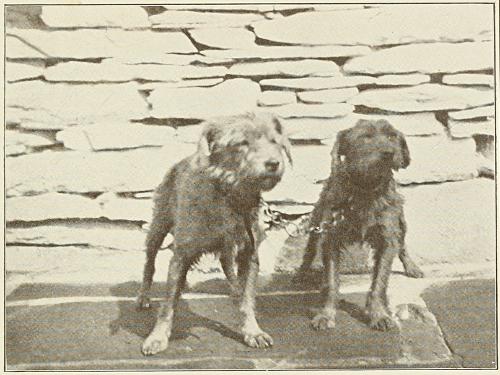
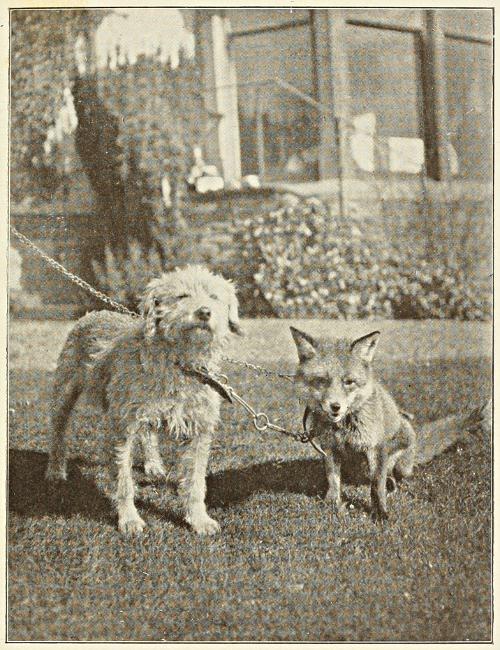
“PINCHER” AND “MYRTLE.” Two Coniston Hunt terriers.
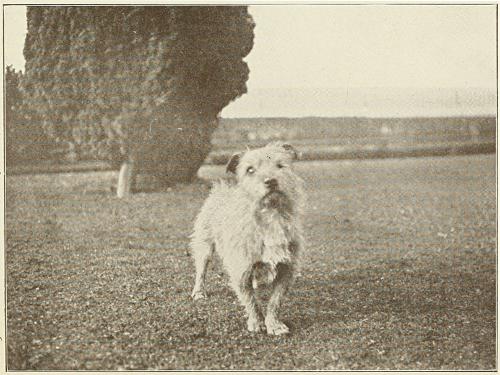
“JUMMY.” A terrier which did much good work for the Coniston Hunt.
In addition to a hunt, a hound-trail is held at
Mardale. Some of the upholders of the fashionable
hounds in the Shires, who believe that this
type is second to none for pace, would, I think, be
inclined to change their opinion, if they timed one
of these trails. The hounds entered are nothing
more than fell foxhounds. Sometimes one of a
litter bred at the kennels goes as a trail hound,
and vice versâ. Yet, with all their pace, these
hounds can hunt a cold line with the best, and
will let you know all about it whilst they are
doing it.
I have already mentioned the fact that the
fell hounds pick up the drag of their fox, and work
this out until they reach his hiding-place and
unkennel him.
Sometimes the drag covers a long distance.
When the Rev. E. M. Reynolds was Master of the
Coniston Hounds, the latter picked up a drag near
Rydal Park, carried it over High Pike up to Hart
Crag, and down the ridge into Hartsop, where they
unkennelled their fox in Low Wood overlooking
Brothers’ Water. On another occasion the same
pack struck a drag in Skelghyll Wood, near
Windermere Lake, carried it forward the entire
length of the Troutbeck valley, and out at Threshwaite
Mouth at the fell head, unkennelling their
fox about a mile beyond the last-mentioned point.
As a rule, it is pretty safe to say that a drag which
leads towards the high ground, is right, though on
occasion such a line may prove to be heel-way.
Even old and experienced hounds are not
infallible when it comes to differentiating between
the right way and heel, despite the fact that one
meets people who swear their hounds won’t run
heel. After covering a lot of rough ground on the
drag, and having at last unkennelled your fox,
the real business of the day has only just begun.
Before night, if you are in pursuit of an old stager,
you may find yourself many miles from home,
with darkness coming on, and a rough track to
follow.
One of the longest, if not the longest, hunt I
ever took part in occurred on January 15th, 1914.
The Coniston Hounds met that day at Strawberry
Bank, in the Winster valley. They found their
fox at 10 o’clock, and the last followers of the field
which started out in the morning, acknowledged
themselves beaten at 5 p.m. Hounds ran for
several hours longer, until darkness enabled the
fox to finally shake off his pursuers. From the
time hounds unkennelled their fox, until they were
run out of scent, was 9½ hours, sufficient, I think, to
constitute a record.
Such a day is one to be set down in red ink
in the hunting diary.
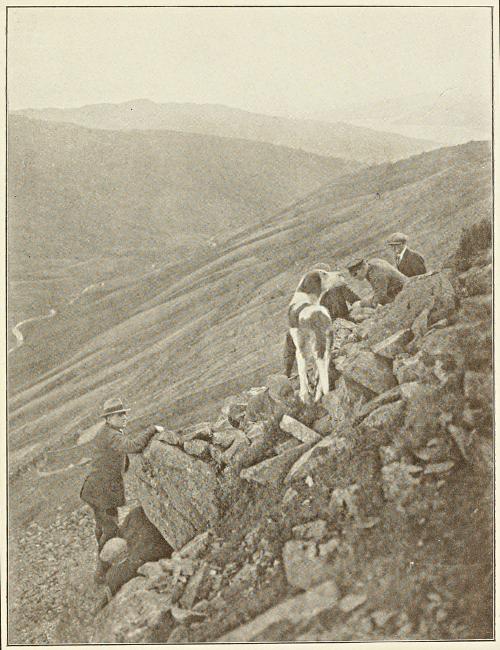
ULLSWATER FOXHOUNDS: GONE TO GROUND BELOW HIGH PIKE IN
THE SCANDALE VALLEY.
Taking it all through, the fell country carries a
good scent, except in early autumn and spring,
when the sun exerts considerable power, and the
bracken and dead leaves get very dry. There is
little limestone in the district, but now and then
hounds run a fox to such places as Whitbarrow,
where, unless the atmosphere is very damp, they
often experience considerable difficulty in sticking
to the line. “There’s nowt sae queer as scent,” and
though we sometimes think we know a good deal
about it, there generally comes a time when all our
prophecies prove wrong. Now and then in the
fell country there comes a day when the atmosphere
is very clear, and there is an absence of wind.
Overhead the clouds look heavy, and the day may
be described as “dark.” The colour of the distant
hills tones off from indigo to mauve; but for all
the general effect of darkness, every stone and
crag shows up distinctly. On such a day I have
often known a screaming scent, while hounds
could be both easily seen and heard.
Jorrocks, wise old bird, said, “Take not out
your ’ounds upon a werry windy day,” and his
advice is good, but for all that I have seen hounds
run like mad in a gale, screaming along yards
wide of the line, the scent drifting with the
wind.
There are, of course, several factors that have
an influence on scent. There is the fox himself,
the nature of the soil (clay, gravel, etc.), the condition
of the surface, such as grass, plough, moorland
or woodland; the temporary state of the
surface, wet, dry, dusty, etc.; and the state of the
weather.
As far as the fox is concerned, there is little
doubt that he and his relations vary considerably
in the amount of scent they give off. Much
depends too, upon the behaviour of a fox, as to
whether hounds can make the best use of his line.
A straight-running fox is easier to hunt than a
twisting one, while the body-scent—i.e. scent
retained by the atmosphere—allows hounds to
run with their heads up, the scent being “breast
high.” That scent is often far too high I have
proved over and over again. Many a time I have
been walking to a meet, and at some favourite
crossing place for foxes on a road, or elsewhere, I
have caught the scent of a fox quite strongly.
Whenever scent has thus been retained high in
the atmosphere, I have never seen hounds able
to run fast, for it is over their heads, and they
cannot reach it. In the case of foot-scent, such
as is left on a cold drag, hounds have to get their
noses right down to it, and work it out patiently.
Foot-scent will lead hounds to the exact spot where
a fox jumps a wall, or creeps through a hedge,
whereas with body-scent they may run fast, but
quite wide of the exact line of their fox, the
distance varying with the amount of wind. On
a real good scenting day the scent appears to
remain “breast high,” whereas on a bad scenting
day, it disappears quickly, or rises too high for
hounds.
Whenever a hunted fox is coursed by a shepherd’s
dog, hounds invariably have great difficulty
in owning the line afterwards. It seems as if
the sudden fright contracts the glands, or whatever
it is that permits scent to exude from the fox, and
the scent never again appears to regain its original
strength.
Water often saves a hunted fox, for I have
known many a one practically beaten, be completely
lost after it had entered a stream. As
the fox’s strength fails, scent becomes weaker
to some extent, and it only needs a sudden fright,
like the appearance of a cur dog, or an unexpected
halloa, to cause it to fade altogether. For this
reason one cannot keep too quiet when hounds
are running almost in view of their beaten fox.
An injudicious halloa at such a time gets their
heads up, and it is ten to one that the fox makes
good his escape. Hounds know very well when
they are closing up to their fox, and they require
no outside assistance to expedite matters.
If hounds get away on top of their fox on a
good scenting day, his doom is very likely to be
sealed, no matter how fast he runs. If, however,
he kept up the same pace for the same length of
time on a moderate or bad scenting day, he would
outrun them, especially if he put in a few sharpish
turns.
Luckily for hounds, a fox never goes far at
his best pace unless hard pressed, instead he places
a convenient distance between himself and the
pack, and accommodates his pace to theirs. If he
ran his hardest on a bad scenting day he would be
liable to run into other dangers ahead, for, for all
he knows, there may be other hounds in front of
him, so he travels as slowly as he dare, while
keeping a good look out.
Very high wind is not, as a rule, conducive to
scent, but I have seen hounds run fast in such
wind, which, in addition to being strong, was
exceedingly cold. In December of this year (1919)
one of the fell packs ran a fox up-wind against an
icy gale on the tops, when the wind was so strong
that we who were following them had more than
once to lie down or be blown over the edge of the
fell.
Rain, wind, and sun are responsible for the state
of the ground, and exert their influence on scent.
Too much rain is bad for scent, as the land gets
waterlogged. Roughly speaking, scent appears to
lie best when the ground is in good riding condition.
Wind and sun dry out the ground and
harden it, and frost does likewise. Hounds will
always run better when it is hard with drought
or frost than when it is very wet and holding.
Grass generally carries a better scent than plough,
though the latter in some districts appears very
favourable to it.
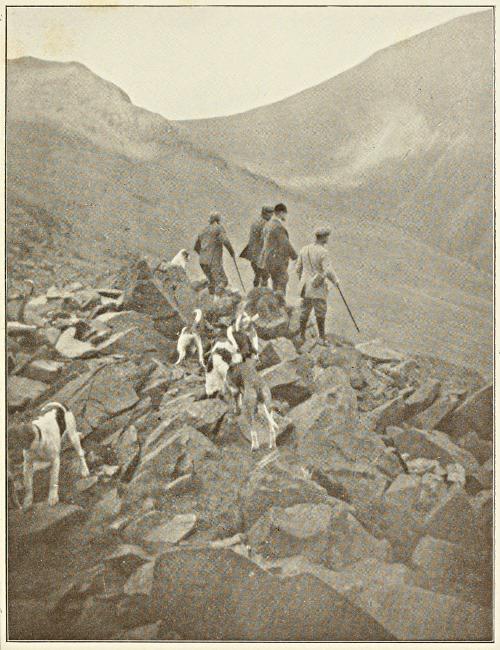
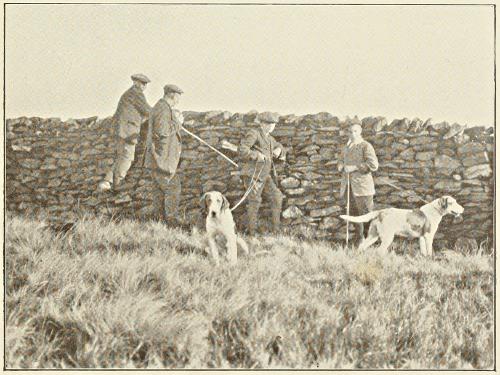
CONISTON FOXHOUNDS: WATCHING A HUNT FROM BROAD HOWE
“BORRAN.”
The nature of the soil, being permanent, has
much to do with scent. I am inclined to think
that poor land carries a better scent than good
land, while heather and moorland are more
conducive to it than cold grass fields.
I know a district, all grass and moorland, in a
limestone country, where scent lies very well
indeed, except actually on the bare limestone.
On the extensive outcrops of this kind of stone
hounds are generally brought to their noses, unless
the limestone is damp with rain.
A white frost is often bad for scent, and almost
always so if the sun gets out at all warm. In the
afternoon, should the ground harden again, hounds
may be able to run quite well. I have noticed
that towards evening, under varied conditions of
weather, scent is often better than earlier in the
day. Snow, if damp, and not too deep, often
carries a good scent. In deep, soft snow, hounds
can soon account for their fox if they get away
close to him, as their greater length of leg gives
them the advantage in such “going.”
When all is said and done, there appears to be
no absolute rule to go by regarding scent. The
“dark” day previously mentioned comes pretty
near to it, however, and I always expect good
scenting conditions on such a day.
Seeing that the true charm of all field sport is
its “glorious uncertainty,” it is perhaps just as
well that we cannot pick and choose our hunting
days, but must take the good with the bad, and
be thankful for them.
“So I wish you good speed, a good line, and a lead,
With the luck of each fence where it’s low,
Not the last of the troop, may you hear the Who—whoop,
Well pleased as you heard Tally-Ho!”