London:
C. H. KELLY, 2, CASTLE STREET, CITY ROAD, E.C.;
AND 66, PATERNOSTER ROW, E.C.
1892.
Printed by Hazell, Watson, & Viney, Ld., London and Aylesbury.
PREFACE.
I had certainly no intention of writing a book when I
commenced to put together the information contained in
these pages. All I purposed to do was to prepare a short
report of work done. But I found that the interesting
material at hand was too abundant to be compressed within
the limits I had originally intended.
The need for a better knowledge, on the part of our
English people generally, of the distant dependencies of
the British Empire is undeniable, if they are to discharge
at all intelligently the duty of governing the many races,
which the circumstances of an ever-widening empire, and
the extension of the parliamentary franchise, have placed
in their hands. The story is told of a member of Parliament
who did not know Burma from Bermuda; and as I
have myself found the very same confusion of the two
places, in three separate instances, by gentlemen that
might have been thought fairly well educated, to say
nothing of a respectable alderman who asked whether
Burma was an island, and frankly admitted he was very
ignorant about it, I can quite believe the story to be true.
Not only is there a need for more knowledge of the
countries and races we govern, there is also a demand for
it. The events of recent years, especially those resulting
from the annexation of King Theebaw’s country, have
drawn Burma into much closer touch with England; and
many people, by no means ignorant of Burma before, now
feel a much deeper interest than formerly in all that
pertains to that interesting country, whose destinies are
henceforth so intimately bound up with our own.
I have endeavoured to draw as faithful and accurate a
picture as possible of the country and people, and I have
tried to show, from the standpoint of a sympathetic but
impartial witness, what the annexation of an Oriental
country like Burma really means, what are its immediate
results, and what are the many strong points and the few
weak points in our rule.
In seeking to raise the condition of a heathen people no
remedy can be regarded as a substitute for the Gospel. We
value civilisation very highly, with all that it implies in
our case—in the way of good government, material prosperity,
the amelioration of the conditions of life amongst
the people, the progress of knowledge, and the introduction
of the arts and conveniences of life—but the only true basis
for the highest type of civilisation is the Gospel of Jesus
Christ. The best instances of a civilisation without the
Gospel are in the East, but even the civilisation of the East
is, at its best, an arrested civilisation. Those races are
“civilised but not enlightened”; they always stop short
of that capacity for constant progress which characterises
only the nations that have embraced the Gospel; and they
achieve that capacity when they have embraced it. Hence
the carrying on of evangelistic work in Burma is a matter
of great importance, and my earnest desire is that this little
work may do its humble part in deepening that prayerful
interest upon which missionary effort depends for its
support and continuance.
In addition to those authors that I have consulted on
Burma, and have quoted here and there in the course of
this work, I would especially mention my indebtedness to
that most appreciative and sympathetic observer of the
Burman, Mr. J. G. Scott (Shway Yoe), whose work, in two
volumes, entitled The Burman: his Life and Notions, gives
perhaps the best and most complete account of the Burmese
people that has yet appeared. I have availed myself of his
extensive information to confirm or supplement my own in
points where it is obvious that four years was not a long
enough period upon which to form a reliable judgment.
Transcriber’s Note: Map is clickable for a larger version.
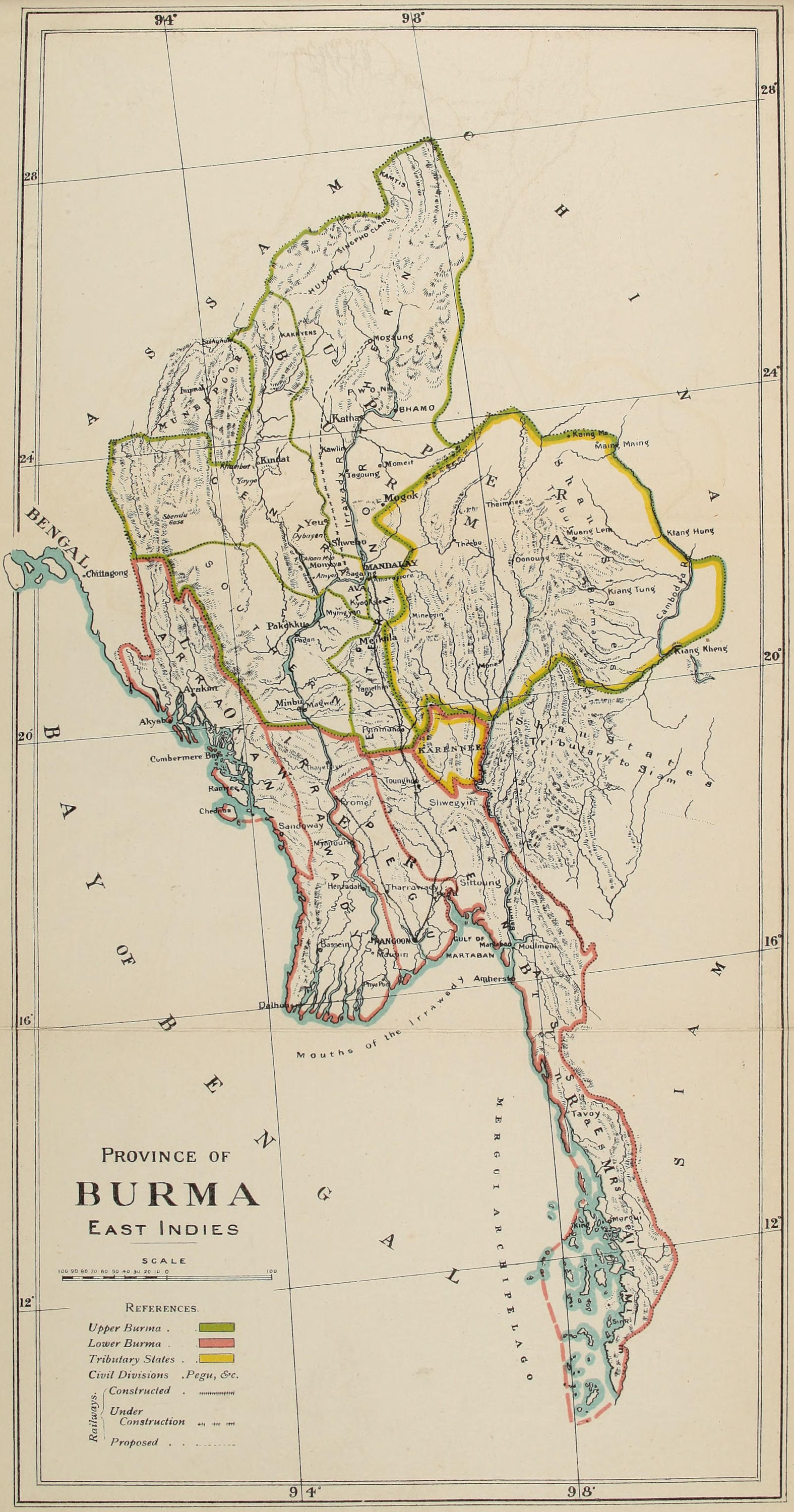
Province of BURMA
East Indies
FOUR YEARS IN UPPER BURMA. — CHAPTER I. INTRODUCTORY.
The annexation of Upper Burma on January 1st, 1886, opened
up to England a large and valuable addition to her foreign
possessions, whilst it perceptibly widened the ever-increasing area
of her responsibilities, both political and moral. Including the
Shan States tributary to the kingdom of Burma, the annexation
added to Lower or, as it was then called, British Burma,
a territory as large as France, thus making all Burma a compact
province of our Indian Empire, as large as France and Great
Britain together, and bringing British India right up to the
frontiers of China.
The resources of Burma are very considerable. Its mineral
wealth includes gold and silver, iron and tin; its mines of rubies
and sapphires are noted all over the world; its coal and earth-oil
are likely to prove of great value; jade, a green stone much
prized in China and Japan for the manufacture of bracelets and
trinkets, is found in large quantities in Upper Burma, and amber
is met with in the northern parts of the country. As the country
and its productions become opened up, these treasures are sure
to receive the attention they deserve.
The soil of Burma is generally very fertile, and with its
diversified elevation and climate of mountain, plain and tableland,
almost every variety of tropical productions can be grown, as well
as many belonging to the temperate zone. Lower Burma, especially
the great delta of the Irrawaddy, affords unrivalled scope
and suitable climate for the growth of rice, the staple food of
so large a part of the human race. The area under cultivation
for rice in Lower Burma is 4,339,000 acres, and for other crops
474,000 acres, and besides all local consumption, there is the
enormous total annual export of rice by sea of 1,145,000 tons.
The dry climate and rich soil of Upper Burma render it more
suitable for the growth of wheat, maize, cotton, and many native
grains, vegetables and fruits than for rice. On the mountains
indigenous tea is grown, is manufactured by natives, and can
be bought in any bazaar. Burma is the chosen home of the
teak, that prince among timber trees. The reserved forests
are under the care of a Government Department for forest
conservation, and are the property of the Crown. They cover
an area of several thousand square miles, and yielded in the year
1889-90, 260,074 tons of teak, beside other valuable timbers and
forest productions, including indiarubber and cutch. Cutch is
the common commercial name for a product of the Acacia
Catechu tree, very valuable as a dye. These forests brought
into the public revenue, when all expenses were paid, a net
surplus of 3,388,400 rupees for the year 1889-90. The export
of teak timber, chiefly for the European market, amounted
to 184,431 tons, and the average value was about £10 a ton.
Thus Burma is already a country of great material wealth, with
vast possibilities of growth and development.
According to the census of 1891 the population of Burma,
including the Shan States, is 8,098,014. This total is made up
as follows:—
Lower Burma
with an area of
87,957
sq. mls.,
population
4,658,627
Upper Burma
””
83,473
”
”
3,063,426
Shan States
””
40,000
”
”
375,961
8,098,014
With regard to the population of the towns, Mandalay stands
first with 188,815. Next to this is Rangoon, the capital and
the seat of Government, with 180,324; Maulmein has 56,000.
The rest of the towns are considerably smaller.
The population of Burma is scanty in proportion to its area
and resources; in fact, population is the great requisite for the
development of the country. The quickening touch of British
rule and commerce is effecting much in the direction of supplying
this need. Every district, without exception, in Lower Burma
shows an increase in the last ten years, an increase of 22 per
cent. on the whole. The Indian Government is disposed to make
the rich province of Burma an outlet for the congested populations
of some of the provinces of India, and the great steamer
companies are accomplishing this by conveying many hundreds
of natives every week from the Indian ports to Rangoon, thereby
enriching themselves, enriching Burma, and giving to these people
a sphere and a chance in life, where their humble energies may
receive their due reward. It is in manifold ways like this that
civilisation and a firm and enlightened rule bestow such blessings
on these teeming Oriental populations. The number of these
immigrants from India into Rangoon, the chief seaport of Burma,
during 1890 was 86,609. Owing to the customs of the natives
of India, and their reluctance to break entirely away from home
and country, there were in that year 65,055 who returned to
India. This leaves a balance of over 20,000 for the year, which
may represent approximately that very welcome addition to its
population which Burma receives from India year by year.
Rangoon itself is largely Indian in population, and Indians are
to be found all over the country in great numbers.
Both Upper and Lower Burma have yet large tracts of waste
land, unoccupied territory that would well repay cultivation, and
it is to be hoped that an agricultural population will be attracted
from India. Should the railway system of Burma, now being
rapidly developed, be united to that of India, that will no doubt
be brought about in course of time. As the price of labour,
roughly speaking, is 100 per cent. more than it is in India, and
as the cost of living is not more than 50 per cent. higher, the
balance is decidedly in favour of the immigrant.
Burma is watered by magnificent rivers. Chief of these is the
Irrawaddy, with Rangoon near its mouth, and chief among its
tributaries is the Chindwin. Both these rivers are great arteries
of trade, being navigated not only by great numbers of the quaint-looking
Burmese vessels, but by the large and powerful steamers
of the Irrawaddy Flotilla Company, which, since 1867, has been
trading on these rivers. Their steamers now ply regularly several
times a week up the Irrawaddy to Mandalay, 500 miles, and
even as far as Bhamo, some 250 miles farther, and up the
Chindwin as far as Kendat. These steamers are splendidly built
of steel, with flat bottom, and lower and upper deck, with ample
accommodation both for saloon and deck passengers, and are
fitted throughout with the electric light. Some of them will
carry considerably over a thousand passengers besides cargo.
Historically Upper Burma is a land of great interest. It was
all that remained of the once powerful Burmese empire, which
in the early part of this century was strong enough to menace
our Indian territory, and extended from Siam, in the south, to
the confines of Bengal, in the north, and from China to the Bay
of Bengal.
Each of the three Burmese wars has arisen in a similar way,
and has been marked by the same features on the part of the
Burmese Government,—viz., an unwillingness to listen to reason,
with much bluster and ignorant self-sufficiency at the outset,
and inferior military qualities in the performance,—and each has
resulted in the annexation of some part of the kingdom to British
territory. Arakan and Tenasserim were acquired by treaty after
the first Burmese war in 1824-26; the province of Pegu was
occupied and retained, consequent on the second war in 1852-53;
this gave us the command of the Irrawaddy, with Rangoon for
a seaport; the third and last war, in 1885, took away all that
remained of Burmese rule, and the kingdom of Burma became a
thing of the past.
Much may be said against war in the abstract, and against
wars of this description in particular. It would be easy to represent
such a war as this, so far away from England, as aggressive
and unjustifiable. I am no advocate for war of any kind, and
I am not anxious to defend this action of England in conquering
and annexing the last remnant of the Burman kingdom. But I
can see that a question of this kind is not to be so summarily
settled as may appear on the face of it.
England long ago embarked in India on a career of empire,
prompted rather by the force of circumstances than of set purpose;
and now it often seems difficult to decide when to go forward and
where to stop. I will not attempt to unravel this tangled skein,
but will merely say that, leaving aside the questions of how
England came by her vast power and influence in the East, and
whether she ought ever to extend it, and if so under what circumstances,
it seems to me that ultimately and finally the verdict
must turn on the use she makes of this unique position, and
what she accomplishes with her unrivalled opportunities in the
material, intellectual, social and moral advancement of the many
races and nations that she rules or protects.
Coming now to the immediate causes of the Burmese war of
1885, the following is the official account of them from the British
standpoint:—
“Complaints against the Burmese Government meanwhile
multiplied, British subjects suffered insult and violence at the
hands of local officials, and no redress could be obtained. Trade
monopolies were created in defiance of the express terms of the
Treaty of 1867. The disorganisation of Upper Burma infected
with disorder the adjacent districts of the British province.
Negotiations were carried on by the Burmese Government for
the purpose of contracting close alliances with other European
countries, to the studied neglect of England. These causes had
contributed to make the situation very unsatisfactory to the
British Government, but were not such as to demand active
interference. A casus belli arose, however, out of a specific act
of the Burmese Government, who raised a large claim, amounting
to several lakhs of rupees, against the Bombay-Burma Trading
Corporation, a company of merchants, mainly British subjects,
who had a large business in Upper Burma. In view of the
magnitude of the claim, and of the interests of British subjects
involved, mediation was attempted by the British authorities in
order to ensure an impartial investigation. The mediation was
ignored; and the company, without being allowed reasonable
opportunity for defending themselves, were condemned by the
Burmese Council to be mulcted to the amount of 2,300,000 rupees.
The British Government protested against this arbitrary act;
and their demand to have the proceedings stayed until the matter
had been referred to an arbitrator was peremptorily refused. It
was on this refusal that the British Government decided to send
to the King of Burma an ultimatum, which should be designed
to adjust once for all the relations between the two countries.
The ultimatum required the king not only to suspend proceedings
against the corporation, and to receive an envoy with a view to
the settlement of the matter at issue, but also for the future to
permit the residence at Mandalay of a British agent, who should
be treated with due respect. It was added, too, that the external
relations of Burma should in future be regulated in accordance
with the advice of the British Government, and that facilities
should be given for opening up trade with China. This ultimatum
was dispatched on October 22nd, 1885, and a satisfactory reply
was demanded by November 10th. On November 9th the reply
was received, containing an absolute refusal of the proposed
terms. Moreover, on November 7th a proclamation had been
issued by the King of Burma, calling on his subjects to rally
round him, that he might annihilate these heretic foreigners,
and conquer and annex their country. The ultimatum had thus
led to war. The expeditionary force, already prepared, crossed
the frontier on November 14th, and within a fortnight from
that day Mandalay had been occupied by General Prendergast
and his troops, and the king was a prisoner. The only serious
resistance met with had been at Minhla.”
Such were the events leading up to the war. The demands of
the British Government seem not unreasonable, but the stubborn
folly of the King of Burma refused them. One cannot but
regret that the resources of modern civilisation have as yet established
no alternative in such a case of a petty Oriental monarch
and a great power like England but an ultimatum and war.
King Theebaw was such a ruler that it was in vain to think of
reinstating him; no other likely ruler was to be found; annexation
was the only way to meet the case. The king was removed
to India with his family, his retinue, and his chief astrologer,
and there he has been in gilded seclusion ever since. On January
1st, 1886, the proclamation was made that Upper Burma was
annexed to our Eastern possessions, and the fact came home to
the British mind that a large, valuable, interesting country was
now open to British enterprise and incorporated with our Indian
Empire.
To the Christian public of England the announcement of the
annexation came as a call to duty in regard to the spread of the
Gospel amongst a people who had long been suffering from a cruel
and tyrannical ruler. From time immemorial the palace of the
Burman rulers, chiefly owing to the general practice of polygamy
on the part of the kings, and the consequent troops of queens and
princes and princesses, has been the scene of much intrigue and
corruption, and occasional bloodshed and revolution. Absolute
monarchy is almost inseparable from occasional acts of cruelty
and tyranny, even if just and kind in the main. But a weak
ruler with an insecure title, like the last of the Burmese kings,
cannot afford to be lenient, and is more likely to be cruel than a
stronger man would be. The disorders of the reign of King
Theebaw had made a deep impression on the English mind. He
had gained the throne by a court intrigue, for he was not the
rightful heir, so that he had to keep by force what he had got by
fraud. The result was the massacre of about seventy of the
royal family, who were put to death as possible rivals of the new
king. That was in 1879, but a greater massacre occurred in
1884, when, owing to the intrigues of certain Burman officials,
an attack was made upon the jails of Mandalay, and over three
hundred persons were put to death, including some inoffensive
princes.
As a very striking proof of the fact that the country was in a
most wretched state, bordering on anarchy, by reason of misgovernment,
extortion, bad trade and dacoity, it may be mentioned
that in a few years no less than ten thousand people of Upper
Burma had crossed the border and taken up their abode in British
Burma, in order to escape oppression, and live in security under
a more beneficent rule. The tide of population has since the
annexation been flowing back to Upper Burma.
Naturally much interest was felt in England over the altered
condition of things, and thousands of Englishmen, on seeing the
news of the annexation, felt that no time should be lost in securing
to the Upper Burmans the liberty of British subjects, and
that security to person and property enjoyed by all who are under
British rule; and many felt, above all things, that it was a call to
give them the Gospel.
CHAPTER II. THE JOURNEY TO MANDALAY.
It was in the month of January 1887 that I left Calcutta, in
company with my old friend and former colleague, the Rev.
J. Brown, of Calcutta, for Burma. We were on a prospecting
expedition with a view to the establishment of a Mission in
Upper Burma. On reaching Rangoon we were cordially received
by the members of the American Baptist Mission, and spent a
few days there. Rangoon is one of the most remarkable cities
in the East for rapid growth and commercial prosperity. It was
only after the second Burmese war in 1852-53 that it became
British territory. Since then it has grown to be a city of 180,324
inhabitants. This population is by no means all Burman, but
is largely English and Eurasian, Indian and Chinese. Its railways,
steam tramways, public buildings, sawmills, ricemills, the
shipping at anchor in the river, its banks, warehouses, public
buildings and shops, at once proclaim it the busy capital of Burma,
and in all probability a place destined to see a still greater and
more prosperous future as the resources of the country develop.
After a day or two spent in Rangoon and a visit to Toungoo,
we proceeded by rail to Prome, which is some 150 miles from
Rangoon, and there we embarked on the Irrawaddy by one of
the Irrawaddy Flotilla Company’s splendid river steamers for
Mandalay. It was then a time of great demand for transport,
on account of the military operations for the pacification of Upper
Burma, so that there were, in addition to a large number of
Burman and Indian passengers, many military men coming and
going. On that occasion we had over a thousand passengers
on board. Not long after leaving Prome we passed what was
formerly the British frontier station and port of Thayetmyo.
Henceforth the contrast between the trim neatness of the towns
under British rule and those of the Upper country was sufficiently
apparent; and for many a long day after, the frequent sound of
the bugle, and after dark the challenge of the sentries, together
with the very warlike state of the news, and the constant sight
of soldiers and police, always fully armed, and of gangs of dacoits
being brought in manacled, kept us in mind of the fact that we
had come to a land where the security of life and property we
were accustomed to was only in course of being established.
Towards sunset we reached Minhla, on the right bank of the
Irrawaddy; and as we made fast for the night right opposite, we
had time before it was dark to step ashore and climb the precipitous
bank and look over the redoubt, the taking of which was
the only action worth mentioning in the expedition. It is a
square-built stone fort, and was well manned with Burmese troops.
The British force went round by the jungle, and got to the
back of the fort, where there was a way leading up to the
ramparts; and having fought their way up to the summit, the
Burmans inside were at their mercy, as the machine guns in
the armed steamers on the river covered the exit by the front.
Thus the place was taken.
Next morning saw us steaming away again up the river. The
scenery varies much. Now the banks of the river are flat,
showing the country for miles, and again high banks and rolling
hills diversify the scene. Further up, near Bhamo, in the defiles,
the mighty river has forced its way between high mountains
which rise suddenly from the water’s edge, and the scenery there
is majestic. Numbers of villages and small towns are seen on
the banks of the river, for here, as elsewhere, the fresh water of
the river means life to man and beast, and verdure and freshness
to the crops irrigated from it.
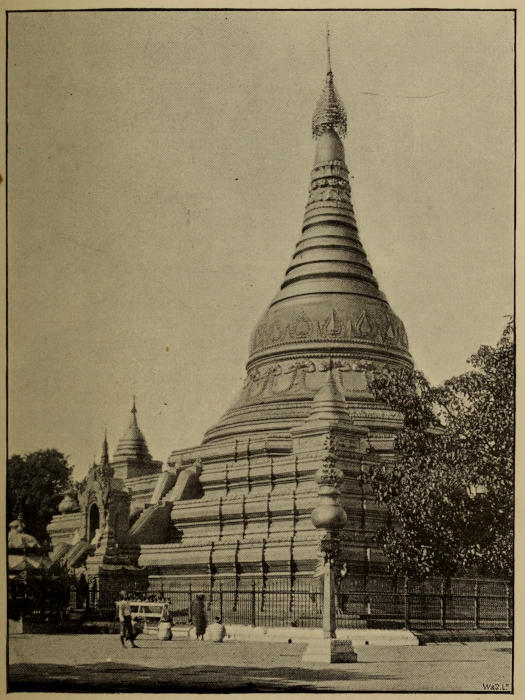
Almost every hill and knoll for much of the way has one or
more of the dazzling white, bell-shaped, brickwork pagodas so
common all over this Buddhist land, in most cases surmounted
with the “htee” or “umbrella,” a large iron framework of that
shape, richly covered with gold leaf; and at various points the
pagoda is hung with numbers of bells, that tinkle musically with
every breeze. The number of pagodas is truly astonishing, and
the amount they must have cost is one of the marvels of this
strange and interesting country.
Pagodas are seen everywhere and in large numbers. Not only
is there hardly a village without them, but they are to be seen
on lonely hillsides and hilltops in abundance, and sometimes in
almost inaccessible places, on some crag or ledge of rock overlooking
the plain. The reason for this vast multiplication of
pagodas is not far to seek. Of all works of merit none is so
effectual as the building of a pagoda.
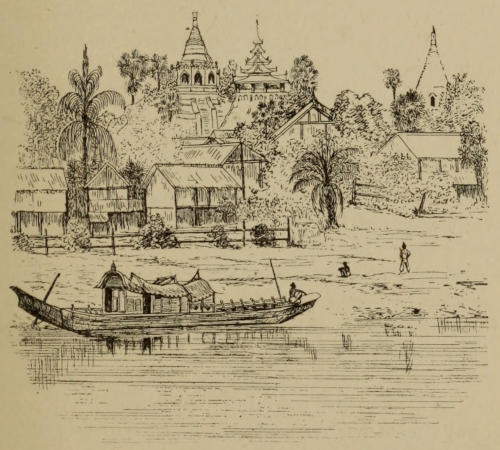
A VILLAGE ON THE IRRAWADDY.
The following day, in the early morning twilight, we passed
Pagân, a most remarkable place on the left bank of the river.
It is one of the many former capitals of Burma, being the Royal
City in the thirteenth century, but is now practically deserted,
except for a few hundreds of pagoda slaves—an outcast class,
condemned under Burmese rule to lifelong and hereditary service
about the religious buildings.
“It is practically,” says a recent writer, “a city of the dead;
but as a religious city, it is certainly the most remarkable and
interesting in the world, not excepting Mecca, Kieff or Benares.
For eight miles along the river bank, and extending to a distance
of two miles inland, the whole surface is thickly studded with
pagodas of all sizes and shapes, and the very ground is so thickly
covered with crumbling remnants of vanished shrines, that
according to the popular saying, you cannot move foot or hand
without touching a sacred thing. A Burmese proverb says there
are 9,999. This may or may not be true; but in any case it is
certain that an area of sixteen square miles is practically covered
with holy buildings. They are of every form of architecture and
in every stage of decay, from the newly built fane glittering in
white and gold, with freshly bejewelled umbrella on its spire, to
the mere tumulus of crumbling brick, hardly to be distinguished
now from a simple mound of earth.”
They are also of very various sizes, some of them being fine
and imposing buildings, and others very small. What a weird
sight it was, in the dim twilight of the early morning, to see from
the upper deck of the steamer, passing before us like a panorama
for eight miles, the towering growths of many centuries of vain
offerings, of useless and unavailing endeavours. All was dark
and gloomy; mist and the dim twilight covered everything. It
was the abode of the dead. Those pagodas were the memorials
of a dead faith, and all the self-sacrifice that produced them was
but elaborate self-seeking. The buildings seen in the distance
put me in mind of a cathedral city, but it was a chilling thought
that amid all that grim and solitary vastness there were neither
worshippers nor worship—nothing, in fact, but a dreary waste of
pagodas, most of them in various stages of decay. A subsequent
visit to Pagân, and the more leisurely survey of this marvellous
place, made one feel still more the sadness of the spectacle of this
untold expenditure of property and labour, and the result neither
honour to God nor benefit to man. Such is human “merit,”
and such are all attempts to accumulate a store of it.
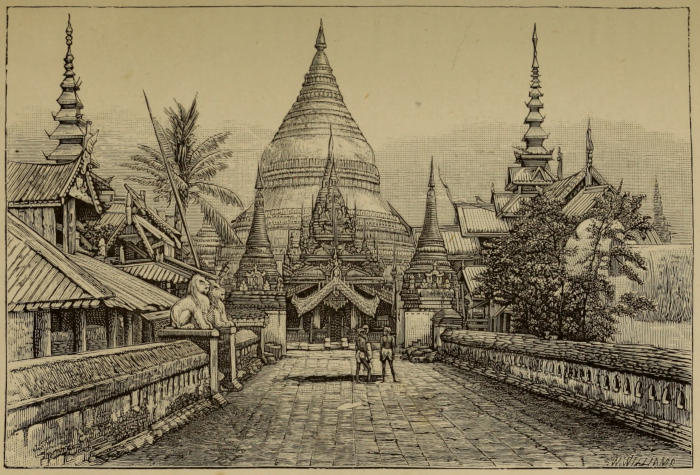
ENTRANCE TO A BURMESE PAGODA.
It is a curious feature about pagodas that though so many are
seen going to decay they still continue to build. The explanation
of this is that the work of special merit is to build a pagoda, and
no special merit attaches to the work of restoration or repair,
except in the cases of the few pagodas of great renown, which are
greatly resorted to by worshippers and pilgrims.
On the morning of the fourth day from Prome we reached
Mandalay. Here we met the Rev. J. H. Bateson, who had
arrived three weeks before, having come out from England in
the capacity of Wesleyan chaplain to the Upper Burma Field
Force.
The first thing to attend to after we had looked round a little
was to find a place to lodge. This matter was soon settled by
our Army chaplain taking us to the quarters which had been
assigned to him by the military authorities. This lodging was
novel, for it consisted of one of the buildings belonging to a large
Buddhist monastery, substantially built of teak, and with the usual
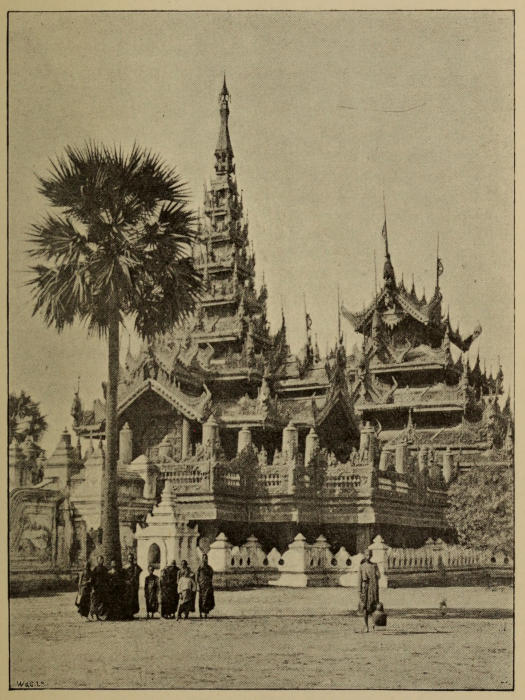
highly quaint, ornamental and fantastic-looking roof, richly decorated
with most elaborate carving all over, and tapering at one end
into the form of a spire. There were many other buildings of a
similar kind around us, some of them really grand and imposing.
Within a very short distance of us, in buildings of a similar kind,
which are quite different from the ordinary Burmese houses, the
whole of the 2nd Battalion of the Hampshire Regiment, several
hundreds strong, were lodged. It was said by the chief Buddhist
authorities about the time of the annexation that there were close
upon six thousand monks in Mandalay, but there are monastery
buildings to accommodate many times that number. In addition
to all the monks, the entire British force of English troops, Native
Indian Sepoy troops, and military police in Mandalay, altogether
several thousands strong, were lodged in monastery buildings,
and still there was plenty of room to spare.
Mandalay has been well styled the Vatican of Buddhism. So
numerous are the religious buildings they seem almost endless,
and it is evident that no small portion of the resources of the
country must have gone in these works of merit. Within a day
or two of our arrival, when we began to look about, we found
that we were in close proximity to many remarkably fine religious
buildings, and many startling contrasts were brought into view
by the exigencies of the times. Close by the quarters of the
Hampshire Regiment was a pagoda of fantastic shape. Being
a brick building, and not liable to catch fire, it had been put in
use as the armourer’s shop, and there the regimental blacksmith
was at work with his anvil and tools, his portable fireplace and
bellows, and close beside him, as he worked, was the beautiful
marble image of Buddha for which the pagoda was erected.
The regimental canteen, from whence proceeded of an evening
the loud laughter of the soldiers in their cups, and the singing of
many a long-drawn-out song in the true English vernacular, was
originally a building consecrated to Buddhist meditation, asceticism
and prayer. The regimental guard-room—and in those days they
had to keep good watch and ward, for the country was in a state
of great disturbance—was a Burmese zayat or resting-place, built
by the piety of some one for the benefit of frequenters of these
holy places, who little imagined that his zayat would ever be
used as a place of detention for drunken and refractory British
soldiers.
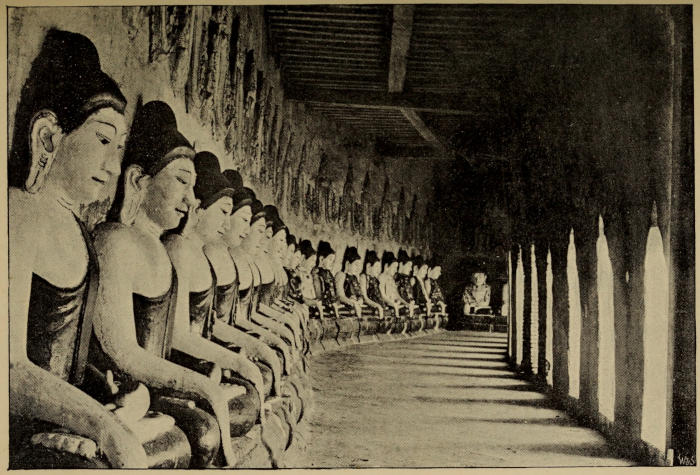
But the great sight of the place is the “Incomparable Pagoda,”
as the Burmans proudly style it, situated close by the guard-room,
and directly facing the beautiful monastery building then used
as the officers’ mess. This remarkable structure is a huge pile
of building raised upon vast masonry pillars. It measures fully
300 feet in length, is proportionately broad, and rises in the form
of a pyramid to such a height as to be visible several miles off.
Its sumptuously carved and gilded teak-wood doors, forty-four in
number, are quite a sight to see in themselves, as is also the
magnificent decorative plaster work all around and over the
building, and rising to its very summit. At that time, in the
absence of churches and chapels, for want of a better place with
sufficient space for hundreds to assemble together, the Hampshire
Regiment used to have “church parade” in the vast expanse
amongst the pillars at the basement of the Incomparable Pagoda.
It was a cool, airy, comfortable place, and open on all sides to the
breeze, so that it answered very well in such a hot climate.
There also many other meetings were held in those days of “Field
Service,” when we had all to be satisfied with such accommodation
as we could get. It was there our prayer-meetings and class-meetings
were held for the soldiers, and there, amidst that
wilderness of pillars, under that vast heathen shrine, we had
the joy of directing anxious penitents to the Saviour, and there,
too, we held, in company with Major Yates of the Royal Artillery,
the first temperance meeting ever held in Mandalay.
Leaving this Bethel of ours at the basement of the Incomparable
Pagoda, and ascending by one of the fine broad flights
of steps, the visitor comes to the wooden platform of the pagoda,
and on being ushered in by the polite old abbot or presiding
monk, he sees a very fine, spacious building, very lofty, with
many images of Buddha, sheltered under great white canopies,
besides some curiosities of European manufacture, such as mirrors
of vast size, and gigantic coloured glass chandeliers, that must
have been imported at immense cost.
But the sight of the place is the hall which contains the marvellous
wood carvings in relief, all of Burmese workmanship,
representing most clearly all manner of sacred histories and
incidents, the whole of this elaborate and ingenious work being
overlaid with gold leaf. Truly Mandalay is a wonderful place
for religious buildings.
Close beside the Incomparable Pagoda are to be seen the
Ku-tho-daw or Royal Merit pagodas, forming a unique and truly
wonderful piece of work. They consist of a triple square of sets
of little white pagodas, each of which is amply large enough to
form a shrine for one large slab of Burmese marble, which stands
up in the middle, like a cemetery headstone, enshrined each in
its own neat, bell-shaped pagoda building. Each slab of marble
is covered completely with a most accurately executed inscription
in the Pali language, in letters about three-eighths of an inch in
length. I have never counted these pagodas, but I am told by
those who have that there are 730 of them in all. They are
arranged in perfect symmetry, forming three squares one within
another, each square being surrounded by a wall with handsomely
carved gates. In the centre of the innermost square is a large
pagoda, and ascending the steps of that the spectator can obtain
a good view of the whole, extending over many acres of ground.
The whole space between the rows of pagodas is carefully paved
with bricks. Every part of the work has been most thoroughly
carried out, utterly regardless of expense, and everything is of
the best. There is no crowding, but ample space is given everywhere.
Is there to be found anywhere or in any religion a more
striking, impressive and unique example of thoughtful devotion
and loving care of those writings supposed to contain the sacred
truth? These 730 pagodas contain 730 tables of stone covered
with inscriptions, and it is considered to be the best edition
extant of the text of the three Pitakahs, and the three Pitakahs
are the scriptures of Buddhism, acknowledged as authoritative
wherever Buddhism is the people’s faith.
Close by the Ku-tho-daw we found another marvel. In a tall
brick building is an immense marble sitting figure of Buddha,
25 feet high, scores of tons in weight, and thought to be perhaps
the largest monolith in the world.
But it is time we returned to the three men who, after a long,
hot and tiring day in the dusty streets of Mandalay, had taken
refuge in the little monastery, and were preparing to pass the
night. Though little was said about it, we were well aware that
we ran some risks in being there at that time. Upper Burma
was still in the throes of the revolution which had taken place,
and life and property were unsafe. Any day a rising might take
place. We were practically in an enemy’s country. The military
were then, and for more than a year after, on the footing of a
Field Force, and had constantly to patrol the country in small
columns, and to go in all directions in pursuit of dacoits. Conflicts
with dacoits were of daily occurrence, and bulletins were
published daily by the military authorities describing what took
place.
With all this military and police activity there were still bands
of dacoits of considerable numbers; crimes of violence and dacoit
raids were constantly taking place, often with circumstances of
revolting cruelty and outrage. The state of the country was
such that English ladies and children were in official circles forbidden
to come to live in Upper Burma, and in unofficial circles
dissuaded from it as much as possible; the authorities could not
undertake to protect them. No Englishman was allowed then,
and for two years after that time, to travel outside the towns
without military escort. Those were days when everybody who
possessed a revolver kept it handy in case he should need to
defend himself, and Government was glad to supply to every
Englishman in the country a rifle and ammunition to be ready in
case of need.
Under these circumstances, with so much that was new and
strange, it is not much to wonder at if we committed ourselves
that night to Divine protection with more than usual fervency
of petition. Our monastery was not built to meet such an
emergency, and had no proper fastenings to the doors. Our
carnal weapons consisted of one revolver and several stout bamboos,
which having disposed to the best advantage, we lay down on
our camp beds, and rested as well as the circumstances permitted.
Happily this state of things has now passed away, and Upper
Burma is as quiet as any other part of our Eastern possessions.
During the few days Mr. Brown remained with us in Mandalay
we came to the conclusion that this city, from its size and population
(about ten times as large as any other town in Upper
Burma), and from its general importance, was by far the best
place to fix upon for the headquarters of the mission. Having
settled this point, we reported to the committee in London accordingly,
and Mr. Brown returned to Calcutta. After spending a
fortnight in our monastery we found that, as it was on the
extreme east of the town and a couple of miles from the centre,
it was a very inconvenient place to live in. We therefore moved
to a more central position, and rented for the time being a house
belonging to an elderly Italian, who had been settled in Mandalay
for many years as a weaver of velvet in the service of the king.
Here we lived for a period of a year, by which time the new
mission house was built, and we removed to our permanent
quarters.
CHAPTER III. MANDALAY IN 1887.
It was with feelings of no common interest that we disembarked
from the steamer at Mandalay, and took our first glimpse of
the place. The bustle of so many passengers disembarking
created a very busy scene, and dense clouds of dust arose, so that
we were glad to get away as soon as possible. We proceeded to
charter one of the conveyances we found there waiting for hire,
a peculiar kind of vehicle, resembling in size and appearance
a dog kennel set on a pair of high wheels, and it proved a
marvel of inconvenience. You climb up with difficulty, thrust
yourself through the small aperture as best you can, for it is no
easy matter, and then you stow yourself away, sitting down on
the floor of the conveyance with your knees about your ears. It
is quite impossible to preserve a dignified demeanour in one of
these bullock gharries, and yet, sad to relate, it was found that
this was the only kind of conveyance available for His Majesty
the King, when he was removed from the palace to the river on
his way to India.
The matter created quite a difficulty. To have mounted the
king on such an occasion on a horse or an elephant would have
been cruel mockery. At that time there were no horse gharries
in Mandalay. They brought a dhooly first, but the king declined
point blank to enter it. The bullock gharry was the best arrangement
they could devise.
One of the first things that attracted our attention was the
inordinately gorgeous appearance of some things, and the very
primitive and mean condition of others. This mixture of grandeur
and shabbiness is quite an Oriental trait. The royal city and
palace, the pagodas and the monasteries, were most sumptuous in
style of building and decoration, but everything else looked very
poor in comparison. The bamboo houses of the people looked
small and frail and cheap. The roads, which we consider amongst
the first essentials of civilised life, were as bad as they could be.
They were of mere mud, which became dust several inches deep
in dry weather, and a quagmire when it rained. The dense
clouds of dust that rose wherever there was much traffic formed
an experience truly distressing.
Mandalay has been said to be remarkable for three things,
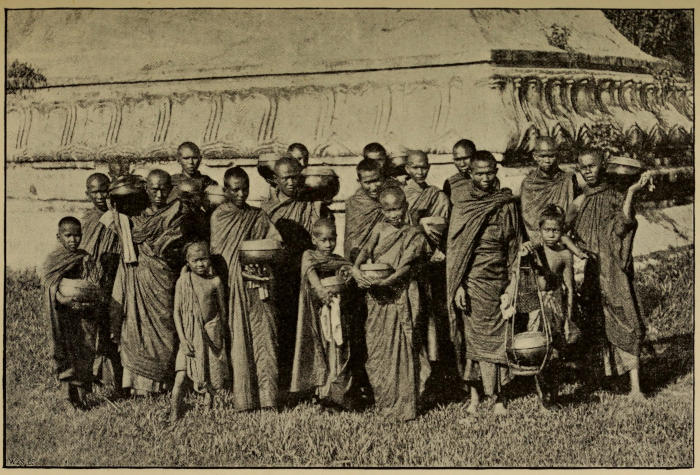
Phoongyees, Pagodas and Pariah dogs. The phoongyees are the
brethren of the yellow robe, the Buddhist monks, who are to be
seen in Mandalay by thousands, and all through the country in
like proportion to the population. The pagodas form here as
everywhere in Upper Burma a feature in every landscape. The
pariah dogs are uncommonly numerous. You might guess at
once you were in a Buddhist country from the thousands of
homeless, poor, emaciated, mangy creatures, nobody’s dogs, that
roam over the city, eating anything they can pick up, the vilest
refuse, and acting as the scavengers of the place. They are
never on any consideration killed by the Buddhists, but suffered
to multiply to any extent. As you walk about you often come
upon eight or ten of these dogs at a time, and they seem as
if they would tear you to pieces; but though they seem so savage
and so numerous they prefer to keep at a safe distance.
Passing through the streets of the town, a drive of about two
miles brought us to the moat outside the walls of the royal city.
The city is in the form of a square, each face of which is over
a mile in extent, and is surrounded by an enormous brick wall
twenty-six feet high, many feet in thickness, and with battlements
on the top. Outside the city walls is a broad open space of
ground all the way round, and outside of that is a deep, broad
moat, intended to serve the double purpose of military defence
for the city, and of supplying drinking water to the inhabitants.
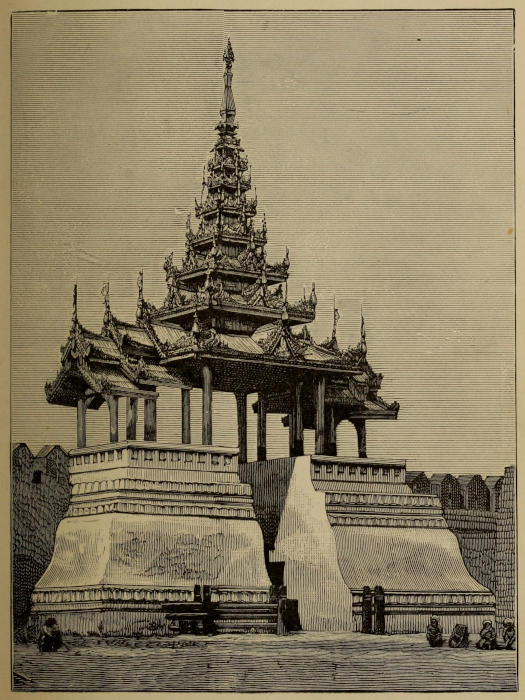
For the purpose of communicating between the city and the
town outside are five gateways, two on the townward or west
side, and one on each of the others, with gates of enormous size
and strength. Over each gate is a lofty and handsome tower
built of teak wood, and rising to a point. Here and there along
the walls at stated intervals, and facing the ends of the streets
of the town, which run at right angles to the wall, are smaller
towers of similar style, that serve to adorn the great wall of the
city, and give it quite a handsome appearance.
At the time I speak of the walled city was inhabited by a large
population of Burmans, chiefly people who had been in close
connection with the palace; but owing to the decision of Government
to make this place the military cantonment, the five thousand
houses within the walls have been all cleared out, compensation
being paid according to the value, and a very handsome cantonment
has been made of it, with barracks for European and Indian
troops. As the great majority of the houses were of teak or
bamboo, this was not nearly so serious a matter as it might seem.
The cantonment is now known by the name of Fort Dufferin.
The royal palace consists of a square enclosure in the centre
of the large square city. It was at that time surrounded and
defended by a strong stockade of teak logs set on end in the
ground, and inside of that, as a second line of defence, was a
strong brick wall; but both stockade and wall have since been
removed by the British as unnecessary. Passing inside these two
defences, the visitor found himself in the spacious grounds of the
palace, part of which were prettily laid out as gardens, with
artificial canals of water, rockeries and summer houses. Part of
this space was devoted to the king’s arsenal; on the eastern side
were the treasury and the mint.
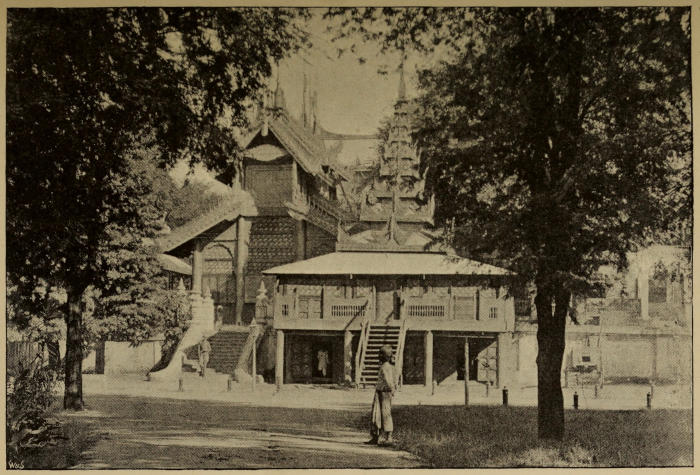
In the centre of all, raised on an earthen platform about eight
feet high, and pretty well covering an area of perhaps a couple
of acres with a miscellaneous and irregular collection of handsome
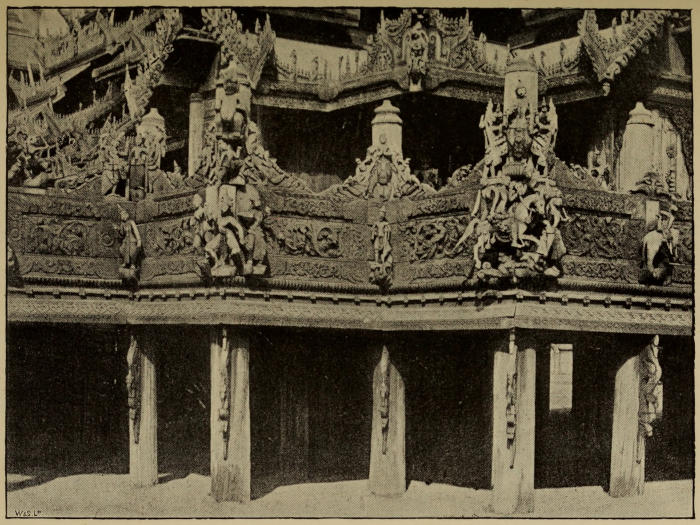
lofty buildings, with much carving in teak, and abundance
of the inevitable gold leaf, is the royal palace of the kings of
Burma. Some of the buildings are of brick, but the majority
are of teak. There is something decidedly impressive, unique and
highly interesting about the palace, as a specimen of an Oriental
monarch’s residence, but from a European standpoint it is wanting
in unity of design and symmetry of arrangement. The buildings
are so huddled together that they lose much of their appearance,
and you have to find your way about among these fine buildings
by queer narrow little lanes and wooden platforms, and by many
sudden and unexpected turns, that to a Western mind take off
considerably from the majesty of the place. But then we must
remember the character of the Burmese court, notorious for
back-stairs influence, corruption, intrigue, conspiracy and the
like. That being so, it is only natural that the palace buildings
should allow proper facilities for the same, and be in keeping
with it.
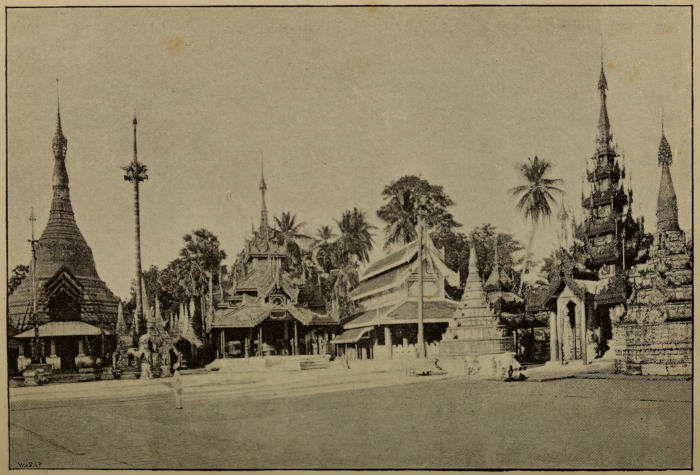
ONE OF THE GATEWAYS OF THE ROYAL CITY OF MANDALAY
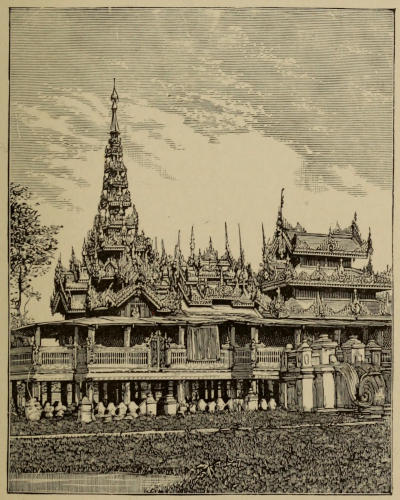
The only approach to anything like the dignity of a palace
from our point of view is the front or eastern side, where there
is the throne room or audience hall, surmounted with the great
spire which rises roof over roof to a considerable height and
almost to a point, terminating with the usual gilt umbrella.
This was considered to be the centre of the universe by the
Burman courtiers, and it is still facetiously called by that name
by the English. It was here that the king used to appear on his
throne on special occasions. It is said that King Mindohn, the
father of King Theebaw, used to gaze at his people from his
throne through a pair of binoculars. The people would all be
down on their knees in his presence, and not only on their knees,
but crouching on their elbows too, for that is the attitude for
special reverence in Burma.
There was one point of contention between the English and
this very haughty and conceited Court of Burma that never was
settled. That was the reception of our envoy. It was not
sufficient for them that he observed all the forms of respect
known in European etiquette, but they required from him also
their own, even to the removal of his boots in the king’s presence.
Now an English gentleman does not like to doff his boots in
public, and to a military man it would seem particularly outrageous
to expect it of him. Hence it was a difficulty. Had
King Theebaw accepted instead of rejecting our ultimatum in
November 1886, he might have kept his throne and his palace;
but the proper reception of the British Resident would have
been one of the articles he would have had to agree to.
It was in the great throne room that we held at first our
Sunday morning parade services for the troops, the preacher
taking his stand just by the foot of the throne: an interesting
circumstance, and not without a touch of romance,—the Kingdom
of Jesus Christ set up on the final downfall of this antiquated,
corrupt and cruel Oriental despotism. But though we may hopefully
take this as a figure and prophecy of the triumph yet to
come, the fact itself is a political rather than a religious one, and
indicates just this, and nothing more—that Britain has conquered
Burma, and is now able to do what she likes with Burma’s most
sacred and venerated places. We are not for that reason one
inch nearer the real spiritual triumph of Jesus Christ in the
hearts of the Buddhists of Burma. That work is but just begun.
Some idea of the large extent of the palace buildings may be
gathered from the fact that for many months they provided
dwellings for the general and his numerous headquarters staff,
and for many other officers, besides barracks for an entire battery
of artillery, officers and men. In addition to this, quite a number
of departments, civil and military, had their offices there, including
a postal and telegraph department.
Near the front of the palace is the great tower, now used as a
fire look-out station. On the top of this a native sentry is always
on the watch, and the moment he sees a fire anywhere, either in
the cantonment or in the town, he gives the alarm, and the fire-engines
are soon on the spot. This is a matter of no small
importance in this great city of 188,000 inhabitants, where the
houses are of such a highly inflammable material as bamboo, and
where in one year 35 fires occurred, destroying 9 monasteries
and 724 houses, of the total value of 310,000 rupees.
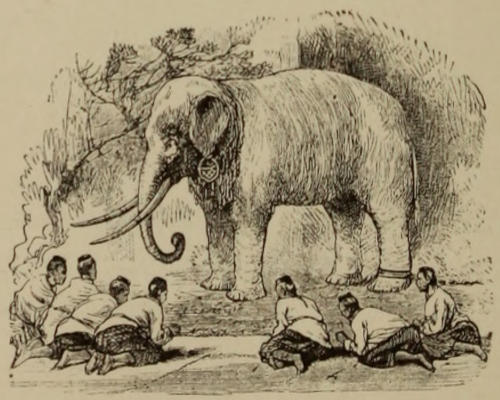
Close by the front of the palace was the residence of the famous
Lord White Elephant, to whom royal honours were paid. He
was regarded as the king of elephants, and therefore none but
the king could mount him. His trappings were of the most
sumptuous and valuable description—silk and rich cloth, ornamented
with gold, rubies and emeralds. All his vessels and
utensils were made of gold. None but the king and the white
elephant might enjoy the dignity of the white umbrella, for that
is the chief emblem of royalty. This august quadruped had his
own retinue specially told off to do him service; his attendants
and all visitors took off their shoes when they entered his quarters,
and the people bowed and did obeisance when he passed through
the streets. Not that he was white. No elephant is anything
near a white colour; but besides the lighter colour of the animal
there are other tests which, according to the Burmese science on
the subject, settle the matter of a white elephant; and it is a
science of considerable gravity and importance. He must have
five toe nails on his hind feet instead of the usual four; and when
water is poured upon him, if he is a true albino, he will turn red
and not black.
The reason why so much superstitious and absurd reverence
was paid to the white elephant was that the possession of an
undoubted specimen was supposed to be a sign and symbol of
universal sovereignty, so that it was deemed very lucky for the
King of Burma to possess one. In the sixteenth century the
kingdoms of Pegu and Siam fought over one for many years, till
five successive kings and thousands of men were killed, which
shows the importance attached to this possession by both nations.
How often nations have fought over that which was only a white
elephant when they had gained it!
It was a singular coincidence that within a few days of the
capture of Mandalay the white elephant died, and was buried
with some display, the troops being turned out on the occasion.
It was as well he did die, for had he lived he would have been to
the English a veritable white elephant in the English colloquial
sense of that term. We can come quite as near to universal
sovereignty as we wish to be, or as is good for us, without the
magic aid of a white elephant.
The principal building to the front of the palace, and just
within the stockade, is the Hloot Daw, a fine large hall where the
four chief ministers of state, with their subordinates, used to meet
for the transaction of their business. After the annexation in
1886, there was an attempt made to govern through the medium
of the Hloot Daw, but it turned out a failure. These high
Burmese officials, it was found, needed to learn the very A B C
of honest, fair and disinterested administration, and as they were
too old to learn they were pensioned off.
Altogether apart from the great walled royal city, now Fort
Dufferin, was the still greater town of Mandalay. It is now
constituted a municipality; but in Burmese times, when the city
was all in all, it was merely in Burmese phrase the Anouk-pyin,
i.e., the western suburbs. The town of Mandalay lies, more or
less, on all the four sides of the city, but mostly on the west, filling
on that side all the space between the city and the river, and
from north to south extending five or six miles. The Mandalay
municipality covers, more or less densely, an area of eighteen
square miles. Some portions of that space are thinly populated,
and a very little of it is under cultivation as fields and gardens;
but most part of it is pretty well studded with houses, and some
of it densely populated, so that it is a very large city. It is
uncommonly well laid out. The streets are straight, very wide,
run at right angles to each other, and many of them are planted
with shady tamarind trees. Some of the streets are now metalled
and made serviceable for traffic, but five years ago, though so
well planned and broad, they were in a most deplorable state;
and those of us who look back to that time have amusing recollections
of the straits we were put to in order to get about in the
rainy season.
The southern end of Mandalay touches the northern limit of
Amarapoora, which was the capital up to 1860. Here are to be
seen the remains of a great royal city nearly as large as that
at Mandalay, and after the same model exactly,—square; set
so as to face the four cardinal points; the ruins of a great wall
around; a deep moat outside, now dry; the palace in the centre;
pagodas and other sacred buildings here and there, scattered over
the place; and everywhere broken bricks strewn about; some of
the ground now cultivated, and the rest covered with dense
tangled jungle; but not a single inhabitant.
PART OF THE PALACE OF MANDALAY (SOUTH SIDE).
This changing of the capital from place to place, once in a while,
seems a strange, extravagant freak on the part of the Burmese
kings, especially in such a case as this, where it involved the
founding and building of a new city only four or five miles
from the existing one, and all the people had to transfer themselves
and their houses and property as best they could at the
king’s command. Superstitious fear was probably the chief if
not the sole reason for all this useless waste. There are, within
a circle of a dozen miles, four places that claim the honour of
having been sometime capitals of Burma, viz., Mandalay, Amarapoora,
Ava and Sagaing, all within little more than a century, and
the three latter all show the crumbling remnants of their former
glory. There are, besides these, other towns scattered up and
down the country that have formerly been capitals.
Sagaing, twelve miles from Mandalay, was the capital in 1762,
and the remains of the city wall are still to be seen. Amarapoora
was founded in 1783. In 1822 it was almost totally
destroyed by fire. It is said, too, that a vulture alighting on
the royal spire of the palace caused great uneasiness to the king.
The court astrologers were summoned to explain this omen. As,
in their estimation, it foreshadowed evil, a new palace was built
at Ava, and the capital was removed there in 1823, but only
remained there till 1837. Those of us who are now in middle
life will remember learning in our geography, “Burma, capital
Ava,” whereas this fugitive capital, though it appeared so in our
school books, had long before our day left Ava and gone back to
Amarapoora, where it remained till 1860, when the king and his
court made their last removal to Mandalay.
One thing is clear: the country that can afford to gratify its
superstitious fear of omens in this spendthrift way, lightly undertaking
to build a new capital every now and then, and whilst
sparing so much on pagodas, monasteries, monks and other works
of merit, yet look so plump and well favoured as Burmans usually
do, must possess considerable sources of wealth, and there is no
doubt such is the case with Burma.
Between the religious buildings and the dwellings of the people
the contrast is great, but it was greater in Burmese times than
it is now. It was very significant indeed to observe the rage for
building brick houses that took place in Mandalay, when once it
was known for certain that the Burmese Government was no
more, and that it was to be the English Government henceforth;
and equally instructive was it to observe how the value of property
went up by leaps and bounds. One needs no better proof than
that of the reputation British rule enjoys even in the remote
East, and of the enlivening touch it gives to commerce and all
that is free and enterprising. And how the natives of India of
different races flocked into the upper province after the annexation!
They knew what British rule was in India, even though
many of them knew not a word of English. Even the Upper
Burmans, who were quite new to our government, seemed at once
to enter into the spirit of the change that had come. The sumptuary
laws were removed, of course, now the king was gone; that
is, such laws as regulated to a nicety what style of house a man
might build, and what kind of an umbrella and how many of
them he might carry on state occasions; and the Burmans who
had money now no longer feared that if they let it be known
they would have to part with it. Hence, for various reasons, the
building of substantial brick houses went on at a great rate, and
almost all the brick houses now seen in Mandalay were built at
that time.
CHAPTER IV. THE PEOPLE OF MANDALAY.
Mandalay is very cosmopolitan. As with many cities in
the East, the modern facilities for travel and the prospects
of business have brought together people of many nations and
tongues. As regards the Burmans themselves, who of course are
the great majority of the inhabitants, future chapters will afford
opportunities for describing them. It is rather of the multifarious
foreign element of the population that I wish now to speak.
In the streets of Mandalay it is no uncommon thing to see
a people evidently of the Mongolian type, and not unlike the
Burmans in appearance, but slightly different in features, different
in language, and in dress. These are the Shans, the inhabitants
of the elevated country to the east of Upper Burma—a fine country
by all accounts, and likely to grow greatly in prosperity and to
attract population, now that it has come under firm and settled
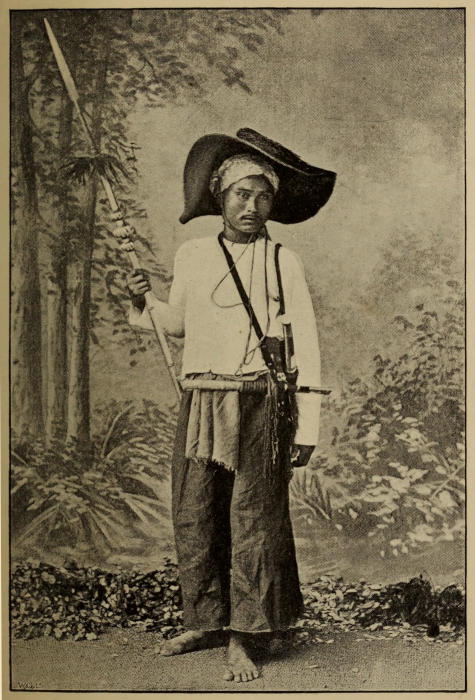
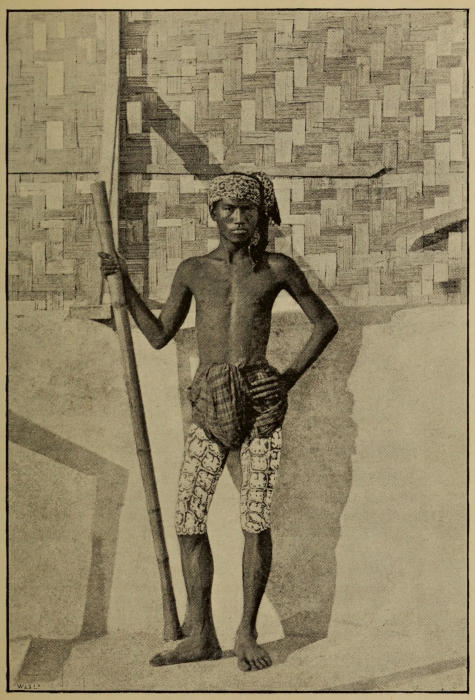
rule. They are distinguishable by their dark, baggy trousers in
place of the Burmese loin cloth, by the very large pliable straw
sun-hats which they wear, and by a larger amount of tattooing
on the body than is usual with the Burmans. The Shans are
great gardeners and great traders. Caravans of pack bullocks
loaded with produce from the Shan Hills are frequently seen
coming into Mandalay, accompanied by Shans armed to the
teeth, as well as men on foot carrying loads; and now that the
land has rest from incessant tribal war and dacoity, this trade is
on the increase. In 1888-89, according to Government returns,
the number of laden bullocks was 27,170, and the value of the
goods 730,279 rupees; nearly double the returns of the previous
year. The Shans, after disposing of their loads, purchase in the
bazaar goods of European manufacture for the return journey.
A few Shans are permanently resident in Mandalay.
There were scarcely any English people in Upper Burma,
especially during the reign of King Theebaw; but now, of course,
they are the leading race, and are to be found in all the highest
posts. In addition to those belonging to the army, the leading
civilians and officials of Government are English gentlemen; and
to them is committed the control of the revenue, the administration
of justice, the police, the Departments of Public Works and
of Survey; whilst some are there in business of their own, and
others find employment under the Irrawaddy Flotilla Company
as officers or engineers on board the river steamers.
The Eurasian element—i.e., of mixed descent, European and
Asian—is of course also to be found, some having come over from
India, others belonging to Burma, and they mostly find employment
as clerks or in some similar capacity. French, Italians
and Greeks were there before we were, and some of these
nationalities found employment in various capacities in the
service of the king.
The Armenians are a small but very respectable class. They
are similar in dress and habits to Europeans, and speak English.
Many of their number are to be found in Calcutta also, and in
Rangoon, quite settled and domiciled in the East. In Mandalay
they have a church of their own, and the priests of the Greek
Church, to which they belong, pay occasional visits.
Of Parsees we have a few; and here, as in their native place
about Bombay, they are an enlightened and very respectable
people in good positions.
There is quite a numerous section of the population belonging
to the Zarabadee community, as they are called. They are half-caste
Mahomedans, the descendants of Mahomedans from India
settled in Mandalay, by Burmese mothers. They supply an
interesting example of the growth of a religious community
merely by the natural process, and apart from proselytising efforts,
when the natural increase of numbers is all absorbed by that
religious community. They are Mahomedan in religion, but
largely Burman in dress and appearance. They speak Hindustanee
and Burmese.
“THE SHANS ARE DISTINGUISHABLE BY THEIR DARK,
BAGGY TROUSERS, AND THE VERY LARGE PLIABLE STRAW SUN-HATS THEY WEAR.”
There is a class of people called Kathays about whom there
appears to be some special interest. They are the descendants
of people from Manipur, brought over formerly as the result of
some conquest by the Burmans, and long since settled in the
capital. Their condition, at least as it was originally, reminds
one of the exile of the Jews in Babylon. They have a language
and religion of their own, but speak Burmese too. They are a
peaceable and industrious community, mostly employed in weaving
the pretty, bright-coloured, figured silk cloths worn by the
Burmese women.
Another class not native, but long resident in Upper Burma,
are the Ponnâs or Brahmins from Manipur. To one accustomed
to meet with that caste in India they look very degenerate, and
although they still wear the sacred Brahmin thread over the
shoulder as in India, they seem to have become very much less
fastidious about mixing with other castes than their brethren of
the great continent. They seem to enjoy a position of considerable
standing and influence in the country of their adoption, and
gain a good livelihood by the two apparently not very kindred
occupations of dairy-keeping and fortune-telling. It is their
reputation for the latter that gains them their position of importance
with a light-hearted, casual and very superstitious people
like the Burmans. This soothsaying seems to be quite a recognised
function, that makes the Ponnâ welcome throughout Burmese
society, and nowhere more so than at court. In their literature,
the Ponnâ constantly figures as an honoured and indispensable
personage at the palace, whose business it is to study the stars,
consult the horoscopes, make known lucky days, and, in fact,
decide the thousand and one important affairs of life wherein the
Burman considers it necessary to appeal to the occult.
Coming now to the mercantile classes, we have some interesting
specimens. First, the Suratees, keen business men, merchants
and shopkeepers, men capable of large transactions, Mahomedans
in religion, Oriental in dress. The leading member of this
community in Upper Burma, a very wealthy man, did a good
deal of financing for the king, and no doubt made it pay well.
When the downfall of the Burman kingdom took place he came
to no harm. Amongst other transactions he was the lessee of the
Great Bazaar, and as the lease had still some years to run, he
continued to hold it, and profited greatly by the enormously
improved trade.
The Marwarees are another class of traders hailing from India.
They are Hindus from Gujerat, wholesale dealers in piece goods,
and very smart business men.
The Moguls are Mahomedans from Persia, with a complexion
almost as fair as a European’s. They are the only people of all
the many nationalities I have met with in the East who dress
exactly like the pictures that are drawn of Bible scenes and
characters. The special shape and size of turban, and the long
loose outer garment some of them wear, put one in mind of the
pictures exactly.
A cosmopolitan place would be incomplete without some Jews.
We have them in Mandalay of various nationalities, European
and Oriental, and they seem to be all shopkeepers. One firm
hail from Baghdad, very near the dwelling-place of our first
parents, and speak a vernacular which they call Hebrew.
The principal native bankers are the Hindu Chetties from the
Madras Presidency. They are a remarkable class of people, very
wealthy, very keen at business, men of their word in all transactions,
being fully alive to the value of keeping their credit by
an unstained reputation in finances; and if one firm of their
community find it difficult to make their payments, the rest of
the Chetty firms will usually come to their help, to save the
reputation of the whole. Yet with all this they dress, eat and
live as if they had a very meagre income, and have the appearance
of mere savages. The vast array of naked skin they show
is almost black in complexion, and they have almost no education
beyond the bare necessities of finance. Their food is of the
simplest; their houses, all on the two sides of one street to be
near each other, are substantially built to protect them from
thieves, but almost devoid of all furniture. They are not negligent
of religion, for as soon as they came they secured land and
built a Hindu temple. Their dress, consisting of two pieces of
thin white cotton cloth, one round the waist and the other loosely
thrown over one shoulder, could be bought for three-and-sixpence;
the closely shaven head has no covering, and the feet none.
Such is the Tamil Chetty, the very last man in all Mandalay you
would take for a wealthy money-lender; but he is in great request
with the improvident Burmans who possess any property upon
which it is possible to borrow. The Chetties came over to
Mandalay when the country was annexed; their keen business
instincts telling them two things—one, that there would now be
plenty of business doing; the other, that it would now be safe
to come and do it. The prospects of those who get into their
clutches are not bright. The price of money is very high in the
East. The late Earl of Beaconsfield speaks somewhere of “the
sweet simplicity of the three per cents,” but the Tamil Chetty
considers twenty-five per cent. per annum much simpler.
Leaving the mercantile and moneyed classes, and coming to the
rank and file, there are in Mandalay some thousands of natives
from many different parts of India, speaking many languages,
and engaging in a great variety of callings. Europeans often
think of India as a country, but it is really a continent, and has
as great, if not a far greater, variety of peoples and tribes than
Europe presents. There is the Bengalee Baboo, probably a
clerk, the Hindustanee doorkeeper or messenger, the Tamil overseer
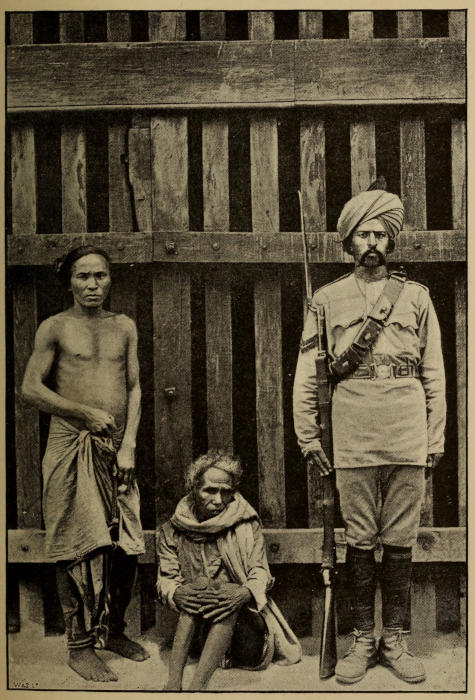
or coolie. Even in our Sepoy army in Mandalay one sees
great variety. There is the tall hardy Punjabee, the wild Pathan
and the still wilder Beloochee. There is the jolly stout little
Goorkha, who stands in such good repute as a fighting man; the
somewhat weedy-looking Madrassee, whose name does not rank
high for valour; and there is the brave, fierce-looking Sikh, with
a national-religious scruple against cutting his hair, who curls
the two ends of his beard up round his two ears when it becomes
too long to hang down. What tact it must require to mould out
of these diverse elements “the finest body of disciplined Asiatic
troops in existence,” and yet we are told, and it is true, that the
real strength and safety of our Indian Sepoy army lies in the
judicious blending and balancing of these diverse elements, a
lesson which the great mutiny unmistakably taught us.
We depend very much upon Indians for the supplying of our
wants in Burma. The butcher, the baker, the washerman, the
cook, the railway porter, the writer, the messenger, the soldier,
the cabman, the postman, the farrier, the sweetmeat vendor, the
sweeper, are in almost all instances natives of India, for the easy-going
Burman lets all these employments slip past him.
The place is quite a Babel for languages. The names of the
stations on the railway indicate the polyglot character of the
population. It is of course out of the question to attempt to
represent even the half of the tongues commonly spoken, but
they select the five which we may presume are in most common
use, English, Burmese, Hindustanee, Hindi and Tamil, and the
name of the station is painted in all these.
The Chinese in Burma are worthy of special mention as forming
an important community in every great centre of population. In
Mandalay they are numerous, occupying almost entirely both sides
of one long street, called after them China Street, as well as other
localities in the town. They seem to settle down and marry Burmese
women and live very happily. They are keener business
men than the Burmans, more knowing, more enterprising, more
persevering, more industrious. The Burman is as good at carpentry
as he is at anything; that is, in fact, one of his strongest points,
but John Chinaman ousts him completely at that. Leaving the
little petty carpentry to the Burmans, he carries all before him
in large building contracts. Though John’s rates are higher he
does the work better, and what is important to the English mind,
he finishes the work in the time stated. Some of the Chinese are
shopkeepers. Whilst many Chinamen are thus a boon to the
country, and valued as a useful class of workers, others again do
much mischief, corrupting the people wherever they go—keeping
liquor shops, diligently spreading the opium-smoking habit, and
pandering to the natural love of the Burmans for gambling.
The offenders against the excise laws—cunning secreters and
workers of illicit stills—are usually Chinese.
With the mention of so many different nationalities of foreigners
in the place, it will at once occur to the reader that the carrying
on of all kinds of work and business depends very largely upon
the foreigners and very little upon the Burmans. That is true.
Somehow the Burmans, though they are in Mandalay considerably
over 100,000 strong, and multitudes of them are very poor,
fail to take up very many of the duties of life and the needs of
society, and allow themselves to be ousted in many employments
by immigrants from other countries where the conditions of life
have taught them to bestir themselves. The Burman is easy-going,
casual and satisfied with a little. When a great increase
of the population of Burma has rendered the struggle for existence
much more urgent than it is now, the Burman will either have
to bestir himself or go to the wall.
CHAPTER V. THE PACIFICATION OF UPPER BURMA.
It has already been stated that Upper Burma, at the time of
the annexation, and for some time after, was politically and
socially in a state of serious disturbance and disorder. It may
be well to inquire a little more closely into this matter, that we
may the better understand the circumstances of the country as
we found it, and the better appreciate what has been done by
way of remedy.
A state of disturbance was, under the circumstances, inevitable.
An invasion, followed by an annexation, is seldom a very quiet and
peaceable process, and this was no exception. But in this case
there were features that greatly complicated the matter, and made
the task of pacifying and governing much harder. When the
expedition under General Prendergast went up the Irrawaddy at
the close of 1885 it was an easy victory, and there was no resistance
worth mentioning. Mandalay, the capital, yielded without a blow.
This easy conquest proved the inefficiency of the Burmans as a
Government, and led to the belief that very little trouble would
be experienced in governing the country. But this proved to be by
no means the case. For four years it has been one constant and
strenuous battle with the forces of disorder; and whatever has been
done in the way of pacification and improvement of the country
has been done in the teeth of difficulties of no ordinary character.
If the question be asked how it was that the country was so
easy to conquer yet so difficult to pacify and restore to order, the
answer is not far to seek. In the first place, the weaker a
Government is the stronger are the elements of crime and disorder
lurking about, and having overthrown the one you still
have to reckon with the other. King Theebaw’s was a weak
Government, and crime and disorder had increased so much that
their reduction had become a formidable task.
The territory over which King Theebaw ruled, or professed to
rule, was of immense extent, and very sparsely populated, and
the vast tracts of jungle with hilly, broken country afforded ample
cover for the numerous bands of dacoits. Dacoity is the word
used in India for gang robbery, and it is usually accompanied
with murder and various forms of cruelty. It had always
flourished in Upper Burma, and was unfortunately regarded not
as a cruel, brutal and detestable crime, to be put down by the
united efforts of the government and the people, but more as an
acknowledged and unavoidable institution.
We may find some parallels to this in brigandage in Southern
Europe, in the Border warfare so well described by Sir Walter
Scott, and in the state of things prevailing formerly in the West
of England, as set forth in Lorna Doone. The dacoit leaders
were a kind of privileged freebooters, who spared those who paid
blackmail, and wreaked their vengeance on others, and there was,
in the opinion of the people, some air of romance about the life.
No Burmese Government had ever been strong enough or resolute
enough effectually to stamp out this plague. When the English
took the reins of government at the annexation, this naturally
gave a fresh impulse to dacoity under the notion of patriotism;
and for some time the leaders who had large gangs occasionally
tried conclusions with the small columns of police and military
sent out to patrol the country.
The Government official report of affairs in Upper Burma
gives the following summary of the first year’s work of pacification,
viz., up to the end of 1886.
“The pacification of the country has been a prolonged work
of much difficulty. Dacoity on the largest scale has been rampant;
and military operations have been necessary in almost
every part of the country in order to suppress it. To the end of
the year 1886 about 180 encounters had taken place with these
lawless bands. They seldom offered serious resistance, except
when fighting in bush or jungle. The loss they caused to the
British troops between November 17th, 1885, and October 31st,
1886, amounted to 11 officers and 80 men, killed or died
from wounds. But greater difficulties than the armed opposition
were found in the dense jungle, the want of roads, and the
unfavourable, in some cases deadly, climate. The result of these
difficulties during the period above mentioned was a total loss
of 3,053 officers and men, who died from disease or had to be
invalided. The average number of troops employed in Upper
Burma during 1886 has been 14,000, but at the end of 1886
the number in the country was 25,000.”
So deep-rooted is the habit of dacoity in Burma that it easily
breaks out afresh whenever disorder spreads, or whenever any
daring fellow thinks fit to try his luck as a boh or leader. The
people are easily deluded with his boast and swagger; and having
implicit faith in the special tattooing and charms which are
warranted to render them bullet and sword proof, they readily
follow his standard. Hundreds of bohs have had their day
during the last five years, and pursued a successful course of
robbery, murder and rebellion for months together, eluding the
police and the military. But owing to the tenacity of purpose,
and the inexhaustible resources of the British Government, they
have to succumb in the end. Many have been killed or taken
prisoners in engagements fought; others treacherously murdered
by their own followers, to get the reward set on the head of the
notorious outlaw; others, after months of a hunted life in the
jungles, have come in and surrendered. There has been always
ample opportunity given by the British for those who wished to
abandon that bad way of life to do so, and more than once a free
pardon has been offered to all those who might give themselves
up, provided that they had not been guilty of murder. Many,
from time to time, have availed themselves of that arrangement.
DACOITS IN PRISON, WITH INDIAN SEPOY GUARD.
Several princes—in Burma princes are fairly plentiful, notwithstanding
that so many were massacred by order of King
Theebaw—have tried their hands at it, with vague ideas of
getting the mastery of the country in due time. One, known
by the title of the Sekkya Prince, established himself in the
hill country about Kyaukse, only thirty miles from Mandalay,
and as late as 1889 gave an immense amount of trouble, setting
the military police at defiance for months, and committing many
murders and depredations. He had an armed following of several
hundreds, and several fights took place between them and the
police. Though the dacoits were each time defeated and scattered,
the ground was so difficult for pursuit, that they could never
catch the leader. At length he was taken in the Shan States,
brought to Kyaukse, tried, convicted and hanged. This is a
specimen of the kind of guerilla warfare going on in every district
all over the country at that time.
Another matter, which still further complicated the situation
and gave strength to the forces of disorder, was the sanction which
dacoity had received through the corruption of those high in
office in the Burman Government before we took it over. A
British civil officer of high rank, the commissioner of a division,
writes as follows, as late as the middle of 1889, more than three
years after the annexation:—
“The task of reducing my own division to order I find a
gigantic one. The Burman nature is simply saturated with lawlessness,
and it takes the form of dacoity. Since King Mindohn’s
death [i.e., from the accession of King Theebaw in 1878] it
is a fact that most of the official classes in Upper Burma made
large incomes by dacoity. Men high in office in Mandalay actually
kept dacoit bohs, and shared with them loot, or the subsidies
which were paid by the villagers for protection from other dacoits.
The dacoit bohs were actually the governors, and paid some of
the mingyees [ministers of state] in Mandalay regular sums, on
condition of being let alone! Each boh had a large immediate
gang or body of men around him, and a militia at any time
available from the villages. We have had to break up this
system of boh government all over Upper Burma, a system which
had been running for the last ten years. The villagers themselves
have become so accustomed to the government by dacoit
chiefs, that they are actually afraid and even unwilling to help
in getting rid of them. It will be admitted that difficulties like
these are enormous; sometimes they seem to be insuperable, and
one is often inclined to despair. We have not only to deal with
the thousands of lawless ones who think we are encroaching upon
their rights, but we have to try and educate the people to believe
that these dacoits are not their rulers, and are not to be so. The
villagers do not yet realise this, and it is this process of education,
slow and painful, that impedes us so terribly in the work of
subjugation and pacification. But the progress made has been
very great.”
The following is given as a specimen of the encounters which
for the first two or three years were of constant occurrence.
This affair was perhaps exceptional in the amount of resistance
offered, but in other respects quite usual and ordinary. It is
quoted from a newspaper dated May 1888:—
“On the night of the 21st inst. 400 dacoits, principally Shans,
with people from Mogaung district, under the leadership of Boh
Ti, took up a position outside Mogaung. Lieutenant O’Donnell,
Battalion Commandant, and Lieutenant Elliot, Assistant Commissioner,
with 75 Goorkha military police, patrolled outside the
fort the whole night. At 4 A.M. they attacked the dacoits, who
held a strong position in a series of pagodas, which they had
fortified during the night. The dacoits tenaciously held the
position, and the consequence was that a fierce contest ensued,
each pagoda being taken in succession. The last pagoda, when
taken, was found to be choked with dead. The Goorkha police
behaved splendidly. Our casualties were 8 killed and 15 wounded,
while 49 dead dacoits were counted, and over 100 were reported as
wounded, most of whom escaped. The struggle at the last pagoda
was hand to hand over a four-foot wall, and bayonets and spears
were used. It was here that 6 out of the 8 police killed fell.”
The mention of these fights deserves a place in any record of
those times, for it was through this hard, rough police and military
work—this continuous pounding at the mass of crime and lawlessness
that would not yield to gentler measures—that the land
now enjoys peace and quiet throughout its length and breadth.
There was manifestly no other way of quelling the disorders and
curing the miseries under which the country groaned.
This was a specimen of the fighting of our Indian military
police; now for a specimen of that of our English soldiers, who
also were incessantly employed in patrolling the country, and
often met with dacoit bands. The instance given here does not
by any means stand alone; similar affairs often occurred at that
time. It illustrates the courage and dash our men have shown
throughout this very laborious and difficult campaign. Often
called to go out in very small parties, they usually carried the
day against all odds; and even when, as in this instance, they
met with such an unusual number of casualties as to debar them
from getting the victory, their coolness and presence of mind
have staved off defeat and disaster, and enabled them to get
through so well that the reverse was, considering the circumstances,
as creditable as a victory would have been.
“On January 14th, 1889, information reached Lieutenant
Nugent, in charge of a small force of the Hants Regiment, that
the advanced guard of a certain rebel prince was stockaded in
a village ten miles away. He at once decided to attack. He
marched out with Sergeant Bevis and 15 privates, preceded by
some of the troops, such as they were, of the Sawbwa of Momeit.
On turning the corner of a jungle path, their stockade was
observed with the gate shut, and white flags (emblematic of
royalty) flying at the gate. The dacoits, on seeing our men, at
once began to blow horns and beat tomtoms. Our Burmese
auxiliaries at once made off, firing their weapons in the air.
Nevertheless Lieutenant Nugent and the 16 Englishmen promptly
charged the stockade, 16 against 200! When about thirty yards
from the stockade the dacoits delivered such a heavy and well-directed
volley that 8 out of the 16 were hit. Private Roberts
was killed on the spot, and Lieutenant Nugent himself was
wounded. Seeing that himself and half his party were disabled,
and further assault was out of the question, Nugent gave the
order to get the wounded from under fire and retire. It is at
this point that the soldierly qualities of these men specially
appear. The few men who were able had meanwhile got under
cover of a slight inequality in the ground, and were keeping up
a fire on the stockade. While himself assisting Private James,
who was dangerously wounded, Lieutenant Nugent was again
struck a little below the left breast, this time mortally.
“Sergeant Bevis now took the command, and rallied his small
party round their fallen officer, and seeing that the dacoits, now
emboldened by observing the small number opposed to them,
were coming out at the gate, he ordered his men to fire a volley.
This caused the enemy to retire inside the stockade, and our
party was molested no more. Stretchers were improvised with
rifles and bamboos for Lieutenant Nugent and Private James,
the other wounded managing to walk. The party made a halt
at the village which they had passed marching out; and here the
gallant Nugent breathed his last. By dint of much pressure and
promises of reward Sergeant Bevis obtained assistance from the
Sawbwa’s troops to carry the body and the bad cases to Momeit.”
Sergeant Bevis was much commended for his good management.
He was promoted at once, and received the decoration
of the Distinguished Service Order. Five days after a small force
of Hampshire men and military police surprised and carried the
stockade.
Many were the deeds of valour in this long and trying campaign.
A considerable number of badges of the Distinguished
Service Order were awarded, and of the highest decoration for
gallantry in the field that military men can aspire to, the Victoria
Cross, no less than three were given.
After what has been said about the Burmese ministers of the
Crown, it will be no matter of surprise that the honest attempt
of the British Government to utilise the local knowledge and
experience of the Hloot Daw or supreme council of the king,
as the medium of government, should entirely break down. As
might have been expected, those worthies were found to be worse
than useless at such a crisis. The kind of government they had
been accustomed to administer was just the kind that was not
wanted. They were therefore pensioned off, the pension acting
in a twofold manner, as a substantial compensation for loss of
office, and as a guarantee of their loyalty; they had something
to lose.
During the first year or two of the British occupation there
was need for very special vigilance to prevent the carrying out
of plots of insurrection, especially in Mandalay. It was of course
childish to think they could dislodge the British power, but many
of the people were slow to believe this, and foolish enough to
listen to boasting proposals of this kind. However, such a good
watch was kept, and the officials kept themselves so well informed,
that all such attempts were nipped in the bud. Some idea of the
magnitude of the work of pacification may be gathered from a
paper published by the Chief Commissioner of Burma in 1889,
from which it appears that no less than 363 dacoit bohs or
leaders were either killed, or surrendered, or were taken prisoners
between April 1887 and August 1889.
The British Government, whilst very stern in pursuing, arresting
and punishing these notorious outlaws, made every concession
towards mercy where it was possible. When a gang of dacoits
was broken up, and the boh killed or taken, the men composing
it were usually allowed to settle down in their villages, giving
some sort of guarantee for their future good behaviour. As soon
as it became safe to show any considerable leniency, the cases of
all who had been sentenced to terms of penal servitude for participating
in dacoity were carefully gone through by an experienced
and able judicial commissioner, for the purpose of remitting the
punishment wherever it could safely be done, particularly in cases
where men had been led, during a time of anarchy and political
excitement, to take part in crimes and acts of violence, from
which, under ordinary circumstances, they would have abstained.
The result was that 899 prisoners were set at liberty at once,
and 450 more were promised their release in the following
December if their conduct in jail continued good. Only the
worst and most desperate offenders were kept in jail.
It is just possible that some readers, failing to realise the full
force of all the circumstances, may be inclined to think that the
information given in this chapter leans too much in the direction
of admiration of the military deeds described, and is lacking in
consideration for the case of the unfortunate men against whom
these operations were directed. I feel that it would ill become
me to do anything to fan the flame of the military spirit, for
militarism is without doubt one of the great curses of this age,
and I have had no such design in view. I have merely described
what took place. If the reader feels inclined to admire any of
the actions here described, I must give him notice that he does
it entirely on his own responsibility.
It may occur to the reader that perhaps after all it was the
spirit of patriotism that animated these Burmans. Were they
not fighting for their country and their liberty, and doing their
feeble best to cast out the invader? Doubtless there was in some
cases something of this feeling in their minds, enough to give a
colourable pretext to their conduct at the time. But there are
considerations that go to show that if we are to make any allowance
on this account it will have to be very little.
Dacoity existed and was rampant for years prior to our annexation
of the country.
How is the motive of patriotism to be reconciled with the gross
cruelty, and robbery, and murder which all the dacoit bands continually
practised?
When so many hundreds of bohs were fighting, each for his
own hand, which were we to recognise? And how many? Their
claims to the mastery were mutually antagonistic.
I have already said that I decline to take the responsibility
either of defending or of impeaching the action of England in
the invasion of Upper Burma. It involves the great and wide
question of Empire, which I leave to more competent hands. I
content myself with giving the facts from the standpoint of an
eyewitness, and enabling or assisting wiser men to settle the
greater question. I take up the question at this point—England
the de facto ruler. Somehow, rightfully or wrongfully, she is
there, and has undertaken the government of the country. The
country is in a flame with crime and disorder. What is she to
do?
There have been times, even in our own country, when certain
crimes of violence, such as garotting, and certain forms of murder,
have spread so as to cause almost a panic, and have needed special
measures both as to detection and punishment. We are far more
liable to such things in India. Take, for instance, that strange
phase of crime known as “thuggee,” which prevailed to a fearful
extent years ago in India, and to which, in respect of each being
an epidemic form of crime, dacoity in Burma has sometimes been
compared. Thuggee was a thoroughly organised system of robbery
and murder, carried out with great secrecy by an association of
men banded together for the purpose, and who did it not by open
assault but by stealthy approaches, and, strangest of all, with
religious motives. The verdict of civilised society was that the
extermination of the thugs was not only a justifiable thing to be
done, but the solemn duty of the Government, notwithstanding
the religious motives, and special officers of Government were
deputed for that purpose, and the system was finally stamped out.
So with dacoity. If men will be brutal, will set all law, human
and divine, at defiance, will make human life cheap and property
unsafe, and keep the whole country in terror and confusion, to
the detriment of all peace and progress, if, in short, they will
come to no terms, but deliberately elect to assume the character
of wild beasts preying on society, then all reasonable men will
feel constrained sorrowfully to admit that a civilised Government
has no alternative but to treat them as such, and hunt them
down; always however remembering that, as it is in the divine,
so in the human administration, justice should be tempered with
mercy; and wherever there is room to hope for better things, the
criminal should have another chance, a provision which our
Government, as I have shown, has not neglected.
CHAPTER VI. BRITISH INFLUENCE IN THE SHAN STATES.
The previous chapter dealt with the pacification of Upper
Burma proper, that tract of country which England has
annexed, and in which we have assumed the full responsibility of
government. In this chapter we have to consider our relations
with certain states and tribes on our frontiers, which are not
British territory, but for whose well-being and good behaviour
we hold ourselves to some extent responsible, in proportion as our
influence among them is more or less direct.
As soon as our first difficulties in the pacification and administration
of Upper Burma were to some extent overcome, our
Government had to turn its attention to the doings of the many
barbarous and semi-barbarous tribes and races in the regions
immediately adjacent to Burma.
To the east of Upper Burma, and situated between that
country and the great empire of China, are the Shan States
tributary to Burma, with an area about four-fifths that of England,
but with a population no larger than that of Worcestershire, not
one-fourth, it is said, of what it was fifty years ago. This country
is a very fine one, consisting of a great plateau with a diversified
climate and great natural resources, of which coal is one, though
it has not yet been worked, and with every capacity for development.
The Shan States are likely to play no unimportant part
in the commercial development of the next few years, for it is by
that route that the railway will go from Burma to China at no
distant date.
At present these states are in a most backward and uncivilised
condition, and as they afford such an interesting illustration of
the true frontier policy of England in the East, and the kind of
influence our country is so well able to exert, in the discharge of
her duty as the great suzerain power amongst many little races
and peoples, I make no apology for describing it with some degree
of detail. Such work as England is attempting to do, and will
in the end undoubtedly succeed in doing there, is so beneficent
and meritorious as to be beyond the possibility of objection; and
it would excite remark and applause if it were not so common—if
England were not doing much the same all over her Eastern
dominions.
The relation of the Shan States to the British rule is a feudatory
relation. They paid tribute to the King of Burma, and were
supposed to be subject to him, but although receiving tribute,
Burma conferred no benefits upon them. In fact, the idea that
something in the shape of government was due to the Shans, in
return for the tribute they paid, probably never entered the head
of King Theebaw. These states have not been annexed to British
territory, and are not likely to be, unless it should be found quite
impossible to get their chiefs to learn to rule properly. At
present the policy is entirely in the direction of setting these
native rulers on their feet, and strengthening their power as much
as possible. When the English commenced to rule at Mandalay
that feudatory relation to the defunct Burmese Government
passed over to the English.
Politically the Shan States are divided amongst some eighteen
chiefs, each ruling a greater or less extent of territory. In the
early part of 1888 two British expeditions were sent to the
Northern and Southern Shan States respectively, and the first
steps were taken toward adjusting our relations with them.
The condition in which the States were found by the British
forces was a very sad one. For want of a controlling power over
them there was a state of disorder amounting almost to anarchy.
Might was right, and in the struggle for mastery the Shans were
fast exterminating each other. Each petty chieftain with his
followers was on the look-out to extend the sphere of his rule
by aggression, and dacoit raids and incessant civil war were
the result.
Throughout the reign of King Theebaw the States had suffered,
and the population had so seriously fallen off, by war and perhaps
too by emigration, that land had fallen out of cultivation, and
prosperous towns had been reduced, in some cases, to one-tenth of
their former size. Added to this there had been a season of
scarcity, and cattle disease had been very fatal.
The people cordially welcomed the advent of a strong power
that could enforce peace amongst them; and what was wanting
for the temporal salvation of this distressed country was just
that kind of sovereignty and paternal rule which England was
able and willing to give them. It was necessary for England to
assert and maintain her rights as the suzerain power, and to
discharge her duties by taking them under the broad shield of
her protection and guidance.
The British representatives accordingly received the personal
submission of all the principal sawbwas or chiefs, confirmed them
in their positions as tributary rulers, settled their relations with
Government and with each other, fixed the amount of tribute to
be paid by each chief, and succeeded in placing the administration
of the states on a satisfactory footing. Two British officials were
appointed as Superintendents of the two divisions of the Shan
States, northern and southern. Tribal disputes were henceforth
to be referred to these officials for arbitration, and fighting
between individual states was strictly forbidden. They were
not to enter into relations with any other foreign power; and
they were gradually to approximate their primitive methods of
government to our standards.
In return for these conditions, to be fulfilled by the Shans,
certain very substantial advantages were bestowed upon them by
the British. Each chieftain is recognised and protected in the
exercise of his chieftainship.
The import duties formerly levied by Burma on goods going
from Shanland into Burma are abolished, to the great advantage
and encouragement of their trade.
The great want of means of communication through the country
is being met by the construction of roads by the British Government,
at its own expense.
A preliminary survey has been made of the different routes for
a railway to run through the country, and a more accurate and
detailed survey of the one chosen is to be made shortly.
The navigation of the upper parts of the Salween River, which
flows through the Shan States, is receiving attention with the
view of utilising it for purposes of trade, if it be found
practicable.
Experiments are being made under the auspices of the British
in the Shan country, in order to introduce the cultivation of new
cereals and other products amongst them, and to improve their
breed of cattle and sheep.
In short, England is trying to do her duty by this naturally
magnificent but very backward country, and it may be confidently
stated that if any Government could help them on their feet it is
the one they now have. The most recent information from the
Chief Superintendent of the Shan States, the responsible British
officer appointed to look after them, shows that he finds them in
a most benighted and backward condition socially and politically,
and there will be need for lengthened intervention and much
patience and perseverance on the part of the British Government.
It is found that there has been no such thing as law in the
country, written or unwritten. Everybody does what is right in
his own eyes, if he can. The hold which these chiefs have on the
territories they are supposed to rule is of the feeblest description;
and it will require time for the people to get out of that state
of turbulence, unrest and distraction, and for the rulers to acquire
power and experience for civil rule. Like incompetent rulers,
they try at present to maintain their authority by inflicting most
barbarous punishments for the most trivial offences.
The Sawbwa of Thibaw is reported to be the only chief among
them who exercises any real and active control throughout his
state, and he endeavours to enforce the rule that the power of
awarding capital punishment shall be restricted to the chiefs.
In all the other states the people are fleeced by the minor officials,
and criminal justice is administered in a cruel and haphazard
fashion. An English traveller recently found the fresh head of
a so-called thief posted up in the Mangko bazaar; and in another
place through which he travelled a boy of sixteen was summarily
killed and barbarously mutilated, on the ground that he had been
seen entering a buffalo shed, and was therefore supposed to be
attempting cattle-stealing.
As a beginning in the way of much-needed reform, our paternal
Government has framed for their guidance a few simple rules for
the administration of criminal justice, and supplied them to each
chieftain, as a sort of alphabet of government for them to learn.
I wonder what they think of our notions of justice. They must
appear to them unaccountably and unnecessarily lenient towards
the prisoner. How it must puzzle them, for instance, to be told
that an accused person must be presumed to be innocent until he
is proved to be guilty!
As a lesson in revenue and finance, each chief is now required
to frame a simple form of budget for his state, subject to the
approval of the Superintendent, fixing the amount to be devoted
to the private expenditure of the ruling family, and making
reasonable provision for the administration of civil and criminal
justice, police, and public works. It puts one in mind of a
class of boys coming up with their lessons written out for the
teacher to see; but it is evidently needed work, and it will not
do to despise the day of small things. It will of course be a
new idea to them that anybody else but the sawbwa himself
has anything to do with the expenditure of the revenue of the
state, which they have always been accustomed to consider as his
private property. But Orientals take kindly to this tutelage, and
will scarcely think of resenting it, though they might be tempted
to neglect it if they could. And it must not be supposed that
this case of the Shan States is any rarity, for this kind of inspection,
instruction and guidance is only what we are called upon to
do in a greater or less degree in all the protected states which
are feudatory to our Indian Empire, and in other parts of the
world.
The Chief Commissioner of Burma, to whom all the chiefs are
amenable, commenting on the above rules, endorses the opinion
expressed by one of the Superintendents, that it will probably be
found impossible to effect any real reforms until a trained Dewan
(Prime Minister) is appointed for each state to teach the rulers
how to rule. As England is very resolute in all she takes in
hand in this way, perhaps in course of time some faint sense of
the responsibility of ruling may find its way into the minds of
these benighted Shan sawbwas. But if it be not so, and if in
the end England should find herself compelled, in the interests
of humanity, to take a still larger share of the responsibility of
ruling in that country, of which however there is at present no
sign or mention, the foregoing information clearly shows that it
will not be for want of an honest effort to get them to do it
themselves.
All this explains incidentally how it is that Empire with its
responsibilities grows on our hands. In human affairs, when a
man does his work well, you promote him by giving him more
work to do. When the sudden emergency arises men naturally
saddle the willing horse. It is so throughout the divine economy
also. “Whatsoever thy hand findeth to do, do it with thy might.”
“For unto every one that hath shall be given, and he shall have
abundance: but from him that hath not, even that which he
hath shall be taken away.”
Of one thing there is no doubt, the states now enjoy tranquillity
and the beginnings of prosperity such as they have not enjoyed
for many years. Not long ago, meeting a Shan who had just
come to Mandalay several days’ journey on foot through the
Shan States, I asked him what was the present condition of the
country. His reply was, “So quiet, that even an unprotected
female could walk through it.”
The chieftain mentioned above with approval as an exceptional
prince, and more enlightened than his fellows, is the Sawbwa of
Thibaw. He once had a curious experience, that appears to have
considerably opened his mind and enlarged his ideas. Some years
ago, before the annexation of Upper Burma was even thought of,
he paid a visit to the great city of Rangoon. Like the Queen of
Sheba, who had heard of the wisdom and glory of Solomon, he
had received tidings of the great transformation that had taken
place in that city, and wished to see the British power for himself.
Possibly, as the Shans are Buddhists, he might be inclined also
to pay a visit to the world-renowned Buddhist shrine at Rangoon,
the Shwê Dagohn pagoda. To venture so far away from his
remote inland state among the mountains shows him to be a
man of some natural force of character, for most sawbwas would
have been afraid to leave their states for so long. Whilst in
Rangoon one of his retainers displeased him, and in a burst of
anger he killed him on the spot. But, unfortunately for him,
this had happened in British territory, where they call such
actions, no matter who does them, by the name of murder; and
he was accordingly arrested and put in jail to stand his trial for
that crime. His plea was of course that he was a king, and that
he had the power of life and death; and seeing that such was
the case in his own territories, and that he had no idea he was
exceeding his prerogative in doing as he did, he was released, and
some good advice was given him for future use. It is gratifying
to find that this experience has borne fruit, and that years after,
when in course of things the Shan States have become tributary
to Britain, and an attempt is being made to bring them somewhat
into line with more enlightened nations, he is officially named as
the most progressive and reliable of the Shan rulers.
Other operations for the pacification of our Burmese frontiers
may be mentioned here. Amongst the barbarous and unlettered
tribes on the mountains in the north there has been a continuance
of the kind of lawlessness prevalent in the days before our rule
in Upper Burma. The tribes of wild Kachins there have given
considerable trouble from time to time. They are warlike and
predatory, and in their mountains and jungles able to offer considerable
resistance.
Occasionally, too, in the north, large numbers of disbanded
Chinese soldiers have turned dacoits, and crossed the frontier into
the Bhamo district to plunder. They have, however, suffered
severely whenever they have tried conclusions with the British
columns sent out against them. Attention is being given to the
delimitation of the Chinese frontier, which will lead the way to
a better protection of it on both sides. In the east the Red
Karens gave trouble, while on the west the wild Chins of the
Arakan Yoma mountains continued their former practice of
raiding into Burma and carrying off loot and captives.
THE GOLDEN PAGODA AT MANDALAY, COMPLETELY COVERED WITH GOLD LEAF.
All this had to be brought to an end, and these lawless
marauders given clearly to understand that it would no longer be
permitted, but that a power now ruled in Burma that was able
to keep them in check, and would protect the interests of its
subjects against their acts of rapine and violence. Several expeditions
were undertaken for this purpose to the different
mountain tribes, and much hard, rough work had to be done;
but beyond keeping these tribes in order in relation to Burma, it
is uncertain yet what measures England will initiate for their
internal government.
In connection with these different expeditions much valuable
exploration and surveying work have been done on our frontiers,
in what was formerly an unknown country.
On the whole, it will be seen that to restore order and establish
good government, in a country like this, and under such circumstances,
was a work of gigantic difficulty, requiring much activity
and vigilance, much firmness and courage, readiness of resource,
and withal a long purse. What has been spent, however, may
be regarded as capital well laid out, that has already begun to be
productive. Seldom, perhaps, has England undertaken a heavier
task so far away from home; never has she accomplished it with
more credit. Gradually, but surely, the British talent for organising
and ruling has asserted itself, and the great resources at our
command, despite the smallness of our numbers on the spot, have
materially helped to win the victory. One cannot but admire
that splendid courage, and that administrative ability, whereby
our countrymen have taken over a country of vast extent, in a
condition bordering on anarchy, and in five years, with the aid
that India has been able to give in men and means, they have
made it safer and more prosperous to live in than at any previous
period of its history in modern times.
The more extended notice of the progress made in the material
development of Upper Burma is reserved for another chapter.
CHAPTER VII. FIVE YEARS OF BRITISH RULE.
British rule would have nothing to justify its presence in
such a country as Burma if it did not evidently make for the
well-being of the people. In this chapter we have to consider the
initiation of those measures that have been adopted with this
view, and to ascertain how far they are likely to secure it. Five
years is not a period of time from which much can be expected
by way of results, but it is long enough for us to form an estimate
of the kind of beginning that has been made.
Under Burmese rule no attempt was made at a division of the
work of the executive into departments. Each minister of state
was considered eligible to take charge of any and every post in
the state, whether judicial, revenue, military or what not, just
as in England, as Macaulay tells us, until comparatively recent
times, any gentleman, if he possessed sufficient interest, might
aspire to command a man-of-war, and naval and military
commands were more or less interchangeable. But we have got
far beyond that now, and our Indian Government is a model of
efficiency and business-like working, the officers of some departments
being professionally educated for them, and in others,
specially trained for the work.
The state of the public revenue is always some test of the
industrial and fiscal conditions of a country. Beginning with the
first year of the annexation, the income for the five years has
steadily and rapidly risen:—
Rupees.
In
1886-87
the revenue was
2,200,000
1887-88
””
5,010,000
1888-89
””
7,683,450
1889-90
””
8,638,170
1890-91
””
9,400,000
To the amount for the last year a considerable sum might
fairly be added on account of the earnings of the new line of
railway to Mandalay. Under the Burman king the revenue
never exceeded 10,000,000 rupees, and during King Theebaw’s
reign it had fallen to 9,000,000, and fully one-third of this amount
accrued from monopolies and imposts on trade and industry, that
the British Government has very properly abolished; so that,
although we took over the country at a very great disadvantage,
we have already raised the revenue, by healthy and legitimate
means (excepting the excise), to an amount equal to what it ever
was before. There can be no doubt that a career of prosperity
awaits Upper Burma, and that the steady increase in the revenue
indicates that it has already entered upon that career. The
testimony of the revenue officers is that it is, as a rule, collected
without difficulty, and that the taxation does not fall at all
heavily on the people. The chief item is a kind of capitation or
household tax, averaging 10 rupees per house per year. This
is levied as a lump sum on each village, and the payment
is distributed amongst the families of the village, according
to their means and circumstances, by a committee of village
elders—a method they are accustomed to, and that seems to
work well.
The administration of justice is one of the fundamental duties
of Government and one of its chief functions. Our Government
undertook this duty amid special difficulties and drawbacks; for
not only were crime and disorder very general, but there was a
great paucity of officials with the necessary experience of the
country and knowledge of the language, to fill the subordinate
grades of the Civil Service, and to act as magistrates. It must
have been no easy task to administer justice at once over an area
as large as France. Great progress has been made during the
five years, and the various courts of justice have long been in
good working order after the methods of India.
The adaptation of a regular system of criminal law, as laid
down in the Indian Penal Code, with British principles as regards
evidence and procedure, with all our well-known safeguards of
the rights of the subject and the dignity and sanctity of law,
must be a great improvement on the old haphazard Burmese
system, and must afford far greater protection to the innocent,
and a greater probability of detecting and punishing the guilty.
In point of impartiality and freedom from corruption, too, there
must be a great change for the better. Since the country has
begun to thoroughly settle down, and the necessity for a speedy
and summary decision in criminal cases is no longer felt, a
Judicial Commissioner has been appointed for Upper Burma, a
trained civilian of high position and experience, whose duty it
is to revise the proceedings of the subordinate courts, and, if
necessary, alter the findings. This precaution Government takes
to ensure that the cases shall have full and mature consideration,
and that in the name of justice, justice shall be done.
An illustration of the improved methods of legal procedure,
after Western models, introduced under the British administration,
is the compulsory registration of deeds relating to immovable
property. This measure operates to prevent fraud and secure
and simplify titles. The deed being registered, and a copy of it
being kept in Government records, forgery and other methods of
cheating are made far more difficult. Under the Burman rule
deeds were not used, the theory being that all property belonged
to the king. It can readily be imagined what confusion of title
resulted from that primitive method, and how necessary it was
to make enactments that should minimise the risk of fraud,
dispute and litigation.
The survey of the whole country has made good progress.
Year by year, despite the disturbed state of the country, and
the consequent danger of travelling, survey parties have been
diligently employed in that important business. Triangulation
has been carried over 84,000 square miles, and the whole country
has been mapped on a scale of four miles to the inch.
Experimental farming is, in Upper Burma, a new undertaking
which necessarily falls to the lot of Government, in the absence
of the requisite knowledge and enterprise on the part of the
people. With a view to increasing the products of the country,
and bettering the position of the people, an experimental farm
has been established in the Shan States. Various products, new
to Burma, are receiving a trial; for instance, English fruit trees
on some of the hill stations, and at various other places potatoes,
American maize, wheat, barley, and English garden vegetables.
The successful introduction of some of these new products may
mean a great deal for the prosperity of the country. Attention
has also been paid to the rearing of cattle, sheep and horses, and
veterinary assistants are employed, at the expense of Government,
in combating cattle disease, and their work has given satisfaction
to the people.
There is no branch of the public service for which there is
more need in a new country than that of the Department of
Public Works. A country recently come under British rule
presents a wide field for the talents and energies of the civil
engineer. The principal public works of the Burmans consisted
of the construction of reservoirs for that great necessity of life,
water, both for drinking purposes and for irrigation, and the
formation of channels for conducting the water to the fields.
These works were found only in a few favoured places, and
though not finished in first-rate engineering style, exhibited no
small amount of ingenuity and skill. Beyond this their engineering
manifested itself rather in religious edifices than in works of
general public utility.
There was therefore great need to supplement what the Burmans
had left lacking. The country was without a single good
road. Even in Mandalay itself there was not a road worthy of
the name. Now some hundreds of miles of good road have been
constructed, the streams bridged, and communications opened up
on the principal lines of travel. An extensive system of new
irrigation works is under construction or in contemplation. In
every principal station barracks for the soldiers and the police,
and jails have been built, and in every town, market houses, court
houses, public offices and hospitals provided; so that already there is
not a town of any considerable size which does not show abundant
outward signs of the change which has come over the country.
Railways were of course unknown in Upper Burma before the
advent of British rule; and they are likely to prove a powerful
stimulus to the development of the country. There was a line
of railway already finished in Lower Burma from Rangoon to
Toungoo, 166 miles, and the extension of this line to Mandalay,
220 miles farther, was one of the first great public works projected.
It was sanctioned in November 1886; the survey was
pushed on and completed by the summer of 1887; the work was
begun on each section as soon as the estimates were sanctioned;
and so rapidly was the work carried on that an engine ran
through from Toungoo to Mandalay by May 1st, 1888. The
line was finally completed and opened for traffic in March 1889.
The cost was a little over twenty millions of rupees.
At the beginning the work practically lay through an enemy’s
country, but survey parties and working parties were carefully
guarded, and no successful attacks were made upon the many
thousands of labourers on the work. The construction gave employment
and wages to a large number of Burmans, at a time
when the labouring classes would have been otherwise in great
straits. The finding of honest remunerative work for so many
people was, in itself, a great check on dacoity. Since the railway
was opened the districts through which it runs have been the
quietest in Upper Burma, although previously so greatly disturbed.
From every point of view this first introduction of railways
into Upper Burma must be pronounced a great success. From
the very first this line paid its working expenses, and in conjunction
with the rest of the state railways in Burma, 4 per cent.
on the capital invested. If it could do that at the outset it will
do much more when other railway extensions are carried out,
and roads are made as feeders to the traffic. To all this must
be added the great convenience it affords to the public and to
Government, and the impulse it gives to commerce, besides its
strategic importance from a military point of view.
Encouraged by this result, another line, called the Mu Valley
extension, is already well on towards completion. It starts from
Sagaing, on the opposite side of the Irrawaddy to Mandalay,
proceeds in a northerly direction, and will ultimately go as far
as Mogaung in the far north of the country, some 300 miles
from Sagaing. The laying of this line through the territory of
the semi-independent little state of Wuntho was the last straw that
broke the back of the loyalty of the sawbwa. From the first
he had been awkward, and had given trouble, but the prospect of
having a railway through his dominions was too much for him,
and he broke out into open rebellion. There was nothing for it
but to put down the insurrection, annex his petty state, and
administer it. Civilisation and the general welfare cannot be
expected to come to a standstill at the bidding of an ignorant
little chieftain like Wuntho.
Another extension of the Mandalay line, from Meiktila to
Myingyan on the Irrawaddy, is about to be taken in hand; and
a second and more detailed survey is shortly to be made for that
very important extension from Mandalay up to the hills, and
across the Shan plateau in a north-easterly direction, to open up
the rich Shan country, and eventually, in all probability, to connect
Upper Burma with Yunan, the great westerly province of
China, with eleven millions of inhabitants.
Railways bring new life to a country like Burma, and arouse
men from the sleep of centuries. They pay well; they civilise
the people by bringing together, in an amicable way and for their
mutual benefit, races and tribes that formerly were enemies;
they render it easier to get an honest living than to live by
robbery; they not only stimulate trade, they create it; they
help to solve the difficulties of demand and supply in the labour
question, by making it cheap and easy for the people to get to
and fro; and when times of scarcity and famine come round,
they enable the Government to cope with them, and prevent or
mitigate their horrors.
The post, the telegraph and the telephone, which are now
amongst the necessities of civilised life, have all been established
in Upper Burma, and are now in thorough working order. In
fact, so civilised has Upper Burma become, that a movement is
on foot for a private company to lay down several miles of tramway
in the streets of Mandalay, and start a service of trams;
and another scheme has been submitted for lighting the principal
streets with electricity.
A government in an Oriental country, to be successful, must,
before everything else, be strong, and nothing contributes more to
this than an efficient police. At the outset, the establishment of
order was largely a military work, and the brunt of it rested on
our British and Sepoy troops. But gradually as the country
settled down, the troops were reduced, and the police took over
the work of keeping order. Here was considerable scope for
organisation. In most of the countries where English rule has
been established, we have managed to organise a police out of
the materials the country supplied. But the Burmans do not
prove very tractable for this, so that whilst there has been special
need for a strong police to keep matters in order, it so happens
that we have a people specially wanting in the qualities necessary
for this work. The police officers complain that the Burmans in
the force “cannot be trusted to oppose a larger force of dacoits,
or to do sentry work.” The Burman finds great difficulty in
submitting to discipline or carrying out any regular routine
whatever in a reliable manner. He loves to have his own way,
to feel free to come and go just when he likes, and generally to
go on in a careless and casual manner.
After the annexation of Pegu in 1853, an attempt was made
to raise a military battalion of Burmese. By an unintentional
irony it was called “The Pegu Light Infantry.” It was found
that they were altogether too light and lacking in the spirit of
discipline ever to make good soldiers, and the Pegu Light Infantry
was accordingly disbanded.
For this reason Government has had to look elsewhere for its
police, and they have been recruited chiefly from amongst the warlike
races of Northern India, with a sprinkling of Burmans, who
are necessary for the detection of crime, and for such work as
their knowledge of their own people and language the better fits
them. During the troublous times of 1886-89 there has been a
force of twenty thousand civil and military police, about two-thirds
of whom were natives of India. But as the number of
crimes of violence decreases, it becomes possible greatly to reduce
this number.
Of all the numerous innovations on Oriental methods of
government which we have introduced, that of local self-government,
as applied to municipalities, is perhaps the most noteworthy,
not for what it does at present, but for what it leads up to.
This little seedling of representative government we are sedulously
planting everywhere throughout our Indian Empire, and
nurturing it with patient and sympathetic care; and he would
indeed be worthy of the name of prophet who could say whereunto
it will grow. Never under any Indian or Burmese rule was
there a vestige of representative government, but we think it
well to train them up to it.
The schoolboy in India has the History of England put into
his hands, and there he learns what Englishmen think of liberty
and self-government; and he finds that the ruling power has
broadened down in the course of ages from the one to the few,
from the few to the many, and from the many to the whole
population, who now really govern themselves. Our British
policy is to organise municipalities in every considerable town.
We, the governing power, call together a native municipal committee,
as representative as we can make it by nomination, and
then we say in effect, “Now we have called you in to consult with
us, the leading English representatives of government, and by
your votes to show your opinions on such questions as the cleaning,
the lighting, the paving, and the sanitation of the town, its
water supply, the regulation of its markets, and a number of
other local matters, and we ask you to vote supplies of money
for these things, and to levy taxes and rates accordingly.”
All these things are matters of course to the Englishman in
his own country, and if any of them were conducted without consulting
him through his elected representatives, he would soon
want to know the reason why. But not so with the Oriental;
they are to him innovations of an unheard-of character. Neither
he nor any of his forefathers were ever asked to do such a thing
as vote before. It is no wonder, therefore, if our worthy native
citizen takes his seat as he is bidden in the municipal council-chamber
of his town, bewildered at first with this unwonted experience,
voting to the best of his ability as he thinks the worthy
president, the English Deputy Commissioner of the district,
would desire him to vote. But in course of time he comes to see
what it all means, for the Oriental is by no means deficient in
perception. He sees that the measures proposed and carried
affect him and his kindred and his neighbours, and he begins to
see that a voice and a vote mean power, and that these are
questions which touch his pocket and circumstances.
By-and-by the people find that the municipal ordinance
provides for the expression of their opinions in a more direct and
effective way. The rule is, that “as soon as any town desires to
elect its members it is permitted to do so.” In many towns in
India they are now elected. We have in Upper Burma seventeen
municipalities, but in no case yet is there any election of members;
they are all appointed by nomination. The change from the full-blown
doctrine of the divine right of kings, in its completest form,
to representative government, is too sudden for them to realise
where they are as yet. But it will come. All the teaching we
give them, both by precept and example, is in effect this: that
the true ideal of government is government by the people, and that
all other forms of government are only temporary expedients leading
up to it.
We cannot wonder if in time they follow the path where it
logically leads them to a wider outlook than merely municipal
affairs. “If in municipal why not in national affairs?” they will
naturally ask. The National Congress in India is the natural
sequence of all this. It is the feeling after some arrangement or
institution that shall give effect to the will of the people, on many
more matters than they are at present consulted upon. It may
be silly sometimes, and selfish, and reactionary, and stupidly conservative,
and childish, but whatever its faults, its follies, and its
weaknesses, it is at all events our own bantling, the child of our
own careful nurture and instruction. It is no use our attempting
to frown it out of countenance; what we have to do is to take it
by the hand, and guide it until it reaches years of discretion.
BURMESE WOMAN ON HER WAY TO THE WELL TO DRAW WATER.
CHAPTER VIII. INTOXICANTS IN BURMA—THE LIQUOR QUESTION.
We have seen how much there is to admire and to be proud of
in the capacity and skill of our nation as the great ruling
power in India. One cannot have dwelt in Upper Burma during
the last few years without observing how sincerely our rulers
have sought the welfare of the people, and how ably they have
secured it. The liberty of the people, their freedom from oppression,
the greater security for life and property all over the
country, their general comfort and well-being, the introduction
of a far better system of law and justice than ever they knew
before, the development of the resources of the country, and
the general prosperity that has ensued, are results well worth
securing.
But the countenance given to the sale and consumption of
intoxicants, and the growth of these vices under our rule, when
we ought to be so well able to discourage and check them, are
very grave defects; and it is this matter I propose in this and
the following chapters to discuss. This is just now a question
which is receiving much attention. It is not a case for heated
controversy, or for calling ill names, but for calmly and dispassionately
looking the facts in the face, and asking ourselves in the
sight of God whether we are doing right, or whether there is not
a more excellent way.
A special and peculiar interest surrounds this question, owing
partly to the fact that the new province was so recently annexed,
and our policy is not as yet finally fixed; partly to the delicate
and anomalous position in which we, as a non-abstaining race,
find ourselves, in governing a race whose religion definitely enjoins
total abstinence from everything intoxicating, and who earnestly
desire that prohibition be continued as the law of the land; and
partly from the very disastrous effects which have been found to
result from the policy we have been pursuing during the many
years we have been ruling Lower Burma.
On our annexing Upper Burma in 1886, we found the fifth
commandment of the Buddhist religion, “Thou shalt not take
anything that intoxicates,” was the law of the land, the only law
on the subject the Burmans had ever known. On this point I
quote no less an authority than a despatch from the Government
of India to the Secretary of State, dated October 1886, in
which are certain “Instructions to Civil Officers,” and it is there
stated that—
“Burmans of all classes, monks and laity, very strongly wish
that drinking shops and the habit of drinking should be discouraged
in Upper Burma. In the time of the late king traffic
in liquor was altogether forbidden. No doubt there is some
making and drinking of toddy, of rice beer, and even of spirits in
Burman villages. But the sense of the better classes is against
the practice. No revenue was ever raised by the late king from
liquor, lest he should seem to be encouraging evil. And under
the circumstances, it seems expedient to meet the wishes of the
people by declining for the present to license drinking shops.”
It certainly did seem expedient, with the nation on its knees
begging us not to inflict drinking shops upon them, to license no
shops whatever; and that not only “for the present,” but to
resolve never to allow any. If ever there was a case in this
world for local option, which was overwhelmingly in favour of
entire prohibition, surely it was there; and under such circumstances
the introduction of licensed liquor shops, on any plea
whatever, was entirely unjustifiable and uncalled for. But the
document proceeds:—
“Where a real demand exists for liquor to be consumed by
Europeans, Indians or Chinese, shops for the sale of spirits and
of fermented liquors may be licensed.”
So it unfortunately comes to this, that because there are
certain foreigners in the country with “a real demand” for liquor,
the whole policy of the country is to be changed for their sakes,
and an excitable, volatile people such as the Burmans, peculiarly
liable to fall away through drink, are to be exposed to temptations
in their streets, in the shape of licensed liquor shops, such
as they never had before, and such as it is well known multitudes
of them will be quite unable to resist. It is true there is a
clause in the law making it a punishable offence for the holder
of the licence to sell liquor to Burmans. But what avails such a
clause? The shops are there with the liquor for sale; that is the
one all-important and damaging fact; and as for that clause,
it is in theory a glaring anomaly, and in practice simply a farce.
Any Burman can get as much liquor as he wishes.
A recent Government report fully admits this, and shows the
futility of such a lame attempt to shield the Burmans from the
effects of the temptations furnished by the drinking taverns
established in their midst.
“The licences for the sale of liquor and opium are intended for
the convenience of the non-Burman population of Upper Burma,
and the sale of either liquor (except tari) or opium to Burmans
is prohibited by law. But there can be no doubt that the
prohibition is in practice inoperative.”
Now observe how we have progressed with this business during
the first few years of our rule. In Upper Burma, where, before
we assumed the government, there never had been such a thing
as a licensed liquor shop, and where drunkenness, when it did
occur, was severely punished, there are now 175 licensed liquor
shops, and Burmans are constantly under temptation to indulge.
In Upper Burma, where there had always been every discouragement
to the manufacture of liquor, there are now central distilleries
established, under Government patronage and licence,
for the wholesale manufacture of spirits, and one of these turns
out, as the proprietor informed a friend of mine, 500 gallons a
day.
Bad as Burmese rule was, corrupt, weak and worn out, and
badly in want of funds, it never sunk so low as to derive any
revenue by the sale of licences, but now the excise revenue from
liquor and opium licences is advancing by leaps and bounds.
For the year
1887-88
it was
210,480
rupees
”
1888-89
”
433,430
”
”
1889-90
”
541,700
”
It looks as though liquor and opium under the British Government
were rapidly tightening their hold of the country, and it is
quite time England made up her mind what she is really going
to do in the matter, and whether she can reconcile this state of
things with her notions of duty to a subject race.
It is urged by the advocates of the present system that there
was drinking before, even under Burmese rule. No doubt there
was. With the materials all around in abundance in the products
of the country, both for fermenting and distilling liquors, it is
not to be supposed that alcohol was unknown. It was, however,
a very uncommon thing amongst Burmans to drink, and it can
afford no possible justification for licensing and thereby increasing
the evil.
It is also urged that it is impossible to do away with drinking
entirely. “Prohibit it altogether,” say they, “and it will still
go on secretly.” There scarcely could be a poorer plea than this.
How many evils and crimes and vices there are in every country
that cannot be entirely done away with, and yet no one in his
senses would propose to license and regulate them on that ground.
Our reply to this is that a Government can only do its best, and
if, after we had done our best to discourage the drinking it still
existed, despite all we could do, it would not be our fault. But
if King Theebaw could do as much as he evidently did, with his
worn-out methods of government, to keep his people sober, what
might not we accomplish with the splendid machine of government
we possess?
The last resort of the apologists for licensing intoxicants
usually is that, good or bad, we are committed to the system, and
cannot get rid of it without causing greater evils than what we
now have. This is one of the arguments used with respect to
India, but it fails altogether when applied to Burma, and has
not a leg to stand on. We had every opportunity to have continued
the law of prohibition just as we found it, and the people
earnestly requested us to do so, and we ought to have done it.
Even now it is not too late to retrace our steps in that direction,
for the present state of things is felt to be unsatisfactory, and the
law cannot be carried out.
Why cannot we end it by prohibiting the manufacture and
sale of liquor throughout the country? If it be said that this
would bear hardly upon the foreign residents, it may well be
replied that the rights and liberties of foreigners ought not to
prejudice those of the vast majority, the natives of the country;
and if that were the law, and foreigners did not choose to put up
with it, they would have their remedy. No one is compelled to
live in Burma.
The pity is, that England should so lag behind in the matter
of temperance reform. The Empire is inevitably increasing, yet
England, by continuing to cling to liquor as she does, fails in this
respect to fit herself for properly carrying out her duty amongst
the abstaining races that come within the sphere of our influence.
The day is coming, as every one can see, when England’s own
liquor question must be effectually dealt with, for the mind of the
majority of the English people is rapidly ripening for it. But in
the meantime, the very painful, anomalous and inconsistent position
we occupy in Upper Burma—a Christian nation establishing
liquor shops in every centre of population, against the strongly
expressed wishes of “all classes of Burmans, monks and laity”—is
a humiliating proof of the need there is for this reform to be
hastened at home, so that it may be faithfully carried out abroad,
and that too before it is too late.
CHAPTER IX. INTOXICANTS IN BURMA—THE OPIUM QUESTION.
If the case of Burma in respect of liquor is serious, that of opium
is more so. It presents in a vivid manner some of the most
frightful evils of the traffic in this drug, and it shows clearly the
gross inconsistency of any Christian nation, especially when it
is the ruling power, deliberately introducing and maintaining
such an evil and profiting largely in the revenue by it, when it
is eating the very vitals of the subject nation that has implored
us again and again to remove it.
The whole question of the opium policy of our Indian Government
in the East is now prominently under the view of the
nation. Parliament has already declared in the abstract that
our opium policy is indefensible, and the conscience of the British
public, never quite easy on the subject, is at present feeling keenly
about it. It seems not unlikely that the consideration of Burma,
our latest, and in some respects our worst development of the
policy, may greatly aid in shaping the views of the public on this
question, and may decide us, at the earliest possible moment, to
wash our hands of the whole sad business.
It ought, in the first place, to be understood that the opium
business is not like liquor in England, a matter of private enterprise.
It is one big monopoly of the Indian Government from
first to last, and no one else is allowed to manufacture it.
Government assumes the entire responsibility for the growth,
manufacture, sale and export of opium, and sells licences for the
permission to retail it in British India. Government is the
proprietor of the whole concern. The greater part of the Indian
opium is exported to China, and there, as everybody knows, we
added to our delinquencies by compelling the Chinese, at the point
of the sword, to allow us to import opium into China, to the
lasting detriment and ruin of untold multitudes of that people.
Some of the opium, a constantly increasing quantity, is disposed
of in the different provinces of India, this part of the business
also being under Government management and licence.
As regards Upper Burma, the law we found on annexing the
country was, and had ever been, the law of prohibition. Government
knew and fully admitted this. From the despatch already
quoted of October 1886, it would appear at first sight that on
taking over the country they had fully resolved to continue that
policy.
“No shops whatever will be licensed for the sale of opium,
inasmuch as all respectable classes of Burmans are against legalising
the consumption of opium in the new province.... As the
traffic in opium was prohibited under the Burmese Government,
there will be no hardship in thus proscribing opium dealings.”
But the very next sentence goes on to make an exception in
favour of Chinamen, to whom, and to whom only, it shall be
lawful to sell opium, and this clause at once lets in the
mischief.
I know a small town in Upper Burma where a Chinaman
obtained a licence to sell opium to his countrymen under this
regulation, on his representing that there were two hundred of
them in the town, when, as a matter of fact, there were not more
than half a dozen. He meant, of course, to sell to the Burmans.
I had this from the township officer, who knew all the circumstances;
not, however, the officer who had helped him to get his
licence. It is well known that the restriction is merely nominal
and ineffectual, and the Government officers freely admit the fact.
A recent Government officer of standing reports that—
“The consumption of liquors and opium is theoretically confined
to the non-Burman population. But there can be no doubt that
a considerable amount of both finds its way into the hands of
Burmans.”
Of course it does. The temptations are there in the shape of
licensed shops, and the tempters in the shape of cunning Chinamen
with an eye to the main chance; and so long as this is the
case the Burmans will fall into the snare in ever-increasing
numbers, for they are, like the Chinese, peculiarly liable to
yield to the opium habit. The following is the testimony of Mr.
Gregory, a gentleman who travelled through Burma to see for
himself what the facts of the case were; and whatever may be
said by the apologists for opium against alleged exaggerations, I
think we may, at any rate, receive the testimony of a Christian
man concerning what he saw himself. I quote what he says
of Upper Burma. It fully proves how ineffectual the restrictive
legislation is, and how powerful the temptation:—
“At Pyinmana I saw Burmans buying opium, and at the
same place the abbot of the Buddhist monasteries and one of
the chief monks both told me that large numbers of the Burmans
smoked. One of them bitterly complained that, whereas in the
late king’s time he had power to stop these things, now he had
none. At Yamethin, a prominent Burman official told me that
there were numbers of purely Burmese villages in the neighbourhood
supplied with opium from the Yamethin centre. I myself
saw Burmans purchase opium there. At Kyaukse I saw Burmans
served with opium. At all three of the opium centres
at Mandalay I saw opium served to Burmans. One of the Chinese
managers told me that the prohibition was only nominal, and
he expected that it would be shortly removed ‘now that the
Opium Act was getting into proper working order.’ At one
of the Mandalay shops I saw three Burmans being taught to
smoke by one of the Chinese assistants. A fourth was lying
insensible. At Katha I saw a number of Burmans smoking
opium in their houses in rooms quite open and visible, close by
the court-house. At Bhamo, in the far north, I saw Burmans
in crowds buying opium at the Government centre.”
Thus this legislative expedient we pretend to have adopted for
keeping the Burman from opium completely breaks down, and
is a mere dead letter. Nominally we are carrying out prohibition
as we undertook to do, but really we are tempting the Burmans
to their ruin by means of the licensed shops. Time was when
Chinese opium vendors in Upper Burma, when caught, were
disgraced in every possible way, and even flogged and imprisoned.
Recently Mr. Justice Grantham, at the Durham assizes, was
trying the case of one miner who had caused the death of another,
while the two were drunk together in the Colliery Tavern. The
prisoner was found guilty. Upon this his lordship directed the
landlord of the Colliery Tavern to take his place beside the
prisoner in the dock, and the landlord having done so, the judge
proceeded to tell him in plain terms that he (the judge) would
have felt more satisfied if the jury, instead of finding the prisoner
guilty, had found the publican guilty of causing the death of the
deceased. He had served the deceased with liquor when he was
drunk already, and had undoubtedly thus caused the man’s
death.
The Burman king’s way of looking upon opium vendors was
the right way, and the judge’s rebuke of the publican was well
merited; the misfortune is that so few can see it yet. The
Chinese wealthy opium vendors in Burma now ride in first-class
railway carriages, and are put forward into the honorary rank
of municipal commissioners; whilst in England we go further
than this, and admit to the peerage the heads of the great
brewing firms!
We have carried the exceptional, “grandmotherly” method
of legislation to a very absurd length in Burma, prompted on
the one hand by our usual policy of regulating by licensing
these vicious indulgences, and yet restrained by a natural horror
for the mischief they do to the Burmese race, and by a well-grounded
fear, founded on painful experience, that if we do not
somehow keep the nation from liquor and opium, these vices will
destroy multitudes of them.
Liquor can be lawfully sold in Upper Burma to Europeans,
Eurasians, natives of India and Chinese, but not to Burmans.
Opium to Chinese only.
Both liquor and opium may be sold to Burmans in Lower
Burma.
Gunja, a product of hemp, very intoxicating, and used largely
by natives of India in their own country, is absolutely forbidden
to everybody in Burma.
The absurd and illogical in legislation could hardly go further
than the British have gone in these complicated enactments. In
view of all this one naturally inquires, If it be right to prohibit
gunja, why should it not be proper to forbid opium? If opium
ought to be kept from every race in Upper Burma but one, and
they immigrants from a foreign country and a very small minority,
why not go further and shut it out altogether? If liquor and
opium are denied to Upper Burmans, why should they be allowed
to the same race in Lower Burma, where they have done so
much mischief? If liquor is bad for Burmans in Upper Burma,
how can it be good for Europeans, Chinese and natives of India?
We should have entire prohibition of the opium curse in Upper
Burma if it were not for the Chinese; that lets in all the mischief.
Why is this? Why indeed, unless it is that having forced
opium upon them in China at the point of the bayonet, we cannot
for very shame withhold it from them in Burma, but must grant
them the indulgence, at any cost to the inhabitants, lest we
become a byword and a laughing-stock among the nations. There
is no consistent standing place between total prohibition on the
one hand, and the cynical tone adopted by the advocates of
licensing on the other: “It comes to this, that if the Burmans
cannot learn to use these indulgences in moderation they must
take the consequences.”
If we persist in driving the Burmans to “take the consequences”
God will surely require it at our hands.
The further we go into the question the more does it demonstrate
the utter futility of a vacillating, partial, halting policy
like this our latest in Burma. There is nothing for it but to
make that clean sweep of it which the Burmans have always
requested we would, and to repent and do our first works, however
late in the day it is for us to begin. A brief review of the history
of the opium difficulty in our older province of Lower Burma
gives emphasis to this view.
There is no wonder our rulers should in the new province show
some signs of compunction, and some feeble attempt to prohibit
opium to the Burmans, with the dreadful experience of Lower
Burma before their eyes. But they should have gone further,
and made prohibition complete. Lower Burma is in the unenviable
position of having the largest consumption of opium, per head
of the population, of any of our Indian provinces. The quantity
supplied by Government for the year 1890-91 was 54,205 seers
for a population of 4,658,000.
It is evident from these startling figures that opium in Lower
Burma has a history; and a sad and disgraceful history it is so
far as our Government is concerned. I gather the following
particulars from a publication issued by the Society for the
Suppression of the Opium Trade.
The provinces of Arakan and Tenasserim were annexed in 1826,
and Pegu in 1853, and these three provinces formed what has
since been known as Lower Burma or British Burma.
There is satisfactory evidence that before these territories came
under the British flag, the opium vice, though not absolutely
unknown, was not prevalent. An official report, dated 1870,
states that “Opium eating is not a Burmese habit; it is a new
vice.” Another, dated 1856, says, “The use of this deleterious
drug, strictly prohibited in Burmese times, has been considerably
on the increase of late.” The late Rev. C. Bennett of the American
Baptist Mission said, “When I first arrived in the country in
1830 opium was rarely used, and almost entirely confined to
Chinamen. There were, however, a few Burmans who used it,
and they were looked upon by their countrymen as outcasts and
worse than thieves.”
One of the earliest measures of the Indian Government was
the establishment of shops to retail opium, with no restriction as
to the number of shops. It was a notorious fact, and it was
officially stated at the time by Government servants, shocked at
the demoralising effects of the vice, that—
“Organised efforts were made by Bengal agents to introduce the
use of the drug, and to create a taste for it among the rising
generation. The general plan was to open a shop with a few
cakes of opium, and to invite the young men, and distribute it
gratuitously. Then when the taste was established, the opium
was sold at a low rate. Finally, as it spread throughout the
whole neighbourhood, the price was raised, and large profits
ensued.”
In the Excise Report for 1879-80, the district officer for
Prome called attention to this growing evil in similar terms,
and he gives the details of the way in which lads of twelve
or fourteen years of age were allured to evil courses by having
the opium supplied to them at first in a milder form.
From time to time the Burmans expostulated with their rulers
on this matter. The Chief Commissioner reported in 1865:—
“Last year a majority of the respectable Arakanese petitioned
me, asserting that their own children and most of the young
men of the country had become drunkards, and had acquired
within a few years a craving for spirits and opium.”
Again, in 1880, a large deputation of the most influential
natives of the town waited upon Commissioner Aitchison, and
presented a petition, describing in very forcible language the
misery entailed on the population by opium, and praying that
the traffic might be altogether abolished in Arakan. The petitioners
suggested that Government should impose an extra land
tax, in order to make up the deficit which would be occasioned
by the loss of the opium revenue, a clear proof of their sincerity.
In the report on the Administration of British Burma during
1877-78, attention was called to the deterioration of the national
character, and the increase of gambling, theft, dacoity and other
crimes, as the result of the growth of the liquor and opium habits.
A searching inquiry was instituted, and the result was the
accumulation of a mass of evidence which was irresistible. The
wonder was how any Christian Government could ever have
established such an abominable system, and having carelessly
established it, should have been deaf to repeated remonstrances
during so long a course of years. A few brief extracts may
be given to show the character of the reports. They are the
testimonies of some of the highest British officials, men well
acquainted with the country, and responsible for what they said.
Colonel D. Brown, formerly Commissioner of Tenasserim
Division, dated April 18th, 1870:—
“In this province the words an opium smoker or eater and
a vagabond are, and have been for many years, synonymous.
The old and respectable portion of our population complain much
of our opium shops, and of the evils they bring on them. The
sleepy, dreamy state of the opium smoker has a peculiar attraction
for our people; they take to it, and after having acquired the
habit, they cannot give it up; their friends refuse to support
them; they steal, rob or murder, to get their food and their
opium; they often take to dacoity, and join a frontier band;
or, if they remain in the province, they end their days in jail,
or a halter puts an end to their existence.”
Colonel E. B. Sladen, Commissioner of Arakan Division, dated
September 13th, 1878:—
“During my residence in Arakan, I have been impressed and
made to feel and acknowledge, in opposition, I may say, to all
previous ideas on the subject, that opium is becoming the scourge
of the country. The importance of the evil is this, that the
addition to opium consumption is alarmingly on the increase.”
G. J. S. Hodgkinson, Esq., Officiating Commissioner of Arakan
Division, dated March 12th, 1879:—
“There can be no conception on the part of Government of
the fearful strides with which the demoralisation of the Arakanese
portion of the Kyouk-pyoo district is progressing, mainly owing
to the indulgence of the inhabitants in this vice.”
The following is an extract from a memorial presented by
the leading natives of Akyab to the Chief Commissioner on
March 13th, 1878:—
“The consumption of opium is contrary to the religion of
the people, and its baneful effects are telling markedly on their
character, inducing enervation of both mind and body, unfitting
them for the active duties of life, whereby the material progress
of the country is retarded. Lands are thrown out of cultivation,
those who should be engaged in agricultural pursuits becoming
unfitted for work, and taking to idleness and bad livelihood.”
The Chief Commissioner sums up this extraordinary body of
testimony in an unsparing indictment of opium in Burma, which
leaves it no loophole of excuse.
“The papers now presented for consideration present a painful
picture of the demoralisation, misery and ruin produced amongst
the Burmese by opium smoking. Responsible officers in all
divisions and districts of the province, and natives everywhere,
bear testimony to it. To facilitate the examination of the evidence
on this point, I have thrown some extracts from the reports
into an appendix to this memorandum. These show that among
the Burmans the habitual use of the drug saps the physical and
mental energies, destroys the nerves, and emaciates the body,
predisposes to disease, induces indolent and filthy habits of life,
destroys self-respect, is one of the most fertile sources of misery,
destitution and crime, fills the jails with men of relaxed frames
predisposed to dysentery and cholera, prevents the due extension
of cultivation and the development of the land revenue, checks
the natural growth of the population, and enfeebles the constitution
of succeeding generations. That opium smoking is spreading
at an alarming rate under our rule does not admit of doubt.
On this point the testimony of all classes of officers and of the
people is unanimous.”
A high official gentleman, Mr. Hodgkinson, the late Judicial
Commissioner of Upper Burma, when Commissioner of the
Irrawaddy District, wrote:—
“A large revenue is secured to the Government by the present
system, but it is secured by sapping the very hearts’ blood of
the people, the better classes of whom most bitterly reproach
us, and, in my opinion, very justly, for our apathy and misgovernment
in this matter.”
To sum up, the following facts are proved, beyond all manner
of doubt; and criticism of them, though it may attempt to palliate,
cannot explain them away:—
1. The Burmans have strongly objected to any licensing of
opium from first to last.
2. In spite of their continued protests the British Government
has thrust it upon them.
3. The Burman temperament and constitution is found to be
peculiarly liable to succumb to this temptation.
4. Seeing and feeling the alarming growth of the evil, the
Burmans have bitterly complained, and begged their rulers to
remove the evil, but in vain.
5. Officials in different parts of the province have faithfully
reported these things, and their reports have been in print for
years.
6. The evil has gone on increasing to this day, and now has
reached unprecedented proportions. In Lower Burma the excise
revenue (liquor and opium) has increased 80 per cent. in the five
years ending with 1890, whereas the increase of population has
only been 22 per cent. for the ten years. The excise revenue of
all India yields an average of 4 annas per head of the whole
population; in Lower Burma it averages 9 annas.
7. And lastly, we are in danger of doing the same thing in the
new province of Upper Burma unless we alter our policy.
What is required for the removal of this evil is a complete
reform. The feeble attempts at remedy so far have shown
themselves to be useless.
The first attempt at improvement was the closing of the
greater part of the licensed shops in Lower Burma. A good deal
has been made of that by the upholders and defenders of the
present system. We are told that there is only one licensed opium
house in Akyab, for instance. An eyewitness tells us that in
forty-five minutes he visited fifty opium dens in that town of
“only one licensed shop,” and he was told that there are in the
district not less than one thousand places where opium is sold.
That one house pays 158,000 rupees (about £10,533) annually
for licence duty.
The system of high licences has been tried, and the price has
been put up, until in Rangoon the price of the drug is equal to
its weight in silver, but this makes little or no difference.
Sir Alexander Mackenzie, the present Chief Commissioner of
Burma, now proposes to make it penal to sell opium to Burmans
in Lower Burma, as it is in Upper Burma, or for Burmans to be
in possession of opium; but this is merely trifling with the evil.
If it is ineffectual in Upper Burma, what good is it likely to
accomplish in the Lower province, where so many have acquired
the habit?
These all stop short of an effectual dealing with the opium
question; they will avail nothing so long as the drug is within
reach. The real remedy, I submit, is entire prohibition, and
many officials of Government, of standing and experience, concur
in this view. Let our Indian Government give up entirely,
except for medicinal purposes, this iniquitous and disreputable
business of manufacturing and supplying opium, and get rid of
the guilt of it. “Native opinion,” says Commissioner Aitchison,
speaking of Burma, “is unanimously in favour of stopping the
supply altogether, and no measures we could adopt would be so
popular with all the respectable and law-abiding class of the
population.”
Lord Cross has recently said: “It is not practicable to close all
opium shops and to stop opium consumption so long as opium
is grown in British India and in the native states.” Quite so.
No doubt we shall have to take up the accursed thing by the roots
to do it effectually.
We are told that the consequences of this course would be very
dreadful, but we have been told this in the case of every reform
ever yet proposed, and the statement has ceased to frighten us.
If we had the cordial support of the whole of the “respectable
and law-abiding class of the population,” no great harm could
come of it. At any rate, the consequences could not then be
worse than they are now.
CHAPTER X. THE FRONTIER MOUNTAIN RACES OF BURMA.
In Burma there are in all some forty different races and tribes.
These may be grouped into two classes. First, there are the
Buddhist races, consisting of the more civilised peoples, the
Burmans, Talaings and Shans, the inhabitants of the best parts
of the country, the rich and fertile plains and valleys of the
great rivers, and the great plateau country to the east bordering
on China. These races form the bulk of the population, have
each a language and literature of their own, and far more of the
arts and conveniences of life than their more barbarous neighbours.
And secondly, we have the many spirit or demon-worshipping
races, who have never yet become Buddhist—the wild,
unlettered, uncivilised tribes scattered all along the mountains on
Burma’s frontiers, north, east and west. They have never got
beyond that primitive form of religion which would appear to
have been the earlier worship of all the races of that region;
and, far removed from the pathways of commerce, their barbarous
condition remains much as it was centuries ago.
These hill-races are very various. Bordering on Lower Burma
are the Karens, now well known in the history of missions as a
remarkable instance of the rapidly regenerating and uplifting
power of the Gospel. Theirs is as cheering and striking a
narrative as missionary annals afford. What Fiji has been to
the Wesleyan Missionary Society the Karen mission in Burma
has been to the American Baptist Mission.
There are some fifteen or twenty tribes of them in all, more or
less closely connected, all supposed to be of the Aryan stock.
There are different languages among them; their unlettered condition
naturally resulting in the multiplication of tongues and
dialects, and the isolation of the many tribes contributing to the
same result.
The American Baptist Mission has done splendid work amongst
the Karens. They found them, like all the other hill-tribes, without
a trace of a written language. Into two of the Karen
languages, the Pwo Karen and the Sgau Karen, the entire Bible
has been translated, and quite a considerable literature has been
produced. Degraded and oppressed greatly by the Burmans in
the days of Burman rule, the Burmans quite needlessly regarding
them and treating them as nothing better than animals, they
were peculiarly amenable, as all races under similar circumstances
are, to the kindly, beneficent message of the Gospel. Like the
rest of the hill-tribes, they were utterly ignorant and addicted
to drunkenness. But it has ever been found that the hindrances
to the Gospel arising from a low state of civilisation are not formidable
in comparison with those which spring from the possession
of a powerful, well-defined, ancient system of religion such
as Buddhism, which claims to have a philosophy which accounts
for everything, and whose rites and observances meet all the
wants of which its followers are conscious. It is part of the principle
of compensation we find running through life, that “these
things”—the mysteries of the Kingdom—are ever hid from “the
wise and prudent, and revealed to babes.” It is part of the
mercy and wisdom of the Divine appointments, and it tends to
give the uncivilised nations their fair chance.
BURMESE CHILDREN.
The following account of this interesting people, whose manners,
language and worship are quite distinct from those of the Burmans,
is from the pen of Mrs. Emily C. Judson, the wife of
Dr. Judson, the first missionary of the American Baptist Mission.
“They are a rude, wandering race, drawing their principal support
from the streams that flow through their valleys, and from
the natural products of their native mountains. They migrate
in small parties, and, when they have found a favourable spot, fire
the underbrush, and erect a cluster of three or four huts on the
ashes. In the intervals of procuring food, the men have frequent
occasion to hew out a canoe or weave a basket; and the women
manufacture a kind of cotton cloth, which furnishes materials
for the clothing of the family. Here they remain until they
have exhausted the resources of the surrounding forest, when
they seek out another spot, and repeat the same process.
“The Karens are a meek, peaceful race, simple and credulous,
with many of the softer virtues, and few flagrant vices. Though
greatly addicted to drunkenness, and extremely filthy and indolent
in their habits, their morals in other respects are superior to
many more civilised races. Their traditions, like those of several
tribes of American Indians, are a curious medley of truth and
absurdity; but they have some tolerably definite ideas of a Great
Being who governs the universe, and many of their traditionary
precepts bear a striking resemblance to those of the Gospel.[1]
They have various petty superstitions, but, with the exception of
a small division, they have never adopted Buddhism, the oppressive
treatment which they have received at the hands of their
Burmese rulers probably contributing to increase their aversion
to idolatry.
“Soon after the arrival of the first Burmese missionary in
Rangoon, his attention was attracted by small parties of strange,
wild-looking men, clad in unshapely garments, who from time
to time straggled past his residence. He was told they were
Karens; that they were more numerous than any similar tribe
in the vicinity, and as untamable as the wild cow of the mountains.
He was further told that they shrank from association
with other men, seldom entering a town except on compulsion;
and that therefore any attempt to bring them within the sphere
of his influence would prove unsuccessful. His earnest inquiries,
however, awakened an interest in the minds of the Burmese converts;
and one of them finding, during the war, a poor Karen
bond-servant in Rangoon, paid his debt, and thus became, according
to the custom of the country, his temporary master. When
peace was restored, he was brought to the missionaries on the
Tenasserim coast, and instructed in the principles of the Christian
religion. He eventually became the subject of regenerating grace,
and proved a faithful and efficient evangelist. Through this man,
Ko-Thah-Byu by name, access was gained to others of his countrymen,
and they listened with ready interest. They were naturally
docile; they had no long-cherished prejudices and time-honoured
customs to fetter them; and their traditions taught them to look
for the arrival of white-faced foreigners from the west, who would
make them acquainted with the true God. The missionaries in
their first communications with the Karens were obliged to
employ a Burmese interpreter; and notwithstanding the disadvantages
under which they laboured, the truth spread with
great rapidity. Soon, however, Messrs. Wade and Mason devoted
themselves to the acquisition of the language, and the former
conferred an inestimable blessing on the race, by reducing it to
writing. This gave a fresh impetus to the spread of Christianity.
The wild men and women in their mountain homes
found a new employment, and they entered upon it with enthusiastic
avidity. They had never before supposed their language
capable of being represented by signs, like other languages; and
they felt themselves, from being a tribe of crushed, down-trodden
slaves, suddenly elevated into a nation, with every facility for
possessing a national literature. This had a tendency to check
their roving propensities; and under the protection of the British
Government they began to cultivate a few simple arts, though the
most civilised among them still refuse to congregate in towns, and
it is unusual to find a village that numbers more than five or six
houses. Their first reading books consisted of detached portions
of the Gospel, and the Holy Spirit gave to the truth thus communicated
regenerating power. Churches sprang up, dotting the
wilderness like so many lighted tapers; and far back among the
rocky fastnesses of the mountains, where foreign foot has never
trod, the light is already kindled, and will continue to increase in
brilliancy, till one of the darkest corners shall be completely
illuminated.”
Since these words were written many years have passed away,
and the process of the making and upraising of the Karens has
steadily proceeded. In all the principal centres where they are
found dwelling the Mission has flourishing churches and schools;
and they have been found at all times of unrest and insurrection,
when violent crime has been rife, amongst the most loyal subjects
of the British power in Burma; and of late years, especially since
the annexation of Upper Burma has been accompanied and succeeded
by a period of disorder, the British Government has learnt
how surely it can confide in the loyalty of the Christian Karens,
and what good service they can render in time of need.
The following particulars, taken from the Encyclopædia of
Missions recently published, give interesting information concerning
the Karen Mission in one of its chief centres.
“The Bassein Sgau Karen Mission is the crowning glory and
most perfect flower of the Karen Missions of Burma. Begun in
1837 by the preaching of Mr. Abbott, who spent but five or six
days there, the good work went on, entirely through the labour
of native converts, and the circulation of books and tracts in
Karen and Burmese, till in 1839 more than 2,000 were converted,
though only one had been baptized. The fires of persecution
raged fiercely; the converts were beaten, chained, fined, imprisoned,
sold as slaves, tortured, and put to death; but not one
apostatised. Mr. Abbott and the other missionaries were forbidden
to enter Bassein under pain of death, and in 1840 he removed to
Sandoway, Arakan, which was British territory, separated from
Bassein by the Yoma range of mountains; and from there he
and his associates managed the Karen Mission for thirteen years.
In 1852-53 the missionaries and the Sandoway Mission were transferred
to Bassein. About 20 churches and 2,000 members went
from Arakan, and in all there were 58 churches, about 6,100
members, and nearly 5,000 converts not yet baptized. More than
5,000 had passed away from Burmese cruelties, cholera and other
pestilences, famine and exposure on the mountains. The whole
number of converts up to that time had been about 16,000.
Their course since then has been one of steady progress. In
1854 the churches became self-supporting, and missionary efforts
for the heathen around them by the native evangelists were commenced;
village schools were established, and a town High School
commenced under Mr. Beecher’s efforts. The spiritual condition
was improved; in 1866 all the schools were supported by the
churches. Mr. Abbott died in 1854, and Mr. Beecher in 1866.
In 1868 Mr. Carpenter took charge, and, while constantly striving
for their spiritual growth, he pushed forward educational measures
and a thorough system of schools, culminating in the Ko-Thah-Byu
Memorial Hall, till in twelve years this people, steeped to
the lips in poverty, expended in the building, supporting and
endowing of schools a sum equal to £27,000, besides building
their chapels, supporting their pastors, their village schools, and
their native missionaries; and in 1875 and 1877 sent 1,000 rupees
to the sufferers from famine in Toungoo, and to the perishing
Telugus. Since 1880, under Mr. Nichols, they have continued to
advance. They have endowed their High School, ‘the best in all
Burma,’ with about £10,000; they have 425 students of both
sexes, a fine printing office, and an extensive sawmill and machine
shop. Both board and tuition are free to those who can pass the
examination. They have enlarged their great Memorial Hall,
and built and endowed a hospital. The discipline of the churches
is strict; their pastors are well and thoroughly trained; their
benevolence is maintained on a system which reaches every
member; and in their dress, furniture, domestic life and social
condition, they compare favourably with the country churches
in Christian lands. There are now in the Bassein Mission 89
churches, and nearly 10,000 members, with an adherent population
in their 85 Christian villages of about 50,000 souls.
“There are in all Burma about 480 Karen churches, with
about 28,200 members, and an adherent population of 200,000.”
Well may we exclaim in view of these facts and statistics,
“What hath God wrought!” Seldom, indeed, has such a record
as this been possible, that in the short space of fifty years so
lowly a people should not only embrace the Gospel, but should
rise to the happy conditions of civilised life, and of educational
and social progress, such as they enjoy. Most gladly do I add my
independent testimony to the thorough success of this mission
work amongst the Karens, as instances of it have come within
my own observation.
I have known intimately in Upper Burma, for years, Karens
doing well in different walks of life—in the medical profession, as
teachers, as clerks in Government offices, and as surveyors—who
are as devout, upright and consistent members of the Christian
Church as are to be found anywhere. I have sat and listened in
Upper Burma with wonder and admiration to a concert consisting
of classical English music, anthems, glees, choruses and solos,
rendered by Karen young men and maidens from the High School
at Bassein above mentioned, that would have afforded the greatest
delight to any English audience, and would have been the rage
of the season, if the same had been given with such perfect musical
accuracy, sweetness and harmony in London or Manchester. I
have been brought into close daily contact for two or three years,
in the work of our own Mission, with two Karen young men,
members of the Baptist Church in Lower Burma, who came to
help us at the outset of our work, and I am able to testify that
in regard to educational attainments, Christian character and
consistency, truthfulness, purity and integrity of life, I found
them all I could wish. If I had never met with any other
evidence of the kind, this alone would have been quite sufficient
to prove the mighty power of Divine grace to uplift the lowest
and the most degraded, if only the circumstances afford a fair
chance and the Gospel be fairly presented.
If few fields of missionary labour have yielded such rapid and
satisfactory results, it is because in few instances indeed have the
social conditions and even the very traditions of a people afforded
such a conjuncture of favourable circumstances as was the case
with the Karens. In the case of the Mission of the same Society
to the Burmans and other Buddhist races of Burma, there has
been no such striking and phenomenal success. There are to-day
twenty Karen converts to one Burman, and the work throughout
has been in like proportion twenty times as hard in regard to
obtaining success amongst the latter as amongst the former.
The question of mission work in relation to successful results,
and the tractability of different races in respect to the Gospel, is
a very wide and complex question, that has never yet received
the patient and intelligent study it deserves. People find it
difficult to understand why, in the same Mission, Burmese work
should yield such different results from Karen work, and why
converts should be numbered by units in Benares and by thousands
in Tinnevelly; though they can see reasons, when it is
brought home to them, why Cornwall should be a much better
field for evangelical preaching than County Cork. And the
conclusion is often too hastily reached in favour of some pet
theory or method as against others. But a wider experience
goes to show that though the right methods and the right men
are essential to success, success on this large scale is far more
than a question of methods and men. It is largely a question
of the circumstances in which the people are found. In the
prosecution of missionary labours in different lands, and even
amongst different races in the same country, the utmost diversity
obtains in their conditions.
We meet, for instance, with nations enjoying very ancient
civilisations, like the Hindus and the Chinese; some, like the
Mahomedans, under the power of a religion which they hold
with the utmost tenacity of enthusiasm; others again, like the
Buddhists, in proud possession of a philosophy and a literature
that fully satisfies them. It is in such cases that the Gospel
is confronted with its greatest difficulties. In conjunction with
these conditions, others of a social character are sometimes found,
that greatly increase the difficulties of the situation, as, for
instance, where large communities are hedged round with the
restraints of caste, which, while they secure them in the exclusive
enjoyment of rank, influence and privilege, greatly cripple them
in respect of liberty of conscience and conduct. To win people
to the Gospel from such conditions has always been a difficult
task, for it usually requires them to give up all that human
beings ordinarily value most.
But in the case of races like the Karens of Burma, the Pariahs
and other low castes of India, and the negro slaves of the West
Indies, Christianity finds human beings suffering from special
disabilities, a lowly people, shut out, by the selfishness of those
above them, from all the ordinary chances of bettering their lot,
ill-used, oppressed, enslaved, kept in unlettered ignorance, deprived
of all that makes life worth living. When the Gospel messenger
speaks to them hopefully of a better state of things, and holds
out a helping hand, it is evident, even to their dark minds, that
this is their one chance of improvement, both in temporal and
eternal things. They have everything to gain and almost nothing
to lose by embracing the Gospel, and the consequence is that
the success of the Gospel amongst such races is usually rapid.
Another class of races there is, consisting of tribes wild and
barbarous, beyond the confines of civilisation, and from time
immemorial left to themselves, whose state of primitive savagery
precludes the possibility of any elaborate form of religion, quite
unlettered, and without a written language. Such are many of
the races of the interior of Africa, many of the hill-tribes of
Asia, and the inhabitants of the groups of islands in Polynesia.
Here, again, are found the conditions generally favourable for
a rapid ingathering, notwithstanding their extreme barbarism
and coarse brutality at first, amounting sometimes to cannibalism.
For even the savage is conscious before long that he has something
to gain by adopting the ways of civilisation. Where mission
work has been conducted with perseverance in such countries it
has always been successful.
When we have fully recognised the mighty power of the Holy
Spirit, to whose gracious influences we are indebted for all Gospel
success, and when we have said all we have to say about different
methods and men, the student of missions will still feel that he
has not fully accounted for the marked diversity in the successes;
he must also take account of the social and economic conditions
of the different races, when the Gospel addresses them, and the
hold their own religions generally have upon their minds. For
the Gospel is like every other force in the universe, whether
moral or physical, in this, that it always proceeds with most
energy along the track of the least resistance; and he will find,
if he carefully studies the matter, that the difficulties arising from
social disabilities, and from a low state of civilisation, are not the
greatest possible hindrances to the Gospel.
In the approaching revival of missionary activity and enthusiasm
these questions are sure to receive more careful attention;
and when these problems come to be considered, Burma with its
different races will contribute not a few interesting facts and
experiences.
The success of the Gospel amongst the Karens causes one to
look wistfully at some others of the frontier mountain races of
Burma. The religious views of all these primitive tribes are of
much the same type, and their religious observances, what few
they have, are similar. Their religion consists in the worship
of nats or demons. They believe all nature is filled with nats;
every stone, and tree, and pool, and breath of air has its spirit
inhabiting it; and these nats are malevolent in their nature.
Their religious observances consist not so much in worshipping
them, as in propitiating them by means of offerings. They
practise no regular system of worship, but consult the nats
occasionally, whenever things do not go well with them, or whenever
there seems special reason to fly to the supernatural for
guidance. Thus they have not much to cling to in the way of a
religion, and their life and surroundings are so barbarous as to
appear, even to themselves, obviously capable of improvement.
In the north of Burma, on the mountains in the neighbourhood
of Bhamo, are found the Kachins, a warlike hill people who
have, since the annexation of Upper Burma, given the British
some trouble by their raiding propensities. Amongst them the
bones of sacrificed animals and other articles are placed outside
the villages, to prevent the nats from entering in search of
victims. It is believed that by this means their attention is called
off. Some of the Kachins have taken to coming down from the
hills and settling in Bhamo for work as labourers; and a successful
work is being carried on by the American Baptist Mission
there.
Since the annexation a good deal has been done in the way of
exploring the country, and bringing to light interesting facts with
regard to these barbarous tribes on our frontiers. Lieutenant
R. M. Rainey, Commandant of the Chin Frontier Levy, has
published some interesting notes of his observations amongst the
Chin tribes bordering on the Yaw country in the Pakokku
district. The following facts are largely culled from his notes,
many of them having been corroborated by what the writer and
a missionary companion witnessed, in a recent visit to the tribe of
the Chinbôk Chins, living nearest to the district described.
The Chins of that region consist of various tribes all more or
less distinct in language, and to some extent in customs, the
Weloung Chins, the Boungshès, the Chinbôks, the Yindus, and
the Chinbôns. No less than eight different dialects are spoken
by these tribes, the Chinbôk language itself subdividing into
three.
There is no attempt at any system of laws or government
amongst them, beyond the fact that they have something of a
village system, and there are certain customs which all observe.
Quarrels are wiped out with blood. Their religion, in common
with that of all the other mountain tribes of the frontiers, consists
in propitiating and consulting the nats. For this an animal
must be slaughtered—a buffalo, a bullock, a goat, a pig, a dog,
or a fowl. The slaughtered animal is always afterwards eaten.
In consulting the nats they observe the direction in which the
blood of the sacrificed animal flows; this and similar omens are
observed and acted upon. When raiding, or on a journey, or
passing through a notoriously unhealthy jungle, sacrifices are
frequently made, the animals being taken with them on purpose.
Dogs are preferred for this object, as they follow, and require no
carrying or leading. If the omens prove unfavourable they fear
to carry out their purpose. Raids are frequently abandoned in
this way at the last moment, and after they have travelled long
distances.
If, when the omens prove unfavourable, the parties are
nevertheless desirous of accomplishing their purpose, as for instance
in the case of an intended marriage, the nats are periodically
consulted until they are favourable. This must always happen
in time if they are only consulted frequently enough.
The Chins are very much given to drunkenness, and are
inclined to make of any and every incident a special occasion for
getting drunk. A visitor, a birth, a marriage, a death, a case of
sickness, are all possible and likely occasions for a carousal. In
this worship of Bacchus they differ essentially from their Buddhist
neighbours; but they may fairly claim to resemble in that respect
many individuals of a distant race, and a race laying claim to a
far higher civilisation. They have a novel mode of drinking the
rice beer they manufacture for these occasions. The liquor is
stored in jars standing two feet in height, and half full of fermenting
grain. A hollow bamboo, the thickness of one’s little
finger, is thrust into the jar and pressed well down into the grain.
The company sit round and take sucks in turn.
Of medicine and surgery they know nothing. When they fall
sick they make no attempt at medicine, but merely consult the
nats to ascertain the result, and propitiate them to avert the
calamity.
Scarcely any clothing is worn by the men, and that of the
women, though sufficient for mere decency, is scanty, the legs
being entirely bare. They are all fond of ornaments. Necklaces
of beads of all kinds are much worn, cocks’ feathers appear in
the topknots of the men, and a kind of brass skewer is worn in
the hair. They are also fond of wearing deer’s teeth and cowries.
Telegraph wire, a new importation into their territory, forms a
great temptation to them, inasmuch as a few inches of that
metal, bent into a circle, forms a most becoming earring.
Their weapons consist of bows and arrows, which they use with
great dexterity. They often carry a short spear, and every man
has a kind of weapon, which is dagger, knife and hatchet all in
one, which sadly too often does murderous execution in their
quarrels, and which, when not in use, is worn on the person
in a bone scabbard consisting of the shoulder-blade of the
buffalo.
Their cultivation, though of a very rude description, is a laborious
business. They have first to fell the jungle on the steep slopes
of the hills, and after some months, during which it has had time
to dry, they burn what has been felled. The grain is then sown
without further preparation. They can only cultivate in the
same place in this primitive fashion for two years together. In
the third year the grass has grown so strong that cultivation is
impossible. They then usually leave the land for five years,
during which the jungle again grows up, when it is again cleared
and cultivated as before. Their crops consist of rice and other
grains, a considerable variety of yams and roots, including ginger,
beans and vegetables, also cotton.
TATTOOING OF THE FACES OF CHIN WOMEN.
The propensity of the Chins for raiding upon their weaker
neighbours, and especially upon the Burman villages, is that
which has compelled the British as the governing power to take
account of them. Several military expeditions have had to be
organised in order to punish this raiding, and to impress upon
them the fact that it cannot be allowed. Many are the tales of
the sudden descents of the Chins upon the peaceful villagers in the
plains, robbing them of money, cattle and other property, and
taking away prisoners, who are removed to the Chin villages, and
held to ransom. If not quickly redeemed by their people they
are often sold from village to village, which renders it difficult to
trace and recover them. Many of these unfortunate captives
have been rescued through our military expeditions.
Perhaps the most extraordinary custom they have is that of
tattooing the faces of their women. The process is commenced
when they are young, and is gradually completed. Although
the result is hideous to our eyes, it is said that the beauty of a
woman is judged by the style in which the tattooing has been
done. Thus fashion rules the world despite appearances and
common sense. The Yindu women are tattooed in lines across
the face. The Chinbôns tattoo jet black, and are the most
repulsive in appearance, though often fair-skinned. The Chinbôk
method is to have several lines down the forehead, the nose
and the chin; and the cheeks are covered with rows of little
circles.
CHAPTER XI. BUDDHISM IN BURMA.
The greater part of the inhabitants of Burma are Buddhists.
The Burman race are so universally, except in the cases
where Christianity has gained a few. It is in Burma that
Buddhism is found with the least admixture of any other religion,
and where it is followed with a more thoroughgoing devotion
perhaps than anywhere else. Even the Burman, however, has
never discarded in spirit, or even in form, the indigenous nat
worship of his far-off ancestors. It may have little of outward
appearance, but it remains side by side with Buddhism to the
present day. In their numerous popular stories the nats play
a prominent part, the wicked ones performing all manner of
mischievous pranks, the good ones appearing at the opportune
moment to succour the hero of the story, usually some “payaloung,”
or incipient Buddha, for the moment in peril through
the trials that have befallen him.
This hankering after the nats is a significant fact. There is
no God in Buddhism, and yet a man must have a deity or deities
of some kind. The elaborate philosophy of Buddhism may occupy
the intellect, and dominate the religious life, but it cannot satisfy
this natural craving in man for God. Hence the worship and
the fear of the nats, and the many superstitious ceremonies to
propitiate them. And hence, too, if we mistake not, the strong
tendency to plunge deeply into the occult, and to claim intimacy
with the world of spirits, which characterises those Europeans
and Americans who have discarded Christianity, and have devised
for themselves a system fashioned on the basis of Buddhism, for
their light and guidance.
Buddhism has been well described as “A proud attempt to
create a faith without a God, and to conceive a deliverance in
which man delivers himself.” Gautama, the future Buddha, and
the founder of the Buddhist religion, was born at Kapilavastu,
a town about one hundred miles from Benares, about 500 B.C.
His father was the ruler of the Sakya tribe. Gautama early
showed a disposition for a retired, studious, ascetic, contemplative
life. His father wished to see him fit himself for the career of
a prince, and heaped upon him every luxury, but in vain. At
length we find the young prince, after many struggles between
family affection and his view of duty, secretly by night leaving
his home of luxury, his wife and child, exchanging his dress for
the garments of a mendicant, and commencing his long quest
after truth. Six years he spent in fastings and acts of penance.
Then perceiving that mere ritual could bring him to no new
conceptions of truth, he changed his method, and set himself to
devise that system of philosophy which to this day is associated
with his name.
The ethics of Buddhism are grand, and for its noble conceptions
of man’s duty it well deserves the title of the finest system of
heathenism ever devised by man. But it fails altogether as a
moral power. The account it gives of man’s nature, and the
problem of life generally, though very elaborate, is erroneous and
misleading. It knows nothing of a Divine Creator and Father,
a Divine Saviour, or a Divine Regenerator. It proclaims no
God, offers no Gospel of glad tidings, enjoins no prayer (in our
sense of the word, as petition), sets forth no sacrifice for sin,
holds out no hope of Divine help, no saving grace, no pardon,
no renewal. Man must work out everything by his own endeavours.
For forty-five years Buddha lived to preach his doctrines,
winning many converts, and he died at over eighty years of age
greatly revered.
“IMAGES OF BUDDHA ARE EXTENSIVELY USED.”
That Buddhism is an uninspired system of teaching is most
clearly indicated by its attempts at natural science. We need
nothing more than a glance at these absurdities to dispose at
once of Buddha’s claim to omniscience. His geography followed
that of the Hindus, and was no improvement upon it. Its only
virtue is that it is very liberal with numbers. It has its
countless worlds, in the centre of which is the mountain called
Maha Meru, 1,344,000 miles in length, the same in breadth, the
same in depth beneath the sea, and rising to the same height out
of it. Its teaching upon such matters as eclipses, earthquakes
and the like, consists of the wildest of guesses.
It may be well to give the reader a brief outline of the religious
teachings of Buddhism. Buddhism denies the creation of the
world. Matter is eternal, and all the changes attending it are
caused and regulated by certain laws co-eternal with it. Matter
and its laws are not under the control of any being. Hence
creation and a creator are out of the question.
With such a formidable list of negations to begin with, it
becomes a matter of no small interest to inquire out of what
materials this vast system could possibly have been constructed.
First, then, we have the Buddhist ten commandments. Five of
these are binding upon all:—
1. Not to take life.
2. Not to steal.
3. Not to commit adultery.
4. Not to lie.
5. Not to take that which intoxicates.
The other five are applicable only to the monastic order:—
6. Not to eat after midday.
7. Not to attend theatrical amusements, or dance, sing, or play
on a musical instrument.
8. Not to use garlands, scents, or cosmetics.
9. Not to stand, sit, or sleep on a platform or elevated place.
10. Not to receive gold or silver.
Besides these precepts there are many minor regulations, some
of them entering very minutely into the life of the laity, and
others the monks. There are rules for the conduct of parents
and children, pupils and teachers, husband and wife, friends and
companions, masters and servants, laymen and the religious
order; in fact, considering the light Gautama possessed, the moral
teaching of Buddhism is of a very high order.
But what about the means of attaining to moral excellence?
Here Buddhism, it must be confessed, is found wanting. To
conceive of a high state of moral excellence is manifestly better
within the reach of man’s unaided mind, than to find out a
way for the bulk of mankind in their frailty and sinfulness to
reach it.
In order to place before the reader any intelligible view of the
Buddhist way of salvation, it is essential that we consider first its
teaching concerning the nature and circumstances of man.
Buddhism is thoroughly pessimistic in its outlook. It teaches
that life is a misery, existence an evil. This doctrine is taught
in the sacred books with a wealth and ingenuity of illustration
worthy of a more gay and festive theme. The sentient being is
“like a worm in the midst of a nest of ants; like a lizard in the
hollow of a bamboo that is burning at both ends; like a living
carcass, bereft of hands and feet, and thrown upon the sand.”
All beings are “entangled in a web of passions; tossed upon the
raging billows of a sea of ever-renewing existences; whirling in a
vortex of endless miseries; tormented incessantly by the stings
of concupiscence; sunk in a dark abyss of ignorance; the wretched
victims of an illusory, unsubstantial and unreal world.”
It is true these views of life do not seem unduly to distress the
followers of Gautama. The Burmans, the best of Buddhists, are
as merry and laughing a people as are to be found anywhere, and
the burden of life rests not more lightly upon any people than
upon them. Nevertheless such is the teaching. “Anaiksa,
Doakka, Anatta” is the formula in Burmese: “Transient,
Sorrowful, Unreal.” The monk muses on this in his monastery.
The pious Buddhist repeats it to himself as he spends his spare
time smoking and meditating on the bench at his door, or strolling
idly about, telling off the beads of his rosary the while.
Seeing that life is necessarily a misery, and existence an evil,
the problem of life would seem to be how to bring existence to an
end. The Christian would say wait for the release of death, but
two formidable difficulties stand in the way, to prevent death
proving any release—namely, Transmigration and Karma (Burmese
Kan).
Transmigration constantly renews sentient existence in a countless
succession of births and lives. Hence the polite form of the
announcement of a death is that the deceased has “changed his
state of existence,” that is, put off one existence and taken on
another. This is not merely a polite form of speech, but more
correctly embodies the popular belief than the mere statement
that he has “died.” Moreover, in future births man may rise
and fall in the scale of existences; and as human life and animal
life are considered to be of the same nature, no difficulty is
experienced in readily believing that a man may become an
animal, or an animal may become a man in future births. Hence
the scruple against taking any kind of animal life amongst the
Burmans, extending even to vermin. Supposing transmigration
to be true, it follows that if one kills any animal, large or small,
even the smallest insect, he may be taking the life of his deceased
grandfather, who has thus reappeared in the body.
This universal belief of the Buddhists in transmigration was
curiously illustrated quite recently in a court of justice in Burma.
A mother and her son came one day to the magistrate of their
district and expressed a desire to institute a suit. The case for
the son, who was the plaintiff, was as follows. Some years before,
a certain man, it was stated, had left in charge of the defendant
some jewellery and a silk cloth for safe keeping. While engaged
in repairing the roof of a house he fell off and died of the injury.
The jewellery and cloth remained in the hands of the defendant,
and the suit was now instituted to recover the same.
What was the ground for this claim? Not that this boy or his
mother were related to the deceased, but that the boy was that
identical man in another birth. But how could he prove it?
There was no difficulty in proving this, at least to the satisfaction
of the Buddhists. The boy displayed upon his body certain marks,
which those who knew the deceased said were precisely similar to
marks he bore. The mother, by a comparison of, dates, sought
to prove the date of the birth of the boy was just when it would
be supposing his claim to be true. But the most convincing
testimony of all was that the boy distinctly remembered the whole
of the circumstances happening in his former existence! The
defendant admitted receiving the silk cloth, but denied all knowledge
of the jewellery. He admitted that he believed the boy
was the very man who left the cloth with him, and was willing
to return it if the boy paid a small debt of eight annas borrowed
on it by the owner. The boy said he remembered the eight
annas, but also insisted on the jewellery. Unfortunately for
him his good memory did not avail him; it was a British court
of justice, not a Burmese, and the magistrate had to dismiss the
case as extending to matters beyond his jurisdiction.
Karma or Kan (Burmese), or Fate, as it is sometimes rather
inadequately rendered, is that self-originating, self-operating,
inflexible law which necessitates and causes the working out of
the cumulative influences of merit and demerit; these separately
producing in succeeding births their full and appropriate effects,
extending through cycles of ages, the Kan being modified from
time to time by the passage through these different births. Thus
Kan is not in any sense a Divine Providence. It is a blind
impersonal force that attends our destiny through all the course
of our many existences, and makes us to reap in other births
what we sow in this. It may be compared to a balance. In the
one side we are always putting in acts of merit, and in the other
side acts of demerit, and the Kan goes on determining which
preponderates, and blindly producing its appropriate consequences
until each has worked itself out to the pleasant or the bitter end.
Undoubtedly this doctrine is a bold expedient for explaining the
apparent anomalies and wrongs in the distribution of happiness
and misery in this life; and although it is incapable alike of proof
and of disproof, it fully satisfies those who can believe it. A child,
for instance, is blind,—this is owing to his eye-vanity, lust of the
eye in a former birth,—but he has also unusual powers of hearing;
this is because he loved in a former birth to listen to the preaching
of the law. Thus the theory can always be made to fit the
facts, for it is derived from them. But it satisfies the Oriental
mind none the less for that, and it is the belief of millions of
Hindus and Buddhists to-day.
Nirvana (Burmese Neibbân) is the state of complete deliverance
from further births and deaths. So long as existence lasts
evil and suffering must continue, and there is no hope of blessedness
until conscious individuality has become wholly eliminated,
and the individual has arrived at that state where further births
are no longer possible. This means practically annihilation; but
it is so much easier to do wrong than to do right, and it takes so
long for Kan to work out its result, that Neibbân becomes, by the
ordinary way, so distant and so difficult of attainment as to be
out of reach to the vast majority of the human race.
If Buddhism ended there, and if nothing had been devised to
relieve this strain of seeking after an all but hopeless and well-nigh
impossible good, it would have been of all creeds the most
pessimistic and miserable. The mind must needs have revolted
from an outlook so gloomy, and we may safely affirm that it
would in that case never have numbered its votaries by hundreds
of millions as it does to-day. For it just amounts to this, that
“Sin and its consequences follow man as the wheels of the cart
follow the legs of the bullocks,” and there is no Saviour and no
salvation that he can seek outside of himself.
But just at this point the doctrine of works of merit steps in
and offers its hopes to the Buddhist, and seems to bring the
attainment of future good at once within the sphere of
the practicable. According to this, man can be continually
improving his Kan by so-called works of merit, and he may
hope, with comparatively little trouble, to make his merits
outweigh his demerits, and thereby improve his lot in future
existences.
See that row of waterpots under the shade of that great tree
upon a dusty road, set upon a neat stand, with a neatly carved
roof constructed over them, with a ladle to drink out of, and each
of the pots covered with a tin cover to keep out the dust and
insects. It is privately constructed and presented for public
use, a work of merit; all done to get what they are often thinking
and talking about—koothoh.
What is the meaning of all this lavishing on the monks of food
daily, and various offerings, including almost everything except
money, which they are under vows not to touch? Answer,
koothoh. So with all alms and offerings to monks, to the poor,
to dogs, or crows; so with good works of every imaginable
description. You may acquire merit by conforming to the
ceremonies, by attending the festivals, by listening to the reading
of the Law, by striking the pagoda bells, by buying and
lighting pagoda tapers, by plastering gold leaf on the pagoda, by
contributing to the repairs of the sacred edifices, by showing lights
at the festival of lighting in October, and by many, many ways.
As might be expected, when the acquiring of merit is so important
a matter, there are many avenues opened to it.
Though of course you have not kept all the laws, yet if you
have gone out of your way a little to do something more than
keep one of them it gives you merit. The care for animal life
offers great scope in that direction. An English soldier whilst
fishing caught a tortoise and was taking it home, when a Burman
met him, bought the tortoise for a rupee, and took it back to its
native element. He would expect to gain merit by that. Men
have been known to make a regular trade of snaring little birds
in the jungle, and bringing them to the bazaar to sell to the
merit seekers, who buy them merely to set them free.
Many works of merit involve great expense, such as the digging
of a well, the erection of a bridge, a zayat or rest-house, a monastery,
a pagoda. Judging by the enormous number of these sacred
buildings in Upper Burma, it would appear that this is a favourite
way of seeking merit. The builder of a pagoda is honoured with
a special title attached to his name, and he is understood to be
in a fair way for Nirvana. This seeking after merit is practically
the most predominant aim in Burmese religious life.
So fixed is this belief in merit, that when the Burmans see the
English so intent upon opening up the country, making roads
and railways, metalling streets and lighting them, building
hospitals and markets, constructing irrigation works, and carrying
out a multitude of other necessary and useful efforts of public
utility, they measure us by their own bushel, and remark that
there will be great merit to the Government and its officers by
means of these things. What other motive could men have for
taking so much pains and trouble for the public good, if not to
accumulate merit?
In elaborating this law relating to merit, Gautama was preparing
the sheet anchor of his system. It is that mainly by which
it abides, and retains its influence over its millions of followers
until this day.
“IN THE MORNING THE MONKS INVARIABLY GO FORTH CARRYING THE ALMS-BOWLS TO COLLECT THEIR DAILY FOOD FROM THE PEOPLE.”
Every false religion, however, whatever master mind designed
it, must show, somewhere or other, its weak places. It is manifestly
a weak place in Buddhism that alms and works of merit
may so easily outweigh whatever demerit may attach through
real crimes and sins, and that, too, without any repentance or
reformation on the part of the offender. This also makes the
attainment of merit largely dependent on the pecuniary means
and influence at the disposal of the individual. A work may be
very easy for a king or a rich man which would be utterly impossible
for a poor man. To the Christian mind this seems very
unequal and unfair, but to the Burman it presents no stumbling-block.
Supposing we do see great inequalities in money, or any
other temporal advantages that men possess. Be it so. It arises
from differences in their Kan, and that depends on what took
place in previous births. One’s Kan is not a thing to rail against,
but to submit to.
It might be thought that as Christianity is so evidently superior
to Buddhism as a religious system, it should be an easy matter
to get them to discard their religion and accept the religion of
Christ. But this is very far from being the case. The superiority
is not apparent to a mind sophisticated by a lifelong familiarity
with only the one religion, and it is only, as a rule, perceived
after a prolonged and impartial study and comparison of the two
has opened the mind. This is the great reason for educational
work. It is a very difficult matter to make the votaries of an
elaborate system like Buddhism see the superiority of Christ over
Buddha; they are more than contented with what they have.
Besides this, we ought to remember that Buddhism has everything
on its side that tends to make a religion powerful and
influential. It has a concrete existence, and very much of outward
and visible form and appearance; it is in possession; it has
numbers, a voluminous literature, a definite and consistent
system of philosophy. It has plenty of popular observances and
popular enthusiasm. It is cleverly adapted to man’s natural
desire to work out his own salvation. It is most powerfully
sustained and buttressed in the regard and confidence of the
people by its very numerous monastic institutions, which are
recruited from all classes of the people, from the prince to the
peasant, for every male Burman must be a monk, for a longer
or a shorter time, at some period of his life.
CHAPTER XII. BURMESE RELIGIOUS INSTITUTIONS AND USAGES.
The Burmans, like most nations of the East, are essentially a
religious people, and pay great regard to the religious usages
and institutions in which they have been brought up.
Chief amongst these is the monastic institution of Buddhism.
Buddha was not only a great philosopher and thinker, but a
great organiser too, and he provided in the monastic system a
social bond of union that knits the entire community together in
the Buddhist faith. This is made more obvious by the fact that
every male Burman must be a monk at some time in his life, for
a longer or shorter period, otherwise the demerit attaching to
him would so overbalance his merits, as to render it impossible
for him ever to make any improvement in his future existences.
His ill deeds would swell the sum of his demerits, but no act of
charity or pious devotion would be recorded to his advantage.
Hence, in Upper Burma, almost every youth dons the yellow
robe and becomes a monk. It may be for a week, a month, or
a season or two, or it may be for many years, or it may prove to
be lifelong. The longer they stay in the monastery the more
sanctity attaches to them. But the Buddhist monk, unlike some
other monks, is at liberty to terminate his monastic vows at
pleasure, and return to ordinary life. The monks reckon the
continuance of their monastic condition by the number of Wahs
spent in the monastery, the Wah being the annual recurrence of
a kind of Buddhist Lent, extending from July to October.
This recruiting of the monks from the entire population—so
different from Hinduism, which acknowledges a rigidly exclusive,
priestly caste—immensely strengthens the hold Buddhism has
on the people, and widens the popular basis upon which it rests.
In my missionary life amongst the Hindus in Ceylon, I have
observed in reading and expounding the parable of “The Good
Samaritan” to a heathen congregation, a great readiness to apply,
of their own accord, the cases of the Priest and the Levite, who
passed by on the other side, to their own Brahmin priests, and they
were always ready to take sides against them as quite a separate
caste; but there can never be the same alienation between monks
and laity in a Buddhist land like Burma, where the monks are
their own kith and kin.
The monasteries are very extensively spread over the country.
Mandalay, at the time of the annexation, was officially stated to
have close upon 6,000 monks, and you can visit scarcely any town
or village, however small or remote, which has not its monastic
establishment. The monastery is always the best building in the
place, and has the cleanest enclosure of any house in the village,
and there is an air of sanctity and repose about it. The monks
are very approachable. The stranger, whether native or foreigner,
is always made welcome; indeed, that is a characteristic of the
Burmans everywhere, that they receive strangers freely and
affably, and being free from those caste scruples so usual amongst
the Hindus, one is not for ever fearful of transgressing their
notions of propriety, or unwittingly hurting their dignity. As
the monasteries are spacious, and often supplied with additional
zayats or rest-houses, it will rarely happen in travelling that they
will be unable or unwilling to assign the stranger some humble
place of rest, where he may tie up his pony, eat his food, and
spread his mat and pillow for the night. To the poor and destitute
the monastery is a place of relief, where they can always hope to
obtain a little food out of that which is daily given to the monks
in their house to house morning visits.
It must be frankly admitted that the monasteries of the country
do a useful work in the way of imparting elementary education.
To them is chiefly due the creditable fact that there are comparatively
few of the men who cannot read and write; and this does
much to bind the people to the support of the Order. But the
education scarcely ever goes beyond the most elementary stage.
They learn to read Burmese, and they learn to repeat a few Pali
prayers and forms of devotion. Pali is the sacred language; very
few even of the monks understand the meaning.
On the other hand, the monks’ life is a very idle one. They
live in perfect ease, all their wants are supplied by the people,
and they are not expected to work at all, except some of them at
teaching. There are usually far more of them in the monastery
than are required for that purpose, so that they spend a vast
amount of idle time, and it is thought by many that the indolent,
easy-going habits, and the lack of discipline and enterprise the
Burmans display as a nation, is largely owing to the idle life of
the monastery, which is continually before their eyes, for there
they receive their teaching when young.
The Buddhist monk is not a minister of religion in our sense.
He has no pastoral charge. He is for himself, and for his own
deliverance, and the merit he acquires he shares with nobody.
He may occasionally be called to attend this or that function,
when the presence of a monk is customary, or he may expound
the law occasionally, if he so choose, reciting some of the sacred
writings for that purpose; but he undertakes no responsibility
for the guidance of the souls of others. In Buddhism a man
must save himself, and nothing that a monk or any one else may
do can alter the balance of his merits and demerits. Even if the
monk be summoned to the couch of a dying man, as he is sometimes,
it is not that he may speak words of consolation, or offer
him the comforts of religion. It is merely that the presence of
the holy man may drive away the evil spirits that would be liable
to haunt the place on such an occasion.
The habits of the monastic Order are very simple. In the
morning, after the few Pali prayers have been uttered, the monks
invariably go forth through the village, attended by the boys
carrying the alms-bowls, to collect their daily food from the
people. Not that they beg. There is no occasion for that.
Their rules forbid them to ask; and in going from door to door
amongst their own people they do not ask. But privately, I
must own, I have found occasionally amongst the Buddhist
monks of my acquaintance some of the most arrant cadgers I
ever met with. Few, indeed, are the matrons who do not put
something in the way of food in the alms-bowl. Nor do they
thank the people for what they receive. They would never think
of doing so. In fact, the obligation is all on the other side. The
monks are conferring a favour by giving the people the opportunity
to do this work of high merit by means of their alms. A
useful hint, by the way, to collectors for good and useful objects
in England!
In their walks abroad, and in the performance of such functions
as bring them into mixed companies, many of the monks carry a
large palm-leaf fan in their hands, in order that, as celibate
ascetics, they may shut off the sight of feminine charms from
their eyes.
The education given at the monasteries is very poor, but the
acquisition of any learning at all by the children is a matter for
wonder, when we consider how poor the instruction is. What
they do succeed in learning is not so much by means of teaching,
as we understand it, but is almost entirely due to the system of
noisy repetition of the lessons, at the full pitch of their voices in
unison, in which all the children engage, the elder ones leading,
and the younger following. For this reason the little learning
imparted at these schools is of a mechanical sort, and lacks intelligence.
Arithmetic is very low indeed. Geography, if taught at
all, must of course square with the orthodox Buddhist cosmogony;
and as there is much that is doubtful about that, it is perhaps
best left alone, and is accordingly. Burmese history is abundant
in quantity, but in quality it only consists of what we call fiction,
and has but a poor foothold upon fact, and is left out of the
curriculum. All other branches of study are unknown, except a
little of Pali in the form of devotions, which, however, is mostly
taught in mere parrot fashion.
“THERE THE PEOPLE ASSEMBLE OF AN EVENING, AND ARE TO
BE SEEN IN THE OPEN SPACE AROUND THE PAGODA, ON THEIR KNEES
IN THE OPEN AIR, REPEATING THEIR DEVOTIONS IN PALI.”
The Director of Public Instruction in Burma told me a good
story of his first visit to Mandalay. He had been calling on the
great Thathanabine or Buddhist Archbishop of Burma, and had
sought to impress upon that venerable ecclesiastic the desirability
of improving the education given at the monastery schools. He
mentioned arithmetic and geography as very desirable subjects
to be taught, offering to supply teachers already trained and able
to teach them. One of the attendant monks, an elderly brother of
the yellow robe, remarked that for his part he could not see any
great need for learning geography, especially now that the
English Government had been good enough to construct a railway.
“If you want to go anywhere all you have to do is to take your
ticket and get into the train.” Where was the use of learning
geography?
The honour paid to the monks by the people is quite extraordinary.
In the Burmese language the commonest acts of life as
performed by the monks are spoken of with respectful expressions,
which are never applied to similar acts as done by the common
people. The oldest layman honours the youngest monk, and gives
place to him. The ordinary posture before a monk is down on
their knees, and often on their elbows also, with the palms of
the hands joined together, and raised as if in supplication, and
the title “Paya” is used—the very name which has to do duty
for the deity.
An instance is on record of a venerable monk being called
from Mandalay to settle a dispute between two parties concerning
some religious point, in a town on the banks of the Irrawaddy.
On his arrival the whole population lined both sides of the path
up to the monastery, and kneeling, they loosed down their long
black hair, for the men as well as the women wear it long,
and spread it across the path, so that he walked all the distance
from the river bank to the monastery on human tresses.
The pagodas are the ordinary resorts of the people as places
of worship; not all of them, however, for the great majority are
merely erected as works of merit, and never attain any celebrity as
places of worship; only the chief and most notable shrines. There
the people assemble of an evening, and are to be seen in the
flagged open space around the pagoda, on their knees in the open
air, repeating their devotions in Pali. Though many of them
come together, it is not of the nature of congregational worship,
nor is any one appointed to lead their devotions. It is each one
for himself. There is no prayer in our sense of that term, that is,
petition. With no God to address, what place is there for prayer?
Buddhism knows no higher being than the Buddha, and he is
gone, twenty-four centuries ago, into Nirvana. The sentences
they utter in Pali consist of expressions in praise of Buddha, the
Law, and the Monastic Order. Images of Buddha are extensively
used, but for all that, the people can hardly be called idolaters.
The burning of candles and of incense at worship time is
customary.
The Burmese “duty days,” of which there are four in the
month, are observed on the eighth of the crescent, the full, the
eighth of the waning, and the change of the moon. These are
kept more strictly as worship days during what is called the Wah
than at any other time. That is the period from July to October,
which is observed as a time of special fasting and solemnity, ever
since the days of their founder, who used to spend this, the rainy
season, when travelling about in India is scarcely practicable, in
retirement and meditation. During the Wah there is a cessation
of all festivities, and of the theatrical performances of which the
Burmans are so fond.
At the end of the Wah there is a time of general rejoicing.
For some days before amusements are observed to be in progress
in the streets. Effigies of animals, very well executed, are carried
about. Here a buffalo of gigantic size, made of some light
material, cunningly finished and coloured to the life, with horns
and hide and all complete, is seen walking about on two pairs
of human legs, the said legs being clad in the very baggy dark
trousers worn by the Shans; its head balanced so as to swing
with the walk in a most realistic and natural manner.
Yonder, in the Chinese temple, a huge pasteboard demon is seen
disporting himself, with head of frightful aspect and enormous
size, and body of cloth. You may freely walk in; and as you
look around and admire the excellence of the building and the
expensive and choice furniture, lamps and decorations, you may
also see the huge creature writhing about, with all manner of
contortions, to the deafening din of drums and the clash of
cymbals. Somehow Orientals seem to be able to combine amusement
with devotion. My three little children who have walked
in with me, scared almost out of their wits with the noise, and
still more with the portentous sight of the demon, promptly take
to their heels and rush out of the temple, and cannot be induced
to return, so I go out in search of them. At the corner of the
next street an enormous representation of a tiger, ten times life
size, in teeth and claws complete, and with a most ferocious
aspect, has been glaring at the passers-by for some days. And,
as you look, here comes a rude likeness of a gigantic lady ten
feet high, who, however, seems to move along very ungracefully,
and bows very stiffly in acknowledgment of the cheers of the
crowd. The Chinese are particularly fond of getting up a very
brilliantly executed figure of a serpent, in great splendour
and in very bright colours, many yards long, which is borne
high overhead through the streets on these occasions, with quite
a procession. This particular show seems to afford scope for
high art in representing the wrigglings of the monster as it is
carried along.
But this is all only preparatory to the festival called Wah-gyoot
(literally “the release from the Wah”). It is a festival of
lights. For three nights the whole city of Mandalay is one
blaze of illumination. Every house has its complement of
candles or oil lamps; the rich in keeping with their means, and
the poor according to their poverty. At that season the air is
still, there is little or no wind, all the lights are out of doors and
burn brightly. The streets are lit up with candles at every ten
paces; the pagodas are effectively illuminated with hundreds of
lights far up into their spires. Little children are trundling
extemporised carts with bamboo wheels, each carrying a tiny
illumination, covered with a lamp of thin, coloured paper. In
addition to the house illuminations, paper lanterns are quite the
fashion in China Street, where the well-known ingenuity of John
Chinaman produces fantastic shapes in various colours, representing
sundry animals, fishes, ships and what not. On the great river,
as soon as it grows dark, the villagers row out into the middle of
the stream and set adrift multitudes of oil lamps, each fastened
to a little float of bamboo or plantain stem. Thousands of them
are sent out by each village, so that the whole Irrawaddy is one
blaze of twinkling lights.
Another very prominent and popular festival of the Burmans
is the Water Feast, which occurs at their New Year in April.
For two or three days at that time “the compliments of the
season” consist in walking up to you in the street, or even in
your own house, and discharging a jar of clean water over you,
with the expression, “I will do homage to you with water”; and
it would be considered very bad form to show any resentment for
this kind and polite attention. It is obvious that such a custom
as this must afford great scope to the rollicking Burmans of both
sexes. It leads to abundance of larking and merriment in the
streets. Everybody who ventures forth stands a great chance of
a thorough drenching. Fortunately it occurs in April, the time
of the sun’s greatest power, and the sweltering heat renders it
less of an inconvenience than it would be in a colder climate.
There is nothing the Burmans are more scrupulous about than
the taking of life. A mother has been seen to pick up the
scorpion that stung her child, between two pieces of bamboo, and
merely drop it gently outside the door. Twice when I have
found a deadly cobra lurking about the house where the children
were playing—the most venomous of snakes, whose bite is death—and
have asked a Burmese servant to help me to kill it, he has
declined, and I have had to kill it myself. But though the
Burman will not kill a snake, he will not scruple to take it home
to cook and eat it after some other person has killed it. Animal
food seldom comes amiss to them, whether it has been killed by
another or has died of itself. They are not very choice in their
food.
Mandalay swarms with thousands of half-starved, mangy,
miserable animals—nobody’s dogs. No matter how they increase
and multiply, no Burman is willing to “put them out of their
misery”; the firm belief in transmigration prevents this. I have
known half a dozen such dreadful creatures quarter themselves
uninvited on the Mission premises. One of the half-dozen, a
savage brute, living under the school on the Mission premises,
one day bit a little Burman boy, and tore his bare arm very
badly. This was too much for me. Fearing it might do further
mischief, and might even be mad, I waylaid and shot it. The
Burmans thought I had done very wrong. Their tender care for
animals often appears in touching forms. I have noticed a
Burman coolie engaged in mixing mortar, on finding he had
brought a number of tadpoles from the neighbouring pond in his
bucket of water, take them all out with great care, and carry
them back to the pond, though it was 150 yards away and he had
to go on purpose. And yet, so strangely inconsistent is human
nature, there are perhaps few countries in the world, with any
pretensions to civilisation, where human life is held so cheap as in
Burma, and where the people have commonly such a propensity
to the crime of dacoity or robbery with violence, and often with
murder. And yet, again, with strange inconsistency, the coarse
and hardened criminal, the Burman dacoit, who has imbrued his
hands in his neighbour’s blood more than once, will scruple to
harm the vermin that infests his couch.
Some of the great Buddhist shrines in Burma are buildings of
wonderful magnificence. The Shwê Dagohn Pagoda at Rangoon
is one of the most important and sacred. It is considered to be
over two thousand years old. Originally it was very small, but
now it rises to a height of 370 feet, or a little higher than St. Paul’s
Cathedral, and is a quarter of a mile in circumference at the base.
It is situated on the top of a very high hill, of which the summit
has been, at vast labour and expense, made into a level platform,
and carefully paved. This immense platform is partly occupied
by many smaller pagodas, resting places for worshippers, and
chapels containing colossal images of Buddha; and considerable
open space is left for the immense crowds of worshippers that
assemble there. In the centre rises the great pagoda in the usual
bell shape, one vast, solid mass of masonry terminating in a
spire. Four flights of stone steps lead up from the plain beneath,
one on each side of the hill. On the summit of the pagoda is the
htee, or gilt iron framework in the form of an umbrella, with
multitudes of gold and silver bells, richly bejewelled, which tinkle
with every passing breeze. The htee was presented by King Mindohn,
the father of King Theebaw, and cost £50,000. The pagoda
itself with the adjacent buildings must have cost, from first to
last, a fabulous sum. This pagoda, like many others of the
principal ones, is covered with pure gold leaf. Every few years
it has to be regilt. Sometimes this has been done by some
particular king, as a great work of merit. One king is said to
have spent his own weight of gold upon it. In 1887 there was
a regilding by public subscription. The accounts when published
showed an expenditure of some £9,000; and this money, be it
known to all Christians, was raised at once, without leaving any
debt for the next generation to defray. And not only so, but it
was raised in money actually contributed directly for this purpose.
There was no need to resort to any of the well-known, artful,
coaxing methods of raising funds, which have to be adopted in
more civilised countries. There was not even a bazaar, not even
a raffle! I have no hesitation in stating that it is my belief that
Buddhists spend on their religion, in edifices, on the support of
the monks, and on other works of charity, much more per head
in proportion to their means than the average of Christians spend
on theirs.
Another remarkable thing about the Shwê Dagohn Pagoda
is its bell, 14 feet high, 7½ feet across, and weighing 42 tons, the
third largest bell in the world. This bell has a history. After
the second Burmese war in 1853, the English made an attempt
to carry it off as a trophy to Calcutta, but ere they shipped
it the monster toppled over into the Rangoon river, and sank to
the bottom. With the appliances then at hand they were unable
to get it up again. After a time the Burmans made request that
they might have it.
Yes, they might have the bell if they could get it.
They succeeded in raising it out of the river, and hauled it back
in triumph to the position it occupies to-day.
GREAT BELL AT THE MENGOHN PAGODA.
When great shrines like this exist in Burma, on such a vast
scale and with such splendour, it is not much to wonder at if
there should be some specimens of unfinished and abortive undertakings,
by which the kings of Burma, in their ambition to obtain
great merit and a name, sought to equal or excel the great shrines
of antiquity, but which had to be relinquished because the
resources, even of despotic kings, are not unlimited. Such a one
is the great unfinished Mengohn Pagoda, which is built in a
pleasant spot on the right bank of the Irrawaddy, about nine
miles above Mandalay. It is supposed that this must be the
largest mass of solid brickwork in the world, and it is now nearly
a century old. It covers a square of 450 feet, and has therefore
an area of 4¾ acres. Its height is 155 feet, which is much
less than it would have been had it gone on to completion. An
Englishman, Captain Cox, was there, and saw the beginning of
this huge structure. He says in his book that there was a great
square chamber built in the basement of the pagoda as usual, to
receive the offerings of the king and the people, and amongst many
peculiarly Burmese and Buddhist articles, such as models of precious
relics in gold caskets, and gold and silver miniature pagodas
and images, the miscellaneous collection included an article of
Western manufacture—a soda-water machine, at that time almost
as great a novelty in England as it was in Burma. Close by this
large unfinished pagoda is the second largest bell in the world;
the largest is at Moscow. An earthquake, which occurred in
1839, cracked this enormous mass of brickwork, and dislodged a
portion of it; but so solid is it that it would take many earthquakes
utterly to destroy it.
Notwithstanding the failure to complete this gigantic enterprise,
it did not deter a later king, the father of King Theebaw,
from attempting a still larger and more ambitious effort. Four
miles to the east of Mandalay there was to have been erected the
Yankeen-toung Pagoda, built of stone quarried from the adjoining
hill; and it was to have been larger considerably than the
unfinished Mengohn. The whole kingdom was laid under contribution
to furnish men to labour by turns, a few months at a
time, on this pious work.
After four years’ labour, so vast was the extent that the basement
had only reached a height of four feet. At this stage
a French engineer was called in to make an estimate and report
upon it. His calculation was that if 5,000 men worked every day
on the building, it might at that rate be finished in eighty-four
years. It never went beyond the basement.
Since the annexation of Upper Burma, the practical British
mind, finding the Yankeen-toung stone eminently suitable for
road-making, and seeing that the roads in Mandalay, with its
188,000 people, were not, up to that time, made of anything
better than black clay, has devoted this stone, intended for the
pagoda, with which King Mindohn had purposed, so to speak,
paving his own way to Nirvana, to the humbler, but more generally
useful enterprise of mending the people’s ways about the
town.
CHAPTER XIII. THE BURMANS.
Of the forty or more different races and tribes dwelling in
Burma and on its frontiers, the Burmans are the leading
race: first, in point of numbers, for they far exceed any of the
others; also as regards position and advantages, for they naturally,
as the leading race, have come to occupy all the best and most
fertile soil, all the tracts of country lying between the great
mountain ranges, the valleys of the Irrawaddy and the Chindwin
rivers; and still more in respect of their prestige, for they have
long been the ruling race of this region, and their language is
far more widely diffused than any other. Most of the other indigenous
races of Burma, as we have seen, are demon worshippers,
uncivilised, without a written language, and with many and wide
diversities from the Burmans. The Burmans, however, have
an ancient civilisation, an elaborate religious system, a philosophy
and a literature, and with regard to the arts, handicrafts and
conveniences of ordinary life, are quite on a par with the Hindus.
The present chapter applies to the Burman race.
The Burmans are of Mongolian origin, in common with the
Chinese, Siamese and other inhabitants of the Indo-Chinese
peninsula. Their features plainly show this, especially the
almond-shaped eye, the slightly flattened nose and the almost
entire absence of hair on the faces of the men. They are lighter
in complexion than the majority of the natives of India, and
slightly browner than the Chinese.
They show a marked contrast in many respects to the races of
India, especially in the entire absence of caste. The king was
the fountain of all position in the country. He made and
unmade nobles at his sole will and pleasure, so that there is
no hereditary rank or nobility. There is also no priestly caste
like the Brahmins of India; the Buddhist monks are recruited
from all classes, from the royal family downwards. Except the
pagoda slaves, a class doomed to hereditary servitude in connection
with the more important sacred shrines, and with a few
other trifling exceptions, the Burmans as a people have all the
avenues of native life and privilege open to them. This renders
them less fastidious and more approachable than the people of
India, and does away with the withering, blighting effects of
caste. It renders them less conservative also, and makes them
more ready to take up new ideas.
The Burmese language, in common with the Mongolian languages
generally, is monosyllabic, each word consisting of one
syllable. Of course the progress of all languages tends to unite
words, and in the majority of languages this tendency has resulted
in the original monosyllables becoming so united and changed as
to be not easily capable of separation. But in Burmese and other
monosyllabic languages very many names and words are still of
one syllable, and even where they are of two or three, each
syllable seems to show a sturdy vigour of its own, and a determination
to preserve its individuality complete, and not sink into
the position of a mere servant of its neighbours. In pronunciation
or reading of Burmese this appears in a marked degree; and
in writing Burmese names one always feels inclined to follow the
pronunciation, and insert the hyphen between the syllables.
Even where there is any disposition of the syllables to cleave
together in the formation of words, in anything like a permanent
form, they readily fall asunder the moment they are touched for
the purpose of critical examination.
SPECIMEN OF BURMESE TYPE.
To compensate for the convenience of expression afforded in
most languages by inflections, much is made in the Burmese of
particles. Indeed, the grammar of the language, which is very
simple, consists largely of the classification of the monosyllables
that serve as particles, and a great deal of variety of meaning
is expressed by tones. The alphabet is derived from the ancient
Nagari, the common source of the alphabets of many of the Indian
languages, but the characters themselves belong exclusively to
the Burmese tongue, except that they have been adopted for the
Shan and Karen languages. The alphabet is called the them-bon-gyee
or great basket of learning, and it well deserves the
name; for what with the 10 vowels, the 32 consonants, the
vowel-consonants to the number of 10 × 32, and a very numerous
series of characters to express many combinations of letters, it
really is a very great basketful indeed, and occupies 28 pages of
a closely printed pamphlet with the characters alone.
One of the difficulties to a foreigner in picking up the spoken
language is the Burmese custom of dropping the sound of the
final consonants of syllables. This is not, as it is with some
English people, a bad habit, but is sanctioned by the usage of
the language. In the grammar of the language some interesting
features appear. Thus in many verbs the intransitive is changed
into the transitive by the mere aspiration of an initial consonant:
as kya-thee, to fall; khya-thee, to throw down, or cause to fall;
loht-thee, to be free; hloht-thee, to set free. The adjective does
not precede but follows the noun it qualifies. The accusative is
followed by the verb that governs it.
Burmese abounds with honorific expressions. First of all is
the ever-recurring ordinary honorific form daw, placed after
nouns and verbs, to indicate that the thing or action named
has to do with some person out of the common order. The first
personal pronoun has three distinct forms, so that a speaker is
able, by choosing one or other of these three, in a word, as it were,
to place himself on an eminence above, on an equality with, or
in a position beneath the person he is addressing; a great convenience,
surely. What could the framers of our own poor
language have been thinking about, to neglect to secure for us
such an obvious advantage as that?
The second personal pronoun is even richer, for it counts no
less than six well-defined gradations of expression, not to mention
several more supernumerary forms, that may be employed if the
regular forms of the pronoun are not enough. By means of
these the person addressed may be treated with veneration, gently
flattered, addressed with easy familiarity, made to feel his relative
littleness, scolded, or abused, as occasion may require. And all
this variety of expression in the mere choice of the pronoun in
the second person! What a language it must be in the mouth
of a competent person!
Again, with regard to “Yes,” our affirmative of assent, the
Burmese can vary its form, by means of well-sanctioned idioms
in constant use, from something equivalent to the American
“That’s so,” through several more and more polite affirmatives,
up to “What you say is appropriate, my Lord,” an expression
reserved of course for the king, the monks, some respectable
European, or Burman of distinction. Where such various expressions
would sound very stilted in English, the Burmese idiom can
give them as ordinary forms of politeness. Thus again, the ordinary
man is said to “eat”; the monk “nourishes his body with
the alms of the pious”; but the king tops them all, for he
“ascends to the lordly board.” It is asserted of a man when
he dies merely that he has “changed the bawâ,” i.e., left one state
of existence and gone into another; but in the case of a monk we
may safely go further and say, as the idiom does, that he has
“returned to the blissful seats”; the king, when he dies, is
politely said to have “ascended to the village of the nats” (beings
superior to men). These Oriental peculiarities of language and
idiom are interesting and amusing, and the frequent discovery of
them, in the course of his studies, does much to compensate the
foreigner for the drudgery involved in learning the language
thoroughly, provided he is not devoid of the sense of humour,
and can appreciate them when he finds them.
But perhaps the chief oddity of the Burmese language to the
foreigner is the use of numeral auxiliaries. In using numbers you
make quite a business of it, by adding in the case of each of the
things mentioned, a special term descriptive of the class of things
to which they belong. It is on this wise: first, you name the
things spoken of, then the number, and finally the appropriate
numeral auxiliary. Thus if you wish to say “six dogs” you must
put it in this form to be idiomatic, “dogs six living creatures.”
Five horses
=
“horses five beasts of burden.”
Four men
=
“men four rational beings.”
Three monks
=
“monks three highly respectable characters.”
Two rupees
=
“rupees two flat things.”
Always to have to supply, on the spur of the moment, whilst
speaking, the correct classification of the objects named in making
use of numbers, seems to the foreigner a very needless and arbitrary
demand, and so new to him that, until he gets accustomed
to it, he is constantly liable to overlook it. The classification of
things made in this way does not extend, however, beyond some
twenty-one categories. In addition to those named there are
things in a line, things in a circle, things long and straight, things
nearly round or cubical, things which are used as tools, trees and
plants (which class includes hair!), and some others. But the
classification of things provided for by the use of these numeral
auxiliaries is neither very scientific nor very complete, for the list
is soon exhausted; and when you come to such things as chairs,
bedsteads and a multitude of other things which come under
none of the recognised classes of things, they are all slumped
under the head of “individual things,” which is disappointing
after the hopes raised of a complete classification of all things.
Burmese literature is largely devoted to Buddhism. Of popular
works the most common are the Zats, stories of embryo Buddhas,
and what they did in their different births, before they arrived at
that state. Here is obviously much scope for fancy in tracing the
buddings of their wisdom and glory, and all their miraculous
adventures and deliverances, together with much about the nats
or spirits supposed to haunt the universe. Christian literature is
miserably meagre as yet, and there is much scope and need for
more. All Christian workers, and indeed all foreigners who aim
at learning Burmese, are deeply indebted to Dr. Judson, the first
missionary of the American Baptist Mission, for his excellent
translation of the whole Bible, and for his English-Burmese and
Burmese-English dictionaries, his Burmese grammar, and other
minor works. To multitudes in England and America Dr. Judson
is famous for what he suffered; but amongst those who know and
can appreciate his literary work, that alone is sufficient to entitle
him to an imperishable fame.
“THE BUDDHIST MONASTERIES ARE FINE, SUBSTANTIAL ERECTIONS,
MASSIVE, SPACIOUS AND VERY RICH IN DECORATION.”
Although there are in Burma so many pagodas, monasteries
and other religious buildings, which are fine, substantial erections,
massive, spacious and very rich in decoration, the dwellings of
the people are, as a rule, very poor in accommodation, and are of
bamboo, the flimsiest of material, and specially liable to destruction
by fire. The posts of the house are of teak, the floor is of
bamboos, and raised from two to six feet from the ground, the
walls are of bamboo matting not much thicker than stout brown
paper, and the roof is of bamboo thatch. These houses, though
so slightly made, are warm enough for the climate. The floor
especially seems very frail to a stranger, made of half bamboos,
round side upwards, and lashed together with strips of cane. It
gives and sways under your feet as you walk over it in an alarming
manner, but the bamboos, though they bend, do not easily
break. The Burmans like that kind of a house. It is cool and
airy. The floor shows a space between each bamboo, and those
spaces are particularly convenient for an easy-going people. All
kinds of miscellaneous things not required, including scraps and
remnants of food, can be dropped through the floor, so that it
requires no sweeping. The mighty host of ownerless, homeless,
starving dogs that roam over the town can be safely trusted to
find anything there is to eat, and they are not of dainty appetite.
All cooking has to be done outside the house, either in a separate
building, or more commonly in a little square hole dug in the
ground for the purpose, to prevent, if possible, sparks being blown
about by the high winds that prevail at certain seasons of the
year.
Owing to the extremely inflammable nature of the buildings in
Burma, fires are of frequent occurrence, and are exceedingly destructive.
In addition to the ordinary risk from cooking fires and
paraffin oil lamps, the people are exceedingly careless in handling
fire, and they are all smokers. They smoke a kind of cigar made
of chopped tobacco mixed with some light woody substance, and
enclosed in the outer leaf of the maize cob, or some other leaf used
for the same purpose, and these cigars drop sparks in all directions.
The end of the hot, dry season, in April and May, when
everything is like tinder, and when the high winds prevail, is the
most destructive time for fires, and every year at that time they
are of daily occurrence in Mandalay, and sometimes scores and
sometimes hundreds of bamboo houses are swept away. During
the four years I have lived in Mandalay I have known many
large portions of the town destroyed time after time.
The most destructive fires that have occurred since the
annexation took place on March 31st, 1892, and the following
day. The first of these fires originated in 27th Street, near the
centre of the town. Exceptionally high winds from the south
carried the flames in a northerly direction. All the wooden
and bamboo buildings in front of the fire were consumed in an
incredibly short space of time. Very soon the flames reached
the central telegraph office, a new Government building that cost
about £2,000. The flames leaped across a very wide street, and
destroyed the office. The fire burnt its way through the town
due north for two miles, and ceased only when it had burnt itself
out. There is a good fire-engine establishment since the British
rule, but fire-engines are of no avail in a case like that.
The first great fire was still smouldering when, on the following
day, another broke out in the eastern town. It spread in the
same way from south to north about two miles. In the line of
this fire, and extending the whole way, were a series of remarkably
fine monastery buildings, including some of the finest in Burma,
all built of teak, and covered with decorative carving, and two of
them covered with gold leaf within and without. One of these
monasteries was built by King Mindohn at a cost of 16 lakhs of
rupees; the entire loss caused by this one fire alone is roughly
estimated at 100 lakhs (say £600,000). The same day a third
fire broke out in the north end of the town, and destroyed several
hundreds of Burmese houses. This fire was caused by gross
negligence, the sparks from a Burmese cigar igniting some Indian
corn. When these fires occur the Burmans do not seem to
concern themselves. They remove their household goods if they
have time, but make no real efforts to stem the progress of the
flames. Much valuable property is destroyed, but it is seldom
any lives are lost.
All Eastern nations pay great attention to the rules relating
to the degree of state and dignity such and such classes of the
people may assume. Amongst the Hindus the pariahs and other
low castes are most rigidly kept down, and the least sign of
alteration for the better in their dress, houses, or circumstances
renders them liable to the persecution of the higher castes. I
have known in Ceylon amongst the Hindus prolonged struggles
between certain castes, involving serious breaches of the peace,
the point at issue being only this—whether a certain caste of
people ought or ought not to be allowed to carry umbrellas at
their weddings and on other special occasions. In the native
kingdom of Travancore, a few years ago, serious riots took place
because the women of a certain class of people known as the
“slave caste,” having come under the influence of the Gospel,
desired to dress themselves with something like decency, whereas
the inexorable rule was that neither man nor woman of that
caste was to clothe the body above the waist or below the knee.
In Burma, though there is no caste, the sumptuary laws were
stringently carried out. The title “Thootay” (rich man) was
enjoyed only under royal edict. For funerals five different
degrees of rank were all minutely laid down, and the state and
show must be accordingly. The umbrella question was regarded
as a most vital and important one. In the matter of the use
of that great emblem of dignity minute directions were issued
and observed. Gilt umbrellas especially were only for the chosen
few. The white umbrella no one must assume but the king and
the Lord White Elephant. Under Burmese rule any one
appearing in public under a white umbrella would have had to
answer for it. Where in English we should say “the throne,”
or “the crown,” as the emblem of royalty, in Burmese literature
it would be “the white umbrella and the palace.”
I remember on one occasion unwittingly making what, in
Burmese times, would have been a serious breach in my manners,
and it shows how easy it is to do that in an Eastern country. It
was at Pagân, a town on the Irrawaddy. Happening to be there
one day when the Chief Commissioner of Burma, the representative
of our Queen-Empress, was expected, I went down to the river
bank, where many Burmans were assembled to see him, and do
him honour as he landed from the steamer. The day was bright
and the sun very hot, and as usual I put up an umbrella I
always carried with me, of the ordinary English alpaca, but
with a white cover, for additional protection from the sun’s rays.
I saw the Burmans looking and making remarks, but being in
blissful forgetfulness that I was holding an umbrella at the
time, I never thought it referred to me, until suddenly I remembered
that there was I, in the presence of the representative
of royalty, assuming the white umbrella, and, according to Burmese
etiquette, guilty of something approaching to high treason! I
hauled down my flag at once.
The royal titles of the King of Burma were perhaps the most
pompous and pretentious of any monarch—“His most glorious
and excellent Majesty, Lord of the Tshaddau, King of Elephants,
Master of many White Elephants, Lord of the Mines of gold,
silver, rubies, amber, and the noble serpentine, Sovereign of the
empires of Thuna-paranta and Tampadipa, and other great
empires and countries, and of all the Umbrella-wearing Chiefs,
the Supporter of Religion, the Sun-descended Monarch, Arbiter
of Life, and great King of Righteousness, King of Kings, and
Possessor of Boundless Dominion and Supreme Wisdom.”
As may be surmised from this lengthy and extravagant title
that ancient doctrine known as the divine right of kings was held
in Burma out and out, without the slightest qualification or limit.
Every subject was the king’s born slave, with no legal right to
any property. The king was the absolute master of the lives, the
liberties, the property, and the very labour of his subjects. There
was little or no private ownership of land; the land belonged to
the king. The cultivators were merely the king’s tenants,
raising produce for his benefit, he graciously allowing them to
have some of the produce for their own support.
But there is a principle of compensation running through all
human affairs, and even absolute monarchs cannot have things
all their own way; and a throne is not always a bed of roses.
The more grinding the despotism the greater the danger of
revolution. Hence the only real limit to the power of the king
was his dread of assassination, and this was a very real and well-grounded
fear, especially in the case of a ruler like King Theebaw,
with a faulty title and with no natural ability for wielding power.
The King of Burma was little better than a prisoner in his own
spacious palace and grounds, for he could scarcely ever leave
them, for fear of the palace, and the arsenal close by, being seized
in his absence by some pretender to the throne. If that should
happen there was small chance of his recovering them. The
chief cause of the king’s insecurity was the unbridled polygamy
of the Burmese court. This resulted in crowds of queens, princes
and princesses, all possible claimants to the throne, and it sometimes
happened, as in the case of King Theebaw, that there was
no rest for him till most of them were put to death.
The Burmese Government was throughout characterised by
oppression and misrule. No fixed salaries were paid to officials,
but princes, ministers, queens, concubines and favourites were
supported by the grant of a province, and known by the title of
“Myo-tsa” (province-eater), a title which only too aptly indicated
its own meaning. It was the policy of the Myo-tsa to squeeze as
much revenue as he could out of the people, in order to pay the
required amount at Mandalay and to pay himself. Subordinate
to the province-eater came the functionaries in charge of circles
of villages, and then of the individual villages; and in each case
it was the same thing, all intent on making as much as they
could out of it. This was with regard to the tax levied on each
family or house. The same primitive and essentially vicious
methods applied to the other items of taxation—viz., that on
produce, fees on law cases, and occasionally, extraordinary contributions
to Government for special needs—gave rise to the same
kind of fleecing of the people. Towards the end of King Theebaw’s
reign things grew worse and worse. The sale of monopolies
became very common, and state lotteries for the benefit of the
revenue did great harm amongst a people naturally fond of
gambling. When at last Burmese rule came to an end it was a
clearing away of much that was rotten and hopelessly out of
date, and on the whole it was a great blessing to the people to
substitute for it British rule.
CHAPTER XIV. BURMESE HOME LIFE.
The Countess of Dufferin’s fund for the training of female
nurses in midwifery, for the benefit of women in the East, is
nowhere more sorely needed than it is in Burma, for there are
among the Burmans, in connection with that critical period,
usages that render some more enlightened method of treatment
urgently to be desired. Immediately on the birth of the child,
it is the earnest endeavour of those in charge to place the mother
as near as possible to a very large fire. Hot bricks are applied,
rugs and blankets are piled upon her, irrespective of the state of
the weather, in a country where for two months of the year the
thermometer stands at 110° in the shade of the verandah. This
continues for seven days, and is with a view to dispel the noxious
humours supposed to be generated. This treatment, in addition
to the drinking of much medicine at the same time, renders that
crisis of life more than usually hazardous to the mother.
“EVERY BURMAN YOUTH, AS HE GROWS UP, IS TATTOOED FROM
THE WAIST TO THE KNEES.”
The boy goes to the monastery school as soon as he is able to
learn, and is there taught to read and write, and is initiated into
the teachings of Buddhism. He learns the five universal commandments,
the five subsidiary rules, and the Pali formulæ used at the
pagoda worship. At the monastery he is made familiar, at the most
susceptible period of his life, with the routine of the life of the
monks, learning, amongst other things, idleness as a fine art, and
he is taught to look upon the condition of the monk as the holiest
man can attain in this life. If I were asked which I considered
the strongest point Buddhism holds in the midst of the Burmese
people, I should at once lay my finger on this—the influence of the
monastery school on the boys. There can be no doubt that before
any great inroads can be made upon Buddhism—before Christianity
can have a fair chance of success—the missionary will have to
enter into an honourable competition with the monastery schools.
These are days of competition. He will have to provide a better
and a wider system of vernacular elementary education than the
people can get at present, and by providing a better article, he
can attract the people to him. Let him fearlessly permeate the
teaching through and through with Christian truth (not anti-Buddhism),
and he will find that will not lessen, but increase, his
popularity. In all Oriental lands the heathen instruction of the
indigenous schools is a hindrance to Christianity, but I know of
no country where it is more so than in Burma.
Every Burman youth, as he grows up, is tattooed from the waist
to the knees.[2] It is considered an indispensable token of manliness
for the thighs to be completely covered with various figures of
birds, animals, scrolls and letters. This tattooing would be too
painful if done all at once. It is done little by little. Besides
this universal method of tattooing, other styles are followed.
Sometimes the chest is covered with cabalistic squares and
symbols in vermilion, in connection with which many foolish
superstitions are entertained. The Burmans have a great notion
of some kinds of tattooing as special preservatives against wounds
from bullets and sword cuts, and as a means of warding off the
evils, and securing the advantages, of life. There was a great
deal of this in the troublous times through which we passed after
the annexation, and until the country settled down. Many of
the dacoit leaders made use of this method to increase the confidence
of their followers, by making them invulnerable; but not
a few who put their trust in this defence found themselves
mistaken.
Then there are talismans specially used by Burman dacoits,
consisting of charmed or consecrated objects, inserted under
their skin, and embedded permanently between the skin and the
flesh. Many famed dacoits have long rows of them on their
chests.
It is a sign of the ability of this people to take up new ideas,
that the Burman tattooers have lately taken to pushing business
amongst the English soldiers, who, as a class, are very fond of
being decorated in this way. For this purpose these artists have
had the tact to leave the patterns fashionable amongst their own
countrymen, and have taken to imitating English pictures, devices
and emblems. Many a “time-expired” soldier who has served
in Burma, now in England, is able to show these decorations (?)
on his arms and chest in more than one colour.
The Burmans are a nation of smokers. The children begin at
a very tender age, and are not checked. Men, women and children
smoke; the most dignified of matrons and the smartest of young
damsels not only smoke, but prefer to have their portraits taken
cheroot in hand. The Burman can never bring himself to look
upon his cigar as out of place, even in the most august presence;
it seems a part of himself. If he should drop in to a Christian
service he will light up, if you will allow him, as he sits to hear
the address.
The staple food of the Burmans is boiled rice, and curry made
of vegetables stewed, with the addition of condiments, and meat
or fish, if they can get it. Though they are very scrupulous
themselves about taking any animal life, they are not at all
averse to animal food. Did not the Buddha eat flesh? His
last illness is said to have been caused, in extreme age, by a meal
of pork, which disagreed with him. The Burmans are coarse
feeders. They will readily eat that which has died of itself. We
had direct evidence of that one day, when two of us were travelling,
and arrived in the evening at a village. A military convoy
of elephants, mules and ponies carrying stores, had that day
passed through the village, and one of the ponies had died there,
and was lying by the roadside. Next day we met the people
carrying portions of the flesh, and on inquiry, they told us it was
that same pony, and that they were going to eat it. On our
return the whole of it was cleared away. Even snakes and lizards
do not come amiss to them.
“THE MOST DIGNIFIED OF MATRONS AND THE SMARTEST OF
YOUNG DAMSELS NOT ONLY SMOKE, BUT PREFER TO HAVE THEIR
PORTRAITS TAKEN CHEROOT IN HAND.”
They are exceedingly fond of a condiment of fish paste called
ngapee. This is fish dried a little in the sun, salted, and then
mashed to a pulp. As the fish for ngapee is not properly cured,
the effluvium emitted from it is particularly obnoxious, and can
be detected a very long way off. The smell might be described
as strong, pungent, high; but none of these adjectives serves
properly to characterise it. Having never ventured to eat any
I cannot describe the taste. Yet this fish paste is so liked by
the Burmans that a meal is hardly complete without it. It gives
the food a relish.
The Burmans clothe themselves in very bright colours, and in
good taste as regards the harmony of the colours. A good deal
of what they wear, both silk and cotton cloth, is locally manufactured.
The weavers and dyers have some exquisite shades
of pink, of red, of primrose, of navy blue, and other colours.
They spend more on dress than the natives of India, and less on
jewellery. Many of the people wear silk. The women dress
their fine, luxuriant jet-black hair very tastefully. It is combed
up from all sides very neatly, and made into a coil on the crown
of the head. They wear no headdress but a bunch or wreath of
flowers. That the Burmans cannot be considered an uncivilised
race is clear from the perfect familiarity of their ladies with the
mystery of the chignon, and with the manufacture and use of
cosmetics for the improvement of the complexion, to say nothing
of scents and artificial flowers, also locally made.
The Burmans have some taste, too, in music. They have a
fair ear, pick up English tunes without difficulty, and sing them
sweetly. Their musical instruments are primitive, and not very
elaborate. They have a kind of pipe or clarionet, also a kind
of trumpet; but they are greatest in drums. A performer
on the drums will have around him in a circle something like a
dozen, of different sizes, and varying in pitch, so that he can
almost play a tune on them. For private instrumental solos
they have a kind of dulcimer, made of strips of bamboo, which
is wonderfully musical and rich in tone, especially considering
the material it is made from. It seems strange that the Karens
should so excel their neighbours, the other races of Burma, in the
capacity for music, especially when we consider that civilisation
came to the Karens so late. The relative aptitude for music
amongst the different races of the earth, from all one can learn,
seems to hinge on something other than the mere extent of the
civilisation attained. What does it depend upon?
The Burman artists paint a good many pictures, judging by
the great numbers offered for sale and hawked round. The
pictures are mostly palace scenes, with kings and queens seated
stiffly in state, receiving company, with courtiers standing round,
and soldiers posted here and there. Latterly, Thomas Atkins, of
the British Infantry, has been the approved type of the soldiery;
perhaps with a view to a better sale for the pictures. The artists
are adventurous, and willing to attempt anything, and they do
not spare the colours, but the pictures are very stiff and the
perspective is bad.
The frescoes at the Arakan pagoda in Mandalay, representing
the eight hells of Buddhism, are for many reasons a curious study.
Those pictures are more of a success from the standpoint of dogmatic
theology than from that of high art. The scenes depicted
are realistic and definite beyond any manner of doubt. The
artist, one would think, had made up his mind to be very “faithful”
with us, and to shrink not from depicting what he considered
the truth on the subject. Human beings are there seen writhing
in torturing fire, fixed on thorns, torn by dogs, dragged by black
monsters in human form, thrown by them into torments with
pitchforks, or starving by inches, with every bone in their bodies
showing, and with faces of unutterable woe. One wretch is represented
attempting to climb a tree, his brains being picked out by
a bird from above, and his feet being torn off by dogs from
beneath; another is seated on the ground, while two men are
sawing him in halves, right through the head downwards, the
blood all the while flowing in gallons! In one instance, the head,
having been entirely severed from the body, is looking on in consternation
at the rest of the body being chopped up.
In the matter of sculpture, the numerous marble images of
Gautama (Buddha) show considerable ability in execution, especially
in the faces, which show regularity of features and true
likeness to the human face, as well as the correct expression of
calm meditation appropriate to the Buddha; but there is much
room for improvement in the general design, and for accuracy
and variety in the various details. But we must remember that
the sculptor of a Gautama is bound down by conventional canons
of taste as to the postures, and as to the expression of the face,
which he may not depart from.
In wood-carving, where there is scope for taste and fancy, we
get from the Burman really wonderful results. There is nothing
in which they excel more than in this, whether it be in the way
of small delicate work in picture frames, brackets, and other
articles of small and beautiful workmanship, or in the numerous
elaborate adornments of the monastery buildings. Many of the
more noted monasteries are quite a study of sumptuous carving
in teak wood, the whole building in many cases being one mass of
scrolls and decorations, with many well-executed figures of men,
cattle, horses and supernatural creatures. In the case of some
monasteries whole histories are depicted in the carvings.
Marriage amongst the Burmans is not a very close bond. It is
a civil institution, and altogether non-religious, and divorce for
trifling causes is common and easy. I know a well-to-do couple
who had been married for some years, and lived happily; but at
length a difference of opinion unfortunately arose between them,
and a quarrel ensued about a mere trifle, affecting the expenditure
of a sum not more than a shilling, and after the quarrel they
calmly agreed to separate, on the ground of incompatibility of dispositions.
Many a man has had several wives, one after another,
and parted with them successively. In case of the dissolution of
a marriage, the woman retains whatever property she possessed
before marriage, together with what she may have gained by her
own separate exertions, or inherited.
Polygamy is sanctioned by usage, but is not very common, as it
is costly; concubinage is by no means uncommon. The wealthy,
such as ministers of state and men in high position, usually kept
more than one wife. The king was the worst offender in this
respect, for he set a very bad example. King Mindohn, the last
king but one, had fifty-three recognised wives, of whom thirty-seven
survived him, besides numerous concubines; and he had one
hundred and ten children, of whom fifty survived him. He himself,
however, in conversation with the English envoy, deplored
this bad custom, as productive of much intrigue, revolution and
bloodshed in the palace. There was sad confirmation of this after
his death, in the two fearful massacres during the reign of King
Theebaw, that cut off nearly all the surviving members of the
royal family, besides many other innocent persons.
One very peculiar and unseemly custom was for the reigning
monarch to espouse, as his principal queen, one of the royal princesses,
who was therefore his half-sister. It is undoubtedly a
blessing for Burma that such a rule, so hopelessly corrupt and
demoralising to the nation, so incompetent to keep order, and so
determinedly Oriental, conservative and out of date, has become
a thing of the past.
The position of woman in Burma, notwithstanding the blemishes
on their social system, is not nearly so down-trodden and
degraded as in most Eastern countries. This undoubtedly arises
from the fact that there are no zenanas among the Burmans, no
keeping of women shut up. They are as free to come and go, and
take part in the business of life, as women are in England, and
they avail themselves of their liberty, and take a very considerable
share in the business that is done. In money matters in the
family they have always enjoyed an equality with the other sex,
which was only of late years accorded to women in England; that
is, the power to retain in their own right for themselves and their
heirs the property they possessed before, or gained after, marriage.
As the women, as a general rule in Burma, are far more industrious
than the men, and quite as shrewd and business-like, this tends
towards maintaining a healthy sense of equality with the other sex.
If a man has a managing wife who can run a stall in the market,
or greatly assist in supporting the family by keeping a shop at
home, as is very often the case, the husband will think twice
before he leaves her, or provokes her to leave him. The wife and
mother sits by, and gives her opinion on things in general, in the
family conclave, and hen-pecked husbands are not unknown in
Burma.
“MANY OF THE MORE NOTED MONASTERIES ARE QUITE A STUDY
OF SUMPTUOUS CARVING IN TEAK WOOD.”
The Burmans are very fond of games. They have an excellent
game of football which they very often play, but it is a very
different thing from the rough game known in England by that
name. English football is too violent an exercise for that climate.
It is more on the principle of shuttlecock. Six or eight young
men stand around in a circle, with their garments tucked up so
as not to impede their movements. A light, hollow wickerwork
ball is started by one of them, and the object of the game is to
keep it going as long as possible. They must not touch the ball
with the hand, but they show great skill and activity in catching
it with the foot, either side of the ankle, the heel, the toe, the
knee, the shoulder. It is a clever stroke to leap up two or three
feet into the air, and meet and kick the ball with the heel, as it
is descending; one still more difficult is to leap up, catch the ball
between the feet, and jerk it up again into the air before reaching
the ground. Each player takes the ball when it is tossed
over into his vicinity, and he may keep it going any number of
times, before kicking it off across to the other side of the circle.
Few games are better calculated to exercise the limbs and render
the young men strong on their feet than this.
Boat-racing is another very favourite national amusement. In
the racing boats are many rowers, with short paddles, and the
races are scenes of wild excitement, both on the part of the competitors
and spectators. There is a good deal of betting in
connection with these races. The gambling spirit easily takes
hold of the Burmans. All games of chance have a great fascination
with this excitable, volatile people, and they fall an easy
prey to the low, cunning Chinaman, who makes it his business to
introduce gambling into the village, and to profit by it.
The Burmans are also exceedingly fond of the drama. For
every conceivable event that can by any ingenuity be made a
special occasion, there must be what is called a pwè. I have
known a pwè in honour of a birth, and I have known one given
to celebrate a death—the execution of a noted dacoit leader, who
had been a great curse to the neighbourhood, and had long defied
justice—and for almost any occasion occupying an intermediate
position between the two, one of these dramatic performances
would not be out of place. There are no permanent buildings
used as theatres. The performance takes place in the open street.
The temporary erection used as the stage is constructed of the
useful and indispensable bamboo. It is set up in the street,
and extends frequently halfway across it. The rest of the
thoroughfare is blocked up with the couches the spectators bring
from their homes to sit upon; and traffic is almost suspended in
that direction for the time being. All this preparation takes place
during the day. The play begins after dark, and goes on until
towards sunrise. Temporary stalls for the sale of food are set up
at the edge of the crowd, and the people by hundreds make a
night of it. The dramas are founded on tales which Gautama
(Buddha) told of his five hundred and ten previous existences,
or on events in the lives of kings and heroes. The dialogue is
chiefly recitative, interspersed with solos, choruses and dancing.
Instrumental music accompanies the singing. There is always
the clown or jester on these occasions, who has his turn in the
course of the performance, and roars of laughter greet the broad
jokes he furnishes. The whole performance is free. The custom
is for some person to hire the players, and bear the expense of
the entertainment, inviting his friends, and throwing it open to
all. Pickled tea is handed round among the guests on these
occasions as a kind of dessert, mixed with salt, garlic, assafœtida
and a few grains of millet seed. It has an anti-soporific effect,
and so serves to keep them awake, to listen to the drama.
The Burman is a firm believer in amusement, in relaxation,
in holidays. He sees no good in a too strenuous and incessant
application to the serious business of life. He likes to take life
easily, and to see plenty of change. Even his religious duties
usually blend amusement with the seeking after merit. The
numerous festivals and religious observances serve for frequent
holidays, and whatever he may fancy in the way of diversion. The
Burman is indolent, casual, unstable and uncertain, and not to
be depended upon. He does not readily conform to discipline or
restraint, and it is found very difficult to make a soldier or a
policeman of him. It is difficult to get him into a routine of
any kind. He makes a very indifferent servant. In Burma the
British Government cannot depend upon Burmans in the constitution
of the police force, but finds it necessary to man the
greater part of the police ranks with natives of India, enlisted
chiefly from among the fighting races of the Punjab.
In mitigation of the indictment against the Burman that he is
loose, careless and lazy, it is urged that he is fettered by the
multiplicity of lucky and unlucky days, and various astrological
difficulties, which we do not appreciate. But when every allowance
is made for these things, it must be found a true bill against
him. This is one of the weak points in his character.
Even in school life this feature of the national character
abundantly manifests itself. The boys, instead of keeping to one
school, are fond of attending school after school, changing from
one to another, until they have gone the round of all within
their reach, when they will start to go the round again. One
might almost suppose they thought there was a school where
they could learn by magic, and that they were in search of that
school. Such a crying evil has this become in Burma, that
stringent rules have had to be framed by the Department of
Public Instruction to check this incessant migration.
If the Burman has the faults of a careless, happy-go-lucky
race, he has the virtues also. He has been called the Irishman
of the East. His manners have the ease and the polish of a
“gentleman born.” He is most affable and approachable, and in
religion tolerant of the opinions of others. He is hospitable, and
will help the destitute stranger without making too many
inquiries. I met one day in Mandalay an English sailor, who
had made his way up from Rangoon with another man. They
had done the last two hundred miles on foot. They were both
quite destitute, and yet they had travelled all that distance, for
the most part of it far from any Englishman, and that, too, when
the country was in a most disturbed state on account of dacoits,
and without knowing a word of Burmese. They had simply
passed on from village to village, their wants being supplied by
the Burmans where they halted. That this should have been
possible speaks well for the kind-hearted hospitality of the
Burmans.
If it is one of the marks of a gentleman to be able in an easy
and natural manner to place himself on a level with you, the
Burman has this in a high degree. The native of India makes a
twofold mistake here. His outlandish notions of etiquette lead
him to cringe and crouch before the European, to an extent
which is sometimes offensive, whilst at the same time his caste
leads him in his heart of hearts to hold himself immeasurably
above him. The Burman makes neither of these mistakes.
With fine tact he steers a medium course, and ranges himself
alongside.
The first Burmese servant I had, a typical Burman, was a
fine illustration of this capacity of the race to “make themselves
at home” with the foreigner. He did me the honour to take a
fancy to my tooth brush. I was not aware of it. He did not
purloin it, he only made use of it. The way it came to light
was the discovery of him one day, standing before the looking-glass,
in the act of using the implement in the orthodox manner.
How long the two of us had been using the tooth brush conjointly
I cannot say, for I never cared to inquire. I preferred to think
it was only that once! He had it to himself ever after.
A story is told that aptly illustrates that buoyancy of temperament
which constitutes one feature of the Burmese easy-going
character. Some years ago a fire occurred in Mandalay—no
uncommon thing. Amongst the bamboo houses it spread with
terrible swiftness, until a large number were destroyed. Yet
the very next evening they were observed to have rigged up a
rude stage among the charred stumps of their house posts, and
they spent the night in witnessing one of their dramatic performances,
and laughing heartily as usual at the jests of the
clown. Few people would have had the heart to go through
with that pwè under the circumstances.
With a rich country, a sparse population, and a warm climate,
the conditions of life are easy. The Burman has no struggle to
get a living. Riches have little attraction for him. He has
no desire to hoard. What he has to spare he spends, either
in building a monastery, or a pagoda, or on some humbler
work of merit which shall secure him an advantage in the next
birth.
CHAPTER XV. A TRUE IDEAL MISSIONARY AND A FALSE MISSIONARY IDEAL.
The American Baptist Mission is the oldest Protestant mission
working in Burma. It was commenced by Dr. Judson in
Rangoon in 1813, and has expanded in Lower Burma to a large
and strong mission, having had very signal and rapid success
amongst the Karen races, and to a fair extent amongst the
Burmans also. As far back as 1824, Dr. Judson, wishing to
extend the work to Upper Burma, went up the Irrawaddy and
opened a mission at Ava, which was then the capital. Ava is
situated about ten or twelve miles from Mandalay, and is now
quite an insignificant village, with the remains of the royal city
and palace still to be seen. Mandalay, of course, did not at that
time exist as a town. Unfortunately, the first Burmese war with
England took place whilst Judson was at Ava, and completely
broke up the work he had begun to do in the capital, and Judson
was imprisoned, together with the few European and American
residents, at Ava.
For a year and ten months he was kept in rigorous confinement,
under circumstances of great barbarity, first at Ava, and
afterwards at the village of Oung-pen-la, which is only about two
miles from Mandalay. I have often been to Oung-pen-la, a
typical Burmese agricultural village, surrounded by rice fields,
which are irrigated from the great Oung-pen-la lake, close by.
The site of the old prison is still pointed out by the villagers, but
the building itself has been removed, and, being of teak, has left
no trace behind. Seldom have the annals of missions furnished
a more pathetic narrative of suffering than this.
“On the 8th of June,” wrote Mrs. Judson, “just as we were
preparing for dinner, in rushed an officer, holding a black book,
with a dozen Burmans, accompanied by one, who from his spotted
face we knew to be an executioner, and a ‘son of the prison.’
‘Where is the teacher?’ was the first inquiry. Mr. Judson
presented himself. ‘You are called by the king,’ said the officer,—a
form of speech always used when about to arrest a criminal.
The spotted man instantly seized Mr. Judson, threw him on the
floor, and produced the small cord, the instrument of torture.”
With this the prisoner was bound and dragged off to the court
house, where the governor of the city and the officers were
collected, and one of them read the order of the king, to commit
Mr. Judson to the death-prison. He was suspected of being in
communication with the English, with whom they were at war,
though of course he had nothing to do with them.
This was the beginning of his long imprisonment. Whilst in
prison Judson suffered much. He was loaded with fetters, which
left their marks on his limbs till the day of his death. He was
placed in the common prison, amidst dirt and noisome smells, in
charge of ferocious jailers, who had to be continually plied with
presents to secure for him the very necessaries of existence. At
night it was the custom to secure the safe keeping of the prisoners
by enclosing their feet in a kind of stocks, several of them in a
row, the stocks being then hoisted up into the air a little way, so
that the feet were elevated higher than the head, which must
have caused great pain and inconvenience. During a great part
of the time of this captivity the prisoners were in a state of
dreadful suspense, not knowing whether they might not be put to
death any day or hour. More than once the design was formed
to kill them, but by the Providence of God that intention was
never carried out.
The death-prison was constructed of boards, and was rather
stronger than a common Burman dwelling-house. There were no
windows nor other means of admitting the air, except by such
crevices as always exist in a simple board house, and only one small
outer door. What must have been their state with one hundred
prisoners of all classes huddled together, including the worst of
criminals, all shut up in one room, loaded with fetters, in the
sweltering heat of the hot season of Upper Burma, where the
thermometer rises every day to 110° in the shade? Prisoners
were continually dying of disease, as well as by violent treatment,
and yet the place was always full. Several sepoys, and occasionally
English soldiers, prisoners of war, swelled the lists of the
miserable. These poor creatures, having no regular supply of
food, were often brought to the very verge of starvation; and
then, on some worship day, the women would come, as a work of
charity, to the prison with rice and fruit, and the miserable
sufferers, maddened by starvation, would eat and die.
Suddenly, in May, the very hottest month of the year, when
life is a burden, even with all that can be done to mitigate the
effects of the climate, and when for Europeans to go out in the
sun unprotected is at the peril of their lives, the prisoners were
removed from the prison at Ava to Amarapoora, and after that
to Oung-pen-la. They were made to walk barefoot a journey
of nine miles, chained together two by two. The Burman guards,
by a refinement of cruelty, instead of making the journey in
the cool of the day or night, set out at eleven o’clock in the
day, so that they were under the scorching sun all the time, the
sand and gravel like burning coals to tread upon, first blistering
their feet, and then taking the whole of the skin off. One of the
European prisoners, a Greek, who when taken out of prison was
in his usual health, fell down on the way, and expired in an hour
or two after their arrival, doubtless from sunstroke. The others
reached Oung-pen-la more dead than alive.
The sufferings of Judson’s devoted wife were scarcely less
severe than his own all this time, although she was not imprisoned.
During all the months he lay imprisoned at Ava she was harassed
with the most consuming anxiety for her husband, and had constantly
to exert herself to the utmost to get him food into the
prison. During that time her child was born. The removal of
the prisoners to Oung-pen-la occurred when the babe was only
three months old. It occurred suddenly and unknown to her
and when she found him gone, she knew not whither to go
seeking him. She sent first to the place of execution, fearing the
worst, but they were not there; and then she had to follow the
party as best she could, finding them at last at Oung-pen-la.
The very morning after their arrival there, the little Burmese
girl she had with her, to help with the baby, was taken ill of
smallpox, and the babe of three months took it from her. After
that Mrs. Judson herself was taken seriously ill, and for two
months lay helpless on a mat on the floor of the wretched little
hut, where she had taken up her abode, to be near her husband
in the prison. When the child recovered, the mother was unable
to nurse her, so that, being deprived of her usual nourishment,
the infant suffered greatly. Neither a nurse nor a drop of cow’s
milk could be procured in the village. However, by making
presents to the jailers—nothing could be done without presents—she
obtained leave for Dr. Judson to come out of prison daily,
in order to carry the emaciated little creature round the village,
to the houses of those women who were suckling children, and
to beg them for pity’s sake to give each a little, to keep the life
in the child!
In this way the twenty-two weary months of his captivity
passed, amidst hardships, sickness and anxiety unspeakable. At
length release came. On the advance of the English army up
the Irrawaddy, Dr. Judson was sent for to the Burmese camp,
being then a most valuable man, to serve as interpreter and
translator, and to negotiate terms of peace; and thus their long
captivity came to a close.
Ardently as Judson longed to see his mission established in
Upper Burma in his day, sixty years were destined to elapse
before the society to which he belonged secured a permanent
footing there. It was after the annexation in 1886 that work
was permanently taken up by them in Mandalay. A handsome
church has recently been erected there at a cost of about £3,000,
by contributions from America and Burma, as a memorial of
Dr. Judson, and the mission has met with a fair share of success.
In addition to Mandalay, three other stations have been taken up
by the American Baptist Mission in Upper Burma—viz., Sagaing,
Myingyan and Meiktila, and one medical missionary has gone to
the Shan States. Bhamo was occupied previously, during King
Theebaw’s reign, for work amongst the Kachin tribes.
The Society for the Propagation of the Gospel (S. P. G.) began
its work in Mandalay under the comparatively favouring auspices
of King Mindohn, the father and immediate predecessor of
Theebaw. This monarch built for the mission, at his own cost,
very commodious and handsome premises of teak wood, consisting
of a church, a mission house, and a school, which still remain.
In the church is a handsome font, the appropriate gift of Queen
Victoria to this church, built by the munificence of a heathen
king! Theebaw, when a boy, was a pupil in that school, and
there was no thought then of his succeeding to the throne. He
made very little progress with English study, though he had a
good reputation for Buddhist lore.
Owing to the massacres and other grievous disorders of
Theebaw’s reign, the mission had to be closed for several years,
the missionaries, along with all the other English residents, having
to leave Mandalay. On the annexation being declared, the
S. P. G. mission was reopened, and subsequently another station
was opened at Shwebo, and these two stations, with a sub-station
at Madeya, have experienced a fair share of prosperity since.
During the six years these two missions have been re-established
in Upper Burma, the effects of the climate upon the health and
lives of the missionaries have been very marked. Both missions
have already their record of the faithful dead—mission workers,
both male and female, who have fallen in the prime of life, and
one before she had well begun her mission work. In both missions,
too, during that time several valued workers have had to leave
the country, worn down by sickness, and unable to endure the
climate.
The Wesleyan Mission commenced work in Mandalay at the
beginning of 1887. Up to date we number three European missionaries,
two Singhalese workers (from Ceylon), and three other
native preachers, and we have occupied three stations, Mandalay,
Pakokku and Kyaukse. The story of our work will appear in
the subsequent pages.
“WE NUMBER THREE EUROPEAN MISSIONARIES, TWO SINGHALESE WORKERS,
AND THREE OTHER NATIVE PREACHERS.”
Coming now to the subject belonging to the second half of this
chapter,
THE FALSE MISSIONARY IDEAL,
I wish to deal with a matter, partly suggested by the recital of
the sufferings of Judson just related, upon which something needs
to be said. It has often appeared to me that there still lingers,
in the minds of many people, a very erroneous ideal of missions
and missionaries, which it is quite time to do away with. A
recent writer has aptly expressed the notion to which I refer in
these words:—
“The more barren the missionary’s lot of all comfort, the
greater the degree of self-denial and privation that can be encountered,
the better. What he has really undertaken is to
carry the Gospel to the destitute, and so to live as to secure the
longest, fullest and most complete career of usefulness along that
line. But this is not the view of the malcontents; they regard
him as a spectacle, an ascetic, an object lesson in self-denial. It
is not so much what he does as what he suffers. The chief end
is the impression which he makes on men’s minds by his self-mortification.”
This may seem at first sight rather a strong putting of the case,
but I think it will be apparent, as we proceed, that it is nearer
the popular notion than the reader may at first be prepared to
admit. The first witness I will cite is John G. Paton, missionary
to the New Hebrides. If the reader has not yet read his
book, let me urge him to do so without delay. In the earlier
days of his missionary life on the island of Tanna, he passed
through a period of almost unexampled trial from the brutal
savagery of the natives, owing to the fact that there was no such
thing as law, justice, or protection of any kind to be obtained.
His trials were such as few men could have endured, and lived.
The people were utterly uncivilised, bloodthirsty, quarrelsome,
superstitious and vindictive. Human life was scarcely of any value
among them, and they were cannibals. His life was attempted
times without number. Other missionaries and native Christian
teachers were murdered, and done to death by them one way or
another, and how he escaped death amongst them seems nothing
short of miraculous.
At length a crisis more acute than usual came, and the wicked
and superstitious malice of the Tannese broke out against him to
such a degree that he was driven out of the island, all his property
was looted, and he barely escaped with his life. In his distress
he went over to Australia to recruit his health, which must have
needed it after such a strain. Of what occurred there I quote
his own statement:—
“Some unsophisticated souls who read these pages will be astonished
to learn, but others who know more of the heartless selfishness
of human creatures will be quite prepared to hear, that my
leaving Tanna was not a little criticised, and a great deal of
nonsense was written, even in Church magazines, about the
breaking up of the Mission. All such criticism came, of course,
from men who were themselves destitute of sympathy, and who
probably never endured one pang for Jesus in all their comfortable
lives. Conscious that I had, to the last inch of life, tried to
do my duty, I left all results in the hands of my only Lord, and
all criticisms to His unerring judgment. Hard things also were
occasionally spoken to my face. One dear friend, for instance,
said, ‘You should not have left. You should have stood at the
post of duty till you fell. It would have been to your honour, and
better for the cause of the Mission, had you been killed at the post
of duty like the Gordons and others.’
“I replied, ‘I regard it as a greater honour to live and to work
for Jesus than to be a self-made martyr. God knows that I did
not refuse to die; for I stood at the post of duty, amid difficulty
and danger, till all hope had fled, till everything I had was lost,
and till God, in answer to prayer, sent a means of escape. I left
with a clear conscience, knowing that in doing so I was following
God’s leading, and serving the Mission too. To have remained
longer would have been to incur the guilt of self-murder in the
sight of God.’”
These sentiments, especially the words I have italicised, do
honour alike to Paton’s devotion and to his common sense, and
they are a just rebuke of a very false ideal.
Happening to take up one day an influential religious newspaper,
I met with a notice of John G. Paton’s book, which spoke
in very high terms of it, and of him, concluding with the following
sentence, in which the editor most innocently and unconsciously
brings up in another form this same false ideal, even after reading
the book; which shows how prevalent the error is, and difficult
to eradicate. “Now that civilisation is spreading, and owing to
the general extension of facilities for travel to every part of the
earth, it is to be feared that such records of missionary experience
will soon be amongst the things of the past.” “It is to be
feared” say the stay-at-home people, and editors in easy chairs.
Any missionary, especially Paton himself, would have said, “It is
to be hoped.” If the reader will but ponder that word “feared,”
and take in all that it means, he will see that it is the very
notion Paton complains of, and that I am here seeking to correct.
We still need to take to heart Dr. Johnson’s exhortation to
“clear our minds of cant.” After praying times without number
that cannibalism, and all the cruel horrors and barbarities of
heathenism might come to an end, we are found fearing that
our prayer is so near being answered, that soon there will be no
more such tales to tell!
The immense wave of sympathy that was evoked through the
lamented illness and death of Father Damien, and which spread
throughout the civilised world, was another proof of the prevalence
of the “object lesson” ideal of the missionary. Missionaries had
been at work succouring and tending lepers for many years before
that, and a noble society, the Mission to Lepers, established in
1874, has now some thirty homes for lepers under its care, in
India, Burma and China, under the management of twelve different
Protestant missionary societies. But all this work goes on in
comparative obscurity, the whole of it together not attracting
one hundredth part of the sympathy and notice that this one
case of suffering attracted. Father Damien died of leprosy.
“This, this is what we want; this touches our hearts and our
pockets,” cries out universal Christendom. It seems it is not
mission work but missionary sufferings the people want to hear
about. A false ideal.
A further proof how widespread is this notion will appear from
a recent article in the March number of the Missionary Review
of the World for the year 1892. The writer states it as frankly as
words and repetition can express it, quite unconscious that there
is anything wrong about it. The article is on “Missionary Fellowship.”
It is not written by a missionary; no missionary could
possibly write such rank nonsense. This is what he says: “Suffering,
after all, is the test of missionary character.... It is not so
much what the missionary does as what he is, and what he is can
be shown only by suffering for the Gospel’s sake.” He goes on to
say that it is Judson’s and his wife’s sufferings in Burma, more
than their missionary labours, that “canonise them as martyrs
of modern missions”; and there is a good deal more “high
falutin’” of the same kind.
To my mind this is a false and absurd ideal—mischievously
false. Men have gone on thinking it, and occasionally saying it,
until they fail to see the falsity and absurdity; but if we think
for a moment we must admit that the Bible tells us that every
missionary’s work, every Christian’s work, must be the test of
the man, and not his sufferings, and gives no countenance
whatever to this error. Our sufferings are matters for which
we are not personally answerable in any way, except as we may
cause them ourselves; otherwise they are beyond our control, and
can be therefore no test of the man. Judson would have been
one of the very greatest of missionaries, all the same, if he had
never seen the inside of a Burmese prison. His lifetime of earnest
evangelistic labours, his Burmese Bible, his two dictionaries, his
Burmese grammar, his other precious literary remains, and the
many souls saved through his instrumentality, and long since gone
to glory—these are the enduring monuments that entitle him to
our reverence, and constitute that bright example which some
of us are humbly trying to follow. His sufferings were indeed
severe, but to dwell upon them, and laud them as being of far
more importance than his work, not only does an injustice
to the memory of the man himself, but it feeds a false ideal,
and keeps from view the real purpose for which we go to the
heathen.
The sooner we give up this nonsense entirely, and take our
stand upon truth and common sense, the sooner shall we find the
sound, and only sure basis for that increase of missionary enthusiasm,
which is so much needed at the present time. So long as
our enthusiasm is based upon any such shadowy and precarious
foundation as the sufferings of missionaries, whether supposed
or real, so long will the results disappoint us.
But there is a further objection against this false ideal, on the
ground that abroad, in the mission field, it gives rise to a powerful
and subtle temptation in some minds, and leads to waste of
precious power. In most mission fields the hardness of the hearts
of many of the heathen, and the deep sense of isolation from the
people which the missionary feels, and which is inevitable from
the difference of race, language and habits, are so distressing, that
there are few conscientious souls that have not felt, at some time
or other, a strong tendency towards an ascetic mode of life: “O!
let me do this, let me do that, let me do anything, if I can only
come nearer the people.” There is quite enough tendency to this
abroad, without its being further stimulated by a demand at
home.
“But what do you mean by asceticism? Where do you draw
the line?”
By asceticism I mean the deliberate—sometimes even ostentatious—cutting
down of provision as to food, clothing, dwelling, and
general comfort, to a point obviously below the standard of health
and efficiency; this standard being naturally fixed at an approximation
to that of the mode of life to which the missionary has
previously been accustomed. My own experience of missionary
life, extending over nineteen years, is that I have always
had to work much harder than if I had been in England,
and, whilst the mode of living must needs be very plain and
temperate to be healthy, the food must be nourishing, and the
surroundings in a fair degree of comfort, or it will soon lead
to a collapse.
I do not condemn economy; God forbid! No one believes in
that more than I do. I entertain strong views as to the importance
of a humble, simple, unostentatious manner of life, and have
always practised it. Nor do I wish to state that the missionary
has no need of self-denial. A man cannot be even a disciple
without self-denial. Without it, as a missionary he would be
useless; and I may testify, in all simplicity, that I have known
what it was to practise it, and have reaped the sweet and
precious fruits of it. But if that hymn of Keble’s is true anywhere
it is true in the missionary’s life—
“The trivial round, the common task,
Will furnish all we ought to ask;
Room to deny ourselves; a road
To bring us, daily, nearer God.”
“All we ought to ask”; missionary life with its labours, cares
and anxieties, often in an exhausting climate; its frequent and
sore disappointments, its loneliness, the separation from friends
and children, and the special call sometimes to new and untried
spheres of duty; its sense of heavy responsibility in having to
stand practically alone, at the head of a band of native helpers,
and to be expected to supply enthusiasm for everybody about
him—these, the necessary and unavoidable trials, are the legitimate
means of denying himself; and they afford infinite scope for
useful, holy service, and they are quite enough, without going
further afield, like Don Quixote, in search of more.
I trust my readers will bear with me whilst I give the details
of some cases I have known, where honoured brethren and sisters
have felt moved to attempt the ascetic method, in order that we
may observe how it works.
I knew a pious devoted missionary of another Society. He
was a man of decidedly ascetic life. One of the ordinary diseases
of the country, not generally fatal, assailed him. His constitution,
in the opinion of those best able to judge, was so weakened
by his ascetic life that he could not rally, but died in the prime
of life. Humanly speaking, he died before his time, and one fails
to see that his death constitutes any adequate object lesson, to
compensate for the loss of his active usefulness. A missionary’s
continued and useful life ought to be a much greater benefit to
a country than the deposit of his remains in the soil, and the
example of a living worker is surely more influential than the
memory of one departed.
I knew a missionary and his wife, earnest, devoted, exceedingly
kind to the people, and successful. From the first of their
settling in the country, their asceticism was so marked that their
friends, who saw it, pleaded with them to eat more food and
better food, but in vain. Being new to the country, they did not
know the risks they ran. After barely two years of earnest work,
ill health compelled their retirement from the field, with scarcely
any prospect of ever returning. And yet there was no kind of
necessity for them to live thus. They appeared to think there
was some virtue in self-denial of this type, merely for its own
sake.
Another case of the same kind was that of an unmarried
missionary lady, with a strong natural tendency to asceticism.
She was an able and diligent missionary, and well acquainted
with the language. After some years of missionary life, the
tendency grew upon her to such an extent, that she withdrew
more and more from association with her own people, lived with
none but natives, on native food, and broke off one comfort after
another, until even bread was too much of a luxury! After a
year or eighteen months of this ascetic life, her health broke
down so completely that she had to return home to America or
die.
One of our brethren in India has told us his story of a similar
attempt. It was a sense of duty that urged him to come down
to native diet, native dress, and general mode of life; and very
loyally to this sense of duty did he persevere for many months.
But, to his infinite sorrow, he found that instead of bringing him
any nearer to the people, it seemed only to increase the distance;
for it aroused their suspicions as to his motives for doing so. He
found at length that he could have reached them better if he had
moved amongst them in the ordinary way. But meanwhile the
penalty of all this had come; his health so completely broke
down, clearly in consequence of this method of living, that he
had to leave India, and now for several years he has been laid
aside completely in England, unable to do any regular work.
He is the victim of an honest, and very persistent, but mistaken
attempt to live an ascetic missionary life.
As regards the wearing of the native dress, it has often been
assumed that to do so must needs place a missionary more in
touch with the natives. But in India it is not found that such
is really the case. With the exception of the Salvation Army,
this is the only case in India where I ever heard of its being
attempted, and it had quite the contrary effect. I have heard
that a venerable missionary once tried it in Burma, but the
peals of laughter that greeted his appearance in the streets
instantly convinced him that he could gain nothing by that
method. There are probably cases where it is advisable, and
even almost necessary, to assume the dress of the country.
Each case should be judged upon its own merits, and it greatly
depends what kind of a dress it is. In India and Burma they
like to see the man be himself, and they respect you for keeping
to the customs you have been brought up with.
The following is a faithful account of an heroic, but ill-judged
and disastrous, missionary enterprise in Burma, in substance as
I had it from the lips of one of the survivors, who paid me a visit
in Mandalay, a few of the particulars being supplied by another
missionary well acquainted with the facts. I wish that all my
readers could have heard the touchingly simple recital, and
witnessed the gentle and refined Christian bearing of this excellent
brother. It is the narrative of a small mission, sent out
by evangelical Christians in Denmark to the Red Karens, an
independent tribe of demon worshippers, dwelling in Karennee,
on the eastern frontier of Burma. My informant is a Dane.
It will be observed that the bane of the whole enterprise was
the ascetic idea, imbibed at home, and in this case carried out
to the bitter end. The case serves to show also what a formidable
difficulty to foreign evangelism we have in the mere matter of
the climate.
Near the close of 1884, two young men, Danish missionaries,
Hans Polvsen and Hans Jansen, arrived in Burma, with the
purpose of establishing this mission. On their arrival they
looked the very picture of health. They had both been inured
to hard work from their youth, and they were devout men, and
entirely given up to work for the Master. Though receiving aid
at first from home, they hoped soon to make the mission self-supporting.
They therefore undertook to do all the manual
labour themselves. Where others rode they would walk. Where
others employed natives they would do their own work. They
would cook their own food, and live in the simplest manner, even
like the natives of the land. Had the sphere of their mission
been the wilds of America, or any country at all similar in climate
to their native Denmark, it would have been the right policy,
and they might have succeeded. But they soon had painful
proof that there are laws in Nature, from which even missionaries
are not exempt; and one of these laws is that we cannot do with
impunity in the tropics what we may do in the temperate
zone.
Some time after their arrival, an opportunity occurred for
going into Karennee, and they prepared to start for their destination.
By way of preparation they gave away all their extra
goods, medicines, clothing, etc., fancying that Matthew x. encouraged
such a course. We cannot but place in contrast this
conduct with that of a man like Livingstone. His was a self-denying
work, if ever there was one; he believed in doing the
work God called him to do, no matter what difficulties stood in
the way. But he was no believer in asceticism—i.e., needless
suffering for suffering’s own sake. He relates in his “Last
Journals” how, when he found his medicine chest was hopelessly
lost, through the carelessness of a native carrier, he felt as if his
death warrant were sealed. But these people thought it right to
give away their medicines and goods on leaving the confines of
civilisation. Before leaving Toungoo they were faithfully warned
by experienced missionaries of the American Baptist Mission,
that such a course as they were entering upon, at the beginning
of the rains, was exceedingly hazardous; but their notions of
trust in Providence prevented them from paying any heed to
this counsel.
They reached Karennee, after a rough journey over the mountains
and through the jungles, and proceeded at once to put up
for themselves a house, and establish the mission according to
their ideas. It is difficult for any one not knowing the country
to conceive how hard their lot would be. Their sufferings were
extreme. Hard work and exposure, together with poor food, and
only the shelter of a bamboo house, that afforded no proper
protection from the pitiless rains, and damp, cold blasts, soon broke
down their health. Fever, the great bane of tropical malarious
regions, soon found them out. Hans Polvsen died before the rains
were over, and Jansen was brought into Toungoo by the American
Baptist missionaries, more dead than alive, and kindly nursed
and brought round. A new party from Denmark now reached
Toungoo, consisting of Knudsen, his wife, and Miss Jansen, the
sister of Hans, and the four set out for Karennee. Here the
former experiences were renewed; for the party had not yet
learnt wisdom, even by such terrible sufferings. Soon they were
all very ill. Miss Jansen died: after that a babe, born to the
Knudsens after reaching Karennee, was also taken. The stricken
father had to get up from his sick-bed to make the coffins. They
could get no meat, no bread, no milk, none of the ordinary
comforts of civilised life, nothing but an inferior kind of rice,
which they could not eat when sick, and which no European
could thrive and work upon, even in health. Jansen was warned
by an English doctor passing through the place with troops, that
he must get away from Burma, or he would soon die. He went
to Toungoo again, recovered a little, and, against the earnest
advice of the doctor there, who warned him that he went at the
peril of his life, he determined to start on a third journey for
their chosen mission field. But he never again entered Karennee.
On reaching the foot of the great mountain range, he seated
himself beneath the shade of a beautiful arching clump of
bamboos, and there breathed out his devoted life. It is characteristic
of the popular, but false ideal of the missionary life
entertained by many people at home, that, as my informant put
it,—for by that time his eyes were opened to see the matter in its
true light,—“They were inclined to make more of the ‘heroism’
of that unwise act of returning, and dying on the way, than they
would if he had fulfilled a long career of useful service.”
The Knudsens became so completely broken down in health
that they too were compelled to leave Karennee. Thus this little
mission, begun with the highest of motives and carried on with
quenchless, self-sacrificing, prayerful zeal, was entirely and hopelessly
wrecked, through its adherence to ascetic principles, and
had to be finally abandoned, after five years of heroic, but utterly
wasted, labour and suffering, and without any appreciable impression
being produced upon the natives of that region.
I shall naturally be asked, “What then about those larger
missionary organisations, in different parts of the world, that put
asceticism (not economy) avowedly in the forefront, as one of
their leading principles?” Well, I will only say of them, in
brief, that where it is asceticism as defined above, and not mere
economy, facts and experiences have proved that, in the tropics,
it has resulted in a far heavier death-rate, in far more total or
partial failures of health, and, as human nature has its limits
of endurance, in a considerable addition to the numbers in the
column headed “retired from the work.” A proper deduction
made from the working strength of such missions, on account of
these non-effectives, would show, perhaps, that the cheapness
supposed to be attained, is more apparent than real.
On one occasion it was pointed out to the great Napoleon that
he was losing a great many men in a battle; he is credited with
the cynical reply, “You cannot have omelettes without breaking
eggs.” In like manner one at least of these organisations has
said boldly, “You cannot have a war without losing soldiers.”
True; but if the greater part of this loss is clearly needless and
preventible, and if it is the result of want of proper provision
being made, and through the neglect of proper precautions of the
most ordinary kind—then even the sacredness of the purpose does
not justify the recklessness of the methods.
“Alas, that bread should be so dear!
And flesh and blood so cheap!”
There remains only one more point which I need to mention,
and that is the utter futility of the ascetic method, if it is used
with any intention of impressing the Oriental mind. The utmost
degree of asceticism which any European could ever think it right
to adopt, in the discharge of his duties as a missionary, would, to
an Oriental, fall far short of his ideal of self-denial, and would
not be worth the name. A writer, with wide experience of
India, has put this so well, that I may as well quote his words.
“The Hindus understand real asceticism perfectly well, and
revere it as a subjugation of the flesh; and if the missionary and
his wife carried out the ascetic life as Hindus understand it, lived
in a hut, half or wholly naked, sought no food but what was
given them, and suffered daily some visible physical pain, they
might stir up the reverence which Hindus pay to those who are
palpably superior to human needs. But in their eyes there is
no asceticism in the life of the mean white, the Eurasian writer,
or the Portuguese clerk, but only a squalor unbecoming a teacher,
and one who professes, and must profess, scholarly cultivation.”
I have ventured, not without due reflection, to point out in
this chapter what seems to be a very false ideal of missions and
missionaries. The setting up of the missionary as a spectacle, an
object lesson in self-denial, may be a time-honoured institution,
but it ought certainly to give way now to some more rational
method of recommending this important enterprise. I do not
mean to say that this mistake has been universal, or even general.
Many people of knowledge and common sense have risen above it.
But the evidences of this idea to be found still in prominent
places at home, and the instances of it abroad, which are here
cited, prove that there has been in popular thought too much
leaning in that direction, and show that there is need to point
out the fallacy, and the evil of it.
When the simple recital of missionary facts includes the actual
experience of unusual trials and perils—as, alas! must still be the
case sometimes—it will always command sympathy and attention;
but to represent these things as at all comparable in importance
to mission work, or to suppose that they essentially belong to it,
is neither true nor judicious. And I have shown that, when this
tendency is yielded to in the mission field, it leads to an asceticism
which produces no increase of usefulness, but a speedy termination
of the missionary’s labours.
Note.—Since writing the above chapter, an article has appeared
in the Indian Medical Record on “Missionaries and Mortality,”
which is so much to the point, and from such an unexceptionable,
independent, and competent source, that my readers ought to
have the benefit of an extract from it:—
“We would only be just to claim for the missionary every
safeguard that we apply to the lives of Europeans in other
callings in India. Good, wholesome food, suitable clothing, a
proper dwelling-house, and ordinary English home comforts are
certainly the least that might be assured to missionaries working
in India. Deprived of these vital necessaries, it is no wonder
that men unused to the enervating influence of the tropics,
burdened with cares and anxieties in the arduous work of an
Indian mission field, should rapidly succumb to conditions so
trying and hostile to their constitutions.
“We have endeavoured to obtain all the information we could
upon this important subject, and we are astounded, both from
our own personal experience, and from reports which reach us
from numerous quarters, at the fearful havoc that goes on yearly
in the ranks of the various missionary bodies who labour in these
foreign mission fields. We have seen scores and scores of men
come to the country seemingly full of vigour and spirits, who
within two or three years either die at their posts, or retire disabled
temporarily, and often permanently, with enfeebled health
or utterly ruined constitutions.
“From one of the statements sent us we learn that the mortality
has been as high as twenty-two per cent. in a society that only
finds a small portion of the monthly maintenance allowance for
its missionaries. In another society that works on similar lines
the death-rate is eighteen per cent. per annum. In another, in
which the members work without any allowance, and are compelled
to find their food, shelter, and clothing among the very
poorest of the Indian people whom they seek to convert, the
mortality has been as high as thirty-two per cent. per annum;
while its invalid list yields abundant evidence that its methods,
while they may be praiseworthy in their ascetic simplicity, are
too sacrificial to European life to justify their toleration and
continuance.
“Missionary zeal and missionary enterprise have done more for
India than any State effort could ever hope to accomplish, and
the best work has been done by those societies which, having a
due regard for the health and safety of their workers, have provided
for the proper conservation and protection of their lives;
and lives thus prolonged and preserved have brought with them
accumulated experience, which has yielded the advantage not only
of laying the foundations of lasting and useful work, but of seeing
it cared for, nourished and brought to fruitful perfection by the
hands that inaugurated it. Work to be productive of good in the
mission fields of India must be lifelong. The short service system
is both imbecile and expensive. The languages and habits of the
varied peoples of this vast empire cannot be familiarised sufficiently
for effective work in a few years. But to enjoy good health and
to protect the lives of missionary workers, it is the bounden duty
of the great religious societies of England and America to make
a full and ample provision for the support and comfort of their
representatives in India.”
CHAPTER XVI. OUR EARLY EXPERIENCES IN THE BURMA MISSION.
I would like to give the reader some intelligent idea of what
it means to establish a new mission in a new country, with an
elaborate religion like Buddhism in possession of the field, and
difficult to dislodge.
We make our way up the Irrawaddy by one of the splendid
steamers of the Irrawaddy Flotilla Company, and in due time we
land at Mandalay, and climb the steep bank of the river, and
there we are with our few boxes, strangers in a strange land,
knowing nobody belonging to the place, not a word of the Burmese
language, with no mission house to turn into, no native Christians,
and, worst of all, no native helpers. After thirteen years of very
happy work in Ceylon, where we have a flourishing mission and
a large staff of native helpers, it required a stout heart to face
the difficulties of pioneer work, and no little faith, hope and
perseverance. Especially did we miss the aid of our native
brethren.
The chief value of the European missionary, and of the European
generally, in the East, is in his capacity as a leader of men.
Upon him devolves the initiation, and the vigorous working out,
of plans of aggression, and he has to find the enthusiasm for
everybody about him. But if the European is brain, and heart,
and hand to the mission, his native brethren are equally indispensable
as the eyes, ears, and feet. My native brother has a
knowledge of his country, and of his people, and of all that is
going on, extensive, accurate, and intimate beyond anything I
can ever attain unto, and he is in touch with his own people as
no foreigner can ever be—no, not if he spends half a century
among them. This invaluable help I greatly missed.
For some days I lodged with the Rev. J. H. Bateson in a
Buddhist monastery, which had been assigned to him by the
military authorities. He had arrived from England three weeks
previously, in the capacity of Wesleyan Chaplain to the Upper
Burma Field Force. It was one of a considerable number of buildings
that had been “annexed” for the temporary accommodation
of the troops, and which were afterwards handed over again to the
Buddhist monks. It was a fine, substantial teak building, raised
six or seven feet from the ground, with a broad verandah back
and front, and consisted of three rooms. The roof was of the
usual fantastic Burmese style, in triple form, and at one end it
terminated in a rather tall spire; and the whole of the building,
as usual with monasteries, was richly decorated with elaborate
carvings in wood. Amidst some disadvantages as a residence
it had one very obvious advantage, that we paid no rent for it.
The first duty lying before me was obviously to commence the
study of the language, and along with that, to look about and
find the best sites for establishing our mission centres, and for
the first few months I gave my attention closely to those matters.
Whilst I was making these preparations for laying the foundations
of our future mission work amongst the natives of the
country, there was abundance of work also ready to hand
amongst the soldiers and other English-speaking people, congregated
in a large military and civil station like Mandalay.
Mr. Bateson had to undertake long journeys to other military
stations at intervals, in the course of his duties as chaplain to the
troops, and it fell to my lot to attend to the English congregation
in his absence. I have heard and read of some missionaries who
have held that it was no part of their duty, as missionaries to the
heathen, to preach in English at all. But I never could see that
a white skin, and the fact that a man speaks English, should be
deemed to disqualify him from receiving Gospel ministrations;
and I can see no reason why the time and attention given to our
own countrymen need be allowed to interfere materially with the
missionary’s work for the natives. It is in circumstances such
as those of Upper Burma at that time, and amidst the rough
experiences of pioneer life in a new country, that our countrymen
most need the ministrations of the Gospel. In a heathen land
and amidst the lax morals which heathenism engenders, absent
from home and friends, and, as it was then with many, from wife
and family, and all the ordinary restraints and helps of civilised
life; in some cases away for months together in lonely stations,
where there were no Christian services of any kind, they were
sorely tempted to go astray, and do things they never would have
done at home. I therefore gladly did what I could.
OUR FIRST HOME IN MANDALAY.
We had “parade services” for the soldiers, and other public
services in English, temperance meetings, Bible classes, and
devotional meetings, in quaint Burmese sacred buildings, with
the images of Buddha about, wherever we could find a place
quiet and convenient, for as yet we had no place of our own set
apart for Christian services. Our first public Sunday services
for the soldiers were held in the throne room of the royal palace,
just at the foot of the throne itself. Though this did not mean
much from a missionary point of view, yet it certainly furnished
a strange and romantic association of ideas, to be conducting
Christian worship in such a place as that, in the midst of a
heathen palace, where there had been such a despotic government,
and at times so much cruelty and bloodshed. Ever since
that time we have had a building set apart within the palace
precincts for our military services. Many of the meetings, held
amidst such strange and grotesque surroundings, were owned of
God to the spiritual benefit of those who attended; and some
were accompanied by a solemn melting power of the Spirit, confessions
of sin, and aspirations after a better life, such as I have
seldom witnessed. Doubtless these services were useful in reminding
many of almost forgotten truths, and in reviving blessed
memories of home and youth, which, amidst the rough life of
campaigning in Burma, they were too apt to forget.
It was our happiness, during those first years, never to be
without some godly association amongst the officers of the
garrison, and also amongst the civilians; and though there were
many removals and changes, we always found some like-minded,
who took pleasure in assisting in the Gospel and temperance
work. They belonged to various sections and denominations of
the Church of Christ, but that made no difference; we were able
cordially to work together.
My colleague, Mr. Bateson, established a temporary Soldiers’
Home, with a bar for the sale of food and refreshments, and
convenience for reading, writing and games, in a Burmese building
granted by the military authorities for the purpose in the
palace; and this proved a very welcome resort for large numbers
of the soldiers, who wished to spend their evenings in a sober
and rational manner. It did excellent service for a year or two,
and was eventually closed for the removal of the building; a
much larger and far more complete Soldiers’ Institute having by
that time been built and furnished by the military authorities.
Attractive as this work was in one’s own language, and
amongst one’s own people, I felt from the first that the mission
to the Burmans, though an incomparably more difficult, less
inviting, and less immediately successful work, was my own most
pressing duty, and the work for which I had specially come. On
my arrival in Rangoon I had engaged the services of a young
Burman, and brought him up to Mandalay that he might teach
me Burmese, and with him I commenced the study of the language
at once. But if any one imagines that a native munshee teaches
as an English teacher teaches, he is greatly mistaken. For want
of the ability to impart the knowledge he has, the teaching does
not flow from him as from a fountain; it has to be laboriously
pumped out of him, and it requires some ingenuity to find how
to work that pump, and if you fail to pump, or do not pump
judiciously, you get nothing. In learning any Oriental language
you have, in fact, to teach yourself, using the so-called teacher
in much the same way as you would use the dictionary, or any
other passive repository of the necessary knowledge.
In studying Burmese, I found it necessary not only to spend
as many hours as I could daily with my munshee and my books,
but to go out amongst the people for the sake of learning the
spoken language. Every language has some difference between
its literary and its colloquial style; and it is quite possible for the
foreigner to know a good deal that he reads in the books, and yet
to be quite nonplussed with the ordinary talk of the people. Unless
the foreigner pays attention to the colloquial, though he may in
time find himself able to talk after a bookish fashion, he will be unable
to make himself properly understood, and unable also to know
what the people say in reply. For this reason I made a practice
of going out of an evening, often with one of my children’s picture
books in my hand, and sitting down amongst the Burmans at
their doors, using the pictures as a means of scraping up a conversation—being
myself short of words—with notebook in hand,
to take down every new word or idiom I heard. As the Burmans
appreciate pictures very much, I found this plan always made them
talkative, and thus served my purpose as well as amusing them.
This puts me in mind of an incident which occurred about that
time, at a certain Buddhist monastery, where I was in the habit
of spending an hour or two of an evening, for the purpose of
talking Burmese. The long guerilla war with the forces of
disorder and crime was then raging, and the country generally
was in a very disturbed state. Plot after plot was set on foot for
creating an organised disturbance, with a view to harass the
British power, and with some faint hope that they might, by a
lucky chance, get the mastery. Judge of my surprise, when one
morning I learnt that fifty of the ringleaders of a plot of that
kind had been discovered and arrested at midnight, in that very
monastery where I was in the habit of visiting. Next time the
local paper appeared we were told that we had narrowly escaped
such a scene of confusion and bloodshed as was common in the
time of the Indian mutiny.
The choice of a site for the mission premises was the first
matter to settle. It involved much going to and fro in that great
city, and much weighing of advantage and disadvantage, for it
was a most important question. At length a block of Government
land 5½ acres in extent was fixed upon. I attended the
sale. Several pieces of land were put up for sale before ours, and
the bidding was fairly brisk. When ours was put up I made a
bid; not another voice was heard; they all abstained from bidding
because the land was for mission purposes, though I had said not
a word on the matter to anybody, and it was knocked down to us
at the merely nominal price of one hundred rupees an acre (say
£7 10s.). A substantial mission house of teak was at once commenced,
and at the earliest possible date we moved into it. Later
on we erected on this land a Boys’ Training Institution for
teachers, and a Girls’ Boarding School and Training Institution,
and a humble beginning has thus been made in the work of training
native helpers, the end of which who can predict?
For the first year we lived there we had no proper roads, and
when the rainy season came on, we were separated from the rest of
the world by a sea of soft, tenacious, black mud, ankle deep; and
for many days I could not get either to or from the house without
taking off my shoes and socks, and wading barefoot through it.
But in course of time these early pioneer experiences became
things of the past. Other houses were built around us, also the
Government Courts and offices; good streets were made and
lighted with lamps at night, and drains were dug at the sides of
the roads to run off the surplus water, and things gradually got
into shape.
In September 1887 two more workers arrived—two Singhalese
young men, trained by our mission in South Ceylon. We do not
of course contemplate permanently looking to Ceylon to supply us
with men, but at the outset of the mission it seemed likely that
these brethren, being from an older Christian community, and far
better educated and trained than any Burmans could possibly be
for years to come, would be able to render us material help in
the pioneer work, and would bring to bear upon it a degree of
Christian knowledge, and a maturity of Christian character and
habits, far in advance of anything in Burma. These two brethren
are now working in the mission with a fair measure of success,
and have justified the expectation we formed of them. Their
success in acquiring the language, and their consistent Christian
life, as they have gone in and out amongst the people, have been
a stay and a help to the work.
It was our desire from the first to begin an Anglo-vernacular
school in Mandalay, as the first of a series of educational efforts.
It is self-evident to the experienced eye that so long as the youth
of Burma remain in the hands of the monks, in connection with
the monastery schools, to learn idleness, and to have all the
springs of life and thought saturated with Buddhism from their
youth, the downfall of that religion will be indefinitely postponed.
We must enter into friendly competition with the monastery
schools, must take hold of the awakening desire for Western learning,
and we must give an education so undeniably better than the
monks can give that we shall thus win our way to success. I
have used, about equally, each and every kind of missionary
method within my reach, and I hold no brief for the educational
method; but thirteen years of mission work amongst the Hindus
in Ceylon, where we have an elaborate system of religion to deal
with, has shown me that, in the long run, Christian education
plays quite as important a part in the conversion of the people
as any other agency. The educational and evangelistic work
go hand in hand, and we cannot afford to dispense with either.
Educational work gives a backbone of intelligence and solidity to
the mission, and to the converts; it introduces us to the most
intelligent and influential classes of the people, and gives us a
powerful influence we could acquire in no other way, and it leads
directly to hopeful conversions. So long as we are merely the
preachers of another religion amongst them, our influence is
circumscribed within that condition. But if, in addition to that,
we move amongst the people as the trusted guides and teachers
of their youth, it vastly increases our power for good. In the
East the teacher of the young is always treated with the utmost
respect. And this position of influence, which so legitimately
belongs to the preachers of the Gospel, we cannot afford to despise
or forego.
After advertising for several months for teachers, we managed
at last to engage a young Christian Karen, from Lower Burma,
as the teacher, and we began a school in a rented house, near the
centre of the town. This school has developed into a good Anglo-vernacular
School. In due course, and after much trouble and
delay, from having to buy up some twenty or thirty small holdings,
with bamboo houses on them, we managed to secure and clear a
good site, and there we erected a neat, substantial brick school-chapel,
to which our work was transferred from the rented house,
and there we have regularly held services in English, in Burmese,
and in Tamil.
We early commenced street preaching in Mandalay, and have
continued to hold several open-air meetings every week. As a
means of publishing the Gospel to the people at large, we have
found nothing better. The streets of Mandalay are broad and
spacious, so that even a large crowd does not impede the traffic.
The people are generally very willing to listen, tolerant, respectful,
and not inclined to cavil. We usually commence by singing
a hymn. A number of children are on the scene at once, some of
them quite naked up to seven or eight years of age. By the time
we have finished the hymn, a crowd of men, women and children
has collected, and most of them, having once come, stay till the
close. The people, as a rule, look well nourished and healthy, but
in almost every Oriental crowd there are evidences of the prevalence
of skin disease, in one form or another. Amongst the Tamil
people itch is the special form, and in Burma there is quite an
excess of ringworm. In Burma many of the people are observed
to be pitted with smallpox, for until lately, vaccination was not
practised in Upper Burma; and ophthalmia is not uncommon,
especially amongst children. The individuals composing the
crowd change somewhat. Some are only passers-by, and have
to go about their errands; others again have to retire, to attend
to household duties. Occasionally a man leaves because he feels
a prejudice against hearing the doctrine, or, as one old man put
it, because if he listened he would only get “mixed” in his mind.
But for the most part they stay and listen attentively until the
end. In trying to follow up the address, by conversation with
the people at their doors after preaching, I have generally found
the Burmans reticent, but still polite.
They are certainly good-natured hearers, and give the preacher
a fair chance. To see them sitting on their heels, or on the
ground, placidly smoking their cheroots, and looking intently,
nodding the head occasionally, and interjecting, “Hoakba,
Hoakba” (true, true), one might go away with the idea that they
had intelligently taken in the whole discourse, but it does not do
to be too sanguine about that. It has to be taken into account
that though they may understand the words used, they are sure
at first to understand them in a Buddhist sense; and there is such
a great deal that is absolutely new to them in Christianity, so
many strange names and unfamiliar ideas, that the subject matter
of the discourse is by no means easy for them to understand.
We are much more liable to underrate than to overrate the
difficulty all heathen people have in understanding Christian
preaching, at the first. In addressing them on the subject of
religion we must use religious terms. But unfortunately those
terms have already a Buddhist meaning clinging to them, which
is widely different from the Christian sense; and the higher the
truths to which we are seeking to give expression, the greater
is the difficulty of putting the meaning into the words at our
disposal. How are you to get a Buddhist to realise, for example,
any adequate notion of the Divine Being, when he has no such
conception in his own religion?
True, there is the word “Paya,” and that is the word we have
to use. But what meaning does that word convey to a Buddhist?
It means primarily Buddha himself, and the philologists tell us
that it is that name in another dress. But Buddha never claimed
to be God. He was a sage, philosopher, religious reformer, ascetic,
who lived and died, and, according to Buddhist teaching, passed
into Nirvana, five centuries before Christ. “Paya” may mean
also the image of Buddha; or it may be applied to the shrine
in which the image is placed; or it may be applied—alas! for the
degradation of human language—to you, or to me, or to any
person, Burman or European, whom, for the time being, it is
worth while to treat with rather a special degree of respect.
Which of these meanings attaching to this Burmese word “Paya”
brings us even a single step towards the true conception of the
Christian revelation of God? And yet, inadequate as it is, it is
all the name there is for us to use.
Even the familiar term “man,” about which it might seem
there could hardly be two opinions, is subject to the same difficulty,
when it comes to be used in a theological and religious sense.
What with the doctrines of transmigration, and karma, which, as
we have already seen, the Burmans all firmly believe, the real
nature, and circumstances, and final destiny of human beings, as
we have to teach these truths, are all new and strange to their
minds.
“Sin” is a thing to be recognised and dealt with in preaching;
but here again precisely the same difficulty meets you as you
stand before a congregation of Burman Buddhists. The Burman,
like other Orientals, will not, probably, deny the fact of sin, but
if you come to know his notion of what sin is, you will find that
it is very different from yours, and that the term does not at all
cover the same ground when used in his language and to him, as
it does in yours to you. Nor can you, all at once, read into his
term for sin the ideas you wish to teach, by merely using it in
preaching; that reading in of new meanings is a lengthy process.
A DEPOSITORY FOR IMAGES OF BUDDHA.
Of sacrifice for sin, or the necessity for it, or its efficacy, the
Buddhist religion knows nothing; there is no Mediator, no atonement,
no pardon, no renewal of our nature; so that all allusions
to these great cardinal truths of the Christian religion will carry
at first no meaning whatsoever, and the utmost they can do at first
is to say with the Athenians, “Thou bringest certain strange things
to our ears: we would know therefore what these things mean.”
The simplicity of the Gospel is often made a theme of in Christian
circles, and it is simple when one has been trained up from
infancy in its principles, and facts, and lessons, but in the case of
a heathen people, brought up in an elaborate system of religion
alien to Christianity, the simplicity cannot be at all apparent.
And, should the preacher, unmindful of the uninstructed condition
of his heathen audience, allow himself to slip into the
well known metaphors, and allusions, and phraseology—that
“language of Canaan,” in which Christians often express themselves
on religious subjects—it will become in the vernacular
nothing more than a jargon.
An incident will illustrate this. One Sunday afternoon I went,
in company with a missionary brother, who had just arrived in
Burma, to hold an out-door service. We sang a hymn to begin with,
which I may say was not with any idea that they would understand
it, but merely to attract the people to come and hear the
preaching. When the singing was finished, he very naturally
suggested that it would be well to explain the hymn. It so
happened that we had, inadvertently, hit upon a Burmese translation
of that well-known hymn—
“There is a fountain filled with blood,
Drawn from Immanuel’s veins,
And sinners plunged beneath that flood
Lose all their guilty stains.”
Let me ask the reader to divest his mind for a moment of
every sacred association surrounding that hymn, and calmly
consider the words just as they stand, and try to imagine what
sense, if any, they would convey to the mind of a pious Buddhist,
whose ideas of sin are totally different from ours, who has no
conception of the nature or need of a sacrifice or atonement, and
to whom the shedding of blood, and the taking of all life, even
the killing of an insect, is utterly abhorrent, as a deadly sin.
Since that incident I have not been inclined to select that hymn
for out-door services.
We avoid controversy in preaching to the Buddhists. It seems
to be quite unnecessary, and likely to do far more harm than
good. The best thing we can do is to tell, as simply and plainly
as we can, such portion of the Scripture narrative, particularly
the life and teachings of Christ, as we find they can easily grasp,
and to deal with the more prominent doctrines of the Christian
religion, as they apply to the hearts and lives of the people before
us. It is only when a Buddhist has grasped at least the outlines
of Christian truth, and not before, that he will be in any position
to assent to the proposition that Buddhism is false. Until he
does see that, the assertion in public that it is false, together
with all that is said in disparagement of it, must appear to
him premature, if not gratuitously abusive. In any case it is
the unfolding of the truth that convinces, as it is the belief of
the truth (not disbelief in error) that saves. No Oriental can
fail to see for himself that the teaching of Christ is antagonistic
to that of his own religion, on many essential points, and the
clear exposition of our own teaching, therefore, is far more
essential than emphasizing the differences. One evening, at a
street service, a foolish Burman endeavoured to make it out that
their religion and ours taught the very same. The incredulous
smiles on the faces of the audience at once showed us that it was
unnecessary for us to say more than that if their religion taught
the same as ours, so much the better. The wish was father to
the thought in that case, and the fact that he saw a difference
made him anxious to prove there was none. In cases where
a person wishes to study the teachings of the two religions, and
compare the two closely, the best plan is to put into his hands
a tract bearing on the subject, and let him take it home and
study it, rather than engage in heated controversy in the streets.
At the same time we do not wish to silence respectful inquiry.
Occasionally a question has been asked at these street services,
but we have never experienced anything approaching to abuse or
disturbance. One evening, not a Burman but a Ponnâ, an astrologer,
one of the fortune-telling fraternity, the descendants of the
Brahmins from Manipur, spoke up and said he had an inquiry
to make. It was with reference to the putting away of sin
through Christ, of which we were speaking, and the inquiry
seemed quite respectful, and bonâ fide. For his part he could
not see how there could be any putting away of sin. If there
was, where was it? For example, said he, if a man commits
murder, he receives the full penalty of his crime in the body by
hanging; and as for the spirit, that passes, by transmigration,
at once into some other body, where it receives the appropriate
consequences of past deeds, according to the man’s karma (fate),
irrespective of any atonement or any intervention of another.
What place then was there for the pardon and removal of transgression?
This question will show that in Burma we have to
do with a people not wanting in acuteness. Our answer was an
explanation of the Christian doctrine of a future life.
At the end of our first year we were able to report that we
had made a beginning in preaching the Gospel in the vernacular.
It was a humble beginning, and consisted only of reading to a
small congregation, in the little rented schoolroom, before we
built our own, a short written address; only a beginning, but a
beginning in the right direction. We were also glad to welcome
an addition to our little staff of workers, in the Rev. A. H.
Bestall, a missionary sent out from England.
“THE BURMESE LADIES ARE FAMILIAR WITH THE MYSTERY OF
THE CHIGNON, AND WITH THE MANUFACTURE AND USE OF COSMETICS, FOR THE
IMPROVEMENT OF THE COMPLEXION, TO SAY NOTHING OF SCENTS AND ARTIFICIAL FLOWERS.”
CHAPTER XVII. FURTHER DEVELOPMENTS.
It was during our second year in Burma that we opened two
new mission stations, one at Kyaukse, and the other at
Pakokku. Kyaukse is a town twenty-nine miles south of Mandalay,
on the new line of railway, and the centre of the most
fertile and best irrigated district in Upper Burma. Our work
in Kyaukse has, from the first, been in charge of one of our
Singhalese preachers, and its record, up to the present, has been
chiefly of preliminary work.
Pakokku is a town of some size and commercial importance,
as a river port and place of trade. It is situated at the junction
of the Chindwin river with the Irrawaddy, and is likely to rise
in importance, as the country behind it becomes more settled,
and increases its productions, and as the trade on the Chindwin
is developed. The Pakokku district was, during the earlier years
of British rule, the scene of much disturbance, but this did not
prevent us from taking the opportunity, afforded by the development
of Pakokku, to establish our mission there. Mr. Bestall
commenced the work there in the latter part of 1888. As the
circumstances at Pakokku illustrate one or two points in mission
work, I may with advantage relate them.
On his arrival at Pakokku Mr. Bestall was waited upon by
the elders of the town, who were also members of the municipality,
and men of influence, and he was politely informed that Pakokku
did not want Christianity, and it would be better if he would
not preach it amongst them. Here was a damper for the new
missionary; they were determined, it seemed, not even to give
him a hearing. He received them with good humour, and assured
them that he would not teach them anything but what was for
their good. He took a bamboo house to live and carry on his
work in. It was not deserving of any better name than a hut;
but for about a year he lived there, preached there, taught school
there, and built up a singularly powerful influence, especially
considering the disposition with which the people first greeted
him. He commenced a school. At first the children who came
to the mission school did so under difficulties, having to encounter
the maledictions of the monks, and to go in face of the cheerful
prospect, held out to them, of descending, in the next birth, to the
condition of vermin, if they persisted in receiving the instructions
of the missionary.
SCHOOL-CHAPEL AT PAKOKKU.
But the superior quality of the instruction given, and a cheerful,
friendly manner towards all, soon disarmed this ill-will and
obstruction; the school prospered, and the meetings were well
attended. There was another Anglo-vernacular school of the
same grade as ours in the town, which, being supported out of
municipal funds, could afford to take boys at half the fees we
charged, and it had all the weight of official and influential
support at its back. But the better work done in the mission
school told here also, and it was not long before we held the field
without a rival. As early as the second year at Pakokku, all
this difficulty and opposition had melted away. The Report of
the Mission for 1890 states, as regards Pakokku:—
“This year has witnessed three baptisms from Buddhism. In
the case of each, long research and definite decision preceded the
Christian rite. The ages of the three were thirty-four, twenty
and seventeen. The young man aged twenty on being asked,
‘Are you ready to confess Christ before men?’ replied in his
usual serious manner: ‘I know that the Buddhist religion is
without a Saviour, and that Jesus Christ saves from sin.’ This
youth for two years had been a seeker after Christ, and by his
earnest, thoughtful course of conduct had often impressed us.
The day school has greatly increased during the year, and in
April the municipality voluntarily closed its school in our favour,
and entrusted the education of the scholars to our care, giving
us a substantial grant towards the working expenses of the school.
This action has been specially encouraging to us, for on our opening
the Mission on this station, influential members of the municipality
met us, and seriously asked us to relinquish our purpose,
of endeavouring to plant the Christian faith in the midst of the
Buddhism which they loved so well. The sons of most of these
members are now with confidence committed to our trust, and
this in the face of the fact that the best hour of the day’s work is
regularly devoted to teaching the Scriptures. The tone of the
school is good, the attendance at our two Sunday Burmese
services encouraging. The pupil teacher has been baptised, and
there is a work going on in the hearts of some of the boys, which
gives us great hope of their salvation. The number on the roll
is fifty. The results of the December Government Examinations
are most satisfactory. Out of twelve presented from our school
ten passed. Out of three Scholarships gained by the whole of
Upper Burma two fell to us, while one boy took the first prize
for the province in English.”
This report shows what hard work can do in the face of discouraging
circumstances, and it is also a very clear illustration of
the way in which Christian educational work, when wisely conducted,
is a valuable assistance to mission work.
So successful and promising a work must needs have permanent
mission premises in which to carry it on. Simultaneously with
this educational and evangelistic work, our pioneer missionary
there had also to undertake the worry of purchasing land, and
building a school-chapel, similar to the one at Mandalay. As a
mission site, he purchased over four acres of land in a most
eligible, central and healthy situation, and at the same price as
we paid in Mandalay. It was so cheap that, before long, Mr.
Bestall was offered four times what he gave for it. The work
of building there was peculiarly slow and trying, owing to the
stupidity of the Burman workmen; but at length the school-chapel
was finished, and our work in Pakokku assumed definite
shape.
The purchase of the site for the school-chapel, and the erection
of the building at Mandalay, furnished an experience sufficiently
trying to my patience, and consumed a great deal of valuable
time, and I could not but wish I had some native brethren, to
share the burden of these tedious details. Time is no object to
the Oriental, and in dealing with him you have to be prepared
to see much precious time wasted. Having chosen the site that
seemed on the whole best, the next thing was to purchase it. It
was a square piece of land, about an acre and a half in extent,
bounded on two sides by the public streets, and on these two sides
there were about twenty-five bamboo houses, each in a little plot
of ground, all belonging to different owners, besides six or seven
more houses inside the square. In the Burmese times no deeds were
used; everything went by word of mouth; indeed there hardly
could be said to be any property in land, as everything belonged
to the king. It was therefore, after the annexation, a matter of
no little delicacy and risk to buy land, as the evidence of ownership,
in the absence of deeds, was most precarious. The danger
was that the buyer, in the absence of any local knowledge, should
buy from some one who could not prove his title, and afterwards
should have to purchase it over again from the real owner.
A great deal of property changed hands at that time in Mandalay,
and this mishap occurred in some cases. In the case of the
Mission, although in our three stations we had to purchase from
thirty or forty different owners, we managed in every case to
make one payment serve.
I also found that there were amongst the dwellers on the site
of the school-chapel, three different kinds of tenure, and we had
to be careful not to purchase what the holder had no power to
sell. Some six or seven people were merely squatters, and had
put up their bamboo houses there without any right or title to
the land. The greater number held the land on what is known
in Mandalay as the Ahmudan tenure. They were the soldiers,
if we might call them such, or retainers of the king, and held
only a temporary or conditional interest in the land, by virtue of
military service. One only, out of the whole number, could be
regarded as the freehold possessor. We had to pay accordingly
to each. It was a tedious business finding out all this. Some of
the cases were troublesome to settle. One in particular was in
dispute between a certain widow, and a man who is a leper, a
relative of hers, for some time both claiming the ownership. At
length we reached the end of the negotiations, the last of the
bamboo houses was taken down and removed, and we were free to
begin with the building.
I have mentioned these matters to show the variety of the
business details that enter into pioneer mission work, and how
many things the missionary has to take up his time. When it
came to building the school-chapel, it proved a very lengthy and
wearisome affair, on account of the idleness and dilatory habits
of the Burman mason who had undertaken the contract. As
the work proceeded he became more clamorous for advances of
money, and less inclined to do any work. Thrice the building
came to a perfect standstill; he declared he would not work
without money in hand; twice I managed to get him to start
again, wishing him to complete the contract if possible. But
finding, at length, that he never meant to finish it, I had to let
him go, and employ a native of India to do the rest of the work,
losing something, of course, by the change of contract. With all
my love for the Burmans, and a sincere desire to befriend them,
I almost resolved never to employ a Burman mason again. This
lack of steadiness, reliableness, and patient continuance, is a defect
in the national character. They allow most of the prosperity to
slip past them, in this way, into the hands of Chinamen and
natives of India.
At length, however, the building was finished, a neat, substantial,
well-ventilated school-chapel, sixty feet by thirty-six, with a
neat portico in front, and two stories high. This building was no
sooner finished than we began to find the great advantage of it in
our work. It forms an excellent centre, both for educational and
evangelistic work, and is put to constant use. On a Sunday we
commence with a soldiers’ parade service at seven in the morning,
from eight to nine the Tamil service, and from nine to ten the
Burmese, three services in three languages in the morning. At five
in the afternoon we have an out-door service in Burmese near the
chapel, and at six o’clock the English service, at which all classes
of English-speaking people, both military and civilian, attend.
Day by day we have school there, and one evening a week a
Bible-class in English, and another evening a magic-lantern
exhibition, with Scripture slides only, for the purpose of preaching
the Gospel to the Burmans. We have found the latter an
exceedingly useful method of preaching the Gospel in Burma.
The Burmans have a good appreciation of pictures, and we have
found no difficulty in crowding the chapel, week after week, in
this way. By this means great numbers of the people have been
able, through the eye, as well as through the ear, to gather some
definite information about the life and teachings of our Saviour
and the great cardinal truths of the Gospel.
“AT LENGTH, HOWEVER, THE SCHOOL-CHAPEL AT MANDALAY WAS FINISHED.”
The purchase of the mission land at Kyaukse was another
opportunity of getting an insight into Burmese ways. It was
a well-situated plot of land that we chose for the mission
premises, about an acre in extent, and was the property of the
old Myo-woon or governor of the town, an ancient-looking man,
decrepit and almost blind, but with wits as sharp as needles, and
very proud and difficult to manage. He wanted to sell. I offered
a price for the land that was fair and reasonable. After trying,
of course, all he could to get more, he finally agreed to sell it for
the price I offered. When all was settled I went over to Kyaukse
by train with the money, but there was some hitch, and I had to
come back again without settling it. A second time I went, and
this time all was in readiness. I thought we might finish the
matter in half an hour, and take the next train home again.
Nothing of the sort. So many frivolous points of difficulty were
raised, even after all the talk there had been before, that it took
three or four hours to finish it.
First there was the phraseology of the deed to haggle over,
though that was quite unnecessary. Then the conditions of sale,
although everything was as clear as it could well be. The last
rallying point of the retreating foe was in the matter of the fence,
and here it seemed as if the business would really come to a
standstill.
If he sold the land, he must, at any rate, be allowed to remove
the fence all round the property.
To this I replied that, in the whole course of my experience,
I had never heard of such a proposal. The fence belonged to the
land, and served to mark it out, and was most important evidence,
in case of dispute as to boundaries. If we bought the land how
could we give him the fence?
But the Myo-woon wanted the fence.
Very well then, we could not buy on those terms.
The scribe who was proceeding with the writing of the deed,
ceased when negotiations came to this abrupt termination, and
we all sat silent, gazing into vacancy for several minutes, the old
Myo-woon, with his almost sightless eyes, looking particularly
studious. After giving me plenty of time to relent in his favour,
and finding no relenting, he abated his terms, and made it only
the east and west sides that he must have.
No.
Then the eastern fence only.
No.
Then let him have the posts of the fence.
Not a stick.
On finding me quite resolute in the determination to have fair
terms, he surrendered the position with a grace that was really
wonderful, considering the absurd and audacious attempt he had
made at over-reaching; and he showed a truly Burmese ability, to
smooth over, by neat phrase, and courtly style, what a European
in his position must have felt as a most awkward dispute.
Europeans wonder sometimes at the outrageous way Orientals
have of making claims and requests, which seem to them unfair
and impudent to the last degree, and they sometimes feel inclined
to lose patience with them about it. I think their doctrine of
Fate may account for this propensity. In looking after himself,
the mind of the Oriental does not run on what is true, just,
proper, or reasonable, but what will the Fates grant; and he likes
to frame his request or demand on the off-chance that your charity,
or necessity, or complaisance, or ignorance may induce you to
yield to him. Thus, supposing six annas to be reasonable, if he
asks for six annas, and gets it, he may, on that ground, see cause
to upbraid himself for neglect of his own interests, in not trying
to get twelve. If, however, he gets less than he asks for, or
nothing at all, he can, with the aid of the doctrine of Fate, take
it with equanimity, for he has, at any rate, given the Fates a
fair chance, and got as much as it was destined for him to get.
It was at an early period of our work in Burma that we felt it
very desirable to take steps towards the training of mission
workers from amongst the people. Our schools will want
teachers, and we shall need to multiply these agencies greatly
before our influence is widely felt. We need catechists to instruct
the people in the Christian religion, and as our native churches
spring up and grow, we shall need native pastors to minister to
them. If we had five hundred such workers, we could easily find
work for them. But where are these workers? You look around
for them in vain. They do not exist. They will not rise up of
themselves; we must grow them; we must take them as they
are, in the rough, and train them. Heathenism cannot produce
persons ready to our hands, with the character, the knowledge,
and the experience requisite for Christian work.
In commencing this department of his work, the pioneer
missionary must be content to begin at the very beginning. He
cannot afford to hold his hands in this matter, and wait for
better, or the best, material. Time is too precious for unnecessary
waiting. Every year is valuable, and it ought to be his
aim to shorten the initial years of paucity of workers, as much
as possible, by seeking to provide them early. He had better
commence with such material as he can find, and not be disheartened,
however many failures and disappointments there may
be. A wise missionary will take care to have always about him
a number of young disciples, whom he is training or trying to
train, and into whom he is endeavouring to infuse as much as he
can of himself, and the Christian training of centuries past which
he embodies,—his knowledge, methods, thoughts and aspirations,
together with his spirit and example. All the best native
ministers, catechists and teachers I have known during many
years, have been men who cherished with gratitude the memory
of their association with some missionary, and his training and
example. And there is no mission work, earnestly persisted in,
that is surer of its reward than the labour we spend on our young
native brethren.
We commenced this work with a very humble effort in the way
of a preparatory school, into which we gathered, from time to
time, those who were desirous of following the studies that would
fit them for teaching. Our experience illustrates the kind of
difficulties that may be expected in a work of this kind, and it
also illustrates that, although at the outset the failures and disappointments
will be more numerous than the successes, yet even
then all is not lost, and if even only one good teacher or preacher
be secured out of the first batch, that one will be worth all the
labour. Afterwards, when things get more into shape, and we
can make a better selection, we shall be correspondingly better
off.
We had gathered eight Burman youths together in this preparatory
boarding school on the Mission premises. I had them
regularly taught by a conscientious and faithful native Christian
teacher. They attended Divine service regularly, and we took
pains to give them, in the school, Christian instruction, together
with the course of secular instruction that seemed adapted for
them. One day I went into the school and found all ominously
quiet.
“Where are the boys?”
“All gone but one.”
“Gone? Where?” The matter was soon explained. The
newly appointed Sawbwa of Momeit, a semi-independent chieftain,
ruling a mountain district a few days’ journey north of
Mandalay, being in need of more followers, some of his men
got at these boys of ours, and persuaded them that a career of
prosperity would open up to them, if they elected to follow
the Sawbwa. These visions of prosperity proved too much of a
temptation for these lads, so without as much as “good-bye”
they had taken their departure, in the usual Burmese light-hearted
way; and by the time we discovered they were missing,
they were on their way up the river by steamer, in attendance
on the new Sawbwa. One of the youths, however, our most
hopeful one, K. by name, had quite privately made a remark to
the youth who did not go, from which there seemed reason to
hope that, in spite of his yielding to the temptation to leave,
there was the root of the matter in him, and some hope that it
might still result in good. He told this lad that wherever he
went he meant to preach Christ. That remark was a good sign,
but our disappointment was great.
In due time the young adventurers found the wisdom of that
counsel, “Put not your trust in princes.” The Sawbwa never
made good his promises. No prosperous career opened out to
them, nothing better than lounging about the dirty village of
Momeit, which constituted his capital. One by one they left the
Sawbwa. Most of them I never saw again, but K., the one
of whom we had most hopes, came back to us, and is with us
still. Notwithstanding this and other disappointments, we still
hold on in this enterprise of training workers, and mean to do
so. K. was the first convert I baptised in Burma, and we
have good hopes that he will prove a useful preacher. He certainly
has talents in this direction. From the first he has shown
more than ordinary intelligence and aptitude for study, and a
marked love for the Word of God. Finding in him this aptitude,
I commenced to give him, in Burmese, systematic daily instruction
in Bible studies and theology. I was surprised to find the
progress he had already made, and his extreme aptitude for
understanding and imparting it. With intelligence and abilities
for study, and with the taste for it, and a good natural utterance,
we have great hopes of K.; but knowing what we do of the
immoralities so common in Burman society, and the temptations
to which young men are subject, we have to tremble, and to
exercise watchful care, and to pray that the grace of God in him
may prevail. The late C. H. Spurgeon has well said, “To build
cathedrals is a little work compared with building up preachers.”
A communication recently to hand, from my friend and colleague
Mr. Bestall, gives gratifying news of the young men at
present in this training school, and gives us good ground to hope
that this work is not in vain. Describing the young men he
says:—
“K. first heard of Christ in 1888. It would be difficult to
find a more fluent speaker or more earnest student. He preaches
well and thoughtfully, and we hope to have more to report of
him in years to come.
“G. N. is with him. He is an ex-Buddhist monk. He left
Buddhism, and for some months has been diligently studying the
Scriptures. He preaches in a very different style from K. He
is quite familiar with the Buddhist prayers in Pali, and usually
prefaces his remarks by a short recital. Having gained the ear
of all, he continues, ‘I don’t pray like that now. Why?’ and
then he begins his address.
“T. follows. He has been studying for two years, and is
developing into an intelligent believer in the Gospel.
“S. is training for the work of a Christian teacher, and always
accompanies the preachers to the out-door services.
“Lastly comes N., a quiet, earnest young man, who of his own
accord has left a comfortable home to be trained in the Scriptures.”
With regard to our general work, we have had converts each
year after the first. There is no sign as yet of any great ingathering,
but on each station steady, plodding work has brought its
reward. Our earnest endeavour has been to commence on sound
principles, making ample use of the accumulated experiences of
many past years, and to build the foundations strongly and
deeply, rather than to aim at mere rapidity, which, in Burma,
would be apt to end in disappointment. We have made perceptible
progress from year to year in the hold we have on the
people, the language and the work generally.
One of our most important enterprises is a Boarding School
and Training Institution for girls. We aim not only at the
conversion of individuals, but also to constitute Christian homes
in Burma, and for that purpose we must have women converted
as well as men, and as many of them as of men. If special
efforts are not directed to the conversion of women in these
Eastern lands, there is great danger of the work being one-sided.
The demand for the education of boys is much greater than for
the girls, consequently many more boys than girls are placed for
training under our care, and the natural consequence is that we
are apt to have male converts in excess of female. In the
earlier days of mission work in the East it was often so, and this
in some cases perceptibly retarded the progress of the work. In
some of the harder mission fields, the progress would have been
much greater if, from the very first, adequate attention could have
been given to women. Surely we ought to profit by that experience
in every new mission field taken up now.
“THERE ARE NO ZENANAS AMONG THE BURMANS, NO KEEPING OF WOMEN SHUT UP.”
What happens when the converts amongst the young men are
considerably more numerous than amongst the girls? The time
comes for the young men to marry, and they marry heathen
wives, because it is unavoidable. Generally speaking, if a woman
is a heathen when she marries, she remains so to the end of the
chapter. There were in the earlier days, thirty or forty years
ago, many instances of this in Ceylon, the results of which are
seen to this day, and what we see is admonitory. I remember
one, a typical case, of an elderly man, a Christian teacher, whom
I knew intimately. He had a heathen wife. “There were none
of these Girls’ Boarding Schools when I was young, to train our
Tamil girls,” he would say, “and so I married a heathen,” and a
great trouble it was to him. She was agreeable enough to live
with, but totally illiterate, and a rigid Hindu. Everything was
done that could be done for her, but she was, as usual, impervious
to all influences, and remained in the Hindu faith till the day of
her death. It was very seldom that a woman accepted Christianity
after she was married, whereas a few months under
Christian instruction before almost always inclined them firmly
to the Christian faith. In Jaffna, where we have our largest
Girls’ Institution in that mission, where there are always some
eighty or ninety girls, the Christian influence is so strong, and the
minds of the young are so impressible, that they practically all
embrace Christianity within a few weeks of their entrance. There
are never more than a few new comers unbaptised, who are only
waiting that they may learn a little more, or to obtain the consent
of their friends and guardians; and it is the same with all
the institutions of the kind in our own, and the neighbouring
missions. If missionary experience has proved anything in the
East, it has proved that no work is more abiding or more remunerative
than work done for girls, from ten to fifteen years of
age.
Another case in Ceylon was that of a native gentleman, a
Christian of good standing and respectable position. He married
a heathen wife, because Christian wives were not then to be found.
I never knew him, he died before my time, but I knew his family.
They are now grown up and in middle life. Under the mother’s
influence they were brought up as heathens, although the father
was a Christian, and when the boys went to school, they had to
be dealt with as other heathen lads. Two of them were happily
converted and baptised into the Christian faith, after they were
grown up, but the rest of the family are all rigid heathens to this
day, and their children also. Experience in such cases amply
proves that only when the wife and mother is a Christian before
marriage, can the family be relied on as a Christian family. If
not, you may expect to have all the work to do over again in the
next generation. This is woman’s nature all the world over—
“If she will, she will, you may depend on it;
But if she won’t, she won’t, and there’s an end of it.”
The family depends more on the mother than on any one else for
its religious tone.
Besides that, we require, in Burma, female teachers for the
girls’ schools that we need to establish everywhere, in the towns
and villages of the country, and we need Biblewomen to go from
house to house teaching the Word of God. The preachers and
teachers whom we are seeking to train will need Christian wives.
Where are all these Christian girls? They are not in existence.
They have to be created. There is nothing for it but to open
these Girls’ Institutions, and commence with such material as
comes to hand. The method found, in all the missions in the
East, to be best adapted to secure the conversion and training of
native girls and young women, is a boarding school in connection
with each principal station where English missionaries reside, in
close proximity to the mission house, and under the care of the
missionary’s wife or some other English lady, where regular
secular and religious instruction may be given, without the continual
drawback of irregular attendance, which is found in day
schools for girls. We make no attempt to denationalise them, or
to teach them expensive English habits. They live in the same
frugal way as they did at home, and have their food cooked and
served up exactly in the same style, squatting like tailors on the
floor, and eating their rice with their fingers, without the intervention
of knife and fork, just as they have always done. They
follow their own fashion in dress, which has this great advantage
over European fashions, that it never changes a hair’s breadth;
and they spread a mat on the floor to sleep at night. Daily
there is Christian instruction, and family prayers, and they are
taken to Divine service on Sundays.
Under these conditions it is never long before a girl comes
asking for baptism. This result, provided these means are
adopted, is just as sure as the hopes of a woman’s conversion
without them are precarious, in a heathen land. Up to the
present our Girls’ Institution is only in its infancy, and we are
only able to furnish one example to show what I mean; but as
this is the only case where the circumstances have rendered it
possible to test these methods in Burma, and it is a success, I
may briefly give the facts. We could find hundreds of examples
in Ceylon.
Some two and a half years ago Colonel Cooke, then the Deputy
Commissioner of Mandalay, informed me one day that he had
received, and forwarded to the provincial government, a petition
from the relatives of a certain Burmese princess in Mandalay,
asking for some charitable allowance for her support. Though
quite destitute, she was the niece of King Theebaw, her father
being one of the half-brothers of the king, and he was one of
those unfortunate princes put to death in the two dreadful
massacres that disgraced the reign of the last of the Burmese
kings. The Deputy Commissioner recommended the case to the
favourable notice of Government, on condition that the girl, then
about fifteen years of age, should be placed in the Mission boarding
school, under the eye of the missionary’s wife. This is the
usual condition in such cases; and it was in order to secure
the proper charge of the girl, and a suitable education for
her, and to ensure that the twenty rupees monthly, allowed
by Government, are really spent on her, and not on somebody
else.
She came, and has remained in the school ever since, going on
with her education, and receiving a Christian training, though
no pressure whatever has at any time been used to induce her
to become a Christian, nothing beyond what we give to all the
children, and all the members of the public congregation. There
is indeed no necessity for any urging with young people, when
the Gospel has a fair chance. They themselves desire it. At a
Sabbath morning service, early in the present year, when the
invitation was given by the preacher to those who had been
prepared for Christian baptism, to come forward for that rite,
she was the first to leave her seat, and come quietly forward, and
kneel down with the rest, quite unexpectedly to the preacher,
who was not aware that such was her intention. Eleven new
converts were received in all that Sunday and the previous
one.
The work of the Mission during those earliest years had to be
done amidst many drawbacks, but these I need not do more than
mention, as I have already said that I do not believe in calling
attention to the personal difficulties of the missionary, but
rather to his work.
In addition to the feeling of unrest, and the danger of tumult
throughout the country, and especially in Mandalay, the focus
of all political influences, there was always the climate, with its
enervating heat, to contend with. For two months of the year
more especially, the dazzling glare and fierce heat of the sun,
the parching drought, and the hot winds, are very exhausting,
and render it very desirable for Europeans to take a holiday,
and get away to the hills, a little time, for change of climate;
but no such thing was possible in Upper Burma. There are, it is
true, mountains up to five and six thousand feet elevation, where
the climate is delightfully cool, but they are out of reach, for
want of railways and roads, and no one knows yet where the
proper health resorts of the future will be. It requires years
of experience to know which of the mountain districts are free
from the deadly fever malaria of the jungle, and which are not;
consequently there was no chance of a change of climate.
Besides this, we cannot undertake pioneer work in a new
country, where there has not been the least attempt at sanitary
arrangements, without serious risk to life and health. The
other missions have already their roll of the dead and the disabled
in Upper Burma, and it is considerable in proportion to
the number of the workers. The smallpox epidemic, inevitable
in a country up to that time without vaccination, attacked two
of our number, and one of them was a very serious case, but by
God’s preserving mercy they escaped; and typhoid fever, probably
the result of an impure water supply, came in its turn, and two
others of our little company—one of them the Rev. T. W.
Thomas, a new missionary, who had but just arrived—were
brought nigh to the gates of death. These, with the ordinary
diseases of the country, such as fever and dysentery, befell us, but
a merciful Providence brought us all through, and no one has
been called away or permanently disabled.
CHAPTER XVIII. SEEKING THE LOST.
One peculiar and sadly interesting feature of mission work in
a new country is the duty of seeking the lost. Whenever
a new country is opened, it not only offers a sphere for steady
young men seeking one, but it always attracts also many adventurers,
wanderers and prodigals from the more settled communities,
and they come in considerable numbers. The annexation of
Upper Burma was a case of this kind, and the hope of employment
brought over persons, some of whom were to be found
serving in positions very different from what they or their
friends ever expected them to occupy. I remember one day,
whilst visiting Kyaukse on mission business, meeting casually
a man of this kind. I heard there was an Englishman lying ill
in a certain rest-house. I found the man all alone and very ill,
suffering apparently from cholera, which was then very prevalent.
He was quite deserted and destitute, unable to attend to himself,
and in a very neglected condition. The building was the usual
Burmese zayat, built of teak, without any furniture whatever,
nothing but the man’s mattress and pillow spread on the floor.
I sent for the Government apothecary, and in the meantime got
him some chicken broth made, for he had no food, sponged him,
and made him as comfortable as I could. He told me something
of his history. He was an Englishman, and had been brought
up respectably, and was a near relation of a minister of the
Gospel in England. He was a ne’er-do-weel, and had been in
many employments in different parts of the world; at one time
at sea in a whaling ship, and at that time driving a locomotive
engine, with ballast trains, on the new Mandalay railway, then
under construction. His failing, and the cause of all his misery
and degradation, was drink. The apothecary gave him medicine,
and he recovered, and seemed very grateful to me for the
attentions I had shown him. He admitted his faults very
candidly, and we had, before I left the next day, a long and
serious talk, with prayer. I saw him once afterwards at our
service on a Sunday evening in Mandalay, and he seemed altogether
brighter and better. Shortly afterwards he left the
neighbourhood, stating he wished to break off from his bad companions
and start life anew, and I saw him no more.
Another was a very different case. A Brahmin young man
was missing from a highly respectable native family in Negapatam.
He was a former pupil in our high school there, and had
left home in consequence of some dispute with his friends, and
was supposed to have come to Mandalay, in search of employment.
I did not hear of any lapse of character or misconduct of any
kind, but with Brahmins, the mere leaving home and crossing
the sea amounts to such a breach of caste, and contamination
with others, as to be worse in their eyes than many a deadly sin,
and they weep for such a one as over a prodigal. I inquired
for him in the public offices where he was likely to be found, but
I could find no trace of him.
I received from time to time a number of letters from a young
woman belonging to the Eurasian community in Ceylon, asking
in great distress for news of her husband, whom she had not
seen for seven years. It was a sad story, and the poor woman
seemed almost to have lost her senses through grief. Differences
had arisen between her husband and his relatives, after the
marriage, and he had left home and gone to India, and afterwards
to Burma, and had given way to drink. I found traces
of him. The missionary of the Methodist Episcopal Church in
Rangoon had known him as one of the intemperate characters
loafing about the town, whom he had often tried to help, and
raise out of the gutter. At last he had suddenly lost sight of
him, and could not tell me what had become of him. Through
the Superintendent of Police in Rangoon I found what appeared
to be the last trace of this unfortunate man. The police records
stated that a man, answering to his description, was found drowned
one morning, in the lake near Rangoon, and he was supposed
to have wandered there, either whilst helpless in liquor, or with
the intention of ending his unhappy career. Which it was there
was no evidence to show. It was never fully proved that this
was the same man, but as he was nowhere to be found, it seemed
very probable that it was he, and the poor soul had to content
herself, as best she could, with this sad and uncertain information.
A widow of the Eurasian community, whom I had been acquainted
with during my residence in Ceylon, years before, wrote
to ask if I could hear any tidings of her younger son, who at the
time I knew him was a schoolboy, but by that time a young
man. He had left home to seek employment, and had learnt the
business of a mechanic, but, like too many, had ceased to write
to his mother, who, of course, in the absence of any knowledge of
him, feared the worst. What a cruel thing to leave a widowed
mother in ignorance of his whereabouts! I made all possible
inquiries, but with no result. He had not come to Mandalay.
Another very sad case was that of a young Englishman in
Mandalay, in Government service, and in a respectable position.
Disappointed apparently at not getting promotion as rapidly as
he had hoped, late one night he committed suicide by drowning
himself. Morally he had drifted far away from the teachings
of home and childhood, and he had formally renounced the
Christian religion, declared himself a Buddhist, and had even left
instructions in his will, that in the event of his death he should be
interred as a Buddhist. Though no one appears to have suspected
it before the sad event, it was, after his death, the opinion of
many who knew him, that his reason must have lost its balance.
There was evidence of great deliberation in the carrying out
of the deed. His duties in the public service had occupied
him until a late hour, and had all been performed in his usual
careful manner. He had then dismissed his native attendant
and gone on to a large pool of water, and had taken care to
make his body sink and ensure his death. I received a letter
from his mother in England, written after the sad intelligence
reached her, asking for further information, and in great trouble.
From this letter it appeared that he had, in his youth, been
well and religiously brought up, but long residence abroad had
blunted those early impressions. Our countrymen abroad need
more than all the attention we can give them, and we often
wish we could do more. But the working hours of the day are
limited; many duties press upon us, and the Europeans are
widely scattered over all the country, and it is impossible to reach
them all.
One day I received a letter from a respectable Eurasian gentleman,
a Christian man in Calcutta, requesting me to seek his son,
a young man of twenty-two. He seemed in great trouble about
him, and stated that his son had “rejected a life provision, with
every comfort of home and family.” This was not the only
trouble in the family. His elder brother, who had been in Burma
also, and had prospered in money matters, had fallen a victim to
drink, and had died by his own act, having, under the influence
of liquor, thrown himself overboard from a steamer, whilst on
the way from Rangoon to Calcutta. The father seemed dreadfully
crushed at the thought of the unfortunate end of the elder
brother, and the prodigal career of the younger, and wrote to
ask if I could learn any tidings of him. After some searching,
I found him in, I think, the filthiest house I ever stepped inside
of, and consorting with some low Burmans. He was working at
his trade pretty regularly, and was earning good wages; but
he was so hemmed in by his bad habits, and bad companions,
and he seemed to be of such an easy, yielding nature, and so
infirm of purpose, that it seemed very difficult, if not impossible,
to do anything to help him. As I visited him repeatedly, he
expressed from time to time a feeble desire to do better; but he
admitted to me that the domestic ties he had formed in Mandalay
prevented his leaving the place, and quitting the place was the
only chance he could see of getting into a better way of life. It
was the usual case—a Burmese wife, and yet not a wife.
And here I must utter a strong protest against those illicit connections
which so many of our countrymen, of almost every degree,
form in Burma. It seems to many of them that because the
marriage bond amongst the Burmans themselves is lax, and more
or less of the nature of a temporary arrangement, and because
the standard of social morality is low, it gives them the licence
to make it still lower, and the union still looser, by forming still
more temporary companionships with Burmese women. In the
case of the Englishman I say still looser, for there is this difference
between the Burman and the Englishman—that in the former
case it is to all intents and purposes a marriage, and is not
unlikely to prove lifelong, though it may terminate earlier,
whereas the Englishman would scornfully refuse the title of wife
for his native companion, or “housekeeper,” as he is pleased sometimes
to call her, and he never intends the union to be anything
but temporary. It is vain therefore to defend this practice from
the standpoint of Burmese custom. It is mere concubinage, and
in the name of the Christian religion, to which they nominally
belong, I protest that no man has the right to inflict such a
degrading position upon the mother of his children.
As regards the children of such unions, the result is still more
cruel. They find themselves in a most invidious position. Of
mixed descent, they belong neither to the English nor the
Burmese race, and they suffer serious disadvantages accordingly.
Moreover, the English are never permanently resident in Burma,
and when the father is tired of the girl, his companion, or when
his work, or his official duty, calls him to leave and go to a distant
station, or when he goes “home” on furlough, or retires altogether
from Burma, or when he marries an English wife in
proper legal form, it ends in his paying off the mother and the
children, if indeed he prove sufficiently honourable to do that.
If she takes all this with a light heart, as she probably may,
Burman-like, that does not lessen the guilt and the cruelty
involved in such base desertion of his own helpless offspring.
That such children are very often left in this way by their
fathers, and that they become a charge on missionary bodies for
their education, out of sheer pity for their English descent, and
that these individuals often go eventually to swell the community
of “Poor Whites,” a class very difficult to provide for—all these
are facts too well known in Burma, and in India, to be disputed.
These facts should make the young Englishman pause before he
follows this evil but prevalent example, surrenders himself to
his appetites, and foolishly surrounds himself with ties which are
degrading and unworthy, and which he cannot fairly justify or
defend, and which he would never think of acknowledging to his
mother and sisters “at home.” These considerations ought to
make him consider whether he had not better, by early frugality,
save his funds, so that he may the sooner be in a position to woo
and provide for a wife of his own nation and people, who can
be a true companion for him. This evil is one of considerable
dimensions in Burma, and holding up social evils to the light of
day is one means of seeking their removal.
One day I received a letter from a godly man in Ireland, who
wrote asking me to go and see his son, a sergeant in the regiment
then stationed in Mandalay. He was under an assumed name, a
thing not unusual in the army. His father had not heard from
him for ten years, but had just received a letter. It was a sad
case—the old story—formerly in a very good position in the
Excise in Ireland; drink his ruin. He lost his position, and
finding himself at length in distress, enlisted. Being well educated
he was soon promoted, but again and again got into trouble
through drinking. This went on for years, until at last by sheer
desperate effort he managed to pull himself together, feeling sure
that if he went on much longer at the rate he was going, he
would soon be in his grave. He admitted to me that though
he had not, when I saw him, tasted liquor for over a year, the
craving that came upon him sometimes was almost insupportable.
I urged him to seek the converting grace of God, and get Divine
help, which alone could keep straight one in his dangerous
position, but he could not see it. I sat with him over an hour
that afternoon, and he wept freely; we wept together as we
talked about his home, his father, and the days of childhood and
innocence, and as he recounted to me the story of his life.
Soldiers and sailors are amongst the most candid and approachable
of men with the chaplain, and I never find the least difficulty
in getting at their hearts. But there was a peculiar difficulty in
his case in another respect. He believed in his father, and there
was much tenderness in his mind with regard to sacred things,
but he seemed to be utterly sceptical as to Divine grace ever
reaching him; and it was only with the utmost difficulty that I
could get him to kneel in prayer. There seemed to be some
hindrance that I could not remove. He came by invitation to
my house, and spent an evening with us, but with a like result,
and he steadily refrained from attending any of our services.
Very shortly after I became acquainted with him, his regiment
left for England, and I saw him no more. Let us hope that the
scenes of home life once more, and other kindred influences, led
to the completion of that work of grace and reformation, the
beginning of which was evidenced by his long abstinence from
liquor, his writing once more to his father, and the evident feeling
he manifested when conversing about home and sacred things.
Where the habit of drinking has become confirmed it is often
very difficult to effect a radical cure; consequently looking after
such cases as I am describing, where the drink appetite and other
gross sins have complicated the situation, is never so hopeful and
encouraging. Nevertheless we have no reason to lose hope of
any; and cases occur sometimes of the complete reformation of
persons who have sunk very low indeed, and long seemed hopeless.
In this connection I should like to acknowledge the very satisfactory
results that have attended the universal establishment,
throughout the British Army in our Indian Empire, of that
society known as the Army Temperance Association. This
society owes its origin to the efforts of a Baptist missionary in
India, the Rev. Gelson Gregson, who started the movement some
few years ago. Its working is similar to other temperance organisations,
with the exception that it is purposely and specially
adapted to the idiosyncrasies and the peculiar circumstances of
Thomas Atkins in a tropical climate, far away from “home,” and
with much spare time on his hands. The great reason why it
flourishes is that it really offers counter attractions, such as a
soldier can appreciate, to the canteen as a place of resort, with
its hilarity and good fellowship, and without any temptation to
intoxication.
Chief among these attractions is a room set apart for the purpose,
where the members of the Army Temperance Association can
resort when off duty; a small concession, one would have thought,
that might long ago have been less grudgingly and more frequently
made to temperance, but really a great matter to the
soldier. This, with the necessary refreshment bar for the sale of
food, tea and cooling drinks, with a few games to occupy their
spare time, and a supply of newspapers and books, forms a basis.
The organisation itself is fitted to meet the case of soldiers. A
small monthly fee is paid for membership; they elect their own
officials from amongst themselves, there is a periodical published
by the Secretary at headquarters as the organ of the association,
there is a bestowal of medals and decorations, in tangible recognition
of abstinence on the part of members, for given lengths of
time, and the surplus funds are expended in little entertainments
such as they like. It is a matter of much gratification to us in
the Burma mission, that the chaplain selected by the military
authorities at present, to fill the post of Secretary of the Army
Temperance Association, is our former comrade and colleague,
the Rev. J. H. Bateson, who in 1887-8 was with us as Wesleyan
Chaplain to the Upper Burma Field Force, and we heartily wish
him success in the work for which he is so well fitted.
It is a matter of great thankfulness that the Army Temperance
Association is not only fully recognised in our Indian army, but
that it is a standing order that a branch of it has to be maintained
in every regiment and battery. Joining is optional on the
part of the men. This wise course has been amply justified by
the results. Sixteen thousand out of a total of nearly seventy
thousand men are enrolled. It is now found that in proportion
as the Army Temperance Association flourishes, both crime and
sickness in the army diminish; and so far from soldiers needing
liquor to sustain them, they are found far better without it, both
in cantonments and in the field. In fact, it is calculated that
every five thousand men in the association means a battalion of
men less in prison and in hospital, and fit for duty. The wonder
is not that such should be found to be the case, but that it should
have taken so many years to find it out. In the mission we took
our stand, of course, on the side of total abstinence, and embraced
every opportunity of advocating this movement, in military and
civil life, both amongst men and amongst women.
We met from time to time with cases of genuine conversion that
gave us great joy. Our Sunday evening English service was
always followed by an after meeting for prayer and exhortation,
and made an opportunity, for any who wished to lead a new life,
to give their hearts to the Saviour. Again and again it was our
delight to guide those who were seeking to do so, at first in
Buddhist monasteries, and pagodas, and anywhere that we could
find for the meetings, often with images of Gautama, and other
accessories of Buddhist worship around, and later on in our own
mission school-chapel. I remember one Sunday evening in particular,
the Word came home to many hearts, and that evening,
and in the course of the week, I had the privilege of close conversation
with several, and some of our Christian members spoke
with others who had been awakened by the influence of the Spirit.
Amongst the rest I had a request, through a soldier, to the effect
that Corporal S. would like to talk with me. I went and met
him, and conversed for half an hour in the barrack yard answering
his question, “What must I do to be saved?” The circumstances
of his awakening were peculiar. A certain passage of
Scripture had followed him wherever he had gone. The last
Sunday, just before sailing for India, his mother had requested
him to go with her to the service, and that had been the text.
At Malta he had heard another sermon from the same text.
The first time he attended service after he landed in India it had
been the same. And a fourth time had he heard it preached
from at Shwebo in Upper Burma. This had naturally produced
a considerable impression on his mind, which the sermon of the
previous Sunday evening had developed into decision to serve the
Lord. With a little instruction and prayer he was soon hopefully
converted, and happy in the Lord.
It is sometimes urged, as an objection against earnest efforts
for the conversion of sinners, that the results attending such
efforts are not always abiding; but surely no objection could be
more illogical or more ungenerous. If it applies at all, it applies
with equal force against any and every attempt to save men. It
may just as well be alleged against the most formal and perfunctory
of ministrations as against the more direct and strenuous
efforts to pluck men out of the fire. The proper logical outcome
of that objection is, “Do nothing at all.” We might just as well
do nothing as make the Gospel a mere “light to sink by.” A
chaplain amongst soldiers must often feel a painful sense of
disappointment at some results of his work, which are evanescent.
The life of the barrack-room necessarily produces, especially in
India, such an artificial condition of things, and involves such a
departure from the Divine ordinance, which is the family, that it
must needs bring with it special trials and stress of temptation
to any of the dwellers there who desire to lead a godly life.
Hence every chaplain has his disappointments over those who
grow weary in well-doing. And yet, on the other hand, such is
the principle of compensation running through the kingdom of
grace, that although barrack-room discipline is bad for the
weak Christian, it strengthens the man of determination, and
I question whether there are to be found anywhere triumphs
of saving grace more marvellous than we find in the army,
or more touching examples of humble, sincere and consistent
piety.
We had in the battery of Royal Artillery stationed in
Mandalay a man whose career had been a peculiarly rough one,
but who is now a very bright Christian. He had led a wild life.
He was a blacksmith by trade, and, from his youth up, had been
in the habit of spending all he possibly could in beer, and, as is
usually the case, the beer often made a mere brute and vagabond
of him. He first enlisted in a cavalry regiment, from which,
after being often in trouble, he deserted. For a time he got
work, but he still betook himself to the beer, and the beer
made him talk, and let out his former connection with the army,
so that he frequently had to disappear hurriedly, lest he should
be arrested as a deserter. Finding himself in want, he enlisted
again, this time in the Royal Engineers. From this corps he
received his discharge in consequence of an illness. Recovering,
and entering once more on a course of dissipation, he enlisted a
third time, in the Royal Artillery. The Jubilee year gave him
the opportunity to confess his former desertion, and to secure his
share in the general pardon, extended by the Queen to all such
cases that year; and it was not long before the King of kings
granted him His pardon also. Whilst stationed at Woolwich, he
happened one evening, when feeling extremely dejected, to enter
the Soldiers’ Home. The Wesleyan chaplain met him there,
spoke to him kindly, and invited him to a meeting. He went.
It was a fellowship meeting. He heard a number of his comrades
speak, but so dark was his mind in reference to religion, that he
could not understand them in the least. However, he gathered
that they possessed some source of comfort and joy within, of
which he knew nothing. He followed it up, became truly converted,
and whilst with us in Mandalay lived a most exemplary
life, and exerted a very gracious influence amongst his comrades.
Religion had quickened, as it often does, that once darkened
and besotted nature; and I have seldom met with a better
example of the transforming, elevating power of the Gospel, the
power to keep and sanctify, as well as save.
Another very satisfactory instance of true conversion, mainly
owing to impressions produced at the parade services, several
Sunday mornings in succession, was that of a pay-sergeant in the
regiment then stationed in Mandalay, a married man living with
his wife and family in the married quarters, a steady, quiet
Scotchman, always well disposed, and of strictly moral life.
Parade services are not always thought to be very good opportunities
for getting at the hearts of soldiers, seeing that they are
marched there by compulsion, not always in the best mood, and
with their arms and accoutrements (in India), which is a different
thing from going to a voluntary service off parade. But does not
this fact challenge, as it were, the chaplain to give them of his
brightest and best? It must, before all, be very short, or he will
ruin everything, and send them away worse than they came;
something short, lively and heart-stirring, full of Christ, full of
apt illustration, and full of sympathy with souls, so that he may
capture these soldier lads in spite of themselves. Well, it was at
these parade services that Sergeant C. felt his mind awakened
to new views of truth and duty and Christian privilege. Being
aroused about the matter he attended also the evening services,
and the devotional meetings on the week-nights, and soon got the
light he required, and found himself a new man in Christ Jesus.
Well conducted and steady as he had been before, his conversion
nevertheless made a great difference to him, giving clearness and
brightness to his religious character, and kindling in him a new
zeal for the conversion of others.
We found drink to be a fearful curse, not only amongst the
English residents, but amongst the natives also. I had a servant,
a native of India. He was a great gambler, and very lazy,
dishonest and troublesome altogether. Bad as he was, we bore
with him over two years, fearing that if we discharged him we
might have to put up with somebody worse. Just before we left
Burma we dismissed him, because he had sent away his wife and
taken up with another. Since coming to England, I learn that
this man, in a fit of drunkenness, murdered this woman, with
circumstances of unusual atrocity, and that he had to suffer the
extreme penalty of the law.
But this drink monster is no respecter of persons, and makes
no distinction of race, sweeping down all before it without any
discrimination. An English soldier in Mandalay, who had been
an abstainer for a considerable period, suddenly took to liquor
again one day, and got drunk. That evening he took out his
rifle, put in a cartridge, walked down out of the bungalow, and
took the direction that the seven devils within him pointed out.
This happened to be towards the sergeants’ mess, a separate
building a stone’s-throw away. That evening, a party of
sergeants were enjoying a festive gathering, in honour of the
seventeenth anniversary of the enlistment of one of their number.
His health had just been proposed, and he stood up to reply,
when at that very moment the poor crazed drunkard outside
fired, and shot the sergeant dead. There had been no provocation,
and no reason could be assigned for the rash act. It was
merely “the drink.” In the distant future, when the temperance
reform shall have won its way, and the customs of English
society shall have undergone a great change, people will greatly
wonder that their forefathers took so long to discover that liquor
was their enemy, and not their friend.
Another example, and I bring these reminiscences to a close.
It is the case of a soldier, who formerly belonged to a cavalry
regiment, stationed at the time I speak of at one of the principal
military stations in the south of India. He had plunged into
drinking and vice, until at last he was told by the doctor that he
had gone as far as his constitution would allow him, and that if
he went any further it would be the end of him. This weighed
upon his mind, and a deep sense of his sinfulness and a desire for
better things resulted. He felt he needed Divine help, and he
thought he had better begin again to pray, a thing he had long
ceased to do. But how to begin in a barrack-room, where many
pairs of eyes would see him, and misunderstand, and ridicule him?
Well, he would wait until all was quiet, and then kneel down by
his cot and pray. He waited, but as he was musing the fire
kindled, and when he did begin to pray, so urgent was his pleading
with God for mercy, that his voice rang through the barrack-room,
and all his comrades were aroused by it. They thought
he was mad. He was removed to the guard-room, and put under
restraint. There, in the quietude of that solitary place, he found
pardon, and his soul was filled with peace. Next day the medical
officer saw him; he could not quite make out the case, but
adopted the safe course of keeping him still under restraint. He
told the doctor what it was that had caused the trouble of his
mind, and how he had gained deliverance, adding that if they
had said he was mad before, it would have been quite true, but
that now he had come to his right mind. This explanation only
induced the man of science dubiously to elevate his eyebrows.
It was a kind of case he was not familiar with. Though perfectly
sane, and calm and happy, he was kept under restraint for a
month, and he was accustomed to say that that month, almost
entirely alone with God and his Bible, was the happiest period
of his life.
That work of grace, so strangely begun, was thorough and
abiding. It was well known in the station, and produced a great
impression for good, supported as it was by his subsequent consistent
conduct. It was years after his conversion that I knew
him intimately in Burma as a non-commissioned officer, serving
in an important and responsible military position, for which he
had been specially selected; and I knew him for several years as
a consistent Christian, whose firm example—and happy, cheerful
character made him a blessing to others, and who was never
backward in quietly and judiciously speaking for the Master.
CHAPTER XIX. A JUNGLE JOURNEY.
We had a great desire in the mission to pay a visit to the
Chin tribes on the western frontier, with the view of
ascertaining their locality and circumstances. Consequently,
when the cool season arrived, the usual time of year for tours,
I started with my brother missionary, Mr. Bestall, then stationed
at Pakokku, for a journey to the Chin country. The Chins, as
explained in Chapter X., are not Buddhists, but worshippers of
spirits or demons, and are on that account more barbarous, and,
contradictory as it may seem to say so, more ready of access than
the Buddhistic races, to Christian mission effort.
We left Pakokku at 4 A.M. one morning in November, mounted
on two lively Burmese ponies, with a cart drawn by a pair of
bullocks for our things. In travelling through the jungle you
need to take almost everything you require; so that when the
sugar, and salt, and tea, and bread, and butter, and tins of meat
(in case the gun brings down nothing), and soap, and candles,
and rice, and curry, and frying-pan, and kettle, and crockery,
and a few other simple necessaries, not omitting medicines, are
packed up in a box, and the pillows and rugs for the night rolled
up in a mat, and a change or two of clothes put in a portmanteau,
and a few Gospel portions and tracts included, to distribute in
the villages as we pass along, you find you require a cart to carry
them. As the cart can only travel, on an average, about two
miles an hour, it requires a long day to do twenty miles. There
is no advantage in going ahead of the cart, you only have to
wait at the end of the stage, and it is more enjoyable to spend
the time in leisurely travelling. In this way these jungle
journeys, though the travelling is rough and often fatiguing, are
very serviceable for the sake of the change of air and scene, and
the free out-door exercise they afford.
We managed to make a stage of six miles before it was
daylight, and pushed on the next stage of fifteen miles farther
without stopping. There we halted at one of the establishments
constructed at every stage along this route, to accommodate troops
and convoys, on the march to the military and police stations on
the frontier. It consisted of long rows of temporary bamboo
barracks, and a bamboo shed for the officers. There was a
Burmese police guard close by. How regularly and irreproachably
that Burman constable shouldered his rifle, and did his “sentry
go,” while we were looking on! Here we halted for our midday
meal and a short rest. It is wonderful with what dexterity your
native servant, availing himself of almost no facilities for cooking,
can produce you a savoury breakfast on the march. Three
stones or bricks to support the kettle, and the same for the
frying-pan, are all he requires for a fireplace, and a few sticks
and bits of bamboo out of the jungle are enough for a fire. In
the afternoon we did another twelve miles, making thirty-three
miles that day, which was rather more than the cartman would
have driven his bullocks, if it had not been that the next day
was Sunday, the day of rest. The weather was lovely, being the
best time of the year for a journey. It was not much hotter
in the day than a warm summer day in England; the nights
and mornings were chilly.
At Pyinchaung we halted on the Saturday night, again
putting up in the temporary military lines. The route we had
taken was not a road, as we understand roads in England, but,
strictly speaking, more of a track, fairly passable in dry weather
for carts, but almost impracticable after heavy rains. Good
metalled roads are a luxury we have not seen much of as yet
in Upper Burma, but we shall get them in course of time. On
the Sunday we rested, and spent some time amongst the villagers,
distributing tracts and preaching. Here we had the misfortune
to lose our two ponies. Mr. Bestall, pitying them, that there
was so little grass to eat in the rest-house enclosure, opened
his kind heart, and the gate at the same time, and let them out
to graze, giving them in charge to the cartman to look after.
He followed them for awhile, and then, native-like, came back
without them. We went in search of them, but never saw them
again that journey. They strayed for many miles, and it was
a month before they were brought back. It speaks well for
the hold the English now have on the country, and the great
diminution of crime, that search was made in all the district
round, and they were returned by the police, as we felt sure
they would be. We had to borrow for the rest of the way.
An eloquent reminder of the troublous times we had then
barely passed through, was the little police fort close by the
rest-house, constructed on the top of a ruined pagoda, where
there was a view of the country for some distance round. During
the first three or four years of British rule places like this had
to be selected wherever practicable, and made strong enough
to stand a rush by dacoits, and a careful watch had to be kept.
The little bamboo house was perched right on the top of the
steep mound of ruined brickwork, a wall breast high was erected
round it, and with a few resolute men, well armed, inside, it
would not have been easy to take. The rest-house at Pyinchaung,
looking westward, overlooked a most lovely valley of great extent
and fertility, through which we had now to pass. This valley
looks as if it might have been at one time the bed of a mighty
river, but the stream is now contracted to a very narrow span,
and the alluvial soil of this rich valley is a veritable land of
plenty. I never saw a region more lovely with “the fairer forms
that cultivation glories in” than the Yaw valley then appeared.
Whilst crossing this great valley we rode through fields of maize,
and another tall grain, a kind of millet, far above our heads,
with rice fields here and there, and abundance of pumpkins, beans
and other vegetables, the ponies snatching an occasional bite at
the sweet juicy stems and leaves of the millet, which they are
so fond of. Carts in great numbers passed us, drawn by well-fed,
plump oxen, and mostly laden with the leaves which envelop
the maize cobs, all laid straight and packed neatly in bundles.
The maize crop had nearly all been reaped, and these leaves of
the Yaw valley maize, not the grain itself, form the most valuable
product of the crop, and are largely sold all over Burma for the
purpose of enveloping Burmese cigars.
The people of this district all looked fat and well fed. There
was abundance of cattle, and the inhabitants of that region
seemed to want for nothing in a material point of view. Fifteen
miles from Pyinchaung we reached Pauk, a small Burmese town,
the headquarters of the township officer, a police officer, and
a lieutenant in charge of a detachment of Madras troops. They
were all very young Englishmen, two of them apparently not
over twenty-five, and it might have seemed odd at first sight
to see such young men in such responsible positions. But
suddenly having to find a sufficient staff of officials, to rule over
a country as large as France, has involved engaging the services
of many young men, for they must enter upon their duties young
to be properly trained for the work; and it is a notable fact
that the great work of pacifying and restoring to order Upper
Burma has been chiefly the work of very young men. The civil
officer is a magistrate, and has to try such cases as are within
his jurisdiction, to collect the revenue through his native subordinates,
to keep his eye on everything in general, and to keep the
Deputy Commissioner of the district informed of all that is
going on, to initiate whatever is needful for the well-being of the
community, and to act the part of a father to the people of his
township, which is as large, though not so populous, as an
English county. The police inspector is responsible for the
maintenance of order, and the pursuit and arrest of criminals;
and the military may at any time be called out to take the field,
and try conclusions with some dacoit band that has gathered
in force. As far as I could judge they all seemed very fit for
the work they had to do.
Only a year or so before, this township of Pauk was in an
exceedingly disturbed state, by reason of dacoit bands; and if
things had not greatly improved, we could never have travelled
unprotected through it as we did. It is to the credit of these
young men, and the troops and police under them, that things
are so peaceable now. We saw at Pauk the same abundant
evidences of prosperity and improvement, that are visible everywhere
throughout the country, not only in the erection of a new
court house and public Government office, and many private
houses, but still more in the great improvements made about the
town, in the improvement of the roads, and most of all in the
construction of a new bazaar, which the township officer showed
us through with pardonable pride, and in which a great deal of
business was going on.
Having stayed in Pauk the night, we were off the next morning
early, forded the river, travelled a stage, and rested for our midday
meal in a monastery. This is no uncommon thing in Burma;
we had occasion to do so several times on this journey. There is
hardly a village without its monastery, one or more, always the
best building in the place, and kept very clean; and it generally
happens, as in this case, that there are some vacant buildings used
as rest-houses by chance travellers. We always found the monks
affable and pleasant to meet, quite chatty, with a kind of friendly
familiarity entering at once into conversation, and evidently not
having the slightest objection to seeing us about the premises.
We, on our part, reciprocated these advances, and made things
pleasant all round.
Thus we travelled on from day to day, as fast as our bullocks
could make the journey, which was very slowly indeed. As we
could gain nothing by going ahead of our cart, we were obliged to
spend the spare time as best we could. My companion, having
a gun, and being a good shot, managed to get something every
day, which, in the entire absence of the butcher’s shop, was very
acceptable for the larder. We had either a hare, wild pigeons,
jungle fowl, partridges, or something. Game is abundant on the
route, and in the jungle you have no fear of encroaching on anybody’s
preserves.
I suppose there are few places in the world now, however
remote, where an Englishman is not constantly meeting with
some wandering specimens of his countrymen; and even in the
wildest recesses of the jungles of Upper Burma, you are liable to
the discovery that the genus Englishman includes the species
gentleman and the species snob. We had a curious illustration
of this. Arriving one evening, long after dark, about eight
o’clock, at a roadside rest-house, built by the Public Works
Department for the common use of English travellers, we found
a gentleman whom I will call Captain X. He was travelling in
charge of a large military convoy of elephants, ponies and other
baggage animals, carrying up supplies to one of the distant
military stations in the Chin country. He and a junior companion
were in possession of the comfortable, spacious, three-roomed
bamboo rest-house, where there would have been ample
accommodation for us as well, with our scanty travelling kit, in
the third room, which they were not using; and they had really
no more right to monopolise the whole than we had. However,
they were in possession; and on our presenting ourselves at the
door, Captain X. never so much as asked us to step inside, never
attempted even to ascertain who we were, or to enter at all into
conversation with us, but simply directed our attention to a dirty,
shabby bamboo shed at the lower part of the compound, built for
natives, and at that moment quite full of Burman coolies, who,
he cheerfully assured us, would readily “nip out” and make
room for us, if we asked them. Some people’s idea of the purpose
of other people seems to be that they were meant by
Providence to “nip out” and make way for them! Gathering
from his manner that he did not mean us to have the use of the
vacant room at the rest-house, or to show the slightest courtesy in
any way, we betook ourselves to the said outbuilding. The courteous
Burmans squeezed themselves into smaller space, and left
us enough room to spread our rugs on the bamboo floor, and we
managed to put up for the night. I am glad to say that this
kind of discourtesy is very uncommon indeed abroad. In all my
experience of many years in Ceylon and Burma, I have never met
with such scant civility from a fellow-traveller in the jungle, but
always something more in accordance with the circumstances.
A striking contrast to this was the gentlemanly conduct of
Lieutenant T., whom we happened to meet in a similar way at a
rest-house on the return journey. He was in possession, too, before
we arrived, and though that rest-house only consisted of one room,
which he was occupying, he most kindly pressed us to share it
with him. This, however, we would not do, but decided to occupy
a zayat which we found vacant close by. We entered into conversation,
and shortly after, when we took leave of him for the
night, we found that, finding our cart had not arrived, and that
our supper would have been long delayed, he had sent his servant
boy round with enough supper for both of us, and a candle by the
light of which to eat it! Lieutenant T. is a brave man, and has
made quite a name in connection with the rough military and
civil work of the last few years, amongst the tribes of the western
frontier. He has been, as we were elsewhere informed, in thirteen
engagements; and he was at that time returning to his
distant appointment on the hills, from an event which must have
been to him, as a soldier, the proudest moment of his life, when
the general decorated him, in the presence of all the troops of the
station assembled on parade, with the Distinguished Service Order.
It was currently reported by his brother-officers that it would
have been the Victoria Cross, had he not been in command of the
detachment on the special occasion, and as the writer of the
despatch, he chivalrously gave the praise to another.
I could not but observe this, as another instance, showing that
true bravery is usually associated with true modesty, and all
other gentlemanly qualities.
We now began to make our way over a mountainous ridge,
along which an earthen road had been cut out, but not gravelled,
and many a rustic bridge erected over the torrents that crossed
the track, by the British, about a year before, on purpose for the
Chin Expedition, and for subsequent traffic. Some £35,000 we
were told had been spent upon it. Some thousands of coolies were
brought over from India, and the thing was done without delay.
The expedition would have been almost impossible without a
road. This serves to give the reader a glimpse of what it means
to undertake the pacification and administration of a new
country of abundant resources, but without means of communication,
and with much raiding and dacoity going on. A road,
or still better a railway, always means increased traffic and
commerce, better markets for produce, and better means of
getting about, and is itself, therefore, a pacifier and civiliser of
no mean account; and it soon tends, under British law and
insistence on good behaviour, to demonstrate that honesty is the
best policy. Good government should always make it pay better
to lead an honest, industrious, orderly life, than to pursue a career
of robbery and violence—should, in fact, make it hard to do
wrong and easy to do right.
This part of our journey was through a hilly and picturesque
country, consisting almost entirely of thick natural forest, with
many teak and other fine timber trees, and bamboo jungle everywhere.
At Thileng we were ninety-eight miles from Pakokku,
and close to the Chin Hills. We had here to leave the road, and
our cart could go no farther with us, as the hills are very precipitous,
and there is only a jungle path. We therefore reduced
our baggage to the lowest possible limits of sheer necessity, and
had our few things carried the remainder of the journey by a
couple of coolies.
We observed that the village of Thileng had some attempts at
protection against the Chin raids. At each of the four ends of
the village, where the two main roads, placed at right angles, lead
out to the jungle, there are log huts erected, where a police
guard can be sheltered against their arrows and spears, and the
gates are shut at night. The remaining protection consists of
a broad hedge of dead thorns heaped all round the village. At
this and several villages in the vicinity sad tales were told us of
Chin raids, in which Burmans were taken captive, and some of
them detained amongst the Chins for many years. The various
British expeditions sent up to the Chin tribes, with a view of
reducing them to order, have released from time to time a great
many of these unfortunate people, and the practice will soon
come to an end, if it has not already ceased. This is one example
of the ways in which English rule is a great blessing to a country
like Burma, in removing such an intolerable burden as this
constant dread of these murderous and disastrous raids, and the
subsequent miseries of the unfortunate captives. The distance
from Thileng to Pinloak, the nearest Chin village, is about
sixteen miles, and over as rugged and difficult a path as ever
I travelled. About noon we halted, and had our lunch at the
bottom of a very lovely gorge, by the side of an icy-cold stream,
just the picturesque kind of place that would become a favourite
with tourists in England.
At about two o’clock we approached the village, and we halted,
under cover of the tall grass, while our Burman guide went
forward to announce our approach. Presently they called to us
to come forward, and we emerged from the tall grass upon a
clearing, on the steep hillside, of several acres. The forest trees
and undergrowth had been felled and burnt, and crops of various
kinds of grain, cultivated in a rough and ready manner, and a
few vegetables, were growing. The people received us in a
friendly way, and we went forward and rested in the nearest
house, which was of bamboo, something like the houses of the
Burmans. We found the Chins in many respects different from
the Burmans—far more backward in civilisation. In colour they
are about the same complexion, a light brown, but altogether
dirty and unwashed. The men wear the merest rag of a garment,
the women wear a kind of tunic covering the body, but the
legs and thighs and feet are quite bare. The peculiar custom of
tattooing the faces of the women, described in Chapter X., gives
them rather a hideous appearance, and when seen in such a dress,
with the face tattooed in that fashion, and with a bamboo pipe
stuck in their mouths, smoking, the effect is not the most lady-like
imaginable. Still it is only fair to say that the women we
saw, despite all these disadvantages, did not strike us as looking
particularly unwomanly. Some of the faces, both of the men
and women, were of rather a fine cast, notwithstanding their
barbarous, unkempt appearance; but the greater part of them
wore that degraded appearance which utter ignorance and the
many hardships of a savage life generally produce. As I have
given many particulars about the manners and customs of the
Chins in a former chapter, I need not repeat it. We spent the
afternoon fraternising with them in their houses, making purchases
of some of their weapons and other articles, which they
certainly did not make the mistake of charging too little for, and
witnessing their wonderfully accurate shooting with the bow
and arrow.
“THE WOMEN AND GIRLS OF THE CHIN TRIBE WEAR A KIND OF TUNIC.”
As evening drew on our Burmese guide advised us to camp out
across the river in preference to sleeping in the village. As the
best native houses in Burma are apt to harbour much vermin,
and as the Chins never think of such a thing as washing their
bodies, it may be understood that we were not unwilling to take
that advice. Moreover, it was desirable to avoid any complications
that might lead to a breach of the peace, for with barbarians it
is sometimes a word and a blow, and the blow first. We therefore
crossed the river and prepared to camp out in the forest,
under a great clump of bamboos, spreading our mats on the sand,
and kindling a good fire, for it became very cold as the night
advanced, and the dew dropped from the trees almost like rain.
Some of the Chins came over and sat with us as we ate our
supper, accepting a taste of each article, and testifying their
approval, especially of the jam. As one or two of them could
talk Burmese we were able to converse with them, and until late
at night they stayed listening round our camp fire, as we told
them about England and its greatness, and tried to explain, as
well as we could make them understand, some of the leading
truths of Christianity.
I must not omit to state what it was in us that astonished
them most of all. After they had investigated the mystery of
the gun, and had fired off a cartridge, and had examined whatever
else we had about us that was curious, my companion suggested
to me that, as I embodied in my own person a good example of
the dentist’s art, it might be well to let them see what the English
experts could do in supplementing deficiencies of that nature.
I thought it was a good suggestion; so calling their special
attention to what I was about to do, I quietly detached the upper
set of teeth and held it forth at arm’s length, full in the gaze of
the astonished barbarians, and then slipped it back again in a
moment, and showed them that I was able to eat with them just
as well as they could with theirs. We had expected them to be
surprised at this exhibition, but their astonishment exceeded our
expectation. Up to that moment my friend, as the proprietor of
the gun, and the more affable and engaging gentleman of the two,
had been the chief centre of observation and admiration, but after
that he had to take the second place. They were greatly amazed.
Never had they seen such a thing before. They had no idea it
was possible to do it. To make a gun, or any other piece of
mechanism, or any manufactured article, was very likely within
the power of a highly civilised people. But to be able to detach
and take out the whole upper set of teeth, gums, palate and all
(apparently), and then to slip them in again, and enjoy the full
and perfect use of them!—that far exceeded any notions they
had previously formed of what was possible, and they evidently
regarded this not as a piece of mechanism, but more in the light
of an utterly inexplicable, if not magical, accomplishment.
It is not amiss for barbarous people like these, who have been
accustomed to set all law and order at defiance, and raided upon
Burmese territory just as they liked, to have the opportunity of
seeing for themselves some marks of a superior civilisation. It
may be expected to induce in them a wholesome dread of the
British power, and a more orderly and peaceful mode of life.
They begged us to stay over the next day, stating that they
wished to bring their people from far and near to see this strange
sight, but the risk of fever, through sleeping out in the jungle,
was too great to justify us in remaining longer, and next day we
left Pinloak, and returned the way we came. And we live in hopes
that, when the funds will allow of it, the information we gleaned
on this tour may be turned to good account.
CHAPTER XX. THE HOME FOR LEPERS AT MANDALAY.
One of the painful sights which specially attracts the notice of
the European in Burma is the large number of lepers to be
seen in all the public places. As you walk along the streets you
see them, sitting in the dust, holding out their mutilated limbs,
from which sometimes all traces of hands and feet have ulcerated
away. If you go into the great bazaar, they are seen mingling
with the crowds of buyers and sellers. If you go to the great
pagodas, where hundreds of people congregate daily, there are
lepers sitting on the steps, and appealing to the generosity of the
worshippers. At the gates of the royal city, and in the public
zayats or resting places, they are to be found; and when the leper
has dragged about his poor diseased body as long as he is able,
he lies down to die, a friendless, homeless outcast. In Burma,
until we took the matter up, there was no organised relief for
them beyond chance coppers, no place of refuge where they could
be housed and provided for.
Seeing the lepers were so numerous, I began to investigate the
matter, and as a preliminary measure looked up the statistics of
the leper population of Burma. There had then been no census
in Upper Burma, but according to the census of 1881, there were
upwards of 2,500 returned as lepers in Lower Burma. Large as
that number is, it is to be feared that it does not fully represent
the evil, for the people naturally object to being called lepers
even if they are, as though by avoiding the name they could hope
to avoid the awful thing. I have known a leper, so far advanced
as to have lost the whole of both his hands, and quite emaciated
in body, declare in answer to my question, that it was not leprosy,
only “Koh-ma-koung-bu,” a bad state of body. To form a fair
estimate of the actual number of lepers in Burma, we should have
to make a considerable addition to the 2,500 returned for Lower
Burma, and multiply that by two, to take in both Upper and
Lower Burma. It is probably not too much to say that there
will be about one leper to every thousand of the population.
I have often been asked what is the cause of leprosy. That is
not a question that can be answered in a word. The native of
India makes short work of it. He scarcely recognises any laws in
nature but the one law of his fate.
“I saw a leper,” writes Mr. Bailey,[3] “in a shop, sitting in the
midst of his goods. He sells betel nut, tobacco, oil, cakes, etc.
He has a leprous brother living with him, also a brother not
leprous, and a niece who already shows signs of the disease. We
asked the healthy brother if he were not afraid to live in the
house, and he said that if it were not God’s will he could not take
the disease.” So far as science has yet ascertained, three causes
may be specified: (1) Insanitary conditions of life generally, as
predisposing to it. (2) Heredity, to some extent. (3) Contagion
resulting from lengthened residence in close company with leprous
and insanitary surroundings. It is not yet determined to what
extent these causes respectively operate. It is the business of the
Leprosy Commissioners, sent out at the expense of the National
Leprosy Fund, of which the Prince of Wales is the President, to
try and ascertain more on these points, by the careful and exhaustive
inquiries they have been pursuing; and their report is now
awaited.
In India there are medical men who have studied this disease
for many years, for there are hundreds of thousands of lepers
scattered over India. Dr. Munro, an acknowledged authority,
and a man of deep research, says: “Summing up, therefore,
leprosy is not always, but only very rarely, transmitted from
generation to generation, has never been proved to be transmitted
without contact, is not constantly transmitted even when both
parents are diseased, seldom affects more than one child in a
family, and those only successively, independently of age, sometimes
the youngest first, after contact, and goes back from child
to parent when in contact. From all I have learned of the
disease, I can find no proof of even the hereditary predisposition
allowed to exist by Virchow, but feel much inclined to believe
with Landré, that contagion is the only cause of its propagation.”
On the contrary, another expert, Dr. MacLaren, who has been
in charge of a leper asylum at Dehra for many years, and has
very carefully studied the question, has come to the conclusion,
after an exhaustive inquiry into the antecedents of all the
inmates of his asylum, that 36·4 per cent. of the cases were distinctly
traceable to heredity. A curious light has been thrown
on these mutually contradictory conclusions, by the contrast in the
experience of two different homes for lepers shown in the following
quotation from Mr. Bailey’s book. At Tarn Táran there is a
large Government Institution, supported by the different municipalities
that send lepers to it. Here no restriction is placed
on marriage, and there is no attempt at the separation of the
sexes, consequently many children are born in the asylum. The
missionary of the Church Missionary Society stationed there
says:—
“Of all the persons born at that asylum during the last thirty
years, I know of only two men who up to the present have not
become confirmed lepers. But even these, when last I saw them,
began to show signs of the disease upon them. How different is
the history of the asylum at Almora, which is largely maintained
by the Mission to Lepers in India! There, for many years past,
this plan of separating the children from their parents has been
adopted with most gratifying results. Of all those who have been
thus separated, only one child has shown any signs of the disease.
Many more are now out in the world, and gaining their own livelihood.
Surely we have here a most striking proof, that in one
direction at least a great deal can be done towards stopping the
spread of leprosy. What a wide field for the exercise of Christian
love is thrown open to us in this branch of work! The followers
of Jesus no longer possess the power of curing ‘diseases and all
manner of sicknesses’ by a touch or a word; but in these who
may soon be lepers, the ‘least’ of Christ’s little ones, there is
given to all an opportunity of stretching forth the hand of loving
compassion, and of saying, ‘Be clean.’”
At the time the public mind was greatly exercised on this
leprosy question, and the Leper Bill for India was being considered,
the Bombay Medical and Physical Society met to discuss the
subject. There was a general consensus of opinion amongst these
medical men that heredity is a mode of propagation, though some
were of the contrary opinion. As regards contagion as a means
of propagation, the majority of the medical men considered it was.
It seems, however, to be not easily communicable by contagion, but
due to continuous and lengthened contact, together with predisposing
general causes. So far no cure for leprosy has been discovered.
Some authorities have expressed the opinion that in some way
fish-food, especially when either salted or decomposed, is largely
to blame for its origin. The Burmese ngapee, which consists of
partly decomposed fish made into a paste, can hardly be a healthy
article of diet, and may have something to do with predisposing
to this and other diseases in Burma.
As the disease advances, mutilation and wasting of the fingers
and toes set in, extending in time to the whole hand and foot.
The sight is often dimmed or lost, and a kind of horny substance
grows over the eyeballs. The skin of the face becomes thickened,
giving the countenance a peculiarly heavy, morose expression.
Thus the disease progresses, and the constitution becomes enfeebled,
until the leper falls a victim to some other malady; for leprosy is
not often the immediate cause of death. In the anæsthetic form
of leprosy all feeling leaves the part specially affected. Mr. Bailey
tells of a case of this kind. “One poor fellow was pointed out to
me who had burnt himself fearfully, in burning the dead body of
a comrade. He knew nothing of it at the time—the dead burning
the dead!”
In the institution at Madras, out of 233 inmates, no less than
34 were Europeans or Eurasians, chiefly the latter.
The leper’s lot in India and Burma is a terribly sad one. The
following picture of his condition is drawn by Colonel E. H. Paske,
late Deputy Commissioner of Kangra, Punjab:—
“Leprosy is a slow, creeping disease, seldom or never immediately
fatal, though shortening life. It is accompanied by a
great deal of physical pain and suffering, and an amount of
mental torture varying with the natural sensibilities of the victim.
The leper’s life is burdensome to himself, and his presence loathsome
to those around him; no object can be more pitiable, more
repulsive, or more terrible.
“While the living body is undergoing a process of perceptible
waste and decay in a manner the most loathsome, the mind is
subjected to the most depressing influences, aggravated by the
life of separation and isolation which the sufferer is forced to lead.
As soon as the leprous taint becomes apparent, the victim is
shunned by those around him, even members of his household
avoiding his touch. For a time he leads a life of separation in
his own home; but as the disease progresses, and his appearance is
rendered more repulsive, he becomes an outcast, wandering through
the country, subsisting by beggary, or else located in a small hut
at a distance from all other habitations. A truly piteous sight
it is to see the leper crouching outside his hovel, holding out
wasted stumps that once were hands, and crying for alms from
the passing traveller. When the leper resides near his home,
his relatives, or fellow-villagers, make provision for his wants,
but for a time only; they soon tire of the burden of his support.
Too frequently, when police reports announce that a leper has
been found dead, has committed suicide, or has been burnt to
death in his hut, there is reason to believe that those who have
been responsible for the maintenance of the sufferer had adopted
sure means of freeing themselves from the burden. In one
instance where a leper had been murdered by his own sons and
brothers, the prisoners on their trial pleaded that they had put
an end to the man’s existence at his own request, to spare him
from further suffering. In another instance, where a leper had
been buried alive by his next-of-kin, it was urged that this mode
of death would prevent the disease from becoming hereditary.
Such are briefly a few particulars of the life of the poor crippled
leper in India. An outcast, he still clings to life in a condition
the most helpless—an object so repulsive that charity almost
loathes to approach it.”
From the foregoing information it is abundantly evident that
there is great need for the establishment of Homes for Lepers.
Mr. Bailey, in his recent tour through India, visited twenty-six
homes, where he saw in all 1,425 lepers, and he thinks that not
more than 5,000 poor sufferers are being provided for throughout
the whole of the empire, out of several hundreds of thousands
who need such provision.
It was about the beginning of 1890, when our general mission
work was getting upon its feet, and the pressure of the early
difficulties was relieved a little, that I became concerned to
do something for the lepers in Upper Burma, for whom nothing
was being done. I waited upon Sir Charles Crosthwaite, then
Chief Commissioner, to broach the subject to him, and was very
cordially received. Sir Charles welcomed the idea. There was
nothing of the kind, he said, in all Burma. Government could
not well do anything directly in the matter, and even if they
could, he remarked that we, the missionaries, could do it much
better, that is, more kindly and mercifully than they could. He
would gladly do all he could to help the scheme. Government
would give the land, and he himself started the subscription list
with one hundred rupees.
Encouraged by this, I issued a printed circular, setting forth
the object of the undertaking, and appealing to all classes for
subscriptions. There was a very liberal response to this appeal
from all classes and sections of the population. I wrote to the
Prince of Wales, as President of the National Leprosy Fund.
My application was handed to the Secretary of the Fund, and
in due time there came, in response to this application, through
the Viceroy of India, a draft in rupees which was the equivalent
of £80. I also put myself in communication with the Mission
to Lepers, and received from that Society immediate help in the
form of a contribution, and eventually we placed ourselves amongst
the number of Homes for Lepers supported by the Society.
In all 6,500 rupees were collected for a commencement. The
land assigned to us by Government was fenced in, and the first
ward of the Home was erected in January 1891, in the usual
Burmese style—teak posts, board floor raised a few feet from
the ground, bamboo matting for the walls, and thatched roof,
with accommodation for fifteen inmates. The time had then
arrived for us to go home to England on furlough, and it fell
to the lot of my colleague, Mr. Bestall, to gather in the sufferers,
if he could induce them to trust themselves to our care.
THE HOME FOR LEPERS, MANDALAY.
Many had been the predictions that the whole thing would
prove a failure. The lepers would never be induced to come; if
they came they would never stay. But these fears have not been
realised. As regards the first experiences in the Home for Lepers
I could not do better than let Mr. Bestall tell the story for
himself. Towards the end of 1891 he writes:—
“It is eight months to-day since I set out in the early morning
to persuade a few lepers, who lay dying beneath the shadow of
Mandalay’s pagodas, to enter the refuge we had prepared for
them. I anticipated reluctance on the part of these lone creatures
to commit themselves to the care of an Englishman. Only five
years before, the Burmese king reigned in the palace. Suddenly
all Mandalay was in a ferment of dread. English war boats had
touched the strand, and British soldiers were marching through
the streets, to take the city and capture King Theebaw. Only
last year the crack of our rifles was heard in many parts of the
country, and even as I write British troops are marching out
of the city to take part in fresh expeditions on the frontiers.
Burma is not the settled country it will be ten years hence, nor
has there yet been time for the people of the conquered land to
trust us implicitly. I quite expected, therefore, suspicion and
fear on the part of these, the poorest and most desolate of our
Burmese fellow-subjects. Persuasion was my only means of
gathering them in. To many I was an executioner. What
could I want with them except to put them to death? ‘We
pray thee let us remain here,’ some said. ‘For mercy’s sake
do not take me,’ others replied. All were in great terror. I could
not but be touched by the timid, fearful attitude of many, and
I was very thankful when I saw the first leper on his way in a
bullock cart to our Home for Lepers. It was sad to see how
they hugged their wretched dwellings, and clung to their filthy
haunts. Christian philanthropy they could not understand. I
promised them permission to return if they did not like the
Home.
“The first day’s work of rescue was a long one, and the breakfast
ran into the tea hour before I returned with seven inmates
for the Home for Lepers. Bazaars, where the people congregate
to buy and sell all sorts of food, are always centres of attraction
to paupers, lepers and pariah dogs. It is not uncommon
to see a poor old leprous native handle the orange or banana on
the stall, and ply the world-wide query ‘How much?’ It is
a sad and even disgusting state of things, and it is a dangerous
one too. For ages it has gone on; and as far as I know, that
morning’s work eight months ago was the first attempt ever
made in Burma to stay the evil and rescue the lepers.
“We started with a small bungalow capable of housing fifteen
inmates. In a little while the number was completed, and I
thought of extending the work. I made use of the sufferers
already gathered in, sending them out in bullock carts, in charge
of a faithful Tamil helper, to advertise the comforts of the Home
to their leprous countrymen. Narayanaswamy took a great
interest in this work, and was invaluable as an assistant. He
met a dreadful fate whilst living at the Home, as I shall afterwards
describe, but for six months his fidelity and zeal in leper
rescue work were admirable. You should have seen his face
light up when he met me at the gate on my daily visit. ‘The
leopards are all safe, sir,’ he would say. And though he knew
no more of hunting than his own infant, he would often come
across to the mission-house with joy to say, ‘Brought two more
leopards to the Home to-day, sir.’ With his help I extended
the work, and built four new houses for the reception of further
cases. So that now we have three large bungalows and two
hospital buildings, a caretaker’s house, and—for the purpose of
preparing food for the settlement—a substantial brick cook-house.
To-day we have fifty inmates in all stages of the disease, of all
ages, varying from a little girl of twelve years, to an old man
with hair as white as snow.
“The site of the Leper Settlement is over five acres in extent.
This area is divided into two sections by a bamboo fence. The
western section is given up to female lepers, the eastern to males.
The bungalows for men will accommodate sixty, and we have
room for twenty-five women. The hospitals are used for separating
cases of extreme disease from the other inmates. A mortuary
has recently been added. Daily worship is conducted, generally
by our few young men whom we are training for preachers and
teachers. The singing is not good—how can it be with such a
congregation? But the poor souls make a noise, and that is
enough in these early days! If they can’t sing, they can and
do listen. In preaching we have to begin at the beginning and
finish there. The idea of a Saviour is to them very surprising.
They always thought they had to save themselves. The cleansing
Jesus is a new hope to them, for they have been taught to
cleanse themselves.
“Service over, the food is brought to the different houses. The
boiled rice is carried in a large basket; the curry of meat, fish,
or vegetables in earthenware bowls. The lepers eat like ravenous
schoolboys, and I believe they have greater appetites than the
hale and hearty inhabitants of Mandalay. After breakfast they
sit and chat, and read, and—the inevitable—sleep. The few
who are able keep the place clean; but no work can be done by
the majority. Many of them are without fingers, some without
hands. The evening meal is always welcomed, and we get
evening worship when it is possible. At present we have no
converted leper.[4] When we have a few Christian inmates, much
of the religious work may be conducted by the lepers themselves.
This institution, in addition to being a boon to the public, and
to the diseased ones, will in time become to the latter the gate
of heaven.
“In the eight months of our work among them death has been
very busy. Naturally the bodies of these sufferers are little able
to cope with sickness. When a leper sinks he sinks like lead.
The pale face, the sunken cheeks, the loss of appetite, the unnatural
smile, all tell of a speedy end. We have had nine deaths.
Some of them have been very touching. The worst case we have
received was a woman named Mah So. She was revolting to
look at. She had no hands, and her wrists were raw; she was
stone blind, and her sightless eyes were covered with a horny skin;
she had no feet, and her legs were eaten away to above the ankles;
she could only crawl about upon her elbows and knees. I felt
more pity for her than for any other fellow-creature I ever saw.
I preached to her in a little hut made on purpose for her. She
was in dense ignorance. It was very difficult work indeed. She
became ill, and was quite helpless. She lingered for a week.
Often she would say, ‘I want to die; it is no good living; I can’t
eat, can’t sleep; I want to die.’ I asked her, ‘Where are you
going?’ ‘I don’t know.’ ‘Would you like to go to Jesus?’
‘Yes, but I don’t know Him.’ I told her to repeat after me,
‘Lord Jesus, I am Mah So, a dying leper; take me in my weakness
and save me now. Amen.’ She repeated the short prayer, and
died during the night. I never saw a case of more utter misery,
and never did a soul pray to Christ from a lower depth of
emaciation and disease. Was not that prayer answered?
“One night a young man came of his own accord to the Home.
‘Let me in; I am very ill,’ he said. He had only five days to live.
Dysentery, fever and leprosy, a hideous trio, were all ‘dragging’
him, as the Burmans say. We had the opportunity of directing
him to Christ in the last hours of his life. And other instances
of dying lepers listening to the news of the lepers’ Saviour come
to me as I write. But these cases are sufficient to show the
nature of our spiritual work among this class of the population.
“Our greatest trial has been the loss of the caretaker. On
my return from Rangoon recently,[5] we rode over to visit the
Home. Narayanaswamy met us at the gates, but his face wore
so unnatural an expression that I at once asked him, ‘Down with
fever again?’ ‘No, sir,’ he replied, ‘but I have a bad pain here,’
pointing to the back of his head. He looked so strange that I
told him to go to the doctor. A bullock gharry stood at the gate.
The poor fellow walked to it, but had to cross a bridge over a little
ditch, in which lay some water. Immediately he saw the water
he uttered a great cry, pressed his sides violently with his hands,
and rushed, a very madman, back to the house. In a moment
every nerve in his body seemed to spring to life. Nothing could
cross his vision without causing him to start violently; water gave
him a terrible fright, and I beheld before me the first case of
hydrophobia I have ever seen. For the next twenty-four hours
I had no rest. He was removed to our own premises, to keep
him from terrifying the lepers. He rapidly grew worse, and he
who, but a few days previously, had been the best, quietest and
most willing helper I had, became a raving maniac. A whole
night of paroxysms preceded his death. ‘I want to bite you,’
was his frequent cry. All the native people fled, and I had to
face him alone. The doctor did what could be done. Strange to
say, though it is not strange to the disease, in the last hour of his
life he was as quiet and reasonable as when in health. ‘A
little dog scratched my ear,’ he said to me. On looking I saw the
smallest of marks behind his right ear. He died quite suddenly
whilst in the act of taking medicine.”
Our aim in establishing and carrying on the Home for Lepers
in Mandalay is somewhat wide and far-reaching as a philanthropic
enterprise:—
1. To succour and provide for the wretched, helpless, outcast
lepers. We call this institution not a jail, nor an asylum, but a
home; and it is our constant endeavour to make it as much of
a home to them as the sad circumstances will permit. That the
lepers have taken to it is clear from the fact that there has only
been one case, since we commenced the work, in which there was
a desire to live again the old mendicant life, and that was the
case of a young leper gifted with a fair voice and able to make
a good living outside. This speaks volumes, for there is no law
either to compel them to come or to remain. It is clear that such
a law is not needed.
2. To offer the lepers the Gospel. Worship is held daily. No
one is compelled to listen to it, or in any way pressed to accept
the Gospel. It is believed they will gladly do so of themselves
when they learn how merciful it is, and see illustrations of it in
the Home.
3. To segregate the lepers from the healthy population, and
thus do what we can to stamp out the disease. Formerly it was
impossible to prevent them from going about in the markets and
other public places of resort, but there is no reason for allowing
that, now there is a comfortable home provided for them.
4. To rescue the children of leprous parents, removing them
from the parents, with their consent, before they contract the
disease; and to provide for them. What a blessed preventive
work is this!
5. Lastly, to follow the example of our Master, who never
came in contact with suffering but He relieved it; and thus to
give a worthy and consistent view of the true genius and spirit of
the Christian religion to the tens of thousands of the heathen who
throng around us. To them this Home for Lepers is an argument
which they know how to appreciate, and it will not be lost upon
them.
Richard Baxter quaintly says: “As long as men have eyes as
well as ears, they will think they see your meaning as well as
hear it; and of the two senses they are more likely to trust their
eyes as being the more reliable sense of the two.” So if we can
let them see Christianity as well as hear it, we may hope that they
will embrace it the sooner. No one knows philanthropy when he
sees it better than a native of the East. Here, then, we trust
there will always be Christianity writ large before their eyes.
“Is not this the fast that I have chosen? to loose the bands of
wickedness, to undo the heavy burdens, and to let the oppressed
go free, and that ye break every yoke?
“Is it not to deal thy bread to the hungry, and that thou bring
the poor that are cast out to thy house? when thou seest the
naked, that thou cover him; and that thou hide not thyself from
thine own flesh?
“Then shall thy light break forth as the morning, and thine
health shall spring forth speedily: and thy righteousness shall go
before thee; the glory of the Lord shall be thy reward.
“Then shalt thou call, and the Lord shall answer; thou shalt
cry, and He shall say, Here I am ....
“And if thou draw out thy soul to the hungry, and satisfy the
afflicted soul; then shall thy light rise in obscurity, and thy darkness
be as the noonday:
“And the Lord shall guide thee continually, and satisfy thy
soul in drought, and make fat thy bones: and thou shalt be like
a watered garden, and like a spring of water, whose waters fail
not.
“And they that shall be of thee shall build the old waste
places: thou shalt raise up the foundations of many generations;
and thou shalt be called, The repairer of the breach, The restorer
of paths to dwell in.”—Isa. lviii. 6-12.
With this divinely inspired encomium upon practical godliness,—the
godliness that does something to make the world brighter
and better around it, as distinguished from the bare and empty
profession,—I close this humble effort.
The putting together of these chapters has been a labour of
love, on behalf of the country and people I wish to serve, accomplished
with some difficulty, during the brief breathing spaces
afforded in the intervals of a busy life, almost filled up with
missionary advocacy, whilst on furlough in England, and in the
hope of returning very shortly to Mandalay. I have here sought
to give some information about a country mostly new to English
people, rich in interest as regards its different races, their
religions and customs, and the circumstances attending the first
few years of British rule. Of British rule in the East I entertain
a very high opinion as to its substantial justice, and its direct
issue in the general well-being of the people. It ought to be the
aim of every Christian amongst us to purge it of everything
detrimental, and to make it all it should be. The responsibilities
laid upon us as a people in this respect are very great.
That Burma is destined to play an important part in the
development and civilisation of the far East, there can be little
doubt, now that our frontier is brought up to the confines of
China, and that a railway is to be constructed from Mandalay
through the northern Shan States, that will bring us within
measurable distance of the great “Celestial Empire.” It is of
great importance that this development be not confined to material
things, but that Britain employ her great power and influence
in the direction of everything that will uplift the nations,
which Providence has so manifestly placed under her charge.
Mission work amongst the Burman race may be slow; humanly
speaking, and judging by all former experience, it looks likely to
be so. That, however, is not the fault of what is being done;
we may safely assert that much more might be done if the work
were taken up in a more liberal and enterprising spirit. Are
you, dear reader, doing your share?
FOOTNOTES
[1] Mr. Smeaton says in his book, The Loyal Karens of Burma, that Judson
had lived seven years in Rangoon, preaching the eternal God, before a
single Burman would admit His existence, while the poor unnoticed Karens
were continually passing his door singing by the way:—
“God is eternal, His life is long—
God is immortal, His life is long:
One cycle He dies not,
Two cycles He dies not,
Perfect in great attributes,
Age on age He dies not.”
[2] Lest the reader should get the impression, from the accompanying
illustration, that the tattooing appears white on the person, it may be well
to explain that the real colour is a very dark blue. The photographer,
fully alive to the resources of science, in order to oblige us with a better
view of the subject, induced the youth to smear the tattooing plentifully
with oil, with the result that the bright shining of the sun on the glistening,
dark-blue pattern brought it out white!
[3] “The Lepers of our Indian Empire,” by W. C. Bailey, Secretary of the
Mission to Lepers. (J. F. Shaw & Co., London) A book well worthy of
perusal by all who would like to know more on this subject.
[4] In a letter received four months later than this, Mr. Bestall writes:
“I am very glad to tell you of one poor old leper, one of the first who came
into the Home, finding Christ. He is a sad sight, but after fourteen months’
instruction and thought, he has come out from among his fellow-lepers and
publicly professed Christ. I don’t expect him to live long.”
[5] It is an interesting illustration of the lights and shadows mingling
in missionary life, that this journey to Rangoon Mr. Bestall speaks of, was
to meet and bring home to Mandalay his bride, and it was this young lady’s
first introduction to the Home for Lepers, in company with her husband,
that was marked by this tragic scene! It is worthy of mention in this
connection, that Mrs. Bestall, before going out to Burma, underwent a two-years’
course of training in nursing and elementary medicine, in order to
be more useful among the women and girls of Burma.
New and Recent Publications OF THE WESLEYAN METHODIST BOOK-ROOM. — Psalms and Canticles. — Wesley’s Hymns with Tunes & Psalms and CANTICLES with 343 CHANTS, in One Volume. Staff Notation. — The General Hymnary. — The General Hymnary Tune-Book. — Cheap Editions of Popular Religious Books. — By the Rev. W. L. Watkinson. — By the Rev. John M. Bamford. — By Charles R. Parsons. — By Mrs. Robert A. Watson. — Copyright Editions of Pansy Books. — Price Five Shillings. — Price Three and Sixpence. — Price Three Shillings. — Price Two and Sixpence. — Price Two Shillings.
The Indians of Canada: their Manners and Customs. By
J. McLean, M.A., Ph.D. Imperial 16mo. 23 Illustrations. 3s. 6d.
The Epistles of Paul the Apostle. A Sketch of their Origin
and Contents. By G. G. Findlay, B.A. (Tutor in Biblical Literature and
Exegesis, Headingley College). Small Crown 8vo. 2s. 6d.
Light from the Old Lamp; or, Homespun Homilies. By
Rev. J. Jackson Wray. Crown 8vo. 2s. 6d.
Thomas Cook’s Early Ministry: with Incidents and Suggestions
concerning Christian Work. By Rev. H. T. Smart. Crown 8vo.
With Portrait. 2s. 6d.
Thoughts Spoken in Class: from a Leader’s Note Book. By
R. Jessop. With a Full Index of Subjects. Crown 8vo. 1s. 6d.
A Manual of Instruction and Advice for Class-leaders. By
the Rev. J. S. Simon. Prepared by order of the Wesleyan Methodist
Conference. Crown 8vo. 2s.
The Inspiration of the Holy Scriptures. By Rev. F. J. Sharr.
Being the Fernley Lecture of 1891. Demy 8vo. Paper, 1s. 6d. Cloth, 2s. 6d.
Five Brave Hearts. By Edith Rhodes. Crn. 8vo. illus. 2s. 6d.
Parson Hardwork’s Nut, and How He Cracked It. By W. W.
Haughton. With Illustrations by C. Tresidder. Crown 8vo. 2s.
Nathanael Noble’s Homely Talks for Years and Youth. By
Rev. H. Smith. Crown 8vo. Numerous Illustrations. 2s.
Michael the Tailor. By Rev. M. Gallienne. Translated
from the French by Rev. C. de P. Gliddon. Sm. Crown 8vo. Illus. 1s.
Sprattie and the Dwarf; or, the Shining Stairway. A Story
of East London. By Nellie Cornwall. Crown 8vo. Illustrated. 2s.
Shadows: How They Came and Went. By Helen Briston.
Crown 8vo. Illustrated. 2s. 6d.
Roger Wentwood’s Bible. By Charles R. Parsons.
Crown 8vo. Numerous Illustrations. Gilt edges. 2s. 6d.
Dickon o’ Greenwood; or, How the Light came to Lady Clare.
A Village Picture of Martyr Days. By K. T. Sizer. Crn. 8vo. Illus. 2s.
Heroines of Faith and Charity. Companion Volume to
‘Eminent Methodist Women.’ Crn. 8vo. 11 Illus. 2s. 6d. Gilt edges, 3s.
The Four Friends. A Tale for Boys. By Friba. Crown
8vo. Illustrated. 1s. 6d.
The Rabbi’s Sons. A Story of the Days of St. Paul. By
Emily Weaver. Crown 8vo. Frontispiece. 2s. 6d.
A Tangled Yarn. Captain James Payen’s Life Log. Edited
by T. Durley. Crown 8vo. With Portrait. 2s. 6d.
Wesley and His Successors. A Centenary Memorial of the
Death of John Wesley. Consisting of Portraits and Biographical Sketches
of the Wesley Family, and of the Presidents of the Conference from the Death
of Wesley to the Present Time. The Portraits are, with a few exceptions,
engraved on Steel. Crown 4to. Handsomely bound, cloth, gilt edges, 30s.
The Living Wesley. New Edition. Revised throughout and
much enlarged, including a chapter on the Progress of Universal Methodism
since the Death of Wesley. By Rev. J. H. Rigg, D.D. Crn. 8vo. With
Portrait, 3s. 6d.
Wesley His Own Biographer: Being Selections from the
Journals of the Rev. John Wesley, A.M. The Complete Volume, with
about 356 Illustrations, Cloth, plain edges, 7s. 6d.; Extra Cloth, bevelled
boards, gilt edges, 8s. 6d.
The Homes, Haunts, and Friends of John Wesley. Being
the Centenary Number of The Methodist Recorder. Revised and Enlarged.
Crown 8vo. Profusely Illustrated. Uniform with ‘Wesley His Own
Biographer.’ Price 2s. 6d.
Wesley: The Man, His Teaching, and His Work. Being
Sermons and Addresses delivered in City Road Chapel, at the Centenary
Commemoration of John Wesley’s Death. Revised by the Authors. Crn.
8vo. 431 pp. With Portrait of John Wesley. Price 3s. 6d.
A Comparative View of Church Organizations. By Rev.
James H. Rigg, D.D. Second Edition. Revised and Enlarged. Demy
8vo. 5s.
My Cross and Thine. By Rev. John M. Bamford, Author
of ‘Elias Power,’ etc. Large Crown 8vo. Red lines round each page. With
Ten full page Illustrations from Sketches by the Author. 3s. 6d.
Reminiscences and Experiences of My Life. By Thomas
Nightingale. Edited by his Daughter. Crn. 8vo. With Portrait. 2s. 6d.
The Father of Methodism. A Life of the Rev. J. Wesley,
A.M. Written for Children and Young Persons. By Rev. Nehemiah
Curnock, Sen. New and Enlarged Edition. 40 Illustrations. Crown 4to.
Paper covers, 6d.; limp cloth, 9d.; cloth boards, 1s.; cloth boards, gilt edges,
gilt lettered, 1s. 6d.
The Life of Bishop Matthew Simpson, of the Methodist Episcopal
Church. By G. R. Crooks, D.D. Demy 8vo. Illus. 512 pp. 12s. 6d.
James Bickford: An Autobiography of Christian Labour
in the West Indies, Demerara, Victoria, New South Wales, and South Australia.
Demy 8vo. 450 pp. With Portraits and other Illustrations, 7s. 6d.
The Mission of Methodism. By the Rev. Richard Green.
Being the Fernley Lecture for 1890. Demy 8vo, Paper covers, 2s.; cloth, 3s.
Studies in Theology. By R. S. Foster, D.D., Bishop of
Methodist Episcopal Church. Three Volumes. Vol. I., ‘Prolegomena’;
Vol. II., ‘Theism’; Vol. III., ‘The Supernatural Book.’ Medium 8vo. 25s.
Darwinism a Fallacy. By W. W. Pocock, B.A., F.R.I.B.A.,
Crown 8vo. 1s. 6d.
Our Sea-Girt Isle: English Scenes and Scenery Delineated.
By Rev. J. Marrat. Second Edition. Enlarged. 217 Illustrations
and Map. Imperial 16mo. 3s. 6d.
Marion West. By Mary E. Shepherd. Crown 8vo,
Five Illustrations. Cloth, 3s. Cloth, gilt edges, 3s. 6d.
A Modern Exodus. By Faye Huntington, Author of
‘Those Boys.’ Crown 8vo. Frontispiece. 2s. 6d. Copyright Edition.
Black Country Methodism. By A. C. Pratt. Crown 8vo.
Six Illustrations. Cloth, 2s.
Rambles and Reveries of a Naturalist. By Rev. W. Spiers,
M.A., F.G.S., F.R.M.S., &c., Co-editor of the Journal of Microscopy and
Natural Science. Crown 8vo, with above Sixty Illustrations, 2s. 6d.
By Canoe and Dog Train among the Cree and Salteaux
Indians. By Egerton Ryerson Young. Introduction by Rev. Mark
Guy Pearse. Tenth Thousand. With Photographic Portraits of the Rev.
E. R. Young and Mrs. Young, Map, and Thirty-two Illustrations. 3s. 6d.
‘A Piece of an Honeycomb:’ Meditations for every day in
the Year. By H. G. McKenny. Crown 8vo. Red lines round each page,
extra cloth, red edges. 4s.Superior Bindings for Presentation 8s.to 16s.
The Sabbath for Man: An Enquiry into the Origin and
History of the Sabbath Institution. With a Consideration of its Claims
upon the Christian, the Church, and the Nation. By Rev. W. Spiers,
M.A., F.G.S., F.R.M.S., &c. Crown 8vo. 2s. 6d.
‘We commend this book very highly as an able exposition and successful
defence of orthodox teaching on The Christian Sabbath.’
Methodist New Connexion Magazine.
The Credentials of the Gospel: A Statement of the Reason
of the Christian Hope.The Fernley Lecture for 1889. By Rev. J. A.
Beet. Fifth Thousand. Demy 8vo. Paper covers, 1s. 6d. Cloth, gilt
lettered, 2s. 6d.
‘An uncommonly interesting production. The matter is digested with
admirable skill, and the expression is clear as Horace’s Bandusian Spring,
and precise as logic itself.’—Christian World.
The Christian Conscience. A Contribution to Christian
Ethics. By Rev. W. T. Davison, M.A. Being the Fernley Lecture of
1888. Demy 8vo. Paper covers, 2s.; cloth, 3s.
The Foundation Scholar, and other Stories. By Jennie
Perrett. Small Crown 8vo. Frontispiece. 1s.
The Creator, and what we may know of the Method of
Creation. By Rev. W. H. Dallinger, LL.D., F.R.S. Being the Fernley
Lecture of 1887. Tenth Thousand. Paper covers, 1s. 6d.; cloth, 2s. 6d.
Sermons, Addresses, Charges. By Rev. Joseph Bush,
ex-President of the Conference. Crown 8vo, with Portrait, 3s. 6d.
Prayers for Christian Families. Containing Prayers for the
Morning and Evening of each day for Nine Weeks, and for Special
Occasions. With an Introduction on Family Prayer, by the Rev. Dr.
Gregory. Crown 8vo. Cloth, red edges, 3s. 6d. Half-morocco, gilt
edges, 7s. 6d. Persian grained, gilt edges, 8s. 6d.
Covenant Comforts. A Companion and Supplement to the
Form of Covenanting with God. Extracted from the Works of Joseph
Alleine, and Edited by G. Osborn, D.D. Fcp. 8vo, 1s.; gilt edges, 1s. 6d.
John Wesley. By Rev. Richard Green. Small Crown
8vo. 1s.; gilt edges, 1s. 6d.
A Manual of Christian Doctrine. By Rev. John S. Banks,
Theological Tutor, Headingley College. Third Edition. Crown 8vo, 3s. 6d.
Farrar’s Biblical and Theological Dictionary. Fifteenth
Edition. Revised and Enlarged by Rev. J. Robinson Gregory. Crown
8vo. 700 pp. 125 Illustrations and Six Maps. 3s. 6d.
Eminent Methodist Women. By Annie E. Keeling.
Crown 8vo, with Four Portraits, 2s. 6d. Gilt edges, 3s.
The Aggressive Character of Christianity; or, Church-Life
and Church-Work. By Rev. W. Unsworth. New and Revised Edition.
Crown 8vo. 3s. 6d.
The King’s People; or, The Glorious Citizenship of Zion. By
Rev. C. North. Edited, with Preface, by Rev. W. Unsworth. Crown
8vo. Sixteen Illustrations. Gilt edges, 3s. 6d. Cheap Edition, 2s.
The Class-Meeting: its Value to the Church, and Suggestions
for increasing its Efficiency and Attractiveness. By Rev. W. H. Thompson,
Rev. Simpson Johnson, Rev. Edward Smith. With Supplement containing
further Suggestions, Topics, Bible Readings, &c. Small Crown 8vo.
1s. Gilt edges, 1s. 6d.
Uncle Jonathan’s Walks in and around London. New and
Enlarged Edition. Profusely Illustrated. Crown 4to. Cloth, gilt lettered,
2s. 6d.; gilt edges, 3s. 6d.
The Two Cousins. By Friba. Illustrated. Crown 8vo.
3s. 6d.
Miss Kennedy and Her Brother. By ‘Friba.’ With Frontispiece.
Crown 8vo. 2s. 6d.
Her Associate Members. By Pansy. Copyright Edition.
Crown 8vo. Frontispiece. 2s. 6d.
My Black Sheep. By Evelyn Everett-Green. Crown
8vo. Three Full-page Illustrations. 2s.
Miss Meyrick’s Niece. By Evelyn Everett-Green.
Crown 8vo. Illustrated. 2s.
Mad Margrete and Little Gunnvald. A Norwegian Story.
By Nellie Cornwall, Author of ‘Granny Tresawna’s Story.’ Crown 8vo.
Three Whole-page Illustrations. 2s. 6d.
Raymond Theed, a Story of Five Years. By Elsie Kendall,
Author of ‘Friends and Neighbours.’ Crown 8vo. Frontispiece. 2s.
For the King and the Cross. By Jessie Armstrong.
Crown 8vo. Frontispiece. 2s. 6d.
The Two Harvests. By Annie Rylands. Crown 8vo.
Frontispiece. 1s. 6d.
Among the Pimento Groves. A Story of Negro Life in
Jamaica. By Rev. Henry Bunting. Crown 8vo. Six page Illustrations. 2s.
The Happy Valley: Our New ‘Mission Garden’ in Uva, Ceylon.
By Rev. S. Langdon. Crown 8vo. With Map, Portrait of Mrs. Wiseman,
and numerous other Illustrations. 2s.
Brookside School, and other Stories. By Margaret Haycraft.
Small Crown 8vo. Frontispiece. 1s.
The Spring-Tide Reciter. A Book for Band of Hope Meetings.
By Margaret Haycraft. Small Crown 8vo. 1s.
Severn to Tyne: the Story of Six English Rivers. By E. M.
Edwards. Crown 8vo. Fifty-two Illustrations. 2s. 6d.
Grand Gilmore. By Reese Rockwell. Crown 8vo. Six
page Illustrations. 2s.
(Pointed for Chanting.)
Words Only, Limp cloth, 4d.; Stiff cloth, red edges, 6d.; Paste Grain roan,
gilt edges, 2s.
With Chants (343), Staff Notation, Limp cloth, 1s.; Cloth boards, 1s. 6d.
With Chants, Tonic Sol-Fa, Limp cloth, 1s.; Cloth boards, 1s. 6d.
With Chants, Organ Edition, 4to. Cloth, red edges, 3s.
‘The book supplies a great want in a way that should make it popular in our
congregations.’—London Quarterly Review.
Psalms and Canticles (Words Only), WITH SACRAMENTAL,
BAPTISMAL, AND COVENANT SERVICES. Limp cloth, 8d.; Stiff cloth,
red edges, 10d.; Cloth boards, 1s.
Crown 8vo. (8 × 6 in., 1¼ in. thick.)
For Choirs.
s.
d.
Cloth
4
0
Linen Cloth, red edges
5
0
Limp Roan, gilt edges
6
0
Half Persian Calf, marbled edges
6
6
Persian Calf, grained, gilt edges
9
0
Morocco, gilt edges
14
0
Morocco Antique, red under gilt edges
17
6
Crown 4to. (9 × 8½ in., 1½ in. thick.)
For Organ and Pianoforte.
s.
d.
Cloth, red edges
10
6
Linen Cloth, red edges
11
6
Half Persian Calf, marbled edges
13
6
Half Morocco, gilt edges
17
0
Persian Calf, grained, gilt edges
17
6
Morocco, gilt edges
24
0
Morocco Antique, red under gilt edges
30
0
Containing 500 Hymns and Eight Canticles, for Mission and Special Services.
Small Type.
Paper Covers
2d.
Limp Cloth
3d.
Cloth Boards, red edges
6d.
Large Type.
Limp Cloth
6d.
Cloth Boards
9d.
Linen Cloth, red edges
1s.
THE HYMNARY (LARGE TYPE) is also kept in Superior Bindings:—
s.
d.
Limp Roan, gilt edges
1
9
Roan, stiff boards, gilt edges
2
6
Paste Grain Roan, red under gilt edges
2
6
Paste Grain Roan, red under gilt, round corners, gilt side
3
6
Persian Grained, gilt edges
3
0
Persian, gilt side, grained, gilt edges
3
6
Persian, padded sides, round corners, red under gilt edges
4
0
Morocco, stiff boards, red under gilt edges
5
0
Morocco, padded sides, silk lined
9
0
Morocco Yapp, red under gilt edges, round corners
9
0
This Hymn-Book is intended for Mission-Halls, and especially for Mission-Centres,
in which the Evangelistic Services are surrounded by a system of Social
and Philanthropic Agencies; but it is not designed to supersede the Hymns and
Songs for Mission-Services and Conventions.
Containing 406 Tunes, 34 Single Chants, and 42 Double Chants.
Paper Covers
1s.
6d.
Cloth Boards, plain edges, blind lettered
2s.
0d.
Cloth, bevelled boards, red edges, gilt lettered
2s.
6d.
Persian Morocco, limp, red under gilt edges
6s.
0d.
This Book has been prepared by a Sub-committee, the convener of which
was the Rev. Dr. Stephenson. The Musical Editorship has been entrusted to
Mr. Alfred Rhodes, A.R.A.M., to whose skill and interest the Committee are
much indebted. It is right to say, however, that Mr. Rhodes is not responsible
for the selection of the tunes.
It is obvious that in a book intended for use in great popular gatherings,
many compositions must be included which do not meet the demands of severe
musical taste. Their utility for the purposes contemplated in the publication is
the justification of their presence.
The unusual metrical form of very many of the hymns has called for many
new tunes. In supplying them the Committee are happy to have been able to
secure the assistance of several able composers.
In Crown 8vo, stiff covers, 1s. each; cloth, gilt lettered, 1s. 6d.
Lessons of Prosperity; and other Addresses delivered at
Noon-Day in the Philosophical Hall, Leeds. By Rev. W. L. Watkinson.
By the Same Author.
Mistaken Signs; and other Papers on Christian Life and
Experience.Fifth Thousand.
By the Same Author.
Noon-day Addresses delivered in the Central Hall, Manchester.
Loving Counsels: Sermons and Addresses. By Rev.
Charles Garrett. Thirteenth Thousand.
Little Abe; or, The Bishop of Berrybrow. Being the Life
of Abraham Lockwood, a quaint and popular Yorkshire Local-Preacher. By
F. Jewell. Sixteenth Thousand.
The Man with the White Hat; or, The Story of an Unknown
Mission. By C. R. Parsons. Twenty-one Illustrations. Seventeenth
Thousand.
The Vicar of Berrybridge. By C. R. Parsons. Seventh
Thousand. Thirty-seven Illustrations.
The Backwoods Preacher. Being the Autobiography of
Peter Cartwright, an American Methodist Travelling Preacher. Twenty-Second
Thousand.
Leaves from My Log of Twenty-five Years’ Work amongst
Sailors and others in the Port of London. By T. C. Garland. Ninth
Thousand.
East End Pictures; or, More Leaves from My Log. By T.
C. Garland. Fifth Thousand.
The Village Blacksmith; or, The Life of Samuel Hick. By
James Everett. Forty-Seventh Thousand.
In Crown 8vo, cloth, 1s. each; cloth, gilt lettered, 1s. 6d.
John Wesley: His Life and His Work. By Rev. M.
Lelievre, D.D.
John Nelson’s Journal.
The Marrow of Methodism. Twelve Sermons by J. Wesley.
With Introduction and Analysis by Dr. Gregory.
Lessons of Prosperity; and other
Addresses Delivered at Noon-Day
in the Philosophical Hall, Leeds.
Crown 8vo. Paper covers, 1s.;
cloth, 1s. 6d.
Noon-Day Addresses delivered in
the Central Hall, Manchester. Crn.
8vo. Paper covers, 1s.; cloth, 1s. 6d.
The Influence of Scepticism on
Character. The Fernley Lecture of
1886. Demy 8vo. Paper covers,
1s. 6d.; cloth, 2s. 6d.
John Wicklif. With Portrait and
Eleven other Illustrations. Crown
8vo. 2s. 6d.
Mistaken Signs; and other Papers
on Christian Life and Experience.Fifth Thousand. Crn. 8vo. Paper
covers, 1s.; cloth, 1s. 6d.
The Beginning of the Christian
Life.Sixth Thousand. 16mo. 1s.
The Programme of Life.Fifth
Thousand. Demy 16mo. 1s.
My Cross and Thine. Large Crown 8vo. Red lines round pages.
Ten full page Illustrations. Cloth, red edges. 3s. 6d.
Hugh Axe, of Hephzibah. Crown
8vo. Six Page Illustrations, 1s. 6d.,
gilt edges, 2s.
Father Fervent.Sixth Thousand.
Crown 8vo. Eighteen Illustrations,
1s. 6d.; gilt edges, 2s. 6d.
A Week of Life. Small Crn. 8vo.
With Frontispiece, cloth, 6d.
Elias Power, of Ease In Zion.Eighteenth
Thousand. Crn. 8vo. Seventeen
Illustrations, 1s. 6d.; gilt edges,
2s. 6d.
John Conscience, of Kingseal.Ninth Thousand. Crn. 8vo. Eighteen
Illustrations, 1s. 6d.; gilt
edges, 2s. 6d.
The Vicar of Berrybridge. Crn.
8vo. Thirty-seven Illustrations,
1s. 6d.; gilt edges, 2s. 6d.
The Man with the White Hat; or,
The Story of an Unknown Mission.
21 Illustrations. Seventeenth Thousand.
Crn. 8vo. Paper covers, 1s.;
cloth, 1s. 6d.; gilt edges, 2s. 6d.
Roger Wentwood’s Bible. Crown
8vo. Numerous Illustrations. Gilt
edges, 2s. 6d.
Purity and Power. Crown 8vo.
Cloth, red edges, 2s. 6d.
Farmer Read’s Kingdom; the
Story of One Poplar Farm.
Eighteen Illustrations. Crown 8vo.
1s. 6d.
The Little Woman in Grey; Scenes
and Incidents in Home Mission Work.
Twenty-two Illustrations. Crown
8vo. 2s. 6d.
Poet-Toilers in Many Fields. Biographical
Sketches of Lucy Larcom,
Daniel Macmillan, Henri Perreyve,
Mary Carpenter, James Clerk Maxwell,
Toru Dutt, John Duncan,
Wives and Mothers in the Age of
Homespun, Oberlin, Edward Denison,
Annie Keary, Alfred Saker.
Crown 8vo. Portraits and Illustrations.
2s.
Building her House. Small Crn.
8vo. Five Illustrations. 1s. 6d.
Roger Haigh, Chartermaster.
Crn. 8vo. Six Page Illus. 2s. 6d.
Crabtree Fold: A Tale of the Lancashire
Moors. Small Crown 8vo.
Five Illustrations. 1s. 6d.
The Good Luck of the Maitlands.
Crown 8vo. Five Page Illus. 2s.
Her Associate Members. By
Pansy. Crown 8vo. 2s. 6d.
Aunt Hannah and Martha and John.
By Pansy and Mrs. Livingstone.
Crown 8vo. 2s. 6d.
Miss Dee Dunmore Bryant. By
Pansy. Crown 8vo. 2s. 6d.
Judge Burnham’s Daughters. By
Pansy. Crown 8vo. 2s. 6d.
Eighty-Seven: A Chautauqua
Story. By Pansy. Crown 8vo. 2s.
A Modern Exodus. By Faye
Huntington. Crown 8vo. 2s. 6d.
The Light of the World: Lessons from, the Life of our Lord for Children.
By the Rev. Richard-Newton, D.D. Foolscap 4to. Numerous Illustrations.
(May also be had with gilt edges, price 6s.)
Marion West. By M. E. Shepherd.
Crown 8vo. Five Illustrations.
Gilt edges.
By Canoe and Dog Train among
the Cree and Salteaux Indians. By
Egerton Ryerson Young. Introduction
by Rev. Mark Guy Pearse.
Eighth Thousand. With Photographic
Portraits of the Rev. E. R.
Young and Mrs. Young, Map, and
Thirty-two Illustrations.
The Two Cousins. By Friba.
Frontispiece. Crown 8vo.
Uncle Jonathan’s Walks In and
Around London. New and Enlarged
Edition. Foolscap 4to.
Profusely Illustrated. Cloth, gilt
lettered. Gilt edges.
Our Sea-girt Isle: English Scenes
and Scenery Delineated. By the
Rev. Jabez Marrat. Second
Edition. Enlarged. 217 Illustrations
and Map. Imperial 16mo.
Eminent Methodist Women. By Annie E. Keeling. Crown 8vo.
With Four Portraits on Steel. Gilt edges.
Marion West. By Mary E. Shepherd. Crn. 8vo. Five Illustrations.
A Modern Exodus. By Faye
Huntington. Crown 8vo. Illustrated.
Eminent Methodist Women. By
Annie E. Keeling. Crown 8vo.
With Four Portraits on Steel.
Aunt Hannah and Martha and John.
By Pansy and Mrs. Livingstone.
Crown 8vo. Illustrated.
Judge Burnham’s Daughters. By
Pansy. Crown 8vo. Illustrated.
Miss Dee Dunmore Bryant. By
Pansy. Crown 8vo. Illustrated.
More than Kin. BY Emma E.
Hornibrook. Crown 8vo.
Uncle Jonathan’s Walks In and
Around London. New and Enlarged
Edition. Foolscap 4to.
Profusely Illustrated.
Elias Power, of “Ease-in-Zion.”
By Rev. John M. Bamford.
Eighteenth Thousand. Crown 8vo.
Fifteen Illustrations. Gilt edges.
John Conscience, of Kingseal. By
Rev. John M. Bamford. Crown
8vo. Eighteen Illustrations. Gilt
edges. Seventh Thousand.
Father Fervent. By Rev. John
M. Bamford. Fifth Thousand.
Crown 8vo. Gilt edges. With
Illustrations.
The Hallam Succession. A Story
of Methodist Life in Two Countries.
By Amelia E. Barr. Crown 8vo.
Frontispiece.
Fought and Won. By Ruth
Elliott. Crown 8vo. With
Frontispiece.
Undeceived: Roman or Anglican?
A Story of English Ritualism.
By Ruth Elliott. Crown 8vo.
Eighth Thousand.
“Than Many Sparrows.” By A.
E. Courtenay. Crown 8vo. With
Frontispiece.
Orphans of the Forest; or, His
Little Jonathan. By Annie E.
Courtenay. Foolscap 8vo. 300
pp. Four Illustrations.
The Opposite House, and Other
Stories for Cottage Homes. By A.
F. Perram. Crown 8vo. Frontispiece.
The Shadow of Nobility. By
Emma E. Hornibrook. Crown
8vo. Frontispiece.
For the King and the Cross. By
Jessie Armstrong. Crown 8vo.
Frontispiece.
Mad Margrete and Little Cunnvald.
A Norwegian Story. By Nellie
Cornwall. Crown 8vo. Three
Page Illustrations.
The Little Woman in Grey. Scenes
and Incidents in Home Mission
Work. By Charles R. Parsons.
Crown 8vo. Numerous Illustrations.
The Vicar of Berrybridge. By
Charles R. Parsons. Crown 8vo.
Thirty-seven Illustrations. Gilt
edges.
Miss Kennedy and Her Brother.
By Friba. With Frontispiece.
Crown 8vo.
The Man with the White Hat; or,
The Story of an Unknown Mission.
By C. R. Parsons. Seventeenth
Thousand. Crown 8vo. Twenty-one
Illustrations. Cloth. Gilt
edges.
General Gordon: Hero and Saint.
By Annie E. Keeling. Crown
8vo. Portrait and Eight Illustrations.
Sunny Fountains and Golden Sand.
Pictures of Missionary Life in the
South of the Dark Continent. By
Arthur Brigg. Crown 8vo. Nine
Page Illustrations.
The Nine Famous Crusades of the
Middle Ages. By Annie E.
Keeling. Crown 8vo. Illustrated.
Severn to Tyne: The Story of Six
English Rivers. By Edith M.
Edwards. Crown 8vo. Fifty-three
Illustrations.
History of the English Bible. By
Dr. Moulton. New and Revised
Edition. Crown 8vo.
Nature Musings on Holy-days and
Holidays. By the Rev. Nehemiah
Curnock. With Introduction by
Dr Dallinger. Cr. 8vo. Forty-one
Illustrations.
Rambles and Reveries of a
Naturalist. By. Rev. W. Spiers,
M.A., F.G.S., F.R.M.S., etc., Co-editor
of the Journal of Microscopy
and Natural Science. Crown 8vo.
With above Sixty Illustrations.
The Sabbath for Man: an Enquiry
into the Origin and History of the
Sabbath Institution. With a Consideration
of its Claims upon the
Christian, the Church and the
Nation. By the Rev. W. Spiers,
M.A., F.G.S., F.R.M.S., etc.
Crown 8vo.
Eighty-seven: A Chautauqua Story.
By ‘Pansy.’ Crown 8vo. Illus.
Avioe Tennant’s Pilgrimage; a
Tale of Bunyan’s Days. By Kate
T. Sizer. Crown 8vo. Six full-page
Illustrations.
Grannie Tresawna’s Story. By
Nellie Cornwall. Crown 8vo.
Frontispiece.
The Pride of the Family. By
Annie E. Keeling. Crown 8vo.
Five Illustrations.
London: C. H. KELLY, 2, Castle Street, City Road, E.C.; And 66, Paternoster Row. E.C.