As the first ball left the pitcher’s hand
Bryant trotted along to second, secure in
the knowledge that catcher would not
throw down there with a man on third.
Chicora clamored for a home run. Bob watched the
pitcher calmly. The first two balls were wasted, but
the next sailed over the corner of the plate and was
a strike. Bob refused to offer at the following one, and
the umpire indorsed his choice. The score was three
and one. It looked as though a base on balls was to be
given in order to get Bob out of the way. But, whether
that was the pitcher’s plan or not, Bob was not satisfied
with so easy a victory. When the next delivery came
to him he reached out for it, caught it on the end of
his bat, and sent it sailing down the line over first-baseman’s
head.
For a moment it looked like a home run, and the
wearers of the blue and gray leaped and shouted. In
raced Ridley and Bryant and around the bases flew Bob.
Out in right field the ball had fallen untouched to the
ground and was now speeding back to second-baseman,
who had run out to relay it in. Bob passed second and
reached third just as second-baseman turned and threw,
and Loom held him there. The score was 6 to 5 and
only one man was out.
Van Roden stepped to the plate looking determined.
But he had no chance to distinguish himself very
greatly, for the Wickasaw pitcher was pretty well
rattled and four successive balls sent him to first at a
walk. Kendall, who followed him at bat, was a substitute
and owed his position on the team to his fielding
rather than his batting ability. But even Kendall
managed to connect with the second ball offered him, and
might, with speedier running, have beaten it out to first.
As it was, he made the second out and Bob’s hopes began
to fall. Nelson was the next man up and Nelson
had all day been unable to bat in anything like his real
form. Bob decided that if the score was to be even tied
in that inning, risks must be taken. “Two out, run
on anything!” was his order, while Wickasaw’s catcher
reminded his men to “play for the runner!”
Nelson went to bat resolved to do the very best he
knew how, but not at all sanguine of success. The
thought that with him probably rested the fate of the
nine worried him. To be sure, Chicora might be able
to do something in the next and last inning, but that
wasn’t to be depended upon. The time was now, when,
with two runners on bases, a clean hit would put them
in the lead.
The first delivery looked such a palpable ball that
he let it go by, discovering too late that it was an in-curve
and a strike. Van Roden trotted to second and
went on to a position half-way between that base and
the next. Bob was ten feet away from his bag, on his
toes, watching pitcher and catcher intently, ready to be
off on the slightest pretext. Another ball went across
the plate, and again a strike was scored against poor
Nelson, who mentally called himself names and gripped
his bat more fiercely. Bob decided that it was now or
never. As the catcher, with a glance in his direction,
threw the ball back to the pitcher, Bob started calmly
up the line toward the home plate at a walk.
The pitcher was walking back to the box, and for
three or four seconds Bob’s leave-taking went unnoticed.
Then the third-baseman discovered his absence and
yelled wildly for the ball. The pitcher, wheeling about,
looked here, there, and everywhere save in the right
direction, ran a few steps toward second, thought better
of it, and finally obeyed the frantic injunctions of half
the players to “put it home,” although he didn’t see
why it was necessary, since Bob, who by that time had
increased his pace slightly, looked like any of the other
gray-and-blue-clad fellows behind him.
But Bob had been watching from the tail of his eye,
even if he had seemed so unconcerned, and the instant
the pitcher raised his arm to throw he dashed for the
plate, now only fifteen feet away. For the last ten feet
he was in the air and when he came down and slid across
the plate in a cloud of dust he had beaten the ball by
just a fraction of a second. He picked himself up,
patted the dust from his jersey, and stepped back to
where he could watch Nelson, while Chicora went wild
with delight, laughed and shrieked and tossed its caps
in air. There followed a delay during which Wickasaw
strove to find some rule which would nullify that tally.
But there is no law prohibiting a runner from becoming
a walker if he so pleases, and finally, much disgruntled,
Wickasaw went back to the game.
As may be supposed, Van Roden had not neglected
his opportunity, and now he was on third. But his
chances of getting any farther seemed very slim as
Nelson stepped up to the plate again with two strikes
and no balls against him. A hit would make the score
7 to 6 in Chicora’s favor, but he doubted his ability to
secure it. The Wickasaw pitcher had suddenly become
very deliberate. He eyed Nelson thoughtfully for quite
five seconds before he wound himself up, unwound
himself, and sped the sphere forward.
“Ball!” said the umpire.
Catcher returned to pitcher. On third Van Roden,
coached by Dan, was eager to score, and was taking
longer chances than even Bob approved of. As the
pitcher poised himself to deliver again Van Roden
made a dash up the line. His plan was to rattle both
pitcher and catcher and secure a passed ball to score on.
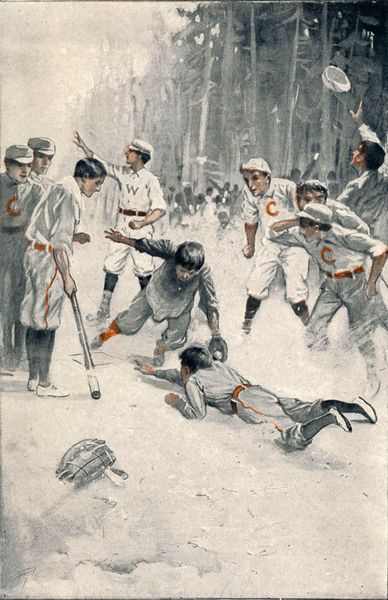
But although the pitcher threw wide of the base the
Wickasaw captain refused to muff the ball, and Van
Roden, sliding head foremost for the plate, felt the ball
thump against his shoulder while he was still two feet
away. But the crowd was close up to the line, and the
umpire, back of pitcher, had not seen it very well. He
shook his head and dropped his hand. A howl of angry
protest arose from the Wickasaw players who had been
near enough to see the out. In a moment Mr. Downer,
the center of a wrathful group of players, had called
“Time,” and was listening patiently to the protests.
Van Roden, grinning with delight, climbed to his feet
and walked off. Bob, in front of whom the affair
had taken place, walked out to the center of the
diamond. As soon as he might he gained the umpire’s
attention.
“Could you see that very well, sir?” he asked.
“Not very, I’ll acknowledge, because of the crowd
about the base. But it looked to me as though the
runner touched base before he was tagged. And that’s
my decision, boys.”
Again the protests arose. Bob raised his hand.
“Just a moment, please,” he said. “I was there,
Mr. Downer, and saw it——”
“Well, so was I there!” cried the Wickasaw
catcher and captain angrily. “I tell you I caught
him two feet off base!”
“That’s right!” cried the pitcher.
“I was there and saw it,” repeated Bob dryly.
“The runner was out.”
There was an instant of silence during which the
Wickasaw players observed the captain of the rival
team as though they thought he had gone suddenly
insane. Then:
“Their own captain says he was out!” exclaimed
the pitcher, turning eagerly to the umpire, “and if he
acknowledges it——”
“I’m satisfied,” responded Mr. Downer, with a
smile. “Out at the plate!”
Almost an hour later Chicora, cheering as though
after a victory, steamed home in the launch or trudged
back through the woods, while Wickasaw, apparently
no less elated, took herself off across the lake to Bear
Island. It was almost dark. The game had come to
an end after thirteen innings with the score 6 to 6.
Time and again Chicora had placed men on bases only
to have them left there. For five innings Nelson had
held the opponents down to a handful of scratch hits,
none of which yielded a score. It had been a hard
and well-fought contest and only darkness had brought
it to a close. Although the score-book, sedulously
guarded by the “Babe,” pronounced the game a tie,
yet there were many among those that knew how the
eighth inning had ended who credited a victory—and
a gorgeous one—to Chicora. Scores do not always tell
the whole story.
Two days later, while the sun was just peeping
over the hills, Bob, Dan, and Nelson stood on the deck
of the Navigation Company’s steamer, their trunks on
board and their bags beside them. On the landing was
assembled Camp Chicora in a body, and well in front,
in momentary peril of an involuntary bath, stood Tom,
a rather doleful Tom, whose eyes never for an instant
left the faces of the three on deck.
The line was cast off, the propeller churned impatiently,
and the head of the launch swung toward the
foot of the lake, the railroad, and home. The departing
ones had been cheered separately and collectively, and
as the boat gathered way only a confused medley of
shouts and laughter followed them. Only that, do I
say? No, for as the boat reached the point and the
group on the pier was lost to sight there came a final
hail, faint yet distinct:
“Gu-gu-gu-good bu-bu-bu-by!”
THE END
By RALPH HENRY BARBOUR.
On Your Mark!
A Story of College Life and Athletics. Illustrated in
Colors by C. M. Relyea. 12mo. Cloth, $1.50.
Mr. Barbour’s boys are real boys living in a very real world; and no other
author has caught so truly the spirit and ideals of school and college life.
The Arrival of Jimpson.
Illustrated. 12mo. Cloth, $1.50.
Good stories of college pranks, baseball, football, hockey, college newspapers,
and all the features that go to make the little world of college life.
The Book of School and College Sports.
Fully illustrated. 12mo. Cloth, $1.75 net; postage additional.
The author has been assisted in preparing this work by Messrs. Paine,
Robinson, Shick, Jr., and Abercrombie. The book is thoroughly up to date.
Weatherby’s Inning.
A Story of College Life and Baseball. Illustrated in Colors by
C. M. Relyea. 12mo. Cloth, $1.50.
In this recent book Mr. Barbour tells a story of college life and sport that
will appeal to all readers who enjoy a well-written story with a good plot.
Behind the Line.
A Story of School and Football. Illustrated by
C. M. Relyea. 12mo. Cloth, $1.50.
“He writes with a picturesque vigor and a knowledge of his
subject.”—St. Louis Post-Dispatch.
Captain of the Crew.
Illustrated by C. M. Relyea. 12mo. Cloth, $1.50.
One of those fresh, graphic, delightful stories that appeal to all healthy
girls and boys.
For the Honor of the School.
A Story of School Life and Interscholastic Sport. Illustrated by
C. M. Relyea. 12mo. Cloth, $1.50.
“It is a wholesome book, one tingling with health and activity, endeavor,
and laudable ambition to succeed in more fields than
one.”—New York Mail and Express.
The Half-Back.
Illustrated by B. West Clinedinst.
12mo. Cloth, $1.50.
“It is in every sense an out-and-out boys’
book.”—Boston Herald.
D. APPLETON AND COMPANY, NEW YORK.
BY HEZEKIAH BUTTERWORTH.
Brother Jonathan; or, the Alarm Post in the Cedars.
A Tale of Early Connecticut. Illustrated. Colored Frontispiece.
12mo. Cloth, $1.50.
A stirring tale of the early days of Connecticut, dominated by the forceful personality
of Jonathan Trumbull, whose name, through its affectionate use by George
Washington, has become the familiar nickname of the nation that he helped to make.
In the Days of Audubon.
A Tale of the “Protector of Birds.” Illustrated by B. West Clinedinst
and others. 12mo. Cloth, $1.50.
In the Days of Jefferson; or, The Six Golden Horseshoes.
A Tale of Republican Simplicity. Illustrated by F. T. Merrill. $1.50.
The Story of Magellan.
A Tale of the Discovery of the Philippines. Illustrated by F. T. Merrill
and others. $1.50.
The Treasure Ship.
A Story of Sir William Phipps and the Inter-Charter Period in Massachusetts.
Illustrated by B. West Clinedinst and others. $1.50.
The Pilot of the Mayflower.
Illustrated by H. Winthrop Peirce and others. $1.50.
True to his Home.
A Tale of the Boyhood of Franklin. Illustrated by H. Winthrop Peirce.
$1.50.
The Wampum Belt; or, The Fairest Page of History.
A Tale of William Penn’s Treaty with the Indians. With 6 full-page
Illustrations. $1.50.
The Knight of Liberty.
A Tale of the Fortunes of Lafayette. With 6 full-page Illustrations.
$1.50.
The Patriot Schoolmaster.
A Tale of the Minutemen and the Sons of Liberty. With 6 full-page
Illustrations by H. Winthrop Peirce. $1.50.
In the Boyhood of Lincoln.
A Story of the Black Hawk War and the Tunker Schoolmaster. With
12 Illustrations and colored Frontispiece. $1.50.
The Boys of Greenway Court.
A Story of the Early Years of Washington. With 10 full-page Illustrations.
$1.50.
The Log School-House on the Columbia.
With 13 full-page Illustrations by J. Carter Beard, E. J. Austen, and
others. $1.50.
D. APPLETON AND COMPANY, NEW YORK.
BY WILLIAM O. STODDARD.
Each Illustrated. 12mo. Cloth, $1.50.
The Fight for the Valley.
Colored Frontispiece and other Illustrations.
A narrative of the brave defence of Fort Schuyler and the battle of Oriskany.
The Spy of Yorktown.
Illustrated. Colored Frontispiece.
A story of the Yorktown campaign and Benedict Arnold.
With the Black Prince.
A Story of Adventure in the Fourteenth Century. Illustrated by
B. West Clinedinst.
The absorbing interest of this stirring historical romance will appeal to all young
readers.
Success Against Odds; or, How an American Boy made his
Way.
Illustrated by B. West Clinedinst.
In this spirited and interesting story Mr. Stoddard tells the adventures of a
plucky boy who fought his own battles, and made his way upward from poverty in
a Long Island seashore town. It is a tale of pluck and self-reliance capitally told.
The Red Patriot.
A Story of the American Revolution. Illustrated by B. West
Clinedinst.
The Windfall; or, After the Flood.
Illustrated by B. West Clinedinst.
Chris, the Model-Maker.
A Story of New York. With 6 full-page Illustrations by B. West
Clinedinst.
On the Old Frontier.
With 10 full-page Illustrations.
The Battle of New York.
With 11 full-page Illustrations and colored Frontispiece.
Little Smoke.
A Story of the Sioux Indians. With 12 full-page Illustrations by
F. S. Dellenbaugh, portraits of Sitting Bull, Red Cloud, and other
chiefs, and 72 head and tail pieces representing the various implements
and surroundings of Indian life.
Crowded Out o’ Crofield.
The Story of a country boy who fought his way to success in the
great metropolis. With 23 Illustrations by C. T. Hill.
D. APPLETON AND COMPANY, NEW YORK.
By C. C. HOTCHKISS.
The Land Hero of 1812.
Illustrated by B. West Clinedinst. 12mo. Cloth, $1.25.
Mr. Hotchkiss, who is well known through his stories for grown-ups, has
chosen as the subject of his first book for boys the life of Andrew Jackson.
While the facts of history are presented, the author adroitly constructed his
story upon the most picturesque incidents of Jackson’s varied career. The
book is therefore instructive as well as interesting.
The Strength of the Weak. 12mo. Cloth, $1.50.
For a Maiden Brave. Illustrated in colors. 12mo. Cloth, $1.50.
By GABRIELLE E. JACKSON.
Three College Graces.
With Illustrations in tint by C. M. Relyea. 12mo.
Cloth, $1.50.
A charming story of college life, its ideals, recreations, temptations, and
rewards. This book tells of the maturer years of the three little girls described
in
Three Graces. Illustrated in colors by C. M. Relyea. 12mo.
Cloth, $1.25 net; postage additional.
A story for girls of boarding-school life, full of incident and wholesome
characterization, with delightfully cozy scenes of indoor enjoyment and an
exciting description of a Hallowe’en escapade.
By OTTILIE A. LILJENCRANTZ.
The Vinland Champions.
Illustrated by the Kinneys. 12mo. Cloth, $1.50.
A rousing good boy’s book with plenty of dash and go, and a glimpse of
the wild, free life of the Vikings in it. Every school-boy has heard of the
vague rumor that the Norsemen discovered America before Christopher Columbus.
This story tells of the party of one hundred Icelanders who went
and dwelt there and called it the “Peace Land.”
By JULIE M. LIPPMANN.
Every-Day Girls.
Illustrated in colors. 12mo. Cloth, $1.50.
The best book for girls that has appeared in years; it has all the charm
and sweetness that is contained in “Little Women.” It is not merely a chronicle
of events, however, but teaches a valuable lesson. The girls are sweet
and lovely, and quarrelsome and impulsive, just as every-day girls are. They
have a hard and exciting time, and they fight a battle and win it. It is a
charming, wholesome book.
D. APPLETON AND COMPANY, NEW YORK.
Transcriber’s Notes:
Except for the frontispiece, illustrations have been moved
to the text that they illustrate, so the page number of the
illustration may not match the page number in the Illustrations.
Punctuation and spelling inaccuracies were silently corrected.
Archaic and variable spelling has been preserved.
Variations in hyphenation and compound words have been preserved.
The Author’s em-dash style has been retained.