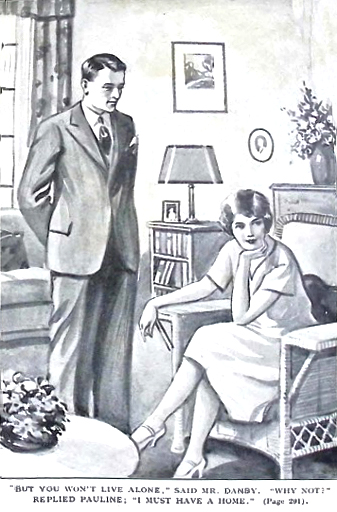
SUMMONED TO PART
"What matter if I stand alone?
I wait with joy the coming years;
My heart shall reap where it has sown
And garner up its fruit of tears.
"The stars come nightly to the sky;
The tidal wave into the sea.
Nor time, nor space, nor deep, nor high,
Can keep my own away from me."
JOHN BURROUGHS.
HONOR had not been with Pauline very long before Amabel came over to
see them with her baby. She had arrived from India with an ayah, who
was the cause of much awe and interest to the villagers. Amabel herself
looked white and frail, but was as happy and lighthearted as ever.
Of course, as mothers, she and Honor compared notes about their babies,
and Pauline listened to them with much amusement.
"I do love India so," said Amabel, "but I am afraid it does not love
me. I seem to get so much fever. You see, I have some shadows, Honor; I
know you think I have none."
"Oh, I don't say that," said Honor; "the separation from your husband
must be a big one."
"Yes; and he feels it so much that he wants to get an exchange, but I
won't have that. I am a soldier's wife, and don't want him or myself
to shirk the hardships that come to us. I don't want him ever to be
able to say, 'I could have got my promotion quicker if I had been an
unmarried man.'"
"I quite agree," said Pauline, with kindling eyes.
"So, you see," went on Amabel in her cheerful voice, "I must be
separated from him for a little. When I get quite strong again, I shall
go back to him. And meanwhile, baby and ayah and I are turning our
house topsy-turvy, but mother and father say they enjoy it, and I am
sure I do."
She chatted away, telling them of her first experiences of native
servants, and making them laugh at her blunders.
When she had left them, Honor said:
"It isn't only Amabel's circumstances that make her so sunny; it is her
nature. She will go through life taking everything the same way."
"Yes, I think she will. Even big sorrows that may come to her will fall
upon her softly. She will see the Love behind them."
"She will have no big sorrows—she travels south."
"Oh, well," said Pauline, laughing, "that is only a fancy of ours. And,
remember, storms come from every quarter."
It was only the next morning that Pauline came to breakfast and found
Honor, who had come down before her, reading a foreign letter, with a
stunned, despairing face.
To herself Pauline thought, "That wretched husband again!"
Then she asked if she had had good news. Honor sat down at the table,
and, putting her face down into her hands, began to cry.
"What is the matter, dear? Is your husband not well?"
"Oh, I can't believe it! It's the most awful news! Alick has had the
most dreadful accident. I can't understand particulars. He was jammed
between some logs near a rapid; he was in a canoe, and it was caught
between them and crushed to pieces. That's what this man says—it isn't
Alick himself. And they've had to amputate one of his legs above the
knee. He'll be a cripple for life; he will never be able to ride. And
this man says one of his arms is also injured."
"But his life is not in danger?"
"No, he says not. But he says he is coming home."
"Oh, Honor, are you not glad?"
"How can I be glad when I know how he will hate it? He is a restless
man, and loves an open air life, and walking or riding is essential to
him. Oh, Pauline, it has just come to me! I have been praying that he
may be brought to England and settle down here; I have been praying so
earnestly, and now my prayer is answered in this terrible way!"
"My dear Honor, do you know that you make out God to be a hard and
cruel tyrant?"
"Oh, no; don't say that. But it will be such an awful return! And if he
cannot travel any more, how can I hope to make him content and happy?
And how shall we be able to live? Oh, Pauline, forgive me! Here comes
Fay. Give her her breakfast; I will run upstairs to baby. I feel as if
food will choke me."
Honor disappeared. It did seem as if she had one trouble upon the top
of another, and for the time, the shock had utterly unnerved her.
Yet later in the day, she was able to break the news to Fay with brave,
smiling lips.
To the child the thought of her father's return was more than his hurt.
And Honor began to plan in her own mind how she could make life still
bearable to him. This news made her leave Pauline sooner than she would
otherwise have done, for Miss Selkirk hastened home and asked her to
join her.
"Do you think Miss Selkirk will want your husband to make his home with
her?" Pauline asked.
"Why, no! I should think not! Alick would rather be in a hovel, I
believe, than go to her! I don't know what we shall do. Perhaps I shall
hear his plans next mail, unless he has started for England already?"
And the next mail did bring her a letter from her husband.
"MY DEAREST WIFE,
"You have heard of my smash up! With good luck, for once, only one leg
has suffered, and my left arm will be useless for a time. But as I am
such a crock, I am coming home to be nursed. What will Fay say to a
one-legged father? You must meet me in London, and then we'll settle
what we shall do. Meantime, you can be hunting up any small place in
the country. I've been jotting up my investments this morning, and
find that I can be sure of about £400 a year, so you must get a house
in proportion to our means. Shall we buy a caravan and live in it? I'm
sure that would suit our requirements. No more for now. It does my
heart good to think I have a wife and child ready to welcome me. I'm
afraid I've kept you on short commons, but it hasn't hurt Margaret to
dispose of some of her hoarded wealth. I forget I have a boy. How is
he? Expect me by the Star Line. I'll wire name of boat.
"Your affectionate husband,—
"ALICK."
Honor did not read the whole of this letter to Miss Selkirk, but she
did tell her of the income her husband had.
And she was bitterly indignant with him in consequence.
"He has been spending all that upon himself, and keeping you and his
children without a penny! How on earth can he do it?"
"He is very generous," faltered Honor; "he helps his friends a lot. Men
don't think. It is an immense relief to me, for I was wondering how we
should live. We shall be kept from want, and shall be able to live on
that in comfort."
Miss Selkirk gave an angry snort.
"Alick will be Alick still to the end of his life. Can't I see your
household? He living on the fat of the land, and having the best of
everything; you and the children suffering from absence of actual
necessaries."
"I see myself happy, if I can make him so," said Honor.
And Miss Selkirk walked away silenced, but marvelling at her.
The next morning to this came a letter from Pauline. And as Honor read,
she again took herself to task for her want of trust and faith in God.
"I am going to ask you," Pauline wrote, "if you would like the loan
of my farmhouse for a time? It would be a kindness to me if you kept
it aired. And if Mr. Selkirk likes to pay me rent for it, I will let
it for fifteen shillings a week during the winter-time. The fact is,
I want to pay some visits. And I am thinking of doing a little parish
work in a small village about twenty miles from here. I find, Honor,
that I have too much idle time on my hands. I must do something, as I
do not want to rust. Mr. Danby mentioned this village to me long ago.
He went there to lecture, and what he told me interested me greatly.
The living is only worth about £130 a year. The old clergyman and his
wife are real old saints, who stint themselves of their last penny if
any of their parishioners need help. But they are getting feeble; their
village population is increasing, as a paper mill has been set up about
a mile away, and they are not equal to the demands made upon them.
"Mr. Danby told me he would like to have helped them, but there was
much that, as a man, he could not do. And it has struck me that I could
take rooms in the village and do what little I could to help them. He
gave me a most pathetic account of their efforts at hospitality when he
stayed a night with them. They seem like an old Darby and Joan—and real
old gentle-people. I have written to them, and have had a most kind
letter in return, and, if I can let my farmhouse, I will go to them at
once. It all seems to fit in, doesn't it? You would be near your home
and within touch of your father and little sisters, and it would be
a quiet country spot for a convalescent. Write and tell me what you
think. I do hope you will take it, if only for a time—and Mary would
be a great comfort to you. I would not take her with me, not unless I
settled down there eventually and had my furniture with me."
"It's just the place for us," said Honor to Miss Selkirk. "If I had
gone all over England, I could not have found any other place I should
have liked so well."
She wrote and accepted Pauline's offer gratefully.
Pauline did not let the grass grow beneath her feet. She packed up what
she intended to take with her. The rest she had had since her mother's
death had given her back much of her former strength and vigour, and
she was almost feverishly eager to be at work again.
Mrs. Daventry at first tried to dissuade her from the step she was
about to take:
"We can't afford to lose you. You will only be overworking yourself.
I can't tell you how I long that someone should take care of you. You
have always been taking care of others. Will you not come to me for a
long visit?"
But Pauline shook her head.
"I have done so little all my life in the way of helping my outside
neighbours that I am longing to begin now. If I want a rest, may I come
to you? That would be so delightful!"
Just two days before her departure, she was packing up some books in
her sitting-room when Mr. Danby was announced.
She turned round, feeling rather relieved to think that he was perhaps
going to be on the old friendly terms with her again. But when she saw
his face, she was struck by its extreme gravity.
He shook hands with her in silence, then Pauline said gently:
"I am afraid you are in trouble, are you not?"
"Yes, I am," he said abruptly; "and I have come to drag you into it,
too. At least, I am presuming that you will do what I want."
"If I can help you at all, I shall be glad."
He paused. Then as she asked him to sit down, he did so.
"You know I can't beat about the bush. There's someone—a friend of
mine—who is ill. He can't get better, and he wants to see you. Will you
come?"
"Who is it?"
Pauline's lips whitened as she asked the question.
"He's been murmuring your name—there aren't many Paulines in the world.
I never knew he was a friend of yours, though he was always keen on
hearing me talk about you, but I expect he is—"
"Is it Mr. Pembroke?"
"Ah, then my surmise is true! You know, I've seen a lot of him lately,
and last week in protecting a child, he was knocked down by a motor in
town. They took him to the hospital, and thought he was doing well, but
there are internal complications. He is in a nursing home now in Harley
Street. I've been with him. He seems rather a lonely chap, though he
has plenty of acquaintances. I asked him last night if he would like to
see you, and his look made me rush down the first thing this morning."
"I will come," said Pauline steadily. "Can we catch a train this
afternoon?"
"Yes, if you are quick. I have a cab outside. I would have wired, only
I did not know—I wasn't sure whether you would understand."
Pauline had disappeared. In five minutes, she was back again. Her very
quietness and absence of fussiness and the tragic look in her sweet
blue eyes told Mr. Danby that he had been right in summoning her.
She asked for a few details during the journey to town, but they did
not speak much. As Pauline sat back, resting her throbbing head against
the hard railway carriage cushions, one sentence was burning itself
into her brain:
"He can't get better."
It was late in the evening when they reached Harley Street. A nurse
came into the sitting-room and greeted Pauline very kindly.
"I am so glad you could come. He is quite conscious now, though very
weak. It will not be very long, the doctor thinks. But you must have a
cup of tea or coffee before you go up to him."
"I would rather not."
"Then I will have one ready for you when you leave him. This way.
I think, Mr. Danby, it would be best for you not to see him again
to-night if this lady does."
Mr. Danby bowed assent meekly, quite willing to relinquish his place to
Pauline.
"I will be here the first thing in the morning," he said.
And then Pauline, always ready to consider everyone before herself,
turned to him and held out her hand with a sweet smile:
"Good-night, Mr. Danby. I will thank you later for your goodness
in fetching me. Please say if you specially want to see him again
to-night. I do not want to usurp your place."
"I am glad you can see him," said Mr. Danby gruffly. And then he went,
for the sorrow of Pauline and Justin seemed greater than his own.
Every detail of that little house in Harley Street stamped itself upon
Pauline's brain: the red felt stair carpets as she trod upon them,
the photographs on the staircase of groups of nurses and doctors, the
landing with the inevitable table outside the sick-rooms, and the quiet
bustle that there seemed everywhere—nurses passing to and fro, a sound
of whisking of eggs, the slight rattle of crockery, and a smell of
disinfectants throughout the whole.
And as she stood outside the door, she said to herself, with a mixture
of joy and pain in her heart:
"He wants me. He has not forgotten me."
Then, a moment after, she stood looking down upon the narrow bed.
Suffering had already left its mark on Justin; his face looked wan and
pale, his eyes seemed sunken, and there were blue lines about them and
his lips.
It was no time to stand on ceremony. Pauline sank on her knees by the
bedside and took his hand in hers. The nurse slipped out of the room.
"I am here—Pauline is here," she said softly but distinctly.
Justin opened his eyes, and then a slow, bright smile spread over his
face.
"Pauline," he whispered, "how did you know?"
"Mr. Danby has brought me."
"I was hoping—hoping to come down to you. Would you have listened to
me?"
He spoke with difficulty.
Pauline choked down a little sob.
"Justin, dear, there is so little time—I should like you to know—I have
always loved you. My mother never gave me your letter. I did not know
you had called. That is many years ago, and I thought you had forgotten
me. Don't look sorrowful, dear. In any case, I could not have left my
mother."
"Take off your hat. Put your head down on the pillow beside me. I am a
dying man. They say I can't last long."
Quietly, Pauline did as he wished. If her lips were quivering and her
heart nearly breaking, she did not let her feelings get the better of
her.
Justin took her face between his two hands, then kissed her slowly upon
her lips.
"My heart has always held you," he said simply.
They were silent for a moment. With death hovering so near, there
seemed no need for any explanations or protestations of love.
Again he spoke.
"I am so glad you always cared. I wish I had known. The years seem
wasted."
"No," said Pauline, with a serene light in her eyes; "doing and bearing
God's will is never waste of time."
He smiled.
"We shall have eternity together in any case; we have been kept apart
for some wise purpose. Will you read to me? Your voice is such music."
It was too dark to read, but from memory Pauline began to repeat:
"'Let not your heart be troubled. Ye believe in God, believe also in
Me.'"
Verse after verse of that beautiful chapter did she say, and her lover
lay there smiling, waiting for the messenger who still delayed.
Presently the nurse returned, and Pauline was told she must go.
For a moment her spirit rebelled. And the nurse, after a searching look
at the patient, called her out of the room.
"If he is dying," said Pauline to her, "why should not I stay to the
end?"
"He seems to have rallied wonderfully," the nurse said thoughtfully.
"If we can give him nourishment and get him to sleep, he may linger
longer than we thought this morning."
"And you think he has a better chance if I am away from him?"
"There will be less temptation for him to make an effort to speak."
Pauline went back to the bed.
"Justin," she said in her low, clear voice, "I am leaving you now. Rest
and sleep, and I will see you, I hope, in the morning."
She bent and kissed him on the forehead. He seemed already to be
slipping into unconsciousness.
And then, in a sitting-room below, Pauline spent the night pacing up
and down, her lips moving in prayer. The anguish of that night brought
silver threads amongst her golden hair. She seemed, like David of old,
to say,—
"'Who can tell whether God will be gracious to me?'"
And she had the realisation that death itself was stayed, whilst the
ear of God was bent in love to listen to one of His children.
She had acquiesced the day before in patient submission to what she
believed was God's will. Now, she was earnestly pleading and wrestling
for the life that seemed to be slipping away, and yet through it all
she cried:
"Not against Thy will, O God, but let it be Thy will."
When morning dawned, the nurse came to her.
"I hardly dare give you hope, but the doctor has been and is
astonished. We thought last night it was the last rally, but the
improvement and strength are maintained."
And so it was continued all day. Pauline took a room at the nearest
hotel.
Before a week was over, the doctors were able to state that recovery
was more than possible, it was probable. And Pauline lived day by day
hugging the new-born hope to her heart and thanking God for His mercy.
When she eventually returned home, her life seemed to be a strange
confusion.
Justin's recovery would be slow, and the doctors had told him that
there would be no more travelling or exploring for him. He would have
to lead a very quiet life, though not necessarily that of an invalid.
If they married soon, Pauline would be more of a nurse than a wife, and
Justin was not a rich man.
The outlook would not have been rosy to any but Pauline.
Yet she confided to Mrs. Daventry that her cup was so full that she
could hardly bear it.
"Do you think," she said, "my path has taken a twist and is facing
south at last?"
"I think," said Mrs. Daventry slowly, "that your northern journey will
be shared by one who, with yourself, has enough sunshine within to
compensate for the lack of it without."
"You mean we shall have to contend with small means? But I have never
had much of this world's wealth. And I am afraid I am like any romantic
girl—with Justin by my side, I fear nothing."
"What about your farmhouse? Will you not want it for yourself?"
"Not at present. Justin and I want to go together to my village and
help the old clergyman and his wife. We mean to start in rooms first,
and if we can find a small cottage later on, we may take it. Justin
will be able to help in many ways, and it will give him interest
outside himself. Don't shake your head, dear Mrs. Daventry. I know what
is in front of me, and I am glorying in it all."
What could Mrs. Daventry say?
She only kissed Pauline affectionately, and rejoiced in her happiness.
She knew that no clouds would ever bow her head, no troubles, however
great, would crush her spirit; and this gleam of sunlight upon her path
was surely the reward of much patient waiting.
But when others heard her news, they were much more ecstatic than Mrs.
Daventry. Audrey and Honor were too delighted for words.
"Oh!" said Audrey, hugging her. "What a wife you will make! Fortunate
man! Is he worthy of you? Oh, Pauline, Pauline! To think that you
should be like the rest of us! And isn't it extraordinary that we four
shall all marry? A year or two ago and we thought we should live and
die old maids."
"I knew something good would come to you one day," said Honor. "And you
richly deserve the very best man who walks the face of the earth!"
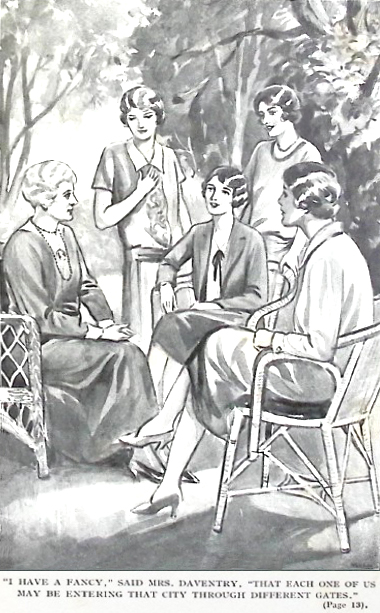
Mrs. Daventry was seated once again upon her lawn with her four young
friends around her. It was the last opportunity they had of gathering
together, as upon the following day Amabel was returning to her husband
in India. Honor and her husband were comfortably settled in Pauline's
farmhouse. She had left Fay to entertain her father for this afternoon.
Audrey had motored down from her brother's for the occasion. And
Pauline was Mrs. Daventry's guest. She had insisted upon having her,
and was going to keep her till she married. Justin was fast recovering
in the nursing home, and directly he was convalescent, he was also
coming to stay with Mrs. Daventry.
The girls had been talking over old times. A little shadow seemed to
lie on Honor's face. Perhaps her experience gave her voice a tinge of
melancholy as she said:
"Well, it is strange that none of us should remain single women, but
I don't think marriage changes one's aspect. It isn't as it is in
story-books; and it does not follow that Pauline's path will turn
from the north because she is going to marry. I used to believe that
a marriage was the beginning of living happily ever after, but it
seems to me that it is just the beginning of responsibilities and
difficulties, and of experiencing the depths in life, instead of the
rippling surface."
Audrey looked sober; but not a shadow came into Pauline's beautiful
eyes.
"Life is good at all times," she said simply; "and deep water is better
than shallow for swimmers, Honor. We don't want to stagnate."
"Do you remember when you first talked to us about our gates?" said
Audrey, turning to Mrs. Daventry. "We said something about meeting in
a year's time and comparing notes. We never did. How we have scattered
in these few years! It has been a general break-up. And I used to think
that nothing would ever change!"
"We always think that when we are young," said Mrs. Daventry, with
rather a wistful smile.
"Let us compare notes at once," cried Amabel enthusiastically. "May I
begin?"
Assent was upon everyone's lips, but a shadow of gravity stole over the
sunshiny face of the girl as she said:
"I suppose I am still treading south. I know I have a happy southern
aspect, and life, as yet, has brought me no heavy troubles. But I pray
God every day to make me what He wants me to be, and that is where I
fail. A gardener expects so much more from a plant that is grown in a
sunny, sheltered position. And though one faces south, it isn't always
free from breezes—is it Mrs. Daventry? May I tell you all a lovely
little thing that I discovered in my Bible quite lately? It is in
Joshua, where Caleb's daughter comes to her father, and says, when he
asks her what she wants:
"'Give me a blessing; for thou hast given me a south land; give me also
springs of water.'
"That is my prayer every day now. I don't want to get parched by easy
circumstances."
Amabel was sitting next to Mrs. Daventry, and the old lady put her
withered hand gently over her young one.
"Your south gate will not spoil you," she said softly, and tears were
in her eyes as she spoke.
"Now, Honor," said Audrey, "what is your experience?"
Honor was silent for a moment. Then she said:
"I have learnt this:
"'He stayeth His rough wind in the day of the east wind' (Isaiah xxvii.
8).
"It is never too strong for me."
She bore the impress upon her face that her words were true. The old
fretful, discontented lines had disappeared. Great quietness and peace
had settled upon her; the storm and stress of life which still buffeted
and cut her was rounding her corners and shaping her into patient,
steadfast womanhood.
"Ah!" said Audrey with a quick-caught sigh. "I am far behind you all.
I don't believe these years have taught me anything except to discover
how little I know. But—" here her grey eyes kindled and flashed with
sudden feeling—"I came across a verse the other day which fits me:
"'The Lord turned a mighty strong west wind, which took away the
locusts' (Exod. x. 19).
"And I need a strong wind to take away all my locusts. So I daren't
complain. Storms are good for me—and I have got far more sunshine than
I deserve."
"And now, Pauline?"
Mrs. Daventry looked tenderly at the beautiful girl, with her quiet,
glad face and shining eyes.
"What can I say?" said Pauline, with a smile. "Audrey has just given
us a quaint text. May I give another? It is in Zechariah vi., and is
speaking about the chariots and horses driving northwards:
"'Behold, these that go toward the north country have quieted my spirit
in the north country.'
"And I feel that I am not journeying alone, and so my spirit is
quieted."
"The horses and chariots of the Lord," murmured Mrs. Daventry. "After
all, girls, what does it matter about your aspect, north or south,
east or west, so long as your goal is the right one? The beginning and
the middle of our journey is not worth consideration in comparison to
the end of it. Shall I repeat the promise that always brings a little
thrill to my heart as I read it?
"'And the ransomed of the Lord shall return, and come to Zion with
songs and everlasting joy upon their heads: they shall obtain joy and
gladness, and sorrow and sighing shall flee away.'" (Isaiah xxxv. 10).