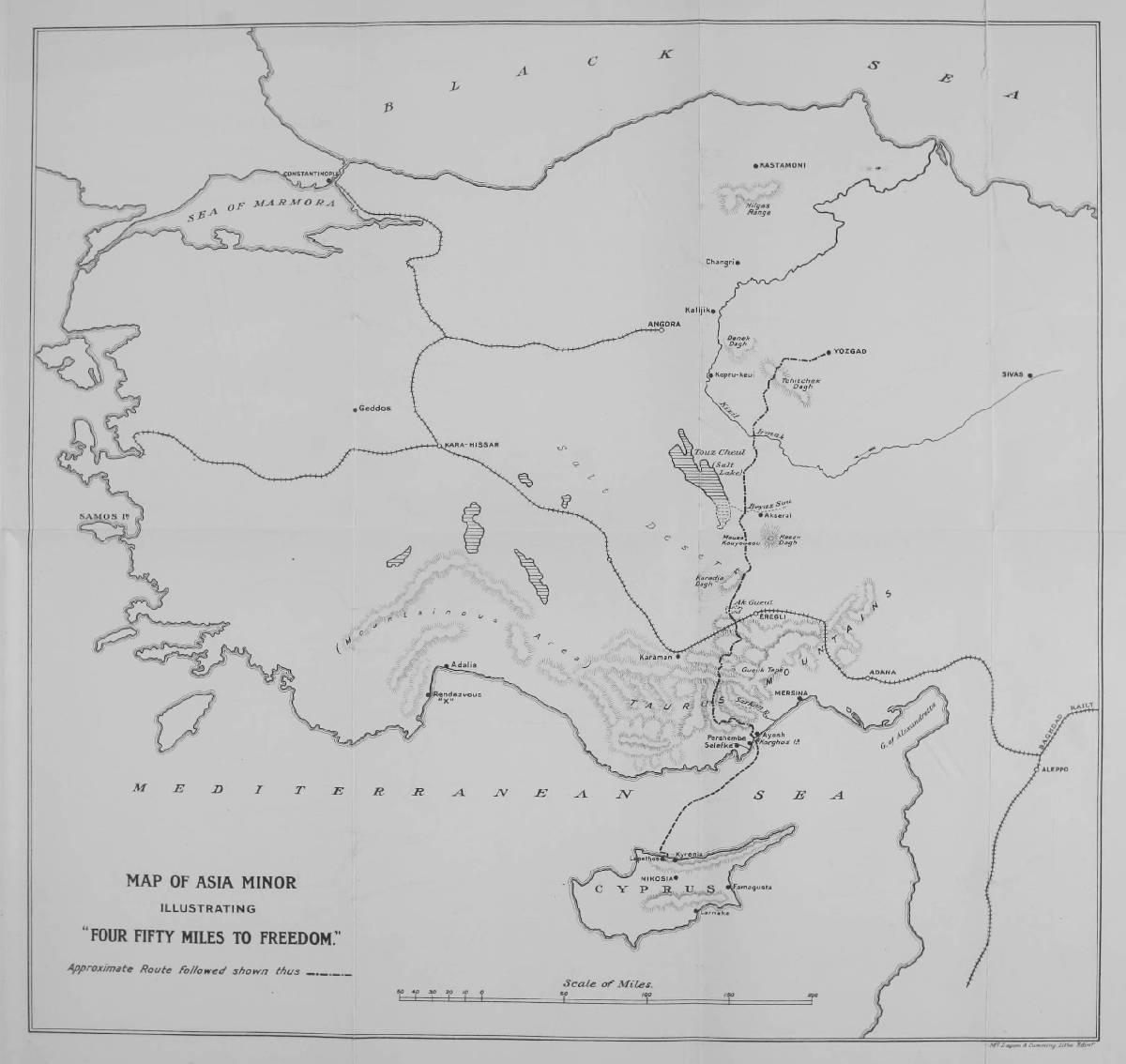
With our arrival at Yozgad was renewed
many an old friendship, dating back to the
earlier days of the campaign in Mesopotamia;
for, like ourselves, the majority of the eighty
officers whom we found there were victims of
the siege of Kut-el-Amara. A few days later
about twenty officers of the original camp
were transferred to Afion-Kara-Hissar, leaving
us now a combined total of roughly
100 officers and 60 orderlies.
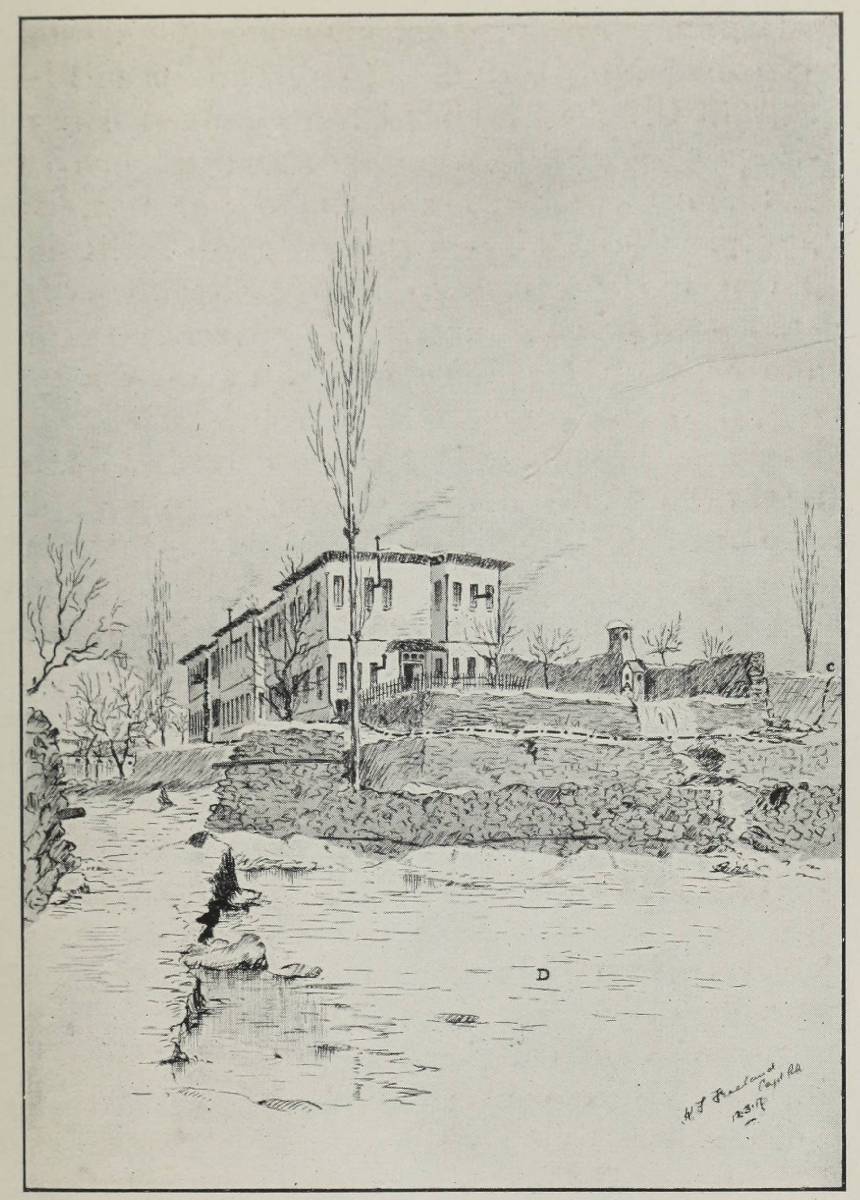
The "camp" occupied six detached houses,
divided into two groups of three houses each,
the one on the western, the other near the
south-western limits of the town. With a
single exception each house stood in its own
grounds, which comprised something under
an acre of garden apiece. These were in
most cases planted with fruit trees, and in
all cases surrounded by high stone walls.
The first comers had by April 1918 converted
these previously unkempt areas into
flourishing vegetable gardens. For our safe
custody there were on the average two
sentries over each house; these had their
sentry-boxes in the garden or at the entrance
to the enclosure wall. There was also a
post on the four-hundred-yard length of road
which connected the two groups of houses.
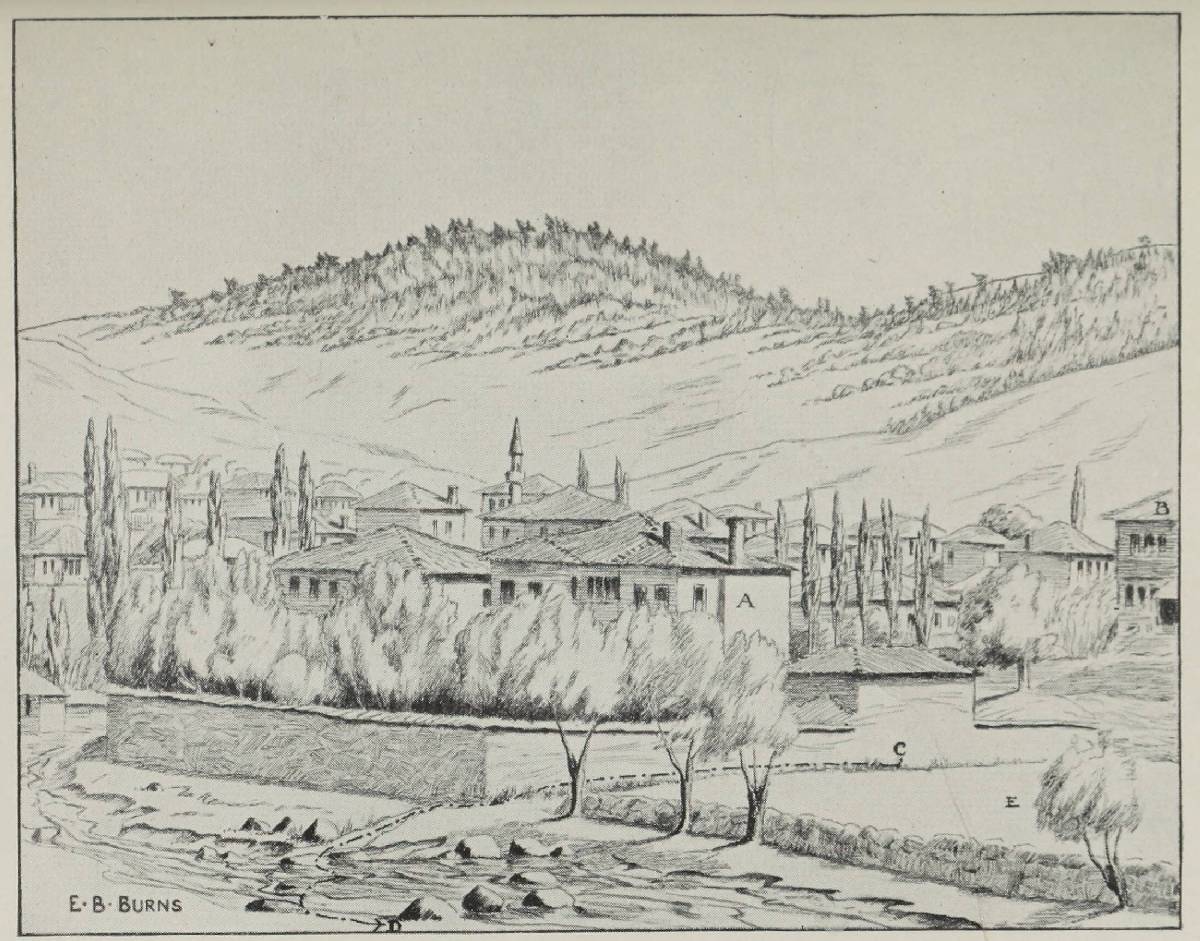
As had been our impression on arrival,
the town of Yozgad could by no manner
of means be called picturesque. It is squalidly
built on the steep slopes of a narrow
valley, surrounded on all sides by bare and
rugged hills. The larger houses, it is true,
have a few fruit trees in their gardens, and
tall poplars line the river bank; the country
around, however, is destitute of trees except
for a small pine wood on the high ridge
south of the town. The camp was both
higher and less accessible than any other
in Turkey; for Yozgad stands some 4500
feet above sea-level, and in the heart of
the rugged mountain system of Anatolia,
seven days' march from the nearest railway
station.
The town itself is said to have had a
population before the war of some 20,000
souls. At the time of our arrival it could
hardly have contained one-fifth of that number;
for, shortly before the formation of the
camp in July 1916, most of the Armenians had
been massacred; and they had formed a large
proportion of the inhabitants. Their shops
had been pillaged, and whenever there was a
shortage of firewood the Turks merely proceeded
to pull down another of the Armenian
houses, which, as usual throughout Anatolia,
were largely constructed of wood. The crash
of falling timber as a building was demolished
was a sound so common as to pass
almost unnoticed by the prisoners. Of
Turkish brutality, however, we had an even
more constant reminder than the sound and
sight of ruined buildings; for every day there
were to be seen numbers of Armenian children
dying as they lay in the narrow streets,
starved, emaciated, and clad in rags. For
us to provide relief on the large scale required
was impossible, owing both to the difficulties
of obtaining money and the necessity
of screening our philanthropy from the
commandant and other Turkish authorities.
To the credit of the Turkish soldier be it
said, however, that he at any rate did not
prevent us from helping these poor miserable
creatures; and it was thanks to connivance
on the part of our sentries and escorts that
we were able towards the end of our time
to give away money and bread daily in
the streets.
The White Paper published in November
1918 on the subject of the Treatment of
British Prisoners of War in Turkey describes
the commandant of the camp at Yozgad
as a "Turk of the old school—polite, honest,
and silent." Silent, or, we would rather
say, taciturn, Kiazim Bey undoubtedly was,
for it needed many applications before an
inquiry or request received an answer at
all. Polite, too, for when he did vouchsafe
to reply he would promise almost anything;
but is it not known to those who
have dealt with a Turk, albeit one of the
old school, that in his estimation a promise
costs nothing and involves no obligation of
fulfilment? It is merely his method of
temporarily soothing your feelings, and is
not this of the essence of politeness? As
to his honesty, if he did not loot our parcels
or steal our money, he was not averse from
accepting a regular commission from every
shopkeeper who wished to supply his wares
to the camp. Even our sentries had to bribe
him before they were allowed on leave. Ten
Turkish pounds, or an equivalent in kind,
passed hands before a fortnight's leave was
granted.
The following story can be vouched for.
One of our guard, when desiring a holiday,
turned up at the commandant's office, but
he was out. His son, however, a boy of
fourteen, was there, and to him the simple
soldier gave his money to be handed on to
Kiazim Bey. Such an opportunity did not
often occur; so the boy spent the rest of
that day gorging costly sweetmeats in the
bazaar. After several days the soldier made
further inquiries about his leave, and the
truth was out. The story ends with a good
beating for the boy and no leave for the
soldier. Another of our guards used to
mend boots for us, but finally gave it up,
declaring openly that the commission demanded
by his commandant made it no
longer worth his while.
By the time of the arrival of the party
from Changri, a number of so-called privileges
had been granted by this polite, honest,
and silent old Turk—although, it must
be admitted, rather in the spirit of the
unjust judge worried incessantly by the
importunate widow. The most useful of
these concessions was the permission to go
out coursing on two days a week. The
"Yozgad Hunt Club" boasted a pack of
no less than three couple of "hounds."
These were of a local breed, and had the
shape of small and rather moth-eaten greyhounds,
mostly, however, with black, or
tan and white, markings. Nevertheless, they
were clean and affectionate, and, thanks to the
master and whips, became wonderfully good
coursers. Seldom did they fail to account for
at least one hare or fox between the hours
of 4 and 9 A.M. each Monday and Thursday
in the spring and summer of 1918.
One exception we remember was the day
when the master appeared for the first
time in a pink coat of local style and dye,
and then we drew blank. The field themselves
were dazed, so the hounds had to
be excused. Some of the happiest recollections
of our captivity are of those glorious
early mornings in the country, far away
from the ugly town which was our prison.
Here for a few brief hours it was almost
possible to forget that we were prisoners
of war, until reminded that this was Turkey
by the monotonous drawl of one of our
greatest exponents of the Ottoman tongue.
Wafted on the soft morning breeze as we
wended our way back to bath and breakfast,
would come at intervals of half a
minute some such sounds as those which
follow: Er ... er ... posta ... bou
... bou ... bourda ... er ... er
... aie ... der.... Such fluency almost
suggested that Turkish was a simple language,
instead of one of the most difficult in
the world, second only, it is said, to Chinese.
Although attempts were made to play
football, no suitable ground existed in or
near Yozgad, and four-a-side hockey became
the form of recreation which for the majority
in the camp provided the best means
of combining pleasure and hard exercise.
Hockey was available at any time of day,
as the ground was within the precincts of
the camp, being in fact the lowest of a
series of terraces in one of the gardens belonging
to our houses. It was a bare plot,
with a hard but dusty surface, and surrounded
on three sides by stone walls: the
area available for play was, perhaps, the
length of a cricket pitch and about ten
yards across, so that there was not room
for more than a total of eight players.
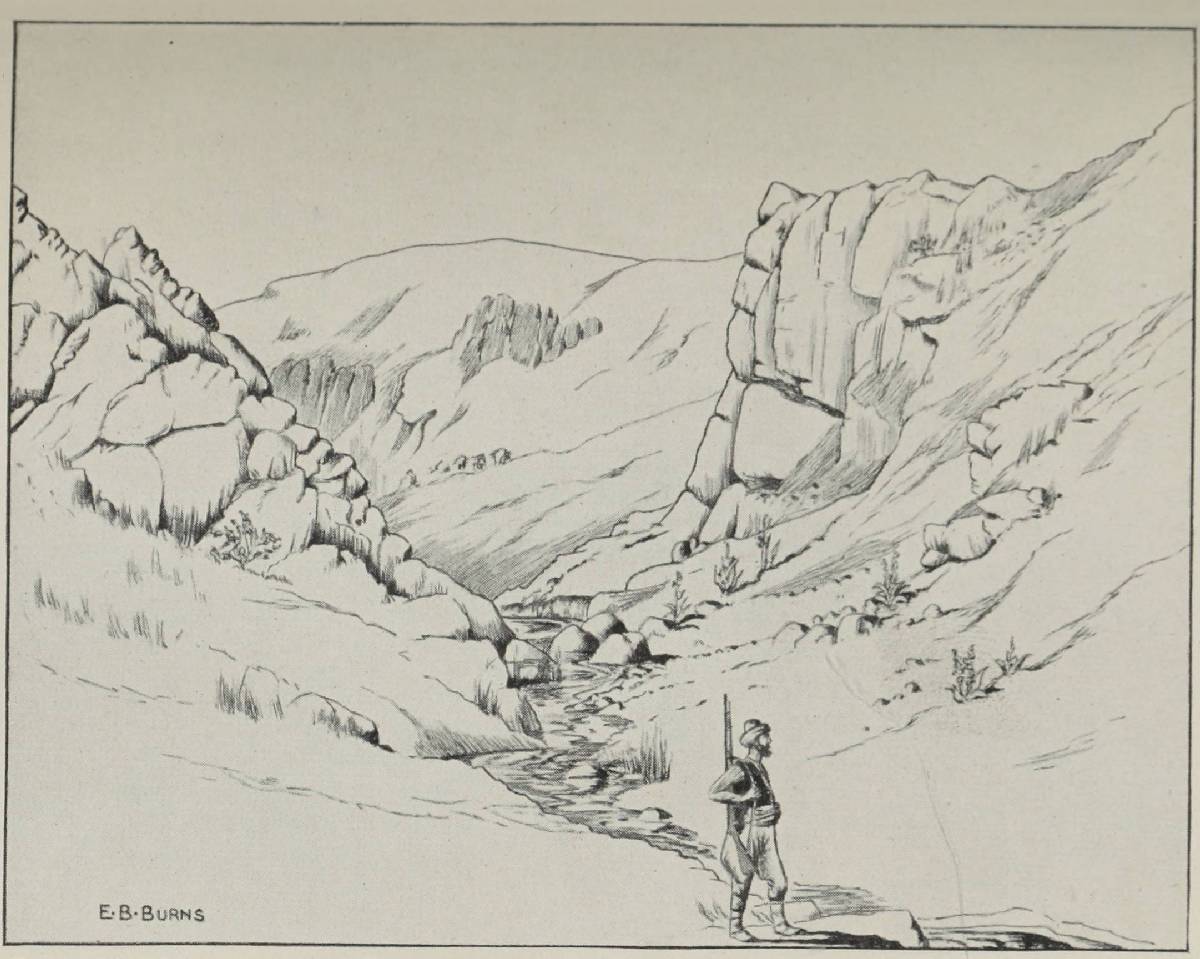
From a sketch by Capt. E. B. Burns, E. Kent Regt.
COUNTRY KNOWN TO THE LOCAL HUNT CLUB AS "HADES."
The equipment consisted of a soft leather
ball, and for each combatant a stick made
from selected pieces of firewood, shaped
according to fancy, subject to the finished
article being passed through a 1½-inch ring.
The resultant game was always fast and
often furious, its only drawback as a means
of training for would-be escapers being the
not inconsiderable risk of losing an eye,
finger, or portions of an ankle or knee.
The excitement created by such matches
as the old camp, Yozgad, versus the newcomers
from Changri, 1st, 2nd, 3rd, 4th,
and 5th teams, reached at times a pitch
rarely attained in the most hotly-contested
house-match at an English public school.
For those debarred for any reason from
this strenuous form of exercise there were
walks each evening, except on hunting days
and Wednesdays. On the latter days there
were, during the summer months, weekly
picnics in the neighbouring pine woods, to
which about 50 per cent of the camp
would go.
During daylight intercommunication was
allowed between the two groups of houses:
nominally an escort was necessary to accompany
such visitors along the intervening
road, but in practice this rule was a dead
letter.
So hard-won, however, had been these
few privileges, that the prospect of any
one attempting to escape and thereby causing
their suspension was looked upon by
the majority of the original camp almost
with horror. And this was not altogether
without reason, for some of them had gone
seriously into the question of escape, and had
come to the conclusion that, from so hopelessly
inaccessible a spot, all attempts, at
least without outside assistance, were doomed
to failure. Those of us who had come from
Changri, however, were not likely to give
up our long-cherished hopes without a
struggle, but in the meantime kept our
nefarious intentions to ourselves, except for
half a dozen Yozgad officers whom we knew
for certain to be keen to escape. The arrival
of Cochrane had more than countered the
additional difficulties involved by our move
from Changri to Yozgad. While at Kara-Hissar,
he had arranged a scheme with
the powers that be in England by which
a friendly boat should remain off a certain
point on the coast of the Mediterranean
for a definite number of days at the end
of August 1918.
Cochrane now placed this scheme at the
disposal of the Changri division. There was
some reluctance to give up old plans, but in
the end four parties decided to take advantage
of "Rendezvous X," as Cochrane's meeting-place
was called—suffice to say that it was
on the Adalian coast nearly due south of
Kara-Hissar. Of these four parties ours was
one. Our route to the island of Samos—our
original scheme—would now be some 450 miles.
Actually this was only 50 miles farther than
to Rendezvous X, for the only feasible route
to the latter was viâ Kara-Hissar, owing to
the desert and mountains which would have
to be crossed on a more direct route. Cochrane's
scheme, however, promised an almost
certain ending to the march to any one who
reached the coast; whereas, even if we reached
the western shore of Asia Minor, we should
still have the problem of getting across to the
island, and that from a coast which must inevitably
be very carefully guarded.
Our six therefore decided to give up the
old plan, and soon after were joined by Cochrane
himself and Captain F. R. Ellis, D.C.L.I.
This was a tremendous advantage to us, as
Cochrane not only had the experience so
hardly gained by his previous attempt, but
had actually seen some of the country over
which we should have to march if we succeeded
in passing Kara-Hissar. It was of course impossible
for him to do guide to all four parties,
as large numbers marching together would be
immediately tracked; so he gave what suggestions
he could, and the other three parties
were to make their way to the rendezvous
independently.
Our party therefore numbered eight, all of
whom have now been introduced to our
readers. We were the largest, and may claim
to have been the most representative party,
including as we did one naval officer, one
gunner, one sapper, one British Infantry, two
Indian Army, and two Territorial officers. The
other three parties making for Rendezvous X
numbered in all nine officers and Gunner
Prosser. Besides these there were two parties
having other schemes. The first, consisting
almost entirely of Yozgad officers, intended
marching for the Black Sea and crossing to
Russia, the full facts of whose chaotic state
were not known to us at the time. There
were six officers in this party. Lastly, a
party of two more officers determined to set
out eastward, and hoped to make their way
into Persia.[8] There had been three or four
other officers beside these who had seriously
contemplated escape while at Changri, but
who were now forced to change their mind
through sickness or temporary disablements,
such as crocked knees, &c.
The 26 starters—25 officers and 1 man—were
scattered over five out of the six houses
comprising the camp. It was necessary, therefore,
for those in each house—in no case all of
them members of the same party—to devise
their own particular means of getting out of
the camp precincts, and then for a committee
composed of a representative from each party
to co-ordinate their respective schemes as far
as possible.
The first thing was to settle on a definite
date for the attempt. As the majority were
to make for Rendezvous X, to fit in with
Cochrane's prearranged scheme, the date had
to be later in the year than had been our
idea while at Changri. It was decided that
the night chosen should be the one towards
the end of July most suitable as regards
the moon. To enable the members of the
various parties to join up at some convenient
local rendezvous, and then put as great a
distance as possible between themselves and
Yozgad before the following dawn, the ideal
was for the moon to rise an hour or so after
we had all left our houses. Great credit is
due to Captain T. R. Wells for correctly computing
the times of rising and setting of that
irregular planet. The only material available
was a Nautical Almanac some four years old.
From his predictions, the 30th July was
eventually fixed upon as the best night. The
moon would rise about 10.30 P.M., and 9.15
was fixed upon as a suitable time for all to
leave their houses—if they could. This meant
all would have been present at the evening
roll-call, which took place during dinner at
about 7.45 P.M.; and their absence, if no alarm
occurred, would not be discovered until the
check taken at dawn next day.
The advent of Cochrane to our party led to
a reconsideration of the whole question of the
food and kit we should carry on our momentous
journey. His previous experience and
that of Keeling's party was that 35 lb. was
about as much as one could expect to carry
across country consistently with making reasonable
progress. In the end, however, we found
that there were so many essentials that we
should have each to take about 43 lb., exclusive
of the weight of packs, haversacks, &c.,
to carry them. The following list gives some
idea of our final equipment. Each member of
the party was to take the following:—
Food—
Sixty-eight biscuits, made by "Escapers Ltd.," five to
the lb.
Six soft biscuits, four to the lb.
Sultanas, 4 lb.
Cheese, ½ lb.
Fresh meat (for the first two days only), ½ lb.
Rice, 2 lb.
Cocoa or Ovaltine, 1 lb.
Soup tablets (Oxo), 12 cubes.
Chocolate, 1 lb.
Tea, ¼ lb.
Salt, about 1/8 lb.
Emergency ration of chocolate, Horlick's malted milk
tablets, or Brand's essence, about ½ lb.
Clothing—
Spare pair of boots, or several pairs of native sandals.
Spare shirt.
Towel.
Several pairs of socks.
Felt mufti hat or service-dress cap.
Vermin-proof belt.
Spare bootlaces.
Handkerchiefs (mostly in the form of bags round the
food).
Miscellaneous—
Share of medicines, mainly in tabloid form.
One large and one small bandage.
Matches, two or more boxes, one being in a water-tight
case.
Flint and slow-match cigarette lighter.
Cigarettes or tobacco, according to taste.
Soap, one piece.
String.
Mug and spoon.
Wool for repairs to socks.
Spare razor-blades.
Compass.
Clasp-knife.
Whistle.
Tooth-brush.
Comb.
Notebook and pencil.
In addition, the following were to be distributed
in more or less equal weights among the
party as a whole:—
1 pair of field-glasses.
6 skeins of ¾-inch rope.
2 boot-repair outfits.
1 housewife.
3 chargals (canvas bags for water).
Map, original and copies; and enlargements from a small
map.
Cardboard protractors.
"Sun compass."
Book of star charts.
Extra tea in the form of tablets.
1 aluminium "degchie" or "dixie" (cooking-pot).
1 very small adze (a carpenter's tool used in the East).
2 pocket Gillette shaving sets.
4 candles, } for giving red-light signals at
red cloth } Rendezvous X.
2 pairs of scissors.
2 iron rings, for use in the event of having to tow our
kit across an unfordable river.
1 sausage of solid meat extract.
Opium.
1 bottle of "Kola" compound.
1 lb. tapioca.
Small reel of fine steel wire.
One ½-pint bottle of brandy.
Fishing tackle.
The actual clothes to be worn on starting
were left to individual fancy. It was a question
first of what one possessed; secondly, of
what one anticipated would suit the temperatures
we should meet, and best resist the wear
and tear which our clothing would have to
withstand. Some decided on Indian khaki
drill, others on home service serge uniform;
others again on a mixture of the two. One
had a rainproof coat cut down and converted
to a tunic, which in practice was found to
answer well.
"Shorts," we knew, would be very comfortable,
but unfortunately they are a peculiarly
British style of garment; so they were
vetoed, at any rate for wear by day. One or
two, however, rendered their trousers convertible
to "shorts," for use during darkness, by
slitting each leg along one seam to a point
above the knee, adding buttons and cutting
button-holes at the correct places to enable them
to be turned up and fastened, so as to leave
the knees free. Most of us, however, preferred
not to risk the loss of any protection against
cold such as this plan involved, and eventually
started off wearing trousers tied below the
knee with a piece of cord, in true navvy fashion.
It was realised that we could not hope to
pass for Turks by day, so no elaborate disguise
was attempted. At night, however, a Turk's
silhouette does not much differ, except for his
headgear, from that of a European—for a
Turk is not a European, even though he is allowed
a bit of European soil. We accordingly
decided to wear fezes, so that any one passing
us at night would mistake us for Turks and
ask no questions. For the daytime we would
hold to our original Changri scheme of pretending
to be a German survey party, and for
this purpose would carry either Homburg hats
or British field-service caps.
As to the best means of taking along all
this kit, opinions were most diverse. The
weary experiments which had been commenced
whilst at Changri were continued with renewed
zest at Yozgad, until by a system of
trial and error each had worked his own particular
idea into a more or less practical form.
Our difficulties were enhanced by the necessity
of concealing our experimental models from the
eyes not only of brother Turk, but also of
brother officers, so that all our tests were
carried out in the somewhat confined space of
the room cupboards. While so situated there
was the risk of finding oneself shut in for half
an hour if an officer not in the know came into
the room to describe the events of the latest
fox-hunt. Eventually the equipment of our
party varied from a simple but enormous rucksack,
with water-bottle slung separately, to a
rather complicated arrangement by which the
pack was balanced to some extent by biscuit-pouches,
haversack, and water-bottle attached
to the belt.
In all cases the total load carried, with
water-bottles filled but chargals empty,
amounted to close upon 50 lb.; of this 25¼
lb. were food, 5 lb. water-bottle, and 12 lb.
accessories and spare clothing; and the remainder
the weight of the equipment itself—in
one case as much as 8 lb.
A few notes as to the above food and equipment
may be of interest. The soft biscuits were
obtained at the last moment from an officer
who had intended to decamp but was prevented
from so doing by a game leg. They took the
place of 1½ lb. of a kind of sun-dried meat
known locally as "pastomar," similar to
"biltong," but seasoned with garlic. This
we had bought two or three weeks previous
to the date of departure, for it was not always
obtainable in the bazaar. Hence it was
necessary to take it while the chance offered,
in spite of the unpleasantness of having to
keep such evil-smelling stuff in a living-room.
Its taste to any one but the garlic-loving
Oriental is as disagreeable as its scent, so that
it was not altogether without relief that we
found at the last moment that most of the
pastomar was already breeding maggots, and
we replaced it with the odd six biscuits
apiece.
Having read during our captivity a good
deal about Arctic exploration, we had also
experimented with the local pemmican, but
found it would not withstand the heat. The
cheeses were from home parcels, and to save
weight were taken out of their tins on the last
day. The same was also done with the cocoa
and Ovaltine, which were then carried in bags
made from handkerchiefs.
Two of the party also carried an extra
pound of chocolate and some Oxo tablets, on
the understanding that they were to be thrown
away if the loads proved too heavy, for most
of us felt that the last straw was already nearly
reached.
Spare clothing was left for individuals to
decide for themselves, and some carried a
little thin underclothing and a "woolley" in
addition to the spare shirt and socks.
The medicines comprised quinine, aspirin,
cascara sagrada, Dover's powders, and iodine,
these being supplied to us by our own doctors.
Also some arrowroot and Ovaltine in case any
one had to diet himself. We had in addition,
while at Changri, managed to obtain from the
local chemist about fifteen opium pills per
head. Most of us further carried either boric
powder or ointment for the feet. The vermin-proof
belts were to be more useful as a safeguard
against chill than against vermin, as in
the end we on no occasion slept inside a Turkish
dwelling.
With one exception, all the compasses were
of the poorest description, being of the more
or less toy variety with a mirror on the back.
Changri, however, produced one of superior
pattern, which we purchased without arousing
suspicion, and attempted to make more
efficient with the luminous paint off the face
of an old watch, but without very lasting
success.
It is not easy to make a bag of canvas which
will hold water, but by dint of fine stitching
and a special kind of beeswax, our naval leader
succeeded in producing three chargals which
did yeoman service.
The map on which we were to rely was a
French one, forty years old, and on a scale
of about twenty-four miles to the inch. An
officer had bought it for five pounds from a
Greek dentist at Kastamoni. As it happened
it was not bought primarily for escape purposes,
but we persuaded him to sell it to us on
his leaving Changri for Geddos. In this the
hill features were very indistinctly shown by
vague hachuring, and even a big river such
as the Kizil Irmak was in several places
shown dotted, signifying not that this dried
up during parts of the year, but that no
one had surveyed it. An up-to-date but
very small map had been received from home
by means of a series of six "bananas," each
containing a tiny section; but, owing to our
change of plan, this showed little of our
proposed route.
The "sun compass" needs some explanation.
This was an invention of Captain
A. B. Matthews, D.S.O., R.E., who had been
a prisoner of war at Yozgad since the fall
of Kut-el-Amara. Wishing to make a rough
survey of the immediately surrounding country
for the use of the Hunt Club, and finding
that local magnetic attraction made a compass
altogether unreliable, he bethought him
of a simple means of utilising the sun, which
in the wonderful climate of Asia Minor is
rarely obscured throughout the spring, summer,
or autumn. The "sun compass" consists
merely of a thin wooden disc of say 5 inches
diameter, with the outer edge divided into
360 degrees, and with a hole at the centre
through which can be inserted a piece of
stiff straight wire. A table of the sun's
bearing at any hour on any day completes
the instrument. In actual use the disc is
held horizontally, with the graduations upwards,
and the wire kept vertical and protruding
above the disc. Then, by turning
the latter till the shadow of the wire falls
on the sun's bearing plus 180 degrees, you
have the disc set to read off true bearings
in any direction.
Captain Matthews was also responsible for
the star charts. By means of two maps of
the heavens obtained from a book on travel,
published by the Royal Geographical Society,
he devised from first principles a "bus" consisting
of three concentric cardboard discs. By
means of these it was possible, almost mechanically,
to read off the bearings of the brighter
stars in the main constellations for any hour
and any night of the year. It was thus possible
to obtain a series of charts showing on
which star one should march for any required
bearing, and at any particular time. We prepared
them for all hours of the nights from
the 1st August to the 15th September 1918.
This chart-book was of value as a check on
a magnetic compass by night, but assumed
an elementary knowledge of at least those
constellations which would be of use for the
particular purpose in view.
Although it was expected that if we
wished to evade recapture we should have
to avoid replenishing our supplies at any
villages, it was necessary to take money in
case we were compelled to do so as a last
resource. For this purpose a certain amount
of gold and silver was essential: otherwise it
was quite possible that, in payment for anything
in an out-of-the-way district, the paper
money would be received at its true value,
namely, nothing at all. A certain amount of
paper money was, however, advisable in view
of the conditions we might expect if we were
recaptured, as paper money was less likely to
be taken away from us than gold and silver.
It was decided then to start if possible with
at least £2 each in gold, £30 in paper, and
two medjidies (worth four shillings each) in
silver. This we succeeded in collecting, thanks
to being able to cash a few cheques locally:
for both the gold and the silver, however,
it was necessary to pay five times their face
value in paper. We bought silver coins, a
few at a time, from various sentries. These
men thoroughly understood our desire for
them when we hinted at a pretty girl in
England who would look very handsome with
a necklace of medjidies round her neck.
While at Changri our party had succeeded
in obtaining from other officers two pukka
helio-mirrors, which had escaped destruction
on the fall of Kut-el-Amara. With these we
had fitted up a duplex heliograph, complete
with signalling key and adjusting screws.
Whereas, however, for the Samos scheme it
would have been invaluable, for Rendezvous
X its use was more problematical; and in
view of the way in which essentials had
gradually mounted up, it was in the end
rather reluctantly decided that the helio
must go by the board, as it weighed about
three pounds.
Another decision now made was that in
our party we should not use violence in
order to make our escape, unless it should
be necessary on the coast itself to avoid
throwing away a really good chance. It was
recognised that if bloodshed occurred, the
Turks would be quite capable of killing off
the whole of our party, and possibly others,
if recaptured. For this reason no attempt
was made to procure firearms, though this
would probably have been no more difficult
than obtaining the fezes, compasses, and
field-glasses.
During the four months we were at Yozgad,
Grunt, being one of the best Turkish scholars
in the camp, started a class for any who chose
to learn Turkish. About five times a week,
therefore, all the original six of our escape-party
and a few others used to meet in
Grunt's room for an hour's instruction. In
the case of would-be escapers, the main
attraction of these lessons was this: if any
of us were recaptured, as some were
practically certain to be, it would be possible
to make oneself understood to some
slight extent, and thereby perhaps alleviate
the unpleasantness of prison life by being
able to let our jailers know our wants. Since,
also, to judge by the experience of those who
had been recaptured, we should, if equally
unfortunate, spend several months in the
close company of some of the worst criminals
in Turkey, it would be a pity not to take the
opportunity of picking up a really good conversational
knowledge of the language under
exceptionally favourable circumstances. For
this a grounding in grammar would be invaluable.
Nothing else but these considerations
would have induced the majority of
us to attempt so difficult a task as learning
even the rudiments of the Ottoman tongue.
As the time grew near for the great
adventure, the last stage of our training was
entered upon. Every opportunity was taken
of going out hunting, although the field
was limited to a total of thirty. Keenness
in hockey died off, as many of us were
afraid of sustaining some injury which might
incapacitate us on the actual day. Running
and hard walking round the garden became
a regular institution in some houses; and
several cupboards, if suddenly opened at
almost any hour of the day and at many in
the night, would have disclosed a member
of an escape-party loaded up in the most
extraordinary manner, and performing gymnastic
exercises for the strengthening of leg
and shoulder muscles. In view of the inevitable
hard marching, towards the end several
of the party even went so far as to soak the
feet several times a day in a strong solution of
alum, in the hope of hardening the feet and
avoiding blisters.
At the same time efforts were made to
build up the stamina necessary for a 400-mile
march by eating the most nourishing
foods obtainable, irrespective of the fact that
the price of any food seemed to go up as the
cube of its body-building value. To give one
instance, sugar at this time cost a sovereign
the pound.
It was almost inevitable that, with so
many preparations in progress, the secret of
our intentions should leak out in the camp;
and once suspicions were aroused many of
our actions would go to confirm them. Thus
it came about that a few days before the 30th
July, the whole of the camp at Yozgad knew
pretty well that attempts to escape were on
foot; the shopping lists for the Changri
division were alone enough to have set people
talking. Everybody wanted bootlaces, straps,
hobnails, rope, &c., in prodigious quantities.
Unfortunately the Turks also appeared to
have got wind of it. For the last week of
July, sentries were visited and awakened
with unheard-of frequency. Even the commandant
himself occasionally visited the
different houses after dark. In the case of
one house, an extra sentry was suddenly
posted in the garden.
However, our preparations went quietly
on; our "hosts" might have nothing really
definite to go upon, and the more keen the
sentries were now, the more weary they
would be by the time the real day arrived.
We therefore continued to make holes in
walls, loosen iron bars, dig unnecessary irrigation
channels in the garden, &c., &c., all
as aids to egress from one house or another
on the final night.
In the particular house of our original six,
(Cochrane and Ellis lived in another), we had
come to the conclusion that our best chance
was to prepare a hole through the outer wall
of the kitchen belonging to our mess. This
kitchen, it is necessary to explain, was built
along the high enclosure wall of the garden,
and was separated from the house itself by
a narrow alley-way, over which one of the
sentries stood guard. Next to the kitchen
in the same outhouse was a little room with
one small window opening on to the alley,
the entrance being viâ the kitchen itself.
This second room was used as a fowl-house,
and it was here that we made up our minds
to prepare a hole three-quarters of the way
through the outer wall. How exactly those
escaping from our house were to get across
into the kitchen and finish off the hole on
the final night was a problem of which the
solution was only settled in detail at the
last moment, and we will therefore leave
our readers in a similar state of suspense.
The essential was that all should be present
at the evening roll-call, and yet the hole
must be completed and everybody be across
at precisely 9.15 P.M.
So uncertain were we of the means of
effecting this that we had a second alternative
in case the first scheme could not be
carried out. This involved getting over the
wall by ladders.
A day or two before the 30th July, representatives
of the various parties met once
again in solemn conclave to ensure that the
various plans should not clash, and a few
general instructions were issued to parties
with a view to obtaining as long a start as
possible. Every one was to be represented
in bed on the night by a dummy; boots were
to be padded, likewise the ends of khud-sticks
(these were a sine qua non of our equipment
for night-marching); water-bottles were not
to be filled because they gurgled; every man's
equipment was to be finally tried on to make
certain that it would not make any noise.
Lastly, a lamp-signal was arranged between
houses in case any party should be caught just
prior to leaving their house, for instance while
completing a hole. If that signal were given,
it would no longer be necessary for the other
parties to wait until 9.15 before they started;
on the contrary, they were advised to start
away at once before the alarm reached the
sentries in the other houses.
The 30th July arrived, but with it an
unexpected complication. Vague news had
just come through that an exchange ship
was being sent out from England to fetch
some of the worst cases of sick and wounded
from among the British prisoners in Turkey.
The boat, said the rumour, was due to arrive
at some port at about the end of August, and
the question therefore arose at the eleventh
hour whether, if we set off now, it might not
give the Turks the pretext that our Government
had informed us of the visit of this
vessel, and that we were making off in the
hopes of getting aboard her secretly. The
argument was of course, on the face of it,
ridiculous, but then so is the Turk, and it
would be a terrible responsibility for us if
by our escape we destroyed the hopes of
these poor sick and wounded men. A vote
was therefore taken as to whether we would
postpone the date, with the result that the
motion was carried by a small majority.
This was a terrible disappointment, for it
meant, we thought, another month of indecision.
Moreover, there would be no hope of
finding a boat still awaiting us at Rendezvous
X, and it would be too late in the year for
much chance of our finding crops to eat or
hide in. It was the moon, however, which
in the end decided that the postponement
could not be for so long. On working out
its time of rising, it was found that if we
waited till the end of August the moon would
only rise late enough to let us leave our houses
at 9.15, when within four days of its disappearance.
In this way we should be handicapped
by having the maximum of dark, or
practically dark, nights for our journey. The
whole question was therefore revised in this
new light, and it was decided that we must
either start before the new moon came or else
give up all hope of leaving in this year at all.
The night 7th-8th August was then chosen.
This would be a Wednesday, and the following
morning a hunt-day, when the check taken
at dawn was confused by the movements of
thirty officers dressing in haste for the day's
sport.
The week's grace was spent in perfecting all
our arrangements. One refinement was to
collect our own and other people's hair when
cut by an officer barber, and paste it on to
the outside of a cloth bag stuffed with rubbish
or towels made up to about the size of a man's
head. These were to be the heads of our
dummies. Meanwhile we were more careful
with our shopping orders, and were relieved
to find suspicions in the camp dying down.
On the morning of the 31st July an officer,
who was supposed to know nothing of the
escape, had been called by his orderly and
told, "They ain't gone after all, sir!"