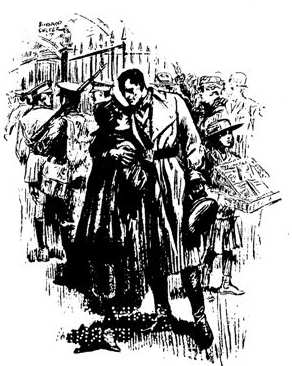
They came up to London in a first-class compartment. Any one could have
told they were on their honeymoon, for they wore perfectly new clothes,
and on their knees between them they balanced a perfectly new
tea-basket. They were making tea and sandwiches, and although it was all
rather messy, it gave them the illusion of house-keeping. The lumbering
local seemed to them to be racing, and the country sped by and vanished
as quickly as the fleeting moments, for it was the afternoon of the
fourth day. An old lady and gentleman, their only traveling companions,
went tactfully to sleep. Leonard glanced warily at them, and turned his
back on the flying landscape.
"Marjorie," he said, carefully peeling a hard-boiled egg; "Marjie."
"Yes, Len."
"Were you ever in love before this?"
Marjorie laughed. She was in the mood for laughter. She must be happy
and light-hearted. Time enough later on to be serious.
"Sure," she replied gravely, mocking eyes on Leonard. "Weren't you?"
Leonard shook his head. "Just with actresses and things, when I was a
kid. Never, really."
"I suppose," said Marjorie, pensively, "I ought to care if you've been
bad or not, but I don't."
"But Marjie, darling,"—Leonard brought her back and went straight to
his point,—"were you ever really in love with that German chap you
spoke of when I gave you the helmet?"
"He was my first love," said Marjorie, with wicked demureness. "I was
fifteen and he was eighteen."
"You were just a flapper," said Leonard; "you couldn't be in love."
"A woman is never too young to adore some man," said Marjorie, sagely.
"I was a miserable homesick wretch, spending the winter in a German
boarding-school."
"A German school! What for?"
Marjorie, her small face drawn with fatigue, but her eyes vivid with
excitement, regarded him pertly.
"In order to learn German—and culture."
Leonard gave a grunt.
"Yes, Len, dear, it was dreadful. You never could have stood it, you're
so particular," Marjorie said, settling her head against Leonard's arm.
"The girls only bathed once a year!"
"Dirty beasts!" muttered Leonard. "But what's that got to do with the
point?"
"I'm preparing you for that by degrees. Len, dear, it was dreadful. No
one spoke a word of English, and I couldn't speak a word of German, and
it was such a long winter, and all the flowers and grass were dead in
the garden, and at night a huge walnut tree used to rattle against my
window and scare me; and they don't open their windows at night, and I
nearly died of suffocation! They think in Germany that the night air is
poisonous."
"They don't use it instead of gas. How about the man? Hurry up!"
He looked at his watch, but Marjorie chose to ignore him.
"We've got eleven hours," she said, with tragic contentment; "I'm coming
to the man. The girls used to sit about indoors and embroider—oh,
everlastingly! Hideous things. I was, oh, so restless! You know how you
are at that age."
"I was playing football," said Leonard; "so ought the man to have been,
instead of casting sheep's eyes at you."
"He had nice eyes," said Marjorie, pensively, "and lived next door,
and," she added, as Leonard puffed stolidly at his pipe, "he was
terribly good-looking."
"He was?" said Leonard, raising his eyebrows.
"So tall for his age, and his head always looked as if he were racing
against the wind. He was always rumpling his hair as if in a sort of
frenzy of energy, and he was awkward and graceful at the same time, like
a big puppy who is going to be awfully strong. He was like a big, very
young dog. So energetic, it was almost as if he were hungry."
"He's hungry along with the rest of 'em now, I hope," murmured Leonard.
"His name was Carl von Ehnheim. He lived in a very grand house next
door," continued Marjorie, "and he used to come over and make formal
calls on the pension Müller. He never looked at me, and whenever I spoke
he looked down or out of the window, and that's how I knew he liked me."
"Most abominable case of puppy love," said Leonard.
"Oh, it was so puppy!" cried Marjorie; "but of course it made the
winter pass less drearily."
"How so—'of course'?"
"Because he would always happen to come down his steps when I came down
mine. Or when I was in the garden walking on the frozen walk with huge
German overshoes on, he would draw aside the curtain of his house and
stand there pretending not to see me until I bowed, and then he would
smile and pretend he had just noticed me. And then, when Christmas came,
all the girls went home, and Frau Müller and I were asked over to his
house to spend the day. Did you ever spend a Christmas in Germany, Len,
dear?"
"No, but I hope to some day."
"It's so nice, it's like Christmas in a book. He used to come into the
garden after that, and we'd play together. And we read German
lesson-books in the summer-house. And then, sometimes, for no reason at
all, we would run around the summer-house until we were all out of
breath, and had messed up all the paths. One day he had to go away. It
was time for him to go into the army to be made an officer, and I didn't
see him for so long, and I forgot all about him, nearly. I would have if
I hadn't been so lonely."
"Humph!" said Leonard; and Marjorie squeezed his fingers.
"Aren't you just a little bit jealous?" she pleaded.
"Jealous of a Hun?" answered Leonard, knocking the ashes from his pipe.
"No." But he squeezed her hand somewhat viciously in return. "Not a bit.
Stop wriggling! Not a bit. When did you see him again?"
"Not for a long time. One day I came home and on the hall table was a
gold sword and a gold helmet with an eagle crest. Maybe I heard his
voice in the parlor, maybe I didn't. Anyway, I put the helmet on my head
and took the sword out of the scabbard. Oh, wasn't it shiny! I was
admiring myself in the mirror when he came out.—Stop whistling,
Leonard, or I won't go on.
"He was dressed all in blue and gold, and he wore a gray cape lined with
red, and oh, he looked like a picture in a fairy book, I can tell you,
and he just stood there and stared at me. And he said, in a very low
voice, 'I didn't dare to kiss you under the mistletoe.' And I wanted to
say something, but couldn't think of anything because he wouldn't take
his eyes away; and then Frau Müller came out and said 'Good-bye' to him
with great formality. And afterward she said it was very unziemlich to
talk to a young officer alone in the hall, and, oh, I don't know—a
whole lot of things I didn't listen to."
"And of course that only fanned your ardor and you continued to meet?"
prompted Leonard.
He lighted a pipe and stuck it in the corner of his mouth, and never
took his smiling eyes off Marjorie's thin little face, all animated in
the dusk.
"Of course we met, but only on the avenue, when we girls were walking in
a long line, dressed alike, two by two, guarded by dragons of teachers.
But I'd lie awake every night and think of all kinds of things—his
look, and the way his sword clanked against his boots. And twice I saw
him at the opera, looking at me from one of the boxes filled with
officers. You can't think how big I felt having him notice me—and you
can't think how beautiful I thought he was. Little thrills ran up and
down my spine every time I looked at him. Is that the way you felt when
you looked at your silly actresses?"
"Maybe," said Leonard, grinning with the corner of his mouth unoccupied
by the pipe, and staring out into the shadowy darkness. "Was that all?"
They were drawing near to London.
"Mostly," answered Marjorie, fingering the buttons on Leonard's sleeve.
"Last time I saw him it was in the garden on the same bench in the sun.
He came over the fence, and he told me that his regiment had been
ordered to Berlin the next day."
"You knew more German then?" asked Leonard.
"Yes, I suppose so; but I didn't need to understand. It was all in the
sun, and the air was all warm from the cut clovers, and his eyes were,
oh, so blue! And—I don't know. He took off his helmet and put it on my
head, and he took his sword out of the scabbard and he put it in my
hand, and he said, oh, all kinds of things in German that I couldn't
understand very well."
"He was probably asking you how much your dowry was."
"Maybe, but his eyes didn't ask me that. And that was all. I never saw
him again, and I don't ever expect to."
"Should rather think not."
"Would you mind?"
"Certainly," said Leonard.
"They're horrible tyrants, English husbands," said Marjie, kissing his
arm.
"Not so bad as German ones," he replied, putting his head down to hers.
The casements rattled. Into the little dark square of the compartment
window peered a confusion of lights, the myriad eyes of a great city.
"Why, it's London!" cried Marjorie. "I'd lost all track of time. Hadn't
you, Leonard?"
"No," he answered laconically, slamming down the lid of the tea-basket.
But Marjorie squeezed up against him and gave a little laugh. "Supposing
it could be the same man, Leonard," she said.
"What man?" asked Leonard, snapping the lock.
"Why, the man of the Helmet—the Dying Gaul—and my man I've been
telling you about."
Leonard looked at her, and for some reason his eyes flinched. "What
difference would that make? He was German," was all he said.
It was a sultry evening. Flowers were being sold in profusion on street
corners. Hurdy-gurdies played war tunes in the gutter. The streets were
filled with soldiers in khaki and florid civilians in their summer
clothes. Suddenly she remembered a passage in the Bible that always
seemed beautiful to her, but now it seemed to have been specially
written for her:—
"Where thou goest, I will go, And where thou lodgest, I will lodge. Thy
people shall be my people, And thy God, my God."
She walked as close to Leonard as she dared: "Thy people shall be my
people, And thy God, my God."
The passers-by smiled at her and turned and stared after. "Awfully hard
on a girl," they thought, touched by the rapt look on the young face.
"Oh, Len," she whispered, pulling at his arm, "I love all these people;
I love England."
He smiled indulgently.
"They're all right," he assented; "I don't mind strangers, but I hate
the thought of all the relatives we've got to face when we get back.
There'll be Aunt Hortense and Uncle Charles. Mater'll have all the
uncles and the cousins and the aunts in to bid me a tender farewell.
Think of spending my last evening with you answering questions about how
deep the mud is in the trenches, and what we get to eat, and what the
names of all the officers in my mess are."
"And then they'll spend the rest of our precious time connecting them up
to people of the same name in England," said Marjorie.
"Exactly," agreed Leonard. "Aren't grown-up relations beastly?"
"Horrible," said Marjorie, "but they've been awfully decent about
letting me have you all of these four days."
To put off the evil moment of arrival they stopped at every shop-window
and stared in, their faces pressed close to the glass.
All the way home, with eyes that neither saw nor cared where they were
going, they talked to each other of their childhood. The most trivial
incidents became magnified and significant when exchanged.
"That's just the way I used to feel, that's just the way I used to
feel," they kept repeating, over and over again. The sweet, misty
memories of their happy, happy lives, came gliding back into
consciousness. The thoughts and yearnings, the smells, the sights and
sounds, all the serenity of the immaculate, long childhood days. Walking
side by side in the reverent dimness, intensely conscious of each other,
they had that mysterious sensation of having done this before, of living
a second time. The world was transfigured; they were aware of
measureless rapture brooding close about them in the twilight of which
they were a part—a rapture, a sense of enchantment, that people are
only conscious of as children or when they are in love or in dreams.
Finally, deliciously weary, and full of the languor of the summer night,
they retraced their steps and took the two-penny tube.
They arrived home late. The family were at dinner.
"We've missed two courses," said Leonard gleefully; "the aunts must be
raging."
"Shall I dress up?" said Marjorie.
"Good God!" answered Leonard, "I go to-morrow at five. Don't wear
anything that will make them think we're going to sit round and converse
with Aunt Hortense all the evening. I'm going up to say good-bye to the
boy."
Marjorie found him there, stretched out on Herbert's little cot,
completely covering the little mound under the pink coverlet.
"Don't you come near, Marjorie; I've got Leonard all to myself," cried
Herbert, who, like all the others, was jealous of Marjorie, but did not
scruple to show it.
"Ha-ha! Who's jealous now?" said Leonard, putting his head down on
Herbert's. Marjorie lay down on the quilt at the foot of the bed. Her
restless eyes watched a light from the driveway scurry across the bed
and zig-zag over the faces of the two brothers. Like a sudden flame
struck from a match it lit a metal object on the shelf over the bed. Ah,
it looked grim and incongruous in that peaceful English nursery! Once it
had been one among a golden sea of helmets, sweeping across a great
plain like a river. The sun smote upon gleaming bayonets, passing with
the eternal regularity of waves. Last autumn the world had shaken under
the tread of the feet marching toward Paris.
The light clung to the glittering object, and then scudded away.
Marjorie's eyes kept closing. Suddenly, and oh, so vividly, there came
the memory of another garden; the cold, brooding stillness of the winter
air, and the sun sifting through the diamond windows of the
summer-house, and shining on the dancing letters of the lesson-book and
on his yellow hair. Then she heard Leonard's laughter and was back again
in the present. How could he laugh like that! It was because he was so
young. They were all so young!
"Good night, old man," said Leonard, pulling himself up from Herbert's
bed; "don't forget me."
Three times Herbert called him back, and when Leonard returned and stood
beside him, the little boy wriggled apologetically.
"Play with me," he said, plaintively.
"Play with you! I'll stand you on your head instead," said Leonard, and
put his arm around Marjorie.
But Herbert continued to call to the emptiness.
Leonard and Marjorie paused on the landing, and he reached up and spread
his hand over the face of the clock.
"Stop moving!" he said.
"You're just about three years old to-night," said Marjorie.
"I know—I know," he said. Suddenly, with an impulse and gesture of
childlike and terrible longing, he put both his arms about Marjorie. His
face wore an expression that she could never forget. Looking up at him
with wide, tearless eyes, she felt in that one uncontrolled moment that
she knew him better than she ever would again. She felt wonderfully old,
immeasurably older than Leonard, older than the whole world. With a love
almost impersonal in its unconscious motherliness, she yearned with the
mighty power of her woman's body and soul to protect this immature and
inarticulate being who was faring forth to the peninsula of the "Dead
English" to make his silent sacrifice. The great house seemed to be
listening, hushed, to the sober ticking of the clock on the landing.
Suddenly, with a preliminary shudder, its melodious voice rang out nine
times. The two stole downstairs to the dining-room.
"Nine o'clock. We've missed three courses," whispered Leonard to
Marjorie.
All through dinner he sulked. He could not forgive his Aunt Hortense for
her very considerable bulk, which was situated between him and Marjorie.
He squeezed his mother's hand under the table, till her rings cut into
her flesh, and she had to smile; but toward all the flattering advances
of his aunt, and her effort to ascertain his opinion on every aspect of
the war, he remained dumb with the maddening, imperturbability of a
sulky boy, who refuses to be "pumped."
After dinner he was claimed by his father and remained in the
smoking-room, detained by a certain wistfulness in his father's manner.
"We've missed you these four days, old boy," his father said. "But I
hardly expect you missed us. Can't we have a talk now?"
"Yes, sir; of course," Leonard answered. He felt suddenly contrite. He
noticed for the first time in his life that his father looked old and
little, almost wizened, and there was something deferential in his
manner toward his big son that smote Leonard. It was as if he were
saying, apologetically, "You're the bone and sinew of this country now.
I admire you inordinately, my son. See, I defer to you; but do not treat
me too much like a back number." It was apparent even in the way he
handed Leonard the cigars.
Desperately conscious of the hands on the clock's face, which kept
moving forward, Leonard sat and conversed on the recent drive in France,
the Dardanelles campaign, home politics, held simply by the pathos of
his father's new manner. At every pause in the conversation he listened
for Marjorie's voice in the drawing-room.
And Marjorie, in the drawing-room, was wondering desperately if he knew
how the time was flying as he sat there quietly smoking and holding
forth endlessly about transports and supplies and appropriations, and
all the things which meant nothing to her. More wily than Leonard, she
had escaped from Aunt Hortense, who, in true English fashion, had not
appeared to be aware of her presence until well on toward the middle of
the evening, after the men had left; then she turned to Marjorie
suddenly, raising her lorgnette.
"Leonard's letters must have been very interesting to your friends in
America."
"Oh, yes," stammered Marjorie; "but he never said very much about the
war." She blushed.
"Ah," said the older woman; "I observed he was very silent on the
subject. It's a code or custom among his set in the army, you may be
sure of that. So many young officers' letters have been published," she
continued, turning to Mrs. Leeds. "Lady Alice Fryzel was telling me the
other day that she was putting all her son's letters into book form."
Marjorie had an inward vision of Leonard's letters published in book
form! She knew them by heart, written from the trenches in pencil on
lined paper—"servant paper," Leonard called it. They came in open
envelopes unstamped, except with the grim password "war zone." Long,
tired letters; short, tired letters, corrected by the censor's red ink,
and full of only "our own business," as Leonard said. Sometimes at the
end there would be a postscript hastily inserted: "I was in my first
real battle to-day. Can't say I enjoyed it." Or, "Ronald Lambert, who
was my chum at Eton, never turned up to-night. I feel pretty sick about
it." She remembered the postscript of his first letter from the front;
not a word about the thunder of the distant cannonading or the long line
of returning ambulances that greeted the incoming soldier. It gave the
first realistic smack of the filthy business of war. "I've had my head
shaved," Leonard wrote. "P.P.S. Caught One." Marjorie wondered how that
would look to Aunt Hortense, published in book form.
"Aren't the men a long while?" said Mrs. Leeds, for the fifth time; and
Marjorie could endure it no longer. She could not bear to sit there and
look at Mrs. Leeds's face. The fierce resignation of the mother's eyes
seemed dumbly to accuse Marjorie, whose whole youth and passionate being
protested: "I won't let her have Leonard this evening—I won't—I
can't—it's his last! Why don't old people, like Aunt Hortense, fight
wars, if they're so crazy about it?"
She crept unnoticed to the dark alcove, and slipped through the curtains
of the French window. But the older woman's shrewd glance followed her;
and all the while she was listening with apparent composure and concern
to Hortense, she was saying to herself, with bitter impatience,—
"Fool! Why did she have to come this evening!" And then, "O Leonard, is
it possible that little young thing can love you as I do!" And, "O
Leonard—O Leonard!"
Marjorie, in the garden, skirted the shrubs and stole between the
flower-beds to the library window. Vividly she could see Leonard,
stretched out in a chair, his cigarette in one hand, gesticulating,
talking.
"He's happy; he's forgotten all about me," she thought; and swept by an
absurd emotion of self-pity, she kissed her own arms in the darkness to
comfort herself, till her eyes, which never left his face, saw him turn
warily and desperately to the clock.
"Leonard," she whispered, pressing close to the glass.
Suddenly he saw her revealed in the pale halo of light cast by the
window into the darkness. He looked at her for moments without moving.
Then she saw him get up and say good night to his father, putting his
hand awkwardly and self-consciously on his sleeve. Minutes passed, and
she knew he had gone to say good night to his mother, and then she saw
the light of his cigarette coming toward her across the lawn. She waited
without moving for him to touch her. So many times she would feel him
coming toward her in the moonlight, the outline of his dear form lost in
the dusk, and when he put out his hand it would be only empty shadows.
"Marjorie, where are you?"
"Here, Len."
Some one came to the front door and called out,—
"Are you there, Leonard and Marjorie? Lock the door when you come in,
Leonard."
From the darkness they saw his mother's form silhouetted against the
light inside. She started as if to come toward them, and then suddenly
shut the door and left them alone together in the white night.