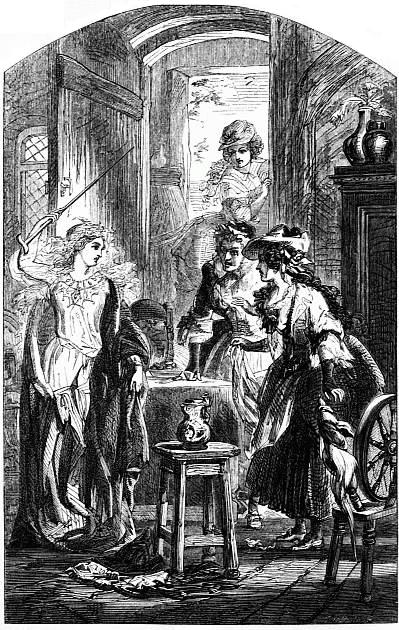
There was once upon a time, in Europe, a King, who having
already several children by a princess whom he had married,
took it into his head to travel from one end of his kingdom
to the other. He passed his time in visiting one province
after another very pleasantly; but while he was staying in a
beautiful castle at the extremity of his dominions, the Queen,
his wife, was brought to bed there of a daughter, who appeared
so exceedingly lovely at the moment of her birth, that the
courtiers, either on account of the child's beauty, or to ingratiate
themselves with the parents, named her "Fairer than a
Fairy;" and it will be seen how well she merited so illustrious
a title. The Queen had scarcely recovered, when she was
obliged to follow the King, her husband, who had departed
in haste to defend a distant province which his enemies had
invaded.
Little Fairer than a Fairy was left behind with her
governess and the ladies who attended on her; they brought
her up with the utmost care, and as her father was involved
in a long and cruel war, she had plenty of time during his
absence to increase in stature and beauty. That beauty rendered
her famous in all the surrounding countries; nothing
else was spoken of, and at twelve years old she might more
easily be taken for a divinity than for a mortal. One of her
brothers came to see her during a truce, and conceived the
most perfect affection for her.
Meanwhile, however, the fame of her beauty and the name
she bore so irritated the fairies against her, that there was
nothing they did not think of to revenge themselves on her,
for the presumption implied by such a title, and to destroy a
beauty of which they were so jealous.
The Queen of the Fairies was not one of those good fairies
who are the protectors of virtue, and who have no pleasure
but in doing good. Many centuries having elapsed since she
had attained royalty by her profound learning and art, her
great age had caused her to dwindle in stature, and she was
now only called by the nickname of Nabote. Nabote
accordingly summoned a council, and made known to them
her resolution to avenge, not only the beauties of her own
court, but those of the entire world; that she had determined
to go and see for herself, and carry off this paragon whose reputation
was so injurious to their charms. It was no sooner
said than done. She set out, and, clothed in a very plain garb,
transported herself to the castle which contained this marvellous
creature. She soon made herself at home in it, and
induced by her cunning the ladies of the Princess to receive
her amongst them. But Nabote was struck with astonishment
when, after having carefully examined the castle, she
discovered by means of her art that it had been constructed
by a great magician, and that he had endowed it with a
virtue by the power of which no one could leave its walls or
the surrounding pleasure-grounds but of their own free will,
and that it was not possible to use any sort of enchantment
against those persons who inhabited it. This secret was
not unknown to the governess of Fairer than a Fairy, who,
well aware of the invaluable treasure committed to her charge,
still felt no alarm on her account, knowing that no one in the
world could take from her this young princess, so long as she
should not go outside the castle or the gardens. She had
expressly forbidden her to do so, and Fairer, who had already
a large share of discretion, had never failed in taking this
precaution. A thousand lovers had made fruitless efforts to
carry her off; but knowing herself secure within those limits,
she did not fear their violence.
Nabote did not require much time to insinuate herself into
her good graces; she taught her to do beautiful kinds of work,
and rendered her lessons agreeable by recounting pleasant
stories. She neglected nothing which could divert her, and
naturally pleased her so much, that at length one was never
seen without the other.
Amidst all her attentions, however, Nabote was not less
occupied with her schemes of revenge; she sought for an
opportunity of inducing Fairer than a Fairy, by some cunning
pretence, only to put her foot over the threshold of one of
the castle gates. She was always prepared to pounce on and
fly away with her. One day that she had led her into the
garden, and the young maidens of her Court, having gathered
some flowers, had crowned with them the beautiful head of
Fairer than a Fairy, Nabote opened a little door which led
into the fields, and passing out at it, played an hundred antics,
which caused the Princess and the young folks who surrounded
her to laugh heartily. All at once the wicked Nabote pretended
to be taken ill, and the next minute she fell down, as
if swooning away. Some of the young maidens ran to assist
her, and Fairer flew also to her side. But hardly had the
unhappy child passed the fatal gate than Nabote sprang up,
seized her with a powerful arm, and making a circle with her
wand, a thick black fog arose, which dispersing again almost
immediately, the ground was seen to open and two moles
emerged, with wings formed of rose-leaves, drawing an ebony
car, and Nabote placing herself in it with Fairer than a Fairy,
it ascended into the air, and cleaving it with incredible velocity,
disappeared entirely from the sight of the young maidens, who
by their cries and tears soon announced to all the castle the
loss they had sustained.
Fairer than a Fairy only recovered from her first astonishment
to fall into another still more fearful; the rapidity with
which the car passed through the air had so bewildered her
that she almost lost consciousness; at length, reviving a little,
she cast down her eyes. What was her alarm to find nothing
beneath her but the vast extent of the shoreless ocean. She
uttered a piercing cry, turned round, and seeing near her her
dear Nabote, she embraced her tenderly and held her close in
her arms as one naturally would to re-assure oneself. But the
Fairy repulsed her rudely:—"Off! audacious child," said she.
"Behold in me your mortal foe. I am the Queen of the
Fairies, and you are about to pay to me the penalty of your
insolence in assuming the proud name which you bear."
Fairer, trembling at these words more than if a thunderbolt
had fallen at her feet, felt greater alarm at them than at
the dreadful road she was travelling. At length, however, the
car alighted in the midst of the magnificent court-yard of
the most superb palace that ever was seen. The sight of so
beautiful a palace somewhat re-assured the timid Princess,
especially when she descended from the car, and she saw an
hundred young beauties, who came with much deference to
pay their respects to the Fairy. So charming a residence did
not appear to announce misfortune to her. She had also one
consolation which does not fail to flatter one in similar situations:
she remarked that all those beautiful persons were
struck with admiration on beholding her, and she heard a
confused murmur of praise and envy which gratified her marvellously.
But how speedily was this little feeling of vanity extinguished!
Nabote imperiously commanded them to strip
Fairer of her beautiful clothes, thinking thereby to take from
her a portion of her charms. They pulled them off, accordingly,
but only to increase the fury of Nabote, for what
beauties were then disclosed to view, and to what shame did
they put all the fairies in the world! They re-clothed her in
old shabby garments. But in this state, one would have
said her natural and simple loveliness was determined to
show how independent it was of the assistance of the most
costly ornaments; never did she appear more charming!
Nabote then ordered them to conduct her to the place which
she had prepared for her, and to set her her task. Two fairies
took her and made her pass through the most beautiful and
sumptuous apartments that could possibly be seen. Fairer
noticed them, in spite of her misery, and said to herself, "Whatever
torments they may prepare for me, my heart tells me I
shall not always be miserable in this beautiful palace."
They made her descend a large staircase of black marble,
which had more than a thousand steps: she thought she was
going into the bowels of the earth, or rather, that they were
conducting her into the infernal regions. At length they
entered a small cabinet, wainscoted with ebony, where they
told her she would have to sleep on a little straw, and that
there was an ounce of bread with a cup of water for her supper.
From thence they made her pass into a great gallery, the
walls of which were entirely composed of black marble, and
which had no light but that afforded by five lamps of jet,
which threw a sombre glare over the place, more alarming
than cheering. These gloomy walls were hung with cobwebs
from top to bottom, and such was their peculiarity, that the
more they were swept away the more they multiplied. The
two fairies told the Princess that this gallery must be swept
clean by break of day, or that she would be made to suffer
the most frightful torments, and after placing a ladder, and
giving her a broom of rushes, they bade her set to work, and
left her.
Fairer than a Fairy sighed, and not knowing the peculiarity
of those cobwebs, courageously resolved, notwithstanding
the great length of the gallery, to execute the task
imposed on her. She took her broom, and mounted the
ladder nimbly, but, O Heavens! what was her surprise when,
as she endeavoured to sweep the marble and clear off the
cobwebs, she found they increased in proportion to her exertions!
She fatigued herself by persevering for some time,
but perceiving sorrowfully, at length, that it was all in vain,
she threw down her broom, descended the ladder, and seating
herself on the last step of it, began to weep bitterly, and to
foresee the extent of her misfortune. Her sobs came at
length so fast that she could no longer support herself, when,
raising her head a little, her eyes were dazzled by a brilliant
light. The gallery was in an instant illuminated from end
to end, and she saw kneeling before her a youth so beautiful
and charming, that at the first glance she took him for Cupid,
but she remembered that Love is always painted naked, and
this handsome youth was dressed in a suit of clothes covered
with jewels. She was not sure, also, that all the light she
perceived did not proceed from his eyes, so beautiful and
brilliant did they appear to her. This young man continued
to gaze upon her, still kneeling. She felt inclined to kneel
too. "Who art thou?" she exclaimed, in amazement. "Art
thou a God? Art thou Love?" "I am not a God," he
replied, "but I have more love in me than is to be found in
heaven or earth beside. I am Phratis, son of the Queen of
the Fairies, who loves you and will aid you." Then, taking
up the broom which she had thrown down, he touched all
the cobwebs, which immediately turned to cloth-of-gold of
marvellous workmanship, the lamps becoming bright and
shining; Phratis then, giving a golden key to the Princess,
said, "In the principal panel of your cell you will find a lock;
open it gently. Adieu, I must retire for fear of being suspected:
go to rest; you will find all that is necessary for your
repose." Then placing one knee on the ground, he respectfully
kissed her hand and disappeared.
Fairer, more surprised at this adventure than at anything
else which had happened to her during the day, re-entered
her little apartment, and looked about for the lock of
which he had spoken, when, on approaching the wainscot,
she heard the most gentle voice in the world apparently deploring
some misfortune, and she imagined it must proceed
from some wretched being persecuted as she was. She listened
attentively. "Alas! what shall I do?" said the voice.
"They bid me change this bushel of acorns into oriental
pearls!" Fairer than a Fairy, less astonished than she would
have been two hours before, struck two or three times on the
panel, and said pretty loudly, "If they impose hard tasks in
this place, miracles are at the same time performed here—therefore,
hope! But tell me, I pray, who you are, and I
will tell you who I am." "It is more agreeable to me to
satisfy your curiosity than to continue my employment,"
replied the other person. "I am the daughter of a King;
they say I was born charming, but the fairies did not assist
at my birth, and you know they are cruel to those whom
they have not taken under their protection directly they
come into the world." "Ah! I know it too well," replied
Fairer; "I am handsome, like yourself, the daughter of a
King, and unfortunate, because I am agreeable without the
assistance of their gifts." "We are, then, companions in misfortune,"
returned the other. "But are you in love?" "Not
far from it," said Fairer, in a low voice; "but continue your
story," said she aloud, "and do not question me more." "I
was considered," continued the other, "the most charming
creature that had ever existed, and everybody loved me and
wished to possess me: they called me Désirs; my will was
law, and I was treasured in all hearts. A young prince, the
most enthusiastic of my adorers, abandoned everything for
me. My encouragement of his hopes transported him with
delight. We were about to be united for ever, when the
fairies, jealous at beholding me the object of universal admiration,
and detesting the sight of attractions which they had
not bestowed, carried me off one day in the midst of my
triumphs, and consigned me to this horrid place. They have
threatened that they will strangle me to-morrow morning if
I have not performed a preposterous task which they have
imposed upon me. Now, tell me quickly, who are you?"
"I have told you all," replied Fairer, "but my name. They
call me Fairer than a Fairy." "You must, then, be very
beautiful," replied the Princess Désirs; "I should like excessively
to see you." "I am quite as anxious to see you,"
replied Fairer. "Is there a door hereabouts, for I have a
little key which perhaps may be of use to you." Looking
narrowly round, she discovered one which she was able to
open, and pushing it, the two Princesses met face to face, and
were equally surprised at the marvellous beauty of each other.
After embracing affectionately, and saying many civil
things to one another, Fairer began to laugh at seeing the
Princess Désirs continually rubbing her acorns with a little
white stone, as she had been ordered to do. She told her of
the task which they had imposed upon her, and how miraculously
she had been assisted by a charming unknown being!
"But who can it be?" said the Princess Désirs. "I think it
is a man," replied Fairer. "A man!" cried Désirs. "You
blush—you love him!" "No, not yet," replied Fairer; "but
he has told me he loves me; and if he loves me as he says, he
shall assist you." Hardly had she uttered these words, when
the bushel measure began to shake, and agitating the acorns,
as the oak on which they had grown might have done, they
were instantly changed into the most beautiful pear-shaped
pearls of the first water. It was one of these which Cleopatra
dissolved in wine at the costly banquet she made for Mark
Antony.
The two Princesses were delighted at the exchange,
and Fairer than a Fairy, who began to be accustomed to
wonders, leading Désirs by the hand, returned into her own
chamber, and finding the panel containing the lock of which
the stranger had spoken, she opened it with her golden key,
and entered an apartment, the magnificence of which both
surprised and affected her, as she saw in everything it contained
the attention of her lover. It was strewn with the
most beautiful flowers, and exhaled a divine perfume. At one
end of this charming room there was a table covered with all
that could gratify the most refined taste, and two fountains
of liqueurs which flowed into basins of porphyry. The young
Princesses seated themselves in two ivory chairs, enriched
with emeralds; they ate with a good appetite, and when they
had supped, the table disappeared, and in its place arose a
delicious bath, into which they stepped together. At a few
paces from them they observed a superb toilet-table, and large
baskets of gold wire full of linen of such exquisite purity that
it made them long to make use of it. A bed of singular
form and extraordinary richness, occupied the further end of
this marvellous chamber, which was lined with orange-trees
in golden boxes studded with rubies, while rows of cornelian
columns sustained the sumptuous roof, divided only by immense
crystal mirrors which reached from the ground to the ceiling.
Several consoles, of rare materials, supported vases of precious
stones, filled with all sorts of flowers.
The Princess Désirs admired the good fortune of her companion,
and, turning to her, observed, "Your lover is indeed
gallant; he can do much, and he will do everything for you;
your happiness is extraordinary." A clock striking midnight
repeated at each stroke the name of Phratis. Fairer than a
Fairy coloured, and threw herself on the couch. She trusted
to repose, but her sleep was troubled by the image of Phratis.
The next morning there was great astonishment in the
Court of the Fairies at seeing the gallery so richly decorated,
and the bushel-measure full of beautiful pearls. They had
hoped to punish the young Princesses: their cruelty was disappointed.
They found each alone in her little chamber.
After consulting together again, in order to devise some tasks
which could not possibly be accomplished, they told Désirs to
go to the sea-shore and write on the sand, with express orders
to take care that what she wrote there could never be effaced.
And they commanded Fairer to go to the foot of Mount
Adventurous, to fly to the top, and bring them a vase full of
the water of immortality. For this purpose they gave her a
quantity of feathers and wax, in hopes that, by making wings
for herself, she might perish like another Icarus. Désirs and
Fairer looked at each other on hearing these dreadful commands,
and, embracing tenderly, they separated, as if taking an
eternal farewell. The fairies conducted one to the sea-shore
and the other to the foot of Mount Adventurous.
When Fairer was left by herself she took the feathers and
wax, and made some vain attempts to form wings with them.
After having worked for some time most ineffectually, her
thoughts reverted to Phratis. "If you loved me," said she,
"you would come to my assistance." Hardly had she finished
the last word when she saw him stand before her, looking a
thousand times more beautiful than on the preceding night.
The full light of day was an advantage to him. "Do you
doubt my affection?" said he. "Is anything difficult to him
who loves you?" He then requested her to take off some
portion of her dress, and having kissed her hand as a recompense,
he transformed himself suddenly to an eagle. She was
rather sorry to see so charming a person thus metamorphosed,
but, placing himself at her feet, he extended his wings, and
made her easily comprehend his design. Reclining upon him,
she encircled his proud neck with her beautiful arms, and he
rose with her gently into the air. It would be difficult to say
which was the most gratified—she, at escaping death in the
execution of the order given her, or he, at being permitted to
bear such a precious burden.
He carried her gently to the summit of the mountain,
where she heard an harmonious concert warbled by a thousand
birds that came to render homage to the divine bird which
bore her. The top of this mountain was a flowery plain,
surrounded by fine cedars, in the midst of which was a little
stream, whose silvery waves rolled over golden sands strewn
with brilliant diamonds. Fairer than a Fairy knelt down,
and first of all took some of this precious water in her hand,
and drank it. After this she filled her vase, and, turning
towards her eagle, said, "Ah, how I wish that Désirs had
some of this water!" Scarcely had she spoken these words
than the Eagle flew down, took one of the slippers of Fairer,
and returning with it, filled it with water, and carried it to
the sea-shore, where the Princess Désirs was occupied in fruitless
attempts to write indelibly on the sand.
The Eagle returned to Fairer, and resumed his beautiful
burden. "Alas!" said she, "what is Désirs doing?
Take me to her." He obeyed. They found her still writing,
and as fast as she wrote, a wave came and effaced what she
had written. "What cruelty," said the Princess to Fairer,
"to command what it is impossible to accomplish! I imagine,
from the strange mode of your conveyance, that you have
succeeded." Fairer alighted, and, moved by the misfortune
of her companion, she turned towards her lover, and thus
addressed him, "Give me proof of your omnipotence." "Or
rather of my love," interrupted the Prince, resuming his
proper form. Désirs, observing the beauty and grace of his
person, cast on him a look of surprise and delight. Fairer
coloured, and by a movement over which she had no control,
placed herself before him so as to hide him from her companion.
"Do as you are told," continued she, with a charming
air of uneasiness. Phratis knew his happiness, and
wishing to terminate as speedily as possible her trouble,
"Read," said he, and disappeared swifter than a flash of
lightning.
At the same instant a wave broke at the feet of Fairer,
and in retiring left behind a brazen tablet, as firmly fixed in
the sand as if it had been there from all eternity, and would
remain immovable to the end of the world. As she looked
at it, she perceived letters forming on it, deeply engraved,
which composed these lines:—
The vows of common love in sand are traced,
And, even 'graved in brass, may be effaced;
But those which are inspired by your bright eyes,
In starry words are written in the skies.
Nought can destroy those characters divine,
Eternal as the heavens in which they shine.
"I understand," cried Désirs: "he who loves you, must
always love! How well your charming swain expresses his
feelings." She then embraced Fairer than a Fairy, who soon,
in her arms, recovered from the confusion occasioned by the
little feeling of jealousy she had experienced, and confessed it
to her friend, who accused her of it; and both, confirmed in
their friendship, abandoned themselves to the pleasure of an
agreeable and affectionate conversation.
Queen Nabote sent messengers to the foot of the mountain
to find what was become of Fairer than a Fairy. They found
the scattered feathers, and a part of her clothes, and consequently
believed she had been dashed to pieces, as they
desired.
Full of this idea, the fairies ran to the sea-shore; they exclaimed
at the sight of the brazen tablet, and were overwhelmed
at perceiving the two Princesses calmly seated in
conversation on a jutting piece of rock. They called to them.
Fairer presented her vase full of the water of immortality,
and laughed in secret with Désirs at the fury of the fairies.
The Queen was not to be jested with. She knew that a
power as great as her own must have assisted them, and her
rage increased to such a pitch, that without hesitating an
instant, she determined on effecting their ruin by a final and
most cruel trial.
Désirs was condemned to go on the morrow to the Fair of
Time, to fetch the Rouge of Youth, and Fairer than a Fairy
to proceed to the Wood of Wonders, and capture the Hind
with Silver Feet.
The Princess Désirs was conducted to a vast plain, at the
end of which was an immense building, divided into galleries
full of shops so superb that no comparison could be found for
them but in the recollections of the magnificent entertainments
at Marly.[11] These shops were kept by young and agreeable
fairies, assisted by their favoured lovers.
As soon as Désirs appeared, her charms fascinated everybody.
She took possession of all hearts. In the first shops
she entered she excited much commiseration by asking for
the Rouge of Youth. None would tell her where to find it,
because, when it was not a fairy who came in search of it, it
was a sure sign of torment to the person who was charged
with this dangerous commission. The good fairies told
Désirs to return, and to inquire no further for what she
sought. She was so beautiful that they ran before her
wherever she went, in order to gaze at her. Her ill-luck,
however, led her to the shop of a wicked fairy. Hardly had
she asked for the Rouge of Youth, on the part of the Queen
of the Fairies, than, darting a terrible glance at her, she told
her that she had it, and that she would give it her the
next morning, and ordered her to enter a room and wait
till it was prepared for her. They led her into a dark and
pestilential place, where she could not see her hand before
her. She was overcome with terror. "Ah!" she exclaimed,
"charming lover of Fairer than a Fairy, haste to my rescue,
or I am lost!"
But he was deaf to her appeal, or unable to act as he had
done in other places. Désirs tormented herself half the
night and slept the remainder, when she was awakened by a
good-looking girl, who brought her a little food, telling her
that it was sent her by the favourite of the Fairy, her mistress,
who was resolved to assist her, and that it would be fortunate
for her if such were the case, because the Fairy had sent for
an evil spirit, who, by breathing on her face, would make her
hideous, and in that frightful state she would be ignominiously
sent back to the Queen of the Fairies, who, with all her Court,
would triumph in her misfortunes.
The Princess Désirs felt frightened to death at this threat
of losing in a moment all her beauty, and wished rather to die
outright. Her agony was horrible; she groped about her dark
prison in vain hope of discovering some mode of escape, when
some one took her by the arm, and she felt in her heart a sensation
of pleasure. She was gently led towards a spot where she
began to perceive a little light, and when her eyes became accustomed
to it, she was struck by the appearance of what was to
her the most charming object in the world, for she recognised
that dear Prince who loved her so truly, and from whom they
had separated her on the eve of her wedding. Her transport,
her delight, was extreme. "Is it you?" she exclaimed a hundred
times. At length, when fully persuaded of the fact, and
forgetting all her own troubles—"But are you the favourite
of this wretched Fairy?" she continued. "Is it with this fine
title that I again behold you." "Undoubtedly," replied he;
"and we shall owe to it the end of our troubles, and the certainty
of our happiness."
He then recounted to her how, in despair at her being
carried off, he had gone to seek a wise old man, who had
informed him where she was, and assured him that he
would never recover her but in the Kingdom of the Fairies;
that he had furnished him with the means of finding it,
but that he had been arrested in his pursuit of her by this
cruel Fairy, who had fallen in love with him; that, following
the advice of the sage, he had dissembled, and by
his docility had obtained such an influence over her, that he
had the care of all her treasure, and was the minister of all
her power; that she had just departed on a journey of six
thousand leagues; that she would not return for twelve days;
and that, therefore, they should lose no time in escaping;
that he was going into his cabinet to fetch a part of the
gem of the ring of Gyges[12]; that she should put it on, and
thereby becoming invisible, she could pass anywhere: as for
himself, he could show himself as he pleased. "Do not
forget," said she, "the Rouge of Youth; I wish to put some
on, and to give some to one of my companions."
The Prince smiled. "Whither shall we go?" continued
she. "To the Queen of the Fairies," he replied. "No, that
will never do," she exclaimed; "we shall perish there!"
"The sage who counselled me," pursued he, "told me to lead
you back to the place from whence you came last, if I wished
to be assured of happiness: he has never yet deceived me in
anything whatever." "Well, then, so be it," said Désirs;
"we will go there."
The Prince brought her a valuable box, in which was the
Rouge of Youth; and with the hope of making herself appear
more beautiful still in the eyes of her lover, she rubbed some
hastily all over her face, forgetting that she was invisible by
means of the gem which he had given her. She took him by
the arm. They traversed in this manner the whole of the
Fair, and were soon close to the palace of the Queen. There
the Prince resumed the gem of Gyges. The beautiful Désirs
became visible, and he became invisible, to the great regret
of the Princess, whom he took by the arm in his turn, and
presented her before Nabote and her Court. All the
fairies looked at each other in excessive astonishment at
seeing Désirs return with the Rouge of Youth, and the Queen,
frowning awfully, desired them to guard her strictly. "Our
arts are vain," said she. "We must put her to death, without
trying any more experiments."
The sentence was pronounced. Désirs trembled with fear;
her lover re-assured her as much as he could.
But we must return to Fairer than a Fairy. They had
conducted her to the Wood of Wonders, and here is the
reason why they had condemned her to chase the Silver-footed
Hind:—
Once upon a time there had been a Queen of the Fairies
who had succeeded in due course to that grand title; she was
beautiful, good, and wise. She had had several lovers, whose
affections and attentions had, however, been lost upon her.
Entirely occupied in protecting virtue, she found no amusement
in listening to the sighs of her adorers. There was one
whom her coldness rendered the most unhappy, because he
loved her better than any of the others.
One day, seeing that he could not move her to pity him, he
protested, in his despair, that he would kill himself. She was
not affected even at this threat, considering it merely as one
of those extravagances in which lovers sometimes indulge,
but which never have any serious result. However, some
time after, he really did throw himself into the sea.
A sage, who had brought up this young man, complained
to the supreme authorities, and the insensible Fairy was condemned
to do penance for her severity in the form of a hind,
for the term of one hundred years, unless an accomplished
beauty could be found, who, by venturing to hunt her for ten
days in the Wood of Wonders, could take her and restore her
to her original shape. Forty years had already elapsed since
she had been first transformed.
At the commencement of her penance several beauties had
risked the trial of this fine adventure, from which so much
honour was to be derived. Each hoped to be the fortunate
huntress; but as they lost themselves in the pursuit, and at
the end of ten days were no more heard of, this ardour began
to cool, and for some time past no beauty had voluntarily
offered herself; those who had recently undertaken the task
being condemned to it by the Fairies, in order to ensure their
destruction. It was, thus, to get rid of Fairer that they led
her to the Wood of Wonders. They gave her a small portion
of food, for form's sake, and placed in her hand a silken cord,
with a running noose to catch the deer. That was all her
outfit for the chase. She deposited what they gave her at
the foot of a tree, and when she found herself alone she cast
a look round this vast forest, in the profound silence and
solitude of which she saw nothing but despair.
She was anxious to remain at the skirt of the forest, and
not to enter it too far, so in order to know the spot again,
she placed a mark at the point from which she started. But,
alas! how did she deceive herself! Every one lost themselves
in this forest, without being able to issue from it. In one of
the paths she caught sight of the Silver-footed Hind walking
slowly. She approached it, with her silken cord in her hand,
thinking to take it; but the deer, feeling itself pursued,
started off at full speed, stopping from time to time, and
turning its head towards Fairer. They were in sight of each
other all day without being any nearer. At last night separated
them.
The poor huntress was very tired and very hungry, but she
no longer knew where to find the little provision she had had
given her, and there was nothing but the hard ground for her
to repose upon. She lay down, therefore, very sadly, under a
tree; she could not sleep for a long time—she was frightened;
the least thing alarmed her: a leaf shaken by the wind made
her tremble. In this miserable state she turned her thoughts
on her lover, and called him several times; but finding him fail
her in her great distress, she exclaimed, with tears in her
eyes, "Phratis! Phratis! you have abandoned me!" She
was just dropping asleep, when she felt a movement beneath
her, and it seemed to her as though she was in the best bed
in the world. She slept soundly for a considerable time,
without any interruption. She was awoke in the morning by
the song of a thousand nightingales, and, turning her beautiful
eyes around, she found she was raised two feet from the earth,
the turf having sprung up under her lovely form, and thus
made a delicious couch. A large orange-tree threw its branches
over her like a tent, and she was covered with flowers. By
her side were two turtle-doves, who announced to her, by their
love for each other, what she might hope for with Phratis.
The ground was entirely covered with strawberries and all
sorts of excellent fruits; she ate of them, and found herself as
well satisfied and as much strengthened by them as though
they had been the richest and best kind of meats. A stream
which flowed close by served to allay her thirst. "Oh, ye
tender cares of my lover," cried she, when she had refreshed
herself, "how much I needed you! I murmur no longer.
Give me less, dearest, and let me see you!"
She would have continued in this strain had she not perceived,
stretched close to her, the Silver-footed Hind, quietly
gazing at her. She thought this time she must catch it:
with one hand she held out to it a bunch of grass, and with
the other grasped the cord; but the deer bounded lightly
away, and when it had gone a short distance, it stopped, and
looked back at her. It kept up this game all day. Another
night came, and passed like the one before it. She awoke
under similar circumstances, and four days and nights elapsed
in the like manner. At length, on the fifth morning, Fairer
than a Fairy, on opening her eyes, thought she saw a light
more brilliant than that of day, when she perceived, in those
of her lover, seated near her, all the affection with which she
had inspired him. He fervently kissed one of her feet; his
presence and this respectful action gratified her greatly.
"You are there, then," said she. "If I have not beheld you
all these days, I have, at all events, received the proofs of your
goodness." "Say of my love, Fairer than a Fairy," replied
he. "My mother suspects that it is I who assist you: she
has placed me in confinement. I have escaped a moment, by
means of a fairy of my acquaintance. Adieu! I came only
to encourage you. You shall see me this evening, and if
fortune smiles, to-morrow we shall be happy." He departed,
and she hunted again all day. When night came, she perceived
near her a little light, which sufficed to show her her
lover. "Here is my illuminated wand," said he: "place it
before you, and go without fear wherever it will lead you.
Where it stops you will perceive a great heap of dry leaves;
set fire to it, enter the place; you will see and you will find
the skin of a beast; burn it. The stars, our friends, will do
the rest. Adieu!"
Fairer than a Fairy would have desired far more ample
instructions; but seeing there was no remedy, she placed the
wand before her, which showed her the way. She followed it
nearly two hours, very much vexed at doing nothing else. It
stopped at last, and there, truly enough, she perceived a large
heap of dried leaves, to which she did not fail to set fire.
The light was soon so great that she could see a very high
mountain, in which she observed an opening half hid by
brambles. She separated them with her wand, and entered a
dark hole; but soon after she found herself in a vast saloon,
of admirable architecture, and lighted with numberless lamps.
But what struck her with the greatest astonishment was the
sight of the skins of several wild and terrible beasts, hung on
golden hooks, which at first she mistook for the beasts themselves.
She turned away her eyes with horror, and they were
arrested in the centre of the saloon by the sight of a beautiful
palm-tree, upon one of the branches of which was suspended
the skin of the Hind with the silver feet. Fairer than a Fairy
was enchanted at seeing it, and taking it down with the aid
of her wand, she carried it quickly to the fire which she had
lighted at the entrance of the cavern. It was consumed in a
moment, and re-entering joyfully the saloon, she penetrated
into several magnificent apartments. She stopped in one,
where she saw several small couches placed upon Persian
carpets, and one more beautiful than the rest under a canopy
of cloth-of-gold. But she had not much time to contemplate
arrangements which appeared to her singular, for she heard
hearty peals of laughter and several persons in loud conversation.
Fairer than a Fairy turned her steps in the direction
from which the sounds proceeded, and entered a wonderful
place, where she found fifteen young ladies of celestial
beauty.
She did not surprise them less than she was surprised herself:
the extreme loveliness of her appearance took away their
breath, and a deep silence succeeded to cries of admiration.
But one of these beautiful persons, more beautiful than all
the rest, advanced, with a smiling air, towards our charming
Princess. "You are my deliverer," said she, addressing her;
"I cannot doubt it; no one can enter here who is not clothed
in the skin of one of the beasts which you saw at the entrance
of the cavern; that has been the fate of all these beautiful persons
whom you see with me. After ten days of useless pursuit
of me, they were changed into so many animals during the day;
but at night we resume our human forms: and you, charming
Princess, if you had not delivered me, would have been
changed into a white rabbit." "A white rabbit!" exclaimed
Fairer. "Ah, Madam, it is indeed better that I should
preserve my ordinary form, and that so wonderful a person as
you should be no longer a deer." "You have restored us all
to liberty," replied the Fairy; "let us now pass the rest of
the night as joyously as may be, and to-morrow we will go
to the Palace, and fill all the Court with astonishment."
It is impossible to express the joy which resounded in this
charming spot, and the delight which all these young persons
felt at the sweet sensation of finding themselves once more in
the land of the living, so to speak—they were all still of the
same age as when they commenced their unfortunate chase in
the Wood of Wonders, and the eldest was not yet twenty.
The Fairy desired to take three or four hours' repose. She
made Fairer lie down beside her, and relate her adventures.
She did so with so touching a voice, her discourse was so
unaffected and so full of truth, that she engaged the Fairy
without reserve to assist her love and render her happy. She
did not forget to speak to her of Désirs, and the Fairy was
immediately interested in her favour.
They went to sleep, after a long conversation, which they
had agreeably interrupted, from time to time, by the interchange
of affectionate caresses.
The next day they all set out for the Palace, wishing
pleasantly to surprise the fairies. They quitted, without
regret, the Wood of Wonders, and quickly arrived at the
Palace. As they approached the inner court, they heard a
thousand melodious sounds, which composed an excellent
concert. "Here is a fête going on," said the Fairy; "we
have arrived à propos;" and advancing, they found the court
filled with an incredible number of people. The Fairy caused
the gate to be opened, and entered with her train. The first
persons who recognised her, uttered the loudest exclamations
of delight, and the cause of this great joy was quickly made
known to the multitude. But on advancing, the Fairy was
struck by a strange spectacle. She saw a young girl more
lovely than the Graces, and with the form of Venus, bound to a
stake near a pile of wood, where apparently she was about to
be burnt to death.
Fairer than a Fairy uttered a loud cry, as she recognised
Désirs; but she was much astonished when, at the same
moment, she lost sight of her, and a young man appeared
in her place, so handsome and so well made that one might
never be tired of looking at him. At this sight Fairer uttered
a still louder cry, and running towards him, without any regard
to appearances, she flung herself on his neck, exclaiming a
thousand times, "It is my brother! it is my brother." It was
her brother, who was also the fortunate lover of Princess Désirs,
and who, fearing they would put her to death, had given her
the Gem of Gyges to rescue her from the cruelty of Queen
Nabote, and by so doing, became himself visible.
The brother and sister lavished a hundred caresses on each
other; the invisible Désirs added hers, and her voice was
heard, although she was not to be seen, whilst the fairies, in
unparalleled astonishment, expressed in every variety of
manner their rapture at again beholding their virtuous Queen.
The good fairies came and threw themselves at her feet, kissing
her hand and her garments. Some wept, some were unable
to speak; each testified her joy according to her peculiar character.
The bad fairies, the partisans of Nabote, also pretended
to be delighted, and policy gave an air of sincerity to
their hypocritical demonstrations. Nabote herself, in despair
at this return, controlled herself with an art of which she
alone was capable. She offered at once to resign her power
to the rightful sovereign, who, with a grave and majestic air,
demanded of her why the young girl whom she had seen
bound to the stake merited such a punishment, and since
when they had been accustomed to celebrate a cruel execution
by fêtes and sports. Nabote excused herself very lamely, and
the Queen listened impatiently when the lover of Désirs spoke
thus: "They punish this Princess," said he, "because she is
too amiable; they torment for the same reason the Princess
my sister. They were both born as handsome as you now
behold them." He then begged his lady-love to cover up the
Gem of Gyges, and she immediately appeared again. Désirs
charmed all who saw her. "They are beautiful," pursued he;
"they possess a thousand virtues which they do not derive
from the fairies; that is why they are roused up to persecute
them. What injustice, to tyrannize over all those whose
charms do not emanate from yourselves." The Prince paused:
the Queen turned towards the assembly with an agreeable
air. "I demand," said she, "that these three persons shall
be given up to me; they shall enjoy the most happy fate that
can fall to the lot of mortals. I owe much to Fairer than a
Fairy, and she shall be rewarded for the service she has done
me by uninterrupted felicity. You shall continue to reign,
Madam," added she, turning to Nabote: "this empire is sufficiently
large for you and me. Go to the Beautiful Islands,
which belong to you. Leave me your son; I will share my
power with him, and I will marry him to Fairer than a Fairy;
this union will reconcile us to one another."
Nabote was enraged at all these decisions of the Queen,
but it was of no use to complain, she was not the strongest.
She had but to obey. She was about to do so with a bad
grace, when the beautiful Phratis arrived, followed by a
gallant train of youths who composed his Court; he came to
pay his homage to the Queen, and manifest his joy at her
return. But in passing, he cast a look at Fairer than a
Fairy, and made her comprehend by his passionate glances
that she was the first object of his devotion.
The Queen embraced him, and presented him to Fairer,
begging him to accept her at her hands. There is no need to
say he obeyed joyfully, exclaiming with transport,
"Oh Love! for all my tender care and aid,
By this rich guerdon I am overpaid!"
The two marriages were celebrated on the same day. Both
couples were so happy, that 'tis said they are the only pairs
who have ever really gained the golden Vine,[13] and that those
who have been since named as having done so are purely
fabulous personages.
Thus innocence triumphs over the misfortunes with which
it is assailed. Envy and jealousy only serve to increase its
lustre; and often the justice of Heaven renders its possessors
happier for the trials they have undergone. There is a Providence
which watches over the conduct of mortals, and
delights in rewarding the worthy, even in this world.
There was once upon a time a Good Woman, who was kind,
candid, and courageous. She had experienced all the vicissitudes
which can agitate human existence.
She had resided at Court, and had endured all the storms
to which it is so subject:—treasons, perfidies, infidelities, loss
of wealth, loss of friends. So that, disgusted with dwelling
in a place in which dissimulation and hypocrisy have established
their empire, and weary of an intercourse wherein
hearts never appear as they really are, she resolved to quit
her own country and go to a distance, where she could forget
the world, and where the world would hear no more of her.
When she believed herself far enough off, she built a small
house in an extremely agreeable situation. All she could then
do was to buy a little flock of sheep, which furnished her with
food and clothing.
She had hardly made trial of this mode of life before she
found herself perfectly happy. "There is, then, some state of
existence in which one may enjoy content," said she; "and
the choice I have made leaves me nothing to desire." She
passed each day in plying her distaff and tending her flock.
She would sometimes have liked a little society, but she feared
the danger of it. She was insensibly becoming accustomed to
the life she led, when one day, as she was endeavouring to
collect her little flock, it began to scatter itself over the country
and fly from her. In fact, it fled so fast that in a very short
time she could scarcely see one of her sheep. "Am I a
devouring wolf?" cried she: "what means this wonder?"
She called to a favourite ewe, but it appeared not to know her
voice. She ran after it, exclaiming, "I will not care for
losing all the rest of the flock if thou dost but remain to
me!" But the ungrateful creature continued its flight, and
disappeared with the rest.
The Good Woman was deeply distressed at the loss she
had sustained. "I have now nothing left," cried she; "maybe
I shall not find even my garden; or my little cottage will be
no longer in its place." She returned slowly, for she was very
tired with the race she had had. She lived upon fruit and
vegetables for some time after exhausting a small stock of
cheese.
She began to see the end of all this. "Fortune," said she,
"thou hast in vain sought to persecute me even in this remote
spot; thou canst not prevent me from being ready to behold
the gates of death without alarm, and after so much trouble
I shall descend with tranquillity into those peaceful shades."
She had nothing more to spin, she had nothing more to
eat: leaning on her distaff, she bent her steps towards a little
wood, and looking round for a place to rest in, she was astonished
at seeing run towards her three little children, more
beautiful than the fairest day. She was delighted to see such
charming company. They loaded her with a hundred caresses,
and as she seated herself on the ground, in order to receive
them more conveniently, one threw its little arms round her
neck, the other encircled her waist from behind, and the third
called her "mother." She waited a long time, to see if some
one would not come to fetch them, believing that those who
had led them thither would not fail to return for them. All
the day passed without her seeing any one.
She resolved to take them to her own home, and thought
Heaven had sent her this little flock instead of the one she
had lost. It was composed of two girls, who were only two
or three years old, and a little boy of five. Each had a little
ribbon round its neck, to which was attached a small jewel.
One was a golden cherry enamelled with crimson, and engraved
with the name of "Lirette." She thought that this
must be the name of the little girl who wore it, and she
resolved to call her by it. The other was a medlar, on which
was written "Mirtis;" and the little boy had an almond of
green enamel, around which was written "Finfin." The
Good Woman felt perfectly satisfied that these were their names.
The little girls had some jewels in their head-dresses, and
more than enough to put the Good Woman in easy circumstances.
She had very soon bought another flock, and surrounded
herself with everything necessary for the maintenance
of her interesting family. She made their winter clothing
of the bark of trees, and in the summer they had white cotton
dresses of the finest bleaching.
Young as they were, they tended their flock. And this
time the flock was faithful, and was more docile and obedient
to them than towards the large dogs which guarded them;
and these dogs were also gentle, and attached to the children.
They grew visibly, and passed their days most innocently;
they loved the Good Woman, and were all three excessively
fond of each other. They occupied themselves in tending
their sheep, fishing with a line, spreading nets to catch birds,
working in a little garden of their own, and employed their
delicate hands in cultivating flowers.
There was one rose-tree, which the young Lirette was
especially fond of; she watered it often, and took the greatest
care of it; she thought nothing so beautiful as a rose, and
loved it above all other flowers. She had a fancy one day to
open a bud, and try to find its heart, when in so doing she
pricked her finger with a thorn. The pain was sharp, and
she began to cry; the beautiful Finfin, who very seldom
left her, approached, and began to cry too, at seeing her suffer.
He took her little finger, pressed it, and squeezed the blood
gently from it.
The Good Woman, who saw their alarm at this accident,
approached, and learning the cause of it, "Why so inquisitive"
said she; "why destroy the flower you loved so much?"
"I wanted its heart," replied Lirette. "Such desires are
always fatal," replied the Good Woman. "But, mother,"
pursued Lirette, "why has this flower, which is so beautiful,
and which pleases me so much, thorns?" "To show you,"
said the Good Woman, "that we must distrust the greater
part of those things which please our eyes, and that the
most agreeable objects hide snares which may be to us most
deadly." "How?" replied Lirette. "Must one not then love
everything which is pleasant?" "No, certainly," said the
Good Woman, "and you must take good care not to do so."
"But I love my brother with all my heart," replied she; "he
is so handsome and so charming." "You may love your
brother," replied her mother; "but if he were not your
brother you ought not to love him."
Lirette shook her head, and thought this rule very hard.
Finfin meanwhile was still occupied with her finger; he
squeezed on the wound the juice of the rose-leaves, and
wrapped it in them. The Good Woman asked him why he
did that? "Because I think," said he, "that the remedy
may be found in the same thing which has caused the evil."
The Good Woman smiled at this reason. "My dear child,"
replied she, "not in this case." "I thought it was in all
cases," said he; "for sometimes, when Lirette looks at me,
she troubles me greatly; I feel quite agitated; and the
moment after those same looks cause me a pleasure which I
cannot express to you. When she scolds me sometimes, I am
very wretched; but let her speak at length one gentle word to
me, I am all joy again."
The Good Woman wondered what these children would
think of next; she did not know their relation to each other, and
she dreaded their loving each other too much. She would have
given anything to learn if they were brother and sister; her
ignorance on this point caused her great anxiety, but their
extreme youth re-assured her. Finfin was already full of
attention to the little Lirette; he loved her much better than
Mirtis. He had at one time given her some young partridges,
the prettiest in the world, which he had caught. She reared
one, which became a fine bird, with very beautiful plumage;
Lirette loved it excessively, and gave it to Finfin. It followed
him everywhere, and he taught it a thousand diverting tricks.
He had one day taken it with him when going to tend his
flock; on returning home he could not find his partridge; he
sought for it everywhere, and distressed himself greatly at
its loss. Mirtis tried to console him, but without success.
"Sister," he replied, "I am in despair. Lirette will be angry;
all you say to me does not diminish my grief." "Well,
brother," said she, "we will get up very early to-morrow and
go in search of another; I cannot bear to see you so miserable."
Lirette arrived as she said this, and having learnt the cause
of Finfin's sorrow, she began to smile. "My dear brother,"
said she to him, "we will find another partridge; it is nothing
but the state in which I see you that gives me pain." These
words sufficed to restore serenity and calm to the heart and
countenance of Finfin.
"Why," said he to himself, "could Mirtis not restore my
spirits, with all her kindness, while Lirette has done it with
a single little word? Two is one too many—Lirette is enough
for me." On the other hand, Mirtis saw plainly that her
brother made a difference between her and Lirette. "We
are not enough here, being three," said she. "I ought to
have another brother, who would love me as much as Finfin
does my sister."
Lirette was now twelve years old, Mirtis thirteen, and
Finfin fifteen, when one evening, after supper, they were all
seated in front of the cottage with the Good Woman, who
instructed them in a hundred agreeable things. The youthful
Finfin, seeing Lirette playing with the jewel on her neck,
asked his dear mamma what it was for? She replied that
she had found one on each of them when they fell into her
hands. Lirette then said, "If mine would but do as I tell it,
I should be glad." "And what would you have it do?"
asked Finfin. "You will see," said she; and then taking the
end of the ribbon, "Little cherry," she continued, "I should
like to have a beautiful house of roses."
At the same moment they heard a slight noise behind
them. Mirtis turned round first, and uttered a loud cry;
she had cause; for instead of the cottage of the Good Woman,
there appeared one of the most charming that could possibly
be seen. It was not lofty, but the roof was formed of roses that
would bloom in winter as well as in summer. They entered
it, and found the most agreeable apartments, furnished magnificently.
In the midst of each room was a rose-tree
in full flower, in a precious vase; and in the first which
they entered, they found the partridge Finfin had lost,
which flew on to his shoulder and gave him an hundred
caresses.
"Is it only to wish?" said Mirtis; and taking the ribbon
of her jewel in her hand, "Little medlar," she continued,
"give us a garden more beautiful than our own." Hardly
had she finished speaking, when a garden was presented to
their view of extraordinary beauty, and in which everything
that could be imagined to delight the senses appeared in the
highest perfection.
The young folks began immediately to run through the
beautiful alleys, amongst the flower-beds and round about the
fountains.
"Do you wish something, brother," said Lirette. "But
I have nothing to wish for," said he; "except to be loved
by you as much as you are loved by me." "Oh," replied
she, "my heart can satisfy you on that point. That does
not depend on your almond." "Well, then," said Finfin,
"almond, little almond, I wish that a great forest should
rise near here, in which the King's son shall come to hunt,
and that he shall fall in love with Mirtis."
"What have I done to you," replied the beautiful girl.
"I do not wish to leave the innocent life which we lead."
"You are right, my child," said the Good Woman, "and I
admire the wisdom of your sentiments; besides which, they
say that this King is a cruel usurper, who has put to death
the rightful sovereign and all his family: perhaps the son
may be no better than his father."
The Good Woman, however, was quite astonished at the
strange wishes of these wonderful children, and knew not what
to think of them. When night was come, she retired into the
house of roses, and in the morning she found that there was a
large forest close to the house. It formed a fine hunting
ground for our young shepherds. Finfin often hunted down
in it deer, harts, and roebucks.
He gave a fawn whiter than snow to the lovely Lirette; it
followed her as the partridge followed Finfin; and when they
were separated for a short period, they wrote to each other,
and sent their notes by these messengers. It was the prettiest
thing in the world.
The little family lived thus tranquilly, occupied with different
employments, according to the seasons. They always
attended to their flocks, but in the summer their occupations
were most pleasant. They hunted much in the winter; they
had bows and arrows, and sometimes went such long distances
that they returned, with slow steps and almost frozen,
to the house of roses.
The Good Woman would receive them by a large fire; she did
not know which to begin to warm first. "Lirette, my daughter
Lirette," she would say, "place your little feet here." And
taking Mirtis in her arms,—"Mirtis, my child," continued
she, "give me your beautiful hands to warm; and you my
son, Finfin, come nearer." Then, placing them all three on a
sofa, she would pay them every attention in the most charming
and gentle manner.
Thus they passed their days in peace and happiness. The
Good Woman wondered at the sympathy between Finfin and
Lirette, for Mirtis was as beautiful, and had no less amiable
qualities; but certainly Finfin did not love her as fervently
as the other. "If they are brother and sister, as I believe,"
said the Good Woman, "by their matchless beauty, what
shall I do? They are so similar in everything, that they must
assuredly be of the same blood. If it be so, this affection is
very dangerous; if not, I might render it legitimate by letting
them marry; and they both love me so much, that their union
would ensure joy and peace to my declining days."
In her uncertainty, she had forbidden Lirette, who was fast
advancing to womanhood, to be ever alone with Finfin, and for
better security she had ordered Mirtis to be always with them.
Lirette obeyed her with perfect submission, and Mirtis did
also as she had commanded her. The Good Woman had heard
speak of a clever fairy, and resolved to go in search of her,
and endeavour to enlighten herself respecting the fate of these
children.
One day, when Lirette was slightly indisposed, and Mirtis
and Finfin were out hunting, the Good Woman thought it
a convenient opportunity to go in search of Madam Tu-tu,
for such was the name of the fairy. She left Lirette, therefore,
at the House of Roses; but she had not got far on her
way before she met Lirette's fawn, which was going towards
the forest, and at the same time she saw Finfin's partridge
coming from it. They joined each other close to her. It
was not without astonishment that she saw round the neck
of each a little ribbon, with a paper attached. She called the
partridge, which flew to her, and taking the paper from it, she
read these lines:—
To Lirette, dear bird, repair—
Absent from her sight I languish,—
All my love to her declare—
Secret joy and silent anguish.
Much too cold her heart, I fear,
Such a passion e'er to know
Were I to her but half as dear,
No greater bliss I'd crave below.
"What words!" cried the Good Woman,—"what phrases!
Simple friendship does not express itself with so much warmth."
Then stopping the fawn, which came to lick her hand, she
unfastened the paper from its neck, opened it, and found in it
these words:—
The sun is setting,—you are absent yet,
Although you left me by its earliest light!
Return, dear Finfin; surely you forget—
Without you, day to me is endless night!
"Just as they did when I was in the world," continued the
Good Woman; "who could have taught Lirette so much in
this desert? What can I do to cut betimes the root of so
pernicious an evil?" "Eh, Madam, what are you so anxious
about?" said the partridge; "let them alone—those who
conduct them know better than you."
The Good Woman remained speechless: she knew well that
the partridge spoke by means of supernatural art. The notes
fell from her hands in her fright; the fawn and the partridge
picked them up: the one ran and the other flew; and the
partridge called so often "Tu-tu," that the Good Woman
thought it must be that powerful fairy who had caused it to
speak. She recovered herself a little after this reflection, but
not feeling equal to the journey she had undertaken, she
retraced her steps to the House of Roses.
Meanwhile Finfin and Mirtis had hunted the livelong day,
and, being tired, they had placed their game on the ground,
and sat down to rest under a tree, where they fell asleep.
The King's son also hunted that day in the forest. He missed
his suite, and came to the place where our young shepherd and
shepherdess were reposing. He contemplated them for some
time with wonder. Finfin had made a pillow of his game-bag,
and the head of Mirtis reclined on the breast of Finfin.
The Prince thought Mirtis so beautiful, that he precipitately
dismounted from his horse to examine her features
with more attention. He judged, by their scrips and the
simplicity of their apparel, that they were only some
shepherd's children. He sighed from grief, having already
sighed from love, and this love, even, was followed in an
instant by jealousy. The position in which he found these
young people made him believe that such familiarity could
only result from the affection which united them.
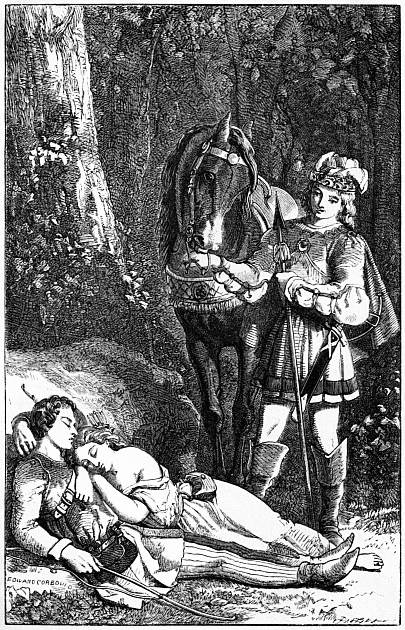
The Good Woman.—P. 210.
In this uneasy state of mind, not being able to tolerate
their prolonged repose, he touched the handsome Finfin with
his spear. He started up, and, seeing a man before him, he
passed his hand over the face of Mirtis, and awoke her, calling
her "sister," a name which dissipated in a moment the alarm
of the young Prince.
Mirtis rose up, quite astonished; she had never seen any
one but Finfin. The young Prince was the same age as
herself. He was superbly attired, and had a face full of
charming expression.
He began saying many sweet things to her. She listened
to him with a pleasure which she had never before experienced,
and she responded to them in a simple manner, full
of grace. Finfin saw that it was getting late, and the fawn
having arrived with Lirette's letter, he told his sister it was
time to go home. "Come, brother," said she to the young
Prince, giving him her hand, "come with us into the House
of Roses." For as she believed Finfin to be her brother, she
thought that every one who was handsome, like him, must be
her brother also.
The young Prince did not require much pressing to follow
her. Finfin threw on the back of his fawn the game he
had shot, and the handsome Prince carried the bow and the
game-bag of Mirtis.
In this order they arrived at the House of Roses.
Lirette came out to meet them. She gave the Prince a
smiling reception, and turning towards Mirtis, "I am delighted,"
said she, "that you have had such good sport."
They went all together to seek the Good Woman, to
whom the Prince made known his high birth. She paid
due attention to so illustrious a guest, and gave him a
handsome apartment. He remained two or three days
with her, and this was long enough to complete his
conquest by Mirtis, according to Finfin's request to his
little almond.
Meanwhile, the suite of the Prince had been much surprised
at his absence. They had found his horse, and they
believed that some frightful accident had befallen him. They
sought him everywhere, and the wicked King, who was his
father, was in a great fury at their not being able to find him.
The Queen, his mother, who was very amiable, and sister of
the King whom her husband had cruelly murdered, was in an
inconceivable state of grief at the loss of her son.
In her extreme distress, she sent secretly in search of
Madam Tu-tu, who was an old friend of hers, but whom she
had not seen for some time, because the King hated her,
and had done her much injury with a person she dearly
loved. Madam Tu-tu arrived, without being perceived, in
the cabinet of the Queen. After they had embraced each
other affectionately—for there is not much difference between
a Queen and a Fairy, they having almost equal power,—the
Fairy Tu-tu told her that she would very soon see her son.
She begged her not to make herself uneasy, and not to be at
all distressed at anything that might happen—that either she
was very much deceived, or she could promise her a delight
which was quite unexpected by her, and that she would be
one day the happiest of creatures.
The King's people made so many inquiries for the Prince,
and sought him with so much care, that at length they found
him at the House of Roses.
They led him back to the King, who scolded him brutally,
as though he were not the most beautiful youth in the
world. He remained very sad at the Court of his father,
and thinking of his beautiful Mirtis. At length his grief
was so visible on his countenance, that he was obliged to take
his mother into his confidence, who consoled him extremely.
"If you will mount your beautiful palfrey," said he, "and
come to the House of Roses, you will be charmed with what
you will see." The Queen consented willingly, and took her
son with her, who was enchanted at seeing his dear mistress
again.
The Queen was astonished at the great beauty of Mirtis,
and also at that of Lirette and Finfin. She embraced them
with as much tenderness as if they had been all her own children,
and conceived an immense friendship from that moment
for the Good Woman. She admired the house, the garden,
and all the curiosities she saw there. When she returned,
the King desired her to give an account of her journey; she
did so naturally, and he took a great fancy to go also and see
the wonders which she described. His son asked permission
to accompany him; he consented with a sullen air, for he
never did anything with a good grace. As soon as he saw
the House of Roses he coveted it; he paid not the least attention
to the charming inhabitants of this beautiful place, and,
by way of commencing to take possession of their property,
he said that he would sleep there that evening.
The Good Woman was very much vexed at such a resolution.
She heard an uproar, and saw a disorder in her
household, which frightened her. "What has become,"
cried she, "of the happy tranquillity which I once enjoyed
here! The least breath of fortune destroys all the calm of
life!"
She gave the King an excellent bed, and withdrew into a
corner of the dwelling with her little family. The wicked
King went to bed, but found it impossible to go to sleep, and
opening his eyes, he saw at the foot of his couch a little old
woman, who was not half a yard high, and about as broad;
she had great spectacles, which covered all her face, and she
made frightful grimaces at him. The base are generally
cowards. He was in a terrible fright, and felt at the same
time a thousand points of needles pricking him all over. In
this tormenting state of body and mind, he was kept awake
the entire night, and made a great noise about it. The King
stormed and swore in language which was not at all consistent
with his dignity. "Sleep, sleep, sire," said the partridge, "or
let us sleep: if the condition of royalty is so full of anxiety,
I prefer being a partridge to being king." The King was
more than ever alarmed at these words; he commanded them
to seize the partridge, which roosted in a porcelain vase; but
she flew away at this order, beating his face with her wings.
He still saw the same vision, and felt the same prickings; he
was dreadfully frightened, and his anger became more furious.
"Ah!" said he, "it is a spell of this sorceress, whom they
call the Good Woman. I will rid myself of her and all her
race by putting them to death!"
He got up, not being able to rest in bed; and as soon as
day broke, he commanded his guards to seize all the innocent
little family, and fling them into dungeons. He had them
dragged before him, that he might witness their despair.
Those charming faces, bedewed with tears, touched him not;
on the contrary, he felt a malignant joy at the sight. His
son, whose tender heart was rent by so sad a spectacle, could
not turn his eyes upon Mirtis without an agony which
nothing could exceed. A true lover, on such occasions, suffers
more than the person beloved.
They seized these poor innocents, and were leading them
away, when the young Finfin, who had no arms with which
to oppose these barbarians, took the ribbon on a sudden from
his neck. "Little almond," cried he, "I wish that we were
out of the power of the King!" "And with his greatest
enemies, my dear cherry!" continued Lirette. "And that we
might take away with us the handsome Prince, my medlar!"
added Mirtis. They had hardly uttered these words when
they found themselves with the Prince, the partridge, and the
fawn, all together in a car, which rising with them in the
air, they soon lost sight of the King and the House of Roses.
Mirtis had no sooner expressed her wish than she repented
of it. She knew well that she had inconsiderately allowed herself
to be carried away by an impulse of which she was not the
mistress; therefore, during all the journey, she kept her eyes
cast down, and felt much abashed. The Good Woman gave
her a severe glance. "My daughter," said she, "you have
not done well to separate the Prince from his father; however
unjust he may be, he ought not to leave him." "Ah, Madam,"
replied the Prince, "do not complain that I have the happiness
of following you. I respect the King, my father; but
I should have left him a hundred times had it not been for
the virtue, the kindness, and tenderness of the Queen, my
mother, which have always detained me."
As he finished these words, they found themselves in front
of a beautiful palace, where they alighted and were received
by Madam Tu-tu. She was the most lovely person in the
world—young, lively, and gay. She paid them a hundred
compliments, and confessed to them that it was she who had
given them all the pleasures which they had enjoyed in their
lives, and had also bestowed on them the cherry, the almond,
and the medlar, the virtues of which were at an end, as they
had now arrived in her dominions. Then, addressing the
Prince in private, she told him that she had heard speak a
thousand times of the annoyance he had met with from his
father; but, in order that he should not attribute to her any
evil that might hereafter befal the King, she frankly admitted
she had played him some tricks, but that was the full extent
of her vengeance.
After that, she assured them that they would be all very
happy with her; that they should have flocks to keep, crooks,
bows, arrows, and fishing-rods, in order that they might
amuse themselves in a hundred different ways. She gave
them shepherds' dresses of the most elegant description,
including the Prince with the others,—their names and
devices being on their crooks; and that very evening the young
Prince exchanged crooks with the charming Mirtis.
The next day Madame Tu-tu led them to the most delightful
promenade in the world, and showed them the best pasturage
for their sheep, and a fine country for the chase.
"You can go," said she, "on this side as far as that
beautiful river, but never to the opposite shore; and you
may hunt in this wood; but beware," said she, "of passing a
great oak, which is in the midst of the forest; it is very
remarkable, for it has roots and trunk of iron. If you go
beyond it, misfortunes may happen to you, from which I
cannot protect you; and, besides that, I should not perhaps
be in a position to assist you promptly, for a fairy has plenty
of occupation."
The young shepherds assured her that they would do
exactly as she prescribed; and all four, leading their flocks
into the meadows, left Madam Tu-tu alone with the Good
Woman. She remarked some anxiety in her manner. "What
is the matter, madam?" said the Fairy; "what cloud has come
over your mind?" "I will not deny," said the Good Woman,
"that I am uneasy at leaving them all thus together. I
have for some time perceived with sorrow that Finfin and
Lirette love each other more than is desirable, and here, to
add to my trouble, another attachment springs up: the
Prince and Mirtis do not dislike each other, and I fear to
leave their youth exposed to the wandering of their hearts."
"You have brought up these two young girls so well,"
replied Madam Tu-tu, "that you need fear nothing: I will
answer for their discretion; I will enlighten you as to their
destiny."
She then informed her that Finfin was the son of the
wicked King, and brother of the young Prince; that Mirtis
and Lirette were sisters, and daughters of the deceased King,
who had been murdered, and who was the brother of the
Queen, whom the cruel usurper had married,—so that these
four young persons were near relations; that the wicked
King had ascended the throne after having committed a
hundred atrocities, which he wished to crown by the murder
of the two Princesses; that the Queen did all she could to
prevent him, and not being able to succeed, she had called
her (the Fairy) to her assistance; that she then told the
Queen she would save them, but that she could only do so by
taking with them her eldest son; that she undertook to
promise she should see them again some day in happiness;
that on those conditions, the Queen had consented to a separation,
which appeared at first very hard; that she had carried
them all three off, and that she had confided them to the care
of the Good Woman as the person most worthy of such an office.
After this the Fairy begged her to be at ease, assuring her
that the union of these young Princes would restore peace to
the kingdom, wherein Finfin would reign with Lirette. The
Good Woman listened to this discourse with great interest;
but not without letting fall some tears. Madam Tu-tu was
surprised at this emotion, and asked the cause. "Alas!"
said she, "I fear they will lose their innocence by this grandeur
to which they will be elevated, and that so brilliant a fortune
will corrupt their virtue."
"No," replied the Fairy, "do not fear so great a misfortune;
the principles you have instilled into them are too excellent.
It is possible to be a king and yet an honest man. You know
that there is one in the universe who is the model of perfect
monarchs.[14] Therefore set your mind at rest; I shall be with
you as much as possible, and I hope you will not be melancholy
here."
The Good Woman believed her, and after a short time
felt perfectly satisfied. The young shepherds were so happy
also that they desired nothing but the continuance of their
agreeable mode of life. Their pleasures, although tranquil,
were not without interest: they saw each other every day,
and the days only appeared to them too short.
The bad King learnt that they were with Madam Tu-tu,
but all his power could not take them away from her. He
knew by what magic spells she protected them; he saw clearly
that he could only get the better of them by stratagem; he
had not been able to inhabit the House of Roses in consequence
of the continual tricks played on him by Madam Tu-tu; he
hated her more than ever, as well as the Good Woman; and
his hatred now extended also to his son.
He employed all kinds of artifice in order to get into his
power some one of the four young shepherds, but his art did
not extend to the dominions of Madam Tu-tu. One unlucky
day (there are some which we cannot avoid), these amiable
shepherds had bent their steps in the direction of the fatal
oak, when the beautiful Lirette perceived upon a tree, about
twenty paces distant, a bird of such rare plumage, that she
let fly an arrow at it on the impulse of the moment, and
seeing the bird fall dead, ran to pick it up. All this was done
instantaneously, and without reflection; but the poor Lirette
found, to her cost, that she was caught herself. It was impossible
for her to return; she desired, but had no power to
do so. She discovered her error, and all she could do was
to extend her arms for pity to her brothers and sisters.
Mirtis began to cry, and Finfin, without hesitation, ran to
her. "I will perish with you," he cried, and in a moment
had joined her.
Mirtis wished to follow them, but the young Prince detained
her. "Let us go and apprise Madame Tu-tu of this," said he;
"that is the best assistance we can render them." At the
same moment they saw the people of the wicked King seize
them, and all they could do was to cry adieu to each other.
The King had caused this beautiful bird to be placed there
by his hunters, to serve as a snare for the shepherds: he fully
expected what had come to pass. They led Lirette and
Finfin before the cruel monarch, who abused them terribly,
and had them confined in a dark and strong prison: it was
then they began to lament that their little cherry and almond
had lost their virtue. The fawn and the partridge sought
for them, but the fawn not being able to see them, shed
some tears of grief, and finding the King had given orders
that she should be taken and burnt alive, she saved herself
by running fast to Mirtis. The partridge was more fortunate,
for she saw them every day through the grating of their
prison: happily for them, the King had not thought of
separating them. When one loves, it is a pleasure to suffer
together.
The partridge flew back every day, and came to tell the
news to Madame Tu-tu, the Good Woman, and Mirtis.
Mirtis was very unhappy, and without the handsome Prince
she would have been inconsolable. She resolved to write to
these poor captives by the faithful partridge, and hung a
little bottle of ink to her neck, with some paper, and put a
pen in her beak. The good partridge, thus loaded, presented
herself at the bars of the prison, and it was a great delight
to our young shepherds to see her again. Finfin put out his
hand and took from her all she brought him, after which
they began to read as follows:[15]
Mirtis and the Prince to Lirette and Finfin.
"Know you how we languish during this cruel separation;
that we sigh incessantly, and that perhaps it may kill us.
We should already have died, had we not been sustained by
hope. That hope has supported us ever since Madam Tu-tu
has assured us that you still lived. Believe us, dear Lirette
and Finfin, we shall meet again, despite of malice, and be
happy."
This letter had a powerful effect on the minds of Lirette
and Finfin. They were filled with joy, and wrote immediately
this reply:—
Lirette and Finfin to Mirtis and the Prince.
"We have received your letter with extreme pleasure. It
has rejoiced us more than we could have anticipated. In
these regions of horror our torments would be insupportable,
but for the sweet consolation we derive from each other's
presence. Near the object of our affections, we are insensible
to pain, and love renders everything delightful. Adieu,
dear Prince, adieu, Mirtis. Encourage your mutual passion.
Be always inspired by a tender fidelity. You hold out a hope
to us in which we participate. The greatest blessing which
can occur to us will be accompanied by your presence."
Finfin having attached this note to the neck of the partridge,
she flew away with it very quickly. The young shepherds
received great consolation from it, but the Good Woman
could not be comforted from the moment she had been separated
from those so dear to her, and whom she knew to be
in so much peril. "How quickly my happiness has vanished,"
said she to Madame Tu-tu; "I seem to have been born only
to be continually agitated. I thought I had taken the only
means for ensuring my repose; how purblind are mortals!"
"And do you not know," replied the Fairy, "that there is
no state of existence in this world in which one can live
always happily." "I do," replied the Good Woman, mournfully;
"and if one cannot find happiness in one's self, it is
seldom found elsewhere. But, Madam, consider the fate of
my children, I beg of you!" "They have not remembered
the orders I gave them," replied Madame Tu-tu; "but let us
think of a remedy."
Madame Tu-tu entered her library with the Good Woman.
She read nearly all the night, and having at length taken
down and opened a large book, which she had frequently
passed over, although its sides were covered with plates of
gold, she appeared plunged, on a sudden, into a state of
excessive sadness. After some time, and just as day was
breaking, the Good Woman observing a few tears fall on the
leaves of the book, took the liberty to ask the cause of the
Fairy's sorrow. "I grieve," said she, "at the irrevocable
decree of Fate, which I have learned from these pages, and
which I shudder and tremble to acquaint you with." "Are
they dead?" cried the Good Woman. "No," pursued
Madame Tu-tu; "but nothing can save them, unless you or
I go and present ourselves to the King, and satisfy his vengeance.
I confess the truth to you, Madam," continued the
Fairy, "that I do not feel sufficient affection for them, nor
enough courage, to go thus and expose myself to his fury,
and I question, also, if any one could be found capable of
such a sacrifice." "Pardon me, Madam," replied the Good
Woman, with great firmness; "I will go seek this King; no
sacrifice is too great for me that will save my children. I
will pour out for them, with all my heart, every drop of
blood which I have in my veins."
Madam Tu-tu could not sufficiently admire so grand a
resolution; she promised to assist her in every way in her
power; but that she found herself limited in this instance, in
consequence of the fault which they had committed. The
Good Woman took leave of her, and would not acquaint Mirtis
or the Prince with her design, for fear of affecting them and
weakening her own determination. She set out with the
partridge flying by her side; and as they passed the iron oak,
the partridge snatched with her beak a little moss from
its trunk, and placed it in the hands of the Good Woman.
"When you are in the greatest peril which can befall you,"
said she to her, "throw this moss at the feet of the King."
The Good Woman treasured up these words, and hardly had
she advanced some steps when she was seized by some of
the wicked King's soldiers, whom he always kept in readiness
on the outskirts of the domain of Madam Tu-tu. They led
her before him. "I have thee at last, wicked creature!" said
he; "I will put thee to death by the most cruel torture!"
"I came but for that purpose," replied she, "and thou mayst
exercise thy cruelty as thou wilt on me, only spare my children,
who are so young and incapable of having offended thee.
I offer thee my life for theirs." All who heard these words
were filled with pity at her magnanimity; the King alone was
unmoved. The Queen, who was present, shed a torrent of
tears. The King was so indignant with her that he would
have killed her, if her attendants had not placed themselves
between them. She fled, uttering piercing cries.
The barbarous King caused the Good Woman to be shut
up, ordering them to feed her well, in order to render approaching
death more frightful to her. He commanded them to fill
a pit with snakes, vipers, and serpents, promising himself the
pleasure of precipitating the Good Woman into it. What a horrible
mode of execution! It makes one shudder to think of it!
The officers of this unjust Prince obeyed him with regret;
and when they had fulfilled this frightful order, the King
came to the spot. They were about to bind the Good Woman,
when she begged them not to do so, assuring them that she
had sufficient courage to meet death with her hands free; and,
feeling she had no time to lose, she approached the King, and
threw the moss at his feet. He was at that moment close to
the frightful gulf, and stepping forward to inspect it again
with pleasure, his feet slipped on the moss, and he fell in.
Hardly had he reached the bottom of the pit, when the
sanguinary reptiles darted upon him, and stung him to death,
and the Good Woman, at the same instant, found herself in
company with her dear partridge in the House of Roses.
Whilst these things were happening, Finfin and Lirette
were almost dead with misery in their fearful prison; their
innocent affection alone kept them alive. They were saying
very sad and very affecting things to each other, when they
perceived on a sudden the doors of their dungeon open and
admit Mirtis, the handsome Prince, and Madam Tu-tu, who
threw themselves on their necks, and who, though speaking
all at once, failed not, in the midst of this joyful confusion,
to announce the death of the King. "He was your father,
Finfin, as well as that of the Prince," said Madam Tu-tu;
"but he was unnatural and tyrannical, and would a hundred
times have put the Queen, your dear mother, to death. Let
us go to seek her." They did so. Her amiable nature made
her feel some regret at the death of the King, her husband.
Finfin and the Prince also paid all decent respect to his
memory. Finfin was acknowledged King, and Mirtis and
Lirette Princesses. They went all together to the House of
Roses, to see the generous Good Woman, who thought she
should die of joy in embracing them. They all acknowledged
that they owed their lives to her, and more than their lives,
as they were indebted to her for their happiness also.
From that moment they considered themselves perfectly
happy. The marriages were celebrated with great pomp.
King Finfin espoused the Princess Lirette, and Mirtis the
Prince. When these splendid nuptials were over, the Good
Woman asked permission to retire to the House of Roses.
They were very unwilling to consent to this, but yielded to
her sincere wish. The widowed Queen also desired to pass
the rest of her life with the Good Woman, and the partridge
and the fawn did likewise. They were quite disgusted with
the world, and found tranquillity in that charming retreat.
Madam Tu-tu often went to visit them, as did the King and
Queen, the Prince and Princess.
Happy those who can imitate the actions of the Good
Woman. Such grandeur of soul must ever meet due reward.
Little do they fear being wrecked on the shoals of Fortune,
who can give up all with so much courage. Discretion, Sense,
Virtue—what may not mortals owe to you, their truest friends
in need.
In a country very far from this is to be seen a great city
wherein trade flourishes abundantly. It numbered amongst
its citizens a merchant, who succeeded in all his speculations,
and upon whom Fortune, responding to his wishes, had always
showered her fairest favours. But if he had immense wealth,
he had also a great many children, his family consisting of
six boys and six girls. None of them were settled in life:
the boys were too young to think of it; the girls, too proud
of their fortunes, upon which they had every reason to count,
could not easily determine upon the choice they should make.
Their vanity was flattered by the attentions of the handsomest
young gentlemen. But a reverse of fortune which
they did not at all expect, came to trouble their felicity.
Their house took fire; the splendid furniture with which it
was filled, the account books, the notes, gold, silver, and all
the valuable stores which formed the merchant's principal
wealth, were enveloped in this fatal conflagration, which was
so violent that very few of the things could be saved. This
first misfortune was but the forerunner of others. The father,
with whom hitherto everything had prospered, lost at the
same time, either by shipwreck or by pirates, all the ships he
had at sea; his correspondents made him a bankrupt, his foreign
agents were treacherous; in short, from the greatest opulence,
he suddenly fell into the most abject poverty. He had
nothing left but a small country house, situated in a lonely
place, more than a hundred leagues from the city in which he
usually resided. Impelled to seek a place of refuge from
noise and tumult, he took his family to this retired spot, who
were in despair at such a revolution. The daughters of this
unfortunate merchant were especially horrified at the prospect
of the life they should have to lead in this dull solitude. For
some time they flattered themselves that, when their father's
intention became known, their lovers, who had hitherto sued
in vain, would be only too happy to find they were inclined
to listen to them. They imagined that the many admirers
of each would be all striving to obtain the preference. They
thought if they wished only for a husband they would
obtain one; but they did not remain very long in such a
delightful illusion. They had lost their greatest attractions
when, like a flash of lightning, their father's splendid fortune
had disappeared, and their time for choosing had departed
with it. Their crowd of admirers vanished at the moment of
their downfall; their beauty was not sufficiently powerful to
retain one of them. Their friends were not more generous
than their lovers. From the hour they became poor, every
one, without exception, ceased to know them. Some were
even cruel enough to impute their misfortunes to their own
acts. Those whom the father had most obliged were his
most vehement calumniators: they reported that all his
calamities were brought on by his own bad conduct, his prodigality,
and the foolish extravagance of himself and his
children.
This wretched family, therefore, could not do better than
depart from a city wherein everybody took a pleasure in
insulting them in their misfortunes. Having no resource
whatever, they shut themselves up in their country house,
situated in the middle of an almost impenetrable forest,
and which might well be considered the saddest abode in the
world. What misery they had to endure in this frightful
solitude! They were forced to do the hardest work. Not
being able to have any one to wait upon them, this unfortunate
merchant's sons were compelled to divide the servant's
duties amongst them, as well as to exert themselves in every
way that people must do who have to earn their livelihood
in the country. The daughters, on their part, had sufficient
employment. Like the poor peasant girls, they found themselves
obliged to employ their delicate hands in all the labours
of a rural life. Wearing nothing but woollen dresses, having
nothing to gratify their vanity, existing upon what the land
could give them, limited to common necessaries, but still
retaining a refined and dainty taste, these girls incessantly
regretted the city and its attractions. The recollection even
of their younger days passed so rapidly in a round of mirth
and pleasure was their greatest torment. The youngest
girl, however, displayed greater perseverance and firmness in
their common misfortune. She bore her lot cheerfully, and
with a strength of mind much beyond her years: not but
what, at first, she was truly melancholy. Alas! who would
not have felt such misfortunes. But, after deploring her
father's ruin, could she do better than resume her former
gaiety, make up her mind to the position she was placed in,
and forget a world which she and her family had found so
ungrateful, and the friendship of which she was so fully persuaded
was not to be relied upon in the time of adversity?
Anxious to console herself and her brothers, by her amiable
disposition and sprightliness, there was nothing she did not
do to amuse them. The merchant had spared no cost in her
education, nor in that of her sisters. At this sad period she
derived all the advantage from it she desired. As she could play
exceedingly well upon various instruments, and sing to them
charmingly, she asked her sisters to follow her example, but
her cheerfulness and patience only made them more miserable.
These girls, who were so inconsolable in their ill fortune,
thought their youngest sister showed a poor and mean spirit,
and even silliness, to be so merry in the state it had pleased
Providence to reduce them to. "How happy she is," said
the eldest; "she was intended for such coarse occupations.
With such low notions, what would she have done in the
world?" Such remarks were unjust. This young person
was much more fitted to shine in society than either of them.
She was a perfectly beautiful young creature, her good temper
rendered her adorable. A generous and tender heart was
visible in all her words and actions. Quite as much alive to
the reverses that had just overwhelmed her family as either of
her sisters, by a strength of mind which is not common in
her sex, she concealed her sorrow, and rose superior to her
misfortunes. So much firmness was considered to be insensibility.
But one can easily appeal from a judgment pronounced
by jealousy.
Every intelligent person, who saw her in her true light,
was eager to give her the preference over her sisters. In the
midst of her greatest splendour, although distinguished by
her merit, she was so handsome that she was called "The
Beauty." Known by this name only, what more was required
to increase the jealousy and hatred of her sisters? Her charms,
and the general esteem in which she was held, might have
induced her to hope for a much more advantageous establishment
than her sisters; but feeling only for her father's misfortunes,
far from retarding his departure from a city in
which she had enjoyed so much pleasure, she did all she could
to expedite it. This young girl was as contented in their
solitude as she had been in the midst of the world. To
amuse herself in her hours of relaxation, she would dress her
hair with flowers, and, like the shepherdesses of former times,
forgetting in a rural life all that had most gratified her in
the height of opulence, every day brought to her some new
innocent pleasure.
Two years had already passed, and the family began to
be accustomed to a country life, when a hope of returning
prosperity arrived to discompose their tranquillity. The
father received news that one of his vessels, that he thought
was lost, had safely arrived in port, richly laden. His informants
added, they feared the factors would take advantage
of his absence, and sell the cargo at a low price, and
by this fraud make a great profit at his expense. He
imparted these tidings to his children, who did not doubt
for an instant but that they should soon be enabled to return
from exile. The girls, much more impatient than the boys,
thinking it was unnecessary to wait for more certain proof,
were anxious to set out instantly, and to leave everything
behind them. But the father, who was more prudent, begged
them to moderate their delight. However important he was
to his family at a time when the labours of the field could
not be interrupted without great loss, he determined to leave
his sons to get in the harvest, and that he would set out upon
this long journey. His daughters, with the exception of the
youngest, expected they would soon be restored to their
former opulence. They fancied that, even if their father's
property would not be considerable enough to settle them in
the great metropolis, their native place, he would at least
have sufficient for them to live in a less expensive city. They
trusted they should find good society there, attract admirers,
and profit by the first offer that might be made to them.
Scarcely remembering the troubles they had undergone for
the last two years, believing themselves to be already, as by
a miracle, removed from poverty into the lap of plenty, they
ventured (for retirement had not cured them of the taste for
luxury and display) to overwhelm their father with foolish
commissions. They requested him to make purchases of
jewelry, attire, and head-dresses. Each endeavoured to
outvie the other in her demands, so that the sum total of
their father's supposed fortune would not have been sufficient
to satisfy them.
Beauty, who was not the slave of ambition, and who
always acted with prudence, saw directly that if he executed
her sisters' commissions, it would be useless for her to ask
for anything. But the father, astonished at her silence,
said, interrupting his insatiable daughters, "Well, Beauty,
dost thou not desire anything? What shall I bring thee?
what dost thou wish for? Speak freely." "My dear papa,"
replied the amiable girl, embracing him affectionately, "I
wish for one thing more precious than all the ornaments my
sisters have asked you for; I have limited my desires to it,
and shall be only too happy if they can be fulfilled. It is the
gratification of seeing you return in perfect health." This
answer was so unmistakeably disinterested, that it covered
the others with shame and confusion. They were so angry,
that one of them, answering for the rest, said with bitterness,
"This child gives herself great airs, and fancies that she will
distinguish herself by these affected heroics. Surely nothing
can be more ridiculous." But the father, touched by her
expressions, could not help showing his delight at them;
appreciating, too, the feeling which induced her to ask nothing
for herself, he begged she would choose something; and to
allay the ill-will that his other daughters had towards her,
he observed to her that such indifference to dress was not
natural at her age—that there was a time for everything.
"Very well, my dear father," said she, "since you desire me
to make some request, I beg you will bring me a rose; I love
that flower passionately, and since I have lived in this desert
I have not had the pleasure of seeing one." This was to
obey her father, and at the same time to avoid putting him
to any expense for her.
At length the day arrived, that this good old man was
compelled to leave his family. He travelled as fast as he
could to the great city to which the prospect of a new
fortune recalled him. But he did not meet with the benefits
he had hoped for. His vessel had certainly arrived; but his
partners, believing him to be dead, had taken possession
of it, and all the cargo had been disposed of. Thus, instead
of entering into the full and peaceable possession of that
which belonged to him, he was compelled to encounter all
sorts of chicanery in the pursuit of his rights. He overcame
them, but after more than six months of trouble and expense,
he was not any richer than he was before. His debtors had
become insolvent, and he could hardly defray his own costs.
Thus terminated this dream of riches.
To add to his disagreeables, he was obliged, on the score of
economy, to start on his homeward journey at the most inconvenient
time, and in the most frightful weather. Exposed
on the road to the piercing blasts, he thought he should die
with fatigue; but when he found himself within a few miles
of his house (which he did not reckon upon leaving for such
false hopes, and which Beauty had shown her sense in mistrusting)
his strength returned to him. It would be some
hours before he could cross the forest; it was late, but he
wished to continue his journey. He was benighted, suffering
from intense cold, buried, one might say, in the snow, with
his horse; not knowing which way to bend his steps, he
thought his last hour had come: no hut in his road,
although the forest was filled with them. A tree, hollowed
by age, was the best shelter he could find, and only too happy
was he to hide himself in it. This tree protecting him from
the cold, was the means of saving his life; and the horse, a
little distance from his master, perceiving another hollow tree,
was led by instinct to take shelter in that.
The night, in such a situation, appeared to him to be never-ending;
furthermore, he was famished, frightened at the roaring
of the wild beasts, that were constantly passing by him.
Could he be at peace for an instant? His trouble and anxiety
did not end with the night. He had no sooner the pleasure
of seeing daylight than his distress was greater. The ground
appeared so extraordinarily covered with snow, no road could
he find—no track was to be seen. It was only after great
fatigue and frequent falls, that he succeeded in discovering
something like a path upon which he could keep his footing.
Proceeding without knowing in which direction, chance led
him into the avenue of a beautiful castle, which the snow
seemed to have respected. It consisted of four rows of orange-trees,
laden with flowers and fruit. Statues were seen here
and there, regardless of order or symmetry—some were in
the middle of the road, others among the trees—all after the
strangest fashion; they were of the size of life, and had the
colour of human beings, in different attitudes, and in various
dresses, the greatest number representing warriors. Arriving
at the first court-yard, he perceived a great many more
statues. He was suffering so much from cold that he could
not stop to examine them. An agate staircase, with balusters
of chased gold, first presented itself to his sight: he
passed through several magnificently furnished rooms; a
gentle warmth which he breathed in them renovated him.
He needed food; but to whom could he apply? This large
and magnificent edifice appeared to be inhabited only by
statues. A profound silence reigned throughout it; nevertheless
it had not the air of an old palace that had been deserted.
The halls, the rooms, the galleries were all open; no living
thing appeared to be in this charming place.
Weary of wandering over this vast dwelling, he stopped in a
saloon, wherein was a large fire. Presuming that it was prepared
for some one, who would not be long in appearing, he drew
near the fireplace to warm himself; but no one came. Seated
on a sofa near the fire, a sweet sleep closed his eyelids, and
left him no longer in a condition to observe the entrance of
any one. Fatigue induced him to sleep; hunger awoke him;
he had been suffering from it for the last twenty-four hours.
The exercise that he had taken ever since he had been in this
palace increased his appetite. When he awoke and opened
his eyes, he was astonished to see a table elegantly laid. A
light repast would not have satisfied him; but the viands,
magnificently dressed, invited him to eat of everything.
His first care was to utter in a loud voice his thanks to those
from whom he had received so much kindness, and he then
resolved to wait quietly till it pleased his host to make himself
known to him. As fatigue caused him to sleep before his
repast, so did the food produce the same effect, and his repose
was longer and more powerful; in fact, this second time he
slept for at least four hours. Upon awaking, in the place of
the first table he saw another of porphyry, upon which some
kind hand had set out a collation consisting of cakes, preserved
fruits, and liqueurs. This was likewise for his use. Profiting,
therefore, by the kindness shown him, he partook of everything
that suited his appetite, his taste, and his fancy.
Finding at length no one to speak to, or to inform him
whether this palace was inhabited by a man or by a God,
fear began to take possession of him, for he was naturally
timid. He resolved, therefore, to repass through all the
apartments, and overwhelm with thanks the Genius to whom
he was indebted for so much kindness, and in the most respectful
manner solicit him to appear. All his attentions were useless:
no appearance of servants, no result by which he could
ascertain that the palace was inhabited. Thinking seriously
of what he should do, he began to fancy, for what reason he
could not imagine, that some good spirit had made this
mansion a present to him, with all the riches that it contained.
This idea seemed like inspiration, and without
further delay, making a new inspection of it, he took possession
of all the treasures he could find. More than this, he
settled in his own mind what share of it he should allow to
each of his children, and selected the apartments which would
particularly suit them, enjoying the delight beforehand which
his journey would afford them. He entered the garden, where,
in spite of the severity of the winter, the rarest flowers were
exhaling the most delicious perfume in the mildest and purest
air. Birds of all kinds blending their songs with the confused
noise of the waters, made an agreeable harmony.
The old man, in ecstasies at such wonders, said to himself,
"My daughters will not, I think, find it very difficult to
accustom themselves to this delicious abode. I cannot believe
that they will regret, or that they will prefer the city to this
mansion. Let me set out directly," cried he, in a transport
of joy rather uncommon for him; "I shall increase my
happiness in witnessing theirs: I will take possession at
once."
Upon entering this charming castle he had taken care,
notwithstanding he was nearly perished, to unbridle his horse
and let him wend his way to a stable which he had observed
in the fore-court. An alley, ornamented by palisades, formed
by rose-bushes in full bloom, led to it. He had never seen
such lovely roses. Their perfume reminded him that he had
promised to give Beauty a rose. He picked one, and was
about to gather enough to make half-a-dozen bouquets, when
a most frightful noise made him turn round. He was terribly
alarmed upon perceiving at his side a horrible beast,
which, with an air of fury, laid upon his neck a kind of trunk,
resembling an elephant's, and said, with a terrific voice, "Who
gave thee permission to gather my roses? Is it not enough
that I kindly allowed thee to remain in my palace. Instead
of feeling grateful, rash man, I find thee stealing my flowers!
Thy insolence shall not remain unpunished." The good man,
already too much overpowered by the unexpected appearance
of this monster, thought he should die of fright at these
words, and quickly throwing away the fatal rose. "Ah! my
Lord," said he, prostrating himself before him, "have mercy
on me! I am not ungrateful! Penetrated by all your kindness,
I did not imagine that so slight a liberty could possibly
have offended you." The monster very angrily replied,
"Hold thy tongue, thou foolish talker. I care not for thy
flattery, nor for the titles thou bestowest on me. I am not
'my Lord;' I am The Beast; and thou shalt not escape the
death thou deservest."
The merchant, dismayed at so cruel a sentence, and thinking
that submission was the only means to preserve his life,
said, in a truly affecting manner, that the rose he had dared
to take was for one of his daughters, called Beauty. Then,
whether he hoped to escape from death, or to induce his
enemy to feel for him, he related to him all his misfortunes;
he told him the object of his journey, and did not omit to
dwell on the little present he was bound to give Beauty;
adding, that was the only thing she had asked for, while the
riches of a king would hardly have sufficed to satisfy the
wishes of his other daughters; and so came to the opportunity
which had offered itself to satisfy the modest desire of Beauty,
and his belief that he could have done so without any unpleasant
consequences; asking pardon, moreover, for his involuntary
fault. The Beast considered for a moment, then,
speaking in a milder tone, he said to him, "I will pardon
thee, but upon condition that thou wilt give me one of thy
daughters—I require some one to repair this fault." "Just
Heaven!" replied the merchant; "how can I keep my word?
Could I be so inhuman as to save my own life at the expense
of one of my children's; under what pretext could I bring
her here?" "There must be no pretext," interrupted the
Beast. "I expect that whichever daughter you bring here
she will come willingly, or I will not have either of them.
Go; see if there be not one amongst them sufficiently courageous,
and loving thee enough, to sacrifice herself to save thy
life. Thou appearest to be an honest man. Give me thy
word of honour to return in a month. If thou canst decide
to bring one of them back with thee, she will remain here
and thou wilt return home. If thou canst not do so, promise
me to return hither alone, after bidding them farewell
for ever, for thou wilt belong to me. Do not fancy," continued
the Monster, grinding his teeth, "that by merely
agreeing to my proposition thou wilt be saved. I warn thee,
if thou thinkest so to escape me, I will seek for thee, and
destroy thee and thy race, although a hundred thousand men
appear to defend thee."
The good man, although quite convinced that he should not
vainly put to the proof the devotion of his daughters,
accepted, nevertheless, the Monster's proposition. He promised
to return to him at the time named, and give himself
up to his sad fate, without rendering it necessary for the
Beast to seek for him. After this assurance he thought
himself at liberty to retire and take leave of the Beast, whose
presence was most distressing to him. The respite was but
brief, yet he feared he might revoke it. He expressed his
anxiety to depart; but the Beast told him he should not do
so till the following day. "Thou wilt find," said he, "a horse
ready at break of day. He will carry thee home quickly.
Adieu—go to supper, and await my orders."
The poor man, more dead than alive, returned to the saloon
in which he had feasted so heartily. Before a large fire his
supper, already laid, invited him to sit and enjoy it. The
delicacy and richness of the dishes had no longer, however,
any temptation for him. Overwhelmed by his grief, he would
not have seated himself at the table, but that he feared that
the Beast was concealed somewhere, and observing him,
and that he would excite his anger by any slight of his
bounty. To avoid further disaster, he made a momentary
truce with his grief, and, as well as his afflicted heart would
permit, he tasted, in turn, the various dishes. At the end
of the repast a great noise was heard in the adjoining apartment,
and he did not doubt that it was his formidable host.
As he could not manage to avoid his presence, he tried to
recover from the alarm which this sudden noise had caused
him. At the same moment, the Beast, who appeared, asked
him abruptly if he had made a good supper. The good man
replied, in a modest and timid tone, that he had, thanks to
his attention, eaten heartily. "Promise me," replied the
Monster, "to remember your word to me, and to keep it as a
man of honour, in bringing me one of your daughters."
The old man, who was not much entertained with this
conversation, swore to him that he would fulfil what he had
promised, and return in a month alone or with one of his
daughters, if he should find one who loved him sufficiently
to follow him on the conditions he must propose to her.
"I warn thee again," said the Beast, "to take care not to
deceive her as to the sacrifice which thou must exact from
her, or the danger she will incur. Paint to her my face such
as it is. Let her know what she is about to do: above all, let
her be firm in her resolution. There will be no time for
reflection when thou shalt have brought her hither. There
must be no drawing back: thou wilt be equally lost, without
obtaining for her the liberty to return." The merchant, who
was overcome at this discourse, reiterated his promise to conform
to all that was prescribed to him. The Monster, satisfied
with his answer, ordered him to retire to rest, and not to
rise till he should see the sun, and hear a golden bell.
"Thou wilt breakfast before setting out," said he again;
"and thou mayest take a rose with thee for Beauty. The
horse which shall bear thee will be ready in the court-yard.
I reckon on seeing thee again in a month, if thou art an
honest man. If thou failest in thy word, I shall pay thee a
visit." The good man, for fear of prolonging a conversation
already too painful to him, made a profound reverence to the
Beast, who told him again not to be anxious respecting the
road by which he should return; as at the time appointed the
same horse which he would mount the next morning would
be found at his gate, and would suffice for his daughter and
himself.
However little disposition the old man felt for sleep, he
dared not disobey the orders he had received. Obliged to lie
down, he did not rise till the sun began to illumine the
chamber. His breakfast was soon despatched, and he then
descended into the garden to gather the rose which the Beast
had ordered him to take to Beauty. How many tears this
flower caused him to shed. But the fear of drawing on
himself new disasters made him constrain his feelings, and
he went, without further delay, in search of the horse which
had been promised him. He found on the saddle a light but
warm cloak. As soon as the horse felt him on his back, he
set off with incredible speed. The merchant, who in a
moment lost sight of this fatal palace, experienced as great a
sensation of joy as he had on the previous evening felt in
perceiving it, with this difference, that the delight of leaving
it was embittered by the cruel necessity of returning to it.
"To what have I pledged myself?" said he, whilst his
courser carried him with a velocity and a lightness which is
only known in fairy land. "Would it not be better that I
should become at once the victim of this monster who thirsts
for the blood of my family? By a promise I have made, as
unnatural as it is indiscreet, I have prolonged my life. Is it
possible that I could think of extending my days at the
expense of those of my daughters? Can I have the barbarity
to lead one to him, to see him, no doubt, devour her
before my eyes?" But all at once, interrupting himself, he
cried, "Miserable wretch that I am, what have I to fear?
If I could find it in my heart to silence the voice of nature,
would it depend on me to commit this cowardly act? She
must know her fate and consent to it. I see no chance that
she will be inclined to sacrifice herself for an inhuman father,
and I ought not to make such a proposition to her. It is
unjust. But even if the affection which they all entertain
for me should induce one to devote herself, would not a single
glance at the Beast destroy her constancy, and I could not
complain. Ah! too imperious Beast," exclaimed he, "thou hast
done this expressly! By putting an impossible condition to
the means thou offerest me to escape thy fury, and obtain the
pardon of a trifling fault, thou hast added insult to injury!
But," continued he, "I cannot bear to think of it. I hesitate
no longer; and I would rather expose myself without turning
away from thy rage, than attempt a useless mode of escape,
which my paternal love trembles to employ. Let me retrace,"
said he, "the road to this frightful palace, and without deigning
to purchase so dearly the remnant of a life which can
never be but miserable—without waiting for the month which
is accorded me to expire,—return and terminate this day my
miserable existence!"
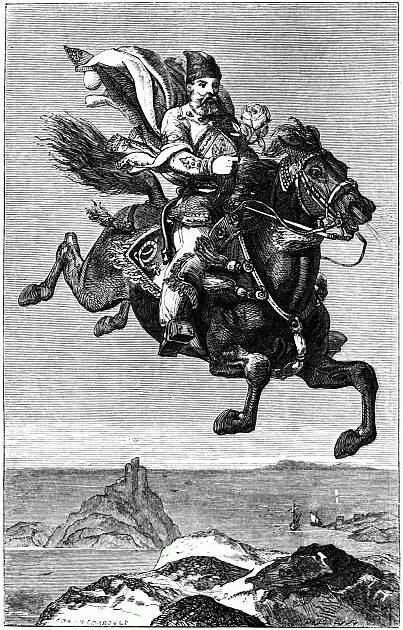
Beauty and the Beast.—P. 236.
At these words he endeavoured to retrace his steps, but he
found it impossible to turn the bridle of his horse. Allowing
himself, therefore, against his will, to be carried forward, he
resolved at least to propose nothing to his daughters. Already
he saw his house in the distance, and strengthening himself
more and more in his resolution, "I will not speak to them,"
he said, "of the danger which threatens me: I shall have
the pleasure of embracing them once more; I shall give them
my last advice; I will beg them to live on good terms with
their brothers, whom I shall also implore not to abandon
them."
In the midst of this reverie, he reached his door. His
own horse, which had found its way home the previous evening,
had alarmed his family. His sons, dispersed in the forest,
had sought him in every direction; and his daughters, in their
impatience to hear some tidings of him, were at the door, in
order to obtain the earliest intelligence. As he was mounted
on a magnificent steed, and wrapt in a rich cloak, they could
not recognise him, but took him at first for a messenger sent
by him, and the rose which they perceived attached to the
pummel of the saddle made them perfectly easy on his
account.
When this afflicted father, however, approached nearer,
they recognised him, and thought only of evincing their satisfaction
at seeing him return in good health. But the sadness
depicted in his face, and his eyes filled with tears, which he
vainly endeavoured to restrain, changed their joy into anxiety.
All hastened to inquire the cause of his trouble. He made
no reply but by saying to Beauty, as he presented her with
the rose, "There is what thou hast demanded of me, but
thou wilt pay dearly for it, as well as the others." "I was
certain," exclaimed the eldest, "and I was saying, this very
moment, that she would be the only one whose commission
you would execute. At this time of the year, a rose must
have cost more than you would have had to pay for us all
five together; and, judging from appearances, the rose will
be faded before the day is ended: never mind, however, you
were determined to gratify the fortunate Beauty at any price."
"It is true," replied the father, mournfully, "that this rose
has cost me dear, and more dear than all the ornaments which
you wished for would have done. It is not in money, however;
and would to Heaven that I might have purchased it
with all I am yet worth in the world."
These words excited the curiosity of his children, and dispelled
the resolution which he had taken not to reveal his
adventure. He informed them of the ill-success of his journey,
the trouble which he had undergone in running after a chimerical
fortune, and all that had taken place in the palace of
the Monster. After this explanation, despair took the place of
hope and of joy.
The daughters seeing all their projects annihilated by this
thunderbolt, uttered fearful cries; the brothers, more courageous,
said resolutely that they would not suffer their father
to return to this frightful castle; that they were bold enough
to deliver the earth from this horrible Beast, even supposing
he should have the temerity to come in search of him. The
good man, although moved at their affliction, forbad them to
commit violence, telling them, that as he had given his word,
he would kill himself rather than fail to keep it.
Notwithstanding this, they sought for expedients to save
his life; the young men, full of courage and filial affection,
proposed that one of them should go and offer himself as a
victim to the wrath of the Beast; but the monster had said
positively and explicitly that he would have one of the
daughters, and not one of the sons. The brave brothers
grieved that their good intentions could not be acted upon,
then did what they could to inspire their sisters with the
same sentiments. But their jealousy of Beauty was sufficient
to raise an invincible obstacle to such heroic action.
"It is not just," said they, "that we should perish in so
frightful a manner for a fault of which we are not guilty. It
would be to render us victims to Beauty, to whom they
would be very glad to sacrifice us; but duty does not require
such a sacrifice. Here is the fruit of the moderation and
perpetual preaching of this unhappy girl! Why did she not
ask, like us, for a good stock of clothes and jewels. If we
have not had them, it has at all events cost nothing for
asking, and we have no cause to reproach ourselves for having
exposed the life of our father by indiscreet demands. If, by
an affected disinterestedness, she had not sought to distinguish
herself, as she is in all things more favoured than we, he
would have, no doubt, found enough money to content her.
But she must needs, by her singular caprice, bring on us all
this misfortune. It is she who has caused it, and they wish
us to pay the penalty. We will not be her dupe. She has
brought it on herself, and she must find the remedy."
Beauty, whose grief had almost deprived her of consciousness,
suppressing her sobs and sighs, said to her sisters, "I
am the cause of this misfortune; it is I alone who must
repair it. I confess it would be unjust to allow you to suffer
for my fault. Alas! it was, notwithstanding, an innocent wish.
Could I foresee that the desire to have a rose when we were in
the middle of summer would be punished so cruelly? The fault
is committed, however; whether I am innocent or guilty, it is
just that I should expiate it. It cannot be imputed to any
one else. I will risk my life," pursued she, in a firm tone, "to
release my father from his fatal engagement. I will go to
find the Beast; too happy in being able to die in order to
preserve the life of him from whom I received mine, and to
silence your murmurs. Do not fear that anything can turn
me from my purpose; but I pray you during this month to
do me the favour to spare me your reproaches."
So much firmness in a girl of her age surprised them all
much; and the brothers, who loved her tenderly, were moved
at her resolution. They paid her infinite attention, and felt the
loss they were about to sustain. But it was requisite to save
the life of a father; this pious motive closed their mouths;
and well persuaded that it was a thing decided on, far from
thinking of combating so generous a purpose, they contented
themselves by shedding tears, and giving their sister all the
praise which her noble resolution merited, all the more from
her being only sixteen years of age, and having the right to
regret a life which she was about to sacrifice in so cruel a
manner. The father alone would not consent to the design
of his youngest daughter; but the others reproached him
insolently with the charge that Beauty alone was cared for
by him, in spite of the misfortune which she had caused, and
that he was sorry that it was not one of the elders who should
pay for her imprudence.
This unjust language forced him to desist; besides, Beauty
assured him that if he would not accept the exchange, she
would make it in spite of him, for she would go alone to seek
the Beast, and so perish without saving him. "How do we
know," said she, forcing herself to assume more tranquillity
than she really felt; "perhaps the dreadful fate which appears
to await me conceals another as happy as this seems
terrible?"
Her sisters, hearing her speak thus, smiled maliciously at
the wild idea; they were enchanted at the delusion in which
they believed her to be indulging. But the old man, conquered
by all her reasons, and remembering an ancient prediction,
by which he had learnt that this daughter should
save his life, and that she should be a source of happiness to
all her family, ceased to oppose the will of Beauty. Insensibly
they began to speak of their departure as a thing almost
indifferent. It was she who gave the tone to the conversation,
and in their presence she appeared to consider it as a
happy event; it was only, however, to console her father
and brothers, and not to alarm them more than necessary.
Although discontented with the conduct of her sisters towards
her, who appeared even impatient to see her depart, and
thought the month passed too slowly, she had the generosity
to divide all her little property and the jewels which she had
at her own disposal amongst them.
They received with pleasure this new proof of her generosity,
but without abating their hatred of her. An extreme joy took
possession of their hearts when they heard the horse neigh
which was sent to carry away a sister whose amiability their
jealous natures would not allow them to perceive. The father
and the sons alone were so afflicted that they could not contain
themselves at this fatal moment. They proposed to
strangle the horse. Beauty, however, preserving all her tranquillity,
showed them again on this occasion the absurdity of
such a design, and the impossibility of executing it. After
having taken leave of her brothers, she embraced her hard-hearted
sisters, taking such a tender farewell of them that she
drew from them some tears, and they believed, for the space
of a few minutes, that they were almost as much afflicted as
their brothers.
During these brief, yet lingering leave-takings, the good
man, hurried by his daughter, had mounted his horse. She
placed herself behind him with as much alacrity as though
she were going to make an agreeable journey. The animal
rather flew than walked. But this extreme speed did not
inconvenience her in the least; the paces of this singular horse
were so gentle that Beauty felt no more shaken by him than
she would have been by the breath of a zephyr.
In vain, during the journey, did her father offer a hundred
times to allow her to dismount, and to go himself alone to find
the Beast. "Consider, my dear child," said he; "there is still
time. This Monster is more terrible than thou canst imagine.
However firm thy resolution may be, I cannot but fear it will
fail on beholding him; then it will be too late; thou wilt be
lost, and we shall both perish together."
"If I went," replied Beauty, "to seek this terrible Beast
with the hope of being happy, it is not impossible that that
hope would fail me at the sight of him; but as I reckon on
a speedy death, and believe it to be unavoidable, what does
it signify whether he who shall destroy me be agreeable or
hideous."
Conversing thus, night closed around them, but the horse
went quite as fast in the darkness. It was, however, suddenly
dissipated by a most unexpected spectacle. This was caused
by the discharge of all kinds of beautiful fireworks—flowerpots,
catherine-wheels, suns, bouquets,—which dazzled the
eyes of our travellers. This agreeable and unlooked-for illumination
lighted up the entire forest, and diffused a gentle heat
through the air, which was become desirable, for the cold in
this country was more keenly felt in the night than by day.
By this charming light the father and daughter found
themselves in an avenue of orange-trees. At the moment that
they entered it the fireworks ceased. The illumination was,
however, continued by all the statues having in their hands
lighted torches. Besides these, lamps without number covered
the front of the palace, symmetrically arranged in forms of
true-lover's knots and crowned cyphers, consisting of double
LL's and double BB's.[16] On entering the court they were
received by a salute of artillery, which, added to the sound of
a thousand instruments of various kinds, some soft, some warlike,
had a fine effect.
"The Beast must be very hungry indeed," said Beauty,
half-jestingly, "to make such grand rejoicings at the arrival
of his prey." However, in spite of her agitation at the
approach of an event which, according to all appearance,
was about to be fatal to her, she could not avoid paying
attention to the magnificent objects which succeeded each
other, and presented to her view the most beautiful spectacle
she had ever seen, nor help saying to her father that the preparations
for her death were more brilliant than the bridal
pomp of the greatest king in the world.
The horse stopped at the foot of the flight of steps. She
alighted quickly, and her father, as soon as he had put foot
to the ground, conducted her by a vestibule to the saloon
in which he had been so well entertained. They found there
a large fire, lighted candles which emitted an exquisite perfume,
and, above all, a table splendidly served. The good
man, accustomed to the manner in which the Beast regaled
his guests, told his daughter that this repast was intended for
them, and that they were at liberty to avail themselves of it.
Beauty made no difficulty, well-persuaded that it would not
hasten her death. On the contrary, she imagined that it
would make known to the Beast the little repugnance she
had felt in coming to see him. She hoped that her frankness
might be capable of softening him, and even that her adventure
might be less sad than she had at first apprehended.
The formidable Monster with which she had been menaced did
not show himself, and the whole palace spoke of joy and
magnificence. It appeared that her arrival had caused these
demonstrations, and it did not seem probable that they could
have been designed for a funeral ceremony.
Her hope did not last long, however. The Monster made
himself heard. A frightful noise, caused by the enormous
weight of his body, by the terrible clank of his scales, and an
awful roaring, announced his arrival. Terror took possession
of Beauty. The old man, embracing his daughter, uttered
piercing cries. But recovering herself in a moment, she suppressed
her agitation. Seeing the Beast approach, whom she
could not behold without a shudder, she advanced with a firm
step, and with a modest air saluted him very respectfully.
This behaviour pleased the Monster. After having contemplated
her, he said to the old man, in a tone which, without
being one of anger, might, however, fill with terror the boldest
heart, "Good evening, my good friend;" and turning to
Beauty, he said also to her, "Good evening, Beauty." The
old man, fearing every instant that something awful would
happen to his daughter, had not the strength to reply. But
Beauty, without agitation and in a sweet and firm voice, said,
"Good evening, Beast." "Do you come here voluntarily?"
inquired the Beast; "and will you consent to let your
father depart without following him?" Beauty replied that
she had no other intention. "Ah! and what do you think
will become of you after his departure?" "What it may
please you," said she; "my life is at your disposal, and I
submit blindly to the fate which you may doom me to."
"I am satisfied with your submission," replied the Beast;
"and as it appears that they have not brought you here by force,
you shall remain with me. As for thee, good man," said he
to the merchant, "thou shalt depart to-morrow, at daybreak;
the bell will warn you; delay not after thy breakfast; the
same horse will reconduct thee. But," added he, "when
thou shalt be in the midst of thy family, dream not of revisiting
my palace, and remember it is forbidden thee for
ever. You, Beauty," continued the Monster, addressing her,
"conduct your father into the adjoining wardrobe, and choose
anything which both of you think will give pleasure to your
brothers and sisters. You will find two trunks; fill them.
It is right that you should send them something of sufficient
value to oblige them to remember you."
In spite of the liberality of the Monster, the approaching
departure of her father sensibly affected Beauty, and caused
her extreme grief; however, she determined to obey the
Beast, who quitted them, after having said, as he had done
on entering, "Good-night, Beauty; good-night, good man."
When they were alone, the good man, embracing his daughter,
wept without ceasing. The idea of leaving her with
the Monster was a most cruel trial to him. He repented
having brought her into that place. The gates were open;
he wished to lead her away again, but Beauty impressed
upon him the danger and consequences of such a proceeding.
They entered the wardrobe which had been indicated to
them; they were surprised at the treasures it contained. It
was filled with apparel so superb that a Queen could not wish
for anything more beautiful, or in better taste. Never was a
warehouse better filled.
When Beauty had chosen the dresses she thought the most
suitable, not to the present situation of the family, but proportioned
to the riches and liberality of the Beast, who was
the donor, she opened a press, the door of which was of rock
crystal, mounted in gold. Although such a magnificent
exterior prepared her to find it contain some rare and precious
treasures, she saw such a mass of jewels of all kinds, that her
eyes could hardly support the brilliancy of them. Beauty,
from a feeling of obedience, took without hesitation, a prodigious
quantity, which she divided as well as she could
amongst the lots she had already made.
On opening the last cabinet, which was no less than a
cabinet filled with pieces of gold, she changed her mind. "I
think," said she to her father, "that it will be better to
empty these trunks, and to fill them with coin, which you
can give to your children according to your pleasure. By
this means you will not be obliged to confide your secret to
any one, and your riches will be possessed by you without
danger. The advantage that you would derive from the
possession of these jewels, although their value might be
more considerable, would be attended by inconvenience. In
order to profit by them you would be forced to sell them,
and to trust them to persons who would only look on you
with envious eyes. Your confidence in them might even
prove fatal to you, whilst gold pieces of current coin will
place you," continued she, "beyond the reach of any misfortune,
by giving you the means of acquiring land and
houses, and purchasing rich furniture, ornaments, and precious
stones."
The father approved her forethought. But wishing to
take for his daughters some dresses and ornaments, in order
to make room for them as well as the gold, he took out of
the trunks what he had selected for his own use. The great
quantity of coin which he put in did not fill them, however.
They were composed of folds which stretched at pleasure.
He found room for the jewels which he had displaced, and, in
fact, these trunks contained more than he could even wish
for. "So much money," said he to his daughter, "will place
me in a position to sell my jewels at my own convenience.
Following thy counsel, I will hide my wealth from the world,
and even from my children. If they knew me to be as rich
as I shall be, they would torment me to abandon my country
life, which, however, is the sole one wherein I have found
happiness, and not experienced the perfidy of false friends,
with whom the world is filled." But the trunks were so
immensely heavy, that an elephant would have sunk under
their weight, and the hope which he had begun to cherish
appeared to him a dream, and nothing more. "The Beast
mocks us," said he, "and feigns to give me wealth, which he
makes it impossible for me to carry away."
"Suspend your judgment," replied Beauty; "you have not
provoked his liberality by any indiscreet request nor by any
greedy or interested looks. Raillery would be without point.
I think, as the Monster has bestowed it on you, that he will
certainly find the means of allowing you to enjoy it. We
have only to close the trunks, and leave them here. No
doubt he knows by what coach to send them."
Nothing could be more prudent than this advice. The
good man, conformably to it, re-entered the saloon with his
daughter. Seated together on the sofa, they saw the breakfast
instantly served. The father ate with more appetite
than he had done the preceding night. That which had
come to pass had diminished his despair and revived his confidence.
He would have departed without concern if the
Beast had not had the cruelty to make him understand that
he must not dream of seeing his palace again, and that he
must wish his daughter an eternal farewell. There is no evil
but death without remedy. The good man was not completely
stunned by this order. He flattered himself that it
would not be irrevocable, and this hope prepared him to quit
his host with tolerable satisfaction. Beauty was not so well
satisfied. Little persuaded that a happy future was prepared
for her, she feared that the rich presents with which the
Monster loaded her family was but the price of her life, and
that he would devour her immediately that he should be
alone with her, or at least that a perpetual prison would be
her fate, and that her only companion would be this frightful
Monster.
This reflection plunged her into a profound reverie, but a
second stroke of the bell warned them that it was time to
separate. They descended into the court, where the father
found two horses, the one loaded with the two trunks, and
the other destined for himself. The latter, covered with a
good cloak, and the saddle having two bags attached to it
full of refreshments, was the same which he had ridden before.
So much attention on the part of the Beast again supplied
them with subject of conversation; but the horses, neighing
and stamping with their hoofs, made known to them that it
was time to part.
The merchant, afraid of irritating the Beast by his delay,
bade his daughter an eternal farewell. The two horses set
off faster than the wind, and Beauty instantly lost sight of
them. She mounted in tears to the chamber which was
appropriated to her, where for some time she was lost in sad
reflections.
At length, being overcome with sleep, she felt a wish to
seek repose, which, during a month past, she had not enjoyed.
Having nothing better to do, she was about to go to bed,
when she perceived on the table a service of chocolate prepared.
She took it, half asleep, and her eyes almost immediately
closed. She fell into a quiet slumber, which since
the moment she had received the fatal rose had been unknown
to her.
During her sleep, she dreamt that she was on the bank of
a canal, a long way off, the two sides of which were ornamented
with two rows of orange trees and flowering myrtles
of immense size, where, engrossed with her sad situation, she
lamented the misfortune which condemned her to pass her
days in this place without hope of ever leaving it.
A young man, beautiful as Cupid is painted, in a voice
which touched her heart, then said—"Do not, Beauty, believe
thou wilt be as unhappy as it now appears to thee. It is in
this place that thou wilt receive the recompence which they
have elsewhere unjustly denied thee. Let thy penetration
assist thee to extricate me from the appearance which disguises
me. Judge in seeing me if my company is contemptible,
and ought not to be preferred to a family unworthy
of thee. Wish, and all thy desires shall be fulfilled. I love
thee tenderly; thou alone canst bestow happiness on me by
being happy thyself. Never deny me this. Excelling all other
women as far in the qualities of thy mind as thou excellest
them in beauty, we shall be perfectly happy together."
This charming apparition then kneeling at her feet, made
her the most flattering promises in the most tender language.
He pressed her in the warmest terms to consent to his happiness,
and assured her that she should be entirely her own
mistress.
"What can I do?" said she to him with eagerness.
"Follow the first impulse of gratitude," said he. "Judge
not by thine eyes, and, above all, abandon me not, but release
me from the terrible torment which I endure."
After this first dream, she fancied she was in a magnificent
cabinet with a lady, whose majestic mien and surprising beauty
created in her heart a feeling of profound respect. This lady
said to her in an affectionate tone—"Charming Beauty, regret
not that thou hast left; a more illustrious fate awaits
thee; but if thou wouldst deserve it, beware of allowing thyself
to be prejudiced by appearances." Her sleep lasted more
than five hours, during which time she saw the young man
in a hundred different places, and under a hundred different
circumstances.
Sometimes he offered her a fine entertainment; sometimes
he made the most tender protestations to her. How
pleasant her sleep was! She would have wished to prolong
it, but her eyes, open to the light, could not be induced to
close again, and Beauty believed she had only had an agreeable
dream.
A clock struck twelve, repeating twelve times her own
name, which obliged her to rise. She then saw a toilet-table
covered with everything necessary for a lady. After having
dressed herself with a feeling of pleasure of which she did
not imagine the cause, she passed into the saloon, where her
dinner was served.
When one eats alone, a repast is very soon over. On returning
to her chamber, she threw herself on the sofa; the
young man of whom she had dreamt again presented himself
to her thoughts. "'I can make thy happiness,' were his
words. Probably this horrible Beast, who appears to command
all here, keeps him in prison. How can he be extricated?
They repeated to me that I was not to be deceived by
appearances. I understand nothing; but how foolish I am!
I amuse myself by seeking for reasons to explain an illusion
formed by sleep, and which my waking has destroyed. I
ought not to pay attention to it. I must only occupy myself
with my present fate, and seek such amusements as will prevent
my being overcome by melancholy."
Shortly afterwards she began to wander through the numerous
apartments of the palace. She was enchanted with
them, having never seen anything so beautiful. The first that
she entered was a large cabinet of mirrors. She saw herself
reflected on all sides. At length a bracelet, suspended to a
girandole, caught her sight. She found on it the portrait of
the handsome Cavalier, just as she had seen him in her sleep.
How was it she recognised him immediately? His features
were already too deeply impressed on her mind, and, perhaps,
in her heart. With joyful haste she placed the bracelet on
her arm, without reflecting whether this action was correct.
From this cabinet, having passed into a gallery full of pictures,
she there found the same portrait the size of life, which appeared
to regard her with such tender attention, that she
coloured, as if this picture had been the person himself; or
that she had had witnesses of her thoughts.
Continuing her walk, she found herself in a saloon filled
with different kinds of instruments. Knowing how to play
on almost all, she tried several, preferring the harpsichord to
the others, because it was a better accompaniment for the
voice. From this saloon, she entered another gallery, corresponding
to that in which were the paintings. It contained
an immense library. She liked reading, and since her sojourn
in the country she had been deprived of this pleasure. Her
father, by the confusion of his affairs, had found himself
obliged to sell his books. Her great taste for study could
easily be satisfied in this place, and would guarantee her
against the dulness consequent on solitude. The day passed
before she could see everything. At the approach of night,
all the apartments were illuminated by perfumed wax-lights,
placed in lustres either transparent or of different colours, and
not of crystal, but made of diamonds and rubies.
At the usual hour, Beauty found her supper served, with
the same delicacy and neatness as before. No human figure
presented itself to her view; her father had told her she would
be alone. This solitude began no longer to trouble her, when
the Beast made himself heard. Never having yet found herself
alone with him, ignorant how this interview would pass
off, fearing even that he only came to devour her, is it any
wonder that she trembled? But on the arrival of the Beast,
whose approach was by no means furious, her fears were dissipated.
This monstrous giant said, roughly, "Good evening,
Beauty." She returned his salutation in the same terms,
with a calm air, but a little tremulously. Amongst the different
questions which the monster put to her, he asked how
she amused herself? Beauty replied, "I have passed the day
in inspecting your palace, but it is so vast that I have not
had time to see all the apartments, and the beauties which it
contains." The Beast asked her, "Do you think you can
get accustomed to living here?" The girl replied, politely,
that she could live without trouble in so beautiful an abode.
After an hour's conversation, Beauty discovered that the
terrible tone of his voice was attributable only to the nature
of the organ; and that the Beast was more inclined to stupidity
than to ferocity. At length he asked her bluntly if she
would marry him. At this unexpected demand, her fears were
renewed, and uttering a terrible shriek, she could not help exclaiming,
"O! Heavens, I am lost!"
"Not at all," replied the Beast, quietly; "but without
frightening yourself, reply properly. Say precisely 'yes' or
'no.'" Beauty replied, trembling, "No, Beast." "Well, as
you object, I will leave you," replied the docile Monster.
"Good evening, Beauty." "Good evening, Beast," said the
frightened girl, with much satisfaction. Extremely relieved
by finding that she had no violence to fear, she lay quietly
down and went to sleep. Immediately her dear unknown
returned to her mind. He appeared to say to her, tenderly,
"How overjoyed I am to see you once more, dear Beauty,
but what pain has your severity caused me? I know that I
must expect to be unhappy for a long time." Her ideas
again changed, the young man appeared to offer her a crown,
and sleep presented him to her in a hundred different manners.
Sometimes he seemed to be at her feet, sometimes abandoning
himself to the most excessive delight, at others shedding a
torrent of tears, which touched the depths of her soul. This
mixture of joy and sadness lasted all the night. On waking,
having her imagination full of this dear object, she sought
for his portrait, to compare it once more with her recollections,
and to see if she were not deceived. She ran to the picture
gallery, where she recognised him still more perfectly. How
long she was admiring him! but feeling ashamed of her
weakness, she contented herself at length by looking at the
miniature on her arm.
At length, to put an end to these tender reflections, she
descended into the garden, the fine weather seeming to invite
her to a stroll. Her eyes were enchanted; they had never
seen anything in nature so beautiful. The groves were ornamented
with admirable statues and numberless fountains,
which cooled the air, and shot up to such a height that the
eye could scarcely follow them.
What surprised her most was, that she recognised the
places wherein she had dreamt she had seen the unknown.
Especially at the sight of the grand canal, bordered with
orange and myrtle trees, she could not but think of her
vision, which appeared no longer a fiction. She thought to
explain the mystery by imagining that the Beast kept some
one shut up in his palace. She resolved to be enlightened on
the subject that same evening, and to question the Monster,
from whom she expected a visit at the usual hour. She
walked for the rest of the day, as long as her strength permitted,
without being able to see all.
The apartments which she had not been able to inspect the
evening before, were no less worthy of her admiration than
the others. Besides the instruments and curiosities with
which she was surrounded, she found in another cabinet plenty
to occupy her. It was filled with purses, and shuttles for
knotting, scissors for cutting out, and fitted up for all sorts
of ladies' work; in fact, everything was to be found there.
In this gallery care had been taken to place a cage filled with
rare birds, all of which, on the arrival of Beauty, formed an
admirable concert. They came also and perched on her
shoulders, and these loving little creatures vied with each
other as to which should nestle closest to her. "Amiable
prisoners," said she, "I think you charming, and I am vexed
that you should be so far from my apartment, I should often
like the pleasure of hearing you sing."
What was her surprise, when as she said these words, she
opened a door and found herself in her own chamber, which
she believed was very distant from this gallery, having only
arrived in it after turning and threading a labyrinth of
apartments which composed this pavilion. A panel which
had concealed from her the neighbourhood of the birds,
opened into the gallery, and was very convenient, as it completely
shut out the noise of them when quiet was desirable.
Beauty, continuing her route, perceived another feathered
group; these were parrots of all kinds and of all colours.
All at her approach began to chatter. One said, "Good day"
to her; the other asked her for some breakfast; one more
gallant begged a kiss; several sang opera airs, others declaimed
verses composed by the best authors; and all exerted
themselves to entertain her. They were as gentle and as
affectionate as the inhabitants of the aviary. Their presence
was a real pleasure to her. She was delighted to find something
she could talk with, for silence was not agreeable to
her. She put several questions to some of them, who answered
her like very intelligent creatures. She selected one from
amongst them as the most amusing. The others, jealous of
this preference, complained sadly. She consoled them by
some caresses, and the permission to pay her a visit whenever
they pleased. Not far from this spot she saw a numerous
troop of monkeys of all sizes, great and small, sapajous,[17]
some with human faces, others with beards, blue, green,
black, and crimson. They advanced to meet her at the door
of their apartment, which she had by chance arrived at.
They made her low bows, accompanied by countless capers,
and testified, by action, how highly sensible they were of the
honour she had done them.
To celebrate her visit, they
danced upon the tight-rope, and bounded about with a skill
and an agility beyond example. Beauty was much pleased
with the monkeys, but she was disappointed at not finding
anything which could enlighten her respecting the handsome
unknown. Losing all hope of doing so, and looking upon
her dream as altogether an illusion, she did her best to drive
the recollection of it from her mind; but her efforts were vain.
She praised the monkeys, and, caressing them, said she should
like some of them to follow her and keep her company.
Instantly two tall young apes, in court dresses, who appeared
to have been only waiting for her orders, advanced and placed
themselves with great gravity beside her. Two sprightly
little monkeys took up her train as her pages. A facetious
baboon, dressed as a Spanish gentleman of the chamber, presented
his paw to her, very neatly gloved, and accompanied
by this singular cortège, Beauty proceeded to the supper
table. During her meal the smaller birds whistled, in perfect
tune, an accompaniment to the voices of the parrots, who
sang the finest and most fashionable airs.
During the concert, the monkeys, who had taken upon
themselves the right of attending upon Beauty, having in an
instant settled their several ranks and duties, commenced
their service, and waited on her in full state, with all the
attention and respect that officers of a royal household are
accustomed to pay to queens.
On rising from table, another troop proceeded to entertain
her with a novel spectacle. They were a sort of company of
actors, who played a tragedy in the most extraordinary fashion.
These Signor Monkeys and Signora Apes, in stage dresses
covered with embroidery, pearls, and diamonds, executed all
the actions suitable to the words of their parts, which were
spoken with great distinctness and proper emphasis by the
parrots; so cleverly, indeed, that it was necessary to be assured
that these birds were concealed in the wig of one actor or
under the mantle of another, not to believe that these new-fashioned
tragedians were speaking themselves. The drama
appeared to have been written expressly for the actors, and
Beauty was enchanted. At the end of the tragedy, one of
the performers advanced and paid Beauty a very well-turned
compliment, and thanked her for the indulgence with which
she had listened to them. All then departed, except the
monkeys of her household, and those selected to keep her
company.
After supper, the Beast paid her his usual visit, and after
the same questions and the same answers, the conversation
ended with a "Good night, Beauty." The Lady-Apes of
the bed-chamber undressed their mistress, put her to bed, and
took care to open the window of the aviary, that the birds,
by a warbling much softer than their songs by day, might
induce slumber, and afford her the pleasure of again beholding
her lover. Several days passed without her experiencing
any feeling of dulness. Every moment brought with it fresh
pleasures. The monkeys, in three or four lessons, succeeded
each one in teaching a parrot, who, acting as an interpreter,
replied to Beauty's questions with as much promptitude and
accuracy as the monkeys themselves had done by gestures.
In fine, Beauty found nothing to complain of but the obligation
of enduring every evening the presence of the Beast;
but his visits were short, and it was undoubtedly to him
that she was indebted for the enjoyment of all imaginable
amusements.
The gentleness of the monster occasionally inspired Beauty
with the idea of asking some explanation respecting the
person she saw in her dreams; but sufficiently aware that he
was in love with her, and fearing by such questioning to
awaken his jealousy, she had the prudence to remain silent,
and did not venture to satisfy her curiosity.
By degrees she had visited every apartment in this enchanted
palace: but one willingly returns to the inspection of things
which are rare, singular, and costly. Beauty turned her steps
towards a great saloon, which she had only seen once before.
This room had four windows in it on each side. Two only
were open, and admitted a glimmering light. Beauty wished
for more light, but in lieu of obtaining any by opening
another window, she found it only looked into some enclosed
space, which, although large, was obscure, and her eyes could
distinguish nothing but a distant gleam, which appeared to
reach them through the medium of a very thick crape.
Whilst pondering for what purpose this place could have
been designed, she was suddenly dazzled by a brilliant illumination.
The curtain rose and discovered to Beauty a
theatre, exceedingly well lighted. On the benches and in
the boxes she beheld all that was most handsome and well
made of either sex.[18] A sweet symphony, which instantly
commenced, terminated only to permit other actors than
monkey and parrot performers to represent a very fine tragedy,
which was followed by a little piece, quite equal in its
own style to that which had preceded it. Beauty was fond
of plays. It was the only pleasure she had regretted when
she left the city. Desiring to ascertain what sort of material
the hangings of the box next to her were made of, she found
herself prevented doing so by a glass which separated them,
and thereby discovered that what she had seen were not the
actual objects, but a reflection of them by means of this
crystal mirror, which thus conveyed to her sight all that
was passing on the stage of the finest city in the world. It
is a master-stroke in optics to be able to reflect from such a
distance. She remained in her box some time after the play
was over, in order to see the fine company go out. The
darkness that gradually ensued compelled her to think of
other matters. Satisfied with this discovery, of which she
promised to avail herself often, she descended into the gardens.
Prodigies were becoming familiar to her. She rejoiced
to find they were all performed for her advantage and
amusement.
After supper, the Beast came, as usual, to ask her what she
had been doing during the day. Beauty gave him an exact
account of all her amusements, and told him she had been to
the play. "Do you like it?" inquired the dull creature.
"Wish for whatever you please, you shall have it. You are
very handsome." Beauty smiled to herself at the coarse
manner in which he paid her compliments; but what she did
not smile at was the usual question, and the words, "Will you
marry me?" put an end to her good humour. She had only
to answer "No;" but, nevertheless, his docility during this
last interview did not re-assure her. Beauty was alarmed at
it. "What is to be the end of all this?" she said to herself.
"The question he puts to me every time, 'Will I marry him?'
proves that he persists in loving me: his bounty to me confirms
it.
But though he does not insist on my compliance,
nor show any signs of resentment at my refusal, who will be
answerable to me that he do not eventually lose his patience,
and that my death will not be the consequence?" These
reflections rendered her so thoughtful that it was almost daylight
before she went to bed. The unknown, who but awaited
that moment to appear, reproached her tenderly for her delay.
He found her melancholy, lost in thought, and inquired what
could have displeased her in such a place. She answered that
nothing displeased her, except the Monster whom she saw
every evening. She should have become accustomed to him,
but he was in love with her, and this love made her apprehensive
of some violence. "By the foolish compliments he
pays me," said Beauty to her lover, "I find he desires to
marry me. Would you advise me to consent? Alas! were
he as charming as he is frightful, you have rendered my heart
inaccessible to him and to all others; and I do not blush to
own that I can love no one but you." So sweet a confession
could but flatter the unknown, yet he replied to her only by
saying, "Love him who loves you. Do not be misled by appearances,
and release me from prison." These words, continually
repeated without any explanation, caused Beauty
infinite distress. "What would you that I should do?" said
she to him. "I would restore you to liberty at any price;
but my desire is vain while you abstain from furnishing me
with the means to put it in practice." The unknown made
her some answer, but of so confused a nature that she could
not comprehend it. A thousand extravagant fancies passed
before her eyes. She saw the Monster on a throne all blazing
with jewels; he called to her and invited her to sit beside him.
A moment afterwards, the unknown compelled him precipitately
to descend, and seated himself in his place. The Beast
regaining the advantage, the unknown disappeared in his turn.
He spoke to her from behind a black veil, which changed his
voice, and rendered it horrible.
All her sleep passed in this manner, and yet, notwithstanding
the agitation it caused her, she felt it was too soon over,
as her awakening deprived her of the sight of the object of her
affections. After she had finished dressing, various sorts of
work, books, and animals occupied her attention until the hour
when the play began. She arrived just in time, but she was not
at the same theatre. It was the opera,[19] and the performance
commenced as soon as she was seated. The spectacle was
magnificent, and the spectators were not less so. The mirrors
represented to her distinctly the most minute details of the
dresses even of the people in the pit. Delighted to behold
human forms and faces, many of which she recognised as those
of persons she knew, it would have been a still greater pleasure
to her could she have spoken to them, so that they could have
heard her.
More gratified with this day's entertainment than with that
of the preceding, the rest of it passed in the same way that
each had done since she had been in that palace. The Beast
came in the evening, and after his visit she retired, as usual.
The night resembled former nights,—that is, it was passed in
agreeable dreams. When she awoke, she found the same
number of domestics to wait upon her; but after dinner her
occupations were different. The day before, on opening
another of the windows, she had found herself at the opera.
To diversify her amusements, she now opened a third window,
which displayed to her all the pleasures of the Fair of St.
Germain,[20] much more brilliant then than it is at the present
day. But as the hour had not quite arrived when the best
company resorted to it, she had leisure to observe and examine
everything. She saw the rarest curiosities, the most extraordinary
productions of nature and works of art. The minutest
trifles were visible to her. The puppet-show was not unworthy
of her attention,[21] whilst waiting for more refined entertainments.
The comic opera was in its splendour.[22] Beauty
was very much delighted. At the termination of the performances,
she saw all the well-dressed people visiting the
tradesmen's shops. She recognised amongst the crowd several
professional gamesters, who flocked to this place as their
workshop.
She observed persons who, having lost their money
by the cleverness of those they played with, went out with
less joyous countenances than they exhibited as they entered.
The prudent gamblers, who did not stake their whole fortunes
on the hazard of a card, and who played to profit by their
skill, could not conceal from Beauty their sleight of hand.
She longed to warn the victims of the tricks they were plundered
by; but at a distance from them of more than a thousand
leagues it was not in her power to do so. She heard and saw
everything distinctly, without its being possible for her to
make herself heard or seen by others. The reflections and
echoes which conveyed to her all these sights and sounds had
no returning power. Placed above the air and wind, everything
came to her like a thought. The consideration of this fact
deterred her from making vain attempts.
It was past midnight before she thought it was time to
retire. The need of some refreshment might have hinted to
her the lateness of the hour; but she had found in her box
liqueurs and baskets filled with everything requisite for a
collation. Her supper was light and of short duration; she
was in a hurry to go to bed. The Beast observed her impatience,
and came merely to say good-night, that she might
have more time to sleep and the Unknown liberty to reappear.
The following days resembled each other. She found in her
windows an inexhaustible source of fresh entertainments. The
first of the other three afforded her the pleasure of witnessing
Italian comedy;[23] the second, a sight of the Tuileries, the
resort of all the most distinguished and handsome of both
sexes. The last window was very far from being the least agreeable.
It enabled her to see everything of consequence that
was going on in the world. The scene was amusing and
interesting in all sorts of ways. Sometimes it was the reception
of a grand embassy, at others the marriage of some
illustrious personages, and occasionally some exciting revolutions.
She was at this window during the last revolt of the
Janizaries, and witnessed the whole of it to the very end.
At all times she was certain to find something here to
entertain her. The weariness she had felt at first in listening
to the Beast had entirely departed. Her eyes had become
accustomed to his ugliness. She was prepared for his foolish
questions, and if their conversations had lasted longer, perchance
she would have not been displeased; but four or five
sentences, always the same, uttered in a coarse manner, and
productive only of a "Yes" or "No," were not much to her
taste.
As the slightest desires of Beauty appeared to be anticipated,
she bestowed more care upon her toilet, although
certain that no one could see her. But she owed this attention
to herself, and it was a pleasure to her to dress herself in
the habits of all the various nations on the face of the earth.
She could do this the more easily, as her wardrobe furnished
her with everything she chose, and presented her every day
with some novelty. Contemplating her mirror in these
various dresses, it revealed to her that she was to be admired
in all lands; and her attendant animals, each according to
their talent, repeated to her unceasingly the same fact—the
monkeys by their actions, the parrots by their language, and
the other birds by their songs.
So delightful a life ought to have perfectly contented her,
but we weary of everything. The greatest happiness fades
when it is continual, derived always from the same source,
and we find ourselves exempted from fear and from hope.
Beauty had experienced this. The remembrance of her
family arose to trouble her in the midst of her prosperity.
Her happiness could not be perfect as long as she was denied
the pleasure of informing her relations of it.
As she had become more familiar with the Beast, either
from the habit of seeing him or from the gentleness which
she had discovered in his nature, she thought she might
venture to ask him a question. She did not take this liberty,
however, until she had obtained from him a promise that he
would not be angry. The question she put to him was, "Were
they the only two persons in that castle?" "Yes, I protest to
you," replied the Beast, in a rather excited tone; "and I
assure you that you and I, the monkeys, and the other
animals, are the only breathing creatures in this place."
The Beast said no more, and departed more abruptly than
usual.
Beauty had asked this question only with a view of ascertaining
whether her lover was not confined in the palace.
She would have wished to see and speak with him. It was a
happiness she would have purchased at the price of her own
liberty and of all the pleasures by which she was surrounded.
That charming youth existing only in her imagination, she
now looked upon this palace as a prison which would be one
day her tomb.
These melancholy ideas crowded also upon her mind at night.
She dreamed she was on the banks of a great canal; she was
weeping, when her dear Unknown, alarmed at her sad state, said
to her, pressing her hand tenderly between his own, "What is
the matter, my beloved Beauty? Who can have offended
you, and what can possibly have disturbed your tranquillity?
By the love I bear you, I conjure you to explain the cause of
your distress. Nothing shall be refused to you. You are
sole sovereign here—everything is at your command. Whence
arises the sorrow that overpowers you? Is it the sight of
the Beast that afflicts you? You must be relieved from it!"
At these words Beauty imagined she saw the Unknown
draw a dagger, and prepare to plunge it in the throat of the
Monster, who made no attempt to defend himself, but, on the
contrary, offered his neck to the blow with a submission and
a calmness which caused the beautiful dreamer to fear the
Unknown would accomplish his purpose before she could
endeavour to prevent him, notwithstanding she had instantly
risen to protect the Beast. The instant she saw her efforts
likely to be anticipated, she exclaimed, with all her might,
"Hold, barbarian! Harm not my benefactor, or else kill
me!" The Unknown, who continued striking at the Beast,
notwithstanding the shrieks of Beauty, said to her, angrily,
"You love me, then, no longer, since you take the part of this
Monster, who is an obstacle to my happiness!" "You are
ungrateful," she replied, still struggling with him; "I love
you more than my life, and I would lose it sooner than cease
to love you. You are all the world to me, and I would not
do you the injustice to compare you with any other treasure
it possesses. I would, without a sigh, abandon all it could
offer me, to follow you into the wildest desert. But this
tender affection does not stifle my gratitude. I owe everything
to the Beast. He anticipates all my wishes: it is to
him I am indebted for the joy of knowing you, and I would
die sooner than endure seeing you do him the slightest
injury."
After several similar struggles the objects vanished, and
Beauty fancied she saw the lady who had appeared to her
some nights before, and who said to her, "Courage, Beauty;
be a model of female generosity; show thyself to be as wise
as thou art charming; do not hesitate to sacrifice thy inclination
to thy duty. Thou takest the true path to happiness.
Thou wilt be blest, provided thou art not misled by deceitful
appearances."
When Beauty awoke she pondered on this mysterious
vision, but it still remained an enigma to her. Her desire to
see her father superseded, during the day, the anxiety caused
by these dreams of the Monster and the Unknown. Thus,
neither tranquil at night nor contented by day, although
surrounded by the greatest luxuries, the only distraction she
could find was in the theatre. She went to the Italians, but
after the first scene she quitted that performance for the
Opera, which she left almost as quickly. Her melancholy
followed her everywhere. She frequently opened each of the
six windows as many times without finding one minute's
respite from her cares. Days and nights of equal and unceasing
agitation began seriously to affect her appearance and
her health.
She took great pains to conceal from the Beast the sorrow
which preyed upon her; and the Monster, who had frequently
surprised her with the tears in her eyes, upon hearing her
say that she was only suffering from a headache, pressed his
inquiries no further. One evening, however, her sobs having
betrayed her, and feeling it impossible longer to dissimulate,
she acknowledged to the Beast, who begged to know what
had caused her afflictions, that she was yearning to see her
family. At this declaration the Beast sank down without
power to sustain himself, and heaving a deep sigh, or rather
uttering a howl that might have frightened any one to death,
he replied, "How, Beauty! would you, then, abandon an
unfortunate Beast? Could I have imagined you possessed
so little gratitude? What have I left undone to make you
happy? Should not the attentions I have paid you preserve
me from your hatred? Unjust as you are, you prefer the
house of your father and the jealousy of your sisters to my
palace and my affections. You would rather tend the flocks
with them than enjoy with me all the pleasures of existence.
It is not love for your family, but antipathy to me, that makes
you anxious to depart."
"No, Beast," replied Beauty, timidly and soothingly; "I
do not hate you, and should regret to lose the hope of seeing
you again; but I cannot overcome the desire I feel to embrace
my relations. Permit me to go away for two months, and I
promise you that I will return with pleasure to pass the rest
of my days with you, and never ask you another favour."
While she spoke the Beast stretched on the ground, his
head thrown back, only evinced that he still breathed by
his sorrowful sighs. He answered her in these words: "I
can refuse you nothing; but it will perhaps cost me my life.
No matter. In the cabinet nearest to your apartment you
will find four chests. Fill them with anything you like for
yourself or for your family. If you break your word you will
repent it, and regret the death of your poor Beast when it
will be too late. Return at the end of two months, and you
will still see me alive. For your journey back to me you will
need no equipage. Merely take leave of your family the
previous night before you retire to rest, and when you are in
bed turn your ring, the stone inside your hand, and say, with
a firm voice, 'I desire to return to my palace, and behold my
Beast again.' Good-night; fear nothing; sleep in peace.
You will see your father early to-morrow morning. Adieu,
Beauty."
As soon as she was alone she hastened to fill the chests
with all the treasures and beautiful things imaginable. They
only appeared to be full when she was tired of putting things
into them. After these preparations, she went to bed. The
thoughts of seeing her family so soon kept her awake great
part of the night, and sleep only stole upon her towards the
hour when she should have been stirring. She saw in her
dreams her amiable Unknown, but not as formerly. Stretched
upon a bed of turf, he appeared a prey to the keenest sorrow.
Beauty, touched at seeing him in such a state, flattered herself
she could alleviate his profound affliction by requesting
to know the cause of it; but her lover, casting on her a look
full of despair, said, "Can you ask me such a question,
inhuman girl? Are you not aware that your departure
dooms me to death?" "Abandon not yourself to sorrow,
dear Unknown," replied she, "my absence will be brief. I
wish but to undeceive my family respecting the cruel fate
they imagine has befallen me. I return immediately afterwards
to this palace. I shall leave you no more. Ah! could
I abandon a residence in which I so delight! Besides, I
have pledged my word to the Beast, that I will return. I
cannot fail to keep it; and why must this journey separate
us? Be my escort. I will defer my departure another day,
in order to obtain the Beast's permission. I am sure he will
not refuse me. Agree to my proposal, and we shall not part.
We will return together; my family will be delighted to see
you, and I will answer for their showing you all the attention
you deserve." "I cannot accede to your wishes," replied the
Unknown, "unless you determine never to return hither. It
is the only means of enabling me to quit this spot. How
will you decide? The inhabitants of this palace have no
power to compel you to return. Nothing can happen to you
beyond the knowledge that you have grieved the Beast."
"You do not consider," rejoined Beauty, quickly, "that he
assured me he should die if I broke my word to him."
"What matters it to you?" retorted the lover; "is it to be
counted a misfortune that your happiness should cost only
the life of a monster? Of what use is he to the world?
Will any one be a loser by the destruction of a being who
appears upon earth only to be the horror of all nature?"
"Ha!" exclaimed Beauty, almost angrily, "know that I
would lay down my life to save his, and that this Monster,
who is only one in form, has a heart so humane, that he should
not be persecuted for a deformity which he refrains from
rendering more hideous by his actions. I will not repay his
kindness with such black ingratitude."
The Unknown, interrupting her, inquired what she would
do if the Monster endeavoured to kill him; and, if it were
decreed that one of them must slay the other, to which
would she afford assistance? "I love you only," she replied;
"but extreme as is my affection for you, it cannot weaken
my gratitude to the Beast, and if I found myself placed in so
fatal a position, I would escape the misery which the result
of such a combat would inflict on me, by dying by my own
hand. But why indulge in such dreadful suppositions?
However chimerical, the idea freezes my blood. Let us change
the conversation."
She set him the example, by saying all that an affectionate
girl could say, most flattering to her lover. She was not
restrained by the rigid customs of society, and slumber left
her free to act naturally. She acknowledged to him her love
with a frankness which she would have shrunk from when
in full possession of her reason. Her sleep was of long duration,
and when she awoke she feared the Beast had failed in
his promise to her. She was in this uncertainty when she
heard the sound of a human voice which she recognised.
Undrawing her curtains precipitately, what was her surprise
when she found herself in a strange apartment, the furniture
of which was not near so superb as that in the Palace of the
Beast. This prodigy induced her to rise hastily, and open
the door of her chamber. The next room was equally strange
to her; but what astonished her still more, was to find in it
the four chests she had filled the previous evening. The
transport of herself and her treasures was a proof of the power
and bounty of the Beast; but where was she? She could not
imagine; when at length she heard the voice of her father,
and rushing out, she flung her arms round his neck. Her
appearance astounded her brothers and sisters. They stared
at her as at one come from the other world. All her family
embraced her with the greatest demonstrations of delight; but
her sisters, in their hearts, were vexed at beholding her.
Their jealousy was not extinguished. After many caresses
on both sides, the good man desired to speak with her privately,
to learn from her own lips all the circumstances of so extraordinary
a journey, and to inform her of the state of his own
fortune, of which he had set apart a large share for herself. He
told her that on the evening of the same day that he had left
the Palace of the Beast, he had reached his own house without
the least fatigue. That on the road he had cogitated
how he could best manage to conceal his trunks from the
sight of his children, and wished that they could be carried
without their knowledge into a little cabinet adjoining his
bed-chamber, of which he alone had the key: that he had
looked upon this as an impossibility; but that, on dismounting
at his door, he found the horse on which his trunks had
been placed had run away, and therefore saw himself suddenly
spared the trouble of hiding his treasures. "I assure thee,"
said the old man to his daughter, "that the loss of these
riches did not distress me. I had not possessed them long
enough to regret them greatly; but the adventure appeared
to me a gloomy prognostic of my fate. I did not hesitate
to believe that the perfidious Beast would act in the same
manner by thee. I feared that the favours he conferred upon
thee would not be more durable. This idea caused me great
anxiety. To conceal it, I feigned to be in need of rest,—it
was only to abandon myself without restraint to my grief.
I looked upon thy destruction as certain, but my sorrow was
soon dissipated. The sight of the trunks I thought I had
lost renewed my hopes of thy happiness. I found them placed
in my little cabinet, precisely where I had wished them to be.
The keys of them, which I had forgotten and left behind
me on the table in the saloon wherein we had passed the
night, were in the locks. This circumstance, which afforded
me a new proof of the kindness of the Beast, and his constant
attention, overwhelmed me with joy. It was then that, no
longer doubting the advantageous result of thy adventure, I
reproached myself for entertaining such unjust suspicions of
the honour of that generous Monster, and craved his pardon a
hundred times for the abuse which, in my distress, I had
mentally lavished upon him.
"Without informing my children of the extent of my
wealth, I contented myself with distributing amongst them
the presents thou hadst sent them, and showing them some
jewels of moderate value. I afterwards pretended to have
sold them, and have employed the money in various ways for
the improvement of our income. I have bought this house;
I have slaves, who relieve us from the labours to which
necessity had subjected us. My children lead an easy life,—that
is all I care for. Ostentation and luxury drew upon me,
in other days, the hatred of the envious; I should incur it
again did I live in the style of a very wealthy man. Many
offers have been made to thy sisters, Beauty; I am about to
marry them off immediately, and thy fortunate arrival decides
me. Having given to them such portions of the wealth thou
hast brought to me, as thou shalt think fit, and relieved of
all care for their establishment, we will live, my daughter,
with thy brothers, whom thy presents were not able to console
for thy loss; or, if thou prefer it, we two will live together
independently of them."
Beauty, affected by the kindness of her father, and the
assurance he gave her of the love of her brothers, thanked
him tenderly for all his offers, and thought it would be wrong
to conceal from him the fact that she had not come to stay
with him. The good man, distressed to learn that he should
not have the support of his child in his declining years, did
not, however, attempt to dissuade her from the fulfilment of
a duty which he acknowledged indispensable.
Beauty, in her turn, related to him all that had happened
to her since they parted. She described to him the pleasant
life she led. The good man, enraptured at the charming
account of his daughter's adventures, heaped blessings on
the head of the Beast. His delight was much greater still
when Beauty, opening the chests, displayed to him the
immense treasures they contained, and satisfied him that he
was at liberty to dispose of those which he had brought himself,
in favour of his daughters, as he would possess, in these
last proofs of the Beast's generosity, ample means to live
merrily with his sons. Discovering in this Monster too noble
a mind to be lodged in so hideous a body, he deemed it his
duty to advise his daughter to marry him, notwithstanding
his ugliness. He employed even the strongest arguments to
induce her to take that step.
"Thou shouldst not take counsel from thine eyes alone,"
said he to her. "Thou hast been unceasingly exhorted to
let thyself be guided by gratitude. By following her inspirations
thou art assured thou wilt be happy. It is true
these warnings are only given thee in dreams; but these
dreams are too significant and too frequent to be attributed
to chance. They promise thee great advantages, enough to
conquer thy repugnance. Therefore, the next time that the
Beast asks thee if thou wilt marry him, I advise thee not to
refuse him. Thou hast admitted to me that he loves thee
tenderly: take the proper means to make thy union with
him indissoluble. It is much better to have an amiable
husband than one whose only recommendation is a handsome
person. How many girls are compelled to marry rich brutes,
much more brutish than the Beast, who is only one in form,
and not in his feelings or his actions."
Beauty admitted the reason of all these arguments; but
to resolve to marry a monster so horrible in person and who
seemed as stupid as he was gigantic, appeared to her an impossibility.
"How can I determine," replied she to her
father, "to take a husband with whom I can have no sympathy,
and whose hideousness is not compensated for by the
charms of his conversation? no other object to distract my
attention, and relieve that wearisome companionship; not
to have the pleasure of being sometimes absent from him;
to hear nothing beyond five or six questions respecting my
health or my appetite, followed by a 'Good-night, Beauty,' a
chorus which my parrots know by heart, and repeat a hundred
times a day. It is not in my power to endure such a
union, and I would rather perish at once than be dying every
day of fright, sorrow, disgust, and weariness. There is
nothing to plead in his favour, except the consideration he
evinces in paying me very short visits, and presenting himself
before me but once in four-and-twenty hours. Is that enough
to inspire one with affection?"
The father admitted that his daughter had reason on her
side, but observing so much civility in the Beast, he could
not believe him to be as stupid as she represented him. The
order, the abundance, the good taste that was discernible
through his palace, were not, according to his thinking, the
work of a fool. In fact, he found him worthy of the consideration
of his daughter, and Beauty might have felt more
inclined to listen to the Monster, had not her nocturnal lover's
appearance thrown an obstacle in the way. The comparison
she drew between these two admirers could not be favourable
to the Beast. The old man himself was fully aware of the
great distinction which must be made between them. Notwithstanding,
he tried by all manner of means to overcome
her repugnance. He recalled to her the advice of the lady
who had warned her not to be prejudiced by appearances, and
whose language seemed to imply that this youth would only
make her miserable.
It is easier to reason with love than to conquer it. Beauty
had not the power to yield to the reiterated requests of her
father. He left her without having been able to persuade
her. Night, already far advanced, invited her to repose, and
the daughter, although delighted to see her father once more,
was not sorry that he left her at liberty to retire to rest.
She was glad to be alone. Her heavy eyelids inspired her
with the hope that in slumber she would soon again behold
her beloved Unknown. She was eager to enjoy this innocent
pleasure. A quickened pulsation evinced the joy with which
her gentle heart would greet that pleasant vision; but her
excited imagination, while representing to her the scenes in
which she had usually held sweet converse with that dear
Unknown, had not sufficient power to conjure up his form to
her as she so ardently desired.
She awoke several times, but on falling asleep again no
cupids fluttered round her couch. In a word, instead of a
night full of sweet thoughts and innocent pleasures, which
she had counted on passing in the arms of sleep, it was to
her one of interminable length and endless anxiety. She
had never known any like it in the Palace of the Beast, and
the day, which she at last saw break with a mingled feeling
of satisfaction and impatience, came opportunely to relieve
her from this weariness.
Her father, enriched by the liberality of the Beast, had
quitted his country house, and in order to facilitate the
establishment of his daughters, resided in a very large city,
where his new fortune obtained for him new friends, or rather
new acquaintances. Amidst the circle who visited him the
tidings soon spread that his youngest daughter had returned.
Everybody evinced an equal impatience to see her, and were
each as much charmed with her intellect as with her beauty.
The peaceful days she had passed in her desert palace, the
innocent pleasures which a gentle slumber had invariably
procured her, the thousand amusements which succeeded, so
that dullness could never take possession of her spirit,—in
brief, all the attentions of the Monster had combined to
render her still more beautiful and more charming than she
was when her father first parted from her.
She was the admiration of all who saw her. The suitors
to her sisters, without condescending to excuse their infidelity
by the slightest pretext, fell in love with her, and attracted
by the power of her charms, deserted, without a blush, their
former mistresses. Insensible to the marked attentions of a
crowd of adorers, she neglected nothing that could discourage
them and induce them to return to the previous objects of
their affection; but, notwithstanding all her care, she could
not escape the jealousy of her sisters.
The inconstant lovers, far from concealing their new passion,
invented every day some fresh entertainment, with the
view of paying their court to her. They entreated her even
to bestow the prize in the games which took place in her
honour; but Beauty, who could not be blind to the mortification
she was causing her sisters, and yet was unwilling to
refuse utterly the favour they implored so ardently, and in so
flattering a manner, found means to satisfy them all, by
declaring that she would, alternately with her sisters, present
the prize to the victor. What she selected was a flower, or
some equally simple guerdon. She left to her elder sisters
the honour of giving, in their turn, jewels, crowns of diamonds,
costly weapons, or superb bracelets, presents which
her liberal hand supplied them with, but for which she would
not take the slightest credit. The treasures lavished on her
by the Monster left her in want of nothing. She divided
between her sisters everything she had brought that was
most rare and elegant. Bestowing nothing but trifles herself,
and leaving them the pleasure of giving largely, she
counted on securing for them the love as well as the gratitude
of the youthful combatants. But these lovers sought
only to gain her heart, and the simplest gift from her hand
was more precious to them than all the treasures that were
prodigally heaped upon them by the others.
The amusements she partook of amongst her family, though
vastly inferior to those she enjoyed in the Palace of the Beast,
entertained her sufficiently to prevent the time hanging heavily
on her hands. At the same time, neither the gratification of
seeing her father, whom she tenderly loved, nor the pleasure
of being with her brothers, who in a hundred ways studied
to prove to her the extent of their affection, nor the delight
of conversing with her sisters, of whom she was very fond,
though they were not so of her, could prevent her regretting
her agreeable dreams. Her Unknown (greatly to her sorrow)
came not, when she slumbered under her father's roof, to
address her in the tenderest language; and the court paid to her
by those who had been the admirers of her sisters, did not
compensate for the loss of that pleasing illusion. Had she
even been of a nature to feel flattered by such conquests, she
would still have distinguished an immense difference between
their attentions, or those of the Beast, and the devotion of
her charming Unknown.
Their assiduities were received by her with the greatest
indifference; but Beauty perceiving that, notwithstanding
her coolness, they were obstinately bent on rivalling each other
in the task of proving to her the intensity of their passion,
thought it her duty to make them clearly understand they
were losing their time. The first she endeavoured to undeceive
was one who had courted her eldest sister. She told him
that she had only returned for the purpose of being present
at the marriage of her sisters, particularly that of her eldest
sister, and that she was about to press her father to settle it
immediately. Beauty found that she had to deal with a man
who saw no longer any charms in her sister. He sighed alone
for her, and coldness, disdain, the threat to depart before the
expiration of the two months—nothing, in short, could discourage
him. Much vexed at having failed in her object, she
held a similar conversation with the others, whom she had the
mortification to find equally infatuated.
To complete her distress, her unjust sisters, who looked
upon her as a rival, conceived a hatred to her which they
could not dissemble; and whilst Beauty was deploring the
too great power of her charms, she had the misery of learning
that her new adorers, believing each to be the cause of the
other's rejection, were bent, in the maddest way, on fighting it
out amongst themselves. All these annoyances induced her to
determine upon returning sooner than she had contemplated.
Her father and brothers did all they could to detain her;
but the slave of her word, and firm in resolution, neither the
tears of the one nor the prayers of the others could prevail upon
her. All that they could extort from her was, that she would
defer her departure as long as she could. The two months
had nearly expired, and every morning she determined to bid
adieu to her family, without having the heart when night
arrived to say farewell. In the combat between her affection
and her gratitude, she could not lean to the one without
doing injustice to the other. In the midst of her embarrassment,
it needed nothing less than a dream to decide her.
She fancied she was at the Palace of the Beast, and walking
in a retired avenue, terminated by a thicket full of brambles,
concealing the entrance to a cavern, out of which issued horrible
groans. She recognised the voice of the Beast, and ran
to his assistance. The Monster, who, in her dream, appeared
stretched upon the ground and dying, reproached her with
being the cause of his death, and having repaid his affection
with the blackest ingratitude. She then saw the lady who
had before appeared to her in her sleep, and who said to her
in a severe tone, that it would be her destruction if she hesitated
any longer to fulfil her engagements; that she had
given her word to the Beast that she would return in two
months; that the time had expired; that the delay of another
day would be fatal to the Beast; that the trouble she was
creating in her father's house, and the hatred of her sisters,
ought to increase her desire to return to the Palace of the
Beast, where everything combined to delight her. Beauty,
terrified by this dream, and fearing to be the cause of the
death of the Beast, awoke with a start, and went immediately
to inform her family that she could no longer delay her departure.
This intelligence produced various effects. Her
father's tears spoke for him; her brothers protested that they
would not allow her to leave them; and her lovers, in despair,
swore they would not suffer the house to be robbed of its
brightest ornament. Her sisters alone, far from appearing
distressed at her departure, were loud in praise of her sense
of honour; and affecting to possess the same virtue themselves,
had the audacity to assure her that if they had pledged their
words to the Beast as she had done, they should not have
suffered his ugliness to have interfered with their feelings of
duty, and that they should have long ere that time been on
their road back to the marvellous palace. It was thus they
endeavoured to disguise the cruel jealousy that rankled in
their hearts. Beauty, however, charmed by their apparent
generosity, thought only of convincing her brothers and her
lovers of the obligation she was under to leave them; but her
brothers loved her too much to consent to her going, and her
lovers were too infatuated to listen to reason. All of them
being ignorant of the mode in which Beauty had arrived at
her father's house, and never doubting but that the horse
which first conveyed her to the Palace of the Beast would
be sent to take her back again, resolved amongst themselves
to prevent it.
Her sisters, who only concealed their delight by the affectation
of a sentiment of horror, as they perceived the hour
approach for Beauty's departure, were frightened to death
lest anything should occur to delay her; but Beauty, firm in
her resolution, knowing whither duty called her, and having
no more time to lose, if she would prolong the existence of the
Beast, her benefactor, at nightfall took leave of her family,
and of all those who were interested in her destiny.
She assured them that whatever steps they took to prevent
her departure, she should, nevertheless, be in the Palace of
the Beast the next morning before they were stirring; that all
their schemes would be fruitless; and that she had determined
to return to the Enchanted Palace. She did not forget, on
going to bed, to turn her ring. She slept very soundly, and
did not awake until the clock in her chamber, striking noon,
chimed her name to music. By that sound she knew that
her wishes were accomplished. As soon as she evinced a
disposition to rise, her couch was surrounded by all the
animals who had been so eager to serve her, and who unanimously
testified their gratification at her return, and expressed
the sorrow they had felt at her long absence.
The day seemed to her longer than any she had previously
passed in that Palace, not so much from regret for those she
had quitted as from her impatience again to behold the Beast,
and to say everything she could to him in the way of excuse
for her conduct. She was also animated by another desire,—that
of again holding in slumber one of those sweet conversations
with her dear Unknown, a pleasure she had been deprived
of during the two months she had passed with her
family, and which she could not enjoy anywhere but in that
Palace. The Beast and the Unknown were, in short, alternately
the subjects of her reflections. One moment she reproached
herself for not returning the affection of a lover who,
under the form of a monster, displayed so noble a mind;
the next she deplored having set her heart upon a visionary
object, who had no existence except in her dreams. She began
to doubt whether she ought to prefer the imaginary devotion
of a phantom to the real affection of the Beast. The very
dream in which the Unknown appeared to her was invariably
accompanied by warnings not to trust to sight. She feared
it was but an idle illusion, born of the vapours of the brain,
and destroyed by light of day.
Thus undecided, loving the Unknown, yet not wishing to
displease the Beast, and seeking repose from her thoughts in
some entertainment, she went to the French Comedy[24],
which she found exceedingly poor. Shutting the window
abruptly, she hoped to be better pleased at the Opera. She
thought the music miserable. The Italians were equally
unable to amuse her. Their comedy appeared to her to want
smartness, wit and action. Weariness and distaste accompanied
her everywhere, and prevented her taking pleasure in anything.
The gardens had no attractions for her. Her Court endeavoured
to entertain her, but the monkeys lost their labour in
frisking, and the parrots and other birds in chattering and
singing. She was impatient for the visit of the Beast, the
noise of whose approach she expected to hear every instant.
But the hour so much desired came without the appearance
of the Monster. Alarmed, and almost angry at his delay, she
tried in vain to account for his absence. Divided through
hope and fear, her mind agitated, her heart a prey to melancholy,
she descended into the gardens, determined not to re-enter
the Palace till she had found the Beast. No trace of
him could she discover anywhere. She called him. Echo
alone answered her. Having passed more than three hours
in this disagreeable exercise, overcome by fatigue, she sank
upon a garden seat. She imagined the Beast was either dead
or had abandoned the place.
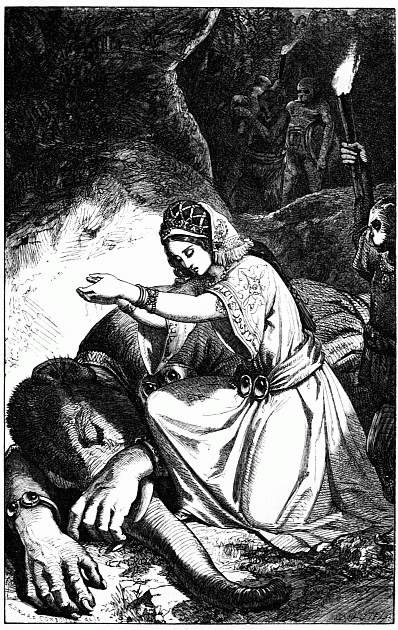
Beauty and the Beast.—P. 273.
She saw herself alone in that
Palace, without the hope of ever leaving it. She regretted
her conversations with the Beast, unentertaining as they had
been to her, and what appeared to her extraordinary, even to
discover she had so much feeling for him. She blamed herself
for not having married him, and considering she had been
the cause of his death (for she feared her too long absence
had occasioned it), heaped upon herself the keenest and most
bitter reproaches. In the midst of her miserable reflections
she perceived that she was seated in that very avenue in
which, during the last night she had passed under her
father's roof, she had dreamed she saw the Beast expiring in
some strange cavern. Convinced that chance had not conducted
her to this spot, she rose and hurried towards the
thicket, which she found was not impenetrable. She discovered
another hollow, which appeared to be that she had
seen in her dream. As the moon gave but a feeble light, the
monkey pages immediately appeared with a sufficient number
of torches to illuminate the chasm, and to reveal to her the
Beast stretched upon the earth, as she thought, asleep. Far
from being alarmed at his sight, Beauty was delighted, and,
approaching him boldly, placed her hand upon his head, and
called to him several times; but finding him cold and motionless,
she no longer doubted he was dead, and consequently
gave utterance to the most mournful shrieks and the most
affecting exclamations.
The assurance of his death, however, did not prevent her
from making every effort to recall him to life. On placing
her hand on his heart she felt, to her great joy, that it still
beat. Without further delay, Beauty ran out of the cave to
the basin of a fountain, where, taking up some water in her
joined hands, she hastened back with it, and sprinkled it upon
him; but as she could bring very little at a time, and spilt
some of it before she could return to the Beast, her assistance
had been but meagre if the monkey courtiers had not flown
to the Palace, and returned with such speed that in a moment
she was furnished with a vase for water, as well as with proper
restoratives. She caused him to smell them and swallow
them, and they produced so excellent an effect that he soon
began to move and show some kind of consciousness. She
cheered him with her voice and caressed him as he recovered.
"What anxiety have you caused me?" said she to him,
kindly; "I knew not how much I loved you. The fear of
losing you has proved to me that I was attached to you by
stronger ties than those of gratitude. I vow to you that I
had determined to die if I had failed in restoring you to life."
At these tender words the Beast, feeling perfectly revived,
replied, in a voice which was still feeble, "It is very kind of
you, Beauty, to love so ugly a monster, but you do well. I
love you better than my life. I thought you would never
return: it would have killed me. Since you love me I will
live. Retire to rest, and assure yourself that you will be as
happy as your good heart renders you worthy to be."
Beauty had never before heard so long a speech from the
Beast. It was not very eloquent, but it pleased, from its
gentleness and the sincerity observable in it. She had expected
to be scolded, or at least to have been reproached. She had
from this moment a better opinion of his disposition. No
longer thinking him so stupid, she even considered his short
answers a proof of his prudence, and, more and more prepossessed
in his favour, she retired to her apartment, her mind
occupied with the most flattering ideas. Extremely fatigued,
she found there all the refreshments she needed. Her heavy
eyelids promised her a sweet slumber. Asleep almost as soon
as her head was on her pillow, her dear Unknown failed not
to present himself immediately. What tender words did he
not utter to express the pleasure he experienced at seeing her
again? He assured her that she would be happy; that it
only remained to her to follow the impulse of her good heart.
Beauty asked him if her happiness was to arise from her
marriage with the Beast. The Unknown replied that it was
the only means of securing it. She felt somewhat annoyed
at this. She thought it even extraordinary that her lover
should advise her to make her rival happy. After this first
dream, she thought she saw the Beast dead at her feet.
An instant afterwards the Unknown re-appeared, and disappeared
again as instantly, to give place to the Beast. But
what she observed most distinctly was the Lady, who seemed
to say to her, "I am pleased with thee. Continue to follow
the dictates of reason, and trouble thyself about naught. I
undertake the task of rendering thee happy." Beauty,
although asleep, appeared to acknowledge her partiality to
the Unknown and her repugnance to the Monster, whom she
could not consider loveable. The Lady smiled at her objections,
and advised her not to make herself uneasy about her
affection for the Unknown, for that the emotions she felt were
not incompatible with the resolution she had formed to do
her duty; that she might follow her inclinations without
resistance, and that her happiness would be perfected by
espousing the Beast.
This dream, which only ended with her sleep, furnished
her with an inexhaustible source of reflection. In this vision,
as in those which had preceded it, she found more coherence
than is usually displayed in dreams, and she therefore determined
to consent to this strange union. But the image of
the Unknown rose unceasingly to trouble her. It was the
sole obstacle, but not a slight one. Still uncertain as to the
course she ought to take, she went to the Opera, but without
terminating her embarrassment. At the end of the performance
she sat down to supper. The arrival of the Beast
was alone capable of deciding her.
Far from reproaching her for her long absence, the Monster,
as if the pleasure of seeing her had made him forget his past
distresses, appeared, on entering Beauty's apartment, to have
no other anxiety but that of ascertaining if she had been much
amused, if she had been well received, and if her health had
been good. She answered these questions, and added politely
that she had paid dearly for all the pleasures his care had
enabled her to enjoy, by the cruel pain she had endured on
finding him in so sad a state on her return.
The Beast briefly thanked her, and then being about to
take his leave, asked her, as usual, if she would marry him.
Beauty was silent for a short time, but at last making up her
mind, she said to him, trembling, "Yes, Beast, I am willing,
if you will pledge me your faith, to give you mine." "I do,"
replied the Beast, "and I promise you never to have any wife but
you." "Then," rejoined Beauty, "I accept you for my husband,
and swear to be a fond and faithful wife to you."
She had scarcely uttered these words when a discharge of
artillery was heard, and that she might not doubt it being a
signal of rejoicing, she saw from her windows the sky all in a
blaze with the light of twenty thousand fireworks, which continued
rising for three hours. They formed true-lovers' knots,
while on elegant escutcheons appeared Beauty's initials, and
beneath them, in well-defined letters, "Long live Beauty and
her Husband." After this display had terminated, the Beast
took his departure, and Beauty retired to rest. No sooner
was she asleep than her dear Unknown paid her his usual
visit. He was more richly attired than she had ever seen
him. "How deeply am I obliged to you, charming Beauty,"
said he. "You have released me from the frightful prison in
which I have groaned for so long a time. Your marriage
with the Beast will restore a king to his subjects, a son to his
mother, and life to a whole kingdom. We shall all be happy."
Beauty, at these words, felt bitterly annoyed, perceiving
that the Unknown, far from evincing the despair such an
engagement as she had entered into should have caused him,
gazed on her with eyes sparkling with extreme delight. She
was about to express her discontent to him, when the Lady,
in her turn, appeared in her dream.
"Behold thee victorious," said she. "We owe everything
to thee, Beauty. Thou hast suffered gratitude to triumph
over every other feeling. None but thou would have had the
courage to keep their word at the expense of their inclination,
nor to have perilled their life to have saved that of their father.
In return for this, there are none who can ever hope to enjoy
such happiness as thy virtue has won for thee. Thou knowest
at present little, but the rising sun shall tell thee more." When
the Lady had disappeared, Beauty again saw the unknown
youth, but stretched on the earth as dead. All the night
passed in such dreams; but they had become familiar to her,
and did not prevent her from sleeping long and soundly. It
was broad daylight when she awoke. The sun streamed
into her apartment with more brilliancy than usual: her
monkeys had not closed the shutters. Believing the sight
that met her eyes but a continuation of her dreams, and that
she was sleeping still, her joy and surprise were extreme at
discovering that it was a reality, and that on a couch beside
her lay, in a profound slumber, her beloved Unknown, looking
a thousand times more handsome than he had done in her
vision. To assure herself of the fact, she arose hastily and
took from off her toilet-table the miniature she usually wore
on her arm; but she could not have been mistaken. She
spoke to him, in the hope of awaking him from the trance
into which he seemed to have been thrown by some wonderful
power. Not stirring at her voice, she shook him by the arm.
This effort was equally ineffectual, and only served to convince
her that he was under the influence of enchantment, and that
she must await the end of the charm, which it was reasonable
to suppose had an appointed period.
How delighted was she to find herself betrothed to him
who alone had caused her to hesitate, and to find that she
had done from duty that which she would have done from
inclination. She no longer doubted the promise of happiness
which had been made to her in her dreams. She now knew
that the Lady had truly assured her that her love for the
Unknown was not incompatible with the affection she entertained
for the Beast, seeing that they were one and the same
person. In the meanwhile, however, her husband never woke.
After a slight meal she endeavoured to pass away the time in
her usual occupations, but they appeared to her insipid. As
she could not resolve to leave her apartments, nor bear to sit
idle, she took up some music, and began to sing. Her birds
hearing her, joined their voices to hers, and made a concert,
the more charming to her as she expected every moment it
would be interrupted by the awakening of her husband, for she
flattered herself she could dissolve the spell by the harmony of
her voice. The spell was soon broken, but not by the means
she imagined. She heard the sound of a chariot rolling beneath
the windows of her apartment, and the voices of several
persons approaching. At the same moment the monkey
Captain of the Guard, by the beak of his parrot Interpreter,
announced the visit of some ladies. Beauty, from her windows,
beheld the chariot that brought them. It was of an entirely
novel description, and of matchless beauty. Four white stags,
with horns and hoofs of gold, superbly caparisoned, drew this
equipage, the singularity of which increased Beauty's desire
to know who were the owners of it.
By the noise, which became louder, she was aware that the
ladies had nearly reached the ante-chamber. She considered
it right to advance and receive them. She recognised in one
of them the Lady she had been accustomed to behold in her
dreams. The other was not less beautiful. Her high and
distinguished bearing sufficiently indicated that she was an
illustrious personage. She was no longer in the bloom of
youth, but her air was so majestic that Beauty was uncertain
to which of the two strangers she ought first to address
herself. She was still under this embarrassment, when the
one with whose features she was already familiar, and who
appeared to exercise some sort of superiority over the other,
turning to her companion, said, "Well, Queen, what think
you of this beautiful girl? You owe to her the restoration
of your son to life, for you must admit that the miserable
circumstances under which he existed could not be called
living. Without her, you would never again have beheld this
Prince. He must have remained in the horrible shape to
which he had been transformed, had he not found in the
world one only person who possessed virtue and courage equal
to her beauty. I think you will behold with pleasure the son
she has restored to you become her husband. They love each
other, and nothing is wanting to their perfect happiness but
your consent. Will you refuse to bestow it on them?"
The Queen, at these words, embracing Beauty affectionately,
exclaimed, "Far from refusing my consent, their union will
afford me the greatest felicity! Charming and virtuous child,
to whom I am under so many obligations, tell me who you
are, and the names of the sovereigns who are so happy as to
have given birth to so perfect a Princess?"
"Madam," replied Beauty, modestly, "it is long since I
had a mother; my father is a merchant more distinguished
in the world for his probity and his misfortunes than for his
birth." At this frank declaration, the astonished Queen
recoiled a pace or two, and said, "What! you are only a
merchant's daughter? Ah, great Fairy!" she added, casting
a mortified look on her companion, and then remained silent;
but her manner sufficiently expressed her thoughts, and her
disappointment was legible in her eyes.
"It appears to me," said the Fairy, haughtily, "that you
are discontented with my choice. You regard with contempt
the condition of this young person, and yet she was the only
being in the world who was capable of executing my project,
and who could make your son happy." "I am very grateful
to her for what she has done," replied the Queen; "but,
powerful spirit," she continued, "I cannot refrain from
pointing out to you the incongruous mixture of that noblest
blood in all the world which runs in my son's veins with that
of the obscure race from which the person has sprung to
whom you would unite him. I confess I am little gratified
by the supposed happiness of the Prince, if it must be purchased
by an alliance so degrading to us, and so unworthy of
him. Is it impossible to find in the world a maiden whose
birth is equal to her virtue? I know many excellent princesses
by name; why am I not permitted to hope that I may see
him the possessor of one of those?"
At this moment the handsome Unknown appeared. The
arrival of his mother and the Fairy had aroused him, and the
noise they had made was more effective than all the efforts of
Beauty; such being the nature of the spell. The Queen held
him a long time in her arms, without speaking a word. She
found again a son whose fine qualities rendered him worthy
of all her affection. What joy for the Prince to see himself
released from a horrible form, and a stupidity more painful
to him because it was affected and had not obscured his reason.
He had recovered the liberty to appear in his natural form by
means of the object of his love, and that reflection made it
still more precious to him.
After the first transports which nature inspired him with
at the sight of his mother, the Prince hastened to pay those
thanks to the Fairy which duty and gratitude prompted.
He did so in the most respectful terms, but as briefly as possible,
in order to be at liberty to turn his attentions towards
Beauty. He had already, by tender glances, expressed to her
his feelings, and was about to confirm with his lips, in the
most touching language, what his eyes had spoken, when the
Fairy stopped him, and bade him be the judge between her
and his mother. "Your mother," said she, "condemns the
engagement you have entered into with Beauty. She considers
that her birth is too much beneath yours. For my
part, I think that her virtues make up for that inequality.
It is for you, Prince, to say with which of us your own feelings
coincide; and that you may be under no restraint in declaring
to us your real sentiments, I announce to you that you have
full liberty of choice. Although you have pledged your word
to this amiable person, you are free to withdraw it. I will
answer for her, that Beauty will release you from your promise
without the least hesitation, although, through her kindness,
you have regained your natural form; and I assure you also
that her generosity will cause her to carry disinterestedness
to the extent of leaving you at liberty to dispose of your
hand in favour of any person on whom the Queen may advise
you to bestow it.—What say you, Beauty?" pursued the
Fairy, turning towards her; "have I been mistaken in thus
interpreting your sentiments? Would you desire a husband
who would become so with regret?" "Assuredly not,
Madam," replied Beauty. "The Prince is free. I renounce
the honour of being his wife. When I accepted him, I
believed I was taking pity on something below humanity. I
engaged myself to him only with the object of conferring on
him the most signal favour. Ambition had no place in my
thoughts. Therefore, great Fairy, I implore you to exact no
sacrifice from the Queen, whom I cannot blame for the scruples
she entertains under such circumstances." "Well, Queen,
what say you to that?" inquired the Fairy, in a disdainful
and displeased tone. "Do you consider that princesses, who
are so by the caprice of fortune, better deserve the high rank
in which it has placed them than this young maiden? For
my part, I think she should not be prejudiced by an origin
from which she has elevated herself by her conduct." The
Queen replied with some embarrassment, "Beauty is incomparable!
Her merit is infinite; nothing can surpass it; but,
madam, can we not find some other mode of rewarding her?
Is it not to be effected without sacrificing to her the hand of
my son?" Then turning to Beauty, she continued, "Yes, I
owe you more than I can pay. I put, therefore, no limit to
your desires. Ask boldly, I will grant you everything, with
that sole exception; but the difference will not be great to
you. Choose a husband from amongst the nobles of my
Court. However high in rank, he will have cause to bless
his good fortune, and for your sake I will place him so near
the throne that your position will be scarcely less enviable."
"I thank you, Madam," replied Beauty; "but I ask no
reward from you. I am more than repaid by the pleasure of
having broken the spell which had deprived a great prince of his
mother and of his kingdom. My happiness would have been
perfect if I had rendered this service to my own sovereign.
All I desire is that the Fairy will deign to restore me to
my father."
The Prince, who, by order of the Fairy, had been silent
throughout this conversation, was no longer master of himself,
and his respect for the commands he had received, failed to
restrain him. He flung himself at the feet of the Fairy and
of his mother, and implored them, in the strongest terms,
not to make him more miserable than he had been, by sending
away Beauty, and depriving him of the happiness of being her
husband. At these words, Beauty, gazing on him with an air
full of tenderness, but mingled with a noble pride, said, "Prince,
I cannot conceal from you my affection. Your disenchantment
is a proof of it, and I should in vain endeavour to disguise
my feelings. I confess without a blush, that I love you
better than myself. Why should I dissimulate? We may
disavow evil impulses; but mine are perfectly innocent, and
are authorised by the generous Fairy to whom we are both so
much indebted. But if I could resolve to sacrifice my feelings
when I thought it my duty to do so for the Beast, you must
feel assured that I shall not falter on this occasion when it is
no longer the interest of the Monster that is at stake, but
your own. It is enough for me to know who you are, and
that I am to renounce the glory of being your wife. I will
even venture to say, that if, yielding to your entreaties, the
Queen should grant the consent you ask, it would not alter
the case, for in my own reason, and even in my love, you would
meet with an insurmountable obstacle. I repeat that I ask
no favour but that of being allowed to return to the bosom
of my family, where I shall for ever cherish the remembrance
of your bounty and your affection."
"Generous Fairy!" exclaimed the Prince, clasping her
hands in supplication, "for mercy's sake, do not allow Beauty
to depart! Make me, rather, again the Monster that I was,
for then I shall be her husband. She pledged her word to
the Beast, and I prefer that happiness to all those she has
restored me to, if I must purchase them so dearly!"
The Fairy made no answer; she but looked steadily at the
Queen, who was moved by so much true affection, but whose
pride remained unshaken. The despair of her son affected
her, yet she could not forget that Beauty was the daughter
of a merchant, and nothing more. She, notwithstanding,
feared the anger of the Fairy, whose manner and silence sufficiently
evinced her indignation. Her confusion was extreme.
Not having power to utter a word, she feared to see a fatal
termination to a conference which had offended the protecting
spirit. No one spoke for some minutes, but the Fairy at
length broke the silence, and casting an affectionate look upon
the lovers, she said to them, "I find you worthy of each
other. It would be a crime to part two such excellent
persons. You shall not be separated, I promise you; and I
have sufficient power to fulfil my promise." The Queen
shuddered at these words, and would have made some remonstrance,
but the Fairy anticipated her by saying, "For
you, Queen, the little value you set upon virtue, unadorned
by the vain titles which alone you respect, would justify me
in heaping on you the bitterest reproaches. But I excuse
your fault, arising from pride of birth, and I will take no
other vengeance beyond doing this little violence to your
prejudices, and for which you will not be long without thanking
me." Beauty, at these words, embraced the knees of the
Fairy, and exclaimed, "Ah, do not expose me to the misery
of being told all my life that I am unworthy of the rank to
which your bounty would elevate me. Reflect that this
Prince, who now believes that his happiness consists in the
possession of my hand may very shortly perhaps be of the
same opinion as the Queen." "No, no, Beauty, fear nothing,"
rejoined the Fairy. "The evils you anticipate cannot come to
pass. I know a sure way of protecting you from them, and
should the Prince be capable of despising you after marriage,
he must seek some other reason than the inequality of your
condition. Your birth is not inferior to his own. Nay, the
advantage is even considerably on your side, for the truth is,"
said she, sternly, to the Queen, "that you behold your niece;
and what must render her still more worthy of your respect
is, that she is mine also, being the daughter of my sister, who
was not, like you, a slave to rank which is lustreless without
virtue.
"That Fairy, knowing how to estimate true worth, did
your brother, the King of the Happy Island, the honour to
marry him. I preserved this fair fruit of their union from the
fury of a Fairy who desired to be her step-mother. From the
moment of her birth I destined her to be the wife of your
son. I desired, by concealing from you the result of my
good service, to give you an opportunity of showing your
confidence in me. I had some reason to believe that it was
greater than it appears to have been. You might have relied
upon me for watching over the destiny of the Prince. I had
given you proofs enough of the interest I took in it, and you
needed not to have been under any apprehension that I should
expose him to anything that would be disgraceful to himself
or to you. I feel persuaded, Madam," continued she, with a
smile which had still something of bitterness in it, "that you
will not object to honour us with your alliance."
The Queen, astonished and embarrassed, knew not what to
answer. The only way to atone for her fault was to confess
it frankly, and evince a sincere repentance. "I am guilty,
generous Fairy," said she. "Your bounties should have
satisfied me that you would not suffer my son to have formed
an alliance unworthy of him. But pardon, I beseech you,
the prejudices of my rank, which urged that royal blood could
not marry one of humbler birth without degradation. I
acknowledge that I deserve you should punish me by giving
to Beauty a mother-in-law more worthy of her; but you take
too kind an interest in my son to render him the victim of
my error. As to you, dear Beauty," she continued, embracing
her tenderly, "you must not resent my resistance. It was
caused by my desire to marry my son to my niece, whom the
Fairy had often assured me was living, notwithstanding all
appearances to the contrary. She had drawn so charming a
portrait of her, that without knowing you, I loved you dearly
enough to risk offending the Fairy, in order to preserve to
you the throne and the heart of my son." So saying, she
recommenced her caresses, which Beauty received with
respect.
The Prince, on his part, enraptured at this agreeable
intelligence, expressed his delight in looks alone.
"Behold us all satisfied," said the Fairy; "and now, to
terminate this happy adventure, we only need the consent of
the royal father of the Princess; but we shall shortly see him
here." Beauty requested her to permit the person who had
brought her up, and whom she had hitherto looked upon as
her father, to witness her felicity. "I admire such consideration,"
said the Fairy; "it is worthy a noble mind, and as you
desire it, I undertake to inform him." Then taking the
Queen by the hand, she led her away, under the pretext of
showing her over the enchanted Palace. It was to give the
newly-betrothed pair the liberty of conversing with each
other for the first time without restraint or the aid of illusion.
They would have followed, but she forbade them. The
happiness in store for them inspired each with equal delight.
They could not entertain the least doubt of their mutual
affection.
Their conversation, confused and unconnected, their protestations
a hundred times repeated, were to them more
convincing proofs of love than the most eloquent language
could have afforded. After having exhausted all the expressions
that passion suggests under such circumstances to those
that are truly in love, Beauty inquired of her lover by what
misfortune he had been so cruelly transformed into a beast.
She requested him also to relate to her all the events of his
life preceding that shocking metamorphosis.
The Prince, whose recovery of his natural form had not
lessened his anxiety to obey her, without more ado commenced
his narrative in the following words:—
THE STORY OF THE BEAST.
The King, my father, died before I was born. The Queen
would never have been consoled for his loss if her interest for
the child she bore had not struggled with her sorrow. My
birth caused her extreme delight. The sweet task of rearing
the fruit of the affection of so dearly-beloved a husband was
destined to dissipate her affliction. The care of my education
and the fear of losing me occupied her entirely. She was
assisted in her object by a Fairy of her acquaintance, who
showed the greatest anxiety to preserve me from all kinds of
accidents. The Queen felt greatly obliged to her, but she
was not pleased when the Fairy asked her to place me entirely
in her hands. The Fairy had not the best of reputations—she
was said to be capricious in her favours. People feared
more than they loved her; and even had my mother been
perfectly convinced of the goodness of her nature, she could
not have resolved to lose sight of me.
By the advice, however, of prudent persons, and for fear of
suffering from the fatal effects of the resentment of this
vindictive Fairy, she did not flatly refuse her. If voluntarily
confided to her care there was no reason to suppose she
would do me any injury. Experience had proved that she
took pleasure in hurting those only by whom she considered
herself offended. The Queen admitted this, and was only
reluctant to forego the pleasure of gazing on me continually
with a mother's eyes, which enabled her to discover charms
in me I owed solely to her partiality.
She was still irresolute as to the course she should adopt,
when a powerful neighbour imagined it would be an easy
matter for him to seize upon the dominions of an infant
governed by a woman. He invaded my kingdom with a
formidable army. The Queen hastily raised one to oppose
him, and, with a courage beyond that of her sex, placed
herself at the head of her troops, and marched to defend our
frontiers. It was then that, being compelled to leave me,
she could not avoid confiding to the Fairy the care of my
education. I was placed in her hands after she had sworn
by all she held most sacred that she would, without the least
hesitation, bring me back to the Court as soon as the war was
over, which my mother calculated would not last more than
a year at the utmost. Notwithstanding, however, all the
advantages she gained over the enemy, she found it impossible
to return to the capital so soon as she expected. To profit
by her victory, after having driven the foe out of our dominions,
she pursued him in his own.
She took entire provinces, gained battle after battle, and
finally reduced the vanquished to sue for a degrading peace,
which he obtained only on the hardest conditions. After this
glorious success, the Queen returned triumphantly, and enjoyed
in anticipation the pleasure of beholding me once more;
but having learned upon her march that her base foe, in violation
of the treaty, had surprised and massacred our garrisons,
and repossessed himself of nearly all the places he had been
compelled to cede to us, she was obliged to retrace her steps.
Honour prevailed over the affection which drew her towards
me, and she resolved never to sheathe the sword till she had
put it out of her enemy's power to perpetrate more treachery.
The time employed in this second expedition was very considerable.
She had flattered herself that two or three campaigns
would suffice; but she had to contend with an adversary
as cunning as he was false. He contrived to excite
rebellion in some of our own provinces, and to corrupt entire
battalions, which forced the Queen to remain in arms for
fifteen years. She never thought of sending for me. She was
always flattering herself that each month would be the last she
should be absent, and that she was on the point of seeing me
again.
In the meanwhile, the Fairy, in accordance with her
promise, had paid every attention to my education. From
the day she had taken me out of my kingdom, she had never
left me, nor ceased to give me proof of the interest she felt in
all that concerned my health and amusement. I evinced by
my respect for her how sensible I was of her kindness. I
showed her the same deference, the same attention that I
should have shown to my mother, and gratitude inspired me
with as much affection for her.
For some time she appeared satisfied with my behaviour;
but one day, without imparting to me the motive, she set out
on a journey, from which she did not return for some years,
and when she did return, struck with the effect of her care of
me, she conceived for me an affection differing from that of a
mother. She had previously permitted me to call her by that
name, but now she forbade me. I obeyed her without inquiring
what were her reasons, or suspecting what she was about
to exact from me.
I saw clearly that she was dissatisfied; but could I imagine
why she continually complained of my ingratitude? I was the
more surprised at her reproaches as I did not feel I deserved
them. They were always followed or preceded by the tenderest
caresses. I was not old enough to comprehend her. She was
compelled to explain herself. She did so one day when I
evinced some sorrow, mingled with impatience, respecting the
continued absence of the Queen. She reproached me for this,
and on my assuring her that my affection for my mother in
nowise interfered with that I owed to herself, she replied
that she was not jealous, although she had done so much for
me, and had resolved to do still more; but that, to enable her
to carry out her designs in my favour with greater freedom,
it was requisite, she added, that I should marry her; that
she did not desire to be loved by me as a mother, but as an
admirer; that she had no doubt of my gratitude to her for
making this proposal, or of the great joy with which I should
accept it, and that, consequently, I had only to abandon myself
to the delight with which the certainty of becoming the husband
of a powerful fairy, who could protect me from all
dangers, assure me an existence full of happiness, and cover
me with glory, must naturally awaken.
I was sadly embarrassed by this proposition. I knew
enough of the world in my own country, to be aware that
amongst the wedded portion of the community the happiest
were those whose ages and characters assimilated, and that
many were much to be pitied who, marrying under opposite
circumstances, had found antipathies existing between them
which were the source of constant misery.
The Fairy being old and of a haughty disposition, I could
not flatter myself that my lot would be so agreeable as she
predicted. I was far from entertaining for her such feelings
as one should for the woman with whom we intend to pass
our days; and besides, I was not inclined to enter into any
such engagement at so early an age. My only desire was to
see the Queen again, and to signalize myself at the head of
her forces. I sighed for liberty; that was the sole boon that
would have gratified me, and the only one the Fairy would
not grant.
I had often implored her to allow me to share the perils to
which I knew the Queen exposed herself for the protection of
my interests, but my prayers had hitherto been fruitless.
Pressed to reply to the astounding declaration she had made
to me, I, in some confusion, recalled to her that she had often
told me that I had no right to dispose of my hand without
the commands of my mother, and in her absence. "That is
exactly my opinion," she replied; "I do not wish you to do
otherwise; I am satisfied that you should refer the matter to
the Queen."
I have already informed you, beautiful Princess, that I had
been unable to obtain from the Fairy permission to seek the
Queen, my mother. The desire she now had to receive her
sanction, which she never doubted she should obtain, obliged
her to grant, even without my asking, that which she had
always denied me; but it was on the condition, by no means
agreeable to me, that she should accompany me. I did what
I could to dissuade her, but found it impossible, and we set
out together with a numerous escort. We arrived upon the
eve of a decisive action. The Queen had manœuvred with
such skill that the next day was certain to decide the fate of
the enemy, who would have no resource if he lost the battle.
My presence created great pleasure in the camp, and gave
additional courage to our troops, who drew a favourable
augury from my arrival. The Queen was ready to die with
joy; but this first transport of delight was succeeded by the
greatest alarm. Whilst I exulted in the hope of acquiring
glory, the Queen trembled at the danger to which I was about
to expose myself. Too generous to endeavour to prevent me,
she implored me by all her affection, to take as much care of
myself as honour would permit, and entreated the Fairy not
to abandon me on that occasion. Her solicitations were unnecessary.
The too susceptible Fairy was as much alarmed
as the Queen, for she possessed no spell which could protect
me from the chances of war. However, by instantly inspiring
me with the art of commanding an army, and the prudence
requisite for so important an office, she achieved much. The
most experienced captains were surprised at me. I remained
master of the field. The victory was complete. I had the
happiness of saving the Queen's life, and of preventing her
from being made prisoner of war. The enemy was pursued
with such vigour that he abandoned his camp, lost his baggage,
and more than three-fourths of his army, while the loss on
our side was inconsiderable. A slight wound which I had
received was the only advantage the foe could boast of; but
the Queen, fearing that if the war continued some more serious
mischief might befal me, in opposition to the desire of the
whole army, to which my presence had imparted fresh spirit,
made peace on more advantageous terms than the vanquished
had ventured to hope for.
A short time afterwards we returned to our capital, which
we entered in triumph. My occupation during the war, and
the continual presence of my ancient adorer, had prevented
me from informing the Queen of what had occurred. She was,
therefore, completely taken by surprise when the Fairy told
her, in so many words, that she had determined to marry me
immediately. This declaration was made in this very Palace,
but which was at that time not so superb as it is at present.
It had been a country residence of the late King, which a
thousand occupations had prevented his embellishing. My
mother, who cherished everything that he had loved, had
selected it in preference to any other as a place of retirement
after the fatigues of the war. At the avowal of the Fairy,
unable to control her first feelings, and unused to dissemble,
she exclaimed, "Have you reflected, Madam, on the absurdity
of the arrangement you propose to me!" In truth it was impossible
to conceive one more ridiculous. In addition to the
almost decrepit old age of the Fairy, she was horribly ugly.
Nor was this the effect of time. If she had been handsome
in her youth, she might have preserved some portion of her
beauty by the aid of her art; but naturally hideous, her power
could only invest her with the appearance of beauty for one
day in each year, and that day ended, she returned to her
former state.
The Fairy was surprised at the exclamation of the Queen.
Her self-love concealed from her all that was actually horrible
in her person, and she calculated that her power sufficiently
compensated for the loss of a few charms of her youth.
"What do you mean," said she to the Queen, "by an absurd
arrangement! Consider, that it is imprudent in you to make
me remember what I have condescended to forget. You ought
only to congratulate yourself on possessing a son so amiable
that his merit induces me to prefer him to the most powerful
Genii in all the elements; and as I have deigned to descend
to him, accept with respect the honour I am good enough to
confer on you, and do not give me time to change my
mind."
The Queen, as proud as the Fairy, had never conceived that
there was a rank on earth higher than the throne. She valued
little the pretended honour which the Fairy offered her.
Having always commanded every one who approached her,
she by no means desired to have a daughter-in-law to whom
she must herself pay homage. Therefore, far from replying
to her, she remained motionless, and contented herself with
fixing her eyes upon me. I was as much astounded as she
was, and fixing my eyes on her in the same manner, it was
easy for the Fairy to perceive that our silence expressed sentiments
very opposite to the joy with which she would have
inspired us.
"What is the meaning of this?" said she, sharply. "How
comes it that mother and son are both silent? Has this
agreeable surprise deprived you of the power of speech? or
are you blind and rash enough to reject my offer? Say,
Prince," said she to me, "are you so ungrateful and so imprudent
as to despise my kindness? Do you not consent to
give me your hand this moment?"
"No, Madam, I assure you," replied I, quickly. "Although
I am sincerely grateful to you for past favours, I cannot agree
to discharge my debt to you by such means; and, with the
Queen's permission, I decline to part so soon with my liberty.
Name any other mode of acknowledging your favours, and I
will not consider it impossible; but as to that you have
proposed, excuse me if you please, for——" "How! insignificant
creature!" interrupted the Fairy, furiously. "Thou
darest to resist me! And you, foolish Queen! you see, without
anger, this conduct—What do I say? without anger!
It is you who authorize it! For it is your own insolent looks
that have inspired him with the audacity to refuse me!"
The Queen, already stung by the contemptuous language
of the Fairy, was no longer mistress of herself, and accidentally
casting her eyes on a looking-glass, before which we
happened to be standing at the moment, the wicked Fairy
thus provoked her: "What answer can I make you," said
she, "that you ought not to make to yourself? Deign to
contemplate, without prejudice, the object this glass presents
to you, and let it reply for me." The Fairy easily comprehended
the Queen's insinuation. "It is the beauty, then, of
this precious son of yours that renders you so vain," said she
to her, "and has exposed me to so degrading a refusal! I
appear to you unworthy of him. Well," she continued,
raising her voice furiously, "having taken so much pains to
make him charming, it is fit that I should complete my work,
and that I should give you both a cause, as novel as remarkable,
to make you remember what you owe to me. Go,
wretch!" said she to me; "boast that thou hast refused me
thy heart and thy hand. Give them to her thou findest
more worthy of them than I am." So saying, my terrible
lover struck me a blow on the head. It was so heavy that I
was dashed to the ground on my face, and felt as though I
were crushed by the fall of a mountain. Irritated by this
insult, I struggled to rise, but found it impossible. The
weight of my body had become so great that I could not lift
myself; all that I could do was to sustain myself on my
hands, which had in an instant become two horrible paws,
and the sight of them apprised me of the change I had
undergone. My form was that in which you found me. I
cast my eyes for an instant on that fatal glass, and could no
longer doubt my cruel and sudden transformation.
My despair rendered me motionless. The Queen at this
dreadful sight was almost out of her mind. To put the last
seal upon her barbarity, the furious Fairy said to me, in an
ironical tone, "Go make illustrious conquests, more worthy
of thee than an august Fairy. And as sense is not required
when one is so handsome, I command thee to appear as stupid
as thou art horrible, and to remain in this state until a young
and beautiful girl shall, of her own accord, come to seek thee,
although fully persuaded thou wilt devour her. She must
also," continued the Fairy, "after discovering that her life is
not in danger, conceive for thee a sufficiently tender affection
to induce her to marry thee. Until thou canst meet with
this rare maiden it is my pleasure that thou remain an object
of horror to thyself and to all who behold thee. As for you,
too happy mother of so lovely a child," said she to the
Queen, "I warn you that if you acknowledge to any one that
this monster is your son, he shall never recover his natural
shape. Neither interest, nor ambition, nor the charms of
his conversation, must assist to restore him to it. Adieu!
Do not be impatient; you will not have long to wait. Such
a darling will soon find a remedy for his misfortune." "Ah,
cruel one!" exclaimed the Queen, "if my refusal has offended
you, let your vengeance light on me. Take my life, but do
not, I conjure you, destroy your own work." "You forget
yourself, great Princess," replied the Fairy, in an ironical
tone, "you demean yourself too much. I am not handsome
enough for you to condescend to entreat me; but I am firm
in my resolutions. Adieu, powerful Queen; adieu, beautiful
Prince; it is not fair that I should longer annoy you with
my hateful presence. I withdraw; but I have still charity
enough to warn thee," addressing herself to me, "that thou
must forget who thou art. If thou sufferest thyself to be
flattered by vain respects or by pompous titles, thou art lost
irretrievably! And thou art equally lost if thou shouldst
dare to avail thyself of the intellect I leave thee possessed of,
to shine in conversation."
With these words she disappeared, and left the Queen and
me in a state which can neither be described nor imagined.
Lamentations are the consolation of the unhappy; but our
misery was too great to seek relief in them. My mother
determined to stab herself, and I to fling myself in the adjacent
canal. Without communicating our intentions to each
other, we were on the point of executing these fatal designs,
when a female of majestic mien, and whose manner inspired
us with profound respect, appeared, and bade us remember
that it was cowardice to succumb to the greatest misfortunes,
and that with time and courage there was no evil that could
not be remedied. The Queen, however, was inconsolable;
tears streamed from her eyes, and not knowing how to inform
her subjects that their sovereign was transformed into a horrible
monster, she abandoned herself to the most fearful
despair. The Fairy (for she was one, and the same whom
you have seen here), knowing both her misery and her embarrassment,
recalled to her the indispensable obligation she
was under to conceal from her people this dreadful adventure,
and that in lieu of yielding to despair, it would be better to
seek some remedy for the mischief.
"Is there one to be found," exclaimed the Queen, "which
is powerful enough to prevent the fulfilment of a Fairy's
sentence?" "Yes, Madam," replied the Fairy, "there is a
remedy for everything. I am a Fairy as well as she whose
fury you have just felt the effects of, and my power is equal
to hers. It is true that I cannot immediately repair the
injury she has done you, for we are not permitted to act
directly in opposition to each other. She who has caused
your misfortune is older than I am, and age has amongst us
a particular title to respect. But as she could not avoid
attaching a condition upon which the spell might be broken,
I will assist you to break it. I grant that it will be a difficult
task to terminate this enchantment; but it does not
appear to me to be impossible. Let me see what I can do
for you by the exertion of all the means in my power."
Upon this she drew a book from under her robe, and after
taking a few mysterious steps, she seated herself at a table,
and read for a considerable time with such intense application
that large drops of perspiration stood on her forehead. At
length she closed the book and meditated profoundly. The
expression of her countenance was so serious that for some
time we were led to believe that she considered my misfortune
irreparable; but recovering from a sort of trance, and her
features resuming their natural beauty, she informed us that
she had discovered a remedy for our disasters. "It will be
slow," said she, "but it will be sure. Keep your secret; let
it not transpire, so that any one can suspect you are concealed
beneath this horrible disguise, for in that case you will
deprive me of the power of delivering you from it. Your
enemy flatters herself you will divulge it; it is for that
reason she did not take from you the power of speech."
The Queen declared that the condition was an impossible
one, as two of her women had been present at the fatal transformation,
and had rushed out of the apartment in great
terror, which must have excited the curiosity of the guards
and the courtiers. She imagined that the whole Court was
by this time aware of it, and that all the kingdom, and even
all the world, would speedily receive the intelligence; but the
Fairy knew a way to prevent the disclosure of the secret.
She made several circles, now solemnly, now rapidly, uttering
words of which we could not comprehend the meaning, and
finished by raising her hand in the air in the style of one
who is pronouncing an imperative order. This gesture, added
to the words she had uttered, was so powerful, that every
breathing creature in the Palace became motionless, and was
changed into a statue. They are all still in the same state.
They are the figures you behold in various directions and in
the very attitudes they had assumed at the instant the Fairy's
potent spell surprised them. The Queen, who at that moment
cast her eyes upon the great court-yard, observed this change
taking place in a prodigious number of persons. The silence
which suddenly succeeded to the stir of a multitude, awoke
a feeling of compassion in her heart for the many innocent
beings who were deprived of life for my sake; but the Fairy
comforted her by saying that she would only retain her subjects
in that condition as long as their discretion was necessary.
It was a precaution she was compelled to take, but she
promised she would make up to them for it, and that the
period they passed in that state would not be added to the
years allotted to their existence. "They will be so much
the younger," said the Fairy to the Queen; "so cease to
deplore them, and leave them here with your son. He will
be quite safe, for I have raised such thick fogs around this
Castle, that it will be impossible for any one to enter it but
when we think fit. I will convey you," she continued,
"where your presence is necessary. Your enemies are plotting
against you. Be careful to proclaim to your people that
the Fairy who educated your son retains him near her for
an important purpose, and keeps with her also all the persons
who were in attendance on you."
It was not without shedding a flood of tears that my mother
could force herself to leave me. The Fairy renewed her
assurances to her that she would always watch over me, and
protested that I had only to wish, and to see the accomplishment
of my desires. She added that my misfortunes would
shortly end, provided neither the Queen nor I raised up an
obstacle by some act of imprudence. All these promises
could not console my mother. She wished to remain with
me, and to leave the Fairy, or any one she might consider
the most proper person, to govern the kingdom; but fairies
are imperious, and will be obeyed. My mother, fearing by a
refusal to increase my miseries and deprive me of the aid of
this beneficent spirit, consented to all she insisted on. She
saw a beautiful car approach; it was drawn by the same white
stags that brought her here to day. The Fairy made the
Queen mount by her side. She had scarcely time to embrace
me, her affairs demanded her presence elsewhere, and she was
warned that a longer sojourn in this place would be prejudicial
to me. She was transported with extraordinary velocity
to the spot where her army was encamped. They were not
surprised to see her arrive with this equipage. Everybody
believed her to be accompanied by the old Fairy, for the one
who was with her kept herself unseen, and departed again
immediately to return to this place, which, in an instant, she
embellished with everything that her imagination could
suggest and her art supply.
This good-natured Fairy permitted me also to add whatever
I fancied would please me, and after having done for me
all she could, she left me with exhortations to take courage,
and promising to come occasionally and impart to me such
hopes as she might entertain of a favourable issue to my
adventure.
I seemed to be alone in the Palace. I was only so to
sight. I was served as if I were in the midst of my courtiers,
and my occupations were nearly the same as those which
were afterwards yours. I read, I went to the play, I cultivated
a garden which I had made to amuse me, and found
something agreeable in everything I undertook. What I
planted arrived at perfection in the same day. It took no
more time to produce the bower of roses to which I am
indebted for the happiness of beholding you here.
My benefactress came very often to see me. Her presence
and her promises alleviated my distresses. Through her, the
Queen received news of me, and I news of the Queen. One
day I saw the Fairy arrive with joy sparkling in her eyes.
"Dear Prince," said she to me, "the moment of your happiness
approaches!" She then informed me that he whom you
believed to be your father had passed a very uncomfortable
night in the forest. She related to me, in a few words, the
adventure which had caused him to undertake the journey,
without revealing to me your real parentage. She apprized
me that the worthy man was compelled to seek an asylum
from the misery he had endured during four-and-twenty
hours.
"I go," said she, "to give orders for his reception. It
must be an agreeable one. He has a charming daughter. I
propose that she shall release you. I have examined the conditions
which my cruel companion has attached to your
disenchantment. It is fortunate that she did not ordain that
your deliverer should come hither out of love for you. On
the contrary, she insisted that the young maiden should
expect no less than death, and yet expose herself to it voluntarily.
I have thought of a scheme to oblige her to take that
step. It is to make her believe the life of her father is in
danger, and that she has no other means of saving him. I
know that in order to spare her father any expense on her
account, she has asked him only to bring her a rose, whilst her
sisters have overwhelmed him with extravagant commissions.
He will naturally avail himself of the first favourable opportunity.
Hide yourself in this arbour, and seizing him the
instant he attempts to gather your roses, threaten him that
death will be the punishment of his audacity, unless he give you
one of his daughters; or, rather, unless she sacrifice herself,
according to the decree of our enemy. This man has five
daughters besides the one I have destined for you; but not
one of them is sufficiently magnanimous to purchase the life of
their father at the price of their own. Beauty is alone capable
of so grand an action."
I executed exactly the Fairy's commands. You know,
lovely Princess, with what success. The merchant, to save
his life, promised what I demanded. I saw him depart without
being able to persuade myself that he would return with
you. I could not flatter myself that my desire would be
fulfilled. What torment did I not suffer during the month he
had requested me to allow him. I longed for its termination
only to be certain of my disappointment. I could not imagine
that a young, lovely, and amiable girl would have the courage
to seek a monster, of whom she believed she was doomed to
be the prey. Even supposing her to have sufficient fortitude
to devote herself, she would have to remain with me without
repenting the step she had taken, and that appeared to me
an invincible obstacle. Besides, how could she behold me
without dying with affright? I passed my miserable existence
in these melancholy reflections, and never was I more to be
pitied. The month, however, elapsed, and my protectress
announced to me your arrival. You remember, no doubt, the
pomp with which you were received. Not daring to express
my delight in words, I endeavoured to prove it to you by the
most magnificent signs of rejoicing. The Fairy, ceaseless in
her attentions to me, prohibited me from making myself known
to you. Whatever terror I might inspire you with, or whatever
kindness you might show me, I was not permitted to
seek to please you, nor to express any love for you, nor to
discover to you in any way who I was. I could have recourse,
however, to excessive good-nature, as, fortunately, the malignant
Fairy had forgotten to forbid my giving you proof of
that.
These regulations seemed hard to me, but I was compelled
to subscribe to them, and I resolved to present myself before
you only for a few moments every day, and to avoid long
conversations, in which my heart might betray its tenderness.
You came, charming Princess, and the first sight of you produced
upon me a diametrically opposite effect to that which
my monstrous appearance must have done upon you. To see
you was instantly to love you. Entering your apartment,
tremblingly, my joy was excessive to find that you could
behold me with greater intrepidity than I could behold myself.
You delighted me infinitely when you declared that you would
remain with me. An impulse of self-love, which I retained
even under that most horrible of forms, led me to believe that
you had not found me so hideous as you anticipated.
Your father departed satisfied. But my sorrow increased
as I reflected that I was not allowed to win your favour in
any way except by indulging the caprices of your taste.
Your demeanour, your conversation, as sensible as it was unpretending,
everything in you convinced me that you acted
solely on the principles dictated to you by reason and virtue,
and that consequently I had nothing to hope for from a
fortunate caprice. I was in despair at being forbidden to
address you in any other language than that which the Fairy
had dictated, and which she had expressly chosen as coarse
and stupid.
In vain did I represent to her it was unnatural to expect
you would accept my proposition to marry you. Her answer
was always, "Patience, perseverance, or all is lost." To
recompense you for my silly conversation, she assured me she
would surround you with all sorts of pleasures, and give me
the advantage of seeing you continually, without alarming
you, or being compelled to say rude and impertinent things to
you. She rendered me invisible, and I had the gratification
of seeing you waited on by spirits who were also invisible,
or who presented themselves to you in the shapes of various
animals.
More than this, the Fairy caused you to behold my natural
form in your nightly slumbers, and in portraits by day, and
made it speak to you in your dreams as I should have spoken
to you myself. You obtained a confused idea of my secret and
my hopes, which she urged you to realize, and by the means
of a starry mirror I witnessed all your interviews, and read
in it either all you imagined you uttered or all that you actually
thought. This position, however, did not suffice to
render me happy. I was only so in a dream, and my sufferings
were real. The intense affection with which you had inspired
me obliged me to complain of the restraint under which I
lived; but my state was much more wretched when I perceived
that these beautiful scenes had no longer any charms for you.
I saw you shed tears, which pierced my heart, and would have
destroyed me. You asked me if I was alone here, and I was
on the verge of discarding my feigned stupidity, and assuring
you by the most passionate vows of the fact. They would
have been uttered in terms that would have surprised you,
and caused you to suspect that I was not so coarse a brute as I
pretended to be. I was on the point even of declaring
myself, when the Fairy, invisible to you, appeared before me.
By a threatening gesture, which terrified me, she found a way
to close my lips. O, heavens! by what means did she impose
silence upon me? She approached you with a poniard in
her hand, and made signs to me that the first word I uttered
would cost you your life. I was so frightened that I naturally
relapsed into the stupidity she had ordered me to affect.
My sufferings were not yet at an end. You expressed a
desire to visit your father. I gave you permission without
hesitation. Could I have refused you anything? But I
regarded your departure as my death-blow, and without the
assistance of the Fairy I must have sunk under it. During
your absence that generous being never quitted me. She
saved me from destroying myself, which I should have done
in my despair, not daring to hope that you would return.
The time you had passed in this Palace rendered my condition
more insupportable than it had been previously, because I
felt I was the most miserable of all men, without the hope
of making it known to you.
My most agreeable occupation was to wander through the
scenes which you had frequented, but my grief was increased
by no longer seeing you there. The evenings and hours
when I used to have the pleasure of conversing with you for
a moment, redoubled my afflictions, and were still more
painful to me. Those two months, the longest I had ever
known, ended at last, and you did not return. It was then
my misery reached its climax, and that the Fairy's power
was too weak to prevent my sinking under my despair. The
precautions she took to prevent my attempting my life were
useless. I had a sure way which eluded her power. It was
to refrain from food. By the potency of her spells she contrived
to sustain me for some time, but having exhausted all
her secrets, I grew weaker and weaker, and finally had but a
few moments to breathe, when you arrived to snatch me from
the tomb.
Your precious tears, more efficacious than all the cordials
of the disguised Genii who attended on me, delayed my soul
upon the point of flight. In learning from your lamentations
that I was dear to you, I enjoyed perfect felicity, and
that felicity was at its height when you accepted me for
your husband. Still I was not permitted to divulge to you
my secret, and the Beast was compelled to leave you without
daring to disclose to you the Prince. You know the lethargy
into which I fell, and which ended only with the arrival of
the Fairy and the Queen. On awaking I found myself as you
behold me, without being aware of how the change took place.
You have witnessed what followed, but you could only
imperfectly judge of the pain which the obstinacy of my
mother caused me in opposing a marriage so suitable and so
glorious for me. I had determined, Princess, rather to be a
monster again than to abandon the hope of being the husband
of so virtuous and charming a maiden. Had the secret of
your birth remained for ever a mystery to me, love and gratitude
would not less have assured me that in possessing you
I was the most fortunate of men!
The Prince thus ended his narration, and Beauty was about
to speak, when she was prevented by a burst of loud voices
and warlike instruments, which, however, did not appear to
announce anything alarming. The Prince and Princess looked
out of the window, as did also the Fairy and the Queen who
returned from their promenade. The noise was occasioned
by the arrival of a personage who, according to all appearances,
could be no less than a king. His escort was obviously
a royal one, and there was an air of majesty in his demeanour
which accorded with the state that accompanied him. The
fine form of this sovereign, although of a certain age, testified
that there had been few who could have equalled him in
appearance when in the flower of his youth. He was followed
by twelve of his body-guard, and some courtiers in
hunting-dresses, who appeared as much astonished as their
master to find themselves in a castle till now quite unknown
to them. He was received with the same honours that would
have been paid to him in his own dominions, and all by
invisible beings. Shouts of joy and flourishes of trumpets
were heard, but no one was to be seen.
The Fairy, immediately on beholding him, said to the
Queen, "Here is the King your brother, and the father of
Beauty. He little expects the pleasure of seeing you both
here. He will be so much the more gratified, as you know
he believes that his daughter has been long dead. He
mourns her still, as he also does his wife, of whom he retains
an affectionate remembrance." These words increased the
impatience of the Queen and the young Princess to embrace
this monarch. They reached the court-yard just as he dismounted.
He saw, but could not recognize them; not doubting,
however, that they were advancing to receive him, he
was considering how and in what terms he should pay his
compliments to them, when Beauty, flinging herself at his
feet, embraced his knees, and called him "Father!"
The King raised her and pressed her tenderly in his arms,
without comprehending why she addressed him by that title.
He imagined she must be some orphan Princess, who sought
his protection from some oppressor, and who made use of the
most touching expression in order to obtain her request.
He was about to assure her that he would do all that lay in
his power to assist her, when he recognized the Queen his
sister, who, embracing him in her turn, presented her son to
him. She then informed him of some of the obligations
they were under to Beauty, and especially of the frightful
enchantment that had just been terminated. The King
praised the young Princess, and desired to know her name,
when the Fairy, interrupting him, asked if it was necessary
to name her parents, and if he had never known any one
whom she resembled sufficiently to enable him to guess them.
"If I judged only from her features," said he, gazing upon
her earnestly, and not being able to restrain a few tears,
"the title she has given to me is legitimately my due; but
notwithstanding that evidence, and the emotion which her
presence occasions me, I dare not flatter myself that she is
the daughter whose loss I have deplored; for I had the most
positive proof that she had been devoured by wild beasts.
Yet," he continued, still examining her countenance, "she
resembles perfectly the tender and incomparable wife whom
death has deprived me of. Oh, that I could but venture to indulge
in the delightful hope of beholding again in her the fruit
of a happy union, the bonds of which were too soon broken!"
"You may, my liege," replied the Fairy; "Beauty is your
daughter. Her birth is no longer a secret here. The Queen
and Prince know who she is. I caused you to direct your
steps this way on purpose to inform you; but this is not a
fitting place for me to enter into the details of this adventure.
Let us enter the Palace. After you have rested yourself there
a short time I will relate to you all you desire to know. When
you have indulged in the delight which you must feel at
finding a daughter so beautiful and so virtuous I will communicate
to you another piece of intelligence, which will
afford you equal gratification."
The King, accompanied by his daughter and the Prince,
was ushered by the monkey officers into the apartment
destined for him by the Fairy, who took this opportunity of
restoring to the statues the liberty of relating what they had
witnessed. As their fate had excited the compassion of the
Queen, it was from her hands that the Fairy desired they
should receive the benefit of re-animation. She placed her wand
in the Queen's hand, who, by her instructions, described with
it seven circles in the air, and then pronounced these words:
"Be re-animated. Your King is restored to you." All the
statues immediately began to move, walk, and act as formerly,
retaining only a confused idea of what had happened to them.
After this ceremony the Fairy and the Queen returned to
the King, whom they found in conversation with Beauty and
the Prince, caressing each in turn, and most fondly his
daughter, of whom he inquired a hundred times how she
had been preserved from the wild beasts who had carried her
off, without remembering that she had answered him from
the first that she knew nothing about it, and had been ignorant
even of the secret of her birth.
The Prince also talked without being attended to, repeating
a hundred times the obligations he was under to Princess
Beauty. He desired to acquaint the King with the promises
which the Fairy had made him, that he should marry the
Princess, and to beg he would not refuse his cheerful consent
to the alliance. This conversation and these caresses were
interrupted by the entrance of the Queen and the Fairy.
The King, who had recovered his daughter, fully appreciated
his happiness, but was as yet ignorant to whom he was indebted
for this precious gift.
"It is to me," said the Fairy; "and I alone can explain
to you the adventure. I shall not limit my benefits to the
recital of that alone. I have other tidings in store for you,
not less agreeable. Therefore, great King, you may note this
day as one of the happiest of your life." The company, perceiving
that the Fairy was about to commence her narration,
evinced by their silence the great attention they were anxious
to pay to it. To satisfy their curiosity the Fairy thus addressed
the King:—
"Beauty, my liege, and perhaps the Prince, are the only
persons present who are not acquainted with the laws of the
Fortunate Island. It is necessary I should explain those laws
to them. The inhabitants of that island, and even the King
himself, are allowed perfect liberty to marry according to their
inclinations, in order that there may be no obstacle whatever
to their happiness. It was in virtue of this privilege that
you, Sire, selected for your wife a young shepherdess whom
you met one day when you were hunting. Her beauty and
her good conduct were considered by you deserving of that
honour. You raised her to the throne, and placed her in a
rank from which the lowliness of her birth seemed to have
excluded her, but of which she was worthy, by the nobleness
of her character and the purity of her mind. You know that
you had continual reasons to rejoice in the selection you had
made. Her gentleness, her obliging disposition, and her
affection for you, equalled the charms of her person. But you
did not long enjoy the happiness of beholding her. After
she had made you the father of Beauty you were under the
necessity of travelling to the frontiers of your kingdom, to
suppress some revolutionary demonstrations of which you
had received intimation. During this period you lost your
dear wife, an affliction which you felt the more sensibly
because, in addition to the love with which her beauty had
inspired you, you had the greatest respect for the many rare
qualities that adorned her mind. Despite her youth and the
little education she had received, you found her naturally
endowed with profound judgment, and your wisest ministers
were astonished at the excellent advice she gave you, and the
policy by which she enabled you to succeed in all your undertakings."
The King, who still brooded over his affliction, and to
whose imagination the death of that dear wife was ever
present, could not listen to this account without being sensibly
affected, and the Fairy, who observed his emotion, said,
"Your feelings prove that you deserved that happiness. I
will no longer dwell on a subject that is so painful to you,
but I must reveal to you that the supposed shepherdess was
a Fairy, and my sister, who, having heard that the Fortunate
Island was a charming country, and also much praise of its
laws and of the gentle nature of your government, was particularly
anxious to visit it. The dress of a shepherdess
was the only disguise she assumed, intending to enjoy for a
short time a pastoral life. You encountered her in her new
abode. Her youth and beauty touched your heart. She
yielded to a desire to discover whether the qualities of your
mind equalled those she found in your person. She trusted
to her condition and power as a Fairy, which could place her
at a wish beyond the reach of your assiduities if they became
too importunate, or if you should presume to take advantage
of the humble position in which you found her. She was not
alarmed at the sentiments with which you might inspire her,
and persuaded that her virtue was sufficient to guarantee her
against the snares of love, she attributed her sensations to a
simple curiosity to ascertain if there were still upon the earth
men capable of loving virtue unembellished by exterior ornaments,
which render it more brilliant and respectable to vulgar
souls than its own intrinsic merit, and frequently, by their
fatal attractions, obtain the reputation of virtue for the most
abominable vices.
"Under this illusion, far from retreating to our common
asylum, as she had at first proposed, she chose to inhabit a
little cottage she had raised for herself in the solitude in which
you met her, accompanied by a phantom, representing her
mother. These two persons appeared to live there upon the
produce of a pretended flock that had no fear of the wolves,
being, in fact, genii in that form. It was in that cottage she
received your attentions, which produced all the effect you
could desire. She could not resist the offer you made her of
your crown. You now know the extent of the obligations
you were under to her at a time when you imagined she
owed everything to you, and were satisfied to remain in
that error.
"What I now tell you is a positive proof that ambition had
no share in the consent she accorded to your wishes. You
are aware that we look upon the greatest kingdoms but as
gifts which we can bestow on any one at our pleasure. But
she appreciated your generous behaviour, and esteeming
herself happy in uniting herself to so excellent a man, she
rashly entered into that engagement without reflecting on the
danger which she thereby incurred. For our laws expressly
forbid our union with those who have not as much power as
ourselves, more especially when we have not arrived at that
age when we are privileged to exercise our authority over
others, and enjoy the right of presiding in our turn. Previous
to that time we are subordinate to our elders, and that we
may not abuse our power, we have only the liberty of disposing
of our hands in favour of some spirit or sage whose knowledge
is at least equal to our own. It is true that after that
period we are free to form what alliance we please; but it is
seldom that we avail ourselves of that right, and never without
scandal to our order. Those who do are generally old
fairies, who almost always pay dearly for their folly; for they
marry young men, who despise them, and, although they are
not punished as criminals, they are sufficiently punished by
the bad conduct of their husbands, on whom they are not
permitted to avenge themselves.
"It is the only penalty imposed upon them. The disagreements
which almost invariably follow the indiscretion they
have committed takes from them the desire of revealing to
those profane persons from whom they expected respect and
attention the great secrets of art. My sister, however, was
not placed in either of these positions. Endowed with every
charm that could inspire affection, she was not of the required
age; but she consulted only her love. She flattered herself
she could keep her marriage a secret. She succeeded in so
doing for a short time. We rarely make inquiries about those
who are absent. Each is occupied with her own affairs, and
we fly through the world, doing good or ill, according to our
inclinations, without being obliged at our return to account
for our actions, unless we have been guilty of some act which
causes us to be talked about, or that some beneficent fairy,
moved by the unjust persecution of some unfortunate mortal,
lays a complaint against the offender. In short, there must
arise some unforeseen event to occasion us to consult the general
book in which all we do is written at the same instant without
the aid of hands. Saving these occasions, we have only to
appear in the general assembly three times in the year; and,
as we travel very swiftly, the affair does not occupy more
than a couple of hours.
"My sister was obliged to give light to the throne (such
is our phrase for the performance of that duty). On such
occasions, she arranged for you a hunting party at some
distance, or a journey of pleasure, and after your departure
she feigned some indisposition, to remain alone in her
cabinet, or that she had letters to write, or that she wished
to repose. Neither in the palace nor amongst us was there
any suspicion of that which it was so much her interest
to conceal. This mystery, however, was not one for me.
The consequences were dangerous, and I warned her of them;
but she loved you too much to repent the step she had
taken. Desiring even to justify it in my eyes, she insisted
that I should pay you a visit.
"Without flattering you, I confess that, if the sight of you
did not compel me entirely to excuse her weakness, it at least
diminished considerably my surprise at it, and increased the
zeal with which I laboured to keep it a secret. Her dissimulation
was successful for two years; but at length she betrayed
herself. We are obliged to confer a certain number of favours
on the world generally, and to return an account of them.
When my sister gave in hers, it appeared that she had limited
her excursions and her benefits to the confines of the Fortunate
Island.
"Several of our ill-natured fairies blamed this conduct, and
our Queen, in consequence, demanded of her why she had
restricted her benevolence to this small corner of the earth,
when she could not be ignorant that a young fairy was bound
to travel far and wide, and manifest to the universe at large
our pleasure and our power.
"As this was no new regulation, my sister could not murmur
at the enforcement of it, nor find a pretext for objecting to
obey it. She promised, therefore, to do so; but her impatience
to see you again, the fear of her absence being discovered at
the Palace, the impossibility of acting secretly on a throne, did
not permit her to absent herself long enough and often enough
to fulfil her promise; and at the next assembly she could
hardly prove that she had been out of the Fortunate Island
for a quarter of an hour.
"Our Queen, greatly displeased with her, threatened to
destroy that island, and so prevent her continuing to violate
our laws. This threat agitated her so greatly that the least
sharp-sighted fairy could see to what a point she carried her
interest for that fatal island, and the wicked fairy who turned
the Prince here present into a frightful monster, was convinced
by her confusion that, on opening the great book, she
should find in it an important entry which would afford some
exercise to her propensities for mischief. 'It is there,' she
exclaimed, 'that the truth will appear, and that we shall learn
what has really been her occupation!' and with these words,
she opened the volume before the whole assembly, and read
the details of all that had taken place during the last two
years in a loud and distinct voice.
"All the fairies made an extraordinary uproar on hearing of
this degrading alliance, and overwhelmed my wretched sister
with the most cruel reproaches. She was degraded from
our order, and condemned to remain a prisoner amongst us.
If her punishment had consisted of the first penalty only,
she would have consoled herself; but the second sentence, far
more terrible, made her feel all the rigour of both. The loss
of her dignity little affected her; but, loving you fondly, she
begged, with tears in her eyes, that they would be satisfied with
degrading her, and not deprive her of the pleasure of living as
a simple mortal with her husband and her dear daughter.
"Her tears and supplications touched the hearts of the
younger judges, and I felt, from the murmur that arose, that
if the votes had been collected at that instant, she would certainly
have escaped with a reprimand. But one of the eldest,
who, from her extreme decrepitude had obtained amongst us
the name of 'the Mother of the Seasons,' did not give the
Queen time to speak and admit that pity had touched her
heart as well as the others'.
"'There is no excuse for this crime,' cried the detestable
old creature, in her cracked voice. 'If it is permitted to go
unpunished, we shall be daily exposed to similar insults. The
honour of our order is absolutely involved in it. This miserable
being, attached to earth, does not regret the loss of a
rank which elevated her a hundred degrees higher above
monarchs than they are above their subjects. She tells us
that her affections, her fears, and her wishes, all turn upon
her unworthy family. It is through them we must punish
her. Let her husband deplore her! Let her daughter, the
shameful fruit of her illegal marriage, become the bride of a
monster, to expiate the folly of a mother who could allow
herself to be captivated by the frail and contemptible beauty
of a mortal!'
"This cruel speech revived the severity of many who had
been previously inclined to mercy. Those who continued to
pity her being too few to offer any opposition, the sentence
was approved of in its integrity; and our Queen herself, whose
features had indicated a feeling of compassion, resuming their
severity, confirmed the majority of votes in favour of the
motion of the ill-natured old Fairy. My sister, however, in
her endeavours to obtain a revocation of this cruel decree, to
propitiate her judges, and to excuse her marriage, had drawn
so charming a portrait of you, that it inflamed the heart of
the fairy Governess of the Prince (she who had opened the
great volume); but this dawning passion only served to
increase the hatred which that wicked Fairy already bore to
your unfortunate wife.
"Unable to resist her desire to see you, she concealed her
passion under the colour of a pretext that she was anxious to
ascertain if you deserved that a fairy should make such a sacrifice
for you as my sister had done. As she had obtained the
sanction of the assembly to her guardianship of the Prince, she
could not have ventured to quit him for any length of time if the
ingenuity of love had not inspired her with the idea of placing
a protecting genius and two inferior and invisible fairies to
watch over him in her absence. After taking this precaution,
there was nothing to prevent her following her inclination,
which speedily carried her to the Fortunate Island. In the
meanwhile, the women and officers of the imprisoned Queen,
surprised that she did not come out of her private cabinet,
became alarmed. The express orders she had given them not to
disturb her, induced them to pass the night without knocking
at the door; but impatience at last taking place of all other
considerations, they knocked loudly, and no one answering,
they forced the doors, under the impression that some accident
had happened to her. Although they had prepared themselves
for the worst, they were not the less astonished at perceiving
no trace of her. They called her, they hunted for her in vain.
They could discover nothing to appease the despair into which
her disappearance had plunged them. They imagined a thousand
reasons for it, each more absurd than the other. They
could not suspect her evasion to be voluntary. She was all-powerful
in your kingdom. The sovereign jurisdiction you had
confided to her was not disputed by any one. Everybody
obeyed her cheerfully. The affection you had for each other,
that which she entertained for her daughter and for her subjects,
who adored her, prevented them from supposing she had fled.
Where could she go to be more happy? On the other hand,
what man would have dared to carry off a queen from the
midst of her own guards, and the centre of her own palace?
Such a ravisher must have left some indications of the road
he had taken.
"The disaster was certain, although the causes of it were
unknown. There was another evil to dread; namely, the
feelings with which you would receive this fatal news.
The innocence of those who were responsible for the safety of
the Queen's person by no means satisfied them that they
should not feel the effects of your wrath. They felt they must
either fly the kingdom, and thereby appear guilty of a crime
they had not committed, or they must find some means of
hiding this misfortune from you.
"After long deliberation, they could imagine no other than
that of persuading you the Queen was dead, and this plan they
put instantly into execution. They sent off a courier to inform
you that she had been suddenly taken ill; a second followed
a few hours afterwards, bearing the news of her death, in order
to prevent your love inducing you to return post-haste to
Court. Your appearance would have deranged all the measures
they had taken for general security. They paid to the supposed
defunct all the funeral honours due to her rank, to your
affection, and the sorrow of a people who adored her, and who
wept her loss as sincerely as yourself.
"This cruel adventure was always kept a profound secret
from you, although it was known to every other inhabitant of
the Fortunate Island. The first astonishment had given publicity
to the whole affair. The affliction you felt at this loss
was proportionate to your love; you found no consolation
except in the innocent caresses of your infant daughter, whom
you sent for to be with you. You determined never again to
be separated from her; she was charming, and presented you
continually with a living portrait of the Queen, her mother.
The hostile Fairy, who had been the original cause of all this
trouble by opening the great book in which she discovered
my sister's marriage, had not come to see you without paying
the price of her curiosity. Your appearance had produced the
same effect upon her heart as it had previously done on that
of your wife, and instead of this experience inducing her to
excuse my sister, she ardently desired to commit the same
fault. Hovering about you invisibly, she could not resolve to
quit you. Beholding you inconsolable, she had no hope of
success, and fearing to add the shame of your refusal to the
pain of disappointment, she did not dare make herself known
to you; on the other hand, supposing she did appear, she
imagined that by skilful manœuvring, she might accustom you
to see her, and perhaps in time induce you to love her. But
to effect this, she must be introduced to you; and after much
pondering to find some decorous way of presenting herself, she
hit on one. There was a neighbouring Queen who had been
driven out of her dominions by a usurper, who had murdered
her husband. This unhappy Princess was ranging the world
to find an asylum and an avenger. The Fairy carried her off,
and having deposited her in a safe place, put her to sleep, and
assumed her form. You beheld, Sire, that disguised Fairy
fling herself at your feet, and implore your protection and
assistance to punish the assassin of a husband whom she professed
she regretted as deeply as you did your Queen. She
protested that her love for him alone impelled her to this
course, and that she renounced, with all her heart, a crown
which she offered to him who should avenge her dear
husband.
"The unhappy pity each other. You interested yourself in
her misfortunes the more readily for that she wept the loss
of a beloved spouse, and that mingling her tears with yours,
she talked to you incessantly of the Queen. You gave her
your protection, and lost no time in re-establishing her authority
in the kingdom she pretended to, by punishing the rebels
and the usurper she seemed to desire; but she would neither
return to it nor quit you. She implored you, for her own
security, to govern the kingdom in her name, as you were too
generous to accept it as a gift from her, and to permit her to
reside at your Court. You could not refuse her this new
favour. She appeared to be necessary to you for the education
of your daughter, for the cunning Fairy knew well enough
that child was the sole object of your affection. She feigned
an exceeding fondness for her, and had her continually in her
arms. Anticipating the request you were about to make to
her, she earnestly begged to be permitted to take charge of
her education, saying that she would have no heir but that
dear child, whom she looked on as her own, and who was the
only being she loved in the world; because she said she
reminded her of a daughter she had had by her husband, and
who perished along with him.
"The proposal appeared to you so advantageous that you
did not hesitate to entrust the Princess to her care, and to
give her full authority over her. She acquitted herself of
her duties to perfection, and by her talent and her affection
obtained your implicit confidence and your love as for a tender
sister. This was not sufficient for her: all her anxiety was
but to become your wife. She neglected nothing to gain this
end; but even had you never been the husband of the most
beautiful of fairies, she was not formed to inspire you with
love. The shape she had assumed could not bear comparison
with hers into whose place she would have stolen. It was extremely
ugly, and being naturally so herself, she had only the
power of appearing beautiful one day in the year.
"The knowledge of this discouraging fact convinced her
that to succeed she must have recourse to other charms than
those of beauty. She intrigued secretly to oblige the people
and the nobility to petition you to take another wife, and to
point her out to you as the desirable person; but certain
ambiguous conversations she had held with you, in order to
sound your inclinations, enabled you easily to discover the
origin of the pressing solicitations with which you were importuned.
You declared positively that you would not hear
of giving a step-mother to your daughter, nor lower her
position, by making her subordinate to a queen, from that
which she held as the highest person next to yourself in the
kingdom, and the acknowledged heir to your throne. You
also gave the false Queen to understand that you should feel
obliged by her returning to her own dominions immediately,
and without ado, and promised her that when she was settled
there you would render her all the services she could expect
from a faithful friend and a generous neighbour; but you did
not conceal from her that if she did not take this course willingly,
she ran the risk of being compelled to do so.
"The invincible obstacle you then opposed to her love threw
her into a terrific rage, but she affected so much indifference
about the matter that she succeeded in persuading you that
her attempt was caused by ambition, and the fear that eventually
you might take possession of her dominions, preferring,
notwithstanding the earnestness with which she had appeared
to offer them to you, to let you believe she was insincere in
that case, rather than you should suspect her real sentiments.
Her fury was not less violent because it was suppressed. Not
doubting that it was Beauty who, more powerful in your
heart than policy, caused you to reject the opportunity of
increasing your empire in so glorious a manner, she conceived
for her a hatred as violent as that which she felt for your
wife, and resolved to get rid of her, fully believing that if
she were dead, your subjects, renewing their remonstrances,
would compel you to change your state, in order to leave
a successor to the throne. The good soul was anything
but of an age to present you with one; but that she
cared little about. The Queen, whose resemblance she had
assumed, was still young enough to have many children,
and her ugliness was no obstacle to a royal and political
alliance.
"Notwithstanding the official declaration you had made, it
was thought that if your daughter died you would yield to
the continual representations of your council. It was believed,
also, that your choice would fall upon this pretended Queen;
and that idea surrounded her with numberless parasites. It
was her design, therefore, by the aid of one of her flatterers,
whose wife was as base as her husband, and as wicked as she was
herself, to make away with your daughter. She had appointed
this woman governess to the little Princess. These wretches
settled between them that they would smother her, and report
that she had died suddenly; but for more security they
decided to commit this murder in the neighbouring forest, so
that nobody could surprise them in the execution of this
barbarous deed. They counted on no one having the slightest
knowledge of it, and that it would be impossible to blame
them for not having sought for assistance before she expired,
having the legitimate excuse that they were too far away
from any. The husband of the governess proposed to go in
search of aid as soon as the child was dead; and that no suspicion
might be awakened, he was to appear surprised at
finding it too late when he returned to the spot where he had
left this tender victim of their fury, and he also rehearsed
the sorrow and consternation he was to affect.
"When my wretched sister saw herself deprived of her
power and condemned to a cruel imprisonment, she requested
me to console you and to watch over the safety of her child.
It was unnecessary for her to take that precaution. The
tie which unites us, and the pity I felt for her, would have
sufficed to ensure you my protection, and her entreaties
could not increase the zeal with which I hastened to fulfil her
decrees.
"I saw you as often as I could, and as much as prudence
permitted me, without incurring the risk of arousing the
suspicions of our enemy, who would have denounced me as a
Fairy in whom sisterly affection prevailed over the honour of
her order, and who protected a guilty race. I neglected
nothing to convince all the Fairies that I had abandoned my
sister to her unhappy fate, and, by so doing, trusted to be
more at liberty to serve her. As I watched every movement
of your perfidious admirer, not only with my own eyes, but
those of the Genii, who were my servants, her horrible intentions
were not unknown to me. I could not oppose her by
open force; and though it would have been easy for me to
annihilate those into whose hands she had delivered the little
innocent, prudence restrained me; for, had I carried off your
daughter, the malignant Fairy would have retaken her from
me, without its being possible for me to defend her.
"It is a law amongst us that we must be a thousand years
old before we can dispute the power of the ancient fairies, or
at any rate we must have become serpents. The perils which
accompany the latter condition cause us to call it the Terrible
Act. The bravest amongst us shudder at the thought of
undertaking it. We hesitate a long time before we can
resolve to expose ourselves to its consequences; and without
the urgent motive of hatred, love, or vengeance, there are few
who do not prefer waiting for time to make them Elders than
to acquire their privilege by that dangerous transformation, in
which the greater number are destroyed. I was in this
position. I wanted ten years of the thousand, and I had no
resource but in artifice. I employed it successfully. I took
the form of a monstrous she-bear, and, hiding myself in the
forest selected for the execution of this detestable deed,
when the wretches arrived to fulfil the barbarous order they
had received, I flung myself upon the woman who had the
child in her arms, and who had already placed her hand on
its mouth. Her fright made her drop the precious burden,
but she was not allowed to escape so easily; the horror I felt
at her unnatural conduct inspired me with the ferocity of the
brute I had assumed the form of. I strangled her, as well as
the traitor who accompanied her, and I carried off Beauty,
after having rapidly stripped off her clothes and dyed them
with the blood of her enemies. I scattered them also about
the forest, taking the precaution to tear them in several places,
so that they should not suspect the Princess had escaped; and
I withdrew, delighted at having succeeded so completely.
"The Fairy believed her object had been attained. The
death of her two accomplices was an advantage to her. She
was mistress of her secret, and the fate they had met with
was but what she had herself destined them to, in recompense
of their guilty services. Another circumstance was also
favourable to her. Some shepherds who had seen this affair
from a distance ran for assistance, which arrived just in time
to see the infamous wretches expire, and prevent the possibility
of suspicion that she had any part in it.
"The same circumstances were equally favourable to my
enterprise. The wicked Fairy was as fully convinced as the
people by them. The event was so natural, that she never
doubted it. She did not even condescend to exert her skill
to satisfy herself of the fact. I was delighted at her fancied
security. I should not have been the strongest had she
attempted to recover little Beauty, because, in addition to
the reasons which made her my superior, and which I have
explained to you, she possessed the advantage of having
received that child from you. You had deputed to her your
authority, which you alone could re-assume, and short of your
wresting her yourself out of her hands, nothing could interfere
with the control she had a right to exercise over the
Princess till she was married.
"Preserved from this anxiety, I found myself overwhelmed
by another, on recollecting that the Mother of the Seasons
had condemned my niece to marry a monster; but she was
then not three years old, and I flattered myself I should be
able, by study, to discover some expedient to prevent this
curse being fulfilled to the letter, and to evade it by some
equivocation. I had plenty of time to ponder on it, and my
first care was, therefore, only to find some spot where I could
place my precious charge in safety.
"Profound secrecy was absolutely necessary to me. I dared
not place her in a castle, nor exercise for her benefit any of
the magnificent wonders of our art. Our enemy would have
noticed it. It would have awakened an anxiety, the consequences
of which would have been fatal to us. I thought it
better to assume an humble garb, and confide the infant to
the care of the first person I met with, who appeared to me
to be an honest man, and under whose roof I could promise
myself she would enjoy the comforts of life.
"Chance soon favoured my intentions. I found what suited
me exactly. It was a small house in a village, the door of
which was open. I entered this cottage, which appeared to
me that of a peasant in easy circumstances. I saw by the
light of a lamp three country women asleep beside a cradle,
which I concluded contained a baby. The cradle did not at
all correspond with the general simplicity of the apartment.
Everything about it was sumptuous. I imagined that its
little occupant was ill, and that the deep sleep into which its
nurses had fallen was the consequence of long watching over
it. I approached silently, with the intention of curing the
infant, and anticipated with pleasure the surprise of these
women, on awaking, to find their invalid restored to health,
without knowing what to attribute it to. I was about to
take the child out of the cradle in order to breathe health
into it; but my good intentions were vain: it expired at the
instant I touched it.
"I immediately conceived the idea of taking advantage of
this melancholy event, and substituting my niece for the dead
child, which, by good fortune, was also a girl. I lost no time
in making the exchange, and bearing away the lifeless infant,
buried it carefully. I then returned to the house, at the
door of which I knocked long and loudly, to awaken the
sleepers.
"I told them, feigning a provincial dialect, that I was a
stranger to those parts, who was in want of a night's lodging.
They good-naturedly offered me one, and then went to look
at their nursling, whom they found quietly asleep, with all
the appearance of being in perfect health. They were astonished
and delighted, not dreaming of the deception I had
practised upon them. They informed me that the child was
the daughter of a rich merchant; that one of their party
had been her nurse, and after having weaned her had restored
her to her parents, but that the child, having fallen ill in her
father's house, had been sent back to the country, in hope
that the change of air would be of service to her. They
added, with satisfied countenances, that the experiment had
succeeded, and produced a better effect than all the remedies
which had been resorted to previous to its adoption. They
determined to carry her back to her father as soon as it was
daylight, in order to afford him, as early as possible, the gratification
he would derive from her restoration, for conducing
to which, also, they expected to receive a liberal reward, as
the child was his particular favourite, although the youngest
of eleven.
"At sunrise they set out, and I feigned to continue my
journey, congratulating myself on having so well provided for
my niece's safety. To insure this object more completely, and
induce the supposed father still more to attach himself to the
little girl, I assumed the form of one of those women who go
about telling fortunes, and arriving at the merchant's door
just as the nurses reached it with the child, I followed them
into the house. He received them with delight, and taking
the little girl in his arms, became the dupe of his paternal
affection, and fancied that the emotions simply caused by his
kindly disposition were the mysterious workings of nature at
the sight of his offspring. I seized this opportunity of
increasing the interest he believed he had in the child.
"'Look well upon this little one, my good gentleman,' said
I, in the usual language of the class to which by my dress I
appeared to belong. 'She will be a great honour to thy family,
she will bring thee immense wealth, and save thy life and that
of all thy children. She will be so beautiful—so beautiful,
that she will be called Beauty by all who behold her.' As
a reward for my prediction, he gave me a piece of gold, and I
withdrew, perfectly satisfied. I had no longer any reason for
residing with the race of Adam. To profit by my leisure, I
returned to Fairyland, resolving to remain in it some time. I
passed my days there quietly in consoling my sister, in giving
her news of her dear daughter, and in assuring her that, far
from forgetting her, you cherished her memory as fondly as
you had formerly herself.
"Such, great King, was our situation whilst you were suffering
under the fresh calamity which had deprived you of your
child, and renewed all the affliction you had felt at the loss of
her mother. Although you could not positively accuse the
person to whom you had confided the infant of being the wilful
cause of the accident, it was still impossible for you not to
look upon her with an evil eye; for though it did not appear
that she was guilty of intentional mischief, it was certainly
through her neglecting to see that the young Princess was
properly attended and protected that the event had proved
fatal.
"After the first paroxysms of your grief had subsided, she
flattered herself that no obstacle would arise to prevent your
espousing her. She caused her emissaries to renew the proposal
to you; but she was undeceived, and her mortification was excessive,
when you declared that not only were your intentions
unchanged respecting a second marriage, but that even, could
anything alter your determination, it would never be in her
favour. To this declaration you added a positive order
for her to quit the kingdom immediately. Her presence
continually reminded you of your child, and renewed your
affliction. Such was the reason you adduced for this step;
but your principal object was to put an end to the intrigues
she was constantly carrying on in order to gain her end.
"She was furious; but she was obliged to obey without being
able to avenge herself. I had persuaded one of our ancient
fairies to protect you. Her power was considerable, for she
joined to her age the advantage of having been four times a
serpent. In proportion to the excessive peril incurred by that
process, are the honours and powers attached to it. This
Fairy, out of consideration for me, took you under her protection,
and put it out of the power of your indignant lover
to do you any mischief.
"This disappointment was fortunate for the Queen, whose
form she had assumed. She awoke her from her magic slumber,
and concealing from her the criminal use she had made of her
features, placed her conduct in the best light before her.
"She expatiated on the value of her intercession with the
King, and on the trouble she had saved her, and gave her the
best advice she could how to maintain herself for the future
in her proper person. It was then that, to console herself
for your indifference, the Fairy returned to the young Prince
and resumed her care of him. She became too fond of him,
and not being able to make herself beloved, she caused him to
suffer that terrible effect of her fury.
"In the meanwhile, I had insensibly arrived at the privileged
age, and my power was increased, but my desire to serve my
sister and yourself induced me to feel that still I had not
sufficient. My sincere friendship blinding me to the perils of
"the Terrible Act," I resolved to undertake it.
"I became a serpent, and passed fortunately through the
ordeal. I was then in a position to act openly in favour of
those who were persecuted by my malicious companions. If
I cannot at all times entirely dissolve their fatal spells, I can
at least counteract them by my skill and by my counsels.
"My niece was amongst the number of those whom I could
not completely favour. Not daring to discover all the interest I
took in her, it appeared to me that the best thing I could do
was to allow her still to pass as the merchant's daughter. I
visited her under various forms, and always returned satisfied.
Her virtue and beauty equalled her good sense. At the
age of fourteen she had already given proof of great fortitude
during the changes of fortune which had befallen her supposed
father.
"I was delighted to find that the most cruel reverses had
not been able to affect her tranquillity. On the contrary, by
her cheerfulness, by the charm of her conversation, she had
succeeded in restoring it to the hearts of her father and her
brothers; and I rejoiced to observe also that her sentiments
were worthy of her birth. These pleasant reflections were,
however, mingled with much bitterness, when I remembered
that, with so many perfections, she was destined to be the wife
of a monster. I toiled, I studied night and day to find some
means of saving her from so great a misfortune, and was in
despair at finding none.
"This anxiety did not prevent me, however, from paying
occasional visits to you. Your wife, who was deprived of that
liberty, implored me incessantly to go and see you; and, notwithstanding
the protection of our friend, her affectionate
heart was continually alarmed about you, and persuaded her
that the instant I lost sight of you would be the last of your
life, and in which you would be sacrificed to the fury of our
enemy. This fear possessed her so strongly, that she scarcely
gave me a moment's rest. No sooner did I bring her news
of you than she supplicated me so earnestly to return to you,
that it was impossible to refuse her.
"Compassionating her anxiety, and more desirous to end it
than to save myself the trouble it gave me, I employed against
my cruel companion the same weapons she had made use of
against you. I proceeded to open the great book. By good
fortune, it was at the very moment she was holding that conversation
with the Queen and Prince which terminated in his
transformation. I lost not a word of it, and my rapture was extreme
at finding that, in seeking to assure her vengeance, she
neutralized, without knowing it, the mischief which the Mother
of the Seasons had done us in dooming Beauty to be the bride
of a monster.
"To crown our happiness, she added conditions so advantageous,
that it almost seemed as if she made them on purpose
to oblige me, for she thereby furnished my sister's daughter
with an opportunity of proving that she was worthy of being
the issue of the purest of fairy-blood.
"The slightest sign or gesture expresses amongst us as much
as it would take an ordinary mortal three days to explain. I
uttered but one contemptuous word. It was enough to inform
the assembly that our enemy had pronounced her own sentence
in that which she had caused ten years before to be passed
upon your wife. At the age of the latter, the weakness of
love was more natural than at the advanced period of existence
of a fairy of the highest order. I spoke of the base and wicked
actions which had accompanied that superannuated passion. I
urged that if so many infamous acts were allowed to pass
unpunished, mortals would be justified in saying that fairies
existed in the world but to dishonour nature and afflict the
human race. Presenting the book to them, I condensed this
abrupt oration in the single word "Behold!" It was not
the less powerful in its effect.
"There were present also friends of mine, both young and
old, who treated the amorous fury as she deserved. She had
not succeeded in becoming your wife, and to that disgrace was
now added degradation from her order, and imprisonment, as
in the case of the Queen of the Happy Island.
"This council was held whilst she was with you, Madam, and
your son. As soon as she appeared amongst us, the result was
communicated to her. I had the pleasure to be present, after
which, closing the book, I descended rapidly from the middle
region of air in which our empire is situated, to combat the
effect of the despair to which you were ready to abandon yourselves.
I performed my journey in as short a space of time as I
had occupied with my laconical address. I arrived soon enough
to promise you my assistance. All sorts of reasons combined
to invite me. Your virtues, your misfortunes, (said the
Fairy, turning to the Prince), the advantages they offered to
Beauty made me see in you the Monster that suited me.
You appeared to me worthy of each other, and I felt convinced
that when you became acquainted, your hearts would do each
other mutual justice.
"You know," she continued, addressing the Queen, "what
I have since done to attain my object, and by what means I
obliged Beauty to come to this Palace, where the sight of the
Prince, and her interviews with him, in the dreams I conjured
up for her, had the effect I desired. They kindled love in
her heart without diminishing her virtue or weakening the
sense of duty and gratitude which attached her to the Monster.
In short, I have happily brought my scheme to perfection.
Yes, Prince," pursued the Fairy, "you have no longer anything
to fear from your enemy. She is stripped of her power, and
will never again be able to injure you by other spells. You
have exactly fulfilled the conditions she imposed on you. Had
you not done so, you would have been still bound by them,
notwithstanding her eternal degradation. You have made
yourself beloved without the aid of your rank or your intelligence;
and you, Beauty, are equally relieved from the curse
pronounced upon you by the Mother of the Seasons. You
cheerfully accepted a monster for your husband. She has
nothing more to exact. All now tends to your happiness."
The Fairy ceased speaking, and the King threw himself at
her feet. "Great Fairy," he exclaimed, "how can I thank
you for all the favours you have heaped on my family? My
gratitude for the benefits you have bestowed on us far exceeds
my power of expression; but, my august sister," added he,
"that title encourages me to ask more favours; for, despite the
obligations I am already under to you, I cannot avoid confessing
to you that I shall never be truly happy so long as I am
deprived of the presence of my beloved Fairy Queen. This
account of what she has done and what she has suffered for me
would increase my love and my affliction, were either of them
capable of being augmented. Ah, Madam," he added, "can you
not crown all your benefactions by enabling me to behold her?"
The question was useless. If the Fairy had had the power
to have afforded him that gratification, she was too willing
to have waited for the request: but she could not alter what
the Council of the Fairies had decreed. The young Queen
being a prisoner in the middle regions of air, there was not
the shadow of a chance of his being enabled to see her; and
the Fairy was about to explain this to him kindly, and to
exhort him to await patiently some unforeseen events, of
which she might take advantage, when an enchanting melody
stole upon their ears and interrupted her. The King, his
daughter, the Queen, and the Prince, were in ecstasies,
but the Fairy experienced another sort of surprise. Such
music indicated the triumph of some Fairy. She could not
imagine what Fairy had achieved a victory. Her fears suggested
that it was the old one, or the Mother of the Seasons,
who in her absence had obtained, the former her liberty, or
the latter permission to persecute the lovers afresh.
She was in this perplexity when it was agreeably ended
by the presence of her Fairy-sister, the Queen of the Happy
Island, who suddenly appeared in the centre of that charming
group. She was no less lovely than when the King, her
husband, lost her. The monarch, who instantly recognised
her, making the respect he owed her yield to the love he had
cherished for her, embraced her with such transports of joy,
that the Queen herself was surprised at them.
The Fairy, her sister, could not imagine to what fortunate
miracle she was indebted for her liberty; but the royal Fairy
informed her that she owed her happiness solely to her own
courage, which had impelled her to hazard her own existence
to preserve another's. "You are aware," said she to the
Fairy, "that the daughter of our Queen was received into
the order at her birth; that her father was not a sublunary
being, but the sage Amadabak, whose alliance is an honour to
the fairy race, and whose sublime knowledge invests him
with much higher powers. Notwithstanding this, however,
it was imperative for his daughter to become a serpent at
the end of her first hundred years. The fatal period arrived,
and our Queen, as tender a mother, and as anxious respecting
the fate of this dear infant as any ordinary parent could be,
could not resolve to expose her to the many chances of destruction
in that shape, the misfortunes of those who had perished
being but too notorious for her not to feel the greatest alarm.
My wretched situation depriving me of all hope of again
beholding my affectionate husband and my lovely daughter,
I had conceived a perfect disgust for a life which I was
doomed to pass apart from them. Without the least hesitation,
therefore, I offered to become a crawling reptile in the
place of the young Fairy. I saw with delight a certain,
prompt, and honourable mode of delivering myself from all
the miseries with which I was overwhelmed, by death or by
a glorious emancipation, which would render me mistress
of my own actions, and thereby enable me to rejoin my
husband.
"Our Queen hesitated as little to accept this offer, so gratifying
to her maternal affection, as I did to make it. She
embraced me a hundred times, and promised to restore me
to liberty unconditionally, and re-establish me in all my privileges,
if I was fortunate enough to pass unharmed through
that perilous enterprise. I did do so, and the fruit of my
labours was enjoyed by the young Fairy, for whom I had
been the substitute. The success of my first trial encouraged
me to make a second for my own benefit. I underwent the
transformation anew, and was equally fortunate. This last
act made me an Elder, and, consequently, independent. I
was not long in profiting by my liberty, and flying hither to
rejoin a family so dear to me."
As soon as the Fairy had finished her narrative, the embraces
were renewed by her affectionate auditors. It was a
charming confusion, in which each caressed the other almost
without knowing what they were about: beauty, particularly,
enchanted at appertaining to such an illustrious family,
and no longer fearing to degrade the Prince, her cousin, by
causing him to form an alliance beneath him.
But although transported by the excess of her happiness,
she did not forget the worthy man whom she had formerly
believed to be her father. She recalled to her fairy aunt
the promise she had made to her, that he and his children
should have the honour of being present at her marriage.
She was still speaking to her on this subject when they saw
from the window sixteen persons on horseback, most of whom
had hunting-horns, and appeared in considerable confusion.
Their disorder evidently arose from their horses having ran
away with them. Beauty instantly recognised them as the
six sons of the worthy merchant, the five daughters, and
their five lovers.
Everybody but the Fairy was surprised at this abrupt
entrance. Those who made it were not less so, at finding
themselves carried by the speed of their unmanageable horses
into a palace totally unknown to them.
This is the way it happened. They were all out hunting,
when their horses, suddenly uniting themselves as in one
squadron, galloped off with them at such speed to the Palace
that all their efforts to stop them were perfectly useless.
Beauty, thoughtless of her present dignity, hastened to
receive and re-assure them. She embraced them all kindly.
The good man himself next appeared, but not in the same
disorder. A horse had neighed and scratched at his door.
He had no doubt that it came to seek him by order of his
dear daughter. He mounted him without fear, and, perfectly
satisfied as to whither the steed would bear him, he was not
at all surprised to find himself in the court-yard of a Palace
which he now saw for the third time, and to which he felt
convinced he had been conducted to witness the marriage of
Beauty and the Beast.
The moment he perceived her he ran to her with open arms,
blessing the happy moment that presented her again to his
sight, and heaping benedictions on the generous Beast who
had permitted him to return; he looked about for him in
every direction, to offer him his most humble thanks for all
the favours he had heaped on his family, and particularly on
his youngest daughter. He was vexed at not seeing him,
and began to apprehend that his conjectures were erroneous.
Still, the presence of all his children seemed to support the
idea he had formed, as they would scarcely have been all
assembled in that spot if some solemn ceremony, such as that
marriage, were not to be celebrated.
These reflections, which the good man made to himself,
did not prevent him from pressing Beauty fondly in his arms,
and bathing her cheek with tears of joy. After allowing due
time for this first expression of his feelings, "Enough, good
man," said the Fairy. "You have sufficiently caressed this
Princess. It is time that, ceasing to regard her as a father,
you should learn that that title does not appertain to you,
and that you must now do her homage as your sovereign.
She is the Princess of the Happy Island, daughter of the
King and Queen whom you see before you. She is about to
become the wife of this Prince. Here stands the Prince's
mother, sister of the King. I am a Fairy, her friend, and
the aunt of Beauty. As to the Prince," added the Fairy,
observing the expression of the good man's face, "he is
better known to you than you imagine; but he is much
altered since you last saw him. In a word, he was the Beast
himself."
The father and his sons were enchanted at these wonderful
tidings, while the sisters felt a painful jealousy, but they
endeavoured to conceal it under the mask of a gratification
which deceived no one. The others, however, feigned to
believe them sincere. As to the lovers, who had been rendered
inconstant by the hope of possessing Beauty, and who
had only returned to their first attachments on their despairing
to obtain her, they knew not what to think.
The merchant could not help weeping, without being able
to tell whether his tears were caused by the pleasure of seeing
the happiness of Beauty, or by the sorrow of losing so perfect
a daughter. His sons were agitated by similar feelings.
Beauty, extremely affected by this evidence of their love,
entreated those on whom she now depended, as well as the
Prince, her future husband, to permit her to reward such
tender attachment. Her entreaty testified the goodness of
her heart too sincerely not to be listened to. They were
laden with bounties, and by permission of the King, the
Prince, and the Queen, Beauty continued to call them by the
tender names of father, brothers, and even sisters, though she
was not ignorant that the latter were as little so in heart as
they were in blood. She desired they would all, in return,
call her by the name they were wont to do when they believed
her to be a member of their family. The old man and his
children were appointed to offices in the Court of Beauty, and
enjoyed the pleasure of living continually near her, in a
station sufficiently exalted to be generally respected. The
lovers of her sisters, whose passion for Beauty might easily
have been revived, if they had not known it would be useless,
thought themselves too happy in being united to the good
man's daughters, and becoming allied to persons for whom
Beauty retained so much goodwill.
All those she desired to be present at her wedding having
arrived, the celebration of it was no longer delayed. The
festivities lasted many days, and ended at length only because
the fairy aunt of the young bride pointed out to them the
propriety of leaving that beautiful retreat, and returning to
their dominions, to show themselves to their subjects.
It was quite time she should recall their kingdom to their
recollection and the indispensable duties which demanded their
presence. Enraptured with the scenes around them, entranced
by the pleasure of loving and expressing their love to
each other, they had entirely forgotten their royal state and
the cares that attend it.
The newly-married pair, indeed, proposed to the Fairy
that they should abdicate, and resign their power into the
hands of any one she should select; but that wise being
represented to them clearly that they were under as great an
obligation to fulfil the destiny which had confided to them
the government of a nation as that nation was to preserve for
them an unshaken loyalty.
They yielded to these just remonstrances, but the Prince
and Beauty stipulated that they should be allowed occasionally
to visit that spot, and cast aside for a while the cares
inseparable from their station, and that they should be waited
on by the invisible Genii or the animals who had attended
them during the preceding years. They availed themselves
as often as possible of this liberty. Their presence seemed to
embellish the spot. All were eager to please them. The
Genii awaited their visits with impatience, and received
them with joy, testifying in a hundred ways the delight their
return afforded them.
The Fairy, whose foresight neglected nothing, gave them
a chariot, drawn by twelve white stags with golden horns and
hoofs, like those she drove herself. The speed of these animals
was almost greater than that of thought; and, drawn by them,
you could easily make the tour of the world in two hours.
By this means they lost no time in travelling. They profited
by every moment of leisure, and went frequently in this
elegant equipage to visit their father, the King of the Happy
Island, who had grown so young again through the return of
his Fairy Queen, that he equalled in face and form the
Prince, his son-in-law. He felt also equally happy, being
neither less enamoured nor less eager to prove to his wife his
unceasing affection, while she, on her part, responded to his
love with all that tenderness which had previously been the
cause of so much misfortune to her.
She had been received by her subjects with transports of
joy as great as those of grief which her loss had occasioned
them. She had always loved them dearly, and her will being
now unfettered, she proved as much, by showering upon them
for many centuries all the benefits they could desire. Her
power, assisted by the friendship of the Queen of the Fairies,
preserved the life, health, and youth of the King, her husband,
for ages. He only ceased to exist because no mortal can live
for ever.
The Queen and the Fairy, her sister, were equally attentive
to Beauty, her husband, the Queen, his mother, the old
man, and all his family, so that there never was known people
who lived so long. The Queen, mother of the Prince, caused
this marvellous history to be recorded in the archives of her
kingdom and in those of the Happy Island, that it might be
handed down to posterity. They also disseminated copies of
it throughout the Universe, so that the world at large might
never cease to talk of the wonderful adventures of Beauty and
the Beast.