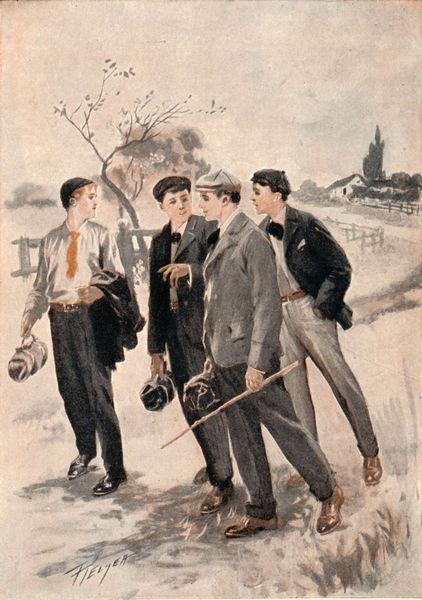
“Well, we’re pretty near home,” said Bob at the
breakfast table the next morning. “To-morrow afternoon
we ought to be in New York.”
“Then it’s back to school!” sighed Tom.
“I’m ready,” said Nelson. “School’s all right,
Tommy. I’m going to have a good time this year. A
fellow always does his last year.”
“Wish it was my last,” said Tom. “You fellows’ll
be sophomores at Erskine when I get there,
and I’ll be a freshie and you won’t have anything to
do with me!”
“Oh, if you behave yourself, Tommy, we’ll speak
to you now and then as we pass,” said Dan. “We’re
not the kind to go back on an old friend.”
“You could make up a year if you tried,” said Nelson.
“If you had some coaching next summer you
could pass the college exams all right.”
“He and Jerry might be coached together,” suggested
Bob.
“Well, I’m going to try,” answered Tom forlornly,
“but I don’t believe I’ll be able to make it. If
it wasn’t for Latin——”
He shook his head dejectedly.
“Cheer up, Tommy,” said Dan. “In hoc signo
vinces, old chap! Never forget that. That means
‘While there’s life there’s hope.’”
“And E pluribus unum means one out of many,”
rejoined Tom sadly. “And the one’s me.”
When they had stopped laughing, Bob said:
“I think we’ve had a pretty good time this trip,
taking it all in all, don’t you?”
“Dandy,” answered Nelson. “We always do
when we get together. Look at the fun we had last
summer at Chicora! I think we ought to do something
else together next summer. What do you say?”
He looked eagerly around at the others.
“Sure!” cried Dan. “Let’s get together, the
four of us, every summer until—until we don’t
want to!”
“Good scheme,” said Bob. “Let’s decide on
something for next year.”
“That’s not so easy,” answered Nelson. “But we
can think it over and write to each other in the spring,
and—”
“What I’d like to do,” interrupted Dan, “would
be to go on a cruise somewhere.”
“Sail, do you mean?” asked Tom anxiously.
“Sail or row or paddle or any old way,” answered
Dan. “Pass me the toast, Nel, if you don’t want
it all.”
“Catch,” answered Nelson. “Look here, how
would a cruise in a launch do?”
“Swell!” said Tom.
“Just the ticket!” agreed Dan.
“Well, I think I could get our launch; I guess
dad would let us have it for a month or so; and we
could have a bully time.”
“That would be all right,” said Bob. “Or if we
couldn’t do that we might get some horses, and take a
riding trip. I knew a fellow who——”
“That’s too much like walking,” interrupted Dan.
“What’s the matter with an automobile?”
“Where are you going to get it?” asked Bob sarcastically.
“Oh, borrow it. Tom’s father has a machine,
hasn’t he, Tom?”
“Yes, but he isn’t fool enough to lend it to us!”
“That’s because he doesn’t know us,” answered
Dan, unruffled. “I can run an auto to beat the band.”
“Not with me inside, you can’t,” said Nelson
decidedly.
“Well, we’ll think it all over,” said Bob.
“There’s lots of time. What we’ve got to do now is to
hit the trail for Barrington and Mr. Jerry Hinkley.
Aren’t you most through, Tommy?”
Tommy declared, with his mouth full, that he was
quite through, and a few minutes later they were once
more on their way, with the journey’s end well in
sight.
“It’s certainly done you good, Dan,” said Nelson
presently, as they were crossing the river. “I guess
that doctor of yours knew what he was talking about.
I’ll bet you’ve put on ten or fifteen pounds since we
started.”
“I guess I have gained a bit,” answered Dan.
“Anyhow, I surely feel fine and dandy. But I’m
sorry it is all over; I’d like to turn around and do it
all over again, wouldn’t you?”
“Yes, if it wasn’t for school,” replied Nelson.
“Say, I’ll see you at the football game, won’t I? And
you promised to come up over Sunday some time.”
“I’m going to. Only I mustn’t let the fellows
know it or they’ll throw me out. Personally, Nel, I
can stand the disgrace, but——”
“Oh, dry up! We’re going to beat you at football
this fall. Hillton’s going to have the finest team that
ever——”
“Was beaten by St. Eustace,” laughed Dan.
Whereupon the argument waxed warm, and for a
mile or more they talked football with all the enthusiasm
customary when two live, manly, American boys
get together in the autumn weather.
They had covered about half the distance to Barrington
when the rattle and rumble of a heavy farm
wagon coming along behind warned them to the side
of the road. As they got out of the way Nelson
glanced carelessly around. Then he gave a shout that
attracted the attention of Bob and Tom, who were some
fifty yards ahead, and brought them scurrying back.
The farm wagon came to a halt, and in the next instant
Nelson and Dan were clambering up and shaking hands
with Jerry Hinkley.
Jerry was back in his farm clothes, but for all of
that he presented a different appearance to-day than on
the occasion of their first meeting. Perhaps his clothes
were a little neater and cleaner; surely his hair no
longer looked like an overgrown mop, but was well cut
and smoothly brushed. There was no doubt that Jerry
was a very good-looking boy. But I think the principal
change lay in his expression. To-day he looked
smilingly confident, self-assured, as though knowledge
of his capabilities had found him at last, and he was
eager to prove them. Much of his former diffidence,
however, remained, and he shook hands with the Four,
and answered their delighted greetings with smiling
embarrassment. Then they were all climbing into the
wagon, Jerry’s way being theirs.
“Say, just look at Barry, will you,” said Bob.
“He’s making friends with the horses.”
And sure enough the terrier was leaping at the
noses of the two big sorrels and whining delightedly.
And the horses evidently reciprocating the sudden affection,
were bobbing their heads down to him as he leaped
about. Dan called to him and lifted him into the
wagon, where he scurried industriously about, sniffing
and sneezing and pawing at the litter of dusty straw
and chaff.
“Where are you going?” asked Jerry as he chirped
to the horses.
“We were going to see you,” answered Nelson.
“Isn’t it odd we should have found you like this?
Where have you been?”
“Just down the road a piece. I was delivering a
load of grain for Mr. Osgood.”
“Does he live near here?” asked Tom.
“About a mile beyond,” answered Jerry. “I’d
like for you to stop and see him. I—I been telling
him about you.”
“Of course we’ll stop,” said Nelson. “Besides—”
He paused and looked inquiringly at the others. They
nodded.
“Go ahead,” said Bob.
“Fire away,” added Dan.
“Besides,” Nelson resumed, “we’ve got something
to tell you. I guess we might as well tell it now.”
So, clinging to the seat to keep from being shaken
off, he told Jerry of the arrangements they had made
for his future, and finally of Mr. Cozzens’s offer of a
situation at St. Alfred’s. And when it was all over,
and Tom and Bob and Dan had each added eager and
unnecessary explanations, Jerry still sat silent, his eyes
fixed on the ears of the off horse. They waited a
moment. Then,
“Look here, Jerry, it’s all right, isn’t it?” asked
Dan anxiously. Jerry nodded.
“Good,” breathed Dan relievedly. “I was afraid
you—er——”
“I ain’t said nothing—I mean anything—because
I don’t know what to say,” Jerry finally remarked, with
a quick, embarrassed glance at Nelson. “I—I——”
He faltered and stopped.
“Don’t say a word,” returned Nelson. “It’s all
right.”
“But I want you all to know that—that I’m very
much obliged. It—it’s more than that, only I can’t
just say it. I—I don’t know why you fellows have
been so good to me.”
Bob laughed uneasily.
“You’re such a good fellow, Jerry, we wanted to
help you,” he said. “We haven’t done anything much,
though; the hardest part is left for you, old chap. But
I think you’re going to make good, Jerry; we all think
that; so don’t you disappoint us.”
“I won’t!” answered Jerry almost savagely.
“I’m going to make you fellows glad you did it, see if
I don’t!”
Nelson clapped him on the shoulder.
“That’s the way to talk, Jerry! And if you can
get that place at St. Alfred’s it’ll make a lot of difference.
Why, you can learn any amount there this
winter, and have your board and room besides. Mr.
Cozzens said it wouldn’t be awfully easy, you know,
plenty of work and all that; but you’ll have time for
lessons and study, all right.”
“I don’t care how hard the work is,” answered
Jerry. “I can do it. Only——”
“Only what?” asked Bob as he hesitated.
“Only I don’t know as I ought to go. You see, I
engaged with Mr. Osgood for all winter.”
“Oh, he will let you off,” said Nelson. “We’ll
see him and tell him just how it is. That’ll be all right,
Jerry.”
“I hope so,” said Jerry. “There’s the farm now;
that’s his house, the white one yonder.”
Evidently Mr. Osgood was one of the progressive
sort. Everything about the place, from the busy windmill
to the big white house with its wide verandas and
well-graveled walks, was scrupulously neat and clean,
and a general air of prosperity pervaded it. And when
they had rattled up the driveway to the barn, and the
owner of the premises appeared before them, they discovered
him to be just such a man as his place indicated.
He was middle-aged, tall, and muscular looking, with a
pair of humorous and kindly blue eyes which sparkled
brightly from his tanned face. The boys liked him on
the instant, and Nelson decided that he would not have
much difficulty in securing Jerry’s release.
They tumbled out of the wagon, and were introduced
by Jerry. Mr. Osgood declared heartily that he
was very glad to meet them, especially as he had heard
so much about them from Jerry, and was in the act
of shaking hands all around when an interruption
occurred. The interruption was in the form of Barry,
who, released from the wagon, had spent a moment in
running excitedly about the ground, and now was leaping
enthusiastically upon the farmer, whining and
barking joyously. Mr. Osgood stopped and looked
down. Then an expression of deep surprise overspread
his face.
“Well, I’ll be switched!” he said slowly. “Where
under the sun did you come from, Laddie?”
There was a moment of silence save for the terrier’s
frantic explanations. Jerry, unhitching the horses,
paused and looked at Dan. Dan’s face was a study.
He was striving very hard to keep from looking miserable.
Finally,
“Is that your dog, sir?” he asked.
“It surely is,” answered Mr. Osgood. “He disappeared
about two or three weeks ago. May I ask
where you found him?”
So Dan, eagerly assisted by the others, recounted
the tale of the terrier’s rescue and subsequent adventures,
and the farmer listened interestedly. Then,
“Well, that’s what I call a plucky piece of work,”
he said admiringly, “and I’m much obliged to you. I
hadn’t had Laddie long, but I was getting mighty fond
of him when he disappeared. And I’m glad to get him
back.” He hesitated. “I advertised in the Barrington
paper and offered ten dollars reward, and so—if
you don’t mind taking it——”
But Dan shook his head.
“I’d rather not, sir,” he muttered. “Barry’s made
it up to me lots of times. I—we—got quite fond of
him, sir.”
“I s’pose you did,” said the farmer thoughtfully,
eying Dan. “I’m sorry,” he added simply.
“What’s his name, sir?” asked Tom.
“His full name’s Forest Lad, but I call him Laddie.
He used to belong to a Mr. Hutchinson who has a place
about a mile from here and raises dogs. They say
Laddie got a prize once at some show in New York, but
I don’t know for sure. He got sick in the spring, and
one day when I was over at the Hutchinson place with
some grain I admired him, and Mr. Hutchinson said I
could have him if I thought I could cure him. I said
I guessed all he needed was plenty of fresh air and
exercise—he was in a run over there, with a fence
around him—and so I took him. And it did cure him
too. Now, I guess Laddie got sort of homesick one
day, and started out for Hutchinson’s. The place is
closed up this summer—the family’s in Europe, I think—and
it’s likely that when Laddie got there he didn’t
find anyone around. Maybe he thought he’d sort of
wait awhile. I guess that’s how you happened to run
across him.”
“I guess so,” Dan agreed.
“I want you boys to stay to dinner,” continued the
farmer. “It’ll be ready in about half an hour. And
if Jerry’s through with the team he might show you
around. Maybe you’ve never seen an up-to-date
farm, eh?”
So Mr. Osgood excused himself, and Jerry took
them in charge. Barry, for Dan was always to remember
the terrier by that name, elected to go with them,
much to Dan’s delight, and acted as though he was
guide instead of Jerry. There was much to interest
them, and they weren’t nearly through when the bell
rang for dinner, and they had to hurry back to the
house. They found quite a company assembled in the
dining room, for besides Mr. Osgood there was his wife
and two daughters, an elderly lady whose relationship
wasn’t quite plain, Jerry, and four other farm hands.
So they made quite a tableful when all were seated.
It was a bully dinner, to quote Tom—and Tom was
a bit of an authority on such things—and they
ate heartily. And presently Nelson brought up the
subject of Jerry and Mr. Cozzens’s offer, and their
host listened in silence. Nelson painted in vivid colors
the advantages to accrue to Jerry, and when he was
through, the farmer ate for a minute in silence.
Finally,
“Well, I’m sorry to lose Jerry,” he said thoughtfully,
“but I’m not going to stand in his way. I didn’t
get overmuch education myself, but I’m not fool enough
to think it’s unnecessary. I guess if I’d had more
of it I might have arrived where I am to-day a good
deal earlier. So Jerry does just as he wants to in this
matter. But if he takes my advice he will go to this
school you tell about. What say, Jerry?”
Jerry maintained an embarrassed silence for a moment.
Then,
“I think I’ll go, sir, if it ain’t putting you in no
hole,” he replied. “Leastways, I’d like to see Mr.
Cozzens and talk it over with him.”
“Right you are! You’d better go over to-morrow
morning. And then if you decide to stay I’ll send your
things over to you. But you must let me know right
away so’s I can get some one in your place. Help isn’t
easy to find this time of year.”
“Thank you, sir,” answered the boy gratefully.
“I’ll write to you to-morrow afternoon if I don’t
come back.”
[As a matter of fact, Jerry didn’t come back. He
stayed at St. Alfred’s, and never regretted it for a
moment. But all this has nothing to do with the
present story.]
After dinner the boys completed their tour of inspection,
and then made ready to depart. Dan had
been looking pretty downhearted, and when the time
came to take leave of Barry he didn’t feel much better.
They shook hands with Mr. Osgood, were cordially invited
to come again, and then turned to Jerry.
“Good-by, Jerry,” said Bob. “Don’t get discouraged
if the work seems hard at first. It’s going
to be a tussle, but you can do it.”
“That’s so,” said Tom, shaking hands. “Just you
bu-bu-bu-buckle down to it, Jerry. Remember we’re
bu-bu-back of you!”
“Good-by,” said Dan. “And good luck.”
“Good-by, Signor Danello,” answered Jerry with
a shy effort at pleasantry. “I—I’m sorry about—the
dog.”
Dan nodded and moved away.
“I’ll write to you now and then,” said Nelson,
“and tell you about things at school—our school, Jerry—so
you can keep your courage up. And you’ll write
to me, won’t you?”
“Yes,” Jerry replied eagerly. “Only—I ain’t a
very good writer, Nelson.”
“That’s all right; neither am I, I guess. Good-by.
Good-by, Mr. Osgood! And thanks for letting
Jerry off.”
“Good-by,” echoed the others.
The Four turned down the walk to the gate.
Barry, who during the proceedings had been manifestly
uneasy, now pricked his ears and watched Dan’s
departure with alert interest. Once he turned and
looked inquiringly at Mr. Osgood. The farmer returned
his look with a smile and a wink. Perhaps
Barry understood that, like Jerry, he was free to choose
for himself. For after one indecisive moment he gave
a bark and flew down the walk as hard as he could go.
He caught Dan at the gate, and leaped ecstatically
about him. Dan, his lips trembling, waved him back
and tried to tell him to go home. But the words
wouldn’t come. Bob and Nelson and Tom watched,
silently sympathetic. Barry ran into the road and
turned, his tail wagging fast, as though asking, “What
are you waiting for? Aren’t we all here?”
“Barry,” muttered Dan miserably, “I can’t take
you, old chap. You aren’t my dog any more. You—you’ll
have to go home.”
Then footsteps crunched on the gravel, and Dan
turned to find Mr. Osgood smiling kindly into his
eyes.
“I gave him his choice,” said the farmer, “and he’s
made it. He’s yours if you want him, my boy.”
Three hours later the Four—or should I say the
Five?—were standing on the deck of the little steamer
watching the Long Island shore recede across the
waters of the Sound. The boat’s nose was pointed
toward New York—and school and study and hard
work. But every face there showed happiness and contentment.
For, being healthy and sensible, they knew
that study and hard work stand just as much for enjoyment
as do vacation days. And of all in the group there
on the deck the happiest was Dan, unless—well, unless,
possibly, it was Barry!
THE END
BY RALPH HENRY BARBOUR.
Forward Pass! A Story
of the “New Football.” Illustrated in Color. Cloth, $1.50.
The Spirit of the School. The
Story of a Boy Who Works His Way through School. Illustrated in Colors.
Cloth, $1.50.
Four Afloat.
Four Afoot.
Four in Camp.
A Series of Books relating the Adventures of Four Boy
Companions. Illustrated in Colors, $1.50 each.
On Your Mark! A Story of College Life and Athletics.
Illustrated in Colors by C. M. Relyea. 12mo. Cloth, $1.50.
No other author has caught so truly the spirit of school and college life.
The Arrival of Jimpson. Illustrated.
12mo. Cloth, $1.50.
Stories of college pranks, baseball, football, hockey, and college life.
Weatherby’s Inning. A Story
of College Life and Baseball. Illustrated in Colors by C. M. Relyea.
12mo. Cloth, $1.50.
A fascinating story of college life and sport.
Behind the Line. A Story of
School and Football. Illustrated by C. M. Relyea. 12mo. Cloth, $1.50.
Captain of the Crew. Illustrated
by C. M. Relyea. 12mo. Cloth, $1.50.
A fresh, graphic, delightful story that appeals to all healthy boys and girls.
For the Honor of the School. A
Story of School Life and Interscholastic Sport. Illustrated by C. M.
Relyea. 12mo. Cloth, $1.50.
The Half-Back. Illustrated
by B. West Clinedinst. 12mo. Cloth, $1.50.
“It is in every sense an out-and-out boys’ book.”—Boston Herald.
D. APPLETON AND COMPANY, NEW YORK.
BY WILLIAM O. STODDARD.
Each Illustrated. 12mo. Cloth, $1.50.
The Boy Lincoln.
This is an absorbing fanciful account of the early days of Abraham Lincoln when
he was a boy living on the frontier.
The Fight for the Valley.
Colored Frontispiece and other Illustrations.
A narrative of the brave defense of Fort Schuyler and the battle of Oriskany.
The Spy of Yorktown.
Colored Frontispiece.
A story of the Yorktown campaign and Benedict Arnold.
With the Black Prince.
A Story of Adventure in the Fourteenth Century.
The absorbing interest of this stirring historical romance will appeal to all young
readers.
Success Against Odds; or, How an American Boy Made his
Way.
In this spirited and interesting story Mr. Stoddard tells the adventures of a plucky
boy who fought his own battles and made his way upward from poverty in a Long
Island seashore town. It is a tale of pluck and self-reliance capitally told.
The Red Patriot.
A Story of the American Revolution.
The Windfall; or, After the Flood.
Illustrated by B. West Clinedinst.
Chris, the Model-Maker.
A Story of New York. With 6 full-page Illustrations by B. West
Clinedinst.
On the Old Frontier.
With 10 full-page Illustrations.
The Battle of New York.
With 11 full-page Illustrations and colored Frontispiece.
Little Smoke.
A Story of the Sioux Indians. With 12 full-page Illustrations by
F. S. Dellenbaugh, portraits of Sitting Bull, Red Cloud, and other chiefs, and 72 head
and tail pieces representing the various implements and surroundings of Indian life.
Crowded Out o’ Crofield.
With 23 Illustrations by C. T. Hill.
The story of a country boy who fought his way to success in the
great metropolis.
D. APPLETON AND COMPANY, NEW YORK.
BY GABRIELLE E. JACKSON.
Little Miss Cricket.
Little Miss Cricket’s New Home.
Illustrated. 12mo. $1.25 each.
Two charming stories of a pathetic little heroine.
The Joy of Piney Hill.
Illustrated in color by Ruth M. Hallock. 12mo. Cloth, $1.50.
The story of a dear little girl who was in trouble and who was taken into
a model school where she makes every one love her.
Three Graces.
Three Graces at College.
With illustrations in tint by C. M. Relyea. 12mo. Cloth, $1.50 each.
The first, a story of boarding school life, full of incident and wholesome
characterization. The second, a charming story of college life, its ideals,
recreations, temptations and rewards.
Sunlight and Shadow.
Four full-page illustrations in colors. 12mo. Ornamental cloth,
$1.50.
“A wholesome little tale is this, tingling with life and youthful spirits.”—The Interior.
Big Jack.
Illustrated. 12mo. Ornamental cloth, $1.00.
“A book which every parent would show wisdom in putting in the libraries
of his children.”—Dayton Daily News.
Little Miss Sunshine.
Illustrated. 12mo. Ornamental cloth, $1.50.
“A delightful, wholesome, readable book for girls.”—Criterion.
Little Comrade.
Illustrated. 12mo. Ornamental cloth, $1.00.
Every child should be taught the love of animals. This book teaches
that love.
The Colburn Prize.
Illustrated. 12mo. Ornamental cloth, $1.00.
Dedicated to the school-girls throughout the land. Nine full-page illustrations
add to the charm of this exquisite gift book.
D. APPLETON AND COMPANY, NEW YORK.
A GREAT STORY FOR BOYS.
Buck Jones at Annapolis.
By Captain Richmond Pearson Hobson, U. S.
Navy. Illustrated in colors. 12mo. Ornamental
cloth, $1.50.
There is no boy in the country to whom the name of
Hobson does not bring a thrill of patriotic fire. A boy’s
story by this national hero is sure of an overwhelming reception.
Captain Hobson here shows himself a story-teller
of rare powers, and his book would captivate the young
reader whatever name was on its title-page. His name
adds new charm and conviction.
There has never before been so loyally and faithfully
depicted the routine and life of the naval cadet. Every
incident in this story of Buck’s career at the Naval Academy
has its foundation in fact, and in the author’s use of
them here they become revitalized. Nowhere else so well
as in this story can the young man, desirous of learning
how a cadet fares at Annapolis, obtain the information.
And in addition to all this Captain Hobson has told a
story brimful of interest and adventure, the love and
mystery of the sea, the fascination of boy life aboard ship
with other boys, and the friendships with old tars and
younger classmates.
“Ranked among the most popular books for boys, not only because
of the fame of the gallant young author, but because it is a splendid
story of the sort that cannot be put aside until finished, even if the
reading extends far into the small morning hours.”—Albany Times-Union.
“American boys who take an interest in the growth and achievements
of our splendid Navy—and that means all American boys with
red blood in their veins—have a huge treat awaiting them in ‘Buck
Jones at Annapolis.’ The book is full of snap, stirring adventure and
insight into life at Annapolis.”—Army and Navy Journal.
D. APPLETON AND COMPANY, NEW YORK.
BY HEZEKIAH BUTTERWORTH.
The Young McKinley.
Illustrated. 12mo. Ornamental Cloth, $1.50.
Mr. Butterworth portrays the future President at school, where, after a bitter disappointment,
the crusty old school-teacher, who has a good heart beneath his severe
exterior, says to him: “Never mind, you may be President yet.” He traces President
McKinley’s career through his army days to the time when he was preparing for that
great political career which made the blow that struck him down at the height of his
glory a blow to the whole United States.
Brother Jonathan; or, The Alarm Post in the Cedars.
A Tale of Early Connecticut. Illustrated. 12mo. Cloth, $1.50.
In the Days of Audubon.
A Tale of the “Protector of Birds.” Illustrated by B. West Clinedinst
and others. 12mo. Cloth, $1.50.
In the Days of Jefferson; or, The Six Golden Horseshoes.
A Tale of Republican Simplicity. Illustrated by F. T. Merrill. $1.50.
The Story of Magellan.
A Tale of the Discovery of the Philippines. Illustrated by F. T. Merrill
and others. $1.50.
The Treasure Ship.
A Story of Sir William Phipps and the Inter-Charter Period in Massachusetts.
Illustrated by B. West Clinedinst and others. $1.50.
The Pilot of the Mayflower.
Illustrated by H. Winthrop Peirce and others. $1.50.
True to His Home.
A Tale of the Boyhood of Franklin. Illustrated by H. Winthrop Peirce.
$1.50.
The Wampum Belt; or, The Fairest Page of History.
A Tale of William Penn’s Treaty with the Indians. With 6 full-page
Illustrations. $1.50.
The Knight of Liberty.
A Tale of the Fortunes of Lafayette. With 6 full-page Illustrations.
$1.50.
The Patriot Schoolmaster.
A Tale of the Minutemen and the Sons of Liberty. With 6 full-page
Illustrations by H. Winthrop Peirce. $1.50.
In the Boyhood of Lincoln.
A Story of the Black Hawk War and the Tunker Schoolmaster. With
12 Illustrations and colored Frontispiece. $1.50.
The Boys of Greenway Court.
A Story of the Early Years of Washington. With 10 full-page Illustrations.
$1.50.
The Log School-House on the Columbia.
With 13 full-page Illustrations by J. Carter Beard, E. J. Austen, and
others. $1.50.
D. APPLETON AND COMPANY, NEW YORK.
STORIES FOR YOUNG READERS
JOURNEYS OF THE KIT KAT CLUB. Illustrated.
8vo. $2.00 Net.
By William R. A. Wilson.
A beautifully illustrated volume filled with interesting and salient
features of English history, folk-lore, politics, and scenery.
BUTT CHANLER, FRESHMAN. Illustrated.
12mo. $1.50.
By James Shelley Hamilton, Amherst ’06.
College sports are always a subject of interest to young readers,
and here are incidents that are dear to all college associates.
“The story is breezy, bright, and clean.”—The Bookseller, New
York.
WILLIAMS OF WEST POINT. Illustrated. 12mo.
$1.50.
By Lieut. Hugh S. Johnson.
A story of West Point under the old code. “Every boy with
red blood in his veins will pronounce it a corker.”—The Globe,
Boston.
THE SUBSTITUTE. Illustrated. 12mo. $1.50.
By Walter Camp.
“Presents the ideal to football enthusiasts. The author’s name
is guarantee of the accuracy of descriptions of the plays.”—The
Courant, Hartford, Conn.
THE FOREST RUNNERS. Illustrated in Color.
12mo. $1.50.
By Joseph A. Altsheler.
This story deals with the further adventures of the two young
woodsmen in the history of Kentucky who were heroes in “The
Young Trailers.” The story is full of thrills to appeal to every boy
who loves a good story.
D. APPLETON AND COMPANY, NEW YORK.
Transcriber’s Note:
Except for the frontispiece, illustrations have been moved to the
text that they illustrate, so the page number of the illustration
may not match the page number in the List of Illustrations.
Punctuation and spelling inaccuracies were silently corrected.
Archaic and variable spelling has been preserved.
Variations in hyphenation and compound words have been preserved.