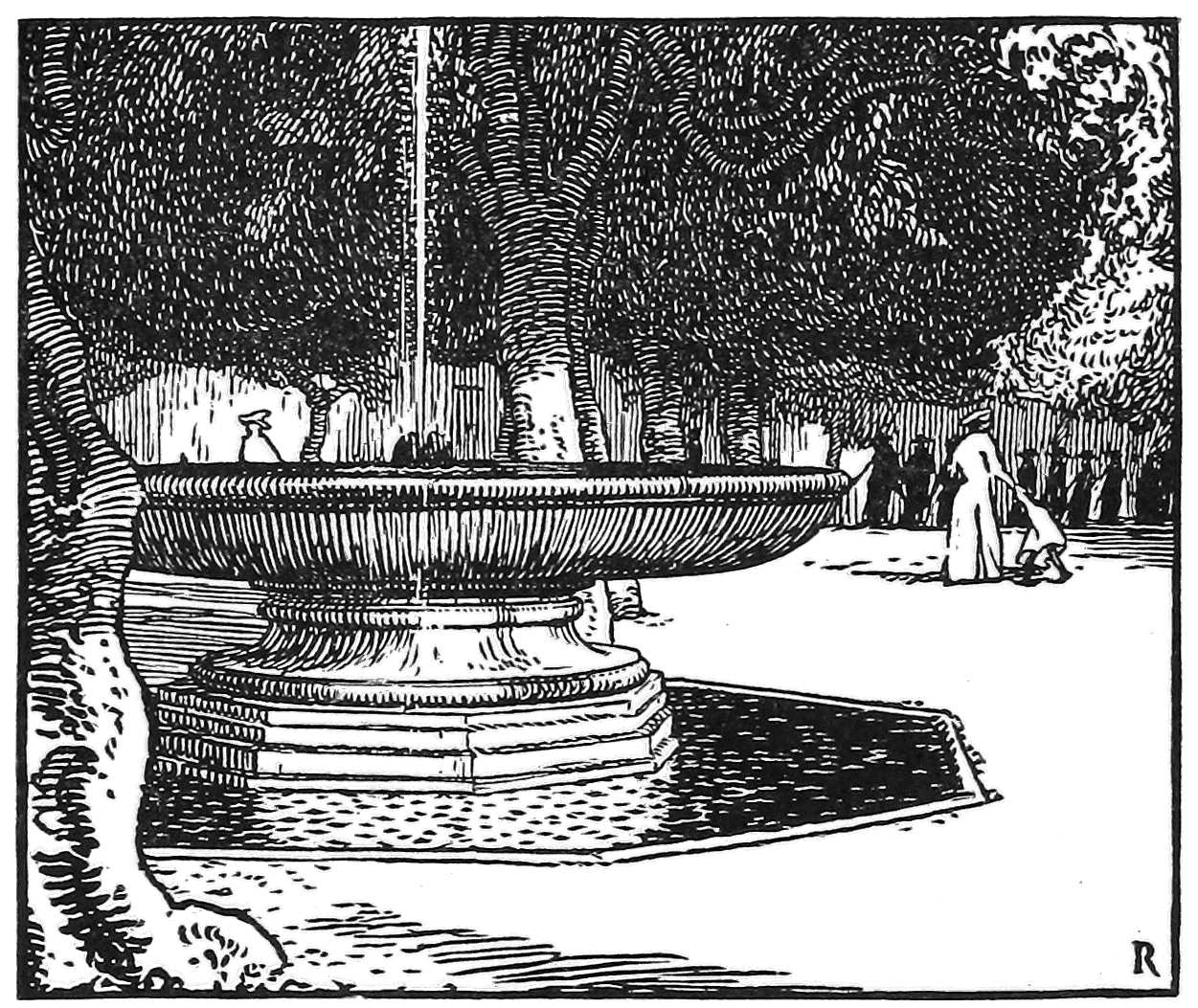
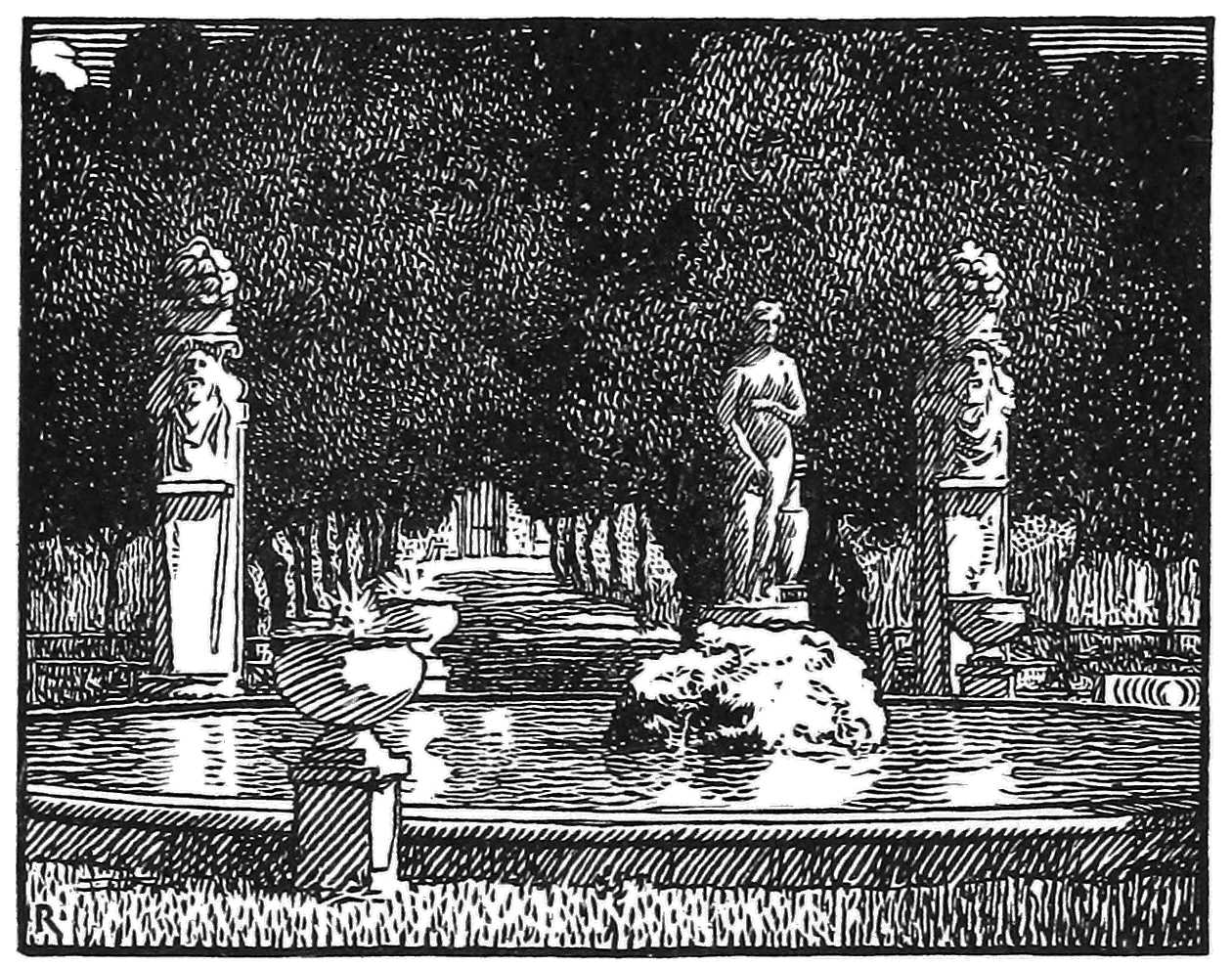
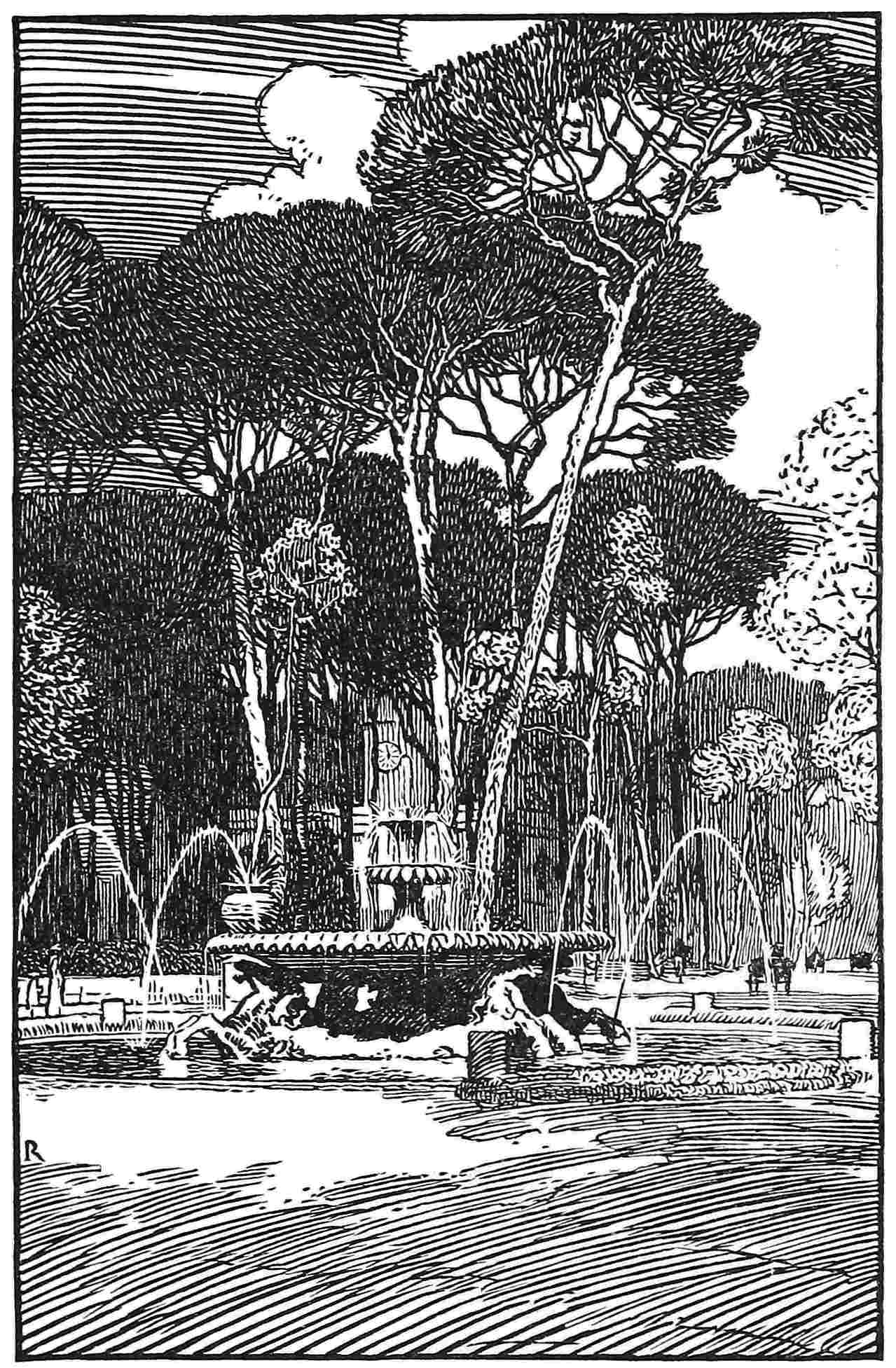
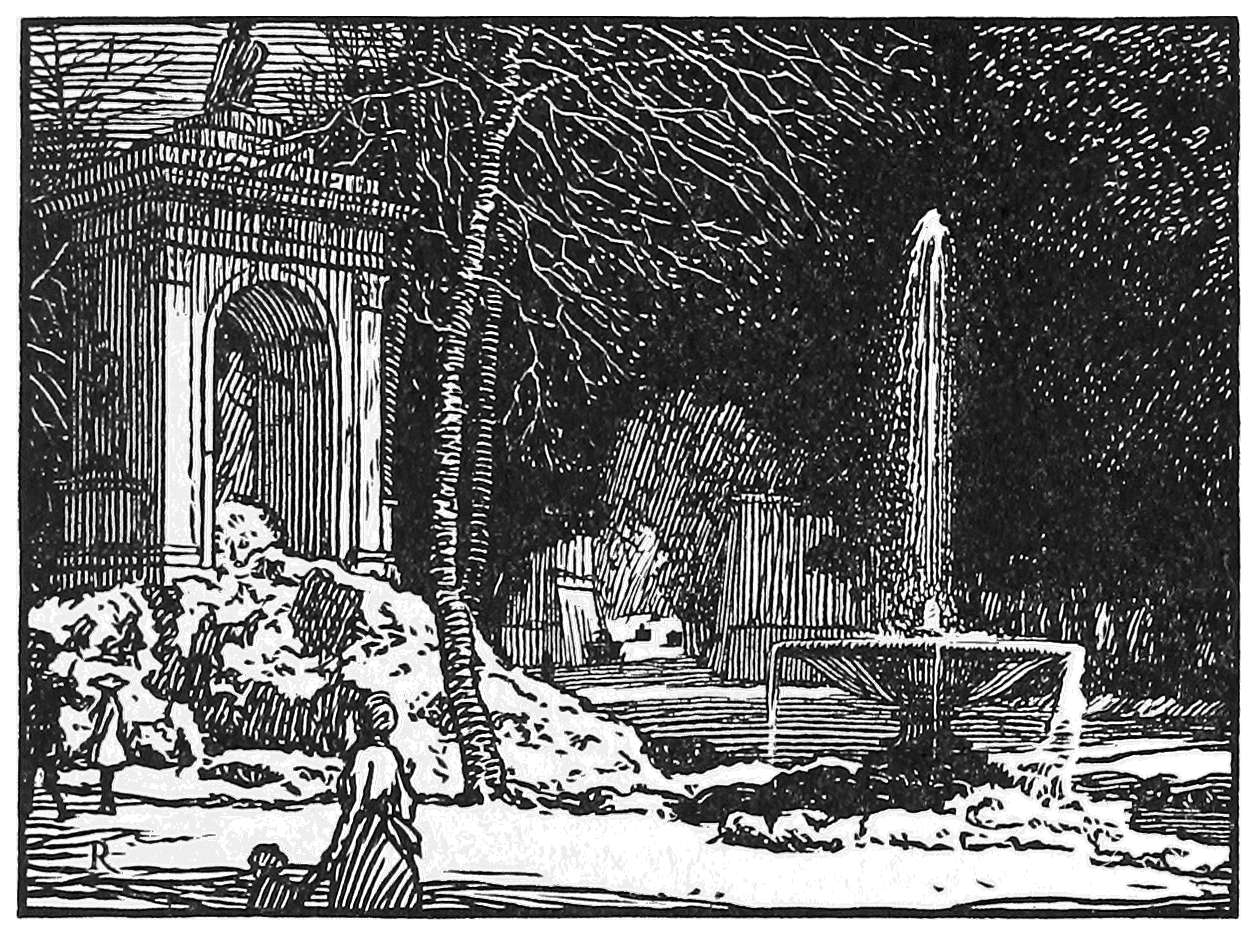
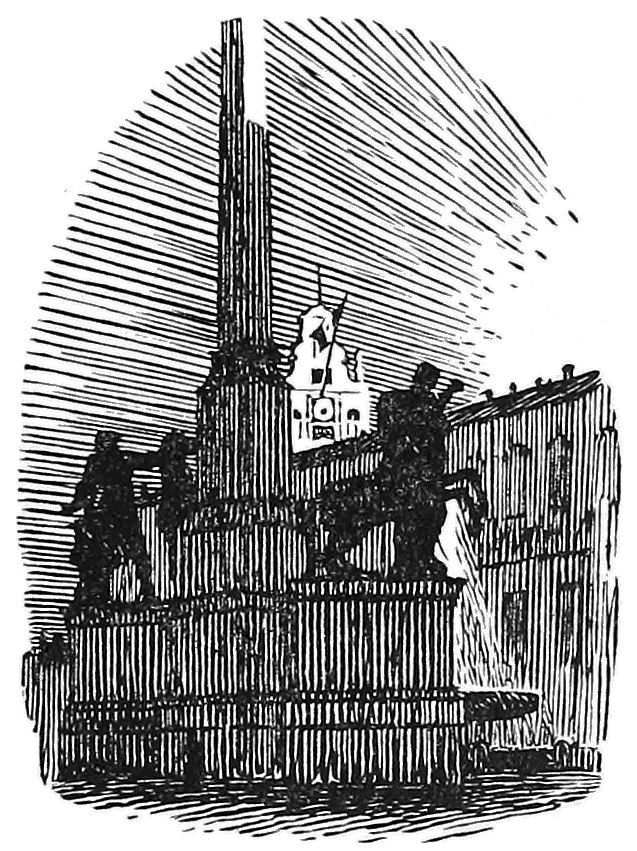
Larger versions of most illustrations may be seen by right-clicking them
and selecting an option to view them separately, or by double-tapping and/or
stretching them.
Rome has been called the most religious city in the
world because of the number of her churches. With
equal propriety, and perhaps with greater justice, she
might be called the cleanest city in the world because
of the number of her fountains. Pagan emperors and
Christian popes alike have found both profit and
pleasure in adding another fountain or in making or
repairing one more aqueduct to give a still greater
supply of water to the Roman populace. No other
people, with the possible exception of the Spanish
Moors, have so appreciated the value and the beauty
of abundant water.
There are few squares, even in the Rome of to-day,
where, at least in the silence of the night, the sound of
splashing water may not be heard. The tiny fountain,
often fern-fringed, with its ceaseless, slender stream of
water, is the one priceless possession in hundreds of old
courtyards, where it fills a damp and lonely silence
with charm, or redeems by its indestructible quality of
beauty the meanness of the squalid life about it. It is
impossible to think of Rome without her fountains.
Yet, after a few weeks, the eye is hardly aware of their
presence. It is as if by their very beauty and omnipresence
they had acquired the divine attributes of sunlight;
and it requires the silence, as with the sunlight it
requires the cloud, to rouse our consciousness to their
existence. They take their place among the elemental
causes of happiness, since the pain we feel at their loss is
the only adequate measure of the pleasure they give us.
It is difficult for the man of to-day to picture to himself
the abundance and splendor of the fountains in
imperial Rome. Some idea of their character may be
obtained from the description gathered from various
sources of Nero’s fountain on the Cælian. The mingled
waters of the Claudian and the Anio Novus aqueducts
were brought thither over the Neronian arches.
A wall fifty feet in height, faced with rare marbles and
decorated by hemicycles and statues, formed the background
of the first cascade. At the foot of this wall a
huge basin received the stream, which then fell into
another basin ten feet below the first, and thence flowed
into the great artificial lake, described by Suetonius as
like unto a sea, which filled all that space now occupied
by the Coliseum. Of great magnificence also was the
fountain of Severus Alexander on the Esquiline which
served to introduce the Acqua Alexandrina, the eleventh
and last water-supply of imperial Rome. A
coin of the period gives a representation of this fountain,
and in it can be traced a certain resemblance to
the Fontana Paola which stands at the present day on
the Janiculum, and which in its size and quantity of
water reproduces faintly the fountains of the past.
That fine phrase, “la nostalgie de la civilisation,”
nowhere finds a more perfect illustration than in the
attitude of the Western world toward Rome. Some
homing instinct of the human heart has for centuries
carried thither men of every nation and of every sort of
belief or unbelief; and the conviction that it will bring
them thither in the future as in the past is implied in
that other name by which we know her. She is the
Eternal City. Every one can feel but no one can explain
the charm which she has over the spirits of men. Here
the psychic forces of the world’s great past are stored
in imperishable memories. Here each individual finds
spiritual influences which seem to have been waiting
through the ages for his own peculiar appropriation.
King Theodoric, in the sixth century, spoke not only
for himself but for all succeeding generations of Northmen
when he said that Rome was indifferent to none
because foreign to none. It seems as if the feeling
for Rome were an instinct congenital with our appetites
and our passions. It requires no justification and
it admits of no substitute. It is dateless and universal.
The Gothic king of the past finds a spiritual brother
in the schoolboy of to-day who caught his mother’s arm
on the Terrace at Frascati to say, with an uncontrollable
tremor in his voice: “See there; that little spot
over there! That is Rome, and she was once the whole
world!” King and schoolboy might have met familiarly
in some sunny portico of the classic city. Both
were members of the great freemasonry of the lovers of
Rome, which stretches its network far and wide over
our civilization.
In this company there are not a few who find themselves
in Rome, yet not able to see Rome—to see it,
that is, as the historians, artists, archæologists, and
their own minds call upon them to see it. Their right
to tread the Roman streets depends upon their obedience
to some law compelling an existence lived entirely
in the open air and in the broad sunshine. To
such the gates of Paradise seem closed. To be forbidden
the galleries and churches and catacombs and the hidden
recesses of the old ruins appears an intolerable fate.
Yet even to these, who have made the great acceptance
and are living upon the half-loaf of life—even to these,
Rome is kind. Little by little, in easy periods, they
can get back into the days of the Renaissance, of the
Counter-Reformation, of the Napoleonic Era, and of
the great Risorgimento. This can be done under the
conditions of open air and sunshine; for it is in such
surroundings that we find the fountains, and the fountains
of Rome are in themselves title-pages to Roman
history.
ST. PETER’S
ST. PETER’S
“Fountains are among the most successful monuments
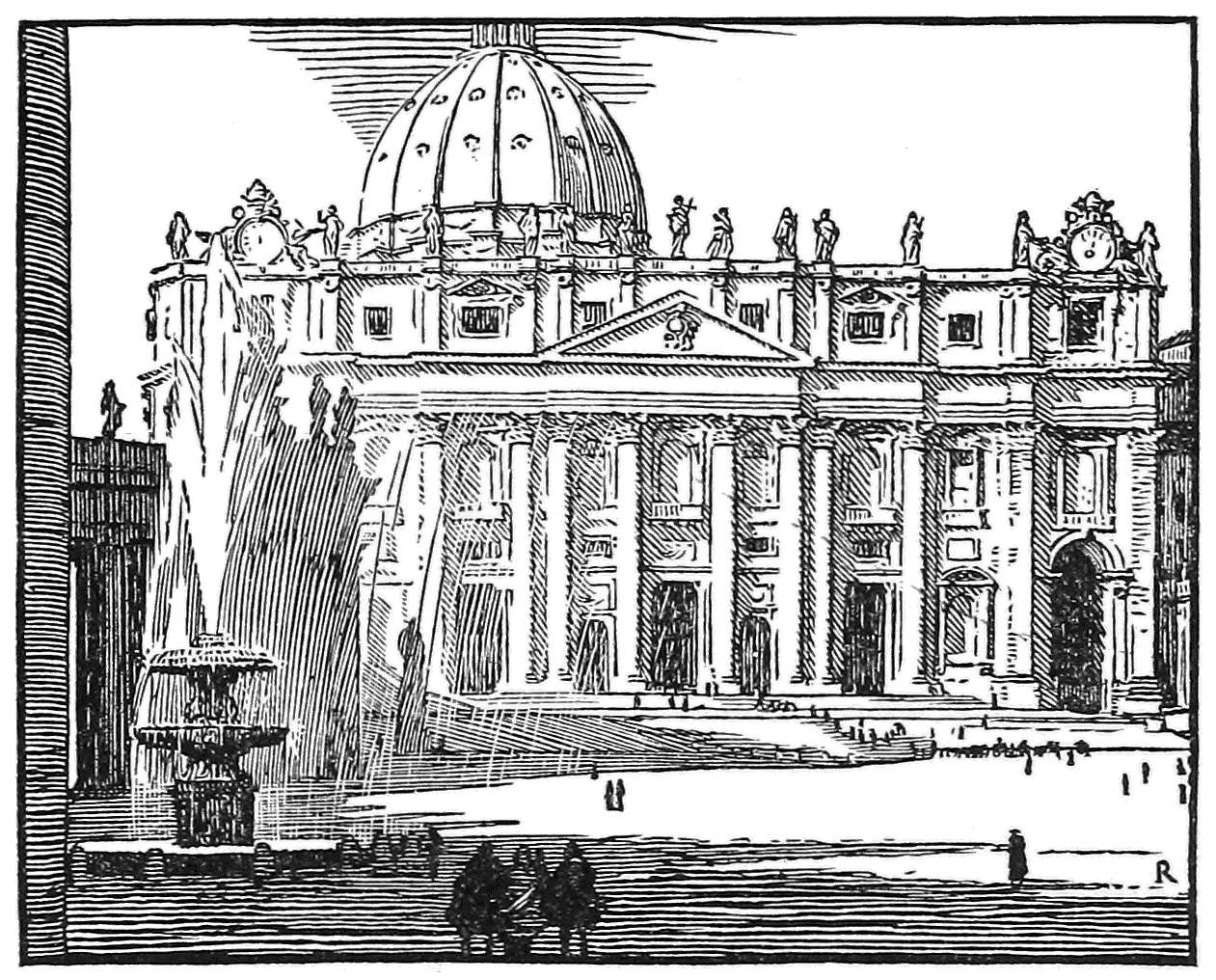
of the late Renaissance,” and those which stand
on either side of the great Square of St. Peter’s show
that Symonds’s statement should be enlarged so as to
include the century which followed that period. Mr.
John Evelyn, the accomplished English traveller of the
seventeenth century, saw the fountain of Paul V soon
after its completion and describes it in his diary as the
“goodliest I ever saw”. Since his day the twin fountains
both of Trafalgar Square and of the Place de la
Concorde have been erected, but Evelyn could still
give the superlative praise to the great Roman model.
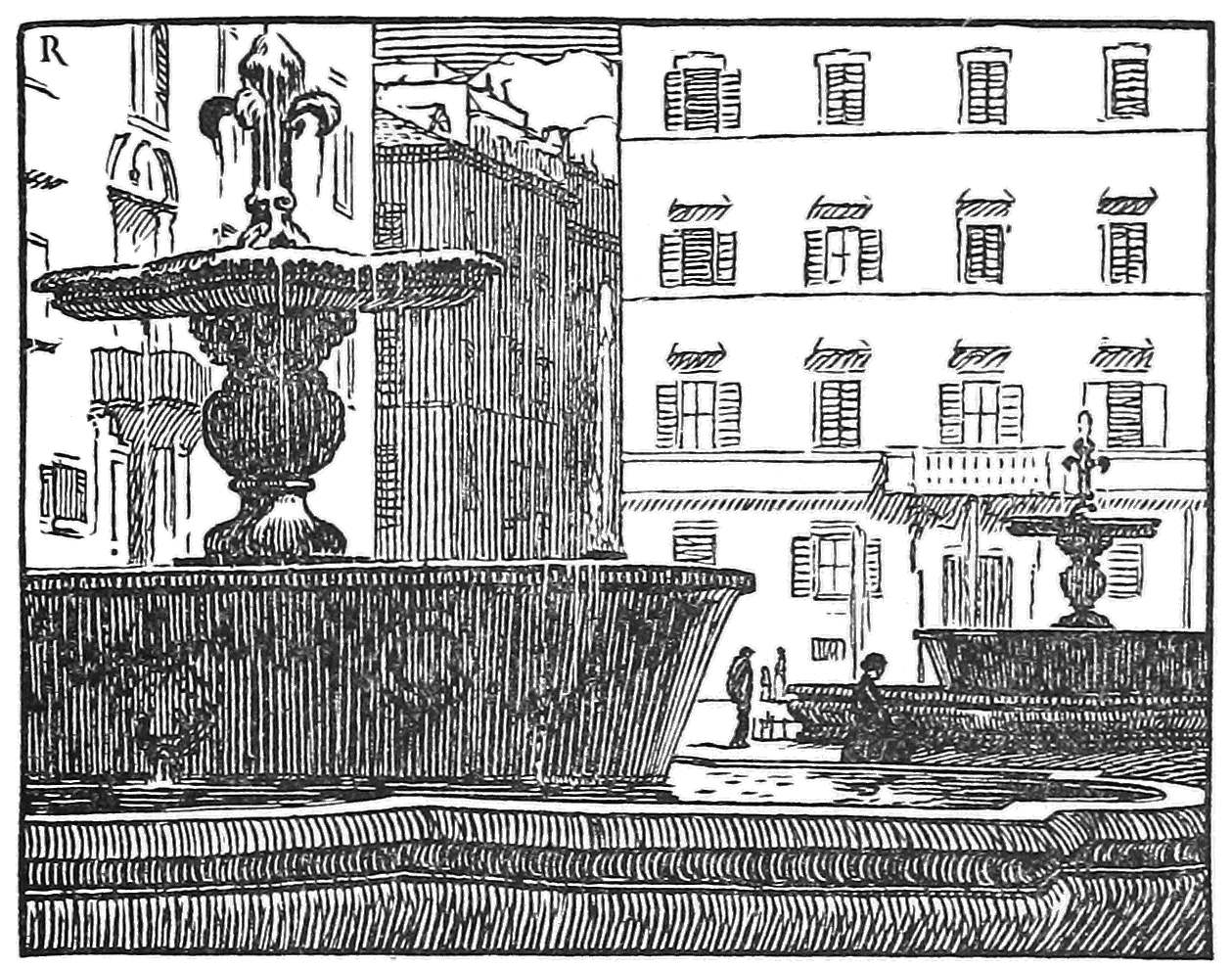
Although the two fountains in the Square of St. Peter’s
are exactly alike they are not of precisely the same
date. The conception of the design belongs to Carlo
Maderno, who executed the fountain on the right of
the approach to the basilica for Pope Paul V (Borghese,
1605–1621), while the fountain to the left was copied
from this for Pope Clement X (Altieri, 1670–1676),
some sixty years later. Clement’s courtiers had observed
that whenever His Holiness walked in the direction
of Paul V’s great fountain his eyes continually
turned toward it. At length Clement ordered his architect,
Carlo Fontana, nephew of Carlo Maderno, to
make an exact copy of Maderno’s work and to erect
it on the south side of the obelisk. The double fountain
not only enhances the magnificence of the entire scene,
but so changes it by introducing the additional element
of balance that Clement X’s order for the second fountain
was in reality an order for a new composition. The
coat of arms cut upon the octagonal support of the
upper basins and half hidden and obliterated by the
falling water is, on the right-hand fountain, that of the
Borghese family (the crowned eagle above the dragon);
and on the left-hand fountain, that of the Altieri family,
an inverted pyramid of six stars. The latter fountain
looks as if it were the older, for, as it is situated in
the southeast corner of the wide piazza, it is exposed to
the full sweep of the Tramontana, or north wind, which
has fretted and worn in no small degree the surface of
the travertine. It may have been the more sheltered
position of the northeast corner which determined the
location of Paul V’s fountain, the earlier of the two.
In the spring the Altieri fountain is the more beautiful
because at that time that portion of the Colonnade
which forms its background reveals vistas of foliage,
while the moss web woven about the crown of the shaft
is of a more brilliant green and the lower basin is full of
the same aquatic growth swaying with the motion of
the water.
The Acqua Paola, which feeds these fountains, comes,
in the last instance, from the summit of the Janiculum,
and therefore their central jets are flung upward to a
height of sixty-four feet, far above the balustrade
crowning Bernini’s lofty colonnades, which form the
background of the piazza. This height exceeds by
from twenty-four to thirty-four feet the height of
the English and French fountains; and whereas in
the fountains of London and Paris the supply and
force of the water varies with the season of the year
and the time of day (the Trafalgar Square fountains
in summer play thirteen hours out of the twenty-four
and in winter only seven), the abundance and
power of the water in these great Roman fountains
is unfailing and unchanging. At midnight, at high
noon, in summer, in winter, they are always flowing,
and the splash and wash of the water makes them akin
to the cascades of Nature.
This perpetual flow has been a characteristic of the
Roman fountains since the days of the Emperors.
Frontinus, writing in the reign of Trajan, says that all
the great fountains were constructed with two receiving-tanks,
each from a separate aqueduct, so that no
accident or emergency should diminish or stop the
supply of water. The later popes were also careful to
preserve this uninterrupted flow, and since the close of
the Cinque Cento their fountains have played unceasingly.
The lowest basins of both fountains (twenty-six
feet in diameter) are of travertine with a rim of Carrara
marble. The middle basins (fifteen feet in diameter) are
of granite. That in the right-hand fountain is of red
Oriental granite, and that in the left-hand fountain of
gray granite. The inverted basins at the summit, on
which the water falls, are of travertine, as are also the
massive shafts, which, however, Maderno adorned
with a slight moulding of Carrara marble just above
the water-line in the lowest basins. The entire structures
have been so transformed in color by three hundred
years’ deposit of the Acqua Paola that they have
the appearance of bronze. The water in each fountain
rises in a crowded mass of separate jets from the summit
of the central and single shaft, and falls at first on
an inverted basin covered by deep carving, the richness
of which gains in beauty from the green web woven
about its curves and angles by the fall of the water.
This upper carving seems to be a part of the fantastic
action of the wind-tossed spray. The lower basins which
receive the water are severely plain, the design following
Nature’s scheme of development, from a fretted
and turbulent source to the broad surfaces of the full
stream. But the architectural values of these fountains
are incalculably affected by the wonderful play of the
water. It leaps upward as if to meet the sun; it falls
back in tumult and foam; it drenches all about with
its far-flung spray and wasteful overflow. It is the very
triumph of vitality and joy.
The fountains of St. Peter’s might be said to bear toward
the vast piazza of which they are a part the same
relation as that of the eye to the human countenance:
without them the noble spaces would seem cold and inanimate.
This gleaming, tossing water endlessly at play
with the wind and the sun, instinct with a power and a
beauty not of man’s making—this it is which gives to
the world-famous scene the touch of life.
Pope Paul V has not only the honor of having erected
the first of these two modern fountains, but he has also
that of having himself discovered the original manuscript
of a poem in which mention is made of the first
fountain connected with the Church of St. Peter. This
poem dates from the fourth century and was written by
Pope Damasus (366–384). This pontiff was, like the
Emperor Hadrian, a Spaniard; and, like Hadrian, he
was not only a ruler of men, but gifted with many and
varied talents. He was an archæologist, a civil engineer,
theologian, and poet. He presided over that Ecumenical
Council by which the second great heresy threatening
the church was condemned, as the first had been
at the Council of Nicæa.
St. Jerome, after years of friendship, became secretary
to the then care-worn and ailing pontiff, among
whose many labors had been the restoration of the
Catacomb of St. Calixtus, and other tombs of the early
Christians and martyrs, some of which he marked with
metrical inscriptions of his own composition. It must
have been while engaged upon this pious work of reconstruction
in the Vatican Hill that he came upon
those springs that, for lack of a proper channel, had
damaged the tombs upon the hillside and were threatening
to undermine his great basilica (the first Church
of St. Peter) within less than fifty years of its erection
by Constantine. He drained the ground in the vicinity,
building a small aqueduct, “neatly in the old Roman
style of masonry,” to lead these unshepherded waters
to definite localities where they could be a benefit and
not a danger to their surroundings. The water thus collected
is called the Acqua Damasiana, and to this day
the private apartments of the Pope are supplied from
this source. The feeding springs of this water are located
at Sant’ Antonio, to the west of the church, and
the aqueduct of Pope Damasus lies at a depth of
ninety-eight feet. Pope Damasus himself describes this
in the poem which was discovered in 1607, more than
twelve hundred years later, by Pope Paul V.
Pope Damasus says: “The Hill” (Vatican Hill)
“was abundant in springs, and the water found
its way to the very graves of the saints. Pope
Damasus determined to check the evil. He caused
a large portion of the Vatican Hill to be cut away,
and by excavating channels and boring cuniculi he
drained the springs so as to make the basilica dry
and also to provide it with a steady fountain of
excellent water.” Of this steady fountain there is
no description, and therefore the fountain of Pope
Symmachus (498–514) becomes the first fountain recorded
in the history of St. Peter’s.
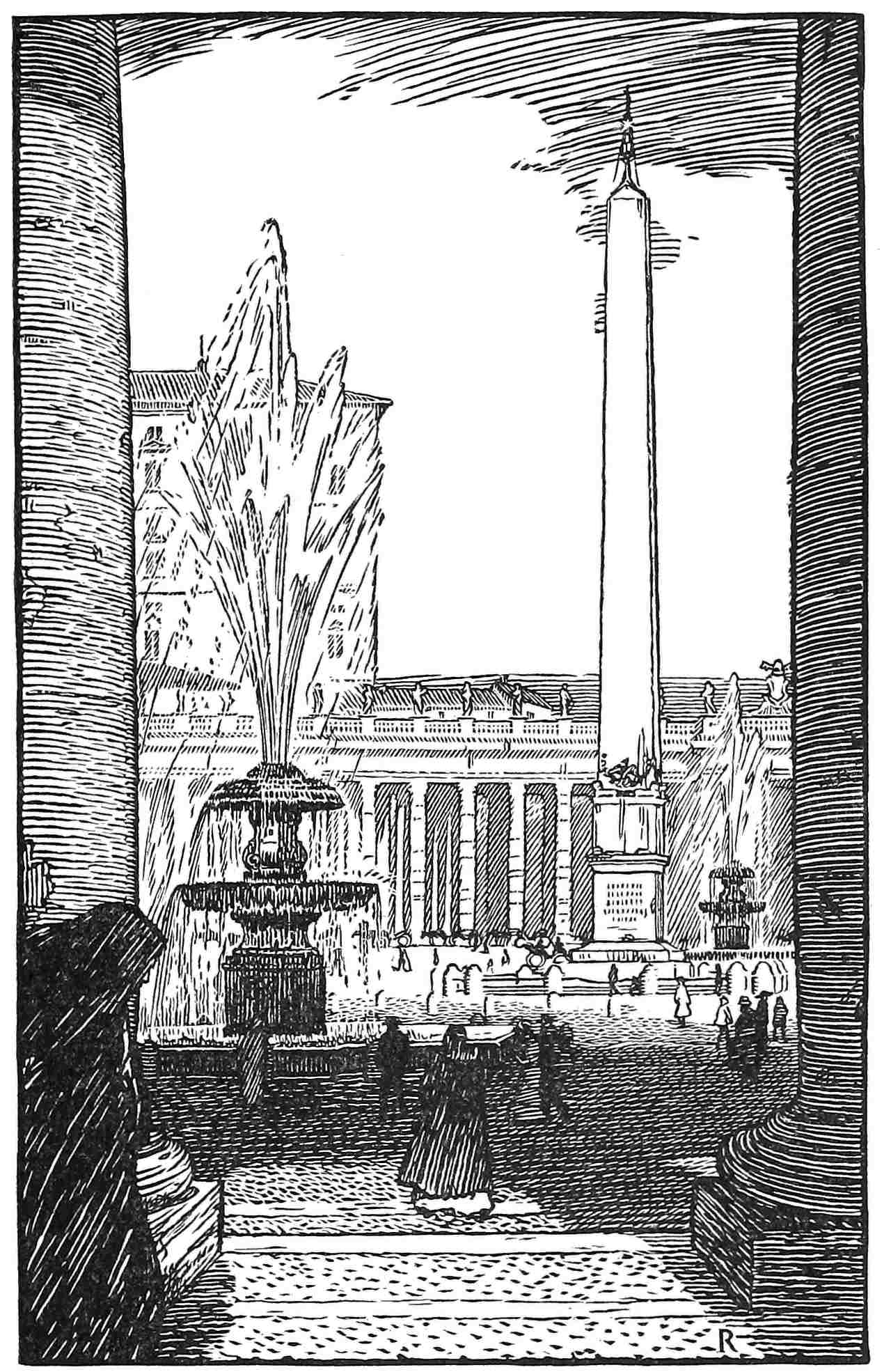
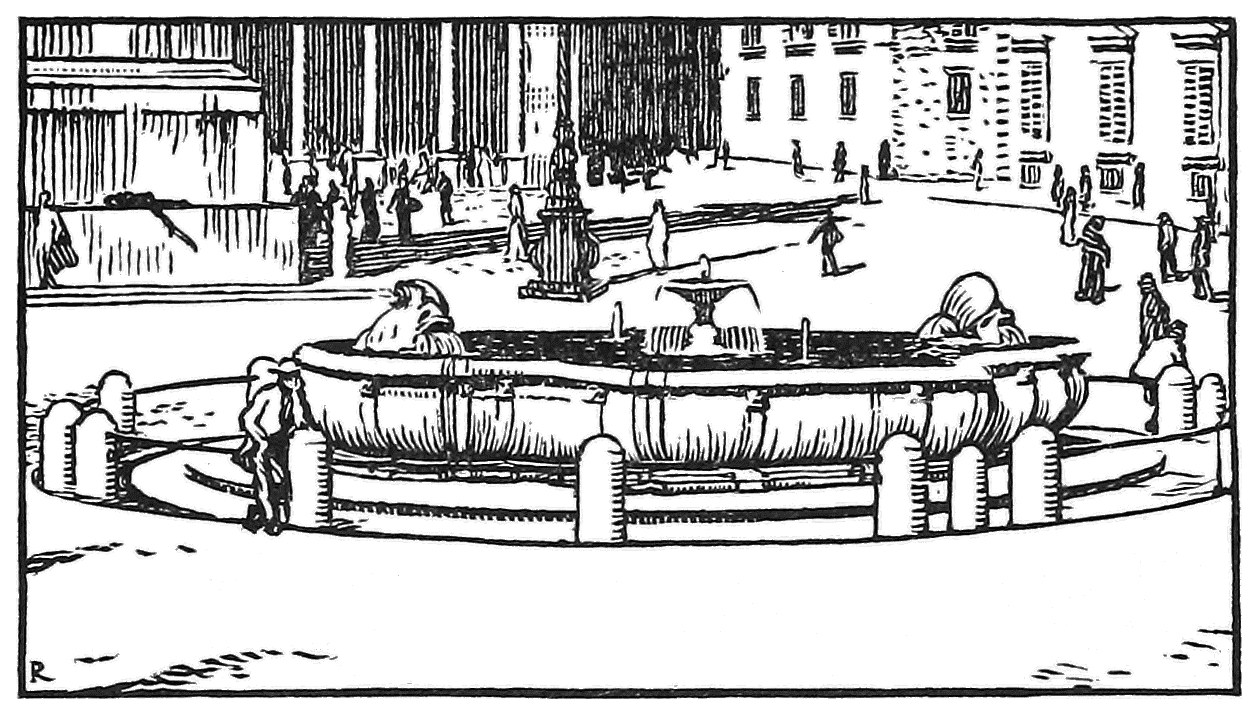
View of fountains and obelisk of
St. Peter’s from beneath Bernini’s Colonnade.
Pope Symmachus was a Corsican. He evidently had
a passion for building every kind of structure connected
with water as a cleanser and as a beautifier of man’s
civic life. His fountain, built at a time when civilization
and art in Rome were at a low ebb, was a
quaint and exquisite structure, composed of a square
tabernacle supported by eight columns of red porphyry
with a dome of gilt bronze. Peacocks, dolphins, and
flowers, also of gilt bronze, were placed on the four
architraves, from which jets of water flowed into the
basin below. The border of the basin was made of ancient
marble bas-reliefs, representing panoplies, griffins,
and other graceful devices. On the top of the
structure were semicircular bronze ornaments worked
“à jour,” that is, in open relief, without background,
and crowned by the monogram of Christ. In the centre
of the tabernacle and under the dome stood a bronze
pine-cone. This fountain stood, not in the Piazza of St.
Peter’s, but in the atrium, or the square portico, which
stood in front and on the right hand of the old basilica.
The history of the construction and destruction of
this beautiful fountain of the dark ages is an excellent
example of the artistic and architectural methods of
those times. Arts and crafts had already sunk to so low
a depth that there were no longer any men in Rome
capable of casting or carving statues like those of
former days, and marble had ceased to be imported
into the city. Consequently all monuments or other
artistic structures were made up of figures in marble or
bronze, panels, columns, friezes, and similar decorations,
stolen from the productions of the great days of
the Empire. The Arch of Constantine, erected in 315,
is composed to such an extent of columns and sculpture
from a Triumphal Arch of Trajan that it was surnamed
“Æsop’s Crow”; and the Column of Phocas
(608), the last triumphal monument to be erected in imperial
Rome, consists of a shaft and capital surmounted
by a bronze figure, all taken from earlier as well as different
structures. Pope Symmachus was only following
the established methods when, to ornament his porphyry
columns (themselves probably part of some
classic temple), he took four of the golden peacocks
which had been originally cast for a decoration to the
railing of the walk surrounding the Tomb of Hadrian,
and, furthermore, placed as the centrepiece a great
pine-cone taken from the Baths of Agrippa. These
pine-cones were a customary feature of the classic
fountain, as the scales of the cone present natural and
graceful outlets for the falling water. Symmachus’s
fountain was one of the beauties of Rome in the days
when the great Gothic King Theodoric ruled and loved
the city. Three hundred years later it captivated the
fancy of Charlemagne, crowned Emperor in St. Peter’s
on Christmas Day, 800; and the fountain afterward
erected before his great cathedral at Aix is ornamented
with a huge pine-cone like the one which he and his
Franks had seen in the exquisite fountain of St.
Peter’s.
Three other fountains were placed before the church
as the years went by. They are described by Pope Celestinus
II (1143–1144), while he was Canon of St.
Peter’s, and are set down in his “Ordo Romanus,” or
Itinerary, or Guide. They were situated, not in the
atrium, where stood the fountain of Symmachus, but
below, in that small square or cortile at the foot of the
steps of St. Peter’s. One fountain was of porphyry and
two of white marble. They would seem to have disappeared
quite early. The fountain of Symmachus was
described in 1190 by Censius Camerarius, afterward
Pope Honorius III, and it stood through more than
eleven centuries of the confused and turbulent history
of the city. It survived the siege and capture of Rome
by Vitiges in 537. It came unscathed through the sack
of the city by the Saracens in 886, and that of the Normans
in 1084; and stranger still, it was not wrecked by
the terrible Lanzknechts of the Constable de Bourbon
in 1527. Only when the ages of violence and pillage
were passed, did this historic fountain of the early
church succumb to a fate similar to that of the Pagan
monuments, out of which it had itself been formed.
When in 1607 the work on the new Church of St. Peter,
which was begun in 1506 at the rear of the old sanctuary
and brought forward through the century, had
reached the atrium, this “gem of the art of the dark
ages” was deliberately demolished by Pope Paul V,
who melted the gilded bronze to make the figure of the
Virgin now surmounting the Column of Santa Maria
Maggiore. Perhaps the metal thus obtained was more
than he needed; possibly some artistic or antiquarian
compunction visited the pontiff—for two of the peacocks
and the great bronze cone were spared. They
found their way to the Vatican Gardens, and now they
stand in the Giardino della Pigna waiting for the next
turn of Fortune’s wheel.
Yet another fountain was once associated with the
basilica of St. Peter. It was erected in the old square
while the fountain of Symmachus still stood in the
atrium to the right of the main entrance to the
church. About the year 1492, Innocent VIII (Giovanni
Battista Cibo) gathered the waters from springs
on the Vatican Hill and from the practically ruined
Aqueduct of Trajan into this fountain, which was
finished by his successor, Alexander VI (Borgia). The
design was greatly admired in its day. It consisted
of golden bulls, from whose mouths the water fell
into a granite basin, and the bull was the emblem of
the Borgia family. During the crowded years of the
famous Cinque Cento, or until the pontificate of
Gregory XIII, this fountain of Innocent VIII, and
the old fountain of Trevi (restored by Sixtus IV)
supplied Rome with what the present day would call
its pure drinking water. They contained the only
water brought into the city from distant springs, for
mediæval Rome had lost all but two of her great
aqueducts, and these were constantly falling into
disuse; and all the pontiffs, painters, poets, and architects,
as well as the populace of that dramatic period
drank the doubtful water of wells and of the Tiber.
This fountain of Innocent VIII was destroyed when
the modern Piazza of St. Peter’s replaced the very
much smaller one of earlier days. Probably the golden
bulls were melted down into other shapes, and the great
red granite basin was used by Carlo Maderno for the
upper basin of the magnificent new fountain which he
designed and executed at that period for Paul V, and
which is the northern one of the two fountains of the
present day in the Piazza of St. Peter’s.
Standing between the fountains of St. Peter’s is an
obelisk, the surpassing interest of whose history adds
not a little to the importance of the fountains themselves,
and indeed of the entire square. It is, according
to Lanciani, undoubtedly the obelisk at the foot of
which St. Peter was crucified. Formerly the place of
his martyrdom was located on the Janiculum Hill, on
the spot where San Pietro in Montorio was built by
Ferdinand of Aragon and Isabella of Castile to commemorate
the event. Lately this location of the site of
St. Peter’s crucifixion has been discredited, but it is
easy to see how that mistake occurred.
Caligula had brought the obelisk from Heliopolis
some time during the four short years of his reign and
placed it in the circus he began to build in those gardens
of his mother, the noble Agrippina the elder,
which lay along the northern side of the plain between
the Janiculum and Mons Vaticanus. There it stood on
the centre of the spina, the long, straight line stretching
down the middle of the arena from the two opposite
goals at either end. Caligula was assassinated before
he could finish the circus and it was completed
some thirteen years later by Nero, under whom it became
the scene of those atrocities against the Christians
which have rendered his reign infamous. St. Peter
was crucified one year before the death of Nero. His
cross was raised on the spina of the circus at an exact
distance between the two goals—metas—built at either
end of the amphitheatre, and therefore, at the foot of
the obelisk which stood on that spot.
Christian tradition handed down the description of
the place “between the two goals” (inter duas metas).
Now meta was a name afterward given to tombs of
pyramidal shape, two of which existed in mediæval
Rome—one, that of Caius Cestius, still standing next
to the present Protestant Cemetery, and the other in
the Borgo Vecchio, destroyed later by Alexander VI.
A straight line drawn from one of these tombs to the
other has its centre in a point on the Janiculum, and
therefore this spot was thought to be the exact location
of St. Peter’s martyrdom. Even to-day visitors to
the exquisite Tempietto of Bramante, erected in the
cloister of the Church of San Pietro in Montorio, are
shown below its pavement the very stone in which the
cross of St. Peter was fixed. The legend of this location
for the crucifixion of St. Peter grew up during the Middle
Ages, a period in which all knowledge of the authentic
site was entirely lost. Modern archæology has
recently succeeded in locating this position and its
topography can now be easily understood.
When the Emperor Constantine, after his conversion
to Christianity, determined to build a basilica in honor
of St. Peter, he planned to erect the edifice so that its
centre should rise directly over the tomb of St. Peter,
who, according to historical documents, was buried not
far from the scene of his martyrdom. To do this, he
found himself obliged to build so near the Circus of
Caligula and Nero that the southern wall of his edifice
corresponded exactly to the northern wall of the Circus.
He therefore used this wall of the Circus as the
southern foundation wall of his church. This naturally
brought the southern side of the old St. Peter’s within
a very short distance of the spina of the Circus, on
which stood the obelisk, with a chapel before it called
the Chapel of the Crucifixion. The Chapel disappeared
seven or eight centuries ago, but not before its true
significance had been quite forgotten, and men supposed
the name to refer not to the crucifixion of St.
Peter but to the Crucifixion of Our Lord. An old engraving
by Bonanni, antedating the reign of Sixtus V,
shows the old Church of St. Peter on its southern
side, with the obelisk, still tipped by its Pagan ball,
standing in close proximity. When the plan for the new
Church of St. Peter was accepted it was seen that the
southern side of the great edifice would extend so far
beyond the limits of the original church that it must
entirely cover the spot on which the obelisk was standing;
and as the connection of the obelisk with the martyrdom
of St. Peter had long since been forgotten, Pope Sixtus V
conceived the idea of moving the obelisk to a
more conspicuous and important position.
Thus it came about that the obelisk now forms the
central feature in the piazza before the Cathedral of
Christendom; while the place of St. Peter’s crucifixion,
that site of transcendent interest to all Christians, remains
unidentified, buried beneath the masses of masonry
composing the Baptistery on the southern side of
the vast structure which bears St. Peter’s name.
SCOSSA CAVALLI
SCOSSA CAVALLI
This work of Carlo Maderno belongs to that group of
fountains which owe their origin to the introduction
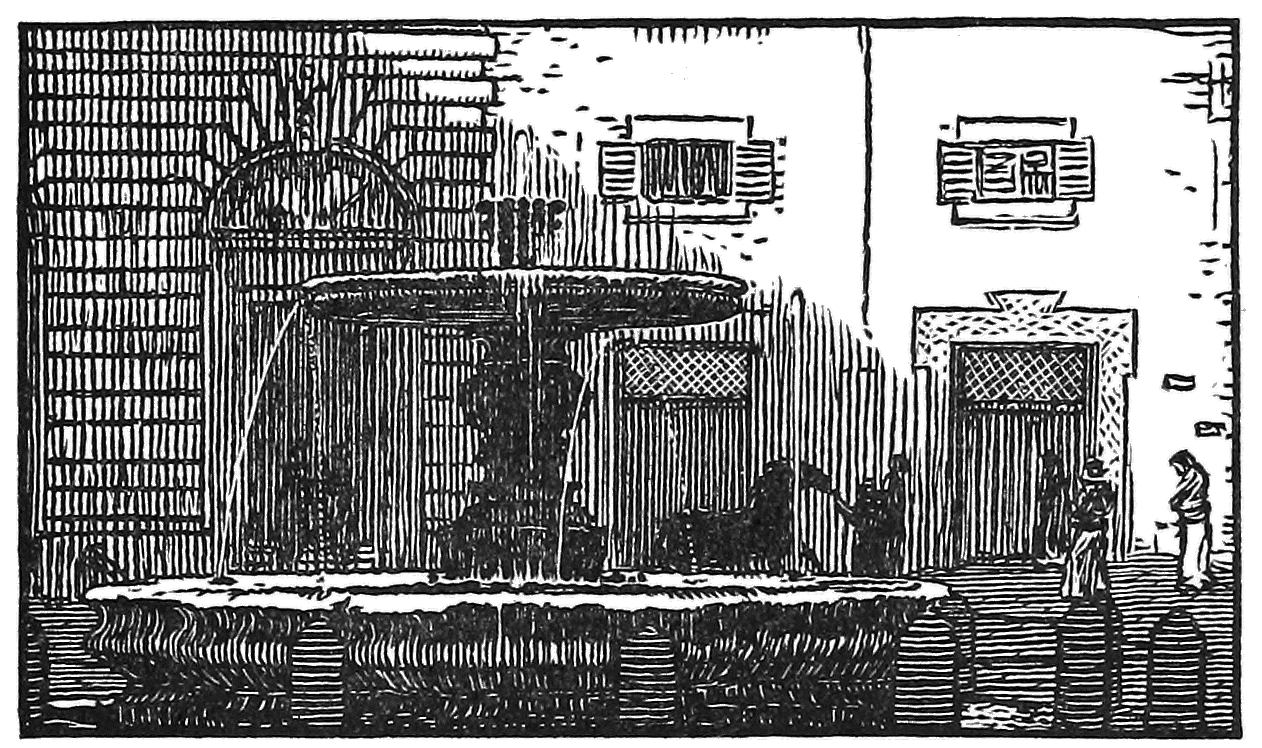
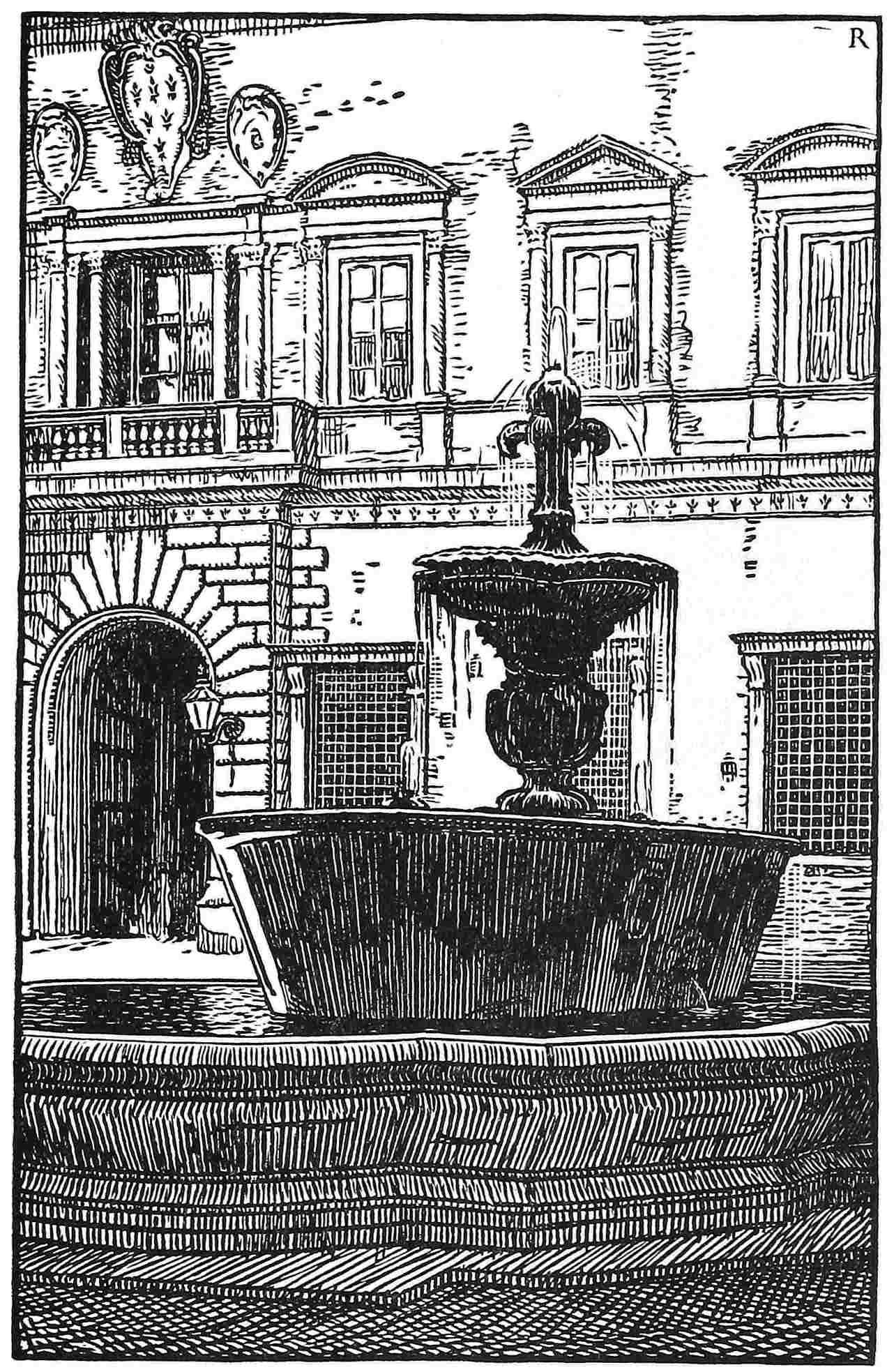
into Rome of the Acqua Paola. The lower basin stands
about three feet above the level of the pavement. It is
oblong in shape, the oval broken at both ends by graceful
variations in the curve. The secondary basin is
much smaller, round and quite shallow. From its centre
rises a richly carved cup much resembling a Corinthian
capital, this cup being the apex of the central
shaft, upon which rests the second basin, and the main
stream of water spouts upward from its leaflike convolutions.
The proportions of the fountain are excellent.
It is neither too low nor too high, and the lower
basin is large enough to catch and retain the water
which pours over the rim of the upper basin, so that it
does not wash over as does the water in Maderno’s
much more magnificent fountain in the Square of St.
Peter’s. The central shaft of the Scossa Cavalli fountain
has a Doric massiveness which gives a background
of strength to the whole design and makes all the more
delicate the play of the four slender jets of water, about
five feet in height, which, rising at equal intervals from
the lower basin, form an arch around the upper basin
into whose shallow water they fling their spray. The
crowned eagle and griffin of the Borghese are still to be
discerned on the half-obliterated carving of the central
shaft. The kind of travertine out of which this fountain
is made is so susceptible to erosion, and has become so
blackened by the deposit of the water, that the whole
structure appears far older than it is. In reality it has
stood here little more than three hundred years, as the
Acqua Paola was not brought to Rome until the time
of Pope Paul V. This splendor-loving pontiff determined,
on his accession in 1605, to emulate and, if
possible, surpass Pope Sixtus V, whose brilliant pontificate
antedated his own by less than a score of years.
Sixtus V had built the first great aqueduct of modern
Rome. Paul V determined to build the second. Sixtus
V had christened after himself the water which he had
brought to Rome, and Paul V gave his name to the
stream which, partly by using the all but ruined Aqueduct
of Trajan, he had brought from Bracciano and
its hills. Domenico Fontana had built for Sixtus V, as
the chief outlet for the Acqua Felice, the fine Fountain
of the Moses on the Viminal Hill. Giovanni Fontana,
brother of Domenico, should design for the Acqua
Paola on the opposite slope of the Janiculum a yet more
glorious fountain which should dispense five times the
amount of water given out by the fountain of Sixtus V.
All this was done, and from the heights of the Janiculum
the great stream descended in various channels,
and was widely spread over the Trastevere or that portion
of the city lying on the western side of the Tiber.
One channel found another fine outlet in the fountain
which Carlo Maderno, nephew of Fontana, also built
for Paul V on the northern side of the Square of St.
Peter’s. From thence the water was conducted down
the Via Alessandrina (now the Borgo Nuovo) to this
small piazza of the Scossa Cavalli where Maderno constructed
for it this second and very properly less splendid
fountain. Thus it will be seen that the water as
well as the architectural part of this fountain belongs
to the beginning of the seventeenth century; but the
interest attaching to the buildings surrounding the
square in which it stands dates back farther than
that, dates back in fact to the crowded days of the
High Renaissance, when this prosaic little piazza was
a centre of ardent and vivid life.
The long, plain, yet dignified building to the south,
now called the Ora Penitenzieri, was built by Cardinal
Domenico della Rovere, who was one of the nephews of
Pope Sixtus IV and brother to Pope Julius II, the
friend and patron of Michelangelo. To the west, and
on the corner made by the square and the street of the
Borgo Nuovo, stands the house built by Bramante,
and purchased by Raphael. The atelier of the “divine
painter” is the corner room on the second floor.
Against the wall behind those gloomy windows stood
his last picture, “The Transfiguration,” unfinished;
and on a bed placed at the foot of that picture, Raphael
died.
Another death agony is connected with the history
of the square, for in the gardens behind the palace to
the north, now called Palazzo Giraud-Torlonia, was
held that fatal supper where the Borgias, father and
son, fell victims to the poison which they had prepared
for the cardinal who was their host and the owner of
the palace. Even the legends of classic Rome seem
somewhat colorless compared with the memories which
haunt this dull little square. Nothing could be more
prosaic than its present-day appearance. It is truly
“empty, swept, and garnished,” but the devils which
have gone out of it have seldom had their equal; its
memories belong to a more splendid and to a more
shameful past than is the heritage of any other city of
our modern world.
In 1492, when Columbus had discovered the Western
Hemisphere and Copernicus was revolutionizing
the mediæval view of the universe, Rome was still
emerging from the shadow under which she had lain
while the popes resided at Avignon. In 1471 Sixtus IV
began to restore and embellish the city, and with him
the Holy See entered upon that long period of secularization
which reached its acme of infamy, of magnificence,
and of territorial possessions in the respective
pontificates of the Borgia, Medici, and Barberini popes.
Each of these pontiffs left his mark on some particular
quarter of the city; and although in the years following
the times of Alexander VI efforts were made to obliterate
the memory of the Borgias, the Borgo Nuovo remains
forever bound up with their history.
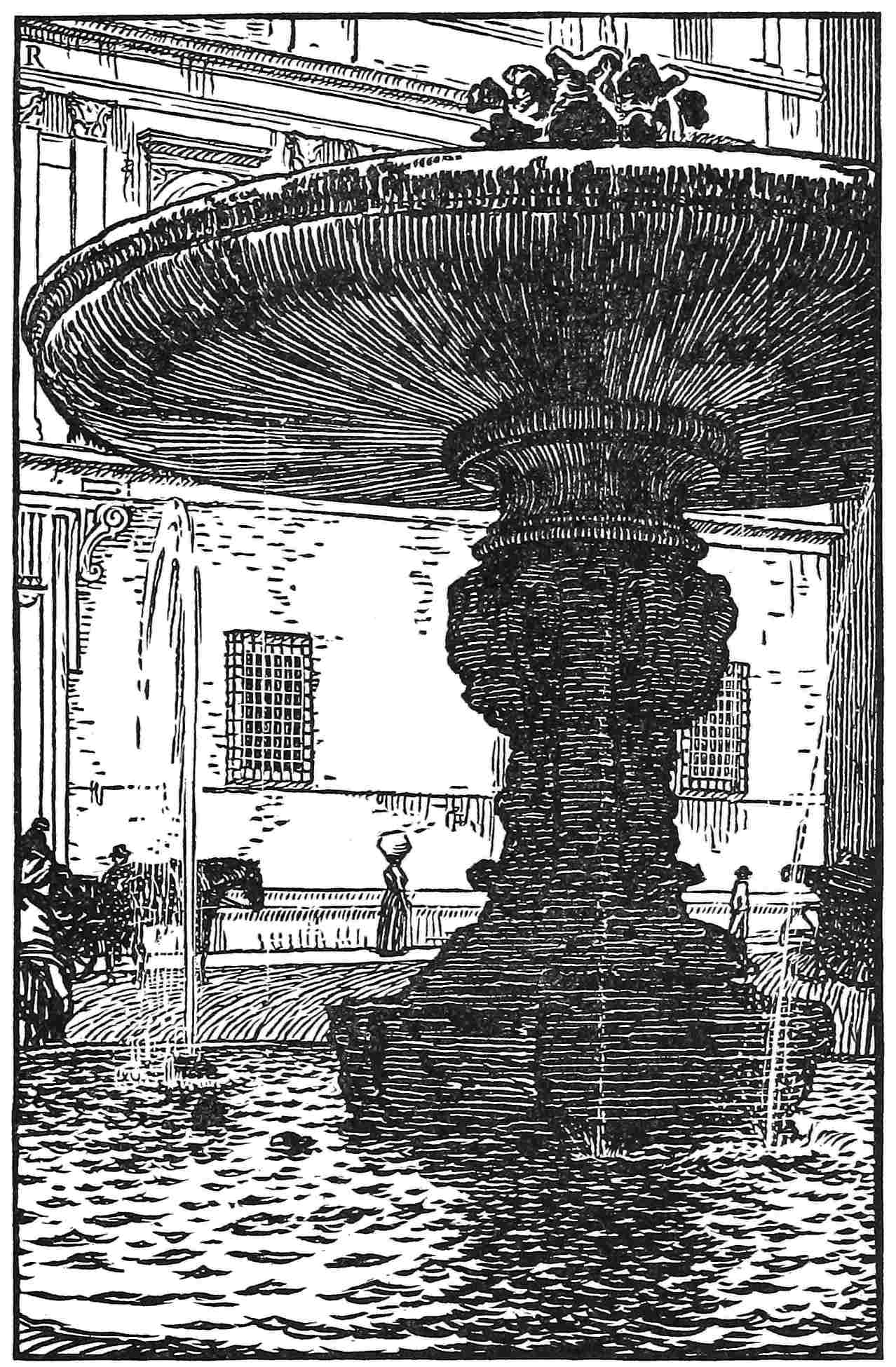
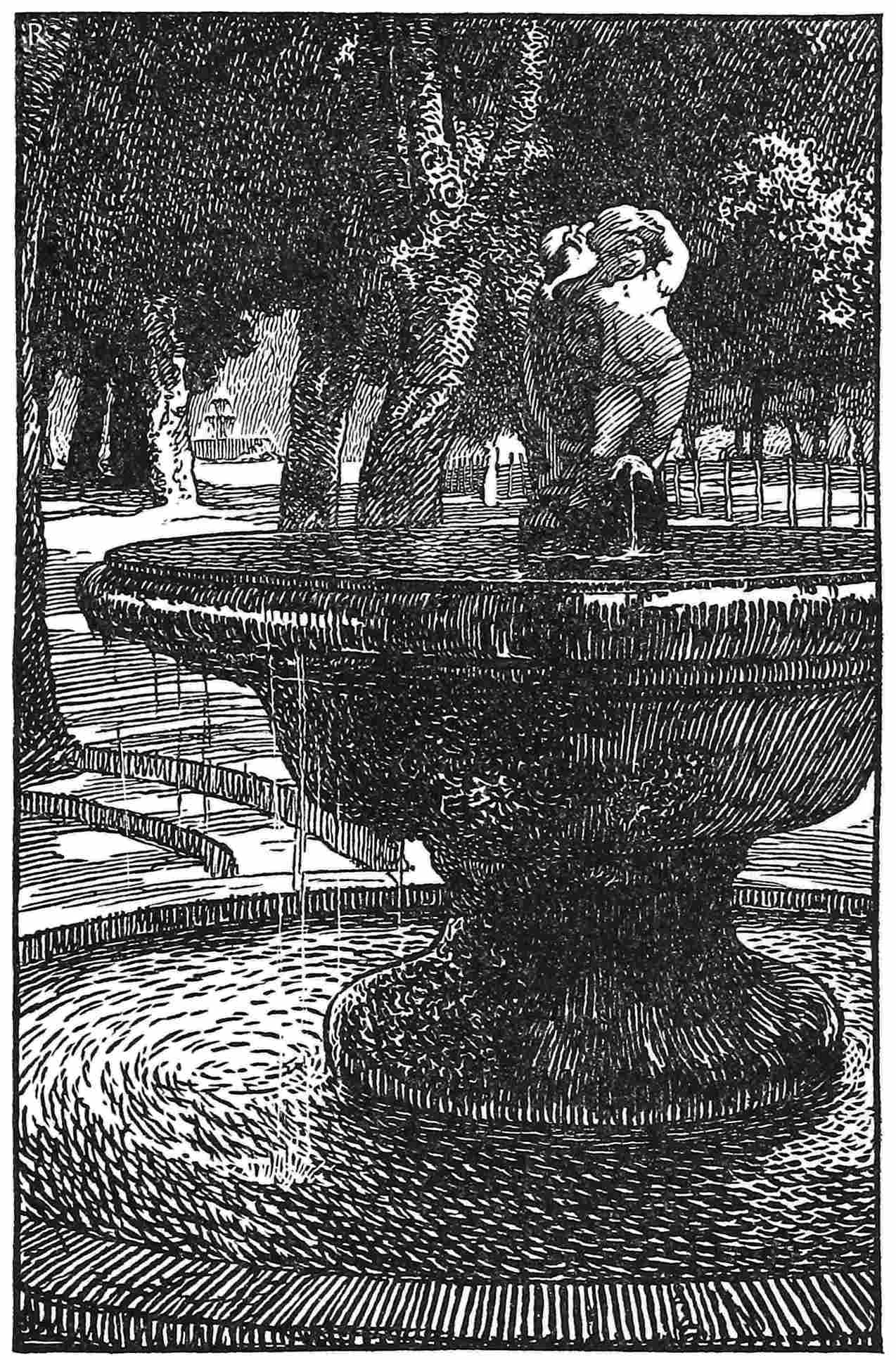
Upper basin of the fountain in the
Piazza Scossa Cavalli.
Throughout the Middle Ages the only thoroughfare
from the Bridge of St. Angelo to the Square of St.
Peter’s was the Borgo Vecchio. It was a narrow and
tortuous street and quite inadequate to the traffic
and processions and pilgrimages which continually
passed between its rows of crowded old houses.
Alexander VI formed the new Borgo by cutting a
street through the orchards, gardens, and slums of this
quarter, and by granting special privileges to the property
owners who, within a specified time would build
on it houses not less than forty feet high. The Pope was
greatly interested in his new street and christened it for
himself, the Via Alessandrina. He was fortunate in having
in Rome at that time Bramante of Urbino, who was
just launched on that career of popular favor which
was only to be surpassed in length of days or in exaggerated
estimation by the career of Bernini a century
later.
A sure way to please the Pope was to employ some
great architect and to erect a noble house upon the new
thoroughfare. Raphael, who was amusing himself with
architecture, is said to have worked with Bramante in
the construction of the palace afterward owned by him,
next door to the palace owned by the Queen of Cyprus,A
and the great room on the piano nobile, the beautiful
wooden ceiling of which had been designed by Bramante,
was a stately studio. The room is now divided
into two apartments; but it is easy in imagination to
sweep away the modern alterations and to see this
most beautiful, gracious, and best-loved of all Italian
artists at work here among his pupils, or receiving
with an exquisite sweetness and modesty the greatest
princes of the Church and State.
Rome was at this period the finest marble quarry in
the world. It was still a century before the time of Sixtus
V and Domenico Fontana; the Farnese had not
yet built their great palace from the spoils of the Baths
of Caracalla and other noble ruins; the last sack of
Rome was still thirty years in the future; and very
little building of any importance had been carried on
through the long period of the popes’ absence in Avignon.
Bramante found the richest marbles ready to his
hand, and he built the façade of the Palazzo Giraud-Torlonia
out of materials taken from the Basilica Giulia
and the Temple of Janus. However, already in
Sixtus IV’s time the rage had begun for the destruction
of old monuments, and in order to build the Via
Alessandrina, the Pope had demolished a Pagan tomb
which had once been a landmark in the Borgo. During
the Middle Ages it was called the Tomb of Romulus,
and Raphael has painted it in his “Vision of
Constantine.” It was of pyramidal form, like the
tomb called the Pyramid of Cestius, which is still
standing near the Protestant Cemetery on the road
to St. Paul’s Beyond the Walls. Doubtless, its massive
blocks went into the construction of the new palaces
surrounding the little square, which now took the
place of the old tomb as the central point in that
quarter of the city. In this square the two chief palaces
are connected with two of the greatest of the Pope’s
cardinals, each of whom had found it to his advantage
to hold a post in foreign lands.
The fiery and forceful Giulio della Rovere, who gave
his name to the palace built by his brother Domenico
and now known as the Penitenzieri, had been the chief
rival of Rodrigo Borgia in the papal election of 1492,
and, thereafter, the open enemy of Alexander VI. It is
possible he might never have become that Pope’s successor
had he not put himself under the protection of
Charles VIII of France. On the other hand, Cardinal
Adriano Corneto, who built the palace now the Giraud-Torlonia,
stood high in the Pope’s good graces. Alexander
made him collector of the papal revenues in England,
where he was already known as the papal peacemaker
between Henry VII and the ill-starred James IV
of Scotland. There he made a valuable friend in no less
a personage than King Henry VII himself. The Tudor
King was not lavish of his money, but, for some reason,
he gave large sums to Cardinal Corneto as a personal
gift.
England proved a safe and agreeable asylum for the
accomplished cardinal, and when he was finally recalled
he must have returned to Rome with some misgivings.
He found the Curia, as well as the city, living under
that spell of terror which the Borgias, father and son,
had woven about them. Strange stories, horrible suspicions,
and mysterious crimes were the order of the
day; and the cardinal, returning from his bishopric
of Bath and Wells and the frankness and simplicity of
the English court, must have found the change little
to his liking. Very probably it was to secure the Pope’s
friendship that he engaged the services of Bramante
and began to build a magnificent palace on the Pope’s
new thoroughfare. But while Alexander VI loved splendor,
he also coveted money. The new palace was slow
in building, and before it was completed, the Pope
could see that all the gold which the cardinal had collected
in England had not gone into the papal coffers.
In short, he comprehended the fact that his Cardinal
Adriano Corneto was a very rich man; and in the
summer of 1503 he sent him a message that His Holiness
and the Duke of Valentino (Cesare Borgia) would
honor him by taking supper with him on the night of
August 12. It is easy to understand the consternation
with which the message was received, the look of frozen
horror on the cardinal’s face as he already saw himself
dying in sudden convulsions or fading slowly away
with a fatal and mysterious malady. No time was to
be lost, and a large share of the cardinal’s English
gold bought over the Pope’s majordomo to his side.
Possibly some of the deadly work had already begun
before the bargain was struck. Possibly the majordomo
thought it best to appear to have obeyed the Pope’s
orders, even at the risk of a little torture to the cardinal,
for although Cardinal Corneto survived that fatal
supper, it was said that the skin fell from him in strips.
The Pope died within ten days, the monstrous appearance
of the corpse terrifying all who beheld it. Only
Cesare Borgia’s almost superhuman vitality saved him
from a like fate.
Years after, when he had been shut out forever from
Rome, Cesare told his friend and admirer Machiavelli
that the results of this supper in the gardens of the cardinal’s
palace had frustrated all his plans. Cesare had
fully determined that his father’s successor should not
humiliate and despoil him as his father had despoiled
and humiliated the nephews of his predecessor, Pope
Sixtus IV. He had made every arrangement to make
himself master of Rome as soon as his father should
die. He had, so he told the author of “Il Principe,”
foreseen and provided for every possible difficulty. The
one thing he had not been able to foresee was that he
himself should be too ill to leave his bed.
The Borgias passed away from Rome. Cardinal della
Rovere was made Pope, and men set about to obliterate
all memories of that brood whose crimes had made
Rome a stench in the nostrils of Christendom. Gradually,
but effectively, the work was accomplished. Alexander
VI’s tomb was built without any monument.
The Fountain of the Gilded Bulls, the emblem of the
Borgias, which stood before St. Peter’s was destroyed.
The Borgia apartments in the Vatican were walled
up, and remained so for centuries. The nude figure
of the beautiful Giulia Farnese on the tomb of her
brother Pope Paul III in St. Peter’s was covered
with painted metal draperies. Even the Via Alessandrina
became the Borgo Nuovo.
Cardinal Adriano Corneto lived through the pontificate
of Pope Julius II and into that of Pope
Leo X; but the fame of his riches did at last work
his undoing. Leo X, who needed money as much as
Alexander VI, insisted that the cardinal was privy to a
conspiracy against his life. Corneto was deprived of
his cardinalate, even degraded from the priesthood,
and was obliged to make his escape from Rome. He
died in obscurity, leaving his beautiful palace, still
unfinished, to his benefactor King Henry VII, who
made it the residence of the English ambassador.
A century later, when Maderno built the fountain
of the Scossa Cavalli for Pope Paul V, Cardinal Corneto’s
palace had again passed into the hands of the
Romans, where it has remained. The Reformation had
swept over England, and there was no longer an English
ambassador to the Papal See.
PIAZZA PIA
PIAZZA PIA
No one can walk the Roman streets without perceiving,
and almost at once, that here time is of no importance.
It is, in fact, an absolutely negligible quantity.
Buildings and monuments dating from widely diverse
periods stand side by side, and it is in no wise incongruous
from the Roman standpoint to find at the head
of the Borgo (the ancient Leonine city) one of the very
latest fountains of papal Rome. It is a charming little
creation, quite consciously harking back to the great
days of the papacy and rebuking by its sober, yet imaginative
sculpture those geometrical designs or extravagant
ebullitions of fancy—the fountains of the present
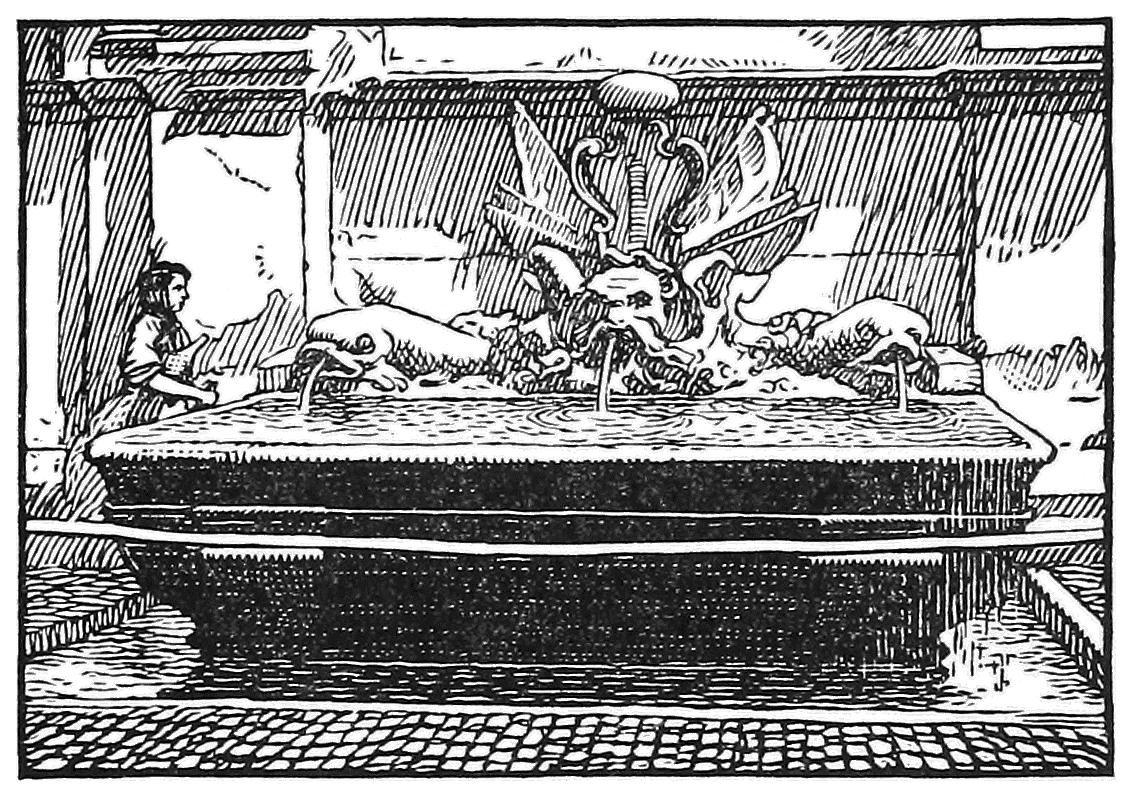
régime. It stands in the Piazza Pia, against that
narrow façade which blunts the point of the long angle
or wedge-shaped block of buildings lying between the
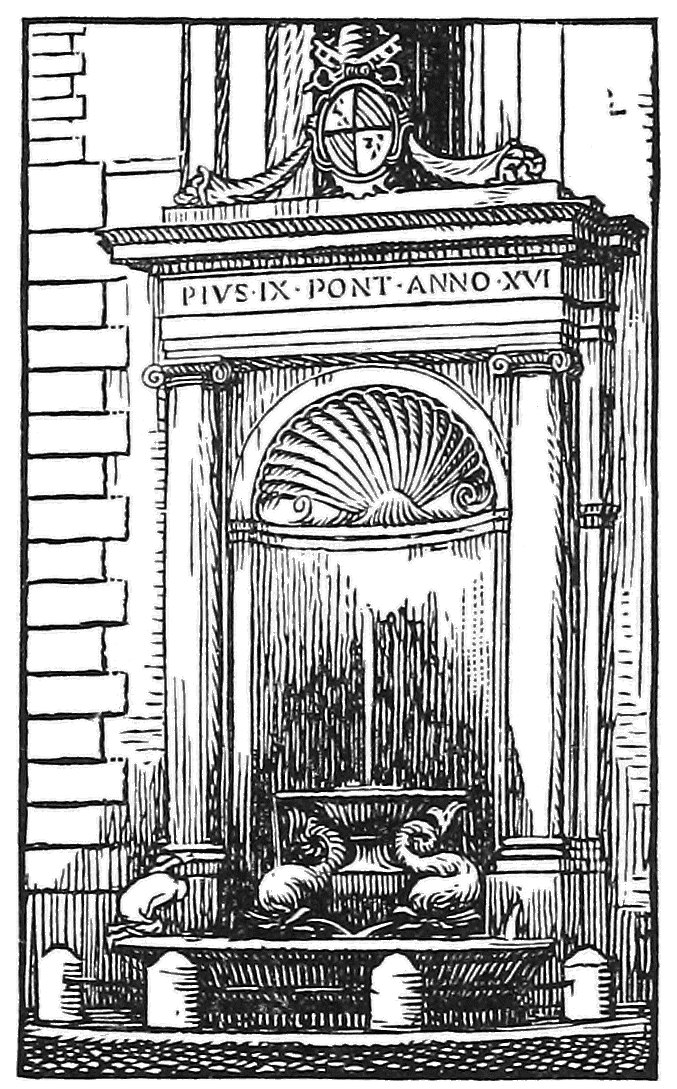
Borgo Vecchio and the Borgo Nuovo. Its Fontanesque
mostra is composed of two beautiful white Carrara columns
with Corinthian capitals supporting a pediment
and entablature on which is an inscription to the effect
that the fountain was erected by Pius IX in the sixteenth
year of his pontificate, which would make it the
year 1862. The sculptural part of the fountain bears a
certain resemblance to the work of Luigi Amici and
Bitta Zappalà, the artists who not many years later
executed the modern figures in the side fountains of
the Piazza Navona.
The Piazza Pia fountain might also be ascribed to
Tenerani, a distinguished sculptor of Pius IX’s pontificate,
who, in his devotion to the Pope, did not disdain
to design some of the triumphal devices with
which Rome welcomed back Pio Nono after Gaeta.
But Tenerani’s bust is among the “Silent Company
of the Pincio,” and if the little fountain were
indeed his work, the fact would be known. As it
is, the sculptor’s name seems, for the present, at
least, to have been forgotten in the confusion attendant
upon the transformation of papal into Italian
Rome.
The fountain originally held Paola water, and the
charming little vase and dolphins composed of white
Carrara have become through the deposits of this water
so black that the beauty of the fountain is distinctly
marred. This fountain takes the place of an earlier one
executed by Carlo Maderno and called the Mask of the
Borgo. The design was a large mask from which water
flowed into a pilgrim shell over which perched the
Borghese eagle, while two lions’ heads on either side
spouted additional streams. As this first fountain was
in travertine it had in all probability succumbed to the
disastrous effects of the Paola water, which seems to
disintegrate as well as to discolor some varieties of that
stone.
There is in the Piazza Mastai another fountain
erected by Pius IX. And he also instituted several
washing troughs in the Trastevere among the poor,
for whom he had always a sincere and profound sympathy.
Those who would render justice to this last
“Papa Re” should drive up the magnificent approach
to the Quirinal Palace. This modern driveway and masonry
were erected, as can be seen from the tablet on
the sustaining wall of the terrace, for Pius IX by his
great architect and engineer Virginio Vespignani. They
give the finishing touch of magnificence to the Piazza
of the Quirinal, originally laid out on its present grade
and in its fine proportions by Domenico Fontana for
Sixtus V (some two hundred and eighty years earlier).
This approach to the Quirinal and the great buttress
walls of the Coliseum might easily be enough to prove
Pius IX’s care for the city; but, as with those of his
predecessors who had the welfare of their people most
at heart, his chief claim upon the memory of the Romans
lies in the interest which he took in the city’s
water supply. Pius IX gave his permission to an English
company to introduce into Rome the rediscovered
springs of the Marcian water. These springs had been
first brought to Rome by the Marcian aqueduct in the
years 144–140 B. C. This aqueduct was the first of the
true high-level aqueducts, and covered its path of
fifty-eight miles on great arches which brought it to
Rome at the Porta Maggiore one hundred and ninety-five
feet above sea-level. The two aqueducts which antedated
it—the Appian and the Anio Vetus—ran most
of the distance underground, the Anio Vetus appearing
above ground for only eleven hundred feet, while the
Appian (the first of all the Roman aqueducts) was carried
overground on low arches for three hundred feet,
and actually entered the city fifty feet below the surface
of the earth. The springs of the Marcia are now
called the Second and Third Serena and are situated in
the Valley of the Anio above Tivoli, on the north side
of the stream, near Agosta. The original Marcian aqueduct
had been destroyed by Fontana when he was
collecting material to build the Acquedotto Felice. A
portion, however, of the ancient masonry remains, and
although to-day the Marcian water comes to Rome
chiefly through modern iron pipes, some parts of its
passage lead through the old stone channels. The water
now enters Rome through the Porta Pia at an altitude
of two hundred feet; thus it ranks next to the Paola,
which is two hundred and three feet above the sea-level.
The Marcia ranks next to the Virgo in abundance,
and at present supplies most of the dwelling
houses in Rome. Its history is embodied in its full
name, Acqua Marcia Pia.
Pius IX made his last public appearance as sovereign
pontiff when this water was introduced into
Rome. This occurred on September 18, 1870, just two
days before the famous “Venti Settembre,” when
the Italian troops entered Rome through a breach in the
Porta Pia. The fountain which was destined to be the
last fountain of papal Rome stood in the Piazza delle
Terme,—not where the present one stands, but off to
one side, for the city was still papal Rome and the great
Villa Negroni (formerly Montalto) of Pope Sixtus V
then covered the site now occupied by the present railway
station. Within the gardens of that villa many of
the original Acqua Felice fountains were still flowing,
and one latter-day inhabitant of the villa tells how, as
a child, she often looked down at night from her nursery
windows upon an old fountain about which stood a
circle of little Campagna foxes drinking from its cypress-guarded
waters. The Pope drove to the inauguration
of his Marcia Pia amid a vast concourse of people
who strewed flowers and shouted: “King, King!”
There were, however, few distinguished people at the
ceremony. He drank a cup of the water, praised its purity
and freshness and thanked the magistrates for giving
it his name. It was the last public act of his sovereign
pontificate, and derives both significance and
dignity from that long list of popes who, since the time
of Hadrian I had constituted themselves guardians
and builders of Roman aqueducts.
The fountain which Pius IX thus inaugurated has
been swept away to make room for the present bronze
affair. But the Acqua Marcia Pia now flows in the
Pope’s pretty fountain of Piazza Pia, so that here in
the Borgo, the ancient “Porch of St. Peter’s,” we find
the last water and, with the exception of the fountain
in the Piazza Mastai, the last fountain, of papal Rome.
CAMPIDOGLIO — MARFORIO — THE LION
CAMPIDOGLIO
The three fountains of the Campidoglio have one
fundamental characteristic in common—that of being
a part of Rome from a period of great antiquity. Like
those families who “were there when the Conqueror
came,” the sculptures which adorn these fountains
have been in Rome since Christian Rome began. All
the statues have occupied their present positions a
comparatively short time, and have passed through
many vicissitudes before reaching the places they now
hold. In fact, each fountain of the Campidoglio is a
fountain with a past. The sculptural part of each is a
survival of some artistic design or idea antedating to
a remote period the time of its conversion into the
fountain of to-day.
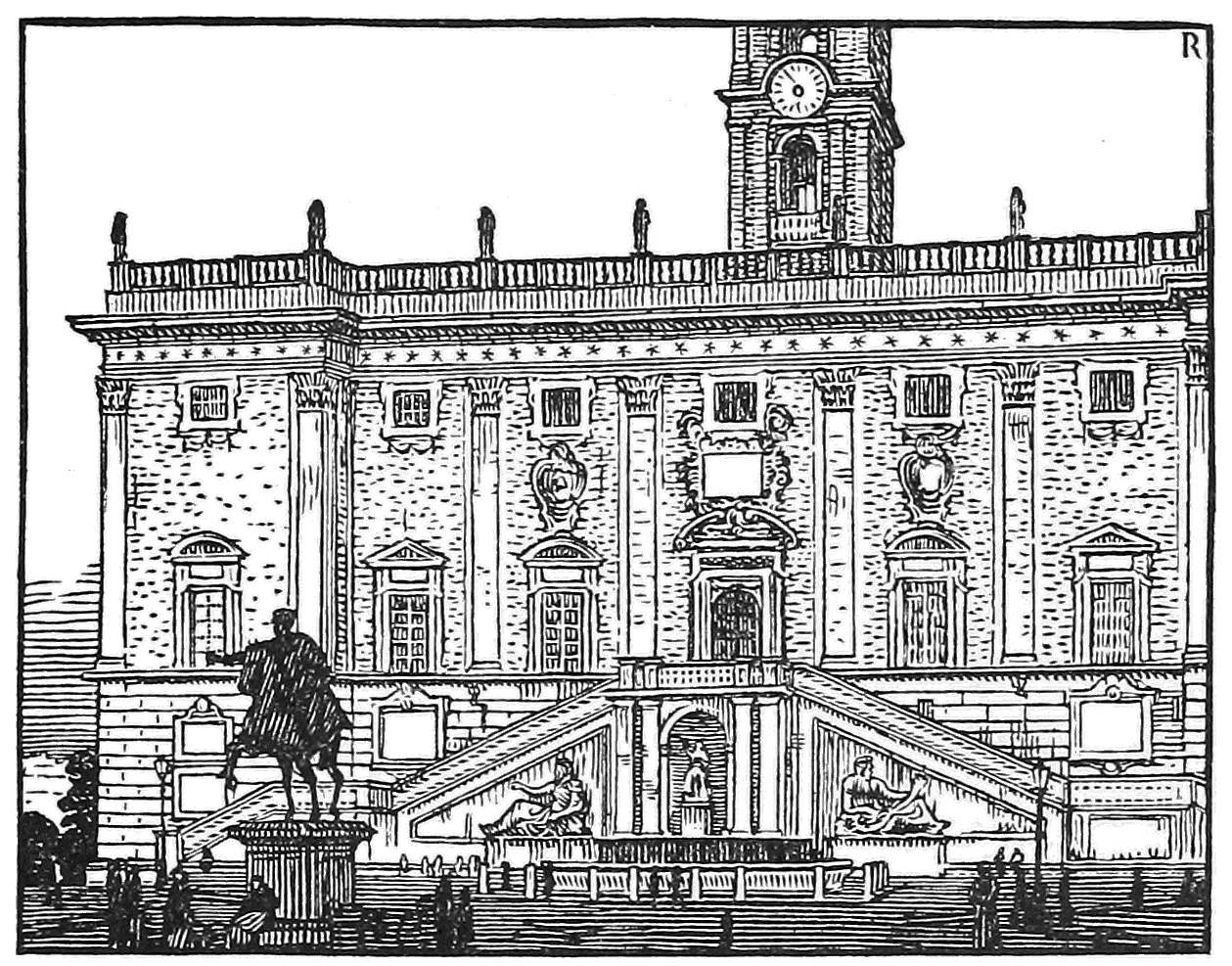
The general view of the Campidoglio comprises the
stairway called “La Cordonata,” the piazza at its summit
crowned by the Palace of the Senators, with the
Museum of the Capitol to the left and the Palace of
the Conservatori on the right; and it is so impressive
in its architectural majesty that the fountain which is
a part of it all keeps its true place in the great composition,
and is recognized only as a note in the general
harmony of proportion, design, and decoration. This
is, of course, as it should be—as Michelangelo meant it
to be when, some three hundred and seventy-five years
ago, the vision of the Campidoglio as it now stands unfolded
itself in his brain. Not that every detail of the
magnificent reality is as he planned it. The fatality
which followed him, spoiling or changing nearly all his
great designs, has been at work here; and it is the
fountain which has suffered.
This fountain, which is a part of the approach to the
Senate House, was to have as its central statue a figure
of Jove. Vasari, who is quite carried away with
Master Michelangelo’s beautiful design, describes the
fountain as if it were already done,—Jove in the centre
and the two river-gods on either side. But Michelangelo
and the enthusiastic Vasari had been dead for
years when Sixtus V brought the Acqua Felice to the
Campidoglio and finally erected the fountain. He
placed in the noble niche where a colossal and majestic
Jupiter should have stood, the antique statue of a
Minerva done over to represent Rome. The white
marble head and arms of this statue are modern restorations,
but the porphyry torso was found at Cori,
and its air of undeniable antiquity is all that saves this
curiously inadequate figure from utter insignificance.
It is too small for the niche it occupies, and is so out of
proportion to its surroundings and on so different a
plane of artistic treatment that it would quite spoil any
creation less triumphantly dominant than is this whole
staircase and façade.
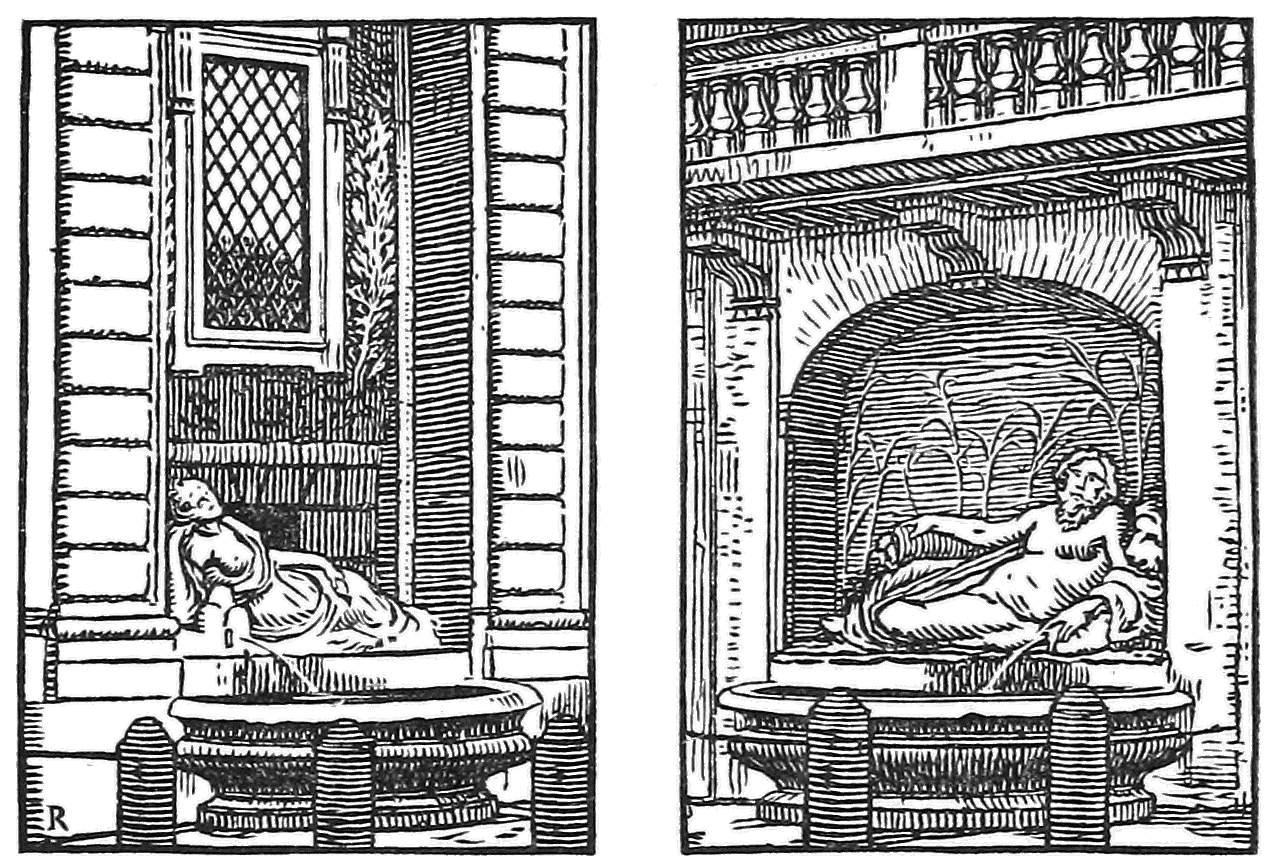
The two river-gods which also adorn this fountain
are very old. Together with Marforio, now to be found
in the Museum of the Capitol, they have the distinction
of never having been buried since the downfall of
Rome. Once they stood before “that most magnificent
of all Roman temples”—Aurelian’s Temple of the
Sun. Later they belonged to the Mediæval Museum of
Statues, a collection kept in or near the old papal palace
of the Lateran, where they had been called Bacchus
and Saturn. The Nile, who should have been unmistakable
because of his emblem of the Sphinx, has now
his proper designation; but the other statue has a curious
history. It was originally the River Tigris, a river
familiar to the Romans since the wars with Mithradates.
When, under Paul III, Michelangelo placed
these statues in their present position, some influential
person suggested that the Tigris, no longer of any interest
to the Romans, should be changed into the
Tiber. The emblem of the Tigris—a tiger—was then
altered to represent the Roman Wolf, and the Twins
were added. Pirro Ligorio tells the story, and goes on
to say that the fingers of one of the Twins were originally
a part of the Tiger’s fur.
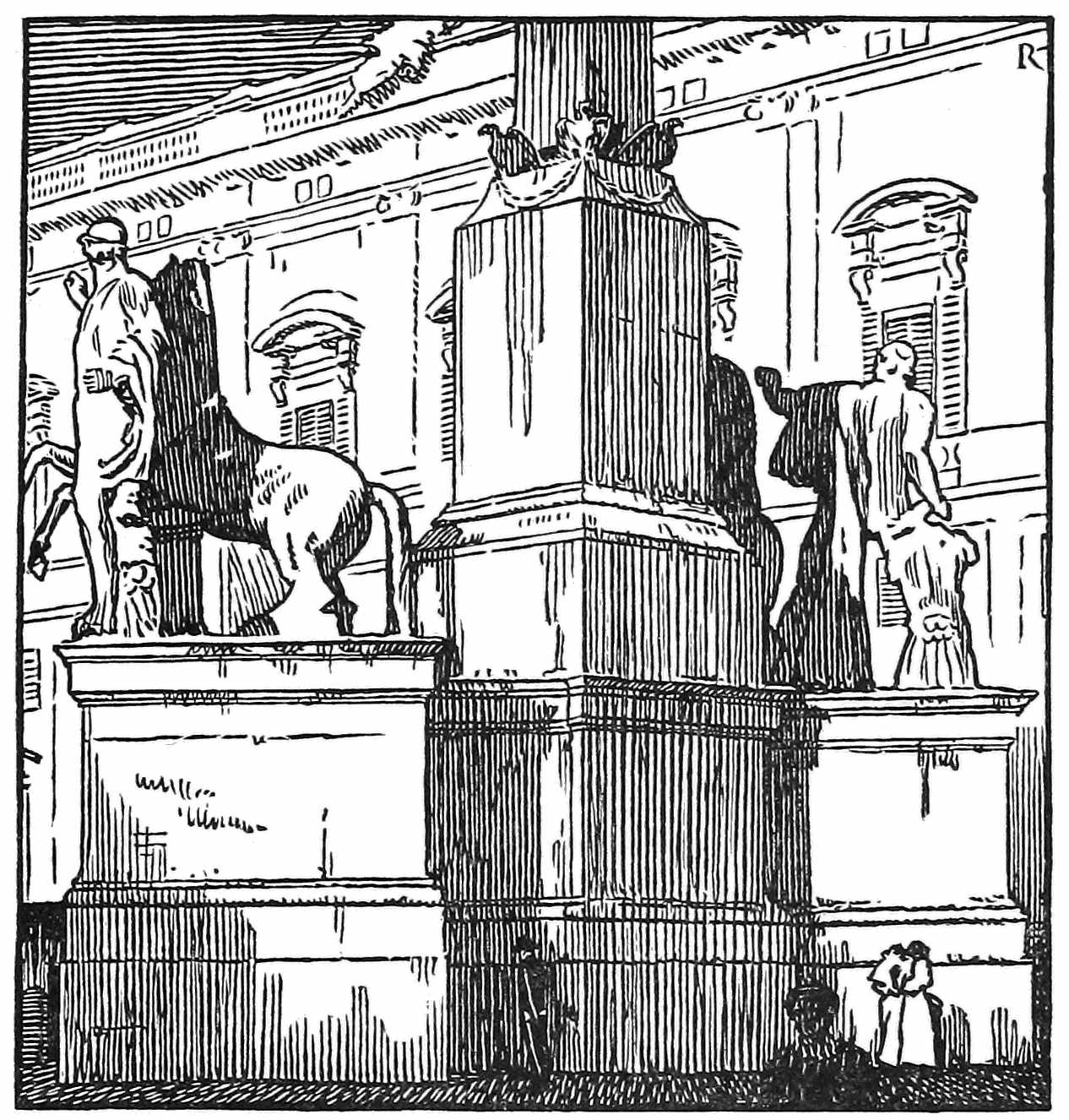
The erection of the bronze equestrian statue of Marcus
Aurelius in the centre of the piazza was the first
step in the design of the Campidoglio of to-day, for
Michelangelo’s admiration of the statue had been
shared by Paul III, and the Pope brought it hither in
1538 when the embellishment of Rome, originally
begun in honor of the visit in 1534 of Charles V, had
become with both Pope and citizens a great and permanent
interest. This statue also had been a part of
that Mediæval Museum in the Lateran which was
probably one of the places to visit when Charlemagne
came to Rome to be crowned in old St. Peter’s on
Christmas Day, 800. The façade of the Senate House,
which forms the background to the piazza and its statues,
is built in great part of travertine, so the structural
part of the fountain is of the same material. This
consists of a huge niche, sixteen and a half feet in
height, sunk into the foundation of the terrace before
the main entrance to the Senate House. On either side
of the niche is a pair of Doric pilasters, which support
the floor of the terrace and its beautiful balustrade. A
great stairway, down which the balustrade continues,
connects this entrance of the Senate House with the
piazza below; and the foundation of these steps, forming
triangular wings to the niche, serves as a background
to the river-gods. These figures lie one on either
side of the semicircular basins containing the water.
The simplicity of the design partakes of the inevitable.
Considering it from any point of view, it is not only
impossible to think of anything better, it is impossible
to think of anything else. If it is not the work of Michelangelo,
there must have been two Michelangelos
in 1538!
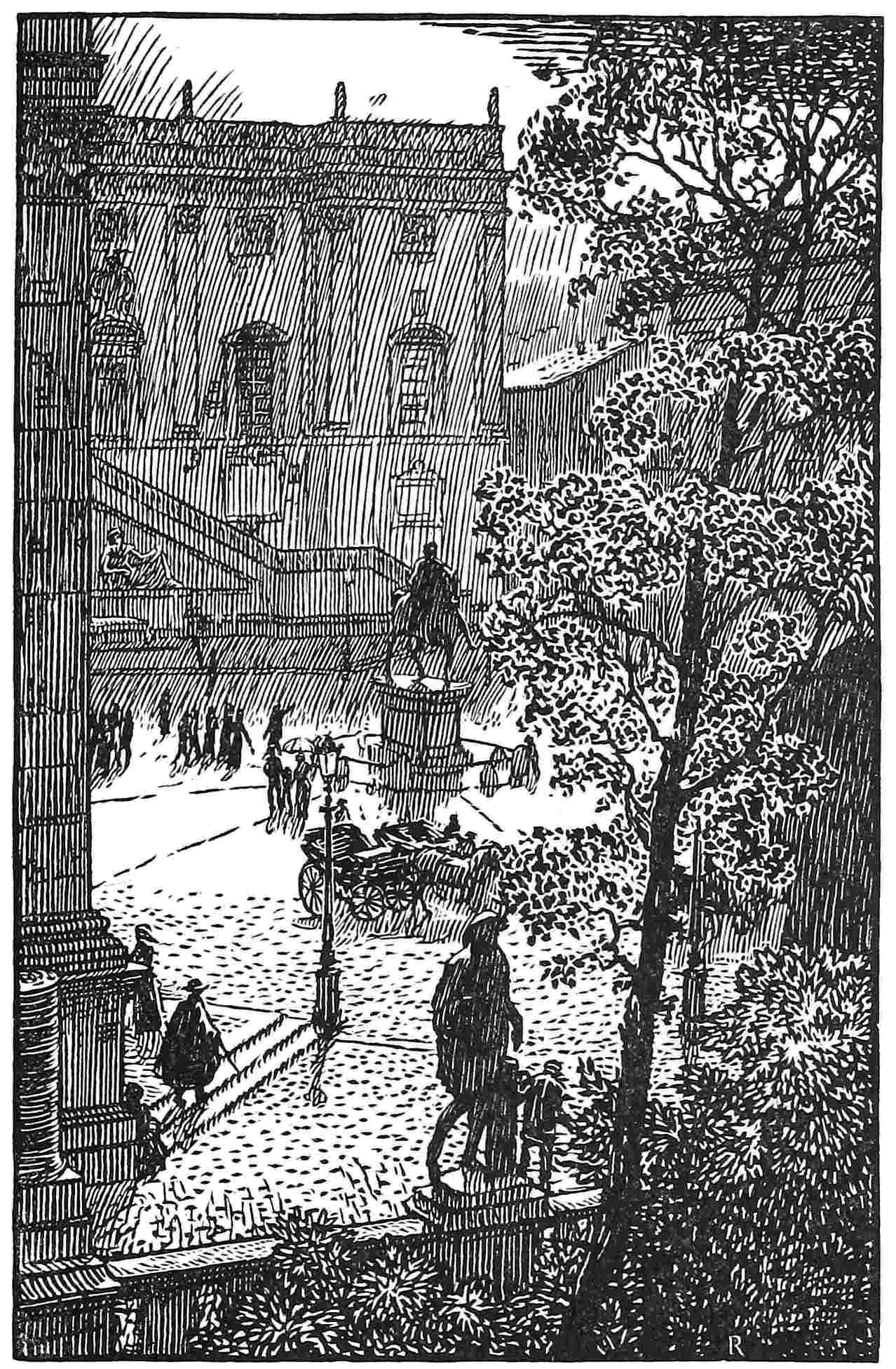
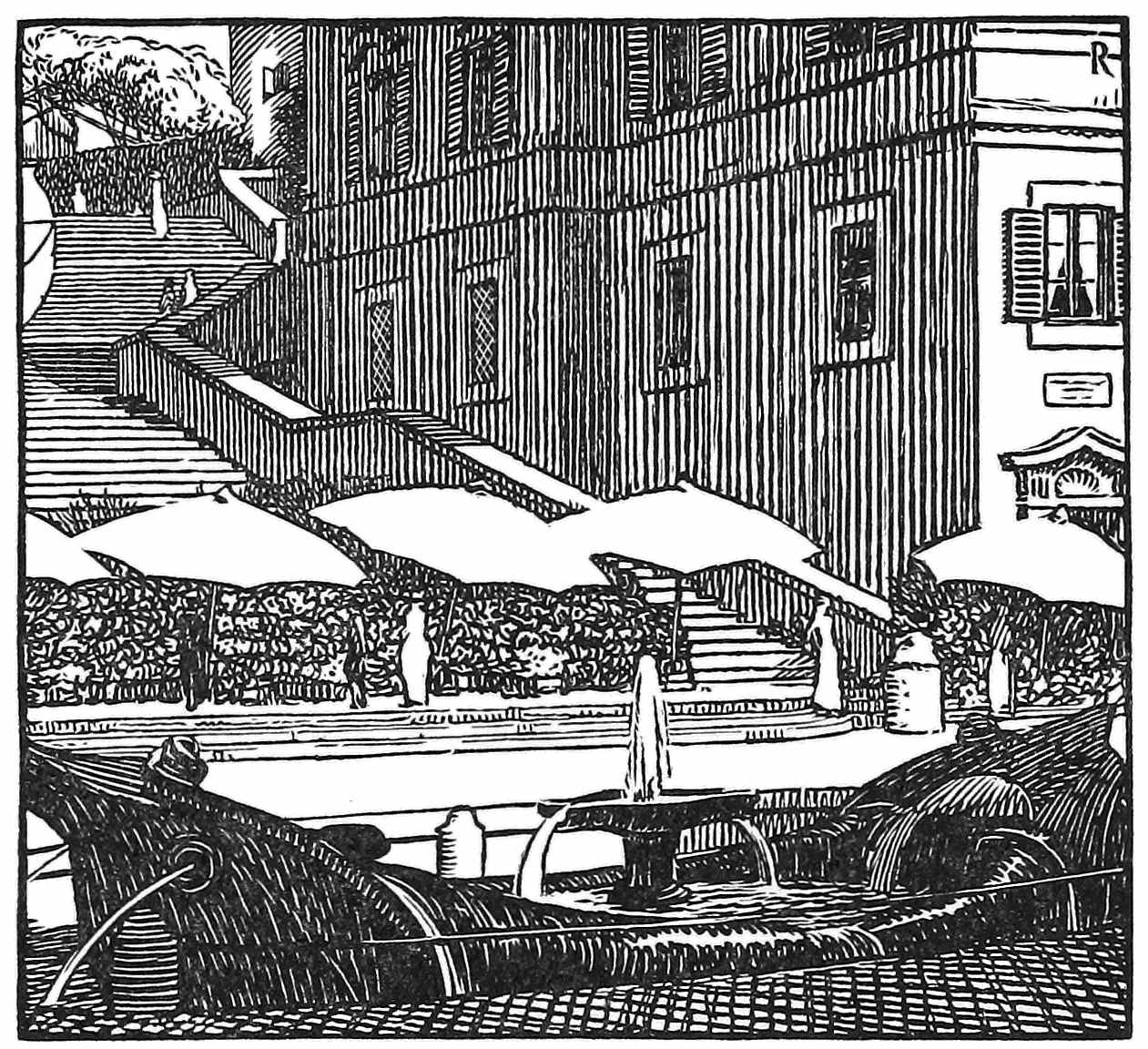
View of the Piazza del Campidoglio from
the left side of the Cordonata.
In Piranesi’s engraving of the Campidoglio a fine
balustrade like the one on the stairway surrounds the
fountain. It follows the contour of the lower basin and
stands at some three or four feet distant from it. This
balustrade, which has disappeared, enhanced distinctly
the beauty of the fountain, bringing it more into harmony
with the entire composition.
The river-god is one of the earliest sculptural personifications
of natural phenomena. In these days
comparatively little heed is paid to the smaller water-ways,
so the modern spirit fails to see the significance
of these conventionalized figures. To the ancients, however,
the statues personified that physical object upon
which all civilized life depended—a great stream of
unfailing water. The rivers of Greece were small, while
the Roman Empire contained some of the largest in
the world; but the ideas they represented were the
same. The river, small or great, made the city. The
river gave food and drink to the inhabitants, connected
them with the outside world, brought trade,
turned the mills, defended the city from invasion, carried
away pestilence, cleansed, purified, and supported
all the works of men; and therefore Father Tiber and
his brothers were to be worshipped and to be honored,
and statues were to be set up to them in public places,
so that men should remember what they owed to their
river. The river is always personified as a benign and
majestic figure in the full strength of mature manhood,
with long and abundant hair and beard. The lower
limbs are draped, so that the mystery of partial concealment
hangs about him. On one arm he bears a horn
of plenty; while with the other he reclines upon some
support, which is usually the characteristic emblem of
the particular stream which he represents.
Power, abundance, and calm strength are the qualities
of a great river; and these qualities the ancients
most adequately expressed in their own peculiar
medium, which was sculpture. Men of to-day put
their ideas into music, or more explicitly into prose
or verse, and there are still those who appreciate the
significance of the river. Washington Irving’s epithet
of the “lordly Hudson” proves the hold that great
river had over his perception and imagination; and
not any statue of a river-god can give the conception
of a river which is to be found in Arnold’s “Sohrab
and Rustum”:
“But the majestic river floated on,
Out of the mist and hum of that low land,
Into the frosty starlight, and there moved,
Rejoicing, through the hush’d Chorasmian waste,
Under the solitary moon;—he flow’d
Right for the polar star, past Orgunjè,
Brimming, and bright, and large; then sands begin
To hem his watery march, and dam his streams,
And split his currents; that for many a league
The shorn and parcell’d Oxus strains along
Through beds of sand and matted rushy isles—
Oxus, forgetting the bright speed he had
In his high mountain-cradle in Pamere,
A foil’d circuitous wanderer—till at last
The long’d-for dash of waves is heard, and wide
His luminous home of waters opens, bright
And tranquil, from whose floor the new-bathed stars
Emerge, and shine upon the Aral Sea.”
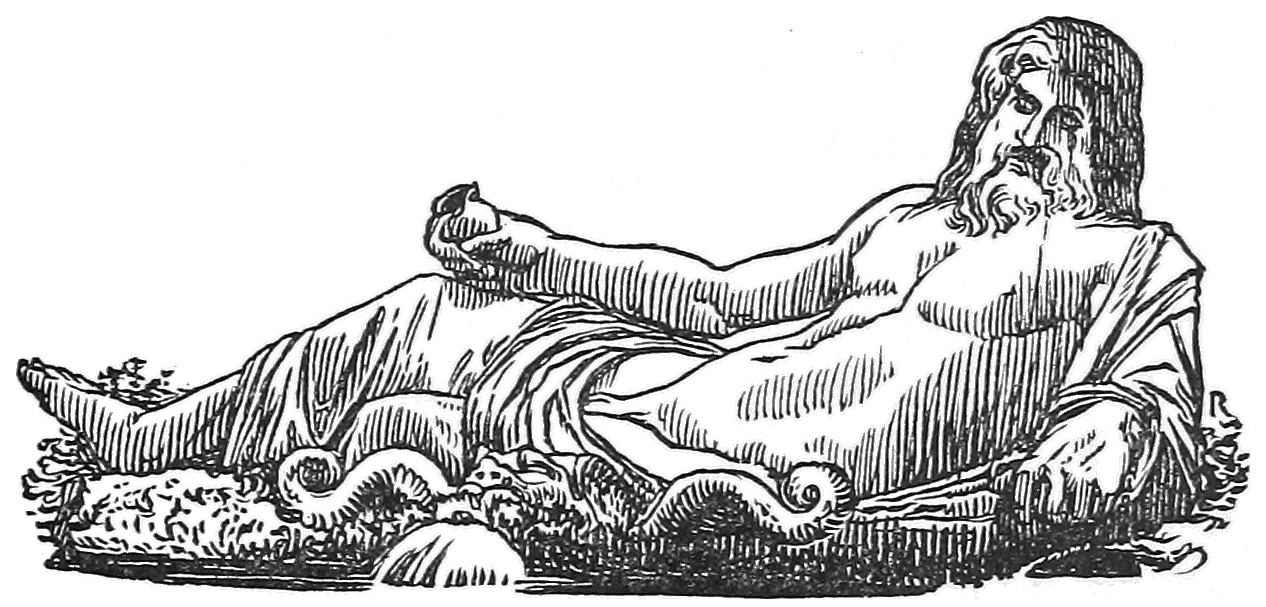
The nearest approach which the Romans have left
us to such grandeur as this is to be found in their statue
called Marforio. The north wing of the Campidoglio
group is known as the Museum of the Capitol, and it
is in the entrance court of this edifice that Marforio is
now to be seen. If this most majestic of all river-gods
ever represented any particular river, the name of that
river was forgotten centuries ago. His title of Marforio
was given him long since, because he once poured the
water into a fountain which stood in a small square
to the left of the Senate House, where Augustus had
erected the Martis Forum. There he seems to have
remained throughout the darkest days of Rome’s decadence,
surviving every vicissitude, and always respected
by the half-barbarous Romans of that time.
Gregory XIII (Boncompagni, 1572–1585) is responsible
for removing Marforio from this classic position and
for separating him at that time from the huge granite
basin into which flowed the water from the urn on
which he is leaning. Thenceforth the basin has a history
of its own, while Marforio’s odyssey (he wandered for
some time after leaving his old home) finally brought
him to the Campidoglio. Sixtus V then placed him on
the left side of the piazza, facing the south wing. This
south wing, known as the Palazzo dei Conservatori,
was the first of the present group of buildings to be
erected, Tommaso de’ Cavalieri—a Roman gentleman
and one of Michelangelo’s few intimates—having had
charge of its construction in Michelangelo’s lifetime.
The north wing, or the Museum of the Capitol, was
not done until the architect Rainaldi erected it for
Innocent X (Pamphili), twelve pontificates after the
reign of Paul III. During a period of one hundred
and sixty years Marforio remained where Sixtus
had placed him, and then Clement XII (Corsini) installed
him in the court of the Capitoline Museum,
and again he was given a fountain to feed and
protect.
Marforio’s career after he had been parted from his
basin was a curious one. Bored, perhaps, by the lonely
magnificence of his new surroundings, he fell into evil
ways. He became the partner of Pasquino! Pasquino,
the mutilated torso from an old Greek group of statuary,
stands at the farthest corner of the Braschi Palace
(now the Ministero dell’ Interno). He had first been set
up there in the reign of Alexander VI; and from that
time he had become the medium for the popular and
anonymous criticisms of the government. His name of
Pasquino was taken from a witty tailor or barber who
lived near the Palazzo Orsini and whose sallies against
those in authority greatly delighted the Roman people.
It became the custom to affix anonymous couplets or
epigrams to the old torso, which thus obtained the
name of Pasquino, and the epigrams came to be known
as pasquinades; and from the days of the Borgias to
the time of Napoleon, and even later, most of the current
witticisms or scathing reflections upon public
events or notable personages were ascribed to Pasquino.
When Marforio took up his abode in the Piazza
of the Campidoglio, he became to the Romans the partner
of Pasquino. According to a modern authority,
Marforio never originated the sally. His function was
to put the question which elicited the witty retort, or
to reply in kind to Pasquino’s interrogatories. With
Marforio’s incarceration in the court of the Museum
the long dialogue came to an end; and a century later
the passing of papal Rome brought Pasquino’s career
to its final close. Modern freedom of the press leaves
no place for Pasquino; and it may be said of him that,
Marforio being gone,
“... of sheer regret
He died soon after.”
This is not strictly true, for, although the statues
themselves no longer have a part in the game, it still
goes on. One of the most popular of the Roman
newspapers still publishes questions and repartee by
Marforio and Pasquino.
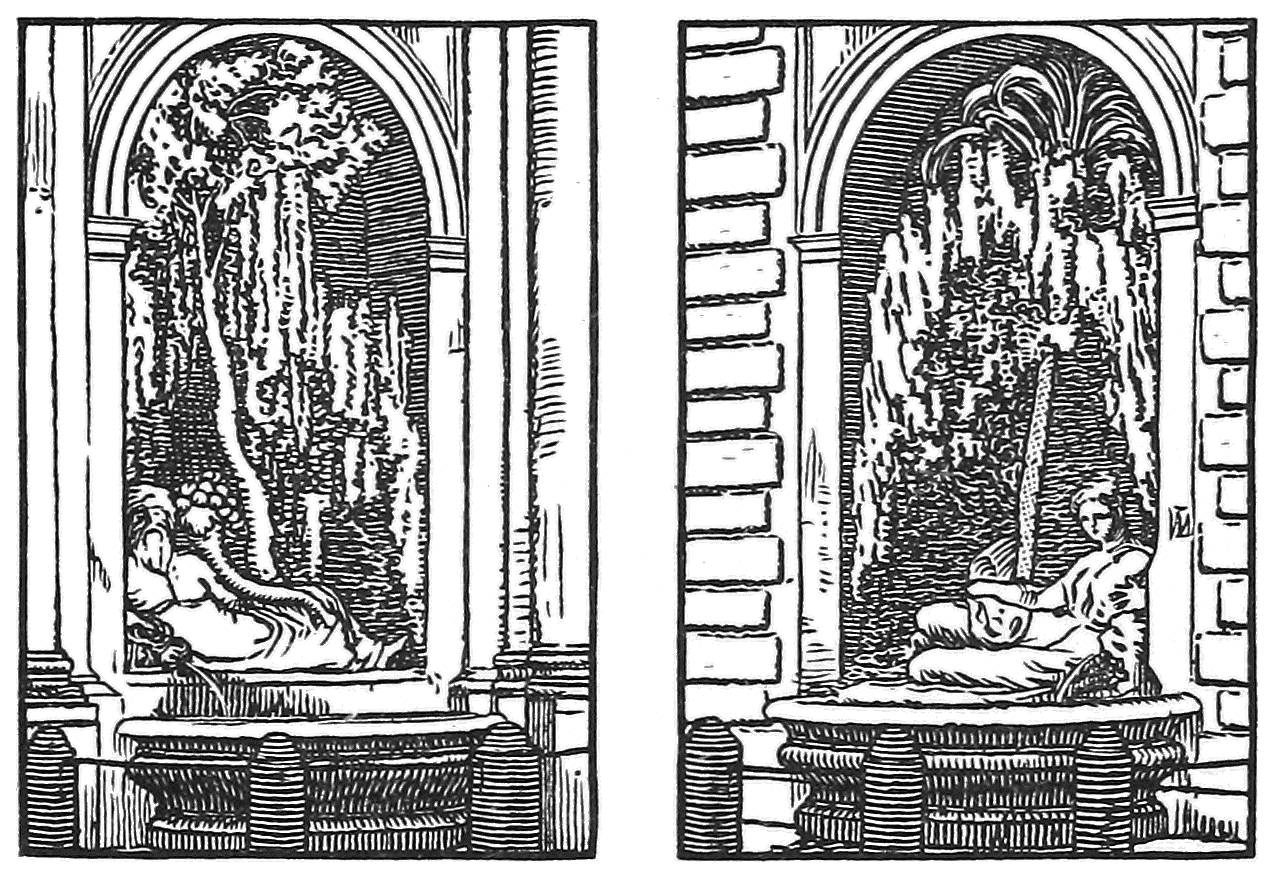
It is only necessary to study for a short time the various
river-gods in Rome, such as those of the Tiber
and the Nile, here at the Capitol, or Fontana’s statue
in the Quattro Fontane, or the modern work in the
western fountain of the Piazza del Popolo, and then to
return to Marforio, to appreciate the immense artistic
superiority of the latter. Marforio is truly a river-god,
a personification of all or any of the earth’s rivers. The
ancient and forgotten sculptor has given to the ponderous
stone a fluid quality which is really wonderful. To
make the hair and beard merge into the god’s breast
and shoulders would have been simple both in conception
and execution, but only a genius could have secured
to the massive and supine figure that appearance
of being outstretched in powerful yet melting length
along the surface of things. Artists of the Renaissance
from Rome and from beyond the Alps always speak of
the gran simulacro a giacere, an expression difficult to
anglicize, but which is an attempt to describe this singular
quality of a static position instinct with continuous
and onward flowing movement. Finally, the god’s
face is full of genuine power and benignity and is the
adequate consummation of the sculptor’s ideal. It is no
wonder that Marforio has become a type. Vasari, for
instance, speaks of young Baccio Bandinelli making “a
Marforio” out of snow, as not long before the youthful
Michelangelo had made a faun from the same perishable
material.
For a thousand years—and we do not know for how
much longer—Marforio has been a part of the city’s
life. He has survived the Norman pillage in 1084, as
well as the great sack of Rome in 1527. As a kindly
god, dispensing water to rich and poor, he has had his
part in all the triumphs and disasters, and has shared
the ups and downs of life not only with the city but
with her children. Roman and barbarian, patrician and
plebeian, slave and citizen, Pagan and Christian—all
have drunk from his fountain. What has he not seen,
and not heard! It was an unerring instinct for the fitness
of things which made him Pasquino’s gossip, and
his present honorable but unnatural seclusion from the
city’s busy streets and squares is commonly attributed
not to Pope Clement XII’s lack of imagination but, on
the contrary, to his recognition of Marforio’s malicious
influence over the popular mind. A tablet has been set
up in the house which is built over the site where history
finds him, Number 49, Via Marforio. In short,
Marforio belongs to that curious class of inanimate
things which have developed a personality; injury to
him would arouse fierce popular resentment; and were
he to be destroyed, the Romans would feel that they
had lost not a work of art but a personal friend.
The third fountain in the trio of the Campidoglio is
to be found in the upper garden of the Palazzo dei Conservatori—the
building to the right hand in the ascent
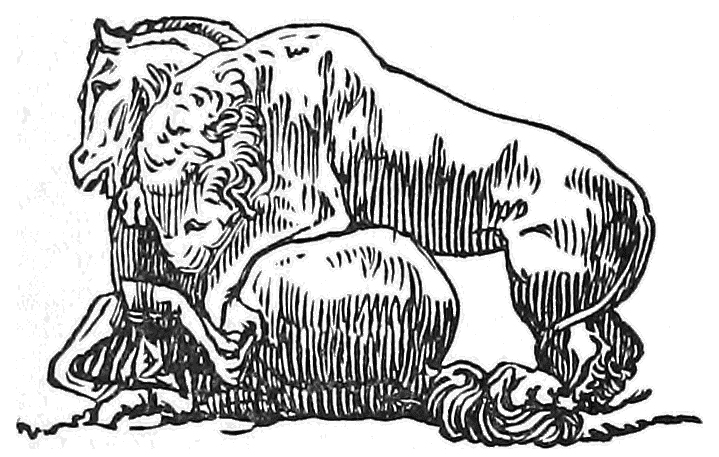
of the Cordonata. It can hardly be called a fountain,
since it is merely a large basin of water surrounding
some rockwork on which stands an old bit of sculpture
of a character manifestly inappropriate to the sentiment
of a fountain. It represents a lion tearing out the
vitals of a horse which it has sprung upon and borne
to the ground. This much-restored fragment is of real
importance from an artistic standpoint, while as a
Roman antiquity it has extraordinary interest. The
marble bears distinct traces of having been subjected
to the action of water, and, as a matter of fact, it was
found more than a thousand years ago in the bed of
the River Almo. Nothing is known of its history previous
to that discovery.
The Almo is a little brook in the Campagna not far
from Rome, rising in the hills between the Via Appia
and Via Latina and emptying into the Tiber. Its modern
name is Acquataccio. The Almo was connected
with the ancient worship of the goddess Cybele, whose
sacred image was ceremonially washed in it each year
on the 27th of March by the priests. This religious
ceremony, doubtless, preserved the channel of the
stream so that it would have been quite possible to
hide successfully a great piece of statuary in its depths
or in some reedy pool along its banks. River-beds were
not uncommon hiding-places for treasures during the
Dark Ages which followed the breaking-up of the
Roman Empire, and it is quite possible that this group
may have been so hidden by its owner whose great
villa, situated near the stream, was threatened with
pillage or destruction by some barbarian incursion.
The high value evidently placed upon it by its original
possessor was also given to it by its discoverers. It
belonged to that remote museum of antiquities kept in
or near the Lateran Palace during the Middle Ages
and dating back at least to the days when Charlemagne
first visited Rome, in 781, bringing with him his little
son Pepin, aged four, to be anointed King of Italy
by Pope Hadrian I. This museum contained also the
equestrian statue of Marcus Aurelius, now standing in
the centre of the piazza of the Campidoglio, together
with the two river-gods, placed later on by Michelangelo
where they now lie—one on either side of the central
fountain of the Campidoglio; and other marbles and
bronzes of great value. Most of these art treasures were
removed from the Lateran to the Capitol when Pope
Sixtus IV (Riario, 1471–1484) founded the Capitoline
Museum; but long before that time the Lion, as it was
always called (the original portion of the horse being
merely the body), had been taken from its academic
seclusion and set in the midst of things. During three
centuries of the turbulent life of mediæval Rome, it
stood to the left hand and at the foot of the long flight
of steps which, previous to Michelangelo’s time, led up
from the Piazza of the Ara Cœli to the Capitol. All
about it was held the public market; the city officials,
found guilty of misdemeanors, were made to do penance
sitting astride the Lion’s back with their hands
tied behind them and their faces smeared with honey—the
Roman version of the pillory! The ferocity of
the Lion was thought to typify the punishment of
crime, and the public executions were held before this
old fragment. Here, on August 31, 1354, the famous
soldier of fortune, Fra Monreale, was beheaded by
order of Cola di Rienzi. On October 8 of the same
year, Rienzi himself was caught as he was escaping in
disguise from the burning palace of the Capitol, and
here he stood, during the last hour of his life, leaning
against the Lion, turning his head this way and that
in vain quest of succor, while the mob which was so
soon to tear him to pieces held back in a strange awe,
and a silence reigned over everything! That was the
greatest of all the tragedies—though there were so
many of them—connected with the Lion.
The old bit of sculpture continued to hold its sinister
place in Roman life, until the pontificate of Paul III
(Farnese, 1534–1549). At that time Master Michelangelo
(to use Vasari’s phraseology), working for the Pope,
remodelled the Capitol and decorated it with many
old statues. The group of the horse and lion was then
completely, though poorly, restored, and placed in the
court of the Palazzo dei Conservatori—this being the
first of the three buildings of the Capitol to be built
after Michelangelo’s designs. At the same time the
place for the public executions was transferred from
the piazza of the Ara Cœli to the Piazza di Ponte Sant’
Angelo.
The Lion was placed in its present position in 1903,
and Rome of the twentieth century is responsible for
the extraordinary taste which converted into a fountain
this old fragment, highly interesting as an antiquity
but repulsive in itself, and associated chiefly with
the bloodiest and least attractive pages in Roman
annals.
It is impossible to leave the Campidoglio without a
heightened appreciation of the might of the constructive
imagination. Only that faculty, developed to its
highest power as in Michelangelo, could have produced
this magnificent harmony out of the incongruous mass
of classic and mediæval survivals with which he had
to deal.
FARNESE
FARNESE
“At the entrance to this palace stand two rare and
vast fountains made of granite stone and brought from
the Baths of Titus.” Thus wrote John Evelyn in November,
1644. The description holds to this day, although
the modern sight-seer will substitute Caracalla
for Titus.
The fountains were erected by the Farnese family to
add the final touch of distinction to their new palace.
They owe their unique combination of original classic
features and seventeenth-century taste to the genius
and opportunities of Paul III and his grandson, Cardinal
Alessandro Farnese II, and to a still later descendant
Cardinal Odoardo Farnese. The Pope and the
earlier cardinal, men of wide culture and enormous
wealth, were the first to excavate and exploit the Baths
of Caracalla. The treasures they there found might well
have been the loot of some fabulous city, and yet the
pearls and gold and rubies brought some twenty years
later by Francis Drake to his royal mistress were of
small significance compared to the works of art found
in those great baths—baths which had been the most
sumptuous pleasure-house of imperial Rome. It is the
glory of Italy that she knew this at the time. Her great
churchmen reverently exhumed those masterpieces of
Greek and Roman art and made of them the Farnese
Collection—according to a well-known authority the
rarest collection ever got together by private individuals,
and forming to-day the chief interest in the
Museum at Naples.
When the Pope, Paul III (Farnese), began the erection
of the great new palace which was to bear his name
and fitly domicile the princely family he was founding,
he, and his descendants after him, used for its decoration
the rare marbles and minor artistic trophies from
the baths. No doubt, it seemed to them a happy inspiration
to turn these gigantic granite tubs into a pair of
fountains; for these notable fountains are, in the last
analysis, simply huge bathtubs, rendered imposing by
their size, and magnificent by the material out of which
they are made. They are seventeen feet long and about
three feet deep, and are absolutely devoid of decoration
except for the lion’s head carved in relief, low
down in the middle of each side—and this is merely an
ornamental outlet for the water, quite as necessary to
the original purpose for which these tubs were made as
are the handles carved high up on either side under the
curved rim, simulating metal rings through which the
bronze staves had been inserted whenever it was found
necessary to move the tubs. Carlo and Girolamo Rainaldi,
who, in 1612, adapted for Cardinal Odoardo Farnese
this furniture of the past to seventeenth-century
decorative purposes, could think of no more original
design than that of the well-known Italian fountain of
their own day. They placed each of the tubs in a large,
elegantly curved basin similar to those in the Piazza
Navona standing some two feet above the pavement.
In the middle of each tub they erected a sumptuous
Italian vase, its large, swelling stem, richly carved, upholding
an elaborate shallow bowl, oblong in shape,
out of which rises as the fountain’s final consummation
a highly conventional fleur-de-lis, the emblem of the
Farnese family. This is overwrought with fine stone
traceries, and sends upward from its centre convolution
a single slender stream of water. Additional jets,
of no artistic value, rise one on either side in each of
the lower basins. This modern work is all in travertine.
The combination of the severely classic lines of the
baths with the Gothic carving and mediæval emblem
of the fleur-de-lis is not good. It is disastrous to the
design as a composition and makes these fountains
archæological curiosities rather than artistic creations.
Still, the Farnese fountains impose by their qualities
of size and strength, and once seen can never be forgotten.
The pleasure derived from the sight of a pair of
fountains is not merely double the pleasure that is felt
at the sight of one. The two objects, though exactly
similar, create by their mutual relation an entirely new
set of æsthetic emotions. The feeling for balance and
composition is aroused, and this particular pleasure is
produced in no small degree by these two fountains.
Twin fountains are an unusual feature. There are few
of them in the world; and in Rome, whose fountains
are perhaps still unnumbered, there are but five—the
fountains of St. Peter’s, the side fountains of the Piazza
del Popolo, the two end fountains of the Piazza Navona,
Vansantio’s fountains in the Villa Borghese, and
these of the Piazza Farnese.
Mr. John Evelyn also describes in his journal the
custom of his day for the Roman gentry to take their
airing in the Piazza Farnese, driving or walking before
the palace and about the fountains, whose water gave
to all the architectural magnificence that touch of
freshness and charm essential to the Roman idea of a
pleasure-ground. That Evelyn was taken to the Farnese
Palace the very first day of his sojourn in Rome
is significant. The Roman of 1644 evidently considered
this palace and its precincts to be Rome’s chief attraction;
and this proves that in spite of the efforts of Paul
V (Borghese), who had died some twenty years previously
(1621), and of Urban VIII (Barberini), then just
passing away, the Farnese pontiff, Paul III, dead for a
century past, had succeeded in giving and preserving
to his family an importance and magnificence hardly to
be emulated and impossible to surpass. The bronze and
marble tomb of Paul III is in St. Peter’s, to the left of
the tribune. It contains the dust of as worldly a person,
to quote Ranke, as ever Pope had been. Yet if his actions
cannot be said to “smell sweet and blossom in the
dust,” his memory survives in the annals of Rome,
fragrant with the love and pride of his people. He was
an old, old man when he died in 1549. He had been
fifteen years Pope and forty years a cardinal. The date
of his birth carries the mind back to the years before
Columbus. His education, conducted by Pomponeus
Lætus, had begun in the full tide of the High Renaissance.
In his early twenties he became a member of the
household of Lorenzo the Magnificent, at whose table
and in whose gardens he had met the most brilliant
men of his time and had heard talk that embraced all
that was then known or surmised of art and learning.
For Constantinople had fallen to the Turk only a generation
before that time, and what had survived of
Greek culture, fleeing across the seas to Italy, had
found its chief shelter and patronage in the household
of the great Medici. While in Florence, young Farnese
must have heard Savonarola preach; but no trace of
the great Dominican’s influence is to be found throughout
his long life. The classic spirit enthralled his intellect,
and the splendor of the Medici prince captured
his imagination. In later years his careful Latinity, his
splendid and liberal manner, and his gay and witty
conversation, together with his patronage of artists
and his passion for the antique, proved how profoundly
he had been influenced by the experiences of his early
youth. Placed thus in the very heart of a movement
which freed the individual from all limitations save
those of his own personality and opened the world before
him, he early made up his mind to become Pope
and to raise his own family, as the Medici had done,
to the rank of princes. The ambition was perhaps
common, but the ability with which he pursued these
aims for upward of sixty years was not common, and
their complete achievement was little short of the
marvellous. It took him forty years to reach St. Peter’s
chair, and he occupied it only fifteen; but before he
died one of his grandsons had married a daughter of
Charles V, the Emperor of Austria; another was betrothed
to the daughter of the King of France; and
two more were cardinals and multimillionaires. Later
on, his descendants married into the royal houses of
Portugal and Spain, and the Farnese family passed
out of existence only by being merged by marriage
into the royal house of the Neapolitan Bourbons. One
grandson, Cardinal Alessandro Farnese II, was the
chief art patron of his time, and this in an age when
there were many such men; and one great-grandson
was that Duke of Parma whose fame as a great captain
is written in what were, until the second decade
of the twentieth century, the bloodiest annals of the
Netherlands. To provide a suitable setting for this
princely family, the Pope, some five years before his
death, began this Farnese Palace. Antonio da San
Gallo, the younger, Giacomo della Porta, and Michelangelo
designed its façades and cornice. The great
structure was completed long after the Pope’s death
by Alessandro Farnese II. It was recognized at once
to be the most sumptuous of the Roman palaces. It
stands upon the site of the old Palazzo Ferriz, which
was at one time the residence of the Spanish ambassador,
and had passed into the possession of the Augustine
monks of the Piazza del Popolo. The old
Ferriz Palace had been on the Tiber bank, for it was
not until Julius II’s time that the Strada, or Via
Giulia, was cut through, thus separating the palace
from the river. Where these fountains now stand as
the ornaments of a spacious piazza, there was at that
time nothing but a collection of hovels extending as far
as the Campo de’ Fiori. The far-sighted young cardinal—the
Farnese were thrifty, for all their magnificence—bought
the old palace from the monks, and lived there
in ever-increasing splendor under the successive pontificates
of Julius II, Leo X, and Adrian VI.
Finally, under Clement VII, the great sack of the
city caused him to fly to the Castle of St. Angelo. As in
the Massacre of St. Bartholomew, forty-seven years
later, only those Huguenot gentlemen survived who
were kept in the King’s closet, so during the horrors of
the sack only those cardinals escaped outrage who were
sheltered with the Pope in the Castle of St. Angelo.
Farnese by this time ranked next to the Pope in importance,
and he was, of course, among these. From the
Castle he witnessed, with the terrified Clement, the
devastation inflicted upon the latter’s exquisite pleasure-house
on Monte Mario, an act of wanton vandalism
committed by the Colonna to spite the Pope. Some
ten years later Cardinal Farnese bought this wrecked
palace, restored it, and presented it to his daughter-in-law,
Margaret of Austria, who rested there on her triumphal
wedding procession into Rome. It is called after
her to this day the Villa Madama.
In 1540, when the old Palazzo Ferriz was destroyed
to make room for the Palazzo Farnese, the workmen
came as usual upon traces of earlier times. Modern
archæologists have discovered that the mosaic pavement
under the right wing of the palace was a part of
the flooring of the Barracks of the “Red Squadron of
Charioteers.” It has been generally supposed that the
new palace was built of stone from the Coliseum, but
its materials came from numerous and varied sources.
The great travertine blocks were quarried at Tivoli;
and Paul III obtained permission to demolish and use
for his building the partly ruined battlemented monastery
of St. Lorenzo Outside the Walls. After this quarry
was exhausted, his nephews obtained the ruins of
Porto, the Baths of Caracalla, and what was still more
important the remains of the greatest temple of imperial
Rome—Aurelian’s Temple of the Sun, which, at
that date still towered one hundred feet above the
Colonna gardens.
One of the fountains in the Piazza Farnese.
Contemporary artists sketched these various structures
as the masons destroyed them, so that students
of the present day can form some idea of their classic
grandeur, and can judge for themselves the value of the
Farnese Palace on the one hand and on the other that
of the imperial baths and temple, and the mediæval
monastery, out of which it is built.
The great new palace made necessary the great new
square in front of it; but years before this the Pope
had begun that regeneration of Rome for which he is
so gratefully remembered.
The entry into Rome of Charles V, on the 5th of
April, 1534, first aroused the Romans to the deplorable
condition of their city, and, under the Pope’s enlightened
guidance, the preparations for the imperial visitor
took the form of permanent and far-reaching municipal
improvements, which improvements were carried on
throughout the entire period of Paul III’s pontificate.
The enlarging of such great thoroughfares as the Babuino
and Condotti date from this time, as does also
the modern Corso, this last finally superseding the Via
Giulia as the fashionable resort. Paul III preferred the
old Palazzo di Venezia at its foot to any other residence,
and he connected it with the Campidoglio by
the great viaduct, lately destroyed; while for him
Michelangelo designed the Campanile of the Senate
House. A great Roman of the present day asserts that
the fifteen years of Paul III’s pontificate comprise one
of the happiest periods in the city’s life.
When Margaret of Austria rode through the Porta
del Popolo, “two hours before sunset, dressed in white
satin embroidered in pearls and gold,” it was not
merely a curious crowd who met and welcomed her.
That concourse of citizens represented the self-respect
of the Romans, risen from the abasement of a decade,
and eager to prove to the daughter of the world’s
greatest sovereign their worthiness to be her subjects.
They could not know that Margaret felt contempt for
her youthful husband, nor that in the long duel between
Paul III and the Emperor of Austria she stood
not for Rome but for Austria, saying once when her
assistance was sought that she had rather cut off her
children’s heads than ask her father to do anything
that displeased him! These were matters for the Farnese
to deal with. So far as Rome was concerned, with
the entry of the Emperor’s daughter, its place among
the cities of the world became once more important and
imposing.
Charles V might despise the upstart Farnese as
Francis I had laughed at Cesare Borgia, but the self-made
Italians of the Renaissance—churchmen, merchants,
and condottieri, were forces which hereditary
monarchy could not do without. Spain had the riches
of the New World; France and England were breeding
the manhood of Europe; but Italy held the keys to the
past—to the culture for which men’s souls longed. The
time was not yet—in 1540—although it was close at
hand, when Italy’s deliberate choice of evil rather than
good finally made her, by weakening and corrupting
her, a captive to Spain. Time was not yet; and in that
last lingering glow of her greatness and freedom the old
Pope, Paul III, moves as her incarnate spirit. To a figure
slight and stately, though with stooping shoulders,
was united a shrewd and kindly countenance, with a
massive nose and flowing beard, mobile lips and piercing
eyes. His voice was modulated, and his manner
gracious and noble. This outer man held guard over a
mind so crafty and tenacious, so secretive and resourceful,
that to the Venetian ambassador—ever the most
astute observer—he remained a fascinating and baffling
enigma; while for Cardinal Mendoza and the Emperor
he was an antagonist whom, for all their secret
Austrian contempt and bitter hatred, they could not
afford to ignore.
It was remarked that the Pope never wished to hear
or to speak of his predecessor. He felt that the election
of Clement VII had robbed him of fourteen years of
the papacy. Posterity may well share his prejudice, for
it seems safe to assume that, had Paul III been Pope in
1527, Bourbon’s soldiers would never have got within
sight of the city walls; there would have been, in fact,
no sack of Rome. The Pope felt with all the force of his
Italian nature the danger to Italy from the side of
Spain. Better patriot than priest, he had made secret
treaties with the Protestants as a weapon against the
Spaniard; and while no one realized more keenly than
he the necessity of reforms in the Church, yet he
dreaded them lest they might in any way weaken the
strength of the papacy. His singular ability to unite
the fortunes of his family with profitable political undertakings
runs throughout his long life; but this nepotism,
which no pope ever carried further, and for
which he has been unsparingly censured by historians,
represents the kindliest strain in his nature. It was the
human side; and it was the direct cause of his death.
In a dispute over retaining the Duchy of Parma in his
family, the Pope’s grandson, Octavius, opposed the old
pontiff. Paul felt this ingratitude deeply, and spoke
openly about it to the Venetian ambassador. The day
after All Saints’ Day, 1549, the old man repaired to his
villa on Monte Cavallo “to ease his mind,” and from
there he sent for Alessandro Farnese II. He came, this
magnificent young cardinal, handsome, courtly, the
great art patron, the lover of scholars and poets, the
finest flower of the Farnese, a grandson and namesake
of whom Paul III was justly proud. The cardinal was
the Pope’s darling, and from him Paul felt he could
expect support and sympathy. The interview, however,
soon became stormy. High words passed. The Pope
flew into a rage and snatched the biretta from the cardinal’s
head. He had discovered that Alessandro also
was carrying on a secret counterplot against him, and
the discovery broke the old man’s heart. Such a violent
attack of anger at the age of eighty-three brought on an
illness from which he had neither the strength nor the
wish to recover, and in a week’s time Paul III was
dead. Even after his death the Romans loved him—a
rare tribute to any pope—and all Rome went to kiss
his feet. He had been the first Roman to occupy St.
Peter’s chair in over one hundred years, and the Romans
felt his virtues and his failings to be their own.
Fifteen years before, they had carried him on their
shoulders into old St. Peter’s for his coronation, and
now they buried him there. His tomb cost twenty-four
thousand Roman crowns, and is the masterpiece of
Guglielmo della Porta. The two recumbent statues
upon it are said to be after a sketch by Michelangelo.
The connection of Michelangelo’s name with the tomb
is interesting, but of greater interest is the romantic
legend which surrounds the statue of the younger
woman. This figure, once called Truth and now known
to be Justice, is said to be the portrait of Paul III’s
sister, and this recalls the fact that the fortunes of the
princely family of the Farnese rest upon no more honorable
basis than the passion of Alexander VI (Borgia)
for this sister, the beautiful Giulia Farnese. No
one can study the statue on the tomb without understanding
how it was that this magnificent creature
seemed to the men of her time the flesh-and-blood presentment
of those Pagan goddesses whom they all, secretly
or openly, worshipped. The superb body is now
concealed by Bernini’s hideous leaden draperies, but
the carelessly waving hair and tiny ear have witchery
even in the marble, while the face possesses that solemnity
of perfect beauty found only in the masterpieces
of the Greeks. Never before or since was such a price
paid for the Red Hat! Alexander VI made the young
brother, Alessandro Farnese, aged twenty-five, a cardinal,
and Giulia Farnese went to reign in those Borgia
apartments, decorated by all the genius of Pinturicchio,
and at once the pride and disgrace of the Vatican.
The young cardinal was nicknamed the Petticoat Cardinal;
but he seems to have felt no compunction at the
transaction. With the Romans, as with the Parisians,
ridicule is the most powerful engine of destruction;
and the fact that Alessandro Farnese lived this sobriquet
down, proves, as nothing else can prove, the hold
he had upon the Roman people.
Any account of Paul III would be incomplete without
some reference to his extraordinary belief in astrology.
It was quite a recognized fact that he never even
considered any scheme, public or private, before consulting
the planets. If the heavenly bodies were not in
favorable conjunction, the enterprise was given up, or
as nearly given up as was possible to so obstinate and
tenacious a mind. In his own time this singular characteristic
was felt to be incongruous and rather disgraceful;
but it is easy for the modern spirit to understand,
and even condone, the weakness. Surely, it was
not strange that such a man, with such a life, should
feel that “the stars in their courses fought” for him.
The impression made upon the mind by the Farnese
fountains is not pleasing. They are certainly “rare and
vast,” but as fountains they are not a success. The
form overshadows the substance; for the single jet of
water thrown upward over the structural part of the
fountain is not adequate, and is lost in the effect produced
upon the eye by the huge tubs turned black by
the deposits of the Acqua Paola; while the water falling
back into these receptacles is caught as in a prison, the
overflow from the upper to the lower basins being not
sufficient to give an idea of a copious stream. The monster
granite baths have a sepulchral effect. They seem
more like coffins made to hold the bones of departed
heroes than like basins for receiving and distributing
living water. During more than two centuries these
fountains bore witness to the magnificence of the Farnese
family; but as that magnificence had been sought
and held for reasons as purely personal and selfish as
men have ever known, it had no real value or significance
for the world. No memories of patriotism or
ghost of romance hangs over these fountains, or over
the palace which they guard. The family and the splendor
once were, and now are not; and all the sunshine
which daily floods the spacious piazza fails to reanimate
the majestic vacancy of the façade, or to lift the
gloom from the dejected and sombre fountains.
VILLA GIULIA — I. FONTANA PUBBLICA DI GIULIO III — II. THE NYMPHÆUM OR “SECRET FOUNTAIN”
VILLA GIULIA
“In Xanadu did Kubla Khan a stately pleasure dome decree,
* * * * *
So twice five miles of fertile ground with walls and towers were girdled round.
And there were gardens bright with sinuous rills, where blossomed many an incense-bearing tree,
* * * * *
It was a miracle of rare device,
A sunny pleasure dome with caves of ice....”
The Villa Giulia is the Italian version of “Kubla
Khan,” not built by “lofty rhyme,” but constructed
of actual stone and marble for a pleasure-loving pontiff
of the Cinque Cento. The desire to realize the poet’s
vision is often felt by absolute monarchs. Versailles,
San Souci, and the Hermitage show what unlimited
power, wealth, and caprice have accomplished in that
direction; but none of the northern sovereigns possessed
either the climate, soil, historical, poetic, and
pictorial setting or the artists, architects, and marvellous
art treasures which were at the command of
Pope Julius III.
When this pontiff, whose election dates from 1550,
decided to build a pleasure-house upon the vineyard in
the Via Flaminia, which he had inherited from his
uncle, the elder Cardinal Monte, he bought up adjoining
property from various landowners, so that his domain
finally extended from the Tiber eastward up the Valle
Giulia and adjoining slopes of Monte Parioli. The
southern boundaries have not yet been fully determined,
but those to the north extended as far as the
Chapel of St. Andrea, a beautiful little building erected
by Vignola to commemorate Pope Julius’s (then Cardinal
Monte) deliverance from the soldiery at the time
of the sack of Rome in 1527. The Via Flaminia was at
that time the fashionable drive. It was lined by fine
villas and palaces, and Amannati alludes to it as the
“beautiful Via Flaminia.” The approach to it was
from the Piazza del Popolo, then a place of gardens,
through the fine Porta del Popolo which, begun so long
before under Pope Sixtus IV, had just been finished by
Michelangelo and Vignola. The fine avenue extended
as far as the Ponte Molle, where it crossed the Tiber,
and, after skirting the western slopes of Monte Soracte,
began its long march to the north. A little road (called
the Via del Arco Oscuro) leading up from the Tiber
crossed the Via Flaminia at right angles and climbed
up the Valle Giulia, turning abruptly toward the
northern spur of Monte Parioli. The original Monte
property lay along this little road; and it was at the
head of this thoroughfare, where it turned sharply to
the north and therefore at some distance from the Via
Flaminia and on much higher ground, that Pope Julius
decided to build his villa. Its creation quickly became
the absorbing passion of his life. The greatest architects
of the time were employed upon it and no expense
was spared. After Pope Julius’s death, the entire
place was confiscated by the Camera Apostolica for
thirty-seven thousand scudi, the estimated amount of
Pope Julius’s debts.
The Monte Pope (Julius III belonged to the Roman
family of Monte) would leave the Vatican by the passage
leading to the Castle of St. Angelo, take there a
magnificent barge and be rowed up the great sweep of
the Tiber to the landing-place at the foot of the Arco
Oscuro. Here a fine flight of steps was constructed
leading up to a vaulted pergola which traversed the
fields between the Tiber and the Via Flaminia. The
pergola was a bower of verdure and terminated in a fine
building and gateway bordering the Tiber side of the
Via Flaminia. Here it was necessary to cross the great
highway in order to begin the ascent of the Arco Oscuro,
which led directly to his new villa. The highway
was dusty, and the salita or ascent long and steep, and
the Pope decided to create a resting-place at this point.
He had begun digging for water very early, while cultivating
his vineyard, “without ever having had the
slightest indication that water could be found there.”
Eventually he accomplished his purpose, for he succeeded
in bringing to his vineyard the leakage waters
of the Virgo Aqueduct. The “leakage” was very much
in the nature of a tap, and the proceeding was high-handed
and reprehensible to a degree. In imperial days
such tampering with the aqueducts was visited by punishment
which Frontinus considered not too severe for
so great a crime against the public welfare.
Julius III’s pontificate lasted only five years; but in
the year following his death the Virgo Aqueduct had
already ceased to supply the city, and his successors,
Pius IV, Pius V, and Gregory XIII, were obliged to
begin and carry on a systematic and thorough restoration
and enlargement of the aqueduct. For Julius III
the wonderful water was only a perquisite belonging to
the “good gift of the papacy,” and he devoted his
short pontificate to its exploitation and adornment,
possibly silencing his scruples by the thought that the
construction of a public fountain on this highway justified
his manner of obtaining the water. At the two
opposite angles of the Via Flaminia and the Arco Oscuro,
where the ascent toward his villa began, he
erected two fountains, blunting the acute end of each
angle by a mostra or high façade from the base of which
issued the water. The fountain on the right-hand side
was a drinking-trough for horses, while that on the left
was one of the most beautiful and interesting fountains
in all Rome. It was the work of Bartolomeo
Amannati, possibly assisted by Vignola; and very often
must the youthful Domenico Fontana have studied it,
for the famous “Fontana Fountain” is only a modification
of this truly beautiful work of the dying Renaissance.
It is noticeable that Amannati’s fountain is not
a screen nor a gateway; its mostra stands against a
solid background with severely plain wings of the same
height flanking it at an angle on either side. This mostra
is of peperino in the Corinthian order, the columns
supporting a fine classic entablature and pediment.
The apex of the pediment was surmounted by a colossal
statue of Neptune, and the corners of it terminated
in two pedestals carrying, the one a Minerva,
and the other a Rome. Between these two figures and
the Neptune were two minor pedestals marking the
architectural termination of the great central division
of the fountain, and on these stood two small
obelisks, a feature borrowed by Fontana for his fountain
of the Moses. The arch of the central division
held between its Corinthian pillars the huge square
slab with the inscription:
JULIUS III PONT. MAX. PUBLICÆ
COMMODITATI ANNO III
The niches on either side of this slab once contained
statues, one of Happiness and the other of Abundance,
a design embodied two hundred years later in the background
of the Fountain of Trevi. The basin for receiving
the water did not extend across the full width of
the mostra, but was, and is (for this still remains), a
noble white granite conca standing at the foot of the
central division under the inscription. It originally received
the water from a beautiful antique head of
Apollo. All this is described in a letter written by the
architect himself, Amannati, from Rome in 1555, and
there follows a description of the arcade behind the
fountain. This consists of three loggias with Corinthian
columns, making a semihexagonal design and carrying
a vaulted roof ornamented by pictures and exquisite
stucco work. This was where “his Holiness got repose
without incommoding the public,” which, on the
other side of the wall, refreshed itself and its beasts of
burden from the public fountain. The columns were
joined together by a balustrade, and the three-sided
colonnade held in its embrace a large fish-pond with
various jets d’eau. Beyond this architectural loveliness
stretched long walks bordered with fruit-trees and espaliers,
and up these paths the Pope walked when, refreshed
after his long journey from the Vatican, and
eager to see what his workmen had concluded over
night, he finally decided to go on to the villa on the
hill. This beautiful fountain and its loggias have suffered
more than customary outrage from time, neglect,
and stupidity. There would seem to be no vile use to
which the loggias have not been put; and the superimposition
of the Casino of Pope Pius IV, which is now
recognized to be the work of Piero Ligorio, has entirely
altered the proportions and beauty of the public fountain.
The fate of Pope Julius’s creation, from the time
of his death until 1900, is poorly outlined in the various
half-obliterated escutcheons and inscriptions which
now ornament the fountain and its superstructural
Casino. As the villa and all the land about it had been
immediately sequestered by the Apostolic Chamber in
spite of the protests of Julius III’s legal heirs before a
tardy compensation was awarded them, this portion of
the Monte property was divided by Pope Pius IV between
a son of the Duke of Tuscany “who was to have
the usufruct for his lifetime” and his own two nephews,
Carlo and Federigo Borromeo. A sister of these Borromeo
brothers married a Colonna, and the property was
bestowed upon her as dowry. It remained in that family
until 1900, when it was purchased by the present
owner, Cavaliere Giuseppe Balestra, who already
owned the adjoining villa on the high ground, which
might have been a part of the original Villa Giulia,
since it corresponds to that land which Julius III
had acquired from Cardinal Poggio and Cardinal San
Vitelleschi. The Medici escutcheon may have been
placed there either by the Duke of Tuscany or by
Pius IV. The Pope was of very humble Milanese origin
and had no connection whatever with the great family
whose name he happened to have; but after he became
Pope, the Duke Cosimo I, who found it to his interest
to have the Pope on his side, permitted him to use the
escutcheon. Contrary to the decent Roman custom,B
the original inscription of Julius III was removed in
the first quarter of the seventeenth century, by that
one of the Colonna who inherited the property after
the death of the last descendant of the earlier branch.
He placed his own, the present, inscription in place of
it, sparing the inscription to Carlo Borromeo, either
because of Borroraeo’s connection with the Colonna
family or because of the great veneration felt by everyone
for the memory of the sainted young cardinal. It
was also at this time that the beautiful antique head of
Apollo was replaced by the Colonna escutcheon and
the sculptured trophies. The inscription on the small
tablet under the spring of the arch relates that in 1750
Pope Benedict XIV gave to the Colonna family the
right to draw “two ounces” of water daily from the
receiving-tank of the Trevi Fountain for use in their
Roman palace as a recompense to them for their gift
to the public of the Trevi Water in this old fountain.C
Those who visit the Villa Giulia in the morning
hours may see the Campagna carts on their way back
from Rome drawn up before the public fountain of
Pope Julius III, and the sleepy drivers, tired horses,
and responsible little dogs refreshing themselves with
the water.
Fountain of the Virgins.
So far the picture created more than three hundred
and fifty years ago remains the same; fundamental customs
do not change in Rome. But on the other side of
the wall, where once sat and talked the joyous Pope
and his company, what ruin and desolation! Some day
the Italian Government will sweep the crumbling loggias
free from dust and rubbish and tear away the protecting
foliage, not redeeming but unmasking the desecration
of the centuries. To-day the dark water in the
rough garden tanks, the unpruned trees and wild
flowers, the old mule stabled under the ruined loggias
where hay is stored, the mysterious gloom of the
vaulted roof above the Corinthian capitals and everywhere
black shadows of impenetrable depth make up a
scene whose like can in all probability be found only
among the engravings of Piranesi.
The Villa Giulia proper is designated in the old Italian
books as l’Invenzione nella Vigna Giulia, and the
literal English translation of invention not inappropriately
describes this truly marvellous creation. Amannati,
Vasari, Vignola,D and even the aged Michelangelo
spent themselves upon the architectural devices
by which this pleasure-house became a place of almost
fabulous beauty. Consummate knowledge of perspective
was employed in making the building, which is not
at all large, seem so, and the only defect in the entire
design is, as might have been expected, the Pope’s
fault, for Julius insisted upon working into the loggias
in the rear of the upper court of the fountain a gift of
columns, beautiful in themselves but too small for the
surrounding proportions, thus making that part of
the construction appear insignificant and inferior to
the rest. The Pope’s changing caprice wearied even the
good-natured Vasari, who has left the record that
“there was no getting the villa done”; and it was
not long before Vignola, a man of genuine and independent
genius, wearied utterly of serving such a master
and went off with the great Cardinal Farnese to
build the latter’s villa of Caprarola, where he could
work at peace and for an appreciative and sympathetic
patron.
The last remains of Aurelian’s Temple of the Sun
were presented by Prince Colonna to the Pope and
went into the fabric of the villa, and a great collection
of portrait busts of the Emperors, found in the villa of
Hadrian, helped to adorn the loggias and niches. The
villa was filled with rare marbles, tables, statues, and
vases, and the marble columns of the central loggia
were so lustrous that Amannati says they mirrored
every one who entered there. As the villa is constructed
on the hillside, various levels are the natural result,
and this feature has been used with diverse and happy
effects. The various courts are all on different planes
while, with the one exception of the grand double
stairway in the central court, all the stairs are cunningly
concealed so that there is no suggestion of
physical effort as the eye passes from one plane to
another. The vaulted roofs of the long semicircular
galleries and various rooms were decorated with paintings
or with stucco work of the most exquisite perfection.
Traces of this last are still to be seen above
the niches containing the colossal river-gods, the Tiber
and the Arno (Amannati was a Florentine). The place
was truly a Palace of Art. Nothing but beauty was
permitted to enter it. Stables, offices, and kitchens
were placed outside the villa, and the one house which
stood within the villa grounds—that of the keeper or
custodian—was designed and decorated with great
care, so that, according to Amannati, the entire invention
was of such beauty that it was in itself “good
enough for any great prince.” Nothing remains of
this splendor but the bare shell, and this has been so
tampered with that it is only from old plans or from
outlines of restoration by Letarouilly and Stern that
a true conception can be obtained of the villa of
Pope Julius III. It is necessary to know, for instance,
that the front court, now a commonplace garden, was
originally a great paved cortile filled with statuary
now in the Vatican or scattered far and wide over
Italy. The loggia leading up and out of this court was
originally closed and entered by doors. The shallow,
broad stairway leading down from the right-hand
garden under the terraces was put in for the benefit
of the cavalry quartered there during a petty war of
the eighteenth century, when the horses were taken
down to drink at the Nymphæum! The present gardens
in no wise represent the beautiful formal gardens
which stretched there on either side of the various
courts, and the present walls cannot possibly enclose
that space which was once filled with orange groves
and every sort of device for fastidious delight. Somewhere
in those grounds, probably on the right hand,
there was a monticello or little hill from which could
be seen the Tiber, the Seven Hills, the “beautiful
Strada Flaminia,” the Vatican, and the vast erection
of new St. Peter’s overtopping and gradually engulfing
the old basilica, the view extending even to the sea.
Under the high ground still held in place by a great
retaining wall were grottos beautifully decorated by
stucco and painting and icy cold even in summer. In
the woods, where the Italian pastime of snaring birds
was carefully provided for, there were accommodations
for every kind of animal, and everywhere there
were fountains, marble seats, and antique garden
statuary.
Louis XIV, for whom careful plans of the villa were
drawn, wisely made no attempt to copy the enchanted
palace of Italy. Versailles makes up in size for the
beauty of color, architecture, vegetation, and art treasures
here formed into one beautiful whole by Pope
Julius III. The shape of the Villa Giulia is significant.
It is a series of gardens, loggias, and courts, one enclosing
the other, each richer in ornamentation, more
ravishing in beauty than the last, until finally the
heart of the creation is reached, and the “secret fountain”
of the Acqua Vergine is discovered flowing out
of the shadow and from a hidden source into a sunlit
Nymphæum of marvellous beauty and again mysteriously
disappearing into the shadow. The Fountain of
the Virgins, as it came to be called, was felt by its
creator, Amannati, to be beyond the power of description.
Writing to a friend in Padua, soon after Pope
Julius’s death, he describes the entire villa in extraordinary
detail, noting the attitude even of many of
the statues; but when, after pages of description, he
has brought his reader to the lowest court of all, his
pen fails him and he says that unless he can paint a
picture of this court and fountain he will never be
able to give his friend “any conception of this, the
loveliest, richest, and most marvellous place in the
entire creation.” Amannati saw it in its first splendor.
The caryatides were perfect, white, and gleaming,
and perhaps beautiful. The niches round about
were filled with marble boys carrying urns upon their
shoulders from which the water was poured into the
semicircular stream at their feet. It is impossible to
tell from the description of the old pictures what, if
any, statue filled the central niche behind the virgins.
At present the niche holds a great white marble swan,
now almost hidden by fern, from whose bill the water
trickles into the black pool beneath. The pavement,
made of every conceivable kind of marble, glowed like
a jewel. The balustrade above held graceful statues
and on either side of the court just above stood a great
plane-tree, giving delicious verdure and shade. Then,
as now, the water came from large reservoirs hidden
beneath the upper terrace to the east of the fountain;
then, as now, it was carried off over gentle, rough-paved
inclines; then, as now, it fell steeply into a subterranean
cavern—the entire construction producing
waves of cool air and a ripple and murmur of water
exquisitely refreshing to both eye and ear. It is almost
necessary to forgive Pope Julius his attack upon the
aqueduct. Never before or since has the Acqua Vergine
received such poetic treatment.
Nothing remains of this beauty but the water and
the masonry. Pope Julius was hardly buried before the
spoliation of his villa began. Like the Pope’s beautiful
resting-place behind the public fountain, the Nymphæum
has endured three centuries of vile usage and
neglect. Nowhere in Rome is it more necessary to use
imagination than in the Villa Giulia. The visitor should
descend into the lowest court on a day of brilliant sunshine
and, standing before the Fountain of the Virgins,
replace for himself the lost lustre of the columns, the
whiteness of the balustrades, the rich coloring of mural
paintings and stucco, and the gleam of antique statuary.
He should see the flickering shadows cast by the
great plane-trees across the marble pavement, and hear
the birds twittering or calling from the aviaries which
were in the loggia wall above the river-gods. He must
fancy the fitful music of stringed instruments, the perfume
from the orange groves drifting over the garden
walls where sat the monkeys and brilliant tropical
birds. He must feel the languid stir or deep repose of
long, indolent, luxurious summer days, and through it
all, he must be conscious of the water. Only so will he
be able to form some adequate conception of what the
“secret fountain” must have been in the days of Pope
Julius III. The highest charm of the beautiful creation
lay in its presentation of contrast translated into a medium
suitable to every sense. It was an age of contrast,
sharp and constant. No feature in the crowded Italian
life of those two centuries is so striking as this. Fame
and obloquy; triumphant health and the lazar-house;
honor and exile; the luxury of an Agostino Chigi and
the squalor of the beggar at his doors; compassion and
fiendish cruelty, young Cardinal Borromeo’s sanctity
on the one hand, and on the other unblushing licentiousness;
beauty to which all but divine honors were
paid, and hideous deformity; these lay open to the eye
on every side. There seemed to be no transition. The
“secret fountain,” with its light and shade, its rest and
motion, sound and silence, its art and nature, was the
poetic expression of life as it was known by the men
for whom it was created.
The records of those days are never free from blood,
and at least one assassination is connected with the
building of this house of mirth. Baronino, an associate
of Vignola and Amannati, leaving the villa with a
friend on a certain evening, was set upon as he turned
into the Via Flaminia and stabbed to death. The angle
in the walls made by the public fountain and the fact
that it was a natural place for loiterers probably suggested
the choice of the spot. The assassin’s identity
was either never discovered or never revealed and the
crime went unpunished, for Cellini was not the only
lucky rascal. Artists especially carried their lives in
their hands, and genius was as open to violence as it
was to fame.
Historians and moralists accord scant justice and
no mercy to Julius III. He is represented by them as
spending his life in senseless and indolent pleasures.
Yet he had begun his pontificate with some show of
earnestness. He had reopened the Council of Trent,
and had attempted to play a part in the diplomacy of
Europe. That after two years he wearied of these arduous
labors might have been because he had sufficient
wit to perceive that, for his time at least, the Papal
See would have to be a tool in the hands of Austria.
His devotion to the creation of his villa was perhaps
the only outlet for the activities of a nature too slight
to cope with the stern and sinister century on which
his lot had fallen. Long days spent with Vignola,
Amannati, and Vasari, and above all, with the aged
but undaunted Michelangelo himself, for whom this
Pope felt a loving veneration, must have had a zest
and stimulating quality sufficient to make the Pope’s
life in this villa something more than the sybaritic
enjoyment of mere sensuous beauty.
Beyond a doubt, the construction of his villa became
an obsession with the Pope. He gradually abandoned
all other avocations and duties. It was at the villa that
he held his audiences, received ambassadors, and gave
his suppers, at which last his wit was said to be of less
fine quality than were his vintages. He even had a
medal struck, with his own head on one side and on
the other the front elevation of the Villa Giulia, with
the inscription, “Fons Virginibus.”
One fatal day a pet monkey savagely attacked the
Pope. He was rescued by a lad of sixteen whom he soon
after made a cardinal. The scandal was very great.
Prelates and laymen alike felt this to be going too far.
The Pope might lay himself open to censure but not to
ridicule. Here in the midst of the beauty created by
Pope Julius, men’s eyes began to turn toward the
slightly grim, ascetic figure of Cardinal della Croce,
great Roman patrician and true saint, who, as if to give
the final note to this life of vivid contrast, moved about
in the gay papal court, reserved, austere, devoted to a
life of such sanctity that the Pope himself felt uncomfortable
in his presence.
The villa was still far from finished when Julius
III’s short pontificate came to an end. The Conclave
almost unanimously chose as his successor their saintly
brother, Cardinal della Croce.E The world had entered
upon a new phase. Northern Europe had brought the
spirit of the Reformation to the gates of Rome, and
men were ashamed of Pope Julius III, whose misfortune
it had been to live half a century too late.
The Villa Giulia passed into the ownership of the
popes and remained there until it was taken over by
the state in the present government. It was eventually
finished by Popes Pius IV and Pius V, but the art
treasures were scattered far and wide. During many
pontificates it was used for the stopping place of ambassadors
and other great personages who spent the
night there before making their ceremonial entrance
into Rome. Perhaps the presence of so much water and
luxurious vegetation made the place peculiarly sensitive
to mould and decay. Even as early as 1585 it was
not considered healthful. Sixtus V, with the restless caprice
of the poor sleeper, wished to spend a night there,
but was forbidden to do so by his physician. As it was
papal property, no private individual ever had the
chance to take over the beautiful old building and gardens
and keep them in repair; and those popes whose
tastes might have led them to restore it built pleasure-houses
or palaces for themselves. Gregory XIII began
the Quirinal Palace, and not infrequently for his villegiatura
visited the magnificent villa of Mondragone at
Frascati which Cardinal Altemps had already begun to
build. Sixtus V built his Villa Montalto, the new Lateran
Palace, and finished the Quirinal Palace. Clement
VIII contented himself with the Quirinal; but his
great cardinal nephew, Peter Aldobrandini, founded
the magnificent Villa Aldobrandini at Frascati. The
Medici Leo XI devoted himself to the Villa Medici.
Paul V did indeed make a restoration, using much
stucco, which can easily be distinguished from the
beautiful work of the original period, but that Pope’s
interest was really given to the great villa which his
nephew, Cardinal Scipione Borghese, was creating out
of the old Villa Cenci.
Finally, late in the eighteenth century, the papal
chair was occupied by a man of culture who felt the
charm of the old Cinque Cento villa in the Valle Giulia,
and tried to rescue it from total ruin. This was the
Ganganelli Pope, Clement XIV, the founder of the
Clementine sculpture gallery in the Vatican. Clement
XIV’s investigation of Pope Julius III’s villa showed
that the aqueducts were ruined, the walls crumbled by
water, the pavements cracked by fire, while all the
wood and iron work was broken or rusted, and the exquisite
paintings, stucco, and gilding spoiled by smoke
and damp.F The papal architect, Raphael Stern,
made careful and elaborate drawings from old plans,
with a view to a genuine restoration, as Pius VI (who,
in 1774, succeeded Clement XIV) carried on the work.
This Pope also felt the fascination of the marvellous,
all but ruined pleasure-house, and decided to make it
his autumn residence, but it was too late! Pope Pius
VI was carried off by the French Revolutionary forces
in 1798 and died a prisoner in the French fortress of
Valence. From that time forward, the villa fell more
and more into decay. Its pitiful condition might have
furnished material for endless sermons on the vanity of
life, and the ruin of its exquisite decorations fills all artists
and lovers of the beautiful with indignant regret.
It has been a veterinary hospital, a cavalry barracks,
a storehouse for hay—no desecration has been spared
it. At last the present government rescued what was
left of it and converted it into a museum of antiquities,
giving the last ironic touch to its fate by filling the
rooms built to minister to the joy and pride of life,
with ancient coffins and relics of the dead.
COLONNA
COLONNA
The fountain of the Piazza Colonna might be the
“Fountain of Youth,” for the freshness of its marbles
makes it seem to date from yesterday, whereas it is in
reality one of the oldest fountains of modern Rome. It
was constructed three hundred and twenty-five years
ago, and belongs to that period when the Acqua Vergine
(Trevi Water) was the only water with which to
feed a fountain. As the Acqua Vergine has not sufficient
head to rise to any great height, and as its supply
is in continuous and wide-spread use for domestic purposes,
the designs for the fountains which it furnishes
have to be low, and the sculptor or architect must rely
for his effect not upon any lavish supply of water but
upon the beauty of his materials and his own imagination.
The fountains of Giacomo della Porta show the
practical difficulties with which he had to contend, and
the felicity of his genius in overcoming the limitation.
His fountain of the “Tartarughe” is a work of art, and
as such can be admired without the aid of the water.
The two side fountains in the Piazza Navona, also his
creations, were quite lovely before Bernini decorated
one and artists of the nineteenth century the other
with fantastic sculpture. His fountain of the Piazza
Colonna has been less tampered with and, standing in
full sunlight or darkened by the vast shadow of the
Antonine Column, it remains, in its quiet beauty, a
masterpiece among the Roman fountains. It is a graceful,
hectagonal receptacle, half basin, half drinking-trough,
composed of different kinds of Porta Santa
marble. These are joined together with straps of Carrara
ornamented by lions’ heads.G Its waters come to
it from a vase of antique shape standing in the centre.
From the shallow bowl of this central vase the water
gushes upward to fall over the rim in a soft, unbroken,
silvery stream, and through this vestal’s veil the Carrara,
to which the waters have given a wonderful surface,
gleams in unsullied freshness and beauty. Two
tiny jets, set midway on either side between the ends
of the fountain and the vase in the centre, bring an
additional volume and add to the animation of the
pool. The vase in the centre is represented in an old
engraving by Falda as being much lower than the
present one and carved in crowded leaflike convolutions,
like the vase of the Scossa Cavalli fountain.
By 1829 this bit of old travertine sculpture had become
so misshapen that the artist Stocchi, by order of
Leo XII, replaced it by the present Carrara vase, adding
at that time to either end of the trough the small
groups of shells and dolphins. These are such dainty
bits of fancy, and so frankly an afterthought, that in
their first freshness at least they could not have
marred the beauty of the original conception. Rather
must they have enhanced it, as the white doves which
are perched upon its rim make the charm of the
“Pliny’s Vase.” Giacomo della Porta is the first fountain
builder of modern Rome, and the fountains which
he did for Gregory XIII—all constructed for Trevi
Water—are still among the loveliest the city holds.
The passion for fountain building began in the second
half of the Cinque Cento. Julius III rediscovered the
immense æsthetic value of water, the Nymphæum in
his Villa Giulia being, in fact, the apotheosis of the
Acqua Vergine. Pius V’s enlarged fountain of Trevi was
a recognition of the importance of water to the city’s
welfare. This Pope and his predecessor, Pius IV, as
well as his successor, Gregory XIII, all occupied themselves
seriously with the restoration, improvement, and
upkeep of the Virgo Aqueduct. The return to the
water question is the one healthy and hopeful sign in
the city’s life during those years which lay between the
death of old Paul III and the accession of Sixtus V.
Michelangelo died within this period and his great
spirit was not more surely departed than was the age
of art and learning in which he had moved as king.
That outrage to civilization known as the “last sack
of Rome” had occurred in 1527, under Clement VII,
and Rome, in the person of her pontiff and in that of
every citizen, had suffered insult, spoliation, and dishonor.
The devotion of the Romans to Clement’s successor
(the Farnese pontiff, Paul III) was in great part due
to their recognition of the fact that his pontificate represented
a sustained and gallant attempt to restore to
his people their lost prestige—that figura so dear to
the Roman heart. With the death of the old patrician
the deplorable condition of the city once more asserted
itself and men realized more keenly than ever
the permanent devastation wrought by the sack. Posterity
gains some faint idea of its horrors from the autobiography
of Benvenuto Cellini. It is indebted to
him for the dramatic description of the death of the
Constable de Bourbon, killed by a chance shot from
the ramparts when, in the dense fog which enveloped
the beleaguered city, he was planting the scaling ladders
against the walls. Four days earlier, and during the
march on Rome, the other commander of the besieging
army, the veteran George Freundsberg, had died of a
stroke of apoplexy brought on by the mutinous conduct
of his troops; so that, without leaders, forty thousand
of the worst soldiery of Europe were turned loose
within the city walls—turned loose to recoup themselves
for their long arrears of wages out of everything
which the taste, learning, and moral sense of civilized
man has always held most precious. History records
that the Spanish were the most cold-blooded, the Germans
the most bestial, and the Italians the most inventive
in forms of villainy. The week of unspeakable
atrocities, wanton destruction, and wholesale pillage
came to an end; but when it did, that marvellous treasure-house
of civilization—Rome of the Renaissance—had
perished, and the place thereof was to know her no
more. It was no wonder that, during the decade which
followed, Rome—what was left of her—seemed hardly
to breathe. When, during the pontificate of Paul III
she began to revive, it was plain to all men that she
was not, and could never be, the same. Life came back
to her at last, not through æsthetic but through ethical
channels.
Thenceforward the popes, whether they wished it or
not, were to be serious men. As the Reformation spread
through England, the Low Countries, France and Germany,
the papacy set its house in order and prepared
to fight, not for its temporal supremacy, as in the mediæval
struggle with the Emperors, but for its spiritual
authority. It was at this point that there came to its
aid a new force, a force whose influence has never yet
been accurately measured. In 1539, just before the
close of Luther’s life, Ignatius Loyola founded the Society
of Jesus. This was in the time of Paul III. Four
pontificates later, under Pius IV, the Jesuits, as Calvin
was the first to call them, furnished the sensational
element in the second sitting of the Council of Trent;
and in 1572, when Ugo Boncompagni became Pope,
under the title of Gregory XIII, the order made its
appearance on the world’s stage as the recognized director
of the church militant. The Jesuits were the
keepers of this Pope’s conscience, and the history of his
pontificate is the first chapter in the history of Jesuit
rule. For them the Pope erected the present building
of the Collegio Romano, founded in Loyola’s time; for
them he founded the German and English colleges at
Rome, and, according to Ranke, “probably there was
not a single Jesuit school in the world which had not to
boast in one way or another of his bounty.” The chief
architects of the time were put at their disposal. Vignola
designed and built for them the vast Church of
“the Gesù”; and as he died while the work was in
progress, his distinguished pupil, Giacomo della Porta,
turned from the making of beautiful fountains and
completed the cupola and façade. The latter also built
the high altar in that church, and in its construction
showed once more that love of rare marbles which is
so distinctive a feature in the Colonna and other fountains
of his creation.
Gregory XIII had begun life as a Bolognese lawyer.
He had been called to Rome by Paul III the very year
Loyola founded the Society of Jesus. He had gone to
Spain as Papal legate under Paul IV, had been created
cardinal by Pius IV, and at the age of seventy was
made Pope. His life had peculiarly fitted him to appreciate
Jesuit ideals. His belief in educational institutions,
his keen interest in geography and the remote
corners of the earth, the correctness of his private life
after his elevation, his previous worldliness, and his
secular training, all combined to make him the Jesuit
Pope. The Roman Church remembers him as the
builder of the Gregorian Chapel in St. Peter’s, the reformer
of the calendar, the reorganizer of a great body
of ecclesiastical law, and the patron of the Order of the
Jesuits. To Protestants he remains the Pope who sang
“Te Deums” for “the St. Bartholomew.”
The pontificate of Gregory XIII was a deplorable
one for the Holy See and for the Romans. Conditions
of living sank to a very low level. Banditti terrorized
the States of the Church and could not be controlled
even in Rome. The great families whose estates Gregory
had confiscated to pay for his architectural and
ecclesiastical extravagances were in open revolt, and
the treasury was empty. Venice had been estranged,
and England and the Netherlands were forever lost.
Gregory XIII’s successor, Sixtus V, fell heir to this
condition of misrule and disaster. No one can be surprised
at the grim irony of the new pontiff in ordering
masses to be said for the soul of Gregory XIII!
Looking at the tranquil loveliness of the Colonna
fountain—so white and shining in the sunlight—it is
difficult to picture it as a part of the turbulent life of
the period in which it was erected. Yet many a time
its waters must have restored consciousness, stanched
wounds, stifled cries for mercy or succor, and washed
away the stains of blood. It has always been a Pilgrims’
Fountain. Long before Sixtus V with his passion for
converting the “high places” of Paganism into Christian
monuments had restored the Antonine column and
placed upon it the statue of St. Paul—long before that
time the ascent of the column had been a part of the
Roman pilgrims’ itinerary. In the Middle Ages the column
had become the property of the monks of San Silvestro,
who leased it to the highest bidder. As Rome
numbered her pilgrims by the thousands in any year,
and by the tens of thousands during the years of the
Papal Jubilee, a goodly profit was derived from the
fees paid by the pilgrims to the custodian of the column,
and the monks could therefore always count upon making
an advantageous lease. Gregory XIII, in erecting
this fountain, must have thought primarily of the comfort
and interest of the pilgrims. As the traveller of
to-day remembers the fountain of Trevi, so the pilgrim
of the sixteenth century remembered the fountain
by the side of the Column of St. Paul—the fountain
of the Piazza Colonna. Its beauty delighted the
eyes of footsore men from far-off and still barbarous
countries; while the crystalline waters which quenched
their thirst and washed away the stains of travel would
have had for these Christians from the North a symbolic
significance undreamed of by the Romans. The
vision of this shining fountain has been carried back to
many distant monasteries and remote firesides throughout
the Christian world. Its situation in the Piazza Colonna,
which is but a widening of the Corso, has kept it
in the main current of Roman life. The people use it
and cherish it; Falda has engraved it; and, in the beginning
of the nineteenth century, Pope Leo XII embellished
it with its dainty shells and dolphins, as a
father might twine flowers in the hair of some beautiful
child.
QUATTRO FONTANE
QUATTRO FONTANE
These quaint old fountains, now fast fading away,
were erected during the pontificate of Sixtus V to decorate
the famous “Crossing” created by himself and
his architect Domenico Fontana when these two began
to make over Rome of the Renaissance into modern
Rome. The Crossing occurs where the Via Venti
Settembre traverses at right angles the Via Sistina.
The former leads from the Porta Pia to the Piazza of
the Quirinal, and the latter runs all the way from the
Trinità de’ Monti to Santa Maria Maggiore, changing
its name just above the Crossing to Via Quattro
Fontane, and after passing the Via Nazionale becoming
Via Agostino Depretis. The Via Venti Settembre
becomes, after leaving the Crossing on the Quirinal
side, the Via Quirinale. Sixtus V laid out the Via Sistina,
and called it for himself the Via Felice. The Via
Venti Settembre was called in his time the Via Pia, as
it led to the Porta Pia, which was erected by Pope
Pius IV.
The four fountains are of travertine and represent
two rivers and two virtues. They are all by Fontana
except that one which is placed across the grille in the
wall of the Barberini Gardens. This is the work of Pietro
da Cortona. The choice both of the rivers and of
the virtues is significant. Pope Sixtus V’s early life
shows what need he had of fortitude, while fidelity
marks his attitude toward his two (and only) friends,
Pope Pius V and Domenico Fontana.
The Tiber, represented by a river-god behind whom
the reeds are growing, was of course to be expected.
The Anio, also a river-god but with the emblem of the
oak-tree, may have been chosen because of Sixtus V’s
intention to bring its waters to Rome, not by an aqueduct
but in a canal, for the transportation of the travertine
and wood needed in his great enterprises. For
the Tiber also he had plans. He wished to enlarge its
bed so that he might bring up his galleys from the sea
to Rome; and he had a scheme for its separation at the
Ponte Molle and for bringing one arm of it behind the
Vatican, so as to make an island of that part of Rome
containing the papal palace, St. Peter’s and the Castle
of St. Angelo. These were among the projects which he
had not the time to carry out, for Sixtus V’s pontificate
lasted but five years. Seeing what he actually accomplished
during that short period and reading what he
still intended to do, it seems as if this Pope were not a
link in the long chain of St. Peter’s successors but one
of those “explosions of energy” which occur from time
to time in the history of men.
Sixtus V was not a Roman nor even by descent an
Italian. His origin was from the humblest condition in
life. The family name of Peretti (a little pear) might
have been taken by his father, an Illyrian immigrant of
Slavonic origin, to denote his occupation, which was
that of a fruit gardener. At twelve years of age this
man’s son, Felix Peretti, became a Franciscan novice;
and from that time the enthusiasm, ideals, and limitations
of the great Order of St. Francis moulded and inspired
a character formed by nature for leadership in
any position to which it might attain. To an ardent
temperament, an imperious will, and a strong intellect
was added a constructive, even fantastic, imagination
of a high order; but his lack of early culture and his
exclusively monastic training had kept him in ignorance
of all education not immediately connected with
religion and had bred in him a hostility toward classic
art almost amounting to fanaticism. Such was the
great Franciscan friar, Felix Peretti who, after first becoming
Cardinal Montalto, was elected Pope in 1585
and took the title of Sixtus V. It may be said that, although
as head of the Roman See his abilities obtained
a far wider scope than his order could have given him,
yet from the point of view of character and ideals he
remained the Franciscan friar all his life. His brief
and splendid pontificate closed suddenly amid the last
great political and religious struggle between France
and Spain. To neither opponent had Sixtus, who could
see both sides of the conflict, given his final support;
and his suspension of judgment in a cause where the
forces of Protestantism were still represented in the
person of Henry of Navarre gave rise to suspicions,
most unjust, of his orthodoxy. The Roman people forgot
the benefits and glories of his reign and remembered
only its severity, the destruction of their antiquities,
the drain of his taxation, and his temperate policy toward
a Protestant king. The marvel of his extraordinary
rise to power had produced in the public mind fantastic
theories, and when a great storm burst over the
Palace of the Quirinal, where the Pope lay dying, it
was commonly believed that “Friar Felix” had at
last been called upon to fulfil his part of the compact
which he had made with the devil for power
and place.
When this Pope ascended the chair of St. Peter he
found an exhausted treasury, a starving people, a
cramped and crowded city suffering from lack of water
and from every means of hygienic living; and added to
this there was such a condition of lawlessness in the
States of the Church as made them a byword throughout
Christendom. Within a year after his election the
last great chieftain of the banditti had been destroyed,
and the foreign ambassadors journeyed in safety to
take up their abode in the Holy City. Within three
years he had deposited in the Castle of St. Angelo great
sums of money, which were to be used, however, only
for the defense of the city, the purchase of lost papal
territory, and wars against the Turks, with which last
contingency his imagination was constantly at play.
During these years he had also reconciled the feud of
the Colonna and Orsini, had restored the disputed
privileges of the nobility in the great cities, and had
brought Venice once more into harmony with the papacy.
It was by command of this Pope, Sixtus V, that
the gardens, hills, wolds, and valleys of the States of
the Church were planted with mulberry-trees, so that
“where no corn grew the silk industry might flourish.”
It was Sixtus V who encouraged woollen manufacture
so that—to quote his own words—“the poor might
have something.” In connection with this, it is interesting
to see that he had fully intended to turn the Coliseum
into an immense woollen factory. The streets of
Rome resounded with the cheerful din of his architects
and masons; and though the nobility and populace had
reason enough to fear the entire destruction of their
ancient monuments at the hands of this Franciscan,
yet they could but admire the great triumphs of architecture
and engineering which day by day raised the
city to her lost pre-eminence and restored the pride of
the Roman people. His first great public enterprise
marked him at once as a born administrator. This was
the introduction into Rome of a new supply of water.
The work which the Pope determined should be worthy
of imperial Rome was accomplished in spite of every
obstacle and at a cost of two hundred and fifty-five
thousand three hundred and forty-one scudi. By it he
all but doubled the population of his city and reclaimed
that great tract of land comprising the Viminal, Quirinal,
and Esquiline Hills. This quarter had been a desert
during eleven centuries; and yet, in the days of the
Empire, it was the garden of Rome.
Piranesi’s engravings give some idea of the savage
wildness of the uninhabited parts of Rome; and the ragged
and uncouth figures with which he peoples his ruins
are, no doubt, a faithful representation of the squalor of
the wretched tribe of outlaws who dwelt among them.
This state of things had resulted from one cause—lack
of water. The aqueducts which supplied these hills had
been the first to perish at the hands of the barbarians,
and desolation had followed inevitably upon their destruction.
Pius IV had dreamed of restoring this great
portion of the city; but Pius IV, like his immediate
predecessors, had lacked the means of doing this. Sixtus
V brought to the task the required money, public
tranquillity, and imagination. He found in the erstwhile
mason’s apprentice from Como, Domenico Fontana,
the engineer and architect for such undertakings.
The old Marcian Aqueduct furnished the materials for
the Acquedotto Felice, and the water was brought all
the way from Zagarolla in the Agra Colonna, near
Frascati, twenty miles distant from Rome, to the
Pope’s vineyard outside the Porta Maggiore, and
thence to the Church of Santa Susanna. The splendid
stream carried over these arches was thus distributed
throughout the desolation and sterility of the Viminal,
Esquiline, and Quirinal Hills. With this water at his
command, Sixtus V began laying out what might be
called to-day Sixtine Rome—the Rome which lies between
the terraces of the Trinità de’ Monti and that
portion of the Aurelian wall pierced by the six gates—Porta
Pinciana, Porta Salaria, Porta Pia, Porta San
Lorenzo, Porta Maggiore, and Porta San Giovanni. It
was an enormous space to cover, and the frescoes in the
Vatican Library show how desolate and how wild it
was. The two great basilicas of the Lateran and Santa
Maria Maggiore, the Coliseum, and the Septizonium
(for very good reasons not included in the picture), the
Baths of Diocletian, the Neronian arches, the Villa
Montalto with its rows of famous cypresses, and in
one panel the Moses fountain and the Porta Pia—these
constitute the main features of the wild landscape
with its hilly background and its foreground
of rough, bare earth and shaggy vegetation. The Pope
offered special privileges to all who would build on
these hills, and he himself began the work by levelling
the ground about the Church of the Trinità de’
Monti and building the fine flights of steps which
lead up on both sides to the church. Half-way between
this church and the basilica of Santa Maria
Maggiore he created the Crossing; and for rest and
refreshment, as well as for beauty, he placed here
these four fountains. This half-way point in the long
ascent from the Trinità de’ Monti to the basilica of
Santa Maria Maggiore was well known to Sixtus V.
Many a time had he, as Friar Felix Peretti, climbed
that lonely hillside and felt for himself the solitude and
thirst of the desolate vicinity. Later on, when he had
become Cardinal Montalto, he had passed that way in
such state as a poor cardinal could command. Here
Fontana had first built him a modest dwelling, and
here he began to construct the Villa Montalto, which,
as Fontana labored over it, became at length so
beautiful that it, together with the chapel he was also
building in Santa Maria Maggiore, cost Montalto the
allowance given by the Camera Apostolica to poor
cardinals, since the Pope judged no man to be poor
who could build so magnificently. Gregory XIII’s
inference and consequent action may have been natural,
but was not on that account just. The enduring
antipathy between Ugo Boncompagni and Felix
Peretti dated from that Spanish mission on which
they had been sent together by Pius V; and when
Boncompagni had become Pope and had, therefore,
Cardinal Montalto in his power, it befitted him to
make a thorough investigation of any matter concerning
his old antagonist before taking action. As
a matter of fact, the villa, though costing in the end
thirty thousand scudi, could not have been so extravagant
in the beginning. The characters of Cardinal
Montalto and Fontana, as well as their accounts, prove
how certainly the owner and architect could get the
best possible returns for their money. These two men
formed at that time one of the notable friendships of
history. Fontana supplied out of his savings the funds
for continuing the chapel; and Montalto, as Sixtus V,
proved his gratitude and appreciation. Their confidence
in each other was as complete as was their recognition
of each other’s ability. Sixtus gave Fontana
the work of taking down and re-erecting the obelisk of
the Vatican—and this, in spite of Fontana’s youth (he
was forty-two years old and judged by his contemporaries
to be too young for such responsibility) as well as
the reputation of Amannati and other competitors.
Furthermore, when the obelisk was finally lowered to
its present position amid the prayers of the vast concourse
of people, Sixtus was not even present. The
French ambassador was to have his audience at that
hour, and the state of Europe was the Pope’s chief concern.
As Sixtus passed along the street to the Vatican,
revolving the affairs of Philip II and Elizabeth of
England, of Mary Stuart and Henry of Navarre,
and the “Unspeakable Turk,” the guns of St. Angelo
apprised him that the obelisk was in place. That had
been Fontana’s business and he had trusted it to
him. Nevertheless, the old pontiff shed tears of satisfaction.
The Villa Montalto was eventually finished by the
Pope’s nephew, Cardinal Montalto II, and later on it
was known as the Villa Negroni. Engravings of the
seventeenth and eighteenth centuries show that it contained
an endless variety of fountains; among them
Fontana’s great fish-pond was truly magnificent. All of
these had been made possible by the Acqua Felice.
Sixtus V preferred the Quirinal to any other residence.
Perhaps the Villa Montalto may have become distasteful
to him by reason of the crime which was immortalized
by Webster’s tragedy of “Vittoria Accoramboni
or the White Devil.” Cinque Cento Italy was the Italy
of the Elizabethan dramatists, and in this tragedy, the
blackest of their Italian productions, many of the chief
characters were drawn from actual life. The Cardinal
Monticelso of the written tragedy had been the actual
Cardinal Montalto, and Vittoria Accoramboni and her
husband had been his nephew and his nephew’s wife.
Francesco Peretti was the cardinal’s favorite nephew,
and the ever-perplexing question of the formation of a
cardinal’s household had been solved for Montalto by
domiciling Francesco and Vittoria in the Villa Montalto.
Vittoria had great beauty, and her ambition and
audacity were boundless. She aspired to something
higher than the handsome nephew of a parsimonious
and conspicuously infirm old cardinal. She captivated
the head of the Orsini, the Duke of Bracciano, and
gave him to understand that she would marry him
after he had made away with his wife and her husband.
The Duchess of Bracciano was the sister of the
powerful Grand Duke of Tuscany. Nevertheless, Bracciano
strangled her with his own hands while pretending
to kiss her. Young Peretti was then called away
from the Villa Montalto one night on the pretext that
his dearest friend had need of him, decoyed into the
desolate spaces on Monte Cavallo, and stabbed to
death. The cardinal, his uncle, buried him without a
cry either for justice or vengeance. He waited. But
Gregory XIII forbade forever the union of Vittoria and
the duke. More the Pope could hardly dare do against
the greatest of his subjects. Vittoria and Bracciano
went through a mock ceremony and retired to the
duke’s great fortress castle of Bracciano, not far from
Rome, where they waited for the Pope’s death. When
this occurred, they returned to the city in order to
have the marriage performed during that interim which
must elapse between the death of one pope and the
election of another. Vittoria became the legal Duchess
of Bracciano; but her former husband’s uncle, the
feeble old Cardinal Montalto, was elected Pope, and
the two great criminals fled from a certain and terrible
retribution. Venice at that time was the refuge for all
the terror-stricken, and the duke’s kinsman, Ludovico
Orsini, lived there as a successful general. Bracciano
died there seven months later; and six weeks afterward
Ludovico Orsini murdered both Vittoria and her young
brother Flaminio in Padua, whither they had gone to
live on the duke’s great legacy. Vittoria’s possession of
Bracciano’s fortune, and the outraged pride of the Orsini
occasioned by her marriage, for she was of humble
origin, prompted Ludovico’s crime. But all three of
these actors in the tragedy were guests of Venice, and
Ludovico Orsini had in very truth reckoned without
his host. There was one pride greater than that of a
Roman noble, and that was the pride of Venice. Padua
was Venetian territory, and the republic suffered no
such acts of lawless vengeance within her jurisdiction,
no matter by whom they were committed nor on what
provocation. The Venetian reprisals were summary and
fearful. Ludovico Orsini was strangled by the Bargello
with the red silk cord which, as a nobleman, he had a
right to demand; and his accomplices died by torture
in the public square. It was an age of crime, flagrant
and atrocious; but the story of Vittoria Accoramboni,
involving, as it did, the temporary ruin of the Orsini
family, lives on when others equally horrible have been
happily buried and forgotten in the archives of the
families in which they occurred.
Sixty years after the death of Sixtus V this region
about the Quattro Fontane had become both fashionable
and beautiful. The fountains were then known as
the four fountains of Lepidus, and Evelyn described
them as the “abutments of four stately ways.” Sixtus
V had made it illegal for any house along his great
thoroughfare of the Felice to be torn down against the
will of the owner, even after a decree of the Tribunal.
In an age of uncertainty created by the Pope’s own
high-handed measures, this security alone must have
gone a long way toward encouraging building.
In 1587 Sixtus himself bought the beautiful Piazza of
Monte Cavallo from the heirs of the Caraffa family,
and the Quirinal Palace, already begun by Gregory
XIII, was finished by him with great magnificence.
Fontana also built in one corner of the Quattro Fontane
the Palazzo Mattei, now the Palazzo Albani. The
invaluable stimulant of the “master’s eye” was always
to be felt about the neighborhood, for Sixtus V often
took his Sunday walk after mass along these streets,
examining, criticising, and commanding everything.
He was “always in a hurry.” It was as if he felt the
time was short. No modern methods surpass the rush
of his undertakings; but unlike the modern building,
that which he built remained, and remains until this
day. The feeble body which so successfully deceived
the Conclave at his election and yet survived for those
five titanic years of his pontificate lies in Santa Maria
Maggiore, in the great chapel built for him by his Fontana.
There, as Stendhal truly says: “Amid all the
marble magnificence, what one really cares to see is
the sculptured physiognomy of the Pope himself.”
One other statue of this Sixtus which formerly
adorned Rome would now be of surpassing interest.
It was erected at the Capitol in the Pope’s lifetime,
and was the work of that gifted young Florentine artist,
Taddeo Landini, who modelled the bronze boys in
the Tartarughe fountain. The night the Pope died this
statue was covered by boards for fear of the violence
of the mob, and soon after it was removed; but it is
probably still in existence, and the increasing interest
in Sixtine Rome may some day bring it to light.
In this mortuary chapel in Santa Maria Maggiore
there is also the tomb of Pope Pius V, erected by Sixtus
V, and one of the panels in the Vatican Library depicts
the solemn removal of the old saint’s body to this splendid
resting-place. Sixtus V saw this accomplished in his
lifetime, for his devotion to the Pope, who, like himself,
had begun life as a friar, and who had made him cardinal
and stood his friend in trouble, never wavered
nor grew cold. Historians have dwelt much upon Sixtus
V’s parsimony. Economy was said to be his favorite
virtue. But the best of the Quattro Fontane is that
which represents the virtue of fidelity; and this is the
only one of them which is decorated with the emblems
of Sixtus V.
TARTARUGHE
TARTARUGHE
Giacomo della Porta, Domenico and Giovanni Fontana,
Carlo Maderno, and Bernini are the Roman masters
in the gentle art of fountain-making. Giacomo della
Porta stands first chronologically, and he has also
created the loveliest of the lovely. This is the Tartarughe
fountain for which the Senate and people of
Rome paid over twelve hundred scudi, evidently a
large sum at that time for a fountain, as Baglioni mentions
it particularly. Giacomo della Porta delighted in
rare marbles and for his fountain of the Tartarughe he
carved the broad shallow bowl of the classic drinking
cup in the centre in bigio morrato fasciato, or veined
gray marble, while he made the stem of a mottled
yellow marble called Saravezza. The cup stands upon
a Carrara base, moulded and carved with decorative
shields or escutcheons, from the four corners of
which project huge shells of rare beauty and distinction
of form carved in different varieties of African
marble. It rises from a shallow travertine basin, gracefully
shaped and slightly sunk below the level of the
present pavement. So far there is nothing to distinguish
this fountain from others of its kind except the
richness of its marbles and the shape of the shells, but
its four bronze figures so harmoniously composed give
this design the dignity of a work of art, and make it the
most exquisite of Roman fountains. They are by Taddeo
Landini, whose early death was a distinct loss to
the world of art.
These figures are of boys in the most beautiful period
of adolescence, their sinuous bodies lean against the
swelling stem of the cup, one slender leg of each figure
pushed backward so that the foot rests on the toes,
preserving the balance, while the other leg, lifted high
and bent at the knee, presses its foot upon the head of
a bronze dolphin. The torsos lean toward each other in
couples, each supporting itself on its elbow so that the
right shoulder of the one and the left shoulder of the
other come rather close together. The hands of these
supporting arms grasp the tails of the dolphins, while
the other arms, raised high above the head, push upward
with open palms and outspread fingers four
bronze tortoises which clamber over the rim of the cup
in haste to plunge into the water. Projecting from the
under surface of the rim are carved in marble heads of
cherubs, so placed that the water which they spout
falls in a steady stream between the figures of the boys
and is received into the lowest basin.
The composition of these figures of boys and water-creatures
is quite lovely; and the water, rising in a
central jet from the drinking-cup, gushing from the
mouths of the dolphins and slipping in slender runnels
from the cunningly curved lips of the huge shells enhances,
as it should, the joyous naturalness of the
entire conception.
Fountain of the Tartarughe.
The popular appreciation of the beauty of the Tartarughe
is shown by the wide-spread impression that it
was designed by Raphael. It is painful to give up that
belief, and in the face of facts which prove the hopelessness
of such a contention the enthusiastic admirer
can only assert that had Raphael designed a fountain
this is the fountain he would have designed.
There is assuredly some excuse for this assertion.
Raphael depicted often, and with peculiar tenderness,
the gracious figures of youths. There is, also, a whimsicality
in this conceit, a certain sympathy seems to
unite the boys with the water-creatures; it is as if they
were all joining in the sport of their own free will, and
might at any moment break away from each other
only to reunite in some fresh prank in splashing water
under happy skies. All this is highly reminiscent of the
art of Raphael. By virtue of it the Tartarughe belongs
not to the end of the sixteenth century but to that
great period of the High Renaissance when “for Leo X
Raphael filled rooms, galleries, and chapels with the
ideal forms of human beauty and the pure expression
of existence.”
This fountain was erected in the last year of the pontificate
of Gregory XIII and the first year of the pontificate
of Sixtus V, which would explain why its erection
is attributed sometimes to the reign of one pope and
sometimes to that of the other. It is difficult to understand
how Sixtus V could have permitted the erection
of any fountain so entirely devoid of scriptural suggestion,
so purely pagan in its expression of joyous and
irresponsible life, as is the Tartarughe. Possibly the
play of the boys in the splashing water reminded the
old man, who was in spite of his fierce enthusiasms so
kindly and so human, of the far-off days of his childhood.
As Cardinal Montalto he had done much for his
native village, and many acts of his pontificate prove
he had the poor always with him. He never forgot their
sufferings or their simple pleasures, and in that old
heart there lingered memories of his father’s fruit garden
at Formi, of the pear-trees which he placed in his
coat of arms, and of the great cistern in which he dabbled
with such happy recklessness that one day he fell
in and had to be fished out like any other urchin destined
or not for the papal chair.
Rome would, undoubtedly, be the richer for a fountain
by Raphael, but it is probably fortunate for the
Tartarughe that it was not of Raphael’s creation. It is
not likely that this bit of fancy in bronze and rare marbles
could have escaped destruction at the time of the
sack of Rome in 1527, only six years after Raphael’s
death. Perhaps, also, this last blossom from the golden
Summer of Italian Art owes its perfect preservation to
its position in an obscure corner close to what was once
the Ghetto. But as a setting for this gem no situation
could be more inadequate. A mean square of dingy,
uniformly ugly houses surrounds it, and there is not
one redeeming feature in all this dreariness except the
patch of blue sky overhead. A fountain fit to be the
crowning beauty of some prince’s garden or to be celebrated
in a canto of “The Faerie Queene” plays on in
this commonplace part of Rome unheeded, and seemingly
uncared for. However, when in 1898, one of the
tortoises was stolen the indignation felt at the theft
was so wide-spread and so fierce that the thief was only
too glad to abandon the precious tortoise in a place
where it could be easily discovered.
Trevi water supplies this fountain at present. Until
quite recently it was the Acqua Paola, but its deposits
had so discolored the bronze and marbles that the
water in the shells was changed back to the Trevi,
for which water it was originally constructed. However,
the highest jet in the fountain was not changed,
as Paola water can rise to a much higher level than
Trevi.
FONTANA DEL MOSÈ
FONTANA DEL MOSÈ
This is the first of the great Fontana fountains, and if
Domenico Fontana got his inspiration for it from the
beautiful public fountain made by Amannati for Julius
III on the Via Flaminia, with which he was familiar
before the Casino was placed above it, his fountain in
its turn became the prototype for the great fountains
erected in the next century by his brother for Pope
Paul V.
This Fountain of the Moses is a great portal consisting
of three arches equal in size, from the base of which
the water issues in double cascades. The water falls
into three large basins guarded by couchant lions, and
each lion spouts an additional stream of water. In the
centre archway stands a colossal figure of Moses in the
act of striking the rock, and the niches on either side of
him are filled by high reliefs of scenes from the Old
Testament relative to the importance and significance
of water. The relief to the right represents Gideon testing
his soldiers and is the work of Flaminio Vacca, and
in the left Giovanni Battista della Porta has carved
the scene in the desert after Moses has brought the
water from the rock. Four beautiful marble columns
with Ionic capitals stand one on either side of these
arches, and in the small triangular spaces between the
capitals and the keystones are the emblems of Sixtus
V—the star, the three mounts, the pear branch and the
lion. These arches and columns support a massive entablature
of which the inscription, in the noble Sixtine
caligraphy, forms the most important feature, and
is, in fact, the most impressive part of the entire structure.
Above the inscription rises the florid pediment,
flanked by two obelisks (an idea distinctly borrowed
from Amannati’s fountain) and bearing on its apex the
three mounts of Sixtus V which carry the huge iron
cross. Underneath this and occupying the greater part
of the pediment are the armorial bearings of Sixtus V.
The huge shield is supported by two angels, a conceit
borrowed, perhaps, from Pius IV’s escutcheon over the
Porta Pia, and repeated again for Paul V in his fountain
on the Janiculum. The armorial sculpture is by
Flaminio Vacca. Such is the great Fontana fountain,
grandiose rather than magnificent, but still distinctly
imposing and adequately filling by its size and importance
the honorable position which it occupies among
the fountains of Rome. It is the main delivery tank of
the Acqua Felice; and the Acqua Felice was the first
new supply of water which Rome had received since
the aqueducts had been cut off from the city by Vitiges
in 537.
The statue of Moses is a colossal blunder. Prospero
Bresciano had modelled the curious Sixtine lions which
served to support the Vatican obelisk, and the Pope
gave him the commission for the principal figure in his
great fountain. Contrary to the advice of his friends,
Bresciano carved this statue, which was to be his masterpiece,
directly from the travertine without any previous
modelling—the block lying horizontally on the
ground. When the figure was raised it was found to be
not only out of proportion but also out of conformity
with the laws of perspective. Its unveiling was greeted
by the critical Roman populace with a shout of derisive
laughter, so Homeric in its volume and duration that it
utterly condemned the artist, who, as a result, fell into
a melancholia and died.
The present lions, which are of bigio marble, are
modern, dating from the days of Gregory XVI (1846).
This Pope created the Egyptian Museum in the Vatican
and removed thither the original lions, which were
of Egyptian origin and had been appropriated for his
fountain by Sixtus V—two from the Piazza of the Pantheon
and two from the gate of St. John Lateran.
The two great points of difference between the Fontana
fountains and the Amannati fountain on the
Flaminian Way are interesting and significant. They
are, first, the place of the inscription, and secondly the
volume of water. The first point of difference is due to
the fact that the Fontana fountains, here and on the
Janiculum, proclaim the appearance in the city of
a new supply of water. Sixtus V and Paul V had each
built a new aqueduct and could announce the fact conspicuously
by magnificent inscriptions; whereas Julius
III, using a stream of water from an aqueduct already
in existence, could only claim the honor of having
erected the fountain for the convenience of the public.
His inscription, therefore, is not borne aloft on triumphal
arches but occupies a place in the central niche,
filled in Sixtus V’s fountain by the figure of Moses, and
in Paul V’s fountain left absolutely vacant. The stream
which Julius III dared appropriate from the Virgo
Aqueduct was only large enough to fill a single basin
placed before the central niche of Amannati’s fountain;
whereas in the Fontana fountains the water fills
the entire space below the mostra, as it was naturally
the intention to show the magnitude and force of the
new supply.
Pope Sixtus V’s great fountain demands for its effect,
like Paul V’s, wide and spacious surroundings. The
high modern buildings crowding upon it and dwarfing
it have done much toward diminishing its artistic
values. One of the panels in the Vatican Library shows
what the fountain was like in the years immediately
following its erection. Gardens and vineyards lay all
about it, and it easily dominated the walls and gateways
which were its only architectural neighbors. The
Porta Pia to the left merely enhanced its dignity, and
in the far distance the hills, aqueducts, and the open
sky lent themselves for a magnificent background.
The Acqua Felice, which was the first water of papal
Rome, had been the last water brought to the ancient
city. In 226 the Emperor Alexander Severus built the
eleventh and last aqueduct of the classic city. Its remains
are still to be seen on the Via Prænestina. Over
this aqueduct he brought the Acqua Alexandrina, which
was from practically the same sources as those which
now supply the Acqua Felice. The Acqua Alexandrina
was brought by the Emperor down the Via Labicana
as far as the Esquiline, where he erected for it a magnificent
fountain. A coin of his period shows the design
to have somewhat resembled the present “Fontanone”
on the Janiculum.
Sixtus V selected as the site for his fountain an open
space on the Viminal Hill near the Church of Santa
Susanna. He faced it southwest, at right angles to the
Via Pia, which terminated at some distance to the
northeast in the Porta Pia. The Acqua Felice enters
Rome at the Porta Maggiore at the altitude of 59
metres and supplies 21,632.8 cubic metres of water
daily. In order to bring the water to Fontana’s fountain
it was necessary to cut a wide street, the Via Ceruaia,
and to tunnel through the Baths of Diocletian.
Although the Acqua Felice served the Pope’s purposes
and literally made the desert blossom like the rose, Sixtus
V had no sentiment about it. When the water actually
reached the city, his sister and nephew, thinking to
please him, hastened to bring him a cupful. The Pope,
who hated a scene of any kind, refused to drink it, declaring
that it had no taste, which is quite true. It is to
this day the least valued of the Roman waters, and the
overflow or “lapsed water” of Fontana’s great fountain
is used for laundry purposes.
The Pope bought the land containing the feeding-springs
of the Acqua Felice from Cardinal Colonna,
and brought it to the city underground for thirteen
miles and for the remaining seven over arches. Its
channel is known as the “ugly aqueduct.”
The worst of the crimes committed by Sixtus V and
Domenico Fontana against the antiquities of the city
was the destruction of the Septizonium. Artists of the
period have left invaluable sketches of this last fine example
of classic architecture. It had been built by Septimius
Severus against the Palatine, probably as an
architectural screen to the mass of confused buildings
in its rear. It faced south down the road by which
travellers from Africa entered the city. It had survived
the sieges, the earthquakes, and the fires of more than
thirteen centuries; yet Sixtus V, without a qualm, demolished
it for the sake of the blocks of travertine and
peperino and its beautiful marble columns, which he
wished to use in his own architectural enterprises. It is
impossible not to wonder what were Fontana’s feelings
as he superintended the destruction of this masterpiece
of his own profession. He does little more than mention
the fact in his memoirs, and this may be in itself significant.
Some of the material went into the fabric of the
Moses fountain; but the Romans never forgave either
Sixtus V or Fontana.
Considering the dearth of water in Rome in the sixteenth
century and the character of Sixtus V, the conception
of the central idea of this fountain—that of
Moses striking the rock—was not only happy but almost
inevitable. Although the Pope was an ardent
churchman, it was easier for him to believe in the conversion
to Catholicism of the conqueror of Ivry than to
understand that the Roman ruins had any other than a
commercial value. Leo X had believed in art “for art’s
sake.” He had believed in nothing else. To Sixtus V, on
the other hand, all the efforts of painting, sculpture,
and architecture were to be for the glory of God,
more particularly as that glory was understood and
expounded by himself. The Neptunes and Tritons of
later pontificates would have seemed to him creations
of the devil. The Old Testament was to him, as it
was to the English Puritan of the next century, the
source of artistic inspiration; and for his great fountain
the Hebrew lawgiver, bringing the water out of the
rock at the Divine command, was alone adequate. It
was not unnatural for him to think of himself as standing
in the place of Moses.
SIXTVS · V · PONT · MAX · PICENVS
AQVAM · EX · AGRO · COLVMNAE
VIA · PRAENEST · SINISTRORSVM
MVLTAR · COLLECTIONE · VENARVM
DVCTV · SINVOSO · A · RECEPTACVLO
MIL · XX · A · CAPITE · XXII · ADDVXIT
FELICEMQ · DE · NOMINE · ANTE · PONT · DIXIT
COEPIT · AN · I · ABSOLVIT · III · MDLXXXVII
Pope Sixtus V, of the Marches, conducted this water
from a junction of several streams in the neighborhood
of Colonna, at the left of the Prænestine road, by a
winding route, twenty miles from its reservoir and
twenty-two from its source, and called it Felix, after
the name he himself bore before his pontificate. He commenced
the work in the first year of his pontificate, and
finished it in the third, 1587.
THE LATERAN
THE LATERAN
Modern photographs can still be found of the original
fountain of the Lateran. It was the work of Fontana
and was placed in this spot after he had erected the
obelisk for Sixtus V. The present fountain is quite new
and most inadequately replaces the old one which had
stood there for over three hundred years. By the close
of the nineteenth century the upper basin of Fontana’s
fountain was badly broken, while the lower one had
been held together for some time by iron clamps. The
carving was so worn and defaced that the dolphins and
eagle were quite shapeless, and the figure of St. John
writing in a scroll upon his knee and looking to
Heaven for inspiration had long since disappeared.
Maggi’s engraving of this fountain made in 1618
shows it to have been one of the richest ever designed
by Fontana. A curious feature in this old fountain
was the blending of the insignia of three popes. The
pears of Sixtus V were carved in heavy festoons under
the huge supporting scrolls of the mostra (which was
a screen made low so as to bring the figure of St. John
in simple and high relief against one of the square
sides of the pedestal), the Borghese eagle poured the
water into the shell-shaped upper basin; and finally
the Aldobrandini bar of continuous Maltese crosses
was used as frieze.
The obelisk of the Lateran was set in its present
place by Fontana only two years before the death of
Sixtus V, and it is quite probable the fountain was
not erected until some years later. Sixtus V rushed
the work on the Lateran at top speed; and this
obelisk was no sooner in place than Fontana was
commissioned to transport its companion to the Piazza
del Popolo. The Lateran obelisk was erected in 1588.
In August, 1590, Sixtus V died. Four popes followed
him in rapid succession—Urban VII, Gregory XIV,
and Innocent IX, all dying so soon that by January
20, 1592, Clement VIII (Aldobrandini) had become
Pope; and Fontana may have finished this fountain
during the first years of Clement’s pontificate, before
he fell under that pontiff’s displeasure. The frieze on
the fountain must have been originally the Montalto
or Peretti frieze, which forms so beautiful a finish
to the Lateran Palace; but Fontana, while keeping
the star of Montalto (one of Sixtus V’s emblems) in
the corners under the cornice of the screen, changed
the design of the intervening space into the Aldobrandini
bar. It was a small detail, and the change was a
mere matter of custom and policy and involved no disloyalty
to the great past in Fontana’s life. This would
account for the Aldobrandini frieze. The eagle seems at
first more difficult to explain. From the accession of
Paul V the eagle denotes the Borghese family; but Paul
V did not become Pope until 1605, and Fontana left
Rome for Naples in 1596. Therefore, the eagle of this
fountain cannot have any connection with the Borghese
family. Why did Fontana use it instead of the
lion’s head, which was another of Sixtus V’s emblems
and would have made a better architectural outlet for
the water? It must have been because the eagle is the
emblem of St. John. In Michelangelo’s fresco of the
Fourth Evangelist in the Sixtine Chapel the eagle
stands with bent head and folded wings close against
the figure of the saint who, seated upon the ground, is
writing in the scroll supported by his knee. Fontana, or
the sculptor who carved for him the figure on the top
of the mostra of this fountain, was undoubtedly inspired
by Michelangelo’s creation. The St. John of the
fountain was, according to the old engravings, a beautiful
and youthful figure looking to Heaven for inspiration
and writing in the scroll held upon his knee. The
eagle was wanting, but Fontana placed him just below
the cornice between the curving tails of the dolphins,
and adapted him to the purposes of a fountain. The design
was original and extremely interesting, as it shows
both Sixtus V and Fontana in a new and unusual light.
They were dominated by the place. The great new Lateran
Palace which they had built, the ancient obelisk
which they had set up, the fountain which supplied the
invaluable Acqua Felice, were all subservient to the
venerable basilica of St. John. The piazza and all that
it contained were dedicated to St. John, and had been
so for seven hundred years. Pope and architect may
have felt that in this fountain the insignia of any pontiff
were more fittingly kept in a purely subordinate
position.
The mostra of the old fountain rested, as the present
one does, on the base of the obelisk; and the fine Piranesi
engraving of the Piazza of the Lateran shows its
position and proportions as well as the admirable balance
which it gives to the entire scene.
This obelisk is still the highest in the world, although
the lower end was so badly broken and damaged (by
fire) that Fontana had to shorten it by three feet. It
was also broken in three pieces and Fontana’s device
for mending it, which so pleased the Pope, can be traced
in various places among the hieroglyphics. When the
obelisk was at last erected, Fontana carved his name
with his title of knight in Latin on the base, and the
three mounts and the star of Sixtus V were fastened
to the apex. Above everything was placed the huge
bronze cross, for Sixtus V considered the obelisk to be
the supreme symbol of divinity in a great Pagan theology;
and by placing the cross on all those which he
re-erected, the Pope felt that he was exhibiting in the
most picturesque and conspicuous manner the triumph
of Christianity.
This obelisk, which is of red granite, was found by
accident lying prone and buried in the marshy ground
of the Circus Maximus. Near by was another, the one
which now stands in the Piazza del Popolo. Fontana
employed five hundred men in raising and removing
the obelisk of the Lateran. Of these men, three hundred
were employed day and night keeping out the water
which poured in on all sides. This stream is now
thought to have been the brook Crabra, the “goat
brook” of Tusculum, described by Frontinus, which, in
the general decay of mediæval times, had become one
of the “lost waters” of Rome. The difficulties encountered
in transporting the obelisk up the rough sides and
through the old streets of the Quirinal Hill were numerous.
The obelisk of the Piazza del Popolo was removed
from the same place and set up on its present
site for the sum of ten thousand three hundred and
thirty-one scudi; whereas this obelisk of the Lateran
cost the papal treasury twenty-four thousand six hundred
and eleven scudi.
It was originally brought to Rome in the early
days of the Christian era. Twenty-seven years after
Constantine had transferred the seat of government
to his own new capital of Byzantium, his successor,
Constantine II, visited Rome. He visited Rome like
any foreign prince and was profoundly impressed by
the magnificence and majesty of his discarded capital.
A not unnatural instinct prompted him to leave
some memorial of himself among the monuments and
trophies of his heroic predecessors; and for this purpose
he sent for the obelisk which Thotmes III had originally
placed before the great temple of Thebes. It was
brought to Rome and placed in the Circus Maximus.
Its subsequent history and the causes of the fall of this
last of the imperial obelisks are still lost in the mystery
which hangs over so much of mediæval Rome.H
The original pedestal had been too damaged by fire
to admit of using it again; so Sixtus V gave permission
to Domenico Fontana to make the new pedestal out of
the materials of an old arch which Domenico was to
destroy for this purpose. The permission was given in
writing, for Domenico Fontana had found that it was
necessary to be armed with written instructions from
the Pope whenever he began one of his devastating
raids upon the antiquities of the city. The city government
had endured such pillage and destruction at the
hands of the great Pope’s great architect that all the
past vandalism of private individuals seemed slight in
comparison. They protested in vain against most of the
destruction upon which Sixtus V had set his heart, and
neither princes nor magistrates could save the old pontifical
residence of the Lateran which had stood since
the seventh century on this very piazza. It was a marvellous
rambling pile of buildings—churches, monasteries,
shrines, loggias, colonnades, oratories, banqueting
rooms and halls filled with mosaics, pictures, and
frescoes—and, according to a great authority, the most
wonderful museum of mediæval art that ever existed.
This priceless record of the past was ruthlessly demolished
and razed to the ground in a few months’ time by
order of Pope Sixtus V. It is difficult to understand his
motives for this particular action, since it was not the
history of Paganism but of his own predecessors that
he was destroying. The populace never forgot, or forgave
him this destruction, involving as it did the loss
of the Oratory of the Holy Cross. An exquisite example
of early Christian architecture, built in the shape of a
Greek cross, this oratory was held in peculiar veneration
by all classes; and the Roman people might not
unnaturally conclude that the wanton destruction of
anything at once so beautiful and so sacred as this oratory
could only be ascribed to the promptings of the
devil himself. Posterity can hardly accept Pope Sixtus
V’s fountain, even with its obelisk, as an adequate substitute
for the three fountains of rare marble in the
atrium of this oratory which perished by order of the
Pope.
The Church of St. John Lateran was under the protection
of the Kings of France, as the Church of Santa
Maria Maggiore was under the protection of the Kings
of Spain, St. Peter’s under that of the Emperor of Austria,
and St. Paul’s Beyond the Walls under the protection
of the English sovereign. In the pontificate of
Clement VIII, when the papacy began to turn toward
France in its foreign policy, the work of embellishing
the Lateran cost Rome—and indeed large portions of
the surrounding country—untold treasures in costly
marbles and gilt bronzes. The first were sawed into
slabs for the transept of the Church; and the Altar of
the Sacrament owes its magnificence to the many hundred
bronzes which, together with portions of the
bronze beams of the Pantheon, went to the smelting
furnaces. In Sixtus V’s time, however, the old church
was still comparatively simple; and it was in this old
Church of the Lateran, probably during his pontificate,
that Stradella’s prayer (“Pity, oh, Saviour!”)
was sung, while hired assassins waited in the outside
darkness to take the composer’s life. As the service
was long, the bravos stepped inside the church to enjoy
the music before committing the murder. There, in
the wavering light of the altar candles and under the
subtle influence of the incense, they became so impressed
by the pathetic beauty of that marvellous Aria
di Chiesa that they felt it impossible to put out of existence
the man who could write such music; and in
the darkness and silence that followed the close of the
divine melody they themselves warned Stradella of the
plot against his life and abetted his escape.
Of late years this legend has been discredited; but in
such a case as this it is well to remember the attitude
taken by the writer of “The Renaissance in Italy,”
“I would rather accept,” says Symonds, “sixteenth-century
tradition with Vasari than reject it with German
or English speculators of to-day. I regard the
present tendency to mistrust tradition, only because it
is tradition, as in the highest sense uncritical.”
Over the door of the Vatican Library is a fresco map
of Sixtine Rome. It portrays not what Sixtus V actually
left, but what he at one time intended to leave. In
this fresco a great thoroughfare runs from the Piazza
del Popolo to the Piazza Laterano, and at each end of
the magnificent vista stands an obelisk erected by the
Pope. Such a street laid out to-day would lead along
the Via Babuino, the Piazza di Spagna and the Via Due
Macelli, and, passing through the tunnel, come out on
the Via Merulana, and reach the Piazza Laterano after
traversing the eastern slope of the Esquiline and the
new streets between it and the basilica. Sixtus V abandoned
the idea as the great thoroughfare would have
cut its way directly through the precincts of the Quirinal,
and he had determined to make that spot his own
abode, not only because he loved it but because he
recognized the sovereign quality of the situation of
Monte Cavallo in the Rome which he was reconstructing.
The Fontana fountain of the Lateran is not included
by Baglioni in his list of Fontana’s works; but that list
which is embodied in his account of Fontana’s life is
manifestly incomplete. The fountain was engraved in
full detail as early as 1618 by Maggi; and later engravings
were made of it by Cruyl, Millotte, and Falda.
These designs were so comprehensive that it would
have been an extremely simple matter to entirely reconstruct
the old fountain, more especially as the
mostra and old basins were still in place, and there
could have been no difficulty in ascertaining the proportions.
Had this been done, the pictorial effect and,
above all, the historical interest of the Piazza of St.
John Lateran would have been greatly enhanced. The
old fountain disappeared in the general submersion of
papal Rome. Its modern substitute is a mere paraphrase,
and the eagle seems intentionally to represent
the eagle of imperial Rome rather than the emblem of
St. John.
TRINITÀ DE’ MONTI
TRINITÀ DE’ MONTI
The fountain on the terrace in front of the Villa Medici
has been called by a lover of Rome “The Fountain
of the Brimming Bowl.” It is a happy surname,
for the marble vase beneath the formally clipped ilex
trees is nothing more or less than a huge bowl filled to
overflowing with the Acqua Felice. The stream gushes
upward in a slender column until it reaches the spreading
branches overhead. There it returns upon itself in
clouds of glistening spray, filling the bowl with circles
of gleaming water, ever widening until they brim over
the edge and veil the marble in a continuous overflow.
The octagonal basin which receives this copious stream
is sunk into the ground and its shadowed waters have
all the unobtrusive beauty of a quiet and sequestered
pool. There is no sculpture, no decoration. With unerring
taste, the artist has made his appeal to the eye
through fundamental and universal elements of beauty.
Grace of line and of proportion, contrast of solid rock
and flowing water, the impression of abundance and
perpetuity, symmetry, contrast, suggestion—these are
the simple qualities out of which he composed his
Fountain of the Brimming Bowl.
Sunlight flickering through the ilex branches overhead
and the crumbling shadows of their dense foliage
add a poetic charm, while the Italian trinity—Art,
Time, and Nature—have given to this modest fountain
a background of unsurpassed interest and dignity.
The view from the terrace of the Villa Medici might
be described almost exactly by Wordsworth’s sonnet
on Westminster Bridge, and truly
“Dull would he be of soul who could pass by
A sight so touching in its majesty.”
Here in Rome “... towers, domes, theatres, and
temples lie,” massed together in that famous quarter
of the city known in classic times as the Campus Martius;
and through this architectural maze, spanned by
bridges old and new, the Tiber “floweth at its own
sweet will.” On its farther shore the modern Palace of
Justice and a network of thoroughfares with names relating
to the Risorgimento and to Italy of to-day
crowd against the venerable Castle of St. Angelo. Beyond
that lies the densely packed Borgo or Leonine
city, surrounded by walls, while the heights of the Janiculum
to the left and those of the Vatican Hill and
Monte Mario to the right give a background of green
to all this masonry. In the very centre of the distance,
on the ground once covered by the Circus of Nero,
dominating everything and seeming to float against
the western sky, rises the dome of St. Peter’s.
The terrace leads on the one hand to the gardens of
the Pincio and on the other to the Church of the Trinità
de’ Monti. From 1544 to 1560, when Annibale Lippi
was working on the Villa Medici, that portion of the
Pincian Hill covered to-day by the Pincian Gardens
belonged to the Augustinian monks of the Piazza del
Popolo. The villa stood on the ground between them
and the gardens and convent of the Trinità de’ Monti.
The terrace with the fountain was the approach to the
cardinal’s villa and to the precincts of the convent.
The old engravings show the fountain standing quite
free from trees, which, however, are growing along the
edge of the hill and down its slope. The fountain is
generally ascribed to Annibale Lippi, but there seems
to be no positive proof that it is his work. It resembles
in general outline the fontanella on the balcony inside
the villa, which is by Lippi; and the fact that the basin
is made of bigio marble might put its date as early as
Lippi’s time. The fountains in the first half of the
Cinque Cento were generally made of marble or granite,
whereas after Fontana and in Bernini’s period
travertine was used almost exclusively.
The villa was the property of Cardinal Monte Pulciano,
but it was barely finished when Cardinal Ferdinand
de’ Medici began negotiations for its purchase.
Medici, whose childhood had been passed in the Boboli
Gardens, which were created by his father, spent
eleven years in laying out and beautifying the gardens
of this villa, where he had a small zoological collection,
and also in making the gallery of Greek and Roman
sculpture which rivalled that already belonging to his
old friend Cardinal Alessandro Farnese. He returned to
Florence in 1587, and some time after the villa passed
into the hands of another Medici, Cardinal Alessandro,
who became Pope Leo XI in 1605. This Cardinal Alessandro
de’ Medici also spent much time and money in
the decoration of the villa, and it seems probable that
the fountain was constructed during his tenure of the
property, since the introduction of the Acqua Felice in
1587 had at last made it possible to have fountains on
this hillside. Evelyn, describing this fountain in the
last days of Pope Urban VIII’s pontificate, speaks of
the magnificent jet of water spouting fifty feet into the
air. The earliest engravings of it date from the middle
of the Sei Cento and show the water springing from a
large ball of travertine which has long since lost its size
and shape from the constant action of the water. The
pedestal and base of this fountain are also of travertine.
The present Church of the Trinità de’ Monti was
erected by Louis XVIII, of France, to replace the original
building which had been destroyed during the excesses
of the French Revolutionary period. But in 1544
the old Gothic church of the Valois King stood looking
westward over the French quarter of the city. This
church dated from the year 1495, when Charles VIII,
of France, on his way to reconquer his Neapolitan territory,
entered Rome and paid a visit—half threatening,
half ceremonious—to Alexander VI. He left as a
memorial of his stay in Rome this Church of the Trinità
de’ Monti. The church became the nucleus of
French influence in Rome. The French convent of the
Sacred Heart grew up beside its walls, and many famous
Frenchmen lived within its shadow.
Cardinal Ferdinand de’ Medici, who gave his family
name to this villa, as well as to the Venus which, upon
its discovery in Hadrian’s Villa, he immediately bought
and placed here, was one of the commanding figures of
his time. Fourth son of Cosimo, first Grand Duke of
Tuscany, he had been made a cardinal at fourteen, in
the room of his elder brother Cardinal Giovanni de’
Medici, who had died at nineteen. The second Grand
Duke of Tuscany, Ferdinand’s eldest brother, died in
1587, leaving no son, and so, after twenty-four years of
ecclesiastical life, Cardinal Ferdinand, who had never
taken holy orders, laid by the red hat to become third
Grand Duke of Tuscany. He married Christine de Lorraine,
a granddaughter of Catherine de’ Medici, and
therefore a distant cousin of his own, and had, like his
great-grandfather Lorenzo the Magnificent, and his
own grandfather Cosimo I, eight children, his eldest
son succeeding to the grand duchy. It is difficult to
trace in the wise and beneficent grand duke the intractable
young cardinal who had been a handful for
even Sixtus V. The old pontiff had found in him an
obstinacy and a craft equal to his own, and he must
have “thanked God fasting” when Medici was no
longer a member of his curia! The Pope was an old
man, and the cardinal had the physical advantage of
youth; nevertheless it was a battle royal when this true
chip of the Medicean block interceded with the Peretti
Pope for the life of his old friend, Cardinal Alessandro
Farnese. Sixtus, who was not to be shaken in his determination,
kept track of the time, and held firmly to his
resolution until he was sure that the appointed hour
for Farnese’s death had come and gone; then, knowing
that it was too late, he graciously consented to spare
Farnese’s life, to please his Cardinal de’ Medici. But
the cardinal knew his Sixtus V, and had, before his
audience, taken the precaution to set every clock in the
Vatican, outside the Pope’s private apartments, back
one hour!I The fire still lives in the ashes of this Ferdinand,
for, in 1906, a deputation from Leghorn visited
his tomb in the Medici mausoleum in Florence and laid
upon it a bronze wreath as a testimony of their undying
gratitude and affection. Leghorn, a mere fishing village
of the Cinque Cento, had been raised to her position
of the second seaport in Italy by this ex-cardinal, and
that chiefly through the operation of an edict of toleration
almost incredible at the period in which it was
promulgated. When the Spanish Armada, the struggle
in the Netherlands, and the religious wars in France
kept all Europe in a ferment, Leghorn rose suddenly
and swiftly like an exhalation of the sea through the
peaceful labors of the French, Flemish, and Jewish refugees
who, within her walls and under the powerful
protection of her Grand Duke, the ex-cardinal, found
absolute liberty of conscience and security of life and
property. It was this Ferdinand who furnished from
his own rich coffers the sinews of war to Henry
of Navarre; it was he who mediated between Henry
and the Pope; and it was his niece, Maria de’ Medici,
who became Queen of France as wife of Henry IV,
bringing with her, as Sully said, such a marriage
portion as had never before been brought into the
kingdom.
Five years after this event Cardinal Alessandro de’
Medici became Pope; so the Villa Medici, as well as the
Church of the Trinità de’ Monti, had, in spite of their
Italian names, many affiliations with far-off Paris;
and partly on account of these associations, partly
for the sake of the marvellous view, their terraces
became the favorite haunt of those artists who, in
the early days of the Sei Cento, began to find their
way to Rome.
In the continuity of the development of art there
are few events more interesting than the appearance
of the French art student in Rome. Gaul had been the
first of the northern nations to assimilate Roman culture,
and France was the first to come under the influence
of the Renaissance. Just at the time when the
Catholic reaction against the license of the Cinque
Cento had begun to force Italy under the stultifying
influence of Spanish domination, France awoke to the
full consciousness of her æsthetic nature and to her
need of those things which Italy alone could give. The
army of Charles VIII had carried back across the Alps
imperishable memories of beauty, and soon afterward
Francis I had enticed to Paris some of the greatest
Italian artists of the time. Even the fierce religious
wars of the sixteenth century could not stamp out the
seed sown by the soldiers’ stories and by the works of
art left by homesick Italian masters in Fontainebleau.
One by one the eager French artists crossed the Alps,
and they came in ever-increasing numbers when the
genius of Richelieu brought order and amenity into
French life, and when Richelieu’s contemporary, Maffeo
Barberini, for many years papal legate to France,
had become Pope Urban VIII. To reach Rome all of
these voyagers had to endure severe physical hardships,
and some of them never returned to France. The
greatest of them—Le Poussin and Claude—died in
Rome. Painters, engravers, sculptors, and architects
came to these terraces to worship and to work, and to
this day the galleries and palaces of northern Europe
cherish the pictures planned or sketched about the
Fountain of the Brimming Bowl.
Pope Urban VIII, who died in 1644, was himself
half French, not only by virtue of his temperament
and genius, but also by the trend of his sympathies
and his foreign policy. Under his enlightened patronage,
the artists of France found a congenial home in
the Eternal City. This was the beginning of the French
Academy of Painting in Rome, which was formally
founded in 1666 by Colbert, the great minister of Louis
XIV. For the first seven years of its existence this institution
had no permanent abode; but in 1673 the
Capronica Palace was placed at its disposal, and later
on—in Louis XV’s time—it moved to the Mancini Palace
near the Corso. The slope leading from the Piazza
of the Trinità de’ Monti (now the Piazza di Spagna)
to the terraces above had all this time been a natural
hillside, whereon grew trees, grass, and wild flowers
familiar to Rome. The footpaths leading upward must
have been a rather steep climb; but five years before
the founding of the Academy an event occurred which
was to make the ascent of the hillside not only easy
but delightful. In 1661 Rome came into the possession
of a large sum of money left to the city by the learned
French gentleman, Etienne de Guéffier, for the express
purpose of constructing a magnificent stone stairway
which should cover this slope of the Pincian Hill, and
unite for all time the Campus Martius with the terraces
above. The stairway was long in building, and
during its construction the connection between the
Academy in the Mancini Palace and the old terraces of
the Trinità de’ Monti may have been slender; but in
1725 the Scalinata was opened with great pomp, and
once again French artists could spend long hours on
their beloved terraces. Seventy-six years later Napoleon,
with his supreme instinct for effect (a possession
he shared with Julius Cæsar),J and not unmindful of
the French association with this quarter of the city,
removed the French Academy from the old Mancini
Palace and lodged it permanently and most impressively
where it now is, in the Villa Medici, the villa
built by that family which had given two queens to
France. So the fountain of the Trinità de’ Monti is still
a feature in the life of the French artists at Rome; and
it is perhaps a pardonable fancy that, in this particular
fountain, the Acqua Felice plays in French!
VILLA BORGHESE NOW VILLA UMBERTO PRIMO
VILLA BORGHESE NOW
VILLA UMBERTO PRIMO
A garden where the centuries
Of men have come and none did care
Save for the green grass and the breeze
And shelter from the noontide glare.
But that which makes the garden fair—
The sense of life’s futility,
Is deathless beauty. Born of Death,
It blossoms under cloudless skies—
One’s very dream of Italy.
—From an unpublished MS.
Such a garden was the Villa Borghese; and such a
garden it still is, in spite of constant desecration. This
is the home of the most poetic of Bernini’s fountains. It
stands on the summit of a rising avenue, yet it does not
terminate a vista, it makes itself a part of one, for the
avenue continues after the fountain has been reached.
It stands in full but tempered sunlight, girt about by a
circle of box hedges and ilex trees, with here and there
a tall stone pine. The lower basin lies in the turf, like a
natural pool, and the water fills it to the brim. It reflects
the trees and clouds in its quiet depths, or as the
little breeze ruffles the surface, it gives back the sunshine
like a broken mirror. Single shafts of water,
spouting upward from between the forefeet of the sea-horses,
fall back into the same basin from which they
rose, curving like the arches of a pergola; yet so steady
is their flow that the tranquillity of the pool is hardly
troubled. Four foam-flecked circles, only, show where
the falling water mingles with the water at rest.
Greater peacefulness could not well be given to any
artificial bit of water. Then from the centre of this
dreaming pool there rises a fountain so rich in carving,
so beautiful in design that it seems rather a great and
splendid efflorescence than the work of men’s hands.
From its leaf-fringed lower basin there rises a second
and much smaller one, not like another basin but like a
corolla within a corolla, and the flower-like composition
terminates in a beautifully wrought cup resembling
the blossom of the campanula. The water gushes
upward from this cup, but not to any height. It falls
back at once over the scalloped edges of the marble,
and slipping in and over the carved foliage of the lower
basins finally reaches, in a gentle, pensive manner, the
quiet pool beneath. Sea-horses with tossed manes and
backward curving wings plunge outward from the
shelter of the lower basin. Their tails twine about its
stem, and the basin is close above their heads, but it
does not rest upon them; they are free. It is evident
that in one more spring they will be out and away.
Yet they do not take it, and they never will. For once
Bernini’s genius masters his fancy. His fountain is not
a fanciful conceit but a rich and peaceful artistic creation.
An enchanter’s wand has checked the horses in
mid-career, and here they remain, motionless, for all
their movement, under the shadow of the leafy basin,
part of a beautiful whole that must never be broken.
This is one of those rare compositions in which the artist
has most happily achieved the second essential in a
fountain, that it should be a thing of beauty, a source
of delight to the eye and ear. It is admirably suited to
its surroundings, for rich carving and imaginative
sculpture held in subservience to the natural charm of
quiet water, conform exquisitely with a garden where
stately formality enhances the loveliness of wild and
simple beauty. The fountain is of travertine, the natural
mellow tone of which has been rendered even more
lovely by centuries of soft Italian weather. It does not
stand out conspicuously in the vista; it detaches itself
from the surrounding trees gently, as if it had grown
there among them.
The Fountain of the Sea-Horses.
On either side of this fountain the ground falls away
sharply into groves of ilex, traversed by natural footpaths.
In the gloom of these wooded spaces there are
two other fountains. Great basins catching the water
from tiers of smaller ones in the centre and each surrounded
by a broken circle of curved stone benches.
They are the work of Antonio Vansantio; and, according
to drawings by Letarouilly, the back of each
semicircular bench was originally decorated at regular
intervals with statues. Behind these stood a
formally clipped box hedge rising some three feet
above the benches, while the larger trees growing
behind the hedge made by their branches a green
canopy to this truly charming bit of garden architecture.
Vansantio’s basins and benches are now in a
half-ruined condition, but they are still extremely
lovely and suggest pictures of eighteenth-century garden-parties,
where groups of Watteau’s figures idle
away the hours. The fountains are hardly visible, even
at close range. They betray themselves by the sound of
their falling water, which gives to the scene, like the
song of the hermit-thrush, a poignant sense of remoteness
and solitude. The deep shadows and half-hidden
waters of Vansantio’s fountains form a well-conceived
contrast to Bernini’s sunlit basins on the slope above.
There are many other fountains in this villa. A large
round pool decorated with a central figure of a nymph,
and set about with huge cactus-filled vases of a shape
peculiar to the Villa Borghese, stands behind the Casino,
while at the other end of the gardens the so-called
Fountain of Esculapius fills a shady place with the
sound and beauty of abundant water. This is a beautiful
fountain, not because of any special charm or
originality of design in the fountain itself, but because
of its splendid jet of water and the composition of it
and its surroundings. The arch containing the statue
of Esculapius stands on a slight eminence surrounded
with tall trees and shadowy foliage. Beneath and before
it, the ground slopes in masses of broken rock and
bowlders, and the fountain, a single round and shallow
vase of finished travertine, stands in the midst of them.
The jet of water almost tops the Arch above the statue,
and it falls in great abundance upon the rocks at its
base.
There is also the Fountain of the Amorini—so daintily
lovely that the fact that it is incomplete is hardly
noticed. The little Loves still firmly grasp their frogs
and dolphins, but the vase they once carried on their
heads is gone. The moss-grown stone-work of the basin,
and the light and shade of the great ilex trees about it
give this little fountain a peculiar charm. It seems to
belong quite consciously to other days than ours.
There are fountains everywhere in the gardens. They
are as common as the trees and the marbles and the
violets. The water seems to play at will among the
lights and shadows, for during three centuries this has
been a Roman pleasure-ground; and to the Roman no
pleasure-ground is worthy the name without the sound
and sight of water.
The Villa Borghese was created by Cardinal Scipione
Borghese during the sixteen years that his uncle
held the keys of St. Peter, under the title of Paul V.
The Pope assisted him in every way, for Paul V’s chief
pleasure consisted in advancing and aggrandizing his
family. Marc Antonio Borghese, a second nephew of
his, became the founder of the family in Rome, and
Cardinal Scipione had as commanding an influence
over the Pope as had ever been known. Paul V found
his model in Paul III, and so well did he emulate the
founder of the Farnese fortunes that by the close of his
pontificate the Borghese had become the wealthiest and
most powerful family that had ever arisen in Rome.
Cardinal Scipione’s annual income alone was one hundred
and fifty thousand scudi—about one hundred and
sixty thousand dollars—and Paul V destroyed the
ruins of the Baths of Constantine so as to build for
him what is now called the Rospigliosi Palace. Their
habits, charities, possessions were all but regal. The cardinal
endeavored to lessen the envy which such opulence
naturally aroused by a complaisant and courtly
behavior, as well as by benevolence; and he earned for
himself the sobriquet of “the delight of Rome.” This
villa he laid out for the benefit of the people, and it
has really existed for them for over three hundred
years. Paul V’s pontificate came to an end in 1621, and
in 1645 Mr. John Evelyn writes in his “Diary” a long
account of the Villa Borghese. The groves and avenues
had by that time a generation’s growth, but the Casino
and little temples and the multifarious delights which
enriched them were still in pristine freshness. The
taste of the present day may prefer the gardens as they
now are to those of 1645; they have more of natural
beauty and fewer artificial devices, and the simple
fountains are more effective than the spouts of water
made to resemble the shapes of vessels and fruits and
the conceit of artificial rain. Much of the architecture
and statuary Evelyn describes has vanished, but
enough remains for the present traveller to recognize
the picture and to feel that he is walking in groves and
meadows trodden by many feet through many years.
Since Evelyn’s time eight generations have also found
these pleasure-grounds delightful. As full of memories
as of fragrance, these gardens convey a sense of human
life once lived among them and now forever gone,
which is as poignant as the smell of the boxwood hedges
in the hot sunshine.
The Villa Borghese has pre-eminently this subtle
quality, and therefore it has become the loveliest as
well as the best beloved of all Roman villas; and it is
precisely because it is a Roman garden that its memories
are so compelling. The men and women who have
walked in these long avenues and lingered about these
fountains have been the aristocracy of mankind. England,
France, and Germany come here to gather memories
of their great men. Statues to Goethe and Victor
Hugo are not needed. Hugo and Goethe and many more
of these noble ghosts come back, together with a long
line of splendid popes and brilliant cardinals, to haunt
the sun-warmed yet shadowy places, never jostling or
disturbing the living but felt by the living in some
strange and undefinable way.
The Fountain of the Amorini.
These groves and fountains have been the setting
for many scenes in Life’s dramas. There has been a
Napoleonic interlude with dancing, masquerading, and
somewhat boisterous merrymaking; and here, amid
the loveliness of an alien civilization, began the last
act in the tragedy of the Stuart Kings. The son of the
exiled James II of England lived and died in Rome, and
his children—Prince Charlie and the little Duke of
York—played beneath these trees, as scores of other
brothers of less fateful history have played before and
since.K
Here they came every morning with their fowling-pieces.
High-spirited English lads, they made of
the Italian groves a Sherwood Forest of their own. It
was a far cry at that time to Culloden, and a long way
to the cathedral of Frascati, where the younger brother
was to read the funeral service over the elder. Time
means so little in Rome that here in the villa where the
Stuart Princes played, the “adventure of the ’45”
seems to have happened only yesterday.
The villa is at its loveliest in May and October. On
every Thursday and Sunday of this latter month it
used to be the custom for the Prince Borghese to receive
all Rome within his gates. Forty to fifty thousand
people would sometimes come to these garden-parties,
all classes mingling yet preserving their identity with
the admirable dignity and self-respect of the Romans.
The young Princess Gwendolin Borghese was seen for
the last time at one of these great fêtes. Her saintly
young spirit adds a breath as of incense to the Borghese
gardens, and it is more easy to think of her presence
here than among the ponderous marbles of the
Borghese Chapel in Santa Maria Maggiore where she
lies buried.
Yet another Princess Borghese has left her memory
within these gates. Canova has portrayed her as Venus
Victrix, and she takes her place among the antique
marbles by the right of flawless beauty. The flesh-and-blood
original of Canova’s masterpiece, Pauline Bonaparte,
Princess Borghese, cared but little for her beautiful
villa. The ilex groves were gloomy and the fountains
were insignificant compared with those of Versailles.
She wearied of palace, prince, and villa, and
spent as much time as possible with her own kin. It is
recorded that the prince, her husband, was far more
jealous of Canova’s statue of his wife than of his wife’s
person. The Princess Pauline Borghese passed away
like a summer cloud, but the Venus Borghese remains.
The personality of Cardinal Scipione Borghese is
preserved in the two magnificent busts still standing in
the picture-gallery of the Casino. It is difficult to believe
that such vitality as Bernini has here portrayed
could ever have quite faded from the earth, and surely
his ghost must at times return to these gardens of his
creation.
LA BARCACCIA
LA BARCACCIA
At the foot of the great stone stairway, known in Italian
as La Scalinata and in English as the Spanish Steps,
which leads down from the Church of the Trinità de’
Monti to the Piazza di Spagna lies the singular fountain
called La Barcaccia. The design of this fountain is
that of a quaintly conventionalized boat, fast sinking
under the water which is pouring into it. To this effect
it owes its name; for “barca,” being the Italian for
boat, and “accia” a termination of opprobrium, Barcaccia
means a worthless boat. The boat is supposed to
commemorate an event which occurred during the
great flood of 1598. On Christmas Day of that year the
Tiber rose to its highest recorded level. All this part of
the city was submerged to a depth of from seventeen
to twenty-five feet; and here in the Piazza di Spagna a
boat drifted ashore, grounding on that slope of the Pincian
Hill, which is now covered by the Spanish Steps.
For a long time the design of this fountain was supposed
to commemorate this event, and it is quite possible
that this may have been the case. Still there are
other fountains of this design, the work of Carlo Maderno,
and as one is in the Villa d’Este at Tivoli and
the other in the Villa Aldobrandini, it is also quite possible
that Carlo Maderno and the creator of the Barcaccia
may have had yet another idea when they constructed
their stone boats with a fountain amidships
and lying in basins not much larger than the boats
themselves. For the Romans of this time knew much
and surmised still more about the mysterious boats lying
at the bottom of Lake Nemi, in the Alban Hills,
not more than seventeen miles distant from Rome.
These boats had been discovered first during the pontificate
of Pope Eugenius IV, and had been rediscovered
in Paul III’s time, in 1535, or about a hundred
years before Carlo Maderno employed this design for a
fountain. At each date an attempt had been made to
raise the boats, but these efforts as well as all subsequent
attempts proved unsuccessful. However, in 1535
measurements had been computed and many objects
belonging to the vessels had been brought to the surface
to excite the wonder and admiration of the Roman
world. It was discovered that the boats when once
raised and floated would all but fill the tiny lake. The
decks had been made of concrete and marble, and
amidships there had been fountains whose falling
waters mingled with those of the lake. The mystery
surrounding the purpose and construction of those
huge vessels is yet unsolved, but in the seventeenth
century it still stirred men’s imaginations with all the
force of fresh discovery. Both Maderno and Pietro
Bernini could not have been ignorant of it, and they
must have seen the exquisite bronzes and lead pipes
bearing the stamp of the Emperor Tiberius which had
been detached and brought up from the sunken vessels.
The Barcaccia fountain is the last work of Pietro
Bernini, the father of Lorenzo. He had been employed
to bring a branch of the Trevi Water from its reservoir
at the head of the Vicolo del Bottino as far as the foot
of the Pincian Hill in front of the Trinità de’ Monti,
and the fountain done by order of Pope Urban VIII
(1623–1644) was the adequate consummation of that
work. From whatever cause he derived his inspiration,
his design of the Barcaccia fountain is so admirably
suited to its position that it explains and almost excuses
the popular idea that the fountain was made low
in order not to obscure the view of the Spanish Steps.
A reference to dates at once shows the absurdity of this
last suggestion. In the Keats Memorial House hard by
there can be seen an engraving by Falda (born in 1640)
showing Pietro Bernini’s completed fountain against
the background of the tree-planted slope of the Pincian
Hill. The fountain was finished before the death
of Pope Urban VIII, which occurred in 1644, and the
steps were not begun until 1721, nine pontificates after
that of Urban VIII.
On the prow and stern of the boat is carved the
coat of arras of the Barberini family, for Urban VIII
was the Barberini Pope and the founder of that family
in Rome. This pontiff, whose character was a formidable
compound of priest, statesman, warrior, and man
of letters, delighted in the design of the fountain. Pietro
Bernini had placed cannon at either end, thus making
his boat into a war-vessel, whereupon Urban VIII
composed a Latin distich in its praise:
“Bellica pontificum non fundit machina flammas,
Sed dulcem, belli qua perit ignis, aquam.”
“The war-ship of the priest, instead of flames,
Pours water, and the fire of battle tames.”
At both ends of the large basin in which the boat
stands are long, flat pieces of travertine. These are the
stepping-stones on which any one using the fountain
stands while dipping up the water. The Marcia Pia
now supplies the houses in this part of the city, but the
Romans still prefer to drink Trevi, and the stepping-stones
are as much in use as they were in the days when
Falda and other artists of that period engraved this
fountain, placing in the lower basin figures of men or
women in the act of dipping up the water. This quarter
of Rome, once a part of the Campus Martius of classical
days, has been for a long time given over to the
interests of the American and English colonies; but for
more than three centuries its foreign associations were
chiefly French. Urban VIII was in many ways a French
Pope, although he came of a Florentine family. As
papal nuncio he had spent many years and made
many powerful friends at the courts of Henry IV and
Louis XIII. In the conclave which elected him Pope,
France openly and ardently supported his claims. During
his residence in France he had known Armand du
Plessis, who was to become Cardinal Richelieu. The
two great churchmen went up the ladder of preferment
side by side. They became, as pope and cardinal minister,
respectively, lifelong allies in their tireless and
successful efforts to humble the dual power of Austria
and Spain, while promoting on the one hand the prestige
of France and on the other the stability of the
Papal See.
At the accession of Urban VIII, Spain and Austria
held the passes of the Alps, thus dominating Europe
and threatening the existence of the Papal States. At
the close of his pontificate, France was rapidly becoming
the first Continental power, and the Papal States
had reached their utmost limit of territorial expansion.
With his death the French influence in papal politics
rapidly declined, but its artistic ascendency still lingered
on. Thirteen years later a certain French gentleman,
attached to the French embassy at Rome, and
named Etienne de Guéffier, left in his will a sum of
money for the construction of a great stone stairway
which should connect the Piazza of the Trinità de’
Monti, in the centre of which lay the Barcaccia fountain,
with the Church of the Trinità de’ Monti, standing
far above, on the slope of the Pincian Hill. This
gentleman, of whom little is known, must have been
the friend of more than one of the great French artists
who were living in Rome contemporaneously with himself.
Possibly the splendid project of the Scalinata was
the result of long hours of comradeship, when he, with
his fellow countrymen, watched the sunset from the
terrace which Sixtus V had placed before the Church
on the Hill, or scrambled down the tree-planted slope
before it in order to reach the fountain at its base. Certain
it is that Rome owes this most distinctive architectural
feature of papal times to the imagination and
generosity of a Frenchman. The two Latin inscriptions
upon the steps are worthy of attention.L
The building of the steps, begun by Alessandro
Specchi and completed by Francesco de Sanctis, was
not undertaken, as appears from the inscription, till
sixty years after the death of De Guéffier and six pontificates
later than that of Alexander VII (Chigi), in
which De Guéffier died. By that time the Spanish influence
had reasserted itself to a marked degree, and as
the Spanish embassy had been established in a palace
on the western side of the square, the old name of the
Piazza della Trinità de’ Monti gradually gave way to
the present name, Piazza di Spagna. And so finally the
great stone stairway, the gift of a Frenchman in the
heyday of French influence at Rome, came to be known
as the Spanish Steps.
Yet, after all, the paramount association with the
fountain of the Barcaccia is neither French nor Spanish,
but belongs pre-eminently to the English-speaking
race. This fantastic fountain, with its commonplace
background and its limited view of the Scalinata, forms
the only outlook from the windows of the house in
which the poet Keats spent the last three months of
his life; so that from the position of this house the
fountain of the Barcaccia is connected for all time with
the fate of the “young English poet” who lies buried
now these many years in the Protestant cemetery outside
the walls. From the windows of his narrow death-chamber
he watched the plashing waters in the fountain
below him, while above his head the bells in the
church, which he could not see, remorselessly rang out
the quarter-hours or tolled for some fellow creature
the “agonia,” or “passing bell.” During his hours of
listlessness or fits of sombre rage, this passing of time
and of life was always in his ears, as the futile play of
the water was always before his eyes.
It is not difficult to connect the bells and the fountain
with the bitter epitaph written, by his own wish,
above his grave:
“Here lies one whose name was writ in water.”
TRITON
TRITON
“Have sight of Proteus rising from the sea,
And hear old Triton blow his wreathèd horn.”
The exquisite lines rise involuntarily to the lips as one
comes suddenly upon Bernini’s old fountain in the Piazza
Tritone, which, standing in the centre of one of
the busiest and most prosaic thoroughfares of modern
Rome, still keeps its own quality of beauty and seems
to weave about itself the enchantment of the world of
fable. Roman art has created many Tritons, notably
the joyous group surrounding Galatea in the Farnesina
Palace, but there is about this water-worn old figure
such distinction and such emphasis of life that he becomes
the prototype of all his race. He is Il Tritone.
Triton blows his conch-shell with all his might as he
kneels across the hinge of a wide-open scallop-shell,
which is supported on the upturned tails of three dolphins
massed together in the middle of a large, low-lying
basin. The dolphins’ tails are twisted and folded
about large papal keys—a Bernini conceit which, suggesting
St. Peter both as fisherman and pontiff, must
have delighted the Pope. The composition of dolphins,
keys, and shell is extraordinarily rich and harmonious.
Triton, kneeling upon this noble support is, from the
waist upward, a severely simple figure, almost uncouth
and somewhat out of keeping with the rest of the design.
This effect is entirely accidental. It has been
brought about by the ceaseless flow of the water, which
for two and a half centuries has been thrown upward in
a slender jet of great height, returning upon itself with
such precision that Triton’s face and shoulders have
been worn and blurred into shapeless surfaces of travertine.
Triton has suffered from a sculptor’s point of
view, but as a work of imaginative art it is, perhaps,
all the better for Nature’s modelling. The shapeless
head and shoulders have in them something of the
formlessness and blurred masses of the elements, and
the water-creature becomes more real to the imagination
in proportion as he suggests—but does not entirely
resemble—a man. The entire design is on a colossal
scale and has a dignity and harmony rarely to be found
in Bernini’s creations. This is because the central idea
is the only idea, and no subsidiary and fantastic inventions
are presented to bewilder the eye and brain.
The Fountain of the Triton.
This fountain was done by Lorenzo Bernini for Pope
Urban VIII. It stands near the Barberini Church of
the Capuchins, and was intended to adorn the approach
to the Palazzo Barberini. This third of the trio of the
great palaces of the nepotizing Popes—Farnese, Borghese,
and Barberini—was built by Urban VIII in
order to invest his house with an importance equal to
that enjoyed by the families of Paul III and Paul V.
As the fountain was an adjunct of the palace, it had
to bear upon it in some way the emblem of the Barberini—the
colossal bee—and this explains why Bernini
united the curving bodies of his dolphins by escutcheons
carrying three bees and the papal arms.
Another fountain, contemporaneous with the Triton,
once stood in this same piazza, at the corner of
the Via Sistina; and this fountain, also made for Urban
VIII by Bernini, was in itself the emblem of the Barberini,
for it represented merely a great shell into which
the bees spouted water. In some way this second fountain
has disappeared, but the piazza still remains the
Barberini quarter of the city; and the Triton, as well as
the magnificent palace, recalls the days when the power
and rapacity of that family brought upon it the unforgettable
pasquinade:
“What the Barbarians spared,
The Barberini took.”
NAVONA
NAVONA
Before the genius of Valadier moulded the isolated
buildings and waste spaces of the Piazza del Popolo
into a noble symmetry, the Navona was considered the
finest and most important piazza in Rome. In length
and breadth it is a reproduction of the stadium of
Domitian, for the houses, churches, and palaces which
line the Piazza Navona are based squarely upon the
seats and corridors of that old Roman playground.
This part of the city, not far from the Pantheon or old
Baths of Agrippa, is low, and it has always been easy
to flood it with water. The ancient Romans were so
keen for shows of every kind that when the great Flavian
amphitheatre (the Coliseum) was closed for repairs,
Domitian found it necessary to provide a second
place of amusement where the gladiatorial combats and
the naumachiæ or sea fights could go on without interruption.
It was a rule strictly enforced under the empire that
no one could open new baths in the city without providing
a fresh supply of water. Something more than a
century after Domitian, Alexander Severus—having
brought the Acqua Alessandrina to Rome—was able to
repair Domitian’s old stadium and to use it once more
for the naumachiæ. In modern times there does not appear
to have been any fountain here until the pontificate
of Gregory XIII, and at that time the passion
for fountain-building in modern Rome really began.
Pius IV, the Pope last but one preceding Gregory
XIII, had repaired the old aqueduct of the Acqua
Virgo, originally brought to the city by Marcus
Agrippa, the son-in-law of Augustus, so that that water,
which for a long time had been running only intermittently
in the fountain of Trevi, could now be obtained
in a continuous stream. It is impossible to throw
Virgo Water to any great height, and the fountains of
the Piazza Navona have had to be constructed with
reference to this limitation.
The Fountain of the Four Rivers.
The two end fountains, designed for Gregory XIII
by Giacomo della Porta, are simply great basins of
Porta Santa marble standing in still larger Carrara
basins of exactly the same shape and sunk into the
ground. The beauty of these fountains consists in their
elegant shape, the fineness of the marble, and in their
air of simple distinction. The great basins hold the limpid
Trevi Water as a Venetian goblet holds wine: the
receptacle and that which it contains enhance each
other’s beauty, and any further decoration seems superfluous
and unfortunate. This, however, was not the
taste of the seventeenth century, at which time there
were added the various figures now crowding the upper
basin of the south fountain. On one side of the piazza
stands the fine palace built for Innocent X (Pamphili,
1644–1655) by Rainaldi. It was occupied during the
Pope’s lifetime by his sister-in-law, Donna Olympia
Maidalchini, who, for that period, became the most
important person of the papal court. She filled the
palace with art treasures and, in order to make its exterior
still more imposing, Bernini was commissioned
to decorate della Porta’s fountain, which stood directly
in front of the palace. The central figure, called the
Moor, was modelled by Bernini himself, and it was
sculptured for him by Gianantonio Mari. It is in
travertine. The Carrara masques and marine creatures
are by various pupils of Bernini. Toward the
close of the last century the originals of these side
groups, which had become badly disfigured, were
removed and replaced by those of the present day,
which were sculptured by Amici after the old models.
This fountain since Bernini’s time has been called the
fountain of the Moor. The fountain at the other end
went from the earliest times by the name of the Fountain
of the Scaldino, probably because of the shape of
the small vase in the centre which resembled a classic
scaldino or brazier. It can be seen in an engraving by
Piranesi, for the fountain was left undisturbed until
the close of the last century when the Scaldino was removed
and replaced by the figure of Neptune. This figure
was carved by Bitta Zappalà from a model of Bernini’s
found in the Villa Montalto. The figures around
the edge are Zappalà’s own, and they as well as the
Neptune are of Carrara. All this wedding-cake decoration
has spoiled the original effect of della Porta’s
work, and the best that can now be said for the side
fountains is that they are in harmony with the fountain
in the centre. In justice, however, to the genius of
della Porta and to the taste of an earlier day, an attempt
should be made to think of these fountains without
their more modern excrescences. It is a pity that
the Roman municipality has found it necessary to surround
them with a high iron fence. If these fountains
could be left free like the side fountains in the Piazza
del Popolo their charm could be and would be much
better appreciated.
In the centre of the piazza, immediately opposite
the church, Bernini erected for Innocent X the Fountain
of the Four Rivers. The obelisk of red Oriental
granite which surmounts it was brought from the Circus
of Maxentius, and tipped with the bronze dove
and olive-branch, the emblem of the Pamphili family,
to which Innocent X belonged. Bernini placed the obelisk
on four flying buttresses of white granite, crossing
each other at right angles. The obelisk rests upon the
arch thus formed, and the space beneath it is left as a
grotto with four openings. This gives the obelisk the
appearance of resting upon nothing, an effect which
was greatly admired by the artist’s contemporaries.
The bases of these flying buttresses are broadened and
flattened so as to receive the recumbent figures of four
river-gods carved in Carrara. They represent respectively
the Ganges, the Nile, the Danube, and the Rio de
la Plata. The obelisk and its base stand in the centre of
a basin some seventy-eight feet in circumference, which
is sunk into the pavement, and which receives the
water flowing from the four rocky projections where
the river-gods lie. Beneath the grotto additional jets of
water spout upward, while a river-horse dashes furiously
through one archway as if in terror of a lion
which is coming out of another to drink of the water
under the shade of a palm-tree cut in high relief
against the rocks. On top of one of the rocks crawls a
serpent, and a mass of cactus grows upward from behind
one of the rivers. In the lower basin two monstrous
travertine fish are disporting themselves in
characteristic Bernini contortions. Escutcheons bearing
the arms of Innocent X (three fleur-de-lis and a dove
with an olive-branch) of course are not wanting. All
this sculpture is in travertine.
This fountain has been called Bernini’s masterpiece,
and it deserves that title as an example of the utmost
length to which the Bernini idea of artistic invention
can be carried. From an æsthetic standpoint it shows
both in execution and design the faults and excesses
into which he was led by his popularity, and the boundless
fertility of his genius. The extravagances and absurdities
of this fountain and its debased execution
arouse curiosity both as to the artist and to the taste
and character of the seventeenth-century Romans for
whom it was erected and by whom it was so greatly
admired. Bernini came in with the seventeenth century
and lived through eighty years of it. The pompous epitaph
under his bust, which is let into the wall in the
Palazzo Mercede, speaks no more than the truth.
Princes and popes did bend before him, from Paul V,
who recognized his precocious genius, to Louis XIV,
who enticed him to Paris. Charles I sent his Van Dyck
portraits to Rome, that Bernini might use them as
guides in making his portrait bust of the Stuart King,
and Urban VIII thanked a gracious Providence that
Bernini lived during his pontificate. His journey to
Paris was a triumphal progress. The few clouds which
marred his long and prosperous day were due not to
any waning of popular appreciation but to the inevitable
jealousy of less fortunate men. Yet his best work
was done in his youth under the enlightened patronage
of Paul V and Urban VIII. By the time Innocent X (a
mediocre man) could command his services his faults
had obscured his genius, and the great days of Rome
were definitely over. With the death of Urban VIII,
the Pope immediately preceding Innocent X, the last
trace of vigorous artistic life had disappeared; for as
the French influence in the papal court declined and
the Hapsburg ideas regained and held the ascendancy
spontaneous and free expression of thought and feeling
were rigorously repressed. Men were made to live on
the surface of things, and in proportion as they became
formal and superficial in themselves they demanded
excitement and extravagance in their art. This was the
secret of Bernini’s immense success. He was exactly
fitted to his time. Men wanted “Sound and fury, signifying
nothing,” and he gave it to them in full
measure.
In this fountain he strove to produce the effect of a
wild concourse of waters. He wished to reproduce in
stone the tumult of the falls of Tivoli. Confusion, rapidity
of movement, and noise are the qualities which
he attempted to embody in his sculpture. That the effect
should be bathos and not grandeur was inevitable.
The ideas which Bernini strove to express cannot be
portrayed. Music is the only artistic medium by which
they can be rendered, and in looking at the Bernini
sculpture as well as architecture it is impossible not to
wish that this artist of such undeniable genius and immense
facility had been a musician. As the composer
and interpreter of great brio music Bernini might have
given no less pleasure to the men of his time and
have secured from posterity a kindlier appreciation.M
But in the seventeenth century secular music as an art
was still in its infancy, and it was inevitable that Bernini
should express himself in sculpture, or in the
“frozen music” of architecture. As the Borgo holds its
memories of the Borgias, and the Via Sistina and its
vicinity recall the power of Sixtus V, and the Piazza
di Spagna the versatility of Urban VIII, so the Piazza
Navona brings back the times of Innocent X. The
greatest gift which the Pamphili family has left to
Rome is the Villa Pamphili, which was built by the
Pope’s nephew, but here in the Piazza Navona stand
the Pamphili Palace, the Collegio Innocentium and the
Church of St. Agnes, whose new façade dates from his
pontificate.
It was during his lifetime that the festas of the
“Lago of the Piazza Navona” were inaugurated.
Every Sunday in July and August the outlets of the
great central fountain were stopped and the water
was permitted to flood the entire piazza, which was
at that time much lower than it is at present. Then
the carriages of the nobility and gentry drove around
the piazza, the water reaching up as far as the middle
of the smaller wheels. The owners of the houses and
palaces invited friends to witness the spectacle from
their windows, refreshments were served, and bands of
music played on stands erected at various parts of the
piazza. The fact that only people owning carriages
could drive in the procession and that only the inhabitants
of the houses and palaces could invite their
guests, limited the number and regulated the quality
of the participants in these curious pageants. In the
earlier days much license was permitted, and the
entertainments lasted through the night, but in Clement
XIII’s time, or about 1760, the number of hours
was curtailed. With the ringing of the Ave Maria the
piazza was drained and the waters once more confined
to the basin of Bernini’s Fountain of the Four
Rivers.
These harmless midsummer carnivals which came to
an end during the pontificate of Pope Pius IX were as
much relished by the Romans as were the naumachiæ
held fourteen hundred years earlier in the same place.
TREVI
TREVI
One hundred and fifteen years after Agrippa brought
the Acqua Virgo into Rome the Emperor Nerva appointed
as commissioner of the water-works of the city
a man of extraordinary integrity and energy who was
possessed of many accomplishments and had had a long
training in the practical experience of government and
war. Fortunately for posterity, he was able to write
as well as govern, and in his book, “The Water Supply
of the City of Rome,” a copy of which has been preserved
in the monastery of Monte Cassino for more
than thirteen centuries, there is an account, true beyond
the shadow of doubt, of the earliest history of
the Trevi Water. Frontinus says that the water was
shown to some Roman soldiers by a young maiden who
guided them to the springs near her father’s home, that
a small temple was erected near the springs containing
a picture of the incident, and that the name of Virgo, or
maiden, which still endures, commemorates the event.
Agrippa at once brought the water to Rome and its
delightful purity as well as its abundance must have
given it immediate popularity. Suetonius relates that
about this time the Romans complained to Augustus
of the expense and scarcity of wine, whereupon the
Emperor sent word to them that his son-in-law,
Agrippa, had sufficiently provided for their thirst by
the ample supply of water which he had brought to
Rome. The springs of the Virgo rise in the valley of the
Anio and are not more than eighty feet above sea-level.
They are on land which once belonged to Lucullus.
The veteran adversary of Mithradates, who had suffered
all the privations of far-eastern warfare, knew
from personal experience the immense value of pure
and abundant water. It is not improbable that he was
aware of his priceless possession and that he kept it for
his own private use during those years of his peaceful
old age passed in his gardens on the Pincian Hill.
When, a generation after Lucullus’s death, Agrippa
constructed the Virgo Aqueduct he brought it underground
through the old gardens of Lucullus to a reservoir
beneath the hill, and from there the water
was carried to the Campus Martius, and thence distributed
throughout the city, whose gardens and fountains
it still supplies. Cassiodorus, prime minister to
that Gothic King, Theodoric, who, from 493 to 526,
governed the Romans with such extraordinary sympathy
and intelligence, felt for the Virgo Water the
admiration and love of a veritable Roman. The true
origin of the name had already been forgotten, and
Cassiodorus supposes that “Virgo’s stream is so pure
that the name, according to common opinion, is derived
from the fact that those waters are never sullied,
since, while all the others give evidence of the violence
of rain-storms by the turgidity of their waters, Virgo
alone ever maintains her purity.” It was quite a natural
supposition, for the Virgo Water has never had a
filtering or settling reservoir. Those who have the good
fortune to drink it receive it from its Roman fountains
exactly as it comes from its springs on the Via Collatina.
This aqueduct was cut off from the city in 537 by
the Goths and Burgundians, and, though in the same
year Belisarius restored the aqueducts of Claudius and
Trajan, the Virgo seems to have remained entirely unused
for the next two hundred years. During that period
the popes were not sufficiently powerful to undertake
any great public works, but when Charlemagne
visited Rome in 778 he gave the needed support to the
head of the church, and thereafter the popes began the
restoration and the maintenance of the Roman aqueducts.
The Virgo was restored in 1447 by Nicholas V, in
whose pontificate Constantinople was taken by the
Turks and the Wars of the Roses began in England. He
was a great Pope and repaired the aqueduct so thoroughly
that it remained in use for thirty years. There
must always have been a main fountain for the Virgo
Water, but the records of the modern “Fountain of
Trevi” begins with the fountain which Vasari says
was rebuilt by Nicholas V’s architect, Leon Batista
Alberti. After a short period the aqueduct was again
restored and the fountain enlarged by “The Great
Builder,” Sixtus IV. Then occurs a period of various
vicissitudes, and finally, in 1570, Pius V restored the
Virgo Aqueduct effectively and rebuilt Sixtus IV’s
fountain, making what is now known as the “old Trevi
fountain.” This fountain stood not where the present
one stands, but to the west of it, in the little Piazza
Santa Crocifere. The old engravings show it to have
been a huge semicircular pool into which the water
poured from three great apertures made in massive
stone piers.
Figure of “Neptune” in the Fountain of Trevi.
The name of Trevi is supposed by some writers to be
derived from these three streams of water—three ways,
Trevie; but there is more reason to believe that the
fountain took its name from the mediæval name of that
quarter of the city—Regione Trevi, from trevium, because
of three roads which converge near the present
Piazza of Trevi. Sixtus IV had constructed near the
fountain a large public washing-trough, and the whole
composition was extremely simple and practical. The
Rome of Sixtus V and Paul V became too sumptuous
for the old fountain, and as early as 1625 plans were
made for its reconstruction. The Barberini Pope, Urban
VIII, had his own ideas of magnificence; he proposed
to change the fountain from its old site to its present
position against the southern façade of the great Poli
Palace; and Bernini made for him some beautiful
sketches for the new masterpiece. Urban VIII stripped
the portico of the Pantheon of its bronze and also carried
off a part of the base of the tomb of Cecilia Metella,
proposing to construct his fountain out of these
materials. The Roman people, whose love for their own
antiquities was constantly growing, showed such indignation
when the Pope’s project became known that
Urban was actually obliged to abandon his scheme,
and it was not until eleven pontificates after his time
that the work on the new fountain was really begun.
Then it was intrusted to the architect Niccolo Salvi by
Clement XII (Corsini, 1730–1740), and after the death
of this pontiff and his successor, Benedict XIV, and
eleven years after the death of Salvi himself, the
fountain was at last finished. This was in 1762, under
Clement XIII (Rezzonico, 1758–1769). Niccolo Salvi
had succumbed prematurely to the hardships of his
task. The construction of the fountain necessitated
spending much time in the subterranean chambers of
the Virgo Aqueduct, and this had proved fatal to
Salvi’s health. The tomb of Cecilia Metella was
never again attacked, and there is no bronze in the
present fountain; in other respects the great scheme
of Urban VIII was revived. The fountain was placed
against the Poli Palace, and Salvi used for the sculptural
part of the fountain Bernini’s beautiful designs.
So severe a critic as Francesco Milizia declares that
this fountain is justly considered to be the best work
produced in Rome during the eighteenth century. It
has elicited extravagant praise from other authorities,
and in later times some adverse criticism. It has been
woven into many of the romances connected with
Rome, and until quite recently there were few American
and English visitors to the Eternal City who left
her without paying a moonlight visit to Trevi, there to
toss a coin into the water while they drank to their certain
return. Romans of the eighteenth century often
saw Alfieri, the tragic dramatist, crouched beside the
fountain, lost in a day-dream evoked by the tumult
and beauty of the water; and it is recorded that the
day after Michelangelo’s death there was found in his
house no wine whatever, but five jars of water, presumably
the Trevi, as it was the only pure drinkable water
in Rome. The Trevi fountain has become a feature in
the city’s life. It is the chief fountain of the one water
which modern Rome inherits directly from her great
past.
The fountain consists of a vast semicircular basin,
sunk so far below the level of the pavement that it is
necessary to descend a flight of steps in order to stand
beside it. This device, which was rendered necessary
by the low head of the water, is excellent from an æsthetic
view-point, as the spectator, being on a different
grade from the piazza and its surroundings, feels that
he is in another world and is able to forget the city
and give his entire attention to the scene before him.
Looking up, he sees a great ledge of broken rock, over
which the water pours in many streams and waterfalls,
disappearing and reappearing among the rocks like a
veritable mountain torrent. The main stream descends
in a series of three quite lovely cascades, their semicircular-shaped
basins being prototypes of the great
lower basin, into which all eventually flow. Their edges
are smooth, as if they had been water-worn, and the
force of the water feeding them is so great that it boils
and roars among masses of broken rock as it does in
a natural waterfall. Above all this finely simulated
wildness rises the ornate group of Neptune riding
in a chariot made of an enormous sea-shell and drawn
by two sea-horses. The horses are placed well to each
side of the central cascades, and the group is terminated
by Tritons who are restraining the onward dash
of the horses and are blowing conches. The background
or frame-work to this scene of commotion and
tumult is the highly finished conventional façade of a
Roman palace; Neptune issues forth not from a rocky
cavern but from a Renaissance tribune constructed
with four Ionic pillars and a richly carved roof, on
the frieze of which runs the following inscription:
CLEMENS · XII · PONT · MAX
AQVAM · VERGINEM · COPIA · ET · SALVBRITATE
COMMENDATAM · CVLTV · MAGNIFICO · ORNAVIT
ANNO · DOMINO · MDCCXXXV · PONTIF: VI
Pope Clement XII decked out with magnificent ornament
the aqueduct of the Maiden, which is recommended
for its plenteous flow and for the healthful qualities of its
water. In the year of the Lord 1735, and of Clement’s
pontificate the sixth.
On either side of this tribune the palace wall breaks
into niches containing statues, one of Abundance, the
other of Health; and separated from each other by tall
columns are panels depicting in high relief the discovery
of the water and the construction of the aqueduct.
Beyond these sculptures the windows and balconies
of the palace frankly make their appearance.
Nothing could be more incongruous and artificial.
The design is one which demands a background as an
integral part of the composition, but this background
has absolutely no connection with the fountain, except
the purely physical connection of juxtaposition. Neptune
should be appearing from some sea cave, worn in
straight, steep cliffs like the cliffs at Sorrento. The
architect who could so skilfully mass these rocky
ledges and dispose these streams and cascades could
have designed quite as well stone palisades and grottos;
but the fountain belongs to an age which played
“Macbeth” in periwig and ruffles, and it remains a
magnificent example of the taste of that period.
PIAZZA DEL POPOLO
PIAZZA DEL POPOLO
The fountains in the Piazza del Popolo should not be
considered as individual creations; they must be regarded
as parts of an architectural composition which
includes the piazza as a whole—its shape, dimensions,
and location, and the buildings which surround it. This
composition is the work of the distinguished Roman
architect Giuseppe Valadier, whose life lay within the
last thirty-eight years of the eighteenth century and
the first three decades of the nineteenth. His bust
stands in the place of honor on the Pincian; that is, it
stands at the end of and facing the long, broad drive
called the Passeggiata, which begins on the terrace before
the Villa Medici and runs northward along the
western crest of the Pincian Hill. Valadier had been
papal architect under Pius VI and Pius VII, and he
had laid out for Napoleon the public gardens of the
Pincian. Up to that time most of that land had belonged
to the Augustinian monks whose convent stands
below the hill, close to the Church of Santa Maria del
Popolo. It has been their vineyard, and the story goes
that it was while he was walking in this vineyard that
Valadier got his first conception of what he might make
out of the Piazza del Popolo.
Standing on the brow of the hill, from which is obtained
the incomparable view of St. Peter’s at sunset,
Valadier looked down upon the Piazza del Popolo as
Piranesi had engraved it in his time (1720–1778). A
somewhat shapeless area of flat ground stretching in an
indeterminate way westward from the base of the Pincian
Hill, it seemed to be only the debouchment of the
three great thoroughfares running into it from the
heart of the city. The twin churches standing one on
either side of the Corso, the centre thoroughfare, were
the chief architectural features on the south side, while
on the north side ran the city wall and the Church of
St. Mary of the People. In the centre of this area stood
the obelisk as it stands to-day, placed there by Sixtus
V in 1589, and with a single fountain at its foot—a
huge basin carved by Domenico Fontana out of one
solid block of marble taken from the ruins of Aurelian’s
Temple of the Sun. The water supplying this fountain
was the Acqua Trevi, the same which fills the fountains
of the present day. Such was the Piazza del Popolo as
Valadier’s eyes beheld it, but at that point where the
Aurelian wall is pierced by the Porta del Popolo (the
old Flaminian Gate) he saw something else: He saw
the end of the Flaminian Way—the great highroad
leading directly from the north. And at that point the
actual faded away, and to Valadier there came a vision.
He saw the Piazza del Popolo as the magnificent and
adequate antechamber to Rome. He saw it approached
by this great highroad which, first skirting the shore of
the Adriatic, then traversing the breadth of Italy and
the watershed of the Appenines, descends thence to the
western slopes of Mount Soracte and, crossing the
Ponte Molle, comes all the way to Rome from far-off
Ariminum, or Rimini, the Roman fortress and frontier
town on the Adriatic—two hundred and twenty miles
distant—and the key to Cisalpine Gaul. Down this
road, which is but a continuation of the still greater
Via Emilia, have come all the northern friends and all
the northern foes of Rome. Other eyes than Valadier’s
can see that procession. Barbarian invaders and imperial
armies have covered all the countryside like
swarms of locusts—the progress of most of them
marked by burning farms and plundered villages. In
quieter times there have come pilgrim hosts and companies
of merchants; and travelling scholars, and artists
“with hearts on fire” for Rome; also ambassadors
and foreign prelates, exiles and penitents, great bridal
processions like Margaret of Austria’s in 1537, funeral
pageants, bandit troops, fugitives of every type, bare-legged
friars (among them a Luther), soldiers of fortune,
and English noblemen in travelling carriages
with postilions; every sort and condition of man whom
the north has sent forth to the Eternal City. Down this
Flaminian Road they came, passed through the Flaminian
Gate, and received their first impression of
Rome here in the Campus Martius—the modern Piazza
del Popolo. Valadier lived in the period of the
First Empire, when the shock of change and of contrast
quickened even the most formal imagination. He came
down from his “mount of vision” and designed the
noble and finely proportioned piazza of the present
day. He formed the vast and slovenly-shaped piece of
ground into a stately ellipse, whose broadly curving
ends, made of Roman brick and travertine, ornamented
by sphinxes and allegorical figures, become the retaining
walls of the terraced gardens at their rear, so that
these long retaining walls seem coped by a line of glistening
green foliage. On the side of the Pincian Hill the
grass and trees of the Pincian Gardens rise in four tiers
of terraces, high against the sky. Behind the retaining
wall, opposite the Pincian, the tall cypresses screen the
new city which stretches off toward the Tiber. A beautiful
small semicircular basin, with a shell-like upper
basin, stands in the centre of each of these curving
ends. They might be called decorative keystones to recumbent
arches. The water gushes through the retaining
walls which form their background and falls between
the convolutions of the shell in a fringe of steady,
slender streams.
It has been truly said that the eighteenth century
did not die with the close of the year 1799. It lingered
on through the first, and more than the first, decade
of the century which followed. Valadier remained an
eighteenth-century architect to the end of his life. This
is most apparent in the Piazza del Popolo, his work of
widest scope and freest fancy and the product of his
most mature talent. Elegance, proportion, and formality
are the qualities on which Valadier relies. His composition
is simple, polished, and formal, and the note
of affectation ingrained in the art of that period is
given in the Egyptian character of some of the ornaments
and accessories. This character was undoubtedly
suggested by the obelisk, but it is a curious coincidence
that many archæological remains of Egyptian
origin have been discovered in this part of Rome.
The allegorical groups placed behind the fountains
represent on the side of the Pincian the god Mars in
full armor, supported by the river-gods Anio and Tiber,
each with his respective emblem, one of the emblems
belonging to the Tiber being the figure of Mercury, the
god of trade. On the side toward the river the group
represents Neptune between two Tritons. These groups
are by Valadier, and their mass of elaborate detail
proves an admirable foil to the fountains beneath,
which in their great simplicity are among the very
loveliest in Rome. Small white marble sphinxes, said
to be made out of blocks of Greek marble, found under
the sea at the time that the bronze vase of Mithradates
in the Palazzo dei Conservatori was discovered, mark
the descending grades along the curving wall, and, as
might be expected, statues of the four seasons adorn
its four terminal piers.
These conventional figures are the work of various
and now little known artists of Valadier’s time or later.
The effect of Valadier’s creation has been somewhat
marred by the huge monument to King Victor Emmanuel
I of Italy. This ponderous and tasteless masonry
rises in a series of three tiers, placed one above
the other, against the Pincian Hill, and makes a hard
and artificial background to the fountains in the
square. Besides being far less attractive than the green
turf and living foliage, this monument is quite out of
proportion to all its surroundings. It occupies the place
where Valadier had intended in the first instance to
construct a vast fountain, which was to rise in various
jets on the summit of the hill now bordered by the esplanade
and balustrade, and descend in cascades from
terrace to terrace until it gained the level of the piazza.
The scheme was abandoned for lack of water. Only the
aqueducts of imperial Rome could have furnished the
amount required for such a fountain. The design was
most imposing, but it is possible that Valadier himself
may have relinquished it willingly. He was keenly alive
to the beauty of proportion, and the monument to “Il
Re Galantuomo” shows how incongruous a Niagara
would have been amid such circumscribed and highly
finished surroundings.
Piazza del Popolo from the West.
When the time came to carry out Valadier’s design
for the fountains about the obelisk, Domenico Fontana’s
massive old basin was removed from its position
on the south side of that monument and placed in the
gardens of San Pietro in Montorio, now the public gardens
on the Janiculum. Then the low stone terrace
with its five steps was built around the base of the obelisk,
and the four corners of this terrace were marked
by miniature pyramids of seven steps, the top of each
pyramid supporting an Egyptian lioness couchant
carved of Carrara. The water gushes in a copious fan-shaped
stream from the mouths of these beasts and
falls into four massive travertine basins, each basin set
so close against the base of its pyramid that the lower
steps of the pyramid project well over a portion of the
basin’s rim. The task of providing a modern architectural
setting to an Egyptian obelisk is probably an impossible
one. It must be conceded, however, that
Valadier, while not achieving the impossible, did succeed
in producing a design which enhances the dignity
and importance of the obelisk, considered as the central
architectural feature in a Roman square. More than
this could not be expected, and as much as this has not
been achieved by any other architect. The obelisk on
Monte Cavallo is in no way affected by the objects
grouped about it. It is as utterly detached from the
Roman fountain and the Greek statues at its base as
though it stood by itself at Alexandria. Bernini’s extravaganzas,
in which the Egyptian symbol of the mystery
of life becomes the meaningless centrepiece for a
banal fountain, have long ceased to give pleasure. It
is doubtful whether the obelisk was altogether pleasing
to the ancient Romans. They could not fail to admire
its austere dignity and strength, and they regarded
it as the insignia of supreme power, human or
divine. Roman Emperors from Augustus onward constantly
imported them to Rome to celebrate a victory,
to adorn a circus, or to place in pairs, one on either
side of the entrance to a tomb. But when the Romans
re-erected an obelisk, whether in Rome, in Egypt, or in
Constantinople, they frequently, if not always, raised
the monolith a perceptible distance above the plinth of
the base. On the four corners of this plinth they placed
a bronze crab—one of the emblems of Apollo—or, as in
Constantinople, a square of metal, and the obelisk itself
rested upon these, daylight being distinctly visible
between the obelisk and its base. The crabs were fixed
into the plinth of the base by huge bronze dowels, and
other dowels ran up into the four corners of the obelisk,
holding it in place. The obelisk in New York, its
mate in London, the larger Constantinople obelisk, and
the Vatican obelisk were all re-erected by the Romans
in that way. Opinions differ as to the reason for this
departure from the original Egyptian method, but the
decorative effect of this bold but simple device is at
once apparent. It is obvious that an obelisk mounted
in this way lends itself more easily to alien architectural
surroundings.
This obelisk of the Piazza del Popolo was brought
to Rome by young Octavius, afterward the Emperor
Augustus, to honor his victory over Mark Antony at
the battle of Actium, B. C. 31. Octavius believed that
he owed his triumph to Apollo; and this obelisk erected
by an Egyptian monarch of the XIXth dynasty before
the great temple in Heliopolis, the city of the
sun, seemed an altogether appropriate trophy. Octavius
erected it in the Circus Maximus, where it stood
throughout the greatest days of the Roman Empire.
But the fate of the Roman obelisks had overtaken it
at some time, for when Domenico Fontana suggested
to Sixtus V to remove it to its present position it was
lying broken in three pieces under masses of rubbish
on the site of the old Circus.
There is no inscription upon the four fountains of
the lionesses. They are to be regarded solely as adjuncts
architecturally suitable to the obelisk, the interest
of which must transcend all minor annals.
In developing his design for the Piazza del Popolo.
Valadier had to consider and amalgamate the architectural
features of many previous generations; for here in
the Piazza del Popolo are grouped the works of a great
number of Roman architects—men of the very first
distinction in their own time and who have left the imprint
of their industry or genius upon a large part of
modern Rome. Baccio Pintelli, Michelangelo, Vignola,
Carlo Fontana, Rainaldi, and Bernini were at work
here in the centuries preceding Valadier, but to this
last was given an opportunity of combining the past
with the works of his own creation, such as had not
fallen to the lot of any other Roman architect since the
days when Michelangelo remodelled the Capitol.
Throughout the Middle Ages, all that part of Rome
which lies between the Flaminian Gate and the Church
of San Lorenzo in Lucina on the Corso was almost
devoid of human habitation and given over entirely
to orchards and gardens. This condition still prevailed
when Sixtus IV (1471–1484) demolished the old Flaminian
Gate, through which, some five hundred years
before, the Saracens had captured Rome. He did this
in order to build the modern Porta del Popolo. It was
by way of this Porta del Popolo that Charles VIII
of France entered the city on New Year’s Day, 1495,
with the most imposing and brilliant force of arms
which modern Rome had ever beheld. At three o’clock
on the winter’s afternoon, the great gates opened to
receive them, and it was nine at night before they
could close. For six hours the great procession marched
down the Corso, and when darkness fell torches and
flambeaus were lighted and held aloft by the marching
troops. The advance-guard of Swiss and Germans
was followed by five thousand Gascons, small of stature
and very agile, like the bersaglieri of the present
day. Then came the cavalry, twenty-five hundred
cuirassiers from the French nobility, all arrayed in silk
mantles and golden collars, and each knight followed
by his squire and grooms leading three additional
horses. Then more cavalry, and finally four hundred
archers, of whom one hundred were Scotch. These last
formed the body-guard of the King, who rode surrounded
by two hundred of the greatest of his nobles;
and among these came Cardinal Giuliano della Rovere,
afterward Pope Julius II, at that time papal legate to
France and the most implacable enemy of the Pope
whose territory they were invading. “The King,”
wrote Brantôme, “was in full armor; lance on thigh
as though pricking toward a foe. Riding thus in full
and furious order of battle, trumpet sounding, drums
a-beating,” the rattle and rumble of the artillery bringing
up the rear, Charles made his way to the Palazzo
di Venezia, whence he issued his edicts and gave his
orders, while his army, with all its network of sentries
and pickets, occupied the city as though it were
Paris.
Pope Alexander VI fled to the Vatican and, later,
to the Castle of St. Angelo. Very little came—or, for
the time, very little seemed to come—of all this glitter
and commotion. “Charles VIII and his lusty company
of young men, among them the youthful Bayard, all of
good family,” says the old chronicler, “but little under
control,” were making a holiday war. They could
not have comprehended the great forces that were at
work beneath the noisy agitation of their enterprise.
Yet King and nobles fell at once under the spell of
Italy. Charles VIII, bred in the fortress castles of
Louis XI, wrote home to his sister, Anne de Beaujeu,
describing the loveliness of his Neapolitan gardens and
the genius of the Italian painters who were to do wonderful
ceilings for him when he had carried them back
to France. Before he quitted Rome, the army got one
day of pillage and the King founded the Church of the
Trinità de’ Monti. Then after six months more of picturesque
soldiering Charles went back to France, planning
his return already in his heart, and taking with
him over the Alpine passes an army which spread the
legend of Italy far and wide through the northern
countries. In the fifteenth century there were but two
ways for a man to see the world. Either he went on pilgrimage
to some far-distant shrine or he had to join
an army of invasion! Charles VIII did not return, but
he had shown his subjects the way to Rome, having
been the first French King to cross the Alps since
Charlemagne. Even before the Porta del Popolo was
finished and long after the orchards and gardens of this
district had been converted into the spacious Piazza
del Popolo, Rome and France felt the influence for evil
and for good set in motion by this unjustifiable and
light-hearted incursion of (as the old Huguenot historian
calls him) a “madly adventurous young King.”
Modern methods of travel have deprived men of
one of life’s greatest sensations. Lovers of Rome know
this. One of them, a schoolboy, spoke for all when he
came out of the railway station, exclaiming in bitter
disappointment: “So this is ancient Rome! It might as
well be modern Chicago!” The Piazza del Popolo is no
longer the entrance hall to the Eternal City. It must
be sought for, with guide-book or map; but when it is
found there is no better way to revive the ghost of that
thrill which came spontaneously to those who entered
Rome by the Porta del Popolo than to seat oneself
upon the edge of one of Valadier’s fountains, preferably
the western one, and then—to try to think!
PINCIAN
PINCIAN
Until quite recently the Acqua Felice fed all the
fountains on the Pincian Hill, and the altitude of its
source is so nearly the same as the top of the hill,
where the public gardens are situated, that the only
kind of fountain possible there was a sheet of water;
so the sculptor of the chief fountain in the Pincian
Gardens, Count Brazza, the elder, made a virtue out
of necessity and created a fountain in which any kind
of jet d’eau would be distinctly out of place. Brazza’s
white marble group of the infant Moses and his
mother stands, set about with tall aquatic plants, in
the centre of a large white marble basin, which is filled
with placid yet ever-changing water, and it is so happily
suited, both in subject and treatment, to its purpose
that the absence of action in the water is never
felt. On the contrary, plashing water would be a false
note in the quiet and legendary harmony of this composition,
and the higher jet produced by the recent
change of water is no improvement. The biblical story
is portrayed with great naturalness and dignity. The
mother of Moses has placed the basket containing her
sleeping infant among the rushes, which are represented
by the living plants. As she rises to move away,
she pauses, on one knee, to implore divine protection
for the child whom she must abandon to his fate. The
heroic size of the figure enhances the strength and dignity
of the artist’s conception. The design is little in
sympathy with the gay and crowded life of the Pincian
Gardens, during the afternoon, but all through the
morning hours this fountain becomes the centre of one
of the world’s most tender settings for the comedy of
childhood and early youth. The civilization which man
has made and kept can show nothing fairer than the
Pincian Gardens at that time. The soft Roman sunshine
then filters through the ilex branches only upon
groups of little children and their nurses, solitary old
men who have become as little children, and bands
of seminarists or theological students wearing black or
scarlet gowns and speaking divers tongues. The little
company occupy the benches, or walk demurely in
small groups beneath the trees, or play the endless
plays of babyhood, in and out of the warm shadows;
all of them living in a dreamland as old as life itself,
and finding in this quiet garden of the Eternal City a
background full of sympathy and significance. Up and
down the shaded alleys, linking the present to the great
past, stretch the long rows of portrait busts placed
there by order of Mazzini during the short-lived Mazzinian
Republic of 1849. This is what has been called
“The Silent Company of the Pincio.” No happier fate
can befall an imaginative child from northern lands
than to wander at will through this Roman playground.
All unconsciously the classic beauty is woven into his
spiritual fibre, and with that strange sensation of coming
into his own—peculiar to such children—he finds,
in these seemingly endless rows of white marble heads,
faces which stimulate his fancy or fit the names of heroes
already known to him.
In the centre of the garden stands an obelisk the history
of which brings back the memory of a beautiful
pagan youth who lived more than eighteen hundred
years ago, and of another story of Old Nile, more pitiful,
if less important, than the story of Moses. This is
the obelisk which the Emperor Hadrian and his Empress
Sabina raised to the memory of their beloved
Antinous—the most beautiful youth the world has
record of—who drowned himself in the Egyptian river,
under the impression that his voluntary death would
avert calamity from his benefactor the Emperor. After
all these eighteen hundred years it is still possible to
feel the passion of Hadrian’s grief. His biographer calls
it “feminine”! But the gifted Emperor, lover of all
things beautiful in art and nature, and a student of
men and character, understood the value of his treasure
and knew full well the irreparableness of his loss.
He brought back to Rome all that was left of that
beauty—an urnful of ashes—and placed it in the Emperor’s
own tomb, now called the Castle of St. Angelo;
and on the spina of the circus by the tomb, Hadrian
and Sabina erected this obelisk whose hieroglyphics,
only quite recently deciphered, relate the deification
of their favorite and give the information concerning
his place of burial. The obelisk must have been removed
by a later Emperor, probably Heliogabalus, for
it was found in 1570, near Santa Croce in Gerusalemme,
in the gardens of the Varian family, to which
family that Emperor belonged. Bernini, in the century
following its discovery, moved it to the Barberini Palace,
which he was erecting and beautifying for the
Barberini Pope, Urban VIII. Later on, a Princess Barberini
presented it to Pope Pius VI, who set it up in
the Giardino della Pigna in the Vatican, that temporary
resting-place for so many treasures, and finally, in
1822, Pius VII and Valadier erected it where it now
stands in full view of Hadrian’s Tomb, they being
quite unconscious, however, that there was any connection
between it and that great mausoleum.
Not far from the fountain of Moses stand two umbrella-pines,
their great boles shooting high up through
all the foliage about. A hundred years ago they marked
the exit into a side lane from the vineyard where they
had been planted, for until that time these Gardens of
the Pincio had been for centuries the vineyard belonging
to the Augustinian monks of Santa Maria del Popolo,
the same order from which, about 1494, young
Cardinal Farnese bought the property by the Tiber,
on which he built the Farnese Palace.
The Church of Santa Maria del Popolo had been
built by the Roman people in the twelfth century, and
from that time on it and the Augustinian convent beside
it became the first hospice and sanctuary to the
pilgrims from beyond the Alps. This was because the
church and convent stand close to the Porta del Popolo,
the gateway to the Flaminian Road, which is the great
highway leading to the north.
With these Augustinian monks stayed young Martin
Luther when business connected with that order had
brought him to Rome. The German seminarist who
threads his way to-day among the Pincian alleys must
often cross those vanished paths in the vineyard once
trodden by the sandalled feet of his great fellow countryman,
since Luther’s northern feeling for nature
would surely have carried him at dawn or sunset to the
convent’s vineyard. There the voices of the birds and
the well-trained vines could soothe a spirit dazed and
disquieted by the splendors and vices of Rome. The
history of the German Reformation may well have had
its earliest beginnings in the thoughts which thronged
the mind of that young monk, as he leaned upon the
vineyard wall and gazed with eyes that saw and saw
not at the papal city, where old St. Peter’s—the
church in which Charlemagne had been crowned—was
being made over by Bramante into its present form;
and beside it the huge pile of the Vatican housed the
fighting Pope, Julius II, and a hierarchy of utter worldliness.
The monks retained possession of their Pincian vineyard
during the three following centuries, or until 1809,
at which time Napoleon annexed the Papal States to
his Empire, banished the recalcitrant Pope, Pius VII,
and set about making Rome over to suit himself. He
found the architect who had worked for Pius VI and
Pius VII equally ready to serve him, and it was to this
architect, Giuseppe Valadier, that Napoleon intrusted
the conversion of the old convent vineyard into the
Pincian Gardens of the present day. The work was
not begun until 1812, and before it was finished Pius
VII was back in Rome, and Napoleon was eating out
his heart in St. Helena. In that long dying, when this
last of the world’s great conquerors had time to remember
even all that he himself had done, Napoleon
must have often thought of Rome. The old mother
who had always believed in him, yet never looked up
to him, still lived there in her sombre palace under the
shadow of the Austrian Legation and the Austrian
hate. His favorite sister, Pauline, was a princess of one
of the greatest of the Roman families; and the little
son, who was to grow up as the Austrian Duke of
Reichstadt, was still, to his father, the King of Rome.
Did he ever think of the instructions he had given to
Valadier about a public garden for the Romans? There
was time to think of everything as the seasons came
and went and the remote seas washed the crags beneath
his feet, while his English jailers watched him
from a distance with hard, uncomprehending eyes.
It is something of a shock to find Napoleon’s bust in
that company of great Italians which Mazzini placed
here. In these Pincian Gardens, as elsewhere in the
world, he surely belongs in a niche by himself! However,
the Roman episode was of small importance in his
life, and he would not have grudged the honorable position
to Valadier, whose bust stands alone facing the
principal promenade of the Pincian. That architect
lived to welcome back the exiled Pius VII and to finish
for him the gardens begun by order of Napoleon.
One explanation of Rome’s charm may be found in
her power of suggestion. Although the things to be seen
in the Eternal City are of transcendent interest, the
things which are only apprehended have a still stronger
hold upon the imagination. The actual loveliness of the
Pincian Gardens is forgotten as the archæologists build
up from buried marbles and scattered inscriptions the
life lived here in centuries gone by. Where now is Valadier’s
casino there stood in the second century of our
era a great Roman dwelling, the home of a patrician
family, Christian in faith, its members holding from
generation to generation high offices of state and called
by historians “the noblest of the noble.” The grounds
about this house of the Acilii included not only the
present public gardens but also the precincts of the
Villa Medici, the garden and convent of the Sacred
Heart, and a part of the Villa Borghese. It would be
impossible to find nowadays in any land the exact
counterpart of this Roman dwelling. Its comfort, splendor
and universal perfection of detail could not be surpassed,
perhaps not equalled. Its artificially heated
bathrooms, the cool, dark recesses of the wine-cellars,
the courts and offices and state apartments, the devices
for garden and foundation building, everything
which made up this perfect specimen of the highest
domestic civilization the world has known, has been
discovered on the Pincian Hill. The great buttresses
which this private family built to sustain the northwestern
boundaries of their terraced garden still support
the public gardens of to-day, and were incorporated
by the Emperor Aurelian into the great wall with
which he surrounded the city. Surely no stories of the
Pincian can ever give so good an idea of the power,
solidity, and grandeur of Rome as do these archæological
discoveries, which show in fullest detail the domestic
life of the Roman patrician under the Antonines.
Of all this the northwestern buttresses of the Pincian
Hill and the immortality of Nature alone remain.
Napoleon was only following in the footsteps of another
Emperor, when he created these gardens; for the
Emperor Aurelian made the grounds—which had been
the estate of the Acilii—into a public park. So whether
owned by private individuals or by Emperor, church,
or municipality, the Pincian has always been known
as the Hill of Gardens; and the water which now feeds
its public fountains is once more the Acqua Marcia—the
same water which supplied the fountains, baths,
and fish-ponds of the great Antonine villa.
FONTANA PAOLA
FONTANA PAOLA
Throughout Roman history the Janiculum has suffered
many alternations of peace idyllic and of sanguinary
strife, for it is a natural garden, and it is also
the key to Rome. Whoever can hold the terraces of San
Pietro in Montorio and the heights to the north and
south has the city at his mercy. At the present day the
Villa Pamphili-Doria and the Villa Garibaldi crown
its summit, and stretch downward toward the west,
and its southeastern slope, leading toward the Tiber,
once contained the gardens of Julius Cæsar—those
gardens where he received Cleopatra and which he left
by his will to the Roman people. One of the earliest
chapters in Roman history tells how Lars Porsena came
over the Janiculum to reinstate the Tarquins, and one
of the latest recounts the struggle carried on across its
heights and terraces in Garibaldi’s defense of the Mazzinian
Roman Republic. Like the gardens of Ischia
and the vineyards on Vesuvius, which are forever
threatened by earthquake or eruption, the Janiculum
villas will have, so long as war lasts, a precarious existence;
but with villas, gardens, and vineyards, so great
is the fertility of the soil and so enchanting the
prospect, while the world endures men will take
the risk.
The water for this part of the city was brought to
Rome by the Emperors Augustus and Trajan. Trajan
built the aqueduct bearing his name; and this aqueduct,
like that of the Virgo, has, in spite of many vicissitudes
continued to supply Rome with a varying
quantity of water from that time until the present day.
The Emperor brought the water thirty-five miles from
Lake Bracciano to the Janiculum. It was almost the
last water brought to Rome and entered the city at the
level of two hundred and three feet above the sea. The
first water (the Appian) had entered Rome fifty feet
under ground. Trajan used the water from the springs
about Lake Bracciano, not from the lake itself, because
the spring-water was much purer and the ancient
Romans were fastidious in the water they used. Alsietina
water, for instance, brought to Rome by Augustus,
was considered fit only for baths and the naumachiæ;
and Frontinus says that, as a matter of fact, the water
was intended for that purpose only and for the irrigation
of the gardens across the Tiber. Christian Rome
was far from being so particular, and its inhabitants
drank Tiber water as late as Michelangelo’s time. During
the “Golden days of the Renaissance in Rome”
Virgo water, which was to be had intermittently from
the Trevi fountain, and a remnant of this Acqua Traiana
still flowing in the fountain of Innocent VIII were
the only pure waters. Meantime many Romans of that
period preferred the Tiber water; and Petrarch coming
to Rome gave special instructions to a friend to have a
quantity of Tiber water which had stood for a day or
two, to settle, ready for his use. Paul III took with him,
on his journey to Nice to meet the Emperor Charles V
and King Francis I of France, a supply of Tiber water,
so that he might not miss his customary beverage!
When, therefore, Pope Paul V bethought him of reconstructing
the Trajan Aqueduct he had nothing to
hinder him from collecting the water from every available
source. He used Trajan water from the springs,
water from Lake Bracciano, and water from Lake Alsietina
as well. By this means the united water now
called the Acqua Paola, although not so pure as the
former Acqua Traiana, is yet good enough, and it forms
a supply of magnificent quantity and force. Paul V’s
intention was to surpass the Acqua Felice, brought to
Rome some twenty years previously by Sixtus V. No
one could forget Sixtus V and the Acqua Felice. Was
not the water always before men’s eyes as it gushed
out of the great fountain of Moses on the side of the
Viminal Hill; and did not every Roman know that
Cavaliere Domenico Fontana had brought it there by
order of Sixtus V? The Borghese pontiff determined to
erect another fountain, across the Tiber, on the Janiculum,
which was a still more commanding position,
and to build another aqueduct for Rome, so that there
should be an Acqua Paola as well as an Acqua Felice,
and men should remember Paul V even as they remembered
Sixtus V.
Domenico Fontana had just died in Naples, rich and
honored by the Neapolitans, but there were others at
hand of that renowned family of architects. Fontana’s
elder brother Giovanni was still alive, and had great
skill in hydraulics; and Carlo Maderno, his nephew,
was also to be had. So in 1611 Paul V employed these
two to build his great fountain on the Janiculum. This
fountain is made of travertine, adorned with six Ionic
columns of red granite taken from the Temple of Minerva
in the Forum Transitorium. Other portions of
the same beautiful ruin were sawed into slabs and used
in the decoration of the fountain. The design is that of
a church façade in the style of the florid and debased
Renaissance. It consists of five arches, three colossal
ones in the middle, directly under the great inscription
which they support, and on each side smaller arches.
The three centre cascades fall into a huge semicircular
basin, which is sunk into the ground, while the arches
on the side have small individual basins in which to
receive the water. The inscription, which is a magnificent
example of Renaissance caligraphy, gives the history
of the Paola Aqueduct and the pontifical dates. A
smaller inscription describes the final completion of
the fountain under Alexander VIII.
PAVLVS · QVINTVS · PONTIFEX · MAXIMVS
AQVAM · IN · AGRO · BRACCIANENSI
SALVBERRIMIS · E · FONTIBVS · COLLECTAM
VETERIBVS · AQVAE · ALSIETINAE · DVCTIBVS · RESTITVTIS
NOVISQVE · ADDITIS
XXXV · AB · MILLIARIO · DVXIT
ANNO · DOMINI · MDCXII · PONTIFICATVS · SVI · SEPTIMO
ALEXANDER · VIII · OTTHOBONVS · VENETVS · P · M
PAVLI · V · P · PROVIDENTISSIMI · PONT · BENEFICIVM
TVTATVS
REPVRGATO · SPECV · NOVISQVE · FONTIBVS · INDVCTIS
RIVOS · SVIS · QVEMQVE · LABRIS · OLIM · ANGVSTE
CONTENTOS
VNICO · EODEMQVE · PERAMPIO · LACV · EXCITATO · RECEPIT
AREAM · ADVERSVS · LABEM · MONTIS · SVBSTRVXIT
ET · LAPIDEO · MARGINE · TERMINAVIT · ORNAVITQVE
ANNO · SALVTIS · MDCLXXXX · PONTIFICATVS · SVI
SECVND...
This water, drawn from the purest of springs, in the
neighborhood of Bracciano, was conducted by Pope Paul
the fifth, thirty-five miles from its source, over ancient
channels of the Alsietine aqueduct, which he restored,
and new ones, which he added.
In the year of the Lord 1612, and of Paul’s Pontificate
the seventh.
Pope Alexander the eighth, Ottoboni, of Venice, in
protection of the beneficent work of that most far-sighted
pontiff, Paul the fifth, recleaned the channel,
admitted water from new sources, and constructed a
single capacious reservoir for the common reception of
the several streams which had formerly been strictly confined
each to its own channel. To prevent the wearing
away of the hill, he paved the surrounding area, surrounding
and beautifying it with a marble coping. In
the year of Salvation 1690, and of Alexander’s pontificate
the second.
The Borghese griffins and eagles compose the decoration
of the mostra, and the whole structure is surmounted
by the papal insignia and the arms of Paul V,
the escutcheon being guarded by two angels.
In Maggi’s book on the fountains of Rome, printed
in 1618, there is an engraving of this fountain. It is represented
as having four griffins and two eagles spouting
water into the basins as do the lions in Sixtus V’s
Fountain of the Moses. This device is not shown in
Falda’s engraving a generation later, nor does Piranesi
show it. It is probable that this feature existed
only on paper in the original design for the fountain.
Under the two side niches of the actual fountain the
water spouts from lions’ mouths. From the three centre
niches it simply pours in three cascades, equal in size,
and of really magnificent force and volume. The effect
of this water in full sunshine is dazzling in the extreme,
and both in sight and sound the fountain must have
been as conspicuous as Paul V could have wished it to
be. Paul V never saw it completed, for he died in 1621,
ten years after the fountain was begun. It was finished
by Alexander VIII in 1690, eight pontificates later. It
was, therefore, seventy-eight years in building, whereas
Domenico Fontana built and unveiled the Fountain of
the Moses for Sixtus V within that Pope’s own pontificate,
which lasted only five years! The Fontana Paola
is—to translate sight into sound—an echo of the Fountain
of the Moses. It has the characteristics of an echo—it
is magnified and meaningless. Giovanni Fontana
and Maderno could not free themselves from the taste
and traditions of the greater and more forceful Domenico.
They did not mar the effect of their great
fountain by an absurd colossus, like the Moses, but
they made a mistake of another kind; they left the
central niche above the cascade absolutely empty, yet
failed to secure an adequate background for the eye to
rest upon, so that the structure, for all its size and
magnificence, gives a disagreeable sense of vacancy and
incompleteness. However, as one studies the Fontanone,
as this fountain is commonly called, it becomes
apparent that its mostra must be regarded not as a
façade, nor as a screen, but as a great water-gate. It is a
triumphal arch through which the water of the Pauline
Aqueduct makes its formal entry on the Janiculum in
the sight of all Rome. It is also built to hold before
the eyes of all Rome the inscription which sets forth
the history of Pope Paul V and the construction of the
aqueduct. The inscription is certainly the most successful
part of the mostra. It is adequately supported,
its dimensions are noble, and the lettering is remarkably
beautiful. The entrance of the water, on the other
hand, is not sufficiently imposing. The three streams
are not great enough in themselves to justify their
right to so pretentious a setting, and they require a
background which would augment their importance.
Through the huge arches, which were certainly never
intended to hold statuary, the eye should see the approach
of the water either in a series of cascades or in
one broad flood like the serried ranks of a great army.
But to produce this effect it would be necessary for the
channel of the aqueduct to approach the fountain directly
from the rear and to have the castellum or receiving
tank immediately behind the mostra. It is noticeable
that neither in this fountain nor in the other
two great fountains of Rome—the Moses and the
Trevi—is this done. In all three the castellum is at the
side of the mostra, and the water falls into the basins
at a right angle to the direction in which it enters the
fountain from the castellum. This position of the castellum
was obligatory in the case of Trevi, as that
fountain backs against the Poli Palace, but when the
Moses and Paola fountains were constructed they
stood free from all other buildings on open hillsides,
and the castellum in either instance could be located
at will. In the Paola fountain the castellum lies to the
left of the mostra, as it faces the city, and the aqueduct
comes underground down the hill forming the
boundary between the gardens now belonging to the
Villa Chiaraviglio, which is a part of the American
Academy, and a small villa owned by the Torlonia
family, so that the stream approaches the fountain
obliquely. The ground directly back of the Paola
fountain is occupied by a modern villa with a small
garden, and the entrance to the house as well as the
trees in the garden are clearly seen through the arches
of the mostra, which thus has more or less the appearance
from the front of a huge screen before a shrine
of no signification, while the view of it in profile is
too thin. The entire fountain seems to require a solid
background such as Giovanni Fontana gave to his
truly noble and beautiful fountain of the Ponte Sisto.
There the immense niche is placed against a massive
wall, and the gloom of the vaulted space is lighted
by a gleaming cascade which issues not at the base
of the niche but high up in the very spring of the
arch. This cascade falls into a projecting vase, also
near the roof, and thence descends in heavy spray to
the black pool beneath. On either side this pool jets
of water spouting from the Borghese griffins cross like
flashing rapiers—a natural enough fancy to an artist
living in an age when the thrust and parry of the
rapier were known to all men. This most artistic of all
the Fontana fountains was also erected for Paul V.
It used to stand on the other side of the Tiber, opposite
the Strada Giulia, but in recent years, when the
Tiber embankment was constructed, the fountain was
taken down and set up in its present position at the
head of the Ponte Sisto. If the waters of the Fontanone
had received some such treatment as this,
Paul V’s greatest fountain might have indeed rivalled
those of ancient Rome.
Paul V (Borghese), surnamed by the friends of the
Aldobrandini “the Grand Ingrate,” succeeded to the
papacy in 1605. His immediate predecessor had been
the Medici pontiff, Leo XI, but Leo died twenty-six
days after his election, so that Paul V’s real forerunner
was Clement VIII (Aldobrandini).
Mostra of the “Fontanone.”
The Borghese family came originally from Siena.
When the Spaniard took that heroic and beautiful
city, Philip II handed her over to the Grand Duke of
Tuscany, and many Sienese families emigrated, rather
than submit to the rule of the Medici. Camillo Borghese,
the father of Paul V, emigrated to Rome, where
his son Camillo, the future pontiff, was born. This was
in 1552, Julius III being then Pope. Camillo’s career
began in the law, as has been the case with so many of
those who have risen to the See of St. Peter. He studied
in Perugia and Padua; was sent on a mission to Spain,
and, proving successful there, was given the Red Hat
in 1596 by Clement VIII, he being at that time forty-four
years of age. Living as cardinal, quietly and unobtrusively
among his books and documents, he had
seemed to Peter Aldobrandini, who was the all-powerful
nephew of Clement VIII, the very man to carry on
Clement’s steady policy of restoring the French influence
at Rome and of keeping his own family in power.
The Aldobrandini had left Florence from hatred of
the Medici, as the Borghese had left Siena, and Peter
felt that in the case of Camillo Borghese he could
rely upon feelings similar to his own to back up the
coalition of himself and France against Spain. With the
premature death of Leo XI all the complicated machinery
of the conclave had had to be put in motion
once again, and in this second conclave the nephew of
Clement VIII was the most powerful of the forces at
work. He threw his influence for Cardinal Borghese,
and Paul V undoubtedly owed his election to that
fact. Peter Aldobrandini had been a very great papal
nephew, indeed, and he expected from the Borghese
pontiff a proper recognition of his services. Even with
the keenest sense of humor in the world, Cardinal Aldobrandini
would have found it hard not to feel resentment
when he learned that Cardinal Borghese, now
Paul V, considered his unsought-for election to the
papal chair entirely due to the direct intervention of
the Holy Spirit, and that in consequence he owed
nothing whatever to earthly aid. It was because Paul
V carried this idea so far on the one hand, and on the
other poured such lavish favors upon his own kin, that
he won for himself the name of “the Grand Ingrate.”
Looking upon himself as divinely appointed in a
marked and special degree, the quiet, unassuming cardinal
became the opinionated and inflexible pontiff. He
administered the papal power, temporal and spiritual,
with the arrogance of a despot, the intolerance of an
inquisitor, and the formality of the jurist. During the
sixteen years of his pontificate he succeeded in rousing
bitter hostility on all sides. The aged Grand Duke of
Tuscany, who had lived through nine pontificates and
had known both Sixtus V and Clement VIII, complained
that this Pope judged of the world as he would
of one of the towns belonging to the papal territory
where everything was done according to the letter of
the law, and went on to say that in this respect there
would soon have to be a change. The year before his
election the gunpowder plot had fanned England into
a white heat of patriotism, and a new oath of allegiance
was required by Parliament. Paul V was the
Pope who forbade the English Catholics to take it. He
also was the Pope who so mishandled the Gallican
Church that he forced the States General of 1614 to
declare that the King of France held his power from
God alone; and, finally, it was Paul V who spent the
first two years of his pontificate in such a quarrel with
Venice as threatened to involve all Christendom. The
Republic so unflinchingly endured excommunication
and interdict that the Pope even thought of subduing
her by arms. He was brought to his senses only by the
fear that Venice in her extremity might call Protestant
powers to her aid and thus bring confusion and disaster
not only upon Italy but upon all Catholic countries.
In this grave crisis France took it upon herself
to mediate, and the dispute was finally settled, but
with little honor to the papacy. It was a Venetian ambassador
who has recorded of Clement VIII that when
he found he could not reform Florence without great
trouble he reformed his own mind. But Paul V did not,
like the wise Clement VIII, “look to his predecessors”
when in difficulties. Paul V had certainly no cause to
love the Venetians, and it is one of the quaint tricks of
history that his magnificent fountain on the Janiculum
was at last finished by a Venetian Pope.
Although the Fontanone was built in the seventeenth
century, its most interesting associations are
connected with modern Rome. It is pre-eminently the
fountain of the Risorgimento, for the last stand in
Garibaldi’s three months’ defense of the Roman Republic
was made upon the terraces surrounding this
water, and it was just above here that the worst fighting
occurred.
The second stage of the siege consisted of the nine
days’ defense of the Aurelian wall, behind which Garibaldi
was intrenched.
This bit of wall runs northwest and southeast on
the eastern slope of the hill, and within the walls of
Pope Urban VIII. At its northern end it is at about an
equal distance from the Fontanone and the Porta San
Pancrazio. When this defense broke down, the French
troops entered the city through a breach in the Urban
walls to the southwest of the fountain. The narrow
lane leading from this point to Porta San Pancrazio
was soon choked with the dead and dying. The Italians
and French fought hand to hand in the darkness, along
the road in front of the Villa Aurelia, that road which is
to-day so quiet and so clean! During the previous
eight days bursting shells from the French batteries
erected on the walls and near the Villa Corsini and the
Convent of San Pancrazio had wrought far-reaching
havoc.
The Church of San Pietro in Montorio was used by
Garibaldi as a hospital, but its roof had collapsed, and
on the slopes above it all the great villas were in ruins.
To the northwest of the fountain, just above the Porta
San Pancrazio, the Villa Savorelli (now the Villa Aurelia
and the present home of the American Academy)
stood up against the sky, a mere shell of blackened
walls. Outside the porta, the Vascello lay in masses of
crumbled masonry, although Medici still held it for
Garibaldi. Farther up the hill, over the spot now occupied
by the triumphal arch, towered the remains of
the magnificent Villa Corsini; before it the body of
Masina, still lying where the young lancer had fallen
after his last wild charge up the villa steps. Amid the
general devastation the Fontanone stood unscathed.
Its splendid stream of water flowed unpolluted, and
it fulfilled the noblest functions of a fountain during
the heat and carnage of that Roman June.
To those who are familiar with the story of the
heroic “Defense” a visit to Paul V’s great fountain on
the Janiculum is not a bit of sight-seeing—it has become
a pilgrimage.
MONTE CAVALLO
MONTE CAVALLO
The fountain of the Monte Cavallo is overshadowed
both literally and figuratively by the size and importance
of the objects which surround it. Without it the
obelisk, which forms its background, and the great
groups of the Dioscuri, which flank it on either side,
would be sufficiently imposing and significant, either
separately or together, to form the central decoration
of the Piazza of Monte Cavallo, or of any piazza
in any city; but the fountain is not entirely superfluous.
Its magnificent jet of water, thrown upward between
the heads of the rearing horses and swept hither
and thither at the will of the wind, binds together the
otherwise disjointed and inharmonious group.
This fountain is not the first one to be erected on
Monte Cavallo, but the first fountain was as subservient
as the present one to the colossal groups
which have given the name “Cavallo” to this entire
district. The Dioscuri were once a part of a kind of
open-air museum which, during the earliest days of
the papacy, existed on the slope of the Quirinal Hill.
Gregory XIII had them removed to the Capitol, but
when Sixtus V had purchased from the heirs of Cardinal
Caraffa the site and the partly erected buildings
of the Quirinal, he brought them back again and subjected
them to a thorough restoration, using for this
purpose the material from the base of one of them.
There has existed a villa on this spot antedating
Pope Sixtus V’s time by many years. It had been
called the Villa d’Este, but it should not be confused
with the Villa d’Este, at Tivoli, although it was built
by the same Cardinal Ippolito of that family.
Sixtus V was extremely fond of this portion of the
city and with Fontana’s assistance he created the magnificent
palace and surroundings which ever since his
day have been associated with sovereign power in
Rome. Fontana enlarged the piazza before the palace
in order to make it “commodious for consistories,” and
he also lowered the grade in order to bring hither the
Acqua Felice.
There must have been many discussions between
Pope Sixtus V and his architect with regard to the
fountain on the Quirinal. Everything that Sixtus V
did he did thoroughly and magnificently, and it was
quite natural that he should desire a splendid fountain
before his own palace, considering that it was he himself
who had made it possible, by the introduction of
the Acqua Felice, to have a fountain in that place at
all. A rare old engraving shows that the fountain, as at
first planned, resembled the Fountain of the Moses.
In it the Dioscuri occupy the niches as does the Moses
in the fountain on the Viminal. This plan was happily
abandoned. The great classic figures were erected as
they stand to-day in front of the palace, and Fontana
placed between the two groups, in the same position as
the fountain of the present day, the conventional large
basin and central vase which is to be seen in the old
engravings of the seventeenth century. It was certainly
neither a very original nor a very interesting design
and it must have relied for its effect entirely upon the
copious supply of water which was described by Evelyn
in 1644 as “two great rivers.”
It is difficult to say when this old fountain of Fontana’s
disappeared. It was probably removed either at
the time when Antinori erected the obelisk for Pius VI
or in the following pontificate when the same architect
suggested to Pius VII the idea of replacing it by the
present granite basin. This basin had stood since 1594
in the Campo Vaccino, the mediæval name for the
ruins of the Roman Forum. It had been placed there
during the pontificate of Clement VIII (Aldobrandini)
by the city magistrates on a piece of ground
given to them by Cardinal Farnese, near the three columns
of Castor and Pollux and the Church of S. Maria
Liberatrice. They had provided a high travertine base
for it, and it was fed from three jets of the Acqua Felice,
which, some eight or nine years previously, had
been brought to Rome by Sixtus V. The basin was used
as a watering-trough for cattle, and by the time Pius
VII rescued it the travertine base had entirely disappeared
under the gradually rising level of the Campo
Vaccino—that strange composite mass of rubbish,
earth, and ruins which, up to the second half of the
nineteenth century, covered the old Forum floor to a
depth of more than twenty feet. The basin measures
twenty-three metres in circumference, and when it was
thus sunk in the ground it became a pleasant pool
through which the carters walked their horses to refresh
them on a warm and dusty day. The removal of
this basin was actually accomplished in 1818, when the
architect Raphael Stern (who built for Pius VII the
Bracchio Nuovo) designed the present fountain of
Monte Cavallo. He sank the basin in the pavement
between the horse-tamers and erected in the middle of
it a second basin which rests upon a travertine base.
The water of the fountain rises in a copious jet from the
centre of the second basin to a height somewhat below
the heads of the horses and, returning on itself, falls in
a generous overflow into the lower basin.
The Fountain of Monte Cavallo.
To some, the chief interest of this composite group
of obelisk, statuary, and fountain centres in this lower
basin, for it is none other than the granite tazza into
which Marforio once poured the water from his urn,
far, far back in the days of Charlemagne, and no one
knows for how many years before that.
The obelisk which forms the centre of this group of
antiquities now clustered together in the Monte Cavallo
is one of a pair which flanked the entrance to the
Mausoleum of Augustus. Its mate was erected by Sixtus
V and Domenico Fontana near the Church of S.
Maria Maggiore.
Pius VI and Pius VII were the two Popes whose pontificates
coincide with the era of the French Revolution
and the Napoleonic conquests. Their unhappy
stories are bound up with the history of the Quirinal
Palace, which fronts upon the Monte Cavallo; and
they form a pitiful contrast to the life of that masterful
old Pontiff Sixtus V, in whose reign the history of the
palace and the modern piazza begins. Sixtus, having
destroyed, for no reason now known, the old mediæval
papal palace of the Lateran, decided to rebuild it to suit
himself, but found, as the new building progressed,
that it was too cold and uncomfortable for a residence.
So the Lateran, which had been the papal palace since
the seventh century, holding its own against the magnificence
and enormous size of the Vatican, was gradually
abandoned as a residence, and Sixtus established
himself in the Quirinal.
Sixtus V, for all his detestation of classic statuary,
must have shared with his people the profound respect
and admiration always aroused by the Dioscuri. These
colossal groups were among the few rare works of antiquity
which were cherished by the semi-barbarous
Romans of the Middle Ages, and the web of fable
spun about them during those dark years proves the
hold they had over the superstitious imagination of
the times. “Nothing is beyond question” about them,
says Lanciani, except that they once adorned the
temple which the Emperor Aurelian built to the sun
on his return from the conquest of Palmyra in 272.
This most magnificent of all Roman temples, to quote
the same great modern authority, became a quarry
for building materials, even as early as the sixth century.
The Emperor Justinian is said to have taken
some porphyry columns from it to adorn the Church
of St. Sophia in his new capital of Constantinople.
The Dioscuri must have been discovered later in the
Baths of Constantine. The relative positions of the
horses and their tamers were ascertained from antique
coins. Modern authorities are of the opinion that they
are Roman copies of Greek originals, and they are
counted among the great inheritances from imperial
Rome.
It is curious to trace the working of the mediæval
intelligence, groping its way through mysticism and
allegory to find some explanation for the undeniable
impression made by these heroic figures upon the
minds of all who behold them. The attempt to read
into them some abstruse ethical meaning was abandoned
long ago, and the world of to-day accepts the
Dioscuri frankly for what they are, admiring, with a
wonder not unmixed with despair, the unreclaimable
art of ancient Greece.
“Ye too marvellous Twain, that erect on the Monte Cavallo
Stand by your rearing steeds in the grace of your motionless movement,
Stand with upstretched arms and tranquil, regardant faces,
Stand as instinct with life, in the might of immutable manhood—
Oh, ye mighty and strange—ye ancient divine ones of Hellas!”
Whatever may have been the lot of the Dioscuri in
the unaccounted-for days of the past, since Sixtus V
placed them here they have been in the very thick of
Roman political life. Around and about them have
surged some of the worst mobs of modern Roman history;
and under their “tranquil, regardant faces”
crowds of peaceful, expectant citizens have gathered
from time to time during the last two centuries of
papal government. Here they have waited during papal
elections to watch for the smoke from the chimney of
the Quirinal which should indicate to the outside world
that no choice had yet been made by the Conclave,
since the cardinals were burning the ballots. Here they
have received the blessing of the newly elected Pope,
which was given from the balcony of the window over
the entrance.
Sixtus V died in the Quirinal Palace. His pontificate
had lasted but five years, and it remains to this day one
of the most memorable periods in the development and
power of Rome. Never had Pope done more for his
people; yet, when he came to die, the Romans had already
forgotten the benefits of his pontificate and remembered
only the severities. They recalled the fact
that this Sixtus who was dying as the head of Christendom
had been born a poor gardener’s son. Such
dramatic contrasts exercise great sway over the Roman
mind—superstition and fancy played with the story,
and strange rumors drifted about concerning an unholy
bargain which Sixtus was said to have made for
power. Here, before the palace which he had built, the
silent crowds gathered to await his end; and when, as
the old pontiff drew his last breath, that terrific thunderstorm
broke over the Quirinal, men shuddered and
fled, saying and believing that the Prince of Darkness
had come in person for the soul of the monk whom he
had made Pope. Kindly old Sixtus! It was well that
he could not know how the poor whom he had always
remembered would remember him!
Across the Monte Cavallo, to pause before the balcony
of the Quirinal, came in 1840 that extraordinary
funeral cortège which carried the body of Lady Gwendolin
Talbot, Princess Borghese, to be laid in the Borghese
chapel in S. Maria Maggiore. At seven in the
evening of October 30, by torchlight, amid a silence so
profound that the low prayers of the priests were distinctly
audible, the procession moved slowly along the
three-quarters of a league from the Borghese Palace to
the church of S. Maria Maggiore. Soldiers with reversed
arms, mounted dragoons, mourning carriages,
religious societies, priests, prelates, and all the Roman
poor, comprised the train. The funeral car was drawn,
not by horses but by forty Romans dressed in deep
mourning. Flowers were thrown upon the bier from
the palaces along the Corso, and when the procession
reached Monte Cavallo and paused before the Quirinal,
from the balcony over the entrance Pope Gregory XVI
gave his final blessing to the beautiful young princess,
dead at twenty-two, and saint if ever there has been
one. All the poor of Rome felt that they had lost a
friend and benefactress, the like of whom would not
come again. Later, when Prince Borghese wished to
know the names of those who had drawn the funeral
car, he was only told that they were Romans!
Up the slopes of Monte Cavallo in February, 1798,
came with their tricolored cockades the soldiers of the
French Revolutionary Army. They entered the Quirinal
and called upon Pope Pius VI to renounce the temporal
power. The eighteenth-century pontiff calmly refused
to comply with this preposterous demand. That
refusal lost him the tiara and brought about his death
eighteen months later in a French fortress.
Rome was metamorphosed into a republic, but this
obscuration of the papal power was only temporary.
When Pius VI died, at Valence, in August, 1799, the
cardinals held their Conclave at Venice, and on March
14, 1804, elected Pius VII (Chiaramonti, 1804–1823),
who returned to Rome the following July. This was the
Pope who, after many misgivings, consented to crown
Napoleon. Five years later, when the Emperor proceeded
to annex the Papal States to his empire, this
was the Pope who excommunicated him.
Few of St. Peter’s successors have been called upon
to suffer and to dare more than the good and gentle
Pius VII. His Italian nature comprehended to an unusual
degree the strange character of Napoleon, enduring
with perfect composure the Emperor’s outbursts
of histrionic rage, and daring to bring him back
to business by the single word, “comedian.” He braved
no less calmly Napoleon’s genuine anger at the bull of
excommunication, and refused to cancel it. Consequently,
on the night of July 5, 1809, the Emperor’s
soldiers broke into the Quirinal and took the Pope
prisoner. For a moment, standing under the stars
which looked down upon Monte Cavallo, Pius VII
blessed his sleeping city, and then was hurried away
from Rome to that wandering exile, depicted in the
frescoes of the Vatican Library, which was only
brought to an end by Napoleon’s fall. Then the States
of the Church were restored to the papacy, and the
Quirinal Palace once more received the aged pontiff.
In the quiet sunset of his days, which outlasted by
two years the life of the great conqueror, the Pope had
time to erect the fountain of Monte Cavallo, and to
begin or continue the architectural and archæological
projects connected with his name.
In that brief halcyon period immediately following
Pius IX’s election to the Holy See, in 1846, the Quirinal
Palace and the Monte Cavallo were in a state of unwonted
and constant activity. Pius played with all his
heart the rôle of the liberal Pope, both he and the Romans
mistaking his amiable disposition for liberal political
convictions. Day after day the Romans thronged
the space before the palace, waiting for their idol, who
was sure to appear some time on the balcony over the
entrance. Standing there in his white robe, his dark
eyes glowing with sympathetic emotion, he would bless
the people with uplifted hand and in the most moving
and beautiful of voices. If the hour was late, he might
add the injunction to go home to bed! The attitude of
the Pope and people at this time is epitomized in the
story of the ragged little boy who one day found himself
in the Quirinal Gardens face to face with the Holy
Father. Dazed and enraptured, he poured forth the
pitiful tale of his hardships to the handsome and compassionate
countenance bending over him, and the
wonderful voice comforted him with promises of redress—promises
which both pontiff and child believed
in passionately.
There is about this period of Pius IX’s life, with its
visits to the prisons, its charities and public appearances,
a strange atmosphere of unreality. A factitious
glamour blinded the popular mind, and the Pope lived
upon pious and ideal illusions—as Marie Antoinette
had played at simplicity and a return to Nature on
the eve of the Revolution.
When the golden charm was broken by the outbreak
of the Revolution in Palermo and the murder of
Pellegrino Rossi in Rome, the frightened pontiff, turning
from an angry people, whom in the nature of things
he could not possibly satisfy, appealed to the most
reactionary of all the Italian powers, the King of Naples,
or “Bomba.” Then the Quirinal witnessed the
last act which the papacy was to play within its precincts.
The Pope and one attendant escaped from the
palace by a small side door in the garden wall and fled
across the frontier to Gaeta, on Neapolitan territory. He
carried with him the pyx which Pius VII had carried
when he also had quitted the Quirinal in haste thirty-nine
years before; but, unlike Pius VII, Pius IX never
returned thither. When he came back to Rome the
Vatican received him.
The Quirinal, the third one of the papal palaces, has
become a symbol of the actual sovereignty of Rome,
and, in 1871, it passed with the temporal power
from Pope Pius IX to Victor Emmanuel II, King of
Italy.
The cardinals’ coaches no longer drive about the
fountain of Pius VII. The consistories are held in the
Vatican; and on the Monte Cavallo the Bersaglieri
have superseded the papal Zouaves. Over the Quirinal
the pontifical yellow and white has given way to the
green and white and red of United Italy. “Old things
are passed away. Behold, all things have become new”—once
again in the city of eternal change.
APPENDIX Inscriptions in Piazza di Spagna on the Spanish Steps — I — II — Translation of Above — I — II — FOOTNOTES
D. O. M. MAGNIFICAM HANC SPECTATOR QVAM MIRARIS SCALAM VT COMMODAM AC ORNAMENTVM NON EXIGVVM REGIO COENOBIOIPSIQ. VRBI ALLATVRAM ANIMO CONCEPIT LEGATAQ. SVPREMIS IN TABVLIS PECVNIA VNDE SVMPTVS SVPPEDITARENTVR CONSTRVI MANDAVIT NOBILIS GALLVS STEPHANVS GVEFFIER QVI REGIO IN MINISTERIO DIV PLVRES APVD PONTIFICES ALIOSQVE SVBLIMES PRINCIPES EGREGIE VERSATVS ROMAE VIVERE DESIIT XXX.Ivnii mdclxi. OPVS AVTEM VARIO RERVM INTERVENTV PRIMVM SVBCLEMENTE XI CVM MVLTI PROPONERENTVR MODVLI ET FORMAE IN DELIBERATIONE POSITVM DEINDE SVBINNOCENTIO XIII. STABILITVM ET R. P. BERTRANDI MONSINAT TOLOSATIS ORD. MINIMORVM S. FRANCISCI DE PAVLA CORRECTORIS GENLIS FIDEI CVRAEQ. COMMISSVM AC INCHOATVM TANDEMBENEDICTO XIIIFELICITER SEDENTE CONFECTVM ABSOLVTVMQVE EST ANNO JVBILEI MDCCXXV
D. O. M. SEDENTE BENEDICTO XIII
PONT. MAX.
LUDOVICO XV
IN GALLIIS REGNANTE EIVSQ. APVD SANCTAM SEDEM NEGOTIIS PRÆPOSITO MELCHIORE S. R. ECCLESIÆ
CARDINALI DE POLIGNAC ARCHIEPISCOPO AVSCITANO AD SACRÆ ÆDIS ALMÆQVE VRBIS ORNAMENTVM AC CIVIVM COMMODVM MARMOREA SCALA DIGNO TANTIS AVSPICIIS OPERE ABSOLVTA ANNO DOMINI MDCCXXV
O spectator, this magnificent stairway which you gaze
at in wonder, that it might afford convenience and no
small ornament to the city, the noble Frenchman Etienne
Guéffier conceived in his mind, and, money having been
left in his will whence to defray expenses, ordered it to
be built. He conducted himself with distinction in the
service of the King at the courts of several pontiffs and
other sublime princes, and died in Rome the thirtieth of
June, 1661.
The work, however, was interrupted by a variety of
things, and first in the reign of Clement XI there were
placed before a council many plans and designs. It was
decided upon under Clement XI, and, being intrusted to
the faithful care of the Reverend Father Bertrand Monsinat
of Toulouse, corrector generalis of the lesser order of
St. Francis de Paul, was begun, and finally, Benedict
XIII blessedly seated upon the papal chair, was brought
to an end in the year of jubilee, 1725.
Benedict XIII sitting in the papal chair as Pontifex
Maximus; Louis XV reigning in France; Melchior de
Polignac, Cardinal of the Holy Roman Church, and Archbishop
of Aquitaine, being his minister at the sacred see;
these marble steps, in a manner worthy of such auspices,
for the ornamentation of the sacred temple (the church
above) and the beloved city, and for the convenience of
the citizens, were completed in the year of our Lord, 1725.
A The Queen’s palace was in the rear of Raphael’s house and faced
the Borgo Vecchio. Opposite to it was the palace of Cesare Borgia.
B Sixtus V was severely criticised for substituting his own arms for
those of his predecessor, Gregory XIII, in the Quirinal Palace, and
after Sixtus’s death the Boncompagni arms were restored to their
original place.
C “Ounce” was a mediæval measurement of running water, of which
there were once as many varieties in Italy as there were provinces.
Some of these are still in use. The Roman oncia d’acqua, or ounce of
water, was practically equivalent to four times the quantity of water
known as the California “miner’s inch.” This “miner’s inch” amounts
to something like sixteen thousand gallons in twenty-four hours, and
therefore the grant of two Roman “ounces” gave the Colonna the
right to draw from the Fountain of Trevi eight times that amount, or
one hundred and twenty-eight thousand gallons every twenty-four
hours.
D One of Vignola’s early plans for the Villa Giulia has lately come
to light. It shows the main structure much as it is, but with a large
wing to left and right, and a long garden running down either side of
the central court behind each wing. There are also other differentiations,
and it is evident the plan must have entailed a larger and more
expensive building than that which was finally erected. The plan
measures four by five feet and is beautifully prepared. It is now in the
possession of Mr. Lawrence Grant White, of New York.
E This cardinal became Pope Marcellus, for whom Palestrina is said
to have written the Mass of Pope Marcellus.
F A curious story related by Wraxall (“Memoirs,” vol. I, p. 183)
shows that the Villa Giulia in its eighteenth century period of isolation
and decay proved a convenient shelter for secret crimes committed by
persons of exalted rank.
G The ornamental detail of the “Sixtine lion” looks as if this fountain,
like the Tartarughe, had been finished in the pontificate following
Gregory XIII’s—that is, in the pontificate of Sixtus V.
H The fate of the Roman obelisks presents one of the most baffling
and fascinating problems of archæology. As no satisfactory explanation
of their overthrow and mutilation has ever been given, possibly
the theory that they were destroyed by the Romans of the Dark
Ages, in search of bronze, is as good a working hypothesis as any
other. The idea that they were wrecked by barbarians, and the assumption
that they were thrown down by earthquakes are equally untenable.
Much curious evidence goes to show that some of the principal obelisks
were standing in the sixth and seventh centuries. One stood erect
on its pedestal in Charlemagne’s time, while the fall of another can be
placed as late as the tenth or eleventh century. Three of the principal
obelisks show holes drilled in the shaft for the insertion of levers or
crowbars, and have unmistakable marks of fire about the pedestal.
Now, the Romans generally re-erected the obelisk, not directly upon
its pedestal, but upon bronze crabs (as in the obelisk of the Vatican)
or upon brass “dice” (as in the larger of the two obelisks in Constantinople).
The Egyptians sheathed the pyramidion of the obelisk with
“bright metal” to reflect the rays of the sun, and the Romans crowned
the apex, sometimes if not always, with metal ornaments, like the ball
upon the Vatican obelisk, which, until it was removed by Sixtus V,
was supposed to contain the ashes of Julius Cæsar. The obelisk now in
Central Park had been re-erected by the Romans at Alexandria, in
this fashion, and one of the bronze crabs was brought to New York
with the obelisk, and is now in the Metropolitan Museum. These
bronze supports were firmly attached to the obelisk by heavy bronze
dowels, one dowel running upward into each corner of the shaft,
the other going down into each corner of the pedestal. Between the
shaft and the pedestal there was therefore a space, perhaps some four
inches in height, through which light was visible. This was seen in the
Vatican obelisk, which was still in situ when Fontana drew his plans
for changing its location, and in the Central Park obelisk, as described
by an eye-witness of its removal. Three historians of Rome’s destruction—Fea,
Dyer, and Gibbon—describe the almost incredible ingenuity,
labor, and patience exerted by the Romans of the Dark Ages
in their search for bronze and other metals. Wherever bronze could be
obtained, it was stolen, stripped, or melted, on account of its value and
the ease with which it could be transported. During the same historic
period, all pagan monuments were deprived of whatever protection
they had had as objects of religious veneration. The obelisks standing
in spacious and lonely surroundings would have proved an easy prey to
bands of clandestine or open marauders. The Roman method of blasting
consisted in building a fire against the rock and pouring vinegar,
or even water, upon the red-hot stone which then disintegrated. It
would have been an easy matter to kindle great fires at every corner
of the pedestal which, by the time this kind of destruction became
popular, had already lost much of their original height through the
gradual rise of the ground level. This method of blasting by fire would
account for the all but universal gnawing away, or rough rounding off
of the lower corners of the shaft, in which the bronze dowels were so
firmly embedded. After the disintegration of the granite the partially
melted bronze could be extracted from both shaft and pedestal, but
not before the shaft had been thrown over, and this was evidently
helped along by the use of levers. When the shaft was prone, it became
possible to remove any bronze which had been attached to its summit.
With perhaps only one exception, the fallen shafts were always found
broken in three pieces, but there seems to be no record of any bronze
found in Rome, near the original sites of the obelisks. What bronze
there is was on the one Roman obelisk that had not been thrown
down (the Vatican obelisk). The original site of this obelisk, in the
centre of the old circus of Caligula and Nero, was close to the old
Church of St. Peter, and it was furthermore protected, according to
Lanciani, by the chapel at its base, called the Chapel of the Crucifixion.
When, in 1586, Fontana removed this obelisk to its present position in
the centre of the modern Piazza of modern St. Peter’s, he re-erected it
upon its original classic Roman crabs, hiding them by the purely
decorative Sixtine lions of Prospero Bresciano, as they had been hidden
in earlier times by the bronze lions mentioned by Plutarch, and
gone since the sack of Rome in 1527. The obelisk in Constantinople,
referred to above, is still standing on its four brass “dice.”
I This story is told in another form. In it Cardinal Farnese employs
the same ruse to save the life of the young Duke of Parma.
J Suetonius, Bk. I. “And he (Cæsar) mounted the Capitol by torchlight
with forty elephants bearing lamps on his right and on his left.”
K The “Memoirs of Madame d’Arblay” relate a touching incident
in the life of this exiled Stuart.
Daddy Crump, Fanny Burney’s old gossip, while sojourning in Rome
attended a carnival ball at a certain palace, where he saw many notables,
among them King James III, as he was always called in Rome,
and his two young sons—Prince Charles Edward and Henry, Duke of
York. There were numbers of English among the guests, and, characteristically,
they did not mingle with the other nationalities, but grouped
themselves together in a solid mass at one end of the ballroom.
Suddenly, while all were watching the dancers, King James, taking advantage
of his mask and official incognito, crossed the room and placed
himself in the front rank of his fellow countrymen. The moment was
psychic, but the “loyal subjects of the House of Hanover” “took not the
slightest notice of him” while he stood as his forebears had stood—an
English king among his own people. Daddy Crump relates with smug
satisfaction that the “English never moved an eyelid” during those
few minutes when their hereditary sovereign assuaged the passionate
homesickness of his exile heart with a brief and tragic make-believe.
Punctuation, hyphenation, and spelling were made
consistent when a predominant preference was found
in the original book; otherwise they were not changed.
Simple typographical errors were corrected; unbalanced
quotation marks were remedied when the change was
obvious, and otherwise left unbalanced.
Illustrations in this eBook have been positioned
between paragraphs and outside quotations. In versions
of this eBook that support hyperlinks, the page
references in the List of Illustrations lead to the
corresponding illustrations.
Footnotes, originally at the bottoms of the pages that referenced them,
have been collected, sequentially renumbered, and placed near the end of
the book, just before the index.
The indices were not checked for proper alphabetization
or correct page references.
The Errata listed at the beginning of the
book have been corrected in this eBook.