The completed monastery had a stout stone wall about it, for security
and peace. It enclosed an area of about four hundred yards in width, and
more than twice that space in length. The longer reaches of the wall ran
through high fields and woods on either side of the valley. At each end
it crossed the river: at the west end was the main gate.
Beside this gate stood the gate-house. Abbot Huby, in the sixteenth
century, built a house here and established in it Robert Dawson and
Ellen his wife; Robert to be porter and Ellen to be laundress. Robert
was to keep the gate; and Ellen was to wash or cause to be washed
(lavabit vel lavari faciet) the linen sheets (linthiamina) of the
abbot and abbey guests, and to do it without unnecessary
tearing—congrue et honeste sine lesione voluntaria vel ruptura
eorumdem. The fact, however, that at Citeaux there was an outer as well
as an inner gate-house, suggests that Abbot Huby was but erecting a new
lodge in the place of an old one. Here, at the outer gate, long before
Robert Dawson’s day, the almoner dispensed his daily alms. Here the
porter, at the sound of a knock, rose up crying, Deo gratias, an
expression of joy at an opportunity to be hospitable; met the guest,
blessing him with a Benedicite, and hastened to inform the abbot of
his arrival.
The abbot led the visitor along the road, having the river on his right
and the high bank on his left, until they came to the little chapel,
built in the twelfth century, a part of whose west wall remains, with a
round-headed window. There they said a prayer, after which the
hospitaller took the guest in charge. The stables and barns were
probably hereabouts. The mill is still standing, across the river, being
now used as a dairy-house; but most of the present structure belongs to
the thirteenth century. The bakehouse and the malthouse, a hundred yards
to the east, supplied the brethren with bread and beer; their ovens and
vats may be traced amidst the ruins.
Through the great gate, the visitor passed into the presence of the
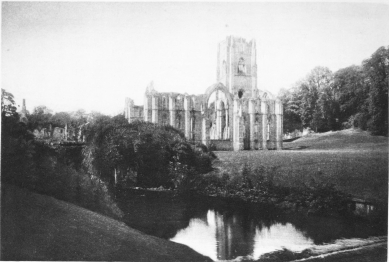
Abbey itself. There, across a wide expanse of green, stood the buildings
of the cloister group: on the left, the church; then the long range of
the cellarium; and on the right, the guest-houses.
The guest-houses had the river on two sides, being set in a sharp angle
of the stream. On the north a wall led from the river to the western
guest-house, and was continued to the eastern, making two secluded
courts. Close to the corner of the eastern house a door opened in the
wall, through which the hospitaller led his guest into the inner court.
There at his feet rose a great staircase which gave access to the second
storey of that house. From the upper landing of these stairs a bridge
led to the second storey of the other house.
The two houses may have been for the use of different classes of
visitors, in a day when social distinctions were scrupulously drawn. In
that case, the better people were probably lodged in the eastern house.
There, entering the upper storey, they found their sleeping-rooms, with
deep-set windows looking to the north and east; and with two good
fire-places, one in the middle of the east wall, the other in the gable
end to the north. In these rooms was never a bed, a table, a stool or a
candlestick which had been made by a machine. All had come from the
hands of craftsmen who brought to their labour a determining quality of
personal interest. Descending into the courtyard, a door near the north
end brought the guest into the great hall—“a goodly brave place much
like unto a church”—where a central row of fair pillars upheld a
vaulted roof. This was for the ceremonies of the table. The arrangement
of the western guest-house was according to the same plan, with two
differences: it was L-shaped, the letter being turned about so that the
base lay by the river, while the shaft extended to the north; and the
hall, which was in the base of the L, was divided into two rooms. The
northern wing may have been the kitchen for both houses. A small
building by the river, where the two guest-houses met, may have been the
office of the hospitaller.
These houses were a hostelry, wherein decent wandering persons, “both
noble, and gentle, and what degree soever that came thither as
strangers,” were made welcome and given free entertainment. This was
the Abbey inn, known to all instructed wayfarers. In a day when towns
were far apart, and the roads bad and beset with peril, the sight of a
monastery tower in the late afternoon was pleasant to a traveller’s
eyes. In the guest-house hall he ate; in the guest-house chamber he
slept; and on the following morning, after mass, refreshed and blessed,
he went upon his way, thanking God for monks and monasteries.
The long range of building, extending from the church to the river, was
called the cellarium, because it was under the general charge of the
cellarer or steward of the monastery. It is likely that he had his
office in the room which stands out from this building at the middle of
its length. In this chamber, having a good window to the west, and a
fireplace between two narrow windows to the south, he kept his office
hours. St. Benedict himself, in his rule, had counselled all cellarers
to be punctual in this matter, that nobody be kept waiting.
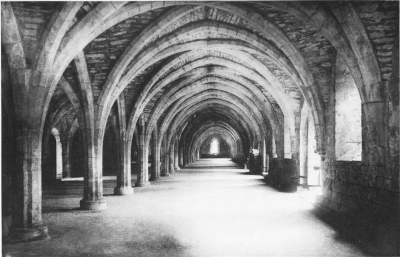
The great vaulted hall, now open from end to end, was then divided into
five rooms by screens and partitions. The first room included the first
two bays of the north end. Instead of pillars, it had in the midst two
piers of masonry supporting a staircase, which ascended out of the
church into the room above. These piers made this a double room, whereof
the western half served as a vestibule to the church, while the eastern
half, once opening from the cloister, may sometime have been the
treasury, as at Durham.
The second room began at the southern pier and extended to the fourth
pillar, thus including four bays. This was probably the storehouse for
the domestic supplies of food and drink. A door in the west wall opened
conveniently upon the outer court.
The third room was between the fourth pillar and the sixth. It had a
door in its south wall, and appears to have been the buttery.
The wall which crossed at the sixth pillar ran between two doors, an
outer door into the court and an inner door into the cloister. Thus this
fourth room served as an entrance way. Its southern wall had the eighth
pillar in the middle of it, and this bay beside the entrance may have
been the outer parlour, the auditorium juxta coquinam, or room beside
the kitchen, which was provided for in the Cistercian arrangements. Here
in a niche of the east wall, now blocked, the porter sat beside the
cloister door. In this room the brethren of the Abbey met their friends
who lived in the world; here merchants came to show their wares.
All the rest of the hall, from the eighth pillar to the end over the
river, was open then as it is now, and served as the refectory of the
lay brothers. They came
The Cloisters.
Photo. Frith. Art Repro. Co.
in by the door in the west wall between the eighth and ninth pillars;
their tables were set along the side walls under the windows; their cups
and plates may have been kept in cupboards against the blank wall of the
last two bays in the south-west corner; their food came in from the
abbey kitchen by a hatch which opened opposite the outer door.
An outside stairway—the day stairs—rose beside the cellarer’s office
at this door, and led to the dormitory of the lay brothers. At the north
end of the dormitory another stairway—the night stairs—went down into
the church. At the south, a room at right-angles, over the river, where
they made their toilet, gave access to the infirmary where they went
when they were sick, and in which they lived in peace and Christian
comfort when they were old.
The lay brothers were monks, like the others, in that they were subject
to the usual monastic vows, amenable to the regulations of monastic
life, and clad in a habit; but they were quite distinct from their
brethren of the choir and cloister. At the beginning of monasticism,
most of the monks were laymen. They had separated themselves not only
from the world but from the church. They believed that the deserts were
better places for prayer than any sanctuary builded by the hand of man.
They felt that they could best draw near to God, each in the silence of
his own soul. In an age whose faith was in salvation by services, they
turned their back on all the services. In an institutional time, when it
was commonly accounted essential to be in the communion of the church,
the monks were individualists. The fact is written in the letters of
their name. A monk—monos—is a man who lives alone. The time came
when a monk was never, under any circumstances, alone; but at the
beginning he was a solitary person, living his own life by himself.
It is true that the wise church quietly and patiently followed these
mystics in their wanderings, followed these enthusiasts who had forsaken
the priests and the sacraments, and carried to them the altars which
they had left behind, and by-and-by most of the monks were priests. But
that was a long process, and during a great part of the time the
convents of monks were lay fraternities, having only such priests as
were needed for the rites of the church. Thus the monastic services were
composed and arranged for the use of laymen. Indeed, the monasteries
were never thoroughly adjusted to the conventional church system. They
were never under the control of the diocesan bishop. Sometimes, they
defied him openly; sometimes, they gave him the nominal office of
visitor, and defied him privately. In general, he had little more
authority over Benedictines or Cistercians than he has at present over
Presbyterians or Methodists.
Accordingly, the lay brothers of Fountains were so named not to
distinguish them from their brethren in priests’ orders, but to mark a
difference between them and the cloister brothers. The conversi, as
they were called, were divided from the monachi not by a barrier of
ordination, but by a barrier of education. They were monks who could not
read. When the Cistercian Order began, there were many such persons,
some of good birth, many of good ability, but ignorant of letters. It
was characteristic of the Cistercians that they made a place for the
piety of these men. Unable to read, they could not take part in the
regular offices of monastic devotion. But they could work. They could
plough and spade, they could brew and bake, they knew how to work on a
farm or in a mill; at the humblest, they could fetch and carry. And
these acts, the Cistercians taught, may be as religious as the
recitation of a litany. So there were the lay brothers, like St.
Christopher at the ford of the river, consecrating their hands and their
feet, their strength and their obedience, to God. They were sanctifying
the homeliest tasks by doing them as the servants of Heaven.
The lay brothers were in the department of the cellarer, to whom they
were responsible, as the cloister brothers were to the prior. They
attended to the secular side of the common life. Having to work hard,
they did not rise so early as the others; in summer, not till dawn. But
they said prayers at night, coming down into the nave, where their
stalls were ranged along on either side against the great pillars. In
the day, they might recite their appointed offices, stopping in the
midst of their work in the mill or in the field. When it was possible,
however, they had their service in the church, chanting softly in the
nave while the other monks were singing in the choir, and having forms
of their own which they had learned by heart.
The essential purpose for which Fountains Abbey was founded was the
pursuit of religion. The prevailing interpretation which was put upon
religion made it to consist, in great measure, of the saying of
services. Out of the confused noises of the common street, the monks had
retired into the quiet of the monastery in the hope of meeting God. And
they sought God in the church.
The church had a western porch, a dozen feet in width, extending along
the whole front. Part of the porch floor was made of gravestones,
beneath which lay the dust of devout laymen, who had begged the
privilege of being buried at the door of the house of prayer. The porch
roof touched the base of the great window, which was filled with the
glorious colours of the inimitable glass of the middle ages. Over the
window, in a niche, was a figure of the Mother and Child. Abbot John
Darnton had this made, and inscribed his name upon the supporting
corbel: an eagle, the symbol of the fourth evangelist, to mean John,
perched on a cask or tun, with a scroll beneath marked dern 1494.
Entering beneath the Norman arch of the west door, the visitor found
over his head a gallery which carried the great organ. A screen
supported the gallery, making a vestibule for the church, keeping out
the wind. A fragment of the base of this screen remains on the south
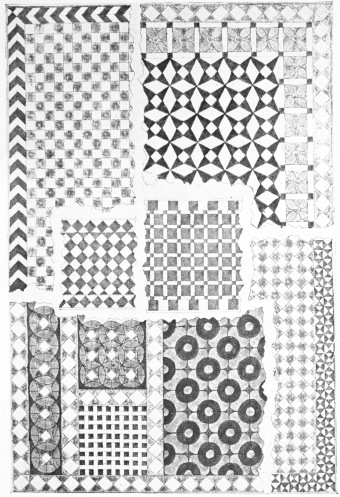
side, near a bit of the pavement which was put in by John of Kent.
Standing in the screen door and looking to the east, the high roof
reached over the nave, the choir, the presbytery, and the chapel of the
nine altars, to the splendour of the east window. The Norman nave and
transepts, with their great pillars and round-headed clerestory windows,
represent the primitive Puritan simplicity of the Cistercians. The
choir and presbytery and the nine-altars chapel are in the style called
Early English. The great windows, east and west, replacing plainer
windows, are, like the tower, in the style called Perpendicular. To-day,
by the destruction of the choir and presbytery, the whole church in its
great length lies open to the view, but in the middle ages it was
crossed by three stone screens.
The first partition, called the rood screen, crossed the middle alley
between the seventh pair of pillars, counting from the west door. It had
two openings, between which stood an altar. Over the altar, on a beam
which topped the screen from pillar to pillar, was a great cross or
rood. This screen formed the east end of that part of the church which
was assigned to the lay brothers. On the right hand and on the left,
this sanctuary was shut off from the aisles by walls, which ran along
the inner side of the pillars, making a long narrow chapel, with the
stalls of the lay brothers set against them. Thus the pillars were
hidden in the aisles, an observer at the west door seeing only the
capitals and upper portions of them above the walls.
The second partition, called the choir screen, crossed the tenth pair of
pillars, and a door in the middle of it gave access to the choir. The
space between these two screens, called the retro-choir, was intended
especially for aged and convalescent brethren from the infirmary. There
was probably a great bench for them against the back of the rood screen.
In the midst of the retro-choir, between the eighth and ninth pairs of
pillars, stood two altars, one on the north dedicated to St. Mary, and
the other on the south dedicated to St. Bernard. The reredoses of these
altars made a screen between the ninth pillars, having a doorway between
them. In this passage, between the altars of the saints, three abbots
were buried, in the fifteenth century. From the top of the two reredoses
to the top of the choir screen, a loft was built, called the pulpitum,
extending from the ninth and tenth pillars on the north to the ninth and
tenth pillars on the south, and on the north side carried out over the
aisle. Here, over the aisle, stood the choir organ.
Passing under this gallery, through the door of the choir screen, the
visitor stood in the central sanctuary, the church of the monks of the
cloister. On either side were twenty stalls, and against the screen,
facing the east, were three stalls on the right of the entrance, and
three on the left. The number of the stalls is determined by the
discovery of nine earthen pots buried in the masonry which underlay
them. These pots were, no doubt, as in several other churches, an
acoustic experiment. The distances between them indicate how many there
were in the whole range. In front of the stalls of the monks were lower
seats for the novices. In addition to the entrance through the choir
screen, there were two other ways of access, at the east end of the
stalls, on either side. Here is still on either side a stone step,
significantly worn. On the north side, stairs led to a high seat over
the door. In the middle alley, where the lecturn may have stood at which
the lessons were read at matins, an abbot was buried.
The presbytery, or chancel, began at these choir doors, and was raised a
step or two. Across the long space of its shining floor stood the third
partition, called the altar screen. Against it was the high altar.
Thus the church was divided into three churches; one for the brothers of
the cellarium, ending at the rood screen; one for the infirmary
brethren, ending at the choir screen; one for the brethren of the
cloister, ending at the altar screen. On the two sides of this
three-fold sanctuary ran long aisles, from the west wall to the chapel
of the nine altars. In the middle of this distance, the aisles opened
into transepts, north and south. The nave aisles, at first unobstructed
for passage around the church, were presently cut up by cross partitions
into chapels; but the choir aisles continued to be used as ambulatories.
The transepts served as antechambers for the chapels which opened out
from them to the east.
Each transept had originally three of these chapels, but the building of
the new chancel had taken away the inner one on each side. Of the two
which thus remained, the outer chapel of the north transept had been
changed into a store-house when the tower was built, so that only the
chapel which was in the middle remained. Over the door, under a bracket,
is still to be read an inscription which informs us that it was
dedicated to the Archangel Michael.
The north transept ended in the noble tower of four storeys, the third
of which was probably for the bells, whilst the second may have served
as the sleeping-room of the men who rung them. The inscriptions which
ran round the outside of the tower are still in great part legible.
“Blessed be the name of Jesus Christ,” said the stones above.
“Blessing and wisdom and honour and power be to our God for ever”; “To
the King, eternal, immortal, invisible, be honour and glory for ever,”
said the middle lines.
“To God alone, to Jesus Christ, be honour and glory for ever,” was
thrice repeated, east and north and west, below.
The words were part in praise, part in apology. The beautiful tower was
forbidden by the ancient regulations of the Order. The Cistercian chapel
was to have but a modest tower, rising no more than a single storey over
the roof. These high parapets were a symbol of the pride of life: they
indicated that the ambitions of the outer world had successfully invaded
the monastery. Not so! cried the abbot who built them, repeating again
and again in great letters on the tower the assertion that it was raised
solely for God’s glory.
In the south transept, out of which, in the south-west corner, stairs
led up to the dormitory of the monks, the chapel which was originally
the middle one of three, was turned into a sacristy; and a narrow door
in the south wall gave access to a large room built against the chancel,
which may have been the office of the sacrist. In the sacristy, and in
other safe places, were kept the Abbey treasures. Here were the copes
which the monks wore when they went in procession, on great days. At the
time of the suppression, when an inventory was taken, there were eighty
of them. Six were made of cloth of gold, twenty-six of white damask,
four of white velvet, two of white fustian. Five old copes were of
embroidered work, and six of flowered work. One was “very well wrought
with images”; one, wrought with images, was of green damask; six were of
red silk, worked with flowers and stars; one was of black velvet. Some
of these splendid cloaks may have been given by noble benefactors out of
their own wardrobes. For Richard of the Lion Heart presented to the
prior of Durham his Parliament robe “of blue velvet, wrought with great
lions of pure gold”; whilst Queen Philippa, making a visit to Ely, gave
the prior her “jewelled robes of State, powdered with golden squirrels.”
Here, also, hung surplices, and eucharistic vestments of cloth of gold
and silk and velvet and serge. Here the abbot may have kept his two
mitres, one for common days, the other for high feasts; but both of them
shining with plates of silver, and garnished with pearls. Each had its
cushion; a word which the writer of the inventory laboriously spelled
“qweshan.” Here were processional crosses; chalices and patens reserved
for great festivals; shrines to be borne about the church on the
festival of Corpus Christi, one containing a rib of St. Lawrence,
another a bit of St. Anne’s scalp set in a plate of silver; and an image
of St. James, and another of our Lady, both of silver-gilt; a table, or
reredos, for the high altar at great services, bearing three images of
silver-gilt, embellished with gold and precious stones; and, most
precious of all, a cross of solid gold, set with gems, and having in it
a piece of the true cross of Calvary.
The “chapel of nine altars” had seven of these holy tables against its
east wall, the three which would naturally have stood under the great
window being combined into one. Each altar had its aumbry or closet for
the sacred vessels, and was parted from its neighbour by a low barrier
of wood, while a similar wall ran along the front of the whole row,
with doors admitting to the altars. There was a gallery over the altar
screen which parted the chapel from the presbytery; and a little gallery
over the door in the south-west corner, which was connected by a long
overhead passage with the abbot’s lodgings. It is likely that at
Fountains, as at Durham, there was a closet against the south wall,
where at the time of saying mass the sacristan provided the monks with
bread and wine for their various altars.
Having thus examined the church, we may imagine ourselves at service in
it upon some high occasion. The lay brothers in their brown gowns are in
their stalls. The monks are in their places in the choir. They are
dressed in white woollen cassocks, tied with a black girdle, and have
over breast and back a scapulary—a straight breadth of black cloth
before and behind, the two pieces fastened at the shoulders. Over this
plain garb, each monk now wears one of the gorgeous copes of the
sacristy. There are two candles on the high altar, and behind them is
the tablet with the three images, probably our Lord on the Cross, with
St. Mary on one side and St. John on the other, with “beads and plate of
silver-gilt, and some part gold and set with stones.” Back of the altar,
suspended high against the screen and falling to the floor, is a
tapestry hanging, of Arras work. The holy table is spread with white
damask embroidered with flowers. On a shelf in a carved recess of the
south wall are a basin and ewer for washing the priest’s hands; a
boat-shaped vessel for incense, with a spoon; two cruets, a pair of
silver censers, and a chalice and a paten for the bread and wine. Over
the head of the celebrant as he prays hangs a silver basin in which
burns a candle. All these things were in the Abbey when the final
inventory was made.
Thus the service begins; the commemoration of the supreme
self-sacrifice. The smoke of incense drifts across the light of the east
window; and there is a sound of chanting, imploring, adoring voices.
Hands are outstretched to receive the mystic bread and wine. And
presently they go out to undertake again their homely tasks in the name
of Him to whom belong the church and themselves.
To these repeated acts of worship, the monks came with a faith which
asked no questions. The services, it is true, were very frequent, and
human nature was with them what we know it to be with us; the thoughts
of the brethren would sometimes wander, and the devout words would be
words only. They were of our own kin and kind. Thomas Kydde and Lawrence
Benne, and Henry Jackson and John Walworth, and their fellows who were
here at the time of the suppression had their bad and their good, as we
have, and in about the same proportion. They were trying, the best way
they knew, to magnify the good, to make the ideal real, and to gain the
approbation of God. In the church they found assistance. There it was,
with doors open, day after day; its aisles fragrant with holy
associations, as with the incense of the prayers of the saints; its
shining altars, its appealing music, its mute assurance of divine
nearness. To it they brought their trials, their perplexities, their
hopes, their aspirations, their resolutions. It was the house of prayer
and the sanctuary of blessing. It was the heart of their life.
Out of the nave, near the south transept, a door opens into the
cloister. At the corner, where nave and transept met, is the pedestal
which held a bowl for holy water. Here the brothers stopped to dip their
fingers and sign their foreheads with
Principal Patterns of the Roman Floors at Fountains Abbey
From a print by Wm. Fowler of Winterton
To face p. 72
the sign of the cross. The green cloister court, without, had a porch
about it on its four sides, and these covered places, whose width is now
indicated by the grading of the turf, were called walks.
In the west walk, against the cellarium wall, sat the novices, busy with
their books, studying church music and grammar and theology. Apt
students, when they became monks, were sometimes sent to complete their
education at Oxford, where they lived in the Cistercian Abbey of Bewley
(founded in 1280), or in the Cistercian College of St. Bernard, now St.
John’s (founded in 1432). There they learned to preach, and teach some
simple theology to the novices who succeeded them. There they learned
also to interpret and apply the canon law: they became the lawyers of
the monastery.
It is likely that Fountains, like other great houses, maintained a
grammar school for the sons of the neighbours. The master of such a
school would not be a monk but a secular person, employed by the Abbey
but not a member of the family. The school-house has not been
identified. The building which once stood across the river at the south
end of the cellarium would have been conveniently placed for this
purpose. A glimpse of the discipline of such a school is had in the fact
that, in the sixteenth century, a schoolmaster, receiving his degree of
bachelor of arts, was presented with a birch as a symbol of his office,
and was required forthwith, in the presence of his examiners, to flog a
boy hired for that exercise.
Over the roof of the east walk, a line of windows opened out of the
dormitory. This was a long room, with two rows of beds from end to end,
like a ward in a hospital. The beds were provided with sheets of
linsey-woolsey, and the monks lay on straw which was emptied out of its
blue ticking and renewed once every year. At Durham, the custom was to
carry his blue bed to the brother’s funeral, and hold it as a canopy
over the grave during the service; so that every night when he lay down
to rest he was profitably reminded of his last sleep. The monks laid
aside their scapulars, but slept in their woollen cassocks, so that they
woke ready dressed. The day stairs to the dormitory are in the
south-east corner of the cloister. There was a room at the head of the
stairs, extending south to the end of the dormitory, which may have
corresponded to the master’s chamber in a like position in a school.
Here the prior may have slept with an attentive ear for any breach of
order. It is uncertain whether there were partitions between the beds,
or whether the brethren were denied even such scanty privacy as that. It
is plain that they had no “cells.” The building which opened at right
angles with the dormitory beside the river was the toilet room, the
necessarium. Through its hall communication was had with the abbot’s
lodgings. The abbot, according to rule, must sleep in the common
dormitory. He probably gave this regulation a liberal interpretation, as
the house grew great, and considered that this hall made his room
“constructively” a part of the chamber of the monks.
At two o’clock in the morning a great bell rang in the tower, and a
little bell in the dormitory answered it. Then every brother bestirred
himself. He threw a cloak about him, thrust his feet into his shoes, and
descended the night stairs at the end of the room into the dark church.
The night service, called matins, consisted of a reading of many lessons
and a chanting of many psalms, and was performed to the accompaniment of
the organ. A light burned before the high altar, and there was a light
in the loft at the organ, and another for the reader at the lecturn,
perhaps still another at the chant-book of the precentor. But otherwise
the great church was in darkness. The psalms were sung from memory. Now
and then some one went about among the singing brothers to make sure
that no man slept. This lasted for an hour or more.
After this service, the monks came out into the north walk of the
cloister, where cressets flamed uncertainly against the walls, and there
continued until dawn, reading or meditating, but having their hoods well
pulled back from their faces to make it evident that they were wide
awake. This study-hour was, of course, short in summer, but long in
winter. When the weather was very bad, they sought refuge in the
chapter-house. In some cloisters there was glass in the open stone-work
of the porch; but, at best, this was a cold place of an early morning.
The dormitory was cold, the church was cold, and the cloister was as
cold as the sky; but they were used to it, like all their neighbours.
This north walk was the living-room and study of the monastery. The
books in most frequent use were kept in a case which stood in a shallow
recess still to be seen in the transept wall. Others were stored in two
capacious closets on either side of the chapter-house door. Every year,
at the beginning of Lent, all the books of the monastery were spread out
on a carpet on the floor of the chapter-house, and a general accounting
was had. A roll was called of brothers and of books. Each monk rose at
the sound of his name, produced the book which had been assigned to him
the year before, and returned it, humbly confessing if he had not read
it through. Then the books were newly distributed and charged. At Ripley
Castle, bound in an octavo volume, are several of the Fountains books: a
Latin grammar, some sermons and some music, and a paraphrase of Ovid, in
which that irresponsible writer is made to serve as a mediæval
moralist. There is also a fragment of a book on medecine, to which they
might profitably have added, as at Meaux Abbey, a book on eating,—De
Edendo. No catalogue remains, but we can guess at the titles from the
lists of other mediæval libraries. There were writings of the fathers,
ancient and modern, with a pretty full set of the works of St. Bernard;
and several commentaries on the Bible; and a good deal of biography,
mostly ecclesiastical; and books on law and ritual.
So the brethren sat in the cold cloister reading their good books. The
Benedictines, who were scholars and literary persons, provided by rule
that these precious manuscript volumes should be handled with becoming
care. “When the religious are engaged in reading in cloister or church,
they shall if possible hold the books in their left hands, wrapped in
the sleeve of their tunics, and resting on their knees.”
Who were these men? Whence had they come? and why?
As for their origin, they belonged, so far as we can now discover, to
the same class from which the ministry is still mainly recruited: to the
great company of those who are neither rich nor poor, who neither earn
their living by their hands nor inherit the means of living from their
fathers, represented in mediæval England by the gentry, as distinguished
on the one side from the peasantry, and on the other side from the
aristocracy.
As for their motive, each had his own. “What are you here for,
Bernard?”—the great saint of the Cistercians had the question written
on his wall. Ad quid venisti, Bernarde? To this inquiry the abbey
might have returned as many as fifty different answers. Some of the
white-gowned men came in pure love of God, deeming a life of continual
prayer the most blessed of all lives, delighting in it
Fountains Abbey.
From the South East.
Photo. Watson. Art Repro. Co.
all, finding in the cloister the four-square city of God which is
pictured in the Book of the Revelation. Some came from love of leisure,
or of simple peace and quiet: the worse ones, disposed to be respectably
idle; the better, finding the outer world too boisterous for their
gentle souls. Some came because they were disappointed; some because
they had failed; some because they had suddenly seen the emptiness of
common life, the baseness of much of it, the flagrant evil of some of
it, and had come out of it that they might live to a good purpose.
Thus Ralph, the seventh abbot, had begun life as a soldier. He was a
contemporary of Robin Hood, who in the ballad met a friar of Fountains
and by him was soundly ducked in the middle of the little river. Richard
of the Lion Heart was at that time ruling England after his fashion. Men
were marching across Europe to the Holy Land. The profession of arms
must have appealed strongly in those days to the heroic, and even to
the religious nature of many men. But Ralph did not like it. It
displeased him much. And one day, coming to Fountains, where his father
had already become a monk, he consulted a lay-brother, whose name was
Sunnulph, homo simplex et illiteratus but wise in the counsels of God.
And presently, the soldier and the brother each had a dream in the same
day. The knight dreamed that he was in a church, and that the figure on
the crucifix cried saying, “Why do you not come? Why do you wait?” To
which he replied with tears, “Behold, Lord, I come!” The monk, sleeping
in the long dormitory over the storehouse, saw the soldier dressed in a
monastic habit. So Ralph became a monk, and presently an abbot.
The possibility of that promotion brought some men into the monastery.
In a world hopelessly divided into classes, the monastery was the
residence of democracy. Here the humblest man, if he could but read and
write, might rise as he deserved, to be the kitchener, the hospitaller,
the sacrist, the cellarer; some day—who could tell?—the abbot, wearing
a mitre, consorting on terms of equality with the noblest in the realm,
ruling his fellow men.
But here are the brethren sitting in the chill cloister, reading their
good books, and awaiting the day. At the first light the bell rang and
they went again into the church for the psalms of lauds. After that,
they returned to the dormitory and washed their hands and faces in the
room over the river. By this time the sun was fairly up, and the hour
was come for the psalms of prime. The first psalm, according to the
gracious arrangement of St. Benedict, they said very slowly, in order to
give late-comers time to get in. Prime was followed by mass or by
chapter meeting, the order differing with the season of the year. The
monastic year was in two parts: winter began on September 14, being
Holy Cross day, a date still used in the Prayer-Book for determining the
autumnal ember days; summer began at Easter.
Out of the church, from prime or mass, the brethren proceeded to the
chapter-house. This great hall opened through three noble arches from
the east walk of the cloister. Two of these arches were blocked, as it
appears, by book closets; but not at the beginning. The books were
probably stored at first, as in other Cistercian abbeys, in the room
between the transept and the chapter-house. Afterwards this room was put
to other uses.
At the further end and on the sides the brothers sat on triple tiers of
stone benches. The meeting began with a reading from the monastic book
of martyrs, how this brother and that in the old time had lain down his
life for his Master. Then there were prayers; and sometimes a sermon,
to the hearing of which the lay brothers might be summoned. Then was
read a chapter from the Rule of St. Benedict, a custom which gave its
name both to the meeting and to the house in which it was held. Thus
their high ideal was kept continually before them. Once a week a list
was read of the household duties and of the brethren to whom they were
assigned. For these homely tasks came to the monks in turn. One after
another, they cooked the dinner, or waited on the table, or swept the
dormitory. Finally, cases of discipline were considered.
In a life which at best was somewhat monotonous and narrow, the minor
annoyances of human fellowship would easily be exaggerated. The rule of
silence could not restrain the brothers from thinking; and some of the
thoughts would naturally take the direction which is indicated in
Browning’s “Soliloquy in a Spanish Cloister.” The chapter meeting was,
accordingly, a place for the summary adjustment of all the petty
grievances. Brother Robert made his complaint against Brother William,
and Brother William confessed or explained, and whoever was adjudged to
be at fault was properly punished: sometimes by loss of precedence,
sometimes by lack of dinner; in serious cases, by flogging. Down got the
brother on the cold floor, paved with tombstones of past abbots, and
there was soundly whipped, for the good of his soul and for the
edification of the brethren. When whipping was not sufficient, he was
put in prison. Under the abbot’s lodgings, beneath the ground, were
three convenient dungeons, in whose walls and floor are to be seen to
this day the staples for the chains.
It is not likely that these dungeons were in frequent use. Many hard
things were, indeed, said about the monks at the time of the
suppression, but it must be remembered that they were said by
interested persons in the heat of controversy. Even then, it was agreed
that in the “great and solemn monasteries,” such as Fountains, religion
was “right well kept.” The monks were slandered that they might the more
conveniently be robbed. Henry VIII. desired for various reasons, good
and bad, to destroy the monasteries and take possession of their lands
and treasures. He desired also, like all the Tudors, to keep the good
will of the people. The royal commissioners, sent to visit the religious
houses and report upon them, understood the situation and met it. They
showed that the monasteries were so bad that a good nation ought to be
happy to have its king suppress them. It is true that the enthusiasm for
the monastic life was waning; the best men were turning their energies
and finding their ideals in other directions. The strength and devotion
of the people were being put into politics, into preaching, into the
practical life of the parish. Moreover, there had gradually grown up a
social as well as a religious separation between the monks and their
neighbours. Fountains Abbey, for example, was built, as we have seen, by
the benefactions of rich and noble persons. It was on that side an
aristocratic institution. It differed in this respect from the parish
churches which were erected and maintained by the plain people, and
especially by prosperous citizens of the mercantile order. Mr.
Micklethwaite has put the situation clearly in his paper on “The
Cistercian Order.” “To a citizen or a franklin,” he says, “a monk was a
dignitary, but the parish priest was his neighbour and friend, and the
parish church was his own.” This fact, that the great substantial middle
class were no longer deeply interested in the abbeys, not only accounts
in some measure for the indifference with which they witnessed their
destruction, but for the difficulty which the monasteries found at last
in getting recruits among men of this good kind. The personal quality
deteriorated. There were bad monks, no doubt, as there are still bad
ministers; and the few bad ones attracted more attention than all the
cloistered saints. And, anyhow, the life which they were endeavouring to
live was an abnormal life, apart from the wholesome influences of
natural human society, and from the helpful engagements of the common
routine. The monasteries inevitably degenerated. But “an enemy,” as
Burke said, “is a bad witness; a robber is a worse.” The quiet judgment
of the modern historian is in favour of the monks, and finds most of
them to have been men of respectable and pious lives. The sober persons
in white cassocks, who confessed faults in the chapter meeting and
cheerfully suffered chastisement for them to which the man in the street
gave not a moment’s thought, had a passionate longing to be good. They
were intent upon the living of a righteous life.
The day’s work would begin about seven o’clock. In the winter it
continued until three in the afternoon, making an eight-hour day. In the
summer there was a long intermission while the sun was high and hot, but
two hours of it were occupied in study. During the day the church bell
rang for the offices of terce and sext and nones; but these were brief
services, and men who were hard at work at a distance stopped where they
stood, and said them under the sky. There was a bite of breakfast called
mixtum—a piece of bread and somewhat wherewith to wash it down—which
was served before the work of the day began to those who were so old or
so young as to be unfit for their tasks without it. In the summer the
meal of the day was eaten at noon, and after it the brethren lay on
their beds in the dormitory and slept for an hour; or, if they chose,
read a book during that time, lying down, being careful not to stretch
out their feet into the passage between the beds, and turning the leaves
quietly so as not to disturb their sleeping neighbours. Late in the
summer afternoon there was a slight repast of bread and fruit. In the
winter, until Lent, the one meal was served when the brethren came in
from work; that is after three o’clock; in Lent, not until about five.
The monastic ideal of seclusion from the world demanded economic
independence. Everything that was needed in the monastery was to be
produced upon the premises. That, at the least, implied a garden for
vegetables, and an orchard for fruit, and a field for corn with a mill
in which to grind it, and ponds for fish, and woods for fuel. It meant
architects, builders, masons, carpenters and plumbers. In the infirmary,
which was the abbey hospital, there must be physicians and attendants.
In the guest-house, which was the abbey inn, there must be porters,
hostlers, cooks. The common details of a domestic establishment of a
hundred men were enough to keep many persons busy. It is true that much
of the heavy work was done by the lay brothers; but every choir brother
had his share also, and went out daily with axe or spade, with
fishing-rod or pruning-hook, with basket or barrow, to his appointed
task. The crops must be planted or garnered, the apples must be picked,
the hay must be got in, the wood must be cut, the buildings must be kept
in repair, horses must be shod, sheep must be shorn, and at all seasons,
in all weather, and under all circumstances, dinner must be cooked.
Accordingly, after the daily mass and chapter, this substantial activity
engaged the mind and muscle of the monastery. The abbot betook himself
to his executive affairs, the prior and the sub-prior to their daily
inspection of the establishment, the cellarer to his house-keeping, the
sacrist to his care of the church, the bursar to his accounts, the
infirmarius to his hospital, the terrararius to his inn, the almoner to
his dependents at the gate, the master of the novices to his school, the
scriptor to his copying, the kitchener to his cooking, others to the
fields and forests. For such as were unemployed about these matters,
there was the cloister with its books, and the church with its frequent
services. It is likely that there were idle monks; for the monk was of
like passions with us, and was beset by the same temptations which
assail us. As the Abbey increased in wealth, and the early ardour of the
monastic life began to cool, there was, no doubt, a disposition to hire
men to do some of the homely tasks which at first the monks had done
themselves. But the ideal of the monastic life was an active day,
wherein from dawn till dark there should not be an idle moment.
Indolence, as St. Benedict declared, is an enemy of the soul; and all
his arrangements of time and task were made with that in mind. Eastern
monasticism had two dominant notes, of pain and prayer. St. Benedict
took pain out and put work in the place of it. No man was to afflict his
soul or body needlessly, but every man was to devote himself, for his
physical and spiritual good, to vigorous exercise. The idle monk was
like the idle minister: he existed, but not often.
All the work was done, as far as was possible, in silence. Out of the
east walk of the cloister, beside the chapter-house, opened the parlour.
There, as the name indicates, the monks could talk. The original rule
specified only the dormitory and the refectory as places wherein speech
was forbidden; but silence came to be the common habit of the monastic
life, its enforcement depending much upon the disposition of the abbot.
The monastery was the abode of blessed stillness. Within its walls men
lived in peace and quiet. They did their tasks without conversation.
They read their books, and ate their meals, thinking their own
uninterrupted thoughts. They sat in the cloister, where the wind and the
sun played in the grass, and were altogether undisturbed. It was not so
much a penitential as a protective silence, good for the soul, and
restful.
There was even a bit of quiet pleasure in the midst of these silent
labours. In the south walk of the cloister, between the dormitory stairs
and the refectory, was the warming house, the abbey fireside. Here, in
the cold weather, the monks came to warm their hands. The abbot had a
fire-place of his own; the cellarer had one in his office; and the
infirmary and the guest houses were cheerfully warmed; but the common
brotherhood had but this one hearth. Here was concentrated all the heat
of the place, in the huge fire-places. One of these great openings is
now blocked, having been disused before the suppression, when the
number of monks was growing smaller, but the other is still ready for a
load of logs, whose smoke would pour out of the tall chimney. Two large
openings in the west wall gave some heat to the refectory. Here, in the
warming house, in Advent, the brothers kept a “solemn banquet” of “figs
and raisins, cakes and ale,” of whose celebration at Durham it is said
that there was “no superfluity or excess, but a scholastical and
moderate congratulation amongst themselves.” A door in the south-west
corner opened upon a little court; the woodhouse stood in the eastern
part of it, and a wooden bridge, from the refectory corner, led across
the river. Over this bridge came the stout brothers in their gowns of
brown or white, their arms full of wood. At Durham, near the warming
house, there was a garden and a bowling alley.
The muniment room at Studley Royal contains among its treasures a
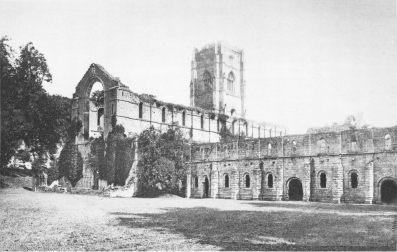
Fountains Abbey.
From the South West.
Photo. Frith. Art Repro. Co.
book of accounts of the bursar, kept in the time of Abbot Grenewell
(1442-1471). There it appears that they had “a pair of clavichords” at
the Abbey—the pianoforte of the Middle Ages. This would seem to imply
domestic music. Somebody must have played, while the brethren stood
about and sang. There are also various records of fees paid to persons
who went about the country from abbey to castle, from manor-house to
market-square, for the entertainment of their neighbours. Minstrels came
from Beverley, with those of Lord Arundell, of Lord Beaumont, of Lord
Fitzhugh, even of the King; who not only sang but acted as conjurers,
gymnasts, contortionists, and variety showmen. Sometimes the audience of
the Abbey was given to a story-teller—fabulator—“the story-teller of
the Earl of Salisbury”; with selections from the Hundred Merry Tales or
the Gesta Romanorum. Players came from Thirsk and Ripon. Sometimes
the entertainer was a jester, or, as they said, a fool. One of the
bursar’s items shows a payment of fourpence “to a fool called Solomon
(who came again).” These diversions would perhaps be given on the
cellarer’s terrace; that is, in the space to the west of the cellarium,
which was once enclosed within a wall, from the church porch to the
cellarer’s office.
One of Abbot Grenewell’s purchases was a great clock, made by John
Ripley, and probably set in the south transept of the church. In the
middle of the hot day in summer, after the service of sext, and late in
the afternoon in winter, after nones, when the clock pointed to the
proper hour, a bell in the cloister rang for dinner; either a bell or a
board struck with a mallet. Outside the refectory door, on either hand,
were stone troughs with running water from the river. In the middle of
the cloister is a great stone bason. When that welcome sound was heard,
the brothers washed their hands in the troughs or in the bason, wiping
them on a roller towel which hung beside the door. Then they entered
their noble dining-hall, lofty as a church, with ceiling of wood and
floor of stone, wainscoted above the height of a man’s head, and having
down the midst a row of marble pillars. At the end opposite the door,
and along the wall on both sides, were stone benches, and in front of
them were tables of oak, covered with linen cloth. The prior commonly
presided, the abbot dining in his own lodgings. All stood in silence
till the prior was in his place, and remained standing while he rang a
little bell during a time sufficient for the saying of the fifty-first
psalm. When the bell stopped, the priest of the week said grace, and
they all sat down.
In the fair gallery of stone in the west wall, deeply recessed and
lighted by great windows, reached by a short flight of stone steps, the
reader stood to accompany the silent meal with words of Holy Scripture
and of ancient authors. The kitchen adjoined the refectory on the west,
having its great ovens in the middle of the room, and entered from the
refectory by a service door which had a round revolving shelf across the
middle of it. Between the door to the gallery and the door to the
kitchen there was perhaps a sideboard; and in the corners toward the
cloister were cupboards for cups and plates and spoons, each provided
with a sink. There were forty-five silver spoons here when the inventory
was made, but only three small cups or mazers, and one big one, of
silver. This would appear to indicate that the cups and plates were of
some cheap material and not worth counting.
The bill of fare showed bread and vegetables and fruit and fish.
Sometimes there was meat, but this was cooked in the kitchen of the
infirmary, and served in the misericord, or House of Merciful Meals. No
flesh which had ever walked about upon four feet was dressed in the
cloister kitchen or served in the cloister refectory. But fowls were
eaten, and eggs were a staple of monastic diet. The monks had wine and
beer for drink, according to the custom of the country. In the book of
signs—De Signis—which shows how the monks of Ely indicated their
wishes at the silent table, four gestures are set down to mean beer:
signifying good beer, bona servisia, small beer, mediocris servisia,
smaller beer, debilis servisia, and a very common beer called
skagmen. In the “Mirroure of Our Ladye,” the sister of Sion House who
desired an apple was directed to “put thy thumb in thy fist, and close
thy hand, and move afore thee to and fro”; for milk, “draw thy left
little finger in the manner of milking”; for mustard, “hold thy nose in
the upper part of thy right fist, and rub it”; for salt, “philip with
thy right thumb and his forefinger over the left thumb”; for wine,
“move thy forefinger up and down upon the end of thy thumb before thine
eye.” A dinner to the accompaniment of these cheerful communications,
while one read aloud from a good book, may well have been a pleasant
meal.
At Ely, during the week beginning August 5, 1336, the brethren of the
monastery had on Sunday eggs, chickens, pigeons and dripping; on Monday,
pottage and cod; on Tuesday, fresh meat and mutton; on Wednesday, fresh
fish, white herring and cod; on Thursday, fresh meat, white herring and
cod; on Friday, white herring and cod; and on Saturday, dripping, milk,
white herring and cod.
When Abbot Grenewell went to attend the assizes at York, as he did in
1455, at the March session of the court, he dined the first day on fish
alone; on the second day, having guests at his table, he added salt and
mustard to the fish; on the third day, fish was served with figs,
raisins and gingerbread; the fare of the fourth day was like that of
the second, and the fifth day followed the third. With this were bread
and beer and wine.
Monastic meals, though monotonous, were wholesome; and there was a good
deal of variety in the preparation of the fish. St. Bernard, in his day,
complained of the ingenuity with which eggs were cooked in religious
houses. “Who can describe,” he cries, “in how many ways the very eggs
are tossed and tormented, with what eager care they are turned over and
under, made soft and hard, beaten up, fried, roasted, stuffed, now
served minced with other things, and now by themselves! The very
external appearance of the thing is cared for, so that the eye may be
charmed as well as the palate.” As the monasteries increased in wealth,
there would be a constant temptation to dine more abundantly. Eating is
not only one of the earliest but one of the most universal of arts, and
no cook nor convert could completely resist its allurements. For the
most part, however, the abbey fare was fit food for soldiers, for men in
training for a war with Satan.
Thus the silent meal progressed, the level voice of the reader at his
desk in the gallery, accompanying the cheerful sounds of honest eating
and drinking. No brother was permitted to leave until the meal was
ended, nor walk about while his companions were eating. Neither was he
allowed to wash his cup with his fingers, though he might wipe it with
his hand. He was forbidden to wipe either his hands or his knife on the
table-cloth,—until he had first cleansed them on his bread. When he
helped himself to salt it must be with his knife; when he drank, he must
hold the cup with both hands. “Eyes on your plates, hands on the table,
ears to the reader, heart to God”: thus ran the rule. Then the prior
rang a sharp note on his bell. If the great mazer of silver with a gilt
band, which is mentioned in the inventory, was a grace cup, then it was
at this moment that it went its round, each brother lifting it to his
lips, holding its two handles. Then, two by two, they marched into the
church and said the miserere psalm.
Out of the cloister, in the south-east corner, between the parlour and
the day-stairs to the dormitory, a passage led to the buildings which
lay beyond. The beginning of this passage crossed a long room which
extended to the south, whose central line of pillars upheld the
dormitory floor. The ceiling was low and the windows were at the south
end, so that its use is not apparent. It may have been the chamber of
the novices; it may have been the tool-house. It may have been an office
or checker, wherein the master of the warming house kept his hogshead of
wine, and his spices, figs and walnuts, with which to mitigate the
austerities of Lent. Or the chamberlain may have used it, whose charge
was to furnish the brethren with linsey-woolsey for their shirts and
sheets; in which case, the tailor may have sat in the light of the south
windows, mending frayed scapularies and darning holes in cowls and
gowns.
The passage led into a gallery, with open arcading of stone on either
side, and a second storey over. Out of the gallery, to the right, opened
the abbot’s lodgings, where a long hall gave entrance into several
rooms. Beside the door a stairway rose to the upper chambers, which
appear to have been large and light, with comfortable fireplaces, and
oriel windows looking out to east and south over the river. In one of
these rooms, or in the misericord which was connected with this building
by a hall, the abbot dined with visitors of state. Here, at the time of
the inventory, were two gilded basins of silver, three silver ewers,
eight “standing pieces” with covers, nine “flat pieces,” all of silver,
with a goblet and some spoons: so that the abbot’s table must have
presented a shining and sumptuous appearance. The open space bounded by
the dormitory basement on the west, the arcaded passage on the north,
the rere-dorter or necessarium on the south, and the abbot’s lodgings on
the east, may have been the abbot’s garden, his hortus inclusus.
Somewhere, at a convenient distance, must have been the abbot’s stable
for his six horses—sex equi ad stabulum domini abbatis,—in charge of
his boy, whose russet suit cost fifteen pence. The chalice, paten and
cruets which were in the abbot’s house would seem to mean that one of
the rooms was an oratory, with an altar. Under the abbot’s lodgings were
the cells for offenders.
From the north-west corner of the second story, over the entrance, a
passage opened into the upper course of the long gallery. Here was a
hall with many windows, warmed here and there with fire-places,
extending east to the infirmary, north to the chapel of nine altars,
and west to the dormitory. Here the abbot could walk; here, in the oriel
which projected into the chapel, he could say his prayers and hear mass
quite by himself. He was the only member of the monastic family who had
the privilege of privacy.
The gallery is almost entirely ruined, but a comparison with the
arrangements of other monastic houses suggests that the upper storey of
the western part, next to the dormitory, was the library or the
writing-room. Here, where there was plenty of light, the records and
accounts may have been kept. Here the books may have been copied which
were used in the choir, and in the cloister and in the school. The
completed records, especially such as related to the abbey lands, may
have been stored in the room over the warming house, now used as a
museum for fragments of pottery and broken carvings found in the ruins.
This room, reached by the day stairs to the dormitory, had a bar at the
door by which the occupant could lock himself in. This bar is a
perplexing fact, and nobody has as yet explained why any official of the
abbey should need to defend himself against intrusion in this peremptory
fashion. If this was the muniment room, it held the great books of the
Chartulary of Fountains, of which the volume A to C is in the British
Museum. D to J is at Ripley Castle, and K to M is in the library of the
late Sir Thomas Phillips. The remaining volumes are not yet traced. Here
were kept the bundles of title-deeds, now at Studley Hall; with pendant
seals, which show that there were neighbouring farmers who attested
their signatures with impressions of Roman gems which their forefathers
had turned up with the plough. The President Book would be kept here,
with its dated list of abbots up to 1471; and the Coucher Book, with
its register of the dealings of the monks with their manors. These two
probably lay by the abbot’s side as he sat in his place in the chapter
house at business meetings. They are now preserved in the muniment room
at Studley Hall.
The long corridor, which connected the cloister with the infirmary,
passed, as we have seen, the abbot’s lodging on the right and the
entrance-way to the chapel of the nine altars on the left. Opposite the
chapel entrance there was an opening into the coal-yard. Coal was found
here when the recent excavations were made. In the south-east corner of
this yard lay the abbey rubbish heap, the materials of which were
apparently shovelled out from the window beside it, whose sill shows the
marks of this daily exercise. Here were found various broken dishes, a
sickle blade, a copper can, bushels of oyster shells, and bones
identified as belonging to beef, mutton, pork and venison, together
with a great quantity of ashes.
The room out of which this refuse was thrown is reached by a passage
which opens out of the long corridor close by the infirmary door. Here,
according to Mr. Walbran, stood the reservoir, fed by a lead pipe from a
spring on the high bank.
The meat bones in the rubbish heap suggest the near neighbourhood of the
House of Merciful Meals. This is the room which lies to the south of the
reservoir and the coal-yard. A screen extended across the east end of
the misericord, and there was a dais for the high table at the west end.
Along the north wall are still remains of one of the stone benches.
Tables stood here, as in the refectory of the cloister.
The long corridor ended at the door of the infirmary. This was a noble
group of buildings, now ruined almost to the ground. There was a great
hall, one of the finest in the kingdom, with two rows of stately
pillars. It had a fire-place at each end, and the aisles were divided by
partitions into small rooms, some having fire-places of their own. Back
of it, to the east, reached by broad stone steps, eight of which remain,
stood a two-storied structure, with vaulted basement probably for
domestic stores, and with upper apartments which may have served for the
entertainment of guests of unusual distinction. Up these stairs, then,
attended by officers of the Abbey, went the Nevilles, the Marmions, the
Mauleverers, on their visits to the monastery. In the chamber above
slept the abbot of Clairvaux, when he came on his round of inspection of
the Cistercian houses. Adjoining this lodging, on the south, was the
chapel, into which a flight of narrow stairs descended from this
guest-room. The base of the altar is still in situ. Next the chapel,
with a yard between, was the spacious kitchen, whose great round ovens
are still in place. Here, was cooked the food for the infirmary, for the
misericord, and for the occupants of the lodging. A staircase beside the
chapel-door seems to have led from the kitchen to the guest-room, over
the arch of the entrance.
Here, in the infirmary, were gathered the old men, who had been monks
for fifty years. Here the sick were cared for. Here regularly, in
groups, a fourth part of the brethren at a time, came all the monks in
succession for the periodical minutio, or letting of blood, according
to the medical discipline of the time. In this comfortable seclusion
they regained their strength. The doors of the infirmary were shut
against the harsher regulations of the monastic life. Fires blazed on
the hearth and roared up the great chimneys, and there were good things
on the table at dinner time. The place was both a hospital and an old
men’s home. The buildings extended over the river, which flowed in four
tunnels beneath. To the north, beside the chapel of the nine altars, lay
the cemetery. In this quiet place, remote from even the peaceful stir of
the cloister, the monks expected to end their days. Their longest
journey out of this blessed haven was when they crept along the
corridor, and the nine-altars chapel, and the presbytery aisle, to their
place on the stout oak bench against the back of the rood screen, to
hear mass on some high festival. They awaited only one longer journey,
when they should be carried out of the infirmary chapel to the green
cemetery.
When the time for that last journey drew near, the abbot came to
administer the sacrament, with all the brethren assembled. Then a cross
of ashes was traced upon the floor, with a merciful covering of straw
upon it and a quilt on that; there the sick man was laid. When the
brother’s breath grew faint and difficult, and it was plain that the
moment of his departure was at hand, a board in the cloister was struck
repeated blows with a mallet, and all the monks hastened to their
brother’s side. Thus he closed his eyes, amidst the prayers of his
friends, and passed from the peace of the monastery to the rest of
paradise.
This quiet end of life was continually symbolised in the quiet ending of
the monastic day. Late in the afternoon, the office of vespers was said
in the church, somewhat elaborately, with much singing and
organ-playing. After vespers, in the twilight, the monks sat in the
cloister, about the refectory door, and somebody read aloud from a good
book, preferably the Collations of Cassian. On Saturday afternoons
during the reading, the brothers by turns sat in a row on the stone
benches which were over the lavatory troughs on either side of the
refectory door, and had their feet washed in the running water by the
cooks of that week and of the week to come. Then the compline prayers
were said, in the summer about seven o’clock, in the winter about eight.
And at the end of the service, every monk pulled his cowl over his head
and went to bed.