The most popular card games of the present day undoubtedly
belong to the whist family, which embraces all those played with
a full pack of fifty-two cards, ranking from the ace to the deuce,
one suit being trumps, and the score being counted by tricks and
honours, or by tricks alone.
The oldest and most important of the group is whist itself.
The game appears to be of English origin, its immediate parent
being “ruff and honours.” This was an old English game in
which twelve cards only were dealt to each player, the uppermost
of the remaining four being turned up for the trump suit. Whoever
held the ace of trumps could “ruff” or take in these four
cards, discarding in their place any four he chose. As the game
developed into whisk, or whist, this ruffing feature disappeared.
There was no stock, the four deuces being discarded from the
pack instead. Twelve cards were dealt to each player, and the
last was turned up for the trump.
About 1680 a variation of the game known as “swabbers”
came into vogue. The swabbers were the heart ace, club jack,
and the ace and deuce of trumps. The players to whom these
cards were dealt were entitled to a certain share of the stakes or
payments, independent of the play for tricks and honours. This
variety of the game did not long remain in favor, but gave way to
make room for one of the most important changes, the restoration
of the deuces to the pack, which introduced the feature of the
odd trick. This took place early in the last century, and seems to
have so much improved the game that attention was soon drawn
to its possibilities for scientific treatment.
About this time whist was taken up by a set of gentlemen who
met at the Crown Coffee House in Bedford Row, London; chief
among whom was Sir Jacob de Bouverie, Viscount Folkestone.
After considerable experiment and practice this little whist school
laid down the principles of the game as being: “to play from the
strong suit; to study the partner’s hand; never to force partner
unnecessarily, and to attend to the score.” It is generally believed
that Edmond Hoyle was familiar with the proceedings of
this set, and on their experiences based his celebrated “Short
Treatise on the Game of Whist,” which was entered at Stationers’
Hall in London Nov. 17, 1742.
The only works previous to Hoyle touching upon whist were the
“Compleat Gamester” of Cotton, which first appeared in 1674, and
the “Court Gamester,” of Richard Seymour, 1719. One of Hoyle’s
great points was his calculation of the probabilities at various
stages of the rubber. This seems to have been looked upon as
most important in guiding persons in their play, for we find that
Abraham de Moivre, a famous mathematician, used to frequent
the coffee houses, and for a small fee give decisions on questions
of the odds at whist.
Bath seems to have been the great rallying-point for the whist-players
of the last century; but the passion for the game soon
spread all over Europe. In 1767 Benjamin Franklin went to
Paris, and it is generally believed that he introduced the American
variety of the game known as Boston, which became the rage in
Paris some time after the war of independence.
So popular did whist become in Italy that we find the boxes at
the opera in Florence provided with card tables in 1790. The
music of the opera was considered of value chiefly as, “increasing
the joy of good fortune, and soothing the affliction of bad.”
A code of laws was drawn up about 1760 by the frequenters of
White’s and Saunders’ in London. These seem to have remained
the standard until “Cælebs” published, in 1851, the code in use
at the Portland Club. In 1863 John Loraine Baldwin got
together a committee at the Arlington, now the Turf Club, and
they drew up the code which is still in use all over the world for
English whist. In the United States, laws better suited to the
American style of play were drawn up by the American Whist
League in 1891, and after several revisions were finally adopted,
in 1893, as the official code for League clubs.
The literature of whist saw its palmiest days at the beginning
of this century. 7,000 copies of Bob Short’s “Short Rules for
Whist” were sold in less than a year. Mathews’, or Matthews’,
“Advice to the Young Whist-Player,” went through eighteen
editions between 1804 and 1828. After these writers came
Admiral Burney, who published his “Treatise” in 1821; Major
A. [Charles Barwell Coles,] gave us his “Short Whist” in 1835.
Deschapelles published his “Traité du Whiste” in 1839, but it
gave little but discussions on the laws. “Whist, its History and
Practice” by Amateur, appeared in 1843. General de Vautré’s
“Génie du Whiste,” in 1847. “Cælebs” [Edward Augustus
Carlyon] wrote his “Laws and Practice” in 1851. Then in rapid
succession came “Cavendish” in 1863, James Clay in 1864, Pole
and “Cam” in 1865. Campbell-Walker’s “Correct Card” in
1876; Drayson’s “Art of Practical Whist,” with its new theories
of trumps; Fisher Ames, “Modern Whist,” in 1879; “Whist, or
Bumblepuppy?” by “Pembridge” [John Petch Hewby], in 1880;
G.W.P. [Pettes], in 1881; Proctor’s “How to Play Whist,” in
1885; and the “Handbook of Whist,” by “Major Tenace,” 1885.
Then began the long list of American authors (Pettes has already
been mentioned): “Foster’s Whist Manual,” by R.F. Foster, appeared
in 1890; “Practical Guide to Whist,” by Fisher Ames, in
1891; Hamilton’s “Modern Scientific Whist,” in 1894, and in the
same year, Coffin’s “Gist of Whist,” and “Foster’s Whist
Strategy.” In 1895, Milton C. Work’s “Whist of To-day,” and
“Foster’s Whist Tactics,” giving the play in the first match by
correspondence; and in 1896, Val Starnes’ “Short-suit Whist,”
and Howell’s “Whist Openings.” In 1897, Mitchell’s “Duplicate
Whist.” In 1898, Foster’s “Common Sense in Whist,” and in
1900, Fisher Ames’ “Standard Whist.” Since then whist literature
has given place to bridge.
In periodical literature we find whist taken up in the pages of
the “Sporting Magazine” in 1793. The London “Field” has had
a card column since December 6, 1862. Proctor’s work first appeared
in “Knowledge.” The “Westminster Papers” devoted a
great deal of space to whist games and “jottings” every month
for eleven years, beginning in April, 1868. “Whist,” a monthly
journal devoted exclusively to the game, began publication in Milwaukee
in 1891; but gave it up when bridge supplanted whist in
popular favor.
Whist rapidly became a “newspaper game.” The New York
Sunday Sun devoted two columns every Sunday to the discussion
and illustration of moot points in whist tactics, and the analysis of
hands played in important matches. In a series of articles begun
February 23, 1896, this paper gave to the world the first systematic
statement of the theory and practice of the short suit game. In
1898 there were at least forty whist columns published in the United
States. Two magazines devoted to whist and bridge are now published,
one in Boston and the other in New York.
While the parent game has been pursuing this prosperous
course, many variations have been introduced. One of the most
radical changes in the game itself has been cutting down the
points from ten to five, which occurred about 1810. Mathews
mentions it in 1813 as having occurred since the publication of his
first edition in 1804, and Lord Peterborough, the unlucky gambler,
for whose benefit the change was introduced, died in 1814.
Another great change took place in America, where they played
for the tricks alone, the honours not being counted at all. Turning
the trump from the still pack was first tried by a Welsh baronet,
and is mentioned by Southey in his “Letters of Espriella.” This
custom was revived for a time by the Milwaukee Whist Club, and
is still sometimes seen in Europe under the name of “Prussian
Whist.”
Altogether we can trace nineteen games which are clearly
derived from whist. Duplicate, Drive, and Progressive whist are
simply changes in the arrangement of the players and in the
methods of scoring. Prussian whist introduces the cutting of the
trump from the still pack. Dummy and Double-dummy are simply
whist with a limited number of players, necessitating the exposure
of one or more hands upon the table. The French game of Mort
is dummy with a better system of scoring introduced. Favourite
Whist simply changes the value of the tricks in scoring, according
to the trump suit. Cayenne and Bridge introduce the first changes
of importance. In Cayenne, the dealer and his partner have the
privilege of changing the trump from the suit turned up; in
Bridge they name the trump suit without any turn-up, and play
the hands as at dummy. In Boston, and Boston de Fontainebleau,
in addition to making the trump suit instead of turning it up,
further departures are introduced by naming the number of tricks
to be played for, allowing the player to take all or none without
any trump suit, and by ‘spreading’ certain hands, without allowing
the adversaries to call the exposed cards. French and
Russian Boston are simply varieties of Boston. Solo Whist is an
attempt to simplify Boston by reducing the number of proposals
and the complications of payments, and eliminating the feature of
‘spreads.’ Scotch Whist introduces a special object in addition
to winning tricks—catching the ten of trumps; that card and the
honours having particular values attached to them. This variety of
whist may be played by any number of persons from two to eight;
and its peculiarity is that when a small number play, each has
several distinct hands, which must be played in regular order, as
if held by different players. Humbug Whist is a variety of double-dummy,
in which the players may exchange their hands for those
dealt to the dummies, and the dealer may sometimes make the
trump to suit himself. German Whist is played by two persons,
and introduces the element of replenishing the hand after each
trick by drawing cards from the remainder of the pack until the
stock is exhausted. Chinese Whist is double-dummy for two,
three, or four persons, only half of each player’s cards being
exposed, the others being turned up as the exposed cards are got
rid of in the course of play.
All these varieties have been entirely supplanted and overshadowed
by bridge. When they play whist at all, the English
think there is nothing better than the original whist, counting
honours, and playing to the score. The Americans think Duplicate
superior to all other forms, especially when two tables are engaged,
and four players are opposed by four others for a specified
number of deals. We are inclined to agree with Clay that the
French game of Mort is “charming and highly scientific.” He
says English dummy is a “very slow game.”
Whether it is because the game has been found ‘slow,’ or
because its more attractive forms are little known, it is certainly
true that writers on whist pay little or no attention to dummy.
The English authors mention it only in connection with laws and
decisions. No American text-book makes any allusion to the
game, and there is no reference to it in the American Whist
League’s code of laws.
In the first edition of this work, written in 1895, the author
ventured to prophesy that the day was not far distant when dummy
would supersede all other varieties of whist among the most expert
players; either in the form of the charming Mort or the fascinating
Bridge. Very few persons who have played either of these games
sufficiently to appreciate their beauties care to return to the platitudes
of straight whist.
At that time, bridge was unknown in America except to the
members of The Whist Club of New York and their friends. In
the short space of ten years it has become the card game of the
world; but in spite of its present popularity it has its defects, and
it would not be surprising to see its place usurped by another
game, not a member of the whist family, which has been steadily
gaining ground among those who have the intellectual capacity for
card games of the highest class, and that is skat.
The first text-book on bridge was a little leaflet printed in England
in 1886, which gave the rules for “Biritch, or Russian Whist.”
“Boax” came out with a little “Pocket Guide” in 1894, followed
by “The Laws of Bridge” in 1895. The Whist Club of N.Y.
published the American laws of bridge in 1897, and “Badsworth”
came out with the English laws in 1898. In the following year,
1899, Archibald Dunn, Jr., gave us “Bridge and How to Play It,”
and John Doe published “Bridge Conventions,” A.G. Hulme-Beaman’s
“Bridge for Beginners” appearing in the same year.
In 1900, “Foster’s Bridge Manual” appeared in America, reprinted
in England under the title of “Foster on Bridge.”
In the years following, text-books on bridge came from the press
by the dozen, the most notable authors being Dalton and “Hellespont”
in 1901; Elwell and Robertson in 1902; Street and Lister
in 1903. Many of the writers already mentioned published later
and more complete works, embodying the results of time and
experience. Foster’s Self-playing Bridge Cards were brought out
in 1903. Elwell’s “Advanced Bridge” appeared in 1904 and
Foster’s “Complete Bridge” in 1905.
While bridge has never been such a popular “newspaper game”
as whist was in America, it has been much more so in England.
Articles on bridge, for beginners chiefly, were published in 1905
and 1906 by the San Francisco Call, Pittsburgh Post Despatch,
Cincinnati Commercial Tribune, Chicago Journal, St. Paul Despatch,
Milwaukee Journal, Baltimore American, Houston Post,
Indianapolis Star, and the N.Y. Globe. These were all edited
by R.F. Foster.
Bridge Tournaments, offering prizes for the best play of certain
hands were run by the N.Y. Evening Telegram, the N.Y. Globe,
the N.Y. Evening Mail, and the Chicago Journal. A number of
the weekly magazines offer similar competitions in England, but as
a rule the problems in that country are of very poor quality.
About 1910 it became the fashion not to play spades, it being
considered a waste of time to play a hand for such a small amount
as 2 points a trick, so the dealer was allowed to score 2 for the odd
and 4 for honours, regardless of how the cards were distributed,
the hand being abandoned. The objection to this practice was
that many hands were worth much more than 2 points, and in
some cases the spade make would have gone game at the score.
This led to the practice of playing “royal spades,” which were
played at 10 and then at 9 a trick, sometimes with a penalty of 20
if the declarer failed to make the odd.
Shortly after this, later in 1910, there developed a decided rebellion
against the dealer’s monopoly of the make, and in order
to allow any player at the table who held good cards to get the
benefit of them, whether he was the dealer or not, bidding for the
privilege of making the trump came into vogue. This was the
starting point of auction, its chief difference from the older
game being that only the side that made the highest bid for the
declaration could score toward game. The full number of tricks
bid had to be made, and if they were not made, the adversaries
scored in the honour column for penalties, the penalty being always
the same, regardless of the trump suit.
The great disparity in the values of the suits as then played
practically confined the bidding to the hearts and royal spades.
This soon brought about another change, which was to
raise the values of all the suits except spades and to cut down
the no-trumper. This was done in 1912, and made it possible
for any suit to go game on the hand. All the well known writers
on whist and bridge came out with text-books on auction, and
the newspapers took up the subject in weekly articles.
Although to many the game now seemed perfect, there were
those that felt the helplessness of weak hands to offer any
defence in the bidding against a run of no-trumpers or hearts
and royals. To remedy this, F.C. Thwaites of the Milwaukee
Whist Club suggested the introduction of the nullo. This was
a bid to lose tricks, at no trump only, and its value was to be
minus 10, that is, it was to be outranked only by a no-trumper
to win. At first, this bid was largely used simply as an additional
game-going declaration, and was strongly objected to by
many leading players. But as its true place as a defensive bid
became better understood it soon came into favour. In the nullo
there are no honours, and the declarer scores the tricks over the
book made by his opponents, which he forces them to take.
Many interesting card problems have been built upon the nullo.
Toward the end of 1913 still another change seems to have
suggested itself to some of the English players who were familiar
with the Russian game of vint, and that is to play auction just
as it is played up to the point of the lead to the first trick, but
that no dummy is exposed, the four players holding up their
cards and following suit just as they would at whist. Whether
or not this game will ever become as popular as the combination
of dealer and dummy, it is difficult to say, but appearances are
against it.
There seems to be a growing tendency in America to adopt
the English rule of cutting out the spade suit at 2 a trick, and
making it always a royal spade, worth 9. The dealer is allowed
to pass without making a bid, the lowest call being one club.
If all pass, the deal goes to the left.
There are two principal varieties of this game; straight bridge,
in which the dealer or his partner must make the trump, their
opponents having nothing to say about it except to double the
value of the tricks. The dealer’s partner is always the dummy,
and either side may score toward game by making the odd trick
or more. Auction bridge, in which the privilege of making the
trump is bid for, the highest bidder playing the hand with his
partner as dummy, regardless of the position of the deal, and
his side being the only one that can score toward game, the
adversaries scoring nothing but penalties in the honour column
if they defeat the contract.
As this is the more popular form of bridge at the present
time, it will be given first. Since the adoption of the higher
value for the spade suit under the name of royal spades, and
the change in the value of the suits, the game gradually came to
be known as royal auction, but as that change is now universal,
the name has slipped back to its original title.
CARDS. Auction is played with a full pack of fifty-two
cards, ranking A K Q J 10 9 8 7 6 5 4 3 2, the Ace being the
highest in play, but ranking below the deuce in cutting. Two
packs should be used, the one being shuffled while the other is
dealt.
MARKERS suitable for scoring the various points made at
Bridge have not yet been invented. Some persons use the bézique
marker; but it is not a success. The score is usually kept on a
sheet of paper, and it should be put down by each side, for purposes
of verification.
PLAYERS. Auction is played by four persons, and the table
is complete with that number. When there are more than four
candidates for play, the selection of the four is made by cutting.
These cut again for partners, and the choice of seats and cards.
CUTTING. The usual method of cutting for partners, etc.,
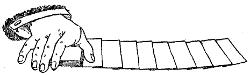
at auction, is to shuffle the cards thoroughly, and “spread” them
face downwards on the table; each candidate drawing a card, and
turning it face upwards in front of him. The four cutting the
lowest cards playing the first game, or rubber.
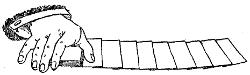
SPREADING THE PACK.
The four having been selected, the cards are again shuffled and
spread, and partners are cut for; the two lowest pairing against
the two highest; the lowest of the four is the dealer, and has the
choice of cards and seats.
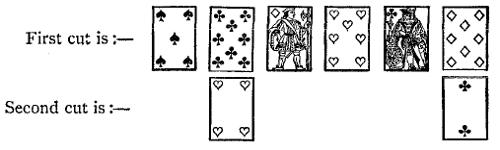
TIES. As between cards of equal value in cutting, the heart
is the lowest, diamonds next, then clubs and then spades.
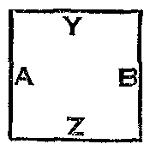
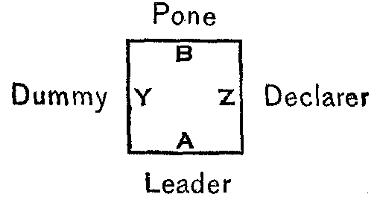
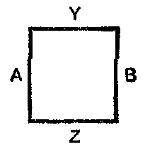
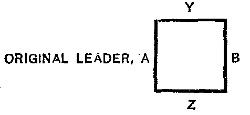
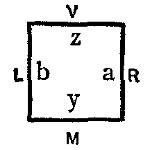
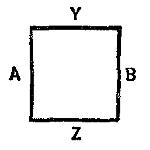
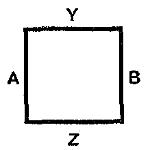
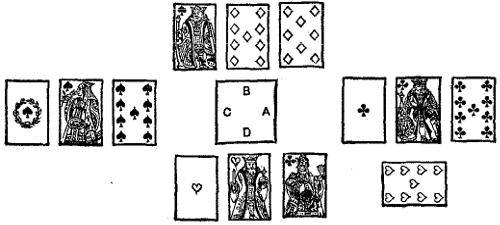
POSITION OF THE PLAYERS. The four players at
the bridge table are indicated by letters; A and B are partners
against Y and Z; Z always represents the dealer, who always
makes the first bid, A being the second bidder, Y the third and B
the fourth.
DEALING. The cards having been properly shuffled the
dealer, Z, presents them to the pone, B, to be cut. At least four
cards must be left in each packet. Beginning at his left, the dealer
distributes the cards one at a time in rotation until the pack is
exhausted. When two packs are used, the dealer’s partner shuffles
one while the other is dealt, and the deal passes in regular
rotation to the left until the rubber is finished.
IRREGULARITIES IN THE DEAL. If any card is
found faced in the pack, or if the pack is incorrect or imperfect,
the dealer must deal again. If any card is found faced in the
pack, or is exposed in any manner; or if more than thirteen cards
are dealt to any player, or if the last card does not come in its
regular order to the dealer, or if the pack has not been cut, there
must be a new deal. Attention must be called to a deal out of
turn, or with the wrong cards, before the last card is dealt, or
the deal stands.
There are no misdeals in auction. That is to say, whatever
happens the same dealer deals again. Minor irregularities will be
found provided for in the laws.
The cards being dealt, each player sorts his hand to see that he
has the correct number, thirteen; and the player or players keeping
the score should announce it at the beginning of each hand.
STAKES. In auction, the stake is a unit, so much a point.
The number of points won or lost on the rubber may be only two
or three, or they may run into the hundreds. The average value
of a rubber at auction is about 400 points. Any much larger
figure shows bad bidding. In straight bridge the average is
about 180. In settling at the end of the rubber, it is usual for
each losing player to pay his right-hand adversary.
MAKING THE TRUMP. In auction, the dealer begins
by naming any one of the four suits, or no trumps, for any number
of tricks he pleases. Each player in turn to the left then has
the privilege of passing, bidding higher, or doubling. When three
players pass a bid, it is the highest made and is known as the
Winning Declaration or Contract.
In order to understand the principles that govern the players
in their declarations, one should be thoroughly familiar with the
values attached to the tricks when certain suits are trumps. The
first six tricks taken by the side that has made the winning
declaration do not count. This is the “book,” but all over the
book count toward making good on the contract, according to
the following table:
| When |
Spades |
are trumps, |
each trick counts |
2 |
points. |
| ” |
Clubs |
” ” |
” ” ” |
6 |
” |
| ” |
Diamonds |
” ” |
” ” ” |
7 |
” |
| ” |
Hearts |
” ” |
” ” ” |
8 |
” |
| ” |
Royal Spades |
” ” |
” ” ” |
9 |
” |
| ” |
there are no trumps, |
” ” ” |
10 |
” |
The game is 30 points, which must be made by tricks alone, so
that three over the book, called three “by cards,” will go game
from love at no trump, or four by cards at hearts or royals.
These are called the Major or Winning Suits. As it takes
five by cards to go game in clubs or diamonds, and on account
of the difficulty of such an undertaking, these are called the
Minor or Losing Suits. An original bid of one spade can
be made only by the dealer, and it simply means, “I pass.” That
is, the dealer has nothing to declare on the first round of the bidding.
[See note at foot of page 58.]
RANK OF THE BIDS. In order to over-call a previous
bid, whether of the partner or the opponent, the bidder must
undertake to win the same number of tricks in a suit of higher
value, or a greater number of tricks having the same aggregate
value as the preceding bid. Players should restrict themselves to
the same form of expression throughout, and all bids, even passing,
must be made orally and not by gesture.
Let us suppose this to be the bidding: The dealer, Z,
begins with “One spade,” second player, A, says, “I pass,” or
simply, “No.” Third bidder, Y, says, “One club,” fourth player,
B, “No trump.” The dealer, starting on the second round,
says, “Two clubs,” supporting his partner’s declaration. Next
player, A, who passed the first time, says, “Two royals.” Both
Y and B pass, but the dealer, Z, says, “Three clubs.” Observe that
while three clubs is worth no more than two royals, 18, the club
bid offers to win more tricks than the royals and therefore ranks
as a higher bid. A doubles three clubs. Y passes and B says,
“Two no trumps.” As will be explained presently, doubling does
not affect the value of the declaration in bidding, so two no
trumps, worth 20, over-calls three clubs. Z, A and Y all pass, so
two no trumps becomes the winning declaration and B is the
declarer, A being the dummy, with Z to lead for the first trick.
In this example, had the bid been left at three clubs, doubled
or not, that would have been the winning declaration, and the
partner who first named that suit, Y, would be the declarer, Z
being the dummy, although Z actually made the highest bid. It
is only when the two players that have both named the winning
suit are not partners that the higher bidder becomes the declarer.
DOUBLING. No player may double his partner, but he
may redouble an opponent who has doubled. All doubling must
be strictly in turn, like any other bid. Doubling does not affect
the value of the bids, but simply doubles the value of the tricks
or penalties when they are scored at the end of the hand. Suppose
A bids two royals and Y doubles. B can take A out with
three clubs, because, so far as the bidding goes, two royals are
still worth only 18.
Any over-call annuls the double, or redouble. Suppose A says
two hearts, Y doubles, B redoubles, and Z says two royals. The
doubling is all knocked out, and if A were to go three hearts
and get the contract, hearts would be worth only 8 a trick in the
scoring unless Y doubled all over again. A double reopens the
bidding, just the same as any other declaration, allowing the
player’s partner, or the player himself in his turn, to take himself
out of the double by bidding something else.
IRREGULARITIES IN DECLARING. If any
player declares out of turn, either in bidding a suit or in doubling,
either opponent may demand a new deal, or may allow the declaration
so made to stand, in which case the next player to the
left must bid, just as if the declaration had been in turn. If a
player pass out of turn there is no penalty, and the player
whose turn it was must declare himself. The player who
has passed out of his proper turn may re-enter the bidding if the
declaration he passed has been over-called or doubled.
If a player makes an insufficient or impossible declaration,
either adversary may call attention to it. Suppose the last bid
is three royals, and the next player says four clubs. This is not
enough, as three royals is worth 27 and four clubs only 24. Unless
the player in error correct himself at once, and make it five
clubs, either adversary may demand that it be five clubs, and
the partner of the corrected player cannot bid unless this five-club
bid is over-called or doubled. A player correcting himself must
stick to the suit named, not being allowed to say four diamonds
when he sees that four clubs is not enough.
If an insufficient declaration is passed or over-called by the
player on the left, it is too late to demand any penalty, and the
insufficient bid stands as regular. Suppose A bids three royals
and Y says four clubs, B and Z passing. A can repeat his bid
of three royals if he likes, as that is enough to over-call four
clubs.
If a player makes an impossible declaration, such as calling six
diamonds over five no trumps, when it is clearly impossible to
make any diamond declaration worth 50, either adversary may
demand a new deal, or may insist that the last bid made by his
own side, five no trumps, shall be the winning declaration, or he
may force the player in error to declare a grand slam in diamonds
and play it, his partner being forbidden to take him out.
METHOD OF PLAYING. The winning declaration
settled, whether doubled or not, the player on the left of the declarer
leads for the first trick, and dummy’s cards go down, the
declarer playing the combined hands. The declarer gathers the
tricks for his side, but either adversary may gather for the other.
The first six tricks taken by the declarer make a book, and all over
the book count toward his contract. The adversaries have a
book as soon as they reach the limit of the tricks they may
win without “setting” the contract. If the contract is four hearts,
the declarer must win ten tricks, so that his opponents have a
book when they get home three tricks. All tricks should be laid
so that they may be readily counted by any player at the table.
DUMMY. Until a card is led by the proper player, the declarer’s
partner has all the rights of any other player, but as soon
as the player to the left of the declarer leads and dummy’s cards
are laid on the table, dummy’s duties and rights are restricted to
the following:
He may call attention to few cards played to a trick; correct
an improper claim of either adversary; call attention to a trick
taken by the wrong side; ask his partner if he have none of a
suit to which he renounces; correct an erroneous score; consult
with the declarer as to which penalty to exact for a revoke;
and, if he has not intentionally overlooked the hand of another
player, he may call his partner’s attention to an established
revoke made by the adversaries, or to a card exposed by them
or a lead out of turn made by them.
The Revoke. Should a player fail to follow suit when able
to do so, it is a revoke, and the revoke is established when the
trick in which it occurs is turned down and quitted by the side
that won it, or when the revoking player, or his partner, in his
right turn or otherwise, has led or played to the following
trick. If a player ask his partner if he has none of the suit led,
before the trick is turned down, the revoke may be corrected,
unless the player in error replies in the negative, or has led or
played to the next trick.
Dummy cannot revoke under any circumstances.
The penalty for the revoke depends on the side in error.
If the declarer revokes he cannot score anything but honours as
actually held, while the adversaries take 100 points penalty in the
honour column, in addition to any they may be entitled to for defeating
the declaration. If an adversary revokes, they score
honours only, and the declarer may either take the 100 points, or
he may take three actual tricks and add them to his own. If
he takes the tricks, they may aid him in fulfilling his contract, as
the score is then made up as the tricks lie, but the declarer will
not be entitled to any bonus in case he was doubled.
Suppose Z is the declarer, and is playing three hearts doubled.
He wins the odd trick only, but detects a revoke, for which he
takes three tricks. This gives him four by cards, doubled, worth
64 points toward game, but he does not get any bonus for making
his contract after being doubled, or for the extra tricks, because
they were taken in penalty and not in play.
Exposed Cards. After the deal but before the winning
declaration is settled, if any player exposes a card his partner
is barred from bidding or doubling, and the card is subject to
call. Should the partner of the offending player prove to be the
leader to the first trick, the declarer may prohibit the initial lead
of the exposed suit.
All cards exposed by the declarer’s adversaries after the original
lead are liable to be called and must be left on the table,
face upward. Exposed cards are those played two at a time,
dropped on the table face up, or so held that the partner might
see them, or cards mentioned as being in the hand of the player
or his partner. The declarer is not liable to any penalty for
exposed cards.
Leading Out of Turn. If either adversary leads out of
turn, the declarer may call the card exposed, or call a suit when
it is the turn of either adversary to lead. If the declarer leads out
of turn, from his own hand or dummy’s, there is no penalty, but
he may not correct the error unless directed to do so by an adversary.
If the second hand plays to the false lead, it must stand.
If the declarer plays from his own hand or from dummy to a
false lead, the trick stands. In case the dealer calls a suit and
the player has none, the penalty is paid.
Cards Played in Error. If any player but dummy
omits to play to a trick, and does not correct the error until he
has played to the next trick, the other side may claim a new deal.
If the deal stands, the surplus card at the end is supposed to
belong to the short trick, but is not a revoke.
OBJECT OF THE GAME. The object in auction is
for the declarer to fulfil his contract, and for the adversaries to
defeat it. The highest card played to the trick, if of the suit led,
wins the trick, and trumps win all other suits. At the end of the
hand the declarer counts up the tricks he has won over the book
and if he has made good on his contract he scores the value of
those tricks toward game. As soon as either side reaches 30, it is
a game, but the hands are played out, and all the tricks counted.
RUBBERS. Three games, 30 points or more each, make
a rubber, but if the first two are won by the same partners the
third game is not played. The side that first wins two games adds
250 rubber points to its score.
SCORING. Apart from the game score, which is made
entirely by tricks won on successful declarations, there are
several additional scores that have no influence in winning or
losing the game, although they may materially affect the ultimate
value of the rubber. These are all entered under the head of
“honour scores,” or “above the line.”
Honours are the five highest cards in the trump suit, A K Q J
10; when there is no trump, they are the four Aces. The partners
holding three, four or five honours between them, or four honours
in one hand, or four in one hand and the fifth in the partner’s,
or all five in one hand, are entitled to claim and score them,
according to the following table. It will be seen that their value
varies according to the trump suit; and it must be remembered
that this value cannot be increased by doubling.
TABLE OF HONOUR VALUES.
Royal spades are indicated by “R.”
| Declaration |
♠ |
♣ |
♢ |
♡ |
R |
No
trump |
| Each Trick Above 6 |
2 |
6 |
7 |
8 |
9 |
10 |
| HONOURS { |
3 Honours |
4 |
12 |
14 |
16 |
18 |
30 |
| 4 Honours |
8 |
24 |
28 |
32 |
36 |
40 |
| 4 Honours (All in 1 hand) |
16 |
48 |
56 |
64 |
72 |
100 |
| 5 Honours |
10 |
30 |
35 |
40 |
45 |
|
| 5 Honours (4 in 1 hand) |
18 |
54 |
63 |
72 |
81 |
|
| 5 Honours (All in 1 hand) |
20 |
60 |
70 |
80 |
90 |
|
Rubber 250, Grand Slam 40, Little Slam 20.
When one side has nothing but the odd honour, three out of the
five, it is called simple honours. The value of simple honours
is always the same as two tricks.
Slams. Little Slam is made by taking twelve of the thirteen
tricks; it counts 20 points. Grand Slam is made by taking the
thirteen tricks, and it counts 40. Either score must be exclusive
of revoke penalties.
PENALTIES. If the declarer succeeds in making his contract,
he scores below the line for tricks and above the line for
honours according to the table of values already given, and he
scores for as many tricks as he wins, regardless of the smaller
number he may have bid.
But if the declarer fails to make good on his contract he
scores nothing but honours as actually held, while his adversaries
score 50 points penalty in the honour column for every trick by
which the declaration falls short, no matter what the declaration
was, but they never score anything toward game, no matter
how many tricks they win, because they are not the declarers.
They may, however, score slams.
If we suppose the winning declaration to be three hearts, and
the declarer makes the odd trick only, holding simple honours, he
scores 16 above the line, while the other side scores 100 points
above the line for defeating the contract by two tricks, worth
50 each.
If the dealer is left in with one spade, he cannot lose more
than 100 points, even if he is doubled, provided neither he nor
his partner redouble. If the adversaries set the contract for one
trick, the declarer loses 50 only, and even if he is set for six
tricks, he can lose only the 100.
If any other declaration is doubled and fails, the adversaries
score 100 points, instead of 50, for every trick by which they
defeat the contract. If it is redoubled, they score 200. But if
the declarer succeeds after being doubled, he not only scores
double value for the tricks toward game, but he gets 50 points
for fulfilling a doubled contract and 50 more for any tricks
over his contract if he makes them. These figures are 100 in
each case if he redoubles.
Suppose the declaration is three no trumps, doubled, and the
declarer makes five by cards. He scores 5 times 20 toward game,
aces as held, and then 150 in penalties, 50 of which is for
fulfilling his contract and twice 50 for the two tricks over his
contract.
KEEPING SCORE. Two styles of score-pad are now in
general use. In one the tricks and honours are entered in the
same vertical column, one above the other, and are all added in
one sum at the end. In the other style of pad the tricks are in
one column and the honours and penalties in another, so that four
additions are required to find the value of the rubber, which is
always the difference between the total scores after giving the
winners of two games 250 points. The following illustration
will show both styles of pad:
| WE |
THEY |
|
36 |
|
30 |
| 18 |
100 |
| 16 |
|
| 8 |
|
|
40 |
|
36 |
|
250 |
| 42 |
492 |
|
42 |
|
450 |
| WE |
THEY |
| 8 |
16 |
|
|
|
18 |
|
100 |
|
|
40 |
30 |
|
|
36 |
36 |
| 8 |
34 |
76 |
166 |
|
8 |
|
76 |
|
|
|
250 |
|
42 |
|
492 |
|
|
|
42 |
|
|
|
450 |
The scoring on which this rubber is won and lost was as
follows: WE started with a contract to win one heart and made
it, with simple honours, scoring 8 toward game and 16 above
for honours. Then THEY set a contract for two tricks, getting
100 in penalties, against simple honours in royals, scored as 18
above for WE and 100 for THEY. Then THEY made four
odd at no trump and 30 aces, winning the first game, under which
a line is drawn.
On the next deal THEY made four odd in royals, with four
honours, 36 each way, winning the second game and also the
rubber, for which they add 250 points. Both scores are now added
up and the lower deducted from the higher, showing that THEY
win 450 points on the balance.
CUTTING OUT. At the conclusion of the rubber, if
there are more than four candidates for play, the selection of
the new table is made by cutting; those who have just played
having an equal chance with the newcomers. The reason for
this is that a Bridge table is complete with four, and that a rubber
is usually too long, with its preliminaries of making the trump,
and its finalities of settling the score, for players to wait their
turn. A rubber at Short Whist is often over in two hands; but a
carefully played rubber at Bridge sometimes occupies an hour.
CHEATING. Most of the cheating done at the bridge
table is of such a character that it cannot be challenged without
difficulty, although there is enough of it to be most annoying.
Some players will place an ace about four cards from the top
when they shuffle the cards, so that when the pack is spread for
the cut they can draw it and get the first deal. Second dealing is
a common trick, especially on ocean steamers, marking the aces
and slipping them back if they would fall to an adversary dealing
them to the partner instead, who can go no trumps and score a
hundred aces several times in an evening. Women are great
offenders in trifling matters, such as asking the dealer if she
passed it, when nothing has been said; looking over the adversaries’
hands as dummy, and then pushing dummy’s cards forward,
as if arranging them, but in reality indicating which one to
play. A great deal of petty cheating is done in putting down the
score, and also in balancing it by cancellation. In large charity
games, some women are so eager to win a prize that they will
stoop to all manner of private signals, and some go so far as to
make up a table and agree to double everything, so that some one
of the four shall have a big score. Another common trick in so-called
social games is to have a stool pigeon to overlook the hand
of another and signal it up to the confederate who is playing.
There may be some remedy for this sort of thing, but so far
no one seems to have found it; or at least they lack the courage
to put it in practice and expose the offenders.
SUGGESTIONS FOR GOOD PLAY. The great
secret of success in auction lies in sound bidding, so that no bid
shall have a double meaning and the partner may be able to rely
absolutely on the information which the bid should convey. The
complications of the situation are so numerous, owing to the variations
introduced by each succeeding bid as the players over-call
one another, that it would be impossible to cover them in a work
of this kind, and the student would do well to consult some such
work as “Whitehead’s Conventions,” which covers every situation
that could possibly arise in the bidding.
A few general hints may be of assistance in showing the
principles that govern the more common situations.
The Dealer’s Bids may be divided into four parts; a
spade, a losing suit, a winning suit, and no trumps. The one-spade
bid simply means, “I pass,” but it does not signify that
he will not be willing to bid on the second round. It has nothing
whatever to do with the spade suit.
The dealer should never call any suit on the first round of
bids unless he has two sure tricks in it. If it is a losing suit,
he may have just those two tricks and nothing else, and the
shorter the suit the better, but the tricks must be A K, or K Q J,
or A Q J. If it is a winning suit he must have at least five cards
of it and a trick or two in some other suit to back it up.
If the dealer bids two spades, he shows two sure tricks in a
short spade suit and a sure trick outside. If he bids three spades
he shows five or more spades and strength enough outside for
royals, but denies two sure tricks in the spade suit itself. The
dealer should bid no trumps when he has not length enough to
bid hearts or royals, but has a hand as good as three aces, well
protected in three suits.
The Second Hand should declare just as if he were the
dealer when the dealer starts with one spade. He may even go
no trump on a lighter hand. When the dealer bids a suit,
second hand should over-call only when he can make his contract
or wishes to indicate a lead in case third hand should go to
no trumps. Second hand should never take the dealer out of a
losing suit with a winning suit unless he has seven tricks in his
own hand. If the dealer bids no trump, second hand should pass,
unless he is prepared to over-call any further bid for three tricks.
Third Hand is not obliged to take the dealer out of a
spade, and should not do so unless he is a trick or two stronger
than he would have to be to declare as dealer. But the dealer
must never be left in with a two or three spade bid. If third
hand cannot do any better, he should declare a royal. When
the dealer bids no trump, third hand should take him out with any
weak five card suit and nothing else, simply to warn him that
there are no winning cards in the hand. Always take him out
with five cards in a winning suit, no matter how strong the
rest of the hand.
Take the dealer out of one suit with another suit only to deny
his suit. Take him out of a winning suit with no trump, only to
deny his suit and show strength in each of the three other suits.
If the dealer bids no trump and second hand calls a suit, double
if you can stop the suit twice, otherwise show any good suit of
your own, but do not go two no-trumps unless you can do it all
yourself. Leave that to your partner. Do not assist your partner’s
suit bids with less than three tricks if second hand over-calls.
Fourth Hand bids on the bidding much more than on
his cards. He should never take the dealer out of a spade that
both second and third hand have passed unless he can go game.
If the dealer bids a losing suit, second and third hands passing,
leave him in unless you can go game and are not afraid of a shift.
If the dealer bids a winning suit, second and third hands passing,
make any sound declaration. If the dealer starts with no trumps,
show any suit that might save the game if led at once by your
partner.
Subsequent Bids. Any suit bid on the second round but not on
the first, shows length without the tops. When a winning suit is
taken out by the partner, a losing suit bid on the second round
shows tops in it. Any suit rebid on the second round, without
waiting for the partner’s assistance, shows six or seven sure
tricks in hand.
Never bid a hand twice, unless its strength is greater than
indicated by the first bid. Having bid a club on ace king alone,
that is the end of it. If you have an outside ace, which the club
bid did not show, you can assist your partner once on that
trick, but no more. Having assisted your partner’s suit bid with
three tricks, do not bid again unless you have a fourth trick
in hand, but if he rebids his suit without waiting for you, you may
assist on one trick, especially a high honour in trumps.
Do not double unless you have a certainty and are not afraid
of a shift. Do not give up a fair chance for going game yourself
just to double an adversary, unless you are sure of 200 in
penalties at least, and do not give up the rubber game for less
than 300. Always remember that a double may enable an adversary
to go game, and will often show the declarer which hand
to finesse against.
Free Doubles are opportunities to double when the declarer
will go game anyhow if he makes his contract, but they should
never be made if there is any chance that he may shift.
Free Bids are anything better than a spade by the dealer,
or anything that over-calls a previous bid, because no one is
forced to bid on the first round. A Shout is a bid that is a
trick more than necessary to over-call the previous bid. It shows a
solid suit, or five or six sure tricks in hand. In a losing suit it is
a loud call for the partner to go no trumps if he can. A free bid
in a losing suit shows the high cards; in a winning suit it shows
the tricks in hand.
A Forced Bid is one that is necessary to over-call, such as
two diamonds over a heart. This does not mean that the
caller would have bid two diamonds originally. A player who
must indicate a lead against a no-trumper makes a forced bid.
The Original Lead. The first card must be played before
dummy’s hand is exposed.
OPENING LEADS. The position which we have first
to consider is that of the eldest hand, usually designated by the
letter “A,” who sits on the declarer’s left.
Selecting the Suit to Lead. If your partner has declared
a suit, lead the best card you hold of it, regardless of
number, unless you have an ace-king suit of your own, in which
case lead the king first and have a look at dummy. If partner has
not declared anything, lead your own suit. With high cards not
in sequence, such as ace-queen, king-jack, or even queen-ten, in
every suit but trumps, lead the trump.
There is a great difference between playing against a trump
declaration and against no-trumpers; because in the first case the
leader is opposed to unusual trump strength and his object must
be to make what he can of his winning cards, before the declarer
gets into the lead and discards his weak suits, so as to be ready
to trump them. But in the second case, there being no trumps,
the leader’s object should be to get a suit established against the
dealer, if he can, and the longer the suit is, the better. The
dealer’s strength in a no-trumper is usually scattered, and he may
often be found with a weak or missing suit, which is generally
the suit in which the eldest hand or his partner is long.
We shall first consider the leads against trump declarations,
because they are more common and are also the more useful. If
a player makes a trump-hand lead against a no-trump declaration,
he will not do nearly so much harm as if he make a no-trump-hand
lead against a trump declaration. For that reason, if a
player cannot master both systems of leading, it is better for him
to learn the leads against trumps than those against no-trumps.
Rules for Leading High Cards. With such a suit as
A K Q 2, no one need be told not to begin with the deuce.
Whenever a player holds two or more of the best cards of a
suit he should play one of them. If he holds both second and
third best, playing one of them will force the best out of his
way, leaving him with the commanding card.
The cards which are recognised by bridge players as high, are
the A K Q J 10, and if we separate the various combinations
from which a player should lead each of them, a study of the
groups so formed will greatly facilitate our recollection of them.
In the first group are those containing two or more of the
best cards. In this and all following notation, the exact size of
any card below a Ten is immaterial.
So far as trick-taking is concerned, it is of no importance which
of the winning cards is first led; but good players lead the King
from all these combinations in order that the partner may be informed,
by its winning, that the leader holds the Ace also.
In the second group are those containing both the second and
third best, but not the best.
The King is the proper lead from these combinations. If it
wins, the partner should have the Ace; if it loses, partner should
know the leader holds at least the Queen.
Both these groups, which contain all the King leads, may be
easily remembered by observing that the King is always led if
accompanied by the Ace or Queen, or both. Beginners should
follow this rule for leading the King, regardless of the number of
small cards in the suit.
There is only one combination from which the Queen is led,
when it is accompanied by the Jack, and there is no higher card of
the suit in the hand. Whether the ten follows the Jack or not, does
not matter. With any two high cards in sequence, the lead is a
high card when playing against a declared trump.
The Jack is never led except as a supporting card. It is always
the top of the suit, and the suit is usually short. The object of
making such an opening is to avoid leading suits headed by two
honours which are not in sequence. These are good Jack leads:
The Ten is led from one combination only:—
The Ace should not be led if it can be avoided; but it is better
to lead it from suits of more than four cards, so as to make it at
once. If the Ace is accompanied by the King, the King is the card
to lead, not the Ace. If the Ace is accompanied by other honours,
such as the Queen or Jack, it is better to avoid opening the suit,
unless you have five or more cards of it. But if you do lead a suit
headed by the Ace, without the King, be sure that you lead the
Ace, when playing against a trump declaration, or you may never
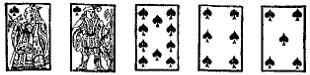
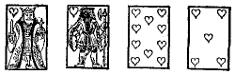
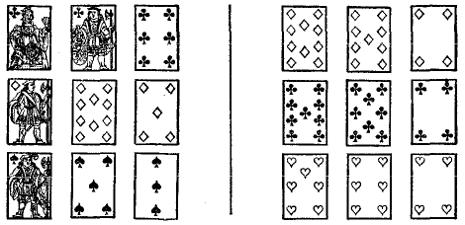
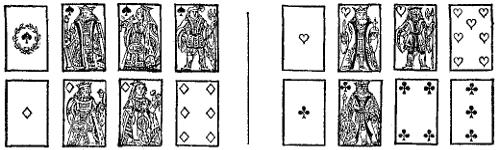
make it.
All such combinations as the following should be avoided, if possible,
as more can be made out of them by letting them alone:—
But with three honours, A Q J, the Ace should be led.
Rules for Leading Short Suits. It will sometimes happen
that the only four-card suit in the leader’s hand will be trumps or a
suit headed by honours not in sequence, which it is not desirable to
lead. In such cases, if there is no high-card combination in any of
the short suits, it is usual to lead the highest card, unless it is an
Ace or King. Many good players will not lead the Queen from a
three-card suit, unless it is accompanied by the Jack. All such
leads are called forced, and are intended to assist the partner, by
playing cards which may strengthen him, although of no use to the
leader. The best card should be led from any such combinations
as the following:—
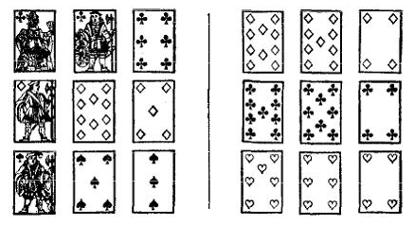
Small-card Leads. If the suit selected for the lead does
not contain any combination of high cards from which it would be
right to lead a high card, good players make it a rule to begin with
the fourth-best, counting from the top of the suit. This is called
the “card of uniformity,” because it indicates to the partner that
there are remaining in the leader’s hand exactly three cards higher
than the one led.
Should the player be forced to lead any of the undesirable combinations
shown on the last page, he would begin with the Ace if he
held it; otherwise he would lead the fourth-best. In each of the
hands shown this would be the four, and this card would be led,
even if there were five or six cards in the suit. From this hand,
for instance, the five is the proper lead:—
Rules for Leading Second Round. If the leader wins the
first trick, having the best of the suit in his hand, he should follow
with the winning card; but if he has several cards which are equally
winning cards, he should lead the lowest of them. This is an indication
to the partner that the card led is as good as the best;
therefore the leader must hold the intermediate cards. When a
King wins, your partner knows you have the Ace, if he does not
hold it. Then tell him what he does not know, that you have the
Queen also.
Suppose you have led the King from these combinations:—
Your partner knows you have the Ace, because your King wins.
From the first, go on with the Jack, which is just as good as the
Ace, but tells your partner you have not only the Ace but the
Queen, still in your hand. From the second, go on with the Queen,
the card your partner does not know, which tells him you still have
the Ace, but not the Jack. If you have not the Queen, you will
have to go on with the Ace, and your leading the Ace will deny
the Queen.
If you have not the best, lead one of the second and third-best,
if you hold both:—
From the first of these, having led the King, if it wins, go on with
the ten, whether you have any smaller cards or not. From the
second, if the King wins, go on with the Jack, which denies the ten,
but tells your partner you still have the Queen. No mistake is
more common among beginners than leading a low card on the
second round, on the assumption that the partner must have the
Ace. If you have led from King and Queen only, you must go on
with the fourth-best; because you have not both the second and
third-best. This fourth-best is the card that was the fourth-best
originally. Having led the King from this:—
the card to follow the King is the six, if the King wins the first trick.
The Fourth-best. From any combination of cards, if you
have not the best, or both the second and third-best, in your
hand for the second round, lead your original fourth-best. From
all the following, the proper lead on the second round would be the
fourth-best, in each case the four of the suit:
Leading Trumps. A trump lead is sometimes adopted
when all the plain suits are bad ones to lead away from, such
as A Q, or A J, or K J in each and no length. If a player holds
high cards which are not in sequence, such as the major tenace,
ace and queen, it is very probable that the declarer holds the king.
By refusing to lead such suits, and waiting for them to come
up to the tenace, the declarer’s high card may be caught and
a valuable trick saved. When a good player opens his hand with
a trump, right up to the declaration, his partner should lead his
best supporting cards boldly up to dummy’s weak suits.
The Pone’s Leads. When the pone gets into the lead, if
he does not return his partner’s suit, he should open his own
suits according to the rules already given for all the high-card combinations.
If he has no high-card combination, it is usually better
for him to lead some card that will beat Dummy than to lead his
fourth-best. Suppose he wishes to lead a diamond, in which he
holds Q 10 8 4 3; Dummy having the 9 and 6 only. It is better
to lead the ten of diamonds than the fourth-best, because if the
declarer does not follow with an honour, your partner will not have
to sacrifice an honour to keep Dummy from winning the trick with
the 9.
After the opening lead, when Dummy’s cards are exposed, the
knowledge of his cards may change the aspect of the game greatly;
but the proper cards to lead to and through Dummy will be better
understood in connection with the play against no-trumpers.
No-trump Leads. The chief difference in the leads against
no-trumpers is, that there is no hurry to make your aces and
kings, the chief thing being to make some of the smaller cards
good for tricks. When you are long in a suit, if you lead out the
winning cards first, your partner may have none to lead you later
on, and if you cannot make every trick in the suit before you lose
the lead, you may never make anything but your one or two high
cards.
The difference in the leads at no-trump is covered by a very
simple rule; if you have only two honours in sequence, do not lead
either of them, but begin with the fourth-best, even if your honours
are the Ace and King. But if you have three honours in the suit,
two of them in sequence, always lead an honour against a no-trumper.
The exception to this rule is, that when you are so long in the
suit that you may catch some high cards with your high cards, you
lead them first. With six or seven in suit to the A K, for instance,
lead the King, on the chance of dropping the Queen. With
seven in suit headed by the Ace, lead the Ace, but never with less
than seven without the King. With six in suit, you may lead the
King from K Q, without either Jack or 10; but with less than six
in suit never lead the King from K Q unless you have the 10 or
the J also.
THIRD HAND PLAY. The leader’s partner must do his
best to inform his partner as to the distribution of his suit. The
method of doing this is entirely different when there is a trump
from that which is adopted when there is no trump. In the first
case, all your partner wants to know is, who is going to trump his
suit if he goes on with it. In the second case, what he wants to
know is his chance for getting his suit cleared or established.
With a Trump. When third hand makes no attempt to win
the trick, either because his partner’s or Dummy’s card is better
than any he need play, he plays the higher of two cards only, the
lowest of three or more. This is called playing down and out.
Suppose third hand holds 7 and 2 only, and the lead is a King.
The 7 is played. The leader goes on with the Ace, denying the
Queen, and the third hand plays the deuce. If the Queen is not in
the Dummy, the declarer must have it. In any case, the leader
knows that if he goes on, his partner, the third hand, can trump
that suit.
With three cards, the lowest falling to the first round, followed
by a higher card, will show the leader that the third hand still has
another of that suit.
It is not necessary to play down and out with an honour, because
the leader can read the situation without it. Suppose third hand
holds the J 5. He plays the 5 to the first round, because one of
his two cards is an honour. The leader goes on with the Ace, and
the Jack falls. Now the third hand must have the Queen or no
more, and no matter which it is he can win the third round, with
the Queen or with a trump.
Against No-Trumpers. When there is no trump, the third
hand uses what is called the Foster echo. This consists in
playing always the second-best of the suit, when no attempt
is made to win the trick. Suppose the leader begins with the
King. Third hand holds 10 8 7 4, and plays the 8. This marks
him with only one card higher than the 8, and is a great exposer
of false cards played by the declarer.
On the second round, the rule is, always to keep the lowest card
of the suit until the last. If third hand held four originally, 10 8 7 4,
his play to the second round is the 7, keeping the 4. If he held
10 8 7 only, his play to the second round would be the 10, keeping
the 7. This makes it clear to the leader how many and what he
holds.
High Cards Third Hand. When the third hand tries to
win his partner’s lead, he does so as cheaply as possible. That is,
holding both King and Queen, he plays the Queen, not the King.
If his cards are not in sequence, he should always play the best he
has. With Ace and Queen, for instance, he must play the Ace if
the King is not in the Dummy. To play the Queen would be to
throw it away if the declarer has the King. If the leader has the
King, third hand gets out of his way by giving up the Ace.
FOSTER’S ELEVEN RULE. In trying to win tricks as
cheaply as possible, third hand may often be guided by the Eleven
Rule, which can be applied to any lead of a small card.
By deducting from eleven the number of pips on any low card
led by his partner, the pone may ascertain to a certainty how many
cards there are higher than the one led, which are not in the
leader’s hand. This rule, which was invented by R.F. Foster in
1881, in connection with the game of whist, is now used by everyone
with any pretensions to being a bridge player. The rule itself
is this:—
When the eldest hand leads any card which is not an honour,
deduct the spots on it from eleven. From the remainder thus found,
deduct the number of cards, higher than the one led, which are
not in your own hand nor in Dummy’s in that suit. This final remainder
is the number of cards which are in the declarer’s hand
which are higher than the card led. The principal thing to remember
is, that it is only the cards higher than the one led that you
need trouble about. To illustrate:—
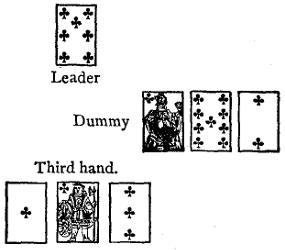
Suppose you are third hand, and your partner leads the seven of
clubs, Dummy lays down the Q 9 2, and you hold A J 3, thus:—
Deducting seven from eleven, you find it leaves four. These
four cards, higher than the one lead, are all in sight, Q 9 in Dummy;
A J in your own hand, therefore the declarer cannot have any card
higher than the seven. If he has, your partner’s lead is not his
fourth-best, as you will see if you lay out the cards.
RETURNING SUITS. When the third hand returns his
partner’s suit, he should lead the higher of two cards, and the lowest
of three, unless he has a card which will beat anything Dummy
may hold in the suit, in which case he should always beat
Dummy.
PLAYING AGAINST DUMMY. Some of the fine points
in bridge arise in situations which require a careful consideration
of the Dummy’s cards.
There are three great principles in playing against Dummy:—
1st. Lead through the strong suits, and up to the weak.
2nd. Do not lead through a fourchette.
3rd. Do not lead up to a tenace.
These rules must not be blindly followed in every instance. They
are simply general principles, and some of the prettiest coups arise
from the exceptional cases.
Leading Through Dummy. The eldest hand, when he does
not deem it advisable to go on with his own suit, may be guided in
his choice by the strength or weakness of certain suits in Dummy’s
hand. The play against Dummy is especially important at no trumps.
Suits which it is good policy to lead through are A x x x, K x x x,
or any broken sequences of high cards.
Suits in which Dummy is long, or holds any of the regular high-card
combinations, should be avoided; winning or high sequences
being especially dangerous. To lead such suits through Dummy’s
strength is an invitation to partner to force you in the suit led.
It is not necessary for you to be strong in a suit which you lead
through Dummy; and if you are both weak, is often advantageous;
especially if it avoids leading one of his strong suits.
With A Q 10 x; Dummy having J x x x; play the 10. If partner
has the King you make every trick in the suit.
With A Q 10 x; Dummy having K x x; play the Q. If Dummy
passes, you make two tricks; if he covers, you have tenace over
the Jack.
With A 10 9 x; Dummy having J x x x; play the 10. If partner
has the K, your A 9 is tenace over the Q.
With A J 10 x; Dummy having Q x x x; if the suit must be
led, play the Jack; but such positions should be avoided, except in
the end game, or when you play for every trick.
With A J 10 x; Dummy having no honour in the suit; if you
must lead the suit, play the 10.
In trumps, with K Q x x; Dummy having A J x x; play the
Queen. If Dummy wins with A, play a small card for the second
round, and he may refuse to put on the J. The declarer not having
the 10, would make Dummy cover; but nothing is lost if he does,
and it marks the 10 with your partner.
With King and others of a suit in which Dummy has not the
Ace; avoid leading the suit until the Ace has fallen.
With King alone, play it if Dummy has the Ace; keep it if he
has not.
Trumps. If a player in this position is strong in trumps, he
should keep quiet about it and let the maker of the trumps develop
the suit. False-carding is perfectly legitimate in trumps, and will
deceive the declarer more than your partner.
End Games. There are cases in which it is necessary to play
as if partner was known to possess a certain card, for unless he has
it the game is lost. For instance: You want one trick, and have
Q 10 x x, Dummy having K x x, of an unplayed suit. The Queen
is the best play; for if partner has any honour you must get a trick;
otherwise it is impossible.
You have K x in one suit, a losing card in another, and a winning
card. You want all four tricks to save the game. Play the King,
and then the small card; for if your partner has not the Ace and
another winning card you must lose the game.
You have a losing trump, and Q x x of a suit in which Dummy
has K 10 x. If you want one trick, play the losing trump, counting
on partner for an honour in the plain suit. If you must have two
tricks, lead the Queen, trusting your partner to hold Ace.
Leading up to Dummy. The best thing for the third hand,
or pone, to do, when he does not return his partner’s suit, and has
no very strong suit of his own, is to lead up to Dummy’s weak
suits, and to lead a card that Dummy cannot beat, if possible.
The general principle of leading up to weakness suggests that
we should know what weakness is. Dummy may be considered
weak in suits of which he holds three or four small cards, none
higher than an 8; Ace and one or two small cards; or King and
one or two small cards. In leading up to such suits, your object
should be to give your partner a finesse, if possible; and in calculating
the probabilities of success it must be remembered that
there are only two unknown hands, so that it is an equal chance
that he holds either of two unknown cards. It is 3 to 1 against
his holding both, or against his holding neither. Of three unknown
cards, it is 7 to 1 against his holding all three, or none
of them; or about an equal chance that he holds two of the
three; or one only.
If Dummy holds any of the weak suits just given, you holding
nothing higher than the Ten, you should lead it. Suppose you have
10 9 6; Dummy having A 3 2. The K Q J may be distributed in
eight different ways, in any of which your partner will pass your Ten
if second hand does not cover. In four cases, second hand would
cover with the King, and in one with the Queen and Jack. In the
remaining three your partner’s hand would be benefited.
If Dummy has King and one or two small cards, it is not so
disadvantageous to lead up to the King as would at first appear;
because it is forced out of his hand on the first round, unless
declarer plays Ace, and it is usually good policy to force out
Dummy’s cards of re-entry early in the hand.
In leading from high-card combinations, the usual bridge leads
should be followed; but exceptions must be made on the
second round when certain cards are in Dummy’s hand. For instance:
With A K J and others, it is usual to stop after the first
round, and wait for the finesse of the Jack. This is obviously
useless if the Queen is not in Dummy’s hand. So with K Q 10,
unless Dummy has the Jack; or K Q 9, unless Dummy has the
10. The lead from A Q J should be avoided if Dummy has the
King.
With A Q 10 and others, J in Dummy’s hand, begin with the
Queen.
With A J 9 and others, 10 in Dummy’s hand, lead the Jack.
With A J 10, Dummy having K Q x, play the Jack, and do not
lead the suit again.
In trumps, with K Q and others, if Dummy has the J singly
guarded, begin with the King as usual, but follow it with the
Queen instead of the smallest; for declarer may have passed in
the hope of making a Bath coup with both Ace and Jack. In
plain suits this is a dangerous lead, as declarer having Ace, and
wishing to force Dummy, would hold his Ace as a matter of course.
With short suits, such as K x, Q x; or even with King or Queen
alone, the honour is a good lead if Dummy has no court cards in
the suit. The Queen is rather a better lead than the King, the
only danger being that second hand holds fourchette.
With Q J x, or J 10 x, one of the high cards should be played.
With Q 10 x, Dummy having Ace or King, the Queen should be
led.
With K 10 x, Dummy having Jack, the suit should not be led.
With such combinations as K x x x, Dummy having Q x, the suit
should not be led.
When you have a suit which is both long and strong, such as
A K x x x, and Dummy has no honour in the suit, it is a common artifice
to underplay, by beginning with the smallest, if playing against
no-trumps and you have a card of re-entry. This should not
be done unless you have the general strength to justify such a
finesse.
If you open a long suit, Dummy having only small cards, and
your partner wins with Q, J, or 10, and does not return it, he has
evidently a finesse in the suit and wants it led again.
End Games. In the end game there are several variations
which are made possible by the fact that the cards on your right
are exposed.
With A J x, Dummy having Q x x, the small card should be led.
With Q x, and an odd card, Dummy having K x x of the first
suit; it is better to play the odd card; but if for any reason this
should not be done, lead the Q, hoping to find A 10 with your
partner.
The state of the score must be a constant guide in all end
games. For instance: You hold Q 10 x, Dummy having J 9 x.
If you want only one trick, play the Queen; but if you want two,
play the small card.
SECOND HAND PLAY. The easiest position to play as
second hand, is, of course, with the Dummy on your left, because
Dummy’s cards will show what is best to be done. If a small
card is led, you having King, put it on if Dummy has not the Ace;
unless you want partner to get the lead. If Dummy has only two
cards of the suit, neither of them the Ace, always play your King.
When the declarer leads a suit it is often important to count how
many he and your partner can possibly hold. For instance: You
have four, K x x x; Dummy has four, A J 10 x, and declarer leads
the Queen. It is useless to play your King; for either the Queen
is a singleton, and the declarer cannot continue the suit, which will
compel Dummy to lead it to you eventually; or, the third round
will be trumped, perhaps by your partner. If you have only two
small cards with the King, put it on the Queen. You cannot save
it, but you may establish your partner’s 9.
In the last three tricks, if you find yourself with a doubtful
card, and the best and a small card of a suit which the declarer
leads through you, win the trick and lead the doubtful card, for
if the declarer held the best of that suit he would have led it
first, to be sure of a trick.
Dummy on the Right. When Dummy leads through
you, your skill in avoiding any traps the declarer may be setting
for you will depend on your knowledge of how he manages his
hand, and your ability to infer what he holds.
As a general principle, it may be assumed that any high card
led by Dummy forms part of a combination, the unseen part of
which is in the declarer’s hand. If Dummy leads a Queen from
Q x x, you holding A J x, it is almost a certainty that the declarer
holds the King. If you have A K x, the dealer must have
J 10 and several others. If you have K x x, the declarer probably
holds Ace, or a long suit headed by J 10.
When Dummy leads strengthening cards, they must be to give
the declarer a finesse. If he leads a small card from small cards,
some high-card combination must be in the declarer’s hand. In
such cases it is useless for you to finesse. If you have any
sequence superior to the card led, cover with the lowest. There
should be no false-carding in this, because your partner is the
only one that can be deceived.
With A K and others, play the King, whatever Dummy leads.
With A Q and others, Dummy having nothing higher than the
9, play the Ace.
With K Q 10, play the Queen on a small card led, unless
Dummy has the Jack.
With A J 10 x, play Ace if Dummy has no honour in the suit.
But if Dummy leads the 9, cover with the 10; if it loses, you lie
tenace over the declarer.
With A J x, play the Jack on a 9 led. This prevents the finesse
of the 9, and retains command of the suit. If Dummy has both
K and Q, play your Ace. It is useless to play the Bath coup, for
the declarer knows your cards, and your partner only is deceived.
With K x x, if Dummy has not the Ace, do not play the King,
no matter what is led.
With Q x x, unless Dummy has both A and K, do not play the
Queen. If your partner has the Jack guarded, one of you must
make a trick. If Dummy has A J, and leads J, put on the Queen;
it may make the 9 or 10 good in your partner’s hand.
With A x x, Dummy leading Jack, play the Ace.
With any fourchette, cover the card led.
If Dummy remains with one or two small cards of a suit that
has been led, and you have the best, play it on the second round.
Dummy’s play is evidently for the ruff, and if the declarer has not
the second best, your partner has.
If you have King, and only one or two small cards, Dummy
leading Queen from Q 10 x x, play your King. You cannot save
yourself; but you may make the 9 good in partner’s hand. If
you have three or more small cards, do not play the King, for
either partner or the declarer must be short in the suit. So if
Dummy leads Jack from J 10 and others, play the King with a
short suit. If partner has Queen you establish it; if not, you
cannot make a trick in the suit.
With short suits it is usually best to cover an honour with an
honour; but with several small cards, such as K x x x, Dummy
leading a singleton Queen, you should pass.
With K 10 x, Dummy having J and others, play honour on
honour; small card on small card, whichever Dummy leads.
It is often important for the second hand to cover with what is
called an imperfect fourchette. A true fourchette is the card
immediately above and below the one led; such as K J over the Q,
or Q 10 over the J. An imperfect fourchette is the card above the
one led, and another next but one below it; such as K 10 over a
Q led, or Q 9 over a J led. Covering forces the opponents to play
two honours to win one trick, and will often make an intermediate
card good in your partner’s hand.
THIRD HAND PLAY. In addition to the methods of
echoing on the partner’s leads of high cards in the suit first
opened, third hand must be ready to adapt himself and his play to
any change of suit and will require constant practice in putting
himself in his partner’s place, asking himself what the object is in
leading certain cards through Dummy’s hand. The inferences
from the conventional leads should be sufficiently familiar to need
no further explanation; but even good players occasionally overlook
indications that partner holds certain cards. For instance:
A leads a small card; Y, Dummy, holds Q x x, and plays Q. You
play the King and win the trick. This marks not only the Ace,
but the Jack in partner’s hand; because the declarer would not
play a twice guarded Queen from Dummy’s hand if he had the
Jack guarded himself.
False cards should be avoided by the third hand as much as
possible. The declarer will give your partner enough to puzzle over
without your adding to the confusion. There are some exceptions
in trumps. For instance: You have K Q x; Dummy has A J x x,
and your partner leads. Unless Dummy plays Ace, you should
put on the King, and change the suit.
If you hold Ace and others in a plain suit, partner leading Jack,
pass it if Dummy has no honour. Perhaps by winning the second
round you can give the invited force. With any other honours
than the Ace, pass a partner’s Jack led.
If partner leads you a suit of which he knows, or should know,
you have not the best, he must have a good finesse in the suit
which he does not lead, and you should take the first opportunity
to lead that suit to him.
In returning partner’s suits, some modification may be suggested
by the condition of Dummy’s hand. For instance: With K x x;
Dummy having A Q J x; if you win, third hand, on Dummy’s
finesse, you may be sure your partner’s lead was a weak suit. If
Dummy is weak in the two other plain suits, your partner may have
a good finesse in one or both of them.
When your partner wins the first round of an adverse suit, and
immediately returns it, he is inviting a force.
Dummy on the Left. When the player is third hand with
Dummy on his left, his chief care will be to divine his partner’s
object in leading certain cards up to Dummy.
The general principles of inference are the same as in the preceding
case, and cards may often be inferred in the same manner
from the evident intention of partner. For instance: You hold K
x x; partner leads J, declarer covering with Queen. A glance at
Dummy’s cards shows him to have 10 x x; so your partner may
be credited with A 9. You have x x; your partner leading Q,
covered by declarer with K, and Dummy having J x x. You may
credit your partner with A 10. You have x x; your partner leads
Q and declarer wins with Ace; Dummy holding 10 x x. Your
partner must have J 9 and others, and the declarer has the King.
There are several cases in which you should not allow Dummy
to win the trick. If you have only one card of a suit in which
your partner leads Ace then Queen, and Dummy has the King
twice guarded, trump at once, if you can to prevent Dummy from
getting into the lead. Your partner leads Queen; you holding
A 10 x, and Dummy having K x x. Let the King make on the
first round.
If your partner leads a small card up to strength in Dummy’s
hand, he is either inviting a force, or trying to establish a long
suit. Under such circumstances, if you have the Ace, play it, and
lead a second round of the suit immediately, which will settle the
question.
If you have Q J 10 of a suit in which partner leads King, play the
Jack, so that he will count you for Q or no more, and will not go
on with the Ace.
IN GENERAL. Both the adversaries of Dummy should
adopt the usual tactics for unblocking, etc., especially in no-trumpers,
and in some cases Dummy’s exposed cards will make the
matter more simple. For instance: You hold A Q alone, of a
suit which partner leads. If you are the pone, and Dummy has
not the King, play Ace and return the Queen.
FOURTH HAND. There is only one difference from the
usual methods in playing fourth hand, and that is in indicating
sequences by winning with the best and returning the lowest to
show the intermediate cards. For instance: Fourth player, holding
K Q J x, wins with King and returns the Jack. Or with A K Q,
wins with Ace and returns the Queen. The reason for this is that
the declarer gains nothing by the information, for he knows from
the first what cards are out against him; but the information may be
valuable to your partner, the second hand. If it is not the intention
to return the suit at once, the lowest of the sequence should
be played.
PLAYING TO THE SCORE. This is a most important
element, and there is no surer indication of a careless or weak
player than his inattention to the score.
One cannot be too early impressed with the importance of saving
the game before trying to win it; although great risks may be
taken to win a game that cannot be lost that hand.
Never risk a sure contract in the hope of making more; unless
the two will win the game, and the odd trick will not win it.
Never risk a trick that will save the game in the hope of winning
more, and always set a contract while you can.
DISCARDING. This is one of the still unsettled questions
of bridge tactics, some believing in discarding the weak suit
always; others the strong suit always, and others one or the other
according to the declaration. Against a trump declaration almost
every one agrees that it is best to discard the best suit, so that if
your partner gets in before you do, he may have something to
guide him as to what your best chance is for any more tricks.
Against no-trumpers, the majority of players hug every possible
trick in their long suit and discard their weak suits, on the ground
that it is folly to throw away cards that might win tricks. While
this is true, it is also true that in discarding their weak suit they
too often enable the declarer to win tricks that they might have
stopped. For this reason, many players discard the suit they
are not afraid of; that is, their best protected suit, and keep
what protection they have in the weak suits, even if it is nothing
but three to a Jack or ten. Unfortunately, no one has yet been
able to advance any argument sufficiently convincing for either
system to demonstrate that it is better than the other. Some of
the best teachers of the game advocate the discard from strength
against no-trumps; others teach the weak discard.
ENCOURAGING DISCARDS. In order to distinguish
between discards from weakness and those from strength,
many players use what is called an encouraging card. This is
anything higher than a six, if they have protection in the suit,
or want it led. A player with an established suit, and A 8 2 of
another suit, for instance, would discard the 8, to encourage his
partner to lead that suit and put him in. In case there is no card
higher than the six, the reverse discard is used. With A 4 2,
the play would be the 4 and then the 2. Some use this reverse
or encouraging card to induce the partner to continue the suit he
is leading, but the practice is confusing.
THE DECLARER’S PLAY. The chief difference between
the play of the Dummy and partner, and that of their adversaries,
is that there is no occasion for the former to play on
the probability of partner’s holding certain cards, because a
glance will show whether he holds them or not. There is no
hoping that he may have certain cards of re-entry, or strength
in trumps, or that he will be able to stop an adverse suit, or anything
of that sort, for the facts are exposed from the first. Instead
of adapting his play to the slowly ascertained conditions of
partner’s hand, the declarer should have it mapped out and determined
upon before he plays a card. He may see two courses
open to him; to draw the trumps and make a long suit, or to
secure such discards as will give him a good cross-ruff. A rapid
estimate of the probable results of each line of play, a glance at
the score, and his mind should be made up. Several examples
of this foresight will be found in the example hands.
Another point of difference is, that the declarer should play
false cards whenever possible. He has not a partner who, if he
plays the King, might jump to the conclusion that he can trump
a suit, or has not the Queen. The more thoroughly the adversaries
are confused, the greater the advantage to the declarer,
especially in the end game.
With a Trump. When the winning declaration is a suit for
trumps, the declarer’s first consideration upon getting into the
lead must be whether or not to lead trumps. As a rule, the trumps
should be led at once, so as to exhaust the adversaries; but there
are exceptional cases, the principal ones being:—
Do not lead trumps from the strong trump hand if it would be to
your advantage to put the other hand in the lead with a plain suit,
so as to let the trump lead come from the weaker hand to the
stronger, as when a finesse in trumps is desirable.
Do not lead trumps if you have no good plain suit, and can
make more tricks by playing for a cross-ruff.
Do not lead trumps if the weaker hand can trump some of your
losing cards first. It often happens that a losing trump can
be used to win a trick before trumps are led.
At No-trump. The declarer’s first care in a no-trumper must
be to select the suit that he will play for. Four simple rules cover
this choice:—
1. Always lead from the weak hand to the strong if the suit is
not already established.
2. Play for the suit in which you have the greatest number of
cards between the two hands, because it will probably yield the
greatest number of tricks.
3. If two suits are equal in number, play for the one in which
you have the greatest number of cards massed in one hand. That
is, if you have two suits of eight cards each, select the one that has
six of those cards in one hand, in preference to the suit with four
in each hand.
4. Everything else being equal, play for the suit which is shown
in the Dummy, so as to conceal from the adversaries as long as
possible the strength in your own hand.
A suit is said to be established when you can win every
remaining trick in it, no matter who leads it. As it is very important
that the hand which is longer in the suit should be able to
lead it without interruption when it is established, good players
make it a rule always to play the high cards from the shorter
hand first, so as to get out of the way. With Q 10 and three
others in one hand, K J and one other in the other hand, the play is
the K and J from the short hand, keeping the Q 10 in the long hand.
If there is any choice, that suit should be selected which contains
the longest sequence, or the sequence with the fewest breaks.
It should be noticed that the sequence need not be in one hand;
for it is almost as valuable if divided, and it is especially advantageous
to have the higher cards concealed in the declarer’s hand.
Its continuity is the chief point. For instance: Declarer and
Dummy hold between them one suit of K J 9 7 5 4 3, and another
of Q J 10 9 8 7 5. The latter should be selected, because
two leads must establish it.
In establishing a long suit it is very important to note the fall
of the missing cards in the sequences. In the first of the two
combinations just given, the declarer should be as careful to
watch for the fall of the 8 and 6 as for the A Q and 10.
Leading. It is quite unnecessary to follow any system of
leads, further than to distinguish between the combinations from
which high or low cards are led. But it is important to remember
that although a high-card combination may be divided, it
should be played as if in one hand. For instance: The declarer
holds Q J x x x of a suit; Dummy having A x x. By leading Q
or J, Dummy is enabled to finesse, as if he held A Q J. The declarer
holds K J x x x; Dummy having Q x x. The play is to force
the Ace, as if the combination of K Q J x x were in one hand.
Many opportunities arise for leading the Ace first from a short
suit, in order to secure a ruff on the second or third round.
Second Hand Play. If any card is led by the adversaries
which the fourth hand cannot win, the second hand should cover
it if possible; for unless he does so, his weakness will be exposed,
and the suit will be continued. This is especially true of cases in
which the second hand holds single honours, such as Jack and
others, or Queen and others. Even the King should be played
second hand in such cases, unless it is so well guarded that the
Ace must fall before the King can be forced out.
If the fourth hand can win the card led, it is seldom necessary
to cover second hand. For instance: If the Jack of trumps is
led, the dealer holding Q 9 7 4, and Dummy having A 6 3 2; there
is no need to play the Queen. If the King is in third hand,
such play would establish the Ten. If the King is with the leader,
it or the Ten must make. If Dummy were second hand with the
same cards, Jack being led, he should not play the Ace, for third
hand must play the King to shut out the Queen.
With A Q 9, partner having K and others, it is best to play A
on J led.
If the dealer has Ace and several others of a suit led, Dummy
having only two small cards, a force may be certainly secured by
passing the first round. If Dummy has the Ace, and passes
second hand, the dealer failing to win the trick, the adversaries
will of course see that the play is made in order to force the dealer
on the third round.
If Dummy is weak in trumps, and has only one card of a suit in
which the dealer has Ace and others, the Ace should be played,
and Dummy forced, unless there is a better game.
It is a disadvantage to play in second hand from suits in which
each has a guarded honour. If the dealer has Q x x, and Dummy
has J x, they must make a trick in that suit if they play a small
card second hand, and avoid leading the suit. The same is true
of the adversaries; but they must play on the chance that the
partner has the honour, whereas the dealer knows it.
Finessing. This is a very important part of the strategy of
the game for the dealer. The adversaries of the dealer never
finesse in bridge; but the dealer himself relies upon finessing for
any extra tricks he may want.
A finesse is any attempt to win a trick with a card which is not
the best you hold, nor in sequence with it. Suppose you have
Ace and Queen in the hand which is longer in the suit and
lead from the shorter hand a small card. If you play the Queen,
that is a finesse, because you hope to take a trick with it, although
the King is against you.
It is usually bad play to finesse when there are nine cards
of the suit between the two hands, dealer’s and Dummy’s, because
there is a good chance that the card you wish to finesse against
may fall.
When it will be necessary to take two finesses in the same suit,
the lead must come twice from the weaker hand. Suppose the
dealer holds A Q J and others. If the first finesse of the Jack
wins, he should put Dummy in again, so as to take a second finesse
of the Queen. Suppose the dealer holds A J 10, and finesses the
ten the first time. If it falls to the Queen, he should get Dummy
in again, so as to take the second finesse with the Jack. The idea
is to take advantage of the fact that the odds are against both King
and Queen being in one hand. If they are both on the right, one
of them will be played on the small card led from Dummy, and then
the dealer can win it with the Ace and force out the other high card
with his Jack, which will have become one of the second and
third-best of the suit.
Re-entry Cards. After a suit has been cleared, or established,
it will be necessary to get into the lead with it. For this
purpose the dealer must be careful to preserve a re-entry card in
the hand which is longer in the suit. Suppose that Dummy’s
long suit is clubs, but that the Ace is against him, and that his
only winning card outside is the Ace of diamonds. If diamonds
are led, and the dealer has the Queen, he must let the lead come up
to his hand so as to keep Dummy’s Ace of diamonds for a re-entry
to bring the clubs into play after the Ace has been forced out and
the suit established. Many of the prettiest plays in bridge are in
the management of re-entry cards.
Underplay. When the dealer is afraid of a suit which is
opened against him, and has only one winning card in it, such as
the Ace, he should hold up that card until the third hand has no
more of the suit to lead to his partner. The original leader will
then have to get in himself, because his partner cannot help him;
but if the dealer gave up the Ace on the first trick, it would not
matter which partner got into the lead, they would return to the
suit first opened.
Ducking. This is a method of play by which the dealer hopes to
make his own suit even when the hand that is longer in it has no re-entry
card. Suppose Dummy holds six clubs to the Ace King, and
not another trick in his hand. The dealer has two small clubs only
to lead. If the two winning clubs are led right out, it is impossible to
catch the Q J 10, no matter how those cards lie, therefore the dealer
leads a club, but makes no attempt to win the first round. No
matter what is played by the adversaries he ducks the first round,
keeping his Ace and King. Next time the dealer gets in, he leads
another club, and now he is able to win the second and third rounds
of the suit, and will probably catch all the adverse cards and establish
it.
The dealer’s play always requires careful planning of the whole
hand in advance.
THE NULLO. Although not yet in the official laws of
the game, this bid seems to be a popular one with many players.
It is a contract to lose tricks instead of winning them, and
is primarily a defence against overwhelmingly strong no-trumpers.
A bid of three nullos means that the declarer will
force his opponents to win nine tricks, he winning four only,
so that each trick under seven counts for the nullo player on
his side.
SCORING. There is some difference of opinion as to the
proper value for the nullo, but the general verdict seems to be
to put it just below the no-trumper at 10 a trick, no honours.
Two no-trumps will outbid two nullos. If the adversaries of a
nullo revoke, the declarer can give them three of his tricks, or
take 100 in honours as penalty. If he revokes, they take 100
penalty as usual.
SUGGESTIONS FOR BIDDING. The dealer should
never bid a nullo originally, as it gives his partner no information
as to the distribution of the suits. When any player has
one long suit good for either no trumps or nullos, such as A K
Q 6 4 2, he should “shout,” bidding a trick more than necessary.
Singletons and missing suits are valuable parts of a nullo hand,
as they afford opportunities for discards. It is always dangerous
to bid a nullo without the deuce of the longest suit. If the
dealer bids a spade, his partner may safely bid one nullo, because
the contract is seldom or never obtained for less than two or
three, but he should not persist in the nullo if his partner does
not assist it. The greater the opposition from a no-trumper, the
more probable that the nullo will succeed, but it is a dangerous
declaration in any case. The player with aces and kings is sure
to win tricks, regardless of his partner’s hand, but deuces and
treys are not sure to lose, as the partner may have all high
cards, although not the tops.
SUGGESTIONS FOR THE PLAY. The declarer
should count up the tricks he must win, and as a rule win them
early, bunching his high cards as much as possible. Suits with
two small cards and two high ones must win one trick, but
should escape with that. The great point is to lead losing cards
from one hand and discard dangerous cards in other suits from
the other hand whenever possible.
The opponents of a nullo should lead their shortest suits, so
as to get discards later, keeping their eyes on the dummy and
forcing it to win tricks whenever possible, but never allowing
it to get a discard. The partner’s leads should be returned unless
a singleton can be led at once. It is usual to lead the top
of two cards, the intermediate of three or more, and to avoid
leading suits that are safe, with small cards at the bottom.
ILLUSTRATIVE AUCTION HANDS.
Z is the dealer in both instances, but Y makes the winning
declaration, so that B leads for the first trick. The first illustration
is straight auction; the second is a nullo. The underlined
card wins the trick and the card under it is the next one led.
| A |
Y |
B |
Z |
|
A |
Y |
B |
Z |
| Q♠ |
2♠ |
9♠ |
♣2 |
1 |
A♢ |
Q♢ |
J♢ |
9♢ |
| A♠ |
6♠ |
8♠ |
♡3 |
2 |
K♢ |
6♢ |
8♢ |
5♢ |
| K♠ |
10♠ |
4♠ |
♡7 |
3 |
10♢ |
4♢ |
♡A |
3♢ |
| 5♠ |
J♠ |
3♠ |
♡J |
4 |
J♠ |
3♠ |
9♠ |
A♠ |
| 2♢ |
Q♢ |
4♢ |
5♢ |
5 |
5♠ |
Q♠ |
K♠ |
6♠ |
| 10♢ |
9♢ |
7♢ |
J♢ |
6 |
♣Q |
♣6 |
♣J |
♣K |
| ♡4 |
3♢ |
8♢ |
A♢ |
7 |
7♢ |
♡J |
♡5 |
♡10 |
| 7♠ |
♡5 |
♡9 |
K♢ |
8 |
10♠ |
♡7 |
♡Q |
♡9 |
| ♡8 |
♣3 |
♡2 |
6♢ |
9 |
♣5 |
♣4 |
♣2 |
♣3 |
| ♣4 |
♣Q |
♣10 |
♣9 |
10 |
7♠ |
2♠ |
4♠ |
♡K |
| ♣5 |
♣A |
♡6 |
♣7 |
11 |
♣10 |
♡4 |
♣A |
♡8 |
| ♣8 |
♣K |
♡10 |
♡Q |
12 |
♣8 |
♡3 |
♣9 |
♡6 |
| ♣J |
♣6 |
♡A |
♡K |
13 |
♣7 |
2♢ |
8♠ |
♡2 |
In the first example the dealer, Z, bids a heart. A says one
royal and Y two clubs. This bid of Y’s denies any support for
his partner’s hearts, but shows a supporting minor suit, in case
Z is strong enough to go on with the hearts. B bids two
royals as he can stop the hearts twice and ruff the clubs. Z
cannot pursue the hearts, but shows his supporting minor suit,
bidding three diamonds. This says to Y, “Go no trumps if
you can stop the spades.” When A passes, having bid his
hand on the first round, Y goes two no trumps and makes
game. B leads the top of his partner’s declared suit, and A
leads a fourth round, hoping to get in with the club jack. At
tricks 8 and 9, B signals control in hearts. A keeps the protection
in clubs to the end and saves a trick by it. Y keeps two
clubs in dummy, so that if club is led, he will have one to return
after he has made his diamonds.
In the second example, they are playing nullos, Y declaring.
The points in the play are holding the spade queen, so as to
lead a diamond or a spade at trick 6. This B prevents, hoping
to force two clubs on Y and Z and set the contract. At trick
7, if the hearts are split, the queen must win the ten. If not,
Z must win one heart trick. Y makes his contract, losing four
odd.
The difference between straight bridge, as it is sometimes
called, and auction is in the method of selecting the trump, which
must be declared by the dealer or his partner, the opponents
having nothing to say except to double the declaration if they
think it will not win the odd trick. Another point is that either
side can score toward game by getting the odd trick or more,
there being no penalties for failure to make the odd except losing
the value of the tricks because the dealer never declares to make
any given number of tricks on the hand.
There are some irregularities which are peculiar to straight
bridge that would not apply to auction. These are fully covered
by the following description of the game, all other matters, such
as the correct card to lead and the manner of combining the
hands, have been fully described in connection with auction.
MAKING THE TRUMP. This is the chief peculiarity
in bridge. The trump is not turned up, but the suit is named by
the dealer or his partner, after they have examined their cards.
In order properly to understand the considerations which guide
them in making the trump, one should first be familiar with the
values attached to the tricks when certain suits are trumps. The
first six tricks taken by one side do not count; but each trick
above that number counts toward game according to the following
table:—
| When |
Spades |
are trumps, |
each trick counts |
2 |
points. |
| ” |
Clubs |
” ” |
” ” ” |
4 |
” |
| ” |
Diamonds |
” ” |
” ” ” |
6 |
” |
| ” |
Hearts |
” ” |
” ” ” |
8 |
” |
| ” |
there is no trump, |
” ” ” |
12 |
” |
Better to understand the importance of this variation in value,
it should be noticed that the game is 30 points; so that if two
partners won 3 by cards with no trump, or 4 by cards with hearts
for trumps, they would win the game in one deal. On the other
hand, if either of the black suits were trumps, they could not lose
the game, even if a slam were made against them.
It will thus be evident that two considerations influence the
player whose privilege it is to make the trump: First, to win as
much as possible, if he has the cards to do it. Second, to save
himself, if he is weak; or the game, if it is in danger. As a general
proposition, it may be said that his decision will be indicated
by the colour of the trump he names. If it is red, he is strong, and
plays to win; if it is black, he is taking to the woods. A further
element may enter into his calculations, the state of the score. If
he feels sure of the few points necessary to win the game or the
rubber with a black trump, there is no necessity to risk making it
red. This is a part of the subject which we shall go into further
when we come to the suggestions for good play.
The dealer has the first say in making the trump. If he does
not feel himself strong enough to make it no trump, or red, although
his hand may be black enough to promise a good score in clubs or
spades, he should transfer to his partner the privilege of making
the trump by saying: “I leave it to you, partner.” Guided by this
indication, his partner must fix on some suit for the trump or go
no-trumps, and must announce it.
Either the dealer or his partner may elect to play without a
trump, if he has sufficient strength in all the suits to do so.
IRREGULARITIES IN DECLARING. If the
dealer’s partner makes a declaration before being asked to do
so, either adversary may demand that the declaration shall stand,
or that there shall be a new deal. In England, only the eldest
hand, A, may exact the penalty. If the dealer’s partner passes
the declaration to the dealer, either adversary may claim a new
deal or may insist that the player in error shall make the declaration.
In England, the eldest hand exacts this penalty.
Should an adversary of the dealer make a declaration, the dealer
may, after looking at his own hand, either have a new deal or proceed
as if nothing had been said.
SETTLING THE VALUE OF THE TRICKS. The
trump suit having been announced, the first hand or leader, A, before
he plays a card, has the privilege of doubling the value of the
tricks if he thinks the opponents cannot win the odd trick with the
trump named. To do this, he simply says: “I double.” If he
does not feel justified in doubling, he transfers the opportunity to
his partner, by asking him: “Shall I play?” That is to say,
“shall we play without doubling?” If his partner will not double,
he answers: “Yes.” Either A or B having doubled, it becomes
the privilege of the player who made the trump to double him again;
making the value of the trick four times greater than that given
in the table. If he does not do so, he says: “I pass”; and his
partner then has the privilege. If either the dealer or his partner
doubles, the adversary who first doubled may repeat it; or if he
passes, his partner may double. This doubling may be continued
until the value of each trick over the book is 100 points, when it
must cease.
IRREGULARITIES IN DOUBLING. If the pone
doubles before his partner has asked him “Shall I play?” the
maker of the trump shall say whether or not the double shall
stand. If he allows it to stand it may be redoubled. Should
a player redouble out of turn, the one whom he redoubles shall
have the right to say whether or not the redouble shall stand.
Any consultation between partners as to doubling or redoubling
will entitle their adversaries to insist on a new deal.
If the eldest hand leads without asking his partner’s permission
to play, the pone cannot double without the consent of the maker
of the trump. Should the pone ask the eldest hand, “Shall I
play?” that does not deprive the eldest hand of the right to
double.
METHOD OF PLAYING. The trump suit and the value
of the tricks settled, the player on the dealer’s left begins by leading
any card he pleases. After he has played, the second player,
Y, lays his hand face up on the table, and takes no further part in
the play beyond availing himself of the privilege of asking his partner
if he has none of a suit to which he renounces. From the moment
that Y’s cards are exposed the game becomes Dummy, the
dealer, Z, playing Y’s cards for him.
The dealer gathers the tricks for his side; either adversary may
gather for the other. The first six tricks taken by one side make
a “book” and all over six count toward game. The tricks should be
so laid that they can be readily counted by any player at the table.
The Revoke. Should a player fail to follow suit when able
to do so, it is a revoke. Dummy cannot revoke under any circumstances;
but the penalty for any other player is the loss of three
tricks for each revoke made, which are taken from the side in error
at the end of the hand. In England, the penalty may be exacted
in any of three ways; three tricks, or the value of three tricks in
points, or the addition of a like amount to opponent’s score. A slam
cannot be scored if the tricks necessary to make it were taken for
the revoke penalty. The side making a revoke cannot win the
game that hand, no matter what they score; but they may play the
hand out, and count all they make to within two points of game, or
28. Players cannot score a slam in a hand in which they have
revoked.
Exposed Cards. If the dealer or his partner exposes a
card before the declaration has been made, either adversary may
claim a new deal. If any player exposes a card before the first card
is led, his partner forfeits the right to double or redouble. If the
pone exposes a card in this manner, the dealer may call it an exposed
card, or he may require the eldest hand not to lead that suit.
If, during the play of the hand, either adversary of the dealer exposes
a card, by playing two cards at once, dropping one face up on
the table, or holding it so that his partner can see any portion of its
face, the card so exposed must be left face upward on the table, and
is liable to be called.
Exposed cards can be called by the dealer at any time, but he
cannot compel the play of a card which would constitute a revoke.
Leading Out of Turn. If either of the dealer’s adversaries
lead out of turn, the dealer may either call the card exposed, or
may call a suit when it is the turn of either adversary to lead. If
the dealer leads out of turn, there is no penalty, but he cannot
correct the error if the second hand has played.
Cards Played in Error. If any player but the Dummy
omits to play to a trick and does not correct the error until he has
played to the next trick, his adversaries may claim a new deal. If
any one, excepting Dummy, plays two cards to a trick and does
not discover it, he is responsible for any revokes that he may make
in consequence of not having the card in his hand.
OBJECT OF THE GAME. As in all members of the
whist family, the object in Bridge is to win tricks, the highest card
played of the suit led winning, and trumps, if any, winning against
all other suits. At the end of each hand the side that has won any
tricks in excess of the book, scores them, after multiplying their
number by the unit of value settled upon by the doubling, if any
took place. As soon as either side reaches or passes 30, they win
the game; but the hand must be played out, and all tricks taken
must be counted. The total is written on the score-sheet; the score
of the losers standing to their credit until the final accounting at the
end of the rubber.
RUBBERS. Three games, of 30 points each, constitute a
rubber; but if the first two are won by the same players, the
third is not played. The side winning the majority of the games
adds 100 (rubber) points to its score.
SUGGESTIONS FOR GOOD PLAY. The points
which the beginner may profitably study in Bridge are chiefly in
making the trump, and in the methods by which the hands of the
partners are combined, so as to work together.
Making the Trump. The bridge player’s first consideration
should be the state of the score, which will show how many
points he needs to win the game. Let us suppose this number to
be 12, he having already scored 18. These 12 points can be made
by winning six by cards with spades for trumps; three by cards
with clubs; or two by cards with diamonds or hearts. But if
the hand can be played without a trump, the odd trick wins the
game.
It is hardly necessary to say that a player would be very foolish
to engage himself to win six by cards if the odd trick would equally
answer his purpose; nor would he undertake to win three by cards
with clubs for trumps, if he had as good a chance of making two
by cards with diamonds or hearts. In other words, the player
should not make the trump which promises the greatest number of
tricks, but should select that which will yield the largest number of
points.
It is for this reason that every good player first considers the
advisability of making it “no-trump,” and if he thinks that injudicious,
hearts or diamonds, leaving the black suits as a last resort.
It is the custom invariably to make it no-trump with three Aces,
unless the hand is strong enough for a heart make, or holds great
honour value in red.
In estimating the probabilities of trick-taking, it is usual to count
the partner for three tricks on the average. Conservative players
do not depend on him for more than two. Generally speaking,
the maker of the trump should have four pretty certain tricks in
his own hand.
The dealer should seldom announce a black trump unless he has
a certainty of the game in his own hand, without any assistance
from his partner, or unless he has such a poor hand that he must
make it a “defensive spade.” If he cannot safely make it no-trump
or red, he should pass, and allow his partner the chance. With
such a hand as seven clubs, including four honours, and absolutely
worthless cards otherwise, the dealer should make it clubs, except
when the adversaries have won the first game, and are about 20
points in the second. This makes it not unlikely that they will win
the rubber on the next hand with their deal. Under such circumstances
the dealer must invariably leave it to his partner, in the
hope that he can save the rubber by making it no-trump.
The dealer’s partner should be aware that there cannot be any
reasonable hope of four tricks in red in the leader’s hand, or a red
trump would have been announced; and unless he has at least
five probable tricks in his own hand he should not make it red.
With three Aces he should make it no-trump. Four Aces is always
a no-trumper, no matter what the rest of the hand may be.
If he is obliged to make it black, and has three or four probable
tricks, he should announce whichever suit he is best in. Attention
should be paid to the score; for in many instances the suit must
be selected so that the adversaries cannot win the game with the
odd trick, even if they double.
Doubling. The dealer or his partner having announced the
trump, the adversary should carefully consider the score before
doubling or playing. Most players consider themselves justified
in doubling when they have six reasonably certain tricks in their
own hands, trusting partner for one only. Great caution should
be used in doubling no-trumpers, the position of the lead being carefully
studied; because the odd trick usually settles the fate of the
game when a no-trumper is doubled. While a player with the
lead, and seven certain tricks in one suit, should double a no-trumper,
his partner would be very foolish to do so, unless he had,
in addition to his long suit, the heart ace; for it is a conventionality
of the game for A to lead hearts if B doubles a no-trumper.
The original maker of the trump should be very strong to justify
him in redoubling the adversary. If he had four probable tricks
originally, he may count the adversary who doubles for five, and
of the four doubtful tricks remaining, the odds are against partner
having the three which would be necessary to win the odd trick.
Opening Leads. The first lead must necessarily be made in
the dark, but the selection of the suit will often depend on the
trump, and whether it was named by the dealer or by his partner.
If the dealer has made it red, and A has the A K of any plain
suit, he should play the King, so as to retain the lead until Dummy’s
hand is exposed.
If the dealer passes it to his partner, he is probably weak in red.
If Y makes it hearts, A should lead a supporting diamond, unless
he has strength in another suit. If Y has made it diamonds, A
should lead a supporting heart. But in either case, if A has in his
hand such cards as A K, even of a black suit, he should play the
King, and wait to see the Dummy’s hand. If Y has made it black,
A must be guided by his own cards, but should give a red suit the
preference for his opening lead.
Details as to the correct card to lead and the play after the
opening lead have been fully covered in connection with auction
bridge, which see.
The discard is usually coupled with the system of opening
against a doubled no-trumper. If your partner says he is “heart
and strong” he means that if you double a no-trumper and he
is eldest hand, he will lead you his best heart, and that he will discard
his strong suit when playing against a no-trumper. If he
says he is “heart and weak,” he will lead the top heart; but he
will discard his weak suit. If he says he is “weak and weak,”
he means that he will lead the shortest or weakest suit in his hand,
if you double no-trumps, that being the almost universal custom
in England.
All the situations which have been covered in the play of the
second, third and fourth hands at auction can be studied with
advantage by the bridge player, as the manner of securing the
best results from certain distributions of the cards is the same
in both games. The chief difference lies in the value of the
tricks, because at bridge the opponents of the declaration can
score toward game, and it is therefore frequently advisable to
take a finesse or make a play that would be quite unjustifiable
at auction, if there is any chance that such a play may win a
game that would be otherwise impossible.
Close attention to the score is an important factor in bridge
which does not operate in auction, because in that game any
previous score toward game is seldom of any use, eighteen out
of every twenty deals being game hands or nothing, and the
dealer having no more advantage in the selection of the trump
than any other player. In bridge, one always calculates that the
dealer will go out if he is 18 or 20 up on the score, as almost
any suit will do. This prompts the side that has the deal, or a
chance to go game, to lose no opportunity to win at once, before
the other side gets a chance at it.
ILLUSTRATIVE BRIDGE HANDS.
The dealer is Z in both instances. In the first example, he makes
it no-trump. In the second, Dummy, Y, makes it no-trump. A
leads in both cases:—
| A |
Y |
B |
Z |
|
A |
Y |
B |
Z |
| 7♢ |
3♢ |
J♢ |
K♢ |
1 |
♡6 |
♡A |
♡7 |
♡3 |
| ♣Q |
♣2 |
♣K |
♣J |
2 |
♣5 |
♣K |
♣3 |
♣2 |
| A♢ |
8♢ |
6♢ |
2♢ |
3 |
♣8 |
♣10 |
♣7 |
♣J |
| 4♢ |
Q♢ |
2♠ |
5♢ |
4 |
5♢ |
3♢ |
♣A |
♣4 |
| ♣4 |
♣3 |
♣A |
♣10 |
5 |
♡K |
♡2 |
♡9 |
♡J |
| ♡3 |
♡5 |
♡J |
♡A |
6 |
♡5 |
♡4 |
6♢ |
♡Q |
| 8♠ |
♣9 |
♡2 |
♣8 |
7 |
5♠ |
3♠ |
6♠ |
♣Q |
| 9♠ |
♣7 |
3♠ |
♡4 |
8 |
7♢ |
4♠ |
8♠ |
♣9 |
| ♡6 |
♣6 |
4♠ |
♡Q |
9 |
9♢ |
4♢ |
10♠ |
♣6 |
| ♡9 |
♣5 |
♡8 |
7♠ |
10 |
A♠ |
9♠ |
J♠ |
7♠ |
| 9♢ |
J♠ |
5♠ |
Q♠ |
11 |
♡10 |
Q♠ |
8♢ |
2♠ |
| 10♢ |
♡7 |
6♠ |
A♠ |
12 |
♡8 |
K♠ |
10♢ |
2♢ |
| ♡K |
♡10 |
K♠ |
10♠ |
13 |
K♢ |
A♢ |
Q♢ |
J♢ |
The first of these examples shows the importance of playing for
the suit which is longest between the two hands. Observe that
the dealer plays the high cards from the hand which is shorter
in the suit, and on the second round of clubs is careful to give up
the higher of two cards, so as to get out of Dummy’s way and
clear, or establish, the suit. B, hoping to get his partner into the
lead again, leads a heart up to Dummy’s weakness, and leads a heart
which will beat Dummy’s best heart. At the eleventh trick, unless
the dealer can make two tricks in spades by the finesse, he cannot
win the game.
The second example shows the importance of preserving a re-entry
card in the hand which is longer in the suit the dealer intends
playing for. If the dealer lets the heart come up to him, it is true
that he will make win the first trick with the Jack; but he will never
win a trick with the Queen, and therefore he can never get in to
make his clubs, even if he establishes them. By putting up the
Ace of hearts, and keeping both Q and J in his own hand, he is
certain of a re-entry in hearts. On the second round of clubs, the
adversary still holding up or underplaying, the dealer must be careful
to overtake Dummy’s ten with his own Jack, so as to continue
the suit without losing the lead.
VARIETIES OF BRIDGE.
THREE HAND AUCTION. This is a game for three
active players only, but four may form a table. Each player
is for himself, there being no partnerships except the temporary
combination against the declarer for each deal. The player who
cuts the lowest card chooses his seat and cards and the player
with the next lower cut sits on his left, the other on his right.
The cards are dealt one at a time into four packets, of thirteen
each, just as in the ordinary game of auction, the odd hand remaining
untouched until the winning declaration is decided.
The dealer makes the first bid and then each bids in turn until
two pass. The penalty for bidding out of turn is 50 points added
to the score of each opponent, for doubling out of turn it is 100.
If both pass the irregularity there is no penalty, but if only one
passes, the third may call attention to it.
The highest bidder takes up the dummy hand, sorts it and
lays it on the table opposite him, face up, as soon as the eldest
hand leads a card. If there is a player sitting opposite the highest
bidder, he moves to the vacant seat.
The game is 30 points, and the winner of a game adds 125
points to his score at once. The first player to win two games
not only adds the 125 for the second game, but 250 more for
winning the rubber. Honours are scored by each player separately,
every honour being worth as much as a trick in that suit. Four
or five in one hand count double. At no trump, the aces count
for 10 each to the holders, four in one hand 100. The declarer
scores his dummy’s honours.
At the end of the rubber, each wins from or loses to each
of the others. The score is usually made up in this way, the
final amounts to the credit of each being shown in the top line:
| A, 240 |
B, 980 |
C, 456 |
| -740 |
+740 |
+215 |
| -215 |
+524 |
-524 |
| -955 |
+1264 |
-309 |
DUPLICATE AUCTION. This game may be played in
any of the ways described for the movement of trays and players
under the head of duplicate whist. Tricks and honours are scored
as usual, but there are no games or rubbers. Should the declarer
make 30 or more points on a single hand he gets 125 points bonus
in the honour column. This game is now covered by the official
laws for auction, which see.
BRIDGE FOR THREE. Sometimes called Dummy
Bridge, or Cut-Throat. The lowest cut deals the first hand
and plays the Dummy. If the dealer will not declare on his
own cards, he passes, and Dummy must declare according to a
fixed schedule. With three or four aces; no-trumps, no matter
what the rest of the hand may be. With less than three aces,
Dummy cannot make it no-trumps under any circumstances; but
must name the longest suit. If two suits are equal, the pips on
each are counted, reckoning aces as 11 each, other honours at 10
each, and the larger number of pips is the suit. If this is still
equal, the more valuable suit must be declared.
No one but the eldest hand may double, and no one but the
dealer may redouble. In order to make this fair for both sides,
it is usual to let the pone sort and declare on Dummy’s cards, so
that the dealer shall not see them until the first card is led.
No matter what points are made for tricks, the dealer only can
score them below the line, to count toward game. If the adversaries
make the odd trick, they score above the line, in the honour
column, so that no one can go out except on his own deal.
After the deal is finished and scored, the players move, so as to
bring about a change of partners. The one on the left of the
vacant place moves into it, and the player on his right deals.
Three of these movements bring about the original position.
Each player’s score is kept individually, and when one of the
three has won two games, the scores are added up and balanced,
after giving the winner 100 rubber points. Each then pays the
difference to the others. Suppose the winner to be A, with 320;
B having 80 and C 64. A wins 240 from B and 256 from C;
while B wins 16 from C.
BRIDGE FOR TWO. Sometimes called “Chinese
Bridge.” The dealer gives his adversary four cards face down,
and then deals four to himself, also face down. He then distributes
the remainder of the pack by dealing to his adversary
and himself alternately, one card at a time, keeping them separate
from the first four. Without lifting or looking at any of these
twenty-two cards, each player places eleven of them in two rows,
face down, and then the other eleven on the top of the first, but
face up. This gives each player eleven cards face up on the table,
covering eleven face down under them, and a separate hand of four
cards.
The dealer looks at his four cards, without showing them to his
adversary, and after due consideration of what he sees on the table,
declares. His adversary can double if he likes, or he can simply
play a card. Tricks and honours count as in the ordinary rubber.
The declaration made, the non-dealer leads any card he pleases,
from the four in his hand or from the eleven face up on the table,
and the dealer must follow suit if he can, either from his hand or
from the table. The moment a card is played from the table, the
card under it must be turned face up, and becomes playable; but
no card which is on the top of another card can be shifted, so that
the card under it cannot be turned up until its covering card is legitimately
played away.
The second player having played to the trick, the original leader
must play to it in his turn, and then his adversary plays the fourth
card, completing the trick. The winner of the trick takes it in,
turns it down, and leads for the next trick, and so on until all
thirteen tricks have been played. The winner of the rubber scores
100 points extra.
MISERY BRIDGE. This is a game for two players, who
sit opposite each other. Four hands of thirteen cards each are
dealt, the dealer beginning on his left. Before declaring, the
dealer may discard any number of cards from one to four, laying
them on the table at his left, but face up, where they so remain
during the play of the hand.
In place of this discard, the dealer takes an equal number of
cards from the top of the hand on his left. These are not shown
to the adversary. Having discarded and drawn, the dealer declares.
There is no doubling; but the dealer himself may undertake
to win at least eight of the thirteen tricks, and if he announces
“eight tricks,” he can score them at double value if he succeeds.
If he fails to get the full eight, his adversary scores ten points
penalty, the dealer scoring nothing at all. No matter what the
trump suit, the penalty of ten points remains the same.
After discarding, drawing and declaring, the stock hand is laid
aside, still face down, and the non-dealer takes up and sorts the
hand on his left, turning it face up on the table, like a Dummy.
This hand belongs to the non-dealer, who leads first and plays both
hands, so that the dealer is practically opposed to two hands of
thirteen cards each.
If the dealer does not want to discard and draw, he can play
misery, which is a no-trumper, but played to lose tricks, instead
of to win them. If the dealer takes more than one trick, his adversary
scores five points penalty for each so taken. But if the
dealer succeeds in taking only one trick, or none at all, he scores
five points for every trick his adversary has taken over the book of
six.
PIVOT BRIDGE. This is simply a movement of the players,
very popular in social games, which requires that the four
originally seated at a table shall remain at that table until the game
is ended, and shall not cut for partners after the first rubber, but
change in regular order. The usual way is for the first dealer to
sit still all the time, the three other players moving round her in a
circle at the end of each rubber. This will compel the player on
her left to pass behind her and take the seat on her right. At the
end of three rubbers, each will have had each of the others for a partner.
When there are a number of tables in play, it will be necessary
to have a prize for each, giving the first choice to the player
who has the highest score in the room.
When this method is adopted, it is not necessary to deduct the
lower score from the higher at the end of each rubber, so that each
player can keep what she gets, the comparative result being the
same if the players remain at the same table. This method is open
to the objection that if two strong players are opposed to weak ones
all the time, it is a great advantage. It is also liable to abuse, if
four players agree to double everything, so that some one at the
table shall be high score.
PROGRESSIVE BRIDGE. This is simply a movement
of the players from table to table, much as described under the
heading of compass whist. The players may either agree that
all the N & S pairs shall sit still, all the E & W pairs moving one
table; or they may arrange for the winners to move in a certain
direction. In all progressive games, sometimes called Drive
Bridge, there are no rubbers or games, as one table would keep
all the others waiting. An even number of deals, usually four, is
the rule for each round before moving.
DUPLICATE BRIDGE. This is bridge with the hands
kept separate and put into trays to be carried from table to table.
The methods will be found fully described under the titles for duplicate
whist. In order to prevent the players from giving too much
attention to the honours in declaring, it is sometimes the rule to add
a certain number of points to the trick scores, as a bonus. This is
called Bridge to the Score. Four deals is a round, before changing
adversaries, and fifty points are added to the score of the side
having the greater trick score. Another method is to add fifty
points to the side winning a game, if a game is won before moving,
and then to add a definite number of points for every trick point
that one side may be ahead of the other on unfinished games; or as
many points as the higher score below the line.
None of these methods have proved attractive enough to be popular,
however, although the first is the one commonly adopted for
club tournaments, adding fifty points bonus for the higher trick
score, regardless of any games or rubbers. All the additions of percentages
require special score cards and the services of some alleged
expert to run the game, and even then they are not attractive.
The problem of duplicate bridge remains as yet unsolved, so far as
a popular game is concerned.
SIX-HAND BRIDGE. This is played by six persons, sitting
with two card tables pushed together so as to make one. Each
dealer sits at the long end of the table, the two dealers being partners.
On each side of one sits a pair of adversaries so that the
initial arrangement, if pair A had the deal, would be this:—
Numbers are placed on the tables to indicate the positions to
which the players shall move after each deal. The player at 6 goes
to 5; 4 to 3; 3 to 2; 2 to 1, and 1 to 6. Each pair of partners, as
they fall into the end seats, have the deal.
If the dealer at either end will not declare on his own cards, he
passes it, and the Dummy hand opposite him must be handed to
the dealer that sits at the other end of the long table, who must declare
for his partner. The usual four hands are dealt and played
at each table, and scored as usual.
Three scores must be kept, because there are three separate rubbers
going on at once,—that between A and B; between A and C,
and between B and C. If one pair wins its rubber against one of
the others, three players will be idle at one end of the table for one
deal, but then all will come into play again, for the next deal. Some
persons think this is better than four playing a rubber while two
look on.
DOUBLE DUMMY BRIDGE. In this form of the game,
the dealer always deals for himself. His adversary sits next him
on the left for the first deal, and leads for the first trick before the
Dummies are exposed. There is no doubling. On the next deal,
the adversary must sort his Dummy’s hand and must lead from it,
before looking at his own. If the declaration is passed, Dummy
must make it on the lines laid down for passed makes in Bridge for
Three, which has already been described. There is no penalty for
a revoke made by either Dummy; but otherwise the laws of bridge
govern.
DRAW BRIDGE. This is double Dummy; but instead of
laying Dummy’s cards face up on the table, each player is provided
with a holder in which he places his partner’s cards in such a manner
that his adversary cannot see them. As it comes to Dummy’s turn
to play to each trick, a card is drawn from the holder. All four
hands are responsible for revokes.
KING’S BRIDGE. This is sometimes called Four Hand
Bridge, each player being for himself. The movements of the
players are the same as those described in Pivot Bridge, one player
sitting still all the time, while each of the others in turn becomes
his partner for four deals.
The dealer declares. If he passes, the player sitting opposite him
must make it according to the mechanical rules given in Bridge
for Three. There is no doubling. The score of each player is
kept in a separate column, and the trick and honour score is put
down in one lump, plus or minus, the new score being added to or
deduced from the previous one. It is simpler, however, to put
down nothing but the plus scores, so that when the declaration is
defeated, the points are credited to each of the three other players.
Suppose the dealer wins 16 and 16. He is put down as 32 plus. If
he should lose 12 and 30, his score would not be touched, but each
of the others would be put down 42 plus.
There are no games or rubbers. At the end of four deals the
players change partners by the pivot system. At the end of twelve
deals, each has played four deals with each of the others. The
scores are then added up and balanced by the method described in
connection with the game of Skat.
REVERSI BRIDGE. This is playing bridge to lose, and
the object of the declaration is to pick out the make which is likely
to win the least tricks. At the end of the hand, each side scores
what the other makes; so that if the dealer declares no-trumps, and
loses two by cards, and finds thirty aces against him, he scores 24
and 30 to his own credit. The adversaries can double if they wish
to, and all the rules of regular bridge apply, except that if a revoke
is made the usual penalty is reversed, the player in error taking three
tricks instead of losing them.
SHORT BRIDGE. This is bridge without any doubling or
rubbers, and is played for so much a game instead of for so much a
point, the winners being the side that has the higher score for
tricks and honours combined when either side reaches thirty points
below the line. It is a good game for occasions upon which the
players may be interrupted at any time, or have not time to finish
a full rubber.
THE AMERICAN LAWS OF BRIDGE.
Revised to November, 1913.
Reprinted and Copyrighted, 1913, by permission of The Whist
Club of New York.
THE RUBBER.
1. The partners first winning two games win the rubber.
When the first two games decide the rubber, a third is not played.
SCORING.
2. Each side has a trick score and a score for all other counts,
generally known as the honour score. In the trick score the only
entries made are points for tricks won (see Law 3), which count
both toward the game and in the total of the rubber.
All other points, including honours, penalties, slam, little slam,
and under-tricks, are recorded in the honour score, which counts
only in the total of the rubber.
3. When the declarer wins the number of tricks bid or more,
each above six counts on the trick score; two points when spades
are trumps, six when clubs are trumps, seven when diamonds are
trumps, eight when hearts are trumps, nine when royal spades are
trumps, and ten when the declaration is no trump.
4. A game consists of thirty points made by tricks alone. Every
deal is played out, whether or not during it the game be concluded,
and any points made (even if in excess of thirty) are
counted.
5. The ace, king, queen, knave, and ten of the trump suit are the
honours; when no trump is declared, the aces are the honours.
6. Honours are credited to the original holders; they are valued
as follows:
When a Trump is Declared.
| 3[1] |
honours held |
between |
partners |
equal value of |
2 |
tricks. |
| 4 |
” ” |
” |
” |
” ” |
4 |
” |
| 5 |
” ” |
” |
” |
” ” |
5 |
” |
| 4 |
” ” |
in 1 hand |
|
” ” |
8 |
” |
| 4 |
” ” |
” 1 ” |
5th in
partner’s |
” ” |
9 |
” |
| 5 |
” ” |
” 1 ” |
” ” |
10 |
” |
When No Trump is Declared.
| 3 |
aces held |
between partners |
count |
30 |
| 4 |
” ” |
” ” |
” |
40 |
| 4 |
” ” |
in one hand |
” |
100 |
7. Slam is made when partners take thirteen tricks.[2] It counts
40 points in the honour score.
8. Little slam is made when partners take twelve tricks.[3] It
counts 20 points in the honour score.
9. The value of honours, slam, or little slam, is not affected by
doubling or redoubling.
10. At the conclusion of a rubber the trick and honour scores
of each side are added and 250 additional points added to the
score of the winners of the rubber. The size of the rubber is
the difference between the completed scores. If the score of the
losers of the rubber exceed that of the winners, the losers win the
amount of the excess.
11. When a rubber is started with the agreement that the play
shall terminate (i.e., no new deal shall commence) at a specified
time, and the rubber is unfinished at that hour, the score is made
up as it stands, 125 being added to the score of the winners of a
game. A deal if started must be finished.
12. A proved error in the honour score may be corrected at any
time before the score of the rubber has been made up and agreed
upon.
13. A proved error in the trick score may be corrected at any
time before a declaration has been made in the following game,
or, if it occur in the final game of the rubber, before the score has
been made up and agreed upon.
CUTTING.
14. In cutting the ace is the lowest card; between cards of
otherwise equal value the heart is the lowest, the diamond next,
the club next, and spade the highest.
15. Every player must cut from the same pack.
16. Should a player expose more than one card, the highest
is his cut.
FORMING TABLES.
17. Those first in the room have the prior right to play. Candidates
of equal standing decide their order by cutting; those
who cut lowest play first.
18. Six players constitute a complete table.
19. After the table has been formed, the players cut to
decide upon partners, the two lower play against the two
higher. The lowest is the dealer, who has choice of cards
and seats, and, having made his selection, must abide by it.[4]
20. The right to succeed players as they retire is acquired
by announcing the desire to do so, and such announcements, in
the order made, entitle candidates to fill vacancies as they occur.
CUTTING OUT.
21. If, at the end of a rubber, admission be claimed by one
or two candidates, the player or players who have played the
greatest number of consecutive rubbers withdraw; when all
have played the same number, they cut to decide upon the
outgoers; the highest are out.[5]
RIGHT OF ENTRY.
22. At the end of a rubber a candidate is not entitled to
enter a table unless he declare his intention before any player
cut, either for partners, for a new rubber, or for cutting out.
23. In the formation of new tables candidates who have
not played at an existing table have the prior right of entry.
Others decide their right to admission by cutting.
24. When one or more players belonging to an existing
table aid in making up a new one, which cannot be formed
without him, he or they shall be the last to cut out.
25. A player belonging to one table who enters another,
or announces a desire to do so, forfeits his rights at his original
table, unless the new table cannot be formed without him
in which case he may retain his position at his original table
by announcing his intention to return as soon as his place at
the new table can be filled.
26. Should a player leave a table during the progress of a
rubber, he may, with the consent of the three others, appoint
a substitute to play during his absence; but such appointment
becomes void upon the conclusion of the rubber, and does
not in any way affect the rights of the substitute.
27. If a player break up a table, the others have a prior
right of entry elsewhere.
SHUFFLING.
28. The pack must not be shuffled below the table nor so the
face of any card be seen.
29. The dealer’s partner must collect the cards from the
preceding deal and has the right to shuffle first. Each player
has the right to shuffle subsequently. The dealer has the right
to shuffle last, but should a card or cards be seen during his
shuffling or while giving the pack to be cut, he must reshuffle.
30. After shuffling, the cards, properly collected, must be placed
face downward to the left of the next dealer, where they
must remain untouched until the end of the current deal.
THE DEAL.
31. Players deal in turn; the order of dealing is to the left.
32. Immediately before the deal, the player on the dealer’s
right cuts, so that each packet contains at least four cards.
If, in or after cutting and prior to the beginning of the deal,
a card be exposed, or if any doubt exist as to the place of the
cut, the dealer must reshuffle and the same player must cut again.
33. After the pack has been properly cut, it should not be
reshuffled or recut except as provided in Law 32.
34. Should the dealer shuffle after the cut, his adversaries
may also shuffle and the pack must be cut again.
35. The fifty-two cards must be dealt face downward. The
deal is completed when the last card is dealt.
36. In the event of a misdeal, the same pack must be dealt
again by the same player.
A NEW DEAL.
37. There must be a new deal:
(a) If the cards be not dealt, beginning at the dealer’s
left into four packets one at a time and in regular
rotation.
(b) If, during a deal, or during the play the pack be
proved incorrect.
(c) If, during a deal, any card be faced in the pack or
exposed, on, above, or below the table.
(d) If more than thirteen cards be dealt to any player.[6]
(e) If the last card does not come in its regular order
to the dealer.
(f) If the dealer omit having the pack cut, deal out of
turn or with the adversaries’ cards, and either
adversary call attention to the fact before the
end of the deal and before looking at any of his
cards.
38. Should a correction of any offence mentioned in 37 f
not be made in time, or should an adversary who has looked at
any of his cards be the first to call attention to the error, the deal
stands, and the game proceeds as if the deal had been correct,
the player to the left dealing the next. When the deal has been
with the wrong cards, the next dealer may take whichever pack
he prefers.
39. If, prior to the cut for the following deal, a pack be
proved incorrect, the deal is void, but all prior scores stand.[7]
The pack is not incorrect when a missing card or cards are
found in the other pack, among the quitted tricks, below the table,
or in any other place which makes it possible that such card or
cards were part of the pack during the deal.
40. Should three players have their proper number of cards,
the fourth, less, the missing card or cards, if found, belong to
him, and he, unless dummy, is answerable for any established
revoke or revokes he may have made just as if the missing card
or cards had been continuously in his hand. When a card is
missing, any player may search the other pack, the quitted tricks,
or elsewhere for it.
If before, during or at the conclusion of play, one player hold
more than the proper number of cards, and another less, the deal
is void.
41. A player may not cut, shuffle, or deal for his partner if
either adversary object.
THE DECLARATION.
42. The dealer, having examined his hand, must declare to
win at least one odd trick,[8] either with a specified suit, or at
no trump.
43. After the dealer has declared, each player in turn, beginning
on the dealer’s left, must pass, make a higher declaration,
double the last declaration, or redouble a declaration which has
been doubled, subject to the provisions of Law 54.
44. A declaration of a greater number of tricks in a suit of
lower value, which equals the last declaration in value of points,
is a higher declaration; e.g., a declaration of “three spades” is
higher than “one club.”
45. A player in his turn may overbid the previous adverse declaration
any number of times, and may also overbid his partner,
but he cannot overbid his own declaration which has been passed
by the three others.
46. The player who makes the final declaration[9] must play the
combined hands, his partner becoming dummy, unless the suit or
no trump finally declared was bid by the partner before it was
called by the final declarer, in which case the partner, no matter
what bids have intervened, must play the combined hands.
47. When the player of the two hands (hereinafter termed “the
declarer”) wins at least as many tricks as he declared, he scores
the full value of the tricks won (see Law 3).[10]
47a. When the declarer fails to win as many tricks as he declares,
neither he nor his adversaries score anything toward
the game, but his adversaries score in their honour column 50
points for each under-trick (i.e., each trick short of the number
declared). If the declaration be doubled, the adversaries score
100 points; if redoubled, 200 points for each under-trick.
48. The loss on the dealer’s original declaration of “one spade”
is limited to 100 points, whether doubled or not, unless redoubled.
Honours are scored as held.
49. If a player make a declaration (other than passing) out of
turn, either adversary may demand a new deal, or may allow
such declaration to stand, in which case the bidding shall continue
as if the declaration had been in turn.
If a player pass out of turn, the order of the bidding is not
affected, i.e., it is still the turn of the player to the left of the
last declarer. The player who has passed out of turn may re-enter
the bidding in his proper turn if the declaration he has
passed be overbid or doubled.
50. If a player make an insufficient or impossible declaration,
either adversary may demand that it be penalized. The penalty
for an insufficient declaration is that the bid is made sufficient in
the declaration named and the partner of the declarer may not
further declare unless an adversary subsequently bid or double.
The penalty for an impossible declaration is that the bid is
made seven in the suit named and the partner of the declarer may
not further declare unless an adversary subsequently bid or
double. Either adversary, instead of penalizing an impossible
declaration, may demand a new deal, or that the last declaration
made on behalf of his partnership become the final declaration.
50a. If a player who has been debarred from bidding under
Laws 50 or 65, during the period of such prohibition, make any
declaration (other than passing), either adversary may decide
whether such declaration stand, and neither the offending player
nor his partner may further participate in the bidding even if
the adversaries double or declare.
50b. A penalty for a declaration out of turn (see Law 49),
an insufficient or impossible declaration (see Law 50), or a bid
when prohibited (see Law 50a) may not be enforced if either
adversary pass, double, or declare before the penalty be demanded.[11]
50c. Laws which give to either adversary the right to enforce
a penalty, do not permit unlimited consultation. Either adversary
may call attention to the offence and select the penalty,
or may say, “Partner, you determine the penalty,” or words to
that effect. Any other consultation is prohibited,[12] and if it
take place, the right to demand any penalty is lost. The first
decision made by either adversary is final and cannot be
altered.
51. At any time during the declaration, a question asked by a
player concerning any previous bid must be answered, but, after
the final declaration has been accepted, if an adversary of the
declarer inform his partner regarding any previous declaration,
the declarer may call a lead from the adversary whose next
turn it is to lead. If the dummy give such information to the
declarer, either adversary of the declarer may call a lead. A
player, however, at any time may ask what declaration is being
played and the question must be answered.
52. A declaration legitimately made cannot be changed after
the next player pass, declare, or double. Prior to such action
a declaration inadvertently made may be corrected. If, prior to
such correction, an adversary call attention to an insufficient or
impossible declaration, it may not thereafter be corrected nor
may the penalty be avoided.
DOUBLING AND REDOUBLING.
53. Doubling and redoubling doubles and quadruples the value
of each trick over six, but it does not alter the value of a
declaration; e.g., a declaration of “three clubs” is higher than
“two royal spades” doubled or redoubled.
54. Any declaration may be doubled and redoubled once, but
not more; a player may not double his partner’s declaration nor
redouble his partner’s double, but he may redouble a declaration
of his partner which has been doubled by an adversary.
The penalty for redoubling more than once is 100 points in
the adverse honour score or a new deal; for doubling a partner’s
declaration, or redoubling a partner’s double it is 50 points in
the adverse honour score. Either adversary may demand any
penalty enforceable under this law.
55. Doubling or redoubling reopens the bidding. When a
declaration has been doubled or redoubled, any one of the three
succeeding players, including the player whose declaration has
been doubled, may, in his proper turn, make a further declaration
of higher value.
56. When a player whose declaration has been doubled wins
the declared number of tricks, he scores a bonus of 50 points in
his honour score, and a further 50 points for each additional
trick. When he or his partner has redoubled, he scores 100
points for making the contract and an additional 100 for each
extra trick.
57. A double or redouble is a declaration, and a player who
doubles or redoubles out of turn is subject to the penalty provided
by Law 49.
58. After the final declaration has been accepted, the play
begins; the player on the left of the declarer leads.
DUMMY.
59. As soon as the player on the left of the declarer leads,
the declarer’s partner places his cards face upward on the table,
and the declarer plays the cards from that hand.
60. The partner of the declarer has all the rights of a player
(including the right to call attention to a lead from the wrong
hand), until his cards are placed face upward on the table.[13] He
then becomes the dummy, and takes no part whatever in the
play, except that he has the right:
(a) To call the declarer’s attention to the fact that too
many or too few cards have been played to a trick;
(b) to correct an improper claim of either adversary;
(c) to call attention to a trick erroneously taken by either
side;
(d) to participate in the discussion of any disputed question
of fact after it has arisen between the declarer
and either adversary;
(e) to correct any erroneous score;
(f) to consult with and advise the declarer as to which
penalty to exact for a revoke;
(g) to ask the declarer whether he have any of a suit
he has renounced.
The dummy, if he have not intentionally looked at any card
in the hand of a player, has also the following additional rights:
(h) To call the attention of the declarer to an established
adverse revoke;
(i) to call the attention of the declarer to a card exposed
by an adversary or to an adverse lead out of turn.
61. Should the dummy call attention to any other incident in
the play in consequence of which any penalty might have been
exacted, the declarer may not exact such penalty. Should the
dummy avail himself of rights (h) or (i), after intentionally
looking at a card in the hand of a player, the declarer may not
exact any penalty for the offence in question.
62. If the dummy, by touching a card or otherwise, suggest
the play of one of his cards, either adversary may require the
declarer to play or not to play such card.
62a. If the dummy call to the attention of the declarer that he
is about to lead from the wrong hand, either adversary may require
that the lead be made from that hand.
63. Dummy is not subject to the revoke penalty; if he revoke
and the error be not discovered until the trick be turned and
quitted, whether by the rightful winners or not, the trick must
stand.
64. A card from the declarer’s hand is not played until actually
quitted, but should he name or touch a card in the dummy, such
card is played unless he say, “I arrange,” or words to that
effect. If he simultaneously touch two or more such cards, he
may elect which to play.
CARDS EXPOSED BEFORE PLAY.
65. After the deal and before the declaration has been finally
determined, if any player lead or expose a card, his partner may
not thereafter bid or double during that declaration,[14] and the
card is subject to call.[15] When the partner of the offending
player is the original leader, the declarer may also prohibit the
initial lead of the suit of the exposed card.
66. After the final declaration has been accepted and before
the lead, if the partner of the proper leader expose or lead a
card, the declarer may treat it as exposed or may call a suit
from the proper leader. A card exposed by the leader, after
the final declaration and before the lead, is subject to call.
CARDS EXPOSED DURING PLAY.
67. After the original lead, all cards exposed by the declarer’s
adversaries are liable to be called and must be left face upward
on the table.
68. The following are exposed cards:
(1) Two or more cards played simultaneously;
(2) a card dropped face upward on the table, even though
snatched up so quickly that it cannot be named;
(3) a card so held by a player that his partner sees any
portion of its face;
(4) a card mentioned by either adversary as being held
in his or his partner’s hand.
69. A card dropped on the floor or elsewhere below the table,
or so held that it is seen by an adversary but not by the partner,
is not an exposed card.
70. Two or more cards played simultaneously by either of the
declarer’s adversaries give the declarer the right to call any one
of such cards to the current trick and to treat the other card
or cards as exposed.
70a. Should an adversary of the declarer expose his last card
before his partner play to the twelfth trick, the two cards in his
partner’s hand become exposed, must be laid face upward on
the table, and are subject to call.
71. If, without waiting for his partner to play, either of the
declarer’s adversaries play or lead a winning card, as against
the declarer and dummy and continue (without waiting for his
partner to play) to lead several such cards, the declarer may demand
that the partner of the player in fault win, if he can, the
first or any other of these tricks. The other cards thus improperly
played are exposed.
72. If either or both of the declarer’s adversaries throw his or
their cards face upward on the table, such cards are exposed
and liable to be called; but if either adversary retain his hand,
he cannot be forced to abandon it. Cards exposed by the declarer
are not liable to be called. If the declarer say, “I have
the rest,” or any words indicating the remaining tricks or any
number thereof are his, he may be required to place his cards
face upward on the table. He is not then allowed to call any
cards his adversaries may have exposed, nor to take any finesse
not previously proved a winner unless he announce it when
making his claim.
73. If a player who has rendered himself liable to have the
highest or lowest of a suit called (Laws 80, 86, and 92) fail
to play as directed, or if, when called on to lead one suit, he
lead another, having in his hand one or more cards of the suit
demanded (Laws 66, 76, and 93), or if, when called upon to
win or lose a trick, he fail to do so when he can (Laws 71, 80,
and 92), or if, when called upon not to play a suit, he fail to
play as directed (Laws 65 and 66), he is liable to the penalty
for revoke (Law 84) unless such play be corrected before the
trick be turned and quitted.
74. A player cannot be compelled to play a card which would
oblige him to revoke.
75. The call of an exposed card may be repeated until it be
played.
LEADS OUT OF TURN.
76. If either adversary of the declarer’s lead out of turn, the
declarer may either treat the card so led as exposed or may call
a suit as soon as it is the turn of either adversary to lead.
Should they lead simultaneously, the lead from the proper hand
stands, and the other card is exposed.
77. If the declarer lead out of turn, either from his own hand
or dummy, he incurs no penalty, but he may not rectify the
error unless directed to do so by an adversary.[16] If the second
hand play, the lead is accepted.
78. If an adversary of the declarer lead out of turn, and the
declarer follow either from his own hand or dummy, the trick
stands. If the declarer before playing refuse to accept the lead,
the leader may be penalized as provided in Law 76.
79. If a player called on to lead a suit have none of it, the
penalty is paid.
CARDS PLAYED IN ERROR.
80. Should the fourth hand, not being dummy or declarer,
play before the second, the latter may be required to play his
highest or lowest card of the suit led, or to win or lose the
trick. In such case, if the second hand be void of the suit led,
the declarer in lieu of any other penalty may call upon the
second hand to play the highest card of any designated suit. If
he name a suit of which the second hand is void, the penalty is
paid.[17]
81. If any one, except dummy, omit playing to a trick, and
such error be not corrected until he has played to the next, the
adversaries or either of them may claim a new deal; should
either decide that the deal stand, the surplus card (at the end
of the hand) is considered played to the imperfect trick, but
does not constitute a revoke therein.[18]
82. When any one, except dummy, plays two or more cards to
the same trick and the mistake is not corrected, he is answerable
for any consequent revokes he may make. When the error is
detected during the play, the tricks may be counted face downward,
to see if any contain more than four cards; should this
be the case, the trick which contains a surplus card or cards
may be examined and such card or cards restored to the original
holder.[19]
THE REVOKE.[20]
83. A revoke occurs when a player, other than dummy, holding
one or more cards of the suit led, plays a card of a different
suit. It becomes an established revoke when the trick in which
it occurs is turned and quitted by the rightful winners (i.e.,
the hand removed from the trick after it has been turned face
downward on the table), or when either the revoking player or
his partner, whether in turn or otherwise, leads or plays to the
following trick.
84. The penalty for each established revoke is:
(a) When the declarer revokes, he cannot score for tricks
and his adversaries add 100 points to their score in
the honour column, in addition to any penalty which
he may have incurred for not making good his
declaration.
(b) When either of the adversaries revokes, the declarer
may either add 100 points to his score in the honour
column or take three tricks from his opponents and
add them to his own.[21] Such tricks may assist the
declarer to make good his declaration, but shall not
entitle him to score any bonus in the honour column
in case the declaration has been doubled or redoubled,
nor to a slam or little slam not otherwise
obtained.[22]
(c) When, during the play of a deal, more than one revoke
is made by the same side, the penalty for each
revoke after the first is 100 points.
The value of their honours is the only score that can be made
by a revoking side.
85. A player may ask his partner if he have a card of the
suit which he has renounced; should the question be asked before
the trick be turned and quitted, subsequent turning and quitting
does not establish a revoke, and the error may be corrected unless
the question be answered in the negative, or unless the revoking
player or his partner have led or played to the following
trick.
86. If a player correct his mistake in time to save a revoke,
any player or players who have followed him may withdraw his
or their cards and substitute others, and the cards so withdrawn
are not exposed. If the player in fault be one of the declarer’s
adversaries, the card played in error is exposed, and the declarer
may call it whenever he pleases, or he may require the
offender to play his highest or lowest card of the suit to the
trick, but this penalty cannot be exacted from the declarer.
87. At the end of the play the claimants of a revoke may search
all the tricks. If the cards have been mixed, the claim may be
urged and proved if possible; but no proof is necessary and the
claim is established if, after it is made, the accused player or his
partner mix the cards before they have been sufficiently examined
by the adversaries.
88. A revoke cannot be claimed after the cards have been cut
for the following deal.
89. Should both sides revoke, the only score permitted is for
honours. In such case, if one side revoke more than once, the
penalty of 100 points for each extra revoke is scored by the other
side.
GENERAL RULES.
90. A trick turned and quitted may not be looked at (except
under Law 82) until the end of the play. The penalty for the
violation of this law is 25 points in the adverse honour score.
91. Any player during the play of a trick or after the four
cards are played, and before the trick is turned and quitted, may
demand that the cards be placed before their respective players.
92. When an adversary of the declarer, before his partner
plays, calls attention to the trick, either by saying it is his, or,
without being requested to do so, by naming his card or drawing
it toward him, the declarer may require such partner to
play his highest or lowest card of the suit led, or to win or lose
the trick.
93. An adversary of the declarer may call his partner’s attention
to the fact that he is about to play or lead out of turn;
but if, during the play, he make any unauthorized reference to
any incident of the play, the declarer may call a suit from the
adversary whose next turn it is to lead.
94. In all cases where a penalty has been incurred, the offender
is bound to give reasonable time for the decision of his adversaries.
NEW CARDS.
95. Unless a pack be imperfect, no player has the right to call
for one new pack. When fresh cards are demanded, two packs
must be furnished. When they are produced during a rubber,
the adversaries of the player demanding them have the choice of
the new cards. If it be the beginning of a new rubber, the dealer,
whether he or one of his adversaries call for the new cards, has
the choice. New cards cannot be substituted after the pack has
been cut for a new deal.
96. A card or cards torn or marked must be replaced by agreement
or new cards furnished.
BYSTANDERS.
97. While a bystander, by agreement among the players, may
decide any question, he should not say anything unless appealed
to; and if he make any remark which calls attention to an oversight
affecting the score, or to the exaction of a penalty, he is
liable to be called upon by the players to pay the stakes (not
extras) lost.
ETIQUETTE OF AUCTION.
In the game of Auction slight intimations convey much information.
The code succinctly states laws which fix penalties
for an offence. To offend against etiquette is far more serious
than to offend against a law; for in the latter case the offender
is subject to the prescribed penalties; in the former his adversaries
are without redress.
1. Declarations should be made in a simple manner, thus:
“one heart,” “one no trump,” “pass,” “double”; they should be
made orally and not by gesture.
2. Aside from his legitimate declaration, a player should not
show by word or gesture the nature of his hand, or his pleasure
or displeasure at a play, bid, or double.
3. If a player demand that the cards be placed, he should do
so for his own information and not to call his partner’s attention
to any card or play.
4. An opponent of the declarer should not lead until the preceding
trick has been turned and quitted; nor, after having led
a winning card, should he draw another from his hand before
his partner has played to the current trick.
5. A card should not be played with such emphasis as to draw
attention to it, nor should a player detach one card from his
hand and subsequently play another.
6. A player should not purposely incur a penalty because he
is willing to pay it, nor should he make a second revoke to conceal
a first.
7. Conversation during the play should be avoided, as it may
annoy players at the table or at other tables in the room.
8. The dummy should not leave his seat to watch his partner
play. He should not call attention to the score nor to any card
or cards that he or the other players hold.
9. If a player say, “I have the rest,” or any words indicating
that the remaining tricks, or any number thereof, are his, and
one or both of the other players expose his or their cards, or
request him to play out the hand, he should not allow any
information so obtained to influence his play.
10. If a player concede, in error, one or more tricks, the concession
should stand.
11. A player having been cut out of one table should not
seek admission in another unless willing to cut for the privilege
of entry.
12. A player should not look at any of his cards until the end
of the deal.
THE LAWS OF THREE HAND AUCTION.
The Laws of Auction govern the three-hand game except as
follows:
(1) Three players take part in a game and four constitute a
complete table. Each plays for himself; there are no partners,
except as provided in Law 7.
(2) The player who cuts lowest selects his seat and the cards
with which he deals first. The player who cuts next lowest sits
on the dealer’s left.
(3) The cards are dealt in four packets, one for each of the
three players and one for the dummy.[23] The dummy hand is
not touched until after the final declaration has been made.
(4) The dealer declares, and the bidding continues as in Auction,
except that each player bids exclusively on his own account.
(5) The penalty for a declaration out of turn is that each of
the other players receives 50 points in his honour score. A
declaration out of turn does not affect the right of the player
whose turn it is to declare, unless both he and the other player,
either by passing or declaring, accept the improper declaration.
(6) If a player declare out of turn, and the succeeding player
either pass or declare, the third player may demand that the
mistake be corrected as is provided in Law 5. In such case the
player who first declared out of turn is the only one penalized.
(7) The player making the final declaration, i.e., a declaration
that has been passed by both of the others, plays his own
hand and that of the dummy against the two others, who then,
and for that particular hand, assume the relationship of partners.
(8) It is advisable that the game be played at a round table
so that the hand of the dummy can be placed in front of the
declarer without obliging any player to move; but, in the event
of a square table being used, the two players who become the
adversaries of the declarer should sit opposite each other, the
dummy being opposite the declarer. At the end of the play the
original positions should be resumed.
(9) If, after the deal has been completed and before the conclusion
of the declaration, any player expose a card, each of his
adversaries counts 50 points in his honour score, and the declarer,
if he be not the offender, may call upon the player on his left
to lead or not to lead the suit of the exposed card. If a card
be exposed by the declarer after the final declaration, there is no
penalty, but if exposed by an adversary of the declarer, it is subject
to the same penalty as in Auction.
(10) If a player double out of turn, each of his adversaries
counts 100 points in his respective honour score, and the player
whose declaration has been doubled may elect whether the double
shall stand. The bidding is then resumed, but if the double shall
be disallowed, the declaration may not be doubled by the other
player.
(11) The rubber continues until two games have been won by
the same player; it may consist of two, three, or four games.
(12) When the declarer fulfils his contract, he scores as in
Auction. When he fails to do so, both of his adversaries score
as in Auction.
(13) Honours are scored by each player separately, i.e., each
player who holds one honour scores the value of a trick; each
player who holds two honours scores twice the value of a trick;
a player who holds three honours scores three times the value of
a trick; a player who holds four honours scores eight times
the value of a trick; and a player who holds five honours
scores ten times the value of a trick. In a no-trump declaration,
each ace counts ten, and four held by one player count 100.
The declarer counts separately both his own honours and those
held by the dummy.
(14) A player scores 125 points for winning a game, a further
125 points for winning a second game, and 250 points for winning
a rubber.
(15) At the end of the rubber, all scores of each player are
added and his total obtained. Each one wins from or loses to
each other the difference between their respective totals. A player
may win from both the others, lose to one and win from the
other, or lose to both.
THE LAWS OF DUPLICATE AUCTION.
Duplicate Auction is governed by the Laws of Auction, except
in so far as they are modified by the following special laws:
A. Scoring. In Duplicate Auction there are neither games
nor rubbers. Each deal is scored just as in Auction, with the
addition that whenever a pair makes 30 or more for tricks as the
score of one deal, it adds as a premium 125 points in its honour
column.
B. Irregularities in the Hands. If a player have either more
or less than his correct number of cards, the course to be pursued
is determined by the time of the discovery of the irregularity.
(1) When the irregularity is discovered before or during
the original play: There must be a new deal.
(2) When the irregularity is discovered at the time the
cards are taken up for overplay and before such
overplay has begun: It must be sent back to the
table from which it came, and the error be there
rectified.
(3) When the irregularity is not discovered until after
the overplay has begun: In two-table duplicate
there must be a new deal; but in a game in which
the same deals are played at more than two tables,
the hands must be rectified as is provided above and
then passed to the next table without overplay at
the table at which the error was discovered; in which
case, if a player have less than thirteen cards and
his adversary the corresponding surplus, each pair
takes the average score for that deal; if, however,
his partner have the corresponding surplus, his pair
is given the lowest score and his opponents the
highest score made at any table for that deal.
C. Playing the cards. Each player, when it is his turn to play,
must place his card, face upward, before him and toward the
centre of the table. He must allow it to remain upon the table
in this position until all have played to the trick, when he must
turn it over and place it face downward, nearer to himself; if
he or his partner have won the trick, the card should point toward
his partner and himself; otherwise it should point toward
the adversaries.
The declarer may either play dummy’s cards or may call
them by name whenever it is dummy’s turn to play and have
dummy play them for him.
A trick is turned and quitted when all four players have turned
and ceased to touch their respective cards.
The cards must be left in the order in which they were played
until the scores of the deal have been recorded.
D. The Revoke. A revoke may be claimed at any time before
the last trick of the deal in which it occurs has been turned
and quitted and the scores of that deal agreed upon and recorded,
but not thereafter.
E. Error in Score. A proved error in the trick or honour
score may be corrected at any time before the final score of the
contestants for the deal or deals played before changing opponents
has been made up and agreed upon.
F. A New Deal. A new deal is not allowed for any reason,
except as provided in Laws of Auction 36 and 37. If there be
an impossible declaration some other penalty must be selected.[24]
A declaration (other than passing) out of turn must stand;[25]
as a penalty, the adversaries score 50 honour points in their honour
column and the partner of the offending player cannot thereafter
participate in the bidding of that deal.
The penalty for the offence mentioned in Law 81 is 50 points
in the adverse honour score.
G. Team Matches. A match consists of any agreed number
of deals, each of which is played once at each table.
The contesting teams must be of equal size, but each may consist
of any agreed number of pairs (not less than two). One
half of each team, or as near thereto as possible, sits north
and south; the other half east and west.
In case the teams are composed of an odd number of pairs,
each team, in making up its total score, adds, as though won by
it, the average score of all pairs seated in the positions opposite
to its odd pair.
In making up averages, fractions are disregarded and the
nearest whole numbers taken, unless it be necessary to take
the fraction into account to avoid a tie, in which case the match
is won “by the fraction of a point.” The team making the higher
score wins the match.
H. Pair Contests. The score of a pair is compared only with
other pairs who have played the same hands. A pair obtains a
plus score for the contest when its net total is more than the
average; a minus score for the contest when its net total is less
than the average.
Note.—Some players in America are adopting the English rule, which
allows the dealer to pass, without making any declaration. The usual expression
is, “No bid.” Each player to the left may then pass in turn, and
if no bid is made the deal passes to the left. The lowest declaration is
one club, as spades have a constant value of nine and are always “royals.”
The English rule is to score 50 for little slam and 100 for grand slam,
and some American players have adopted that rule.
TEXT BOOKS.
- Bridge, and How to Play It, by A. Dunn, Jr., 1899.
- Foster’s Bridge Manual, by R.F. Foster, 1900.
- Foster on Bridge, by R.F. Foster, 1900.
- The Bridge Manual, by John Doe, 1900.
- Bridge Abridged, by W. Dalton, 1901.
- Elwell on Bridge, by J.B. Elwell, 1902.
- Foster’s Bridge Tactics, by R.F. Foster, 1903.
- Foster’s Self-playing Bridge Cards, 1903.
- The Bridge Book, by A. Dunn, Jr., 1903.
- Bridge Up to Date, by C.S. Street, 1903.
- Sixty Bridge Hands, by C.S. Street, 1903.
- Laws and Principles of Bridge, by “Badsworth,” 1903.
- Bridge Whist in Brief, by Fisher Ames, 1904.
- Bridge at a Glance, by W. Dalton, 1904.
- The Gist of Bridge, by R.F. Foster, 1904.
- Bridge Developments, by Robertson and Wallaston, 1904.
- Advanced Bridge, by J.B. Elwell, 1904.
- Auction Bridge, by John Doe, 1904.
- Bridge that Wins, by A. Metcalfe, 1905.
- Foster’s Complete Bridge, by R.F. Foster, 1905.
- Foster’s Bridge Maxims, by R.F. Foster, 1905.
- The Bridge Blue Book, by P.F. Mottelay, 1906.
- Good Bridge, by C.S. Street, 1907.
- Practical Bridge, by J.B. Elwell, 1908.
- Auction Bridge Up to Date, by W. Dalton, 1909.
- Principles of Auction Bridge, by “Badsworth,” 1910.
- Auction Bridge Up to Date, by R.F. Foster, 1910.
- Advanced Auction Bridge, by R.F. Foster, 1911.
- Auction Bridge, by “Bascule,” 1911.
- New Auction and Dummy Play, by J.B. Gleason, 1912.
- Fine Points of Bridge, by Florence Irwin, 1912.
- Auction Bridge, by J.B. Elwell, 1912.
- Royal Auction Bridge, by R.F. Foster, 1912.
- Scientific Auction Bridge, by E.V. Shepard, 1913.
- Auction of To-day, by Milton Work, 1913.
- Royal Auction and Nullos, by R.F. Foster, 1914.
- Auction Developments, by Milton Work, 1914.
- Whitehead’s Conventions of Auction Bridge, by Wilbur C. Whitehead, 1914.
CARDS. Whist is played with a full pack of fifty-two cards,
ranking A K Q J 10 9 8 7 6 5 4 3 2; the Ace being the
highest in play, but ranking below the deuce in cutting. Two
packs are generally used, the one being shuffled while the other is
dealt.
MARKERS are necessary to keep the score. The most common
are red and white circular counters; the white being used
for the points in each game, and the red for the games themselves,
or for rubber points. It is better to have two sets, of different
colours, each set consisting of four circular and three oblong counters,
the latter being used for the rubber points, or for games.
PLAYERS. Whist is played by four persons. When there
are more than four candidates for play, five or six may form a
“table.” If more than six offer for play, the selection of the table
is made by cutting.
The table being formed, the four persons who shall play the
first rubber are determined by cutting, and they again cut for
partners, and the choice of seats and cards.
CUTTING. The methods of cutting are the same as those
described in connection with Bridge, and ties are decided in the
same manner.
PLAYERS’ POSITIONS. The four players at a whist
table are usually distinguished by the letters A, B, Y, Z; the first
two letters of the alphabet being partners against the last two, and
their positions at the table being indicated as follows:—
Z is always the dealer; A the original leader, or first hand; Y
the second hand; B the third hand; and Z the fourth hand.
After the first trick, some other player may become the leader; the
one on his left being the second hand; his partner the third hand,
and the player on his right the fourth hand. B is the pone.
DEALING. The cards having been properly shuffled, the
dealer presents them to the pone to be cut. The American laws
require that after separating the pack, the pone shall place the cut
part, which he lifts off, nearer the dealer. Beginning at his left,
the dealer distributes the cards one at a time in rotation, until the
pack is exhausted. The last card is turned face up on the table,
and the suit to which it belongs is the trump for that hand.
When two packs are used, one is shuffled by the dealer’s partner
while the other is dealt, and the shuffled pack is placed on the left
of the player whose turn it will be to deal next. Each player deals
in turn until the conclusion of the game or rubber.
IRREGULARITIES IN THE DEAL. The following
rules regarding the deal should be strictly observed:—
If any card is found faced in the pack, the dealer must deal
again. Should the dealer turn over any card but the trump, while
dealing, the adversaries may, if they please, demand a new deal.
A player dealing out of turn may be stopped before the trump
card is turned; but after that, the deal must stand, afterwards
passing to the left in regular order. On the completion of the
deal, each player should take up and count his cards to see that he
has thirteen; if not, it is a misdeal, and unless the pack is found
to be imperfect, the deal passes to the player on the misdealer’s
left. The dealer loses the deal:—if he neglects to have the pack
cut; if he deals a card incorrectly, and fails to remedy the error
before dealing another; if he counts the cards on the table, or
those remaining in the pack; if he looks at the trump card before
the deal is complete; or if he places the trump card face down, on
his own or on any other player’s cards.
STAKES. When stakes are played for, it should be distinctly
understood at the beginning whether the unit is for a game,
for a rubber, for rubber points, or for tricks. The English game
is invariably played for so much a rubber point; sometimes with
an extra stake upon the rubber itself. In America, it is usual
to play for so much a game; but in some cases the tricks are the
unit, deducting the loser’s score from seven, or playing the last
hand out and then deducting the loser’s score. A very popular
method is to play for a triple stake: so much a trick, playing each
hand out; so much a game; and so much a rubber. These three
stakes are usually in the proportion of 10, 25, and 50. In clubs it is
customary to have a uniform stake for whist, and to fix a limit
for all betting on the game beyond the “club stake.” Good usage
demands that those at the table should have the refusal of any
bet made by a player, before it is offered to an outsider.
METHOD OF PLAYING. The player on the dealer’s
left begins by leading any card he chooses, and the others must all
follow suit if they can. Failure to follow suit when able is called
revoking; the penalty for which, under the American laws, is the
loss of two tricks; under the English laws, three tricks or points.
Any player having none of the suit led may either trump it or
throw away a card of another suit, which is called discarding.
When it is the dealer’s turn to play to the first trick, he should
take the trump card into his hand. After it has been taken up it
must not be named, and any player naming it is subject to a penalty,
(see Laws;) but a player may ask what the trump suit
is. If all follow suit, the highest card played wins the trick;
trumps win against all other suits, and a higher trump wins a
lower. The winner of the trick may lead any card he pleases
for the next trick, and so on until all thirteen tricks have been
played.
Cards Played in Error, or dropped face upward on the
table, or two or more played at once, are called exposed cards,
and must be left on the table. They can be called by the adversaries;
but the fact of their being exposed does not prevent their
being played when the opportunity offers. Some persons imagine
that the adversaries can prevent an exposed card from being
played; but such is not the case.
Leading out of Turn. Should a player lead out of turn, the
adversaries may call a suit from the player in error, or from his
partner, when it is next the turn of either of them to lead. American
laws require the call to be made by the player on the right of
the one from whom the suit is called. The English laws give the
adversaries the option of calling the card played in error an exposed
card. If all have played to the trick before discovering the
error, it cannot be rectified; but if all have not played, those who
have followed the false lead must take back their cards, which are
not, however, liable to be called.
Revoking Players cannot win the game that hand, no matter
what they score; but they may play the hand out, and score all
points they make to within one point of game.
Any player may ask the others to draw cards in any trick,
provided he does so before they are touched for the purpose of
gathering them. In answer to this demand, each player should indicate
which of the cards on the table he played.
In the English game, any player may look at the last trick
turned and quitted; in the American he may not.
Taking Tricks. As the tricks are taken, they should be
neatly laid one upon the other in such a manner that any player at
the table can count them at a glance. There are several methods
of stacking tricks; the first shown being probably the best.
When six have been taken by one side they are usually gathered
together to form a book; any subsequently taken being laid apart,
as they are the only ones that count. It is customary for the
partner of the player winning the first trick on each side to gather
the tricks for that deal. In some places it is the custom for the
partner of the winner of each trick to gather it, so that at the end
of the hand each player has tricks in front of him. Although
this method saves time, the practice is not to be recommended, as
it hinders the players in counting the tricks already gained by
each side.
Immediately upon the completion of the play of a hand, the
score should be claimed and marked. Any discussion of the play
should be postponed until this has been attended to. The adversaries
must detect and claim revokes before the cards are cut for
the following deal.
The laws of whist should be carefully studied.
OBJECT OF THE GAME. The object of all whist play
is to take tricks, of which there are thirteen in each hand or deal.
The first six tricks taken by one side are called a book, and do
not count; but each trick above that number counts one point
towards game. The seventh trick is called the odd; and two or
more over the book are called two, three, etc., by cards. At
the conclusion of each hand, the side that has won any tricks in
excess of the book, scores them; the opponents counting nothing.
As soon as either side has scored the number of points previously
agreed upon as a game, which must be 5, 7, or 10, the
cards are again shuffled and spread for the choice of partners,
etc., unless it has been agreed to play a rubber.
SCORING. There are several methods of scoring at whist.
The English game is 5 points, rubbers being always played. Besides
the points scored for tricks, honours are counted; the games
have a different value, according to the score of the adversaries;
and the side winning the rubber adds two points to its score.
In scoring, the revoke penalty counts first, tricks next, and honours
last.
The Revoke. Should the adversaries detect and claim a revoke
before the cards are cut for the following deal, they have the
option of three penalties: 1st. To take three tricks from the revoking
player, adding them to their own. 2nd. To deduct
three points from his game score. 3rd. To add three points to
their own game score. The penalty cannot be divided. A revoke
may be corrected by the player making it before the trick in which
it occurs has been turned and quitted. The card played in error
must be left face up on the table, and must be played when demanded
by the adversaries, unless it can be got rid of previously,
in the course of play. In America, the revoke penalty is two tricks.
The Honours are the four highest trumps, A, K, Q, and J; and
after tricks have been scored, partners who held three honours
between them are entitled to count two points towards game;
four honours counting four points. If each side has two honours,
neither can count them. It is not enough to score them; after the
last card has been played, they must be claimed by word of mouth.
If they are not claimed before the trump is turned for the following
deal, they cannot be scored. Partners who, at the beginning of a
deal, are at the score of four, cannot count honours; they must get
the odd trick to win the game. Should one side be out by tricks,
and the other by honours, the tricks win the game, the honours
counting nothing.
Rubber Points. At the conclusion of each game, the rubber
points are scored, either with the oblong counters, or on the small
keys of the whist-marker. If the winners of a game are five
points to their adversaries’ nothing, they win a treble, and count
three rubber points. If the adversaries have scored, but have one
or two points only, the winners mark two points, for a double.
If the adversaries have reached three or four, the winners mark
one, for a single. The rubber points having been marked, all
other scores are turned down. The side winning the rubber adds
two points to its score for so doing. The value of the rubber is
determined by deducting from the score of the winners any rubber
points that may have been made by their adversaries. The
smallest rubber possible to win is one point; the winners having
scored two singles and the rubber, equal to four; from which
they have to deduct a triple made by their adversaries. The
largest rubber possible is eight points, called a bumper, the
winners having scored two triples and the rubber, to their adversaries’
nothing.
It is sometimes important to observe the order of precedence
in scoring. For instance: if, at the beginning of a hand, A-B
have three points to Y-Z’s nothing, and A-B make two by honours,
Y-Z winning three by cards, Y-Z mark first; so that A-B win
only a single, instead of a treble. On the contrary, should A-B
make two by cards, Y-Z claiming four by honours, A-B win a
treble; as their tricks put them out before it is Y-Z’s turn to
count.
In America, where rubbers are played without counting honours,
it is not usual to reckon rubber points; but simply to add some
agreed value to the score of those winning the odd game.
Where single games are played, whether 5, 7, or 10 points, some
persons consider the game as finished when the agreed number of
points is reached. Others play the last hand out, and count all the
tricks made; so that if two partners were at the score of 6 in a
7-point game, and made five by cards, they would win a game of
11 points. When this is done, it is usual to deduct the score of the
losers from the total, and to call the remainder the value of the
game. In the American Whist League, the rule is to stop at
seven points, and to determine the value of the game by deducting
the loser’s score from seven.
When long sittings occur without change of partners or adversaries,
it is a common practice to count the tricks continuously,
and on the conclusion of the play, to deduct the lower score from
the higher, the winners being credited with the difference.
CUTTING OUT. If rubbers are played, there is no change
of partners, or of rotation in the deal, until one side has won two
games, which ends the rubber. If the first two games are won by
the same partners, the third is not played. If more than four
players belong to the table, those who have just played cut to decide
which shall give place to those waiting; those cutting the
highest cards going out. If six belong to the table, there will be
no further cutting out; as those who are out for one rubber re-enter
for the next, taking the places of those who have played two
consecutive rubbers. If five belong to the table, the three who
remained in for the second rubber must cut to allow the fifth
player to re-enter. At the end of the third rubber, the two cut
that have not yet been out; and at the end of the fourth rubber,
the one who has played every rubber goes out without cutting.
After this, it is usual to spread the cards, and to form the table
anew. In all the foregoing instances, partners and deal must be
cut for, after the cut has decided which are to play.
MARKING. There are various methods of using the
counters. At the beginning of the game they may be placed at the
left hand, and transferred to the right as the points accrue. Another
method is to stack the four circular counters one upon the other
at the beginning of the game, and to count a point by placing one
of them beside the others; two points by placing another upon
the first; three points by placing a third beyond these two, and
four points by placing them all in line.

Nothing. One. Two. Three. Four.
In the seven point game, the score is continued by placing one
counter above, and to the right or left of the other three, to indicate
five points; and above and between them to indicate six.

Five. Or this. Six.
When counters are not used, one of the standard forms of
whist-marker is employed, the most legible and convenient being
the “Foster Whist Marker,” in which the counting keys are
always level with the surface and can be seen equally well from
any position at the table.
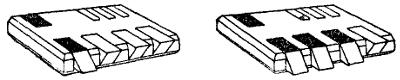
The Foster Whist Marker.
The four large keys on one side are used to count single points,
the single large key on the opposite side being reckoned as five.
The three small keys are used for counting rubber points, or games.
In ten point games, the scoring to four points is the same; but
beyond four, a single counter placed below two or more others, is
reckoned as three; and above two or more others, as five.
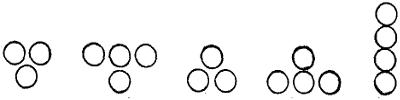
Five. Six. Seven. Eight. Nine.
When proper markers are not obtainable, many persons cut
eight slits in a visiting card, and turn up the points.
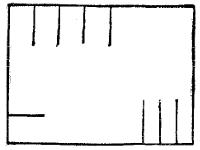
Visiting-Card Marker.
Whatever the apparatus employed, it should be such that every
player at the table can distinctly see the state of the score without
drawing attention to it.
METHODS OF CHEATING. Whist offers very few
opportunities to the card-sharper. When honours are counted, he
may be able to keep one on the bottom of the pack until the completion
of the deal by making the pass after the cards have
been cut. A greek who possessed sufficient skill to do this without
detection would be very foolish to waste his talents at the
whist table; for, however large the stakes, the percentage in his
favour would be very small.
When whist is played with only one pack, a very skillful shuffler
may gather the cards without disturbing the tricks, and, by giving
them a single intricate shuffle, then drawing the middle of the
pack from between the ends and giving another single intricate
shuffle, he may occasionally succeed in dealing himself and his
partner a very strong hand in trumps, no matter how the cards are
cut, so that they are not shuffled again. A hand dealt in this
manner is framed on the walls of the Columbus, Ohio, Whist Club;
eleven trumps having been dealt to the partner, and the twelfth
turned up. In this case the shuffling dexterity was the result of
fifteen years’ practice, and was employed simply for amusement,
the dealer never betting on any game, and making no concealment
of his methods.
SUGGESTIONS FOR GOOD PLAY. Although whist
is a game of very simple construction, the immense variety of
combinations which it affords renders it very complicated in
actual practice; there being probably no game in which there is so
much diversity of opinion as to the best play, even with the same
cards, and under similar conditions. It has been repeatedly remarked
that in all the published hands at whist which have been
played in duplicate, or even four times over, with the same cards,
no two have been alike.
It would be useless to formulate rules intended to cover every
case that might arise, because the conditions are frequently too
complicated to allow the average human intellect to select the exact
rule which would apply. All that can be done to assist the beginner
is to state certain general principles which are well recognised
as fundamental, and to leave the rest to experience and practice at
the whist table.
GENERAL PRINCIPLES. Nothing obstructs the
progress of the beginner so much as his attempts to cover all the
ground at once. The more ambitious he is, the greater his necessity
for keeping in view the maxim; “One thing at a time: all
things in succession.” One must master the scales before he can
produce the perfect melody.
The novice should first thoroughly understand the object, and
the fundamental principle of the game.
The Object is to win tricks. Not to give information, or to
count the hands, or to remember every card played; but simply
and only to win tricks.
The Principle is to secure for certain cards a trick-taking
value which does not naturally belong to them; either by
getting higher cards out of the way of lower, or by placing the
holder of intermediate cards at a disadvantage with regard to the
lead.
If any person will take the trouble to deal out four hands,
and after turning them face up on the table, count how many tricks
each side will probably take with its high cards and trumps, he
will find that the total will hardly ever be exactly thirteen tricks.
Let us suppose the following to be one of the hands so dealt; Z
turning up the ♡6 for trumps:—
On looking over this hand it would appear that A could only
make one trick in Clubs, of which the second round would be
trumped. His partner can count on five tricks: the two best and
the fourth trumps; the ♢A, and the ♠K; a total of six tricks.
On counting the adversaries’ probable tricks, Y should make one
of his three trumps, and the ♠A. Diamonds will not go round
twice without being trumped, so we cannot count on his ♢K.
We cannot see any sure tricks for Z. Where are the five other
tricks necessary to bring our total up to thirteen? They must be
there, for there are thirteen tricks taken in every hand played.
If we play over the hand, we shall find that A-B may make
six, seven, nine, or ten tricks, according to their good management,
and the good or bad play of their adversaries. In Foster’s
Whist Tactics, Illustrative Hand No. 13, may be found the
various ideas of sixteen of the best players in the American Whist
League with regard to the proper management of this hand.
They played it in four different ways, and with very different
results in the score.
This must show that the accidental distribution of the Aces,
Kings, and trumps is not everything in whist, and that there must
be ways and means of securing tricks which do not appear on the
surface.
There are four ways of taking tricks at whist:
1st. By playing high cards, the suit of which the others must
follow. This A does, in the example, on the first round of the
Club suit.
2nd. By playing low cards, after the higher ones have been
exhausted, and the adverse trumps are out of the way. This Y
will do with his Diamonds, or A with his Clubs, according to circumstances.
3rd. By trumping winning cards played by the adversaries.
This Y will do if Clubs are led a second time, or A will do if
Diamonds are led twice.
4th. By being able to take tricks with cards which are not the
best of the suit, the player who holds better cards having already
played smaller. This B will do with the ♡10 if A leads trumps,
and Y does not play either Q or J. If B leads trumps he will lose
this advantage.
These four methods of winning tricks suggest four systems of
play, which are those in common use by experts at the present
day:
1st. Playing high cards to the best advantage, so as to secure
the best results from such combinations as may be held. This is
the basis of all systems of leading.
2nd. Leading from the longest suit, in order that higher cards
may be forced out of the way of smaller ones, leaving the smaller
ones “established,” or good for tricks after the adverse trumps
are exhausted. This is called the long-suit game.
3rd. Trumping good cards played by the adversaries. This is
called ruffing. When two partners each trump a different suit,
it is called a cross-ruff, or saw.
4th. Taking advantage of the tenace possibilities of the hand
by placing the lead with a certain player; or by avoiding the
necessity of leading away from tenace suits. For example: A
player holds A Q 10 of a suit, his right hand adversary holding K
J 9. These are known as the major and minor tenaces.
Whichever leads makes only one trick; but if the holder of the
major tenace can get the suit led twice, he makes all. This is
called the short-suit game, or finesse and tenace. Its resources
may be added to by finessing against certain cards. For
example: Holding A Q 3 of a suit led by the partner, to play Q
is a finesse against fourth hand having the King.
Each of these systems has its advantages, and almost every
hand will offer opportunities for practice in all of them.
The most important thing to impress on the beginner is that
whist cannot be played by machinery. Some authorities would
have us believe that certain theories alone are sound; that certain
systems of play alone are good; and that if one will persevere in
following certain precepts, in such matters as leading, management
of trumps, etc., that the result will be more than average success
at the whist table.
Nothing can be further from the truth. As in all other matters
largely controlled by chance, there is no system, as a system, which
will win at whist. One cannot succeed by slavish adherence to
either the long or the short-suit game; by the invariable giving of
information, or the continual playing of false cards. The true elements
of success in whist lie in the happy combination of all the
resources of long and short suits, of finesse and tenace, of candour
and deception, continually adjusted to varying circumstances, so
as to result in the adversaries’ losing tricks.
HOW TO STUDY WHIST. Any person, anxious to become
an expert whist player, may attain to considerable proficiency
in a short time, if he will content himself with mastering the following
general principles one at a time; putting each into practice
at the whist table before proceeding to the next.
The science of modern whist may be divided into two parts:
1st. Tactics; or the purely conventional rules for leading, second
and third hand play, returning partner’s suits, etc., all of
which may be learnt from books, or gathered from more experienced
players. 2nd. Strategy; or the advantageous use of the
information given by the conventional plays. This is largely dependent
on personal ability to judge the situation correctly, and to
select the methods of play best adapted to it.
CONVENTIONAL PLAYS. These may be divided into
two parts: those used by the partners who attack, either with
their strong suits, or by leading out trumps; and those employed
by their adversaries, who are defending themselves against such
suits, or wishing to prevent their trumps being drawn. We shall
first consider the conventionalities used in attack.
Leading. The player with the original lead should have a
double object in view; to secure the best results for his own hand,
and to indicate to his partner where he is in need of assistance.
The first matter for his consideration will be whether to begin
with a trump or with a plain suit. There are two principal uses for
trumps. The most attractive to the beginner is that of ruffing the
adversaries’ winning cards; and the most important to the expert
is leading trumps to prevent this. No matter how strong or well
established a plain suit may be, it is of uncertain value as long as
the adversaries have any trumps with which to stop it. A suit is
established when you can probably take every trick in it. If a
player with a good established suit is sufficiently strong to make
it probable that he can, with his partner’s assistance, exhaust the
adverse trumps, he should do so by leading trumps. If they are
probably stronger than he, he must force them, by leading the established
suit which they will be compelled to trump, weakening
their hands and gradually reducing their trump strength until it is
possible to exhaust what remains by leading. It being to the advantage
of the player with a good suit to exhaust the trumps, it
must be desirable to his adversaries to keep theirs, if possible, for
the purpose of ruffing this good suit.
Trumps are also useful as cards of re-entry, when a player has
an established suit, but has not the lead; their most important use,
however, is in defending or stopping established suits.
Rules for Leading Trumps. With five or more trumps,
the beginner should always begin by leading them, regardless of
the rest of his hand. With three or less he should never lead
them, unless he has very strong cards in all the plain suits. With
four trumps exactly, he should lead them if he has an established
suit and a card of re-entry in another suit. A card of re-entry in
plain suits is one which is pretty sure to win a trick, such as an
Ace, or a guarded King. The following are examples of hands
from which trumps should be led originally by a beginner;—
Hearts are trumps in every case.
| ♡ J 8 6 4 2; |
♣ K 3 2; |
♢ 10 9 2; |
♠ 7 5. |
| ♡ Q 10 2; |
♣ A K 5; |
♢ K Q 10 9; |
♠ A Q 3. |
| ♡ K J 8 3; |
♣ A K Q 10 7 3; |
♢ 3; |
♠ A 7. |
The following are examples of hands from which trumps should
not be led:—
| ♡ A K Q; |
♣ J 8 7 5 3; |
♢ Q 4; |
♠ K 4 2. |
| ♡ Q J 10 2; |
♣ 5 2; |
♢ A K Q 2; |
♠ 6 4 3. |
| ♡ A Q 5 4; |
♣ K Q J 6 3; |
♢ A 9 2; |
♠ K. |
If at any later stage of the hand, a player finds himself with an
established suit and a card of re-entry, he should lead trumps if he
has four. For instance: The player with the last example should
lead trumps if the first round of Clubs either forced the Ace out of
his way, or found it with his partner.
Rules for Leading Plain Suits. It is safest for the beginner
to select his longest suit for the original lead; unless he has
a four-card suit which is much stronger. Length and high cards,
the two elements of strength, are often very nearly balanced. In
the following examples the player should begin with the longest
suit:—
| ♡ A 4 3; |
♣ J 10 9 8 3; |
♢ A K Q; |
♠ K 2. |
| ♡ K 10 8 3; |
♣ 4 2; |
♢ K Q 10 8 2; |
♠ A Q. |
In the following the four-card suit should be selected:—
| ♡ J 3; |
♣ 6 5 4 3 2; |
♢ J 10 5 3; |
♠ Q 8. |
| ♡ Q 4 2; |
♣ 7; |
♢ 10 6 4 3 2; |
♠ A K Q 10. |
The principle which should guide in the selection of a plain suit for
the original lead is, that if there are a number of small cards in
one suit, and a few high cards in another, by leading the long
suit first, the higher cards in it are forced out of the way, and the
high cards in the shorter suit will then bring the holder of the
established small cards into the lead again. But if the high cards
of the short suit are first led, the long suit of small cards is dead.
Having determined whether to lead the trump or the plain
suit, the next point is to select the proper card of the suit to lead.
At first the beginner need not trouble himself about making any
distinction between trumps and plain suits; that will come later.
Rules for Leading High Cards. Having a strong suit,
but without cards of re-entry or trump strength to support it, the
best policy is to make tricks while you can. With such a suit as
A K Q 2, no one need be told not to begin with the deuce.
Whenever a player holds two or more of the best cards of a suit
he should play one of them. If he holds both second and third
best, playing one of them will force the best out of his way, leaving
him with the commanding card.
The cards which are recognised by whist players as high, are
the A K Q J 10, and if we separate the various combinations from
which a player should lead each of them, a study of the groups
so formed will greatly facilitate our recollection of them.
In the first group are those containing two or more of the best
cards. In this and all following notation, the exact size of any
card below a Ten is immaterial.
So far as trick-taking is concerned, it is of no importance which
of the winning cards is first led; but for the past hundred years
it has been the custom for good whist players to lead the King
from all these combinations, in order that the partner may be informed,
by its winning, that the leader holds the Ace also.
In the second group are those containing both the second and
third best, but not the best.
The King is the proper lead from these combinations. If it
wins, the partner should have the Ace; if it loses, partner should
know the leader holds at least the Queen.
Both these groups, which contain all the King leads, may be
easily remembered by observing that the King is always led if
accompanied by the Ace or Queen, or both. Beginners should
follow this rule for leading the King, regardless of the number
of small cards in the suit, unless they hold the sequence of K Q
J, and at least two other cards.
From this combination the Jack is the usual lead, in order to
invite partner to put on the Ace, if he has it, and get out of the
way, thus establishing the suit in the leader’s hand. This is the
only high-card combination from which the Jack is led.
There is only one combination from which the Queen is led,
regardless of the number of the small cards.
This may be remembered by observing that there is no higher
card in the suit than the one led, and that it contains a sequence
of three cards, Q J 10. This lead is an indication to the partner
that the leader holds neither Ace nor King.
There is only one combination from which the Ten is led, regardless
of the number of small cards.
The Ten led is an indication to partner that both Ace and
Queen are against the leader.
Combinations from which the Ace is led contain at least five
cards in suit, or both Queen and Jack.
This lead is an indication to partner that the leader has not the
King, and that the suit is either long, or contains three honours.
Rules for Leading Low Cards. If the suit selected for the
lead contains none of the combinations from which a high card
should be led, it is customary with good players to begin with the
4th-best, counting from the top of the suit. This is called the
card of uniformity; because it indicates to the partner that there
are remaining in the leader’s hand exactly three cards higher than
the one led. From any of the following combinations the proper
lead would be the Four:—
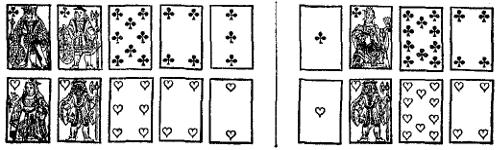
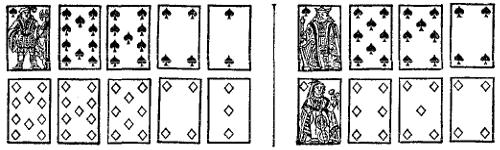
Rules for Leading Short Suits. It will sometimes happen
that the only four-card suit in the leader’s hand will be trumps,
which it is not desirable to lead. In such cases, if there is no
high-card combination in any of the short suits, it is usual to lead
the highest card, unless it is an Ace or King. Many good players
will not lead the Queen from a three card suit, unless it is accompanied
by the Jack. All such leads are called forced, and
are intended to assist the partner, by playing cards which may
strengthen him, although of no use to the leader. The best card
should be led from any such combinations as the following:—
All these rules for leading apply equally to any position at the
table when a player opens his own suit for the first time.
Rules for Leading Second Round. On the second round
of any suit, the player holding the best card should play it; or
having several equally the best, one of them. If he is Fourth
Hand, he may be able to win the trick more cheaply.
If the original leader has several cards, equally the best, such
as A Q J remaining after having led the King, he should continue
with the lowest card that will win the trick. This should be an
indication to his partner that the card led is as good as the best,
and that therefore the leader must have the intermediate cards.
Following King, which has been led from these combinations:—
Leading the Jack on the second round would show both Ace
and Queen remaining. Leading Queen would show Ace, but not
the Jack. Leading Ace would show that the leader had not the
Queen.
In combinations which do not contain the best card, the lead
may be varied in some cases to show the number remaining in
the leader’s hand, or to indicate cards not shown by the first lead.
Following King, which has been led from these combinations:—
Leading the Ten on the second round would show both Queen
and Jack remaining. Leading the Jack would show the Queen;
but not the ten.
Following the Jack, led from this combination:—
Leading King on the second round would show five cards in the
suit originally. Leading the Queen would show more than five.
Following the Queen, led from this combination:—
Leading Jack on the second round shows the suit to have originally
contained only four cards; the Ten would show more than
four.
Following the Ace, led from these combinations:—
Leading the Queen shows the suit was short. Leading the Jack
shows that it contained at least five cards.
When a player holds both the second and third-best of a suit
on the second round, he should always play one of them, whether
he is First, Second, or Third Hand. This protects him, by forcing
the command of the suit, if it does not win the trick. Having
led the Ten from K J 10 x, if the Ace or Queen wins the first
trick, the K should be next led. Having led the Four from Q
J 6 4 2, if Ace or King falls to the first trick, the Queen should be
led. If the Jack, Queen, and Ace fall to the first trick, a player
holding both Ten and Nine should lead the Ten.
After leading high cards from some combinations, and winning
the trick, they may no longer contain either the best or the second
and third best. Such are the following:—
The rule in all such cases is to follow with the card of uniformity,
the original fourth-best.
If the combinations are those from which the fourth-best had
been led originally, and the leader has neither the best, nor both
second and third best to go on with, he should continue with the
lowest card in his hand, unless he had six or more in suit; in
which case he may go on with the remaining fourth-best.
AVOID CHANGING SUITS. A player having once
begun with a suit, either for the purpose of establishing it, or of
taking tricks in it, should not change it until he is forced to do so.
Running off to untried suits is one of the beginner’s worst faults.
There are five good reasons for changing suits, and unless one of
them can be applied, the suit should be continued:
1st. In order to lead trumps to defend it.
2nd. In order to avoid forcing partner.
3rd. In order to avoid forcing both adversaries.
4th. Because it is hopeless, and there is some chance in another.
5th. To prevent a cross ruff, by leading trumps.
Simple Inferences from the fall of the cards usually supply
the best guide in the matter of changing suits.
If the Jack is led from K Q J x x, and wins the trick, partner
may be credited with the Ace; and if the original leader has four
trumps, and a card of re-entry, he should quit his established suit,
and lead trumps to defend it.
If the King and Ace have been led from A K x x, partner
dropping the Queen on the second round, the suit should be
changed, unless the original leader is strong enough to risk weakening
his partner by forcing him to trump the third round. Four
trumps are generally considered to be sufficiently strong to justify
a force in this position. Some players will force, even with a weak
hand, if the two cards played by the partner are small, and he has
not availed himself of an artifice known as calling for trumps,
which we shall consider presently.
If the King and Ten have been led from K Q J 10, and on the
second round one adversary has dropped the Eight, the other the
Nine; the suit should be changed, as partner must have the Ace,
and neither of the adversaries have any more. To lead such a
suit again is called forcing both adversaries; as it allows
one to make a small trump and the other to get rid of a losing
card.
If the Four has been led from J 8 6 4, and the adversaries have
won the first trick with the Nine or Ten, A K Q must be against
the leader and his partner, and the suit should be abandoned as
hopeless, unless it is feasible to force the partner.
If at any time there is a strong indication that the adversaries
will have a cross-ruff, it is usually best to stop leading plain suits,
and attempt to get out the trumps.
THE LEADER’S PARTNER, or the Third Hand, has
several conventional plays to remember; the most important of
which are the following:
When Partner Leads High Cards, the Third Hand has
usually little to do but to play his lowest of the suit. The exceptions
are:
If he holds A J alone, on a King led, the Ace should be played.
If he holds A Q alone on a Ten led, the Ace should be played.
With A Q x, the Ten should be passed. With Ace and small
cards, the Ace should be played on the Ten. With Queen and
small cards the Ten should be passed. When Third Hand plays
Queen on a Ten led, it should be a certainty that he has no more
of the suit.
If he holds A K and only one small card, the King should be
played on a Queen led.
If he holds Ace and only one small card, the Ace should be
played on the Jack led. If Third Hand has four trumps and a
card of re-entry, the Ace should be played on Jack led, regardless
of number, in older to lead trumps at once, to defend the suit.
When Partner Leads Low Cards, the Third Hand should
do his best to secure the trick. If he has several cards of equal
trick-taking value, such as A K Q, or K Q J, he should win the
trick as cheaply as possible. The only finesse permitted to the
Third Hand in his partner’s suit, is the play of the Queen, when he
holds A Q and others; the odds being against Fourth Hand having
the King.
Foster’s Eleven Rule. By deducting from eleven the number
of pips on any low card led, the Third Hand may ascertain
how far his partner’s suit is from being established. For instance:
if the card led is the Seven, Second Hand playing the Eight, and
Third Hand holding A J 6 3, from which he plays Ace, Fourth
Hand playing the Five; the only card against the leader must be
the King or Queen; he cannot have both, or he would have led
one. If the Second Hand has not the missing card, he has no more
of the suit. The number of inferences which may be made in
this manner by observant players is astonishing. A great many
examples and exercises in them are given in Foster’s Whist
Manual.
Third Hand having None of the Suit, should trump
anything but an Ace or a King on the first round. On the second
round, if there is only one card against the leader, his partner
should pass with four trumps, and allow the suit to be established.
For instance: If the leads have been Ace, then Jack, Third Hand
holding only one of the suit; he should pass if the Second Hand
does not play King.
Third Hand on Strengthening Cards. Unless Third
Hand has both Ace and King of the suit, he should pass any
forced or strengthening lead which is not covered by the Second
Hand. This obliges the Fourth Hand to open another suit, or to
continue at a disadvantage.
Third Hand winning first round has the choice of four lines of
play:
1st. To lead trumps, if he is strong enough.
2nd. To return the best card of his partner’s suit if he has it.
This is imperative before opening any other suit but trumps.
3rd. To lead his own suit, if he can do anything with it. It is
considered better play for the Third Hand to return the original
leader’s suit than to open a long weak suit of his own such as one
headed by a single honour.
4th. To return his partner’s suit even with a losing card, in
preference to changing.
When the original lead is a trump, it should be returned in
every case, either immediately, or as soon as the player can obtain
the lead.
The same reasons for changing suits as those given for the
original leader will apply to the Third Hand.
RULES FOR RETURNING PARTNER’S SUITS.
When the original leader’s suit is returned by his partner, either
immediately or upon his regaining the lead, it is usual to show, if
possible, how many cards remain in the Third Hand, so that by
adding them to his own, the leader may estimate the number held
by his adversaries. This consideration is secondary to the return
of the best, or one of the second and third best; but in the absence
of such cards, the Third Hand should always return the higher of
only two remaining, and the lowest of three or more, regardless of
their value.
In addition to the foregoing conventionalities, which are proper
to the leader of a suit and his partner, there are two usages which
apply equally to any player at the table. These are discarding
and forcing.
Discarding. When a player cannot follow suit, and does not
wish to trump, his safest play is to discard whatever seems of
least use to him. It is not considered good play to unguard a
King or to leave an Ace alone; but this may be done if the partner
is leading trumps, and there is a good established suit to
keep. Beginners should be careful to preserve cards of re-entry,
even if they have to discard from their good suit in order to do
so.
When the adversaries have shown strength in trumps, or are
leading them, there is little use in keeping a long suit together.
It is much better to keep guard on the suits in which they are
probably strong, letting your own and your partner’s go.
A player having full command of a suit, may show it to his
partner by discarding the best card of it. Discarding the second-best
is an indication that the player has not the best; and in
general, the discard of any small card shows weakness in that
suit.
Forcing. We have already observed that a player who is
weak himself should not force his partner. An exception may be
made in cases where he has shown weakness, or has had a chance
to lead trumps and has not done so. On the contrary, an adversary
should not be forced unless he has shown strength, or the
player forcing him is weak. The hope of a player with a good
suit is to defend it by leading and exhausting the trumps. His
adversary tries to keep his trumps in order to stop that suit; at
the same time forcing the strong hand, by leading cards which he
must trump, hoping that such a force may so weaken him that he
will be unable to continue the trump lead.
It is usually very difficult to convince the beginner that the
weaker he is himself, the more reason he has for forcing the
adversaries to trump his good cards. He is constantly falling into
the error of changing from a good suit, which the adversaries cannot
stop without trumping, to a weak suit, which allows them to
get into the lead without any waste of trump strength. If an
adversary refuses to trump a suit, it is imperative to keep on with
it until he does; for it is always good play to force an adversary
to do what he does not wish to do.
Any person may convince himself of the soundness of this
theory of forcing, by giving himself the six highest cards in any
suit, three small cards in the others, and four trumps; giving
another player the four best trumps, and nine of the highest cards
in two suits. If the first player forces the second with his good
suit, and continues every time he gets the lead, he must win six
tricks; if he does not, the second player makes a slam.
A deliberate force from a partner should always be accepted,
if he is a good player.
We may now turn our attention to the conventionalities used by
players who are opposed to the establishment of suits in the hands
of the leader and his partner. These are divided between the
Second and the Fourth Hand, the former being the more important.
Generally speaking, they are the tactics of defence.
SECOND HAND PLAY. The player who is second to
play on any trick is called the Second Hand. It is his duty to protect
himself and his partner, as far as possible, in the adversaries’
strong suits. The chief point for the beginner to observe in Second
Hand play, is the difference between the circumstances requiring
him to play high cards, and those in which he should play low
ones.
High Cards Led. When a card higher than a Ten is led on
the first round of a suit, the Second Hand has usually nothing to
do but to play his lowest card, and make what inference he can as
to the probable distribution of the suit. But if he holds the Ace,
or cards in sequence with it, such A K, he should cover any
card higher than a Ten. If he holds K Q he should cover a J, 10,
or 9 led; but it is useless for him to cover an honour with a single
honour, unless it is the Ace.
Low Cards Led. High cards are played by the Second Hand
when he has any combination from which he would have led a
high one if he had opened the suit. The fact that a player on his
right has already laid a small card of the suit on the table should
not prevent the Second Hand from making the best use of any
combinations he may hold. The only difference between leading
from such combinations, and playing them Second Hand, is that in
the latter case no attempt is made to indicate to the partner the
exact nature of the combination held. The general rule is to win
the trick as cheaply as possible, by playing the lowest of the high
cards which form the combination from which a high card would
be led. Such are the following:—
The beginner must be careful with these:—
The combination which makes the first of these a high-card
lead is the A K, and the King must be played Second Hand. The
Jack has nothing to do with it. In the second, the Ten does not
form any part of the combination, and the Queen is the card to
play Second Hand. Some players will not play a high card second
hand with K Q x x unless weak in trumps.
An exception is generally made with these combinations, from
which the proper lead is the Ace.
Many will not play Ace Second Hand in any case, and will
play the Queen with the first combination only when they are
weak in trumps. The reason for this exception is the importance
of retaining command of the adverse suit as long as possible.
On the Second Round, the Second Hand should follow the
usual rule for playing the best of the suit if he holds it; or one of
the second and third best, if he holds them. He should also be careful
to estimate, by the eleven rule, how many cards are out against
the leader, which will sometimes guide him to a good finesse. For
instance: first player leads Ace, then Eight. If the Second Hand
holds K J 9 2, instead of playing the best card to the second
round, which would be King, he should finesse the Nine.
With Short Suits. When Second Hand holds such short-suit
combinations as:—
and a small card is led, his proper play is one of the high cards,
because he cannot save both of them.
On Strengthening Cards Led. This is a difficult point for
the beginner, and his best plan is to follow the rules already given
for covering cards higher than the Ten. One of the most common
errors is to cover a Jack led with a Queen, when holding A Q and
others. The Ace should be put on invariably. To play the Queen
in such a position is called finessing against yourself.
Singly Guarded Honours. Many players put on the King
Second Hand, if they hold only one small card with it, and a
small card is led. This will win the trick as often as it will lose it;
but it betrays the hand to the adversary, and enables him to finesse
deeply if the suit is returned. It may be done in order to get the
lead, and in trumps the practice is very common, and generally
right. With Queen and only one small card, it can be demonstrated
that it is useless to play the Queen Second Hand, except
as an experiment, or to get the lead in desperate cases.
With any combination weaker than J 10 x, it is useless to attempt
to win the trick Second Hand, and only makes it difficult
for the partner to place the cards correctly.
The Fourchette. When the Second Hand has cards immediately
above and below the one led, he should cover. The beginner
may have some difficulty in recognising the fact that he
holds fourchette if the suit has been round once or twice, and the
intermediate cards have been played. Such cards as a Queen and
a Seven may be fourchette over a Nine, if Jack, Ten and Eight
have been played.
Second Hand Having None of the suit led, on either first
or second round, must decide whether or not to trump it. If the
card led is the best of the suit, he should certainly do so; but if it
is not, and there is any uncertainty as to who will win the trick, it
is usual for the Second Hand to pass when he has four trumps.
With five trumps, there should be some good reason for keeping
the trumps together, as a player with so many can usually afford
to trump. If he does not trump, his play comes under the rules
for discarding.
FOURTH-HAND PLAY. The Fourth Hand is the last
player in any trick. He is the partner of the Second Hand, but
has not so many opportunities for the exercise of judgment, his
duties being simply to win tricks if he can, and as cheaply as
possible. If he cannot win the trick, he should play his lowest
card.
A bad habit of Fourth-Hand players is holding up the tenace A
J when a King or Queen is led originally. This is called the
Bath Coup, and the suit must go round three times for it to
succeed in making two tricks. The holder of the tenace should
equally make two tricks by playing the Ace at once, provided he
does not lead the suit back.
The Turn-up Trump. When trumps are led by the adversaries,
it is a common practice to play the turn-up as soon as possible,
unless it is a valuable card. On the contrary, it is usual to
keep it as long as possible when the partner leads trumps.
Changing Suits. If the Second or Fourth Hand wins the
first or second round of the adversaries’ suit, it is seldom right to
return it, as that would probably be playing their game. The
player should open his own suit, as if he were the original leader.
If he is strong enough to lead trumps under ordinary circumstances,
he may be deterred from so doing if the adversaries have
declared a strong suit against him. The same consideration may
prevent his leading trumps in the hope of making a suit of his
own, as the adversaries might reap the benefit by bringing in their
suit instead. On the contrary, when the Second or Fourth Hand
holds command of the adverse suit, they may often risk a trump
lead which would otherwise be injudicious. Having once started
a suit, it should not be changed, except for one of the reasons
already given for the guidance of the First Hand.
When the Adversaries Lead Trumps, and the Second
Hand has a chance either to establish a suit against them or to
force his partner, he should stop the trump lead if he can. If his
partner has led trumps, the Second Hand should generally play
his winning cards on his right hand opponent’s plain-suit leads, to
stop them; and continue the trumps.
These are about all the conventionalities necessary for the
beginner. After at least a year’s practice with them, he will either
discover that he has no aptitude for the game, or will be ready to
go into further details. A beginner who attempts to handle the
weapons of the expert simply plays with edged tools, which will
probably cut no one but himself and his partner.
THE SIGNAL GAME. Having become thoroughly familiar
with the elementary conventionalities of the game, so that they
can be used without the slightest hesitation at the whist table, the
player may proceed to acquaint himself with the details of what is
commonly known as the Signal Game, which comprises all the
various methods of signalling up hands between partners, according
to certain arbitrary and pre-arranged systems of play. Many
players object to these methods as unfair; but they are now too
deeply rooted to yield to protest; and the best thing for a player to
do is to familiarise himself with his adversaries’ weapons.
The Trump Signal. A player anxious to have trumps led,
but who has no immediate prospect of the lead, may call on his
partner to lead trumps at the first opportunity, by playing any two
cards of a suit led, the higher before the lower. Let us suppose
him to hold five good trumps, with the Six and Two of a suit of
which his partner leads King, then Jack. By playing first the
Six, and then the Two, he calls upon his partner to quit the suit,
and lead a trump.
Among some players, the lead of a strengthening card when an
honour is turned, is a call for trumps to be led through that honour
at the first opportunity, but it is not good play.
Passing a certain winning card is regarded by most players as
an imperative call for trumps.
The discard of any card higher than a Seven is known as a
single-card-call. Even if it was not so intended, it is assumed that
a trump lead cannot injure a player with nothing smaller than a
Nine in his hand.
Answering Trump Signals. In response to partner’s call,
a player should lead the best trump if he holds it; one of the
second and third best if he holds them; the highest of three or
less; the lowest of four; and the fourth-best of more than four.
Holding any of the regular high-card combinations in trumps, he
should lead them in the regular way in answer to a call.
After a Force. If the player is forced before he can answer
the call, he may indicate the number of trumps originally held by
playing them in this manner:—
With 3 or less; trumping with the lowest; leading the highest.
With 4 exactly; trumping with the 3rd-best; leading the highest.
With 5 or more; trumping with the 3rd-best; leading the 4th-best.
These methods of taking the force must not be carried to extremes.
For instance: A player holding K J 10 2, would hardly
be justified in trumping with the 10 to show number. Some
experts, holding the best trump with at least four others, will not
lead it; preferring to show number first, by leading the fourth-best.
Others, holding four, lead the lowest after trumping with
the third-best.
The Echo in Trumps. When the partner leads high
trumps, the Third Hand should echo with four or more, by signalling
in the trump suit. The universal form of the echo is to play
first the third-best, then the fourth-best. When a player has
called, and his partner leads, it is unnecessary for the caller to
echo. Players seldom echo on adverse trump leads, even with five
trumps.
The Four-Signal. There are several ways of showing four
or more trumps without asking partner to lead them. Among
some players the original lead of a strengthening card is an evidence
of four trumps, and is called an Albany Lead. A player
holding three cards of any plain suit, such as the 3, 4, 5, may show
the number of his trumps by playing these small cards as follows:—
| No of trumps. |
1st trick. |
2nd trick. |
3rd trick. |
| 3 or less |
3 |
4 |
5 |
| 4 exactly |
4 |
5 |
3 |
| 5 ” |
4 |
3 |
5 |
| 6 ” |
5 |
3 |
4 |
| 7 or more |
5 |
4 |
3 |
The second of these is the four-signal; the last three are trump
signals. They are used only in following suit.
The four-signal is sometimes used in the trump suit as a Sub-echo,
to show three trumps exactly.
Apart from signalling, trump strength may often be inferred,
especially from player’s passing doubtful tricks, forcing their partners,
etc.
Trump Suit Leads. When trumps are not led for the purpose
of exhausting them immediately, but simply as the longest
suit, the fourth-best may be led from the following:—
If the Ten accompanies the King and Queen, in the third combination,
it is best to adhere to the usual lead of the King.
In leading trumps from combinations containing a winning
sequence, such as the following:—
many players begin with the lowest of the winning cards, continuing
with the next above it.
Speculative Trump Leads. The whist player will often find
himself with a single good suit, a card of re-entry, and few trumps.
Certain conditions of the score may prompt him to make a speculative
trump lead from such a hand. If his trumps are high, such
as A K x, he may safely begin by leading them; but if they are
weak, and he is depending largely on his partner’s possible
strength, he should show his suit first by leading it once.
Over-trumping is generally regarded as bad policy when a
player has a good suit, and sufficient trump strength to justify him
in hoping to do something with it. The refusal to over-trump,
unless the trump played is a high one, should be regarded by the
partner as a call.
It is sometimes necessary to over-trump partner in order to get
the lead. For instance: A player holds the two best trumps, and
all winning cards of a plain suit, while the player on his right has
a losing trump. In such a position the player with the two best
trumps should trump any winning card his partner leads, or over
trump him if he trumps, so as to prevent the adversary from making
that losing trump.
Under-trumping, or the Grand Coup, is playing a low
trump on a trick that partner has already trumped with a higher,
in order to avoid the lead. For instance: A player holds major
tenace in trumps with a small one, and knows that the minor
tenace is on his right. Four cards remain in each hand. The
player on the left leads; Second Hand trumps; Third Hand follows
suit. If the Fourth Hand keeps his three trumps, he must
win the next trick, and lose the advantage of his tenace.
A player will sometimes have the best card in two suits, and a small
trump, and will know that the two best trumps and an unknown
card are on his right. If the missing suit is led, and the player on
the right trumps, his unknown card must be one of the two other
suits, and the player with the command of them should keep both,
and throw away his small trump. The discards on the next trick
may enable him to determine the suit of the losing card on his
right.
The Last Trump. If two players have an equal number of
trumps, each of them having an established suit, it will be the object
of both to remain with the last trump, which must bring in
the suit. The tactics of each will be to win the third round of
trumps; and then, if the best trump is against him, to force it out
with the established suit, coming into the lead again with the last
trump. So often is it important to win the third round of trumps
that few good players will win the second round, unless they can
win the third also. With an established suit, a card of re-entry,
and four trumps King high, a player should lead trumps; but if
his partner wins the first round and returns a small trump, the
King should not be put on, no matter what Second Hand plays,
unless the card next below the King is fourchette. Some of the
most brilliant endings in whist are skirmishes for the possession of
the last trump; the player who is at a disadvantage often persistently
refuses the fatal force, hoping the leader will be compelled
to change his suit, or will lose the lead.
Drawing the Losing Trump. It is usually best to draw
losing trumps from the adversaries, unless a player can foresee
that he may want the best to stop a strong adverse suit.
A Thirteenth Card, played by the partner, is usually considered
an invitation to put on the best trump. The Second Hand should
not trump a thirteenth card unless he is weak in trumps.
AMERICAN LEADS. Advanced players, who have had so
much practice that they can infer the probable position of the
cards without devoting their entire attention to it, have adopted a
new system of leading from the four combinations following, in
order to show the number of small cards in the suit:—
From these the King is never led if there are more than four
cards in the suit. Having more than four, the lowest of the sequence
of high cards is led. From the first this would be the
Jack; from the second the Queen; from the third the Ace, (because
the King is barred;) and from the fourth the Queen. The
Ten is not ranked among the high cards in American Leads.
On the second round, with the first two combinations, the difference
between a suit of five or one of six cards may be indicated
by following with the Ace if five were held originally; the King,
if more than five. Seven cards may be shown with the first combination,
by leading the Queen on the second round.
The chief difference these leads make in the play of the Third
Hand is that he should not trump any court card led, even if weak
in trumps. The misunderstanding as to the meaning of the first
lead, especially if it is a Queen, often occasions confusion and loss;
but this is claimed to be offset by the value of the information
given. Some lead 10 from Q J 10; 4th-best from K J 10.
To the adversaries these leads are often of value, as they are
frequently enabled to place the cards very accurately from the information
given by the lead itself, regardless of the fall of the cards
from the other hands. For instance: Second Hand holds A J of a
suit in which King is led; Third Hand plays the Four; Fourth Hand
plays the Nine. The leader remains with Q 3 2; Third Hand still
has 8 7 6 5; and if he has also the 10, Fourth Hand has no more.
Again: The leader shows a suit of six; Second Hand holding
two only. If the suit is led a third time it is a doubtful trick, and
with four trumps the Second Hand should pass. If the leader
shows the exact number of the suit originally led, and then changes
to a four-card suit, the adversaries know at least nine of his cards.
So obvious is this that it is an almost invariable rule for a player,
on quitting his suit, to conceal the length of the second suit led by
leading the highest card of a short suit.
If it were allowable to exercise some judgment in using these
leads, they might not be open to so many objections; but they are
worse than useless unless the partner can depend on their being
uniformly adopted.
The Minneapolis Lead. This is another variation in the
leads, which is confined to one combination; that of Ace and any
four other cards, not including the King. With strength in trumps
the fourth-best is led instead of the Ace, the theory being that the
Ace is more likely to be valuable on the second or third round of
such a suit than on the first, and that the trump strength justifies
the finesse of the original lead. With weak trumps the Ace is led.
Some players extend this principle to the Second Hand, and play
Ace on a small card led, when holding A x x x x with weak
trumps. This is open to the objection that it gives up command
of the adverse suit too early in the hand; but it saves many a trick.
The Plain-suit Echo. This is another device for giving information
as to number. When the original leader begins with a
high card, the Third Hand should play his third-best if he holds
four or more; and on the second round his second best, always retaining
his fourth-best and any below it. The value of this echo
is much disputed, and the adversaries can usually render it ineffective
by holding up small cards; a practice very much in vogue
with advanced players.
Low’s Signal. This is the latest system of indicating to the
leader the number of cards in his suit held by the Third Hand.
With four or more of the suit, the third-best is played to the lead
of a high card, or when no attempt is made to win the trick. In
retaining the suit, the second-best is led if three or more remain,
and on the third round, or in a discard, the highest is played,
always retaining the fourth-best and those below it. For instance:
With the 8 7 5 2 of a suit which partner leads, the 5 is
played to the first round. If the suit is returned, the 7 is played;
and next time the 8. Holding only three originally, the lowest is
played to the first round, and the higher of two returned, in the
usual way. The chief value of this signal is that the return of the
lowest of a suit shows absolutely no more, instead of leaving the
original leader in doubt as to whether it is the only one, or the lowest
of three remaining. It is also a great exposer of false cards.
Discard Signalling is another method of indicating plain
suits. When a player is known to have no trumps, and therefore
cannot be calling for them, he may use the trump signal
in any plain suit which he wishes led to him. As a general rule,
a player should not use this signal unless he has a certain trick in
the suit in which he signals. Some players use what is called the
reverse discard; a signal in one suit meaning weakness in it, and
an invitation to lead another. This avoids the necessity for using
the good suit for signalling purposes.
Unblocking. When the original leader shows a suit of five
cards, and the Third Hand has four exactly, the latter should
keep his lowest card, not for the purpose of echoing, but in order
to retain a small card which will not block the holder of the
longer suit. If the Third Hand has three cards of the suit led,
and among them a card which may block his partner, he should
give it up on the second round. For instance: Holding K 4 3,
and partner showing a five-card suit by leading Ace then Jack,
Third Hand should give up the King on the second round.
Again: Holding Q 9 3, partner leading Ace then Eight; Second
Hand playing King second round, Third Hand should give up the
Queen. Again: Holding K Q, partner leading the 8 originally,
won by Fourth Hand with Ace; the King should be discarded or
otherwise got rid of at the first opportunity.
Short-suit Leads. Many players will not lead a long weak
suit unless they have sufficient strength to justify them in hoping
to establish, defend, and bring it in, with reasonable support
from the partner. With a long suit, headed by a single honour,
weak trumps, and no cards of re-entry, they prefer selecting a
strengthening card for the original lead, hoping it may be of some
assistance to partner by affording a successful finesse. It is
claimed that it is better for a person, especially with a strong
hand, to play with the knowledge that his partner is weak, than
under the impression that he may be strong. Such an opening
lead should warn the Third Hand to finesse deeply, to hold any
tenaces he may have, and to let nothing pass him which might be
too much for his weak partner to attend to. This is a very
difficult game to play well, and is seldom resorted to except by the
most expert.
Deschapelles Coups. It often happens that after the adverse
trumps are exhausted, a player will find himself with the lead,
but unable to give his partner a card of his established suit. In
such cases the best course is to sacrifice the King or Queen of
any suit of which he has not the Ace, in the hope that it may
force the best of the suit, and leave partner with a card of re-entry.
For instance: The leader has established the Club suit;
his partner has exhausted the trumps, Hearts; and having no
Clubs, leads the King of Spades from K x x x. If the holder of
the Club suit has Spade Queen, and the King forces the Ace, the
Club suit will be brought in. If he has not the Queen, the Clubs
are probably hopeless. The coup risks a trick to gain several.
Players should be careful not to fall into this trap in the end-game;
and it is generally right to hold up the Ace if the circumstances
are at all suspicious.
Tenace Positions. Many expert players will not lead away
from a suit in which they hold tenace. Having two suits, one
containing a tenace, and the other without it, they will select the
latter, although it may be much weaker. It is noteworthy that
players who disregard the value of holding a tenace in the opening
lead, are well aware of its importance toward the end of the
hand. When one player holds tenace over another, the end
game often becomes a struggle to place the lead; and players
frequently refuse to win tricks in order to avoid leading away
from tenaces, or to compel another player to lead up to them.
Underplay is often resorted to by the Fourth Hand in suits
in which the Third Hand has shown weakness. For instance:
A small card is led; Third Hand playing the Ten, and Fourth
Hand holding A Q J x. It is a common artifice to win with the
Queen, and return the small card. When the original leader is underplayed
in his own suit, he should invariably put up his best card.
Finessing. The expert may finesse much more freely than
the beginner. Having led from such a suit as K J x x and partner
having won with Ace and returned a small card, the Jack may be
finessed with strong trumps. If the adversaries lead trumps, and
the Ace wins the first round, a player holding the King second
hand on the return, may finesse by holding it up, trusting his
partner for the trick.
In all cases that mark the best of the suit against a player, and
on his left, he may finesse against the third best being there also.
For instance: A player leads from K 10 x x x. Third Hand
plays Queen and returns a small card. The Ten should be finessed,
regardless of trump strength, as the Ace must be on the left, and
the finesse is against the Jack being there also. Many varieties
of this finesse occur.
Placing the Lead. This is usually a feature of the end-game
A player may have an established suit, his adversary being
the only person with any small cards of it. If the lead can be
placed in the hand of this adversary, he must eventually lead the
losing cards.
A player begins with a weak suit of four cards, on the first
round of which it is evident that his partner has no more, the adversaries
having all the high cards. The suit is not played again,
and for the last six tricks the original leader finds himself with
three cards of it, and the Q x x of another suit. If the adversaries
play King and Ace of the latter suit, the Queen should be given
up, trusting partner for the Jack, for the Queen will force the holder
of the three losing cards into the lead. It is sometimes necessary
to throw away an Ace in order to avoid the lead at critical stages
of the end-game.
False Cards. It requires more than ordinary skill to judge
when a false card will do less harm to the partner than to the
adversaries. There are some occasions for false-card play about
which there is little question. Having a sequence in the adverse
suit, the Second or Fourth Hand may win with the highest card,
especially if the intention is to lead trumps. Holding K Q only,
Second Hand may play the King, especially in trumps. Holding
A K x, the Fourth Hand should play Ace on a Queen led by an
American leader. With such a suit as K J 10 x, after trumps
have been exhausted, the Ten is not a safe lead; Jack or fourth-best
is better. Holding up the small cards of adverse suits is a
common stratagem; and it is legitimate to use any system of
false-carding in trumps if it will prevent the adversaries who have
led them from counting them accurately.
Playing to the Score. The play must often be varied on
account of the state of the score, either to save or win the game in
the hand. If the adversaries appear to be very strong, and likely
to go out on the deal, all conventionalities should be disregarded
until the game is saved; finesses should be refused, and winning
cards played Second Hand on the first round. If the adversaries
are exhausting the trumps, it will often be judicious for a player
to make what winning cards he has, regardless of all rules for
leading, especially if they are sufficient to save the game.
It often happens that the same cards must be played in different
ways according to the state of the score, and the number of tricks
in front of the player. A simple example will best explain this.
Hearts are trumps; you hold two small ones, two better being
out against you, but whether in one hand or not you cannot tell.
You have also two winning Spades, one smaller being still out.
The game is seven-point whist. The importance of playing to
the score will be evident if you consider your play in each of the
following instances, your score being given first:
- Score 6 to 6; you have 5 tricks in front of you.
- Score 6 to 6; you have 4 tricks in front of you.
- Score 6 to 5; you have 4 tricks in front of you.
- Score 5 to 4; you have 5 tricks in front of you.
INFERENCES. The great strength of the expert lies in his
ability to draw correct inferences from the fall of the cards, and
to adapt his play to the circumstances.
Inferences from the various systems of leads and returns are too
obvious to require further notice; but attention may be called to
some that are often overlooked, even by advanced players:
If a suit led is won by Third Hand with King or Ace; and the
original leader wins the second round with King or Ace, the adversaries
must have the Queen.
If the Third Hand plays Ace first round, he has neither King
nor Queen. If he plays Queen on a Ten led, he has no more. If
he plays Ace on a King led, he has the Jack alone, or no more.
If the Second Hand plays King first round on a small card led,
he has Ace also, or no more. If he plays Ace under the same conditions,
he has no more. [See Minneapolis Lead.]
If a suit is led, and neither Third nor Fourth Hand has a card in
it above a Nine, the original leader must have A Q 10, and the
second player K J. When neither Third nor Fourth Hand holds
a card above the Ten, the major and minor tenaces are divided
between the leader and the Second Hand. If it can be inferred
that the leader held five cards in the suit originally, he holds the
minor tenace.
When a player, not an American leader, begins with a Jack
and wins the trick, the adversaries may conclude that his partner
had two small cards with the Ace, and had not four trumps and
another winning card.
When a good player changes his suit, he knows that it will not
go round again, or that the command is against him. This is
often a valuable hint to the adversaries. When he quits his original
suit and leads trumps, without his partner having called, the
adversaries may conclude that the suit has been established.
When a player puts Ace on his partner’s Jack led, and does not
lead trumps, the adversaries may count on him for only one small
card of the suit led.
When an adversary finesses freely, he may be credited with
some strength in trumps.
When a player changes his suit, the adversaries should note
carefully the fall of the cards in the new suit. As already observed,
the leader almost invariably opens the new suit with the
best he has. Suppose a player to lead two winning cards in one
suit, and then the Eight of another, which the Second Hand wins
with the Ten; The four honours in the second suit must be between
the Second and Fourth Hands.
Having won the first or second round of the adverse suit, and
having no good suit of his own, the Second or Fourth Hand may
be able to infer a good suit with his partner, by the play. For instance:
A player opens Clubs, showing five, his partner wins
second round, and opens the Diamond suit with the Jack, on
which Second Hand plays Ace, his partner dropping the 9. Having
now the lead, and no good suit, it is evident that the play
should be continued on the assumption that partner is all Spades
and trumps.
THE AMERICAN GAME. Since the revolt against the
invariable opening from the longest suit, which was the style of
game advocated by the old school of Pole and “Cavendish,” many
systems have been tried out by the various clubs that meet at our
national tournaments. E.C. Howell was the first to attempt to
set the short-suit game in order, but his methods have long since
been superseded by more elastic tactics.
The fundamental principle of the short-suit game, as first explained
to the world by the New York Sun, is to use the original
or opening lead to indicate the general character of the hand rather
than any details of the individual suit. In the long-suit game the
original leader is always assuming that his partner may have something
or other, and playing on that supposition. The short-suit
player indicates the system of play best adapted to his own hand,
without the slightest regard to the possibilities of his partner. It
is the duty of the partner to indicate his hand in turn, and to shape
the policy of the play on the combined indications of the two.
This does not mean that the player shall always lead a short
suit, but that he should combine the best features of both systems,
without slavish adherence to either. This idea has been brought
to perfection in practice by the famous American Whist Club of
Boston, and under the able leadership of its captain, Harry H.
Ward, it has demonstrated that he can take any kind of a team
and beat any of the old style long-suit players, no matter how skilful
they may be. The following is a brief outline of the American
game, as given by Captain Ward in Whist for May, 1906:—
Five-trump Hands. With five trumps, and the suits split,
3, 3, 2, we always open a trump, unless we have a tenace over the
turn-up card. From five trumps and a five-card plain suit, we open
the suit if it is one that will require some help to establish; otherwise
the trump. From five trumps with a four-card plain suit, we
open the trump with hands of moderate strength; otherwise the
plain suit.
Four-trump Hands. From four-trump hands we invariably
open a suit of five cards or more, but prefer to avoid a four-card
suit headed by a single honor. These are the suits in which
the best chance for a single trick usually occurs when the suit is
led by some one else. For example: Hearts trumps:—
| ♡ 8 7 6 3 |
♣ 9 8 |
♢ K 8 3 2 |
♠ K 4 2 |
The best opening from such a hand is the club nine.
When forced to open single-honor suits, the lead of the lowest
card shows an honor as good as the Queen, while the lead of an
intermediate card denies such an honor, as in the following examples:
hearts trumps:—
| ♡ 10 8 3 2 |
♣ K 6 |
♢ Q 7 6 4 |
♠ Q 5 4 |
From this we should lead the four of diamonds; but holding
| ♡ 10 8 3 2 |
♣ K 6 |
♢ J 8 7 4 |
♠ Q 5 4 |
we should lead the seven of diamonds.
From hands containing four trumps and three three-card suits,
we use our own judgment, sometimes leading the trump, and sometimes
a plain suit. We prefer the plain suit if it is a desirable one
to open, such as hearts trumps:—
| ♡ K 8 3 2 |
♣ J 10 4 |
♢ A 10 3 |
♠ 8 4 3 |
From this we would open the Jack of clubs; but from
| ♡ K 8 3 2 |
♣ J 3 2 |
♢ A 10 3 |
♠ Q 6 3 |
we should lead the deuce of trumps. If in this hand the club suit
were Q J 3, the Queen of clubs would be the best opening.
It may seem paradoxical that a weaker hand should call for a
trump lead; but the opening is not an attack. It is a move to await
developments.
Three-trump Hands. From hands containing three trumps
or less, our opening leads vary from the ordinary player’s game
more than in any other particular. We always open a long suit
from three-trump hands if the suit is a good one, such as A K and
others, K Q and others, or even Q J and others. But without such
strength in the long suit, we let it severely alone, and develop the
hand with a short-suit or “gambit” opening.
With three trumps and a five-card suit containing two honors
not in sequence, we still open the long suit if we have a sure re-entry
in another suit. This, for example, hearts trumps:—
| ♡ K 6 2 |
♣ 8 6 2 |
♢ A Q 6 4 3 |
♠ A 10 |
The trey of diamonds is the best opening. If there were no re-entry,
such as only 10 2 of spades instead of A 10, we should open
the 10 of spades.
Although we open a great many short suits, we avoid weak three-card
suits except in rare instances.
While our system, like all others, entails losses at times, it seems
to avoid many of the pitfalls that confront the player who always
opens his long suit, regardless of the possibilities of ever bringing
it in. In many instances we find he places himself in the worst
possible position for any chance to make even one trick in the suit
he opens.
We admit that if a team adopts straight American leads, it is
much easier for them to count the partner’s hand accurately; but
it seems to me that this advantage is more than overcome by the
fact that in our openings we have a clear idea as to the general
character of the partner’s hand while there is still time to take
advantage of the knowledge. In the long-suit game this element
is entirely wanting.
IN CONCLUSION. The first-class whist-player is usually
developed gradually. If he possess the faculty of paying close
attention to the game while he is playing, nothing should prevent
his rapid progress. At first he may care little or nothing for
“book” whist, but after some experience with book players, he is
rather in danger of running to the other extreme, and putting more
book into his game than it will carry. Having passed that stage,
his next step is usually to invent some system of his own, and to
experiment with every hand he plays. By degrees he finds that all
special systems of play have some serious defects which over-balance
their advantages, and this discovery gradually brings him
back to first principles. If he gets so far safely, his game for all
future time will probably be sound, common-sense whist, without
any American leads, plain-suit echoes, or four-signals, and free
from any attempts to take fourteen tricks with thirteen cards.
When a whist-player reaches that point, he is probably as near
the first class as the natural limitations of his mental abilities will
ever permit him to go.
THE LAWS will be found at the end of the Whist Family of
Games.
A and B are partners against Y and Z. A is always the original
leader, and Z is the dealer. The underlined card wins the
trick, and the card under it is the next one led.
No. 1.
Long Suits;
♡5 turned. |
TRICK |
No. 3.
Short Suits;
♡Q turned. |
| A |
Y |
B |
Z |
A |
Y |
B |
Z |
| ♣K |
♣5 |
♣7 |
♣3 |
1 |
Q♢ |
K♢ |
A♢ |
2♢ |
| ♡10 |
♡J |
♡Q |
♡5 |
2 |
2♠ |
A♠ |
J♠ |
5♠ |
| ♣Q |
♣J |
♣2 |
♣10 |
3 |
4♢ |
10♢ |
3♢ |
J♢ |
| ♡7 |
♡3 |
♡9 |
♡8 |
4 |
♡2 |
♡5 |
♡3 |
♡ Q |
| J♠ |
9♠ |
2♠ |
5♠ |
5 |
♡6 |
♡A |
♡4 |
♡ J |
| ♣A |
♡4 |
♡6 |
5♢ |
6 |
♣8 |
♣2 |
♣3 |
♣ K |
| 4♠ |
♡K |
A♠ |
6♠ |
7 |
♡7 |
8♢ |
5♢ |
7♢ |
| J♢ |
7♢ |
2♢ |
K♢ |
8 |
♡K |
4♠ |
6♢ |
♡ 9 |
| ♡2 |
3♢ |
4♢ |
A♢ |
9 |
K♠ |
7♠ |
6♠ |
8♠ |
| ♣9 |
6♢ |
3♠ |
8♢ |
10 |
Q♠ |
♣4 |
♣5 |
10♠ |
| ♣8 |
9♢ |
7♠ |
8♠ |
11 |
9♠ |
♣Q |
♣6 |
♡10 |
| ♣6 |
10♢ |
K♠ |
10♠ |
12 |
♡8 |
9♢ |
♣7 |
♣ J |
| ♣4 |
Q♢ |
♡A |
Q♠ |
13 |
3♠ |
♣A |
♣10 |
♣ 9 |
No. 2.
American Game;
♡8 turned. |
TRICK |
No. 3.
Play to score;
♡J turned. |
| A |
Y |
B |
Z |
A |
Y |
B |
Z |
| 6♢ |
J♢ |
A♢ |
9♢ |
1 |
K♠ |
4♠ |
3♠ |
A♠ |
| ♡3 |
3♢ |
2♢ |
10♢ |
2 |
♡3 |
♡9 |
♡Q |
♡2 |
| ♣9 |
♣K |
♣A |
♣3 |
3 |
2♠ |
7♠ |
5♠ |
♡4 |
| ♡6 |
4♢ |
5♢ |
♣4 |
4 |
♣2 |
♣K |
♣6 |
♣3 |
| ♣Q |
♣8 |
♣2 |
♣7 |
5 |
♡5 |
♡7 |
♡8 |
♡J |
| ♣6 |
♡4 |
♡9 |
♣10 |
6 |
♡10 |
♣5 |
♡K |
♡A |
| ♡10 |
7♢ |
8♢ |
♣J |
7 |
♣8 |
♣J |
3♢ |
♣4 |
| ♣5 |
♡K |
♡A |
7♠ |
8 |
5♢ |
J♢ |
A♢ |
2♢ |
| 4♠ |
Q♢ |
♡Q |
♡5 |
9 |
10♠ |
9♠ |
8♠ |
♡6 |
| 2♠ |
5♠ |
♡J |
♡7 |
10 |
♣Q |
♣7 |
4♢ |
♣A |
| A♠ |
6♠ |
Q♠ |
K♠ |
11 |
Q♠ |
J♠ |
6♠ |
♣10 |
| J♠ |
9♠ |
3♠ |
10♠ |
12 |
10♢ |
7♢ |
6♢ |
♣9 |
| 8♠ |
K♢ |
♡2 |
♡8 |
13 |
Q♢ |
8♢ |
9♢ |
K♢ |
No. 1. This is a fine example of the Long-suit Game. The
leader begins with one of the high cards of his long suit. Missing
the 2, he knows some one is signalling for trumps, and as it is very
unlikely that the adversaries would signal while he was in the lead,
he assumes it is his partner, and leads his best trump. His partner
does not return the trump, because he holds major tenace over the
king, which must be in Y’s hand. At trick 5 B still holds major
tenace in trumps, and leads a small card of his long suit to try to
get A into the lead again. If A leads trumps again, his only possible
card of re-entry for his club suit is gone. At trick 7, if B
draws Y’s king, he kills A’s card of re-entry at the same time.
No. 2. This is an excellent example of the American Game.
A has a three-trump hand, but his long suit is not headed by two
honors in sequence, and the Queen of clubs cannot be considered
as a re-entry, so A makes the gambit opening of the singleton
diamond. His partner, having nothing in plain suits, immediately
returns the diamond. A now leads an intermediate club, and B
forces him again. At trick 6, A avoids changing suits. If the long
spade suit is opened, and Z returns the diamond 10, A-B will make
four tricks less on this hand.
No. 3. This example of the Short-suit Game is from Val
Starnes’ Short-Suit Whist. This is sometimes called the Gambit
opening. The leader, having no reason to lead trumps, even with
five, and not having three honours in his long suit, prefers the
gambit opening of the singly guarded queen. Y holds what is
called a potential or imperfect fourchette, and covers, in order to
make A-B play two honours to get one trick. B also makes a
gambit opening by returning a supporting spade. Three tricks
are gained by the two leads of the supporting cards, and five would
have been made but for Y’s covering on the first trick.
No. 4. This is an example of Playing to the Score.
The game is English Whist, 5 points, counting honours. The
first lead of trumps shows Z that honours are divided, and that he
must make 11 tricks to win the game. At trick 3, he must trump;
to discard clubs would be inconsistent with refusing to trump in
order to bring them in. At trick 4, if Y cannot win a trick in clubs
and give Z a finesse in trumps, Z cannot win the game. At trick
7, both black queens are against Z, and he must take the best
chance to win if the diamond ace is also against him. The adversaries
cannot place the club ace, and so Z underplays in clubs as
his only chance for the game.
PRUSSIAN WHIST. This is the ordinary 5, 7 or 10
point whist, with or without honours, except that instead of turning
up the last card for trump, the player to the left of the dealer
cuts a trump from the still pack, which is shuffled and presented
to him by the dealer’s partner.
FAVOURITE WHIST. This is the regular 5, 7 or 10 point
whist, with or without honours, except that whichever suit is cut
for the trump on the first deal of the rubber is called the favourite.
Whenever the suit turns up for trump, after the first deal,
tricks and honours count double towards game. There must be a
new favourite at the beginning of each rubber, unless the same suit
happens to be cut again.
A variation is to attach a progressive value to the four suits;
tricks being worth 1 point when Spades are trumps; when Clubs 2;
when Diamonds 3; and when Hearts 4. Honours do not count,
and the game is 10 points, made by tricks alone. The hands are
played out; the winners score all tricks taken, and the winners of
the rubber add 10 points for bonus.
The value of the rubber is the difference
between the scores of the
winners and that of the losers. For
instance: If the rubber is in A-B’s
favour with the score shown in the
margin A-B win a rubber of 8 points.
| 1st game; |
10 |
to |
6 |
| 2nd game; |
4 |
to |
16 |
| 3rd game; |
14 |
to |
8 |
| Rubber; |
10 |
|
|
| Totals |
38 |
to |
30 |
This is a good game for superstitious people, who believe that
certain trump suits are favourable to them.
The following list of works on whist, alphabetically arranged,
contains the principal standard text-books on the game. Those
marked * are especially for the beginner. Those marked x are
chiefly devoted to the Short-suit game.
- Art of Practical Whist, by Major Gen. Drayson.
- * Foster’s Whist Manual, by R.F. Foster.
- * Foster’s Whist Tactics, by R.F. Foster.
- x Foster’s Common Sense in Whist, by R.F. Foster.
- * Foster’s Self-Playing Cards, by R.F. Foster.
- x Foster’s Duplicate Whist, by R.F. Foster.
- Foster’s American Leads, by R.F. Foster.
- * Foster’s Whist at a Glance, by R.F. Foster.
- * Gist of Whist, by C.E. Coffin.
- x Howell’s Whist Openings, by E.C. Howell.
- Laws and Principles of Whist, by “Cavendish.”
- Modern Scientific Whist, by C.D.P. Hamilton.
- Philosophy of Whist, by Dr. W. Pole.
- * Practical Guide to Whist, by Fisher Ames.
- x Short-Suit Whist, by Val. W. Starnes.
- * Short Whist, by James Clay.
- * Theory of Whist, by Dr. W. Pole.
- * Whist, or Bumblepuppy, by “Pembridge.”
- Whist Developments, by “Cavendish.”
- * Whist of To-day, by Milton C. Work.
- * Whist à Trois, by Ch. Lahure. [Dummy.]
- x Whist, and its Masters, by R.F. Foster.
- * Whist, A monthly journal; pub. Milwaukee, Wis., U.S.A.
Duplicate whist is not a distinct game, but is simply the name
given to that manner of playing whist in which a number of
hands are played over again with the same cards, but by different
persons.
CARDS. The cards have the same rank as at whist; they are
dealt in the same manner, and the same rules apply to all irregularities
in the deal, except that a misdealer must deal again. The
objects of the game are the same, and so are all the suggestions
for good play. The only differences that require attention are the
positions of the players, the manner of counting the tricks, and the
methods of keeping and comparing the scores.
THEORY. It may briefly be stated that duplicate proceeds
upon the principle that if two partners have made a certain number
of tricks with certain cards, under certain conditions with respect
to the lead, distribution of the other cards in the adversaries’
hands, etc., the only way to decide whether or not two other players
could have done better, or cannot do so well, is to let them try
it, by giving them the same cards, under exactly similar conditions.
This comparison may be carried out in various ways; but in
every instance it depends entirely upon the number and arrangement
of the players engaged. The most common forms are:
club against club; team against team; pair against pair; or man
against man. The reason for the arrangement of the players will
be better understood if we first describe the method.
METHOD OF PLAYING. There is no cutting for
partners, and choice of seats and cards as at whist, because the
players take their places and deal according to a pre-arranged
schedule.
The player to the left of the dealer begins by placing the card
he leads face up on the table, and in front of him. The second
player follows by placing his card in front of him in the same manner;
and so the third, and so the fourth. The four cards are then
turned face down, and the dealer takes up the trump. The partners
winning the trick place their cards lengthwise, pointing
towards each other; the adversaries place theirs across. At the
end of the hand, the number of tricks taken by each side can be
seen by glancing at any player’s cards. If there is any discrepancy,
a comparison of the turned cards will show in which trick it
occurs, and the cards can be readily faced and examined.
N & S 6; E & W 7. East has made a mistake in turning the
fifth trick.
COUNTERS. In some places 13 counters are placed on the
table, the winner of each trick taking down one. This system often
leads to disputes, as there can be no check upon it, and there is
nothing to show in which trick the error occurred.
COUNTING TRICKS. At the end of each hand, the
players sitting North and South score the total number of tricks
they have taken; instead of the number in excess of a book.
Their adversaries, sitting East and West, do the same. Each
player then slightly shuffles his 13 cards; so as to conceal the
order in which they were played, and the four separate hands of
13 cards each are then left on the table, face down; the trump being
turned at the dealer’s place.
TRAYS. When any apparatus is used for holding the cards,
such as trays, boxes, or envelopes, each player puts his 13 cards in
the compartment provided for them. Each tray has a mark upon
it, usually an arrow, showing which end of the tray should point
toward a given direction, usually the North. The pocket into
which the dealer’s cards go is marked “dealer,” and it is usual to
provide a trump slip for each tray. When the hand is first dealt,
the trump is recorded on this slip, which travels round the room
with the tray. After the dealer has turned up the designated
trump, he places the trump slip in the tray, face down. When the
play of the hand is finished and the cards replaced in the tray, the
dealer puts his trump slip on the top of his cards. The four hands
can then be conveniently carried or handed to any other table to
be overplayed.

Various Apparatus for Duplicate.
SCORING. There should be two score-cards at each table.
The various methods of putting down and comparing the scores can
best be described in connection with the variety of competition to
which they belong. It is a common practice to note the trump
card on the score sheets.
POSITION OF THE PLAYERS. The four players
at each table are distinguished by the letters N S E W; North
and South being partners against East and West. West should
always be the dealer in the first hand, North having the original
lead. In all published illustrative hands, North is the leader, unless
otherwise specified.
The deal passes in rotation to the left, and the number of hands
played should always be some multiple of four, so that each player
may have the original lead an equal number of times. 24 hands at
each table is the usual number, and is the rule at all League tournaments.
The partners and adversaries should be changed after
each eight hands. Three changes in 24 hands will bring each
member of a set of four into partnership with every other member
for an equal number of hands.
If two teams of four on a side, A B C D, and W X Y Z, play
against each other, the arrangement in a League tournament
would be as follows:—that A B C D should represent the players
of the visiting club, or challengers, and W X Y Z the home club, or
holders; and that the positions of the players should be changed
after every four hands. It is usual to play 24 hands in the afternoon,
and 24 more at night.
|
A |
|
|
A |
|
|
A |
|
|
A |
|
|
A |
|
|
A |
|
| W |
|
X |
Y |
|
Z |
W |
|
Y |
X |
|
Z |
X |
|
Y |
W |
|
Z |
|
B |
|
|
B |
|
|
C |
|
|
C |
|
|
D |
|
|
D |
|
| 1st. |
2nd. |
3rd. |
4th. |
5th. |
6th. |
|
Y |
|
|
W |
|
|
X |
|
|
W |
|
|
W |
|
|
X |
|
| C |
|
D |
C |
|
D |
B |
|
D |
B |
|
D |
B |
|
C |
B |
|
C |
|
Z |
|
|
X |
|
|
Z |
|
|
Y |
|
|
Z |
|
|
Y |
|
If more than four players are engaged on each side, this arrangement
must be repeated with every additional four; the tables
being always in sets of two each, but in such cases, and in fact in
anything but League matches, it is usual to play only the 1st, 3rd
and 5th sets.
CLUB AGAINST CLUB. The smaller club should
put into the field as many multiples of four as it can; the larger
club presenting an equal number to play against them. The opposing
sides are then so arranged that half the members of each
club sit North and South, the other half East and West. If we
distinguish the clubs by the marks O and X, and suppose 16 to be
engaged on each side, they would be arranged at 8 tables, thus:—
|
O |
|
|
O |
|
|
O |
|
|
O |
|
| X |
1 |
X |
X |
3 |
X |
X |
5 |
X |
X |
7 |
X |
|
O |
|
|
O |
|
|
O |
|
|
O |
|
| 1st set |
2nd set |
3rd set |
4th set |
|
X |
|
|
X |
|
|
X |
|
|
X |
|
| O |
2 |
O |
O |
4 |
O |
O |
6 |
O |
O |
8 |
O |
|
X |
|
|
X |
|
|
X |
|
|
X |
|
If apparatus is used, the players may sit still for four hands, putting
the trays aside, and then exchanging them for the four trays
played at the other table in their set. If not, the cards are left on
the table, as already described, and the fours change places; those
at table No. 1 going to table No. 2, while those at No. 2 go to No.
1, the other sets changing in the same manner. This brings them
into this position:—
|
X |
|
|
X |
|
|
X |
|
|
X |
|
| O |
1 |
O |
O |
3 |
O |
O |
5 |
O |
O |
7 |
O |
|
X |
|
|
X |
|
|
X |
|
|
X |
|
|
|
|
|
|
O |
|
|
O |
|
|
O |
|
|
O |
|
| X |
2 |
X |
X |
4 |
X |
X |
6 |
X |
X |
8 |
X |
|
O |
|
|
O |
|
|
O |
|
|
O |
|
The two O’s that have just played the N & S hands at table
No. 1, proceed to play at table No. 2, the N & S hands which have
just been played by two X’s; while the two O’s that played the
E & W hands at table No. 2, overplay at table No. 1, the E & W
hands just held by the two X’s.
It is now evident that the four O’s have held between them all
the 52 cards dealt at each table; for the first pair have held all the
N & S hands dealt at both tables, and the second pair have held
all the E & W hands. The same is true of the four X players;
and if there is any difference in the number of tricks taken by the
opposing fours, it is supposed to be due to a difference in skill,
other matters having been equalised as far as the limitations of the
game will permit.
The overplay finished, the cards are gathered, shuffled, cut,
and dealt afresh, East now having the original lead. It must be
remembered that the deal can never be lost, and that no matter
what happens, the player whose proper turn it is to deal must do
so.
NUMBERING HANDS. The hands simultaneously
played are scored under the same number, but distinguished by the
number of the table at which they are first dealt. Each pair of
partners in a team play two No. 1 hands, in one of which they are
N & S; in the other E & W.
SCORING. The result of the hand is entered upon the score
sheets, which the opposing players at each table should then compare,
and turn them face down, leaving them on the table when
they change places.
Let us suppose the N & S partners of the O team to make 7
tricks at table No. 1; the E & W partners of the X team making
6. Each pair enters on its own score-card the number it makes.
The E & W partners of the O team now come to table No. 1, and
play the 26 cards which the other members of their team did not
hold. They are not permitted to look at the score-card until the
hand has been overplayed. Then they enter the result, which
should be 6 tricks. If the total of the tricks taken by the same
team on the N & S and the E & W hands is not 13, it must be a
loss or a gain. At the end of the 24 hands, the result of the
match can be immediately ascertained by laying side by side the
score cards of the East and West hands played at the same table.
The North and South scores are not compared, because the laws
say they may be incorrect, but the East and West must be, officially,
right.
We give on the two preceding pages an illustration of the full
score of a match. The check marks in the 6th column show that
the N & S players compared the score with the E & W before turning
down their cards. The figures in the 2nd column are the gains
on the various hands. The figures in the 7th column show which of
the four players whose names appear at the top of the score-card
were partners for that series of hands. The result shows that the O
team had a majority of one trick at table No. 1, while the X team
had a majority of three tricks at table No. 2, leaving them the winners
of the match by two tricks.
If sixteen players were engaged, it would be necessary to institute
a similar comparison between each set of tables, and there
would be sixteen score-cards to compare, two at a time, instead of
four.
TEAM AGAINST TEAM. The methods just described
for a match of club against club are identical with those which are
used in a contest between two teams of four; the only difference
being that of proportion. In the latter case there will be only one
set, of two tables, and only four score-cards to compare.
The change of partners should be exhaustive in team matches;
which will require six sets.
TEAMS AGAINST TEAMS. When several quartette
teams compete with one another, Howell’s system of arrangement
will be found the best. There are two methods; for odd and for
even numbers of teams.
Odd Numbers of Teams. This is the simplest form of contest.
Let us suppose five teams to offer for play, which we shall
distinguish by the letters, a, b, c, d, e, arranging each at its own
table thus:—
|
N |
|
|
a |
|
|
b |
|
|
c |
|
|
d |
|
|
e |
|
| W |
+ |
E |
a |
1 |
a |
b |
2 |
b |
c |
3 |
c |
d |
4 |
d |
e |
5 |
e |
|
S |
|
|
a |
|
|
b |
|
|
c |
|
|
d |
|
|
e |
|
The names of the N & S and the E & W members of each team
should first be entered on the score-cards; then all the N & S
players move to the next table East; those at table 5 going to table
1; and each table dealing and playing four hands, afterwards putting
them away in trays.
|
|
|
|
e |
|
|
a |
|
|
b |
|
|
c |
|
|
d |
|
|
|
|
a |
1 |
a |
b |
2 |
b |
c |
3 |
c |
d |
4 |
d |
e |
5 |
e |
|
|
|
|
e |
|
|
a |
|
|
b |
|
|
c |
|
|
d |
|
| Hands:— |
1 to 4 |
5 to 8 |
9 to 12 |
13 to 16 |
17 to 20 |
The peculiarity of this system is in the movement of the trays;
those at the middle table always going to the extreme West of the
line, the others moving up as many tables at a time as may be
necessary to follow them. In this instance the trays at table 3 go
to 1, all others moving up two tables. At the same time the
N & S players all move one table further East, bringing about this
position:—
| 2nd set. |
|
d |
|
|
e |
|
|
a |
|
|
b |
|
|
c |
|
|
|
|
a |
1 |
a |
b |
2 |
b |
c |
3 |
c |
d |
4 |
d |
e |
5 |
e |
|
|
|
|
d |
|
|
e |
|
|
a |
|
|
b |
|
|
c |
|
| Hands:— |
9 to 12 |
13 to 16 |
17 to 20 |
1 to 4 |
5 to 8 |
This movement of the trays and players is continued for two
more sets, which completes the round:—
| 3rd set. |
|
c |
|
|
d |
|
|
e |
|
|
a |
|
|
b |
|
|
|
|
a |
1 |
a |
b |
2 |
b |
c |
3 |
c |
d |
4 |
d |
e |
5 |
e |
|
|
|
|
c |
|
|
d |
|
|
e |
|
|
a |
|
|
b |
|
| Hands:— |
17 to 20 |
1 to 4 |
5 to 8 |
9 to 12 |
13 to 16 |
| |
| 4th set. |
|
b |
|
|
c |
|
|
d |
|
|
e |
|
|
a |
|
|
|
|
a |
1 |
a |
b |
2 |
b |
c |
3 |
c |
d |
4 |
d |
e |
5 |
e |
|
|
|
|
b |
|
|
c |
|
|
d |
|
|
e |
|
|
a |
|
| Hands:— |
5 to 8 |
9 to 12 |
13 to 16 |
17 to 20 |
1 to 4 |
If we now take any two of the teams engaged, a and d for instance,
we shall find that the E & W a and the N & S d pairs of
those teams have played hands 9 to 12 at table 1, in the 2nd set;
and that N & S a and E & W d pairs have overplayed the same
hands at table 4, in the 3rd set; so that we have really been carrying
out a number of matches simultaneously, between five teams
of four players each.
If there are 5, 7, 9 or 11 tables in play, the movement of the
trays must be 2, 3, 4 or 5 tables at a time; but the movement of
the players remains the same; one table at a time, in the direction
opposite to the trays.
Gilman’s System. Another method, recommended by
Charles F. Gilman, of Boston, which prevents any possibility of
players giving hints to their friends as they pass the trays, is to have
each team play at its own table first, so as to get an individual score.
The E & W players then move to the next table but one, in either
direction, going from 11 to 9; from 9 to 7, etc., the N & S players
sitting still. This movement is continued until the E & W players
have gone twice round. The trays move in the same direction as
the players, but only one table at a time; going from 11 to 10,
9 to 8, etc. This brings about the same result as the Howell’s
system.
Even Numbers of Teams. The present method of arranging
even numbers of teams is also Gilman’s; but it requires considerable
care in the movement of the trays, because half of them
lie idle during each round, which is the same as skipping a table
in other methods.
Suppose we have ten tables, arranged in two rows thus, with a
team of four players at each:
Taking 30 deals as the number to be played, we place trays No. 1,
2, 3, to be played and overplayed by tables 1 and 6, which are opposite
each other in the rows. Trays 4, 5, 6, we lay aside. Trays
7, 8, 9, are to be played and overplayed by tables 2 and 7; while
10, 11, 12, are laid aside, and so on until we get to tables 5 and 10,
which play and overplay trays 25, 26, 27. The easiest way to manage
this is to give tray No. 2 to table 6, while tray 1 is at table 1,
and then to let table 1 take tray 2, while table 6 plays tray 3. Then
table 1 will get tray 3, while table 6 overplays tray 1. This will
make all the trays come in numerical order to table 1, and will act
as a check.
The play of the first round, three deals, finished, the E & W
players all move one table, 2 going to 1, 3 to 2, etc. The umpire
now brings into play the trays that were idle, giving trays 4, 5, 6,
to tables 1 and 6; trays 10, 11, 12, to tables 2 and 7, and so on
down the line, all the trays that were used in the first round lying
idle.
Again the players move, and now table 1 gets the 7, 8, 9, set of
trays to overplay with table 6, and so on; so that all the sets move
up a table after each intervening round, and table 1 will get all the
trays from 1 to 30 in order.
SCORING. In both the foregoing systems, each pair should
have its own score-card, and should mark the name of the team it
plays against for each series of four hands. These score-cards are
more for private reference than anything else in tournaments; because
there is always a professional scorer, for whose use small
slips are filled out and collected from the tables at the end of each
round. The winner is the team that wins the most matches; not
the one that gains the most tricks. In case of ties, the number of
tricks won must decide. If the number of tricks taken by each side
is a tie in any match, the score is marked zero, and each team
counts half a match won. We give an illustration of the final
score in a match between five teams. The c and d teams are
tied for a second place in the number of matches; but the c team
takes third place, because it has lost one more trick than the d
team. The b and c teams score a half match; so do the c and e
teams.
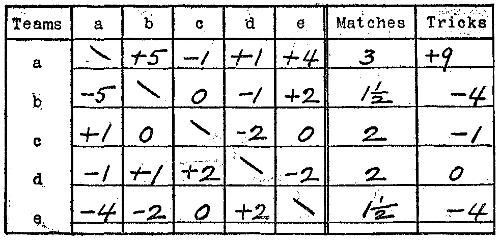
PAIR AGAINST PAIR. This is the most interesting
form of competition, especially for domestic parties, as the arrangement
of the players will allow of great latitude in the number engaged,
table after table being added as long as players offer to fill
them.
Two Pairs. When only four players are engaged at a single
table, the game is called Memory Duplicate; which is forbidden in
all first-class clubs. The players retain their seats until they have
played an agreed number of hands, which are laid aside one by
one in trays. No trump is turned in Memory Duplicate; one suit
being declared trumps for the entire sitting.
Instead of the players changing positions for the overplay, the
trays are reversed. If the indicators pointed N & S on the original
deals, they must lie E & W for the overplay.
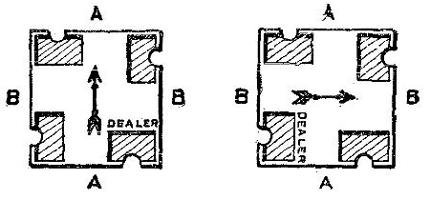
Original Position of Trays. Position for Overplay.
Scoring. The E & W hands only are scored, the card being
laid aside after the original play is completed, and a new card used
for the overplay. The difference in the totals of these two sets of
score-cards will show which pair gained the most tricks.
Four Pairs. These should be arranged at two tables, changing
adversaries after every 8 hands. The third set will exhaust
the combinations, and it will then be found that each pair has
played and overplayed an equal number of hands against every
other pair.
|
1st set |
2nd set |
3rd set |
|
|
|
|
b |
|
|
c |
|
|
d |
|
|
|
|
a |
|
a |
a |
|
a |
a |
|
a |
|
|
|
|
b |
|
|
c |
|
|
d |
|
| Hands:— |
1 to 8 |
9 to 16 |
17 to 24 |
|
|
|
|
d |
|
|
b |
|
|
c |
|
|
|
|
c |
|
c |
d |
|
d |
b |
|
b |
|
|
|
|
d |
|
|
b |
|
|
c |
|
Four hands are dealt at each table in each set, and then exchanged.
The trump card is turned for every original deal.
Scoring. Each pair carries its own score-card with it from
table to table, until the 24 hands have been played. The 7th
column is used to designate the pair played against. The pairs at
the second table should begin scoring with hands Nos. 5, 13 and 21
respectively; as they will presently receive from the first table the
series beginning 1, 9 and 17 respectively. Eight hands complete
a match, and the result must be tabulated in the same manner as
for teams of four, ties being decided by the majority of tricks won.
We give an example.
The a pair wins the tie with d, being 6 tricks plus.
Six Pairs. This is a very awkward number to handle, and
should be avoided if possible. The whole could be played at three
tables simultaneously; but such a course would necessitate their
changing places ten times, following a very complicated schedule
in so doing. The simplest way to handle six pairs is to arrange
them at three tables, two of which are constantly in play, the third
only half the time. This is the first position:—
|
b |
|
|
d |
|
|
f |
|
| a |
1 |
a |
c |
2 |
c |
e |
3 |
e |
|
b |
|
|
d |
|
|
f |
|
Tables 1 and 2 deal and play two hands each, and then exchange
trays with each other. At table 3, two hands are dealt and
played, both being left in the trays.
The players at tables 1 and 2 then change adversaries; dealing,
playing and exchanging two fresh hands. The players at the
third table remain idle, or look on.
|
c |
|
|
d |
|
|
f |
|
| a |
1 |
a |
b |
2 |
b |
e |
3 |
e |
|
c |
|
|
d |
|
|
f |
|
Hands 5 and 6
played and exchanged. |
None. |
The b and c pairs now give way to e and f:—
|
e |
|
|
d |
|
|
b |
|
| a |
1 |
a |
f |
2 |
f |
c |
3 |
c |
|
e |
|
|
d |
|
|
b |
|
Hands 7 and 8
played and exchanged. |
3 and 4. |
While tables 1 and 2 are playing two fresh hands, the trays containing
hands Nos. 3 and 4 which were left at table 3 are overplayed
by the b and c pairs, which makes a match between them
and the e and f pairs.
Again the pairs at the first two tables change adversaries; dealing,
playing and exchanging two more hands; the third table remaining
idle.
|
f |
|
|
d |
|
|
b |
|
| a |
1 |
a |
e |
2 |
e |
c |
3 |
c |
|
f |
|
|
d |
|
|
b |
|
Hands 9 and 10
played and exchanged. |
None. |
The pairs a and d now give way to b and c, and the b c e f pairs
play two hands and exchange them; then change adversaries for
two more hands; a and d remaining idle all the time. All the
pairs have now been matched but a and d, and they take seats
E & W at two tables, the N & S positions being filled up by any
of the other players in the match.
|
any |
|
|
any |
|
| a |
1 |
a |
d |
2 |
d |
|
any |
|
|
any |
|
No notice is taken of the scores made by the N & S hands in
the last set; as it is simply a match between the a and d pairs.
Scoring. Each pair against each is considered a match, and
the winner of the most matches wins, tricks deciding ties.
Compass Whist. When we come to handle large numbers,
the changes of position become too complicated, and the simplest
plan is to arrange them at as many tables as they will fill, and to
place on each table an equal number of trays. At the Knickerbocker
Whist Club, New York, which is still famous for its compass
games, they play a minimum of 24 trays, or get as near that
number as possible. If there are 14 tables, they play two deals
at each. If there are only 10 tables, they play 30 trays.
All the N & S players sit still, and at the end of each round, two
or three deals as the case may be, all the E & W players move up
one table, 2 going to 1, 3 to 2, etc. Each pair keeps its own score
card, on which is put down the number of the tray, the number of
the pair played against, which is always the number of the table at
which they started; one of the pairs remaining there being No. 3
N & S, the other moving away, being No. 3 E & W.
Each pair adds up its score card at the end, and puts down the
total number of tricks they have won. The names of the players
having been previously written on the blackboard, their scores are
put down opposite their names, each side, N & S and E & W, is
then added up in order to find the average, and all scores above
average are plus, while all below average are minus.
The following is an example of the averaging of a game in which
five tables took part, playing 30 deals:—
| N & S |
|
E & W |
| a |
201 |
-6 |
|
f |
189 |
+6 |
| b |
204 |
-3 |
|
g |
186 |
+3 |
| c |
211 |
+4 |
|
h |
179 |
-4 |
| d |
207 |
= |
|
j |
183 |
= |
| e |
212 |
+5 |
|
k |
178 |
-5 |
| 5 |
1035 |
|
|
5 |
915 |
|
| Aver. |
207, |
N & S. |
|
Aver. |
183, |
E & W. |
The e and f pairs make the best scores N & S and E & W respectively;
the f pair, having won the greatest number of tricks
above the average of the hands, would be the winners.
Howell Pair System. A very popular system of managing
pairs in club games, and also in the national tournaments for the
Minneapolis trophy, is called the Howell Pairs. Indicator cards
are placed on the tables, which show each player the number of the
table and the position at that table to which he should move next.
Sometimes he will sit N, sometimes S, and sometimes E or W, but
he always finds his partner opposite him, and at the end of the
game he will have had every other pair in the game for an adversary
once, and will have played all the hands dealt.
A different set of indicator cards is required for every different
number of tables in the game. They are the invention of the
late E.C. Howell of Washington, D.C., and have been arranged
for any number of pairs from four to thirty-four.
INDIVIDUALS. When four play memory duplicate, one
of the four, usually S, retains his seat and keeps the score, the
others changing places right and left alternately, each playing with
S as a partner for 8 hands. These changes successively bring
about the three following positions:—
|
|
|
|
c |
|
|
b |
|
|
a |
|
|
|
|
a |
|
b |
a |
|
c |
c |
|
b |
|
|
|
|
S |
|
|
S |
|
|
S |
|
| Hands:— |
1 to 4 |
5 to 8 |
9 to 12 |
For the overplay, the trays are reversed, the hands originally
dealt N & S being placed E & W; but the players continue to
change right and left alternately. This brings the same partners
together, but on different sides of the table.
|
|
|
|
c |
|
|
b |
|
|
a |
|
|
|
|
b |
|
a |
c |
|
a |
c |
|
b |
|
|
|
|
S |
|
|
S |
|
|
S |
|
| Hands:— |
1 to 4 |
5 to 8 |
9 to 12 |
Scoring. The names of the four players should be written at
the head of each score-card, and as there is no trump turned in
memory duplicate,
the third
and seventh columns
can both
be used for the
numbers of the
players that are
partners, and
the sixth column
for the N
& S gains.
When the
match is finished,
a tabulation
of the
tricks lost or
won by each
player will readily
show which
is the winner.
In the illustration
which we
give, No. 3 finishes
plus 6;
No. 4 plus 2;
No. 1 minus 4;
and No. 2 minus
4.
It must be remembered that the hands which are here scored N
& S, in the 5th column, were E & W when originally dealt; so
that the 1st and 5th columns are really the same hands. The
score-card should be folded down the middle during the overplay,
so that the original scores cannot be seen. It is even better to use
a new card.
Foster’s System of playing two pairs at one table, which was
used at all the matches for the Utica Trophy, in which one pair
from a club challenged the pair that held the trophy for another
club, consisted in having an umpire to transpose the suits between
the original and the overplay of the deals. The trays containing
the hands were sent in to the umpire’s room, and he had an extra
pack of cards, from which he duplicated each hand of thirteen
cards as he took it out of the pocket to which it belonged, but
changed the suits, making clubs trumps instead of hearts, etc.
This system was found to do away with the memory part of the
game, it being very difficult to recognize a hand unless it had some
startling feature.
Coupled with the present practice of throwing out all hands in
which there is found to be a suit of more than six cards, and dealing
it over again, Foster’s system for two pairs is the best so far
suggested.
Eight Individuals. This form of contest is seldom used,
because players dislike the continual changing of position, and the
delay in arriving at the results of the score. It would require
seven sets to exhaust the combinations; and at each table two
hands should be dealt, played, and exchanged with the other table
in the set, before the players change positions. This would require
28 hands to complete the match.
Safford’s System for arranging the players is to have indicator
cards on the tables:—
The players take their seats in any order for the first set; after
which they go to the next higher number; 8 keeping his seat, and
7 going to 1.
Scoring. Each individual must keep his own score, adding up
the total tricks taken in each set of four hands. These totals must
then be compared with those of the player occupying the same
position, N, S, E, or W, at the other table in the set; and it will
save time in the end if these are tabulated at once, on a sheet prepared
for the purpose. For instance: Let this be the arrangement
of eight players in the first set:—
|
b |
|
Hands 1 to 4. |
|
f |
|
| a |
1 |
c |
e |
2 |
g |
|
d |
|
|
h |
|
If a and c take 34 tricks E & W; e and g taking only 30 with
the same cards, either a and c must have gained them, or e and
g must have lost them. It is a waste of time to put down both
losses and gains, and all that is necessary is to call the top score
zero, and charge all players with the loss of as many tricks as their
total is short of the top score. In this case we charge e and g
with a loss of 4 each. It must be obvious that f and h have also
made 4 more tricks than b and d; and that the latter must be
charged with a loss of 4 on the same hands that e and g lose on.
We give as an illustration a sheet balanced in this way, showing
the losses of the various players. The totals at the end of the match
show that c is the winner, losing less tricks than any other player.
Large Numbers of Individuals. Several ingenious
methods have been devised for handling large numbers of players,
especially in domestic parties; Safford and Mitchell having both
distinguished themselves in this line. The simplest form has
been suggested by Mitchell, and is especially adapted for social
gatherings of ladies and gentlemen.
As many tables as possible are filled; all the ladies sitting N &
E; the gentlemen S and W.
The number of hands dealt at each table must be adjusted to
the number of tables filled, and the time to be devoted to play.
The trays containing the hands are passed to the West, and all
the gentlemen move one table to the East, the ladies sitting still.
In all the changes each gentleman keeps to his original point of
the compass, South or West. When he arrives at the table he
started from, the round is finished. If an odd number of tables
are engaged in play, the changes may take place in regular order
to the end. If even, a dummy must be put in; but as that is
objectionable in a social gathering, it is better to adopt one of the
two systems following, unless half the number of tables is an odd
number, when the method already described may be used.
1st Method. Some table in the series, which must not be
either the first or the last, deals no original hands, but overplays
all the hands coming from the other tables to the East of it. The
four players sit still, taking no part in the progression; thus obliging
those whose turn it would be to play at their table to pass on
to the next.
2nd Method. Each gentleman should carefully note the
number of the hand originally dealt at the table from which he
starts. He progresses until he meets this hand again. The first
to observe this should give notice to the company by a bell tap, as
all the gentlemen must meet their original hands at the same time.
Instead of stopping at the table at which this tray is encountered,
all the gentlemen move on to the next, leaving the trays as they
are. This skip enables each to finish the round without playing
any of the hands twice.
Scoring. There must be four winners; the ladies with the
best scores for the N & E hands respectively, and the gentlemen
with the best S & W scores. If a choice is necessary, the lady
and the gentleman taking the greatest number of tricks above the
average should be selected as the winners.
MARRIED COUPLES. Safford has an ingenious schedule
for eight married couples, so arranged in two sets that no husband
and wife are ever in the same set at the same time. When
seven sets have been played, every lady will have overplayed four
hands against every other lady and gentleman, including four held
by her husband. The same will be true of every man. Indicators
are placed on the tables to show players their successive positions.
The numbers represent the husbands, and the letters the wives,
the couples being a-1, b-2, etc. The couple a-1 always sit still;
the ladies go to the next higher letter of the alphabet, and the men to
the next higher number; h going to b, as a sits still; and 8 to 2.
One hand is dealt at each table, and overplayed at each of the
others. A different point of the compass should deal at each table,
in order to equalise the lead.
Scoring. The score of each four hands should be added up
by each individual player, and the results tabulated at the end of
every four hands, in the manner described for eight individuals.
The winner is the player who loses the fewest tricks. This is the
only known system for deciding whether or not a man can play
whist better than his wife.
PROGRESSIVE DUPLICATE WHIST is the generic
name by which those systems of duplicate are known in
which the purpose is to have as many as possible of the players
meet one another during the progress of the match. Most of the
systems we have been describing belong to this class.
There are at present only two works on Duplicate Whist; but a
number of articles on the subject may be found in “Whist.”
- Duplicate Whist; by John T. Mitchell, 1896.
- Foster’s Duplicate Whist; 1894.
- Whist; Jan., 1892; Jan., 1894; Aug., 1894; Oct., 1894; Jan.,
1895: Mar., 1895; May, 1895; July, 1895; Oct., 1895.
The Laws of Duplicate Whist as Amended and Adopted at the
Whist Congress, Niagara Falls, New York, July, 1900; as
amended at the Twelfth Congress, June, 1902; as amended at
the Thirteenth Congress, July, 1903; Fourteenth A.W.L.
Congress, July, 1904; Fifteenth Congress, July, 1905; Sixteenth
Congress, July, 1906; Twentieth Congress, July 1910.
DEFINITIONS.
The words and phrases used in these laws shall be construed in
accordance with the following definitions unless such construction
is inconsistent with the context:
(a) The thirteen cards received by any one player are termed a
“hand.”
(b) The four hands into which a pack is distributed for play are
termed a “deal;” the same term is also used to designate the act
of distributing the cards to the players.
(c) A “tray” is a device for retaining the hands of a deal and
indicating the order of playing them.
(d) The player who is entitled to the trump card is termed the
“dealer,” whether the cards have or have not been dealt by him.
(e) The first play of a deal is termed “the original play;” the
second or any subsequent play of such deal, the “overplay.”
(f) “Duplicate Whist” is that form of the game of whist in
which each deal is played only once by each player, and in which
each deal is so overplayed as to bring the play of teams, pairs of
individuals into comparison.
(g) A player “renounces” when he does not follow suit to the
card led; he “renounces in error” when, although holding one or
more cards of the suit led, he plays a card of a different suit; if
such renounce in error is not lawfully corrected it constitutes a
“revoke.”
(h) A card is “played” whenever, in the course of play, it is
placed or dropped face upwards on the table.
(i) A trick is “turned and quitted” when all four players have
turned and quitted their respective cards.
LAW I.—Shuffling.
Sec. 1. Before the cards are dealt they must be shuffled in the
presence of an adversary or the umpire.
Sec. 2. The pack must not be so shuffled as to expose the face
of any card; if a card is so exposed the pack must be reshuffled.
LAW II.—Cutting for the Trump.
Sec. 1. The dealer must present the cards to his right hand
adversary to be cut; such adversary must take from the top of the
pack at least four cards and place them toward the dealer, leaving
at least four cards in the remaining packet; the dealer must reunite
the packets by placing the one not removed in cutting upon the
other. If, in cutting or in reuniting the separate packets, a card is
exposed, the pack must be reshuffled and cut again; if there is any
confusion of the cards or doubt as to the place where the pack was
separated, there must be a new cut.
LAW III.—Dealing.
Sec. 1. When the pack has been properly cut and reunited, the
cards must be dealt, one at a time, face down, from the top of the
pack, the first to the player at the left of the dealer, and each successive
card to the player at the left of the one to whom the last
preceding card has been dealt. The last, which is the trump card,
must be turned and placed face up on the tray, if one is used; otherwise,
at the right of the dealer.
Sec. 2. There must be a new deal—
(a) If any card except the last is faced or exposed in any way in
dealing;
(b) If the pack is proved incorrect or imperfect;
(c) If either more or less than thirteen cards are dealt to any
player;
(d) If, after the first trick has been turned and quitted on the
original play of a deal, one or more cards are found to have been
left in the tray.
LAW IV.—The Trump Card.
Sec. 1. The trump card and the number of the deal must be
recorded, before the play begins, on a slip provided for that purpose,
and must not be elsewhere recorded. Such slip must be
shown to an adversary, then turned face down and placed in the
tray, if one is used.
Sec. 2. The dealer must leave the trump card face up until it
is his turn to play to the first trick; he must take the trump card
into his hand and turn down the trump slip before the second trick
is turned and quitted.
Sec. 3. When a deal is taken up for overplay, the dealer must
show the trump slip to an adversary, and thereafter the trump slip
and trump card shall be treated as in the case of an original deal.
Sec. 4. After the trump card has been lawfully taken into the
hand and the trump slip turned face down, the trump card must not
be named nor the trump slip examined during the play of the deal;
a player may, however, ask what the trump suit is.
Sec. 5. If a player unlawfully looks at the trump slip, his
highest or lowest trump may be called; if a player unlawfully names
the trump card, or unlawfully shows the trump slip to his partner,
his partner’s highest or lowest trump may be called.
Sec. 6. These penalties can be inflicted by either adversary at
any time during the play of the deal in which they are incurred before
the player from whom the call can be made has played to the
current trick; the call may be repeated at each or any trick until
the card is played, but cannot be changed.
Sec. 7. When a deal has been played the cards of the respective
players, including the trump card, must be placed in the tray
face down and the trump slip placed face up on top of the dealer’s
cards.
Sec. 8. If on the overplay of a deal, the dealer turns a trump
card other than the one recorded on the trump slip, and such error is
discovered and corrected before the play of the deal is commenced,
the card turned in error is liable to be called.
Sec. 9. If such error is not corrected until after the overplay
has begun and more than two tables are engaged in play, the
players at that table shall take the average score for the deal; if
less than three tables are in play there must be a new deal.
Sec. 10. Should a player record on the trump slip a different
trump from one turned in dealing and the error be discovered at
the next table, there must be a new deal. If the deal has been
played at one or more tables with the wrong trump, the recorded
trump must be taken as correct and the players at the original table
take the average score for the deal; if less than three tables are in
play, there must be a new deal.
Sec. 11. By the unanimous consent of the players in any match,
a trump suit may be declared and no trump turned.
LAW V.—Irregularities in the Hand.
Sec. 1. If, on the overplay, a player is found to have more than
his correct number of cards or the trump card is not in the dealer’s
hand, or any card except the trump card is so faced as to expose
any of the printing on its face, and less than three tables are engaged,
there must be a new deal. If more than two tables are in
play, the hands must be rectified and then passed to the next table;
the table at which the error was discovered must not overplay the
deal but shall take the average score.
Sec. 2. If after the first trick has been turned and quitted on
the overplay of a deal, a player is found to have less than his correct
number of cards, and the others have their correct number,
such player shall be answerable for the missing card or cards and
for any revoke or revokes which he has made by reason of its or
their absence.
LAW VI.—Playing, Turning and Quitting the Cards.
Sec. 1. Each player when it is his turn to play, must place his
card face up before him and towards the center of the table and
allow it to remain in this position until all have played to the trick,
when he must turn it over and place its face down and nearer to
himself, placing each successive card as he turns it, so that it overlaps
the last card played by him and with the ends towards the winners
of the trick. After he has played his card and also after he
has turned it, he must quit it by removing his hand.
Sec. 2. The cards must be left in the order in which they were
played and quitted until the scores for the deal are recorded.
Sec. 3. During the play of a deal a player must not pick up or
turn another player’s card.
Sec. 4. Before a trick is turned and quitted any player may require
any of the other players to show the face of the card played
to that trick.
Sec. 5. If a player names a card of a trick which has been
turned and quitted or turns or raises any such card so that any portion
of its face can be seen by himself or his partner he is liable to
the same penalty as if he had led out of turn.
LAW VII.—Cards Liable to be Called.
Sec. 1. The following cards are liable to be called:
(a) Every card so placed upon the table as to expose any of the
printing on its face, except such cards as these laws specifically
provide, shall not be so liable.
(b) Every card so held by a player as to expose any of the printing
on its face to his partner or to both of his adversaries at the
same time.
(c) Every card, except the trump card, named by the player
holding it.
Sec. 2. If a player says. “I can win the rest,” “The rest are
ours,” “It makes no difference how you play,” or words to that
effect, or if he plays or exposes his remaining cards before his partner
has played to the current trick, his partner’s cards must be laid
face up on the table and are liable to be called.
Sec. 3. All cards liable to be called must be placed face up on
the table and so left until played. A player must lead or play them
when lawfully called, provided he can do so without revoking; the
call may be repeated at each or any trick until the card is played.
A player cannot, however, be prevented from leading or playing a
card liable to be called; if he can get rid of it in the course of a
play no penalty remains.
Sec. 4. The holder of a card liable to be called can be required
to play it only by the adversary on his right. If such adversary
plays without calling it, the holder may play to that trick as he
pleases. If it is the holder’s turn to lead, the card must be called
before the preceding trick has been turned and quitted, or before
the holder has led a different card; otherwise he may lead as he
pleases.
LAW VIII.—Leading out of Turn.
Sec. 1. If a player leads when it is the turn of an adversary to
lead, and the error is discovered before all have played to such
lead, a suit may be called from him or from his partner, as the
case may be, the first time thereafter it is the right of either of
them to lead. The penalty can be enforced only by the adversary
on the right of the one from whom a lead can lawfully be called,
and the right thereto is lost unless such adversary calls the suit
he desires led before the first trick won by the offender or his
partner subsequent to the offence is turned and quitted.
Sec. 2. If a player leads when it is his partner’s turn and the error
is discovered before all have played to such lead, a suit may at once
be called from the proper leader by his right-hand adversary.
Until the penalty has been exacted, waived or forfeited, the
proper leader must not lead; should he so lead, the card led by
him is liable to be called.
Sec. 3. If a player when called on to lead a suit has none of
it, he may lead as he pleases.
Sec. 4. If all have not played to a lead out of turn when the
error is discovered, the card erroneously led and all cards played
to such lead are not liable to be called, and must be taken into
the hand.
LAW IX.—Playing out of Turn.
Sec. 1. If the third hand plays before the second, the fourth
hand may also play before the second.
Sec. 2. If the third hand has not played and the fourth hand
plays before the second, the latter may be called upon by the third
hand to play his highest or lowest card of the suit led, and, if he
has none of that suit, to trump or not trump the trick; the penalty
cannot be inflicted after the third hand has played to the
trick. If the player liable to this penalty plays before it has been
inflicted, waived or lost, the card so played is liable to be called.
LAW X.—The Revoke.
Sec. 1. A renounce in error may be corrected by the player
making it, except in the following cases, in which a revoke is
established and the penalty therefore incurred:
(a) When the trick in which it occurs has been turned and
quitted.
(b) When the renouncing player or his partner, whether in his
right turn or otherwise, has led or played to the following trick.
Sec. 2. At any time before the trick is turned and quitted a
player may ask an adversary if he has any of a suit, to which such
adversary has renounced in that trick, and can require the error
to be corrected in case such adversary is found to have any of
such suit.
Sec. 3. If a player, who has renounced in error, lawfully
corrects his mistake, the card improperly played by him is liable
to be called, and, if he be the second or third hand player and his
left hand adversary has played to the trick before attention has
been called to the renounce, he may be required by such adversary
to play his highest or his lowest card to the trick in
which he has renounced, and shall not play to that trick until
such adversary has inflicted or waived the penalty. Any player
who has played to the trick after the renouncing player, may
withdraw his card and substitute another; a card so withdrawn
is not liable to be called.
Sec. 4. The penalty for a revoke is the transfer of two tricks
from the revoking side to their adversaries. If more than one
revoke during the play of a deal is made by one side, the penalty
for each revoke, after the first, is the transfer of one trick only.
The revoking players cannot score more, nor their adversaries
less than the average on the deal in which the revoke occurs;
except that in no case shall the infliction of the revoke penalty
deprive the revoking players of any tricks won by them before
their first revoke occurs.
In Pair Matches the score shall be recorded as made, independently
of the revoke penalty, which shall be separately indicated
as plus or minus revoke (“-R” for the revoking side,
and “+R” for their adversaries). In such matches, the penalty
for a revoke shall not increase the score of the opponents of the
revoking players above the maximum, as made at the other
tables, on the deal in which the revoke occurs; provided, however,
that if the opponents win more tricks than such maximum,
independently of the revoke penalty, their score shall stand as
made. Nor shall the score of the revoking players be reduced,
by the infliction of the revoke penalty, below the minimum so
made at the other tables until the averages for the match and
the relative scores of the other players have been determined;
the score of the revoking players shall then, if necessary, be
further reduced, so that in all cases they shall suffer the full
penalty as provided in the first paragraph of this section.
Sec. 5. A revoke cannot be claimed if the claimant or his
partner has played to the following deal, or if both have left
the table at which the revoke occurred. If the revoke is discovered
in season, the penalty must be enforced and cannot be
waived.
Sec. 6. At the end of the play of a deal the claimants of a
revoke can examine all of the cards; if any hand has been
shuffled the claim may be urged and proved if possible; but no
proof is necessary and the revoke is established if, after it has
been claimed, the accused player or his partner disturbs the
order of the cards before they have been examined to the satisfaction
of the adversaries.
LAW XI.—Miscellaneous.
Sec. 1. If any one calls attention in any manner to the trick
before his partner has played thereto, the adversary last to play
to the trick may require the offender’s partner to play his highest
or lowest of the suit led, and, if he has none of that suit, to
trump or not to trump the trick.
Sec 2. A player has the right to remind his partner that it is
his privilege to enforce a penalty and also to inform him of the
penalty he can enforce.
Sec. 3. A player has the right to prevent his partner from
committing any irregularity, and for that purpose, may ask his
partner whether or not he has a card of a suit to which he has
renounced on a trick which has not been turned and quitted.
Sec. 4. If either of the adversaries, whether with or without
his partner’s consent, demands a penalty to which they are
entitled, such decision is final; if the wrong adversary demands
a penalty or a wrong penalty is demanded, or either adversary
waives a penalty, none can be enforced except in case of a revoke.
Sec. 5. If a player is lawfully called upon to play the highest
or lowest of a suit, to trump or not to trump a trick, to lead a
suit or to win a trick, and unnecessarily fails to comply, he is
liable to the same penalty as if he had revoked.
Sec. 6. If any one leads or plays a card, and then, before his
partner has played to the trick, leads one or more other cards,
or plays two or more cards together, all of which are better
than any of his adversaries hold of the suit, his partner may be
called upon by either adversary to win the first or any subsequent
trick to which any of said cards are played, and the remaining
cards so played are liable to be called.
For the Rules of Etiquette of Duplicate Whist, see page 85.
The laws of Duplicate Whist govern where applicable, except
as follows:
Each player plays each deal twice, the second time playing a
hand previously played by an adversary. Instead of turning the
trump, a single suit may be declared trumps for the game. On
the overplay, the cards may be gathered into tricks instead of
playing them as required by law (Law VIII, Sec. 1). In case
of the discovery of an irregularity in the hands, there must always
be a new deal.
Except a contest played in comparison with a progressive
match, the replaying of the cards by the same players—“up and
back,” as it is sometimes called—is the only possible method of
approximating to Duplicate Whist for one table; but where
eight or more players participate, this form of the game is extremely
undesirable, from the element of memory entering into
the replay and destroying the integrity of the game and its
value as a test of Whist skill. It has been well described as “a
mongrel game—partly Whist and partly Dummy, but lacking in
the best features of each.”
In the early days of Duplicate Whist, Mnemonic Duplicate
was, to some extent, played even when several tables of players
were participating. It still survives in a few circles, chiefly
where Duplicate Whist has never been tried. It can be played under
any of the Duplicate Whist schedules by playing them through
twice—the second time with the North and South hands given
to the East and West players, and vice versa. As each deal
is played twice by each pair, double the time is required to
play the same number of deals, as at Duplicate Whist. Allowance
must be made for this in fixing the number of deals to
be played.
The Snow System of movement, where practicable, is preferable.
Where the Howell pair system of movement is used, the
scores do not require “equating”, as they are equalised on the
replay. Under other systems, only the North and South scores
need be kept, as the comparison can be made quite as readily
as by direct comparison of these scores.
There are three forms of Dummy: The English game, for
three players; the French game, for three or four: and the game
now generally known as Bridge, or Bridge Whist. Dummy is
not recognized in any form by the American Whist League, and
there are no American Laws governing it. We shall describe
each variety of the game in its turn; beginning with the English.
Cards. ENGLISH DUMMY, is played with a full pack
of fifty-two cards, ranking as at whist both for cutting and playing.
Two packs are generally used.
Markers are necessary, and are of the same patterns as those
used in whist.
Players. According to the English usage, Dummy is played
by three persons, and the table is complete with that number.
They cut for partners and for the deal; the player cutting the
lowest card takes dummy for the first rubber; the one cutting the
next lowest takes dummy for the second rubber; and the one
cutting the highest takes it for the last rubber. It is considered
obligatory to play three rubbers, in order that each may have
whatever advantage or disadvantage may be supposed to attach
to the dummy. The three rubbers so played are called a Tournée.
It is sometimes agreed that one player shall take dummy continuously,
on condition that he concedes to his adversaries one point
in each rubber. When this is done, the largest rubber that the
dummy’s partner can win is one of seven; and he may win
nothing; whereas his adversaries may win a rubber of nine, and
must win at least two. This concession of a point is not made, as
many imagine, because it is an advantage to have the (dummy)
partner’s hand exposed; but because it is an advantage to have
the player’s hand concealed. He knows the collective contents of
the adversaries’ hands; each of them knows only the contents of
dummy’s hand and his own.
Cutting. The player cutting the lowest card has the choice of
seats and cards; but he must deal the first hand for his dummy;
not for himself. The methods of spreading, cutting, deciding ties,
etc., described in connection with whist, are those employed in
dummy.
Position of the Players. The players are distinguished, as
at whist, by the two first and last letters of the alphabet, and their
positions at the table are indicated in the same manner. There is
no mark to distinguish the dummy hand; a defect which is remedied
in the French system.
Dealing. At the beginning of a rubber, dummy’s partner
presents the pack to his left-hand adversary to be cut, and deals
from right to left, beginning with the player on his right, and turning
up the last card for dummy’s trump. When two packs are
used, there is no rule as to which player shall collect and shuffle
the still pack. On this point the French rules are very explicit.
The general rules with regard to irregularities in the deal are
the same as at whist.
The cards having been dealt, it is usual for dummy’s partner to
take up and sort the dummy first. There are several ways of
laying out dummy’s hand; the most common being to run the
suits down in rows, with the turn-up across and to the right of the
other trumps, if any.
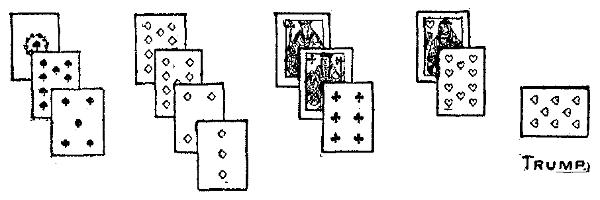
Method of Spreading Dummy’s Cards.
Stakes. The remarks made on this subject in connection with
whist apply equally to dummy. Dummy’s partner must pay to,
or receive from each adversary the amount agreed.
Method of Playing. The general method of playing is
identical with that of whist, with the following exceptions:—
When it is dummy’s turn to play, his partner selects the card.
The Revoke. For this dummy is not liable to any penalty, as
his adversaries can see his cards. Even should the revoke be
occasioned by dummy’s cards being disarranged, or one of them
covered up, the adversaries should be as able to detect the error as
the partner. Should dummy’s hand revoke, it cannot be remedied
after the trick in which it occurs has been turned and quitted;
and the game must proceed as if no revoke had occurred. All the
penalties for a revoke may be enforced against dummy’s partner,
should he renounce in error, and not correct it in time. There
being no American laws for dummy, the English penalty of three
tricks or three points may be enforced, and the revoking player
cannot win the game that hand.
Cards Played in Error. Dummy’s partner is not liable to
any penalty for cards dropped face upwards on the table, or two or
more played at once, because it is obvious that Dummy cannot
gain any advantage from such exposed cards.
Leading out of Turn. Should either dummy or his partner
lead out of turn, the adversaries may call a suit from the one that
should have led. It should be noticed that if it was not the turn
of either to lead, there is no penalty; for neither can have gained
any advantage from knowing what suit the other wished to lead,
or from the exposed card. Should all have played to the erroneous
lead, the error cannot be corrected, and no penalty remains.
The methods of Taking Tricks; Scoring; Claiming and
Counting Honours; Marking Rubber Points, etc., are the
same as in whist, and the counters are used in the same manner.
Cutting Out. As already observed, there is no change of
partners, or of the rotation of the deal, until the completion of a
rubber; but at the beginning of each rubber, dummy must deal
the first hand. Should one side win the first two games in any
rubber, the third is not played. At the end of the tournée, should
any player wish to retire, and another offer to take his place, the
cards must be shuffled and cut as at the beginning; a player’s
position in one tournée giving him no rights in the next. There is
nothing in the English game to recognize that there may be more
than three candidates for dummy; as it is supposed that if four
were present, they would prefer playing whist.
Suggestions for Good Play. As these are equally proper
to any form of dummy, we shall postpone their consideration until
we have described the other varieties of the game; French dummy,
and Bridge; giving them all at the end of the chapter on “Bridge.”
CARDS. Double Dummy is played with a full pack of fifty-two
cards, ranking as at whist both for cutting and playing. Two
packs are generally used.
MARKERS are necessary, and are of the same description
as those used in whist.
PLAYERS. According to the English usage, double dummy
is played by two persons, and the table is complete with that
number.
CUTTING. The players cut for the deal; the player cutting
the lowest card deals for his dummy first, and has the choice of
sitting to the right or left of his opponent. It is usual to select
the seat on the right of the living player, because it is possible
that one may forget whether or not certain cards have been played,
and under such circumstances it is better to lead up to an exposed
hand than to one whose contents you are not sure of.
The methods of spreading, cutting, deciding ties, etc., are the
same as those employed at whist.
POSITION OF THE PLAYERS. It is not usually
considered necessary to distinguish the players further than to indicate
which hand had the original lead. For this purpose the
whist notation is used, A being the leader, and Z the dealer.
DEALING. When two packs are used, the still pack should
be shuffled by the non-dealer, and placed on the left of the player
or dummy whose turn it will be to deal next.
The general rules with regard to irregularities in the deal are
the same as in whist.
The cards being dealt, it is usual to sort the dummy hands first,
running the suits down in rows, with the turn-up trump across,
and to the right of the others.
STAKES. The remarks already made on this subject in connection
with whist and dummy, apply equally to double dummy,
except that there is no double payment; but each player wins
from or loses to his living adversary the unit agreed upon.
METHOD OF PLAYING. This so closely resembles
dummy as to need no further description. Neither dummy can
revoke, and there are no such things as exposed cards, or cards
played in error. It is very common for one player to claim that
he will win a certain number of tricks, and for his adversary to
admit it, and allow him to score them, without playing the hand
out.
LEADING OUT OF TURN. Should either of the
dummies or the players lead out of turn, the adversary may call a
suit from the one that ought to have led; but if it was the turn of
neither, there is no penalty. If all four have played to the trick,
the error cannot be corrected, and no penalty remains.
The methods of Taking Tricks; Scoring; Claiming and
Counting Honours; Marking Rubber Points, etc., are the
same as in whist, and the counters are used in the same manner.
RUBBERS. If the first two games are won by the same
player and his dummy, the third is not played. Tournées are not
played, and the completion of the rubber breaks up the table.
CUTTING IN. The table being complete with two, at the
end of a rubber a new table must be formed.
SUGGESTIONS FOR GOOD PLAY. The player
should first carefully examine the exposed hands, and by comparing
them with his own, suit by suit, should fix in his mind the
cards held by his living adversary. This takes time, and in many
places it is the custom to expose the four hands upon the table.
Players who have better memories than their opponents object to
this, for the same reason that they prefer sitting on the right of the
living player. It is not at all uncommon for a player to forget that
certain cards have been played, to his very serious loss.
The hands once fixed in the mind, some time should be given to
a careful consideration of the best course to pursue; after which
the play should proceed pretty rapidly until the last few tricks,
when another problem may present itself.
There is nothing in the game beyond the skilful use of the tenace
position, discarding, and establishing cross-ruffs. Analysis is the
mental power chiefly engaged. There are no such things as inferences,
false cards, finesse, underplay, speculative trump leads, or
judgment of human nature. The practice of the game is totally
different from any other form of whist, and much more closely resembles
chess.
The laws of Dummy will be found at the end of the English
Whist Laws.
This is a variation on double dummy, in which two players sit
opposite each other. The deal and seats are cut for in the usual
manner; four hands of thirteen cards each are dealt, and the last
card is turned for trump.
Each player examines the hand dealt to him, without touching
those to his right or left. If he is content with his hand, he announces
it, if not, he may exchange it for the one on his right. In
case of exchange, the discarded hand is placed on the table face
down; and the other taken up and played. If a player retains the
hand originally dealt him, he must not look at the others. If the
dealer exchanges, he loses the turn-up card, but the trump suit remains
the same. Each player deals for himself in turn, there
being no deal for the dead hands. Whist laws govern the deal
and its errors.
METHOD OF PLAYING. The dealer’s adversary has
the first lead; the other must follow suit if he can, and the highest
card of the suit led wins the trick. Trumps win all other suits.
SCORING. Each trick above six counts one point towards
game. Of the four honours, A K Q J of trumps, if each player
holds two, neither can count. But if one player has only one
honour, or none, the other counts 2 points for two honours, if he
holds them; 3 points for three; and 4 points for four. The honours
count towards game as in whist. The penalty for a revoke is
three tricks, and it takes precedence of other scores; tricks count
next, honours last. Five points is game.
SUGGESTIONS FOR GOOD PLAY. It is considered
best for a player not finding four reasonably sure tricks in his
hand to exchange; for there is a certain advantage to be gained by
knowing thirteen cards which cannot be in the adversary’s hand.
Before changing, the player should fix in his memory the exact
cards of each suit in the hand which he is about to discard. By
combining his knowledge of them with his own cards, he may
often be able to direct his play to advantage. Beyond this there is
little skill in the game.
A variation is sometimes made by the dealer announcing a
trump suit after he has examined his hand, instead of turning up
the last card. His adversary then has the right either to play his
hand, or to exchange it for the one on his right; but the dealer
must play the hand dealt to him.
This is Humbug Whist without the discard. The dealer gives
thirteen cards to his adversary and to himself, one at a time, and
turns up the next for the trump. The trump card belongs to neither
player. The winner of the odd trick scores a point. Five points is
game.
MORT means simply the dead hand; and is the equivalent of
the English word Dummy; the partner being known as Vivant,
or the living hand. In these words the English usually sound the
t, as they do in such words as piquet, and valet.
CARDS. Mort is played with a full pack of fifty-two cards,
ranking as at whist for cutting and playing. Two packs are generally
used.
MARKERS are necessary to count the game points only.
Four circular counters for each side, preferably of different colours,
are employed, or the ordinary whist markers may be used. At
the end of each game, the score of the points won or lost by each
player must be transferred to a score-sheet, kept for that purpose.
PLAYERS. Mort is played by three persons; but the table
is usually composed of four. If there are more than four candidates,
the methods described in connection with whist are adopted
for deciding which four shall play the first tournée.
The table being formed, the cards are again shuffled and spread
to cut for partners and deal.
TIES are decided in the same manner as at whist.
CUTTING. If there are three players, the one cutting the
lowest card takes dummy for the first game; he also has the
choice of seats and cards, and may deal the first hand for himself
or for Mort, as he pleases; but having once made his choice, he
must abide by it. The player cutting the intermediate card takes
dummy for the second game; and the player cutting the highest
card takes it for the third game; each in turn having the choice
of seats and cards. These three games finish the rubber or
tournée, each having once had the advantage or disadvantage of
playing with Mort. It is obligatory to finish the tournée, no player
being allowed to withdraw and substitute another without the consent
of the other players. In Mort it is very unusual for one person
to take dummy continuously.
If there are four players, the one cutting the highest card of the
four sits out, and takes no part in the first game. It is customary
for him to take Mort’s seat, and to make himself useful in sorting
dummy’s cards for him. He plays in the three following games,
taking Mort in the fourth, or last. Four games complete the tournée
for four players.
POSITION OF THE PLAYERS. The players or
hands are distinguished by the letters, M, V, L, and R; which
stand respectively for Mort, Vivant, Left, and Right. The Mort
is the dead hand, which is turned face up on the table. The Vivant
is his partner, who sits opposite him, and plays his cards for
him. The Left and Right are the adversaries who sit on the
left and right of Mort.
Special attention must be called to the use of the term adversaries
in any description of Mort. It is used exclusively to designate
the two partners opposed to the Mort and Vivant. In all
other cases where opposition is implied, the term opponents
must be used.
When necessary to distinguish the dealer from the first, second,
or third hand, it is usual to add the letters employed for that purpose
in whist; placing them inside the diagram of the table, thus:—
This diagram shows that Vivant dealt, and that the adversary
on the Right of Mort had the original lead.
With Three Players. Vivant having selected his seat and
cards, the adversaries may select their seats. It is usual for the
strongest adversary to sit Right.
With Four Players, we can best describe the arrangement
by numbering them 1, 2, 3, and 4, respectively, the lowest number,
1, having cut the lowest card, and the others having the right to
play Vivant in their numerical order. The initial arrangement
would be as follows:—
For the three succeeding games the arrangement would be:—
It will be seen that each player, immediately after being Vivant,
sits out, or takes Mort’s place, for the next game.
DEALING. It is usual for Vivant to deal the first hand for
himself, as the disadvantage of exposing fourteen cards is more
than compensated for in compelling the adversary to open the
game by leading up to an unknown hand. If Vivant deals the
first hand for Mort, he must present the pack to the player on
dummy’s right to be cut, and deal the cards from right to left,
turning up the trump at Mort’s place. If he deals for himself,
he presents the pack to the pone to be cut, and proceeds as in
whist.
When two packs are used, the French laws require that if the
deal is for Mort, the Right shall gather and shuffle the still pack;
and that if Vivant deals for himself, the pone shall gather and
shuffle. I have found this to be awkward, because the player who
is gathering and shuffling the cards of one pack is called upon to
cut the other. For this reason I recommend that whichever
adversary is the pone for the deal in hands should allow his partner
to gather and shuffle the still pack. When either adversary
deals, his partner will, of course, gather and shuffle the still pack.
The general rules with regard to irregularities in the deal are
the same as at whist, with the following exceptions:—
A misdeal does not lose the deal unless the opponents so elect;
they may prefer a new deal by the same dealer. The reason for
this is that the deal is a disadvantage, especially for Mort.
If Vivant or Mort offers the pack to one adversary to cut, and
then deals as if the other had cut, it is a misdeal; and it is not
admissible to shift the packets in order to remedy matters.
It might be imagined that a card exposed in dealing, if dealt to
Mort, would make no difference, as all his cards will presently be
exposed. But the laws give the opponents of the dealer the option
of either allowing the deal to stand, or having a new deal, or calling
it a misdeal.
According to the French laws, if there is any discussion in progress
with regard to the previous hand or play, the dealer may
lay aside the trump card, face down, until the discussion is finished.
If this law prevailed in America, I think the trump would
very seldom be turned immediately.
STAKES. In Mort the stake is a unit, so much a point. It
may assist players in regulating the value of the stake to remember
that six is the smallest number of points that can be won or
lost on a single game, and that thirty-seven is probably the highest,
although fifty, or even a hundred is not impossible. The average
is about twelve. The same customs as at whist prevail with regard
to outside betting.
The Vivant must pay or receive double, as he has to settle with
each adversary. If four play, the one sitting out has nothing to do
with the stakes; but he may make outside wagers on the result of
the game.
THE METHOD OF PLAYING is practically the same
as at whist, with the following exceptions:—
When it is the turn of Mort to play, Vivant selects the card for
him.
The Revoke. The rules governing this are the same as those
already given for English Dummy. Mort is not liable to penalty
under any circumstances. If any other player revokes, his opponents
may take three points from the score of his side; or add three
points to their score; or take three of his tricks. The penalty
cannot be divided; but if two or more revokes are made by the
same side, the penalty for each may be enforced in a different
manner. For instance: If the score is 3 to 2 in favor of the adversaries,
Vivant may take three points from their score for one revoke,
and add three to his own score for the other. It is not permissible
to reduce the revoking player’s tricks to nothing. At least
one must be left in order to prevent slams being made through
revoke penalties.
Cards Played in Error. Vivant is not liable to any penalty
for dropping his cards face up on the table; but if he or Mort
plays two cards at once to a trick, the adversaries may select
which they will allow to be played. The adversaries are subject
to the same penalties as in whist for all cards played in error.
Leading Out of Turn. If Vivant or Mort lead out of turn,
the adversaries may let the lead stand, or demand it be taken back.
If it was the turn of neither, no penalty can be enforced, and if
all have played to the trick, the error cannot be corrected.
Taking Tricks. The methods of taking tricks, and placing
them so that they can be easily counted, have been fully described
in connection with whist.
OBJECT OF THE GAME. As in whist, the object is to
take tricks; the highest card played of the suit led wins, and
trumps win against all other suits. The first six tricks taken by one
side, and forming a book, do not count; but all above that number
count toward game. At the end of each hand, the side that has
taken any tricks in excess of the book scores them, their opponents
counting nothing. As soon as either side reaches five
points, they win the game, but the concluding hand must be
played out, and the winners are entitled to score all the points
over five that they can make on that hand. For instance: The
score is 4 to 3 in favor of Vivant and Mort. They win the first
seven tricks, which makes them game; but they do not cease
playing. If they succeed in gaining eleven tricks out of the thirteen,
they win a game of 9 points, instead of 5.
As already observed, Vivant loses or gains double the value of
the points in each hand. In the three-handed game this must be
so; but in my opinion it would be a great improvement in the
four-handed game to allow the player sitting out to share the
fortunes of the Vivant, as in Bridge, and in many German games
of cards, notably Skat.
SLAMS. The two great differences between French and
English Dummy are that honours are not counted in Mort, and
that a special value is attached to slams. A slam is made when
one side takes the thirteen tricks. These must be actually won,
and cannot be partly made up of tricks taken in penalty for revokes.
Players cannot score a slam in a hand in which they have
revoked.
A slam counts 20 points to the side making it; but these 20
points have nothing to do with the game score. For instance:
The score is 4 all. Vivant and Mort make a slam. This does
not win the game; but the 20 points are debited and credited on
the score-sheet; the deal passes to the left, and the game proceeds
with the score still 4 all, as if nothing had happened.
SCORING. The number of points won on each game are
put down on the score-sheet, each side being credited with the
number of points appearing on their markers when the game is
finished. To the winners’ score is added: 3 points, for a triple
game, if their opponents have not scored; 2 points, for a double
game, if their opponents are not half way, or 1 point, for a simple
game, if their opponents are 3 or 4. In addition to this, the winners
add 4 points, for bonus or consolation, in every instance.
From the total thus found must be deducted whatever points
have been scored by the losers, whether game points, slams, or
both. For instance: Vivant and Mort win a game with the score
8 to 2 in their favor, which is a double. This is put down on the
score sheets thus:—
8 + 2 for the double, + 4 consolation, = 14, minus 2 scored by
the opponents; making 12 the net value of the game. Vivant
therefore wins 24 points, and each of the adversaries, R and L, lose
12. Again:—
R and L win a simple with a score of 5 to 4, V and M having
made a slam. 5 + 1 for the simple, + 4 for consolation, = 10,
minus 4 points scored, and 20 for the slam = 24; showing that R
and L lose 14 points each, although they won the game.
Again:—
V and M win a triple, with a score of 8 to 0; R and L having
revoked. 8, + 3, + 4, + 3 for the revoke = 18, from which there
is nothing to deduct.
The greatest number of points that can be made on a game,
exclusive of slams and revokes, is 17; and the least number is 6.
MARKING. The methods of using the counters in scoring
the game points have already been described in connection
with whist.
CUTTING OUT. If there are more than four candidates
for play at the conclusion of a tournée, the selection of the new
table must be made as if no tournée had been played; all having
equal rights to cut in.
CHEATING. Mort offers even less opportunity to the greek
than whist, as the deal is a disadvantage, and nothing is gained by
turning up an honour, beyond its possession.
CARDS. Cayenne is played with two full packs of fifty-two
cards, which rank as at Whist, both for cutting and playing.
MARKERS are necessary, and must be suitable for counting
to ten points. A sheet of paper is used for scoring the results of
the games.
PLAYERS. Cayenne is played by four persons. When
there are more than four candidates for play the selection of the
table must be made as at Whist. Partners and deal are then cut for.
CUTTING. One of the packs having been spread on the
table, face down, each of the four players draws a card; the two
lowest pairing against the two highest. The lowest of the four is
the dealer, and has the choice of seats and cards. Ties are decided
in the same manner as at Whist.
POSITION OF THE PLAYERS. The partners sit
opposite each other, and the players are distinguished, as at Whist,
by the letters A-B and Y-Z. Z is the dealer, and A has the
original lead.
DEALING. One pack of cards is shuffled and cut as at
Whist. The dealer then gives four cards to each player, beginning
on his left; then four more, and finally five, no trump being
turned. In many places six cards are first dealt to each player,
and then seven; but the 4-4-5 system is better, and is the rule in
the very similar game of Boston.
The general rules with regard to irregularities in the deal are the
same as at Whist; except that a misdeal does not lose the deal.
The misdealer must deal again, and with the same pack.
CAYENNE. After the cards are all dealt, the player to the
left of the dealer cuts the still pack, which is shuffled and presented
to him by the dealer’s partner, and the top card of the portion left
on the table is turned up for Cayenne. This card is not a trump,
but is simply to determine the rank of the suits.
STAKES. In Cayenne the stake is a unit, so much a point.
The largest number of points possible to win on a rubber is 24,
and the smallest, 1. The result of the rubber may be a tie, which
we consider a defect in any game. In settling at the end of the
rubber it is usual for the losers to pay their right-hand adversaries.
MAKING THE TRUMP. The trump suit must be
named by the dealer or his partner, after they have examined their
cards. The dealer has the first say, and he may either select
cayenne or any of the other suits; or he may announce grand,
playing for the tricks without any trump suit; or he may call nullo,
playing to take as few tricks as possible, without a trump suit. If
the dealer makes the choice, his partner must abide by it; but if he
has not a hand to justify him in deciding, he should leave the
selection to his partner, who must decide one way or the other.
The considerations which should guide players in their choice
are the scoring possibilities of their hands, in tricks and in honours.
As in Whist, the first six tricks taken by one side do not count;
but each trick above that number counts one, two, etc., by cards.
There are five honours in the trump suit in Cayenne; A K Q J 10;
and the partners holding the majority of them count 1 for each
honour that they hold in excess of their opponents, and 1 in addition,
for honours. For instance: If A-B have three honours
dealt them, they must have one more than their adversaries, and 1
for honours; entitling them to score 2. If they have four, they
have 3 in excess, and 1 for honours, a total of 4. If they have
five, they count 6 by honours.
At the end of the hand the points made by cards and by honours
are multiplied by the value of the trump suit. This value varies
according to the suit which is cayenne, which is always first preference.
If cayenne is also the trump suit the points made by
cards and honours are multiplied by 4. If the trump suit is the
same colour as cayenne, the multiplier is 3. If it is a different
colour the multiplier is 2 or 1, according to the suit. The rank of
the suits as multipliers will be readily understood from the following
table:—
| If Cayenne is |
♡ |
♢ |
♣ |
♠ |
If trumps, multiply by 4. |
| Second color is |
♢ |
♡ |
♠ |
♣ |
If trumps, multiply by 3. |
| Third color is |
♣ |
♣ |
♡ |
♡ |
If trumps, multiply by 2. |
| Fourth color is |
♠ |
♠ |
♢ |
♢ |
If trumps, multiply by 1. |
Better to understand the importance of considering this variation
in value when making the trump, it should be noticed that
although the game is 10 points, several games may be won in a
single hand, as everything made is counted, and any points over
10 go to the credit of the second game. If more than 20 points
are made, the excess goes on the third game, and so on. Another
important point is the great value attached to honours, and the
maker of the trump should never forget that he can better afford
to risk his adversaries winning 2 by cards with a trump in which
he has three honours, than he can to risk a trump in which they
may have three honours, and he can probably win only the odd
trick.
A further element may enter into his calculations, the state of
the score. Tricks count before honours, and if he feels certain of
making, by cards, the few points necessary to win the rubber, he
may entirely disregard the honours.
With such a hand it would be better to play without a trump,
and to announce a grand, in which there are neither trumps
nor honours, and every trick over the book is multiplied by 8.
Two by cards at grand is worth more than two by cards and two
by honours with any trump but cayenne.
There is still another resource, to announce nullo, in which there
is no trump, and the object of the players is to take as few tricks
as possible. In nullo, every trick over the book counts for the adversaries,
and is multiplied by 8. A peculiarity of nullo is that the
Ace of each suit ranks below the deuce, unless the player holding
it wishes to declare it higher than the King. In the latter case he
must announce it when he plays it, and before his left-hand adversary
plays to the trick.
If the dealer transfers the right of making the trump to his
partner, he must use the phrase, “You make it, partner.” If a
player makes the trump out of turn, his adversaries may consult
as to the propriety of demanding a new deal.
METHOD OF PLAYING. The trump suit, grand, or
nullo having been announced, the player on the dealer’s left begins
by leading any card he pleases, and the others must all
follow suit if they can. The penalty for a revoke is the loss of
three tricks; or the value of three tricks in points; or the addition
of a like amount to the adversaries’ score. The side making a revoke
cannot win the game that hand, no matter what they score;
but they may play the hand out, and count all they make to within
one point of game, or 9. Revoking players cannot count points
for slams.
The rules for cards played in error, leading out of turn, and all
such irregularities, are the same as in Whist. The last trick turned
and quitted may be seen.
The methods of gathering and stacking the tricks is the same
as at Whist.
OBJECTS OF THE GAME. The chief object in Cayenne,
either with a trump or in a grand, is to take tricks; in a
nullo it is not to take them. In any case the highest card played
of the suit led wins the trick, and trumps, if any, win against all
other suits. At the end of each hand the side that wins any
tricks in excess of the book scores them, after multiplying their
number by the unit of value settled upon by the announcement.
If a nullo is played the adversaries score them. Honours are then
claimed; but the game cannot be won by honours alone, as at
Whist; those holding honours must stop at the score of 9, unless
they also win the odd trick. As soon as either side reaches or
passes 10 points, they win a game; but the hand must be played
out, and all tricks taken must be counted. If one side goes out by
cards, the other cannot score honours. Thirteen tricks taken by
one side is called a slam, and it counts 6 points. Twelve tricks is
a little slam, and it counts 4. Either of these must be made
exclusive of revoke penalties.
RUBBERS. The rubber is won by the side that first wins
four games of ten points each; and the winning side adds 8 points
to its score.
SCORING. The game score should be kept on a whist marker,
using the four large keys on one side for single points, and the
single large key on the opposite side for five points. The three
small keys are used to show how many games of the rubber have
been won by that side.
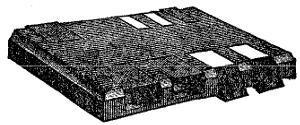
Two Games Won, and 2 Points Scored on the Third.
The method of using counters for scoring 10-point games has
already been described in connection with Whist.
In addition to either markers or counters, there must be a sheet
of paper to keep the final results of the games.
In scoring, the revoke penalty counts first, tricks next, and
honours last.
The side first reaching 10 points wins a quadruple, or game
of 4, if their adversaries have not scored; a triple, or game of 3,
if their adversaries have not reached 4; a double, or game of 2,
if the adversaries have not reached 7; and a single, or game of
1, if their adversaries are 8 or 9 up. These game points are put
down on the score-sheet, and all the points on the adversaries’
marker are then turned down. If the winners make any points in
excess of 10, such points are left to their credit on the marker,
and count toward the next game. For instance: The score is
A-B, 6; and Y-Z, 8; shown on the markers thus:—
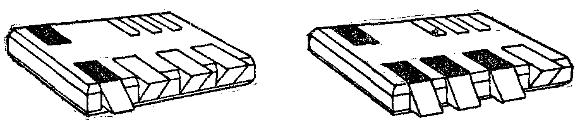
A-B 6 Points. Y-Z 8 Points.
Let us suppose that Z announces cayenne, and makes 2 by
cards; A-B claiming two by honours. Y-Z multiply by 4, making
them 8, and bringing their total score on the marker to 16;
that is, a game, and 6 points to their credit on the second game.
This must now be put down on the score-sheet. A-B’s honours
not counting, as Y-Z went out by cards, the game is a double;
A-B not having reached 7 points. The score and markers now
stand:—
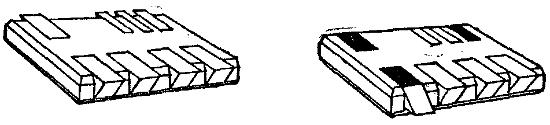
A-B’s, Nothing. Y-Z’s, 1 Game, 6 Points.
Let us suppose A-B to announce grand on their deal, and to
make four by cards, which, multiplied by 8, gives them 32 points;
that is, three games, and 2 points to their credit on the marker.
The first of these games is a double, Y-Z having 6 points up.
The two others are quadruples, put down on the score-sheet
thus:—
| A-B |
0 |
2 |
4 |
4 |
|
|
|
| Score: |
|
|
|
|
|
|
|
| Y-Z |
2 |
0 |
0 |
0 |
|
|
|
A-B’s, 3 Games, 2 Points. Y-Z’s, 1 Game, 0 Points.
In the next hand let us suppose clubs to be cayenne. Y deals,
and plays in colour, spades. Y-Z win 6 by cards, and 4 by
honours; 10 points multiplied by 3, = 30. For this they score
three games, the first being a triple, and the others quadruples.
These three games win the rubber, for which they add 8 points,
and 4 points for the little slam. This is all put down on the
score-sheet:—
| A-B |
0 |
2 |
4 |
4 |
0 |
0 |
0 |
= 10 |
| Score: |
|
|
|
|
|
|
|
|
| Y-Z |
2 |
0 |
0 |
0 |
3 |
4 |
4 |
8 4 = 25 |
Both scores being added up, the value of the rubber won by
Y-Z is found to be 15, after deducting the 10 points made by
A-B.
CUTTING IN. If there are more than four persons belonging
to the table, those waiting cut in, as at Whist.
METHODS OF CHEATING. In all games in which the
cards are dealt in bulk, four or six at a time, there is more or less
temptation for the greek to gather desirable cards in the pack,
leaving them undisturbed in the shuffle. If he can pick up two
tricks of the previous deal with eight good cards of the same suit
in them, by placing any two tricks of other cards between them,
and dealing six at a time, he can tell exactly how many of the
eight located cards are in his partner’s hand. For this reason a
player who does not thoroughly shuffle the cards should be carefully
watched; and an immediate protest should be made against
any disarrangement of the tricks as they are taken in during the
play, such as placing the last trick taken under the first. If the
player doing this is to be the next dealer, any one observing the
movement should insist upon his right to shuffle the cards
thoroughly; if not to leave the game.
We are strongly opposed to dealing the cards in bulk at
Cayenne, and see no reason why the methods that prevail in the
very similar game of Bridge should not be adopted.
SUGGESTIONS FOR GOOD PLAY. There is little
to add to the rules already given for Whist. The principles that
should guide in the making of the trump have been given in connection
with the more important game of Bridge; and the suggestions
for playing nullo will be fully discussed in the games in
which it is a prominent characteristic: Solo Whist, and Boston.
Grand is practically Whist after the trumps are exhausted.
For the Laws of Cayenne see Whist Family Laws.
CARDS. Solo Whist is played with a full pack of fifty-two
cards, which rank as at Whist, both for cutting and playing. Two
packs are generally used, the one being shuffled while the other is
dealt.
MARKERS are not used in Solo Whist, every hand being a
complete game in itself, which is immediately settled for in
counters representing money. At the beginning of the game each
player should be provided with an equal number of these counters.
They are usually white and red, the red being worth five times as
much as the white. Twenty white and sixteen red is the usual
allotment to each player when the game begins. Some one
player should be the banker, to sell and redeem all counters.
PLAYERS. Solo Whist is played by four persons. If there
are five candidates for play, they all sit at the same table, each
taking his turn to sit out for one hand while the four others play.
The dealer is usually selected to sit out. If there are only three
players, one suit must be deleted from the pack, or the 2, 3, and 4
of each suit must be thrown out.
CUTTING. The table being formed, the players draw from
an outspread for the deal, and choice of seats and cards. The
player drawing the lowest card deals the first hand, and it is
usual for him to dictate to the other players what seats they shall
occupy with relation to himself. Ties are decided in the same
manner as at Whist.
POSITION OF THE PLAYERS. The four players at
Solo Whist are usually distinguished by the letters A B Y Z.
Z is the dealer, and A is known as the eldest hand. The
position of the players does not imply any partnership; for, as we
shall see presently, any player may have any one of the others for
a partner, without any change taking place in their positions at
the table.
The players having once taken their seats are not allowed to
change them without the consent of all the others at the table.
DEALING. The cards having been properly shuffled, are
presented to the pone to be cut. Beginning on his left, the dealer
distributes the cards three at a time, until only four remain. These
he deals one at a time, turning up the last for the trump. When
two packs are used, the player sitting opposite the dealer shuffles
the still pack while the other is dealt. The deal passes in regular
rotation to the left.
When three play with a pack of forty cards, the last card is
turned up for trumps, but it does not belong to the dealer, and is
not used in play.
The general rules with regard to irregularities in the deal are
the same as at Whist; except that a misdeal does not pass the
deal. The misdealer must deal again, and with the same pack.
The cards dealt, each player sorts and counts his hand to see that
he has the correct number of cards, thirteen. If not, he should
immediately claim a misdeal; for a player having more or less
than his right proportion of cards cannot win anything on that
hand, but will have to stand his proportion of all losses incurred
by him or his side.
OBJECTS OF THE GAME. There are seven distinct
objects in the Solo Whist, and before play begins each player has
an opportunity of declaring to which of these objects he proposes
to attain. They are:—
1st. To win 8 of the 13 tricks, with the assistance of a partner.
This is called a Proposal; the partner’s share is an Acceptance.
2nd. To win 5 of the 13 tricks, against the three other players
combined. This is called a Solo.
3rd. To take no tricks, there being no trump suit, and the three
other players being opposed. This is called Misère, or Nullo.
4th. To win 9 of the 13 tricks against the three other players
combined; the single player to name the trump suit. This is
called Abundance.
5th. To win 9 of the 13 tricks against the three other players
combined, with the trump suit that is turned up. This is called
Abundance in Trumps.
6th. To take no tricks, there being no trump suit, and the three
other players being opposed; the single player’s cards being exposed
face up on the table after the first trick is complete. This
is called Misère sur table, or A Spread.
7th. To win all 13 tricks against the three other players combined;
the single player to name the trump suit, and to have the
original lead whether eldest hand or not. This is called Abundance
Déclarée, or A Slam.
While the object of the proposing player is to win or lose the
declared number of tricks, that of his adversaries is to prevent him
from doing so, if possible. There are no honours, and the only
factor in the count is the number of tricks actually taken. The
highest card played of the suit led wins the trick, and trumps, if
any, win against all other suits.
METHOD OF DECLARING. The eldest hand has the
first say, and after examining his cards he may make any of the
several propositions just enumerated. The smallest proposal he
can make is to take 8 tricks with the assistance of a partner. To
do this he should have four reasonably sure tricks in his own hand.
Some players say he should be strong in trumps; while others
claim that the eldest hand should propose only on general strength.
The former is the better plan. No other player should propose on
trumps alone. This announcement is made by saying “I propose.”
If a player thinks he can take five tricks against the combined
efforts of the three other players, he announces: “Solo.”
If he feels equal to a misère, he calls: “Misère;” and so on,
according to the strength of his hand. If he does not feel justified
in making a call, he says “I pass;” and the next player on
his left has the opportunity; and so on, until some player has proposed
to do something, or all have passed.
If any player has proposed for a partner, any of the others, in
their proper turn, may accept him by simply saying “I accept.”
By so doing, a player intimates that he has four probable tricks
also, but in the plain suits, and that he is willing to try for eight
tricks with the proposer for a partner. All the other calls are
made by a single player with the intention of playing against the
three others. Any player except the eldest hand having once
said, “I pass,” cannot afterwards make or accept any proposal.
The eldest hand, after passing once, can accept a proposal, but he
cannot make one.
It is the custom in some places, when no one will make a proposal
of any sort, to turn down the trump, and play the hands
without any trump suit, each man for himself, the winner of the
last trick losing to each of the others the value of a solo. This is
called a Grand.
RANK OF THE PROPOSALS. The various calls
outrank one another in the order in which we have given them. If
one player says, “I propose,” and another calls “Solo,” the solo
call shuts out the proposal, even though it has been accepted by a
second player. The call of a misère would in turn shut out a solo;
abundance would take precedence of misère; and abundance in
trumps would be a better call than simple abundance. The slam
of course outranks all other bids. This making of a better
proposition than one already made is known as “Over-calling.”
A player who has made a call of any kind, or has accepted a
proposal, may amend his proposition to a better one, only in case
he is over-called; or a player who can not get a partner to accept
him may amend his call to solo. For instance: A player may
have a hand which he feels sure is good for 8 tricks, perhaps 9.
To be safe, he calls solo, and hopes to make three or four over-tricks.
If he is outbid by some player over-calling him with a
misère, he may be tempted to amend his call to abundance.
No call is good until every player who has not already passed
does so, by saying distinctly, “I pass.”
STAKES. The losses and gains of the players are in proportion
to the difficulties of the tasks they set themselves.
The most popular method of settling is to pay or take red
counters for the various calls, and white counters for the tricks
under or over the exact number proposed. If the callers succeed
in their undertakings, their adversaries pay them; if they fail, they
pay their adversaries. A red counter is worth five white ones.
| Proposal and Acceptance wins or loses |
1 red counter. |
| Solo wins or loses |
2 red counters. |
| Misère, or Nullo, wins or loses |
3 red counters. |
| Abundance, of any kind, wins or loses |
4 red counters. |
| Open Misère, or Spread, wins or loses |
6 red counters. |
| Declared Abundance, or Slam, wins or loses |
8 red counters. |
| Each Over or Under-trick wins or loses |
1 white counter. |
In Proposal and Acceptance, each of the partners pays one of
his adversaries. In all cases in which a single player is opposed
to the three others, he wins or loses the amount shown in the
foregoing table with each of them individually; so that a single
player calling a solo would win or lose 6 red counters. If he lost
it, making only four tricks, he would also have to pay to each of
his three adversaries a white counter. If he won it, making seven
tricks, each of them would have to pay him two red and two white
counters.
Misères, Spreads, and Slams pay no odd tricks. The moment a
Misère player takes a trick, or a Slam player loses one, the hands
are abandoned, and the stakes paid.
The usual value attached to the counters in America is 25 cents
for the red, and 5 cents for the white. In England the proportion
is sixpence and a penny.
POOL SOLO. When players wish to enhance the gambling
attractions of the game, a pool is introduced. For this purpose
a receptacle is placed upon the table, in which each player
puts a red counter at the beginning of the game. Any person
playing alone against the three others, wins this pool if he is successful;
if he fails, he must double the amount it contains, besides
paying each of his adversaries in the regular way. In some
places it is the custom for each player to contribute a red counter
when he deals. The proposals and acceptances do not touch the
pool.
METHOD OF PLAYING. If a proposal is accepted, and
no one over-calls it, the proposer and acceptor are partners; but
make no change in their positions at the table. The eldest hand,
sitting to the left of the dealer, begins by leading any card he
pleases, and the play proceeds exactly as at Whist, the tricks being
so stacked that they may be readily counted at any time.
If a single player has called solo, misère, or abundance, the eldest
hand still has the original lead, and there is no change in the
positions of the players. The position of the lead is often a serious
consideration with a player calling a solo or a misère.
In all calls except misères and slams, the hands must be played
out, in order to give each side an opportunity to make all the over-tricks
they can. The moment a misère player takes a trick, or a
slam player loses one, the hands are thrown up, and the stakes
paid.
When a spread is called, the trump is taken up, and the eldest
hand leads. As soon as all have played to the first trick, the
caller spreads his remaining twelve cards face upward on the
table, so that each of his adversaries may see them; but they have
no control of the order in which they shall be played. The adversaries
play their hands in the usual manner, with no further guidance
than that possible by inference from the play and the exposed hand.
The caller plays according to his best judgment.
When a slam is called, the player proposing it has the original
lead; but that does not alter the position of the deal for the next
hand.
REVOKES. A revoke is a serious matter in Solo Whist.
The penalty for it is the loss of three tricks, and the revoking
players must pay the red counters involved in the call whether
they win or lose; but they may play the hand out to save over-tricks.
For instance: A proposer and acceptor make 11 tricks;
their adversaries having claimed a revoke. After deducting the
revoke penalty, 3 tricks, the callers still have 8 tricks left, enough
to make good the call. They each lose a red counter; but no
white ones, having saved their over-tricks. Had they taken only
8 tricks altogether, the penalty for the revoke would have left
them only 5, and they would each have had to pay one red and
three whites. If either adversary of the callers revokes, the individual
player in fault must pay for all the consequences of the error.
If the player in fault can show that the callers would have won in
spite of the revoke, his partners must pay their share; but the revoking
player must settle for the three tricks lost by the revoke.
For instance: Z calls solo; A revokes; Z makes 6 tricks, which it
can be shown he must have done in spite of the revoke. A, Y,
and B each pay Z 1 red and 1 white counter, and then A pays Z
9 white counters in addition for the tricks taken as revoke penalty.
If the single player revokes, either on solo or abundance, he
loses the red counters involved, and must pay whatever white
counters are due after three of his tricks have been added to those
of the adversaries as penalty for the revoke. For instance: A
calls solo, and revokes, but wins 6 tricks in all. He pays two red
counters to each adversary. They then take three of his tricks,
leaving him three only, and demand two white counters each, for
the two under-tricks. If a player revokes who has called a misère
or a slam, he immediately loses the stakes. If a revoke is
made by any adversary of a player who has called misère or slam,
the player in fault must individually pay all the stakes.
CARDS PLAYED IN ERROR. In the simple proposal
and acceptance, the rules with regard to cards played in
error, or led out of turn, are the same as at Whist. In the case
of a single player against three adversaries, the caller is not liable
to any penalty for cards played in error, or led out of turn; but
his adversaries are subject to the usual whist penalties for all such
irregularities, such as having the cards laid on the table as exposed,
or a suit called, or the highest or lowest of a suit led demanded
from an adversary who has followed suit out of turn.
For the better protection of the single player, who is much more
liable to be injured by irregularities than partners would be, he is
allowed to prevent the use of an exposed trump for ruffing, and to
demand or to prevent the play of any exposed card in plain suits.
If a suit is led of which an adversary has an exposed card on the
table the single player may call upon him to play his highest or
lowest of that suit.
If any adversary of a misère player leads out of turn, or exposes
a card, or plays before his proper turn in any trick, the caller may
immediately claim the stakes, and the individual player in fault
must pay for himself, and for his partners.
METHODS OF CHEATING. While the practice of
dealing three cards at a time gives a little more opportunity to the
greek than would occur if they were dealt as at Whist, there is little
to be feared if two packs are used, unless two greeks are in partnership.
When such partners sit next each other, there is more
or less danger, if only one pack is used, that one may shuffle so
that the other may cut understandingly; or that a good shuffler
may run up six cards for a dealer that is not embarrassed by the
cards being cut. A shrewd greek can often help a silent partner
who is playing under the disguise of a single caller, especially in
misère. Persons who play in the many public cafés of Europe
should be especially careful to avoid this style of partnership,
where it is very common.
SUGGESTIONS FOR GOOD PLAY. Apart from
the general principles common to all forms of Whist, such
as the play of high or low cards, trumps or plain suits, etc.,
there are several points peculiar to Solo Whist which require
attention.
Proposing. It is better to propose on two or three sure
tricks, with strong probabilities of several more, than on a certainty
of four only. For instance: The two highest trumps and
two suits containing Aces, with no other trick probable, is not
such a good hand for a proposal as one containing four average
trumps, with one plain suit of K Q J x x, and another of K Q x x.
It is not improbable that the latter may be good for seven or eight
tricks. Nothing but experience will teach a player what combinations
of cards are “probably” good for tricks; but K x x, or Q J
10 x or K Q, may be counted on.
There should be some intelligible system of proposing, so that
the players may understand each other. The eldest hand should
not propose except on strong trumps, and this should be a warning
to other players not to accept him on trump strength alone.
Four trumps with two or three honours may be called strong;
or five trumps, even without an honour. Five trumps with two
or more honours is great strength.
Any player other than the eldest hand should propose on
general strength and the player accepting him should do so on
trump strength. Some such distinction should be clearly understood,
in order that there may be no such contretemps as two
players proposing and accepting on trumps alone and finding
themselves without a trick in the plain suits after the trumps are
drawn.
If the eldest hand is strong in trumps, but has not four sure
tricks, he should pass, which will give him an excellent opportunity
to accept a player proposing on general strength in the plain
suits. If the proposal should be accepted before it comes to his
turn, the eldest hand should be in a good position to defeat it.
If any player, other than the eldest hand, has sufficient trump
strength to justify a proposal, he will usually find that he can risk
a solo; or by passing, defeat any proposal and acceptance that
may be made.
Accepting. A proposal by the eldest hand should not be
accepted by a player with only one strong suit. The probability
of tricks in several suits is better than a certainty in one suit; but
if one strong suit is accompanied by a card of re-entry, or by four
trumps, it should prove very strong, particularly in partnership
with the eldest hand.
When the partners will sit next each other, proposals may be
accepted on slightly weaker hands than would be considered safe
otherwise.
Playing Proposals and Acceptances. If the eldest hand
has proposed, and his partner sits next him on the left, the commanding
trumps should be first led, in order to secure as many
rounds as possible. If the eldest hand has no high-card combination
in trumps, it is sometimes better to lead a small card from a
weak suit, hoping to put the partner in. If successful, the partner
will first show his suit, and then lead trumps through the
adversaries. If the acceptor sits on the right of the proposing
eldest hand, trumps should be led immediately, and the highest of
them first, no matter what they are. The Q or J at the head of
five trumps may be of great use to a partner with an honour. When
the eldest hand has proposed, and his partner sits opposite him,
trumps should be led at once, and all combinations played as at
Whist.
The foregoing principles equally apply when the eldest hand
has accepted a proposal, if the player can be depended on to have
proposed on general strength.
When partners sit opposite each other, the general principles of
leading, establishing, defending, and bringing in suits, are the
same as at Whist, and the usual trump signals and echoes are
made use of. The game is practically Whist, with the additional
knowledge that both proposer and acceptor have strong hands.
When partners sit next each other, there are many opportunities
for leading strengthening cards through the adversaries,
especially in the partner’s known or inferred strong suit.
Finesse. If neither proposer nor acceptor is the eldest hand,
they should make no finesses; but get into the lead as soon as
possible, and exhaust the trumps. The greatest danger of defeat
for a proposal and acceptance is that the adversaries, with the
original lead, may establish a cross-ruff, or get six tricks with
their winning cards before the calling players get a lead.
It is a common artifice for the proposer and acceptor, after they
have exhausted the adversaries’ trumps, each to show a strong suit
by leading it once, and then to lead the highest card of a weaker
suit; thus offering each other chances for successful finesse.
If a partner sitting on the right leads a suit, there should be no
finesse; and in general, finessing should be avoided until the
declaration is assured. It may then be used to secure probable
over-tricks.
Adversaries’ Play. The players opposed to the call are always
designated as the adversaries.
Players opposed to a proposer and acceptor should make no
finesses that they are not certain will win more tricks if successful
than they will lose if they fail. If the adversaries sit together, and
are the last to play on any trick, the third hand should not trust
anything to his partner that he can attend to himself, unless he is
very anxious to be the last player on the next trick.
When the adversaries sit opposite each other, their play will
differ very little from that in Whist, except that they will make
no efforts to establish long suits, and will not lead small cards from
combinations containing an Ace. Every trick possible should be
made sure of at once, before the calling players get any chance to
discard. Weak suits should be protected, as they are in Whist
when opposed to strong hands.
If an adversary has the first lead, it is usually best for him to
make what winning cards he has at once, unless he is pretty sure
that the proposal will be defeated.
It is very seldom right for the adversaries to lead trumps.
Some exceptions will naturally present themselves, such as an eldest
hand leading to his partner’s turned-up King. In the middle
or end game, it may be advantageous to bring down the caller’s
trumps together, or to draw two for one.
If an adversary finds himself with a pretty strong hand, he
should utterly disregard his partner, and play as false as he can;
for if the callers have eight probable tricks between them, it is impossible
for the fourth player to have anything, unless there has
been some mistake in the call.
In General. There are one or two exceptions to the methods
of playing sequences at Whist, dependent on the position of the
players holding them. For instance: If first or second hand holds
any sequence of high cards, he should play the highest if his
partner sits next him on the left, and the adversaries are to play
after him; otherwise the partner might think the higher cards
of the sequence were against the leader. If a caller should hold
K Q x second hand, and play the Q as at Whist, his partner following
him, and holding Ace, would have to play it, thinking the
King might be beyond.
SOLO. In speaking of the players in a solo, misère, or abundance,
it is usual to distinguish those opposed to the single player
by calling them respectively, Left, Right, and Opposite.
This arrangement does not affect the use of the letters A Y B Z,
and the terms first, second, third, and fourth hand; indicating the
position of the deal, and of the lead.
Calling. Those solos are easiest which are declared by the
eldest hand, or by the dealer; the hardest being those called by
second hand. The safest solos are those called on trump strength;
but average trumps and winning cards in the plain suits are more
advantageous if the caller is not eldest hand. To call a solo on
plain suits alone, with only one or two trumps, is extremely dangerous;
and a solo called on a single suit must have at least five
or six good trumps in order to succeed.
PLAYING. When a call has been made entirely upon
trump strength, it is much better to make tricks by ruffing, than by
leading trumps. There is little use for a solo player to hold a
tenace in trumps, hoping it will be led to him. If he has good
suits, he should make sure of two rounds of trumps by leading the
Ace.
When the solo player is depending on the plain suits for tricks,
and has one long suit, he should make what winning cards he has
in the other plain suits in preference to leading trumps, for his
only danger is that his long suit will be led often enough to give
his adversaries discards in the other suits.
If a proposal was made before the solo was called, it is better
for the solo player to sit on the left of the player that proposed.
The caller should never play single honours second hand, unless
he has only one small card of the suit, or the honour is the Ace.
With A Q x, second or third hand, the Q must be finessed if
the caller has counted on both A and Q for tricks. If he can
probably win without the finesse, he should play Ace. If he has
tricks enough to win without either A or Q, he should play neither
of them.
A solo player should be very sure of his call before finessing for
over-tricks.
Adversaries’ Play. The player to the left of the caller
should not lead trumps; but if the solo player has had a lead, and
has not led trumps himself, the player on his right should take the
first opportunity to lead them through him.
The player to the left of the caller should not lead from suits
headed only by the King; nor from those containing major or
minor tenaces. The best leads are from suits headed by Q J or
10, even if short.
With such high-card combinations as can be used to force the
command in one round, such as K Q, or K Q J, the regular whist
leads should be used. With suits headed by winning sequences,
held by the player on the left, it is often right to lead them once, in
order to show them, and then to lead a weaker suit to get rid of
the lead. It is sometimes better to play winning sequences as
long as it seems probable that the caller can follow suit.
Many persons use the Albany lead to indicate a wish for trumps
to be led through the caller. In response to such a signal the
best trump should be led, whatever it is.
When the adversary who leads in any trick is not on the left of
the solo player, the caller will, of course, not be the last player, as
at least one adversary must play after him. In such cases it is
best to lead the longest suits.
MISÈRE. The great difficulty in Misère is not in playing it;
but in judging what hands justify such an undertaking.
Calling. As a general proposition it may be stated that misère
should not be called with a long suit not containing the deuce.
But the longer the suit the less the danger there is for a player
who is determined to risk it; because the deuce is more likely to
be found alone in some adversary’s hand. Short suits may be
risked, even with no card smaller than a 5 or 6, and it is of course
a great advantage to have a suit altogether missing.
Leading. The lead is a disadvantage to the caller, because
he must begin with a small card, and the adversaries can play
their highest. The only satisfaction to the caller is that he can
usually locate the high cards of the suit under such circumstances.
For instance: Suppose he originally leads a 4; second hand playing
the 9; third hand the Ace; and fourth hand the 10. The
third hand is marked with whatever cards of the sequence K Q J
are not in the caller’s hand.
Many players fall into the error of leading the highest card of a
losing sequence, such as a 6 from 6 5 4 3. This accomplishes
nothing, and only discloses to the adversaries the fact that the
caller is safe in that suit. The three is the better lead.
Following Suit. The caller should usually play a card as
little inferior as he can to the highest already on the trick. When
he has cards of equal value, such as the 5 and 2, the 3 and 4 being
already on the table, he should play the lower card of the fourchette;
for although it may be said that the fourth player must
take the trick, there is no certainty that he will follow suit.
When second hand, if there is a choice between two cards, such
as the 6 and 2, an intermediate card having been led, it is often a
nice point to decide whether or not to risk covering and keeping
the deuce. If the deuce is played, it must be remembered that the
adversaries will follow with their highest cards, leaving two cards
out against the caller, both smaller than the 6.
Discarding. The misère player should never discard from
his long suits. The high cards of short suits, and single intermediate
cards, such as 5’s and 6’s, should be got rid of at every
opportunity.
Adversaries of the Misère. In playing against a misère
the chief difficulty is to prevent the caller from discarding, and to
place the lead with the player who can probably do him the most
harm.
It is an axiom with solo-whist players that every misère can be
defeated, if the weak spot in it can be found; because if the misère
was absolutely safe, it would be played as a spread, which would
pay the caller twice as much. This is not true, however, for it
often happens that the cards are so distributed in the other hands
that the call cannot be defeated, however risky it may have been.
The weak point in a misère is usually a short suit with one high
card in it; or a suit of intermediate length, without the deuce.
As it is probable that the caller is short in suits in which the
adversaries are long, and long in those in which they are short, he
is less likely to get a discard if they lead their shortest suits first.
If the misère player has over-called a proposal or a solo, he is likely
to be short in the trump suit, or at least safe in it. It is not good
play to lead a single Ace; but a King may be very effective; for if
no one plays the Ace on it, that card may be absolutely marked in
the caller’s hand. In such a case the adversary with the greatest
number of that suit should keep it for the attack. If this player
can get into the lead, he is not only sure of preventing the caller
from discarding, but of allowing the other adversaries to discard
to advantage.
With an honour and one small card, a player on the left should
lead the small card first; if on the right, the honour should be led
first. A long suit containing the deuce should be avoided as long
as possible.
The caller’s cards may sometimes be inferred if there has been
a previous call on the hand. For instance: A misère may be a
forced call; that is, the player first called a proposal, and not being
accepted, was forced to amend his call, choosing misère in preference
to solo. This would indicate a long weak suit of trumps. If
the dealer calls misère, the turn-up trump should be carefully
noted.
It is useless to persevere in suits in which the caller is evidently
safe. If he plays a very low card to a trick in which there is
already a high card, that suit should be stopped.
Discarding. An adversary should get rid of some one suit, if
possible; for when that suit is afterwards led he will have free
choice of his discards in the other suits. Short suits should be
discarded in preference to high cards in long suits, unless the
cards in the short suit are very low. Discards give great information
to the adversaries if the rule is followed to discard the highest
of a suit; because all cards higher than those discarded must
be between the two other adversaries and the caller, and each adversary
is thus furnished with a guide. It is useless to discard a
suit of which the caller is void; and it is best to keep discarding
from one suit until it is exhausted, or only the deuce remains.
The trump signal is frequently used in discarding to indicate that
the signaller wishes to get into the lead.
Returning Suits. Whether or not to return a partner’s lead
may often be decided by inferences from the fall of the cards. It
is frequently an easy matter to locate the cards in the various suits,
if it is borne in mind that adversaries who play after the caller get
rid of their highest cards. For instance: Right leads the 9;
caller plays the 5; left the 10; and the last player finds he holds
K Q J 6 of the suit. He should know that the caller has nothing
between the 5 and the 9, and must have the Ace; so his cards
were probably A 5 4 3 2. While it is manifestly impossible to
catch him on that suit, it may still be led three times, in order to
give the partners discards, as both of them must be short. If
this estimate of the caller’s cards is wrong in anything, it is not
with regard to the Ace, so there is not the slightest danger in
continuing the suit.
As a general rule, the suit first led by an adversary should be
returned, unless the player winning the trick has a singleton in
another suit, when he should lead that.
The suit led by the caller, if he was eldest hand, should not be
returned.
Some judgment of character must be used in playing on a caller’s
own lead. An adventurous player will sometimes call a misère
on a hand which contains a singleton 5 or 6, and will lead it at
once; trusting that second hand will imagine it to be safe, and
cover it. Players should be aware of this trap, and never cover a
misère player’s own lead if they can help it, unless the card led is
below a 4.
ABUNDANCE. Very few persons will risk calling an
abundance which they are not pretty certain of; but a player may
be forced to the call on a doubtful hand, especially if he is over-called
on his original proposal to play a solo. The lead is a great advantage,
because trumps can be exhausted immediately, and the
suits protected. If the caller has not the lead he must calculate in
advance for trumping in, and if his plain suits are not quite established,
he will require more trumps than would otherwise be
necessary. The greatest danger to an abundance player who has
not the original lead, is that his best suit will be led through him,
and trumped, either on the first or second round. The caller is
often trapped into unnecessarily high trumping when suits are
led through him a second or third time.
The Adversaries have little chance to defeat an abundance
unless they can over-trump the caller, or ruff his good cards before
he can exhaust the trumps. It is best for the Right to lead his
longest suit, and for the Left to lead his shortest. A guarded
King suit should not be led under any circumstances; nor a short
suit Ace high. If an adversary has a single trump of medium
size, such as a J or 10, it is often good play to trump a partner’s
winning cards, so as to be sure of preventing the caller from making
a small trump. If an adversary has trumped or over-trumped, it
is very important to lead that suit to him again as soon as possible.
The rules for discarding that are given in connection with Whist
should be carefully observed; especially in the matter of showing
command of suits.
SPREADS. These should not be called except with hands
in which every suit contains the deuce, and all the cards are low
enough to insure the player that nothing short of extraordinary
circumstances will defeat him. Open sequences, or Dutch
straights, as they are sometimes called, in which the cards are
all odd or all even, such as 2 4 6 8 10, are quite as safe as
ordinary sequences, provided the deuce is among the cards.
The player calling a spread must remember that it will be
impossible for him to get any discards after the first trick without
the consent of the adversaries; for they will not lead a suit of
which they see he is void. In order to reduce the caller’s chances
of a discard on the opening lead, before his cards are exposed, the
adversaries should select their shortest suits, unless they have a
bottom sequence to the deuce.
THE SLAM. This feature of Solo Whist is even rarer than
the grand coup at Whist. It is not very marvellous for an
abundance player to make twelve or thirteen tricks; but to
announce thirteen tricks before a card is played is something
phenomenal. All the adversaries can do against such a call is to
show each other, by their discards, in which of the suits they have a
possible trick. It is very annoying to have a player succeed in making
a slam just because two of his adversaries keep the same suit.
The best arrangement is to play with a pack of forty cards, deleting
the 2, 3, and 4 of each suit. The last card is turned up to
determine the trump, but it is not used in play.
There is no proposal and acceptance, solo being the lowest call.
If all three players pass, the trump card is turned down, and each
player in turn has the option of calling a six-trick abundance,
naming his own trump suit. In some places it is the custom to
allow the players to over-call each other, after the trump is turned
down, each increasing the number of tricks he proposes to take.
A misère over-calls eight tricks.
Kimberly Solo is for four players, without any proposal and
acceptance, solo being the lowest call. If all pass, a six-trick solo
with a different trump is allowed.
- Solo Whist, by R.F. Green.
- How to Play Solo Whist, by Wilks & Pardon.
For the Laws of Solo Whist, see Whist Family Laws.
The dealer, Z, turns up the heart 3 in both hands, and A leads.
The underlined card wins the trick, and the card under it is the
next one led.
| A Solo. |
Trick |
A Misère. |
| A |
Y |
B |
Z |
A |
Y |
B |
Z |
| 10♢ |
8♢ |
Q♢ |
K♢ |
1 |
K♠ |
7♠ |
J♠ |
10♠ |
| 3♢ |
9♢ |
A♢ |
2♢ |
2 |
Q♠ |
5♠ |
9♠ |
8♠ |
| ♡6 |
♡2 |
♡A |
♡3 |
3 |
Q♢ |
5♢ |
A♢ |
J♢ |
| ♣8 |
♡4 |
♡Q |
♡K |
4 |
9♢ |
4♢ |
K♢ |
10♢ |
| ♣9 |
♣A |
♣4 |
♣7 |
5 |
♡6 |
3♠ |
6♠ |
8♢ |
| A♠ |
9♠ |
K♠ |
4♠ |
6 |
♡7 |
2♠ |
4♠ |
♣A |
| ♣K |
♣2 |
♣6 |
♣5 |
7 |
♣10 |
♣8 |
♣7 |
♣K |
| 7♠ |
2♠ |
Q♠ |
6♠ |
8 |
♣9 |
♣6 |
7♢ |
♣Q |
| 5♢ |
♣3 |
♣Q |
♡8 |
9 |
♣5 |
♣4 |
6♢ |
♣J |
| 6♢ |
3♠ |
♡5 |
J♢ |
10 |
♡8 |
♣2 |
♡K |
♣3 |
| 7♢ |
♡10 |
♡9 |
♡J |
11 |
♡A |
♡2 |
♡Q |
♡3 |
| 8♠ |
5♠ |
♡7 |
4♢ |
12 |
2♢ |
3♢ |
♡9 |
♡4 |
| J♠ |
♣J |
♣10 |
10♠ |
13 |
♡J |
A♠ |
♡10 |
♡5 |
Solo player wins. Misère player loses.
In the first example, A and Y pass, and B calls Solo. A follows
the modern practice of leading the top of his long weak suit, as a
card of warning and support for his partners. Z knows Y must
have 9 or Ace of diamonds, or no more, and he avoids the error of
opening another suit, especially a weak one. B continues with
the trump Queen, hoping to drop King and Jack together. At
trick 5, Z cannot give up the command of trumps, and as A’s lead
and discard indicate that he wants spades led up to him, Z’s best
chance is that Y has some clubs. Y leads to A. At trick 9, Z
knows B cannot have 10 and 9 of trumps, or he would have led
one of them to prevent the J and 8 both making, so Y must have
one of those trumps. At trick 11, if B leads the club, he loses his
call. He must again take the chance of bringing the trumps
down together.
In the second example A proposes, or calls Solo, and Y over-calls
him with Misère. The great point in playing against Misère
is to continue leading suits in which he is known to be long, so as
to give your partners discards. This B does with the two long
spades, the caller being marked with the ace and others on the
second trick. Then Z allows B to discard his high diamonds
on the clubs.
CARDS. Scotch Whist is played with a pack of 36 cards,
which rank in plain suits, A K Q J 10 9 8 7 6; the Ace being
highest both in play and in cutting. In the trump suit the Jack is
the best card, the order being, J A K Q 10 9 8 7 6.
MARKERS. There are no suitable counters for Scotch
Whist, and the score is usually kept on a sheet of paper.
PLAYERS. Any number from two to eight may play.
When there are five or seven players, the spade 6 must be removed
from the pack. In some places this is not done; the
thirty-fifth card being turned up for the trump, the thirty-sixth
shown to the table, and then laid aside.
CUTTING. Whatever the number of persons offering for
play, the table is formed by cutting from the outspread pack for
partners, seats, and deal.
When two play, the one cutting the lowest card has the choice
of seats and cards, (if there are two packs).
When three play, the lowest deals, and chooses his seat and
cards. The next lowest has the next choice of seats.
When four play, partners are cut for; the two lowest pairing
against the two highest; the lowest of the four is the dealer, and
has the choice of seats and cards.
When five play, each for himself, the lowest cut deals, and has
the first choice of seats and cards. The next lowest has the next
choice of seats, and so on.
When six play, they cut for partners, the two lowest pairing together;
the two highest together; and the two intermediates together.
The player cutting the lowest card of the six has the
choice of seats and cards, and deals the first hand. If the six play,
three on a side, the three lowest play against the three highest;
the lowest cut of the six taking the deal, and choice of seats and
cards.
When seven play, each for himself, the lowest deals, and has the
choice of seats and cards; the others choosing their seats in the
order of their cuts.
When eight play, they may form two sets of four each, or four
sets of two each. In either case the partnerships are decided by
cutting, and the lowest cut of the eight has the deal, with choice of
seats and cards.
TIES are decided in the manner already described in connection
with Whist.
POSITION OF THE PLAYERS. Two players sit
opposite each other. Three, five or seven sit according to their
choice. Four sit as at Whist, the partners facing each other. Six,
playing in two partnerships, sit alternately, so that no two partners
shall be next each other. Six, playing in three partnerships of two
each, sit so that two adversaries shall be between each pair of
partners. Eight, playing in two sets of four each, or as four pairs
of partners, arrange themselves alternately. If we distinguish the
partners by the letters A, B, C, D, the diagram will show the arrangement
of the tables.
The player to the left of the dealer is the original leader.
DEALING. The method of dealing varies with the number
of players engaged. When only one pack is used, any player may
shuffle, the dealer last. The pack must be presented to the pone
to be cut, and the entire pack is then dealt out, one card at a time.
When two play, the dealer gives each six cards, one at a time.
These two hands are kept separate, and two more are dealt in the
same manner, and then a third two, the last card being turned up
for the trump. When the deal is complete, there will be six hands
on the table, three belonging to each player.
When three play, the cards are dealt in much the same manner;
two separate hands of six cards being given to each player.
When four, five, six, seven, or eight play, the cards are dealt in
rotation from left to right until the pack is exhausted, the last card
being turned up for the trump. When five or seven play, either
the spade 6 must be thrown out of the pack, or the thirty-sixth
card must be shown, after the dealer has turned the thirty-fifth for
the trump. When eight play, all four sixes are deleted.
The deal passes to the left, each player dealing in turn until the
game is finished.
The general rules with regard to irregularities in the deal are the
same as at Whist.
STAKES. When stakes are played for, they are for so much
a game. Rubbers are not played. It is usual to form a pool,
each player depositing the stake agreed upon, and the winner taking
all. In partnership games, each losing player pays the successful
adversary who sits to his right. If three pairs were engaged,
and A-A won, C and B would each pay the A sitting next him.
Before play begins, it should be understood who pays for revokes;
the side or the player.
METHOD OF PLAYING. The player on the dealer’s
left begins by leading any card he chooses, and the others must
all follow suit if they can. Failure to follow suit when able is a revoke,
the penalty for which, if detected and claimed by the adversaries,
is the immediate loss of the game. When there are more
than two players or two sets of partners, the revoking player or
side must pay the two or more adversaries as if each had won the
game. In some places the individual is made to pay, not the side.
This should be understood before play begins. If seven are playing,
and one is detected in a revoke, his loss is equal to six games.
Any player having none of the suit led may either trump or discard.
The dealer should take up the trump card when it is his
turn to play to his first trick; after which it must not be named,
although a player may be informed what the trump suit is. If all
follow suit, the highest card played of the suit led wins the trick,
trumps win all other suits. The winner of the trick may lead any
card he chooses for the next; and so on, until all the cards have
been played.
It is not necessary to keep the tricks separate, as at Whist; but
one player should gather for his side.
When two or three play, the hands must be played in the order
in which they were dealt. For instance: If these are the
hands:—
The players first take up hands Nos. 1 and 2; a card is led from
No. 1, the dealer follows suit from No. 2, or trumps, or discards,
and the play continues until these two hands are exhausted. The
second set are then taken up and played in the same manner; the
player who won the last trick in one set having the first lead in
the next. Finally, the third set are played in the same manner;
all the cards taken by each side being gathered into one pile by
the player who has won them. The trump card must remain on
the table until the dealer takes up the last hand. When three
play, the set of hands first dealt must be first played, and then the
second set taken up.
The rules for cards played in error, leading out of turn, etc.,
are the same as at Whist.
OBJECTS OF THE GAME. The side first scoring 41
points wins the game; and the chief object is to secure tricks
containing cards to which a certain value is attached. These all
belong to the trump suit, and are the following:—
| The Jack of trumps counts |
11 |
| The Ace of trumps counts |
4 |
| The King of trumps counts |
3 |
| The Queen of trumps counts |
2 |
| The Ten of trumps counts |
10 |
The other trumps, and the plain suit-cards, have no counting
value.
The Jack of trumps, being the best, must be taken in by the
player to whom it is dealt; but any court card in trumps will
win the Ten, so that one of the principal objects in Scotch Whist
is to catch the ten.
At the end of each hand the players count the number of cards
they have taken in tricks, and they are entitled to score one point
for each above the number originally dealt to them. For instance:
If four play, nine cards were originally dealt to each, so each pair
of partners held eighteen. If at the end of the hand they have
taken in eight tricks, or thirty-two cards, they score 14 points
toward game, in addition to any score they may have made by
winning honours in trumps, or catching the Ten. If five play,
beginning with seven cards each, and at the end of the hand one
player has taken in fifteen, and another ten; they score 8 and 3
respectively, for cards.
SCORING. At the end of each hand, each player or side
should claim all honours won, and cards taken in. One player
should keep the score, and announce it distinctly, in order that it
may be known how many points each player or side requires to
win the game.
In the case of ties, the Ten counts out first; then cards; then
A K Q of trumps in their order, and the Jack last. A revoke, if
detected and claimed before the cards are cut for the next deal,
immediately ends the game.
METHODS OF CHEATING. When only one pack is
used, the greek can often succeed in dealing himself the Jack of
trumps, and usually loses no time in marking the Ten, so that he can
at least distinguish the player to whom it is dealt. A player should
be carefully watched who keeps his eyes on the pack while shuffling,
or who rivets his attention on the backs of the cards as he
deals. Two packs should be used in all round games of cards.
SUGGESTIONS FOR GOOD PLAY. The chief counting
elements that are affected by the play being the trump Ten and
the cards, it is usual to devote particular attention to winning
them. With J A of trumps, or A K, it is best to lead two rounds
immediately; but with a tenace, such as J K, or A Q it is better
to place the lead on your left if possible. The high cards in the
plain suits are capable of being very skilfully managed in this matter
of placing the lead. It sometimes happens that a player with
the Ten may be fourth hand on a suit of which he has none; or
he may catch the Ten with a small honour if it is used in trumping
in. The partnership games offer many fine opportunities for
playing the Ten into the partner’s hand, especially when it is
probable that he has the best trump, or a better trump than the
player on the left.
In calculating the probabilities of saving the Ten by trumping
in, it must be remembered that the greater the number of players,
the less chance there is that a suit will go round more than once,
because there are only nine cards of each suit in play.
Many players, in their anxiety to catch the Ten, overlook the
possibilities of their hands in making cards, the count for which
often runs into high figures.
Close attention should be paid to the score. For instance:
A wants 4 points to win; B wants 10; and C wants 16. If A
can see his way to win the game by cards or small honours, he
should take the first opportunity of giving C the Ten; or allowing
him to make it in preference to B. As the Ten counts first, cards
and honours next, B may be shut out, even if he has the Jack.
LAWS. There are no special laws for Scotch Whist. The
whist laws are usually enforced for all such irregularities as exposed
cards, leading out of turn, etc. The most important matter
is the revoke, and it should be clearly understood before play
begins whether the revoke penalty is to be paid by the individual
in fault, or by the side to which he belongs. Some players think
there should be some regulation for penalties in such cases as that
of a player taking up the wrong hand, when two or more are dealt
to each player; but as no advantage can be gained by the exchange,
it is hard to see what right the adversary would have to
impose a penalty.
We give a simple example hand, as an illustration of the manner
of playing with four persons; two being partners against the
other two.
Z deals and turns heart 8
|
A |
Y |
B |
Z |
| 1 |
Q♢ |
K♢ |
8♢ |
9♢ |
| 2 |
♣A |
♣K |
♣J |
♣8 |
| 3 |
♣7 |
♣9 |
♣6 |
6♠ |
| 4 |
8♠ |
J♠ |
K♠ |
A♠ |
| 5 |
J♢ |
9♠ |
A♢ |
Q♠ |
| 6 |
7♢ |
10♠ |
♣Q |
7♠ |
| 7 |
♡A |
10♢ |
6♢ |
♡Q |
| 8 |
♡9 |
♡6 |
♡K |
♡7 |
| 9 |
♣10 |
♡10 |
♡J |
♡8 |
A-B win 30 by honours.
Y-Z win 2 by cards.
Trick 1. Y plays King
second hand, hoping it will
be taken by the Ace, so that
he may become third or
fourth player, and perhaps
save his Ten. B, with the
minor tenace in trumps, plays
to avoid the lead as long as
possible.
Trick 2. Y gets rid of
another winning card; B
keeping a small card to avoid
the lead.
Trick 3. A returns the
Club, reading B for the Q or
no more. B still avoids the
lead, and Z is marked as not
having the trump Ten, or he
would have saved it.
Trick 4. Z plays to win what cards he can.
Trick 5. B throws ♢A to avoid the lead, knowing Y has the
trump Ten; for A would have made it on the second round of
Spades. A also marks it with Y, as B does not save it.
Trick 6. B is not sure whether Y has a Diamond or a Club
left, and discards the winning card.
Trick 7. Z plays Queen to shut out the Ten, if with A. A
knows each player has two trumps left, and that as the turn-up is
still with Z, B must have J or K; for if he held only 7 and 6 he
would have trumped in to make cards.
Trick 8. A leads trumps. If Y does not play the Ten, and
B has not the Jack, B must make four cards and the King by passing.
If B has the Jack, he must catch the Ten, no matter how Y
and Z play.
FRENCH WHIST is the name given to a variety of Scotch
Whist in which the Ten of Diamonds counts ten to those winning
it, whether it is a trump or not.
CARDS. Boston is played with two packs of fifty-two cards
each, which rank as at Whist, both for cutting and playing.
MARKERS are not used in Boston, every hand being immediately
settled for in counters. These are usually of three
colours; white, red, and blue; representing cents, dimes, and
dollars respectively. At the beginning of the game each player
should be provided with an equal number, the general proportion
being 20 white, 18 red, and 8 blue for each. Some one player
should be selected to act as the banker, selling and redeeming all
counters.
STAKES. The stakes in Boston depend upon the value of
the counters. One cent for a white counter is considered a pretty
stiff game; because it is quite possible for a single player to win
or lose a thousand white counters on one hand, and the payments
very seldom fall short of fifty.
THE POOL. In addition to the counters won and lost on
each hand, it is usual for the players to make up a pool at the beginning
of the game by each of them depositing one red counter
in a small tray provided for the purpose. This pool may be increased
from time to time by penalties; such as one red counter
for a misdeal; four for a revoke, or for not having the proper
number of cards, etc. The whole amount in the pool may be won
or lost by the players, according to their success or failure in certain
undertakings, which will presently be described. When
empty, the pool is replenished by contributions from each player,
as at first.
The pool proper is usually limited to 25 red counters. When it
exceeds that amount, the 25 are set aside, and the surplus used to
start a fresh pool. Any player winning a pool is entitled to 25 red
counters at the most. It will often happen that several such pools
will accumulate, and each must be played for in its turn. At the
end of the game any counters remaining in the pool or pools must
be divided among the players.
PLAYERS. Boston is played by four persons. If more
than four candidates offer for play, five or six may form a table;
if there are more than six, the selection of the table must be made
by cutting, as at Whist.
CUTTING. The four persons who shall play the first
game are determined by cutting, and they again cut for the deal,
with the choice of seats and cards. The player drawing the
lowest card deals, and chooses his seat; the next lower card sits
on his left, and so on, until all are seated. Twelve deals is a
game, at the end of which the players cut to decide which shall go
out, as at Whist.
It is usual to count the deals by opening the blade of a pocket-knife,
which is placed on the table by the player on the dealer’s
right. When it comes to his turn to deal, he partly opens one
blade. When he deals again he opens it entirely, and the third
time he closes it; that being the third round, and the last deal of
the game.
Fourth Deal. Eighth Deal.
POSITION OF THE PLAYERS. The four players at
Boston are distinguished by the letters A Y B Z.
Z is the dealer, and A is known as the eldest hand. There
are no partnerships in Boston, except that of three players combined
against the fourth, who is always spoken of as the caller.
The players having once taken their seats are not allowed to
change them without the consent of all the others at the table.
DEALING. At the beginning of the game the two packs
are thoroughly shuffled; after which they must not again be
shuffled during the progress of the game. If a hand is dealt
and not played, each player must sort his cards into suits and
sequences before they are gathered and dealt again.
At the beginning of each deal, one pack is presented to the
players to be cut; each having the privilege of cutting once, the
dealer last. Beginning on his left, the dealer gives four cards to
each player, then four more, and finally five; no trump being
turned.
The general rules with regard to irregularities in the deal are
the same as at Whist, except that a misdeal does not lose the deal.
The misdealer must deal again with the same pack, after the
players have sorted their cards into suits. It is a misdeal if the
dealer fails to present the pack to the other players to cut, or neglects
to cut it himself. Should the dealer expose any of his own
cards in dealing, that does not invalidate the deal. The deal passes
in regular rotation to the left, each pack being used alternately.
MAKING THE TRUMP. The deal being complete,
the player opposite the dealer cuts the still pack, and the player on
his right turns up the top card for the trump. The suit to which
this card belongs is called First Preference, and the suit of the
same colour is called Second Preference, or Colour. The
two remaining suits are known as Plain Suits for that deal.
The cards having been dealt, and the trump turned, each
player carefully sorts and counts his cards, to see that he has the
correct number, thirteen. A player having more or less than his
right proportion should at once claim a misdeal; for if he plays
with a defective hand he cannot win anything that deal, but must
stand his proportion of all losses incurred, besides paying a forfeit
of four red counters to the pool.
OBJECTS OF THE GAME. In Boston, each player has
an opportunity to announce that he is willing to undertake to win
a certain number of tricks, if allowed the privilege of naming the
trump suit; or to lose a certain number, there being no trumps.
In either case, he proposes to play single-handed against the three
other players. The player proposing the undertaking which is
most difficult of accomplishment is said to over-call the others,
and must be allowed to try. If he is successful, he wins the pool,
and is paid a certain number of counters by each of his adversaries.
If he fails, he must double the amount in the pool, and pay
to each of the other players a certain number of counters.
ANNOUNCEMENTS. The bids rank in the following order,
beginning with the lowest. The full-faced type shows the words
used by the players in calling their bids:—
To win five tricks; Boston.
To win Six Tricks.
To win Seven Tricks.
To lose twelve tricks, after having discarded a card which is
not to be shown; Little Misère.
To win Eight Tricks.
To win Nine Tricks.
To lose every trick; Grand Misère.
To win Ten Tricks.
To win Eleven Tricks.
To lose twelve tricks, after having discarded a card which is not
to be shown; the single player’s remaining twelve cards being exposed
face up on the table, but not liable to be called; Little
Spread.
To win Twelve Tricks.
To lose every trick; the single player’s cards exposed on the
table, but not liable to be called; Grand Spread.
To win Thirteen Tricks; Grand Slam.
The object of the proposing player, if successful in his bid, is to
win or lose the proposed number of tricks; while that of his three
adversaries is to combine to prevent him from so doing. There
are no honours, and the only factor in the count is the number of
tricks taken. The highest card played of the suit led wins the
trick; and trumps, if any, win against all other suits.
METHOD OF BIDDING. The eldest hand has the first
say, and after examining his cards, and estimating the number of
tricks he can probably take, making the trump to suit his hand,
he bids accordingly. It is not necessary for him to state which
suit he wishes to make the trump; but only the number of tricks
he proposes to win. If he has no proposal to make, he says distinctly;
“I pass,” and the other players in turn have an opportunity
to bid. If any player makes a bid, such as six tricks, and
any other player thinks he can make the same number of tricks
with a trump of the same colour as the turn-up, that is, Second
Preference, he over-calls the first bidder by saying “I keep;”
or he may repeat the number bid, saying “Six here.” This
is simply bidding to win the number of tricks in colour. The
original caller may hold his bid, or a third player may overbid
both, by saying; “I keep over you,” or “Six here.”
This means that he will undertake to win the number of tricks
already bid, with the turn-up suit for trumps. In order to over-call
such a bid as this, any other player would have to announce a
greater number of tricks. For instance; Z deals, and turns a
heart. A calls six tricks, intending to name hearts trumps; but
not saying so. B passes; Y says “I Keep.” This announces to
the table that Y will play with a red trump, and A knows he is
bidding on diamonds. Z passes, and A says; “I keep over you.”
B then bids seven tricks, and if A will not risk seven tricks in
hearts, B will be the successful bidder. If A should bid seven
tricks by keeping over B, the latter must know that it is useless
for him to bid again unless he can make more tricks in diamonds
than A can in hearts; for A’s bid, being in first preference, will
always outrank B’s for the same number of tricks.
A player once having passed cannot come into the bidding again,
except to call one of the misères. In the example just given,
either Y or Z, after having twice passed, might have outbid the seven
tricks by calling a little misère. Such a bid can, of course, be entertained
only when it outranks any bid already made.
A player is not compelled to bid the full value of his hand; but
it is to his interest to go as near to it as he can with safety; because,
as we shall see presently, the more he bids the more he is
paid. For instance: If he can make ten tricks, but bids seven
only, he will be paid for the three over-tricks, if he makes them;
but the payment for seven bid and ten taken, is only 22 counters;
while the payment for ten bid and ten taken is 42. As he receives
from each adversary, a player who underbid his hand in this manner
would lose 60 counters by his timidity.
It sometimes happens that no one will make a proposal of any
sort. It is very unusual to pass the deal. The trump is generally
turned down, and a Grand is played, without any trump suit.
This is sometimes called a Misère Partout, or “all-round poverty”;
and the object of each player is to take as few tricks as
possible.
METHOD OF PLAYING. No matter who is the successful
bidder, the eldest hand always leads for the first trick, and
the others must follow suit if they can, the play proceeding exactly
as at Whist. The tricks should be carefully stacked, so that they
can be readily counted by any player without calling attention to
them. The laws provide a severe penalty for drawing attention to
the score in this manner. Suppose a player has called eight tricks.
An adversary hesitates in his play, and another reaches over and
counts the tricks in front of the caller, finding he has seven. This is
tantamount to saying to the player who hesitates: “If you don’t win
that trick, the call succeed.” In such a case, the single player may
at once demand the play of the highest or lowest of the suit; or
that the adversaries trump or refrain from trumping the trick.
In all calls except misères and slams, the hands should be played
out, in order to allow the players to make what over-tricks they
can; but the moment a misère player takes a trick, or a slam
player loses one, the hands are thrown up, and the stakes paid.
It is usual to show the cards to the board, in order to satisfy each
player that no revoke has occurred.
When Little Misère is called, each player discards one card,
which must not be shown, and the hand is then played out with
the remaining twelve cards.
When Spreads are called, the caller’s cards must be placed face
upwards on the table before a card is played. If it is a Little
Spread, the discard of each player must remain unknown. The
adversaries have no control of the manner of playing the exposed
cards, which cannot be called, and may be played in any manner
suited to the judgment of the single player, provided he follows
suit when able.
REVOKES. If a player opposed to the caller revokes, but
discovers his mistake in time to save himself, he may be called
upon by the single player for his highest or lowest of the suit led;
or the card played in error may be claimed as an exposed card.
If the highest or lowest of the suit is called, the card played in
error is taken up.
If the caller revokes, and discovers his mistake in time, he is not
liable to any penalty, unless an adversary has played to the next
trick. In that case the revoking card must be left on the table,
and is liable to be called. When the single player revokes, he
loses the call in any case, and at least one trick besides. He must
also double the pool, and add to it a revoke forfeit of four red
counters. For instance: A bids eight tricks, and his adversaries
detect and claim a revoke. As he is supposed to have lost his
bid, and one trick more, he may be said to have bid eight, and
taken only seven; losing 23 white counters to each of his adversaries,
doubling the pool, and then paying a forfeit of four red
counters. In some places the forfeit is omitted, and in others it
takes the place of doubling the pool. It is not usual to play the
hand out after a revoke is claimed and proved.
If an adversary of the single player revokes, he and his partners
must each pay the caller just as if he had been successful, and
must also pay him for three over-tricks as forfeit, provided his bid
was not more than nine tricks; for the bid and the over-tricks
together must not exceed thirteen tricks. In addition to this, the
individual player in fault must pay four red counters as forfeit to
the pool. In some places he is made to double the pool; but this
is manifestly unfair, as he could not win the amount in the pool in
any case, and therefore should not lose it.
In a Misère Partout, the revoking player pays five red counters
to each adversary, and deposits a forfeit of four red counters in
the pool. The hands are immediately thrown up if the revoke is
claimed and proved.
CARDS PLAYED IN ERROR. The single player is
not liable to any penalty for cards played in error, or led out of
turn, except those taken back to save a revoke; but his adversaries
are liable to the usual whist penalties for all such irregularities.
The single player can forbid the use of an exposed trump for
ruffing, and can demand or prevent the play of an exposed card in
plain suits, provided he does not ask the adversary to revoke. If
a suit is led of which an adversary has an exposed card on the
table, the single player may call upon him to play his highest or
lowest of that suit.
If a player has announced Little Misère, and one of the adversaries
leads before the others have discarded, the caller may immediately
claim the pool and stakes. If any adversary of a
misère player leads out of turn, or exposes a card, or plays
before his proper turn in any trick, the bidder may at once claim
the pool and stakes. In all such cases it is usual for the individual
in fault to pay a forfeit of four red counters toward the next
pool.
In Misère Partout, there is no penalty for cards played in error,
or led out of turn.
PAYMENTS. If the caller succeeds in winning the proposed
number of tricks, he is paid by each of his adversaries according
to the value of his bid, and the number of over-tricks he
wins, if any. The various payments are shown in this table:—
| Number of tricks bid by player. |
Number actually taken by him. |
| 5 |
6 |
7 |
8 |
9 |
10 |
11 |
12 |
13 |
| Five |
12 |
12 |
13 |
13 |
14 |
14 |
14 |
15 |
15 |
| Six |
|
15 |
16 |
16 |
17 |
18 |
19 |
20 |
20 |
| Seven |
|
|
18 |
20 |
21 |
22 |
23 |
24 |
26 |
| Eight |
|
|
|
23 |
24 |
26 |
28 |
29 |
31 |
| Nine |
|
|
|
|
32 |
34 |
36 |
39 |
41 |
| Ten |
|
|
|
|
|
42 |
45 |
48 |
52 |
| Eleven |
|
|
|
|
|
|
63 |
68 |
72 |
| Twelve |
|
|
|
|
|
|
|
106 |
114 |
| Thirteen |
|
|
|
|
|
|
|
|
166 |
The American system is not to pay the successful bidder for
any over-tricks. This is to make him bid up his hand, and to save
time; as hands need not be played out when the bidder has made
or can show the number of tricks bid.
| Tricks bid |
5 |
6 |
7 |
8 |
9 |
10 |
11 |
12 |
13 |
| Amount. |
10 |
15 |
20 |
25 |
35 |
45 |
65 |
105 |
170 |
If the caller fails in his undertaking, he must pay each adversary
according to the number of tricks by which he failed to reach
his bid. For instance: A player bidding eight, and taking only
seven, is said to be “put in for” one trick, and he would have
to pay each adversary 23 white counters. These payments are
shown in this table:—
| Tricks bid by the player. |
Number of tricks by which the player falls short of his declaration. |
| 1 |
2 |
3 |
4 |
5 |
6 |
7 |
8 |
9 |
10 |
11 |
12 |
13 |
| Five |
11 |
21 |
31 |
41 |
50 |
|
|
|
|
|
|
|
|
| Six |
15 |
24 |
35 |
45 |
55 |
66 |
|
|
|
|
|
|
|
| Seven |
19 |
29 |
40 |
50 |
60 |
72 |
82 |
|
|
|
|
|
|
| Eight |
23 |
34 |
46 |
56 |
67 |
78 |
89 |
110 |
|
|
|
|
|
| Nine |
33 |
44 |
57 |
68 |
82 |
92 |
103 |
115 |
127 |
|
|
|
|
| Ten |
44 |
56 |
70 |
82 |
94 |
107 |
119 |
132 |
145 |
157 |
|
|
|
| Eleven |
67 |
80 |
95 |
109 |
123 |
138 |
151 |
165 |
180 |
194 |
208 |
|
|
| Twelve |
113 |
130 |
148 |
165 |
182 |
200 |
217 |
234 |
252 |
270 |
286 |
304 |
|
| Thirteen |
177 |
198 |
222 |
241 |
262 |
284 |
305 |
326 |
348 |
369 |
390 |
412 |
433 |
We give the same table reduced to the American decimal system,
in which form it is commonly found in the clubs. It may
be remarked in passing that the table is very illogical and inconsistent,
the payments bearing no relation to the probabilities of
the events. Some of them provide for impossibilities, unless the
player has miscalled the trump suit, and is held to it, but we have
no authority to change them.
| Tricks bid. |
Number of tricks bidder is “put in for.” |
| 1 |
2 |
3 |
4 |
5 |
6 |
7 |
8 |
9 |
10 |
11 |
12 |
13 |
| Five |
10 |
20 |
30 |
40 |
50 |
|
|
|
|
|
|
|
|
| Six |
15 |
25 |
35 |
45 |
55 |
65 |
|
|
|
|
|
|
|
| Seven |
20 |
30 |
40 |
50 |
60 |
70 |
80 |
|
|
|
|
|
|
| Eight |
25 |
35 |
45 |
55 |
70 |
85 |
100 |
115 |
|
|
|
|
|
| Nine |
35 |
45 |
55 |
65 |
80 |
95 |
110 |
125 |
140 |
|
|
|
|
| Ten |
45 |
55 |
70 |
80 |
95 |
110 |
125 |
140 |
155 |
170 |
|
|
|
| Eleven |
70 |
80 |
95 |
110 |
125 |
140 |
155 |
170 |
185 |
200 |
220 |
|
|
| Twelve |
120 |
130 |
145 |
160 |
180 |
200 |
220 |
240 |
260 |
280 |
300 |
320 |
|
| Thirteen |
180 |
200 |
220 |
240 |
260 |
280 |
300 |
320 |
340 |
360 |
390 |
420 |
450 |
If a misère is bid, the caller wins from, or loses to each adversary
according to the following table, there being no over-tricks:—
| Little Misère, |
20 white counters. |
| Grand Misère, |
40 white counters. |
| Little Spread, |
80 white counters. |
| Grand Spread, |
160 white counters. |
It may be observed that each of these is twice the amount of the
next lower.
When misère partout is played, the person winning the largest
number of tricks is the only loser, and he must pay each of the
other players the difference between the number of his tricks and
theirs in red counters. The number of red counters lost will always
be found to be three times the number of tricks taken, minus
the number of tricks not taken. For instance: A wins 4 tricks,
three times which is 12; from which he deducts 9, the number he
did not take, and finds his loss to be 3 red counters. Again; A
wins 7 tricks; three times which is 21; minus 6 tricks not taken, a
net loss of 15. No matter in what proportion the other tricks may
be divided between the three other players, this total payment will
always be found correct. For instance: A wins 6 tricks; Y 2;
B 5; and Z none. A loses 6 x 3 = 18-7 = 11, of which he
gives 4 to Y; 1 to B; and 6 to Z.
If two players tie for the greatest number of tricks taken, they
calculate their losses in the same manner; but each pays only half
the total. For instance: A and Y each take 5 tricks; B taking 1,
and Z 2. The 7 red counters lost by A and Y being divided,
shows a loss of 35 white counters for each of them. If three
players take four tricks apiece, they each pay the fourth man a
red counter.
WINNING THE POOL. Besides the white counters
won and lost by the players individually, the successful caller
takes the pool, provided he has made a bid of seven tricks or better,
which is called a pool bid. Any lower bid does not entitle
him to the pool, unless the other players compel him to play the
hand out. In order to save the pool, it is usual for the adversaries,
before playing to the second trick, to say: “I pay.” If
all agree to pay, the bidder must accept the amount of his bid
without any over-tricks, and the pool is not touched. If a player
has made a pool bid, and the adversaries, before playing to the
second trick, agree to pay, they cannot prevent the caller from
taking the pool; but they save possible over-tricks. The agreement
of the adversaries to pay must be unanimous.
Misère Partout does not touch the pool.
If the hand is played out, and the caller fails, he must double
the pool, whether he has made a pool bid or not. If there is more
than one pool, he must double the first one, which will of course
contain the limit. This will simply have the effect of forming an
additional pool to be played for.
When there are several pools on the table, a successful caller
takes any of those that contain the limit. When there is only one
pool on the table, he must be satisfied with its contents, however
small.
At the end of the game, after the twelfth hand has been settled
for, it is usual to divide the pool or pools equally among the
players. But sometimes a grand is played without trumps, making
a thirteenth hand, and the pool is given to the player winning
the last trick.
METHODS OF CHEATING. There being no shuffling
at Boston, and each player having the right to cut the pack,
the greek must be very skilful who can secure himself any advantage
by having the last cut, unless he has the courage to use
wedges. But Boston is usually played for such high stakes that it
naturally attracts those possessing a high degree of skill, and the
system adopted is usually that of counting down. The greek will
watch for a hand in which there is little changing of suits, and
will note the manner of taking up the cards. The next hand does
not interest him, as he is busy studying the location of the cards
in the still pack. When this comes into play on the next deal, he
will follow every cut, and finally cut for himself so that the desired
distribution of the suits shall come about. Even if he fails
to secure an invincible hand for bidding on himself, he knows so
nearly the contents of the other hands that he can bid them up,
and afterwards play against them to great advantage.
It is unnecessary to say that if a greek can mark the cards, the
game becomes a walkover, even if he can recollect only the hand
on his left.
SUGGESTIONS FOR GOOD PLAY. Boston so
closely resembles Solo Whist in such matters as bidding, and playing
single-handed against three others, that the reader may be
referred to that game for the outlines of the principles that should
guide him in estimating the probable value of his hand, playing
for tricks or for misères, and combining forces with his partners
for the purpose of defeating the single player.
For laws, see Whist Family Laws.
This game is sometimes, but incorrectly, called French Boston.
The latter will be described in its proper place.
CARDS. Boston de Fontainebleau is played with a full pack
of fifty-two cards. Two packs are generally used. The cards
rank as at Whist, both for cutting and playing.
MARKERS are not used, counters taking their place.
These are usually of the colours and values, and are distributed
among the players as already described in Boston.
STAKES. As a guide in settling upon the unit value, it may
be noted that the largest amount possible to win or lose on a
single hand is 2,400 white counters; the smallest amount being
30. The average is about 300.
THE POOL. In addition to the counters won or lost on
each hand, a pool is formed by each dealer in his turn placing five
counters in a small tray provided for the purpose. This pool may
be increased by penalties, etc., and the whole amount may be won
under certain conditions, as at Boston. There is no limit to the
amount of a single pool.
PLAYERS. The number of players, methods of Cutting,
Dealing, etc., are the same as those already described in connection
with Boston, except that no trump is turned for first preference,
the suits always having a determined rank; diamonds being
first, hearts next, then clubs, and last spades. No-trump, or
“grand,” outranks diamonds.
Twelve deals is a game; after which the players cut out if there
are more than four belonging to the table, or if other candidates
are waiting to play.
PENALTIES, for playing with more or less than the proper
number of cards, etc., are the same as at Boston.
OBJECTS OF THE GAME. These are identical with
Boston, but instead of doubling the pool, the player who is unsuccessful
in his undertaking pays into the pool the same amount that
he loses to each of the other players.
ANNOUNCEMENTS. The bids rank in the order following;
beginning with the lowest. The full-faced type show the
words used by the players in calling their bids. It will be noticed
that the order is not the same as in Boston, and that an additional
bid is introduced, called Piccolissimo.
To win 5 tricks, Boston.
To win Six Tricks.
To lose 12 tricks, after having discarded a card which is not to
be shown; Little Misère.
To win Seven Tricks.
To win one trick, neither more nor less, after having discarded
a card which is not to be shown, there being no trump suit; Piccolissimo.
To win Eight Tricks.
To lose every trick, no trump suit, Grand Misère.
To win Nine Tricks.
To lose 12 tricks, after having discarded a card which is not to
be shown; the single player’s remaining twelve cards being exposed
face up on the table, but not liable to be called; Little
Spread.
To win Ten Tricks.
To lose every trick, no trump suit, the single player’s cards being
exposed on the table, but not liable to be called; Grand
Spread.
To win Eleven Tricks.
To win Twelve Tricks.
To win 13 tricks; Slam.
To win 13 tricks, the single player’s cards exposed face up on
the table, but not liable to be called; Spread Slam.
The object of the bidder, if successful in securing the privilege
of playing, is to win or lose the proposed number of tricks, against
the combined efforts of his adversaries. Having once made a bid,
he must play it unless he is over-called.
METHOD OF BIDDING. The eldest hand has the
first say, and after examining his hand, and deciding on the bid
most appropriate to it, if any, he makes his announcement. If
his proposal is to win a certain number of tricks with a certain
suit for trumps, he must name the suit, saying, “Eight Spades,”
or “Seven Diamonds,” as the case may be. If he proposes to
play without any trump suit, he announces, “Seven Grand,” or
whatever the number may be. Such a bid over-calls one of the
same number in diamonds. If the eldest hand has no proposal to
make, he says, “I pass,” and the others in turn have an opportunity
to bid. The bids outrank one another according to their order
in the foregoing table, and the rank of the suits in which they are
made. The players bid against one another, until all but one declare
to pass, he then becomes the single player against the three
others.
A player having once passed cannot come into the bidding
again, even to call a misère. In this respect the game differs
from Boston. A player is not compelled to bid the full value
of his hand, but it is to his interest to do so, and he should
make the full announcement the first time he bids, because if
he has had a good hand for ten tricks, and begins with a bid
of seven, he cannot increase his proposal unless some player bids
over him.
PARTNERS. Before playing, the successful bidder may
call for a partner if he chooses to do so. The player accepting
him undertakes that the two together shall win three tricks more
than the number bid. For instance: A has successfully bid seven
in diamonds, and asks for a partner. If Y accepts him they make
no change in their positions at the table, but play into each other’s
hands, just as at Solo Whist, B and Z being partners against them.
A and Y together must win ten tricks, with diamonds for trumps.
If no one makes a proposal of any sort, Misère Partout is
played; there being no trump suit. The player or players taking
the least number of tricks win or divide the pool. There are no
other losses or gains in Misère Partout.
HONOURS. In any call in which there is a trump suit, the
A K Q and J of trumps are honours, and may be counted by the successful
bidder if he carries out his proposal. If the single player,
or a caller and his partner have all four honours dealt them, they
score as for four over-tricks; if three, as for two over-tricks.
Honours do not count for the adversaries under any circumstances.
In bidding on a hand, it must be remembered that although
honours will count as over-tricks in payments, they cannot be bid
on. If a player has nine tricks and two by honours in his hand, he
cannot bid eleven. If he bids nine and fails to make so many, he
cannot count the honours at all. It is growing less and less the
custom to count honours in America.
A player making a bid can be compelled to play it; but it is
usual to allow him to pay instead of playing, if he proposes to do
so, either because he has overbid his hand or for any other
reason.
METHOD OF PLAYING. No matter who is the
successful bidder, the eldest hand always leads for the first trick,
and the others must follow suit if they can, the play proceeding
exactly as in Whist. Tricks should be carefully stacked, there
being the same penalties as in Boston for calling attention to the
score. The methods of playing misères and spreads have already
been described in connection with Boston. When piccolissimo is
played, the moment the single player takes more than one trick
the hands are thrown up, and the stakes paid.
REVOKES. The rules governing these and cards played in
error, are the same as at Boston. In piccolissimo, the penalties
are the same as in misère.
PAYMENTS. If the caller succeeds in winning the proposed
number of tricks, he is paid by each of his adversaries
according to the value of his bid, as shown in Table No. 1. Over-tricks
if any, and honours, if played, are always paid at the uniform
rate of five white counters each. If the caller fails, he must pay
each adversary the amount he would have won if successful, with
the addition of five white counters for every trick that he falls
short of his proposal. For instance: He bids nine hearts, and
wins six tricks only. He must pay each adversary 115 white
counters.
|
No
trump. |
The trump being |
Extra
tricks. |
| ♣♠ |
♡ |
♢ |
| Boston, five tricks |
|
10 |
20 |
30 |
5 |
| Six tricks |
|
30 |
40 |
50 |
5 |
| Little misère |
75 |
|
|
|
|
| Seven tricks |
|
50 |
60 |
70 |
5 |
| Piccolissimo |
100 |
|
|
|
|
| Eight tricks |
|
70 |
80 |
90 |
5 |
| Grand misère |
150 |
|
|
|
|
| Nine tricks |
|
90 |
100 |
110 |
5 |
| Little spread |
200 |
|
|
|
|
| Ten tricks |
|
110 |
120 |
130 |
5 |
| Grand spread |
250 |
|
|
|
|
| Eleven tricks |
|
130 |
140 |
150 |
5 |
| Twelve tricks |
|
150 |
160 |
170 |
5 |
| Slam, thirteen tricks |
|
400 |
450 |
500 |
|
| Spread slam |
|
600 |
700 |
800 |
|
In America, the last two items are usually reduced, and are
given as follows:—
|
|
♣♠ |
♡ |
♢ |
|
| Slam, thirteen tricks |
|
250 |
300 |
350 |
|
| Spread slam |
|
350 |
400 |
450 |
|
Why a player should be paid more for spreads than for eleven
or twelve tricks while the trick bid outranks the spreads, is difficult
to understand; but we have no authority to change the tables.
Misère Partout wins nothing but the pool.
If partners play, it is usual for the losers to pay the adversaries
on their right; or, if partners sit together, to pay the adversary
sitting next.
THE POOL. Besides the white counters won and lost by
the players individually, the successful player takes the pool. Successful
partners divide it equally, regardless of the number of
tricks bid or taken by each. If the partners fail, they must contribute
to the pool an amount equal to that which they pay to one
adversary. For instance: A calls seven diamonds, and asks for
a partner. Y accepts him, and the pair win only nine tricks.
Each pays 135 counters to the adversary sitting next him, and then
they make up 135 more between them for the pool.
Asking for a partner is not a popular variation of the game,
and is seldom resorted to unless the successful bid is very low, or
has been made on a black suit.
If the adversaries of the caller declare to pay, before playing to
the second trick, they can save nothing but possible over-tricks.
The pool goes with every successful play.
If the single player is unsuccessful, he does not double the pool,
as in Boston, but pays into it the same amount that he loses to
each adversary, over-tricks and all; so that he really loses four
times the amount shown in the table.
At the end of the game, or on the twelfth hand, if the caller
does not succeed, he pays the pool as usual, and his adversaries
then divide it amongst themselves.
The Suggestions for Good Play, etc., are given in connection
with Solo Whist and need no further amplification for
Boston de Fontainbleau.
The Laws vary so little from those used in the regular game
of Boston that it is not necessary to give an additional code, either
for Fontainbleau or for French Boston, which follows.
CARDS. French Boston is played with a full pack of fifty-two
cards, which rank as at Whist, both for cutting and playing;
except that the diamond Jack is always the best trump unless diamonds
are turned up, in which case the heart Jack becomes the
best trump, and the diamond Jack ranks next below the diamond
Queen.
COUNTERS are used as in Boston, their value being a
matter of agreement before play begins.
THE POOL is made up by the dealer’s contributing ten
counters for the first eight rounds, and twenty for the last two. It
is increased from time to time by penalties, and is won or lost by
the players, just as in Boston. There is no limit to the pool. If
any player objects to dividing it at the end of the game, it must
be played for until some player wins it.
PLAYERS. The number of players, their arrangement at
the table, etc., is precisely the same as at Boston.
CUTTING. Instead of cutting for the first deal, any one of
the players takes a pack of cards, and gives thirteen to each player
in succession, face up. The player to whom he gives the diamond
Jack deals the first hand, and has the choice of seats and cards.
The others sit as they please.
DEALING. The cards are shuffled before every deal. The
player on the left of the dealer cuts, and cards are given first to
the player on the dealer’s right, dealing from right to left. The
cards may be dealt one at a time, or three at a time, or four at a
time, always dealing the last round singly, and turning up the
last card. A misdeal loses the deal. Other irregularities are
governed by the same laws as in Boston.
The deal passes to the right, and the next dealer is indicated by
the position of the tray containing the pool, which the dealer always
passes to the player on his right, after putting in his ten or
twenty counters.
Forty deals is a game; the first thirty-two of which are called
“simples,” and the last eight “doubles.” In the doubles, all stakes
and contributions to the pool are doubled. If anything remains in
the pool at the end, it is divided equally, unless a player demands
that it shall be played for until won. Such extra deals are simples.
RANK OF THE SUITS. The suit turned on the first
deal is called “belle” for that game. The suit turned on each
succeeding deal is called “petite.” If belle turns up again, there
is no petite for that deal. The suits are not first and second
preference, as in Boston, but are used only to determine the value
of the payments, and to settle which suits partners must name for
trumps. The rank of the suits is permanent, as in Boston de Fontainbleau,
but the order is, hearts, diamonds, clubs, and spades;
hearts being highest. In France, the suits rank in this order in
Boston de Fontainbleau, but in America diamonds outrank hearts.
OBJECTS OF THE GAME. Each player in turn has
an opportunity to announce that he is willing to undertake to win
a certain number of tricks, if allowed the privilege of naming the
trump suit; or to lose a certain number, there being no trump
suit. If he proposes to play alone, he may select any suit for
trumps; but if he takes a partner the trump suit must be belle or
petite. The announcements outrank each other in certain order,
and the player making the highest must be allowed to play. If he
succeeds in his undertaking, he wins the pool, and is also paid a
certain number of counters by each of his adversaries. If he fails,
he must double the pool, and pay each of his adversaries. The
table of payments will be given later.
ANNOUNCEMENTS. The proposals rank in the order
following, beginning with the lowest. The French terms are
given in italics:—
Five tricks; or eight with a partner, in petite. Simple in
petite.
Five tricks; or eight with a partner, in belle. Simple in belle.
Six tricks solo, in any suit. Petite independence.
Little misère. Petite misère.
Eight tricks solo in any suit. Grand independence.
Grand misère. Grand misère, or misère sans ecart.
Misère with four aces. Misère des quatre as.
Nine tricks in any suit. Neuf.
Nine tricks in petite. Neuf en petite.
Nine tricks in belle. Neuf en belle.
Little spread. Petite misère sur table.
Grand spread. Grand misère sur table.
METHOD OF BIDDING. The player to the right of
the dealer has the first say. If he proposes to take a partner as in
Solo Whist, he says, “Je demande,” at the same time placing one
of his cards face downward on the table. This card must not be
shown or named, but must be of the suit which he proposes to
make the trump. He is not allowed to announce the suit, so that
any player accepting him as a partner does so in ignorance as to
whether he will play in belle or in petite. If the demand is accepted,
the proposer and his partner make no change in their positions
at the table, but must make eight tricks, just as in Solo Whist.
If a player cannot propose, he says: “Je passe,” and each of
the others in turn from right to left have the opportunity to make
a proposal. When any player proposes, any player in turn after
him may accept, although such a one may have already passed.
If the fourth player proposes, the three others having passed, and
no one will accept him he is bound to play solo against three such
weak adversaries, and must make five tricks, either in belle or in
petite. He is not allowed to play in a plain suit if he has made a
simple “demand.”
The only solo bids allowed are those for six, eight, or nine tricks,
which outrank one another. A player cannot bid seven to over-call
six; he must go to eight; and a player cannot bid five tricks without
a partner, although, as we have just seen, he may be forced to
play in that manner.
When six, eight, or nine tricks are bid, the suits outrank one
another for equal numbers of tricks; but as the suit called need not
be the bidder’s true intention, nor the same as the card laid on the
table, the proposer must be careful that his play will be as good as
his bid. For instance: He intends nine tricks in spades, but proposes
eight in diamonds. He cannot bid nine in diamonds, for
that would be a better bid than he intends to play; but the ruse
may succeed in inducing a player not to bid against him, hoping
diamonds is the true suit. It is a common artifice to bid the
true suit, because few will believe it to be such.
If clubs are belle, and diamonds petite, and a player who
“demands” is over-called by a demand in belle, or a call of six
tricks, the first caller cannot advance his bid to six tricks except in
the suit which he has already laid on the table; but he may accept
the player over-calling him, instead of bidding against him. After
a player has once accepted or passed, he cannot bid misère.
If no one makes a proposition of any kind, the hands are thrown
up; the next dealer contributes to the pool, and a fresh hand is dealt.
METHOD OF PLAYING. As in Boston, the eldest
hand has the first lead, and the others must follow suit if they can,
except in the misère des quatre as. When this is played, the bidder
may renounce at pleasure for the first ten tricks.
GATHERING TRICKS. When a partnership is formed,
each gathers the tricks he takes. If the partnership loses, the one
who has not his complement of tricks must pay the adversaries
and double the pool. If the demander has not five, and the acceptor
has three, the demander pays. If the proposer has five,
and the acceptor has not three, the acceptor pays; but they both
win if they have eight tricks between them, no matter in what
proportion. If neither has taken his proper share, they must both
pay. When they are successful, they divide the pool.
SLAMS. If a player has demanded, and not been accepted,
and has been forced to play alone for five tricks, but wins eight, it
is called a slam. But as he did not wish to play alone, his only
payment, besides the pool, is 24 counters from each player if he
played in petite; 48 if in belle; double those amounts if the deal
was one of the last eight in the game.
If two partners make a slam, thirteen tricks, they take the pool,
and receive from each adversary 24 counters if they played in
petite; 48 if in belle; double if in one of the last eight hands in the
game.
EXPOSED CARDS. The laws governing these are almost
identical with those in Boston, with the additional rule that a
player allowing a card to fall upon the table face up before play
begins, can be forced to play independence in that suit.
REVOKES. The individual player who is detected in a revoke
must double the pool, and pay both adversaries.
PAYMENTS. Payments are made according to the table.
The player holding diamond Jack receives two counters from each
of the other players in a simple; four in a double; except in
misères, in which the card has no value.
Misères are paid for according to the trump turned in the deal
in which they are played. If a heart is turned, and little misère is
played, the payment is 64 counters to or from each player. If a
spade was turned, the payment would be 16 only.
Three honours between partners count as three: four as four.
Being all in one hand does not increase their value.
| The Bid. |
♠ |
♣ |
♢ |
♡ |
| Five tricks alone, or partners’ 8 |
4 |
8 |
12 |
16 |
| Three honours |
3 |
6 |
9 |
12 |
| Four honours |
4 |
8 |
12 |
16 |
| Each extra trick |
1 |
2 |
3 |
4 |
| Six tricks, or petite independence |
6 |
12 |
18 |
24 |
| Three honours |
4 |
8 |
12 |
16 |
| Four honours |
6 |
12 |
18 |
24 |
| Each extra trick |
2 |
4 |
6 |
8 |
| Eight tricks, or grand independence |
8 |
16 |
24 |
32 |
| Three honours |
6 |
12 |
18 |
24 |
| Four honours |
8 |
16 |
24 |
32 |
| Each extra trick |
4 |
8 |
12 |
16 |
| Petite misère |
16 |
32 |
48 |
64 |
| Grand misère |
32 |
64 |
96 |
128 |
| Misère de quatre as |
32 |
64 |
96 |
128 |
| Misère sur table |
64 |
128 |
192 |
256 |
| Slam à deux (partners) |
50 |
100 |
150 |
200 |
| Slam seul (alone) |
100 |
200 |
300 |
400 |
| Slam sur table |
200 |
400 |
600 |
800 |
This is a variation of Boston de Fontainbleau. A player holding
carte blanche declares it before playing, and receives ten
counters from each of the other players. Carte blanche is the
same thing as chicane in Bridge, no trump in the hand. But in
Bridge the player is penalized for announcing it until after the
hand is played.
The order of the suits is the same as in American Boston de
Fontainbleau: diamonds, hearts, clubs, and spades.
When a player bids six, seven, or eight tricks, he is supposed to
be still willing to take a partner, unless he specifies solo. When a
partner accepts him, the combination must make four tricks more
than the original proposal.
Four honours are paid for as four over-tricks; three honours as
two over-tricks.
Piccolissimo is played, and comes between the bids of seven and
eight tricks.
CARDS. German Whist is played with a full pack of fifty-two
cards, which rank as at Whist, both for cutting and playing.
PLAYERS. Two persons play. They cut for the first
deal, and the choice of seats.
DEALING. The dealer presents the pack to his adversary
to be cut, and then gives thirteen cards to each player, one at a
time, turning up the twenty-seventh card for the trump, and laying
it on the talon, or remainder of the pack.
PLAYING. The non-dealer begins by leading any card he
pleases, and his adversary must follow suit if he can. The
winner of the first trick takes the trump card into his hand, and
his adversary takes the card immediately under it, but without
showing or naming it. Each player thus restores the number of
cards in his hand to thirteen. The card which is now on the top
of the talon is turned up, and the winner of the next trick must
take it, his adversary taking the one under it, as before, and turning
up the next. In this manner it will be seen that the winner of
each trick must always get a card which is known to his adversary,
while the loser of the trick gets one which remains unknown.
When the talon is exhausted, the thirteen cards in each hand
should be known to both players if they have been observant, and
the end game becomes a problem in double dummy.
STAKES. The game is usually played for so much a point,
the player having won the majority of the tricks receiving the difference
between the number of his tricks and those of his adversary.
Each game is complete in one hand.
In many respects the game resembles single-handed Hearts, except
that in Hearts none of the cards drawn are shown.
CARDS. Chinese Whist is played with a full pack of fifty-two
cards, which rank as at Whist, both for cutting and playing.
MARKERS. Ordinary whist markers are used for scoring
the points.
PLAYERS. Two, three or four persons can play Chinese
Whist. When three play, the spade deuce is thrown out of the
pack. Partners and deal are cut for from an outspread pack, as
at Whist.
POSITION OF THE PLAYERS. When four play, the
partners sit opposite each other. When three play, the one cutting
the lowest card chooses his seat, and dictates the positions of
the two other players.
DEALING. When four play, the pack is shuffled and cut
as at Whist. The dealer then gives six cards to each player, one
at a time, beginning on his left. These six cards are then spread
face down on the table in front of the players to whom they have
been dealt, but without being looked at. Six more are then dealt
to each, one at a time, and these are turned face up, and sorted
into suits. They are then laid face up on the top of the six cards
which are lying on the table face down, so as to cover them. The
last four cards are then dealt, one to each player. These last are
retained in the hand, and must not be shown or named; they are
usually called the “down cards.”
MAKING THE TRUMP. After examining the cards
exposed on the table, and the down card in his own hand, the
dealer has the privilege of naming any suit he pleases for trumps.
No consultation with partner is allowed.
METHOD OF PLAYING. The player to the left of
the dealer begins by leading any one of his exposed cards,
and the others must follow suit if they can; either with one of
their exposed cards, or with their down cards. A player having
none of the suit led may either discard or trump. The highest
card played of the suit led wins the trick, and trumps win all other
suits. The side winning the trick takes it in and arranges it just
as at Whist. Before leading for the next trick all cards which
have been uncovered are turned face up. If any person has
played his down card he will have no card to turn up, none having
been uncovered. The cards cannot under any circumstances be
shifted from their original positions. If a player has five cards
face up, covering five cards face down, he cannot shift one of the
exposed cards to the empty sixth place, and uncover another card.
All covering cards must be got rid of in the course of play.
PENALTIES for revokes, cards led out of turn, etc., are
the same as at Whist.
OBJECTS OF THE GAME. As in Whist, the object is to
win tricks, all above six counting one point toward game. Five,
seven, or ten points may be made the game, at the option of the
players, but ten is the usual number. Honours are not counted
except by agreement.
STAKES. It is usual to play for so much a point or a game.
If points are played, the loser’s score must be deducted from the
winner’s, and the difference is the value of the game won.
WHEN THREE PLAY, eight cards are dealt to each person,
and arranged face down; then eight more, arranged face up,
and then one to each for down cards. There are no partnerships;
each plays for himself against the others.
WHEN TWO PLAY, twelve cards are dealt to each player,
and arranged face down; then twelve more, arranged face up, and
then two down cards to each. It is usual to deal all the cards two
at a time.
SUGGESTIONS FOR GOOD PLAY. Chinese Whist
very closely resembles Dummy, and the chief element of success is
the skilful use of tenace. Memory also plays an important part, it
being especially necessary to remember what cards are still unplayed
in each suit. While the down cards are held a player cannot
be sure of taking a trick by leading a card higher than any his
adversary has exposed, because one of the down cards may be
better. If a player is short of trumps, but has as many and better
than those of his adversary, it is often good play to lead and draw
the weaker trumps before the adversary turns up higher ones to
protect them. For instance: one player may have 10 8, and his
adversary the 9 alone. If the 10 is led the 9 will probably be
caught, unless one of the adverse down cards is better. If the 10
is not led the adversary may turn up an honour, and will then have
major tenace over the 10 and 8.
The end game always offers some interesting problems for
solution by the expert in tenace position, and in placing the lead.
While the code of laws drawn up by the American Whist
League, and finally approved and adopted at the Third Congress,
[in Chicago, June 20th to 24th, 1893,] refers exclusively to
the parent game of Whist, its general provisions equally apply to
all members of the whist family of games. The author believes it
will save much repetition and confusion to interlineate the exceptions
which are necessary in order to cover the special features of
such important variations as Boston, Cayenne, and Solo Whist.
Where no exceptions are made, the law applies equally to these
games and to Whist. The unnumbered paragraphs show the inserted
laws.
It is a common practice for the framers of laws to insert rules
which are simply descriptive of the manner of play. The author
believes in adhering to the proper definition of a law, which is a
rule carrying with it some penalty for its infraction, or defining the
rights of individual players. Such a statement as that the Dummy
player may not overlook his adversary’s hand is not a law, because
there is no penalty if he does so.
The author is not responsible for the peculiar grammar employed
in both the American and English Laws.
1. A game consists of seven points, each trick above six counting
one. The value of the game is determined by deducting the
losers’ score from seven.
In Boston, the game is finished in twelve deals.
In Cayenne, a game consists of ten points, each trick
above six counting towards game according to the table of
values. Honours and Slams also count towards game. Every
hand must be played out, and all points made in excess of
the ten required to win the game are counted on the next
game; so that it is possible to win two or three games in
one hand. In Nullo, every trick over the book is counted by
the adversaries. Players cannot count out by honours alone;
they must win the odd trick or stop at the score of nine.
If one side goes out by cards, the other cannot score honours.
The rubber is won by the side that first wins four games of
ten points each. The value of the rubber is determined by
adding 8 points to the winners’ score for tricks, honours, and
slams, and then deducting the score of the losers.
In Solo Whist, the game is complete in one deal, and
the value of it is determined by the player’s success or failure
in his undertaking, and must be settled for at the end of the
hand, according to the table of payments.
2. Those first in the room have the preference. If, by reason
of two or more arriving at the same time, more than four assemble,
the preference among the last comers is determined by cutting,
a lower cut giving the preference over all cutting higher. A complete
table consists of six; the four having the preference play.
Partners are determined by cutting; the highest two play against
the lowest two; the lowest deals and has the choice of seats and
cards.
In Boston and in Solo Whist, a table is complete with
four players. In cutting for positions at the table, the lowest
has the choice of seats and cards, and the two highest sit opposite
each other.
3. If two players cut intermediate cards of equal value, they
cut again; the lower of the new cut plays with the original lowest.
4. If three players cut cards of equal value, they cut again. If
the fourth has cut the highest card, the two lowest of the new cut
are partners, and the lowest deals. If the fourth has cut the lowest
card, he deals, and the two highest of the new cut are partners.
5. At the end of a game, if there are more than four belonging
to the table, a sufficient number of the players retire to admit those
awaiting their turn to play. In determining which players remain
in, those who have played a less number of consecutive games
have the preference over all who have played a greater number;
between two or more who have played an equal number, the
preference is determined by cutting, a lower cut giving the preference
over all cutting higher.
In Boston, Cayenne, and Solo Whist, at the end of a
game a new table must be formed, those already in having no
preference over fresh candidates.
6. To entitle one to enter a table, he must declare his intention
to do so before any one of the players has cut for the purpose of
commencing a new game or of cutting out.
In Boston, Cayenne, and Solo Whist, this rule does
not apply.
7. In cutting, the ace is the lowest card. All must cut from
the same pack. If a player exposes more than one card, he must
cut again. Drawing cards from the outspread pack may be resorted
to in place of cutting.
8. Before every deal, the cards must be shuffled. When two
packs are used, the dealer’s partner must collect and shuffle the
cards for the ensuing deal and place them at his right hand. In
all cases the dealer may shuffle last.
In Boston and in Cayenne, two packs must be used;
and in Boston there must be no shuffling of either pack after
the first deal.
9. A pack must not be shuffled during the play of a hand, nor
so as to expose the face of any card.
10. The dealer must present the pack to his right hand adversary
to be cut; the adversary must take a portion from the top of
the pack and place it toward the dealer; at least four cards must
be left in each packet; the dealer must reunite the packets by
placing the one not removed in cutting upon the other.
11. If, in cutting or reuniting the separate packets, a card is
exposed, the pack must be reshuffled by the dealer, and cut again;
if there is any confusion of the cards, or doubt as to the place where
the pack was separated, there must be a new cut.
In Boston, the pack must be cut again; but not shuffled.
12. If the dealer reshuffles the pack after it has been properly
cut, he loses his deal.
In Boston, Cayenne, and Solo Whist, the misdealer
must deal again.
13. When the pack has been properly cut and reunited, the
dealer must distribute the cards, one at a time, to each player in
regular rotation, beginning at his left. The last, which is the
trump card, must be turned up before the dealer. At the end of
the hand, or when the deal is lost, the deal passes to the player
next to the dealer on his left, and so on to each in turn.
In Solo Whist, the cards are distributed three at a time
until only four remain in the pack. These are dealt one at
a time, and the last turned up for trump.
In Boston and in Cayenne, the cards are dealt four at a
time for two rounds, and then five at a time. No trump is
turned. After the cards have been dealt the player opposite
the dealer presents the still pack to be cut by the player on
the dealer’s left, and the top card of the portion left on the
table is turned up.
In Boston, Cayenne, or Solo Whist, the deal is never
lost. The same dealer deals again with the same pack.
14. There must be a new deal by the same dealer:—
I. If any card except the last is faced in the pack.
II. If, during the deal or during the play of the hand, the
pack is proved incorrect or imperfect; but any prior
score made with that pack shall stand.
15. If, during the deal, a card is exposed, the side not in fault
may demand a new deal, provided neither of that side has touched
a card. If a new deal does not take place, the exposed card is not
liable to be called.
16. Any one dealing out of turn, or with his adversaries’ pack,
may be stopped before the trump card is turned, after which the
deal is valid, and the packs, if changed, so remain.
In Boston and Cayenne, the dealer must be stopped before
the last card is dealt.
17. It is a misdeal:—
I. If the dealer omits to have the pack cut, and his adversaries
discover the error before the trump card is
turned, and before looking at any of their cards.
II. If he deals a card incorrectly, and fails to correct the
error before dealing another.
III. If he counts the cards on the table or in the remainder
of the pack.
IV. If, having a perfect pack, he does not deal to each
player the proper number of cards, and the error is
discovered before all have played to the first trick.
V. If he looks at the trump card before the deal is completed.
VI. If he places the trump card face downward upon
his own or any other player’s cards.
A misdeal loses the deal, unless, during the deal, either of the
adversaries touches a card or in any other manner interrupts the
dealer.
In Boston, Cayenne, and Solo Whist, the misdealer
deals again with the same cards. In Boston he forfeits a red
counter to the pool for his error.
18. The dealer must leave the trump card face upward on the
table until it is his turn to play to the first trick; if it is left on the
table until after the second trick has been turned and quitted, it is
liable to be called. After it has been lawfully taken up, it must
not be named, and any player naming it is liable to have his highest
or his lowest trump called by either adversary. A player may,
however, ask what the trump suit is.
This law does not apply to Boston, or Cayenne.
In Boston and in Cayenne, no trump is turned, but a
card is cut from the still pack to determine the rank of the
suits. See Law 13.
In Cayenne, the trump suit must be named by the dealer
or his partner after they have examined their cards. The
dealer has the first say, and he may select any of the four suits,
or he may announce “grand,” playing for the tricks without
any trump suit. In Cayenne, he may announce “nullo,” playing
to take as few tricks as possible, there being no trump suit.
If the dealer makes his choice, his partner must abide by it;
but if the dealer has not a hand to justify him in deciding, he
may leave the choice to his partner, who must decide. A
declaration once made cannot be changed.
19. If, at any time after all have played to the first trick, the
pack being perfect, a player is found to have either more or less
than his correct number of cards and his adversaries have their
right number, the latter, upon the discovery of such surplus or deficiency,
may consult and shall have the choice:—
I. To have a new deal; or
II. To have the hand played out, in which case the surplus
or missing card or cards are not taken into
account.
If either of the adversaries also has more or less than his correct
number, there must be a new deal.
If any player has a surplus card by reason of an omission to
play to a trick, his adversaries can exercise the foregoing privilege
only after he has played to the trick following the one in which
such omission occurred.
In Boston, if at any time it is discovered that a player
opposed to the bidder has less than his proper number of
cards, whether through the fault of the dealer, or through
having played more than one card to a trick, he and his partners
must each pay the bidder for his bid and all over-tricks.
If the bidder has less than his proper number of cards, he is
put in for one trick at least, and his adversaries may demand
the hand to be played out to put him in for over-tricks.
In Misère Partout, any player having less than his proper
number of cards forfeits five red counters to each of the other
players, and the hands are abandoned. If any player has
more than the proper number of cards, it is a misdeal, and
the misdealer deals again, after forfeiting one red counter to
the pool.
In Solo Whist, the deal stands good. Should the player
with the incorrect number of cards be the caller or his partner,
the hand must be played out. Should the caller make good
his proposition, he neither receives nor pays on that hand. If
he fails, he must pay. Should the player with the defective
hand be the adversary of the caller, he and his partners must
pay the stakes on that hand, which may then be abandoned.
Should two players have an incorrect number of cards, one of
them being the caller, there must be a new deal.
20. The following cards are liable to be called by either adversary:—
I. Every card faced upon the table otherwise than in the
regular course of play, but not including a card led
out of turn.
II. Every card thrown with the one led or played to the
current trick. The player must indicate the one
led or played.
III. Every card so held by a player that his partner sees
any portion of its face.
IV. All the cards in a hand lowered or shown by a player
so that his partner sees more than one card of it.
V. Every card named by the player holding it.
In Boston and Solo Whist there are no penalties for cards
exposed by the single player, because he has no partner to take
advantage of the information.
21. All cards liable to be called must be placed and left face
upwards on the table. A player must lead or play them when
called, provided he can do so without revoking. The call may be
repeated at each trick until the card is played. A player cannot
be prevented from leading or playing a card liable to be called; if
he can get rid of it in the course of play, no penalty remains.
In Boston and in Solo Whist, if the exposed card is a
trump, the owner may be called upon by his adversary not
to use it for ruffing. If the suit of the exposed card is led,
whether trump or not, the adversary may demand that the
card be played or not played; or that the highest or lowest of
the suit be played. If the owner of the exposed card has no
other of the suit, the penalty is paid.
Penalties must be exacted by players in their proper turn, or
the right to exact them is lost. For instance: In Solo Whist,
A is the proposer, B the acceptor, and B has an exposed card
in front of him. When Y plays he should say whether or
not he wishes to call the exposed card. If he says nothing, B
must await Z’s decision.
22. If a player leads a card better than any his adversaries hold
of the suit, and then leads one or more other cards without waiting
for his partner to play, the latter may be called upon by either
adversary to take the first trick, and the other cards thus improperly
played are liable to be called; it makes no difference whether
he plays them one after the other, or throws them all on the table
together, after the first card is played, the others are liable to be
called.
23. A player having a card liable to be called must not play
another until the adversaries have stated whether or not they wish
to call the card liable to the penalty. If he plays another card
without awaiting the decision of the adversaries, such other card
also is liable to be called.
24. If any player leads out of turn, a suit may be called from
him or his partner, the first time it is the turn of either of them to
lead. The penalty can be enforced only by the adversary on the
right of the player from whom a suit can be lawfully called.
If a player, so called on to lead a suit, has none of it, or if all
have played to the false lead, no penalty can be enforced. If all
have not played to the trick, the cards erroneously played to such
false lead are not liable to be called and must be taken back.
In Boston, if the adversary of the bidder leads out of turn,
and the bidder has not played to the trick, the latter may call
a suit from the player whose proper turn it is to lead; or, if
it is the bidder’s own lead, he may call a suit when next the
adversaries obtain the lead; or he may claim the card played
in error as an exposed card. If the bidder has played to the
trick the error cannot be rectified. Should the bidder lead out
of turn, and the player on his left follow the erroneous lead,
the error cannot be corrected.
In Misères, a lead out of turn by the bidder’s adversary immediately
loses the game, but there is no penalty for leading
out of turn in Misère Partout.
25. If the third hand plays before the second, the fourth hand
also may play before the second.
26. If the third hand has not played, and the fourth hand plays
before the second, the latter may be called upon by the third hand
to play his highest or lowest card of the suit led or, if he has none,
to trump or not to trump the trick.
In Boston, and in Solo Whist, should an adversary of
the single player play out of turn, the bidder may call upon
the adversary who has not played to play his highest or lowest
of the suit led, or to win or not to win the trick. If the
adversary of a Misère player leads or plays out of turn, the
bidder may immediately claim the stakes. In Solo Whist,
the individual player in fault must pay for himself and for his
partners.
27. If all four players throw their cards on the table, face upwards,
no further play of that hand is permitted. The result of
the hand, as then claimed or admitted, is established, provided
that, if a revoke is discovered, the revoke penalty attaches.
In Solo Whist, should the bidder abandon his hand, he
and his partner, if any, must pay the stakes and settle for all
over-tricks as if they had lost all the remaining tricks. If
a player, not the bidder, abandons his hand, his partner or
partners may demand the hand to be played out with the
abandoned hand exposed, and liable to be called by the adversary.
If they defeat the call they win nothing, but the
player who abandoned his hand must pay the caller just as if
he had been successful. If the partner or partners of the
exposed hand lose, they must pay their share of the losses.
28. A revoke is a renounce in error, not corrected in time. A
player renounces in error, when, holding one or more cards of the
suit led, he plays a card of a different suit.
A renounce in error may be corrected by the player making it,
before the trick in which it occurs has been turned and quitted, unless
either he or his partner, whether in his right turn or otherwise,
has led or played to the following trick.
29. If a player corrects his mistake in time to save a revoke,
the card improperly played by him is liable to be called; any player
or players, who have played after him, may withdraw their cards
and substitute others; the cards so withdrawn are not liable to be
called.
In Boston, if the bidder revokes and corrects himself in
time, there is no penalty unless an adversary has played after
him, in which case the bidder’s card may be claimed as exposed.
The player who followed him may then amend his
play. If a player opposed to the bidder discovers and corrects
a revoke made by himself or any of his partners, the bidder
may either claim the card played in error as exposed, or
may call on the revoking player for his highest or lowest of
the suit led.
30. The penalty for revoking is the transfer of two tricks from
the revoking side to their adversaries; it can be enforced for as
many revokes as occur during the hand. The revoking side cannot
win the game in that hand; if both sides revoke, neither can
win the game in that hand.
In Cayenne and Solo Whist, as a penalty for a revoke,
the adversaries of the revoking player may take from him three
tricks; or may deduct the value of three tricks from his score;
or may add the value of three tricks to their own score.
The revoking players cannot score slams or game that hand.
All slams must be made independently of the revoke penalty.
In Boston, the penalty for a revoke on the part of the
bidder is that he is put in for one trick, and must pay four
red counters into the next pool. Should an adversary of the
bidder revoke, he must pay four red counters into the next
pool, and he and his partners must pay the bidder as if he had
been successful. On the discovery of a revoke in Boston the
hands are usually abandoned; but the cards should be shown
to the table, in order that each player may be satisfied that no
other revoke has been made. A player revoking in Misère
Partout pays five red counters to each of his adversaries and
the hands are then abandoned.
31. The revoking player and his partner may require the hand
in which the revoke has been made, to be played out, and score
all points made by them up to the score of six.
In Boston, the hands are abandoned after the revoke is
claimed and proved.
In Cayenne, the revoking players must stop at nine.
In Solo Whist, the revoking players must pay all the red
counters involved in the call, whether they win or lose, but
they may play the hand out to save over-tricks. If the caller
or his partner revokes they must jointly pay the losses involved;
but if an adversary of the caller revokes, he must
individually pay the entire loss unless he can show that the
callers would have won in spite of the revoke. Should he be
able to do this, his partners must stand their share of the
losses, but the revoking player must individually pay for the
three tricks taken as the revoke penalty. If the single player
revokes, either on solo or abundance, he loses the red counters
involved in any case, but may play the hand out to save over-tricks.
If the single player in a misère or a slam revokes, the
hand is abandoned and he must pay the stakes. If an adversary
of a misère or a slam revokes, he must individually
pay the whole stakes.
32. At the end of a hand, the claimants of a revoke may search
all the tricks. If the cards have been mixed, the claim may be
urged and proved, if possible; but no proof is necessary and the
revoke is established, if, after it has been claimed, the accused
player or his partner mixes the cards before they have been examined
to the satisfaction of the adversaries.
33. The revoke can be claimed at any time before the cards
have been presented and cut for the following deal, but not thereafter.
34. Any one, during the play of a trick and before the cards
have been touched for the purpose of gathering them together,
may demand that the players draw their cards.
35. If any one, prior to his partner playing, calls attention in
any manner to the trick or to the score, the adversary last to play to
the trick may require the offender’s partner to play his highest or
lowest of the suit led or, if he has none, to trump or not to trump
the trick.
36. If any player says “I can win the rest,” “The rest are
ours,” “We have the game,” or words to that effect, his partner’s
cards must be laid upon the table and are liable to be called.
37. When a trick has been turned and quitted, it must not again
be seen until after the hand has been played. A violation of this
law subjects the offender’s side to the same penalty as in case of a
lead out of turn.
In Boston, Cayenne, and Solo Whist, it is still the
custom to permit looking at the last trick, except in Misères.
The penalty in a misère game is the same as for a lead out of
turn.
38. If a player is lawfully called upon to play the highest or
lowest of a suit, or to trump or not to trump a trick, or to lead a
suit, and unnecessarily fails to comply, he is liable to the same
penalty as if he had revoked.
39. In all cases where a penalty has been incurred, the offender
must await the decision of the adversaries. If either of them,
with or without his partner’s consent, demands a penalty to which
they are entitled, such decision is final. If the wrong adversary demands
a penalty, or a wrong penalty is demanded, none can be
enforced.
The following rules belong to the established code of Whist
Etiquette. They are formulated with a view to discourage and repress
certain improprieties of conduct, therein pointed out, which
are not reached by the laws. The courtesy which marks the intercourse
of gentlemen will regulate other more obvious cases.
1. No conversation should be indulged in during the play, except
such as is allowed by the laws of the game.
2. No player should in any manner whatsoever give any intimation
as to the state of his hand or of the game, or of approval
or disapproval of a play.
3. No player should lead until the preceding trick is turned
and quitted.
4. No player should, after having led a winning card, draw a
card from his hand for another lead until his partner has played to
the current trick.
5. No player should play a card in any manner so as to call
particular attention to it, nor should he demand that the cards be
placed in order to attract the attention of his partner.
6. No player should purposely incur a penalty because he is
willing to pay it, nor should he make a second revoke in order to
conceal one previously made.
7. No player should take advantage of information imparted by
his partner through a breach of etiquette.
8. No player should object to referring a disputed question of
fact to a bystander who professes himself uninterested in the result
of the game, and able to decide the question.
9. Bystanders should not in any manner call attention to, or
give any intimation concerning the play or the state of the game,
during the play of a hand. They should not look over the hand of
a player without his permission; nor should they walk round the
table to look at the different hands.
Any error in the trick score may be corrected before the
last card has been dealt in the following deal; or if the error
occurs in the last hand of a game or rubber, it may be corrected
before the score is agreed to. Errors in other scores
may be corrected at any time before the final score of the
game or rubber is agreed to.
In Boston, or Solo Whist, any player making a bid must
stand by it, and either play or pay. Should he make a bid in
error and correct himself, he must stand by the first bid unless
he is over-called, when he may either amend his bid or pass.
1. The rubber is the best of three games. If the first two
games are won by the same players, the third game is not played.
2. A game consists of five points. Each trick, above six,
counts one point.
3. Honours, i.e., Ace, King, Queen, and Knave of trumps, are
thus reckoned:
If a player and his partner, either separately or conjointly, hold—
I. The four honours, they score four points.
II. Any three honours, they score two points.
III. Only two honours, they do not score.
4. Those players who, at the commencement of a deal, are at
the score of four, cannot score honours.
5. The penalty for a revoke (see Law 72) takes precedence of
all other scores. Tricks score next. Honours last.
6. Honours, unless claimed before the trump card of the following
deal is turned up, cannot be scored.
7. To score honours is not sufficient; they must be called at
the end of the hand; if so called, they may be scored at any time
during the game.
8. The winners gain—
I. A treble, or game of three points, when their adversaries
have not scored.
II. A double, or game of two points, when their adversaries
have scored less than three.
III. A single, or game of one point, when their adversaries
have scored three or four.
9. The winners of the rubber gain two points (commonly called
the rubber points), in addition to the value of their games.
10. Should the rubber have consisted of three games, the value
of the losers’ game is deducted from the gross number of points
gained by their opponents.
11. If an erroneous score be proved, such mistake can be corrected
prior to the conclusion of the game in which it occurred,
and such game is not concluded until the trump card of the following
deal has been turned up.
12. If an erroneous score, affecting the amount of the rubber,
be proved, such mistake can be rectified at any time during the
rubber.
13. The Ace is the lowest card.
14. In all cases, every one must cut from the same pack.
15. Should a player expose more than one card, he must cut
again.
16. If there are more than four candidates, the players are
selected by cutting; those first in the room having the preference.
The four who cut the lowest cards play first, and cut again to
decide on partners; the two lowest play against the two highest;
the lowest is the dealer, who has choice of cards and seats, and,
having once made his selection, must abide by it.
17. When there are more than six candidates, those who cut
the two next lowest cards belong to the table, which is complete
with six players; on the retirement of one of those six players,
the candidate who cut the next lowest card has a prior right to
any aftercomer to enter the table.
18. Two players cutting cards of equal value, unless such
cards are the two highest, cut again; should they be the two
lowest, a fresh cut is necessary to decide which of those two deals.
19. Three players cutting cards of equal value cut again;
should the fourth (or remaining) card be the highest, the two
lowest of the new cut are partners, the lower of those two the
dealer; should the fourth card be the lowest, the two highest are
partners, the original lowest the dealer.
20. At the end of a rubber, should admission be claimed by
any one, or by two candidates, he who has, or they who have,
played a greater number of consecutive rubbers than the others
is, or are, out; but when all have played the same number, they
must cut to decide upon the outgoers; the highest are out.
21. A candidate wishing to enter a table must declare such intention
prior to any of the players having cut a card, either for
the purpose of commencing a fresh rubber or of cutting out.
22. In the formation of fresh tables, those candidates who
have neither belonged to nor played at any other table have the
prior right of entry; the others decide their right of admission by
cutting.
23. Any one quitting a table prior to the conclusion of a rubber
may, with consent of the other three players, appoint a substitute
in his absence during that rubber.
24. A player cutting into one table, whilst belonging to
another, loses his right of re-entry into that latter, and takes his
chance of cutting in, as if he were a fresh candidate.
25. If any one break up a table, the remaining players have
the prior right to him of entry into any other, and should there
not be sufficient vacancies at such other table to admit all those
candidates, they settle their precedence by cutting.
26. The pack must neither be shuffled below the table nor so
that the face of any card be seen.
27. The pack must not be shuffled during the play of the hand.
28. A pack, having been played with, must neither be shuffled
by dealing it into packets, nor across the table.
29. Each player has a right to shuffle, once only, except as provided
by Rule 32, prior to a deal, after a false cut [see Law 34], or
when a new deal [see Law 37] has occurred.
30. The dealer’s partner must collect the cards for the ensuing
deal, and has the first right to shuffle that pack.
31. Each player after shuffling must place the cards properly
collected, and face downwards, to the left of the player about
to deal.
32. The dealer has always the right to shuffle last; but should
a card or cards be seen during his shuffling, or whilst giving the
pack to be cut, he may be compelled to reshuffle.
33. Each player deals in his turn; the right of dealing goes to
the left.
34. The player on the dealer’s right cuts the pack, and, in dividing
it, must not leave fewer than four cards in either packet; if in
cutting, or in replacing one of the two packets on the other, a card
be exposed, or if there be any confusion of the cards, or a doubt as
to the exact place in which the pack was divided, there must be a
fresh cut.
35. When a player, whose duty it is to cut, has once separated
the pack, he cannot alter his intention; he can neither reshuffle
nor recut the cards.
36. When the pack is cut, should the dealer shuffle the cards, he
loses his deal.
37. There must be a new deal—
I. If during a deal, or during the play of a hand, the
pack be proved incorrect or imperfect.
II. If any card, excepting the last, be faced in the pack.
38. If, whilst dealing, a card be exposed by the dealer or his
partner, should neither of the adversaries have touched the cards,
the latter can claim a new deal; a card exposed by either adversary
gives that claim to the dealer, provided that his partner has
not touched a card; if a new deal does not take place, the exposed
card cannot be called.
39. If, during dealing, a player touch any of his cards, the
adversaries may do the same, without losing their privilege of
claiming a new deal, should chance give them such option.
40. If, in dealing, one of the last cards be exposed, and the
dealer turn up the trump before there is reasonable time for his
adversaries to decide as to a fresh deal, they do not thereby lose
their privilege.
41. If a player, whilst dealing, look at the trump card, his
adversaries have a right to see it, and may exact a new deal.
42. If a player take into the hand dealt to him a card belonging
to the other pack, the adversaries, on discovery of the error,
may decide whether they will have a fresh deal or not.
43. A misdeal loses the deal.
44. It is a misdeal—
I. Unless the cards are dealt into four packets, one at
a time in regular rotation, beginning with the
player to the dealer’s left.
II. Should the dealer place the last (i.e., the trump) card,
face downwards, on his own, or any other pack.
III. Should the trump card not come in its regular order
to the dealer; but he does not lose his deal if the
pack be proved imperfect.
IV. Should a player have fourteen cards, and either of
the other three less than thirteen.
V. Should the dealer, under an impression that he has
made a mistake, either count the cards on the
table or the remainder of the pack.
VI. Should the dealer deal two cards at once, or two
cards to the same hand, and then deal a third;
but if, prior to dealing that third card, the dealer
can, by altering the position of one card only,
rectify such error, he may do so, except as provided
by the second paragraph of this Law.
VII. Should the dealer omit to have the pack cut to him,
and the adversaries discover the error, prior to the
trump card being turned up, and before looking
at their cards, but not after having done so.
45. A misdeal does not lose the deal if, during the dealing,
either of the adversaries touch the cards prior to the dealer’s partner
having done so; but should the latter have first interfered with
the cards, notwithstanding either or both of the adversaries have
subsequently done the same, the deal is lost.
46. Should three players have their right number of cards—the
fourth have less than thirteen, and not discover such deficiency
until he has played any of his cards, the deal stands good; should
he have played, he is as answerable for any revoke he may have
made as if the missing card, or cards, had been in his hand; he
may search the other pack for it, or them.
47. If a pack, during or after a rubber, be proved incorrect or
imperfect, such proof does not alter any past score, game, or rubber;
that hand in which the imperfection was detected is null and void;
the dealer deals again.
48. Any one dealing out of turn, or with the adversary’s cards,
may be stopped before the trump card is turned up, after which
the game must proceed as if no mistake had been made.
49. A player can neither shuffle, cut, nor deal for his partner,
without the permission of his opponents.
50. If the adversaries interrupt a dealer whilst dealing, either
by questioning the score or asserting that it is not his deal, and fail
to establish such claim, should a misdeal occur, he may deal again.
51. Should a player take his partner’s deal and misdeal, the
latter is liable to the usual penalty, and the adversary next in rotation
to the player who ought to have dealt then deals.
52. The dealer, when it is his turn to play to the first trick,
should take the trump card into his hand; if left on the table after
the first trick be turned and quitted, it is liable to be called; his
partner may at any time remind him of the liability.
53. After the dealer has taken the trump card into his hand, it
cannot be asked for; a player naming it at any time during the
play of that hand is liable to have his highest or lowest trump
called.
54. If the dealer take the trump card into his hand before it is
his turn to play, he may be desired to lay it on the table; should
he show a wrong card, this card may be called, as also a second,
a third, etc., until the trump card be produced.
55. If the dealer declare himself unable to recollect the trump
card, his highest or lowest trump may be called at any time during
that hand, and unless it cause him to revoke, must be played; the
call may be repeated, but not changed, i.e., from highest to lowest,
or vice versa, until such card is played.
56. All exposed cards are liable to be called, and must be left
on the table; but a card is not an exposed card when dropped on
the floor, or elsewhere below the table. The following are exposed
cards:—
I. Two or more cards played at once.
II. Any card dropped with its face upward, or in any way
exposed on or above the table, even though snatched
up so quickly that no one can name it.
57. If any one play to an imperfect trick the best card on the
table, or lead one which is a winning card as against his adversaries,
and then lead again, or play several such winning cards, one
after the other, without waiting for his partner to play, the latter
may be called on to win, if he can, the first or any other of those
tricks, and the other cards thus improperly played are exposed
cards.
58. If a player, or players, under the impression that the game
is lost—or won—or for other reasons—throw his or their cards on
the table face upward, such cards are exposed, and liable to be
called, each player’s by the adversary; but should one player alone
retain his hand, he cannot be forced to abandon it.
59. If all four players throw their cards on the table face upward,
the hands are abandoned; and no one can again take up
his cards. Should this general exhibition show that the game
might have been saved, or won, neither claim can be entertained,
unless a revoke be established. The revoking players are then
liable to the following penalties: they cannot under any circumstances
win the game by the result of that hand, and the adversaries
may add three to their score, or deduct three from that of
the revoking players.
60. A card detached from the rest of the hand so as to be
named is liable to be called; but should the adversary name a
wrong card, he is liable to have a suit called when he or his partner
have the lead.
61. If a player who has rendered himself liable to have the
highest or lowest of a suit called, fail to play as desired, or if when
called on to lead one suit he lead another, having in his hand one
or more cards of that suit demanded, he incurs the penalty of a
revoke.
62. If any player lead out of turn, his adversaries may either
call the card erroneously led, or may call a suit from him or his
partner when it is next the turn of either of them to lead.
63. If any player lead out of turn, and the three others have followed
him, the trick is complete, and the error cannot be rectified;
but if only the second, or the second and third, have played to the
false lead, their cards, on discovery of the mistake, are taken back;
there is no penalty against any one, excepting the original offender,
whose card may be called, or he, or his partner, when either of
them has next the lead, may be compelled to play any suit demanded
by the adversaries.
64. In no case can a player be compelled to play a card which
would oblige him to revoke.
65. The call of a card may be repeated until such card has been
played.
66. If a player called on to lead a suit have none of it, the
penalty is paid.
67. If the third hand play before the second, the fourth hand
may play before his partner.
68. Should the third hand not have played, and the fourth play
before his partner, the latter may be called on to win, or not to
win the trick.
69. If any one omit playing to a former trick, and such error be
not discovered until he has played to the next, the adversaries
may claim a new deal; should they decide that the deal stand
good, the surplus card at the end of the hand is considered to have
been played to the imperfect trick, but does not constitute a revoke
therein.
70. If any one play two cards to the same trick, or mix his
trump, or other card, with a trick to which it does not properly
belong, and the mistake be not discovered until the hand is played
out, he is answerable for all consequent revokes he may have
made. If, during the play of the hand, the error be detected, the
tricks may be counted face downward, in order to ascertain
whether there be among them a card too many; should this be
the case, they may be searched, and the card restored; the player
is, however, liable for all revokes which he may have meanwhile
made.
71. Is when a player, holding one or more cards of the suit led,
plays a card of a different suit.
72. The penalty for a revoke—
I. Is at the option of the adversaries, who at the end of
the hand may either take three tricks from the
revoking player or deduct three points from his
score, or add three to their own score;
II. Can be claimed for as many revokes as occur during
the hand;
III. Is applicable only to the score of the game in which
it occurs;
IV. Cannot be divided, i.e., a player cannot add one or
two to his own score and deduct one or two from
the revoking player;
V. Takes precedence of every other score—e.g., the
claimants two, their opponents nothing; the former
add three to their score, and thereby win a treble
game, even should the latter have made thirteen
tricks, and held four honours.
73. A revoke is established if the trick in which it occur be
turned and quitted, i.e., the hand removed from that trick after it
has been turned face downward on the table, or if either the revoking
player or his partner, whether in his right turn or otherwise,
lead or play to the following trick.
74. A player may ask his partner whether he has not a card of
the suit which he has renounced; should the question be asked before
the trick is turned and quitted, subsequent turning and quitting
does not establish the revoke, and the error may be corrected,
unless the question be answered in the negative, or unless the revoking
player or his partner have led or played to the following
trick.
75. At the end of the hand, the claimants of a revoke may
search all the tricks.
76. If a player discover his mistake in time to save a revoke, the
adversaries, whenever they think fit, may call the card thus
played in error, or may require him to play his highest or lowest
card to that trick in which he has renounced; any player or
players who have played after him may withdraw their cards and
substitute others: the cards withdrawn are not liable to be called.
77. If a revoke be claimed, and the accused player or his partner
mix the cards before they have been sufficiently examined by
the adversaries, the revoke is established. The mixing of the
cards only renders the proof of a revoke difficult; but does not
prevent the claim and possible establishment of the penalty.
78. A revoke cannot be claimed after the cards have been cut
for the following deal.
79. The revoking player and his partner may, under all circumstances,
require the hand in which the revoke has been detected
to be played out.
80. If a revoke occur, be claimed and proved, bets on the odd
trick or on amount of score, must be decided by the actual state of
the latter, after the penalty is paid.
81. Should the players on both sides subject themselves to the
penalty of one or more revokes, neither can win the game; each is
punished at the discretion of his adversary.
82. In whatever way the penalty be enforced, under no circumstances
can a player win the game by the result of the hand during
which he has revoked; he cannot score more than four. (See Law
61.)
83. Any player (on paying for them) before, but not after, the
pack be cut for the deal, may call for fresh cards. He must call
for two new packs, of which the dealer takes his choice.
84. Where a player and his partner have an option of exacting
from their adversaries one of two penalties, they should agree who
is to make the election, but must not consult with one another
which of the two penalties it is advisable to exact; if they do so
consult, they lose their right; and if either of them, with or without
consent of his partner, demand a penalty to which he is entitled,
such decision is final.
[This rule does not apply in exacting the penalties for a revoke;
partners have then a right to consult.]
85. Any one during the play of a trick, or after the four cards
are played, and before, but not after, they are touched for the purpose
of gathering them together, may demand that the cards be
placed before their respective players.
86. If any one, prior to his partner playing, should call attention
to the trick—either by saying that it is his, or by naming his
card, or, without being required so to do, by drawing it toward
him—the adversaries may require that opponent’s partner to play
the highest or lowest of the suit then led, or to win or lose the trick.
87. In all cases where a penalty has been incurred, the offender
is bound to give reasonable time for the decision of his adversaries.
88. If a bystander make any remark which calls the attention
of a player or players to an oversight affecting the score, he is
liable to be called on, by the players only, to pay the stakes and all
bets on that game or rubber.
89. A bystander, by agreement among the players, may decide
any question.
90. A card or cards torn or marked must be either replaced by
agreement, or new cards called at the expense of the table.
91. Any player may demand to see the last trick turned, and
no more. Under no circumstances can more than eight cards be
seen during the play of the hand, viz.: the four cards on the table
which have not been turned and quitted, and the last trick turned.
The following rules belong to the established Etiquette of Whist.
They are not called laws, as it is difficult—in some cases impossible—to
apply any penalty to their infraction, and the only
remedy is to cease to play with players who habitually disregard
them:
Two packs of cards are invariably used at Clubs; if possible,
this should be adhered to.
Any one, having the lead and several winning cards to play,
should not draw a second card out of his hand until his partner
has played to the first trick, such act being a distinct intimation
that the former has played a winning card.
No intimation whatever, by word or gesture, should be given by
a player as to the state of his hand, or of the game.
A player who desires the cards to be placed, or who demands to
see the last trick, should do it for his own information only, and
not in order to invite the attention of his partner.
No player should object to refer to a bystander who professes
himself uninterested in the game, and able to decide any disputed
question of facts; as to who played any particular card—whether
honours were claimed though not scored, or vice versa—etc., etc.
It is unfair to revoke purposely; having made a revoke, a player
is not justified in making a second in order to conceal the first.
Until the players have made such bets as they wish, bets should
not be made with bystanders.
Bystanders should make no remark, neither should they by word
or gesture give any intimation of the state of the game until concluded
and scored, nor should they walk round the table to look
at the different hands.
No one should look over the hand of a player against whom he
is betting.
Is played by three players.
One hand, called Dummy’s, lies exposed on the table.
The laws are the same as those of Whist, with the following
exceptions:
I. Dummy deals at the commencement of each rubber.
II. Dummy is not liable to the penalty for a revoke, as his adversaries
see his cards; should he revoke, and the error not be
discovered until the trick is turned and quitted, it stands good.
III. Dummy being blind and deaf, his partner is not liable to
any penalty for an error whence he can gain no advantage. Thus,
he may expose some or all of his cards—or may declare that he
has the game, or trick, etc., without incurring any penalty; if,
however, he lead from Dummy’s hand when he should lead from
his own, or vice versa, a suit may be called from the hand which
ought to have led.
Is played by two players, each having a Dummy or exposed
hand for his partner. The laws of the game do not differ from
Dummy Whist, except in the following special Law: There is no
misdeal, as the deal is a disadvantage.