Sunday, September 21st. Auckland.—-The day following our
landing was a clear, spring morning, for summer is coming
to these parts of the world, and we were completely charmed
by the view of Auckland from the top of Princes Street,
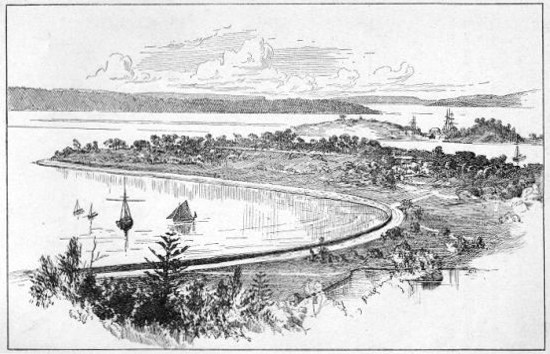
where we were staying. The harbour still and blue lay
before us, looking like an inland lake from the law, flat hills
that run out into the sea and nearly surround it. It is dotted
with islands, the chief of which is Kawau, Sir George Grey's
island home, and Rangitoto, with its three volcanic cone-like
peaks. From the hill on which we were standing
there was one mass of foliage stretching down to the edge
of the harbour, and the houses seemed to have been put
down promiscuously in the midst, forming white dots from
among the surrounding green. The town and wharves lay
hidden under the long, sloping hill, on the shoulder of which
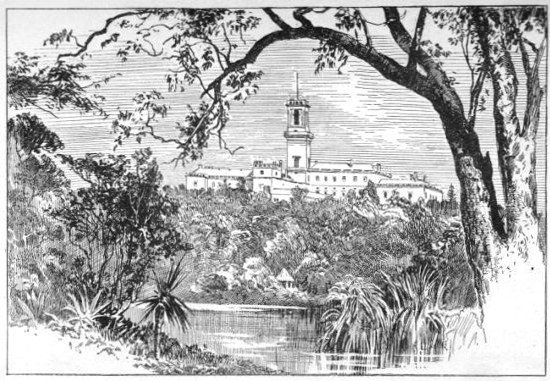
stands the fine stone building of the Northern Club, with its
broad terraces, commanding the view seawards. A little
higher up, nearly at the top of Princes Street, is Government
House, only tenanted for a few weeks in summer since the
removal of the capital.
The houses at Auckland are so pretty—all built of wood,
all low, and two storeyed, with double verandahs on each
floor and not straight verandahs, upheld at regular intervals
by white posts, but gracefully arched, and carved with fretwork.
The wooden fences to the gardens and the houses
are painted a dead white, which stands out in dazzling brightness
from the dark foliage.
There seems to be some curious anomaly, some contending
element in the vegetation of New Zealand. We saw
semi-hardy and semi-tropical plants growing side by side,
a Scotch fir by a palm, an india-rubber-tree by a laurel; but
the tropical in the end predominates. There were geraniums
in the hedges, camellias and azaleas blooming in the open
air, orange and lemon trees, and clumps of arum or Egyptian
lilies growing wild in cool and shady places. The principal
trees are the eucalypti and the Norfolk Island pine,
which grows nowhere better than at Auckland. It branches
straightly out, with a succession of hard, prickly fingers
inclining upward towards the ends, and is of a rich dark
green.
The editor of the New Zealand Herald, a very ably conducted
paper, found us out on our return from church,
and interviewed C. In the afternoon we drove out to
Remuera, one of the pretty suburbs of which Auckland has
so many. Passing through the Khyber Pass, a road dug out
in the rock, we came through Newmarket, its bit of untidy
common giving one a sarcastic reminder of the Newmarket
of the world, on to the Remuera road. From here we could
see the surrounding country, flat and cultivated, with a few
low hills looking peculiarly English, the race-course of
Ellerslie, where spring and autumn race meetings are held,
and the harbour, for wherever you go in Auckland you
always have a view of that. We had a warm welcome at
the pretty cottage of an uncle of my husband's, Mr. William
Young, a fine old gentleman, who has been more than forty
years in the colony. He had not known of our arrival,
and was quite overcome with joy at seeing us for the first
time.
Whilst I was sitting writing in the evening, I suddenly
heard all the watch-bells of the city ringing a fire alarm,
and going out on to the upper verandah, saw the lurid
flames of a fire down in the town. By the vivid illumination
I could distinguish the upturned faces of the
crowd, and for ten minutes it burnt fiercely, reducing
the little wooden house, which was fortunately detached,
to a few charred beams. Fires are of frequent occurrence,
and are terribly serious among this town of wooden tenements.
They have alarm bells erected in wooden penthouses
in the most crowded parts of the town, and the fire
brigade is kept in a full state of efficiency.
Monday, September 22nd.—We drove ten miles out to
Sylvia Park, a great stud farm belonging to the New Zealand
Stock and Pedigree Company, and managed by Major
Walmsley. The road lay through a very wild, desolate
country, roughly enclosed by stone walls loosely put together
from the mass of scoria and volcanic rocks, which literally
strewed the ground for miles. It is supposed to be the
débris thrown up from the craters of the volcanoes, and the
short, sweet grass, so peculiarly fitted for the feeding of
sheep, crops up between. These extinct volcanoes, with their
round, flat tops, of which there are no less than thirty-nine
in the immediate vicinity of Auckland, form a distinctive
feature of the country.
When we arrived at our destination we found a square
wooden house, surrounded by spacious paddocks with
splendid pasture. I was strongly reminded of the Downs,
looking round at the many miles of rolling green hills, and
by the utter stillness and loneliness.
There are in all some 150 horses, not including the
constant additions to the stock like the half-a-dozen foals
we saw, just a fortnight old, turned out into a paddock
with their mothers. The horses are chiefly thoroughbred,
and they have some blood relations to celebrated winners of
the turf. At their annual sale last year at Melbourne they
realized an average price of 300l. We saw their celebrated
mare Sylvia, twenty-one years old, from whom the farm is
named, and whose offspring are numerous and well known
in racing annals; as are those also of Martini-Henry, the
winner of both the Derby and Melbourne Cup, who here
saw the light. Major Walmsley mentioned to us one amusing
peculiarity. It has always been noticed that, on the introduction
of new blood from England, the colonials separate
themselves from the new-comers, and keep to the other side
of the paddock.
Rain came on, and we said good-bye to our kind host,
and drove home through a heavy downpour.
Tuesday, September 23rd.—We are charmed by the kindness
of all at Auckland, their open hospitality and cordial
welcome. We are overwhelmed with invitations, and are
only sorry that the shortness of our stay obliges us to refuse
many. Consul Griffin (who had been on board the Australia
with us) brought me in last night three lovely bunches of
flowers; one was made entirely of native flowers, and all
were sent with pressing invitations to come and see the
place where they grew. Messengers with invitations are
arriving all day, walking in at the open door, for all
the doors in New Zealand stand wide open, and you
never think of knocking. To-day we have had luncheon
at the Hon. James Williamson's, at "The Pah," the
Maori name for house. The garden is considered one
of the best about Auckland, and is very beautiful
with its large camellia-trees, double, single, striped and
plain, white or red, azaleas of all colours, double geraniums,
roses, violets, heliotrope, fuchsias, and daphne, large aloes,
and cacti, maidenhair fern, and heath, growing wild in
brilliant purple-pink clumps. There is an orange and lemon
grove, guava-trees, and the silver fir, a native of New
Zealand. This very pretty tree has a long, pointed, silver
leaf, with a bright, velvety cone, and produces from a
distance the effect of a tree of shimmering silver. The
orchard was in full blossom, as with us in May; it is so
difficult to realize that this September, our autumn month,
is the beginning of their spring.
In New Zealand, with their temperate climate, they have
flowers all the year round. During the winter there is
little or no snow, but much rain; and though there are
never any great extremes of either heat or cold, some find
the damp heat of the summer very enervating.
We afterwards went to tea at Mr. Firth's, the "Castle."
The garden there is terraced into the side of the hill, which
must have been one of the extinct volcanoes, as the soil is
entirely scoria. We saw a picture of the present Maori
king, Tawhiao, now in England, and another, a very remarkable
portrait of the great King-maker, who, twenty-five years
ago, gave over to Mr. Firth 60,000 acres of land, in fee
simple, whereof to form a beautiful estate.
Wednesday, September 24th.—We spent the morning in
the town. Queen Street, with a few arterial streets, forms
the town, and contains all the shops, the theatre, and the
six thriving banks. It looked busy and prosperous, with the
streets full of men on rough ponies, going at a hand gallop;
for in New Zealand they seem to have no medium
between galloping and walking, and they generally choose
the latter. There are a few tramway lines, but they have
not yet superseded the lumbering yellow omnibus, lined
with red moreen, that ply between the suburbs and the
town.
Auckland is the northern capital of New Zealand, as
Dunedin is of the south. It received a severe check when
the seat of government was removed to Wellington, but
it is recovering from this, and spreading rapidly into its
several suburbs of Parnell, Remuera, Newton, Newmarket,
and Khyber Pass.
It is roughly estimated that each emigrant ship, arriving
every fortnight, brings to Auckland 300 emigrants, who
create a demand for sixty new houses. Another proof of
the rising prosperity may be given from the Savings' Bank
deposits, which average 1000l. a week.
The necessaries of life are extraordinarily cheap; for
instance, meat is from threepence to fourpence per pound;
all woollen goods and ordinary wearing apparel are the
same; but anything not strictly within this province is proportionately
dear.
There are the most delicious oysters at Auckland, as
small and delicately flavoured as "natives," and they are
to be had for the trouble of picking them off the rocks
in the harbour.
A "baby show" had been largely advertised to take
place in the afternoon in the theatre, and we determined to
go to it. There were prizes given for the handsomest
baby, the best all-round baby, for the finest twins, and the
lightest and heaviest baby, for curliest-haired, and prettiest
dark-eyed, and lastly, for the plainest, and reddest-haired
baby.
Afterwards we drove to the bottom of Mount Eden, and
walked up the grass drive to the top, looking down into the
huge crater, which is now a green and sheltered hollow,
where cattle feed. We had a very sweeping view, though a
little hazy, over the two harbours—ours of the east coast,
and Manakau on the west. There was water wherever we
looked, with long, streaky lines showing the "barriers," or
swampy bits of plain or sandbanks. At our feet, on one
side, was Auckland, stretched out in dotted white lines;
on the other, there were houses and gardens, nestling
under the shelter of Mount Eden, forming the far-extending
district known by that name, with rich flats of
cultivated fields, interrupted only by the mounds of the
volcanoes.
In returning we walked through the "Domain," a pretty
wood of native trees, with bridle paths, and then went home
to prepare for our rough expedition to the Hot Lake district,
to begin on the morrow.
We have been very much struck how all out here cling
to England, looking upon and calling her "home," always
hoping to return some day to the old country, if only for a
short visit. It is quite the usual question to ask, "And how
long is it since you were in England?" and the answer often
is, "Twenty years ago, but we hope to go there again
soon." All have near relations there, and it is considered
a great thing to be able to send the children home to be
educated.
We find everywhere the same keen longing and anxiety
that England should know and realize how prosperous, how
civilized, how replete in comfort and luxury, her colonies
are. They complain that justice is not done them, and
express a wish that some of the prominent men in the old
country would come out and visit them, and see it for themselves.
One lady said to me, "I believe they think at home
that we are living in the midst of cannibals, and certainly in
a state of rude civilization and semi-barbarism." Another
said, when we were expressing our appreciation of all the
kindness we were receiving, "We are very homely folks out
here; but only too glad to give any one from the old
country a hearty welcome."
Even those who are rich keep up quite simple establishments,
servants being a very difficult luxury, hard to obtain,
still harder to keep beyond a few months, and commanding
exorbitant wages. As a natural consequence of this, all
the daughters are brought up to do the lighter parts of the
house work. I think colonial mothers are the best in the
world. The only nurses to be had are rough colonial girls,
and so mothers are accustomed to have their children always
with them from infancy. These two circumstances combine
to make the girls, what they generally are, frank and open
in their manners, very independent in character, and old
for their age.
The telephone is in general and more frequent use here
than in England. The postal rate of 2d. is uniform throughout
the colonies, but the most perfect system is that in the telegraphic
department of "delayed telegrams." This is an
arrangement whereby by paying only 6d. you can have a
telegram sent in the course of the day and delivered from
the receiving office by post, the ordinary telegram having
the preference.[1]
We were so sorry to be leaving Auckland without seeing
a Kauri pine forest. These Kauri pines are only found
north of Auckland, and the nearest forest is some fifteen
miles away. They grow to a great height, and are chiefly
valuable for the purity of the gum, which exudes in great
quantities from the bark, and is highly prized for mixing
with varnish and for tanning purposes. It formed at one
time the most valuable of New Zealand exports. Large
lumps of this exquisite clear golden substance are dug up
from the ground, under the pines, containing a clear cloud-like
substance, that fades after exposure to the air. We
brought away with us several pieces, some in the rough and
others polished.
Friday, September 25th.—We were down at the station
by 8 a.m., and joined there by Mr. Davidson, our fellow-passenger
on board the Australia; Mr. Robert Graham also
came with us, the proprietor of Wairakei, and of Waiwera,
the pretty little watering-place, with hot springs, twenty miles
away from Auckland, which we had not found time to visit.
There was quite a feeling of adventure in starting out on
this expedition to the Hot Lakes. Scarcely any one from
Auckland has been; on the principle, I suppose, that those
nearest the place of interest never do go, though people
may think it worth while coming all the way out from
England to see it. Many tried to dissuade us, by alarming
accounts of the roads after the winter rains, and the roughness
and fatigue of coaching from early morning till late at
night; and at one time I had wavered.
We were experiencing one of the New Zealand railways
for the first time, and could not say much for the smoothness
of the locomotion. The train moves on with a terrific
jerk after each stoppage; till, at last, you come to look for it.
This carriage was very long, with a passage down the centre,
and differed from the American cars only in having seats
lengthways, instead of crosswise, thus producing the effect
of the inside of an omnibus. Afterwards we found that
many of them were like the American cars. The trains
are very, very slow, only going from fifteen to twenty miles
an hour; the gauge is narrow, and the line single.
After passing through the suburbs we emerged out into
an open country, bounded on either side by low hills, and
almost entirely covered by manuka, or ti-tree scrub, producing
the dark rich brown colour of a moor. One-third
of the north island is covered with this manuka; it
flourishes on all the uncultivated sandy soil, and is the
most monotonous of shrubs to look at, with its spiky black
twigs, and sparse feathery green. It is only pretty when in
bloom, and covered with myriads of white starry flowers;
but we were too early to see this. I grew very weary of
the miles and miles we passed through of it during the next
few days. Here and there, in sheltered hollows, were bits
of native bush, with the characteristic grey stem shooting
branchless to a great height, and ending in a clump of
green at the top. Many of them had bunches of gigi,
which looked like mistletoe, growing on the stems. Underneath
these there would be a thick undergrowth of cabbage-palms
and tree-ferns.
At the small station where we stopped to have luncheon
we were offered whitebait! but it turned out to be only
some minnows, caught in the neighbouring stream, and
served in a very pulpy condition.
We were soon following a range of hills, worthy to be
dignified with the name of mountains, and the broad river
of the Waikato was flowing to our right. The Waikato
became quite an old friend at last. We followed it in
so many of its windings, leaving it to find it again, after a
few days, grown and increased in volume, and flowing ever
more swiftly towards the sea. We passed some marshy
belts of land, opening out into broad pools, bordered by
bulrushes, with plenty of wild ducks and prairie-hens
skimming about on them. Then Rangiriri came in sight,
with its green knoll and flagstaff marking the spot where
the natives, in 1864, held at bay and shelled the English
troops, under Colonel Campbell, in the swamp below.
For many years the Maoris defied the British from their
strongholds in the bush, the war on the English side being,
it is said, much mismanaged. The struggle raged most
fiercely at Taranaki, breaking out again there after the
other parts of the island were subdued. At the end of
the war, government took possession of all the land, and
the Maoris retreated into the district known as the King
Country. They have now collected enough money, and
sent their King, Tawhiao, to England, with the hopeless
task of submitting their grievance to the Colonial Office.
His mission will, of course, be useless, and he will return
as empty-handed as he went.
We arrived at Hamilton at 3 p.m. By courtesy it is
called a town, but it consists of one short street, with the
hotel facing the bank, above which is the office of the local
paper. The ancient yellow coach in which it was proposed
we should drive the twelve miles to Cambridge was
overcrowded, so we took a waggonette, and were driven by
Mr. Johnstone, the coach proprietor on this road, who
handled his quadruple ribbons in the most masterly
manner.
I can see now the road winding through that little pass,
the hills on either side covered with gorse and bracken; the
running mountain stream by the side of the road, crossed
by a wooden hedge, and bordered by whispering willows.
Through a gap in the distant mountains came a rush of
yellow light, leaving them themselves in gloom.
We emerged into the great flat plains which are considered
so good for agricultural purposes. All the land
is let out to leaseholders in small lots of from 100 to 150
acres; though, if the matter came to be examined into,
it is thought that nearly the whole of this and many other
tracts of land would be found to belong to the Bank
of New Zealand, being heavily mortgaged to it at the
rate of eight per cent. This is the usual rate of interest
here. Fir-trees were planted along the sides of the fields
as a shelter for the cattle against the wind. A farmer
requires about 5000l. capital to make a successful start, and
must be prepared to unlearn all English ideas of farming,
and learn those adapted to the soil and climate, unless
he wants "to run a mucker," as the phrase goes.
Two hours brought us to Cambridge, where we found a
clean little inn. The town was full of Maoris, gathered from
far and near, to attend one of the Land Courts, which are
held from time to time to arrange differences about landmarks,
and to effect the sale of lands. The natives were
lying about the street, wrapped in their striped blankets, or
in plaids and tartans of bright colours, which covered them
from head to foot. The women are generally seen in a
crouching attitude, squatting on their heels, and their lips
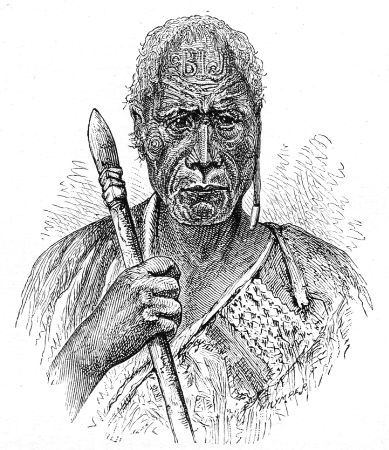
and chins are tattooed in patterns; some of the men are
likewise decorated in rings all over the face, and wear
a long piece of greenstone depending from the ear by a
string of black ribbon.
We had a strange example of "how small the world is"
this evening; when a schoolfellow of C.'s, not seen since
the old days at Westminster, turned up at Cambridge. He
emigrated at the time of the gold fever in the Thames
river (not far from here), and has been for six years a member
of the Legislative Assembly,—is now a leading lawyer,
a lumber merchant, and the proprietor and editor of two
newspapers.
Saturday, September 27th.—We left Cambridge at seven
this morning in a downpour of rain, that seemed to prophesy
a hopelessly wet day. There was a preliminary difficulty
about starting. The light buggy with four horses, and a
narrow seat back and front, proved too small to hold ourselves
and the very small quantity of luggage we had
brought. We looked blankly at the small space, to see if
we could contrive to pack in, and after some demur on the
part of the driver, he promised to try and horse another
buggy for us. He had come over the road on the previous
day, and reported it to be in a terrible state, but how terrible
it was we had no idea till later in the day, or I doubt
whether we should have persevered.
Some miles of flat road, passing a pretty house belonging
to Sir James Fergusson, now governor of Bombay and
formerly of New Zealand, and we turned off the main road,
into that leading to Ohinemutu. The difference in the road
was perceptible at once; the one belonged to the township,
and the other was under government management.
It was of dark sticky clay, not only full of ruts but of holes,
and we soon began what was to be our ordinary mode of
proceeding, viz. "floundering."
The surrounding country was tame, with low hills and
open spaces, alternating with patches of dense manuka
scrub, showing the natural state of the land before
clearing. Then we began to wind through passes with
wild Highland scenery. The colouring was a beautiful grey-green
or grey-brown, catching its tone from the decaying
bracken; and this is such feathery bracken and so peculiarly
crisp and hard to the touch. The Waikato could
be heard rushing and gurgling over rocky impediments in
its course, but so deep down in the ravine, and between
such high banks, that we only got occasional glances of
its swiftly running waters.
The most striking feature of the country here are the
distinctly formed terraces, running in tiers down to the
present bed of the river, and which is supposed to show
the different levels of the Waikato during the course of
centuries.
All the land about belongs to various companies. The
New Zealand Stock Pedigree Company have a large tract for
their farm, but they are not succeeding well, as the farmers,
struggling under the disadvantages of the first breaking of
the ground, cannot afford to study the breed of their
stock. By degrees we entered the country held by natives,
where all signs of cultivation and the abodes of man
ceased. We occasionally met a solitary horseman, a weird-looking
figure in slouch hat and blanket—some Maori
going down to attend the Land Court at Cambridge.
It would be very difficult to give any adequate idea of the
state of the road. The four horses were up to their flanks
in the liquid mud, and the carriage sunk in axle-deep. To
behold only is to believe in such a case. Looking at the sea
of soft mud in front, it seemed as if it would be impassable.
Kerr, our splendid Jehu, saved us many a bump by his
first-rate driving, drawing the horses carefully off, and
easing them at bad ruts; but as it was, the buggy often
balanced on two wheels and sank deeply down, the other
two being high in the air, and the vehicle hesitating whether
to recover itself or not. There were not a few such critical
moments. Sometimes we got into such a slough that the
pole of the carriage touched the mud, and the horses, in
trying to draw out their fore feet from the slippery mass,
would miss their footing, and flounder hopelessly for a
moment or two. Then Kerr would draw himself together,
and by main force drag them out with the reins.
We were obliged often to cling on to the front seat, to
avoid being thrown bodily out, and in one unexpected jolt,
when we were both impelled, nolens volens, suddenly forward,
C. came down with his full weight on my thumb, and
sprained it slightly.
We were looking forward to arriving at the township of
Oxford, for the excitement and anxiety of this fearful road
was tiring, and the going very slow and tedious. From
over a bare plain we approached the hotel; not a single
house was to be seen, and we found that this was the
township. The railway that is being made is finished up
to here, and an enterprising man has built the hotel, foreseeing
the custom that will come, when it is opened next
season, and forms the starting-point for the coaches to the
Lake district. The second buggy overtook us at Oxford,
and we found that they had fared much worse than we had.
The spring of the back seat had given way, and Mr.
Graham had been precipitated into the mud.
We coached on for another three hours, the horses so
dead beat that it was only by many exhortations to "get
up," and the frequent use of the whip, that we progressed
at all.
We had one alarm when Kerr, after leaning over several
times to listen, got down to examine a back wheel. Awful
thoughts of a screw becoming loose in such a much-tried
vehicle had been ever present with us all the way. But
it proved to be only some sand, which if left in the axle to
grate with each revolution would have set fire to the wheel.
The wheel had to be taken off and fresh grease applied.
Soon after this little incident torrents of rain came down,
in which we drove up to the door of a hut in the backwoods,
kept by some Berkshire people, and where we ate
the luncheon we had brought.
For the next twelve miles we were driving through the
bush, the damp steaming up on all sides and showing the
vegetation in all the glory of its luxuriance, the leaves
and moss shining with the dripping raindrops. Nature
was perspiring at every pore, and putting forth a new
growth in the moist heat.
At first we missed the familiar foliage of the oak, or elm,
or beach, but soon you grow accustomed to the grey skeleton
trunks, branching off so high in the stem of the native tree.
There was the Karaka, a tree with thick glossy foliage,
and a red berry which the natives eat, the Puriri, which is
the hardest of New Zealand woods, the Katukatea, or white
pine, and the Totara. This tree has the bright olive-green
foliage that imparts so much vividness to the bush. It
has a durable wood, which worms never touch, and for
that reason is much used for the piles of wharves. Then
there is the Rimu which, when the bark is stripped off, is
found to be of a blood red inside. It produced the
beautiful effect we saw as we passed along, when sections
of these trees rotting on the ground, mingled their crimson
blood with the yellow mosses and lichen.
Again and again we remarked that great curiosity of the
Rata, which is found throughout both islands. The Rata
begins like a creeper, hanging down in tendrils from the
branches, and joining together below them, to form a stem
about one-third of the size of the trunk. Growing gradually
downwards, it circles round, and closes in "under" the
roots, gradually eating into and sucking the life from the
tree. It performs the part of an ungrateful child, who kills
the parent who gave it life. Along the coast the same
curious formation is found about the trees, but there it is
called Pohutukawa, and grows in exactly the opposite way,
striking from the roots upwards, and performing the same
work of death, with its fibrous arms. Sometimes this
Pohutukawa is also called the Christmas tree, from the
bright red blossom that flowers at Christmas. They say
the effect of the bush at a distance, and when the trees
are intertwined by this scarlet mass of blossom, is very
beautiful. The general idea is that the Rata and Pohutukawa
are produced by a species of caterpillar about a foot long,
but we found many of the islanders do not agree with the
theory. We brought one of these caterpillars home with
us, and it is still preserved in a tin case.
The giji, a small rush or coarse grass, growing in
isolated clumps on the trunks of the trees, forms another
special feature of the bush. But the chief is that
wonderful tangled mass of tropical undergrowth, and the
tree ferns which grow in large clumps. Their fibrous
black trunks attain to a height of six feet, expanding at
the top into feathery arms, long and graceful in their
sweeping curves. Nestling under their broad shadows
are every other species of fern; the beautiful crape
fern, so called from the crisp double texture of the
fronds, the Hiane or creeping Lycopodium, the Kioko
or Polypodium, the Panaka or Asplenium, and the
Mangemange or creeping fern. Then there are all kinds
of parasites, like the Tararamoa or climbing bramble; the
latter has a red or yellow berry, and a prickly bristling leaf,
which has given to it the name of the lawyer's plant, or bush
lawyer; there is the Kareao, a climbing wiry vine, the "Supple
Jack" of the Colonists, the Kiekie, Kohia, and Pikiarero
or clematis; and the Hinau which blossoms with a white
flower, and has an astringent pulp, the bark furnishing a
black dye to the natives. Beneath all there is a carpet of
bright green moss, three inches thick.
It is very difficult to give any adequate idea of the extraordinary
luxuriance of these bush forests; I could hardly
have believed before what wonderful shades of colouring
could be contained in a single tangle of green. There
is something about the bush which prevents your saying it
is tropical, partly on account of the trees which look sparse
and hardy, partly on account of the damp climate, but
it is, nevertheless, as beautiful as any tropical jungle.
We were very much struck by the oppressive silence
and the absence of all bird life. We heard the whirr of
two wood pigeons, and the twitter of a tui once or
twice.
It was getting dusk as we emerged from the bush, and
quite dark before we saw the black waters of Lake
Rotorua. Clouds of steam and vapour rising from the hot
sulphur and mineral springs, told us the whereabouts of
Ohinemutu.
I confess that the last part of the drive Nature had been
asserting herself, and I was too tired, hungry, and sore
from the jolting to feel interest in anything but an arrival
at the Lake House.
We found the coach and party from Tauranga (the other
route to the Hot Lakes) had just arrived there, and on
comparing notes, we saw that our road had been infinitely
worse, but that we had been saved from a tossing last night
on the sea, in a miserable little steamer. We had coached
fifty miles during that day.
Ohinemutu is in the centre of the Hot Lake district;
it lies on the shores of Lake Rotorua, a sheet of water
twenty-seven miles broad. Mr. Robert Graham has built
his hotel, the Lake House, in the midst of a Maori settlement,
surrounded by sulphur fumes. In the garden he
has enclosed several hot springs, to form medicinal baths;
but Sulphur Point, the site of the Government sanatorium,
and the proposed township of Rotorua, contains the greatest
wonders. Here is Te Kanhangi, "The Painkiller," a bath
of dark-coloured water; the "Priest's Bath," Oawhata, a
clear pool of bubbling hot water, and Madame Rachel's
bath. In all of these the water is at boiling point. They
possess the most wonderful curative properties for those
suffering from rheumatism, sciatica, lumbago, spinal disorders,
cutaneous diseases, &c. Analysis shows the water
to contain chloride of sodium, potassium and lithium, sulphate
of soda, silicate of soda, lime and magnesia, iron and
alumina oxides, and sulphuric acid.
The stories told of the wonderful cures effected are
endless; and as they become more generally known there
can be no doubt that Ohinemutu will become the great
health resort from neighbouring countries, and indeed from
Europe.
Near Sulphur Point are the Cream Cups, the Sulphur
Cups, the Coffee Pot, and the Fumaroles, pools of white,
boiling mud, impregnated with sulphur and arsenic. In
cold weather the natives will sit for hours up to their chins,
in these hot mud-holes, for the sake of the warmth; and
winter and summer they are always bathing in the warm
water of the bay in Lake Rotorua.
Tired as we were, we went out in the evening to see the
Maori Temple in the settlement. It is of weather-board,
with a corrugated iron roof; but inside it contains the most
grotesque and hideous monstrosities. The Maori idea of
religion takes the form of a carved wooden ancestor, stunted
and deformed, with the eyes of mutton-fish shell starting
out of the head. They stand in rows round the temple.
The beams of the ceiling and the carved pillar in the centre
of the temple are painted in ochre and hematite, producing
a gaudy and startling effect. We looked into one
or two of the native "wharries" or huts, as we came home.
They are miserable hovels built on the ground, with the
uncovered earth as a floor. A litter of grass or rushes forms
the bed, and all have a wooden bolster, with a place hollowed
out for the neck to rest in.
I cannot say much for the comfort of Lake House, there
is one long passage down the centre, which is divided on
either side into square boxes about six feet by six; these
have uncarpeted floors, and are most primitively furnished.
Sunday, September 28th.—It was a fine morning, and it
had been agreed overnight that in that case, we must for
once overcome all Sabbath-keeping scruples, get up at five
in the morning, and leave in the coach at six.
Driving by the shores of Rotorua, we were rewarded for
our early start by the beauty of the lights and shadows
playing on the mountain sides, reflected from the floating
cloudlets above—by the first freshness of the keen morning
air, and by that subtle feeling that comes with an early
rise of being superior to one's neighbour. We had need
to sustain these sensations, during the course of the
next few days, with their successive early starts, varying
from 5 to 7 a.m. Out in the middle of the lake we
saw the island of Mokoia, in connection with which is
told the pretty little Maori legend of Hinemoa. Charmed
it is said by the notes of the lute of Tutanekai, her lover,
she fastened six empty gourds round her back, and floated
across from the mainland to Mokoia, hiding herself in
Hinemoa's bath, until a favourable opportunity presented
itself of appearing before Tutaneka.
When I say we were in the Highlands, I shall have
described the first five of the ten miles' drive to Wairoa.
It ended with a bold mountain, burnt black and bare, with
a deep gully winding round its base, following a pass
through the mountains. We suddenly came out on an
open moor, and then plunged into the dense forest of the
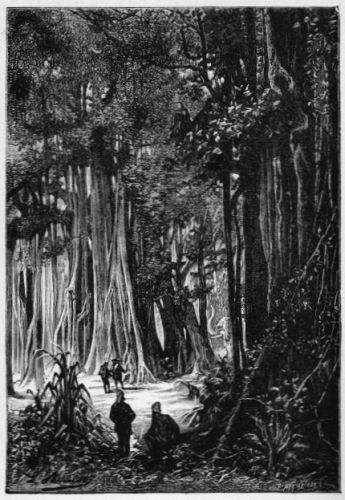
Tikitapu bush. It is a glorious bit of bush, with the tree
ferns growing to an enormous height. The road is cut
through its midst; and overhead the trees close in and
form a cool twilight. Through this avenue we caught our
first glimpse of the blue waters of Tikitere or the Blue
Lake. It is only a sheet of very clear blue water, lying in
the hollow of the mountains, which are covered with
brown, feathery bracken, and yet we were all attracted and
fascinated by it. There was nothing grand or striking,
but we said and thought it was "lovely." The road runs
round on a level with the lake, and we saw that the mountains
dwindle into a low hill, to a point where the road
and the lake meet.
This hill is all that divides the Blue Lake from Rotokakahi
or the Green Lake. It lies at a level of eighty feet
lower than the Blue Lake, and it was very strange, just at
this spot, being able to compare the visible descent between
the blue water on the one hand and the green on
the other. Strange it is that the Green Lake does not
in the least attract the eye like its Blue sister.
As we came near the village of Wairoa, a smell of
sweetbriar from the hedges bordering the road on either
side perfumed the air for nearly a quarter of a mile.
We passed the temple and some wharries, made of rushes
hung and plaited from a pole in the centre. The natives
rushed excitedly out of these and followed the carriage,
clothed in their one white garment, with striped blankets,
blue, yellow, and red, thrown loosely round them. By the
time we drew up at the Terrace Hotel we were the centre
of a motley group of Maoris, chattering, gesticulating, and
"whining"—the Maori way of expressing pleasure; Mr.
Graham had no difficulty in picking out a fine, strong-looking
crew to man our boat across Lake Tarawera.
We ran down the steep winding path which led us to the
rough boat-house in the creek, on Lake Tarawera. Here
there was a great delay, whilst the crew, led by "Sophia,"
the native guide, were mustering, and it was then discovered
that our party was one too many for the licensed number
of the large flat-bottomed boat. This proved to be the beginning
of our troubles with a very fat old gentleman, with
a broad Northumbrian dialect, who, having joined himself
on, uninvited, to our party, proved always the one de trop.
No one need feel sorry for him, or think he was neglected;
for he took good care of himself; was always to be found
the first to be seated in the boat, and in the best place; he
helped himself freely to the luncheon we had bought, and
required no pressure to take his full share of the whisky
bottle.
Once we were out on the lake, we were delighted with
the grand rugged beauty of the surrounding mountains.
The three flat cones of the Tarawera Mountains loomed in
the distance, and somewhere hidden away in that range,
we were told, there was a curious natural bridge, sacred to
the Maoris for a burial place. About two years ago the
water of Lake Tarawera suddenly changed and became
green and muddy, remaining so for a year; it then
returned to its natural state, being perfectly clear and
wholesome for drinking.
The natives rowed very slowly and unevenly, playing
with their oars, while they munched hunches of bread, and
took deep draughts from the lake for breakfast. The first
breath of wind was the excuse for hoisting a primitive sail,
fastened by a string of green flax. A blue veil attached to the
hat of one of the natives gave rise to a laugh about the Blue
Riband movement, which they quite appreciated and joined
in, when translated to them by Mr. Graham. We were
anxious to push on, and should never have accomplished
the ten miles row without Mr. Graham's encouraging, "Go!
go!" in Maori, and a bottle of rum, which he gave to the
chief to dole out. We turned into an arm of the lake
running up between the hills, and passing a Maori settlement
in a damp hollow, we saw before us a cloud of white
steam rising from the midst of the mountains, and we
knew where it came from, and longed for our first sight of
those beautiful terraces of Rotomahana. They are unique
in the world, and comparable to no other wonder of Nature.
They are one of her most perfect works—perfect in conception,
in form, and in colour.
After landing we almost ran the mile and a quarter,
through the bracken and manuka scrub, hurrying on to
each knoll to have the first view, and then disappointed,
running down that one and on to the next. We were
heedless of the blue and purple mountains around, ungrateful
for what Nature in her ordinary course had provided,
looking only for her eccentricities.
At last we could see them, in their general outline, a
silica formation of white terraces in circular steps. We
thought it disappointing;—but not openly allowing so, we
waded through the lukewarm water, about an inch deep,
and stood at the bottom of Te Tarata, or the White
Terrace.
At the first step we came to, we were petrified with
delight for a moment.
Set in a basin of pure white silica, delicately carved and
fretted, lay a pool of pale blue water, so pure in colour, so
opaque in substance. I wish I could convey to the sight of
those who read this, the merest reflection of that heavenly
colour, that pale tint found nowhere else upon earth.
As we climbed upwards, we saw terrace upon terrace,
with each circular brim hanging with beautiful stalactites,
and sponge and coral formation. The sun shining through
the lace-like fringe on the coral-tipped edges, sent forth a
hundred reflections, and we were dazzled by the snowy
whiteness of the silica. The water percolates and trickles
gently over the petrified drapery of each little cup and
basin; each drop leaving its tiny deposit of silica, which in
the course of ages has formed the Terrace.
We waded through the warm water, picking our way along
the little edges of the pools, lost in wonder at the delicate
workmanship. The temperature rose gradually, and we
found it nearly boiling as we reached the crater at the top.
Again the pool was of that indescribable blue, more beautiful
when seen in such a large mass, but at the further
end the cloud of vapour and steam we had seen rising in
the distance partially hid from us a dark, angry mass of
boiling water, that was heaving and surging against the
opposite crust of the crater. Te Tarata is not always active,
sometimes the crater is perfectly dry, as it had been the
previous week to our coming. We discovered here some
ferns, and morsels of branches petrified with silica, each leaf
being perfectly encased, and preserved with the glistening
substance; but we found that they were too brittle for transport,
and had to leave them there in their beauty and to
their natural home.
We came down the Terrace, step by step, lingering and
turning back at every point to look under the overhanging
lip, at some still more curious formation of stalactite, some
new beauty hidden away in a quiet corner.
Still wading through the water, we came down the left
side of the Terrace, and saw what I thought was almost
the most beautiful part, a succession of little cups, formed as
regularly as the cells in a large honeycomb, each containing
its little pool of cerulean water. After leaving the Terrace
we went through a glen, in which the manuka scrub grew
high above our heads, and the carpet of bright green moss
was hot to touch. One of the charms of Rotomahana
and its Terraces is the bright luxuriant vegetation, in the
midst of a tremendous volcanic action; where you would
expect to see lava scoria, you find a tropical growth of ferns
and parasites.
Climbing up to the top of a hill, we looked down into the
crater of "Ngahapu," a geyser which spouts up furiously
every few minutes. We gasped as we looked down into
the black boiling water which ceaselessly gathers itself into
a swirling mass, and throws up a jet of water, and then
recoiling rushes on to the sides. We skirted round another,
which was still more active, and which we had to be careful
to get to leeward of, to avoid being sprinkled with boiling
spray. Above, to a fissure in the rock we traced the
ceaseless throbbing noise of the "Steamer." It sounds as
if inside here the waterworks of the geyser were being
pumped up. The manuka all round was encrusted with
orange from the sulphur fumes, and the ground was inlaid
with different bits of brilliant colouring, in the red and green
clay of mineral deposits.
We found luncheon spread out for us by two natives
near the lake. It was rather a "hot" corner to have chosen,
for in front of us there was a boiling mud-hole—and behind
and all round bubbling pools of hot water, with steam
issuing from the ground. We sat on some rocks coloured
pale yellow from the action of sulphur and ate the most
delicious baked potatoes and kouras, the native shell fish,
that had been cooked in a few minutes by the easy process
of holding them in nets in one of the hot pools. I think
we all thoroughly enjoyed that luncheon.
Then the gentlemen were taken across the lake in the
canoe to have their bath in the pool at the top, before the
ladies arrived. We waited under the care of "Sophia" for
the return of the canoe.
Sophia was a most attractive half-caste Maori, speaking
English very prettily. Dressed in a red and black check
skirt, with a blue jacket bordered by red; her black wavy
hair flowing loosely from under a Tyrolese hat, she presented
a most picturesque reminder of "Meg Merrilees."
Her lips, like those of all the Maori women, were
tattooed; but hers were only done in straight lines, as they
had become too sore to continue with the down strokes,
which usually reach to the dimple of the chin. She
described to us the process of tattooing. Small holes are
tapped into the skin with a sharp-pointed instrument, and
then filled with the prepared juice of the Kauri gum,
boiled down to a dark blue substance. The mouth is
fearfully sore for several days, causing even death sometimes
from gangrene and mortification, The girls always go
down to a town to have the operation carefully performed,
and then make it a ceremonious holiday.
Sophia wore a beautiful piece of greenstone called Tiki,
roughly carved, that had been, she said, in her family for
400 years; she also wore suspended round her neck by a
black ribbon a "Maori button," made of a piece of circular
bone, bored through the centre, and about the size of a
crown piece.
We saw the canoe returning across the lake, and dreaded
the idea of getting in. It was a native canoe formed out
of the hollow trunk of a totara-tree, and shaped at both
ends. A rough wooden paddle was used by the old Maori
for working it along. We had to get in cautiously one by
one, and lie down in the bracken at the bottom, and when
we were all in, we were certainly not more than three inches
from the water. Every motion in this frail bark was felt;
if any one moved hand or arm, there was an exclamation
of alarm, and when some one sneezed, we felt as if
the convulsive moment must capsize us. On the reeds in
the middle of the lake we saw many wild ducks, and the
pretty Pukeko, with its dark blue plumage and red bill. The
steam rising as we approached the shore alone indicated
the marvellous wonder that greeted us as we suddenly
rounded the sharp corner that brought us into the cove
where the water was boiling and bubbling brightly—and
the glories of the Pink Terrace were unfolded before
us.
The truth must be told, and our first view of them was
somewhat marred by the outline of figures that were creeping
along the horizon after their bath!
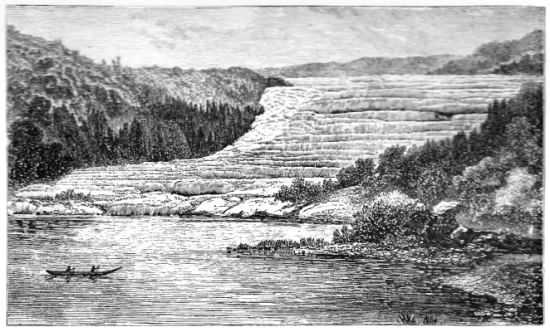
It is very beautiful. Terrace after terrace shelving down
to the water's edge; with the same delicate and curious
formation, the same tender blue in the pools, but not the
same dazzling whiteness; for these are coloured with a
most delicate shade of pink, streaked in places with carmine.
It is caused by the water previously running over red clay,
which, becoming diluted, leaves a pink deposit of silica on
the Terrace. I thought the Pink Terrace or Otukapurangi
Maori, quite as beautiful and more curious than the
white, but most people prefer the latter, and undoubtedly
it has the finest silica formation.
Where the water ran down in some little hollows, the sun
shining over the pink produced the effect of a shower of
opals, and again in the little pools, as the drops trickled
over the brim of the basin, there were a succession of
minute rainbows, seen for an instant and gone as soon.
A dash of green-coloured clay lay along either side,
before the dense border of manuka scrub was reached, forming
altogether a curious variety of pale shades, in pink,
blue and green.
We saw the place in the Centre Terrace where the Duke
of Edinburgh had carved his name. The natives have cut
out the original, and inserted instead a small tablet to show
their appreciation of the honour, but at the same time
they thought that by thus writing his name, his Royal
Highness implied a possession of the Terraces. The
lovely porcelain surfaces of both terraces are disfigured
by names scribbled in pencil underneath the water.
Government has now protected them by prohibiting this,
and laying a heavy penalty on all those who chip or carry
away fragments of the silica. The smell of sulphur here
was as pregnantly strong as in the White Terrace, but the
water is only hot, and does not boil. We felt we should never
see the Terrace again, and lingered.
A tremendous shower of rain came on as we were
packing again into the canoes; it seemed heavy enough
to have filled and swamped them. We recrossed Rotomahana
to the river, and then glided down the
swift current of "Kaiwaka," or canoe destroyer, so called
because of its rapids and sharp curves, so dangerous
to the equilibrium of canoes. The natives paddled us
most skilfully from the stern, and we lay at full length
basking in the warm afternoon sun, and noting the embryo
terraces that have formed along its ti-covered banks. Some
of the gentlemen of the party ventured down the rapids.
One canoe containing Mr. Graham and C. was nearly lost—the
stream carrying it down stern first, before the native
had time to get to his place to steer. He cried out to Mr.
Graham, "We are lost!" but amid intense excitement they
did get through and land in safety. We changed our shoes
and stockings for the dry ones which we had been warned
to bring with us, for we had been walking for several hours
in warm water.
We had a nasty head wind, with a heavy sea running as
we returned across Lake Tarawera, but the natives worked
well and sang us some native airs; all joined in a chorus
with gesticulations, led by Sophia. We had a very damp
drive home, rain falling in sheets; the beauty vanished
which we had admired so much that morning.
The fat gentleman whom I mentioned before was the
subject of much amusement to the Maoris. The native who
acted as guide, looked at him as he entered his bath and
said, "If you had been here forty years ago, you would have
made a nice pie." It was translated to him, and we thought
that we had had our revenge.
It had seemed such a long day, and I went to bed worn
out, and with my brain bewildered with all the wonderful
things I had seen.
Monday, September 29th.—We were up at 5 a.m., and
leaving Ohinemutu in a buggy to coach fifty-four miles to
Wairakei.
It was a very cold morning with a wind blowing from
the direction of the south pole. Passing Sulphur Point,
we came to Whakarewarewa (pronounced about like this,
"walk her over, over"), whose sulphur fumes from the
numerous mud-holes we had seen rising in the distance
yesterday. Then we travelled for some time beside
Waikorowhiti, the "Whistling Stream," a mountain torrent
that rushes through the Hemo Gorge. A few more
miles brought us to Horo Horo. It is a high narrow
ridge of rock, that sweeps in one unbroken line from
the coast of Coromandel Bay to the east of Auckland,
and ends suddenly here, standing out against the sky, as
one precipitous line of unbroken rock. A slender stately
column which distinctly presents the outline of a female
figure is called by the Maories "Hinemoa." The natives
think Horo Horo has the appearance of a mighty monster
fallen from Heaven, and so call it Fallen Fallen. It
reminded us exactly of the Palisades on the Hudson
River, U.S.A. We had magnificent scenery all the way,
ranges of mountains before and behind us, that only
varied in shape and beauty; all clothed with the dull green
or brown of the bracken fern. But the country was all so
much alike, that I felt if I had begun a sketch at the beginning
of the journey, I could have finished it almost as well
at the end. The country was totally uninhabited and uncultivated,
save for a few scattered Maori settlements, and
these wharries were so like the coarse grass growing round
them that they were hardly to be distinguished from it.
They generally lay under the shelter of some hill, or on
the outskirts of a bit of bush, and would be roughly fenced
round, with some pigs or a couple of rough horses about, as
the only sign of life. We saw but one white man's house,
and that was only building, during the whole day. Now
and again we came upon a herd of wild horses, who
galloped away at the sound of our approach. The skeleton
head of an ox fixed upright on a hill producing a most weird
effect, and a gravestone by the roadside, marking the spot
where some traveller's favourite horse had lain down to
die, were the only other objects of interest we passed
during the morning. There was a striking peculiarity in
the way in which the ground was terraced into deep winding
gullies, evidently showing the bed of some river, flowing
in bygone ages.
The road was good-going all the way, except for a few
"ruts," which required all "Mac's" care to avoid, as they were
deep enough to overturn the carriage. When going over
the edge of one of these we used all to lean over, to throw
our whole weight on to the opposite side of the carriage,
and watch anxiously to see whether the earth would hold
or slip away from under us. Mac, our new driver, was a
French Canadian, whose ancestors had come over with
Jacques Cartier and settled in Montreal. We had
no change of horses for the whole of that fifty-four
miles' drive, and it was wonderful to see how skilfully
he spared his horses, watering them frequently from wayside
streams. We kept ourselves from cramped weariness, and
saved the horses, by walking up the steepest hills. All the
wooden bridges about here are laid with planks lengthways
instead of crossways, and if they are rotten, there is great
danger of the wheels going bodily through. Once this
nearly happened to us, and we escaped with a shave; and
again when a horse put his foot into one of the holes, and
drew it out without breaking it.
We had luncheon at Ateamuri, under the shadow of the
great vertical rock that stands 300 feet high on the plain, called
Pohaturoa, or the "Rat's Tooth," from the jagged edges at
the top. A Maori legend tells of a defeated tribe who fled to
the summit of this rock, and were besieged there for a week,
living on the roots of ferns, and hurling down rocks on their
enemies. They found a pool of water at the top, and only surrendered
after burying sixteen of their number, whose graves
are still to be seen up there. Here we found our old friend
the Waikato again, and we laid out our luncheon on its
banks, under the shade of a weeping willow. Mr. Graham
met here the widow of the chief who had given him
Wairakei.
We coached on all through the afternoon, and towards
five o'clock we turned off the high road, across a rough
grass-track to Wairakei. Presently we seemed to be driving
at random over stumps and bushes of ti-tree, and about to
plunge down into a valley by a road leading down the side
of a precipice. We declined to go down this on other than
our own legs, and I think the horses could not have held
the carriage back without being lightened of our load. In the
far distance, in the hollow, a native wharrie, with two out-sheds,
was pointed out to us as Wairakei!
Wairakei is the property of Mr. Robert Graham.[2] Under
the guidance of a native, he was the first white man who
ever visited these wonderful geysers, mineral springs, and
hot rivers. On expressing his admiration to the chief of the
tribe, he was presented with Wairakei, for Mr. Graham
speaks Maori like a native, and is very popular with them. I
believe afterwards the tribe, as also the government, objected
to this gift of the chief, and Mr. Graham made due compensation,
and by purchase added 4000 acres to the estate.
It is a most valuable property, with enormous natural advantages
as a health resort, and only requires capital and enterprise
for its future development. It lies on a flat plain surrounded
by mountains, and already a proposed township
has been described with imaginary lines. The hot mineral
stream that flows through the plain has been made use of
to erect two baths, one hot and the other cold. A large
pool further on is used for the cure of animals, and the
geysers lie in a valley two miles away.
Mr. and Mrs. Cullen were in sole possession, and received
us at the door of the wharrie. He is the bailiff and general
factotum about the place. An engineer, he speaks a smattering
of eleven languages, and can turn his hand to anything.
He has just erected the rough shed, with a row of
stables on one side, and some extra bedrooms on the other;
he has fenced and dammed the water for the baths, and will
cement the bottom some day; he has made all the fences,
paths, and gates about the place, and all with the help of
one Irish boy, while Mrs. Cullen performs the work of three
servants about the house.
The wharrie was a real native one, thatched on the roof
and sides with the coarse native grass, and lined inside with
"raupo"—rushes growing in swamps. There was a blazing
wood fire of logs on the open fireplace in the general
sitting-room, out of which three bedrooms opened, all
furnished very scantily. We were in the rough, and thoroughly
enjoying it under such temporary circumstances.
I helped Mrs. Cullen to lay the table and spread the provisions
we had brought with us—tins of preserved butter,
Swiss milk and jam—and ran backwards and forwards
between the kitchen out of doors and the wharrie.
We sat down to "high tea," Mr. Mac, our driver, joining
us as a matter of course. The hut was light and airy,
but I must say we suffered somewhat from the cold at night,
the moon shining down through the crevices in the roof,
and through the blindless and curtainless window.
Tuesday, September 30th.—I was up at 6 a.m., and, running
down to the bottom of the garden, plunged into the
warm bath. It was perfectly delightful swimming about
in the hot, pale-blue stream, and then gradually creeping
round the wooden platform to where the water became
tepid, and then cold, till the final "cure" was under the
shower-bath at the end! A cold stream is brought down
on one side of the bathing-house, and the natural hot stream
flows on the other, so thus you have a choice of every temperature.
The mineral properties are the same as those at
Ohinemutu, unequalled for the cure of rheumatism and all
cutaneous disorders.
The waters are equally valuable for animals, as we had
the means of testing. Our four-year old mare, the near
leader of yesterday, was sick and off her feed. Mac took
her to bathe twice in the course of the day, and gave her
three bucketfuls to drink, and by the evening she was
perfectly well.
After breakfast I got on to a rough pony called Molly,
and we rode over the hill, through a track in the bracken
to the "geysers."
Looking down over a green and well-wooded valley, we
saw columns of steam, now dying, now increasing in density,
and heard all kinds of underground rumbling and mysterious
hissings and splashings. We tied up Molly, and descended
into the little valley, through the undershrub of ti-tree,
walking over a hot, spongy soil.
Terekereke Was the first wonder we came to. It is a
large pool of dark blue water enclosed by black rocks, and
encrusted with sinter. The ceaseless bubbling of the water
above and below the surface gives it the more ordinary
name of the "champagne" pool. Occasionally the action increases,
and masses of boiling water are thrown against the
rocks, accompanied by clouds of sulphuric steam, and then
it quiets down again to its usual effervescent surface.
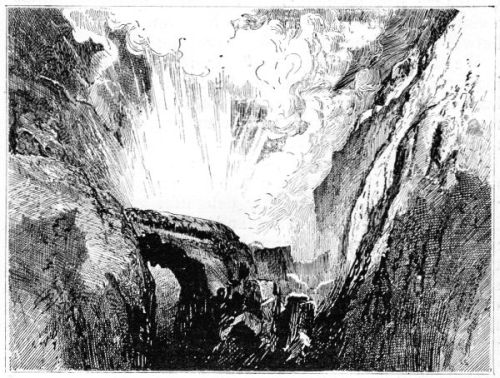
Tuhuatahi Geyser, New Zealand.
Tuhuatahi, the most active geyser in the valley, we arrived
at next. Looking over into a fissure of the rock, we saw a
small quantity of boiling water; and, even as we looked,
we heard a distinct underground crashing. It was the first
warning. We retreated to a corner which we knew to be
safe, from the greenness of the vegetation. Another warning
louder than before followed after a minute's interval, and
was still more quickly succeeded by a third one.
It was the signal for the waters to begin heaving and
surging, boiling over the edge of the basin, and running
down the terrace on which we stood. It threw up a small
column, and then one higher and still higher, emitting
dense clouds of steam, in the midst of which we caught
glimpses of a silvery column, playing to a height of ten feet
above us. Detached drops were thrown up still higher,
shining out from against the black wall of rock which forms
a most striking background. We watched this boiling
column anxiously, feeling that at any moment a gust of
wind might scatter its contents over us; and then we looked
wistfully at the reducing force of the convulsion, and the
grumbling subsidence of the element within the crater, till
the gentle lapping of the water against the sides told us
there was peace within once more. Again and again we
waited to see the great Tuhuatahi come forth from his
cavernous depths, with always those same three warnings,
those three underground grumblings and mutterings. They
come quite regularly at intervals of seven minutes, and the
action of the geyser itself lasts about three minutes. All
around them were little embryo terraces, incrustated with
pale pink, saffron and green, fringed with silica crystals;
and the spongy rocks scattered about were coloured
to a dark red, brown, or a brilliant orange, from the
strong sulphur impregnating all that comes within its reach.
We crossed the boiling stream Te Wairakei (the same
which runs by the wharrie), at the bottom of this volcanic
valley. As we ascended we heard the continuous thud of
the "Donkey Engine," which has a pulsating throb reverberating
like the thud of a steam-engine working "in" the
hill underneath us. The origin of the "Donkey Engine"
has not yet been discovered.
From the other side of the valley we looked down into
the mouth of the "Great Wairakei." It has a curious triangular
crater of spongy masses of light brown sinter projecting
out from the rock. The apex of the triangle is
formed by a large incrusted rock, something in the shape
of an arm-chair. Great Wairakei was not very active to-day,
and we waited long before he gave any signs of life.
Then we wandered on to Little Wairakei, a blue lake
concealed in a quiet corner behind manuka bushes; but
this pale blue water is of a dangerous nature, being 210°
Fahrenheit. Below were the mud volcanoes—several
patches of creamy-looking mud. At every instant they
bubbled up in little cones, bobbing up and down in the
most comical fashion. Then there was the pool called
the Coffee Pot, which literally boiled over every few
minutes.
After this we had a terribly rough scramble of half an hour,
through tall ti-trees, clinging to the branches down steep
banks where the earth was quite hot. We had to pick our
way across a boiling pool on loose stones, and climb over
sinter rocks, whose crinkled edges cut mercilessly at hands
and feet unless care was used, and then we found ourselves
standing on a ledge literally surrounded by active geysers.
Not one minute passed, after we had walked over the three
blow-holes in the rock called "the Prince of Wales'
Feathers," than they were playing away brightly in a
tripled feathery spray. I sat down on a projecting stone,
and feeling myself being scorched underneath, discovered
I was sitting over a steam hole! As I got up Nga Ma-hanga,
or The Twins, began to play vigorously. They
have a large pear-shaped basin of sinter, divided into two
portions, and resemble a huge Turkey sponge in their
creamy perforated substance. They are surrounded by
masses of white and orange silica, and explode in violent
outbursts at intervals of four or five minutes. No
sooner had they finished, than "The Whistler" began to
be active and throw up from a black cavernous mouth,
accompanied by a small water-spout, which acts simultaneously
with "the Whistler," at intervals of ten minutes.
We watched to see "the Boilers" perform. These from a
rock-bound pool covered with green shiny algæ, partially
separated by a narrow chasm, send up spasmodically a
column of water from six to eight feet in height.
And then we began to feel that if we waited there any
longer, with these geysers playing alternately around us, the
ground might open beneath our feet, and ourselves be engulphed
in a fiery furnace and pit of hell, so we scrambled
away.
Afterwards we had a long hunt for the "Eagle's Nest,"
which is one of the most beautiful geysers in the valley. Wandering
among the manuka, clinging to rocks, to support us
over the crumbling surface, we found it at last hidden away
amongst the trees. The nest is formed of long sticks that
have fallen crossways over the cone of the geyser, and
become gradually frosted, from the deposit of silica left
by the action of the feathery spray playing from the same.
It is so beautifully and delicately made, one can hardly
believe it has been formed by an accident in nature.
We had to cross Te Wairakei to reach the opposite side
of the valley to return home. In doing so we came to a
quiet pool, where the hot stream opens out into a small
lake. Here we sat down to rest on a large red clay rock.
"Rap, tap!" came from inside the rock, and we all
jumped up. The rock was distinctly shaken, the ground
under our feet reverberated slightly, and the echo extended
to the neighbouring rocks. It was the wonderful "Steam
Hammer." The thud of this titanic forge has been going
on for centuries, and will continue for many more; yet the
secret must ever remain a mystery. Should any one dare
to unravel the mystery or tamper with the inside mechanism
it will doubtless stop for ever. The theory at present
started about the Steam Hammer is, that the sharp tap
is caused by water rushing through some small aperture in
the rock; but it is a very crude one, and when Wairakei
becomes better known other more possible solutions will be
propounded. At times the hammer is louder or softer, but
we could hear it distinctly as we climbed up the valley on
the other side, and with a favourable wind and clear atmosphere
it can be heard on some days a mile off.
After luncheon the "faithful Molly" was brought round
again, and the gentlemen mounted three rough-coated horses.
Half-an-hour's riding, going up and down small precipices
while crossing some gullies, and a canter through the
bracken, brought us to the Huka Falls.
The Waikato here is a beautiful broad river, flowing
swiftly between low banks 120 feet apart. It suddenly
runs into a narrow rocky channel only thirty feet wide.
Imagine this enormous volume of water compressed and
fighting through the deep trough; the fierce struggle at
the entrance, the long green slide of the waters in their
gradual descent, the angry, turbulent rapids where the
channel becomes still narrower, and, at the last, the sudden
shoot over of the mighty waters, between two large rocks.
We lay face downwards, hanging over the precipice, to
look down on the Fall. The waters, as they fell over, took
the shape of a mill wheel; it seemed as if there must be
one underneath churning them into a foaming circle. Just
at the edge they became that intense sea-green colour seen
only to perfection at Niagara.
From the point where we were standing, we commanded
all the changes of the hues; from their muddy colour in
the river, to their pale green in the narrow ravine; from
the mass of flake-like foam in the fall, to the dark blue of
the pool into which they tumble. And here, as the river
widens out, they eddy and swirl in a passionate turmoil,
and are far on their course before they settle down to their
even natural flow.
The Huka Falls have no great height, but it is the
immensity of the volume of water which constitutes their
greatest charm.
The story is told of sixteen natives of a strange tribe who
came to visit the Huka Falls, and boasted that they could
go down them in a canoe. The natives of Taupo dared
them to try, and they embarked. One changed his mind
at the last minute, and escaped by jumping out on to the
rocks, but the others went over the fall, and were never
seen again. Many years afterwards some fragments of the
canoe were found jammed between the rocks; but not one
of the bodies ever rose to the surface, sucked under by the
current of the whirlpool.
Mr. Kerry Nicholls has recently tried to penetrate under
the Huka Falls from both sides. He has conclusively
proved that it is impossible to pass through, but he found
a small ledge in the rock under the falls, on which you can
stand with safety.
There is a cave lined with maidenhair and other ferns,
difficult of access, and which was only discovered a few
days ago. Mr. Graham had not yet been in it, and he
christened it that afternoon after me, the "Ethel Cave."
We rode up to a high knoll, whilst the boy who had
come in charge of the horses was told to light the bracken
below, so that we had a splendid view of a clearing fire,
the flames shooting up to an enormous height in forked
tongues, and some raupo burning with a loud crackling.
The wind was blowing our way, bearing us bits of blackened
furze, and we retreated before the stifling clouds of smoke.
Then we went on to the Venus Bath, a warm pool of pleasant
temperature. Looking through the clear depths, we
saw the bottom, enamelled with beautiful green moss, and it
is called the Venus Bath from its wonderful beautifying properties,
which removes all freckles and blotches from the skin.
We tested it, and it is quite certain that the hands we held
in the water became much whiter. Mr. Graham and Mr.
Davidson rode to a mile and a half further away, to see
"Okurawai," the coloured springs—a collection of hot
springs in pools that look like pots of red, pink, orange,
and yellow paint, but C. and I turned homewards, the
clouds and mountains foretelling rain.
There is no doubt that by nature Wairakei is intended as a
great health and pleasure resort for "all nations," and that,
properly developed, it will become the most valuable of
properties. Mr. Graham also possesses the watering place
of Waiwera, that lies to the north of Auckland, and on the
shores of the Hauraki Gulf, and the Lake House, with some
of the hot springs at Ohinemutu. If these three were
worked together by one company, there would be a splendid
future for them all. In Australia they have no summer
resort, with the exception of Hobart in Tasmania; and
round trips to the Hot Lake districts, organized from
Melbourne and Sydney, would bring hundreds of tourists
every year. As it is, with the numerous drawbacks of bad
roads, indifferent coach service, and rough accommodation,
they come in yearly increasing numbers. Properly known
and advertised, and with the direct mail service that
is now established between New Zealand and England,
many would visit the Hot Lake district, escaping the
rigour of the winter at home. They would come out to
enjoy the glory of the New Zealand summer when the
climate is perfection. At that time of the year all the baths
and waters in Europe are closed, and Wairakei and
Ohinemutu ought to become, in time, the winter Ems
or Spa. The long sea voyage of fifty days or so would be no
drawback to many invalids. At present Wairakei is almost
unknown. I am only the second lady from England
who has been there, and it is very little visited by the
colonists.
Miss Gordon Cumming's prophecy that "this district will
be a vast sanatorium, to which sufferers from all manner of
diseases will be sent to Nature's own dispensary to find the
healing waters suited to their need," will now at some no
distant date become true.
When you think that the waters at Ohinemutu and
Wairakei are so strongly mineral and medicinal that they
can be said to be an infallible cure, with sufficient patience,
for rheumatism and all cutaneous diseases, how can they
help becoming the great world-curing establishment? Think
of the fortune that alone could be made from the bottling
and exportation throughout the world of the water of the
"Venus bath," a sure cure for blotches and freckles, or of
that of "Kiriokinekai," the Maori for new skin, another
of the hot streams at Wairakei, which has a wonderful effect
in restoring the growth of the hair on bald heads!
C. was very much interested, in a conversation with Cullen,
to find out that he had accompanied the Imperial Russian
Survey of officers, as an engineer, in an expedition towards
the Indian frontier. He affirms that there is no obstacle
whatever to the advancement of an army from Merv to
Herat; clearly showing that the difficulty of Russian
aggression on India does not lie in natural barriers, as has
been alleged.
Wednesday, October 1st.—We left Wairakei in the afternoon,
to drive ten miles to Taupo. The rain came on and
prevented our turning off the road, by an orchard which
although but just planted is already blossoming, so great
is the fertility of the soil, to see Pirorirori or the Blue
Lake, a sheet of blue water lying amongst the white clay
cliffs.
From a great distance we saw the steam of the great and
awful "Karapiti" rising up on the flat plain, with the
uncertain action of these volcanic blow-holes. We arrived
early in Taupo, being anxious to secure the best seats in
the mail coach for to-morrow's drive.
Taupo lies on the shore of the lake, and consists of the
Telegraph station, the Lake House (the hotel), one general
store, and the neat white buildings, surrounded by an
earthen outwork of the Armed Constabulary Force. There
are about fifteen of these "A. C." stationed here. They
were formerly established in defence against the natives,
and are now employed as police and in mending or making
the roads. Those we have been travelling over are mostly
made by the A. C., aided by contracts with Maori
labourers.
On this afternoon "the" store was closed, the proprietor
enjoying the weekly event of the arrival of the newspaper
by the mail.
Whilst C. went to see the chief of the A. C., Major
Scanlan, I wandered along the shore of Lake Taupo, with
"Mac," picking up pieces of pumice stone of beautifully
fine texture and light weight. Their colours were lovely
salmon pink, ochre, pale green, or a silvery pearly grey.
We shall be leaving the King Country to-morrow, and I
must here say a few words about the Maoris. There are
altogether some 15,000 in the North Island, while in the
South Island they only number 2000. The large tracts of
bare pumice country which we have been passing through
all belong to the Maoris. The land is utterly useless to
them, as they attempt no kind of cultivation. As a race,
the men have a fine physique; and although naturally lazy,
they are capable of vigorous exertions, as was seen during the
years of the war. The women are treated as slaves, and
are, as a rule, small and ill-developed. All agree in saying
that the Maoris are a gentle, harmless people, with few
vices, but contact with the white man deteriorates them,
and they become cunning and untruthful. The fusion of
the Maori race with the whites is impossible. The half-castes
are said never to live beyond the age of forty. The
Maoris are dying out, particularly in the South Island,
where contact with civilization induces them to adopt
European habits and dress, and the latter is the cause of the
consumption which carries off a large proportion of them.
Their land is being gradually bought up by the government
or by settlers, and the introduction of this system has been
most baneful to them, inducing them to depend on the
sale of their land, instead of their labour, for subsistence.
They seem to have little idea of religion, and that is, in
its crudest form, mixed up with mythology and legendary
heroes, handed down from generation to generation. Nor
have they any particular reverence for the Tohunga or
priest. They believe in immortality. "The road to their
heaven is through Reinga, a cave in a cliff at the North
Cape of the island, whence they think that the departed
spirits pass to the realms above, using the roots of the
Pohutukawa-tree as a ladder." They make the "tangi,"
or funeral, the occasion of a great feast. The mourners
are wreathed with fern and lycopodium, and cry and wail
for many hours, after which they begin on the enormous
feast which has been prepared.
A tangi lasts for three days, during which all the kouru
and riwai (potatoes) and poaka (pigs) collected in the
neighbourhood are consumed, leaving them very short of
provisions for some weeks afterwards.
Many of the natives acknowledge the Queen as their
sovereign in preference to their own "King," who is only
followed by certain tribes. They have a great reverence
for the "paheka" (European), and English is taught in
most of the Maori schools.
The tattooing common to all is done in imitation of
the scales of a fish. The origin of the curious mythological
sign of the three fingers which is found on all the carved
wooden images in the temples is unknown. A vague theory
exists which is as follows: These wooden figures, which
generally have a smaller one inserted underneath, are supposed
to represent an ancestor. At any time the chief
might come and say it was "tapu" (belonged to him, or
sacred), but the three fingers were a deformity; and nothing
can be "tapu" that is deformed. The Maori language
is sweet and soft-sounding. The alphabet consists of
only fourteen letters. The consonants being G, H, K, M,
N, P, R, T, and W; and the vowels are the same as ours.
A characteristic feature of the language is their fondness
for the double repetition of the syllable in words, such as,
Ruru, an owl; Titi, the mutton bird; Wiwi, a swamp rush;
and Toetoe, grass.
All Maori names are chosen on the sensible plan of
describing the object they name, such as Rotomahana,
the hot lake; the Huka Falls, snowy foam; Kiriokinekai, new
skin, &c. Wai means water, and so Waiwera (the watering-place
near Auckland) means hot water; Wairoa, long
water; Waikato, drawn-out water, on account of the length
of the river; Waitangi, weeping water; and Wairakei, water
in motion, on account of the volcanic action about there.
Thursday, October 3rd.—We left Taupo in the coach at
six the next morning, driving for some miles along the shore
of the lake. To our right we saw the high, conical peak of
Tongariro, from whose crater for ever issues a black cloud
of smoke, and a little further on the mountain of Tauhara,
the "Lone Lover" of the Maoris, and Mount Ruahepu. The
whole range of mountains were covered with the purest snow,
and so veiled in clouds, that the summits often peeped out
from above or mingled with the low-lying clouds.
All through the morning we were driving through an
intensely dreary stretch of pumice country, and on whichever
side you looked there was nothing but the coarse, yellow
grass tufted with raupo; nothing but wide expanses of Wiwi,
or mata or toetoe grass, mingled with clumps of Phormium
tenax, the flax-plant of New Zealand. This plant has a
broad sword-like rush, and flowers either a dark red or pale
yellow. It grows in swamps on marshy places to a height
of from four to eight feet. The fibre is used for rope, but
unfortunately it rots with damp; and experiments prove that
it is only reliable when mixed with other fibres.
Every now and again we came upon a little stream
forming a green strip amid the yellow desert by the hanea or
watercress growing along its banks, but the dreariness of
those endless miles of pumice country, only limited in their
vastness by low mountain ranges, I shall never forget. The
only object of interest was to watch and trace the windings
of our road away among the yellow tufts.
The coach was miserably horsed. Two speckled horses,
with a pony and a mule for the leaders, formed a very
weedy team. At the first hill we came to they began jibbing,
not from vice, but from sheer inability to drag the coach,
with its heavy load of eight passengers, up the hill; and
these were the horses that were to take us fifty miles before
the day was over! We were terribly packed both inside and
out, and were all glad to walk as much as possible. The
coach was of a very ancient date, and swung on leathern
straps in place of springs. There were no doors or windows,
but old yellow leather curtains that rolled up. The
top of the roof in front was ornamented with three black
lanterns, resembling a Prince of Wales' feathers, that produced
a most hearse-like effect from a distance.
The poles of the telegraph wires kept us company, disappearing
occasionally to take some short cut. We saw no
"pale-face" dwelling all day, and only passed three or four
Maori settlements. It was pointed out to me how, for some
unknown reason, the door in the "wharrie" is always back
or front, and never at the side. At one of these settlements
we saw a cart, with a man on horseback, in charge
of the body of a dead chief, which was lying, wrapped in a
piece of sacking, at the bottom. He was taking it thirty
miles away, to be buried by the tribe of the deceased.
We had luncheon, stopping for an hour in the middle of
the pumice plain by a stream that watered the horses.
Late in the afternoon we found ourselves serpenting along
the edge of a magnificent gorge. It was so deep and
straightly precipitous that we could not see the stream, which
we heard brawling at the bottom of the ravine. We were
soon enjoying one of the downward rushes, so pleasant after
the weary crawling up-hill, with the coach groaning, and
creaking, and making but little progress. I think the team
enjoyed it as much as we did, for they galloped away, with
the coach at their heels, hardly slackening at the sharp
curves in the zigzag roads. It was pleasurable excitement
mingled with terror. We were getting impatient, and
anxious to arrive at our night's shelter, for the sun had set,
the air was growing chill around us, and the gorges darkening
into impenetrable gloom.
Over the hill we saw the lurid light of a fire, with tongues
of flame shooting up, and showing momentarily the darkened
patches left by its devastating work. Rounding the corner,
the beautiful vision of a golden zigzag of lines of flame met
us, swept by the wind in ever-varying brightness up and
down the hill-side.
The "only three miles more" of Griffith, the driver, were
becoming six as we found ourselves in the dark, and about
to ascend another long hill. The wheels locked at a
sudden sharp turn, and we all bundled out of the coach,
and then walked, taking short cuts up the winding road.
The moon came up, and we ended by sliding down a bank
of white sand, that glistened under the rays of the moon, on
to the road, and walking on until Griffith overtook us, just
in time to save his reputation and prevent our arriving on
foot at the inn at Tarawera.
We were to sleep in this beautiful valley, hemmed in by
mountains that would keep their watch over us through the
long night hours. How romantic and charming it sounded,
and what prosaic discomfort there was in the reality!
The inn consisted of one living room, where the village
smoked and drank. A ladder staircase led to a loft roughly
partitioned off into bedrooms, where every sound through
the whole length of the passage could be heard. Seven men,
with their colley dogs, driving sheep from Auckland to
Napier, arrived after us, and had to be accommodated, so
the gentlemen slept that night three in one room.
I am bound to say that these small inns are perfectly
clean, and that the fare, if homely, is substantial. There is
always a good joint of meat (and the beef in New Zealand
is the best I have ever eaten), with vegetables and bread
and cheese, or sometimes a more ambitious attempt in the
way of jam tartlets or rice pudding. But it seems quite
extraordinary that there should be no cows in villages where
there is such abundance of rich pasture, and that we should
find everywhere in use the "Anglo-Swiss Condensed," and
tinned butter.
The next morning we were on the road again by 6 a.m.,
and in the midst of the grand mountain scenery of the
previous night. It was one succession of toiling up mountains
for three hours, to rush down on them on the other
side in half an hour. In the course of the day we crossed
no less than two distinct ranges—the Hukiuni, or Great
Head, and the Maunyaharuru, or Rumbling Mountains. It
was weary work this crawling up the side of these, each
zigzag bringing us so many feet higher up, to lose again by
the descent what we had but just so painfully gained.
One scene among many others impressed itself vividly on
my mind that day. It was soon after we started, when we
had climbed some height above Tarawera, that I looked
back to a low range of pine-covered hills leading up to some
rocky mountain tops. Immediately beneath there was a
green common, with some white specks, that was the village
of Tarawera. Some bare, stony headlands closed in this
first gorge. Then looking from the mountain, on to the
sides of which the coach was hanging, down the precipice
below, the eye on the opposite side followed upwards, upwards
from the dense, blue mist to the thick vegetation, and
beyond to the grey, stony patches of the highest peaks, shot
with a pinky grey.
A bit of bush, and flying down hill for eight miles, brought
us on to the side of another mountain. We saw nothing
from here but a sea of grey peaks stretching for miles, their
outline marked by the deep shadows in their cleft and
pointed sides.
Another three hours amid very bare mountain scenery,
and the country opened out. We were shown the
narrow fertile valley leading to the sea, while some white
dots were pointed out as the houses of Napier. Very far
away they looked, some thirty miles from where we were.
We had luncheon at Griffith's "Stables," in a one-roomed
hut, that was entirely papered with pictures from the
Illustrated and the Graphic. It formed a most interesting
and thrilling wall-paper, choosing, as had been done, all the
most telling national events of the years '81 to '83.
We passed the afternoon in fording a swift stream, called
the Esk, crossing it from one bank to another no less than
forty-five times in two hours. Then we hailed with delight the
green, verdant pasture-lands, the thriving stock, and comfortable
farm-houses, with their rows of willow-trees, that lay
scattered through the valley; glad to see these homelike
signs of cultivation after the wild, desolate scenes of the last
seven days.
Six miles of galloping over a pretty beach road on a
tongue of land, formed by the broad basin of Hawke's Bay
on the one hand, and an arm of inland sea on the other,
brought us to the V-shaped wooden bridge. This bridge of
three-quarters of a mile, bridges over the gap formed by the
sea running round the promontory on which Napier stands.
We drove along the marshy bit of plain looking up at the
white houses of the town above, and the horses had a long
climb before pulling up at the "Criterion Hotel."
We were very, very tired after the week's coaching, but at
the same time we enjoyed the feeling of satisfaction that we
had accomplished a most successful expedition to the Hot
Lakes, and had seen the greater part of the North Island by
coaching 250 miles through it.
I sat down to dinner this evening, the only lady amongst
some twenty men, come in from the town. It could not be
helped, as there were no private sitting-rooms. Before we
left England we had been told how rough we should
find the hotels in New Zealand. Not only is there
this difficulty about a private room, but the bar at
all the hotels is placed at the entrance, so that on
arriving you often think you have come to a public-house.
The best of them are not better than our "commercial
hotel" in England, and they will remain so until a greater
influx of travellers calls for better accommodation. Much
the same complaint may be made about the means of
travelling in New Zealand, especially in the North Island.
There are very few railways at present, and communication
is maintained by coasting steamers and coaches at the rate
of fifty miles per day. No through connection between
these means, or choice of evils, is attempted.
Saturday, October 4th.—A lovely morning for a drive
about the town. Napier is such a pretty place, with no level
spot within the township; it is all up and down hill, with
houses and gardens perched on the high ground. Placed
on the promontory there is a view of the sea from all sides,
and from one a glimpse of the distant range of low mountains,
with Hawke's Bay and the harbour below. The white
surf is for ever rolling heavily in along the beach road. On
the low, marshy plain, which is being gradually reclaimed
from the sea, lie the villages of Clive, Hastings, and
Havelock, showing by their names the date of their foundation.
The roads are hard and good, but made of limestone,
and the glare and dazzling whiteness obliges many to wear
blue spectacles. We drove about to see the view from all
sides, and then home through the town, stopping at a shop
to see some of the native woods when manufactured into
furniture. There are so many different kinds of woods,
some light and some dark, that a great variety in patterns
can be obtained; but the mottled wood of the kauri pine is
the prettiest, and it is curious to think that this wood is only
mottled when diseased.
There was a repetition of "the ordinary" at the hotel at
1 p.m., clerks and business men coming in from the town,
and directly afterwards we drove down to the wharf and
embarked on the tender, that was to take us on board the
Union Steamship Company's steamer Tarawera. The
tender bobbed up and down, and shipped water freely. It
was most alarming to see the huge billows bearing down on
us, and it seemed as if we must be swamped by the surf,
when going over the bar of the harbour. But when we came
alongside the Tarawera, the proceedings to be gone through
there were far worse. A gangway was lowered, but the
swell carried the tender hither and thither. At one moment
the plank touched the deck, and the next would be swinging
far above us. The difficulty was for the passenger to
hit the exact moment at which to rush on to the gangway,
and then to cling on and struggle up it whilst left hanging
in mid-air. It was a very laughable affair for those looking
over the bulwarks, but not so for us in the tender, and
there was a good deal of difficulty as to who would venture
first.
The Tarawera, like all the Company's ships, is beautifully
fitted with inlaid panels, stained glass skylights, and plush
cushions. The social hall is a gallery with seats running
round the saloon, containing an organ and piano at either
end; but the cabins and saloon are aft, and the proximity
of the screw terrible. The Union Steamship Company
have a monopoly of the New Zealand ports, and own a
large fleet of fair-sized steamers, all called by Maori names.
We were coasting along the North Island during the night.
By ten o'clock the next morning we were alongside the
wharf at Wellington, and drove to rooms at the "Empire
Hotel," previously engaged for us. The outside was dingy
and uninviting, and the inside not less so, though the
people were most civil and anxious to please.
Mr. Tolhurst, the manager of the Bank of New Zealand,
immediately called for us, and proposed taking us to the
Cathedral Church for morning service, and afterwards to his
house for luncheon.
Sunday is a particularly unfortunate day to arrive anywhere
in the colonies, as it is a blank day as regards
domestic service; our luggage, too, which had come from
Auckland in the Southern Cross, was not obtainable. Sir
William Drummond Jervois, the Governor, came and called
during the afternoon, and very kindly insisted upon our
removing the following day to Government House.
Monday, October 6th.—We were greeted by a typical
Wellington day; a blowing and blustering wind raising
clouds of dust in the streets. Wellington lies on a strip of
land between the hills, which rise immediately behind the
town, and the sea. For some reason it seems to be a funnel
or trap-hole for the wind to blow through on all sides, and
they say you can always "tell a Wellington man anywhere,
by the way in which he clutches at his hat round the street
corners." All the buildings and houses are of wood, on
account of the frequent shocks of earthquake which visited
Wellington at one time. Old inhabitants declare that they
remember the time when the earthquakes were of weekly
occurrence; and in the earlier days of the settlement they
thought seriously of removing it elsewhere. The town has
a busy, prosperous look in the principal street, called
Lambton Quay, except on Saturday afternoon, when Wellington
has a curiously deserted appearance, and every one
goes out into the country.
Standing a little above the town are the cluster of
Government buildings. The Government offices form the
largest wooden building in the world, with the exception
of the Sublime Porte at Stamboul. The Houses
of Parliament are a Gothic structure, and Government
House, with the garden, lies between. This is a large,
comfortable house, surmounted by a wooden tower and
flagstaff; and when inside it is almost impossible to
believe that the large, lofty rooms, broad corridors, ball-room,
and handsome staircase, belong to a wooden
tenement.
We drove up there in the course of the afternoon, and
Lady Jervois and Miss Jervois received us most kindly.
We were introduced to the staff, who consisted of
Mr. Pennefather, the private secretary, and Major Eccles,
the aide-de-camp.
After dinner the governor went to a meeting for founding
a Society for Prevention of Cruelty to Animals. C. went
with him, and made a short speech, being on the council
of the Society in London.
Later, we all went to a masonic ball; the grandmaster of
the lodge and other masons, in their full insignia, receiving
the Governor at the entrance, when we formed into procession
to enter the ball-room, under the arch of intertwined
masonic wands. C. met the past deputy-grandmaster, who
had been entertained at the lodge of which he was master
the year before last in London—so small is the world.
Tuesday, October 7th.—A tremendous storm and peal of
thunder woke me at 6 a.m. Rain, storm, and wind seem
to be more excessive in their quantities in New Zealand
than in England.
We went to see Dr. Buller's very perfect collection of
Maori curiosities, at his house on the Terrace; it is one of
the finest extant. Portraits of Maori chiefs are hung round
the room; there were feather mantles and native mats, the
orange-painted staff of a chieftain, fringed with the white
hair of the native dog, the sharp instrument used for tatooing,
and some very beautiful greenstone meri meris.
This meri is formed of a piece of greenstone about a foot
long, and fined down and broadened out to a flat, thin
edge. The merit meri is used by the chiefs to split open the
skull of a rebellious subject.
At Mr. Köhn's we found another collection of Maori South
Sea curiosities. He is a German, and possesses within the
recesses of his back premises on Lambton Quay some very
wonderful South Sea curios, brought to him by German men-of-war.
He has already sold one collection for 500l., and has
sent some curiosities home to the museum at Berlin, against
the authorities of which he has a righteous grievance, in
that they were never even acknowledged! We saw battle-axes
with red and yellow handles, spears, bows, and arrows
barbed with poison from decomposed bodies, strings of
white and black beads for money, war masks formed of
skulls, made hideous with splashes of paint, and held inside
the mouth by an iron bar, shells, and cocoa-nut matting,
with fringes of the same worn round the waist, and considered
"full dress" by the ladies of the South Sea Islands. But
the most interesting thing of all was a rough coffin, covered
with a strip of parchment, containing the burnt figure of a
South Sea Islander. The skull had the most peculiar pointed
formation, and was exactly an inch in thickness at the back
of the head. The body had been stuffed and burnt, till the
skin was black and hard as brick. On the face there was a
ghastly grin. Another day we went to see the Museum,
which Dr. Hector has been mainly instrumental in starting.
The total absence of mammalia forms a remarkable feature
of New Zealand, the only indigenous animals found being
a bat and a small rat. There is a fine collection of native
birds. Amongst them the kea, or green field parrot.
This bird was formerly a vegetarian, but it now kills and
eats sheep. Sitting on the back of the animal, it picks with
his long beak till it pierces and reaches the kidney fat,
which it eats, thus killing the sheep.
The members of both Houses of Parliament are at
Wellington, the session being in progress. The flutter of
excitement consequent on three changes of ministry during
the last month is just subsiding. C. met and has had much
conversation with Mr. Stout, the present premier, Sir Julius
Vogel, the late premier, and present colonial treasurer, Sir
George Grey, and all the other ministers and prominent
political men of New Zealand. One day he was present at
an interview between the Governor and the two Maori representatives
in the House, who sought his advice as to whether
they should go to England, and endeavour to obtain the
Queen's assent to the abolition of the native court, and the
principle of dealing with the native laws. His Excellency
showed them in the clearest way that the Maoris of New
Zealand had more than equal rights of making and altering
laws, appointing and deposing governments, by their parliamentary
representatives, and that the Home Government
left the administration of New Zealand entirely in the hands
of the inhabitants, including the Maoris, on equal terms.
Wellington does not possess so good a newspaper as some
of the other places. Each town and province in New Zealand
has its own local paper. This is necessitated by the
distance, want of centralization, and means of communication;
for instance, it takes seven days by steamer from
Auckland to Wellington. These papers are all pretty much
alike from Auckland to Invercargill. They have the same
cablegrams and English news, and the same parliamentary
and general intelligence; they only differ in local paragraphs.
We thought the best daily papers were the New Zealand
Herald of Auckland and the Lyttleton Times of Christchurch;
and the best weekly paper the Canterbury Times,
which is like our Queen and Field compiled into one.
Thursday, October 9th.—There was a ball at Government
House in the evening, preceded by a large parliamentary
dinner. About 300 invitations had been issued, and the
guests were asked from 8.30 to 12 o'clock. Long before the
hour named carriages were driving up, but this was accounted
for by the scarcity of flys, each having to do duty for many
families that night. The married women dance as vigorously
as the girls, and it must be a pleasure giving a dance where
all seem to enjoy it so thoroughly.
Monday, October 13th.—We said good-bye to the Governor
and Lady Jervois, and left Government House with much
regret, after a very pleasant visit of a week. The Hon.
Robert Stout, Premier, the Hon. E. Richardson, Minister
of Public Works, Mr. Ross, Mr. Wakefield, and other
members of the House of Representatives were waiting on
the wharf to wish us good-bye, and see us on board the
Waihora.
Anchor was weighed at 3 p.m., and we steamed out of the
deep, natural harbour, in which Wellington lies, through the
narrow channel at its entrance into Cook's Strait. We were
soon driven below by the cold wind, and passed a wretched
night, sleepless and very ill, with groans from C. in the
berth above, and sighs from me in the one below. We rose
and dressed wearily the next morning, and waited about in
the "social-hall," with cold blasts coming down through
the open skylights, till the train at Lyttleton was ready,
when we walked across to the station. Snow had fallen
during the night, and the hills were plentifully besprinkled
with white, and it was the wind blowing off them which had
brought us such bitter cold. Lyttleton is the port for
Christchurch, and half an hour in the train, passing through
a long tunnel, brought us thither.