Dark as the night was, the moon being so thickly obscured by clouds
that she never showed her face except through a flying film of vapor,
Claire seemed to detect something alarming in Bram’s attitude,
something which caused her to pause as she was running up the hill
towards him.
At last she stopped altogether, and they stood looking each at the
figure of the other, motionless, and without speaking.
As for Bram, he felt that if he tried to utter a single word he should
choke. He could not understand or analyze his own feeling; he did
not well know whether his faith in her innocence and purity remained
intact. All he knew, all he felt, as he looked at the little creature
who seemed so pitifully small and slight as she stood alone on the
hillside, wrapt tightly in a long cloak, but shivering in the night
air, was that his whole heart was sore for her, that he ached for pity
and distress, that he did not know what he should say, what he could
do, to comfort and console her.
At last she seemed to take courage, and came a few steps nearer.
“Mr. Elshaw!”
“Yes, Miss Claire.”
She started, and no wonder. For his voice was as much changed as were
the sentiments he felt for her.
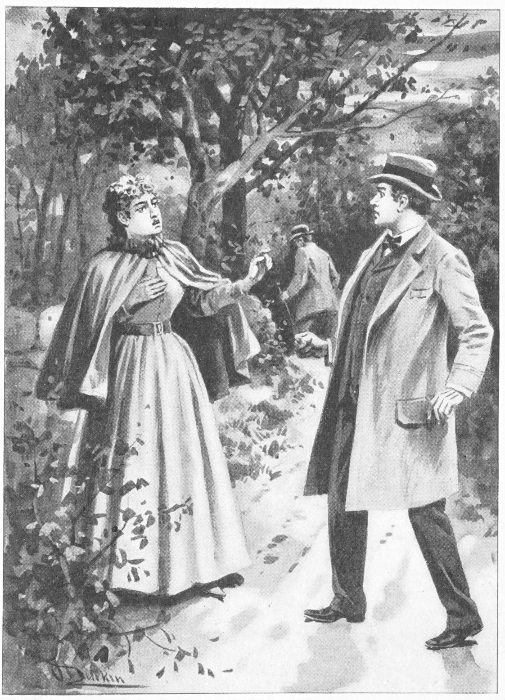
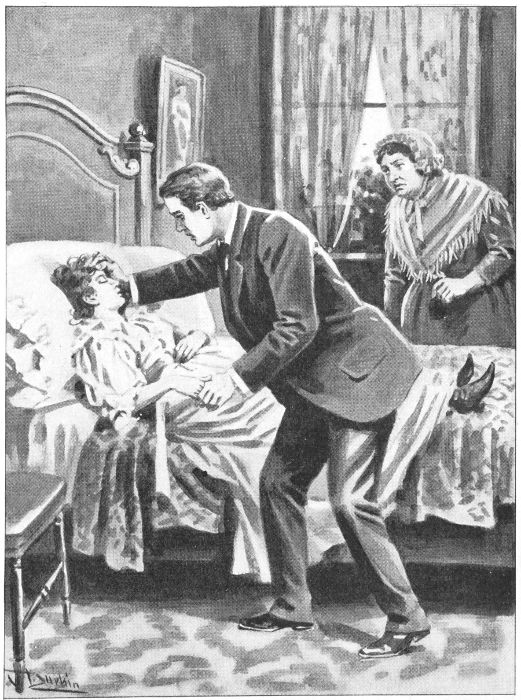
An exclamation escaped his lips. She ran panting towards
him.—Page 86.
She came a little nearer still, with hesitating feet, before she spoke
again.
“Was that—wasn’t that my cousin, Christian Cornthwaite, who went away
when he saw me?”
It was Bram’s turn to start. So that was the reason of the sudden
flight of Chris! He had seen and recognized the figure of Claire as she
came up the hill behind Bram.
“Yes, Miss Claire.”
Another pause. She was near enough now to peer up into his face with
some chance of discerning the expression he wore. It was one of
anxiety, of tenderness. She drew back a little.
“I—I heard him call—I heard a voice call out ‘Hallo!’” she explained,
“and I jumped up, and looked out of the window, and I saw you, and I
saw my cousin following you. And you would not answer him. But he still
went on. And—and I was frightened; I thought something dreadful had
happened, that you had quarrelled; so I got up and came up after you.
And I saw——”
She stopped. Bram said nothing. But he turned his head away, unable
to look at her. Her voice, now that she spoke under the influence of
some strong emotion, played upon his heartstrings like the wind upon an
Æolian harp. He made a movement as if to bid her go on with her story.
“I saw,” she added in a lower voice, “I saw you spring upon him as if
you were going to knock him down. You had been quarrelling. I’m sure
you had. And I was frightened. I screamed out, but you didn’t hear me,
either of you; you were too full of what you were saying to each other.
And it was about me; I know it was about me. Now, wasn’t it?”
Bram was astonished.
“What makes you think that, Miss Claire? Did you hear anything?”
“Ah!” cried she quickly. “That’s a confession. It was about me you were
quarreling. Can’t you tell me all about it at once?”
But Bram did not dare. He moved restlessly from the one foot to the
other, and suddenly said—
“You’re cold; you’re shivering. You’ll catch an awful chill if you
stay up here. Just go down back to the farm, Miss Claire, like a good
girl”—and unconsciously his tone assumed the caressing accents one
uses to a favorite child—“and you shall hear all you want to know in
the morning.”
But she stood her ground, making an impatient movement with one foot.
“No, Bram, you must tell me now. What was it all about?”
He hesitated. Even if he were able to put her off now, which seemed
unlikely, she must hear the truth some day. It was only selfishness,
the horror of himself giving her pain, which urged him to be reticent
now. So he said to himself, doggedly preparing for his avowal. His
anger against the Cornthwaites, his fear of hurting her, combined to
make his tone sullen and almost fierce as he answered—
“Well, Miss Claire, I was angry wi’ him because I thought he hadn’t
behaved as he ought.”
There was a pause. It seemed to Bram that she guessed, with feminine
quickness, what was coming. She spoke, after another of the short
pauses with which their conversation was broken up, in a very low and
studiously-restrained tone—
“How? To whom, Bram?”
“To—to you, Miss Claire,” answered Bram with blunt desperation.
Another silence.
“Why, what has he done to me?” asked she at last.
“He has gone and got engaged—to be married—to somebody else; that’s
what he’s done, there!”
Bram was fiercer than ever.
“Well, and what of that?”
He could not see her face, and her tone was one of careless bravado.
But Bram was not deceived. He clenched his fists till the nails went
deep into his flesh. It cut him in the heart to have to tell her this
news, to feel what she must be suffering. He answered as quietly as he
could.
“Nothing, but that I think he ought—he ought——”
“You think he ought to have told me. Oh, I guessed, I guessed what was
going to happen,” replied Claire rapidly in an off-hand tone. “I should
have heard it from himself to-morrow. Who—who is it?”
“A Miss Hibbs.”
“Oh, yes, of course. I might have known.”
But her voice trembled, and Bram, turning quickly, saw that the tears
were running down her cheeks. She was angry at being thus caught, and
she dashed them away impatiently.
“D—— him!” roared Bram, clenching his fists and his teeth.
“Hush, Bram, hush! I’m surprised. I’m ashamed of you! And, besides,
what does it matter to you or to me either whom Mr. Cornthwaite
marries?”
“It does matter. He ought to have married you, and taken you away out
of the place, and away from the life you have to live with that old
rascal——”
Bram was beside himself; he did not know what he was saying. Claire
stopped him, but very gently, saying—
“Hush, Bram. He’s my father.”
“Well, I know that, but he’s a rascal all the same,” said Bram bluntly.
“And Mr. Christian knows it, and he had ought to be glad to have the
chance of taking you away, and making you happier. He’s behaved like a
fool, too, for the girl his father’s found for him will never get on
with him, never make him happy, like you would have done, Miss Claire.
He is just made a rod for his own back, and it serves him jolly well
right!”
Claire did not interrupt him; she was crying quietly, every tear she
let fall increasing Bram’s rage, and throwing fuel on the fire of his
indignation. Perhaps his anger soothed her a little, for it was in a
very subdued little voice that she presently said—
“Oh, Bram, I don’t think that! I do wish him to be happy! Indeed,
indeed I do. And if it wasn’t for one thing I should be very, very glad
he’s going to marry somebody else—very, very glad, really!”
Bram had come a little nearer to her; he spoke earnestly, tenderly,
with a voice that trembled.
“You’re fond of him?” said he, quickly, imperiously.
“Yes, I’m very fond of him. He’s my cousin, and he’s always been kind
to me. But I didn’t want to marry him. Oh, I didn’t want to marry him!”
Bram was astonished, incredulous. He spoke brusquely, almost harshly.
“He thought you did. He thought you cared for him. So did I, so did
everybody.”
“Yes. I know that. He’s so popular that people take it for granted one
must care for him. But I didn’t—in the way you mean.”
Bram was still dubious.
“Then, why,” said he suddenly, “do you take this so much to heart?”
Claire made a valiant attempt to dry her eyes and steady her voice.
“Because,” said she in a hesitating voice, “because of—of—because of
papa! He wanted me to marry him; he counted on it; and now—oh, dear, I
don’t know what he will do, what he will say. Well, it can’t be helped.
I must go back; I must go home. Good-bye; good-night!”
Before Bram could do more than babble out “Good-night, Miss Claire,”
she had flown like the wind down the hill towards the farm.
Bram went back to his lodging in a sort of delirium. Was it possible
that Claire had spoken the truth to him? That she really cared not
a straw for her cousin except in a cousinly way; that all she was
troubled about was her father’s displeasure at having missed such a
chance of a connection with the family of the long purse.
Bram understood very little about the nature of women. But he had, of
course, acquired the usual vague notions concerning the reticence, the
ruses of girls in love, and he could not help feeling that in Claire’s
denial there was matter for distrust. How, indeed, should she, this
little friendless girl who had no other lovers, fail to respond to
the affection of a man as attractive, both to men and women, as Chris
Cornthwaite? And did not the behavior of Chris himself confirm this
view? If Claire had not cared for him, why should he have received
Bram’s frowns, his angry reproaches, with something which was almost
meekness, if he had felt them to be absolutely undeserved? The more
he considered this, the more impossible it seemed that Claire’s
lame explanation of her tears, of her distress, could be the true
one. It seemed to Bram that Theo Biron, with his shrewdness and his
cunning, must have been the very person to feel most sure that Josiah
Cornthwaite would never allow the marriage of Chris with Claire.
Again, why, if she had not felt a most deep interest in Chris had
she taken such a bold step as to follow him up the hill that night?
Surely it must have been in the hope of speaking with him, perhaps of
reassuring herself from his own lips on the subject of the rumors of
his approaching marriage, which must have reached her? If, too, Chris
had had nothing to reproach himself with on her account, why had he
fled so quickly, so abruptly, at the first sight of her?
More and more gloomy grew Bram Elshaw’s thoughts as he approached the
cottage where he lodged, passed through the little bit of cramped
garden, and let himself in. Entering his little sitting-room, and
striking a light, he found a note addressed to himself lying on the
table. The writing of the envelope was unknown to him, and he opened
it with some curiosity. The letter was stamped with this heading—“The
Vicarage, East Grindley.”
“Grindley! East Grindley!” thought Bram to himself. “Why, that’s where
my father’s people came from!”
And he read the letter with some interest. It was this:
“Dear Sir,—I am sorry to inform you that Mr. Abraham Elshaw,
who is some relation of yours, though he hardly seems himself to
know in what degree, is very ill, and not expected to live many
days. He has desired me to write and ask you if you will make an
effort to come and see him without delay. I may tell you that I
understand Mr. Elshaw has heard of the rapid manner in which you
are getting on in the world; he has, in fact, often spoken of you
to us with much pride, and he is anxious to see you about the
disposal of the little property of which he is possessed. I need
not ask you under the circumstances to come with as little delay
as possible.—Yours very truly,
“Bernard G. Thorpe.
“P.S.—Mr Elshaw has been a member of my congregation for many
years, and he chose me rather than one of his own relations to
open communication with you. I should have preferred his choosing
one of them, but he refused, saying they were unknown to you, so
that I could not refuse to fulfil his wishes.”
Bram put down the letter with a rather grim smile. He had never seen
this namesake of his, but he had heard a good deal about him. An
eccentric old fellow, not a rich man by any means, he had saved a few
hundred pounds in trade of the smallest and most pettifogging kind,
on the strength of which he had given himself great airs for the last
quarter of a century among the pit hands and mill hands and grinders
who formed his family and acquaintance. A sturdy, stubborn, miserly
old man, of whose hard-fistedness and petty money-grabbing Bram had
heard many tales. But the family was proud of him, though it loved him
not. Bram remembered clearly how, when he was a very small child, his
father had gone out on a strike with his mates, and his poor mother, at
her wits’ end for a meal, had applied to the great Abraham for a small
loan, and how it had been curtly and contemptuously refused.
This was just the man, this hard-fisted, self-helping old saver of
halfpence, to bestow upon the successful and prosperous young relation
the money of which he would not have lent him a cent if he had been
starving. Bram told himself that he must go, of course: and he
resolved to do his best with the old man for those unknown relations
who might be more in want of the money than he himself was. For he was
shrewd enough to foresee that old Abraham’s intention was to make his
prosperous young relation heir to what little he possessed. He resolved
to ask next morning for a day off, and to go at once to East Grindley.
Bram got the required permission easily enough, and went on the very
next day to see his reputed wealthy namesake. East Grindley was a good
many miles north of Sheffield and it was late in the day before he
returned.
Throughout the whole of the day he had been haunted by thoughts of
Claire; and no sooner had he had his tea than he determined to go to
the farm, with the excuse of asking if she had caught cold the night
before.
He was in a fever of doubt, anxiety, and only half-acknowledged hope.
He had wished, honestly wished, when he believed Claire to be as
fond of Chris as Chris was of her, that the cousins should marry,
that little Claire should be taken right out of her troubles and her
difficulties, and set down in a palace of peace and content, of luxury
and beauty, with the man of her heart. But if those words of Claire’s
uttered to him the night before were really true, might there not be a
chance that he might win her himself? That he might be the lucky man
who should build her a palace, and lift her from misery into happiness?
Bram knew that Claire liked him; knew that the distance between himself
and her, which had seemed immeasurable thirteen months before, had
diminished, and was every day diminishing. If, indeed she did not care,
had never cared for her cousin with the love Bram wanted, who had a
better chance with her than himself, whom she knew so well, and trusted
so completely?
Bram with all his humility, was proud in his own way, and exceedingly
jealous. If Claire had loved her cousin passionately, and had been
jilted by him, as Bram had believed to be the case, he did not feel
that he should even have wished to take the vacant place in her heart.
No doubt the wish would have come in time, but not at once. If,
however, it were true that she had not cared for Chris in the only way
of which Bram would have been jealous, why, then, indeed, there was
hope of the most brilliant kind.
Bram, on his way to the farm, began to see in his heart such visions as
love only can build and paint, love, too, that has not taken the edge
off itself, frittered itself away, on the innumerable flirtations with
which his daily companions at the office beguiled the dead monotony of
existence.
In his new life, as in his old, it was Bram’s lot to be “chaffed” daily
on his unimpressionability, on the stolid, matter-of-fact way in which
he went about his daily work, “as if,” as the other clerks said, “his
eyes could see nothing better in the world than paper and ink, print
and figures.”
Bram on these occasions was accustomed to put on an air of extra
stolidity, and to shake his head, and declare that he had no time to
think of anything but his work. And all the time he wondered to himself
at the ease with which they could chatter of their affection for this
girl and that, and enjoy the jokes which were levelled at them, and
wear their heart upon their sleeve with ill-concealed delight.
And he smiled to himself at their mistake, and went on nourishing his
heart with its own chosen food in secret, with raptures that nobody
guessed.
And now the thought that his dreamy hopes might grow into realities
brought the color to his pale cheeks and new lustre to his steady gray
eyes, as he walked soberly down the hill, and entered the farmyard in
the yellow sunlight of the end of a fine day in September.
He knocked at the kitchen door, and nobody answered. He knocked more
loudly, fancying that he heard voices inside the house. But again
without result. So he opened the door, and peeped in. A small fire was
burning in the big grate, but there was nobody in the room. With the
door open, however, the voices he had faintly heard became louder, and
he became aware that an altercation was going on between Claire and
her father in the front part of the house.
He was on the point of retiring, therefore, with a sigh for the poor
little girl, when a cry, uttered by her in a wailing tone, reached his
ears, and acted upon his startled senses like flaming pitch on tow.
“Oh, papa, don’t, don’t hurt me!”
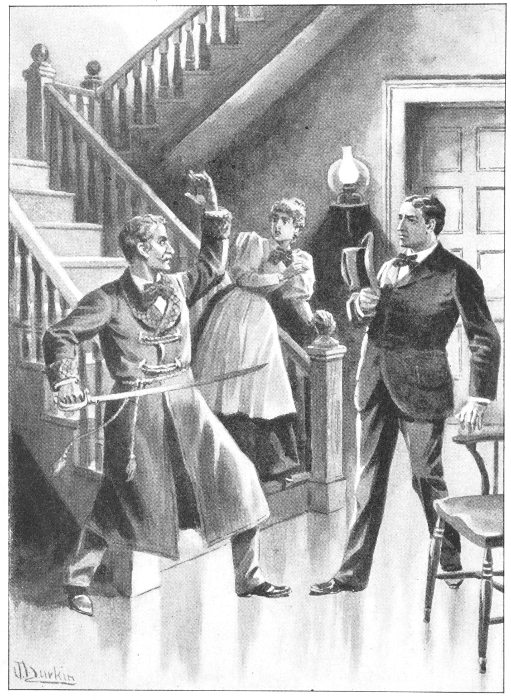
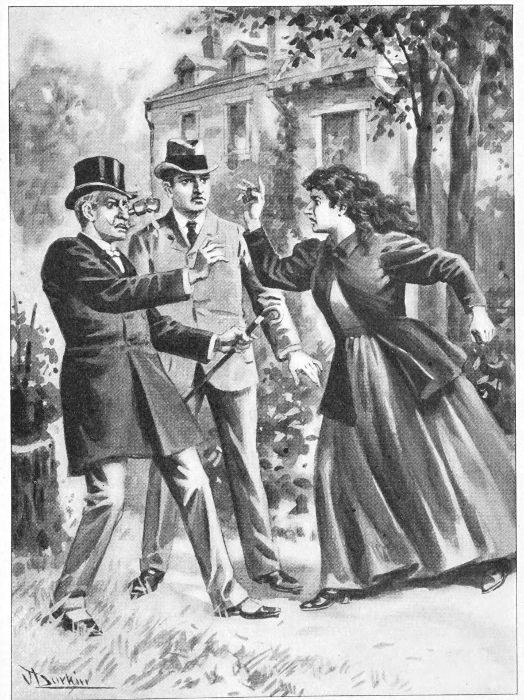
The next moment Bram had burst the opposite door open, and saw
Theodore, his little, mean face wrinkled up with malice, strike
Claire’s face sharply with his open hand. This was in the hall, outside
the dining-room door.
No sooner was the blow given than Bram seized Theodore, lifted him into
the air, and flung him down against the door of the dining-room with
such force that it burst open, and Mr. Biron lay sprawling just inside
the room.
Claire, her cheek still white from the blow, her eyes full of tears of
shame, rushed forward, ready to champion her father.
“Go away,” she said in a strangled, breathless voice. “Go away. How
dare you hurt my father? You have no right to come here. Go away.”
She tried to speak severely, harshly, but the tears were running
down her face; she was heart-broken, miserable, full of such deep
humiliation that she could scarcely meet his eyes. But Bram did not
heed her, did not hear her perhaps. He was himself trembling with
emotion, and his eyes shone with that liquid lustre, that yearning of
long-repressed passion, which no words can explain away, no eyewitness
can mistake.
He stretched out his hand, without a single word, and took both hers in
one strong clasp. And the moment she felt his touch her voice failed,
died away; she bent down her head, and burst into a fit of weeping more
passionate than ever.
“Hush, my dear; hush! Don’t cry. Remember, it’s only me; it’s only
Bram.”
He had bent his head too, and was leaning over her with such tender
yearning, such undisguised affection, in look, manner, voice, that no
girl could have doubted what feeling it was which animated him. With
his disengaged hand he softly touched her hair, every nerve in his own
body thrilling with a sensation he had never known before.
“Hush, hush!”
The whisper was a confession. It seemed to tell what love he had
cherished for her during all these months; a love which gave him now
not only the duty, but the right of comforting her, of soothing the
poor little bruised heart, of calming the weary spirit.
“Hush, dear, hush!”
Whether it was a minute, whether it was an hour, that they stood like
this in the little stone-flagged hall in the cool light of the dying
September evening, Bram did not know. He was intoxicated, mad. It was
only by strong self-control that he refrained from pressing her to his
breast. He had to tell himself that he must not take advantage of her
weakness, he must not extort from her while she was crushed, broken, a
word, a promise, an assurance, which her stronger, her real self would
shudder at or regret. She must feel, she must know, that he, Bram, was
her comforter, the tender guardian who asked no price, who was ready to
soothe, to champion, and to wait.
Meanwhile the strong man found in his own sensation reward enough and
to spare. Here, with her heart beating very near his, was the only
woman who had ever lit in him the fiery light of passion; her little
hands trembled in his, the tender flesh pressing his own hard palm with
a convulsive touch which set his veins tingling. The scent of her hair
was an intoxicating perfume in his nostrils. Every sobbing breath she
drew seemed to sound a new note of sweetest music in his heart.
At last, when he had been silent for some seconds, she suddenly drew
herself back, with a face red with shame; with eyes which dared not
meet his. Reluctantly he let her drag her hands away from him, and
watched her wipe her wet eyes.
“Papa! Where is he?” asked she quickly.
Staggering, unsteady, hardly knowing where he went, or what he did,
Bram crossed the hall, and looked into the dining-room. But the lively
Theodore was not there. He turned and came face to face with Claire,
who was redder than ever, the place where her father had struck her
glowing with vivid crimson which put the other cheek to shame.
She moved back a step, looking about also. Then she went quickly out of
the room, and recrossed the hall to the drawing-room. But her father
was not there either. Back in the hall again, she met Bram, and they
glanced shyly each into the face of the other.
Both felt that the fact of their having let Mr. Biron disappear without
having noticed him was a mutual confession. Claire looked troubled,
frightened.
“I wonder,” said she in a low voice, “where he has gone?”
But Bram did not share her anxiety. There was no fear that Mr. Biron
would let either rage or despair carry him to the point of doing
anything rash or dangerous to himself.
“He’ll turn up presently,” said he, with a scornful movement of the
head, “never fear, Miss Claire. Have you got anything for me to do this
evening? You’re running short of wood, I think.”
He walked back into the kitchen, which, being the least frequented
by the fastidious Theodore, was Bram’s favorite part of the house.
In a few moments Claire came softly in after him. She seemed rather
constrained, rather stiff, and this made Bram very careful, very
subdued. But there was a delicious peace, a new hope in his own heart;
she had rested within the shelter of his arms; she had been comforted
there.
“You ought not to have come this evening, Bram,” she said with studied
primness. “You know, I told you that before. It only makes things worse
for me, it does really.”
“Now, how can you make that out?” asked Bram bluntly.
“Why, papa will be all the angrier with me afterwards. As for—for what
you saw him do, I don’t care a bit. It makes me angry for the time,
and just gives me spirit enough to hold out when he wants me to do
anything I won’t do, I can’t do.”
“What was it he wanted you to do?” asked Bram, grinding his teeth.
Claire hesitated. She grew crimson again, and the tears rushed once
more to her eyes.
“I’d rather not tell you.” Then as she noticed the expression on Bram’s
face grow darker and more menacing, she went on quickly—“Well, it was
only that he wanted me to go up to Holme Park again to-night—with a
note—the usual note. And that I can’t—now!”
Bram’s heart sank. Of course, she meant that it was the engagement of
Chris which made this difference. But why should this be, if she did
not care for him? Bram came nearer to her, leaned on the table, and
looked into her face. What an endless fascination the little features
had for him. When she looked down, as she did now, he never knew what
would be the expression of her brown eyes when she looked up, whether
they would dance with fun, or touch him by a queer, dreamy, expression,
or whether there would be in them such infinite sadness that he would
be forced into silent sympathy. Bram waited impatiently for her to look
up.
As he came nearer and nearer, she still looking down, but conscious
of his approach, a new thought came into his mind, a cruel, a bitter
thought. Suddenly he stood up, still leaning over the corner of the
table.
“Are you what they call a coquette, Miss Claire?” he asked with blunt
earnestness.
She looked up quickly then, with a restless, defiant sparkle in her
eyes.
“Perhaps I am. French people, French women, are all supposed to be,
aren’t they? And my grandmother was French. Why do you ask me?”
“Because I don’t understand you,” answered Bram in a low, thick voice.
“Because you tell me you don’t care for Mr. Christian, and I should
like to believe you. But you tell me to keep away, and yet—and
yet—whenever I come you make me think you want me to come again,
though you tell me to go. But surely, surely, you wouldn’t play with
me; you wouldn’t condescend to do that, would you? Now, would you?”
She looked up again, stepping back a little as she did so; and there
was in her eyes such a look of beautiful confidence, of kindness, of
sweet, girlish affection, that Bram’s heart leapt up. He had promptly
sat down again on the table, and was bending towards her with passion
in his eyes, when there stole round the half-open door the little,
mean, fair face of Theodore.
Bram sprang up, and stood at once in an attitude of angry defiance.
But Theodore, quite unabashed, was in the room in half a second,
holding out his pretty white hand with a smile which was meant to be
frankness itself.
“Mr. Elshaw,” said he, “we must shake hands. I won’t allow you to
refuse. I owe you no grudge for the way you treated me a short time
ago; on the contrary, I thank you for it. I thank you——”
“Papa!” cried poor Claire.
He waved her into silence.
“I thank you,” he persisted obstinately, “for reminding me that I was
treating my darling daughter too harshly, much too harshly. Claire, I
am sorry. You will forgive me, won’t you?”
And he put his hand on her shoulder, and imprinted delicately on her
forehead a butterfly kiss. Claire said nothing at all. She had become
quite pale, and stood with a face of cold gravity, with her eyes cast
down, while her father talked.
Bram felt that he should have liked to kick him. Instead of that he
had to give his reluctant hand to the airy Mr. Biron, an act which he
performed with the worst possible grace.
“You must stay to supper,” said Theodore. “Oh, yes; I want a talk
with you. About this marriage of my young kinsman, Chris Cornthwaite.
Frankly, I think the match a most ill-chosen one. He would have done
much better to marry my little girl here——”
“Papa!” cried Claire angrily, impatiently.
“Only, unfortunately for him, she didn’t care enough about him.”
Claire drew a long breath. Bram looked up. Theodore, in his hurry to
secure for his daughter another eligible suitor whom he saw to be well
disposed for the position, was showing his hand a trifle too plainly.
Bram grew restless. Claire said sharply that they could not ask Mr.
Elshaw to supper, as she had nothing to offer him. She was almost rude;
but Bram, whose heart ached for the poor child, gave her a glance which
was forgiveness, tenderness itself. He said he could not stay, and
explained that he had been out all day on an errand, which had tired
him. To fill up a pause, he told the story of his eccentric kinsman.
“And he means to leave me all his money, whatever it is,” went on Bram.
“He showed me the box he keeps it in, and told me in so many words that
it would be mine within a few days. And all because he thinks I’ve got
on. If I’d been still a hand at the works down there, and hard up for
the price of a pair of boots, I shouldn’t have had a penny.”
“Ah, well, it will be none the less welcome when it comes,” said
Mr. Biron brightly. “What is the amount of your fortune? Something
handsome, I hope.”
“I don’t know yet, Mr. Biron. Not enough to call a fortune, I expect.”
“Well, you must come and tell us about it when it’s all settled.
There’s nobody who takes more interest in you and your affairs than my
daughter and I—eh, Claire?”
But Claire affected to be too busy to hear; she was engaged in making
the fire burn up, and at the first opportunity she stole out of the
room, unseen by her father. So that Bram, who soon after took his
departure, did not see her again.
He went back to his lodging in a fever. This new turn of affairs,
this anxiety of Theodore’s to make him come forward in the place of
Christian, filled him with dismay. On the very first signs of this
disposition in her father Claire had shrunk back into herself and had
refused to give him so much as another look. But then that was only the
natural resentment of a modest girl; it proved, it disproved nothing
but that she refused to be thrown at any man’s head. That look she had
given him just before her father’s entrance, on the other hand, had
been eloquent enough to set him on fire with something more definite
than dreamy hope. If it had not betrayed the very love and trust for
which he was longing, it had expressed something very near akin to that
feeling. Bram lived that night in alternate states of fever and frost.
He dared not, however, for fear of giving pain to Claire, go to the
farm again for the next fortnight. He would linger about the farmyard
gate, and sometimes he would catch sight of Claire. But on these
occasions she turned her back upon him with so cold and decided a snub
that it was impossible for him to advance in face of a repulse so
marked. And even when Theodore lay in wait for him, and tried to induce
him to go home with him, Bram had to refuse for the sake of the very
girl he was longing to see.
Meanwhile the date of Christian’s marriage with Miss Hibbs was rapidly
approaching. Chris maintained an easy demeanor with Bram, but that
young man was stiff, reserved, and shy, and received the confidences,
real or pretended, of the other without comment or sympathy. When Chris
lamented that he could not make a match to please himself, Bram looked
in front of him, and said nothing. When he made attempts to sound Bram
on the subject of Claire, the young clerk parried his questions with
perfect stolidity.
The day of the wedding was a holiday at the works, and Bram, who dared
not spend the day at the farm, as he would have liked to do, and who
had refused to take any part in the festivities, paid another visit to
old Abraham Elshaw at East Grindley as an excuse for staying away.
He returned, however, early in the evening, and was on his way up the
hill by way of the fields, when, to his unbounded amazement, he saw a
side-gate in the wall of the farmhouse garden open quickly, and a man
steal out, and run hurriedly down across the grass in the direction of
the town.
Bram felt sure that there was something wrong, but he had hardly gone a
few steps with the intention of intercepting the man, when he stopped
short. Something in the man’s walk, even at this distance, struck him.
In another moment, in spite of the fact that the stealthy visitor wore
a travelling cap well over his eyes, Bram recognized Chris Cornthwaite.
Stupefied with dread, Bram glanced back, and saw Claire standing at the
little gate, watching Chris as he ran. Shading her eyes with her hand,
for the glare of the setting sun came full upon her face, she waited
until he was out of sight behind a stone wall which separated the last
of the fields he crossed from the road. Then she shut the gate, locked
it, and went indoors.
Bram stared at the farmhouse, the windows of which were shining like
jewels in the setting sun. He felt sick and cold.
What was the meaning of this secret visit of Chris Cornthwaite to
Claire on his wedding day?