Obvious typographical errors have been silently corrected. Variations
in hyphenation have been standardised but all other spelling and
punctuation remains unchanged.
FOREST TREES AND FOREST SCENERY
FOREST TREES AND
FOREST SCENERY
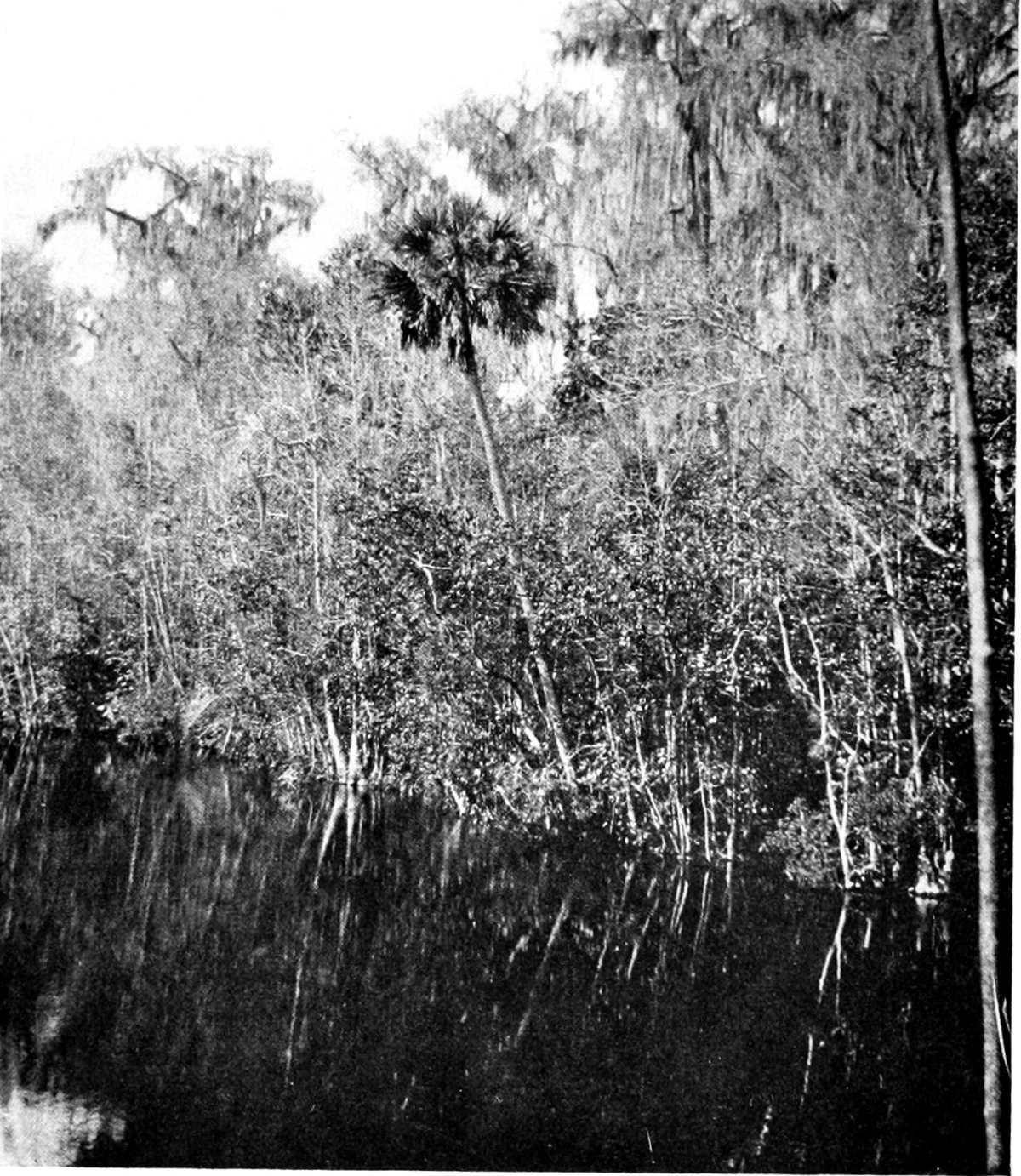
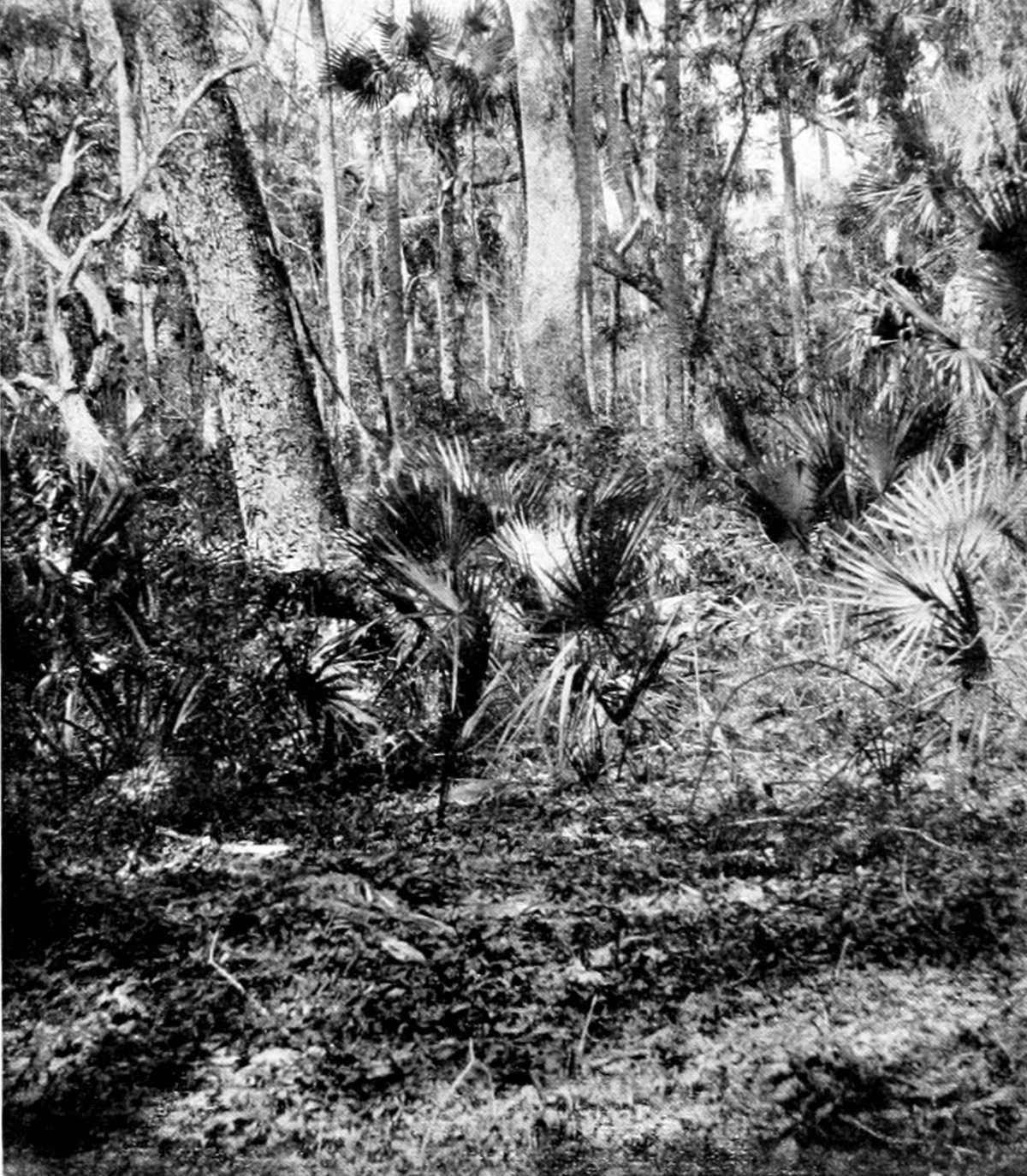
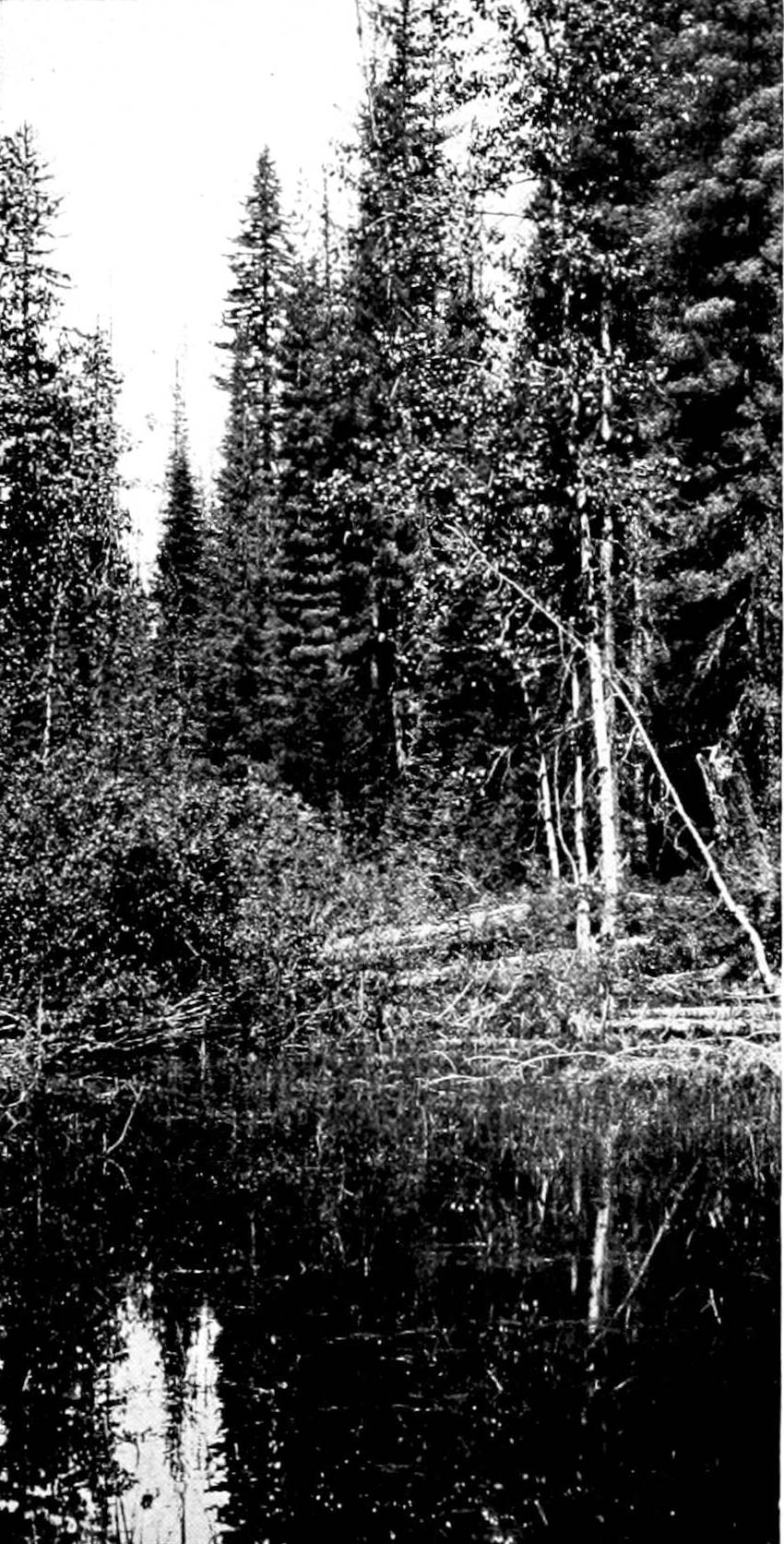
A River Scene in Florida
BY
G. FREDERICK SCHWARZ
ILLUSTRATED
NEW YORK
THE GRAFTON PRESS
1901
Copyright, 1901, by G. Frederick Schwarz
PREFACE
In the ensuing pages I have made simple
inquiries into the sources of beauty and attractiveness
in American forest trees and
sylvan scenery. In the concluding chapter,
by way of contrast, I have given a short account
of the esthetic effects of the artificial
forests of Europe. The system which shaped
these forests and gave them their present appearance
should, however, possess more than
a comparative interest for Americans. It
has, in fact, a further connection, though a
slight one, with the subject, and therefore
requires a few words of explanation.
It is well known that in many parts of
Europe the forests have long been subjected
to a systematic treatment known as forestry.
The term, at first strange, is gradually becoming
quite familiar to us Americans, for
the application of this comparatively new
science has already begun in many sections
of our country. The principles of European
forestry will naturally undergo many modifications
in their new environment, and the
vastness of our forest areas, as well as the
long life that naturally belongs to trees, will
impose a very gradual progress. Nevertheless,
the movement for a rational use of our
forests is rapidly advancing and is certain
in time to find a very wide application.
Although the aims of forestry are utilitarian
and not artistic, the technical character
of the operations which it involves impresses
upon natural forest scenery a changed
aspect. Eventually the work performed upon
our forests will be manifested in a new outward
appearance, a change that cannot but be preferable
to the scenes ordinarily presented by
our cut-over and abandoned timberlands, and
one that will be appreciated not only by forest
lovers in general, but also by those who are engaged
in the lumber industry itself, who are
often forced through competition and prevailing
methods to leave a desolate picture behind.
In a word, forestry interests us here because,
having already obtained a foothold in
our country, through it forest beauty stands
on the threshold of a new relationship. This
relationship, which is to grow more intimate
with time, appears to justify a certain discrimination
in the choice of the trees and
forests herein described, and an occasional
reference to some of the less technical matters
of forestry that may incidentally suggest
themselves as being of some interest to the
general reader. To have attempted more than
this would have detracted from the unity of
the subject. While the reader may, therefore,
find in these pages some facts that are
new to him, he will notice that these facts have
been made subordinate to the leading object
of the book, an appreciation of the esthetic
value of some of our commonest forest trees.
The illustrations have been derived from
various sources. The plates facing pages 38,
58, 62, 64, 66, 116, 120, 130, are reproductions
from original photographs that were furnished
through the courtesy of the Bureau of Forestry,
United States Department of Agriculture.
My grateful acknowledgments are due Mr.
Overton W. Price, Assistant Chief of the
Bureau of Forestry, for photographs chosen
out of his collection to supply the plates
facing pages 69, 148, 158. The remaining
illustrations have been reproduced from photographs
in my own collection.
Notes of reference, which are indicated by
superior figures in the text, and an index to
the names of the trees that have been described
or specially referred to in these pages,
will be found at the close of the book. The
index has been compiled from a well-known
bulletin of the Bureau of Forestry, United
States Department of Agriculture, entitled
“Check List of the Forest Trees of the United
States.” Courteous acknowledgment is here
made to the author, Mr. George B. Sudworth,
and to the Division of Publications, of the
same Department, for kind permission to
make extracts from the bulletin referred to.
I FOREST TREES — THE BROADLEAF TREES — THE CONE-BEARERS
The beauty of a forest is not simple
in character, but is due to many
separate sources. The trees contribute
much; the shrubs, the rocks, the mosses,
play their part; the purity of the air,
the forest silence, the music of wind in
the trees—these and other influences
combine to produce woodland beauty
and charm. A first consideration, however,
should be to know the beauty that
is revealed by the trees themselves.
Here it will be wise to make a selection:
to choose out of the great variety
of our forest flora those trees that most
deserve our attention. Many of our
forest trees have naturally a restricted
range; others are narrowing or widening
their range through human interference;
still others have already established
their right to a preëminence
among the trees of the future, because,
possessing to an unusual degree the
qualities that will make them amenable
to the new and improved methods of
treatment known as “forestry,” they
are certain to receive special care and
attention; while those that are not so
fortunate will be left to fight their own
battles, or may even be exterminated
to make room for the more useful
kinds. Among all these the rarest are
not necessarily the most beautiful.
Those that are commonest and most
useful are often distinguished for qualities
that please the eye or appeal directly
to the mind.
In accordance with the ideas already
expressed in the Preface, the considerations
that will determine what trees shall
be described are as follows: first, trees
of beauty; next, those that are common
and familiar; finally, those that are important
both for the present and the future
because they are useful and have
an extended geographical distribution.
The trees selected for description
will here be divided into the two conventional
groups of broadleaf species
and conifers, beginning with the former.
In the “Landscape Gardening” of
Downing we read concerning the oak,—
“When we consider its great and
surpassing utility and beauty, we are
fully disposed to concede it the first
rank among the denizens of the forest.
Springing up with a noble trunk, and
stretching out its broad limbs over the
soil,
‘These monarchs of the wood,
Dark, gnarled, centennial oaks,’
seem proudly to bid defiance to time;
and while generations of man appear
and disappear, they withstand the
storms of a thousand winters, and seem
only to grow more venerable and
majestic.”
It would be difficult to say whether
Downing had any particular species of
oak in mind when he wrote these words.
The common white oak and the several
species of red and black oak possess in
an eminent degree the grandeur and
strength which he describes and for
which we commonly admire the tree.
Of all the oaks[1] the white oak is
the most important. This tree will
impress us differently as we see it
in the open field or in the dense forest.
Where it stands by itself in the full
enjoyment of light, it has a round-topped,
dome-shaped crown, and is
massive and well poised in all its parts.
Quite as often, however, we shall see
it gathered into little groups of three or
four on the greensward of some gently
sloping hill, where it has a graceful
way of keeping company. The groups
are full of expression, the effect is diversified
from tree to tree, yet harmonious
in the whole. In the denser forest
the white oak often reaches noble proportions
and assumes its most individual
expression. There it mounts
proudly upward, contending in height
at wide intervals with sugar maples
and tulip trees, its common associates
in the forest. Its lofty crown may be
seen at a distance, lifted conspicuously
above the heads of its neighbors. Stand
beneath it, however, and look up at its
lower branches, and there is revealed
an intricacy of branchwork and a tortuosity
of limb such as is unattained
when it stands alone in the field. The
boldness with which the white oak will
sometimes throw out its limbs abruptly,
and twist and writhe to the outermost
twig, I have never seen quite equaled in
the other oaks. The live oak, it must
be admitted, is even more abrupt where
the limb divides from the trunk, but
it does not continue its vagaries to
the end.
It is to be noted that these forms are
not without a purpose and a meaning.
Under difficulties and obstacles the
twigs and branches have groped their
way; often one part has been sacrificed
for the good of another, in order that
all gifts of air, and moisture, and light
might be received in the fullness of
their worth. Thus the entire framework
of the tree becomes infused
with life and meaning, almost with
sense, and its character is reflected in
its expression.
The observer is also impressed by
the character of the foliage. The
leaves are usually rather blunt and
ponderous, varying a little—as, indeed,
do those of several other trees
—according to the nature of their environment.
They clothe the tree in
profusion, but do not hide the beauty
of the ramification of its branches. In
truth, they are not devoid of beauty
themselves. It was natural for Lowell
to exclaim,—
A little of thy steadfastness,
Rounded with leafy gracefulness,
Old oak, give me.
While the leaves of the white oak do
not deflect and curve as much in their
growth as those of some of the more
graceful and elegant trees, they nevertheless
fall into natural and pleasing
groups, unfolding a pretty variation as
they work out their patient spiral ascent,
leaf after leaf, round the stemlet;
showing a changefulness in the sizes of
the several leaves, and a choice in the
spacing. In the first weeks of leafing-time
there is to be added to these
features the effects derived from transitions
of color in the leaves. For the
very young leaves are not green, but
of a deep rose or dusky gray. They
are velvety in texture, and lie nestling
within the groups of the larger green
leaves that have preceded them. Just
as it was said a little while ago that
there was expressiveness throughout
the branches, it may now be said that
there is a fitness of the foliage for all
parts of the tree.
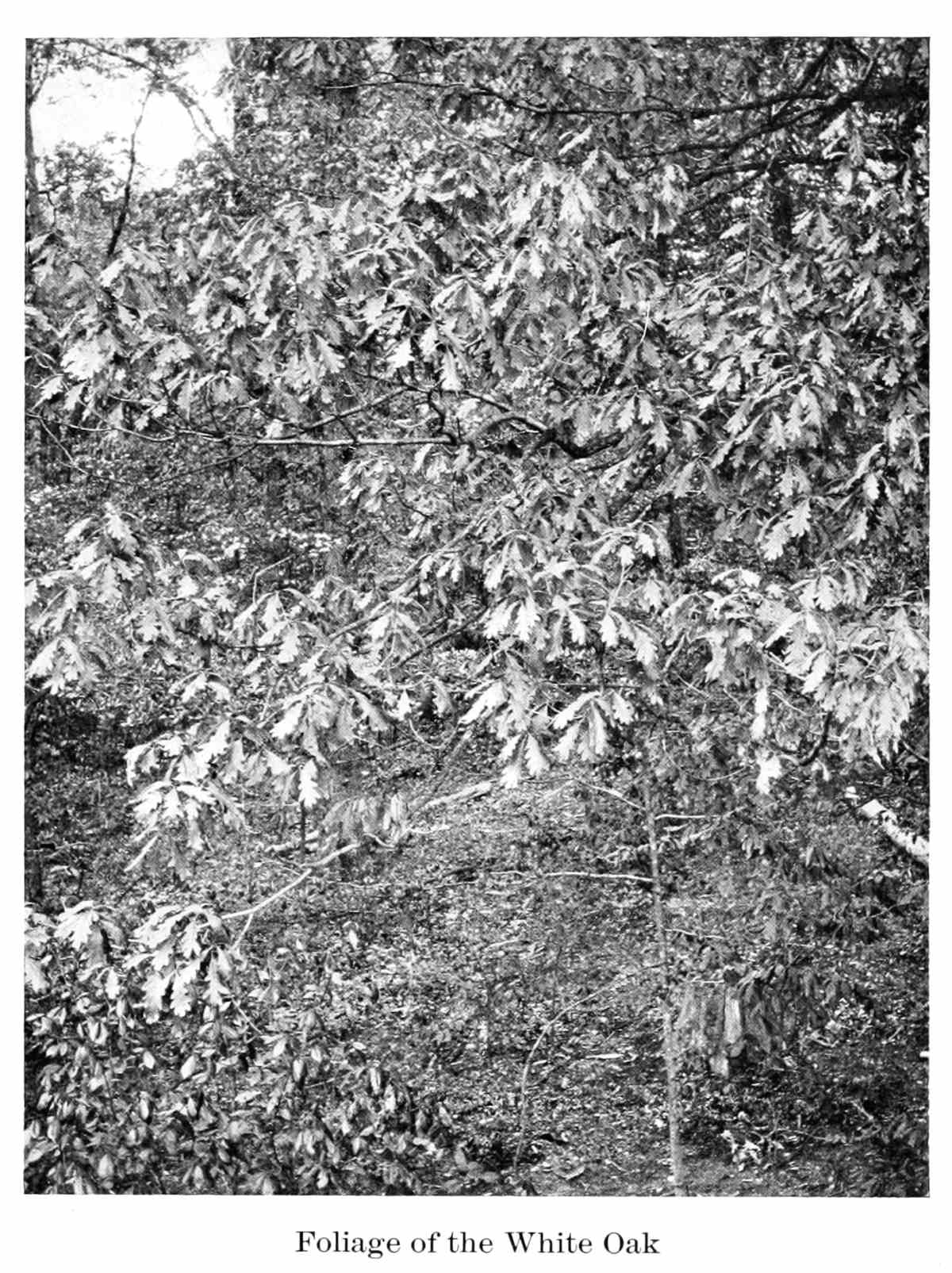
Foliage of the White Oak
In winter, however, the beauty of the
oak’s foliage is gone. The dry leaves
still hang on the boughs, sometimes
even until spring, but they look disheveled
and dreary. Still, they are not
without some esthetic value, though it
be through the sense of hearing instead
of sight. Thoreau says,—
“The dry rustle of the withered oak-leaves
is the voice of the wood in winter.
It sounds like the roar of the sea, and is
inspirating like that, suggesting how all
the land is seacoast to the aërial ocean.”
Deep and glorious, too, is the light
that rests in the oak woods on midsummer
days. It filters, softened and
subdued, through the wealth of foliage,
and wraps us in a mellow radiance. Its
purity and calm depth lift the senses to
a higher level. Most limpid is the light
in a misty shower, when the sun is low
and the level rays break through the
moist leaves and dampened air, while
we stand within and see everything
bathed in a golden luster.
Our common chestnut is of less
economic value than the oak, but one
suggests the other, for the two are
often found together and are similar in
size and habit. The chestnut is, in
truth, one of our finest deciduous trees.
It has a luxuriance of healthy, dark-green
foliage, and is happy-looking in
its abundance of yellow-tasseled blossoms.
It is even more beautiful in
August, when the young burs mingle
their even tinge of brown with the
fresh green of the glossy leaves. In
old age it has the same firmness that
is so noticeable in the oak, and seems
to be just as regardless of the winds
and gales.
The character of the leaf and the
manner in which the branches of a tree
divide and ramify have so much to do
with certain beautiful effects, that I
shall make some remarks on these features
in two of our maples. The sugar
or hard maple is the most useful
member of this genus, and may advantageously
be compared with the red
maple, which is perhaps more beautiful.
It is of great advantage to both of
these trees that the sweep of their
branches, which is carried out in ample,
undulating lines, is in perfect harmony
with the elegance of their foliage. In the
sugar maple the latter spreads over the
boughs in soft and pleasing contours.
The leaves are a trifle larger than those
of the red maple, and their edges are
wavy or flowing, while their surfaces
are slightly undulating and have less
luster than those of the other tree.
They are thus well fitted to receive a
flood of light without being in danger
of presenting a clotted appearance.
The petioles, or little leaf-stems, assume
a more horizontal position than
they do in the red maple, and the twigs
are usually shorter, which allows a
denser richness in the foliage, which
every breeze plays upon and ruffles as
it passes by.
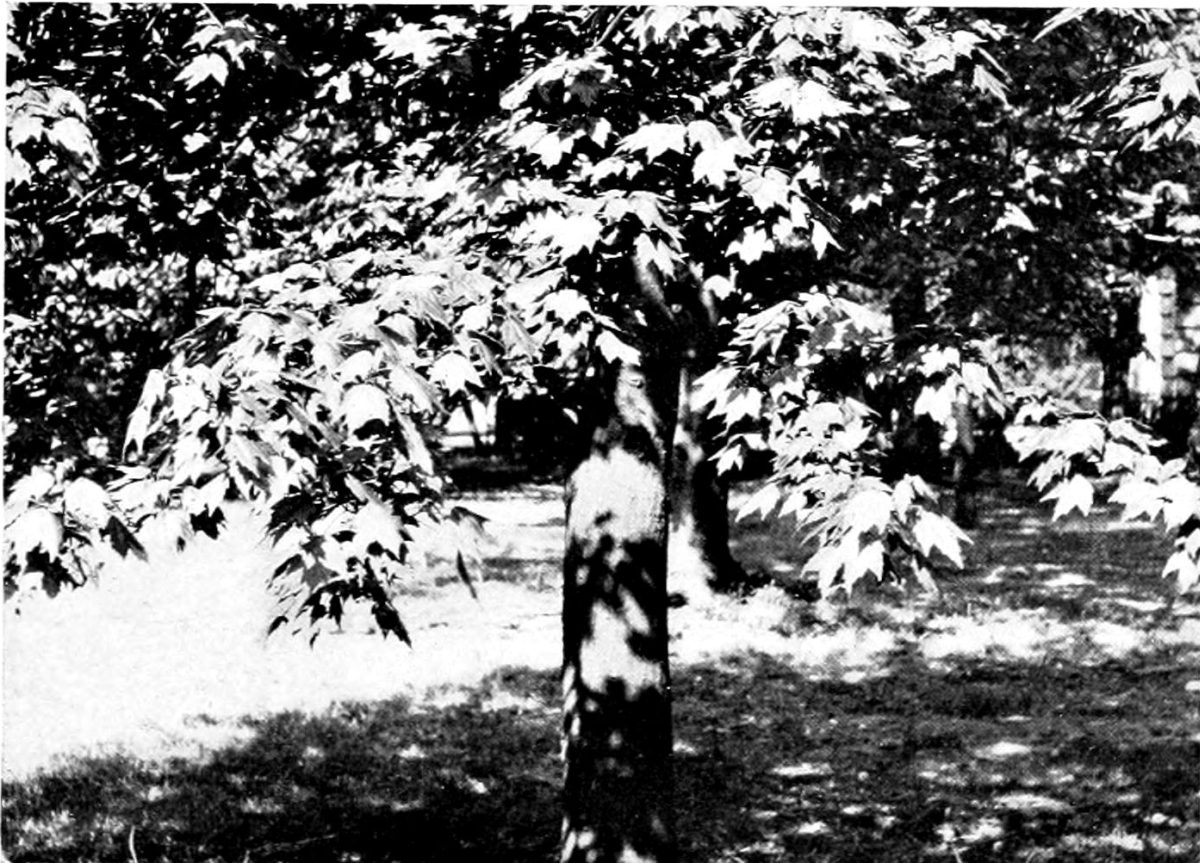
Spray of the Sugar Maple
Spray of the Red Maple
The red maple has a more airy look.
This is due partly to the character
of the leaf, but primarily to that of
the branchwork. The main branches
spread out in easy, flowing lines, much
as they do in the sugar maple; but
they assume an ampler range, and the
last divisions, the twigs, take on decided
curves, rising to right and left.
On these the leaves multiply, each leaf
poised lightly upon its curved petiole.
As compared with the leaf of its congener,
that of the red maple is firmer
and a shade lighter, especially underneath.
It is also more agile in the
wind. The effect of the whole is
more that of a shower of foliage than
of pillowed masses. The curving lines,
the elastic spring of every part, and a
kind of freedom among the many leaves,
make the red maple one of the cheerfullest
of trees.
The sugar maple is the larger of the
two, and seeks the intervales and uplands,
where its size is well set off in
the landscape. The red maple, which
finds its natural home along riverbanks
and in moist places, is interesting
at all seasons. When young it is
particularly attractive in summer where
it fringes lakes and streams. In winter
its bright, red twigs present a pleasing
contrast to the gray bark or to the
snow-covered earth. In the earliest
days of spring the little scarlet blossoms
break out in tufts that soon ripen
into brilliant little keys, looking very
pretty where they intermingle with the
pale green of the opening leaves.
There is, in fact, more color in the
woods in the opening days of spring
than is generally admitted or noticed.
Many kinds of trees unfold their leaves
in some tender shade of rose or golden
brown; while others lend a distinct
color to a whole section of forest by
the opening of their early blossoms.
The maples, however, are chiefly
famous for their wonderful richness of
color in the fall of the year; particularly
the sugar and the red maple, whose
brilliancy at this season it would be
difficult to match. They exhibit, in
truth, a gamut of beautiful tones, from
pale yellow to deep orange, and from
bright scarlet to vivid crimson. They
are among the first to change the
color of their leaves, but are quickly
followed by other species of trees,
whose varying hues blend together and
enrich the autumn landscape. The
“scarlet” and “red” oaks now justify
their names; the flowering dogwood
and the sweet gum show their soft
depth of purple; the milder tulip tree
takes on a golden tint and shimmers
in the sun, mingling with ruddy hornbeams,
browned beeches, variegated
sassafras trees, or the fiery foliage of
the tupelos. The swamps are aflame
with the brilliancy of red maples, contrasting
with the quieter tones of alders
and willows.
We may speak of brilliancy and
color in our leafy woods at the ebb-tide
of the year; but to know their
beauty well we must walk among the
trees. Nor can pictures tell us all the
truth about the tints of autumn. How
should we receive from them the atmospheric
effects that nature gives,
and the indescribable blending and
softening that comes from innumerable
rays of diffused and reflected light?
The beauty also changes from day to
day and from hour to hour, for weeks.
Some of the other broadleaf trees
deserve to be noticed, though in less
detail, as objects of beauty in the forest.
The honey locust, one of our largest
trees of this class, is distinguished
principally for the elegant forms of
its branches. The smaller divisions,
the twigs, follow a zigzag course which
in itself is not beautiful, but the effect
is so bound up with the complex spiral
evolutions of the larger divisions, the
boughs and branches, that the result is
only to heighten the elegance of the
latter. The foliage of this tree is very
delicate, being composed of numerous
elliptically shaped leaflets, that are
gathered into sprays that hang airily
among the bold and sweeping boughs.
Much might be said here in commendation
of the sassafras tree, were
it economically more important. Its
brown, sculptured bark is very attractive,
and its yellowish blossoms, that
break in early spring, are fragrant.
The leaves are of several shades of
green, and vary considerably in outline.
When in full leaf, the outward
form of the tree is striking in appearance,
its foliage being massed into
rounded and hemispherical shapes that
group themselves in the crown of the
tree in well-proportioned and tasteful
outlines.
The birches, too, are very attractive
trees, especially where they have ample
room to develop. The white birch appears
at its best where it is sprinkled
in moderation among open groves of
other trees. To the forester it is of
some importance, as its seedlings rapidly
cover denuded or burnt areas.
They also shield from excessive sunlight
or from frost the seedlings of
more valuable kinds that may have
sprouted in their welcome shade; until,
gaining strength, the latter after a
few years push up their tops between
the open foliage of their protecting
“nurses.” The white birch may be seen
performing this good office in many a
fire-scarred piece of woodland throughout
the Northeastern States. Often,
too, we see it standing a little apart,
as at the edge of a forest; its slender
branches drooping around the pure
white trunk and its agile leaves gleaming
as they wave in the light breeze.
It is like one of those single notes in
music that glide into universal harmony
with irresistible charm.
The yellow birch, on the contrary, is
most beautiful in the depth of the forest.
It is a large, useful tree. In the
Adirondacks I have often admired
its tall, straight trunk as it rose above
the neighboring firs and spruces and
unfolded its large, regular crown of
dense dark foliage, relieved underneath
by the thin, shining, silvery to golden-yellow
bark, torn here and there into
shreds that curled back upon themselves
around the stem.
The white elm, well represented in
the avenues of New England, is widely
distributed. It is a tree for the meadow,
although its natural grace and,
one might almost say, inborn gentleness
are preserved along the fringes
of the forest and on the banks of
streams. It needs some room to show
the refinement of its closely interwoven
spray. Watch its beauty as it sways
in the light wind; or look at a grove of
elms after a hoar-frost on some early
morning in winter, when the leaves are
gone and all its outlines are penciled
in finest silver.
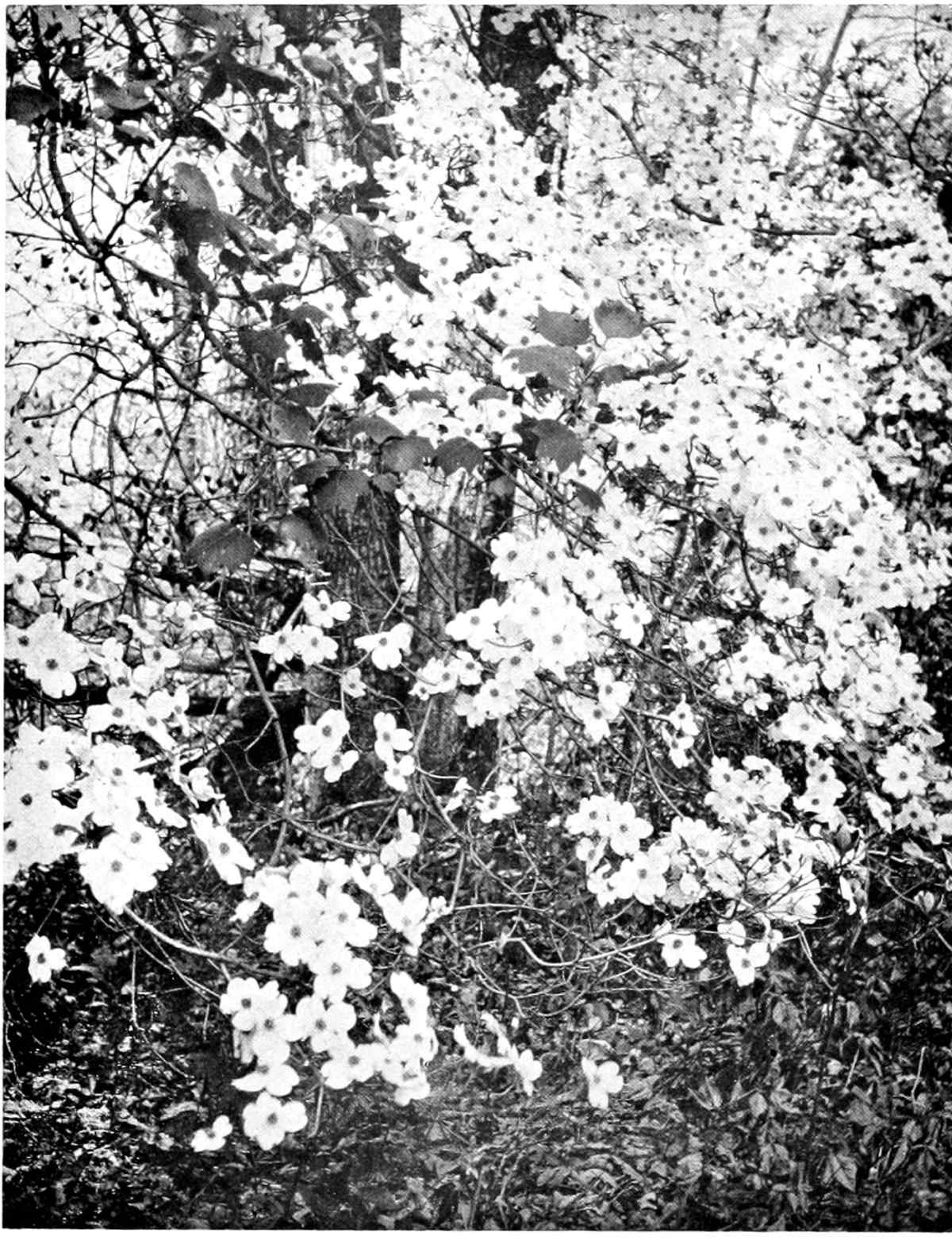
The flowering dogwood is one of our
smaller trees, but is exceptionally favored
with all manner of beauty. Although
it is very common in many
of the States, and is not without its
special uses, it occupies a subordinate
position in the eyes of the forester, being
often no more than a mere shrub
in form. And yet, while some of the
larger trees by their majestic presence
lend grandeur to the forest, the dogwood
brings to it a charm not easily
forgotten. In spring, when it is showered
all over with interesting, large,
creamy-white flowers, it is an emblem
of purity. Its leaves, which appear
very soon after the bloom, are elegantly
curved in outline, soft of texture,
light-green in summer, and of a
deep crimson or rich purple-maroon in
autumn.[2] In winter the flowers are
replaced by bright, red berries. Its
spray of twigs and branchlets, formed
by a succession of exquisitely proportioned
waves and upward curves, is
not as conspicuous, though hardly less
ornamental at this season than the
fruit.
The Dogwood in Bloom
As a shrub, being among the very
first to bloom, it decorates the forest
borders in spring, or stands conspicuously
within the forest. It is found
everywhere in the Appalachian region.
In the coastal plain it is associated
with the longleaf pine, or may be seen
among broadleaf trees, or standing
among red junipers, as tall as they and
quite at home in their company.
Before turning to coniferous trees,
the tulip tree deserves some attention
on account of its usefulness, its extended
habitat, and its beauty as a
forest tree. It is closely related to the
magnolias, to which belongs the big
laurel of the Gulf region, an evergreen
species that might be called the queen
of all broadleaf trees. But the big
laurel must here give place to the tulip
tree, because it is not so distinctively a
forest tree, and is much more restricted
in its geographical distribution.
The first general impression of the
tulip tree is, I venture to say, one of
strangeness. There is a foreign look
about the heavy, truncated leaves, and
an oriental luxury in the large, greenish-yellow
flowers. These appear in
May or June, while the conelike fruit
ripens in the fall. When the seeds
have scattered, the open cones, upright
in position, remain for a long time on
the tree, where they are strikingly
ornamental.
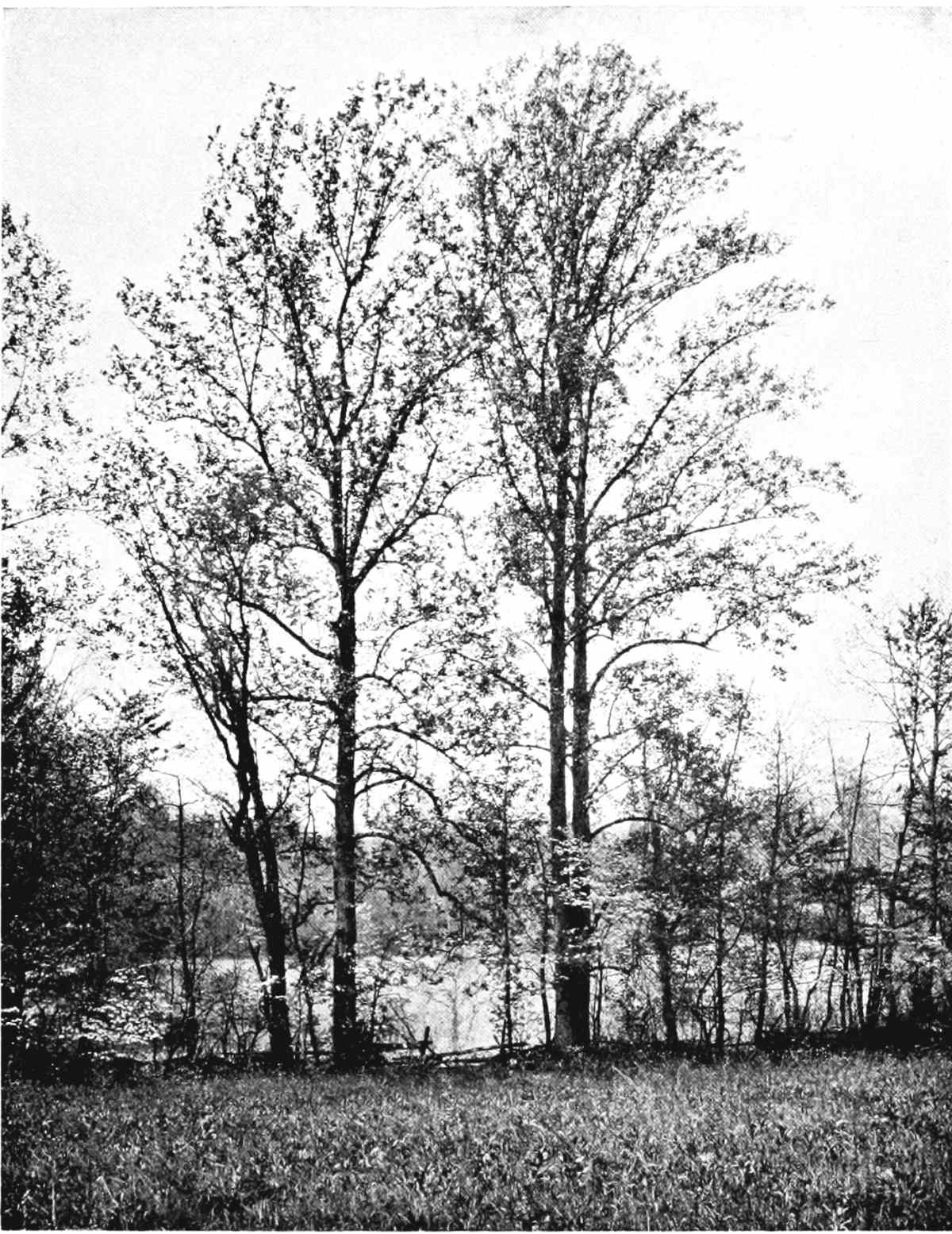
Esthetically the most important feature
of the tulip tree is an expression of
dignity and stateliness, which gives it
a character of its own. Its extraordinary
size renders it a conspicuous object
in the forest, the more so because
we usually find it associated with a variety
of other trees of quite different
aspect. Michaux, who has told us
much about the forest flora of the eastern
United States, could find no tree
among the deciduous kinds, except the
buttonwood, that would bear comparison
with it in size, and he calls it “one
of the most magnificent vegetables of
the temperate zone.” Its columnar
trunk continues with unusual straightness
and regularity nearly to the summit
of the tree. Its limbs and branches
divide in harmonious proportions, reaching
out as if conscious of their strength,
and yet with sufficient gracefulness to
lend dignity to the tree. The lower
boughs, especially, are inclined to assume
an elegant sweep, deflecting sidewise
to the earth, and ending with an
upward curve and a droop at the outer
extremity. Often the crowded environment
of the forest does not admit of
such ample development; yet even under
such conditions the tulip tree preserves
much of its elegance and is generally
well balanced.
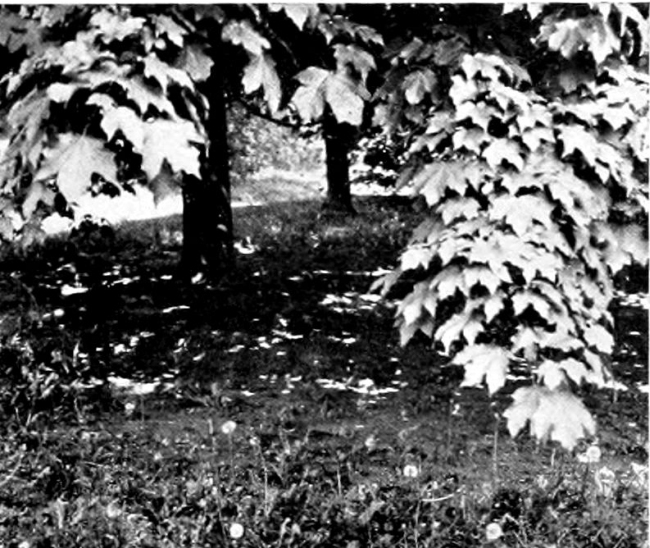
Tulip Trees
When young it does not appear to
much advantage, being rather too symmetrical.
Nevertheless I have found
it described as a tree of “great refinement
of expression” at that age. As
soon as it begins to put on a richer
crown of foliage and to develop a sturdier
stem and more elegant lines in the
disposition of its branches, it becomes
invested with its peculiar aspect of
magnificence, increasing in gracefulness
and grandeur from year to year.
Its bark, at first smooth and gray, gradually
becomes chiseled with sharp small
cuts; then takes on a corrugated appearance,
becomes brown, and finally
turns into deeply furrowed ridges in
the old tree. Now the foliage, too,
seems to clothe the massive boughs
more fitly, being denser and in size of
leaves more in accordance with the
increased dimensions of the tree.
The foliage of the tulip tree is, in
truth, one of its principal points of
beauty, and is inferior only to the stateliness
of its form. The opening leaf-buds
are conical, exquisitely modeled,
and of the tenderest green. The
leaves unfold from them much as do
the petals in a flower, but quickly
spread apart on the stem. As they
grow larger they still preserve their
light-green color, but take on a mild
gloss. They are ready to shift and
tremble on their long leaf-stalks in
every breath of wind, which gives
them a decided air of cheerfulness.
We may see the same thing in the
aspen and in some of the poplars. Under
the tulip tree, however, the light
that descends and spreads out on the
ground is far superior. It is softer
and purer. We need not look up to
appreciate it, but may watch it on the
soil, over which it moves in flecks of
light and dark.
“The chequer’d earth seems restless as a flood
Brushed by the winds, so sportive is the light
Shot through the boughs; it dances, as they dance,
Shadow and sunshine intermingling quick,
And dark’ning, and enlight’ning (as the leaves
Play wanton) every part.”
The cone-bearing trees are usually
provided with needle-shaped or awl-shaped
leaves, in contradistinction to
the broad and flat ones that belong
to the group described in the preceding
section of this chapter. Most of
them preserve their foliage through
the winter, and are commonly recognized
by this evergreen habit. They
are much more important to the forester
than the other class. The conifers
grow on the true forest soils.
They range along mountain crests or
are scattered over dry and semi-arid
regions or along the sandy seashore,
while the broadleaf species usually
require a better soil and a more
congenial climate. This circumstance
causes many deciduous forests to be
cut down, in order that the better land
on which they grow may be utilized
for agricultural purposes. Moreover,
the wood of the conifers is generally
more useful, being in several of the
species of great economic importance.
Lastly, in their habit of denser growth,
and from the fact that these trees are
ordinarily found in the form of “pure”
forests (in contradistinction to those
forests in which a number of species
grow intermingled), they furnish certain
very important conditions for practical
and successful forestry.
The common white pine well deserves
to stand at the head of all the
conifers or evergreens east of the Mississippi.
Though it once covered vast
areas in more or less “pure” forests
it has been largely cut away, and recurring
fires have generally prevented
its return; but in certain places it could
even now be restored by careful treatment.
At present the last remnants of
these pineries are disappearing swiftly,
and before the methods of the forester
can be applied to such extensive areas,
this valuable heritage will probably
have vanished. Heretofore it has been
to us Americans in the supply of wood
what bread and water are in daily life.
It has been hardly less valued by other
nations, having been planted as a forest
tree in Germany a full century ago.
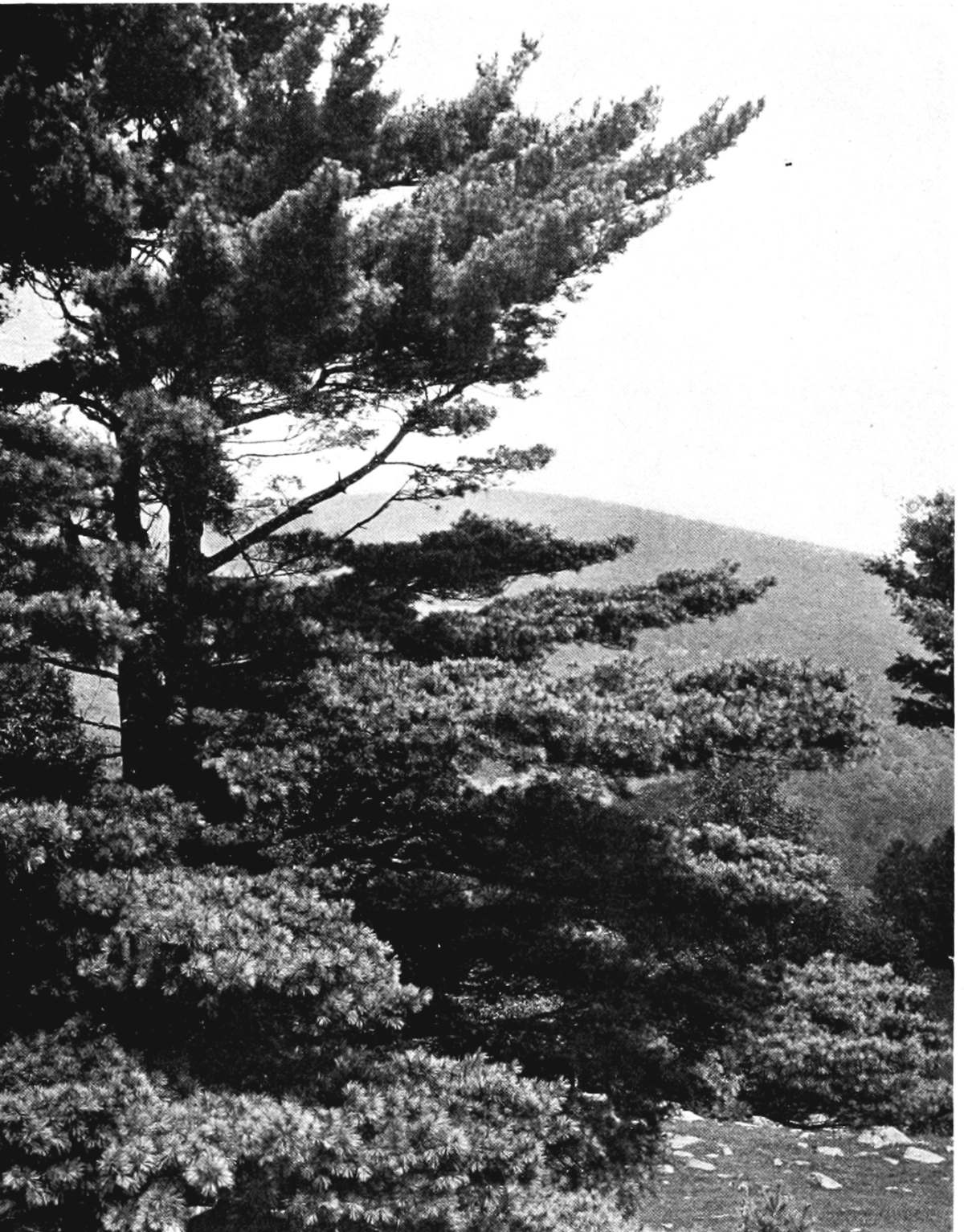
I cannot say what I admire most in
the white pine; whether it be the luxuriance
and purity of its foliage, or the
very graceful spread of its boughs.
There is hardly a tree that can equal
it for softness and rich color. The
tufts of needlelike leaves densely
cover the upper surfaces of the spreading
branches, and are of a mild, uniformly
pure olive-green. Seen from
beneath they appear tangled in the
beautifully interwoven twigs and
stems. It is here that we first begin
to notice the exquisite manner of the
white pine. The boughs reach out
horizontally, with here and there one
that ascends or turns aside to assume
a position exceptionally graceful and
to fill out a space that seems specially
to have been vacated for it. I speak
of the white pine at the age preceding
maturity, when it is in its full strength,
but before it has attained the picturesqueness
of old age. Following an
easy curve, the branch divides at right
and left into dozens of finer branchlets,
all extending forward and straining,
as it were, to reach the light; and
these in turn lift up hundreds of twigs
and little stems to enrich the upper surfaces
with bushy tufts of lithe green
needles. The elegance of this habit
in the white pine appears to advantage
when we stand a little above it on a
gentle slope and see the branches
clearly defined against the surface of
a lake below or some far-away gray
cloud.
Both in middle age and when it is
old the white pine is a distinguished-looking
tree. When young it is sometimes
elegantly symmetrical; but more
often, owing to a crowded position, it
lacks the air of neatness that belongs
to a few of the other pines and to most
of the firs. At maturity it is a very
impressive tree, especially in the dense
forest, where it develops a tall, dark,
stately stem. In its declining years
the branches begin to break and fall
away, no longer able to bear the weight
of heavy snows. This is often the
time when it is most picturesque.
Character of the White Pine.
The representatives of the white pine
in the West are the silver pine and
the sugar pine. Though both may be
easily recognized as near relatives of
the eastern species, either by the typical
form of the cones or by the plan and
structure of the foliage, each of the
western trees possesses a majesty and
beauty of its own. The silver pine is
more compact in its branches than the
white pine, and has somewhat denser and
more rigid foliage. Its dark aspect is
well suited to the mountains and ridges
of the Northwest, where it commonly
abounds. The sugar pine, which is the
tallest of all pines, impresses us by its
picturesque individuality. Its great
perpendicular trunk not infrequently
rises, clear of limbs, to the height of
a hundred and fifty feet, and is surmounted
by an open pyramidal crown
of half that length, composed of long
and slender branches that are full of
motion. While the texture of the foliage
is not as delicate as in the white
pine, it is smooth and elastic, and has
an even bluish tinge that shows to great
advantage when the needles are stirred
by the wind. Its cones, which are of
enormous size, hang in clusters from
the extremities of the distant boughs,
which droop beneath the unusual weight.
Two of these cones, which I have lying
before me, measure each nineteen inches
in length. Well might Douglas, the
botanist who named this tree, call it
“the most princely of the genus.”
Sugar Pines
Young Bull Pines in the foreground at the right
and an Incense Cedar at the left.
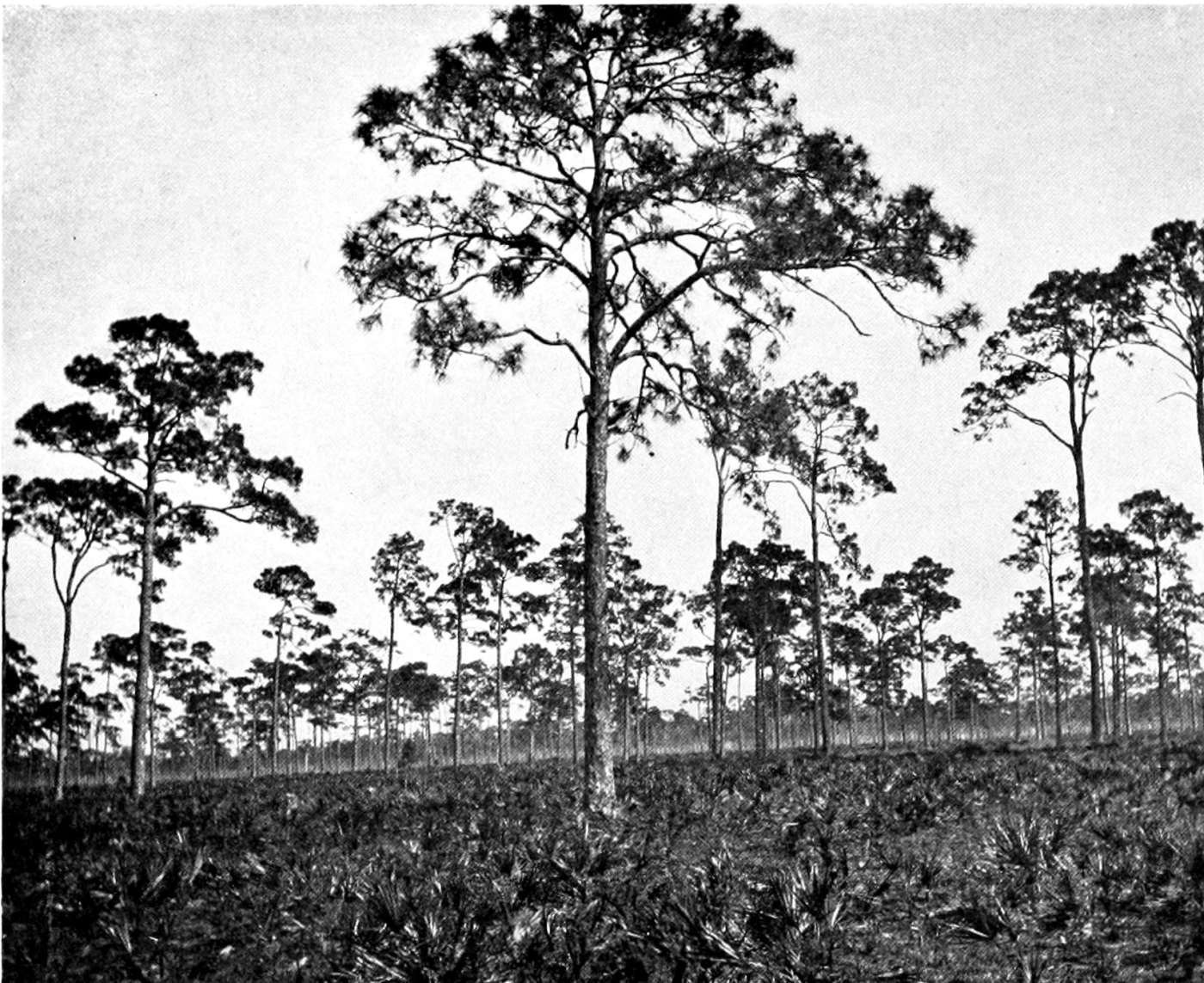
The longleaf pines of the Southern
States should be noticed for their picturesqueness.
The Cuban pine is restricted
to isolated tracts in the region
of the Gulf and eastern Georgia. The
loblolly pine and the longleaf pine, near
relatives of the Cuban pine, cover extensive
tracts in low, level regions of
the Southern States, and are most interesting
in old age. Standing, it may
be, on a sandy plain not far from the
sea, among straggling palmettos, they
lift their ample crowns well up on their
tall, straight stems, and contort their
branches into surprising forms; so that,
looking through their crowns at a distance
in the dry, hazy air of the South,
with possibly a red sunset sky for a
background, they are extremely fantastic
and entertaining.
There are two other pines that have
a similar tortuous habit in the growth
of their branches: the pitch pine of
our eastern coast States and the lodgepole
pine of the Rocky Mountains.
These, however, have an esthetic value
for quite a different reason. In the
case of the pitch pine it is due to
a natural peculiarity otherwise rare
among conifers; for, this tree has the
power of sprouting afresh from the
stump that has been left after cutting
or forest fires, thus healing in time the
raggedness and devastation resulting
from necessity, neglect, or indifference.
The lodgepole pine of the West performs
the same patient work over burned
areas through the remarkable power
of germination belonging to its seeds,
even after being scorched by fire.
Thus both of these trees not only furnish
useful material, but restore health
and calmness to the forest.
Courtesy of the Bureau of Forestry
A Pinery in the South
In connection with the longleaf pines
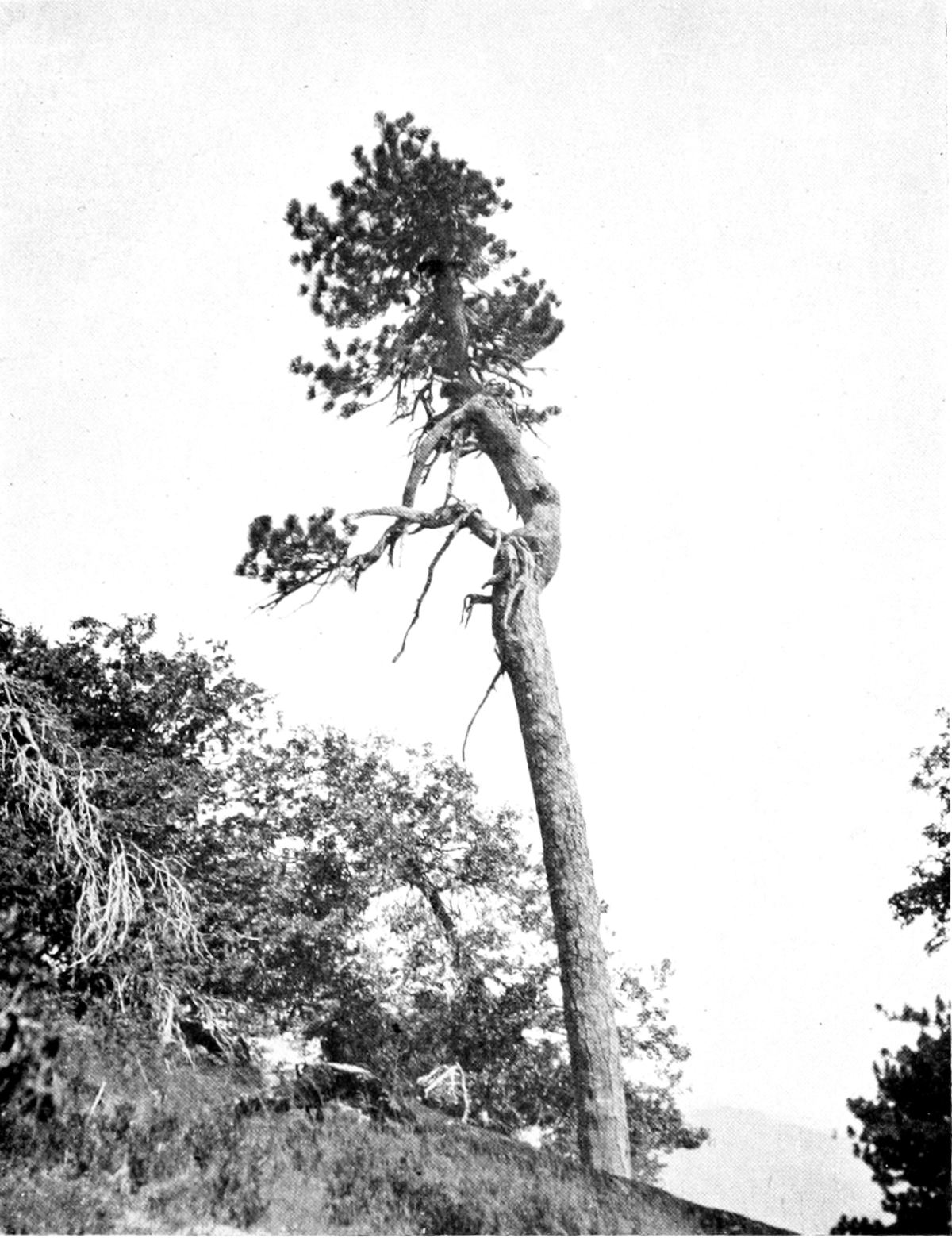
of the Southern States, the bull pine
of the West deserves to be noticed on
account of its near botanical relationship
and the somewhat similar economic
position which it occupies. It is the
most widely distributed of western
trees, being found in almost every kind
of soil and climate along the Pacific
coast and throughout the Rockies.
Over so wide a range, growing under
very different conditions of soil, temperature,
light, and moisture, it varies
greatly in form and appearance. We
encounter it on dry, sterile slopes or
elevated plateaux in the interior, and
walk for miles through the monotony
of these dark bull pine forests, in which
the trees are of small stature and seem
to be struggling for their life. Again
we meet it on the humid western slopes
of the Sierra Nevada, associated with
the sugar pine and other lofty trees.
Here we scarcely recognize it. It holds
its own among the company of giants,
and is full of vitality, freedom, and
strength; with brighter, redder bark
and stout, sinuous branches; with
longer needles and larger cones. The
sunlight fills its ample crown spaces,
and the wind murmurs in the foliage
overhead; for the pines are the master
musicians of the woods.
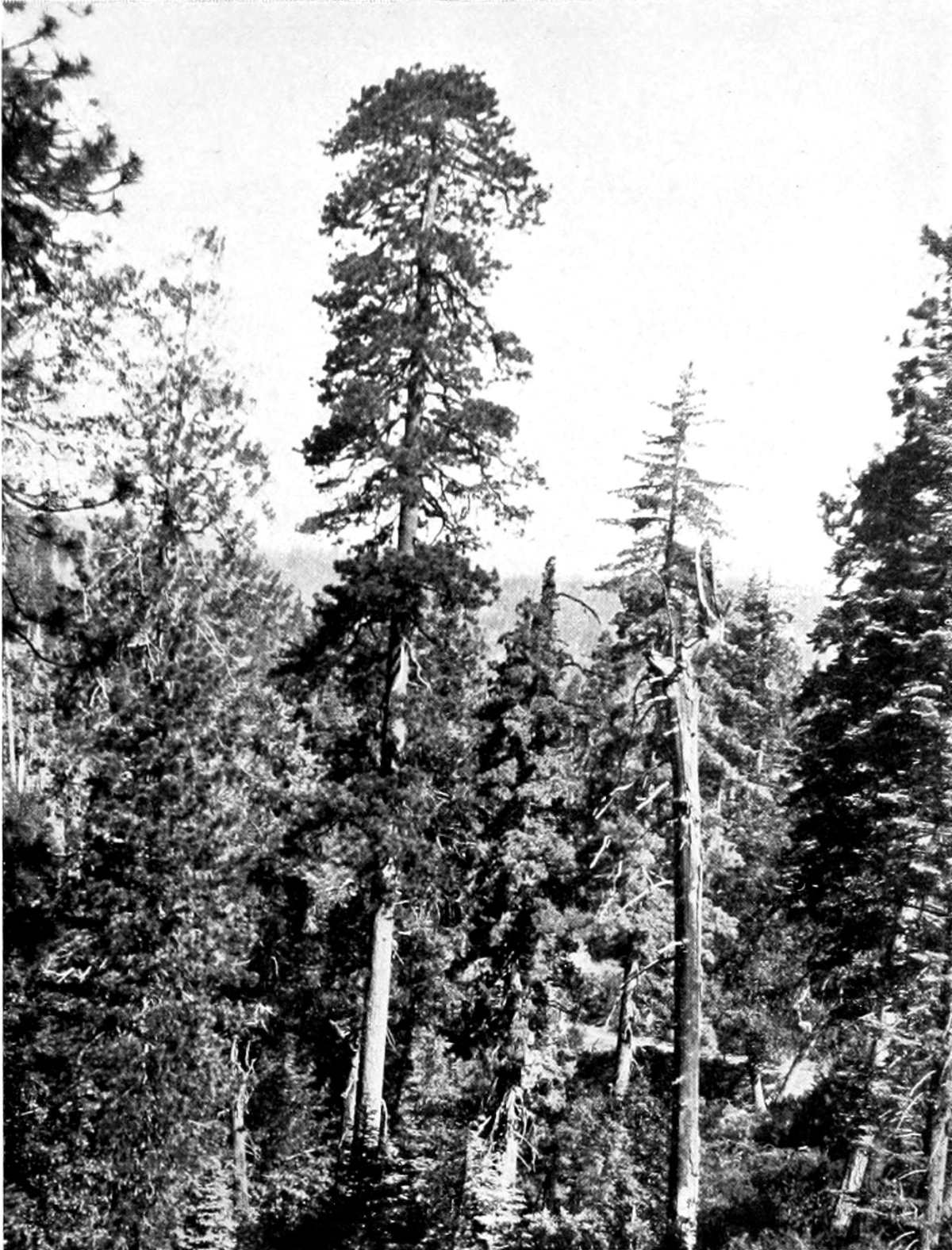
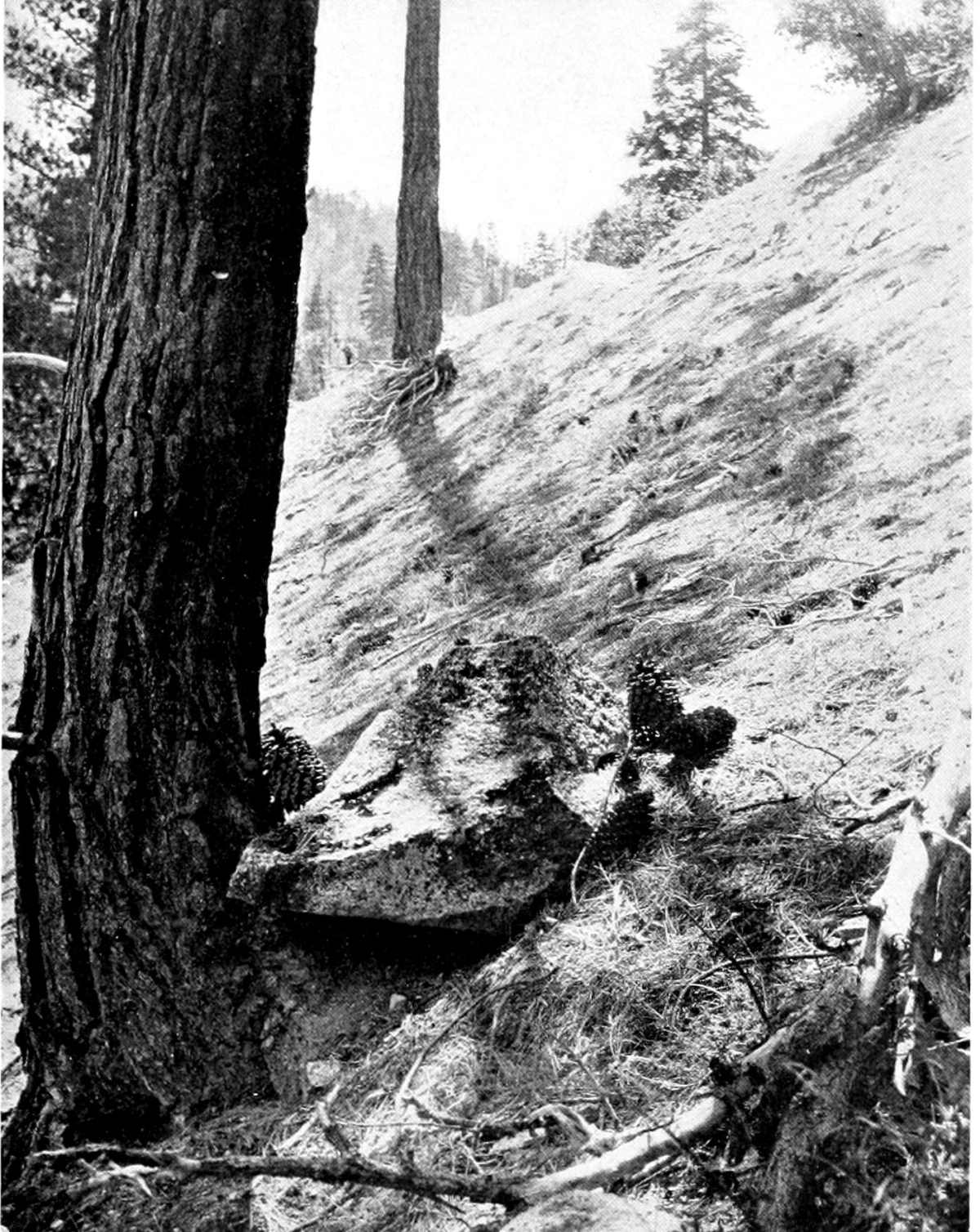
The Bull Pine in its California Home
The Southern States and the Gulf
region furnish us with a conifer of
striking originality and great usefulness.
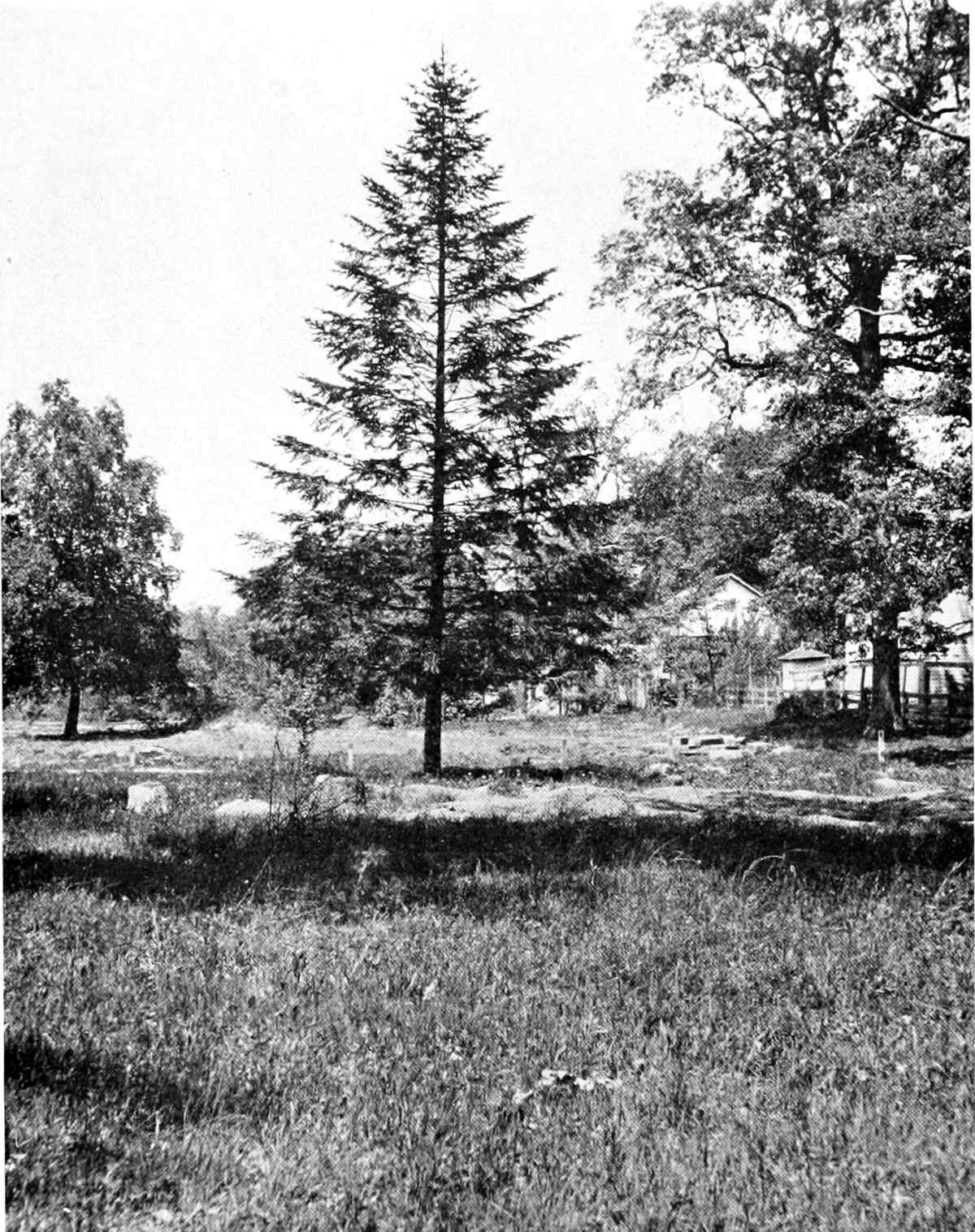
This is the bald cypress, which
may have caught the reader’s eye in
some northern park by the elegant
forms of its spirelike growth. It rises
high and erect, a narrow pyramid
clothed in the lightest green foliage.
The latter is composed of delicate feathers
of little elliptical leaves that hang
drooping among the finely interwoven
short branches. This is in its cultivated
northern home, where it seems to
thrive well on the carefully kept greensward.
But in reality it is a tree of
deep swamps, seeking the dank, flooded
shores of southern rivers, or impenetrable
morasses, where few other trees
can live. Here we may paddle our
boat through the strange-looking cypress
knees that it sends up above the
water from the roots in the muddy soil
beneath, and may admire the straight,
firm trunks that are ridged and buttressed
below to form wide, spreading
bases. In this, its native home, when
it has grown to maturity, it looks far
different from the trim, tall pyramid
that we see in the park. In place of the
lofty spire it bears a broad, flat crown,
that is poised upon the tall, fibrous,
reddish-gray trunk. Such crowns,
if the tree has had room to spread,
may measure as much as a hundred
feet across; but where closely pressed
at the sides by other trees, they are
contracted to much narrower dimensions.
The foliage is soft in texture
as ever, and interspersed with little
globular cones. With the coming of
winter, however, the sprays of foliage
turn brown and fall from the tree, the
bald cypress being one of the very few
cone-bearers that shed their leaves.
In the South, especially in Florida
and along the Gulf, the cypress trees
are likely to be overloaded with streamers
of gray, mosslike tillandsia. This
epiphytic plant, commonly known as
“Florida moss” or “hanging moss,”
sometimes hides the entire mass of
foliage, and lends a funereal aspect
to whole groves and forests of these
trees, detracting much from their
beauty.
One of the prettiest coniferous trees
in the East is the hemlock. Whatever
may be the prejudice against the commercial
qualities of this tree,—for the
value of its wood is not now appreciated
as it should be,—its appearance
is admired by all who know it. I
call it “pretty” because it is fine and
neat when young and grows to be
comely and graceful in middle age,
rather than beautiful in the ordinary
meaning of that word. It is an easy,
airy tree. And yet the time comes
when it loses its ease and grace, when
its trunk grows darker and its boughs
become straggly and rough, when it
puts on the strength of age without its
decrepitude and bears unflinchingly the
weight of winter snows. Is it now less
interesting than in its youth? I think
not. It makes the woods rough and
natural, and we admire its simplicity,
self-sufficiency, and endurance.
When young there is no tree with
such elegant and yet loose and pretty
effects in the foliage, unless it should
be one of its western cousins. The
spray hangs delicately from the sides
of the tree and the top is gracefully
pendent. The little shoots, as they
peep out from hundreds of recesses,
buoyant and lifelike, and the pendent
top, are in some way suggestive of a
playing fountain, especially in quite
young trees. In the forest the symmetry
of the hemlock is not always preserved;
yet it fits into the scene gracefully,
whether fringing the mountain
stream or grouping itself among the
other trees of the forest.
The two western hemlocks also have
exceedingly graceful sprays and majestic
forms, but they are less familiar
to most of us and are not as widely
distributed as the smaller eastern
species.
One of the trees of widest geographical
range in America is the red cedar,
or red jumper, as it should more properly
be called. This statement remains
true notwithstanding the recent discovery
that the form of red juniper
common to certain parts of the Rockies
is distinct from the eastern tree.
Though of small size, except in the
bottom lands of Arkansas and Texas,
it possesses some excellent qualities
and is useful in many ways. It is
sometimes used in cabinet work, and
is one of the best materials for fence
posts. The variety that grows along
the Florida coast furnishes the wood
for the indispensable lead pencil.
The red juniper is at its best along
the border of the forest or where it
strays a short distance away. Its foliage
is dark and bushy, and infinitely
tender and soft in appearance. In the
lower Appalachian region it forms a
fine setting for the gorgeous drifts of
dogwood and redbud that skirt the forest
edges. It forms changeful and
interesting groups on the rocky knolls
and ledges. On our Jersey shores
it has a tasteful way of gathering
into little companies, just near enough
to the forest to belong to it, composing
scenes that are pleasant to remember.
Singly, on the yellow sands,
the young conical red juniper edges
off well against the sky. In its old
age the same tree looks gnarled and
picturesque, but still beautiful, with its
masses of small blue-gray berries.[3]
Many of us remember it so by the edge
of the ocean, and perhaps others, like
myself, have allowed their imagination
to drift and have fancied that it looked
solemn and thoughtful, outlined against
the pale-blue sky, listening to the swish
and whisper of the sea.
Several cone-bearing trees of the
Western States remain to be considered.
These are the firs and spruces,
which belong to the same class as the
pines; and the big tree and redwood,
relatives of the bald cypress.
The Douglas spruce, or red fir, is in
reality neither a true spruce nor a fir,
though it has some of the characteristics
of each. It was discovered as
long ago as 1795 by the famous explorer,
Archibald Menzies. This species
and a smaller one that grows on
the arid mountains of southern California,
with possibly a third that is
found in Japan, constitute together
the whole genus Pseudotsuga. But
whatever its botanical peculiarities, the
red fir is an important and exceedingly
useful tree, especially for the purposes
of practical and scientific forestry. Like
the white pine it was planted long ago
by those pioneers in forestry, the Germans,
and has proved itself among them
to be one of the few trees of foreign
extraction that can be called successful.
When young, the red fir grows rapidly
and symmetrically, and has a
fresh, vigorous, healthy look. It then
already possesses the bluish depth to
its foliage that it preserves throughout
life, a color that is comparable in its
purity only to that of the white pine.
In several of its other features, however,
it changes with the lapse of
years. It gradually loses the graceful
lower boughs that feather to the
ground in the young tree; its bark
becomes rough and very thick; and its
trunk develops into a tall, straight
shaft that bears a long, spiry crown of
striking symmetry, in which tier after
tier of branches rises to the narrowing
summit, ending some two or three hundred
feet in air. This is its aspect in
the favored regions of its growth, near
the shores of Puget Sound and in the
moist mountains of Washington and
Oregon, where it once formed forests
of extraordinary density and dark
grandeur, portions of which are still
preserved over this extensive territory.
Another important conifer is the
lowland fir of the Pacific coast. All
the silver firs, to which class this tree
belongs, have distinct features in their
foliage and a characteristic habit of
growth, a description of which may
enable the reader to picture to himself
not only the lowland fir itself, but to
form some conception of the esthetic
value of the entire genus.
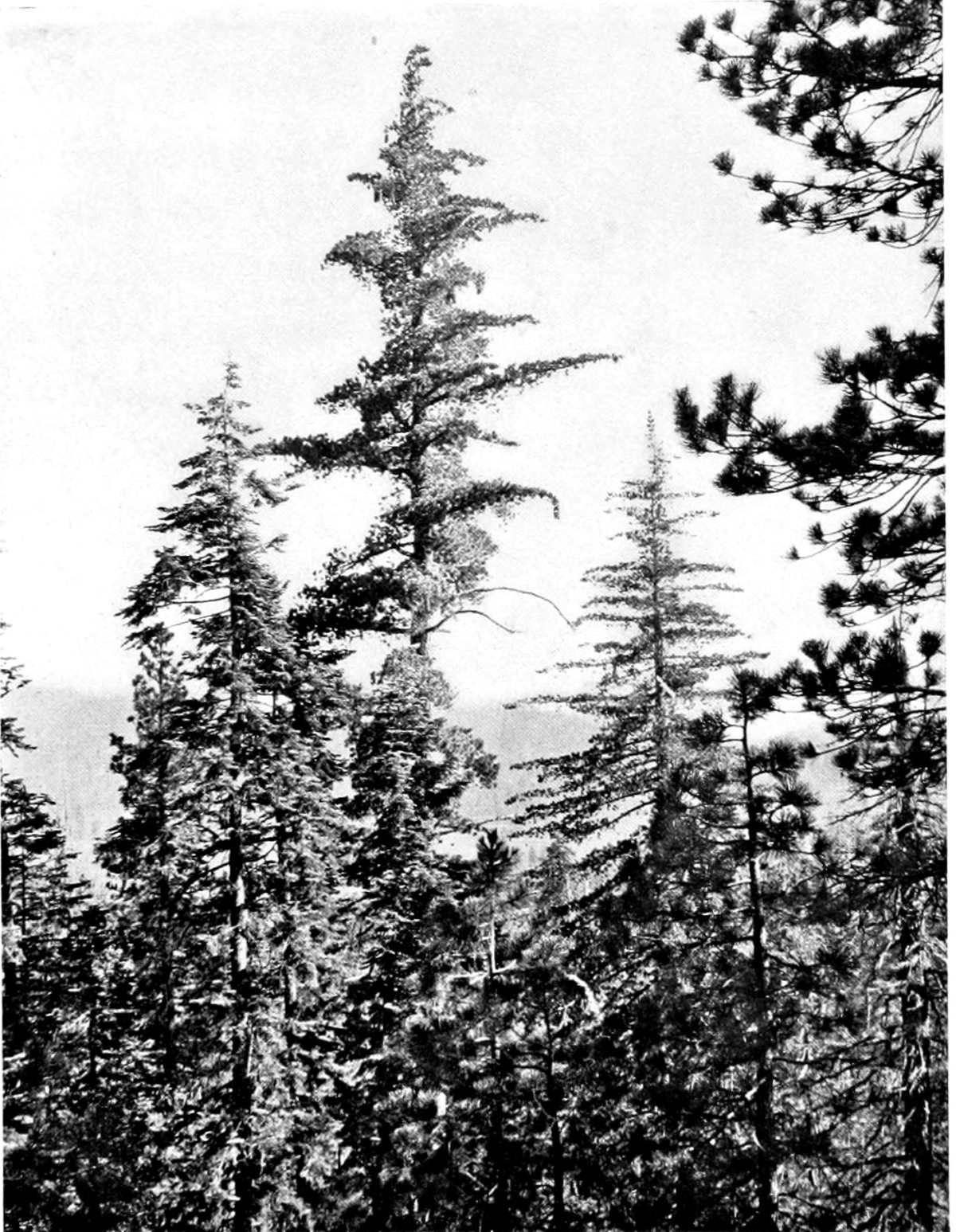
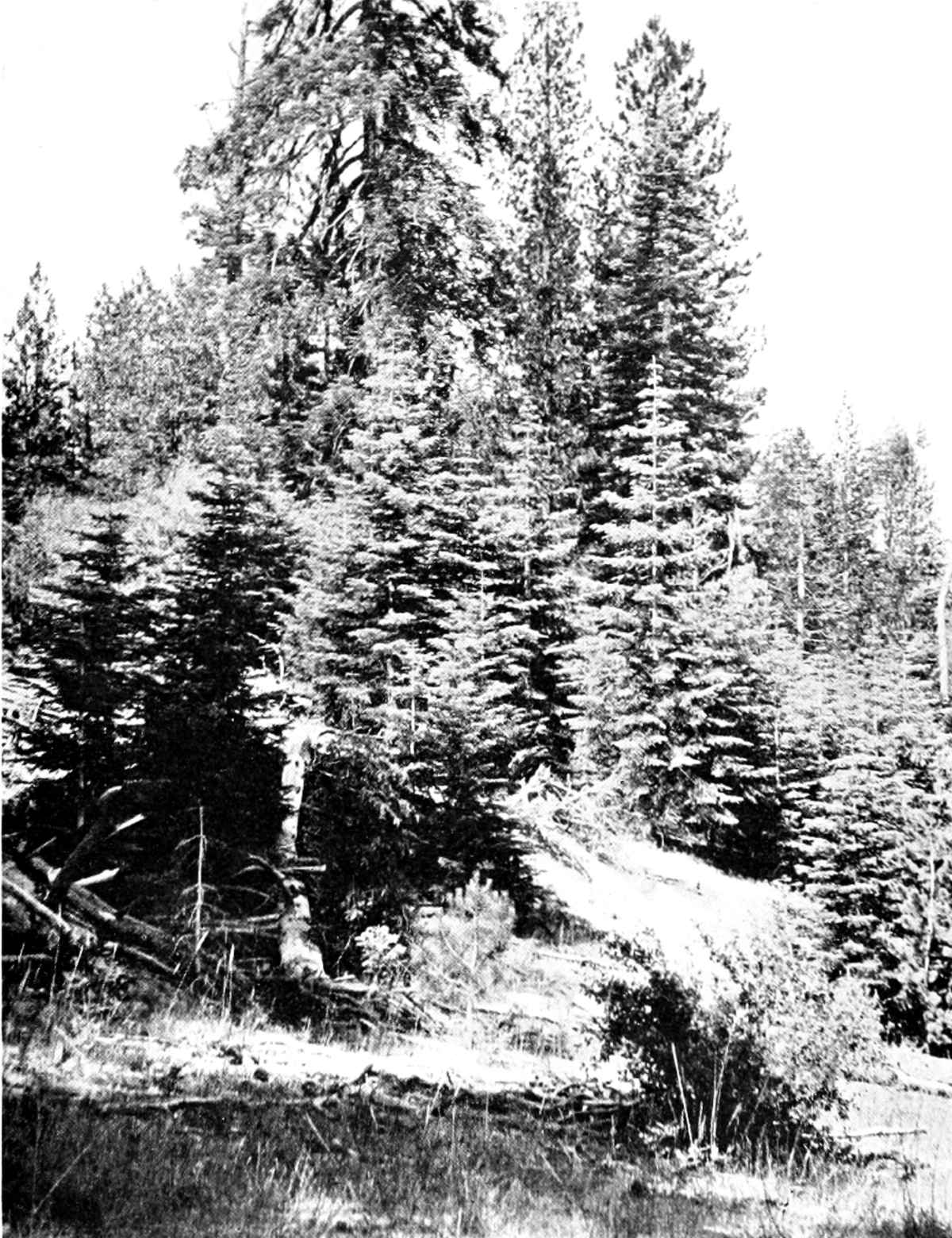
A Silver Fir at Middle Age
The leaves are narrow, flat, and
linear, usually about as long as a pin
or a needle, glossy green on the upper
side, and streaked with a longitudinal
whitish line underneath. They are
crowded horizontally at the right and
left sides of the shoot or twig, like the
hairs on the quill of a feather. The
twigs themselves, and, in turn, the
boughs and branches, have a similar
tendency to assume a horizontal position;
and thus the tree is built up in
neat symmetrical stages, dwindling in
size to the summit, and presenting the
typical conical form of the cone-bearers.
Let it not be presumed, however,
that there is anything awkward or
stiff in the appearance of the firs.
Young firs are among the neatest
and most elegant objects in a park.
The smooth gray bark, the lifelike air
in the distribution of the boughs and
smaller branches, the glossy green as
seen from the side or above, varied to
a blue or gray when we stand beneath,
redeem them from every charge of
conventionality.[4]
The lowland fir as a young tree,
and where it is afforded sufficient
room, has more of the drooping, plume-like,
graceful air than is usual with
the members of this genus. The
leaves are somewhat curled and scattered
about the stem. Like most trees
it becomes more expressive as it grows
older and little by little rejects the
features and traces of its earlier years.
Its arms gradually bend inward, and
the whole tree becomes more cylindrical,
till in its maturity it speaks
freely through its broken and twisted
boughs of storms and battles and insect
ravages of long ago; yet it strives
to cover its scars with luxuriant masses
of verdure and numberless purplish
cones—a truly magnificent spectacle
of a hoary veteran of crisp and sturdy
aspect.
The Engelmann spruce, though a
smaller tree than either the red fir or
the lowland fir, is one of the most important
of the spruces. Its home is
in the elevated regions of Colorado,
whence it spreads westward and northward
throughout the Rocky Mountains.
Its well rounded hole is scaly with small
cinnamon-red plates, and its foliage is
composed of sharp, short, needlelike
leaves, that bristle around the stem
and are bluish-green in color. Its
small brown cones droop from the extremities
of the boughs and mass
themselves in the top of the tree.
Like most of the spruces, this one
climbs to high elevations. Many a
wild mountain slope in the West is
covered by the dense ranks of these
straight, slender trees, with tapering
spires that are green in summer and
frosted with snow and rime in winter.
The glory of our western forests,
however, are the sequoias, those gigantic
trees of California that have become
widely famous. The two sequoias, the
big tree of the Sierra Nevada and
the redwood of the Pacific coast, constitute
the last remnants of a mighty
race that covered vast areas in North
America and Europe in past geological
ages. It is believed that their
days are almost over, for the big tree
groves are few in number and small in
extent, and even these are falling rapidly
under the ax and saw. Nor does
this species appear to reproduce itself
easily; for, although numberless seeds
fall from the old trees, they rarely
sprout, and therefore are slow to replace
what has been taken away. The
redwoods, too, are threatened with extinction,
though they still cover considerable
tracts along the northern half of
the California coast. They are coveted
even more than the big trees and are
disappearing with a rapidity that only
modern industry has made possible.
Fortunately the redwood possesses
two gifts of inestimable value that will
prolong, but cannot perpetuate, its existence.
The unusual amount of moisture
in its wood and the absence of
pitch in the sap lessen the danger from
fire; while the same remarkable trait
that we noticed in the pitch pine, otherwise
very rare in coniferous trees, of
sprouting from dormant buds at the
edge of the stump will replace, for a
time at least, many of the giants that
are taken away.
The general appearance or type of
the sequoias resembles that of the
cypresses and cedars. The bald cypress
is their nearest relative. The
big tree often has the same spreading
base, and both have the fluted, shreddy
bark, traits that may also be noticed in
the common white cedar and in arbor-vitæ.
The diameter of the trunk of
the big tree is strikingly large even for
its wonderful height. Both trees lift
their crowns rather high, and have
comparatively short boughs, with dense,
bushy, somewhat straggly-looking foliage.
In its youthful stage the foliage
of the redwood, like its congener’s, has
a bluish tinge, which with advancing
years turns to a dark and somber green
that contrasts strangely with the red
color of the thick, spongy bark. But
the individuality of both trees, especially
that of the big tree, is so impressive
and magnificent that all these minor
essences become involved in the majesty
of the whole. The mighty bole
rises in splendid proportions to where
the distant fronds hang loosely down,
disappearing within their somber shadows,
but still carrying upward the
masses of foliage, as if striving to reach
the very clouds. As we view their
stately and incomparable forms, so masterly
wrought, so unapproachable in
their magnificence, we need hardly be
told that these trees are strangers from
a distant and forgotten age.
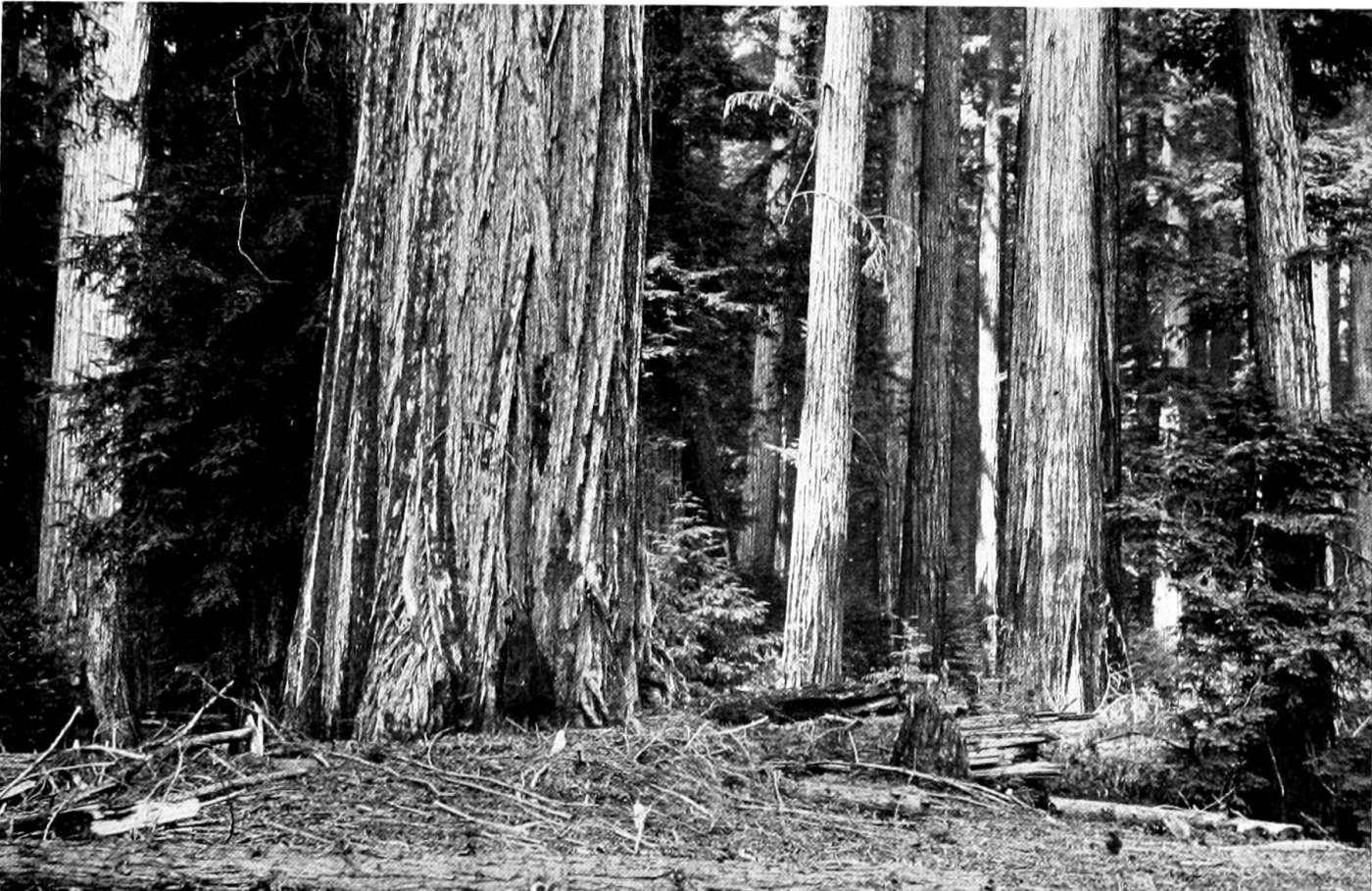
Courtesy of the Bureau of Forestry
Redwood Forest in California
Much has been said and written concerning
the sizes and ages of these two
largest trees of America—indeed, with
the exception of the Australian eucalipti,
we might say of the world. It is
said that some of the latter surpass the
redwood in height, though a redwood
tree was discovered within recent
years on the Eel River, California,
whose stupendous height reached
nearly three hundred and fifty feet,
thus surpassing in that dimension, at
least, any previously recorded measurements
of the big tree. The ages of the
sequoias have been more difficult to
determine, but it appears that in the
beginning they were exaggerated. The
mature redwood, doubtless, is apt to be
several centuries younger than the big
tree; but so excellent an authority as
Mr. John Muir has said of the latter
that “these giants under the most favorable
conditions probably live five
thousand years or more, though few of
even the larger trees are more than
half as old.”
The redwoods are great lovers of
moisture. In the valleys and canyons
near the ocean they bathe in the ascending
fog and stand dripping with condensed
vapor. We shall come upon
them in dense groves, where the day is
a continuous twilight and the trees
surpass in their combined massiveness
even the red firs of Oregon. At other
times we shall find them mingling in
more open forest with lowland firs and
hemlocks, or, in their northern range,
with the splendid Port Orford cedar.
The light enters these more open forests
and calls forth much beautiful
young growth and shrubbery: the
rhododendrons of California, with large
and showy purplish blossoms and evergreen
leaves; western dogwoods, that
might at first glance be mistaken for
the eastern species; barberries and
familiar hazels; and ferns and violets.
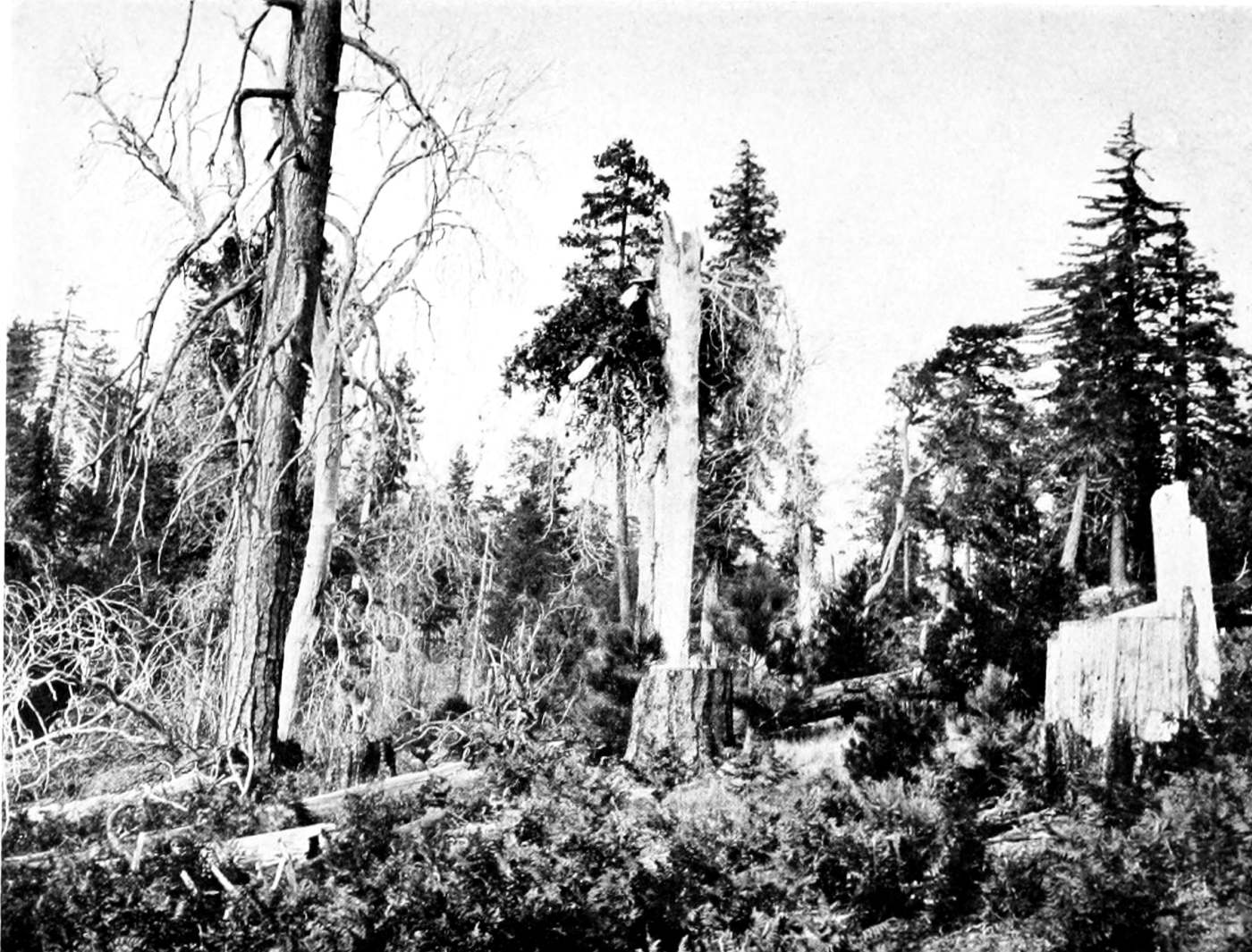
Devastation in the Forest
The reader must not infer, of course,
that such scenes are necessarily of
common occurrence in the forest; but
they are more agreeable to contemplate
than those that have been despoiled of
their attractions. It should be remembered
that if we traveled through
these forests we should often find fresh
signs of human interference: sections
of trees lying prone on the ground,
abandoned as useless by the lumberman;
stripped crowns that stood in the
way of falling trunks, and debris of
bark and slashings. We should also
notice the track of the forest fire
among the stumps and charred treetrunks,
and here and there the dying
tops of standing trees that were unable
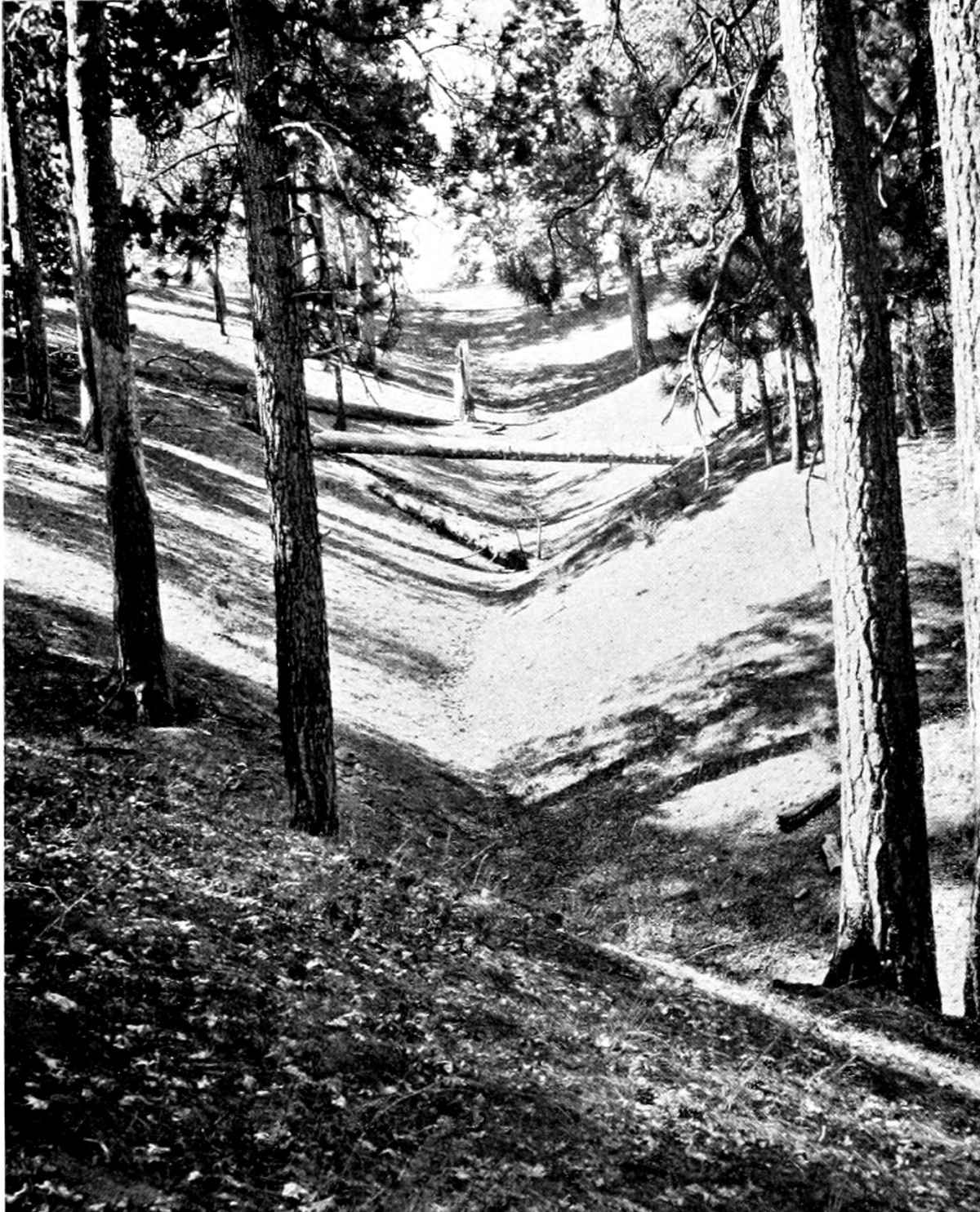
to withstand the flames. Finally,
in dry and semi-arid regions,
particularly in sections of the Southwest,
we should notice still another
danger that threatens our forests:
the excessive or ill-timed grazing of
sheep, which trample to death the
young tree seedlings as they pass over
the ground in great herds and devour
the last vestiges of vegetation, thus
leaving a bare and dry forest floor,
upon which the old trees subsist
with difficulty through the prolonged
droughts of summer.
Courtesy of the Bureau of Forestry
Where the Sheep Have Been
II FOREST ADORNMENT
Though there can be no forest
without trees, it may be asserted
with equal truth that trees alone would
make but an incomplete forest.[5] Under
the old trees we find the young saplings
that are in future years to replace
them and in their turn are to form a
new canopy of shade. In their company
is a vast variety of shrubs, ferns,
and delicate grasses and flowers that
decorate the forest floor. Vines and
creepers gather about the old trees
and clamber up their furrowed trunks.
In autumn the ground is strewed with
fallen leaves, motionless or hurrying
along before the wind. These gather
into deep beds, soft to the tread, and
at last molder away in the moist, rich
earth. In the needle-bearing forests
of the mountains brilliant green mosses
replace the shrubs and flowers and deck
the bare brown earth.
There are lifeless sources of beauty in
the woods, too, that are not easy to
pass by unnoticed: rocks with interesting
forms and surfaces; forms that are
lifeless, yet take on distinct expression
by their different modes of cleavage,
and surfaces that drape themselves in
the choicest paraphernalia of drooping
moss and rare lichen; prattling mountain
streams; cascades; and glassy
pools. These are “inanimate” things
with a kind of life in them, after all.
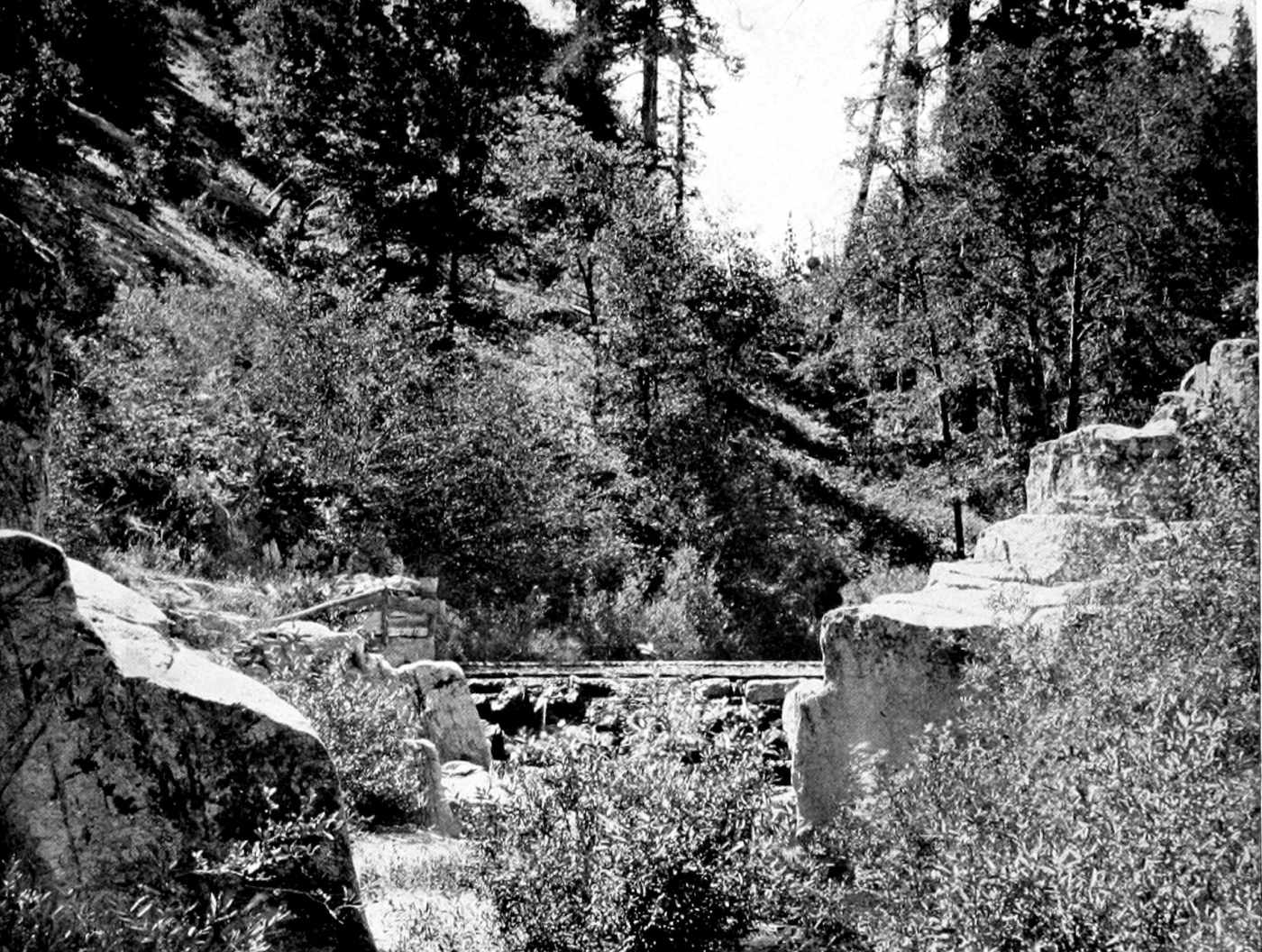
Courtesy of the Bureau of Forestry
A Passageway through Granite Rocks
Lastly, there are the true owners of
the forest: the bird that hovers round
its borders; the free, chattering squirrel;
the casual butterfly that leads us to
the flowers; and the large game that inhabits
the hidden recesses and adds an
element of wildness and strange attraction
to these quiet haunts.
All this wealth of detail gives life to
the forest. The shrubs, above the rest,
should here interest us somewhat more
minutely. They are often the most conspicuous
objects in the embellishment of
the forest; and since our investigation
was to be guided to some extent by considerations
of usefulness, it ought to be
added that shrubs not infrequently exercise
a beneficial influence on the vigor
and well-being of the trees themselves.
Trees, shrubs, and certain of the
smaller plants—so long as their root
systems are not too dense and intricate—are
of value on account of their ameliorative
effects on temperature and
moisture. This is more important in
this country, so extreme in its climatic
variations, than in northern Europe.
In the dry and parching days of summer
the shrubbery of the woods, by
its shade, helps to keep the earth cool
and moist. This mantle of the earth,
moreover, conducts the rain more gradually
to the soil, exercising an efficient
economy. In the fall and winter the
shrubs, which are densest near the forest
border, help to break the force of
the sweeping winds which might otherwise
carry away the fallen leaves, so
useful in their turn because they are
conservators and regulators of moisture
and contain valuable chemical constituents
which they return to the soil.
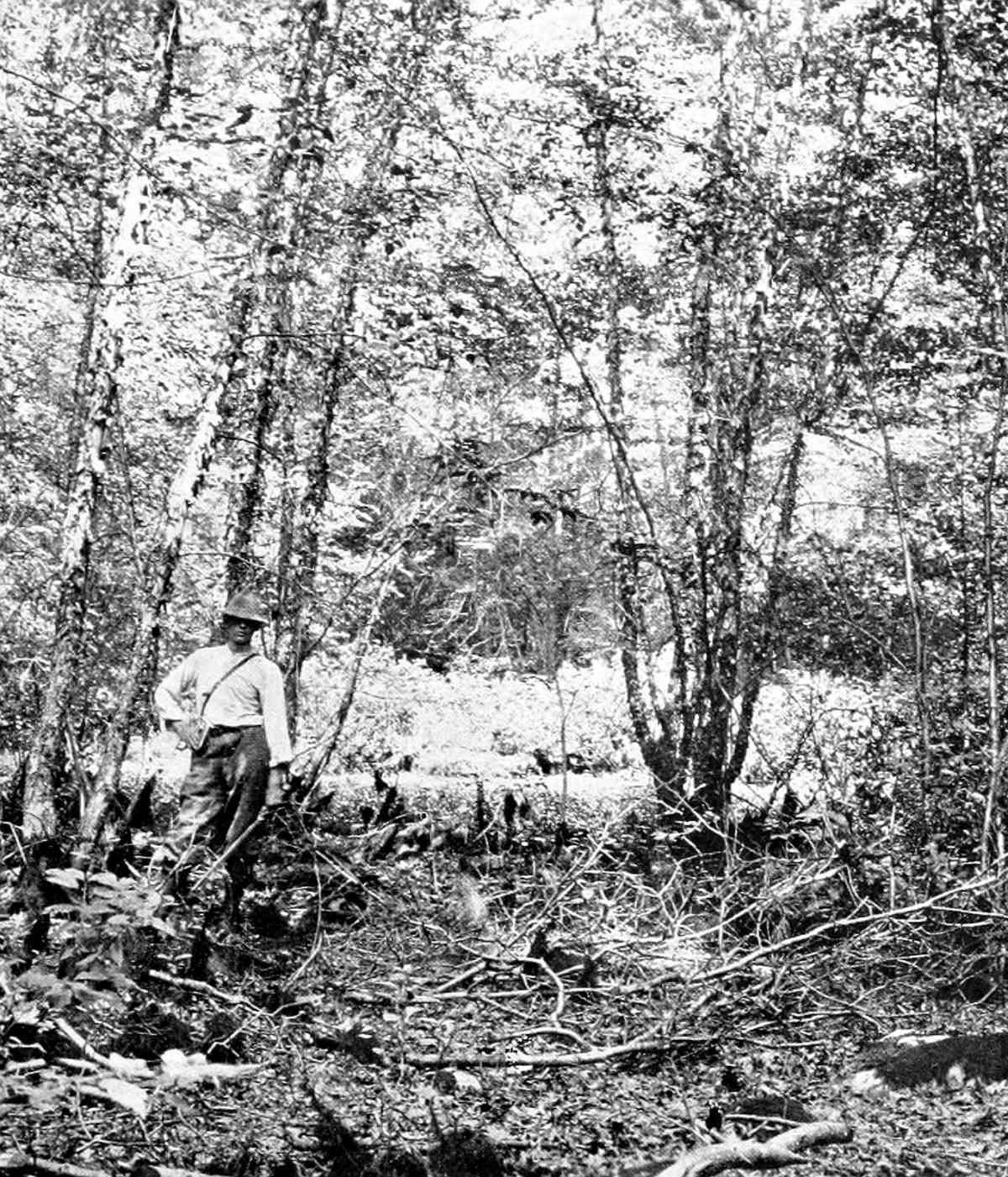
Courtesy of the Bureau of Forestry
Shrubbery and River Birches. New Jersey
The pine barrens of New Jersey
illustrate these principles. In close
proximity to the sea a welcome moisture
enters the forest with the ocean
breezes. Penetrating farther inland, it
is not so entirely dissipated as to preclude
a varied undergrowth of shrubbery,
which in turn renders a welcome
aid to the forest by the protection it affords
to the porous, sandy soil, which
would soon dry out under the scant
shelter of the pervious pines. Underneath
these the kalmia or calico bush,
with its large and showy bunches of
flowers, is abundant. In late summer
the sweet pepperbush is there, laden
with its fragrant racemes; in winter, the
cheerful evergreen holly of glossy green
leaf and bright berry. In the dry and
sunny places we find the wild rose, the
trailing blackberry, with its rich color
traceries on the autumn leaves, and the
no less brilliant leaves of the wild strawberries
underfoot. We come upon the
creeping wintergreen and the local
“flowering moss.” The fragrant “trailing
arbutus,” here as elsewhere, is
an earnest of the generous returning
spring. Along the creeks and brooks
are masses of honeysuckles, alder
bushes, and sweet magnolias.
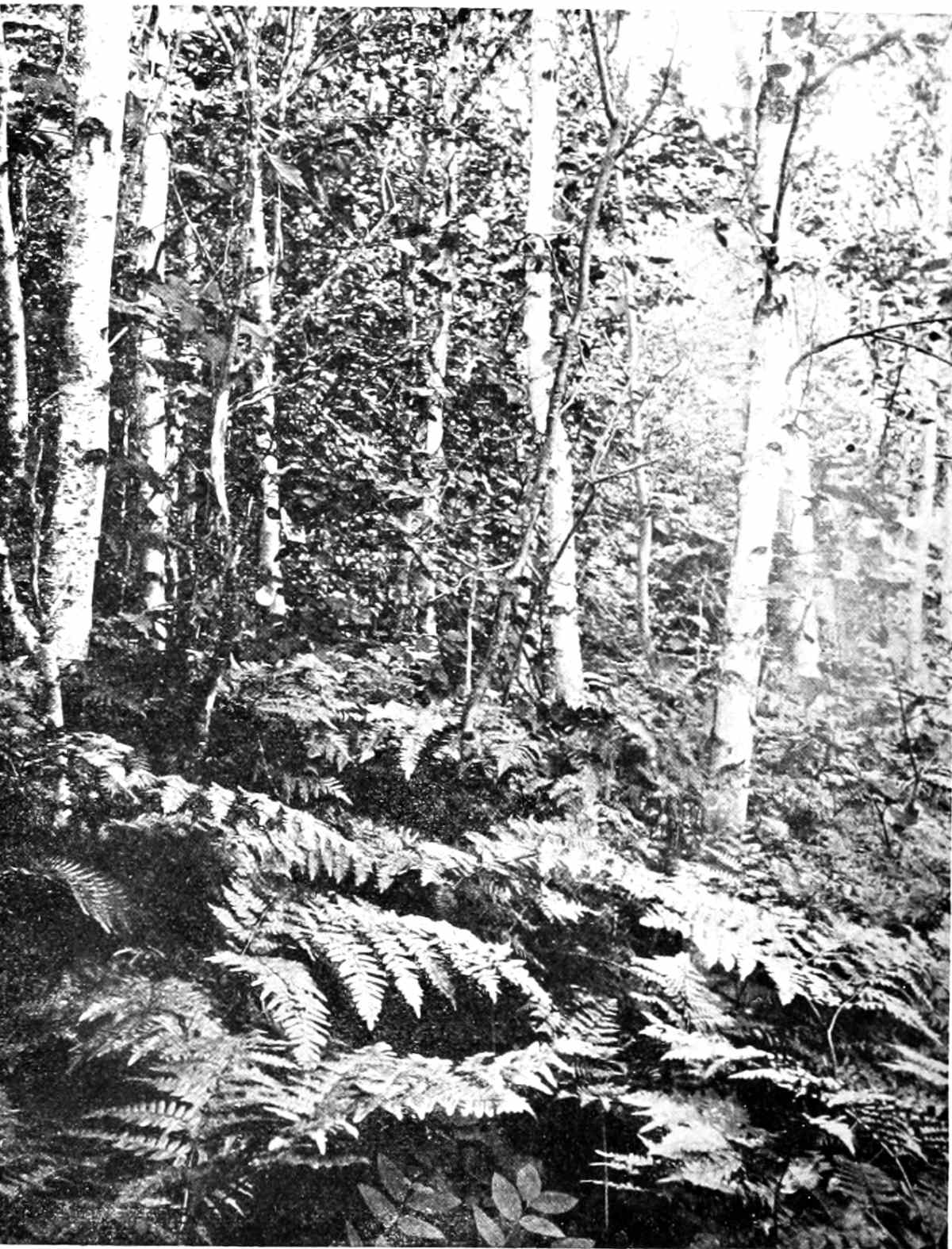
Fern Patch in a Grove of White Birch
The coniferous forests of the Rocky
Mountain region are either too dry or
too elevated to promote a luxuriant
undergrowth; but we find it in the
humid coast region of Oregon and
Washington, within the forests of fir,
pine, and spruce. In the deciduous
forests, however, the shrubbery attains
its best development, for its presence
depends largely upon moisture, climate,
and soil, and these conditions are usually
most favorable in our broadleaf
districts. In the latter, moreover, the
shrubbery exercises its influence most
efficiently, for many of the pines will
bear a considerable amount of heat and
drought, and several other conifers
show their independence and a different
kind of hardihood at high and
humid elevations. The varied and
beautiful forms of undergrowth in our
broadleaf forests—the shrubs, the
vines and graceful large ferns, and the
smaller plants that live along the forest
borders and penetrate within—may be
regarded as one of the distinctive features
of American forest scenery.
In such forests, and along their borders,
the birds like to make their home.
Among the bushy thickets they find a
secure shelter, and some of them seek
their food among the fruits and berries
that grow there. They all possess their
individual charms, and infuse such
varied elements of life and cheer into
the woods that even the most commonplace
scenes are transmuted by their
presence, while those that were already
beautiful receive an added attraction.
In winter there is nothing more harmonious
than a flock of snowbirds flying
over frosted evergreens toward
some soft gray mist or cloud. For
grace and ease of movement I have
never seen anything more airy than the
Canada jay alighting on some near
bough, softly as a snowflake, to watch
and wait for the scraps of the forester’s
meal. Another interesting bird
to watch in his movements is the red-winged
blackbird. Out along the
edges of the forest and in the swamps
and marshes lying between bits of
woodland, he may be seen from earliest
spring to the last days of fall.[6] We
cannot help watching him passing
restlessly to and fro by himself, or circling
happily about in the flock, returning
at last to his clumps of alders
and willows, or disappearing among the
hazy reeds and grasses. But if, instead
of grace and movement, we are
more interested in sound, we shall find
no songbird with sweeter notes than
the thrush. Whatever added name he
may bear, we are sure of a fine quality
of music; music with modulating notes,
plaintive and clear, that drive away all
harshness of thought.
Let us again consider the undergrowth
in the forest. Where shrubs
and tender growths abound the wintry
season cannot be desolate or dreary.
When the display of summer is over
they attract the eye by their bright
fruits and their habits of growth. Their
branchlets are often strikingly pretty in
color and well set off against the snow.
Their intricate traceries of twig and
stem are an interesting study. The
copses of brown hazels that spread
along the mountain side and the dusky
alders or yellow-tinted willows are in
perfect harmony with this season of
the year.
It is by crowding into masses that
our shrubs of brighter blossom produce
some of the most superb effects of
spring. A multitude of rhododendrons
or great laurels covers some
mountain side, carrying its drifts of pale
rose far back into the woods. A mass
of redbuds and flowering dogwoods,
the former again rose-colored, the latter
a creamy white, pours out from the
forest’s edge among ledges of rock and
low hills. The wild plums and thorns,
with their delicate flowers, are beautiful
in the same manner, and in addition
have a pretty habit of straying out and
away from the woods, much like the
red juniper.
Our shrubs are no less beautiful in
their separate parts than they are magnificent
in their united profusion. The
common sweet magnolia is especially
well favored. Its elegantly elliptical
leaf, with smooth surfaces, glossy and
dark green above, silken and silvery
below, is one of the most attractive to
be found. Its flower cannot help being
beautiful, for beauty is the heritage of
all the magnolias. Often, however,
half the pure ivory cups lie hidden in
the leaves, to surprise us on a closer
approach with their beauty and sweet
fragrance. Altogether this favored
shrub is one of the most exquisite objects
of decoration, whether in the
swamp, along brooksides, or through
the damp places of the forest.
The hawthorns, which, like the
sweet magnolia, occur both as trees
and as shrubs, combine varied forms
of attractiveness, such as compound
flowers of white or pinkish hue; sharply
edged, elegantly pointed leaves; bright
berries; and closely interwoven branchlets
stuck about with thorns. The redbud,
which I have already mentioned,
holds its little bunches of flowers so
lightly that they look as if they had
been carried there by the wind and had
caught along the twigs and branches.
Very different from these, yet no less
interesting in its way, is the staghorn
sumach, which is of erratic growth
and bears stately pyramids of velvety
flowers of a dark crimson-maroon.
There is a fine contrast, too, where the
serviceberry, with early delicate white
blossoms, blooms among the evergreens
and the opening leaves of spring.
Another word about the West. The
undergrowth of the northerly portion
of the Pacific coast region has already
been referred to; but there extends
throughout the Southwest, penetrating
also northward and eastward,
another kind of forest growth that is
so distinct in character from all others
that it should be specially described.
It is, in fact, quite opposite in its nature
to the shrubbery of the more humid
forest regions in that it shows a tendency
to seek the arid, open, sunny
slopes, where it forms a scrubby, though
interesting, and varied cover to the
rough granite boulders and loose,
gravelly soils. This growth is everywhere
conveniently known as “chaparral,”
whether it be the low, even-colored
brush on the higher mountains
or the dense, scraggy, promiscuous,
and impenetrable thicket of the foothills
and lower and gentler slopes.
The impression which the chaparral
makes depends largely upon the distance
at which it is viewed. If we
stand in the midst of a dense patch of
it we see of how many elements it is
composed; how the shrubs of different
size, shape, and character crowd each
other into a tangle of branches, some
not reaching above the waist, others
closing in overhead. The ceanothus,
with its dull, dark-green foliage
and bunches of small white flowers,
which appear in June, stands beside
the stout-stemmed, knotty, twisted
manzanita, with its strikingly reddish-brown
bark and sticky, orbicular, olive-colored
leaves. Among smaller shrubs
we find the aromatic sage brush, of a
light-gray, soft appearance, and the
richer, darker, small-leaved grease-wood,
or chemisal, as it is more commonly
called farther north, with its
small, white-petaled flowers enclosing
a greenish-yellow center. Very plentifully
scattered among all these we
usually find the scrubby forms of the
canyon live oak and the California
black oak. Here and there we may
see a large golden-flowered mallow, or
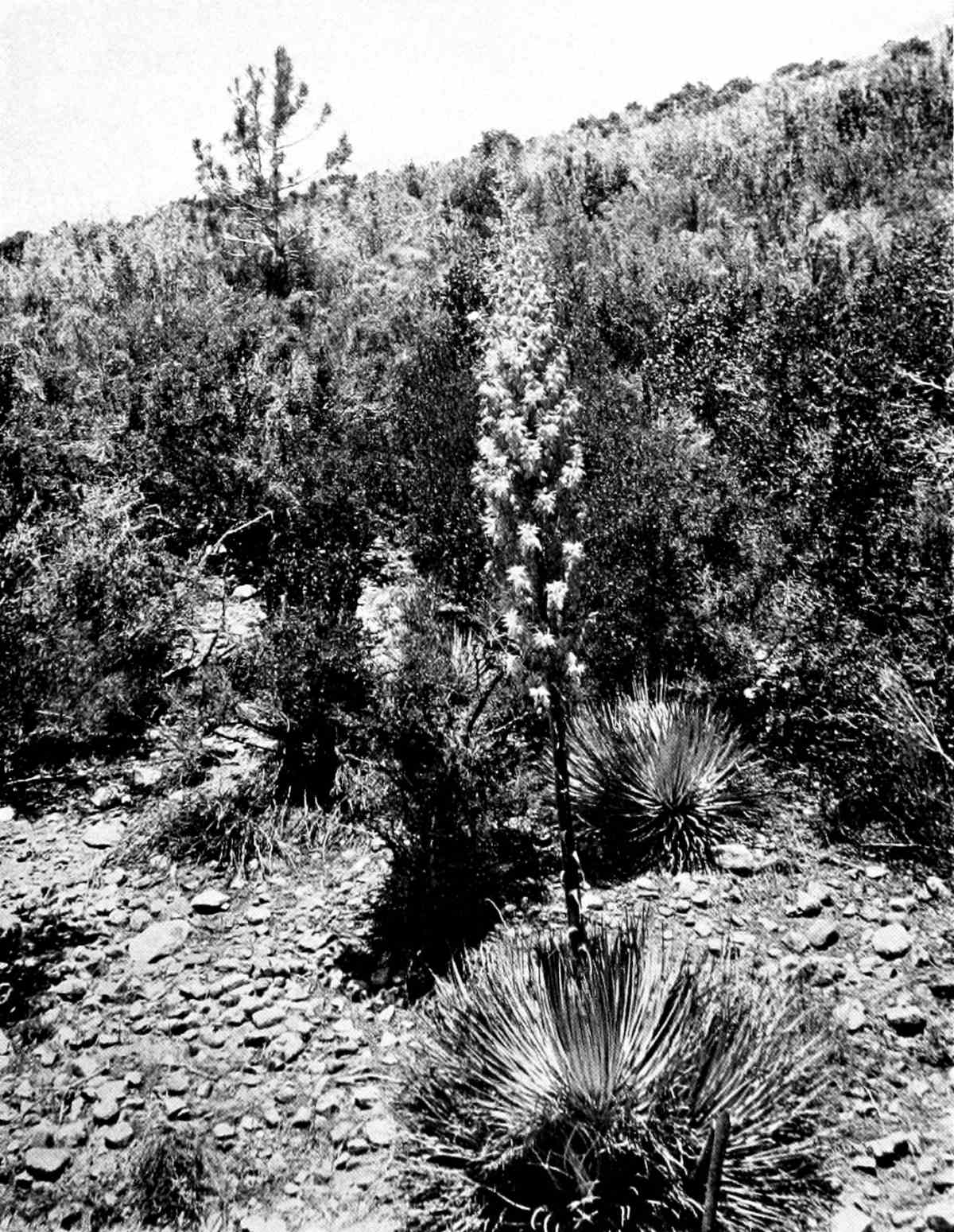
the queenly yucca raising its fine pyramid
of cream-colored flowers out of
the dense mass.
The far view is quite different.
Distance smoothes the surface and
somewhat obliterates the colors, though
we may still distinguish a variegated
appearance. The eye takes in the
larger outlines and the scattered pines
that sometimes occur within the chaparral.
Nor is the latter, as we now perceive,
always a dense growth, but may
be separated here and there. Indeed,
it is often most interesting when interrupted
by large granite boulders and
jumbles of rocks, with the clean gray
shade of which it forms a fine contrast
on a clear morning.
A Yucca in the Chaparral
If we look still farther up toward
some higher slopes, miles away, we
shall see only a uniform and continuous
stretch of low brush that appears
at that great distance hardly otherwise
than a green pasture clothing the barren
mountain. As we walk toward it
the bluish-green changes to a bronze-green,
and then suddenly we recognize
the broad sweep of chemisal, with a
few scattered scrubby oaks and mountain
mahogany in between.
In the account of forest embellishment
should be included those humblest
plants, the liverworts and mosses
and the lichens that so beautifully
stain the rocks and color the stems of
trees. A close study of all their delicate
and tender characters, both of
form and color, is always a revelation.
Among these lowlier plants it is no
uncommon sight in the depth of winter
to see a field of fern sending a
thousand elegant sprays through the
light snow-covering; or half a dozen
kinds of mosses, all of different green,
but every one pure and brilliant,
gleaming in the shadow of some dripping
rock. Between the rock and
its ice cap, covered by the latter but
not concealed from view, there is a
fine collection of the most delicate
little liverworts and grasses, herbs with
tender leaves, and even flowers, it may
be, on some earthy speck where the sun
has melted the ice—all as if held in
cold crystal.
A word also remains to be said
about the vines and creepers. As far
north as Pennsylvania, and even to the
States bordering the Great Lakes,
these clambering plants are a conspicuous
element in the forest. Virginia
creeper, clematis, the hairy-looking
poison oak, and the wild grape, are
among those that are most familiar.
In the woods of the lower Mississippi
Valley the wild grapevines often make
a strange tangle among the old and
twisted trees and hang in long festoons
from the boughs. They are not
uncommon in some of the northerly
States, though less rank and exuberant
in growth.
The common ivy is one of the most
beautiful of all creepers. It makes a
fine setting for the little wood flowers
that peep from its leaves. I like it
best, however, where it clings to some
old oak or other tree and brings out the
contrast between its own passiveness
and weakness and the strength of the
column that gives it support.
III DISTRIBUTION OF AMERICAN FORESTS
The geographical distribution of
trees has been referred to occasionally
in the preceding chapters.
This distribution, gradually accomplished
during the progress of ages,
has not been accidental; on the contrary,
it has been due to natural causes,
and arises out of the special needs and
adaptations of each species. The geology
of a region, which determines in
many respects the character of the physical
forces of both the earth and the air,
is no small factor in the development
of the forest. The character of the
climate, the nature of the soil, the degree
of moisture in the soil and in the
atmosphere, the amount and intensity
of the sunlight—in short, the various
elements and natural forces that constitute
the environment of a tree—are
the all-important conditions of its life.
On these it depends, and according to
its own peculiar nature and its special
needs, selects its natural home.
Yet the manner in which this selection
is accomplished, though simple in
theory, is complicated by many circumstances.
Frost, fire, insects, and floods,
by destroying the trees or their seeds,
may retard the progress of the species.
The wind may be unfavorable. The
seeds hang upon the trees ready and
ripe for germination, but a breeze comes
along and carries them to a place where
the conditions are ill adapted to their
peculiar nature. The following year
the wind is propitious and the little
trees soon start into life. But presently
the seeds of another tree, whose growth
is by nature faster, are conveyed to the
same spot, and the intruders outstrip
the others in rapidity of growth and
spread a canopy of foliage that screens
the smaller trees from the life-giving
sun and dooms them to destruction.
Thus only a few of the numberless
seeds that are produced each year live,
and fewer still are able to maintain or
extend the boundaries of the parent
tree. Sometimes, too, the frugality or
hardiness of a species may be the reason
for its exclusive occupation of a
certain locality, since other trees may
find it impossible to live at high altitudes
and on rocky ridges or to subsist
upon rough, poor soil. Consequently
we shall find some kinds of trees exclusive,
gregarious only among themselves,
while others mingle freely in
the general concourse.
Through the persistency, therefore,
of the vital forces of nature, through
a suitable climate or situation, through
the power of adaptation and the delicate
adjustment of many details, the
vast armies of trees, like migratory
races, have at last accomplished their
purpose and found their several homes;
and to us the varied aspect of the forests,
as we traverse the extended territory
of our country, is in a manner
explained. There are stretches of land
over which the tree growth is dense
and uniform; where the forest is given
over, it may be, almost entirely to a
single kind of tree. In other places
the trees may join in varied luxuriance,
young and old, familiar and strange, on
some fertile, protected plain or well
watered mountain side. In still other
places they may be seen struggling up
the steep slopes and maintaining a
precarious existence on bleak, rocky
ridges.
While the eastern portion of the
United States is, generally speaking,
the home of the broadleaf species, and
the northern and western portions are
similarly occupied by the coniferous
forests, these areas may readily be subdivided
into specified regions of distinct
forest growth. The latter, however,
cannot be accurately delimited, since
the regions naturally penetrate into one
another and overlap, on account of the
manner in which forests have extended
their bounds.
In the basin of the Great Lakes,
where the glaciers of a recent geological
age have prepared a light, loose,
gravelly or sandy soil, the white pine
belt extends through the States of Minnesota,
Wisconsin, and Michigan, and
penetrates into portions of Pennsylvania,
New York, and New England.
Once covered with dense tall forests
of white pine, interspersed in places
with other northern conifers, or broken
by smaller areas of broadleaf forests,
the white pine belt has now yielded
to us its richest treasures. The exacting
demands of our modern artificial
civilization have drawn ceaselessly upon
these resources, and the assiduous ax
and the fire that follows in its train
have invaded even the most secluded
regions. The resulting barren spaces,
where they have not become cultivated
land, have either reverted to the young
white pine itself or have been transformed
into oak barrens and open
forests of broadleaf trees. Thus the
aspect of the region has been altered,
though many a limited spot may be
found in which the tall majesty of the
primeval forest still finds its full expression.
Extending from southern New England
along the entire range of the
Appalachians, sloping toward the Atlantic,
and spreading far westward to
the Mississippi and beyond, the region
of the eastern broadleaf forests covers
a vast territory. Not that the conifers
are here entirely absent, for several of
these, including the white pine itself,
follow the mountain ranges and scatter
throughout the hills and plains;
but their number dwindles in the proportion
of the whole.
Beyond this region to the southward,
in the States that border the Gulf
east of the Mississippi, in Georgia,
and stretching along the coast northward,
a region of pines is once more
encountered. This section of our
forests, though it has already yielded
generous supplies, is among the richest
in the country. From the pineries of
the South is obtained much of our construction
timber; and thence, too, we
derive our pitch, tar, and turpentine
from the sap of the trees.
Finally, within the eastern forests a
restricted region at the southern end of
Florida, including the Keys, may properly
be separated from the rest. For
here is found a distinctively tropical
vegetation, differing entirely in character
from the forest flora to the north.
Many trees indigenous to the West
India Islands have established themselves
upon this small area, on which
the number of species exceeds that of
any region of equal extent within the
United States, not excepting even the
varied forest growth of the Mexican
border line, to which alone it might be
worthily compared.
Separating the forest floras of the
western and eastern United States, lies
the broad region of prairies and plains.
Though trees are found for the greater
part only along the banks of streams,
this region has a curious interest for
the forester. It is believed by many
that this wide country, now waving in
grain and grass and covered with extensive
farms, was at one time enriched
with scattered forests; but that these
have disappeared under the ravages
of repeated fires, kindled, it is supposed,
chiefly by the Indians. At
present our own race is perseveringly
reclothing these prairie lands with
groves and avenues of trees, and
is planting belts of them about farms
and orchards for protection from hot or
frosty winds. Thus the fringed borders
of the streams are widening. The
outcome of this activity is a development
that stands in marked contrast with the
hurried consumption of our other forests.
Then, lastly, there lies beyond this
region the vast territory of the Rockies
and the ranges of the Pacific coast.
Extending over so great a part of
our country, the forests of this region
exhibit many transitions that reveal
the intimate relations between trees
and their natural environment; yet
here we cannot but notice the enormous
preponderance of the coniferous
over the broadleaf trees. Indeed, it
amounts almost to an exclusion of the
latter; for, while some of the poplars
and willows and several species of
oaks and a few maples are indigenous
to this part of the country, the last
two in particular to portions of California,
other broadleaf trees are mere
stragglers in the land.
The forests of the West retain much
more of the flavor of wildness than do
those of the East, though they likewise
show many evidences of the hand of
man. It is true that paths and roads
lead from many familiar resorts into
these mountain forests, that there are
signs of the lumber industry and of
fires, and that there are large barren
areas where sheep have been continuously
driven for pasture. Extensive
as this interference with original conditions
has been, however, the changed
aspect of the forest has not always
remained permanent, because nature,
where it is possible, comes back patiently
to restore life and beauty to the
wasted places. Over lofty ranges and
in inaccessible places we may still find
the original forest bequeathed to us
from early days; but not in such places
only: for if we look closely we shall also
recognize the old character and expression
in the harvested forests that have
long since been deserted and forgotten
and at last returned, like lost children,
to the fostering care of their mother.
The forests of the West may be fitly
separated into two parts. The greater
part embraces the Rocky Mountain
ranges, while the other extends from
the crests of the Sierra Nevada to the
sea. In the former the forests are
sometimes open in character and separated
by parks or grassy plains, or they
constitute a scattered tree growth on
the high altitudes of the rougher ridges.
This open character is sometimes due
to devastation by fires, but generally it
is the result of climatic conditions.
And yet there are wide tracts and
spaces within this region that bear
dense forests, notwithstanding the barren
soil and the austere climate; forests
that have been but little or in no
wise disturbed, and whose expression
differs in an unmistakable manner
from the opener growth of the broadleaf
forests of the East.
Denser than these and more awe-inspiring
are the forests of the States
bordering the Pacific. Here the moisture
from the sea, an equable climate, and
a generous soil, have produced the tall
and somber red firs, the stately hemlocks
and cedars, the redwoods of the coast,
and the consummate beauty and magnificence
of those opener groves of big
trees, sugar pines, and bull pines, that
have always commanded the admiration
and wonder of visitors to that region.
IV CHARACTER OF THE BROADLEAF FORESTS
If the individual trees of the two
main groups that were described in
the opening chapter impress us differently
as they belong to the one or the
other, it will be found that the two
kinds of forests likewise convey distinct
impressions. Different in aspect,
they are also distinguished one from
the other by the different atmosphere
or spirit that pervades them. Taking
leave here of the trees as individuals, I
shall now examine the characteristics
of woodland scenery.
It has been said that the broadleaf
trees grow naturally over a wide extent
of territory. Of the unbroken wildernesses
that covered the eastern parts of
our country when it began to be colonized,
only fragments remain. A few
States are still densely wooded, but in
these the forces which have caused
the disappearance of similar forests in
other regions have now begun to assert
themselves. Some will yield to their
old enemy, the ravaging fire that could
so often be prevented; others must ultimately
recede to make way for agriculture;
many will be removed more
rapidly for the sake of their material.
It is confidently to be expected, however,
in view of the widening influence
forestry is exerting, that where
it is desirable a provision will be
made for a future growth to replace
the present one.
Of the broadleaf forests there are
many types. There are forests of oak
and chestnut, of maple and beech; dry
upland forests, and the tangled woods
of the swamps. There are young thickets
of birch and aspen, of willow and
alder, and scrubby oak barrens. There
are second-growth forests, and now
and then even a patch of fine old virgin
timber. In size, also, there is a great
difference, from the grove that covers
the hilltop to the unbroken forest that
stretches over an entire mountain
range.
It appears, therefore, that variety is
one of the marked characteristics of
our eastern woods. As several hundred
different kinds of trees enter into
their composition under every form and
modification of circumstance, we find
in these woods an endless novelty
and perennial freshness. The young
swamp growth of red maple, white
birch, and alder, bedded in grass and
wild flowers, is very different from the
dense young forest of birch and aspen
of the northern woods that, under the
influence of ample light, has sprung
into being after some recent fire, the
signs of which are still visible in the
charred stumps under the young trees.
The open groves of old oak and chestnut
on the hill, with the slanting light of
autumn and deep beds of dry, rustling
leaves, are likewise different from the
secluded forest in unfrequented mountains,
where young and old growth
mingle together: crooked ashes and
moss-covered elms with straight young
hickories, with shrubs and vines, and
little seedlings sprouting among the
rocks and mosses.
If we were to proceed in a continuous
journey from the staid forests of the
North to the more diversified growth
of the intermediate States, and, going
on, were to visit the complex forests
of the South, we should notice only a
very gradual transition. Yet if we
were to study any particular region
within these larger areas it would be
found to have certain definite characteristics.
Let us imagine ourselves standing,
for instance, on some point of vantage
in the Blue Ridge of Virginia,
the season being early May. The
view extends across ranges of low,
rounded mountains, which are fresh
with the new foliage of spring. On the
nearest hills the individual trees and
their combinations into groups can be
distinguished; but receding into the
valleys and more distant slopes the
forms and colors grow less distinct, till
the tone becomes darker and at last
melts into the familiar hazy blue of
the distant hills. Looking again at the
nearer hillsides, we recognize the tulip
trees with their shapely crowns, clothed
in a soft green and lifted somewhat
above the general outline. The light
green of the opening elms and sweet
gums can be very well distinguished
beyond the more shadowy beeches,
ashes, and maples. The remaining
spaces are occupied by hickories and
chestnuts, still brown and leafless, and
by rusty-hued oaks, which are only
just beginning to break their buds.
Within the leafless portions of the wood
an occasional dash of bright yellow or
creamy white, not quite concealed,
shows where the sassafras or dogwood
is in bloom. The crests and ridges,
however, are likely to be occupied by
groups and bands of pines, while the
sides of the mountain brook will be
studded with cedars and hemlocks.
In such scenery, if it be natural,
there is no vulgarity and no faultiness
of design. With all the variety there
is still a fitness in form, color, and expression.
It is rough, but pure in
taste. For instance, the pine groves
on the mountain ridges are not sharply
defined in their margins and thus separated
from the rest of the forest, but
they gradually merge with the neighboring
trees in a way that was naturally
foreshadowed in the conformation of
the land and the composition of the soil.
A feature so natural and self-evident
may hardly appear worthy of notice;
but its value is appreciated as soon
as we compare the outlines referred
to with the rigid forms of some of the
artificial forests of Europe. Those
who have seen the checkered forests
of Germany, where the design of the
planted strip of trees, like a patch
upon the mountain, is unmistakable,
will readily note the contrast between
the natural and the artificial type.
Neither is there any striving for effect
in the natural forest, an error not uncommon
in the tree groupings of parks
or private estates. In these an effort
is sometimes made to produce an impression
by contrasts in form and color,
but too often the outcome is mere conspicuousness;
while nature, in some
subtle way, has touched the true chord.
Forest scenery, however, need not be
as extensive as this in order to add appreciably
to the beauty of landscape. In
the valley of southern Virginia, among
the peach orchards and sheep farms,
low hills lie scattered on both sides of
the valley road. The mountain ranges
beyond them recede to a great distance,
and are partly hidden from view by
these intervening hills. The latter,
however, are decked with bits of woodland:
groves of oak, chestnut, and
beech, where the horseman on sunny
summer days finds a welcome coolness
and shade. Would these sylvan spots
be missed if they were to be removed?
They now exercise a beneficial influence
on the drainage and moisture
conditions of the surrounding farmlands,
and they supply some of the
home wants of the farmers. But they
have an esthetic value also. They are
usually in neat and healthy condition,
and, viewed either from within or
without, they are balm to the eyes as
they lie scattered promiscuously over
the hills.
It is hardly two hundred miles by
road from that region to the high
mountains of the North Carolina and
Tennessee border, where we find broadleaf
forests of the wildest and roughest
kind. These happily still possess the
great charm of undisturbed nature.
The small mountain towns lie scattered
far apart. The region is even
bleak and dreary—at least until the
summer comes; but when everything
turns green the season is glorious. As
we ride through these woods we realize
the majesty of their stillness and
strength, and cannot help admiring the
great oaks and chestnuts that contend
for the ground, succumbing only after
centuries in the strife.
While the broadleaf forests of
western North Carolina and eastern
Tennessee are characterized principally
by grandeur, this is not commonly
a pronounced trait of the leafy
forests. Rather are they distinguished
for a certain air of cheerfulness, the
expression of which will vary in different
localities; but in some way it
will manifest itself almost everywhere.
Thus, in the southern half of New
England woodland scenery is marked
by a peculiar expression of quiet
gladness. Whether it be in small
farm woods among low hills, or in
continuous forest, as in the Berkshires,
there is the same happy choice in
bright and cheerful trees: maples,
birches, elms, and others; some bright
with early spring blossoms, some adding
to the variety of color by their bark
or shining leaves, others agile of leaf
and bough in the frequent breezes.
Here we find an abundance of oaks,
trees whose fresh, glossy leaves seem
to be specially well fitted to purify the
air, for there is a distinct and refreshing
odor in oak forests. We find an
ample choice of tender, springy plants
among the moist rocks. These smaller
woods, too, are the favored haunts of
the songbirds, for here they find the
glint of sunshine that they so much
delight in.
A similar warmth of expression belongs
to the leafy woods of other
regions. If we compare New England
with Pennsylvania, we shall find
that the broadleaf forests of the latter
are denser and more continuous, while
they are at the same time richer in the
variety of trees, shrubs, and other
forms of embellishment, which find here
a milder air and a richer soil. Springtime
is more luxuriant and replete with
happy surprise and change. But while
these forests are perhaps more elaborate
than those of southern New England,
I cannot say that they impress
me as being so homelike and engaging.
Along the Gulf and in Florida the
dank forests of the swamps and river
bottoms, finding all the conditions favorable
to a luxuriant vegetation, are
characterized by extraordinary complexity
of growth. Perhaps we enter some
secluded patch of virgin forest, and sit
down for a while in its dense shade,
impressed by the strangeness and solitude
of the place. Our curiosity is
aroused by the multifarious assemblage
of trees, vines, and shrubbery,
and we wonder how many ages it has
been thus, and how far back some of
the oldest trees may date in their history.
But they seem rather to have
no age at all; only to be linked in
some mysterious way with the dim
past out of which they have arisen.
Virgin Forest Scene in Florida
A mighty live oak leans across the
scene, moist and green with moss; another
is noticed farther away among
slender palmettos, whose spear-edged
leaves catch the sunlight. Vines and
climbers hang about the stems or
droop lazily from the boughs. In the
nearby sluggish water, where the soil
is deep and moldy, stands a sweet
gum with curiously chiseled bark, as if
some patient artist had been at work;
and a little beyond, some cypresses are
roofed by the delicate web of their own
foliage.
We may sit dreaming away a full
hour thus, with only the hum of a few
insects and perhaps a stray scarlet
tanager flitting by to disturb our meditations.
It has been indicated in a former
chapter that the broadleaf woods,
taken as a whole, are decidedly richer
in shrubs and small plants than the
evergreen or coniferous forests. This
adventitious source of beauty has much
to do with their general character, because
the gay show of blossom and
fruit, bright stem, and diverse habits
of growth of these lesser plants, contributes
appreciably to the liveliness of
sylvan scenery. But the effect derived
from the blossoms and fruits of many
of the trees themselves should not be
overlooked. In this respect the broadleaf
trees are superior to the evergreens.
The poplars and willows ripen their
woolly and silvery tassels when the
snow has scarcely disappeared. The
bright tufts of the red maple, the little
yellow flowers of the sassafras, the
snowy white ones of the serviceberry
and flowering dogwood, the latter’s
red berries in fall, the brilliant fruit
of the mountain ash, the perfect flowers
of the magnolias, the heavily clustered
locusts, honey locusts, and black
cherries, and the basswoods with
fragrant little creamy flowers, alike
do their part in lending character to
the forest wherever they may have
their range.
Then, in addition to the beauty
that appeals to us through the outward
senses, there is a quality in the forests
that is dear to us through an inward
sense. It is the influence of a temperament
that seems to belong to the place
itself: the pure and health-giving atmosphere,
the quiet and rest that binds up
the wounded spirit and brings peace
to the troubled mind.
We leave the turmoil of the city and
the thousand little cares of daily life
and seek refuge for a while in sylvan
retreats, in some pleasant leafy forest
with murmuring water and sunbeams;
and presently the ruffled concerns of
yesterday are smoothed away and the
forest, like sleep, “knits up the raveled
sleeve of care.”
In the woods there is harmony in all
things; all things are subordinated to
one purpose and desire: that the best
may be made out of life, however small
the means. There is a kind of honesty
and truth here, and a self-sufficiency
in everything. Shakspere says, in the
words of Duke Senior, who stands surrounded
by his followers in the Forest
of Arden (“As You Like it,” act ii,
scene 1):—
Are not these woods
More free from peril than the envious court?
Here feel we but the penalty of Adam,
The seasons’ difference; as, the icy fang
And churlish chiding of the winter’s wind,
Which, when it bites and blows upon my body,
Even till I shrink with cold, I smile, and say,
“This is no flattery: these are counselors
That feelingly persuade me what I am.”
* * * * * *
And this our life, exempt from public haunt,
Finds tongues in trees, books in the running brooks,
Sermons in stones, and good in everything.
V THE CONIFEROUS FORESTS
It has already been said (page 31)
that the evergreen or coniferous
forests differ from those described in
the foregoing chapter by a denser community
of growth and by their frequent
occurrence as “pure” forests. Their
gregariousness makes it proper to apply
such expressions as the “pine forests
of Michigan” and the “spruce forests
of Maine.” It will be seen presently
that these special characteristics are
esthetically important. Moreover, it is
a fact that they borrow much grandeur
and beauty from the atmospheric conditions
of their environment, which, if
we except certain large tracts of pine
forests, is commonly placed among
mountains and at considerable elevations
above the sea. To these several
sources must be ascribed many of the
qualities that have invested the evergreen
forests with a peculiar magnificence
and beauty.
Courtesy of the Bureau of Forestry
A Group of Conifers. Montana
The reader may be surprised at the
statement that coniferous forests are
distinguished for a “dense community
of growth,” for it must have
been noticed that many of our Rocky
Mountain forests do not bear evidence
of this fact. And yet it is true that
the typical habit, so to speak, of the
conifers is a close huddling together of
individuals. It is shown in the massive
red fir forests of western Washington
and the redwoods of California,
which are probably the densest and
heaviest in the world; in the crowded
Engelmann spruce and alpine fir groves
common to certain soils and situations
in Colorado; and in the dense tracts of
lodgepole pine scattered throughout
the mountains of the West. In the
East the same tendency is illustrated
by the better sections of the Adirondack
spruce forests and the splendid pineries
that once covered the Great Lake region.
If we call to mind these extensive
examples, we realize how the conifers
ever strive to build a dense and
impenetrable forest. That they are capable
of a like growth in other parts
of the world also, will be attested by
those who have seen the spruce and fir
forests of Germany and France.
While the regions that have just
been mentioned exhibit the health and
vigor of coniferous forests under favorable
natural conditions, there are certain
portions of the Rocky Mountains
where the climate is too dry and the
topography and soil are too austere
and rocky to suit even that hardy class
of trees. So here, under circumstances
that may almost be pronounced abnormal
for forest growth, the evergreens
fight a harder battle, while the broadleaf
trees, with the exception of the
poplar tribe, are scarce indeed. We
must, therefore, turn to the more typical
coniferous forests that have enjoyed
at least a fair share of nature’s
gifts—whether it be within the range
of the Rocky Mountains or elsewhere—to
understand those peculiar qualities
that are connected with their surroundings
or their characteristic habits
of growth.
One of the commonest attributes of
such forests is their grandeur; partly
inherent and in part also derived from
the sublimity of their surroundings.
Their situation is often in the midst of
wild and picturesque mountain scenery,
where they find a proper setting for
their own majestic forms among crags
and precipices and on the great shoulders
of mountains; where powerful
winds and severe snows test their endurance
and strength. It is here that
we chiefly find those awe-inspiring distant
views that harmonize so well with
the evergreen forests. The trees spread
over the mountains for miles and miles
in closely fledged masses, and become
more impressive with distance as the
color changes from a continuity of dark
green to shades of blue and soft, distant
purple. In form and color the
trees blend together and seem to move
up the dangerous slopes and difficult
passes in mighty multitudes.
Courtesy of the Bureau of Forestry
Mount Rainier. Washington
Contributing to the same impression
of grandeur, we have the possibility in
these lofty regions of certain glorious
effects in sunlight and shade. At sunrise
the first rays flash on the pointed
tops of the uppermost trees, and with
the advancing hours descend the dark
slopes on their golden errand. Meanwhile
the western sides lie in shadow.
At noon a soft haze spreads through
the valleys, and in the twilight hours
the intense depth of purple in the distant
ranges, where stratus clouds catch
the last rays of the sun, obscures the
contours of the forests and makes
them even more sublime. This, too,
were not possible without great mass
and uniformity of aspect.
The interchange between lights and
shadows cast by the moving clouds is
nowhere so effectively exhibited as in
higher altitudes and over the surfaces of
evergreen forests. A wide expanse enables
us to follow with our eyes the interesting
chase of the cloud shadows, as
they fly up the slopes, the steeper the
faster, and glide noiselessly but swiftly
over outstretched areas of endless green.
The clouds seem to move faster over
mountain ranges, as a rule, than they
do over the low valleys. Or is it only
because now we see them nearer by and
can gage the rapidity of their flight?
Suppose, instead of a restless day,
it should be calm, with cloud masses
heaped in the sky and the sun sinking
low. There has been a loose snowfall
in the afternoon, and every twig,
branch, and spray hangs muffled in
snow. The rocks are capped with a
light cover and ribbed with snowy
lines along their sides. The air is
pure and breathless. The disappearing
sun sends back a rosy light to the
canopy of clouds overhead, and the
reflection falls upon masses of frosted,
whitened evergreens, lending them a
breath of color that deepens as the sun
sinks lower still; and the rays enter
the openings of the hills and flood the
opposite slopes, till they glow with a
fiery red.
Thus the grandeur of these forests
may be due to expanse and volume,
depth of color, sunlight and shade, or
to effects borrowed from the clouds.
Finally, we notice another kind of
grandeur when coniferous forests are
visited by storms. First comes the
moaning of the wind, mysterious and
unsearchable, and different from the
roar and rush that sweeps through
the broadleaf woods. Then follows
the uneasy communication from tree
to tree, a trembling that spreads from
section to section. When the rush
of the wind finally strikes the tall,
straight forms they do not sway their
arms about as wildly as do the maples,
elms, or tulip trees, but bend and sway
throughout their length and rock majestically.
A Thicket of White Firs
Not in outward aspect alone are
these forests noble and stately. A
nobleness lies in the nature of the
living trees themselves; for, though
we may call them unconscious, it is
life still, and they are expressive with
meaning. Far simpler in their habits
and requirements than the broadleaf
trees, they are, nevertheless, more generous
to man. Endurance and hardship
is their lot, but noble form of
trunk and crown and useful soft wood
are the products of their life. There is
no forest mantle like theirs to shield
from the blast, especially when it is
formed of young thickets of the simple
but refined spruces and firs.
When, at the last, they yield their life
to man, it seems to me there is something
exalted even in the manner of
their fall. The tree hardly quivers
under the blows of the ax; a mere
trembling in the outermost twigs, and
then, hardly as if cut off from the
source of life, the tall, straight form
sinks slowly to the earth.
Another common attribute of evergreen
forests is their characteristic
silence. Birds do not frequent them as
much as the leafy forests. In these
solitudes, far removed from village and
farm, there is often no sound but the
ring of the distant ax and the sough
of the wind. In winter, as we push
through the thickets of small spruces
or hemlocks, or stand for a while beneath
lofty pines, while all around is
muffled in snow, the silence seems sanctified
and vaster than elsewhere.
In addition to their grandeur and
sublimity, and their silence, they are distinguished
for an element of softness.
This is seen in the delicate texture and
pure color of their foliage, the effect of
which is heightened by being massed
in the dense forest. We have already
noticed the mild olive shade of the
eastern white pine. When the wind
blows through it, it seems as if the
foliage were melting away. It would
be difficult, also, to match the green
color of the red fir, especially as it
looks in winter; or the luxuriant bluish-gray
of the western blue spruce.
A further softening in the general
effect of evergreen forests is produced
by the manner in which the trees intermingle
in the dense mass, merging
their sharp, individual outlines in the
rounded contours and upper surfaces of
the combined view. Near at hand, of
course, we cannot but notice the attenuated
forms and jagged edges of the
trees, which, indeed, are interesting
enough in themselves; but on looking
gradually into the distance we
find them thatching into one another,
closing up interstices and smoothing
away irregularities in a remarkable
way. This is particularly true of the
spruces and firs; but in some of the
opener pine forests, as, for example, in
the longleaf pines of the South, the
boughs and crowns themselves are
rounded into masses and pleasing
contours. It should be remembered,
also, that these effects are present in
winter as well as in summer.
The element of softness is sometimes
brought into very beautiful association
with certain effects of mists and clouds.
The indistinct contours and delicate
lights of the drifting vapors and cloud
forms, as they wander across the trees,
blend with the serene aspect of the
forest. At other times the clouds
gather into banks and lie motionless in
some valley or rest like a veil upon the
mountain tops. Wordsworth has described
these effects in his graphic
way by saying,—
Far-stretched beneath the many-tinted hills,
A mighty waste of mist the valley fills,
A solemn sea! whose billows wide around
Stand motionless, to awful silence bound:
Pines, on the coast, through mist their tops uprear
That like to leaning masts of stranded ships appear.
In spring or summer just before sunrise
it is very beautiful to see how these
banks of vapor are lifted by the stirring
airs of the dawn, how the draperies of
mist draw apart and open up vistas of
the trees, which drip with moisture,
and are presently illumined by the
broad shafts of sunlight that pour down
upon them.
Lest it be thought that only the
dense coniferous forests possess superior
qualities, I desire to put in a plea
for the open ones also.
Courtesy of the Bureau of Forestry
An Open Forest in the Southwest
It is a universal truth in nature that
when a living thing has made the best
possible use of its environment, when
the power within has been sacrificed
and united to the circumstances without,
there is evolved a dignity of character
and a resulting expression of fitness
and beauty. This principle is exemplified
in the very open forests of the
Southwest. In the mountain ranges of
New Mexico, Arizona, and southern
California the forests have a hard
struggle for existence. The winter
months at the higher elevations are severe;
in the summer rain is scarce, or
entirely absent, and the sun beats down
upon the dry earth through the rarefied
atmosphere with intense and desiccating
power. Naturally the forest trees are
scattered, and on the steep, crumbly
slopes, dry and rocky, they hug the
soil and cling to it with uncertain footing.
But in a sheltered ravine, or on
the back of a rounded ridge, or in a
slight swale or hollow of the mountain—repeatedly,
in fact, among those rugged
slopes—we meet with the dignity,
the beauty, and the peculiar expressiveness
of the open coniferous forest, with
its fine definition and stereoscopic effects
and the depth and perspective of
its long vistas.
On the crest of the mountain, where,
from the valley below, the early sunlight
is first seen to break through, the
trees, standing apart, do not appear so
much like a forest as like a congregation
of individuals, each with an identity
of its own. Indeed, there among the
fierce gales of autumn and winter each
shapes its own life in a glorious independence,
expressive in the knotty,
twisted boles and the picturesque
crowns. But in summer the breezes
strain through the foliage with the
lethargic sound of the ocean surge; or
a halcyon stillness reigns under a deep
blue, cloudless sky.
A Storm-beaten Veteran
Large old trees, these, with a history,
that have braved life together. They
have seen companion veterans fall by
their side, long ago, into the deep,
closely matted needle-mold. Thence
arose out of the moister hollows beneath
the rotting trunk and boughs a
new generation, and the greater number
of these have disappeared, too,
for some reason or another; only the
strongest at last leading, to take the
place of the departed. How dignified,
how simple are these old, stalwart
trees on the exposed ridge of the
mountain.
Thus the coniferous forests, by virtue
of their inherent qualities and by
means of the effects they borrow from
their environment, possess a tone that
is as original and distinct as the character
of the forests belonging to the
other class. It has already been intimated
that the two are not always
strictly separable, but that individual
trees, or groups, or whole stretches of
woods of the one will sometimes mingle
with the other, a fact that has
probably been noticed by the most
casual observer. While the cone-bearers,
however, not infrequently descend
into the lower altitudes, the
leafy forest trees are not so apt to
be found at the high elevations at
which many of the former find their
natural home. Where the cone-bearers
are merely an addition to the broadleaf
woods they do not quite preserve their
identity, but rather impress us as being
merely a part in the general adornment
and composition of the forest to which
they belong. Where they remain
“pure,” however, as they do, for instance,
in the pineries of the coastal
plain in the South, they never fail to
express, in one or another manner,
their individuality as a forest; as by
their uniformity in size and color, by
their odor, or by the scenic character
of the region of their occurrence.
All the preceding qualities of coniferous
forests practically address themselves
in some manner to our physical
senses. But, like the broadleaf
forests, these also possess a trait that
rather addresses itself to our mood or
personal temperament. A characteristic
air of loneliness and wild seclusion
belongs to them that contrasts
strikingly with the cheerful tone of
the other class. It has been commonly
remarked that to some kinds of people
the coniferous forests are oppressive, at
least on first acquaintance. Such natures
feel the weight of their gloom and
lose their own buoyancy of spirit if they
stay too long within their confines; and
it is noticeable that even the inhabitants
of these lonely retreats are not
infrequently affected with a reticence
and a kind of melancholy that impresses
the stranger almost like a feeling
of resignation. This peculiar temperament,
however, may be judged too
hastily, and is understood better after
a time. It is probably true that the
familiar and accessible woods of valley
and plain, where trails and wood-roads
give us a feeling of security, are more
attractive and agreeable to most of us;
yet there is a wonderful charm about
those dark forests of the mountains
that have grown up in undisturbed
simplicity. After the first feeling of
strangeness wears off, as it soon will,
they grow companionable and interesting.
There is a virtue in the sturdy
forms that have grown to maturity
without aid or interference by man.
We would not change them in that
place for the most beautiful trees in a
park. Even the woodsman, whose
days are spent here in the hardest toil,
feels a longing for the forest, his home,
when his short respite in the summer
is over. So we, too, though we may
long for civilization after a few months
in the forest, will yet feel the desire to
return to it after once thoroughly making
its acquaintance.
The attitude of the woodsman toward
the forest is much like the affection
which the sailor has for the
ocean. There is, indeed, a similarity
between their callings, and even the elements
in which they pass their lives
are not so dissimilar in reality as may
appear on the surface. In his vast
domain of evergreen trees that cover
mountain and valley, the woodsman,
too, is shut out from the busier haunts
of men. He lives for months in his
sequestered camp or cabin, where his
bed is often only a narrow bunk of
boughs or straw. His food is simple
and his clothing rough and plain, to
suit the conditions of his life. A
large part of the time he is out in
snow and rain, tramping over rough
rock and soil. The camps that are
scattered through the forest are to him
like islands, where he can turn aside
for food and rest when on some longer
journey than usual.
Like the sailor he also has learned
some of the secrets of nature. He
does not usually possess a compass,
but he can tell its points by more
familiar signs: by the pendent tops
of the hemlocks, which usually bend
toward the east, or by the mossy sides
of the trees, which are generally
in the direction of the coolest and
moistest quarter of the heavens. In
an extreme case he will even mount
one of the tallest of the trees to find
his bearings in his oceanlike forest.
If well judged, the sighing of the
wind in the boughs, I have been told,
says much about the coming weather;
just as the sickly wash of the waves
means something to the sailor. Withal,
both he and the woodsman are natural
and generally honest fellows, hard
workers at perilous callings, and less
apt to speak than to commune with
their own thoughts.
VI THE ARTIFICIAL FORESTS OF EUROPE
To some of us, in this age of travel,
the forests of Europe have become
as familiar as our own. As
scenic objects they have their faults
and their excellences. While we appreciate
their order and neatness, and
the beautiful effects that may arise out
of the subordination of all components
of the forest to one main purpose, we
Americans always miss in them the
freshness of nature.
These forests, as they now stand,
are the result of a long-continued application
of the scientific principles of
forestry, under special conditions, to
the European forests of old. Having
referred repeatedly to forestry itself,
I now purpose, to the extent which a
single chapter will permit, to explain
the sources of beauty, or the absence of
it, in these artificial forests. I shall
thus place in contrast with our own,
which are just beginning to undergo
a new process of development, those of
Europe, which have long been subjected
to one in many respects similar.
The importance of forests had long
been understood by the people of
Europe. The relation which they held
to civilized life, both in a material way
and otherwise, led, more than a century
ago, to a systematic and scientific
treatment. It was realized that these
forests might be made perpetual, and
so might furnish a constant supply of
useful material; that they economized
and regulated the flow of mountain
streams, which are always of great
importance to the agricultural lands of
subjacent regions; that they held in
place the loose soil of the slopes, thus
averting avalanches and ruinous floods;
that they broke the force of the winds,
tempered and purified the air, and I
may add, inspired man with better and
happier thoughts.
For these reasons the people of Europe
determined to guard their forests
well, and to aid nature, if possible, in
becoming still more useful to man.
To this end they made a careful study
of the life history of the forest, and
investigated the requirements of the
trees and their rates of growth under
varying conditions of soil, heat, light,
and moisture. They also studied the
numerous dangers to which the forest
is exposed, and invented means and
established laws for its protection. In
short, they effected an ingenious adjustment
between the needs of the
forest and the requirements of man,
and in course of time laid the foundations
for a new system that was destined
to be of great importance to the
economic interests of nations.
Many sciences were involved in the
solution of these questions. With
the progress in means and methods the
aims and objects of the new profession
gradually grew to be more and
more clearly defined, and knowledge
and experience ultimately evolved the
new science of forestry. To the forester
were finally intrusted the reëstablishment,
protection and preservation,
the improvement, the regulation, the
management and administration, as
well as the final cutting, of the forest.
Such interference with the work of
nature ultimately affected its aspect.
In the long life of the forest the
changes were slow, but in course of
time the stamp of artificiality was impressed
upon it, and the imprint of
nature’s own countenance was taken
away. To an American, if he has
seen a little of our wildness, a great
charm is wanting in the artificial forests
of Europe. The sun does not seem
to set naturally, but to hide behind
roads and houses. It may be a lifelike
and harmonious scene, but it does
not speak as deeply and expressively
as our wilder woods. The necessity
of it is thrust upon you. It seems, at
times, as if the free will and perfect
liberty of the air and rain, of the wind,
were wanting.
These forests are crossed by roads
and are often divided into sections of
distinct age, kind, and appearance.
Shrubs, if any, are few. The deer’s
track is known. The history of these
trees is known and recorded, and even
their doom is fixed for a near or distant
day.
There is, however, another side to
this question. Through their very design
and fitness for an intended object
the effects that are produced are often
decidedly pleasing. What these effects
are will now appear from an examination
of the four different types or
classes that constitute at present the
artificial forests of Europe.
The type of artificial forest that
differs least from our own eastern
woods is one that has received the
name of “selection forest.” It constitutes
a transition to the more complex
forms. As in our own case, trees of
different kinds and of various sizes
are intermingled in the forest; but the
European forest has more uniformity
than ours, and expresses a conceived
purpose. This is readily explained by
the fact that from the beginning of
the new method the trees were never
removed indiscriminately from the
wooded area, but that a careful selection
was made from time to time of
certain kinds, according to size and
usefulness. Useful material, however,
was not the sole consideration. The
cutting was intended also to improve
the conditions of growth for the trees
that remained standing, and to increase
the proportion of the species that were
most useful or desirable. Finally, by
opening up the forest to a proper degree
of sunlight, the way was prepared
for the germination of seeds that might
fall from the old trees, in order to provide
early for a new generation in the
forest.
A German “Selection Forest”
It will be readily understood, I believe,
that in course of time such a
forest would betray to the eye a certain
gradation in the sizes of the trees,
and a fixed proportion in the number
of those belonging to one or another
species. To this extent the selection
forests differ from our second-growth
woods of the East; and yet, as compared
to the other three European
types, their principal merit, esthetically,
is their naturalness. Though
very different from our virgin forests,
they nevertheless possess the variety,
cheerfulness, and interesting play of
light and shade that have been noted
in an earlier chapter. In Germany
they are usually somewhat precise and
trim in appearance; but in France and
elsewhere they look a little wilder, and
are often enlivened with holly or ivy,
some sportive raspberry, or other gay
shrub or vine. In European countries
where forestry has become thoroughly
established this type of forest has gradually
disappeared, or has diminished
greatly in proportion, in order to make
way for the other more highly developed
forms.
The young forest growth that goes
by the name of “coppice” is linked to
the preceding kind by the association of
time, for it is also one of the old forms.
The sound of the word brings to mind
the copses of England, those sportive
little thickets that we may have
read about, or seen running along the
streams, or straggling over the hills.
But the coppice of Germany or France
is not quite the same as the copse of
England. It is a young forest of businesslike
aspect, in which a design for
usefulness is unmistakable. The purpose
in it is to reap an approximately
equal harvest each year, such as firewood
from beeches, hornbeams, or the
like, withes from willows, charcoal from
chestnut, or tanbark from oak.
The means to accomplish the end are
very simple. Only one kind of tree
composes the coppice, and the forest is
graded in sections, each a year older
than the preceding. It is like a series
of blocks, in which each is a little taller
than the last. The tallest falls by the
ax, and the next the following year,
and so through the series till the cycle
is completed, when it may be resumed
as before. The repetition is possible
because a tree is chosen for this kind
of forest that will renew itself by naturally
sprouting from the stump that is
always left after cutting.
The coppice woods must be seen to
appreciate their charm. They have a
distinct flavor and a character that one
easily remembers after a first acquaintance.
Not too far removed from the
town or village, yet often hidden in
some secluded part of the hills, we find
the coppice a neat-looking place. The
small wood that has been cut is carefully
stacked along the roadside in
bundles or cords. Within one of the
sections we see the wood-cutters at
work with their axes and bill-hooks,
and can fancy them trudging home
contentedly at the close of day. We
find the rabbits taking the coppice for
their own, sporting about and wearing
tracks in the thickets. A quiet place,
and homelike withal. We can look
out above the thicket of young trees
at the sky and the older environing
woods. The sounds come mellowed
through the distance to this open spot,
as of the heavy ax in the large woods,
or the song of some woman in the far
valley.
We have no coppice woods just like
these in America. Our willow farms
are the only ones that have been subjected
to a system like the one described,
and these are entirely too
low to be called woods. They are
graded in size and age from one to
four years, and separated into blocks,
just like the willow coppices of Germany.
At a distance the lithe stems
with diminutive tufts of foliage at the
top, standing in straight rows, almost
as dense as grain, have more the appearance
of an agricultural product
than a tree farm.
The Christmas tree plantations, a
kind of forest gardening, as it were,
remind us of the coppice in appearance,
but cannot truly be called such.
As the conifers that furnish us with
Christmas trees are not capable of
sprouting from the stump, the growers
must depend upon planting for their
propagation, which is a principle directly
opposed to the idea of coppice.
Throughout the Eastern States there
is an abundance of broadleaf stump-sprout
thickets, which have come by
inheritance to the ground from which
their progenitors were removed by the
wood-cutter’s ax. While some of these
approach nearly to the European coppices
in intention, they do not bear out
the resemblance sufficiently for a comparison.
They lack their system and
structure, though they depend upon
the same power of reproduction for
their existence. Nevertheless, they
have their own charm. I remember
one, at the edge of a tall forest, in
which the sprouts were composed of
oak, beech, hickory, tulip tree, dogwood,
haw, and a few pine saplings,
all of which formed a dense thicket of
young trees. In summer it was pleasant
to thread one’s way through this
place, quite concealed by the straight
young growth, or to lie down there
and listen for a whole morning to the
twitterings and songs of birds, shut in
by a wealth of foliage.
There is another type of European
forest known as “coppice under standards.”
This is no more than a coppice
growing underneath a selection forest
somewhat different in aspect from the
one already described. In the present
case the selection forest is opener, the
trees being fewer in number. Ample
light is thus admitted for the growth of
the coppice beneath. The appearance
of the whole is that of an open forest
into which the younger thickets have
penetrated.
The esthetic effect of this combination
may be described in very few
words. While the coppice loses much
of its charm, the overspreading forest
gains something by this sacrifice. The
former keeps the soil in fair and fresh
condition, thus insuring a healthy
growth to the large trees. It also
shades the lower portions of their
trunks, in consequence of which many
of them develop into clean specimens,
with strong, well-rounded stems, and
graceful, wide-spreading crowns.
The last of the four types, the “high
forest,” is the most artificial and highly
developed of the series. In its construction
it is in some respects like the coppice;
for, as in that type, there is a
uniformity of size in the trees on restricted
areas, and the species that
compose the entire forest are very limited
in number. Coniferous high forests,
which are the most common, are
often composed of only a single kind
of tree, and broadleaf forests of the
same type rarely contain more than
two or three species. These forests,
like the coppice, comprise a full complement
of sizes and ages, each confined
to a separate section; but the
steps are not single years, as in the
coppice, but periods of ten or twenty
years, or even more; so that the high
forest, above all, is a much taller and
older one. The sections that compose
it are not regular in outline, except
in certain forests on flats and
levels, nor do they necessarily lie
side by side in the consecutive order of
size and age. Finally, the high forest
also differs from the coppice in the
manner of its origin; for, while the
former owes its existence to seedlings
that have grown up spontaneously, or
been sown or planted, the coppice is a
young forest that has sprouted from
the stumps of trees that have been cut.
A “High Forest” of Spruce in Saxony
Thus the high forest, while it may
be compared with the coppice in its
construction, is yet in certain respects
so different from it as to convey a very
distinct impression. I here disregard
the younger portions of the forest, for,
in the light of the present discussion,
they are merely preparatory to the
mature forest, destined to be useful
only after the completeness of age. In
the older portions the one distinguishing
characteristic is simple dignity.
To this one quality all other points of
excellence or beauty conform and adjust
themselves. The young tree or
the casual shrub that may have found
its way into the company of the centenarians,
is welcome; but the absorbing
interest lies in the noble grandeur
of the old trees that have grown up
together. Some, under the influence
of better soil or more light, have done
better than others; but they are all
sound and stately trees, and together
represent the best product of the forest.
Long ago other trees that grew in
their midst, but were less promising,
were removed for the sake of these.
Under their continuous roof of foliage
there is a cool, deep shade. The
ground is scattered with fern, or covered
with deep beds of leaves, or with
the glossy needles of the conifers. If
the forest has originated from seeds
borne by a generation of trees that
previously occupied the same spot, and
the seeds germinated here and there
and sprouted into a new forest upon
the removal of the old, we shall now
find the trees distributed in natural
positions. Where, however, the new
forest has been planted, which is often
the case with the conifers, the trees
stand in close rank and file, and we
walk among their columns as in natural
aisles and corridors. Here there
is hardly a shrub to shut out the
gloomy distance, and only at intervals
a stray intruder with exceptional
powers of shade endurance, a dwarfed
yew tree, or a beech with refined, fan-like
spray, comes into notice in the
vista.
If these are some of the changes
that are wrought in forests through
the application of a new science, if,
through forestry in Europe, one kind
of beauty has passed away and another
kind has been called forth, will our
own forests, it may be asked, undergo
in time similar alterations?
We cannot doubt that they will grow
more artificial; but under the modified
application of the science of forestry
to our own conditions, so different
from those of Europe, the esthetic
changes to be looked for would be
difficult to predict. Nor would these
changes be predetermined, but, on the
contrary, would depend very largely
upon chance. It should be noted
that forestry and landscape art are distinct;
that the former, ordinarily, is
not affected by the latter, and has its
own ends and aims—those of material
usefulness. I say ordinarily, because
there are circumstances under which
forestry might, with slight modifications
and without a compromise to its
own interests, adjust itself to some of
the principles of landscape art. Indeed,
this possible adjustment has been
a subject of interest in Germany for
more than twenty years, and the feasibility
of a relationship between landscape
art and forestry has been practically
demonstrated by a noted German
forester, Herr Heinrich von Salisch, on
his own estates. This gentleman has
applied to them the practical methods
of approved forestry under such modifications
as his experience and taste
suggested, and has thereby not only
made his forest profitable, but also
more beautiful than it was before.[7]
With respect to our own forests it
may be asserted that most of the private
forest holdings of the United
States, and probably all our national
forest reserves,[8] as such, are destined
primarily to serve purposes of utility,
and very often to serve such purposes
only. There are, however, a number
of large forest estates owned by individuals,
and some belonging to commonwealths
and municipalities, which
are esteemed as highly for their scenic
character as for their material value,
and pass in the public mind as emphatically
under the name of parks as they
occur to it in the light of financial
investments. Such, for instance, are
the Adirondack State Park and several
large private forest estates in the
same region, as well as certain large
tracts of exceptionally beautiful forest
in the western part of North Carolina
and about the head waters of the Mississippi,
which have now for some time
attracted wide attention as desirable
public possessions.
In such forests as these, esthetic
considerations might suggest certain
departures from the ordinary methods
of forestry. Some people apparently
wish to go further, and believe that
certain portions of these tracts should
remain entirely undisturbed, in order
that their primeval character may be
preserved for the enjoyment of all
future generations.
The idea of a forest park, intact
and inviolable, calls to mind our national
parks of the West, which were
actually established by Congress for
that very purpose. Possessing, as they
do, wonders of nature and exceptional
scenery, these parks have been thought
worthy of preservation solely for their
own sakes. This difference in intention
chiefly distinguishes them from
the national reserves; so that, while
the latter stand for the material benefit
of the nation—whether it be directly,
in the value of the timber, or indirectly,
through the influence of the forest on
the flow of streams—the value of the
parks, on the other hand, speaks out of
their own countenance. Their merit
consists in the influence of beauty and
sublime scenery on the moral state of
man. They are healthful, vigorous
breathing-places, where noise and
smoke and harassing cares are laid
aside.
It is well to bear this distinction in
mind, because it appears not to be
clearly recognized. While the reserves
do not necessarily exclude some
of the special advantages of the parks,
their value lies, above all, in their
stores of wealth. In this connection
it may be said, for instance, that the
designation “Adirondack Park,” that
is currently applied to the State forest
of northern New York, is a somewhat
misleading expression; for, although
its beauty is well known and appreciated
and the State Constitution at
present even forbids any cutting within
its limits, yet the most competent
judges believe that the Adirondack
forest is exceedingly well fitted for the
purposes of practical forestry. Indeed,
several private tracts within that region
already constitute the best known examples
of practical forestry in our
country. If, however, it is intended
to separate certain portions from the
remainder, either within this region or
that of the proposed Minnesota reserve,
and to preserve these for their unique
or exceptional character, these segregated
tracts are parks in themselves,
and should so be called.
But the identity of our five national
parks in the farther West is unmistakable;
and these would appear to
suggest neither forestry proper, nor
landscape forestry, nor even landscape
art. In them nature speaks for
herself. The tasteful and well judged
construction of roads and trails that
shall be in harmony with the scenes
through which they pass, or, better
still, that shall be as unobtrusive as
possible, is evidently a necessity if the
parks are to be enjoyed by large numbers
of people. In exceptional cases
the ax may be needed for the very
preservation of the forest. But the
principal care should be to protect
these forests from fire, defacement,
and spoliation. For to us and future
generations the parks stand, above
all, as examples of the glory of our
primeval forests.
The groves of big trees in the national
parks of California, the geologic
wonders of Yellowstone, and the specimens
of arctic fauna still living among
the matchless glaciers of Mount Rainier,
are national possessions of great
interest, for whose preservation not
only Americans, but distinguished Europeans
also, have pleaded. These,
then, are ours for their own sakes;
but most of our other national forest
possessions will undoubtedly have to
submit to further development and to
the dictates of a sterner necessity.
Note 2, page 23. The bloom of the dogwood begins
to wither and fall with the appearance of
the leaves. In the illustration facing page 22 several
leaves are seen among the bloom, but they
belong to the bough of a neighboring tulip tree.
Note 5, page 63. Curiously enough, the old English
conception of a forest was chiefly that of a
hunting ground, irrespective of the trees growing
there. Consequently some forests were very
open stretches of ground.
Note 7, page 163. German forestry—and, in a less
degree, European forestry also—is indebted to
Herr von Salisch for elaborating the idea that
forest art can be united with practical, utilitarian
forestry. His book on “Forest Esthetics,” which
fills a unique place in the literature of forestry,
is an exposition of this interesting subject, based
upon mature knowledge and experience.
Note 8, page 163. To the reader who is not familiar
with the origin of our forest reserves it may
be of interest to know how they became established.
By an act of Congress of March 3rd, 1891,
the President was empowered to segregate from
time to time, and for the benefit of the American
people, forest areas situated within the limits
of the public lands of the United States. In accordance
with this act proclamations were issued
by Presidents Cleveland, Harrison, and McKinley,
reserving forest areas amounting thus far (September
1st, 1901) to 46,398,369 acres, or approximately
72,500 square miles. There are, however,
within these areas numerous bona fide holdings
of private ownership, in which the owners are
carrying on extensive cutting of timber.
The reserves have been placed under the authority
of the Commissioner of the General Land
Office, Department of the Interior, and are entrusted
to the care of specially appointed superintendents,
supervisors, and rangers. Some of
these forest tracts are now undergoing a careful
study by experts in forestry, with the aim of subjecting
them to methods of treatment specially
adapted to them, in order that they may yield
both useful material and a constant revenue,
without impairing the productive power or vitality
of the forest. The objects will thereby be fulfilled
for which these reserves were established.
INDEX TO THE NAMES OF TREES and the Synonyms in Common Use
By special permission of the Division of Publications, U. S. Department of Agriculture
Note.—Only the trees that have been specially described or compared are included in the index