I DON'T know that he was a record-breaker, but he
was certainly much larger and more powerful than the
average buck, and he was decidedly good-looking, even for
a deer. There were one or two slight blemishes—to be
described later—in his physical make-up; but they were
not very serious, and except for them he was very handsome
and well-formed. I can't give you the whole story
of his life, for that would take several books, but I shall
try to tell you how he became the biggest buck and the
best fighter of his day and generation in the woods around
the Glimmerglass. He was unusually favored by Providence,
for besides being so large and strong he was given
a weapon such as very few full-grown Michigan bucks
have ever possessed.
He had a good start in life, and it is really no wonder
that he distanced all his relations. In the first place, he
arrived in the woods a little earlier in the year than deer
babies usually do. This was important, for it lengthened
his first summer, and gave more opportunity for growth
before the return of cold weather. If the winter had
lingered, or if there had been late frosts or snow-storms,
his early advent might have been anything but a blessing;
but the spring proved a mild one, and there was plenty of
good growing weather for fawns. Then, too, his mother
as in the very prime of life, and for the time being he
was her only child. If there had been twins, as there
were the year before, he would, of course, have had to
share her milk with a brother or sister; but as it was
he enjoyed all the benefits of a natural monopoly, and he
grew and prospered accordingly, and was a baby to be
proud of.
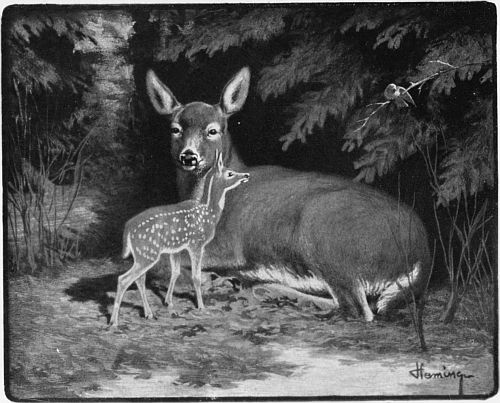 "He was a baby to be proud of."
And his mother took good care of him, and never tried
to show him off before the other people of the woods.
She knew that it was far safer and wiser to keep him concealed
as long as possible, and not let anyone know that
she had him. So instead of letting him wander with her
through the woods when she went in search of food, she
generally left him hidden in a thicket or behind a bush or
a fallen tree. There he spent many a long, lonely hour,
idly watching the waving branches and the moving shadows,
and perhaps thinking dim, formless, wordless baby
thoughts, or looking at nothing and thinking of nothing,
but just sleeping the quiet sleep of infancy, and living,
and growing, and getting ready for hard times.
At first the Fawn knew no difference between friends
and enemies, but the instinct of the hunted soon awoke
and told him when to be afraid. If a hostile animal came
by while the doe was gone, he would crouch low, with his
nose to the ground and his big ears laid back on his neck;
or if pressed too closely he would jump up and hurry away
to some better cover, with leaps and bounds so light and
airy that they seemed the very music of motion. But
that did not happen very often. His hiding-places were
well chosen, and he usually lay still till his mother came
back.
When she thought he was large enough, and strong
and swift enough, she let him travel with her; and then
he became acquainted with several new kinds of forest—with
the dark hemlock groves, and the dense cedar swamps;
with the open tamarack, where the trees stand wide apart,
and between them the great purple-and-white lady's-slippers
bloom; with the cranberry marshes, where pitcher-plants
live, and white-plumed grasses nod in the breeze;
with sandy ridges where the pine-trees purr with pleasure
when the wind strokes them; with the broad, beautiful
Glimmerglass, laughing and shimmering in the sunshine,
and with all the sights and the sounds of that wonderful
world where he was to spend the years of his deerhood.
They were a very silent pair. When his breakfast was
ready she would sometimes call him with a low murmuring,
and he would answer her with a little bleat; but
those were almost the only sounds that were ever heard
from them, except the rustling of the dry leaves around
their feet. Yet they understood each other perfectly,
and they were very happy together. There was little
need of speech, for all they had to do the livelong day
was to wander about while the doe picked up her food,
and then, when she had eaten her fill, to lie down in some
sheltered place, and there rest and chew the cud till it
was time to move again.
Life wasn't all sunshine, of course. There were plenty
of hard things for the baby Buck to put up with, and
perhaps the worst were the mosquitoes and the black-flies
and "no-see-'ems" that swarmed in the woods and
swamps through the month of June. They got into his
mouth and into his nose; they gathered in circles around
his eyes; and they snuggled cosily down between the
short hairs of his pretty, spotted coat, and sucked the
blood out of him till it seemed as if he would soon go
dry. For a while they were almost unbearable, but I
suppose the woods-people get somewhat hardened to
them. Otherwise I should think our friends would have
been driven mad, for there was never any respite from
their attacks, except possibly a very stormy day, or a
bath in the lake, or a saunter on the shore.
At the eastern end of the Glimmerglass there is a
broad strip of sand beach, where, if there happens to be
a breeze from the water, one can walk and be quite free
from the flies; though in calm weather, or with an offshore
wind, it is not much better than the woods.
There, during fly-time, the doe and her baby were often
to be found; and to see him promenading up and down
the hard sand, with his mother looking on, was one of
the prettiest sights in all the wilderness. The ground-color
of his coat was a bright bay red, somewhat like that
of his mother's summer clothing; but deeper and richer
and handsomer, and with pure white spots arranged in
irregular rows all along his neck and back and sides. He
was so sleek and polished that he fairly glistened in the
sunshine, like a well-groomed horse; his great dark eyes
were brighter than a girl's at her first ball; and his ears
were almost as big as a mule's, and a million times as
pretty. But best and most beautiful of all was the marvellous
life and grace and spirit of his every pose and
motion. When he walked, his head and neck were
thrust forward and drawn back again at every step with
the daintiest gesture imaginable; and his tiny pointed
hoofs touched the ground so lightly, and were away again
so quickly, that you hardly knew what they had done.
If anything startled him, he stamped with his forefoot on
the hard sand, and tossed his head in the air with an expression
that was not fear, but alertness, and even defiance.
And when he leaped and ran—but there's no use
in trying to describe that.
By the middle of July most of the flies were gone, and
the deer could travel where they pleased without being
eaten alive. And then, almost before they knew what
had happened, the summer was gone, too, and the autumn
had come. The Fawn's white spots disappeared, and both
he and his mother put off their thin red summer clothing
and donned the blue coat of fall, which would by and by
fade into the gray of winter—a garment made of longer,
coarser hairs, which were so thick that they had to stand
on end because there wasn't room for them to lie down,
and which made such a warm covering that one who
wore it could sleep all night in the snow, and rise in the
morning dry and comfortable.
The Fawn had thriven wonderfully. Already the
budding antlers were pushing through the skin on the
top of his head, which alone is pretty good proof that he
was a remarkable baby. But, of course, the infancy of a
wild animal is always much shorter than that of a human
child. It is well that this is so, for if the period of weakness
and helplessness was not shortened for them, there
would probably be very few who would ever survive its
dangers and reach maturity. The Fawn was weaned
early in the autumn; though he still ran with his mother,
and she showed him what herbs and leaves were pleasantest
to the taste and best for building up bone and muscle,
and where the beechnuts were most plentiful. The
mast was good that fall, which isn't always the case, and
that was another lucky star in young Buck's horoscope.
So much depends on having plenty to eat the first year.
And now the doe was thriving as well as her son.
Through the summer she had been thin and poor, for the
Fawn had fed on her life and strength, and the best of
all that came to her she had given to him; but the strain
was over at last, and there were granted her a few weeks
in which to prepare for the season of cold and storm and
scanty food. She made the best of them, and in an
amazingly short time she was rolling fat.
Everything was lovely and the goose hung high, when
all of a sudden the peace and quiet of their every-day
lives were rudely broken. The hunting season had come,
and half-a-dozen farmers from lower Michigan had
camped beside the Glimmerglass. They were not really
very formidable. If one wants to kill deer, one should
learn to shoot straight and to get around in the woods
without making quite as much noise as a locomotive.
But their racket was intolerable, and after a day or two
the doe and the Fawn left home and spent the next three
or four weeks near a secluded little pond several miles
away to the southeast.
By the first of December these troublous times were
over, and they had returned to their old haunts in the
beech and maple woods, where they picked up a rather
scanty living by scraping the light snow away with
their forefeet in search of the savory nuts. But before
Christmas there came a storm which covered the ground
so deeply that they could no longer dig out enough food
to keep them from going hungry; and they were forced
to leave the high lands and make their way to the evergreen
swamps around the head-waters of the Tahquamenon.
There they lived on twigs of balsam and hemlock
and spruce, with now and then a mouthful of moss
or a nutritious lichen. Little by little the fat on their
ribs disappeared, they grew lank and lean again, and the
bones showed more and more plainly through their heavy
winter coats. If one of those November hunters had
succeeded in setting his teeth in their flesh he would have
found that it had a very pleasant, nutty flavor, but in
February it would have tasted decidedly of hemlock.
Yet they were strong and healthy, in spite of their boniness,
and of course you can't expect to be very fat in
winter.
There were worse things than hunger. One afternoon
they were following a big buck down a runway—all
three of them minding their own business and behaving
in a very orderly and peaceable manner—when a shanty-boy
stepped out from behind a big birch just ahead of
them, and said, "Aah!" very derisively and insultingly.
The wind was blowing from them to him, and they hadn't
had the least idea that he was there until they were within
three rods of his tree. The buck was so startled that
for an instant he simply stood still and stared, which
was exactly what the shanty-boy had expected him to
do. He had stopped so suddenly that his forefeet were
thrust forward into the snow, and he was leaning backward
a trifle. His head was up, his eyes were almost
popping out of their sockets, and there was such a look
of astonishment on his face that the man laughed as he
raised his gun and took aim. In a second the deer had
wheeled and was in the air, but a bullet broke his back
just as he left the ground, and he came tumbling down
again in a shapeless heap. His spinal cord was cut, and
half his body was dead; but he would not give up even
then, and he half rose on his forefeet and tried to drag
himself away. The shanty-boy stepped to his side with
a knife in his hand, the deer gave one loud bleat of fear
and pain, and then it was all over.
But by that time the doe and the Fawn were far down
the runway—out of sight, and out of danger. Next
day they passed that way again, and saw a Canada lynx
standing where the buck had fallen, licking his chops as
if he had just finished a good meal. It is hard work
carrying a deer through the woods, and the shanty-boy
had lightened his load as much as possible. Lynxes are
not nice. The mother and son pulled their freight as
fast as they could travel.
When the world turned green again they went back to
the Glimmerglass, but they had not been there long before
the young Buck had his nose put out of joint by the
arrival of two new babies. Thenceforth his mother had
all she could do to take care of them, without paying any
further attention to him. The days of his fawnhood
were over, and it was time for him to strike out into the
world and make his own living.
However, I don't think he was very lonesome. There
were plenty of other deer in the woods, and though he
did not associate with any of them as he had with his
mother, yet he may have enjoyed meeting them occasionally
in his travels. And there was ever so much to do
and to think about. Eating took up a good deal of
time, for he was very active and was still growing, and
his strong young body was constantly calling for more
food. And it wasn't enough merely to find the food and
swallow it, for no sooner was his stomach full than he
had to lie down and chew the cud for an hour or so.
And, of course, the black-flies and mosquitoes and "no-see-'ems"
helped to make things interesting, just as they
had the year before. Strictly speaking, it is impossible
to be lonely in the woods during fly-time. He changed
his clothes, too, and put on a much handsomer dress,
though I doubt if he took as much interest in that operation
as most of us would. The change contributed
greatly to his comfort, for his light summer garment was
much better adapted to warm weather than his winter
coat, but it did not require any conscious effort on his
part. On hot days he sometimes waded out into the
lake in search of lily-pads, and the touch of the cool
water was very grateful. Occasionally he would take a
long swim, and once or twice he paddled clear across the
Glimmerglass, from one shore to the other.
And it was during this summer that he raised his first
real antlers. Those of the previous autumn had been
nothing but two little buds of bone, but these were
pointed spikes, several inches in length, standing straight
up from the top of his head without a fork or a branch or
a curve. They did not add very much to his good looks,
and, of course, they dropped off early in the following
winter, but they were the forerunners of the beautiful
branching antlers of his later years, and if he thought
about them at all they were probably as welcome as a
boy's first mustache.
Late in the following autumn an event occurred which
left its mark on him for the rest of his life. One night
he wandered into a part of the woods where some lumbermen
had been working during the day. On the ground
where they had eaten their lunch he found some baked
beans and a piece of dried apple-pie, and he ate them
greedily and was glad that he had come. But he found
something else, too. One of the road-monkeys had carelessly
left his axe in the snow with the edge turned up.
The Buck stepped on it, and it slipped in between the
two halves of his cloven hoof, and cut deep into his foot.
The wound healed in the course of time, but from that
night the toes—they were those of his left hind foot—were
spread far apart, instead of lying close together as
they should have done. Sticks and roots sometimes
caught between them in a way that was very annoying,
and his track was different from that of any other deer in
the woods, which was not a thing to be desired. He was
not crippled, however, for he could still leap almost, if not
quite, as far as ever, and run almost as fast.
He continued to grow and prosper, and the next
summer he raised a pair of forked antlers with two
tines each.
And now he is well started down the runway of life,
and we must leave him to travel by himself for two or
three years. He ranged the woods far and near, and
came to know them as a man knows his own house; but
no matter what places he visited, the old haunts that his
mother had shown him were the best of all, as the deer
have learned by the experience of generation after generation.
He always came back again to the Glimmerglass,
and as the seasons went by I often saw his broad, spreading
hoof-print on the sandy beach where they two had so
often walked in that first summer. He evidently had
plenty of company, and was probably enjoying life, for
all around were other foot-prints that were narrow and
delicately pointed, as a deer's should be. Some of them,
of course, were his own, left by his three perfect feet; but
others were those of his friends and acquaintances, and it
is quite possible that some of the tiniest and daintiest
were made by his children.
That beach is a delightful place for a promenade on a
summer night, and besides the deer-tracks one can sometimes
find there the trails of the waddling porcupines, the
broad, heavy print left by a black bear as he goes shambling
by, and the handwriting of many another of the
woods-people. Strange and interesting scenes must often
be enacted on the smooth, hard sand that lies between the
woods and the water, and it is a pity that the show always
comes to a sudden close if any would-be spectators
appear, and that we never see anything but the foot-prints
of the performers.
With each recurring hunting season the Buck and the
other deer that made their homes around the Glimmerglass
were driven away for a time. A few stayed, or at
least remained as near as they dared; but compared with
summer the neighborhood was almost depopulated. And
in his fourth year, in spite of all his efforts to keep out
of harm's way, the Buck came very near losing his life at
the hands of a man who had really learned how to hunt—not
one of the farmers who went ramming about the
woods, shooting at everything in sight, and making noise
enough to startle even the porcupines.
One afternoon, late in the autumn, the judge left his
court-room in Detroit and started for his house. He
bought an evening paper as he boarded the street-car;
and, as Fate would have it, the first thing that met his
eye as he unfolded it was the forecast for upper Michigan:
"Colder; slight snow-fall; light northerly winds."
The judge folded the paper again and put it in his
pocket, and all the rest of the way home he was dreaming
of things that he had seen before—of the white and
silent woods, of deer-tracks in the inch-deep snow, of the
long still-hunt under dripping branches and gray November
skies, of a huge buck feeding unconcernedly beneath
the beech-trees, of nutty venison steaks broiling on the
coals, and, finally, of another pair of antlers for his dining-room.
Court had adjourned for three days, and that
night he took the train for the north. And while he
travelled, the snow came down softly and silently, melting
at first as fast as it fell, and then, as the cold grew
sharper, clothing the woods in a thin, white robe, the first
gift of the coming winter.
Next day the Buck was lying behind a fallen tree,
chewing his cud, when the breeze brought him a whiff of
an unpleasant human odor. He jumped up and hurried
away, and the judge heard him crash through the bushes,
and searched until he had found his trail. An hour
later, as the Buck was nosing for beechnuts in the snow,
a rifle cracked and a bullet went zipping by and carried
off the very tip of his left antler. He dropped his white
flag and was off like a shot.
Chase a wounded deer, and he will run for miles; leave
him alone, and if he is badly hurt he will soon lie down.
The chances are that he will never get up again. The
judge knew that the Buck was hit, for he had seen his
tail come down. But was he hit hard? There was no
blood on the trail, and the judge decided to follow.
The Buck hurried on, but before long his leaps began
to grow shorter. After a mile or so he stopped, looked
back, and listened. The woods were very, very still, and
for all that he could see or hear there was not the least
sign of danger. Yet he was afraid, and in a few minutes
he pushed on again, though not as rapidly as
before. As the short afternoon wore away he travelled
still more slowly, and his stops were longer and more
frequent. And at last, just before sunset, as he stood
and watched for the enemy who might or might not be
on his trail, he heard a twig snap, and saw a dark form
slip behind a tree. This time he ran as he had never
run before in all his life.
The judge spent the night at the nearest lumber-camp,
and the next morning he was out again as soon as he
could see, following his own trail back to where he had
left that of the Buck. On the way he crossed the tracks
of two other deer, but they had no temptations for him.
He wanted to solve the mystery of that spreading hoof-print,
and to make sure that his shot had not been a clean
miss. And now began a day which was without precedent
in the Buck's whole history. Those woods are not the
best in the world for a deer who has to play hide-and-seek
with a man, for there are few bare ridges or half-wooded
slopes from which he can look back to see if anyone is
following him. Even the glades and the open cranberry
swamps are small and infrequent. An almost unbroken
forest sweeps away in every direction, and everywhere
there is cover for the still-hunter. And when the ground
is carpeted with snow an inch and a half deep, as it was
then, and at every step a deer must leave behind him a
trail as plain as a turnpike road, then it is not strange if
he feels that he has run up against a decidedly tough
proposition. Eyes, ears, and nose are all on the alert, and
all doing their level best, but what eye can penetrate the
cedar swamp beyond a few yards; or what ear can always
catch the tread of a moccasin on the moss and the snow
before it comes within rifle range; or what nose, no matter
how delicate, can detect anything but what happens
to lie in its owner's path, or what the wind chooses to
bring it? Many a foe had crossed the Buck's trail in the
course of his life; but none had ever followed him like
this—silently and relentlessly—slowly, but without a moment's
pause. A few leaps were always enough to put
the judge out of sight, and half an hour's run left him
far behind; but in a little while he was there again,
creeping cautiously through the undergrowth, and peering
this way and that for a glimpse of a plump, round,
blue-gray body. Once he fired before the deer knew that
he was at hand, and if a hanging twig had not turned
the bullet a trifle from its course, the still-hunt would
have ended then and there.
But late in the afternoon the Buck thought that he
had really shaken his pursuer off, and the judge was beginning
to think so, too. They had not seen each other
for two or three hours, the day was nearly over, and
there were signs of a change in the weather. If the Buck
could hold out till nightfall, and then the snow should
melt before morning, he would be comparatively safe.
In his fear of the enemy lurking in the rear, he had
forgotten all other dangers; and without quite realizing
what he was doing he had come back to the Glimmerglass,
and was tramping once more up and down the old
familiar runways. Presently he came upon a huge maple,
lying prostrate on the ground. He walked around its
great bushy head and down toward its foot; and there
he found a broad, saucer-shaped hollow, left when the
tree was torn up by the roots in some wild gale. On one
side rose a mass of earth, straight as a stone wall and
four or five feet in height; and against its foot lay one
of the most tempting beds of dead leaves that he had ever
seen, free from snow, dry as a whistle, soft and downy.
The sight of it was too much for him. He was very
weary, his limbs fairly ached with fatigue, and for the
last hour his spread hoof had given him a good deal of
pain. His enemy was nowhere in sight, and in spite of
his misgivings he sank down on the couch with a sigh of
comfort, and began to chew his cud.
The judge was about ready to give up for the night
when he, too, came upon that fallen maple. He saw the
wall of earth and twisted roots, with the deer-tracks leading
toward it; and slowly, softly, silently, he crept down
toward the Buck's shelter.
There was no wind that evening, and the woods seemed
perfectly still; but now, unnoticed by the judge, a faint,
faint puff came wandering among the trees, as if on purpose
to warn the deer of his danger. Suddenly he started,
sniffed the air, and was up and away like a race-horse—not
leaping nor bounding now, but running low, with his
head down, and his antlers laid back on his neck. If he
had been in the cedar swamp he would have escaped unhurt,
but up in the hardwood the trees do not stand so
close, and one can see a little farther. The judge fired
before he could get out of sight, and he dropped with
three ribs broken and a bullet lodged behind his right
shoulder. He was up again in an instant, but there
were blood-stains on the snow where he had lain, and
this time the judge did not follow. Instead of giving
chase he went straight back to the lumber-camp, feeling
almost as sure of that new pair of antlers as if he had
carried them with him.
The Buck ran a little way, with his flag lowered and
the blood spurting, and then he lay down to rest, just as
the judge knew he would. The bleeding soon stopped,
but it left him very weak and tired, and that night was
the most miserable he had ever known. The darkness
settled down thick and black over the woods, the wind
began to blow, and by and by the rain commenced to
fall—first a drizzle, and then a steady pour. Cold and
wet, wounded and tired and hungry, the Buck was about
as wretched as it is possible for a mortal to be. And
yet that rain was the one and only thing that could
save him. Under its melting touch the snow began to
disappear, and before morning the ground was bare again.
Even the blood-stains were washed away. It would take
a better nose than the judge's to track him now.
Yet the danger was not over, by any means. The
judge knew very nearly where to look for him, and could
probably find him if he did not get up and move on.
And to move on, or even to rise to his feet, seemed utterly
impossible. The least motion sent the most exquisite
pain shooting through his whole body, and I believe
he would have died where he lay, either at the hands of
the judge or from exhaustion, if another man hadn't
come along. The judge would have advanced slowly and
quietly, and the deer might never have known he was
coming till a rifle bullet hit him; but this man's errand
must have been a different one, for he came striding noisily
through the trees and bushes and over the dead leaves,
whistling "I Want Yer, Ma Honey," at the top of his
whistle. If you are obliged to be out in the woods during
the hunting season, and don't care to kill anything,
it is always best to make as much noise as you can.
There is less danger that some other fool will take you
for a deer and shoot you dead. The Buck heard him, of
course, and tried to rise, only to sink back with a groan.
He couldn't do it, or at least he thought he couldn't.
But when the man came around a little balsam only two
rods away, then his panic got the better of his pain, and
he jumped up and made off at a clumsy, limping run.
Every joint seemed on fire, and he ached from the top of
his head to the toes of that poor left hind-foot. But
after the first plunge it was not quite so bad. The motion
took some of the stiffness out of his limbs, and by
the time the judge arrived he was a mile away and was
thinking about breakfast.
We must do the sportsman the justice of saying that
his remorse was very keen when he stepped aboard the
train that night, bound for Detroit. He had wounded a
deer and had let it get away from him, to suffer, and
probably to die a painful, lingering death. The whole
day—the last of the hunting season and of his court recess—had
been spent in an unavailing search; not merely
because he wanted some venison and a pair of antlers to
carry home with him, but because he wanted to put the
Buck out of his misery. He had failed everywhere, and
he felt sorry and ashamed, and wished he had stayed at
home. But, as it happened, the Buck did not want to
be put out of his misery. Just as the judge took the
train he was lying down for the night. He would be
stiff when he rose again, but not as stiff as he had been
that morning. He would be weak and tired, but he
would still be able to travel and find food. He would
lose his plumpness and roundness, no doubt, and lose
them very rapidly. The winter would probably be a hard
one, with such a misfortune as this at its very beginning.
But no matter, it would pass. He wasn't the first Buck
who had had his ribs smashed by an injection of lead and
had lived to tell the tale.
The next year it was his antlers that got him into
trouble—his antlers and his quarrelsomeness. Two
round, black, velvet-covered knobs had appeared in spring
on the top of his head, and had pushed up higher and
higher till they formed cylindrical columns, each one
leaning outward and a little backward. They were hot
as fever with the blood that was rushing through them,
building up the living masonry; and at the upper ends,
where the work was newest, they were soft and spongy,
and very sensitive, so that the least touch was enough to
give pain. Longer and longer they grew, and harder
and harder; by and by curving forward and inward; and
one after another the tines appeared. And at last, in
the early autumn, the tall towers of bone were complete,
the blood ceased to course through them, and the Buck
rubbed them against the tree-trunks until the velvety
skin was all worn off, and they were left smooth and
brown and polished. They were a handsome pair, spreading
and branching very gracefully over his forehead, and
bearing four tines to each beam. It is a mistake to suppose,
as so many people do, that the number of tines on
each antler invariably corresponds to the number of years
that its owner has lived; but it very often does, especially
before he has passed the prime of life.
No sooner were the antlers finished than the Buck
began to grow fat. He had been eating heartily for
months, but he hadn't been able to put much flesh on his
ribs as long as he had that big, bony growth to feed.
Bucks and does are alike in this, that for both of them
the summer is a season of plenty, but not of growing
plump and round and strong. The difference between
them is that the does give their strength and vitality to
the children they are nursing, while the bucks pile theirs
up on their own foreheads.
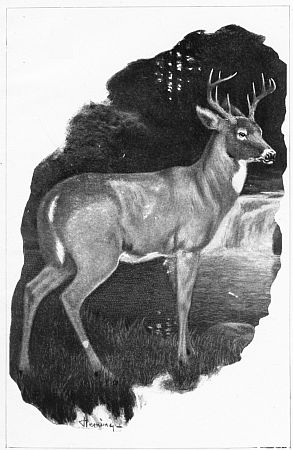 "The buck was nearing the prime of life."
And there was another change which came with the
autumn. Through the summer he had been quiet and
gentle, and had attended very strictly to his own affairs;
but now the life and vigor and vitality which for weeks
and months had been pouring into that tall, beautiful
structure on his forehead were all surging like a tide
through his whole body; and he became very passionate
and excitable, and spent much time in rushing about the
woods in search of other deer, fighting those of his own
sex, and making love to the does. The year was at its
high-water mark, and the Buck was nearing his prime.
Food was plenty; everywhere the beechnuts were dropping
on the dry leaves; the autumn sunshine was warm
and mellow; the woods were gay with scarlet and gold
and brown, and the very taste of the air was enough to
make one happy. Was it any wonder if he sometimes
felt as if he would like to fight every other buck in
Michigan, and all of them at once?
One afternoon in October he fought a battle with
another buck who was very nearly his match in size and
strength—a battle that came near being the end of both
of them. There was a doe just vanishing among the
bushes when the fuss began, and the question at issue was
which should follow her and which shouldn't. It would
be easy enough to find her, for, metaphorically speaking,
"her feet had touched the meadows, and left the daisies
rosy." Wherever she went, a faint, faint fragrance clung
to the dead leaves, far too delicate for a human nose to
detect, yet quite strong enough for a buck to follow. But
the trail wasn't broad enough for two, and the first thing
to be done was to have a scrap and see which was the
better and more deserving deer. And, as it turned
out, the scent grew cold again, and the doe never heard
that eager patter of hoofs hurrying down the runway
behind her.
The bucks came together like two battering-rams, with
a great clatter and clash of antlers, but after the first
shock the fight seemed little more than a pushing-match.
Each one was constantly trying to catch the other off his
guard and thrust a point into his flesh, but they never
succeeded. A pair of widely branching antlers is as useful
in warding off blows as in delivering them. Such a
perfect shield does it make, when properly handled, that
at the end of half an hour neither of the bucks was suffering
from anything but fatigue, and the issue was as far as
ever from being settled. There was foam on their lips,
and sweat on their sides; their mouths were open, and
their breath came in gasps; every muscle was working its
hardest, pushing and shoving and guarding; and they
drove each other backward and forward through the
bushes, and ploughed up the ground, and scattered the dry
leaves in their struggles; and yet there was not a scratch
on either shapely body.
Finally, they backed off and rushed together again with
such violence that our Buck's antlers were forced apart
just a trifle, and his enemy's slipped in between them.
There was a little snap as they sprang back into position,
and the mischief was done. The two foes were locked
together in an embrace which death itself could not
loosen.
The next few weeks were worse than a nightmare. If
one went forward, the other had to go backward; and
neither could go anywhere or do anything without getting
the consent of the other or else carrying him along
by main force. Many things could not be done at all—not
even when both were willing and anxious to do them.
They could not run or leap. They could not see, except
out of the corners of their eyes. They would never again
toss those beautiful antlers in the air, for they had come
together with their heads held low, and in that position
they must remain. They could not even lie down without
twisting their necks till they ached as if they were breaking.
With their noses to the ground, and with anger
and misery in their hearts, they pushed and hauled each
other this way and that through the woods. And wherever
they went, they were always struggling and fighting
and striving for every mouthful of food that came within
reach. It was little enough that they found at the best,
and it would have been better for both of them if they
could have agreed to divide it evenly, but of course that
would have been asking too much of deer nature. Each
took all he could get, and at first they were so evenly
matched that each secured somewhere near his fair share.
They spied a beechnut on the ground, or a bit of lichen,
or a tender twig; and together they made a dive for it.
Two noses were thrust forward—no, not forward, sidewise—and
two mouths were open to grasp the precious
morsel which would enable its possessor to keep up the
fight a little longer. Sometimes one got it, and sometimes
the other; but from the very beginning our Buck
was a shade the stronger, and his superiority grew with
every mouthful that he managed to wrest from his fellow-prisoner.
Both of them were losing flesh rapidly, but he
kept his longer than the other. And at last they reached
the point where, by reason of his greater strength, he got
everything and the other nothing, and then the end was
near. It would have come long before if both had not
been in prime condition on the day of the battle.
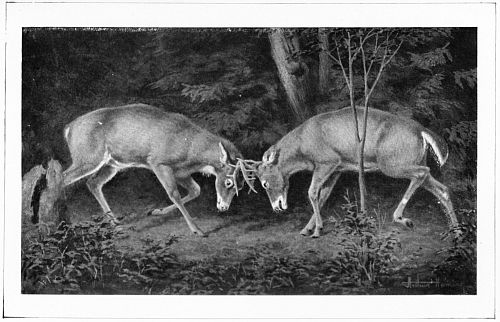 "Wherever they went they were always struggling and fighting."
One dark, stormy night the two deer were stumbling
and floundering over roots and bushes, trying to find
their way down to the beach for a drink. Both of them
were pretty well used up; and one was so weak that he
could hardly stand, and could only walk by leaning
heavily on the head and antlers of the other, who supported
him because he was obliged to, and not out of
friendliness. They were within a few rods of the beach
when he whose strength was least stepped into a hole and
fell, and his leg-bone snapped like a dry twig. He struggled
and tried to rise; but his story was told, and before
morning he was dead. For once our Buck's instinct of
self-preservation had carried him too far. He had taken
all the food for himself, and had starved his enemy; and
now he was bound face to face to a corpse.
Well, we won't talk about that. He stayed there
twenty-four hours, and there would soon have been two
dead bucks instead of one if something had not happened
which he did not in the least expect—something which
seemed like a blessed miracle, yet which was really the simplest
and most natural thing in the world. A buck has no
fixed time for the casting of his antlers. It usually occurs
during the first half of the winter, but it has been known
to take place as early as November and as late as April.
The second night passed, and as it began to grow light
again our friend lifted himself on his knees and his hind-legs,
and wrestled mightily with his horrible bed-fellow;
and suddenly his left antler came loose from his head.
The right one was still fast, but it was easily disengaged
from the tangle of branching horns, and in a moment he
stood erect. The blood was running down his face from
the pedicel where the antler had stood, and he was so
weak and dizzy that his legs could hardly carry him, and
so thin and wasted that he seemed the mere shadow of
his former self. But he was free, and that long, horrible
dream was over at last.
He tried to walk toward the lake, but fell before he
had taken half-a-dozen steps; and for an hour he lay
still and rested. It was like a taste of heaven, just to be
able to hold his neck straight. The sun had risen by the
time he was ready to try it again, and through the trees
he saw the shimmer and sparkle of the Glimmerglass. He
heard the wind talking to itself in the branches overhead,
and the splashing of the ripples on the beach;
and he staggered down to the margin and drank long
and deep.
That December was a mild one. The first light snow
had already come and gone, and the next two weeks were
bright and sunshiny. The Buck ate as he had never
eaten before, and it was astonishing to see how rapidly
he picked up, and how much he gained before Christmas.
His good luck seemed to follow him month after month,
for the winter was comparatively open, the snow was not
as deep as usual, and the spring came early. By that
time the ill effects of his terrible experience had almost
entirely disappeared, and he was in nearly as good condition
as is usual with the deer at that season of the year—which,
of course, isn't really saying very much.
Again, Nature's table was spread with good things, and
again he set to work to build a pair of antlers—a pair
that should be larger and handsomer than any that had
gone before. But as the summer lengthened it became
evident that there was something wrong with those antlers,
or at least with one of them. One seemed to be quite
perfect. It was considerably longer than those of last
year, its curve was just right, and it had five tines, which
was the correct number and all that he could have asked.
But the other, the left, was nothing but a straight, pointed
spike, perhaps eight inches in length, shaped almost exactly
like those of his first pair. The Buck never knew
the reason for this deformity, and I'm not at all certain
about it myself, though I have a theory. One
stormy day in the early summer, a falling branch, torn
from a tree-top by the wind, had struck squarely on that
growing antler, then only a few inches long. It hurt him
so that for a moment he was fairly blind and dizzy, and
it is quite possible that the soft, half-formed bone was so
injured that it could never reach its full development.
Anyhow, it made him a rather queer-looking buck, with
one perfect antler and one spike. But in everything else—except
his spread hoof—he was without spot or blemish.
He had well fulfilled the promise of his youth, and
he was big and strong and beautiful. Something he had
lost, no doubt, of the grace and daintiness of his baby
days; but he had also gained much—gained in stateliness
and dignity, as well as in size and weight and strength.
And even that spike antler was not without its advantages,
as he learned a little later.
As the autumn came round he was just as excitable and
passionate, just as ready for fighting or love-making, as
ever, and not one whit subdued by the disaster of the
year before. And so one day he had another battle with
another buck, while another doe—or perhaps the same
one—made off through the trees and left a fragrant trail
behind her. He and his adversary went at each other in
the usual way, and for some time it seemed unlikely that
either of them could ever do anything more than tire the
other out by hard pushing. There was little danger that
their antlers would get locked this time, with one pair so
badly mismated; and it bade fair to be a very ordinary,
every-day sort of a fight. But by and by our Buck saw
his opportunity. The enemy exposed his left side, in an
unguarded moment, and before he could recover himself
that deformed antler had dealt him a terrible thrust. If
the force of the blow had been divided among five tines
it would probably have had but little effect, but the single
straight spike was as good as a sword or a bayonet, and
it won the day. The deer with the perfect antlers was
not only vanquished, but killed; and the victor was off on
the trail of the doe.
And so our friend became the champion of the Glimmerglass,
and in all the woods there was not a buck that
could stand against him.
But his brother deer were not his only enemies. With
the opening of the hunting season those farmers from
lower Michigan came again, and day after day they beat
the woods in search of game. This time, however, the
Buck did not leave, or at least he did not go very far.
For the last month he had been fighting everyone who
would fight back, and perhaps his many easy victories
had made him reckless. At any rate he was bolder than
usual, and all through the season he stayed within a few
miles of the Glimmerglass.
The farmers had decidedly poor luck, and after hunting
for two or three weeks without a single taste of venison
they began to feel desperate. Finally, they secured the
help of a trapper who owned a big English foxhound.
Hunting with dogs was against the law, and at home they
claimed to be very law-abiding citizens, but they had to
have a deer, no matter what happened.
The morning after the hound's arrival he got onto the
trail of a doe and followed it for hours, until, as a last
resort, she made for the Glimmerglass, jumped into the
water, and started to swim across to the farther shore.
The dog's work was done, and he stood on the bank and
watched her go. For a few minutes she thought that she
was out of danger, and that the friendly Glimmerglass had
saved her; but presently she heard a sound of oars, and
turning half-way round she lifted her head and shoulders
out of the water, and saw a row-boat and three men bearing
down upon her. A look of horror came into her face
as she sank back, and her heart almost broke with despair;
but she was game, and she struck out with all her
might. Her legs tore the water frantically, the straining
muscles stood out like ropes on her sides and flanks and
shoulders, and she almost threw herself from the water.
But it was no use, the row-boat was gaining.
The farmers fired at her again and again, but they were
too wildly excited to hit anything until finally the trapper
pulled up alongside her and threw a noose over her head.
And then, while she lay on her side in the water, with the
rope around her neck, kicking and struggling in a blind
agony of despair, one of the farmers shot her dead at a
range of something less than ten feet. When he went
home he bragged that he was the only one of the party
who had killed a deer, but he never told just how the
thing was done.
That is the kind of fate that you are very likely to
meet if you are a deer. But vengeance came on the morrow,
for that day it was the Buck's turn to be chased by
that horrible fog-horn on four legs. Hour after hour he
heard the hound's dreadful baying behind him as he raced
through the woods, and at last he, too, started for the
water, just as the doe had done. But he never reached it,
or at least not on that trip. He was within a few rods of
the beach when his spread hoof caught on a root and threw
him, and the hound was so close behind that they both
went down in a heap. They sprang to their feet at the
same instant, and stood for a second glaring at each other.
The dog had not meant to fight, only to drive the other
into the water, where the hunters would take care of him;
but he was game, and he made a spring at the deer's
throat. The Buck drew back his forefoot, with its sharp,
pointed hoof, and met the enemy with a thrust like that
of a Roman soldier's short-sword; and the hound went
down with his shoulder broken and a great gash in his
side. And then, with a sudden twist and turn of his
head, the Buck caught him on the point of that terrible
spike antler, ripped his body open, and tossed him in
the air.
The worst enemy was disposed of. But that wasn't all.
The man who killed the doe was waiting on the beach and
had heard the scuffle, and now he came creeping quietly
through the bushes to see what was going on. The
Buck was still trampling the body of the dog, and
noticed nothing till a rifle bullet grazed his right flank,
inflicting just enough of a wound to make him still more
furious. He faced around and stood for a moment staring
at this new enemy; and then he did something which
very few wild deer have ever done. Probably he would
not have done it himself if he had not been half crazy
with rage and excitement, and much emboldened by his
easy victory over the hound. He put his head down and
his antlers forward, and charged on a man!
The farmer was jerking frantically at the lever of his
repeating rifle, but a cartridge had stuck in the magazine,
and he couldn't make it work. The hound's fate had
shown him what that spike antler could do; and when he
saw it bearing down on him at full tilt he dropped his
gun and ran for his life to his dug-out canoe. He reached
it just in time. I almost wish he hadn't.
One more adventure the Buck had that fall. Providence,
or Fate, or someone took a hand in affairs, and rid
the Glimmerglass of all hunters, not for that season alone,
but for many years to come. One night, down beside a
spring in the cedar swamp, the Buck found a half-decayed
log on which a bag of salt had been emptied. He stayed
there for an hour or two, alternately licking the salt and
drinking the cold water, and it was as good as an ice-cream
soda. The next night he returned for another debauch;
but in the meantime two other visitors had been
there, and both had seen his tracks and knew that he
would come again. As he neared the spring, treading
noiselessly on the soft moss, he heard two little clicks, and
stopped short to see what they meant. Both were quick
and sharp, and both had come at exactly the same instant;
yet they were not quite alike, for one had come from the
shutter of a camera, and one from the lock of a rifle.
Across the salt-lick a photographer and a hunter were
facing each other in the darkness, and each saw the gleam
of the other's eyes and took him for a deer. So close
together were the two clicks that neither man heard the
sound of the other's weapon, and both were ready to fire—each
in his own way.
The Buck stood and watched, and suddenly there came
two bursts of flame—one of them so big and bright that
it lit the woods like sheet-lightning. Two triggers had
been touched at the same instant, and each did its
work well. The flash-light printed on the sensitive
plate a picture of a hunter in the act of firing, and the
rifle sent a bullet straight through the photographer's
forehead. The Buck saw it all as in a dream—the white
flame of the magnesium powder; the rifle, belching out
its fire and smoke; the camera, silent and harmless, but
working just as surely; the two men, each straining his
eyes for a sight of his game; the water gleaming in the
fierce light, and the dark ranks of the cedars all around.
And then, in the tenth of a second, it was all over, and
the Buck was bumping against trees, and stumbling and
floundering over roots, in his dazed haste to get away
from this terrifying mystery. He heard one horrified
shout from the hunter, but nothing from the photographer—and
the woods were silent again.
That was the end of the hunting season at the Glimmerglass.
With the hunter's trial for manslaughter, we
and the Buck are not concerned; and there is nothing
more to tell except that the next year the owners of the
lands around the lake gave warning that all trespassers
would be prosecuted. They wanted no more such tragedies
on their property.
And so the Buck and his sweethearts and his rivals
lived in peace, except that the rivals still quarrelled
among themselves, as Nature meant them to. The Buck
had reached his prime, but you are not to suppose that
he began to age immediately afterward. It was long before
his eye was dimmed or his natural force abated;
and as the years went by, with their summers of lily-pads
and tender young browse, and their autumns of beechnuts
and fighting and love-making, the broad cloven
track of his split foot was often to be found in the hard,
smooth sand of the beach. Perhaps it is there now. I
wish I could go and see.
THE COUNTRY LIFE PRESS
GARDEN CITY, N.Y.
 The Beaver Lumbering.