If David Watson had not been notoriously careless and forgetful, the
events which will be narrated in this chapter might never have happened.
He was a bright boy, and well on in his form, but he had occasional
lapses of memory. In one of these he left his Latin dictionary in the
train. Now, if you are on the classical side of a large school, it is
not only a difficult but an impossible matter to get along without a
Latin dictionary of your own. To attempt to prepare your work by
borrowing your neighbour's book is like essaying to live on charity.
David realized this point immediately, and, instead of proceeding home
as usual by the 4.45 train, he turned into the town instead. There was a
second-hand book-stall in the market, which he thought might be worth a
visit. It had been recommended to him by one of the other boys, who
guaranteed the cheapness of its goods. Anthony, who stuck to David like
a Jonathan, went to help him to look.
"I've just eighteen pence in my pocket," admitted David. "But I may get
one at that. It needn't be a particularly spanky one. Miller got a
ripping atlas last week for one and two. He showed it to me. It only had
Norway and Sweden lost out, and a few of the maps blotted."
"I can lend you threepence," said Tony, "and you could leave your watch
or your penknife or something, I suppose."
The market was a large covered hall, containing rows of stalls of all
kinds. The boys heroically resisted the attractions of oranges,
chestnuts, and sweets, and made for the second-hand books. A pile of
these, all jumbled together, were marked:
BARGAINS. EDUCATIONAL, 1s. each.
David and Anthony began to turn them over and look at them. They were
certainly an assorted lot. There were ancient geographies and grammars
dating back fifty or sixty years, catechisms of Scripture or history,
guides to knowledge, botanical questions, and even an odd volume or two
of sermons. A few of them were older still, and had long "S's" and calf
bindings. Regarded as educational ammunition, they were as antiquated as
flint-lock pistols. The boys rummaged among them for some time in vain,
but, at last, almost from the bottom of the pile, they disinterred a
fairly respectable Latin dictionary. It had lost its back cover and its
title page, but otherwise it seemed intact and clean. David took it to
the old man who presided over the stall, and tendered him a shilling. He
accepted it with reluctance.
"Didn't know I'd let this slip in among the bargains," he grumbled.
"It's worth two and six if it's worth a penny. It came with a lot of
other books from a good house. Well, I suppose, as it was among the
shillings, you'll have to have it. You may thank your luck I made a
mistake."
"A bargain's a bargain," said David, as he put the volume into his
satchel.
Trains to Netherton were not very frequent, and the boys had to wait
some time at the station. They sat down on one of the seats, and David
opened his satchel and took out the Latin dictionary. He agreed with the
old book-stall man that he had got it cheap, and felt decidedly
satisfied with his purchase. As he turned over the leaves, a letter fell
out on to the platform. Anthony picked it up. It was a square envelope
sealed with red wax, and addressed: "To my son, Leonard."
"Hallo," said Tony, "we've got hold of some chap's letter here!"
"Great Judkins! So we have!"
"Whom did the book belong to?"
David turned to the cover, and there, in rather faded ink, he found
written:
"George Reynolds, Parkhurst Academy, January, 1858."
He gave a long-drawn whistle.
"Here's a bit of stunt," he said. "Shouldn't mind guessing it belonged
to old Squire Reynolds."
"Pamela's grandfather?"
"You bet!"
"Was his name 'George'?"
"So Ave said. And Pam's father's name was Leonard."
"Then the letter was for him?"
"I suppose it was—only he's dead."
"What'll you do with it, then?"
"Give it to Pamela."
"What do you think's inside it?"
"Don't I wish I knew!"
"Suppose it's a will?"
"Exactly my brain wave. Wouldn't it be priceless if it left everything
to Pamela?"
"And turned old Hockheimer out of The Hall? Rather!"
"One never knows. I'll put it in my pocket, and give it to Pam to-morrow
morning."
The Watson boys sometimes overtook Pamela on the road to the station,
and every day they travelled by the same train to Harlingden. They made
a point of meeting her next morning, and David handed her the envelope,
explaining how it came into his possession.
"I suppose you couldn't open it and see what's inside?" suggested
Anthony.
Pamela looked doubtfully at the seal.
"I think I ought to give it to Mother," she said. "I expect she'll show
it to me."
"Don't let that precious uncle of yours get hold of it, that's all!"
warned David.
"No, indeed! I'll be careful."
"You'll tell us what it's about, won't you?" begged Tony the curious.
"If Mother will let me."
"Some day, perhaps, you'll be mistress of Lyngates Hall."
"No such luck!" declared Pamela bitterly.
Though she might disclaim any expectation of good fortune, the
remembrance of the letter nevertheless haunted Pamela all day long. She
kept feeling in her pocket to see that it was safe. In spite of herself,
bright fairy dreams floated through her mind, and mixed themselves up
with her lessons. Miss Peters had to tell her twice to pay attention.
She missed the explanation of a problem while she imagined herself
living at The Hall and riding a white pony, and got utterly wrong in
geology through planning how her mother should go up to London and buy
new clothes.
Dream castles are the most delightful of possessions. We build them
according to our own pattern, and live in them as our fancy pleases us.
Those more sober dwellings that fate sends us are never half so
beautiful, though we generally have to put up with them. The day seemed
longer than usual to Pamela. She hurried off at four o'clock, though her
train did not start till 4.45, and she only had to wait at the station.
She did not happen to see the Watson boys, for they ran up so late that
they had to jump into the guard's van, and at Netherton they went into
the booking office to enquire about a lost parcel.
Pamela walked home at a good pace, though the road was all uphill. Moss
Cottage, the little place which had been lent by Mr. Hockheimer to Mrs.
Reynolds, was not a particularly attractive residence. It was rather
dark and damp, and much shaded by trees. It had no beautiful view, such
as there was at Walden. Its front windows faced the road, and the light
was obstructed by a large "monkey-puzzle". Poor Mrs. Reynolds had made
everything look as nice as she could, and was busying herself in trying
to get the neglected garden back into a state of cultivation. She was
burning weeds when her daughter arrived. Pamela opened the door and
entered the sitting-room, where the table was ready spread for tea. She
took the precious letter from her pocket, and smiling with pleasant
anticipation, put it upon her mother's plate. She would tell her all
about it at tea-time, over the bread and jam. Smelling the burning
weeds, she ran into the garden. Mrs. Reynolds paused in her occupation
of forking fresh fuel on to the bonfire.
"Is that you, child? Then I'll go in and make the tea. How the evenings
are closing in! It will soon be dark when you get home. I wish you could
be a weekly boarder at school like Avelyn Watson."
"I don't! I'd far rather come back to you every evening, Mummie."
"I can't let you walk back from the station alone in the dark. I shall
soon have to begin to come and meet you in the afternoons."
"Oh, Mummie, it's too far for you! I don't in the least mind walking
alone. Shall I go and shut up the fowls now, or have you done it?"
"Not yet; so you may run and shut them up while I make the tea."
"You'll find a big surprise on the table, Mummie darling. Don't touch it
till I come, will you? I'll tell you all about it at tea."
"Very well," smiled Mrs. Reynolds, who was used to Pamela's little
surprises.
She was in the act of pouring on the boiling water when there was a rap
at the door, and her brother-in-law entered. Mr. Hockheimer generally
admitted himself in this fashion, without waiting for the door to be
answered—a lack of courtesy which invariably annoyed Mrs. Reynolds.
"I was passing, so I came for that parcel I left the other day," he
explained. "You put it by in the cupboard, didn't you? Yes, there it is.
I'll take it with me. By the by, have you any paraffin to spare? I
happen to want a little."
"I have some in the shed outside."
"Can you give me some in a bottle?"
"Yes, I'll go and fetch it."
Mrs. Reynolds placed the teapot to keep hot on the hob and left the
room. Mr. Hockheimer came over to the fire, and stood warming his back
and humming snatches from an opera. Presently his eye caught the letter
on the table. He picked it up, looked narrowly at the handwriting,
turned it over and examined the seal. Then he thought for a moment with
narrowed eyes. Finally he slipped the envelope into his breast pocket,
and, catching up his parcel, made his way outside to the shed.
"Is that bottle of paraffin ready?" he shouted. "I'm in a hurry, and
can't stay."
"It's here. I was just looking for a piece of paper to wrap it in,"
replied Mrs. Reynolds. "Won't you stop for tea?"
"Haven't the time to-day. Never mind any paper, I don't want to wait.
The bottle will do well enough in my pocket. I must be off now.
Good-bye!"
"Good-bye!" returned his sister-in-law, rather relieved at the shortness
of his visit. She washed her hands after pouring out the paraffin, and
came into the sitting-room, Pamela, who had been tidying herself
upstairs, entering at the same moment.
"I'm glad we've got rid of Uncle!" smiled the latter. "I heard his
voice, and kept out of the way."
"Naughty child!"
"Well, Mummie, I can't help it. You know I don't like him. I don't care
if we are dependent on him; what I feel is, that we oughtn't to be.
There, I won't upset you by talking of him. I've something else I want
to tell you. Why, where's the letter?"
"What letter?"
"The letter that I put on your plate. Mummie, what have you done with
it?"
There was an agony of apprehension in Pamela's voice.
"I haven't seen it, dear," replied Mrs. Reynolds. "Why, yes, I remember
now I did notice a letter lying on the plate when I was making the tea.
I was just going to look at it when your uncle came in. It's certainly
not there now."
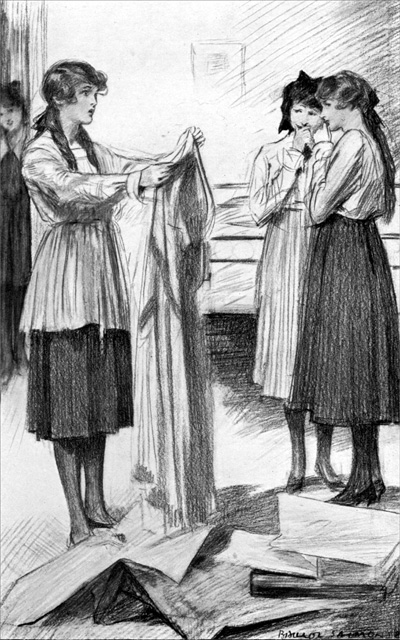
Two red spots mounted to Pamela's cheeks, and her eyes blazed sparks.
"This is just about the limit!" she exploded. "There's not the least
shadow of a doubt! Uncle Fritz has stolen that letter!"
While these events were taking place at Moss Cottage, David and Anthony
Watson were walking home from the station. They had lingered at the
booking office, and had loitered on the platform to talk to some
friends, and, when they finally made a start, they determined to take a
path through the woods instead of keeping to the high road. There were
two motives for this decision. In the first place, the woods belonged to
the Lyngates estate, and, though the public had an old-established right
of way, Mr. Hockheimer objected greatly to the foot-path being used, and
had several times vainly tried to close it. The boys felt that they
would cheerfully go out of their way to annoy Mr. Hockheimer. They
almost hoped they might meet him, and, in imagination, stood firmly on
the path, discussing the legal aspect of the matter, and quoting the
ancient county map as their authority.
There was, however, another reason which led them from the high road.
During the last few days a curious and persistent rumour had circulated
in the neighbourhood as to a "something" that had appeared in the woods.
Whether supernatural or physical nobody knew, but several people
vouched for having seen it. Their stories, allowing a natural margin for
exaggeration, tallied wonderfully. The apparition wore dark clothes and
a black mask, and, instead of walking, careered along in a series of
mighty leaps and bounds. Owing to this extraordinary mode of
progression, it had been nicknamed "Spring-heeled Jack", and its
appearance had excited considerable terror. It was reported to be abroad
at dusk, and to haunt the more lonely portions of the woods.
David and Anthony, having a thorough boyish love of adventure, thirsted
to get a sight of this mysterious personage. They climbed the hill over
the quarry, therefore, and struck up through the woods, keeping at first
to the foot-path, but they encountered nobody, not even Mr. Hockheimer.
When you are out for excitement, it is disappointing to have a perfectly
tame and uneventful walk. In the thickest part of the wood they paused
with one consent.
"It's all bunkum about the trespassing! Let's go and explore!" tempted
David.
"Right you are!" agreed Anthony, succumbing as readily as Eve yielded to
the serpent.
It was a most interesting wood, with tall trees and smooth glades. It
undulated, and held crags here and there, so that you could never quite
see where you were going. The ground was strewn with acorns and beech
mast and horse-chestnuts, quite worth picking up. The boys wandered for
some little time, enjoying themselves immensely. They had no idea in
what direction they were going till they found themselves on the crest
of the hill. Behind them was the wood, but in front was a range of open
country looking towards the sea. They were standing on a platform of
rock, which shelved sharply down to a patch of gorse and heather.
"Jolly view here——" began Anthony, but stopped with his sentence
unfinished, for David suddenly gripped his arm and forced him on his
knees behind a bush. Somebody was walking at the foot of the rock, and
one brief glimpse had been sufficient to identify the plump figure and
blond moustache of their arch-enemy, Mr. Hockheimer. It would never do
for him to catch them so far from the foot-path. He might wish to settle
up scores with them. They remembered the gleam in his eye when he had
shaken his fist and said he would not forget. If they waited quietly he
would probably go, and then they would hurry back to the path.
But instead of going he waited, humming a tune. He was musical and fond
of operatic airs. There were other sounds, too, which the boys could not
understand. They grew curious and wanted to know what he was doing. They
dared not speak, but, agreeing by signs, they both crawled very
cautiously to the edge of the rock, and, concealed by some branches,
peeped over.
Mr. Hockheimer was exactly below them. He was kneeling on the grass, and
had evidently just untied a parcel. A large bicycle lamp lay on the
paper. In his hand he held a bottle, with the contents of which he
proceeded to fill the lamp. He felt in his pocket for matches, lighted
it, and placed it on a ledge of the rock. The dusk was falling fast, and
its glow shone brightly. From its position on the crest of the hill it
would be visible over miles of country, probably right out to sea. Mr.
Hockheimer hummed in a satisfied voice, as if he were pleased with
himself. He presently lighted a cigar; the fragrant smoke rose upwards
to the boys' nostrils. They could see him with extreme plainness, and
indeed could follow his every movement. He fumbled again in his pocket
and drew out an envelope, holding it in the glow of the lamp so as to
inspect it. David and Anthony gasped, for they recognized in a moment
the letter which they had given to Pamela only that morning. How had she
been so foolish as to allow her uncle to get hold of it? they asked
themselves. They were full of wrath at her stupidity. Mr. Hockheimer
turned over the envelope several times; he looked at the handwriting and
surveyed the seal, then he deliberately tore it open. He drew out a
piece of note-paper and began to read it. The boys, peering through the
brambles above, watched him narrowly, though they could not see the
document well enough to decipher it. Its contents seemed to disturb Mr.
Hockheimer. He said several untranslatable things in the German tongue.
Then he brought out his smart little silver box, hesitated, and struck a
match. The boys were in an agony of mind. He simply must not be allowed
to burn the paper. Sooner than that they would drop from the crag and
try to rescue it.
The wind had risen and blew out the match. For a moment they breathed
again, but it was only a temporary respite, for he immediately struck
another. He shaded it carefully this time, and, taking the paper,
applied the corner to the flame.
At that same moment a terrific and unearthly yell sounded in the wood
above. Mr. Hockheimer started and turned, dropping blazing letter and
match to the ground. There was a rustle among the bushes, and with an
enormous bound a dark figure sprang sheer from the rocks on to the
platform of grass, made a grab at the paper, seized it, put out the
fire, and leaped away with it into the gathering dusk of the undergrowth
below.
It happened with such extraordinary rapidity and suddenness that it was
all over in a flash, and the boys only caught a glimpse of a black mask,
and two long legs that hopped with the agility of a spider-monkey.
Considerably scared, they crept back from their position of vantage,
and, rushing through the darkening wood, managed to regain the pathway.
It was not till they had finally crossed the stile and got into the high
road that they began to compare notes.
"Well! We've seen it!" ejaculated David meaningly.
"What is it?" whispered Anthony in awestruck tones. "Teddy Jones says
it's Old Nick himself. It was terrible when it yelled!"
"Those legs were human," maintained David. "I can't guess who it is, or
how he manages to jump like that, but I bet he's not a spook."
Anthony, who inclined to the supernatural theory of the apparition,
shook his head doubtfully.
"Spook or not, he's no friend to old Hockheimer," added David.
"He's taken the letter—what was left of it."
"Only a bit was burnt."
"I wonder what was in it?"
"Something that Hun wanted safely out of the way."
"It must be Squire Reynolds's will!"
"Well, Spring-heeled Jack's got it, at any rate, and whether he'll ever
turn it up again is the question. If we could find out who he is we
might get on the track of it."
"We'll try, for Pamela's sake—though she's a bally idiot to let her
uncle take that letter!"
"It strikes me we've got on the track of something else to-night,"
continued David. "Did you notice that lamp?"
"Yes, I did."
"And where he stuck it?"
"Rather!"
"The light would shine right out to sea."
"And aeroplanes could see it too, from there."
"I've always suspected old Hockheimer. He ought to have been interned
long ago. I can't think why they let him be at large. The Government's
very lax with these Germans. If I were in Parliament I'd clear out the
whole set of them."
Anthony drew a long breath.
"We must watch him. Don't say too much to Pamela, in case the silly
goose blabs. Shall we tell her what we've seen to-night?"
"On the whole I think we'd better not. She hates him, and yet perhaps
she might not altogether want to get him into trouble. We'll go
cautiously, and hunt about, and see what more we can find out."
For a few days the boys purposely avoided Pamela, and she, on her part,
did not seek speech with them. She was intensely chagrined at the loss
of the letter, and did not like to acknowledge the humiliating fact to
them. She searched everywhere in the cottage, in case the wind might
have blown it from the table on to the floor, but it was not
forthcoming. Her mother vetoed the suggestion that Mr. Hockheimer had
taken it.
"Surely, dear, he would never be so dishonourable! You must have put it
somewhere yourself."
"But, Mummie, I know I didn't. And you said yourself that you saw it on
the table."
"It's very mysterious," sighed Mrs. Reynolds. "We might ask your uncle
next time he comes if he took it by mistake."
"He'd only deny it."
"Pamela, you misjudge him."
"I hate him, Mummie; he bullies us both."
"We're entirely dependent on him, remember. He gives us the whole of our
little income, and pays your school bills. We mustn't quarrel with our
bread and butter. What should we do if he were to turn us out?"
"I don't know. I sometimes think I'd rather be a crossing-sweeper than
take his money. Oh, life's horrid, and I hate it all! I wish we'd stayed
in Canada, and never come to England. Wait till I'm a little older,
Mummie, and I'll get a post as teacher, and work for you. I wish I were
twenty-one!"
"That's many years off, child, and in the meantime you've to get your
education. You must be civil to your uncle, Pamela."
"I will, on the outside, but I can't help my feelings inside. They're
boiling!" demurred Pamela, rather defiantly, scrubbing the corners of
her eyes with her handkerchief, and settling down to her lesson books.