Ulyth walked from the study feeling that she had
told far more than she wished.
"I've given Rona away," she said to herself.
"Miss Bowes is thinking the very worst of her, I
know. Oh dear! I wish she'd explain, and not
keep up this dreadful silence. It's so unlike her.
She's generally almost too ready to talk. If I
could see her even for a few minutes I believe she
would tell me. Perhaps Miss Teddington frightened
her. Poor Rona! She must be so utterly
miserable. Could I possibly get a word with her,
I wonder?"
She talked the matter over with Lizzie.
"If I ask Miss Bowes, she'll probably say no,"
lamented Ulyth.
"Then I shouldn't ask," returned Lizzie.
"We've not been definitely forbidden to see Rona."
"The door's locked."
"You've only to climb out of the linen-room
window on to the roof of the veranda."
"Why, so I could. Oh, I must speak to her!"
"I think you are justified, if you can get anything
out of her. She'd tell you better than anybody
else in the whole school."
"I'll try my luck then."
"I'll stand in the garden below and shout
'Cave!' if I hear anyone coming."
To help her unfortunate room-mate seemed the
first consideration to Ulyth, and she thought the
end certainly justified the means. She waited until
after the tea interval, when most of the girls would
be playing tennis or walking in the glade; then,
making sure that Lizzie was watching in the garden
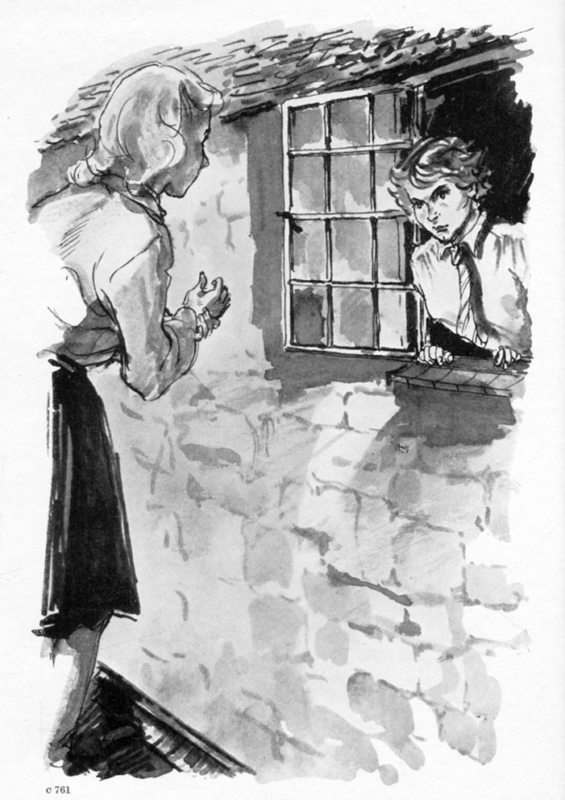
below, she stole upstairs to the linen-room. It was
quite easy to drop from the window on to the top of
the veranda, and not very difficult, in spite of the
slope, to walk along to the end of the roof. Here
an angle of the old part of the house jutted out, and
the open window of Rona's prison faced her only a
couple of yards away. She could not reach across
the gap, but conversation would be perfectly possible.
"Rona!" she called cautiously. "Rona!"
There was a movement inside the room, and a
face appeared at the window. Rona's eyes were red
and swollen with crying, and her hair hung in wild
disorder. At the sight of Ulyth she started, and
stared rather defiantly.
"Rona! Rona, dear! I've been longing to see
you. I felt I must speak to you."
No reply. Rona, in fact, turned her back.
"I'm so dreadfully sorry," continued Ulyth.
"I've been thinking about you all day. It's no
use keeping this up. Do confess and have done
with it."
Rona twisted round suddenly and faced Ulyth.
"Rona! You'd be so much happier if you'd
own up you'd taken it. Surely you only meant it
as a joke on Stephie? Miss Bowes will forgive
you. For the sake of the school, do!"
Then Rona spoke.
"You ask me to confess—you, of all people!"
she exclaimed with unconcealed bitterness.
"Yes, dear. I can't urge it too strongly."
"You want me to tell Miss Bowes that I took
that pendant?"
"There's no sense in concealing it, Rona."
The Cuckoo's eyes blazed. Her hands gripped
the window-sill.
"Oh, this is too much! It's the limit! I
couldn't have believed it possible! You, Ulyth!
you to ask me this! How can you? How dare
you?"
Ulyth gazed at her in perplexity. She could not
understand such an outburst.
"Surely I, your own chum, have the best right
to speak to you for your own good?"
"My own good!" repeated Rona witheringly.
"Yours, you mean. Oh yes, it's all very fine for
you, no doubt! You're to get off scot free."
"I? What are you talking about?"
"Don't pretend you don't understand. You
atrocious sneak and hypocrite—you took the pendant
yourself!"
If she had been accused of purloining the Crown
jewels from the Tower of London, Ulyth could not
have been more astonished.
"I——!" she stammered. "I——!"
"Yes, you, and you know it. I saw you."
"You couldn't!"
"But I did, or as good as saw you. Who came
into our room last night, I should like to know,
when Miss Lodge had sent me to bed, and slipped
something into one of the blouses hanging behind
the door? I'd forgotten by the morning, but I
remembered when the pendant came jerking out of
my pocket."
"Certainly I didn't put it there!"
"But you did. You came into the room, took
off your outdoor coat, and threw it on your bed. I
got up, afterwards, and hung it up in your wardrobe
for you. Irene told me how you'd joined the
cake club. She said you had the password quite
pat."
Ulyth was too aghast to answer. Rona, once
she had broken silence, continued in a torrent of
indignation.
"You a Torch-bearer! You might well ask me
not to expose you! 'Remember the Camp-fire,'
you said. Yes, it's because of the Camp-fire, and
for the sake of the school, that I've kept your secret.
Don't be afraid. I'm not going to tell. It wouldn't
be good for the League if a Torch-bearer toppled
down so low! It doesn't matter so much for only
a Wood-gatherer. I won't betray a chum—I've
brought that much honour from the Bush; but I'll
let you know what I think about you, at any rate."
Then, her blaze of passion suddenly fading, she
burst into tears.
"Ulyth, Ulyth, how could you?" she sobbed.
"You who taught me everything that was good.
I believed in you so utterly, I'd never have thought
it of you. Oh, why——"
"Cave! cave!" shouted Lizzie excitedly below.
"Cave! Teddie herself!"
Ulyth turned and fled with more regard for speed
than safety along the veranda roof, and scrambled
through the window into the linen-room again.
She was trembling with agitation. Such an extraordinary
development of the situation was as appalling
as it was unexpected. She must have time to
think it over. She could not bear to speak to anybody
about it at present, not even to Lizzie. No,
she must be alone. She ran quickly downstairs,
and, before Lizzie had time to find her, dived under
the laurels of the shrubbery and made her way first
down the garden and then to the very bottom of
the paddock that adjoined the high road. There
was a little copse here, of trees and low bushes,
which sheltered her from all observation. Nobody
was likely to come and disturb her, for the girls
preferred the glade, and seldom troubled to enter
the paddock. She flung herself down on the grass
and tried to face the matter calmly. She had
begged Rona to confess, and Rona in return had
accused her of taking the pendant. This was turning
the tables with a vengeance. How could her
room-mate have become possessed of such a preposterous
idea? And in what a web of mystery
the affair seemed involved! One certainty came as
an immense relief. Rona was not guilty. More
than this, she was behaving with an extraordinary
amount of courage and loyalty.
"She believes I took it, and yet she is bearing
all the blame, and shielding me for the sake of the
school," groaned Ulyth. "Oh, what must she be
thinking of me! We're all at cross-purposes.
Did she really fancy that when I said: 'Remember
the Camp-fire', I was begging her to screen me?
Somebody took the pendant and put it in her
pocket; that's the ugly part of the business. It's
throwing the blame from one to another. What
we've got to do is to find out the real guilty person,
and that's not going to be easy, I'm afraid."
Ulyth sighed and wiped her eyes. She had been
deeply hurt at Rona's sudden attack. It is humiliating
to find that where you occupied a pedestal you
are now, even temporarily, a broken idol.
"She's right to scorn me if she imagines I'm
such a sneak, but how could she suppose I would?
And yet I thought her guilty. Oh dear, it's a
horrible muddle! How shall we ever get it straight?"
Ulyth sat thinking, thinking, and was no nearer
to a solution of her problem when she suddenly
heard the brisk ringing of a bicycle-bell on the
road below. Springing up eagerly, she rushed to
the wall, and shouted just in time to stop Mrs.
Arnold, whose machine was whisking past.
"Hallo, Ulyth! What are you doing there?"
"I'm coming over. Do please wait for me!"
And Ulyth, scrambling somehow across the wall,
slid down a gravelly bank on to the road.
"You're the one person in the world I want to
see," she added, hugging her friend impetuously.
"Oh, Mrs. Arnold, the most dreadful things
have been happening at school! Somebody took
Stephie's pendant, and it fell out of Rona's pocket,
and everybody thinks Rona took it, and Rona
thinks it's me. What are we to do?"
"Sit down here and tell me all about it. Yes,
please, begin at the very beginning, and don't
leave anything out, however trivial. Sometimes
the little things are the most important. Cheer
up, child! We'll get to the bottom of it, never
fear."
Sitting on the bank, with Mrs. Arnold's arm
round her, Ulyth related the whole of her story,
mentioning every detail she could remember. It
was such a comfort to pour it out into sympathetic
ears, and to one whose judgment was more likely
to be unbiased than that of anyone connected with
the school.
"You always understand," she said, with a sigh
of relief, as she kissed the hand that was holding
hers.
"It certainly is a tangled skein to unravel; but,
as it happens, I really believe I can throw a little
light upon the matter. You say Rona told you
that somebody came into her bedroom last night,
and presumably hid the pendant in her blouse
pocket?"
"Yes; and she was sure that somebody was
myself."
"Then what we have to do is to produce the real
culprit."
"If we can find her."
"Just now I was wheeling my bicycle up Tyn y
Bryn Hill, and I met one of the boys from Jones's
farm. He stopped me and handed me a letter.
'A girl gave it to me five minutes ago,' he said.
'She asked me if I was going to the village, and
if I'd post it for her; so I promised I would. But it's
addressed to you, so I may as well give it to you as
post it, and save the stamp.' I read the letter, and
it puzzled me extremely. I hardly knew what to
make of it; but since you've told me about the
pendant I think I begin to understand its meaning.
You shall see it for yourself."
Mrs. Arnold spread out the letter on her knee, so
that Ulyth might read it. It was written on village
note-paper, in a childish hand, with no stops.
"dear Mrs Arnold
"this comes hoping to find you as well as
it leves me at present i am in dredful trubble and
i cannot stay here eny longer dear Mrs Arnold after
what cook said this afternoon i am sure she knows
all and i daresunt tell miss Bowes but you are the
camp fire lady and i feel i must say goodbye to ease
your mind dear Mrs Arnold wen you get this letter
I shall be Far Away as it says in the song you tort
us by the stream and you will never see me agen
but i shall think of you alwus and the camp fire
and i wish i hadn't dun it only I was skared to deth
for she said she wuld half kill me and she alwus
keeps her wurd your obedient servant Susannah
Maude Hawley."
"Susannah Maude!" exclaimed Ulyth. "I never
even thought of her. Is it possible that she could
have taken the pendant?"
"From the letter it looks rather like it. It is
very mysterious, and I cannot understand it all;
but the girl appears to have done something she
shouldn't, and to have run away."
"Where has she run to?"
"She can't have gone very far. She evidently
did not mean me to receive this letter until to-morrow
morning, as she asked Idwal Jones to post
it. He forestalled her intention by giving it to me
now. It's a most fortunate thing, as we may be
able to overtake her. She is probably walking to
Llangarmon, and cannot have gone more than a
few miles by this time. I shall follow her at once
on my machine, and shall most likely come up
with her before she even reaches Coed Glas."
"Oh, let me go with you!" pleaded Ulyth, starting
to her feet and seizing the bicycle. "I could
ride on the carrier. I've often done it before.
Oh, please, please!"
"What about school rules?"
"Miss Bowes wouldn't mind if you took me.
Just this once!"
"Well, I suppose my shoulders are broad
enough to bear the blame if we get into trouble
about it."
"Oh, we shan't! We must find Susannah
Maude. Miss Bowes would want us to stop her
running away."
"Come along then, and mind you balance yourself,
so that you don't upset us."
"Trust me!" chuckled Ulyth delightedly.
Back along the road by which she had come
sped Mrs. Arnold, past the lane that led to her
own house, and away in the direction of Llangarmon.
Ulyth managed to stick on without impeding
her progress, and felt a delirious joy in the
stolen expedition. To be out with her dear Mrs.
Arnold on such an exciting adventure was an hour
worth remembering. She could not often get the
Guardian of the Fire all to herself in this glorious
fashion. She would be the envy of the school
when she returned. Susannah Maude was apparently
a quick walker. They passed through the
hamlet of Coed Glas, and were half a mile beyond
before they caught sight of the odd little figure
trudging on ahead. They overtook her exactly on
the bridge that crossed the Llyn Mawr stream.
As Mrs. Arnold dismounted and called her by
name, Susannah Maude started, uttered a shriek,
and apparently for a moment contemplated casting
herself into the stream below. The Guardian of
the Fire, however, seized her firmly by the arm,
and, drawing her to the low parapet, made her sit
down.
"Now tell me all about it," said Mrs. Arnold
encouragingly, seating herself by her side. For
answer Susannah Maude wept unrestrainedly, the
hot tears dripping down her hard little cheeks into
her rough little hands.
Mrs. Arnold waited with patience till the storm
had subsided, then she began to put questions.
"Did you take the young lady's locket, Susan?"
"Yes, I did; but I didn't want to. I wouldn't if
I hadn't been so scared. I'm scared to death now
as she'll find me."
"You needn't be afraid of Miss Bowes."
"I ain't. Leastways not so bad. It's her I'm
feared of."
"Whom do you mean, child?"
"Her—my mother."
"I didn't know you had a mother. I thought
you were an orphan," burst out Ulyth.
"I wish I was. No, my father and mother
wasn't dead—they was both serving time when I
was sent to the Home. When Mother come out
she got to know where I was, and she kept an eye
on me; then when I comes here to a situation she
turns up one day at the back door and says she
wants my wages. I give her all I got; but that
didn't satisfy her—not much! She was always
hanging about the place. She used to come and
sell sweets and cakes, unbeknown-like, to the
young ladies."
"Was that your mother? The gipsy woman
with the basket?" exclaimed Ulyth.
"That was her, sure enough. She pestered me
all the time for money, and then when she found
I'd got none left she said I must bring her something
instead. 'The young ladies must have heaps
of brooches and lockets, and things they don't want,
so just you fetch me one,' sez she; 'and if you don't
I'll catch you and half kill you.' Oh, I can tell
you I was scared to death! I don't want not to be
honest; but she'd half killed me once or twice before,
when I was a kid, and I know what her hand's like
when she uses it."
"So you took something?"
"Yes. I waited till the young ladies was all at
supper; then I got down one of their coats from the
pegs in the corridor and slipped it over my black
dress and apron, and I put on one of their hats.
I thought if I was seen upstairs they'd take me
for one of themselves. I went into the studio, and
there, right opposite on a little table, was that kind
of locket thing. I slipped it in my pocket, and
looked round the room. If there wasn't another
just like it on the bench! I took that, and put it on
the table. It wasn't likely, perhaps, it would be
missed as quick as the other. Then I thought I'd
better be going. I was just walking down the
landing when I hears a step, and darts into one
of the bedrooms. 'Suppose they catches me,'
thinks I, 'with one of the young ladies' coats and
hats on and the locket in my hand!' There was a
blouse hanging behind the door, with a little pocket
just handy, so I stuffed the locket down into that;
then I pulled off the coat and threw it on the bed,
and flung the hat out of the window. I thought if
anyone came in and found me I'd say I'd been sent
to refill the water-jug. But the steps went on, and
I rushed out and downstairs, and left the locket
where it was. I was so scared I didn't know what
I was doing."
"Gracie found her hat in the garden this morning,"
gasped Ulyth. "She wondered how it got
there."
"But what made you run away?" asked Mrs.
Arnold, returning to the main question. "Did
you think you were suspected?"
"Not till this afternoon. Then the servants were
all talking in the kitchen about how one of the young
ladies was supposed to have taken what they called
a 'pendon' or something, and Cook looked straight
at me and says: 'If anything's missing, it's not
one of the young ladies that's got it, I'll be bound.'
And I turned red and run out of the kitchen. My
mother'd said she'd be coming round this evening,
and how was I going to meet her with no locket?
So I says, there's nothing else for it, I'd best go
back to the Home. Miss Bankes, she was good to
me, and Mother daresn't show her face there. So
I wrote a letter, and asked Jones's boy to post it.
I didn't think you'd get it till to-morrow."
"Very fortunately I received it at once. You
must come back with us now to The Woodlands,
Susan. We shall all have to walk, for the bicycle
won't take three."
"I'll wheel it," cried Ulyth joyfully.
"She'll half kill me to-night," quavered poor
Susannah Maude. "Do let me go to the
Home!"
"Your mother shall not have a chance of coming
near you. You must tell all this to Miss Bowes;
then to-morrow, if you wish, you may be sent back
to the Orphanage."
No successful scouts could have returned to camp
with more triumph than Mrs. Arnold and Ulyth, as,
very late and decidedly tired, they arrived at The
Woodlands to relate their surprising story. Miss
Bowes sent at once for Rona, and in the presence
of the Principals the whole matter was carefully
explained to the satisfaction of all parties, even
poor weeping Susannah Maude.
"I am very glad to find the motive for which
Rona kept silence was so good a one," commented
Miss Teddington. "She has shown her loyalty
both to her friend and to the school."
Dismissed with honour from the study, Ulyth
and Rona were hugging each other in the privacy
of the boot cupboard.
"Can you ever forgive all the horrible things
I said?" implored Rona. "I think I was off my
head. I might have known it wasn't—couldn't be
possible; you are you—the one girl I've been trying
to copy ever since I came here."
"You've quite as much to forgive me, dear, and
I beg your pardon. I'm so glad it's all straight
and square now."
"You darling! I don't mind telling you it was
Tootie who gave me those chocolates."
"Didn't you buy them from the cake-woman?"
"I never bought anything from her. I didn't
join the cake club."
"Then how did she get hold of your New Zealand
brooch? She showed it to me."
"Why, I'd swopped that brooch with Tootie for
a penknife ages ago. We're always swopping our
things in IV b."
"The whole business seems to have been a
comedy of errors," said Ulyth. "Some mischievous
Puck threw dust in our eyes and blinded
us to the truth."
After all, it was the juniors that suffered most,
for Miss Teddington, who had been very angry
at the whole affair, turned the vials of her wrath
upon them, and took them to task for their illicit
traffic in cakes. This, at any rate, she was determined
to punish, and not a solitary sinner was
allowed to escape. Tootie, the original leader in
rebellion, issued from her interview in the study
such a crushed worm as to stifle any lingering
seeds of mutiny among her crestfallen followers.
"What's to become of Susannah Maude?" asked
everybody; and Miss Bowes answered the question.
"I am taking the poor child back to the Orphanage.
I have told the police to warn her disreputable
mother from this neighbourhood; but, as one
can never be certain when she might turn up again,
we must remove Susan altogether out of reach of
her evil influence. A party of girls will be sent
from the Home very soon to Canada, and we shall
arrange for her to join them and emigrate to a new
country, where she will be placed in a good situation
on a farm and well looked after. She is not
really a dishonest girl, and has a very grateful and
affectionate disposition. I am confident that she
will do us credit in the New World, and turn out
a useful and happy citizen. Why yes, girls, if
you like to make her a little good-bye present before
she sails, you may do so. It is a kind thought,
and I am sure she will appreciate it greatly."
"There's only one item not yet wiped out on the
slate," said Ulyth to Lizzie. "Perhaps I ought to
report myself for walking along the veranda roof.
I'd feel more comfortable!"
"Go ahead, then! Teddie's at the confessional
now."
"It's never been exactly forbidden," said Ulyth,
with a twinkle in her eye, after she had stated the
extent of her enormity to Miss Teddington.
"I would as soon have thought of forbidding
you to climb the chimneys! It was a dangerous
experiment, and certainly must not be repeated.
I'm surprised at a senior! No, as you have told
me yourself, I will not enter it in your conduct-book.
Please don't parade the roofs in future.
Now you may go."
"Got off even easier than I expected," rejoiced
Ulyth to the waiting Lizzie. "Teddie's bark's
always worse than her bite."
"We've found that out long ago," agreed Lizzie.
CHAPTER XIX — A Surprise
The storm-clouds that had gathered round the
mystery of the lost pendant seemed to clear the air,
and sunshine once more reigned at The Woodlands.
The juniors were on their very best behaviour;
they indulged in no more surreptitious expeditions
and abandoned their truculent attitude towards
the elder girls, who, while careful to preserve their
dignity as seniors, were ready to wipe off old scores
and start afresh. Some manœuvres in connection
with the Camp-fire League proved a bond of union,
for here there was no distinction between Upper
and Lower School, since all were novices to the
new work and had to learn alike. None, indeed,
had any time at present to get into mischief. As
the end of the term, with its prospects of examinations,
drew near, even the most hardened shirkers
were obliged to put their shoulders to the wheel,
and show a certain amount of intimacy with their
textbooks. A nodding acquaintance with French
verbs or the rules of Latin Grammar might suffice
to shuffle through the ordinary lessons in form, but
would be a poor crutch when confronted with a pile
of foolscap paper and a set of questions, and likely
to lead to disparaging items in their reports.
In every department, therefore, there was a flood-tide
of effort. Nature-study diaries, roughly kept,
were neatly copied; lists of birds and flowers were
revised; the geological specimens in the museum
were rearranged and labelled, the art treasures in
the studio touched up, while pianos seemed sounding
from morning to night. The school was on its
mettle to appear at high-water mark. Miss Bowes
had lately instituted an Old Girls' Union for The
Woodlands, the first gathering of which was to be
held in conjunction with the breaking-up festivity.
Quite a number of past pupils had accepted the invitation,
and people of influence in the neighbourhood
were also expected to be present.
"You must show the 'old girls' what you can
do," said Miss Bowes, who was naturally anxious
to make a good impression on the visitors. "I
want them to think the standard raised, not lowered.
Some of our ways will be new to them, and
we must prove that the changes have been for the
better."
It certainly seemed a goal to work for. Even
the most irresponsible junior would feel humiliated
if the "old girls" were to consider that the school
had gone down, and all took a just pride in keeping
up its reputation.
"Noëlle Derrington and Phyllis Courtenay have
accepted"—it was Stephanie who volunteered the
information. "They have both been presented.
And Irene Vernon has promised to come. She's
been out two years now. I do hope those wretched
kids in IV b will behave themselves. Manners
have gone off at The Woodlands in my opinion,
even if the work's better. When my sister was
a junior, she says, they would as soon have thought
of ragging the mistresses as of cheeking the
seniors."
"O tempora! O mores!" laughed Addie.
"When you're an old lady, Stephie, you'll spend
all your time lamenting the good old days of your
youth, and telling the children just how much
better-behaved girls used to be when you were at
school."
"I shan't say so of our juniors, at any rate,"
snorted Stephanie.
"Have you heard yet who's coming from the
neighbourhood?" Beth enquired.
"Mr. and Mrs. Arnold, of course, and Colonel
and Mrs. Hepworth, and the Mowbrays, and the
Langtons."
"Lord and Lady Glyncraig have accepted; Miss
Harding told me so just now," remarked Christine.
"Oh, what luck!" Stephanie's eyes sparkled.
"It will just give the finishing touch to the
affair."
"Did you say that Lord and Lady Glyncraig
are coming to our breaking-up party?" asked Rona
quickly. She had joined the group in company
with Winnie and Hattie.
"So I understand; but you needn't excite yourself.
It isn't likely they'll notice juniors, though
they'll probably speak to a few seniors whom they
already know."
"Including Miss Stephanie Radford, of course,"
scoffed Winnie. "We shall expect to see you
walking arm in arm with them round the grounds."
"And hear them giving you a most pressing
invitation to Plas Cafn," Hattie added. "You
don't get asked there as often as one would suppose,
considering you're so intimate with them."
"The cheek of juniors grows beyond all bounds!"
declared Stephanie, stalking away. "I'm afraid I
know what Irene Vernon will think of the school."
It was of course impossible for all the parents of
the girls to come to the "At Home", but a certain
proportion had promised to be present. There was
a good hotel at Llangarmon, and they could put
up there, and drive over for the occasion. The
neighbourhood was so beautiful that several would
take the opportunity of spending a few days in
sightseeing.
"I've news to tell you," said Ulyth to Rona one
morning, her face radiant as she showed a letter.
"Who do you think are coming to the party?
Motherkins and Oswald! Ossie'll just be home in
time, so they're jaunting off to Elwyn Bay like
a pair of honeymooners. Motherkins hasn't been
very well, and Dad says the sea air will do her
good—he can't leave business himself, more's the
pity! Won't it be glorious to see them here! I
could stand on my head, I'm so glad."
The prospect of meeting any members of the
Stanton family again was a great pleasure to Rona,
who treasured the memory of the Christmas holidays
as her happiest experience in England. Mrs.
Fowler was also to be present, so she would see
the friend who had been kind to her at Eastertide
as well.
"I'm glad my mother's coming," said Winnie.
"When most of the other girls have somebody, its
so horrid to be left out. Poor old Rona! I wish
you'd got some relations of your own who could be
here. It's hard luck!"
A shade crossed Rona's face. She hesitated, as
if about to speak, then, apparently changing her
mind, kept silence.
"What an idiotic duffer you are!" whispered
Hattie to Winnie. "You needn't be always reminding
her what a cuckoo she is."
"The Cuckoo's got its feathers now, and has
grown a very handsome bird," said Winnie, watching
Rona as the latter walked away.
The At Home was to be chiefly a gathering for
the Old Girls' Union, but the present pupils were
to provide a short programme, consisting of music
and recitations, to occupy a portion of the afternoon.
Only the brightest stars were selected to
perform.
"The school's got to show off!" laughed Gertie.
"It's to try and take the shine out of the old girls.
Miss Bowes doesn't exactly like to say so, but
that's what she means."
"No inferior talent permitted," agreed Addie.
"Only freshwater oysters may wag their tails."
"Metaphor's a little mixed, my hearty. Perhaps
you'll show us an oyster's tail?"
"Well, they've got beards, at any rate."
"To beard the lion with?"
"If you like. I suppose Lord Glyncraig will be
the lion of the afternoon. We shall have to perform
before him."
"Oh, I'm so thankful I'm not clever enough to
be on the programme!"
After careful consideration of her pupils' best
points, Miss Ledbury, the music-mistress, had at
last compiled her list. She put Rona down for
a song. Rona's voice had developed immensely
since she came to school. For a girl of her age
it had a wonderfully rich tone and wide compass.
Miss Ledbury thought it showed promise of great
things later on, and, while avoiding overstraining
it, she had made Rona practise most assiduously.
There was rather a dearth of good solo voices in
the school at present, most of the seniors having
more talent for the piano than for singing, otherwise
a junior might not have obtained a place on
the coveted programme.
"But of course Rona's not exactly a junior,"
urged Ulyth in reply to several jealous comments.
"She's fifteen now, although she's only in IV B,
and she's old for her age. She's miles above the
kids in her form. I think Teddie realizes that. I
shouldn't be at all surprised if Rona skips a form
and is put into the Upper School next term. She'd
manage the work, I believe. It's been rather
rough on her to stay among those babes."
"Well, I say Miss Ledbury might have chosen
a soloist from V b," returned Beth icily. She was
not a Rona enthusiast.
"Who? Stephie's playing the piano and
Gertie's reciting, Merle croaks like a raven, you
and Chris don't learn singing, Addie's no ear for
tune, and the rest of us, as Leddie says, 'have no
puff'. I'm glad Rona can do something well for
the school. She's been here three terms, and she's
as much a Woodlander now as anyone else."
Rona herself seemed to regard her honour with
dismay. The easy confidence which she had
brought from New Zealand had quite disappeared,
thanks to incessant snubbing; she was apt now to
veer to the side of diffidence.
"Do you think I'll break down?" she asked
Ulyth nervously.
"Not a bit of it. Why should you? You know
the song and you know you can sing it. Just let
yourself go, and don't think of the audience."
"Very good advice, no doubt, but a trifle difficult
to follow," pouted Rona. "Don't think of the
audience, indeed, when they'll all be sitting staring
at me. Am I to shut my eyes?"
"You can look at your song, at any rate, and
fancy you're alone with Miss Ledbury."
"Imagination's not my strong point. I wish the
wretched performance was over and done with."
There were great preparations on the morning of
29th July. Outside, the gardeners were giving a
last roll to the lawns, and a last sweep to the paths.
In the kitchen the cook was setting out rows of
small cakes, and the parlour-maid in the pantry was
counting cups and spoons, and polishing the best
silver urn. In the school department finishing
touches were put everywhere. Great bowls of roses
were placed in the drawing-room, and jars of tall
lilies in the hall. The studio, arranged yesterday
with its exhibits of arts and handicrafts, was further
decorated with picturesque boughs of larch and
spikes of foxgloves. Two curators were told off to
explain the museum to visitors, and tea-stewards
selected to help to hand round cups and cakes. A
band of special scouts picked raspberries and arranged
them on little green plates. Chairs were
placed in the summer-house and under the trees in
view of the lawn. The rustic seats were carefully
dusted in the glade by the stream.
By three o'clock the school was in a flutter of
expectation.
"Do I look—decent?" asked Rona anxiously,
taking a last nervous peep at her toilet in the wardrobe
mirror.
"Decent!" exclaimed Ulyth. "You're for all
the world like a Sir Joshua Reynolds portrait. I'd
like to frame you, just as you are, and hang you on
the wall."
"You wouldn't feel ashamed of me if—if you
happened to be my relation? I've improved a little
since I came here, haven't I? I was a wild sort of
goose-girl when I arrived, I know."
"The goose-girl is a Princess to-day," said her
room-mate exultantly.
Ulyth thought Rona had never looked so sweet.
The pretty white dress trimmed with pale blue
edgings suited her exactly, and set off her lovely
colouring and rich ruddy-brown hair. Her eyes
shone like diamonds, and the mingled excitement
and shyness in her face gave a peculiar charm to
her expression.
"She's far and away the prettiest girl in the
school," reflected Ulyth. "If there were a beauty
prize, she'd win it."
Everybody was waiting in the garden when the
guests arrived. The scene soon became gay and
animated. There were delighted welcomings of
parents, enthusiastic meetings between old school
chums, and a hearty greeting to all visitors. Mrs.
Stanton and Oswald had driven in a taxi from
Elwyn Bay, and were received with rapture by
Ulyth.
"Motherkins! Oh, how lovely to see you again!
I must have you all to myself for just a minute or
two before I share you with anybody—even Rona!"
"Is that Rona over there?" asked Oswald, gazing
half amazed at the friend who seemed to have added
a new dignity to her manner as well as inches to
her stature since Christmas-tide.
"Yes, go and fetch her to speak to Motherkins."
"I hardly like to. She looks so stately and
grown-up now."
"What nonsense! Ossie, you can't be shy all
of a sudden. What's come over you, you silly
boy? There, I'll beckon to Rona. Ah, she sees
us, and she's coming! No, I'm afraid she can't sit
next to us at the concert, because she's one of the
performers, and will have to be in the front row."
The ceremonies were to take place in the hall,
after which tea would be served to the company
out-of-doors.
"Lord Glyncraig is to act as chairman," whispered
Addie. "Stephie is so fearfully excited.
She means to go and speak to him and Lady Glyncraig
afterwards. I hope to goodness they won't
have forgotten her. She'd be so woefully humiliated.
She wants us all to see that she knows them. She's
been just living for this afternoon, I believe."
Rona, her hands tightly clasped, watched the
tall figure mount the platform. Lord Glyncraig,
with his clear-cut features, iron-grey hair, and commanding
air, looked a born leader of men, and well
fitted to take his share in swaying a nation's destiny.
She could picture him a power in Parliament. It
was good of him to come this afternoon to speak at
a girls' school. Lady Glyncraig, handsome, well-dressed,
and aristocratic, sat in the post of honour
next to Miss Bowes. Rona noticed her gracious
reception of the beautiful bouquet handed to her by
Catherine, and sighed as she looked.
There were no prizes at The Woodlands this
year, for the girls had asked to devote the money
to the Orphanage; but the examination lists and
the annual report were read, and some pleasant
comments made upon the scope of the Old Girls'
Union. Lord Glyncraig had a happy gift of
speech, and could adapt his remarks to the occasion.
Everybody felt that he had said exactly the right
things, and Principals, mistresses, parents, and
pupils past or present were wreathed in smiles.
These opening ceremonies did not take very long,
and the concert followed immediately.
Marjorie's Prelude, Evie's Nocturne, Stephanie's
Mazurka, and Gertie's recitation all went off without
a hitch, and received their due reward of appreciation.
It was now Rona's turn. For a
moment she grew pale as she mounted the platform,
then the coral flushed back into her cheeks.
She had no time to think of the audience. Miss
Ledbury was already playing the opening bars:
"Come out, come out, my dearest dear!
Come out and greet the sun!"
Mellow and tuneful as a blackbird's, Rona's
clear rich young voice rang out, so fresh, so joyous,
so natural, so full of the very spirit of maying
and the glory of summer's return, that the visitors
listened as one hearkens to the notes of a bird that
is pouring forth its heart from a tree-top in the
orchard. There was no mistake about the applause.
Guests and girls clapped their hardest. Rona, all
unwilling, was recalled, and made to sing an encore,
and as she left the platform everybody felt
that she had scored the triumph of the occasion.
"Glad the juniors weren't excluded. It's a
knock-down for Steph," whispered Addie.
"Trust Miss Ledbury not to leave out Rona.
She'll be our champion soloist now," returned
Christine.
The rest of the little programme was soon finished,
and the audience adjourned to the garden for tea.
Stephanie, with a tray of raspberries and cream,
came smilingly up to Lord and Lady Glyncraig,
and, introducing herself, reminded them of the
delightful visit she had paid to Plas Cafn. If they
had really forgotten her, they had the good manners
not to reveal the fact, and spoke to her kindly and
pleasantly.
"By the by," said Lord Glyncraig, "where is
your schoolfellow who sang so well just now? I
don't see her on the lawn."
"Rona Mitchell? I suppose she is somewhere
about," replied Stephanie casually.
"Do you happen to know if she comes from New
Zealand?"
"Yes, she does."
"I wonder if you could find her and bring her
here? I should like very much to speak to her."
Stephanie could not refuse, though her errand
was uncongenial. She could not imagine why an
ex-Cabinet Minister should concern himself with a
girl from the backwoods.
"Lord Glyncraig wants you; so hurry up, and
don't keep him waiting," was the message she
delivered, not too politely.
Rona blushed furiously. She appeared on the
very point of declining to obey the summons.
"Go, dear," said Mrs. Stanton quietly. "Perhaps
he wishes to congratulate you on the success
of your song. Yes, Rona, go. It would be most
ungracious to refuse."
With a face in which shyness, nervousness,
pride, and defiance strove for the mastery, Rona
approached Lord Glyncraig. He held out his
hand to her.
"Won't you bury the hatchet, and let us be
friends at last, Rona?" he said. "I'm proud of
my granddaughter to-day. You're a true chip of
the old block, a Mitchell to your finger-tips—and"
(in a lower tone) "with your mother's voice thrown
into the bargain. Blood is thicker than water,
child, and it's time now for bygones to become
bygones. I shall write to your father to-night, and
set things straight."
"How is it that you've actually been a whole
year at The Woodlands and never let anybody
have the least hint that Lord Glyncraig is your
grandfather? Don't you know what an enormous
difference it would have made to your position in
the school? Stephie is quite hysterical about it.
Why was it such a dead secret?" asked Ulyth of
her room-mate, as they took off their party dresses,
when the guests had gone.
"It's rather a long story," replied Rona, sitting
down on her bed. "In the first place, I dare say
you've guessed that Dad was the prodigal of the
family. He never did anything very bad, poor
dear, but he was packed off to the colonies in disgrace,
and told that he might stay there. At
Melbourne he met a lovely opera singer, who was
on tour in Australia, and married her. That made
my grandfather more angry than anything else he
had done. I'm not ashamed of my mother. She
was very clever, and sang like an angel, I'm told,
though I can't remember her. When she died,
Dad went to New Zealand and started farming.
Mrs. Barker was hardly an ideal person to bring
me up, but she was the only woman we could get to
stop in such an out-of-the-way place. I must have
been an awful specimen of a child; I don't like to
remember what things I did then. When I was
about ten, Father went away for a few weeks to the
North Island, and while he was gone, Mrs. Barker
went off in the gig to have a day's shopping at the
nearest store. She left me alone in the house. I
wasn't frightened, for I was quite accustomed to it.
No one but a chance neighbour ever came near.
Yet that day was just the exception that proves the
rule. Early in the afternoon a grand travelling
motor drove up, and a lady and gentleman knocked
at the door, and enquired for Dad. I was a little
wild rough thing then, and I was simply scared to
death at the sight of strangers. I told them Dad
was away. Then they asked if they might come
in, and the gentleman said he was my grandfather,
and the lady was his new wife, so that she was my
step-grandmother. Now Mrs. Barker had always
rubbed it in to me that if I was left alone I must on
no account admit strangers. That was the only
thing I could think of. I was in a panic, and I
slammed the door on them and bolted it, and then
ran to the window and pulled faces, hoping to make
them go away. They stood for a minute or two
quite aghast, trying to get me to listen to reason
through the window, but I only grew more and
more frightened, and called them all the ugly
names I could.
"'It's no use attempting to tame such a young
savage,' said the lady at last. Then they got into
their car again and drove away.
"By the time Mrs. Barker arrived I was ashamed
of myself, so I said nothing about my adventure,
and I never dared to tell Dad a word of it. I
suppose his father had come to hunt him up; but
he was evidently discouraged at the reception he
had received at the farm, and went back to England
without making another attempt at a meeting.
I don't believe he and Dad ever wrote to each
other from year's end to year's end. I tried to
forget this, but it stuck in my memory all the same.
Time went by, my friendship with you began, and
it was decided that I should be sent to The Woodlands.
I knew my grandfather lived at Plas Cafn,
for Dad had told me about his old home, but I did
not know it was so near to the school. You ask
why I did not tell the girls that I was related to
Lord Glyncraig? There were several reasons. In
the first place, I was really very much ashamed of
my behaviour the day he had come to our farm. I
thought he had cast us off completely, and would
not be at all pleased to own me as granddaughter.
I would not confess it to any of you, but I felt
so rough and uncouth when I compared myself
with other girls that I did not want Lord Glyncraig
to see me, or to know that I was in the neighbourhood.
Perhaps some day, so I thought, I might
grow more like you, if I tried hard, and then it
would be time enough to tell him of my whereabouts.
Then, because he had disowned us, I felt
much too proud to boast about the relationship at
school. If you could not like me for myself, I
wouldn't make a bid for popularity on the cheap
basis of being his granddaughter. I'm a democrat
at heart, and I think people ought to be valued on
their own merits entirely. I'd rather be an outsider
than shine with a reflected glory."
"You'll be popular now," said Ulyth. "Are
you to spend the holidays at Plas Cafn?"
"Yes. Miss Bowes says I must, though I'd far
rather have accepted your invitation. Lady Glyncraig
was very kind and sweet; she kissed me and
said she hoped so much that we should be friends.
They have promised to ask Dad to come over for
next Christmas and have a big family reunion."
"You won't let them take you away from The
Woodlands? We don't want to lose you, dear.
You must stay here now—for the sake of the
school."
"For my own sake!" cried Rona, flinging her
arms round her friend. "Ulyth, I owe everything
in the world to you. I understand now how good
it was of you to take me into your room and teach
me. I was a veritable cuckoo in your nest then, a
horrid, tiresome, trespassing bird, a savage, a bear
cub, a 'backwoods gawk' as the girls called me.
It's entirely thanks to you if at last I'm——"
"The sweetest Prairie Rose that ever came out
of the wilderness!" finished Ulyth warmly.