EDGERLEY the first lay on the eastern flank of Chillawassee Mountain;
Edgerley the second six hundred feet above. The first Edgerley, being
nearer the high civilization of the state capital, claimed the name, and
held it; while the second Edgerley was obliged to content itself with an
added "far." Far Edgerley did not object to its adjective so long as it
was not considered as applying especially to the distance between it and
the lower town. It was "far," if you pleased—far from cities, far from
traffic, from Babylon, from Zanzibar, from the Pole—but it was not
"far" from Edgerley. Rather was Edgerley far from it, and—long may she
keep so! Meanwhile Edgerley the first prospered, though rather
plebeianly. She had two thousand inhabitants, cheese factories,
saw-mills, and a stage line across Black Mountain to Tuloa, where
connection was made with a second line, which went eastward to the
railway. An Edgerley merchant, therefore, could reach the capital of his
state in fifty-five hours: what could man want more? The merchants were
of the opinion that they wanted nothing; they fully appreciated their
advantages, and Edgerley. But their neighbors on top of the mountain,
who looked down upon them in more senses than one, did not agree with
them in their opinion; they infinitely preferred their own village,
though it had no factories, no saw-mills, no stage line to Tuloa, and no
necessity for one, and no two thousand inhabitants—hardly, indeed, and
with stretching, a bare thousand. There would seem to have been little
in these lacks upon which to found a pride, if the matter had been
viewed with the eyes of that spirit of progress which generally takes
charge of American towns; but, so far at least, the Spirit of Progress
had not climbed Chillawassee Mountain, and thus Far Edgerley was left to
its prejudiced creed.
The creed was ancient—both towns boasting an ante-Revolutionary
origin—but, though ancient, Madam Carroll of the Farms had been the
first to embody it in a portable phrase; brief (for more words would
have given too much importance to the subject), calmly superior, as a
Carroll phrase should be. Madam Carroll had remarked that Edgerley
seemed to her "commercial." This was excellent. "Commercial!" Nothing
could be better. Whatever Far Edgerley was, it certainly was not that.
Madam Carroll of the Farms, upon a certain evening in May, 1868, was
sitting in her doorway, her eyes fixed upon the dull red line of a road
winding down the mountain opposite. This road was red because it ran
through red clay; and a hopelessly sticky road it was, too, at most
seasons of the year, as the horses of the Tuloa stage line knew to their
cost. But the vehicle now coming through the last fringes of the firs
was not a stage; and it was drawn, also, by two stout mules that
possessed a tenacity of purpose greater even than that of red clay. It
was the carriage of Major Carroll of the Farms, Far Edgerley, and at the
present moment it was bringing home his daughter from the western
terminus of the railway.
A gentleman's carriage drawn by mules might have seemed something of an
anomaly in certain localities farther eastward. But not here. Even
Edgerley regarded this possession of its rival with a respect which
included the mules, or rather, which effaced them in the general aroma
of the whole, an aroma not actual (the actual being that of ancient
leather not unacquainted with decay), but figurative—the aroma of an
undoubted aristocracy. For "the equipage," as it was called, had
belonged to the Carrolls of the Sea Islands, who, in former days of
opulence, had been in the habit of spending their summers at the Farms.
When their distant cousin, the Major, bought the Farms, he bought the
carriage also. This was as well. The Sea Island Carrolls had no longer
any use for a carriage. They had not even mules to draw it, and, as they
lived all the year round now upon one of their Sea Islands, whose only
road through the waste of old cotton-fields was most of the time
overflowed, they had nothing to draw it upon; so the Major could as well
have the benefit of it. This carriage with its mules now came into sight
on the zigzags of the mountain opposite; but it had still to cross the
lower valley, and climb Chillawassee, and night had fallen before the
sound of its wheels was heard on the little bridge over the brook which
crossed what was called Carroll Lane, the grassy avenue which led from
Edgerley Street up the long knoll to Carroll Farms.
"Chew up, Peter! chew up, then. Chew!" Inches, the coachman, said to his
mules: Inches wished to approach the house in good style. The mules,
refusing to entertain this idea, came up to the door on a slow walk.
Inches could, however, let down the steps with a flourish; and this he
proceeded to do by the light of the candle which Madam Carroll had
brought with her to the piazza. The steps came down with a long
clatter. And they had clanked in their imprisonment all the way from
Tuloa. But no one in Far Edgerley would have sacrificed them for such
trifles as these; they were considered to impart an especial dignity to
"the equipage" (which was, indeed, rather high-hung). No other carriage
west of the capital had steps of this kind. It might have been added
that no other carriage east of it had them either. But Chillawassee did
not know this, and went on contentedly admiring. As to the clatter made
when the steps were let down—at the church door, for instance, on
Sunday mornings—did it not announce that the Major and his wife had
arrived, that they were about to enter? And were not people naturally
glad to know this in time? They could be all ready, then, to look.
Upon this occasion the tall girl who had arrived, scarcely touching the
unfolded steps, sprang lightly to the ground, and clasped the waiting
lady in her arms. "Oh, mamma, how glad I am to see you again! But where
is my father?"
"He felt very tired, Sara, and as it is late, he has gone to his room.
He left his love for you. You know we expected you two hours ago."
"It is but little past ten. He must be still awake. Could I not slip in
for a moment, just to speak to him? I would not stay."
"He has been asleep for some time. It would be better not to disturb
him, wouldn't it?"
"If he is asleep—of course," answered Sara Carroll. But her tone was a
disappointed one.
"You will see him in the morning," said the elder lady, leading the way
within.
"But a whole night to wait is so long!"
"You do not intend, I presume, to pass this one in wakefulness?" said
Madam Carroll.
Sara laughed. "Scar, too, is asleep, I suppose?"
"Yes. But Scar you can waken, if you like; he falls asleep again
readily. He is in the first room at the head of the stairs."
The girl flew off, coming back with a bright face. "Dear little fellow!"
she said, "his hands and cheeks are as soft as ever. I am so glad that
he has not grown into a great, rough boy. It is a year and a half since
I have seen him, and he seems exactly the same."
"He is the same," said Madam Carroll. "He does not grow."
"I am delighted to hear it," replied Sara, answering stoutly the
mother's implied regret. And then they both laughed.
Judith Inches, sister of the coachman, now served a light repast for the
traveller in the dining-room. But when it was over, the two ladies came
back to the door-way.
"For I want to look out," Sara said. "I want to be sure that I am really
at home at last; that this is Chillawassee, that the Black Range is
opposite, and that there in the west the long line of Lonely Mountain is
rising against the sky."
"As it is dark, perhaps you could see them as well from a comfortable
chair in the library," suggested Madam Carroll, smiling.
"By no means. They will reveal themselves to me; you will see. I know
just where they all ought to be; I made a map from the descriptions in
your letters."
She had seated herself on the door-step, while Madam Carroll sat in a
low chair within. Outside was a broad piazza; beyond it an old-fashioned
flower-garden going down the slope of the knoll. All the earlier summer
flowers were out, their presence made known in the warm, deep darkness
by perfume only, save for a faint glimmer of white where the snow-ball
bushes stood.
"And so, as I told you, I have decided to give an especial reception,"
said Madam Carroll, returning to a subject begun in the dining-room. "I
shall have it on Monday; from five to eight."
"I am sorry you took the trouble, mamma. It is pleasure enough for me
simply to be at home again."
"My receptions are seldom for pleasure, I think," said Madam Carroll,
thoughtfully. "In this case it seemed proper to announce the fact that
you had returned to us; that Miss Carroll would be henceforth a member
of her father's household at the Farms."
"Happy girl!" interpolated Sara. She was leaning back in the door-way,
her hands clasped behind her head, her eyes looking into the soft
darkness of the garden.
"This was, in my opinion, a not unimportant event," continued Madam
Carroll. "And it will be so estimated in Far Edgerley. There are, you
know, in every society certain little distinctions and—and differences,
which should be properly marked; the home-coming of Miss Carroll is one
of them. You have, without doubt, an appropriate dress?"
"All my gowns are black, of course. There is one I call best; but even
that is severely plain."
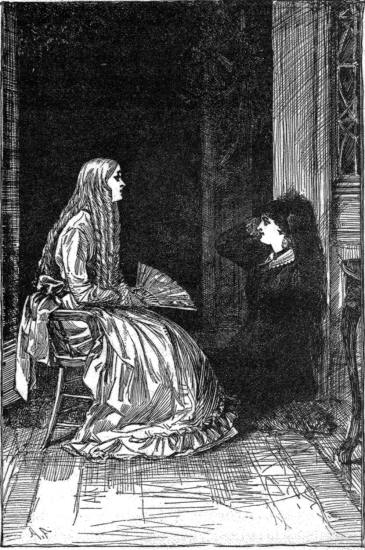
"'HAPPY GIRL,' INTERPOLATED SARA."
"On the whole, you will look well in it," answered Madam Carroll, after
a moment's consideration of the figure in the door-way; "and it will
have the added advantage of being a contrast. We have few contrasts in
Far Edgerley, and, I may say, no plainness—no plainness whatever.
Rather, a superabundance of trimming. The motive is good: I should be
the last to underrate it. But even with the best intentions you cannot
always construct new costumes from changes of trimming merely; there
comes a time when the finest skill will not take the place of a
little fresh material, no matter how plain it may be. The Greers, for
instance, have made over their green poplins twice a year now for five
years, and have done it well. But, after all, we remain conscious that
they are still the same green poplins. Miss Corinna Rendlesham, too, and
her sisters, have accomplished wonders with different combinations of
narrow black velvet ribbon and fringe on their black silks—so much so,
indeed, that the material is now quite riddled with the old lines of
needle-holes where trimmings formerly ran. They wear them to church with
Stella shawls," pursued the lady, meditatively; "and to receptions,
turned in at the neck, with white lace."
"Do the other people here give receptions also?" asked Sara, from the
door-step.
"They would never dream of it," replied the elder lady, with serenity.
But was she the elder? No sign of age was visible in all her little
person from head to foot. She was very small and slight. Her muslin
gown, whose simple gathered waist was belted by a ribbon sash, had a
youthful, almost childlike, aspect, yet at the same time a pretty
quaintness of its own, like that of an old-fashioned miniature. The
effect of this young-old attire was increased by the arrangement of the
hair. It was golden hair, even and fine, and it hung in curls all round
her head—long curls that fell below the waist. These curls were
distinct and complete spirals, each one perfect in itself, not
intertwining with the next; a round stick passed through any one of them
would not have been visible from bottom to top. "Now that is what I
call a curl!" old Senator Ashley was wont to remark. But though this
golden hair curled so definitively when it once began to curl, it lay
smooth and straight as the hair of a nun over the top of the little
head, and came down evenly also over the corners of the forehead, after
that demure old fashion which made of every lady's brow a modest
triangle, unambitious alike of a too intellectual height or a too pagan
lowness.
What was it that this little grande dame, with her curls, her dress,
and her attitudes, resembled? Some persons upon seeing her would have
been haunted by a half-forgotten memory, and would at last (if clever)
have recalled the pictures in the old "Annuals" and "Keepsakes" of fair
ladies of the days of the Hon. Mrs. Norton and L. E. L. The little
mistress of Carroll Farms needed but a scarf and harp, or a gold chain
round her curls, with an ornament reposing classically in the centre of
her forehead, to have taken her place among them. But upon a closer
inspection one difference would have made itself apparent, namely, that
whereas the lovely ladies of the "Annuals" were depicted with shoulders
copiously bare (though much cloth had been expended in sleeves), the
muslin gown of little Madam Carroll came up to her chin, the narrow
ruffles at the top being kept in place by a child's old-fashioned
necklace of coral, which fitted closely over them.
Madam Carroll's eyes were blue, large, and in expression tranquil; her
features were small and delicate, the slender little lips like rose
leaves, the upper one rather long, coming straight down over childlike
teeth of pearl. No; certainly there was no sign of age. Yet it might
have been noticed, also, by an acute observer, how little space, where
such signs would have been likely to appear, was left uncovered: the
tell-tale temples and outside corners of the eyes, the throat, with its
faint, betraying hue, the subtly traitorous back of the neck, the
texture of the wrists and palms, all these were concealed by the veil of
curls and the close ruffles of the dress, the latter falling over the
hands almost to the knuckles. There was really nothing of the actual
woman to be seen save a narrow, curl-shaded portion of forehead and
cheek, two eyes, a little nose and mouth, and the small fingers; that
was all.
But a presence is more than an absence. Absent as were all signs of age
in Madam Carroll, as present were all signs of youth in the daughter who
had just arrived. Sara Carroll was barely twenty. She was tall and
slender; she carried herself well—well, but with a little air of pride.
This air came from the poise of her head: it was as noticeable when one
saw her back only as when one saw her face. It seemed a pride personal,
not objective, belonging to herself, not to her surroundings; one could
imagine her with just the same air on a throne, or walking with a basket
on her arm across a prairie. But while it was evident that she was
proud, it would have been difficult to have stated correctly the nature
of the feeling, since it was equally evident that she cherished none of
the simple little beliefs often seen in girls of her age before contact
with the world has roughly dispelled them—beliefs that they are
especially attractive, beautiful, interesting, winning, and have only to
go forth to conquer. But she herself could have stated the nature of it
confidently enough: she believed that her tastes, her wishes, her ideas,
possessed rather a superior quality of refinement; but far beyond this
did her pride base itself upon the fact that she was her father's
daughter. She had been proud of this from her birth. Her features were
rather irregular, delicate. Ordinarily she had not much color. Her
straight, soft thick hair of dark brown was put plainly back from her
oval face, and this face was marked by the slender line of eyebrows of
the same dusky hue, and lighted by two gray eyes, which were always, in
their fair, clear color, a sort of surprise when the long, dark lashes
were lifted.
"I wonder that you take the trouble," she said, referring to the
proposed reception.
The blue orbs of Madam Carroll dwelt upon her for a moment. "We must
fill our position," she answered. "We did not make it; it has been
allotted to us. Its duties are therefore our duties."
"But are they real duties, mamma? May they not be fictitious ones? If we
should drop them for a while—as an experiment?"
"If we should drop them," answered Madam Carroll—"if we should drop
them, Far Edgerley, socially speaking, would disappear. It would become
a miscellaneous hamlet upon a mountain-top, like any other. It would
dissolve into its component parts, which are, as you know, but ciphers;
we, of the Farms, hold them together, and give them whatever importance
they possess."
"In other words, we, of the Farms, are the large figure. One, which,
placed before these poor ciphers, immediately turns them into wealth,"
said Sara, laughing. "Precisely. The receptions are part of it. In
addition, the Major likes them."
Sara's eyes left the soft darkness of the garden, and rested upon the
speaker. "If my father likes them, that is enough. But I thought he did
not; he used to speak of them, when we met at Baltimore, as so
wearisome."
"Wearisome, perhaps; but still duties. And of late—that is, since you
last saw him a year and a half ago—he has come to make of them a sort
of pastime."
"That is so like my father! He always looks above everything narrow and
petty. He can find even in poor little Far Edgerley something of
interest. How glad I am to be at home again, mamma, where I can be with
him all the time! I have never met any one in the world who could
approach my father." She spoke warmly; her gray eyes were full of loving
pride.
"He appreciates your affection. Never doubt it, in spite of what may
seem to you an—an increase of reticence," said Madam Carroll.
"Father was never talkative."
"True. But he is more easily fatigued now than formerly—since his
illness of last winter, you know. But it is growing late; I must close
the house."
"Do you do that yourself?"
"Generally. I seldom keep Judith Inches up after half-past nine. And on
ordinary occasions I am in bed myself soon after ten. Your home-coming
is an extraordinary one."
"And extraordinarily glad it makes me," said Sara. "I wonder, mamma, if
you know how glad? I have fairly pined during this last year and a half
at Longfields—yes, in spite of all Uncle John's kindness. Do you think
me heartless?"
"No," said Madam Carroll, as they went up the stairs together. "You
loved your uncle, I know. You did your best to make him happy. But your
father, Sara—your father, you have always adored."
"And I continue to do it," answered the daughter, gayly. "I shall be
down early, early in the morning to see him."
"He does not come to breakfast at present. His strength has not yet
fully returned. I have written you of this."
"Not that he did not come to breakfast, mamma. That is so unlike him; he
was always so cheerful and bright at the breakfast-table. But at least I
can take his breakfast in to him?"
"I think he would rather see you later—about ten, or half-past."
A flush rose in Sara's face: no one would have called her colorless now.
She looked hurt and angry. "Pray, who does take in his breakfast,
then?" she asked. "I should think I might be as welcome as Judith
Inches."
"I take it," replied Madam Carroll, gently.
"Very well, mamma; I will not begin by being jealous of you?"
"You never have been, my daughter. And I—have appreciated it." Madam
Carroll spoke in low tones: they were approaching the Major's door. She
pointed towards it warningly. "We must not waken him," she said. She led
her daughter in silence to the room she had fitted up for her with much
taste and care. They kissed each other, and separated.
Left alone, Sara Carroll looked round her room. As much had been done to
make it bright as woman's hands, with but a small purse to draw upon,
could accomplish. The toilet-table, the curtains, the low lounge, with
its great, cool, chintz-covered pillows, the hanging shelves, the
easy-chair, the writing-table—all these were miracles of prettiness and
ingenuity. But the person for whom this had been done saw it but
vaguely. She was thinking of only one thing—her father; that he had not
waited to welcome her; that she should not see him until half-past ten
the next morning. What could this mean? If he were ill, should not his
daughter be the first to see him, the first to take care of him? She
had told Madam Carroll that she would not begin the new home life by
being jealous of her. But there was something very like jealousy in the
disappointment which filled her heart as she laid her head upon the
pillow. She had looked forward to her home-coming so long; and now that
she held it in her grasp it was not at all what she had been sure it
would be.
Upon this same Saturday evening, at dusk, light was shining from the
porch and windows of St. John in the Wilderness, the Episcopal church of
Far Edgerley. This light shone brightest from the porch, for there was a
choir rehearsal within, and the four illuminating candles were down by
the door, where stood the organ. Two of the candles illumined the
organist, Miss Rendlesham the second, that is, Miss Millie; the others
lighted the high music-stand, behind which stood the choir in two rows,
the first very crowded, the second looking with some difficulty over the
shoulders of the first at the lighted books which served for both,
little Miss Tappen, indeed, who was short, being obliged to stand on
four unused chant-books, piled. In the front row were the soprani, eight
in number, namely, Miss Rendlesham the elder, and her sister; the three
Misses Greer; Miss Dalley and her two cousins, the Farrens, who were
(which was so interesting) twins. In the back row were the two
contralti, Miss Bolt and the already-mentioned Miss Tappen on her books,
together with the tenor, Mr. Phipps; there, too, was the basso, Mr.
Ferdinand Kenneway, a bachelor of amiable aspect, but the possessor
also, in spite of amiability, of several singularly elusive qualities
which had tried the patience of not a few.
The music-stand, no doubt, was very much too short for this company. But
then it was intended for a quartette only, and had served without
question for four estimable persons during the long, peaceful rectorship
of good old Parson Montgomery, who had but recently passed away. Since
the advent of his successor, the Reverend Frederick Owen, three months
before, the choir had trebled its size without trebling that of the
stand; the result was naturally that which has been described.
The Reverend Frederick Owen was an unmarried man.
St. John in the Wilderness had as its rector's study a little one-story
building standing in the church-yard, not far from the church; on
Saturday evenings the rector was generally there. Upon the present
evening Miss Rendlesham the elder, that is, Miss Corinna, sent the
juvenile organ-blower, Alexander Mann by name, across to this study for
the numbers of the hymns, as usual. But the rector did not return with
Alexander Mann, as usual, bringing the hymns with him: he sent the
numbers, written on a slip of paper. Under these circumstances the choir
began its practising. And its practising was, on the whole, rather
spiritless. That is, in sound, but not in continuance; for, two hours
later, they were still bravely at work. The time had been principally
filled with Te Deums. During the past three months the choir had had a
new Te Deum every Sunday—to the discomfiture of Senator Ashley, who
liked to join in "old Jackson's."
This gentleman, who was junior warden, had dropped in, soon after
Alexander Mann's departure with the hymns, to talk over some church
matters with the rector. The church matters finished, he remained a
while longer to talk over matters more secular. The junior warden had a
talent for talking. But this gift (as is often the case with gifts) was
not encouraged at home, Miss Honoria Ashley, his daughter, not being of
a listening disposition. The junior warden was therefore obliged to
carry his talent elsewhere. He was a small old gentleman, lean and
wizened, but active, and even lively, in spite of his age, save for a
harassing little cough, which could, however, end with surprising
adaptation to circumstances in either a chuckle or a groan. The
possessor of this cough wore an old-fashioned dress-coat, with a high
stock and very neat, shining little shoes. He had always in his
button-hole a flower in summer, and in winter a geranium leaf.
The chanting of the choir came through the open windows. "I should think
they would be exhausted over there," he said. "How long do they keep it
up? Ferdinand Kenneway must be voiceless by this time. He has only a
thread of a voice to begin with."
"He sings with unusual correctness, I believe," said the rector.
"Oh, he's correct—very! It's his only characteristic. I don't know of
any other, unless you include his health: he lives principally for the
purpose of not taking cold. Your choir is rather predominately feminine
just now, isn't it?" added the old gentleman, slyly.
"Choirs are apt to be, are they not? I mean the volunteer ones. For the
women everywhere come to church far more than the men do. It is one of
the problems with which clergymen of the present day find themselves
confronted."
"That the women come?"
"That the men do not." The rector spoke gravely. He was but little over
thirty himself, yet he had been obliged more than once to put a mildly
restraining pressure upon the somewhat too active gay-mindedness of his
venerable junior warden.
"What's that thing they're trying now?" said this official, abandoning
his jocularity. "Dull and see-saw it sounds to me; dull and see-saw."
"It's a Te Deum I selected for Trinity Sunday."
"Ah, if you selected it—But it can never equal 'old Jackson's,'
never! That's Sophy Greer on the solo. She can no more do it than a
consumptive hen. But, sir, I'll tell you who can—Sara Carroll. They
expect her home to-night."
"Madam Carroll's daughter?"
"No, the Major's. Madam Carroll is the Major's second wife—didn't you
know that? Sara Carroll, sir, can never hope to equal her step-mother in
beauty, grace, or charm. But she is a fine girl in her way—as indeed
she ought to be: her mother was a Witherspoon-Meredith."
The rector looked unimpressed. The junior warden, seeing this, drew up
his chair. "The Witherspoon-Merediths, Mr. Owen, are one of our oldest
families." (The rector resigned himself.) "When Scarborough Carroll
married the beautiful Sara of that name, a noble pair they were, indeed,
as they stood at the altar. I speak, sir, from knowledge: I was
there. Their children—two boys—died, to their great grief. The last
child was this daughter Sara; and the accomplished mother passed away
soon after the little thing's birth. Sir, Major Carroll, your senior
warden, has always been one of our grandest men; in personal appearance,
character, and distinguished services, one of the noblest sons of our
state. Of late he has not, perhaps, been quite what he was physically;
but the change is, in my opinion, entirely due—entirely—to his own
absurd imprudences. For he is still in the prime of life, the very
prime." (Major Carroll was sixty-nine; but as the junior warden was
eighty-five, he naturally considered his colleague still quite a boy.)
"Until lately, however, he has been undeniably, I will not say one of
nature's princes, because I do not believe in them, but one of the
princes of the Carrolls, which is saying a vast deal more. His little
girl has always adored him. He has been, in fact, a man to inspire
admiration. To give you an idea of what I mean: a half-brother of his,
much older than himself, and broken in health, lost, by the failure of a
bank, all he had in the world. He was a married man, with a family.
Carroll, who was at that time a young lieutenant just out of West Point,
immediately shared his own property with this unfortunate relative. He
didn't dole out help, keeping a close watch over its use, or grudgingly
give so much a year, with the constant accompaniment of good advice; he
simply deeded a full half of all he had to his brother, and never spoke
of it again. Forty-five years have passed, and he has never broken this
silence; the brother is dead, and I doubt if the children and
grandchildren who profited by the generous act even know to whom they
are indebted. Such, sir, is the man, chivalrous, unsullied, true. In
1861 he gave his sword to his state, and served with great gallantry
throughout the war. He was twice severely wounded; you may have noticed
that his left arm is stiff. When our Sacred Cause was lost, with the
small remains of his small fortune he purchased this old place called
the Farms, and here, sir, he has come, to pass the remainder of his days
in, as I may well say, the Past—the only country left open to him, as
indeed to many of us." And the old gentleman's cough ended in the groan.
"And Miss Carroll has not been with them here?" asked the rector, giving
the helm of conversation a slight turn from this well-beaten track.
"No, she has not. But there have been good reasons for it. To give you
the causes, I must make a slight detower into retrospect. At a military
post in Alabama, when Sara was about seven years old, the Major met the
lady who is now Madam Carroll; she was then a widow named Morris, with
one child, a little girl. You have seen this lady for yourself, sir, and
know what she is—a domestic angel, yet a very Muse in culture; one of
the loveliest women, one of the most engaging, upon my word, that ever
walked the face of this earth, and honored it with her tread." (The
junior warden spoke with enthusiasm.) "She is of course very much
younger than her husband, thir-ty three or four years at the least, I
should say; for Carroll was fifty-six at the time of his second
marriage, though no one would have suspected it. I saw Madam Carroll
very soon afterwards, and she could not have been then more than twenty
one or two; a little fairy-like girl-mother. She must have been married
the first time when not more than sixteen. Later they had a son, the boy
you know, who is now, save Sara, the only child."
"Ah, I see; I understand," said the rector.
But the junior warden did not; his understanding was that there was more
to tell. He drew up his chair again. "Sara Carroll, sir, is a remarkable
girl." (The rector again resigned himself.) "She is, as I may say,
one-ideaed. By that I mean that she has had from childhood one feeling
so predominant that she has fairly seemed to have but the one, which is
her devotion to her father. She had scarcely been separated from him
(save, as it happens, during the very summer when he met and married the
present Madam Carroll) until she was a tall girl of thirteen. This was
in 1861. At that time, before the beginning of actual hostilities, her
uncle, John Chase—he had married her mother's sister—offered to take
her and have her educated with his own daughter Euphemia during the
continuance of the troubled times. For John Chase had always been very
fond of the little Sara; he fancied that she was like his wife. And,
cold New-Englander though he was, he had worshipped his wife (she was
Juliet Witherspoon-Meredith), and seemed to be always thinking of her,
though she had been dead many years. The Major at first refused. But
Madam Carroll, with her exquisite perception, perfect judgment, and
beautiful goodness" (the junior warden always spoke in at least triplets
of admiration when he mentioned the Major's wife), "explained to him the
benefit it would be to Sara. Her own lot was cast with his; she would
not have it otherwise; but in the wandering life she expected to lead,
following his fortunes through the armed South, what advantages in the
way of education should she be able to secure for his little daughter,
who was now of an age to need them? Whereas her uncle, who was very fond
of her, would give her many. The Major at last yielded. And then Sara
was told. Well as they knew her, I think they were both alarmed at the
intensity of her grief. But when the poor child saw how it was
distressing her father, she controlled it, or rather the expression of
it; and to me her self-control was more touching even than her tears had
been, for one could see that her innocent heart was breaking. The
parting was a most pathetic sight—her white cheeks, silence, and
loving, despairing eyes, that never left her father's face—I don't know
when I have been more affected. For I speak from personal remembrance,
sir: I was there. Well, that little girl did not see her father
again for four long years. She lived during that time with her uncle at
Longfields—one of those villages of New England with still, elm-shaded,
conscientious streets, silent white houses, the green blinds all closed
across their broad fronts, yet the whole pervaded too, in spite of this
quietude, by an atmosphere of general, unresting interrogativeness,
which is, as I may say, sir, strangling to the unaccustomed throat. I
speak from personal remembrance; I have been personally there."
"I do not think there is now as much of—of the atmosphere you mention,
as there once was," said the rector, smiling.
"Perhaps not, perhaps not. But when I was there you breathed it in every
time you opened your mouth—like powdered alum. But to ree-vee-nir (I
presume you are familiar with the French expression). In those four
years Sara Carroll grew to womanhood; but she did not grow in her
feelings; she remained one-ideaed. Mind you, I do not, while describing
it, mean in the least to commend such an affection as hers; it was
unreasonable, overstrained. I should be very sorry indeed, extremely
sorry, to see my daughter Honoria making such an idol of me."
The rector, who knew Miss Honoria Ashley, her aspect, voice, and the
rules with which she barred off the days of the poor old junior warden,
let his eyes fall upon his well-scrubbed floor (scrubbed twice a week,
under the personal supervision of Mrs. Rendlesham, by the Rendleshams
maid-of-all-work, Lucilla).
"But the Ashleys are always of a calm and reasonable temperament, I am
glad to say," pursued the warden, "a temperament that might be
classified as judicial. Honoria is judicial. To ree-vee-nir. Sara was
about seventeen when her father bought this place, called the Farms, and
nothing, I suppose, could have kept her from coming home at that time
but precisely that which did keep her—the serious illness of the uncle
to whom she owed so much. His days were said to be numbered, and he
wanted her constantly beside him. I am inclined to suspect that his own
daughter, Euphemia, while no doubt a highly intellectual person, may not
have a—a natural aptitude for those little tendernesses of voice,
touch, and speech—unprescribed if you like, but most dear—which to a
sick man, sir, are beyond rubies, far beyond." The old man's eyes had a
wistful look as he said this; he had forgotten for the moment his
narrative, and even Miss Honoria; he was thinking of Miss Honoria's
mother, his loving little wife, who had been long in paradise.
He went on with his story, but less briskly. "Sara, therefore, has
remained at Longfields with her uncle. But every six months or so she
has come down as far as Baltimore to meet her father, who has journeyed
northward for the purpose, with Madam Carroll, the expense of these
meetings being gladly borne by John Chase, whose days could not have
been so definitely numbered, after all, as he supposed, since he has
lingered on indefinitely all this time, nearly three years. During the
last year and a half, too, he has been so feeble that Sara could not
leave him, the mere thought of an absence, however short, seeming to
prey upon him. She has not, therefore, seen her father since their last
Baltimore meeting, eighteen months back, as the Major himself has not
been quite well enough to undertake the long journey to Connecticut.
Chase at length died, two months ago, and she has now come home to live.
From what I hear," added the warden, summing up, "I am inclined to think
that she will prove a very fair specimen of a Witherspoon and Meredith,
if not quite a complete Carroll."
"And she could sing the solo for us on Trinity Sunday?" said the rector,
giving the helm a turn towards his anthem.
"She could," said the warden, with impartial accent, retreating a
little when he found himself confronted by a date.
"Do you mean if she would?"
"Well, yes. She is rather distant—reserved; I mean, that she seems so
to strangers. You won't find her offering to sing in your choir, or
teach in your Sunday-school, or bring you flowers, or embroider your
book-marks, or make sermon-covers for you, or dust the church, or have
troubles in her mind which require your especial advice; she won't be
going off to distant mission stations on Sunday afternoons, walking
miles over red-clay roads, and jumping brooks, while you go comfortably
on your black horse. She'll be rather a contrast in St. John's just now,
won't she?" And the warden's cough ended in the chuckle.
It was now after ten, and the choir was still practising. Mr. Phipps,
indeed, had proposed going home some time before. But Miss Corinna
Rendlesham having remarked in a general way that she pitied "poor puny
men" whose throats were always "giving out," he knew from that that she
would not go herself nor allow Miss Lucy to go. Now Miss Lucy was the
third Miss Rendlesham, and Mr. Phipps greatly admired her. Ferdinand
Kenneway, wiser than Phipps, made no proposals of any sort (this was
part of his correctness); his voice had been gone for some time, but he
found the places for everybody in the music-books, as usual, and
pretended to be singing, which did quite as well.
"I am convinced that there is some mistake about this second hymn,"
announced Miss Corinna (after a fourth rehearsal of it); "it is the same
one we had only three Sundays ago."
"Four, I think," said Miss Greer, with feeling. For was not this a
reflection upon the rector's memory?
"Oh, very well; if it is four, I will say nothing. I was going to
send Alexander Mann over to the study to find out—supposing it to be
three only—if there might not be some mistake."
At this all the other ladies looked reproachfully at Miss Greer.
She murmured, "But your fine powers of remembrance, dear Miss Corinna,
are far better than mine."
Miss Corinna accepted this; and sent Alexander Mann on his errand.
Ferdinand Kenneway, in the dusk of the back row, smiled to himself,
thinly; but as nature had made him thin, especially about the cheeks, he
was not able to smile in a richer way.
During the organ-boy's absence the choir rested. The voices of the
ladies were, in fact, a little husky.
"No, it's all right; that's the hymn he meaned," said Alexander Mann,
returning. "An' I ast him if he weern't coming over ter-night, an' he
says, 'Oh yes!' says he, an' he get up. Old Senator Ashley's theer, an'
he get up too. So I reckon the parson's comin', ladies." And Alexander
smiled cheerfully on the row of bonnets as he went across to his box
beside the organ.
But Miss Corinna stopped him on the way. "What could have possessed you
to ask questions of your rector in that inquisitive manner, Alexander
Mann?" she said, surveying him. "It was a piece of great impertinence.
What are his intentions or his non-intentions to you, pray?"
"Well, Miss Corinna, it's orful late, an' I've blowed an' blowed till
I'm clean blowed out. An' I knewed that as long as the parson stayed on
over theer, you'd all—"
"All what?" demanded Miss Corinna, severely.
But Alexander, frightened by her tone, retreated to his box.
"Never mind him, dear Miss Corinna," said little Miss Tappen, from
behind; "he's but a poor motherless orphan."
"Perhaps he is, and perhaps he is not" said Miss Corinna. "But in any
case he must finish his sentence: propriety requires it. Speak up, then,
Alexander Mann."
"I'll stand by you, Sandy," said Mr. Phipps, humorously.
"You said," pursued Miss Corinna, addressing the box, since Alexander
was now well hidden within it—"you said that as long as the rector
remained in his study, you knew—"
"I knewed you'd all hang on here," said Alexander, shrilly, driven to
desperation, but safely invisible within his wooden retreat.
"Does he mean anything by this?" asked Miss Corinna, turning to the
soprani.
"I am sure we have not remained a moment beyond our usual time," said
Miss Greer, with dignity.
"I ask you, does he mean anything?" repeated Miss Corinna, sternly.
"Oh, dear Miss Corinna, I am sure he has no meaning at all—none
whatever. He never has," said good-natured little Miss Tappen, from her
piled chant-books. "And he weeds flower-beds so well!"
Here voices becoming audible outside, the ladies stopped; a moment later
the rector entered. His junior warden was not with him. Having
recollected suddenly the probable expression upon Miss Honoria's face at
this hour, the junior warden had said good-night, paced down the knoll
and up Edgerley Street with his usual careful little step until the safe
seclusion of Ashley Lane was reached, when, laying aside his dignity, he
took its even moonlit centre, and ran, or rather trotted, as fast as he
could up its winding ascent to his own barred front door, where Miss
Honoria let him in, candle in hand, and on her head the ominous cap
(frilled) which was with her the expression of the hour. For Miss
Honoria always arranged her hair for the night and put on this cap at
ten precisely; thus crowned, and wrapped in a singularly depressing gray
shawl, she was accustomed to wait for the gay junior warden, when (as
had at present happened) he had forgotten her wishes and the excellent
clock on her mantel that struck the hours. Meanwhile the rector was
speaking to his choir about the selections for Trinity Sunday. He
addressed Miss Corinna. At rehearsals he generally addressed Miss
Corinna. This was partly due to her martial aspect, which made her seem
the natural leader far more than Phipps or Kenneway, but principally
because, being well over fifty, she was no longer troubled by the
flutter of embarrassment with which the other ladies seemed to be
oppressed whenever he happened to speak to them—timid young things as
they were, all of them under thirty-five.
Miss Corinna responded firmly. The other ladies maintained a gently
listening silence. At length the rector, having finished all he had to
say, glanced at his watch. "Isn't it rather late?" he said.
And they were all surprised to find how late it was.
Like a covey of birds rising, they emerged from the pen made by the
music-stand and organ, and moved in a modest group towards the door. The
rector remained behind for a moment to speak to Bell-ringer Flower. When
he came out, they were still fluttering about the steps and down the
front path towards the gate. "I believe our roads are the same," he
said.
As indeed they were: there was but one road in Far Edgerley. This was
called Edgerley Street, and all the grassy lanes that led to people's
residences turned off from and came back to it, going nowhere else.
There were advantages in this. Some persons had lately felt that they
had not sufficiently appreciated this excellent plan for a town; for if
any friend should happen to be out, paying a visit or taking the air,
sooner or later, with a little patience, one could always meet her (or
him); she (or he), without deliberate climbing of fences, not being
able to escape.
The little company from the church now went down the church knoll
towards this useful street. Far Edgerley was all knolls, almost every
house having one of its own, and crowning it. The rector walked first,
with Miss Corinna; the other ladies followed in a cluster which was
graceful, but somewhat indefinite as to ranks, save where Mr. Phipps had
determinedly placed himself beside Miss Lucy Rendlesham, and thus made
one even rank of two. Ferdinand Kenneway walked by himself a little to
the right of the band; he walked not with any one in particular, but as
general escort for the whole. Ferdinand Kenneway often accompanied Far
Edgerley ladies homeward in this collective way. It was considered
especially safe.
Flower, the bell-ringer, left alone on the church steps, looked after
their departing figures in the moonlight. "A riddler it is," he said to
himself—"a riddler, and a myst'rous one, the way all womenkind feels
itself drawed to parsons. I suppose they jedge anything proper that's
clirrycal." He shook his head, locked the church door, and went across
to close the study.
Flower was a Chillawassee philosopher who had formerly carried the mail
on horseback over Lonely Mountain to Fox Gap. Age having dimmed
somewhat his youthful fires, lessening thereby his interest in natural
history, as exemplified by the bears, wolves, and catamounts that
diversified his route, he had resigned his position, judging it to be "a
little too woodsy," on the whole, for a man of his years. He then
accepted the office of bell-ringer of St. John's, a place which he had
been heard to say conferred a dignity second only to that of mails. He
was very particular about this dignity, and the title of it. "Item," he
said, "that I be not a sexton; for sexton be a slavish name for a
free-born mountaineer. Bell-ringer Flower I be, and Bell-ringer Flower
you may call me."
Now the bell of St. John's was but a small one, suspended rustically,
under a little roof of thatch, from the branch of an old elm near the
church door; to ring it, therefore, was but a slight task. But Flower
made it a weighty one by his attitude and manner as he stood on Sunday
mornings, rope in hand, hat off, and eyes devotionally closed, beside
his leafy belfry, bringing out with majestic pull the one little silver
note.
He now re-arranged the chairs in the study, and came upon a framed motto
surrounded by rosebuds in worsted-work, a fresh contribution to the
rector's walls from the second Miss Greer. "Talk about the mil'try—my!
they're nothing to 'em—nothing to these unmarried reverints!" he said
to himself, as he surveyed this new memento. He hung it on the wall,
where there was already quite a frieze of charming embroidery in the way
of texts and woollen flowers. "Item—however, very few of them is
unmarried. Undoubted they be drove to it early, in self-defence."


