GRANDMOTHER AND THE CROW.
When I was a little girl I lived with my
grandmother, and a gay, lively little grandmother
she was. Away back in the family
was French blood, and I am sure that she resembled
French old people, who are usually
vivacious and cheerful. On my twelfth birthday
I was driving with her through a thick
wood, when we heard in front of us the loud
shouting and laughing of boys.
"Drive on, George," said my grandmother;
"let us see what this is all about."
As soon as he stopped, she sprang nimbly
from the phaeton among half-a-dozen flushed
and excited boys who had stones in their hands.
Up in the tall trees above them were dozens of
crows, which were cawing in a loud and distressed
manner, and flying restlessly from branch
to branch. A stone thrown by some boy with
too true an aim had brought a fine young crow
to the ground.
"Ha—I've got him. Thought I'd bring
him down!" yelled a lad, triumphantly. "Now
give it to him, boys."
The stones flew thick and fast at the poor
crow. My grandmother screamed and waved
her hands, but the boys would not listen to her
until she rushed to the phaeton, seized the
whip, and began smartly slashing those bad
boys about the legs.
"Hi—stop that—you hurt! Here, some
of you fellows take the whip from her!" cried
the boys, dancing like wild Indians around my
grandmother.
"Cowards!" she said; "if you must fight,
why don't you attack something your own
size?"
The boys slunk away, and she picked up the
crow. One of its wings was broken, and its
body was badly bruised. She wrapped the
poor bleeding thing in our lap-robe, and told
George to drive home.
"Another pet, grandmother?" I asked.
"Yes, Elizabeth," she returned, "if it lives."
She had already eight canaries, some tame
snakes, a pair of doves, an old dog, white mice
and rats, and a tortoise.
When we got home, she examined the crow's
injuries, then sponged his body with water, and
decided that his wing was so badly broken that
it would have to be amputated. I held his
head and feet while she performed the surgical
operation, and he squawked most dismally.
When it was over, she offered him bread
and milk, which he did not seem able to
eat until she pushed the food down his throat
with her slim little fingers. Then he opened
and closed his beak repeatedly, like a person
smacking his lips.
"He may recover," she said, with delight;
"now, where is he to sleep? Come into the
garden, Elizabeth."
Our garden was walled in. There was a
large kennel on a grass-plot under my grandmother's
bedroom window, and she stopped in
front of it.
"This can be fitted up for the crow, Elizabeth."
"But what about Rover?" I said. "Where
will he sleep?"
"Down in the cellar, by the furnace," she
said. "He is getting to be rheumatic, and I
owe him a better shelter than this in his old
age. I shall have a window put in at the back,
so that the sun can shine in."
For several days the crow sat in the kennel,
his wings raised,—the stump of the broken
one was left,—making him look like a person
shrugging his shoulders, and the blood thickening
and healing over his wounds. Three times
a day my grandmother dragged him out and
pushed some bread and milk down his throat;
and three times a day he kicked and struggled
and clawed at her hands. But it soon became
plain that he was recovering.
One day my grandmother found him trying
to feed himself, and she was as much pleased
as a child would have been. The next day he
stepped out on the grass-plot. There he found
a fine porcelain bath, that my grandmother
had bought for him. It was full of warm
water, and he stepped into it, flapped his wing
with pleasure, and threw the water over his
body.
"He is coming on!" cried my grandmother;
"he will be the joy of my life yet."
"What about Second Cousin George?" I
asked.
Second Cousin George—we had to call him
that to distinguish him from old George, the
coachman—was a relative that lived with us.
He was old, cranky, poor, and a little weak-minded,
and if it had not been for my grandmother
he would have been obliged to go to an
almshouse. He hated everything in the world
except himself,—pets especially,—and if he
had not been closely watched, I think he would
have put an end to some of the creatures that
my grandmother loved.
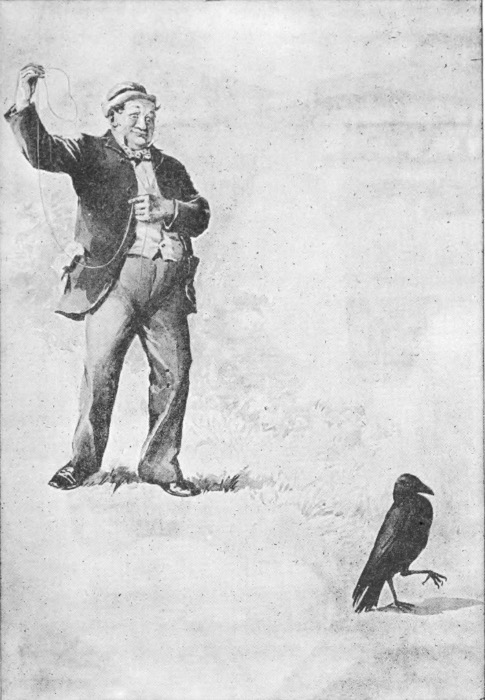
"I SAW SECOND COUSIN GEORGE FOLLOWING HIM."
One day after the crow was able to walk
about the garden, I saw Second Cousin George
following him. I could not help laughing, for
they were so much alike. They both were fat
and short, and dressed in black. Both put
their feet down in an awkward manner, carried
their heads on one side, and held themselves
back as they walked. They had about an equal
amount of sense.
In some respects, though, the crow was a
little ahead of Second Cousin George, and in
some respects he was not, for on this occasion
Second Cousin George was making a kind of
death-noose for him, and the crow walked
quietly behind the currant-bushes, never suspecting
it. I ran for grandmother, and she
slipped quickly out into the garden.
"Second Cousin George, what are you doing?"
she said, quietly.
He always looked up at the sky when he
didn't know what to say, and as she spoke, he
eyed very earnestly some white clouds that
were floating overhead, and said never a
word.
"Were you playing with this cord?" said
grandmother, taking it from him. "What a
fine loop you have in it!" She threw it dexterously
over his head. "Oh, I have caught
you!" she said, with a little laugh, and began
pulling on the string.
Second Cousin George still stood with his
face turned up to the sky, his cheeks growing
redder and redder.
"Why, I am choking you!" said grandmother,
before she had really hurt him; "do
let me unfasten it." Then she took the string
off his neck and put it in her pocket. "Crows
can feel pain just as men do, Second Cousin
George," she said, and walked away.
Second Cousin George never molested the
crow again.
After a few weeks the crow became very
tame, and took possession of the garden. He
dug worms from our choicest flower-beds, nipped
off the tops of growing plants, and did them
far more damage than Rover the dog. But my
grandmother would not have him checked in
anything.
"Poor creature!" she said, sympathetically,
"he can never fly again; let him get what
pleasure he can out of life."
I was often sorry for him when the pigeons
passed overhead. He would flap his one long,
beautiful wing, and his other poor stump of a
thing, and try to raise himself from the ground,
crying, longingly, "Caw! Caw!"
Not being able to fly, he would go quite over
the garden in a series of long hops,—that is,
after he learned to guide himself. At first
when he spread his wings to help his jumps,
the big wing would swing him around so that
his tail would be where he had expected to find
his head.
Many a time have I stood laughing at his
awkward attempts to get across the garden to
grandmother, when she went out with some
bits of raw meat for him. She was his favourite,
the only one that he would allow to come
near him or to stroke his head.
He cawed with pleasure whenever he saw
her at any of the windows, and she was the
only one that he would answer at all times.
I often vainly called to him, "Hallo, Jim Crow,—hallo!"
but the instant grandmother said,
"Good Jim Crow—good Jim!" he screamed
in recognition.
He had many skirmishes with the dog over
bones. Rover was old and partly blind, and
whenever Jim saw him with a bone he went up
softly behind him and nipped his tail. As
Rover always turned and snapped at him, Jim
would seize the bone and run away with it, and
Rover would go nosing blindly about the garden
trying to find him. They were very good
friends, however, apart from the bones, and
Rover often did good service in guarding the
crow.
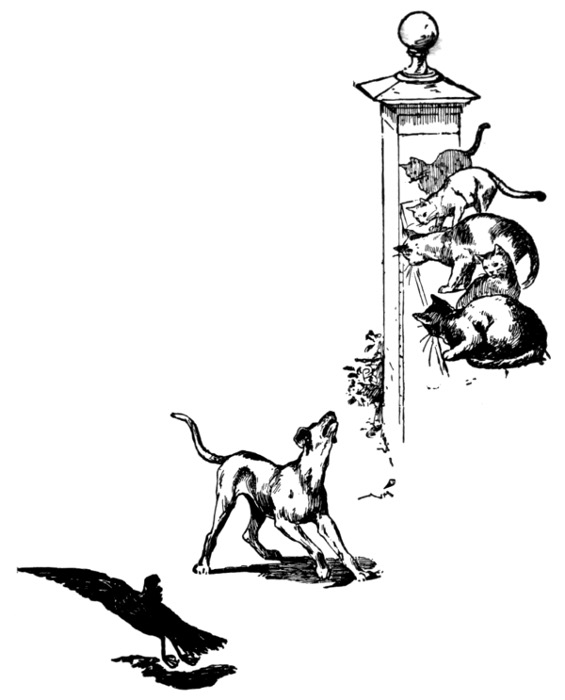
The cats in the neighbourhood
of course learned
that there was an injured
bird in our garden, and I
have seen as many as six
at a time sitting on the top
of the wall looking down at
him. The instant Jim saw
one he would give a peculiar
cry of alarm that he kept for
the cats alone. Rover
knew this cry, and springing
up would rush toward
the wall, barking angrily,
and frightening the cats
away, though he never
could have seen them
well enough
to catch them.
Jim detested not cats
alone, but every strange
face, every strange noise, and every strange
creature,—boys most of all. If one of them
came into the garden he would run to his
kennel in a great fright. Now this dislike of
Jim's for strange noises saved some of my
grandmother's property, and also two people
who might otherwise have gone completely to
the bad.
About midnight, one dark November night,
my grandmother and I were sleeping quietly,—she
in her big bed, and I in my little one
beside her. The room was a very large one,
and our beds were opposite a French window,
which stood partly open, for my grandmother
liked to have plenty of fresh air at night. Under
this window was Jim's kennel.
I was having a very pleasant dream, when
in the midst of it I heard a loud, "Caw! Caw!"
I woke, and found that my grandmother was
turning over sleepily in bed.
"That's the crow's cat call," she murmured;
"but cats could never get into that kennel."
"Let me get up and see," I said.
"No, child," she replied. Then she reached
out her hand, scratched a match, and lighted the
big lamp that stood on the table by her bed.
I winked my eyes,—the room was almost as
bright as day, and there, half-way through the
window, was George, our old coachman. His
head was in the room; his feet must have been
resting on the kennel, his expression was confused,
and he did not seem to know whether
to retreat or advance.
"Come in, George," said my grandmother,
gravely.
He finished crawling through the window,
and stood looking dejectedly down at his stocking
feet.
"What does this mean, George?" said my
grandmother, ironically. "Are you having
nightmare, and did you think we might wish
to go for a drive?"
Old George never liked to be laughed at.
He drew himself up. "I'm a burglar, missus,"
he said, with dignity.
My grandmother's bright, black eyes twinkled
under the lace frills of her nightcap. "Oho,
are you indeed? Then you belong to a dangerous
class,—one to which actions speak louder
than words," she said, calmly; and putting one
hand under her pillow, she drew out something
that I had never known she kept there.
I thought at the time it was a tiny, shining
revolver, but it really was a bit of polished water-pipe
with a faucet attached; for my grandmother
did not approve of the use of firearms.

"'I AIN'T FIT TO DIE,' CRIED OLD GEORGE."
"Oh, missus, don't shoot—don't shoot! I
ain't fit to die," cried old George, dropping on
his knees.
"I quite agree with you," she said, coolly,
laying down her pretended revolver, "and I am
glad you have some rag of a conscience left.
Now tell me who put you up to this. Some
woman, I'll warrant you!"
"Yes, missus, it was," he said, shamefacedly,
"'twas Polly Jones,—she that you discharged
for impudence. She said that she'd get even
with you, and if I'd take your watch and chain
and diamond ring, and some of your silver, that
we'd go to Boston, and she'd—she'd—"
"Well," said grandmother, tranquilly, "she
would do what?"
"She said she'd marry me," sheepishly whispered
the old man, hanging his head.
"Marry you indeed, old simpleton!" said my
grandmother, dryly. "She'd get you to Boston,
fleece you well, and that's the last you'd see of
her. Where is Miss Polly?"
"In—in the stable," whimpered the old
man.
"H'm," said grandmother, "waiting for the
plunder, eh? Well, make haste. My purse is
in the upper drawer, my watch you see before
you; here is my diamond ring, and my spoons
you have in your pocket."
Old George began to cry, and counted every
spoon he had in his pocket out on the bureau
before him, saying one, two, three, four, and so
on, through his tears.
"Stop!" said my grandmother. "Put them
back."
The old man looked at her in astonishment.
She made him return every spoon to his pocket.
Then she ordered him to hang the watch round
his neck, put the ring on his finger, and the
purse in his pocket.
"Take them out to the stable," she said,
sternly; "sit and look at them for the rest of
the night. If you want to keep them by eight
o'clock in the morning, do so,—if not, bring
them to me. And as for Miss Polly, send her
home the instant you set foot outside there, and
tell her from me that if she doesn't come to see
me to-morrow afternoon she may expect to have
the town's officers after her as an accomplice in
a burglary. Now be off, or that crow will alarm
the household. Not by the door, old George,
that's the way honest people go out. Oh,
George, George, that a carrion crow should
be more faithful to me than you!"
My grandmother lay for some time wide-awake,
and I could hear the bed shaking with
her suppressed laughter. Then she would sigh,
and murmur, "Poor, deluded creatures!"
Finally she dropped off to sleep, but I lay
awake for the rest of the night, thinking over
what had taken place, and wondering whether
Polly Jones would obey my grandmother.
I was with her the next day when Polly was
announced. Grandmother had been having
callers, and was sitting in the drawing-room
looking very quaint and pretty in her black
velvet dress and tiny lace cap.
Polly, a bouncing country-girl, came in hanging
her head. Grandmother sat up very straight
on the sofa and asked, "Would you like to go
to the penitentiary, Polly Jones?"
"Oh, no, ma'am!" gasped Polly.
"Would you like to come and live with me
for awhile?" said my grandmother.
Now Polly did not want to do this, but she
knew that she must fall in with my grandmother's
plans; so she hung her head a little
lower and whispered, "Yes, ma'am."
"Very well, then," my grandmother said, "go
and get your things."
The next day my grandmother called to her
the cook, the housemaid, and the small boy that
ran errands.
"You have all worked faithfully," she said,
"and I am going to give you a holiday. Here
is some money for you, and do not let me see
you again for a month. Polly Jones is going to
stay with me."
Polly stayed with us, and worked hard for a
month.
"You are a wicked girl," said my grandmother
to her, "and you want discipline. You
have been idle, and idleness is the cause of half
the mischief in the world. But I will cure you."
Polly took her lesson very meekly, and when
the other maids came home, grandmother took
her on a trip to Boston. There she got a
policeman to take them about and show them
how some of the wicked people of the city
lived. Among other places visited was a prison,
and when Polly saw young women like herself
behind the bars, she broke down and begged
grandmother to take her home. And that
reformed Polly effectually.
As for old George, after that one miserable
night in the stable, and his utter contrition in
the morning, he lived only for grandmother, and
died looking lovingly in her face.
Jim the crow ruled the house as well as the
garden after his exploit in waking grandmother
that eventful night.
All this happened some years ago. My dear
grandmother is dead now, and I live in her
house. Jim missed her terribly when she died,
but I tried so earnestly to cultivate his affections,
and to make up his loss to him, that I
think he is really getting to be fond of me.
THE END.
COSY CORNER SERIES
It is the intention of the publishers that this series shall
contain only the very highest and purest literature,—stories
that shall not only appeal to the children themselves,
but be appreciated by all those who feel with
them in their joys and sorrows.
The numerous illustrations in each book are by well-known
artists, and each volume has a separate attractive
cover design.
Each, 1 vol., 16mo, cloth $0.50
By ANNIE FELLOWS JOHNSTON
The Little Colonel. (Trade Mark.)
The scene of this story is laid in Kentucky. Its
heroine is a small girl, who is known as the Little
Colonel, on account of her fancied resemblance to an
old-school Southern gentleman, whose fine estate and
old family are famous in the region. This old Colonel
proves to be the grandfather of the child.
The Giant Scissors.
This is the story of Joyce and of her adventures in
France,—the wonderful house with the gate of The
Giant Scissors, Jules, her little playmate, Sister Denisa,
the cruel Brossard, and her dear Aunt Kate. Joyce is
a great friend of the Little Colonel, and in later volumes
shares with her the delightful experiences of the "House
Party" and the "Holidays."
Two Little Knights of Kentucky.
Who Were the Little Colonel's Neighbors.
In this volume the Little Colonel returns to us like an
old friend, but with added grace and charm. She is
not, however, the central figure of the story, that place
being taken by the "two little knights."
Cicely and Other Stories for Girls.
The readers of Mrs. Johnston's charming juveniles
will be glad to learn of the issue of this volume for
young people.
Aunt 'Liza's Hero and Other Stories.
A collection of six bright little stories, which will
appeal to all boys and most girls.
Big Brother.
A story of two boys. The devotion and care of
Steven, himself a small boy, for his baby brother, is the
theme of the simple tale.
Ole Mammy's Torment.
"Ole Mammy's Torment" has been fitly called "a
classic of Southern life." It relates the haps and mishaps
of a small negro lad, and tells how he was led by
love and kindness to a knowledge of the right.
The Story of Dago.
In this story Mrs. Johnston relates the story of Dago,
a pet monkey, owned jointly by two brothers. Dago
tells his own story, and the account of his haps and mishaps
is both interesting and amusing.
The Quilt That Jack Built.
A pleasant little story of a boy's labor of love, and
how it changed the course of his life many years after
it was accomplished.
Flip's Islands of Providence.
A story of a boy's life battle, his early defeat, and his
final triumph, well worth the reading.
By EDITH ROBINSON
A Little Puritan's First Christmas.
A story of Colonial times in Boston, telling how
Christmas was invented by Betty Sewall, a typical child
of the Puritans, aided by her brother Sam.
A Little Daughter of Liberty.
The author's motive for this story is well indicated by
a quotation from her introduction, as follows:
"One ride is memorable in the early history of the
American Revolution, the well-known ride of Paul
Revere. Equally deserving of commendation is another
ride,—the ride of Anthony Severn,—which was no less
historic in its action or memorable in its consequences."
A Loyal Little Maid.
A delightful and interesting story of Revolutionary
days, in which the child heroine, Betsey Schuyler,
renders important services to George Washington.
A Little Puritan Rebel.
This is an historical tale of a real girl, during the
time when the gallant Sir Harry Vane was governor of
Massachusetts.
A Little Puritan Pioneer.
The scene of this story is laid in the Puritan settlement
at Charlestown. The little girl heroine adds another to
the list of favorites so well known to the young people.
A Little Puritan Bound Girl.
A story of Boston in Puritan days, which is of great
interest to youthful readers.
A Little Puritan Cavalier.
The story of a "Little Puritan Cavalier" who tried
with all his boyish enthusiasm to emulate the spirit and
ideals of the dead Crusaders.
By MISS MULOCK
The Little Lame Prince.
A delightful story of a little boy who has many adventures
by means of the magic gifts of his fairy godmother.
Adventures of a Brownie.
The story of a household elf who torments the cook
and gardener, but is a constant joy and delight to the
children who love and trust him.
His Little Mother.
Miss Mulock's short stories for children are a constant
source of delight to them, and "His Little Mother," in
this new and attractive dress, will be welcomed by hosts
of youthful readers.
Little Sunshine's Holiday.
An attractive story of a summer outing. "Little Sunshine"
is another of those beautiful child-characters for
which Miss Mulock is so justly famous.
By JULIANA HORATIA EWING
Jackanapes.
A new edition, with new illustrations, of this exquisite
and touching story, dear alike to young and old.
Story of a Short Life.
This beautiful and pathetic story will never grow old.
It is a part of the world's literature, and will never die.
A Great Emergency.
How a family of children prepared for a great emergency,
and how they acted when the emergency came.