Our camping-place, when I
awoke in the morning, I
found to be near the head
of a most beautiful comb
or valley among the Black
Down Hills. I knew it
not at the time, but it was
not far from that old
Roman stronghold which
we had passed on our way
to Taunton, called Castle
Ratch. The hills on the
Somerset side are of a
gentle or gradual slope,
and the valley was not
deep, but yet, where we
lay, so grown over with
trees as to afford a complete
shelter and hiding-place,
while at our feet the
brook took its rise in a
green quagmire and began
to make its way downwards
among ferns and bushes, and through a wild,
uncultivated country, beyond which the farms and fields began.
The birds were singing, the sun was already high, and the air was
warm, though there was a fresh breeze blowing. The warmth and
sweetness filled my soul when I awoke, and I sat up with joy,
until suddenly I remembered why we were here, and who were
here with me. Then my heart sank like a lump of lead in water.
I looked around. My father lay just as he had been lying all the
day before, motionless, white of cheek, and as one dead, save for
the slight motion of his chest and the twitching of his nostril. As
I looked at him in the clear morning light, it was borne in upon
me very strongly that he was indeed dead, inasmuch as his soul
seemed to have fled. He saw nothing, he felt nothing. If the
flies crawled over his eyelids he made no sign of disturbance; yet
he breathed, and from time to time he murmured—but as one that
dreameth. Beside him lay my mother sleeping, worn out by the
fatigues of the night. Barnaby had spread his coat to cover her so
that she should not take cold, and he had piled a little heap of dead
leaves to make her a pillow. He was lying at her feet, head on
arm, sleeping heavily. What should be done, I wondered, when
next he woke?
First I went down the comb a little way till the stream was
deep enough, and there I bathed my feet, which were swollen and
bruised by the long walk up the comb. Though it was in the
midst of so much misery there was a pleasure of dabbling my feet
in the cool water and afterwards of walking about barefoot in the
grass. I disturbed an adder which was sleeping on a flat stone in
the sun, and it lifted its venomous head and hissed, but did not
spring upon me. Then I washed my face and hands and made my
hair as smooth as without a comb it was possible. When I had
done this I remembered that perhaps my father might be thirsty or
at least able to drink, though he seemed no more to feel hunger
or thirst. So I filled the tin pannikin—it was Barnaby's—with
water and tried to pour a little into his mouth. He seemed to
swallow it, and I gave him a little more until he would swallow no
more. Observe that he took no other nourishment than a little
water, wine, or milk, or a few drops of broth until the end. So I
covered his face with a handkerchief to keep off the flies, and left
him. Then I looked into the basket. All that there was in it would not
be more than enough for Barnaby's breakfast, unless his appetite
should fail him by reason of fear; though, in truth, he had no fear
being captured, or of anything else. There was in it a piece of
bacon, a large loaf of bread, a lump of cheese, a bottle of cider;
nothing more. When these provisions were gone, what next?
Could we venture into the nearest village and buy food, or to the
first farm-house? Then we might fall straight into the jaws of the
enemy, who were probably running over the whole country in
search of the fugitives. Could we buy without money? Could we
beg without arousing suspicions? If the people were well-inclined
to the Protestant cause we might trust them. But how could we
tell that? So in my mind I turned over everything except the one
thing which might have proved our salvation, and that you shall
hear directly. Also, which was a very strange thing, I quite forgot
that I had upon me, tied by a string round my waist and well concealed,
Barnaby's bag of gold—two hundred and fifty pieces.
Thus there was money enough and to spare. I discovered, next,
that our pony had run away in the night. The cart was there, but
no pony to drag it. Well, it was not much; but it seemed an
additional burden to bear. I ventured a little way up the valley,
following a sheep-track which mounted higher and higher. I saw
no sign anywhere of man's presence; that, I take it, is marked in
woods by circles of burnt cinders, by trees felled, by bundles of
broom or fern tied up, or by shepherds' huts. Here there was
nothing at all; you would have said that the place had never been
visited by man. Presently I came to a place where the woods
ceased, the last of the trees being much stunted and blown over
from the west; and then the top of the hill began, not a sharp
pico or point, but a great open plain, flat, or swelling out here and
there with many of the little hillocks which people say are ancient
tombs. And no trees at all, but only bare turf, so that one could
see a great way off. But there was no sign of man anywhere: no
smoke in the comb at my feet; no shepherd on the hill. At this
juncture of our fortunes any stranger might be an enemy; therefore
I returned, but so far well pleased.
Barnaby was now awake, and was inspecting the basket of provisions.
'Sister,' he said, 'we must go upon half rations for breakfast;
but I hope, unless my skill fails, to bring you something better for
supper. The bread you shall have, and mother. The bacon may
keep till to-morrow. The cider you had better keep against such
times as you feel worn out and want a cordial, though a glass of
Nantz were better, if Nantz grew in the woods.' He looked around
as if to see whether a miracle would not provide him with a flask of
strong drink, but, seeing none, shook his head.
'As for me,' he went on, 'I am a sailor, and I understand how
to forage. Therefore, yesterday, foreseeing that the provisions
might give out, I dropped the shank of the ham into my pocket.
Now you shall see.'
He produced this delicate morsel, and, sitting down, began to
gnaw and to bite into the bone with his strong teeth, exactly like
a dog. This he continued, with every sign of satisfaction, for a
quarter of an hour or so, when he desisted, and replaced the bone in
his pocket.
'We throw away the bones,' he said. 'The dogs gnaw them
and devour them. Think you that it is for their amusement? Not
so; but for the juices and the nourishment that are in and around
the bone; for the marrow and for the meat that still will stick in
odd corners.' He went down to the stream with the pannikin and
drank a cup or two of water to finish what they called a horse's
meal—namely, the food first and the water afterwards.
'And now,' he added, 'I have breakfasted. It is true that I
am still hungry, but I have eaten enough to carry me on for a while.
Many a poor lad cast away on a desert shore would find a shank of
a ham a meal fit for a king; aye, and a meal or two after that. I
shall make a dinner presently off this bone; and I shall still keep
it against a time when there may be no provision left.'
Then he looked about him, shading his eyes with his hand.
'Let us consider,' he said. 'The troopers, I take it, are riding
along the roads. Whether they will ride over these hills, I know
not; but I think they will not, because their horses cannot well
get up these combs. Certainly, if they do, it will not be by the
way we came. We are here, therefore, hidden away snug. Why
should we budge? Nowhere is there a more deserted part of the
country than Black Down, on whose side we are. And I do not
think, further, that we should find anywhere a safer place to hide
ourselves in than this comb, where, I dare to say, no one comes, unless
it be the gipsies or the broom-squires, all the year round. And
now they are all laden with the spoil of the army—for, after a
battle, this gentry swoop down upon the field like the great birds
which I have seen abroad upon the carcases of drowned beasts, and
plunder the dead. Next they must go into town in order to sell
their booty; then they will be fain to drink about till all is spent;
so they will leave us undisturbed. Therefore, we will stay here,
Sister. First, I will go and try the old tricks by which I did often
in the old time improve the fare at home. Next, I will devise some
way of making a more comfortable resting-place. Thank the Lord
for fine weather, so far.'
He was gone a couple of hours. During that time my mother
awoke. Her mind was broken by the suddenness of this trouble,
and she cared no more to speak, sitting still by the side of her
husband, and watching for any change in him. But I persuaded
her to take a little bread and a cup of cider.
When Barnaby came back, he brought with him a blackbird, a
thrush, and two wood-pigeons. He had not forgotten the tricks of
his boyhood, when he would often bring home a rabbit, a hare, or
a basket of trout. So that my chief terror, that we might be forced
to abandon our hiding-place through sheer hunger, was removed.
But Barnaby was full of all kinds of devices.
He then set to work with his great knife, cutting down a
quantity of green branches, which he laid out side by side, with
their leaves on, and then bound them together, cleverly interlacing
the smaller shoots and branches with each other, so that he made a
long kind of hurdle, about six feet high. This, which by reason of
the leaves was almost impervious to the wind, he disposed round
the trunks of three young trees growing near each other. Thus he
made a small three-cornered inclosure. Again, he cut other and
thicker branches, and laid them over and across this hurdle, and
cut turf which he placed upon the branches, so that here was now
a hut with a roof and walls complete. Said I not that Barnaby
was full of devices?
'There,' he said, when all was ready, 'is a house for you. It
will have to rain hard and long before the water begins to drop
through the branches which make the roof and the slabs of turf.
Well, 'tis a shelter. Not so comfortable as the old cottage, perhaps,
but nearly as commodious. If it is not a palace, it will serve us to
keep off the sun by day and the dew by night.'
Next he gathered a great quantity of dry fern, dead leaves, and
heather, and these he disposed within the hut, so that they made a
thick and warm carpet or covering. Nay, at night they even formed
a covering for the feet and prevented one from feeling cold. When
all was done, he lifted my father gently and laid him with great
tenderness upon this carpet within the rude shelter.
'This shall be a warmer night for thee than the last, Dad,' he
said. 'There shall be no jolting of thy poor bones. What, mother?
We can live here till the cold weather comes. The wind will perhaps
blow a bit through the leaves to-night, but not much, and
to-morrow I will see to that. Be easy in your mind about the
provisions'—Alas! my poor mother was thinking of anything in
the world except the provisions—'There are rabbits and birds in
plenty; we can catch them and eat them; bread we must do without
when what we have is gone, and as for strong drink and tobacco'—he
sighed heavily—'they will come again when better times are
served out.'
In these labours I helped as much as I was able, and particularly
in twisting the branches together. And thus the whole day passed,
not tediously, and without any alarms, the labour being cheered by
the hopefulness of Barnaby's honest face. No one, to look at that
face, could believe that he was flying for his life, and would be
hanged if he was caught. After sunset we lit a fire, but a small one
only, and well hidden by the woods, so that its light might not be
seen from below. Then Barnaby dexterously plucked and trussed
the birds and roasted them in the embers, so that had my heart
been at rest I should have had a most delicious supper. And I
confess that I did begin to pluck up a little courage, and to hope
that we might yet escape, and that Robin might be living. After
supper my mother prayed, and I could join with more of resignation
and something of faith. Alas! in times of trial how easily
doth the Christian fall from faith! The day before, prayer seemed
to me a mockery; it was as if all prayer were addressed to a deaf
God, or to one who will not hear; for our prayers had all been for
safety and victory, and we were suddenly answered with disaster
and defeat.
After supper, Barnaby sat beside the embers and began to talk
in a low voice.
''Twill be a sorrowful barley-mow song this year,' he said; 'a
dozen brave lads from Bradford alone will be dead.'
'Not all dead, Barnaby! Oh! not all!'
'I know not. Some are prisoners, some are dead, some are
running away.' Then he began to sing in a low voice,
'Here's a health to the barley-mow—
I remember, Sister, when I would run a mile to hear that song,
though my father flogged me for it in the morning. 'Tis the best
song ever written.' He went on singing in a kind of whisper—
'We'll drink it out of the nipperkin, boys—
Robin—poor Robin! he is dead!—was a famous hand at singing
it; but Humphrey found the words too rustical. Humphrey—who
is now dead, too!—was ever for fine words, like Mr.
Boscorel.
'We'll drink it out of the jolly brown bowl—
'I think I see him now—poor Robin! Well; he is no more. He
used to laugh in all our faces while he sang it:—
'We'll drink it out o' the river, my boys.
Here's a health to the barley-mow!
The river, the well, the pipe, the hogshead, the half-
Hogshead, the anker, the half-anker, the gallon, the
Pottle, the quart, the pint, the half-pint, the quarter-
Pint, the nipperkin, the jolly brown bowl, my boys,
Here's a health to the barley-mow!'
He trolled out the song in a melodious whisper. Oh! Barnaby,
how didst thou love good companionship with singing and
drinking!
''Twill be lonely for thee, Sister, at Bradford when thou dost
return; Sir Christopher, I take it, will not long hold up his head,
and Madam will pine away for the loss of Robin, and mother
looks as if she would follow after, so white and wan is she. If
she would speak or complain or cry it would comfort her, poor
soul! 'Twas a sad day for her when she married the poor old Dad.
Poverty and hard work, and now a cruel end—poor mother!'
'Barnaby, you tear my heart!'
'Nay, Child, 'tis better to talk than to keep silence. Better
have your heart torn than be choked with your pain. Thou art
like unto a man who hath a wounded leg, and if he doth not consent
to have it cut off, though the anguish be sharp, he will presently
bleed to death. Say to thyself therefore, plain and clear,
"Robin is dead; I have lost my sweetheart."'
'No—no—Barnaby—I cannot say those cruel words! Oh! I
cannot say them; I cannot feel that Robin is truly dead!'
'Put the case that he is living. Then he is either a prisoner
or he is in hiding. If a prisoner, he is as good as dead; because
the Duke's officers and the gentlemen who joined him, they will
never forgive—that is quite certain. If I were a prisoner I should
feel my neck already tightened. If he is not a prisoner, where is
he to hide?—whither betake himself? I can get sailors' duds and
go abroad before the mast; and ten to one nobody will find me
out, because, d'ye see, I can talk the sailors' language, and I know
their manners and customs. But Robin—what is Robin to do, if
he is alive? And this, I say, is doubtful. Best say to thyself,
"I have lost my sweetheart." So wilt thou all the sooner recover
thy cheerfulness.'
'Barnaby, you know not what you say! Alas! if my Robin
is dead—if my boy is truly dead—then I ask for nothing more
than swift death—speedy death—to join him and be with him!'
'If he escape he will make for Bradford Orcas and hide in the
Corton woods. That is quite certain. They always make for
home. I would that we were in that friendly place, so that you
could go live in the cottage and bring provisions, with tobacco
and drink, to us unsuspected and unseen. When we have rested
here a while we will push across the hills and try to get there by
night; but it is a weary way to drag that wounded man. However'—he
broke off and said earnestly—'make up thy mind,
Child, to the worst. 'Tis as if a shipwrecked man should hope
that enough of the ship would float to carry him home withal.
Make up thy mind. We are all ruined and lost—all—all—all.
Thy father is dying—thy lover is dead—thou art thyself in great
danger by reason of that affair at Taunton. Everything being
gone, turn round therefore and make thyself as comfortable as
possible. What will happen we know not. Therefore count every
day of safety for gain, and every meal for a respite.'
He was silent for a while, leaving me to think over what he
had said. Here, indeed, was a philosopher. Things being all
lost, and our affairs in a desperate condition, we were to turn round
and make ourselves as comfortable as we could! This, I suppose,
is what sailors are wont to do; certainly they are a folk more
exposed to misfortune than others, and therefore, perhaps, more
ready to make the best of whatever happens.
'Barnaby,' I said presently, 'how can I turn round and make
myself comfortable?'
'The evening is still,' he said, without replying. 'See, there
is a bat, and there another. If it were not for the trouble in
there'—he pointed to the hut—'I should be easy in my mind and
contented. I could willingly live here a twelvemonth. Why,
compared with the lot of the poor devils who must now be in
prison, what is ours? They get the foul and stinking clink, with
bad food, in the midst of wounded men whose hurts are putrefying,
with jail fever, and with the whipping-post or the gallows to
come. We breathe sweet air, we find sufficient food—to-morrow,
if I know any of the signs, thou shalt taste a roasted hedgehog,
dish fit for a king! I found at the bottom of the comb a pot left
by some gipsies: thou shalt have boiled sorrel and mushrooms to
thy supper. If we stay here long enough there will be nuts and
blackberries and whortleberries. Pity, a thousand pities, there is
not a drop of drink! I dream of punch and hipsy. Think upon
what remains, even if thou canst not bear to think of what is
lost. Hast ever seen a tall ship founder in the waves? They
close over her as she sinks, and, in an instant, it is as if that tall
ship with all her crew had never been in existence at all. The
army of Monmouth is scattered and ruined. Well; it is, with us,
amidst these woods, just as if there had been no army. It has
been a dream perhaps. Who can tell? Sometimes all the past
seems to have been a dream. It is all a dream—past and future.
There is no past and there is no future; all is a dream. But the
present we have. Let us be content therewith.'
He spoke slowly and with measured accents as one enchanted.
Sometimes Barnaby was but a rough and rude sailor. At other
times, as these, he betrayed signs of his early education and spoke
as one who thought.
'It is ten years and more since last I breathed the air of the
hills. I knew not that I loved so much the woods and valleys and
the streams. Some day, if I survive this adventure, I will build
me a hut and live here alone in the woods. Why, if I were alone
I should have an easy heart. If I were driven out of one place I
could find another. I am in no hurry to get down among men
and towns. Let us all stay here and be happy. But there is
Dad—who lives not, yet is not dead. Sister, be thankful for thy
safety in the woods, and think not too much upon the dead.'
We lived in this manner, the weather being for the most part
fine and warm, but with showers now and then, for a fortnight or
thereabouts, no one coming up the comb and there being still no
sign of man's presence in the hills. Our daily fare consisted of
the wild birds snared by Barnaby, such creatures as rabbits, hedgehogs,
and the like, which he caught by ingenious ways, and trout
from the brook which he caught with a twisted pin or by tickling
them with his hand. There were also mushrooms and edible
leaves, such as the nettle, wild sorrel, and the like of which he
knew. These we boiled and ate. He also plucked the half-ripe
blackberries and boiled them to make a sour drink, and one which,
like the cider loved by our people, would grip his throat because he
could not endure plain cold water. And he made out of the bones
of the birds a kind of thin broth for my father, of which he daily
swallowed a teaspoonful or so. So that we fared well, if not
sumptuously. The bread, to be sure, which Barnaby left for
mother and me, was coming to the last crust, and I know not how
we should have got more without venturing into the nearest village.
Now, as I talked every night with my brother, I found out
what a brave and simple soul it was—always cheerful and hopeful,
talking always as if we were the most fortunate people in the
world, instead of the most miserable, and yet by keeping the truth
before me, preventing me from getting into another Fool's Paradise
as to our safety and Robin's escape, such as that into which I had
fallen after the army marched out of Taunton. I understand now,
that he was always thinking how to smooth and soften things for
us, so that we might not go distracted with anxiety and grief; finding
work for me, talking about other things—in short, the most thoughtful
and affectionate brother in all the world. As for my mother, he
could do nothing to move her. She still sat beside her wounded husband,
watching all day long for any sign of consciousness or change.
Seeing that Barnaby was so good and gentle a creature, I could
not understand how it was that in the old days he used to get a
flogging most days for some offence or other, so that I had grown
up to believe him a very wicked boy indeed. I put this question
to him one night.
He put it aside for a while, replying in his own fashion.
'I remember Dad,' he said, 'before thou canst, Sister. He
was always thin and tall, and he always stooped as he walked. But
his hair, which now is white, was brown, and fell in curls which he
could not straighten. He was always mighty grave; no one, I am
sure, ever saw him laugh; I have never seen him so much as smile,
except sometimes when he dandled thee upon his knee, and thou
wouldst amuse him with innocent prattle. All his life he hath
spent in finding out the way to Heaven. He did find the way—I
suppose he hath truly discovered it—and a mighty thorny and difficult
way it is, so that I know not how any can succeed in reaching
port by such navigation. The devil of it is that he believes there
is no other way; and he seemed never so happy as when he had
found another trap or pitfall to catch the unwary, and send them
straight to hell.
'For my part,' Barnaby went on slowly, 'I could never love
such a life. Let others, if they will, find out rough and craggy
ways that lead to heaven. For my part, I am content to jog along
the plain and smooth high road with the rest of mankind, though
it brings us in the end to a lower place, inhabited by the baser
sort. Well, I dare say I shall find mates there, and we will certainly
make ourselves as comfortable as the place allows. Let my
father, therefore, find out what awaits him in the other world;
let me take what comes in this. Some of it is sweet and some is
bitter; some of it makes us laugh and sing and dance; and some
makes us curse and swear and bellow out, as when one is lashed to
the hatches and the cat falls on his naked back. Sometimes,
Sister, I think the naked negroes of the Guiney Coast the happiest
people in the world. Do they trouble their heads about the way
to heaven? Not they. What comes they take, and they ask no
more. Has it made Dad the happier to find out how few are those
who will sit beside him when he hath his harp and crown? Not
so. He would have been happier if he had been a jolly ploughboy
whistling to his team, or a jolly sailor singing over his pannikin
of drink of a Saturday night. He tried to make me follow in his
footsteps; he flogged me daily in the hope of making me take, like
himself, to the trade of proving out of the Holy Bible that most
people are surely damned. The more he flogged, the less I yearned
after that trade; till at last I resolved that, come what would, I
would never thump a pulpit like him in conventicle or church.
Then, if you will believe me, Sister, I grew tired of flogging, which,
when it comes every day, wearies a boy at fourteen or fifteen more
than you would think. Now, one day, while I was dancing to the
pipe and tabor with some of the village girls, as bad luck would
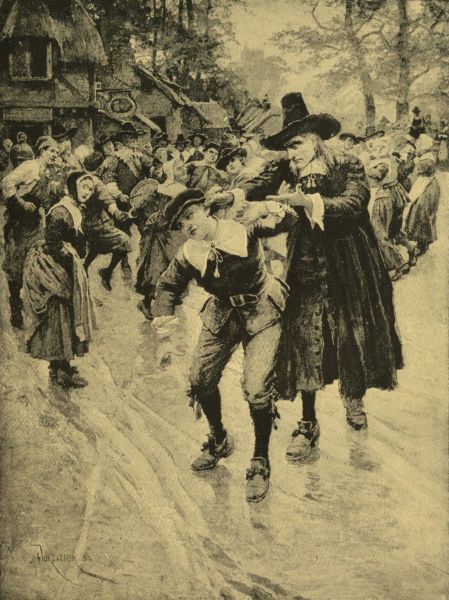
have it, Dad came by. "Child of Satan!" he roared, seizing me
by the ear, which I verily thought he would have pulled off. Then
to the girls, "Your laughter shall be turned into mourning," and
so lugged me home and sent me supperless to bed, with the promise
of such a flogging in the morning as should make all previous
floggings seem mere fleabites or joyous ticklings in comparison.
This decided me. So in the dead of night I crept softly down the
stairs, cut myself a great hunch of bread and cheese, and ran away
and went to sea.'
'Barnaby, was it well done—to run away?'
'Well, Sister, 'tis done; and if it was ill done, 'tis by this
time, no doubt, forgotten. Now, remember, I blame not my
father. Before all things he would save my soul alive. That was
why he flogged me. He knew but one way, and along that way he
would drive me. So he flogged me the harder. I blame him not.
Yet had I remained he would doubtless be flogging me still. Now,
remember again, that ever since I understood anything I have
always been enraged to think upon the monstrous oppression which
silenced him and brought us all to poverty, and made my mother,
a gentlewoman born, work her fingers to the bone, and caused me
to choose between being a beggarly scholar, driven to teach brats
and endure flouts and poverty, or to put on an apron and learn a
trade. Wherefore when I found that Monmouth was going to hoist
his flag, I came with him in order to strike a blow, and I hoped a
good blow, too, at the oppressors.'
'You have struck that blow, Barnaby, and where are we?'
He laughed.
'We are in hiding. Some of the King's troopers did I make to
bite the dust. They may hang me for it, if they will. They will
not bring those troopers back to life. Well——Sister, I am sleepy.
Good night!'
We might have continued this kind of life I know not how
much longer. Certainly, till the cold nights came. The weather
continued fine and warm; the hut kept off dews at night; we lay
warm among the heather and the ferns; Barnaby found a sufficiency
of food; my father grew no worse, to outward seeming; and we
seemed in safety.
Then an ill chance and my own foolishness marred all.
One day, in the afternoon, Barnaby being away looking after
his snares and gins, I heard, lower down the comb, voices as of boys
talking. This affrighted me terribly. The voices seemed to be
drawing nearer. Now if the children came up as high as our encampment,
they could not fail to see the signs of habitation.
There was the hut among the trees and the iron pot standing
among the grey embers of last night's fire. The cart stood on one
side. We could not possibly remain hidden. If they should come
up so far and find us, they would certainly carry the report of us
down to the village.
I considered, therefore, what to do, and then ran quickly down
the comb, keeping among the trees so as not to be seen.
After a little I discovered, a little way off, a couple of boys
about nine years of age. They were common village boys, rosy
faced and wholesome: they carried a basket, and they were slowly
making their way up the stream, stopping now to throw a stone at
a squirrel, and now to dam the running water, and now to find a
nut or filbert ripe enough to be eaten. By the basket which they
carried I knew that they were come in search of whortleberries, for
which purpose they would have to get quite to the end of the comb
and the top of the hill.
Therefore, I stepped out of the wood and asked them whence
they came and whither they were going.
They told me in plain Somersetshire (the language which I love,
and would willingly have written this book in it, but for the unfortunate
people who cannot understand it) that they were sent by
their parents to get whortleberries, and that they came from the
little village of Corfe, two miles down the valley. This was all
they had to say, and they stared at me as shyly as if they had
never before encountered a stranger. I clearly perceive now that
I ought to have engaged them in conversation and drawn them
gently down the valley in the direction of their village until we
reached the first appearance of a road, when I could have bidden
them farewell or sent them up the hill by another comb. But I
was so anxious that they should not come up any higher that I
committed a great mistake, and warned them against going on.
'Boys,' I said, 'beware! If you go higher up the comb you
will certainly meet wild men, who always rob and beat boys;'
here they trembled, though they had not a penny in the world.
'Ay, boys! and sometimes have been known to murder them.
Turn back—turn back—and come no farther.'
The boys were very much frightened, partly at the apparition
of a stranger where they expected to find no one, and partly at the
news of wild and murderous men in a place where they had never
met with anyone at all, unless it might have been a gipsy camp.
After gazing at me stupidly for a little while they turned and ran
away, as fast as their legs could carry them, down the comb.
I watched them running, and when they were out of sight I
went back again, still disquieted, because they might return.
When I told Barnaby in the evening, he, too, was uneasy. For,
he said, the boys would spread abroad the report that there were
people in the valley. What people could there be but fugitives?
'Sister,' he said, 'to-morrow morning must we change our
quarters. On the other side of the hills looking south, or to the
east in Neroche Forest, we may make another camp, and be still
more secluded. For to-night I think we are in safety.'
What happened was exactly as Barnaby thought. For the lads
ran home and told everybody that up in the comb there were wild
men who robbed and murdered people: that a lady had come out
of the wood and warned them to go no farther, lest they should be
robbed and murdered. They were certain it was a lady, and not a
country-woman; nor was it a witch; nor a fairy or elf, of whom
there are many on Black Down. No; it was a lady.
This strange circumstance set the villagers a-talking; they
talked about it at the inn, whither they nightly repaired.
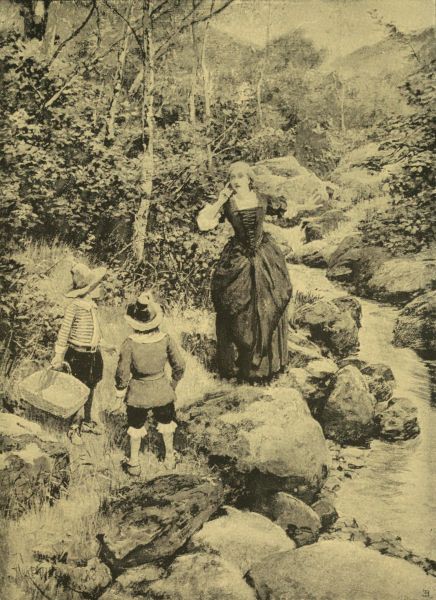
'"Boys," I said, "beware; if you go up higher you will certainly
meet wild men."'
In ordinary times they might have talked about it to their
heart's content, and no harm done; but in these times talk was
dangerous. In every little village there are one or two whose wits
are sharper than the rest, and, therefore, they do instigate whatever
mischief is done in that village. At Corfe, the cobbler it was
who did the mischief. For he sat thinking while the others talked,
and he presently began to understand that there was more in this
than his fellows imagined. He knew the hills; there were no wild
men upon them who would rob and murder two simple village boys.
Gipsies there were, and broom-squires sometimes, and hedge-tearers:
but murderers of boys—none. And who was this gentlewoman?
Then he guessed the whole truth: there were people
lying hidden in the comb; if people hidden, they were Monmouth's
rebels. A reward would be given for their capture. Fired with
this thought he grasped his cudgel and walked off to the village of
Orchard Portman, where, as he had heard, there was lying a company
of Grenadiers sent out to scour the country. He laid his
information, and received the promise of reward. He got that
reward, in short; but nothing prospered with him afterwards.
His neighbours, who were all for Monmouth, learned what he had
done, and shunned him. He grew moody; he fell into poverty,
who had been a thriving tradesman; and he died in a ditch. The
judgments of the Lord are sometimes swift and sometimes slow,
yet they are always sure. Who can forget the dreadful end of Tom
Boilman, as he was called, the only wretch who could be found to
cut up the limbs of the hanged men and dip them in the cauldrons
of pitch? For he was struck dead by lightning—an awful instance
of the wrath of God!
Early next morning, about five of the clock, I sat before the hut
in the shade. Barnaby was up and had gone to look at his snares.
Suddenly I heard steps below, and the sound as of weapons clashing
against each other. Then a man came into sight—a fellow he
was with a leathern apron, who stood gazing about him. There
was no time for me to hide, because he immediately saw me and
shouted to them behind to come on quickly. Then a dozen soldiers,
all armed, ran out of the wood and made for the hut.
'Gentlemen,' I cried, running to meet them, 'whom seek
you?'
'Who are you?' asked one, who seemed to be a Sergeant over
them. 'Why are you in hiding?'
Then a thought struck me. I know not if I was wise or foolish.
'Sir,' I replied, 'my father, it is true, was with the Duke of
Monmouth. But he was wounded, and now lies dead in this hut.
You will suffer us to bury our dead in peace.'
'Dead is he? That will we soon see.'
So saying, he entered the hut and looked at the prostrate form.
He lifted one hand and let it drop. It fell like the hand of one
who is recently dead. He bent over the body and laid his hand
upon the forehead. It was cold as death. The lips were pale as
wax, and the cheeks were white. He opened an eye: there was
no expression of light in it.
'Humph!' he said; 'he seems dead. How did he come here?'
'My mother and I drove him here for safety in yonder cart.
The pony hath run away.'
'That may be so; that may be so. He is dressed in a cassock:
what is his name?'
'He was Dr. Comfort Eykin, an ejected minister and preacher
in the Duke's army.'
'A prize, if he had been alive!' Then a sudden suspicion
seized him. He had in his hand a drawn sword. He pointed it
at the breast of the dead man. 'If he be truly dead,' he said,
'another wound will do him no harm. Wherefore'—he made as if
he would drive the sword through my father's breast, and my
mother shrieked and threw herself across the body.
'So!' he said, with a horrid grin, 'I find that he is not dead,
but only wounded. My lads, here is one of Monmouth's preachers;
but he is sore wounded.'
'Oh!' I cried, 'for the love of God suffer him to die in peace!'
'Ay, ay, he shall die in peace, I promise you so much. Meanwhile,
Madam, we will take better care of him in Ilminster Jail
than you can do here. The air is raw upon these hills.' The
fellow had a glib tongue and a mocking manner. 'You have none
of the comforts which a wounded man requires. They are all to be
found in Ilminster prison, whither we shall carry him. There will
he have nothing to think about, with everything found for him.
Madam, your father will be well bestowed with us.'
At that moment I heard the footsteps of Barnaby crunching
among the brushwood.
'Fly! Barnaby, fly!' I shrieked. 'The enemy is upon us!'
He did not fly. He came running. He rushed upon the
soldiers, and hurled this man one way and that man another, swinging
his long arms like a pair of cudgels. Had he had a cudgel I
believe he would have sent them all flying. But he had nothing
except his arms and his fists; and in a minute or two the soldiers
had surrounded him, each with a bayonet pointed, and such a look
in every man's eye as meant murder had Barnaby moved.
'Surrender!' said the Sergeant.
Barnaby looked around leisurely.
'Well,' he said, 'I suppose I must. As for my name, it is
Barnaby Eykin; and, for my rank, I was Captain in the Green Regiment
of the Duke's valiant army.'
'Stop!' said the Sergeant, drawing a paper from his pocket.
'"Captain Eykin,"' he began to read, '"has been a sailor.
Rolls in his walk; height, about five foot five; very broad in the
shoulders; long in the arms; of great strength."'
'That is so,' said Barnaby, complacently.
'"Legs short and figure stumpy."'
'What?' cried Barnaby, 'stumpy?'
'"Legs short and figure stumpy,"' repeated the Sergeant reading.
'That is so set down is it? Then,' said Barnaby, looking down
at his limbs, ''twas a pity that, with such legs as these, I did not
deny my name. Call these short, brother?'