WASHINGTON.
FOOTPRINTS OF FAMOUS MEN.
The name, which this truly great and good man
rendered for ever illustrious and venerable, is of thoroughly
English origin, and was assumed, from a manor
in the county of Durham, by one of the proprietors,
during the dynasty of the Plantagenets. The family
continued, for successive centuries, to produce men
distinguished in their day and generation as knights,
divines, lawyers, and agriculturists; and during the
Protectorate two of its cadets, more adventurous than
their predecessors, fared forth from a hereditary grange
in Northamptonshire, took shipping for Virginia, sailed
into the bay of Chesapeake, and settled, in the midst
of silk grass and wild fruit, under the shade of the
tall, bulky trees on the banks of the Potomac.
The grandson of one of these emigrants, a colonist
of industry, enterprise, and repute, flourished in the
earlier part of the eighteenth century. He seems to
have been fully alive to the inconvenience, and steeled
against the temptations of celibacy; for he was twice
married, and blessed with several children, of whom
George Washington—the eldest son by the second wife—was
born on the 22d of February, 1732. Shortly
after this joyous event, the worthy and prosperous
planter removed to an estate he possessed in Stafford
county; and there, on the east side of the Rappahannoc
river, the childhood of the future general and
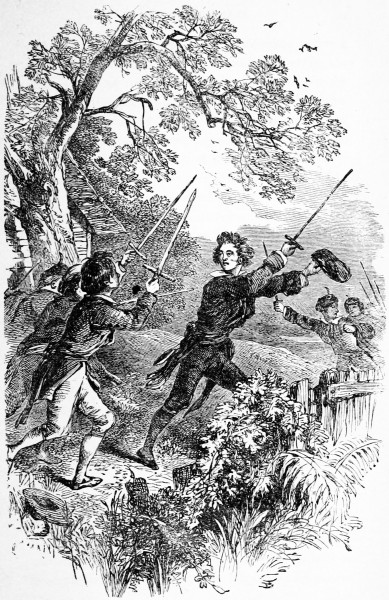
statesman was passed. He soon gave indications of
a natural disposition to lead and govern; and showed
an innate inclination for military pursuits and athletic
exercises. When at play, he took infinite delight in
forming his youthful comrades into companies, which
he drilled, marched, and paraded with due order and
formality. Sometimes they were divided into two
armies, and fought mimic battles—he acting as captain-general
of one party. Then, as in maturer years,
he was much given to such feats as running, leaping,
wrestling, throwing bars, and others of a similar character.
Moreover, he was held in great respect by his
more volatile companions, who looked up to him as
an extraordinary lad; and thus he was often privileged
to arbitrate on and settle their casual disputes,
always, it is stated, to the satisfaction of the parties
concerned.
It has been remarked that, in general, persons attain
with credit, and fill with dignity, the positions
which might have been anticipated from their juvenile
indications. Some, indeed, afterward display talents
of which, in their first stages, they gave no sign,
and others put forth a blossom not destined to bring
forth the promised fruits: but most frequently the
man is such as might have been predicted from the
characteristics exhibited in early years. Washington
can hardly be regarded as an exception to the general
rule; though it is unnecessary to add, that he more
than realized any hopes that could reasonably have
been entertained from his puerile performances. The
seminary at which he received his very scanty education
was by no means of the highest class. The
pupils were not even initiated into the rudiments of
classical learning. Enough was taught the urchins
to fit them for conducting the practical business of a
planter—at that time the pursuit of nearly all gentlemen
whose progenitors had left the comfort and security
of merry England to encounter the toils and hardship
of a colonial life. The teachers seem to have
acted rigidly on the precept of a Spartan king, that
the boy should be instructed in the arts likely to be
useful to the man. If, on leaving school, the hopeful
youths could read with decent correctness, write a
tolerable hand, and keep accounts intelligibly, what
more was wanting to capacitate them for growing tobacco
and shipping it, to be disposed of by the commercial
magnates who, arrayed in scarlet cloaks and
flowing periwigs, paced, with haughty step and unvailed
pride, the arched Exchange of Glasgow? Young
men destined for learned professions were, it is true,
generally sent to be educated in England; for others
a private tutor was sometimes engaged; but in most
cases the juvenile Virginians shouldered their satchels,
and, picking up the wild grapes in their path, marched
to the nearest hamlet to make the best of such
tuition as it boasted of. Such, at all events, was the
fortune of Washington. Under these disadvantageous
circumstances, he pursued his simple studies with unusual
vigor and exemplary diligence. At the age of
thirteen, he strangely occupied much of his attention
with the dry forms used in mercantile transactions.
He practiced his skill in the writing of bonds, indentures,
bills of exchange, and other deeds, compiled for
his own use and guidance a code of rules for behavior
in company and conversation, and transcribed such
pieces of poetry as touched and charmed his fancy.
From a boy, he was peculiarly careful to polish his
manners, to cherish the heart’s best affections, to do
to others as he would be done to, and to exercise such
a habitual control over himself, that he might restrain
his constitutional ardor and hold his natural susceptibility
in check. His early compositions were not,
from the imperfect nature of his education, distinguished
by grammatical correctness; but, by reading
and perseverance, he gradually overcame these defects,
and learned to express himself with force, clearness,
and propriety. He had a decided turn for mathematical
studies; and the last years of his school
career were devoted to the mysteries of geometry,
trigonometry, and surveying. For the last he felt a
singular partiality; and he gratified the taste by measuring
the neighboring fields and plantations, entering
all the details and particulars in his note-books. This
was done with systematic precision; he used his pen
with the most scrupulous care, and acquired habits
which were of inestimable value when he ascended
to posts of peril and responsibility.
Meantime, his father had been cut off in the prime
of life; but this early deprivation was, in Washington’s
case, almost counteracted by the character of
his surviving parent, who, being a woman of sense,
tenderness, vigilance, a strong mind, and prudent management,
reared her family with the utmost discretion
and success. She had the satisfaction of living
to witness the splendid position to which the abilities,
conduct, and energy of her son ultimately elevated him.
Washington went no longer to school after his sixteenth
year. His relations had previously entertained
the intention of entering him as a midshipman in the
navy; and with this view had successfully exerted
their influence to procure him a warrant. It appears
that the future hero of a continent joyfully acquiesced
in this scheme for his advancement in life; and had
it been persisted in, he would no doubt have borne
himself with credit and distinction. This was unquestionably
a critical juncture in his career, and in
the history of America; but it was terminated, imprudently
in the opinion of his friends, by the interference
of his widowed mother, who little relished the
thought of her darling being sent “to rough it out at
sea.” She therefore authoritatively forbade his departure.
Perhaps the incipient hero was not altogether
disconsolate at the maternal veto being thus exercised;
for about this date he proved himself not insensible
to the magic power of female grace, and became
vehemently enamored of some rural beauty. He celebrated
her perfections in love-ditties, and confessed his
pangs in letters to a confident; but, with a modesty
surely rare under such circumstances, he ventured not
to reveal the state of his agitated heart to the fair being
whose image was stamped on its tablets.
At this period, Washington was fortunate enough
to go on a visit to his eldest brother, Lawrence. That
gentleman was intelligent and accomplished. He
had served with honor in the expedition made, in
1740, against Carthagena; and secured the esteem
and intimacy of the high-spirited Admiral Vernon.
On returning home he had, in compliment to that
gallant officer, named his property Mount Vernon;
and they still continued in friendly communication.
He had, moreover, become a member of the Colonial
legislature, and connected himself by marriage with
Lord Fairfax, who, having in earlier days proved his
capacity by writing papers in the “Spectator,” had
just crossed the Atlantic to explore and examine the
immense tract of land that belonged to him in the
New World. Thus the company in which the elder
Washington moved was by no means deficient in literary
culture or patrician refinement; and his sagacious
brother, in mixing with it, had opened up to his
view aspects of society with which he might otherwise
have remained unacquainted. He was too wise
not to avail himself of the advantage in this way presented
to his opening mind. Slow to speak, ready to
hear, and anxious to understand, he used it to counterpoise
the partial training his mental faculties had undergone,
and thus laid the foundation of the mild dignity
and scrupulous politeness which, in other days,
made Sir Robert Liston declare, that he had never
conversed with a better-bred sovereign in any court of
Europe.
Lord Fairfax, on reaching his wild and uncultivated
possessions, found that settlers were quietly making
their way up the rivers, selecting the most valuable
spots, and occupying them without leave or license.
It was, therefore, deemed necessary that his seignorial
rights should be asserted; and with that object he
determined on having the lands properly lotted and
measured, preparatory to claiming rents and giving
titles. The destined victor in the War of Independence
had already been presented to this clever, but
eccentric, representative of the renowned Parliamentary
general; a favorable opinion had, in consequence,
been formed of the youth’s merits and ability; and
Washington being intrusted with the responsible duty,
and attended by a kinsman of his lordship, sallied forth
on his first surveying excursion in the beginning of
1748. The task was arduous and fatiguing; he was
frequently obliged to pass whole nights under the cold
sky, or in tents which afforded little shelter against the
wintery wind and rain: but the expedition was not
without beneficial results. He became conversant
with localities then little known, but afterward the
field of his military operations; he saw something of
Indian life, witnessed an Indian war-dance, and acquired
some acquaintance with the habits of the race
upon which the spirit of civilization was bearing so
hard. Besides, he executed his task with so much
success, as not only to give complete satisfaction to his
noble employer, but to establish his character as an
excellent surveyor; a matter of considerable consequence,
as there were then few in the district, and the
emoluments were temptingly high. He therefore procured
a commission, which gave authority to his operations,
and entitled him to have their results entered in
the provincial registers. By activity and diligence his
occupation was rendered very lucrative; and on attaining
the age of nineteen he had achieved so enviable
a place in public esteem, that a most honorable
military appointment was bestowed upon him by the
Government on the approach of danger.
His taste for martial affairs had, indeed, been adhered
to with resolution, and cultivated with assiduity.
Since acting as a surveyor, he had resided chiefly with
his brother, whose house was more conveniently situated
for his exertions than was the home of his infancy;
and he had, from this cause, been brought more into
contact, than he would otherwise have been, with men
versed in military matters. Under their instruction
he had industriously practiced himself in sword exercise,
and become not inexpert. Besides, he had eagerly
studied books treating of the art of war. The early
aspirations of great men are generally met with ridicule.
“Obsta principiis” is too often the motto of
jealous dunces. When the author of “Marmion” proposed
in youth to compose his “War-Song of the Edinburgh
Light Dragoons,” the idea of his attempting
such a thing raised coarse laughter, and was regarded
as a piece of absurdity; and, in like manner, it is not
difficult to imagine the brisk tittering excited by the
efforts of the young colonial surveyor to initiate himself
into handling the weapons and understanding the
theory of war.
But however that may have been, it came to pass
that, in 1751, when there appeared a prospect of encroachment
on the part of the French, and it was
deemed prudent to embody the militia to defend and
protect the frontiers, Washington received a commission
as Adjutant-General of one of the districts into
which Virginia was divided. This entitled him to rank
as major; and his duty was to assemble and exercise
the local troops, inspect their arms, and maintain fitting
discipline; no unworthy training for that military
genius which subsequently accomplished so much for
the land of his nativity. Then, as afterward, candor,
sincerity, and straightforwardness were the characteristics
of his noble mind. He had been eminently endowed
by Nature with the qualities which form a
ruler of men; and perhaps the training which he now
underwent was, in reality, more favorable than any
of a more regular and systematic kind would have been
to the working out of his peculiar destiny.
About this period, Washington was withdrawn for
a brief season from the sphere of his new duties. The
health of his brother became so precarious, that medical
advisers recommended an excursion to a different
climate; and the company of some kind friend being
required to cheer and sustain the invalid on his voyage,
the fraternal affection of the boy-major prompted him
to undertake the office. The atmosphere of a West
India island being considered most likely to act as a
restorative, Barbadoes was fixed upon. During the
voyage thither, Washington busily occupied himself
with making observations and increasing his knowledge;
and on an October day they arrived at their
destination.
Hardly could any prospect be more pleasing than
that which arrested the eyes of the travelers, as, after
being confined for five tedious weeks to the narrow
limits of a trader, they anchored in the bay, the stillness
of whose waters was only broken by the sailing
of the dreaded shark, or by the tropical breeze which
played lightly around, and gratefully modified the
warmth of the sun, as it descended with merciless
glow upon their strawy head-pieces. Before them
lay the chief town, circling around the silver strand,
and shrouded in palm trees that fringed the blue
waters of the ocean. In the background, fields of
the sugar-cane, planters’ airy mansions, the tall windmills,
and the negro-huts bosomed in the evergreen
and luxuriant foliage of the tropics—having the appearance
of scattered villages—presented a scene, picturesque,
attractive, and promising delightful journeys
to the curious stranger. Nor was Washington disappointed
in that respect. Every thing came under his
notice, and enlisted his sagacious reflection. The soil,
methods of culture, and the agricultural productions,
engaged his attention no less than the manners of
the inhabitants, their military force, their form of
government, and their municipal institutions. While
thus profitably employed he was laid prostrate by a
sharp attack of small-pox, which confined him to the
house for weeks; but with skillful medical treatment
he was released from this doubly-dull durance, and
enabled to resume his habits of gaining experience
and collecting information.
Meantime the health of his brother had, at first,
improved rapidly. Change of air and novelty of scene
had produced a salutary impression; they invigorated
his frame and revived his spirits: but the symptoms
of decay speedily re-appearing he proceeded to Bermuda.
Washington then embarked for Virginia, to
execute the kindly duty of conducting his sister-in-law
to her expiring husband; but ere arrangements could
be made for that purpose, the latter was on the sea,
and he soon after breathed his last under his own
roof. The melancholy task of attending to the affairs
of a departed relative, so near and dear, now devolved
upon Washington, and for months he applied to the
estate the sound sense and accurate investigation
which ever characterized the great self-taught soldier
and statesman in dealing with weightier affairs.
In the interval the sphere of his public duties had
been enlarged and extended. The colony had, for
purposes of defense, been divided into four grand districts;
Washington’s commission was then renewed,
and the northern portion was confided to his steady
care and untiring vigilance. This included several
counties, each of which he had to visit periodically.
The duties were quite in harmony with his taste and
temper, and he discharged them with an energy and
an enthusiasm which were not lost on those over
whom he was appointed to exercise control, and among
whom he had to insure discipline. Still he had not
arrived even at that time of life when the generality
of mortals are charitably supposed to have reached
“years of discretion.”
Events were now speeding to a crisis. Intelligence
arrived that the French had crossed the lakes from
Canada, and were preparing to establish posts and
fortifications on the Ohio river. On receiving these
alarming reports, the Virginian governor, having resolved
to send an officer commissioned to inquire by
what right they thus intruded on the English dominions,
selected Washington, as peculiarly fitted to execute
the duty with faith, discretion, and delicacy.
Accordingly, about the close of 1753, he departed
with suitable credentials and the requisite powers from
Williamsburg, the seat of government; and with a
retinue of eight persons, two of whom were to act as
interpreters, he, after much toil and trouble, arrived
at the French head-quarters. There he was courteously
received and entertained by the commandant,
a Knight of the Order of St. Louis. Immediate attention
was promised to the subject of his mission, and
in due time an answer, indicative of firmness and
hostility, was granted to the remonstrance of his excellency
the governor. Washington then retraced his
steps, through trackless forests, over rugged mountains,
and by swollen floods; making several hair-breadth
escapes by land and water. During the expedition
he had found frequent opportunities of extending
his knowledge of Indian manners and customs;
and he had been escorted to the French camp by an
influential personage, bearing the title of “Half King.”
While returning, his journey was agreeably diversified
by a visit to Queen Alliquippa, an Indian princess;
no doubt, like the charming but hapless Yarico, appareled
in beautiful shells, and possessed of wild graces.
She maintained her state at the junction of two rivers,
and had expressed her displeasure at the representative
of the British king having failed to show her any
proper mark of respect on his way out; but a polite
apology and a substantial present soothed her wounded
pride and ruffled dignity, and secured the young envoy
a gracious dismissal. Twelve months later the dusky
sovereign lady was under the necessity of placing herself
and her son under his protection, when driven
from her royal residence by the French troops.
After an absence of three months, Washington presented
himself to the governor, and reported the result
of his mission. In order to fire the patriotic enthusiasm
of the colonists, the journal of his adventures was
forthwith published. It appeared in all the provincial
papers, and was reprinted in England by order of the
government.
War was now imminent, and preparations were
imperative upon the authorities. The governor was
a wary Caledonian, and surrounded by a knot of his
countrymen, who took care that in his appointments
he did full justice to their claims; but, at the same
time, he exhibited much zeal for the honor of the
vice-regal office, and becoming ardor for the dignity
of the British Crown. His schemes were, however,
subject to be provokingly thwarted by the members
of the local legislature, who manifested a republican
spirit by no means agreeable to his loyal and patriotic
sentiments. Hence he found considerable difficulty in
making such arrangements for defense as he deemed
necessary for the safety of English interests. Nevertheless,
he succeeded in embodying a force to repel the
invaders; and Washington having already, by his
high courage and admirable conduct, proved his rare
capacity for military business, was promoted to the
rank of lieutenant-colonel, and nominated second in
command. He immediately marched, with his new
authority, to the Alleghany Mountains, and being joined
by parties of those Indians who were favorable to the
English, he commenced skirmishing with the enemy.
In one sharp fray the leader of the hostile party was
killed, and his men forced to yield. But in another
encounter, at a place known as the Great Meadows,
where he had thrown up an intrenchment, and called
it Fort Necessity, Washington was, after a conflict of
nine hours, obliged to capitulate. Then marching
out, with flying colors and drums beating, he retreated
to Williamsburg. His praiseworthy conduct during
the campaign elicited high applause from the governor,
and was rewarded with public thanks, conveyed
through the House of Assembly. Next year he found
himself in a somewhat awkward predicament. The
forces being organized on a new system, he had to
choose between being reduced to the rank of captain,
and placed under officers whom he had previously
commanded, or leaving the army. Without hesitation
he resigned his commission, and spent the winter in
retirement.
Early in the spring, however, he emerged from his
retreat, and consented, while retaining his former rank,
to accompany General Braddock as a volunteer. He
was received with flattering respect, and prepared to
take part in the expedition against Fort Duquesne;
when, unfortunately, he was prostrated by a fever,
which rendered his consignment to the baggage-wagon
and the physician’s care a matter of necessity: but
he was sufficiently recovered in a fortnight to bear
arms in the bloody battle of the Monongahela. Beautiful
and impressive was the array of British troops on
that memorable morning as the little army marched
in order, with high hopes and ardent anticipations,
the sun gleaming on their burnished arms. On one
side was a flowing river, and on the other a shadowy
forest. Suddenly, at noon, ere the rear had well
crossed at a ford, they were attacked with fatal dexterity—the
foe firing at a distance from behind trees,
and practicing all the stratagems of Indian warfare.
The general, disdaining to imitate such tactics, was
mortally wounded; his two aides-de-camp were disabled;
sixty-three out of eighty-six officers were killed
and wounded; seven hundred private soldiers met
with similar fates: but Washington seemed to have
a charmed life. He rode about in all directions, and
exerted himself with the utmost courage. He was a
conspicuous mark for the enemy’s sharp-shooters, and
four bullets went through his coat; yet, though his
companions fell in heaps around, he escaped unhurt.
The nut-brown riflemen, old and young, singled him
out; but with as little effect as, at Torquilstone, the
arrows of the English archers had on the Milan steel
of the bold leader of free lances. The idea of preternatural
protection occurred to their superstitious imaginations;
and as the Scottish Covenanters believed
that General Dalziel possessed a diabolical charm
against steel, and that Claverhouse was guaranteed
against lead by the enemy of mankind, so the Indian
warriors concluded that Washington was under the
especial guardianship of the Great Spirit, and they
ceased their efforts to slay him. Thus, although the
day was most disastrous, he gained much praise by
the valor, energy, and resolution he had exhibited
throughout. He was instanced, even in pulpits, as
preserved by a wise Providence to confer some signal
benefit on his country; his public reputation rose
high; the Legislature voted him a sum of money for
his services; and when the local regiment was increased
to sixteen companies, he was nominated their
commander-in-chief. Being now intrusted with responsible
functions, he devoted himself to the fulfillment
of them with much care and foresight; and he
procured the passing of a law to insure proper regularity
and discipline. While thus gravely occupied,
he had a dispute concerning precedence with an officer
holding King George’s commission; and in order
to solve the difficulty, which was at once vexatious
and perplexing, he had to undertake a journey to Boston,
to obtain the opinion of General Shirley, commander
of His Majesty’s forces in America, who unhesitatingly
decided the point in Washington’s favor,
and held serious and important conversation with him
as to the plan of operations for the next campaign.
Much curiosity was evinced, in the places through
which he passed, to see the individual who had, at
the early age of twenty-three, won so much renown
for his bravery, and who was regarded as remarkable
for the escape he had recently made. And there he
was—a gallant and dignified cavalier, rather more
than six feet in height, with long limbs, and a slender
but erect and well-proportioned form—making an
equestrian excursion of five hundred miles in the depth
of winter, with two trusty comrades. He remained
for some time at New York; and while there he had
to encounter in a family circle—the most perilous of
all arenas—a blooming damsel, whose charms, more
effectual than the bullets of Indians, penetrated to his
heart, and made so deep an impression that, after going
to Boston, he returned and lingered till called
away by the stern voice of duty. Doubtless reciprocal
emotions fluttered in the gentle breast of the attractive
nymph; but, as usual, the course of his love did
not run quite smoothly: his hopes blossomed but to
die. In a few months he was informed that a formidable
rival was in the field, and the citadel in the utmost
danger. Besides, it was intimated that, if he
wished to save the coveted prize, he must make his
appearance forthwith. Washington, absorbed with
“the harsh duties of severe renown,” or despairing of
success, failed to comply with this friendly suggestion;
the fair lady—a “cynosure of neighboring eyes”—did
not, perhaps, excessively relish his apparent coolness;
and his lucky competitor, being thus in undisputed
possession of the ground, marched onward, with flying
colors, to a connubial triumph.
Our hero, however, was not idle. If, like the rival
of young Lochinvar, he had been “a laggard in love,”
he was no “dastard in war.” The army had, on his
return, received a considerable augmentation; and
though the nature of his operations was unfavorable
to the acquisition of much martial glory, he excited
respect and admiration by the signal ability and ingenious
resource he constantly displayed. Yet in modern,
no less than in ancient times, abuse and calumny
are essential parts of triumph; and they were now
busy with the character and career of the successful
young soldier. Some vituperative rumors were, it is
stated, finally traced to the intrigues of the wily Scots,
who clustered in ambitious expectancy, and in a “dark
impenetrable ring,” around their consanguineous governor.
The excellent qualities of Washington’s heart,
his sensible modesty and honest frankness, were the
best antidotes to the poison; but the labors attaching
to his office were so arduous, that his health gave
way; his physician insisted on a temporary retirement;
and betaking himself to his estate, he underwent
a feverish illness, which preyed upon him for
months.
On recovering his strength, Washington resumed
his military career. The accession of Mr. Pitt, afterward
the great Earl of Chatham, to the English ministry,
had inspired life and vigor into the struggle; a
new expedition against Fort Duquesne was planned;
and the place falling into the hands of the British
troops, was named Fort Pitt, in honor of the mighty
War Minister. When this happened, Washington resigned
his command and returned to Virginia, as he
had previously resolved to do in case of the enterprise
being crowned with victory.
His affections, twice baffled in their objects, were
now to find the peace and repose not seldom, even in
the case of men of strong minds, essential to the achievement
of great and memorable actions. Mrs. Custis,
a widow lady, at this time resided in the vicinity of
the provincial capital. She was still in the bloom of
youth, gayety, and beauty, distinguished by wealth,
affability, and attractions, and dignified with the maternity
of two children. Besides, she possessed in rare
perfection the domestic graces and accomplishments
which, in the opinion of persons whom experience has
divested of glowing romance, constitute the true fascination
of woman. This flower of the female sex
was, indeed, a being too captivating not to have
wooers; and amidst social life and festive enjoyments
few, perhaps, could have perused her various charms
without admiration. Washington’s noble bearing and
sage conversation could hardly fail to make an impression
on the gentle heart which her fair form enshrined.
He came, saw, and conquered; and, in the
beginning of 1759, they were happily united. Being
now in possession of quiet leisure, Washington, with
his matronly bride, settled at Mount Vernon, to which
he had succeeded since the decease of his brother.
The tranquil mansion-house was a most agreeable
residence. In front was a spacious lawn, bounded
by blossoming orchards and pleasant gardens, which
reposed in the shade of thriving trees, and were watered
by the broad and deep Potomac. The domestic
habits of the owner of the domain were uniform, and
characterized by a regularity from which he seldom
deviated. He rose with the sun, and retired early to
rest. His attention was chiefly given to agriculture,
in which, in accordance with a strong natural inclination,
he had always taken a lively interest. His
land was devoted, for the most part, to the growth of
tobacco, which he exported to be sold in the English
markets. The life of an ordinary Virginia planter
was, at that date, somewhat monotonous. He lived
during the whole year on his own land, which, in most
cases, lay so near some of the large rivers that ships
sailed almost to his door, and received the produce of
his farm to swell the imports into distant emporiums.
In practicing hospitality, he was generally so profuse
that inns were utterly useless. Weary wayfarers,
even without introduction, had only to call at the
nearest proprietor’s house, with the certainty of being
heartily welcomed and cheerfully entertained. He
might not indeed be, and seldom was, rolling in wealth;
but that point the guest would soon hear explained
with emphasis. Every colonist availed himself of
his privilege as a British subject to complain loudly
that British merchants, by some process or other, contrived
to appropriate the better part of his just profits;
and even Washington, however different from his neighbors
in other respects, scrutinized accounts with a sharpness
which shows that he was not altogether without
his suspicions.
The hospitality of the great colonial soldier was displayed
on a scale of magnificence which must have
tended to relieve the dullness; and when at home, he
seldom allowed a day to pass without having visitors
of intelligence and distinction. Moreover, he had a
keen relish for field-sports. He hunted, at the proper
season, twice or thrice a-week; was fond of the excitement
and recreation which a fox-chase afforded; was
familiar with the use of his fowling-piece; signalized
his expertness against the game which abounded in
his preserved grounds, and fought as courageously in
an affray with poachers as he had ever done in a battle
with the French. He was always eager to be
useful, and took a particular interest in the affairs of
his parish. He was recognized by the people in his
neighborhood as a man of extraordinary candor and
judgment; insomuch that when they became involved
in quarrels, which there appeared no prospect of otherwise
settling amicably, they were in the habit of resorting
to him as a last appeal, and submitting the
case to his reason, justice, and decision, just as his
school-fellows had done in other days:
“His doom contending neighbors sought—
Content with equity unbought.”
Indeed, his wish to act without fear, favor, or affection,
when thus consulted, and to promote peace and concord,
was so evident, that few uttered an audible
murmur against his arbitration.
On relinquishing his military employment, he had
been returned as a member of the House of Burgesses,
and for a period of fifteen years was successful at each
election. It was a rule with him through life to execute
with unflinching diligence any duty he undertook;
and as a representative his attendance was
punctual and exemplary in the extreme. He seldom
spoke; he had no longing for oratorical conflict, and
altogether refrained from entering into stormy discussions;
but his acute perception, earnest judgment, and
sage prescience, gave him an influence in the assembly
which his wordy, brawling, and disputatious compeers
struggled and strove for in vain. He was in the habit
of studying attentively, and forming opinions with
scrupulous impartiality on the chief subjects under
deliberation. In this respect, Nunquam non paratus
might have been his motto. Thus, when the Stamp
Act was imposed on the colonies by Mr. Grenville, he
at once assumed a position of antagonism to the infliction,
and concurred with firmness and determination
in the measures of opposition adopted by America.
From this, and his high reputation, he was chosen
to command the independent companies of militia
which the colonists had hitherto been privileged and
encouraged to raise; he was sent as a delegate to the
Virginia Convention, and afterward elected as a member
of the general Congress, in whose proceedings he
acted a prominent and influential part.
When the second Congress assembled, in 1775, it
presented an array of “fierce faces threatening war.”
Blood had already been shed; at Lexington had commenced
that contest which, with few intermissions,
lasted for eight years. The English crown was, at a
perilous crisis, found without competent advisers;
Wisdom cried aloud in public places, without being
regarded; and American senators openly and boisterously
invoked the God of battles. Civil strife, fierce
and bloody, was inevitable; and in this emergency
Washington was chosen Commander-in-chief of the
forces raised to carry on the momentous struggle. Yet
it can not be supposed that this great man contemplated
a separation from the mother-country without
a pang. Even Jefferson, at this date, declared that
in the whole empire there was no individual who
more cordially loved the union with Great Britain
than himself; and hardly any one competent to form
an opinion on such a subject can conceive that Washington,
who had given such tokens of patriotism, was
less loyal in his sentiments. His forefathers had fought
on famous fields, and in walled cities, for the crown
of England; he himself had won his laurels under her
lion-flag against her hereditary enemies; and he was,
moreover, a man of faith, breeding, and refinement.
With such a person, considerations of such a nature
are not readily banished or suppressed, and there can
be little doubt that his patriot soul was often tossed
with contending emotions; like the Saxon nobles whom
the Conqueror, with fire and sword, drove into the
Scottish territory, who felt no respect for the Norman
line of kings, but whose hearts lingered about the
scenes where their progenitors had held sway and
created civilization. The tastes and associations of
Washington might well have led him, had an option
been granted, to side with the imperial cause. But the
course pursued by Lord North, who, as a statesman,
ever displayed more wit than wisdom, and whom
neither the sagacious warnings of Burke nor the vehement
declamation of Chatham could awaken from a
sleepy stupidity, left him no choice. He believed that
his native plains must either be drenched in blood or
inhabited by slaves; he regarded it as a sad alternative:
but he did not falter or hesitate in his course.
With engaging diffidence in his own powers he accepted
the responsible position offered; and repairing
to Cambridge, where the insurgent army lay, he proceeded
to remodel and improve it to the best of his
ability. In the interval Bunker’s Hill had been fought.
The victory remained with the Loyalists; but the
engagement had convinced them that the foe was not
to be despised. Subsequent events fully confirmed this
opinion; and General Howe being under the necessity
of abandoning Boston, Washington was received by the
inhabitants with significant enthusiasm.
Soon after, the Declaration of Independence was
published; but events inauspicious to the cause of the
colonists now came onward in rapid succession. The
defeat at Long Island filled their ranks with such
dismay and consternation as put their general’s invincible
resolution to a severe test. New York was
straightway relinquished by them, with considerable
loss; a defeat was sustained at Chatterton’s Hill;
Fort Washington was lost; and General Lee was
taken prisoner. This was a period to try the souls of
those who had taken up arms against taxation without
representation. Their operations had proved unexpectedly
disastrous; their army had melted away
till it seemed but a shadow of its former self; pardon
had been proclaimed in the King’s name to all who
would return to their allegiance. Many persons of
wealth, consideration, and respectability, especially
yeomen of strength and substance, had accepted it on
the offered terms; but Washington remained firm and
decided. His fortitude might not inaptly be compared
to that house against which the waves beat, and the
rain came, and the winds blew, but which fell not,
for it was founded on a rock. He calmly represented
to Congress the plight to which he was reduced; and
the crisis being such as to silence all querulous opposition,
neither the whisper of envy nor the voice of discontent
was heard. Even timidity was overcome by
fear. Indeed the members appear to have been animated
by views similar to those which the elder consul,
“an ancient man and wise,” is made to express
when the thirty armies are described as on their way
to Rome:
“In seasons of great peril
’Tis good that one bear sway;
Then choose we a Dictator,
Whom all men shall obey.”
And, accordingly, Washington was wisely invested
with supreme authority and dictatorial powers. The
army was completely reorganized; and its dauntless,
but firm and prudent leader, resolved to cross the
Delaware, and attack the foes on their own ground.
On a December night he assailed and defeated them
at Trenton; and pursuing his advantage, he gained
an important victory at Princeton. Next year, however,
the fortune of war again changed, and Washington
fought unsuccessfully at the fords of the Brandywine
and at the village of Germantown. In the
former of these actions Lafayette, inspired with burning
zeal for the American cause, displayed his courage
as a volunteer, and was wounded in the leg while
dismounting to rally the retreating troops by his voice
and example.
Ere long the French king recognized the independence
of the United States by a formal treaty; a battle
was fought at Monmouth with partial success; and
a French squadron arrived to aid the new allies of
the Bourbons. Nevertheless, an assault made by the
combined forces on Rhode Island proved a failure;
and a projected expedition against Canada came to
naught. An intended attack on New York had a
similar termination, and a mutiny among the troops
filled the public mind with alarm and consternation.
Still the clear spirit of Washington rose superior to
adversity, and his deep determination was not to be
shaken by disaster.
Affairs, indeed, seemed now to be hastening to a
crisis; but as the year 1781 advanced, they began to
wear a more favorable aspect. The cheering news
was brought by a French frigate that powerful assistance
might be calculated on; and a combined attack
was planned against New York, but relinquished owing
to intelligence in regard to the sailing of the promised
auxiliaries from St. Domingo. When they at length
arrived, York Town, in Virginia, was besieged by the
allied forces, and Lord Cornwallis obliged to surrender.
It now became evident that the unhappy war was
approaching its termination; and the American army,
with a prospect of being disbanded, began to complain
of grievances. Besides, many of the officers looked
with so little favor on republican institutions, that,
wishing for some more vigorous form of government,
they deputed one of their number to convey to Washington
the suggestion, that they were not averse to
his thoughtful brow being begirt with a diadem. He
rebuked the idea with stern indignation, and requested
that it might never again be alluded to.
In the spring of 1783, intelligence arrived that a
treaty of peace had been signed at Paris, and that the
independence of the United States had been acknowledged
by the British Government. Shortly afterward,
a cessation of hostilities was announced, and arrangements
were made for the evacuation of New York.
On a November morning, the English troops finally
embarked; a long procession, with Washington at its
head, made formal entry and took possession of the
city. At his side—followed by the provincial functionaries,
officers, senators, and citizens—rode the governor,
who closed the proceedings of the memorable
day with a costly banquet. Yet, however flattering
to their pride as a new nation, the ceremony was not
altogether unsuggestive of melancholy considerations.
The chief, the greatest, the most conspicuous actor in
it, must have been conscious of mixed feelings; and
it was natural that, a few days later, when parting
with his warlike associates, his emotion should have
been visible. He had conducted a great civil war;
he had triumphed where the most sanguine might,
without reproach have despaired; and he had throughout,
without an interval, exhibited high mental dignity.
He had earned the position of a prince, and
the proud title of “Father of his country;” won for
himself glorious renown, and achieved national independence
for millions. But it was impossible to look
for a moment to the future, enveloped as it then was
in uncertainty, without recollecting—perhaps not
without a sigh—that America was no longer a portion
of that mighty empire on which the sun never sets;
reared by Saxon sagacity, and sustained by Norman
valor; constituted by the toil of the wise, and consecrated
by the blood of the brave; and to whose immemorial
institutions he had lately been as much attached
as the inhabitants of Kent or Northumberland.
When Washington resigned the command of that
army with which he had outmanœuvred the tactics
of successive generals, and brought a war with the
most powerful nation in the world to a triumphant
issue, he was still in his fifty-first year; but he had
a right to believe that his long and continuous services
entitled him to repose. He had affluence and station;
he did not covet power; and he looked forward to the
enjoyment of calm, contemplative retirement, till, in
God’s appointed time, he should sleep with his fathers.
He therefore went to Mount Vernon, devised schemes
of internal navigation for developing the resources and
extending the commerce of the country, and seems
even to have indulged in prophetic visions of that vast
trade which has since crowded the docks of Liverpool
and stocked the warehouses of Manchester. It was
then that he had the satisfaction of welcoming the
visit of Lafayette, whose friendship he highly esteemed,
and whose former services he duly appreciated.
They parted with mutual regret; never to
meet again.
While planting his grounds, pruning his fruit-trees,
improving his property, receiving complimentary visits,
answering courteous congratulations, and preparing
peacefully to descend the pathway of life, under
the shadow of his own vine and fig-tree—envious of
none, and determined to be pleased with all—Washington
became painfully aware that the system of
government then existing did not meet the wishes
and requirements of the American public. Indeed,
some were so apprehensive of fatal consequences, that
they were gradually inspired with the desire of receiving,
from among the royal families of Europe, a prince
who should wear a crown, exercise sovereign sway,
and control the conflicting elements then making themselves
felt for evil. To pour oil on the troubled waters,
a Convention was appointed to devise a form of
government calculated to give general satisfaction.
Washington was chosen chairman; and, as such, affixed
his name to the new constitution, which, though
not coming up to the perfection of ideal theories, was
ratified by the States and adopted by the people.
This scheme—in regard to which Franklin said,
“I consent to it, because I expect no better, and because
I am not sure it is not the best; the opinions I
have of its errors I sacrifice to the public good”—provided
for the election of a President. On this being
known, all eyes were turned toward Washington, as
the personage in every respect best qualified, by rank,
station, and dignity, to occupy the eminence. His
mind was, indeed, so tinged with the old leaven of
aristocracy, that, in respect to military officers, he had
requested that none but gentlemen should be considered
qualified; but experience had taught him confidence
in the aspirations of a free people. Every thing
conspired to fit him to appear as the representative of
various parties, to check the prevalence of extreme
opinions, and to “stay the plague both ways.” When
the day appointed for the important business arrived,
he was unanimously elected; and yielding with unfeigned
reluctance to the public voice, he became the
first President of the United States. In this trying
situation, his singleness of purpose and stainless integrity
shone forth with unparalleled lustre. He ruled
in truth and sincerity—not to aggrandize himself, but
to benefit his country. Though ungifted with the
brilliant qualities which dazzle an ambitious people,
and disdaining the demagogic arts too often employed
to mislead them—his sound judgment, steady mind,
and powerful understanding, enabled him to deal with
the difficulties he had to encounter, and avoid or remove
the obstacles that came in his way. He piloted
the vessel he had launched through troublous times.
With a firm hand and a bold heart he maintained the
balance between the contending factions, exhibited a
resolution not to be overcome or overawed, and in
1796 retired from the position to which he had imparted
dignity with the respect, sympathy, and veneration
of all parties and all nations.
This great, intrepid, and admirable man, went down
to his grave in peace and honor in the year 1799, leaving
to his country and mankind a glorious heritage,
in a name unsullied by crime or rapacity, and an example
to be held in everlasting remembrance by all
future generations.