Larger versions of illustrations may be opened by clicking the illustrations (not
available in all formats).
The cover image has been created for this text, and is in the public domain.
WILEY
BY THE SAME AUTHOR.
BEVERAGES AND THEIR ADULTERATION.
OUTLINE OF CONTENTS.
I.
Spring, well, and other potable waters.
II.
Potable mineral waters.
III.
Contamination of waters and how to avoid them.
IV.
Coffee, Tea, Cocoa, Chocolate, etc.
V.
Soda Waters, Pops, Seltzers, etc.
VI.
Fermented Beverages—Growth of Raw Materials, Manufacture, and Storage:
(a) Beers. (b) Wines. (c) Ciders, Perrys, Meads, etc.
VII.
Distilled Liquors:
(a) Whiskey. (b) Brandy. (c) Rum. (d) Gin and other flavored compounds.
(e) Imitation and compound liquors. (f) Blends. (g) Cordials, denatured alcohol, etc.
VIII.
So-called temperance drinks.
IX.
Beverages of a miscellaneous character.
Octavo. Illustrated. In Preparation.
P. BLAKISTON’S SON & CO., Publishers, Philadelphia.
FOODS AND
THEIR ADULTERATION
ORIGIN, MANUFACTURE, AND COMPOSITION OF
FOOD PRODUCTS; DESCRIPTION OF COMMON
ADULTERATIONS, FOOD STANDARDS, AND
NATIONAL FOOD LAWS AND REGULATIONS
By
HARVEY W. WILEY, M.D., Ph.D.
WITH ELEVEN COLORED PLATES AND
EIGHTY-SIX OTHER ILLUSTRATIONS
PHILADELPHIA P. BLAKISTON’S SON & CO. 1012 Walnut Street
1907
Copyright, 1907, by P. Blakiston’s Son & Co.
WM. F. FELL COMPANY
ELECTROTYPERS AND PRINTERS
1220-24 SANSOM STREET
PHILADELPHIA, PA.
PREFACE.
This manual is descriptive in character and aims to give, within its scope,
as thoroughly and intelligibly as possible, an account of the various food-products
in common use in their natural and manufactured conditions, with
the usual adulterations which have been found therein.
It includes information regarding Methods of Preparation and Manufacture,
Food Values, Standards of Purity, Regulations for Inspection, Simple
Tests for Adulterations, Effects of Storage, and similar matters pertaining to
the subject.
It has been designed to interest the consumer, as well as the manufacturer,
the scientific, as well as the general reader, all of whom it is hoped will find in
it something useful. The consumer is entitled to know the nature of the
product offered, the manufacturer and dealer the best methods of preparation.
It will give the physician and sanitarian knowledge of the value of
foods, their proper use and inspection, and, while not analytical in purpose,
will provide the chemist with information which will guide him in his work of
detecting impurities.
It has been thought advisable to give in the appendices extracts from the
national laws relating to the subject, as well as the rules and regulations
for their enforcement and official standards of purity, as these are now of
general interest to all classes. In revising the manuscript and in reading the
proofs, especial recognition is made of the valuable aid of Dr. W. D. Bigelow,
Chief of the Division of Foods of the Department of Agriculture; Dr. F. V.
Coville, Botanist of the Department of Agriculture, and Dr. B. W. Evermann,
of the Bureau of Fisheries. Acknowledgement is also made of the favors of
the Bureaus of Plant Industry, Animal Industry, and Forestry. Many helpful
suggestions from other sources can only be acknowledged in this general way.
All opinions respecting adulterations, misbranding, nutritive value, and wholesomeness
are the individual expressions of the author and are not to be considered
in any other manner. Honest and truthful practices of manufacture
and labeling are to be promoted in every possible manner. In the end the
true, the ethical, and the just in these practices will prevail.
Definition, 11; Edible Animals, 11; Classification of Meat
Foods, 12; Preparation of Animals, 12; Inspection, 13;
Tuberculosis, 13; Consumers’ Rights, 14; Slaughter and Preparation of Carcasses,
14; Names of Parts, 15-20; Delivery of Fresh Meat,
21; Storage, 23; Disposition of Fragments, 23; Detection
of Different Kinds of Meat, 24; Dried and Pickled Meat, 25; Composition of Pig’s
Flesh, 26-33; Preserved Meats, 34-38;
Argument of Small Quantities, 38-40; Preparation for Canning,
41; Parboiling, 41; Sterilization, 42; Special Studies of
Canning, 43-48; Relation of Canned to Fresh Beef, 48;
Canned Ham and Bacon, 48-50; Canned Tongue, 50; Fat as a
Test for Adulteration, 51; Potted Meats, 51-56; Canned
Poultry, 56; Canned Horse-meat, 57; Canned Cured Meats,
59-60; Magnitude of Industry, 61; General Observations,
62; Lard, 63-77; Soups,
77-78; Beef Extract, 79-80; Beef
Juice, 82; Soluble Meats, 83; Preparations of Blood, 83;
Beef-tea, 84; Dried and Powdered Meats, 85; Active Principles in Meat Extracts,
86; Relation between Juice and Nutritive Value, 87; Nitrogenous Bases,
88-90; Gelatine, 90-92; Terrestrial
Animal Oils, 93.
Food Inspection Decisions under the Food and Drugs Act, 562-615.
Food Inspections Decisions under the Imported Foods Act F. I. D.’s 1-39, 562-584.
Food and Drugs Inspections and Decisions under the Food and Drugs Act F. I. D.’s 40-64,
584-615.
INTRODUCTION. — A PROPER RATION. — SOCIAL FUNCTIONS OF FOOD. — DEFINITION AND COMPOSITION OF FOODS. — CLASSIFICATION OF FOODS. — EXPLANATION OF CHEMICAL TERMS. — Protein. — Ether Extract. — Ash. — Fiber. — Starch and Sugar. — Calories.
The growing importance to manufacturers, dealers, and consumers of a
knowledge of food products has led to the preparation of the following manual.
Unfortunately, many misleading statements respecting the composition of
foods, their nutritive value, and their relation to health and digestion have
been published and received with more or less credence by the public. Claims
of superior excellence, which are entirely baseless, are constantly made for
certain food products in order to call the attention of the public more directly
to their value and, unfortunately, at times to mislead the public with respect
to their true worth.
It is not uncommon to see foods advertised as of exceptional quality, either
as a whole or for certain purposes. Many of the preparations of this kind are
of undoubted excellence, but fail to reach the superior standard or perform
the particular function which is attributed to them. Particularly has it been
noticed that foods are offered for specific purposes or the nourishment of
certain parts of the body, especially of the brain and nerves. We are all
familiar with the advertisements of foods to feed the brain, or feed the nerves,
or feed the skin. It is hardly necessary to call attention to the absurdity of
claims of this kind. One part of the body cannot be nourished if the other
parts are neglected, and the true principle of nutrition requires a uniform and
equal development and nourishment of all the tissues. It is true that many
of the tissues have predominant constituents. For instance in the bones are
found large quantities of phosphate of calcium and in the muscles nitrogenous
tissues dominate. In the brain and nerves there are considerable quantities
of organic phosphorus. All of these bodies, however, are contained in normal
food properly balanced.
It would be contrary to the principles of physiology to attempt to feed the
bones by consuming a large excess of phosphorus in the food or the muscles
by confining the food to a purely nitrogenous component. Such attempts,
instead of nourishing the tissues indicated, will so unbalance the rations as
to disarrange the whole metabolic process, and thus injure and weaken the
very tissues they are designed to support.
It seems, therefore, advisable to prepare a manual which may be used in
conjunction with works on dietetics and on physiology and hygiene and yet
of a character not especially designed for the expert.
The American public is now so well educated that any average citizen is
fully capable of understanding scientific problems if presented to him in a
non-technical garb.
It is, therefore, not difficult to see that the great army of manufacturers and
dealers in food products, as well as the still greater army of consumers, are
able to receive and to utilize information concerning food products which is
of common interest to all. A dissemination of knowledge of this kind will
guide the manufacturer in his legitimate business and protect the public against
deceptions such as those mentioned above.
In the evolution of society, economy and efficiency indicate that specializations
should be made as completely as possible. For this reason it is advisable
that foods of a certain character be manufactured and prepared for consumption
on a large scale, so that due economy and purity may be secured. On
the other hand there are many other kinds of foods which, by reason of their
properties, cannot be prepared on a large scale but must be produced near or
at the place of consumption. Milk is a type of this class of foods. It is altogether
probable, therefore, that the consumption of manufactured foods will
not decrease but increase even more rapidly than the number of our population.
In order that the people may be able to judge of the quality and character
of products of this kind, information readily available appears to be highly
desirable.
In the other case of the utilization of raw materials, it is equally important
that the people of this country understand their nature and their functions
in the digestive process. The great nutritive value of our food is found in the
cereals, the meats, the fruits, and vegetables which we consume. A description
of foods of this class, the places of their growth, the conditions under
which they are matured and marketed, the problems which relate to their
storage and transportation, their composition in respect of nutrition and
digestibility, the dangers which may accrue from their decay, and the adulterations
or sophistications to which they may be subjected are matters of the
greatest public importance.
A treatise of this kind in order to be of its full value for which it is intended
must be concise, expressed in simple language, in a form easily consulted, and
yet be of a character which will be reliable and which will give full information
on the subject.
It is a common habit of speech to divide foods into two great classes,
namely, foods and beverages. This is not a scientific division, but is one which
has been so well established by custom as to render it advisable to divide this
work into two portions, one devoted to food in the sense just used and the
other to beverages. The first volume of this work devoted to foods will treat
of those bodies commonly known under the term “foods,”—namely, cereals,
meats of all kinds, milk, vegetables, nuts, and fruits. The second volume
will embrace the study of beverages, namely, natural and artificial mineral
waters, soda waters, soft drinks, coffee, tea, cocoa, wines, cider, beer and
other fermented beverages, distilled beverages of all kinds, and mixtures
or compounds thereof.
In connection with the description of the origin of foods and their general
characteristics will be given a statement of their chemical composition, especially
in relation to nutritive properties. The principal adulterations or sophistications
to which the food products are obnoxious will be briefly described,
and where simple methods of detecting adulterations are known, of a character
to be applied without special chemical knowledge or skill, they will be given.
An attempt is thus made to lay before those interested, in as compact a
form as possible, the chief points connected with the production of food, its
manipulation, and its use for the nourishment of the body.
It is not the intention of this manual to enter at all into the subject of cooking
or the physiology of foods and nutrition. That is a distinct and separate part of
this problem and has already been treated in many manuals. In this connection,
however, attention may be called to the great importance of proper cooking
in the use of food. Raw materials of the best character, prepared and transported
in the most approved manner, may be so injured in the kitchen in the
process of cooking as to be rendered both unpalatable and difficult of digestion.
On the contrary, food materials of an inferior quality, provided they contain
no injurious substances, may be so treated by the skilled cook as to be both
palatable and nutritious. The desirability of the dissemination of correct
principles of cooking is no less than that of giving information respecting the
materials on which the art of cookery is exercised. It may be added that the
art of cookery at the present time should not be confined to the mere technical
manipulation, the application of heat and of condimental substances, but
should also have some reference to the actual process of nutrition.
Foods should be prepared in the kitchen, not only of a palatable character
and properly spiced but also selected in such a manner as to safeguard one
of the chief purposes of food, namely, the proper nutrition of the body and the
avoidance of any injury to digestion.
It is commonly admitted that many, perhaps most, of the diseases of the
digestive tract to which the American people are so subject arise from the
consumption of rations improperly balanced, poorly prepared, or used in
great excess. To the intelligent and scientific cook the information contained
in this manual will especially appeal.
The study of the science of nutrition has revealed the character of nourishment
necessary to build the tissues and restore their waste. The term “food”
in its broadest signification includes all those substances which when taken
into the body build tissues, restore waste, furnish heat and energy, and provide
appropriate condiments. The building of tissues is especially an important
function during the early life of animals as it is through this building of
tissues that growth takes place. The restoration of waste of tissues assumes
special importance during that period of life when the weight of the body
is supposed to be reasonably constant. At this time the waste of tissue in
the natural processes is restored by the assimilation of new material in the same
proportion.
If the assimilation of new material goes on at a greater rate than the waste
of old material it manifests itself during the period of expected equilibrium
in the deposition of adipose tissue and a consequent abnormal increase in
weight.
In the after period of life the process of waste is naturally more vigorous
than that of assimilation, and the tendency is manifested, which is wholly
in harmony with the laws of Nature, to gradually diminish the weight of the
body, and this continues to the extreme emaciation of old age.
It is evident, therefore, that the food consumed should be adapted to these
changing periods. The growing animal needs a larger quantity of food in
proportion to its actual weight than the animal which is in a state of equilibrium,
that is, of mature age, and the animal which is entering upon the
period of old age needs a less quantity of food in proportion to its weight
than in either of the other periods of life. Thus, the rations of infants and
children should be generous, the rations of mature man sufficient, and the
rations of old age limited.
The food should also contain the various elements which enter into nutrition
in the proper quantity. The nitrogenous constituents in food, when
subjected to the ordinary process of digestion, yield a certain quantity of
heat and energy but their more important function is to nourish the nitrogenous
elements of the body, of which the muscles, hair, skin, and finger-nails
are types. The mineral constituents of food, especially phosphorus and
lime, have a general utility in promoting the metabolic functions, especially
in the movement of the fluids of the body through the cell walls, and at the
same time are actual nourishing materials, entering particularly into the composition
of the bones and teeth.
The fats and oils which are present in the foods have the capacity of producing
large quantities of heat and energy during their combustion in the
body, and thus serve as a source of animal heat and muscular activity.
The starches and sugars which are the most abundant elements of our
food, although they have a heat-forming power of less than one-half that of
fats, are largely utilized in the production of heat and energy and in the formation
of animal fat.
To secure a proper and complete nutrition of the body it is desirable that
all these elements should be so adjusted as to provide for complete nourishment
without having any one of them in great excess. It is evident that an
excess of any one or more of these nutrient materials must necessarily impose
on the organs of the body an additional work in securing their proper elimination.
This tends to overburden the excretory organs and to cause a premature
breakdown thereof. This giving away of the organs may not come
for many years, not, perhaps, until advanced life, but when it comes it necessarily
shortens the period of human existence.
The term “balanced ration” means the adjustment of nutrients in the
food in such a way as to secure complete and perfect nutrition without loading
the body with an excess of any one element. This is also an important
point on the score of economy. A large percentage of all the earnings of man
is expended for food products, and hence these products should be used in
a manner to secure the best results possible. If, by a practice of scientific
nutrition, 10 percent of the value of foods could be saved it would create a
fund which, could it be utilized, would minister in the highest degree to the
comfort and welfare of the human family and form an abundant pension for
old age.
In the above paragraphs attention has been directed particularly to the
nutritive and economic properties of food. It must not be considered that
mere nutrition is the sole object of foods, especially for man. It is the first
object to be conserved in the feeding of domesticated animals, but is only one
of the objects to be kept in view in the feeding of man. Man is a social
animal and, from the earliest period of his history, food has exercised a most
important function in his social life. Hence in the study of food and of its
uses a failure to consider this factor would be regrettable. For this reason
it is justifiable in the feeding of man to expend upon the mere social features
of the meal a sum which often is equal to or greater than that expended for
the mere purpose of nutrition. This part of the subject, however, belongs
especially to the kitchen and dining room, and, therefore, will not be discussed
at greater length at the present time.
It is believed that a more careful study of the food he consumes will benefit
man in many ways. It will lead to a wider public interest in the problem
of the purity of food and the magnitude of the crime committed against mankind
in the debasement, adulteration, and sophistication of food articles.
This study will impart to the social function of food an additional charm,
in that the origin and character of the material consumed will be known
and the properties which they possess for nourishing the body understood.
This will enable man, as a social animal, to so conduct himself at table as
to secure the greatest possible pleasure and social benefit therefrom and at
the same time avoid any injury which ignorance might permit and invite.
It may appear that the inartistic treatment of a subject of this kind, as
indicated in the following pages, is not one which is calculated to excite any
sympathetic interest or appeal to the natural desire for literary and artistic
expression. Yet the importance of the subject is so great as to warrant the
experiment of presenting the matter in this form rather than in any more
elaborate and connected way.
Food, in its general sense, is that which nourishes the body without regard to
its physical state, that is, it may be solid, liquid, or gaseous. More particularly
defined, food is that material taken into the body in the ordinary process of
eating which contains the elements necessary for the growth of tissues, for
the repair of the destruction to which the tissues are subjected during the
ordinary vital processes and for furnishing heat and energy necessary to
life. Incident to the utilization of these elements there is consumed, also,
a considerable quantity of matter inextricably mingled with food in a natural
way, which takes no direct part in nutrition and yet which is useful, as a
mass, in promoting the digestive processes. These bodies are certain indigestible
cellular tissues which are present in foods, mineral matter, and other
materials which are naturally found in food products. Included in this
broad definition, therefore, are many substances which are usually not thought
of in the sense of food; among these are water and air. Air, however, would
probably be excluded because it is not introduced into the stomach, that is,
not in quantities which have any significance in the vital processes. Water,
on the contrary, is one of the most indispensable constituents of food and is
also used in considerable quantities as a beverage. The water, itself, is
indispensable to nutrition and is also one of those bodies mentioned above
which are necessary to secure the proper conduct of the digestive processes.
By means of the oxygen in the air the combustion of food in the various
parts of the body is secured, and thus animal heat and energy developed. In
this respect the combustion of a food product is similar in every way to the
burning of coal in the production of heat and motion. The same calorific
laws which govern the steam-engine are applicable, in all their rigidity, to
the animal engine. The quantity of heat produced by the combustion of a
certain amount of fat or sugar is definitely measured in a calorimeter and is
found to correspond exactly to the quantity of heat produced by the ordinary
combustion of such bodies. The term “food,” therefore, in this respect,
would include the oxygen of the air without which the development of animal
heat and energy would be impossible. It also includes those bodies of a
liquid character which are classed as beverages rather than as foods. All
of these bodies have nutritive properties, although their chief value is condimental
and social.
That large class of food products, also, which is known as condiments is
properly termed food, since they not only possess nutritive properties but
through their condimental character promote digestion and by making the
food more palatable secure to a higher degree the excellence of its social
function.
It is now possible to condense into a distinct expression the definition of
food in the following language: Food in a general sense embraces those
substances taken into the body which build tissues, restore waste, and furnish
heat and energy.
Foods may be considered under different classifications. First, as to general
appearance and use three classes may be made,—foods, beverages and
condiments. As types of the first division of these foods may be mentioned
cereals and their preparations, meat and its preparations (except meat extracts),
fish, fowl, and game. Beverages are those liquid food products which
are more valued for their taste and flavor than actual nutritive value. As types
of beverages may be mentioned wines, beers, distilled spirits and liquors of
all characters, tea, coffee, cocoa, chocolate, etc. Under wines, in this sense,
may be included the fermented beverages made of fruit juices, such as cider,
perry, etc. Types of condiments are salt, pepper, spices, vinegar, etc. Milk,
although a liquid substance, is hardly to be considered a beverage, and on
account of its high nutritive properties may be classed, together with its
preparations, under the first head.
Foods may also be classified as nitrogenous, starchy, oily, and condimental.
Nitrogenous foods are those in which the proportion of their material containing
nitrogen is large. Lean meat may be regarded as a type of nitrogenous
food, since it consists almost exclusively of tissues known as protein and contains
nitrogen and sulfur as essential ingredients. The white of an egg is
also a typical nitrogenous food and, to a less extent, the yolk. Among vegetables,
peas and beans are typical foods containing large percentages of
nitrogenous matter. The gluten of wheat is also a typical nitrogenous food
and the zein of Indian corn, corresponding to gluten, is a nitrogenous material.
Practically all the vegetables used as foods contain more or less protein
in their constituents. Among the cereals oats has the largest quantity and
rice the smallest of this valuable food material. Of oily foods the fat of
animals, including butter, is a typical representative. All meats, fish, fowl,
and game contain more or less fat. Of vegetables and fruits there are many
which contain large quantities of fat, such as nuts, oily seeds, etc. All vegetables
contain more or less fat, although the succulent vegetables usually
contain but little thereof. Of starchy foods there are no types in animal
food, the quantity of carbohydrate material therein being extremely limited.
The lobster and horse-flesh contain perhaps a little more than 1 percent
of carbohydrate food, but most meats contain much less than that. Sugar
and starch are typical carbohydrate foods.
The cereal grains are composed largely of starchy foods, and so are certain
tubers, such as the potato, cassava, etc. Of the common cereals rice contains
more starch than any other and oats the least. Sugars are intimately related
to starch and are included under the term starchy food or carbohydrate
food. The carbohydrate matter in the flesh mentioned above, namely glycogen,
is of the nature of a sugar. Among the typical sugar foods are beets,
melons, and fruits, some of which contain large percentages of sugar. All fruits
contain greater or less quantities of sugar, and that is true, also, of all vegetables.
Of the plants which produce the sugar of commerce there may be mentioned
the sugar-cane, the sugar-beet, the maple, and palm trees. The principal
sources of the sugar of commerce are the sugar-cane and the sugar-beet.
Of the condimental foods may be mentioned spices, including pepper,
mustard, cinnamon, allspice, and other foods of this class. Common salt
occupies a unique position in food products. It is the only mineral substance
which has any value as a condiment in human food. But it also has a more
important function than its condimental character, namely, it furnishes the
supply of hydrochloric acid without which digestion in the stomach could not
take place. For this reason common salt must be regarded as an essential
food product as well as a condiment.
Inasmuch as this manual is not solely intended for expert chemists and
physiologists but also for the general public, a simple explanation of the use
of the terms used in analytical data and tables is advisable.
Under the term moisture is included all the water which is present in a free
state, that is, not combined in any way with the ingredients of the material,
and other substances volatile at the temperature of drying. The water is determined
by drying to a constant weight at the temperature of boiling water or
slightly above. In bodies which are easily oxidized this drying takes place in
a vacuum or in an inert gas like hydrogen or carbon dioxid.
—Under this term is included all the nitrogenous compounds in
a food product which contain in their composition sulfur, nitrogen, carbon,
hydrogen, and oxygen, forming that class of tissues represented by the
gluten in wheat, the white of an egg, muscular and tendinous fibers, etc.
—Under this term is included the fats and oils, the term fat
being applied to animal fat and the term oil to vegetable products. These
bodies are all soluble in ether and therefore are grouped together under the
term “ether extract.” There are some fats both in animal and vegetable
substances insoluble in ether, but they exist in minute quantities and therefore
are not separated from the extracts, but the whole matter is given
together and represents practically the fats and oils in food.
There are also minute quantities of bodies not fats in foods soluble in
ether, and these are included in the ether extract.
—The term ash is applied to the residue left after the burning of food
products in the air at a low temperature until the carbon has disappeared. Ash
is rather an indefinite term and is applied to that residual material of a mineral
nature composed of sand or silica and the carbonates or oxids of alkaline
earth or alkalies. The ash also contains the principal part of phosphorus
present in food products and usually a small proportion of sulfur. These
bodies in the ash exist as phosphoric and sulfuric acids or their salts.
—The term fiber is applied to those carbohydrate products in food
which are insoluble in solutions of dilute acid and dilute alkalies at the boiling
temperature. Inasmuch as these separated bodies are not wholly pure cellulose
they are often designated as crude fiber.
—The terms starch and sugar are applied to the carbohydrates
in a food product of a starchy or saccharine nature, together with
the other carbohydrates present which are soluble in dilute acids and
alkalies.
—The term calorie is used to denote the amount of heat-forming
material contained in one unit weight of a food product. The number given
represents the number of degrees of temperature produced in a unit mass
of water by the heat formed in burning the unit weight of food. The unit
weights employed are usually as follows: Of the food product, one gram (15
grains); unit weight of water to be heated, one kilogram (2.2 pounds); unit
increment of temperature, 1°C. (1.8°F.). The expression 4000 calories therefore
means that if one gram of food substance in a dry state be burned the
heat produced will raise one gram of water through a temperature of 4000°C.,
or the unit of water (one kilogram) through a temperature of 4°C. For
convenience the calories are usually expressed as small calories, namely
4000, instead of large calories, namely 4. In this manual the expression in
terms of small calories, that is, the temperature increase of one kilogram of
water produced by burning one gram of substance, multiplied by 1000, will
be uniformly employed.
FOODS AND THEIR
ADULTERATION.
PART I. MEATS. — Animals Whose Flesh is Edible. — Classification of Meat Food as Respects Age. — Preparation of Animals. — Inspection after Slaughter. — Tuberculosis. — The Right of the Consumer. — Summary. — Slaughter and Preparation of Carcasses. — Names Applied to the Different Pieces of Edible Animals. — The Cuts of Beef. — The Cuts of Veal. — The Cuts of Lamb and Mutton. — The Cuts of Pork. — Delivery of Fresh Meat to Consumers. — Roast Beef. — Beefsteak. — Roast Lamb. — Lamb chops — Preservation of Fresh Meats. — Length of Storage. — Effect of Low Temperature on Enzymic Action. — Disposition of Fragments Arising From the Dressing of Beef. — DETECTION OF DIFFERENT KINDS OF MEAT. — Odor and Taste. — Detection of Meat by Microscopic Appearance. — Detection by Chemical Examination. — Dried Meat. — Pickled Meats. — COMPOSITION OF THE FLESH OF PIGS. — Preparation of Samples for Analyses. — General Conclusions. — PRESERVED MEATS. — Effect of Long Cold Storage. — Method of Preserving Meats. — Curing with Condimental Substances. — Preservation by Means of Non-condimental Chemical Preservatives. — Preservatives Used. — The Argument of Small Quantities. — Preparation of Meat for Canning. — Parboiling. — Tinning. — Sterilization. — SPECIAL STUDIES OF METHODS OF CANNING BEEF MADE IN BUREAU OF CHEMISTRY. — Composition of Beef Used for Canning. — Effect of Parboiling. — Relation of Canned to Fresh Meat. — Canned Ham and Bacon. — Composition of Canned Ham and Bacon. — Adulteration of Canned Ham and Bacon. — Canned Tongue. — Adulteration of Canned Tongue. — Examination of Fat as a Test for Adulterations. — Potted Meats. — Potted Beef. — Adulteration of Potted Beef. — Potted Deviled Meats. — Composition of Pâtés. — Principal Adulterations of Mixed, Miscellaneous, Potted, Deviled, and Comminuted Meats. — Adulteration with Starch. — Preservatives. — Coloring Matter. — Indirect Coloring Matter. — Potted Tongue. — Canned Poultry. — Adulteration of Canned Fresh Meat. — Standard for Preserved Meats. — Frequency of Adulteration. — Canned Horse Meat. — Composition of Horse Meat. — Canned Cured Meats. — Canned Sausage. — Magnitude of the Meat Industry. — GENERAL OBSERVATIONS. — LARD. — Parts of Fat Used for Lard Making. — Names of Different Kinds of Lard. — Uses of Lard. — Adulteration of Lard. — Detection of Adulterations. — Commercial Classification of Lards. — Disposition of the Intestines of the Hog. — Butchers’ Lard. — Inedible Hog Fat Products. — Lard Stearin. — Tanks Used for Producing Lard Under Pressure. — Physical Properties of Lard. — Specific Gravity. — — Chemical Properties. — Volatile Acids. — Properties of Lard. — Average Properties of Steam Lard. — Properties of Adulterated Lards. — Summary. — SOUPS. — Classification of Soups. — Preparation of Stock. — Oyster Soup. — Green Turtle Soup. — Mock Turtle Soup. — Clam Soup or Clam Chowder. — Beef Extract. — Beef Juice. — Soluble Meats. — Preparations of Blood. — Beef Tea. — Dried and Powdered Meats. — Composition of the Ash of Meat Juice and Meat Broth. — Adulteration of Meat Extract. — Active Principles Contained in Meat Extract. — Relation between the Price of an Extract and its Nutritive Value. — The Nitrogenous Bases. — Kinds of Preparations. — Gelatine. — Summary. — Terrestrial Animal Oils.
One great division of human food is meat. Technically, perhaps, the
edible flesh of every animal used for human food might be described as meat.
In this manual, however, preference is given to the common meaning of the
term.
The flesh of animals is by common consent divided into three principal
classes, namely, the flesh of terrestrial mammals, or animals not provided with
wings; second, aerial animals, or animals provided with wings, and, third,
aquatic animals. A very common classification of these three kinds of food
is flesh, fowl, and fish. There are animals, the flesh of which is eaten by
many, which are not exactly included in this classification; for instance,
animals of an amphibious nature, living partly on land and partly on sea.
Also many of the animals classed as aerial live chiefly upon the earth; although
having wings they do not use them, such as domesticated fowls. This
classification, however, is sufficiently exact for the practical purposes of a
food manual and, therefore, under the head of meat is included the edible
flesh of mammals living on the land.
—Probably the only complete classification
of this kind would be to include every animal living on the face of the
earth since, perhaps, the flesh of every animal living has been more or less
eaten by man. In a civilized community, however, except in times of disaster
and dire necessity, certain classes of animals only furnish the principal meat
food. Nearly all the meat food consumed in the United States is derived from
cattle, sheep, and swine. Goat flesh is eaten only to a limited extent and
horse meat scarcely at all, and the only other meats of importance are those of
wild animals. The principal wild animals used for food are the deer, bear,
rabbit, and squirrel. Many other wild animals, however, are eaten and in
some cases highly prized. In this manual only the principal meat foods
both of domesticated and wild animals will be mentioned.
—The edible flesh of
domesticated animals as well as of wild animals is eaten both in the young
and full-grown state. Common names, however, designate these different
classes. For instance, veal in the growing and beef for the full-grown animal,
lamb for the young and mutton for the full-grown sheep, pig in the younger
and pork in the full-grown swine, etc. There is no legal limit of age for such
a distinction, but as long as the animal is not fully grown it may be classified
under the name representing the young animal. There is a common understanding,
however, that in the case of veal and lamb the animal must be under
one year of age and usually not under two nor more than eight months of
age. A classification of this kind is so indefinite, however, that no strict
definition can be given other than that founded on the general principles
above outlined.
—The proper sanitary conditions attending
the fattening of animals intended for slaughter are of great importance to the
consumer. It is a common understanding that animals intended for slaughter
should be plump and healthy. Poor animals, either those which are meager
from lack of food or from disease, are to be rigidly excluded from the slaughter
pen. Animals intended for slaughter should be fattened under sanitary
conditions with plenty of fresh water and fresh air as well as good food. The
stalls in which they are fattened should be clean and well ventilated, and the
sanitary conditions surrounding them should be such as to exclude contagious
and epidemic diseases and provide the most favorable environment for growth
and preparation for the market.
It is evident that all these conditions are to be secured by proper inspection
of the animals while preparing for the market. The time will, doubtless,
soon arrive in this country when the supervision of the preparation of animals
for the market, the sanitary conditions under which they live, and the general
environment which surrounds them shall be subjects of local, municipal, and
state inspection. Since the power of the general government cannot extend
to states and municipalities, these corporate bodies should take uniform and
scientific action concerning all these matters. National and state conventions
of municipal and state sanitary authorities should decide upon uniform systems
of inspection and sanitation to which all state and municipal authorities
must agree, so that a uniform and effective method of inspection and sanitation
will be secured throughout the country.
When animals are transported before slaughter from one state to another
the national government is then entitled to inspect and certify respecting the
condition of the animal thus to be transported from state to state. By thus
combining municipal, state, and national inspection the rights of the consumer
may be conserved, and this is the only means by which they can be kept
inviolate.
It is assumed, therefore, that the animal which has been brought for
slaughter has been fattened under proper sanitary conditions, has not been
exposed to epidemic or contagious diseases, and outwardly is not afflicted
with any disease of its own. Such a healthy animal may then be certified as
fattened for slaughter.
—The inspection after slaughter is of the
utmost importance, not even second to that of the proper inspection during
fattening and before slaughter. The veterinarian, skilled in his science, can
tell by the inspection of the vital organs of the slaughtered animal whether
it is affected with any organic disease. Among cattle the most frequent
organic diseases are lumpy jaw and tuberculosis. In the case of swine one
of the most common of diseases is trichinosis. In the latter case an inspection
of the vital organs of the animal is not sufficient. The muscles of the swine,
first and most commonly affected by trichinosis, must be examined microscopically
in order to eliminate the possibility of the flesh of such animals
going into commerce untagged or unnoticed.
If the flesh of the swine impregnated with trichinosis be thoroughly cooked
practically all of the danger to man is eliminated. The consumer, however,
should not be subjected to the chance of imperfect cooking. A swine affected
with trichinosis should either be refused admission into consumption or should
be so tagged that the consumer should know the danger to which he is exposed
in order to take the necessary precaution to safeguard his health.
—There is a difference of opinion among veterinary and
hygienic experts respecting the disposition which is to be made of carcasses
affected with tuberculosis. It is claimed by some that if the tuberculosis is
local, that is, does not extend beyond the lungs, there is no reason why the
flesh of the animal should be refused to the consumer. The basis of this
contention is founded upon the opinion of some of the most eminent veterinarians
that bovine tuberculosis and human tuberculosis are entirely distinct
diseases and cannot be transmitted either from the cow to man or vice versâ.
It is not the province of this manual to decide this controversy, although it
is only right that the consumer should be given the benefit of the doubt.
Therefore, if the carcass of an animal affected with local tuberculosis is to be
passed into consumption it should be plainly marked as the flesh of a tuberculosed
animal,—not only the carcass as a whole, but every piece thereof that
is introduced into consumption directly or after canning or mincing. The
consumer is thus left free to choose for himself whether to eat such meat or
not. There is a universal agreement among hygienists and veterinarians
that where tuberculosis is generalized, that is, has affected practically all the
organs of the body, the carcasses should be condemned. No one will take
exceptions to this ruling, though it does not appear very plain to the ordinary
consumer why a little tuberculosis is not a bad thing if a great deal of it is a
very bad thing. There is an unfortunate tendency in many quarters to
neglect minute effects and only pay attention to mass action. This does not
seem to be a reasonable or desirable method of procedure.
—In all these cases of post mortem
inspection it is the right of the consumer to be informed respecting the condition
of the animal admitted to slaughter. Only the undoubtedly sound and
healthy carcass should be given a free certificate. The badly diseased carcass
should be condemned and refused admission to consumption. If the partially
diseased carcass is to be consumed, it should be done under such a system of
tagging as will absolutely protect any consumer against the use of the partially
diseased carcass without his knowledge.
—The general conclusion reached is that the consumer has the
right to protection in the character of food which comes upon his table.
This protection begins at the time the animals are being fed for slaughter.
It continues during the time the animals are slaughtered and afterwards in
the preparation of their carcasses for consumption. It does not end until
the meat is delivered to the consumer properly certified as being sound and
wholesome and warranted to be free from deleterious coloring matter and
preservatives. The consumers of this country can have this protection if
they demand it. They outnumber the makers of meat products to such
an overwhelming extent as to be able to secure proper legislation, because
the manufacturers themselves, as consumers, are equally interested with
others in this most important point, and should themselves receive for their
families the same protection that the consumer who has nothing to do
with the preparation of meat products is entitled to.
Since the above paragraph was written the Congress has provided for a
complete inspection of meats as outlined therein.
—It is not the purpose of this
manual to enter into any discussion of the technique of slaughter and preparation
of animals whose meat is intended to be eaten. It is believed that in
this country the mechanism of this process is very near perfection, and especially
so in the larger establishments where the highest skill is employed. In
small slaughtering establishments and in farm slaughter there are found many
points of technique which should be greatly improved. The principal thing
to be considered is, first, a sudden and in so far as possible a painless death
of the animal; second, the immediate withdrawal of the blood of the slaughtered
animal if slaughtered otherwise than by opening the principal artery; third, the
removal of the intestines and hair or hide of the animal; fourth, immediate
cooling at a moderately low temperature until the animal heat is entirely
radiated; fifth, the cutting of the carcass into the usual form for consumption
and the removal and utilization of the débris for food or other purposes; sixth,
the delivery of the meat, if to be eaten in a fresh state, in a condition secured
from contamination and decay until it is in the hands of the consumer;
seventh, the curing of the meat in a proper manner by salt, sugar, vinegar,
and wood smoke, and the delivery thereof in an uncontaminated form to the
consumer.
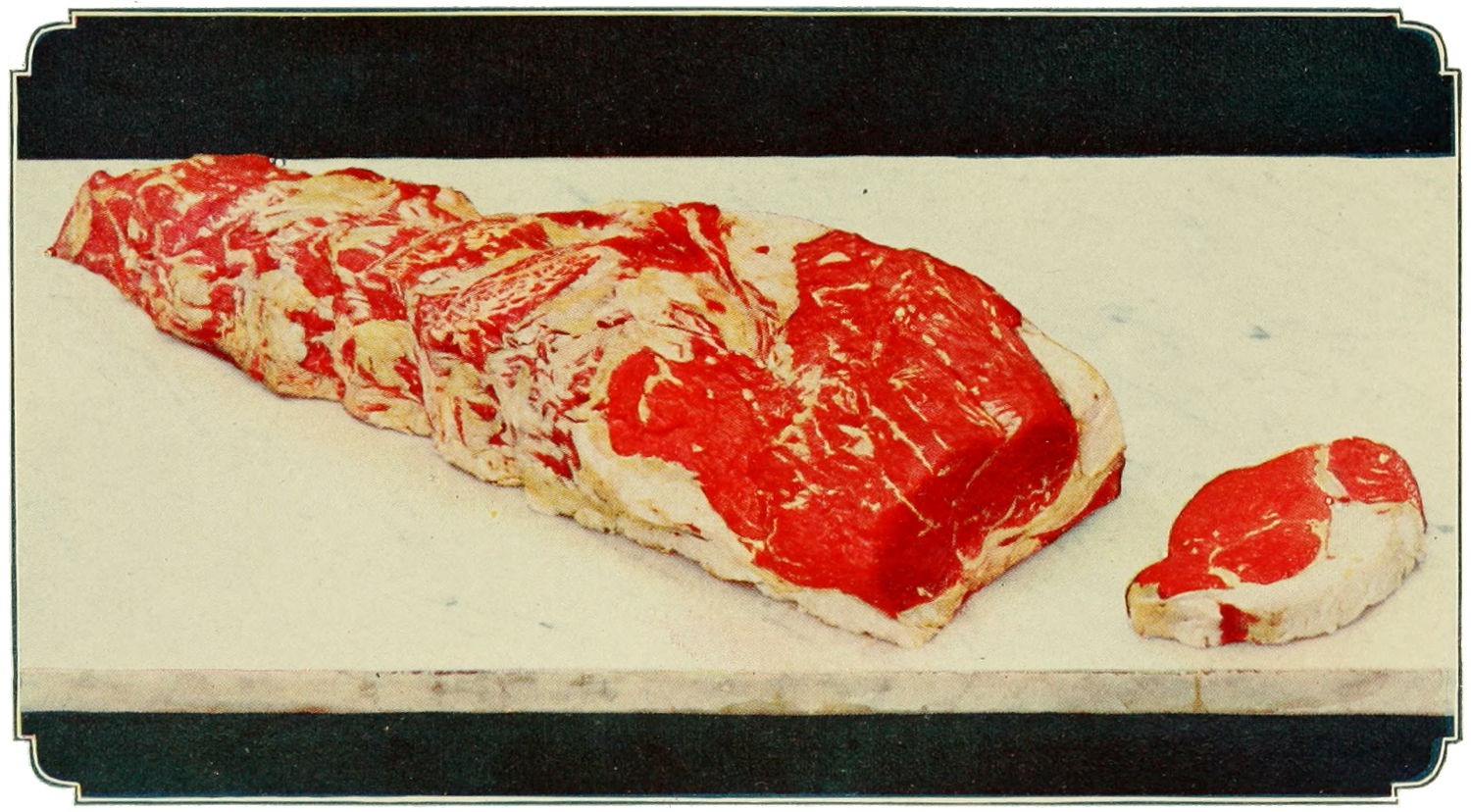
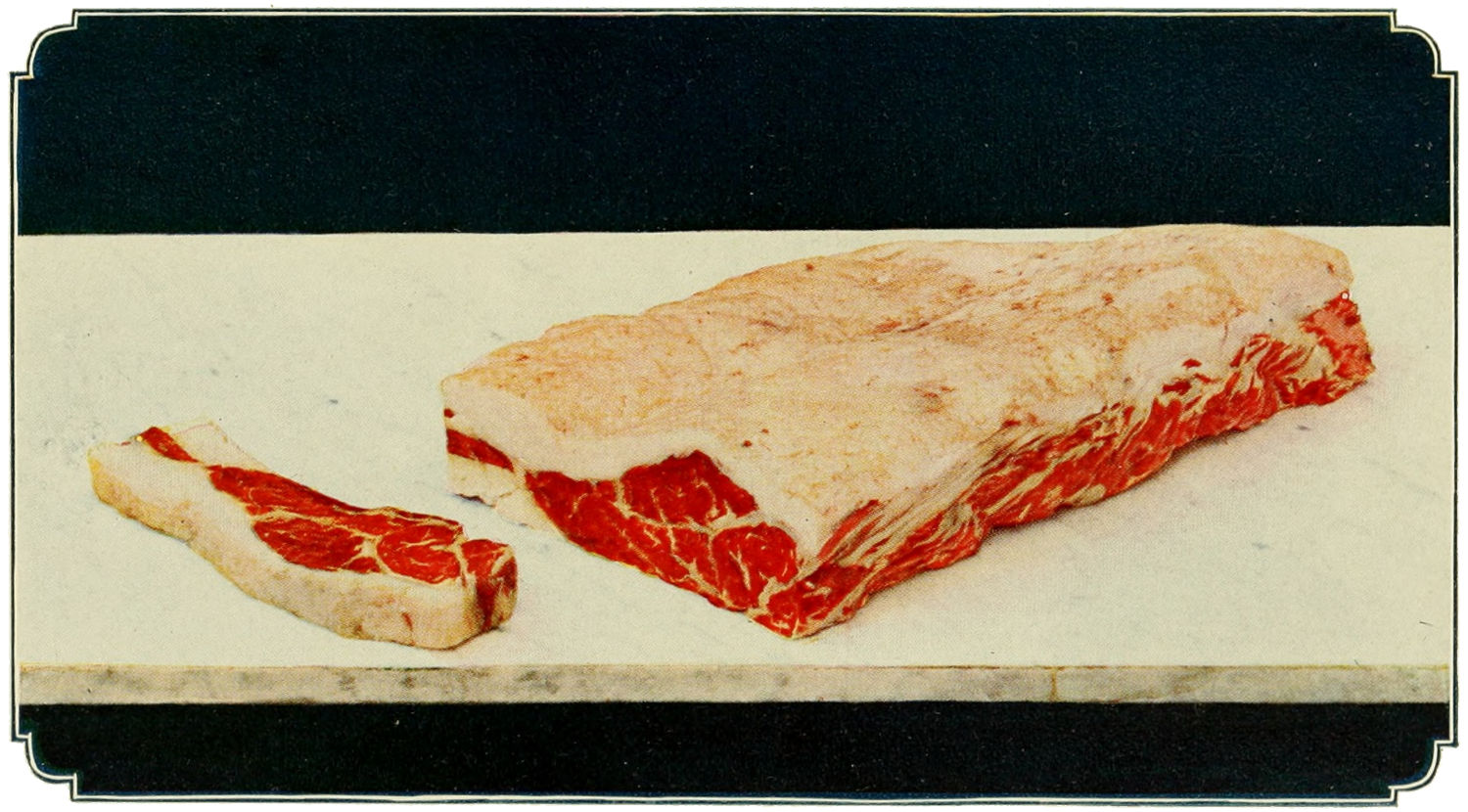
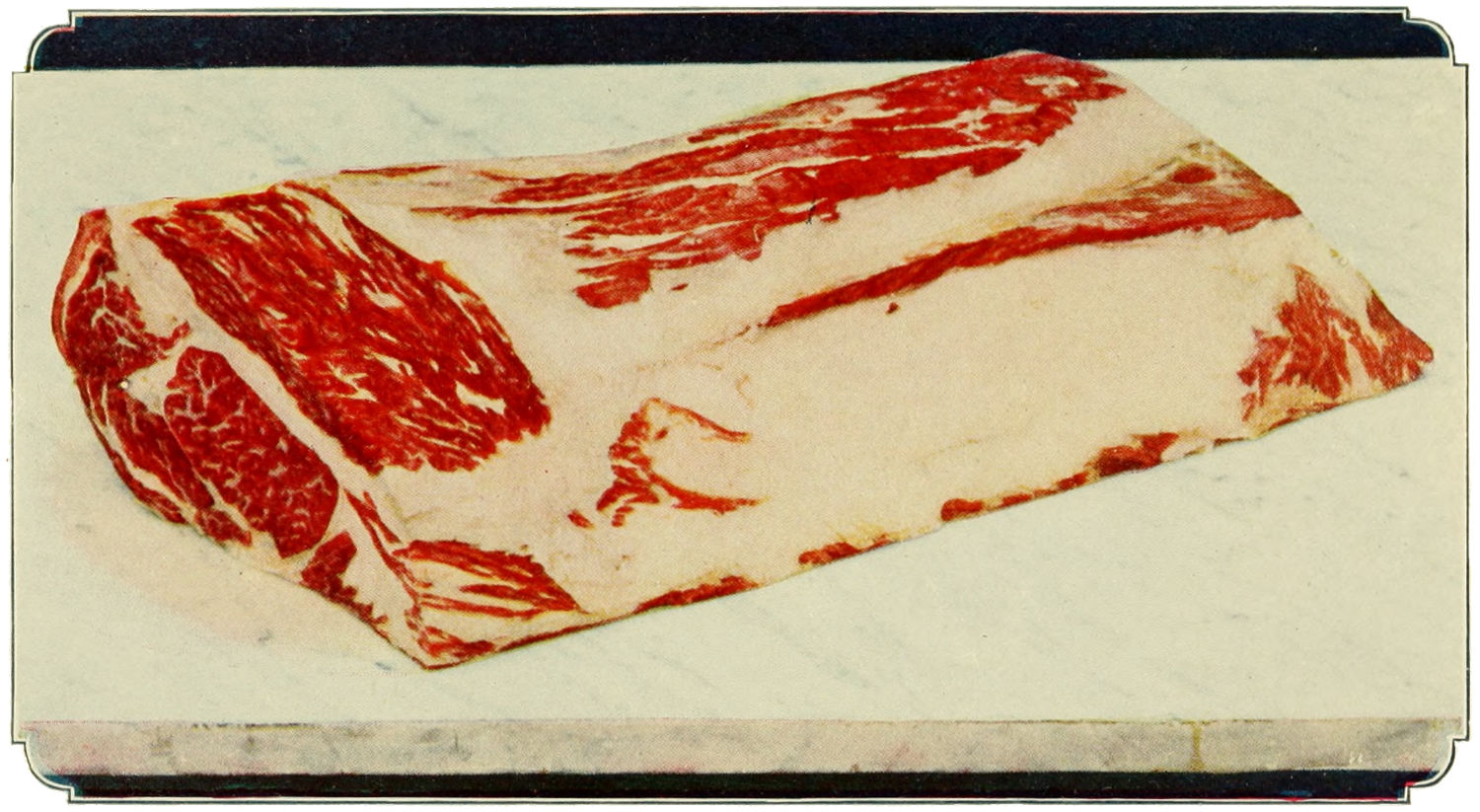
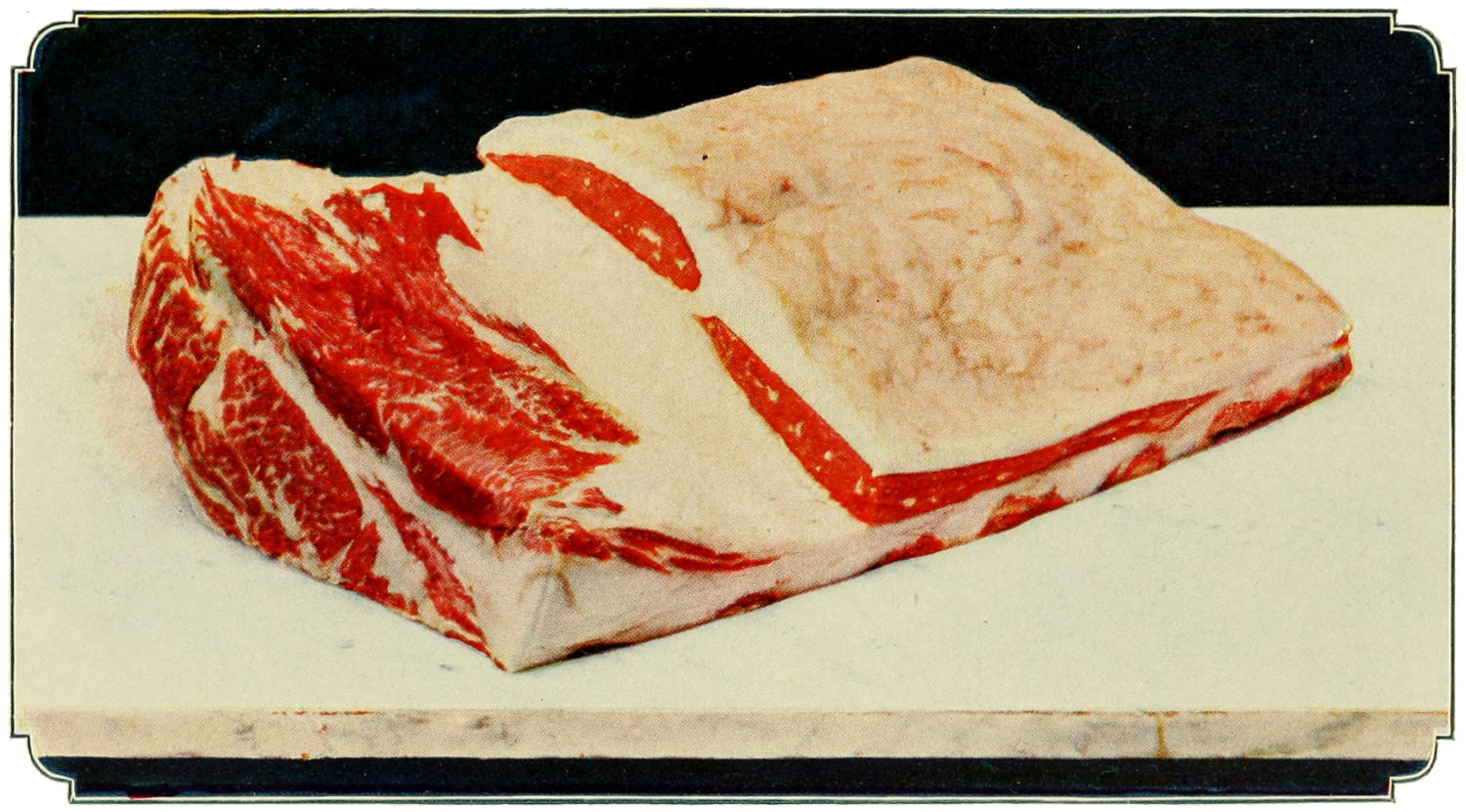
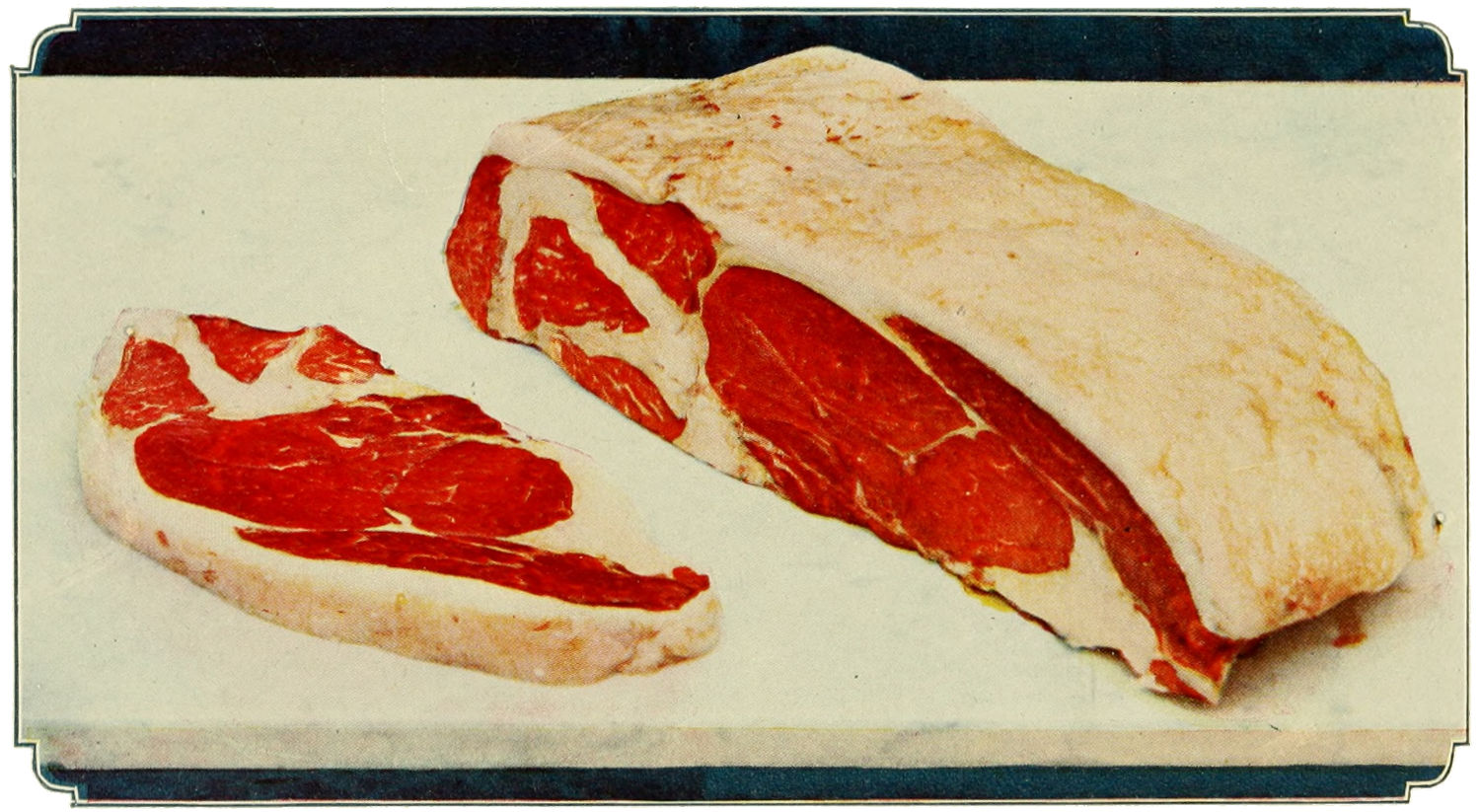
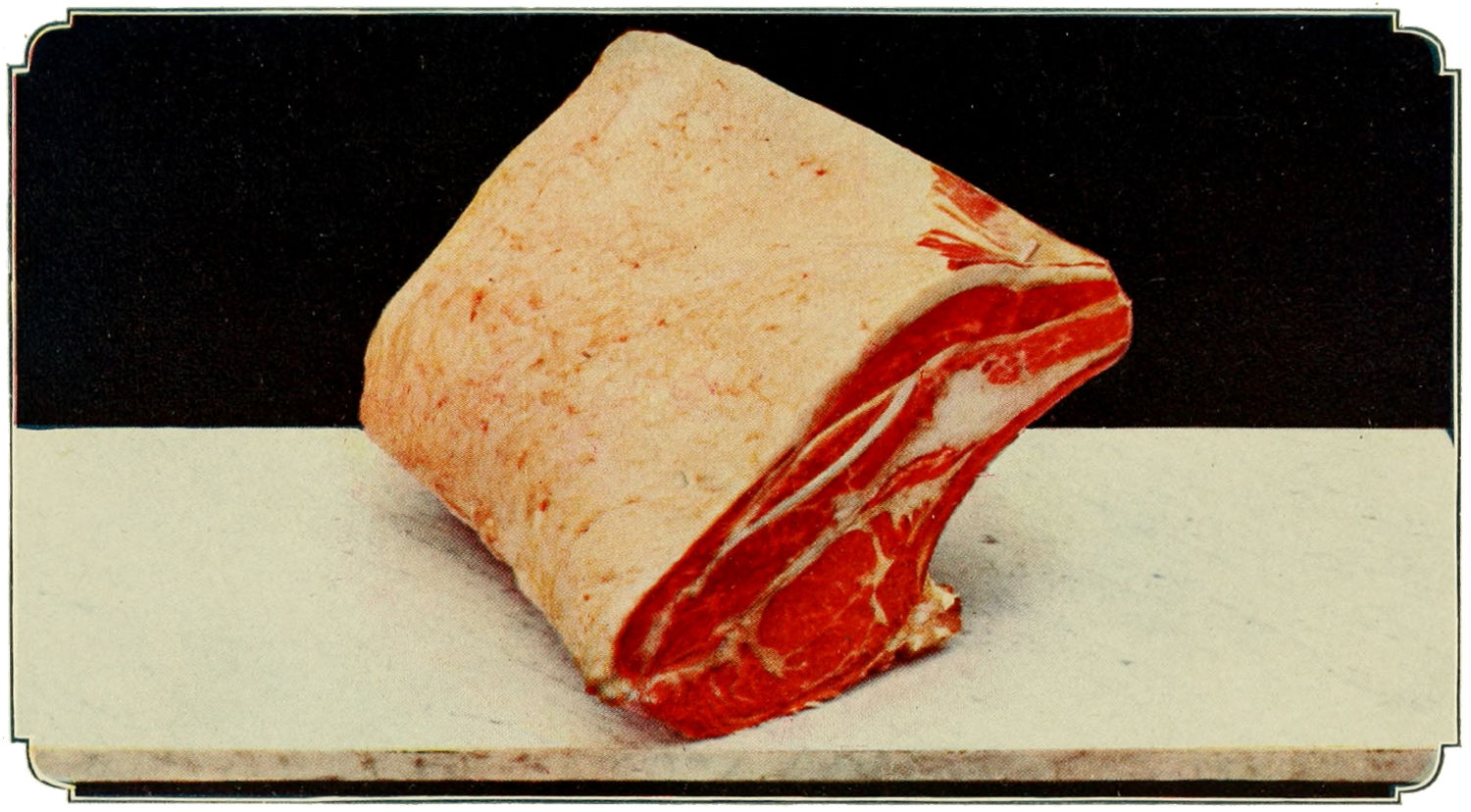
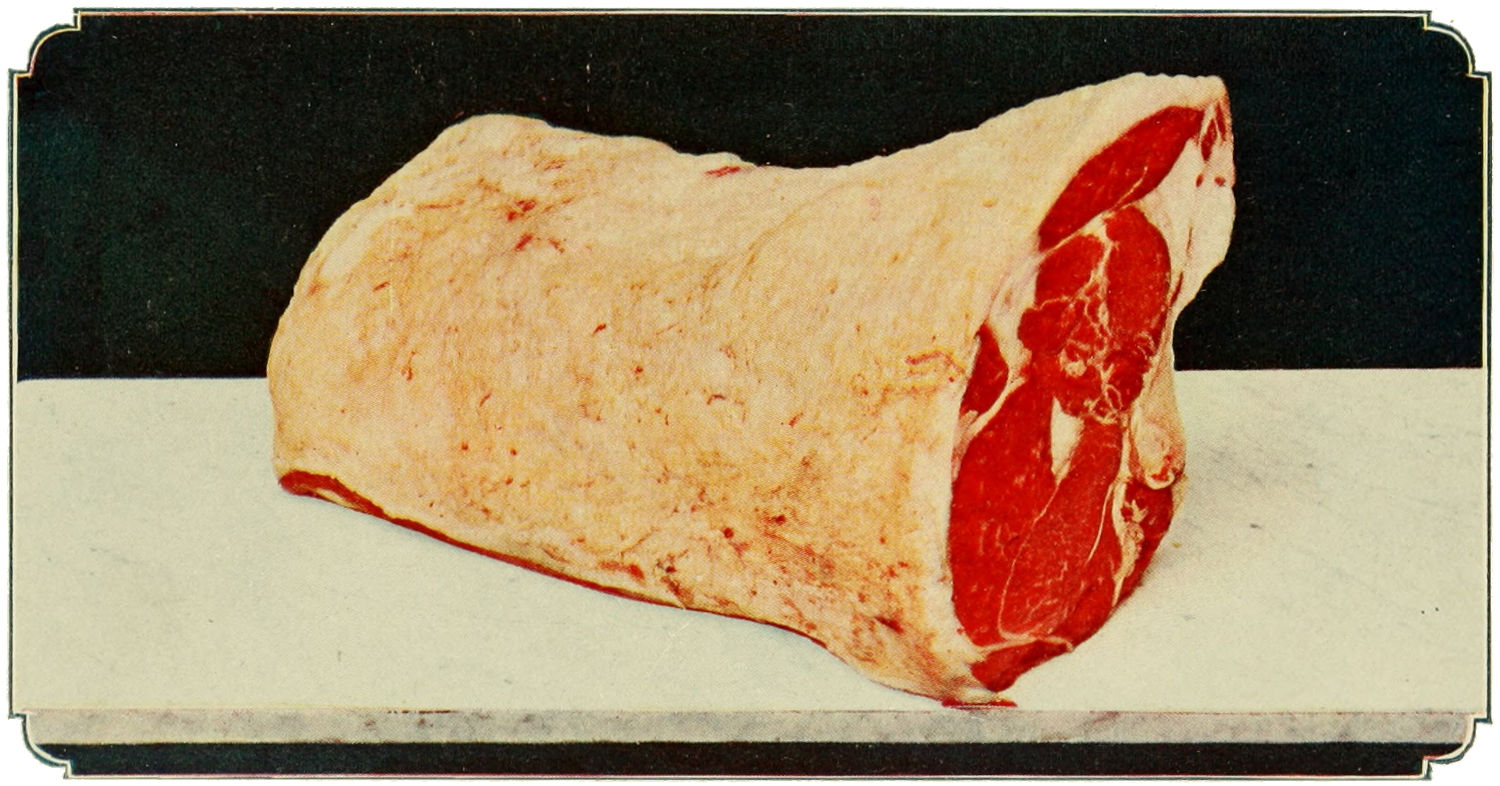
Natural Appearance of Cuts
of Healthy Beef
Beef is the most important of any of the meat
or flesh foods. To be able to judge of its freshness
and freedom from disease is of great
practical value. The following colored plates
show the appearance of some of the principal
cuts of beef in the proper condition for cooking.
By comparing the appearance of the beef
bought in all markets with these plates it is
possible to form a sound judgment of their
suitability for consumption.
These seven Plates are
reproduced by courtesy of
Armour & Co., Chicago
Beef Tenderloin
Beef Sirloin
Beef Ribs—Regular Cut
Beef Ribs—Spencer Cut
Sirloin Butts
Beef Rib
Beef Loin
It is not established that any further manipulation than that above outlined
is desirable or necessary. The use of any kind of dye or coloring matter
directly or indirectly, of any so-called preservative substance other than
those of a condimental nature already mentioned, or any further manipulation
save that to secure low temperature and freedom from infection is not useful,
necessary, nor desirable. The sooner the manufacturer of these products
understands the rights of the consumer in this respect and recognizes the
fundamental verity of the above postulates the better it will be for all parties.
When these conditions are met all of the many and just objections which have
been made to the meats of this country will pass away and they will assume
in the markets of the world that position to which their natural merits, when
not interfered with by maltreating during curing, entitle them.
—In the
preparation of animals for the market experience has shown that they are best
cut in certain pieces of a shape determined by the race of the animal itself
and to these pieces or cuts certain definite names have been applied. The
method of making these cuts is not the same in all parts of this country and
various parts of different countries. In the United States the most common
cuts are illustrated in the accompanying figures, with the names which are
attached thereto.
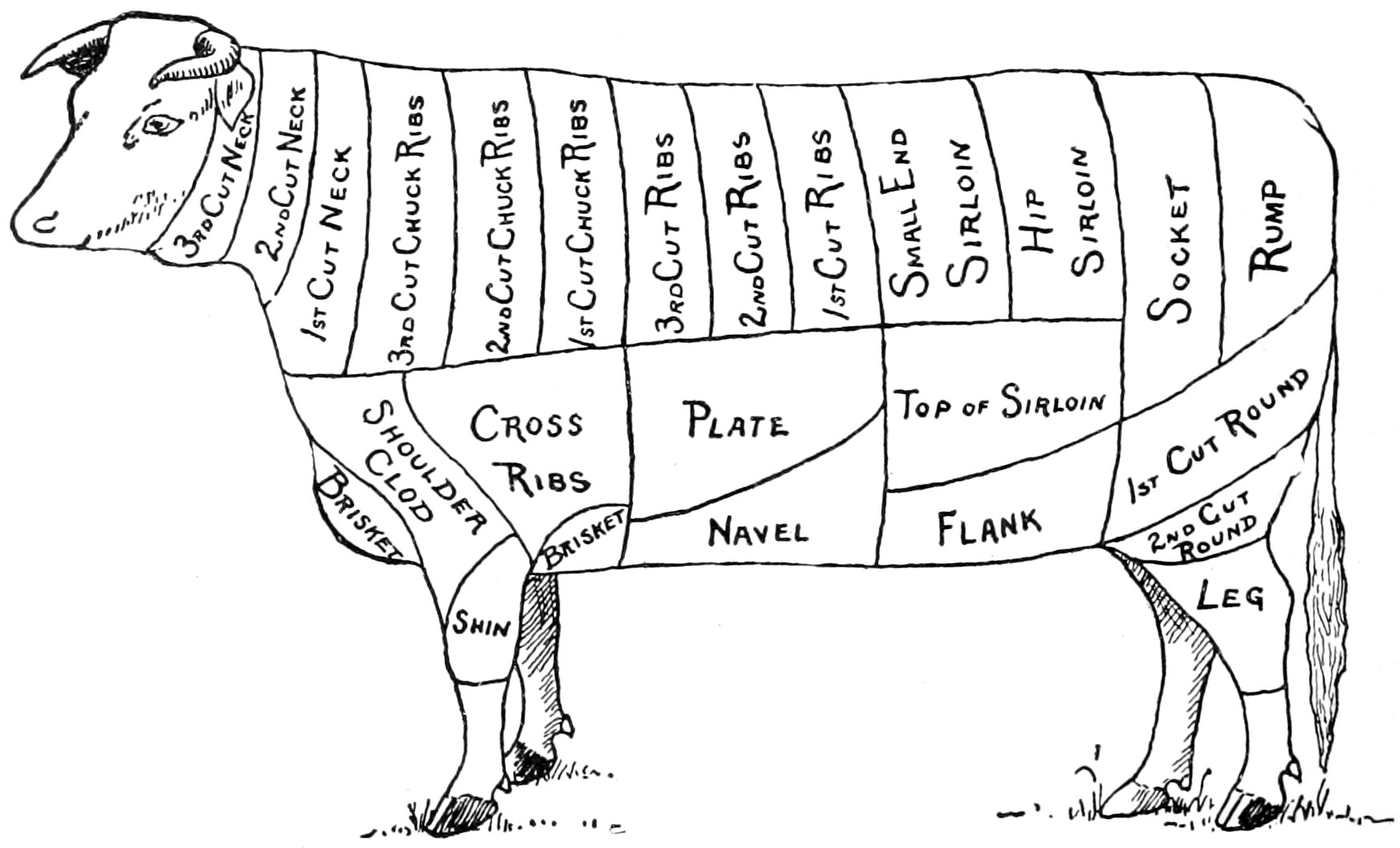
The analyses here reported apply to cuts as indicated by the following diagrams.
These show the positions of the different cuts, both in the live animal
and in the dressed carcass as found in the markets. The lines of division
between the different cuts will vary slightly, according to the usage of the
local market, even where the general method of cutting is as here indicated.
The names of the same cuts likewise vary in different parts of the country.
Fig. 1.—Cuts of Beef.—(Nutrition Bulletins, Office of
Experiment Stations.)
—The general method of cutting up a side of beef is
illustrated in Fig. 1, which shows the relative position of the cuts in the animal
and in a dressed side. The neck piece is frequently cut so as to include more
of the chuck than is represented by the diagram. The shoulder clod is
usually cut without bone, while the shoulder (not indicated in diagram) would
include more or less of the shoulder blade and of the upper end of the fore
shank. Shoulder steak is cut from the chuck. In many localities the plate
is made to include all the parts of the fore quarter designated on the diagrams
as brisket, cross ribs, plate, and navel, and different portions of the plate, as
thus cut, are spoken of as the “brisket end of plate” and “navel end of plate.”
This part of the animal is largely used for corning. The ribs are frequently
divided into first, second, and third cuts, the latter lying nearest the chuck
and being slightly less desirable than the former. The chuck is sometimes
subdivided in a similar manner, the third cut of the chuck being nearest the
neck. The names applied to different portions of the loin vary considerably
in different localities. The part nearest the ribs is frequently called “small
end of loin” or “short steak.” The other end of the loin is called “hip sirloin”
or “sirloin.” Between the short and the sirloin is a portion quite generally
called the “tenderloin,” for the reason that the real tenderloin, the very tender
strip of meat lying inside the loin, is found most fully developed in this cut.
Porterhouse steak is a term most frequently applied to either the short steak or
the tenderloin. It is not uncommon to find the flank cut so as to include more
of the loin than is indicated in the figures, in which case the upper portion is
called “flank steak.” The larger part of the flank is, however, very frequently
corned, as is also the case with the rump. In some markets the rump
is cut so as to include a portion of the loin, which is then sold as “rump steak.”
The portion of the round on the outside of the leg is regarded as more tender
than that on the inside, and is frequently preferred to the latter. As the leg
lies upon the butcher’s table this outside of the round is usually on the upper,
or top, side, and is therefore called “top round.” Occasionally the plate is
called the “rattle.”
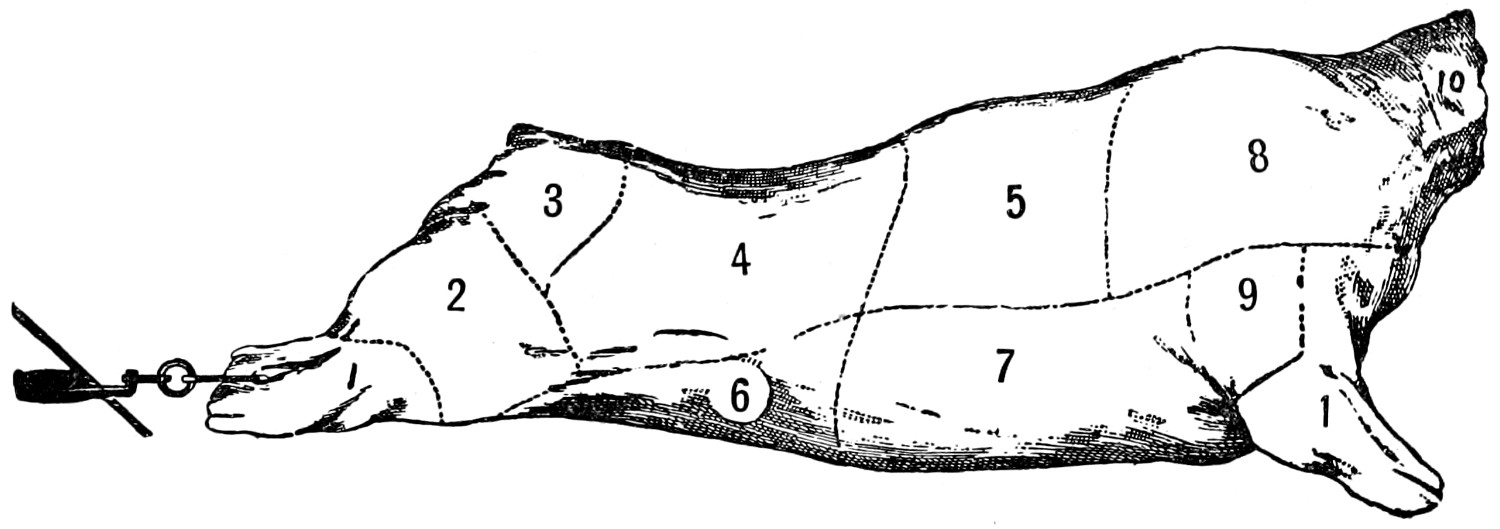
In Fig. 2 is shown a side of beef with the various cuts indicated as used
for commercial designation.
1.
Shank
5.
Rib
9.
Clod
2.
Round
6.
Flank
10.
Neck
3.
Rump
7.
Plate
4.
Loin
8.
Chuck
Tenderloins, Sirloin Butts and Strips cut from No. 4.
Rib Rolls cut from No. 5.
Fig. 2.—Commercial Cuts of Beef.—(Courtesy of Armour & Co.)
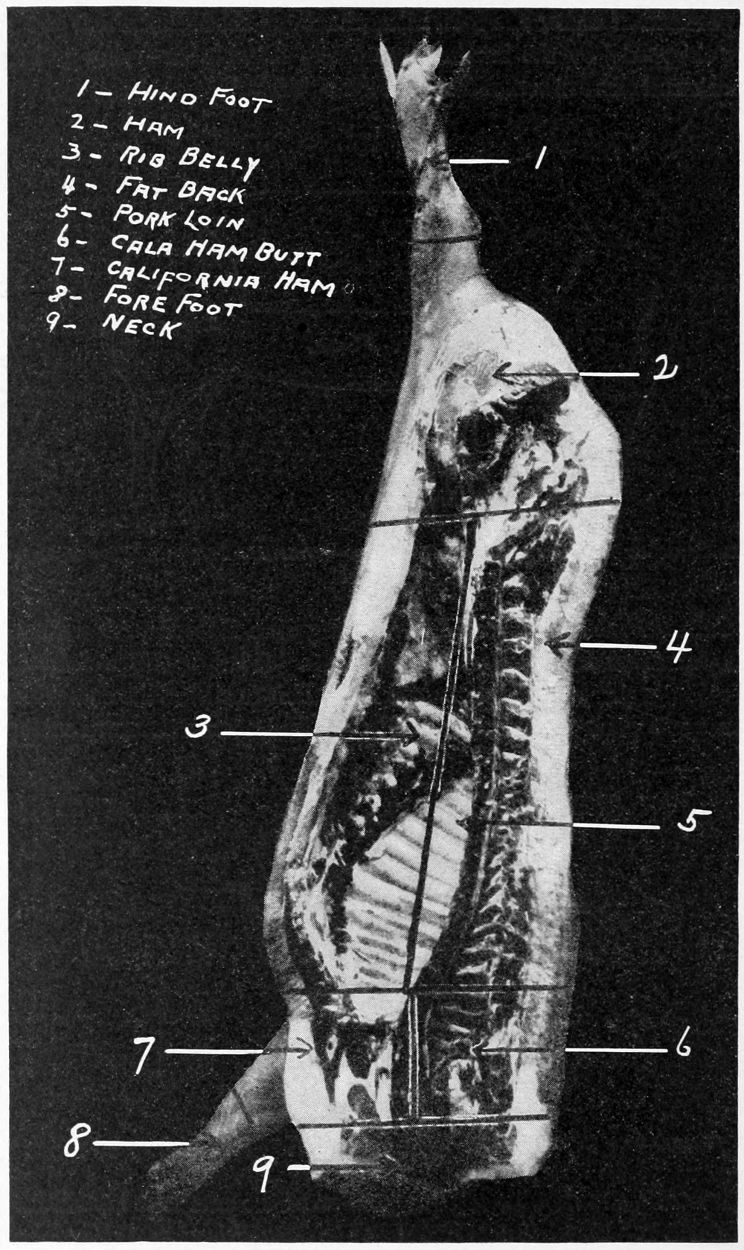
In Fig. 6 (page 20) is shown the interior view of a hog carcass with the
cuts indicated as known to the trade.
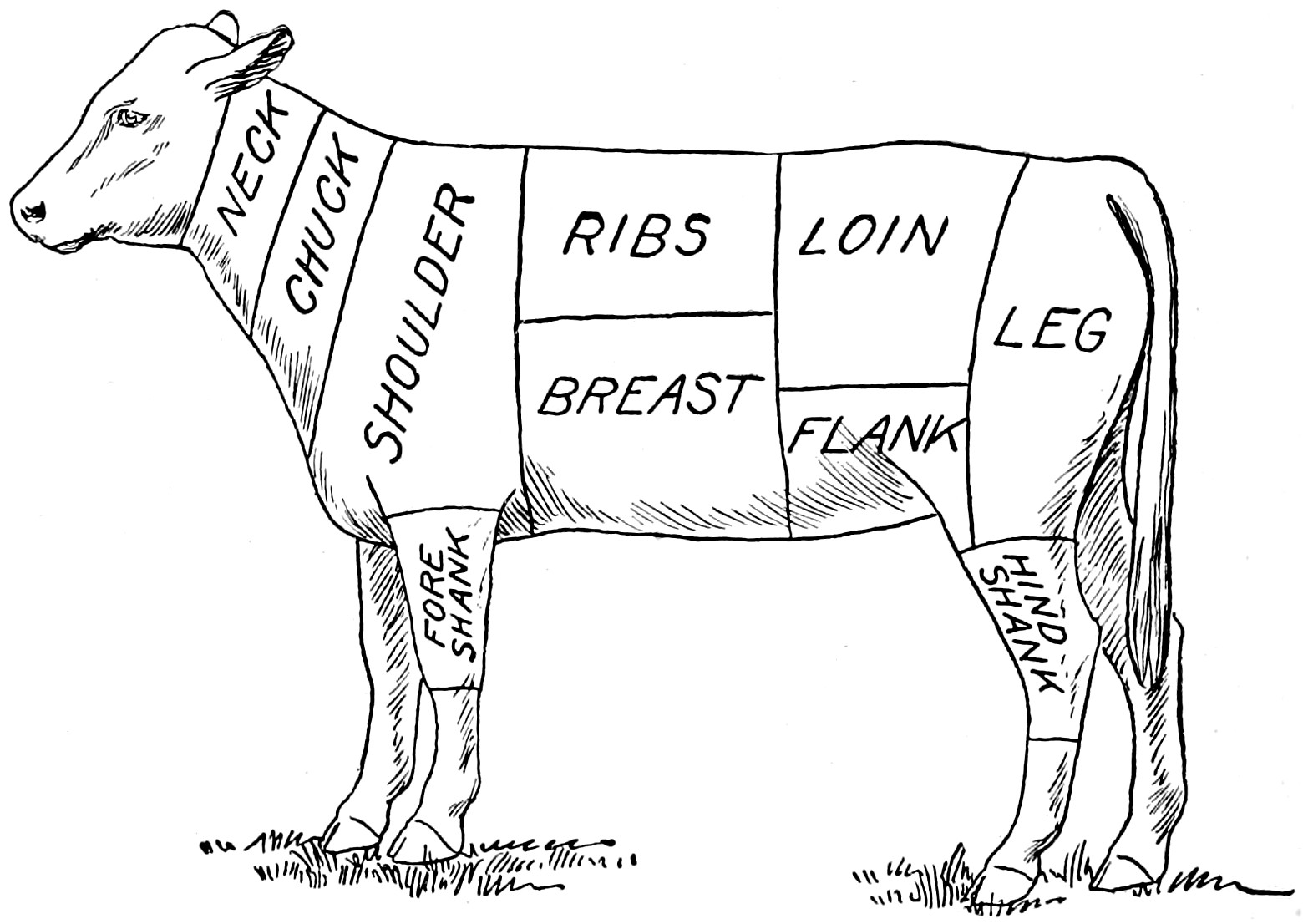
Fig. 3.—Diagram of Cuts of Veal.—(Nutrition Bulletins,
Office of Experiment Stations.)
—The method of cutting up a side of veal differs considerably
from that employed with beef. This is illustrated by Fig. 3, which
shows the relative position of the cuts in the animal and in a dressed side.
The chuck is much smaller in proportion, and frequently no distinction is
made between the chuck and the neck. The chuck is often cut so as to include
a considerable of the portion here designated as shoulder, following more
nearly the method adopted for subdividing beef. The shoulder of veal as
here indicated includes, besides the portion corresponding to the shoulder in
beef, the larger part of what is here classed as chuck in the adult animal. The
under part of the fore quarter, corresponding to the plate in the beef, is often
designated as breast in the veal. The part of the veal corresponding to the
rump of beef is here included with the loin, but is often cut to form part of
the leg. In many localities the fore and hind shanks of veal are called the
“knuckles.”
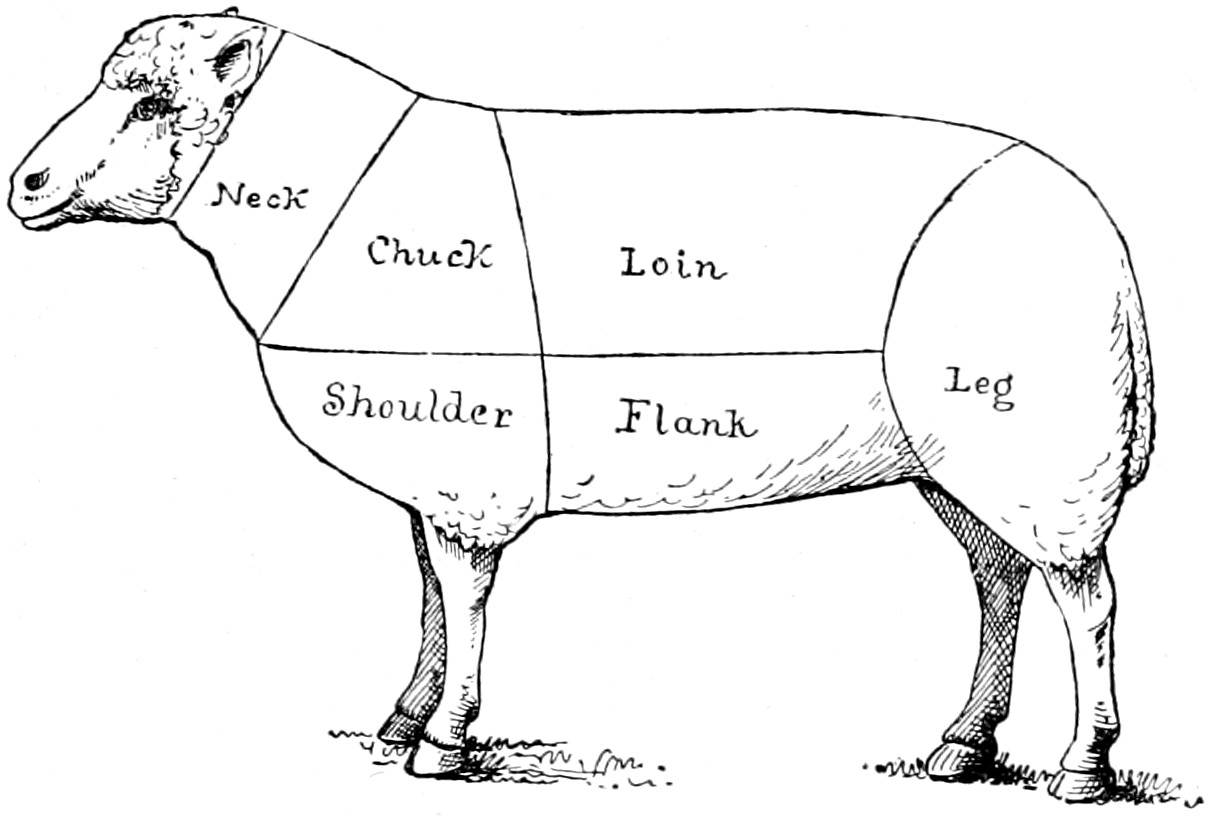
Fig. 4.—Diagram of Cuts of Lamb and Mutton.—(Nutrition
Bulletins, Office of Experiment
Stations.)
—Fig. 4 shows the relative position of the
cuts in a dressed side of mutton or lamb and in a live animal. The cuts in a
side of lamb and mutton number but six, three in each quarter. The chuck
includes the ribs as far as the end of the shoulder blades, beyond which comes
the loin. The flank is made to include all the under side of the animal. Some
butchers, however, make a larger number of cuts in the fore quarter, including
a portion of the cuts marked “loin” and “chuck” in Fig. 4, to make a
cut designated as “rib,” and a portion of the “flank” and “shoulder” to make a
cut designated as “brisket.” The term “chops” is ordinarily used to designate
portions of either the loin, ribs, chuck, or shoulder, which are either
cut or “chopped” by the butcher into pieces suitable for frying or broiling.
The chuck and ribs are sometimes called the “rack.”
Fig. 5.—Diagram of Cuts of Pork.—(Nutrition
Bulletins, Office of Experiment Stations.)
—The method of cutting up a side of pork differs considerably
from that employed with other meats. A large portion of the carcass
of a dressed pig consists of almost clear fat. This furnishes the cuts which are
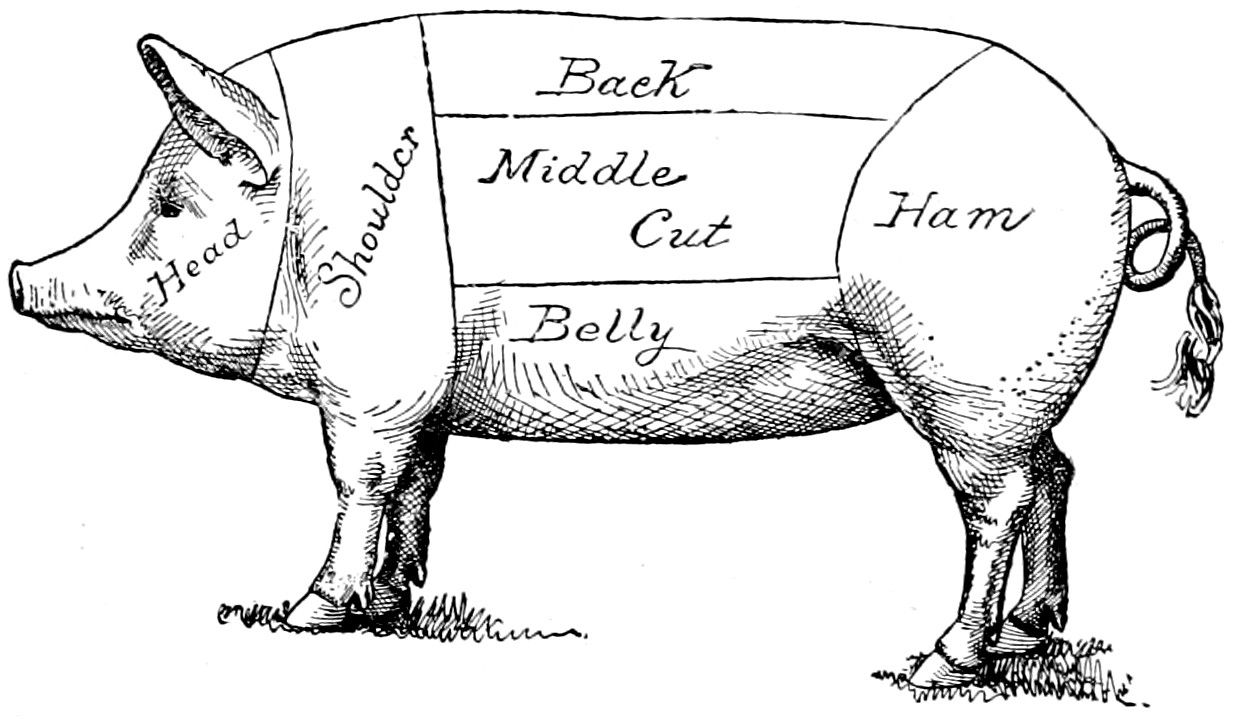
used for “salt pork” and bacon. Fig. 5 illustrates a common method of
cutting up pork, showing the relative position of the cuts in the animal and in
the dressed side. The cut designated as “back cut” is almost clear fat and is
used for salting and pickling. The “middle cut” is the portion quite generally
used for bacon and for “lean ends” salt pork. The belly is salted or pickled,
or may be made into sausages.
Fig. 6.—Commercial Cuts of Pork.—(Courtesy of Armour &
Co.)
1—Hind Foot
2—Ham
3—Rib Belly
4—Fat Back
5—Pork Loin
6—Cala Ham Butt
7—California Ham
8—Fore Foot
9—Neck
Beneath the “back cut” are the ribs and loin, from which are obtained
“spareribs,” “chops,” and roasting pieces, not designated in the figure.
The hams and shoulders are more frequently cured, but are also sold fresh
as pork “steak.” The tenderloin proper is a comparatively lean and very
small strip of meat lying under the bones of the loin and usually weighing a
fraction of a pound. Some fat is usually trimmed off from the hams and
shoulders which is called “ham and shoulder fat” and is often used for sausages,
etc. What is called “leaf lard,” at least in some localities, comes from
the inside of the back. It is the kidney fat.
As stated above, cuts as shown in the diagrams herewith correspond to
those of which analyses are reported in the table beyond, but do not attempt
to show the different methods of cutting followed in markets in different parts
of the United States.
—Perhaps the most important aid
to the manufacturer, as well as a protection to the consumer, which modern
science has offered to the public is the possibility of delivering fresh meats to
consumers at a low temperature. A well equipped abattoir is provided with
apparatus by means of which a constantly low temperature may be maintained
in the room where the fresh meat is kept after the preparation described
above. When the meats are to be distributed over long distances refrigerator
cars or boats are provided where low temperature may be maintained.
—The parts of the beef which are used for roasting are
shown in the diagram, comprising a considerable portion of the hind quarter
of the beef and part of the ribs. The roast is perhaps the most important of
the parts of the beef for edible purposes. The average composition of the
edible part of roast beef (before cooking) is given below:
Water,
60.14
percent
Solids,
39.86
„
Nitrogen,
4.47
„
Phosphoric acid,
.54
„
Sulfur,
.26
„
Fat,
10.48
„
Ash,
1.30
„
Protein,
27.95
„
—The most important parts of the beef next to the roast are
the parts used for steak. Beefsteaks have different names, such as tenderloin
and sirloin, and when the latter two are joined together by the bone the whole
is called porterhouse. There are also round steaks and rump steaks which
are less highly prized portions of the meat, but in nutritive value are probably
quite as valuable as the others mentioned. The average composition of
the edible part of a large number of samples of beefsteak is given in the
following table:[1]
Water,
63.95
percent
Solids,
36.05
„
Nitrogen,
4.54
„
Phosphoric acid,
.59
„
Sulfur,
.27
„
Fat,
5.93
„
Ash,
1.48
„
Protein,
28.37
„
[1] Means of numerous analyses in Bureau of Chemistry.
It is seen that the roast beef contains less water, less protein, and decidedly
more fat than the steak.
—The parts of the lamb which are used for roasting are
usually the hind quarters, although all of the parts are roasted at times. The
average composition of a number of samples of lamb roast is given in the following
table:[2]
Water,
58.56
percent
Solids,
41.44
„
Nitrogen,
4.91
„
Phosphoric acid,
.61
„
Sulfur,
.28
„
Fat,
9.12
„
Ash,
1.30
„
Protein,
30.71
„
[2] From numerous analyses made in the Bureau of Chemistry.
or mutton chops are the short ribs with attached flesh of
lamb or young sheep. They are considered to be the most desirable part of
the young sheep or lamb for edible purposes. The average composition
of the edible portion of a number of samples of lamb chops is given in the
following table:
Water,
63.98
percent
Solids,
36.02
„
Nitrogen,
4.35
„
Phosphoric acid,
.61
„
Sulfur,
.24
„
Fat,
7.09
„
Ash,
1.49
„
Protein,
27.18
„
Roast lamb, as shown by the above data, has less water, more fat, and
more protein than lamb chops.
—After delivery the meats are at once
consigned to refrigerator departments in the markets, where they are preserved
until they pass into the consumer’s hands. Thus, a properly fattened, properly
slaughtered, and properly dressed piece of fresh meat may be brought into the
consumer’s hands in a manner at once unobjectionable and at the same time
one which secures it admirably from contamination of any kind. So perfect
are these means of transportation that fresh meat may be sent not only from
city to city but across the sea, and reach the consumer as near perfection as
human ingenuity can devise.
—The question of how long meat can be safely
kept in cold storage of this kind is one which has not been decided. It may
be said, however, that the period should not be extended any longer than is
necessary and that the consumers of meat should be provided in ordinary times,
if transportation is undisturbed, with practically fresh meat. It is evident
that if the principal meat-packing centers are Chicago, Omaha, and Kansas
City the cities and parts of the country remote from these localities must
have meat somewhat older than those which are near by. If we pass to
distant countries, as for instance, Europe, where fresh meats are received
from the United States or even from Australia, the time elapsing between
slaughter and consumption must necessarily be long. Thus the length of
time in which meat should be left in cold storage after it is properly matured
depends upon its geographic distribution and is not a matter to be decided
arbitrarily.
When meats are not only kept in cold storage for transportation but are
actually frozen, as is often the case, they can, of course, be kept for a much
longer time than when subjected merely to a low temperature at or slightly
above the freezing point. For this reason meats that are to be carried to a
long distance and not to be consumed for a long time after preparation are
usually frozen and kept so during transport.
—Attention has
been called to the fact that low temperature does not inhibit enzymic action,
and, therefore, it must be admitted that this continued activity must gradually
deteriorate the quality of the product. The question, therefore, which is the
most important is not how long can meat be kept in a frozen condition but
how short a time must it be kept. In all cases, therefore, of this kind the consumer
is entitled to know the length of time during which his meat has been
kept frozen, and this desirable condition of affairs is easily secured by the
necessary local, state, and national inspection already mentioned.
—It is
evident that the fragments of sound, wholesome meat which is dressed for
delivery to commerce are themselves edible and hence there can be no hygienic
or other objection to preparations made from these fragments, such as sausage
and other minced and comminuted meats which appear upon the market.
In other words, the consumer is entitled to know that because a piece of
meat is comminuted is no reason for supposing that it is not edible.
Sausage, mince meat, comminuted meat, potted, canned, and other meats
or preparations from these sound, clean, edible fragments, necessarily rejected
in the process of preparing fresh meats for curing and for consumption, are
entitled to the same consideration and may be looked upon with the same
certainty of purity by the consumer when properly inspected and prepared
as the larger pieces.
The possibility of detecting any effects of disease in meats by inspection
at the time of or after delivery is very remote and therefore the inspection
before killing and during the process of manufacture should be a most rigid
one in the case of these fragments. Such inspection and certification would
restore public confidence in the purity and hygienic properties of these
meats which not only are nutritious but by the spicing and condimental
treatment which they receive are rendered highly palatable and desirable.
When meats are in large pieces they may be recognized by their anatomical
characteristics. In order that this may be done, however, the piece of
meat must either be of a sufficient size to be recognized by its shape and
general appearance or must have a bone of sufficient size to indicate its
anatomical character.
According to the German law pieces of meat of less than eight pounds
in weight are not supposed to be large enough to be recognized anatomically
or otherwise with certainty. This, however, is a matter which pertains more
to the meat of animals from which the bone is taken rather than to its actual
size. It requires some little expert knowledge of the anatomy of animals in
order to distinguish these pieces, but one who is in the habit of purchasing or
cutting meats acquires this knowledge without any special study.
—Each kind of meat may also be detected both by its
odor and taste, as well as by its physical appearance and shape. Beef, mutton,
pork, and other meats in a proper state of preparation and preservation have
characteristic odors and flavors by which they are easily detected. One of
the common faults of cooking is the putting together of meats of various
kinds in the same oven, by means of which the odors become so intermingled
that in small pieces even the experienced taster may not always be able to
discriminate between them.
—Meats are so nearly
related histologically that the microscope is not a certain means of detecting
the different varieties. Were this the case it would be easy to identify the
different kinds of meat which may be found in a finely comminuted mixture.
The expert microscopist may have difficulty in discriminating between different
microscopic portions of meat, but the microscope is of practically no advantage
to any but an expert and not a very great advantage to him. The fibers
of some animals vary in size, coarseness or fineness of texture, and other
characteristics as much as fibers do from different animals.
—The most satisfactory method
of detecting meats is by means of their chemical examination. There are
two distinct points which are kept in view in a chemical examination. One
is the presence of glycogen, which in quantities of more than one percent is
characteristic of horse meat. Unfortunately, this test can only be applied to a
meat in practically a fresh state, as the glycogen is rapidly changed into other
forms of carbohydrate substances which make it difficult to identify. The
chemical examination, therefore, which is of the most value is that which is
performed upon the fat. The fat of different animals has different physical
and chemical characteristics. The fats crystallize in different forms and
have different melting points,—also the fatty acids derived therefrom. They
absorb different quantities of iodin and bromin, and have other physical and
chemical properties which are peculiar to each variety.
A careful examination of the fat, therefore, will lead to an approximate
degree of knowledge concerning the character of the flesh from which it has
been derived. For instance, lard and beef fat are easily distinguished from
each other. In case a minced meat is made wholly of one kind of flesh or of
one kind of animal the chemical examination of the fat will, with a considerable
degree of certainty, lead to its identification. In the same manner, if a minced
meat be made up of equal parts of two different kinds of animals the characteristics
of the fats will lead to the identification of the two sources of meat.
If, however, one kind of meat be mixed in only a small proportion, say 10 or
15 percent, of another, the chemical methods of separation are not to be
relied upon. None of these chemical or physical methods, unfortunately, is
of value in the hands of any but an expert, and, therefore, cannot be regarded as
a common means of identification. For this reason the only common manner
of identification of the kinds of meats which are sent out to the consumer
at large must consist in the general knowledge of their anatomical, physical,
palatable, and gustatory properties outlined above.
In all cases the consumer must eventually rely upon the official inspection
and the label which accompanies the meat or which should accompany it.
—A very effective method of preserving meat is practiced
in certain of the arid regions of the country by exposing it to the dry air and
sunlight. Meats prepared in this way are often called “jerked” meats.
The small amount of aqueous vapor in the air is not sufficient to maintain the
life of the ordinary fermentative germs, and they are, therefore, destroyed by
desiccation. Meat which is exposed under such circumstances does not
become infected with any fermentative germ, and the moisture which it contains
is rapidly given off in the dry air surrounding it. For this purpose the
meat is cut into thin strips and suspended by appropriate means in the air
and exposed to the direct sunlight. In a short time the moisture disappears,
and the hard dry pieces keep indefinitely in certain arid regions of this country.
The meat also maintains a fair degree of palatability and practically all of its
nutrient properties, so that when properly cooked it is a palatable and nutritious
dish. Probably of all the methods of preserving meat this one is the
least open to objection, since not even spices or condimental substances are
necessary in order to preserve the meat from decay. By reason of the change
in its physical appearance, however, which makes it less attractive, this method
is not likely to come into general use in the ordinary preservation of meat.
Dried beef is also prepared by preserving the meat by condimental
substances and, instead of placing it in brine, drying it artificially. Chipped
or dried beef is a common article of commerce and is prepared in the manner
described above. This meat, however, has already been treated with condimental
substances, and hence the drying is only one of the means of preservation.
Dried or chipped meats are often smoked also as well as desiccated, so
that in their preparation more than one method of preservation is employed.
—The method of preserving meats in a liquid environment
is sometimes called pickling. All kinds of meat are pickled in this way, but
pork especially. The pickling brine may be simply made of common salt,
though other substances, such as sugar, vinegar, and spices, are used. The
brine also sometimes contains a chemical preservative which is highly objectionable
on the general ground of the harmfulness of these substances. The
preservative commonly used is either sulfite of soda or boric acid. The
making of a pickled meat of this kind should be discouraged. The vinegar
which is employed or acetic acid may be injected into the carcass before it is
cut up. When the arteries or veins are filled with vinegar in this way it
rapidly permeates to all parts of the meat and acts as an excellent and unobjectionable
preservative in all cases where an acid taste is desired. It is
claimed that carcasses which have been injected with vinegar in this way are
easily preserved, and require far less salt and other condimental substances
than when not so treated. As vinegar is a condimental substance used everywhere,
and one which promotes digestion when used in proper quantities,
the preservation of meats or the pickling of meats by a previous injection of
vinegar is not objectionable.
Extensive investigation of the composition of the flesh of pigs has been
made in the Bureau of Chemistry (Bulletin 53). The pigs upon which these
examinations were made were specially bred and fattened at the Agricultural
Experiment Station of Iowa, and were prepared for the market by the most
approved modern style of feeding. They were slaughtered according to the
approved method and immediately, after proper preparation, the carcasses
were placed in cold storage, where they were kept until removal for the purpose
of dissection and preparation of the samples for analyses. Expert butchers
from Washington were secured for the dissecting and dressing of the pigs in
the manner in which it would be done for the best market. The pigs were of
different varieties, namely, Berkshire, No. 1; Tamworth, No. 2; Chester White,
No. 3; Poland China, No. 4; Duroc Jersey, No. 5, No. 6, No. 7; Yorkshire, No. 8.
TABLE A.—WEIGHTS OF WHOLE CUTS AND DATA RELATING TO THE PREPARATION OF AIR-DRY SAMPLES. PIG No. 1.—BERKSHIRE.
—The meat obtained from all of
the cuts of the same kind in each sample was passed through a meat chopper
two or three times in order to get an even, finely divided condition. A portion
of known weight was then placed in a dish and dried in a steam oven at a
temperature of boiling water or slightly above and heated until the fat had well
separated so that it could be poured off into a flask, with care not to remove any
of the water which may have separated with it. Small samples were removed
before drying for the determination of the exact quantity of fat and water
therein, and the results of these analyses were used for calculating the relative
portion of the large samples. Samples of skin, bones, marrow, spinal cord,
tendons, hoofs, and other parts of the animal were also carefully secured
and subjected to analyses. In this way the whole animal was subjected to
examination for analytical data, and at the same time each particular part of
it, in so far as its relation to the market is concerned, was kept separated.
In Table A are found the weight of the whole cut and the data relative to
the preparation of the air-dried sample.
The data show that there was a slight loss of water during the transit
from Chicago to Washington. The part of the pig which has the largest
percentage of fat is the meat of the tail, while the smallest percentage is found
in the tenderloins. The largest percentage of water in any part of the meat
is in the tenderloins and the smallest in the meat of the tail.
TABLE B.—WEIGHTS OF PARTS FROM EACH CUT AND DATA RELATING
TO THE PREPARATION OF AIR-DRY SAMPLES. PIG No. 1.—BERKSHIRE.
Names of Parts and Cuts.
Weights of Parts.
From each cut.
Total.
Of entire pig.
Meat (fat and lean):
Grams.
Grams.
Percent.
Backs,
14,767.9
..
..
Bellies,
8,230.6
..
..
Hams,
9,407.9
..
..
Shoulders,
8,448.2
..
..
Feet,
325.3
..
..
Spareribs,
1,683.8
..
..
Tenderloins,
470.8
..
..
Neck bones,
493.2
..
..
Backbones,
704.0
..
..
Trimmings,
7,021.5
..
..
Tail,
291.7
..
..
51,844.9
88.19
Bones:
Backs,
191.1
..
..
Bellies,
81.4
..
..
Hams,
879.6
..
..
Shoulders,
693.8
..
..
Feet,
802.6
..
..
Spareribs,
528.2
..
..
Neck bones,
336.1
..
..
Backbones,
833.5
..
..
Trimmings,
71.0
..
..
Tail,
27.1
..
..
Total,
..
4,444.4
..
Marrow,
69.7
69.7
0.12
Total bones less marrow,
..
4,374.7
7.44
TABLE C.—ANALYTICAL DATA FOR MEATS. PIG No. 1.—BERKSHIRE.
[5] In this column the totals
obtained by both the direct and the indirect determination of water and fat are given.
The upper number in each case was obtained by use of the results
of direct determinations of these constituents; for the lower number in each case the
results obtained during the preparation of the sample, and in the analysis of the dry-air
sample, were used. Lecithin is not included in the totals given in this table.
TABLE D.—ANALYTICAL DATA FOR BONES, MARROW, SKIN, SPINAL CORD, TENDONS, AND HOOFS. PIG No. 1.—BERKSHIRE.
Names of Parts.
Air-dry sample, percent of orig- inal mate- rial.
Percent Air-dry Material.
Percent Original Material.
Water.
Fat.
Nitrogen.
Leci- thin.
Ash.
Water.
Fat.
Leci- thin.
Nitrogen.
Nitrogenous substances.
Ash.
Total.
Total.
Of pro- teids insol- uble in hot water.
Precip- itated by bromin.
Of flesh bases.
In pre- paring sample.
In resid- ual mate- rial.
Total.
In pre- paring sample.
In resid- ual mate- rial.
Total.
Total.
Of pro- teids insol- uble in hot water.
Precip- itated by bromin.
Of flesh bases.
Pro- teids insol- uble in hot water.
Gelati- noids.
Flesh bases.
Total.
Bones,
52.67
5.72
0.52
6.18
5.32
0.11
0.75
0.84
49.59
35.93
3.01
38.94
11.40
0.27
11.67
0.44
3.26
2.80
0.06
0.40
17.50
0.38
1.25
19.13
26.12
95.86
(Fat extracted with ether),
11.40
(.61)
..
0.29
..
..
..
..
(.28)
..
(.07)
..
..
..
..
..
0.03
..
..
..
..
..
..
..
(.03)
..
Marrow,
4.44
6.68
0.19
8.31
7.08
0.65
0.48
..
..
14.06
0.30
14.36
81.50
0.01
81.51
..
0.37
0.32
0.03
0.02
2.00
0.19
0.06
2.25
..
98.12
(Fat extracted with ether),
17.36
..
..
0.07
..
..
..
2.64
..
..
..
..
..
..
..
0.46
0.01
..
..
..
..
..
..
..
..
..
Skin,
36.93
8.31
3.28
15.02
10.95
2.89
1.18
0.33
1.70
47.17
3.07
50.24
15.90
1.21
17.11
0.12
5.55
4.04
1.07
0.44
25.25
6.69
1.37
33.31
0.63
-
108.44 101.89
(Fat extracted with ether),
15.90
..
..
0.15
..
..
..
1.85
..
..
..
..
..
..
..
0.29
0.024
..
..
..
..
..
..
..
..
..
0.41
Spinal cord,
8.80
6.01
8.28
8.85
7.02
1.26
0.57
..
..
65.17
0.53
65.70
26.03
0.73
26.76
..
0.78
0.62
0.11
0.05
3.88
0.69
0.16
4.73
..
97.19
Tendons,
31.93
10.23
1.53
14.10
11.26
2.22
0.62
0.39
3.71
55.16
3.27
58.43
12.91
0.49
13.40
0.13
4.50
3.59
0.71
0.20
22.44
4.44
0.62
27.50
1.18
100.51
(Fat extracted with ether),
4.81
..
..
0.23
..
..
..
6.65
..
..
..
..
..
..
..
0.32
0.01
..
..
..
..
..
..
..
..
..
0.45
Hoofs,
63.44
7.14
1.35
14.63
..
..
..
..
1.46
36.56
4.53
41.09
..
..
0.86
..
9.28
..
..
..
..
..
..
58.00
0.93
100.88
Similar data were obtained for all of the other samples used, but the chemical
composition is so nearly the same that it is not advisable to repeat the data
for the other varieties. The Berkshire for which the data are given may be
taken as a fair representative of the composition of the varied parts of the meat
of pigs. The comparative weights of various parts of the Berkshire pig
are given in Table B.
The data show that 88.19 percent of the weight of the carcass, after
dressing, is composed of meat, fat, and lean, and 7.56 percent of bone. The
complete data for the variety of Berkshire pig may be taken as a type for the
other varieties and is given in Table C.
The composition of the bone, marrow, skin, spinal cord, tendons, and
hoofs of the Berkshire pig is shown in Table D.
The percentages of the various parts of the original material of the Berkshire
pig are found in Table E.
[6] Lecithin in extracted sample
only, unless otherwise noted.
[7] Result of direct determination
on original material. Other numbers in this column
represent the sum of the percent of water removed in the preparation of sample and the
percent of water remaining in the air-dry sample.
The data for the entire dressed animal after the removal of the head,
hoofs, lard, and kidneys are shown in Table F.
—The composition of the flesh of pigs has been
given in detail for two reasons. First, because the data relative to this point
are much more complete than those of any other flesh product and were
obtained in a more systematic way. In the second place, pork is one of the
chief meat products of the United States,—the industry being one of great
magnitude, and pork being a common article of diet among all classes of
people. Further than this, the data indicate the general character of fresh
meat, and illustrate as well as that of any of the typical animals the nutritive
value and properties of flesh. The study of pork, therefore, may be regarded
as a typical study of meat products. It is quite as important that all people
should be informed respecting the nature of the wholesome meat which they
consume and its value as a diet as it is that they should be certain these meats
be procured from healthy animals and in a sanitary way. These two classes
of knowledge together give a complete scheme of information which the
consumers in this and other countries are entitled to have.
Pork, by many hygienists, is regarded as the least desirable of meat
products, and it is not the purpose here to combat that idea. Granting,
however, for the sake of argument, that pork is a less desirable meat food
than those derived from cattle or sheep, that is all the more reason for knowing
particularly everything connected with it. Modern investigations have
appeared to establish the fact that swine are less subject to those forms of
disease, with the exception of trichinosis, which tend to infect the meat and
make it unfit for consumption than cattle or sheep. The diseases to which
swine are usually subject act quickly, as a rule, and are speedily fatal, as in
the case of hog cholera, whereas the diseases most to be feared in cattle and
sheep are those of slow activity and those of a nature which is often not
revealed until slaughter, namely, tubercular diseases. In so far, therefore,
as infection from disease is concerned, previous to slaughter, it appears that
the flesh of swine is less objectionable and less open to suspicion than that of
cattle or sheep. One of the chief objections to the use of pork in any form,
whether fresh or cured, has been based upon the unsanitary habits of the
animals themselves. With the modern methods of cleanliness and care,
however, the conditions under which the pigs grow and fatten are, or should
be, quite as sanitary as those surrounding cattle and sheep. The consumer,
of course, has the right to insist upon such sanitary conditions and these,
under present laws or those which are to be enacted, will doubtless be supplied.
It is believed that in this country sanitary environments and a sanitary method
of feeding will develop types of animals superior to those grown in other
countries, where the population is denser and where the facilities for the
proper growth and fattening of the animal are less abundant. It is hoped
that the general diffusion of knowledge respecting all food products among
our people will aid greatly in securing these very desirable results.
Meats which cannot be eaten at the time of or soon after slaughter are necessarily
preserved until the time of consumption. It is difficult to draw a definite
line between a preserved and a fresh meat. A general distinction is the following:
Fresh meat is meat which is prepared for consumption without the use
of any condiment or preservative, without sterilization, and with none of the
artificial methods of keeping, except cleanliness and a low temperature.
The above definition, as will be seen, covers meat placed in cold storage. A
special distinction, however, must be made in this case between meat placed
in cold storage for the purpose of transportation only and meat placed in cold
storage to be kept for an indefinite time. Where meats are prepared for consumption
by slaughter and appropriate dressing and shipped long distances to
the consumer the cold storage car, ship, and warehouse become a necessity.
There is some reasonable limit for keeping such products, beyond which they
should be differentiated from fresh meats. Whenever meats are kept in cold
storage so long as to afford the opportunity for the growth of a mould, or undergo
other changes of a chemical or physical character which distinguish them
from the fresh products, they should be placed in a different class. Fresh meats
may, therefore, be divided as follows:
Class I. Meats intended for immediate consumption and passed to the
consumer within, at the most, one week after slaughter. Class II. Cold
storage meats, which are placed in refrigerators, frozen, and kept for a longer
period than one week. There is evidently also a limit to the length of time
which meat should remain in cold storage, no matter how low the temperature
may be, since the action of organisms which produce decay cannot be entirely
overcome. The exact limit at which frozen meats can be kept without becoming
inedible has not been determined. Without this determination, however,
it is advisable that such limit should not be approached. Inasmuch as the
supply of fresh meat is practically uniform, or can be made so by the dealer
therein, there seems no good reason for the storage of meat in refrigerator compartments
for a longer time than is necessary for transportation and a reasonable
time thereafter for passing into consumption, except in cases of emergency.
It might be safe to say that no meat should be kept in a cold storage warehouse
longer than a month after its reception. Numerous instances might be cited
in which meat may be kept for a much longer time, but the question for the
consumer is not how long a while meats can be kept but how soon they can be
placed in his hands. In this connection it should not be forgotten that it is the
opinion of perhaps the majority of hygienists and connoisseurs that fresh meat,
especially beef, improves for a certain length of time in cold storage. It is
probable that the fresh beef which is served to the people of the United States
is on an average a month old, and is said to be improved by keeping this length
of time. This is a question, however, which is still undetermined, and it deserves
a further investigation. Under present conditions it is well to know
the truth respecting these matters and to realize that the fresh meat we get,
such as beef and mutton, is not direct from the shambles but has been kept for
at least four weeks in cold storage.
—It has been stated in semi-scientific publications
that the flesh of a mammoth incrusted in polar ice and presumably thousands
of years old has been found to be intact and edible. This story, lacking
corroboration, is hardly in harmony with known facts. The author had the
opportunity of examining a quarter of beef which had been kept frozen in a
warehouse for more than eleven years. This meat was found to be wholly
inedible. It had an unpleasant and mummy-like odor, was light in fiber and
color, having evidently lost a large part of its weight, and was of a character
wholly unsuitable for consumption. This fact appears to show that eleven
years is too long a time in which to keep meat frozen. In fact, it is scarcely
worth while, from a practical point of view, to discuss so long a limit. Only the
necessary time for the preparation and transportation of the meat is to be considered,
and the sanitary laws of the nation, states, and municipalities should
undoubtedly regulate the time of cold storage and see that all packages of meat
exposed for sale are plainly tagged as to the date of slaughter, in order that the
consumer may know.
In the consideration of the subject of preserved meats there are excluded all
meats delivered in the fresh state for consumption and meats kept in cold
storage in a fresh state during the necessary time of preparation and transportation
say, on the whole, from four to eight weeks. Meats kept longer than this
may generally be considered as preserved meats, even when cold is the only
factor active in their preservation.
—Aside from cold storage there are four
methods in vogue for preserving meats. These may be classified as follows:
(1) Curing with the aid of condimental substances; (2) treatment with chemical
and non-condimental preservatives; (3) sterilization with heat; (4) drying.
These all except the second may be regarded as legitimate means of preserving
meats.
—This method of preserving meat
has been practiced from the remotest antiquity. The chief condimental substances
employed are salt, sugar, vinegar, and wood smoke. With the proper
technical skill and knowledge of the process, meats can be preserved in this
way, and at the same time aromas and flavors developed which are considered
most agreeable by the consumer and which give an additional value to the
product. It is not to be claimed in any case that condimental preservatives
add anything to the nutritive value of the product, except in so far as condiments
themselves aid the digestion by exciting in a perfectly proper way the
activity of the glands which secrete the digestive ferments.
It is not the purpose here to describe the technical processes used. In general
it may be said that the application of salt is the first process, and this is
done as soon after the slaughter as possible to secure the proper cooling of the
carcass, usually from twenty-four to forty-eight hours. The meat, properly cut
into the forms known to commerce, is carefully packed and heavily salted, and
allowed to remain for some time in contact with the salt or with the brine which
is produced therefrom. The salt penetrates to the interior of the flesh and
hardens, to some extent, the tissues, abstracting water therefrom, and, without
being wholly germicidal in character, prevents the introduction of eggs of
insects and the development of ordinary germ life. The salt, however, does
not entirely inhibit the enzymic action which tends to ripen the meat and
make it more palatable. It naturally gives to the meat the salty flavor which
is demanded by the taste in a preparation of this kind.
Sugar is used, if at all, always in connection with salt as a preservative for
meats. It may be employed in the pure state, but is usually the yellow or low-grade
sugar or molasses. It gives to the preserved meat, especially ham, a
flavor and quality much appreciated by the consumer.
The application of wood smoke is usually the last process after the meats
are properly cured in salt and sugar. The pieces are suspended in a convenient
room and underneath is built a fire of hard wood, which is kept smouldering
as much as possible in order to produce the maximum of smoke and minimum
of heat. Oak, maple, and hickory woods are most highly prized for this purpose,
since they develop on burning a rich aroma which imparts to the flesh a
delicate flavor.
The object of curing the meat is, first, to prevent decay; second, to impart
the flavor of the well known condiments mentioned above, and third, to favor
the development of the enzymic action which has the property not only to
make the meat more aromatic than it otherwise would be, but also more
pleasant to the taste.
The curing of meat in this respect may be compared to the development of a
cheese, except that the enzymic action in the case of meat is one of minimum
extent, while in the case of cheese it is one of maximum intensity. In addition
to the condimental substances above mentioned spices of different kinds are
sometimes added. Vinegar is also used at times as a condimental substance
and is, to a certain extent, also a preservative substance, but vinegar is chiefly
used in the preservation of vegetable substances rather than meats in bulk.
For meats which are spiced as well as preserved as above, vinegar is often used
as one of the ingredients, intended as a condimental substance. No other
substances than those mentioned above are necessary to the proper curing of
meat, but convenience of application and certain other considerations have led
packers of meats, when not prevented by law, to abandon the old methods to
a certain extent and substitute what is known as the quick-aging process
described below.
—The
use of non-condimental chemicals in the preservation of meat is practically
an industry of the last quarter of a century. Up to that time the use of
non-condimental chemicals was practically unknown in the meat industry.
The chemicals employed are those known as germicides. In the quantities
used they neither impart a taste nor odor to a preserved meat, but by their
germicidal properties prevent the development of organic ferments and thus
make the preservation of meat far more certain and very much less expensive.
By the use of some chemicals the salting, sugaring, and smoking of preserved
meats may be done with very much less care, in a very much shorter time, and at
a very greatly reduced expense. For this reason the practice has gained a great
vogue, not as a means of benefiting the consumers, but rather as a means of
enriching the packer and dealer. Chemical preservatives are also highly
objectionable because they keep meats apparently fresh, while in reality
changes of the most dangerous character may be going on. They thus prevent
the display of the red light danger signal.
—The principal chemical preservatives used in the
curing of meats are borax and boric acid and sulfite of soda. There are many
other chemical preservatives which have been employed, but these are by far the
most useful, the most certain, and the most widely employed. Borax and boric
acid, of the two classes, are by far the more common. Sulfite of soda is used
more as a preservative of color, and is probably found more frequently on fresh
than on preserved meats. Borax has the property of paralyzing fermentative
action and thus securing immunity from decay. Its use, however, tends to
diminish the palatability of the meat because of its restraining influence upon
the condimental method of preservation described above. The meats are
more quickly preserved, require less condimental substances, and the borax
probably inhibits, to a certain degree, the enzymic action of a favorable kind,
described above.
The use of any kind of a chemical preserving agent on meat is most
reprehensible, no matter what they may be. Unfortunately, experts differ
respecting the influence of these chemical preservatives upon health. The
users of chemical preservatives have employed experts of known fame and distinction
to testify in favor of these products, while the consumer, perhaps, is not
able to go to the expense of securing expert testimony, and, therefore, as respects
numbers of witnesses, at least, chemical preservatives have an advantage.
In a case of this kind the accused must be considered guilty until proven innocent.
It is not sufficient to prove in a given case that borax is not injurious.
If it be proven that it is injurious in a single case conviction must ensue. There
is no doubt of the fact that the injurious character of borax, even in small
quantities, has been fully established, and therefore any amount of testimony to
the effect that in individual cases it has not produced injurious results is of no
value whatever. If a citizen be robbed and in the course of the prosecution it
be shown that there are a million citizens who have not been robbed by this
criminal the evidence would be of no value. If it has been shown that the individual
citizen has been robbed the prisoner is convicted. No expert would
testify that borax has never been injurious,—even those who appear in its
favor admit that, but plead that it is generally used in small quantities, and,
therefore, cannot be harmful.
—The fallacy of the argument for
small quantities is so evident that it needs only to be presented in brief form to
show the intelligent and thinking people of this country the fallacy of the claims
of experts in favor of chemical preservatives.
The arguments which have been advanced in excuse of the use of preservatives
when used in minute quantities have, perhaps, been more vigorously
urged for salicylic acid than for almost any other substance. This argument
has been urged with such vigor and such ingenuity that a further reference
may not be out of place here. The principle which is laid down is that a
substance which is injurious to health when added to foods, if not a natural
constituent thereof, or if not added for condimental purposes, does not lose
its power of injury to health because it is diluted or given in small quantities.
The only change which is made is to mask the injurious effects produced—to
make them more difficult of ascertainment and impossible of measurement.
The fallacy of the argument that small quantities of an injurious substance
are not injurious may, perhaps, be best represented graphically. The accompanying
chart (Fig. 7) shows theoretically the normal and lethal dose of a
food and a drug or, as in this case, a chemical preservative. The chart shows
two curves, one representing a chemical preservative and one representing
a food. The normal dose of a food is that quantity of food which maintains
a healthy adult body in equilibrium. It is represented in the chart on the
right by the number 100. If the quantity of food necessary to maintain the
equilibrium in a healthy adult body is slightly diminished, no apparent change
is at first experienced and possibly even no discomfort. If, however, the
quantity of food be still further diminished progressively, as indicated by
following the curve down to the left, the point is finally reached when no food
is given at all and death ensues, represented by 0 on the left hand of the diagram
designated “Lethal dose.” As the curve begins to deviate from the
perpendicular on the right the degree of injury is very readily noticed and
starvation or symptoms of starvation are set up. Thus if you follow the
perpendicular on the right downward to the point 80 the divergence of the
corresponding point of the curve is already measurable. As you descend to
0 the magnitude of the measurement increases. It requires but very little
further illustration to show how easily the effect of diminishing the normal
dose of a food can be measured immediately after the curve begins to vary
appreciably from the perpendicular on the right.
Fig. 7.—Graphic Chart Representing the Comparative Influences of Foods And
Preservatives.
Let us now consider the perpendicular on the left, which is marked at
the top under the term “Lethal dose,” namely, a quantity of the added
preservative sufficient to destroy life. The normal dose of such an added
chemical preservative is 0 and is shown at the base line to the right, marked
“Normal dose.” If you add a very minute quantity of a chemical preservative,
the curve representing it varies so slightly from the horizontal base as to
be impossible of measurement by ordinary means. If we follow along to
the number 75 on the horizontal base we see the deviation of the curve is
sufficiently great to measure. At 50 it is still greater, at 25 still greater, while
at the left of the basic line it is a maximum extending from 0 to 100, or the
lethal dose. It is easy to show by mathematical data that no matter how
small the quantity of an injurious substance or preservative it will still produce
an injurious effect which may be infinitely small if the dose be infinitely small.
It follows, then, as a mathematical demonstration that any quantity of an
injurious substance added to a food product must of necessity be injurious,
provided it is in the nature of a drug and the body is in a perfectly healthy,
normal condition.
Hence the argument which has been so persistently urged in favor of a
chemical preservative, that if in small quantities it is harmless, is shown to
be wholly untenable. While there is no necessity for the addition of a harmful
substance, where no particular benefit is secured thereby, and where there
is no disturbance of the normal state of health, there can be no possible excuse
of a valid nature to offer for the exhibition of even minute quantities. That
these minute quantities would not be dangerous in so far as producing any
fatal effect is concerned is conceded, but that in the end they do not produce
an injury even in these small quantities is certainly to be denied. The course
of safety, therefore, in all these cases is to guard the opening of the door.
If the admission of small quantities is permitted, then there can never be any
agreement among experts or others respecting the magnitude of the small
quantity, and continued litigation and disagreement must follow. On the
other hand, when the harmfulness of any substance which it is proposed to
add to food is established and no reason for its use can be given other than
the convenience, carelessness, or indifference of the manufacturer, the exclusion
of such bodies entirely from food products follows as a logical sequence
and a hygienic necessity.
The third method of preparing or preserving meat is by sterilization. Of
all the various methods which have been proposed there is probably none which
is, theoretically, so free of objections as the preservation of meat by sterilization,
in other words, as canned meats. The only important thing is that the raw
material used in canning must itself be meat free of disease, obtained under
sanitary conditions, and subjected to sterilization before any fermentation or
decay takes place. Pure, wholesome meat thus prepared and thoroughly
sterilized will remain in an edible condition for a reasonable length of time.
Unfortunately, as has been shown in the testimony respecting the packing
industry of the country, canned meats have not always been selected solely for
freedom from disease and for palatability. The question of diseased meat is
discussed in another part of this book and, therefore, may not be taken up here.
There have been used for canning purposes the fragments and, perhaps, inedible
portions of carcasses, and this practice cannot be too severely condemned.
This does not mean that these fragments and portions of carcasses are not
fit for food, but they should be collected, prepared, and sold as such with plain
notices to the consumers of their origin. A cheaper supply of beef would thus
be furnished for those in humbler circumstances, and no imposition of any kind
would be practiced because the nature of the meat would be fully understood.
—In the following description it is
understood that the ordinary processes of canning sound, properly prepared
beef are described. The question of the canning of improper samples is reserved
for the remarks on adulterations.
There is no uniform practice followed, as has been carefully ascertained by a
study of the different packing houses and processes for selecting and preparing
meats for canning. The exigencies of trade determine this to a greater or less
extent. When there is a demand in the fresh state for all the beef which can be
supplied the canning industry will necessarily suffer. When there is a surplus
of beef offered for sale or in case of war, where the army contracts for large
quantities of canned meat, the opposite conditions probably prevail, and the
best meats are used for canning purposes and those of a less desirable quality
offered for sale in the fresh state. The portions of the carcass used, as
described in Bulletin 13, Part 10, Bureau of Chemistry, depend, to some extent,
upon the market of fresh beef. All of the meat on the fore quarter, except
the shank and the “third rib,” is usually canned, and in some cases those
portions are not reserved. The cheaper cuts from the hind quarter are also
used for preserving purposes. Very fat, and therefore easily marketed, carcasses
are not used for canning purposes except in case of unusual demand
as above stated. There are two reasons for this, one of which has already
been outlined, namely, that such meat brings a better price in the fresh state,
and, in the second place, lean meat has a better appearance in the canned state
than the fat meat. For these reasons, in the proper preparation of the meat
for canning, the more fatty portions, together with the gristle, are removed and
sent to other parts of the factory for making up into other kinds of food.
The meat having been selected, it is cut into pieces of approximately from one
to four pounds in weight, according to the size of the tins in which it is to be
placed. It is important, for the purpose of appearances, that the size of the
pieces of meat in each tin be approximately the same. Also for the process
of sterilization the pieces of meat should be practically the same size, so that they
can all be thoroughly sterilized at the same time. If the pieces be of different
sizes the small ones would become thoroughly cooked and disintegrated before
the large ones became thoroughly sterilized, and thus the mass which would be
presented to the view on opening the can would be unpleasant to the sight.
—After the pieces have been selected and dressed they are parboiled
before being sterilized. The time of parboiling varies in different packing
establishments from eight to twenty minutes, according to the size of the
pieces of meat. In some cases a uniform time for parboiling is prescribed,
irrespective of the size of the pieces. One of the principal reasons for parboiling
the meat is to secure the shrinkage, which always takes place on heating,
before the meat is placed in the tins.
The experiments have shown that meats when put in tins in a fresh state
and sterilized shrink to about two-thirds of their original volume. Parboiling
is, in the essence, a process of shrinking. When the meat is put at once into
boiling water there is less loss of protein matter than when the meat is placed
in cold water and heated gradually. The substances removed in parboiling
are water, fat, soluble mineral matter, and the meat bases. The fat is removed
by becoming rendered, and rises to the surface where it can be skimmed
off. A little over one percent of the protein content of meat is lost by parboiling
while the total meat bases lost amount to almost one-third of the total
quantity contained in the meat. Of mineral matter in the meat as high as 50
percent is lost in parboiling.
By shrinking, parboiling tends to make a more concentrated article and thus
favors transportation. Practically the nutritive value of a pound of properly
canned beef is about one-third greater than that of one pound of the fresh beef
of the same kind. Hence parboiling may be regarded as a perfectly legitimate
and desirable process without which the beef could not be properly prepared
for canning.
—After the meat is properly parboiled it is placed in the tins either
by machinery or by hand. To each tin is added a small quantity of a liquid
preparation made by the canners and known as soup liquor. This liquor
generally contains salt, and sometimes a little sugar or molasses. The composition
of soup liquor is as follows:
Solids,
.92
percent
Protein,
.09
„
Meat bases,
.23
„
Ash,
.28
„
Salt,
.11
„
Water,
98.37
„
This soup liquor may be regarded as a thin soup. The origin of the liquid
analyzed above was not disclosed, and, therefore, no expression can be made of
the way in which it was formed. It was probably made from soup stock, namely,
the waste meat and bones of the factory. There is no objection to a soup liquor
of this kind provided it is made from sound, clean, and wholesome material.
There are two reasons for adding this liquid, namely, to fill up the space which
would otherwise exist between the pieces of meat and thus aid in the preservation
of the material, and, second, to add a condimental substance which makes the
contents of the tin more palatable.
—After the cans are filled in this way and closed by soldering
or otherwise they are placed in retorts which are composed of strong iron or steel
boilers, properly covered and secured, and when these boilers are full they are
subjected to the action of steam heat under pressure. Usually a small hole is
left in the can through which any gas, air or other kind, is expelled from the can.
As soon as everything is complete the retorts are opened and the cans are sealed.
In all cases, however, after sealing the cans they are subjected to a second
heating at a temperature of from 225 to 250 degrees F. The time of heating
varies from one to two hours. After removal from the retorts the cans are washed
with a spray of cold water for several hours, and they are then dried, painted,
and labeled.
The above is a general description of the process employed which, however, is
varied to some extent in different packing houses.
A modification of the above method consists in exhausting the cans in vacuo
and automatically sealing them in the exhausted state, thus removing all air
and other gases therefrom. The cans are then placed upon an endless conveyor
and dipped into an oil bath at a temperature of 240 degrees, the speed of
the conveyer being so regulated that the cans remain in the bath a sufficient
length of time to complete sterilization before being carried out at the opposite
end. After passing through this bath they are carried automatically into
another bath consisting of a solution of carbonate of soda and, finally, into a
bath of pure water. The cans are then painted and labeled as originally
described.
—Samples of fresh beef intended
for canning purposes, and examined in the Bureau of Chemistry,
have the following composition:
Water,
71.17
percent
Insoluble protein,
13.87
„
Globulins,
1.38
„
Proteoses, peptones, and gelatin,
1.31
„
Meat bases,
1.09
„
Fat,
9.89
„
Ash,
.96
„
Salt,
.04
„
Undetermined,
.33
„
The sample, of which the above data are representative, was secured from a
mass of meat weighing 356 pounds, after passing through a sausage grinder
and being thoroughly mixed. The above data may therefore be regarded as
the representative constituents of the usual grade, most carefully selected
canning beef.
—A similar lot of meat secured in the same way
and from the same carcass weighed 358 pounds and was parboiled as follows:
The meat was placed in water in a steam-jacketed tank, the temperature
of which stood at 196 degrees F. The reduction in the temperature
caused by the meat was restored by heating the contents of the retort, and it
was kept at 196 degrees F. for 15 minutes. It is thus seen that this parboiling
was accomplished at a temperature below the boiling point of water. After the
parboiling was completed it was found that the meat weighed 235 pounds,
showing a net shrinkage in weight of 123 pounds. This sample of meat was
then tinned in two-pound cans with the addition to each can of two ounces of
canning jelly of the following composition:
Water,
95.18
percent
Protein,
1.75
„
Common salt,
2.85
„
Ash,
.22
„
After sterilizing, the cans were opened and the contents subjected to analysis.
The data obtained are as follows:
Water,
62.47
percent
Total protein,
24.88
„
Insoluble protein,
22.25
„
Proteoses, peptones, and gelatin,
2.63
„
Meat bases,
1.15
„
Fat,
9.87
„
Ash,
.91
„
Salt,
.19
„
Composition of Parboiling Water.
—The liquor, after parboiling the above
sample, weighed 280 pounds and had the following composition:
Water,
99.12
percent
Protein,
.06
„
Meat bases,
.25
„
Ash,
.25
„
Salt,
.05
„
The above data show that the general effect of parboiling upon the canned
meat is to diminish its content of water. Only a small quantity of the soluble
proteids is found in the liquor, and the other principal constituents removed, aside
from water, are the meat bases and mineral content or ash. The fat in the
soup liquor was not determined because it rises to the surface and is not in any
sense a constituent of the liquor itself. Considerable quantities of fat were removed
in parboiling, the amount depending largely upon the temperature.
At a low temperature of parboiling, such as described, the amount of fat secured
is far less than when the temperature of parboiling is higher.
Table Showing the Comparative Effect of Parboiling and Sterilizing upon
the Fresh Beef.
Constituents.
Fresh Beef.
Extracted by Boiling.
Added in Canning.
Composition of Canned Beef as Determined by Analysis.
Lbs.
Lbs.
Lbs.
Lbs.
Water,
254.8
122.1
14.1
146.8
Protein,
59.3
.1
.1
58.5
Meat bases,
3.9
.7
.0
2.7
Fat,
35.4
12.2
....
23.2
Ash,
3.4
.7
.2
2.1
Salt,
.1
.1
.2
.4
Undetermined,
1.2
....
....
1.7
Total,
358.1
....
....
235.4
Preparation of Canned Beef with More Intensive Parboiling.
—In another experiment,
determining the effect of the changes produced upon the fresh meat,
more vigorous preparatory operations were performed. Samples were secured
from eight healthy carcasses for use in this determination. Half of the sample
was reduced to sausage and secured for analysis as described, and the other
submitted to parboiling, sterilizing, and analysis.
Composition of the Sample of Fresh Meat.
Water,
69.33
percent
Total protein,
16.81
„
Insoluble protein,
12.69
„
Globulins,
3.06
„
Proteoses, peptones, and gelatin,
1.06
„
Meat bases,
1.12
„
Fat,
10.68
„
Ash,
1.13
„
Salt,
.24
„
The original sample represented over a thousand pounds. The opposite
sides of the carcasses were prepared for canning and produced the following
amount of articles as sold on the market:
Total weight of half carcasses,
1,761
pounds
3
ribs,
53
„
5
rolls,
43
„
5
loins,
166
„
3
tenderloins,
13
„
3
sirloin butts,
28
„
3
boneless strips,
24
„
8
rump butts,
36
„
8
flank steaks,
8
„
8
kidneys,
9
„
24
beef hams,
261
„
Shank meat,
85
„
Soft bones,
198
„
Shank bones,
107
„
Tank tallow,
132
„
Canning meat,
598
„
The above data show that only about one-third of the whole carcass is suitable
for canning purposes. The best and juiciest pieces, it is noticed, are cut
away and sold for other purposes. In explanation of the above data it should
be stated that only the fore-quarters of the carcass were used and not the whole
carcass.
In the preparation of the sample for analysis, the same selection was made
as for canning, and only the canning meat was used in the preparation of the
sample.
Parboiling.
—The parboiling of this sample was accomplished in the following
manner: The meat was first placed in cold water, 50 degrees F., and
heated by means of injected steam. In five minutes the temperature had
reached 122 degrees F., and at the end of eleven minutes the boiling temperature
was reached and continued for one hour. The soup liquor resulting from the
parboiling weighed 1,500 pounds and had the following composition:
Water,
99.08
percent
Protein,
.09
„
Meat bases,
.23
„
Ash,
.28
„
Salt,
.11
„
These data show that, as in the other cases, the chief extraction from the
meat during parboiling is water and the next most important removal is of
meat bases and mineral matter or ash. After sterilization in the usual way the
cans were opened and the canned beef subjected to analysis. The composition
of the canned beef was as follows:
Water,
56.18
percent
Total protein,
31.57
„
Insoluble protein,
27.94
„
Proteoses, peptones, and gelatin,
3.63
„
Meat bases,
1.44
„
Fat,
7.72
„
Ash,
.82
„
Common salt,
.04
„
Composition of the Fresh and Canned Meat.
—Below is found a table similar
to that already given for the other sample, showing the composition of
fresh beef and the resulting canned beef.
Constituents.
Fresh Beef.
Extracted by Boiling.
Added in Canning.
Composition of Canned Beef as Determined by Analysis.
Lbs.
Lbs.
Lbs.
Lbs.
Water,
414.6
243.2
12.9
184.3
Proteins,
100.5
1.3
....
101
Meat bases,
6.7
3.4
....
4.6
Fat,
63.9
39.2
....
24.7
Ash,
6.8
4.2
....
2.6
Undetermined,
5.5
....
....
2.8
Total,
598
....
....
320
From the above table it is seen that the shrinkage during parboiling amounts
to 46.49 percent of the weight of the fresh meat. Of this shrinkage 82.85 percent
is water, 14.11 percent is fat, 1.51 percent ash, and 0.82 percent meat
bases. It is noticed that more than half of the water originally found in the
meat is extracted by parboiling.
It seems rather anomalous that boiling a substance with water would extract
water from it, but in the case of meats it is seen that half the water, or even
more, which a meat contains is extracted from it by boiling in water.
The two samples given are extreme cases in the method of preparing meats for
canning. In the first instance the meat is placed at once into hot water just below
the boiling point and kept there for only a short time. In the second case
the meat is placed in cold water and is brought to the boiling point and maintained
there for one hour. In the last case the low temperature of the water in
which the meat was originally placed favors the extraction of a portion of the
soluble protein matter, namely, albumins, globulins, etc., while, on the other
hand, the long-continued boiling to which it was subjected tends to decompose
the connective tissues of the meat and causes the loss of small particles of the insoluble
protein thus separated by disintegration. Although in the last case
the shrinkage was much greater than in the preceding experiment, practically
no insoluble protein matter was extracted, mechanically or otherwise.
Canning of Beef without Parboiling.
—To determine the amount of shrinkage
which takes place and the general effect which is produced by canning
meats without parboiling, samples were prepared, sterilized, and canned in
the usual way, with the exception of the omission of parboiling. On opening
the cans it was found in each case that the meat had shrunk to about two-thirds
of its former volume and that the place was occupied by a liquid containing
a number of particles of solid matter. The appearance of the sample
was much less inviting than that of meat canned after parboiling.
An analysis of the sample was made, with the following results: Total weight
of sample, 31 ounces; weight of canned meat, 21 ounces.
Water,
63.83
percent
Protein,
27.25
„
Meat bases,
1.09
„
Fat,
4.62
„
Ash,
1.01
„
Salt,
.04
„
Undetermined,
1.20
„
Composition of Liquid.
—The liquid in the can was examined with the following
result: Weight of liquor, 10 ounces.
Solids,
6.93
percent
Protein and gelatin,
1.94
„
Meat bases,
1.84
„
Ash,
1.22
„
Salt,
1.15
„
The above data show that the beef lost 32.06 percent of its weight in the
canning, a little over half of which is water.
It appears that less protein matter is extracted when the meat is parboiled
by being plunged into boiling water than when it is packed in a can without parboiling
and subsequently subjected to the temperature of sterilization. In the
former case the soluble proteins in meat near the surface are coagulated before
they can diffuse into the surrounding water. In the other case, owing to the
low conductivity of meat, the temperature at the surface of the can penetrates
slowly to the interior and the juices which are extracted from the meat carry
with them protein matter in solution which is afterwards precipitated by heat
and remains in the liquid as matter coagulated at the temperature of sterilization.
It is seen that parboiling has many advantages. It extracts less of the
valuable matter from the meat, it shrinks the meat before packing so that the
tins contain more nutrient matter, and it improves the appearance of the meat
to the consumer when opened.
—In the following table is given the
number of ounces of canned meat in a number of cans compared with the
equivalent amount of fresh beef used in filling them:
No. of Can.
Canned Beef,
Equivalent to Fresh Beef.
Ounces.
Ounces.
1,
29
44.2
2,
29.9
42.6
3,
28.5
38.7
4,
12.6
19
5,
30.5
57
6,
30.6
50.9
Means,
26.9
42.1
It thus appears that a can of 26.9 ounces of beef contains, as an average content,
an amount of meat equivalent to 42.1 ounces of fresh beef, and retains
practically all of the nutrient value of the larger quantity of fresh beef.
—It seems unnecessary, as a rule, to can ham and
bacon properly cured and transported in a suitable manner. There are occasions
justifying the use of these products in tropical countries and in other places
far remote from the sources of manufacture, and where the preservation of
them, by reason of the character of the climate, is difficult.
The proper preparation of these articles, packing in tins and sterilizing, makes
it possible to send them to the most distant points and to have them consumed
in the most unfavorable climatic conditions. Canned ham, as it is found upon
the market, has a higher percentage of fat and a consequently lower percentage
of protein than canned beef. The ham is packed closely and the
smaller pieces added for the purpose of filling up interstices between the
larger pieces of meat and keeping the can full. It is reasonable to infer that
the added meat is pork, although very probably it may not always be so.
—The character of the canned
ham and bacon upon the market may be illustrated by the composition of
the following samples (these samples were purchased in the open market
and are presumably representative of the products as commonly sold in the
shops):
COMPOSITION OF CANNED HAM AND BACON.
Description.
Composition of Original Material.
Composition of Dry Material.
Water.
Water in fat- free sub- stance.
Fat.
Nitrogen.
Nitrogenous substances.
Ash.
Sodi- um chlo- rid.
Total.
Pro- tein (N × 6.25).
Fat.
Ash.
Sodi- um chlo- rid.
Total.
Co- agu- lated pro- teids.
Precip- itated by bromin.
Meat bases.
Pro- tein (N × 6.25).
Co- agu- lated pro- teids.
Gelati- noids and pro- teids precip- itated by bromin.
Meat bases.
P. ct.
P. ct.
P. ct.
P. ct.
P. ct.
P. ct.
P. ct.
P. ct.
P. ct.
P. ct.
P. ct.
P. ct.
P. ct.
P. ct.
P. ct.
P. ct.
P. ct.
P. ct.
Sliced Star ham,
43.80
71.84
38.22
2.07
1.62
0.06
0.39
12.94
10.12
0.38
1.22
3.86
3.29
97.60
23.00
68.01
6.87
5.85
Boneless ham,
53.30
64.09
16.84
3.75
3.15
.10
.50
23.44
19.69
.62
1.56
5.43
4.34
97.54
50.19
36.06
11.63
9.29
Gold Band sliced ham,
48.37
68.72
29.78
2.82
1.89
.09
.84
17.62
11.81
.56
2.62
5.03
4.10
98.07
34.06
57.58
9.72
7.93
Boneless cooked ham,
41.53
63.50
34.60
3.03
2.50
.12
.41
18.94
15.62
.75
1.28
4.33
3.66
98.25
32.38
59.17
7.40
6.26
Prosciutto Scelto in Fette,
36.77
57.27
35.79
3.05
1.96
.19
.90
19.06
12.25
1.19
2.81
8.37
7.51
97.38
30.12
56.60
13.24
11.88
Lunch ham,
40.74
59.53
31.56
3.68
3.21
.16
.31
23.00
20.06
1.00
.97
3.84
3.08
98.26
38.81
53.26
6.48
5.19
Huckins sandwich ham,
36.56
72.17
49.34
2.04
1.77
.07
.20
12.75
11.06
.44
.62
1.75
..
99.79
20.13
77.77
2.76
..
Ham, “Coin Special,”
50.87
69.12
26.42
2.94
2.55
.34
.05
18.38
15.94
2.12
.16
3.55
2.39
99.09
37.37
53.77
7.23
4.86
Sliced Star bacon,
15.34
21.24
27.79
6.68
4.75
.74
1.19
41.75
29.69
4.62
3.72
15.02
13.28
96.28
49.31
32.82
17.74
15.69
Beechnut bacon,
18.59
26.42
29.59
5.74
4.10
.26
1.38
35.88
25.62
1.62
4.31
19.90
17.84
99.63
44.06
36.35
24.44
21.91
Sliced breakfast bacon,
20.73
67.06
69.07
1.07
.92
.07
.08
6.69
5.80
.44
.25
3.06
2.37
99.41
8.44
87.13
3.86
2.99
Gold Band sliced bacon,
19.69
62.99
68.74
1.40
.91
.10
.39
8.75
5.69
.62
1.22
2.57
2.27
98.55
10.87
85.60
3.20
2.83
Fresh pork, rib and loin,
51.80
78.32
33.86
2.15
1.57
.25
.33
13.44
9.81
1.56
1.03
.78
Tr.
98.88
27.87
70.25
1.62
Tr.
—From the above data it is
seen that the products are probably true to name, and are actually ham and
bacon. The principal adulterations which are found in these articles are
preservatives and coloring matters. The coloring matter usually found is
saltpeter which, in one instance, was present in quantities of one-tenth of one
percent and the average quantity found was one-twentieth of one percent.
Saltpeter is not used as a preservative, although it is often claimed by packers
that such is the case. In the minute quantities in which it is employed it
has little or no effect as a preservative if, indeed, it could be deemed a germicidal
substance. The principal preservative which is found is boric acid.
In fourteen cases examined, however, only two contained this preservative,
which shows that there is no necessity for its use on any occasion. Under
the new meat inspection law all meat products prepared for interstate and foreign
commerce are packed under direct supervision of the Department of
Agriculture, and contain no harmful color and no chemical preservative.
—Several varieties of canned tongue are found upon the
market known as ox tongue, lamb tongue, luncheon tongue, etc. The tongues
of calves, steers, sheep, lambs, and swine are the ones which are usually canned,
and they may be previously pickled before canning. The average composition
of the canned tongue upon the market is shown from the following data based
upon the examination of seventeen samples:
Water,
55.17
percent
Fat,
20.23
„
Protein,
19.43
„
Meat bases,
1.23
„
Glycogen,
.24
„
Total ash,
3.71
„
Of which common salt,
2.90
„
The data show that in the canning of tongue a large quantity of fat is
present, more than the true part of the tongue contains. Nearly all of the
samples examined contained saltpeter, the largest quantity found being
.15 percent.
—It is not probable that any meat, except
the tongue itself, is used for canning, but the contents may not be true to name.
The fat dressing employed is not specified, and probably its character and amount
rest alone with the ideas of the manufacturer relative thereto. Presumably
the fat should be of the same animal as the tongue. A critical examination of
the fat will, however, reveal whether or not this is the case.
Saltpeter is the most common adulteration, and is used solely to impart or
preserve the red color of the fresh meat. Boric acid is also occasionally employed.
One of the samples contained boric acid.
Without inspection of the process of manufacture, it is not possible to be
assured of the sanitary conditions of the meats which are sold as canned tongue
and also of the sanitary conditions of the canning itself. These are all matters
of the highest importance to the consumer, and should be attested by proper inspection
certificates. Under the new meat law only the proper articles can be
certified by the officials in charge of inspection.
—It is evident, from
what has already been said, that the character of the fats which are used in the
canning of preserved meats is not always the same as that of the meat to
which they are added. A careful study has been made in the Bureau of
Chemistry of the fats extracted from different canned meats. The chemical
and physical characteristics of these fats are given in the following table:
Source of Fat.
Melting Point.
Chilling Point.
Iodin Number.
Maumené Number.
Degrees Butyro- refracto- meter.
C.°
C.°
C.°
Canned roast beef,
36.5-43.9
27.8-37.0
36.1-50.6
35.6-36.0
47.0-55.5
Canned smoked beef,
37.7-41.8
22.0-29.0
50.9-57.5
..
51.0-58.5
Canned ham and bacon,
23.6-30.5
17.5-24.0
48.5-68.2
39.8-43.5
49.0-58.2
Fowl,
28.0-34.0
12.0-36.5
67.0-86.4
38.9-52.0
49.0-62.5
It has been noticed that the crystals deposited by the evaporation of the
ether solution of chicken fat resemble beef stearin in shape, but are much
smaller and more delicate. It is seen that the melting point of fat in ham and
bacon is rather lower than in leaf lard. It is evident, therefore, that this
fat is not lard or, at least, not wholly composed of the best lard, but probably
consists of the fat not usually employed for lard making.
—There is found on the market a large number of varieties of
potted meat. It is difficult to describe in any scientific way these potted meats
because the term “potted” is employed by all manufacturers to describe a
mixture of a great many different articles, the exact composition of which is
usually a trade secret. There is, apparently, an understanding among manufacturers
that the labels of potted goods are not intended in any way to indicate
the variety of meat or principal meats contained in the package. In the absence
of any trade, sanitary, or chemical standard it is difficult to make any
just criticism of the character of the potted goods upon the market.
The principal object of mentioning them here is to inform the consumer of
the probable character of the potted goods which he may consume, and to let
him understand that it is by no means certain that the name of the meat upon
the label describes the character of the meat which he is actually eating. The
chief object in the manufacture of potted meat is to make a supply of uniform
character and consistency, and properly spiced and flavored to attract and hold
the patronage of the consumer.
A certain degree of consistency is established by each manufacturer for each
variety of potted goods made, and to obtain this consistence more or less fat
meat of some kind is added. It may thus be of some advantage to add the
fat of pork rather than the fat of beef or mixtures of the two. It is claimed
by many manufacturers that a single kind of meat does not give the desired
flavor in potted and deviled goods. Therefore, meats of different origin
are finely ground and mixed together, and a sufficient quantity of oil or fat
added to secure the required physical consistence. For this reason cured
meats, such as beef and pork, are often preferred for making potted and
deviled meats because of the agreeable flavor and aroma which they impart
thereto. These meats are therefore used in potting, although they cost more
than corresponding quantities of fresh meat. In a character of goods so variegated
as these it is impossible to lay down any rule which may guide the
consumer in his choice. The widest latitude is left to the manufacturer, and
the only real protection is in a strict inspection of the factory or factories where
such goods are made. It is there only that the character of the materials employed
and the quality of the condiments or other substances added can be
determined. The day is doubtless rapidly approaching when consumers will
be perfectly protected in this matter, and when no canned, potted, or deviled
meats of any description will be allowed to enter into commerce without
bearing the certificate of competent inspection officers as to the kind of meats
used, their sanitary character, etc.
Potted meats should always be carefully sterilized and the contents of the
tins should be consumed as soon as possible after they are opened.
—Potted beef, more than any other product bearing the label
of potted, corresponds more closely to the character of the meat named on its
label. Of four samples of commercially potted beef examined in the Bureau
of Chemistry only one appeared to contain any other meat than beef. The
composition of the potted beef is shown in the table on page 53.
—From the average data given above it is
seen that the principal adulteration in potted beef, assuming that the meat is
beef, is starch. Two of the four samples contained starch, one more than 14
percent and one more than 11 percent. The admixture of starch is evidently
solely for fraudulent purposes, to increase the weight and bulk with a very
much cheaper substance and one for which no necessity for the addition can be
claimed. It also increases the quantity of water which the product will
carry. Saltpeter was found in one of the four samples and boric acid in two.
One of the samples contained a large quantity of tin, due probably to the
action of the potted meat upon the tin lining of the can.
—The term “deviled meat” is applied to a mixture of
finely ground meat with spices, condiments, and other substances, and, like the
term “potted,” is used rather to indicate a miscellaneous mixture than any
single compound.
All that has been said respecting the composition of potted meat applies
with equal force to deviled meat.
If there be any difference at all
it is understood by the term
deviled that the spices and condiments
are more pronounced in
character and greater in quantity
and the miscellaneous character
of the goods more pronounced.
Under the terms of “deviled”
and “potted” may be found
every kind of mixed and miscellaneous
finely comminuted meat,
flavored with all kinds of condimental
substances and prepared
so as to appeal as strongly as
possible to the taste and desire
of the consumer.
COMPOSITION OF POTTED BEEF.
Samples.
Composition of Original Material.
Composition of Dry Material.
Water.
Water in- fat- free- sub- stance.
Fat.
Nitrogen.
Nitrogenous substances.
Starch.
Glyco- gen, calcu- lated to dry fat- free mate- rial.
Salt- peter.
Total ash.
Sodi- um chlo- rid.
Heavy metals per kilogram.
Preser- vatives.
Total.
Pro- tein (N × 6.25).
Fat.
Ash.
Sodi- um chlo- rid.
Total.
Meat bases.
Pro- tein (N × 6.25).
Pro- teids insol- uble in hot water.
Gelati- noids and pro- teids precip- itated by bromin.
Meat bases.
P. ct.
P. ct.
P. ct.
P. ct.
P. ct.
P. ct.
P. ct.
P. ct.
P. ct.
P. ct.
P. ct.
P. ct.
P. ct.
P. ct.
Milli- grams.
P. ct.
P. ct.
P. ct.
P. ct.
P. ct.
1,
28.24
50.33
43.89
3.76
0.56
23.50
19.50
0.50
1.75
...
0.32
0.05
3.31
2.43
Tin
145.1
None
97.24
32.75
61.19
4.61
3.39
2,
51.80
64.40
19.58
...
...
...
...
...
...
14.26
...
...
...
...
...
Boric acid
...
...
40.62
...
...
3,
54.92
62.20
12.70
2.87
.64
17.94
12.88
1.06
2.00
11.56
.22
...
4.50
...
...
do
99.69
39.81
28.17
9.98
...
4,
65.51
72.92
10.26
3.14
.42
19.62
15.06
1.94
1.31
...
.25
...
2.30
...
...
None
96.44
36.88
29.75
6.67
...
It may be said, in connection
with these goods, that there is
no objection whatever to their
manufacture and sale provided
the meat used in their preparation
is sound and sanitary, the
conditions of manufacture clean
and free of infection, and provided
the fraudulent additions
for the purpose of increasing
bulk and weight are excluded,
together with injurious preservatives
and coloring matters, such
as borax, saltpeter, sulfite of
soda, etc.
Potted and deviled are not
the only terms, however, which
are used to express miscellaneous
mixtures of meat products. The
term “pâtés” is also employed
for a large class of goods, among
which the principal ones are the
familiar pâté de foie gras, which
should be made largely of fatty
goose livers.
—The result of the examination of large quantities
of pâtés in the Bureau of Chemistry indicates that they are made up principally
of the meat of beef and pork. It is not quite certain in any case that the
highly prized livers of fat geese have been employed at all to any considerable
extent. There are no forms of comminuted meats of any description which are
so objectionable in name as those that are sold under the name of pâtés, especially
when they are ascribed to a particular composition, as is the case with
pâté de foie gras. As has been remarked before, there is certainly no objection
to the manufacture of these mixtures, but misleading statements concerning
them are to be condemned. The manufacturer and consumer of pâté de foie
gras should establish some standard of the percentage of goose livers which they
should contain, and each package should be accompanied by an official certification
that it has been inspected and found to be up to the standard. It is only
in this way that the public can be protected against fraud and imposition.
Where no descriptive word at all is used with the word pâté there is no reasonable
limit to be placed upon the kind of meat used, provided it is of a sound and
sanitary character. The term pâté itself means a mixture and, therefore, it is
no deception and imposition upon the public to sell a pâté of a miscellaneous
character, provided it does not bear any false statement regarding origin or
character.
The mean composition of forty-three samples of pâtés and purées is found
in the following data:
Water,
45.87
percent
Water in fat-free substance,
71.18
„
Fat,
35.41
„
Protein,
11.92
„
Meat bases,
.82
„
Starch,
7.44
„
Total ash,
2.88
„
Of which sodium chlorid,
.97
„
From the above data it is seen that the pâtés are characterized by a very high
percentage of fat and a correspondingly low percentage of protein. A very large
majority of the samples examined contained starch, the highest quantity found
being 15.80 percent. Only two of the samples were found to contain saltpeter;
six contained boric acid and three benzoic acid. Tin and zinc were found in a
few cases.
—As has been observed in the analyses of the commercial
articles which have been submitted it is evident that no detection of
the adulteration of these minced meats with impure fragmentary, diseased, or
unwholesome articles is possible in so far as chemical analysis is concerned. A
microscopic analysis also often fails to reveal the true character of the meats
which have been used in the preparation of these bodies. Hence the adulteration
of these bodies with diseased, unwholesome, unfit, and unsanitary meats
cannot be controlled nor even positively affirmed after the meats are prepared
and canned. Such adulterations are doubtless frequent and are the most objectionable.
The only protection to the consumer is in a certificate of inspection
before preparation and packing. The consumer, by refusing to purchase
such comminuted meats in the absence of such a certificate, would soon compel
the manufacturer to secure official inspection and certification of his products.
—One of the chief adulterants in sausages and
prepared meats is starch. It has been said by some hygienists that starch is not
an objectionable adulterant on hygienic grounds. This, however, is not
strictly true. The injection of large quantities of starch into meat tends to unbalance
a ration which is fixed with certain quantities of other food and tends to
increase the proportion of starchy matter therein. There are many conditions
of disordered digestion in which such increases of starch, unknown to the
physician or patient or even known, are highly objectionable. Hence the use
of starch as an adulterant in meat of this kind is reprehensible on hygienic
grounds. The principal purpose for using starch is deception. Starch increases
the bulk and weight of goods, and, in the process of cooking, prevents
undue shrinkage. The consumer, therefore, thinks that he has secured a
larger quantity and better quality of meat than he really has, and is, to this
extent, defrauded and deceived.
—The preservatives which are principally used in meat are
borax, boric acid, sulfite of soda, and benzoic acid. All of these preservatives
have been shown, by researches in the Bureau of Chemistry, to be deleterious to
health. They should be rigidly excluded from all meat as well as other food
products.
—Dyes are frequently used for coloring sausage and other
minced meats. All such dyeing materials are reprehensible, both on account
of the danger to health and deception. Preserved meats gradually lose the
natural red tint of the fresh meat, and to that extent the color is an index of the
time during which they have been preserved. Inasmuch as consumers prefer
fresh meats preserved as short a time as possible, they are deceived and to
that extent injured by the use of dyestuffs which impart to preserved meats a
fresh appearance.
—Certain chemicals, which of themselves have
no color, serve to fix and hold, or even accentuate, the natural color of meat.
The two principal chemicals used for this purpose are saltpeter and sulfite of
soda. Saltpeter is used generally in preserved meats to retain and accentuate
the red color thereof. Sulfite of soda is used principally on fresh meats, where it
acts both as a preservative and as a retainer of color. Sprinkled over the freshly
cut surface of fresh meat, sulfite of soda preserves the red tint, and the customer
thinks it has just been cut. In this way he is deceived. Both of these substances
are highly objectionable not only on account of deception but on account
of being injurious to health. In the case of saltpeter, the general opinion
concerning its therapeutic action is that it is not a proper substance to mix
with foods. It would be highly desirable on the part of the packer, if
he deemed it necessary to use bodies of this kind, to plainly state upon each
package the character and quantity of preservatives and coloring matter
employed. The consumer is then left to judge for himself whether or not
he desires to eat these bodies.
The principal objection to notifications of this kind is that the consumer, not
being an expert as a rule, cannot form any intelligent opinion respecting the
desirability of these substances in food. He is more apt to be guided by common
practice in this matter and by his own opinion than by any general principles
of chemistry and hygiene.
—The term “potted tongue” may apply equally to tongue
of a single character, such as beef, lamb, pork, or swine, or the mixture thereof.
The examinations which have been made of the potted tongues of commerce
do not indicate whether they are of a single character or whether the tongues
are derived from a variety of sources. The mean composition of twenty-one
samples bought in the open market, as found in the Bureau of Chemistry, is
given in the following table:
Water,
52.50
percent
Water in the fat-free substance,
67.67
„
Fat,
22.99
„
Protein,
17.80
„
Meat bases,
.75
„
Total ash,
5.46
„
Adulteration of Potted Tongue.
—In the samples examined above starch was
found in four cases, the largest amount being 11.6 percent. Saltpeter was
found in eighteen cases, the largest amount being .06 percent. Tin was
present in thirteen cases and zinc in eight cases. Boric acid was found in
fourteen cases.
From the above it is evident that the principal adulterations in potted tongue,
aside from the use of meats which are not tongue, and which chemical analysis
cannot disclose, are the addition of starch, saltpeter, tin, and zinc, the two latter
derived either from the solder or from the can in which the goods are placed.
—Other fresh meats, in addition to beef and pork, are
canned in a fresh state. In the case of poultry the fowls are dressed and
drawn and the whole carcass boiled until the meat is sufficiently cooked to facilitate
the separation from the bones. The bones are then removed and the
meat is canned and sterilized by practically the same method as practiced with
canned beef. Game and wild fowl meats are also subjected to the same
process of canning as the domesticated chickens, geese, ducks, turkeys, etc.
In general it may be said that there are no differences in the processes
employed, but the important question to the consumer is the character of
the raw materials used, the sanitary conditions which attended their preparation,
and their freedom from admixtures of other meats cheaper in price
and of different dietetic values.
—Fortunately the process of sterilization
is of such a character, when properly carried out, as to exclude all necessity
for the addition of any preservative substances to canned fresh meat. The
use of ordinary condimental substances in moderate quantities cannot be regarded
as an adulteration. Hence, the addition of small quantities of salt,
sugar, vinegar, and the ordinary spices, when used solely for the improvement
of the taste and flavor and not for preservative purposes, is regarded as unobjectionable.
The common preservatives used in canned meat are, first, those which give
color to the meat and preserve its natural red tint. For this purpose saltpeter
and sulfite of soda are most commonly employed. Red dyes of any description
are rarely, if ever, found. The preservative which is used most frequently in
canned meat is borax or boric acid. That this use is not necessary is evident
from the investigations which have been made in the Bureau of Chemistry
which show that in most cases no preservatives at all are used. The addition
of any chemical preservative is, therefore, to be regarded as unnecessary and
as an adulteration.
The use of any diseased, tainted, decomposed, or filthy meat, even if it is of
the same origin as that in the can, is an adulteration of the most serious character
and which can only be effectually controlled by the inspection mentioned above.
The adulteration of the meat of fowls of all descriptions by cheaper meats, such
as pork or veal, even if they be of wholesome and sound character, is an adulteration
said to be often practiced and one which it is difficult to detect if the
particles of meat are finely comminuted.
—The standard for preserved meat is the
same as that for fresh meat which is given in the Appendix (Circular 19,
Office of Secretary, Department of Agriculture). The meat must be sound,
wholesome, clean, freshly taken from the slaughtered animal, and not one that
has died from disease, suffocation, or otherwise, and must conform in name and
character to the meat of the animal.
—The examination made of numerous samples
of canned meat in the Bureau of Chemistry shows that the adulteration of
these foods is rather common but by no means general.
—Horse meat is commonly used for human food in
many European countries, although it is believed that it is not used to any extent
in the United States. When procured from healthy animals in a proper
way there is no hygienic objection to its use, though it is considered to be somewhat
tougher than the flesh of other animals more commonly employed as food,
but that is probably due to the fact that horses are not raised for food purposes
and are usually not used for such until they are worn out in domestic service.
There are many sentimental and often religious objections to the use of horse
meat, but experience has shown that it is wholesome and nutritious. Horse
meat is characteristic in containing more natural sugar, commonly known as
glycogen, than any of the other ordinary meats used for human consumption.
It approaches in its content of sugar some of the shell-fish flesh, such as that of
the lobster. Practically all of the horse meat which is prepared in this country
is exported to Europe. There are cases, however, on record of the sale of
horse flesh to domestic consumers. Especially could it be used in this way in
the form of sausage or other finely comminuted products without much danger
of detection.
—A number of samples of horse meat of undoubted
origin and wholesomeness have been examined in the Bureau of
Chemistry and the data tabulated. The average composition of sixteen
samples of horse meat, representing different parts of the carcass, is shown in
the following table:
Water,
69.81
percent
Water in fat-free substance,
76.91
„
Fat,
9.61
„
Protein,
19.47
„
Protein insoluble in water,
14.83
„
Gelatinous protein,
1.23
„
Meat bases,
1.70
„
Glycogen,
1.82
„
Ash,
1.01
„
Composition of DryMaterial—
Protein,
67.98
percent
Fat,
27.71
„
Ash,
3.18
„
Undetermined,
1.13
„
The high percentage of glycogen in horse meat is one of the safest
methods of determining its character when comminuted or cut up into pieces
so small as not to be identified by the usual anatomical characteristics. Very
few other kinds of edible flesh contain as much as one percent of glycogen.
Glycogen is a transitory product which tends naturally to be broken up into
other substances, and, hence, even in horse meat after slaughter, it may rapidly
disappear and thus, unless the meat is examined at once, very little glycogen
may be found in it. A safer test for horse meat is in the nature of the fat
therein. This fat does not tend to change as the glycogen does, and, therefore,
in a pure preparation of horse meat even in a finely comminuted state the
separation and examination of the fat will lead to a determination of the character
of meat employed. The fats of horse meat have a lower melting point,
a higher iodin number, and a higher heat value when mixed with sulfuric acid
than those of beef.
Indeed, these differences are so marked as to afford a ready means of detection
to the practical chemist. Even in the mixture of horse meat with other
meat the variation in the character of the fats will be such as to lead to a correct
judgment respecting the approximate amount of horse meat which has been
used, provided it forms any notable amount of the mixture.
—Sterilization is such a certain method of preventing
the decay of meats that it has now come into use to a large extent in the final
preservation of shipments of cured meats. The object of curing, as has already
been stated, is not merely to prevent the meat from decaying, nor is it intended
to inhibit entirely enzymic action. On the contrary, if the method of curing
were such as to entirely stop fermentative action, the flavors and aromas of
preserved meats, upon which their value so much depends, would be eliminated,
and we would simply have a mass of tasteless meat, preserved from decay by
the application of chemical preservatives of a character to impart neither flavor
nor aroma to the meat and at the same time prevent the activity of the various
ferments above described. Such methods of preparation, naturally, should
never be of general use, because in cured meats the consumer demands the
flavor which naturally proceeds from the ordinary method of curing. After
curing and when subjected to transportation the meats may undergo decomposition
and reach their destination in a spoiled state. To avoid this it has
been a customary practice to pack the meat in a chemical preservative, such as
borax. This is, however, a very objectionable practice because even in the
cured state the meat is still absorptive, and the borax, which is packed externally
upon it, as a precaution during transit, must necessarily penetrate to a
certain extent to the interior of the meat. By packing cured meat in tins and
subjecting these tins to sterilization complete immunity from decay may be secured
and there is no damage done to the aroma or flavor. We, therefore, find
upon the market at the present time in tinned, canned, or potted form almost
every variety of meat that is used either in a fresh state or after the usual
method of curing.
—One of the most important of cured meats which is
offered for sale is sausage. Sausage may be canned either in the fresh or cured
state and, of course, may be adulterated in both conditions. Canned sausage
should have a clean bill of health from the local inspector the same as any other
meat food.
There is, perhaps, more room for deception in the manufacture of sausage
than in almost any other form of comminuted meat. When properly treated
with condimental substances, such as salt, spices, vinegar, etc., sausages are
highly prized as a food product, and justly so. In the canned state sausage
should undergo no other manipulation than spicing and sterilization at a temperature
necessary to kill all fermentative germs and prevent decay.
Composition of Canned Sausage.
—Twenty-five samples of canned sausage examined
in the Bureau of Chemistry had the following average composition:
Water,
58.51
percent
Water in fat-free substance,
75.59
„
Fat,
21.82
„
Protein,
13.92
„
Protein insoluble in water,
11.37
„
Gelatinous protein,
1.21
„
Meat bases,
.67
„
Ash,
2.86
„
Sodium chlorid,
1.02
„
The above data show that canned sausage differs from fresh meat largely in
its composition, especially in the much higher content of fat and lower content of
water which is found therein.
Adulteration of Canned Sausage.
—The principal adulteration, as has already
been stated, is in the admixture of meats of unknown and miscellaneous origin
and possibly inedible in character. The degree of comminution to which
sausage is subjected renders it difficult in the inspection of sausage itself to
determine the character of the animal from which it is made. The study of
the fat is the most useful guide in such cases. Presumably sausage is made
almost exclusively of beef and pork, but, as a matter of fact, much which is not
eaten under its own name may be found in sausage.
Next to the introduction of meat of an improper character the most important
adulteration is the common use of starch. Starch is very much cheaper than
meat, and its abundant use enables a greater profit to be made. It is highly
esteemed, also, as a “filler,” on the ground that it prevents the shrinkage of
sausage when fried. Starch granules under the influence of heat are gelatinous,
holding moisture with tenacity and preventing shrinkage in bulk.
The presence of starch in sausage must be regarded as an unjustifiable
adulteration unless the amount therein is plainly marked on the label of the
package.
The use of preservatives in the curing of sausage is a very common practice
and, hence, canned sausages are found to often contain boric acid or borax
and sulfite of soda especially. Dyes of various kinds are also used in coloring
sausage or its covering, largely of a coal tar origin.
The proper safeguard for the consumer in regard to the character of sausage
is in the inspection of the factory. It is highly important that each municipality
and state should have a rigid system for the inspection of sausage, and the
sausage thus inspected should bear the certification of the kind of meat used
and its general character. The presence of inspectors in factories would
prevent the use of preservatives which, it has been shown by the researches of
the Bureau of Chemistry, are prejudicial to health.
—According to the census of 1905, showing
the results of the tabulation of the statistics of slaughtering and meat
packing and slaughtering, wholesale, for the calendar year 1904, forming a
part of the census of manufactures of 1905, which was taken in conformity
with the act of Congress of March 6, 1902, the figures indicate that there has
been a normal increase in the slaughtering and meat packing industry in the
United States, as compared with the statistics of 1900, which covered the fiscal
year ending May 31st.
Comparative figures for 1905 and 1900 are shown in the following summary:
It is evident, from the foregoing description of the methods of preparing and
sterilizing meat, that it is a process which commends itself both on account
of the economy in the use of meat which it secures and because of the nutritive
value of the products obtained.
The real value of the products must necessarily depend upon the selection
of the raw materials and the sanitary conditions which attend their manipulation.
Experience has shown that it is not safe to leave these matters to the
packers themselves. While, doubtless, the greater number of packers will
exercise all possible care in the selection of the materials and in their preparation,
human nature is of such a character that when opportunity for deception,
fraud, and illegitimate gains are presented there are always some who take advantage
of them. Hence, it may be safely said that no tinned or canned or sterilized
meat of any description should be allowed to enter into consumption except
when prepared under the inspection of qualified municipal, state, or national
officers. The health of the animal furnishing the meat should be ascertained
by inspection both before and after slaughter. This inspection should be of
the most rigid kind, and all diseased animals should be excluded from entering
into standard products. If it be claimed that there are certain diseases which are
local only in character and which do not affect the wholesomeness of the whole
carcass, special provisions can be made for this kind of meat. If admitted into
consumption at all, it should be under a permanent label or tag by which the
intended consumer would be informed of the character of the contents of the
package.
There is a reasonable doubt respecting the suitability for human food of
carcasses of animals afflicted in a moderate degree with tuberculosis, pleuro-pneumonia,
lumpy jaw, or other contagious or epidemic diseases. In all such
cases the rights of the consumers demand that the benefit of the doubt should
be given to them and not to the owner, manufacturer, and dealer in any of the
products they consume. Such meat would then enter the market under a separate
grade and command a lower price, and when consumed no one would be
deceived respecting its character.
It must be admitted, even if such meat be regarded as wholesome, that
it is of inferior character, and cannot in any justice demand the right to pass
under the name of higher grades of the article. The sanitary conditions
under which such meats are prepared are of the highest importance. The
slaughter house should be clean, and provided with good ventilation and
natural light. The workmen should be free of disease, neatly dressed, and required
to observe all necessary sanitary precautions. The débris and fragments
of the packing house should be carefully removed and so disposed of as to prevent
any suspicion that any part of them enters any of the products of the
factory. Municipal, state, or national inspection should be frequent, thorough,
and entirely removed from any possible influence of the packing business itself.
Competent veterinary experts should pass upon the state of health of each carcass,
and any one found diseased in any way should be subjected to a further
careful inspection to see whether it should be admitted, under proper label
and notification, as human food or consigned to the fertilizer heap. It is only
by such inspection as this that the consumer can secure adequate protection.
After the meat is once in the can inspection will only reveal whether or not
preservatives and coloring matter have been used, or whether the contents of the
can are spoiled or in a state unfit for consumption. No examination of the
contents of the can will reveal in a satisfactory manner the state of health of the
carcass from which the meat has been secured or the sanitary conditions under
which it has been prepared. It is hoped the new methods of inspection established
by the Secretary of Agriculture will secure the desired purity of meat
products.
The fat of swine, properly separated from the other tissues, is known as lard.
The process of separation is termed “rendering.” Various methods of rendering
are practiced, all depending, however, upon the use of heat, which liquefies
the fat and gradually frees it from its connective tissues.
—In the making of lard the highest
grades are produced from the fat lining the back of the animal and that connected
with the intestines. The sheets of fat which are found lining the back of
the animal furnishes a variety known as leaf lard. All parts of the fat of the
animal not used in the meats themselves may be used in the manufacture of lard.
In the preparation of the carcass, the parts cut off in trimming the pieces and containing
fat are sent to the rendering tank. The leaf lard is also removed by
tearing it off from the back of the animal, and the intestinal fat is separated
from the viscera in like manner. There is probably no question of wholesomeness
between the lards made from different parts of the carcass. The
lard differs in its chemical composition and its physical consistence as determined
by its location in the body. Inasmuch as it is important that lard
should have a certain degree of consistence even in summer time and not become
too soft or liquid in character, the lard which has a high melting point is
preferred, especially during the summer. The lards made from the feet and
some other parts of the hog have lower melting points. The different kinds of
fat from all parts of the animal might be mixed together and a lard made therefrom
representing the average consistence of the fat of the whole body. A
small quantity of stearin is often added to raise the melting point, but the
addition of this substance without notice must be regarded as an adulteration.
—The names applied to the different
kinds of lard may be referred principally to the parts of fat used, such as leaf
lard, intestinal lard, etc., or to the method of preparing it. The old-fashioned
method of preparing lard for family use consisted in placing the fat in an open
kettle and heating usually over the open fire. The rendering takes place as the
mass increases in temperature, so that the residual tissues become browned by
the high temperature reached. Lard made in this way is of most excellent
quality and, of course, being made under family supervision, its character is
well understood and the parts of the body used are well known. In the large
packing establishments the lard is usually rendered by the application of heat
in the form of steam under pressure, of a suitable temperature to make the
character of lard uniform. Large yields can be secured in this way with less
charring of the residual tissues, and consequently a finer and whiter color in the
lard itself. Lard of this kind is sometimes known as steam rendered lard.
—The fat of swine prepared as above mentioned, and known
as lard, finds a very extended use in every kitchen. It is mixed with various
forms of bread making materials, cake, etc., and is often known in this sense as
“shortening.” It is also employed for lubricating the pans and other culinary
utensils used for baking purposes. It is sometimes employed for the purpose of
cooking by the process of frying or of introducing the substance to be cooked
directly into the hot lard, as in the frying of oysters, the making of doughnuts,
and similar operations. Lard has come to be looked upon as a necessity in
every kitchen, even of the humblest citizen.
Many objections are made to the use of lard on hygienic grounds, and probably
on account of its cheapness and general utility it is more freely used in
American cooking than it should be. In other words, American cooking is
under the reproach of being too greasy. There is no reason to question the
digestive and nutritive value of lard when used in proper quantities and in
proper conditions. It is a typical fat food composed of materials which are almost
wholly oxidized in the body and which upon combustion produce a higher
number of units of heat than that of any other class of food substances.
COMPOSITION OF DIFFERENT VARIETIES OF AMERICAN LARD.
Specific Gravity.
Saponi- fication Equiv- alent.
Melting Point.
Melting Point of Fatty Acid.
Crystal- lizing Point of Fatty Acid.
Rise of Temper- ature with Sulfuric Acid.
Iodin Ab- sorbed.
Water.
C.°
C.°
C.°
C.°
Percent
Percent
Leaf lard,
.9057
272.64
41.6
43.0
40.40
39.7
59.60
.165
Pure leaf lard,
.9028
281.01
44.9
42.8
40.40
37.1
53.04
.025
Prime steam lard,
.9052
279.06
38.4
41.8
39.53
33.7
63.84
.040
—The principal adulteration to which lard is subjected
is admixture with other and cheaper fats. Among the fats which are used
for this purpose may be mentioned beef fat and cottonseed oil. Beef fat has a
higher melting point than lard and cottonseed oil a much lower melting point,
being liquid at ordinary temperatures. A mixture of beef fat and cottonseed oil
may, therefore, be made, having approximately the same melting point as lard
itself. The addition of this mixture to lard would not alter its melting point to
any sensible extent. Instead of using the whole cottonseed oil for the purpose
mentioned it may be previously chilled and its product of a higher melting point,
or as it is sometimes called, the stearin of cottonseed oil, may be used for admixture
with lard. Large quantities of these mixed fats were formerly made in
this country under the name of “compound lard” in which the above adulterants
were the chief constituents. The laws of the various states are happily
of a character which forbids the sale of a mixture of a compound of lard and
other fats under the name of lard, although there is no objection to such admixture
from a hygienic and dietetic point of view. There are many hygienists
who are of the opinion that the more extended use of vegetable oils instead
of lard would be of value to the health of the public. If this be true, the admixture
of a vegetable oil with lard would improve it from a hygienic standpoint.
The principal, perhaps the sole, objection to such admixtures is their
fraudulent character. Vegetable oils, especially cottonseed oil, being very
much cheaper than lard, their use in lard without notification cheapens the
product and defrauds the customer. Lard may also be adulterated with its
own stearin. In the manufacture of lard oil a residue is left of a much higher
melting point and this residue may be mixed with a vegetable oil, such as
cottonseed, in the production of a compound of approximately the same melting
point as lard itself. In a case of this kind both constituents are fraudulent,
in as much as neither the cottonseed oil nor the lard stearin may be regarded
in any sense as lard.
—The presence of cottonseed oil in any form
in lard is at once determined by the application of a simple color test known as
the Halphen test. This is not a reliable test in those cases where the animal
has been fed cottonseed.
Halphen Reaction for Cottonseed Oil.
—Carbon disulfid, containing about
one percent of sulfur in solution, is mixed with an equal volume of amyl alcohol.
Mix equal volumes of this reagent and the oil under examination and heat in a
bath of boiling brine for fifteen minutes. In the presence of as little as one percent
of cottonseed oil an orange or red color is produced, which is characteristic.
Lard and lard oil from animals fed on cottonseed meal will give a faint reaction;
also the fatty acids thereof.
This test is more sensitive than the Bechi test (nitrate of silver) and less
liable to give unsatisfactory results in the hands of an inexperienced person.
It is not affected by rancidity. The depth of color is proportional, to a certain
extent, to the amount of oil present, and by making comparative tests with cottonseed
oil some idea as to the amount present can be obtained, but it must
be remembered that different oils react with different intensities, and oils
which have been heated from 200° to 210° C. react with greatly diminished
intensity. Heating ten minutes at 250° renders cottonseed oil incapable of
giving the reaction.
Cottonseed oil also has the property of reducing silver in silver nitrate
to a metallic state. When mixed with a solution of silver nitrate under
proper conditions a blackening or precipitation of black metallic silver is
observed. This is known as the Bechi test which is conducted as follows:
Bechi or Silver Nitrate Test for Cottonseed Oil.
—Reagent: Dissolve 2
grams of silver nitrate in 200 cubic centimeters of 95 percent alcohol and 40
cubic centimeters of ether, adding one drop of nitric acid.
Mix 10 c.c. of oil or melted fat, 5 c.c. of reagent, and 10 c.c. of amyl alcohol
in a test tube. Divide, heat one-half in a boiling water bath for ten minutes,
and then compare with portion not heated. Any blackening due to reduced
silver shows presence of cottonseed oil.
Other oils which have become rancid, and lards which have been steamed
or heated at high temperature, contain decomposition products which have
a reducing action on silver nitrate. There were found in testing a large number
of salad oils some which contained no cottonseed oil, according to the
Halphen test, but gave a brown coloration with Bechi reagent, and in some
cases reduced silver. These same oils on being purified gave no reaction.
Hence the oils or fats should be purified before testing.
To purify the oils and fats, heat from 20 to 30 grams on water bath for a
few minutes with the addition of 25 c.c. of 95 percent alcohol, shake thoroughly,
decant as much of the alcohol as possible, and wash with two percent nitric
acid, and finally with water. The oil or lard thus purified will give no reduction
at all if it contains no cottonseed oil. Heating the oils or fats to 100° C.
or simple washing with two percent nitric acid is not sufficient, except in a few
cases.
With oils the use of the Halphen and Bechi tests will be found to be useful
as a means of approximately determining the amounts of adulteration present.
If Halphen gives a reaction and Bechi does not, the adulteration with
cottonseed oil is probably less than 10 percent.
The admixture of beef fat with lard is best detected by means of the microscope.
The fat is dissolved in ether and allowed to slowly crystallize. If
it is composed of pure lard the crystal assumes a form which is represented
in Fig. 8.
If, on the other hand, beef fat be mixed with lard, the crystals will assume
a radiated fan-shaped appearance shown in Fig. 9. Even one who is an
expert with the microscope may not be able without some difficulty to detect
these adulterations by the simple tests above mentioned.
Fig. 8.—Lard Crystals. × 140.—(Bureau of Chemistry.)
Fig. 9.—Beef Fat Crystals. × 140.—(Bureau of Chemistry.)
—In addition to the kinds of lard
mentioned above other varieties are known in commerce.
Neutral Lard.
—This, which is one of the best varieties of lard, is made from
the fat derived from the leaf lard of the slaughtered animal in a perfectly fresh
state, that is, taken immediately after slaughter and before the carcass is cold.
The leaf lard, when it is removed from the animal, is at once placed in cold storage
or put into cold water, in order to rapidly remove the animal heat. As soon
as it is thoroughly chilled it is reduced to a pulp in a grinder and sent at once
to the rendering kettle. The fat is rendered at a very low temperature,
from 105 to 120 degrees F. (40-50 degrees C). It is evident that only a part
of the lard is separated at this temperature, and this part is regarded as being
of the best quality, almost tasteless, free of acids and other impurities. The
residue from the making of neutral lard is sent to other kettles, where it is
subjected to a higher temperature and the remainder of the lard extracted,
which is sold under the name of another grade. Neutral lard, obtained as
above, while still liquid, is washed with water containing a trace of sodium
carbonate, common salt, or a dilute acid. The product thus formed is almost
neutral in its reaction to litmus paper containing not to exceed .25 percent of
free acid, but it has more water and mineral matter than is found in the pure
rendered untreated lard. The neutral lard made in this way is not used so
commonly for culinary purposes but chiefly in the manufacture of oleomargarine.
Leaf Lard.
—The residue of lard obtained by rendering the unseparated
part of lard from the above process at a higher temperature is also of a high
quality and is sometimes improperly designated leaf lard, a term which should
be reserved for the whole product instead of a part obtained by rendering the
residual leaf fat.
Choice Kettle-rendered Lard.
—The amount of neutral lard which is
demanded in the manufacture of oleomargarine does not by any means exhaust
the supply of leaf lard. For making choice kettle-rendered lard the leaf lard
together with the fat cut from the back of the animal is rendered in steam-jacketed
open kettles and produces a lard of a high quality known as kettle-rendered
or choice kettle-rendered lard. The hide is removed from the fat
portion of the back used for this purpose before the rendering. Both the
leaf and pieces of the back are passed through a fine sausage grinder before
they enter the rendering kettle. According to the requirements of the Chicago
Board of Trade, choice lard, which is another term for the above variety, is
to be made from leaf and trimmings only, either steam-rendered or kettle-rendered,
and the manner of rendering to be branded on each package.
Prime Steam Lard.
—The prime steam lard of commerce is made as
follows: The whole head of the hog, after the removal of the jowl, is used
for rendering. The heads are placed in the bottom of the rendering tank.
The mesenteric fat adhering to the small intestines is also used in the tank.
Any fat that may be attached to the heart or other organs of the animal may
also be used. In those factories where kettle-rendered lard is not made the
scrap fat from the back of the animals and trimmings are also used. When
there is an excess of leaf it is also put in the rendering tank and, in general,
all the fat portions of the body which are removed in the trimming process.
It is thus seen that prime steam lard is a term which may practically represent
the average fat of the whole animal.
Prime steam lard is thus defined by the Chicago Board of Trade: “Standard
prime steam lard shall be solely the product of the trimmings and other fat
parts of hogs, rendered in tanks by the direct application of steam, and without
subsequent change in grain or character by the use of agitators or other machinery
except as such change may unavoidably come from transportation.
It shall have proper color, flavor, and soundness for keeping, and no material
which has been salted shall be included. The name and location of the renderer
and the grade of the lard shall be plainly branded on each package at
the time of packing.” All the lard which is made is subjected to the approval
of inspectors both as to the material employed and the method of procedure,
together with the character of the final product.
—In the term intestines is
included all of the abdominal viscera of the animal but not the thoracic viscera,
namely, the heart and lungs. The material is handled in the following
way: When the animal is opened the viscera are separated, including the
flesh surrounding the anus and a strip containing the external genito-urinary
organs. The heart is thrown to one side and the fatty portions trimmed
off for lard. The rest of the heart is used for sausage or for fertilizer. The
lungs and liver are either used in the manufacture of sausage or for fertilizer.
The rectum and large intestines are separated from the intestinal fat and
peritoneum and, along with the adhering flesh and genito-urinary organs,
sent to the trimmer. All flesh from the above-mentioned organs is cut away
and the intestine proper is used for sausage casings. The trimmings, including
the genito-urinary organs, are washed and placed in the rendering tank
where lard is made. The small intestine is also separated from the fatty
membrane surrounding it and prepared for sausage casings. The remaining
material, consisting of the peritoneum, diaphragm, stomach, and adhering
membranes, together with the intestinal fat, constitutes the “guts” which
are subjected to washing in three or four different tanks. In the first tank
the stomach and peritoneum are split open, and also any portion of the intestines
which still adhere to the peritoneum. The portions then go from tank
to tank, usually four in number, and are then ready for the rendering tank.
The omentum fat is cut from the kidneys, and the kidneys with any adhering
fat go into the rendering vat. The spleen, pancreas, vocal cords, trachea,
and œsophagus also go into the tank.
In general it may be said that everything connected with the viscera go
into the rendering tank with the following exceptions: First, that portion
of the intestines which is saved for sausage casings; second, the liver and
lungs; third, that part of the heart free from fat.
In the killing of small hogs, where the intestines are not of sufficient size
to be suitable for sausage casings, they also go into the rendering tank. It
should be stated here that the grease or lard obtained by the rendering of
the above described viscera, according to the statements of the manufacturers,
is used solely in the manufacture of lard oil and soap, and does not
enter into the lard of commerce.
When the processes of manufacture are properly controlled by official
inspection the public may be assured that this disposition of the fat obtained
by the rendering of the intestinal viscera is secured.
—A considerable quantity of lard is made for commercial
purposes by the small butcher for family use, etc. This lard is made almost
exclusively by rendering in the open kettle. In the country where butchering
is conducted for family use the ordinary open kettle is placed over an open
fire. All parts of the fat of the animal which can be easily separated and the
scraps derived from trimming the animal are used for rendering. The offal
and refuse of the animal are also rendered separately and the product used
for soap grease. The lard made in this way is regarded as perfectly wholesome,
but it is frequently dark-colored from the charring due to rendering
over the open fire and by reason of using some portions of the animal, such
as tendons, from which glue is made. Such lard may contain traces or even
considerable quantities of glue which, however, cannot be regarded as an
unwholesome product. The partially browned residues in the kettle in the
country are known as “cracklings” and are used for soap grease.
—In the shipping of hogs a great many are
smothered and others die of disease or are in a condition, at the time of slaughter,
which renders them unfit for human food, either by the presence of disease
or otherwise. The fats are separated from dead animals of this class
and are used for technical purposes such as burning oils, soap grease, etc.
There are several varieties of these inedible fats of which the following are
the principal:
White Grease.
—This grease is made chiefly from hogs which die in transit by
being smothered or from freezing. Formerly it was the custom to make white
grease also from the animals which died of disease, but the manufacture of
this product has been restricted by certain state laws which forbid the use
of animals which die of particular diseases, such as hog cholera, from being
used for any purpose whatever and their carcasses are to be buried so as
to remove all danger of infection.
Brown Grease.
—Brown grease is a product of a lower grade than white
grease and is made usually by rendering the whole animal. It is one of
the by-products in the manufacture of tankage from condemned animal
carcasses, the tankage being used as fertilizer. Both white and brown grease
are used chiefly in the manufacture of low grade lard oil and in the making
of soap.
Yellow Grease.
—Yellow grease is a product intermediate in value between
white and brown grease. It is made chiefly from the carcasses of animals
that die while on the packers’ hands. It is used for the same purpose as
white and brown grease.
Pig’s-foot Grease.
—A special variety of grease is made from pigs’ feet as
a by-product in the glue factory. This grease is used also in making lard
oil and soap. It is evident that these varieties of grease are only inedible
varieties of lard, and through proper inspection the public is protected against
the use of these varieties of grease in the edible product.
—Mention has already been made of the fact that by melting
a fat and cooling it slowly towards its solidifying point, certain constituents
of the fat which have a higher melting point separate first, leaving
those constituents with a lower melting point still in a liquid condition. Those
portions of an oil or fat which separate first under such conditions, are the
constituents of the product which is known as stearin, while the part that remains
liquid is the constituent known as olein. Lard stearin is made principally
for the manufacture of mixtures and is a by-product of the highest grade
of lard oil. Lard stearin is made as follows: The lard is melted and kept
in a crystallizing room at from 50 to 60 degrees F., until it is filled with the crystals
of the separated stearin. The product is then wrapped in the form of
cakes with cloth. Each package contains from 10 to 20 pounds. The cakes
are then placed in a large press with suitable arrangements to facilitate the
escape of the oil and maintain the low temperature. The pressure is applied
very gradually at first, and as the process advances, with increasing power.
The high grade oil obtained in this way is known as prime or extra lard oil
and is used for illuminating and lubricating purposes. The resulting solid
product, which is principally stearin, is used as one of the adulterants of lard,
that is, in making a mixture which is sometimes called lard, composed of
lard stearin and cottonseed oil.
Fig. 10.
—There are various
forms of tanks used for producing steam rendered lard. In the open kettle
there is a jacketed arrangement by means of which steam, at the proper
temperature, is made to act upon the contents of the inner kettle. In the
closed kettle the steam may be applied in the form of a jacketed arrangement
or introduced directly into the kettle. The residues which remain after
the steaming is completed and after the lard has been drawn off are withdrawn
from the conical lower portion of the kettle which can be opened for the
removal of these residues. A typical kettle for rendering lard is shown in
Fig. 10. The fragments of meat to be received are placed in the opening M
which is then properly closed when the tank is full. Steam is admitted and
the condensation which is produced at first by the cold contents of the tank
is drawn off through a water pipe. After the tank is thoroughly heated and
the fat begins to separate the lard will rise above the water and the solid
fragments and at the end of the process will fill the upper part of the tank.
By means of the cocks at D it can be determined to what depth the tank
is filled with lard and the lard can be drawn off through these cocks until
water begins to flow. The bottom of the tank at G is then opened and the
residues withdrawn, dried and ground for tankage.
The specific gravity
of pure lard is to be determined at some definite temperature, inasmuch as
a statement of its specific gravity without some reference to the temperature
at which it is determined is likely to be misleading. It is not convenient to
ascertain the specific gravity of a lard at a temperature below its melting
point. It is customary, therefore, either to take the specific gravity at about
40 degrees C., or at a temperature of boiling water.
The average specific gravity of pure lard at 40 degrees C. (104 degrees
F.), regarding water as 100, is 89, and at 100 degrees C. it is 86, the
weight of water being determined at the point of greatest density, namely,
4 degrees C. (39 degrees F.). Unfortunately the specific gravity of pure lard
is not very greatly different from that of other oils or other fats used in its
adulteration. For this reason it is not of the highest value for determining
whether or not the pure article has been subjected to adulteration.
Melting Point.
—The melting point of a pure lard is a physical characteristic
of great value, since it is chiefly influenced by the part of the body of the
animal from which it is made. The fat which is rendered from the foot
of the hog has the lowest melting point, namely, about 35 degrees C. (95° F.).
The fat adhering to the intestines has the highest melting point, namely, 44
degrees C. (111 degrees F.). The fat derived from the head of the hog
has a slightly higher melting point than that from the feet. The kidney
fat has a melting point of 42.5 degrees C. (108.2 degrees F.). In the steam
rendered lards, representing the average of lards passed upon by the Chicago
Board of Trade, the average melting point is found to be about 37 degrees C.
(98.7 degrees F.). The melting point of superior or leaf lard has an average
value of about 40 degrees C. (104 degrees F.).
Color Reaction.
—A pure high grade lard when mixed on a white porcelain
plate with the proper amount of sulfuric or nitric acid should give only a
very slight coloration. The production of any considerable quantity of color,
either brown or black, indicates the presence of organic impurities in the
lard.
Rise of Temperature with Sulfuric Acid.
—The various fats give different
degrees of heat when mixed, under certain conditions, with strong sulfuric
acid. It is possible to determine the approximate degree of the adulteration
of lard by applying this test. The operation is a simple one and is conducted
in the apparatus shown in Fig. 11. A common test tube about 24
cubic centimeters in length and 5 cubic centimeters in diameter is hung
as indicated in the figure, provided with a stopper carrying a thermometer
in the center with a bent glass rod stirrer passed loosely through the stopper
on the side and a funnel for the introduction of the acid on another side of
the thermometer. A coil which is on the stirring rod is so arranged as to
permit the bulb of the thermometer
to pass through its
center.
Fig. 11.
Manipulation.
—Fifty cubic
centimeters of the fat or oil
to be examined are placed in
the test tube and warmed or
cooled, as the case may be,
until the temperature is the
one required for the beginning
of the experiment, say
35 degrees C.; 10 cubic centimeters
of the strongest sulfuric
acid at the same temperature
are placed in the
funnel, the stopper being
firmly fixed in its place; the
test tube containing the oil
is placed in a non-conducting
receptacle; the wooden cylinder
lined with cork, used in
sending glass bottles by mail,
is found to be convenient for
this purpose. The glass rod
or stirrer which fits loosely in
the stopper, so as to be moved rapidly up and down, is held by the right hand
of the operator; with his left hand he opens the glass stop-cock of the funnel
and allows the sulfuric acid to flow in upon the oil. The glass stirring rod
is now moved rapidly up and down, for about 20 seconds, thus securing a
thorough mixture of the oil and acid. The mercury rises rapidly in the
thermometer and after two or three minutes reaches a maximum, and then,
after two or three minutes more, begins to descend. The reading is made
at the maximum point reached by the mercury. With pure cottonseed oil,
linseed oil and some other substances the rise of temperature is so great as
to produce ebullition in the mass, causing it to foam up and fill the tube.
To avoid this, smaller quantities of acid should be used or the oil in question
be diluted with a less thermogenic one, so that the maximum temperature
may not be high enough to produce the effect cited.
—The quantity of volatile acid
arising on the decomposition of a soap made by the saponification of lard
is very minute in lard of high quality. The total amount of volatile acid
should not be in excess of that necessary to saturate .2 cubic centimeter of
deci-normal alkali solution.
Fixed Acid.
—The quantity of fixed acid, consisting principally of oleic
and stearic, in pure lard should not be less than 93 percent. The total
quantity of free acid in lard, that is, acid uncombined with the glycerine,
should not exceed one-half of one percent, and in neutral lard should be
much less than this.
Quantity of Iodin Absorbed.
—All common fats and oils have the property
of absorbing, under given conditions, certain quantities of iodin. Lard
of the highest quality should not absorb more than 60 percent of its weight
of iodin. The lard made from the feet and certain other parts of the animal,
however, may have a larger iodin number, rising as high as 75 or even 80.
—The average properties of different classes of
lard in relation to physical and optical conditions are shown in the following
table:
Specific Gravity. 35° C.
Melting Point. ° C.
Refractive Index. 25° C.
Rise of Temperature with Sulfuric Acid. ° C.
Water. Percent.
Iodin Absorbed. Percent.
.9053
40.7
1.4620
41.5
.077
62.48
The above table is the average composition of nineteen samples of lard furnished
under affidavits of purity and which appear from their chemical and
physical properties to be composed purely of the fat of swine taken from
those parts of the animal usually devoted to lard making. The average
data may be regarded as representing the properties of the ordinary pure
commercial lard on the market.
—Below is given the average composition
of eleven samples of steam lard furnished under affidavit and, apparently,
as judged by their chemical and physical properties, composed solely of
the fat of swine. Steam lards are not of as high a quality as the lards contained
in the preceding table. They have usually a distinctively strong
odor, quite different from that of lards which are rendered in open kettles
at low temperature and from selected portions of fat.
Specific Gravity. 35° C.
Melting Point. ° C.
Refractive Index. 25° C.
Rise of Temperature with Sulfuric Acid. ° C.
Water. Percent.
Iodin Absorbed. Percent.
.9055
37.0
1.4623
39.9
.109
62.86
—It is possible to mix together
the different materials used in making adulterated lard in such a manner
as to produce a compound which in some respects resembles the natural
product. This compound, however, necessarily differs from the natural
product in its physical and microscopic properties and in its reaction with
various chemicals which give distinct color with the different fats and oils
used as adulterants. The mean properties of thirteen samples of mixed
or compound lards are shown in the following table:
Specific Gravity. 35° C.
Melting Point. ° C.
Refractive Index. 25° C.
Rise of Temperature with Sulfuric Acid. ° C.
Water. Percent.
Iodin. Percent.
.9060
40.6
1.4634
46.5
.098
63.58
These lards, in addition to the above properties, show distinct color reaction
with sulfuric and nitric acid and with the reagents which are distinctive
of cottonseed oil. They are mostly mixtures of lard and tallow stearin
with cotton oil or cotton oil stearin.
In addition to the adulterations already mentioned as mixing with cottonseed
oil may be added the use of coconut oil. It is not probable that in the
United States any adulteration of lard with coconut oil has been made for
commercial purposes. Such an adulteration, however, is practiced in some
foreign countries. Coconut oil contains considerable quantities of volatile
acid, and, therefore, when used as an adulterant of lard, would increase the
normal quantity of volatile acid materially. One sample examined by Allen,
of England, was found to contain a quantity of coconut oil, amounting to
33 percent.
—In the preceding pages has been given a description of the
character of lard, the sources from which it is made, the method of its preparation,
its chemical and physical properties and the common adulterations
to which it is subjected. There is no question of the wholesomeness of
the usual fats and oils, or parts thereof, which are used in the sophistication
of lards. The adulteration is intended solely for fraudulent purposes,
that is, to sell under the name of a higher priced article one of a lower price.
There are many persons who prefer to use vegetable oils and fats as substitutes
for lard in all cases. It is only fair to the consumer that the character
of a fat and oil, however, for edible purposes be plainly made known to the
purchaser. He is then to judge of the propriety or impropriety of using the
articles in question. It seems quite certain that the use of vegetable oils
and fats will be greatly increased in this country. All hygienists grant that
they are at least equally as wholesome as the animal fat and oil. They are
certainly less open to suspicion as having been derived from diseased sources.
As a rule, they are carefully expressed and properly refined, free from rancidity
and from any mechanical or chemical constituents which render them
unpalatable or unwholesome. They are generally much cheaper, perhaps
the only exception being that of olive oil. These vegetable oils, as a rule,
are excellent for salad dressing, for frying and general cooking purposes
and for the ordinary uses to which lard and other animal fats are devoted.
A proper labeling of all such packages would increase the quantity consumed,
restoring confidence to the public in the character of the goods purchased,
and prove of mutual benefit to the grower, the manufacturer and the consumer.
It must be remembered, however, that there are many people who
prefer the animal fats, and so there will probably always be a large field for
their use. Such consumers are entitled to secure the pure article, properly
prepared from healthy animals and free from rancidity and organic
impurities. Lard and other animal fats offered in this way will have a greater
vogue, command a greater degree of confidence and secure a larger trade
than if sold under conditions engendering suspicion and distrust.
—The soups which are commonly consumed are
divided into two great classes—those of animal and those of vegetable origin.
Any liquid or semi-liquid preparation of a meat or vegetable or the two combined
which may or may not carry particles of solid substances is classed
with these preparations. Soups are generally used at the beginning of a
meal, usually at dinner-time, and, as a rule, do not have any very high nutritive
value. That they have a useful function cannot be denied, since the introduction
of a small quantity of a condimental and slightly nutritive warm
liquid into the stomach at the beginning of dinner tends to stimulate the secretive
glands of the stomach walls to greater activity and thus to promote
digestion. Soup should be regarded pre-eminently as a condimental and not
as a nutritive substance.
—In the making of stock the base of the material,
as a rule, is that part of the meat and bone soluble in hot water. The best
way of preparing this stock is as follows:
The meat and bones selected should be fresh, free from all impurities
and be derived solely from healthy animals as soon as they have been slaughtered.
Inasmuch as the shape of the material used is of little consequence
the parts of the carcass that are cut away in the preparation of the usual cuts
of the marketable meats are utilized for stock making. The flesh should be
cut into fragments of proper size and the bones broken up into small pieces.
This material with the appropriate amount of water and salt is placed in a
vessel capable of being closed in such a way that no aqueous vapor will escape,
and a slight degree of pressure, equal to the half of an atmosphere, can be
sustained. Simple forms of digesters are made for this purpose which are
perfectly safe at low pressure and supplied with a safety valve so as to allow
steam to escape if the pressure runs too high. Several hours of digestion are
necessary for the preparation of stock, and if an ordinary vessel is used care
must be exercised that the liquid does not evaporate so as to make the mass
dry. Stirring from time to time assists the solution of the soluble substances.
After the extraction is complete the liquid contents are poured off and the solid
material pressed gently to separate the liquid held in solution. The mass
is then put in a cool place and allowed to stand until thoroughly cooled and
all the fat particles are collected at the top. The fat is then removed and the
resulting liquid strained to remove any solid particles. The clear solution
thus obtained is set aside and used as stock in the preparation of the various
forms of soups. When properly flavored and used by itself it produces the
soup known as consommé.
The soup stock made in this way usually contains not less than 95 percent
of water and not more than 5 percent of nutritive matter. Many
of the clear soups prepared in this way contain very much less nutritive matter,
sometimes as low as one percent. It is evident, therefore, that the soup
stock is valuable as a condiment and flavoring and not as a food.
The number of soups which can be made from soup stock is practically
unlimited. They are formed by the admixture, chiefly of vegetables cut
into small pieces, of starchy materials, mashed peas or beans, particles of
potato, fragments of parched bread, and in fact almost any nutritive and
palatable substance which the cook may wish to employ.
A soup made from a stock of the above description with pea flour was
found to have the following composition:
Water,
88.26
percent
Protein,
3.38
„
Fat,
.93
„
Ash,
1.13
„
Starch and other carbohydrates,
6.30
„
A soup made with potatoes from stock of the above description was found
to have the following composition:
Water,
90.96
percent
Protein,
1.37
„
Fat,
1.53
„
Ash,
.99
„
Starch and other carbohydrates,
5.13
„
The French make soups which are very well known and highly valued
by cutting vegetables, such as carrots, beets, radishes and other vegetable
substances, into small pieces and adding them to the soup stock.
—A soup made of milk, cream, flour, condiments, oysters
and the liquid of oysters is very largely eaten in the United States. The difference
between oyster soup and oyster stew is chiefly in the amount of
oysters employed.
—A soup stock prepared as above described and flavored
with pieces of green turtle is a very common dish.
—A soup made in imitation of a turtle soup in which
veal takes the place of turtle for flavoring is known as mock turtle soup.
—This is a soup made of clams in the same
way that oyster soup is made. When the clams are cut into small pieces
and are in great abundance and when potatoes are used in large quantities
in the mixture it is known as clam chowder.
—It is evident that a beef extract is only a soup or a soup
stock specially prepared from beef. Beef extract first became known by
the researches of the celebrated chemist Liebig, and has passed from a mere
local preparation to an article which is important in commerce. Factories
have been established in localities far removed from the principal markets of
the world, but where cattle are extremely plentiful, as in South America, and
the preparation of beef extract is carried on on a large scale, the meat of
the animal being thrown away after the preparation of the extract. The
method of preparing beef extract is practically that described for making a
soup stock under pressure. Instead of using only the trimmings and refuse
of the animal, however, usually the whole of the flesh is employed. The
bones are sometimes used in the making of a beef extract. The sound, fresh
meat is cut into small pieces and extracted under pressure as already described.
After cooking and filtering the product it is brought, in vacuo, to a proper
consistence. Meat extract is, therefore, simply a concentrated soup stock.
It requires about thirty-four pounds of meat to yield one pound of concentrated
extract, and this extract may be diluted for consumption so as to make from
six to seven gallons of beef tea. The composition of the ordinary beef extract
of commerce shows that it contains from 15 to 20 percent of moisture, from
17 to 23 percent of ash and from 50 to 60 percent of meat bases, that is,
the soluble nitrogenous contents of meat. The bones and tendons are not
used in making beef extract on account of the introduction of considerable
quantities of gelatine into the material. Liebig does not recommend the
presence of gelatine in beef extract because, being cheaper in quality, it is
an adulteration of the genuine article, which should contain only the pure
bases and not the gelatinous principle of the meat in the tendons and bones.
Character of Nitrogenous Bodies in Beef Extract.
—When beef extract
is prepared according to the Liebig method those nitrogenous bodies commonly
known as meat bases are found in the concentrated extract. In a
beef extract which contains a total of 9.28 percent of nitrogen the quantity
of nitrogen in the form of nitrogenous compounds which were found therein
is as follows: Nitrogen in the form of soluble albumin,—trace; in the form
of albumoses,—1.17; in the form of peptone,—trace; in the form of meat
bases,—6.81; in the form of ammonia compounds,—.47; in the form of unenumerated
compounds,—.83. The chief meat bases which form the principal
part of the substance are creatin, creatinin, xanthin, carnin and carnic acid.
There are many different forms of beef extract upon the market, sometimes
called by fanciful names and sometimes by the name of the manufacturer.
Among the fanciful names are some which indicate origin or kind.
The extracts which bear the names of the manufacturers are very numerous,
but all of these extracts are essentially of the same character. One of these
is a meat extract in which some of the meat fiber is contained. The quantity
of meat fiber which is used varies, but is not very great. A comparison of
the dry substance in a preparation of the class mentioned above with the
dry substance in meat shows the following relation:
Protein. Percent.
Meat Bases. Percent.
Ash and Mineral Matter. Percent.
Extract,
49.7
25.6
24.7
Meat,
86.7
7.8
5.3
The above data show that the extract is essentially different in its composition
from dried meat and has added to it a large quantity of meat fiber or the
meat rendered soluble by some kind of treatment.
Nutritive Properties.
—It cannot be denied that meat extract, as has been
said in the case of soup stock, contains only a small part of nutritive matter.
This nutritive substance is in a state of solution and probably is more readily
absorbed than a similar amount of other nutritives in the form of ordinary
meat. Its chief value as a nutrient, therefore, is not in the amount of nutrient
material which it contains, but in the ease and speed with which it may
become absorbed into the circulation. In case of illness this is often a very
important point. It is not a question so much of the utilization of a large
amount of nutrients as the absorption and assimilation in small quantities
which will sustain life until the disordered conditions disappear. For these
reasons the meat extracts have a value. There is, however, little doubt of
the fact that in the popular mind a great deal more credit is given to meat
extracts than should properly belong to them. They must be regarded
principally as condimental and incident to nutrition rather than as nutritive
substances. The claims which are made by the manufacturers are
sometimes misleading, as, for instance, that one pound of extract contains
the nutritive properties of many pounds of meat. Such a statement, of
course, is absurd upon its face and should not be allowed to go unchallenged.
Even when meat extracts are reinforced by the addition of soluble or comminuted
fiber, as is often the case, the quantity of nourishment is very small
as compared with a similar weight of meat itself.
It is not intended by the above remarks to cast any discredit upon the value
of beef extract, as its value has been attested in numerous cases. It is only
designed to call attention to the fact that as food these extracts have comparatively
little value. They may be useful as stimulants or as condimental
substances or as a means of speedily introducing a soluble nutrient in the
case of disease where it is extremely important that even small amounts of
nutritious material should enter the body.
—A distinction is made between a beef extract and a beef
juice. The latter term applies solely to the liquid naturally remaining in
the fresh meat after its proper preparation for consumption, that is, after
the withdrawal of the blood and the proper cooling and storing of the flesh.
The fresh meat is then subjected to strong pressure and the juices which
are extracted are concentrated in vacuo to the proper consistence. The
meat of old bulls is often used. A true beef juice must be extracted from
the cold meat and not with the aid of heat, hot water or other solvents. It is
difficult to preserve an extract of this kind without sterilization, and the heat
required for sterilization is likely to coagulate some of the albuminous material
which is expressed. It is a great temptation, therefore, in some cases to preserve
the beef juice by a chemical preservative other than common salt.
Boric acid and sulfite of soda may be used for this purpose, but these substances
are objectionable on the score of possible injury to health. Glycerine is also
used. Inasmuch as these juices are usually given to invalids or those whose
digestive functions are impaired it is most important that injurious substances
should be omitted. In case of pressure it is advisable, in some cases,
to chop the meat very fine, and in this comminuted condition extract the
juice with cold water. This does not produce any change in the character
of the juice and the water is subsequently removed by evaporation at a low
temperature in vacuo. Beef juices are usually prepared from heated meats.
Composition of Beef Juice.
—The composition of beef juice from different
parts of meat which was previously heated externally is shown in the following
table.
COMPOSITION OF BEEF JUICE AND MEAT EXTRACT.
Beef Juice.
Meat Extract.
Water,
90.65
21.66
Ash,
1.36
20.46
NaCl (salt),
.15
5.47
P2O5 (phosphoric acid),
.36
4.55
Fat,
.19
.50
Acid (as lactic),
.15
8.42
Nitrogen (total),
1.15
7.66
„insoluble and coagulable,
.68
.48
„as proteoses,
.04
2.02
„as peptones,
.14
1.90
„meat bases,
.30
3.05
„creatin,
.75
„xanthin bases,
.04
„ammonia,
.21
The above analyses show the general character of meat juice extracted
first by externally heating the meat and then pressing. They show that
there is less nitrogenous bodies present in meat juice than there is in meat
extracts. It is evident that meat extracts cannot be heated for sterilization
without coagulation of the globulins. When it is advisable to use a beef juice
in a case of illness it is far better to prepare it at the time when it is used
than to prepare it on a commercial scale and preserve it by any of the
chemical means in vogue. Meat juice can be very well prepared for domestic
use by chopping the meat very fine, placing it in a vessel, heating to 140°
F., and pressing it by any simple means, as, for instance, with the hand or
by using an ordinary lemon squeezer. The juice obtained in this way can
be flavored with salt and spices to suit the taste of the patient, and used immediately.
In some cases, in order to get a greater yield, pure cold water may
be mixed with the chopped meat and a somewhat dilute juice obtained but
giving a greater yield of nutritive material for the same weight of meat.
Various names, fanciful and otherwise, are given to the so-called beef juices.
These names are either fanciful or, as in the case of beef extracts, that of the
manufacturer. Some of the fanciful names are, like those already mentioned,
suggestive of origin. Some of these have large quantities of coagulable
protein, like albumin, while others have such small quantities as to indicate
that they are not wholly beef juice. In the case of some of these preparations
there is some indication that they are prepared chiefly from blood
and thus are not true meat juices. Naturally there must be particles of
blood in a meat juice and the mere occurrence of blood cells would not be
an indication that blood itself had been used in its preparation. By reason
of these facts the use of so-called meat juices is restricted. They contain
relatively very little nutritive material, they are sometimes preserved
with harmful chemicals and they may be made from blood, and in general
there is such a degree of secrecy attending their preparation as to warrant the
physician and patient to confine themselves to the domestic article prepared
at the time of using. Another objection which is not of a hygienic character
is found in the great expense of securing a very little nourishment by this
means. The quantity of juice which meat will yield is very small and, therefore,
the relative expense for any given quantity of nourishment is far greater
than it is even in the case of beef extract. While in the case of rich patients
an objection like this is of little value, in the great majority of cases it should
be given due consideration.
—Various attempts have been made to put soluble meats
upon the market for use, especially for invalids and in cases of disordered
digestion. The principle which underlies the preparation of these meats
is to subject them to a certain degree of artificial digestion, by means of which
the protein matter becomes converted into soluble forms, either albumose,
proteose or peptone. The process which is employed is a simple one, namely,
the comminution of the meat into as fine particles as possible and its admixture
with hydrochloric acid and pepsin. It is then subjected to artificial
digestion until a considerable portion of the meat is soluble. Another method
of preparation is to omit the pepsin and after the addition of hydrochloric
acid to place the meat in a digestor where it is subjected to a temperature
of steam under pressure for a considerable length of time. A goodly proportion
of the meat becomes soluble under this process. After the preparation
is completed the residual hydrochloric acid is neutralized by carbonate
of soda, forming common salt, which gives the proper flavor to the compound.
The composition of soluble meat prepared in this way is given in the following
table (Foods and Principles of Dietetics, by Robert Hutchinson):
Water,
67.21
percent
Fat,
5.93
„
Albumin,
11.00
„
Peptone,
6.51
„
Meat extract,
7.55
„
Ash and salt,
1.74
„
A meat solution of this kind is not really a solution, since not only is that
part which passes into solution contained in it, but also the residual meat
fibers which are not dissolved but so softened by the process that they lose
their distinct form and can be rubbed up to a thick pasty mass. The product,
therefore, consists not only of the part of the meat rendered thoroughly
soluble in water by the process, but also of a residual part, softened and reduced
to a paste. The mass has practically the same nutritive value as an equivalent
amount of meat with the claimed advantage that a large portion of
it is already soluble. This partial predigestion may be of value in cases of
disease or disordered digestion of any kind, but there is no reason for believing
that the healthy stomach requires any sort of artificial predigestion for
the proper conduct of its functions. On the other hand, there is every reason
for supposing that any kind of predigestion which is at all effective will in
the end prove injurious to healthy digestive organs by depriving them of a
part of their normal functions and thus tending to bring them to a condition
of feebleness which may result in the omission, in part, of the normal functions
of the vital organs.
—There is no doubt of the valuable nutritive properties
of blood and its preparations are sometimes used as foods. There
is a deep-seated prejudice against the use of blood as human food, doubtless
based on older and more effective grounds than even the laws of health promulgated
by Moses. Man is an animal of some refinement of character
and the sight or use of blood is repugnant to his finer instincts. Sometimes
blood is dried and powdered and the blood powder mixed with other food.
Another method is to coagulate the blood, then remove the coagulated portion
and use the residue for food purposes. This preparation, of course, contains
no coagulable portions of blood, that is, the protein thereof known as fibrin.
There is no reason for believing that preparations of blood will ever occupy
any prominent position in the food supply, either of persons in health or
of invalids.
—A very common food preparation from beef is that known as beef
tea. In all essential particulars beef tea is nothing more than a rich unfiltered
soup stock. Inasmuch, however, as it is constantly prescribed in many kinds
of illness and is prepared under certain conditions it should be mentioned specially
here in addition to the preparations already described. As in the case
of meat juice, beef tea should always be prepared in the home, and immediately
before using. It is a preparation which can not be properly made
and kept without the addition of some preservative which renders it totally
unfit for human consumption. The very choicest portion of the beef should be
selected in the preparation of beef tea and it should be reduced to a fine state of
comminution. The removal of the fat and tendons should be as complete as
possible, as particularly the latter tend to add to the extract more of the
gelatine-like principles than is desirable. The fragments should be mixed with
a sufficient quantity of cold water to make the desired amount of beef tea,
usually one pound of water to a pound of comminuted beef is a good proportion.
The mixture should be kept cold for a considerable length of time with frequent
stirrings in order to extract as much as possible of the nitrogenous
matter which becomes coagulated by heating. Salt may be used not only to
promote the solubility but also to give the proper taste. After the lapse of an
hour or more the vessel may be covered and gradually warmed. During this
warming the mass should be frequently stirred so to as promote the solution.
When finally the extraction is complete, before the tea is administered it should
be cooked, that is, heated to the boiling-point, by which process the soluble
protein is coagulated but not hardened, and the material is rendered more
palatable. The beef tea should be administered without separating the coagulated
fragments of albuminous material, which is in a state easily digestible,
and adds much to the nutritive value of the mixture. Finally the residue of
beef may be put into a bag and subjected to pressure to remove as much of the
juice contained therein as possible. The difference between beef tea and soup
stock, as will be seen, is largely in the filtering. The beef tea should retain
the coagulated flocks, while in the soup stock they are removed. One pound of
good lean beef and one pint of water yield about one-half pound of good beef
tea. As in the case of soup stock, beef tea is not a very nutritive substance. It
is, however, stimulating, and the nourishment which it contains is quickly absorbed.
The soft, coagulated flocks of albumin are readily digested, and often a
patient may be nourished for days on a preparation of this kind when he is in
a condition which renders it impracticable to use either solid or other liquid
foods.
Beef tea is also made on a large commercial scale and with some degree of
approximation to the home prepared article. For various reasons, however,
which have already been advanced, a well made domestic beef tea which can
be used as soon as prepared is to be preferred in all cases to the manufactured
article. A beef tea properly made contains approximately the following composition:
Water,
88.00
percent
Meat bases,
3.50
„
Protein—soluble and flocculated,
8.00
„
Ash and salt,
1.50
„
—The preparation of dried meat has already
been described. There has lately been placed upon the market a number
of preparations dried and finely ground, under various names, fanciful and
those of the manufacturer. Inasmuch as ordinary meats are largely composed
of water, it is evident that if the water can be removed without impairing
the quality of the meat, great expense in transportation would be saved and
the use of preservatives would be unnecessary. Various attempts, therefore,
have been made to place dried meats upon the market. The meat powders are
not only offered in their natural state of desiccation but also are prepared with
a more or less previous digestion. One of the most common of these meat powders
is known as somatose, which has been made in large quantities, and sold
throughout all parts of the world. It consists largely of albumoses rather than
of peptones, but this is true of a great many of the so-called peptone preparations.
The composition of somatose is represented in the following table (Allen’s
Commercial Organic Analyses, Vol. IV, page 384):
Water,
14.25
percent
Albumin rendered soluble by alkali,
21.83
„
Albumin,
3.40
„
Albumoses,
33.96
„
Peptone,
3.06
„
Meat bases,
2.62
„
Ash and salt,
5.30
„
The above data show that the meat still contains nearly 15 percent of
moisture and that an alkali has been used to render the protein more soluble.
This alkali has increased the quantity of mineral matter over that which would
naturally be present. Whatever may be the relative value of the prepared
protein matter as compared with that in the original meat, it is seen that a large
quantity of it, practically as much as was in the original meat, has been preserved
in the finished product. Whether or not it is advisable to use a preparation
of this kind is a question to be left with the physician. It may be said unhesitatingly
that in all cases of health somatose could not possibly present any
advantage over fresh meat. On the contrary, for theoretical and practical reasons,
it is certain that it is less valuable.
—The principal
mineral component of the natural juice of meat broth or meat extract is phosphate
of potassium, though there are also small quantities of magnesium and
smaller quantities of calcium present. In addition to this there is a certain
quantity of common salt present, which is determined, however, largely by the
method of preparation. The following analysis shows the composition of the
ash of a meat juice to which little or no common salt has been added:
Potassium (K),
34.40
percent
Sodium (Na),
9.70
„
Calcium (Ca),
.36
„
Magnesium (Mg),
2.55
„
Phosphoric acid (P2O5),
27.00
„
Other constituents are not determined in this analysis. The phosphate of
potassium may therefore be regarded as the principal natural ash constituent of
meat extract and meat juice. (Zeitschrift für Biologie, Vol. XII, 1876.)
—The principal adulterations of meat extract
have already been mentioned. The substances used in preserving it are
of the greatest hygienic consequence. These are chiefly salt and glycerol
or alcohol. The use of all of these substances is reprehensible. Fortunately
they are seldom used. Another adulteration which has been practiced is
mixing the meat extract with extracts of yeast. The extract of yeast has
valuable dietetic properties and contains the active principles of fermentation.
It also resembles, in many respects, physically and chemically, the extract of
meat, and can, therefore, be mixed with meat extract, and, being a cheaper
article, forms a mixture which can be sold at a greater profit. The presence
of yeast extract in meat extract can easily be determined by treating the mixture
with a strong solution of sulfate of zinc and filtering. In meat extract
the filtrate obtained is always quite clear, but when a yeast extract is present
the filtrate is turbid.
—Attention has already
been called to some of the more important active principles, namely, meat bases
which form a valuable portion of meat extract. There are various forms of
nitrogenous bodies, however, besides meat bases, which become soluble naturally
in meat or by the treatment of meat with digestive ferments. Lean meat,
as is well known, consists almost exclusively of protein matter and water.
This protein matter is principally insoluble. Under the action of digestive
ferments the protein of meat becomes broken up into more soluble bodies,
known as albumoses, proteoses and peptones,—the latter being the final product
of solution. These bodies are still true protein bodies containing the
elements of sulfur as one of their essential constituents. The meat bases, on
the contrary, contain the other elements that are in protein but do not have
the sulfur element. They belong to that class of bodies which is known as
simple amido compounds. All of these bodies are mixed together in meat
juice or beef extract, and it is an important task of the chemist to separate
them, both from an analytical point of view and the determination of their
relative abundance. There is also another soluble or semisoluble protein substance
in these extracts derived from the tendinous tissues and bones, namely,
the gelatine or glue. This is quite a common product, being the soluble
protein procured by the digestion of the tendons and bones. It is important,
therefore, that the chemist should distinguish between the gelatine and the
amido bodies. There is also a true and a false protein form of these soluble
bodies, the true one being formed by natural proteolytic ferments and the false
one being formed by heat or digestion under pressure of steam. The chemist
should also be able to distinguish between the true extract formed directly
from the meat and the yeast extract used as an adulteration.
It is not the purpose of this manual to enter into the details of how these
different bodies may be distinguished from one another, as that is purely a
chemical study. It is due, however, to the general reader that some
explanation be given of the different classes of bodies which are contained in
these extracts.
—The
studies made in the Bureau of Chemistry show that there is little relation
between the price of a beef extract and its real nutritive value. In three cases
of extract which are all well known brands and are of the thick or pasty variety,
showing that a dissolved meat had been added to them, the average weight of a
package costing 45 cents was only 55 grams, or nearly a cent a gram. In another
three samples of extract, also well known brands, of the same pasty
variety and costing little more per package, it was found that the weight of the
more expensive variety was double that of the first, costing only one-half cent
per gram. In the case of the liquid extracts where no pasty material is incorporated
there is still greater variation in the relation of the price to the nutritive
constituents. An extract which retails for one dollar per bottle contains 91.69
percent of water and only .42 percent of nitrogen. Another so-called meat
extract which retails at 60 cents per bottle must have been wholly an artificial
product, since it contained no creatin or creatinin at all. It was also preserved
by the addition of alcohol and contained an artificial coloring matter.
The ash existing in these extracts is, of course, usually due to the presence
of large quantities of common salt. Sodium chlorid is added to this
extract without any definite rule at all and sometimes in very excessive
quantities. In some cases thirty percent of the total extract is composed of
common salt. In other words, a person taking a solution of this kind would be
injecting into his stomach a very concentrated brine. When common salt may
be sold at the rate of one dollar per pound, the profit on the transaction is one
which ought to make the business exceedingly attractive.
The total phosphoric acid in the ash also shows variations, and if it were
not so easy to add artificial phosphoric acid the actual amount present might be
taken as a base by which quality could be judged. In the natural extract the
total phosphoric acid should be in the proportion to organic phosphoric acid as
10 to 1, which is the natural condition in which it is found in meat extract. In
many cases the amount of inorganic phosphorus is so great as to render it
certain that a phosphate, probably the phosphate of soda, has been added.
In another case the quantity of organic phosphoric acid was very much greater
than could have possibly been the case in a natural product, indicating the
addition of lecithin or glycerophosphoric acid. The amount of fat in beef extract,
when properly prepared, should be very small and should certainly not
exceed one percent, since by the proper method of preparation the fat is
largely separated. In the pasty material, however, where the meat is reduced to
a pulp and retained in the package the amount of fat will be very much greater.
—The average nitrogen content of the pasty or
solid extracts varies from 6 to 9 percent. The nitrogen in the meat juice is
subject to much greater fluctuation, depending largely on the content of solids.
Although a high nitrogen content is not a guarantee of the character or mode
of manufacture of an extract, it is naturally expected and is desirable.
The addition of gelatine to extracts is now largely practiced and has been for
some years. By adding gelatine the manufacturer raises or maintains a certain
nitrogen content, but supplies the nitrogen in a form lacking in all quickly
stimulating qualities, and the natural flavor of the meat extract nitrogen is
lowered. The buyer is consequently deprived of the characteristic essentials of
a beef extract although the nitrogen content is relatively high. In many cases
only a small proportion of the original gelatine exists in the extract as such.
The gelatine is converted by a gradual process of hydration into gelatoses and
gelatine peptones. While the separation of gelatine from protein matter is a
process in anything but a satisfactory condition, it is a far simpler process than
the detection and separation of gelatoses and gelatine peptones from albuminoses
and peptones. The question has not been thoroughly studied up to date.
The question of adulteration of meat extracts with gelatine is not the only
form of adulteration we have to face. The mixing of varying amounts of
yeast extract with meat extracts is being practiced at the present time in some
countries. As we have not investigated this question, we cannot state whether it
is practiced in this country at the present time or not.
—Meat preparations of the above types in general
may be divided into three classes, liquid extracts, pasty extracts and powdered
extracts. In addition to the above, within the last few years beef extract
pellets, some of them being enclosed in gelatine capsules, have appeared
upon the market. The old-time product of Liebig’s extract belongs to the
second class, in which we also find many of our best known brands. The
liquid extracts are varied and numerous and their number is rapidly increasing.
The amount of meat extractives in some of these liquid products is remarkably
small, the quantity of solids in two or three cases being under 10
percent. Alcohol is sometimes met with in these liquid preparations. The
meat powders are far less numerous than the extracts of the first two classes.
They consist largely, if not entirely, of albuminoses and peptones in addition to
some insoluble proteid matter.
Moreover, it is necessary to distinguish between a meat extract containing
large amounts of stimulating amido-acids and relatively small percentages of
albuminoses, peptones and insoluble proteid matter on the one hand, and, on the
other hand, an extract, or, more properly, a meat product, which consists
largely of albuminoses, peptones and insoluble matter and relatively small
amounts of amido-acids. The food value of this last group of products is undoubtedly
greater than that of the former group, but being sold as meat extracts,
their value should be based on the amount of extractives they contain
and not on their food value.
The value of the amido-bodies, such as the meat bases, as food, is of uncertain
character, but we must admit, as in the case of alcohol, they can at least
be burned and furnish energy to the body. Like alcohol, the value of meat extractives
lies principally in their stimulating qualities. The active principles
of tea and coffee are on a similar basis. As these simpler amido-bodies are
the final links in the long chain of hydrolytic products of the proteid molecule
prior to the complete resolution of that molecule into carbon dioxid, water,
etc., it is readily seen that an ounce of meat extractives (the various amido-bodies)
represents a far larger amount of beef than an ounce of albuminoses
does. The various protein bodies and amido-acids are closely interwoven and it
is impossible to produce amido-acids without producing albuminoses and peptones.
Consequently, every commercial meat extract must consist partly of
albuminoses, peptones, etc. The best of our extracts on the market to-day
contain about 50 percent of their total nitrogen in the form of meat base
nitrogen. When an extract contains less than 5 percent of its nitrogen in the
form of meat base nitrogen the term “extract” seems to be no longer applicable.
It is evident that the product represents much less meat than an extract
with 50 percent of its nitrogen in the form of meat base nitrogen, provided
the total nitrogen in both cases is approximately equal.
The proteid matter coagulated by heating to boiling, as well as the proteid
matter insoluble in cold water, are both undesirable factors in an extract of
meat. As a rule, the lower the proportion of these constituents, the higher
the character of the meat extract. The same thing holds true in regard to the
presence of albuminoses and peptones.
The quantity of total nitrogen in the form of meat base nitrogen in the best
extracts reaches 50 percent. In one of the poorest it is 3.82 percent. The
food value of the latter product might be greater than that of the former, but its
cost of manufacture and its stimulating value are much less.
Creatin figures are very interesting and of much value in determining the
source and value of an extract. Creatin is the principal amido-body found in
meat, consequently we expect to find it or creatinin, its hydrated form, in still
larger quantities in meat extracts. In several cases which came under our
notice where the extract acted suspiciously, the creatin values were nil, and in
such cases grave doubts exist as to the source of the extract. Our best extracts
give high creatin as well as high meat base figures.
The xanthin bases and ammonia nitrogen figures present a variety of
problems. While the xanthin bases are desirable constituents, ammonia in
any amount is not. It is questionable whether the ammonia figures obtained
by the magnesium oxid method do not give too high results (W. D. Bigelow).
—Gelatine is a substance obtained from the nitrogenous portions
of bones, hide, horns, hoofs, connective tissue, tendons and other nitrogenous
matter of the animal. One of the principal constituents of these bodies is a
substance known as collagen. When this is heated either under pressure or
without pressure it is changed to gelatine. Glue is unrefined gelatine or
impure gelatine to which usually some substance has been added to increase
its holding power. A type of gelatine known as isinglass is made from the
bladders of sturgeons.
The general process of manufacturing gelatine is as follows (Whipple,
Technology Quarterly, Vol. XV, No. 2, June, 1902):
“The hide scraps are first macerated and subjected to the action of a solution
of lime or caustic soda in pits for two or three weeks. This dissolves most of
the blood and saponifies the fats. The excess of lime or soda is then largely
removed by washing and the solution steamed to dissolve the gelatine, but an
excess of heat is avoided. Sulfurous acid is used to bleach the gelatine. When
of sufficient strength, the gelatine is allowed to harden in molds or on slabs, and
is ultimately dried in sheets on wire nets. Bone gelatine is made in a somewhat
similar manner. The bones are crushed, boiled, treated with hydrochloric
acid, and the gelatine is dissolved as before, washed, bleached and dried
in sheets. The process requires a number of weeks.”
Gelatine is also made from bones, fresh as well as old, and from the residues
of bones used in the manufacture of buttons. The thin slices of the
bones are treated with acid until all the phosphate of lime is extracted.
They are then treated with lime and the gelatinous residue is then dissolved
in warm water and purified for use.
The use of gelatine as a food has of late years become very common.
The ease with which it can be made into jellies, the consistence which
it gives to ice-cream and its general utility in the cuisine have made it deservedly
popular. Gelatine is the product of some of the nitrogenous parts of the
animal and should be made only from the edible parts thereof. It is particularly
abundant in the tendinous portions of the animal and in the tissues about
the head, from which a large part of edible gelatine is made. No portion of
the animal which is filthy or unfit for food should ever enter into the composition
of the gelatine. If the parts from which the gelatine are made are cured
previous to manufacture they should be cured in a perfectly sanitary way, as
carefully as any other part of the meat. There can be no objection to the use
of gelatine made from these sanitary materials in foods of all kinds.
There is, however, a possibility that some of the gelatines on the market
may be made from materials wholly unfit for food. The food law forbids
the use of animal substances unfit for food either directly or indirectly. As
an illustration of this condition of affairs I may call attention to the fact that
a part of the gelatines sold in the United States are made from parts of animals
slaughtered in South America. It is not known to the consumer in what
conditions these parts are preserved and transported. They may be possibly
packed with the hide and sent to Belgium or other countries in a filthy,
putrid and abhorrent state and these parts be cut from the hides before they
are sent to the tanneries and converted into gelatine and sold as edible gelatine.
Such a possibility should not exist, and there is no danger of its existence
with high class manufacturers. A part of the horns is also used for such
purposes, which being of an inedible portion and unfit for food is not admissible,
under the law, as a constituent of edible gelatine. All such materials
should be excluded in the manufacture of such an important product. Further
than this, it may be stated that the line of demarcation between gelatine
and glue is not always as well drawn as it should be, and this is illustrated
in the report that the gelatine and glue are manufactured in the same factory,
and the same conditions of odor and insanitation which adhere to glue
may attach themselves to the gelatine. Such a condition, of course, would
be an exceptional case, but its possibility should be excluded. Under the
food law only those forms of gelatine first described above can be legally
made and sold for use in food.
Adulteration of Gelatine.
—The adulterations of gelatine are such as those
referred to above in the form of raw materials employed which are insanitary
and unfit for food. In addition to this, bleaching agents, namely, sulfurous
acid or sulfites and mineral acids, are often employed in the manufacture,
portions of which may remain in the finished article. All of these substances
must be regarded as adulterants and as insanitary and unsuitable to gelatine,
and to that extent unfit for human consumption.
Presence of Tetanus in Commercial Gelatine.
—The Public Health and
Marine Hospital Service has investigated gelatine to determine whether or
not it may be infected with pathogenic germs. The conclusions of the investigation
are as follows (Bulletin No. 9, Hygienic Laboratory):
“Seven samples of gelatine examined; one showed tetanus spores.
“Two samples showed an oval end-spore rod, whose identity was not proved,
but, in stained specimens, it would be hard to distinguish from tetanus, if
indeed not tetanus with diminished virulence.
“In tetanus investigations it is important to use freshly made bouillon, as the
organism is apt not to germinate in bouillon over ten days old. The thermal
death point of the organism isolated was found to be between twenty and thirty
seconds at 100 degrees C.
“It is important, therefore, that gelatine to be used for injections should be
boiled at least ten minutes on account of the variability of the thermal death
point in different species of tetanus. Whether this amount of heating impairs
in any way the hemostatic power of gelatine has not been settled, but in
case it does it is believed that the danger from tetanus more than overbalances
its therapeutic value.
“It is suggested that when, as in hospitals, there is likelihood of gelatine injections
being used for hemostatic purposes the gelatine solution be sterilized by
the fractional method on three successive days and kept ready for use in sterile
containers.”
From the data given above it is seen that gelatine may become infected
and the material from which it is made for edible purposes should be
healthful, sanitary and fit for food. It is not likely that tetanus germs
would prove dangerous when taken into the stomach, but freedom from
infection should be secured if possible. These investigations show the
wisdom of the pure food law in forbidding the use of parts of animals unfit for
food, whether manufactured or not, in the production of food products. It is
evident that a sufficient quantity of fresh, sanitary material or material
properly preserved can be obtained in this country or in other countries to
supply the needs for edible gelatine without resorting to the use of inedible
parts of hides, horns, hoofs and other waste and unfit portions of the animal.
—Above have been presented some of the principal meat
foods, the analytical data which show their composition, the processes by
means of which they are prepared and the principal methods, objectionable
and otherwise, by which they are preserved.
Meat is a staple article of diet among almost all nations of men. The
anatomical structure of the human animal indicates that his environment
has adapted him to eating meats of all kinds. In other words, man is an omnivorous
animal. He has been developed in an environment in which all
kinds of meats and vegetables have ministered to his sustenance, and thus he
is an omnivorous animal both by evolution and necessarily by heredity.
That man can live and flourish without meat has been fully established by
experiments, but that man cannot be nourished by meat alone has likewise
been fully established, so that if the human race were necessarily to be deprived
either of animal or vegetable foods, it would be the animal food which
must be sacrificed.
It is not the purpose of this manual to discuss the relative merits of vegetarianism
as compared with the common diet of the human race. It may not
be amiss, however, to say that probably in the United States especially, a
larger quantity of meat is eaten than is either necessary or wholesome. The
people of our country are better able to supply themselves with expensive
foods than those of other countries, and of the common foods meats are far
more expensive than cereals. The eating of larger quantities of cereals
and smaller quantities of meat would probably be conducive both to
economy and health. It appears to be certain that the meat eating of
the future may not be regarded so much as a necessity as it has in the
past, but that meats will be used more as condimental substances than
as staple foods. In all meat, for instance, that costs 25 cents a pound, such
as steaks, there is over one-third or a half of it which is inedible, so that the
edible portion really costs double that amount. On the contrary, when a pound
of flour or maize is purchased, the price of which is perhaps only one-eighth
that of meat, the whole of it is edible. Thus, from the mere point of economy
as well as of nutrition the superiority of cereals and other vegetable products
is at once evident. On the one hand, a cereal is almost a complete food
containing all the elements necessary to nutrition, and it costs only a few cents
a pound. On the other hand, a steak or roast is only a partial food and it
costs much more than cereals.
It is hoped that one purpose of this manual may be secured, namely, by
showing the consumer the actual composition of the different kinds of food
and their method of preparation he may be led in the selection of his food
to follow the dictates of science and economy to a certain extent rather
than merely the impulse of taste. The eating of such large quantities of meat
is merely a habit which often is developed in children through the carelessness
and ignorance of parents, much to the detriment of the child as well as to his
future health and activity. It is believed that if the true principles of the
use of meat were properly inculcated a large saving in the energy of the wage
earner as well as those in more affluent circumstances would be secured.
Sound principles of economy establish a better condition of health and
lead to greater activity and fruitful labor.
Terrestrial animal oils are obtained directly from parts of the animals
which yield, at ordinary temperature, a substance which remains liquid.
The fats which are in the feet of the animals are usually more liquid than
in any other part of the body, and hence the natural animal oils are derived
largely from the feet. Among the most important are sheep’s foot oil, horse
foot oil, and neat’s foot oil, which is obtained from the feet of cattle. These
oils are all highly valued for technical purposes, especially for lubricating,
and for this purpose bring a very high price. They are not used or should not
be used for edible purposes, though they perhaps may sometimes be used
in cooking. Neat’s foot oil, especially, on account of its high price, is
often subjected to adulteration, and is mixed for this purpose with cheap
vegetable oils, such as cottonseed. Fish oil is also often used in the
adulteration of neat’s foot oil, though the addition of any of these oils to neat’s
foot oil raises the iodin number to a very high degree, and hence this addition
is easily detected by the chemist.
Lard Oil.
—Lard oil is one of the most important of terrestrial animal oils.
It is made from lard by melting it and allowing it to slowly cool. The stearin in
the product crystallizes first, and when it reaches a condition favoring the separation
of the stearin the mass is subjected to straining or pressure, whereby
the olein or liquid portion of the oil is separated, and thus, having been freed
from the most of its stearin, remains liquid at ordinary temperature. The residue
is known as lard stearin and is largely employed in the preparation of lard
to give it a higher melting point and in the manufacture of oleomargarine.
Lard oil is used to some extent for edible purposes and is itself sometimes
employed in the manufacture of oleomargarine when mixed with tallow or
tallow stearin.
Properties of Lard Oil.
—It is evident that the chemical and physical properties
of lard oil are determined by the completeness with which the stearin
is separated. Inasmuch, however, as the conditions of manufacture are
nearly constant, lard oil has characteristics of a physical and chemical nature
which do not vary greatly. The specific gravity of lard oil at 15 degrees
is about .916, and its iodin number varies from 68 to 75. When made of
the best material it has a neutral taste, not an unpleasant odor, and, therefore,
can be used for edible purposes without introducing any characteristic odor
or flavor into the prepared food. In point of fact, however, it is not used
to any extent for edible purposes except in the manufactured articles above
mentioned. When carefully made and of the proper quality pure lard oil
should be practically free from free acid.
Adulterations.
—On account of the high value of lard oil for lubricating
and other purposes it has been subjected to extensive adulterations. The
addition of cheaper animal oils or vegetable oils has been largely practiced.
Fish oil, blubber oil, and other marine animal oils have also been freely used
in the adulteration of lard oil whenever the difference in price has rendered
it advisable. These adulterations are of such a character that they can be
detected only by the skilled microscopist and chemist. The other animal
oils, both of marine and terrestrial origin, while important from a technical
point of view, are of no significance in respect of edible qualities.
PART II. POULTRY AND GAME BIRDS. — Application of Name. — DOMESTICATED FOWLS. — Chicken. — Duck ( Anas boschas ). — Goose ( Anser anser ). — Domesticated Pigeon ( Columba livia ). — Turkey ( Meleagris americana ). — Composition of the Meat of Chicken, Turkey, Duck, and Goose. — Importance of Animal Food in the Growth of Poultry. — The Forced Fattening of Poultry. — Slaughtering Fowls for the Market. — Eggs.
—The term poultry for descriptive purposes may
be applied to those classes of feathered domesticated birds used for human
food. It, therefore, includes practically all of the domesticated fowls. The
term game bird, for the purpose of this manual, is applied to feathered animals
which are wild and which are used for human food. This also may apply
to almost all wild birds, since at times they practically all have been used for
food purposes. Here only those in common use, both domesticated and wild,
will be referred to. In connection with poultry the eggs of the birds will be
considered.
The principal domesticated fowls which are used for human food are chickens,
turkeys, geese, ducks, and guinea hens. The most common of all is the
chicken,—the next perhaps are turkeys in this country and the goose in Europe.
The others are more infrequently used but are highly prized.
—The chicken scientifically is known as Gallus domesticus.
For food purposes the chicken is eaten at various ages. The very young
chicken is commonly called a broiler and is prepared for the table at varying
ages from six to twelve weeks. Young chickens are also very commonly called
spring chickens, since they occur in greater abundance in the spring than at any
other time. Since the introduction of the modern method of incubation, however,
the spring chicken may be had at all seasons of the year. The “broiler”
and “spring chicken” may be regarded as synonymous terms, though the
larger chicks are usually called spring chickens instead of broilers.
Full Grown Chickens.
—The full grown chicken is better suited for food
when still young. The flesh loses flavor and gains in toughness as the chicken
grows older. There is no legal limit fixing the division of chickens into different
classes with respect to age and the only criterion is the price and taste
of the consumer. There is, perhaps, no objection to the use of old chickens for
food purposes, provided they are not sold fraudulently as young chicks. The
size and toughness of the pieces one often secures when ordering spring chicken
is an indication that the age limit is not very definitely established. Both hens
and roosters are used for food purposes, but especially the young roosters are
devoted to food purposes while the young hens are often kept for the production
of eggs.
Preparation of Chickens for Food Purposes.
—In former times, when the
chickens of commerce were derived chiefly from the farm, no special preparation
was made before the chicken was marketed. The eggs were hatched in
the old-fashioned way by the hens and the chicks sold to hucksters or in market,
at various ages and without any special preparation or control. All this has
been changed in later times by the introduction of scientific methods of breeding
poultry. It has been demonstrated that the breeding and care of poultry
require as much scientific and economic attention as is devoted to any other
successful business.
Fig. 12.—Chicken House, Rhode Island Experiment Station.
The Incubator.
—The introduction of the incubator for the hatching of eggs
with the other necessary arrangements for the caring for young chicks has perhaps
done more than any other one thing to revolutionize the method of preparing
poultry for the market. By the use of the incubator the hatching of
chicks is regulated with the utmost degree of nicety. A larger percentage of
eggs produce chicks and the expense of the incubating process is greatly diminished.
The incubator is in its widest significance a thermostat in which the
eggs may be placed and maintained constantly at the temperature of the hen’s
body, namely, about 102 degrees F. The arrangement of the chicken house
and the other environments of the young chick are shown in Fig. 12.
Care of Young Chicks.
—The principal points in the care of young chicks are
fresh air, freedom from infection by epidemic or contagious diseases, exclusion
of insect pests, even high temperature, and abundance of food. The young
chick is especially sensitive to low temperatures and must be protected from
cold, especially from cold rains. For this reason the chicks, after hatching,
must be kept, if it is not summer time, in a room where the temperature can be
regulated until they have acquired some degree of strength and vitality. The
temperature of the chicken house for the young birds should not be lower than
85 or 90 degrees F.
A temperature of about 102 degrees F. is found very favorable to the development
of the chicks in the eggs, although the temperature may sometimes
fall to 101 or rise to 103 degrees F. without materially affecting the results.
Experiments show that too low a temperature arrests the development of the
chick. On the contrary there seems to be no indication that an increase of
heat, up to 103 degrees F., has any tendency to kill the chick in the last stages
of development. It is found best in all cases to set the eggs in the incubator
as soon after they are laid as possible. Where the age of the egg is not known
it should be carefully candled, that is, held up between the eye and a light in
order to determine its condition. In old eggs, the yolk, on candling, becomes
more or less diffused with the white and such eggs are to be rejected for incubator
purposes as they are not likely to produce chickens. The fertility of the
egg must also be assured before placing in the incubator. An unfertilized egg
is so much loss in the incubator since it might have been used for food purposes,
since the egg, for marketable purposes, when fresh is just as good as a fertilized
egg. It is an observed fact that the complete fertilization of the egg, that is,
the proper union of the male and female germ cells, is not always complete at
the time the egg is laid, but the mingling of the two elements takes place under
proper conditions afterwards. The development will also depend upon the
vitality of the germ and its component parts. Just, for instance, as the color of
the feathers, the size of the body and the general character of the chick may be
inherited from either parent, so the vital qualities are much more strongly shown
in some eggs than in others. The proper germination of the egg may also be
improved by many of the conditions of environment. In the case of eggs, any
slight change which would interfere with the functions of the yolk or albumin,
both of which are extremely sensitive to change, would interfere with the growth
of the embryo either by depriving it of food or subjecting it to other conditions
in which its vitality would be diminished or destroyed. The fertilized egg may
be separated from the non-fertilized also by candling. At the Rhode Island
station it is found that a very good light for candling is the ordinary calcium
carbide bicycle lamp, placed in a proper candling box. This is a strong white
light quite equal in power to the electric incandescent light and is not so trying
to the eyes.
When eggs which have been submitted to incubation permit light to
shine through and show the yolk suspended in the upper half of the center as
a clearly defined mass, which quickly reassumes its position in turning the egg
with its long axis nearly horizontal, they are probably infertile or sterile.
When, on the contrary, the yolk assumes indefinite outlines, approaching near
the upper portion of the shell at the large end or appears with a thick spur upon
its upper side, it may be regarded as having started to incubate. In the later
stages the embryo can be plainly seen, because it becomes opaque and cuts off
more of the light. In the incubation of eggs the candling is resorted to during
the first few days of the experiment in order that the unfertilized eggs may be
separated. The best time for the candling, if it is practiced only once, is on the
sixth or seventh day of incubation. By that time all the eggs which are fertilized
will be so changed as to be easily recognized by the candling process. Experience
has shown that eggs which are more than two weeks old are not profitable
for use in incubators since the percentage that does not hatch is so large.
The incubating part of the plant is sometimes placed in the cellar over which
the brooding house is built.
The brooding of young chicks is of the utmost significance. In Europe the
changes in temperature are much less violent than in this country. The principal
brooding houses in the United States are in the North where the temperature
often falls in winter to below zero while in the summer it may rise to blood
heat, a difference of over 100 degrees F. For this reason the incubating houses
in the United States are often placed in cellars where the uniform conditions
of temperature are more easily secured. There is no objection to this location
provided proper care be taken to secure ventilation and the proper content of
moisture in the atmosphere. In Great Britain the incubating houses are usually
placed above ground instead of in cellars. The mean range of temperature
in an incubating room in Great Britain, from March 12, 1903, to March 30, 1904,
was 10 degrees. The highest temperature registered was 70 degrees on the
24th of June and the lowest 42 degrees in January. The humidity of the air
was also quite constant, the lowest degree of humidity being 59 and the highest
94. These data show a very even temperature in the room itself. Of course
the temperature in the incubator is necessarily greater, being that already
referred to, namely 102 degrees.
Early Market.
—One principal object in the raising of chicks is to force them
to an early maturity in so far as size and palatability are concerned. The
sooner the young broilers can be made ready for the market the more economy
there is in their production. To this end they ought to receive a more abundant
and specially prepared kind of food than if they were intended for ordinary
farm purposes. In other words, the forcing process should be pushed as far
as possible without interfering with the health and normal functions of the
bird. Foods which are nutritious and stimulating and promote vigorous
growth should be employed. Birds prepared in this way for the market are
extremely tender and palatable and bring the highest prices where their merits
are recognized.
Artificial Feeding.
—Where chickens of greater age are prepared for the market
they are subjected, during the last two or three weeks previous to sale, to a
forcing process in order to produce more fat and make their flesh more palatable.
To this end the chickens are fed from time to time mechanically by passing a
tube into the craw and forcing the food therein. Fowls prepared in this
way bring high prices in the market and the largest profits to the growers.
It is a method, however, which is not used in the raising of the ordinary poultry
found on the market.
Preparing Chickens for the Market.
—Chickens are sold in four different conditions
in the markets of this country. First, they are offered alive. A great
many purchasers prefer to get their poultry in this way because they can then be
certain that it has not been long killed and kept in cold storage or preserved by
means of chemicals. It is a very common custom for consumers to have their
own chicken coups and buy a number of birds at a time and fatten them
particularly for their own use. Under the present system of law this method is
highly to be commended as a certain way of knowing the age of the poultry
consumed. With proper municipal and state regulations of the markets it
would not be necessary for the consumer to go to this trouble since when rigid
inspection and certification are established, the age of the chicken offered on
the market can be easily ascertained. Until such time comes, however, on
the part of the consumer, the desirability of securing chickens alive cannot be
denied.
Freshly Killed Chickens.
—Chickens which have been killed within twenty-four
or forty-eight hours and properly kept may be regarded as freshly killed.
There is a very wide-spread opinion, and probably founded on reliable experiments,
that fowls are better if they are kept some time after slaughter, provided
they are kept in a proper way. In the winter time it is customary, especially
in Europe, to hang the fowl for a week or ten days exposed to the ordinary
temperature, before consumption. This, of course, is a practice which
could not be indulged in in warm weather. Fowls, however, can be hung in cold
storage even in the summer time and with the same advantage which accrues
by hanging them in ordinary temperature in the winter time. Just how long
fowls should be kept after slaughter in this way in order to secure a maximum
degree of palatability has not been scientifically determined. There is evidently
a limit beyond which the keeping of slaughtered fowls should not be indulged
in. If a low and even temperature could be secured it may be certain that the
hanging of the fowl for a week or ten days is not too long. The temperature,
however, should not be much above the freezing point.
Freshly killed chickens are offered in two forms, namely, drawn and undrawn.
The proper method of keeping a slaughtered chicken has been the
subject of very lively discussions. There are many who are advocates of the
exposure of the chicken in the undrawn state asserting that in this condition
it is less exposed to infection and keeps better during the necessary time elapsing
between slaughter and consumption. This argument is advanced chiefly by
dealers. On the other hand the consumer, as a rule, is in favor of having the
chicken drawn before it is exposed for sale, that is, as soon as it is slaughtered.
There is perhaps much to be said on both sides of this question. If, however,
chickens are to be secured by the consumer within forty-eight hours after
slaughter there can be no very great danger of infection by having them
undrawn. The subject is one of sufficient importance to warrant an extended
scientific investigation and upon this investigation the municipal and state
regulations for the sale of poultry can be based. It is not wise in such cases to
be swayed solely by prejudice or sentiment but rather by the facts which can
be ascertained by unbiased scientific investigation. Because a chicken weighs
more undrawn is probably one of the reasons why dealers prefer them in this
state. It may be said, too, that the intestinal organs are so impenetrable to the
diffusion of their contents as not to create any danger of contamination by remaining
in the undrawn state. On the contrary, the keeping of chickens with
the intestinal contents undisturbed does not appeal to the imagination of the
consumer any more than the freezing of the carcass of a beef or hog with the
viscera remaining would appeal to the consumer. If the carcass of a chicken
can be better kept undrawn it is evident that the carcass of a steer or hog can
also be better kept if subjected to the proper temperature. Upon the whole
it appears that the safer way would be to have the poultry drawn at the
time of slaughter and delivered to the consumer at an early date thereafter.
In this way all danger of infection on the cut surfaces becomes avoided. At
any rate the consumer should be allowed the choice in the matter which, at the
present time, is not the case in many parts of this country where only undrawn
poultry is exposed for sale.
Poultry in Cold Storage.
—Whenever a fowl is kept for a longer period than
the week or ten days above referred to for the purpose of improving its flavor
and palatability it is necessary that it be placed in cold storage. This method
of keeping poultry or other foods is wholly unobjectionable unless carried to
excess. Poultry is a food product which under the present scientific methods
of production can be furnished in a fresh state all the year. The necessity for
cold storage, therefore, is not so apparent in this case as in that of fruit and
other perishable foods. It appears then that cold storage only should be extended
to that limit necessary to secure its delivery to the consumer. There can
scarcely be any excuse for the placing of poultry in cold storage at certain
seasons of the year when they are slightly less in price by reason of the abundant
production than at other seasons. The methods of producing poultry are such
at the present time that this excess in supply can easily be avoided on the part
of the producer and thus maintain an even price and an even supply the year
round. The producer as well as the consumer is benefited by such a condition.
The necessity, often, for cold storage in the limited sense above referred to is
acknowledged by all and a reasonable degree of time in cold storage cannot be
regarded as in any way measurably harmful with reference to the character
of the product. It is probable that as long as four or six months may be regarded
as a justifiable limit for securing a proper market for poultry in cold
storage though the exact length of time in which it may be left in cold storage will
be determined only by careful scientific investigation. There seems to be no
necessity whatever for carrying fowls for a longer period and especially, as has
been known, for a year or even two years. The deterioration, even if the temperature
is far below the freezing point, is very marked during these long periods
of time and actual danger may accrue to the consumer in the possible development
of poisonous degradation products in the flesh. Municipal, state, and
national regulations should be of a character to inform the consumer of the
exact length of time which the poultry he proposes to purchase has been in cold
storage. This is the least which the consumer has the right to know and is a
right which the producer and packer should concede without discussion. The
unwillingness which has been manifested on the part of dealers in poultry to
make public the length of time which it has been in cold storage is of itself a
suspicious condition. The argument is constantly heard that the length of time
poultry has been in cold storage does not impair its palatability or wholesomeness.
If this be true then a statement of the length of time cannot in any way
injure the market. But to this reply is made to the effect that if the consumer is
told the fowl has been in cold storage a certain length of time he will not purchase
it. To this the evident answer is,—why should you deceive the consumer by
selling him an article which if he knew its character he would not buy? It is
evident that such deception is nothing more nor less than obtaining money under
false pretenses. The remedy for the evil of cold storage is the label which will
indicate the length of time which has elapsed since the slaughter of the fowl.
There is, perhaps, no greater blessing which has been conferred upon mankind
during the last quarter of a century than the development of cold storage
methods of preserving food. The continued prosperity and benefits of this
business depend upon a thorough study of the conditions attendant thereon
and the elimination of any evil which may be incident thereto. When this is
accomplished the absolute confidence which the consumer will have in cold
storage will be such that the magnitude of the business will be immensely increased.
Thus the interests of the consumer and the dealer are one and they
should work together to promote their common good.
Composition of the White Meat of a Chicken.
—The meat of a chicken, carefully
prepared in the laboratory of the Bureau of Chemistry, was analyzed by
separation into the white and dark portions. The composition of the two
meats is as follows:
Water in Fat-free Substance. Percent.
Water. Percent.
Fat. Percent.
Protein. Percent.
Meat Bases. Percent.
White meat,
61.38
75.08
18.25
17.06
.37
Dark meat,
59.48
78.44
24.16
15.94
1.03
The above data show that there is a notable difference in the composition
of the white and the dark meat. The white meat has much less fat and a
correspondingly larger quantity of protein. The quantity of water in the two
classes of meat is not very different although there is a slightly less quantity
in the dark meat. The dark meat has a much larger proportion of meat bases
but as these bases are often considered of little value and sometimes degenerate
into poisonous constituents it is seen from this point of view that the white
meat is to be preferred to the dark meat.
Preserved Chicken.
—Practically the only methods of preserving chickens are
the canning processes which have already been described and cold storage.
Chickens may be canned in the same way as has been described for beef and in
that way may be kept for a certain length of time without notable deterioration.
The pickling of chicken is not very extensively practiced nor is it cured in the ordinary
sense of the word, that is, by the addition of salt, sugar, vinegar, spices,
and wood smoke. Chicken may also be put up in the form of potted chicken,
which has already been described. Practically the only methods which are
in vogue and which can be commended for preserving chicken are sterilizing
or canning and cold storage. These methods, when not unduly prolonged,
are open to no reasonable objection. The preserving of chickens with spices
and condiments may also, perhaps, be considered as desirable provided no
harmful chemical preservatives are employed. The temptation, however,
to employ such preservatives is so great as not to be always resisted.
Adulteration of Potted Chicken and Turkey.
—Perhaps there is no other form
of potted meat, with the possible exception of pâté de foie gras, where such an
opulent field for sophistication is found as in the case of potted chicken and
turkey. The average composition of ten samples of alleged potted chicken and
turkey, found upon the market, is shown in the following table:
Water,
58.52
percent
Water in fat-free substance,
71.24
„
Fat,
17.98
„
Protein,
19.12
„
Meat bases,
.96
„
Glycogen,
.26
„
Total ash,
2.67
„
Of which sodium chlorid,
1.05
„
All but one of the ten samples contained starch but not in very considerable
quantities, the largest amount being 4.13 percent.
None of the samples contained saltpeter. This is an interesting point because
of the claim of the packers that saltpeter is used solely for preservation
purposes. When a meat is expected to be of a white color no saltpeter is found
while, on the contrary, where the meat is of a red character it is frequently
found. Tin was present in four samples, doubtless due to some contamination
with the solder or by corrosion of the tin can itself. Where tin is present due
to the corrosion of the can itself it is always in greater abundance in the old
than in the newly canned sample. It is quite certain that the contents of these
packages were not made up of chicken and turkey exclusively. The characteristic
odor and taste of smoked meats which are found in these packages would
indicate that they are used to give flavor and aroma to the mixture. The
addition of flavoring materials of this kind, or “force” meats as they are sometimes
called, is not objectionable from any sanitary or dietetic point of view.
It is, however, an offense against an ethical principle which must be closely
followed in a case of this kind if the doors of fraud and adulteration are not to
be left wide open. This principle is that no false idea by inference, omission
or otherwise, should be conveyed to the consumer by the label. Some form
of expression for potted meat should be used in which the label gives the principal
or dominant meat in the mixture, accompanied by the statement that it is
a mixture with other meats also named, spiced and flavored. Under the present
condition of affairs a manufacturer who really wishes to put into potted form
chicken and turkey with only spices and condiments has to undergo an unfair
competition with another manufacturer who uses the same label and reduces
the quantity of expensive meat to a minimum or may possibly leave it out altogether.
Under the new food law this unfair competition will be prevented.
Adulteration of Chicken.
—The flesh of chicken is not subjected to any very
extensive adulterations. It has been claimed that preservatives are applied
externally to fresh fowls but the evidence on this point is not very conclusive.
There is, perhaps, little doubt that other methods have been practiced but
probably without any very great vogue. The use of chemical preservatives in
potted chicken is also reprehensible. In general it may be said that there is no
very extensive adulteration of chicken meat. The principal objection to the
commerce in preserved chicken meat is the use of old chickens, the unlimited
cold storage, the failure to draw at time of slaughter, and exposure in the market
in an unsanitary condition and for an indefinite time. Cheaper meats are
sometimes substituted for the genuine article in potted chicken. Turkey and
pork are said to be used in chicken salad.
Capons.
—The castration of the male bird produces the capon, the flesh of
which is very highly valued as being superior to that of the male or female
chicken. Capons are much more extensively used in Europe than in the United
States but are gradually coming into favor in this country. It is difficult to
describe the difference between the taste of the flesh of the capon and the
rooster and hen. A greater degree of tenderness and a more delicate taste
characterize the flesh of the capon. In France, especially, the production of
capons has been carried to its highest perfection. Caponizing should be practiced
at an early date in the life of the young bird. In fact, as soon as the
distinction in sex is well marked in the young chicken the removal of the
testes should take place. The young fowl is laid upon its left side and the skin
is exposed by pulling back the feathers and trimming them off at the proper
place until the space between the first and second ribs of the right side is laid
bare. An incision is then carefully made and the testes removed by instruments
particularly adapted for that purpose. The operation should be done
by an expert although theoretically it appears easy of accomplishment. In
practice, however, it requires an expert to avoid any injury to the bird and to
insure a speedy recovery. When done in the proper way, apparently no great
inconvenience attends the operation. There is little blood shed and usually no
inflammation when the proper antiseptic measures are provided.
The capon develops a bird that apparently has little to do except grow fat and
prepare itself for the market. The caponized bird often develops brooding
instincts and when eggs are hatched by the heat of the bird the capon makes
a better brooder than the hen because of the greater spread of the wings and
the larger number of eggs that can be covered in the operation. The larger
breeds of birds make the best capons such as the brahmas and plymouth rocks.
The capons are fattened and prepared for the market as in the case of other
birds. When skimmed milk is made a large portion of the diet the flesh is considered
to be of greater value. The best age for marketing a capon is at about
twelve months. At that time they have attained their full size and their maximum
degree of excellence as a food bird. The feeding should be done upon
the principles already described, namely, to keep the birds growing in the
usual way until about three or four weeks before the market when the extra
food is given in as large quantities as possible for quick fattening. In Europe
this extra food is usually given mechanically under the forced system though
in this country the mechanical method of feeding capons has not generally
been introduced.
Capons bring a higher price upon the market than the other varieties of
chicken, sometimes the difference being as much as four or five cents a pound.
For this reason the growth of capons becomes more profitable to the farmer
than that of the ordinary chicken.
—The domesticated duck is used very largely for food
in all parts of the world. Its flavor is not so highly prized as that of the wild
duck but it is an excellent article of diet. The production of ducks is conducted
in the same manner as the production of poultry in general. They
are still chiefly grown upon the farm without any special care but the best
results are obtained by the systematic growth of ducks under scientific
conditions in poultry houses. The duck is not so extensively used for food
as the turkey and chicken but perhaps in this country much more extensively
than the goose. The price of the wild duck, however, is still sufficiently low to
limit to a certain extent the production of the domesticated article.
Varieties of Ducks.
—There are many varieties of ducks cultivated for the
market. The Pekin is perhaps the most abundant of all. It is creamy white
in color, has a long and graceful body and has been particularly bred for the
market. When ready for the market the average weight of the drake is about
eight pounds and the duck seven. The Aylesbury is also a favorite variety.
It is said to be somewhat whiter than the Pekin in color. It is specially
valued in England as a market duck. It is somewhat larger than the Pekin.
Other varieties of ducks are the Rover, the Cayuga, the Gray and White Call,
the East Indian, the Crested White, the colored and white Muscovy, and the
Indian runner. The latter is a very small duck, being only about one-half the size
of the Pekin. Usually the ducks on the market are not designated by any
particular variety and, in fact, most consumers are not sufficiently acquainted
with the different varieties of duck to be able to ask for any particular one.
The mallard, canvas-back, and teal are common varieties of the wild duck.
Composition of the Flesh of Ducks.
—The flesh of two varieties of ducks,
namely the Pekin duck and the Mallard duck, was carefully separated in the
Bureau of Chemistry and subjected to analysis. The composition of the meat
of these two ducks is shown in the following table:
Water.
Water in Fat-free Substance.
Fat.
Protein.
Meat Bases.
Pekin duck,
47.46
78.20
39.31
13.37
.43
Mallard duck,
69.06
75.98
7.11
19.25
.65
The above data show a striking difference between these two varieties of
ducks. The Pekin duck has a large excess of fat while the Mallard duck,
which is a wild duck and evidently not very fat, has a small percentage of fat
and a large percentage of protein. It is evident that the flesh of wild fowl
would not, except at a certain season of the year, approach that of domesticated
fowls in the percentage of fat which it contains.
—The goose is not so commonly used as a food product
in this country as in Europe,—the turkey to some extent has taken its
place. The remarks which are applicable to the production of chickens are
also applicable to the production of geese. They, perhaps, are grown more
extensively in the old-fashioned way in this country than chickens or turkeys
at the present time since they are used chiefly for the feathers which they
produce and not for food. Goose is also considered a winter dish both in
this country and in Europe. It is customary in Europe that the goose be
hung even for a longer period before consumption than the chicken. Its
flesh is made more tender and more palatable by this preliminary exposure.
From one to two weeks is not considered too long a time in the winter for
hanging in the old country. The remarks relative to cold storage of turkey
and chicken apply also to the goose. The goose is, perhaps, the most easily
artificially fattened of any other poultry birds. This is especially true in
those regions where fatty goose livers are so highly prized in the manufacture
of pâté de foie gras. By long-continued artificial feeding the goose is made
excessively fat and the liver especially is changed in its composition by this
treatment so as to make it peculiarly suitable for the production of this delicacy.
Varieties of Geese.
—The varieties of geese upon the market comprise the
following leading breeds. The Toulouse is perhaps the most extensively
raised. It is highly prized on account of its hardihood, its size and
the general appearance of its body. It is of a gray to white color and
the wings are a deeper gray or brown. The legs are usually of a deep orange.
When ready for the market the average weight of the gander is 20 pounds and
the goose 18. Of the other common varieties there are the Embden, the African,
the brown and white Chinese, the white or Canada, and the Egyptian. The
latter is a small goose only weighing about half as much as the Toulouse when
ready for the market. The wild goose is highly esteemed as a game bird.
Feeding of Young Geese for the Market.
—The feeding of geese for the market
begins as soon as the hatching is complete. The first meal of the young
chicks consists of oat meal, middlings, finely chopped dandelions, lettuce or
some similar green stuff, and milk. The goslings during the first week are kept
indoors and should be fed four or five times a day on the mixture above named.
After this they may go into a yard where there is plenty of grass, not overgrown,
and they will thrive on this very well for a time without hand feeding.
Not more than two feedings a day are necessary between the ages of one and
six weeks where plenty of grass is at hand. During this time no better food
than ground oats and skimmed milk can be used. During all this period great
care is taken that the goslings are not subjected to any disease or to cold. They
should be carefully housed in sanitary coups where the temperature does not
sink too low and where they are protected from cold rains. After the goslings
are eight weeks old they are usually able to take care of themselves in respect
of food and need, perhaps only one feeding a day. If these goslings are
hatched in the early spring they may be ready for fattening for the Christmas
market. The geese until shortly before the time for market are allowed to run
free in a field, not too large, where there are ponds or troughs of water in abundance.
In this way the frame of the goose will be sufficiently developed by the
time the fattening period comes but there will have been no unusual expense
in the production of the fowl until it is prepared for the market. The large
frame is necessary in order that the goose may properly fatten. It usually
requires about three weeks of artificial feeding to bring a goose into proper condition
for the market. If the geese are for the Christmas market about the 25th
of November they are put up in sheds for fattening for though they have been
well fed during the summer and autumn they cannot be called fat geese until they
have gone through a special course of nutrition. While they are confined for
fattening, geese require plenty of fresh air but very little light and these conditions
are procured by housing them in large airy sheds without windows.
Before the fattening season these sheds are thoroughly cleaned and whitewashed
and the floor covered with cinders, ashes, and charcoal. This mixture
is not only a good bedding but is also a good deodorizer, which is quite important.
Food troughs are arranged along the walls inside the shed and
troughs for water outside in such a way that the birds can reach the water
but cannot get into it. Clean charcoal is to be put into the shed every day as it
is constantly eaten by the geese and is valuable. The foods used are oat meal,
boiled potatoes, linseed meal or other oil cakes, and plenty of milk, usually
skimmed. The birds should have all of this that they can eat, for in the process
we are now describing the artificial forcing of food into the craw is not practiced.
In three weeks a good goose will increase four or five pounds in weight and this
increase brings the goose up from an ordinary bird in good condition to one
which is properly fed for the market.
The killing of geese is practiced in practically the same manner as that which
is described for slaughtering fowls. A goose is a bird of large vitality and
dies hard as is the case with most fowls. The feathers should be taken off
the body clean, as they are valuable for commercial purposes. Any pin feathers
should be cut with a sharp knife so as to make the bird look as clean as possible
when brought to the market. The carcass of the goose should not be packed
to send to market until it is entirely cold and in this country, especially, where
the distances are great, it is advisable to send it packed in ice or in a cold storage
car. The average weight of a goose about nine months old thus prepared for
the market is about fourteen pounds and the flesh is certain to be more palatable
at this age when fattened in the manner above described.
—In the last few years the production
of domesticated pigeons has been extensively practiced in this country,
and especially the production of young pigeons which are known as squabs.
They are rapidly taking the place of game birds at the hotels and restaurants
of the country. The conditions of production, preparation, etc., are the
same as those for the ordinary domesticated fowl. There are many varieties
of the bird grown; some, as the carrier, for special purposes. The other principal
varieties are barbs, fantails, jacobins, runts, trumpeters, tumblers, and
turbits.
—In general the statement which has been
made regarding the production of fowls or chickens may be applied also to the
production of turkeys. No further comment, therefore, is to be made under
that head. The old-fashioned method of securing turkeys grown under
natural conditions has, to a great extent, given way to the production of
turkeys on a large scale and under scientific conditions. Turkeys, as a rule,
are not eaten young, but practically full-grown. In this country the turkey
is a dish which is particularly affected for festive occasions such as Thanksgiving
and Christmas, though they are eaten largely throughout the whole
year. The market, however, for turkeys is particularly a November and
December market and the large introduction of turkeys in the market is so
timed as to furnish them in proper condition for consumption during those
two months.
The methods of preparing turkeys for the market, keeping them in cold
storage, of hanging them previous to consumption and exposing them drawn
or undrawn for sale, are subject to the same remarks as has been made in the
case of chickens. Turkeys are said to be more difficult to care for, both on the
farm and in the professional poultry factory, than chickens. They are more
subject to disease and more difficult to bring to maturity than chickens.
Composition of Meat of Turkey.
—The flesh of the turkey was separated into
two portions, the white and dark meats, and these were found to have the following
composition:
Water.
Water in Fat-free Substance.
Fat.
Protein.
Meat Bases.
White meat,
55.50
74.70
25.71
18.31
1.31
Dark meat,
54.13
75.76
27.76
16.75
1.15
A comparison of these two analyses show that there is little difference in the
content of water in the white and dark meat. The dark meat, as in the case
of chicken, has more fat and a correspondingly less amount of protein. The
quantity of protein in the meat of turkey is about the same as that of chicken.
The white meat of turkey differs from the white meat of chicken more in its
content of meat bases than in any other way, except that the meat of turkey
contains more fat, especially the white meat, than that of chicken.
—The
composition of the chicken, turkey, duck, goose, and pigeon as given by König
is found in the following table:
Water.
Protein.
Fat.
Ash.
Chicken (lean),
76.22
19.72
1.42
1.37
Chicken (fat),
70.06
18.49
9.34
.91
Young cock (fat),
70.03
23.32
3.15
1.01
Turkey,
65.60
24.70
8.50
1.20
Duck (wild),
70.80
22.65
3.11
1.09
Goose (fat),
38.02
15.91
49.59
.48
The above data show that with the exception of the goose the percentage of
fat given in the flesh of the animals is very much less than that found in our own
work. Even in the fat chicken only a little over 9 percent of fat was found.
It is believed that the composition of these fowls as given by the work of the
Bureau of Chemistry more nearly represents the average composition in this
country than the data taken from König.
—Many people
suppose that poultry can live upon vegetables alone and this is probably true.
Experience, however, shows that poultry does not thrive and fatten well on purely
vegetable food. This fact was brought out very prominently in the experiments
at the Cornell station where poultry of the same origin and character
was fed two kinds of diet, one being partly of animal food and the other purely
vegetable foods. The ration of the animal food consisted of Indian corn meal,
wheat flour, ground oats, wheat bran, wheat middlings, pea meal, linseed meal,
meat, and fresh bone. The vegetable ration consisted of pea meal, linseed
meal, wheat bran, ground oats, Indian corn meal, wheat middlings, gluten meal,
and skimmed milk. Before the experiment had been long under way it was
noticed that the birds receiving the meat food were developing rapidly and
evenly while those that received the purely vegetable diet were becoming thin
and uneven in size. The authors of the bulletin say that it was sometimes almost
pitiful to see the long-necked, scrawny, vegetable-fed birds, with troughs
full of abundant good, wholesome food before them, stand on the alert and
scamper in hot haste after the unlucky grasshopper or fly which ventured into
their pen, while the contented looking meat-fed ducks lay lazily in the sun
and paid no attention to the buzzing bee or crawling beetle. The vegetable-fed
birds literally starved to death, at least many of them, so that only twenty
of the thirty-three with which the experiment was commenced were alive at
the close of the fifteen weeks of feeding.
—Allusion has already been made to
the forced fattening of poultry secured by injecting food into the craw in larger
quantities than would naturally be taken by the fowl if left to itself. There
is much to be said both for and against this method of fattening. In favor of
this method it may be stated that the birds fattened in this way are more highly
prized by the connoisseur, are naturally fatter by reason of the enforced idleness
of the birds during the fattening process, thus diminishing muscular activity,
and more tender than the birds left at freedom and forced to secure their own
food. From the point of view of the seller, also, the birds are heavier and the
artificially fattened fowl usually brings a higher price, pound for pound, on
the market. Against the method it is urged that it is barbarous, imposing
upon the birds a diet far beyond normal capacity and thus tending to damage
and injure the organs of the body charged with the assimilation of food and
the secretion of the waste products.
The above indictment is doubtless true is almost every respect. In explanation
it may be said that the period of forcing food is always a short one, rarely
extending beyond three weeks, and, therefore, any injury to the organs which
might be induced is not of sufficient duration to establish any real form of disease.
In other words, the birds are slaughtered before any lesions of the organs
are produced. The livers of the animals, especially geese, thus artificially fattened,
take on an extra quantity of fat during this period but it cannot be said
that they become really diseased. The fatty livers, as is well known, are used
particularly in the manufacture of a mixed spiced meat known as pâté de foie
gras.
Upon the whole it is believed that no injury is done the bird by this process
of feeding which could in any way be regarded as detrimental to the flesh as a
food product. In regard to the apparent barbarity of the process little need
be said. The slaughter of animals for human food in itself is a barbarous
practice from one point of view but if this practice is justified, as it doubtless is,
by the exigencies of human nutrition, the slight degree of force which is employed
in artificial fattening cannot be condemned. Moreover the artificial fattening
of the fowl is of necessity a somewhat limited operation and confined to
those establishments that are devoted exclusively to the production of high-grade
and high-priced poultry for the market. The fattening is done by experts
and, in so far as the experience of feeding men in the same way is concerned,
is not attended with any pain or discomfort other than that incident
to a chronically full craw.
Increase in Weight.
—There is a larger increase in the weight of artificially
fattened poultry over those fed in the ordinary way and allowed to run free
than is usually supposed. It is stated by some authors that the average
increase in weight of artificially fattened birds is as much as 35 percent. There
is no secret connected with the method of artificial fattening as is sometimes
supposed. There are perhaps proprietary methods for preparing foods for
fattening purposes but there is no secret in the mechanism of the process. In
fact the process is so simple that it might be easily taught in a general way so
that the farm hand would become an expert in its use and the farmer’s poultry
instead of being sent to market in a half-emaciated condition might be offered to
the public in the best possible shape. Poultry running at large use up a large
part of the value of their food in the heat and energy developed in the ordinary
search for food. When confined and fed artificially this excess of heat and
energy is naturally stored as fat.
Experience has shown that the artificial feeding must be a limited one and the
bird must be sent to market as soon as it has reached its maximum of perfection
under the process. Experience has also shown that in the artificial feeding it is
best to have each bird in a small compartment to itself with the cage so arranged
that the bird can put its head through a slat in front and thus receive
the food from the machine without disturbing any of its neighbors. That
the birds are perfectly willing to take the food in this way is evidenced by the
fact that they voluntarily put their heads through the apertures to receive their
food. Each individual coup must be kept scrupulously clean and disinfected
and the air in the room kept perfectly fresh and sweet. Lime should be used
freely in all parts of the coup house in the form of whitewash or sprinkled
about the floor or upon the floors of the coups. Gypsum or ordinary land
plaster is also highly prized as another form of lime which is found to be very
valuable. The whitewash must be freely indulged in and at frequent intervals.
There are various forms of fattening food used in this country. Indian
corn meal forms an important part. The presence of certain animal products
must not be neglected in the food as it has been shown that fowls thrive better
when given, in their food, a certain amount of animal matter, both of flesh and
finely ground bone. The fattening food must be in the form of a finely ground
paste of the proper consistency to be handled well in the machine. It is a
universal practice which custom has shown to be necessary to mix with the
food a certain quantity of finely pulverized charcoal, usually about three pounds
of the charcoal to 97 pounds of food. Some feeders prefer to mix the paste
about twenty-four hours before it is administered, believing that the slight
fermentation thus produced is beneficial.
The Cramming Machine.
—Various forms of machines are employed for introducing
the food into the craw. The tube carrying the food is introduced
into the esophagus of the bird in a manner to avoid any pain and the apparatus
is so adjusted that with a single movement of the machine, usually operated by
the foot, the proper amount of food is injected. The birds should be arranged
according to size so that all of a certain size may have exactly the same
quantity of food administered. The operator would thus be saved the
difficulty of guessing the different sizes. The arrangement of the coups
and the kind of the cramming machine vary greatly. In the beginning
of artificial feeding the birds should not be pushed to their full capacity.
An increasing quantity of food should be given up to the end of the first
week or ten days before the full maximum dose is administered. In general
it is found best to take the bird out of the coup for feeding, holding it under the
arm so that the neck can be made perfectly straight and gently inserting the
flexible tube which carries the food and thus with the single movement of a
lever, filling the craw. The use of the machine, however, is found to be advantageous
from a point of economy although it is claimed that the cramming of
birds by means of a funnel has been found very efficacious. With a good
machine an expert operator can feed about 250 birds in an hour. An important
point in the fattening is that the food should be given regularly.
—It is important that a uniform
and proper method be used for killing fowls intended for the market. There
are two methods in common vogue, namely, by bleeding and by dislocation
of the neck. The method of killing is important in order that the proper method
of dressing for the market may be secured. A fowl which is offered for sale
ought to be attractively dressed and any brutal or defacing method of slaughter
makes it impossible afterwards to render the fowl attractive to the customer.
In killing by the dislocation of the neck the operator takes the bird by the
thigh and top of the wing in the left hand and the head in the right and then
draws it steadily until dislocation takes place. The skin remains unbroken
and no bruised effect is produced but all the blood in the body drains into the
neck and remains there. This method is one especially practiced in England
(Journal, Board of Agriculture, 1904-5, page 306). Where the bird is very large,
as is the case with turkeys, it may require the full strength of a man in order to
produce the dislocation in the manner mentioned. In this case it is often necessary
to first hang the bird up by the leg to secure the best results.
In killing a fowl by bleeding it is strung up by the legs with its head hanging
downward. The operator then gives it a sharp blow with a stick on the back
of the head and when he has stunned it by this means he inserts a sharp knife
into the roof of the mouth, penetrating the brain. He also severs the large
artery of the throat by rotating the knife and the bird rapidly bleeds to death.
This method of killing, it is seen, is not a very humane one. If, for instance,
the sensation of the bird is not destroyed by the first blow the other process
must be needlessly painful. This process, simplified somewhat by omitting
the hanging, is the one commonly followed by professionals in this country.
In England turkeys which are prepared for the market are plucked but not
drawn. One of the newest methods of plucking is known as the Devonshire
style and consists in stripping the feathers clean off the breast and thighs but
leaving the neck, back and wings covered. The fowls are then tied around
the legs with a strong cord in such a manner as to show the plumpness of the
breast prominently.
The methods of preparation of the fowls depend largely on the demands of
the market to which they are going. Some require the fowls to be clean
plucked and others prefer some of the feathers left on.
—Eggs are a common article of diet throughout the world. The eggs
of domesticated fowls are those which are principally used for food, though the
eggs of wild fowls, and birds and reptiles are also edible but on account of the
difficulty of getting them and their rarity are not to be considered as a commercial
article. The chief sources of supply are the eggs of chickens, ducks, and
geese. Chicken eggs are by far the most important, duck eggs the next important,
and goose eggs the least important. The eggs of fish also constitute
an article of food of considerable value and are extensively used. For instance
the fresh eggs of shad are used in large quantities during the whole of the shad
season and are often kept in cold storage for use at other times. The eggs of
sturgeon are used extensively in the fresh state and when pickled as caviar are
highly esteemed throughout the world. These two kinds of eggs are probably
the most important of fish eggs used for food purposes. Chicken eggs vary
greatly in size according to the age and variety of the fowl. The average
weight of chicken eggs is 680 grams per dozen. They vary also in color from
pure white to a brownish yellow. Duck eggs are larger and also variegated
in color. The average weight of duck eggs is 847.2 grams per dozen. Goose
eggs are the largest of the three varieties, varying also in color. They weigh on
an average 2284.8 grams per dozen. Eggs also vary greatly in shape, being
generally ovoid but some being much more spherical than others according
to the species of the fowl and variety. The number of eggs which a chicken
will lay varies greatly. Attempts have been made, with great success, at experiment
stations, to develop chickens with high laying powers. A hen which
will produce over 200 eggs a year is regarded as a high-grade fowl for egg-producing
purposes. Eggs are produced more abundantly during the early
spring and summer than during the winter months. One of the purposes of
scientific egg producing is the development of fowls that will produce eggs more
evenly throughout the whole year, thus avoiding the very great depression in the
price of eggs in the spring and the excessively high price of eggs in the winter.
Composition of Eggs.
—A large number of eggs have been analyzed in all
quarters of the world and found to vary but little in composition in different
localities, and very little also in regard to the variety of the fowl. The egg
consists essentially of two portions,—an external highly albuminous portion
known as the white and an internal colored portion, yellow or reddish in tint,
known as the yolk. The white of an egg is composed almost entirely of albumin
partially dissolved in water. The yolk of the egg is composed of albumin, fat,
and a phosphorus-bearing material of high nutritive value known as lecithin.
The yolk of an egg is a much richer food product than the white, containing in
addition to the nitrogenous element the fat and mineral bodies necessary to
nutrition. Both the white and yolk of an egg are composed principally of water
as will be seen by the following analytical data:
COMPOSITION OF EDIBLE PART OF EGGS.
Water. Percent.
Protein. Percent.
Fat. Percent.
Ash. Percent.
Calories. Per pound.
Hen,
73.7
13.4
10.5
1.0
....
Duck,
70.5
13.3
14.5
1.0
985
Goose,
69.5
13.8
14.4
1.0
985
Turkey,
73.3
13.4
11.2
0.9
850
Preservation of Eggs.
—Freshly laid eggs may be preserved for several days
without any notable deterioration by keeping in a cool place. The temperature
of preservation should be as nearly the freezing point as can be secured. The
vital processes are continually going on in a fresh egg and hence there is a
development of a certain degree of heat due to these activities. For this
reason eggs can be placed in an atmosphere below the freezing point of water
without being frozen. An additional reason for this is found in the fact that
the water which is present in eggs holds the albumin and other bodies in solution
and the freezing point of a solution is always lower than that of the solvent alone.
For domestic purposes where refrigerating establishments are not available the
fresh eggs should be kept in a cool dark place where the temperature is not
allowed to go above 50 or 60 degrees. At a higher temperature than this
fresh eggs lose their freshness in a remarkably short time. The porous nature
of the shell is a condition which favors the deterioration of the egg by the admission
of air and microbes into the substance of the egg itself.
The preservation of eggs is, therefore, materially assisted by coating the egg
artificially with a varnish or film of some kind which renders the egg impervious
to air and water. One of the cheapest, simplest, and best of these coatings, as
has already been noted, is soluble glass. This is produced by dissolving the
chemical substance known as silicate of soda in water, and dipping the egg
into the solution, removing and allowing to dry. The silicate of soda which is
thus left in a thin film over the surface of the egg penetrates and stops the pores
and renders the egg shell practically impervious both to air and water. This
material has the property of becoming totally insoluble in water when it has
once been dried so that even if the egg is afterwards subjected to rain or water
in any form the film is not removed. Many other methods of coating eggs
have been employed and are dependent upon the same principle but are perhaps
not so effectual and simple as the inexpensive method above described.
Cold Storage.
—Eggs either with or without the coating of the surface,
usually without, may be kept for a considerable length of time without deterioration
in cold storage. In this case it is advisable to reduce the temperature to
the lowest possible point to retain the semi-fresh condition of the contents.
Water freezes at 32 degrees, but for the reasons above mentioned the temperature
at which the egg is stored may be reduced notably below 32 degrees
without danger of solidifying. The eggs kept in cold storage gradually acquire
a taste and aroma which are quite different from the fresh article and the
period of preservation should never be prolonged, probably a month or six
weeks is the extreme limit for keeping eggs which can still be regarded as having
the qualities of the fresh article. In practice, eggs are kept often a very much
longer time since the principal object of cold storage is to lay in a supply in the
spring and summer when they are abundant and keep them over until the next
winter. The average age of cold storage eggs is probably more than six months.
At this time the eggs have acquired a distinctly unpleasant odor and flavor
which enables even one who is not an expert to distinguish between them and
the fresh article. Such eggs should not be allowed on the market except under
their proper designation so that the purchaser may know the character of
the product he is getting. There is a determined opposition on the part of those
dealing in cold storage eggs against such marking, an opposition which can
only be explained by the fact that the amount of deterioration is fully as great
as specified. If cold storage eggs have not been kept long enough to develop
any of the objectionable conditions mentioned above and are inferior only in
respect of taste and aroma there seems to be no just reason why they should be
forbidden sale. They usually bring a lower price than fresh eggs produced at
the time of sale and thus are brought more readily within the means of those
who are less able to pay the higher prices. Cold storage eggs are extensively
used for baking purposes and in this condition escape the detection of the consumer.
This appears, however, to be no just reason for their use without notice.
Broken Eggs.
—An extensive industry has been practiced for many years in
the product known as broken eggs. In the preparation of broken eggs at
times of great abundance, the eggs are collected and broken and then mixed
together in containers of various sizes, often as large as barrels, and preserved
by the admixture of borax. From two to four pounds of borax are usually
employed per 100 pounds of broken eggs. In this condition the eggs are kept
from the time of great abundance until the time of higher prices, namely, from six
to eight months, and then sent into commerce. The use of broken eggs of
this kind for edible purposes is totally indefensible. While borax prevents the
development of bacteria it does not entirely inhibit enzymic action and hence
that subtle change of nitrogenous matter which produces poisonous bodies
may go on in the presence of borax while apparently the egg itself remains undecomposed.
Broken eggs were formerly sent to this country in large quantities
from China and other Asiatic countries but since the passage of food inspection
laws as applied to foreign commerce the importation of this class of
food products has been prohibited, on the ground that they are unfit for human
consumption. Other preserving agents have been used in place of borax for
these products, but all are open to similar objections. Broken eggs are used
chiefly by bakers in large cities.
Dried Eggs.
—The rapid drying of fresh eggs is perhaps an unobjectionable
method of preservation. The drying may take place by spreading the eggs
in a thin film on a dry surface, which is the usual method, or by forcing the egg
product through small orifices under a high pressure into a drying chamber so
adjusted as to temperature and size as to secure the desiccation of the minute
particles of egg spray before they fall to the bottom. This method is perhaps the
best which has yet been developed in the desiccation of such products. The
egg powder thus formed is almost devoid of moisture and when properly collected
and stored out of contact with the air, may be kept for a time without deterioration.
Dry egg products such as have been described made from fresh
eggs, may be considered unobjectionable for a reasonable length of time.
Unfortunately dried products are sometimes made from decayed eggs. During
the past year a factory making a product of this kind was discovered by
the food inspector of one of our large cities.
Egg Substitutes.
—Many products have been put upon the market of a yellow
color and containing protein under the guise of eggs. There is a number of so-called
egg powders offered for making cakes, etc., which contain no egg at all.
They are composed of other forms of protein matter, generally casein from
milk, and colored to resemble the egg in tint. Starchy substances are also
colored and sold as egg powder. These substances may be regarded as
adulterations when sold under the name or in the guise of an egg product.
There are no other adulterations of eggs of any consequence practiced except
the simulation of egg material by such products as those just mentioned.
Poisonous Principles in Eggs.
—While fresh eggs for most people form a food
product entirely devoid of danger, nutritious and easily digestible, eggs may
easily become injurious and even poisonous. According to experiments made
by Bouchard (Scientific American, August 11, 1896, page 95), even fresh eggs,
unless the sanitary conditions in which the fowls live are well cared for, may
become very poisonous. The fowl producing eggs, as a rule, is not a cleanly
animal, and this is especially true of the duck. Thus injurious organic material
rich in microbes may contaminate the egg and the microbes may penetrate the
shell thus rendering the egg unsuitable for consumption. Eggs contaminated
in this way have given evidence of toxic phenomena even in a fresh state. Experiments
have shown too that the food material of eggs if directly injected into
the blood of an animal produces toxic effects whereas if injected into the stomach
no unfavorable effects are produced. Egg albumin, that is, the albumin of
the white of the egg, when fed in considerable quantities to animals partially
escapes digestion and thus becomes a source of irritation and even of poisoning.
There are many people who are remarkably sensitive to the influence of eggs
and those who possess this idiosyncrasy are injured even by eggs which are
perfectly harmless to other people. A large number of species of injurious
microbes which infect eggs have been identified. These even are found in
fresh eggs in the unsanitary conditions above mentioned. Eggs kept for a
long while in cold storage or decayed in any way are extremely injurious.
Fortunately decayed eggs are self protecting since they can only be eaten by
accident. If, however, decayed eggs be eaten in diluted form by mixing with
other foods they may be eaten without their characteristic odor or taste being
known and thus great injury arises. It is advised in all cases where eggs are
to be kept for some time even in cold storage to varnish them with some substance
impenetrable to air. For this purpose, as has already been mentioned,
soluble glass, which is chemically a silicate of soda, has been found extremely
effective. Any of the varnishes which make the shell of an egg air tight tends
to restrain the activities of bacterial life since the bacteria cannot live without
air. The officials who inspect food should direct special care to the storing
of eggs in order that no damage may result from keeping them too long in cold
storage or otherwise. It must not be understood that poisoning by eggs is of
common occurrence. In fact it is very rare. The fact that the egg itself,
which is such a common article of diet, may be unsanitary and improperly
kept is a matter of great concern to the consumer.
Parasites in Eggs.
—The egg also when produced in unsanitary conditions
may become infected with parasites. Many of these are apparently harmless,
but some are injurious and even dangerous. The mere fact that parasites may
exist in eggs is of itself a sufficient reason for the consumer to insist that the
eggs he eats, like the milk he drinks, shall be free from all infections due solely
to carelessness in production.
PART III. FISH FOODS. — FISH. — Edible Portion of Fish. — Principal Constituents of the Flesh of Fish. — Alewives. — Anchovy. — Black Bass. — Bluefish. — Carp. — Catfish. — Codfish. — The Common Cod. — Salted and Dried Cod. — Eels. — Conger Eel. — Summer Flounder. — Graylings. — The Haddock. — The Hake. — Halibut. — Herring. — Horse Mackerel. — The Hogfish. — Lake Herring. — Mackerel. — Menhaden. — Mullet. — Muskallunge. — Pickerel or Pike. — Wall-eyed Pike. — Common Pompano. — Red Snapper. — Rock Bass ; Redeye ; Goggle-eye ( Ambloplites rupestris ). — Salmon. — Chinook Salmon ( Oncorhynchus tschawytscha ). — The Sockeye or Blueback Salmon ( Oncorhynchus nerka ). — The Salmon of the Atlantic Coast. — Sardines. — European Sardines. — Scup. — Shad. — The Sheepshead. — The Smelt. — Spanish Mackerel. — Sturgeon. — Composition of the Eggs of Fish. — Composition of Roe. — Striped Bass. — Sole. — Tautog. — Tilefish. — Trout. — Turbot. — Weakfish. — Whitefish. — Fluorids in Fish. — Marketing of Fish. — Cold Storage. — Canning Fish. — Drying and Salting Fish. — Adulteration of Fish Products. — Value of Fish as Food. — SHELLFISH. — Clams. — The Lobster ( Homarus americanus ). — Crabs. — Crawfish. — Canned Lobster, Clams, and Crabs. — Shrimp ( Crangon vulgaris ). — Canned Shrimps. — Aquatic Reptiles. — The Mussel. — Oysters. — ANIMAL OILS.
Fish furnish a very important and useful part of the animal food of
man. Both the fish growing in fresh water and in salt water are generally
edible. Usually the smaller-sized fish are considered more palatable, but this
is not universally the case. The large-sized fish are apt to be coarse, and
have a less desirable flavor than those of smaller size. The size of the fish
usually depends upon the magnitude of the body of water in which the species
grow, the largest being in the lakes and oceans, the medium-size in rivers,
and the smallest in brooks. Fish are known chiefly by their common names,
and these names are different for the same species of fish in different parts
of the country. For instance, the term trout covers a multitude of species,
and, likewise, under the term sardine a large number of different species or
varieties of fish are considered. There is also a large number of varieties
known as salmon, perch, bass, etc.
In the following table are given the common and the scientific names of
the principal food fishes used in the United States (see Report of U. S. Commission
of Fish and Fisheries, 1888, pages 679-868):
Acipenseridæ:
Acipenser sturio oxyrhynchus, Sturgeon.
Catostomidæ:
Moxostoma velatum, Small-mouthed red-horse.
Clupeidæ:
Clupea harengus, Herring.
pilchardus, Sardine.
vernalis, Alewife.
sapidissima, Shad.
Salmonidæ:
Osmerus mordax, Smelt.
Coregonus clupeiformis, Whitefish.
sp., tullibee or artedi, Ciscoe.
Oncorhynchus chouicha, California salmon.
Salmo salar, Salmon.
subsp. sebago, Land-locked salmon.
Salvelinus namaycush, Lake trout.
fontinalis, Brook trout.
Esocidæ:
Esox lucius, Pike.
reticulatus, Pickerel.
nobilior, Muskellunge.
Anguillidæ:
Anguilla rostrata, Eel.
Mugilidæ:
Mugil albula, Mullet.
Scombridæ:
Scomber scombrus, Mackerel.
Scomberomorus maculatus, Spanish mackerel.
Orcynus thynnus, Tunny.
Carangidæ:
Trachynotus carolinus, Pompano.
Pomatomidæ:
Pomatomus saltatrix, Bluefish.
Stromateidæ:
Stromateus triacanthus, Butter-fish.
Centrarchidæ:
Micropterus salmoides, Large-mouthed black bass.
dolomieu, Small-mouthed black bass.
Percidæ:
Perca fluviatilis, Yellow perch.
Stizostedion vitreum, Wall-eyed pike.
canadense, Gray pike.
Serranidæ:
Roccus lineatus, Striped bass.
americanus, White perch.
Centropristis atrarius, Sea bass.
Epinephelus morio, Red grouper.
Sparidæ:
Lutjanus blackfordi, Red snapper.
Stenotomus chrysops, Porgy.
Diplodus probatocephalus, Sheepshead.
Sciænidæ:
Sciæna ocellata, Red bass.
Menticirrus saxatilis, Kingfish.
Cynoscion regale, Weakfish.
Labridæ:
Hiatula onitis, Blackfish.
Gadidæ:
Phycis chuss, Hake.
Brosmius brosme, Cusk.
Melanogrammus æglefinus, Haddock.
Gadus morrhua, Cod.
Microgadus tomcod, Tomcod.
Pollachius virens, Pollock.
Pleuronectidæ:
Hippoglossus hippoglossus, Halibut.
Platysomatichthys hippoglossoides, Turbot.
Paralichthys dentatus, Flounder.
Pseudopleuronectes americanus, Flounder.
Petromyzontidæ:
Petromyzon marinus, Lamprey eel.
Raiidæ:
Raia sp., Skate.
Some of the scientific names in the above list have been modified by recent
research, but it is advisable to present the above classification for purpose of
reference. The variations from these names will be given in the part of the
discussion relating to the food value of fish, in which the classification of Jordan
and Evermann is followed.
—As in the case of other animals large parts of
fish as taken from the water are inedible. In the preparation of fish the
head is usually removed, especially if the fish be of any size, and the entrails
rejected. If the fish be scaly, the scales are also removed. The latter vary
very greatly in different specimens according to species, size, etc. Usually the
edible portion of the fish is larger in quantity than the inedible, though this
is not by any means universally the case. Taking fish of all kinds together
it may be said that from 55 to 60 percent of the total weight is edible. This,
of course, excludes the bones as well as the other portions already referred to.
—In the flesh of cattle,
swine, and other edible animals already mentioned it is seen that the protein
is the principal part of the edible portion. In many kinds of meat, however,
the fat is the principal portion, as in bacon. In the flesh of fish the albuminoids
occupy a more prominent part than in the flesh of domesticated animals
or game. In other words the proportion of fat, which is one of the principal
ingredients of the flesh of other animals, is less than in the other kinds of
flesh. The protein in the water-free substance often constitutes over 90
percent of the total matter, and rarely falls below 80 percent. The next
most important constituent of the dry flesh of fish naturally is the fat. The
average content of fat in the dry flesh of fish is under 10,—it rarely goes above
20 and sometimes falls as low as 2 or 3 percent. The mineral content of
the dry flesh of fish is quite constant. It rarely falls below 4 or goes above
8 percent; 5 percent may be regarded as a fair average content of mineral
matter. The mineral matter consists chiefly of phosphate of potash and lime,
together with some common salt. In the analyses made by Atwater, adopted
in the following pages, he grouped together the fish analyzed in proportion to
the quantity of the edible portion or flesh which they contained. Groupings
were also made on account of the dry substance in the flesh and in proportion
to the water and fat which they contained. These tables are of value showing
in a general way the relative food importance of the different specimens
of fish. This classification is given in the following table:
Classification of Fishes by Percentages of Flesh, Chiefly Muscular Tissue
in Entire Body.
Kinds of Fish.
No. of Specimens Analyzed.
Flesh.
Containing 60 percent or over of flesh.
Percent.
Spanish mackerel
1
65.4
Salmon
4
64.7
Red snapper
1
60.0
Containing between 60 and 70 percent of flesh.
Smelt
2
58.1
Pike (pickerel)
1
57.3
Cisco
1
57.3
Butter-fish
1
57.2
Spent salmon
2
56.4
Mackerel
5
55.4
Pompano
2
54.5
Lamprey eel
1
54.2
Herring
1
54.0
Pickerel
2
52.9
Spent land-locked salmon
2
52.7
Turbot
1
52.3
Brook trout
3
51.9
Muskellunge
1
50.8
Alewife
2
50.5
Containing between 50 and 40 percent of flesh.
Shad
7
49.9
Weakfish
1
48.1
Cod
2
47.5
Whitefish
1
46.5
Small-mouthed black bass
1
46.4
Striped bass
5
45.1
Large-mouthed black bass
1
44.0
Sea bass
1
43.9
Winter flounder
1
43.8
Lake trout, “Mackinaw trout”
1
43.7
Kingfish
1
43.4
Pike perch, “Wall-eyed pike”
1
42.8
Mullet
1
42.1
Tomcod
1
40.1
Porgy
3
40.0
Containing between 40 and 30 percent of flesh.
Blackfish
2
39.9
White perch
2
37.5
Yellow perch
1
37.3
Pike perch
1
36.8
Red bass
1
36.5
Sheepshead
1
34.0
Common flounder
1
33.2
Classification of Fishes by Proportions of Fat in the Flesh of Specimens
Analyzed.
Kinds of Fish.
No. of Specimens Analyzed.
Water.
Fats.
Containing over 5 percent of fats.
Percent.
Percent.
California salmon
2
63.6
17.9
Turbot
1
71.4
14.4
Salmon
5
63.6
13.4
Lamprey eel
1
71.1
13.3
Lake trout
2
69.1
11.4
Butter-fish
1
70.0
11.0
Herring
1
69.0
11.0
Shad
7
70.6
9.5
Spanish mackerel
1
68.1
9.4
Salt-water eel
2
71.6
9.1
Pompano
2
72.8
7.6
Mackerel
6
73.4
7.1
Whitefish
1
69.8
6.5
Halibut
3
75.4
5.2
Porgy
3
75.0
5.1
Containing between 5 and 2 percent of fats.
Alewife
2
74.4
4.9
Mullet
1
74.9
4.6
White perch
2
75.7
4.1
Sheepshead
2
75.6
3.7
Spent salmon
2
76.7
3.6
Cisco
1
76.2
3.5
Spent land-locked salmon
2
78.5
3.0
Striped bass
6
77.7
2.8
Muskellunge
1
76.3
2.5
Small-mouthed black bass
1
74.8
2.4
Weakfish
1
79.0
2.4
Small-mouthed red-horse
1
78.6
2.4
Brook trout
3
77.7
2.1
Containing less than 2, the majority less than 1 percent of fats.
Sturgeon
1
78.7
1.9
Smelt
2
79.2
1.8
Skate
1
82.2
1.4
Blackfish
4
79.1
1.4
Bluefish
1
78.5
1.3
Red snapper
3
78.5
1.0
Large-mouthed black bass
1
78.6
1.0
Kingfish
1
79.2
1.0
Pollock
1
76.0
0.8
Yellow perch
2
79.3
0.8
Pike perch, gray pike
1
80.9
0.8
Hake
1
83.1
0.7
Common flounder
2
84.2
0.7
Grouper
2
79.4
0.6
Pike (pickerel?)
1
79.8
0.6
Sea bass
1
79.3
0.5
Pike perch, wall-eyed pike
1
79.7
0.5
Pickerel
2
79.7
0.5
Red bass
1
81.6
0.5
Tomcod
1
81.6
0.4
Cod
5
82.6
0.4
Winter flounder
1
84.4
0.4
Haddock
4
81.7
0.3
Cusk
1
82.0
0.2
Classification of Fishes by Proportions of Water-free Substance in the
Flesh of Specimens Analyzed.
Kinds of Fish.
No. of Specimens Analyzed.
Water- free Substance.
Containing over 30 percent of water-free substance.
Percent.
California salmon
2
36.4
Salmon
5
36.4
Spanish mackerel
1
31.9
Herring
1
31.0
Lake trout
2
30.9
Whitefish
1
30.2
Containing from 30 to 25 percent of water-free substance.
Butter-fish
1
30.0
Shad
7
29.4
Lamprey eel
1
28.9
Turbot
1
28.6
Salt-water eel
2
28.4
Pompano
2
27.2
Mackerel
6
26.6
Alewife
2
25.6
Small-mouthed black bass
1
25.2
Mullet
1
25.1
Porgy
3
25.0
Containing between 25 and 20 percent of water-free substance.
Halibut
3
24.6
Sheepshead
2
24.5
White perch
2
24.3
Pollock
1
24.0
Cisco
1
23.9
Muskellunge
1
23.7
Spent salmon
2
23.3
Striped bass
6
22.3
Brook trout
3
22.3
Bluefish
1
21.5
Red snapper
3
21.5
Spent land-locked salmon
2
21.5
Small-mouthed red-horse
1
21.4
Large-mouthed black bass
1
21.4
Sturgeon
1
21.3
Weakfish
1
21.0
Blackfish
4
20.9
Smelt
2
20.8
Kingfish
1
20.8
Yellow perch
2
20.8
Sea bass
1
20.7
Grouper
2
20.6
Pickerel
2
20.3
Pike perch, “wall-eyed pike”
1
20.3
Pike (pickerel?)
1
20.2
Containing between 20 and 15 percent of water-free substance.
Pike perch, gray pike
1
19.2
Tomcod
1
18.5
Red bass
1
18.4
Haddock
4
18.3
Cusk
1
18.0
Skate
1
17.9
Cod
5
17.4
Hake
1
16.9
Common flounder
2
15.8
Winter flounder
1
15.7
In the scientific names of the food fishes described in the following pages
and in the description of their habits, methods of spawning, geographic distribution,
etc., the classification of Jordan and Evermann[15] has been followed.
[15] “American Food and Game Fishes,” by Jordan and Evermann, 1 vol., large 8vo,
pp. i to l + 1 to 572. Twelve colored plates and several hundred full-page plates
from photographs from life and text-figures. Doubleday, Page & Co., New York.
—A fish belonging to a genus very close to that to which the herring
belongs is known as alewife. The name of the genus is Pomolobus. It
is commonly known as a herring. For instance, the fresh-water skipjack or
blue herring,—the tailor herring or hickory shad,—and the real alewife or
branch herring are all common species of this genus. One specimen of this
genus is the fresh-water skipjack or blue herring (Pomolobus chrysochloris)
found in the larger streams in the Mississippi valley and also in Lake Erie and
Lake Michigan. It is strictly a fresh-water fish, but has also been found in
salt water on the Gulf coast. The tailor herring is found along the Atlantic
coast from Cape Cod to Florida. In the Potomac river it is known as tailor
shad or “fresh-water tailor,” and is highly esteemed as a food fish in Washington
and vicinity. Their value is found rather in their coming earlier than the
shad than in their true value, for as soon as the shad come in great abundance
there is no longer any market for the alewife.
Composition of Alewife.—
Fresh.
Dry.
Water,
74.41
percent
Protein,
19.17
„
75.87
percent
Fat,
4.92
„
19.08
„
Ash,
1.47
„
5.78
„
This fish, it is seen, has very much less oil in it than the true herring,—in
fact, only a little more than one-half as much. It, however, has a correspondingly
larger percentage of protein.
The tailor herring and hickory shad are distributed along the coast from
Cape Cod to Florida. The branch herring (Pomolobus pseudoharengus) is
found along the Atlantic coast as far south as Charleston, entering fresh-water
streams to spawn, usually two or three weeks ahead of the shad. It occurs
also in Lake Ontario and in several of the small lakes in northern New York
in which it is land-locked. The summer herring (Pomolobus æstivalis) also
occurs along the Atlantic coast.
—The anchovy is a small fish which is eaten more as a relish
in the pickled state than in the fresh state, and is highly prized by many connoisseurs.
Anchovies of various species are found on both the Atlantic and
Pacific coasts,—on the Atlantic coast from Cape Cod to Brazil and on the
western coast from southern California southward. These fish reach a length
of from 2 to 7 inches. The very small ones are sometimes known as “whitebait.”
Those that are pickled and used for food are usually from 3 to 6 inches
in length.
Composition of Preserved Anchovies.—
Water,
57.8
percent
Protein,
22.3
„
Fat,
2.2
„
Ash (principally salt),
23.7
„
—Two species of black bass are well known to the American
fisherman and to the American cuisine. The one is called the small-mouth
black bass (Micropterus dolomieu) and the other the large-mouth black bass
(Micropterus salmoides). These fishes are found in the fresh waters of the
United States, especially in the northern portion, almost everywhere. Both
species have been propagated both by the National and State Fish Commissions.
Especially have they been introduced into the northeastern waters
where they originally did not occur, or only in small numbers.
—The bluefish (family Pomatomidæ) is one of the valuable food
fishes of our Atlantic coast. It is a voracious, carnivorous fish, and apparently
loves to destroy as well as to eat. It is stated that the bluefish copies after the
style which was once said to be in vogue in Rome, viz., when its stomach is
filled it disgorges it for the purpose of eating a new ration. The size of the
bluefish runs from 3 to 5 pounds, though occasionally very much larger examples
are taken. As a food fish it is said to rank in the estimation of the connoisseur
with pompano and Spanish mackerel. The bluefish is one of the popular
fishes in all the large markets of the Atlantic coast. The flesh has a fine flavor,
but, like the pompano, it does not keep well.
Composition.—
Fresh.
Dry.
Water,
78.46
percent
Protein,
19.02
„
90.13
percent
Fat,
1.25
„
5.79
„
Ash,
1.27
„
5.91
„
A comparison of the flesh of this fish with the pompano shows that it is
particularly a protein food, the fat being even less abundant than the mineral
matter. It, therefore, is not so well balanced a ration as the flesh of the pompano
and other fish in which the fat forms a considerable portion of the edible
matter.
—The carp is a fish used very largely for food purposes, but it has
not the fine flavor and character of most fishes. The carp cultivated in
America is known as the German carp (Cyprinus carpio).
The carp belongs to the large family of fishes known as the minnows or
Cyprinidæ. This family is a large one, having about 200 genera and more
than 1000 species, all of which are inhabitants of fresh water in North America
and Eurasia. None of this family is highly regarded as food in the sense of
flavor and aroma, except, perhaps, some of the smaller species. The nutritive
value of the carp, however, is probably as great as that of any, but it is coarser
and less attractive to the taste. Some of the most common species of this
family are the dace, fallfish, river chub, creek chub, squaw-fish, and roach.
—Catfish, of which there are many species, belong to the family of
Siluridæ, and are among the most common fresh-water fishes found in the United
States. They occur in small as well as large fresh-water streams and lakes, and
it is one of the species which the American boy most delights in catching with
hook and line. The catfish is most conveniently taken after night, and the
smouldering fire and small boy on the bank of a stream is a frequent picture
of American country life. There are more than 100 genera of the catfish
family and about 1000 species. Only about one-third of the species inhabit
salt water. The North American fresh-water species are confined particularly
to the Atlantic coast, the Mississippi valley, and the Gulf states. There
are no native species of the catfish in the fresh waters of the Pacific coast.
The blue catfish, known as the Mississippi catfish, is the most prominent
species (Ictalurus furcatus). It is found particularly in the Mississippi
river and its large tributaries. Sometimes it grows to an immense size, individuals
having been found reaching 150 pounds in weight. If the stream
in which the catfish lives runs north and south it will be found in the southern
part of the stream in the winter and in the northern part in summer. This
fish is highly prized for edible purposes. In the small streams the catfish is
correspondingly small and weighs from less than one pound to two or three
pounds only. The small catfish, especially in the small streams tributary to
the Ohio and Mississippi, has edible properties which are far superior to the
large catfish growing in the rivers themselves.
The catfish of the small streams and lakes are commonly known as bullheads,
since the head is large and wide. The name of the most common or
best known species is Ameirus nebulosus. This species is found from
Maine westward and southward. In Pennsylvania it is known as the
Schuylkill cat, and everywhere generally throughout the country as a small
catfish.
—One of the most famous food fish of the American waters is the
codfish. It is a widely distributed fish. There are said to be about 25 genera
and 140 species. The codfish is particularly a fish of the northern waters.
Only one genus is found in fresh-water lakes and streams.
—The common codfish (family Gadidæ) is the species
Gadus callarias. It is rarely found south of the Virginia coast, but is especially
abundant off the New England and Newfoundland coast. The great center of
the codfish industry is in the vicinity of Newfoundland. Gloucester, Massachusetts,
is the principal town devoted to the codfish industry in the United
States. The cod is an omnivorous fish and especially fond of crustaceans,
mollusks, and small fish. It also eats vegetation, and it is stated by Jordan and
Evermann that all sorts of things have been found in cod stomachs, such as oil
cans, finger rings, rubber dolls, rocks, pieces of clothing, etc. The livers of
the cod, especially those of Norwegian origin, are extremely valuable, being the
source of cod liver oil, which is considered by many to be the most valuable
medicinal food known. Cod liver oil, while not palatable, is highly nutritious.
The cod livers contain, according to some authorities, over 60 distinct chemical
substances, many of which are highly important for their medicinal qualities.
The cod move in schools, but not in such dense bodies as the mackerel, herring,
and menhaden. Their movements are largely controlled by the temperature of
the water and their desire for food. This species probably does not reach a
greater length than 3 feet and a weight of more than 25 pounds. The average
weight of the large-size cod in New England waters is about 15 pounds and on
the Grand Banks of Newfoundland 20 pounds. The average weight of the
small-size cod in these waters is about 12 pounds. It is one of the most prolific
of fishes. The ovaries of a 21-pound cod were found to contain 2,700,000 eggs
and of a 75-pound cod 9,100,000 eggs. The eggs are very small and require
about 337,000 to make a quart. The cod is one of the most valuable of all
fishes from a commercial point of view and also on account of international relations.
On some occasions this country has apparently been on the verge of
war with Great Britain respecting questions relating to the fisheries on the
banks of Newfoundland. The U. S. Bureau of Fisheries has probably done
more to propagate the cod than any other variety of fish. More than five
hundred million cod fry have been liberated at different times by the Bureau
and the number in one year has approximated 100,000,000. The color of the
common cod is green or brown, but is subject to very great variations,—sometimes
it is yellow or red and a variety of tints are assumed.
Composition.—
Fresh.
Dry.
Water,
82.64
percent
Protein,
15.77
„
95.13
percent
Fat,
.36
„
2.07
„
Ash,
1.23
„
7.08
„
These data show that the flesh of cod fish is perhaps the most exclusively
nitrogenous of any of the more abundant food fish. The quantity of fat
contained therein is less than 1⁄40 of the total weight. The flesh of the fresh cod
is more largely composed of water than that of the ordinary fish, containing
approximately 83 percent of that substance. The flesh of the cod itself is an
unbalanced ration, and needs to be eaten with butter and potatoes in order to
make a complete ration. The hake, which is sometimes substituted for the
cod without the knowledge of the purchaser, has very much the same chemical
constituents, containing—
Fresh.
Dry.
Water,
83.11
percent
Protein,
15.24
„
91.00
percent
Fat,
.67
„
3.97
„
Ash,
.96
„
5.77
„
It is seen that there is very little difference in the chemical composition of
these two fishes. This, however, does not justify the substitution of the hake
for the cod, inasmuch as the hake is inferior in palatability to the cod.
—In the United States the cod is particularly devoted
to the use of curing and salting, and in this cured state is even more
highly valued, especially for the making of codfish balls, than it is in its fresh
state. The old-fashioned method of salting and smoking produced a flesh
of very high flavor, yielding under proper treatment in the kitchen a most
delicious base for the fish ball. Under the modern system of quick curing,
the salting and smoking have largely disappeared and the fish are cured in
brine, and with the help of borax a product is produced which is less palatable
than the old-fashioned cured fish.
Composition of dry Salted and Dried Cod.—
Protein,
45.65
percent
Fat,
.53
„
Salt,
53.82
„
These data show that more than half of the weight in the water-free state
is composed of salt. The codfish is also put up as boned fish in which nothing
but the flesh is found, as desiccated cod, as shredded codfish and in various
other forms.
Average Composition of Codfish Balls.—
Water,
65.43
percent
Solids,
34.57
„
Nitrogen,
1.05
„
Phosphoric acid,
.25
„
Sulfur,
.10
„
Fat,
7.84
„
Ash,
4.05
„
Protein,
6.58
„
The difference between the composition of the fish balls and the average
composition of fish is clearly brought out by the data recorded. In the
average composition of fish the sum of the fat, ash, and protein is greater than
the solids obtained by difference by 0.36 percent. In the codfish balls the
sum of the ingredients mentioned is less than the solids by difference by 16.10
per cent. This is due to the added potato, salt, etc.
Average Composition of Shredded Codfish.—
Water,
46.52
percent
Ash (chiefly salt),
22.81
„
Fat,
.33
„
Protein,
30.85
„
—The common eel is a fish which is extremely long in proportion to
its size and gives the general appearance, to the uninitiated, of a snake. The
resemblance of the eel to a snake in shape is probably one of the reasons why
it is not more highly valued as a food. The eels, perhaps, are not to be
considered as true fish. The common eel (Anguilla chrysypa) is widely
distributed throughout most parts of the United States, especially the eastern
part. It extends southward as far as the West Indies, and is found in more
or less abundance on the Gulf coast. Although a salt-water fish, it differs
from most other eels in its penchant for ascending fresh-water streams. It
often goes to the very headwaters, especially in the rivers of the Atlantic
coast and Mississippi valley. Eels are often found in lakes which seem to
have had no communication with the sea, which shows that they are able
to surmount barriers which seem impossible to cross. Jordan and Evermann
claim that the eel is really a fresh-water fish and that its real home is in the
fresh-water rivers and lakes, and that it runs down to salt water only at spawning
time, thus showing a quality or characteristic exactly opposite to that of
the salmon and shad, which are true salt-water fish and come into fresh waters
for spawning. Eels, like the carp, are more or less scavengers, feeding upon
all manner of refuse, especially dead fish. They are very destructive of
other fish, especially of young shad and herring. When nets are placed
for shad and herring and the fish are caught therein the eels often
invade the net, and when it is drawn it is filled largely with the skeletons of
the fish, the flesh of which has been removed by the eels. Eels have a high
value as food fish, both on account of their nutritive value and their flavor.
The average length of the eel is from 2 to 3 feet, though much larger examples
are sometimes found.
Composition of the Eel.—
Fresh.
Dry.
Water,
71.60
percent
Protein,
18.28
„
65.25
percent
Fat,
9.11
„
31.92
„
Ash,
1.01
„
3.60
„
These data show that the eel is rather richer in fat than the majority of
fish, although there are some that exceed it in this constituent.
—The conger eel belongs to the family Leptocephalidæ. It
inhabits salt water only, is scaleless, and grows to much larger sizes than the
common eel, sometimes as long as 7 or 8 feet. It is not used for food in the
United States, but is to some extent in Europe and the West Indies. On the
east coast of the United States they do not occur very frequently. Only a few
species are known, and these are of small extent and have little food value.
—This fish (Paralichthys dentatus) is quite abundant
on the Atlantic coast, frequenting the coast from Cape Cod to the Carolinas.
It reaches a length of from 2 to 3 feet and has a weight of about 15 pounds. It
is caught very extensively off the New England coast. The principal fishing
grounds are in the region of Block Island, Marthas Vineyard, and the eastern
end of Long Island. There is another species known as the southern flounder
(Paralichthys lethostigmus), which flourishes from Charleston southward, and
is found along the entire Gulf coast. There is also another species on the
Gulf coast called the Gulf flounder (Paralichthys albiguttus). There is also a
wide flounder or common flatfish (Paralichthys americanus). It is found on
the coast of Labrador and extends down to the Carolinas. It is especially
abundant along the coast of southern New England. It is a small species,
rarely being over 20 inches in length, the average length being from 12 to 15
inches, and weighs from 2 to 3 pounds. This species of flounder has been extensively
propagated by the U. S. Bureau of Fisheries, as many as 100,000,000
fry having been planted in one season.
Composition of Summer Flounder.—
Fresh.
Dry.
Water,
84.21
percent
Protein,
13.82
„
89.03
percent
Fat,
.69
„
4.46
„
Ash,
1.28
„
8.15
„
The flesh of this fish is particularly rich in water and poor in fat.
—The graylings belong to a family very closely resembling the
Salmonidæ. They occur chiefly in northern or Arctic waters. One species
found in Michigan is known as the Michigan grayling. It is a fish that is not
only distinguished on account of its food value but also on account of its graceful
shape and pleasing appearance. Another species occurs in Montana, and
has been distributed very largely by the Bureau of Fisheries. It is not a fish
which is of any great economic importance.
—This is a fish very nearly related to the cod, but it has a
smaller mouth and differs in other essentials, particularly in its chemical constituents,
from the cod. The haddock has a food value which is probably not
inferior to that of the cod. It is one of our most abundant fishes, and by some
consumers the flesh is preferred to that of the cod. The usual weight of the
haddock is about 3 or 4 pounds. It is, therefore, a much smaller fish than the
cod. The species is Melanogrammus æglefinus. On the Atlantic coast it
does not occur north of the Straits of Belle Isle. The haddock is particularly
abundant on the Massachusetts coast in summer. Like the cod, the haddock
is well suited for salting, smoking, and curing in various ways. It, however,
has not been used to such an extent as the cod for those purposes, finding a
more ready market in the fresh state.
Composition.—
Water,
81.69
percent
Protein,
16.83
„
Fat,
.25
„
Ash,
1.23
„
In the dry substance.
Protein,
93.89
percent
Fat,
1.34
„
Ash,
6.76
„
The flesh of the haddock, it is seen, is even more exclusively nitrogenous
than that of the cod. The two species resemble each other very closely
in composition.
—There are several species of hakes, family Merluccidæ. The
common European hake is the species Merluccius merluccius. The hake
which is found mostly in American waters is Merluccius productus, and occurs
very abundantly on the Pacific coast and is largely eaten as food. The flesh,
however, is rather coarse and not very palatable. Another species which is
found on our Atlantic coast from New England northward is Merluccius bilinearis.
—The halibut (Hippoglossus hippoglossus) is a fish which is
highly esteemed and occurs in great quantities. It is a fish which frequents
northern waters, and especially the North Atlantic on the American coast. It
has not been taken south of Montauk Point, but extends as far north as the
coast of Greenland, and is also found about Iceland and Spitzbergen in a latitude
of 80 degrees. It does not like water above 45 degrees F., and is often
found in water at the freezing point, namely, 32 degrees. The halibut is also
found on the Pacific coast, especially off Oregon and Washington and in
British Columbia and Alaska. It is one of the largest of food fish. The fish
weighing about 80 pounds are considered the best for food, although the halibut
sometimes reaches a weight of over 500 pounds. The male is always
smaller than the female and less palatable. The annual value of the halibut
fisheries on the North Atlantic coast is probably 3⁄4 million dollars. It is
probably slightly more than this on the Pacific coast,—in fact the Pacific coast
fisheries have grown so extensively that halibut is shipped eastward across the
continent. Vast freight trains known as the “Halibut Express” have been
sent across the continent from Vancouver to Boston, making the trip in six or
seven days.
Composition.—
Fresh.
Dry.
Water,
75.42
percent
Protein,
18.35
„
77.18
percent
Fat,
5.17
„
19.32
„
Ash,
1.06
„
4.39
„
The halibut is a fish containing considerable quantities of fat, and is not so
peculiarly nitrogenous in its character as the cod or the haddock. It, therefore,
makes a better balanced ration than either of the other fish. The
halibut in the fresh state is esteemed fully as highly as the cod, and the halibut
steak is a very common part of the fish sold upon the market.
—The herrings form a very important group of fishes belonging
to the family Clupeidæ. There are about 30 genera in the family and 150
species. The herrings are essentially salt-water fishes and are usually found
in large schools. Many species, and some of these the most valuable for food,
ascend fresh-water streams for spawning. Certain species, for instance, are
caught at the same season as the shad in the Chesapeake and Susquehanna.
There are a few species which remain permanently in fresh water. The common
herring (Clupea harengus) is one of the most important of the food fishes
of the whole Atlantic coast, and really over almost all the north Atlantic,
throughout which it is generally distributed. The principal herring fisheries
are in the North Sea, in Denmark and Norway. Important fisheries are also
found off the coast of Great Britain, Belgium, France, and the United States.
It is estimated that as many as three billion herring may be found in a shoal
covering a dozen square miles. Herring shoals of much larger extent are on
record. The herring do not frequent southern waters, but are found in the
cool and more northern waters of the Atlantic. On the coast of the United
States it has been found as far south as Cape Hatteras, though it does not
occur very abundantly further south than New England. The fish at the
period of spawning are considered the most valuable for food purposes.
The herring is either sold in a fresh state or it may be smoked, salted, or
pickled, and in this condition is very extensively used as food. A species of
herring is found on the Pacific coast known as California herring (Clupea
pallasii). It does not differ very greatly in its general aspect from its relation
on the Atlantic coast. This species occurs very abundantly in the region of
Puget Sound, especially in summer time, and in southeast Alaska. They are
extremely abundant in San Francisco markets in the spring time, so much so
that it is difficult to find a sale for them.
The California herring are more highly valued and bring the highest price
in the early winter, when they are the fattest.
Composition of Herring.—
Fresh.
Dry.
Water,
69.03
percent
Protein,
18.46
„
61.69
percent
Fat,
11.01
„
35.55
„
Ash,
1.50
„
4.83
„
The above data show that the flesh of herring is particularly rich in fat.
In fact the herring is sometimes used as a source of oil. In southeast Alaska
are extensive oil and guano works which utilize the herring for these purposes.
—Another species belonging to the mackerel family is
the horse mackerel or tuna (Thunnus thynnus), which is found in considerable
abundance on our North Atlantic coast and on the coast of southern California.
Its common name is “tuna,” “tunny,” “horse mackerel,” or “great albacore.”
The horse mackerel is a fish of very great size and is the very largest of the
whole mackerel family. They occasionally attain a length of 10 feet or more
and a weight of 1500 pounds. The average dimensions, of course, are very
much less than this. The horse mackerel does not grow so large in Europe
or upon the Pacific coast. In these regions a horse mackerel weighing 500
pounds is considered of an extraordinary size. The very large ones are never
taken with hook and line, but there are records of fish of over 200 pounds that
have been captured in this way.
—The hogfish of the West Indies and our southern coasts
is another of the wrasse-fishes whose scientific name is Lachnolaimus maximus.
It is called in Porto Rico “el capitan.” It often reaches a weight of 20 pounds
and a length of from 2 to 3 feet. The name “hogfish” doubtless is derived
from the shape of the head, which resembles somewhat that of the hog. It is
valued as a food fish throughout the West Indies.
—The so-called lake herring is very closely related to the
whitefish. The name of the species is Argyrosomus artedi. The lake
herring has a large number of common names, of which the most widely
applied is the term “Cisco.” The terms blueback, greenback, and grayback
are also applied to these herring. The habitat of this fish is that of the whole
region of the Great Lakes and north to Hudson Bay. It has much the same
habitat as the whitefish. The average weight of the lake herring is about one
pound. The subspecies (Argyrosomus artedi sisco) is found in Lake Tippecanoe
and other small lakes in Wisconsin and northern Indiana.
Composition of Cisco.—
Fresh.
Dry.
Water,
76.15
percent
Protein,
19.12
„
80.75
percent
Fat,
3.48
„
14.59
„
Ash,
1.25
„
5.25
„
—The mackerel is a food fish which is very commonly used in a
cured state in the interior of the country and is eaten fresh on the sea coast.
Its habitat is principally the North Atlantic ocean. On the coast of the United
States it is found from Cape Hatteras north to the Strait of Belle Isle. In
Europe it is found from Norway southward to the Mediterranean and Adriatic.
The mackerel on the Atlantic coast usually appear first in the spring near Cape
Hatteras and following the custom of the shad are found later farther north
in the New England states and also in the British possessions. They leave
the coast in the inverse order in the autumn, disappearing first in the northern
regions and later in the southern portion.
The mackerel is one of the most abundant of fishes in the Atlantic Ocean,
traveling in immense schools. There is record of a school which was seen
in 1848 which was at least half a mile wide and 20 miles long. In some
seasons the mackerel is extremely abundant and in others very scarce. The
average catch is probably about 300,000 barrels. Boston and Gloucester
are centers of the mackerel fishing industry. It is estimated that from 150
to 300 vessels of American bottoms are engaged in the mackerel industry.
The U. S. Bureau of Fisheries has been particularly interested in the propagation
of mackerel, but the result has not been as satisfactory as in the case of
many other fishes. The young mackerel or small fishes are known as “spikes,”
“blinkers,” and “tinkers.” When they are about two years old they measure
from 5 to 9 inches in length. The mackerel attains its full size at about the
fourth year. The scientific name of the common mackerel is Scomber
scombrus Linnæus.
Composition of Mackerel.—Edible portion:
Fresh.
Dry.
Water,
73.37
percent
Protein,
18.26
„
71.71
percent
Fat,
7.09
„
24.88
„
Ash,
1.28
„
4.78
„
The above data show that the flesh of the mackerel is composed of about
two-thirds protein and one-third fat and ash.
Pickled mackerel, salted mackerel, and smoked mackerel are perhaps as
highly valued for food purposes as the fresh fish itself.
—The menhaden is not used chiefly as a food fish but to some
extent therefor. It is one of the most abundant fishes taken upon our Atlantic
coast and is used almost exclusively as a source of oil, the residue being dried
and ground for fertilizing purposes. In this sense it has great value because
of the high nitrogen content of the residue and also of the considerable quantity
of phosphoric acid which is contained therein.
The menhaden is known scientifically as Brevoortia tyrannus. Up
to 1880 immense quantities of menhaden were taken off the Atlantic coast.
Since that time the supply has not been considered so great. In the year
1877 it is stated by Jordan and Evermann that one oil company took 20 million
fish and in one town alone, namely Booth Bay, 50 million fish were caught.
The fecundity of the menhaden is very great, exceeding that of the shad.
More than 140,000 eggs have been taken from a single fish. The menhaden
are not eaten very extensively in a fresh state as food but preserved in salt
they have a considerable value for that purpose. An extract has also been made
from the flesh of the menhaden on the same principle of manufacture as is utilized
in preparation of meat extracts. The menhaden is known under a great number
of common names, some thirty of which have been enumerated by Dr.
Goode.
Composition of Menhaden.—
Water,
77.15
percent
Fat,
3.91
„
Protein by difference,
18.94
„
The water-free flesh contains (including bones) 21.7 percent of mineral
matter.
Composition of the Mineral Matter.—
Lime,
8.67
percent
Phosphoric acid,
7.78
„
Silicic acid,
1.33
„
Potash,
1.54
„
Soda,
1.02
„
Magnesia,
0.67
„
Chlorin,
0.69
„
Total,
21.70
„
—The mullet belongs to the Mugilidæ, an important family of fishes
in which there are several genera and species. The mullet is not particular
about its food but is in the habit of swallowing large quantities of mud, or
rather partially swallowing it and separating the refuse and most obnoxious
particles by means of the gills. The common mullet or striped mullet (Mugil
cephalus) is a widely distributed species. This fish is common along the
Atlantic coast and in Hawaii, usually traveling in large schools, and is most
abundant in the shallow waters of the coast. It sometimes reaches a length
of two feet and is an important food fish. The mullet is very abundant on the
Florida coasts. While the mullet may be regarded as a scavenger, living principally
on mud, it does not eat any other species of fish, but is itself eaten by
nearly all fishes that can gain access to it.
Composition of the Mullet.—
Fresh.
Dry.
Water,
74.87
percent
Protein,
19.32
„
77.50
percent
Fat,
4.64
„
18.45
„
Ash,
1.17
„
4.66
„
—A very noted member of this family is the muskallunge
(Esox masquinongy). It is a native of the Great Lakes and is especially
found in the upper St. Lawrence. It is not a very abundant fish, but is highly
prized from the angler’s point of view. It is of very great size, having been
found as long as 8 feet and weighing over 100 pounds. Two other species of
muskallunge are known, one (Esox ohiensis or the Chautauqua muskallunge)
in the Ohio river basin, particularly in Lake Chautauqua, where it has been
artificially propagated with great success, and the unspotted muskallunge
(Esox immaculatus), which occurs sparingly in certain small lakes of northern
Wisconsin and Minnesota.
Composition of the Muskallunge.—
Fresh.
Dry.
Water,
76.26
percent
Protein,
19.63
„
84.87
percent
Fat,
2.54
„
10.70
„
Ash,
1.57
„
6.63
„
The flesh of the muskallunge, as is seen, contains about four times as much
fat as that of the pickerel, and forms a ration which is not so unbalanced as
that of the pickerel itself.
—One species (Esox reticulatus) is of common occurrence
along the Atlantic coast and also in the fresh-water streams of the southern
interior portions of the country. The pike of the Great Lakes belongs to
the species Esox lucius Linnæus. It is found in the fresh waters of North
America, Europe, and Asia, but is not found on the Pacific coast except in
Alaska. It reaches in some cases a large size, having been found as much as
4 feet in length and weighing 40 to 50 pounds. The Kankakee in northern
Indiana is a well-known fishing ground for this species of pike.
Composition of Pickerel.—Edible portion:
Fresh.
Dry.
Water,
79.68
percent
Protein,
18.64
„
92.15
percent
Fat,
.50
„
2.48
„
Ash,
1.18
„
5.80
„
The flesh of the pickerel, as is seen, is almost a pure type of protein. The
fat falls to an insignificant quantity, being only about half as much as the ash.
—The wall-eyed pike or pike perch (Stizostedion vitreum)
is a fish most abundant in Lake Champlain, the Great Lakes, and in eastern
Canadian lakes; it occurs also in certain small lakes and streams in the upper
Mississippi valley. In some localities it is known as the salmon or jack
salmon, but of course these are misnomers.
Composition.—
Fresh.
Dry.
Water,
75.71
percent
Protein,
19.03
„
79.31
percent
Fat,
4.07
„
16.74
„
Ash,
1.19
„
4.92
„
—The pompano (family Carangidæ) is one of the
food fishes which is most highly esteemed along the Gulf coast. It has been
found as far north as Cape Cod on the Atlantic coast, but does not occur in
sufficient numbers to make it of any economic value as a food fish north of
Florida. It is taken chiefly in the Gulf waters. The average weight of the
pompano is from 2 to 3 pounds, though very much larger examples are sometimes
found. As a food fish there is none that is regarded more highly than
the pompano, especially when it is eaten fresh from the water and prepared
in the manner of the creole cooks of New Orleans.
Composition.—
Fresh.
Dry.
Water,
72.78
percent
Protein,
18.65
„
72.37
percent
Fat,
7.57
„
24.46
„
Ash,
1.00
„
3.82
„
These data show that the edible portion of the pompano is valued both for
its protein and its fat. The latter exists in quantities of approximately one-third
of the former. It is not so much its nutritive value which makes the
pompano desirable as a food fish but the extreme delicacy of flavor and the
richness of its taste. It does not bear shipping well, and therefore is found
in its greatest perfection only near the place where it is taken.
In New Orleans and in Florida the pompano is one of the principal food
fishes furnished by the high-class hotels and restaurants to their guests.
—The red snapper (Lutianus aya) is the most noted fish
of all the snapper family (Lutianidæ), although there are others which are
highly prized, such as the gray snapper. It sometimes reaches a length of two
or three feet and a weight of from 10 to 35 pounds. It is particularly abundant
in the deep waters of the Gulf of Mexico and off the west coast of Florida.
The red snapper bears shipping better than most of the Gulf fish, and Pensacola
is one of the principal points where the fish are packed in ice as soon as
possible after capture and dispatched to northern markets.
Composition.—
Fresh.
Dry.
Water,
78.46
percent
Protein,
19.20
„
91.75
percent
Fat,
1.03
„
4.70
„
Ash,
1.31
„
6.05
„
This is another one of the fishes in which the edible portion is almost exclusively
protein, the fat appearing only in small quantities.
—The rock
bass is a very common fish particularly abundant in the fresh waters of the
northern central portions of the United States. It is the fish which the American
boy, living near small streams, most delights to catch. The size of the
rock bass varies largely according to the magnitude of the body of water in
which it lives. The average weight of the fish in streams of ordinary size is
probably about a pound, though often it is considerably more. The rock
bass has been propagated to some extent by the Bureau of Fisheries and has
been introduced into waters where it formerly did not occur.
—The salmon is one of the most important food fishes of the
United States. It belongs to the genus Oncorhynchus. The five species of
this genus are, in America, confined to our Pacific coast. Of these species the
one known as blueback or sockeye is found most abundantly in the Fraser
and Columbia rivers and in Alaska, the silver salmon in Puget Sound, the
chinook salmon in the Columbia, and the dog salmon along the coast from California
to Bering Sea. The salmon begin running early in the spring and the
early run is considered of greater value than the later. The habits of the
salmon in the deep waters of the ocean are not very well known. It is only
when they come into fresh water for spawning purposes that their life history
can be well studied. It is believed, however, that they do not go
very far from the shore. The run of salmon on the Pacific coast usually
begins about the latter part of March and lasts through the spring and greater
part of the summer. On account of the great abundance of these fish on the
Pacific coast and the distance from large markets the canning industry has
developed with great rapidity. In fact on the Pacific coast the product of
salmon fishing is devoted almost exclusively to canning purposes. In the
canning of salmon no particular care is taken, and perhaps none at all to
designate upon the can whether its contents are of the early salmon or the
later, less valuable run. It is claimed by many authorities that the salmon
of the Pacific coast of America, taken all together in their relation to the
economic problem of fish food, are the most important and valuable fish in
the world.
Composition of a Pacific Coast Species.—
Fresh.
Dry.
Water,
63.61
percent
Protein,
17.46
„
52.31
percent
Fat,
17.87
„
49.05
„
Ash,
1.06
„
2.92
„
Composition of Atlantic Salmon.—
Fresh.
Dry.
Water,
63.61
percent
Protein,
21.60
„
61.45
percent
Fat,
13.38
„
36.88
„
Ash,
1.41
„
3.81
„
The above data show that the Pacific salmon are richer in fat than the
Atlantic salmon. In fact in the edible portion of the fish the fat is almost
as great as the protein.
Another species of Pacific salmon is the humpback salmon (Oncorhynchus
gorbuscha), which appears in great abundance in the rivers of Alaska, but not
every year,—usually coming in larger quantities in alternating years. As a
fish to be eaten fresh, this is one of the very best of the salmons. Owing to
the pale color of the flesh, this species does not hold as high a rank for canning
purposes. It cans well, however, and the product is very palatable and doubtless
very nutritious. The trade-name of the canned product is “pink salmon,”
as its flesh is of a paler color than that of the chinook salmon or red salmon.
Another species is known as dog salmon. It is found in considerable abundance
from California northward to Bering Strait, spawning usually late in the
fall. It is considered as the least valuable for food purposes, although it is
now coming to be used very extensively by freezing, in which form it finds a
ready market both in this country and abroad. When canned it is put on the
market as “chum.” Its chief interest at the present time is on account of the
fact that it is sometimes sold under the names of better species.
—This species is also
known as quinnat, king, Columbia river, and Sacramento river salmon. It is,
next to the sockeye, the most important of all salmon in commercial value.
The individuals of this species reach a larger size than those of any other.
They have been known to weigh 90 pounds, and fish of from 40 to 60 pounds in
weight are not infrequently taken. The average weight of the king salmon
which are captured in the Columbia river is probably not far from 22 pounds,
while those that run further south, for instance in the Sacramento river, average
16 pounds.
Another species, known as silver salmon (Oncorhynchus kisutch), also has
a number of other names, mostly of Eastern or Russian origin. It is quite an
important member of the genus and its average weight is about 5 pounds. It
is very valuable as a food fish, only the Chinook and blueback salmon going
ahead of it. It is also a species which bears shipment in a fresh state very well.
The silver salmon resembles very closely the Chinook, but is easily distinguished
therefrom by experienced fishermen. The canned product of this species is
usually put on the market as “medium red” or “coho” salmon, names which
have now come to have a definite meaning and are perfectly understood by the
trade.
—This is the
species which has the greatest commercial value and forms a large part of the
catch of the Pacific coast. It is the most abundant of all the species of
salmon in Alaska. Its flesh has a rich red or “salmon” color, and lends
itself admirably to canning processes. In palatability and attractiveness as a
canned product it is not inferior to any, unless, possibly, the Columbia river
chinook.
Canning of Salmon.
—The canning of salmon is one of the most important
of the fish industries of the United States. The immense coast line possessed
by the United States on the west, which is so vastly extended by the Alaskan
coast and Aleutian Islands, affords the most extensive fisheries of salmon in the
world. As has already been stated, there are no large markets in that region
in which the fresh salmon can find a purchaser. The fish, therefore, must be
neglected as a food product or else prepared in some way to enable them to be
shipped to great distances. Probably the most unobjectionable way is by
canning. The principles of the canning of salmon are not different at all from
those which underlie the sterilization of any kind of food. The establishments
in which the canning takes place are perhaps the most extensive in the world.
The prime necessity in these cases is to secure complete sterilization. In the
case of fish any failure to secure the proper sterilization is the more reprehensible,
because fish decompose so readily, forming fermentative products which
are extremely poisonous. Cases of poisoning from eating canned salmon
have been reported, and in some cases they may prove fatal. Every can of
salmon which is to be eaten ought to be examined carefully in order to see if
there are any incipient signs of decomposition. A bad smelling or otherwise
imperfect can should be rejected without question. Only the fish which is
perfectly fresh to the taste and odor and which gives no signs of any kind of deterioration
should be eaten. When properly prepared, canned salmon affords a
delicacy as well as a food product which can hardly be too highly prized.
Composition of Canned Salmon.
—Mean of three samples. Water-free
substance:
Protein,
53.52
percent
Fat,
40.52
„
Ash,
6.24
„
—As has already been noted, the
Pacific salmon belong to a different genus from the common Atlantic salmon,—Salmo
salar. There is a very close resemblance between the two genera, and
the common name “salmon” is applied to the individuals of each. The
Atlantic salmon is a fish which has been known from the earliest time. The
Roman people became acquainted with it in the early history of the Republic,
and especially when they conquered Gaul and Britain. It is found distributed
over the whole North Atlantic coast, but especially the northern portion
from Massachusetts northward. The salmon extends, as far as observations
have been made, beyond even the Arctic circle, and the same species is found
upon the western and northern shores of Europe. The salmon enters the St.
Lawrence and has been found as far up as Niagara Falls. Our principal
fisheries for this species are in Maine and in Canada, Nova Scotia, and New
Brunswick. They do not extend southward beyond the Delaware and have
rarely been found in that river. The shad and salmon were particularly
abundant in early colonial days. The shad were so abundant that they were
not regarded as useful for food purposes, but their value as a fertilizer was
taught to the whites by the Indians. Salmon, apparently, were equally
abundant, and it was considered an affront to offer salmon more than twice a
week even to servants. In this respect they were on the same plane as the
diamond back terrapin and canvas back duck, which were so abundant, in
those days, that they were a drug on the market. The salmon enters the
fresh-water streams for the purpose of spawning. The eggs are largely laid
late in the fall, and in that case do not hatch until the next spring. The
Atlantic salmon often reach a very large size. Individuals have been known
to weigh from 40 to even 80 pounds. The average weight of the salmon taken
in Maine waters is about 10 pounds each. Another valued specimen of salmon
is known as the Sebago salmon (Salmo sebago), from the lake in which it occurs.
It is a fresh-water fish, having been doubtless landlocked in some way after
originally entering from the sea. Still a third species is the famous ouananiche
(Salmo ouananiche), inhabiting the waters of the Lake St. John region north of
Quebec.
Composition of Atlantic Salmon.—
Fresh.
Dry.
Water,
76.74
percent
Protein,
18.52
„
79.13
percent
Fat,
3.60
„
15.32
„
Ash,
1.14
„
4.93
„
Composition of Sebago Salmon.—
Fresh.
Dry.
Water,
78.54
percent
Protein,
17.24
„
78.00
percent
Fat,
2.98
„
13.74
„
Ash,
1.24
„
5.76
„
The above data show a striking difference in the composition of the edible
portions of Pacific and Atlantic salmon. This difference is shown chiefly in
the relative proportion of fat. In the Pacific salmon the fat approaches in
quantity the protein, while in the Atlantic salmon the protein is much
greater than the fat. The Atlantic salmon is used chiefly in the fresh state
for two reasons, first, because the catch is very much smaller than that of the
Pacific species while the markets are very much more numerous and very much
larger; second, because it is commercially more profitable to dealers in the
fresh state. In Europe and Scotland the salmon is constantly used in a fresh
state during the whole of the summer and a dinner is scarcely considered complete
without it. It is also very commonly used at luncheon. It is generally
eaten cold and offers a food product of high palatability and great nutritive
value in so far as the protein is concerned. Eaten with plenty of potato, as it
usually is, it forms a reasonably well-balanced ration. The American visitor
who is not used to eating salmon every day is likely to find its constant occurrence
upon the English table in the summer to be a bit trying to his taste.
—The sardine belongs to the herring family—in fact small
herring along the coast of Maine are put up as sardines. The sardines are
very closely related to the herrings, but there are rather important differences.
The European sardine, which is known as the sardine, is the Sardinia pilcharda,
and does not occur on the coast of the United States. The species existing on
the Pacific coast is known as the California sardine (Sardinia cærulea). It is
quite abundant on the California coast and spawns in the open sea. It resembles
very strongly the European sardine, but has no teeth. The Spanish
sardine (Sardinia pseudohispanica) is found rather abundantly in Cuba and is
often carried northward in the Gulf Stream as far as Woods Hole or Cape
Cod. It is about 8 inches in length and of high food value, resembling very
closely the European sardine. There has been a good deal of discussion as
to whether or not small herring which are packed as sardines in the United
States should be allowed, under the food laws of the various states and of
the United States, to be sold by that name. The answer to this is that any
deception in the label should be avoided. The herring, however, belongs
to the same genus as the true sardine, and, differing from it only in the variation
of species, may have some right to the name. The true ethical principles
of trade, however, would require that they should be named Maine sardines
or herring sardines and not bear the name simply sardines, which is reserved
exclusively for the species Sardinia pilcharda.
Composition of Canned Sardines.—
Water,
56.37
percent
Water-free substance,
43.63
„
Protein,
24.87
„
Fats,
12.71
„
Ash,
5.00
„
Sodium chlorid,
0.61
„
The above data are based upon the analysis of the sample after the oil
has been separated by drainage.
—The sardine is eaten fresh along the Spanish and
French coast, where they are taken in great abundance and form a delicious
food in this condition. The number which is given to a single individual
is quite generous, as the writer has had served him on the Mediterranean
coast in Spain as many as twenty fresh sardines at one order. The number,
however, was not found any too large when the palatability of the product
is taken into consideration. Sardines are preserved by salt and smoke and
particularly by packing in oil.
Method of Packing in Oil.
—The sardines after proper cleaning are heated
in oil for the purpose of sterilizing them. Olive oil is usually employed for
this purpose, though some packers prefer to heat the fish in peanut oil, claiming
that it gives them a better color. There seems to be, however, no sufficient
ground for this claim. The peanut oil is probably used simply because it
is cheaper. When the fish are thus sterilized and thoroughly cooked they are
placed in boxes in the well known manner in which they are found and
covered with oil, sealed, and, if necessary, again sterilized in order to prevent
decomposition. Olive oil is the oil usually employed for packing purposes,
though cheaper grades of edible oil are very commonly found in sardines.
The substitutes for olive oils which are usually employed are peanut oil,
cottonseed oil, and sesame oil, either single or mixed. When the sardines
have been previously boiled in a cheaper oil and then packed with olive oil
the olive oil will be contaminated with the cheaper oil used in the boiling.
Adulteration of Sardines.
—As indicated above, the chief adulteration of
sardines is in the misbranding respecting the nature of the fish and the oil
used in packing. A young herring packed in the manner of a sardine properly
demands a special label instead of the word “sardine” alone. A difference
respecting the misbranding in regard to the oil employed is avoided by the
statement on the package of the character of the oil used. The phrase “Sardines
packed in oil” should be construed always to mean in the highest grade
oil, that is, olive oil. This phrase, however, is usually employed when inferior
oils are used. Inasmuch as oil is not the name of any individual product
but of a large class of products, including that of both animal and vegetable
origin, it is generally held that the term “oil” is not a sufficient indication
of the character of the oil used. In all cases the packages should designate
the special kind of oil used in the preparation. The addition of chemical
preservatives to sardines in so far as the author knows, is not practiced, at
least not to any appreciable extent.
The French Fisheries.
—The sardine fisheries in France are mostly off the
coast of Brittany, and are subject to many very serious fluctuations. For
instance, the present year, 1906, has been one of disaster to the French fisheries.
What is the cause of the disappearance of the pilchard (the true sardine)
is not known. The fishermen think that large fish have driven the small ones
either into the Bay of Biscay or the Mediterranean, or even to the west shores
of Africa. The fish are thought to originate in the Mediterranean, and their
name is derived from the fact that they were originally found in great quantities
off the coast of Sardinia. When the spring comes and the fine weather is established
they migrate first along the coast of Spain, finally reaching the French
coast some time during the month of May. By this time the young fish are
nearly grown to a proper size for catching. The fishing, however, does not
really begin until July and is usually finished by November. The little town of
Concarneau is the seat of these fisheries. About two thousand small boats
go out from this town and at or near this place are also the large canneries
and packing establishments. The fishing grounds are about five miles from
the coast and the small boats sail out from two to four o’clock in the morning.
The fishing is by means of nets and a very important part of the work is the
spreading of the bait upon the surface of the water to attract the fish. The
principal bait or roque is the roe of the cod, which sometimes reaches a price of
$60 per barrel. Sometimes a single boat will use from 30 to 40 barrels of bait.
Only the most skilled fisherman, usually the master himself, is allowed to
distribute this precious material. As many as one hundred thousand fish
have been caught in the net, though this magnitude of catch is, of course,
exceptional. When the fish are brought ashore they are counted into baskets,
about 200 to a basket, and those unfit for use are thrown out. They are taken
to the canneries as quickly as possible to be cleaned, boiled, dipped in oil, and
then hermetically sealed into a tin in which they are sent into commerce.
Adulteration.
—The chief adulteration of sardines is found in misbranding
as to country of origin. The French catch has the highest reputation of any
in the world and for this reason the label is often made to represent the fish
as of French origin when in reality they are caught on the shores of Spain
or of other countries. Formerly the fish were brought in great numbers from
the Spanish coast into France. They were naturally much deteriorated
in transit. Nevertheless they were tinned and marked as of pure French
origin. This practice has now been forbidden by law in France. The
Norwegian fish known as Sprötten (sprats) on the German and Holland coasts
are packed as sardines and sent into this country as sardines.
—The scup is a fish (family Sparidæ) which is taken in great abundance
on our Atlantic coast in the summer and autumn and is brought in immense
quantities to the market. The proper name of the fish is Stenotomus
chrysops.
Composition.—
Fresh.
Dry.
Water,
74.99
percent
Protein,
18.52
„
75.33
percent
Fat,
5.11
„
19.25
„
Ash,
1.38
„
5.64
„
The flesh of this fish is a better balanced ration than that of the red snapper,
the proportion of fat being much larger.
—One of the most important food fishes on the Atlantic coast is
the shad. It is found along the whole Atlantic coast, coming into fresh water
for spawning, where it is caught for food purposes. The shad begin to appear
in the streams of the south Atlantic coast early in the winter and as the spring
advances they go northward. They appear in the Potomac in April and May,
and later in the Delaware and Connecticut rivers and other fresh-water streams
further north. The fish is, therefore, to be had fresh upon the market over a
long period of time. The common shad is known scientifically as Alosa
sapidissima (Wilson). As a result of the work of the U. S. Bureau of Fisheries
the shad has been introduced into the waters of the Pacific coast where none
was found originally. The shad fry were first introduced into the Sacramento
river and afterward into the Columbia river. The environments on the
Pacific coast were found congenial. The fish soon found grounds on which
they could spawn, and they have spread over almost the entire length of the
Pacific coast. It has, of late, become a very common and abundant food
fish on the Pacific coast and has lost none of its palatability by transplanting.
Science has not been able to ascertain anything of very great interest
respecting the life of the shad in the sea. When they leave the rivers they
practically disappear, and are not known again until the next spawning
season returns. For spawning purposes the shad prefer a water temperature
of from 55 to 65 degrees. Whenever the temperature goes above the latter
figure they begin to disappear. The males and females go in separate schools.
The males usually precede the females. It is stated by Jordan and Evermann
that of 61,000 shad received at the Washington market from March
19 to 24, 99 percent were male. As the season advanced the males became
very much less frequent and at the end extremely scarce. The U. S. Bureau
of Fisheries has taken especial pains to increase the number of shad in all
waters. During the spring of 1900 there were artificially planted in the Atlantic
coast streams over 240,000,000 young shad. One fish often contains as
many as 150,000 eggs. The average number, however, is about 30,000.
Shad roe is the most valuable part of the fish and brings a much higher price
in the market than an equal weight of fish itself. Planked shad is one of the
greatest delicacies of the Washington markets. At Marshall Hall, opposite
Mount Vernon, there are given a great many shad bakes during the season.
Oak wood is placed in long lines and burned,—oak planks are set up on each
side of the line of burning wood, inclined at an angle of about 60 or 70 degrees.
On these oak planks the shad are cooked, held usually by driving a nail
through the head,—the cut surface being exposed to the heat of the burning
fire. In addition to being cooked in this way the fish absorbs a small amount
of the empyreumatic odors of the burning wood. During the baking the
shad are treated from time to time with melted butter. There is no other
way which a shad can be cooked which renders it so delicious as by this primitive
method. The shad, from an economic point of view, is third in importance
in the United States, only the salmon and the cod exceeding it in value.
The annual catch of shad on the Atlantic sea coast numbers from 10 to 20
million, weighing from 40 to 60 million pounds and worth from one and one-half
to two million dollars.
Composition of Shad.—
Fresh.
Dry.
Water,
70.62
percent
Protein,
18.56
„
64.36
percent
Fat,
9.47
„
31.93
„
Ash,
1.35
„
4.62
„
Of the whole weight of shad the average edible portion amounts to 52.35
percent, and the refuse, counting the bones, skin, and entrails is 47.65 percent.
Shad Roe.
—The eggs of shad, as has already been mentioned, are regarded
as the most valuable portion of the fish. Roe shad also are more highly
prized as a food fish than the male shad. As a result, roe shad sell for
a much higher price on the market than the male shad. The eggs are quite
small, and as has already been said, occur in immense numbers, the average
number to a fish being about 30,000.
Composition of Shad Roe.—
Water,
71.2
percent
Protein,
23.4
„
Fat,
3.8
„
Ash,
1.6
„
Aside from the water of the roe, it is noticed that by far the most abundant
component is the protein. This, of course, is what would be expected of an
egg product. The protein is a little more than six times as great as the fat.
The ash contains large quantities of phosphorus, which exists in the original
egg, largely in the form of lecithin, in which state it is regarded as most
valuable for nourishing the phosphatic tissues of the body. Shad roe is eaten
almost entirely in the fresh state. It does not produce a pickled or cooked
product of anything like the value of the sturgeon eggs. So far as the author
knows no form of shad egg preparation similar to caviar is on the market.
There are three species of shad in America, but the only one of great importance
is the common Atlantic shad which has been described.
—This abundant and important food fish exists in large
numbers along the Atlantic coast. It also belongs to the Sparidæ and its scientific
name is Archosargus probatocephalus. This species is found from Cape
Cod to Texas. It is especially found in the vicinity of oyster beds, where it is
destructive to the oysters. It is quite abundant in the Indian river, being, next
to the mullet, the most frequently found fish in those waters. Though strictly
a salt-water fish, it often runs up into fresh waters. The fish is distinguished
by the number of broad silvery colored bands extending around its entire body.
The average weight of the sheepshead is three or four pounds, though occasionally
a fish three or four times that size is captured.
Composition of Sheepshead.—
Fresh.
Dry.
Water,
75.55
percent
Protein,
19.54
„
83.47
percent
Fat,
3.69
„
13.59
„
Ash,
1.22
„
5.14
„
—The smelt belongs to a family which has a number of species,
some of which are very abundant in Europe, where they are highly prized
even to a greater extent than in this country for food. The smelt is a small
fish, very long in proportion to its breadth. The American smelt (Osmerus
mordax) is found very abundantly on the Atlantic coast north of New York.
Although a sea fish, it often enters rivers and becomes landlocked in lakes.
It is found abundantly in Lakes Champlain and Memphremagog and many of
the New England and Nova Scotian lakes. The smelt in early times was a
very abundant fish.
Composition of the Smelt.
—Edible portion:
Fresh.
Dry.
Water,
79.16
percent
Protein,
17.37
„
84.31
percent
Fat,
1.79
„
8.65
„
Ash,
1.68
„
8.16
„
These data show that the flesh of the smelt is very rich in protein, the fat
falling to a very small proportion of the total edible substance.
—This is a very highly prized fish and is eaten largely
in the fresh state along the Atlantic coast. Its scientific name is Scomberomorus
maculatus. The catch is subject to great variations. In early years
the Spanish mackerel was scarcely known on our coast, but in the last forty
years it has assumed considerable importance. Although more abundant
than formerly it still commands a very high price. The weight of the full-grown
mackerel is usually from five to eight pounds, though occasionally very
large individuals are taken. Jordan and Evermann speak of one which was
41 inches long and weighed 25 pounds.
Composition.
—Edible portion:
Fresh.
Dry.
Water,
68.10
percent
Protein,
20.97
„
67.25
percent
Fat,
9.43
„
29.56
„
Ash,
1.50
„
4.71
„
In this fish it is seen that the fat is a little less than one-third the quantity
of the protein.
—The sturgeon belongs to the family of Acipenseridæ. They
are large fishes frequenting the sea and also the fresh waters of northern regions.
Most of the species are anadromous, entering fresh water and ascending the
streams in spring. There are two genera belonging to this family and 20
species that are well defined, although about 100 nominal species have been
described. The white sturgeon or Oregon sturgeon is found on the Pacific
coast from Monterey north to Alaska. It ascends the large rivers during the
spring, notably the Sacramento, Columbia, and Fraser rivers. Some of them
are very large and their value for food and commercial purposes has only been
lately recognized. They are principally valuable, however, for their eggs
or roe, since it is from the eggs of sturgeon that caviar is made. The roe in
the fresh state is worth from 25 to 30 cents a pound. The fresh fish are frozen
and shipped to Eastern markets.
The common sturgeon (Acipenser sturio) frequents the east and north
Atlantic coast and ascends the rivers in the spring, especially the Delaware.
The quantity of sturgeon taken, however, has constantly decreased for several
years. The principal part of the caviar made in the United States is procured
from the common sturgeon and the Lake sturgeon, which is found in the Great
Lakes, the upper Mississippi Valley, and the Lake of the Woods.
Preparation of Caviar.
—After the eggs have been removed from the fish,
they are placed in large masses upon a stand, the top of which is formed of a
small-meshed screen. On the under side is placed a zinc-lined trough,
about 18 inches deep, 2 feet wide and 4 feet long. The operator gently rubs
the mass of eggs back and forth over the screen, whose mesh is just large enough
to let the eggs drop through as they are separated from the enveloping membrane.
They thus fall into the trough from which they are drawn off into
tubs through a sliding door in one end of the trough. After all the roe has
been separated, the tub is removed and a certain proportion of the best Luneberg
salt is added and mixed with the eggs by careful stirring with the hands.
This is the most delicate part of the whole process, and the best results can
be obtained by that proficiency which comes from long experience. After
adding the salt, the eggs at first become dry, but in 10 or 15 minutes the salt
has drawn from the eggs their watery constituents and a copious brine is
formed, which is poured off when the tub becomes too full. The salted
eggs are then poured into fine-meshed sieves which hold about 10 pounds
each, where they are allowed to drain for 8 to 20 hours. The eggs have now
become the caviar of commerce, which is put in casks or cans of various sizes.
Composition of the Flesh of Sturgeon.—
Fresh.
Dry.
Water,
78.71
percent
Protein,
17.96
„
85.19
percent
Fat,
1.90
„
8.90
„
Ash,
1.43
„
6.72
„
Composition of Caviar.—
Water,
66.05
percent
Protein,
14.37
„
Fat,
8.97
„
Ash,
7.26
„
Undetermined,
3.35
„
Of the ash, 6.16 parts of the 7.26 present are common salt.
—Attention has been called to the
valuable food properties of the eggs of fishes. The roe of a number of fishes
is celebrated both for flavor and food value. The two most important roes
are those of the sturgeon, used in the manufacture of caviar, and the roe of
shad, used principally in the fresh state.
—The composition of shad roe, fresh sturgeon caviar,
and pickled caviar is given in the following table:
Water.
Protein.
Fat.
Ash.
Percent
Percent
Percent
Percent
Shad roe,
71.25
23.44
3.78
1.53
Fresh caviar,
56.97
27.87
2.85
2.31
Pickled caviar,
50.92
27.92
13.59
7.57
The above data show a marked difference between the composition of
shad roe and sturgeon roe, the latter being very much richer in fat and also
containing a greater quantity of ash. The large quantity of ash in the pickled
caviar is doubtless due to the common salt used in the curing. There is
not a very great difference between the composition of the roe and that of
the flesh of fish. The roe is essentially a nitrogenous food, also with a
considerable quantity of fat and with a certain amount of mineral matter.
It contains less water than the flesh of fish, and, therefore, pound for pound in
the fresh state has a larger quantity of nutrients. Otherwise, for food purposes,
there is but little difference. It is doubtless true, however, that the
mineral matters of the roe are somewhat different from those of the flesh
of fish in containing a larger quantity of organic phosphorus in the form of
lecithin.
—The striped bass or rock (Roccus lineatus) is a fish of the
family Serranidæ and quite common in the Potomac. It occurs commonly
around the Atlantic coast. Its scientific name is Roccus lineatus. It is taken
in all waters along the coast from the Carolinas to New England, and especially
near the mouth of the Potomac and in Chesapeake Bay. It is a fairly
common as well as one of the best food fishes at Washington and in many of
the fish markets on the Atlantic coast.
Fresh.
Dry.
Water,
77.70
percent
Protein,
18.31
„
83.28
percent
Fat,
2.83
„
12.50
„
Ash,
1.16
„
5.22
„
—The term “sole” is applied here to certain species of flounders and
the two terms are sometimes used synonymously. The true soles, however,
of which there are several species, belong to a distinct though closely related
family. The species of flounder to which the term “sole” is generally given
is Eopsetta jordani. It occurs along the Pacific coast from Monterey to Puget
Sound. Large numbers are taken in Monterey Bay. The average weight
of this “sole” is about three pounds. It is highly esteemed as a food fish.
They are dried in great numbers by the Chinese, who suspend them by strings
on a frame placed on the roofs of the houses, where, after they become dry, they
strike against each other when moved by the wind, producing a sound which
is something like that emanating from the leaves of a forest.
—The Tautoga onitis is one of the wrasse-fishes (family Labridæ)
and is abundant along the Atlantic coast from New Brunswick to the Carolinas.
East of New York it is commonly called the “tautog.” On the New York
coast it is known as “blackfish,” and further south as the “oyster fish.”
—The tilefish is interesting not because of its high food value but
because of the fact that it was discovered by accident in 1879 when a fisherman
off the coast of Nantucket captured 5000 pounds of a fish which was new to
him. The species was also new to science. This fish disappeared as suddenly
as it came and no more were caught until 1892. Since then they have been
taken rather frequently. The tilefish reaches a length sometimes of three feet
and a weight of 30 pounds. It is pronounced by experts to be the equal of the
pompano.
—Trout, of which there are many species, are greatly prized both
on account of their value as game fishes, affording sport for anglers, and because
of their high palatable qualities. They belong to the same family as the
Atlantic salmon and often it is difficult to distinguish by any of its common
characteristics a trout from a salmon. This is especially true of trout of
western America. The species of trout which are most highly prized on the
Pacific coast are the cut-throat trout (Salmo clarkii), the rainbow trout (Salmo
iridens), and the steel-head (Salmo gairdneri). The familiar silver trout of
Lake Tahoe is another closely related species. They are distinguished by a
remarkable system of spots of a circular form, black in color, and of varying
size. The Lake Tahoe trout which is commonly secured is not the same as the
silver trout of Lake Tahoe but is of a little different character, and is also
known as the Truckee Trout, “Pogy,” and “Snipe.” It reaches a weight of
from three to six pounds and is sometimes served on the dining cars of the
Central Pacific Railway, in running through Idaho and into California. Various
other species of the trout are found in Utah, in the Rio Grande and the Colorado,
and in the lakes of Colorado. Perhaps the most important of these is the
steel-head trout occurring along the Pacific coast. The rainbow trout is also a
fish that is highly prized along the Pacific coast. The brook trout of western
Oregon is also an important fish.
The Trout of the Great Lakes.
—The fish known as trout in the Great Lakes
belong to a different genus from those already mentioned, namely, genus
Cristivomer. It has, however, the typical spots, which are of a grayish color
instead of red or black like those of the other trout which have been
mentioned.
The principal species which abounds in the Great Lakes is the Mackinaw
trout (Cristivomer namaycush). It is also found in the large lakes from Maine
westward to the Pacific ocean and even to northern Alaska. This is the largest
species of trout. The average weight of the fish probably does not exceed 15
or 20 pounds. Individual examples have been found weighing over 100
pounds. There is only one common fish which exceeds it in weight, namely,
the sturgeon. Next to the white fish it is the most important commercial fish
of the Great Lakes. The supply of lake trout has been diminishing and the
price increasing for several years. The spawning season of lake trout begins
in September and continues until December.
Composition of Lake Trout.—
Fresh.
Dry.
Water,
69.14
percent
Protein,
18.22
„
60.10
percent
Fat,
11.38
„
36.80
„
Ash,
1.26
„
4.90
„
Composition of Brook Trout.—
Fresh.
Dry.
Water,
77.72
percent
Protein,
18.97
„
86.62
percent
Fat,
2.10
„
9.16
„
Ash,
1.21
„
5.39
„
The above data show that lake trout has a flesh which approximates in
composition that of Pacific salmon, being quite rich in fat, while the brook
trout has a composition more like the Atlantic salmon, being very rich in protein
and poor in fat. Trout of all kinds are used practically in only a fresh state.
The catch is not large enough to warrant the establishment of canning factories
and all that are caught in the northern and central northern lakes and
streams find a ready market in a fresh state at much more remunerative prices
than could be obtained by canning. It is always a fortunate circumstance
when the condition of the catch and of the market are such as to enable the
fish to be eaten as fresh as possible from the water. Fish is a kind of food
which is never improved by keeping in any way and is at its best the minute
the fish is taken from the stream. The brook trout do not belong to the same
genus as the lake trout but to the genus Salvelinus. They have a general
resemblance, however, to that genus. As a fish to be caught by the hook and
as a victim of sport the brook trout perhaps occupies the highest place among
the fish of the country; especially is it sought for in the mountain streams, and
it occurs in most parts of the northeastern United States. It extends from
Maine to northern Georgia and Alabama, especially in the Appalachian Mountains
and west through the Great Lakes to the Mississippi, while in Canada it
is found from Labrador to the Saskatchewan.
The brook trout has been especially cultivated by the U. S. Bureau of Fisheries
and introduced into waters in the United States where it is not found
naturally. The season for spawning for the brook trout is in the autumn,
when the water is growing colder, and continues from August to December,
according to the latitude. In spawning time the fish come up into the
smallest parts of the stream where shallow water can be found. The eggs
remain until the next spring, when they are hatched. The brook trout
varies greatly in size, according to the magnitude of the stream. In the
small streams it weighs often less than 1⁄4 pound, while in large streams it
weighs 2 or 3 pounds. The large trout has almost disappeared from the
small streams as a result of the activity of fishermen.
There are many other species of trout which are known in different parts
of the country. For instance, the Dublin Pond trout of Dublin Pond, N. H.,
the Dolly Varden trout in the northern Pacific states and Alaska, the Sunapee
trout in the northeastern states, and the Blueback trout in Maine. These
fishes all have practically the same quality, varying only in minute details, and
have the same value as a food.
—A species of halibut known as Greenland halibut (Reinhardtius
hippoglossoides) is also known as turbot in this country. It occurs chiefly
off the coast of Greenland, and is taken in the very coldest part of the year.
The European turbot is Psetta maxima.
—The weakfish belongs to the croaker family (Sciænidæ) and
has a high value as a food fish, the flesh being rich in flavor and very tender and
easily disintegrated, from which quality it is believed the name “weakfish” is
derived. The common weakfish is the species Cynoscion regalis. It is also
known in some localities as the squeteague. The fish is rather long in proportion
to its breadth and sometimes grows to a large size. Examples weighing
over 25 pounds have been captured. Very rarely, however, does a weakfish
weigh more than 10 pounds, and the average is perhaps not more than one-half
that. The weakfish is, particularly when young, a victim of the bluefish, and
great numbers succumb to the ravages of its more powerful enemy. The
weakfish is found over the entire length of the Atlantic and Gulf coasts as far
north as the Bay of Fundy. The weakfish sometimes ascends the tidal waters
and congregates around the river mouths, where the food is more abundant.
While found on the markets in the North, it is more highly prized in the
southern markets.
Composition.—
Fresh.
Dry.
Water,
78.97
percent
Protein,
17.45
„
84.63
percent
Fat,
2.39
„
11.37
„
Ash,
1.19
„
5.64
„
The flesh of the weakfish, as shown by the above data, is one in which the
protein exists in very much greater proportion than the fat. It is not so rich
in protein, however, as some of the other species which have been mentioned.
—This fish occurs in large numbers in all our Great Lakes, and
is an abundant article of food. Its scientific name is Coregonus clupeiformis.
It inhabits the whole of the Great Lakes regions from Lake Champlain to
Lake Superior. It does not occur in very great abundance, if at all, west of
Lake Superior, although it has been reported to have been found in the fresh
water lakes both to the north and west of that region.
The common whitefish prefers the deep water of the lakes, coming only into
shallow water near the shore at spawning time, which, in the Great Lakes,
is from October to December. During the months of January, February,
and March the fishing for whitefish is practically discontinued, since the
fish at that time have returned to deep water and are not accessible.
The size of the whitefish in the Great Lakes is not so great as the extent
of water would indicate. Probably three pounds would be an average size,
although the individual fish range from 11⁄2 to 6 pounds. The weight rarely,
however, exceeds 4 or 5 pounds. Occasionally whitefish have been found
weighing as high as 20 pounds, but this is very rare. The whitefish reaches
its full average size about the end of the fourth year. The number of eggs
which are found in the female fish is not so large as in the shad, but usually the
number does not fall below 10,000 and sometimes reaches as high as 75,000.
The eggs are very small comparatively, and about 36,000 of them make a
quart. The U. S. Bureau of Fisheries has done a great deal to increase the
supply of whitefish by planting millions of whitefish fry in suitable water.
Different Species of Whitefish.
—There are many species of whitefish besides
the common whitefish which appear in the Great Lakes. Coulter’s
whitefish is found in the waters of British Columbia, but it is not distributed
very widely throughout the country. The Rocky Mountain whitefish is very
widely distributed, occurring in all suitable waters from the west slope of the
Rockies to the Pacific. There is also a subspecies of this fish occurring in
the headwaters of the Missouri river. Menominee whitefish occur in the
lakes of New England, New York, and the Great Lakes,—it is also known as
round whitefish, frostfish, shadwaiter, pilotfish, chivey, and blackback.
[16] Average analysis
of cod, halibut, bass, etc., used at the hygienic table of the Bureau
of Chemistry.
—Nearly all kinds of fish yield a distinct test for fluorin
which is not to be mistaken for an adulteration. The fluorin is found normally
in the bones of the fish and sometimes in traces in the flesh. The addition
of fluorid as a preservative is highly reprehensible, and its presence is
indicated by the increase in quantity.
—In the food act it is provided that no animals shall be
used for food which have died otherwise than by slaughter. Whether or
not this would apply to fish is a matter of some doubt. Unfortunately fish,
as a rule, are allowed to die by being deprived of oxygen, which they get from
the water as it passes over their gills. The common practice is to take the
fish for commercial purposes in seines or other gear and allow them to die, as it
were, by suffocation. The greater number of fish exposed upon our markets
have died in this way and are then packed in ice and kept until sold. The ideal
way to treat fish would be to transfer them from the seine to a pool of water,
fresh or salt, in which they are kept alive until they are wanted for cooking.
This method is practiced in some very high-grade restaurants and hotels
where the diner may pick for himself from the pool the fish he desires to eat.
It is evident that for commercial purposes where a cheap food is desirable a
method of this kind could not be practiced. It is a question which the hygienist
as well as the practical man should consider, that is, whether or not it is
possible to slaughter the fish and, as soon as they are taken, dress them, pack
their carcasses in ice, and in this way deliver them to the markets. Where
fish are used for canning or salting purposes they are often slaughtered as soon
as caught. This is particularly true of herring captured in the Potomac and
Susquehanna rivers. It is an interesting problem to study whether or not the
flavor and character of the flesh are impaired by the suffocation process
subsequent to their capture. In all cases except in cold weather, the fish after
capture, no matter whether they are allowed to die by suffocation or slaughtered,
should be packed in ice and kept until the market is reached, which
should be at as early a date as possible. Fish are never so good as when
fresh and the fresher the better.
—Fish is a product which is often found in cold storage in
large numbers and kept there for a long time. The usual problem attending
the cold storage of food is even more important when applied to fish. In
cold storage fish are frozen solid and kept in this state until ready for consumption.
Just how long the palatability and wholesomeness of fish can be
preserved when frozen solid has not been determined. It follows logically
that the colder the temperature the less the degree of deterioration, but it
does not follow logically that this temperature can be maintained indefinitely
without injuring the character of the product. One thing appears to be
certain, namely, that the consumer is entitled to know whether in any given
case the fish he purchases is a fresh or a cold storage article. At the present
time, in so far as I know, there are no national, state, or municipal laws whereby
this fact can be ascertained. Without raising the question of comparative
value or palatability there is no doubt but what the consumer is entitled to
know the character of the fish he purchases.
—Allusion has already been made to the practice of canning
fish, especially salmon. Great precautions must be used in cases of
this kind, since fish is a food which tends to develop poisonous principles
incident to decomposition. Canned fish, therefore, must be thoroughly sterilized
so that no fermentative action tending to produce ptomain poison can
possibly take place. It should be the duty of inspectors of food to frequently
examine packages of canned fish to determine, first, by the external appearance
of the can, and, second, by opening a certain number of them, whether any
decomposition has taken place. Too great care cannot be exercised in this
matter, since dangerous and often fatal results follow the consumption of
spoiled fish.
—The preservation of fish by pickling, salting,
drying, and smoking is a great industry and produces some of the most palatable
products. Mackerel, herring, and cod are types of fish which upon
proper curing make a most delectable dish. Nothing but encouragement
should be given to industries of this kind, but in order that they be of their
true value they should be conducted properly with due regard to hygienic
principles and for the sole purpose of making a wholesome and palatable
product.
—Attention has already been called to
the adulteration of salmon by canning an inferior grade or even a different
kind of fish under the name of a better species. The same remark may be
made respecting all fish, hake, haddock, and cusk being often offered as cod.
In the case of sardines a similar practice is in vogue, and the small herring
which are captured off the coast of Maine are often sold under the name of
sardines. The substitution of one variety of fish for another, however, is
injurious only in the way of fraud, the substitute fish presumably being of equal
wholesomeness to the other under whose name it is sold. On the contrary,
the form of sophistication which permits the introduction of deleterious
substances into fish food is highly objectionable from the dietetic point of
view. Following the general principles of nutrition, all chemical, non-condimental
preservatives are to be rigidly excluded from fish products. This
rule excludes boric acid, borax, benzoic acid and benzoates, sulfites, formaldehyde,
and all other forms of chemical preservatives.
When fish are packed in oil the character of the oil used should be made
known to the consumer. Especially is this true if from the locality where
the fish is preserved and the general method of packing the consumer is led
to believe that a high-grade oil such as olive oil has been used.
—From the statements which have been made in
connection with fish in particular and the analyses which have been given
it is seen that fish is a food of a peculiarly nitrogenous character. The
edible portions, exclusive of water, are at least three-fourths, and probably
more composed of protein. The other edible nutritive product is fat or
fish oil. The mineral nutrients compose the remaining edible portion of
fish after the protein and fat are considered. The mineral portions of fish
cannot be regarded as not nutritious since they contain phosphoric acid
and lime, which are essential ingredients of food. The flesh of fish, however,
as it has been seen, is not a complete ration, but is lacking in carbohydrates, and
for this reason fish should be eaten with potatoes, rice, or other highly starchy
foods. The value of fish as a food is unquestionable and its more general
consumption would doubtless prove beneficial.
Those who live in the interior of large and extensive regions where fresh
water fish are not very abundant do not appreciate the value of fish as food
as do those who live upon the coasts washed by salt water and near the interior
fresh waters where an abundant supply of fish is secured.
—Clams are shellfish which, though not so extensively used as the
oyster, are valued food products. The clams of commerce are of two kinds.
The species known as long or soft clam is abundant on the New England coast,
and is of considerable commercial importance both fresh and as a canned
product. This is the clam used at clam bakes, for which the New England
coast is famous. Its technical name is Mya arenaria.
The other species, the round or hard clam, northward known as quahog,
is the most common clam of the markets south of New York. Its scientific
name is Venus mercenaria.
A very small round clam is known as the little neck. This has a flavor which
is extremely delicate and it takes the place, in the warm months, of the blue
point oyster on the menus of the hotels and restaurants. The clam may be
considered as a supplemental shellfish to the oyster, being most delicious and
most abundant during the closed oyster season. The average weight of the
round clam is about 60 grams, of which about one-fourth is flesh, one-fourth
liquid, and one-half shell and refuse. There are many specimens very much
larger than this but the weight is given for those usually eaten.
Composition of Clams.
—Edible portion:
Water,
78.57
percent
Protein,
14.86
„
Fat,
1.78
„
Ash,
2.49
„
Undetermined,
2.30
„
The liquid which escapes upon the opening of the shell is composed chiefly
of water and salt and its composition is as follows:
Water,
96.02
percent
Protein,
.65
„
Fat,
None
Common salt,
2.81
„
Undetermined,
.52
„
The flesh of clams, it is seen, is not very different from that of fish in general.
It is composed chiefly of water and of the nutrients the protein is the predominating
constituent. The ash content is somewhat higher than is the
case with fish.
If the flesh and fluid substance of the clam be considered together the
composition of the whole mass is represented by the following data:
Water,
86.11
percent
Protein,
8.71
„
Fat,
1.01
„
Ash,
2.63
„
Undetermined,
1.54
„
Composition of Water-free Substance of the Flesh.—
Protein,
69.37
percent
Fat,
8.32
„
Ash,
11.64
„
Undetermined,
10.67
„
Composition of the Dry Substance of the Liquid Portion.—
Protein,
16.37
percent
Fat,
.10
„
Ash,
70.41
„
Undetermined,
13.12
„
Composition of the Dry Substance of the Flesh and Liquid Together.—
Protein,
62.81
percent
Fat,
7.30
„
Ash,
18.92
„
Undetermined,
10.97
„
—The lobster is a crustacean which
occurs along the northern Atlantic coast. Formerly it was so very
abundant that it was almost a drug on the market. In the last quarter
of a century the increase in the consumption of the lobster has been
more rapid than the increased growth, so that the price has become higher
and higher; and this, to a certain extent, is limiting the consumption. The
coast of Maine is especially the fishing grounds for the American lobster,
though it is found much further south and also in great abundance further
north. The lobster varies greatly in size. The law, at the present time,
prevents very young lobsters from being sent into commerce. They are
usually from 10.5 to 15 inches in length, though occasionally examples of enormous
size are taken. The edible portion of the lobster is the liquid and the
flesh of the body, claws, and tail. Only about one-half the weight of the lobster,
including the liquid, therefore, is edible. The rest is refuse. In a lobster
weighing a thousand grams (2.2 pounds), five hundred grams (1.1 pound)
will be the average edible portion, and the other half the refuse and loss.
The average lobster of the present day, perhaps, weighs scarcely two pounds,
though in former times the weight was very much greater because the younger
and smaller lobsters were not sent to the market. The color of the lobster
as it comes from the water is dark green, almost black at times. Heat changes
the color of the shell, so that after boiling or baking the lobster becomes
red. The flesh of the lobster is decidedly sweet, owing to the large quantity
of glycogen which it contains. There is only one kind of meat that is eaten
which approaches the lobster in its content of glycogen, and that is horse
meat.
Composition of the Lobster.
—Edible portion:
Fresh.
Dry.
Water,
84.30
percent
Protein,
11.63
„
74.06
percent
Fat,
1.82
„
11.62
„
Ash,
1.63
„
10.38
„
Glycogen,
.62
„
3.94
„
—The crab is a shellfish very highly prized along the whole of the
Atlantic coast. Numerous species of crabs are used for food. These are used
in two forms—as hard-shelled or soft-shelled crabs. The species most valued
is Callinectes hastatus. It is very abundant on the middle and south Atlantic
coast. Crabs are quite abundant on the Pacific coast also. About 44 percent
of the total weight of the crab is edible and 56 percent shell and refuse.
In the edible portion about 77 percent is water and 23 percent solid matter.
Composition of the Water-free Substance of the Crab.—
Protein,
72.56
percent
Fat,
8.55
„
Ash,
13.64
„
The flesh of the crab is, therefore, essentially a nitrogenous food, containing
only a small quantity of fat. A considerable portion of the ash is common
salt.
—The crawfish may be regarded as a fresh-water lobster. It
is found practically over the whole of the United States in the fresh waters
but is not used to any extent for food purposes, except on the Pacific coast. It
contains even a less proportion of edible matter than the lobster. The refuse,
shell, etc., form about five-sixths of its weight. In the edible portion the water
constitutes 81.22 percent, while the solid matters are only 18.78 percent.
Composition of the Water-free Substance of the Crayfish.—
Protein,
85.19
percent
Fat,
2.45
„
Ash,
6.98
„
—As in the case of oysters, there is
a large industry in the United States engaged in the canning of the flesh of
lobsters, clams, and crabs. The same precautions should be observed in
the eating of these canned products as those mentioned in the case of salmon.
Numerous instances of illness and sometimes of death have been recorded as
the result of eating these canned products which have been imperfectly sterilized.
When the flesh is canned immediately after the capture of the animal,
before any incipient decomposition has taken place and when the sterilization
is perfect, the canned product can be eaten without fear. Where the health
of the people is so seriously involved, the factories where these products are
prepared should be carefully inspected either by the municipal, state, or
federal authorities. All material used in canning which is not perfectly
fresh from the water is to be rejected and the processes employed in the
preparation and sterilization must be those which will effectively secure a
complete immunity from subsequent fermentation and the development of
ptomain products.
Composition of Canned Lobster (Dry Substance).—
Protein,
81.46
percent
Fat,
4.64
„
Ash,
11.23
„
As seen from the above the composition of the dry substance in canned lobster,
except content of water, is not perceptibly different from that of the fresh
sample.
Composition of the Dry Substance of Canned Crabs.—
Protein,
79.10
percent
Fat,
7.55
„
Ash,
9.68
„
—The shrimp is a highly valued article of
food, especially when it can be had fresh or properly canned. It has been a
practice to ship shrimps in bulk preserved with sulfites or boric acid. This
is a most reprehensible form of adulteration.
—In the total dry edible portion, including solids in
the liquid contents of the can, are found:
Protein,
86.89
percent
Fat,
3.44
„
Crude ash,
8.84
„
In edible portion (flesh plus liquids):
Water,
70.80
percent
Water-free substance,
29.20
„
Protein,
25.38
„
Fat,
1.00
„
Crude ash,
2.58
„
Extractives,
0.24
„
Nitrogen,
4.06
„
Total edible portion,
100.00
„
The above data show that the shrimp in the canned state has less water in
it than in the fresh state, and contains one-fourth of its weight of protein.
—All forms of turtle may be used for edible purposes,
both of the fresh-water and salt-water species. Both the turtle and terrapin
are amphibious animals; that is, they can live either in the water or on the
land. Among the turtles the marine variety known as the green turtle is most
highly prized for food purposes. Its Latin name is Chelonia mydas. It grows
sometimes to an enormous size, weighing several hundred pounds, and specimens
weighing 50 and 100 pounds are not unusual. It is utilized chiefly for
making soup, and green turtle soup is considered of high quality by experts.
The flesh is also edible, and in the making of some varieties of green turtlesoup
pieces of the flesh are included.
Composition of the Green Turtle.
—The edible portion of the green turtle
has the following composition:
Water,
79.78
percent
Protein,
19.83
„
Fat,
.53
„
Ash,
1.20
„
The edible portion of the green turtle is not very large in proportion to
its weight, as it forms only from 20 to 24 percent of the whole weight of
the turtle.
Among the reptiles there are several aquatic species which are used as food.
The most noted of these is the diamond-back terrapin, which is found in the
salt-water bays, lagoons, and marshes of our Atlantic coast from New Jersey
to Texas. Its center of greatest abundance is in Chesapeake Bay. There is
no fish or other water animal that has a higher value for edible purposes than
the terrapin. The extreme delicacy of its flavor, the richness of its aroma, and
its easy digestibility give to it a rank which perhaps no other usual food product
possesses. In addition to this the increased scarcity of the terrapin, especially
the more famous variety of it, namely, the diamond-back, has gradually increased
the cost until at the present time the terrapin is eaten only by the rich.
In the United States it exists along the whole Atlantic coast from New York
southward and also along the Gulf coast. Formerly it was most abundant on
the Maryland coast, but the nearness of this field to the great markets of the
country has resulted in such a depletion of the stock as to make the terrapin
very scarce. Many attempts have been made at artificial growing of terrapin
and these have been more or less successful, but have not met with pronounced
success which has been expected. The enclosure in which the terrapin
are kept, viz., the “crawl,” is a feature in the artificial cultivation or breeding
of these marine vertebrates. It is to be hoped that greater success in the future
will attend the artificial breeding of terrapin, since the natural stock seems well
on the way to extinction.
Composition of the Terrapin.
—Edible portion:
Fresh.
Dry.
Water,
74.47
percent
Protein,
21.23
„
83.13
percent
Fat,
3.47
„
13.59
„
Ash,
1.02
„
3.99
„
—The mussel may be described as a fresh-water oyster.
It occurs in almost all parts of the United States in the fresh waters and in
external appearance resembles to some extent the oyster, but the shell is
usually smoother. In the mussel is often developed concretions of the
carbonate of lime in a particular form known as pearls. In fact the chief
value of the mussel is in the supply of pearls which they furnish, since their
flesh, although often eaten, is not considered very palatable nor desirable.
Pearls may be found in mussels in every locality, but in some regions they
are more abundant than in others,—for instance, the mussels of Wisconsin
are especially noted for the occurrence of the pearls. Pearls are also frequently
found in oysters, but by no means so frequently as in the mussel.
Composition of the Mussel.
—The edible portion of the mussel forms about
one-half its weight.
Water,
78.64
percent
Protein,
12.51
„
Fat,
1.67
„
Ash,
1.73
„
Undetermined,
5.45
„
—Oysters belong to a class of animals known as mollusks.
They grow in salt or brackish water and are found along almost the whole
of the coast of the United States. They exist in the greatest abundance
along the coast in the vicinity of Long Island Sound, Norfolk, Virginia, along
the coast of the Gulf of Mexico, off the coast of Mississippi, Louisiana, and
Texas, and along the Pacific coast from San Francisco to the northern limits
of Washington.
Size.
—The size of an oyster depends greatly upon its food and also upon
its species. There are some varieties which at a given period of growth
are naturally very much larger than others. The larger variety grows near
Norfolk and along the Gulf coast. A smaller species is especially abundant
on the Pacific coast, though a number of very large specimens of oysters
have been found on that coast.
Age.
—An oyster is eaten at any time after two years. Oysters, however,
three or four years old are, perhaps, in all respects the best. The age is
determined largely by the appearance of the shell, experts being able to
practically determine the age of an oyster by an examination of the shell.
The oyster grows within a shell which is composed almost exclusively of
carbonate of lime. The periphery of the shell is ovoid in shape, irregular,
and the surface, especially of old oysters, is corrugated, rough, and unattractive.
The interior of the shell is smooth and generally white, but sometimes has
a blue or reddish tinge. The shells of edible oysters vary in size from 2 to
6 inches in length and from 2 to 4 inches in width. The oysters sold in the
market are known by various names, usually derived from the location from
which they come. A small variety distinguished by a blue color on the
inside of the shell is known as blue points. The real blue points come only
from Long Island. Another variety named Rockaway is also a Long Island
variety, and should come exclusively from Rockaway or vicinity. Shrewsbury
is another highly prized variety from the neighborhood of Shrewsbury, New
Jersey. Buzzards Bay, James River, Norfolk, Lynnhaven, Rappahannock,
Stony Creek, Saddle Rock, etc., are names commonly found in the trade.
Unfortunately, the name of the location is not always an indication of the
actual source from which the oysters may have come. For instance the term
“blue point” is now very commonly given to small oysters not exceeding 2
or 21⁄2 inches in length with a correspondingly diminished breadth. On
the contrary “saddle rock” is a name given to very large oysters no matter
from what region they may come. It is a common practice to separate
the oysters taken from one location into groups of similar size and attach to
each group a special name which may or may not be indicative of location.
Cultivation of Oysters.
—The natural beds of oysters are rapidly exhausted
by the free fishing which is in some cases allowed, and the supply must be
kept up by proper cultivation. Oyster farming has become a great industry
along all parts of the coasts where the conditions are well suited to culture.
The ideal conditions are inlets where the oysters are protected from the action
of ocean waves and where abundant food can be derived from the low marshy
grounds in the vicinity. The laws in force in the states protect the oyster
farms from poachers and deeds are given for oyster beds which are beyond
the low water line. The conditions of culture vary in various states. The public
beds are also protected by law in many states and incipient war is sometimes
carried on between the authorities of one state and the poachers from other
states. Maryland, especially, has laws of a very strict character respecting
the taking of oysters, and the state furnishes armed forces for the protection
of public beds.
Season for Oysters.
—The best season for oysters on the Atlantic coast of
the United States extends from September first to May. These dates
may also be applied to oysters of the Gulf and Pacific coasts. It is commonly
said that all months which have an “R” in them are suitable for
eating oysters. In point of fact oysters are eaten the year round, especially
on the Atlantic coast, though to a very limited extent during the spring and
summer months. Those who own their own oyster beds are privileged to
take oysters at all seasons, and it is not unusual that a restaurant furnishes
oysters during the whole year, those in the closed season being derived from
private beds.
Life of an Oyster.
—After an oyster is taken from its bed it may be kept
alive for a long time at a temperature which does not rise too high nor sink
too low. The best temperature for keeping oysters alive is about 40 to 50
degrees Fahrenheit. The oysters should be protected from the sunlight
by a proper covering in a cool place and kept moist with sea water or brine
which is sprinkled over them in such a way as to come in contact with each
oyster in the heap. Oysters kept under these conditions often remain in an
excellent state for consumption for a week or ten days or even longer. If
such conditions are maintained oysters may be shipped in bulk to all parts of
the country in cars kept cool, and this is the best way in which oysters should
be distributed for consumption in a fresh state.
The treating of oysters with fresh water in order to swell them and thus
make them appear larger and plumper than they really are is a treatment
which is reprehensible in every respect. Not only does it deceive the customer
in regard to the size of the oyster but it deprives the oyster of its proper taste
and flavor. “Soaked” oysters quickly lose their flavor, whereas the oysters
kept as above described and sprinkled with brine retain their natural flavor
and odor. The objection to the transportation of oysters in this way is that
the shell usually weighs many times more than the oyster and the same rate of
freight must be paid upon it as upon the oyster itself. Nevertheless, the
fact remains that fresh oysters should be eaten directly after removal from
the shells. As soon as the shell is removed and the oyster killed by this
removal it begins to deteriorate and in a short time its flavor and aroma are
impaired. It is a common practice in many cities, even where oysters are
delivered fresh daily from their beds, to open large quantities of them and put
them in tubs and sell them from these tubs to customers. It thus happens that
customers often buy oysters that have been opened 24 hours or more and which
are naturally of a very changed flavor. Strict regulations in regard to the use
of fresh oysters, favoring their being opened when they are ready for consumption
or requiring that they should be kept in the condition of palatability and
properly kept cool until ready for consumption, should be observed.
Shipment of Opened Oysters.
—Opened oysters are shipped extensively to
all parts of the country. After removal from the shell the oysters are washed
to remove the natural water, since this becomes ropy during shipment. They
are then packed in wooden tubs of various sizes, a piece of ice added, covered,
and delivered to the fast express or freight service. In this way the oysters may
be kept free of dangerous deterioration for several days. In such cases care
must be exercised to keep the temperature low and to secure a sanitary environment.
Thus protected the oysters should arrive at their destination without
any further change than the necessary loss of flavor caused by the
conditions of preparation and transportation.
Proportion of Shell and Oysters.
—The following illustration (Report of the
U. S. Commissioner of Fish and Fisheries for 1888, page 784) shows the
relative proportion of the flesh, liquid, and refuse for two or three varieties
of oysters:
Name: Oysters (“East Rivers”).
Locality: Cow Bay, Long Island Sound, New York.
Received: April 8, 1881, from E. G. Blackford.
Description: Length, 21⁄2 to 51⁄2 inches; breadth, 13⁄4 to 31⁄2 inches.
Weighings in Preparation for Analysis.
Grms.
Lbs.
Oz.
Percent.
Flesh,
558.0
1
3.6
10.27
Liquid,
543.7
1
3.1
10.01
Refuse (shells, etc.),
4,284.7
9
7.2
78.86
Loss,
47.3
..
1.7
.86
Total, 51 oysters,
5,433.7
11
15.6
100.00
Name: Oysters (“Sounds”).
Locality: Princess Bay, Staten Island, New York.
Received: November 30, 1881, from Dorlon & Shaffer, New York City.
Description: Thirty oysters in shell.
Weighings in Preparation for Analysis.
Grms.
Lbs.
Oz.
Percent.
Flesh,
384.0
..
13.5
8.24
Liquid,
436.0
..
15.4
9.35
Refuse,
3,816.0
8
6.6
81.87
Loss,
25.0
..
0.9
0.54
Total, 30 oysters,
4,661.0
10
4.4
100.00
The above data show that for 100 pounds of shelled oysters only about
10 pounds of meat are found. There is also about 10 pounds of liquid or
juice that escapes when the oyster is opened. There is an average of 80
pounds of shell and other refuse. When it is remembered that, as will be
shown in the table given below, in 10 pounds of the meat there is over 80
percent of water it is seen that the actual nourishment contained in 100
pounds of oysters is reduced to a little over 1 pound. There is a general
opinion that oysters are a very nutritious food and this is true in so far as the
nitrogenous element of food, that is, the protein, is concerned, and in proportion
to the quantity present. As a nourishing food the oyster cannot be considered
as worthy of any very great esteem. It must be confessed that it will
continue to be used as it has been in the past, that is, practically, as a condimental
food substance and not to satisfy hunger nor provide the heat and
energy of the human activities.
Process of Floating.
—Reference has already been made to the practice of
soaking oysters in fresh water for the purpose of making them more plump
and increasing their weight. This, in the language of the fisherman, is
called “floating,” “drinking,” or “laying out.” By this process the body of
the oyster affects a plumpness and largeness which materially increases its
selling qualities, as it increases its weight and size and, therefore, the profits of
the dealer. The principle of this process depends upon the fact that when a
soft substance like an oyster, containing a mineral salt in its composition, is
brought in contact with water, a process of diffusion takes place which is
known, in chemical physics, as osmosis, whereby water passes through the cell
walls and enters the cells of the oyster and the mineral substance thereof
is forced out into the external water. Larger volumes of water pass into
the cells than accompany the particles of mineral matter to the outside of the
cells and the result is a swelling of the oysters and consequent increase in the
size and weight by the addition of pure water, but at the expense of the
natural salt, mostly chlorid of sodium or common salt, which the oyster
contains.
The U. S. Bureau of Fisheries has been experimenting to show the change
which takes place with the following results:—
STATISTICS OF WEIGHTS, ETC., OF SPECIMENS OF OYSTERS.
COMPARATIVE PERCENTAGE COMPOSITION OF OYSTERS BEFORE AND
AFTER “FLOATING.”
Constituents of Oysters.
James River Oysters Transplanted To New Haven.
Potomac River Oysters Transplanted To New Haven.
As taken from beds.
As taken from floats.
As taken from beds.
As taken from floats.
No. 82.
No. 83.
No. 85.
No. 84.
In whole specimen:
Percent.
Percent.
Percent.
Percent.
Shell contents:
Flesh
9.49
11.41
8.35
10.18
Liquids
5.51
5.76
7.78
6.48
Total shell contents
15.00
17.17
16.13
16.66
Refuse:
Shells
84.36
82.35
83.25
82.97
Loss in preparation for analysis
0.64
0.48
0.62
0.37
Total refuse
85.00
82.83
83.87
83.34
Total constituents, shell contents, and refuse
100.00
100.00
100.00
100.00
In flesh (body):
Water
77.99
82.77
77.90
82.06
Water-free substance
22.01
17.23
22.10
17.94
Total flesh
100.00
100.00
100.00
100.00
In water-free substance:
Nitrogen
1.70
1.40
1.65
1.45
Protein (nitrogen × 6.25)
10.63
8.79
10.31
9.09
Fat (ether extract)
2.61
1.91
2.33
1.93
Ash
2.21
1.55
2.17
1.58
Carbohydrates, etc. (by difference)
6.56
4.98
7.29
5.34
Total water-free substance
22.01
17.23
22.10
17.94
In liquids:
Water
94.74
95.22
94.99
95.69
Water-free substance
5.26
4.78
5.01
4.31
Total liquids
100.00
100.00
100.00
100.00
In water-free substance:
Nitrogen
0.31
0.34
0.29
0.33
Protein (nitrogen × 6.25)
1.95
2.09
1.81
2.05
Fat (ether extract)
0.04
0.13
0.02
0.01
Ash
2.54
1.42
2.47
1.19
Carbohydrates, etc. (by difference)
0.73
1.14
0.71
1.06
Total water-free substance
5.26
4.78
5.01
4.31
In total shell contents, flesh, and liquids:
Water
84.15
86.95
86.14
87.36
Water-free substance
15.85
13.05
13.86
12.64
Total shell contents
100.00
100.00
100.00
100.00
In water-free substance:
Nitrogen
1.19
1.05
0.99
1.02
Protein (nitrogen × 6.25)
7.44
6.54
6.20
6.37
Fat (ether extract)
1.66
1.31
1.21
1.18
Ash
2.32
1.50
2.32
1.43
Carbohydrates, etc. (by difference)
4.43
3.70
4.13
3.66
Total water-free substance
15.85
13.05
13.86
12.64
In whole specimen:
Shell contents:
Water
12.62
14.93
13.89
14.55
Water-free substance
2.38
2.24
2.24
2.11
Total shell contents
15.00
17.17
16.13
16.66
Refuse
85.00
82.83
83.87
83.34
Total shell contents and refuse
100.00
100.00
100.00
100.00
In whole specimen:
Shell contents:
Nitrogen
0.18
0.18
0.16
0.17
Protein (nitrogen × 6.25)
1.12
1.12
1.00
1.06
Fat (ether extract)
0.25
0.22
0.20
0.20
Ash
0.35
0.26
0.37
0.24
Carbohydrates, etc. (by difference)
0.66
0.64
0.67
0.61
Total water-free substance
2.38
2.24
2.24
2.11
Water
12.62
14.93
13.89
14.55
Total shell-contents
15.00
17.17
16.13
16.66
Result of Treatment.
—As shown by the data the first result is one which
would naturally be expected, namely, that the total weight of the oyster thus
inflated with water is increased relatively to the total weight of the shell
since no change takes place in the weight of the shell during floating. The
gain of weight in the oyster is due to the absorption of the water, although
there is a loss of mineral salt. The average gain of the oyster was, in round
numbers, 10 percent. The danger of infecting oysters thus treated with
any germs, which may be present in the water or ice used, should also be
taken into consideration.
In respect of the composition of the oyster itself when subjected to floating
the chief change is in the increase of the water content. As has already been
said the process of floating is fatal to the flavor and palatability of the product.
Adulteration.
—The chief adulterations of oysters are the “floating” above
described and the treatment of the “shucked” oysters with formaldehyde,
boron compounds, and other preservatives to keep them from spoiling. These
processes are thoroughly reprehensible and are rapidly disappearing. The
consumer who lives near the source of supply should never eat any but freshly
shelled oysters and those at a distance confine themselves to the properly
prepared and shipped article. The chief delight of the epicure is the freshness,
and not the quantity of nourishment of this justly prized bivalve.
[19] Average of samples used at Hygienic Table, Bureau of Chemistry.
The same distinction is made between oils and fats for animal products
as has been made for the vegetable preparations further on. An animal
fat remains solid or semisolid at the ordinary temperature of the living room.
An animal oil, on the other hand, is one which at ordinary temperature is
a liquid. Animal oils, as a rule, are not used for edible purposes directly,
but are used to some extent in cooking, and to a large extent as medicinal
food. Inasmuch as these oils are used for medicinal food purposes, those
which are most important in this use may be very properly described in this
manual. As these oils are derived both from sea and land animals they
are often conveniently divided into marine animal oils and terrestrial animal
oils. There is also a marked difference as a rule between the oils of marine
origin and those of terrestrial origin. The oils of marine origin, as a rule, have
a very high iodin number while the animal oils of terrestrial origin have
an iodin number not much greater than the fats from which they are derived.
This distinction corresponds somewhat closely to those vegetable oils which
belong to the drying and non-drying variety. The iodin number represents
the percentage of iodin absorbed by a unit weight of substance. If one gram
of an oil absorb 0.67 gram of iodin, the iodin number is 67. The marine oils
correspond to the dry vegetable oils and the terrestrial oils to the non-drying
vegetable oils. While this difference is one which is marked, it does not always
exist in each individual case.
Marine Animal Oils.
The marine animal oils may be conveniently divided into fish oils, liver
oils, and blubber oils. Of these the liver oils are the most important from
an edible point of view or a medicinal edible point of view. The fish oil
and blubber oil are used chiefly for illuminating and other technical purposes.
Fish Oils.
—These are obtained by rendering from all parts of a fish where
fat exists. The herring, sardine, salmon, and the menhaden are the fish
which are chiefly used for getting oil of this kind. The fish oils have very
much improved in quality since the steamer has taken the place of the
sail boat for gathering the fish. During the days of the sail boat the fish
were often kept for ten days after seining before they were brought ashore.
The decomposition which took place would naturally affect the oil. At the
present day the steamers fishing close to the shores deliver their products
much more frequently, often the same day they are caught, and thus a better
quality of oil is produced. In this country menhaden is the chief fish used
for obtaining oil. The scientific name of menhaden is Brevoortia tyrannus.
These fish appear in enormous quantities around the Atlantic coast from
May until November. It is estimated that nearly one-half million tons have
been taken of these fish during a season. Menhaden oil is rarely if ever used
for edible purposes. It is used principally in the leather trade and sometimes
in the adulteration of cod liver oil made in Newfoundland.
Sardine Oil.
—Sardine oil is principally prepared in Japan from the Japan
sardine (Clupea sardinus). It is not used to any extent for edible purposes.
It is also prepared to some extent in the boiling of sardines in France preparatory
to packing in oil.
Salmon Oil.
—This oil is obtained in large quantities on the Pacific coast.
It is one of the fish oils which has an agreeable odor and taste and, therefore,
can be used for edible purposes. It has a specific gravity at 15 degrees of
about .926 and its iodin number is about 160.
Cod Liver Oil.
—The most important of all the animal oils for food purposes
is the oil which is obtained from the liver of the cod (Gadus callarias).
Cod liver oil is valuable for food purposes not on account of its odor and
taste, which are usually quite disagreeable, but by reason of the specific effect
which it is often said to exercise in cases of emaciation and general disorder
of the functional activities of the body. It is a food or medicine, whichever
it may be best called, which is highly prized in tuberculosis and similar diseases.
The oil is chiefly prepared in the Loffoden Islands. Different classes of oil
are prepared which are differentiated chiefly by their color, the lighter the
color the higher the quality of the oil. The chemical composition of cod
liver oil is extremely complex, many different kinds of substances having
been found in it by various authorities. The probability is that many of
these supposed substances are only mixtures of others. Yet it cannot be
denied that the number of chemical compounds occurring in cod liver oil is
very much greater than that which occurs in ordinary oils. Both the medicinal
and food values of the oil are often attributed to these bodies which
occur in minute quantities.
Properties.
—Cod liver oil at 15 degrees has a specific gravity of .922. Its
iodin number varies very greatly but is always high, ranging from 150 to
180. Its refractive index is also very high, namely 1.47.
An important constituent of cod liver oil is cholesterol. Cod liver oil
contains naturally a small quantity of iodin and this natural compound of
iodin is one of the properties to which much of its medicinal virtue has been
attributed. The quantity present is extremely minute, and probably never
exceeds .002 of one percent.
Adulteration of Cod Liver Oil.
—Owing to its increasing price cod liver oil
has been subjected to many forms of adulteration. The chief adulteration
consists in the admixture of fish liver oil of lower quality or the use of blubber
oil. Seal and whale oils have been used very extensively in the adulteration
of cod liver oil. Japan fish oil and, in fact, all other fish oils which are of
a character not to disguise the properties of cod liver oil have been used.
It is evident that it is with extreme difficulty that the presence of these adulterants
can be detected, especially if they are used in small quantities. The
only certain method of guarantee of the purity of a cod liver oil is in the proper
inspection and control of the manufacturing works. The livers of many
other kinds of fish are employed in the manufacture of cod liver oil, but the
other varieties have little value as compared with the cod liver oil itself and
they are probably used almost exclusively in the adulteration of the genuine
article. The Norwegian cod fish gives a much better character of oil than
those coming from the Atlantic coast of America. In fact the latter product
is of little medicinal food value and is used chiefly in the leather trade.
Blubber Oil.
—Blubber oil includes the oils made from seals, whales,
turtles, etc., and is used exclusively for technical purposes, unless surreptitiously
placed in cod liver oil as an adulterant.
PART IV. MILK AND MILK PRODUCTS AND OLEOMARGARINE. — MILK. — Limitation of Name. — Average Composition of Milk. — Preparation of Milk. — Certified Milk. — Pasteurized Milk. — Pasteurizing of Milk. — Directions for the Pasteurization of Milk. — Comparison of Cow’s Milk with Other Varieties. — Cream. — Standards of Cream. — Skimmed Milk. — Curd Test for Purity of Milk. — Whey. — Composition of Whey. — Koumiss. — Buttermilk. — Bonnyclabber. — BUTTER. — Treatment of Butter. — Salting Butter. — Coloring Butter. — Standard Butter. — Renovated Butter. — Adulterated Butter. — Influence of Food upon Butter. — Influence on Melting Point. — Transmission of Other Principles in the Food to the Butter. — OLEOMARGARINE. — Materials Used in the Manufacture of Oleomargarine. — Description of Process of Manufacture. — Adulteration of Oleomargarine. — Production of Oleomargarine. — CHEESE. — Historical. — Kinds of Cheese. — Cheese Made from Goat’s Milk. — Adulteration and Misbranding of Cheese. — Artificial Coloring. — Preservatives. — Impure Raw Materials. — Filled Cheese. — Cottage Cheese. — COMPARATIVE COMPOSITION OF AMERICAN AND EDAM CHEESE. — Manufacture of American Cheeses. — Qualities of American Cheese. — Cream Cheese. — Manufacture of Foreign Types of Cheese in the United States. — Sage Cheese. — Principal Cheeses of England. — Varieties of Cheese Made in France. — Fancy Cheeses. — Bacterial Activity in Cheese. — Number of Bacteria. — Chemical Changes Which Take Place During the Ripening of the Cheese. — Loss of Weight. — Digestibility of Cheese. — Effect of Cold Storage on the Curing of Cheese. — Preparations of Casein.
—By the term “milk,” unless qualified in some
way, is meant a lacteal secretion of the healthy cow, free of colostrum and of
standard quality. If the milk of other mammals is meant the name of the
class of animal is used in connection with the term, such as ewe’s milk, goat’s
milk, etc. Milk is one of the most important articles of commerce and, by
reason of its composition, high nutritive character, and easy digestibility, it is
not only the natural food of infants but a most important food for children
and adults. It is also an indispensable food in many, if not most, cases of
disease where nutrition is impaired. In some cases life may often be sustained
over a critical period by the use of milk as a food where other forms of food
would fail of digestion and prove injurious instead of beneficial.
The United States standard for milk is found in Appendix A.
—Perhaps there is no food substance which
has been subjected to so many and such severe analytical tests as milk. Hundreds
of thousands of analyses have been made in all civilized countries,
not only of the milk of the individual cow but of herds of greater or less size.
There is a great variation in the composition of milk in different breeds
of cattle and also in different individuals of the same breed. For instance, the
Holstein breed of cattle affords a milk with a very low content of fat, sometimes
as low as 3.25 percent, and in individual cases lower. On the other hand
the Jersey breed of cattle affords a milk of a very high content of fat, sometimes
reaching as high as 6 percent, and in individual cases very much higher.
The content of the nitrogenous element in milk is more stable than that of
fat and the common content of casein in milk ranges from 21⁄2 to 31⁄4 percent.
The sugar in the milk is usually the complementary substance with the fat,
diminishing in relative proportions as the fat increases and vice versa. The
average content of sugar in cow’s milk is approximately 4 percent. The
content of mineral substances in milk is also quite constant, being about 0.70.
The ash contains the phosphoric acid which is one of the essential food components
of milk. A milk of fair average quality contains 12 percent of
solids and 88 percent of water. This is an expression for milk during the
various seasons of the year and from all breeds and kinds of cows. The
influence of season has much to do with the quantity of milk produced. It is
always greater in the spring and summer months, when the cows are turned
out to pasture and the growth on which they feed is unusually succulent.
The increase in volume is not attended with a proportionate increase of solids,
and thus the percentage of solids in spring and summer milk is less than that
in the winter milk unless the cows are particularly well fed during the winter
on a generous diet, including large quantities of roots.
The character of the milk is greatly influenced by the environment in
which the cow lives. The stable in which the cow is kept should be clean,
well ventilated, and protected against extreme changes in temperature, thus
being cooler in the summer than the hot air on the outside and much warmer
in the winter. An excellent arrangement of the stables to secure cleanliness
and good ventilation is shown in Fig. 13. Cows should be supplied with an
abundant quantity of pure water and should not be allowed access to stagnant
pools when pasturing in the summer. Every animal giving milk should be
examined from time to time by a competent veterinarian to determine, by the
injection of serum or otherwise, whether or not the animal is afflicted with
tuberculosis. Every animal infected with tuberculosis should be separated
from the herd and destroyed. Tuberculosis is an infectious disease and may
spread from a single cow to every one in the herd. It is still by some authorities
claimed that there is no authentic case of transmission of bovine tuberculosis
to the human system. Other authorities hold that such transmission is
possible, even if it has not been proven in a particular case. Since experts
disagree on this point the same rule is applicable here as in other cases of the
same kind, namely, where experts disagree on a point relating to the public
health the benefit of the doubt, if any, should be given to the public, and the
advice of those experts followed which is the most radical respecting the
protection of health from infection of any kind. It would be difficult to prove,
for example, in any case of tuberculosis in man that it had been contracted
from the sputa of tuberculosed patients, yet because it is possible, in the
opinion of many experts, that such infection and transmission of disease can
take place, it is the part of wisdom to guard against it.
It is, I think, a statement which will be accepted by all that it is possible
in this country to secure and keep a sufficient number of healthy cows to give
the milk supply of the nation. Therefore, it is the duty of the state, either by
municipal, state, or federal inspection, to eliminate, as far as possible, and, if
necessary, at the expense of the state, every diseased animal from the dairy
herd. The farmer whose herd becomes infected through no fault of his can
justly claim a compensation for the destruction of his animals for the common
good. There is, perhaps, no more important point connected with the keeping
of sanitary conditions than the proper inspection of the dairy, not only furnishing
milk for family use, but especially for sale. It is the plain duty of every
municipality and state to prohibit the sale of milk to its citizens from dairies
which are not periodically and frequently subjected to the most rigid expert
inspection. Such inspection would not only secure the health of the animals
but tend directly toward the cleanliness of the dairy. Only by the exercise
of unusual care is it possible to keep milk from becoming contaminated.
—Every part of the animal, especially the udders,
should be kept scrupulously clean by proper currying and washing. The
milk should be collected in vessels with as small an orifice as possible. As
soon as drawn the milk should be strained and artificially cooled to a temperature
of at least 50 degrees F., if not lower. A convenient apparatus for
cooling the milk is shown in Fig. 14. In this condition, without being exposed
to infection and being protected from every point by closed vessels, stoppered
when necessary by sterilized cotton, the milk is conducted into sterilized
bottles and again stoppered with a sterilized cork of some description. The
milk is kept cold until delivered to the consumer and by the consumer should
be kept cold until used. By following these precautions it is possible to
deliver a pure, wholesome, unpasteurized milk in a condition which keeps
practically unchanged for even a longer period than twenty-four hours.
Fig. 14.—Apparatus for Cooling Milk.
—Dairies which are inspected either by operation of the
law or, voluntarily, by a competent body of medical and scientific experts
duly authorized to make such inspection furnish to the market what is known
as certified milk. Each bottle of this milk bears the stamp of certification
and this stamp may be used from the time of one inspection until a certain
date specified on the stamp when the next inspection takes place. The duty
of the inspectors is to see that diseased animals are at once removed from
the dairy, that the sanitary conditions of the stable are perfect, that the food is
abundant and wholesome, that the milking process is conducted according
to the principles above outlined, and that the proper precautions are taken
to prevent infection during the preparation of the milk for the market. The
milk should be examined chemically and bacteriologically at each inspection,
or oftener, to see that it is of a standard quality, both in respect of the
number and character of the organisms which it contains and of its chemical
constituents. Certified milk is, of course, more expensive than non-certified,
inasmuch as the dairy is necessarily called upon to bear the expense of
inspection. However, the superior quality of such milk and its certain freedom
from infection more than offsets the increased price, and makes certified milk
the ideal food of a milk character, not only in the family, but especially in
the hospitals, orphan asylums and other public institutions. It seems quite
certain that in the near future practically all the milk that is sold upon the
market of the country will be of a certified quality.
—When milk is heated to a temperature of about 140
to 160 degrees the greater part of the living organisms contained therein are
destroyed. At the same time the temperature is not high enough to give to
the milk that peculiar taste which it acquires when boiled. Such pasteurized
milk, placed in sterilized bottles, stoppered with sterilized stoppers and kept
in a cool place, will keep many days and even weeks without apparent deterioration.
Physicians and hygienists are quite agreed that pasteurized milk is not
so wholesome, especially for children, as certified milk which has not been
subjected to a heat sufficiently high to kill the organisms contained therein.
The natural ferments of the milk, namely, the enzymes which produce the
lactic fermentations, promote rather than interfere with the digestion of the
product. The killing of the beneficial organisms of the milk is only justified
when there is danger of pathological germs being present. Hence the pasteurization
of milk must in this sense be regarded as a substitute for inspection
and certification.
There may arise cases where pasteurizing even of certified milk may be desirable,
namely, when from necessity it must be kept for a considerable period
before use, as on shipboard, and other places inaccessible to a daily supply of
fresh milk. Pasteurizing is also justifiable in miscellaneous milk supplies,
the origin of which is unknown. It is safer, by far in this case, to pasteurize
than take the chance of consuming pathological germs.
—A convenient method of pasteurizing milk is
recommended by the Dairy Division of the Department of Agriculture, which
is as follows:
[20]—The pasteurization of
milk for children, now quite extensively practiced in order to destroy the
injurious germs which it may contain, can be satisfactorily accomplished with
very simple apparatus. The vessel containing the milk, which may be the
bottle from which it is to be used or any other suitable vessel, is placed inside
of a larger vessel of metal, which contains water. If a bottle, it is plugged
with absorbent cotton, if this is at hand, or in its absence other clean cotton
will answer. A small fruit jar loosely covered may be used instead of a bottle.
The requirements are simply that the interior vessel shall be raised about half
an inch above the bottom of the other, and that the water shall reach nearly
or quite as high as the milk. The apparatus is then heated on a range or
stove until the water reaches a temperature of 155 degrees Fahrenheit, when
it is removed from the heat and kept tightly covered for half an hour. The
milk is rapidly cooled without removing it from its containers and kept in a
cool place. It may be used any time within twenty-four hours. A temperature
of 150 degrees maintained for half an hour is sufficient to destroy any germs
likely to be present in the milk, in cold weather, or when it is known that the
milk reaches the consumer soon after milking, and it is generally safe to adopt
this limit. It is found in practice that raising the temperature to 155 degrees
and then allowing the milk to stand in the heated water for half an hour insures
the proper temperature for the required time. If the temperature is raised
above 155 degrees the taste and quality of the milk will be affected.
Inasmuch as the milk furnished to consumers in large cities in summer contains
at the time of delivery an immense number of miscellaneous bacteria,
this procedure may not fully meet the requirements during hot weather, not
only because such milk will not remain sweet for twenty-four hours unless
kept in a good refrigerator, but also because the bacteria not destroyed by the
heating may at times produce digestive disturbances in the very young. Under
such circumstances it is best to keep the bottles in the water until it boils or
to use one of the many steamers now on the market. After the bottles have
been kept at the boiling point for three to five minutes (or longer if they are
large) they should be cooled as promptly as possible and kept in a refrigerator
until used.
The simplest plan is to take a tin pail and invert a perforated tin pie-plate
in the bottom, or have made for it a removable false bottom perforated with
holes and having legs half an inch high to allow circulation of the water. The
milk-bottle is set on this false bottom, and sufficient water is put into the pail
to reach the level of the surface of the milk in the bottle. A hole may be
punched in the cover of the pail, a cork inserted, and a chemical thermometer
put through the cork, so that the bulb dips into the water. The temperature
can thus be watched without removing the cover. If preferred, an ordinary
dairy thermometer[21] may be used and the temperature read from time to time
by removing the lid. This is very easily arranged, and is just as satisfactory
as the patented apparatus sold for the same purpose. Any other simple
method of procedure will give the same result.
[21] Before using the dairy thermometer it is best to have it tested, as it may be unreliable
in the upper parts of the scale.
Average Content of Fat in American Milk.
—From the thousands of analyses
of American milks that have been made it appears that the average content
of fat therein is about 3.90 percent. Of the different breeds of cows the
Holsteins produce milk with the least content of fat and the Jerseys with the
greatest. It is not unusual to find in the milk of a Jersey cow a content of
6 or 7 percent of fat.
—Human milk differs
from milk chiefly in having a much lower content of casein and a higher
content of milk sugar. Goat’s milk has a higher content of casein than milk,
somewhat higher content of fat, and slightly less sugar. Ewe’s milk is very
rich both in protein and fat. Mare’s has a low casein and fat content and is
exceptionally rich in sugar. Ass’s milk has less casein and protein than milk
but more sugar.
—When milk is allowed to stand for some hours in a cool place
or when it is mechanically treated in a separator the fat particles, being of a
less specific gravity, are separated, and when they reach a certain degree of
consistence they form a product known as cream. The quantity of fat in
cream varies according to the method of separation. On standing for a
period of about twelve hours in a cool place the separated cream may be
removed by skimming and should contain at least 18 percent of milk fat.
Under the action of the separator, cream of a much greater content of fat is
usually produced, often reaching as much as 30 percent or more. The
separation of cream mechanically in a separator is preferable to the method of
time separation by gravity alone. The cream secured by the separator is
very much fresher, as it can be removed as soon as the milk is drawn and
cooled. Its content of butter fat can also be regulated to the desired amount
and, in the third place, a more complete separation is secured than by gravity.
By the proper manipulation of the separator almost all of the fat in milk is
readily removed. Cream should be kept under the same conditions as has
been described for sanitary milk. When placed in sterilized containers, properly
stoppered and kept cool, fresh cream will keep sweet as long as milk under
similar circumstances.
In large dairy industries the separator is practically the only method now employed
for securing cream while for farm use the gravity method of standing in
a cool place for twelve or twenty-four hours is the commonly practiced method.
Cream is used on the table with fruit and cereal foods and especially in
beverages such as tea and coffee. It is also prescribed by physicians for
certain diseases and derangement of the digestive organs where the nitrogen
content of milk produces irritation and fails of digestion. Cream is not a
complete food in the sense that milk is inasmuch as the other constituents of
milk are less in proportion as the percentage of fat is increased, yet cream contains
at least a part of all the food elements in milk, as, for example, nitrogenous
constituent, principally, casein, milk, sugar, and mineral matters.
It must be remembered in this case that the fat is the variable element and
as that is increased the proportion of other ingredients, necessarily, is diminished.
The most important use of cream is in the manufacture of butter.
—The composition of cream varies with almost
every sample. The standards for cream vary in different states and cities.
The national standard requires 18 percent of fat.
—The residue which is left from the removal of cream is
known as skimmed milk. Skimmed milk contains the principle part of the
nitrogenous constituents of milk, the greater quantity of its sugar and a very
large quantity of its mineral matter. It is still a very valuable food product,
lacking only the element of fat. When eaten with nuts or other oily food
skimmed milk would complete the ration and make a well balanced food.
The chief prejudice against skimmed milk is that it has been so often sold for
whole milk. When sold and consumed under its own name it is not a fraudulent
body and is deserving of a higher place in the dietary than has been ascribed
to it. In the large creameries of the country the skimmed milk is usually fed
to animals. It is one of the most highly esteemed foods for pigs and poultry,
and is largely used for those purposes.
Composition of Skimmed Milk.
—Naturally the composition of skimmed
milk would be that of milk corrected for the abstraction of fat. It contains
some little fat when prepared by the gravity method and only a very small
portion when separated mechanically. The abstraction of the fat increases
the relative proportions of sugar and casein.
—The Wisconsin curd test is conducted as
follows: 1. Sterilize milk containers so as to destroy all bacteria in vessels.
This step is very important, and can be done by heating cans in boiling water
or steam for not less than one-half hour.
2. Place about one pint of milk in covered jar and heat to about 98 degrees F.
(Figs. 15 and 16).
3. Add ten drops of standard rennet extract and mix thoroughly with the
milk to quickly coagulate.
4. After coagulation, cut curd fine with case knife to facilitate separation of
whey; leave curd in whey one-half hour to an hour; then drain off whey at
frequent intervals until curd is well matted.
5. Incubate curd mass at 98 to 102 degrees F. by immersing jar in warm
water. Keep jars covered to retain odors.
6. After 6 to 9 hours incubation, open jar and observe odor; examine curds
by cutting the same with sharp knife and observe texture as to presence of pin
holes or gas holes. Observe odor.
7. Very bad milks will betray presence of gas-producing bacteria by the
spongy texture of the curd and will have an off flavor.
8. If more than one sample is tested at the same time, dip knife and thermometer
in hot water before each time used.
“Normal milk contains practically no organisms but the straight lactic
acid bacteria. These germs produce no gas and no bad odors, but purely
lactic acid and the curd formed therefrom is such as is represented in Fig. 17.
Fig. 15.—Improvised Wisconsin Curd Test.
C, Can used to hold sample; P, pipette for measuring rennet; K, knife for breaking curd.
Fig. 17.—Curd from a Good Milk. Large, Irregular Holes Mechanical.
Fig. 18.—Curd from a Tainted Milk.
Large, Irregular Holes Mechanical; Small Pinholes
Due to Gas.
Fig. 19.—Curd from Foul Milk.
“Milk contaminated by the introduction of dust, dirt, fecal matter, or kept
in imperfectly cleaned cans becomes fouled with gas-producing bacteria that
break down the milk sugar and so produce gases and usually undesirable
odors.... Therefore milks showing the presence of gas or bad odors in
any considerable degree are milks that have been more or less polluted with
extraneous organisms or carelessly handled, and as a consequence such milks
show a type of curd revealed in Figs. 17, 18, and 19.
—The residue left from milk in the process of the making of cheese
is known as whey. Whey consists of that portion of milk which is not precipitated
by the rennet and which separates when the casein of milk is coagulated
and sets in the process of cheese making. The whey contains the principal
portion of the water in milk, the most of the milk sugar therein, and small
quantities of butter and soluble nitrogenous portions (albumin) and solid
particles which remain suspended in the solution. It may, therefore, be
properly considered as milk from which the greater part of the nitrogenous
portions and fat particles has been separated. The value of whey as a food
product consists chiefly in the milk sugar which it contains. It is not very
largely used for human food but is valued as a food for young domesticated
animals, especially pigs and poultry.
—The whey resulting from the manufacture of cheese
contains nearly all the foods of the whole milk with the exception of the casein
and fat. It is composed of from 6 to 8 percent of solids consisting chiefly
of milk sugar, some albumin, a little fat, and about 0.6 percent of mineral
matter.
—Koumiss originated in Asia Minor in the production of a
fermented drink from mare’s milk, which is richer in milk sugar than the
lactic secretions of most other mammals. By the fermentation of the milk
sugar mare’s milk is converted into a fermented beverage containing a
small percentage of alcohol. In this country koumiss is made almost exclusively
from cow’s milk and by special fermentation at a low temperature.
It is a beverage valued especially by convalescents and invalids and frequently
is capable of nourishing the body in diseases which affect the digestive organs
when other foods fail of assimilation. It is also a cooling and delicious beverage
for those in health when properly prepared and stored.
Modified Koumiss or Kephir.
—Koumiss made from cow’s milk with the
previous addition of milk or cane sugar to increase the alcoholic content
cannot be regarded as a natural product but rather one to which the term
“modified” may be applied. The greater part of koumiss made in the
United States from cow’s milk is of this modified variety. Cow’s milk contains
on an average about 4 or 5 percent of sugar and does not yield a fermented
beverage of a sufficient alcoholic content without reducing the actual sugar
content of the beverage below the point of palatability. Cane sugar is usually
employed as the modifying agent. While modified koumiss cannot be regarded
as of equal value with the natural article made from mare’s milk it
is a palatable and wholesome beverage when produced and stored under
proper conditions. The quantity of alcohol produced in any case is not
very great and the change in composition which renders koumiss so easily
assimilable in many cases cannot be due alone to the alcohol formed but to
the fermentative changes produced by enzymic action which takes place in
the other constituents of koumiss, especially casein during the process of fermentation.
Koumiss or kephir, which is the name applied to koumiss made from
cow’s milk, is also prepared with the addition of honey, in the place of sugar,
and small quantities of wheat flour, not exceeding 20 parts to 1500 parts of
other constituents. Koumiss is sometimes artificially fortified by the addition
of small quantities of alcohol, but this practice must be regarded as extremely
reprehensible. The alcohol of koumiss is incident to its fermentation and
should not be increased beyond the normal amount. One of the important
points in the making of koumiss is the control of the temperature which,
during fermentation, ought not to rise above 50 degrees in order to get the
best results. Koumiss may be made in the bottle in which it is kept, in fact,
it is best made so, and its fermentation then resembles that of champagne.
During the process of fermentation the bottle should be shaken at least once
a day in order that the part which coagulates cannot be unevenly distributed
throughout the mass. The bottle should be strong enough to resist the
pressure produced by the carbon dioxid which is formed and the cork should
be securely tied in. As in the case of champagne it is best to place the bottle
with the cork down. Before using, the bottle containing the koumiss should
be well shaken in order to thoroughly mix the contents which form a creamy,
foamy mass extremely palatable, highly nutritious, and valuable not only
as a beverage but in many cases of disease and disordered digestion as a food.
In fact the value of koumiss for medicinal purposes, that is for medicinal
food, is not thoroughly appreciated by the medical profession. This may
be due to the fact that the art of making koumiss is not generally known, and
while the general principles upon which its manufacture is based have been set
forth it requires an expert to make a palatable and useful article (“British
Dairy Farming” by Jas. Long). It is worthy of suggestion now that the use
of horses for draft purposes has practically been superseded by the automobile
and the trolley that the production of real koumiss from mare’s milk might
become a very useful field of industry in the United States. It is perfectly
certain that the genuine article must possess properties which are not wholly
found in the imitations of koumiss which are so common in this country. It is
well understood by physicians that a natural product produced from natural
material is always superior in character both as a food and medicine to the
synthetic or artificial product. Whenever, therefore, a fermented beverage
produced from natural sources is contaminated by artificial products the
resulting compound is not so useful nor digestible. For instance, wine which
is made partially from sugar and beer made partially from dextrose, although
they may be healthful and wholesome beverages, are inferior in quality and
character to the real product made from grape juice or barley malt.
—The residue left in the churn in the manufacture of butter is
termed buttermilk. There are two distinct varieties of buttermilk, namely,
that resulting from the churning of unsoured cream and that remaining
from the churning of soured and ripened cream. The first kind of buttermilk
does not differ in its characteristic essentials from skimmed milk and therefore
is not considered here. The second class of buttermilk is far more common
and is a beverage of pleasing acid taste. When made from properly ripened
cream it is wholesome and delicious, especially in summer time. Its composition
is that of cream subjected to enzymic action during the ripening process
by which an agreeable degree of acidity is produced due to lactic acid, together
with the incidental changes which take place in the composition of other parts
of the liquid due to enzymic action. Buttermilk also usually contains small
particles of butter itself which escape aggregation during the final process of
churning. In well prepared buttermilk, however, these particles of butter
are not very numerous and they add nothing to the palatability, although they
do add something to the nutritive properties of the beverage. The buttermilk
represents that portion of milk which is one of the chief constituents of cream
as far as bulk is concerned, freed practically from its butter fat. It does not
differ greatly, therefore, in its chemical properties from skimmed milk, although
there is a slight difference in the relative percentages of the milk solids in cream
as compared with the same constituents in whole milk. The composition of
buttermilk is shown in the following table:
COMPOSITION OF BUTTERMILK.
From Sweet Cream.
From Sour Cream.
Percent.
Percent.
Water,
89.74
90.93
Fat,
1.21
0.31
Milk sugar,
4.98
4.58
Protein,
3.28
3.37
Ash,
0.79
0.81
Acidity,
...
0.80
—Bonnyclabber is a term applied to milk which has become
soured by lactic fermentation, producing a gelatinous coagulation of casein
which is sufficiently firm at times to prevent the liquid from being poured.
Clabber may be regarded as a natural cheese curd except that the fat is chiefly
on top. It is a beverage or food of a very agreeable taste to most persons and
is often eaten with sugar. In the summer it is often formed during hot murky
weather, especially of that character which produces thunder storms. For
this reason it is a common supposition that thunder or lightning sours milk.
The thunder and lightning, however, have nothing to do with this process.
The condition of the atmosphere which produces an environment favorable
to electrical disturbances of this kind also favors in the highest degree the
growth of the organisms which produce the lactic ferments. Hence thunder
storms and the rapid souring of milk are frequently coincident leading to
the popular impression as above mentioned. Inasmuch as the souring of
milk usually takes place after the cream has risen the composition of clabber
is practically that of skimmed milk modified by the lactic fermentation which
has taken place.
When cream, especially cream in which incipient lactic fermentation has
been set up, is subjected to agitation in a churn under proper conditions of
temperature the particles of butter therein contained are collected into masses
so that the butter can be separated from the residual liquid. This process is
technically called churning. The domestic churn in its simplest form is
perhaps well known to almost everyone, especially those who have lived
in the country. In the domestic manufacture of butter the cream is collected
and set aside until sour, that is, until lactic fermentation has set up. When
this is sufficiently advanced the cream is placed in a churn, the simplest form
of which is a wooden, cylindrical vessel of appropriate size, being much
longer than its horizontal diameter. The churn is provided with a dasher,
namely a perforated wooden disk with a handle which passes through a hole
in the cover. When the churn is charged the butter is produced by agitation
with the dasher. In winter time warm water is added to the mixture in order
to raise the temperature to the proper gathering point of butter, namely
65 to 70 degrees F. For the same reason cold water is added in the summer
time. The art of the dairy maid is shown in the proper regulation of the
temperature to secure the best results. When the cream is properly ripened
and the temperature is suitable the gathering of butter will be accomplished
in from twelve to thirty minutes. In unfavorable conditions the duration of
churning may be for a much longer period.
Fig. 20.—Power Churn Ready for Use.—(Courtesy
of the Bureau of Animal Industry.)
In dairies and large establishments churning is accomplished by machinery
with very different mechanical appliances, but the principle which underlies the
process is the same as those outlined above. The accompanying figures
illustrate the process of churning by mechanical means in a modern dairy
(Figs. 20 and 21).
Fig. 21.—Power Churn, Open.—(Courtesy
of the Bureau of Animal Industry.)
—The crude butter secured by churning is subjected
to washing and seasoning processes in order to prepare it for the market.
The washing or working of butter is accomplished by means of water. The
object of this “working” is to separate from the crude butter as much of the
curd and other non-fatty constituents of the cream as can be conveniently
accomplished. The removal of these mechanical particles not only makes
a butter of a higher grade but also one of better keeping qualities. The
working of butter also has much to do with its grain or texture, which is one
of the characters of butter to which great attention must be paid. The best
grade of butter and that which brings the highest price in the market is that
which receives no treatment other than that of the washing and working
process to which attention has been called. This kind of butter is known
as natural or unsalted or uncolored butter, that is, a fresh, sweet product
of an agreeable aroma, palatable, of fine texture and grain, and is the best
product of its kind for human consumption. It also brings the highest price
on the market and, by reason of its method of preparation, the consumer can
usually be assured that it is fresh in character.
—In the United States, especially, consumers of butter
generally require that it shall be salted. For this purpose fine grades of
dairy salt are used as free as possible from impurities and consisting of fine
particles or crystals which rapidly dissolve in the residual moisture of butter.
This promotes a uniform distribution of the salt in the form of brine throughout
the mass of butter. The existence in butter of undissolved particles of
salt is highly prejudicial to its taste and character. The quantity of salt used
in butter is determined by the taste of the consumer. The more salt the
butter contains the less value it is as butter and hence the quantity should be
limited to the smallest possible amount demanded by the consumer’s taste.
Often butters are found in commerce which are so full of salt as to be wholly
unpalatable and there is a tendency on the part of the greedy manufacturer
to add excessive quantities of salt because it is very much cheaper than the
butter itself and thus he hopes to add to the profit of the industry. On the
contrary this practice usually results in loss, since such highly salted butter
naturally brings the lowest price. The amount of salt which is used in butter
should not exceed two percent.
It is a common supposition that salt in butter is a preservative. This is
true when used in large quantities, that is, in quantities which render the
butter somewhat unpalatable. The very small quantity of salt used purely
for condimental purposes cannot be regarded as aiding in any material way
the preservation of the product.
—Unfortunately the practice of artificially coloring
butter is very prevalent in the United States. Practically all the butter found
upon the market, even in the spring and summer, is more or less artificially
colored, often with coal tar (anilin) dyes which, to say the least harm of them
possible, are open to suspicion in respect of wholesomeness. The practice of
coloring butter produced in winter may be regarded as universal, though none
the less reprehensible on that account. The object of coloring butter is,
undoubtedly, to make it appear in the eyes of the consumer better than it
really is, and to this extent can only be regarded as an attempt to deceive.
If cows are properly fed during the winter months with wholesome, nutritious
food to which a small proportion of roots such as carrots or ruta bagas are added
or with yellow maize and clover hay, even in winter time the butter produced
will have an attractive light amber tint which appeals strongly to the æsthetic
sense of the consumer. The natural tint of butter is as much more attractive
than the artificial as any natural color is superior to the artificial. There is
the same difference between the natural tint of butter and the artificial as there
is between the natural rose of the cheek and its painted substitute. It is
claimed, and perhaps justly, that the use of certain vegetable colors, such as
annotto, does not introduce any unwholesome substance into the product.
Admitting this, we must next ask whether it deceives the consumer. If so, it is
difficult to understand upon what ethical principal any plea for the artificial
coloring of butter can rest. If it is admitted that there is no valid reason why
butter should be colored other than the artificial coloring of foods in general,
which is a practice so reprehensible that it is almost universally denounced,
its practice cannot be easily defended. The dairymen of our country are
honest and honorable and evidently do not clearly see the false position in
which the practice of coloring butter puts them. When the dairymen of our
country understand that the naturally colored products will bring the highest
price on the market and appeal more strongly to the confidence of the consumer
it is believed the artificial coloring in butter will be relegated to the
scrap pile of useless processes. It cannot be claimed in any sense that
coloring of butter artificially ever adds anything to its value as a nutritive
substance.
One of the claims for justifying the coloring of butter is that it
distinguishes it from oleomargarine. This, however, is not the case since,
under the law, oleomargarine may be colored upon the payment of a tax of
ten cents per pound. The consumer has at his disposition a complete protection
against fraud in the use of oleomargarine by the operation of state and
federal laws, irrespective of the tint of the product. Oleomargarine and butter
are distinguished from each other by their natural colors and also by their
chemical and physical properties and, therefore, there can be no justification
for the coloring of butter on the plea that it distinguishes it from oleomargarine.
Thus, from every point of view it is evident that the artificial coloring of butter
is undesirable. It interferes with the right of the consumer, who should know
the exact character of the product he buys, and it stands in the way of the
prosperity of the manufacturer by keeping upon the market a cheaper
product which tends to decrease the price even of that of better quality.
—According to the standard established by Congress
butter must contain more than 16 percent water and not less than 82.5 butter
fat.
—The law of Congress which controls the manufacture
of renovated butter is executed jointly by the Treasury and Agricultural
Departments. The quantity of renovated butter produced during the year
ending June 30, 1905, was 60,290,421 pounds.
—The quantity of adulterated butter which was
produced under the authority of the Act regulating the manufacture of
oleomargarine and butter and on which is laid a tax of 10 cents per pound
during the fiscal year ending June 30, 1905, was 3,671 pounds. These data
show that the tax of 10 cents per pound laid upon adulterated butter has
practically destroyed the manufacture of that article. Normal butter has
from 12 to 14 percent of water. It is sometimes rechurned with water to
raise the water content to 16 percent. Such a practice results in adulteration
whether the content of water exceeds 16 percent or not.
—The character of butter is very easily
affected by the nature of the food consumed by the cow. Butter has the
faculty of absorbing very readily odors of all kinds. Foods, therefore, which
have characteristic odors impart them to the butter. A most striking instance
of this is in the eating of wild garlic. In this case both the milk and the butter
are affected to such a degree as to be in many cases unpalatable. Hence foods
or substances in foods which are aromatic or odoriferous are likely to impart
their peculiar odor to the milk, cream, and butter. Of all the constituents
of milk the fat appears to have the highest faculty of absorbing these objectionable
odors. Therefore, the feeding of distillery slops is also apt to impart
an unpleasant odor to milk and butter, whereas if these slops be dried and their
volatile aromatic principle expelled little discomfort is experienced in their
use. The physical characteristics of butter are also changed in a marked
degree by the character of the food. Butter fat, as has already been indicated,
is distinguished from other animal fats by its content of soluble and volatile
acids of which butyric is the chief. There are certain kinds of foods which
decrease or tend to decrease the content of butyric acid in butter.
—The character of the food also has a marked
influence upon the melting point of butter. The author showed many years
ago that the use of cottonseed meal as food for cows tends to raise the melting
point of butter. This was regarded as an index of some value for the southern
portion of the country, where a high temperature obtains over a period of
six or seven months of the year. If the melting point of butter, which when
normal is about 33 degrees C. (91° F.), could be increased to 35 or 36 degrees
C. (95° F.), it would be of immense advantage in these warm climates and,
in fact, in all parts of the country during the months of July, August, and
September. There is no apparent tendency to increase the melting point
of butter by feeding other oil cakes.
—Experience
has shown that when cows are fed cottonseed meal or its products
the quality of cottonseed oil which responds to the color test known as the
Halphen test, namely, the production of a red color with carbon disulfid
and amyl alcohol, is transmitted also to the butter. In some cases this reaction
is extremely faint while in others it is displayed with an intensity
which is claimed by some to be equal to that of the admixture of 5 percent
of cottonseed oil with the butter. The use of cottonseed meal, on the contrary,
does not seem to notably affect either the content of volatile acid in
the butter nor its refractometer reading. (Experimental Station Record,
Volume 25, Page 716.)
Oleomargarine is the name applied to any fatty substance which is prepared
to be used in the same manner as butter. Oleomargarine is defined by Act
of Congress as follows:
An Act defining butter, also imposing a tax upon and regulating the manufacture,
sale, importation, and exportation of oleomargarine. (Approved
August 2, 1886.)
“That for the purposes of this act certain manufactured substances,
certain extracts, and certain mixtures and compounds, including such mixtures
and compounds with butter, shall be known and designated as “oleomargarine,”
namely: All substances heretofore known as oleomargarine, oleo,
oleomargarine oil, butterine, lardine, suine, and neutral; all mixtures and
compounds of oleomargarine, oleo, oleomargarine oil, butterine, lardine,
suine, and neutral; all lard extracts and tallow extracts; and all mixtures and
compounds of tallow, beef fat, suet, lard, lard oil, vegetable oil, annotto, and
other coloring matter, intestinal fat, and offal fat made in imitation or semblance
of butter, or, when so made, calculated or intended to be sold as butter
or for butter.”
The manufacture of oleomargarine can only take place in the United States
under the supervision of officials of the Internal Revenue. All oleomargarine
which is artificially colored a yellow or yellowish tint in semblance of natural
butter pays an internal revenue tax of 10 cents per pound. Oleomargarine
uncolored pays a revenue tax of one-fourth cent per pound. Oleomargarine
when made under proper sanitary conditions from sanitary raw materials
is a wholesome and nutritious article of diet and usually can be sold at a
smaller price than butter. It is especially a food product which commends
itself to those who are under the necessity of practising strict economy in the
cost of food in the family. The principal objection, and in fact the only
valid objection, to its use is found in the frauds which have been committed
in its manufacture and sale. There has been a constant disposition on the
part of dishonest manufacturers and dealers, since the time when oleomargarine
became a commercial commodity, to sell it as butter. Although the
penalties of national and state laws are very severe in this respect the practice
is continued. The opportunity for gain is so great that the cupidity of the
manufacturer overcomes his fear of punishment and disgrace. With a
more rigid national and state inspection, it is reasonable to hope that this
fraudulent use of oleomargarine can be avoided and the pure, unadulterated
article under its own name be supplied to those who prefer it either on account
of its properties or its price.
—Neutral
Lard.—One of the principal basic components of oleomargarine is neutral
lard or lard stearin, the properties of which have already been described.
Beef fat stearin is another basic ingredient of oleomargarine and is the
stearin derived from tallow or tallow itself. Beef fat has a higher melting
point than lard and beef fat stearin a still higher melting point than the
tallow. Hence it forms an ideal ingredient with which to mix the oily components
which enter so largely into the manufacture of oleomargarine. The
beef fat or beef fat stearin is easily distinguished by means of the microscope.
It forms beautiful radiated fan-like crystals, the characteristic appearance of
which is shown in Fig. 9, page 67.
Cottonseed Oil and Cottonseed Oil Stearin.
—These are also important
ingredients of oleomargarine affording the oily or more liquid constituents
which, when mixed with the lard and stearin above mentioned, form a compound
the melting point of which is slightly above that of butter and sufficient
to maintain it in an unmelted state even in warm weather. The quantities
in which these different ingredients are used vary greatly in different manufacturing
establishments and depend largely upon the location where the
oleomargarine is to be used. When manufactured for tropical or subtropical
regions larger quantities of stearin are employed than when used in temperate
zones or for winter consumption, in which case larger quantities of cottonseed
oil and cottonseed oil stearin are employed with the mixture. After the
fats are mixed it is usually the practice to churn them with milk in order to
give a flavor of butter to the product. In some cases the yolk of eggs is mixed
with oleomargarine, as it is claimed that they impart thereto a firmer and
more homogeneous structure which renders the mass better, especially for
cooking purposes. All the ingredients which are used in the manufacture
of oleomargarine are made known and recorded in the books of the Commissioner
of Internal Revenue and thus it is a product which it may be said is
strictly under government supervision.
—The fat is taken from the
cattle in the process of slaughtering, and after thorough washing is placed in
a bath of clean, cold water, and surrounded with ice, where it is allowed to
remain until all animal heat has been removed. It is then cut into small
pieces by machinery and cooked at a temperature of about 150 degrees until
the fat, in liquid form, has separated from the fibrine or tissue, then settled
until it is perfectly clear. Then it is drawn into graining vats and allowed
to stand a day, when it is ready for the presses. The pressing extracts the
stearin, leaving the remaining product, which is commercially known as
oleo oil, which, when churned with cream or milk or both and with or without
a proportion of creamery butter, the whole being properly salted, gives
the well-known food-product, oleomargarine.
—Since the coloring of oleomargarine
is permitted upon the payment of a tax, oleomargarine which is colored cannot
be said to be adulterated when the tax has been paid, although if coloring
were not a legalized operation it would be an adulteration. Yellow oleomargarine
is an imitation of natural butter and its manufacture should be prohibited
unless the product is marked “imitation.” The character of the coloring
materials used is not prescribed by the Commissioner of Internal Revenue
but as a rule the coal tar dyes are preferred in the coloring of oleomargarine
to the vegetable coloring matter such as annotto and saffron. The remarks
which have been made in connection with the use of poisonous materials in
other products apply to oleomargarine.
Adulteration with Egg Yolks.
—An adulteration which has been practiced
in this country is the admixture of preserved egg yolks. Usually these yolks
are secured in China, broken, and placed in vessels and preserved with
borax or boric acid or salt. These eggs are generally collected during the
early spring and summer months and are not sent to the United States until
the fall or winter. The importation of such articles is now prohibited under
the food laws of the country so that the adulterations with the imported
article is no longer to be feared. It is possible to preserve domestic eggs in
the same way, and the use of them in this manner is regarded as an adulteration,
since such preserved egg products cannot be regarded as suitable for
human food.
Adulteration with Preservatives.
—Fortunately preservatives are not used
to any extent in the manufacture of oleomargarine when intended for domestic
use. The most suitable preservative in such a case as this would be borax or
boric acid. It is not believed that these preservatives are used to any extent
when the product is intended for domestic consumption. Whether or not
preservatives are used in the product sent abroad I am unable to say.
—According to the report of the Commissioner
of Internal Revenue the quantity of oleomargarine taxed at 10
cents a pound produced in the United States for the fiscal year ending June
30, 1905, was 5,584,684 pounds, and for 1906, 4,888,968 pounds. The
quantity produced in 1906 taxed at one-fourth cent a pound was 50,545,914
pounds.
COMPOSITION OF OLEOMARGARINE.
Specific Gravity at 40°C.
Water.
Insoluble Acid.
Sol. Acid by Washing Out.
Sol. Acid by Distillation.
Salt.
Albuminoids.
.90490
9.34
93.59
0.12
0.25
3.64
0.35
From the above data it is seen that the objections to the use of oleomargarine
are more on the grounds of fraud and deception than in regard to nutritive and
dietetic value. The components used in the manufacture of oleomargarine,
when properly made, are all wholesome and digestible materials such as are
consumed in eating various food products. It does not appear, therefore,
that any valid objection can be made against the use of oleomargarine from
a physiological or hygienic standpoint.
—The preparation of cheese is one of the oldest of the technical
processes. It appears that it was known during the time of King David,
at least a thousand years before Christ, and the Greeks were acquainted with
it before the writings of Homer. Aristotoles and Hypocrates describe the
curdling of milk which at that time appears to have been accomplished by
the use of the juice of the fig. The use of cheese was very common in Rome
in the earlier historical days but the most of it was imported from the North.
Cæsar speaks of the preparation of cheese among the German tribes.
Cheese must, therefore, be regarded as one of the very oldest forms of prepared
food used by man. It probably is almost, if not quite, as old as wine. These
historical facts are interesting in showing how from the earliest times man
has made use of the natural ferments to prepare food from the raw material.
Attention must be called in this connection to the fact that many people
claim that such foods as these are not natural foods but wholly artificial. The
fallacy of such a claim is not difficult to show. An artificial food is one which
is prepared out of materials which, themselves, are not edible food products
or, at least, are not digestible or of a character which does not naturally occur
by ordinary processes. Artificial foods, therefore, are purely synthetic,
that is, made up from the elemental substances, or they are mixtures or compounds.
On the contrary a food like cheese or wine is not a mixture or compound
but a natural product from materials which themselves are food products.
Milk is the raw material of cheese as the must of the grape is of wine.
Both milk and must are rich and nutritious foods. The changes which each
undergoes are in many respects the same. The must of wine undergoes an
alcoholic fermentation and the milk sugar of cheese is subjected to a lactic
fermentation and its casein to a proteolytic change which materially alters
its character.
Cheese products are a very important part of food materials of the dairy.
The term cheese is applied to the solid product produced from milk by coagulation
of the casein with rennet or lactic acid and subjecting the solid product
thus produced to a process of fermentation and ripening by the addition of
appropriate seed material, seasoning, and storage at convenient temperature
for varying periods of time. In the precipitation of the casein of milk the
fat particles become mechanically entangled and form a part of the precipitate.
There is a certain quantity of other milk constituents incorporated in the
form of water, milk sugar, and mineral matter in the precipitated mass. The
greater part of the other bodies which the milk contains, consisting of the milk
sugar and a considerable portion of the soluble mineral matter, are separated
in the form of whey. The composition of fresh cheese is that of that part of
the milk which is precipitated and which is entangled mechanically in the
precipitated matter. The ripened cheese is changed in its chemical constituents
mostly as the result of fermentative action upon its nitrogenous constituents,
that is, the casein, albumin, etc., contained therein. The ferments
tend to change the casein into a more soluble form of protein, while at the
same time they develop a flavor and aroma in a way agreeable to the nostril
and palate. Various forms of moulds and other organisms grow on and in
cheeses which influence their palatability and character. The final product
of the ripened cheese varies not only with the nature of the original material
as determined by the milk itself but with the character of the preparation
and the nature of the organisms and ferments which are active during the
ripening period, and also with the time and temperature of storage.
—It is not necessary and perhaps it would be impossible
to attempt an enumeration of all the various kinds of cheese which are offered
on the market. The first classification of cheese depends upon the character
of the milk used. The term “cheese” in this country naturally refers to a
product made from cow’s milk since that is the principal milk used in the
United States for cheese making. The term is used in this manual in that
sense and when there is no qualifying word employed it is always understood
that the product in question is made from the cow’s milk. This implies that
the milk is at least a standard milk, that is, a whole milk, unskimmed and
containing not less than 3.25 percent of butter fat. According to the definition
fixed by the Congress of the United States the term cheese is applied not
only to this product but also to one containing a larger percentage of fat than
this. The term cheese applies both to cheese made from milk and cheese
made partially from milk and partially from cream. The term “full cream
cheese” is also often used in the trade but is likely to be misleading and
deceptive. The real significance of the term full cream cheese is that it is
made of whole milk or milk unskimmed which contains its full complement of
cream. The term “cream cheese” is also often used to indicate a cheese made
partially of milk and cream. It is evident that the term cream cheese in
this sense is misleading, since it can be properly applied only to a cheese made
from cream alone. Such cheeses are made but, inasmuch as cream must
have not less than 18 percent of fat in order to be called cream according
to the United States standard, the cheeses made from such a source are too
oily and fatty for ordinary consumption.
—Goat’s milk is also frequently used
in making cheese. It is extensively employed in France and Switzerland
for cheese making and also in other parts of Europe, and to a limited extent
in this country. Some of the varieties of cheese which are most highly prized
are made from goat’s milk, such as Roquefort.
—The most common form
of adulteration or sophistication of cheese is the misbranding thereof in respect
of the country where made or in respect of character. This is a form of
deception which has long been established in the trade and one which cannot
be condoned or excused. There are certain varieties of cheese whose names
should be respected and in fact, in the case of all varieties that have an established
character and reputation, their name should not be applied to other articles
made in imitation thereof. In this country there is a national law which
prohibits the marking of a food or dairy product falsely as to the state or
territory where made. For instance, a cheese made in Ohio cannot be marked
New York cheese and peaches grown in Delaware cannot be marked California
peaches, maple sirup made in Indiana cannot be labeled Vermont
maple sirup, etc. The ethical principle underlying this law is one which will
meet the approbation of every well meaning man and therefore the extending
of this principle to other forms of misbranding is an easy step. If it is a
violation of the law to mark a cheese made in Ohio as made in New York it
is certainly a violation of the ethical principle underlying that law to name a
cheese made in Connecticut Cammerbert. Unhappily, however, there are
cheeses made in the United States to which foreign names are given, the
universal excuse being that they are cheeses of the same type. In many
cases this excuse is not a valid one and in no case is it an accepted one. To
name a cheese made from cow’s milk the same as that made from ewe’s milk
is a distinct misbranding in every sense of the term. There should be no
difficulty in established varieties of cheese made in this country having names
which are not deceptive and not intended to mislead the consumer as to the
state, territory, or country where made. In one sense all cheese may be said
to be of the same type, but because the taste and odor of a cheese made in the
United States imitates to some extent that of a cheese made in France is no
excuse for giving the French name to the American product. A further
illustration of this principle is found in the following: The term Roquefort,
for instance, is not properly applied to any cheese product except that which
is made at or in the vicinity of Roquefort. In no other part of France can
cheese be made bearing the name of Roquefort. The use of the term Roquefort,
therefore, in any way upon American cheese is a misbranding and an
attempt to deceive which usually is successful. There is not so great an
objection to the term Swiss cheese as to Roquefort, but there is the same
kind of an objection. The cheese which bears the name of Schweitzer-Käse
is very extensively manufactured in Germany and sold under that name. A
similar cheese is also extensively made in this country and sold under the name
of Schweitzer-Käse. In this case there is no particular location or place which
originated the name and has the sole right to use the name Swiss cheese. It is
the name of a whole country and not of a location, and yet it is evident that
Swiss cheese properly can only be made in Switzerland and not in Germany
or in the United States. Any hard, tough cheese in which a large number of
holes is found and which on cutting makes a flexible, semi-leathery slice has
to a certain extent the appearance and perhaps the taste and flavor of genuine
Swiss cheese.
It should not be difficult to find a market for all good cheese made in this
country, under appropriate American names indicating their origin. If the
term Swiss cheese is at all allowable on a package it should be placed as a
minor part of the label and with the statement that it is of that type. Even
this transgression is perhaps difficult of excuse.
—Next to misbranding and misnaming of cheeses,
perhaps the most common adulteration is that of artificial coloring. The
public taste has been led in the matter of cheeses, especially of American
origin, to look for a deep yellow color. This is also associated with the idea
of the use of a large quantity of rich, naturally yellow-colored cream. The
addition of an artificial color to a cheese never adds anything to its value,
and to the really æsthetic eye detracts much from its appearance. The
presence of this rich artificial tint is calculated in many instances to excite a
suspicion in regard to the character of the cheese and thus interferes with its
proper gustation. There is another more serious objection than the one
just mentioned, namely, that it is possible from skimmed milk to make a
highly colored cheese which would appear to the consumer to be made of
whole milk or of milk and cream, and thus a deliberate deception is perpetrated.
The consumer of cheese should demand that artificial coloring of all kinds
be omitted from cheese products.
Moreover, these colors may of themselves be deleterious in character and
there is no restriction, so far as I know, at this time in the United States to
prevent a manufacturer, if he so desires or through his ignorance of the use of
coloring materials of a poisonous character, from using any amount.[22] The
coal tar dyes are cheaper and produce faster and more natural looking tints
than the vegetable colors such as annotto and saffron, and hence, unless they
are prohibited by law, they are almost universally employed. All of these
dyes in a concentrated form are highly poisonous and injurious and several
instances are on record of death, especially in the case of young children,
from eating concentrated colors. The fact that a poison of this kind is diluted
by the cheese is no excuse for its use. The only protection which the consumer
has, which is reliable in all cases, is the prohibition of coloring matter in cheese.
By Act of Congress of June 6, 1896, coloring matter is permitted to be used
in cheese in the United States and doubtless it will continue to be used under
this authority until that portion of the Act is repealed or until the consumer
demands an uncolored article. The pure, natural color of the cheese is
universally acknowledged to be best, most palatable, and most desirable.
—Fortunately there is little to be said in regard to preservatives
in cheese because they are almost unknown. The addition of a
preservative to a cheese at the time of its production would so seriously interfere
with the ripening process as to defeat the purpose of storage altogether.
Hence in so far as preservatives are concerned there is little danger of adulteration.
—If cheese be made of standard milk as provided
for by the commissioners it must be made of pure, wholesome material.
On the contrary, inasmuch as there is no official inspection of cheese factories,
it is entirely possible through carelessness, ignorance, or design to use in the
making of cheese milk which may itself be infected. Cheese made from such
milk of course would carry the infection of the milk. This is a sort of adulteration
which can only be excluded by careful sanitary inspection of cheese
factories.
—Formerly there was a very considerable adulteration of
cheese by manufacturing it from skimmed milk and supplying from an artificial
source the necessary fat. Cottonseed oil, lard, and other edible oils are
used for this purpose.
Composition of Filled Cheese (Circular No. 11, Bureau of Animal Industry).
—Neutral
lard is the principal fat which is substituted for milk fat in filled cheese.
It is used to the extent of two or three pounds for every 100 pounds of skimmed
milk. The principal objection to a filled cheese is not on account of its
containing lard, which in itself is not unwholesome. But lard is an entirely
different fat from milk fat, and differs in the character of the fermentation
which takes place. The characteristic flavors and odors which are contributed
by the milk fat in the cheese are entirely wanting, and the cheese is devoid of
aroma and flavor and is nothing more than a mixture of casein with lard.
Filled cheese is such a poor imitation of the genuine article that it can never
have any very great vogue, and especially under the present law which requires
it to be labeled and the payment of a tax. The law relating to filled cheese
is found in the appendix.
A filled cheese which is on the market not properly stamped and duty paid
in harmony with this Act of Congress is adulterated, and they who make and
sell it are amenable to the law. The annual report of the Commissioner of
Internal Revenue for the year ending June 30, 1905, shows that no receipts
were obtained by the tax on filled cheese during that year. If any was
made it was made surreptitiously and in defiance of the law.
From the above data it is seen that the manufacture and sale of filled cheese
in the United States is almost a thing of the past and this form of adulteration,
assuming that the law is thoroughly executed, is not now likely to be often
met with.
—Cottage cheese is a term applied to a product which
is usually only a raw material of cheese. It is the fresh, precipitated, and
unripe milk product, above described as used in cheese making. It is a
highly nutritious and very palatable product, usually prepared at home and
not suitable for keeping or transportation. It is often made from sour milk
in which the casein is coagulated by the natural development of lactic acid.
The sour milk is placed in a cloth bag and the whey allowed to escape by gravitation.
The final portion of the whey may be forced out by pressure. The
residue, when properly seasoned with salt or in any way to suit the taste of
the consumer, is very palatable. Cream is often added to this residue which
increases the normal amount of fat which it contains.
The chemical composition of some of the principal varieties of cheese are
shown in the following table:
Water. Percent.
Ash. Percent.
Fat. Percent.
Protein. Percent.
American cheese,
27.5
4.1
32.5
28.38
Edam cheese,
36.34
4.24
31.17
22.28
The data show that cheese is essentially a nitrogenous and fat food, containing
only small quantities of carbohydrates, and therefore it is not a complete
ration. It is a ration, however, which is complementary to a highly
starchy diet such as rice or maize bread or potatoes. Bread and cheese or
potatoes and cheese or rice and cheese, therefore, make a well balanced diet,
highly nutritious, easily digestible, and quite palatable.
—The large cheeses which are
principally found upon the American market may be said, in general, to
resemble the Cheddar type, although the calling of these cheeses by the name
“Cheddar” is misleading, and to that extent a misbranding of the product.
There are two common methods of making these cheeses which are in
vogue in the United States, namely, the “stirred curd” or “granular” method
and, second, the Cheddar method. (Bulletin 104, Department of Agriculture
of Pennsylvania, 1902.) The latter one is the more extensively used. The
second product does not differ essentially in character from the first, though
the latter method, it is claimed, gives a more solid cheese and one of more
uniform character and with a slightly less content of moisture. Since the
Cheddar method has practically come into sole use, displacing the first method,
a description of the Cheddar method alone will be sufficient to illustrate the
method of making large cheeses which are now so common on the American
market and which have such a well merited reputation. The process is
divided into eight parts: First, coagulating the milk; second, cutting the curd;
third, heating the curd; fourth, removing the whey; fifth, cheddaring the
curd; sixth, milling the curd; seventh, salting and pressing the curd; eighth,
curing the cheese.
Rennet.
—As has been said in the description of cheese making, the material
which is most useful in the precipitation of the curd is rennet. The rennet
is the secretion of the stomach of various animals, that of the calf being most
highly priced for cheese making. The fourth stomach of the animal is the one
which is used in the manufacture of rennet. The aqueous extract made
from these stomachs contains a ferment which has the property of coagulating
casein in a very high degree. One part of good rennet preparation from
healthy stomachs of calves will coagulate 1000 parts of milk. In former days
rennet was freshly made and used at the factories. At the present time it
is largely prepared on a commercial scale and sold to the cheese maker. It is
highly important that the rennet used in cheese making should be of the best
quality, as an inferior grade gives a bad taste and color to the cheese. Just
as in the manufacture of fermented beverages and making of bread the character
of the yeast is a dominant factor in the nature of the finished product,
so it is even to a greater degree in the case of rennet. Those who purchase
the rennet already made should therefore be certain it is of a quality to give
the desired character to the cheese. The greater the amount of milk fat
in milk the larger the proportion of rennet, since the milk fat protects to some
extent the casein from the action of the ferment. Experience has shown
also that during the summer the rennet acts more readily upon the milk,
probably due to the higher temperature. Care should be taken to avoid the
use of any excess of rennet, since anything more than the amount necessary
to conduct the coagulation is apt to add an unpleasant flavor to the cheese.
The curd also in such cases is less cohesive and makes a tougher and drier
product which does not lend itself so readily to the ripening process. For
this reason the rennet which is to be used should always be tested in small
quantities of milk beforehand in order that the proper proportion to be used
may be known so that the process in a large way may be conducted with
certainty and not by guess. (“British Dairy Farming,” by Jas. Long.)
Rennet is sometimes treated with borax to preserve it during transit. In
such cases the borax may not all be removed by the whey and is consequently
found in ripened cheese. Its introduction in this way should be avoided.
Coagulating the Milk by Rennet Extract.
—This process is often termed by
the cheese makers “setting the milk with rennet.” The milk which is used
for the purpose of cheese making should be, in the technical language of the
cheese maker, “ripe,” that is, containing a sufficient quantity of lactic acid.
The principal method of producing the proper amount of lactic acid in milk
is by keeping it warm, namely, at a temperature of about 84 degrees. At this
temperature the most favorable conditions exist in milk for the rapid growth
of the lactic acid ferments. If the natural ferments which produce lactic
acid are not in sufficient quantity in the original milk it is better, rather than to
wait too long a time, to start the development of the lactic acid by adding
an artificial ferment. Lactic ferments are specially prepared for this purpose,
or some previously ripened milk may be added to the mass. This is called a
“starter.” From two to five pounds of “starter” are usually required for
each one hundred pounds of milk. The degree of ripening is ascertained
by measuring the quantity of lactic acid present. The proper condition of
the milk is tested by means of a rennet preparation and if the milk will coagulate,
when thus tested, in about one minute or a little more it is an indication
that a sufficient amount of acid has been developed to add the rennet for the
proper coagulation of the milk. It is important to have the milk in just the
right condition in order that the proper operations in cheese making may
go on uniformly. Care must be taken, however, not to have too much lactic
acid in the milk. For instance, 0.2 of one percent is too great, and such
a milk is very liable to give trouble in subsequent operations. In the curding
of milk by rennet the temperature should be kept between 82 and 86 degrees.
The amount of rennet extract, of course, varies with its character and strength,
and this is best determined by the cheese maker’s experimenting in order
that the proper quantity to be added to the great mass of milk may be known
beforehand. A sufficient quantity of rennet extract should be used to curdle
the milk in fifteen or twenty minutes for a quick-curing cheese, and in thirty
to forty minutes for a slow-curing cheese. The rennet extracts in common use
are added at the rate of from one-half to five ounces for 1000 pounds of milk.
Before adding, the extract should be diluted with from 20 to 40 times its
volume of water at a temperature of from 85 to 90 degrees. The rennet thus
diluted acts with uniformity on the milk, preventing the production of curd
of a lumpy character. Previous to adding the rennet extract the mass of
milk is thoroughly stirred in order to mix the fat therewith and the dilute
rennet added evenly and slowly with constant stirring which is continued for
several minutes. A gentle stirring of the surface of the milk should be continued
until the curd is at least half formed, in order that the fat may not
separate. After the stirring is finished, a cloth is placed over the top of the
vat to keep the surface of the milk from cooling, and the milk is then left
undisturbed until the coagulation is complete. The coagulation goes on
gradually until the whole mass of milk is one solid coagulum produced by the
changing of casein into paracasein.
Cutting the Curd.
—In order that the whey may be separated it is necessary
that the curd be cut into pieces. The smaller the pieces of curd, the more
rapidly will the whey escape. As soon as the curd is formed it shows a tendency
to contract and this tends to force out the whey. By cutting the extent
of the surface from which the whey can exude is amplified and the rapidity
of the process is enormously increased. The time at which the curd is to be
cut is one of great importance and is determined by the skill and experience
of the cheese maker. If the curd is cut when it is too soft there may be large
loss of fat and a decreased yield of cheese. If the curd is too hard the whey
is more difficultly removed and the quality of the cheeses is not so fine. The
following test is used to determine when the curd is in the right condition to
cut. The end of the index finger is inserted obliquely into the curd half an
inch or more and then slowly raised toward the surface. If the curd breaks
apart with a clean fracture without leaving any particles on the finger and the
whey which exudes from the broken surface is clear and not milky it shows
the proper time has come for cutting. Specially devised knives are used for
cutting the curd, which leave it in small cubes of about one-half inch surface.
Skill in the use of the cutting knife is important and can only be acquired
by proper experience.
Heating the Curd.
—As soon as the curd is cut the whey begins to go out
of it and the curd settles to the bottom of the vat, the whey being of a higher
specific gravity than the curd. After the pieces of curd sink to the bottom
the surface easily reunites and, when broken apart, additional fat is lost. As
soon, therefore, as the curd is cut the whole mass is kept in gentle motion by
hand stirring or with a wire basket designed for the purpose, care being taken
to avoid breaking or comminuting the cubes. When properly stirred the
whey appears clear and is free of small particles of curd.
The curd contracts and hardens during this process, and soon reaches a
condition when the surface does not adhere so readily. The vat should be
kept warm during the process of separation of the whey, the temperature
being raised to about 90 degrees and finally, toward the last, to 98 degrees,
about blood heat.
Separating the Curd.
—The precipitated curd is left in contact with the whey
for some time, and during this period some of the lactic acid in the whey
unites with the paracasein. The setting of the curd is finished when a small
mass which has been squeezed in the hand to remove the whey is pressed
against a bar of iron heated to little short of redness, and it is found that there
is left, adhering to the iron, fine silky threads. These threads are formed
by the compound of lactic acid and paracasein, and the more of this compound
there is the longer will the strings be. When the curd shows by the hot iron
test strings one-eighth inch long it is an index that the time has arrived for the
separation of the curd from the whey.
Gathering the Curd.
—After the whey is removed the cubes of curd are left
in the bottom of the vat until they mat or pack together, a process which is
technically known as cheddaring. The curd is sometimes removed from
the vat and placed on a special apparatus for this purpose called a curd-sink.
When the curd has matted together, forming a solid mass, it is cut into blocks
8 × 8 × 12 inches. These blocks are turned in the vat in order to facilitate
the removal of more whey. The blocks of curd are carefully placed, one
over the other until they form a large mass.
The process of solidifying or cheddaring accomplishes two purposes:
First, the whey is expelled to a considerable extent and, second, the lactic
acid unites with more of the curd, changing not only its chemical composition
but also its physical state from a spongy, tough, rubber-like consistence,
with a high water content, to a mass having a smooth, velvety appearance
and feeling, and a soft, somewhat plastic consistency.
Milling the Curd.
—This process consists in cutting the lumps of curd into
small pieces in order to introduce the salt and to handle it more readily when
it is to be placed into hoops for pressing. This process is done by special
mills which avoid, in so far as possible, the loss of fat.
Salting and Pressing.
—Salt is added for several purposes, chiefly for flavoring,
but it also has other uses. It aids in removing the whey,—it hardens
the curd and it checks or retards the formation of lactic acid. Excessive
salting, however, is injurious. From 21⁄2 to 3 pounds of salt should be added
to the curd made from 1000 pounds of milk. Before putting in the press the
curd is cooled to a temperature of about 80 degrees, and after putting into the
mold it is subjected to pressure to give it a proper form, rather than to remove
the whey which is practically all gone by this time. If the whey has not been
properly removed before the cheese goes into the press it is almost impossible
to get it out then. The pressure should be uniform and continued for at
least twenty-four hours. If a screw is used the pressure should be light at
first and gradually increased. After the cheese has been in the press about
an hour it is removed, turned, a cloth adjusted about it, and the entire surface
wiped carefully with a cloth wrung out of hot water.
The sizes in which American cheeses are made depends largely upon the
market, the more common size being 15 inches in diameter, and the cheese
weighs from 60 to 65 pounds. There is also a very large manufacture of cheese
seven inches in diameter, known as “Young Americas” and weighing only
from 8 to 10 pounds.
Curing.
—The higher the temperature to which cheese is exposed in curing
the more rapid the curing process will take place, but the poorer the quality
of the cheese. Experience has shown that a low temperature, 55 degrees F.
or even less, gives much better results, although it requires a greater length
of time. If cured at a higher temperature the fat is apt to exude, and will not
be evenly distributed in the cheese. It is, therefore, more profitable, as well
as better for the consumer, to cure at low temperatures, producing a superior
quality with less loss of moisture and a cheese which sells for a better
price.
Moisture in the Curing Cellar.
—The cellar in which the curing takes place
should contain air with a proper degree of moisture. The relative percentage
of moisture in the air as compared with the total amount which it can hold
should be from 65 to 75. This is determined by placing in the curing room
a hygrometer which registers the degree of saturation.
—The quality of cheeses is judged by (1)
flavor, (2) body, (3) texture, (4) color, and (5) general appearance. In regard
to flavor it is impossible to describe what is meant. Only the connoisseur
can determine properly whether a cheese has a flavor which is sound, healthy,
and indicative of the highest quality. The cheese flavor should be free from
any admixture of other flavors. Cheese resembles butter in this respect, that
it absorbs and then gives off foreign flavors with great facility. Therefore
in the whole process of cheese making care must be exercised to exclude
every odor or flavor of an undesirable character from the cheese house.
Flavor.
—Under flavor also may be described taste, which should be of that
biting, incisive character due to proper development of ripening and its
attendant bacterial and enzymic products. The various foreign flavors in
cheese may be due to the odor of cows or the stable or may suggest “rotten
eggs,” or it may be the flavor of rancid butter due to the decomposition of
butter fat in the cheese.
Body.
—This is also a term which it is difficult to define. An American
cheese is said to have a perfect body when it is solid, firm, and smooth in
substance. This quality is ascertained by pressing the cheese between the
fingers. When it does not press down evenly between the finger and thumb
it is said technically to be “corky.” It is smooth when it feels velvety-like
and is not harsh or gritty.
Texture.
—The term texture applied to American cheese refers mainly to
its compactness. It is nearly related to body. The texture may be fine
and close or porous. The texture is perfect when a cut surface of the inside
of the cheese presents to the eye a solid, compact, continuous appearance,
free from breaks, holes, or lumps. Cheese should not show any visible or
separated moisture or fat. The texture of American cheese should be
smooth, free from breaks, and fairly hard. The bandage should be
smooth and neat, extending over the edge on each end of the cheese about
two inches.
Color.
—A true and unadulterated cheese should have only the color of the
milk from which it is made, and any other color incident to ripening which
is usually green. Unfortunately cheeses of American origin are often artificially
colored. An over-deep yellowish or reddish tint, therefore, should
be regarded as a mark of inferiority. Artificially colored cheese should
not rank as high on the market as that of a natural tint, which is much
more pleasing to the eye and much less objectionable to the æsthetic taste.
Color is often added to conceal inferiority in the milk used.
The sides of the cheese should be straight and of uniform height all around.
The following scale of points is used in judging cheese, according to the
above qualities: Flavor, 45 to 50; texture, 30 to 35; color, 10 to 15;
general appearance, 5 to 15.
—This is a soft cheese which is rapidly growing in
popularity. It is made from rich milk or milk and cream mixed together.
It resembles in general Neufchatel, but it is richer in butter fat and
is put up in a different form. The temperature of the room in which the
cheese is made is quite important. It should be kept as nearly as possible
at 75 degrees. The milk is first warmed to 70 degrees and run through a
separator by means of which the cream is taken out, together with one-half
the volume of milk. This makes either dilute cream or very rich milk, as
you may choose to call it. The cream is heated to 84 degrees and about four
or five ounces of rennet extract added per thousand pounds. The rennet is
carefully and gradually stirred into the mixture, using about fifteen minutes
for the addition. The mass is then allowed to remain at rest until whey is
seen around the sides. The whey is then removed by draining, the resulting
curd pressed and mixed with about 3 percent of salt. The cheese is
not subjected to a curing process. It is molded into flat, thin cakes about
3 by 4 inches, wrapped in parchment paper, and in this condition packed
for shipment.
—The
improvement of cheeses made in the United States by securing different forms
of ferments and utilizing the best method of setting, pressing the curd, and
ripening used in other countries is worthy of all encouragement. Unfortunately
a disposition has arisen in our country of giving the names of foreign
varieties to the domestic articles. Many fancy domestic cheeses are sold
under strictly foreign names such as Cheddar, Stilton, Cheshire, Schweitzer,
Limburger, Camembert, Brie, Roquefort, etc. In fact there seems to be no
limitation upon the adoption of a name already identified with a distinct
type and locality. Such a tendency is greatly to be regretted and perhaps it
is only necessary to point out to our people the ethical offense which they
are committing by such practices to secure their discontinuance. It is, however,
a perfectly legitimate undertaking to import the ferments which produce
the famous cheeses of the world and utilize them to the fullest extent in cheeses
of American origin. This, however, should be done in such a way as to carefully
avoid applying the name of the original article to the domestic product.
Perhaps it would be no ethical offense or no very great offense to place upon
the labels of the cheese products a statement that they are of the same type
as the foreign product they imitate. This, however, should be an explanatory
phrase and not a part of the label which attracts principal attention. It is
far better that a manufacturer should adopt some local name which would
become identified with his product, and thus become a valuable trade-mark.
The attempt to pass domestic cheese under foreign names is an offense
against good ethics and also against the law. It is nothing more nor less
than misbranding, and cannot be justified even in the absence of a law forbidding
it.
Success with Foreign Ferments.
—Considerable success has attended the
introduction of the foreign processes into the United States, together with the
ferments which produce the cheeses abroad. The environment, however,
cannot be imported and therefore the ferments may rapidly assimilate different
properties under changed conditions, and the continued importation of
fresh ferments may be necessary to preserve the type of cheese. Some of
the principal types of foreign cheeses made in the United States are those
which are mentioned above. A particularly excellent study has been made
of the process of making a Camembert type of cheese in this country. (Bureau
of Animal Industry, Bulletin 71, 1905.) This particular cheese is a
type of Camembert which is made at the Storrs Agricultural Experiment
Station of Connecticut. For these experiments a cheese maker familiar
with the Camembert manufacture in France was secured. The method of
making the cheese and also of separating the curd and ripening was as nearly
as possible like that used in France. The style of the packages was the same,
so that from external appearances it would be quite difficult to distinguish
them from the genuine Camembert cheese of France. The success attending
these experiments shows that it is possible to improve domestic cheeses
by scientific effort in the direction of using the proper ferments. These soft
cheeses made in Connecticut were of good quality and had something of
the flavor and type of the Camembert itself, though it was not difficult for
even a novice to distinguish the two varieties from one another.
These studies above referred to have resulted in a marked degree of progress
in the knowledge of the real changes which take place in the ripening of
cheeses. The officials in charge of the work differ somewhat with the author
in respect to the character of the product, claiming that the making of Camembert
cheese is not dependent upon uniform conditions obtained only in
certain localities but rather on securing the proper cultures and conditions
which are possible almost anywhere. The fact of the case is that the cheeses
made at the Connecticut station are probably made under much more scientific
conditions and much more rigid control than the real Camembert cheese
made in France. The success which attended these efforts is only a proof of
the statement made above that the introduction of these processes for making
fancy cheeses in this country will doubtless result in the development of
types of American origin of peculiar flavor and quality. Such cheeses when
properly named and not confused with those of foreign origin will become
quite as familiar and well known, both at home and abroad. (Bureau of
Animal Industry, Bulletin 82, 1906.)
—The consumption of the variety of cheese known as sage
cheese is not very large at the present time in the United States and is restricted
to certain localities, yet it is rapidly growing in favor. Consumers
who are accustomed to it are willing to pay a larger price for it than for ordinary
cheese. Sage cheese is made exactly in the same manner as that described for
the manufacture of Cheddar. The flavor of sage is imparted in three different
ways, first, by adding the sage extract or tea to the milk; second, by adding
the extract to the curd before salting; third, by adding the sage leaves to the
curd before salting. The latter method is found to be the most satisfactory
requiring the least amount of sage to give any definite flavor. Three ounces of
sage leaves are found to be sufficient to flavor the curd from 1000 pounds of
milk. The stems and impurities of the sage leaves are carefully removed
and the leaves ground to a fine powder before mixing with the curd (Michigan
Board of Agriculture, 1904).
—The principal English cheeses are
Stilton, Cheshire, Cheddar, double and single, Gloucester, Derby, and Leicester.
According to Dr. Voelcker, the finest flavored cheese is Cheshire, which
differs from any other in being made from milk which is perfectly sweet,
and some authors think its peculiar aroma is due to this fact. On the
contrary, the more general opinion is that the best cheeses are made from
milk slightly sour rather than that which is perfectly sweet.
Cheshire cheese is manufactured by mixing the evening milk, which is
kept cool over night, with the morning milk, and then warming the mixture
until the temperature is about 90 degrees. The proper quantity of rennet is
added and when the cheese is to be extremely yellow also some annotto.
After thoroughly mixing, the mass is left for nearly an hour, by which time
the coagulation is completed. The next operation is the breaking down or
cutting up of the fresh curd, and this is an important process. Upon the
care which is exercised in doing this depends in a large measure the richness
and quality of the finished product. When properly manipulated the whey
which is separated will be of a greenish color and clear, while the proper
combination of milk fat and casein which is secured in separating the whey
will make a cheese of first class quality. The curd is so dense as to naturally
separate from the whey by deposition, and the latter is thus drawn off by a
stopcock properly placed in the vat. The curd is then placed upon a cloth
stretched over lattice work in order that the separation of the whey may be
complete. Finally before passing to the cheese house the curd is treated with
eight ounces of salt to twenty pounds of curd. After the cheese is molded it
is placed in a warm room for one or two days, and then taken to the press
house where it is subjected to the usual pressure. The pressing process is
continued by wrapping the cheese in dry cloths and subjecting to new pressure
every day for five or six days. The cheese is then removed to the ripening
cellar where it is turned two or three times a week. It is ripe and ready for
consumption in less than one year. There are a great many variations from
this method of making Cheshire cheese, but they all follow the same general
plan.
Manufacture of Cheddar Cheese.
—The cheese is made in various
parts of England though chiefly in Somerset, the period of manufacture
extending from April to November. Cheddar cheeses are made in large
sizes varying from 60 to 100 pounds each. The temperature of precipitation
for Cheddar cheese is somewhat less than for the Cheshire cheese, being
about 80 degrees. Rennet is used solely in the coagulation, lactic acid not
being liked for that purpose. In the making of Cheddar often some of
the fat escapes in the whey and this is afterwards collected and made into
butter. Two pounds of salt to 100 pounds of curd are used.
Derby cheese
is a name applied to cheese made in Derby. The Cheddar
system of making it is usually employed.
Gloster cheeses
are made on the same plan as that of the Derby and do not
need any further description.
Leicester cheese
is a variety of cheese which is very popular and made
chiefly in the county of Leicester. The coagulation of Leicester cheese is made
at a little lower temperature than that previously described, varying from 76 to
84 degrees. The curd is allowed to stand for about one-half hour before it
is broken up and the whey separated. The best manufacturers of cheese
disapprove of the use of artificial coloring and it may be said that eventually
it is pretty certain that all cheese makers will come to the same conclusion.
The use of coloring matter in cheese, even of annotto, adds nothing to its
richness, and tends to deceive the customer into thinking that the milk employed
was richer in cream than it really was. The Leicester cheeses are
small in size compared with Cheddar. About eleven pounds of milk are used
to make an ordinary cheese.
Stilton cheese
is probably the most familiar and highly prized of all English
varieties. It is not always to be obtained, and many imitations of Stilton
are made and bear its name. The name it bears is from the name of the town
where it was first, and is now, made. It is a cheese which has been known for
about a century and a quarter. It is principally made between March and
September and solely from the milk of cows fed on natural pasture, that is,
for the finest variety. The use of artificial food for the cows is at once detected
in a change for the worse in the character of the cheese. At first the rennet
employed was made from the stomachs of lambs instead of cows and in the
olden times the cheeses were not considered to be sufficiently mellow and ripe
until they were two years old and exhibited spots of green in the interior.
The most approved modern process of manufacture is mixing the morning
and evening milk and bringing it to a temperature of 79 degrees. Rennet is
then added and the mass allowed to stand for about an hour and a half. The
curd is removed into cloths set in frames for the purpose of allowing the whey
to separate. Usually about an hour is allowed for the natural separation.
The cloths are then tightened and brought closer together to produce slight
pressure and placed in a cheese tub, several of them together, where they are
allowed to remain for twelve hours. Usually a longer time is allowed before
the curd is cut up. The salt is added in proportion of one pound to 60 pounds
of fresh curd. The curd is then placed in tin cylinders with perforated sides,
the cylinder being 12 inches deep and 12 inches in diameter, and put in a room
at about 65 degrees to favor the separation of the whey which requires from
six to seven days. The cheeses are then removed from the cylinders, brought
into proper shape by a knife and wrapped with strong cotton cloth and allowed
to remain for twelve days longer when they are removed to the drying room
and kept at 65 degrees. During this process the original curd placed in the
cell loses about one-half its weight so that ten pounds of curd in the end make
five pounds of cheese. A very common method also is to make cheese twice
a day from morning milk and evening milk separately. Extra cream is often
added in making Stilton cheese, only whole milk or milk and added cream
being used. The principal point to be considered with curing is the regulation
of the temperature.
Other varieties of cheese which are known in England are mostly named
from the localities where they are produced and partake in general of the
character of cheeses already described. These are Lancastershire, Wensleydale,
skimmed milk cheese, butter milk cheese, potato cheese, and various
forms of soft cheese or those used without being allowed to ripen for any
length of time.
—There is a general idea that
France is pre-eminently a cheese making country and this is true in so far as the
making of certain brands of cheese which have international reputations is
concerned. France, however, according to statistics, imports a larger quantity
of cheese than she exports though probably the value of her exports is greater
than the imports because of the high character and price of the exported
articles.
Manufacture of Camembert.
—The first cheese of this variety was made
in 1791 by Marie Fontaine on a farm in the community of Camembert, near
Vimontiers. The period of manufacture of Camembert cheese extends
from March to September. It is made from whole cow’s milk from which
none of the cream has been extracted. The rennet is added at the temperature
at which the milk comes from the cow as nearly as possible and the milk is
artificially heated, the morning and evening milk being mixed, to this temperature.
After the addition of rennet the milk is gently stirred for two or
three minutes, a wooden cover placed over the pan, and left for five or six
hours. The curd is sufficiently set when touched with the finger it does not
adhere thereto. The curd is removed from the pan by a spoon and put into
cylindrical metal molds open at the end and from these molds the whey is
allowed to escape. It requires about two liters of milk to make one cheese.
The whey is allowed to drain for about two days. After that time the mold
is turned, a little fine white salt placed upon the top and allowed to drain for
another day. After about 48 hours the cheeses are taken from the molds
and salted. They are then placed in the drying room upon racks covered
with straw. The drying room must be well ventilated and the air which is
blown in for ventilation must be strained to be free of dust and insects. Care
is taken also to exclude the sunlight, as this is very injurious to the proper
development and ripening of cheese. The cheese remains in the dryer from
20 to 25 days. The ripening cellar is the next point to which the cheese is
removed, and this cellar is kept as nearly as possible at 50 degrees F. The
cheeses remain in the ripening cellar about 30 days, during which time they are
frequently turned and carefully watched. The progress of the fermentation
which takes place in the cheese is indicated by its appearance. In modern
times the manufacture of Camembert cheese is continued practically throughout
the whole year, but the artificially ripened cheese, that is, made during the
winter by the aid of artificial heat, does not compare in quality with the
product which is naturally ripened during the summer months. The manufacture
of Camembert cheese has extended to a considerable distance from
the original village, but it is all made in that part of France.
Emmenthaler Cheese.
—Emmenthaler cheese is a variety of Swiss cheese of
the same type as Gruyère. It is sometimes called the “cart-wheel” cheese
on account of its immense size. These cheeses are sometimes three or four
feet in diameter and of a disk-like shape, something like a wooden wheel
sawed out of a round tree. It is a cheese which was originally made in Switzerland,
although the manufacture of it has spread over into that part of France
bordering Switzerland. It has the general character of Swiss cheese in
texture, also in composition and nutritive value.
Brie Cheese.
—This is one of the most famous of French cheeses. It is
made in the form of a round flat mass about 16 inches in diameter for the
grande Brie and 12 inches in diameter for the petite Brie. The thickness
of the cheese is about one inch. The method of preparation is not very greatly
different from that of cheeses in general. During the curing process, as in
the case of Camembert, mould develops, especially on the outside of the cheese,
and the change which goes on in the interior breaks down the casein, forming
a creamy mass of a strong, piquant flavor. The mould which grows upon
the outside of Brie cheese gives it a strong odor which reminds one of decomposition.
Brie cheese might be said to resemble in general properties the
Camembert variety of cheese.
Roquefort
cheese is a very popular cheese made in France from sheep’s
milk. When properly ripened it shows a green mould. It is made in a particular
way at Roquefort, and according to König has the following
composition:
Water,
36.85
percent
Fat,
30.61
„
Proteids,
25.25
„
Lactic acid,
1.90
„
Ash,
5.39
„
Port Du Salut.
—This variety of cheese has a most deserving popularity,
not only upon the Continent but in the United States. It is, however, not so
generally known in this country as the Roquefort and Camembert varieties.
It was long manufactured by a secret process by the Trappist monks of
Bricquebec in the Department of Manche.
The secret of the manufacture of this variety of cheese is guarded with the
same jealousy by the monks as is the secret of making the chartreuse liqueur.
Port Du Salut is always put up in very small packages of cylindrical form,
flat, and about one inch in thickness. The cheese has a number of holes, in
which it resembles the Swiss cheese. Its flesh, however, is mellow, and does
not have the toughness nor solidity which characterizes the flesh of Swiss
cheese. Although the monks’ secret has been well guarded the general method
of its manufacture has been described (“Cheese and Cheese Making,” by Jas.
Long and John Benson). The milk is brought to a temperature of 86 degrees
F., and is treated with rennet in such a way as to separate the curd in about
one-half hour. The separation of whey is secured in the usual manner,
first, by allowing broken curd to stand, and afterwards by pressure. A
peculiar form of pressure is said to be used by the monks,—a number of
screws are placed side by side on a beam and a number of cheeses may be
pressed at the same time. The pressure is applied solely by the hands and
so is not very severe. After pressure the cheeses are placed in a ripening
cellar, which is kept at about 54 degrees F. Care is taken in the ripening that
the cheese does not become too dry.
Pont L’Evêque
cheese is well known upon the Continent, especially in
France where it is made. It takes its name from the village where the manufacture
is carried on, which is not very far from Havre. The cheese is usually
put up in a square or oblong package about one inch in thickness and of a
size weighing about one pound. It has a tough crust and may be kept for
some time after it is ripe with safety. The milk is set at a temperature of
88 degrees and a sufficient amount of rennet added to produce precipitation
of the curd in about fifteen minutes.
When the curd is stiff enough to be cut and removed it is placed upon a mat
made of rye straw through which the whey is allowed to filter. As the whey
runs off the curd becomes tougher and the mat is brought together in such
a way as to exert gentle pressure. This separation of the whey is continued
until the curd can be placed in metal molds which vary in size according to
the size of the intended cheeses. The cheese is ripened at a temperature of
about 58 degrees in a humid cellar so as not to lose too much water.
Gervais
cheese belongs strictly to the family of fancy cheese, being made
of a mixture of milk and cream. It is produced in large quantities in France
and finds almost an exclusive domestic market. It is named for its manufacturer,
M. Gervais. The mixture is set at a very low temperature, about
65 degrees. The rennet which is used is diluted with water and added in
small quantities so that the curd does not separate for eight or ten hours. The
whey is separated in a cloth bag and under very gentle pressure. The
cheeses are usually sold in only a partially ripe state and the cheese
combines the flavor of both cheese and cream.
Bondon
cheese is another cheese which is made largely in the region of
Rouen. The size of the cheese is usually very small, from seven to nine being
made from a gallon of milk. The method of manufacture is more like that
of Gervais and differs from it chiefly in being made solely from milk instead
of a mixture of milk and cream.
Limburger Cheese.
—Limburger cheese is one of the most famous of the
different varieties of foreign cheese, chiefly because of its bad odor. This
odor is due to specific forms of ferments introduced during the ripening
process. Generally Limburger cheese is made from pure milk, but occasionally
skimmed or partially skimmed milk is used. The milk is set at rather
a high temperature, from 92 to 100 degrees. After the coagulation has taken
place the curd is broken into pieces the size of a hen’s egg and allowed to settle
to the bottom of the kettle as the whey separates. In England a copper kettle
is usually employed for the testing vessel. After the whey has separated the
curd is taken out and placed in rectangular molds with perforated bottoms,
then laid on tables so that the remaining portion of the whey may drain off.
The molds are turned from time to time to promote the separation of the whey
and to make the cheeses keep their form. The cheeses are next placed in
rows on a flat table with thin pieces of boards between them and subjected to
light pressure. During this time they are salted by applying salt externally
and rubbing the surface at frequent intervals for three or four days. The
salt dissolves and permeates the mass. During the salting and pressing
the cheeses are kept at a uniform temperature of about 60 degrees. The
curing takes place in cellars, well ventilated but very moist, at a temperature
of about 60 degrees. As the cheeses ripen they grow soft. The curd takes
on its characteristic greasy appearance at the time of the ripening, becoming,
at first, a yellow and then a reddish yellow. The softening begins on the
outside and proceeds toward the center and the cheese is considered to be
marketable when one-fourth of it has taken on its characteristic texture.
The softening of Limburger cheese is due to a ferment which breaks down into
a soft mass the casein or paracasein of which the cheese is largely composed.
By using the same kind of ferments and by following the same process, imitations
of Limburger cheese are made in the United States and other countries.
These imitations, however, never equal the original in the character of the
product nor in flavor or taste, and should not bear the name of the real article.
COMPOSITION OF LIMBURGER CHEESE.
Water,
35.7
percent
Fat,
34.2
„
Casein products,
24.2
„
Milk sugar and undetermined,
3.0
„
Ash,
2.9
„
Limburger cheese was first made in the Province of Lüttick in Belgium.
It has, however, come to be considered chiefly as of German production.
The chief cause of the putrefactive fermentation which takes place in Limburger
cheese is the extremely moist condition in which it is kept. For this
purpose the atmosphere of the ripening cellar should be almost saturated
with aqueous vapor, containing at least 95 percent of its maximum degree
of saturation. This moist atmosphere, together with the low temperature
at which the curing takes place, keeps the cheese soft and promotes the putrifactive
ferments. Under these conditions the surface soon begins to get
shiny and soft and changes from white to a reddish yellow. This change
makes its way to the center, converting the harsh curd to a soft condition.
The time required for this softening of the cheese is from four to six weeks.
(“Cheese Making,” by John W. Decker.)
Edam Cheese.
—Edam cheese is one of the most famous of the cheeses of
Holland. It is made at the town of Edam, situated on the Zuyder Zee, about
twelve miles northeast of Amsterdam. The milk from which Edam cheese
is made should be properly acidified as has already been described. The
coagulation takes place and the curd is separated much in the same manner
as is used in the manufacture of Cheddar cheese. The curd is held for a time
in the vat in a granular condition in order to develop greater acidity and until
it will string one-half inch or one inch on the hot iron already described. It is
then ready for the mold. The molds are of such a character as to give the
cheese a spherical shape about six inches in diameter. Each cheese weighs
about four pounds. It has a perfectly solid texture and its flavor is something
like that of old Cheddar, except that it is a little more salty and somewhat
harder. It is cured at a temperature of about 60 degrees and at a humidity
of about 80 degrees. The curing period is somewhat longer than for most
cheeses, lasting about eight or ten months and even a year. A slow curing
is particularly necessary in the production of Edam cheese.
Coating with Paraffine.
—In the curing of cheese sometimes it is coated
with paraffine to avoid loss of weight. Coating with paraffine does not necessarily
interfere with the character of the cheese, though it is probable that it
must interfere in some way with the normal ferments. Paraffine is wholly
indigestible and may produce injurious effects if swallowed with the cheese.
(“Farmers’ Bulletins,” Nos. 186-190.)
—There is a large number of cheeses made in which cream
enters as a prominent part. It is difficult to give these any particular name
and the term “fancy cheese” has been applied to this form of cheese as a whole.
They are usually put up in small packages or little pots and thus form an
article of diet quite distinct from the large press cheese of commerce. In fact
they are intended more for condimental purposes and to be eaten in something
of the same manner as butter rather than cheese. These cheeses usually
are sold for a much higher price and, therefore, can be regarded more as a
luxury than as a regular article of diet.
It might be well to mention some of the more particular varieties of these
fancy cheeses.
Gruyère.
—Gruyère is a cheese made in Switzerland, where it is much prized
and from where it is sent to the various parts of the world. It is a pressed
cheese and is rather of a larger size than the fancy cheeses already described,
and it is difficult to say whether or not it should find a place among them.
Parmesan.
—Parmesan is a variety of cheese made in Italy. It is about
the same size as Gruyère and thus has an intermediate place between the
large pressed cheeses of commerce and the fancy cheeses above mentioned.
Gorgonzola
cheese is a very familiar cheese made in Italy and belongs
to the same class as the two preceding ones. It is in one sense a fancy cheese
and yet is made in such quantities as to belong rather to the commercial
variety.
—Modern science has led to the conclusion
that the ripening of cheese is due principally to bacterial activity. The
changes which take place in the chemical and physical properties of cheese
materials, the flavor and aroma which are developed, the production of mould
and other growths are marks of the activity of organisms of different character,
living and unorganized. Due credit must be given to the enzymic (unorganized)
action in these processes and the enzymes are not regarded as living organisms
but, on the other hand, as catalytic agents inducing chemical changes similar
to those produced in starch by the action of diastase. The peculiar flavors
of cheeses which are found in different kinds have been ascribed in late years
almost exclusively to the character of bacterial activity. This assumption
is perhaps correct, but it must not be forgotten in this connection that the
same species of bacteria, in changed environments, does not always produce
the same results. The activities of bacteria are peculiarly sensitive to the
environment, such as change of temperature, physical conditions of different
kinds, locality, and other factors of a complex nature, making up the total
conditions in which the organisms live. For this reason the attempts to
produce peculiar cheeses which belong in particular localities in other localities
have not been gustatorily even if technically successful. It is true that
cheeses may be made of the types mentioned, having some of the general characteristics
but lacking that indescribable something which after all gives
true character. Just as it is impossible to make a Rhine wine in California
or a Bordeaux wine in New York so is it impossible to make a Cheddar cheese
in Ohio or a Camembert cheese in Connecticut.
—The number of bacteria, per gram, which appear in
cheese varies according to the age of the cheese, conditions under which it is
made, temperature, etc. The usual number of bacteria in one gram of
cheese varies from five hundred thousand to nearly one hundred million
(21st Annual Report of the Wisconsin Agricultural Experiment Station).
Ageing does not seem to increase the number of organisms, since it has been
found by some observers that the maximum number present in cheese is
found at the time it is taken from the press. It is difficult also to properly
sample a cheese for the number of bacteria, since they are unequally distributed
in different parts thereof, and the trier, by means of which the sample is secured,
may show largely differing numbers in different parts of the same cheese.
During the process of curing, especially if the curing be at a high temperature,
the number of organisms decreases. At first the decrease is very rapid and
then becomes slower as the cheese becomes riper. The decrease in the
number of bacteria when the temperature of curing is raised is somewhat
contrary to expectations. It has been found that when a cheese is taken from
cold storage, say at 24 degrees F., and placed in a temperature of 60 degrees
F., the decline in the number of bacteria is always greater than when the
cheese is retained at the lower temperature. This may be due to the fact
that bacteria which have been developed at a low may lose their vitality
at a higher temperature. On the contrary, the development of flavor does
not seem to depend upon the number of organisms since the peculiar
flavor of cheese is more rapidly developed at the higher temperature, provided
it be not too high, although this be attended with a diminution in
the number of organisms. Evidently the conditions which favor the metabolic
activities of organisms also favor their destruction, since when they have
performed their functions they undergo natural disintegration. The character
of cheese is such that when it is once formed there is no more opportunity
given for a rapid proliferation of the organisms.
It may be found, however, that the development of bacterial life is not the
sole or perhaps not the dominant factor in the development of flavors and
aromas in cheeses but that this process is due very largely to the enzymic
activities obtained from the rennet and which pre-exist in the milk.
—During the process of ripening of cheese there
is considerable loss of weight, amounting to from 15 to 20 percent of the total
weight of the fresh product. This loss is due chiefly to the evaporation of
water, while in the fermentation which takes place volatile bodies are formed
which also escape with the water. For instance, any free gas, either carbon
dioxid, hydrogen, or nitrogen, which is produced will escape, likewise any
alcohol which is formed will at least partially volatilize. There may be
also a slight loss due to mechanical attrition, but that is not of any consequence.
Owing to the loss of water some of the constituents which may diminish in
actual quantity have their percentages proportionately increased. These
changes are illustrated by the following analytical data:
Water.
Protein.
Fat.
Milk Sugar.
Ash.
Fresh cheese,
40.42
24.80
28
1.65
5.43
In the dry substance,
....
41.62
46.99
....
....
Same cheese one year old,
33.12
27.35
31.70
2.96
4.87
In the dry substance,
....
40.89
47.40
....
....
The quantity of water which is lost in part depends upon the temperature
of the store house and the dryness of the air. The loss of water should not
be too great, otherwise the cheese would be dry and the ripening process would
not go on in a proper manner. In some of the processes which take place
during the ripening of cheese water is formed. If, therefore, there is no loss
of weight during the process of ripening, the ripened cheese would have more
water than the fresh cheese and this would impair the quality of the product.
The loss of a certain part of water, namely, from 15 to 20 percent must be
regarded as an advantage in the production of cheese.
Changes in the Protein.
—The most important chemical changes, from a
digestive point of view, which take place in the cheese are those which the
protein undergoes. This protein substance consists chiefly of casein and
undergoes profound alteration due to enzymic action during the process of
ripening. The casein which when dry naturally forms a leathery, tough
material changes into a more soluble and softer product, and during this
change there are produced aromas and flavors which add much to the value
of the cheese for edible purposes.
The character of the coagulation of the cheese originally has much to do
with the general changes which the product undergoes during fermentation.
The cheese makers for this reason must pay special attention to the rennet
which they employ in the production of the precipitate. One of the most
important of the changes which the casein undergoes is that which results
in the production of ammonia. This indicates a complete decomposition of
the protein substance, at least in part, so that the total amount of protein
which is lost as such may reach as high as 25 or 30 percent of that present
in the original cheese. There are also produced notable quantities of lucin
and other nitrogenous compounds soluble in alcohol. In general it may
be said that the changes in the nitrogen constituents of cheese are extremely
helpful to digestion. Not only is the protein of ripened cheese more soluble
but even the parts which remain unchanged as far as the protein constituent
is concerned are so affected by the action of fermentation as to render them
more readily subject to the action of the digestive ferments in the alimentary
canal. There is a popular superstition that the use of cheese at the end of a
meal helps to digest the other food which has given rise to the adage “Cheese,
thou mighty elf, digesting all things but thyself.” There is a base of scientific
truth in this expression since in ripe cheese the enzymes remain still in an
active form and when taken into the stomach must necessarily exercise an
influence of considerable magnitude upon the process of digestion. The
custom, therefore, which is so universal, of finishing a dinner with a bit of
cheese is evidently based upon sound physiological as well as gastronomical
principles.
Changes in the Fat.
—The chemical changes which the fat undergoes in the
process of ripening the cheese are also of considerable importance. It is
claimed by some authors that additional fat is produced from the casein
during the process of ripening, which is the cause of the lardy appearance of
some cheeses. Many observers have found in ripened cheese a larger percentage
of fat than that which was noticed in the fresh cheese. This
apparent increase, however, may be due to analytical error, since in the fresh
cheese the fat becomes entangled with highly insoluble caseous matter and is
difficult of extraction, whereas after the ripening of the cheese and degradation
and breaking up of the caseous tissues the fat is much more readily
extracted. While it is not impossible that fat should be formed by the fermentation
of the casein it does not seem that it is probable.
In examinations which were made of fresh and ripened cheese of the variety
known as Roquefort there was found in the dry substance of the fresh cheese
40.80 percent of protein and 53.91 percent of fat. In the same cheese
after it was quite old there was found in the dry substance 37.78 percent of
protein and 56.14 percent of fat. These data serve to bear out the theory
that fat is formed from the protein. On the contrary, it must be remembered
that in the fermentation of the protein a number of volatile bodies are formed,
especially ammonia, and thus the diminution in the percentage of protein is
probably due to the loss of volatile bodies, and the increase in the quantity of
fat is therefore a relative one, probably, and not absolute. There is no doubt,
however, of the fact that the quantity or character of the fat does change
considerably during the process of ripening. There is no reason for supposing
that the fat alone of all the contents of cheese escapes enzymic action. It
is profoundly changed in its character by the fermentations to which it is
subjected, and this change, while it unsuits the fat for butter, may probably
make it more palatable and desirable in cheese.
—Reference has already been made to the fact
that in the ripening of cheese the protein of the milk, consisting principally
of casein, undergoes certain changes which apparently, at least, increase its
digestibility. I use the word “apparent” because the flavor and aromas
which are produced in the ripening of a cheese act as condimental substances
and thus naturally excite the glands which secrete the digestive enzymes to
greater activity. Therefore the increased digestibility may be due in part
to the increased activity of the digestive ferments as above described rather
than to the changes in the casein itself. It must be admitted, however, that
these changes during ripening tend to make the casein more granular, softer,
and to convert it into compounds more easily acted upon, and are thus favorable
to increased digestibility. Experimental studies have shown that in a
well ripened American cheese of the Cheddar type 93 percent of the protein
present in the cheese and 95 percent of the fat are digested. Artificial
digestion experiments have also shown that the pancreas ferments have
much more effect upon cheese digestion than the peptic, showing that the
cheese is more acted upon in the small intestines, perhaps, than in the stomach.
Attention must also be paid to idiosyncrasies in these cases, as there are many
people who find it impossible to digest cheese in any form. The eating of
larger quantities than are necessary also tends to derange the digestive organs.
A well ripened cheese, therefore, should be eaten rather as a condimental
substance than as an actual food product, though its value as a food is fully
attested. (“Farmers’ Bulletin,” No. 162.)
—Attention has been
called, in the description of different methods of making varieties of cheeses,
to the ordinary temperature at which cheeses are cured. In European countries
these temperatures are maintained without the use of artificial means.
In the United States it is difficult to maintain a very low temperature in summer
time without the use of artificial refrigerators. Experimental studies have
determined that when the temperature of ripening or storage is reduced to a
considerable extent below that usually specified for the standard varieties of
cheese the quality of the cheese is superior although the time for storage or
ripening is very much prolonged. The artificial curing of cheese has been
secured at as low a temperature as 40 degrees. There is also a less loss of
weight in cheese cured at this low temperature. A cheese which was cured at
40 degrees when examined by experts scored a mark of 92.4 while the same
cheese ripened at 60 degrees scored 95. Another test of a cheese cured at
40 degrees scored 95.7 while the same cheese cured at 50 degrees was marked
94.2 and the cheese cured at 60 degrees 91.7.
—Properly in connection with cheese preparations
may be mentioned those products which are of a food value, procured from
casein itself. The precipitated casein is prepared for the market by washing,
drying, and grinding to a fine powder, and is then sometimes called protein
flour. Sanose is a mixture consisting of about 80 percent of casein and
20 percent of the protein derived from the white of egg. The addition of
the white of egg enables the casein to remain in suspension when mixed with
water and thus causes the preparation to resemble milk. Casein preparations
of this form are practically insoluble in water and, therefore, are not perhaps
of the best forms of nitrogenous food for invalids. To avoid this insolubility the
casein has been combined with alkalies and the preparations are known as nutrose
and eucasein. Plasma is also a preparation of casein with alkalies which are
added in sufficient quantities to give 7 percent of ash. These caseinates, as they
are sometimes called, that is, combinations of casein with alkalies, are soluble
in water and are found to be to a certain extent digestible and nutritive preparations.
Casumen and sanatogen are other preparations of casein with alkalies or
glycero-phosphate. Wonderful claims are made by manufacturers concerning
the digestibility and nutritive properties of these preparations. It is doubtful,
however, if they have much greater value, if any, than natural casein in the
form of milk or as ripened in cheese. Preparations of this kind usually appeal
strongly to those who suffer from digestive disorders and therefore high-sounding
names, which are given to practically the same preparations, lead the
seeker after health often to try the same substance under a dozen different
appellations. These remarks are not made for the purpose of decrying in
any way the merits which these preparations may have but only to illustrate
a very marked tendency on the part of many people to attribute extreme
virtues to ordinary food substances which are sold under attractive and sometimes
deceptive names and whose properties and virtues are advertised in
an expert manner. Because a food substance consists almost wholly of pure
protein is no indication whatever of its exceptionally high food value. Protein
is only one form of food and a concentrated ration of protein in any of these
forms is just as likely to do harm as good. For emergency rations, for economy
in transportation, and for certain diseased conditions of the digestive organs
these preparations are undoubtedly valuable, but they have little claim upon
the general public in a state of health as staple articles of diet. They are
much more nutritive than the extracts of beef and other meats which have
obtained a vogue wholly out of proportion to their dietetic or medicinal value.
(“Foods and Principles of Dietetics,” by Robert Hutchinson.)
PART V. CEREAL FOODS. — BARLEY ( Genus Hordeum ). — Acreage and Yield of Barley. — Composition of a Typical Unhulled Barley. — Protein of Barley. — BUCKWHEAT ( Polygonum fagopyrum L.). — Buckwheat — Acreage and Yield of Buckwheat. — Composition of Buckwheat Flour. — Milling Process. — Buckwheat Cakes. — Adulterations. — Detection of Adulterations. — Buckwheat Starch. — INDIAN CORN ( Zea mays ). — Indian corn — Maize — Varieties. — POPCORN. — SWEET CORN. — Composition of Fresh Green Indian Corn : — Maize Proteins. — Variation in Maize, under Different Climatic Conditions. — Early Varieties. — Canned Corn. — Adulterations of Canned Corn. — Detection of Adulterations in Sweet Corn. — Test for Sulfurous Acid. — Detection of Saccharin. — Starch of Indian Corn. — Maize Flour ( Corn Meal ). — Method of Preparation. — Composition of Maize Flour. — The Adulteration of Indian Corn Meal. — Corn Bread ( Indian Corn Bread ). — Composition of Indian Corn Bread. — OATS ( Genus Avena ). — Ratio of Kernel to Hull. — Composition of Hulled Oats. — The Protein of Oat Kernels. — Oat Products. — Adulterations. — Detection of Adulterations. — RICE ( Oryza sativa ). — RYE. — Composition of Rye. — Protein of Rye. — Adulteration of Rye Flour. — Rye Bread. — WHEAT ( Genus Triticum ). — Gluten. — Starch in the Wheat Kernel. — Adulterations. — Standards. — Wheat Products. — Chief Varieties of Flour. — Special Names of Flour. — Graham Flour. — Entire Wheat Flour. — Gluten Flour. — Mixed Flour. — Properties Affecting the Commercial Value of Flour. — Average Composition of Different Varieties of Flour. — Separation of Gluten. — Gluten Tester. — Bleaching of Flour. — Adulterations of Flour. — Standard. — Age of Flour. — Substitutes for Flour. — BREAD. — Varieties of Bread. — Yeast. — Spontaneous Ferments. — Chemical Aerating Agents. — Constituents of Baking Powder. — Phosphate Powders. — Alum Powders. — Harmfulness of Baking Powder Residues. — Character of Alum Residues. — General Statement. — Composition of Bread. — Average Composition of Bread. — A Typical American High-grade Yeast Bread. — Standard for Moisture. — Quantity of Sugar in Bread. — Quantity of Ash. — Acidity of Bread. — Comparative Nutritive Properties of Indian Corn Bread and Wheat Bread. — Comparative Digestibility and Nutrition of Wheat and Indian Corn from Experiments Made in South Dakota Station, Bulletin 38. — Indian Corn Flour Pudding. — Composition of Biscuits. — Amount of Sugar Lost in Fermentation. — Texture and Size of Loaves Made from Different Kinds Of Flour. — MACARONI. — Domestic Macaroni. — Composition of Domestic Macaroni. — Preparation of Flour for Macaroni. — Manufacture of Macaroni. — ROLLS. — CAKES. — Adulterations. — Breakfast Foods. — Composition of Breakfast Foods. — Remarks on Table of Analyses. —
In the United States barley is not used to any extent as human food. It
has all the nutritive properties of the common cereals and may be considered
as a food product, although its chief use is in the making of fermented beverages
which will be described in full in the second volume.
Barley is cultivated chiefly in the northern and western portions of the
United States and is similar to the oat in this respect, that when the grain is
threshed by the ordinary process the first layer of chaff is not separated, and,
therefore, it goes into the market unhulled. There are varieties of naked
barley which are not much cultivated. The cultivated varieties (Hordeum
sativum Pers.) belong practically to one species, although there are very many
different varieties grown.
The character of barley best suited to malting will be discussed in the
second volume.
—The area planted to barley in the United
States and other statistical data relating thereto for the year 1906 are as
follows:
Acreage,
6,323,757
Yield per acre,
28.3
bushels
Total production,
178,916,484
„
Price per bushel,
41.5
cents
Value of crop,
74,235,997
dollars
—From a comparative
study of a number of samples of American barley the following numbers are
regarded as typical of the composition of the unhulled barley grown in the
United States:
Weight of 100 kernels,
4.53
grams
Moisture,
10.85
percent
Protein,
11.00
„
Ether extract,
2.25
„
Crude fiber,
3.85
„
Ash,
2.50
„
Starch and sugar, etc.,
69.55
„
The important points brought out in the above data are that the percentage
of fiber in the unhulled barley is less than one-half that of the unhulled
oat, as stated further on, while the percentage of ether extract is only about
one-half that of the unhulled oat, and the protein is also decidedly less than
in the whole oat.
As has been stated, barley is not very generally used in this country for
human food, but is used in this and other countries as an ingredient of soup.
Fig. 22.—Barley Starch. × 200.—(Bureau of Chemistry.)
—The following protein compounds are found in barley
in proportionate weight to the total weight of the seed:
Leucosin,
0.30
percent
Hordein,
4.00
„
Edestin,
1.95
„
Proteose,
1.95
„
Insoluble protein,
4.50
„
As seen from the above table the most important of the soluble proteins is
hordein, which in quantity is almost equal to the insoluble protein of the
barley grain. The starch granules of barley are recognized by their distinctive
shape and size, as revealed by the microscope. A typical microphotographic
view of barley starch is shown in Fig. 22.
is usually classed with the cereals, but botanically it does not
belong to the order of true grasses to which the cereals belong.
Buckwheat is commonly grown in many parts of the United States, and its
seed is highly prized for bread and cake making purposes. The buckwheat
is ground and the outer black tough hull separated, and the flour is used
chiefly for making hot breakfast cakes which are much prized throughout
the country. Properly ground buckwheat flour has a more or less dark tint,
due to fine particles of the outer envelope which escape the bolting process.
—This crop is not grown in many states.
New York, Pennsylvania, and Michigan produce the largest quantities. The
statistical data for buckwheat grown in the United States in 1906 are as follows:
Acreage,
789,208
Yield per acre,
18.6
bushels
Production,
14,641,937
„
Price per bushel,
59.6
cents
Total value,
8,727,443
dollars
—The composition of finely bolted
buckwheat flour is as follows:
Moisture,
11.89
percent
Protein,
8.75
„
Ether extract,
1.58
„
Ash,
1.85
„
Fiber,
.52
„
Starch and sugar,
75.41
„
Calories per gram,
3,854
The above is the composition of a white flour more finely ground and bolted
than is advisable for palatable purposes. In the grinding of the above flour
the germ which contains a greater part of ether extract is eliminated and also
a large quantity of the bodies rich in protein. The composition of a less
highly refined flour and one which is more palatable and more nutritious is
given in the following data:
Moisture,
11.19
percent
Protein,
9.81
„
Ether extract,
2.33
„
Ash,
1.53
„
Fiber,
.73
„
Starch and sugar,
74.41
„
Calories per gram,
3,954
—In the preparation of the so-called highest grade of buckwheat
flour, that is, that which is most carefully ground and thoroughly bolted,
the process employed is as follows: During the process of milling the buckwheat
grains pass to a receiving separator which removes all the coarse particles,
stones, straws, etc., by means of a series of sieves. At the same time
any dust which they contain is blown out by a current of air. The sifted
grains pass next to the scouring machines, in which they are thoroughly
scoured, cleaned, and polished. From these machines the grains pass to a
separator containing magnets, by means of which any pieces of metal, in the
form of nails, screws, pieces of wire, etc., are removed.
The grains next pass through a steam dryer for removing the greater portion
of the water employed for the scouring. As soon as they are dry they are
again treated to a blast of air, which removes any dirt, dust, or light particles
which may have been detached during the process of drying. The grains
next pass to the shelling rolls, where the greater part of the outer hulls is removed.
This process is accomplished by means of an apparatus which is
called a sieve scalper. After the separation of the outer hulls the residue of
the material passes to a drying chamber, where the moisture is reduced to
about 10 percent, thus insuring the keeping qualities of the flour. After drying
the grains are ready for the rolls. After entering the rolls the process is
practically the same as that which is employed in milling wheat, consisting
of a series of breaks and reductions, with the attendant bolting and grading,
and this process is prolonged until the flour is practically removed from the
feed or middlings. The sifting cloths used in the bolting of buckwheat flour
are somewhat coarser than those for wheat, and this allows some of the dark
particles of the inner hulls to pass into the flour, which gives it a dark color
on baking. It is quite possible to make a buckwheat flour as white as that
from wheat, but in this country the public taste requires a darker product, so
that the white flour does not readily sell. The requisite degree of darkness is
secured by using bolting cloths which will allow a part of the inner hulls
(middlings) to pass into the flour. Two grades of flour are generally produced—a
whiter one in which finer cloths are used, and a darker flour made by using
coarser bolting cloths, allowing larger quantities of middlings to pass through.
The outer hulls which are first removed are used for fuel, although from their
composition it is seen that they contain a large quantity of carbohydrates and
might be very profitably used in connection with some highly nitrogenous
food, such as cottonseed meal or flaxseed meal for feeding cattle. The
middlings are used principally as cattle food, and especially by dairymen.
The above process, while it makes a white and fine-looking flour, is not to be
compared with the meal made in the old-fashioned way of grinding between
stones and separating the principal part of the outer hull by bolting. This old-fashioned
flour is more nutritious, that is, it contains more fat and protein,
has a greater fuel value, or in other words has a greater number of calories
and makes a much more palatable cake than the fine modern flour.
—Buckwheat cakes are prepared from batter made by
mixing buckwheat flour into a paste of the proper consistency, seeding it with
yeast, and allowing it to remain in a moderately warm place until fermentation
takes place. The proteins of buckwheat have some agglutinating power,
and thus, when treated as above, make a cake capable of a considerable degree
of aeration. Baking powders are often used as a substitute for yeast and permit
of preparation in a few minutes instead of waiting for the fermentation
above mentioned. The product made in this way cannot be considered so
palatable or nutritious as the old-fashioned product. The batter is baked
on a smooth hot iron or soapstone, polished and kept bright in order
to prevent the sticking of the cake. The proper polishing of the iron
is a better means of preventing sticking than greasing. The batter is
poured over the smooth iron and is of a consistency to flatten out without
help and to form a film over the baking iron, which produces a cake about one-fourth
of an inch in thickness. The cake is to be turned as soon as the side
in contact with the iron is brown. It is evident that in this baking process
there can be no very profound change in the starch granules, but this does not
appear to materially interfere with the digestibility of the product. Buckwheat
cakes are eaten hot, usually with butter and sirup. Maple sirup, sorghum
sirup, or cane sirup in a pure state are highly prized for use with buckwheat
cakes. These sirups are both condimental and nutritious. Mixed sirups
made of glucose, melted brown sugar, or molasses, or mixtures of all these bodies
are more commonly furnished to the consumer than the pure sirup mentioned
above. Honey is also used very extensively as a condimental flavor for cakes
of this kind.
—There is probably no bread or cake making material
which is subjected to more extensive adulteration than buckwheat flour.
Much of what is sold as buckwheat flour may be regarded as imitations
of that substance. Mixtures of rye flour, Indian corn flour, wheat flour, and
other ground cereals are used as a substitute for buckwheat. There can be no
objection from the hygienic point of view to such substitutes but the use of
these mixtures under the name of buckwheat can be regarded in no other
light than as an unpardonable fraud.
—There is rarely any mineral adulteration
practiced with buckwheat flour and if so it is easily detected by incineration.
Any content of ash, unless baking powder has been used, above 2 percent may
be regarded with suspicion as indicating an admixture of some mineral substance.
The cereal flours used for adulteration are readily detected by the
microscope in the hands of an experienced observer. The field of the microscope
has only to be compared with the microscopic appearance of genuine
buckwheat starch in order to detect the added substance.
—The microscopic appearance of buckwheat starch
is shown in the accompanying figure. The granules of buckwheat starch
are very characteristic. They consist of chains or groups of more or less
angular granules with a well defined nucleus, and without rings or with
very faint rings. The contour of buckwheat starch is more angular than
that of any other common cereal with exception of maize and rice, and it is
this and the relative size which enable the observer to distinguish it from
other starches. The size of the granules is quite uniform, varying usually
only from 10 to 15 microns[23] in diameter. In so far as the angular appearance
is concerned the granules of buckwheat starch have a general resemblance
to that of maize and rice and oats, but a comparison under the microscope
of the three starches reveals lines of distinction which with a little practice
would prevent the observer from drawing a false conclusion.
Fig. 23.—Buckwheat Starch. × 200.—(Courtesy of Bureau of
Chemistry.)
Next to wheat the most important cereal used as a human food in the United
States is Indian corn. According to the magnitude of the crop, Indian corn
is the leading cereal of the country. Statistical data on the production of
Indian corn in the United States during 1906 are given in the following table:
Acreage,
96,737,581
Yield per acre,
30.3
bushels
Production,
2,927,416,091
„
Value per bushel,
39.9
cents
Total value,
1,166,626,479
dollars
is universally employed as food throughout all parts of the
country, but more especially in the South, where the daily dietary is rarely
complete without one or more meals in which Indian corn is served in some
form or other. Although it is grown much more extensively in the North than
in the South, it is not so generally used as human food. Indian corn grows in
all kinds of soil and produces, under favorable conditions, large yields in all
parts of the country. It is the most important agricultural crop of many states,
namely, Indiana, Illinois, Iowa, Missouri, and Kansas. It is planted in the
late winter and spring in different parts of the country. The planting season
varies from January in Florida to June in Maine and Minnesota and the earlier
varieties will mature in 120 days.
is a crop which requires an abundance of rainfall and a high temperature
during the growing season. Maize is planted in rows about three
and one-half feet apart and in hills of about the same distance apart, or it may
be drilled between the rows so that one stalk grows a distance of about from
nine inches to a foot from its fellows. It requires constant cultivation during
the early period of its growth and a careful preparation of the seed bed. Good
farmers give from four to seven cultivations to the growing crop. The field
must be kept free of weeds and in good tilth to secure the best results.
Many hundreds of analyses of the maize kernel have been made, but a combination
of them all in the following data may be regarded as typical of the
Indian corn grown in this country.
Weight of 100 kernels,
38
grams
Moisture,
10.75
percent
Ether extract,
4.25
„
Protein,
10.00
„
Fiber,
1.75
„
Ash,
1.50
„
Starch and sugar, etc.,
71.75
„
The consideration of the above data shows that Indian corn is a ration in
which the protein is rather low. In other words, the ratio of protein to the
carbohydrates and fat is rather large. It is a food product which is particularly
well suited to furnish heat and energy and support a high degree of muscular
exertion. For this reason it is a food product which is particularly well
adapted to men engaged in hard manual labor.
—There are many distinct varieties of Indian corn. Sturtevant
has published a description of several hundred. These varieties are classified
under various subspecies. The polymorphic species, Zea mays, according to
Sturtevant, can be divided into a number of groups which, on account of their
well defined and persistent characters, may be considered as presenting specific
claims and may properly receive specific nomenclature. The grouping adopted
is founded upon the internal structure of the kernel for cultivated varieties,
and the presence of a husk to the kernel in the assumed aboriginal form.
Hence Sturtevant offers the names Zea tunicata for the husk-kernel forms,
Zea everta for the popcorn, Zea indurata for the flint corns, Zea indentata
for the dent corns, Zea amylacea for the soft corns, and Zea saccharata for
the sweet corns.
Fig. 24.—Section of Raw Popcorn. × 150.—(Courtesy of
Bureau of Chemistry.)
Shows cells with the small angular starch grains closely packed together within them.
Argument in favor of the specific claims for these groups is based primarily
on the convenience thus attained; secondarily, on the absence or rarity of intermediate
or connecting forms, so far as present data extend, and also on the
antiquity of the separation. It seems almost certain that in the order of evolution
(excluding from consideration the puzzling sweet corn group) progress
has been from the pops, through the flints and the dents, to the softs. Certainly
the soft corns in some of their varieties present a kernel that is larger,
softer, and less fitted to the struggle with natural conditions than is the kernel
from any of the other groups. Yet soft corns are the prevailing form in the
mummy burials of Peru and of our Southwestern states. The popcorn, on
the contrary, has stronger regerminative powers than have the other groups,
is better fitted to contend against natural vicissitudes, and is the kind that has
been reported as found growing wild in Mexico under the name of Coyote corn,
Zea canina Watts.
Some of these subdivisions may not be accepted by botanists, but they are
convenient for purposes of description. The principal field varieties which
are grown are the flint corn, Zea indurata, and the dent corn, Zea indentata.
This variety of maize is used very largely in the United States as a delicacy,
and with sugar and cream as a dessert. It is a hard, small-grained variety
which has the property, when heated, of exploding with a very great enlargement
of the starch grain, producing a soft and very delicate edible material
which is highly prized.
Fig. 25.—Section of Popcorn in First Stage of Popping, Showing Partially Expanded
Starch Grains and Ruptured Cell Walls. × 150.—(Courtesy of Bureau of Chemistry.)
In the raw popcorn the starch grains are packed together very closely
within the cells. When popping begins there is an expanding of the starch
grains, producing a cavity nearly circular in form in each grain. This causes
a rupturing of the cell walls, though fragments are plainly visible in the early
stages. In the fully expanded or popped kernel the starch grains have expanded
until each is about half or two-thirds as large as the original cells
of the endosperm. The cell walls in this stage are practically obliterated
as far as detecting in a section is concerned. The exploding of the starch
grains is influenced by the water content of the kernel. It must not be too
wet nor too dry; about 10 or 12 percent is the proper content of moisture.
These changes are beautifully shown in the accompanying microphotographs,
Figs. 24, 25, and 26,
by Mr. Howard, of the Bureau of Chemistry.
Fig. 26.—Section of Fully Popped Popcorn. ×
150.—(Courtesy of Bureau of Chemistry.)
The fully expanded starch grains are nearly half as large as the original cells in which they were
contained.
This is a variety of maize which develops a high sugar content and is eaten
while the starch is yet soft, in other words, in an unripe state. It is a food
product of immense importance in the United States, although almost unknown
in Europe. The content of sugar varies from 5 to 8 percent in the fresh, soft
kernel. The sugar which is present in the kernel rapidly disappears after the
husking or removal from the stalk. In order to secure the maximum sweetness
the corn should be cooked and eaten as soon as possible after removal from
the stalk. Where it is not possible to do this it should be placed in cold storage
after removal from the stalk and remain unhusked until it is ready for
cooking. Green corn is universally eaten hot. It is usually cooked by boiling
in water, although it may also be roasted before the fire. It has a high food
value, and the composition of the grains of fresh, soft, green corn is shown in
the following table:
Moisture,
73.00
percent
Starch,
13.50
„
Sugars,
6.00
„
Protein,
5.00
„
Crude fiber,
1.20
„
Ash,
.70
„
Fat,
.60
„
—The proteins of maize are composed principally of two
zeins. The two forms are differentiated by their behavior toward alcohol.
The first form constitutes the zein soluble in alcohol and the second the zein
insoluble in alcohol. There are two other proteins in maize existing in small
quantities which have been named myosin and vitellin, respectively. There
is also a third unnamed variety and small quantities of albumin.
—It is possible
that most of the varieties and subvarieties of maize are simply the existing
standard varieties modified by changing environments. There are certain
conditions of climate, soil, and distribution of rainfall which tend to produce
a large, starchy, soft grain, while other conditions tend to produce a small, hard
grain richer in protein. The variations of importance are those of the carbohydrates
and the protein, which are complementary, since as the protein
rises the carbohydrates fall in relative proportion. There is also a marked
variation in the carbohydrates, due to variety and climatic conditions combined.
It is, for instance, the increase of the sugar at the expense of the starch that
produces the body known as sweet maize eaten in the green state, as already
described. Even in the sweet variety the relative proportion of sugar varies
in different localities and under different conditions of growth.
—There are certain varieties of maize which are of especial
value on account of their early maturation. This is a property extremely valuable
in the sweet variety of maize or that eaten in the green state, since it is
important to get these varieties into the market as early as possible and to continue
them as long as possible. This is secured by planting the early variety
at as early date as possible and planting later maturing varieties at intervals
thereafter. By the selection of varieties of different periods of maturing it is
possible in the climate of Washington to offer green corn from neighboring
fields on the market from July until the advent of a killing frost which is usually
the last of October or first of November. This gives a period of nearly four
months during which the green corn may be delivered to the local market.
Further south the period of supply is longer.
—Immense quantities of green corn are grown for the purpose
of canning in order to supply the market during the closed season. The
canning industry for green corn is located chiefly in the north. In the eastern
states the industry is of great importance, from Maryland to Maine. The
northern-grown corns are often preferred as they are supposed to be sweeter
and more palatable. In the central western states, northern Indiana, Michigan,
Wisconsin, northern Illinois, and Iowa are the principal centers of the
canning industry, although it is practised to a greater or less extent in almost
all parts of the country.
—Unfortunately in the canning process
of corn additions have been made to the product which are of an objectionable
nature. Chief among these is the use of bleaching agents such as sulfur in
the form of burnt sulfur or of sulfite or bisulfite of soda or potash. These
bleaching agents impart to the corn a white color which some consumers prefer,
but at the expense of introducing a substance which must be regarded as deleterious
to health. Still more objectionable is the practice of using saccharin instead
of sugar as a sweetening agent. Saccharin is a coal tar product which
has an intense, sweet taste, very persistent, and when used alone becomes disagreeable.
A very small quantity of it is sufficient to impart a very sweet
taste to the canned corn at a much less expense than could be secured by using
the pure sugar. This form of adulteration is extremely reprehensible both because
it deceives the consumer and adds a substance which by most hygienists
is regarded as prejudicial to health. The bleaching agent and the artificial
sweetener are wholly unnecessary. The manufacturers of sweet corn are
expected to use the best and freshest and sweetest materials and cannot be excused
for tampering with them in any way which either produces deception or
injury to health.
Sugar added to make an ordinary corn taste like sweet corn is to be regarded
as an adulteration unless its use is noted on the label.
Maize starch is also often added to sweet corn at the time of canning and
this practice can only be regarded as an adulteration.
—To
about 25 grams of the sample (with the addition of water, if necessary)
placed in a 200-c.c. Erlenmeyer flask, add some pure zinc and several cubic
centimeters of hydrochloric acid. In the presence of sulfites, hydrogen sulfid
will be generated and may be tested for with lead paper. Traces of metallic
sulfids are occasionally present in vegetables, and by the above test will indicate
sulfites. Hence positive results obtained by this method should be verified
by the distillation method.[24] It is always advisable to make the quantitative
determination of sulfites, owing to the danger that the test may be
due to traces of sulfids. A trace is not to be considered sufficient as indicating
either a bleaching agent or a preservative.
[24] U. S. Dept. Agr. Bureau of Chemistry, Circular No. 28, pp. 11-12.
[25]—Add from 25 to 40 c.c. of water to about 20 grams
of the sample; macerate and strain through muslin; acidify with 2 c.c. of
sulfuric acid (1 to 3) and extract with ether. Separate the ether layer, allow
the ether to evaporate spontaneously, and take up the residue with water. If
saccharin be present its presence will be indicated by the sweet taste imparted
to the water. To confirm this test add from one to two grams of sodium
hydroxid, and place the dish in an oil bath. Maintain the temperature of
the oil at 250° C. for 20 minutes, when the saccharin will be converted
into salicylic acid. After cooling and acidifying with sulfuric acid, extract
in the usual way and test for salicylic acid. This test, of course, presupposes
the absence of salicylic acid in the original sample. If salicylic acid is present
in the original sample it must be removed before making the test for saccharin.
Fig. 27.—Indian Corn Starch. × 200.—(Bureau of Chemistry.)
—Maize starch has characteristics which enable
it to be easily detected by the microscope. The granules of this starch are of a
more uniform size than those of wheat and vary from 20 to 30 microns in
diameter. Occasionally very much smaller granules occur which probably
are more of the original size and which have been arrested in growth by the
ripening of the grain. The granules of maize starch are more or less polyhedral
in form with round angles. The only common cereal starch which they can
be mistaken for is rice, but they are generally larger than the granules of rice.
Under the microscope with ordinary light they give only the faintest sign of
rings but show in most cases a well developed hilum, which is at times star-shaped
or like an irregular cross, while at other times it has the appearance of a
circular depression. The maize starch granular is a type of the angular, as
the wheat is of the sphere or spheroid form. The characteristic appearance
of maize starch kernels is shown in the accompanying Fig. 27. Viewed with
polarized light the starch grains of Indian corn present deep, well marked
crosses, which divide each grain into four distinct parts as shown in Fig. 28.
It is interesting to note that the angularity of maize starch is greatly influenced
by the hardness of the kernels from which the grains are taken.
The hard varieties, such as popcorn, have very angular grains while those
from soft varieties have a great many almost spherical forms.
Fig. 28.—Starch Grains of Indian Corn, under Polarized Light. ×
200.—(Courtesy of
Bureau of Chemistry.)
—Formerly the maize kernel was ground between
stones, bolted to remove the bran, and the maize flour or corn meal thus produced
used directly as a human food. Modern milling operations have
changed the method of producing maize flour so that not only is the outer bran
removed but also, to a large extent, the germ itself, thus diminishing the
quantity of fat in the prepared meal. This is notably true of the maize
flour which is prepared for exportation. Leaving in the flour such a large
quantity of fat tends to produce rancidity during shipment. To avoid any
change of a deleterious nature which the flour may undergo during shipment,
it is also frequently kiln-dried before being sent to foreign shores and even
when intended for domestic consumption at points remote from the mill.
While this preparation of maize flour is doubtless important for transportation
purposes, it impairs the palatability and nutritive value of the product.
It is advisable to continue to have the maize flour prepared in the old-fashioned
way and sent directly into consumption.
—One method of preparing the maize flour is as
follows: The grains are broken into large pieces and dried with steam heat at a
temperature of from 105° to 110° C. (221°-239° F.). The mass while still hot
passes into a mill composed of two stones which revolve rapidly in opposite
directions. The smaller portions of the meal, which have been reduced to a
kind of gum by the high temperature, are separated by this process from the
covering or the bran of the kernel. A small mass of the starchy matter leaves
the mill in the form of small noodles, which are freed from any particles of
bran by sifting. In this manner a mass is obtained which is quite free from
fiber and fat.
The composition of maize meal prepared by the above process is as follows:
Moisture,
9.70
percent
Protein,
12.68
„
Ether extract,
1.19
„
Ash,
.60
„
Fiber,
.35
„
Starch, sugar, and dextrin,
71.48
„
This method of preparing maize meal is not used to any extent in this country,
but is said to be commonly employed in Germany.
—The color of maize flour depends upon
the color of the corn from which it is produced,—it may be white or yellow.
The starch granules when heated in water to 62.5° C. swell up and become
deformed, except a few, usually the small ones, which resist the action of
water at that temperature. The starch granules of maize flour under polarized
light present a black cross, very marked and very distinct when the field
is obscured. When viewed under polarized light with a selenite plate the
starch grains of maize are colored red with a green cross or reciprocally, and
this coloration is very brilliant.
As has already been said, the composition of Indian corn meal made by the
old-fashioned method of grinding and removing only the bran is practically
that of the whole grain itself.
The composition of degerminated maize meal (Indian corn flour) is
shown by the following average data:
Moisture,
12.57
percent
Protein,
7.13
„
Ether extract,
1.33
„
Ash,
.61
„
Fiber,
.87
„
Starch and sugar,
78.36
„
Calories calculated on the moist meal,
3,837
The above data show that the refined Indian corn meal has lost more than
three-fourths of its fat, a large portion of its mineral matter, and also a very
considerable proportion of its protein, due to the separation of the bran which
is extremely rich in protein and the germ which is rich both in oil and protein.
A mere glance at the data shows that this refined Indian corn meal is much less
nutritious than the natural meal in so far as its content of tissue-forming bodies
and its faculty to furnish heat and energy are concerned. In other words, the
calories are very much lower than in the natural corn meal. This is another
reason for urging our people to return to the consumption of the old-fashioned
material.
—Owing to the cheapness of
Indian corn in so far as is known there is no adulteration practiced. The
refined Indian corn flour itself is sometimes used as an adulteration for buckwheat
flour, wheat flour, and other cereal flours, but has not itself been subjected
to adulteration.
—Corn bread is a very common diet
among all classes of people in the southern states and also to a considerable
extent in the north.
Owing to the lack of agglutinating powers of the nitrogenous constituents of
Indian corn flour, corn bread cannot be aerated or raised, as is the case with
wheat bread. It is often eaten in an unleavened state. It may be partially
leavened by the usual agent, namely, yeast or a chemical baking powder.
Two varieties of bread are very commonly used, namely, that made of white
flour or meal and that made of yellow. There is apparently no difference in
the nutritive values of these two kinds. Some consumers prefer the white
loaf and some the yellow.
—The composition of bread depends
upon whether the whole grain flour is used from which only the coarse bran
has been removed by bolting or whether the decorticated and degerminated
meal is used. In the first case bread is made richer in fat and protein and in
the second case richer in starch. In the bread will also be found the materials
used in its preparation, namely, salt, lard or other fats, milk, yeast, or baking
powder residues. The best bread is made from the freshly ground flour of the
whole grain from which only the outer covering, namely, the coarse bran has
been removed. As offered at many of our hotels and some private houses, corn
bread has been so manipulated as to lose a large part of its palatability, without
any compensating improvement of its nutritive properties.
This cereal is an important food product, being used very largely in Europe,
especially in Scotland, and also very extensively in this country as human food.
The chief use of oats is for cattle food, especially for horses. It is extraordinarily
rich in its nutritive constituents and, therefore, is prized highly as a food
in the building and restoration of nitrogen tissues, such as the muscles. The
variety in common cultivation is Avena sativa L.
Oats are grown in almost every part of the United States, but chiefly in the
northern and western portions. In the southern states the crop is planted in
the late autumn or early winter. In the northern states it is chiefly a spring
crop, being sown early in the spring as soon as the ground is in fair condition.
The oat crop is one which requires a rather abundant and well-distributed rainfall.
A spring drought is very detrimental to the growth of oats, much more
so than wheat or rye. It is a crop which is well suited to be grown under
irrigation.
There are many varieties of oats in cultivation, but in general characteristics
they all correspond to one description. The husk adheres firmly to the grain,
and when threshed the grain of a common variety of oat carries the first layer
of husk or chaff with it. Oats, as bought in the market, therefore, consist not
only of the kernel or grain but also of this outer, chaffy envelope. The magnitude
of the crop in the United States is very great, but only an inconsiderable
proportion of the whole is used for human food, and this chiefly in some form
of oatmeal. The statistics of the crop grown in the United States during
1906 are given in the following table:
Acreage,
30,958,768
Yield per acre, bushels,
31.2
Total yield, bushels,
964,904,522
Price per bushel, cents,
31.7
Total value at farm,
$306,292,978
—Numerous examinations of unhulled oats show
that the average percentage of kernel to hull for 100 parts is as 73 to 27. In
the oats grown in the western states the proportion of kernel is relatively higher
and in the southern states lower.
In the analytical process if the hull or chaff is ground with the grain the proportion
of fiber or crude cellulose is very considerably higher than in the class
of cereals ground without the chaff. The mean composition of unhulled kernels
of oats of American growth is represented by the following table:
Weight of 100 unhulled grains,
2.92
grams
Moisture,
10.06
percent
Protein,
12.15
„
Ether extract,
4.33
„
Crude fiber,
12.07
„
Ash,
3.46
„
Starch and sugar,
57.93
„
A study of the above data shows that the flour of unhulled oats is rich in fat,
fiber, and ash. The large percentage of fiber and ash is due to a great degree
to the composition of the hulls or chaff. The fat or oil comes chiefly from the
germ.
—Inasmuch as the chaff is always separated
from the oat flour when the latter is to be used for human food, the composition
of the oat in the hulled state is of greater importance to the present purpose
than in the unhulled condition. The means of 179 analyses show the hulled
oats to have the following compositions:
Moisture,
6.93
percent
Protein,
14.31
„
Ether extract,
8.14
„
Crude fiber,
1.38
„
Ash,
2.15
„
Starch and sugar,
67.09
„
The removal of the hulls, as is seen, and the partially dried condition of the
grain in the above analysis increases the percentage of other ingredients.
The protein and fat are especially large in quantity. Oatmeals may be regarded
as the richest of the cereal flours, both in protein and in oil.
—There are three principal products in the
oat kernels characterized by their different degrees of solubility, namely, protein
soluble in alcohol, protein soluble in dilute salt solution, and protein soluble
in alkali. The protein soluble in alcohol constitutes about 1.25 percent of
the whole grain, the protein soluble in dilute salt solution about 1.5 percent,
and the protein soluble in alkali the remainder, viz., 11.25 percent. The
protein of oats has very little agglutinating power and, therefore, oat flour is
not suitable for making bread, or rather it is very little used for that purpose.
—As has been intimated before, the principal oat products,
as far as food is concerned, are the various forms of oatmeal commonly classed
as breakfast foods. These products are prepared in various forms of agglutination
and physical texture but if made from genuine oats, as there is little
cause for doubt, they have essentially the same composition and nutritive power.
It is doubtful if there is any preparation of oatmeal any more nutritious or
palatable than the plain oat grain properly cooked. The forms in which the oat
products are offered to the public are perhaps more convenient for use and in
some cases by reason of heating and preparation require less trouble, but otherwise
they apparently have no advantage over the simple product.
The mean composition of a number of oat flour products is shown in the
following table:
Moisture,
7.66
percent
Protein,
15.48
„
Ether extract,
7.46
„
Crude fiber,
1.20
„
Ash,
1.29
„
Starch and sugar,
67.61
„
In the dry substance:
Protein,
16.77
percent
Ether extract,
8.08
„
Crude fiber,
1.38
„
Ash,
1.94
„
Starch and sugar,
73.20
„
Calories,
4,875
It is evident from the above average analysis that the products examined are
made from the whole kernel without the removal of the germ but with a very
careful removal of the hull and bran. The composition of these products
compares very favorably with the typical composition of the kernel itself.
These data show the high nutritive value of these oat products, both in respect
of fat and protein.
Fig. 29.—Oat Starch. ×
200.—(Courtesy of Bureau of Chemistry.)
—There are very few adulterations of oatmeal. Fortunately
the price of this cereal is such that the admixture of other cereals would not
be profitable. Doubtless such admixtures have often been made but evidently,
from the examination of the products upon the open market, they are not very
frequent. The characteristic appearance of oat starch is shown in Fig. 29.
Oat starch grains average about 10 microns in diameter. There are
usually present some grains of somewhat oval shape, which assist in identifying
oat products when present. The starch granules also have a tendency
to agglutinate into masses of varying size, as shown in the photograph.
—The adulteration of oatmeal with the flour
of other cereals can easily be detected by the use of the microscope. Oat starch
when highly magnified presents a peculiar cellular structure of pentagonal
character which might be compared to the effect produced by grinding a large
number of faces upon a precious stone. This peculiar appearance is caused
by the tendency of the starch granules in oats to become compacted in
large masses. The appearance of the separate granules and also the compact
aggregate are shown in the figure on the preceding page. The large
aggregated masses are of different sizes, ranging from .02 to 1.2 millimeters
in length. These masses are usually broken up by grinding or pressure
and, therefore, are not found in very great abundance in the commercial
oatmeal. When separated into single granules these are found to be irregular
in outline, due to the compression to which they have been subjected,
more or less pentagonal in structure, and from .015 to .02 millimeter in diameter.
The starch granules do not show any very marked characteristics under polarized
light and have neither lines nor hilum. The above statements can easily
be verified by any one who can operate an ordinary microscope, but before
attempting to detect adulteration a careful examination of starch granules,
prepared by the investigator himself, should be made.
Rice is one of the most important food cereals. It furnishes a large part
of the food of the inhabitants of China and Japan. It is a food rich in starch
and poor in protein, and furnishes, therefore, heat and energy, and is well
adapted for the nourishment of those engaged in hard labor or who undergo
extreme physical exertion. The cultivation of rice is rapidly extending in
the United States, especially in Louisiana and Texas. The statistical data
relating to the rice crop for 1906 are as follows:
Acreage,
575,014
acres
Production,
17,854,768
bushels
Yield per acre,
31.1
„
Price per bushel,
90.3
cents
Total value,
16,121,298
dollars
The adulteration of rice is confined to coating it with talc, paraffin, and
glucose. The object of this treatment is to give a better appearance to the
grain and to protect it from the ravages of insects. The use of indigestible
substances such as talc and paraffin is scarcely justifiable. The starch granules
of rice have distinctive properties which enable them to be readily recognized
under the microscope, as shown in Fig. 30.
The rice starch grains are polygonal in form and have sharp angles. The
grains vary in size from 2 to 10 microns, though the latter size is seldom
reached, the most of the grains being about 6 microns. The hilum is seldom
visible. The grains occur in the rice kernels mostly in groups of a considerable
number of the individual grains forming starch masses of ovoid or angular
form.
Fig. 30.—Rice Starch. × 200.—(Courtesy of Bureau of Chemistry.)
This is the source of the principal supply of bread in many European countries,
but is not extensively used in the United States except among our citizens
of foreign birth. It is also extensively used for making whisky. Rye belongs
to the genus Secale. Only one species (Secale cereale L.) is commonly cultivated,
but this species has a great many different varieties or races. According
to the time of sowing there are two great classes of rye, namely, that
planted in the autumn or early winter and that planted in the early spring,
generally known respectively as winter and spring rye. This is one of the
hardiest of cereals, and grows well in all locations where wheat and other
common cereals flourish. The area planted in rye in the United States in
1906 and the quantity harvested are given in the following table:
Acreage,
2,001,904
Yield per acre,
16.7
bushels
Production,
33,374,833
„
Price per bushel,
58.9
cents
Total value,
19,671,243
dollars
—From a study of many hundreds of analyses of rye
of American origin the following table may be given as approximating the composition
of a typical American rye:
Weight of 100 kernels,
2.50
grams
Moisture,
10.50
percent
Ether extract,
1.50
„
Protein,
12.25
„
Fiber,
2.10
„
Starch and sugar,
71.75
„
Ash,
1.90
„
fig. 31.—Rye Starch. × 200.—(Courtesy of Bureau of Chemistry.)
The percentage of moisture in American grown rye is usually less than that
of European origin. The American rye, also, has smaller kernels as a rule
than that of foreign growth. In the content of protein the American samples
of rye are fully equivalent to those of foreign origin, and in their mean composition,
except as noted above, do not differ greatly from that of standard
varieties collected abroad.
—As is the case with other cereals more than one nitrogenous
constituent exists in the rye. Three of the principal ones have been
separated and named as follows: leucosin, gliadin, and edestin. Other
proteins belonging to the globulin, albumin, and proteose family are also found
in small proportions. The gliadin of rye resembles in its chemical and physical
properties the gliadin of wheat. There is, however, in the rye no protein compound
corresponding to the glutenin of wheat, and, therefore, rye flour does not
form a gluten similar in quality to that of wheat, although it comes more nearly
doing so than any other cereal. The gliadin of rye is soluble in alcohol, the
leucosin of rye is soluble in water, and the edestin is soluble in a salt solution.
In a typical sample of American rye there will be found about 5.16 percent
of gliadin, 2.27 percent of edestin and proteose, 0.55 percent of leucosin, and
3.14 percent of protein soluble in salt solution.
—Rye flour is frequently adulterated by the
admixture of flours of other cereals. Real rye flour is distinguished by the
character of the starch granules, as shown in Fig. 31.
Rye starch grains are lenticular in form, and the largest grains are of about
50 microns diameter. They average somewhat larger than wheat starch
grains and are characterized by many of the large grains having a fissure in
the form of a slit, cross, or star, which is rare in wheat and barley. The rings
and hilum are indistinctly seen in some of the grains.
—This bread may be made leavened or unleavened, since the
analogy in the property of its protein to that of wheat renders the leavening of
rye bread somewhat more easy of accomplishment than that of the other cereals,
with the exception of wheat.
Rye bread made of pure rye flour has a dark color, sometimes almost black.
It is often baked long in advance of the time of eating and keeps well, is highly
nutritious, and is the staple bread of many European countries.
A partial rye flour bread is made by mixing rye flour with other flours, such
as wheat, barley, Indian corn, etc., and this is the kind which is commonly used
in this country and in many portions of Europe where the light-colored breads
are preferred to the dark.
The large consumption of bread made from rye and Indian corn indicates
that even if the supply of wheat should become limited there is no reason to fear
a famine of bread. It would be easy to substitute bread made wholly or in part
of Indian corn and rye for that made wholly of wheat and thus to supply practically
any demand for bread which the increasing population of the earth may
make.
In respect of human nutrition wheat is the most important of the cereals.
It is grown in the temperate regions of almost every country, but does not
flourish in tropical or subtropical countries.
In the United States the wheat is divided in respect of the period of its growth
into two great classes, namely, winter or fall planted wheat and spring or
spring planted wheat. Winter wheat is usually planted from September to
November and spring wheat from the last of March to the last of April.
In this country wheat is not cultivated, that is, there is no cultivation of the
soil after seeding. The soil is, however, plowed and harrowed before planting.
In the winter wheat regions the harvesting is in the month of June,
though in the southern localities it comes somewhat earlier and in the more
northern localities may extend into July. In the spring wheat regions the harvesting
is from the last of July to the middle or end of August. The statistics
of wheat grown in the United States during 1906 are as follows:
Winter.
Spring.
Acreage,
29,599,961
17,705,868
Yield per acre (bushels),
16.7
13.7
Total yield (bushels),
492,888,004
242,372,966
Total value at farm,
$336,435,081
$153,897,679
Price per bushel (cents),
68.3
63.5
All the different varieties of wheat which are now known are cultivated.
The simplest form, namely, the one grain wheat is the only one which grows
wild, and the origin of the other varieties of wheat is unknown.
Botanists recognize three species, namely—Species 1, one grain wheat
(Triticum monococcum Lam.); species 2, Polish wheat (Triticum polonicum L.);
species 3, common wheat (Triticum sativum Lam.). All of these species are
distinct, especially the third one, of which the most valuable variety is the
common wheat, Triticum vulgare Vill.
The quality and properties of wheat depend more upon the environment in
which it is grown than upon the species to which it belongs. There is perhaps
no other field crop in which the environment, namely, condition of the soil,
temperature, precipitation, etc., makes a greater difference than in wheat. In
general, the environment and the species together produce two kinds of wheat
as far as milling and bread making are concerned, namely, the soft or starchy
wheat and the hard or glutinous wheat. In the first variety there is a larger
percentage of starch in relation to the content or protein matter than in the
second. Taking the wheat as a whole its average composition is shown in the
following table:
Weight of 100 kernels,
3.85
grams
Moisture,
10.60
percent
Protein,
12.25
„
Ether extract,
1.75
„
Crude fiber,
2.40
„
Ash,
1.75
„
Carbohydrates other than crude fiber,
71.25
„
Dry gluten,
10.25
„
Moist gluten,
26.50
„
In regard to protein American wheat, as a rule, is quite equal to that of foreign
origin. This is an important characteristic when it is remembered that
both the milling and food value of a wheat depend largely upon the nitrogenous
matter which is present. It must not be forgotten, however, that merely
a good percentage of protein is not of itself a sure indication of the milling value
of a wheat. The ratio of gluten to the other protein constituents in a wheat is
not always constant, but it is the gluten content of a flour on which the bread
making qualities chiefly depend.
—The principal part of the protein in wheat is known as gluten.
Gluten as such does not exist in the wheat but is formed when the pulverized
wheat, that is, the wheat flour, is mixed with water by the union of two elements
in the wheat, namely, gliadin, which is soluble in dilute alcohol and forms nearly
half of the whole protein matter of the wheat kernel, and glutenin, a compound
insoluble in water, dilute salt solutions, and dilute alcohol and which is quite as
abundant as gliadin in the wheat kernel. In fact, the gliadin and the glutenin
together make the whole of the protein, except a little over one per cent.
There are three other forms of protein, as pointed out by Osborne, in the
wheat kernel, making altogether nearly 11⁄2 percent of total protein content.
The average quantity of these compounds in the protein of wheat is as follows.
Constituents:
Globulin,
0.70
percent
Albumin,
0.40
„
Proteose,
0.30
„
Gliadin,
4.25
„
Glutenin,
4.35
„
10.00
—The most abundant constituent of the
wheat kernel is the starch. The appearance of wheat starch is shown in the
figure. Wheat starch grains ordinarily show the rings and hilum in a few
cases only under the most favorable conditions, though there are sometimes
cases where the striations are quite distinct. The granules of starch vary
greatly in size, being from 5 to 10 microns in diameter. There are, in
fact, two kinds of granules in wheat starch, one having the appearance
under the microscope of irregularly rounded particles in sections like a circular
disk, and the other of elongated particles with a distinct hilum, as
shown in Fig. 32. The appearance of the granules under polarized light is
shown in Fig. 33.
Wheat starch is not very commonly used for commercial purposes but is
highly prized for some things, especially in the sizing of textile fabrics. The
germ in wheat is particularly rich in oil and the bran or outside covering in
protein. The common idea that the bran is composed mostly of silicious matter
is wholly erroneous. On the contrary the bran is a highly nutritious food,
and the objection to it for human food is mostly of a mechanical nature.
—Wheat grains are never adulterated but they may sometimes
contain dirt and foreign seeds, due to the growth of some body in connection
with the wheat itself.
—Wheat, commercially, is sold under three standards, namely,
one, two, three. The difference is an arbitrary one and not founded upon any
chemical data but wholly upon the physical appearance, degree of moisture,
and freedom from extraneous admixtures.
—The principal product of wheat is flour. The milling
process for wheat is highly interesting both from a chemical and technical point
of view, but cannot be described in full in this manual. The old-fashioned
milling of wheat, namely, pressing between stones and separation of the flour
by bolting has been almost entirely superseded by the modern milling with
metal rollers.
Fig. 32.—Wheat Starch. × 200.—(Courtesy of Bureau of Chemistry.)
Altogether nearly a hundred different products are made incident or final
to the milling of wheat. Only those products, however, which are used for
human food interest us at the present time.
—The highest grade of wheat flour is known
usually by the term “patent”; a lower grade is known as “bakers’ flour” and
a third as low grade flour. A barrel of flour weighs 196 pounds and requires
about 258 pounds of wheat for its manufacture. The whole product from the
258.35 pounds of wheat is shown in the appended table.
In general it may be said that about 75 percent of the weight of the wheat
is obtained as merchantable flour of some kind, about 60 to 70 percent being
good grade or straight flour. About 24 percent of the weight of the wheat is
obtained as cattle food and about 1 percent is lost during the process of
manufacture.
Product.
Pounds.
Percentage.
Patent flour,
149.37
57.82
Bakers’ flour,
29.13
11.28
Low grade flour,
17.50
6.77
Total flour,
196.00
75.87
Bran,
45.56
17.64
Shorts,
9.80
3.79
Screenings,
4.99
1.93
Waste,
2.00
0.77
Total weight,
258.35
100.00
Fig. 33.—Wheat Starch under Polarized Light.
× 200.—(Courtesy of Bureau of Chemistry).
—In addition to the classification above mentioned
other names are used in many commercial senses for flour. These additional
names are “family,” “red dog,” “blended,” gluten, etc. Many flours are
also named after the name of the mill or locality or bear simply fanciful
names.
—This term was originally applied to the coarse, unbolted
flour which was made by grinding the whole wheat. The name, therefore,
should be applied to all flour made from well grained wheat, ground, and unbolted.
Most of the flours however, which are sold nowadays as graham flours
are produced by a more or less perfect bolting process. From the above it is
seen that true graham flour will contain practically the same constituents as
the wheat kernel itself and in the same proportion and have the same composition
as wheat.
—This name would naturally carry the idea of a flour
corresponding to the graham flour above mentioned. It is, however, a misnamed
trade-mark for a flour produced in a special manner which consists in
the removal of the outer or purely branny covering of the grain. “Entire
wheat” flour, therefore, contains all the ingredients of wheat grains, save
those which are found in the outer branny covering.
—This is a name applied to a flour which is produced by removing
the greater part of the starch from ordinary flour. It is especially recommended
for the use of diabetic patients. Unfortunately, the name is very
commonly applied to flours made from wheat containing a little higher percentage
of protein than the ordinary and sometimes even to an ordinary wheat
flour. Its use with such a product is purely fraudulent.
—The act of Congress of June 13, 1898, defines mixed flour and
imposes a tax upon the manufacture, sale, importation, and exportation of
that article. The maximum tax laid upon mixed flour is 4 cents on a barrel of
196 pounds. The total number of barrels of mixed flour returned for taxation
for the fiscal year ending June 30, 1905, was 362; half barrels, 59,443;
quarter barrels, 6,265; eighth barrels, 24,974. The total quantity of mixed
flour returned for taxation during the year is 5,495,937 pounds. The above data
show that the amount of mixed flour offered for sale is a very small part of the
total flour manufactured in the United States. It may be that there is a great
deal of flour mixed and sold in violation of the law since it is quite impossible
in the inspection of the stores to supervise all the transactions of business deals
in flour; especially is it believed that rye flour and buckwheat flour are often
adulterated by mixing with them the flour of other cereals. This adulteration
is not one which is at all injurious to health but is simply practiced for the purpose
of making a rye or buckwheat flour look whiter or because the added flours
are cheaper than the real rye or buckwheat.
—Aside from its
nutritive properties wheat flour has a commercial value depending upon its
color and texture and upon the gluten which it contains. The character of
gluten also varies largely in different varieties of wheat and in wheat grown
in different localities. A chemical examination will not always tell the bread
making properties of a flour, and the character of the bread itself depends often
quite as much upon the skill of the baker as upon the flour which is used.
In cases where loaves are sold by weight, a flour with a high percentage of
tenacious gluten is often preferred, since it permits of the forming of loaves
containing a maximum percentage of water. With a flour rich in gluten it is not
difficult to make a palatable loaf which does not bear any evidence of an excess
of water, containing as much as 40 percent of moisture. The baking of bread
is an art which is most successfully practiced by professionals, and the American
method of home bread making does not always lead to the happiest results.
The ideal flour for bread making is one which contains a sufficient quantity
of gluten to make a porous and spongy loaf, but not one which permits an excessive
quantity of moisture to be incorporated in the loaf itself.
—Analyses of a
great number of samples of different varieties of flours lead to the following data,
which may be accepted as a very close approximation of the average variety of
different grades of flour offered upon the American market:
[26] In the first of these
columns the starch is calculated by difference, assuming the protein
to be the quantity of nitrogen present multiplied by 6.25, and in the second column
the figure is obtained in the same way, using 5.70 as the protein factor.
—The character of a wheat flour, as has already
been intimated, is measured largely by the quantity of gluten which it may
contain. The separation of gluten may be accomplished by any one, even
without a chemical training, by a little practice. It is, therefore, one of the
tests for the value of a wheat flour which can be easily and generally applied.
The principle of separation of the gluten rests upon the fact that when wheat
flour is moistened and kneaded into a sticky mass it may be washed with pure
water with constant kneading until nearly all the starch has been removed from
the mass. Meanwhile only that portion of the protein is removed which is
soluble in the water and the gluten which is formed by the process of kneading
remains as a sticky mass. When this moist mass is kneaded and rolled until
all the moisture is taken out of it that can be removed in this way, it may be
weighed and the proportion of moist gluten in the sample determined. It may
then be placed in an oven and dried, and then the proportion of dry gluten secured.
The following method is one which is easily applied. Place 10 grams
of the sample in a porcelain dish and moisten with from 6 to 7 cubic centimeters
of water, knead, and allow to stand for an hour. Work into a ball,
being careful that none of the material adheres to the dish. Holding the mass
in the hand knead it in a slow stream of cold water until the starch and all soluble
matter are washed out. Place the ball of gluten thus formed in cold water
and allow to stand for one hour; remove from water, press as dry as possible
between the hands, roll into a ball, and weigh in a flat-bottomed dish. After
weighing, place the ball of moist gluten in the drying oven for twenty hours;
cool and weigh.
Fig. 34.—Kedzie’s Farinometer Showing the Parts.—(Bulletin
13, U. S. Dept. of Agriculture.)
—A simple test for determining the approximate percentage
of gluten in flour may be used, based upon the principle that the
viscosity of dough is a measure of its practical gluten content. The name
applied to a gluten tester is farinometer.
A convenient form of farinometer devised by Kedzie is shown in the
accompanying figure. It is patterned somewhat upon the plan of Jago’s
viscometer. The instrument is shown in parts in Fig. 34. The instrument
as in use is exhibited in Fig. 35. Parts shown in Fig. 34 are as follows:
No. 1 is the stand or support of the parts. No. 2 is the cap of
No. 1, and discloses the half-inch opening (half closed by the slide)
through which the dough is forced by the pressure of the rod No. 4.
The slide by which this opening is closed is plainly shown; also the socket
for holding No. 3. No. 3 is a brass
tube 3 inches high and 1 inch internal
diameter, with a small knob to fit
into the notched opening in the side
of the socket seen in No. 2, to hold
No. 3 firmly in place. No. 4 is a
steel rod 15⁄16 inch in diameter and 12
inches long, with a thin brass cap 1
inch in diameter, beveled slightly so
that the front edge fills the barrel of
No. 3 without friction, and is yet
dough-tight. Near the top the rod
is marked into inch spaces.
In using the farinometer two points
are considered:
1. The water-absorbing power of
a flour, or the percentage of water
it will take up to form a dough of a
certain consistency.
2. The viscosity of such dough, or
its resistance to change of form under
a uniform force; e. g., the length of
time in seconds required to force a
cylinder of dough 1 inch high through
a hole one-half inch in diameter under
the pressure of a vertical steel rod 13
inches long and weighing 21⁄2 pounds
avoirdupois.
Fig. 35.—Kedzie’s Farinometer in Use.—(Bulletin
13, U. S. Dept. of Agriculture.)
—At the present
time flour is extensively bleached
for the purpose of making an inferior
article resemble a superior one. By
this means a greater percentage of
the flour produced can be rated as of
first quality. Ozone and oxids of
nitrogen developed by electrical discharges are the principal bleaching agents
employed. Bleached flour should bear a label indicating to the purchaser
the character of the manipulation to which it has been subjected.
—The adulteration of wheat flour is not practiced
to any extent in this country. The most common adulteration arises
from grinding with wheat foreign seeds and other foreign matter, rust, smut,
etc., which may be present in the grain. Other adulterations are the mixture
with wheat flour of the starch or flour of maize and other cereals. The
adulteration with any form of terra alba or white powdered earthy substance
is exceedingly rare. Although some attempts have been made to introduce
such adulterations in this country they have not reached any commercial
success. The adulterations, with the exception of those with white earthy
powders, are most readily ascertained by microscopic examination for foreign
matters and other varieties of starch than grow naturally in the wheat.
—The United States standard for flour is as follows:
Flour is the fine, sound product made by bolting wheat meal and contains
not more than thirteen and one-half (13.5) percent of moisture, not less than
one and twenty-five hundredths (1.25) percent of nitrogen, not more than
one (1.0) percent of ash, and not more than fifty hundredths (0.50) percent of
fiber.
Graham flour is unbolted wheat meal.
Whole wheat flour, entire wheat flour, improperly so called, is fine wheat
meal from which a part of the bran has been removed.
Gluten flour is the product made from flour by the removal of starch, and
contains not less than five and six-tenths (5.6) percent of nitrogen and not
more than ten (10) percent of moisture.
—The freshly ground flour is most highly esteemed by
many consumers on account of palatability and freedom from all danger of
mold and ferments. Older flours are likely to lose flavor, become moldy and
infested with weavil and other insect pests. The last-named evils are avoided
by the use of wheat containing no fungus, none of the eggs of the weavil,
nor of other insects, and enclosing the freshly ground flour in packages not
accessible to infection. Even then it is advisable to consume the flour as
soon as convenient after the milling process. Many manufacturers and
experts contend that flour is improved by keeping for a certain length of
time, and this contention is based on the assumption that the flour assumes
a lighter color and improves in flavor on keeping. There is of course a
certain limit to improvements of this kind.
—Wholesome ingredients are used in part
instead of flour in bread making, and when that fact is clearly made known
the admixture of these substances with flour is not considered an adulteration.
Bread which is made of an admixture of Indian corn meal with flour or rye
flour with flour or other cereal products is well liked by many people. Potatoes
are also used very often in bread making. Acorns, buckwheat, and
other farinacious and oily substances are also employed. The admixture of
inert substances with flour merely to increase the bulk and weight of the
loaf, even if notified, cannot be regarded as other than an adulteration.
In times of famine such admixtures are sometimes made in order to increase
the size and weight of the loaf. Such substances are known in times of
famine as “hunger bread.” Finely ground straw, bark, the hulls of nuts,
etc., are often used for this purpose. These bodies practically have no nutritive
value and serve no useful purpose except to deceive the eater respecting
the quantity of bread he consumes.
The term “Bread” when used alone is understood in this country to apply
to bread made from wheat flour or some form of wheat. If made from
other cereals a prefix is used to distinguish this fact, as Indian corn bread,
rye bread, etc. The term bread includes also the materials which are used
necessarily therewith in the ordinary process of baking. Thus, the term
bread would apply to a loaf which contains not only the wheat flour as the
base and chief part of its mass but also the yeast or other leavening agent
employed, together with salt, lard, or butter used in its preparation. The
presence of these bodies, used in the sense above described, is not regarded
as an adulteration. The term “bread,” however, is not to be used to include
those other forms of nutriment made from wheat flour in which condimental
substances, especially sugar, are used to such an extent as to give the dominant
taste of the condiment or condiments employed. Thus, the ordinary
cake of all descriptions, tarts, puddings, and other edible substances made
largely from wheat flour, but to which the condiment or condiments impart
a distinct taste, are not included under the term bread.
In the generic sense the term bread may be used in the largest signification
to signify food in general.
—In general all forms of bread may be divided into
two great classes, leavened and unleavened. By far, the greater quantity of
bread consumed belongs to the former class. Unleavened bread is used
chiefly for certain religious festivals, in the form of biscuits or in certain
varieties of Indian corn bread such as hoe cake, johnnie cake, etc. Of the
leavened bread there are two distinct classes, namely, bread which is baked
and eaten cold and bread which is consumed hot from the oven. Bread
intended to be consumed cold is generally eaten within twenty-four or forty-eight
hours from the time of making though some varieties may be kept for
an indefinite period. The use of hot bread is not commended by hygienists
though it is difficult to see why, when properly made, the consumption of a
good hot roll can be regarded as injurious. The apparent injury which
may result therefrom is probably due to the larger quantity eaten on account
of greater palatability than is the case with cold bread. That variety of
bread which is baked so as to present a maximum of crust and made of flour
which gives a tough consistency to the loaf is most highly regarded both for
palatability and nutritive purposes. This form of bread is improperly
called French or Vienna rolls in this country.
Unleavened bread is particularly advisable for use in emergency rations
for marching soldiers, in logging camps, etc. This bread is compact, comparatively
free of moisture and has a high nutritive value. The leavened
bread may be divided into distinct classes in respect of the leavening agent
employed.
Class 1 is bread in which the leavening agent is yeast. Class 2 is
bread in which the natural ferments residing in the flour or wheat
are utilized for the leavening agent as in the making of that variety known
as salt rising bread. Class 3 includes that form of bread in which the
leavening is secured by chemical reagents mixed with the dough. Class 4
includes that variety in which a leavening reagent such as carbon dioxid
or air is mechanically incorporated with the dough during the kneading
process.
Unleavened bread is also divided into several technical forms. The first
class includes the biscuit of commerce, sometimes incorrectly called crackers,
and intended to be used soon after preparation. The second class includes
biscuits which are intended for long storage and transportation. The third
class includes wafers and other delicate forms of unleavened bread for special
use. Class 4 is the unleavened loaves which are made most frequently
from Indian corn meal and intended to be eaten while still hot. Class 5
includes any miscellaneous unleavened loaves or cakes made in various ways
and for different purposes.
In nearly all forms of unleavened bread made from wheat flour the dough
is thoroughly beaten, and mechanically mixed or kneaded, in order to make
it lighter in color and more crisp and hard after baking.
—Bakers’ yeast is one form of the ordinary yeast ferments or a mixture
thereof producing alcoholic fermentation under proper conditions. All
flour contains a certain quantity of sugar which is easily fermented. By
the action of the yeast upon this sugar carbon dioxid and alcohol are formed.
The particles of carbon dioxid become entangled in the gluten of the wheat
flour when it is mixed into a dough and thus make the mass spongy and
light. When placed in the oven to be baked these minute particles of carbon
dioxid expand still more and produce additional lightness and sponginess
of the loaf. The yeast may be propagated from one mass of dough to another,
may be used in a moist state or, as is very commonly the case, manufactured
in large quantities, and sold either moist or more commonly in a partially
dried and pressed cake.
—All cereals contain ferments of a character to
produce alcoholic fermentation spontaneously under proper conditions. It
is possible even to ferment dough by seed from one loaf to another or by
developing a spontaneous fermentation. This method is quite a common
one in the rural districts, and all bread made in this way is known as salt rising
bread. It may be made according to the following receipt:
A quarter of a pint of fresh whole milk is slowly heated to near the boiling
point, but not allowed to boil. This process will sterilize the milk and prevent
the development of a too rapid lactic fermentation in the subsequent
processes. The heated milk is added to a quantity of maize meal sufficient
to make with the milk a stiff batter, and the whole is thoroughly mixed. The
vessel containing the batter is wrapped with paper and then with a heavy
flannel cloth, and kept in a warm place at a uniform temperature of about
blood heat for several hours, until fermentation is fully established and the
batter assumes a definite sour odor. At this point a teaspoonful of salt is
stirred into a pint of blood-warm water and into this a sufficient quantity
of high-grade wheat flour is stirred to make a moderately stiff batter. This
is thoroughly mixed with the sour mass obtained by the previous fermentation
and the mixture exposed for from three-fourths to one hour to a blood heat
as before. If the fermentation has been well conducted the mass will now
be in a sufficiently active state to secure a proper porosity of the loaf. The
salt rising thus prepared is mixed with a wheat flour dough made with warm
water in sufficient quantities to make from four to six loaves, the whole mass
well kneaded, molded into loaves and put aside at a temperature of blood
heat until the fermentation has proceeded far enough to make the loaf light
and spongy. The loaf is then baked in the ordinary way.
—In this country a very common method
of aerating bread is practiced, based upon the use of certain chemical reagents
which when mixed in the dough set free carbon dioxid. These reagents
are known as baking or yeast powders and are especially prized by reason
of the fact that it is possible with their aid to prepare in a few moments a
light spongy loaf or roll which would require from 10 to 24 hours to make
by the ordinary fermenting with yeast. The principal objection to the use
of baking powder lies in the fact that the residues arising from the chemical
reaction are necessarily left in the loaf. While these residues may not have
any specific or poisonous properties they increase the quantity of mineral
matter in the bread, and this mineral matter is in the inorganic state and as
such does not take any part in the process of nutrition. It can only be regarded
as a waste product, burdening, to that extent, the excretory organs
of the body.
—The essential constituents of baking
powder are a carbonate of some kind and an acid reagent capable of decomposing
this carbonate and setting the carbon dioxid free. The common
carbonate of a baking powder is bicarbonate of soda. The classification
of baking powders rests upon the acid elements which they contain. They
may be classified as follows: (1) Cream of tartar baking powder, in which the
acid constituent is cream of tartar which is known chemically as acid potassium
tartrate. Other forms of tartaric acid may be used in baking powders
of this class but they are not common. (2) Phosphate powders, in which
the acid constituent is phosphoric acid usually in the form of the acid phosphate
of lime. (3) Alum powders in which the acid constituent is alum or
some form of aluminium sulfate, usually the basic sulfate of alumina.
The acid and basic constituents of these powders may be kept in separate
containers and mixed together at the time of making the dough. A more
common form is to use them in such a way that until they mix with the dough
they do not exert any notable effect upon each other. For instance, perfectly
dry bicarbonate of soda and perfectly dry acid potassium tartrate may
be mixed together and kept for quite a while without any notable decomposition
of the bicarbonate taking place.
In order to render any such possible action minimum in its effect it is customary
to add to the mixture a small quantity of starch, milk sugar, or some
other diluent. These materials tend to keep apart the particles of acid and
base and render it possible to make a mixture of them which may be kept
for a long while without any notable loss of leavening power. When a cream
of tartar baking powder is mixed with dough the moisture of the dough gradually
dissolves the two ingredients and in this state a chemical reaction occurs
between them. The carbon dioxid is set free as a gas, commonly known
as carbonic acid. The mineral substance which results is a tartrate of sodium
and potassium that is a union of tartaric acid with potash and soda. This
compound is commonly known under the term of Rochelle salts. If there
be a sufficient quantity of water in the bread to allow the Rochelle salts to
crystallize in the usual way a portion of the water becomes incorporated with
the salt. Two teaspoonsful of a tartrate baking powder leave a residue of
about 11 grams (165 grains) of crystallized Rochelle salts in the loaf.
—As has already been said, the acid constituent of
phosphate powder is chiefly acid phosphate of lime. In this case the acid
phosphate of lime decomposes the bicarbonate of soda with the production
of carbon dioxid and leaves a residue consisting of a mixture of sodium and
lime phosphate. If in two teaspoonsful of phosphate powder there are approximately
16 grams (250 grains) there is formed a crystallized residue, about
an equal weight of phosphate of soda and lime, which is left in the loaf.
—Perhaps by far the largest part of baking powders used
contain alum in some form as the acid constituent. Formerly the common
substance known as alum or burnt alum was employed but in late years an
aluminium basic salt known as basic sulfate of aluminium has largely
succeeded the old form of alum. When the reaction takes place in the dough
between these two constituents of alum baking powder there is formed an
equivalent quantity of sulfate of soda and hydroxid of alumina if the acid
constituent be basic aluminium sulfate.
The quantity of residue left in the loaf if two teaspoonsful of baking powder
be used is about 11 grams (165 grains).
—The question of the harmfulness
of the residues left by the various forms of baking powder is one which
has been of much interest to the hygienist and physician. It is not claimed
in any case that these residues are beneficial. The principal question which
has been discussed is which of them is the least harmful. This is a question
which it is not proper to enter into in this manual. It might, however, not
be out of place to say that the use of chemical reagents for leavening bread
is not as advisable as the use of the ordinary fermentation. It would be
better, evidently, if all people used more yeast bread and less baking powder
rolls. At the same time the utility and convenience of baking powder cannot
be denied, and this is a factor which must be taken into consideration in the
general discussion and final resolution of the question.
—Every one is agreed that the substance
known as alum, namely, the sulfate of alumina in conjunction with another
mineral or base, such as soda, potash, or ammonia, is not a desirable constituent
of food products. In the manufacture of baking powders containing
alum an effort is made to so balance the constituents that when the reaction
is completed no undecomposed alum remains. If this condition is secured
in every instance the materials which remain in the bread are not alum but
the residues above mentioned, consisting of aluminium hydrate, and sulfates
of soda, potash, or ammonia.
The residue of chief importance is the hydroxid or hydrate of alumina,
which is the form in which the alumina itself should appear when a complete
reaction like that defined above takes place. When the hydroxid of alumina
is dried and especially when ignited it is converted into an oxid of alumina
which is highly insoluble in water and only slightly soluble in a very dilute
acid solution. The claim is made by the manufacturer of alum powders
that the aluminium residue which is formed is insoluble in the digestive juices
and therefore cannot produce any effect usually ascribed to the soluble salts
of aluminium. It is important that the conditions which are found in the
baking of a loaf are such as to produce this highly desirable result. The
temperature of the interior of the loaf during baking does not rise much above
that of boiling water, although the exterior temperature, which is sufficient
to produce the browning of the crust, is very much above that temperature.
It is evident that as long as any considerable proportion of water remains
in the loaf it will be difficult to raise the interior of the loaf to the temperature
just mentioned, and if this were done the caramelization would take place
throughout the whole loaf. Unfortunately, from a scientific point of view
the investigation of this subject has not been always undertaken under conditions
which are wholly beyond criticism. Many of the investigations have
been in the interest of rival baking powder companies, and it is very desirable
that this matter should be undertaken in a wholly unbiased way and conducted
in such a manner as to lead to results which all will accept. Chemical
and physiological investigations, which have even as a remote object the
promotion of the sale of one compound and the repression of the sale of
another, lose at the outset much of that claim upon the public confidence
which such investigations made from a purely scientific point of view should
have.
—In respect of the use of chemical leavening agents
in general it may be said that they introduce an extraneous product into the
bread which is not likely to promote the health and which, therefore, on
general principles should be excluded. On the other hand, large experience
has shown that the consumption of bread made by these leavening agents
does not produce any general effect upon the public health which is noticeable.
This, it is understood, is not any valid argument in favor of the process. It
must also be acknowledged that a fermentation of a bread with yeast also introduces
extraneous matter into the food, viz., alcohol and congeneric products
of fermentation, and hence this process may be open to a certain extent to
the same objection as the one above. It is too early yet to formulate definite
principles either of inclusion or exclusion of these products, and the purpose
of this manual is secured when the general character and effects thereof are
briefly outlined.
—Because of the many different methods of bread
making which are practised it is not possible to give in a chemical form an
analysis which would do more than represent in general the character of the
bread in common use. For instance, the quantity of water which is found
in bread varies greatly and the nature of bread itself must be influenced by
the character of the flour from which it is made. The flour depends upon the
quality of the wheat used in its manufacture. Hence the same brand of bread
prepared in the same way and baked in the same manner must necessarily
vary in composition from season to season and even from day to day. It
must be understood also that it is a very common custom in the United States
to use milk in the mixing of dough, and thus a food product is introduced
which of itself is not of constant character. Some bakers use whole milk,
others skimmed, and others sour milk.
A very good formula for mixing dough for bread making consists in using
the following proportions of ingredients mentioned:
Flour,
2,000
grams
Whole milk,
500
„
Water,
650
„
Salt,
25
„
Yeast cake,
10
„
When properly leavened and kneaded and baked these quantities of materials
will make a loaf of bread weighing 2750 grams.
—In the following tables are given the average
composition of bread of different classes. Class 1 is composed of loaves of
the so-called Vienna or French type; Class 2 consists of what is known as
home made bread or bread baked at the home and not in the bakery; Class
3 consists of bread made from graham flour; Class 4 consists of bread
made largely of rye flour; Class 5 is a second collection of home made bread
which may be very properly compared with Class 2; Class 6 consists of
bread of miscellaneous origin bought on the open market. The data given
represent the mean composition of numbers of samples (Bull. 13, Bureau of
Chemistry):
Moisture.
Protein.
Ether Extract.
Fiber.
Ash.
Starch and Sugar.
Salt.
Calories.
Class 1.
Perct.
Perct.
Perct.
Perct.
Perct.
Perct.
Perct.
38.71
8.09
1.06
.62
1.19
53.72
.57
..
In the dry substance,
..
13.23
1.73
.97
1.95
83.10
.93
4458
Class 2.
33.02
7.24
1.95
.24
1.05
56.75
.56
..
In the dry substance,
..
10.80
2.91
.36
1.55
84.75
.84
4497
Class 3.
34.80
8.15
2.03
1.13
1.59
53.40
.69
..
In the dry substance,
..
12.51
3.13
1.74
2.29
82.06
1.07
4434
Class 4.
33.42
7.88
.66
.62
1.84
56.21
1.00
..
In the dry substance,
..
11.86
1.02
.95
2.79
84.36
1.50
4395
Class 5.
36.16
7.10
1.14
.26
1.06
54.53
.58
..
In the dry substance,
..
11.17
1.75
.41
1.68
85.41
.92
4395
Class 6.
34.41
6.93
1.48
.30
1.00
56.18
.49
..
In the dry substance,
..
10.59
2.21
.46
1.53
85.66
.76
4401
—In conjunction with the
actual analyses given above it is of interest to combine as many analytical
data as can be conveniently secured for the purpose of determining what
the average composition of a high-grade typical yeast bread is. This comparison
leads to the following composition:
Moisture,
35.00
percent
Protein,
8.00
„
Ether extract,
.75
„
Starch and sugar,
54.45
„
Fiber,
.30
„
Ash,
1.50
„
Of the ash mentioned in the above analysis .50 percent may be ascribed
to the natural mineral ingredient of flour and 1 percent to added salt.
The chief variations from the typical composition of bread made from
high-grade flour are found in the moisture and ether extract. The moisture
may rise above 40 percent in breads made of flour rich in gluten or sink
to 30 percent or under when flour of an inferior gluten content is employed.
The quantity of ether extract depends chiefly upon the amount of milk which
is used in the making of bread and the amount of fat employed either in the
bread itself or in greasing the pan in which it is baked. There is great difficulty
in extracting a fatty body which has been mixed with a glutinous material
like flour. The analytical data, therefore, do not represent in the ether extract
all the fat naturally present in the flour plus that added in the making of
dough or in baking.
The quantity of moisture in bread may also be determined largely by the
time of baking and the temperature of the oven. A bread baked for a long
while at a low temperature will be much drier than a bread baked quickly
at a high temperature. The high temperature solidifies the exterior of the
loaf so as to make it difficult for the interior moisture to escape. By quickly
baking the bread the temperature of the interior does not reach so high a
temperature as in an oven with a low temperature and a long-continued heat.
—The quantity of moisture in bread of standard quality
in the District of Columbia may not exceed 31 percent.
The average temperature of the baking oven is about 240° C. (464° F.).
—The quantity of sugar found in fermented
bread is always less than that present in the flour, added in milk, or otherwise
introduced in the preparation of the dough. The sugar disappears largely
under the influence of the fermentation due to the yeast.
—The quantity of ash in bread is uniformly higher than
the content of mineral matter in the flour. This is due to the addition of
common salt which is uniformly employed in all bread, and in the case of
bread made from baking powder the retention of the mineral residues in the
loaf increases to that extent the content of ash. With the exception of the
ash, the ether extract or fat, the sugar, and the dry material of bread correspond
in quantity to the same materials in the flour from which it is made,
except the loss due to the caramelization of the crust.
—The development of the lactic acid ferments is important
in regard to hygienic conditions and to palatability. Flour contains
practically no acid in a free state, and the acidity of bread is itself due to the
changes which take place in its preparation under the influence of the ferments
therein. Bread baked in the usual manner after the yeast ferments have exerted
their activity shows the presence of acetic acid, lactic acid, and other
acids and salts. The acidity of bread adds to its palatability and also, doubtless,
to its digestibility. Bread, containing, as it does, a large percentage of
protein, is digested in an acid medium. The natural acidity of bread,
therefore, must be regarded as beneficial.
—There is a widespread opinion that the products of Indian corn
are less digestible and less nutritious than those of wheat. This opinion
amounts to a conviction in most European countries, where the products
obtained by the milling of Indian corn are not regarded as fit for human
food in an unmixed state. The above opinion, it appears, has no justification
either from the chemical composition of the two bodies or from recorded
digestive and nutritive experiments.
A study of the analytical data of the whole grain shows that in so far as
actual nutrition is concerned the maize is fully as nutritious as wheat. In
respect of its content of fat Indian corn and its direct products easily take
precedence of all the other cereals, with the exception of hulled oats. In
round numbers Indian corn flour or bread made therefrom contains twice
as much fat or oil as wheat, three times as much as rye, twice as much as
barley, and nearly as much as hulled oats. In regard to digestible carbohydrates,
that is digestible starch, sugar, dextrin, and fiber, Indian corn flour
possesses a higher content than hulled oats and almost the same content as
wheat. In regard to digestible protein Indian corn has nearly the same
quantity as the other leading cereals, except oats. What it lacks, however,
in its quantity of protein in so far as nutrition is concerned is more than made
up in its excess of fat.
—Pigs
were fed with Indian corn and wheat, or rather the ground Indian corn and
ground wheat, and it was found that pound for pound there was a greater
gain in the case of Indian corn flour than wheat. For 100 pounds of flour
fed the average gain with Indian corn was 21.83 pounds and where wheat
flour was used 20.79 pounds. These experimental data show that in regard
to nutritive properties Indian corn flour cannot be considered inferior to
wheat flour. Indian corn bread is particularly well suited for persons engaged
in hard manual labor. A ration which is composed largely of Indian corn
products and oatmeal is found to be particularly valuable for those engaged
in lumbering, harvesting sugar-cane, etc.
—Various forms of pudding are prepared
from Indian corn flour. Among the most important is that known in the
New England States as hasty pudding and in the west and south as mush.
A simple method of preparing Indian corn pudding, hasty pudding, or mush
is to stir into water, very slowly, the Indian corn flour in such a way as to
avoid the formation of lumps. The flour should be sifted into the water
either cold or at boiling temperature and the mixture vigorously stirred meanwhile.
By this means a thin, uniform paste is secured which is allowed to
cook slowly until quite thick in consistence and until all the starch granules
are thoroughly disintegrated. The product is improved by allowing to stand
for several hours at near the boiling point after the cooking is finished, provided
precautions are taken not to allow the mass to become too solid. This
product is eaten hot with butter, milk, or cream, or is much prized when allowed
to cool, cut into thin slices and fried. A very important dish for the children
of working people and farmers of the south and west is mush and milk,
namely the product above mentioned eaten with skim milk. This mixture
forms a palatable and wholesome diet. Various other forms of pudding
are made into which Indian corn enters to a greater or less degree.
—The composition of a biscuit or dry unleavened
bread does not differ essentially from that of the ordinary bread except in the
content of moisture. The biscuits are usually baked in thin cakes or loaves
which become heated throughout and sometimes caramelize throughout a
large part of their substance. This favors the expulsion of the greater part
of the moisture which the dough originally contained. The average composition
of biscuits is shown in the following data:
Moisture,
7.13
percent
Protein,
9.43
„
Ether extract,
8.67
„
Fiber,
.47
„
Ash,
1.57
„
Salt,
.99
„
Starch and sugar,
73.77
„
In the dry substance:
Protein,
10.18
percent
Ether extract,
9.33
„
Fiber,
.53
„
Ash,
1.70
„
Salt,
1.08
„
Starch and sugar,
78.79
„
Calories,
4,755
The above data show that biscuits vary in composition from bread chiefly
in their content of moisture and fat or oil. The moisture, as is noted, is very
low, while the quantity of fat which the biscuit contains is from 8 to 10 times
as great as that contained in flour from which they are made. The salt content
and the mineral ingredients of the biscuit are often higher than in bread
or flour. Inasmuch as a large quantity of fat and salt are used commonly
in the manufacture of biscuits the presence of these bodies cannot in any sense
be regarded as an adulteration. In forty-eight samples examined only four
were free of notable quantities of added fat. In one case over 16 percent
of fat was found, and as it has been shown that all the fat which is added is
not extracted by ether it is evident that in this case an amount of fat equal to
20 percent of the weight of the flour may have been used.
It appears, from a study of the composition of biscuits, that it is advisable
to use them as a relish or delicacy for eating with cheese, etc., in ordinary
daily life, while they become almost a necessity in some form or other in the
preparation of emergency rations for marching armies, on shipboard, in logging
camps, etc. It is not advisable to employ them in the daily diet to the exclusion
of bread. Their nutrient contents have, in comparison with bread,
a lower coefficient of digestibility, due largely to the added fat.
—The total quantity of sugar
and other carbohydrates lost in fermentation amounts to about 2 percent
of the weight of flour used. Sometimes it is much greater and sometimes
less than this. The nutritive value of the product is diminished in proportion
to the extent of the loss of sugar. The carbon dioxid produced during fermentation
has no food value, and the alcohol is largely lost in the form of
vapor during the process of baking. About half the loss is due to carbon
dioxid and half to alcohol. The alcohol, although lost mostly during the
baking, serves a useful purpose,—in the expansion of the vapor it aids the
carbon dioxid in making the bread more porous. The hydrolysis which
takes place in baking converts some of the starch to dextrinoid or saccharoid
conditions. It is evident that from 6 to 8 percent of total starch present in
the flour is changed during the fermentation and baking into more or less
soluble forms.
Fig. 36.—Comparative Appearance of Breads of Different Kinds.
—The
variations in bread and size of loaves made from different kinds of flour
when the conditions of fermentation and baking are the same depends upon
the texture and quantity of the gluten material in the flour. The difference
in the appearance and size of loaves is shown by a photograph of the cross-sections
of three loaves of bread in Fig. 36.
It is seen that the loaves made from graham flour and entire wheat flour
are somewhat coarser in structure and are less in size than those made from
the same quantity of standard patent flour.
The preparation of wheat flour of a high glutenous character and molded
into various forms, usually tubes, cylindroids, or fine shreds, is known in the
trade under various names such as noodles, spaghetti, and macaroni. An
examination of a number of these bodies shows them to have the following
average composition:
Moisture,
9.66
percent
Protein,
12.02
„
Ether extract,
.42
„
Crude fiber,
.56
„
Ash,
.78
„
Starch and sugar,
77.12
„
In the dry substance:
Protein,
13.33
percent
Ether extract,
.47
„
Crude fiber,
.62
„
Ash,
.86
„
Starch and sugar,
85.34
„
Calories,
4,428
These bodies, it is seen, do not have a composition very different from that
of a first-class bread except in their content of moisture and protein. They
are made from various kinds of wheat, especially hard wheat which forms
a tenacious gluten product well suited to molding into the different forms
which these bodies have. Their nutritive value is practically the same as
that of good wheat bread of the same moisture content.
—The introduction of varieties of wheat with the
properties suitable for making macaroni has been thoroughly exploited by
the Department of Agriculture. The macaroni wheat grown as a subvariety
is known botanically as Triticum durum. The durum wheats are not
regarded as of equal value to the ordinary wheats for general milling
purposes and command a lower price. The French name is Blé dur
and the German name is Hartweizen. The wheat of this subspecies grows
rather tall, having broad, smooth leaves of a whitish green color and a very
hard cuticle. The heads are comparatively slight in most varieties, compactly
formed, and occasionally very short. All the durum wheat is bearded
and the beards are exceptionally long. The kernels are hard and glassy,
often partly translucent. They are generally yellowish white in color, occasionally
inclined to red, and the grains are generally rather large. In other
aspects this wheat resembles barley and for this reason in Germany it is often
called Gerstenweizen. The general appearance of these wheats both in the
field and in the individual heads is shown in the accompanying figures.
Fig. 37.—A Field of Durum Wheat.—(Courtesy
of Bureau of Plant Industry.)
Fig. 38.—Drought-resistant Macaroni Wheats (Heads and Grains).
1, Kubanka; 2, Nicaragua; 3, Velvet Don; 4, Black Don; 5, Wild Goose.—(Bulletin No. 3, Bureau
of Plant Industry, U. S. Dept. of Agriculture.)
Macaroni wheats are well adapted to semi-arid regions; in fact it may be
said that they are the product of such an environment rather than adapted
to it. For this reason they are wheats which are able to resist continued dry
weather and high temperature. These wheats do not grow well in acid soils
but flourish best in an alkaline soil of fine texture and well supplied with
humus and the necessary plant foods. The largest quantity of macaroni
wheat is grown in east and south Russia. These wheats have given very
good results in the semi-arid regions of the United States. The appearance
of the wheat as it grows in the field is shown in the accompanying plate.
The domestic macaroni is now made in many factories in the United States
and there is a continually increasing demand for the domestic article. The
hardiest varieties of wheat are used in the manufacture of this article in the
United States, especially the hard Kansas winter wheat.
—In the table below is given the mean
composition of twenty samples of macaroni of domestic origin, made from
domestic wheat. In the second column is given the mean composition of
five samples of imported macaroni.
Domestic Product.
Foreign Product.
Moisture,
10.27
10.32
Fat or ether extract,
.40
.35
Crude fiber,
.49
.53
Protein,
11.61
12.27
Starch and sugar,
76.52
76.10
—The term Semolina or Semola (Italian)
or Semoule (French) is usually applied to the flour used in the manufacture
of macaroni. In the United States the flour which is used is obtained by
selecting the hardest wheat and preparing the flour in the usual manner.
In France and Italy the preparation of semolina is accomplished in separate
mills. The devices for grinding are essentially the same as those for producing
the best grade flour, the main difference being that the wheat is
moistened slightly before grinding and the flour is less fine than ordinary
baking flour.
Evidently very slight changes in the method of milling would enable the
ordinary mill to produce a fine grade of macaroni flour either from the macaroni
wheat or from any very hard glutinous wheat grown in the United States.
—As practiced in the best districts of Italy,
macaroni is manufactured according to the following method:[27]
[27] Fairchild, U. S. Dept. Agr., Bureau of Plant Industry, Bulletin 25.
The durum wheat is ground into semola and sieved to remove the starchy
part of the grains and leave the clear, light amber, or glutinous part. Three
or four grades of quality are made, and these depend on the size of the sieve
meshes.
The semola is put into a special iron mixer, shaped like an old-fashioned
artillery mortar, except that it is square instead of cylindrical, and furnished
in the bottom with special screw-shaped fans with which to stir the paste
or dough. Boiling water is added to the semola and the dough is mixed
for about seven minutes. The mass is then put on a flat, circular kneading
board and kneaded by two sharp-edged parallel beams which rise and fall
as the table turns and press into the dough as they descend. A few minutes
of kneading are sufficient and the homogeneous dough is then put into the
cylinder and the piston descends upon the mass, forcing it in strings slowly
through the perforated plate at the bottom. Fifteen minutes are required
to convert the gallons of dough into thousands of feet of yellow macaroni.
The yellow color is produced by the use of saffron or of a coal tar dye of
which a very small quantity is put into each batch of dough. This is a reprehensible
practice.
As soon as the strings of fresh paste which issue continually from the die
are of the proper length they are cut and thrown over a reed pole and carried
into the sunlight, if the weather is fair, or into sheltered terraces, protected
by curtains from the rain, if the weather is unfavorable. On bright days
the strings of macaroni are exposed to the sunlight only two hours. They
must be dried out only slightly before being cellared for the night in dungeon-like
underground vaults similar to the Bavarian beer cellars.
For twelve hours or more the poles of macaroni are kept in these damp
places, until the dough has become moist and pliable again and the strings
have lost the brittleness that the exposure to the sunlight has given them.
From the cellars the poles are carried to shaded storehouses open on all sides
to the air but not lighted from above. Here, in great masses of millions of
strings, they hang for several days, from eight to twenty being required,
depending upon the dryness of the atmosphere. According to the statements
of a manager of a factory this process of drying is necessary to give to the
brittle paste a horn-like toughness and fit it to withstand the rough handling
to which it will be subjected without breaking into small pieces.
In all this simple process the one point at which bacteria might have a
chance to play a rôle is in the first drying, cellaring, and subsequent slow
drying in the shade. The theory that the water is responsible for the flavor
must rest, it seems to the writer, on other than bacterial grounds, for from
the appearance of the tank which supplied the hot water the inference is easy
that the water is chalybeate, for the tank was incrusted with iron.
The term rolls is given to bread usually leavened with yeast or baking
powder, and usually eaten warm, or hot. The term biscuit is generally but
improperly used in this country for hot bread made with baking powder.
The composition of rolls varies greatly with their method of preparation.
Those made with yeast have practically the same composition as ordinary
fermented bread, while those made with a baking powder or with exceptionally
large additions of milk, butter, or lard vary in composition accordingly. In
the making of hot rolls with baking powder, lard or butter is commonly used to
a very large extent as “shortening.” These fatty bodies render the gluten
less tenacious, and the roll is thus easily broken and is without toughness or
elasticity. Owing to this irregular use of shortening and of mineral matter,
including salt, the composition of rolls of commerce is extremely variable.
In eleven samples of rolls analyzed, for instance, the content of moisture
varied from 7 to 34. Evidently the sample sold as a roll which contained
only 7 percent of moisture was in point of fact a biscuit and not a roll.
The percentage of ether extract in these samples varied from .43 to 7.55.
The average composition of the eleven samples is as follows:
Moisture,
27.98
percent
Protein,
7.48
„
Ether extract,
3.41
„
Crude fiber,
.60
„
Ash,
1.31
„
Salt,
.69
„
Starch and sugar,
59.82
„
In the dry substance:
Protein,
10.46
percent
Ether extract,
4.74
„
Crude fiber,
.77
„
Ash,
1.81
„
Salt,
.81
„
Starch and sugar,
82.99
„
Calories,
4,538
Wheat flour is one of the principal constituents of that class of sweetened
bread known generally as cake. The kind and character of cake vary so
greatly that no general statement of any very great value can be made respecting
the average composition. In addition to the sugar and flour which are
used in the manufacture of cake various flavoring ingredients or essences
are employed, and usually excessive quantities of butter or lard for shortening
purposes. In addition to this, other forms of cake are cooked in oil after the
dough is made, thus adding an additional quantity of fatty matter to the
material. Eggs are also a common constituent of cakes and these introduce
into their composition additional quantities of protein and fat. Baking
powder is very generally used in this country instead of yeast for the leavening
of the cake and thus an additional quantity of mineral matter is introduced
into their composition.
In the manufacture of sweetened cakes the flour is mixed with eggs and
sugar and butter or lard to the proper consistency with or without the use
of milk or cream. The cakes are baked in all kinds of sizes and shapes
and may be eaten plain or in layers separated by a jelly, marmalade, or some
other preserve. The exterior of the cake is often frosted with a mixture
consisting of the white of egg beaten up with white sugar. The methods
of mixing the ingredients of these cakes as well as the method of frosting
are so various that it would not be possible to undertake any minute description
of them.
For flavoring various materials are employed, either the real article or the
imitation thereof, such as artificial strawberry, vanilla, etc. The cake or
sweet cake is a very common dainty which is served at dessert. The ordinary
cane sugar of commerce is the common sweetening matter usually employed
in the refined state although sometimes yellow sugar is used. Honey is not
so commonly used as a sweetening agent in this country as it is in European
countries.
In the manufacture of one of the common varieties known as ginger cake
sugar-cane sirup or molasses is a common ingredient.
An examination of a large number of samples of cake shows the following
average composition:
Moisture,
11.65
percent
Protein,
6.29
„
Ether extract,
9.81
„
Crude fiber,
0.50
„
Ash,
1.17
„
Salt,
0.39
„
Sugar,
24.57
„
Starch,
46.01
„
In the dry substance:
Protein,
7.29
percent
Ether extract,
11.41
„
Crude fiber,
0.57
„
Ash,
1.30
„
Salt,
0.44
„
Sugar,
27.84
„
Starch,
51.59
„
Calories,
4,805
A study of the individual data shows extremely wide variations from the
mean. The ether extract in the moisture samples in some cases amounted to
over 19 percent and in the dry substance to over 24 percent. The moisture
in one case was over 64 percent while in the dry cake of biscuit character
it sinks below 5 percent and in one case below 4 percent. The average
data, therefore, are to be considered only as a representative of this class of
bodies and not as a type of any particular variety.
—It is difficult to speak of adulterations of a substance of
the composition of cake. Any wholesome flavoring or sweetening ingredient
or other wholesome ingredient may be used in the manufacture of a cake
of this kind without being an adulterant. From this class of bodies, however,
there is excluded artificial colors and artificial flavoring essences bearing the
name of genuine. A yellow cake which does not owe its color to the eggs
or other normal ingredients employed must be regarded as an adulterated
article, especially if the dye used in producing the yellow is one of the coal dyes
or coal tar derivatives such as naphthol yellow. The use of imitation fruit
flavors such as the so-called strawberry, blackberry, raspberry, vanilla, etc.,
is also to be regarded as an adulteration. The adulteration of cakes may
be regarded as confined particularly to these two classes of article assuming
that all the other ingredients are wholesome and without injurious effects upon
the digestion. The eggs used in cake making should be fresh and palatable.
Too often passé storage eggs and eggs broken and preserved with borax
or formaldehyde and unfit for consumption have been used by the bakers of
cakes.
Mineral coloring matters have sometimes been found in cakes and these
are more objectionable by far than the artificial colors above mentioned.
Where molasses from sugar-cane factories is used in the manufacture of cake
a considerable trace of chlorid of tin or of zinc salts may be found therein,
derived from the wash used in the centrifugal when drying sugar crystals
or from the process of bleaching the molasses. This must be regarded as a
very serious adulteration and molasses of this kind should never be used in
the manufacture of cake nor for edible purposes upon the table. Sulfurous
acid may also be absorbed during the process of bleaching the sugar-cane juices.
It is needless to add that cake with its complex character should be eaten
as a relish rather than a diet. There is no hygienic or dietetic objection to
the mixture of sugar with the flour in the making of ordinary sweetened bread.
Such bread must be regarded as highly nutritious and as differing from ordinary
bread only in a disturbance of the natural food content of the loaf caused
by the addition of a carbohydrate to the bread. Many of the cakes which
are sold contain so small a quantity of sugar that they ought not to be classed
with the sweet cake. Out of the whole number of samples used in the making
up of the above average only four contained so little sugar as to be ineligible
to bear the name of sweet cake or sweetened bread.
—A very large variety of cereal preparations are on the
market under the general name of breakfast foods. These preparations are
made directly from the cereals more or less completely ground by subjecting
them to certain manipulations of a fermentative or culinary character by
means of which the preparations are made ready for immediate consumption
or at least with only a moderate degree of additional cooking. The changes
which take place in the preparation of cereals for breakfast foods are of
two general characters, namely, those produced by fermentative action
with malt, yeast, or other ferments, and, second, changes produced by heating,
either in the moist or dry state. Often both sets of changes are produced
in the same product. The general difference, therefore, between a so-called
breakfast food and the raw material from which it is made is found in the
conversion of more or less starch into sugar and the change in the composition
of the material produced by moist heat or dry heat. In the latter case
the temperature may be raised to the state of considerable caramelization.
Breakfast foods may also contain added condimental substances, such as
salt, sugar, etc., sometimes used in their preparation. Nearly all the cereals
or mixtures of cereals are represented in these prepared foods. Oats probably
occupy the first rank and the preparations of oatmeal have to a large extent
in the United States taken the place of home-prepared oatmeal for the breakfast
table. Wheat, barley, and Indian corn are not far behind oats in their
contributions to the numerous varieties of breakfast foods.
The particular methods of preparation are usually trade secrets and at any
rate the description of the extensive technical processes would be improper
in this manual. The secrets, however, are merely methods of manipulation,
since it is certain that the changes of a chemical nature which take place are
of the general character or class described above.
Breakfast foods are usually sold under trade-mark names which may or may
not give an indication of their origin or character. Sometimes, in fact, the
trade name gives a false indication and the use of such trade names must
be considered as entirely reprehensible. Whenever a name used is descriptive
it should be used in a practical sense and not for the purpose of misleading
or deceiving. Breakfast foods may represent practically the whole
grain or the grain with a removal of a proportion of the outer covering or they
may represent the refined flour from which all or a considerable proportion
of the germ and some of the rich nitrogenous ingredients have been removed.
The attempt to give a list of the names which have been applied to breakfast
foods would consume many pages and be of little value.
—In so far as possible the breakfast
foods noted in the following tables have been arranged in accordance with
the raw material from which they have been produced and the data given
represent the average composition of breakfast foods of the classes mentioned.
Individual variations from the average are often very great.
Class
I.
—
Breakfast foods made from Indian corn products.
Class
II.
—
Breakfast foods made from wheat products.
Class
III.
—
Breakfast foods made from oat products.
Class
IV.
—
Breakfast foods made from starch and tapioca.
Class
V.
—
Breakfast foods made from noodles, spaghetti, and macaroni.
Class
VI.
—
Breakfast foods made from barley.
Class
VII.
—
Breakfast foods of miscellaneous origin, that is consisting of those compounds of raw material not
specified.
[28] U. S. Dept. Agr., Bureau of Chemistry, Bull. 13, Part IX, p. 1345.
Class I, Indian Corn Products.
—The analytical data show that in the
breakfast foods made from Indian corn products the germ has been quite
uniformly removed. The quantity of fiber also shows that the maize flour
produced has been very carefully bolted. The ash is almost normal, showing
only a small addition, probably of salt. The mean quantity of protein
is that which would be predicted of an Indian corn product ground by the
most approved milling process in order to make as white a flour as possible.
These methods of preparing the flour, although so common, are not to be
preferred either by reason of palatability or nutritive properties of the products.
The old-fashioned milling process makes a more palatable and more
nutritious diet and affords a higher degree of heat and energy.
The analysis of the Indian corn products show that they are very much
lower in protein than would be expected from an analysis of the whole kernels.
The low content of fat in the products is doubtless due to the complete degermination
of the grain during the milling and to the further fact that the baking
and other preparation of the material tend to occlude the fat particles, making
their extraction quite difficult.
Class II, Wheat Products.
—The study of wheat products used as breakfast
foods shows that the wheat germ is not removed to any very great extent
during the preparation of the raw material. In fact the quantity of ether
extract appears somewhat greater than would be expected in pure wheat
products, and this leads to the supposition that oatmeal or Indian corn must
be mixed with the food product in small quantities, since the ether extract
in the case of wheat products is more than three times as great as in the case
of Indian corn products of a similar character. This is an indication either
of the use of mechanical methods as stated above or else to the admixture
of other bodies without mention. There does not appear to have been any
notable quantity of mineral substance, common salt or otherwise, added
during the process of preparation. The quantity of protein in the product
is that which would be predicted from the composition of wheat flour from
which the samples are supposed to be made.
Class III, Oat Products.
—The oat products have evidently been made
without any extensive degermination, as is shown by the high content of fat
or oil. The average composition of oat products shows that genuine oatmeal
is used in their preparation and the probability is that little adulteration
is practiced. The high content of oil and protein produces a corresponding
depression in the quantity of carbohydrates. The high nutritive value of
the product, both in respect of fat and of proteins, is fully illustrated by the
analytical data obtained. The calories, as will be noticed, are very much
higher than in the corresponding product from Indian corn, wheat, or in fact
of any other of the breakfast foods.
Class IV, Products made of starch and tapioca
show, in the analytical data,
that very high-grade starch materials are employed in the preparation of
these bodies. The protein, ether extract, fiber, and ash almost disappear.
As shown in the data for the dry substance, more than 99 percent of the
whole material consists of carbohydrates, chiefly starch. The calories are
correspondingly diminished since starch and sugar have the least heat value
of any class of food products, except those of a mineral character. Foods
of this kind are highly unbalanced, that is, contain a large excess of starch
and sugar, and are often very prejudicial to the health of persons whose ability
to digest starch and sugar has been lessened by disease.
Class V, Noodles, spaghetti, and macaroni
are often used as breakfast foods,
though not by any means so universally as many others in this category. The
analytical data show that these bodies correspond very well to the material,
that is to the flour, rich in gluten, from which they are supposed to be made.
The protein content is high,—the ether extract, fiber, and ash low, and the
calories correspond to the chemical composition of the material.
Class VI, Barley Products.
—Barley products are not very commonly used
as breakfast foods, but the malt used in the preparation of other breakfast
foods is usually made of barley, since the barley malt has the highest diastatic
value of any of the cereals.
Class VII, Miscellaneous breakfast foods
are so called because the character
of the materials of which they are made is not known or no statement is made
by the manufacturer or dealer concerning them. The analytical data, of
course, do not lead to any decision regarding the nature of the raw material
employed. The percentage of protein, however, taken in conjunction with
the rather low ether extract, indicates that they are probably made chiefly
from wheat products.
Much may be said in favor of the use of prepared breakfast foods, for, in
so far as I know, they are usually palatable, wholesome, and nutritious. There
are many points which may be urged against their general use, chief of which
is in regard to their cost. There is no cereal now in general use for edible
purposes which is worth as much as two cents per pound in the markets of
this country, yet breakfast foods, which are only prepared cereals, are often
sold for 10 or 15 cents per pound. This is a high price in comparison with
the cost of the raw material, but it must not be forgotten that the cost of
manufacture is to be considered. In the second place the cereal foods are
undoubtedly best at the moment they are prepared. Unless carefully packed,
they may become infected with insects of various kinds, which certainly add
nothing to their value and detract very much from their desirability. In
moist climates they become infested with mould and even with bacterial
growths. Inasmuch as necessarily a large proportion of the prepared cereals
remain for an indefinite time unsold, the consumer is liable at any time to
come into possession of one of these deteriorated packages. In the third
place there is no reason to believe that a prepared breakfast food is any more
digestible, nutritious, or favorable to the health of the healthy individual than
the broken cereal itself properly cooked. Further than this it may be stated
that there is no preparation of cereals better than those which are freshly
made from the freshly broken or ground grain. If, therefore, one has the
time to properly prepare the fresh grains of the cereals they will be more
palatable and more nutritious and equally as digestible as any of the prepared
articles. On the other hand, there are cases of diseased or disordered digestion
in which the prepared cereals will be more digestible, but this is certainly not
the case in a state of health. There is reason to believe, therefore, that the
demand for prepared cereals will continue, but the old-fashioned method of
preparation of the cereal from the grain will still have its advocates.
I think it may be said with certainty that the proper home preparation of a
cereal as a breakfast food will not cost any more than the original cereal itself,
and hence the price of this food ought not to be much more than 4 cents per
pound without counting the added water in its preparation.
I believe, therefore, that our people of limited means can be safely advised
on the score of economy, palatability, and nutrition to prepare their own
cereals for ordinary breakfast purposes.
PART VI. VEGETABLES, CONDIMENTS, FRUITS. — SUCCULENT VEGETABLES. — Artichoke. — Asparagus. — The Bean. — Beets. — Brussels Sprouts. — Cabbage. — Carrot. — Cauliflower. — Celery. — Chicory. — Cranberry. — Cress. — Cucumbers. — Egg Plant. — Garlic. — Gourds. — Horse-radish. — Jerusalem Artichoke. — Kale. — Leek. — Lettuce. — Melons. — Cantaloupe. — Watermelons. — Okra. — Onion. — Parsnips. — Peas. — Potatoes. — Radish. — Rhubarb. — Squash. — Sweet Potato. — Turnip. — Yam. — Canned Vegetables. — Principles and Process of Canning. — Selection of Materials. — Canned Beans. — Composition of Typical Samples of Canned Beans. — Canned Indian Corn. — Souring and Swelling of Canned Corn. — Canned Peas and Beans. — Canned Tomatoes. — Other Canned Vegetables. — Tomato Ketchup. — STARCHES USED AS FOODS. — Edible Starches. — CONDIMENTS. — Condiments other than Sugar, Salt, Vinegar, and Wood Smoke. — Vegetable Flavoring Extracts. — FRUITS. — Definition. — General Characteristics of Fruits. — Nutritive Uses. — Apples. — Cherries. — Grapes. — Peaches. — Plums. — Quince. — Small Fruits. — Blackberries ( Rubus nigrobaccus var. Sativus Bailey). — Dewberry. — Gooseberry ( Ribes oxyacanthoides L.). — Huckleberry ( Gaylussacia resinosa Torr. and Gray). — Mulberry ( Morus nigra ). — Raspberry ( Rubus strigosus Michx.). — Strawberry ( Fragaria Chiloensis Ehrh.). — Composition of Small Fruits. — — Tropical and Subtropical Fruits. (Bulletin 87, Bureau of Chemistry.) — Anona. — The Avocado ( Persea persea ). — Bananas ( Musa ). — Cashew ( Maranon ) ( Anacardium occidentale ). — Citrus Fruits. — Figs ( Ficus carica L.). — Grape Fruit ( Pomelo ) ( Citrus decumana ). — Guava ( Psidium Guajava ). — Hicaco ( Chrysobalanus icaco ). — Kumquat ( Citrus japonica ). — Lemons. — Lime. — Mamey Colorado. — Mamey de Santo Domingo ( Mammea americana ). — Mango ( Magnifera indica L.). — Oranges ( Citrus aurantium ). — Pineapple. — Sapota ( Sapodilla ) ( Sapota zapotilla (Jacq.) Coville). — Star-apple ( Cainito ) ( Chrysophyllum cainito ). — Tamarind ( Tamarindus Indica ). — Mineral Constituents of Tropical Fruits. — Sugar and Acid in Fruit. — Canned Fruits. — Canned Cherries. — Canned Peaches. — Adulteration of Canned Fruit. — Fruit Sirups. — Composition of Fruit Sirup. — Adulteration of Fruit Sirup. — Imitation Fruit Sirups. — Jams, Jellies, and Preserves. — Selection of the Fruit. — Jams. — Jellies. — Adulteration of Jelly. — Artificial Coloring. — Artificial Flavors. — Composition of Jelly. — Manufacture of Jellies. — Preservatives. — Marmalade. — Compound Jams and Jellies. — General Conclusions. — Preserves. — Peach Preserves. — Fruit Butter. — Brandied Fruit. — Importance of the Canning and Preserving Industries. — Importance of the Industry.
The term vegetable as applied to food in the broadest sense of the word
means that class which distinguishes it from animal food. In a narrower
sense, however, the term vegetable is used to denote a certain class of
food which is of a succulent or juicy nature. While cereals and fruits
are vegetables in the broadest sense of the word they are not in the narrow
and common meaning. The term “vegetable” in this section therefore
refers to those substances commonly known as vegetables upon the market
and which are characterized by their high water content. On account of
this abundance of liquid or juice the term succulent is applied to them. The
common vegetables which are included in this class consist of lettuce, spinach,
potatoes, cauliflower, beets, radishes, turnips, cabbage, green Indian corn,
peas, beans, tomatoes, yams, etc. These vegetables contain in a fresh state
from 70 to 95 percent of water. Many of them can be kept for a length
of time without deterioration, especially the potato and beet, and for a
short time cabbage, radishes, etc., if kept cool and moist. Other kinds of
vegetables are not easily preserved for any length of lime except in cold storage,
such as lettuce, peas, beans, tomatoes, etc. If the potato and other
starchy tubers are kept out of account these vegetables do not have a very high
nutritive value, as will be seen by the analysis which follows. They have,
however, an important part in the ration because of their palatability and the
effect which they have upon the general activity of the alimentary canal.
For instance, there is very little nourishment obtained in eating a turnip
which perhaps is 95 percent water,—yet its palatability, its condimental
character, and its general salutary effect upon digestion is such as to make
it worth while to pay even a high price in proportion to its nutriment. For
this reason, as well as for their nutritive value, the use of succulent vegetables
is to be very highly commended.
In general, as has been said, these vegetables are eaten in a fresh state or
after being kept for a considerable time in cold storage or otherwise. The
potato, for instance, can be kept by properly covering it in the earth or in
bins through the winter. Cabbages are also kept in the same way and many
other vegetables without apparent deterioration. These vegetables are often
desiccated, and in this way can be kept for a much longer period. Unfortunately
no method of desiccation has been developed which preserves entirely
the palatability of the vegetable, although its nutrient properties, which are
perhaps the least important of its properties in many respects, are preserved
to a certain extent by desiccation.
We may, however, leave out of consideration the desiccation of fresh vegetables.
Certain of the vegetables above mentioned naturally become desiccated
on maturity as in the case of peas and beans, but then they are removed
from the category of succulent vegetables. Green Indian corn is also often
dried, but in this process its palatability is to a certain extent impaired even
when it is prepared for cooking in such a way as to restore practically all
of the water which has been lost. Succulent vegetables are eaten either in a
raw state or after cooking. For instance radishes and vegetables of this
class are rarely cooked. On the other hand, potatoes, peas, and beans are
always cooked and practically never eaten raw. Green Indian corn is also
universally cooked before eating. There are other vegetables which are
sometimes eaten raw and sometimes cooked, as, for instance, the turnip,
while on the other hand the beet, which is very sweet and naturally would be
considered a suitable food for eating in a raw state, is always cooked before
it is consumed.
—This vegetable, while not very extensively grown in the
United States, is cultivated to a very extensive degree in Europe. The tubers
of the artichoke (Cynara Scolymus) are essentially a carbohydrate food,
growing underground, and thus belong, in a measure, to the same class as
the potato, the yam, and the beet. The carbohydrates which are present in
artichokes do not contain very much starch. In this respect they differ
from the potato and the yam. When the starch of the potato and yam is
converted by fermentation or otherwise into sugar it forms chiefly dextrose
or maltose. On the other hand, when the carbohydrates of artichokes are
converted into sugar they form chiefly levulose. The principal part of the
carbohydrate is known as inulin or levulin. The artichoke can be easily
kept over a long period of time, and may remain without much detriment
in the ground, where the winters are not severe, from autumn until spring.
After harvesting it may be kept for some time without any very great loss
in its food value.
In the following table are given the data showing the composition of the
artichoke, harvested in the autumn and also in the spring:
Spring:
Water,
79.03
percent
Inulin or levulin,
17.76
„
Protein,
1.27
„
Ether extract,
.18
„
Ash,
.99
„
Fall:
Water,
79.70
percent
Inulin or levulin,
16.93
„
Protein,
1.48
„
Ether extract,
.14
„
Ash,
1.08
„
(Behrend, J. für Landwirtschaft, vol. 52, p. 134, 1904.)
The above data show that the artichoke, like the potato, is a food product
poor in protein and in fat and rich in carbohydrate material. In so far as
known the carbohydrates of artichokes are equally as digestible and nutritious
as those of other tubers.
—Asparagus (Asparagus officinalis L.)—French, asperge; German,
spargel; Italian, sparagio; Spanish, esparrago—is a highly prized
vegetable and is a native of Europe. The edible asparagus is the young,
fresh, undeveloped shoots taken at an early period of growth. They are
highly valued when stewed or for use as a salad. There is a number of varieties
of asparagus, among which may be mentioned the Giant Dutch asparagus,
the common green asparagus, white German asparagus, etc. These are
different in kind only, since they all belong to the same botanical species
and the variations are produced chiefly by different methods of cultivation.
Composition.—
Water,
93.96
percent
Ash,
.67
„
Protein,
1.83
„
Fiber,
.74
„
Sugar, starch, etc.,
2.55
„
Fat,
.25
„
Asparagus is composed chiefly of water, which amounts, in round numbers,
to 94 percent of its entire weight. Its edible portion is rich in protein
as compared with the beet and many other vegetables. It is somewhat
richer also in fat than the beet or the turnip. Its food value, as will be
seen, is largely of a condimental character.
—The bean belongs to the family Fabaceæ. It is a native
of America and has been cultivated from the earliest times. There are many
different varieties of the bean which are cultivated in this country. They
grow over the whole range of the United States. There are early and late
maturing varieties. Beans are used for food both in the fresh state, while
the pods are tender and can be eaten with the immature beans, and also in
the dry state, in which condition they are a staple article of food. There
are many different varieties of beans which, while not always botanically
identical, are sufficiently so to warrant the use of the common name. Two
general classes, however, may be distinguished, namely, those that grow in
small clusters or bunches and those that grow upon vines or tendrils which
have to be supported. In regard to the kinds of culture to which beans are
subjected there may be mentioned field beans, which are cultivated over a
large area, and garden beans, which are cultivated in small gardens for the
green markets.
Kidney Bean.
—The kidney bean, or French bean, is a special botanical
variety (Phaseolus vulgaris L.). It is what is known in French as haricot;
in German as Bohne; Dutch, Boon; Italian, faginolo; Spanish, habichuela.
This variety of bean is commonly called a French bean and is a native of
South America. It does not seem to have been known before the discovery
of the American continent and hence is not thought to have grown wild
in any other part of the world. The kidney bean is not very well suited to
very high northern latitudes, since it is particularly sensitive to the cold, even
if the temperature is not low enough to produce frost. The kidney bean
is cultivated over large areas and is also a garden crop. There are early and
late varieties, so that the season for the kidney bean is a long one. The pods
of this bean are distinguished by being long and slender, and it is particularly
valuable for edible purposes while green and is also prized for canning. This
is true, especially, of that variety which has a tender pod.
There is another variety of bean in which the pod is tough, and this,
of course, is not so well suited for eating green, although when very young,
even the tough-podded bean can be used. There are a great many different
varieties of kidney beans known, one of which is called the “dwarf kidney
bean” on account of its growing only on low bushes and needing no support
for the vines. In this variety the pods hang in thick clusters, the lower ends
often touching the ground.
Butter Beans.
—There is another large class of beans known as butter
beans. This variety is also known as Geneva, or plainpalais, or wax bean.
Lima Beans.
—The Lima bean is also a different botanical species known
as Phaseolus lunatus L. It is nearly related to the kidney bean, being also
a native of South America. The vine is a very long one, often reaching more
than 10 feet if a proper support be offered it. The common Lima bean is
one which matures rather late in the season, but it is most highly valued for
its product, which is eaten shelled. There are smaller varieties of this bean
known as the dwarf Lima or small Lima.
The total number of varieties of beans which are known and cultivated
is, perhaps, more than 100, but they belong in general to the large classes
specified.
Average Composition of Green, String, and Lima Beans.—
Lima beans:
Water,
68.46
percent
Ash,
1.69
„
Protein,
7.15
„
Crude fiber,
1.71
„
Carbohydrates,
20.30
„
Fat,
.69
„
String beans:
Water,
87.23
percent
Ash,
.76
„
Protein,
2.20
„
Crude fiber,
1.92
„
Carbohydrates,
7.52
„
Fat,
.37
„
The above data are for green Lima beans with the pod removed and for
string beans including the pod. The latter, it is seen, are composed largely
of water, containing less than 13 percent of dry matter. Of the dry matter
almost 20 percent is protein. The soluble carbohydrates, including the
starch and sugar, are the most important of the ingredients of the dry
substance in so far as actual weight is concerned. In the Lima bean the
protein is more than three times as great as in the string bean, and the starch
and sugar almost three times as much. As a nutrient, therefore, the Lima
beans are far more valuable than the string beans. These data may be
taken as representative of all varieties of green beans, hulled and unhulled,
the Lima beans being types of hulled beans and the string variety being
the type of beans including the pod.
Composition of the Dry Bean.—
Water,
15.86
percent.
Ash,
3.53
„
Protein,
20.57
„
Fiber,
3.86
„
Sugar, starch, etc.,
55.49
„
Fat,
.69
„
The analyses show that the dry bean is much richer in protein than the
cereals.
—All the varieties of edible beets belong to the common species
Beta vulgaris L. French, betterave; German, Salat-Rübe; Dutch, Betwortel;
Italian, barbabietola; Spanish, remolacha.
The most important of these beets, economically, is the variety which has
been cultivated for the purpose of producing sugar. By long years of selection
and improvement the sugar content of the natural beet, which is not more
than from four to six percent, has been brought up to an average of about
14 percent, often reaching much larger quantities. The sugar beet itself, in
its earlier stages, makes an excellent vegetable for the table, being particularly
sweet and palatable. Its tannin content, however, is very high, and before
cooking, especially, it has quite a bitter taste, at times. This disappears
in the young beets when they are cooked. The sugar beet has a perfectly
white flesh, inasmuch as the attempt was made in the early period of cultivation
to develop a beet without color in order to produce a white sugar with
as little trouble as possible. On the other hand the garden beet is usually
highly colored, the red beet being especially prized. The number of varieties
of beets in cultivation is very great. Among the most important may be
mentioned the long blood-red beet, which is the common garden beet, the
rough-skinned red beet, the pear-shaped beet, the turnip-shaped beet, all of
which are of the red color. There is also cultivated for eating purposes a
beet with yellow flesh, though it is not by any means so common as the red
garden beet.
Composition of the Beet.
—The following data represents the average composition
of the red beet used as a vegetable:
Water
88.47
percent
Ash,
1.04
„
Protein,
1.53
„
Fiber,
.88
„
Sugar, starch, etc.,
7.94
„
Fat,
.14
„
The above data show that the average garden beet has a little less than 12
percent of solid matter and a little more than 88 percent of water. It is
rather poor in protein, though it is not a vegetable which can be classed as
being excessively deficient in nitrogenous constituents. Its chief food value,
however, is in the sugar which it contains, which is more than 7 percent. It
is quite deficient in fat.
—Brussels sprouts is a variety of cabbage which is
grown over large areas in different countries and has a deservedly high reputation
on the table. The French name is chou de Bruxelles; German,
Brüsseler Sprossen-Kohl; Italian, cavolo a germoglio; Spanish, bretones
de Bruselas. The composition of Brussels sprouts is practically the same as
that of cabbage.
—The botanical name of the cabbage is Brassica oleracea L.
and it belongs to the family Brassicaceæ. It is a plant which is indigenous
to both Europe and Asia, and still grows wild in some parts of the European
continent. It is eaten both raw, in the form of salad, slaw, etc., and cooked
in various methods. It is also subjected to a fermentation, producing the
highly prized dish known as sauer-kraut. Its French name is chou cabus;
German, Kopfkohl; Italian, cavolo cappuccio; Spanish, col repollo.
The cabbage is a plant which, as it approaches maturity, has its leaves folded
upon each other in a solid mass, producing the head. These leaves naturally
become bleached and are extremely crisp and tender. The external, free
leaves are not prized as a food. The varieties of the cabbage are almost
legion and are produced by different methods of cultivation.
Composition.—
Water,
90.52
percent
Ash,
1.40
„
Protein,
2.39
„
Fiber,
1.47
„
Starch, sugar, etc.,
3.85
„
Fat,
.37
„
The above data show that cabbage is composed chiefly of water, amounting
to as much as 91 percent of its weight. Its principal food constituents
are starch, sugar, and digestible fiber. Its most valuable food constituent
is most probably the protein, of which it contains a large proportionate
quantity. In all its forms cabbage is a wholesome, if not very nutritious,
dish.
—The botanical name of the carrot is Daucus carota L. French,
carotte; German, Mohre; Italian, carota; Spanish, zanahoria.
This plant is indigenous to Europe. The carrot is naturally a biennial
plant, though it is often produced in a single season, and especial efforts are
made to produce quick-growing carrots. This vegetable is much more common
in Europe than in the United States, and when grown here at all it is
used chiefly in soups and often for cattle food. There is a large number of
varieties of carrots, but practically all belong to the same botanical species.
The flesh is often of a yellow tint, though blood-red carrots are grown and
highly prized.
Composition.—
Water,
88.59
percent
Ash,
1.02
„
Protein,
1.14
„
Fiber,
1.27
„
Starch, sugar, etc.,
7.56
„
Fat,
.42
„
It is seen from the above data that the carrot has almost exactly the composition
of the garden beet. Its principal food value is in the sugar and other
carbohydrates which it contains. It also has a notable proportion of protein
and has almost 12 percent of solid matter.
—Cauliflower is a variety of cabbage the edible portion of
which is the extraordinarily modified and thickened flower cluster. It is more
tender and delicate in its structure than the common cabbage. The French
name is choufleur; German, Blumenkohl; Italian, cavolfiore; Spanish, coliflor.
It is highly prized when prepared for the table with a sauce. It is a dish
which is much more common in Europe than in this country, where it is not
appreciated as it should be. There is a large number of varieties produced,
chiefly by the different methods of cultivation and the effect of environment
in which they are grown.
Composition.—
Water,
90.82
percent
Ash,
.81
„
Protein,
1.62
„
Fiber,
1.02
„
Sugar, starch, etc.,
4.94
„
Fat,
.79
„
The cauliflower is very close to the cabbage in composition, having, however,
a slightly larger proportion of digestible carbohydrates and a much larger
proportion of fat. Its dietetic value, however, is not notably different from
that of the cabbage.
—One of the most important vegetables upon the table in this
country is celery. The botanical name of celery is Apium graveolens L. The
French name is celeri; German, Sellerie; Italian, sedano; Spanish, apio.
Celery is indigenous to Europe. It is eaten in its young state, and is most
valued when the stalks are bleached. This is accomplished by hilling up
the earth around them or protecting them from the light by boards or otherwise.
Kept in the dark in this way the green color fades and the stalks
becomes more crisp and brittle. There is a number of varieties of celery,
and these are chiefly due to the different methods of cultivation. Celery
is not only eaten raw but also stewed and is a common constituent of soup.
Celery seeds are supposed to have not only a condimental but a medicinal
value.
—The botanical name of chicory is Cichorium intybus L. In
French it is called chicorée sauvage; German, wilde or bittere Chichorie;
Italian, cicoria selvatica; Spanish, achicoria amarga o agreste.
The wild chicory is used chiefly, even in its cultivated state, for salad
purposes, the roots not being of any value on account of their smallness. The
chicory, however, develops under cultivation a large root like the carrot or
turnip, and this variety of chicory is used chiefly on account of the roots,
which, when they are roasted properly, are highly prized as a substitute for
coffee. The common wild chicory has been used from time immemorial
as a salad. The leaves have rather a bitter taste and are more highly prized
for salad purposes when mixed with lettuce or other leaves which have a less
pronounced flavor. The variety of chicory of which the roots are used as
a substitute for coffee is known as “Brunswick chicory,” or Magdeburg
large-rooted chicory.
Composition of the Root.—
Water,
79.20
percent
Ash,
1.11
„
Sugars,
.60
„
Inulin,
14.00
„
Fiber,
1.29
„
Protein and undetermined,
3.50
„
Starch does not appear to be among the carbohydrates in chicory but
inulin takes its place. In this respect chicory resembles the artichoke in
its composition.
Roasted Chicory.
—When chicory is used as a substitute for coffee or as
a substance added to coffee it is roasted, and its composition is thus materially
changed, as is represented by the following data:
Moisture,
13.3
percent
Ash,
5.9
„
Sugar,
12.4
„
Inulin,
4.3
„
Fiber,
6.9
„
Caramel and undetermined,
57.2
„
From the data of the above analysis the inulin does not appear to have
been very largely converted into levulose by roasting, but rather into the insoluble
carbohydrate matter. Whether or not, therefore, the inulin exists in
the large proportion given in the analysis of the fresh chicory is a matter of
some doubt.
—The cranberry is grown extensively in the swampy grounds of
the northern part of the United States, especially in New England, New Jersey,
and Wisconsin. It is a red, hard berry, not at all pleasant to the taste in its
fresh state, very acid, but greatly valued during the autumn and winter months
when stewed with sugar and served as a sauce, especially with turkey. Its
chief use, in fact, is to eat with turkey or chicken. The cranberry is a fruit
which contains naturally a small quantity of benzoic acid.
Composition.—
Water,
86.10
percent
Solids,
13.90
„
Soluble solids,
8.43
„
Acidity,
1.98
„
(Measured as grams of sulfuric acid per 100 grams of material.)
—The botanical name of cress is Lepidium sativum L. French,
cresson alenois; German, Garten-Kresse; Italian, agretto; Spanish, mastuerzo.
It is a plant which is indigenous to Persia. It grows in this country in
moist gardens and particularly in the warmer parts of the country. The real
water cress belongs to a different species, its botanical name being Rorippa
nasturtium. It grows only in water, in which it differs from the preceding
variety. It is highly prized as an aromatic flavoring material and for table use.
There are very many varieties in cultivation.
—The botanical name of cucumber is Cucumis sativus L.
French, concombre; German, Gurke; Italian, cetriulo; Spanish, cohombro.
The cucumber is indigenous to East India, but is now cultivated in all countries.
It is a plant which develops vines which often run to great distances.
The cucumber is used almost exclusively in its green state, and the very young
cucumbers are most highly prized for making pickles, though all sizes are used
for that purpose, from the very smallest to the giant variety. The number of
varieties cultivated is extremely great. The variety known as the gherkin
is highly prized for pickling.
Composition of the Cucumber.—
Water,
95.99
percent
Ash,
.46
„
Protein,
.81
„
Fiber,
.69
„
Starch, sugar, etc.,
1.83
„
Fat,
.22
„
The above data show that the cucumber is not much more than solid water,
there being just enough of other material to give it a flavor and consistence.
—Another vegetable which is highly prized for the table is the egg
plant, Solanum melongena L. French, aubergine; German, Eierpflanze;
Italian, petronciano; Spanish, berengena.
The egg plant is indigenous to India. Its name is derived from the shape of
some of its varieties, though many of them have ceased to resemble the egg in
appearance. There is a large number of varieties, but the one which is known
as the white egg plant looks more like an egg both in shape and color than most
of the others.
Composition.—
Water,
92.93
percent
Ash,
.50
„
Protein,
1.15
„
Fiber,
.77
„
Starch, sugar, etc.,
4.34
„
Fat,
.31
„
The egg plant is a highly succulent vegetable containing only a little more
than 7 percent of solid matter, and this is chiefly sugar, starch, and other
digestible carbohydrates.
—The botanical name of garlic is Allium sativum L. French, ail
ordinaire; German, Gewöhnlicher Knoblauch; Italian, aglio; Spanish, ajo
vulgar.
This highly prized aromatic vegetable is indigenous to southern Europe. It
is a perennial plant, and the edible bulbous portion grows chiefly underground.
This part is used for spicing food. It is eaten in large quantities by the Latin
nations of southern Europe, and is employed throughout the world as a seasoning
or flavoring for many dishes. When eaten in excess it makes the breath extremely
disagreeable, as can be witnessed by all who have traveled in the Latin
countries of Europe and even among the South Germans. Garlic is not eaten to
any extent by our native citizens, but is used by our first-class cooks extensively
as a seasoning. A little of it is known to go a great way. Its composition
is very much like that of the onion. A wild garlic grows in the United
States over wide areas. It is often eaten by cows, and it imparts to the milk
a very disagreeable flavor and smell.
—Gourds themselves are not very much used for edible purposes,
but the varieties which include all the species of pumpkin and squash belong
to the important vegetable foods in the United States. The most important
member of this family is the pumpkin, Cucurbita pepo L., which grows often
to an enormous size and has a beautiful yellow color. The French name for
the pumpkin is potirons; German, Melonen oder Centner Kurbiss; Italian,
zucca; Spanish, calabaza totanera.
The pumpkin of California, especially, is noted for its gigantic proportions.
The pumpkin is used very extensively in New England, as well as other parts of
the country, for making pies, and is also used as a sauce. The pumpkin is not
eaten raw. As a cattle food it is highly prized in all parts of the country, and
when fed to milch cows it imparts to the butter, even in the winter, a delicate
amber tint.
Composition of the Flesh of the Pumpkin.—
Water,
93.39
percent
Ash,
.67
„
Protein,
.91
„
Fiber,
.98
„
Sugar, starch, etc.,
3.93
„
Fat,
.12
„
It is seen that the flesh of the pumpkin is essentially a watery food, the chief
ingredient of the solid matter being sugar. Its value, therefore, as a food is
more condimental than nutritive.
—The botanical name of horse-radish is Cochlearia armoracia
L. French, raifort sauvage; German, Meerettig; Italian, rafano;
Spanish, taramago.
The horse-radish is prized as one of the principal condimental vegetable substances
in common use in the United States. It is particularly used with oysters
and other foods of similar character and as a sauce or spice in a salad. It is
indigenous to Europe, but is now cultivated everywhere. There are many
varieties, but they are all characterized by a sharp, pungent taste and odor.
Adulteration of Horse-radish.
—Other vegetable substances, as, for instance,
the more highly spiced aromatic turnips, are often substituted for horse-radish.
—This is a plant of the aster family (Helianthus
tuberosus L.) producing a heavy ovoid head the fleshy parts of which, including
the base to which they are attached, are highly valued as food, being usually
eaten with a sauce. This plant is more largely cultivated in France and other
European countries than in the United States.
—Kale is a variety of cabbage which is somewhat different botanically
from the common cabbage. This form of cabbage does not make a
firm head, but grows only with free leaves. It is especially adapted for use
in much the same manner as the common substance known by the housewife
as greens. It is a hardy plant and grows well even in cold climates.
There are a great many varieties of kale, and the composition is practically
that of the cabbage.
—The leek is of the same variety of plant as the garlic. Its botanical
name is Allium porrum L. French, poireau; German, Lauch; Italian, porro;
Spanish, puerro.
The leek is thought to be indigenous to Switzerland, though this is not quite
certain. It is closely related to the garlic and onion and is valued for the same
purposes, namely, its highly aromatic condimental character.
—Among the most valued of the succulent vegetables is the lettuce.
Its botanical name is Lactuca sativa L. French, laitue cultivée; German, Lattich;
Italian, lattuga; Spanish, lechuga.
Lettuce is thought to be indigenous to India or Central Asia. It has been cultivated,
however, for so long that its origin is a matter of doubt. There is a
legion of varieties of lettuce, but they all have essentially the same characteristics
and have little food value. Lettuce is now found practically throughout
the whole year in all civilized countries, being grown under glass in winter so as
to furnish a continuous supply for the markets throughout the year. It is used
chiefly as salad, and among the varieties which are most highly prized for this
purpose are the cabbage lettuce and the variety known as Romaine. The
Romaine is distinguished from the common lettuce by the shape of the leaves,
which are much longer and narrower than those of ordinary lettuce. The Romaine
lettuce is more highly prized by most connoisseurs as being more tender
and brittle than the first variety.
Composition.—
Water,
93.68
percent
Ash,
1.61
„
Protein,
1.41
„
Fiber,
.74
„
Sugar, starch, etc.,
2.18
„
Fat,
.38
„
The data show that lettuce is a highly succulent vegetable. Its chief food
constituents are protein and sugar. Its real value as a food is not shown by
chemical analysis because it consists in a delicate, aromatic flavor which is not
revealed by the crucible.
—There are two kinds of melons eaten in the United States,—the
first the watermelon, and the second the cantaloupe or muskmelon. In Europe
the principal melon which is used is one having deep yellow flesh resembling the
color of a pumpkin and known as the French melon. The botanical name is
Cucumis melo L. French, melon; German, Melone; Italian, popone;
Spanish, melon.
The French melon is indigenous to Asia, but only the cultivated varieties are
known now. The flesh is very sweet and is, as has already been said,
usually of a deep yellow color, though there are many different varieties.
—This is a general name given to the melons of the French type
or varieties thereof growing in the United States. It is supposed to have had its
origin in Italy, though its history is so old as not to be certain. The cantaloupe
is of various sizes and shapes and various degrees of sweetness. In
the United States the variety grown at Rocky Ford, Colorado, is noted for its
sweetness and general palatability. For this reason many melons not grown
at Rocky Ford are improperly sold under that name. There are a great many
varieties of cantaloupes. Generally the flesh of the cantaloupe is green instead
of yellow. The cantaloupe is often called muskmelon.
ANALYSIS OF JUICE OF MUSKMELONS.
From Rind of Melon.
Series No.
Brix.
Nitro- gen.
Ash.
Su- crose.
Re- ducing Sugar.
Percent.
Percent.
Percent.
Percent.
495,
11.5
.106
1.23
3.99
3.97
554,
8.4
.018
0.66
2.47
3.62
587,
5.0
.053
0.47
2.25
2.84
613,
10.3
.156
0.93
2.77
3.64
Average,
8.8
.083
0.82
2.87
3.52
Juice of Edible Portion of Melon.
Series No.
Brix.
Nitro- gen.
Ash.
Su- crose.
Re- ducing Sugar.
Percent.
Percent.
Percent.
Percent.
495,
12.9
.130
1.20
6.60
2.88
554,
8.2
.069
0.87
4.96
2.47
587,
5.8
.043
0.50
2.26
2.57
623,
11.5
.134
0.95
5.19
2.25
Average,
9.6
.094
0.88
4.75
2.54
—This is an entirely different variety from the French melon
or cantaloupe. Its botanical name is Citrullus citrullus L. French, melon
d’eau; German, Wasser-Melone; Italian, cocomero, Spanish, sandia.
The watermelon is said to be indigenous to Africa. It is grown extensively
in the United States, especially in the southern part. It is a field crop of considerable
importance, especially in the state of Georgia. The watermelon
grows best on a sandy soil, though it requires it to be well fertilized. The vines,
when they reach their full growth, cover the entire field. The melons often
grow to a very large size,—specimens weighing from 50 to 60 pounds being not
unusual. The average size, however, is much less than that. The Georgia
melon is somewhat oval in shape, reaching generally from a foot to eighteen
inches in length and from a foot to fifteen inches in diameter. The flesh is
generally red and the seeds usually black. The watermelon is in the market
from early summer until the late autumn. It bears shipping quite well,
and is sent usually in box cars without crating, and, if kept at a low temperature,
will remain palatable for many days or even weeks. The fresh ripe melon,
however, is far superior in quality to any that are harvested partly green and
kept for a long time. About forty or fifty varieties of watermelons grow in the
United States.
Composition of Melons.
—The following data show the composition of the
flesh of the muskmelon and the watermelon:
Muskmelon:
Water,
89.50
percent
Ash,
.60
„
Protein,
.60
„
Fiber,
.92
„
Starch, sugar, etc.,
8.20
„
Fat,
.18
„
Watermelon:
Water,
91.87
percent
Ash,
.33
„
Protein,
.40
„
Fiber,
.55
„
Starch, sugar, etc.,
6.65
„
Fat,
.20
„
The above data show that the edible portion of the muskmelon contains more
nutrient matter than that of the watermelon, the difference being chiefly in the
content of water and carbohydrates.
—The French name for okra is gombo; Italian, ibisco; Spanish,
gombo.
Okra is a vegetable grown very largely in the United States and especially
valued for use in soup making. For this purpose the young seed-vessels are
employed. The seed pods of the okra are long, tapering, and rigid by reason
of quite sharp angles. The okra is often known as gombo or gumbo.
Composition.—
Water,
87.41
percent
Ash,
.74
„
Protein,
1.99
„
Fiber,
3.42
„
Starch, sugar, etc.,
6.04
„
Fat,
.40
„
—The botanical name of the onion is Allium cepa L. The French
name is ognon; German, Zwiebel; Italian, cipolla; Spanish, cebolla.
The onion is a plant which is valued for edible purposes throughout the
whole world. It is supposed to have been indigenous to Asia, but its exact
origin is not known with certainty. Both the pulp and the part of the stem
immediately attached thereto are edible. In fact in very young plants the
whole plant is edible. Its highly aromatic character and flavor rather than
its nutritive qualities give it its chief value. The onion is eaten both raw and in
various cooked forms. Cooking the onion, especially boiling, expels a large
part of its most pungent character, so that the cooked onion does not manifest
itself so unpleasantly in the breath when eaten as is the case with the raw onion.
The onion is also very commonly eaten in this country fried, especially
with beefsteak. The variety of onions cultivated is legion, but they are
due rather to different methods of cultivation, etc., than to botanical character.
Composition.—
Water,
87.55
percent
Ash,
.57
„
Protein,
1.40
„
Fiber,
.69
„
Sugar, starch, etc.,
9.53
„
Fat,
.26
„
The onion, it is seen, is rather poor in protein but rich in sugar and allied
bodies.
—The botanical name of the parsnip is Pastinaca sativa L.
French, panais; German, Pastinake; Italian, pastinaca; Spanish, chirivia.
The parsnip is nearly related to the carrot in its appearance and also its properties.
The root is usually long and straight and gradually tapering. It, however,
often has other shapes, as is the case with the carrot and beet.
Composition.—
Water,
80.34
percent
Ash,
1.03
„
Protein,
1.35
„
Fiber,
.53
„
Sugar, starch, etc.,
16.09
„
Fat,
.66
„
The above data show that the parsnip is not much richer in nutrients than
most of the roots grown, except in sugar and starch content. The large
quantity of carbohydrates gives it its chief food value. These carbohydrates
are not by any means all sugar and starch, but include a very considerable proportion
of cellulose which is more or less digestible.
—The botanical name of the pea plant is Pisum sativum L. French
pois; German, Erbse; Italian, pisello; Spanish, guisante.
The pea is quite as highly valued for table use as the bean, and, perhaps, is
almost as extensively cultivated. The pea, however, is not usually eaten in the
pod. It is probably indigenous to Central Europe, but has been so long cultivated
that an exact history of its original distribution is not known. There
are many different varieties of the pea, but the one most highly prized is a small
and very sweet pea. The larger variety does not have the palatability and
other highly prized edible qualities that distinguish the smaller variety. The
pea is found in the markets of the United States throughout the whole year,
being grown under cover in the winter time. It becomes an abundant crop
from early in the spring until very late in the autumn. Immense quantities
of peas are preserved by canning, and in this condition they retain their edible
properties almost without impairment throughout the entire winter. The pea
is valued as a food in many forms.
Composition.—
Water.
Ash.
Protein.
Fiber.
Starch, Sugar, etc.
Fat.
Percent.
Percent.
Percent.
Percent.
Percent.
Percent.
Green pea,
79.93
.78
3.87
1.63
13.30
.49
Dry pea,
12.62
3.11
27.04
3.90
51.75
1.58
The above data show that the pea is a markedly nitrogenous food, especially
the dry pea. Even in the green pea nearly four percent of its weight is protein.
A comparison of the composition of the pea with that of the bean shows that
the pea is even more nitrogenous in character than the bean.
—One of the most important vegetables as well as food products
in general is that class of products to which the term potato is given.
The term strictly should apply only to that class known as white or Irish
potato (Solanum tuberosum L.). The potato, as indicated by the name, belongs
to a family of plants which is considered poisonous, but in the cultivated variety
the poisonous principle has been practically eliminated. The potato
belongs, essentially, to the starchy group of foods. If we assume, which is
very nearly correct, that the average content of water in different varieties
of potatoes at the time they are most suitable for edible purposes is 80 percent,
it is found that at least three-fourths of the remaining solid dry matter
is starch. The potato contains a trace of sugar and notable quantities of
other carbohydrates than starch and sugar, namely, fiber. It also contains
a very small proportion of nitrogen and mineral matter.
The potato is grown chiefly in temperate climates. It flourishes particularly
well in the northern part of Europe, in England, Scotland, and Ireland,
and in the northern portion of the United States. The northern part of
Maine, especially, is noted for the production of potatoes of high edible qualities.
It grows very well also in the southern part of the United States. The
potato may be produced from seed, but that method of propagation has
long since ceased to be practiced for agricultural purposes. The potatoes
of commerce are produced from the eyes of the tubers. The best results
in the growth of potatoes are secured in the loose somewhat sandy soil into
which the roots of the plant can easily penetrate and which gives way readily
to make place for the growing tuber. Hard, clay soils are unsuited to the
growth of this vegetable. The planting is accomplished in the early spring
after a thorough preparation of the seed bed by plowing to the usual depth,
often subsoiling and reducing the surface of the soil to the proper tilth. The
cuttings of potatoes or the whole potatoes are planted in rows to a depth of
two or three inches, where they may sprout and even reach the surface at
a temperature which at times may fall below the frost point on the surface
of the soil. The leaf of the potato, when it has once appeared above the surface
of the soil, is very susceptible to the action of frost. If killed at an early
stage it may grow again without replanting. The potato is a crop which
the farmer may plant early in the spring. There are other varieties which
are planted later, even in the middle of summer, and produce good results.
The planting season may continue over a period of two or three months.
During the growth of the crop by the cultivation of the soil the surface is
kept in good tilth, the weeds and grass prevented from growing, and the soil
gradually drawn up around the growing tubers with the hoe or plow in the
form of ridges. This heaping up of the soil tends to promote the development
of the tubers, affording them a loose and more abundant bedding and
a greater supply of plant food.
The greatest enemies to which the potato crop is obnoxious are found in
the various forms of the potato bug (Doryphora decemlineata), which feed upon
their leaves. To prevent the ravages of these insects it becomes necessary
to dust over the leaves of the growing plants some powerful insecticide which
will destroy the life of the insects feeding upon them. The active ingredient
of these insecticides is usually arsenic. Fortunately the growing tuber does
not absorb, so far as known, even traces of arsenic, or at least not more than
the merest trace, which may be used for insecticidal purposes. It is quite
impossible in most localities to secure a crop of potatoes without such treatment.
The alternative is a constant inspection of the growing plant and the
removal and killing of the bugs as they appear, but this is only practicable
over very small areas as its general application would increase the cost of
the product beyond the reach of the average consumer.
Yield.
—Potatoes are produced in every state and territory of the United
States. The statistics for the year ended December 31, 1905, show that the
total area devoted to potatoes in the United States is 2,996,757 acres. The
largest area in any one State is found in New York, namely, 428,986 acres,
and the smallest area, aside from Arizona, not reported, is found in New
Mexico, namely, 1,470 acres. The yield of potatoes for the year is given as
260,741,294 bushels. The largest total yield was in New York, the average
yield per acre for the country being 87 bushels. The largest yield per acre
is reported from Maine, namely, 175 bushels, and the smallest from Louisiana
and Texas, namely, 64 bushels per acre. The average price per bushel
for the whole country at the farm is 61.7 cents, making the total value of the
crop $160,821,080. The highest price per bushel was obtained in Florida,
namely, $1.20, and the lowest price per bushel in Nebraska, namely, 37 cents.
The weight of a bushel of potatoes is 60 pounds. As the average amount of
fermentable matter in potatoes grown in the United States is 20 percent,
the total weight of fermentable matter in a bushel of potatoes is 12 pounds,
which would yield approximately 6 pounds or 3.6 quarts of alcohol.
Composition.—Starch content:
The quantity of starch in American grown
potatoes varies from 15 to 20 percent. Probably 18 percent might be stated
as the general average of the best grades of potatoes. In this connection it
must be remembered that at the present time potatoes are grown in the United
States chiefly for table use. Generally, only the imperfect or injured samples
are used for stock feeding or for starch making, and this condition will probably
continue as long as good edible potatoes bring a higher price for table
use than can be obtained by utilizing them for starch or for feeding purposes.
Under the microscope the granules of potato starch have a distinctive
appearance. They appear as egg-shaped bodies on which, especially the
larger ones, various ring-like lines are seen. With a modified (polarized)
light under certain conditions of observation a black cross is developed upon
the granule. It is not difficult for an expert microscopist to distinguish
potato from other forms of starch by its appearance, which is well shown in
Figs. 39 and 40. Many of the granules are quite large, and most of them
are ovoid in shape.
The quantity of protein in the potato is quite low compared with that of
cereal foods; in round numbers it may be said to be 2.5 percent. The potato
contains very little material which is capable of fermentation aside from
starch and sugars.
Sugar content:
Although the potato is not sweet to the taste in a fresh state,
it contains notable quantities of sugar. This sugar is lost whenever the potato
is used for starch-making purposes, but is utilized when it is used for the
manufacture of industrial alcohol. The percentage of sugar of all kinds
in the potato rarely goes above 1 percent. The average quantity is probably
not far from 0.35 percent, including sugar, reducing sugar, and dextrin,
all of which are soluble in water. In the treatment of potatoes for starch
making therefore it may be estimated that 0.35 percent of fermentable
matter is lost in the wash water.
One German author, Saare, claims to have found much larger quantities
of sugar in potatoes than those just mentioned. The minimum quantity
found by this author is 0.4 percent, and the maximum 3.4 percent, giving
a mean of 1.9 percent. Ten varieties of potatoes used for the manufacture
of industrial alcohol were examined in the securing of these data. It appears
that some varieties have a greater tendency to produce sugar than others.
The German variety known as “Daber” contains the smallest quantities
of sugar, while the variety known as “Juno” contains the largest quantities.
The percentages of sugar, as reported by Saare, however, are larger than those
reported by other observers, and probably are larger than are usually found.
Fig. 39.—Potato Starch
(× 200).—(Courtesy Bureau of Chemistry.)
Fig. 40.—Potato Starch under Polarized Light
(× 200).—(Courtesy Bureau of Chemistry.)
Average composition:
Frazier, of the Cornell station, has collected analyses
of a large number of different varieties of potatoes, and finds them to have
the following average composition:
Water,
75.00
percent
Starch,
19.87
„
Sugars and dextrin,
.77
„
Fat,
.08
„
Cellulose,
.33
„
Ash,
1.00
„
The following analyses show in detail the composition of potatoes from
different localities:
Analysis of Maine potatoes:
The Bureau of Chemistry a few years ago
made an investigation in connection with the experiment station in Maine
of the composition of potatoes grown in that state used for table purposes
and for starch making. Some of the best varieties grown in different parts
of the state were subjected to analysis, and the following results show them
to be of quite uniform composition:
Analyses made in Vermont and published
in the report of the Vermont Experiment Station for 1901 show an average
content of starch considerably less than that above given, namely:
Water,
79.41
percent
Starch,
14.51
„
Sugars and dextrins,
1.44
„
Cellulose,
.36
„
Protein,
2.28
„
Ether extract,
.06
„
Ash,
1.26
„
Undetermined,
.68
„
Composition of Potatoes used in France for Industrial Purposes.
—The following
is regarded in France as an average composition of the potato suitable
for industrial purposes:[30]
The total fermentable matter, as seen above, is a little over 19 percent,
not allowing anything for the cellulose which is fermented. As a portion of
the cellulose may also become a source of alcohol, it is observed that the
average percentage of fermented matter in the French potato used for industrial
purposes is not far from 20 percent.
The following varieties show a variation in starch content of 6.8 percent,
the minimum being 15.9 and the maximum 22.7 percent:
Red starchy,
22.7
percent
of starch
Shaw,
20.5
„
„
Institute of Beauvais,
17.7
„
„
Kernours,
17.9
„
„
White Elephant,
16.0
„
„
British Red,
16.0
„
„
Giant Blue,
15.9
„
„
Analysis of Potatoes from German Sources.—Average composition and
starch content:
The content of starch in potatoes examined in the laboratory
of the Association of German Spirit Manufacturers during the year 1905
varied from 12.1 to 25.1 percent. Eleven percent of the total number examined
contained between 12 and 14 percent of starch, 20 percent between
14 and 16 percent of starch, 13 percent between 16 and 18 percent of
starch, 24 percent between 18 and 20 percent, 24 percent also between
20 and 22 percent, and 8 percent between 22 and 25.1 percent.
These data show that 56 percent of the total number of samples examined
contained between 18 and 25 percent of starch. It is evident, therefore, that
the general average content of starch in the potatoes used in the German distilleries
is not far from 18 to 20 percent.
The mean composition of potatoes as given by three German authorities,
namely, König, Lintner, and Wolff, is as follows:
Average Analysis of Potatoes by Three German Authorities.
Constituent.
König.
Lintner.
Wolff.
Percent.
Percent.
Percent.
Water,
75.48
76.0
75.0
Protein,
1.95
2.1
2.1
Fat,
.15
.2
.2
Starch and sugar,
20.69
19.7
20.7
Crude cellulose,
.75
.8
1.1
Ash,
.98
1.2
.9
The above data show the average content of fermentable matter in German
potatoes, as determined by three of their leading authorities, to be about 20
percent. The potatoes used for the manufacture of alcohol in Germany
are not of the variety raised for edible purposes. In a large number of experiment
stations in Germany systematic efforts have been made for many
years to grow a potato rich in starch without respect to its edible qualities.
These potatoes are coarser in structure and less palatable than those grown
for the table. The object of the cultivation of this class of potatoes is to
produce as much starch and other fermentable matters per acre as possible.
It is evident that our own experiment stations should undertake work of a
similar character if the potato is to be used to any great extent in the manufacture
of industrial alcohol. There is no doubt of the fact that success
equal to that attained by the German experimenters will attend any systematic
efforts of this kind in our country. Not only will larger crops per acre
of potatoes be grown, but these potatoes will contain larger quantities of starch
and other fermentable substances. If the crop of potatoes is to remain at
the present average, namely, less than 100 bushels per acre, profitable returns
for alcohol making can not be expected, either by the farmer or by the manufacturer.
A much larger quantity must be grown and, if possible, at less
expense, in order that encouraging profits may be realized.
Maercker, one of the most celebrated of German authors, states that in
certain instances the potato in Germany reaches a very high starch content.
Some varieties, in exceptional instances, have shown as high as 29.4 percent,
28.1 percent, and 27.3 percent, respectively. In warm, dry seasons potatoes
often are found containing from 25 to 27 percent of starch. According to
Maercker, the sugar content, including all forms of sugar, varies greatly. Perfectly
ripe potatoes contain generally no sugar or only a fractional percentage.
When potatoes are stored under unfavorable conditions, large quantities of
sugar may be developed, amounting to as high as 5 percent altogether. In
general, it may be stated that the content of sugar of all kinds will vary from
0.4 percent to 3.4 percent, according to conditions.
While potatoes grown thus to increase the content of starch are not generally
used as food, yet they are nutritious but not as palatable as those grown especially
for table purposes.
Ash analyses:
The mineral matters which the potato extracts from the
soil or from the fertilizers which are added thereto consist chiefly of phosphate
of potash. The mean average composition of the ash of the potato is shown
in the following table:[31]
Potash (K2O),
60.37
percent
Soda (Na2O),
2.62
„
Lime (CaO),
2.57
„
Magnesia (MgO),
4.69
„
Iron oxid (Fe2O3),
1.18
„
Phosphoric acid (P2O5),
17.33
„
Sulfuric acid (SO3),
6.49
„
Silicic acid (SiO2),
2.13
„
Chlorin,
3.11
„
[31] Maercker, “Handbuch der Spiritusfabrikation,” p. 99.
This analysis was made upon the so-called pure ash, deprived of its unburned
carbon, and freed of sand and carbon dioxid.
Effect of fertilization on the yield and starch content:
Experience in Germany
has shown not only that liberal fertilization with nitrogen is favorable to the
production of a large crop of potatoes, but also that this is accomplished without
decreasing the percentage of starch therein. The following table shows
the increase in yield, percentage of starch, and amount of starch obtained by
nitrogen fertilization, the results being expressed in hectares[32] and kilograms:
Effect of Nitrogen Fertilization on Yield and Starch Content of Potatoes.
It is evident from the data given in the table that the liberal application
of nitrogenous fertilizers increases the yield per acre of tubers and of starch
to a very marked extent, although the average percentage of starch present is
increased very little. Converting the average data given in the foregoing
table into their equivalents in pounds per acre, we have the following
results: Without nitrogen—yield of tubers, 16,781 pounds per acre; yield
of starch, 3,277 pounds per acre. With nitrogen—yield of tubers, 19,629
pounds per acre; yield of starch, 3,856 pounds per acre.
The following varieties of potatoes are considered in Germany the best for
the manufacture of alcohol: Wohltman, Silesia, Agricultural Union, Athenena,
Prince Bismarck, Richter’s Imperator, and Maercker. The latest consular
report on the potato as a source of alcohol in Germany shows the following
yields per acre and percentages of starch:
Yield and Starch Content of Potatoes Grown in Germany for Alcohol
Production.
Varieties.
Yield per Acre.
Starch.
Kilograms.
Percent.
Professor Wohltman,
3,420
16.3
Iduna,
2,845
16.4
Topaz,
3,260
17.3
Sas,
3,990
18.3
Leo,
4,120
17.0
Richter’s Imperator,
4,760
15.4
Silesia,
3,675
16.3
Professor Maercker,
4,280
14.5
Use of the Potato.
—In addition to its value as human food the potato has
other economical relations. It is used in many countries almost exclusively
in the production of starch for the laundry and for general domestic uses.
The potato is not very extensively used for starch production in the United
States except in the state of Maine and perhaps in one or two other localities.
The starch of the potato has a particular value for use in the textile industry
in the sizing of cloth. Practically all of the potato starch which is produced
in the United States is devoted to that purpose, and for this reason it brings
a higher price than the ordinary starch made of Indian corn.
Technique of the Production of Starch from Potatoes.
—There is scarcely
any manufacturing process which is more simple in its method than the
manufacture of starch from potatoes. The process consists simply in the
rasping or grinding of the potato to a fine pulp, which is afterward placed
upon sieves in a thin layer and sprinkled with water which detaches the
starch granules from the pulp matter, carries them through the sieve, and thus
separates them from the fibrous portion.
It will be interesting to the general reader, on account of the importance
of this product, to give a brief description of the method employed and the
results obtained.
Potato Starch.
—In this country potato starch is manufactured chiefly in
Maine, Wisconsin, and Colorado. The factories are of a very primitive type,
the machinery consisting of a rasper constructed usually by wrapping a
wooden cylinder with sheet-iron punctured so that the ragged edges of the hole
are on the exterior surface as shown in Fig. 41. Water is
added at the time of
rasping, and the starch pulp goes onto gauze shaking tables where the starch
grains are washed through the sieve, as indicated in Figs. 42 and 43. The
separated starch and water go into settling tanks. Where the starch has
settled into a firm mass it is broken up and sent to the drying kiln. Potato
starch is highly prized as a
sizing in the textile industry.
Fig. 41.—Rasping Cylinder for Making Starch.—(Courtesy
Department of Agriculture.)
Fig. 42.—Shaking Table for Separating the Starch From the Pulped
Potato.—(Courtesy
Department of Agriculture.)
Use of the Potato in the
Manufacture of Spirits.
—A
much more important technical
use of the potato is
in the manufacture of distilled
spirits. Distilled spirits
made from the potato are
not generally used for potable
purposes but are devoted
to industrial uses. In the United States, very little if any distilled
spirits are made from the potato. In Europe, however, especially in Germany,
the industry is one of great magnitude. Practically all of the industrial
spirits used in Germany and in many parts of Europe are made
from the potato. The process is a simple one. The pulp of the potato, or
starch, separated therefrom is subjected to the action of malt or other diastatic
action for the purpose of converting the starch into sugar. In some cases
this conversion takes place by more strictly chemical means, namely, by
heating the pulpy matter or the starch separated therefrom in a proper
state of dilution, in contact with an acid at a high temperature and pressure.
Hydrochloric acid or sulfuric acid is usually employed for this purpose.
The action of the acid converts the starch into fermentable sugar, namely,
dextrose, a form of sugar differing in its quality and character from that produced
by malt known as maltose. Both sugars, however, are fermentable
to the same degree and produce, for equal quantities of sugar, the same quantity
of alcohol. When the starch is converted into sugar by one or the other
of these methods it is subjected to fermentation by an appropriate quantity
of yeast which is of the same family as that used in the alcoholic fermentation
of other saccharine products.
Fig. 43.—The Potato Rasping Cylinder Arranged for
work.—(Courtesy Department of Agriculture.)
Special characters of yeast, however, are reserved for special purposes,
since the variety of yeast
determines to a certain extent
the character of the
secondary products which
are formed during fermentation
and thus determine
the character, flavor, and
aroma of the finished product.
After the fermentation
has been completed the
residue is technically known
as beer, and is subjected to
distillation for the separation
of the spirit.
A description of the process
of distillation will be
found in the second volume
of this manual and is therefore
omitted here.
—The botanical
name of the radish is Raphanus
sativus L. The
French name is radis; German,
Radies; Italian, ravanello;
Spanish, rabanito.
The radish is a vegetable which is found throughout the whole year in all the
principal markets of the United States, being grown under cover during the
cold weather. It is ready for market within a short time after sowing, so that
crop after crop can be grown during the year on the same soil. It is most
highly prized when it is young, as it tends to acquire a pungent and bitter taste
as it approaches maturity. The two principal varieties grown, as respects the
roots, is the one having a long, tapering root, and the other a short, spherical
bulb. The latter are more prized for eating purposes. There are many varieties
grown.
Composition of Edible Portion.—
Water,
91.8
percent
Protein,
1.3
„
Fat,
0.1
„
Sugar, and other carbohydrates,
5.8
„
Ash,
0.7
„
—The botanical name for rhubarb is Rheum L. The French
name is rhubarbe; German, Rhabarber; Italian, rabarbaro; Spanish,
ruibarbo.
Rhubarb is a vegetable which is widely distributed in the United States and
grows generally very early in the spring. It is a highly acid plant, and is used
chiefly as a sauce and for making pies. It requires a very large addition of
sugar to make it palatable. It has medicinal properties which give it additional
value. There are many varieties grown. It is a plant that is ready for
use very early in the spring, being available in the farmer’s garden almost before
any other vegetable, and this makes it of still greater value.
Composition of the Edible Stem.—
Water,
92.67
percent
Ash,
.94
„
Protein,
.83
„
Fiber,
1.11
„
Sugar, starch, etc.,
3.26
„
Fat,
1.19
„
The above data show that the rhubarb is practically valueless as food and is
chiefly condimental. In regard to its nutrients the fat is in a larger proportion
than in that of almost any other succulent vegetable.
—Another variety of the gourd family which is highly prized as a
food product is the squash. It is used in the same manner as the pumpkin, and
is highly valued both as a food for man and domesticated animals.
Composition of the Flesh of the Squash.—
Water,
88.09
percent
Ash,
1.72
„
Protein,
.92
„
Fiber,
1.04
„
Sugar, starch, etc.,
8.05
„
Fat,
.18
„
The above data show that the squash is a much more nutritive substance
than the pumpkin. In other respects it is little different in its composition,
being only a dryer form of pumpkin.
—The vegetable known as sweet potato is known botanically
as Convolvulus batatas L.
From the name it is seen that the sweet potato does not belong to the same
botanical family as the potato itself. By reason, however, of its similar
condition of growth and, to a certain extent, its chemical composition and uses,
the term potato has, in this country at least, become to be universally applied
to both, although the prefix “sweet” is quite commonly used with the sweet
potato, whereas if any prefix is used with the potato, properly so-called, it is
the word “white” or “Irish.” The sweet potato is grown extensively in the
United States and in other respects, agriculturally, may be regarded as complemental
to the potato.
While the potato grows best in the northern parts of the country and in
mild climates, the sweet potato flourishes in the greatest abundance in the
southern and warmer portions. In respect to the character of the soil the
two vegetables are quite similar, both doing best in a sandy or loose soil,
provided it is sufficiently supplied with plant food for the use of the growing
plant. The sweet potato is a thickened root, and is propagated almost exclusively
by means of shoots called “slips.”
Planting and Cultivation.
—There is a very distinct difference between the
planting of the sweet potato and that of the potato. The former are rarely
planted in the field where the crop is to mature. It is quite a universal custom
to plant the sweet potato in beds where the young growth can be forced
both by means of artificial heat and by a generous mulch of highly nutritious
soil. The plants can then be set very early in the spring and by the time they
are ready to be transplanted to the field have acquired a considerable size.
When ready for transplanting the seed bed is prepared with the same
care as that required for the potato. The ridging of the rows, which in the
case of potatoes takes place during cultivation, is accomplished in the case
of sweet potatoes before planting. If the soil is moist and the temperature
not too high the young plants are removed from the seed bed and set on
top of the apexes in the formed rows. The cultivation of the field during
the growth of the crop is sufficient to keep the surface in good tilth and
prevent the growth of weeds, grass, etc. Care must be exercised in the cultivation
not to draw the earth away from the ridges which have been formed,
but to increase their size by drawing the earth more and more toward the
apex of the ridge. The cultivation is continued until the growing vines practically
cover the surface of the soil and thus form a natural mulch, which not
only conserves the moisture and tilth of the soil but also prevents the growth
of weeds and grass. The sweet potato, in respect of its flavor, is particularly
sensitive to the influence of frost, also the leaves are more sensitive to frost
than those of the potato. If a heavy frost is experienced before the tubers
are harvested it is apt to impart an unpleasant taste to the potato and
injure its edible qualities. For this reason, if it is not possible to harvest
the potato before the advent of frost, it is advisable to cut the vines at the point
where they emerge from the soil. When this has been done the injurious
effects of the frost, above mentioned, are not experienced. In the southern
portion of the country the sweet potato is often allowed to remain in the soil
during the greater part of the winter, and, if the vines are removed, it keeps
in excellent condition.
Yield and Composition of the Sweet Potato.
—As has already been mentioned,
there is a general resemblance, in so far as chemical and nutritive properties
are concerned, between the sweet potato and the potato. The sweet potato
is usually colored a yellowish tint, due to the distribution of more or less
xanthophyll throughout its substance. The sweet potato also contains notable
quantities of cane sugar, to which its name is due. It, however, contains
large quantities of starch and fiber and small quantities of protein, resembling
in this general manner the potato itself. The sweet potato has not
been used in the United States for the making of alcohol. In the Azores
great quantities of sweet potatoes are grown for this purpose, and make an
alcohol of fine quality, which is used to a large extent in fortifying port wines.
There are large areas in the United States, especially in the Southern States,
where the sweet potato can be grown in great abundance. The experiments
at the South Carolina station show that as high as 11,000 pounds of sweet
potatoes can be grown per acre. The percentage of starch is markedly greater
than in the white or Irish potato. In all cases over 20 percent of starch was
obtained in the South Carolina sweet potatoes, and in one instance over 24
percent. As high as 2,600 pounds of starch were produced per acre.
In addition to starch, the sweet potato contains notable quantities of sugar,
sometimes as high as six percent being present, so that the total fermentable
matter in the sweet potato may be reckoned at the minimum at 25 percent.
A bushel of sweet potatoes weighs 55 pounds, and one-quarter of this is
fermentable matter, or nearly 14 pounds. This would yield, approximately,
7 pounds, or a little over one gallon of 95 percent alcohol. It may be fairly
stated, therefore, in a general way, that a bushel of sweet potatoes will yield
one gallon of industrial alcohol. The average yield of sweet potatoes, of
course, is very much less than that given in the South Carolina reports,
where heavy fertilization was practised. On plots to which no fertilizer was
added the yield was about 8,000 pounds of sweet potatoes per acre, yielding
in round numbers 1,900 pounds of starch. The quantity of sugar in the
8,000 pounds is about 350 pounds, which, added to the starch, makes 2,250
pounds of fermentable matter per acre. This will yield 1,125 pounds of industrial
alcohol of 95 percent strength, or approximately 160 gallons per
acre.
The yield of sweet potatoes in the above computation must be regarded
as exceptionally high. A safer calculation will be based upon the yield of
100 bushels of sweet potatoes per acre, a little above the average of the yield of
the potato, or a total of 5,500 pounds per acre. One-quarter of this amount
is fermentable matter—about 1,400 pounds—which would yield, approximately,
700 pounds of 95 percent alcohol, or 100 gallons of 95 percent alcohol
per acre. In addition to the sugar in the form of sucrose, or common sugar,
which the sweet potato contains, there is also an appreciable amount of non-crystallizable
sugars. The total sugars in the sweet potato have not been
overstated in the above estimate. In fact, the contrary, rather, is true, since
the two sugars together probably average about six percent of the weight of
the potato. If the average quantity of starch in the sweet potato is 20 percent,
which is rather a low estimate, the total fermentable matter in the sweet
potato is 26 percent instead of 25 percent, as estimated above.
Changes in Composition of the Sweet Potato of Different Varieties on
Storing.[33]
First Lot (November 28).
Name of Variety.
Original.
Air-dry.
Water-free.
Water.
Starch.
Invert sugar.
Sucrose.
Water.
Starch.
Invert sugar.
Sucrose.
Starch.
Invert sugar.
Sucrose.
Per- cent.
Per- cent.
Per- cent.
Per- cent.
Per- cent.
Per- cent.
Per- cent.
Per- cent.
Per- cent.
Per- cent.
Per- cent.
Georgia Buck
75.35
13.13
0.77
4.31
6.79
49.65
2.93
16.31
53.27
3.14
17.50
Bunch Yam
72.37
15.12
1.09
4.45
6.67
51.06
3.67
15.04
54.71
3.93
16.11
Do.
67.99
19.58
.56
4.49
7.24
56.70
1.61
13.02
61.18
1.74
14.04
Horton Yam
70.29
15.06
1.05
6.23
6.24
47.52
3.31
19.67
50.68
3.53
20.98
Georgia Buck
71.56
14.35
.73
6.61
6.88
46.98
2.40
21.63
50.45
2.58
13.23
Vineless Yam
70.03
16.85
.54
5.01
7.90
51.78
1.67
15.40
56.22
1.81
16.72
Hanover Yam
76.16
13.61
1.10
4.22
7.37
52.89
4.29
16.40
57.10
4.63
17.70
Georgia Yam
70.01
18.87
1.00
4.08
7.57
58.17
3.07
12.59
62.93
3.32
13.62
Average
71.72
15.82
.86
4.93
7.08
51.84
2.87
16.26
55.82
3.09
16.16
Second Lot (January 7).
Name of Variety.
Original.
Air-dry.
Water-free.
Water.
Starch.
Invert sugar.
Sucrose.
Water.
Starch.
Invert sugar.
Sucrose.
Starch.
Invert sugar.
Sucrose.
Per- cent.
Per- cent.
Per- cent.
Per- cent.
Per- cent.
Per- cent.
Per- cent.
Per- cent.
Per- cent.
Per- cent.
Per- cent.
Georgia Buck
69.74
12.72
1.75
9.25
8.80
38.34
5.27
27.87
42.04
5.78
30.56
Bunch Yam
67.31
13.66
2.02
9.90
9.49
37.83
5.60
27.40
41.80
6.19
30.27
Do.
67.29
13.83
2.40
9.43
10.00
38.04
6.61
25.94
42.27
7.34
28.82
Horton Yam
71.39
9.57
2.57
9.69
7.18
31.05
8.35
31.43
33.45
9.00
33.86
Georgia Buck
67.63
14.43
2.12
7.85
8.46
40.80
6.00
22.21
44.57
6.55
24.26
Vineless Yam
67.33
12.03
2.90
10.09
7.90
33.90
8.19
28.44
36.81
8.89
30.88
Hanover Yam
70.13
14.13
1.66
6.58
9.29
42.90
5.05
19.99
47.29
5.57
22.04
Georgia Yam
71.78
11.21
2.26
8.10
8.62
36.30
7.31
26.24
39.72
8.00
28.72
Average
69.08
12.70
2.21
8.86
8.72
37.40
6.55
26.19
40.99
7.17
28.68
[33] South Carolina Agr. Exp. Sta., Bul. 63, p. 25.
Effect of Storage on Composition.
—Experiments have shown that the quantity
of starch diminishes and the quantity of sugar increases on storing.
Further, it may be stated that in the varieties of sweet potatoes which are
most esteemed for table use there is less starch and perhaps more sugar than
are stated in the above examples. In one instance of an analysis made on
the 7th of January of stored potatoes, the starch had fallen to a little less than
13 percent, while the sugars had increased to over 11 percent in less than six
weeks. The total quantity of fermentable matter, however, as will be seen,
had not been greatly changed, although there was probably a slight loss. In
the southern agricultural work referred to, the yam and the sweet potato are
considered together. The composition and the changes on keeping are well
illustrated by the preceding data.
The above data apparently are sufficient to show the high value which
attaches to the sweet potato and the yam, not only as edibles, but especially
for the purpose of making alcohol. It is also seen that the sweet potato
would not be a valuable material for making starch alone, because in
starch making the sugar which the sweet potato contains is lost, whereas in
the manufacture of alcohol the sugar and the starch, as well as any fermentable
celluloses or gums in the potato, are utilized. The following
table shows the extent to which this crop is grown in the United States:
Acreage and Production of Sweet Potatoes (Including Yams) in the United
States by States, in 1899, As Reported by the Twelfth Census.
States.
Acres.
Bushels.
United States
537,447
42,526,696
Alabama
50,865
3,457,386
Arizona
51
4,299
Arkansas
13,271
998,767
California
1,607
239,029
Colorado
20
2,291
Connecticut
2
130
Delaware
2,265
222,165
District of Columbia
5
19,936
Florida
22,791
2,049,784
Georgia
70,620
5,087,674
Hawaii
135
9,284
Idaho
6
413
Illinois
7,534
511,695
Indiana
3,989
239,487
Indian Territory
1,064
80,364
Iowa
2,688
24,622
Kansas
4,570
74,810
Kentucky
14,178
925,786
Louisiana
27,372
1,865,482
Maryland
6,469
677,848
Massachusetts
.....
23
Michigan
71
3,242
Minnesota
4
136
Mississippi
38,169
2,817,386
Missouri
9,844
743,377
Nebraska
551
48,224
Nevada
5
923
New Hampshire
1
6
New Jersey
20,588
2,418,641
New Mexico
47
6,180
New York
73
8,681
North Carolina
68,730
5,781,587
North Dakota
.....
1
Ohio
3,796
249,767
Oklahoma
2,512
195,799
Oregon
27
2,825
Pennsylvania
3,443
234,724
Rhode Island
1
102
South Carolina
48,831
3,369,957
South Dakota
3
105
Tennessee
23,374
1,571,575
Texas
43,561
3,299,135
Utah
40
4,958
Vermont
4
306
Virginia
40,681
4,470,602
Washington
52
4,672
West Virginia
3,393
202,424
Wisconsin
4
86
Average Composition of Sweet Potatoes.
—The mean composition of varieties
of sweet potatoes as determined by the California and Texas Experiment
stations is shown in the following data:
California Station (17 varieties).
Texas Station (21 varieties).
Water,
69.00
percent
70.27
percent
Ash,
1.15
„
1.14
„
Protein,
2.08
„
2.41
„
Fat,
1.00
„
0.99
„
Total sugars,
5.55
„
6.81
„
Starch, etc.,
24.23
„
24.00
„
Crude fiber,
2.62
„
1.26
„
Included in the starch of the above data are the substances soluble in boiling
dilute acid and alkali.
—The botanical name of the turnip is Brassica napus L. The
French name is navet; German, Herbst-Rübe; Italian, navone; Spanish,
nabo.
The turnip is grown very largely in the United States both as a vegetable and
as a field crop for feeding purposes. The turnip used as a vegetable usually
has a spherical bulb. It is a crop that grows late in the autumn. In the central
part of the country it is usually sown as a field crop after the harvesting of
some of the early crops as, for instance, early potatoes, and is ready for harvest
late in the autumn, just before freezing weather begins. Grown as a
vegetable, however, it is grown early as well as late. It has a spicy, pungent
taste which makes it extremely palatable. It is sometimes eaten raw,
but generally stewed.
Composition.—
Water,
90.46
percent
Ash,
.80
„
Protein,
1.14
„
Fiber,
1.15
„
Sugar, starch, etc.,
6.27
„
Fat,
.18
„
The above data show that the turnip is not a very nutritious vegetable and
that its chief nutrients are carbohydrates.
—Another variety of edible root or substance belonging to the sweet
potato class is known as the yam. It is also, like the sweet potato, particularly
suited to growing in the subtropical or warm climates. The name
yam properly belongs to a tropical root similar in appearance to the sweet
potato but produced by various species of vines of the genus Dioscorea, not
belonging even to the same family as the sweet potato. In the southern
United States, however, the name yam is applied to certain varieties of the
sweet potato with large coarse stems. It is cultivated extensively in the
southern part of the United States, and is valued both as a food for man and
specially for domesticated animals. The character of the soil, method of
planting, and cultivation are the same as in the case of the sweet potato.
It is particularly valued for fattening the variety of swine so common in the
South, known as the “razor-back” hog. This animal does his own harvesting,
and thus removes from the agriculturist a portion of his labor which is
not of the most agreeable kind.
Composition of Yams.
—The composition of yams does not differ to any
notable extent from that of the sweet potato.
Other Uses of the Yam and Sweet Potato.
—In addition to the use of the yam
and sweet potato for human food, reference has already been made to their
value as food for domesticated animals. These bodies are particularly relished
by hogs and cattle. The feeding of sweet potatoes or yams to milk cows
insures a healthy condition of the body, and also imparts to the milk, cream,
and butter the distinct amber tint which is regarded as a mark of excellence.
Thus even in the winter months the butter which is made from milk produced
in this way will have the light amber tint, which should distinguish it from
the highly tinted artificially colored product which does so much to bring good
butter into bad repute. Both sweet potatoes and yams are capable of yielding
abundant supplies of distilled spirits. It is probable that under the new
law which permits the use of denatured alcohol free of taxation in the arts an
abundant supply of this product can be secured from the sweet potato and
the yam. There are millions of acres of cheap land of a sandy character
in the South Atlantic and Gulf states where potatoes and yams can be successfully
grown under scientific principles of agriculture. If not needed
for food purposes as above mentioned, the residue can be very profitably
devoted to the manufacture of industrial alcohol.
It probably will excite no opposition to state that if fresh, succulent
vegetables can be placed upon the table of the consumer they are to be preferred
to the same kind of vegetables preserved in any manner. There are many
circumstances, however, which render it difficult, if not impossible, to secure a
regular supply of fresh, succulent vegetables upon the consumer’s table. Those
who possess abundant wealth may have a proper supply of vegetables at all
seasons of the year without resorting to any preserving process other than the
refrigeration incident to transportation. But the great majority of consumers
must of necessity adapt themselves to the conditions of the market and
the proximity of supply. Succulent vegetables properly harvested and refrigerated
may be sent long distances and over a considerable period of time,
and reach the consumer in practically the same state of freshness and
palatability as when first harvested. Owing to the exigencies of intermediary
supply and the cost of transportation the great industry of keeping succulent
vegetables by sterilization has been founded. Commonly vegetables prepared
in this way are known as “canned” vegetables in this country and “tinned” in
England. By availing himself of this process the consumer, even of moderate
means, is able to command at all seasons of the year and in all locations an
abundant supply of wholesome, fresh, succulent vegetable materials.
—The sterilization of succulent vegetables
depends upon the same principles as that of meat, already described.
The decay of these vegetable substances is due to the action of certain ferments,
either organic or inorganic, which act as agents in securing the oxidation
and decay of the organic material. If the action of these organisms can be
prevented or inhibited the food material will remain for a certain length of time,
not yet definitely determined, in an excellent, almost perfect state of preservation
and without losing, notably, any of its nutritive or palatable properties.
It is not the purpose of this manual to describe the technique of canning,
further than to illustrate the principles thereof in their relations to wholesome
and nutritive food.
—It is of the highest importance in the canning industry,
both for the reputation of the manufacturer and the health and comfort
of the consumer, that the vegetables selected for canning be fresh, free from
disease, and prepared in such a way that all adhering dirt or other foreign substances
be excluded. The process of preparation for canning should begin as
soon as possible after the harvesting of the vegetables, since a delay, especially
at the high temperature which usually prevails at the time of canning,
produces rapid deterioration, both as respects the quality of the vegetable and
its flavor. After the proper cleaning and preparation of the fresh vegetables
they are next subjected to the process of canning. It is then the vegetables are
heated to a temperature of, or above, that of boiling water for a sufficient length
of time to thoroughly destroy all the living germs and spores contained therein.
The degree of temperature and the length of time of heating depend upon
the nature of the vegetable substance, the size of its particles and of the package
and the relative difficulty of preservation. Where only living organisms are
present the proper temperature is that which will destroy the life of the germ.
It is well known that spores from which fermentative germs may be developed
are more resistant to the action of heat than the germ itself. When, therefore,
spores of this kind are present, the temperature of heating must be higher and
the time more prolonged, or, in lieu of this, the food should be heated on two or
three consecutive days during which time any spores which may have been
present will have developed into organisms and been killed. Some forms of
vegetable materials are sterilized much more readily than others. For instance,
the kernels of green Indian corn are of such a character and degree of hardness
as to resist, with a considerable degree of success, the influence of heat on the
life of the germs which they contain. In such cases it is customary to previously
cook the vegetable substance before placing it in the cans. The cans
should contain enough water to fill the interstices between the particles of
vegetable matter. It is the practice in many instances to add a little salt and
sometimes also sugar to this liquid. When the can is filled and closed the
sterilizing is best completed by placing it in a strong boiler, which is then closed
and heated by steam under a pressure of two or three atmospheres or even
higher, namely, from 30 to 45 pounds and over per square inch. By heating
under pressure in this way the development of any pressure in the can due to the
production of steam is counterbalanced by the pressure without the can, so that
a swelling or cracking of the can cannot take place. If the cans are heated in
an open bath of water or brine it is customary to leave a small perforation in the
top of the can through which the combined gas of the interior of the can may
escape, and this vent is closed by a small drop of solder applied before or at the
time of taking the cans from the bath. The canning of vegetables may also be
done in a small way in the household and the principle on which this process is
based is exactly the same as that set forth. The vegetables must be properly
prepared, placed in the cans, and heated a sufficient length of time to destroy
germs and spores, and the vent in the can stopped with solder. For family purposes
the use of closed boilers for heating is not practical on account of the expense
of securing such apparatus. All kinds of vegetables which are eaten in a
cooked state can be preserved by the canning process. This cannot be applied,
however, to those forms of vegetables which are eaten raw, such as lettuce,
radishes, etc.
The principal forms of canned vegetables are described below:
—Fresh, green beans used for canning purposes are generally
preserved in the pod and not shelled, as is the case with the pea. The raw material
should be selected with the same care as that which attends the selection of
other vegetable products intended for preserving purposes. If the pods are
small they may be placed whole in the can. Sometimes they are cut into
small lengths in order to fit better in the package. As in the case of peas,
the interstices between the particles of beans are filled by the addition of a
sufficient quantity of brine of the proper strength to fill the can to the top.
The process of sterilization is the same as that for other vegetable substances.
Cooked beans are also preserved by canning and are often improperly called
baked beans.
—The composition
of typical samples of canned beans is shown in the following table:
Substance.
Water.
Fat.
Fiber.
Starch and Sugar.
Protein.
Ash.
Salt.
Per- cent.
Per- cent.
Per- cent.
Per- cent.
Per- cent.
Per- cent.
Per- cent.
String beans,
94.33
.06
.51
3.03
.92
1.16
.80
Unstringed beans,
93.91
.07
.58
2.91
1.14
1.40
.92
Lima beans,
79.68
.30
1.16
13.24
4.00
1.62
.77
Canned baked beans,
67.19
3.18
2.46
17.88
7.14
2.15
1.03
As in the case of peas it is noticed that the beans in the hull are not a particularly
nutritious vegetable in proportion to the quantity consumed and that
the protein is the most valuable constituent in the dry matter.
Adulteration of Canned Beans.
—The same adulterations may be found in
canned beans as in canned peas. No additional remarks, therefore, are
needed on this point.
Both canned peas and beans form condimental, palatable, wholesome, and
desirable forms of these leguminous vegetables. The great cheapness with
which they can be grown and the improved method of canning make it
possible to produce these articles of food in quantities, and for a price which
bring them within the reach of those even in the most humble circumstances.
Fig. 44.—View of Indian Corn Canning
Factory, Showing Accumulation of Husks and Cobs.
As soon as the manufacturer restores absolute confidence in the purity
of his products by completely excluding all adulterations the trade in these
articles will be greatly increased and immensely greater quantities thereof
consumed.
—In the United States a dish which is very extensively
consumed throughout all parts of the country is one almost unknown
in Europe, namely, succulent Indian corn. In the growth of Indian corn,
at the period when the starch is formed in the grain and before it becomes set
or hard, the immature grains make a palatable and excellent food product. In
the appropriate season this delicious vegetable substance is eaten principally
on the cob. A variety of Indian corn, which has already been described, namely,
sweet corn, is the one chiefly used for edible purposes in this immature state.
The Indian corn canning industry is a most extensive one in this country.
The estimate of the number of cans of Indian corn produced during the year
ended Dec. 31, 1905, is 13,939,683 cases of 24 cans each.
The principal centers of the industry are found in the New England
States, especially in Maine, New Jersey, Maryland, New York, Ohio, Iowa,
Illinois, and Indiana. By planting different varieties of Indian corn which
mature at different ages and extending the planting season over a long period,
the canning season, for instance, in Maryland, may be continued from the last
of July to the advent of killing frost, usually the middle or last of October.
Technique of the Process.
—The ears of sweet Indian corn are plucked from
the stalk together with the husks, and brought in wagons in this condition to the
factory. The husks are removed by hand or machinery and the ears passed
through machinery by means of which, owing to the operation of knives, the
grains are as evenly as possible removed from the cob. Care is taken not to cut
too close to the cob so as to avoid mingling any of its particles with the corn.
The separated grains are put into cans, treated with a sufficient quantity of
water to fill the interstices, soldered, and subjected to sterilization. Nearly
all of these operations are conducted by machinery. The sterilization is often
effected by placing the cans upon an endless conveyer dipping into water or
brine of the proper temperature and moving slowly through this bath at a pace
determined by the length and temperature thereof, so that upon emerging the
sterilization is complete. The cans may also be heated in closed vessels as
already described. A typical view of a factory employed in the canning of
Indian corn is given in the accompanying illustration, Fig. 44.
Composition of Canned Indian Corn.
—The composition of canned Indian
corn varies so greatly that it is only possible to give analyses of a somewhat
general character, without attempting to express the extremes of composition
which may be found. The immature Indian corn differs from the dry mature
variety principally in the following respects: There is usually more sugar, as
compared with the same amount of dry substance, and less starch and protein
than in the matured variety. In fact, the constituent which is of chief value
in the green Indian corn is the natural sugar which it contains. This natural
sweetening cannot be imitated by the addition of sugar although the mixture
may be made very sweet by this method. There is a delicacy of flavor and a
peculiar palatability in the natural sweetness of Indian corn which must
necessarily be due to the form of combination with other natural ingredients in
which the sugar is found, and not solely to the sugar itself, which is practically
ordinary sugar, sucrose, or its inverted product. While there is less starch in
the immature kernel of Indian corn the starch is in a different physical
state. In other words, it has not become solidified into aggregates of solid
particles. The starch in this form also appears to be more palatable, and
perhaps somewhat more digestible, than in its aggregate and solidified condition.
As a nutrient the green corn is not so valuable by any means as its
equal weight when dry. The percentage of water in green corn is many times
as great as in the dry variety. For mere nutritive purposes, therefore, it
would not be worth while to go to the trouble of canning green Indian corn.
Its value is that which is attached to a succulent fresh vegetable, that is, it is
condimental and hygienic as well as nutritive.
The mean analysis of many samples of canned sweet Indian corn is given
below:
Water,
75.50
percent
Dry matter,
24.50
„
Oil and fat,
1.26
„
Cellulose,
.79
„
Ash,
.93
„
Salt,
.23
„
Protein,
3.51
„
Sugar and starch,
17.58
„
These data were obtained on samples bought in the open market, some of
which had been artificially sweetened and to some of which starch had probably
been added. The analysis of the fresh green corn is given on page 227.
Adulteration of Canned Corn.
—Unfortunately many adulterations have been
practiced in connection with the canning of Indian corn which, while not extensive
or applicable to the great mass of material, have cast an unjust suspicion
on the unadulterated product. The trade in this canned product would be
vastly increased if the consumer could be assured that all forms of adulteration
had been eliminated from the industry. The principal adulterants used are
mentioned on page 228, but the following additional statements are pertinent:
Adulteration with Starch.
—In order to make a more creamy liquid in the can
the addition of starch has been largely practiced. There are two objections to
the addition of starch to canned corn. In the first place it unbalances the
ration and makes it more or less unwholesome. Starch itself is an unbalanced
food product, but Nature has so distributed the starches in various
foods as to present them in the most favorable form for digestion and assimilation,
and when this natural balance is disturbed by artificial means the
result is more or less injurious to the organs of digestion. There are many
persons to whom starchy foods are not nutritious nor easily digested, and when
persons of this kind consume canned Indian corn to which starch has been
added their health may be injured. The addition of starch, therefore, is
reprehensible for hygienic reasons. In the second place it is objectionable
because it is deceptive, since the canned product has a richer and better appearance
to the eye by this addition than it otherwise would have, and because
more water can be used in the can.
Adulteration with Sugar.
—It seems strange to speak of adulterating with
sugar, and yet the addition of sugar without notice to canned Indian corn may
become an adulteration. It has already been mentioned that the nature of
Indian corn for canning purposes depends very largely upon its natural sugar
content, and when corn of the proper sweet variety is selected the addition of
other sweetening material is unnecessary. The use of sugar, therefore, in connection
with canned Indian corn serves to cover up the defects of a corn whose
natural sweetness is below the standard and thus the consumer is deceived.
In addition to this, attention is also called to the fact already stated that no
artificial sweetening, even with sugar, can produce that delicate and desired
saccharine quality which the natural sweet corn possesses. The addition
of sugar, therefore, to canned Indian corn without the notice thereof being
plainly stated on the label is not to be encouraged.
Addition of Saccharin.
—The use of benzoic sulfinid, or, as it is commonly
known, saccharin, to canned corn unhappily is too often practiced.
This body, which has no relation chemically or hygienically to sugar, which is
not a food, which is wholly indigestible, and which the majority of experts regard
as harmful to health, should never be placed in canned Indian corn,
even if its use is notified upon the label. It produces an intense, but not
agreeable, sweet taste and yet one which the unwary consumer would naturally
attribute to the sugar present in the corn itself. Thus the consumer is
deceived, and at the same time he is consuming a drug which has valuable uses
in medicine but which should only be administered with the consent and by
the advice of a physician. It is believed that under the scrutiny of municipal,
state, and national inspection the use of saccharin in food products will
disappear. Moreover, the name saccharin itself is misleading. It is an
application of a word which by common usage is attributed to natural sugar
substances to a substance which has no relation of any kind to sugar. The
use of a word of this kind is evidently objectionable. The canner himself
who uses this product often buys it under another name, which gives no indication
of its true character.
Character of the Cans.
—It is important that the containers in which canned
vegetables are preserved should be of a character to yield no poisonous or
injurious substance to the contents therein. What is said here in respect of
canned Indian corn is generally applicable to canned products of all descriptions.
The approved standards for food products in the United States require the
following properties for the containers:
“I. Suitable containers for keeping moist food products such as sirups,
honey, condensed milk, soups, meat extracts, meats, manufactured meats,
and undried fruits and vegetables and wrappers in contact with food products
contain on their surfaces, in contact with the food products, no lead, antimony,
arsenic, zinc, or copper or any compounds thereof or any other poisonous or
injurious substance. If the containers are made of tin plate they are outside
soldered and the plate in no case contains less than one hundred and thirteen
(113) milligrams of tin on a piece five (5) centimeters square or one and eight-tenths
(1.8) grains on a piece two (2) inches square. The inner coating of
the containers is free from pin-holes, blisters, and cracks.
“If the tin plate is lacquered, the lacquer completely covers the tinned
surface within the container and yields to the contents of the container no
lead, antimony, arsenic, zinc, copper, or any compounds thereof.”
—In all cases where sterilization
is not complete, or where spores remain undestroyed which afterward develop
and produce various kinds of ferments, the canned corn spoils. The contents
usually become sour and acquire a bad taste, and, in many cases, on puncturing
the container gas escapes. The pressure of this gas in the can is sometimes
great enough to produce a swelling, and hence the technical term “swelled”
applied to cans of this kind. Various forms of ferments are active in producing
these conditions. The usual alcoholic ferment does not usually occur
by reason of the fact that the yeasts which produce this form of fermentation
are readily destroyed in the sterilizing process. Ferments which produce
lactic, butyric, and other acids, and those which act upon the nitrogenous
matter and tend to form various decomposition products are the most
common.
In the case of canned corn and other canned vegetables the nitrogenous
decomposed products are not usually very poisonous. On the other hand
in the case of meat, and especially of fish and crustaceans, the degradation
products from the nitrogen constituents of the food become poisonous and
are known collectively under the name of ptomains.
If the sterilization has not been complete at the time of preparation, sweet
corn as well as other foodstuffs in similar circumstances undergoes a kind
of fermentation which renders it unfit for food. The fermentation is usually
due to the greater vitality of spores and fungi, the real bacteria usually
succumbing to the heat of preparation. Various gases beside carbon dioxid
are produced, causing the corn to swell. All swelled goods should be
rejected for food purposes.
—These leguminous products lend themselves
readily to canning purposes, and are preserved in great quantities in the
United States in this way. Peas are always shelled before canning, and are
harvested at a time to secure their greatest succulence. If the peas be too
ripe they make a hard, unpalatable berry which detracts from the value of
the canned product. The smaller variety of pea is preferred to the larger
for canning, but, irrespective of size, they should be fresh, succulent, and not
too mature. In the large canning factories the peas are harvested with
machines such as are used for the cereals. The harvested material is passed
through a shelling machine, by means of which the pods are opened and the
peas separated. The rest of the pods, stalks, leaves, etc., are very valuable
for cattle food or fertilizing purposes. Peas, before canning, should be separated
into different sizes so that all those entering one can may be as nearly uniform
in size as possible. This separation not only makes the contents of
the can appear more attractive but also renders the sterilization more certain
and easy. If a large and small pea are put in the same can the heat of sterilization
must be high enough and continue long enough to sterilize completely
the large pea, and this might induce an over-cooking and impair the
edible properties of the small one.
The technique of the canning process is not at all different except in the
preparation of the material, as described above, from that of other vegetable
canning factories.
Composition of Canned Peas.
—The composition of typical varieties of
canned peas compiled from a large number of analyses is shown in the
following table:
Water,
85.47
percent
Fat,
.21
„
Fiber,
1.18
„
Protein,
3.57
„
Starch and sugar,
7.79
„
Ash,
1.11
„
Salt,
.67
„
From the above data it is seen that the canned pea does not have a high
nutritive value, considering its bulk. In the canned pea one of the principal
food elements in the wet material is the protein which it contains,
both the pea and the bean being very rich in this important food material.
Adulteration of Canned Peas.
—The principal form of adulteration which
is practiced in the canning of peas is the addition of sulfate of copper for the
purpose of producing an intense green color. The delicate shade of green
of the fresh, succulent pea tends to assume a yellowish tint on canning, and
especially after keeping for some time. To such an extent does this oxidation
of the natural chlorophyl go on that in many samples when opened, instead
of a green, we discover a decidedly yellowish tint. When a copper salt, such
as sulfate, is heated in contact with a nitrogenous substance, such as that
which exists in the pea, a chemical combination is formed between the copper
and nitrogenous bodies which has an intensely green tint.
It is often supposed that the sulfate of copper is added to canned peas
to preserve their natural color. This, however, is not the case. The copper
combination, as above mentioned, produces a dye of a very bright green hue.
Sulfate of copper is a highly poisonous substance, and for this reason should
be excluded from food products. It is only fair to state that those who use
this material claim that in the form of the combination produced it remains
insoluble during the process of digestion, and therefore the copper is inert.
This claim is not sustained by the facts in the case. It is quite certain that
the copper product forming the dye or the excess of the copper which is used
remains in a state of very unstable composition which is easily broken up
under the action of the acids and enzymes in the digestive organs.
It is greatly to the credit of the canners of the United States that the use
of sulfate of copper has never come into use in this country.
Tests for Copper.
—Fortunately the presence of copper in canned peas is
easily ascertained even by the novice. If a portion of the peas be rubbed
in a mortar to a fine paste and mixed with water acidulated with two or three
drops of hydrochloric acid, a paste will be formed which on boiling will deposit
copper on a clean metallic substance such as silver, steel, or iron. If a
bright steel knife or a clean iron nail be placed in this paste, the surface will soon
be covered with metallic copper. This simple test shows that the copper is
not combined in any such permanent form as is claimed.
Saccharin.
—The use of saccharin as an imitation of the natural sweet
of the pea is, unfortunately, very largely practiced and is open to the same
objections as were pointed out in the case of Indian corn. The use of sugar,
salt, and other condimental substances in canned peas cannot be regarded
as an adulteration unless deception results therefrom. It is claimed there is no
special variety of pea distinguished by its content of sugar, and therefore the
addition of sugar does not cause one variety of pea to imitate the properties of
another. If this be true no deception is practiced, and, if the sugar is pure, no
injury is done. In all cases of this kind, perhaps, it would be better if the
manufacturer would plainly mark on the label the name of the added materials.
Then there could be no question of the nature of the product.
—Next, perhaps, in importance to the industry of
canned corn, is the preservation of tomatoes. Immense quantities of these
goods are produced annually in the United States. The technique of the
canning process is not at all different from that of canned corn. By reason
of the pulpy condition of the material and its freedom from hard and impenetrable
matter in the preparation for canning, the sterilization is accomplished
in less time and with greater certainty than in the case of Indian corn.
Preparation of the Raw Material.
—Only fresh, ripe, mature, and sound
tomatoes should be used in the preparation of the canned goods. These
are delivered by the farmer or contractor in baskets or otherwise to the factory.
After sorting and rejecting all those that are unfit, the portions selected for
preservation are treated in the usual manner to secure sterilization.
The skins, cores, and rejected portions of the tomatoes should be removed
to a sufficient distance from the factory to prevent any bad odor or danger
of infection.
Composition of Canned Tomatoes.
—The chemical composition of canned
tomatoes is shown in the following analysis:
Water,
93.59
percent
Fat,
.23
„
Fiber,
.60
„
Starch and sugar,
3.47
„
Protein,
1.29
„
Ash,
.66
„
Salt,
.14
„
From the above data it is seen that the tomato is not particularly valuable
on account of its nutrient properties. It consists chiefly of water, and its
value as a food product is principally condimental. It must not be denied,
however, that it has that peculiar value which is possessed by all edible succulent
vegetables and fruits, namely, it is a means of keeping the digestive
processes in good form, preventing constipation, and promoting the general
metabolic activity. In this sense it is seen that it is more than condimental.
It also, of course, has a distinct food value, due chiefly to the carbohydrates
it contains.
Addition of Sugar and Spices.
—Sugar and other condimental substances
are often used in the preparation of tomatoes. In this case it is doubtful
whether the addition of pure sugar can be regarded in any sense as an adulteration
if properly notified on the label. It is claimed that there is no distinction
in the classification of tomatoes based upon their sugar content. If
there was a variety of distinctly sweet tomato as distinguished from the ordinary
field crop, then the addition of sugar to the field crop to imitate the
sweet of the naturally sweet article would be an adulteration. But even in this
case unripe or imperfect tomatoes may be used and sugar added to conceal
inferiority. The use of common condimental substances, such as salt, spices,
vinegar, etc., in the preparation of various products of tomatoes must be regarded
as a perfectly legitimate operation.
Adulteration of Canned Tomatoes.
—Fortunately there are few adulterations
practiced in the case of canned tomatoes. The use of antiseptics to insure
the conservation of the contents of the can was formerly practiced to some
extent, salicylic and benzoic acids being the chief antiseptics employed.
Since it has been made possible to easily, speedily, and economically sterilize
the contents of the cans, the use of antiseptics is practically a thing of the past.
The most common adulteration of tomatoes, perhaps, has been artificial coloring.
The use of artificial coloring is resorted to solely for deceptive purposes.
Where green or immature tomatoes are used, or other portions and
parts of such fruits as are not suitable for the production of the highest
grade products, the naturally red color of the tomato is imitated artificially,
usually by the addition of cochineal or a coal tar dye. The use of artificial
color in canned tomatoes has almost ceased in this country.
Saccharin is also sometimes used as an adulterant to imitate the properties
of pure sugar.
It has already been intimated that green or unfit tomatoes or the residue
of better grades are sometimes prepared and sold as the real article. This
is a form of adulteration which is most reprehensible. Unfortunately, except
in so far as the artificial color is concerned, this adulteration is not readily
revealed by either chemical or microscopic examination, although the latter
is exceedingly valuable in detecting certain forms of this kind of material.
Only by a rigid inspection of the factories can this form of adulteration be
excluded with certainty. The use of such immature fruits or scraps without
notice to the consumer is, without doubt, an adulteration of an exceedingly
bad type. If there be a desire to make a very cheap grade of the product
out of these materials the nature of them should be plainly stated upon the
label and then, perhaps, there would be a valid excuse for their appearance
on the market.
—There is no necessity to enter into the detail
of the preparation of other canned vegetables further than to say that practically
all vegetables which are offered on the market, except those which are
necessarily eaten in a raw state, are preserved or can be preserved by the
sterilizing process.
—A sauce which is used in large quantities in the United
States and in other countries is known as tomato ketchup and is manufactured
in many parts of the country. Tomato ketchup is the pulp of sound,
ripe tomatoes mixed with various condimental substances and flavoring
matters to make it palatable and desirable as a sauce. The character of
flavor and condimental substances employed is left to the judgment of the
manufacturer and the taste of the consumer, provided the materials are
wholesome and sanitary. It has been claimed by some manufacturers that
it is impracticable to place this desirable product upon the market without
the use of chemical antiseptics. They admit, as in the case of the manufacture
of fruit sirups, that tomato ketchup can be sterilized and kept properly
until the bottle is opened for consumption; but, inasmuch as it is used in
small quantities and a bottle of it lasts for many days, it cannot be kept in a
proper state except by the use of such preservatives. The principal antiseptics
which are used in connection with tomato ketchup are salicylic and
benzoic acids.
Experience has shown that these claims are not of sufficient value to warrant
the exception of tomato ketchup from the ordinary regulations respecting
pure food. The habit of leaving a tomato ketchup bottle upon the table
where the material adheres to the rim and becomes hardened to a gummy
paste, serving as a pabulum for flies, does not appeal with any great force to
the æsthetic sense relative to dining rooms. A ketchup bottle carefully
opened and used in such a way as to avoid infection and then returned to the
ice box can be kept for many days without danger of fermentation.
Artificial Colors.
—Tomato ketchup is sometimes subjected to artificial
coloring. This is done to imitate the color of the best raw material. If
red, ripe, sound tomatoes are used no artificial color is necessary.
Use of Refuse for Making Ketchup.
—It has been stated that the ripe, imperfect
tomatoes at the time of harvesting are cooked in large quantities and treated
with benzoic acid and stored in large containers until the canning season is
over, after which this material is made into ketchup and artificially colored.
Further statements have also been made to the effect that the skins, cores,
and refuse of the cannery have been treated in the same way as indicated
below. The proper inspection of the factories would exclude from the
preparation of ketchup unfit material of the kind mentioned. It is doubtless
true that when the people are finally convinced that the ketchup which is
used is made of the best material and contains no artificial color or no harmful
antiseptic, its use will be immensely increased.
A manufacturer of ketchup recently made the following statement respecting
the utilization of the refuse matter at the cannery:
“We use in our standard catsup the peelings and small tomatoes. We
preserve the pulp with four ounces of sodium benzoate to each 50 gallon barrel,
cooked and whipped through a cyclone pulp machine. It takes two barrels
of this stock to produce 60 gallons of catsup, and we use eight ounces more of
sodium benzoate to preserve it.”
If waste material of this kind is sound and wholesome, there can be no
valid objection to its use if the product be offered for sale under its proper
designation.
—Attention has already been called to the fact that starch
is the principal constituent of many of the common foods, such as cereals
and the different varieties of the potato and other vegetables. Starch is often
separated from the part of the plant producing it, and is then largely consumed
as food in practically a pure state. Starches used in this way are presented
in the form of pudding or desserts of some kind, and are often richly spiced,
highly sweetened, and often eaten with cream. Starch also appears in the
market under other names such as tapioca, arrowroot, etc.
Arrowroot.
—The plant which furnishes the substance known as arrowroot
belongs to the natural family Cannaceæ and is principally native of
tropical regions. The most important source of the arrowroot of commerce
is the Canna indica. The starch of this plant exhibits in a strong degree
certain characteristic qualities of starches derived from this natural family.
The hilum in this starch is round and in some varieties double. The appearance
of this starch under the microscope is shown in Fig. 45. The product
of commerce is obtained from the rhizome and tubers.
Bermuda Arrowroot.
—The Bermuda arrowroot is obtained principally from
the Maranta arundinacea. This arrowroot is also produced very largely
in St. Vincent and other West Indian localities. The granules of the starch
are very much smaller than in the two species just described. The hilum
is prominent, and frequently takes the shape of a well defined slit instead of
the usual round spot. These arrowroots and those of South African origin
are very extensively used for invalid foods where starchy foods are indicated,
which, however, is not very often the case. These starches form a firm and
semitranslucent jelly-like body when heated to the boiling point in a small
quantity of water. The term arrowroot is applied to starch from plants of
the origin mentioned because the natives of the country producing them use
the bruised rhizomes as a poultice for wounds caused by arrows.
Fig. 45.—Maranta (Arrowroot) Starch
(× 200).—(Courtesy Bureau of Chemistry.)
Canna edulis.
—This species of Cannaceæ also furnishes a starch of commerce
nearly allied to the Canna indica. The common commercial name
of this variety of starch is “Tous les mois.” The starch granules of this species
are rather larger than those of the Canna indica, and the concentric markings
are more delicate and regular.
Madagascar Arrowroot.
—There is also produced in Madagascar an arrowroot
from a different form of plant, namely Tacca pinnatifida. It is not,
however, of any very great commercial importance. A similar starch is
made from the same plant in Otaheite.
Plantain Meal.
—The plants of the natural family Musaceæ are important
articles of food in many tropical regions, the plant yielding also, in addition
to the starch, fibers suitable for textile use. The fruit of the Musa paradisiaca
is chiefly employed for this purpose. It is quite similar in its character
to the fruit of the allied species, Musa sapientum, or common banana. The
starch granules which make up the plantain meal are remarkable for their
long and narrow shape. The lines marking their surface are only faintly distinguishable,
and the hilum is small and somewhat indistinct. Plantain
meal is not used to any very great extent outside of the country where it is
produced.
Fig. 46.—A Cassava Field in
Georgia.—(Photograph by H. W. Wiley.)
Sago.
—Another form of starch which has a high value as a food product
is made from the natural family Palmaceæ. The palm starch or sago is
consumed in immense quantities in many parts of the world, and is probably
in importance only second to the starch derived from the cereals as human
food. The starch granules are rather large and coarse, although very many
small granules are found mixed with them. Some of the larger granules
appear to be partially divided or broken. The hilum is distinct and very
long. The sago of commerce is like a tapioca made from the palm starch.
It has been subjected to heat while still moist in the process of manufacture,
so that it is quite difficult, as a rule, to find the distinct starch granules of
the palm in the commercial article. Sago is grown principally in the Moluccas
and Sumatra.
South African Arrowroot.
—There are many species of Marantaceæ
cultivated in South Africa from which arrowroot is manufactured. They
are of the same variety as that used in Bermuda and the West Indies. The
cultivation of the plant has modified to some extent the action of the starch
granules as originally found in the uncultivated plant. The starch granules
in the cultivated variety approach more nearly a spherical form. The concentric
lines are much more distinct and the hilum more prominent than in
the wild variety.
Tapioca.
—The most important of the starch products used as food is the
tapioca. It is made from the plant belonging to the natural family Euphorbiaceæ,
and is derived particularly from the variety of cassava plant known
as Manihot. Attention has been called to the fact that many of the varieties
of cassava plant are highly poisonous, due to the natural development during
growth of hydrocyanic acid, one of the most violent of known poisons.
This substance, however, is of quite a volatile character, and when comminuted
cassava root is heated or boiled, all or at least the principal part of
the hydrocyanic acid (prussic acid) disappears. None of it or at least not
more than a trace is found in the food product tapioca. A comparatively
sweet variety of cassava that is containing but a small proportion of prussic
acid is grown in Florida and Georgia. The appearance of a field of cassava is
shown in Fig. 46. The tapioca of commerce is prepared by the separation of
the starch in the usual way by grinding and washing with water. Before the
starch becomes dry, in fact, while it is still containing its maximum degree of
moisture, it is submitted to heat first at a low temperature, gradually increased
until the starch granules are disintegrated or agglutinated into a somewhat
firm and gelatinous mass. The heat is then continued at the proper
temperature until the water is nearly all driven off. The starch from this plant
is sometimes known as Brazilian arrowroot.
The starch granules of the bitter cassava are very small and often angular
in shape, although some of them appear as well rounded spheroids. The
hilum is, as a rule, clearly distinguished. The microscopic appearance of the
grains of cassava starch is shown in Fig. 47.
Adulteration of Tapioca.
—The true tapioca should only be made from
starch of the cassava. Any starch, derived from any source whatever, if
taken in the moist state may be subjected to the same process of heating,
and forms an imitation tapioca which possesses many of the physical and
probably all of the edible properties of the genuine article. The substitution,
however, of any of the other starches for that of the cassava is at
least an imitation, if not an adulteration, of the genuine article.
Fig. 47.—Cassava Starch
(× 200).—(Courtesy Bureau of Chemistry.)
Food Starches Derived from Cereals.
—The starches which are derived from
the common cereals are also extensively used as food products, especially
the maize starch in the United States. It is commonly sold as “corn” starch,
and is largely used for the purpose already mentioned. It may be in its
natural state or it may be previously submitted to the action of heat while
still moist, so that it takes on the character of tapioca or sago. In the United
States the Indian corn is practically the only cereal which furnishes the food
starch in very large quantities, although rye starch is extensively used for
this purpose in other countries.
The starches of certain of the legumes, such as peas and beans, have also
been separated and used for food purposes. They are not, however, used
to any such extent as would warrant any especial reference to them at this
point.
Starch from the Peanut.
—The peanut also yields a starch which has sometimes
been separated and used for food purposes. The quantity so employed,
however, is of no consequence as far as magnitude of product is concerned.
Food Starch Derived from the Potato.
—Potato starch is also used very extensively
for food purposes, either in its natural form or when subjected to
heat while still moist, as in the preparation of tapioca and sago.
Adulteration of Starches.
—The most common adulteration of starches is
rather a misbranding than adulteration. The practice of adding inert white
powdered mineral matters to starches is practically unknown in this country.
Starch sometimes contains sulfurous acid used as a bleach in its preparation.
This is an injurious substance and should be excluded from edible starches.
The naming of a starch of one kind by the name of another and more valuable
kind is simple deception. It is practiced to some extent in this and other
countries. Starch itself may be used as an adulterant, as when maize starch
is mixed with wheat flour or powdered starch mixed with granulated sugar.
This kind of adulteration is quite unknown in this country. The selling of
cheaper starches for tapioca and sago is more common than it should be.
—The
principal condimental substances which are used for food are of vegetable
origin and of a highly aromatic character. Condimental substances themselves
may have food value, that is, contain digestible material which takes
part in the metabolic processes. Their utility, however, and their value
do not depend upon the amount of food which they contain, but upon their
aromatic and condimental principles above mentioned. Condimental substances
are used in a variety of ways, but in general it may be said that in
an air-dried state they are reduced to a fine powder and employed in this
way. Extracts may also be made from these condimental substances, either
with water or usually with alcohol, and this extractable matter used as a
condiment. The essential oils which they contain are also frequently separated
by distillation, and in this purified and concentrated state are, after
dilution with alcohol, used for condimental purposes. Peppermint oil is a
type of this character of condiments.
It will be sufficient for the purpose of this manual to mention the principal
condimental substances and refer for the character of their composition to
the standards of purity established for them under authority of Congress in
Appendix A.
Allspice
, also known as pimento, is the dried fruit of the Pimenta pimenta L.
Anise.
—The anise is a plant which grows from 14 to 16 inches in height.
Its botanical name is Pimpinella Anisum L. French, anis; German, Anis;
Italian, aniso; Spanish, anis.
The anise produces abundant seeds, which are the principal condimental
part. The seeds are used either directly in bread and other foods or especially
in the manufacture of liqueurs and confections. Anise seed is one of
the oldest of condimental substances of which historical account has been
preserved.
Bay leaf
is the dried leaf of the Laurus nobilis L. In a powdered form
it is used as a condimental substance in food, but it is chiefly employed in
flavoring alcohol in the manufacture of the material known as bay rum.
Capers.
—The capers are obtained by drying the flower buds of the caper
bush. The botanical name is Capparis spinosa L. French, caprier; German,
Kapernstrauch; Italian, cappero; Spanish, alcaparra.
The caper is a plant which is a native of southern Europe of shrub-like
proportions, growing to a height of from three to five feet. The flower buds
are gathered when they are about as large as peas and are preserved by
pickling in vinegar.
Caraway.
—This is a plant which is native to Europe, is either annual or
biennial, and belongs to the botanical species Carum Carvi L. French,
carvi; German, Feld-Kümmel; Italian, carvi; Spanish, alcaravea.
The seeds contain the aromatic principles which make the caraway valuable
as a condiment. The plant often grows wild. The roots have some value
as food and are also highly spiced, but are seldom eaten. The seeds are used
very largely for flavoring bread, especially among the Germans. They are
also used in certain varieties of cheese, especially that made in Holland.
Often they are found in certain candies and other confections.
Cassia
is that variety of cinnamon obtained from other species of cinnamon
than Cinnamomum zeylanicum, and is not so highly valued for condimental
and other purposes as the true cinnamon.
Cassia buds, which are often used for condimental purposes, are the dried
immature fruit of any species of the cinnamomum plant. The cinnamon,
as it is offered for condimental purposes, is usually finely ground, and the same
is true of cassia.
Celery Seed.
—The seeds of celery are highly prized for condimental purposes,
either directly or in the form of an extract. The seeds or their extracts
are also often recommended for medicinal purposes.
Cinnamon.
—The cinnamon is the bark of various species of plants belonging
to the genus Cinnamomum. The true cinnamon is derived solely from
the bark of Cinnamomum zeylanicum Breyne.
Cloves.
—Cloves are dried buds of the Caryophyllus aromaticus L. They
are used either in the original dried state or as a finely ground powder.
Coriander.
—The aromatic principles of coriander which is used for condimental
purposes are the dried seeds of the Coriandrum sativum L. This
is a plant which is indigenous to southern Europe, growing from two to two
and a half feet high. The seeds are used in the manufacture of liqueurs
and for seasoning a great number of culinary preparations. It is stated by
some authorities that the leaves are used for condimental purposes, but this
is not the case. The leaves as well as the other green parts of this plant have
a very unpleasant odor from which the name of the plant is derived. This
odor is of a character which would exclude the leaves from use for condimental
purposes.
Cumin Seed.
—The cumin plant (Cuminum Cyminum L.) is thought to be
indigenous to Egypt. It is an annual plant, sometimes growing from four
to five inches high. The seeds are the aromatic part and are used for condimental
purposes. They have a hot, acrid taste and a strong aromatic
flavor. They are used chiefly for flavoring soups and in the manufacture
of pastry of all kinds. They are also found in many kinds of liqueurs.
Dill.
—The dill plant (Anethum graveolens L.) is indigenous to southern
Europe. It is an annual plant and grows from two to two and a half feet
high. The seeds, which are the condimental part of the plant, are flat and
have a strong and bitter flavor. They are used in this country principally
for flavoring a kind of pickle known as the dill pickle.
Fennel.
—The fennel plant (Fœniculum fœniculum L.) is indigenous to
southern Europe. It grows both wild and under cultivation. The common
garden fennel is biennial in its habits. The seeds contain the condimental
properties of the plant, and the seeds of the cultivated fennel are usually
about twice as long as those of the wild variety. They are flat on one side
and convex on the other and crossed by thick yellow-colored ribs. The
seeds are used chiefly in the manufacture of liqueurs.
Ginger.
—The ginger is the root of the plant Zingiber zingiber L., and is
one of the most highly prized of the condimental substances. It is a plant
which naturally contains a large amount of starch, which forms nearly half
of its weight in the dried state. The roots are often sent into commerce covered
with lime, either for the purpose of preserving them or bleaching them. This
is such a common condition that the limed ginger or bleached ginger is recognized
as a legitimate article of commerce.
Mace.
—The mace of commerce is composed of the dried arillus of Myristica
fragrans Honttyn. Mace contains a large quantity of fatty substance, usually
not less than 20 nor more than 30 percent of its total weight. There
are several varieties of mace on the market, the principal one being Macassar
mace, which is obtained from the dried arillus of Myristica argentea
Warb. The Bombay mace is derived from the dried arillus of Myristica
malabarica.
Marjoram
is the dried leaf of the plant known by the botanical name of
Majorana majorana (L.) Karst. or Origanum vulgare L. This plant is a
native of Europe and is a very common wild plant in France, especially
on the borders of the forests. It is also extensively cultivated. It is a perennial.
The leaves of the plant are the condimental portions. A plant
known as mountain mint is frequently sold as marjoram and has some of
its condimental properties.
Mustard.
—The mustard seed is derived from various species, distinguished
largely by the color of the seeds. For instance, the white mustard is the seed
of Sinapis alba L., the black mustard the seed of Brassica nigra (L.) Koch,
and the black or brown mustard the seed of Brassica juncea (L.) Cosson.
The mustard is a widely distributed plant probably indigenous to Europe.
It grows extensively wild and is also largely cultivated. The mustard seed
forms one of the most important condiments of commerce. The mustard is
often ground before it is sold, and frequently it is mixed with other spices
and with oils and is known as prepared mustard. This latter variety is
subjected to all kinds of adulterations, frequently containing very little
mustard but with enough turmeric to give the preparation a yellow color
resembling that attributed to the pure article. Prepared mustard should be
a thick paste composed largely of ground mustard seed together with salt,
spices of different kinds, and vinegar. It may also be ground in oil.
Nutmeg.
—Nutmeg is the seed of Myristica fragrans. The seed is
sent into commerce with a thin coating of lime, which, of course, must be
removed before the nutmeg is used. It is principally used as the unground
nut and by grating it into the food which is to be flavored at the time of use.
The nut thus retains its flavor much better than when all ground at once
and kept for some time. There are many varieties of nutmeg on the market,
the principal ones being the Macassar, Papua, male, and long nutmegs.
These are all the dried seeds of the Myristica argentea.
Pepper.
—Pepper is one of the most important of the principal aromatic
condimental substances. There are many standard varieties which are
known to the trade and which are derived from distinct botanical species.
The principal varieties are black pepper, white pepper, and paprika pepper.
Black pepper is the dried immature berry of Piper nigrum L. White pepper
is the dried mature berry of Piper nigrum L. from which the outer and the
inner coatings of the seed have been removed. Paprika pepper is a red
pepper of very mild aromatic qualities grown chiefly in Hungary and in
Spain.
Cayenne pepper is a very active aromatic red pepper which is the dried
fruit of Capsicum frutescens L. or Capsicum baccatum L.
The red peppers, therefore, may be divided into two distinct classes, namely,
cayenne or hot, acrid pepper and the paprika or mild-flavored pepper. There
is another variety of pepper known on the market as long pepper which is the
dried fruit of Piper longum L.
Saffron
is the dried stigma of Crocus sativus L.
Sage
is a common garden plant which is very extensively used for condimental
purposes, belonging to the species Salvia officinalis L. Sage is
used very extensively by the housewife in the preparation of domestic sausage,
and is perhaps more commonly used in meat products of this description
than in other foods.
Savory or summer savory
is a preparation from the leaf, the blossom, and
tender tips of the branches of Satureja hortensis L.
Sweet Basil.
—This plant is indigenous to India, growing usually about one
foot high. The botanical name is Ocymum Basilicum L. French, basilic
grand; German, Basilikum; Italian, basilico; Spanish, albaca.
The leaves of the plant are the aromatic part and are extensively used for
condimental purposes of different kinds. There are many varieties of basil
in use.
Thyme.
—Thyme is a plant indigenous to southern Europe and belongs
to the botanical species Thymus vulgaris L. It is a perennial plant and
grows in the form of a small dwarf shrub. The plant may be propagated
either by cuttings or may be grown from the seed. The leaves and young
shoots of the thyme may be used for condimental purposes. Some other
species of the thyme are also used for condimental purposes, especially the
varieties known as lemon thyme and mother-of-thyme.
—In speaking of condimental substances it
was stated that they were either used directly in a state of fine subdivision
for flavoring purposes or their extracts were employed. The use of the
extract is often more convenient than the use of the powdered material, and,
also, it secures a more even distribution of the flavoring principal throughout
the food product. It is doubtful, however, if for really condimental purposes
there is any advantage in the use of the extracted materials. Nevertheless
there are many food products in which it would be inconvenient to use the
powdered aromatic substance itself and the flavoring extract has become
established as a legitimate article of a condimental nature.
All the common extracts used in foods are described in the standards of
purity established by the Secretary of Agriculture by authority of Congress,
and will be found in Appendix A.
—Under the term “fruit” is included the edible products of
many trees and shrubs. The term “fruit” in its general sense can be applied
to any kind of a food product, as for instance the fruit of the farm,
the fields, and the forest, but in a restricted sense, as it will be used
here, it is applied to the class of orchard products represented by apples,
peaches, pears, etc. Fruits, in a general sense, include also that class of
wild or cultivated edible bodies known as berries. The term “berry” is
restricted in its present sense to the products of certain small shrubs or
vines, such as gooseberries, blackberries, raspberries, etc. The fruits that
grow upon small bushes, such as the currant and gooseberry, occupy an intermediate
position between the orchard fruits which have been mentioned
and berries. Orchard fruits are conveniently divided into large and small
fruits, the large fruits being represented by the apple, pear, peach, quince,
etc., and the small fruit by the cherry and plum. Fruits were doubtless
among the earliest foods of man, and this leads to another classification of
fruits, namely, wild and cultivated. Wild fruits, at the present time, do not
include any large proportion of human foods. There are certain trees growing
wild, such as the mulberry, the wild cherry, and others, which produce delicious
fruits, usually of small size. The term “fruit” as used herein does not include
that very valuable class of foods known as nuts, which is considered
under a separate classification.
—The general characteristics of fruits
include their color, flavor, odor, and nutritive properties in so far as we are concerned
with them in this manual. They are composed very largely of water,
perhaps 80 percent or more. The solid matter consists of the usual cellulose
structure of vegetable bodies, sugars, gums, organic acids, and mineral matters.
Fruits are all succulent, that is, by reason of their high content of water, composed
chiefly of matters in solution which constitute their juices. All fruits,
therefore, when subjected to pressure yield a juice which contains the principal
portion of their dietetic constituents. The study of the composition of the
fruit juices would, therefore, naturally accompany a study of the fruits themselves.
The chief characteristics of fruit from a dietetic point of view and
also a palatable standpoint are their sugars and acids. The characteristic
of taste depends on these two constituents principally. In addition to this,
the fruits contain aromatic substances belonging to the class of essential
oils and compound ethers which give to them the agreeable odor which adds
so much to their value. Fruits are naturally colored and these colors, to
which the eye is accustomed, become marks of distinction and excellence
in many cases. The prevailing colors of fruits are red, yellow, and green. All
shades of colors, however, are represented by the mingling of the primary
tints. Certain colors are associated with certain fruits as, for instance, red
with the cherry, raspberry, etc., green, red, and yellow with apples, and
shades of red and yellow with peaches. These colors are due to the different
conditions of the chlorophyll or vegetable coloring matter which the skin of
the fruit contains. The three principal color tints which are produced are
known as chlorophyll, green, xanthophyll, yellow, and erythrophyll, red.
The mingling of these three distinct colors in the plant coloring matter
forms the various tints which are seen in fruits and which render them so
attractive to the eye.
The sugars in fruit include both the common sugar (sucrose) and
invert sugar, which contains equal quantities of dextrose and levulose. As
the sugar is more or less abundant in proportion to the other ingredients the
fruit is more or less sweet. The different fruits contain different quantities
of sugar,—the richest perhaps is the grape which often in a state of complete
maturity may have from 25 to 30 percent of sugar. Apples contain from
five to 15 percent of sugar, and peaches and pears somewhat less. In fact
this range in sugar will cover nearly all the fruits, large and small, as well as
most of the berries. The quantity of sugar contained in each of the fruits
will be especially noted in treating of them individually. One of the most
important constituents of fruit from a palatable point of view is found in its
organic acids. These vary in different classes of fruits. The most common
organic acid in fruit is malic, which is the chief acid in the apple and allied
forms. In citrus fruits, such as the lemon and orange, citric acid is the principal
organic acid. In grapes the principal organic acid is tartaric. More than
one of these acids is, however, usually contained in a single fruit, and other
organic acids than those named are found in small quantities in various fruits.
The three mentioned may be regarded as the typical acids in fruits. These
acids, if prepared chemically and administered in a pure state, have practically
no food value at all, and cannot be considered as wholesome material to place
in the stomach. When, however, they are eaten in their natural state in
combination with the potash and other bases which fruits contain, and mingled,
as Nature has done, with the other constituents, they add not only to the palatability
but also to the wholesomeness of the product. This is only another
illustration of the fact that natural products are often wholesome and desirable
where artificial products of the same kind chemically are hurtful and undesirable.
Many fruits contain considerable quantities of a carbohydrate
allied to some extent in its composition to sugar and starch but which
has the property of setting to a semi-resilient mass known as jelly. This
constituent in fruit is known as pectin or pectose and is present in greater or
less quantities in almost all fruits. It is by the utilization of this component
of fruit that the jellies which are so common an article of food are prepared.
While in its physical properties the jelly of fruits has some resemblance to the
gelatine or jelly of animals, its chemical composition and nutritive values
are entirely different. The gelatine or jelly of animals is essentially a nitrogenous
product while the pectin or jelly of fruit is essentially a carbohydrate
product. The two, therefore, are not to be confounded.
—The edible fruits are not only valuable on account of
the nourishment they contain but particularly so because of the general
effect which they have upon the digestive operations. Their judicious use
is conducive to health in many ways. The fruits are mildly laxative, as a
rule, although there are some exceptions to this. For instance, in some berries,
like the blackberry, the quantity of tannin present is sufficient to cause a
styptic or binding action. While all the fruits contain tannin it is usually
not in such proportions as to produce a constipating effect. On the other
hand the combination of the acids, bases, pectins, and sugars favors a free and
natural progress of the food through the alimentary canal. The entire withdrawal
of fruit from the dietary, even if the nourishment it supplies be provided
in some other way, would work great damage to health. There are certain
dangers, however, to be avoided in the general use of fruit. Immature
and imperfect fruits are unwholesome. Fruits are often subjected, moreover,
to infection with eggs of various kinds of insects, and these organisms and the
larvæ or eggs thereof may be introduced into the stomach with more or less
injurious effects. In the eating of fruit, care should be exercised in the
inspection and proper preparation of the article; it should be free from infection,
decay, and insect life. The natural condition in which fruit is eaten is
in the raw state, and in general it may be said that this is the more wholesome
and preferable way of eating it. On the other hand the cooking of fruit sterilizes
it and makes the consumer secure against any infection from bacteria and
insect life, and in some ways promotes to a certain degree the digestive processes.
This is especially true of fruits of a hard or unyielding nature. Cooked
fruits, as a rule, may be considered less desirable than the natural article, but
they deserve mention on account of their freedom from infection, wholesomeness,
and general dietetic value. Some fruits, such as apples and pears, contain
notable quantities of starch, especially in the immature state, and this
disappears to a greater or less extent during the process of ripening. At the
period of complete maturity the starch is reduced to a minimum and the sugar
in the fruit reaches a maximum. After this period the fruit begins to lose in
dietetic value, due to the natural process of decay, which is not even entirely
checked by placing the fruit in cold storage. The sugar gradually ferments and
disappears. The fruit becomes more spongy and less palatable and its general
properties are impaired. Other fruits, such as the orange and lemon, berries,
etc., contain little or no starch at any period of their growth. By careful
storage the period of maturity may be prolonged for weeks or even months, and
thus the fruit made available over a very much longer period than would otherwise
be the case. Under the existing conditions of communication with all
parts of the world it is not impracticable for even those who are not blest with
wealth to have a daily supply of fresh fruits grown in different parts of the world.
In temperate climes fresh fruits are available from June until May of the following
year, either furnished directly from the orchard or properly preserved
by storage.
—The apple is one of the principal fruits in the market both for
its crop value and for its general properties.
It is the most abundant as well as the most valuable of fruits. The apple is
grown practically in all parts of the United States, but there are some localities
in which the apple tree flourishes in great abundance. Among the states
which are famous for apple growing may be mentioned New York, Virginia,
Michigan, and Missouri.
The varieties of apples are so numerous that it will be useless to attempt
to mention them. Some of the most important are the Ben Davis, the Pippin,
the Winesap, Jonathan, Rhode Island Greening, York, Albemarle Pippin,
Clayton, Early Harvester, Sweet June, Tompkins King, Northern Spy,
Russet, Yellow Bellflower, etc.
Acidity of Apples.
—One of the chief points in the palatability of apples as
well as in their general character is their acidity. While apples are not relished
when too sour they are as little relished when too sweet. The sugar and
acid in apples are the chief factors in their palatability, not excluding the
delicate flavor imparted by essential oils and ethereal substances which,
though present in such small quantities as not to be measured chemically,
nevertheless are highly important in making up the total effect of palatability
and wholesomeness. The chief acid in apples is malic. It exists during
all periods of the growth of the apple, but is more apparent in the green and
immature state than in the ripe fruit. The relative quantity of malic acid
in respect of sugar and starch is given under the heading of “Behavior of Apples
During Storage.”
Adulteration of Apples.
—There is, of course, no adulteration of apples
in their natural state except the attempt which is sometimes made to deceive
the purchaser respecting the character of the whole package by placing the
best and most attractive fruit on the top. This is such a well known practice,
though regrettable, as not to demand any particular comment. The purchaser
who has his own interest at stake will usually inspect the bottom as well as
the top of the package before buying. The chief forms of debasement are
those which are not practiced with any attempt to deceive. They consist
in offering apples which are bruised by carelessness in gathering, or which
are infected by insect life. In fact the greatest damage to which the apple
is subject is that of the ravages of insects. There are certain kinds of insects
which naturally breed in the apple. The egg is often laid in the early development
of the fruit and by the time the apples are ready for consumption the
larvæ stage has been reached and the worm has produced ravages to a great
extent which are often not indicated by any external appearance. It is
evident that the farmer cannot be held responsible in all cases for this condition
of the fruit. Nevertheless it is only fair to state that in the modern development
of the spraying industry the ravages of insect pests can be restrained
and controlled, if not entirely prevented, by the proper spraying of the fruit.
This spraying introduces another danger which cannot be forgotten, namely,
the remaining upon the surface of the fruit of some of the spraying material
itself. If present at all this material is apt to be either at the point of the
junction of the stem with the fruit or at the opposite extremity of the apple.
For this reason the fruit when eaten raw should be peeled in order that any
remaining particles of the poisonous material used in spraying may be removed.
It is to the interest of the merchant to present fruit of this kind in the most
attractive form, by the exclusion of bruised, rotten, or infected apples and
the offering of the sound, ripe fruit in as presentable a condition as possible.
Composition of Apples at Various Stages of Maturity.
—The following table
shows the analysis made of one variety of apple, the Baldwin, at various
stages of maturity:
Condition.
Solids.
Invert Sugar.
Cane Sugar.
Starch.
Acidity as Malic Acid. Per Cent.
Ash.
Percent.
Percent.
Percent.
Percent.
Percent.
Percent.
Very green,
18.47
6.40
1.63
4.14
1.14
0.27
Green,
20.19
6.46
4.05
3.67
....
....
Ripe,
19.64
7.70
6.81
.17
.65
.27
Overripe,
19.70
8.81
5.26
None
.48
.28
The chief point of interest in the above analysis is the gradual decline
of the starch. When the apple is overripe the starch is entirely gone. When
the apple is ripe only a small part of the starch is found. In the green apple
very large quantities of starch are found. The sugar increases as the starch
diminishes. There is a little over 14 percent of sugar in the perfectly ripe
apple but much less in the green. The acidity calculated as malic acid diminishes
as maturity is approached. In general it may be said that in the ripening
of an apple the starch is converted into sugar and the acidity is diminished.
The composition of apples varies very greatly, as may be easily understood,
with the variety of the apple examined, the character of the season in which
it grew, and with the individual apple or sample. The best that can be done
in showing the composition of apples is to give some of the most reliable analyses,
covering the largest range of examinations in this and other countries.
In the following table are given three sets of analyses of American apples
and two sets of foreign apples, the first three being American and the second
series being foreign.
The table gives the number of samples included in the analytical data,
and the mean, maximum, and minimum results of the analyses.
No. of Samples.
Total Solids.
Ash.
Acidity Expressed as H2SO4.
Protein N × 6.25.
Reducing Sugar.
Cane Sugar.
Crude Fiber.
Percent.
Percent.
Percent.
Percent.
Percent.
Percent.
Percent.
Series 1:
Average,
13
13.77
.240
.376
.590
7.04
4.59
....
Maximum,
16.47
.320
.670
.806
....
7.79
....
Minimum,
9.37
.170
.190
.356
....
1.80
....
Series 2:
Average,
27
16.43
.27
.486
....
7.92
3.99
....
Maximum,
23.36
.34
.811
....
11.75
6.81
....
Minimum,
13.46
.17
.073
....
5.34
1.74
....
Series 3:
Average,
23
13.65
.288
.452
.694
8.73
1.53
0.96
Maximum,
16.55
.404
.863
1.094
10.80
2.81
1.29
Minimum,
10.60
.228
.139
.421
6.89
.15
.70
Foreign Variety.
Series 1:
17
16.42
.310
.614
.39
7.73
....
1.98
Series 2:
Average,
5
15.07
.290
.234
....
10.12
.55
....
Maximum,
16.03
.360
.329
....
10.69
1.11
....
Minimum,
14.04
.240
.190
....
9.77
None
....
The combination of the average data of the American series shows a mean
percentage of reducing or invert sugar of 7.90 and of cane sugar of 3.40.
The average American apple therefore contains 11.30 percent sugar.
Dietetic Value.
—The wholesomeness of apples is well recognized by all
authors on physiology and hygiene, and the necessity of at least a partial
fruit diet is acknowledged by all. Inasmuch as the apple is one of the most
abundant of fruits, being produced in enormous quantities and sold often
at a very low rate, its value as a food product is probably not as fully acknowledged
by our own people as it should be. Through a greater part of the year
apples can be made a staple article of diet. They are, of course, to be most
highly recommended uncooked, and especially those varieties which have high
palatable qualities and a suitable softness of texture. Very hard apples,
even if palatable, are not recommended for eating raw. In a cooked state
the apples are scarcely less wholesome and nutritious than in the raw state.
It is true that in pastry their good qualities are often counteracted by the
poor quality of the pastry envelop which, by reason of the method of its preparation,
usually with an excessive quantity of lard or some other oil or fat, is
rendered sometimes not only unpalatable but also difficult of digestion. In a
stewed condition or prepared in some other unobjectionable manner no adverse
criticism can be made upon the quality of the apple as an edible
product. It may also be preserved in cans by sterilization by the process
described under canned fruits. In this condition the product is known as
“canned apples.” When prepared in this way the apples are often flavored
with sugar and sometimes with spices.
Many suggestions are often given as to the proper time for eating apples,
but it probably makes little difference, so far as their dietary or hygienic
character is concerned, whether they are eaten before or after meals or during
meals. Since it is advisable, as a rule, not to introduce into the stomach
continually fresh portions of food, it may be regarded as safe advice to suggest
that the consumption of fruit be made practically a function of the meal
and that it be not used indiscriminately, loading the stomach between meals
with additional quantities of material which require digestion.
Length of Harvest.
—By selecting varieties that mature early in the summer,
in the early autumn, and in the late autumn the period for harvesting apples
may be prolonged in the northern states from August to November. During
this period, if the different varieties are properly selected for the maturing time,
the ripe apple can be offered to the markets fresh from the tree during the
entire season. As a rule the later maturing varieties are more palatable, more
aromatic, and more nutritious than those that mature early.
Pectose Content of Apples.
—The juice of apples like the juice of many other
fruits has the property of coagulating to a solid or semi-solid material on
boiling to a proper consistence and allowing to stand. It is due, essentially,
to the existence of pectin or pectose bodies as described in the introduction
on the chapter on fruits. This is a body allied to the carbohydrates and
must be regarded as one of the essential constituents of apples and as
imparting to them a characteristic flavor and quality.
Picking and Care of Apples.
—The greatest difficulty experienced in marketing
apples is in the danger of bruising either at the time of picking or during
transportation. The apple when removed from the tree still remains a
living organism with all of its functional activities, except additional growth,
continuing in full power. As a rule, at the time of picking the apple is not
yet mature, and unless intended for immediate consumption the utmost care
should be exercised that the skin be not broken or the flesh bruised. Wherever
the flesh of the apple is bruised it lessens its vitality and decay soon begins.
This is shown very conclusively in the studies in the Bureau of Chemistry,
where it was found that the starch which is still present in apples at the time
of picking is gradually converted into sugar during the storage of the apple,
thus increasing the palatability of the fruit. In those parts of the flesh that
have been bruised and the vitality impaired the starch remains unchanged
during the process of ripening. By the careful picking of the fruit and wrapping
in soft papers, so as to prevent bruising in transit, apples of the proper
character can be transported long distances, even beyond the seas, and arrive
in good condition. This is an especially important fact in the American
product, because our foreign trade in fresh apples is very large and constantly
growing. It is useless to attempt to send a bruised or decaying apple on a
long journey, since it will arrive in a condition unfit for consumption and,
further than this, the organisms which are active in decay are conveyed to
the sound fruit, and thus a whole package may be infected from a single
apple in bad condition.
Storage of Apples.
—The apple is a crop which is capable of being stored
through many months, especially in winter time, without any material deterioration.
The subject of the storage of apples has been carefully studied in
the Bureau of Chemistry and the Bureau of Plant Industry, and the following
are some of the conclusions which have been reached:
Tannin Principle.
—Apples, as is the case with other fruits, have a notable
content of tannin in some form. This constituent of apples is also active
in giving flavor and palatability to the product. It is not present in quantities
which render the apple unusually bitter or styptic in its character. Inasmuch
as tannin is practically a universal constituent of all vegetable substances
it must not be neglected as a normal constituent of fruit, while some
of the fruits, especially the grape, owe some of their chief characteristics
as to flavor and palatability to their tannin content.
Preparation of Apples for Drying.
—The apples usually are brought to the
large factories in wagons or by railway and are pared and sliced by machinery.
Where proper control is exercised all the imperfect, rotten, and infected
apples are rejected, and are used either for cattle feeding or sometimes, unfortunately,
in cider making. The sound apples, after they are pared and
sliced, are placed in trays and passed to a sulfuring apparatus where they
are exposed to the fumes of burning sulfur to prevent their becoming
dark upon evaporation. In other words it is essentially a bleaching process.
The fumes of sulfur are also strongly antiseptic in character, and thus the
finished product is less likely to decay or become infected with mould
than a similar product not exposed to the fumes of sulfur. This process
is extensively practiced, but its extent does not render it immune from proper
criticism. Of 24 samples of evaporated fruits purchased on the open market
13 samples had been treated with sulfur fumes. This shows that over 50 percent
of evaporated fruits are sulfured during the process of preparation and
evaporation. The greater number of physiological and hygienic experts
agree that the fumes of burning sulfur, commonly known as sulfurous acid,
are injurious to health. It has been shown by researches in the Bureau of
Chemistry that sulfurous acid or sulfites have a specific influence upon the
red corpuscles of the blood, tending to diminish them very largely in relative
numbers. This acid has also many other influences upon metabolism of an
objectionable character. The question is one worthy of very careful consideration—whether
for the sake of preserving a light color and securing
immunity from mould or decay it is advisable to introduce into a food product
any quantity whatever of a substance injurious to health. The answer
to this question seems almost unavoidable, and it is, and should be, negative.
It is highly advisable that the manufacturer of evaporated apples, as well
as other fruits treated in a similar manner, should at once begin a series
of experimental determinations for the purpose of ascertaining whether
or not a product equally as palatable and more wholesome cannot be made
without the use of sulfurous acid. The result of this investigation cannot
be doubted. There is no doubt whatever, even at the present time, that
by the elimination of the sulfuring process a product can be made which is
far more wholesome, although perhaps not so presentable as that which is
now made. If all manufacturers of evaporated fruits practice the same
method there can be no injury in the market as a result of a darker color
which the finished product would assume. On the contrary the consumer
of this product would soon understand that the darker color was due to a
more hygienic method of preparation, and hence the product would be commended
in such a way as doubtless to enter more largely into consumption.
Instead of the manufacturer being injured by the prohibition of the use of
sulfur he would in a very short time be greatly benefited. It is hoped that
by the means of general information which is spread abroad concerning
matters of this kind among our people and also through the operations of
national and state laws the use of injurious substances, such as the fumes
of burning sulfur in connection with food products, may be entirely discontinued.
Dried Apples.
—A very important industry in this country is the preservation
of apples by drying or evaporation. The term “dried” apples is
usually applied to the product which is naturally dried by cutting the
apples into convenient sizes and exposing them to the action of the sun.
This is more of a domestic than a commercial industry, and until
the introduction of artificial drying was practiced very generally by the
farmers’ wives of the country. It was not an unusual thing in the autumn
to see the roofs of smoke houses or kitchens practically covered with
sliced apples exposed to the drying influence of the autumnal sun. In such
cases care must be exercised always to have the exposed articles under such
control as to enable them to be gathered up and put away when rain is threatening.
The dried apple is a wholesome fruit, although somewhat unattractive in
appearance owing to the darkening of the surface during the long exposure
necessary to secure the proper degree of evaporation. When properly prepared
the dried apple has its moisture content reduced to approximately 30
percent or less.
Evaporated Apples.
—The term “evaporated” is applied to apples produced
on the same principle as “dried,” but instead of being exposed to the heat
of the sun they are artificially dried by evaporation. This industry has reached
a great magnitude in this country, and Wayne Co., New York, especially,
may be regarded as one of the centers of the evaporating industry.
—The cultivated cherry tree is believed by Bailey and Powell to
have been derived from its ancestral type, the sour cherry (Prunus cerasus L.),
which is characterized by a diffuse and mostly low, round-headed growth
with fruit which is always red, with soft flesh and very sour taste, and from
the sweet cherry (Prunus avium L.), a tall growing tree with the bark tending
to peel off in birch-like rings and with variously colored fruit, spherical or
heart-shaped, with the flesh hard or soft and generally sweet. There are a
great many varieties of these trees. The cherry orchard begins to bear
profitably at about the age of five years; the trees often live to a great age
and continue to bear fruit. Records of cherry trees over a hundred years old
are known. However, it is believed that about thirty years is the limit for
profitable bearing. Cherries grow in all parts of the United States. Formerly
the crop was a very important one in the East, especially New York, but of
late years the California cherries have been more and more occupying the
market. As a rule the California cherries are finer in appearance, larger,
and freer from worms and imperfections, and possess a flavor which is often
equal to that of the best flavored cherries grown in the East.
Composition of Cherries.
—What has been said respecting the variations
in the composition of apples is applicable with equal force to cherries. In
the following table is given first the mean composition of six samples of cherries
of American origin with the maximum and minimum. Following this is
the mean composition of nine samples of foreign cherries.
No. of Samples.
Total Solids.
Ash.
Acidity Expressed as H2SO4.
Protein N × 6.25.
Total Sugars.
Percent.
Percent.
Percent.
Percent.
Percent.
American origin:
Average,
6
20.13
.443
.432
1.425
11.10
Maximum,
38.84
.521
.605
1.727
12.75
Minimum,
11.46
.403
.328
1.100
8.98
Foreign origin:
Average,
9
19.74
.73
.665
.620
10.24
The data show that the average quantity of insoluble matter in cherries
is about the same whether of American or foreign origin. The total solids
represent that part of the cherry which is not water, including principally
the cellulose, the ash, and the protein. The quantity of protein, as is seen, is
quite small, the average being a little less than 11⁄2 percent. The total sugar
present, including cane sugar and reducing sugar, is a little over 11 percent.
The analytical table does not give the minute portions of essential
oils, ethereal substances, and acids to which the juice owes its distinctive
flavor.
Varieties.
—There are a great many trade-names given to different varieties
of cherries. In New York the common varieties are the Black Tartarian,
Black Eagle, Napoleon, Yellow Spanish, Windsor, May Duke, Robert’s
Red Heart, Governor Wood, Early Richmond, etc.
A great many cherry trees are also grown in Iowa. The varieties most
prized in Iowa are the Malaheb, the Mazzard, Wild Bird Cherry, Sand
Cherry, American Morello, Russian Seedling, Northwest, Duchess d’Angoulême,
and very many others.
In Virginia the principal varieties, in addition to those mentioned, which
are cultivated, are the Coe, Early Purple, Kirtland Mary, Rockport, Olivet,
Philippe, etc.
The cherry owes one of its chief values to the fact that it is one of the
first orchard fruits to ripen. In the vicinity of Washington cherries ripen in
May, and further north not later than June. The cherry, therefore, offers
a delicious and wholesome fruit early in the season, and is the precursor of
the crops of orchard fruits which begin early in May and last until the frosts
of autumn. It is eaten raw, stewed, or in the form of pie or pudding. For
cooking purposes it is desirable that the pit of the cherry be removed.
—There is no fruit more highly esteemed in this and other countries
than grapes. The utilization of grapes for wine making is reserved for discussion
in the companion volume to the present manual devoted to beverages.
Table grapes are grown extensively in this country in New York, Ohio, Virginia,
Missouri, and California. In fact, such grapes are grown in almost
every state, but those mentioned embrace the principal grape-growing districts.
The Catawba and Delaware varieties are the chief products of the northern
vineyards. Many other varieties are produced in California, such as the
Tokay, Muscat, and Malaga, while in the South one of the principal varieties
is the Scuppernong. The oldest grape vine known in the United States is the
original Scuppernong stock.
I am indebted to Dr. B. W. Kilgore, of Raleigh, N. C., for the following
description of the vine and also for Fig. 48.
“The Scuppernong Vine on Roanoke Island, North Carolina.
“The old scuppernong grape vine on Roanoke Island is probably the
oldest fruiting plant in America—certainly one of the oldest of which there
is definite knowledge. A clear record of it begins in 1797, when the land on
which it was growing was purchased by Maurice Baum. Previous to his
purchase nothing definite is known as to its age or to whom it belonged, save
the fact that it was then a very old vine, as Maurice Baum was told by his father
that he had eaten grapes from it when a boy. From Maurice Baum the estate,
of which the vine was a part, descended to his daughter, Mahala, and from her
to Benjamin F. Meekins, her son, who is the present owner.
“The vine is situated on the northern end and on the eastern shore of the
island, about two miles south of the supposed site of Fort Raleigh. It covers
an area of about one-fourth of an acre, and as far back as can be remembered
its growth has been stationary, probably due to a lack of proper training and
inducement to spread. The vine has five large trunks averaging two feet in
circumference which are indescribably gnarled and twisted. It is still vigorous
and yields abundantly, seemingly unaffected by age in this respect. A conservative
estimate of its yield is an average of sixty bushels of grapes a season.”
Fig. 48.—Scuppernong Grape Vine, Roanoke
Island.—(Courtesy B. W. Kilgore.)
There is no part of the country, however, that grows grapes so abundantly
as California. Many thousands of acres are covered with vines, both for table
use and wine making. The climate is remarkably well suited to produce a
grape very rich in sugar. The edible grapes do not have so high a content of
sugar as those used for wine making, as is shown by the data below.
Composition of California Grapes
(three samples) (edible portion):
Water,
80.12
percent
Protein,
1.26
„
Sugar,
16.50
„
Pure ash,
0.50
„
Fat, fiber, etc.,
1.62
„
The preceding analyses are evidently of grapes for table use. The juice
of the wine-making grapes of California, according to the composition of the
wine, contains about 24 percent of sugars.
The luxurious growth of the vine in California is illustrated by Fig. 49,
showing a scene in a vineyard near Fresno, California.
Fig. 49.—Vineyard near Fresno,
California.—(Photograph by H. W. Wiley.)
—One of the most valued orchard fruits in the United States
is the peach. The peach is a tree which is particularly sensitive
to the environment in respect of bearing a crop. In many localities where
peaches have once been valuable they have ceased to produce with any regularity,
which renders the planting of an orchard inadvisable. The principal
danger in the peach tree is the too early blooming and the exposure of the
tender fruit to late frosts. The peach tree is also subject to many forms
of disease, one of which, namely, the yellows, has baffled up to the present
time the efforts of the experts to diagnose and treat. In planting a peach
orchard experience has shown that it is well to plant the trees upon high
ground or upon the sides of hills. By being placed on high ground near deep
ravines it has been found that the chilling of the air, which would naturally
come with frosts, makes the air heavier, so that it rolls down into the valleys,
replacing the air on the hills with fresh portions unchilled and thus protecting
the high ground from frost while the low ground is chilled below the freezing
point. Everyone must have noticed, especially in the autumn at the time
of the first frosts, that the vegetation in low lying land is usually killed before
that on the adjacent hills. The peculiar susceptibility of the peach tree to
the environment mentioned above has practically confined the culture of
peaches to certain definite localities, as for instance to Michigan, Connecticut,
Delaware, Maryland, Tennessee, and Georgia. The danger of late frosts
of course does not attach to the peach tree grown in California and similarly
situated localities. At the present time Georgia is probably the most important
peach-growing state in the Union, both on account of the reasonable
certainty of the crop and also because of the early date at which the peach
can reach the markets of the large cities of the east and central portions of
our country.
Many attempts have been made to protect the peach tree against the danger
of premature blossoming and consequent exposure to the late frosts. In
the cultivation of the trees it has been desirable to secure a variety which
blooms as late in the spring as possible. The building of fires around a peach
orchard in the spring when a frost is imminent has sometimes protected the
orchard from disaster. This process is known as smudging. Another method
of protecting the trees from the danger of late frosts is by whitewashing.
The colors which absorb heat most readily are black and purple. White
is one of the best protections by reason of its reflective power. A whitewashing
of the branches of the trees and in fact of all the tree has been practiced
with some success as retarding the early bloom of the buds. Elaborate
studies of this method of treatment have been carried on by the Missouri
station, and it has been developed that there is a considerable difference between
the temperature of whitewashed and unwhitewashed peach twigs.
The whitewash is therefore recommended as a means of retarding the development
of the buds. The whitewashed trees bloom from a week to ten days
later than those which are not thus treated. It is reasonably certain that
by means of this kind or by cultivation a peach tree may be produced in any
given locality which will put forth its buds from a week to ten days later
than the normal period of blooming in that neighborhood. In regions where
the winters are severe, the development of the tree in the early spring may
also be prevented by placing straw round about it when the ground is frozen.
The straw protects the frozen ground from rapid thawing and thus delays
the development of the buds. The varieties of peach trees are legion, and
it is useless to try to name them here. Some of the varieties most prized in
Georgia are the Bishop, Champion, Crawford’s Early, Chinese Free, Crimson
Beauty, Crosby, etc.
Composition of the Peach.
—Naturally, the peach varies greatly in its
composition according to the variety, environment, and general accidental
conditions. Its chief characteristics, of course, are the acid which it contains,
its sugar content, and the taste and aroma due to the essential oils,
ethers, etc., which are developed with proper delicacy in the fruit. The peach
also has a distinct flavor associated with small quantities of hydrocyanic acid.
This poisonous compound is developed in considerable quantities in the
kernel of the fruit, and there are sufficient traces of the flavor above mentioned
in the fruit itself to give a distinct and characteristic taste. The mean composition
of some of the different varieties of peaches is given below:
Water,
88.1
percent
Protein,
.7
„
Fat,
.1
„
Ash,
.7
„
Sugar and other carbohydrates,
10.8
„
Free and Cling Peach.
—Peaches may be divided into two great classes in
respect of persistence with which the flesh adheres to the pit of the fruit.
Peaches in which the flesh is separated easily from the pit, leaving the external
surface of the pit dry and clean, are called freestones, while in the other variety,
where the flesh is firmly attached to the pit and on the removal of the flesh
a portion adheres thereto, the term “clingstone” is applied. There is probably
no difference in the value of the two varieties, but by reason of the ease
with which the freestone peach can be utilized for eating and cooking purposes
it is sometimes preferred.
Since the development of rapid means of transportation and the effective
manner of cold storage the peach is exposed in the city markets from early
spring to late autumn. The peaches in Florida are ready for the market
in May and in Georgia from June on, while in the north the peach ripens at
later periods up to October. In fact in the north the late peaches are esteemed
as better in flavor and quality, and especially suitable for canning and preserving
purposes.
Uses of the Peach.
—Peaches are perhaps the most esteemed of all the
common fruits for eating purposes. On the table the sliced peaches with
sugar and cream is a common dish through the whole summer in almost
every part of the country. Peach cobbler (a deep pie) and peach pudding
are dishes which are highly esteemed.
—(Native Plums.) The following data represent the mean composition
of three samples of California plums:
Total solids,
21.60
percent
Ash,
.52
„
Acidity,
1.00
„
Protein,
.40
„
Total sugars,
13.25
„
The plums imported from Japan and the hybrids produced therefrom
are considered of higher value than the native plum. The Japan plum
(Prunus triflora) has been introduced into this country for many years. They
are larger and handsomer and have better shipping qualities than those of
native origin, except perhaps in a few cases. The trees are also less subject to
that great enemy of the plum, the curculio, than the native plum. Of the
plum trees grown in Georgia the varieties of native trees which are recommended
are the Clifford and the Wilder, of Japan trees the Lutts, Red
June, Abundance, and Chabot, and of the hybrid varieties, the Wickson.
Plums in Georgia mature from the first of June until the middle of July.
Further north the date of maturity is later. The plum, as well as the cherry,
flourishes especially in California, which is more famous for these fruits than
any other state.
—The quince is a fruit which is not very extensively used raw, but
is valued chiefly as a preserve. The quince flourishes in localities that produce
good apples, but the magnitude of the crop is very restricted as compared with
apples.
—Among the small
fruits one of the most common and abundant is the blackberry. This fruit
grows wild over large areas in the United States, mostly in the middle portion
between the extreme north and south. The brier on which it grows is an annual
plant, springing each year from the roots and dying after bearing fruit.
The plant is very largely cultivated, bearing larger and more presentable
berries, but gaining nothing in flavor and palatability. The berries are
generally black when fully ripe, though red during the ripening stage and sometimes
when mature. They are eaten raw, stewed, and in pies or “cobblers.”
The berry is extensively used for making jams, jellies, and preserves, and for
canning purposes. The juice of the berry is used for making a wine, usually
with the admixture of sugar. Blackberry cordial is blackberry juice preserved
in whisky or brandy.
—This is a variety of blackberry in which the vines lie on the
ground instead of standing upright. Some of the dewberries possess unusual
fragrance and palatability. In other respects they conform to the statements
relating to blackberries.
—The gooseberry resembles very
closely the currant in its general properties. In the European gooseberry the
surface is covered with prickles, but the American variety is smooth. The
gooseberry bush is found in most gardens, affording a fruit of high condimental
value. The fruit is eaten raw, but principally in pies and as preserves.
—The fruit of the
huckleberry bush is used very extensively for making pies, especially in the
northeastern parts of the United States. There are many varieties of the berry
on the markets. The blueberry is one variety that is very abundant. The
term whortleberry is also applied to this fruit.
—The mulberry grows wild over extensive areas
in the United States, especially in the Ohio valley. It is a tree valued highly
for its wood, which is lasting and excellent for fence-posts. The berries ripen
early in the summer or late in the spring and are used as food to a limited
extent.
—The raspberry is nearly related to the
blackberry in all of its characters. It is chiefly a cultivated plant, being less
hardy than the blackberry, and therefore not growing wild to such an extent.
The fruit matures just before the blackberry, and is usually of a red color and
of a pleasant characteristic taste.
—For edible purposes in its fresh
state the strawberry is the most important of the small fruits. It is offered on
the markets at all seasons of the year—ripening in the winter time in Florida
and California and coming into the markets in the late summer in the northern
and northeastern states. It grows on vines lying on the ground and ripens
early in the spring in the latitude of Washington, viz., from about the middle
of May. It is eaten raw—often with sugar and cream—more extensively
than any other small fruit. The wild strawberry is not so large as the cultivated
variety, but is more highly prized for its aroma and taste.
Water.
Protein.
Fat.
Sugar, Starch Etc.
Ash.
Percent.
Percent.
Percent.
Percent.
Percent.
Blackberries,
86.3
1.3
1.0
10.9
0.5
Cranberries,
88.9
0.4
0.6
9.9
0.2
Huckleberries,
81.9
0.6
0.6
16.6
0.3
Raspberries,
84.1
1.7
1.0
12.6
0.6
Strawberries,
85.9
0.9
0.6
7.0
0.6
—This is a variety of edible fruit grown in the tropics, especially
in Cuba, but on account of its restricted production is of little importance.
There are three varieties, known as follows: Sweet-sop (anona) (Anona
squamosa L.), sour-sop (guanabana) (Anona muricata L.), and custard
apple (chirimoya) (Anona reticulata L.). The sour-sop is a green, irregular-shaped,
pod-like fruit, varying from 31⁄2 inches to 12 inches in length and about
two-thirds as broad near the top, and curving to a blunt point at the lower end.
The skin is thick and covered with numerous small, hooked briers. The
pulp has the appearance of wet cotton and surrounds the numerous seed sacs
containing the small brown seeds. A fibrous core runs through the fruit from
the stem to the lower point. The fruit weighs from 3.5 ounces to 2.2 pounds.
The flavor is acid, but not too much so. This fruit is more extensively used in
the manufacture of cooling beverages than directly as a food, but it is also
used very extensively for making preserves. The sweet-sop resembles the
sour-sop in general character, but does not attain by any means to so large a
size. The fruit is heart-shaped and deeply creased. The pulp contains more
sugar and less acid than that of the sour-sop. This variety is eaten fresh and
is also used for flavoring beverages, but is not extensively used for making
preserves. The third variety, known as the custard apple, varies in color from
light green to reddish brown, and is shaped something like a strawberry. It
has a thick skin and black seeds, and a pulp very similar to that of sweet-sop
in flavor. It is eaten chiefly raw, and is not very extensively used in the manufacture
of preserves.
Composition of the Sour- and Sweet-sop Varieties.—
Edible Portion.
Solids.
Total Sugar.
Protein.
Ash.
Acidity.
Percent.
Percent.
Percent.
Percent.
Percent.
Percent.
Sour-sop,
72.30
19.03
13.07
1.65
.41
.51
Sweet-sop,
30.00
28.10
10.07
2.13
.92
.20
The above analyses show that the anona is a fruit which has about half the
nutritive value of the banana. It has a much larger percentage of waste,
especially the sweet-sop variety, where nearly three-fourths of the fruit is not
edible.
Anona Preserves.
—The anona preserves should be made exclusively with
sugar and thus have the character of the fruit modified only by the amount
of sugar added. In one sample of preserves analyzed the following data
were obtained:
Total solids,
54.33
percent
Total sugar,
49.66
„
Protein,
.73
„
Ash,
.43
„
Acidity,
.19
„
The above data show that the natural constituents of the fruit have been
diminished in quantity in proportion to the amount of sugar added.
—The avocado is a fruit which has only
lately been introduced into the United States. Its common name is alligator
pear and it is already very highly prized.
The cultivation of the alligator pear was first undertaken as a novelty, and
its real value as a dessert fruit is only beginning to be appreciated. It is
evident that this fruit will have a great vogue in the near future, and will be
in much demand as soon as its production is on a scale which makes it accessible
to the people of ordinary means. The edible part of the fruit is a sweet,
soft substance with an agreeable taste and of a semi-solid consistence. It
has a nutty and peculiar flavor which is highly prized.
In the regions where the alligator pear is grown it is often used in the raw
state or after having been treated with a little salt. It is highly prized when
served in this manner. It is also often cut into small pieces and put into
soup and is said to give a most agreeable odor and flavor thereto. The ripe
fruit has different colors; it may be green, yellow, brown or dark purple or
a combination of any of these colors. The alligator pear is particularly
valued as a salad fruit.
Composition of the Avocado.—
Water,
81.10
percent
Protein,
1.00
„
Fat,
10.20
„
Starch and sugar,
6.80
„
Ash,
.90
„
The above data show that the alligator pear is not a fruit which is very
highly nutritious. Its principle nutrient is fat, the next most important
being starch and sugar, but it is extremely deficient in protein, and therefore
could not be regarded as a balanced ration. Its principle value, therefore,
is mostly on account of its condimental properties rather than for its nutrients.
Bulletins 61 and 77 of the Bureau of Plant Industry, Department of Agriculture,
give important information regarding the avocado. The accompanying
illustration is taken from Bulletin 77, above mentioned.
From the amount of fat in the alligator pear it might be regarded as a
nut instead of a fruit, but its paucity of nitrogenous constituents excludes it
from that category.
—One of the most abundant and most important of the
tropical fruits, for food purposes, is the banana. The banana is not grown
to any extent for food purposes in the United States, though it is produced on
a limited scale in southern Florida. Immense quantities of bananas come
into this country from the Central American states, particularly from Guatemala
and Nicaragua. This fruit can be landed at New Orleans at very
small expense for transportation, and for this reason can be distributed all
over the country at a price which looks to be ridiculously small when it is
considered that the fruit comes from so great a distance. It is also sent in
large quantities to other ports, notably New York, Boston, and Baltimore.
For shipping purposes the banana is gathered while still green, and often the
ripening has not reached the stage when the ordinary yellow color which
characterizes the ripe fruit is seen when it reaches the markets in the center
of the country. The banana is not only valued for its peculiar flavor, which
is pleasant and sweet, sometimes almost too much so, but it also has a high
nutritive value, being a substance rich in carbohydrates and growing in such
abundance that its price is within the reach of the poorest classes. Great
quantities of bananas are also grown in Cuba, but they are mostly consumed
by the native population, forming one of the principal foods of the island.
Fig. 50.—Avocado Tree.—(Courtesy Department of Agriculture.)
The banana has perhaps less waste than almost any other fruit, as the whole
of the inner portion is edible. In the green fruit there is a large proportion
of starch, which gradually changes into invert sugar in the ripe fruit. In
thoroughly mature bananas the quantity of sugar is relatively high and the
quantity of starch correspondingly low. Bananas are not only eaten raw
but also fried and in various other forms. The banana is a fruit which, when
properly cared for, can be transported over long distances and kept for a long
time. When properly prepared the banana forms a nutritious diet, probably
equal in value to the same amount of solid matter contained in the common
fresh fruits. One hundred grams may be taken as the average weight of
the banana, although some of them are very much larger. About 70 percent
of the banana is edible and 30 percent inedible, that is, the skin, which
while not wholly inedible is usually rejected. The banana is essentially a
carbohydrate food, the percentage of protein not usually rising above 1.3.
Nearly all the carbohydrates in the ripe fruit consist of sugars which are present
both as reducing and as cane sugars. The average total percentage of
sugar present in the banana is a little over 20.
The composition of the banana is shown in the following table which contains
the data of analyses of two samples bought in the open market in
Washington.
Edible Portion.
Solids.
Total Sugars.
Protein.
Ash.
Percent.
Percent.
Percent.
Percent.
Percent.
Sample 1,
62.10
26.13
21.71
1.13
.84
Sample 2,
64.50
26.24
21.76
1.21
.86
The analytical data were obtained upon the edible portion and not upon
the whole fruit.
The bananas which are imported from Jamaica and Central America are
represented by the analyses given above. They are commonly known as
the Johnson banana. Smaller fruits with better flavors are grown in Cuba,—some
of them are of a red color like the oronoco and colorado. The indiano
is a large, yellow, angular fruit with a salmon-colored pulp and a rather disagreeable
acid flavor.
With reference to the banana as a food product it is seen that, including
the starch and digestible cellulose, it consists of at least 25 percent, in its
edible portion, of carbohydrates suitable for food purposes. Its low content
of protein indicates that it is not a well balanced ration, but should be eaten
in connection with beans, peas, or other vegetables rich in protein, or with lean
meat in order to secure a proper quantity of protein in the diet.
On account of the great abundance of the product and luxuriance of growth
in the Central American states, it is evident that the banana might become a
profitable source of industrial alcohol in that locality.
—The cashew, of which the
principal habitat is Cuba, is a small, oddly shaped, yellow and red fruit from two
to three inches long and from 1⁄2 to two inches in diameter at the bottom, decreasing
gradually in diameter toward the top. The seed is small and kidney-shaped
and grows outside of the fruit at the lower end. The seed is regarded as
poisonous until it has been roasted, due probably to the presence of hydrocyanic
acid. After roasting it is regarded as a delectable edible. The meat
of the seed of the cashew resembles the roasted chestnut, but contains more
oil. The pulp is of a dull yellow color, is tough and very juicy, with an acid
astringent flavor and a disagreeable odor. The fruit is not eaten raw but
chiefly in preserves. The composition of the cashew is shown in the following
table:
Composition of Edible Portion
—85.9 percent.—
Solids,
12.84
percent
Sugar,
6.76
„
Acid,
.31
„
Ash,
.36
„
The composition is somewhat like that of the hicaco, but the cashew contains
a larger proportion of acid and hence is better suited for preserves. The
sample of cashew preserves examined had the following composition:
Solids,
71.22
percent
Sugar,
66.89
„
Protein,
.26
„
Acidity,
.08
„
Ash,
.14
„
—The term “citrus fruit” is applied to that class of fruits
represented by the orange, lemon, grape fruit, and lime. In the United
States extensive areas are devoted to the production of citrus fruits, and it
is claimed by connoisseurs that some of the best varieties grown anywhere
in the world are the products of this country. Florida and southern California
are two localities where the development of the citrus fruit industry has been
carried to the greatest extent. The phenomenally cold winter which occurred
in Florida some ten years ago almost ruined the citrus fruit industry in that
state for the time being. In the reëstablishment of it the center of production
has been extended farther south than it was before. It is believed that at
the present time the industry has been extended sufficiently far south in the
Florida peninsula to avoid any repetition of the great disaster which ruined
the citrus groves in certain portions of the state at the time mentioned. The
climate of southern California is more equable, and no injury has ever been
experienced in that location from very low temperature. In Florida the
oranges are cultivated without irrigation, while in southern California irrigation
is universally practiced. The seasonal conditions are therefore under
better control in California than in Florida.
Drying Figs
1. SMYRNA
2. SMYRNA SECTION
3. ADRIATIC
4. ADRIATIC SECTION
From Yearbook, U. S. Dept. of Agriculture, 1897
—The fig is a fruit which is well known in biblical
and profane history. Together with the grape it is the fruit which is most
often mentioned in the Bible.
The importance of the fig as a fruit and food is recognized in all the earlier
writings, both sacred and profane. When dried and pressed into convenient
forms it is a food which can be easily transported, and makes a ration well
suited to supply heat and energy, although deficient in nitrogen in so far as a
complete ration is concerned. The fig tree is extensively cultivated in all
localities where the temperature permits its growth. It grows in the open
in the whole southern part of the United States, and I have seen fig trees of
large size grow in the yard as far north as Washington.
The fig tree grows luxuriantly and to a great size in California, and the
fruit, both fresh and dried, is of superior excellence. A typical illustration
of a California fig tree is shown in Fig. 51.
The Smyrna fig has lately been introduced into the southern and western
part of the United States with great success. It grows especially well in the
southern part of California and Arizona. The Smyrna fig is one of the
varieties which requires fertilization of the flower through the mediation of
an insect. This process is called caprification. Although this variety of
fig has only been introduced into California to any extent in the last five or
six years, the growth of this most highly esteemed variety has so increased
that at the present time the output of California alone amounts to about
twelve million pounds per annum. The Smyrna and Adriatic figs, used
largely for drying and preserving purposes, are seen in their natural colors in
the appended colored plate.
Composition of Fresh Figs (Edible Portion).—
Water,
79.11
percent
Protein,
1.52
„
Sugar,
15.53
„
Pure ash,
.58
„
Fat, fiber, etc.,
3.26
„
Composition of Dried Figs.—
Water,
28.78
percent
Total sugar,
51.43
„
Acid as malic,
.71
„
Protein,
3.58
„
Ether extract,
1.27
„
Cellulose, etc.,
5.29
„
Crude fiber,
6.19
„
Ash,
2.75
„
Fig. 51.—Fig Tree Thirty Feet High near Yuba,
California.—(Photograph by H. W. Wiley.)
The interesting process of caprification is thus described by Professor
Hugh N. Starnes of the Georgia Experiment Station:
“In the base or false ovary of the gall flowers, which are merely degenerate
pistillates, the egg of the Blastophaga grossorum or fig wasp—a minute insect—is
deposited and develops to maturity. The wingless males emerge
first and, with their powerful mandibles, cut into the flowers containing the
female wasps, partially release them, and impregnate them. The gravid
females shortly complete the liberating process and, being winged, at once
seek to escape for the instinctive purpose of laying their eggs. They emerge
from the eye of the caprifig, after squeezing through the mass of pollen-covered
anthers protecting the exit, and seek other fruit in which to lay their eggs.
Naturally they would enter the nearest caprifig in the proper stage of development.
But, meanwhile, if the caprifig containing the colony has been
plucked from its stem and suspended in the branches of an adjacent Smyrna
tree, the female on emerging forces her way in a fruit of the latter class, losing
her wings in the process, and at once begins a frantic scramble around the
interior, searching for the anticipated gall flowers in which to deposit her
eggs. Failing, necessarily, to find them, and incapable of again taking flight,
she finally curls up and dies heartbroken, but not until she and her companions
have between them pollinated every female flower in the cavity with the plentiful
store of pollen conveyed from the caprifig—thereby insuring the development
of the fruit.”
—The so-called grape fruit or
pomelo is one of the biggest products of the citrus family and also possesses
properties which may be regarded as a cross between the lemon and the orange.
It is more acid than the orange and more sweet than the lemon. This fruit
is perhaps more highly esteemed than any other citrus variety for direct edible
purposes, forming a breakfast dish which is eaten very extensively throughout
all parts of the United States by those who are able to afford the luxury, for
so it still is by reason of the high price of the product. Grape fruit grows
to a large extent in the United States, and its culture is confined to the same
region as that where the orange and lemon are grown.
Composition of Grape Fruit (Pomelo).
—The composition of the pomelo
as given for the California product (Station Report, 1892, p. 256) shows this
fruit to have the following composition:
Average weight,
357.00
grams
Rind,
23.50
percent
Seeds,
3.70
„
Edible portion,
72.80
„
Composition of the juice from the edible portion:
Total solids,
13.20
percent
Total sugars,
9.50
„
Acids (as citric),
2.70
„
Professor Colby says in discussing these analyses that the proportion of
acid is larger in these samples than the general taste demands.
Cuban Grape Fruit.
—The grape fruit which is grown in Cuba has quite a
different character. Its flavor is mild, and it is almost devoid of the bitter
taste which is found in the American product, and which adds greatly to its
palatable properties when the consumer becomes accustomed to it.
A marmalade is made from the grape fruit similar in all respects, except
the peculiar flavor given by the raw material, to that made from oranges. It
is evident from its high palatable properties and its wholesomeness that grape
fruit will become more and more an article of value and be consumed in large
quantities throughout the country.
—This fruit is grown very extensively in both
California and Florida, also in Cuba, where a number of varieties grow wild.
The white guava is a small, round fruit, grayish-white or yellow in color, and
having an average weight of 1.5 ounces. The pear-shaped fruit, the guava
of Peru, is about twice the size of the white variety, but otherwise resembles
it very closely. Both varieties contain large numbers of small seeds scattered
throughout the yellowish-white pulp. As a rule the guava is not eaten raw,
but it is a fruit from which some of the most highly prized jelly pastes and
preserves are made.
Composition of the Guava.
—The guava contains, in its fresh state, an average
of a little less than 80 percent of water and a little more than 20 percent
of solid matter. The solid materials in guavas are quite insoluble in water,
more than one-half of them not passing into solution. The chief part of
the soluble constituents of guavas are the sugars, and these exist chiefly in the
invert state. The total percentage of sugar in guavas in the fresh state averages
about six, the protein amounts to about one percent, and the ash to a little
over one-half of one percent. The value of the guava, therefore, is more condimental
than nutritive, and for this reason it is seen why it is not a valuable
food product eaten in the raw state.
Guava Preserves.
—A large number of preserves are made from the guava,
and these products are well known and relished throughout the country.
The preserves are in various forms, being chiefly pastes, marmalades, and
jellies. These preparations contain the aromas and flavoring qualities of the
fruit, and when pure contain no added product save sugar. They contain
from 60 to 75 percent of added sugar. The preserved products of the guava
are generally packed in wooden boxes, lined with paper, though some are
packed in glass. The crystallized guava, the guava cream, and the pastes
contain large quantities of added sugar, namely, about 80 percent. These
preserves naturally have a very low acid content by reason of the quantity
of sugar which has been added in their preparation. In this country often
the whole fruits are preserved in sugar sirup.
—The fruit of the hicaco is small and round,
varying from one to three inches in diameter. The average weight of each fruit
is about 1⁄4 oz. The skin is thin and green in color, shading to red on the side
exposed to the sun. It grows on a small shrub and is sometimes called the
cocoa plum. The surface is somewhat shrivelled and wrinkled, and the
seed weighs almost half as much as the whole fruit. The fruit is not eaten
in a fresh state, but is used for making preserves. It is sweet to the taste and
has a low acid content. The composition of the fresh fruit is shown by
the following table:
Composition of Edible Portion
—68.9 percent.—
Total solids,
14.29
percent
Total sugar,
5.18
„
Protein,
.46
„
Acidity,
.10
„
Ash,
.96
„
These data show that the hicaco is a fruit low in nutritive value, in so far
as sugar is concerned, of a low content of protein and very slight acidity.
Hicaco Preserves.
—A sample of hicaco preserves was found to have the
following composition:
Total solids,
65.07 percent
Sugar,
60.08
„
Protein,
.12
„
Ash,
.14
„
Acidity,
.05
„
The above data indicate only the change in composition which would come
from adding the sugar in the process of manufacture. By reason of the low
acidity of the fruit the sugar in the preserves would, theoretically, be largely
cane sugar. In the case mentioned, however, one-third of the sugar was
inverted. Whether this was accomplished by the action of the acid on the
sugar during the process of manufacture or whether by the use of molasses
instead of sugar in the preserves does not appear. More likely it is due to
the latter.
—The kumquat is one of the smallest of
citrus fruits. It stands as one extreme of that important family of which the
grape fruit or pomelo represents the other. The fruit is oval in shape, about one
inch in diameter, and is one and one-half inches long. It may be regarded as
a dwarf orange, and was brought into the United States from Japan, although
it is a native of China. The name—kumquat—is of Chinese origin and is
intended to mean “Gold Orange.” The kumquat tree, under favorable
circumstances, reaches a height of 10 or 12 feet and forms a compact, symmetrical,
and handsome head. The pulp of the fruit is very tender and
agreeably acid and the rind is spicy, as is the case with most of the acid fruits.
It is not only valued as a fruit, but the tree is also highly prized as an ornament.
Its beautifully colored fruit, in contrast with its green leaves, presents a most
agreeable spectacle. It is grown in the United States principally in Florida.
The composition of the kumquat is practically that of the orange.
—The citrus fruit, next in importance to the orange, if not more
important, is the lemon (Citrus limonum). This fruit is grown extensively
in the United States in the same localities that produce the orange, that is,
chiefly in Florida and southern California. Its method of cultivation, general
treatment, time of ripening and harvesting are the same as that of the
orange. Its principal difference from the orange is in its greater acidity and
in certain peculiarities of its aromatic and oily substances. From the rind
is produced an essential oil which, while resembling that of the orange in
general character, has distinct properties which easily discriminate it from
the orange product. The lemon also has a correspondingly less proportion
of sugar than the orange. In 22 analyses of California lemons they were
found to contain 5.26 percent of acid and only 2.33 percent of sugar. The
distinct feature of the lemon, therefore, is its acidity. The principal acid
present in lemons is citric acid, though other organic acids are also found.
The acids are either free or in combination with a base, the principal base
being potash. On account of its high acidity and low sugar content the lemon
is used more as a relish and in the manufacture of acid beverages than
directly as a food. There are some varieties known as sweet lemons which
are eaten as oranges or used directly for food purposes, but generally the
lemon is too sour and acid for consumption in this manner.
—A species of citrus fruit which is even more acid than the lemon
is known as the lime (Citrus hysrix acida).
Limes are not eaten directly as food on account of their high acidity, but
their expressed juice is sold throughout the world for beverages and medicinal
purposes. The lime also yields an essential oil, which is very similar in
character to that derived from lemons. In fact the lime may be regarded as
a very sour lemon, just as the orange may be regarded as a very sweet one.
Adulteration of Lime Juice.
—Unfortunately lime juice is offered on the
market often in entirely spurious forms, that is, a mixture made up with flavoring
of an acid character resembling that of the natural juice. The natural
juice is also frequently adulterated by the addition of preservatives. Among
these, sulfurous and salicylic acids are perhaps the most frequent. Lime
juice can be perfectly preserved by sterilization, and there is no necessity for
the use of preservatives therein.
In the tropics there is also found a lime of a saccharine character known
as the sweet lime, but this fruit does not have a very great vogue.
—This is a tropical fruit which is very extensively
grown in Cuba, and derives its local name from a very slight outward resemblance
to the mammee (Mammea americana). These two fruits, however,
have no botanical or other relation to each other, nor do they have any internal
resemblance. The mamey colorado is chocolate brown in color, oval or
round in shape, and its average weight is about 1.5 pounds. The skin is
thick and coarse. The pulp has a yellowish color, varying to a deep scarlet,
and is slightly fibrous and firm, but mealy and rather dry. It has a sweetish
taste with very little acid flavor. It is eaten chiefly in the fresh state and is
also stewed with sugar. The fruit usually contains but one seed, though as
many as four are sometimes found. The seeds are imbedded in a soft core
and are irregularly oval. The natural season is from December to August.
These fruits are very largely used for making preserves.
The composition of the mamey colorado is as follows:
Composition of Edible Portion
—86.10 percent.—
Solids,
34.01
percent
Total ash,
.80
„
Acid,
.10
„
Total sugar,
22.05
„
The analysis shows that the mamey colorado is a fruit which in its edible
properties and nutritive value very closely resembles the banana.
—This is a fruit
extensively used in Cuba and other tropical countries. It is of a light brown
color, from three to ten inches in diameter, and weighs sometimes as much as
11⁄2 pounds. The skin is thick and fibrous, the outer surface being tough and
covered with small brown spots. The pulp is dark yellow in color, firm, and
very juicy. It has a sweet characteristic flavor and a pleasant aromatic
odor. The seeds sometimes measure three inches in diameter and cling tenaciously
to the pulp. It is very commonly eaten raw and is highly esteemed
for preserving purposes.
The composition of the mamey de Santo Domingo is shown in the following
table:
Composition of Edible Portion
—60.70 percent.—
Solids,
14.12
percent
Total ash,
.31
„
Acids,
.42
„
Protein,
.49
„
Total sugar,
9.47
„
The above data show that this fruit is very much less sweet and very much
more acid than the mamey colorado and for nutritive purposes is of much
less value, but by reason of its greater acidity and higher flavoring it is more
suitable for the manufacture of preserves than the fruit resembling it in
external appearances and name. It is used extensively in the manufacture
of preserves and marmalades which are so similar in composition as not to
be distinguished from each other by their chemical analyses.
The compositions of a preserve known as mamey en almibar and a marmalade
known as mermelade de mamey are shown in the following table:
Solids.
Total Ash.
Acids.
Protein.
Total Sugars.
Percent.
Percent.
Percent.
Percent.
Percent.
Mamey en almibar,
60.05
.154
.194
.363
57.45
Mermelade de mamey,
69.74
.149
.123
.269
62.68
Fig. 52.—Jamaica Mango Tree.—(By
permission American Nut and Fruit Co.)
—The mango is a fruit which is highly
prized throughout the world. It is a native of southern Asia, where it
has been known from earliest times. In the United States the mango is
chiefly grown in Florida as a horticultural crop. The mango is a tree peculiarly
sensitive to frost, and therefore does not grow as far north as oranges.
Its profitable cultivation at present is confined to the extreme southern part of
the Florida peninsula.
The mango is an evergreen tree. In Florida, under favorable conditions
of growth, it reaches as high as 40 or 50 feet. It makes a tree of graceful appearance
with a dense, dome-shaped top. The color of the mango fruit is
varied; it may be red, green, or yellow, or a mixture of these colors. The tree
and fruit both possess an agreeable odor, and every part of the tree, almost,
can be of some economic value. The ripe fruit is a delicious dessert and is
wholesome. It is often recommended for its medicinal properties. The
rind and fiber, as well as the unripe fruit, are acid and full of tannin, which
makes them astringent to the taste. Mangos may be eaten in the raw state,
and they are also valued for making preserves, pickles, marmalades, and
jelly. A very popular sauce known as mango chutney is prepared from
the mango and is largely used in the United States and England, being mostly
imported from India. The appearance of the tree is shown in Fig. 52.
—This fruit is characterized by its delightful
flavor and by the distribution of certain aromatic oils, especially in the rind,
which give it a peculiar aroma and flavor. The orange has a thick yellow
rind which, while edible, is not usually eaten, but is the source of valuable
essential oils. A large part of the orange, as far as weight is concerned, is
not usually eaten; usually from 25 to 40 percent of the weight is in the rind
or some inedible portion. The ash of the orange is usually less than one-half
of one percent. The predominant organic acid of the orange is citric,
although other organic acids are present. The quantity of protein present in
an orange is very small, usually not exceeding very much a half of one percent.
The quantity of sugar varies greatly in different samples. It is present both
as cane sugar or sucrose and as reducing or invert sugar. In the very sweet
orange the quantity reaches as high as 10 percent or even greater, while
in the sour orange it is less. The principal food value of the orange, as far
as nutriment is concerned, is its sugar. The orange, however, has other
valuable properties, especially from a hygienic standpoint, aside from its
nutriment. The organic salts which it contains, the organic acids, and other
condimental material make the orange an exceptionally wholesome fruit,
exercising a beneficial effect upon the digestive process and especially aiding
in the passage of the undigested food through the alimentary canal. The
orange is a fruit which has lasting keeping qualities. It is not unusual to see
ripe oranges which are edible hanging on the same tree with the blossoms
which are blooming for the next year’s crop. In California and Florida the
oranges begin to ripen in November and may be continuously harvested
until the following April, if it be advisable to leave them on the tree for that
length of time. Owing to the thick and resistant skin of the orange, it can
be kept for a long time without material deterioration after harvesting, if
care be taken to avoid bruising or injuring the fruit in any way while handling.
Oranges thus harvested and wrapped in paper and kept at a low temperature
will keep for weeks and even months, and still be edible and nourishing.
This property of the orange makes it possible to supply the markets of the
world practically throughout the entire year with one of the most delicious
and nutritious of fruits. In former years the orange was regarded as a luxury,
but at the present time it is a staple article of diet even for people in moderate
circumstances, and is often eaten by those who are poor. In Fig. 53 is given
a typical illustration of a California orange grove.
Fig. 53.—An Edge of a California Orange Grove.—(Bureau
of Plant Industry.)
The culture of the orange has demanded the highest agricultural and
scientific skill, and perhaps there is no crop produced to which greater attention
has been paid. In Florida, especially, the oranges are grown on soil which
is not much more than poor sand, and hence the scientific feeding of the trees,
that is, the fertilization of the soil in which they grow, is necessary to success.
As a result of this application of science luxuriant crops of oranges are found
growing upon sandy soil which without scientific treatment would be almost
barren. The soils in southern California, on the other hand, are very rich
in natural plant food, but this does not obviate the necessity of scientific manuring.
Oranges grow throughout the year in tropical and semi-tropical regions.
It is considered by connoisseurs, however, that the oranges grown in the
semi-tropical regions, that is far enough north for a little frost to come during
the winter, but without a sufficient degree of cold to injure the trees, are of
better quality than those grown in tropical regions where frost is unknown.
Fig. 54.—The Original Seedless Orange Tree.—(Courtesy
Bureau of Plant Industry.)
The Seedless Orange.
—The variety of orange which contains no seed has
been widely cultivated in the United States, and by reason of the absence of
seeds is more highly prized by many than the ordinary orange for edible
purposes. Since the orange tree has been cultivated by grafting rather than
by direct production of the different varieties from the natural seed, it has
been possible to secure a fruit without seeds. Whether such an unnatural
product will continue to maintain its high rank as an edible product remains
to be seen. The seedless orange tree, from which are descended the greater
part of these trees in the United States, was secured by Mr. William Sanders
from Bahia. Its present appearance in the greenhouse of the Department
of Agriculture is shown in Fig. 54. The naval orange is exceedingly beautiful
as it grows upon the tree. A bunch of these oranges growing on the parent
tree in Washington is shown in Fig. 55.
Fig. 55.—A Group of the Washington Navel Orange on the Tree.—(Courtesy Bureau of
Plant Industry.)
—The pineapple is a fruit grown very extensively in tropical
and also subtropical countries. It is a crop of great importance in Florida.
The flavor and aroma of the pineapple grown in subtropical countries is
often preferred to that of the tropical grown fruit. Pineapples grow best
when sheltered to some extent from the direct rays of the sun. In Florida
it is planted near live oaks, where a partial shade is secured. It is often
artificially covered by means of narrow boards placed near together and yet
leaving abundant space for the sunlight. Sometimes these covered fields
are two or three acres in extent. In Fig. 56 is given a representation of
the pineapple growing under a covering of this kind in Florida at the Agricultural
Experiment Station, Lake City.
Formerly pineapples were regarded as great luxuries, and often were set
up in the center of the table as an ornament rather than as a dessert. They
have now become very common and are frequently used as a dessert, for
flavoring ice cream, for preserving, and for general use as a fruit.
Fig. 56.—Covered Pineapple.—(Courtesy of Florida Experiment Station.)
Adulteration of Pineapples.
—The only adulterations which are found in
pineapples are of course in the canned product. Investigations in the Bureau
of Chemistry show that adulteration is not extensively practiced, unless the
addition of cane sugar without notice can be so regarded.
From the point of view of the collection of duties, the addition of cane sugar
without notice is an adulteration, since under provision of law pineapples
canned in their own juice pay one rate of duty and when preserved with sugar
pay another. Inasmuch as the label of a food product should tell the whole
truth concerning it, the addition of cane sugar, without notice to that effect
upon the label, is calculated to deceive and should not be practiced. There
is no objection of any kind to the use of cane sugar in the canning of pineapples
if the label indicates that this has been done. On the other hand there is
no reason why the addition of sugar should be practiced. The pineapples
are bought and consumed for their natural flavor, and not on account of the
added sugar which they may contain. In the canning of pineapples it is
just as easy to secure complete sterilization in their own juice as it is to secure
it with the added sirup. In practice, however, it is more convenient after
filling the cans with the pieces of pines to add a sugar sirup to fill up the spaces
than to secure sterilization by the application of heat alone, which would not
cause a sufficient quantity of juice to exude to fill up the interstices of the
cans, and they, therefore, would be partially empty.
Canned Pineapples.
—There is a very large trade in this country in canned
pineapples imported from Singapore and the Straits Settlements and the
Bahamas. The pines are usually canned with the addition of sugar, and those
that come to our ports are as a rule sweetened only with cane sugar.
A large number of analyses has been made of these canned pineapples
in the Bureau of Chemistry and the general data which were secured are
presented below:
Canned pineapples from Singapore, average, maximum, and minimum
composition:
Solids.
Sugar.
Protein.
Ash.
Acidity.
Percent.
Percent.
Percent.
Percent.
Percent.
Average,
20.15
17.90
.46
.28
.30
Maximum,
25.30
25.10
.60
.36
.43
Minimum,
18.18
14.87
.39
.21
.16
The above data show that it is possible to compute the average quantity
of sugar which is added in the preparation of the sample. If we assume in
round numbers that the natural pine contains 12 percent of sugar, we find
that approximately eight pounds per hundred of fruit have been added in
the preparation of the pines from Singapore.
Below is found the average, maximum, and minimum composition of ten
samples of canned pineapples from the Straits Settlements:
Solids.
Sugar.
Protein.
Ash.
Acidity.
Percent.
Percent.
Percent.
Percent.
Percent.
Average,
21.04
18.45
.47
.26
.26
Maximum,
24.28
21.94
.57
.32
.32
Minimum,
17.32
14.54
.39
.22
.17
These data show that the preparation of the pines in the Straits Settlements
for shipment in cans is the same as that in Singapore. The average amount
of sugar added appears to be about one percent greater.
Average composition of canned pineapples from the Bahamas:
Solids.
Sugar.
Protein.
Ash.
Acidity.
Percent.
Percent.
Percent.
Percent.
Percent.
Average,
13.78
10.69
.34
.38
.57
Maximum,
26.78
22.43
.46
.50
1.18
Minimum,
8.54
6.33
.20
.22
.22
The above data show that nearly all the canned pineapples coming from
the Bahamas must be regarded as canned in their natural juice without the
addition of sugar. Of the whole number of samples examined, only four
gave any indication of containing added sugar.
Composition of the Pineapple.
—The average composition of twenty-two
samples of fresh pineapple grown in Florida, as determined in the Bureau
of Chemistry, is as follows:
Total solids,
13.85
percent
Total sugar,
11.69
„
Protein,
.40
„
Ash,
.42
„
Acidity,
.52
„
Of the sugars 4.44 percent existed in the form of invert or reducing sugar
and 6.88 percent as cane sugar. These data show that the value of a pineapple
as a food product lies chiefly in the sugar which it contains. The
ethereal and aromatic properties of the pineapple give to it its chief value
as a food, since it is the flavor and aroma rather than the nutriment in the
fruit which make it valued as a food. These flavors and aromas are due
to essential oils and ethers or compound ethers, and they exist in such minute
quantities as to escape ordinary chemical investigation. A study of the
details of analyses show that there is a wide variation in the percentage of
sugar. In two instances the total sugar fell below eight percent, but those
evidently were green and imperfect samples and were not included in the
general average.
The highest quantity of sugar found in any case of a Florida pineapple
was 15.28 percent.
The data show that in general it may be said that the Florida pineapple
contains nearly 12 percent of its weight of sugar.
Average Composition of Cuban Pineapples.
—The average composition of
10 samples of Cuban pineapples examined in the Bureau of Chemistry is
shown in the following data:
Total solids,
14.52
percent
Sugars,
11.87
„
Protein,
.40
„
Ash,
.35
„
Acidity,
.56
„
These data show that the Cuban pineapple is only a trifle sweeter than
that grown in Florida and has in general the same composition.
The Florida pineapples when placed on the market have qualities which
are by most connoisseurs judged to be superior to those of Cuban origin,
although these qualities are not indicated by any marked difference in the
analytical results.
The average composition of Bahama pineapples, examined in the Bureau
of Chemistry, is given in the following table:
Total solids,
14.81
percent
Sugar,
12.22
„
Protein,
.48
„
Ash,
.40
„
Acidity,
.77
„
The Bahama pineapple, as is seen by the above data, is somewhat sweeter
than the Florida or Cuban grown fruit and also has a higher acidity.
Average Composition of Porto Rican Pineapples.
—Two samples of Porto
Rican pines, examined in the Bureau of Chemistry, had the following composition:
Total solids,
15.91
percent
Total sugar,
15.36
„
Protein,
.48
„
Ash,
.37
„
Acidity,
.72
„
The other samples of pines coming from Porto Rico were so immature
that it was found they contained only about one-half the percentage of sugar
and one-half the total solids of the ripened fruits. They were probably harvested
in an immature state in order to withstand the vicissitudes of transportation.
The above data show that the ripe pines of Porto Rico are even
richer than those of the Bahamas in sugar and nutritive value.
The average, maximum, and minimum of all samples of the fresh pine
from all countries examined in the Bureau of Chemistry show the following
composition:
Solids.
Sugar.
Protein.
Ash.
Acidity.
Percent.
Percent.
Percent.
Percent.
Percent.
Average,
14.17
11.90
.42
.40
.60
Maximum,
18.86
15.28
.57
.55
.85
Minimum,
10.78
8.20
.21
.27
.30
In order that some idea might be obtained of the composition of the pines
grown at Singapore and Nassau, the consuls in those localities were requested
to secure the preservation of the pines by sterilization without the addition
of any substance, that is, their preservation in their natural juice. In this
condition the fruit of the pine, naturally preserved, was sent to the Bureau
of Chemistry and subjected to analysis with the following average results:
Average Composition
(ten samples from Singapore).—
Solids,
13.39
percent
Sugars,
11.73
„
Protein,
.48
„
Ash,
.38
„
Acidity,
.39
„
Average Composition
(two samples from Nassau).—
Solids,
13.18
percent
Sugars,
10.86
„
Protein,
.40
„
Ash,
.41
„
Acidity,
.58
„
The above data show that the pineapples grown in Singapore and Nassau
are not notably different in composition from those grown in Florida, Cuba,
and Jamaica. All the data indicate that the pineapples grown in different
parts of the world have practically the same composition at the same state
of maturity.
—This is a tropical
fruit which is grown in large quantities in Cuba, where two varieties are known,
differing only in shape, one being round and the other oval. In the Havana
markets the latter variety is incorrectly known as the nispero. This name, however,
is properly applied to the fruit loquat (Eriobotrya japonica). The fruit is
small, weighing usually under two ounces, has a brown or brownish-green
color and in general appearance resembles a smooth, dark potato. The skin
is thick and coarse in texture, the pulp is yellowish-brown in color, granular
in texture, and rich in juice. The odor is characteristic, and the taste is quite
sweet. The seeds number from one to five and are contained in a soft open
core,—they are of a brownish-black color with a single white stripe. They
measure from three-quarters to one inch in length. The fruit comes into use
about the first of April and lasts until the end of summer. It is a very popular
fruit in summer and deserves more attention in the various markets than
it has yet received. The sap of the sapota tree and juice of the green fruit
when concentrated furnish the material known as chicle, from which chewing-gum
is made. The compositions of the round and long sapota and the
natural preserved pulp of the sapota are given in the following table:
Composition of Edible Portion.—
Edible Portion.
Composition of Edible Portion.
Solids.
Total ash.
Acids.
Protein.
Total sugar.
Percent.
Percent.
Percent.
Percent.
Percent.
Percent.
Round sapota,
76.40
23.07
0.384
0.132
0.350
10.85
Long sapota,
80.90
21.01
.555
.162
.650
12.76
Natural sapota preserves,
....
22.95
.399
.086
.231
11.30
The sapota is also used in the manufacture of preserves by boiling it with
sugar in the usual way. The analyses show that the sapota is a fruit which
is principally valuable as a carbohydrate food. It has, however, very little
acid, and is a much sweeter fruit than the anona and, therefore, more pleasant
to the taste.
—The star-apple is one
of the less important fruits which abound in Cuba. It is not very extensively
used, but medicinal properties are attributed to it. Three different varieties
are sold in the Havana markets,—one of a white color and two purple. The
first attains the size of a small apple, approaching about seven ounces in
weight. There are two kinds of meat in the pulp; the outer portion is a white,
gelatinous matter which contains the small black seed and is really the
edible portion, and constitutes about one-third the weight of the fruit. The
outer fibrous and purple portion of the flesh is inedible. The inner pulp
has a sweet characteristic flavor and is eaten raw. No preserves were found
made of this in Cuban markets. The composition of the white star-apple
is shown in the following table:
Composition of Edible Portion
—41.80 percent.—
Solids,
14.23
percent
Sugar,
7.91
„
Protein,
.67
„
Ash,
.35
„
Acidity,
.05
„
These data show that the fruit is not of a very high nutritive order, and
on account of its low acidity it is not suitable for the making of preserves.
—This fruit belongs to the leguminous
family and forms a dark brown pod from one to six inches in length and from
three-fourths of an inch to one inch in width. The rind is thin and very brittle.
Within the pod is found a dark-colored pasty material, closely attached to the
seed sacks and joined to the stem of the pod by coarse fibers. This pasty
material constitutes the edible portion of the fruit and has a very sour
taste which serves to mask the large amount of sugar, sometimes as much as
30 percent, which it contains. The tamarind is remarkable as having the
highest content both of acid and sugar of any of the edible fruits which are
in common use. It contains more acid, for instance, than the sourest lime
and more sugar than the sweetest fruit. The tamarind is not very largely
used directly for edible purposes but is a component of many refreshing
summer beverages and is used for flavoring other products. It has mild
purgative properties, and hence its intermittent use in small quantities
tends to keep in proper regulation the mechanical movements which are
so necessary to normal digestion.
Composition of the Tamarind.—
Water,
47.47
percent
Acid,
6.03
„
Sugar,
31.43
„
Protein,
1.36
„
Ash,
1.56
„
The above data show that the tamarind is essentially of a carbohydrate
nature, its chief food value being in the sugar which it contains. On account
of its high acidity very little of the sugar which is present is in the form of
sucrose or cane sugar, but is mostly in an invert condition.
Preparation of Tamarinds.
—Tamarinds are not only used directly but most
extensively in the form of tamarind paste which is made up chiefly by the
addition of cane sugar to the pulp; as much as 75 percent of sugar is often
added to the making of paste. Another form of preparation is called tamarind
pulp, which has practically the same composition as the paste. These two
bodies may be called tamarind preserves. The proportion of pulp to added
sugar is about as 20 to 80.
—The mineral content of the
edible portions of fruits is important, both from a dietetic and chemical point
of view.
The mineral substances in fruits not only add to their palatability but also
have important functions in digestion and assimilation. The lime and phosphoric
acid which the ash of fruits contain are foods that nourish certain
tissues of the body, such as the bones. The other mineral ingredients of
fruits take an active part in the circulation of the fluids of the body. Since
the modern development of physiological chemistry, what is known as osmotic
force, or the power that causes solutions to pass through membranes, is believed
to be due largely to the mineral constituents of the juices of the body.
These mineral constituents are therefore necessary in the food. The following
table gives the total quantity of ash in the edible portion of the tropical fruits
named, together with the composition of the ash in respect of its most important
constituents (Bulletin 87, Bureau of Chemistry):
ANALYSES OF THE ASH OF THE EDIBLE PORTION OF THE
SEVERAL FRUITS.
The above data show that the percentage of ash in the edible portion of
tropical fruits is never very high. In only three instances in the above table
does it exceed one percent and in two of those only slightly. The principal
mineral constituent is potash, which in round numbers may be said to constitute
one-half of the total ash. Of the acid constituents phosphoric acid is the most
important. In four cases the amount of phosphoric acid is greater than
10 percent of the total weight of the ash. The proportion of sulfuric acid
in the ash is quite constant, while the amount of chlorin varies from less than
one-half of one percent to more than 18 percent.
In this case of high ash there is a low content of phosphoric acid, which
leads to the supposition that the chlorin is partially or wholly combined with
sodium and potassium. In addition to the elements mentioned above the
ash of edible fruits often contains notable quantities of silica and sometimes
considerable quantities of sand, added accidentally or by the collection of
dust. The ash of fruit also quite universally contains iron. In some cases
the quantity of iron amounts to as much as four percent of the total weight of
the ash. The data in the above table are calculated on the percentage of total
ash and not on the percentage of pure ash, that is, ash deprived of its carbon,
sand, and carbonic acid.
There are some peculiarities in the composition of the ash of tropical fruits
to which attention may be called. The citrus fruits contain somewhat larger
amounts of lime and iron than ordinary fruits. The ash of the tamarind
contains large quantities of silica. The ash of the banana has a low content
of lime and magnesia and a high content of chlorin. Attention is also called
to the fact that in the ordinary combustion of an organic substance to secure
the mineral matter notable quantities of the phosphoric acid and chlorin contained
may be lost. Therefore, the data for phosphoric acid and for chlorin
are probably lower than would be the case if all of these substances present
in the fruit had been secured in the ash. The ash of pineapples is not peculiar
in any respect, nor does it contain any marked amount of a constituent by
which it can be identified. The pineapple, as is seen, contains slightly more
potash than the other tropical fruits.
The palatable quality of fruit depends largely upon the aromatic substances
which they contain in the form of essential oils, esters, and ethers, and especially
upon their sugar and acid content. The sweet taste of sugar in fruits
and also often in nuts is modified and relieved by the acid or astringent materials,
chiefly tannin, with which it is associated. In the analyses indicating
the composition of fruits and of nuts and also of vegetables the sugar has not
always been given separately, but as one member of a group consisting of
sugar, starch, and cellulose materials soluble in weak acid and alkalies, and
for this reason deemed to be digestible. It seems advisable to supplement
this information with a special table giving the average quantity of sugar and
acid found in some of the principal fruits. It must not be forgotten that in
individual cases the quantity of sugar and acid may vary largely from the
average, but the following data may be regarded as expressing very accurately
the average content of sugar and acid in the common fruits.
Sugar. Percent.
Acid. Percent.
Apples, Rhode Island Greening,
10.95
.70
as
malic
Apples, Winesap,
11.95
.50
„
„
Apples, Northern Spy,
11.80
.70
„
„
Apricots, fresh,
11.01
1.15
„
„
Apricots, dried,
29.59
2.52
„
„
Bananas,
20.28
.30
„
sulfuric
Blackberries,
5.78
.77
„
malic
Cranberries,
1.52
2.34
„
„
Currants,
6.70
2.24
„
„
Grapes,
7.90
-26.40
.59
„
tartaric
Lemons,
.37
5.39
„
citric
Oranges,
5.65
1.35
„
„
Peaches,
7.88
.56
„
sulfuric
Pears,
9.11
.19
„
malic
Pineapples,
11.50
.60
„
sulfuric
Plums,
14.71
.77
„
malic
Prunes,
16.11
.32
„
„
Raspberries,
5.33
1.48
„
„
Strawberries,
6.24
1.10
„
„
In the above data the acidity is determined as malic acid in apples, blackberries,
and strawberries, in which the predominant acid is malic. In cranberries
one of the acids is benzoic, amounting sometimes to as much as 0.05
percent, in grapes tartaric, in lemons and oranges citric. In the other fruits
where the character of the organic acid is not distinctly of one kind, the total
organic acid is estimated as sulfuric acid (SO3), not meaning by that, however,
that the acids are present in the form of sulfuric acid but merely that their
quantity was measured in terms of sulfuric acid.
The industry devoted to canning fruits is of less importance in the United
States than that identified with canned vegetables. Practically, nevertheless,
every fruit which has been produced in this country has become a commercial
article in the form of canned goods. With the exception of the method of
preparation, the process of canning and other treatments are essentially the
same as that of vegetables and therefore does not warrant any further description.
In the following data are found a brief description and the composition of the
leading varieties of canned fruit:
—Cherries are one of the fruits which are valued for
canning purposes. The pits may or may not be removed, according to the
desire of the manufacturer and the demand of the consumer. The galvanic
action which the cherry juice sets up on the tin plate tends to bleach the natural
color of the cherry, and this action can be avoided by coating the interior
of the can with a gum or some similar substance which entirely protects
the metallic surface from contact with the juice of the fruit. When treated
in this way the natural color of the cherry is preserved for a reasonable
length of time.
Adulteration of Canned Cherries.
—The only adulteration of canned cherries
which is of any consequence is that which relates to artificial coloring. By
reason of the tendency to bleach the color, mentioned above, it has been quite
customary to add an artificial color to the cherry so that the red color may
be preserved. Coal tar dyes, under various names, and an animal dye,
cochineal, have been used for this purpose. The practice of artificial coloring
is reprehensible and may, in the case of some colors, be harmful to health.
By observing the precautions already mentioned, the natural color of the
cherry may be preserved without artificial color, and in general this is desirable.
The consumer should at all times demand canned cherries which have
not been artificially colored.
Maraschino Cherries.
—A very common method of treating cherries is to
bleach them in a brine of common salt and sulfurous acid until all the natural
color has disappeared. The cherries are then thoroughly washed for the removal
of the salt and sulfurous acid and at the same time the juice and soluble
portions of the cherry are removed, so that at the end of the washing there
is little left but the cellular structure. The cherries are then saturated with
sugar or sugar and glucose and colored a deep artificial red by coal tar dye
or cochineal. If the natural flavor of cherries has been destroyed by the
bleaching an artificial flavor is often added. The product is a cherry of an
even deep red tint, more or less sweet, according to the use of greater or less
quantities of sugar or glucose, and having a flavor of almond oil. When
cherries of this kind are preserved in a solution of alcohol, flavored or unflavored,
they are called maraschino cherries. The name is taken from a kind of cherry
first used in making the product. They are used to a very large extent with
certain beverages such as cocktails, soda water, mint juleps, etc., and also
in ice cream and other preparations for the table. Little can be said in praise
either of the taste or wholesomeness of these preparations and they are valuable
chiefly for their supposed attractive appearance. The offense which is
committed against the æsthetic taste of the individual in the preparation of
such a product probably offsets any good effect which comes from attractiveness
or ornamentation. The product cannot be regarded in any sense as
resembling even in color the natural fruit, since practically the whole of the
natural fruit, except its cellular structure, has been withdrawn and artificial
substances substituted in place thereof.
—A great industry in this country is the canning of
peaches. Some of the finest and most perfect varieties are used for this
purpose. Peaches may be canned whole or by slicing in half or quarters and
removing the pit. The principles of sterilization are not different from
those which have already been described. Since the peach is a fruit which
decays easily and is thus difficult of transportation, the establishment of
canning factories in the vicinity of large peach orchards renders it possible
to preserve this delicate fruit in a condition practically as good as that of the
natural article, and thus makes it accessible to the people in all parts of the
country at all seasons of the year.
Adulteration of Canned Peaches.
—Fortunately in this case there is no
record of adulterations which is of any consequence. The perfection of the
method of sterilization has rendered it unnecessary to make further use of
antiseptics for canned peaches. The use of the artificial sweetening agent,
saccharin, is almost unknown and is about the only adulteration which at
the present time can be practiced without easy detection. It may be confidently
stated that the consumer can rely, with a fair degree of assurance,
upon the purity of the product which is taken from the can. The only real
danger is in the action of the fruit juice upon the imperfect tin plate, and this
is a danger which probably will soon pass away, since there is a tendency
manifested now to so protect the tin by a varnish of some kind as to render it
impossible for any electric action to take place which impairs the color or
flavor of the fruit and also to exclude the poisonous salts of tin and lead from
the contents of the can.
—Artificial coloring: The principal
adulteration of canned fruit is that due to artificial coloring. There is, perhaps,
no other form of adulteration which has so little excuse. It only needs a
cursory observation of the fruits of Nature to show that even in the same
varieties they differ to a vast degree in natural tint. Bright colors are especially
prized in fruits. For instance, the yellow of the peach, the red of the cherry,
the purple of the plum, etc. The object of artificial coloring is to make all
kinds and varieties of these fruits imitate those of naturally rich color. Its
sole purpose is deception, since it can add nothing whatever to the nutritive
value. The claim that it adds to the dietetic value of the fruit, as in other
cases of the same kind of argument, is plainly fallacious. The very moment
the consumer realizes he is eating an artificially tinted fruit, if his temperament
be as artistic as should always be the case, he becomes sensitive to the
effort made to deceive him. Such artificially colored foods, thus, instead
of tasting better than they otherwise would, have a worse taste due to the
feeling of antipathy excited by their presence. Hence there can be no excuse,
under any circumstances, for the addition of artificial colors to food products
of this kind, or in fact, of any kind except those which are purely synthetic
and have no relation in composition or in quality to a natural product. With
the exception of cherries and berries, the addition of artificial color to canned
fruits is not common.
Another form of adulteration, which fortunately is seldom practiced in fruit,
is one which has already been described in sufficient detail, that is, the addition
of saccharin, a substance which has even less place in fruits than in vegetables.
The addition of a non-sugar, such as saccharin, with an intensely
sweet taste for the purpose of inducing the consumer to believe that the article
is a natural sweet product, is an adulteration of the most reprehensible
type, to say nothing of the evil effects of the adulterant employed upon
health. The addition of spices and other condimental substances to fruit
products cannot be regarded as an adulteration, because they reveal their own
presence and are not added for the purpose of imitation or deception.
As has been mentioned above, the manufacturer would save all criticism in
such cases by a plain statement upon the label of the nature of the substance
added.
Canned fruits properly preserved retain their natural aroma and flavor
better than any other form of canned food and deserve the high estimation
in which they are held by the consumer. The time is now rapidly approaching
when all such goods will be free of any imitation or adulteration, and this
will add greatly to their value in the markets of the country. The consumer
will then only need to have the date of preservation marked on the can to
be fully protected.
The expressed juice of fruits mixed with the proper proportion of sugar
produces an important article of commerce known as fruit sirup. These
fruit sirups are used principally in the preparation of cooling, non-alcoholic
beverages such as are drunk at the “soda fountains” so-called in the United
States. In the preparation of fruit sirups only the choicest and best fruits
are to be used. The juice, after expression, is properly freed from suspended
matter by filtration or sedimentation and is brought to a proper consistence
by mixing at once with pure sugar. When it is used as soon as prepared no
further preparation in regard to its preservation is necessary, since juice
prepared in this way and kept in an ice-box will keep several days without
fermenting. When prepared on a large scale for commercial purposes it
becomes necessary to prepare these sirups in some more permanent form.
To this end they are subjected to the usual process of pasteurization. On
account of their liquid condition, sterilization, that is, the use of a temperature
of boiling water, is rarely necessary. If, on pasteurization, a precipitate is
formed in these sirups, they should be heated to the temperature of pasteurization
previous to the final processing and any deposited matter be separated
by filtration or deposit. The sirup thus clarified is placed in bottles or separate
containers and subjected to the pasteurizing process for a sufficient length
of time, and is then ready for the market. These pasteurized sirups, if
stored in a cool place, will keep almost indefinitely. In all cases where pasteurization
is practiced at a very low temperature it is necessary to keep the
product at a low temperature, since, as is well known, pasteurization does
not kill all the spores, but does act with deadly effect upon the yeasts which
produce alcoholic fermentation. Fresh sirups thus prepared and pasteurized
are wholesome and palatable and are unobjectionable.
—Naturally the principal constituent of
fruit sirup is the added sugar. The other constituents correspond to those
of the juice from which the sirup is made. As one of the principal constituents
of fruit juice is sugar, it is seen that the natural sugar plus the addition makes
up practically the total solid components in articles of this kind.
—Fruit sirups have been extensively and
unnecessarily adulterated. The principal adulteration is the omission of
the pasteurization process and the preserving of the fruit juice by means
of an antiseptic. The two antiseptics which have been most commonly
employed for this purpose are salicylic and benzoic acids. At the present
time, by reason of prohibitive legislation in respect of salicylic acid, benzoic
acid or its compounds are quite universally employed. These antiseptics
are injurious to health and even in small quantities cannot fail to have some
deleterious effect upon the system. As they are not necessary in the preservation
of fruit sirups, they should be rigidly excluded therefrom. In justice
to those who use antiseptics of this kind it is said that, as a rule, they frankly
admit that these sirups can be preserved by sterilization, but that when consumed
they are used only in small quantities, and when the air has access to
the remaining portion fermentation is set up. To this the answer may be
made that if unstoppered and used under proper conditions to avoid the
admission of germs, and if kept on ice or in a cool place, fermentation will
not set up for several days, during which time opportunity will be had for
disposing of the contents of the bottle. It does not appear that there is
any convincing reason to warrant the continuance of the use of preservatives
in this kind of products.
—By far the most general adulteration of fruit
sirups is that of the imitations thereof, pure and simple, by synthetic products.
The flavors which give to fruits their character and aroma are chemical compounds
produced by Nature and are chiefly of the nature of a volatile oil or
compound ether. Of these flavors, the compound ethers especially are
readily produced by purely synthetic processes. It is possible, therefore,
for the chemist to make an approximate imitation of the natural fruit flavor.
No difference how great his skill, however, or the skill of the mixer, there is
always a gustatory and hygienic difference between the synthetic and the
natural product, and the natural product always has the advantage of the
difference. While I do not go so far as to say that synthetic flavors or sirups
should be excluded in the preparation of non-alcoholic beverages, I do say
with emphasis that they should never be used, except with notification to the
consumer, and never, under any circumstance, if they contain any ingredient
which is prejudicial to health.
One of the principal arguments which has been made against the enactment
of the pure food bill has been that it would exclude from the market these
synthetic products. At least let them be sold under their proper designations.
A law which requires plain and honest branding can hardly be objected to
on any ground whatever.
The preparation of various fruits or fruit juices with sugar is an important
industry both for domestic purposes and for commerce in the United States.
When the fleshy portion of the fruit is treated with sugar sirup and boiled, it
produces the product known as preserves. When a fruit is reduced to a
pulp and treated with sugar sirup and boiled, it makes a product known as
jam. When the fruit juice itself is treated with sugar and boiled, it forms a
product known as jelly. The above are general definitions of three important
classes of fruit products, though it is not intended by any means in the definitions
to describe the details of preparation. These vary greatly in respect
of the method of preparation, the fruit, the quantity of sugar used, the length
of time the boiling is continued, and the consistency of the final product.
These definitions merely outline the three distinct classes of products which
are made from fruits.
—In the selection of the fruit for making these
sweet products it is highly important that only the very best quality should
be used. The fruit should be of a proper degree of maturity, and yet not
overripe. The practice of using immature, waste, or partially deformed or
decayed fruit for the purposes named cannot be too strongly condemned.
The great advantage of preparing these products at the home consists in the
fact that the character of the material used is under the immediate supervision
of the housewife. In large factories where no official inspection is exercised
it is possible that any kind of fruit or any portion of the fruit may be devoted
to the purpose. All deteriorated raw material should be rigidly excluded
from the factory. Various fruits are utilized in different manners in the
preparation of the above-named products. Large fruits with tough skins,
such as apples, peaches, and pears, are pared, the cores removed, and all
decayed or infected portions cut away, and the clean, fresh, fleshy portion
of the fruit used for manufacturing purposes. Small fruits, such as berries,
after the exclusion of all dirt, immature or imperfect samples, and the removal
of the stem, are used in the whole state for the purposes named.
It would be manifestly impracticable, as a rule, to remove even the seeds
of small fruits, except where jelly is to be manufactured. The fruits, having
been properly prepared, are mixed with sugar or thick sugar sirup and subjected
to heat for two purposes. The first purpose of heat is to sterilize completely
the material so that no bacteria, germs, or spores may be left alive
in the finished product. The second purpose of heating is to concentrate
the material to a proper consistence and to thoroughly saturate all portions
with sugar sirup. Incidentally, the heating also by the combined action of
temperature and free acids in the fruit inverts a large quantity of the cane
sugar that is used and thus prevents the finished product from granulating.
The crystallization of the sugar in these bodies renders them very much
less desirable and suitable for consumption. For this reason, among others,
the precaution above mentioned, namely, that the fruit should not be overripe,
should be observed. It has been seen that overripe fruit diminishes in
acidity, and hence it is less suitable for converting the cane sugar than fruit
just short of complete maturity. For this reason, too, the more strongly acid
fruits are better suited for making these sweetened products than those in
which the acidity is less strongly developed.
—As has already been said, jams differ from jellies in that they
contain not only the juice of the fruit but the whole pulp of the fruit or the
whole fruit. The methods of preparation in effect produce the same changes
upon the sugars that are produced by the fruit juice. The fruit after proper
comminution is boiled with large quantities of sugar a sufficient length of
time to reduce the fruit flesh to a pulp and to invert more or less of the sugar
which is used. The insoluble matter which jam contains consists chiefly of
the cellulose and pectose matter in the fruit, together with the seeds of the
small fruit. The various solids are made up of the solid bodies in the fruits,
including the sugars which are added. The character of the ash of the jams
is a good indication whether or not they are pure, that is, made out of sugar
and fruit only. While it is true that the ash of fruit varies, it is also true that
the real ash of fruit has certain characteristics in regard to alkalinity which
are not possessed by the ash of adulterated fruit products. For the sake of
convenience and reference it is seen advisable to append a table showing the
composition of the ash of some of the fresh fruits (Bulletin 66, Bureau of
Chemistry).
Fruit.
Pure Ash.
K2O. Potash.
Na2O. Soda.
Lime.
P2O5. Phos- phoric Acid.
SO3. Sul- furic Acid.
Cl. Chlorin.
Percent.
Percent.
Percent.
Percent.
Percent.
Percent.
Percent.
Apple,
0.264
55.21
11.69
4.79
12.83
4.62
0.83
Apricots,
.508
59.36
10.26
3.17
13.09
2.63
.45
Banana,
1.078
63.06
2.34
.86
1.62
2.32
26.93
Cherries,
0.440
57.67
6.80
4.20
15.11
5.83
1.83
Figs,
.682
57.16
2.38
10.90
12.76
3.90
2.05
Grapes,
.500
50.95
6.32
4.96
21.27
4.28
1.54
Lemons,
.526
48.26
1.76
24.87
11.09
2.84
.39
Oranges,
.432
48.94
2.50
22.71
12.37
5.25
.92
Prunes,
.486
63.83
2.65
4.66
14.08
2.68
.34
From the above table it is seen that there is not a very large percentage of
sulfuric acid in the natural ash in fruits, and very little chlorin, with the exception
of the banana, in which the ash is principally potassium chlorid. Since
the ash of glucose, as it is made at the present time, consists almost entirely
of sulfates and chlorids, any considerable increase of these ingredients of an
ash over the normal may be regarded as an indication that the fruit product
from which the ash is obtained contains added glucose. Inasmuch as there
are chemical and physical methods of detecting glucose which are entirely
reliable, the utility of the composition of ash for this purpose is rather confirmatory
than otherwise. Since the added sugar is the chief constituent
of jams there is little difference in other respects in the composition of jams
made from different fruits, as will be seen by the table of analysis given below:
Description.
Total Solids.
Acidity.
Reducing Sugar.
Cane Sugar.
Total Sugar.
Jams.
Percent.
Percent.
Percent.
Percent.
Percent.
Apple,
63.22
0.282
25.52
29.11
54.63
Blackberry,
55.42
.851
18.77
29.00
47.77
Grape,
56.64
.744
33.44
11.33
44.77
Orange,
80.52
.433
13.61
54.23
67.84
Pear,
61.52
.163
13.20
33.74
46.94
Peach,
65.65
.500
36.48
23.16
59.64
Pineapple,
73.92
.314
14.05
46.40
60.45
Plum,
50.43
1.012
28.29
9.70
37.99
The characteristics of fruit which give the special flavors to the jams are
imparted by constituents such as ethers, essential oils, and other aromatic
substances, together with the free acids which are present in such quantities
as not to be susceptible of easy quantitative determination by chemical means.
The relation which exists between the cane sugar and the invert sugar is not a
safe index of the method of preparation, but is rather an indication of the
excess or deficiency of the acid in the fruit employed. The greater the quantity
of active acids, other things being equal, the larger the quantity of inverted
sugar and the smaller the quantity of cane sugar in the finished product.
In the following table is given the composition of a number of jams made
in the laboratory of the Bureau of Chemistry. These analyses are selected
from a great many which are available because the character and amount
of sugar in the composition of the jam were carefully controlled, and thus the
chemical data afford a base of direct composition.
Se- rial Num- ber.
Descrip- tion of Sample.
Total Solids.
Ash.
Total Acids Ex- pressed as H2SO4.
Pro- teids (N × 6.25).
Sugars.
Polarizations.
Re- ducing sugar.
Cane sugar added.
Cane sugar found.
Cane sugar inverted.
Direct at 18° C.
Invert at 18° C.
Invert at 86° C.
P. ct.
P. ct.
P. ct.
P. ct.
P. ct.
P. ct.
P. ct.
P. ct.
°V.
°V.
°V.
20446
Apple (fall pippin)
63.22
0.20
0.282
0.175
25.52
51.31
29.11
43.22
+
26.3
-
13.0
+
4.8
20414
Blackberry
55.42
.48
.851
.737
18.77
43.99
29.00
34.08
+
24.6
-
14.6
+
1.6
20445
Grape (fox)
61.80
.19
.698
.200
50.06
54.21
3.70
92.96
-
9.0
-
14.0
+
2.2
20416
Grape (Ives seedling)
56.64
.48
.744
.525
33.44
42.45
11.33
73.38
+
3.5
-
11.8
0
20443
Orange (Florida navel)
80.52
.44
.433
.944
13.61
69.13
54.23
21.55
+
55.9
-
17.5
+
2.0
20448
Pear (Bartlett)
61.52
.28
.163
.312
13.20
46.52
33.74
18.87
+
32.3
-
13.2
+
1.0
20442
Pineapple
73.92
.30
.315
.312
14.05
60.20
46.40
22.90
+
52.3
-
10.3
+
6.2
20421
Plum (damson)
50.43
.54
1.102
.525
28.29
37.75
9.70
74.42
+
3.1
-
10.0
+
1.2
20423
Plum (wild fox)
62.10
.46
1.355
.212
28.78
47.86
23.26
53.43
+
13.9
-
17.5
0
The following table represents the data relating to the composition of
jams from samples purchased in the open market, free from glucose and
apparently pure:
Description.
Total Solids.
Acidity.
Reducing Sugar.
Cane Sugar.
Total Sugar.
Percent.
Percent.
Percent.
Percent.
Percent.
Apricots,
70.15
.407
38.96
26.00
64.96
Currants,
66.32
1.117
52.45
1.64
54.09
Figs,
69.89
.744
....
45.92
....
Grape fruit,
69.20
.387
27.00
35.51
62.51
Guava,
82.46
.299
25.14
52.73
77.87
Peach,
65.65
.500
36.48
23.16
59.64
Strawberries,
75.83
.480
37.15
31.43
68.58
The average composition of a large number of pure jams, some of which
were made in the laboratory and some purchased in the open market, is as
follows:
Total Solids.
Acidity.
Reducing Sugar.
Cane Sugar.
Total Sugar.
Percent.
Percent.
Percent.
Percent.
Percent.
Average,
65.98
.536
36.41
22.15
58.56
Maximum,
82.46
1.355
61.02
54.23
....
Minimum,
50.43
.163
13.20
.30
....
The analytical data show that the jams, in so far as active food constituents
are concerned, are composed chiefly of sugar. These sugars include both
that natural to the fruit and that which has been added. The average content
of sugar in round numbers is 58.5 percent, while in round numbers the average
content of solids, not sugar, is 7.5 percent. It is thus seen that the amount
of sugar present in round numbers is eight times as great as that of the other
solids. It is also noticed that the percentage of reducing sugar is about one-third
greater than the cane sugar, indicating that the inversion of the sugar,
when the real fruits have been used in the manufacture, has been carried to
such an extent as to avoid any danger of crystallization. These data are
all in complete refutation of the claims made by many manufacturers that
it is necessary to add glucose in the manufacture of complex products of
this kind in order to prevent crystallization. If the real fruit is used in the
proper quantity and the manufacture conducted according to the approved
method, there is no danger of crystallization except in those rare cases where
the fruits used have little or no acid.
Adulteration of Jams.
—The adulterations of jams are practically the same
as those which are practiced with jellies. Artificial colors have been very
extensively used together with the artificial flavors resembling the fruits,
the names of which appear erroneously upon the packages. Glucose is
used to a large extent in these adulterated goods. In the adulterated articles
a preservative is nearly always present. Starch is used but very rarely for
adulterating articles of this kind.
Fifty-eight samples of jams which proved to be adulterated were bought on
the open market by the Bureau of Chemistry, none of which bore any label or
description indicating that it was an adulterated article. The character of
the principal adulterant (glucose) in each case is revealed at once by the
polarization, which is always strongly right-handed, and also by other chemical
tests for glucose. The quantity of sulfate and chlorid in the ash of these
samples is always very considerably increased over that of the natural product.
The quantity of glucose in some of the samples is so great as to indicate that
practically the whole of the solid matter is composed of this substance. In
two samples the alleged jam contained no fruit product whatever. In many
cases more than 70 percent of glucose is found and in one instance as high
as 76 percent. In a great majority of the cases the glucose is approximately
one-half of the whole weight of the jam. In a great many cases the glucose
was present in quantities which indicated the utilization of some fruit product.
There were a few cases where the amount of glucose fell below 10 percent.
Artificial coloring matter was present in almost every case, and in the great
majority of cases either benzoic acid or salicylic acid is present as a preservative.
The colors used are coal tar dyes and cochineal.
It is evident that articles of food adulterated in this manner should not be
permitted to bear the name of the natural product, and in many of the states
the local laws forbid the use of a misleading name. The national law, which
was approved on the 30th of June, 1906, also forbids misbranding of this description.
In addition to the jams which on their labels bore no indication of the
adulterations, a number of samples of jam were purchased labeled “Compound,”
or in some way indicating that they were not the pure article. Thirteen
samples of this kind were examined in the Bureau of Chemistry and all of
them had very large quantities of glucose, the largest amount present in any
one case being 37 percent. They were all artificially colored, and ten of
them contained preservatives, either benzoic or salicylic acid.
—In addition to the jellies which were made in the laboratory of
the Bureau of Chemistry for the purpose of controlling the manufacture,
44 samples of jelly were bought upon the open market. Of these commercial
samples 19 contained no glucose, 13 of them contained glucose, but were not
so labeled, and 12 were labeled as compound or adulterated articles. Nearly
all of the commercial jellies were made with apple jelly as the base. The
apple jelly and glucose made up practically the total solids, no matter what
name was applied. The flavors were artificial, and a very large number of
the samples contained preservatives. The samples of jelly which contained
no glucose were evidently made of the natural fruit,—they contained no
artificial coloring matter and in only a few instances did they contain preservatives.
On the other hand the jellies which were made of glucose were
uniformly colored and contained preservatives.
It is of interest here to say a few words about the very cheapest of adulterated
jellies which are found upon the market. These jellies were made with
some apple juice, but chiefly of glucose. They contained large quantities
of preservatives, and the ash was rich in sulfates and chlorids except in two
instances. In these cases it is possible that the glucose which was used was
manufactured by some special process not involving the use of either sulfuric
or hydrochloric acid.
—Jellies are of the class of fruit products which
have been extensively adulterated. The markets of the country have been
flooded for years with so-called “compound jellies” or imitations of jelly.
The chief forms of adulteration are the following: The use of apple stock
for making all kinds of jelly. Attention has already been called to the fact
that apples contain a large number of pectose bodies which favor jellification.
A common method of manufacturing jelly has been to use a stock of apple
juice or cider or a preparation made from the cores, skins, and rejected portions
of the apple at evaporating factories or from whole rejected apples.
This stock is used as a common base for the manufacture of jellies of different
kinds. Whenever apple juice enters into the composition of a jelly made
from any other fruit than the apple it becomes an adulteration. Apple juice
is not an adulteration in the sense of being an injury to health, but in the
sense of being substituted for other fruit juices.
—In as much as each kind of fruit tends to give to a
jelly a particular color, it is evident that if apple stock is used the natural colors
of the other fruits must be imitated.
To this end coal tar dyes have been generally employed, and sometimes
vegetable or animal coloring matter to imitate the color of the fruit whose
name is given to the product.
—Since when apple stock is used as a base of manufacture
it imparts to the finished product only the flavor of apples, artificial
chemical flavors resembling other fruits are employed. Thus the jellies
which, presumably, are made from other fruits, have the particular flavor
of those fruits imitated in a wholly artificial way.
—The properties of a jelly, in respect of its distinct
character, are due solely to the fruit from which it is made. Each one of the
fruits contains essential oils, ethereal substances, acids, etc., which give to
it a distinct character. These bodies are carried with the fruit juice into the
finished product and give to it its distinct characteristics. The sugar, of
course, in all these products is the same. In the following table are found
the data showing the composition of jellies made from different fruits in the
Bureau of Chemistry.
COMPOSITION OF JELLY.
Se- rial Num- ber.
Descrip- tion of Sample.
Total Solids.
Ash.
Total Acids Ex- pressed as H2SO4.
Pro- teids (N × 6.25).
Sugars.
Polarizations.
Re- ducing Sugars.
Cane sugar added.
Cane sugar found.
Cane sugar inverted.
Direct at 18° C.
Invert at 18° C.
Invert at 86° C.
P. ct.
P. ct.
P. ct.
P. ct.
P. ct.
P. ct.
P. ct.
P. ct.
°V.
°V.
°V.
20408
Apple (fall pippin)
59.18
0.22
0.279
0.175
20.78
51.76
33.04
36.17
+
24.0
-
20.6
-
1.2
20405
Blackberry
59.63
.33
.475
.243
12.51
54.89
44.90
18.20
+
47.0
-
20.1
0
20410
Crab apple
63.28
.11
.171
.137
34.93
57.61
23.68
58.88
+
13.0
-
19.0
0
20405
Grape (Ives seedling)
63.66
.45
.524
.175
32.29
60.29
30.52
49.33
+
22.3
-
18.9
+
.2
20412
Huckleberry
63.02
.28
.245
.069
24.27
53.39
32.74
37.54
+
24.1
-
20.1
-
.4
20435
Orange (Florida navel)
68.56
.30
.171
.418
3.95
65.59
62.52
4.91
+
61.3
-
23.1
-
.2
20437
Peach
69.98
.21
.245
.175
8.75
63.70
56.59
11.16
+
53.4
-
23.0
-
.6
20434
Pear (Bartlett)
69.12
.34
.181
.156
6.58
63.09
58.46
7.33
+
52.7
-
26.2
-
1.8
20436
Pineapple
80.28
.43
.328
.387
22.13
72.98
56.70
28.45
+
50.4
-
26.1
0
20433
Pineapple husk
76.34
.73
.352
.350
7.40
70.22
65.22
7.12
+
63.7
-
24.3
-
.6
20404
Plum (damson)
45.56
.68
1.127
.350
19.18
38.00
22.67
40.38
+
17.8
-
12.8
0
20409
Plum (wild fox)
54.49
.40
1.029
.138
24.00
48.05
25.48
46.97
+
16.7
-
17.8
0
20411
Plum (wild fox), boiled down
73.01
.65
1.529
.175
44.22
64.66
22.37
66.18
+
7.6
-
22.6
-
.6
20407
Mixed fruit
66.58
.21
.367
.069
39.70
59.72
24.22
40.38
+
14.8
-
17.9
+
2.2
As is to be expected the chief constituent of these jellies is the sugar which
is derived both from the sugar present in the natural juice and from that
added in the manufacture. The data show that the quantity of cane sugar
inverted varies greatly with the different fruits. Some of the fruit juices
appear to have little or no effect whatever in the inversion of sugar. This
is particularly true of the orange, the pear, and the jelly made from the husks
of pineapples.
—In the manufacture of jellies the fruit juices
are separated from the pulpy mass of the fruit, and these alone are used in
the process. The most common method of procedure is to boil the fruit
with more or less water until the juices are more or less separated and then
to remove them by straining or pressure. The fruits are heated for this
purpose with sufficient water to prevent scorching until they are thoroughly
softened and then reduced to a pulp. The best jellies are made from juices
which are obtained by simply allowing the pulpy mass to drain through cloth.
The juices thus obtained are clear and free of any suspended matter. When
pressure is used the juices are less clear and contain more or less suspended
solid matter. In the preparation of jellies approximately equal portions of
pure cane sugar and the strained juices are used, and the mixture is heated
to the boiling point. It is evident that in the manufacture of jelly where
boiling is not continued for any length of time the amount of sugar inverted
is less than in the manufacture of jams and preserves where the boiling is
continued for a greater length of time.
The quantity of non-crystallizing material in the juices from which the
jellies are made, namely, the pectose bodies in fruits, is sufficient in most cases
to prevent the crystallization of the cane sugar in the jelly. The jelly is
formed by these pectose bodies being present in the juice in sufficient quantities
to become semi-solid on cooling after manufacture. The solidifying
may take place in a short time or only after several hours. The juice at the
time of completion of the boiling is thoroughly sterilized, and in this hot
condition should be placed in sterilized vessels and covered before setting
away with sterilized parchment paper or a thin film of sterilized paraffine.
The covering of the surface will prevent the deposition of the seed of moulds
and bacteria which often infect the top layer of jellies or other fruit products
prepared in a similar manner whose surface is not properly protected.
—Since the care which is necessary to prepare a jelly in
a thoroughly sterilized condition and to protect the exposed surface so that infection
thereof cannot take place is a matter of expense and requires great attention
to details, it has been sought to avoid these by the use of chemical
preservatives. Salicylic acid and benzoic acid or benzoate of soda have
been the principal preservatives employed, and until state and municipal
laws introduced a proper inspection or analysis of these products the use
of these chemical preservatives was very common. In later years their use
has been gradually diminished, owing to the objections on the part of the
laws and the public to the presence of these bodies in the finished products.
There are, however, still on the market many products which are preserved by
salicylic acid, benzoic acid, or benzoate of soda or some similar active agent.
From the above résumé it is seen that the consumer who buys in the open
market is not quite certain that he is getting the product for which he pays.
This condition of affairs will doubtless pass away with the advent of the
proper inspection of fruits which are used in manufacturing on a large scale
and a proper supervision of the manufacturing establishments, together
with a rigid execution of the national and state food laws. Under such conditions
the adulterations will either disappear from the market or be so
labeled as to practically inform the purchaser of their character.
—The term “marmalade” is applied to a special character
of fruit product prepared in the same manner as jam in which the fruit is
not so thoroughly pulped. The orange is a fruit which is used very extensively
for making marmalade,—an orange marmalade, in other words, is only
a fruit product of the character of jam and made after the same manner.
This class of fruit products is so nearly the same as jam as not to need any
special description.
Adulteration.
—The adulterations to which the marmalades are subjected are
practically the same as for jams. In the study of marmalade in the Bureau
of Chemistry 96 samples were examined. Of this number 86 were commercial
products and 10 were prepared in the laboratory of the Bureau. Of the
commercial articles 18 samples, somewhat less than 20 percent, contained
no glucose. Fifty-three contained glucose, but were not so labeled, and 15
were labeled as compound or artificial. The percentage of solids in these
products varied within a wide limit. The maximum percentage of solids found
was 82.46 and the minimum 53.43. The average percentage of ash in the
marmalade not containing glucose was 0.32, and the average alkalinity of the
ash as measured by a standard acid was 0.26. In the adulterated marmalade
containing glucose the average percentage of ash was 0.59, almost as great as
in the pure article, and the average alkalinity was 0.29, somewhat greater
than in the pure article.
—A word should be said respecting the
meaning of the word “compound” as attached to fruit products, especially
jams and jellies, since it is a word which has been selected as somewhat more
euphonious than the term “adulterated” or “misbranded.” So true is this
that the word “compound” when placed upon a food product indicates at
once to the purchaser that the article is a mixture or substitute. The
term, therefore, indicates the character of sophistication. To such an
extent may this be practiced that the actual material named in connection
with the word “compound” may be absent from the mixture altogether.
The term arose first on account of the desire of the manufacturer to leave
off of the labels a statement of the exact composition of the contents of the
package and to substitute a word of less significance, and at the same time
to comply with certain state laws which require that all fruit products containing
glucose be labeled with the word “compound” or some similar term.
A much simpler and more direct method would be to make the label a truthful
one, indicating, as nearly as possible, the character of the product. A compound
generally means a jelly or jam made without the fruit named, that is,
largely of glucose. It also indicates, as a rule, that the product is artificially
colored and artificially flavored. In these cases the word “imitation” is to
be preferred, inasmuch as the mixtures bearing the word “compound” can
only be regarded in reality as a mixture of unlike substances.
—In regard to fruit products made by boiling
with sugar, the general statement that they should be true to name and free
from artificial colors, preservatives, or other adulterations apparently covers
the whole ground. If it is desired to make a cheaper article for the benefit
of consumers of small means, the principles which should guide the manufacturers
are plain. The materials which are added should be wholesome
and free of deleterious or injurious matter. The poor man, while entitled
to get a cheaper article, is likewise entitled, as well as the rich man, to protection
against deleterious substances. In the present state of our knowledge, glucose
is not regarded by the majority of hygienists as a substance injurious to
health. If it be injurious it is due more to a lack of care in manufacture
than to any inherent properties. Pure glucose, being simply a hydrolyzed
production of starch, cannot be regarded as a substance injurious to health.
The objections to glucose which have been legitimately made are due to the
fact that the acids which have been used in converting the starch and also
the sulfurous acid which has been used in bleaching the product have not
been entirely removed. It appears that the glucose used for food purposes
can be freed from all objection by inverting the starch with which it is made
with diastase and avoiding the use of all bleaching reagents. The glucose
thus made would not be water-white, nor is it desirable for edible purposes
that it be so, since it is always, except, perhaps, in the manufacture of certain
candies, used in connection with naturally colored food products. There
is no reason to believe that a glucose made as above and possessing, as it
naturally would, an amber or reddish color would be made less desirable
than a product which is absolutely colorless. This suggestion, therefore,
is made to the manufacturer of glucose for edible purposes in the interest of
public health and to avoid any possible condemnation of the glucose by
reason of the method of manufacture, namely, that the use of acid in the
manufacture of glucose be discontinued, that malt or some other form of
diastase be substituted and that bleaching, except by passing through animal
charcoal, be entirely omitted. The product made in this way would be free
from the objections which have been, and may in the future still be, urged
with reason against the use of the article at the present time.
—The term “preserves” is a general one which is applied in
common language to a preparation of fruit preserved by boiling with sugar
until complete sterilization is accomplished. The term in its general application
includes the different varieties of preserves which have already been
mentioned, namely, jams, marmalades, etc. It must also be extended to
include the class of fruit products known as jellies, though, as a rule, it is
not made so comprehensive in meaning, inasmuch as the jelly does not contain
any of the solid particles of fruit. Perhaps there is no other part of the food-manufacturing
industry which is so universally practiced in the household
as the manufacture of preserves. Not only is this true of farm life in the
country but also of those living in the city. The sterilization of fresh fruit
without the use of sugar is not nearly so common as the making of the domestic
supply of preserved fruits in the sense above mentioned. There is only one
sufficient reason for the preparation of such foods, namely, the suspicion
which attaches to the manufactured article appearing upon the market.
So universal has been the custom of artificially coloring the product, and of
the use of glucose and preservatives, as to create a general impression among
consumers that the articles thus purchased in the open market are adulterated
and misbranded. When these preparations are made in the household we
are at least assured of the genuineness of the product. It must be admitted
that the art and technique of manufacture cannot possibly be so perfect in
the home as in the large factories. It follows as a necessary consequence
that such goods as those indicated ought to be better and cheaper and more
readily preserved if made in large manufacturing centers than when made
at home. Even those who make the genuine product suffer in common with
those who make adulterated articles, since the suspicion of adulteration
attaches to the whole output. The practice of domestic manufacture will
undoubtedly continue until the public is fully convinced that better and
cheaper articles can be purchased in the open market.
—A common practice among the housewives throughout
the United States is to boil peaches with sugar or sugar sirup, forming the
well known product, peach preserves. Preserves of this kind are considered
a delicacy, and, as they are easily made and kept, they are a very common
article of diet throughout all parts of the country where peaches are grown.
—There are several preparations of fruit which differ in
some respect from those just mentioned, to which the term “butter” has
been applied, such as apple butter, peach butter, etc., and these are common
articles of domestic manufacture. This type of article is illustrated by a
description of apple butter.
Apple butter is made by boiling comminuted, sound, carefully selected
apples of a proper degree of maturity with cider until the whole mass forms
a bulk of the proper consistence. The preparation thus made is treated with
certain spices according to the desire of the manufacturer and the taste of
the consumer. There is quite a quantity of material insoluble in water in
genuine fruit butter. The rest consists of water, the added sugar, if any,
and the fruit juice with which the butter is made.
Adulteration of Fruit Butter.
—Very extensive adulterations are practiced
with fruit butter offered in the open market. In the Bureau of Chemistry
as high as 30 percent of glucose has been found as an added product. The
addition of cane sugar cannot be regarded as an adulteration but the best
fruit butters are made without it. Artificial colors are sometimes used, and
preservatives, especially benzoic acid, are quite common in the commercial
article.
—The use of brandy in common with sugar in the preservation
of fruit is widely practiced. Sometimes alcohol alone is relied upon
as a preserving agent. At other times greater or less quantities of cane
sugar are used. Usually heat is employed in addition to the other preserving
agents to complete sterilization. Nearly all forms of fruit may be preserved
in this way. Brandied cherries and peaches are perhaps the most abundant.
The quantity of alcohol employed varies between 15 and 20 percent of the
total weight of the goods. The quantity of cane sugar used has been found
to range from six to 20 percent of the weight of the fruit. Fruit preserved
in this way cannot be regarded in the light of food solely, but only as a condimental
substance. The eating of any large quantity of food containing that
percentage of alcohol could not be accomplished without danger of intoxication.
The utilization of such foods upon the table should be of a restricted
character, and, especially, they should not be used with children or
very young people where the danger from the direct effects of the alcohol
is magnified and the possibility of forming the alcohol habit is also present.
Adulteration of Brandied Fruits.
—The principal adulteration of brandied
fruit is in the use of alcohol which is not genuine brandy. It is well known
that much of the brandy offered in commerce is fictitious, that is, is not the
pure distilled alcoholic product from sound wine properly aged in wood
before using. When brandy is purchased for preserved fruit, unless special
care is taken to secure the genuine article the imitation article may be supplied.
Instead of the real brandy the manufacturers may use an article which is
entirely devoid of any product of the distillation of wine or containing
only a small amount thereof. The term “brandy” used with the fruit in
such a case is a misnomer and the article would be deemed misbranded
under the provisions of the law. The manufacturer can assure himself
of the purity of the brandy by obtaining it from a bonded warehouse, since
it is made under the supervision of the officials of the internal revenue and
kept under such supervision until delivered to the consumer. Inasmuch
as preparations of this kind are regarded as delicacies and the cost of the
product does not enter materially into consideration it is highly advisable
that only genuine brandy, distilled from sound wine and aged in wood for a
period of not less than four years, be employed in the manufacture.
—The statistics
for the canning and preserving industries for the calendar year ending
December 31, 1904, form a part of the census of manufactures, which is
made in conformity with the act of Congress of March 6, 1902, and are
compared with similar statistics for the census of 1900, which covered the
fiscal year ending May 31st.
There has been a large increase in those industries. The slight decrease
in the average number of wage-earners is more apparent than real, and is
due largely to the fact that a considerable number were employed in fish
canneries under a contract system. The contractor furnishes the laborers
and is paid for an agreed quantity of product. The establishment reporting
has no record of the number employed by the contractors, and they were
not included in the number reported, the amount paid for such contract
work being included in the item of miscellaneous expenses. Fishermen
were not included in the census, and it is possible that a larger proportion of
the salted fish was prepared in connection with the actual catch than at the
census of 1900, thus accounting in part, at least, for the decrease in the
quantity.
CANNING AND PRESERVING FRUITS AND VEGETABLES, AND FISH AND
OYSTERS.
[36] Exclusive of fruits and vegetables valued at $715,920, fish at $274,403, and oysters
at $12,900, manufactured by establishments classified as food preparations, pickles, preserves
and sauces, slaughtering and meat packing, wholesale, etc.
—The importance of the canning industry
is not to be measured solely by its commercial extent. The principle of the
conservation of food products by sterilization or pasteurization is of immense
significance in the nutrition of man. It enables nourishing foods of a perishable
character to be kept and transported to great distances and to be used
in localities where fresh foods of similar kinds are otherwise unobtainable.
Such preserved foods mean everything to pioneers, explorers, armies, and
navies. The “winning of the west” in the United States has been marked by
the débris of the rusty cans. The roads along which the pioneers who settled
the great American desert marched since 1865 have been bordered with the
discarded packages in which they carried their foods.
It is doubtless true that foods when they can be had fresh are to be preferred
to those which have been sterilized. It is also true that many unsterilized
foods from unsanitary environments are more dangerous in the fresh state
than when they have been exposed to a high temperature. Taking into consideration
all the circumstances in the case, it must be conceded that the
process of sterilization, first practiced by Appert and afterward placed on a
scientific basis by Pasteur, has proved of almost immeasurable advantage to
mankind. Thus for this greater reason the character and quality of foods
thus preserved should be wholly above suspicion, and no adulteration or sophistication
of any kind should be practiced therewith. The manufacturer
is quite as much interested as the consumer in placing the whole output of
sterilized foods on a plane above suspicion.
PART VII. VEGETABLE OILS AND FATS, AND NUTS. — VEGETABLE OILS AND FATS. — Chemical Characteristics. — Crystalline Characteristics. — Distribution of Oils in Plants. — Drying and Non-drying Vegetable Oils. — Physical Characteristics. — Refractive Index. — Reichert-Meissl Number. — Saponification Value. — Specific Gravity. — Edible Vegetable Oils. — Use of Edible Oils. — Acorn Oil. — Almond Oil. — Cottonseed Oil. — Hazelnut Oil. — Olive Oil. — Peanut Oil. — Rape Oil ( Colza Oil ) ( Brassica campestris L.). — Sesamé Oil. — Sunflower Oil. — Vegetable Fats. — Cacao Butter. — Coconut Oil or Butter. — Palm Oil or Fat. — NUTS. — The Acorn. — Almonds. — Beechnuts. — Brazil-nut ( Bertholletia excelsa Humb. and Bonpl.). — Butternut ( Juglans cinerea L.). — The Chestnut ( Castanea dentata (Marsh.) Bork). — Chinese Nut ( Nephelium litchi Cambess.). — Coconut. — Filberts. — Hazelnut. — Hickory-nut. — Peanuts. — Peanut Butter. — Peanut Butter and Peanolia. — Where Peanuts are Grown. — Pecan-nut ( Hicoria pecan (Marsh.) Britton; Carya olivæformis Nuttall). — Pine-nuts. — Pistachio. — Walnuts ( Juglans nigra L.). — White Walnut ( Juglans regia L.). — General Discussion.
The production of a substance known as fat or oil, composed of oxygen,
hydrogen, and carbon in the form of a fatty acid and combined with glycerine,
is a function of almost every plant. The fat acids are usually in combination
with glycerine, which plays the part of a base and in so far as its proportion
by weight is concerned is much less important than the fatty acid itself.
In round numbers it may be said that nine-tenths of all glycerids or fats are
composed of a fatty acid and one-tenth of glycerine. When at ordinary
temperature this combination is in a liquid form it is called an oil, and when
at ordinary temperature it is in a solid or semi-solid condition it is known
as a fat. The term “ordinary temperature” means in this connection that
of an ordinary living room and not the extremes of outside temperature.
In general terms it may be said that the temperatures referred to are included
between the minimum of 50 degrees and the maximum of 85 degrees F.
In so far as chemical composition and dietetic properties are concerned,
there is no distinction between the oils and the fats. The names are simply
a means of ordinary discrimination which has assumed importance by reason
of common usage.
There are three of the fatty acids which are particularly important from
a dietetic point of view which go to make up the greater part of these fatty
and edible vegetable oils and fats. These three acids are oleic, stearic, and
palmitic. Of the three, oleic acid is by far the most important, as it constitutes
the greater part of nearly all these bodies, especially of oils. In fact the term
“olein” and oil are of common origin. Palmitic acid exists chiefly in certain
forms of vegetable oil and fats, while stearic acid is a very important constituent
of animal oils and fats.
These three acids uniting with glycerine form the glycerids which make
up the great body of edible and animal oils and fats, and these principal
glycerids are known as olein, palmitin, and stearin, respectively.
—The chemical composition of these bodies
has been pointed out above. There is, however, in almost all cases, some
free acid present in the compound, that is, an acid which is present uncombined
with the glycerine. This free acid is usually present in small quantities
and is more abundant in the overripe and older plants than in the
freshly matured parts. The natural oil also contains certain other ingredients
which may be regarded as impurities, and which it is necessary to remove
from the oils by a process of purification or refining before they are ready
for the table. These impurities may be of a mechanical nature, that is,
consisting of parts of the material itself from which the oil is expressed or
of certain juices not oils which are found in the animal tissue, portions of protein
and other forms of nitrogenous matter, and traces of carbohydrates and
gums. The oils have certain definite chemical reactions which are common
to them as a class. Among these may be cited, principally, the faculty of
absorbing, under certain conditions, the halogens, namely iodin, bromin, and
chlorin.
Without entering into any technical description of this process it is sufficient
to say here that the degree of absorption of iodin is in a measure the test for
the varieties of oil. The different vegetable oils have, as a rule, certain definite
relations to the absorption of iodin by means of which they may be to a certain
extent identified or separated from similar bodies. The degree of absorption
is expressed in the percentage by weight of the oil itself and is known as the
iodin number. If, for instance, a gram of any particular oil absorbs one
gram of iodin, it is said to have an iodin number of 100. Many oils absorb
more than their own weight of iodin, while many others absorb very much
less. Another characteristic of oil is found in the fact that with certain reagents,
such as an acid either in a dilute state or in a concentrated state, definite colors
are produced which are characteristic of the variety of oil in question. As
an example of this may be cited the faculty which cottonseed oil has of reducing
nitrate of silver to the metallic state, leaving the silver in that finely divided
form which has a black color. This is the only oil in common use which
has this faculty, and hence it may be regarded as a characteristic test.
Another characteristic chemical property of cottonseed oil is the color which
is produced in the Halphen reaction, which has already been described.
One of the most valuable chemical properties of oil is the amount of heat
which is produced when it is burned. Inasmuch as oils in relation to their
food value are useful chiefly for the production of animal heat, this chemical
property becomes of great hygienic and dietetic significance. Of all classes
of food products the oils and fats have the highest calorific power. If, for
instance, it is said in general that one gram of carbohydrates, such as sugar or
starch, on complete combustion will yield 4,000 calories, one gram of protein
5,500 calories, then one gram of oil or fat will yield 9,300 calories. The fats
and oils vary among themselves in respect of the number of calories yielded,
but all of them give, approximately, the number last mentioned. It therefore
follows that oils and fats are the most valuable constituents of food in respect
of the production of heat and energy.
—The forms of crystals which the fats
assume on solidifying are valuable indicators of the nature of the oil. While
these crystal forms are not in all cases distinct, yet they are influenced to a
greater or less extent by the nature of the oil itself. Thus the presence of
any particular oil may very often be ascertained by the examination of the
crystals produced by lowering the temperature very slowly or by dissolving
the oil in a volatile solvent and gradually evaporating the solvent. Tests
of even greater delicacy may be obtained by first saponifying the fat or oil,
separating the fatty acid, and subjecting it to crystallization.
—In nearly all cases the part of the plant
which contains the most oil is the seeds. In fact all of the vegetable oils
which are used for edible purposes are extracted from the seed of the plant.
In the case of olives the meaty portion around the seed yields the edible oil
of highest value, but in all other cases of edible oils they are derived from
the seeds themselves. It is a mistake to suppose that the seeds are the only
parts of the plant that contain oil. It is found in all parts of vegetable substances,
but is usually concentrated in the seed. It is rather an interesting
fact to know that in the seeds of plants both the protein and fats or oils are
found, as a rule, in a highly concentrated state, while the carbohydrates are
not found chiefly in the seed itself, that is the germ, but distributed in the
fleshy envelope surrounding it or in roots or tubers.
The oils and fats are almost all soluble in ether and petroleum ether, though
there are some exceptions to this, as in the case of castor oil, which is also
insoluble in petroleum ether or gasoline. On the contrary, oils and fats, as
a rule, are not soluble in alcohol, but the fatty acids derived from them are.
Castor oil is also an exception to this rule, since it is quite soluble in pure
alcohol.
—It might be supposed that
if one vegetable oil be edible they all would be. This would probably be
the case if vegetable oils were all composed almost exclusively of the three
classes of glycerids, which have been mentioned above, but such is not the
case. There are other fatty acids in combination with the glycerids which
exist in vegetable oils, and chief among these may be mentioned linoleic
acid, which exists in considerable quantities in the oil of flax seed, and gives
to it its valuable property of a drying oil which makes it so useful in the manufacture
of paints. Whenever vegetable oils and fats contain any especial
quantity of linoleic acid, or any other fatty acid which has drying properties,
they are rendered more or less unfit for human consumption. The number
of drying oils is very great, but the most important are linseed oil, hempseed
oil, and poppyseed oil. Other vegetable oils have, to a certain degree, drying
properties, and among those which are most marked in this particular may be
mentioned cottonseed oil, sesamé oil, maize or corn oil, and rapeseed oil.
Types of the oils which have the least drying properties and which are regarded
as types of non-drying oils are olive oil and peanut oil. The castor
oil group is distinguished partially from the other vegetable oils because
it contains, or is likely to contain, more or less of a somewhat poisonous substance,
namely, ricinolein, which is peculiar to castor oil and to which its
purgative value as a medicine is due. The castor bean also contains a very
poisonous nitrogenous base, ricin, very small quantities of which may be
incorporated in the oil itself.
Melting Point and Solidifying Point.
—The oils and fats differ greatly
among themselves in the temperature at which they become solid or liquid.
If a solid fat or oil is subjected to a gradual rise of temperature it does not
pass at once or suddenly from a solid to a liquid state, but there is a gradual
liquefying,—thus olein first becomes liquid and the stearin and palmitin
become liquid at a higher degree of temperature. The same phenomenon
in its inverse order occurs when a liquid fat is cooled until it solidifies. The
moment at which the fats become semi-liquid, liquid, or semi-solid, therefore,
is not to be determined with absolute precision, but only approximately, and
that temperature is designated as the melting or solidifying point respectively.
When the process is carefully conducted under standard conditions the
different fats and oils have very definite melting or solidifying points, as
determined in the manner described above, and these temperatures should
be sufficient to make the melting and solidifying points valuable indications
of the character or kind of oil.
—The difference in the physical characteristics
of vegetable fats and oils is even greater than in their chemical composition.
Unfortunately for the chemist, the vegetable fats and oils naturally have
about the same color or at least very slight variations therefrom, namely,
an amber tint, so that, as a rule, it is impossible to discriminate between these
oils by their mere color alone. The edible oils also have very much the
same taste, so that this physical property is not of any very great diagnostic
value. Some of the more important physical properties by which the oils
are distinguished are the following:
—The well-known phenomenon which is shown by
water of bending sharply a ray of light falling upon it in a direction oblique
to its surface is known as refraction, and the degree of deflection of the ray
is a measure of the refractive index. This is easily illustrated by putting
a straight stick or rod into still water at an angle to its surface. The stick
or rod will appear to be broken or bent at the surface. Oils have a higher
faculty of deflecting the ray of light than water. For instance, if in round
numbers the refractive index of water is represented by 1.33, the refractive
index of oil may be represented by 1.44. The oils differ greatly among themselves
in the magnitude of the refractive index, but these indexes are all approximately
of the magnitude last mentioned. Hence a determination of the
refractive index is a valuable means of helping to discriminate between oils
of different kinds.
—Attention was called above to the fact that
in addition to three special forms of fatty acids there were many others present
in oils in small quantities. Among these are found acids which are volatile
in a current of steam, which is not the case with the oleic, palmitic, and
stearic acids. Among the most important of the volatile acids is the one
which exists in large quantities in butter, namely butyric acid. The quantity
of volatile acid is determined arbitrarily by the amount of a standard alkali
solution which will be neutralized by the volatile acid from five grams of fat.
In the case of butter, for instance, it may be said that in round numbers it
requires 28 cubic centimeters of standard alkali to neutralize the volatile acid
produced according to the above method of procedure. In cottonseed oil the
amount of standard solution required to neutralize the volatile acid obtained
in the same way is extremely minute, amounting to less than one-half cubic
centimeter.
I have given above a brief description of some of the physical and chemical
characteristics of oils and fats in order that the reader not specially trained
in chemistry may understand thoroughly the references made to these properties
in the general description given of vegetable fats and oils. It is not necessary
to be a skilled chemist in order to have a general knowledge of some of the
points which are of most interest in this respect.
—As is well known, one of the most common
uses of oils and fats is in soap making. Soap consists of the products of
chemical reactions by means of which the glycerine contained in an oil or fat
are set free and a mineral or other base substituted therefor. For instance,
lye consists of the hydrate or carbonate of potash and soda. When an oil
is heated with a lye the fatty acid leaves the glycerine in the oil and combines
with the potash or soda of the lye. The number of milligrams of potash or
soda required to saponify one gram of fat or oil is called its saponification
value. For instance, in the case of cottonseed oil it requires, in round numbers,
190 milligrams of potash or hydrate of potash (KOH) to replace the glycerine
in one gram of oil. The quantity of potash required for an edible oil to make
a complete saponification varies, and hence this number becomes one of the
means of distinguishing between them.
—The relative weight of a given volume of oil compared
with the weight of the same volume of water at the same temperature or at
some standard temperature is known as its specific gravity. The oils and
fats are universally lighter than water, and in the comparison the unit weight
of water is assumed to be unity or 100 or 1000—usually unity or 1000. If
the relative weight of water is unity, then the relative weight or specific gravity
of oil is expressed as a decimal fraction. For instance, if water is taken as
unity the specific gravity of oil equals .912; if the relative weight of water
is assumed to be one thousand then the specific gravity expressed above is
912. Unless it is stated otherwise, in all references to specific gravity of these
oils it is assumed that the comparison is between the unit weight of water
and oil at the same temperature. This is the most convenient form for
comparison for general use, though for strictly scientific purposes it is customary
to refer all specific gravity numbers to water at the temperature of its maximum
density, namely 4 degrees C. (39 degrees F.). At this temperature a
given weight of water has its smallest volume, in other words its greatest
density. When water is raised to a temperature above that mentioned, it
expands and its volume becomes larger. When it is cooled to a temperature
below four degrees C., its volume also expands.
The variations in the specific gravity of the common oils is not very great,
and therefore the specific gravity is not the most valuable indication in discriminating
between these oils.
While there is very little chemical difference between the fats of animals
and the oils of plants, the difference is sufficiently distinguished to secure a
proper degree of identification and classification. Both classes of bodies
are composed of the fatty acids combined with glycerine. The three fatty
acids which are most important from the edible point of view and also from
the chemical are oleic, stearic, and palmitic. When these acids are united
with glycerine as the basic element, they form three classes of oils or fats to
which the names olein, stearin, and palmitin are respectively given. A
distinction may also be made between a fat and an oil by observing its physical
consistence at ordinary room temperature of approximately from 70 to 80
degrees F. It is usual to speak of the bodies which are liquid at such temperature
as oils, while those that are solid under like conditions are known
as fats. A compound of this description does not pass suddenly from one
state to another. In the case of a fat, for instance, which is solid at ordinary
temperature, it passes by gradual stages from that condition to a slowly
softening mass and then to a complete liquid as the temperature is raised.
On the other hand, an oil passes gradually through the same stages to the
condition of a solid body as the temperature is lowered. Of the different
constituents the olein has the lowest melting point, pure olein being still
liquid at quite a low temperature, approaching even the freezing point of
water. Stearin and palmitin on the contrary, if in a pure state, are solid
at a temperature even above that of the room and above that of blood heat.
In the mixture of these bodies it is evident that a complicated structure must
be present which is composed of different bodies of varying melting points
and passing through all different degrees of temperature from a solid to a
liquid state or vice versâ. It is evident that an oil has a larger proportion
of olein in its composition and a fat a larger proportion of stearin and palmitin.
Animal fats are composed chiefly of olein and stearin, while strictly vegetable
oils are principally olein, and palm oil is composed chiefly of stearin
and palmitin.
In butter fat there is introduced an important additional compound of a
fatty acid with glycerine, namely butyrin, which is made up of a union of
glycerine with butyric acid. Butter also contains other components or
glycerids, but in small quantities. Oleic, stearic, and palmitic acids are
insoluble in water and not volatile at the boiling point of water. Butyric acid
is soluble in water and is volatile at the boiling point of water. The first
kinds of acid are therefore called “fixed” and the second “volatile.”
The edible vegetable oils like the animal fats are highly nutritious in the
sense that they afford to a greater degree than any other kind of food product
the elements necessary to the production of heat and energy. The average
number of calories to one gram of edible oil is in round numbers 9,300. When
this number is compared with the average number of calories in one gram
of sugar or starch, namely 4,000, it is seen that fats and oils are two and one-fourth
times as valuable as sugar in the production of heat and energy. Since
the greater part of the food consumed by an animal is utilized in the production
of heat and energy, it is seen that the fats and oils must be classed as the
most concentrated and in that sense the most valuable human foods.
The use of edible vegetable oils is also advisable for hygienic purposes.
They are readily assimilated and digested, and they produce a physical effect
upon the process of digestion which is a matter of importance. The free
use of edible vegetable oils is to be recommended in cases of constipation or
where there are mechanical difficulties in the digestive process. In these
cases it is consumed in larger quantities than would ordinarily be the case.
—The edible oils are used most extensively on the
table as the base of salad-dressing. Many succulent vegetables, as has already
been stated, are eaten very commonly with condimental substances such
as vinegar, salt, spices, etc., and as a vehicle for these condimental substances
there is nothing superior or even equal to the edible vegetable oils. Vinegar,
itself, owes its active principle, namely, its acid, to a member of the fatty acid
series, so that the mixture of vinegar with oil is not a bringing together of two
wholly different substances but of two substances belonging to the same
general family. Vinegar itself has no value as a food, but is useful solely
for condimental purposes. On the other hand the edible oil is not only
condimental, increasing the pleasant taste of the compound, but also has a
high food value. Edible oils may also be used in the place of lard and other
animal fats in the preparation of bread and pastry, serving the purpose of
shortening. Edible oils are also highly useful as a vehicle for frying foods,
such as oysters, croquettes, doughnuts, etc.
The heating of an oil or fat to a high temperature produces a certain degree
of decomposition with a development of an aromatic and sometimes unpleasant
product known as acrolein. It is not believed that this change is
as detrimental to digestion as is commonly supposed. Products which are
fried in oil, or boiled in oil, which is probably a better term, as described
above, are not to be considered wholly indigestible, though it cannot be denied
that they are not the best things for delicate stomachs or those which are in
any way weakened by disease. In the case of a healthy individual, however,
a moderate quantity of such products may be eaten without any great danger
of producing a derangement of digestion. If these bodies are found to be
indigestible, it is probably not due to the fact that they contain large quantities
of oil but rather to the decomposition effected by the high temperature
and the hardening of the periphery of the bodies to such an extent as to make
them difficultly amenable to the activities of the digestive ferments.
—The oil of the acorn is sometimes used for edible purposes.
It is extracted by pressure, and the nature of the product depends upon the
variety of the acorn. Acorn oil has at 15 degrees a specific gravity of .916 and
an iodin number of 100. It is not of any commercial importance as an edible
oil.
—Almond oil is not so commonly used for edible purposes as it
is for pharmaceutical preparations. By reason of its flavoring properties,
however, it may sometimes be used for food purposes, and a brief description,
therefore, is advisable.
Almond oil is obtained from the seed of the bitter almond, a variety of
Amygdalus communis L. It may also be extracted from the seeds of the sweet
almond, but these contain less oil than the bitter almond seed and the oil is not
so useful for flavoring purposes. The bitter almond whose seeds are used for
the extraction of oil are grown chiefly in Morocco, the Canary Islands, Portugal,
Spain, France, Italy, Sicily, Syria, and Persia. The almond kernel contains
about 40 percent of oil. Almond oil is said by most observers to be free from
stearin, and it is therefore an oil which is composed almost exclusively of olein.
The specific gravity of almond oil at 15 degrees C. is almost exactly that of rapeseed
oil, being only a trifle higher. The average number expressing the specific
gravity at that temperature is .918. Its iodin value is slightly lower than that
of rapeseed oil, being about 97.
Adulterations.
—Almond oil is often adulterated with other cheaper oils.
Among these those which are principally used are cottonseed oil, walnut oil,
poppyseed oil, sesamé, peanut, apricot-kernel and peach-kernel oil, and lard oil.
Those most frequently used are the apricot and peach, since these oils contain
the characteristic principle which gives the bitter taste to the kernels of this
class in fruits. Often almond oils are offered to the trade which are composed
exclusively of peach-kernel or apricot-kernel oil. Whenever the iodin number
of an almond oil runs very high it is an indication that it is composed largely
of peach or apricot oil. The detection of small quantities of these oils when
added to almond oil is a very difficult matter and can only be accomplished by
the expert chemist.
—One of the most important edible oils in the world, and
especially from the point of view of production in the United States, is that
derived from the seed of the cotton plant (Gossypium herbaceum).
The cotton plant grows over a wide area in the United States, including all of
the southern states and extending into southern Virginia, southern Kentucky,
southern Missouri, and Oklahoma. In former years the cotton plant was
cultivated solely for its fiber. It is only in the last quarter of a century that the
high value of its seed for many purposes has been realized. The seed of the
cotton plant is preëminently rich in oil and protein. It contains traces of certain
poisonous alkaloids, betain and cholin, the presence of which renders its
indiscriminate use for cattle food in some cases dangerous. In the preparation
of oil, however, no trace of these poisonous substances is found, since they exist
solely in the non-fatty tissues of the seed. The production and refining of
the oil has now grown to be a great industry and has already added much to
the wealth of the cotton growers and the comfort and nutrition of the people in
general.
Magnitude of the Cottonseed Oil Industry.
—The average cotton crop of the
United States is about 12,000,000 bales of about 500 pounds each. For every
bale of cotton there is produced 1,000 pounds of seed. This would make the
average cottonseed crop of the country about 6,000,000 tons. It is estimated
that not over two-thirds of this is used in the mills; this would make about
4,000,000 tons. The average yield of 40 gallons to a ton shows the production
of crude oil to be 3,200,000 barrels of 50 gallons each. This oil in refining
loses on the average about 8 percent, which would leave 2,944,000 barrels of
refined oil for edible and other purposes. Not less than two-thirds of this oil is
used for edible purposes. A conservative estimate would place the quantity
used for food between two millions and two millions and a half barrels per
annum. The quantity varies with the prices of other fats.
Cotton seed is brought to the mills from the gins either by rail in box cars
or in wagons. On arrival at the mills, it is stored in large sheds, known as seed
houses. A single seed house will often contain as much as 5,000 to 10,000 tons.
The seed is carried into the mill by means of conveyers. It first goes through
coarse screens which remove the greater part of the trash and sand, after which
it is passed over magnetized iron plates which remove nails and pieces of iron
which may have accidentally gotten into the seed. After the seed is thoroughly
cleaned it passes through gins known as linters, which remove from 40 to
50 pounds of short staple cotton known in the trade as “linters.” This cotton is
used for preparing cotton batts, mattresses, etc. Conveyers carry the seed
from the linters to the hullers, which are rapidly revolving drums covered
with cutting knives which chop up the seed. From the hullers the cut-up seed
pass over a series of screens where the meats are shaken out while the conveyors
carry the hulls to a suitable store house. The hulls are used for cattle food.
The meats are carried to the crusher rolls, through which they pass. These
rolls break up oil cells to a large extent and leave the meats in a finely divided
condition. From the crusher rolls the meats are carried to steam-jacketed
kettles provided with agitators. There they are cooked to the proper point,
which is determined by feel and smell. From the heaters the meats are dropped
into cake formers, where they are formed into shape of cakes between camel’s
hair press cloths in which they are placed in the heavy hydraulic presses which
press out the oil. Good press-room work will give out 45 gallons of oil to the
ton and leave in the cake between 6 and 7 percent of oil.
The crude oil as it leaves the presses varies in color from light sherry to deep
claret. The variation is due to local conditions affecting the seed, also the
manner of treatment in cooking. The flavor of the crude oil varies greatly
in the different parts of the country. That made in Georgia and Carolina has
a strong flavor of peanut, while that made in the Mississippi Valley and Texas
has more the flavor of sweet Indian corn.
To prepare crude oil for edible purposes, it must go through a process of
refining; this is accomplished by agitating in large tanks with caustic soda
solution. When the soda is added in the proper amount, the coloring matter,
free fatty acids, and vegetable matter contained in the oil are converted into a
mucilaginous soap which separates in dark-colored flakes through the oil when
heat is applied. When the granulation has reached the proper point, agitation
is stopped, and the flaky soap stock settles at the bottom of the tank, leaving a
clear, light, greenish-golden oil on top. The best practice allows tanks to settle
about 12 hours, after which the soap stock has drawn off and the well settled yellow
oil is removed to a settling tank where it is gently heated to remove moisture
and remaining soap stock. This produces what is known as prime summer
yellow oil. This oil has a sweet flavor and light yellow color. Unfortunately
when used for cooking it gives off a very disagreeable odor and leaves a bad
flavor in the article of food cooked with it. This renders further purification
necessary. The oil is heated to temperatures varying from 150 to 200 degrees
F. and agitated in kettles with fuller’s earth, after which it passes through
filter presses, which remove the fuller’s earth and leave the oil very nearly white.
In this condition the oil is still unfit for cooking purposes, on account of the
peculiar flavor given by the fuller’s earth treatment, which is commonly removed
by treatment with steam. Details of this deodorizing process vary and are
regarded as trade secrets. The oil so prepared is largely used in the preparation
of substitutes for lard and similar cooking fats. Such oil is a great improvement
over the ordinary summer yellow and bleached oils, but falls short of
being an ideal oil.
Within the last few years a cottonseed oil has been put on the market in
which the objections to the use of cottonseed oil as food have been as nearly
overcome as the chemical nature of the oil will permit. The oil produced by
this process is practically odorless and tasteless and can be used satisfactorily
for all culinary purposes. Large quantities are used by the bakers in place of
lard. (David Wesson.)
Further Details.
—The cotton seed from various sources is put through
a screen to take out the bolls and coarse material. The seed is then put through
a gin to remove as far as possible any remaining lint, of which about 20 pounds
per ton of seed are obtained. The clean seed is next sent to a huller composed
of revolving cylinders covered with knives, which cut up both seed and hull.
The chips are then conveyed to a screen placed on a vibrating frame, through
which the kernels fall. The hulls are carried by an endless belt to the furnaces,
where they are burned. The kernels of the seed are conveyed to crusher rolls,
where they are ground to a fine meal. The meal is then sent to a heater, where
it remains from twenty to forty minutes. These heaters have a temperature of
210 to 215 degrees F.
The hot meal is formed into cakes by machinery; these are wrapped in cloth
and placed in the press. About sixteen pounds of meal are put in each cake.
The cakes are placed in a hydraulic press, where a pressure of from 3,000 to
4,000 pounds per square inch is applied. The press is also kept warm. The
expressed cakes contain only about 10 percent of oil. The cake is sold as cattle
food or for fertilizing purposes. The crude oil as thus expressed contains about
1.5 percent of free acid, also a notable quantity of water and solid matters in
suspension. The manufacture of cottonseed oil usually takes place in the
winter months immediately after the ginning of the cotton is completed. The
oil is likely to become rancid if kept unpurified until the hot months. The
crude oil is collected in oil tanks at the press and shipped to the refining
houses. In winter time when tanks are sent to the north where the temperature
is very low the contents of the tank become solid unless protected from the
action of the cold.
Fig. 57.—Removing the Oil Cakes from a Cottonseed
Press.—(Courtesy of David Wesson.)
Refining Process.
—The first step in the refining of a crude cottonseed oil is
to have it stored in large and deep tanks where it remains at rest for a proper
length of time. During this period of rest the heavy mechanical impurities
and water settle to the bottom of the tank and are typically known as “foots.”
The oily portions of these fats are used in the manufacture of soap and for other
technical purposes. The tanks may be connected with steam jackets in order to
keep the oil at a proper temperature. During the process of deposition the oil
is also treated with an alkali to neutralize the free acid which it contains. The
precipitate formed by this process together with the principal part of the soaps
produced are recovered with the “foots.” A solution of caustic or carbonated
soda is one generally employed in this process of refining. If the admixture
of caustic soda occurs at the time of filling the tank, the contents are kept well
agitated for a sufficient length of time to secure an intimate mixture of the oil
with the lye. Usually the deposition of the solid matter is accomplished in from
two to three days. The supernatant oil is of a light yellow color, but not sufficiently
pure to admit of being used for edible purposes. This yellow oil is
treated again in a similar manner and allowed to settle a second time, or it is
mixed with some substance which will facilitate the operation, and subjected
to filtration by means of which a perfectly bright oil is secured. If, during this
process, the oil has never been chilled so as to separate a part of its stearin,
it is called summer oil, as an indication that it only remains clear during the hot
weather. Oils intended for winter use are chilled before finally being put into
packages, and the stearin which is separated at this low temperature is removed
by filtration. The residual oil which is capable of remaining liquid at a
low temperature by reason of the removal of a portion of its stearin, as above
described, is known in the trade as winter oil. In this process of filtration fuller’s
earth is frequently employed, which not only promotes the filtration but also
absorbs and retains a large part of the color of the oil, which thus treated is
almost colorless. Where cottonseed oil is used for mixing with lard it is
highly important that it be practically free of color. When, however, it is
used for mixing with oleomargarine the more yellow it is the more highly prized.
Extraction of Oil by Means of Petroleum.
—The light oils which are produced
in the refining of petroleum and commonly called gasoline are typical solvents
for fat and oil. Instead of extracting the oil by the pressure process, as described
above, a practically complete extraction may be secured by successive
treatments with the light petroleum oils. The principle of the process is
exactly that of the extraction of sugar from sugar beets by hot water in the
process of the manufacture of beet sugar. The cottonseed cake or pressed
meal is broken into fragments of approximate size, placed in tanks, and
treated with successive portions of light petroleum. The extraction is arranged
in such a way as to be a continuous one, that is, the vessels for handling the oil
cakes are arranged en batterie as in the case of beet sugar extraction. By
this method all except a mere trace of the oil is extracted from the cake. The
light petroleum oils are subsequently separated from the cottonseed oil by
distillation and are used again in the process. There is little loss of petroleum
oil. Where cottonseed oil is used for technical purposes there is no objection to
this method of extraction, and much is to be said in its favor since greater yields
of oil are secured. When used for edible purposes, however, petroleum extracted
cottonseed oil is not of as high a quality as that extracted by pressure.
It is difficult to remove all traces of petroleum, especially the odor, and there are
constituents extracted by petroleum which are not mixed with the oil when it is
separated by pressure. It is advisable, therefore, that cottonseed oil used for
edible purposes be cold-press extracted and not petroleum extracted oil.
Standard for Cottonseed Oil.
—The official standards for cottonseed oil are as
follows:
“Cottonseed oil is the oil obtained from the seeds of cotton plants (Gossypium
hirsutum L., G. Barbadense L., or G. herbaceum L.) and subjected to
the usual refining processes; it is free from rancidity; has a refractive index
(25 degrees C.) not less than one and forty-seven hundred ten-thousandths
(1.4700) and not exceeding one and forty-seven and twenty-five ten-thousandths
(1.4725); and an iodin number not less than one hundred and four
(104) and not exceeding one hundred and ten (110).
“‘Winter-yellow’ cottonseed oil is expressed cottonseed oil from which
a portion of the stearin has been separated by chilling and pressure.”
—The oil of the hazelnut is to a limited extent used for edible
purposes. It is extracted from the seed of the hazelnut tree (Corylus avellana L).
The seeds are very rich in oil and are said to contain from 50 to 60 percent
thereof. The oil is almost free of stearin and is said to contain only about
one percent. The rest of it consists chiefly of olein, there being but 12 percent
of palmitin. While it is an edible oil, it is used chiefly in the manufacture
of perfumes and as a lubricating oil. Its high price, however, excludes it
from any general use, except for special purposes. Its specific gravity at 15
degrees is .916, and it absorbs about 86 percent of its weight of iodin.
—By far the most important of edible oils, both on account of its
abundance and of its palatability, is olive oil. Olive oil has been used from the
earliest historical times and probably was the first vegetable oil that was manufactured
to any considerable extent in the early history of civilization. Its
qualities have maintained for it a market among the nations of the world in spite
of the fact that many other palatable and wholesome vegetable oils have been
produced which, while not inferior in nutritive value to olive oil, are so very
much cheaper that unless the olive oil possessed peculiar properties it would
be forced out of the market. Its delicate flavor, extreme palatability, high
nutritive power, and other general characteristics have maintained for it a
market against the strongest competition.
Olive oil is procured from the fruit of the olive tree (Olea Europæa L.), and
when it is to be used for edible purposes the method of extraction is by pressure.
When olive oil is used for technical purposes, such as lubricating and the manufacture
of soap, it is very commonly secured by extraction with a volatile
solvent, such as petroleum. The olive is very rich in oil, the quantity varying
from 40 to 60 percent. The quality of olive oil upon the market varies in a
very great degree according to the country from which it comes, the degree
of maturity of the olive from which the oil is extracted, the method of expression
employed, and the character of the refining process to which the expressed oil
has been subjected. Botanically, there are very many varieties of olive trees
and thus nature would impart to the olive peculiarities due to the origin of the
oil itself. The environment also has a great deal to do with the character of the
olive and necessarily with the character of the oil produced. The olive tree
flourishes best in semi-arid regions where the rainfall is not very abundant and
the sunlight is not greatly obscured by clouds and the heat is reasonably high.
The principal regions, at the present time, from which the commercial olive
oils are obtained are Spain, Italy, Greece, southern France, and southern
California.
Olives
1. MISSION
2. SEVILLANO
From Yearbook, U.S. Dept. of Agriculture, 1897
Adulteration of Olive Oil.
—By reason of its great value as an edible oil and
its high price there is no one of the edible oils which has been subjected to
such a systematic and extensive adulteration. By reason of the resemblance in
general character of many of the edible vegetable oils to olive oil, adulterations
of the most extensive character may be practiced without indicating to the eye
any change in composition. Nearly all the edible vegetable oils have the light
amber tint which is characteristic of many grades of olive oil, and the difference
between the color of the olive oil and other edible oils is not greater than the
difference between the tints of the various olive oils themselves. The connoisseur
of extremely delicate taste is usually able to distinguish by the taste any
given edible oil from olive oil. If, however, any given edible oil be mixed with
olive oil in small proportions not exceeding 25 to 30 percent, even the skilled
taster will be deceived. In such cases only the chemist who has much skill and
practice is able to detect the adulteration.
Adulteration with Cottonseed Oil.
—In the United States the principal adulteration
of olive oil is with cottonseed oil. This is an oil which has already been
described as of high nutritive value and to which no objection can be made
from any hygienic or dietetic point of view. It is made in great quantities in
the United States, and when subjected to the most careful refining processes
can be offered to the consumer at a price probably not greater than one-fifth
that of high-grade olive oil. It becomes the ideal material with which to
adulterate olive oil. This adulteration extends often to complete substitution,
the oil in question, though represented as olive oil both by the dealer and the
label, containing no trace whatever of that substance. Such bare-faced substitution
has apparently almost passed away under the quickening ethical sense
of the manufacturer and merchant and the character of the national and state
laws. Many of the oils which are used to adulterate olive oil have a greater
specific gravity, hence whenever the specific gravity of an olive oil at 15 degrees
goes above .917 it is ground for suspicion of adulteration though by no means a
positive proof. The presence of cottonseed oil in olive oil is easily detected by
the Halphen test, which has already been described. In Europe a very common
method of adulteration is with sesamé oil, the properties of which
are described below. Peanut oil is also extensively used for the same purpose.
These two oils are easily detected when mixed with olive oil. The
sesamé oil is distinguished by the color reaction to be described. Peanut oil
is distinguished by the saponification of the oil, separation of the fatty acids, and
consequent crystallization of the arachidic acid, which produces a crystalline
form which is readily recognized by an expert. Rapeseed oil and poppy-seed
oil are also extensively used as adulterants in Europe, but not very extensively
in this country. Nearly all the oils which are employed in the adulteration
of olive oil have high iodin numbers, and therefore whenever an iodin number
is above 89 or 90 it may be regarded as a suspicious circumstance. There
are, however, many genuine olive oils which would be condemned as adulterated
if this test alone were employed. In addition to the oils mentioned, small
quantities of castor oil, lard oil, fish oil, and even of petroleum oil, have been
found as adulterants in olive oil. These, however, occur very infrequently,
and it is not likely that they have been employed in this country.
If the examination shows that a given sample is free of cottonseed, sesamé,
and peanut oil, and other characteristics in the sample are those of olive oil, it
may be safely accepted as a pure sample.
Color of Olive Oil.
—The color of the freshly expressed olive oil is usually
green or dark from the chlorophyl and other coloring matter derived from
the olive. When refined and ready for commerce the oil is of a yellowish-green
tint usually. Sometimes the oil obtained from the first pressing is almost colorless,
but as a rule an amber-green tint is observed in most of the commercial
varieties. Lower grade oils are often decidedly green, but still edible, due to the
admixture of chlorophyl from the green olive employed. The flavor of olive
oil is a pleasant and agreeable one, but differs greatly in oils from different
sources. The further north the oils are produced the less pronounced the
flavor and the sweeter the taste. The more southern oils, such as are obtained
in the south of Italy and Spain, have a stronger and more pronounced
flavor which, however, is very much prized by those accustomed to it. Large
quantities of olive oil are produced also in the French and other possessions in
the north of Africa. These, however, have a stronger flavor than those produced
upon the continent of Europe and are not so highly prized when used alone.
Olive oil is almost free of stearin, being composed chiefly of olein with some
palmitin. The amount of free acid in olive oil varies with the character of
the olives employed and the age of the oil. On long standing, without becoming
rancid, olive oil develops a large quantity of free acid. It is a common
supposition that rancidity in an oil depends upon the development of free
fatty acid, but this is not the case. If an oil be free of rancidity it may contain
a large percentage of free acid without becoming inedible. It is not uncommon
to find in olive oil as high as 3 percent or more of free acid. This is due to the
fact that in the refining of olive oil alkalies are not usually employed, and therefore
any free acid which the natural olive possesses is not neutralized by the
alkalies, as is the case in the refining of cottonseed oil and some other vegetable
oils.
Constituents of Olive Oil.
—Olive oil consists almost exclusively of olein and
palmitin. There is very little, if any, stearin in the highest grade oil. If all
the solid fatty acid at ordinary temperature be regarded as derived from
palmitin, the quantity of palmitin may be regarded as varying from three to 20
percent, according to the origin and character of the sample. While the olein
and palmitin, therefore, may be regarded as the principal constituents of olive
oil, there are others, also, existing in smaller quantities. The quantity of free
fatty acid varies very greatly in olive oil. It is highly important that the oil be
separated from the pomace as speedily as possible, since any fermentation of the
pomace increases the quantity of free fatty acid. The largest number of high-grade
oils contain less than three percent of free fatty acid, but a larger quantity,
as has been stated, does not render the oil inedible unless actual fermentation
has taken place producing rancidity. Rancidity appears to be the result of the
generation of other acids than oleic, and also aldehyds, formic, butyric, acetic,
and œnanthylic acids have been found. Olive oil is a typical non-drying oil
and therefore shows a less rise in temperature when mixed with sulfuric acid
than other vegetable oils. The specific gravity of olive oil at 15 degrees may
be placed at the average figure of .917. It sometimes falls as low as .912 and
rises as high as .919. It absorbs from 80 to 90 percent of its weight of iodin.
In some samples the weight of iodin absorbed is less, falling as low as 77 percent,
but this is only in very extraordinary cases. Occasionally it goes above 90
percent. Probably the number 87 would represent about the mean percentage
of iodin absorbed by most edible oils.
Method of Preparation.
—The very finest quality of olive oil is that derived
from the hand-picked olive. Just as in the preparation of fruits for the market
the very best qualities are carefully picked one by one from the tree, so in the
preparation of the highest grade of oil the olives are picked one by one, only
those of uniform maturity and character being selected. This specially
selected fruit is pressed cold, and the first running from this pressure collected
separately is designated in English by the term “virgin oil.” Virgin olive oil,
therefore, ranks the highest in quality. Unfortunately the use of the term for
commercial purposes has not been restricted to the quality of oil to which it
actually belongs, and at the present time the expression “pure virgin olive oil”
which is placed upon the bottles or containers is no guarantee that this quality
of oil is found therein. In fact, this expression upon the label has been found
in many instances of olive oil highly adulterated and belonging to the cheapest
grade. It would be impossible here to enumerate all the different names by
which olive oil is found upon the market. The consumer has to depend for
protection upon his knowledge of the character of the dealer and hereafter,
to a greater extent than ever before, he may be protected by the application of
the pure food laws of the various countries.
After the first pressing from which the best oil is secured the resulting pomace
is removed from the press, heated or mixed with hot water, and again subjected
to a much higher pressure from which a second quantity of oil is secured, still
suitable for edible purposes but of a lower quality than that first produced.
While the oils which are obtained in this way are used largely for technical purposes
such as lubricating, soap making, etc., they are not infrequently employed
as edible oils.
In the largest establishments for the preparation of olive oil the kernels are
separated from the pulp, but in the smaller works the pulp and kernel are
pressed together. Finally the residue from the second pressure may be dried
and extracted with bisulfid of carbon or petroleum ether, by which means
practically all the residual oil which the cake contains may be secured. Oils
extracted in this manner are wholly unfit for edible purposes and are used or
should be used solely for technical purposes, among which soap making is
perhaps the most important.
Olive-kernel Oil.
—An oil is extracted from the kernel of the olive which in
some respects of physical and chemical properties resembles olive oil itself.
It is usually not considered suitable for edible purposes. Its taste resembles
more that of almond oil than that of olive oil. Some of this oil is doubtless
mixed with olive oil when the pulp and kernel of the olive are pressed together,
but the quantity thus secured is not very great and does not introduce into the
substance anything which gives a specific reaction. It is by no means as high
a grade of oil as that expressed from the flesh of the olive alone.
—Peanut oil is the refined expressed oil of the peanut, prepared
in the manner above described, and is highly valued as a table or salad oil and,
unfortunately, is used very often as an adulterant of olive oil, the mixture being
sold under the name of the more valuable of its constituents.
Peanut oil contains arachidic acid, which in combination with glycerine forms
one of the constituents which serves to distinguish it particularly from other
edible oils. There is no other edible oil which contains arachidic acid in
sufficient quantities to lead to any mistake concerning its relationship to peanut
oil.
Renard’s Test for Peanut Oil as Modified by Tolman.
—Place 20 grams of
oil in an Erlenmeyer flask. Saponify with alcoholic potash, neutralize
exactly with dilute acetic acid, using phenolphthalein as indicator, and wash
into a 500 c.c. flask containing a boiling mixture of 100 c.c. of water and 120 c.c.
of a 20 percent lead acetate solution. Boil for a minute, and then cool the precipitated
soap by immersing the flask in water, occasionally giving it a whirling
motion to cause the soap to stick to the sides of the flask. After the flask has
cooled, the water and excess of lead can be poured off and the soap washed
with cold water and with 90 percent (by volume) alcohol. Now add 200 c.c.
of ether, cork the flask, and allow to stand for some time until the soap is
disintegrated, then heat on the water bath, using a reflux condenser, and boil
for about five minutes. In the oils most of the soap will be dissolved, while
in lards, which contain so much stearin, part will be left undissolved. Cool
the ether solution of soap down to from 15° to 17° C., and let stand until all
the insoluble soaps have crystallized out—about twelve hours are required.
Filter and thoroughly wash the precipitate with ether. Save the filtrate for
the determination of the iodin number of the liquid fatty acids by the Muter
method. The soaps on the filter are washed back into the flask by means of a
stream of hot water acidified with hydrochloric acid. Add an excess of dilute
hydrochloric acid, partially fill the flask with hot water, and heat until fatty
acids form a clear, oily layer. Fill the flask with hot water, allow the fatty
acids to harden and separate from the precipitated lead chlorid; wash, drain,
repeat washing with hot water, and dissolve the fatty acids in 100 c.c. of boiling
90 percent (by volume) alcohol. Cool down to 15° C., shaking thoroughly to
aid crystallization. From 5 to 10 percent of peanut oil can be detected by this
method, as it effects a complete separation of the soluble acid from the insoluble,
which interferes with the crystallization of the arachidic acid. Filter,
wash the precipitate twice with 10 c.c. of 90 percent (by volume) alcohol,
and then with alcohol of 70 percent (by volume). Dissolve off the filter with
boiling absolute alcohol, evaporate to dryness in a weighed dish, dry and
weigh. Add to this weight 0.0025 gram for each 10 c.c. of 90 percent alcohol
used in the crystallization and washing if done at 15° C.; if done at 20°, 0.0045
gram for each 10 c.c. The melting point of arachidic acid obtained in this
way is between 71° and 72° C. Twenty times the weight of arachidic acid will
give the approximate amount of peanut oil present. No examination for
adulterants in olive oil is complete without making the test for peanut oil.
The above process to be of any particular value can only be carried out by an
experienced chemist, but the presence of peanut oil may be readily determined
by any one who is experienced by following out the above process.
Where only small quantities of peanut oil are concerned, namely, not to exceed
five percent, even in the hands of an experienced chemist, the above
process may not lead to certain results.
Peanut oil is obtained from the peanut by the ordinary method of hydraulic
pressure. The first cold pressing furnishes the oil of finest character for
edible purposes. Subsequent pressures or pressure with heat furnish an
additional supply or a great quantity of oil but not of the same palatability.
Peanut oil is highly prized as a salad oil either alone or mixed with other oil,
notably olive oil and sesamé. The oil is purified by a large settle and by
filtration and by the processes usually practiced with other oils of vegetable
origin. The oil is easily and completely digested and furnishes an abundant
source of heat and energy to the system. The number of calories produced
by the combustion of one gram of oil, either by ordinary burning or by oxidation
in the body is about 9,300.
The cake which is left after the pressing out of the oil is very highly nutritious,
containing still considerable quantities of oil, the whole of the protein
matter, and other digestible solids of the nut.
As before stated, it is extensively used as cattle food and as fertilizer. It
may also be ground to a meal and used as human food, but furnishes an
unbalanced ration in which the protein is far in excess.
—There are different kinds
of oil which belong to the general class which is known as rape oil or rapeseed oil.
The different kinds are derived from different varieties of Brassica campestris.
The English names of the three most important varieties are—(1) colza
oil, derived from the seeds of Brassica campestris; (2) rape oil, derived from the
seeds of Brassica napus L.; (3) rübsen oil, derived from the seeds of Brassica
rapa L. The character of the oil also varies according to the manner of its
extraction. The first pressings from the cold powdered seeds is of a finer
quality for salad purposes than the heavier later pressings from the hot seeds.
The oil is also sometimes chilled and the crystallized stearin separated in order
to keep it in a liquid state during the winter time, so that the winter and
summer varieties are sometimes recognized in trade. There is, however, no
difference in the other characteristics of the oil.
The specific gravity of rape oil at 15.5 degrees C., compared with water at
the same temperature, is about .916. The variations from this mean number
are not very great. Rapeseed oil absorbs almost its exact weight of iodin,—the
average iodin number being not far from 99.
The Chief Adulterations of Rape Oil.
—The chief adulteration of rape oil consists
in the admixture of cheaper or flavoring oils. Among those which are
often used in the adulteration of rape oil are linseed oil, hempseed oil, poppy-seed
oil, chamomile oil, cottonseed oil, the various mustard oils, refined fish
and blubber oils, rosin oil, and paraffin. Some of these adulterations, it is
seen, cannot be added to rapeseed oil when used for edible purposes. The
chief adulteration of rapeseed oil, when intended for edible purposes, is the
addition of cottonseed oil. The detection of these various adulterations,
with the exception of that of cottonseed oil, can be accomplished only by an
expert chemist. The presence of cottonseed oil can be detected by the application
of the Halphen test already described.
Technique of Extraction.
—The extraction of oil from the rape seed is not
different from that of other oily seeds. It is either extracted by pressure, which
is the proper way always when it is to be used for edible purposes, or when used
for technical purposes it may be extracted by means of carbon bisulfid or
petroleum ether. When extracted by pressure for edible purposes the oil
should be refined by a similar treatment to that applied to cottonseed oil and
finally filtered, preferably after mixing with fuller’s earth or other similar
material, in order that it may be perfectly pure and bright and free from suspended
matter which interferes with its utility as an edible oil.
A very common treatment of the expressed oil, in order to coagulate and
separate the mucilaginous matter which it contains, is with sulfuric acid.
This acid has the very valuable property of coagulating this class of bodies.
When treated with sulfuric acid it is necessary that the oil be thoroughly
washed many times in pure water in order to remove the last trace of the acid.
The residue or oil cake is prized as a cattle food or as a fertilizer. The
average content of oil in rape seed is about 37 percent.
—Sesamé oil is very commonly used for salad oil and for the other
purposes to which the edible oils are devoted. It is also known as gingili oil
and teel oil. Sesamé oil is obtained by pressure from the seed of the sesame
plant,—Sesamum orientale L.
Sesamé oil possesses a light amber color when properly made, is free from any
unpleasant odor, has an agreeable taste, and when expressed cold produces what
is known as the cold-drawn oil which is regarded by many as of equal palatable
value with olive oil. Sesamé oil, in addition to containing stearin, palmitin, and
olein, also contains a small quantity of a glycerid which exists in large quantities
in flaxseed oil, namely, linolein. When prepared for edible purposes it contains
only a small quantity of free acid, is free from rancidity, clear, and brilliant
in appearance and has a sweet agreeable taste. The specific gravity of sesamé
oil at 15 degrees C. varies from .9225 to .9237. It absorbs from 103 to 108
percent of its weight of iodin and has a refractive index at 15 degrees of about
1.4748.
Adulteration of Sesamé Oil.
—Some of the other vegetable oils are cheaper than
sesamé and are added to it for the purpose of adulteration and cheapening the
product. Among the most common oils used for the adulteration of sesamé are
poppyseed oil, cottonseed oil, and rape oil. The presence of cottonseed oil
in sesamé oil is easily distinguished by the Halphen test already given. The
presence of poppyseed oil is revealed by the high iodin number and the high
degree of heat produced when mixed with sulfuric acid.
Only the best variety of cold-drawn sesamé oil is used for edible purposes and
for making oleomargarine. The inferior qualities are used in soap making,
the making of perfumes, etc., and the lowest quality of oil is used for burning
purposes.
Characteristic Reaction.
—A test which is known as Baudouin’s is extremely
delicate and reliable and is easily applied. It consists in the development of a
red color when a small quantity of sesamé oil is treated with hydrochloric acid
in the presence of furfural. The test is easily carried out as follows: Place a
few drops of a two percent solution of furfural in a test-tube with 10 cubic
centimeters of sesamé oil or the oil to be tested for sesamé and 10 cubic centimeters
of hydrochloric acid of 1.19 specific gravity, and shake the mixture well
for half a minute. When the tube is left at rest, if sesamé oil be present the
aqueous acid layer which forms will have a distinct crimson color. Any
coloration which is produced by other oils is entirely distinct from this one and
therefore can be easily distinguished.
Geographical Distribution.
—The sesamé plant is grown chiefly for commercial
purposes in India, China, Japan, and West Africa. The technical
preparation of the oil, in so far as is known, is not practiced in the United
States. It is pressed and prepared for commerce chiefly in France. The seeds
are rich in oil, yielding a larger percentage by pressure or extraction than most
of the oil-bearing seeds.
—The oil extracted from the seed of the sunflower is of high
quality for edible purposes. Although not in general use in this country, it is
very extensively used in Russia and some other parts of Europe. There is
every reason to believe that a profitable industry could be established in the
preparation of edible oils from sunflower seeds. The plant grows in the greatest
luxuriance in nearly all parts of the country, and the yield is sufficiently
great to make it an object of more interest to our agricultural population than
it is at the present time.
The oil is obtained from the seed of the sunflower (Helianthus annuus L.).
It is of a pure amber tint with an agreeable odor and pleasant taste. As has
already been said it is grown largely in Russia and also in Indo-China. The
seeds are very rich in oil. Before expression the hulls should be removed, since
these form a porous substance, and if the seeds are crushed with the hulls large
quantities of oil are absorbed and cannot be recovered.
The method of preparation is the same as that for other edible oils,
the kernel, after the removal of the hull, being ground and cold-pressed
for the highest grade. By heating and renewing pressure lower grades of oil
are secured suitable for soap making. Where all the oil is required the extraction
with bisulfid of carbon or gasoline is advised. Such oils, however, are
not suitable for edible purposes because of the difficulty of removing the last
traces of the solvent. The specific gravity of sunflower oil at 15 degrees is
approximately .925. It absorbs a very high percentage of iodin, and in this
respect it may be classified with the drying oils. Its iodin number ranges
from 120 to 130. No specific color reactions have been established by means
of which sunflower oil may be readily distinguished from the other edible oils.
In fact sunflower oil has not been subjected, by any means, to as critical
a study as many other vegetable oils.
The fatty principles in vegetables which are solid at ordinary temperatures
are commonly termed fats instead of oils. They present, as a rule, a soft
mass, usually of an amber tint and somewhat of the consistence of butter.
Only a few of these solid fats or semi-solid fats are used for food. Among them
the most important are palm-nut oil or coconut oil or fat, though the fat of the
cacao also may be regarded as belonging to this group. These solid or semi-solid
fats are used to a considerable extent for edible purposes in many parts of
the world. Coconut fat and cacao fat are used very extensively in this
country either in a pure state or in chocolate or cocoa.
—Cacao butter is the semi-solid fat obtained by pressure from
cacao beans, the seeds of the cacao tree (Theobroma cacao L.). These beans
are extremely rich in fat, the content of which varies from 35 to 50 percent.
On a large scale the cacao beans are roasted, ground, and the fat expressed
while still hot by hydraulic pressure. In order to remove the free acid which
it contains the carbonates of the alkalies are mixed with the material after grinding
and before extraction. In these cases the expressed fat naturally does not
contain any free acid, though the soaps which are formed by this process are
apt to contaminate the expressed fat.
Adulterations.
—By reason of its high price cacao butter is often adulterated
by the addition of various fats usually of a vegetable character. Those most
generally employed are the stearin derived from the coconut fat and the palm-nut
fat. The addition of ordinary edible vegetable oils is easily detected by the
usual chemical tests and is especially recognized by the increase in the percentage
of iodin absorbed. They also reduce the melting point of cacao butter,
and for this reason these oils, with the exception of coconut, are not used
very extensively as adulterants. Beeswax and paraffine wax are also used to
some extent as adulterants, and when used in connection with vegetable oils
they serve to keep the melting point from going too low. Tallow has also
been used quite extensively as an adulterant. The detection of these adulterants
is so difficult as to be accomplished only by a skilled chemist.
Composition.
—Cacao butter is composed chiefly of stearin and palmitin,
though other fats and oils are present in small quantities. Although it is
generally supposed that cacao butter does not tend to become rancid, this is a
mistake, since, when exposed to the conditions which favor rancidity, the fermentation
which produces this condition takes place in the butter, though somewhat
more slowly and more incompletely than in many other fats. The specific
gravity of cacao butter at 50 degrees C. is .892. It absorbs about 35 percent
of its weight of iodin. It has a much lower melting point than palm fats and
even lower than butter. Its melting point varies from 30 to 33 degrees C.
Cacao butter has some of the properties of ordinary butter and has been recommended
as a substitute therefor, but it is not likely that it will ever come into
common use both because it is less desirable than butter and also because of its
high price.
Properties.
—Cacao butter has a light amber tint and tends to become
bleached on long standing. It has a very pleasant flavor, reminding one of the
flavor of the preparations of chocolate. At ordinary temperature, 70 degrees
F., it is quite solid and sometimes even brittle.
—This is a very abundant natural fat and is
obtained from the kernel of the coconut, especially the two species Cocos
nucifera L. and Cocos butyracea L. At ordinary temperature coconut oil
is of the consistency of fat. Its taste is pleasant, and it possesses an odor which
is not disagreeable or undesirable. It differs from cacao butter in the ease
with which it becomes rancid, at which time it takes on a very disagreeable
flavor and taste. The coconut oil of commerce is distinguished by different
names, according to the country in which it is made.
Cochin oil is a variety which is regarded as of the finest quality, being almost
colorless, and is prepared in Malabar.
Ceylon oil is another very important variety made in the neighborhood of
and imported from Ceylon. It is regarded as of somewhat inferior variety to
Cochin oil, due probably to less care taken in the cultivation of the plant and
the preparation of the oil.
Another variety of coconut oil is known as copra oil. The term “copra”
is applied to the sun-dried or kiln-dried kernel of the coconut. In this dried
state the fruit can be shipped in bulk and large quantities of it can be sent to
Europe or other countries, where the oil is either obtained by extraction or by
compression in a hydraulic press. This is regarded as of the least desirable
quality.
Coconut oil resembles palm-nut oil in its chemical composition, with the
exception of the relative proportion of palmitic acid. The specific gravity of
coconut oil or fat at 40 degrees C. is about .912 and reduced to 15 degrees
C. about .925. Coconut oil absorbs very little iodin, which is one of its principal
characteristic chemical properties. The quantity of iodin absorbed may be
taken as about eight percent of the weight of the oil. Coconut oil is one of the
vegetable fats which resembles butter to some extent in the high content of volatile
acid which it contains. If, under given conditions, butter may be regarded
as having a volatile acid number of 27, coconut oil will have upon the same
scale a volatile acid number of about 7, whereas ordinary vegetable oils and
fats will have less than 0.5 on a similar scale. Coconut oil may be regarded
as the one edible oil which approximates in constitution ordinary butter.
Coconut oil has been used very extensively as an adulterant for oleomargarine,
since by reason of its high volatile acid it brings that substance much nearer to
the composition of butter or indicates a larger percentage of butter therein than
is actually present. While it is used extensively as human food its principal
value is for soap making. It appears as an edible fat under various names,
such as “vegetable butter,” “lactine,” “nucoline,” “palmin,” etc. Coconut
oil is also very extensively used in the manufacture of candies and confections.
Adulterations.
—Coconut oil is rarely adulterated. About the only adulteration
of any consequence is that of the admixture with palm-kernel oil, which
has properties very much like that of coconut oil. These two oils are ordinarily
about the same price and therefore there is no inducement to practice
adulteration.
—This oil is obtained from the fleshy part of the fruit of
the palm tree Elæis Guineensis Jacq. and Elæis melanococca Gaertn. Extensive
groves of these trees are found in Africa and also in the Philippines.
In Africa they grow particularly upon the western coast. There is a large
number of varieties of palm trees that afford this fat, but the two mentioned are
the principal ones. This fat becomes solid at about the temperature of the
body. It has a somewhat higher melting point than butter, which becomes
liquid at a temperature of from 34 to 36 degrees C. When once solid the fat
may be heated to 41 or 42 degrees before it again becomes liquid. Palm oil
has rather a pleasant taste and is regarded as an edible fat of high quality, and
is largely used as such by Europeans and in Africa and other countries where
the fat is produced. The fat also has a very pleasant odor which is said to
resemble somewhat that of violets. This pleasant odor is quite persistent
and remains even in the fatty acids after they have been converted into
soap. Palm oil is manufactured in the crudest possible way by the natives,
and immense quantities are lost for this reason. By reason of this crude
method, which leaves the oil in contact with the putrescible matter, palm oil
often comes into the market in a rancid state or at least with a high content
of free fatty acid. Appreciable quantities of water are also found in the crude
article.
Inasmuch as the natural color of palm oil is somewhat too deep for the taste
of the ordinary consumer, ranging from yellow to a dirty red color, it is often
bleached in the refining process before being sent into commerce. Ordinary
exposure to the air tends to bleach this oil, due probably to the bleaching
properties which the air sometimes possesses. Ozone is also employed as
a bleaching agent. The bichromate process of bleaching palm oil is very
commonly practiced. By this method the oil is freed from its principal impurities
and treated with from one to three percent of potassium bichromate
and with hydrochloric acid which decomposes the “chrome” liquor, and in the
chemical process which attends this reaction decided bleaching effects are produced.
The bleaching agents are withdrawn and the oil thoroughly washed
with water until all traces of chromate and mineral acid are removed.
Adulterations.
—On account of its great cheapness and the fact that the admixture
of other oils of lower melting point would detract from its value, palm
oil has not been subjected to any extensive adulteration. The most common
adulterations are the impurities which are left in the oil in the slovenly method
of manufacture employed by the natives of Africa.
Constituents.
—As would be expected from the name, one of the chief constituents
of palm oil is palmitin. If palm oil is saponified and the solid separated
from the liquid fatty acid, the former is found to consist almost exclusively
of palmitic acid. The specific gravity of palm oil is taken at a high
temperature, as much as 50 degrees C. or above. The specific gravity at this
temperature is about .893. Palm oil absorbs a little over one half its weight of
iodin. The average iodin number may be regarded as varying from 53 to 55.
Aside from the limited use of palm oil for human food it is used chiefly in the
manufacture of soap and of candles. It is also used extensively in the tin
plate industry to spread over the hot iron surface to preserve it from oxidation
until it is dipped into the bath of melted tin.
—Many varieties of acorns are used for human food. All of
the nuts of the oak family are edible, but some of the larger and more common
varieties contain such a quantity of tannin as to be rather bitter to the
taste. The wild acorns were formerly utilized very extensively for the fattening
of swine, producing an article of pork of high palatable value but with
the production of a fat of a low melting point, unsuitable for the manufacture
of lard for summer use. The term applied to the natural nuts eaten by
swine for this purpose is “mast,” and formerly “mast-fed” pork was an
extensive article of commerce. The disappearance of the oak and beech
forests, however, have practically eliminated this variety of pork from the
markets, at least to any extent which can be called commercial.
Composition of the Acorn.
—Edible portion, 64.4; refuse, 35.6.
Edible Portion.
Water,
4.1
percent
Protein,
8.1
„
Fat,
37.4
„
Starch and sugar,
48.0
„
Ash,
2.4
„
Calories per pound,
2,718
The acorn resembles the chestnut in its composition, containing more
carbohydrates than fat. It is therefore not an oily seed, but one of a farinaceous
character.
—There are two species of almond trees, the Amygdalus communis,
which is the common or sweet almond, and the Amygdalus amara, or
the bitter almond which flourishes very extensively in the south of Europe.
California has a climate which, with artificial irrigation, is favorable to the
growth of the almond, and practically all that are produced in the United
States for commercial purposes grow in that state. It is also cultivated extensively
in France, Italy, and Spain, large supplies of the almonds of commerce
coming from those localities. The almond is delicious when eaten
in the green state, that is when the seed is fully formed but before the hull
is hardened. It is rarely eaten in this condition in the United States, but
forms a common article of diet upon the table of the Europeans in the early
summer.
Composition of the Almond.—
Water.
Protein.
Fat.
Total Carbo- hydrates.
Ash.
Edible portion:
Percent.
Percent.
Percent.
Percent.
Percent.
California almonds,
4.8
21.0
54.9
17.3
2.0
European almonds,
6.0
23.5
53.0
14.4
3.1
In the United States the almond is eaten very extensively, often roasted
and salted. In this condition it is found as a relish in many menus. The
roasting improves to a certain extent the flavor of the nut, but the quantity
of salt which is used is not always beneficial, inasmuch as an abundance
of salt is eaten with other portions of the food. One of the most valued
varieties is the Jordan almond, illustrated in the accompanying colored plate.
Jordan Almond From Yearbook, U. S. Dept. of Agriculture, 1902
—The beech tree is a very common forest tree throughout
the northern part of the United States. Formerly immense areas in southern
Ohio and Indiana were covered almost exclusively by the beech tree (Fagus
americana Sweet). The beechnut is triangular in shape, resembling buckwheat,
and formerly was produced in immense quantities over the region mentioned
above. In the early days it was the principal food for swine. The
hogs which are fattened by eating the beechnut and acorn produce a species of
pork of a peculiar and very highly prized flavor. The celebrated hams and
bacons of the southern Appalachian ranges were produced from the variety
of hogs known as razor-backs fattened on mast, namely, the chestnut, beechnut,
and acorn. The beechnut is also one of the principal winter foods of the
squirrel and other animals which store their food for winter use. In the
cutting of the forests in the winter often large stores of beechnuts are found
stored away by squirrels and birds. The beechnut is not very abundant
upon the markets of the country, but is eaten very largely by those who live
in the vicinity of beech woods.
Composition of the Beechnut.—
Refuse.
Water.
Protein.
Fat.
Total Carbo- hydrates.
Ash.
Calories.
Fagus Americana:
Percent.
Percent.
Percent.
Percent.
Percent.
Percent.
Per pound
Edible portion,
....
4.0
21.9
57.4
12.2
3.5
3,263
As purchased,
40.8
2.3
13.0
34.0
7.8
2.1
1,932
Fagus sylvestris:
Edible portion,
....
9.1
21.7
42.4
22.9
3.9
....
As purchased,
33.0
6.1
14.5
28.4
15.4
2.6
....
—Large quantities of
this nut are imported into the United States from Brazil and form an important
article of food in many localities. This nut is not grown in the
United States. It is also known as cream nut. The nut is triangular
in shape and has a dark brown rough exterior. The kernel is highly flavored
and quite oily. The tree is so sensitive to the cold that it will not grow successfully
even in southern Florida, although many attempts have been made
to introduce it into that locality.
Composition of the Brazil-nut.
—Edible portion, 50.4; refuse, 49.6.
Refuse.
Water.
Protein.
Fat.
Total Carbo- hydrates.
Ash.
Calories.
Percent.
Percent.
Percent.
Percent.
Percent.
Percent.
Per pound
Edible portion,
....
5.3
17.0
66.8
7.0
3.9
3,329
As purchased,
49.6
2.7
8.6
33.6
3.5
2.0
1,678
—The butternut is another variety of walnut
which grows very extensively in the United States and has the same geographical
distribution as the walnut, except that the butternut is not so common
west of the Mississippi. The tree does not grow so large as the walnut
tree, nor is its wood so highly valued for commercial purposes. While the
walnut is a round nut the butternut is very much elongated, forming an oval-shaped
nut which is very highly valued as a food. The coloring matter of
the butternut is practically the same as that of the walnut. The butternut
also has a fleshy outer covering not so thick as that of the walnut and which
is removed in the same way in the harvesting.
Composition of the Dry Butternut.—
Edible Portion.
As Purchased.
Refuse,
....
86.4
percent
Water,
4.4
percent
.6
„
Protein,
27.9
„
3.8
„
Fat,
61.2
„
8.3
„
Sugar, etc.,
3.5
„
.5
„
—The chestnut tree
grows in great abundance wild in the United States, especially in the eastern
portion on the foothills of the Alleghanies. In some localities it originally
formed vast forests. The value of the timber and the fact that the chestnut
grows only on good soil were prominent factors in the destruction of many
of the original forests, especially those covering the arable lands. The trees
still grow in great abundance, especially in the hilly regions.
In France the chestnut is very widely grown, and the nut is used very extensively
as food by the poor classes. The nuts are often dried and ground
to a flour which is mixed with water and baked in thin sheets, forming a very
heavy but a sweet and nutritious cake. The chestnut is used in the preparation
of many dishes, prized even by those in easy circumstances. In
Italy the chestnut is also widely cultivated, and the nut is ground to form a
kind of porridge known as polenta which is very extensively used as food.
In the Apennines a cake made of chestnut flour and baked on hot stones
is used under the name of necci. In Corea the chestnut is said to be a very
extensive article of food, taking the place of the potato. It is eaten raw,
boiled, roasted, or cooked with meats. The chestnut differs from the oily
nuts in the smaller proportion of fat and the very much larger proportion of
sugar and starch,—in fact, starch is almost missing in some of the oily nuts, the
carbohydrates present in the very oily being chiefly sugars. In the chestnut
the starch is more abundant than the sugar, and for this reason the chestnut
meal is more like the meal of the ordinary cereal than that of the oily seeds.
The chestnut, also, as it is gathered fresh contains a great deal more water
than the ordinary fresh seeds, the quantity ranging from 40 to 50 percent.
The average composition of the fresh chestnut, edible portion, is represented
by the following data:
Water,
42.7
percent
Protein,
6.5
„
Fat,
6.3
„
Starch and sugar,
43.1
„
Ash,
1.4
„
The dried chestnuts, that is, those which have been kept for several months
or which have been artificially dried, have a composition represented by the
following data:
Water,
4.8
percent
Protein,
11.6
„
Fat,
15.3
„
Sugar and starch,
65.7
„
Ash,
2.6
„
The average weight of the hull of the chestnut is 15.9 percent of the total
weight of the fresh nut, and 23.4 percent of the average weight of the dried
nut. The above data are confirmatory of the statement that the meal of
the chestnut in its composition is very much like that of the oily cereals, for
instance, of Indian corn meal or oats. It, however, contains more oil and
less protein than the cereals referred to. It is readily seen from the above
data that chestnut meal may not properly take the place of Indian corn as
human food. The nut of the chestnut tree ripens at the time of frost.
The wild chestnut shrub, which springs up in great numbers where
the original trees are cut away, is now extensively grafted with cultivated
varieties. In Pennsylvania there are large orchards of the Paragon chestnut
which have been grown in this manner.
—This is not a true nut in the
ordinary sense of the word, but is usually classed with nuts. It is a product
of China and is imported into the United States for consumption by our
Chinese population. In the fresh state in China it has the reputation of
being one of the best fruit products of that country, having flesh of a white
color and a flavor resembling that of high-grade grapes. 41.6 percent of
the fresh nut is refuse matter. The edible portion has the following composition:
Water,
17.9
percent
Protein,
2.9
„
Fat,
.2
„
Starch and sugar,
77.5
„
Ash,
1.5
„
Calories per pound,
1,453
The above data show that in chemical composition the Chinese nut does
not belong to the class of nuts at all. It is a fruit, its nutritive material being
almost exclusively carbohydrates, while in the true nut the principal nutritive
substances are the protein and the oil.
—The coconuts which are consumed in the United States are
mostly imported. It is estimated that three hundred thousand coconut trees
(Cocos nucifera L.) have been planted in Florida, and from 15 to 20 percent
of them are already bearing. The common name of the tree is the coconut
palm. The fruit of the coconut palm is used for many purposes. The
immature nuts are often used medicinally, forming the base of a valuable
ointment for external use. The jelly which lines the shell of the more mature
nut furnishes a food product of great delicacy and high nutritive value. The
milk of the coconut is itself highly esteemed as a delicious article of food.
Grated coconut is one of the basic constituents of that familiar condimental
substance, East Indian curry. Coconut oil is a very highly edible fat from
which butter is made. The fat itself is valuable for cooking purposes.
The composition of the coconut is shown in the following table:
Refuse.
Water.
Protein.
Fat.
Total Carbo- hydrates.
Ash.
Calories.
Percent.
Percent.
Percent.
Percent.
Percent.
Percent.
Per pound.
Edible portion,
....
14.1
5.7
50.6
27.9
1.7
2,986
As purchased,
48.8
7.2
2.9
25.9
14.3
.9
1,529
The solid edible portion of the nut is highly oleaginous and contains also
a considerable quantity of starch and sugar. Coconut milk is much poorer
in nutrients than cow’s milk, containing over 92 percent of water, only .4
percent of protein, and only 1.5 percent of fat. The carbohydrates contained
therein are chiefly sugars.
—The term filbert, according to some etymologists, is a corruption
of the term “full beard,” and is so named on account of its having many
long beards or husks. The filbert is the fruit of the cultivated hazel tree
(Corylus avellana L.). The nut contains a kernel having a pleasant taste
and is quite oily and nutritious. It is not cultivated to any extent in this
country where we rely principally upon the wild hazel for the hazelnut.
The composition of the filbert is shown in the following table (edible portion,
47.9; refuse, 52.1):
Edible Portion.
Water,
3.7
percent
Protein,
15.6
„
Fat,
65.3
„
Sugar and starch,
13.0
„
Ash,
2.4
„
Calories per pound,
3,432
The filbert is produced in large quantities on the Asiatic shore of the Black
Sea. The region of Trebizond is the most prolific source of the filbert.
—The hazelnut grows on a small tree or large shrub (Corylus
avellana L.). The species which grows wild in the United States is known
chiefly as Corylus america Walt. It is from this shrub that the common
wild hazelnut is obtained. There is also another variety grown in this
country, Corylus rostrata Ait. The hazelnut is a small, nutritious, and palatable
nut of a brown color and grows over a very large area of the United
States, especially in the northern part of the country. It is quite an article
of commerce, but is not cultivated to any great extent. The cultivated
variety, as has already been stated, is known as the filbert.
Composition of the Hazelnut.—
Refuse.
Water.
Protein.
Fat.
Total Carbo- hydrates.
Ash.
Calories.
Percent.
Percent.
Percent.
Percent.
Percent.
Percent.
Per pound.
Edible portion,
....
3.7
15.6
65.3
13.0
2.4
3,432
As purchased,
52.1
1.8
7.5
31.3
6.2
1.1
1,644
—The hickory-nut is another one of the nuts which sometimes
is classed with walnuts and grows very extensively wild throughout the United
States, having the same geological distribution as the walnut and butternut.
The hickory tree (Hicoria ovata (Mill.) Britton) produces a nut of highest
quality. On account of the character of the bark, which becomes detached
and often widely separated from the trunk, it is known as the shagbark or
shellbark hickory.
Another variety of the hickory tree is known as the pignut (Carya glabra).
The nut produced by this tree is much less prized than the other hickories,
often containing a sufficient amount of tannin to make it distinctly bitter.
The wood of the hickory is very tough and elastic and is used extensively in
the manufacture of spokes for wagon-wheels, axe-handles, etc. The young
hickory trees grow thickly together and have a slender reed-like growth. They
are used extensively in the manufacture of hoop-poles. The hickory has suffered
from the advance of the farmer much in the same manner as the walnut
and other valuable timber trees. The original trees have almost entirely disappeared.
The young trees grow vigorously and in a few years will bear
nuts, and in some localities the care and cultivation of the wild tree has been
established for the purpose of securing new forests of nut-bearing trees. The
hickory-nut is even more highly prized for eating purposes than the butternut
and walnut, but should be eaten under the same conditions, namely,
before the passing of the first winter after their production. They, also, on
account of their high content of oil, tend to become rancid when they are
kept through the warm summer.
Composition of the Dry Hickory-nut.
—Edible portion, 37.8; refuse, 62.2.
Edible Portion.
Water,
3.7
percent
Protein,
15.4
„
Fat,
67.4
„
Sugar and starch,
11.4
„
Ash,
2.1
„
Calories per pound,
3,495
—The peanut is a widely cultivated plant. It grows extensively
in the United States, and is especially regarded as a crop of high value in North
Carolina and Virginia. Very large quantities of peanuts are grown in Senegal,
in Algiers, in Egypt, and in many other localities.
The pod containing the seed grows underground, but is not a part of the
roots, properly so-called. The pods are attached by slender stems to the
stalk of the peanut. The pod of the peanut matures underground, and it
may, therefore, be regarded as the seed of the plant, entering and maturing
underground. The seeds are immediately covered by a soft envelope and
then by several similar coverings. For edible purposes they are much improved
by roasting, which gives them an aromatic, nutty flavor which is much
admired. A striking illustration of the peanut is shown in the accompanying
colored plate.
Peanuts are used as food both directly, as after roasting, and indirectly,
by the expression of oil, which after proper refining is considered of high value
for edible purposes. The oil of the peanut forms an edible oil of rich flavor,
pleasant taste, and high nutritive value. It is used, either alone or mixed
with other edible oils, notably with olive oil for table purposes and for the
making of salad dressing. The residue of the pressings for peanut oil are
highly valued as a cattle food, containing large quantities of nitrogenous
nutriment, and also as a manure.
The composition of the peanut varies greatly in different localities. Its
chief value as a food material lies in the high percentage of protein it contains
and the high percentage of fat. The composition of the typical hulled peanut
is shown in the following table:
Water,
9.2
percent
Protein,
25.8
„
Fat or oil,
38.6
„
Sugar, starch, etc.,
24.4
„
Insoluble cellulose,
2.5
„
Ash,
0.9
„
Only the blossoms which form on the lower part of the stalk produce the
fruit, since it is necessary that the long stem should strike the earth and the
young fruit penetrate to the depth of from five to six centimeters in order
that the fruit may mature. This method of penetrating the earth is shown
very well in the colored figure already mentioned.
Peanut (Arachide) From Huilleries Calvé-Delft (Holland)
The original home of the peanut is not definitely known, but is supposed
to be Africa. It was first described as occurring on the American continent
by Ferdinand de Oviedo in San Domingo in the beginning of the 16th century.
It is now very generally distributed in all the tropical countries in South America,
Asia, and Africa, and, as before described, grows very well as far north
as the northern boundary of North Carolina and in southern Virginia. Peanuts
are used for food in all the countries mentioned with previous preparation
and roasting.
The above data show that the peanut is a food product extremely rich in
oil and protein and comparatively poor in carbohydrates. For dietetic purposes
it should be eaten with some highly amylaceous substance, such as
potato, rice, or tapioca.
The value of the peanut for food purposes is not fully realized in this country,
where it is eaten rather as a relish and as an incident to the circus or the picnic.
In such cases they are usually consumed in too large quantities and by unbalancing
the ration may produce unpleasant effects from which an unreasonable
prejudice against this valuable food product might arise.
—An oily preparation of the peanut or the oil therefrom
deprived of a part of its stearin is known as peanut butter and is used as a substitute
for ordinary butter. What has been said of the nutritive value of the
oil of the peanut applies also to this product. The butter has the peculiar
flavor of the peanut which is not agreeable to all persons, though, perhaps,
this fact does not materially interfere with the nutritive value of the product.
The nuts are also powdered more or less finely and mixed with other food
products. Peanuts which grow in northern Senegambia are regarded very
highly for the manufacture of fine salad oil, and peanut oil is used extensively
for this purpose.
—Peanut butter and peanolia are used to
a considerable extent in the United States as food products. They are prepared
from peanuts, properly roasted, ground to a fine powder, and mixed
with an appropriate quantity of salt. The analyses of the samples of these
products, made in the Connecticut Agricultural Experiment Station, show
the following composition:
Peanut butter.
Peanolia.
Water,
2.10
1.98
Protein,
28.66
29.94
Fat,
46.41
46.68
Sugar and dextrin,
6.13
5.63
Starch,
6.15
5.58
Insoluble cellulose,
2.30
2.10
Common salt,
3.23
4.95
Ash,
.80
1.08
The above analyses show that the preparations are produced from the roasted
peanuts, which process reduces the water to about 2 percent. The ground,
roasted product is mixed with about 4 percent of common salt. The other
constituents are the same as those of the peanuts from which the preparations
were made. Of the carbohydrate content of the peanut about 4 percent has
been found to be pentosans.
Fig. 58.—Pecan Tree, 30 Years Old, Morgan City,
La.—(Courtesy of H. E. Van Deman.)
—Virginia is one of the most important of
the peanut-growing states, especially in its southeastern portion. The Commissioner
of Agriculture of Virginia reports that about one hundred thousand
acres are planted annually in the state of Virginia, producing over four
million bushels. Fifty bushels per acre is considered a good average yield.
An important point in the production of good peanuts is the selection of the
seeds. The most vigorous and well formed kernels are to be selected for
planting, and especially those that are produced by plants of identical size and
shape. By a selection of this kind the quality of the crop can be greatly
improved.
WILD NUT
RUSSELL
STUART
VAN DEMAN
FROTSCHER
PABST
Fig. 59.—Five Forms of Choice, Thin-shelled Pecans.
Also Wild Nut Showing Difference in Size.—(By permission American
Nut and Fruit Co.)
One of the peculiarities of the peanut is that it is an underground legume.
All other leguminous fruits mature above the soil. Its underground habitat
is the reason for its botanical name, hypogæa. If the stem carrying the small,
yellow, butterfly-shaped flowers and which springs from the axis of the branch
above the ground fails to reach the soil no fruit is formed. If the soil is
properly cultivated the germ may penetrate of its own accord. However,
art assists nature in this matter and covers up the pods so as to give them
a better start. The peanut, like some other leguminous crops, develops
nodules upon its roots in which the bacteria that assimilate free nitrogen
live in symbiotic union with the plant itself.
—The
pecan is a nut which is very much valued and grows, with a most excellent
flavor, in the southern part of the United States. Texas, Louisiana,
southern Alabama, Mississippi, Georgia, and Florida are the principal regions
where the pecan grows, although it is cultivated in some instances much
further north.
The pecan belongs to the same family as the hickory-nut and is indigenous
to the United States. It grows wild over a large area, extending from southern
Illinois and Indiana to the Gulf. It often forms very large trees in the
forests. There are several species of Hicoria. The fruit of the pecan
is especially valued on account of the thinness of the shell and its extremely
pleasant and aromatic flavor. As is the case with most nuts, it is composed
chiefly of oil and proteids, the sugar and starch being in minute proportions.
The composition of the fruit of the pecan, when divested of its hard shell,
is given in the following table:
Edible Portion.
Water,
2.9
percent
Protein,
10.3
„
Fat,
70.8
„
Sugar, starch, etc.,
14.3
„
Ash,
1.7
„
Calories per pound,
3,445
For marketing purposes the pecans are now largely grown in orchards, as
the supply of the wild nut is uncertain, and its texture and flavor are not so
fine as the cultivated variety. The cultivated variety may also be grafted
upon the wild tree with good effects. The tree begins to bear at four or five
years of age. A comparative appearance of the wild and cultivated nut is
shown in the accompanying Fig. 59. The tree, when full grown, is handsome
in appearance, and is valued as a shade tree as well as a fruit producer. The
full grown tree is shown in the accompanying Figs. 58 and 60.
—In many portions of the western part of our country pine-nuts
are consumed largely as food. There are several species of pines yielding
edible nuts on the Pacific coast of the United States and as far east as
Colorado and New Mexico. These nuts are articles of considerable importance
in the commerce of many of the cities of California. The principal
specimens of pine which yield edible nuts are Pinus monophylla Torr.
and Frem., Pinus edulis Engelm., Pinus sabiniana Dougl. The refuse is
usually less than 50 percent of the total weight of the nut.
Fig. 60.—Full Grown Pecan Tree.—(By
permission Field Columbian Museum.)
Composition of the Edible Portion.—
Water.
Protein.
Fat.
Starch and Sugar.
Ash.
Calories Per Pound.
Pinus
monophylla,
3.8
6.5
60.7
26.2
2.8
3,327
„
edulis,
3.4
14.6
61.9
17.3
2.8
3,364
„
sabiniana,
5.1
28.1
53.7
8.4
4.7
3,161
—The nut of the pistachio (Pistachia vera) is used very largely
for flavoring purposes and also for food. The tree is a native of Syria but
has been cultivated in southern Europe for many years. The nut produced
in America, though somewhat larger than the native Syrian fruit, has not
half so high a palatable value. The pistachio is grown to some extent in
the southern part of the United States and also in California. The kernel
of the fruit is green in color and has a flavor which in some respects is reminiscent
of almonds. It is used chiefly in this country in the manufacture
of confectionery and ice creams.
Composition of the Pistachio.—
Edible Portion.
Water,
4.2
percent
Protein,
22.3
„
Fat,
54.
„
Starch and sugar,
16.3
„
Ash,
3.2
„
Calories per pound,
3,235
—The American walnut grows wild over a very
large portion of the country, especially the middle section west of Maryland to
the Mississippi river. The walnut tree is especially abundant along the
Ohio river, where it forms in the early summer a dense foliage. The trees
often attain a very great size, reaching a diameter as great as five feet.
The walnut trees grow only on rich soil, hence, unless the country was very
hilly and unsuitable for cultivation, the walnut forests were the first to fall before
the axe of the pioneer. Later the demand for walnut lumber completed the
devastation of the walnut forests, until now very often in the regions where fifty
years ago the trees were extremely abundant a large walnut tree is rarely
seen. The walnut lumber has peculiar lasting powers, and on account of its
natural color and grain is of the highest value for building and ornamental
purposes. The early farmers in the Ohio valley made their rail fences out of
walnut trees. The wild nut grows in a dense kernel and is covered with
a thick pericarp which is green even at the time when the fruit is ripe. After a
frost when the fruit naturally falls from the trees the outer covering disintegrates.
When the nuts are gathered by boys the outer covering is usually beaten off
with clubs. It contains a coloring matter of a brown or brownish-black tint
which the early housewives used for dyeing homespun cloth. The bark of the
tree also contains to a greater or less extent the same coloring matter. The
kernel of the walnut, that is, the edible portion, is extremely rich in oil and protein
and has a very pleasant taste. Like other nuts the walnut is best during its
first winter, since on longer keeping the oil tends to become rancid and the fruit
unpalatable.
—The white walnut, commonly known as
the English walnut, is grown very extensively in France. All the departments
of south central and southeastern France grow these walnuts as a valued crop.
The best walnut orchards are at an altitude of from 600 to 900 feet. Only the
outer or exposed limbs produce perfect nuts. In planting the most important
precaution is to give the trees plenty of room, 15 yards is about the usual distance
at which they are planted. The trees are cultivated and fertilized with
manure and commercial fertilizers every two or three years. A bearing orchard
of these white walnuts in France is worth from four to five hundred dollars
per acre and may yield a revenue of from seventy-five to one hundred
dollars a year per acre. The nuts ripen from the middle of September to the
end of October. These nuts are used largely in America as a food, for
which purpose the kernels are carefully extracted in halves, commonly known
as “walnut halves.” In France an excellent table oil is expressed from the
dry nut which for many culinary purposes is valued as highly as olive oil.
After extraction the oil cake is used for stock food. The white walnut is
supposed to have been originally introduced from Persia, though it is commonly
known as the English walnut. In the United States the butternut tree
is commonly known as the white walnut.
The composition of the kernel of the dry walnut is shown by the following
data:
Edible portion:
Water,
2.5
percent
Protein,
16.6
„
Fat,
63.4
„
Total carbohydrates,
16.1
„
Ash,
1.4
„
As purchased:
Refuse,
58.1
percent
Water,
1.0
„
Protein,
7.0
„
Fat,
26.6
„
Total carbohydrates,
6.7
„
Ash,
.6
„
—A brief description has been given above of the
principal edible nuts used in the United States, accompanied by a statement
of their chemical composition. The character of the food products is well
shown by the analytical data. Nuts as a whole are extremely oily substances
and contain next in importance as a food material, protein. Alone they
constitute an unbalanced ration in which the fat and protein are abundantly
present at the expense of the starch and sugar. For this reason an exclusively
nut diet cannot be recommended, as it surely tends to unbalance the
ratio and to disturb the digestion in the great majority of cases. There
are doubtless individuals of a peculiar temperament who can thrive on a
diet of nuts alone, but such a case is exceptional. On the other hand the
value of the nut as a food is undeniable, both as a nutrient and as a
pleasant condimental addition to the food. The large percentage of oil in
nuts also in many cases is beneficial from the well-known effect of oil in promoting
the digestive activities, mechanical and otherwise. Nuts should be
eaten in as fresh a state as possible, especially those of a highly oily character.
Rancidity not only spoils the taste but interferes largely with their dietetic
value. On account of the high amount of oil, nuts are preëminently a heat-forming
food and thus can be eaten very freely by those engaged in vigorous
bodily exercise and during cold weather. They also form a food especially
useful during periods of extreme exertion, since by their combustion they
furnish abundant stores of heat and energy.
Many fads relating to foods flourish in various localities. Among them
the school of dietetics, which advises a diet solely of nuts, is worthy of mention.
It is true that life can be sustained for an indefinite time on a diet of
nuts alone. If the nuts are sought in the forests and fields the good effects of
the exercise and outdoor life are to be taken into consideration. There is no
reason to believe, however, that the general condition of mankind, from a
dietetic point of view, would be improved by an exclusive nut diet. The impossibility
of supplying man with such a food product is also a factor in the
discussion of the problem that should not be forgotten.
PART VIII. FUNGI AS FOODS. — Mushrooms. — Historical. — Production of Mushrooms. — Soil. — Spores. — Differing Varieties of Edible Mushrooms. — Conditions of Growth. — Preparation of Seed Bed. — Growth of Mushrooms in France. — Food Value of Mushrooms. — Distinction between Poisonous and Edible Varieties. — No Certain Rule to Distinguish the Poisonous from the Edible. — Popular Distinction between Toadstools and Mushrooms. — The Most Poisonous of Mushrooms. — Types of Edible Mushrooms. — The Horse Mushroom ( Agaricus arvensis Schaeff.). — Shaggy Mushroom ( Coprinus comatus Fr.). — Fairy Ring Mushroom ( Marasmius oreades Fr.). — Puff-balls. — Cepe ( Boletus edulis Bull.). — The Fly Amanita ( Amanita muscaria (L.) Fr.). — Symptoms of Mushroom Poisoning. — Treatment for Poisoning. — Removal of the Poisonous Principle. — Canned Mushrooms. — Canned Pieces and Stems of Mushrooms. — Adulteration of Mushrooms. — Truffles. — Cultivation of Truffles. — Geographic Distribution. — Principal Varieties. — Harvesting of Truffles. — Harvesting by Means of Flies. — Harvesting with Hogs. — Harvesting with the Dog. — Properties of Truffles. — Adulteration of Truffles. — Preservation of the Truffle During Transit. — Food Value of Fungi.
—Certain fungi growing wild or in cultivated soils and
having an expanded top on a hooded stem are known as mushrooms. The
common form of mushroom (Agaricus campestris L.) grows wild over a large
portion of the United States. It is especially abundant in the autumn, growing
sometimes during the night after a warm rain, over large areas. When
properly cooked it forms a delicious food and condimental substance, highly
prized by connoisseurs and others. Belonging to the family of mushrooms,
however, are many poisonous varieties which, when eaten inadvertently,
often cause serious illness and sometimes death. For this reason mushrooms
sold in the open market should be carefully inspected by experts authorized
to see that the poisonous varieties are excluded. It not only requires a good
botanist, but also one skilled in the practical differentiation of the different
varieties by physical appearance rather than by botanical analysis, to properly
separate the poisonous from the edible varieties.
—Mushrooms have been, since historical times, extensively
used as human food. In a book written five centuries before the Christian
era, Athenée, in his “Banquet of Learned Men,” speaks of the poisoning of
a mother and her three children by mushrooms. Hippocrates speaks of a
girl who had been poisoned by mushrooms and who was cured by the administration
of hot honey and by a hot bath. Theophrastes and Nicandre also
speak of mushrooms and the poisoning that occurs therefrom. Both Cicero
and Horace make reference to mushrooms. Horace advises that Epicureans
should confine themselves to the mushrooms that grow upon meadows and
refuse to eat all others on account of the danger from poisoning. Ovid also
makes frequent allusions to mushrooms and speaks of the influence of warm
rains upon their growth. Tacitus refers to the use of mushrooms for food,
and Suétonius, in his “History of the Twelve Cæsars,” relates that the Emperor
Claudius was poisoned by a dish of mushrooms. It is, therefore, evident
that from the earliest times mushrooms were extensively used and
the poisonous properties of some of the varieties understood.
—As has already been mentioned, mushrooms
grow wild over a large area of the United States. They are also cultivated
very extensively, though not so extensively here as in European countries.
The best place for growing cultivated mushrooms is one where the light is
excluded or diffused and where the temperature remains reasonably constant.
Cellars, caves, and the artificial caverns made by quarrying are peculiarly
well suited for the growth of different varieties of fungi, such as mushrooms.
The art of growing mushrooms is not easily acquired. The directions
given by the best authorities may be rigidly followed and failure ensue. The
skill of the grower appears to be born, not made, and those who have acquired
the art succeed where theoretical knowledge fails. For cultural purposes,
the Agaricus campestris is most universally employed.
—The soil best suited for the growth of mushrooms is one rich in
decayed or decaying vegetable matter. Mushrooms are often found growing
in localities where a log or stump has decayed or where the inorganic
matter from the manure of cattle or horses has been distributed on the soil.
Artificial beds for the growth of mushrooms are made up largely of organic
manurial substances.
—Mushrooms are grown from spores. The mushroom produces
a brown powdery material which consists of almost innumerable simple cells
of ovate shape to which the term “spore” has been applied. A spore is
not in the strict sense of the word a seed, but simply a cell which by proliferation
produces the new fungus. Generally growers do not use these spores
directly in seeding mushroom beds. Each complete spore, however, is, under
favorable conditions, capable of proliferation or germination, producing a
thread-like growth of a spider-web character which penetrates through the
soil, prepared and manured, upon which a spore is germinated. This spider-web-like
growth, in the common language of mushroom growers, is called
the spawn, more properly called the mycelium of the mushroom. When
the conditions are favorable, there are formed on the threads of this mycelium
small nodules, which are the earlier stages of the complete fungus itself. From
the beginning of this growth until the final production of the mushroom
two or three days or even a week may elapse. The earlier periods of this
growth take place under ordinary circumstances, but the advent of a
warm rain or other extremely favorable conditions causes the budding mushroom
to grow at an enormously rapid rate. The mushroom may not be
said to have a root, stem, and leaf, as is the case with an ordinary green plant,
but is practically a single organism, assuming different shapes which are
represented by the different varieties and species of growth.
—There is a very large variety
of edible mushrooms differing in form, size, and shape from the Agaricus
campestris. In the Washington markets there are four principal kinds of
mushrooms which are found growing wild in the vicinity of the city. These
comprise the common mushroom—Agaricus campestris, the horse +
mushroom—Agaricus
arvensis, shaggy mushroom—Coprinus comatus, and the puff-ball—Lycoperdon
cyathiforme.
—The proper shed or cellars having been selected,
the first thing to do is to see that the temperature is favorable to the growth
of the fungi. Temperatures above 60 degrees F., or below 50 degrees F.,
are not favorable to the growth. The best temperatures are from 55 to 58
degrees. The locality where the mushrooms are grown should be kept very
damp and the air highly saturated with aqueous vapor. The reason that
mushrooms grow best in covered places, such as has been mentioned, is due
to the particularly favorable influence which the even temperature mentioned
and a practically saturated atmosphere have upon the growth. In localities
where the changes of temperature are not very severe, mushrooms grow
very well in the open. In the county of Kent, England, I have seen mushrooms
growing in the open garden, where, by covering with straw, they flourish
during the greater part of the year. In the winter time the temperature
may be kept quite even by the covering to make abundant crops, while in
the months of August, September, and October they grow in the open in great
abundance.
—The seed bed for the growth of mushrooms,
as has already been indicated, is made principally of well decayed stable
or stall manure. The manure must be well fermented, thoroughly disintegrated,
and exposed for a sufficient length of time to be in the proper condition.
Mushrooms cannot be obtained until the heat attending the fermentation
of manure has entirely disappeared.
Directions for growing mushrooms cannot be given here, but those who
are intending to enter the business should consult the best authorities and
begin in a small way until they acquire the necessary skill before commercial
success can be obtained.
—Perhaps in no country has the cultivation
of mushrooms been carried to such a large extent as in France. The
principal industries in France are confined to those regions where artificial
caves have been made by the quarrying of building stone. The most extensive
caverns of this kind exist in the neighborhood of Paris, near Bordeaux,
and particularly in the neighborhood of Sceaux. These artificial caverns
are often miles in extent and furnish exceptionally favorable opportunities
for the growth of mushrooms. The soils or manures on which they are grown
must be carried into these caverns, and experience has shown that mushrooms
do not continue to grow well in the same locality, and, therefore, the place
of growth must be moved from time to time to different parts of the caves.
The galleries of these abandoned quarries are sometimes of enormous extent
and are from 30 to 150 feet below the surface. They are generally from seven
to ten feet high, but occasionally so low that a man cannot stand upright in
them. In general they are wide enough for two rows of beds with a foot
way 18 inches wide in the center. Where a mushroom bed has been well
prepared and properly seeded, it produces about six pounds of mushrooms
per square yard. These mushrooms bring, in the market, an average of
about 15 cents per pound. It is stated by some authorities that the reason
the bed ceases to bear after a time and has to be abandoned or moved is
not because of the exhaustion of the food but is due to the ravages of an insect
or fly which produces a worm which is fatal to the growth of the fungus.
At any rate, it is customary to abandon the beds after they have been bearing
for six or eight months and to return to them after a year, when they are found
to again be productive.
It is not expected that the general consumer will become an expert in
the selection of mushrooms. Where mushrooms are exposed in a public
market, it is the duty of the municipal officers in charge of food products to see
to it that poisonous varieties are not exposed for sale. It will be of value,
however, to the reader to have some idea of the general shape of some of
the more common edible and poisonous varieties. It is generally supposed
that mushrooms, toadstools, and puff-balls are entirely distinct species and
that only the mushroom, so-called, is edible. On the contrary, there are
many edible toadstools and many edible puff-balls, and all three classes of
fungi belong to the same general family.
—The nutritive value of mushrooms is not
exceptionally high, although there is a popular opinion to the contrary. Frequently
it has been stated that the mushroom in the vegetable world holds
a similar position to beefsteak among meats, being particularly rich in digestible
protein. The analytical data which have been collected from numerous
sources on the composition of mushrooms do not bear out this popular impression,
but, on the contrary, show that the mushroom is a food product consisting
very largely of water and of only very small quantities of protein, fat, and
carbohydrates.
The composition of some of the common mushrooms is shown in the following
table (Farmers’ Bulletin, No. 79, Mushrooms as Food):
Water.
Total Nitro- gen.
Albu- minoid Nitro- gen.
Non- albu- minoid Nitro- gen.
Protein.
Fat.
Carbo- hydrates.
Fiber.
Ash.
Common mushroom,
91.30
0.60
0.36
0.24
3.75
0.20
3.50
0.80
0.50
Shaggy Coprinus,
92.19
.45
.15
.30
2.81
.26
1.40
.57
.98
Inky Coprinus,
92.31
.36
..
..
2.25
.24
....
.72
1.29
Common Morel,
89.54
.49
.37
.12
3.06
.50
1.60
.91
1.08
These data may be compared with the composition of the beefsteak:
Water,
62.5
percent
Protein,
19.5
„
Fat,
17.0
„
Ash,
1.0
„
From the above data it is seen that the mushroom does not contain anything
like the amount of protein found in beefsteak. It has one-third more water,
one-sixth as much protein, and only one-fortieth as much fat. Beefsteak
contains no carbohydrates except less than one percent of glycogen, while the
amount of carbohydrates in the mushroom varies from 1.5 to 3.5 percent.
It is evident that the mushroom is principally valuable as a condimental
substance and not as a food product.
—It has already been
stated that only the expert is able to distinguish between the poisonous varieties
of mushrooms and those that are edible. Even the skilled botanist,
as well as the expert, may sometimes make mistakes in this matter. Hence
the only perfectly sure method of protection against the poisonous varieties
is the eating of only those which are cultivated and which are known to be
free of poisonous properties. On the other hand, the wild variety, by many
connoisseurs, is much more highly valued as being more delicate and palatable.
It should also be remembered that the cultivation of mushrooms
is not very widely extended, and if the supply of the wild variety should be
excluded there would be a great diminution of the quantity which is accessible
to the consumer. This would be an especial hardship in the United States,
where mushrooms grow wild over such wide areas and so abundantly and
where the cultivation of them as compared with some other countries is
somewhat restricted. There are some general characteristics by means of
which a distinction can be made between the edible and the poisonous varieties.
The following rules are given for the rejection of the probably poisonous
mushroom by George Francis Atkinson (“Studies of American Fungi—1900”):
“In the selection of mushrooms to eat, great caution should be employed by
those who are not reasonably familiar with the means of determination of
the species, or those who have not an intimate acquaintance with certain
forms. Rarely should the beginner be encouraged to eat them upon his
own determination. It is best at first to consult someone who knows or to
send first specimens away for determination, though in many cases a careful
comparison of the plant with the figures and descriptions given in this book
will enable a novice to recognize it. In taking up a species for the first time
it would be well to experiment cautiously.”
—“There is
no test like the ‘silver-spoon test’ which will enable one to tell the poisonous
mushroom from the edible ones. Nor is the presence of the so-called ‘death-cup’
a sure sign that the fungus is poisonous, for Amanita cæsarea has
this cup. For the beginner, however, there are certain general rules, which,
if carefully followed, will enable him to avoid the poisonous ones, while at
the same time necessarily excluding many edible ones.
“1st.—Reject all fungi which have begun to decay, or which are infested
with larvæ.
“2d.—Reject all fungi when in the button stage, since the characters are
not yet shown which enable one to distinguish the genera and species. Buttons
in pasture lands which are at the surface of the ground, and not deep-seated
in the soil, would very likely not belong to any of the very poisonous
kinds.
“3d.—Reject all fungi which have a cup or sac-like envelope at the base
of the stem, or which have a scaly or closely fitting layer at the base of the
stem and rather loose warts on the pileus, especially if the gills are white.
Amanita cæsarea, however, has a sac-like envelope at the base of the stem and
yellow gills as well as a yellow cap, and is edible. Amanita rubescens has
remnants of a scaly envelope on the base of the stem and loose warts on the
cap, and the flesh, where wounded, becomes reddish. It is edible.
“4th.—Reject all fungi with a milky juice unless the juice is reddish. Several
species with copious white milk, sweet or mild to the taste, are edible.
“5th.—Reject very brittle fungi with gills nearly all of equal length where
the flesh of the cap is thin, especially those with bright caps.
“6th.—Reject all Boleti in which the flesh changes color where bruised or
cut, or those in which the tubes have reddish mouths, also those the taste
of which is bitter. Strobilomyces strobilaceus (Scop.) Berk. changes color
when cut, and is edible.
“7th.—Reject fungi which have a cobwebby veil or ring when young, and
those with slimy caps and clay-colored spores.
“In addition, proceed cautiously in all cases, and make it a point to become
very familiar with a few species first, and gradually extend the range of species
rather than attempt the first season to eat a large number of different kinds.
All puff-balls are edible so long as they are white inside, though some are
better than others. All coral-like or club fungi are edible.”
—There is a general
opinion that the toadstool is poisonous and the mushroom is not. There
is, however, no scientific distinction between the two kinds of fungi, popularly
known as toadstools and mushrooms. The distinction is purely an arbitrary
one. The small toadstools are often as delicious and as harmless as the small
mushroom. The small mushroom, on the other hand, may be as deadly
and as undesirable as the worst specimen of toadstool. There is danger
especially to two classes of people in the discrimination between the poisonous
and edible varieties of mushrooms and toadstools. The first class is composed
of those who are practically unaware of the existence of poisonous
varieties and the second class of persons are those who claim to be able to
tell an edible mushroom from a certain number of tests or claims which they
regard as infallible. Both of these classes of persons are apt to be deceived
or injured by dangerous varieties.
The following popular signs of distinguishing between the poisonous and
non-poisonous varieties are pronounced worthless by Gibson (“Our Edible
Toadstools and Mushrooms and How to Distinguish Them”):
“Favorable Signs.
1. Pleasant taste and odor.
2. Peeling of the skin of the cap from rim to center.
3. Pink gills, turning brown in older specimens.
4. The stem easily pulled out of the cap and inserted in it like a parasol
handle.
5. Solid stems.
6. Must be gathered in the morning.
7. ‘Any fungus having a pleasant taste and odor, being found similarly
agreeable after being plainly broiled without the least seasoning is perfectly
safe.’
“Unfavorable Signs.
8. Boiling with a ‘silver spoon,’ the staining of the silver indicating
danger.
9. Change of color in the fraction of the fresh mushroom.
10. Slimy or sticky on the top.
11. Having the stems at their sides.
12. Growing in clusters.
13. Found in dark, damp places.
14. Growing on wood, decayed logs, or stumps.
15. Growing on or near manure.
16. Having bright colors.
17. Containing milky juice.
18. Having the gill plates of even length.
19. Melting into black fluid.
20. Biting the tongue or having a bitter or nauseating taste.
21. Changing color by immersion in salt-water, or upon being dusted with
salt.
“These present but a selection of the more prevalent notions. Taken in
toto, they would prove entirely safe, as they would practically exclude every
species of toadstool or mushroom that grows. But as a rule the village oracle
bases his infallibility upon two or three of the above ‘rules,’ and inasmuch
as the entire list absolutely omits the only one test by which danger is to be
avoided, it is a seven days’ wonder that the grewsome toadstool epitaph is
not more frequent.”
The following tests are regarded as favorable by Gibson:
1. Avoid every mushroom having a cup or suggestion of such, at base;
the distinctly fatal poisons are thus excluded.
2. Exclude those having an unpleasant odor, a peppery, bitter, or other
unpalatable flavor, or tough consistency.
3. Exclude those infested with worms or in advanced age or decay.
4. In testing others which will pass the above probation let the specimen
be kept by itself, not in contact with or enclosed in the same basket with
other species.
Begin by a mere nibble, the size of a pea, and gentle mastication, being
careful to swallow no saliva, and finally expelling all from the mouth. If
no noticeable results follow, the next trial, with the interval of a day, with
the same quantity may permit of a swallow of a little of the juice, the fragments
of the fungus expelled as before. No unpleasantness following for
twenty-four hours, the third trial may permit of a similar entire fragment
being swallowed, all of these experiments to be made on an empty stomach.
If this introduction of the actual substance of the fungus into the stomach
is succeeded by no disturbance in twenty-four hours, a larger piece, the size
of a hazelnut, may be attempted, and thus the amount gradually increased
day by day until the demonstration of edibility, or at least harmlessness,
is complete and the species thus admitted into the “safe” list. By following
this method with the utmost caution the experimenter can at best suffer but
a slight temporary indisposition as the result of his hardihood, in the event
of a noxious species having been encountered, and will at least thus have
the satisfaction of discovery of an enemy if not a friend.
It may be said that any mushroom, omitting the Amanita, which is pleasant
to the taste and otherwise agreeable as to odor and texture when raw, is
probably harmless and may safely be thus ventured on with a view of
establishing its edibility. A prominent author on our edible mushrooms
(McIlvaine) applies this rule to all the Agarics with confidence. “This rule
may be established,” he says: “All Agarics—excepting the Amanitæ—mild
to the taste when raw, if they commend themselves in other ways, are edible.”
This claim is borne out in his experience, with the result that he now numbers
over one hundred species among his habitual edible list out of the three hundred
which he has actually found by personal test to be edible or harmless.
“So numerous are toadstools,” he continues, “and so well does a study of
them define their habits and habitats, that the writer never fails upon any
day from April to December to find ample supply of healthy, nutritious, delicate
toadstools for himself and family.”
“In gathering mushrooms one should be supplied with a sharp knife. The
mushrooms should be carefully cut off an inch or so below the cap, or at
least sufficiently far above the ground to escape all signs of dirt on the stems.
They should then be laid gills upward in their receptacle, and it is well to
have a special basket, arranged with one or two removable bottoms or horizontal
partitions, which are kept in place by upright props within, thus relieving
the lower layers of mushrooms from the weight of those above them.
Such a basket is almost indispensable.
“Before preparing mushrooms for the table, the specimens should be carefully
scrutinized for a class of fungus specialists which we have not taken
into account, and which have probably anticipated us. The mushroom is
proverbial for its rapid development, but nature has not allowed it thus to
escape the usual penalties of lush vegetation, as witness this swarming, squirming
host, minute grubs, which occasionally honey-comb or hollow its entire
substance ere it has reached its prime; indeed, in many cases, even before
it has fully expanded or even protruded above ground.
“Like the carrion flies, the bees, and wasps, which in early times were believed
to be of spontaneous origin—flies being generated from putrefaction, bees
from dead bulls, and the martial wasps from defunct “war-horses”—these
fungus swarms, which so speedily reduce a fair specimen of a mushroom to
a melting loathsome mass, were also supposed to be the natural progeny
of the ‘poisonous toadstool.’ But science has solved the riddle of their
mysterious omnipresence among the fungi, each particular swarm of grubs
being the witness of a former visit of a maternal parent insect, which has
sought the budding fungus in its haunts often before it has fully revealed
itself to human gaze, and implanted within its substance her hundred or more
eggs. To the uneducated eye these larvæ all appear similar, but the specialist
in entomology readily distinguishes between them as the young of this
or that species of fly, gnat, or beetle.
“As an illustration of the assiduity with which the history of these tiny
scavenger insects has been followed by science, I may mention that in the
gnat group alone over seven hundred species have been discovered and scientifically
described, many of them requiring a powerful magnifier to reveal
their identities.
“Specimens of infected or decaying mushrooms preserved within a tightly
closed box—and, we would suggest, duly quarantined—will at length reveal
the imago forms of the voracious larvæ; generally a swarm of tiny gnats or
flies, with an occasional sprinkling of small glossy black beetles, or perhaps
a beautiful indigo-blue insect half an inch in length of most nervous habit,
and possessed of a long and very active tail. This insect is an example of
the curious group of rove-beetles—staphylinus—a family of insect scavengers,
many of whose species depend upon the fungi for subsistence.
“Even the large woody growth known as ‘punk’ or ‘touchwood,’ so
frequently seen upon decaying trunks, is not spared. A huge specimen
in my keeping was literally reduced to dust by a single species of beetle.
“Considering the prevalence of these fungus hosts, it is well in all mushrooms
to take the precaution of making a vertical section through stem and cap,
excluding such specimens as are conspicuously monopolized, and not being
too critical of the rest, for the over-fastidious gourmet will often thus have
little to show for his morning walk. I have gathered a hundred specimens
of fungi in one stroll, perhaps not a quarter of which, upon careful scrutiny,
though fair of exterior would be fit for the table. The fungus hunter par
excellence has usually been there before us and left his mark—a mere fine
brown streak or tunnel, perhaps winding through the pulp or stem, where
his minute fungoid identity is even yet secreted. But we bigger fungus
eaters gradually learn to accept him—if not too outrageously promiscuous—as
a natural part and parcel of our Hachis aux Champignons, or our simple
mushrooms on toast, even as we wink at the similar lively accessories which
sophisticate our delectable raisins, prunes, and figs, to say nothing of prime
old Rochefort” (pages 33-34).
E. Faupin, the author of the work “Les Champignons Comestibles et Vénéneux,”
gives some valuable hints respecting the confusion of edible and poisonous
varieties of mushrooms. He also says that the so-called rules which are often
formulated to distinguish the good mushrooms from the bad are nearly all
misleading. If they are applicable in a few particular cases they surely are
not in all, and consequently ought to be judged as of no value. For instance,
it has been commonly said that the mushrooms whose flesh changes color
when exposed are poisonous. This is true for certain kinds but it is not
true for others. There are, indeed, some mushrooms whose flesh undergoes
an alteration when it is exposed and which are, nevertheless, of most excellent
quality. As an example of this, the variety known as “delicious lactaire”
may be cited. On the contrary there are other kinds whose flesh remains
white on exposure and which are decidedly poisonous, as for example Amanita
citrina Pers. It is also said that a mushroom whose stem is surrounded
by a ring is to be considered edible. This indication is altogether deceptive.
Some of the most poisonous varieties have well formed rings. It is also
misleading to credit the action of the juice of the mushroom in coloring a
piece of silver. It is said that those mushrooms whose juice blackens silver
are poisonous, while those which do not are harmless. This perhaps is the
most dangerous of all the rules to go by, as some of the most poisonous varieties
would be admitted on this test. It is also misleading to suppose, as is commonly
the case, that mushrooms which are attacked by insects, larvæ, etc., can
be eaten without danger. Likewise misleading is the general opinion that
mushrooms whose odor is agreeable or which have no appreciable odor are
not poisonous. It is high time to eradicate these misleading notions and to
let the people know with certainty that aside from the botanical character
there does not exist any particular sign nor any particular means of affirming
that a given mushroom is edible or poisonous. Science alone, therefore,
has the sole power of teaching to distinguish the poisonous from the non-poisonous
varieties. For many years attempts have been made to popularize
the science which will give to the people the desired information, but in spite
of these efforts the number of cases of poisoning does not seem to diminish,
and why? The response is evident. It is because the efforts which have
been made by mycologists have not yet been appreciated by the mass of
people, and because it has not yet been possible to point out to the public
at large the poisonous species. The number of species of poisonous mushrooms
which are capable of causing death is happily not very great. The
Amanitas and the Volvarias are almost exclusively the poisonous species.
Let it be understood, therefore, by the people that there do exist mushrooms
which are capable of killing. If the people desire to place themselves out
of danger let them begin by learning these varieties. Their number is very
limited, as there are only five or six species at most. When they are well
known it will be very easy to distinguish them and to recognize all others
as edible. Following is a list of the most poisonous mushrooms known, and
all that are likely at any time to produce death:
Amanita phalloides Fr.
Amanita citrina Pers.
Amanita verna Bull.
Amanita virosa Fr.
Volvaria gloiocephala, var. speciosa (Fr.).
Amanita muscaria (L.) Pers.
Amanita pantherina DC.
Lactarius torminosus (Schaeff.) Fr.
Lactarius rufus Fr.
Lactarius zonarius (Bull.) Fr.
Lactarius pyrogalus (Bull.) Fr.
Russula emetica Fr.
Russula queletii Fr.
Russula fœtens (Pers.) Fr.
Boletus felleus Bull.
Boletus satanus Lenz.
Boletus erythropus Cke.
Boletus luridus Schaeff.
Entoloma lividum Bull.
—The most poisonous of the common
mushrooms is known as Amanita verna Bull. So active is its poison that
this variety has become known as the “deadly Amanita.”
—While it is quite impossible for a manual
of this kind to give any directions by which a person, not an expert, may make
certain distinctions between the edible and poisonous varieties of mushrooms,
it is thought advisable to give a fair technical illustration of the two classes.
The common mushroom, Agaricus campestris, is shown in the accompanying
Fig. 61,—three-fourths its natural size. The second specimen from the left
is young and is in a state of development known as a button. The figure
at the extreme left is a larger specimen, showing the slightly checked surface
that sometimes occurs in this species. In fresh specimens the surface is
white, but various shades of light brown, either checked or plain, are often
found. The specimen at the right shows the gills on the lower surface of
the cap. These gills in a newly expanded mushroom, fresh from the field,
are of a beautiful delicate pale pink color, often with a touch of salmon. In
the older samples the gills turn to a light brown and finally almost to a black
color. This discoloration is chiefly due to the development of almost innumerable
spores from which new plants are propagated. If the stem of a
common mushroom be broken off and the cap be laid gills downward on a
piece of white paper, the spores will drop off and after a few hours will appear
as a brown dust. The usual diameter of full-grown specimens of this variety
of mushroom is from 11⁄2 to 3 inches, though many smaller and many larger
samples are found.
Fig. 61.—Common Mushroom, Agaricus campestris.
Edible. (Three-fourths Natural Size.)—(F.
V. Coville, Circular No. 13, Division of Botany, Department of Agriculture.)
This variety of mushroom is the principal one which is exposed upon the
markets of Washington. They are especially abundant in the autumn after
copious rains often succeeding the usual period of drought in that region.
October is the banner month for this variety of mushroom. The mycelium
from which the autumn mushroom grows is formed in the spring, and after
the dry period of summer the little spheroid granules formed upon the mycelium
are capable of absorbing the moisture of the warm autumnal rains
and rapidly expand to the full-grown mushroom. After all the conditions
of growth are fulfilled it usually requires only a single night for a button to
push through the surface of the soil and expand its cap. Mushrooms are
particularly obnoxious to the ravages of insects, and it is always advisable
that they should be gathered and eaten immediately after they are formed.
The insect larvæ attack the mature mushroom, travelling up through the
stem into the cap, and decomposition rapidly follows.
Fig. 62.—Edible Mushrooms (Agaricus arvensis
Schaeff.).—(F. V. Coville.)
It is easy to determine whether a mushroom is wormy or not by breaking
off the stem close to the cap and observing if there are little holes through
which the larvæ have passed upward into the cap. The common mushroom
occurs most frequently on lawns and in pastures, and especially in neglected
fields where weeds have been succeeded by a scant covering of grass. Sometimes
during the spring and summer, as well as in the autumn, the common
mushroom is found upon the market. These mushrooms usually are produced
upon the garbage dumping grounds near the city. The garbage
and refuse from the city furnish the manurial conditions required for a speedy
development of the mushroom from the mycelium.
—This variety of
mushroom is also one which grows in great abundance in the neighborhood
of Washington and in other latitudes affording a similar environment. This
specimen is in many respects like Agaricus campestris but the surface of
the cap is somewhat darker colored. The ring on the stem is also wider
and thicker than in campestris. This variety also grows larger than campestris,
and the diameter of the cap is commonly from three to six inches.
The figure is only about one-half the natural size. The horse mushroom
is frequently confounded with the common mushroom, and there is practically
no difference in their edible qualities. It grows preferably in gardens rather
than fields, and especially in gardens which have been heavily fertilized. It
also frequently appears in old beds composed of decayed stable manure
which has been used for forcing beds for early vegetables.
—The accompanying Fig. 63
represents a group of three specimens of this variety of mushroom growing
from a single base. The largest one is already showing signs of liquefaction
and decomposition and a part of the cap has already disappeared.
One of the peculiarities of this species is that beginning with the edge of the
cap the whole mushroom dissolves sometimes within a day, when it is full
grown, into an inky-black fluid. A portion of this inky fluid has run partly
down the white stem of the largest mushroom. The cap of this mushroom,
except when it begins to liquefy, resembles somewhat the form of a partially
closed umbrella. In the early stages of growth the cap, gills, and stem are
white, except the apex of the cap, which is generally dark-colored. The
surface of the cap is covered with delicate lacerated scales, the characteristic
from which the name comatus or shaggy is derived. The juice from the fresh
sample is colorless as water. When it first begins to turn it is wine-colored,
and until the juice is very deeply discolored the sample is still edible. After
the juice has turned completely black it is considered too old to be eaten.
This species of mushroom grows best in shady places, in a soil well supplied
with humus. The season in which this variety of mushroom is most abundant
is late in the autumn or early in the winter, when the nights are cold but
the ground is not yet frozen. The liquefaction and decay of this mushroom
come on so quickly that it is not usually infested with larvæ which do not
have time to develop before the mushroom is reduced to a shapeless mass.
The most common organism found is the myriapod, a thousand-legged worm,
which often finds its way between the gills and stem. This cavity should
always be examined for worms of this kind when the mushroom is being prepared
for the table.
—This variety is one which
is interesting both on account of its edible properties and by reason of the
circular areas in which it often grows. This illustration is about three-fourths
of the natural size. The tendency of this variety to grow in the
annual form designated is beautifully shown in the accompanying figure,
from a photograph taken on the grounds of the Department of Agriculture.
The ring in question is seven feet in diameter and the photograph was taken
early in November. The stem in this variety has no ring,—the gills are
few and widely separated and the cap as it becomes fully expanded has a
peculiar knob-like projection in the center. This gives a characteristic
appearance to this variety of mushroom. The cap and stem are colored a
pinkish-buff, and the gills have a lighter shade of the same color varying in
early growth toward a cream tint. The spores are white and can be observed
by placing the cap, as already indicated, on a dark-colored paper, preferably
black glazed paper. The fairy ring mushroom is one of the commonest
species which grows on the lawns in Washington and vicinity. As many
as twenty of these fairy rings have been found on the grounds of the Department
of Agriculture in one season. In the earlier days, when superstition
was more rife than at present, these rings were supposed to mark the places
of the dances of the fairies. Another fanciful cause assigned for the production
of the rings was that it was due to the effect of lightning striking the
ground and burning the grass in a circle, and thus favoring the growth of
fungi. Investigations, however, show that the fairy ring is due to a peculiar
way in which the mycelium is produced, which begins at a central point,
growing uniformly in all directions a few inches each year. After a while
the central portion, being older, begins to die, and thus a small circular band
is formed which each year increases in size, growing regularly on the outside
and dying as regularly on the inside. The fairy rings are not always complete
circles,—they are sometimes broken and often are crescent-shaped.
This variety of mushroom is quite permanent, does not tend to decay as
rapidly as some, and resists better than most varieties the attacks of insects.
They, however, are very small as compared with the other common varieties.
Fig. 64.—Fairy Ring Formed byMarasmius oreades,
an Edible Mushroom.—(Coville, Circular
13, Division of Botany.)
—A typical mushroom known as the puff-ball is the variety
known as Lycoperdon cyathiforme Bosc. The puff-ball is so plain in its form
that a description of its appearance is difficult. Usually the outside is colored
brown and the covering is more or less irregularly checked, the white color
of the interior showing between the darker, elevated areas. When still
quite young the flesh is solid, of a milk-white color, and apparently quite
dry. After two or three days it becomes soft, has a yellowish tint, develops
a watery and later an amber-colored juice as it continues its development
through to the later stages. If the mushroom remains ungathered, the interior
dries up into a fine brown powder which is projected into the air when
pressed by the finger. It is often blown away by the wind. When the fungus
reaches this stage of decay it is very commonly known as “the devil’s
snuff-box.” Finally the spores and other dust-like bodies are blown away,
and there is left only a dry and leathery framework. In the latter stages
the puff-ball is not regarded as edible, not because of its being poisonous,
but on account of its dry and leathery consistency. In the neighborhood
of Washington puff-balls are found commonly in the autumn on lawns and
in gardens, and especially on vacant lots where the soil has remained uncultivated
and been closely grazed by cattle. The puff-ball also tends to
grow in a fairy ring form, and in the circular area in which it grows the grass
is likely to be darker in color, showing the existence of a richer soil. It is
only while the interior of the puff-ball is still solid and white, with something
like the texture of cheese, that it has its highest edible properties.
Fig. 65.—Puff-ball, Lycoperdon cyathiforme,
Top View. Edible. (Three-fourths Natural
Size.)—(Coville, Circular 13, Division of Botany.)
—This variety of mushroom is one of the most
highly esteemed, especially in the south of France. It is large and has a
very large, half-pear shaped stem. The flesh of this variety of mushroom is
white and quite firm in the young mushroom, but becomes softer with age and
assumes on the outside a wine tint. It grows, especially in the late summer
and through the autumn, wild in the forest. In the extreme south of France
it sometimes appears as early as April. (“Nouvel Atlas de Champignons,”
Paul Dumée, page 45.) (“The Mushroom Book,” by Nina L. Marshall, page
109.) The cap is usually from four to six inches in diameter and is a gray,
brownish-red or tawny-brown in color.
—This is one of the very poisonous
varieties of mushrooms. In the illustration the fully matured mushroom
is shown at one-half its natural size. This is the most common poisonous
mushroom which grows in the District of Columbia and other nearby localities.
The points especially to be noticed are the bulbous enlargement at the base
of the stem, breaking into thick scales above, the very broad drooping ring
near the top of the stem, and the corky particles loosely attached to the smooth,
glossy upper surface of the cap. The stem, gills, and the spores are white,
the corky particles commonly of a buff color, but sometimes varying almost
to white. The glossy upper surface of the cap, beneath the corky particles,
varies from a brilliant red to orange-yellow, buff, and even white. Commonly
in the vicinity of Washington the coloration is orange in the center, shading
to yellow toward the margin. Brilliant red ones are rarely seen in this locality,
but white ones are not infrequent, especially late in the season. This was the
variety of mushroom that lately caused the death of a well known man in Washington.
This poisonous variety is one of the largest, handsomest, and most
dangerous of mushrooms, and is one whose poisonous character has been most
fully studied. It is abundant in the vicinity of Washington in the fall, growing
chiefly in the pine woods and, especially, in the localities which have been
frequented by hogs. The chief active poisonous principle of the fly amanita
is an alkaloid called muscarine, but other poisonous substances whose exact
nature has not yet been discovered also occur in the plant.
When this variety of mushroom is reduced to a paste and exposed where
it can be eaten by flies the latter are readily poisoned, and hence the common
name of “fly amanita.”
—The symptoms of poisoning
from the fly amanita, as deduced from a number of cases, are varied. In
some instances they begin only after several hours, but usually in from one-half
to one or two hours. Vomiting and diarrhea almost always occur, with
a pronounced flow of saliva, suppression of the urine, and various cerebral
phenomena, beginning with giddiness, loss of confidence in one’s ability to
make ordinary movements, and derangement of vision. This is succeeded
by stupor, cold sweats, and a very marked weakening of the heart’s action.
In case of rapid recovery the stupor is short and usually marked with mild
delirium. In fatal cases the stupor continues from one to two or three days,
and death at last ensues from the gradual weakening and final stoppage of
the heart’s action.
—The treatment for poisoning by Amanita
muscaria consists primarily in removing the unabsorbed portion of the Amanita
from the alimentary canal and in counteracting the effect of the muscarine
on the heart. The action of this organ should be fortified at once by the
subcutaneous injection, by a physician, of atropin, in doses of from one
one-hundredth to one-fiftieth of a grain. The strongest emetics, such as
tartarized antimony or apomorphin, should be used, though in case of profound
stupor even these may not produce the desired action. Freshly ignited
charcoal or two grains of a one percent alkaline solution of permanganate
of potash may then be administered in order, in the case of the former substance,
to absorb the poison, or in case of the latter, to decompose it. This
should be followed by oils and oleaginous purgatives, and the intestines
should be cleaned and washed out with an enema of warm water and
turpentine.
Experiments on animals poisoned by the fly amanita and with pure muscarine
show very clearly that when the heart has nearly ceased to beat it may
be stimulated to strong action almost instantly by the use of atropin. Its
use as thus demonstrated has been the means of saving numerous lives. We
have in this alkaloid an almost perfect physiological antidote for muscarine,
and therefore in such cases of poisoning its use should be pushed as heroically
as the symptoms of the case will warrant.
The presence of phallin in Amanita muscaria is possible and its effects
should be looked for in the red color of the blood serum discharged from
the intestines. (Circular 13, Div. of Botany.)
—In some parts of Europe the
fly amanita is soaked in vinegar and then is eaten with impunity. Some
of the colored people in Washington and vicinity are acquainted with this
method of treatment, and the practice of soaking these fungi in vinegar and
then eating them is not unknown, though the majority of colored women
in the markets who deal in mushrooms look upon this species with unrestrained
horror.
The poisonous variety is denatured as follows: The stem is well scraped,
and the gills are removed from the cap and the upper surface peeled off. The
mushrooms prepared in this way are boiled in salt and water and afterward
steeped in vinegar. They are finally washed in clear water and then cooked
in the ordinary manner and eaten without any injurious results. It is not
recommended, however, that a mushroom which contains so much deadly
poison should be eaten at all, even after a preparation of this kind. Any
carelessness in the preparation or any failure to carry out the process completely
would result fatally.
—The canning of mushrooms is an industry of large
magnitude, especially in France. The young, unexpanded mushrooms in the
form of buttons are those which are usually subjected to the canning process.
Mushrooms are brought to the factory where they are cleaned and scraped,
the stem cut to a proper length, thoroughly washed in several washings of
clean water, and taken to a sulfuring furnace where they are exposed to the
fumes of burning sulfur for some time. The purpose of this treatment is
to bleach the mushroom and make it as white as possible. Decayed or
deformed buttons are not included in the cans of highest quality. The prepared
mushrooms are then placed in cans, usually of tin, and preserved by
subjecting them to a temperature at or above boiling water until thoroughly
sterilized.
—The imperfect portions,
the pieces which are cut away, and other fragments of the mushroom, resulting
from the preparation of the product described above, are treated practically
in the same manner for sterilizing purposes and are sold to the trade under
various names, the most common of which is Champignons d’Hotel. They
also frequently appear under the name of Champignon Choix and other
deceptive labels.
—There is no adulteration practiced of
fresh mushrooms unless the occasional occurrence of poisonous varieties
may be so considered. It is evident, however, that the introduction of poisonous
varieties is the result of carelessness or mistake and not for any purpose.
Nevertheless a most exacting supervision over the preparation of fresh mushrooms
for the market should be required, and any failure to exercise this care
may be considered as resulting in adulteration or depreciation of the character
of the product.
In canned mushrooms the presence of sulfurous acid may be regarded as
an adulterant, and such a substance, believed to be inimical to health, is not
necessary in the preparation of the goods. It is quite certain that the public
taste would soon adapt itself to an amber- or brown-colored product in canned
mushrooms and value it as highly as the buttons which are white. Since the sole
purpose of the use of sulfur is for bleaching, the end secured scarcely justifies the
means. It is claimed, naturally, that the use of sulfur is also a safeguard in securing
a better keeping of the product, but such an adjunct for keeping purposes
is only necessary when the sterilization is not complete. It is to be hoped
that the day will soon come when mushrooms bleached with sulfurous acid
shall no longer be found upon our market. The use of other preservatives
than sulfurous acid has at times been practiced, but it is not believed that there
are many cans of mushrooms offered upon the market which contain any
chemical preservatives whatever save the sulfurous acid above noted. Since
the canned mushrooms are valued principally as a condiment, the inclusion of
imperfect or partially decayed or malformed buttons is extremely unusual.
The buttons are separated into sizes of approximately the same magnitude,
so that a can of the product is uniform in size as well as in quality. The
customer may be reasonably certain that he is getting a good, young, carefully
selected product, free from disease and from accidental impurities which
might render the product unwholesome or unpalatable.
—The truffle has been known almost, if not quite as long as the
mushroom as an edible delicacy. The use of truffles in France became
very common during the 14th century, but on account of their high price they
remained for a long time a luxury and not a general article of commerce.
It is only within the 19th century, after 1840, that their consumption became
general. The truffle belongs to the botanical family Tuberaceæ.
The propagation of truffles is similar to that of mushrooms, by spores,
which first give rise to a mycelium which by further condensation forms
the body of the truffle. This mycelium furnishes the nutritients for the tubercle
during a certain time of its early growth. In the cultivation of the truffle,
artificially, it is necessary to make use of a forest or other similar artificial
covering. If trees are planted especially for the development of truffles it
requires six or eight years growth before the cultivation of truffles is successful.
The truffle grows very readily in the shade of nut-bearing trees and in the
shade of the oak. The mycelium does not produce truffles until after several
years of vegetation. When it once begins to fructify and produce the truffle
it continues to bear for many years. The truffle, like the mushroom, grows
rapidly. At first, as has already been stated, it is nourished by the mycelium,
but when this is exhausted it is nourished by absorbing the nutritious elements
from the soil and air. When it reaches maturity and its spores are well
formed the truffle acquires its maximum of aroma and palatability. After it
has reached maturity it can remain a certain time in the soil without being
changed. However, after a time it is rapidly decomposed and its tissues
become the seat of various chemical reactions or it is devoured by insects.
—The truffle may only be grown in the midst of
very favorable conditions of climate, altitude, mellowness of the soil, moisture,
and proper shade. The planting of truffle trees serves as a vehicle for the spores
which are later to give birth to the mycelium which itself produces the truffle.
The spores of the truffles usually reach the forests in which they are grown
by natural means without being particularly planted. Sometimes, however,
the spores are carried directly to the soil where the new crop is to be grown.
—The truffle, like the mushroom, is spread over
all parts of the earth. In Europe it is especially abundant in France and
Italy. The provinces in France where it grows in greatest abundance are
Provence, Dauphiné, Languedoc, and Périgord.
—The varieties of truffles are not so numerous as
mushrooms, of which perhaps a thousand different varieties are known,
but still they are sufficiently numerous. One of those frequently cultivated in
France is known as truffles of Périgord (Tuber melanosporum Vittad.). It grows
best under the shade of a growing walnut or a young oak. The tubers of
these plants, which are the part valuable for food, may weigh from 60 to 500
grams. Other botanical varieties which are much cultivated are Tuber brumale
Vittad., Tuber æstivum Mich., Tuber magnatum Vittad., and many others.
—The truffle comes into production from the sixth
to the tenth year after planting the appropriate forest trees. It is easy to
determine the year when the harvest should begin, since during the preceding
year there is found in the soil some hypogæan mushrooms which may be
considered as precursors of the truffles. Moreover, the soil under the tree
becomes practically free of all vegetation. The truffle ripens from November
to April, according to its variety. It is important that it should not be harvested
except at the period of complete maturity. For harvesting purposes
certain animals are made use of, such as the dog and hog. These animals
have a delicate smell in these matters and only bring out of the soil the ripe
truffles while they leave the others. Man is not able to make this nice distinction,
and harvests all indiscriminately, from which there results great
financial loss. In the harvesting of truffles the ground should be gone over
about once in eight days in order that the tubercles may be secured during
the whole winter at the proper time of maturity. When the truffles are developed
the soil above them is hilled or cracked, especially after rains. These
are the places which are selected for the harvesting when it is done by the
hand of man.
—When the weather is warm and clear there
is seen above the place where the tubers are lying, a multitude of flies,—these
mark the place where the harvest should be made. The best time for this
kind of a harvest is about nine o’clock in the morning. Good results are
not obtainable from this sign except when the sun rises clear and becomes
afterward warm. In order to find the flies the husbandman stoops down
near the surface of the soil and looks horizontally over it. The colonies of
flies are thus easily distinguished, and below each one of these colonies the
truffles are found. This is also an ineffective method because only the overripened
tubercles attract the flies while those in their very prime are not thus
marked.
—The utilization of hogs for harvesting purposes
is by far the best and most economical method. It is employed especially
in Périgord and Midi. The harvesting can be either in the morning or afternoon.
The hogs which are used for harvesting should be previously well
fed in order to prevent them from eating the truffles which they dig out
of the ground. Each animal is led with a rope. As soon as the hog
gets the scent of truffles it pounces upon them and rapidly uncovers them
with its snout. When the weather is favorable a hog can easily smell
a truffle at a distance of 150 feet. As soon as the animal has brought the
truffle to the surface instead of allowing him to eat it he should be recompensed
by giving him some suitable food such as maize. If this little attention is neglected
the animal soon becomes discouraged and refuses to work any longer.
Before leaving the spot the hog assures himself that no other truffles are contained
in that neighborhood. When the hog becomes very tired he walks very
slowly and with his mouth open. It is then necessary to give him a period
of rest before continuing the harvest. If the search for truffles does not
bring good results the animal becomes morose, indolent, and refuses to obey.
Sometimes when the hog is hungry and wants to eat the truffles it is necessary
to give him a smart blow on the snout with a stick. A special race of hogs
is used in this harvesting whose parents have also possessed the skill, and thus
it becomes hereditary. A good hog is able to engage in the harvesting from
the age of two to 25 years but they do their best work at three or four years.
A single animal may be able to harvest from six to 40 pounds of truffles
per day, according to their abundance in the soil. This class of hogs have
a very high value, and are often sold in the south of France for this sole purpose
at from $30.00 to $70.00 per head.
—The dog is also employed in regions where
truffles are produced, and especially in those regions where the yield is not
so great and where the area to be gone over is very large. The dog is used
especially in the Dauphiné, Champagne, Bourgogne, Provence, and Languedoc,
and also in the neighborhood of Paris. These dogs are trained, as in
the case of hogs, especially for this purpose and should be rewarded when
a find is made, in the same manner as the hog. This recognition of their
services should never be forgotten if animals of the greatest skill are to be
secured. The dog, as is the case with the hog, locates the truffles by the scent
and digs with his four paws until the truffles are laid bare,—the husbandman
then draws them out of the soil with long forceps. The hog is preferable
to the dog because it does the whole harvesting itself, whereas in the case of
the dog the husbandman must finish the operation.
The yield of the truffle farm is naturally extremely valuable, varying with
the relative abundance of growth and character of the soil itself. Sometimes
the yield drops as low as five pounds per acre and sometimes rises as
high as 70 pounds per acre. The average price of truffles is $2.00 per
pound. The largest yield is found in the truffle farms from the tenth to the
twentieth year.
—It is difficult to describe the properties of truffles.
They are, when prepared for the table, black, rather firm in flesh, and have
a distinct and most agreeable odor and taste. A good truffle is extremely
firm and resists the ordinary pressure of the finger. If it is soft it shows
that it is lacking in its best characteristic.
The size of the truffle has a marked influence upon its value because the
small truffle loses a large part of its weight in the preparation for eating.
Truffles of good size are those which weigh from 40 to 50 grams, those of
first choice weighing from 60 to 100 grams. After the truffle passes 100
grams in weight the increased weight does not proportionately increase the
value. The truffles which come from light soil are considered superior to
those which come from rich soil. If the soil contains a large quantity of iron
the truffles are usually of finer quality. All truffles are not black, though the
best ones, like those of Périgord, are black. Others are gray or brown.
—Commerce in truffles is the subject of considerable
fraud on account of the very high price of the genuine article. The principal
adulterations are the mixture of the inferior or imperfect varieties with
the choicest or best varieties. This adulteration is easily discovered by
making a careful examination of the tubercles individually. Another fraud
which is very much practiced is the introduction of soil into the cracks or
crevices in order to increase their weight. This adulteration, of course, is
easily discovered by anyone who prepares the truffles for the table. Another
form of adulteration is the mingling with the ripe truffle of those which have
not reached maturity. The unripe tubercles have very little flavor or taste
and are thus easily distinguished from those which are mature. Also
practiced is the pressing together with some kind of a glue of a number of
smaller truffles in order to form a large mass, as if it were an entire truffle,
and thus securing a larger price. This is also a fraud easily discovered. Still
another form of sophistication is the production of artificial truffles made
from potatoes and especially those which are partially spoiled which are
colored in imitation of the truffle itself. Only those who are ignorant of the
texture of the truffle can be deceived by this gross imitation. Another form
of adulteration is the sale of the truffle coming from regions less esteemed
for their products for those of other more esteemed regions as for instance,
the sale of truffles from Sarladais or from Domme for those of Périgord.
—For the purpose of keeping
truffles in good condition during transit they may be placed in moss, fine
sand, or powdered chalk. They can be kept in this way for a few days
during transit, but should not be long preserved in this manner. Truffles
may also be preserved indefinitely by sterilization. It is necessary to do
this whenever they are to be sent over long distances or kept for a long time.
The methods of sterilizing are not different from those described for ordinary
vegetables. Truffles are also preserved by desiccation, but in this case they
lose something of their odor and taste and are not so highly esteemed. Finally
the truffles are sometimes preserved by cooking them and preserving them
in wine or olive oil. (Raymond Brunet, “Manuel Pratique de la Culture
des Champignons et de la Truffe.”)
—While the mushroom and the truffle are the principal
fungi used as food they are by no means the only kinds. Their value,
as has already been indicated, is rather condimental than nutritive. Those,
however, who have eaten fresh or well preserved mushrooms or truffles,
cooked in the best style of the culinary art, are fully acquainted with their
value. The fear of poisoning does much to restrict the use of the wild mushrooms.
The fields and forests are full of many varieties of these fungi, especially
in the autumn. Very few of the varieties are poisonous, but the conservative
gourmand hesitates to consume the fruits of his own activity as a
collector. In the hills of the Blue Ridge Mountains near Harper’s Ferry I
have seen large areas of the forest almost covered with these growths in August
and September, but the courage leading to their consumption was wanting.
PART IX. SUGAR, SIRUP, CONFECTIONERY, AND HONEY. — SUGAR. — Origin of Sugar. — Beet Sugar. — Manufacture of Cane Sugar. — Manufacture of Maple Sugar. — Refining of Sugar. — Sugar Crops of the World. — Adulteration of Sugar. — Sugar as a Food. — SIRUP. — Maple Sirup. — Cane Sirup. — Sorghum Sirup. — Molasses. — Varieties of Molasses. — New Orleans Molasses. — Mixed Sirups. — General Observations. — CONFECTIONERY. — Material Used in the Preparation of Confectionery. — Method of Manufacture. — Crystallized Fruits and Flowers. — Food Value of Candy. — Adulteration of Confections. — HONEY. — Historical. — Preparation of Honey. — Artificial Hives. — Distribution of the Honey-producing Industry. — Comb Honey. — Extracted Honey. — Strained Honey. — Properties of Honey. — Polarization. — Water. — Ash. — Sucrose. — Dextrose and Levulose. — Adulteration of Honey. — MISCELLANEOUS. — Mince Meat. — Pressed Mince Meat. — Adulteration of Mince Meat. — Pie Fillers. — Adulteration of Pie Fillers.
The term “sugar” is applied by common consent to the pure sugar commercially
prepared from the sugar cane and the sugar beet. These two
kinds of sugar are sometimes designated by their own name, as, for instance,
the purchaser will ask for cane sugar or beet sugar. When no other name
appears the term sugar is applied as above.
In Europe the principal sugar used is that derived from the sugar beet.
In the United States the principal sugar is that derived from the sugar cane.
Notable quantities of sugar are also found in commerce derived from the
maple tree, a small quantity from sorghum, and in Asia a considerable quantity
is made from the palm.
Chemically, sugar belongs to the class of bodies known as sucrose or saccharose
and is a compound in a pure state consisting solely of carbon, oxygen,
and hydrogen, typical of that class of foods of which starch is the most important
member, known as carbohydrates. The elements mentioned are combined
in sugar in the proportion of 12 parts of carbon, 22 of hydrogen,
and 11 of oxygen.
The quantity of sugar consumed by the people of the United States is
very large. Excluding molasses, honey, and sirups the quantity consumed
in the United States in the year ending December 31, 1905, was 2,632,216 tons.
There should be added to this the total quantity of sugar found in the articles
of diet which are so common in this country in the form of honey, sirups, and
molasses.
—In the earliest times practically the only sugar which
was used by man was that stored by the bees, namely, honey. The sugar
cane is indigenous to Asia and was not known as a source of sugar in Europe
until the 13th or 14th century, when it was brought by Eastern merchants to
Europe. The discovery of America and the introduction of sugar cane into
the islands adjacent thereto opened up a new field for the culture of that
plant and laid the foundation of the great industry which followed. It was
not, however, until 100 years ago that the sugar cane industry assumed anything
like the proportions which indicated its subsequent growth. About
1747 sugar cane was introduced into Louisiana and soon thereafter, about 1790,
became one of the most important crops of that state. Until the beginning
of the Civil War Louisiana produced a large proportion of the cane sugar
consumed in the United States. During the Civil War the industry was
almost totally destroyed, but since then it has grown until it has assumed
greater proportions than ever before but constantly diminishing proportions
in relation to the total supply. Louisiana is somewhat too far north for the
most economic production of sugar cane, since it is subject to injury by frosts.
Sugar cane is a plant which is very sensitive to cold weather and is usually
killed by a hard frost. For this reason its greatest development has occurred
in tropical countries, especially in Cuba, the Hawaiian Islands, and in other
similar localities. At the present time by far the largest part of the sugar
made from sugar cane in the world is produced in Cuba and the Hawaiian
Islands,—the Cuban crop amounting, in round numbers, to 1,200,000 tons
and the Hawaiian to about 400,000 tons.
—The fact that beet sugar is contained in the common garden
beet was first discovered by a German chemist, Margraff, in 1747. This
important discovery remained dormant for nearly half a century when one
of Margraff’s pupils, the son of a French refugee from Prussia, named Achard,
resumed the researches which had been started by Margraff and obtained
results which were then regarded as of an astonishing character. Achard’s
statements were the subject of doubt and of ridicule and even his French
co-laborers, members of the academy doubted the accuracy of his work,
while thinking it of sufficient interest to look into further. A commission
consisting of some of the most important members of the Academy of Science,
among them Chaptal and Vauquelin, investigated the matter and announced
that the attempt to make sugar was unsuccessful but thought perhaps the
maple tree might be grown in France. Nevertheless the commission modified
the methods of Achard and obtained better results. This was the beginning
of that long series of investigations which has resulted in the establishment
of a beet sugar industry, making in round numbers six million tons of sugar
per year, a quantity considerable greater than that produced from the sugar
cane. The name of Chaptal has been mentioned as belonging to the commission
which was appointed to study Achard’s process because it was through
the influence of Chaptal, who had then become a Count, that the Emperor
Napoleon on January 15, 1811, issued his decree establishing the beet sugar
industry as a national industry of France and granting a subvention thereto.
This decree ordered that one hundred thousand hectares should be planted
in beets in France. Both the taxes and the octroi were withdrawn upon all
sugar produced from beets for a period of four years. There were also to
be established, according to the decree, four central beet sugar factories,
and it was ordered that the crop of sugar beets in 1812 and 1813 should reach
two million kilograms of raw sugar. The disastrous Russian campaign
and the subsequent fall of the Napoleonic dynasty interrupted but did not
destroy the industry.
The establishment of an industry by imperial decree is perhaps a novel
method of procedure and gave rise at that time to a caricature in which the
Emperor Napoleon and the young King of Rome figured as the most important
characters. The Emperor was represented as seated in the nursery with a
cup of coffee before him into which he was squeezing the juice of a beet.
Near him was seated the young King of Rome voraciously sucking a beet
root while the nurse standing near and steadfastly observing the process is
saying to the youthful monarch—“Suck, dear, suck, your father says it’s
sugar.”
By reason of the embargo laid on commerce by England the cane sugar
coming from tropical islands had been kept out of the continent, so in order
to supply the deficiency the Emperor Napoleon issued the decree mentioned.
Due to this impetus the industry grew rapidly in France even after the fall
of the empire and in the course of 20 years had assumed proportions of commercial
importance. About this period German scientists became interested
in the matter and by studies directed to the improvement of the sugar in the
beet and methods of manufacture laid the foundation of a great industry in
Germany which has outclassed the similar industries of all other countries.
The production of beet sugar in the United States was only a few thousand
pounds in 1879 and during that and succeeding years a number of factories
were built. All of these, however, were unsuccessful except one which was
located in Alvarado, California, and which has been continuously operated
ever since. In 1884 the U. S. Department of Agriculture undertook anew
the investigation of the conditions which were favorable to the sugar beet
industry and as a result of these investigations a new start was made on a
more substantial basis. The industry has since then extensively grown in
importance until at the present time as much sugar is made from the sugar
beet in this country as from the sugar cane. In order that an adequate idea
of the magnitude of the sugar industry in the world may be had a statistical
table is submitted on page 471, showing the production of sugar in the
world during the year 1906.
The first important report on the beet sugar industry in the United States
was made by McMurtrie as a special report No. 28 on the culture of the
sugar beet, issued in 1880 by the Department of Agriculture. It is there
recounted that two Philadelphians, as early as 1880, became interested in the
beet sugar industry which was then in its infancy in Europe. Eight years
later David L. Child undertook in a small way the production of beet sugar
in Northampton, Mass., and issued a small work on the subject, entitled
“The Culture of the Beet and the Manufacture of Beet Sugar.” He reports
that he had grown beets that would yield 6 percent of sugar which cost not
more than 11 cents a pound. He made in all about one thousand, three
hundred pounds of sugar.
Fig. 68.—Correct Position of a Mature Beet in the
Soil.—(Farmers’ Bulletin 52.)
The first factory of any considerable size in the United States was erected
in 1863 at Chatsworth, Ill., but this proved to be a financial failure. A beet
sugar factory was erected in the Sacramento Valley, California, in 1869, and
after various vicissitudes a permanent factory was established at Alvarado,
as has already been mentioned. In 1874 as much as 1,500,000 pounds of
beet sugar were made in California. In 1870 and 1871 New Jersey and
Massachusetts enacted legislation exempting from taxation for a period of
10 years all property devoted to the production of beet sugar. Factories were
established in Massachusetts and in Delaware later on, but these all suffered
financial reverses. It was not until the latter part of the 80’s that the beet
sugar industry in the United States was placed upon a paying basis, and
even since that date many ventures in the manufacture of beet sugar have
resulted in financial loss and in the abandonment of the factories.
Fig. 69.—Map showing Temperature Zone in Which
the Sugar Beet Attains Its Greatest Perfection.—(Farmers’ Bulletin No. 52, Department
of Agriculture.)
Conditions of Cultivation.
—The sugar beet in the United States does not
produce its maximum content of sugar in areas where the mean temperature
for the three months of June, July, and August rises above 70 degrees F.
The southern limit of this area is an irregular, waving line, as indicated in the
accompanying map (Fig. 69). There are, of course, localities where high-grade
beets can be produced south of this line, but in point of fact nearly
every successful beet sugar enterprise has been located within the field indicated.
There is really no limit to the northern edge of this belt except that
of short seasons, incident to late frosts of spring and early frosts of autumn.
To successfully compete in the sugar markets of the world the sugar beet
should enter the factory with an average percentage of sugar of not less than
12. Very much richer beets are often produced and in some of the irrigated
areas of the west, where the climate is remarkably dry, an average percentage
of 16 and 18 even has been obtained. In the whole beet sugar crop of the
United States the average percentage of sugar in the beet is probably not far
from 13 or 14. In this respect it is seen that the beet is richer in sugar than
the average sugar cane of Louisiana, which does not contain over 11 or 12
percent of sugar.
Fig. 70.—A Field of Beets Ready for Harvesting.—(Bureau
of Plant Industry.)
Yield per Acre.
—The average yield per acre of sugar beets in the United
States is unfortunately very low, due chiefly to ignorance of the proper method
of culture. The sugar beet is more of a garden than a field crop and requires
special cultivation and fertilization. The average yield in the United States
has probably not exceeded eight tons per acre, while the average yield in
Europe is twelve or thirteen tons per acre. In this respect the Louisiana sugar
cane has a marked advantage, the average crop being over twenty tons, while
thirty and even forty tons are often obtained. As soon as our farmers learn
the principles of culture it is certain that the average yield in the United
States will be as great as that in Europe. A typical field of beets ready for
the harvest is shown in Fig. 70.
Manufacture.
—The manufacture of beet sugar is both a simple and a
complicated operation. The simplicity of it consists in the fact that it is
only necessary to extract the saccharine juices of the beet, properly clarify
them, and reduce them by evaporation to a point where the sugar will crystallize.
In reality the operation of successful manufacture requires elaborate
and costly machinery and a high degree of technical skill. A brief outline
of the method will be sufficient for the purpose of this manual.
Fig. 71.—Beets Ready for Transportation to
Factory.—(Bureau of Plant Industry.)
The beets, after harvesting, have the tops cut off with a small quantity of
the adhering material of the neck of the beet, which contains large quantities
of salts and is not suitable to enter the factory. In Fig. 71 is shown a view
of a beet field after the harvest. The beets are then thoroughly washed
and passed through a slicing machine in which they are cut up into thin
slices or ribbons. They then enter a series of tanks, known as a diffusion
battery, in which they are thoroughly treated with hot water, by means of
which practically all of the sugar which they contain is extracted. The
saccharine product obtained, known as the diffusion juice, is treated with a
large excess of lime, heated, and carbonic acid derived from a lime kiln blown
through it until the lime is all converted into a carbonate carrying down with
it the impurities of the juices. The diffusion juice as it comes from the diffusion
battery is usually almost as black as ink. After carbonatation, as the
process above is called, it is of a clear, light amber tint. To separate the
liquid from the solid matter the whole is passed through a filter press from
which the juice emerges bright and clear and the carbonate of lime with its
adhering impurities remains in the filter press as hard cakes. This process
is repeated in order to secure as great a purity as possible in the juice.
—The purified juice is conducted into multiple-effect vacuum
pans, Fig. 73, from which the air is partially exhausted by a pump, the vacuum
rising in the series. There are usually three or four of these pans connected together,—the
first one having the least air exhausted from it and the last one the
most, that is, having the highest vacuum. The vapor which arises from the
first pan is conducted through the copper coils to the second and serves as
the heating agent while the vapor from the second pan passes through the copper
coils to the third and so on to the fourth. Thus the steam used for evaporating
is turned only on the first pan and by this means a great economy in the use
of fuel is secured. In this way the juice is evaporated to a sirup. This
is usually somewhat colored and if white sugar is made it is bleached by
passing through bone-black or by the application of sulfur fumes. When
sulfur is used it is often applied first to the unevaporated juice as well as to the
sirup.
Final Crystallization.
—The sirup is now ready for the final process, which
takes place in what is known as the vacuum strike pan, Fig. 74. A considerable
quantity of sirup is introduced so as to cover the lower coils of this
pan and, after the vacuum is established by a pump, evaporated to the crystallizing
point. An additional quantity of cold sirup is then drawn into the pan,
chilling the mass and thus producing incipient crystallization in the form of extremely
minute crystals. The evaporation is now continued with the addition
of sirup from time to time, by which process the sugar crystals begin to grow.
In the course of a few hours the pan is full of crystals of the size desired.
—The vacuum is broken and the crystallized
mass of sugar drawn into a mixing apparatus whereby all lumps are broken up
and a uniform magma secured. This is done while the mass is still warm.
Were it allowed to cool it would be extremely difficult to break it up. The
warm mixture is then passed into the centrifugal machine, by means of which
the molasses is separated from the crystals and these remain as white pure
crystals in the pan. The whole process of separating the juice from the
massecuite, as the mass is called, occupies only a few minutes. Thus the
sugar is often centrifugalled and in the barrels before it is cold from the
vacuum pan.
The above is merely the outline of a method which requires complicated
apparatus, often of extensive proportions, and which could not be described in
detail except in a technical work. It gives the reader, however, an idea of
how the white sugar which he eats is made. Often white sugar is not made
at the sugar factory, in which case the bleaching with bone-black, etc., is omitted
and a brown sugar is produced which afterward goes to the refinery.
Fig. 75.—Sugar Cane Field Ready for Harvest.—(Photographed
by H. W. Wiley.)
Growth of Sugar Cane.
—The growth of sugar cane is confined to tropical
and subtropical regions. In the United States this crop is grown chiefly in
Louisiana and Texas. Its cultivation does not extend northward beyond
the center of Georgia. Typical scenes in sugar cane fields are shown in
Figs. 75 and 76.
—In the manufacture of sugar from the
sugar cane the first process, naturally, after the harvest, is the expression of the
juice from the cane. At the time of harvesting the canes are topped in such
a way as to cut off the green portion of the upper part of the stalk and the
leaves also are removed.
Fig. 76.—cane Field Partly
Harvested.—(Photographed by H. W. Wiley.)
There are two methods of extracting the juice from the cane, one similar
to that described for the sugar beet but used very little. Only one or two
factories in the United States use this method of extraction. The most
common method of extraction is by passing the canes through heavy mills.
These mills are made of great strength so as to bear an immense pressure
without breaking. The largest mills have a capacity of grinding from 500
to 1000 tons of cane a day. Many of them grind only from 200 to
500 tons per day. The mills are nearly always placed in series, that is, the
cane is subjected to a double pressure. The first mill is uniformly composed
of three rollers of the same size and set so that the first and second are not
quite so close together as the second and third. The second mill also often
consists of three rollers the same as the first mill but sometimes only two.
Occasionally a third is used. It is quite customary to sprinkle the crushed
cane as it comes from the first mill with water before it enters the second mill,
thus securing a greater degree of extraction. The residue from the mill is
called bagasse and is commonly carried directly to the furnace and used as
fuel, furnishing steam, to evaporate the juice and drive the mill. The mills
extract from 75 to 80 percent of the weight of cane in juice. The sugar
cane contains about 88 percent of its weight of sugar juice. It is seen,
therefore, that a considerable portion of the sugar remains in the bagasse.
By the process of diffusion a larger proportion of the sugar is extracted than
by milling, but the resulting juices are very much diluted and require a greater
combustion of fuel for evaporation.
Clarifying the Juice.
—The juice as expressed from the cane is a dirty-looking
mass and requires to be clarified before it is concentrated. It is a
very common practice to subject the fresh juice to the fumes of burning
sulfur. In all cases the first step in the clarifying is the addition of lime
to neutralize the natural acidity of the juice and facilitate the coagulation
of the dissolved matter. The limed juice is next subjected to heating and
as the boiling point approaches a separation of the suspended and coagulated
matter takes place, the light coming to the top and the heavy falling to the
bottom. The common method of separating these bodies is by skimming
the top coagulum and settling the bottom portion and drawing off the clear
juice therefrom. In addition to this to get a more complete separation the
heated juice may be run through a filter press.
The clarification of sugar cane juice, as is seen, is much more simple than
that of beet juice. The method employed for the clarification of beet juice
is sometimes used for cane juice but not very frequently.
Evaporation of Clarified Juice.
—After the clarification is completed the
further treatment of the juice is exactly the same as that for the sugar beet.
Fig. 77.—Tapping the Maple
Trees.—(Courtesy Forest Service, Department of Agriculture.)
Fig. 78.—Transporting the Sap to the Sugar
House.—(Courtesy Forest Service, Department of Agriculture.)
—The maple trees in the United States
grow chiefly in the New England states, especially in Vermont, New York,
Ohio, and Indiana. Very little sugar is made in other states. The season
of manufacture is at the beginning of spring, when the sap first begins to
run and before the buds of the new leaves have developed very extensively.
The season lasts from four to six weeks. In New England it begins the
latter part of March and in Ohio and Indiana in February. The trees are
bored and a tubular spile driven into the wood through which the sap escapes
into the bucket or other receptacle. Figs. 77,
78, and 79 are typical scenes
in a small maple orchard during the season, showing tapping of the trees
and collection and boiling of the sap. The sap of the maple tree is extremely
bright and clear and requires no clarifying. It is usually evaporated in open
kettles or pans, the vacuum process not being employed. The
crystallization
takes place at the final moment of evaporation and usually the whole mass
is sold as sugar, forming what is known in the cane sugar industry as concrete.
Maple sugar is never refined, since in the process of refining the peculiar
flavor and odor which give it its chief value would disappear. The quantity
of maple sugar made in the United States is almost negligible from a commercial
point of view, amounting annually to only about 10,000 tons. Perhaps
a greater quantity of maple sap is used in the form of sirup than of sugar.
Fig. 79.—Boiling the Maple Sap.—(Courtesy
Forest Service, Department of Agriculture.)
—All kinds of raw sugar but maple are refined
before entering commerce. The public taste has demanded a pure white
sugar and in so far as beet sugar is concerned the refining process is a necessity,
inasmuch as raw beet sugar has a very disagreeable soapy taste and odor
which render it unfit for consumption. On the other hand raw cane sugar
is aromatic, fragrant, and delicious to a far greater degree in the raw state
than when it is refined, since after the refining process it is difficult to distinguish
the product of the beet juice from that of the sugar cane.
Process of Refining.
—The manipulation attending the refining of sugar
is a somewhat simple one, but experience has shown that it can only be done
economically in very large establishments, many of which cost millions
of dollars. The attempt to refine sugar on a small scale makes the product
too expensive to compete commercially with the product of the large refinery.
The raw sugar is first mixed with water and melted and reduced to the condition
of a sirup. In this state it is treated with lime and clarified as has
been described for sugar cane juice. Sometimes at this stage it is also treated
with sulfur fumes, but not usually. After clarifying the juice is filtered through
bags or filter presses so as to free it from all suspended matter. In order
to decolorize it it is then passed through large cylinders filled with bone-black
from which it emerges quite or almost water-white. When the bone-black
loses its decolorizing properties it is removed from the cylinder and reburned
in closed retorts, by which process it regains its power to decolorize the
sugar solution. The decolorized juices are next taken into vacuum strike
pans, as has already been described in the manufacture of sugar, only of a
much larger size. In these pans they are evaporated and crystallized and the
sugar separated in centrifugals as described above. After the sugar comes
from the centrifugal it is placed in a granulating apparatus, a large revolving
drum supplied with a steam jacket from which it emerges dry. Granulated
sugar is almost chemically pure, often containing 99.9 percent of pure sugar.
The molasses from the centrifugal is diluted, passed through bone-black, and
reboiled and a new lot of sugar obtained. Finally when the product becomes
so low in sugar as not to yield a white product lower grades of brown sugar are
made, which are usually sold without drying and contain considerable quantities
of moisture and some molasses. The final molasses which no longer
crystallizes is sold usually for mixing with glucose to make table sirup. It
contains so much mineral matter in solution as to be hardly suitable for
food purposes.
Loaf sugar, cut loaf, etc., are forms of pure sugar which are pressed or cut
in the forms in which they appear on the market and then dried instead
of being dried in a granulated state as described. Powdered sugar is dry
refined sugar reduced to a fine powder.
In the refining of sugar it is quite customary to wash the crystals in the
centrifugal with ultramarine blue suspended in water. This is done in
order to form with the blue water and the yellow tint, which sometimes accompanies
the crystals, a perfectly white appearance, on the optical principle
which shows that when a blue and a yellow tint are mixed a white color
results. This process is not required for the first-class product coming from
the first crystallization and very often dealers require sugar for special purposes
which has not been so treated. It would be advisable if all consumers should
demand a sugar of the same character.
While the refining of sugar can probably never be abolished it should not
be forgotten that the very finest sugar, from a palatable point of view, is that
made from the maple or sugar cane without refining in which the crystals
retain their natural yellow color. If consumers understood thoroughly the
value of a sugar of this kind they would demand it instead of the dead white
product which is now in vogue.
As has been stated a raw sugar of this kind could not be used if made
from beets.
—These figures include local consumption of
home production wherever known.
Willett and Gray’s estimates of cane sugar crops, Oct. 18, 1906:
Crop Begins:
1906-07.
1905-06.
1904-05.
United States
—
Louisiana
September
265,000
330,000
335,000
Texas
September
14,000
12,000
15,000
Porto Rico
January
230,000
213,000
145,000
Hawaiian Islands
November
395,000
385,000
382,576
Cuba, crop
December
1,250,000
1,175,000
1,163,258
British West Indies
—
Trinidad, exports
January
50,000
55,000
31,000
Barbados, exports
January
43,000
49,680
41,600
Jamaica, crop
January
18,000
18,000
16,000
Antigua and St. Kitts
January
24,000
24,000
24,000
French West Indies
—
Martinique, exports
January
35,000
33,000
29,986
Guadeloupe
January
36,000
36,000
36,000
Danish West Indies
—
St. Croix
January
13,000
13,000
11,000
Haiti and San Domingo
January
50,000
50,000
47,000
Lesser Antilles, not named above
January
13,000
13,000
13,000
Mexico, crop
December
110,000
105,000
107,038
Central America
—
Guatemala, crop
January
8,000
8,000
7,640
San Salvador, crop
January
6,000
6,000
5,588
Nicaragua, crop
January
5,000
5,000
4,235
Costa Rica, crop
January
3,000
3,000
2,305
South America
—
Demerara, exports
Oct. & May
120,000
121,693
101,278
Surinam, crop
October
13,000
13,000
13,000
Venezuela
October
3,000
3,000
3,000
Peru, crop
October
140,000
150,000
150,000
Argentine Republic, crop
June
140,000
137,308
128,104
Brazil, crop
October
260,000
275,000
195,000
Total in America
......
3,244,000
3,233,681
3,005,608
Asia
—
British India—Exports
December
30,000
15,000
30,000
Siam (cons’n 30,000 tons, mostly imported)
......
.....
.....
.....
Java, crop
May
950,000
993,900
1,008,900
Japan (cons’n 260,000 tons, mostly imported)
......
.....
.....
.....
Philippine Islands, crop
December
160,000
135,625
106,875
China (cons’n large, mostly imported)
......
.....
.....
.....
Total in Asia
......
1,140,000
1,144,525
1,145,775
Australia and Polynesia
—
Queensland
June
170,000
170,000
147,688
New South Wales
June
20,000
20,000
21,525
Fiji Islands, exports
June
40,000
40,000
47,000
Total in Australia and Polynesia
......
230,000
230,000
216,213
Africa
—
Egypt, crop
January
60,000
65,000
60,000
Mauritius
August
200,000
188,364
142,101
Reunion
September
30,000
30,000
30,000
Total in Africa
......
290,000
283,364
232,101
Europe
—
Spain
December
15,000
14,512
18,592
Total Cane sugar crops (W. & G.)
......
4,919,000
4,906,082
4,618,289
Europe Beet sugar crops (F. O. Licht)
September
6,570,000
6,954,000
4,708,758
United States Beet sugar crops (W. & G.)
July & Oct.
345,000
283,717
209,722
Grand total Cane and Beet Sugar—Tons
......
11,834,000
12,143,799
9,536,769
Estimated decrease in the world’s production
......
309,799
.....
.....
—In the United States there are few adulterations
of sugar practiced. The product has grown so cheap not only in the United
States but all over the world that adulterations are no longer a paying process
and whenever adulteration ceases to pay it requires no law to prevent it.
White sugars have been adulterated from time to time by the admixture of
white earth or terra alba (either ground silicate, ground gypsum, or ground
chalk). I have never found any adulteration of this kind in an American
white sugar. White flour has also been added to sugar as an adulterant,
but that form of adulteration is not known in this country. The only adulteration
which is found in American sugar, in so far as I know, is that incident
to the process of manufacture which I have described. When sulfur is used
in sulfuring the juice before clarifying a trace of sulfurous acid may still
adhere to the finished product. When bluing is used the particles of ultramarine
blue attach themselves to the sugar crystals and become an adulteration.
I have seen sugar so blued that on solution the water would turn blue. Sugar
granules are also sometimes washed with salts of tin, a very poisonous compound,
and a trace of these salts may still adhere to the crystals. Sugar
has also been mixed with dextrose made from starch, in other words, from
starch sugar, or as it is ordinarily called, anhydrous grape sugar. This is a
form of adulteration which has been little practiced on account of the difficulty
of getting a dry starch sugar in commercial quantities. Recent improvements
in the manufacture of dextrose have made it more probable that
this form of adulteration may be more frequent in the future. As a food
product pure dextrose is probably as valuable as sugar, but if it can be made
cheaper it would become a fraudulent adulteration or if added in any way
without notice its addition is fraudulent and constitutes an adulteration. There
is little, however, to fear from this form of adulteration as long as the price
of sugar does not go much above 5 cents per pound.
—The food value of sugar is well defined. It furnishes
next to oil and fat the most complete food for heat and energy that can be
consumed, ranking, of course, as starch in this particular. Sugar is a quick-acting
food and therefore is especially valuable to relieve exhaustion. It is
particularly useful for soldiers on a forced march or for people engaged in
any extraordinary effort. A lump of sugar eaten occasionally keeps up the
strength and prevents exhaustion. The value of sugar as a food is not appreciated
as it should be, since it is valued mostly for its condimental and preservative
properties.
A very common form in which sugar is used in this country is in the form
of sirup. The United States more than any other nation consumes viscous
liquid solutions of sugar as a condimental food product, especially at breakfast
on hot cakes and other articles of diet. Table sirup is an almost uniform
article of diet upon the American breakfast table whether in the household,
the hotel, or restaurant.
—Among the sirups, first of all must be mentioned the most
valuable and highly appreciated, namely, maple sirup. Maple sirup is the
product of the evaporation of the juice of the sap of the maple tree to a consistency
in which only about 25 or 30 percent of its weight is water. This
is sufficient to prevent the crystallization of the sugar for at least a reasonable
length of time. Maple sirup is best when freshly made, and if kept through
the summer should be put in tins and tightly sealed while hot. In this condition
it will keep its original flavor almost entirely, whereas if left in barrels
or other ordinary receptacles its flavor is impaired. Maple sirup is also
made by dissolving maple sugar as occasion may require, but this kind is not
so highly prized as that made directly from the maple sap.
Fig. 80.—Small Primitive Mill for Extracting Juice
From Sugar Cane for Sirup Making.—(Photograph
by H. W. Wiley.)
Analysis of Maple Sirup.
—The average composition of ten samples of
maple sirup of known purity is as follows:
Total solids,
70.50
percent
Water,
31.40
„
Ash,
.53
„
Sucrose,
64.10
„
Reducing sugar,
1.30
„
The study of the ash of maple sirup is an important point in connection
with its purity. It is distinctly different from the ash of the sugar cane and
sorghum, and its study should not be neglected in all cases where there is
any doubt respecting the genuineness of the samples.
Fig. 81.—Mill and Evaporating Apparatus for Sirup
Making in Georgia.—(Bulletin 70, Bureau of Chemistry.)
Fig. 82.—Relative Length of Canes Used for Sirup
Making.—(Photograph by H. W. Wiley.)
—Sugar cane sirup is made by expressing the juice of the sugar
cane as described, clarifying, and evaporating the juice to a consistency where
only about 25 or 30 percent of the water remains, which is sufficient to prevent
the sugar from crystallizing for a reasonable length of time. Sugar cane
sirup is made in hundreds of small factories in the states of Texas, Louisiana,
Alabama, Mississippi, Georgia, South Carolina, and Florida. It is usually
made in a small way with mills driven by a horse or mule and with primitive
methods of evaporation in an ordinary kettle. Hard pine wood is burned for
the evaporation and the empyreumatic flavor of the pine is often absorbed by
the sirup. In Figs. 80 and 81 are shown typical apparatus used for the manufacture
of sirup from sugar cane in Georgia and in Fig. 82 the relative length
of canes ready for manufacture. In factories where modern apparatus is used,
in so far as I know, the vacuum process is not employed. In fact, except for
economy of fuel, the vacuum process would be objectionable, since by boiling
in an ordinary open kettle a larger quantity of sugar is inverted and thus the
tendency to crystallization is diminished. It is a common but reprehensible
practice in making sugar cane sirup to subject the freshly expressed juice to
the fumes of burning sulfur. This makes a light-colored sirup but introduces
a substance highly objectionable and one which destroys to a certain degree the
flavor of the product. Experiments made by the Department of Agriculture
show that delicious, wholesome, and palatable sugar cane sirup is best made by
clarifying the expressed juice solely by means of heat and mechanical separation
of the coagulum. The addition of lime or any other clarifying reagent
is unnecessary and only makes a sirup of less desirable and less palatable
quality. Since cane sirup is made uniformly in open kettles or pans there
is a slight caramellization of the sirup during evaporation which gives a
reddish tint to the product, which should be a mark of superiority instead
of being so often regarded as a mark of inferiority. The consumer should
always be suspicious of a sugar cane sirup which is light in color. It is probably
a case of “Greeks bearing gifts” in the form of sulfurous acid or other
injurious bleaching materials. Sugar cane sirup is not appreciated by the
people of the North. In fact it is rarely seen or consumed by them. In
its own country, however, it is a staple article of diet, highly esteemed, wholesome,
palatable, and nutritious.
Analysis of Sugar Cane Sirup.
—The average composition of thirteen
samples of cane sirup of known purity is as follows:
Total solids,
75.0
percent
Water,
25.8
„
Ash,
1.2
„
Sucrose,
52.0
„
Reducing sugar,
17.6
„
—The sorghum plant (Sorghum saccharatum) is grown
practically in every state in the Union, but principally in Kansas. Some
of the very best sorghum sirup made in the United States, however, is made
in Minnesota, and this plant can be used for sirup making purposes over
the whole area of the United States.
The method of manufacture is exactly that of sugar cane sirup. It is
made in small mills mostly driven by horse power, though some large factories
have steam apparatus for its manufacture. It should also be made without
the use of any other clarifying reagent than heat. Sorghum sirup has a
peculiar flavor which is not disagreeable to those accustomed to its use. It
is extremely wholesome, highly nutritious, and palatable. It is a staple
article of diet with thousands of families in the United States, principally
in the northern and central portion. It rarely is made in the New England
states and not very often in those southern states where sugar cane can be
used in its place, since the sugar cane makes a sirup which is preferred by
most people.
Analysis of Sorghum Sirup.
—The average composition of ten samples of
sorghum sirup of known purity is as follows:
Total solids,
76.0
percent
Water,
28.6
„
Ash,
4.0
„
Sucrose,
36.7
„
Reducing sugar,
26.6
„
—The term “molasses” is properly applied to the saccharine
product which is separated from sugar in the process of manufacture. It is
well to clearly discriminate in the use of the term in order that no confusion
or misunderstanding may arise. To this end the terms “sirup” and “molasses”
may be contrasted. A sirup is the direct product of the evaporation of
the juice of a sugar-yielding plant or tree without the removal of any of the
sugar. The term molasses applies to the same process with the exception
of the fact that sugar has been removed at least partially by crystallization
and some kind of mechanical separation of the crystals from the remaining
liquid. Molasses, therefore, to use a term employed in chemistry, may be
considered the “mother liquid” which has produced the crystallization of
the sugar. The production of molasses has already been sufficiently described
in the article on sugar making. The molasses is either separated by
gravitation as in the old style of drying sugar or, as at the present time, almost
exclusively by centrifugal action. The molasses naturally contains all the
substances in solution or suspension which are not retained upon the gauze
of the centrifugal. It differs from the total mass of evaporated sugar liquid
only in the fact that a large portion of the sucrose or crystallizible sugar has
been separated. The sugar juices of the cane and sorghum contain considerable
quantities of sugar of a kind different from sucrose or common sugar,
namely, an invert sugar, a “reducing sugar,” as it is called, which consists
usually of about equal parts of dextrose and levulose. During the process
of manufacture small portions of the sucrose are converted into sugar of
this kind thus increasing its quantity. In the final crystallization there is
always a portion of sugar uncrystallized remaining as a viscous liquid in contact
with the crystallized particles. This natural invert sugar which is in
the juice, the small portion formed from the sucrose during the process of
manufacture, and the part of sucrose remaining uncrystallized in the mother
liquid constitutes the molasses. In the washing of sugar the water which
is used also passes into the molasses thus diluting it somewhat from its natural
consistence. In the sugar refinery the molasses is made up of practically
such materials as just mentioned, but inasmuch as the separation of the sugar
is more complete the other portions of the molasses, namely, the mineral
salts, particularly appear in a very much larger proportion than in the ordinary
molasses as will be seen by the analysis of these bodies.
—The real New Orleans
molasses is the product of the manufacture of sugar in the old-fashioned way
in the open kettle and without the aid of vacuum pans. In this process the
crystallization of the sugar does not take place during the boiling but the
concentrated liquid is placed in tanks where the crystallization takes place.
When this is complete it is broken up into small fragments and placed in a
hogshead standing in an upright position, the bottom of which is perforated
and covered with straw or fragments of sugar cane. When the hogshead is
filled with the crystallized mixture, through the action of gravity the liquid
portion gradually sinks and passes out at the bottom of the hogshead. This
natural separation of the molasses makes a product of exquisite palatability
and one of a character which it is difficult to equal even by the production of
high-grade sirup. Before the Civil War this kind of molasses was used
throughout the United States. At the present time only extremely small
quantities of it are made inasmuch as the open kettle process is practically
a lost industry in the South. The term “New Orleans molasses” as used
at the present day, therefore, applies to a product of quite a different character.
Sugar Cane Molasses.
—Since the introduction of modern processes of making
sugar, namely the vacuum pan and centrifugal process, the character of
molasses from the sugar cane factory has constantly deteriorated. This
is a natural deterioration due to the improvement in the method of sugar
making. Much larger quantities of sugar are now obtained in a crystallized
state than formerly. The molasses is to this extent impoverished and the
impurities contained therein increased proportionately. It is quite common
now in the process of manufacture of sugar from sugar cane to secure at
least three crystallizations.
First Molasses.
—When the sugar is crystallized in the vacuum pans and
separated from the molasses in the centrifugal the product which is obtained
is called “first molasses.” Usually this molasses is diluted to a sirup and
reboiled in connection with the clarified juices direct from the sugar cane
and thus a second portion of sugar is obtained or the molasses may be boiled
separately and a second crystallization of the sugar separated by the centrifugal.
The molasses from this product is called “second molasses” and is inferior in
quality to the first molasses.
Third Molasses.
—The second molasses is reboiled to a thick consistency
and placed in wagons, transferred to a warm room where it is allowed to
remain, sometimes for two or three months, when a third crystallization takes
place. The sugar from this crystallization is separated as usual by the
centrifugal, and a third molasses produced of still greater inferiority. Thus,
in the best sugar factories high-grade molasses is not made in the United
States but only that of inferior quality. This molasses is largely used for
fermentation, or is fed to the mules on the plantations. It is also employed to
a certain extent for mixing purposes as indicated above.
Analysis of First, Second, and Third Molasses.—
Total Solids.
Sucrose.
Dextrose.
Levulose.
Ash.
Albumi- noids.
Amids.
Acids and Gums.
Percent.
Percent.
Percent.
Percent.
Percent.
Percent.
Percent.
Percent.
First,
80.00
53.60
8.76
8.00
4.00
0.20
0.94
4.50
Second,
80.00
41.70
12.20
12.50
5.35
0.25
1.50
6.50
Third
80.00
31.70
15.00
16.50
6.30
0.30
2.00
8.20
The increasing content of dextrose and levulose, of ash, acids, and gums,
and the decreasing content of sucrose or pure sugar are characteristic of the
second and third molasses.
The above analyses show the progressive change in molasses due to the
separation of the successive portions of sugar and indicate the lowering of the
quality of the molasses, at least for food purposes, as the separation of the
sugar becomes more complete. It is evident that in the manufacture of
sugar in this way, in which very probably an effort is made to get the highest
possible yield, the resulting final molasses is a substance quite unfit for human
consumption.
Sugar-house Molasses.
—Attention has already been called to the production
of sugar-house molasses or sugar refinery molasses. This is a product which
in its physical appearance is far superior to the third molasses of the sugar
factory and this superiority is due to the fact that all suspended matter in
the refined molasses has been separated by filtration. In so far as soluble
materials which are not food is concerned, however, the refinery molasses
contains even larger proportions than the sugar factory molasses. The
refinery molasses is not usually considered suitable for food except when
diluted as has been before indicated in the way of mixing sirup.
—By far the greater part of the sirups used in the United
States are mixtures of two or more saccharine substances. The glucose of
commerce is the base and perhaps chief constituent of the most of these
mixtures. The glucose, being colorless and of a thick body, forms an ideal
base as far as physical properties are concerned, for a table sirup. The
quantity used varies very largely, but in general the glucose constitutes by
far the larger percentage of the mixed product. Since glucose has only a
very slightly sweet taste and is devoid of the general palatable properties
which make a sirup attractive, it is colored and flavored with the product
of the sugar cane or the maple tree. Sorghum sirup is also used very extensively
in mixing. The process of mixing is an extremely simple one. The
glucose is warmed until it is easily workable and the added sirups or molasses
which are used for coloring and flavoring mixed intimately with it. In large
factories this is done by mechanical mixers while in a small way it may be
done by hand. Instead of glucose, one sirup itself may be used as the base
and mixed with another for flavor, as, for instance, in the case of mixed maple
sirup. Very commonly the brown sugar is melted with water and this is used
as a base for the formation of sirups. Whichever may be the case the principle
of the process remains the same, namely, using as the base a cheaper and
less palatable material and flavoring and coloring with the more expensive
and more palatable material. From a dietetic and commercial point of view
there can be no valid objection raised to this method of mixing sirups. The
product is, as a rule, attractive, palatable, and wholesome.
Attention has already been called to the fact that the final molasses in the
sugar refinery, after all the sugar has been extracted that can possibly be
gotten out by the most approved modern process, is used very extensively for
mixing purposes. This molasses has a very high content of soluble salts,
reaching often 8 percent or more, which gives a distinct flavor and character.
It also has acquired a certain flavor from repeated filtering over bone-black
and in general has a strong and pronounced flavor which gives it a peculiar
value as a flavoring agent. It is also a clear product, free from suspended
matter by reason of its repeated filtration. It can thus be mixed with glucose
and forms a bright mixture, devoid of suspended matter and turbidity, and is
attractive to the eye. Ten percent of molasses of this kind added to a glucose
will make a mixture which is attractive and salable, and, it may also be added,
palatable. The other products which are used for mixing with the glucose
in the manufacture of table sirup consist of the molasses obtained from cane
sugar factories or the sirups made directly from the sugar cane and sorghum.
All these bodies have valuable mixing properties and small quantities of
them give sufficient color and flavor to the mixed product.
Adulteration of Mixed Sirups.
—The adulteration of mixed sirups consists
chiefly of adulterations that are in the materials from which they are made.
Glucose itself often contains sulfurous acid used for bleaching in the process
of manufacture. It also contains considerable quantities of sulfate or chlorid
of lime incident to its manufacture and coming from the sulfuric or hydrochloric
acid used in the hydrolysis of the starch from which it is made. The
molasses which is used for coloring and flavoring may also contain injurious
substances. For instance, sulfurous acid is very extensively used in the
manufacture of cane sugar and this acid becomes concentrated in the
molasses. Lime is used very extensively in the clarification of the juices
and this lime is not wholly separated but some of it is concentrated in the
molasses. A moderate amount of lime, however, is not objectionable. Salts
of tin are frequently employed in washing the sugar in a centrifugal and
these salts are found concentrated in the molasses. The excess of bluing
which is used in the centrifugal is also found in the molasses. Various forms
of acid phosphates are frequently employed in the clarifying of the cane
juices and a part of these is also found concentrated in the molasses. In fact
the molasses from sugar cane factories very frequently contains such quantities
of these added substances as to render it unfit for human consumption.
It is true that these substances are diluted when mixed with glucose, but this
is not a sufficient excuse to warrant their employment. It is possible to obtain
unobjectionable sirups and molasses for mixing purposes and manufacturers
should be held strictly to account if this is not done. In so far as has come
to my knowledge there are no adulterants directly added to the mixed
sirups except for bleaching purposes.
Attention should be called, however, to still another form of adulteration
due to the fact that the molasses from the sugar cane factories is often so
dark-colored as to be even unfit for mixing.
In such cases it is not uncommon to bleach the molasses by adding zinc and
acid producing nascent hydrogen and leaving the salts of zinc, either the
sulfite or chlorid as the case may be, in the product. Molasses containing
salts of any of these heavy metals, namely, zinc, tin, or lead, should be
rigidly excluded from consumption.
—If a sirup is to be considered in the light of the
definitions already given, as the result of evaporation, after proper clarification
of the saccharine juices of sugar-producing plants it is doubtful if the term
should be used in connection with the mixed products which have been
described. I have used it because these are the commercial designations.
Since molasses is also used very extensively in the manufacture of these mixed
sirups it might be asked if they could not also be as properly called molasses
as sirup. In England the material which is called molasses in this country
is usually known as treacle and the very dark molasses coming from the
refinery or the sugar factory is known in both countries as “black strap.”
If molasses be concentrated to a high degree and pulled while cooling the
product is known as taffy in this country or toffy in England,—it is also
known as molasses candy.
The general conclusion in regard to this matter is that since the processes
of sugar making have been so improved as to extract the greater part of the
crystallizible sugar, thus concentrating the residue of an inedible character
in the molasses and since, further, the use of various chemicals in the clarifying
of sugar juices has become general, all of which are practically concentrated
in the molasses, this latter product has practically ceased to be edible.
The laws relating to the distillation of alcohol have been so amended as
to permit the production of industrial alcohol, under conditions prescribed
by the Commissioner of Internal Revenue, free of tax. Molasses is an excellent
material for this purpose and, in addition to this, is the cheapest material
which can be used. The obvious inference is that this material should be
used exclusively for the production of industrial alcohol or for some other
technical uses and no longer be prepared for human food. The production
of straight, pure sirups from maple sap and the sap of the sugar cane and
of sorghum and, in certain conditions, from sugar, can be easily secured in
quantities sufficient to supply the demand not only for the consumption of
pure sirups but also for supplying the materials which when mixed with
pure glucose produce the mixed sirups of commerce. Thus inedible molasses
would be eliminated from human food and mixed sirups be rendered unobjectionable
articles of diet.
The term confectionery is applied to a wide range of products which may
in general be described as preparations of saccharine substances with various
colors and flavors. A common appellation used in connection with confectionery
and one which describes perhaps the major part of the product
is the term “candy.”
—The saccharine
materials which are employed in the preparation of confectionery are sugars
of various kinds, namely, maple, cane, and beet sugar together with glucose,
dextrose, and invert sugar. Starch, which is not a saccharine substance, is
sometimes used as a filler in some forms of confectionery. The colors used
are either those of a vegetable character, such as saffron and annatto, or derived
from the animal substances, such as cochineal, or more generally, that large
class of bodies derived from coal tar and generally known under the name of
anilin dyes. The flavors employed are either natural flavors, such as those
derived from nuts and fruits, or their preparations, extracts, such as the extract
of vanilla, and synthetic preparations, including a very large number of artificial
flavoring materials resembling to a greater or less degree the natural flavor
of fruits, nuts, or flowers. Chocolate is one of the most common and one of
the most highly appreciated flavoring reagents employed, being largely mixed
with sugar before using. Not to be included in the permissible materials in
the manufacture of confectionery are any powdered mineral substances or
mineral substances of any kind (except such as are incident to the manufacture
of the product as the natural constituents of the raw material), poisonous
or harmful colors or flavors, and fermented, vinous, and distilled liquors
and drugs of all kinds.
Under adulterations the question of what is harmful or hurtful in such
material will be more fully discussed.
—Each manufacturer has his own method of
mixing, flavoring, and coloring his products and these are mostly trade secrets.
A general statement, however, may be made regarding the method of procedure.
The saccharine substances are usually dissolved in water and
brought to the proper consistency by heating. The colors and flavors are
added during such part of the process as is most favorable to their incorporation
and retention. The mass, when of the proper consistence, is molded into
the various forms in which candies are found in commerce and in many
cases polished in revolving drums of copper or other polishing device. It
would be useless to undertake, even if they were known, to describe the
manifold methods employed to secure the fancy and high-class confections
which are found upon the market.
—When fruits and flowers are treated
with sugar sirup which is subsequently allowed to crystallize there are produced
what is known as candied or crystallized flowers or fruit. These
substances in this case become confections and should be judged by the same
standards as the straight candy.
—The food value of confectionery or candy is not
as a rule considered, since it is eaten more for its flavor and general palatability
and attractiveness than for its nutritive properties. Nevertheless, the food
value of candy is often very high and is measured chiefly by the sugars it
contains.
—The question of adulteration of confectionery
is one which is somewhat difficult to discuss, since in the definition of
confectionery and candies the incorporation of added harmless colors and flavors
is regarded as a legitimate process. It is evident that because a confection
is colored or flavored there is no reason for the statement that it is adulterated.
Confections not being a natural product their coloring and flavoring cannot
be regarded as deceptive since neither process can be used in any sense to
deceive the purchaser. It follows, therefore, that any kind of a harmless
coloring or flavoring material will be a legitimate addition to confectionery.
The question, however, of what is harmful or harmless is one difficult to
decide. The manufacturer of coloring and flavoring materials and the
manufacturer of confectionery are always quite ready to certify that the
colors and flavors used are harmless to health. On the other hand the physiological
chemist, who stands apart from the commercial point of view, may
be led with difficulty to adopt the same conclusions. It is evident there are
some colors, especially those of a vegetable character, which must be regarded
as harmless. Nearly all vegetables contain natural coloring materials, either
chlorophyll or derivatives therefrom, which are, without doubt, quite harmless.
The addition of coloring matter of a vegetable character to confectionery
is not regarded as in any way a harmful or deleterious ingredient to the product.
The same may be said of animal coloring matter, since there are also natural
constituents of animal substances used such as cochineal, which, as is well
known, is derived from an insect, and hence the addition of such a substance
to a food product may be regarded in the present light of our knowledge as
harmless. There are also synthetical preparations which from a chemical
point of view and in so far as known from the physical point of view are
closely identified with vegetable substances. These preparations may, a
priori, be regarded as substances not injurious to health. On the other hand
almost the whole range of mineral colors which formerly were so much used
in tinctorial art, namely, the oxids and salts of metals such as copper, chromium,
lead, arsenic, etc., are regarded by practically all authorities as injurious
substances and not suitable for introduction into food products. There is
left then for consideration in this respect that vast body of coloring matters
derived from coal tar and known in general as anilin dyes, whether directly
made from anilin or not. On the question of wholesomeness of these bodies
there is much division of opinion. Of the many which are known, however,
only a few are regarded as harmless. Perhaps thirty different dyes would cover
the whole number which have been pronounced harmless by expert observers.
The experts, however, who have rendered decisions in this matter do not
agree as to the harmlessness of the list just mentioned. Some of them include
some portions of the list and exclude others from their commendation. It
so happens, therefore, that only a few so-called anilin dyes have really
escaped condemnation at the hands of some of the experts. The general
character of anilin dyes and the well known poisonous property of the radical
from which they are derived leads to the supposition that it would be very
unsafe in any case to make an absolute statement in favor of any of them.
These bodies, as a rule, undergo no change in the metabolic processes. They
pass in and through the cellular tissues of the body and are excreted mostly
in the urine and hence place a burden upon the excretory cells which, although
light, is unnecessary. The possibility, too, might be taken into consideration
of a direct toxic effect which they may exert although in a minute degree
upon the cell structures through which they pass. It is certain that these
bodies can exert no beneficial effect upon the structure of the cells and it is
hardly likely, in the doctrine of probabilities, that they should be neutral.
It is advisable, therefore, to suggest to the manufacturer of confectionery
as well as of the other food products, but of confections in particular, the
wisdom of seeking some method of producing attractive colors in their products
among sources which are open to no suspicion. It might be that this would
be attended with some expense and that the dyes which are unobjectionable
may be more costly. This, however, should be a matter of very small consideration
to the manufacturer who has the welfare of the public at heart.
The price of confectionery, as is well known, is out of proportion to the prices
of the raw materials of which it is made. The quantity of coloring matter
which confections contain is acknowledged to be minute so that whether the
colors cost a dollar or five dollars a pound makes little difference in the actual
cost of the product and the highest priced colors would not diminish the
percentage of profit to any noticeable degree.
Aside from the use of harmful colors and flavors, which are always to be
regarded as adulterants, there are many other practices in connection with
the manufacture of confections that may be classed as objectionable. Most
of these have, however, been forbidden by law in the states and in other countries
and are now forbidden by our national law. The addition of ground
mineral matter was long known as one of the principal adulterations of confectionery.
This, in my opinion, is no longer practiced in the United States.
The substances used were commonly known as terra alba, that is, ground
talc, powdered silicates, powdered chalk, or ground marble—in fact any
white powdered mineral substance. The object of this adulteration is manifestly
to increase the weight.
Poisonous Mineral Colors.
—In the early days of the manufacturing of
confectionery salts of lead and compounds of chromium, as well as compounds
of other metals such as copper, etc., were employed for coloring purposes.
The use of these bodies is now extremely rare, however, if it is ever
practiced, and hence may be regarded as a practice of the past.
Glucose Containing Harmful Substances.
—The bleaching of glucose by
sulfurous acid naturally leads to the introduction into candies of this substance.
It is present in minute quantities, however, and if the glucose is
carefully made, I may add, in negligible quantities. The danger of over-sulfuring
must not be forgotten and it is difficult to draw a line of demarkation
between what may be regarded as negligible and injurious quantities.
The abandonment, therefore, of the use of sulfur must be regarded as the
only safe way of protecting the consumer against an adulteration of this kind.
The use of poisonous flavoring is perhaps more extensive than is generally
recognized, especially of that flavor which is supposed to be characteristic
of the kernel of the peach, namely, benzaldehyde or its derivatives. There
is also a small amount of hydrocyanic acid in the kernels of the peach,
almond, etc. This is a very deadly substance and no artificial preparation
of it should ever be used. If there be any flavor of this kind in a confection
it should be derived solely from the almond or similar nuts which contain
only minute traces. While nature, as is well known, places poisonous substances
in many food products, they have been so skilfully combined as to
render their effect the least harmful. When man produces a similar poisonous
article artificially and adds it to a food, the poisonous effect thereof is
undoubtedly increased. Hence the use of artificial harmful flavors of any
kind in a food product, especially confectionery, is utterly reprehensible and
unpardonable.
Alcohol.
—Alcohol has been placed in different forms in confectionery, sometimes
enclosed as drops within the saccharine substance. This must be regarded
as an adulteration of a very reprehensible character, since these products
are eaten so much by children and the danger of injury from the alcohol and the
danger of forming a habit from eating it in this way is extremely great. This
form of adulteration is specifically forbidden by the national law. In view of the
fact that children and young persons of both sexes, and especially girls, eat confectionery
so largely it is incumbent upon every manufacturer to see that no
raw material is employed in his processes and no flavoring or coloring or other
added ingredient used which is in any way under suspicion as being a harmful
or deleterious substance. Manufacturers should remember that a mere
certificate of purity from the person making these substances is of little value
whatever. Even if the statements made in such certificates are true they
will always be under suspicion, because it would be supposed that they were
made for the purpose of furthering trade rather than for the protection of
the consumer. In the case of two experts of like honesty and like industry,
one employed for the purpose of giving a certificate to the article of food and
one whose researches are entirely independent of any commercial relations,
the public will generally give the decision of the latter a greater weight. Inspection
officers under state and national food and drug acts should give
especial attention to the subject of confectionery as an article of diet almost
universally employed and consumed by a class of the community most susceptible
to injury.
Honey is defined as the nectar of flowers, gathered and stored by the honey
bee (Apis melifica). While the above is a good definition there is often found
in honey saccharine exudations of the plant other than the nectar of
flowers. Many plants contain sugar in their saps and when an exudation
of sap takes place and the water in the sap is evaporated a saccharine residue
remains which is also gathered by the bee. Many trees, especially of the pine
family, exude a sweet sap when stung by a kind of louse (aphis) and this is
also gathered by the bees. Thus while there may be other exudations of the
plant found in honey the fact remains that the true honey is gathered exclusively
from the nectar of the flowering plant. A honey which is made by
feeding bees sugar sirup or other artificial sugar food cannot be regarded
as a genuine article. The feeding of bees, while a strictly legitimate practice,
should be confined to keeping them over periods of famine or the keeping
of them alive during the winter or at other times when they do not have access
to the flowering plant.
—Honey has been used by man for food from the remotest
antiquity. In fact, in earlier times honey was the only sugar substance at
the disposition of man. He had not yet learned the sources of great supply
which now are at his command or if he had he was not familiar with the
technical processes of preparing the commercial article. Honey is approximately
a pure saccharine substance and this, in addition to its peculiar and,
to most people, pleasant flavor, not only gave it a vogue in the earlier times
of necessity but has maintained it in public favor when other and cheaper
sources of saccharine substances have been developed. In fact, at the present
time it might be said that honey owes its value upon the market not to the
fact that it is a saccharine body but that it contains flavors and aromas imparted
to it by the flower and by the bee which render it a luxury rather than
a necessity of life.
Fig. 83.—Swarm of Bees on Bough of Tree.—(Courtesy
A. I. Root Co.)
—While bees stored their honey in hollow trees
or other suitable places in earlier times this was a doubtful source of supply.
The bee tree is still an object of interest in every neighborhood. Many wild
animals, especially bears, are very fond of honey and these animals were
the robbers of the honey bee in the days when such animals roamed the forests.
Since the removal of the forests to such a large extent in the interest
of agriculture the bee tree is becoming a curiosity rather than a matter of
common occurrence. Wild swarms of bees, therefore, at the present time,
find other places for building their hives than the hollows of trees. They
are likely to light upon almost any point that affords them a temporary support
and attempt, at least, to form a colony. Unless, however, they have
some natural protection such as that of a hollow tree, these attempts are
usually unsuccessful. In Fig. 83 is shown a swarm of bees, which, gathering
on the bough of a tree, have bent it to the ground.
Fig. 84.—Artificial Bee Hives under Shade of Grape
Vine.—(Courtesy of A. I. Root Co.)
—The artificial hive has now become an inseparable
incident in bee culture. The various forms of hives and their relative merits
cannot be discussed in this manual. There are many special works on bee
culture in which all these mechanical appliances, which are so favorable
to the storing of large quantities of honey, are described. The most approved
form is that which permits the depositing of the combs in small boxes which
when filled usually weigh about one pound and which can be easily removed
from the comb and are in a condition to send to market. The proper method
of locating bee hives is indicated in Fig. 84.
The art of bee keeping is not easily acquired and it requires a natural
aptitude as well as long study and research to become an expert bee keeper.
Experts differ in their opinion respecting the relative value of hives, and rival
manufacturers also do much in the way of advertising one or another of
these contrivances. All of them that have merits are such as protect the bee,
during the months when it is idle, from starvation and disease and afford it
every possible facility for storing its treasures during the season of activity.
—Every part of the
United States is suitable in some respects for the production of honey. Naturally
the extreme northern portion, where the winters are very severe, are less
favorable than the southern portion for two reasons, first, the difficulty of
keeping the bees over the winter is greater in the North, and, second, the
season of activity is much shorter. On the other hand the honey which is
gathered from the northern flowers is, as a rule, more highly prized than that
gathered from the more southern regions. California, perhaps, is the greatest
honey-producing state in the Union, though portions of New Hampshire,
Pennsylvania, Ohio, and many other states have developed great industries.
It is very common also for the farmer to have a number of bee hives, particularly
for storing honey for domestic consumption, so that the making of honey
is almost as common on the farm as the making of butter.
Fig. 85.—A Frame Containing 24 Boxes of
Honey.—(Courtesy A. I. Root Co.)
—The honey which is produced in the hives and removed
without extracting it from the comb is known as “comb honey.” As indicated
above, at the present time large amounts of this product are made by the
filling of small boxes of a size intended for the market. This is, by far, the
most convenient method of handling the product. A frame showing 24 boxes
of comb honey as withdrawn from the hive is illustrated in Fig. 85. It has
also the additional merit of a practical guarantee of the product. In Fig. 86
is seen a box of honey in which the capping is incomplete. Many mechanical
attempts have been made to imitate the genuine comb and in many respects a
certain degree of success has been attained. In fact nearly all of the commercial
comb honey of the present day is made in combs built upon an artificial
base in which the cells of the comb are started and sometimes built to a
considerable depth. The bee is then only required to fill out the remaining
portion of the cell and, after filling it with honey, to cover it over. Thus
the labor of the bee is greatly diminished in respect of comb building and its
energies preserved for a greater production of honey. It must be admitted
that honey preserved in the comb has a delicacy and daintiness which does
not attach to that which has been separated and sold in a liquid form. The
comb honey, therefore, commands a fancy price.
Fig. 86.—Showing Box of Honey Partially
Capped.—(Courtesy A. I. Root Co.)
—Where honey is to be shipped to any great distance
it is found difficult, if not impossible, to transport it in the comb, since the
jarring and exposure incident to transit break the delicate cells and allow
the honey to escape. For commercial purposes, therefore, especially when
honey is to be shipped to distant points, it is separated from the comb at
the place of manufacture. The usual method of separation is by centrifugal
force. The caps of the cells being removed, the boxes which contain them
are placed in a centrifugal machine and the honey forced out by centrifugal
action. The boxes are then returned to the hives where they are refilled by
the bees. By this process extracted honey can be made in great quantities
and for a much lower price than the same quantity of honey still held in the
combs. The principal objection to extracted honey is due to the fact that
it has been subjected to such extensive adulterations as will be mentioned
further on. There can be no valid objection made to the character of extracted
honey when it has been prepared under competent direction and
with the skill and care which are required by the professional honey makers.
—Strained honey is a variety of extracted honey which
from the broken or fragmentary combs is allowed to flow by gravity or by
gentle pressure. In such cases, naturally, the cell or honey comb is destroyed.
The residual comb is sent to market as beeswax.
—Honey at ordinary temperature is a viscous liquid
of a tint varying from almost colorless to almost black, according to the character
of the flowers and the season in which it is gathered and the length
of time of storage. It contains from 15 to 25 percent of water and usually
has a small quantity of foreign substances, incident to its manufacture, such
as particles of dust, pollen, fragments of bees, fragments of comb, etc. Honey,
therefore, is a somewhat concentrated solution of sugars and these sugars are
the natural products of the flowers of plants, modified to some extent, by
passing through the organism of the bee. In passage through the bee the
honey is impregnated with a small quantity of an acid, named from the ant,
formic acid. It also suffers other changes which are very strongly marked
in flavor and aroma but which cannot be very readily traced chemically.
—Pure honey, that is, honey gathered solely from the saccharine
exudations of flowers at the ordinary temperature of the laboratory,
namely, from 65 to 85 degrees F., has the faculty of turning a plane of polarized
light to the left, which is just the opposite of the optical properties of
cane sugar. Whenever a honey shows a right-handed polarization it is a
cause for suspicion respecting its purity. A honey of this kind has either
been made by feeding the bees a sugar sirup or by the gathering, on the part
of the bees, of the saccharine exudation, before alluded to, known as honey
dew. It is perfectly true that bees may have gathered honey in exceptional
cases, that is, the saccharine exudations of the plants in general, which will
show a right-handed polarization, but this occurs so infrequently as to render
it advisable to regard such a honey as abnormal in quality. The polariscope,
therefore, becomes an almost indispensable implement in a study of
the purity of honey.
—As has already been stated, the usual content of water in honey
is from 15 to 25 percent. It very rarely falls below 15 percent and also
very rarely goes above 20 percent. In extremely dry periods it is evident
that the content of water becomes less, while in times of rain or at the first
advent of the flowers the content of water will be greater. The bee naturally
modifies to some extent the content of water in order that the organism may
dispose of the product. If the content of water is too small the bee handles
the product with difficulty and if the content of water is too large difficulty
in gathering and storing the honey on account of the excessive fluidity is
experienced. As before intimated, the color of the honey depends largely
upon the flower from which it is made. White clover gives a honey almost
water-white and among all the honey-producing flowers is perhaps regarded
the most highly. On the other hand a plant like the golden rod, which flowers
later in the summer, produces honey of a deep yellow and sometimes almost
a black tint. The color of honey, therefore, indicates not only the season of
the year at which it is stored, becoming darker as the autumn advances, but
also the nature of the flower from which it is produced.
—The content of mineral matter in honey is extremely small and
perhaps is largely due to the mechanical entanglement of dust in the nectar
rather than the exudation of actual mineral matter itself from the flower.
In some cases the amount of mineral matter is so small as to become a mere
trace while in other cases it has been found as high as .3 of one percent.
A high content of ash denotes the exposure of the nectar previous to gathering
to an infection of dust or to some other abnormal condition. A high ash
content, therefore, always indicates that further study should be made respecting
the purity of the product.
—The amount of sugar (cane sugar) which is found in honey is
in normal conditions not very large, but in exceptional cases the sugar content,
that is, the sucrose content, may reach as high as 8 or 10 percent. At such
times the honey has only a slightly left-handed polarization or may become
right-handed. Whenever the content of sucrose in honey reaches as high
as 8 percent there is ground for suspicion that the bees have been fed on
sugar sirup, or that some other form of adulteration has been practiced.
—The two principal saccharine components
of honey are the sugars known as dextrose and levulose, in other words,
taken together, inverted sugar, that is, sugar made by the inversion of cane
sugar or sucrose. In the nectar of flowers these two sugars exist almost in
the proportion which would be expected if they had been formed from sucrose
or ordinary sugar by a simple chemical process. Sometimes one of
these sugars and sometimes the other may be in slight excess. The names
of these two sugars indicate their active properties. Dextrose is a right-handed
sugar, that is, it turns the plane of polarization to the right. In this
respect it resembles sucrose or ordinary cane sugar, although it is not so strongly
right-handed. Levulose, as the name implies, is a sugar which turns the
plane of polarization to the left. The temperature of the solution has a
very marked influence upon this active property,—the lower the temperature
the greater the left-handed rotation. A honey which has a strong left-handed
polarization, therefore, at ordinary temperature is one in which the levulose
is present in full proportion or very slight excess. The other constituents
of honey, namely, the pollen which is mechanically entangled therein, the
dust or dirt which is mechanically attached thereto, the formic acid imparted
thereto by the bee, and the other ingredients, are extremely minute in quantity
and are not, as a rule, expressed as percentage constituents. In fact the
most of them are merely accidental constituents.
—Perhaps there is no common food product,
with the possible exception of condimental substances such as pepper and
spices, that has been subjected to such extensive and general adulterations
as honey.
The high price of honey, its position as a luxury as well as a food product,
and its attractive flavor and aroma have all combined to make it a favorite
product for adulteration. In addition to this the invention in the last third
of a century of an artificial product resembling honey very closely in its physical
properties and being itself a saccharine body, namely glucose, has put into
the hands of the adulterator an ideal substitute for the natural product. There
is only one reason why the adulteration of honey with glucose has not been
more extensive than it is, namely, the ease with which the chemist can detect
it. The chemical properties of glucose are very distinct from those of honey
itself. In spite of this fact, however, the adulteration of honey has been most
extensively exploited and until the methods of detecting it were developed it
was almost universally practiced. Glucose is a water-white saccharine semi-viscous
mass made by the hydrolysis of starch with an acid and therefore
forms the body upon which the adulterated article can be built. It has a
low saccharine value and cannot be used alone but must necessarily be mingled
with the honey. The amount of real honey used is, as a rule, a minimum
to give the flavor and taste of the genuine article to the admixture. It is
believed at the present time that this method of adulterating honey is very
much less practiced than in former years and this is due, as has been said,
to the ease with which it can be detected and also, it may be added, to the
increased rigidity of national, state, and municipal inspection, rendering it
difficult to place an adulterated article such as this upon the market without
detection. Incalculable harm has been done to the honey trade of the country
by the practice of this style of adulteration. Only liquid honey, that is separated
or strained, can be easily adulterated with glucose. Often, however,
an attempt has been made to still further deceive the customer by placing
a portion of the genuine comb honey in a jar and then filling it with the adulterated
mixture, giving the appearance of the genuine article to a certain extent
to the whole.
Adulteration with Inverted Sugar.
—A much more subtle form of adulteration,
and therefore one much more difficult to detect, is the adulteration
of honey with a sirup made from inverted sugar, that is, the product obtained
from cane sugar by the action of a dilute acid. This chemical process, as
has already been indicated, converts the cane sugar into a mixture of dextrose
and levulose. These sugars are identical, for chemical purposes, with the
natural dextrose and levulose of honey. The chemist, therefore, has a much
more difficult task to perform when he attempts to diagnose the presence
of artificial dextrose and levulose in a mixture of the natural product. There
are, however, certain qualities of ash, as well as other chemical constituents,
which guide him in his work. While his conclusions do not have that definiteness
which attaches to the examination of a honey adulterated with glucose
they are sufficiently distinctive in most cases to determine whether or not a
sophistication has been practiced.
Adulteration with Cane Sugar.
—A very simple form of adulteration and
one which cannot be practiced to any extent without being easily detected
is the admixture of a sirup of pure cane sugar to honey. As long as the
quantity added is not sufficient to change the optical properties, so that the
mixture becomes right-handed in its rotation, the admixture of a small quantity
of cane sugar sirup might escape the detection of the chemist. Inasmuch,
however, as cane sugar exists only in small quantities in honey the regular and
persistent occurrence of much cane sugar in a honey would be a just cause for
suspicion, although its occasional occurrence might be due to purely natural
causes.
—Under the term “mince meat” is included a large variety
of mixtures used chiefly for pie making and composed of meats, fruits, evaporated
fruits, spices, and sometimes alcohol in some of its forms. It is not
possible to describe any particular combination which would be entitled
to bear the name alone, since each housewife and each manufacturer follows
a method of her and his own. A general description, however, may be given
of the manufactured article which, unfortunately, has largely displaced the
mince meat of domestic manufacture.
Judged by the name alone, meat of some kind would be an important
constituent of this substance. This, however, is not the case. Very few
of the mince meats contain more than 10 percent of meat, a large number
contain less and quite a large number contain none at all. Suet and tallow
are sometimes employed as a substitute for meat, which apparently satisfies
the conscience of the manufacturer even if it does not suit the palate of the
consumer. Evaporated fruits, such as raisins, etc., form important constituents
of the mixture and also fresh fruits, in domestic manufacture, are very
often used. Spices of various kinds are also employed and the mixture
is sometimes flavored with brandy or some alcoholic beverage.
—The mixture which is above described may be dried
and pressed, or pressed without drying, into a hard firm cake which renders
it more suitable for transportation and improves its keeping qualities. There
is perhaps little difference between the unpressed and the pressed mince
meat except in the matter of a binder. The binder consists usually of starch
or flour, which serves not only to give additional weight to the mixture but
also to hold the particles together. Starch or flour is sometimes used in unpressed
mince meat also. There is another advantage in using starch or flour,
namely, that these bodies absorb large quantities of moisture and thus increase
the weight of the mixture. Mince meat cannot be recommended on sanitary
grounds, since the method of manufacture is not always known and the materials
from which it is made are not always selected with the sole view to the excellence
of the raw materials and the health of the consumer. The meat when
used often represents waste material from the table or factory and the fruits
are not necessarily those which look best but probably are those usually of
the worst appearance and the combinations are made with a view of meeting
the ordinary demands of the market rather than of catering to the tenets of
sanitation.
It is not the intention of this manual to discourage any kind of legitimate
manufacturing industry, but, in view of the general character of substances
of this kind, if they are to be used at all, it seems advisable that they should
be made in the home, of material selected by the housewife and in a manner
which requires no special treatment for its preservation, rather than to be
purchased at random in the open market, made of materials of unknown
origin put together by an unknown process.
—Assuming that the materials which have
been selected are wholesome, sanitary, and of fine quality, the principal adulterations
to which mince meat is subjected are the addition of chemical preservatives
and artificial colors. Inasmuch as mince meat is not expected
to be of any very definite color the use of artificial colors is not common. On
the other hand when mince meat is made in large quantities, transported
long distances, and sometimes kept for a long while on the shelves of the grocery,
the subject of preservation becomes a matter of serious importance. It
is naturally inconvenient to preserve a mixture of this kind by sterilization,
though this has been accomplished. The method of drying and pressing
has already been described. This, of course, detracts somewhat from the physical
appearance of the product. The common method is the addition of a
chemical preservative. At the present time I believe that benzoate of soda
is the one very commonly used, and it will probably continue to be so used,
by most manufacturers until national and state laws or an enlightened public
opinion eliminate it from food products.
—Nearly allied to mince meat in its character is a large class
of substances known as pie fillers. Mince meat itself, as may be seen from
the description which has been given of it, is nothing but a pie filler of a
particular kind. Unfortunately the demand of the domestic cuisine is for
substances prepared, or partially prepared, for immediate consumption. In
this way the demand for predigested and precooked food has become a very
general one and the pie filler is a legitimate effort on the part of the manufacturers
to meet this growing demand. It is far easier for domestic purposes
to make a pie of an already prepared material than to go to the trouble of
constructing the material in the kitchen. A housewife loses sight of the
fact that the fresh domestic pie is probably the only one which, for sanitary
and other reasons, should be admitted to the table. As the pie fillers are as
varied in character as the different kinds of pies from which they are made,
no definite standard can be prescribed for them. Fruits are, naturally, the
predominating constituent in these fillers and the condiments and spices
used are certainly unobjectionable. If it be possible to prepare spiced fruits
and keep them until used for pies there would seem to be no objection to the
manufacture, long before using, of these substances in large quantities. The
difficulty, however, of preserving the freshness and aroma of a fruit or other
substance used for pie making is so evident as to need no particular emphasis.
—The common adulterations in pie fillers are
artificial colors, when they are designed to represent fruit of a special character,
and preservatives. The same remarks which were made respecting
these bodies in mince meat apply with equal force to all kinds of pie fillers.
Bodies of this kind are evidently only properly made on the premises where
they are consumed and immediately used after manufacture. The addition
of artificial colors and preservatives in such substances, while apparently
necessary in the present condition of trade, is wholly objectionable from every
other point of view, and in such case trade conditions should properly give
way to the demands of public and private sanitation and hygiene.
PART X. INVALIDS’ AND INFANTS’ FOODS. — Composition of Modified Milk. — Formulæ. — Solid Infant’s Food. — Invalid Foods.
One of the most important subjects in connection with the food supply
is the study of the foods which are offered for the use of infants and invalids.
The demands of modern society, unfortunately, have deprived the American infant
in many cases of the food which Nature intended it to have. It is, therefore,
a condition, rather than a theory, confronting the feeding of the American
infant. It often is a choice between starvation and an artificial food.
A most self-evident fact in connection with infant food is that until an infant
reaches the age when it is naturally weaned it should have as a food only
milk. The common substitute for mother’s milk is cow’s milk. The important
point in this connection is that the milk should be from a healthy cow,
kept in a sanitary condition, and the milk should be secured in thoroughly
sanitary ways. These methods of preparing milk are, in fact, the practical
result of modern sanitary theories. The composition of cow’s milk is not that
of mother’s milk. It contains more protein and less milk sugar than the normal
milk of the mother. For this reason the cow’s milk is often modified
to bring it into nearer relationship to the natural mother’s milk. When this
is done under scientific directions and according to a prescription furnished
by a competent physician or physiologist there is no objection to its use provided
it is accomplished without exposure of the milk to bacteria or other contamination.
The addition of drugs to milk in its preparation for infants’ use
cannot be generally commended. The citrate of lime or limewater is one of the
substances which is often added to milk, and that, too, by the direction of a
physician. There are conditions of disease in infants where such a modification
is advisable, but it is doubtful if it is ever so in the case of a healthy
child. The same remark may be made respecting the limewater.
—Proteids and ash in cow’s milk are
much higher than in human milk and are brought to the proper degree of
reduction by blending with other milk and diluting the milk with water.
Cow’s Milk.
Diluted Once.
Diluted Twice.
Diluted Three Times.
Diluted Four Times.
Proteids,
4.00
2.00
1.35
1.00
0.80
Ash,
0.70
0.35
0.23
0.18
0.14
The ingredients commonly employed for modified milk are (1) cream
containing 16 percent of fat; (2) centrifugally skimmed milk by which the
fat has been removed; (3) milk sugar or a standard solution of milk sugar
of say 20 percent strength; and (4) lime water.
—It is obviously impossible to establish formulæ universally applicable
even to healthy infants, but the following may be regarded as typical,
representing the composition of a modified milk, to suit the needs of an average
growing infant during its first year:
Period.
Fat.
Proteids.
Sugar.
Percent.
Percent.
Percent.
3 to 14 days,
2
0.6
6
2 to 6 weeks,
2.5
0.6
6
6 to 11 weeks,
3
1.0
6
11 weeks to 5 months,
3.5
1.5
7
5 to 9 months,
4
2
7
9 to 12 months,
4.5
2.5
3.5
(Albert E. Leach, “Food Inspection and Analysis.”)
—A large number of infant foods in the solid state
are upon the market. These have been studied very carefully by many
observers with a view not only of determining their chemical properties but
also their relative digestibility. These prepared infant foods are not always
made in harmony with the natural demands of young children. As has just been
indicated, they are not, as a rule, suitable for infants before the time of weaning,
being better adapted to the use of young children. In the following
tables are the data representing the chemical composition of some of the
common infants’ foods.
—The term “invalid foods” is applied to almost every
kind of a concoction containing a food substance which is administered to
an invalid or convalescent, often for medical purposes rather than for real
nutrition. Chief among these invalid foods may be mentioned the meat
extracts containing that portion of the meat soluble in hot water. These
bodies consist chiefly of meat bases together with certain soluble salts and it
has long been recognized that they have very little nutritive value. They
are also found in concentrated or even a dry state. The unconcentrated
invalid foods of this class sometimes contain glycerol (glycerine) or alcohol
as a preservative. There are also many forms of meat juice supposed to be
the direct extract by pressure or otherwise of the natural juice of the meat.
Since these bodies could not be preserved otherwise than by sterilization,
which would coagulate the albuminous portion, they are often preserved
by the addition of glycerine or some other antiseptic substance. It is doubtful
if any of these preserved bodies are proper food for a deranged stomach either
in the case of a real invalid or of a convalescent.
In addition to these there are a great many so-called predigested or precooked
foods which are largely advertised for certain forms of deranged
digestion or malnutrition. The market is flooded with brain foods, nerve
foods, etc., which, if they were as poor as their advertising claims are exaggerated,
would be sorry substitutes for the natural food which grown people
eat. Fortunately these foods are often far better than one would suppose
and many of them are wholly unobjectionable in character in so far as composition
is concerned, though the price which one must pay for these nutrients
seems out of all proportion to the actual cost of the raw material. Following
are data showing the composition of some of the more important foods which
are advertised as having curative or medicinal qualities or as suitable for
infants and invalids, and thus are brought prominently to the attention of
the invalid or convalescent.
Water.
Ash.
Fat.
Pro- teids.
Re- ducing Sugar.
Cold Water Ex- tract.
Dex- trin.
Percent.
Percent.
Percent.
Percent.
Percent.
Percent.
Percent.
No. 1,
3.76
3.02
6.30
9.21
52.50
78.76
Much
No. 2,
2.12
4.34
8.70
14.02
49.02
75.80
„
No. 3,
1.96
3.85
0.60
11.06
57.96
81.10
„
No. 4,
3.25
2.20
5.65
8.66
...
82.00
11.50
No. 5,
1.37
1.63
4.75
9.13
...
46.57
11.02
No. 6,
7.09
0.42
0.23
14.48
...
3.58
1.74
No. 7,
5.73
0.86
1.00
10.41
26.32
34.57
7.30
No. 8,
1.55
1.20
1.10
5.69
57.57
50.05
Much
The above data give a general view of the relations of nutrient in foods of
this class. The percentage of mineral matter varies chiefly in proportion to
the varying content of common salt. The fat varies from one to about nine
percent. Protein exists in quantities from nearly six to 15 percent. Sugar
constitutes the predominant nutritive component of almost all these bodies,
only one showing a small percentage thereof. It is evident that if any
one of these types of food be regarded as a standard nearly all the others
would prove objectionable. The foods in the following table are largely
farinaceous in composition.
COMPOSITION OF INFANTS’ AND INVALIDS’ FOODS.
(As determined by A. McGill, Bulletin 59, Laboratory of Inland Revenue, Ottawa, Canada).
Mean Results of Analysis.—Group I.—Farinaceous Foods.
Num- ber.
Number of Samples Analyzed.
Moisture.
Fat by Petro- leum Ether.
Loss to Alco- hol.
Loss to Water.
Sum of Losses to Alco- hol and Water.
Total Albumi- noids from Nitrogen × 6.25.
Ash.
Starch, Fiber, etc. (by Differ- ence).
Starch, Fiber, Ash, etc. (by Differ- ence).
Sugar.
Remarks.
Reducing.
Cane Sugar.
Expressed as
Percent.
Percent.
Percent.
Percent.
Percent.
Percent.
Percent.
Percent.
Percent.
Percent.
Percent.
1
2
13.96
0.29
..
3.21
3.21
1.24
0.06
81.28
..
..
..
..
Arrowroot starch.
2
5
9.61
0.64
4.91
2.91
7.82
10.38
1.48
67.35
72.00
Invert.
5
..
Wheat starch.
3
5
9.44
0.27
0.73
3.91
4.64
9.49
0.96
75.14
76.29
A trace.
..
Cereal starches.
4
4
9.71
0.14
9.95
3.60
13.55
8.54
0.80
67.46
67.88
Maltose.
3
10
Cereal starch.
5
5
6.04
0.72
..
3.94
3.94
13.77
0.49
76.60
..
..
..
..
Wheat starch.
6
2
9.99
0.13
..
..
8.83
8.60
2.08
69.24
..
..
..
3
Maize and wheat starches.
7
9
8.12
0.48
0.34
4.67
5.02
13.83
0.53
..
72.01
..
..
..
Wheat starch.
8
7
9.41
0.41
0.65
2.26
2.91
7.46
0.94
78.66
79.41
..
..
..
Barley starch.
9
2
8.65
0.85
5.90
3.77
9.67
12.18
0.88
68.62
..
..
..
5
Wheat starch.
41
Group II.—Mixed Foods.
10
2
6.84
1.17
..
..
25.96
8.75
0.76
56.83
..
Invert.
3
20
Wheat starch.
11
5
4.22
3.49
27.89
6.00
33.89
7.19
1.05
..
49.31
Lactose.
1
30
Wheat starch.
12
2
5.38
0.57
..
..
29.59
10.43
1.06
53.62
54.28
Maltose.
20
..
Wheat starch.
13
2
4.26
1.60
35.28
4.73
40.01
11.38
2.82
40.51
42.10
..
..
35
14
9
2.55
1.41
..
..
63.87
14.00
3.57
..
15.68
Maltose.
49
8
15
12
5.77
0.48
28.24
4.27
32.90
10.01
2.57
47.72
50.50
Lactose.
30
Trace.
Wheat starch.
16
8
4.72
0.30
..
..
82.06
10.10
3.50
..
..
Maltose.
50 to 60
..
17
4
2.89
22.26
..
..
60.10
12.19
3.85
1.45
4.44
Lactose.
50
..
18
2
4.92
8.10
..
..
46.30
9.00
2.08
31.02
..
Lactose.
30
15
Cereal starches.
19
9
2.18
4.45
39.54
4.30
43.84
10.72
1.60
35.34
38.80
Lactose.
8.96
36.34
Wheat starch.
20
2
5.89
3.17
42.54
1.82
44.36
3.62
0.42
42.70
..
..
..
40
Maize starch and cocoa.
21
3
0.80
0.04
..
..
96.60
1.13
0.90
..
..
Lactose.
80 to 90
..
22
2
5.69
2.18
..
..
38.21
16.60
2.78
34.54
..
Lactose.
30
8 to 9
62
APPENDIX A. UNITED STATES DEPARTMENT OF AGRICULTURE, OFFICE OF THE SECRETARY—Circular No. 19. — STANDARDS OF PURITY FOR FOOD PRODUCTS. Superseding Circulars Nos. 13 and 17. Supplemental Proclamation. — LETTER OF SUBMITTAL. — PRINCIPLES ON WHICH THE STANDARDS ARE BASED. — FOOD STANDARDS. — I. ANIMAL PRODUCTS. — II. VEGETABLE PRODUCTS. — III. SALT. — IV. PRESERVATIVES AND COLORING MATTERS. — LAW RELATING TO FILLED CHEESE.
Referring to Circular No. 13 of this Office, dated December 20, 1904, and to Circular
No. 17 of this Office, dated March 8, 1906, the following food standards are hereby established
as superseding and supplemental to those proclaimed on the dates above named.
James Wilson, Secretary of Agriculture.
Washington, D. C., June 26, 1906.
The Honorable the Secretary of Agriculture:
Sir: The undersigned, representing the Association of Official Agricultural Chemists
of the United States and the Interstate Food Commission, and commissioned by you,
under authority given by the act of Congress approved March 3, 1903, to collaborate with
you “to establish standards of purity for food products and to determine what are regarded
as adulterations therein,” respectfully report that they have carefully reviewed, in the light
of recent investigations and correspondence, the standards earlier recommended by them
and have prepared a set of amended schedules, in which certain changes have been introduced
for the purpose of securing increased accuracy of expression and a more perfect correspondence
of the chemical limits to the normal materials designated, and from which
standards previously proclaimed for several manufactured articles have been omitted
because of the unsatisfactory condition of trade nomenclature as applied thereto; and also
additional schedules of standards for ice creams, vegetables and vegetable products, tea,
and coffee. They respectfully recommend that the standards herewith submitted be
approved and proclaimed as the established standards, superseding and supplementing
those established on December 20, 1904, and March 8, 1906.
The principles that have guided us in the formulation of these standards are appended
hereto.
The several schedules of additional standards recommended have been submitted, in a
tentative form, to the manufacturing firms and the trade immediately interested, and also
to the State food-control officials for criticism.
Respectfully,
William Frear, Edward H. Jenkins, M. A. Scovell, H. A. Weber, H. W. Wiley,
Committee on Food Standards, Association of Official Agricultural Chemists.
Richard Fischer,
Representing the Interstate Food Commission.
Washington, D.C.,June 26, 1906.
The general considerations which have guided the committee in preparing the standards
for food products are the following:
1. The standards are expressed in the form of definitions, with or without accompanying
specifications of limit in composition.
2. The main classes of food articles are defined before the subordinate classes are considered.
3. The definitions are so framed as to exclude from the articles defined substances not
included in the definitions.
4. The definitions include, where possible, those qualities which make the articles described
wholesome for human food.
5. A term defined in any of the several schedules has the same meaning wherever else it
is used in this report.
6. The names of food products herein defined usually agree with existing American
trade or manufacturing usage; but where such usage is not clearly established or where
trade names confuse two or more articles for which specific designations are desirable,
preference is given to one of the several trade names applied.
7. Standards are based upon data representing materials produced under American
conditions and manufactured by American processes or representing such varieties of
foreign articles as are chiefly imported for American use.
8. The standards fixed are such that a departure of the articles to which they apply,
above the maximum or below the minimum limit prescribed, is evidence that such articles
are of inferior or abnormal quality.
9. The limits fixed as standard are not necessarily the extremes authentically recorded
for the article in question, because such extremes are commonly due to abnormal conditions
of production and are usually accompanied by marks of inferiority or abnormality
readily perceived by the producer or manufacturer.
A. Meats and the Principal Meat Products.
a. MEATS.
1. Meat, flesh, is any clean, sound, dressed, and properly prepared edible part of animals
in good health at the time of slaughter, and if it bears a name descriptive of its kind,
composition, or origin, it corresponds thereto. The term “animals,” as herein used, includes
not only mammals, but fish, fowl, crustaceans, mollusks, and all other animals used
as food.
2. Fresh meat is meat from animals recently slaughtered and properly cooled until
delivered to the consumer.
3. Cold storage meat is meat from animals recently slaughtered and preserved by refrigeration
until delivered to the consumer.[37]
[37] The establishment of proper periods of time for cold storage is reserved for future consideration
when the investigations on this subject, authorized by Congress, are completed.
4. Salted, pickled, and smoked meats are unmixed meats preserved by salt, sugar, vinegar,
spices, or smoke, singly or in combination, whether in bulk or in suitable containers.[38]
b. MANUFACTURED MEATS.
1. Manufactured meats are meats not included in paragraphs 2, 3, and 4, whether
simple or mixed, whole or comminuted, in bulk or in suitable containers,[38] with or without
the addition of salt, sugar, vinegar, spices, smoke, oils, or rendered fat. If they bear
names descriptive of kind, composition, or origin, they correspond thereto, and when bearing
such descriptive names, if force or flavoring meats are used, the kind and quantity
thereof are made known.
[38] Suitable containers for keeping moist food products such as sirups, honey, condensed milk,
soups, meat extracts, meats, manufactured meats, and undried fruits and vegetables, and wrappers in
contact with food products, contain on their surfaces, in contact with the food product, no lead, antimony,
arsenic, zinc, or copper, or any compounds thereof or any other poisonous or injurious substance.
If the containers are made of tin plate they are outside-soldered and the plate in no place contains
less than one hundred and thirteen (113) milligrams of tin on a piece five (5) centimeters square or one
and eight-tenths (1.8) grains on a piece two (2) inches square.
The inner coating of the containers is free from pin-holes, blisters, and cracks.
If the tin plate is lacquered, the lacquer completely covers the tinned surface within the container
and yields to the contents of the container no lead, antimony, arsenic, zinc, or copper or any compounds
thereof, or any other poisonous or injurious substance.
c. MEAT EXTRACTS, MEAT PEPTONES, ETC.
(Schedule in preparation.)
d. LARD.
1. Lard is the rendered fresh fat from hogs in good health at the time of slaughter, is
clean, free from rancidity, and contains, necessarily incorporated in the process of rendering,
not more than one (1) percent of substances, other than fatty acids and fat.
2. Leaf lard is lard rendered at moderately high temperatures from the internal fat of
the abdomen of the hog, excluding that adherent to the intestines, and has an iodin number
not greater than sixty (60).
3. Neutral lard is lard rendered at low temperatures.
B. Milk and Its Products.
a. MILKS.
1. Milk is the fresh, clean, lacteal secretion obtained by the complete milking of one
or more healthy cows, properly fed and kept, excluding that obtained within fifteen days
before and ten days after calving, and contains not less than eight and one-half (8.5) percent
of solids not fat, and not less than three and one-quarter (3.25) percent of milk fat.
2. Blended milk is milk modified in its composition so as to have a definite and stated
percentage of one or more of its constituents.
3. Skim milk is milk from which a part or all of the cream has been removed and contains
not less than nine and one-quarter (9.25) percent of milk solids.
4. Pasteurized milk is milk that has been heated below boiling but sufficiently to kill
most of the active organisms present and immediately cooled to 50° Fahr. or lower.
5. Sterilized milk is milk that has been heated at the temperature of boiling water or
higher for a length of time sufficient to kill all organisms present.
6. Condensed milk, evaporated milk, is milk from which a considerable portion of water
has been evaporated, and contains not less than twenty-eight (28) percent of milk solids
of which not less than twenty-seven and five-tenths (27.5) percent is milk fat.
7. Sweetened condensed milk is milk from which a considerable portion of water has been
evaporated and to which sugar (sucrose) has been added, and contains not less than twenty-eight
(28) percent of milk solids, of which not less than twenty-seven and five-tenths
(27.5) percent is milk fat.
8. Condensed skim milk is skim milk from which a considerable portion of water has
been evaporated.
9. Buttermilk is the product that remains when butter is removed from milk or cream
in the process of churning.
10. Goat’s milk, ewe’s milk, et cetera, are the fresh, clean, lacteal secretions, free from
colostrum, obtained by the complete milking of healthy animals other than cows, properly
fed and kept, and conform in name to the species of animal from which they are obtained.
b. CREAM.
1. Cream is that portion of milk, rich in milk fat, which rises to the surface of milk on
standing, or is separated from it by centrifugal force, is fresh and clean and contains not
less than eighteen (18) percent of milk fat.
2. Evaporated cream, clotted cream, is cream from which a considerable portion of water
has been evaporated.
c. MILK FAT OR BUTTER FAT.
1. Milk fat, butter fat, is the fat of milk, and has a Reichert-Meissl number not less than
twenty-four (24) and a specific gravity not less than 0.905
(40° C.40° C.).
d. BUTTER.
1. Butter is the clean, non-rancid product made by gathering in any manner the fat of
fresh or ripened milk or cream into a mass, which also contains a small portion of the
other milk constituents, with or without salt, and contains not less than eighty-two and
five-tenths (82.5) percent of milk fat. By acts of Congress approved August 2, 1886,
and May 9, 1902, butter may also contain added coloring matter.
2. Renovated butter, process butter, is the product made by melting butter and reworking,
without the addition or use of chemicals or any substances except milk, cream, or salt,
and contains not more than sixteen (16) percent of water and at least eighty-two and five-tenths
(82.5) percent of milk fat.
e. CHEESE.
1. Cheese is the sound, solid, and ripened product made from milk or cream by coagulating
the casein thereof with rennet or lactic acid, with or without the addition of ripening
ferments and seasoning, and contains, in the water-free substance, not less than fifty (50)
percent of milk fat. By act of Congress, approved June 6, 1896, cheese may also contain
added coloring matter.
2. Skim milk cheese is the sound, solid, and ripened product, made from skim milk
by coagulating the casein thereof with rennet or lactic acid, with or without the addition
of ripening ferments and seasoning.
3. Goat’s milk cheese, ewe’s milk cheese, et cetera, are the sound, ripened products made
from the milks of the animals specified, by coagulating the casein thereof with rennet or
lactic acid, with or without the addition of ripening ferments and seasoning.
f. ICE CREAMS.
1. Ice cream is a frozen product made from cream and sugar, with or without a natural
flavoring, and contains not less than fourteen (14) percent of milk fat.
2. Fruit ice cream is a frozen product made from cream, sugar, and sound, clean, mature
fruits, and contains not less than twelve (12) percent of milk fat.
3. Nut ice cream is a frozen product made from cream, sugar, and sound, non-rancid
nuts, and contains not less than twelve (12) percent of milk fat.
g. MISCELLANEOUS MILK PRODUCTS.
1. Whey is the product remaining after the removal of fat and casein from milk in the
process of cheese-making.
2. Kumiss is the product made by the alcoholic fermentation of mare’s or cow’s milk.
A. Grain Products.
a. GRAINS AND MEALS.
1. Grain is the fully matured, clean, sound, air-dry seed of wheat, maize, rice, oats,
rye, buckwheat, barley, sorghum, millet, or spelt.
2. Meal is the clean, sound product made by grinding grain.
3. Flour is the fine, clean, sound product made by bolting wheat meal and contains
not more than thirteen and one-half (13.5) percent of moisture, not less than one and
twenty-five hundredths (1.25) percent of nitrogen, not more than one (1) percent of ash,
and not more than fifty hundredths (0.50) percent of fiber.
4. Graham flour is unbolted wheat meal.
5. Gluten flour is the clean, sound product made from flour by the removal of starch
and contains not less than five and six-tenths (5.6) percent of nitrogen and not more than
ten (10) percent of moisture.
6. Maize meal, corn meal, Indian corn meal, is meal made from sound maize grain and
contains not more than fourteen (14) percent of moisture, not less than one and twelve-hundredths
(1.12) percent of nitrogen, and not more than one and six-tenths (1.6) percent of ash.
7. Rice is the hulled, or hulled and polished grain of Oryza sativa.
8. Oatmeal is meal made from hulled oats and contains not more than twelve (12) percent
of moisture, not more than one and five-tenths (1.5) percent of crude fiber, not less
than two and twenty-four hundredths (2.24) percent of nitrogen, and not more than two
and two-tenths (2.2) percent of ash.
9. Rye flour is the fine, clean, sound product made by bolting rye meal and contains
not more than thirteen and one-half (13.5) percent of moisture, not less than one and
thirty-six hundredths (1.36) percent of nitrogen, and not more than one and twenty-five
hundredths (1.25) percent of ash.
10. Buckwheat flour is bolted buckwheat meal and contains not more than twelve (12)
percent of moisture, not less than one and twenty-eight hundredths (1.28) percent of
nitrogen, and not more than one and seventy-five hundredths (1.75) percent of ash.
B. Fruit and Vegetables.
a. FRUIT AND FRUIT PRODUCTS.
(Except fruit juices, fresh, sweet, and fermented, and vinegars.)
1. Fruits are the clean, sound, edible, fleshy fructifications of plants, distinguished by
their sweet, acid, and ethereal flavors.
2. Dried fruit[39] is the clean, sound product made by drying mature, properly prepared,
fresh fruit in such a way as to take up no harmful substance, and conforms in name to the
fruit used in its preparation; sun-dried fruit is dried fruit made by drying without the use
of artificial means; evaporated fruit is dried fruit made by drying with the use of artificial
means.
[39] The subject of sulfurous acid in dried fruits is reserved for consideration in connection with the
schedule “Preservatives and Coloring Matters.”
3. Evaporated apples are evaporated fruit made from peeled and cored apples, and
contain not more than twenty-seven (27) percent of moisture determined by the usual
commercial method of drying for four (4) hours at the temperature of boiling water.
(Standards for other dried fruits are in preparation.)
4. Canned fruit is the sound product made by sterilizing clean, sound, properly matured
and prepared fresh fruit, by heating, with or without sugar (sucrose) and spices, and keeping
in suitable, clean, hermetically sealed containers and conforms in name to the fruit
used in its preparation.
5. Preserve[40] is the sound product made from clean, sound, properly matured and prepared
fresh fruit and sugar (sucrose) sirup, with or without spices or vinegar, and conforms
in name to that of the fruit used, and in its preparation not less than forty-five (45)
pounds of fruit are used to each fifty-five (55) pounds of sugar.
6. Honey preserve[40] is preserve in which honey is used in place of sugar (sucrose) sirup.
7. Glucose preserve[40] is preserve in which a glucose product is used in place of sugar
(sucrose) sirup.
8. Jam, marmalade,[40] is the sound product made from clean, sound, properly matured
and prepared fresh fruit and sugar (sucrose), with or without spices or vinegar, by boiling
to a pulpy or semisolid consistence, and conforms in name to the fruit used, and in its
preparation not less than forty-five (45) pounds of fruit are used to each fifty-five (55)
pounds of sugar.
9. Glucose jam, glucose marmalade,[40] is jam in which a glucose product is used in place of
sugar (sucrose).
10. Fruit butter[40] is the sound product made from fruit juice and clean, sound, properly
matured and prepared fruit, evaporated to a semisolid mass of homogeneous consistence,
with or without the addition of sugar and spices or vinegar, and conforms in name to the
fruit used in its preparation.
11. Glucose fruit butter[40] is fruit butter in which a glucose product is used in place of
sugar (sucrose).
12. Jelly[40] is the sound, semisolid, gelatinous product made by boiling clean, sound,
properly matured and prepared fresh fruit with water, concentrating the expressed and
strained juice, to which sugar (sucrose) is added, and conforms in name to the fruit used
in its preparation.
13. Glucose jelly[40]
is jelly in which a glucose product is used in place of sugar (sucrose).
[40] Products made
with mixtures of sugar, glucose, and honey, or any two thereof, are reserved for
future consideration.
b. VEGETABLES AND VEGETABLE PRODUCTS.
1. Vegetables are the succulent, clean, sound, edible parts of herbaceous plants used
for culinary purposes.
2. Dried vegetables are the clean, sound products made by drying properly matured
and prepared vegetables in such a way as to take up no harmful substance, and conform
in name to the vegetables used in their preparation; sun-dried vegetables are dried vegetables
made by drying without the use of artificial means; evaporated vegetables are dried
vegetables made by drying with the use of artificial means.
3. Canned vegetables are sound, properly matured and prepared fresh vegetables, with
or without salt, sterilized by heat, with or without previous cooking in vessels from which
they take up no metallic substance, kept in suitable, clean, hermetically sealed containers,
are sound and conform in name to the vegetables used in their preparation.
4. Pickles are clean, sound, immature cucumbers, properly prepared, without taking
up any metallic compound other than salt, and preserved in any kind of vinegar, with or
without spices; pickled onions, pickled beets, pickled beans, and other pickled vegetables
are vegetables prepared as described above, and conform in name to the vegetables used.
5. Salt pickles are clean, sound, immature cucumbers, preserved in a solution of common
salt, with or without spices.
6. Sweet pickles are pickled cucumbers or other vegetables in the preparation of which
sugar (sucrose) is used.
7. Sauerkraut is clean, sound, properly prepared cabbage, mixed with salt, and subjected
to fermentation.
8. Catchup (ketchup, catsup) is the clean, sound product made from the properly prepared
pulp of clean, sound, fresh, ripe tomatoes, with spices and with or without sugar and
vinegar; mushroom catchup, walnut catchup, et cetera, are catchups made as above described
and conform in name to the substances used in their preparation.
C. Sugars and Related Substances.
a. SUGAR AND SUGAR PRODUCTS.
SUGARS.
1. Sugar is the product chemically known as sucrose (saccharose) chiefly obtained
from sugar cane, sugar beets, sorghum, maple, and palm.
2. Granulated, loaf, cut, milled, and powdered sugars are different forms of sugar and
contain at least ninety-nine and five-tenths (99.5) percent of sucrose.
3. Maple sugar is the solid product resulting from the evaporation of maple sap, and
contains, in the water-free substance, not less than sixty-five one-hundredths (0.65) percent
of maple sugar ash.
4. Massecuite, melada, mush sugar, and concrete are products made by evaporating
the purified juice of a sugar-producing plant, or a solution of sugar, to a solid or semisolid
consistence, and in which the sugar chiefly exists in a crystalline state.
MOLASSES AND REFINER’S SIRUP.
1. Molasses is the product left after separating the sugar from massecuite, melada,
mush sugar, or concrete, and contains not more than twenty-five (25) percent of water
and not more than five (5) percent of ash.
2. Refiners’ sirup, treacle, is the residual liquid product obtained in the process of refining
raw sugars and contains not more than twenty-five (25) percent of water and not
more than eight (8) percent of ash.
SIRUPS.
1. Sirup is the sound product made by purifying and evaporating the juice of a sugar-producing
plant without removing any of the sugar.
2. Sugar-cane sirup is sirup made by the evaporation of the juice of the sugar cane or
by the solution of sugar-cane concrete, and contains not more than thirty (30) percent
of water and not more than two and five-tenths (2.5) percent of ash.
3. Sorghum sirup is sirup made by the evaporation of sorghum juice or by the solution
of sorghum concrete, and contains not more than thirty (30) percent of water and not
more than two and five-tenths (2.5) percent of ash.
4. Maple sirup is sirup made by the evaporation of maple sap or by the solution of
maple concrete, and contains not more than thirty-two (32) percent of water and not less
than forty-five hundredths (0.45) percent of maple sirup ash.
5. Sugar sirup is the product made by dissolving sugar to the consistence of a sirup
and contains not more than thirty-five (35) percent of water.
b. GLUCOSE PRODUCTS.
1. Starch sugar is the solid product made by hydrolyzing starch or a starch-containing
substance until the greater part of the starch is converted into dextrose. Starch sugar
appears in commerce in two forms, anhydrous starch sugar and hydrous starch sugar.
The former, crystallized without water of crystallization, contains not less than ninety-five
(95) percent of dextrose and not more than eight-tenths (0.8) percent of ash. The
latter, crystallized with water of crystallization, is of two varieties—70 sugar, also known
as brewers’ sugar, contains not less than seventy (70) percent of dextrose and not more
than eight-tenths (0.8) percent of ash; 80 sugar, climax or acme sugar, contains not less
than eighty (80) percent of dextrose and not more than one and one-half (1.5) percent
of ash.
The ash of all these products consists almost entirely of chlorids and sulfates.
2. Glucose, mixing glucose, confectioner’s glucose, is a thick, sirupy, colorless product
made by incompletely hydrolyzing starch, or a starch-containing substance, and decolorizing
and evaporating the product. It varies in density from forty-one (41) to forty-five (45)
degrees Baumé at a temperature of 100° Fahr. (37.7° C.), and conforms in density, within
these limits, to the degree Baumé it is claimed to show, and for a density of forty-one (41)
degrees Baumé contains not more than twenty-one (21) percent and for a density of forty-five
(45) degrees not more than fourteen (14) percent of water. It contains on a basis
of forty-one (41) degrees Baumé not more than one (1) percent of ash, consisting chiefly
of chlorids and sulfates.
c. CANDY.
1. Candy is a product made from a saccharine substance or substances with or without
the addition of harmless coloring, flavoring, or filling materials and contains no terra
alba, barytes, talc, chrome yellow, or other mineral substances, or poisonous colors or
flavors, or other ingredients deleterious or detrimental to health, or any vinous, malt, or
spiritous liquor or compound, or narcotic drug.
d. HONEY.
1. Honey is the nectar and saccharine exudations of plants gathered, modified, and
stored in the comb by honey bees (Apis mellifica and A. dorsata); is lævo-rotatory, contains
not more than twenty-five (25) percent of water, not more than twenty-five hundredths
(0.25) percent of ash, and not more than eight (8) percent of sucrose.
2. Comb honey is honey contained in the cells of the comb.
3. Extracted honey is honey which has been separated from the uncrushed comb by
centrifugal force or gravity.
4. Strained honey is honey removed from the crushed comb by straining or other
means.
D. Condiments (except Vinegar and Salt).
a. SPICES.
1. Spices are aromatic vegetable substances used for the seasoning of food and from
which no portion of any volatile oil or other flavoring principle has been removed and which
are clean, sound, and true to name.
2. Allspice, pimento, is the dried fruit of the Pimenta pimenta (L.) Karst., and contains
not less than eight (8) percent of quercitannic acid[41]; not more than six (6) percent of
total ash, not more than five-tenths (0.5) percent of ash insoluble in hydrochloric acid,
and not more than twenty-five (25) percent of crude fiber.
3. Anise is the fruit of the Pimpinella anisum L.
4. Bay leaf is the dried leaf of Laurus nobilis L.
5. Capers are the flower buds of Capparis spinosa L.
6. Caraway is the fruit of Carum carvi L.
CAYENNE AND RED PEPPERS.
7. Red pepper is the red, dried, ripe fruit of any species of Capsicum.
8. Cayenne pepper, cayenne, is the dried ripe fruit of Capsicum frutescens L., Capsicum
baccatum L., or some other small-fruited species of Capsicum, and contains not less
than fifteen (15) percent of non-volatile ether extract; not more than six and five-tenths
(6.5) percent of total ash; not more than five-tenths (0.5) percent of ash insoluble in
hydrochloric acid; not more than one and five-tenths (1.5) percent of starch, and not
more than twenty-eight (28) percent of crude fiber.
9. Paprika is the dried ripe fruit of Capsicum annum L., or some other large-fruited
species of Capsicum, excluding seeds and stems.
10. Celery seed is the dried fruit of Apium graveolens L.
11. Cinnamon is the dried bark of any species of the genus Cinnamomum from which the
outer layers may or may not have been removed.
12. True cinnamon is the dried inner bark of Cinnamomum zeylanicum Breyne.
13. Cassia is the dried bark of various species of Cinnamomum, other than Cinnamomum
zeylanicum, from which the outer layers may or may not have been removed.
14. Cassia buds are the dried immature fruit of species of Cinnamomum.
15. Ground cinnamon, ground cassia, is a powder consisting of cinnamon, cassia, or
cassia buds, or a mixture of these spices and contains not more than six (6) percent of total
ash and not more than two (2) percent of sand.
16. Cloves are the dried flower buds of Caryophyllus aromaticus L., which contain not
more than five (5) percent of clove stems; not less than ten (10) percent of volatile
ether extract; not less than twelve (12) percent of quercitannic acid;[41] not more than
eight (8) percent of total ash; not more than five-tenths (0.5) percent of ash insoluble in
hydrochloric acid, and not more than ten (10) percent of crude fiber.
[41] Calculated from the total oxygen absorbed by the aqueous extract.
17. Coriander is the dried fruit of Coriandrum sativum L.
18. Cumin seed is the fruit of Cuminum cyminum L.
19. Dill seed is the fruit of Anethum graveolens L.
20. Fennel is the fruit of Fœniculum fœniculum (L.) Karst.
21. Ginger is the washed and dried or decorticated and dried rhizome of Zingiber zingiber
(L.) Karst., and contains not less than forty-two (42) percent of starch; not more
than eight (8) percent of crude fiber, not more than six (6) percent of total ash, not more
than one (1) percent of lime, and not more than three (3) percent of ash insoluble in hydrochloric
acid.
22. Limed ginger, bleached ginger, is whole ginger coated with carbonate of lime and
contains not more than ten (10) percent of ash, not more than four (4) percent of carbonate
of lime, and conforms in other respects to the standard for ginger.
23. Horse-radish is the root of Rorippa armoracia (L.) Hitchcock, either by itself or
ground and mixed with vinegar.
24. Mace is the dried arillus of Myristica fragrans Houttuyn, and contains not less than
twenty (20) nor more than thirty (30) percent of non-volatile ether extract, not more than
three (3) percent of total ash, and not more than five-tenths (0.5) percent of ash insoluble
in hydrochloric acid, and not more than ten (10) percent of crude fiber.
25. Macassar mace, Papua mace, is the dried arillus of Myristica argentea Warb.
26. Bombay mace is the dried arillus of Myristica malabarica Lamarck.
27. Marjoram is the leaf, flower and branch of Majorana majorana (L.) Karst.
28. Mustard seed is the seed of Sinapis alba L. (white mustard), Brassica nigra (L.)
Koch (black mustard), or Brassica juncea (L.) Cosson (black or brown mustard).
29. Ground mustard is a powder made from mustard seed, with or without the removal
of the hulls and a portion of the fixed oils, and contains not more than two and five-tenths
(2.5) percent of starch and not more than eight (8) percent of total ash.
30. Prepared mustard, German mustard, French mustard, mustard paste, is a paste composed
of a mixture of ground mustard seed or mustard flour with salt, spices, and vinegar,
and, calculated free from water, fat, and salt, contains not more than twenty-four (24) percent
of carbohydrates, calculated as starch, determined according to the official methods,
not more than twelve (12) percent of crude fiber nor less than thirty-five (35) percent of
protein, derived solely from the materials named.
31. Nutmeg is the dried seed of the Myristica fragrans Houttuyn, deprived of its testa,
with or without a thin coating of lime, and contains not less than twenty-five (25) percent
of non-volatile ether extract, not more than five (5) percent of total ash, not more than five-tenths
(0.5) percent of ash insoluble in hydrochloric acid, and not more than ten (10) percent
of crude fiber.
32. Macassar nutmeg, Papua nutmeg, male nutmeg, long nutmeg, is the dried seed of Myristica
argentea Warb. deprived of its testa.
PEPPER.
33. Black pepper is the dried immature berry of Piper nigrum L. and contains not less
than six (6) percent of non-volatile ether extract, not less than twenty-five (25) percent of
starch, not more than seven (7) percent of total ash, not more than two (2) percent of ash
insoluble in hydrochloric acid, and not more than fifteen (15) percent of crude fiber. One
hundred parts of the non-volatile ether extract contain not less than three and one quarter
(3.25) parts of nitrogen. Ground black pepper is the product made by grinding the entire
berry and contains the several parts of the berry in their normal proportions.
34. Long pepper is the dried fruit of Piper longum L.
35. White pepper is the dried mature berry of Piper nigrum L. from which the outer
coating or the outer and inner coatings have been removed and contains not less than six (6)
percent of non-volatile ether extract, not less than fifty (50) percent of starch, not more than
four (4) percent of total ash, not more than five-tenths (0.5) percent of ash insoluble in
hydrochloric acid, and not more than five (5) percent of crude fiber. One hundred parts
of the non-volatile ether extract contain not less than four (4) parts of nitrogen.
36. Saffron is the dried stigma of Crocus sativus L.
37. Sage is the leaf of Salvia officinalis L.
38. Savory, summer savory, is the leaf, blossom, and branch of Satureja hortensis L.
39. Thyme is the leaf and tip of blooming branches of Thymus vulgaris L.
b. FLAVORING EXTRACTS.
1. A flavoring extract[42] is a solution in ethyl alcohol of proper strength of the sapid and
odorous principles derived from an aromatic plant, or parts of the plant, with or without
its coloring matter, and conforms in name to the plant used in its preparation.
2. Almond extract is the flavoring extract prepared from oil of bitter almonds, free from
hydrocyanic acid, and contains not less than one (1) percent by volume of oil of bitter
almonds.
2.[42]Oil of bitter almonds, commercial, is the volatile oil obtained from the seed of the
bitter almond (Amygdalus communis L.), the apricot (Prunus armeniaca L.), or the peach
(Amygdalus persica L.).
3. Anise extract is the flavoring extract prepared from oil of anise, and contains not less
than three (3) percent by volume of oil of anise.
3.[42]Oil of anise is the volatile oil obtained from the anise seed.
4. Celery seed extract is the flavoring extract prepared from celery seed or the oil of
celery seed, or both, and contains not less than three-tenths (0.3) percent by volume of oil
of celery seed.
4.[42]Oil of celery seed is the volatile oil obtained from celery seed.
5. Cassia extract is the flavoring extract prepared from oil of cassia and contains not less
than two (2) percent by volume of oil of cassia.
5.[42]Oil of cassia is the lead-free volatile oil obtained from the leaves or bark of Cinnamomum
cassia Bl., and contains not less than seventy-five (75) percent by weight of cinnamic
aldehyde.
6. Cinnamon extract is the flavoring extract prepared from oil of cinnamon, and contains
not less than two (2) percent by volume of oil of cinnamon.
6.[42]Oil of cinnamon is the lead-free volatile oil obtained from the bark of the Ceylon
cinnamon (Cinnamomum zeylanicum Breyne), and contains not less than sixty-five (65) percent
by weight of cinnamic aldehyde and not more than ten (10) percent by weight of
eugenol.
7. Clove extract is the flavoring extract prepared from oil of cloves, and contains not
less than two (2) percent by volume of oil of cloves.
7.[42]Oil of cloves is the lead-free, volatile oil obtained from cloves.
[42] The flavoring extracts herein described are intended solely for food purposes and are not to be
confounded with similar preparations described in the Pharmacopœia for medicinal purposes.
8. Ginger extract is the flavoring extract prepared from ginger and contains in each
one hundred (100) cubic centimeters, the alcohol-soluble matters from not less than twenty
(20) grams of ginger.
9. Lemon extract is the flavoring extract prepared from oil of lemon, or from lemon
peel, or both, and contains not less than five (5) percent by volume of oil of lemon.
9a. Oil of lemon is the volatile oil obtained, by expression or alcoholic solution, from
the fresh peel of the lemon (Citrus limonum L.), has an optical rotation (25° C.) of not less
than +60° in a 100-millimeter tube, and contains not less than four (4) percent by weight
of citral.
10. Terpeneless extract of lemon is the flavoring extract prepared by shaking oil of lemon
with dilute alcohol, or by dissolving terpeneless oil of lemon in dilute alcohol, and contains
not less than two-tenths (0.2) percent by weight of citral derived from oil of lemon.
10a. Terpeneless oil of lemon is oil of lemon from which all or nearly all of the terpenes
have been removed.
11. Nutmeg extract is the flavoring extract prepared from oil of nutmeg, and contains
not less than two (2) percent by volume of oil of nutmeg.
11a. Oil of nutmeg is the volatile oil obtained from nutmegs.
12. Orange extract is the flavoring extract prepared from oil of orange, or from orange
peel, or both, and contains not less than five (5) percent by volume of oil of orange.
12a. Oil of orange is the volatile oil obtained, by expression or alcoholic solution, from
the fresh peel of the orange (Citrus aurantium L.) and has an optical rotation (25° C.) of
not less than +95° in a 100-millimeter tube.
13. Terpeneless extract of orange is the flavoring extract prepared by shaking oil of
orange with dilute alcohol, or by dissolving terpeneless oil of orange in dilute alcohol,
and corresponds in flavoring strength to orange extract.
13a. Terpeneless oil of orange is oil of orange from which all or nearly all of the terpenes
have been removed.
14. Peppermint extract is the flavoring extract prepared from oil of peppermint, or
from peppermint, or both, and contains not less than three (3) percent by volume of oil
of peppermint.
14a. Peppermint is the leaves and flowering tops of Mentha piperita L.
14b. Oil of peppermint is the volatile oil obtained from peppermint and contains not
less than fifty (50) percent by weight of menthol.
15. Rose extract is the flavoring extract prepared from otto of roses, with or without
red rose petals, and contains not less than four-tenths (0.4) percent by volume of otto of
roses.
15a. Otto of roses is the volatile oil obtained from the petals of Rosa damascena Mill.,
R. centifolia L., or R. moschata Herrm.
16. Savory extract is the flavoring extract prepared from oil of savory, or from savory,
or both, and contains not less than thirty-five hundredths (0.35) percent by volume of oil
of savory.
16a. Oil of savory is the volatile oil obtained from savory.
17. Spearmint extract is the flavoring extract prepared from oil of spearmint, or from
spearmint, or both, and contains not less than three (3) percent by volume of oil of spearmint.
17a. Spearmint is the leaves and flowering tops of Mentha spicata L.
17b. Oil of spearmint is the volatile oil obtained from spearmint.
18. Star anise extract is the flavoring extract prepared from oil of star anise, and contains
not less than three (3) percent by volume of oil of star anise.
18a. Oil of star anise is the volatile oil distilled from the fruit of the star anise (Illicium
verum Hook).
19. Sweet basil extract is the flavoring extract prepared from oil of sweet basil, or from
sweet basil, or both, and contains not less than one-tenth (0.1) percent by volume of oil
of sweet basil.
19a. Sweet basil, basil, is the leaves and tops of Ocymum basilicum L.
19b. Oil of sweet basil is the volatile oil obtained from basil.
20. Sweet marjoram extract, marjoram extract, is the flavoring extract prepared from
the oil of marjoram, or from marjoram, or both, and contains not less than one (1) percent
by volume of oil of marjoram.
20a. Oil of marjoram is the volatile oil obtained from marjoram.
21. Thyme extract is the flavoring extract prepared from oil of thyme, or from thyme,
or both, and contains not less than two-tenths (0.2) percent by volume of oil of thyme.
21a.Oil of thyme is the volatile oil obtained from thyme.
22. Tonka extract is the flavoring extract prepared from tonka bean, with or without
sugar or glycerine, and contains not less than one-tenth (0.1) percent by weight of coumarin
extracted from the tonka bean, together with a corresponding proportion of the other soluble
matters thereof.
22a.Tonka bean is the seed of Coumarouna odorata Aublet (Dipteryx odorata (Aubl.)
Willd.).
23. Vanilla extract is the flavoring extract prepared from vanilla bean, with or without
sugar or glycerine, and contains in one hundred (100) cubic centimeters the soluble matters
from not less than ten (10) grams of the vanilla bean.
23a.Vanilla bean is the dried, cured fruit of Vanilla planifolia Andrews.
24. Wintergreen extract is the flavoring extract prepared from oil of wintergreen, and
contains not less than three (3) percent by volume of oil of wintergreen.
24a.Oil of wintergreen is the volatile oil distilled from the leaves of the Gaultheria
procumbens L.
c. EDIBLE VEGETABLE OILS AND FATS.
1. Olive oil is the oil obtained from the sound, mature fruit of the cultivated olive tree
(Olea europæa L.) and subjected to the usual refining processes; is free from rancidity;
has a refractive index (25° C.) not less than one and forty-six hundred and sixty ten-thousandths
(1.4660) and not exceeding one and forty-six hundred and eighty ten-thousandths
(1.4680); and an iodin number not less than seventy-nine (79) and not exceeding
ninety (90).
2. Virgin olive oil is olive oil obtained from the first pressing of carefully selected, hand-picked
olives.
3. Cottonseed oil is the oil obtained from the seeds of cotton plants (Gossypium hirsutum
L., G. barbadense L., or G. herbaceum L.) and subjected to the usual refining processes;
is free from rancidity: has a refractive index (25° C.) not less than one and forty-seven hundred
ten-thousandths (1.4700) and not exceeding one and forty-seven hundred and twenty-five
ten-thousandths (1.4725); and an iodin number not less than one hundred and four
(104) and not exceeding one hundred and ten (110).
4. “Winter-yellow” cottonseed oil is expressed cottonseed oil from which a portion of
the stearin has been separated by chilling and pressure, and has an iodin number not less
than one hundred and ten (110) and not exceeding one hundred and sixteen (116).
5. Peanut oil, arachis oil, earthnut oil, is the oil obtained from the peanut (Arachis
hypogæa L.) and subjected to the usual refining processes; is free from rancidity; has a
refractive index (25° C.) not less than one and forty-six hundred and ninety ten-thousandths
(1.4690) and not exceeding one and forty-seven hundred and seven ten-thousandths (1.4707);
and an iodin number not less than eighty-seven (87) and not exceeding one hundred (100).
6. “Cold-drawn” peanut oil[43]
is peanut oil obtained by pressure without heating.
7. Sesame oil, gingili oil, teel oil, is the oil obtained from the seeds of the sesame plants
(Sesamum orientale L. and S. radiatum Schum. and Thonn.) and subjected to the usual
refining processes; is free from rancidity; has a refractive index (25° C.) not less than one
and forty-seven hundred and four ten-thousandths (1.4707) and not exceeding one and
forty-seven hundred and seventeen ten-thousandths (1.4717); and an iodin number not less
than one hundred and three (103) and not exceeding one hundred and twelve (112).
8. “Cold-drawn” sesame oil[43] is
sesame oil obtained by pressure without heating.
9. Poppy-seed oil is the oil obtained from the seed of the poppy (Papaver somniferum
L.) subjected to the usual refining processes and free from rancidity.
10. White poppy-seed oil, “cold-drawn” poppy-seed oil,[43]
is poppy-seed oil of the first
pressing without heating.
11. Coconut oil[43] is the oil
obtained from the kernels of the coconut (Cocos nucifera
L.) and subjected to the usual refining processes and free from rancidity.
12. Cochin oil is coconut oil prepared in Cochin (Malabar).
13. Ceylon oil is coconut oil prepared in Ceylon.
14. Copra oil is coconut oil prepared from copra, the dried kernels of the coconut.
15. Rape-seed oil, colza oil,[43]
is the oil obtained from the seeds of the rape plant (Brassica
napus L.) and subjected to the usual refining processes and free from rancidity.
16. “Cold-drawn” rape-seed oil[43]
is rape-seed oil obtained by the first pressing without
heating.
17. Sunflower oil[43] is the oil
obtained from the seeds of the sunflower (Helianthus
annuus L.) and subjected to the usual refining processes and free from rancidity.
18. “Cold-drawn” sunflower oil[43]
is sunflower oil obtained by the first pressing without
heating.
19. Maize oil, corn oil,[43]
is the oil obtained from the germ of the maize (Zea mays L.)
and subjected to the usual refining processes and free from rancidity.
[43] The fixing of limits
for chemical and physical properties is reserved for future consideration.
20. Cocoa butter, cacao butter, is the fat obtained from roasted, sound cocoa beans,
and subjected to the usual refining processes; is free from rancidity; has a refractive
index (40° C.) not less than one and forty-five hundred and sixty-six ten-thousandths (1.4566)
and not exceeding one and forty-five hundred and ninety-eight ten-thousandths (1.4598);
an iodin number not less than thirty-three (33) and not exceeding thirty-eight (38); and
a melting-point not lower than 30° C. nor higher than 35° C.
21. Cottonseed oil stearin is the solid product made by chilling cottonseed oil and
separating the solid portion by filtration, with or without pressure, and having an iodin
number not less than eighty-five (85) and not more than one hundred (100).
E. Tea, Coffee, and Cocoa Products.
a. TEA.
1. Tea is the leaves and leaf buds of different species of Thea, prepared by the usual
trade processes of fermenting, drying, and firing; meets the provisions of the act of Congress
approved March 2, 1897, and the regulations made in conformity therewith (Treasury
Department Circular 16, February 6, 1905); conforms in variety and place of production
to the name it bears; and contains not less than four (4) nor more than seven (7) percent
of ash.
b. COFFEE.
1. Coffee is the seed of Coffea arabica L. or Coffea liberica Bull., freed from all but a
small portion of its spermoderm, and conforms in variety and place of production to
the name it bears.
2. Roasted coffee is coffee which by the action of heat has become brown and developed
its characteristic aroma, and contains not less than ten (10) percent of fat and not less
than three (3) percent of ash.
c. COCOA AND COCOA PRODUCTS.
1. Cocoa beans are the seeds of the cacao tree, Theobroma cacao L.
2. Cocoa nibs, cracked cocoa, is the roasted, broken cocoa bean freed from its shell
or husk.
3. Chocolate, plain chocolate, bitter chocolate,
chocolate liquor, bitter chocolate coatings,
is the solid or plastic mass obtained by grinding cocoa nibs without the removal of fat or
other constituents except the germ, and contains not more than three (3) percent of ash
insoluble in water, three and fifty hundredths (3.50) percent of crude fiber, and nine (9)
percent of starch, and not less than forty-five (45) percent of cocoa fat.
4. Sweet chocolate, sweet chocolate coatings, is chocolate mixed with sugar (sucrose),
with or without the addition of cocoa butter, spices, or other flavoring materials, and
contains in the sugar- and fat-free residue no higher percentage of either ash, fiber, or
starch than is found in the sugar- and fat-free residue of chocolate.
5. Cocoa, powdered cocoa, is cocoa nibs, with or without the germ, deprived of a portion
of its fat and finely pulverized, and contains percentages of ash, crude fiber, and starch
corresponding to those in chocolate after correction for fat removed.
6. Sweet cocoa, sweetened cocoa, is cocoa mixed with sugar (sucrose), and contains
not more than sixty (60) percent of sugar (sucrose), and in the sugar- and fat-free residue
no higher percentage of either ash, crude fiber, or starch than is found in the sugar- and
fat-free residue of chocolate.
F. Beverages.
a. FRUIT JUICES—FRESH, SWEET, AND FERMENTED.
1. FRESH AND 2. SWEET.
(Schedules in preparation.)
3. FERMENTED FRUIT JUICES.
1. Wine is the product made by the normal alcoholic fermentation of the juice of
sound, ripe grapes, and the usual cellar treatment,[44] and contains not less than seven
(7) nor more than sixteen (16) percent of alcohol, by volume, and, in one hundred (100)
cubic centimeters (20° C.), not more than one-tenth (0.1) gram of sodium chlorid nor more
than two-tenths (0.2) gram of potassium sulfate; and for red wine not more than fourteen
hundredths (0.14) gram, and for white wine not more than twelve hundredths (0.12)
gram of volatile acids produced by fermentation and calculated as acetic acid. Red wine
is wine containing the red coloring matter of the skins of grapes. White wine is wine
made from white grapes or the expressed fresh juice of other grapes.
[44] The subject of sulfurous acid in wine is reserved for consideration in connection with the
schedule, “Preservatives and Coloring Matters.”
2. Dry wine is wine in which the fermentation of the sugars is practically complete
and which contains, in one hundred (100) cubic centimeters (20° C.), less than one (1)
gram of sugars and for dry red wine not less than sixteen hundredths (0.16) gram of
grape ash and not less than one and six-tenths (1.6) grams of sugar-free grape solids,
and for dry white wine not less than thirteen hundredths (0.13) gram of grape ash and
not less than one and four-tenths (1.4) grams of sugar-free grape solids.
3. Fortified dry wine is dry wine to which brandy has been added, but which conforms
in all other particulars to the standard of dry wine.
4. Sweet wine is wine in which the alcoholic fermentation has been arrested, and
which contains, in one hundred (100) cubic centimeters (20° C.), not less than one (1)
gram of sugars, and for sweet red wine not less than sixteen hundredths (0.16) gram of
grape ash, and for sweet white wine not less than thirteen hundredths (0.13) gram of
grape ash.
5. Fortified sweet wine is sweet wine to which wine spirits have been added. By
act of Congress, “sweet wine” used for making fortified sweet wine and “wine spirits”
used for such fortification are defined as follows (sec. 43, Act of October 1, 1890, 26 Stat.,
567, as amended by section 68, Act of August 27, 1894, 28 Stat., 509, and further amended
by Act of Congress approved June 7, 1906): “That the wine spirits mentioned in section
42 of this act is the product resulting from the distillation of fermented grape juice to
which water may have been added prior to, during, or after fermentation, for the sole
purpose of facilitating the fermentation and economical distillation thereof, and shall be
held to include the products from grapes or their residues, commonly known as grape
brandy; and the pure sweet wine, which may be fortified free of tax, as provided in said
section, is fermented grape juice only, and shall contain no other substance whatever
introduced before, at the time of, or after fermentation, except as herein expressly provided;
and such sweet wine shall contain not less than four per centum of saccharine matter,
which saccharine strength may be determined by testing with Balling’s saccharometer or
must scale, such sweet wine, after the evaporation of the spirits contained therein, and
restoring the sample tested to original volume by addition of water: Provided, That the
addition of pure boiled or condensed grape must or pure crystallized cane or beet sugar
or pure anhydrous sugar to the pure grape juice aforesaid, or the fermented product of
such grape juice prior to the fortification provided by this Act for the sole purpose of perfecting
sweet wine according to commercial standard, or the addition of water in such
quantities only as may be necessary in the mechanical operation of grape conveyers,
crushers, and pipes leading to fermenting tanks, shall not be excluded by the definition
of pure sweet wine aforesaid: Provided, however, That the cane or beet sugar, or pure
anhydrous sugar, or water, so used shall not in either case be in excess of ten (10) per
centum of the weight of the wine to be fortified under this Act: And provided further,
That the addition of water herein authorized shall be under such regulations and limitations
as the Commissioner of Internal Revenue, with the approval of the Secretary of
the Treasury, may from time to time prescribe; but in no case shall such wines to which
water has been added be eligible for fortification under the provisions of this Act where
the same, after fermentation and before fortification, have an alcoholic strength of less
than five per centum of their volume.”
6. Sparkling wine is wine in which the after part of the fermentation is completed
in the bottle, the sediment being disgorged and its place supplied by wine or sugar liquor,
and which contains, in one hundred (100) cubic centimeters (20° C.), not less than twelve
hundredths (0.12) gram of grape ash.
7. Modified wine, ameliorated wine, corrected wine, is the product made by the alcoholic
fermentation, with the usual cellar treatment, of a mixture of the juice of sound,
ripe grapes with sugar (sucrose), or a sirup containing not less than sixty-five (65) percent
of sugar (sucrose), and in quantity not more than enough to raise the alcoholic strength
after fermentation, to eleven (11) percent by volume.
8. Raisin wine is the product made by the alcoholic fermentation of an infusion of
dried or evaporated grapes, or of a mixture of such infusion or of raisins with grape juice.
b. MEAD, ROOT BEER, ETC.
(Schedule in preparation.)
c. MALT LIQUORS.
(Schedule in preparation.)
d. SPIRITUOUS LIQUORS.
(Schedule in preparation.)
e. CARBONATED WATERS, ETC.
(Schedule in preparation.)
G. Vinegar.
1. Vinegar, cider vinegar, apple vinegar, is the product made by the alcoholic and
subsequent acetous fermentations of the juice of apples, is lævo-rotatory, and contains
not less than four (4) grams of acetic acid, not less than one and six-tenths (1.6) grams
of apple solids, of which not more than fifty (50) percent are reducing sugars, and not
less than twenty-five hundredths (0.25) gram of apple ash in one hundred (100) cubic
centimeters (20° C.); and the water-soluble ash from one hundred (100) cubic centimeters
(20° C.) of the vinegar contains not less than ten (10) milligrams of phosphoric acid (P2O5),
and requires not less than thirty (30) cubic centimeters of decinormal acid to neutralize
its alkalinity.
2. Wine vinegar, grape vinegar, is the product made by the alcoholic and subsequent
acetous fermentations of the juice of grapes and contains, in one hundred (100) cubic
centimeters (20° C.), not less than four (4) grams of acetic acid, not less than one (1.0)
gram of grape solids, and not less than thirteen hundredths (0.13) gram of grape ash.
3. Malt vinegar is the product made by the alcoholic and subsequent acetous fermentations,
without distillation, of an infusion of barley malt or cereals whose starch
has been converted by malt, is dextro-rotatory, and contains, in one hundred (100) cubic
centimeters (20° C.), not less than four (4) grams of acetic acid, not less than two (2)
grams of solids, and not less than two-tenths (0.2) gram of ash; and the water-soluble
ash from one hundred (100) cubic centimeters (20° C.) of the vinegar contains not less
than nine (9) milligrams of phosphoric acid (P2O5), and requires not less than four (4)
cubic centimeters of decinormal acid to neutralize its alkalinity.
4. Sugar vinegar is the product made by the alcoholic and subsequent acetous fermentations
of solutions of sugar, sirup, molasses, or refiners’ sirup, and contains, in one
hundred (100) cubic centimeters (20° C.), not less than four (4) grams of acetic acid.
5. Glucose vinegar is the product made by the alcoholic and subsequent acetous fermentations
of solutions of starch sugar or glucose, is dextro-rotatory, and contains, in one
hundred (100) cubic centimeters (20° C.), not less than four (4) grams of acetic acid.
6. Spirit vinegar, distilled vinegar, grain vinegar, is the product made by the acetous
fermentation of dilute distilled alcohol, and contains, in one hundred (100) cubic centimeters
(20° C.), not less than four (4) grams of acetic acid.
1. Table salt, dairy salt, is fine-grained crystalline salt containing on a water-free
basis, not more than one and four-tenths (1.4) percent of calcium sulfate (CaSO4),
nor more than five-tenths (0.5) percent of calcium and magnesium chlorids (CaCl2 and
MgCl2), nor more than one-tenth (0.1) percent of matters insoluble in water.
(Schedules in preparation.)
Be it enacted by the Senate and House of Representatives of the United States of America
in Congress assembled, That for the purposes of this Act, the word “cheese” shall be
understood to mean the food product known as cheese, and which is made from milk or
cream and without the addition of butter, or any animal, vegetable, or other oils or fats
foreign to such milk or cream, with or without additional coloring matter.
Sec. 2. That for the purpose of this Act certain substances and compounds shall
be known and designed as “filled cheese,” namely: All substances made of milk or
skimmed milk, with the admixture of butter, animal oils or fats, vegetable or any other
oils, or compounds foreign to such milk, and made in imitation or semblance of cheese.
Sec. 3. That special taxes are imposed as follows:
Manufacturers of filled cheese shall pay four hundred dollars for each and every
factory per annum. Every person, firm, or corporation who manufactures filled cheese
for sale shall be deemed a manufacturer of filled cheese. Wholesale dealers in filled
cheese shall pay two hundred and fifty dollars per annum. Every person, firm, or corporation
who sells or offers for sale filled cheese in the original manufacturer’s package
for resale, or to retail dealers as hereinafter defined, shall be deemed a wholesale dealer
in filled cheese. But any manufacturer of filled cheese who has given the required bond
and paid the required special tax, and who sells only filled cheese of his own production,
at the place of manufacture, in the original packages, to which the tax-paid stamps are
affixed, shall not be required to pay the special tax of a wholesale dealer in filled cheese
on account of such sales.
Retail dealers in filled cheese shall pay twelve dollars per annum. Every person who
sells filled cheese at retail, not for resale, and for actual consumption, shall be regarded
as a retail dealer in filled cheese, and sections thirty-two hundred and thirty-two, thirty-two
hundred and thirty-three, thirty-two hundred and thirty-four, thirty-two hundred and
thirty-five, thirty-two hundred and thirty-six, thirty-two hundred and thirty-seven, thirty-two
hundred and thirty-eight, thirty-two hundred and thirty-nine, thirty-two hundred
and forty, thirty-two hundred and forty-one, thirty-two hundred and forty-three of the
Revised Statutes of the United States[45] are, so far as applicable, made to extend to and
include and apply to the special taxes imposed by this section and to the persons, firms,
or corporations upon whom they are imposed: Provided, That all special taxes under
this Act shall become due on the first day of July in every year, or on commencing any
manufacture, trade, or business on which said tax is imposed. In the latter case the
tax shall be reckoned proportionately from the first day of the month in which the liability
to the special tax commences to the first day of July following.
[45] These sections regulate the administration and collection of special taxes in general. (See
Revised Statutes of the United States, 2d ed., 1878, p. 620.)
Sec. 4. That every person, firm or corporation who carries on the business of a manufacturer
of filled cheese without having paid the special tax therefor, as required by
law, shall, besides being liable to the payment of the tax, be fined not less than four hundred
dollars and not more than three thousand dollars; and every person, firm, or corporation
who carries on the business of a wholesale dealer in filled cheese without having paid
the special tax therefor, as required by law, shall, besides being liable to the payment
of the tax, be fined not less than two hundred and fifty dollars nor more than one thousand
dollars; and every person, firm, or corporation who carries on the business of a retail
dealer in filled cheese without having paid the special tax therefor, as required by law,
shall, besides being liable for the payment of the tax, be fined not less than forty nor
more than five hundred dollars for each and every offense.
Sec. 5. That every manufacturer of filled cheese shall file with the collector of internal
revenue of the district in which his manufactory is located such notices, inventories, and
bonds, shall keep such books and render such returns of materials and products, shall put
up such signs and affix such number to his factory and conduct his business under such
surveillance of officers and agents as the Commissioner of Internal Revenue, with the approval
of the Secretary of the Treasury, may by regulation require. But the bond required
of such manufacturer shall be with sureties satisfactory to the collector of internal revenue,
and in a penal sum of not less than five thousand dollars; and the amount of said bond
may be increased from time to time, and additional sureties required, at the discretion of
the collector or under instructions of the Commissioner of Internal Revenue. Any manufacturer
of filled cheese who fails to comply with the provisions of this section or with
the regulations herein authorized, shall be deemed guilty of a misdemeanor and upon
conviction thereof shall be fined not less than five hundred nor more than one thousand
dollars.
Sec. 6. That filled cheese shall be packed by the manufacturers in wooden packages
only, not before used for that purpose, and marked, stamped, and branded with the
words, “filled cheese” in black-faced letters not less than two inches in length, in a circle
in the center of the top and bottom of the cheese; and in black-faced letters of not less
than two inches in length in line from the top to the bottom of the cheese, on the side in
four places equidistant from each other; and the package containing such cheese shall be
marked in the same manner, and in the same number of places, and in the same description
of letters as above provided for the marking of the cheese; and all sales or consignments
made by manufacturers of filled cheese to wholesale dealers in filled cheese or to
exporters of filled cheese shall be in original stamped packages. Retail dealers in filled
cheese shall sell only from original stamped packages, and shall pack the filled cheese
when sold in suitable wooden or paper packages, which shall be marked and branded in
accordance with rules and regulations to be prescribed by the Commissioner of Internal
Revenue with the approval of the Secretary of the Treasury. Every person who knowingly
sells or offers to sell, or delivers or offers to deliver, filled cheese in any other form
than in new wooden or paper packages, marked and branded as hereinbefore provided
and as above described, or who packs in any package or packages filled cheese in any
manner contrary to law, or who falsely brands any package or affixes a stamp on any
package denoting a less amount of tax than that required by law, shall upon conviction
thereof be fined for each and every offense not less than fifty dollars and not more than
five hundred dollars or be imprisoned not less than thirty days nor more than one year.
Sec. 7. That all retail and wholesale dealers in filled cheese shall display in a conspicuous
place in his or their sales room a sign bearing the words “Filled cheese sold here”
in black-faced letters not less than six inches in length, upon a white ground, with the
name and number of the revenue district in which his or their business is conducted;
and any wholesale or retail dealer in filled cheese who fails or neglects to comply with
the provisions of this section shall be deemed guilty of a misdemeanor, and shall on conviction
thereof be fined for each and every offense not less than fifty dollars and not more
than two hundred dollars.
Sec. 8. That every manufacturer of filled cheese shall securely affix, by pasting on
each package containing filled cheese manufactured by him, a label on which shall be
printed, besides the number of the manufactory and the district and state in which it is
situated, these words: “Notice.—The manufacturer of the filled cheese herein contained
has complied with all the requirements of the law. Every person is cautioned not to use
either this package again or the stamp thereon again, nor to remove the contents of this
package without destroying said stamp, under the penalty provided by law in such cases.”
Every manufacturer of filled cheese who neglects to affix such label to any package containing
filled cheese made by him or sold or offered for sale by or for him, and every person
who removes any such label so affixed from any such package, shall be fined fifty dollars
for each package in respect to which such offense is committed.
Sec. 9. That upon all filled cheese which shall be manufactured there shall be assessed
and collected a tax of one cent per pound, to be paid by the manufacturer thereof; and any
fractional part of a pound in a package shall be taxed as a pound. The tax levied by
this section shall be represented by coupon stamps; and the provisions of existing laws
governing the engraving, issue, sale, accountability, effacement, and destruction of stamps
relating to tobacco and snuff, as far as applicable, are hereby made to apply to stamps
provided for by this section.
Sec. 10. That whenever any manufacturer of filled cheese sells or removes for
sale or consumption any filled cheese upon which the tax is required to be paid by
stamps, without paying such tax, it shall be the duty of the Commissioner of Internal
Revenue, within a period of not more than two years after such sale or removal, upon
satisfactory proof, to estimate the amount of tax which has been omitted to be paid and
to make an assessment thereof and certify the same to the collector. The tax so assessed
shall be in addition to the penalties imposed by law for such sale or removal.
Sec. 11. That all filled cheese as herein defined imported from foreign countries
shall, in addition to any import duty imposed on the same, pay an internal-revenue tax
of eight cents per pound, such tax to be represented by coupon stamps; and such imported
filled cheese and the package containing the same shall be stamped, marked, and
branded, as in the case of filled cheese manufactured in the United States.
Sec. 12. That any person who knowingly purchases or receives for sale any filled
cheese which has not been branded or stamped according to law, or which is contained
in packages not branded or marked according to law, shall be liable to a penalty of fifty
dollars for each such offense.
Sec. 13. That every person who knowingly purchases or receives for sale any filled
cheese from any manufacturer or importer who has not paid the special tax herein provided
for shall be liable, for each offense, to a penalty of one hundred dollars and to a forfeiture
of all articles so purchased or received, or of the full value thereof.
Sec. 14. That whenever any stamped package containing filled cheese is emptied
it shall be the duty of the person in whose hands the same is to destroy the stamps thereon;
and any person who willfully neglects or refuses so to do shall, for each such offense,
be fined not exceeding fifty dollars or imprisoned not less than ten days nor more than
six months.
Sec. 15. That the Commissioner of Internal Revenue is authorized to have applied
scientific tests, and to decide whether any substances used in the manufacture of filled cheese
contain ingredients deleterious to health. But in case of doubt or contest his decision
in this class of cases may be appealed from to a board hereby constituted for the purpose,
and composed of the Surgeon-General of the Army, the Surgeon-General of the Navy,
and the Secretary of Agriculture, and the decision of this board shall be final in the premises.
Sec. 16. That all packages of filled cheese subject to tax under this Act that shall
be found without stamps or marks as herein provided, and all filled cheese intended for
human consumption which contains ingredients adjudged as hereinbefore provided to
be deleterious to the public health, shall be forfeited to the United States.
Sec. 17. That all fines, penalties, and forfeitures imposed by this Act may be recovered
in any court of competent jurisdiction.
Sec. 18. That the Commissioner of Internal Revenue, with the approval of the
Secretary of the Treasury, shall make all needful regulations for the carrying into effect
the provisions of this Act.
Sec. 19. That this Act shall go into effect on the ninetieth day after its passage, and
all wooden packages containing ten or more pounds of filled cheese found on the premises
of any dealer on and after the ninetieth day succeeding the date of the passage of this
Act, shall be deemed to be taxable under section nine of this Act, and shall be taxed, and
shall have affixed thereto the stamps, marks, and brands required by this Act or by regulations
made pursuant to this Act; and for the purpose of securing the affixing of the
stamps, marks, and brands required by this Act, the filled cheese shall be regarded as
having been manufactured and sold or removed from the manufactory for consumption
or use on or after the day this Act takes effect; and such stock on hand at the time of
the taking effect of this Act may be stamped, marked, and branded under special regulations
of the Commissioner of Internal Revenue, approved by the Secretary of the Treasury;
and the Commissioner of Internal Revenue may authorize the holder of such packages
to mark and brand the same and to affix thereto the proper tax-paid stamps.—Approved
June 6, 1896.
APPENDIX B. UNITED STATES DEPARTMENT OF AGRICULTURE, OFFICE OF THE SECRETARY—Circular No. 21. — LETTER OF TRANSMITTAL. — RULES AND REGULATIONS FOR THE ENFORCEMENT OF THE FOOD AND DRUGS ACT. — GENERAL. — ADULTERATION. — MISBRANDING. — EXPORTS AND IMPORTS OF FOODS AND DRUGS. — THE FOOD AND DRUGS ACT, JUNE 30, 1906.
Washington, D. C., October 16, 1906.
The Secretaries of the Treasury, of Agriculture, and of Commerce and Labor.
Sirs: The Commission appointed to represent your several Departments in the formulation
of uniform rules and regulations for the enforcement of the food and drugs act,
approved June 30, 1906, has reached a unanimous agreement and respectfully submits the
results of its deliberations and recommends their adoption.
Very respectfully,
H. W. Wiley, James L. Gerry, S. N. D. North.
Regulation 1. Short Title of the Act.
The act, “For preventing the manufacture, sale, or transportation of adulterated or
misbranded or poisonous or deleterious foods, drugs, medicines, and liquors, and for
regulating traffic therein, and for other purposes,” approved June 30, 1906, shall be known
and referred to as “The Food and Drugs Act, June 30, 1906.”
Regulation 2. Original Unbroken Package.
(Section 2.)
The term “original unbroken package” as used in this act is the original package,
carton, case, can, box, barrel, bottle, phial, or other receptacle put up by the manufacturer,
to which the label is attached, or which may be suitable for the attachment of a label, making
one complete package of the food or drug article. The original package contemplated
includes both the wholesale and the retail package.
Regulation 3. Collection of Samples.
(Section 4.)
Samples of unbroken packages shall be collected only by authorized agents of the Department
of Agriculture; or by the health, food, or drug officer of any State, Territory,
or the District of Columbia, when commissioned by the Secretary of Agriculture for this
purpose.
Samples may be purchased in the open market, and if in bulk the marks, brands, or
tags upon the package, carton, container, wrapper, or accompanying printed or written
matter shall be noted. The collector shall also note the names of the vendor and agent
through whom the sale was actually made, together with the date of purchase. The collector
shall purchase representative samples.
A sample shall be divided into three parts, and each part shall be labeled with the identifying
marks. All samples shall be sealed by the collector with a seal provided for the
purpose. If the package be less than 4 pounds, or in volume less than 2 quarts, three
packages of approximately the same size shall be purchased and the marks and tags upon
each noted as above. One sample shall be delivered to the party from whom purchased
or to the party guaranteeing such merchandise. One sample shall be sent to the Bureau
of Chemistry, or to such chemist or examiner as may be designated by the Secretary of
Agriculture, and the third sample shall be held under seal by the Secretary of Agriculture.
Regulation 4. Methods of Analysis.
(Section 4.)
Unless otherwise directed by the Secretary of Agriculture, the methods of analysis
employed shall be those prescribed by the Association of Official Agricultural Chemists
and the United States Pharmacopœia.
Regulation 5. Hearings.
(Section 4.)
(a) When the examination or analysis shows that the provisions of the food and drugs
act, June 30, 1906, have been violated, notice of that fact, together with a copy of the findings,
shall be furnished to the party or parties from whom the sample was obtained or who
executed the guaranty as provided in the food and drugs act, June 30, 1906, and a date
shall be fixed at which such party or parties may be heard before the Secretary of Agriculture,
or such other official connected with the food and drug inspection service as may
be commissioned by him for that purpose. The hearings shall be had at a place, to be
designated by the Secretary of Agriculture, most convenient for all parties concerned.
These hearings shall be private and confined to questions of fact. The parties interested
therein may appear in person or by attorney and may propound proper interrogatories and
submit oral or written evidence to show any fault or error in the findings of the analyst or
examiner. The Secretary of Agriculture may order a re-examination of the sample or
have new samples drawn for further examination.
(b) If the examination or analysis be found correct the Secretary of Agriculture shall
give notice to the United States District Attorney as prescribed.
(c) Any health, food, or drug officer or agent of any State, Territory, or the District
of Columbia who shall obtain satisfactory evidence of any violation of the food and drugs
act, June 30, 1906, as provided in section 5 thereof, shall first submit the same to the Secretary
of Agriculture, in order that the latter may cause notice to be given to the guarantor
or to the party from whom the sample was obtained.
Regulation 6. Publication.
(Section 4.)
(a) When a judgment of the court shall have been rendered there may be a publication
of the findings of the examiner or analyst, together with the findings of the court.
(b) This publication may be made in the form of circulars, notices, or bulletins, as the
Secretary of Agriculture may direct, not less than thirty days after judgment.
(c) If an appeal be taken from the judgment of the court before such publication,
notice of the appeal shall accompany the publication.
Regulation 7. Standards for Drugs.
(Section 7.)
(a) A drug bearing a name recognized in the United States Pharmacopœia or National
Formulary, without any further statement respecting its character, shall be required to
conform in strength, quality, and purity to the standards prescribed or indicated for a
drug of the same name recognized in the United States Pharmacopœia or National Formulary,
official at the time.
(b) A drug bearing a name recognized in the United States Pharmacopœia or National
Formulary, and branded to show a different standard of strength, quality, or purity, shall
not be regarded as adulterated if it conforms to its declared standard.
Regulation 8. Formulas—Proprietary Foods.
(Section 8, last paragraph.)
(a) Manufacturers of proprietary foods are only required to state upon the label the
names and percentages of the materials used, in so far as the Secretary of Agriculture may
find this to be necessary to secure freedom from adulteration and misbranding.
(b) The factories in which proprietary foods are made shall be open at all reasonable
times to the inspection provided for in Regulation 16.
Regulation 9. Form of Guaranty.
(Section 9.)
(a) No dealer in food or drug products will be liable to prosecution if he can establish
that the goods were sold under a guaranty by the wholesaler, manufacturer, jobber, dealer,
or other party residing in the United States from whom purchased.
(b) A general guaranty be filed with the Secretary of Agriculture by the manufacturer
or dealer and be given a serial number, which number shall appear on each
and every package of goods sold under such guaranty with the words, “Guaranteed under
the food and drugs act, June 30, 1906.”
(c) The following form of guaranty is suggested:
I (we) the undersigned do hereby guarantee that the articles of foods or drugs manufactured,
packed, distributed, or sold by me (us) [specifying the same as fully as possible]
are not adulterated or misbranded within the meaning of the food and drugs act, June 30,
1906.
(Signed in ink.)
.
[Name and place of business of wholesaler, dealer, manufacturer, jobber, or other parties.]
(d) If the guaranty be not filed with the Secretary of Agriculture as above, it should
identify and be attached to the bill of sale, invoice, bill of lading, or other schedule giving
the names and quantities of the articles sold.
Regulation 10. Confectionery.
(Section 7.)
(a) Mineral substances of all kinds (except as provided in Regulation 15) are specifically
forbidden in confectionery whether they be poisonous or not.
(b) Only harmless colors or flavors shall be added to confectionery.
(c) The term “narcotic drugs” includes all the drugs mentioned in section 8, food and
drugs act, June 30, 1906, relating to foods, their derivatives and preparations, and all
other drugs of a narcotic nature.
Regulation 11. Substances Mixed and Packed with Foods.
(Section 7, under “Foods.”)
No substance may be mixed or packed with a food product which will reduce or lower
its quality or strength. Not excluded under this provision are substances properly used
in the preparation of food products for clarification or refining, and eliminated in the
further process of manufacture.
Regulation 12. Coloring, Powdering, Coating, and Staining.
(Section 7, under “Foods.”)
(a) Only harmless colors may be used in food products.
(b) The reduction of a substance to a powder to conceal inferiority in character is prohibited.
(c) The term “powdered” means the application of any powdered substance to the
exterior portion of articles of food, or the reduction of a substance to a powder.
(d) The term “coated” means the application of any substance to the exterior portion
of a food product.
(e) The term “stain” includes any change produced by the addition of any substance
to the exterior portion of foods which in any way alters their natural tint.
Regulation 13. Natural Poisonous or Deleterious Ingredients.
(Section 7, paragraph 5, under “Foods.”)
Any food product which contains naturally a poisonous or deleterious ingredient does
not come within the provisions of the food and drugs act, June 30, 1906, except when the
presence of such ingredient is due to filth, putrescence, or decomposition.
Regulation 14. External Application of Preservatives.
(Section 7, paragraph 5, under “Foods,” proviso.)
(a) Poisonous or deleterious preservatives shall only be applied externally, and they
and the food products shall be of a character which shall not permit the permeation of any
of the preservative to the interior, or any portion of the interior, of the product.
(b) When these products are ready for consumption, if any portion of the added preservative
shall have penetrated the food product, then the proviso of section 7, paragraph
5, under “Foods,” shall not obtain, and such food products shall then be subject to the
regulations for food products in general.
(c) The preservative applied must be of such a character that, until removed, the food
products are inedible.
Regulation 15. Wholesomeness of Colors and Preservatives.
(Section 7, paragraph 5, under “Foods.”)
(a) Respecting the wholesomeness of colors, preservatives, and other substances which
are added to foods, the Secretary of Agriculture shall determine from chemical or other
examination, under the authority of the agricultural appropriation act, Public 382,
approved June 30, 1906, the names of those substances which are permitted or inhibited
in food products; and such findings, when approved by the Secretary of the Treasury and
the Secretary of Commerce and Labor, shall become a part of these regulations.
(b) The Secretary of Agriculture shall determine from time to time, in accordance
with the authority conferred by the agricultural appropriation act, Public 382, approved
June 30, 1906, the principles which shall guide the use of colors, preservatives, and other
substances added to foods; and when concurred in by the Secretary of the Treasury and
the Secretary of Commerce and Labor, the principles so established shall become a part
of these regulations.
Regulation 16. Character of the Raw Materials.
(Section 7, paragraph 1, under “Drugs”; paragraph 6, under “Foods.”)
(a) The Secretary of Agriculture, when he deems it necessary, shall examine the raw
materials used in the manufacture of food and drug products, and determine whether any
filthy, decomposed, or putrid substance is used in their preparation.
(b) The Secretary of Agriculture shall make such inspection as often as he may deem
necessary.
Regulation 17. Label.
(Section 8.)
(a) The term “label” applies to any printed, pictorial, or other matter upon or attached
to any package of a food or drug product, or any container thereof.
(b) The principal label shall consist, first, of all words which the food and drugs act,
June 30, 1906, specifically requires, to wit, the name of the substance or product; the
name of place of manufacture in the case of food compounds or mixtures; words which
show that the articles are compounds, mixtures, or blends; the words “compound,”
“mixture,” or “blend”; or words designating the substances or their derivatives and proportions
required to be named in the case of drugs and foods. All these required words
shall appear upon the principal label with no intervening descriptive or explanatory reading
matter. Second, if the name of the manufacturer and place of manufacture are given,
they shall also appear upon the principal label. Third, elsewhere upon the principal label
other matter may appear in the discretion of the manufacturer.
(c) The principal label on foods or drugs for domestic commerce shall be printed in
English (except as provided in Regulation 19), with or without the foreign label in the
language of the country where the food or drug product is produced or manufactured.
The size of type shall not be smaller than 8-point (brevier) caps: Provided, That in case
the size of the package will not permit the use of 8-point cap type the size of the type may
be reduced proportionately.
(d) The form, character, and appearance of the labels, except as provided above, are
left to the judgment of the manufacturer.
(e) Descriptive matter upon the label shall be free from any
statement, design, or device
regarding the article or the ingredients or substances contained therein, or quality thereof,
or place of origin, which is false or misleading in any particular.
(f) An article containing more than one food product or active medicinal agent is misbranded
if named after a single constituent.
In the case of drugs the nomenclature employed by the United States Pharmacopœia
and the National Formulary shall obtain.
(g) The term “design” or “devise” applies to pictorial matter of every description, and
to abbreviations, characters, or signs for weights, measures, or names of substances.
(h) The use of any false or misleading statement, design, or devise shall not be justified
by any statement given as the opinion of an expert or other person, appearing on any part
of the label, nor by any descriptive matter explaining the use of the false or misleading
statement, design, or devise.
(i) The regulation regarding the principal label will not be enforced until October 1,
1907, in the case of labels printed and now on hand, whenever any statement therein contained
which is contrary to the food and drugs act, June 30, 1906, as to character of contents,
shall be corrected by a supplemental label, stamp, or paster. All other labels now
printed and on hand may be used without change until October 1, 1907.
Regulation 18. Name and Address of Manufacturer.
(Section 8.)
(a) The name of the manufacturer or producer, or the place where manufactured,
except in case of mixtures and compounds having a distinctive name, need not be given
upon the label, but if given, must be the true name and the true place. The words “packed
for ————,” “distributed by
————” or some equivalent phrase, shall be added to the
label in case the name which appears upon the label is not that of the actual manufacturer
or producer, or the name of the place not the actual place of manufacture or production.
(b) When a person, firm, or corporation actually manufactures or produces an article
of food or drug in two or more places, the actual place of manufacture or production of each
particular package need not be stated upon the label except when in the opinion of the Secretary
of Agriculture the mention of any such place, to the exclusion of the others, misleads
the public.
Regulation 19. Character of Name.
(Section 8.)
(a) A simple or unmixed food or drug product not bearing a distinctive name shall be
designated by its common name in the English language, or, if a drug, by any name recognized
in the United States Pharmacopœia or National Formulary. No further description
of its components or qualities is required, except as to content of alcohol, morphin, etc.
(b) The use of a geographical name shall not be permitted in connection with a food
or drug product not manufactured or produced in that place, when such name indicates
that the article was manufactured or produced in that place.
(c) The use of a geographical name in connection with a food or drug product will not
be deemed a misbranding when by reason of long usage it has come to represent a generic
term and is used to indicate a style, type, or brand; but in all such cases the State or Territory
where any such article is manufactured or produced shall be stated upon the principal
label.
(d) A foreign name which is recognized as distinctive of a product of a foreign country
shall not be used upon an article of domestic origin except as an indication of the type or
style of quality or manufacture, and then only when so qualified that it can not be offered
for sale under the name of a foreign article.
Regulation 20. Distinctive Name.
(Section 8.)
(a) A “distinctive name” is a trade, arbitrary, or fancy name which clearly distinguishes
a food product, mixture or compound from any other food product, mixture or compound.
(b) A distinctive name shall not be one representing any single constituent of a mixture
or compound.
(c) A distinctive name shall not misrepresent any property or quality of a mixture or
compound.
(d) A distinctive name shall give no false indication of origin, character or place of
manufacture, nor lead the purchaser to suppose that it is any other food or drug product.
Regulation 21. Compounds, Imitations, or Blends Without Distinctive Name.
(Section 8.)
(a) The term “blend” applies to a mixture of like substances, not excluding harmless
coloring or flavoring ingredients used for the purpose of coloring and flavoring only.
(b) If any age is stated, it shall not be that of a single one of its constituents, but shall
be the average of all constituents in their respective proportions.
(c) Coloring and flavoring can not be used for increasing the weight or bulk of a blend.
(d) In order that colors or flavors may not increase the volume or weight of a blend,
they are not to be used in quantities exceeding 1 pound to 800 pounds of the blend.
(e) A color or flavor can not be employed to imitate any natural product or any other
product of recognized name and quality.
(f) The term “imitation” applies to any mixture or compound which is a counterfeit
or fraudulent simulation of any article of food or drug.
Regulation 22. Articles without a Label.
(Section 8, paragraph 1, under “Drugs”; paragraph 1, under “Foods.”)
It is prohibited to sell or offer for sale a food or drug product bearing no label upon the
package or no descriptive matter whatever connected with it, either by design, device, or
otherwise, if said product be an imitation of or offered for sale under the name of another
article.
Regulation 23. Proper Branding not a Complete Guaranty.
Packages which are correctly branded as to character of contents, place of manufacture,
name of manufacturer, or otherwise, may be adulterated and hence not entitled to enter
into interstate commerce.
Regulation 24. Incompleteness of Branding.
A compound shall be deemed misbranded if the label be incomplete as to the names
of the required ingredients. A simple product does not require any further statement than
the name or distinctive name thereof, except as provided in
Regulations 19 (a) and 28.
Regulation 25. Substitution.
(Sections 7 and 8.)
(a) When a substance of a recognized quality commonly used in the preparation of a
food or drug product is replaced by another substance not injurious or deleterious to health,
the name of the substituted substance shall appear upon the label.
(b) When any substance which does not reduce, lower, or injuriously affect its quality
or strength, is added to a food or drug product, other than that necessary to its manufacture
or refining, the label shall bear a statement to that effect.
Regulation 26. Waste Materials.
(Section 8.)
When an article is made up of refuse materials, fragments, or trimmings, the use of the
name of the substance from which they are derived, unless accompanied by a statement to
that effect, shall be deemed a misbranding. Packages of such materials may be labeled
“pieces,” “stems,” “trimmings,” or with some similar appellation.
Regulation 27. Mixtures or Compounds with Distinctive Names.
(Section 8. First proviso under “Foods,” paragraph 1.)
(a) The terms “mixtures” and “compounds” are interchangeable and indicate the
results of putting together two or more food products.
(b) These mixtures or compounds shall not be imitations of other articles, whether
simple, mixed, or compound, or offered for sale under the name of other articles. They
shall bear a distinctive name and the name of the place where the mixture or compound
has been manufactured or produced.
(c) If the name of the place be one which is found in different States, Territories, or
countries, the name of the State, Territory, or country, as well as the name of the place,
must be stated.
Regulation 28. Substances Named in Drugs or Foods.
(Section 8. Second under “Drugs”; second under “Foods.”)
(a) The term “alcohol” is defined to mean common or ethyl alcohol. No other kind
of alcohol is permissible in the manufacture of drugs except as specified in the United States
Pharmacopœia or National Formulary.
(b) The words alcohol, morphin, opium, etc., and the quantities and proportions thereof,
shall be printed in letters corresponding in size with those prescribed in Regulation 17,
paragraph (c).
(c) A drug, or food product except in respect of alcohol, is misbranded in case it fails
to bear a statement on the label of the quantity or proportion of any alcohol, morphin,
opium, heroin, cocain, alpha or beta eucain, chloroform, cannabis indica, chloral hydrate,
or acetanilid, or any derivative or preparation of any such substances contained therein.
(d) A statement of the maximum quantity or proportion of any such substances present
will meet the requirements, provided the maximum stated does not vary materially from
the average quantity or proportion.
(e) In case the actual quantity or proportion is stated it shall be the average quantity
or proportion with the variations noted in Regulation 29.
(f) The following are the principal derivatives and preparations made from the articles
which are required to be named upon the label:
Alcohol, Ethyl (Cologne spirits, Grain alcohol,
Rectified spirits, Spirits, and Spirits
of wine):
Derivatives—
Aldehyd, Ether, Ethyl acetate, Ethyl nitrite, and Paraldehyd.
(a) A statement of the weight or measure of the food contained in a package is not required.
If any such statement is printed, it shall be a plain and correct statement of the
average net weight or volume, either on or immediately above or below the principal label,
and of the size of letters specified in Regulation 17.
(b) A reasonable variation from the stated weight for individual packages is permissible,
provided this variation is as often above as below the weight or volume stated. This variation
shall be determined by the inspector from the changes in the humidity of the atmosphere,
from the exposure of the package to evaporation or to absorption of water, and the
reasonable variations which attend the filling and weighing or measuring of a package.
Regulation 30. Method of Stating Quantity or Proportion.
(Section 8.)
In the case of alcohol the expression “quantity” or “proportion” shall mean the average
percentage by volume in the finished product. In the case of the other ingredients required
to be named upon the label, the expression “quantity” or “proportion” shall mean grains
or minims per ounce or fluid ounce, and also, if desired, the metric equivalents therefor,
or milligrams per gram or per cubic centimeter, or grams or cubic centimeters per kilogram
or per liter; provided that these articles shall not be deemed misbranded if the maximum of
quantity or proportion be stated, as required in Regulation 28 (d).
Regulation 31. Preparation of Food Products for Export.
(Section 2.)
(a) Food products intended for export may contain added substances not permitted in
foods intended for interstate commerce, when the addition of such substances does not
conflict with the laws of the countries to which the food products are to be exported and
when such substances are added in accordance with the directions of the foreign purchaser
or his agent.
(b) The exporter is not required to furnish evidence that goods have been prepared or
packed in compliance with the laws of the foreign country to which said goods are intended
to be shipped, but such shipment is made at his own risk.
(c) Food products for export under this regulation shall be kept separate and labeled
to indicate that they are for export.
(d) If the products are not exported they shall not be allowed to enter interstate commerce.
Regulation 32. Imported Food and Drug Products.
(Section 11.)
(a) Meat and meat food products imported into the United States shall be accompanied
by a certificate of official inspection of a character to satisfy the Secretary of Agriculture
that they are not dangerous to health, and each package of such articles shall bear a label
which shall identify it as covered by the certificate, which certificate shall accompany or
be attached to the invoice on which entry is made.
(b) The certificate shall set forth the official position of the inspector and the character
of the inspection.
(c) Meat and meat food products as well as all other food and drug products of a kind
forbidden entry into or forbidden to be sold, or restricted in sale in the country in which
made or from which exported, will be refused admission.
(d) Meat and meat food products which have been inspected and passed through the
customs may, if identity is retained, be transported in interstate commerce.
Regulation 33. Declaration.
(Section 11.)
(a) All invoices of food or drug products shipped to the United States shall have attached
to them a declaration of the shipper, made before a United States consular officer, as follows:
I, the undersigned, do solemnly and truly declare that I am the
..........................(Manufacturer, agent, or shipper.)
of the
merchandise herein mentioned and described, and that it consists of food or drug products
which contain no added substances injurious to health.
These products were grown in ................(Country.)
and manufactured in ................(Country.) by
........................(Name of manufacturer.)
during the year ......, and are exported from ................(City.)
and consigned to ................(City.).
The products bear no false labels or marks, contain
nosome
added coloring matter or preservative
.............................................(Name of added color or preservative.),
and are not of a character to cause prohibition or restriction in the
country where made or from which exported.
Dated at ........ this ........ day of ........, 19.. .
(Signed): ........ ........ ........
(b) In the case of importations to be entered at New York, Boston, Philadelphia,
Chicago, San Francisco, and New Orleans, and other ports where food and drug inspection
laboratories shall be established, this declaration shall be attached to the invoice on which
entry is made. In other cases the declaration shall be attached to the copy of the invoice
sent to the Bureau of Chemistry.
Regulation 34. Denaturing.
(Section 11.)
Unless otherwise declared on the invoice or entry, all substances ordinarily used as food
products will be treated as such. Shipments of substances ordinarily used as food products
intended for technical purposes must be accompanied by a declaration stating that fact, and
must be so denatured as to prevent their use as foods.
Regulation 35. Bond, Imported Foods, and Drugs.
(Section 11.)
Unexamined packages of food and drug products may be delivered to the consignee
prior to the completion of the examination to determine whether the same are adulterated
or misbranded upon the execution of a penal bond by the consignee in the sum of the invoice
value of such goods with the duty added, for the return of the goods to customs custody.
Regulation 36. Notification of Violation of the Law.
(Section 11.)
If the sample on analysis or examination be found not to comply with the law, the importer
shall be notified of the nature of the violation, the time and place at which final action
will be taken upon the question of the exclusion of the shipment, and that he may be present,
and submit evidence, which evidence (Form 15), with a sample of the article, shall be forwarded
to the Bureau of Chemistry at Washington, accompanied by report card (Forms
16, 17, 18, 19, and 20).
Regulation 37. Appeal to the Secretary of Agriculture and Remuneration.
(Section 11.)
All applications for relief from decisions arising under the execution of the law should
be addressed to the Secretary of Agriculture, and all vouchers or accounts for remuneration
for samples shall be filed with the chief of the inspection laboratory, who shall forward the
same, with his recommendation, to the Department of Agriculture for action.
Regulation 38. Shipment Beyond the Jurisdiction of the United States.
(Section 11.)
The time allowed the importer for representations regarding the shipment may be
extended at his request to permit him to secure such evidence as he desires, provided that
this extension of time does not entail any expense to the Department of Agriculture. If
at the expiration of this time, in view of the data secured in inspecting the sample and such
evidence as may have been submitted by the manufacturers or importers, it appears that
the shipment can not be legally imported into the United States, the Secretary of Agriculture
shall request the Secretary of the Treasury to refuse to deliver the shipment in question
to the consignee, and to require its reshipment beyond the jurisdiction of the United States.
Regulation 39. Application of Regulations.
These regulations shall not apply to domestic meat and meat food products which are
prepared, transported, or sold in interstate or foreign commerce under the meat-inspection
law and the regulations of the Secretary of Agriculture made thereunder.
Regulation 40. Alteration and Amendment of Regulations.
These regulations may be altered or amended at any time, without previous notice, with
the concurrence of the Secretary of the Treasury, the Secretary of Agriculture, and the
Secretary of Commerce and Labor.
The above rules and regulations are hereby adopted.
Leslie M. Shaw,
Secretary of the Treasury.
James Wilson,
Secretary of Agriculture.
Victor H. Metcalf,
Secretary of Commerce and Labor.
Washington, D. C., October 17, 1906.
AN ACT For preventing the manufacture, sale, or transportation of adulterated or misbranded
or poisonous or deleterious foods, drugs, medicines, and liquors, and for
regulating traffic therein, and for other purposes.
Be it enacted by the Senate and House of Representatives of the United States of America
in Congress assembled, That it shall be unlawful for any person to manufacture within
any Territory or the District of Columbia any article of food or drug which is adulterated
or misbranded, within the meaning of this Act; and any person who shall violate any of
the provisions of this section shall be guilty of a misdemeanor, and for each offense shall,
upon conviction thereof, be fined not to exceed five hundred dollars or shall be sentenced
to one year’s imprisonment, or both such fine and imprisonment, in the discretion of the
court, and for each subsequent offense and conviction thereof shall be fined not less than
one thousand dollars or sentenced to one year’s imprisonment, or both such fine and imprisonment,
in the discretion of the court.
Sec. 2. That the introduction into any State or Territory or the District of Columbia
from any other State or Territory or the District of Columbia, or from any foreign country,
or shipment to any foreign country of any article of food or drugs which is adulterated or
misbranded, within the meaning of this Act, is hereby prohibited; and any person who shall
ship or deliver for shipment from any State or Territory or the District of Columbia, or to a
foreign country, or who shall receive in any State or Territory or the District of Columbia
from any other State or Territory or the District of Columbia, or foreign country, and having
so received, shall deliver, in original unbroken packages, for pay or otherwise, or offer to
any other person, any such article so adulterated or misbranded within the meaning of
this Act, or any person who shall sell or offer for sale in the District of Columbia or the
Territories of the United States any such adulterated or misbranded foods or drugs, or
export or offer to export the same to any foreign country, shall be guilty of a misdemeanor,
and for such offense be fined not exceeding two hundred dollars for the first offense, and
upon conviction for each subsequent offense not exceeding three hundred dollars or be
imprisoned not exceeding one year, or both, in the discretion of the court: Provided, That
no article shall be deemed misbranded or adulterated within the provisions of this Act when
intended for export to any foreign country and prepared or packed according to the specifications
or directions of the foreign purchaser when no substance is used in the preparation
or packing thereof in conflict with the laws of the foreign country to which said article is
intended to be shipped; but if said article shall be in fact sold or offered for sale for domestic
use or consumption, then this proviso shall not exempt said article from the operation of
any of the other provisions of this Act.
Sec. 3. That the Secretary of the Treasury, the Secretary of Agriculture, and the Secretary
of Commerce and Labor shall make uniform rules and regulations for carrying out
the provisions of this Act, including the collection and examination of specimens of foods
and drugs manufactured or offered for sale in the District of Columbia, or in any Territory
of the United States, or which shall be offered for sale in unbroken packages in any State
other than that in which they shall have been respectively manufactured or produced, or
which shall be received from any foreign country, or intended for shipment to any foreign
country, or which may be submitted for examination by the chief health, food, or drug officer
of any State, Territory, or the District of Columbia, or at any domestic or foreign port
through which such product is offered for interstate commerce, or for export or import between
the United States and any foreign port or country.
Sec. 4. That the examinations of specimens of foods and drugs shall be made in the
Bureau of Chemistry of the Department of Agriculture, or under the direction and supervision
of such Bureau, for the purpose of determining from such examinations whether such
articles are adulterated or misbranded within the meaning of this Act; and if it shall appear
from any such examination that any of such specimens is adulterated or misbranded within
the meaning of this Act, the Secretary of Agriculture shall cause notice thereof to be given
to the party from whom such sample was obtained. Any party so notified shall be given
an opportunity to be heard, under such rules and regulations as may be prescribed as aforesaid,
and if it appears that any of the provisions of this Act have been violated by such
party, then the Secretary of Agriculture shall at once certify the facts to the proper United
States District Attorney, with a copy of the results of the analysis or the examination of such
article duly authenticated by the analyst or officer making such examination, under the
oath of such officer. After judgment of the court, notice shall be given by publication in
such manner as may be prescribed by the rules and regulations aforesaid.
Sec. 5. That it shall be the duty of each district attorney to whom the Secretary of
Agriculture shall report any violation of this Act, or to whom any health or food or drug
officer or agent of any State, Territory, or the District of Columbia shall present satisfactory
evidence of any such violation, to cause appropriate proceedings to be commenced and
prosecuted in the proper courts of the United States, without delay, for the enforcement of
the penalties as in such case herein provided.
Sec. 6. That the term “drug,” as used in this Art, shall include all medicines and
preparations recognized in the United States Pharmacopœia or National Formulary for
internal or external use, and any substance or mixture of substances intended to be used for
the cure, mitigation, or prevention of disease of either man or other animals. The term
“food,” as used herein, shall include all articles used for food, drink, confectionery, or
condiment by man or other animals, whether simple, mixed, or compound.
Sec. 7. That for the purposes of this Act an article shall be deemed to be adulterated:
In case of drugs:
First. If, when a drug is sold under or by a name recognized in the United States Pharmacopœia
or National Formulary, it differs from the standard of strength, quality, or
purity, as determined by the test laid down in the United States Pharmacopœia or National
Formulary official at the time of investigation: Provided, That no drug defined in the United
States Pharmacopœia or National Formulary shall be deemed to be adulterated under this
provision if the standard of strength, quality, or purity be plainly stated upon the bottle,
box, or other container thereof although the standard may differ from that determined by
the test laid down in the United States Pharmacopœia and National Formulary.
Second. If its strength or purity fall below the professed standard or quality under which
it is sold.
In the case of confectionery:
If it contain terra alba, barytes, talc, chrome yellow, or other mineral substance or
poisonous color or flavor, or other ingredient deleterious or detrimental to health, or any
vinous, malt, or spirituous liquor or compound or narcotic drug.
In the case of food:
First. If any substance has been mixed and packed with it so as to reduce or lower or
injuriously affect its quality or strength.
Second. If any substance has been substituted wholly or in part for the article.
Third. If any valuable constituent of the article has been wholly or in part abstracted.
Fourth. If it be mixed, colored, powdered, coated, or stained in a manner whereby
damage or inferiority is concealed.
Fifth. If it contain any added poisonous or other added deleterious ingredient which
may render such article injurious to health: Provided, That when in the preparation of food
products for shipment they are preserved by any external application applied in such manner
that the preservative is necessarily removed mechanically, or by maceration in water, or
otherwise, and directions for the removal of said preservative shall be printed on the covering
or the package, the provisions of this Act shall be construed as applying only when
said products are ready for consumption.
Sixth. If it consists in whole or in part of a filthy, decomposed, or putrid animal or
vegetable substance, or any portion of an animal unfit for food, whether manufactured or
not, or if it is the product of a diseased animal, or one that has died otherwise than by slaughter.
Sec. 8. That the term “misbranded,” as used herein, shall apply to all drugs, or
articles of food, or articles which enter into the composition of food, the package or label
of which shall bear any statement, design, or device regarding such article, or the ingredients
or substances contained therein which shall be false or misleading in any particular, and to
any food or drug product which is falsely branded as to the State, Territory, or country in
which it is manufactured or produced.
That for the purposes of this Act an article shall also be deemed to be misbranded:
In case of drugs:
First. If it be an imitation of or offered for sale under the name of another article.
Second. If the contents of the package as originally put up shall have been removed, in
whole or in part, and other contents shall have been placed in such package,
or if the package
fail to bear a statement on the label of the quantity or proportion of any alcohol, morphin,
opium, cocain, heroin, alpha or beta eucain, chloroform, cannabis indica, chloral hydrate,
or acetanilid, or any derivative or preparation of any such substances contained therein.
In the case of food:
First. If it be an imitation of or offered for sale under the distinctive name of another
article.
Second. If it be labeled or branded so as to deceive or mislead the purchaser, or purport
to be a foreign product when not so, or if the contents of the package as originally put up
shall have been removed in whole or in part and other contents shall have been placed in
such package, or if it fail to bear a statement on the label of the quantity or proportion of
any morphin, opium, cocain, heroin, alpha or beta eucain, chloroform, cannabis indica,
chloral hydrate, or acetanilid, or any derivative or preparation of any such substances
contained therein.
Third. If in package form, and the contents are stated in terms of weight or measure,
they are not plainly and correctly stated on the outside of the package.
Fourth. If the package containing it or its label shall bear any statement, design, or
device regarding the ingredients or the substances contained therein, which statement,
design, or device shall be false or misleading in any particular: Provided, That an article
of food which does not contain any added poisonous or deleterious ingredients shall not be
deemed to be adulterated or misbranded in the following cases:
First. In the case of mixtures or compounds which may be now or from time to time
hereafter known as articles of food, under their own distinctive names, and not an imitation
of or offered for sale under the distinctive name of another article, if the name be accompanied
on the same label or brand with a statement of the place where said article has been
manufactured or produced.
Second. In the case of articles labeled, branded, or tagged so as to plainly indicate that
they are compounds, imitations, or blends, and the word “compound,” “imitation,” or
“blend,” as the case may be, is plainly stated on the package in which it is offered for sale:
Provided, That the term blend as used herein shall be construed to mean a mixture of like
substances, not including harmless coloring or flavoring ingredients used for the purpose
of coloring and flavoring only: And provided further, That nothing in this Act shall be
construed as requiring or compelling proprietors or manufacturers of proprietary foods
which contain no unwholesome added ingredient to disclose their trade formulas, except
in so far as the provisions of this Act may require to secure freedom from adulteration or
misbranding.
Sec. 9. That no dealer shall be prosecuted under the provisions of this Act when he
can establish a guaranty signed by the wholesaler, jobber, manufacturer, or other party
residing in the United States, from whom he purchases such articles, to the effect that the
same is not adulterated or misbranded within the meaning of this act, designating it. Said
guaranty, to afford protection, shall contain the name and address of the party or parties
making the sale of such articles to such dealer, and in such case said party or parties shall
be amenable to the prosecutions, fines, and other penalties which would attach, in due course,
to the dealer under the provisions of this Act.
Sec. 10. That any article of food, drug, or liquor that is adulterated or misbranded
within the meaning of this Act, and is being transported from one State, Territory, District,
or insular possession to another for sale, or, having been transported, remains unloaded,
unsold, or in original unbroken packages, or if it be sold or offered for sale in the
District of Columbia or the Territories, or insular possessions of the United States, or if
it be imported from a foreign country for sale, or if it is intended for export to a foreign
country, shall be liable to be proceeded against in any district court of the United
States
within the district where the same is found, and seized for confiscation by a process of
libel for condemnation. And if such article is condemned as being adulterated or misbranded,
or of a poisonous or deleterious character, within the meaning of this Act, the
same shall be disposed of by destruction or sale, as the said court may direct, and the proceeds
thereof, if sold, less the legal costs and charges, shall be paid into the Treasury of
the United States, but such goods shall not be sold in any jurisdiction contrary to the provisions
of this Act or the laws of that jurisdiction: Provided, however, That upon the payment
of the costs of such libel proceedings and the execution and delivery of a good and
sufficient bond to the effect that such articles shall not be sold or otherwise disposed of
contrary to the provisions of this Act, or the laws of any State, Territory, District, or insular
possession, the court may by order direct that such articles be delivered to the owner
thereof. The proceedings of such libel cases shall conform, as near as may be, to the
proceedings in admiralty, except that either party may demand trial by jury of any issue
of fact joined in any such case, and all such proceedings shall be at the suit of and in the
name of the United States.
Sec. 11. The Secretary of the Treasury shall deliver to the Secretary of Agriculture,
upon his request from time to time, samples of foods and drugs which are being imported
into the United States or offered for import, giving notice thereof to the owner or consignee,
who may appear before the Secretary of Agriculture, and have the right to introduce
testimony, and if it appear from the examination of such samples that any article of
food or drug offered to be imported into the United States is adulterated or misbranded
within the meaning of this Act, or is otherwise dangerous to the health of the people of
the United States, or is of a kind forbidden entry into, or forbidden to be sold or restricted
in sale in the country in which it is made or from which it is exported, or is otherwise falsely
labeled in any respect, the said article shall be refused admission, and the Secretary of the
Treasury shall refuse delivery to the consignee and shall cause the destruction of any goods
refused delivery which shall not be exported by the consignee within three months from
the date of notice of such refusal under such regulations as the Secretary of the Treasury
may prescribe: Provided, That the Secretary of the Treasury may deliver to the consignee
such goods pending examination and decision in the matter on execution of a penal bond for
the amount of the full invoice value of such goods, together with such duty thereon, and on
refusal to return such goods for any cause to the custody of the Secretary of the Treasury,
when demanded, for the purpose of excluding them from the country, or for any other
purpose, said consignee shall forfeit the full amount of the bond: And provided further,
That all charges for storage, cartage, and labor on goods which are refused admission or
delivery shall be paid by the owner or consignee, and in default of such payment shall
constitute a lien against any future importation made by such owner or consignee.
Sec. 12. That the term “Territory” as used in this Act shall include the insular possessions
of the United States. The word “person” as used in this Act shall be construed
to import both the plural and the singular, as the case demands, and shall include corporations,
companies, societies, and associations. When construing and enforcing the provisions
of this Act, the act, omission, or failure of any officer, agent, or other person acting
for or employed by any corporation, company, society, or association, within the scope
of his employment or office, shall in every case be also deemed to be the act, omission, or
failure of such corporation, company, society, or association as well as that of the person.
Sec. 13. That this Act shall be in force and effect from and after the first day of January,
nineteen hundred and seven.
Approved, June 30, 1906.
APPENDIX C. [ B. A. I. Order No. 137. ] REGULATIONS GOVERNING THE MEAT INSPECTION OF THE UNITED STATES DEPARTMENT OF AGRICULTURE. — SCOPE OF INSPECTION. — Regulation 1. — APPLICATION FOR INSPECTION OR EXEMPTION. — Regulation 2. — EXEMPTION FROM INSPECTION. — OFFICIAL NUMBER. — Regulation 3. — DESIGNATION OF INSPECTORS. — Regulation 4. — OFFICE ROOM. — Regulation 5. — ALL CARCASSES AND PRODUCTS INSPECTED. — Regulation 6. — NOTICE OF DAILY OPERATIONS. — Regulation 7. — BADGES. — Regulation 8. — BRIBERY. — Regulation 9. — SANITATION. — Regulation 10. — Regulation 11. — INTERPRETATION AND DEFINITIONS OF WORDS AND TERMS. — Regulation 12. — Ante-mortem Examination and Inspection. — Post-mortem Inspection at Time of Slaughter. — DISPOSAL OF DISEASED CARCASSES AND ORGANS. — “RETAINING” AND “CONDEMNED” ROOMS. — TANKS AND TANKING. — LABELS, TAGS, AND BRANDS. — “U. S. SUSPECT” TAG. — ANTE-MORTEM CONDEMNED TAG. — LABELING BEEF FOR EXPORT. — LABELING BEEF FOR INTERSTATE COMMERCE. — LABELING CANNERS. — LABELING CARCASSES OF SHEEP, CALVES, SWINE, AND GOATS. — STAMP ON CLOTH WRAPPING. — “U. S. RETAINED” TAG — “U. S. CONDEMNED STAMP.” — MARKING OF PRIMAL PARTS. — BRANDING IRONS. — “SPECIAL” STAMP. — TRADE LABELS. — TAGGING REINSPECTED MEATS AND MEAT FOOD PRODUCTS. — REFERENCE TO UNITED STATES INSPECTION. — REINSPECTION. — REINSPECTION OF PASSED CARCASSES AND PARTS. — REINSPECTION OF INSPECTED MEATS RECEIVED AT OFFICIAL ESTABLISHMENTS. — MARKING PASSED CARCASSES OR PARTS. — DYES, CHEMICALS, AND PRESERVATIVES. — Regulation 39. — PREPARATION OF MEATS AND MEAT FOOD PRODUCTS. — Regulation 40. — Regulation 41. — STAMPS, STAMPING, AND CERTIFICATES. — STAMPS. — CERTIFICATES FOR EXPORTS. — COUNTERFEITING, ETC. — Regulation 46. — REPORTS. — Regulation 47. — APPEALS. — Regulation 48. — COÖPERATION WITH MUNICIPAL AUTHORITIES. — Regulation 49. — LAW UNDER WHICH THE FOREGOING REGULATIONS ARE MADE. — THE MEAT-INSPECTION AMENDMENT.
All slaughtering, packing, meat-canning, salting, rendering, or similar establishments
whose meats or meat food products, in whole or in part, enter into interstate or foreign
commerce shall have inspection under these regulations unless exempted from inspection
by the Secretary of Agriculture. Only farmers, and retail butchers or retail dealers supplying
their customers, may be exempted under the law, but they are, nevertheless, subject
to the provision of the law which places a penalty upon any person who shall sell or offer
for sale or transportation, for interstate or foreign commerce, any meat or meat food
products which are diseased, unsound, unhealthful, unwholesome, or otherwise unfit for
human food, knowing that such meat food products are intended for human consumption.
All carcasses and parts of carcasses of cattle, sheep, swine, and goats, and all meats
and meat food products thereof entering into interstate or foreign commerce shall show
either that they have been inspected and passed or that they have been exempted from
inspection under these regulations. All meats and meat food products on hand October
1, 1906, at establishments where inspection has not been previously maintained, or which
have been inspected under previously existing law and regulations, shall be examined
and labeled under these regulations before being allowed to enter into interstate or foreign
commerce.
The proprietor or operator of each slaughtering, packing, meat-canning, rendering,
or similar establishment engaged in the slaughtering of cattle, sheep, swine, or goats,
or in the packing, canning, or other preparation of any food product into which the meats
or meat food products of said animals enter in whole or in part, for interstate or foreign
commerce, shall make application to the Secretary of Agriculture for inspection or for
exemption from inspection. The said application shall be made in writing, addressed
to the Secretary of Agriculture, Washington, D. C., and shall state the location of the
establishment, the address of the owner or of a duly authorized officer or agent of the
same, the kinds of animals slaughtered, the estimated number of animals of any species
slaughtered per day and per week, or the estimated amount of meats or meat food products
received from other establishments, and the character, quantity, and proposed disposition
of the products of said establishment. Blank application forms will be furnished
by the Chief of the Bureau of Animal Industry upon request. If an establishment is not
in a sanitary condition, inspection shall not be established.
(a) If, in the judgment of the Secretary of Agriculture, the retail butcher or retail
dealer who is engaged in supplying his customers through the medium of interstate or
foreign commerce should be exempted from Federal inspection, a certificate of exemption
will be furnished to the applicant for use with transportation companies and other companies
and persons in securing the movement of his products.
If inspection is established under said application the Secretary of Agriculture will
give said establishment a number by which all its meats and meat food products shall
thereafter be known, and this number shall be used by the inspectors of the Department
of Agriculture, and also by the proprietors of said establishment, to mark the meats and
meat food products of the establishment as hereinafter prescribed. Establishments
having one or more branches may use the same number for all by affixing a serial letter
in connection with the number to differentiate the products of the different branches.
Each establishment at which inspection is maintained must be separate and apart from
any other establishment engaged in similar business at which inspection is not maintained.
(a) Retail butchers and dealers who have been exempted from inspection under these
regulations will be given numbers by which their products will be known.
The Secretary of Agriculture will designate an inspector to take charge of the inspection
at each establishment where inspection is maintained, and will detail to said inspector
such assistants as may be necessary to carry on properly the work of inspection and supervision
at said establishment. For the purpose of enforcing the law and regulations the
inspector and all employees under his direction shall have access at all times, by day or
night, whether the establishment be operated or not, to every part of said establishment.
Office room, including light and heat, shall be provided by proprietors of establishments,
rent free, for the exclusive use of the inspector and other employees of the Department
on duty at each establishment. The room or rooms set apart for this purpose must be
properly ventilated, conveniently located, and provided with lockers suitable for the
protection and storage of such supplies as may be required; all to meet the approval of
the inspector in charge.
All cattle, sheep, swine, or goats slaughtered at an establishment at which inspection
is maintained, and all meats and meat food products prepared therein shall be inspected,
handled, and prepared as required by these regulations.
The manager of each establishment at which inspection is maintained shall inform
the inspector in charge, or his assistant, when work has been concluded for the day, and
of the day and hour when work will be resumed. Under no circumstances shall an establishment
be operated except under the supervision of an employee of the Department.
All slaughtering must be done within reasonable hours and with reasonable speed, the
character of the establishment being considered. Where one inspector is detailed to
conduct the work at two or more small establishments where few animals are slaughtered,
the inspector in charge may designate the hours for slaughter. No work shall be performed
at establishments where inspection is maintained during any day on which such
work is prohibited by the law of the State or Territory in which the establishment is located.
Each employee of the Department engaged in inspection under these regulations
will be furnished with a numbered badge, which he shall wear over the left breast on
the outer clothing while in the performance of his official duties, and which shall not be
allowed to leave his possession.
It is a felony, punishable by fine and imprisonment, for any person, firm, or corporation,
or any agent or employee of any person, firm, or corporation, to give, pay, or offer,
directly or indirectly, to any Department employee authorized to perform any duty under
these regulations, any money or other thing of value with intent to influence said employee
in the discharge of his duty under these regulations. It is also a felony, punishable by
fine and imprisonment, for any Department employee engaged in the performance of
duty under these regulations to receive or accept from any person, firm, or corporation
engaged in interstate or foreign commerce any gift, money, or other thing of value given
with any purpose or intent whatsoever.
Upon receipt of an application for inspection the Secretary of Agriculture will cause
to be made an examination of the premises, and will indicate the requirements for sanitation
and the necessary facilities for inspection.
In order that the carcasses of cattle, sheep, swine, and goats, and the meats and meat
food products thereof, may be admitted to interstate or foreign commerce, it is necessary
under the law that the establishments in which the animals are slaughtered, or the meats
and meat food products are prepared, cured, packed, stored, or handled, shall be suitably
lighted and ventilated and maintained in a sanitary condition. All work in such establishments
shall be performed in a cleanly and sanitary manner.
(a) Ceilings, side walls, pillars, partitions, etc., shall be frequently whitewashed or
painted, or, where this is impracticable, they shall, when necessary, be washed, scraped,
or otherwise rendered sanitary. Where floors or other parts of a building, or tables or
other parts of the equipment, are so old or in such condition that they cannot be readily
made sanitary, they shall be removed and replaced by suitable materials or otherwise
put in a condition acceptable to the inspector in charge. All floors upon which meats
are piled during the process of curing shall be so constructed that they can be kept in
a clean and sanitary condition, and such meats shall also be kept clean.
(b) All trucks, trays, and other receptacles, all chutes, platforms, racks, tables, etc.,
and all knives, saws, cleavers, and other tools, and all utensils and machinery used in
moving, handling, cutting, chopping, mixing, canning, or other process, shall be thoroughly
cleansed daily, if used.
(c) The aprons, smocks, or other outer clothing of employees who handle meat in
contact with such clothing shall be of a material that is readily cleansed and made sanitary
and shall be cleansed daily, if used. Employees who handle meats or meat food products
shall be required to keep their hands clean.
(d) All toilet rooms, urinals, and dressing rooms shall be entirely separated from
compartments in which carcasses are dressed or meats or meat food products are cured,
stored, packed, handled, or prepared. They shall be sufficient in number, ample in
size, and fitted with modern lavatory accommodations, including toilet paper, soap,
running water, towels, etc. They shall be properly lighted, suitably ventilated, and kept
in a sanitary condition. Managers of establishments must see that employees keep
themselves clean.
(e) The rooms or compartments in which meats or meat food products are prepared,
cured, stored, packed, or otherwise handled shall be lighted and ventilated in a manner
acceptable to the inspector in charge and shall be so located that odors from toilet rooms,
catch-basins, casing departments, tank rooms, hide cellars, etc., do not permeate them.
All rooms or compartments shall be provided with cuspidors, which employees who expectorate
shall be required to use.
(f) Persons affected with tuberculosis or any other communicable disease shall not
be knowingly employed in any of the departments of establishments where carcasses are
dressed, meats handled, or meat food products prepared, and any employee suspected
of being so affected shall be so reported by the inspector in charge to the manager of the
establishment and to the Chief of the Bureau of Animal Industry.
(g) The fattening of hogs or other animals on the refuse of slaughterhouses will not
be permitted on the premises of an establishment where inspection is maintained, and
no use incompatible with proper sanitation shall be made of any part of the premises on
which such establishment is located. All yards, fences, pens, chutes, alleys, etc., belonging
to the premises of such establishment shall, whether they are used or not, be maintained
in a sanitary condition.
(h) Butchers who dress diseased carcasses shall cleanse their hands of all grease and
then immerse them in a prescribed disinfectant and rinse them in clear water before
engaging again in dressing or handling healthy carcasses. All butchers’ implements
used in dressing diseased carcasses shall be cleansed of all grease and then sterilized,
either in boiling water or by immersion in a prescribed disinfectant, and rinsed in clear
water before being again used in dressing healthy carcasses.
Facilities for such cleansing and disinfection, approved by the inspector in charge,
shall be provided by the establishment. Separate trucks, etc., shall be furnished for
handling diseased carcasses and parts. Following the slaughter of an animal affected
with an infectious disease a stop shall be made until the implements have been cleansed
and disinfected unless duplicate implements are provided.
(i) Inspectors are required to furnish their own knives for use in dissecting or incising
diseased carcasses or parts, and are required to use the same means for disinfecting knives,
hands, etc., that are prescribed for employees of the establishment.
(j) Meats and meat food products intended for rendering into edible products must
be prevented from falling on the floor, while being emptied into the tanks, by the use of
some device, such as a metal funnel.
(k) Plans of new plants and of plants to be remodeled should be submitted to the
Secretary of Agriculture.
(l) Carcasses or parts of carcasses inflated with air blown from the mouth shall not
be marked “U. S. Inspected and Passed.”
(m) Carcasses dressed with skewers that have been held in the mouth shall not be
marked “U. S. Inspected and Passed.”
Wherever in these regulations the following words, names, or terms are used they shall
be construed as follows:
Inspectors and Department Employees.—These terms shall mean, respectively, inspectors
and employees of the Bureau of Animal Industry.
“U. S. Inspected and Passed.”—This phrase shall mean that the carcasses, parts of
carcasses, meats, and meat food products so marked are sound, healthful, wholesome,
and contain no dyes, chemicals, preservatives, or ingredients which render meats or meat
food products unsound, unhealthful, unwholesome, unclean, or unfit for human food.
Rendered into Lard or Tallow.—This phrase shall mean that the carcasses, parts of
carcasses, meats, and meat food products so designated have been passed for the preparation
of lard or tallow only.
“U. S. Inspected and Condemned.”—This phrase shall mean that the carcasses, parts
of carcasses, and meat food products so marked are unfit for food and shall be destroyed
for food purposes.
Carcass.—This word shall mean an animal that has been killed under these regulations,
including all parts which are to be used for food.
Primal Parts of Carcass.—This phrase shall mean the usual sections or cuts of the
dressed carcass commonly known in the trade, such as sides, quarters, shoulders, hams,
backs, bellies, etc., and entire edible organs, such as tongues, livers, etc., before they
have been cut, shredded, or otherwise subdivided preliminary to use in the manufacture
of meat food products.
Meat Food Products.—This term shall mean any product used for food into the composition
of which any portion of the carcass enters, or in the preparation of which any
portion of the carcass is used, including lard, mince-meat, extracts, gelatin, oleomargarine,
butterine, soups, etc.
Vinegar.—The word vinegar, as used herein, shall mean cider vinegar, wine vinegar,
malt vinegar, sugar vinegar, glucose vinegar, or spirit vinegar, as defined by the Committee
on Food Standards in Circular No. 10, Secretary’s Office, United States Department
of Agriculture.
Regulation 13.
An ante-mortem examination and inspection shall be made of all cattle, sheep, swine,
and goats about to be slaughtered before they shall be allowed to enter an establishment
at which inspection is maintained. Said examination and inspection shall be made in
the pens, alleys, or chutes of the establishment at which the animals are about to be slaughtered.
The proprietors of the establishments at which the said ante-mortem inspection
is conducted shall provide satisfactory facilities for conducting said inspection and for
separating and holding apart from healthy animals those showing symptoms of disease.
All animals showing symptoms or suspected of being affected with any disease or condition
which, under these regulations, would probably cause their condemnation when
slaughtered, shall be marked by affixing to the ear or tail a metal tag as provided in Regulation
20.
All such animals, except as hereinafter provided, shall be slaughtered separately,
either before regular slaughter has commenced or at the close of the regular slaughter,
and shall be duly identified by a representative of the establishment to the inspector on
duty on the killing floor before the skins are removed or the carcasses opened for evisceration.
Animals which have been tagged for pregnancy and which have not been exposed to
any infectious or contagious disease are not required to be slaughtered, but before any
such animal is removed from the establishment the tag shall be detached by a Department
employee and returned with his report to the inspector in charge.
(a) If any pathological condition is suspected in which the question of temperature is
important, such as Texas fever, anthrax, pneumonia, blackleg, or septicemia, the exact
temperature should be taken. Due consideration, however, must be given to the fact
that extremely high temperatures may be found in otherwise normal hogs when subjected
to exercise or excitement, and a similar condition may obtain to a less degree among other
classes of animals. Animals commonly termed “downers,” or crippled animals, shall be
tagged, as provided for in Regulation 20, in the abattoir pens for the purpose of identification
at the time of slaughter, and shall be passed upon in accordance with these regulations.
Regulation 14.
The inspector or his assistants shall, at the time of slaughter, make a careful inspection
of all animals slaughtered. The head, tail, thymus gland, bladder, caul, and the entire
viscera, and all parts and blood used in the preparation of meat food products shall be
retained in such manner as to preserve their identity until after the post-mortem examination
has been completed, in order that they may be identified in case of condemnation
of the carcass. Suitable racks or metal receptacles shall be provided for retaining such
parts.
Carcasses and parts thereof found to be sound, healthful, wholesome, and fit for human
food shall be passed and marked as provided in these regulations.
Should any lesion of disease or other condition that would probably render the meat
or any organ unfit for food purposes be found on post-mortem examination, such meat
or organ shall be marked immediately with a tag, as provided in Regulation 27. Carcasses
which have been so marked shall not be washed or trimmed unless such washing
or trimming is authorized by the inspector.
Regulation 15.
The carcasses or parts of carcasses of all animals which are slaughtered at an establishment
where inspection is maintained, and which are found at time of slaughter or at
any subsequent inspection to be affected with any of the diseases or conditions named below
shall be disposed of according to the section of this regulation pertaining to the disease or
condition. It is to be understood, however, that owing to the fact that it is impracticable
to formulate rules covering every case, and to designate at just what stage a process becomes
loathsome or a disease noxious, the decision as to the disposition of all carcasses, parts, or
organs not specifically covered by these regulations shall be left to the veterinary inspector
in charge. Carcasses found, before evisceration has taken place, to be affected with an
infectious or contagious disease, including tuberculosis, shall not be eviscerated at the
regular killing bed or bench, but shall be taken to the retaining room, or other specially
prepared place, separate from other carcasses, and there opened and examined.
(a) Anthrax, or Charbon.—All carcasses showing lesions of this disease, regardless of
the extent of the disease, shall be condemned and immediately tanked, including the hide,
hoofs, horns, viscera, fat, blood, and all other portions of the animal. The killing bed
upon which the animal was slaughtered shall be disinfected with a 10 percent solution
of formalin, and all knives, saws, cleavers, and other instruments which have come in
contact with the carcass shall be treated as provided in Regulation 11, paragraph (h), before
being used upon another carcass.
(b) Blackleg.—Carcasses of animals showing lesions of blackleg shall be condemned.
(c) Hemorrhagic Septicemia.—Carcasses of animals affected with this disease shall be
condemned.
(d) Pyemia and Septicemia.—Carcasses showing lesions of either of these diseases shall
be condemned.
(e) Rabies.—Carcasses of animals which showed symptoms of rabies before slaughter
shall be condemned.
(f) Tetanus.—Carcasses of animals which showed symptoms of tetanus before slaughter
shall be condemned.
(g) Malignant Epizoötic Catarrh.—Carcasses of animals affected with this disease
and showing generalized inflammation of the mucous membranes shall be condemned.
(h) Hog Cholera and Swine Plague.—(1) Carcasses showing well-marked and progressive
lesions of hog cholera or swine plague in more than two of the organs (skin, kidneys,
bones, or lymphatic glands) shall be condemned.
(2) Carcasses showing slight lesions which are confined to the kidneys and lymphatic
glands may be passed.
(3) Carcasses which reveal lesions more numerous than those described for carcasses
to be passed, but not so severe as the lesions described for carcasses to be condemned,
may be rendered into lard, provided they are cooked by steam for four hours at a temperature
not lower than 220° F.
(4) In inspecting carcasses showing lesions of the skin, bones, kidneys, or lymphatic
glands, due consideration shall be given to the extent and severity of the lesions found in
the viscera.
(i) Actinomycosis, or Lumpy Jaw.—(1) If the carcass is in a well-nourished condition
and there is no evidence upon post-mortem examination that the disease has extended
from a primary area of infection in the head, the carcass may be passed, but the head,
including the tongue, shall be condemned.
(2) If the carcass is in a well-nourished condition and the disease has extended beyond
the primary area of infection, the disposition shall be made in accordance with the regulations
relating to tuberculosis.
(j) Caseous Lymphadenitis.—When the lesions are limited to the superficial lymphatic
glands or to a few nodules in an organ, involving also the adjacent lymphatic glands, and
the carcass is well nourished, the meat may be passed after the affected parts are removed
and condemned. If extensive lesions, with or without pleuritic adhesions, are found in
the lungs, or if several of the visceral organs contain caseous nodules and the carcass is
emaciated, it shall be condemned.
(k) Tuberculosis.—All carcasses affected with tuberculosis and showing emaciation
shall be condemned. All other carcasses affected with tuberculosis shall be condemned,
except those in which the lesions are slight, calcified, or encapsulated, and are confined to
the tissues indicated in any one of the following five paragraphs, or to a less number of
such tissues, and excepting also those which may, under paragraphs (6) and (7) below,
be rendered into lard or tallow.
(1) The cervical lymphatic glands and two groups of visceral lymphatic glands in a
single body cavity, such as the cervical, bronchial, and mediastinal glands, or the cervical,
hepatic, and mesenteric glands.
(2) The cervical lymphatic glands and one group of visceral lymphatic glands and one
organ in a single body cavity, such as the cervical and bronchial glands and the lungs, or
the cervical and hepatic glands and the liver.
(3) Two groups of visceral lymphatic glands and one organ in a single body cavity,
such as the bronchial and mediastinal glands and the lungs, or the hepatic and mesenteric
glands and the liver.
(4) The cervical lymphatic glands and one group of visceral lymphatic glands in
each body cavity, such as the cervical, bronchial, and hepatic glands.
(5) Two groups of visceral lymphatic glands in the thoracic cavity and one group in
the abdominal cavity, or one group of visceral lymphatic glands in the thoracic cavity and
two groups in the abdominal cavity, such as the bronchial, mediastinal, and hepatic glands,
or the bronchial, hepatic, and mesenteric glands.
(6) Carcasses affected with tuberculosis, in which the lesions of the disease are located
as described in any one of the preceding five paragraphs, but are slight and in a state of
caseation, or liquefaction necrosis, or surrounded by hyperemic zones, and also those in
which slight, calcified, or encapsulated lesions are found in more visceral organs or more
groups of visceral lymphatic glands than are specified in any one of the preceding five
paragraphs, may be rendered into lard or tallow after the diseased parts are removed.
The carcasses shall be cooked by steam at a temperature not lower than 220° F. for not
less than four hours.
(7) Carcasses in which the cervical lymphatic glands, one organ, and the serous membrane
in a single body cavity, such as the cervical lymphatic glands, the lungs, and the
pleura, or the cervical lymphatic glands, the liver, and the peritoneum, are affected with
tuberculosis, may be rendered into lard or tallow after the diseased parts are removed.
The carcasses shall be cooked by steam at a temperature not lower than 220° F. for not
less than four hours.
(8) All condemned carcasses, parts of carcasses, or organs showing lesions of tuberculosis
shall be deposited in receptacles provided for that purpose, and shall either be
tanked at once or be locked in the “condemned” room until such time as an employee of
the Department can see that they are placed in the tank.
(9) All heads and other parts showing lesions of tuberculosis shall be condemned.
(l) Texas Fever.—Carcasses showing sufficient lesions to warrant the diagnosis of
Texas fever shall be condemned.
(m) Parasitic Ictero-hematuria.—Carcasses of sheep affected with this disease shall be
condemned.
(n) Mange, or Scab.—Carcasses of animals affected with mange, or scab, in advanced
stages, shall be condemned. When the disease is slight, the carcass may be passed.
(o) Tapeworm Cysts.—Carcasses of animals slightly affected with tapeworm cysts may
be rendered into lard or tallow, but extensively affected carcasses shall be condemned.
(p) Pneumonia, Pleurisy, Enteritis, Peritonitis, and Metritis.—Carcasses showing
generalized inflammation of one of the following tissues—the lungs, pleuræ, intestines,
peritoneum, or the uterus—whether in acute or chronic form, shall be condemned.
(q) Icterus.—Carcasses showing an intense yellow or greenish-yellow discoloration
after proper cooling shall be condemned. Carcasses which exhibit a yellowish tint directly
after slaughter, but lose this discoloration on chilling, may be passed for food.
(r) Uremia and Sexual Odor.—Carcasses which give off the odor of urine or a strong
sexual odor shall be condemned.
(s) Urticaria, Etc.—Hogs affected with urticaria (diamond skin disease), Tinea tonsurans,
Demodex folliculorum, or erythema may be passed after detaching and condemning
the skin, if the carcass is otherwise fit for food.
(t) Melanosis, Etc.—Carcasses of animals showing any disease or injury, such as
traumatic pericarditis, generalized melanosis, pseudo-leukemia, etc., which causes considerable
elevation of temperature or affects the system of the animal, shall be condemned.
(u) Bruises, Abscesses, Liver Flukes, Etc.—Any organ or part of a carcass which is
badly bruised or which is affected by malignant tumors, abscesses, suppurating sores, or
liver flukes shall be condemned, but when the lesions are so extensive as to affect the
whole carcass, the whole carcass shall be condemned.
(v) Emaciation and Anemia.—Carcasses of animals too emaciated or anemic to produce
wholesome meat and those carcasses which show a slimy degeneration of the fat or a
serous infiltration of the muscles shall be condemned.
(w) Pregnancy and Parturition.—Carcasses of animals in advanced stages of pregnancy
(showing signs of preparation for parturition), also carcasses of animals which have
within ten days given birth to young and in which there is no evidence of septic infection,
may be rendered into lard or tallow if desired by the manager of the establishment, otherwise
they shall be condemned.
(x) Immaturity.—Carcasses of animals too immature to produce wholesome meat,
all unborn and stillborn animals, also carcasses of calves, pigs, kids, and lambs under
three weeks of age shall be condemned.
(y) Diseased Parts.—In all cases where carcasses showing localized lesions of disease
are passed or rendered into lard or tallow, the diseased parts must be removed before the
“U. S. Retained” tag is taken from the carcass, and such parts shall be condemned.
(z) Careless Scalding.—Hogs which have been allowed to pass into the scalding vat
alive shall be condemned.
(aa) Dead Animals.—All animals that die in abattoir pens, and those in a dying condition
before slaughter, shall be tagged as provided in Regulation 21, and in all cases shall
be condemned. In conveying animals which have died in the pens of an establishment
to the tank they shall not be allowed lo pass through compartments in which food products
are prepared. No dead animals shall be brought into an establishment for rendering
from outside the premises of said establishment.
Regulation 16.
Separate compartments, to be known as “retaining rooms,” or other special places for
final inspection, shall be set apart at all establishments at which inspection is maintained,
and all carcasses and parts marked with a “U. S. Retained” tag shall be held in these
rooms pending final inspection. These rooms shall be rat proof and furnished with
abundant light; the floors shall be of cement, metal, or brick laid in cement. They shall
be provided with facilities for locking, and locks for this purpose will be furnished by the
Department. The keys to such locks shall remain in the custody of the inspector or his
assistant.
Immediately after the final inspection of carcasses and parts are marked with “U. S.
Retained” tags is completed, those found to be wholesome and fit for human food shall
be released by the veterinary inspector conducting the inspection, who shall remove the
“U. S. Retained” tags, and the carcasses shall be removed from the retaining rooms and
marked “U. S. Inspected and Passed,” as provided in Regulation 28.
The floors and walls of all retaining rooms shall be washed with hot water and disinfected
after diseased animals are removed, and before any “retained” animals are again
placed therein.
Carcasses or parts of carcasses found on final inspection to be unsound, unhealthful,
unwholesome, or otherwise unfit for human food shall be marked “U. S. Inspected and
Condemned,” as provided in Regulation 28, and shall be removed from the retaining room
to the “condemned” room, if not tanked within twenty-four hours.
(a) In each establishment at which condemned carcasses or meat food products are
held for more than twenty-four hours after condemnation, there shall be provided a room
entirely separate from all other rooms in the establishment. This room shall be secure and
shall be provided with a lock, the key of which shall remain in the custody of a Department
employee. This room shall be known as the “condemned” room, and shall be kept
locked at all times except when condemned meat or meat food product is being taken into
or from the said room under the supervision of a Department employee.
All condemned carcasses shall be removed from retaining rooms within twenty-four
hours after they are condemned, except in questionable cases, when they are held pending
the decision of the inspector in charge. Condemned carcasses shall not be allowed to
accumulate, but shall be removed from the “condemned” rooms, treated with coloring
substances, or otherwise treated, as provided in Regulation 18, paragraph (b), and tanked
within a reasonable time after condemnation. Carcasses of diseased animals which are
eviscerated in the retaining room or in the specially prepared place under the provisions of
Regulation 15, shall, unless passed, be removed immediately either to the “condemned”
room or to the tank.
Regulation 17.
Bruised Parts.—When a portion of a carcass is to be condemned on account of slight
bruises, which cannot be properly removed until the carcass is chilled, the carcass shall be
marked with a “U. S. Retained” tag and placed in the retaining room. After chilling, the
affected portion shall be cut out, marked “U. S. Inspected and Condemned,” and removed
to the tank or locked in the “condemned” room, and the remainder of the carcass shall be
marked “U. S. Inspected and Passed.”
Regulation 18.
All condemned carcasses, parts of carcasses, and meat food products shall be tanked as
follows:
(a) After the lower opening of the tank has been securely sealed by an employee of the
Department, and the condemned carcasses, parts, and meat food products are placed
therein in his presence, the upper opening shall be likewise securely sealed by such employee,
whose duty it shall be then to see that a sufficient force of steam is turned into the
tank and maintained a sufficient length of time effectually to render the contents unfit for
any edible product. Tanks for this purpose shall be so located or operated that the fumes
and odors therefrom shall not pervade compartments in which carcasses are dressed or edible
products prepared. Wire and lead seals are provided by the Department for sealing tanks.
(b) A sufficient quantity of coloring matter or other substance to be designated by the
Department shall be used in connection with the tanking of all condemned carcasses, parts
of carcasses, meats, and meat food products, to destroy them effectually for food purposes.
(c) The seals of tanks containing condemned meats or the tankage thereof shall be
broken only by an employee of the Department.
(d) If an establishment where inspection is maintained fails to permit the treatment
and tanking of condemned carcasses, parts of carcasses, meats, or meat food products,
as required by these regulations, the inspector in charge shall report that fact to the Department,
in order that inspection may be withdrawn from such establishment.
Regulation 19.
Any meats or meat food products condemned at establishments which have no facilities
for tanking shall be treated as provided in Regulation 18, paragraph (b), and removed to an
establishment indicated by the inspector in charge and there tanked and rendered under
the supervision of an employee of the Department.
Regulation 20.
To the ear or tail of each animal inspected under Regulation 13 which shows symptoms
or is suspected of being affected with any disease or condition which, under these regulations,
may cause its condemnation on post-mortem inspection, there shall be affixed by a
Department employee at the time of inspection a numbered metal tag bearing the words
“U. S. Suspect.” The employee who affixes the tag shall report the number to the inspector
in charge. This “U. S. Suspect” tag shall remain upon the animal until the preliminary
post-mortem inspection at the time of slaughter. If no lesions of disease are then
discovered, the “U. S. Suspect” tag shall be removed and forwarded to the inspector in
charge, with a report that the carcass has been inspected and passed, and the carcass shall be
labeled or stamped “U. S. Inspected and Passed,” as hereinafter provided.
Regulation 21.
To the ear of each animal which is found in a dying condition or dead on the premises
of an establishment at which inspection is maintained there shall be affixed by a Department
employee a numbered metal tag bearing the words “U. S. Condemned.” The ear
bearing the tag shall not be removed from the carcass. The number of this tag shall be
reported to the inspector in charge by the employee who affixes it. This tag shall remain
on the condemned carcass until it reaches the tank, and immediately before tanking it
shall be removed by the Department employee who is supervising the tanking and returned
with a report to the inspector in charge.
Regulation 22.
Upon each quarter of each dressed beef carcass inspected and passed for export there
shall be placed by a Department employee a meat-inspection label or mark, which shall
bear the number of the establishment and the words “U. S. Inspected and Passed.”
Regulation 23.
Upon each dressed beef carcass inspected and passed for interstate commerce there
shall be placed by a Department employee at the time of inspection at least ten labels or
marks bearing the number of the establishment and the words “U. S. Inspected and
Passed.”
Regulation 24.
Upon each quarter of each dressed beef carcass inspected and passed, and which is to be
cut up and prepared in the establishment in which the animal was slaughtered or in another
establishment where inspection is maintained, there shall be placed by a Department employee
at the time of inspection one label or mark bearing the establishment number and
the words “U. S. Inspected and Passed.” If, however, a primal part of any such carcass
is to leave the establishment for interstate or foreign commerce, such primal part, or the
container thereof, must be labeled, stamped, or branded, under the personal supervision of
a Department employee, with the establishment number and the words “U. S. Inspected
and Passed.”
Regulation 25.
Upon the dressed carcasses of sheep, calves, swine, and goats inspected and passed for
interstate or export commerce there shall be placed by a Department employee at the time
of inspection at least two labels or marks bearing the number of the establishment and
the words “U. S. Inspected and Passed.”
Regulation 26.
When the dressed carcasses or parts thereof of cattle, sheep, calves, swine, or goats are
wrapped or inclosed for shipment for interstate or export commerce in burlap, muslin,
cheese cloth, or other similar substance, the covering shall bear a meat-inspection stamp
or other mark on which shall appear the establishment number and the words “U. S. Inspected
and Passed.”
Regulation 27.
Upon each carcass, or part or detached organ thereof, inspected under Regulation 14,
in which any lesion of disease or other condition is found that would probably render the
meat or any organ unfit for food purposes, there shall be placed by a Department employee
at the time of inspection a paper tag, numbered in duplicate, bearing the words “U. S.
Retained,” attached by a wire and seal. The inspector who attaches this “U. S. Retained”
tag shall detach the numbered stub thereof and return it with his report to the
inspector in charge. The other portion shall accompany the carcass to the retaining
Room.
Regulation 28.
Upon each carcass, or part or detached organ thereof, which is found on final inspection
in the retaining room, or other special place for final inspection, to be unsound, unhealthful,
unwholesome, or otherwise unfit for human food, there shall be stamped conspicuously
by a Department employee at the time of inspection the words “U. S. Inspected
and Condemned.” In addition the “U. S. Retained” tag shall remain upon the carcass
and shall be stamped with the words “U. S. Inspected and Condemned.” This stamped
“U. S. Retained” tag shall accompany the carcass to the tank and shall be removed immediately
before tanking by the Department employee who is supervising that operation,
and he shall write or stamp upon the tag the word “Tanked,” the date, sign his name, and
return the tag with his report to the inspector in charge. If, however, upon final inspection
the carcass is passed for food, the inspector shall stamp the retained tag “U. S. Inspected
and Passed,” and return the tag with his report to the inspector in charge.
Regulation 29.
On each primal part, or organ, or the container thereof, which has been inspected and
passed, and which is to leave the establishment for interstate or export commerce, and
which has not been theretofore marked with the words “U. S. Inspected and Passed,” and
the establishment number, there shall be placed, under the personal supervision of a Department
employee, a mark, stamp, or brand bearing the words “U. S. Inspected and
Passed” and the establishment number. When primal parts or organs are shipped between
establishments at which inspection is maintained the number of the establishment need
not appear.
Regulation 30.
When hot branding irons or other instruments are used to label hams, bacon, or other
primal part with the name of the packer, or with a trade-mark, and it is desired, in addition,
to indicate that the meat has been inspected by the Department of Agriculture, the
wording for this purpose, which shall be in letters and figures of sufficient size to be legible,
shall include the number of the establishment in which the product was produced, and also
the statement “U. S. Inspected and Passed,” or the abbreviated statement “U. S. Ins.
Psd.” This marking shall be accepted as the United States inspection mark. It shall be
affixed, however, only under the personal supervision of a Department employee.
Regulation 31.
Upon all meats and meat food products prepared for export with preservatives under
Regulation 39, paragraph (b), there shall also be stamped or branded, under the personal
supervision of a Department employee, the word “Special.” This word “Special” shall
not be used upon any inspected meats or meat food products not prepared under said
Regulation 39, unless it is used in combination with other words.
Regulation 32.
Upon each can, pot, tin, canvas, or other receptacle or covering containing any meat or
meat food product for interstate or foreign commerce, except packages on which meat-inspection
stamps appear, there shall be placed, under the supervision of a Department
employee, a trade label. This trade label shall contain the words “U. S. Inspected and
Passed, under the Act of Congress of June 30, 1906,” in plain letters and figures of uniform
size, the number of the establishment at which the meat or meat food product is last prepared
or packed, and labeled, and the true name of the meat or meat food product contained
in such package. Only trade names which are not false or deceptive may be used
upon the trade label. A copy of each trade label shall be filed with the inspector in charge
for his approval. The inspector in charge shall approve or disapprove each trade label,
and report his action for approval to the Chief of the Bureau of Animal Industry, forwarding
the label with his report. Only trade labels which have been approved by the Secretary
of Agriculture shall be used.
Regulation 33.
False or Deceptive Names.—No meat or meat food products shall be sold or offered
for sale by any person, firm, or corporation in interstate or foreign commerce under any
false or deceptive name; but established trade name or names which are usual to such
products and which are not false and deceptive, and which shall be approved by the Secretary
of Agriculture, are permitted. Trade labels which are false or deceptive in any particular
shall not be permitted. A meat food product, whether composed of one or more
ingredients, shall not be named on a trade label with a name stating or purporting to show
that the said meat food product is a substance which is not the principal ingredient contained
therein, even though such name be an established trade name.
Regulation 34.
Upon all meats or meat food products, which are suspected on reinspection of being
unsound, unhealthful, unwholesome, or otherwise unfit for human food, or upon the containers
thereof, there shall be placed by a Department employee at the time of reinspection
the “U. S. Retained” tags hereinbefore described. The employee who affixes the tag shall
send the numbered stub with his report to the inspector in charge. These tags shall accompany
the said meats or meat food products to the retaining room or other special place
for final inspection. When the final inspection is made, if the meat or meat food product
be condemned the “U. S. Retained” tag shall be stamped “U. S. Inspected and Condemned,”
and shall accompany the condemned meat or meat food product to the tank.
Immediately before the meat or meat food product is tanked the employee supervising
that operation shall write or stamp the word “Tanked” and the date upon the said tag,
and sign his name thereto, and forward the tag to the inspector in charge with his report.
If, however, upon final inspection the meat or meat food product is passed for food, the
inspector shall stamp the retained tag “U. S. Inspected and Passed,” and return the tag
with his report to the inspector in charge.
Regulation 35.
Except as provided in these regulations, no reference to United States inspection shall
appear upon any meat or meat food product or the container thereof.
Regulation 36.
Before being admitted into any cooking, canning, sausage, or other department of an
establishment, also before being packed for shipment, and at such other times as may be
deemed necessary, all dressed carcasses or parts thereof that have been previously inspected
and passed shall be reinspected by an inspector or his assistants, and if upon any such reinspection
any carcass or part thereof is found to have become unsound, unhealthful, unwholesome,
or in any way unfit for human food, the original mark, stamp, tag, or label shall
be removed or cancelled and the carcass or part shall be condemned.
Regulation 37.
Except as provided in Regulation 41, only carcasses and parts thereof, meats, and meat
food products which can by marks, seals, brands, or labels be identified as having been
previously inspected and passed by a Department employee shall be taken into or allowed
to enter an establishment at which inspection is maintained. All such carcasses, parts,
meats, and meat food products which are brought into one establishment from another, or
which are returned to the establishment from which they issued, shall be identified and
reinspected at the time of receipt, and shall be subject to further reinspection in such manner
and at such times as may be deemed necessary. If upon any such reinspection any
carcass or part thereof, or meat or meat food product, is found to have become unsound,
unhealthful, unwholesome, or in any way unfit for human food, the original mark, stamp,
tag, or label shall be removed or canceled and the carcass, part, meat, or meat food product
shall be condemned.
(a) Special docks and receiving rooms shall be designated by the establishment for the
receipt and inspection of meats or meat food products, and no meats or meat food products
shall be allowed to enter the establishment by any other docks or receiving rooms, and only
in the presence of a Department employee.
Regulation 38.
All carcasses and parts of carcasses found upon inspection to be sound, healthful, wholesome,
and fit for human food which leave the establishment where they are prepared for
interstate or foreign commerce shall be designated by a mark, stamp, tag, or label bearing
the words “U. S. Inspected and Passed,” and no carcass, part of a carcass, or meat food
product which has not been so designated shall be admitted to the canning, sausage, or any
other department of any establishment where inspection is maintained other than the establishment
in which it was prepared, except as provided in Regulation 41.
(a) No meat or meat food product for interstate commerce, or for foreign commerce
except as hereinafter provided, shall contain any substance which lessens its wholesomeness,
nor any drug, chemical, or dye (unless specifically provided for by a Federal statute),
or preservative, other than common salt, sugar, wood smoke, vinegar, pure spices, and,
pending further inquiry, saltpeter. Inspection and sampling of prepared meats and meat
food products by Department employees shall be conducted in such manner and at such
times as may be necessary to secure a rigid enforcement of this regulation.
(b) In accordance with the direction of the foreign purchaser or his agent, meats and
meat food products prepared for export may contain preservatives in proportions which do
not conflict with the laws of the foreign country to which they are to be exported.
When such meats or meat food products are prepared for export under this regulation
they shall be prepared in compartments of the establishment separate and apart from those
in which meats and meat food products are prepared according to paragraph (a) of this
regulation, and such products shall be kept separate and shall be labeled with special
trade labels, approved by the Secretary of Agriculture, and indicating that such products
are for export only. Special export certificates will be issued for meats and meat
food products of this character, and, if the products are not exported, under no circumstances
shall they be allowed to enter domestic trade.
All processes used in curing, pickling, preparing, or canning meats and meat food
products in establishments where inspection is maintained shall be supervised by Department
employees, and no fixtures or appliances, such as tables, trucks, trays, vats, machines,
implements, cans, or containers of any kind, shall be used unless they are clean and
sanitary, and all steps in the process of manufacture shall be conducted carefully and with
strict cleanliness.
(a) Cured Meats.—Only meats which bear the mark “U. S. Inspected and Passed,”
or meats in containers which are so marked, and which upon reinspection are found to be
sound, healthful, wholesome, and fit for human food, shall be taken into any meat-curing
establishment where inspection is maintained. Any meats which upon reinspection are
found to have undergone changes which render them unsound, unclean, unhealthful, unwholesome,
or otherwise unfit for human food, shall be condemned and be disposed of as
provided in Regulation 18.
No drug, chemical, or coloring matter shall be used in any process of curing any meats,
except as provided in Regulation 39. All pickling fluids and other solutions or substances
used in curing meats must be clean. At the time that cured meats are packed for shipment
in interstate or foreign commerce they shall be inspected by a Department employee,
and any pieces or portions of such meats which are found to have undergone changes
which render them unclean, unsound, unhealthful, unwholesome, or otherwise unfit for
human food, shall be condemned and disposed of as provided in Regulation 18.
(b) Sausages and Chopped Meats.—All meat entering a sausage establishment where
inspection is maintained shall be inspected by a Department employee when received.
No meats which have not been inspected and passed under these regulations at the time of
slaughter, or which, having been so inspected and passed, are found upon reinspection by
a Department employee to have undergone changes which render them unsound, unclean,
unhealthful, unwholesome, or otherwise unfit for human food, shall be employed in the
preparation of sausages, chopped meats, or similar meat food products. Meats or meat
food products which are found to have undergone these changes shall be condemned and
disposed of as provided in Regulation 18. All meat trimmings for sausage shall be carefully
inspected and assorted under the supervision of employees of the Department. No
drug, chemical, preservative, or coloring matter shall be placed in or upon sausages or
chopped meats for interstate or foreign commerce, except as provided in Regulation 39.
The curing of sausages or chopped meats or similar meat food products shall be carried
out in the manner prescribed for other meats in section (a) of this regulation.
(c) Canned Products.—All meats or meat food products entering a canning establishment
shall be inspected by a Department employee when received. No meat which has
not been inspected and passed at the time of slaughter under these regulations, or which,
having been inspected and passed, is reinspected by a Department employee and found to
have undergone changes which render it unclean, unsound, unhealthful, unwholesome, or
otherwise unfit for human food, shall be allowed to enter into the preparation of canned
meats or canned meat food products. No drug, chemical, or coloring matter shall be
used in canned meats or meat food products for interstate or foreign commerce, except as
provided in Regulation 39.
If at any time during the handling of any meat or meat food product, or at any time
after the packing or canning of any such product, any portion or package shall be found
to be unwholesome, unhealthful, or otherwise unfit for human food, such portions or packages
shall be condemned and disposed of in the manner prescribed in Regulation 18.
No meat food product which has passed through the various processes of canning shall
be removed from the container and recooked, resterilized, or repacked, except under the
supervision and with the approval of a Department employee.
Rendering of Lard and Tallow.—The rendering of all fats into lard, tallow, oils, and
stearin at establishments where inspection is maintained shall be closely supervised by
employees of the Department. All portions of carcasses rendered into lard and tallow
must be clean and wholesome. Tanks and vats used for rendering condemned carcasses
and refuse products must not be connected in any manner with tanks, vats, or other receptacles
used for lard or other edible products. Unmelted fat which is not marked or
stamped “U. S. Inspected and Passed” and which upon inspection is found to be sweet,
clean, and of healthful appearance may be received, inspected, and rendered at a temperature
not lower than 170° F. for one hour.
Regulation 42.
Numbered meat-inspection stamps shall be affixed to packages containing meats or
meat food products to be shipped or otherwise transported in interstate or foreign trade.
No reference to United States inspection other than that contained on the meat-inspection
stamp shall appear on any such package.
Regulation 43.
Protection for Stamps.—Stamps shall be affixed in the following manner, and when they
have been affixed they shall be covered immediately with a coating of transparent varnish
or other similar substance.
(a) The stamp may be affixed in a grooved space, made by removing a portion of the
wood, of sufficient size to admit the stamp.
(b) The stamp may be placed on either end of the package, provided that the sides are
made to project at least one-eighth of an inch to afford the necessary protection from
abrasion.
Regulation 44.
Destruction of Used Stamps.—Whenever any package of meats or meat food products
bearing the meat-inspection stamp shall have been opened and its contents removed for
sale the stamp on said package shall be immediately defaced and destroyed.
Regulation 45.
The inspector in charge of an establishment shall issue certificates of inspection for all
carcasses of cattle, sheep, swine, and goats, and the meats or meat food products thereof,
which are to be exported to foreign countries. Each certificate shall cite the name of the
shipper, the name of the consignee, the destination, the establishment number or numbers
on the labels, the numbers of the stamps attached to the article to be exported, and the
shipping marks. These certificates shall be issued in serial numbers and in triplicate form.
Only one certificate shall be issued for each consignment unless otherwise directed by the
Chief of the Bureau of Animal Industry.
Both the original and duplicate certificates shall be delivered to the exporter. The
original is to be attached to the bill of lading accompanying the shipment for the information
of the customs authorities, and shall be delivered to the chief officer of the vessel upon
which said consignment is to be transported, and continue with the shipment to destination.
The duplicate shall be forwarded by the consigner to the consignee, to be used by
the latter in identifying the shipment at the point of destination by comparison with the
original.
It is a misdemeanor, punishable by fine and imprisonment, for any person, firm, or
corporation, or officer, agent, or employee thereof, to forge, counterfeit, simulate, or falsely
represent, or without proper authority to use, fail to use, or detach, or knowingly or wrongfully
to alter, deface, or destroy, or to fail to deface or destroy, any of the marks, stamps,
tags, labels, or other identification devices provided for by law or by these regulations, on
any carcasses, parts of carcasses, or the food product, or the containers thereof, or wrongfully
to use, deface, or destroy any certificate provided for by law or these regulations.
Reports of the work of inspection carried on in every establishment shall be daily forwarded
to the Department by the inspector in charge, on such blank forms and in such
manner as may be specified by the Chief of the Bureau of Animal Industry. The proprietors
of establishments at which inspection is maintained shall furnish daily to the
Department employees detailed to the various departments accurate information regarding
receipts, shipments, and amounts of products on which to base their daily reports.
Weekly reports on sanitation shall be made by the Department employees in charge of
the various departments to the inspector in charge of the station, and by the inspector in
charge to the Chief of the Bureau of Animal Industry. If any insanitary conditions are
detected by any Department employee such conditions shall be reported immediately to
the inspector in charge, who, after investigation, shall report them to the Chief of the
Bureau.
When the action of any inspector in condemning any carcass or part thereof, meat, or
meat food product is questioned, appeal may be made to the inspector in charge, and from
his decision appeal may be made to the Chief of the Bureau of Animal Industry or to the
Secretary of Agriculture, whose decision shall be final.
All inspectors in charge are directed to notify the municipal authorities of the character
of inspection, and to coöperate with such authorities in preventing the entry of condemned
animals, or their products, into the local markets.
The details of any such proposed coöperative arrangement must be first submitted to
and approved by the Chief of the Bureau of Animal Industry.
Extract from an act of Congress entitled “An Act making appropriations for the Department
of Agriculture for the fiscal year ending June thirtieth, nineteen hundred and
seven,” Public, No. 382, approved June 30, 1906.
That for the purpose of preventing the use in interstate or foreign commerce, as hereinafter
provided, of meat and meat food products, which are unsound, unhealthful, unwholesome,
or otherwise unfit for human food, the Secretary of Agriculture, at his discretion,
may cause to be made, by inspectors appointed for that purpose, an examination and inspection
of all cattle, sheep, swine, and goats before they shall be allowed to enter into any
slaughtering, packing, meat-canning, rendering, or similar establishment, in which they
are to be slaughtered and the meat and meat food products thereof are to be used in interstate
or foreign commerce; and all cattle, swine, sheep, and goats found on such inspection
to show symptoms of disease shall be set apart and slaughtered separately from all other
cattle, sheep, swine, or goats, and when so slaughtered the carcasses of said cattle, sheep,
swine, or goats shall be subject to a careful examination and inspection, all as provided by
the rules and regulations to be prescribed by the Secretary of Agriculture as herein provided
for.
That for the purposes hereinbefore set forth the Secretary of Agriculture shall cause to
be made by inspectors appointed for that purpose, as hereinafter provided, a post-mortem
examination and inspection of the carcasses and parts thereof of all cattle, sheep, swine,
and goats to be prepared for human consumption at any slaughtering, meat-canning, salting,
packing, rendering, or similar establishment in any State, Territory, or the District of
Columbia for transportation or sale as articles of interstate or foreign commerce; and the
carcasses and parts thereof of all such animals found to be sound, healthful, wholesome,
and fit for human food shall be marked, stamped, tagged, or labeled as “Inspected and
Passed”; and said inspectors shall label, mark, stamp, or tag as “Inspected and Condemned,”
all carcasses and parts thereof of animals found to be unsound, unhealthful, unwholesome,
or otherwise unfit for human food; and all carcasses and parts thereof thus
inspected and condemned shall be destroyed for food purposes by the said establishment
in the presence of an inspector, and the Secretary of Agriculture may remove inspectors
from any such establishment which fails to so destroy any such condemned carcass or part
thereof, and said inspectors, after said first inspection shall, when they deem it necessary,
reinspect said carcasses or parts thereof to determine whether since the first inspection the
same have become unsound, unhealthful, unwholesome, or in any way unfit for human
food, and if any carcass or any part thereof shall, upon examination and inspection subsequent
to the first examination and inspection, be found to be unsound, unhealthful, unwholesome,
or otherwise unfit for human food, it shall be destroyed for food purposes by
the said establishment in the presence of an inspector, and the Secretary of Agriculture
may remove inspectors from any establishment which fails to so destroy any such condemned
carcass or part thereof.
The foregoing provisions shall apply to all carcasses or parts of carcasses of cattle,
sheep, swine, and goats, or the meat or meat products thereof which may be brought into
any slaughtering, meat-canning, salting, packing, rendering, or similar establishment, and
such examination and inspection shall be had before the said carcasses or parts thereof
shall be allowed to enter into any department wherein the same are to be treated and prepared
for meat food products; and the foregoing provisions shall also apply to all such
products which, after having been issued from any slaughtering, meat-canning, salting,
packing, rendering, or similar establishment, shall be returned to the same or to any similar
establishment where such inspection is maintained.
That for the purposes hereinbefore set forth the Secretary of Agriculture shall cause to
be made by inspectors appointed for that purpose an examination and inspection of all
meat food products prepared for interstate or foreign commerce in any slaughtering, meat-canning,
salting, packing, rendering, or similar establishment, and for the purposes of any
examination and inspection said inspectors shall have access at all times, by day or night,
whether the establishment be operated or not, to every part of said establishment; and
said inspectors shall mark, stamp, tag, or label as “Inspected and Passed” all such products
found to be sound, healthful, and wholesome, and which contain no dyes, chemicals,
preservatives, or ingredients which render such meat or meat food products unsound, unhealthful,
unwholesome, or unfit for human food; and said inspectors shall label, mark,
stamp, or tag as “Inspected and Condemned” all such products found unsound, unhealthful,
and unwholesome, or which contain dyes, chemicals, preservatives, or ingredients
which render such meat or meat food products unsound, unhealthful, unwholesome, or
unfit for human food, and all such condemned meat food products shall be destroyed for
food purposes, as hereinbefore provided, and the Secretary of Agriculture may remove inspectors
from any establishment which fails to so destroy such condemned meat food
products: Provided, That, subject to the rules and regulations of the Secretary of Agriculture,
the provisions hereof in regard to preservatives shall not apply to meat food products
for export to any foreign country and which are prepared or packed according to the
specifications or directions of the foreign purchaser, when no substance is used in the
preparation or packing thereof in conflict with the laws of the foreign country to which said
article is to be exported; but if said article shall be in fact sold or offered for sale for domestic
use or consumption, then this proviso shall not exempt said article from the operation
of all the other provisions of this act.
That when any meat or meat food product prepared for interstate or foreign commerce
which has been inspected as hereinbefore provided and marked “Inspected and
Passed” shall be placed or packed in any can, pot, tin, canvas, or other receptacle or covering
in any establishment where inspection under the provisions of this act is maintained,
the person, firm, or corporation preparing said product shall cause a label to be attached
to said can, pot, tin, canvas, or other receptacle or covering, under the supervision of an
inspector, which label shall state that the contents thereof have been “Inspected and
Passed” under the provisions of this act; and no inspection and examination of meat or
meat food products deposited or inclosed in cans, tins, pots, canvas, or other receptacle or
covering in any establishment where inspection under the provisions of this act is maintained
shall be deemed to be complete until such meat or meat food products have been
sealed or inclosed in said can, tin, pot, canvas, or other receptacle or covering under the
supervision of an inspector, and no such meat or meat food products shall be sold or offered
for sale by any person, firm, or corporation in interstate or foreign commerce under any
false or deceptive name; but established trade name or names which are usual to such
products and which are not false and deceptive and which shall be approved by the Secretary
of Agriculture are permitted.
The Secretary of Agriculture shall cause to be made, by experts in sanitation or by
other competent inspectors, such inspection of all slaughtering, meat-canning, salting,
packing, rendering, or similar establishments in which cattle, sheep, swine, and goats are
slaughtered and the meat and meat food products thereof are prepared for interstate or
foreign commerce as may be necessary to inform himself concerning the sanitary conditions
of the same, and to prescribe the rules and regulations of sanitation under which such
establishments shall be maintained; and where the sanitary conditions of any such establishment
are such that the meat or meat food products are rendered unclean, unsound, unhealthful,
unwholesome, or otherwise unfit for human food, he shall refuse to allow said
meat or meat food products to be labeled, marked, stamped, or tagged as “Inspected and
Passed.”
That the Secretary of Agriculture shall cause an examination and inspection of all cattle,
sheep, swine, and goats, and the food products thereof, slaughtered and prepared in
the establishments hereinbefore described for the purposes of interstate or foreign commerce
to be made during the nighttime as well as during the daytime when the slaughtering
of said cattle, sheep, swine, and goats, or the preparation of said food products is conducted
during the nighttime.
That on and after October first, nineteen hundred and six, no person, firm, or corporation
shall transport or offer for transportation, and no carrier of interstate or foreign
commerce shall transport or receive for transportation from one State or Territory or the
District of Columbia to any other State or Territory or the District of Columbia, or to any
place under the jurisdiction of the United States, or to any foreign country, any carcasses
or parts thereof, meat, or meat food products thereof which have not been inspected, examined,
and marked as “Inspected and Passed,” in accordance with the terms of this act
and with the rules and regulations prescribed by the Secretary of Agriculture: Provided,
That all meat and meat food products on hand on October first, nineteen hundred and six,
at establishments where inspection has not been maintained, or which have been inspected
under existing law, shall be examined and labeled under such rules and regulations as the
Secretary of Agriculture shall prescribe, and then shall be allowed to be sold in interstate
or foreign commerce.
That no person, firm, or corporation, or officer, agent, or employee thereof, shall forge,
counterfeit, simulate, or falsely represent, or shall without proper authority use, fail to use,
or detach, or shall knowingly or wrongfully alter, deface, or destroy, or fail to deface or
destroy, any of the marks, stamps, tags, labels, or other identification devices provided for
in this act, or in and as directed by the rules and regulations prescribed hereunder by the
Secretary of Agriculture, on any carcasses, parts of carcasses, or the food product, or containers
thereof, subject to the provisions of this act, or any certificate in relation thereto,
authorized or required by this act or by the said rules and regulations of the Secretary of
Agriculture.
That the Secretary of Agriculture shall cause to be made a careful inspection of all cattle,
sheep, swine, and goats intended and offered for export to foreign countries at such
times and places, and in such manner as he may deem proper, to ascertain whether such
cattle, sheep, swine, and goats are free from disease.
And for this purpose he may appoint inspectors who shall be authorized to give an
official certificate clearly stating the condition in which such cattle, sheep, swine, and goats
are found.
And no clearance shall be given to any vessel having on board cattle, sheep, swine, or
goats for export to a foreign country until the owner or shipper of such cattle, sheep, swine,
or goats has a certificate from the inspector herein authorized to be appointed, stating that
the said cattle, sheep, swine, or goats, are sound and healthy or unless the Secretary of
Agriculture shall have waived the requirement of such certificate for export to the particular
country to which such cattle, sheep, swine, or goats are to be exported.
That the Secretary of Agriculture shall also cause to be made a careful inspection of
the carcasses and parts thereof of all cattle, sheep, swine, and goats, the meat of which,
fresh, salted, canned, corned, packed, cured, or otherwise prepared, is intended and offered
for export to any foreign country, at such times and places and in such manner as he may
deem proper.
And for this purpose he may appoint inspectors who shall be authorized to give an
official certificate stating the condition in which said cattle, sheep, swine, or goats, and the
meat thereof, are found.
And no clearance shall be given to any vessel having on board any fresh, salted, canned,
corned, or packed beef, mutton, pork, or goat meat, being the meat of animals killed after
the passage of this act, or except as hereinbefore provided for export to and sale in a foreign
country from any port in the United States, until the owner or shipper thereof shall obtain
from an inspector appointed under the provisions of this act a certificate that the said cattle,
sheep, swine, and goats were sound and healthy at the time of inspection, and that their
meat is sound and wholesome, unless the Secretary of Agriculture shall have waived the
requirements of such certificate for the country to which said cattle, sheep, swine, and goats
or meats are to be exported.
That the inspectors provided for herein shall be authorized to give official certificates
of the sound and wholesome condition of the cattle, sheep, swine, and goats, their carcasses
and products as herein described, and one copy of every certificate granted under the provisions
of this act shall be filed in the Department of Agriculture, another copy shall be
delivered to the owner or shipper, and when the cattle, sheep, swine, and goats or their carcasses
and products are sent abroad, a third copy shall be delivered to the chief officer of
the vessel on which the shipment shall be made.
That no person, firm, or corporation engaged in the interstate commerce of meat or
meat food products shall transport or offer for transportation, sell, or offer to sell any such
meat or meat food products in any State or Territory or in the District of Columbia or any
place under the jurisdiction of the United States, other than in the State or Territory or in
the District of Columbia or any place under the jurisdiction of the United States in which
the slaughtering, packing, canning, rendering, or other similar establishment owned,
leased, operated by said firm, person, or corporation is located unless and until said person,
firm, or corporation shall have complied with all of the provisions of this act.
That any person, firm, or corporation, or any officer or agent of any such person, firm,
or corporation, who shall violate any of the provisions of this act shall be deemed guilty of
a misdemeanor and shall be punished on conviction thereof by a fine of not exceeding ten
thousand dollars or imprisonment for a period not more than two years, or by both such
fine and imprisonment, in the discretion of the court.
That the Secretary of Agriculture shall appoint from time to time inspectors to make
examination and inspection of all cattle, sheep, swine, and goats, the inspection of which
is hereby provided for, and of all carcasses and parts thereof, and of all meats and meat
food products thereof, and of the sanitary conditions of all establishments in which such
meat and meat food products hereinbefore described are prepared; and said inspectors
shall refuse to stamp, mark, tag, or label any carcass or any part thereof, or meat food
product therefrom, prepared in any establishment hereinbefore mentioned, until the same
shall have actually been inspected and found to be sound, healthful, wholesome, and fit
for human food, and to contain no dyes, chemicals, preservatives, or ingredients which
render such meat food product unsound, unhealthful, unwholesome, or unfit for human
food; and to have been prepared under proper sanitary conditions, hereinbefore provided
for; and shall perform such other duties as are provided by this act and by the rules and
regulations to be prescribed by said Secretary of Agriculture; and said Secretary of Agriculture
shall, from time to time, make such rules and regulations as are necessary for the
efficient execution of the provisions of this act, and all inspections and examinations made
under this act shall be such and made in such manner as described in the rules and regulations
prescribed by said Secretary of Agriculture not inconsistent with the provisions of
this act.
That any person, firm, or corporation, or any agent or employee of any person, firm,
or corporation, who shall give, pay, or offer, directly, or indirectly, to any inspector, deputy
inspector, chief inspector, or any other officer or employee of the United States authorized
to perform any of the duties prescribed by this act or by the rules and regulations of the
Secretary of Agriculture any money or other thing of value, with intent to influence said
inspector, deputy inspector, chief inspector, or other officer or employee of the United
States in the discharge of any duty herein provided for, shall be deemed guilty of a felony
and, upon conviction thereof, shall be punished by a fine not less than five thousand dollars
nor more than ten thousand dollars and by imprisonment not less than one year nor
more than three years; and any inspector, deputy inspector, chief inspector, or other officer
or employee of the United States authorized to perform any of the duties prescribed by this
act who shall accept any money, gift, or other thing of value from any person, firm, or corporation,
or officers, agents, or employees thereof, given with intent to influence his official
action, or who shall receive or accept from any person, firm, or corporation engaged in
interstate or foreign commerce, any gift, money, or other thing of value given with any
purpose or intent whatsoever, shall be deemed guilty of a felony, and shall, upon conviction
thereof, be summarily discharged from office and shall be punished by a fine not less than
one thousand dollars nor more than ten thousand dollars and by imprisonment not less than
one year nor more than three years.
That the provisions of this act requiring inspection to be made by the Secretary of
Agriculture shall not apply to animals slaughtered by any farmer on the farm and sold and
transported as interstate or foreign commerce, nor to retail butchers and retail dealers in
meat and meat food products, supplying their customers: Provided, That if any person
shall sell or offer for sale or transportation for interstate or foreign commerce any meat or
meat food products which are diseased, unsound, unhealthful, unwholesome, or otherwise
unfit for human food, knowing that such meat food products are intended for human consumption,
he shall be guilty of a misdemeanor, and on conviction thereof shall be punished
by a fine not exceeding one thousand dollars or by imprisonment for a period of not exceeding
one year, or by both such fine and imprisonment: Provided, also, That the Secretary
of Agriculture is authorized to maintain the inspection in this act provided for at any
slaughtering, meat-canning, salting, packing, rendering, or similar establishment notwithstanding
this exception, and that the persons operating the same may be retail butchers and
retail dealers or farmers; and where the Secretary of Agriculture shall establish such inspection
then the provisions of this act shall apply notwithstanding this exception.
That there is permanently appropriated, out of any money in the Treasury not otherwise
appropriated, the sum of three million dollars, for the expenses of the inspection of
cattle, sheep, swine, and goats and the meat and meat food products thereof which enter
into interstate or foreign commerce and for all expenses necessary to carry into effect the
provisions of this act relating to meat inspection, including rent and the employment of
labor in Washington and elsewhere, for each year. And the Secretary of Agriculture shall,
in his annual estimates made to Congress, submit a statement in detail, showing the number
of persons employed in such inspections and the salary or per diem paid to each,
together with the contingent expenses of such inspectors and where they have been and are
employed.
APPENDIX D. — FOOD INSPECTION DECISIONS 1-25. — INTRODUCTION. — (F. I. D. 1.) LAWS UNDER WHICH THE FOOD INSPECTION IS CONDUCTED. — (F. I. D. 2.) OPINIONS OF THE ATTORNEY-GENERAL RELATING TO THE SCOPE AND MEANING OF THE ACT OF JULY 1, 1902 (32 STAT., 632), REGULATING THE BRANDING OF DAIRY AND FOOD PRODUCTS FOR INTERSTATE COMMERCE. [46] — (F. I. D. 3.) NOTICE TO EXPORTERS OF WINES. A RECENT LAW PASSED BY THE ARGENTINE REPUBLIC. — (F. I. D. 4.) SUGGESTIONS TO IMPORTERS OF FOOD PRODUCTS. [47] — Illustrations. — General Statement. — (F. I. D. 5.) PROPOSED REGULATIONS GOVERNING THE LABELING OF IMPORTED FOOD PRODUCTS. [48] — ( a ) ARTIFICIAL COLORING MATTER (ESPECIALLY SULFATE OF COPPER). — ( b ) GLUCOSE. — ( c ) FOODS PREPARED WITH OIL. — (F. I. D. 6.) STYLE OF LABEL REQUIRED FOR IMPORTED FOODS. — (F. I. D. 7.) NOTICE TO EXPORTERS OF DESICCATED FRUITS. — (F. I. D. 8.) NOTICE TO IMPORTERS OF LIQUID EGG PRODUCTS. — (F. I. D. 9.) NOTICE TO IMPORTERS OF DRIED EGG PRODUCTS. — (F. I. D. 10.) TREASURY DECISION ON REFUNDING DUTIES PAID ON CONDEMNED IMPORTATIONS OF FOOD PRODUCTS. — (F. I. D. 11.) SUSPENDING REGULATIONS GOVERNING THE LABELING OF IMPORTED SARDINES AND OTHER FOOD SUBSTANCES PACKED IN OIL. — (F. I. D. 12.) ABOLISHING THE RULE TO ADMIT IMPORTATIONS OF FOOD PRODUCTS IN THE CASE OF FIRST NOTIFICATION. — (F. I. D. 13.) PROVISIONAL STANDARDS FOR THE LIMIT OF SULFUROUS ACID IN IMPORTED WINES. — (F. I. D. 14.) ANALYSES OF EXPORTS MUST BE MADE BEFORE SHIPMENT, ON SAMPLES TAKEN FROM ACTUAL CARGO. — (F. I. D. 15.) PLACING PRESERVATIVES IN VINEGAR. — (F. I. D. 16.) FALSE LABELING OF VINEGAR. — (F. I. D. 17.) LABELS ATTACHED TO WRAPPERS INSTEAD OF PACKAGES; STATEMENTS RELATING TO WHOLESOMENESS OF ADDED SUBSTANCE. PASTER LABELS. — (F. I. D. 18.) STATEMENT OF QUANTITY OF ADDED SUBSTANCE IN FOOD PRODUCTS. — LETTER OF IMPORTER. — DECISION OF DEPARTMENT. — (F. I. D. 19.) FALSE BRANDING OF MUSHROOMS. — LETTER OF IMPORTER. — DECISION OF DEPARTMENT. — (F. I. D. 20.) STATEMENTS ON LABELS REGARDING HEALTH LAWS OF OTHER COUNTRIES. — (F. I. D. 21.) RELABELING IMPORTED FOOD PRODUCTS AFTER ARRIVAL IN THIS COUNTRY. — (F. I. D. 22.) ILLEGIBLE OR CONCEALED LEGENDS ON LABELS. — (F. I. D. 23.) LABELING OF PRESERVES SWEETENED WITH CANE OR BEET SUGAR AND GLUCOSE. — LETTER OF IMPORTER. — DECISION OF DEPARTMENT. — (F. I. D. 24.) ADULTERATION OF DOMESTIC FOOD PRODUCTS BY THE ADDITION OF PRESERVATIVES, COLORING MATTERS, AND OTHER INGREDIENTS NOT NATURAL TO FOODS, NOT REGULATED BY DEPARTMENT. — (F. I. D. 25.) FOOD PRODUCTS OFFERED FOR ENTRY AND AFTERWARD DECLARED TO BE FOR TECHNICAL PURPOSES. — FOOD INSPECTION DECISION 26. LABELING IMPORTED FOOD PRODUCTS. — FOOD INSPECTION DECISIONS 27-30. — (F. I. D. 27.) ADMISSION OF SARDINES BOILED IN PEANUT OIL AND PACKED IN OLIVE OIL. — (F. I. D. 28.) MAXIMUM QUANTITY OF SULFUROUS ACID IN WINES. — (F. I. D. 29.) COLORING MATTERS IN SYNTHETIC FOODS. — (F. I. D. 30.) THE USE OF PACKAGES MADE OF TIN PLATE, ON WHICH LABELS HAVE BEEN PRINTED FOR PRESERVED VEGETABLES, ETC., ORDERED AND DELIVERED TO MANUFACTURERS PRIOR TO SEPTEMBER 1, 1905. — FOOD INSPECTION DECISION 31. LABELS ON DETACHABLE WRAPPERS. — FOOD INSPECTION DECISION 32. FOODS ENTERED FOR THE PURPOSE OF SALE TO OUTGOING SHIPS. — FOOD INSPECTION DECISIONS 33-36. — (F. I. D. 33.) THE IMPORTATION OF A BEVERAGE UNDER A MISLEADING NAME. — (F. I. D. 34.) PRESERVATIVES IN SAUSAGES. — (F. I. D. 35.) MODIFYING IN CERTAIN CASES PROVISIONS IN F. I. D. 12 AND F. I. D. 26 . — (F. I. D. 36.) SUBSTANCES, ORDINARILY FOOD PRODUCTS, INTENDED FOR TECHNICAL PURPOSES. — FOOD INSPECTION DECISIONS 37-38. — (F. I. D. 37.) LABELING OF CHOCOLATES. — (F. I. D. 38.) LABELING OF COCOAS. — (F. I. D. 39.) PRESERVATIVES AND ARTIFICIAL COLORS IN MACARONIS. — FOOD INSPECTION DECISIONS 40-43. — (F. I. D. 40.) FILING GUARANTY. — (F. I. D. 41.) APPROVAL OF LABELS. — (F. I. D. 42.) MIXING FLOURS. — (F. I. D. 43.) RELABELING OF GOODS ON HAND. — FOOD INSPECTION DECISIONS 44 AND 45. — (F. I. D. 44.) SCOPE AND PURPOSE OF FOOD-INSPECTION DECISIONS. — (F. I. D. 45.) BLENDED WHISKIES. — FOOD INSPECTION DECISION 46, AS AMENDED. Fictitious Firm Names. — (F. I. D. 47.) FLAVORING EXTRACTS. — (F. I. D. 48.) SUBSTANCES USED IN THE PREPARATION OF FOODS. — FOOD INSPECTION DECISIONS 49-53. — (F. I. D. 49.) TIME REQUIRED TO REACH DECISIONS ON DIFFERENT PROBLEMS CONNECTED WITH THE FOOD AND DRUGS ACT, JUNE 30, 1906. — (F. I. D. 50.) IMITATION COFFEE. — (F. I. D. 51.) COLORING OF BUTTER AND CHEESE. — (F. I. D. 52.) FORM OF LABEL. — (F. I. D. 53.) FORMULA ON THE LABEL OF DRUGS. — FOOD INSPECTION DECISIONS 54-59. — (F. I. D. 54.) DECLARATION OF THE QUANTITY OR PROPORTION OF ALCOHOL PRESENT IN DRUG PRODUCTS. — (F. I. D. 55.) METHOD OF STATING QUANTITY OR PROPORTION OF PREPARATIONS (CONTAINING OPIUM, MORPHIN, ETC.) USED IN MANUFACTURING OTHER PREPARATIONS. — (F. I. D. 56.) NAMES TO BE EMPLOYED IN DECLARING THE AMOUNT OF THE INGREDIENTS AS REQUIRED BY THE LAW. — (F. I. D. 57.) PHYSICIANS’ PRESCRIPTIONS. The Status of Packages Compounded According to Physicians’ Prescriptions and Entering into Interstate Commerce. — (F. I. D. 58.) THE LABELING OF PRODUCTS USED AS FOODS AND DRUGS AS WELL AS FOR TECHNICAL AND OTHER PURPOSES. — (F. I. D. 59.) NATIONAL FORMULARY APPENDIX. — (F. I. D. 60.) MINOR BORDER IMPORTATIONS. — (F. I. D. 61.) COCOA BUTTER SUBSTITUTES. — (F. I. D. 62.) GUARANTY ON IMPORTED PRODUCTS. — (F. I. D. 63.) USE OF THE WORD “COMPOUND” IN NAMES OF DRUG PRODUCTS. — (F. I. D. 64.) LABELING OF SARDINES. — LIST OF FOOD INSPECTION DECISIONS.
F. I. D. 1-25.
UNITED STATES DEPARTMENT OF AGRICULTURE, BUREAU OF CHEMISTRY, H. W. WILEY, Chief of Bureau.
For the information of importers and exporters of food products and of the public it
is advisable to publish more widely than would be possible by decisions given to individuals
or firms the opinions of this Department rendered by the Secretary under the existing law
relating to the examination of food products before shipment to foreign countries and to
the examination of food products imported into this country. The following digest shows
the principal decisions rendered to date covering these points, together with circulars and
other printed matter relating thereto. It is proposed hereafter to issue at convenient intervals
similar decisions and opinions which may be rendered.
H. W. Wiley, Chief, Bureau of Chemistry.
Approved: James Wilson, Secretary of Agriculture. Washington, D. C., June 1, 1905.
To investigate the adulteration of foods, condiments, beverages, and drugs, when
deemed by the Secretary of Agriculture advisable, and to publish the results of such investigations
when thought advisable, and also the effect of cold storage upon the healthfulness
of foods; to enable the Secretary of Agriculture to investigate the character of food
preservatives, coloring matters, and other substances added to foods, to determine their
relation to digestion and to health, and to establish the principles which should guide
their use; to enable the Secretary of Agriculture to investigate the character of the chemical
and physical tests which are applied to American food products in foreign countries,
and to inspect before shipment, when desired by the shippers or owners of these food products,
American food products intended for countries where chemical and physical tests
are required before said food products are allowed to be sold in the countries mentioned,
and for all necessary expenses connected with such inspection and studies of methods of
analysis in foreign countries; to enable the Secretary of Agriculture, in collaboration with
the Association of Official Agricultural Chemists, and such other experts as he may deem
necessary, to establish standards of purity for food products and to determine what are
regarded as adulterations therein; to investigate, in collaboration with the Bureau of Animal
Industry, the chemistry of dairy products and of adulterants used therein, and of the
adulterated products; to determine the composition of process, renovated, or adulterated
and other treated butters, and other chemical studies relating to dairy products, and to
make all analyses of samples required for the execution of the law regulating the manufacture
of process, renovated, or adulterated butters....
To investigate the adulteration, false labeling, or false branding of foods, drugs, beverages,
condiments, and ingredients of such articles, when deemed by the Secretary of
Agriculture advisable, and report the result in the bulletins of the Department; and the
Secretary of Agriculture, whenever he has reason to believe that such articles are being
imported from foreign countries which are dangerous to the health of the people of the
United States, or which shall be falsely labeled or branded either as to their contents or as to
the place of their manufacture or production, shall make a request upon the Secretary of
the Treasury for samples from original packages of such articles for inspection and analysis,
and the Secretary of the Treasury is hereby authorized to open such original packages
and deliver specimens to the Secretary of Agriculture for the purpose mentioned,
giving notice to the owner or consignee of such articles, who may be present and have the
right to introduce testimony; and the Secretary of the Treasury shall refuse delivery to the
consignee of any such goods which the Secretary of Agriculture reports to him to have been
inspected and analyzed and found to be dangerous to health or falsely labeled or branded
either as to their contents or as to the place of their manufacture or production, or which
are forbidden entry or to be sold, or are restricted in sale in the countries in which they are
made or from which they are exported.... (Sections of appropriations act of March
3, 1905.)
Be it enacted by the Senate and House of Representatives of the United States of America
in Congress assembled, That no person or persons, company or corporation, shall introduce
into any State or Territory of the United States or the District of Columbia from any
other State or Territory of the United States or the District of Columbia, or sell in the District
of Columbia or in any Territory any dairy or food products which shall be falsely
labeled or branded as to the State or Territory in which they are made, produced, or
grown, or cause or procure the same to be done by others.
Sec. 2. That if any person or persons violate the provisions of this act, either in person
or through another, he shall be guilty of a misdemeanor and shall be punished by a
fine of not less than five hundred nor more than two thousand dollars; and that the jurisdiction
for the prosecution of said misdemeanor shall be within the district of the United
States court in which it is committed. (Act of July 1, 1902.)
[46] Published as an unnumbered circular, Office of the Secretary.
August 1, 1903.
In order that a correct understanding might be had as to the scope of the law relating
to the branding of dairy and food products, the opinion of the Attorney-General was
asked concerning certain features of that act. Samples of labels which were used in commercial
operations were submitted, with the request that an opinion be given as to whether
or not they conformed to the provisions of the law. Two separate opinions were asked of
the Attorney-General in regard to this law.
First, in the case of a firm, ———— ————,
established in one State and dealing in goods
which were grown and manufactured in another State, the labels, however, bearing the
name and address of the firm in its central place of business, the direct question asked was:
Is not the label as it stands a distinct statement that the product bearing it is manufactured
and prepared in (address of the firm given)?
One particular object of the law appears to be to prevent the utilization of the name of
localities which have become noted for the production of a certain food product in connection
with other food products of a similar nature made elsewhere.
The second point on which the opinion of the Attorney-General was asked was as follows:
The question which I desire to propose to you now is, whether, under the provisions of
the two acts referred to (Public—No. 158, approved March 3, 1903, regulating the importation
of goods, and the act first mentioned above) it will be possible to prevent the misbranding
of foreign products. In other words, would the provisions of Public—No. 223,
referred to first above, apply to any foreign product entering into interstate commerce, or
do they apply only to articles of food of domestic manufacture?
From correspondence conducted with large manufacturing firms, it is evident that they
desire at once to conform to the provisions of these laws if they can only be distinctly made
known. To this end I have deemed it advisable to publish the decisions of the Attorney-General
on these questions, omitting merely the names of the firms specifically referred
to, for the information of manufacturers, dealers, and consumers.
James Wilson, Secretary of Agriculture.
Department of Justice, Washington, D. C., June 22, 1903.
The Secretary of Agriculture.
Sir: I beg to acknowledge the receipt of your letter of the 11th instant, inclosing one
addressed to you by the ———— ———— Company, of Milwaukee, Wis., together with two
samples of labels which they have submitted for your approval, and in which you say:
These labels do not seem to fall within either class on which you passed your opinion
of September 20. The goods described by these labels purport to be in every respect goods
manufactured by the ———— ———— Company. They say in their letter, however, that
they purchase all their goods in Iowa.
The question which I desire to propound particularly in this respect is the following:
Is not the label of ———— ————, as it stands, a distinct statement that the product bearing
it is manufactured and prepared in Wisconsin?
One of the labels considered in the opinion of September 20 (24 Opin., 125) read:
“Packed for ———— ———— Company (Limited), wholesale grocers, Shreveport, La.”
The other omitted the words “Packed for” and “Wholesale grocers,” and was in these
words: “The ———— Brand Lima Beans,
———— ———— Company (Limited), Shreveport,
La.” They were held not to come within the act of July 1, 1902, c. 1357 (32 Stat.,
632), regulating this subject.
The labels now submitted (which are to be used on canned goods) are substantially
alike in form and character. One bears the words “———— ———— Daisy Sugar Corn,
———— ———— Company, Milwaukee, Wis.” In the other, “Tip Top” takes the place of
the word “Daisy.”
Section 1 of the act of July 1, 1902, provides—
That no person or persons, company or corporation, shall introduce into any State or
Territory of the United States or the District of Columbia from any other State or Territory
of the United States or the District of Columbia, or sell in the District of Columbia or
in any Territory any dairy or food products which shall be falsely labeled or branded as to
the State or Territory in which they are made, produced, or grown, or cause or procure the
same to be done by others.
Section 2 makes a violation of the act a misdemeanor, punishable by a fine of not less
than $500 or more than $2,000.
In the opinion of September 20, after stating that the mere omission of the place of
manufacture can not be said to constitute a violation of the law and that the name of the
wholesale dealer on the label or brand is not necessarily a representation that he is the producer
or manufacturer of the goods, it was observed: “Of course, if goods are manufactured
or produced in one State, and the wholesale dealer is a resident of another, and the
label or brand is so worded as to represent the dealer as the producer, there would be a
violation of the law if such commodities were introduced into one state from another.”
The ———— ———— Company,
it is stated, purchases all their goods in Iowa. But the
words “———— Daisy Sugar Corn, ————
———— Company, Milwaukee, Wis.,” clearly
imply that the goods referred to are manufactured or prepared by that company in Wisconsin.
The general public, unfamiliar with trade practices, would inevitably reach that
conclusion. It seems to me, therefore, that these labels come within the statute as above
construed. To hold otherwise would be to say that nothing short of direct and positive
misrepresentation is inhibited. But that is more than the rule as to the strict construction
of penal statutes can be said to require. The act in question aims to prevent the false
labeling or branding of food and dairy products entering into interstate commerce. It
does not, however, undertake to say what shall be held to constitute a false label or brand.
Each case must therefore rest upon its own particular facts. But wherever the natural
inference to be drawn from the form or words of a brand or label is contrary to the fact as
to the State or Territory in which the articles referred to are made, produced, or grown, the
case would seem to be within both the letter and the spirit of the law.
The papers inclosed are herewith returned as requested.
Respectfully,
P. C. Knox, Attorney-General.
Department of Justice, Washington, D. C., June 18, 1903.
The Honorable the Secretary of Agriculture.
Sir: In your note of June 2, 1903, you transmit to me an excerpt from the appropriation
act of March 3, 1903 (32 Stat., 1157, 1158), authorizing the Secretary of Agriculture
to investigate the adulteration of foods, drugs, and liquors, and forbidding the Secretary of
the Treasury to deliver to the consignee any such goods imported from a foreign country
which the Secretary of Agriculture has “reported to him to have been inspected and analyzed
and found to be dangerous to health, or which are forbidden to be sold or restricted
in sale in the countries in which they are made or from which they are imported, or which
shall be falsely labeled in any respect in regard to the place of manufacture or the contents of
the package,” and a copy of the act of July 1, 1902 (32 Stat., 632), in regard to the introduction
into any State or Territory or the District of Columbia of any dairy or food products
which shall have been falsely labeled or branded as to the State or Territory in which
they are made, produced, or grown; and you ask my opinion, in substance, whether, under
the provisions referred to, you have jurisdiction or power to prevent the false labeling or
branding of such articles imported from foreign countries after they have passed the
custom-house and are delivered to the consignees; and whether the act last referred to
above applies to such articles imported from foreign countries, or applies only to articles
of domestic production.
In reply to your question, I have the honor to say that, under the provisions of the act
of March 3, 1903, to which you refer, the jurisdiction and power of your Department, and
that of the Treasury Department, in respect of the matter here considered, end with the
delivery of the imported article from the custom-house to the owner or consignee, and this
provision of the act confers no power to prevent or punish the false labeling or branding of
such imported articles after such delivery to the owner or consignee. The whole power
there conferred in this respect is to examine such imported articles before such delivery,
and to refuse delivery if found to come within the ban of the act. Whatever power there
may be to prevent or punish the false labeling or branding of such imported goods after
such delivery must be looked for elsewhere.
If the evils of false labeling of such imported articles have reached a magnitude requiring
Congressional legislation, it would seem almost, or quite, as important to prevent such
false labeling after the articles have passed the custom-house as before; and it would seem
that Congress, while having the matter directly in hand, has omitted what would have been
very appropriate legislation. But this omission cannot be supplied by those called upon to
interpret or administer the law.
But I think the act of July 1, 1902, may be resorted to for partial relief from the evil to
which you refer. The first section provides:
That no person ... shall introduce into any State or Territory of the United
States or the District of Columbia, from any other State or Territory of the United States
or the District of Columbia, or sell in the District of Columbia or in any Territory, any
dairy or food products which shall be falsely labeled or branded as to the State or Territory
in which they are made, produced, or grown, or cause or procure the same to be done by
others.
The second section provides the penalty for violation of the act.
The prohibition is of the introduction into any State or Territory or the District of
Columbia from any other State or Territory or the District of Columbia, and the sale in
said District or any Territory, of dairy or food products which are “falsely branded or
labeled as to the State or Territory in which they are made, produced, or grown.”
It is important to notice that the prohibition extends to falsely labeled articles introduced
or brought from another State or Territory, and is not confined to articles which are
made, produced, or grown in some other State or Territory of the United States. If
dairy or food products which are falsely labeled or branded as to the State or Territory of
their origin are introduced or brought into one State or Territory or the District of Columbia
from another State or Territory or the District of Columbia, or are sold in any
Territory or said District, this is clearly within the prohibition of the act, no matter whether
such articles were of domestic or foreign origin. I repeat the section does not confine or
purport to confine its prohibition to the introduction of falsely labeled articles made, grown,
or produced in this country, but extends it to all such articles introduced from another
State or Territory which are falsely labeled “as to the State or Territory in which they are
made, produced, or grown.”
But, as I have stated above, the act can give only partial relief. For it is plain from the
context that the words “State or Territory” refer to a State or Territory of the United
States, and can not be extended to include the wider signification of foreign country. Thus,
if articles of foreign origin are imported into New York, for example, and thence introduced
into another State or Territory with a label or brand falsely stating their origin as to
another foreign country, the case would not fall within the provisions of the statute. On
the other hand, it is certain that if foreign articles imported into New York are introduced
into another State or Territory with a label or brand showing them to be of New York
make or growth, such articles would be “falsely labeled or branded as to the State or Territory
in which they are made, produced, or grown,” and such introduction would be within
both the letter and the spirit and purpose of the act.
In this respect Congress can interfere only with interstate trade. It can prevent the
use of false labels of dairy or food products only when they become objects of commerce
between different States or Territories. Hence, the prohibition is confined to articles introduced
from one State or Territory into another. But this does not imply, nor is there
anything to imply, that the prohibition is confined also to articles made, produced, or grown
in the State or Territory from which they are introduced, or to articles of domestic origin.
It is the use of false labels on dairy and food products in interstate commerce which is
prohibited. And if it is interstate commerce, it is quite unimportant whether the articles
falsely labeled were of domestic or foreign origin. If an imported article of foreign origin
is labeled as of domestic origin, the article is “falsely labeled or branded as to the State or
Territory in which it is made, produced, or grown;” and if such article, thus falsely labeled,
is introduced from one State or Territory into another or the District of Columbia, it is a
violation of the act. Nor does it make any difference in this respect whether the false
label or brand be placed on the article before or after leaving the custom-house in a case
of foreign importation.
If it were required, a familiar rule of construction might be invoked in support of this
interpretation. Statutes should be construed in aid of their manifest purpose and object.
And when it is considered that the sole purpose of this act is to prevent the use of false
labels or brands of dairy or food products, when articles of interstate commerce, it is manifest
that a construction which limits the prohibition to domestic articles would defeat
rather than aid the purpose of the act. Indeed, the greater and more prevalent evil in
this respect is not in falsely stating a particular State or Territory as the origin of a domestic
article, but is the labeling of a foreign article as the product of some particular State or
Territory, or vice versâ. This is the more serious and prevalent evil, and in my opinion
is as certainly forbidden by the act referred to as is the labeling of an article of one State
or Territory as being the product of another.
I am, therefore, of opinion that the act of July 1, 1902, applies not only to domestic
articles, but also to those imported from foreign countries which are labeled as being of
domestic origin.
Respectfully, P. C. Knox, Attorney-General.
November, 1904.
The Argentine Republic has passed a new law relating to wines, and especially covering
the conditions under which wines are to be imported into that country from foreign
countries. There are many provisions of the law which should be known to the producers
and exporters of wines from the United States. The full text of the new law of the
Argentine Republic is given below:
Article 1. Only those wines obtained by the fermentation of fresh grapes, or simply
estacionado, will be considered as natural wines in the Argentine Republic.
Article 2. For the purpose of the present law and of its penal dispositions the following
will not be considered as natural wines:
1. Those manufactured with dried grapes.
2. Those manufactured with the cluster (bunch).
3. Those to which there shall have been added substances which, though natural in
natural wines, alter the composition of them or modify the equilibrium of the substances
composing a natural wine.
4. Red wines containing more than 3.5 percent or less than 2.4 percent of dry extract,
the reducing sugar having been deducted. The executive is empowered to authorize a
lower limit to the minimum below for bottled or dessert wines.
5. White wines containing less than 1.7 percent of dry extract, the reducing sugar
having been deducted, with the exception of fine wines in bottles.
6. Mixtures of wines enumerated in the five preceding paragraphs with natural wines.
Article 3. The following will be considered as lawful œnological practices:
For musts: The addition of saccharose (sugar), of concentrated must, of citric, malic,
tartaric, and sulfurous acids, pure and neutralized by pure potassium and calcium carbonates.
For wines: The addition of citric, tartaric, malic, tannic, and carbonic acids, of potassium
and calcium carbonate, of neutral potassium tartrate, of sulfites of sodium and calcium,
and of pure sulfurous anhydrids.
Pure kaolin and pure albumens and gelatins may be employed in the clarification of wines.
Article 4. It is absolutely forbidden to add to the wine or to sell as such—
1. Liquids containing foreign coloring matters, glucose from starch, mineral acids,
saccharin and other artificial edulcorant matters, abrastol, salicylic acid and others analogous
thereto, salts of aluminum, strontium, barium, lead, and, in general, all bodies not
normally existing in the musts of grapes.
2. Wines containing more than 2 grams of sulfate per liter. A larger proportion will
not be tolerated except for dessert wines.
3. Wines containing more than 0.2 percent of sodium chlorid.
4. Wines containing per liter more than 200 milligrams of sulfurous acid and 20 milligrams
of free sulfurous anhydrid.
5. Damaged wines or wines altered in consequence of disease may not be sold nor made
the object of commerce. These liquids shall be distilled under supervision of agents of
the Treasury or of the national chemical laboratories, and only the alcohols resulting from
their distillation may be utilized.
Article 5. The executive is empowered to augment or modify the authorized œnological
corrections in conformity with the progress of science and the local conditions. He is
empowered to add, likewise, to those specified in the present law other substances recognized
as injurious by their quantity or quality.
Article 6. The following treatments followed in the preparation of fine wines are considered
legal:
1. The mixture of several natural wines produced from different classes of grapes or
from different harvests.
2. Limited alcoholization in order to insure the preservation of wine.
3. The addition of concentrated must and of pure alcohol in order to obtain special
dessert wines.
4. The addition of saccharose (sugar), of alcohol, of aromatic and bitter substances, in
order to obtain wines whose composition is similar to vermouth or medicinal wines.
5. The addition of anhydrous carbonic acid and sugar for the preparation of sparkling
wines. The alcoholization authorized by the present law is for the purpose of insuring the
preservation of wine. The alcohol employed for this purpose and all other products, the
usage of which is authorized, must be chemically pure.
Article 7. The beverages enumerated in article 2 and all other similar beverages shall
bear the name of “artificial beverages,” whatever be their nature or process of manufacture,
with the exception of sparkling wines, vermouth, medicinal wines, and cider.
Article 8. In case natural wines should contain a proportion of dry extract inferior or
superior to that indicated in paragraphs 4 and 5 of article 2, the source of this extract will
be determined in so far as it concerns the wine of the country by the analysis of grapes
serving for the manufacture of this wine, and in so far as it concerns foreign wines by information
based on official analytical data and of origin.
···········
Article 10. Beverages which do not comply with the conditions determined by article
1 may not be imported, circulated, or offered for sale as natural wines, and must bear upon
a part visible to the recipient the indication of the classification to which they correspond
according to article 7 above.
Article 11. Foreign wines which shall be imported into the territory of Argentine for
consumption must be sold in the original casks showing their origin, or put in bottles under
the supervision of Government agents and accompanied by certificates of analysis from the
country where they have been made. Imported wines containing more than 3.5 percent
of dry extract free from reducing sugar shall be sold under the supervision of Government
agents.
Article 12. Foreign wines shall be subjected to chemical analysis upon their entrance
into the country; native wines shall be subjected to the same treatment before being delivered
for consumption. This analysis will be made in the national laboratories established
or to be established in Buenos Ayres, Rosario, Mendoza, San Juan, Entre Rios, Cordoba,
Catamarca, Salta, and Tucuman, and in other localities where the Government may
decide to establish them.
···········
Article 14. The infractions of the provisions of article 10 of the law shall be punishable
by the confiscation of the merchandise with or without a penalty of 50 centavos per liter
or of a month’s imprisonment of the offenders for each 1,000 liters of liquid or fraction
thereof.
Article 15. The infractions of the provisions of article 4 shall be punished by the
destruction of the wines and a fine of 30 paper centavos per liter, or five days’ imprisonment
for each 1,000 liters of liquid or fraction thereof.
···········
Article 19. The rules and proceedings established by law No. 3884 will remain in
force. From January 1, 1905, foreign wines containing more than 3.5 percent dry extract,
free of reducing sugar, shall be subjected to the provisions of the tariff.
Attention is particularly called to the character of the wines which will be admitted and
the fact that such wines should be accompanied by an official certificate of composition
and also of origin. Under the authority of Congress the Secretary of Agriculture is authorized
to furnish analyses and certificates of food products intended for export to foreign
countries (F. I. D. No. 1).
Under this law exporters who desire analyses of their products to show that they are
in conformity with the laws of the country to which they are exported may apply to the
Bureau of Chemistry of the Department of Agriculture for such an investigation. The
analysis blanks for making the application, instructions for taking the samples, and form
of affidavit to accompany the samples will be furnished intending exporters on application.
In this connection attention is called to the fact that often American food products are rejected
at foreign ports, and as a result thereof complaint is made to the State Department
and samples of the rejected foods are furnished for analysis. The Department of Agriculture
always complies with the requests of the State Department for assistance in adjusting
difficulties of this kind. It is evident, however, that all such difficulties would be
avoided by shippers taking advantage of the provision of the law quoted above, to secure
the proper certification of their products before shipment.
[47] Circular No. 18, Bureau of Chemistry, U. S. Dept. Agr.
August 6, 1904.
In order to facilitate the execution of this law [F. I. D. No. 1] and to avoid any unnecessary
delay in the inspection of products on arrival, the attention of importers is called to
the following suggestions:
1. The inspection of food products includes foods, beverages, and condiments, and ingredients
of such articles.
2. The inspection, under the language of the law, relates to the following points:
(a) To ascertain if the imported products be injurious to health.
(b) If they be falsely branded or labeled in regard to the contents of the packages.
(c) If they be falsely branded or labeled as to the place of manufacture or production.
(d) If they be forbidden entry to or be restricted in sale in the country in which they are
made or from which they are exported.
3. A food product, in the absence of contrary judicial interpretation, will be deemed by
the Department of Agriculture to be adulterated—
(a) If any valuable ingredient naturally present therein has been extracted.
(b) If a less valuable ingredient has been substituted therefor.
(c) If it be colored, powdered, or polished, with intent to deceive, or to make the article
appear of a better quality than it really is.
(d) If it be a substitute for or imitation of a genuine article and offered under the name
of that article.
4. Products will be deemed injurious to health in the absence of contrary judicial determination—
(a) If any substance, with the exception of the long-used, well-known condimental
substances, viz., common salt, spices, sugar (sucrose or saccharose), wood smoke, and
vinegar be added thereto for preserving, coloring, or other purposes, which is injurious to
health, either as determined by actual experimental evidence or in the predominating
opinion of health officers, hygienists, and physiological chemists.
(b) If the products be decomposed, filthy, decayed, or in any unfit condition for human
consumption.
5. Products will be considered by the Department as misbranded in the absence of
contrary judicial determination—
(a) If any false name or property be assigned thereto in the label, directly or by implication.
(b) If any false statement be contained in the label relating to the place of manufacture
or production of the contents of the package, directly or by implication.
(c) If they be not of the nature, substance, and quality commonly associated with the
name under which they are sold or offered for sale.
6. Food products will also be excluded from entry into the United States if they be of
a character or kind forbidden entry in the country where they are manufactured or from
which they are exported.
7. Food products will also be excluded from the United States if they are forbidden to
be sold or be restricted in sale in the countries in which they are manufactured or from
which they are exported.
Until further notice, or until the matter shall have been determined by judicial decisions,
or until the permanent standards for the products mentioned have been established
by proclamation, the Department submits the following illustrations for the guidance of
importers, as an index to the action of the Department in cases where the product hereinafter
mentioned, and like products, are offered for import:
1. Wine bearing a classed name, that is, brands of wine of high grade, recognized by law
and by commercial usage, must be true to name; for instance, a wine bearing the name
Chateau Larose must be wine coming from the vineyard covered by that appellation and
no other. Importers should be ready to furnish certificates, when asked for, of conformity
of the wine to the label used. Stretched wine, that is, wine containing a part of the original
wine, or a similar wine from a different vineyard, should not be labeled with the name of a
true, classed wine.
2. Wine containing sulfurous acid in amount greater than that first mentioned below,
added as a preservative or for other purposes, should carry upon the label “Preserved
with sulfurous acid,” and the declaration accompanying it should state approximately
the quantity of sulfurous acid present. The admission of wines containing not more
than 200 milligrams of sulfurous acid per liter, added in the usual cellar treatment, of
which not more than 20 milligrams shall be free acid, is permissible without notification.
Wines containing more than 350 milligrams per liter of sulfurous acid should not be
offered for importation under any conditions.
3. Sugar wines are wines which are made partly by the addition of sugar to the must or
otherwise previous to fermentation, and should bear upon the label “Sugar wines,” or some
similar legend, and the quantity of sugar employed in their manufacture should be stated
in the declaration before the consul.
4. Mixed wines, that is, blended wines, should not bear the name of the vineyard from
which a part of the mixture is made unless the label plainly indicates that it is a blend or
mixture with other wines. If wine from any other country than that where the mixture is
made, or from which it is exported, be employed, a statement to that effect should be found
upon the label and in the declaration. Wines, sulfured wines, sugar wines, and mixed
wines should not contain over 14 percent, by volume, of alcohol.
5. Fortified wines, that is, wines to which additional alcohol has been added, under the
law of the United States regulating fortification of wines, should contain no added alcohol
except that derived from the distillation of wine, and the brandy so used should be properly
aged in oak casks in order to be free from injurious compounds such as fusel oils, etc. Raw
brandy made from the lees, pomace, and refuse of the winery, and containing excessive
quantities of fusel oil and other injurious ingredients, should not be used in the fortification
of wines imported into the United States. Importers are requested to secure such information
from their agents abroad as may enable them to certify to the character of the
brandy used for fortification when any doubt exists.
6. Brandy (potable brandy) is the distillate from wine, properly aged by storage in wood
to eliminate the greater part of the fusel oils, etc., which may be present. Brandy should
contain not less than 45 nor more than 55 percent, by volume, of alcohol and not more than
0.25 percent of total solids (extract). The content of fusel oils should not exceed 0.25
percent. Brandy should not be mixed with alcohol from any other source than that of distilled
wine. The distillate from the lees, pomace, and refuse of the winery, is not entitled
to bear the term “brandy” in the potable sense. “Cognac” is only admitted as a name in
the case of brandies made in Cognac from wines grown and manufactured there. No
artificial color other than that derived from the wood in which they are aged is admitted in
brandies.
7. Whisky is the distilled product of fermented cereal grains, properly aged in wood in
order to remove the greater part of the fusel oils, etc., produced during the distillation.
Whisky should not contain less than 45 nor more than 55 percent, by volume, of alcohol and
not more than 0.25 percent of total solids (extract). The content of fusel oils should not
exceed 0.25 percent. No artificial color other than that derived from the wood in which it is
stored is admitted in whisky. Blended whisky is whisky made of two or more whiskies.
Compound or “rectified” whisky is whisky made with or without the use of some whisky
from neutral, cologne, or silent spirits; that is, pure alcohol, to which artificial flavoring and
coloring matters may be added. Such whiskies should be plainly branded on the label
“Compound” or “Compounded,” even if containing a percentage of pure whisky.
8. Beer is the fermented product of cereal grains, the starch of which has been converted
into sugar by malt or malting, and to which an infusion of hops has been added.
9. Fruit compounds, such as jams, jellies, marmalades, etc., are preparations made
from pure fruits or fruit juices, with the addition of sugar. The presence of artificial coloring
matter, flavors, glucose, preservatives, and other added substances is not admitted for
the pure products, and when used the fact should be plainly indicated in the English language
upon the label. These bodies should not bear the name of any one fruit alone if
they are made from mixtures of fruit or fruit juices.
10. Sausage is the comminuted edible meat of healthy slaughtered animals, commonly
used as food, mixed with salt and condimental substances. The packages should bear the
certificate of an official inspector as to purity, and if pork, that it is free from trichinæ. The
addition of preservatives should be plainly stated upon the label, and if these preservatives
be deemed injurious to health, such sausages can not be admitted. Coloring matters when
used are under similar restrictions.
11. Salad (edible) oils shall bear the name of the substance from which they are made,
namely, olive, cottonseed, sesame, peanut, etc. The designation “salad oil” is not sufficient.
If mixtures, this fact should be plainly stated upon the label, in harmony with the
principles already laid down. The ingredients of a mixed oil should have their origin
(country) named upon the label in order to conform with the provisions of the law.
12. Vinegar should contain not less than 4 percent of acetic acid. The kind of vinegar
should be named upon the label, namely, cider vinegar, wine vinegar, malt vinegar, spirit
vinegar—meaning vinegar derived from the acetous fermentation of cider, wine, malt
liquors, or distilled spirits, respectively. Any added coloring or other foreign matter
should be noted upon the label and in the declaration.
13. Labeling.—If more than one article be present in a food product, the name of one of
the substances alone is not deemed to be a sufficient label. If peas or beans have a portion
of copper, the label should state that fact. The various natural constituents of a food
product need not be noted, for the presence of the usual condimentary substances employed
in foods, viz., sugar, salt, spices, vinegar, and wood smoke. The term “sugar” is used in
its usual signification, viz., sugar made from sugar cane, sugar beets, maple trees, sorghum
etc. When sugars are made by the artificial hydrolysis of starch, by an acid or salt, that
fact should be noted on the label by the term “glucose,” or starch sugar. “Grape sugar”
is not admitted as a correct term for such products.
The above specific illustrations indicate the position of the Department in regard to the
general character of food products which may be imported without question.
The importer will do well to require his agents in foreign countries to carefully comply
with the general principles set forth. In a few words they may be summarized as follows:
Freedom from deleterious substances, notification of added foreign substances, truthfulness
in labeling.
The standards of purity for food products, which have been fixed by the Secretary of
Agriculture in harmony with existing law, are given in Circular No. 13 of the Secretary’s
Office and are applicable to imported foods, which should conform to these established
standards.
[48] Circular No. 21. Bureau of Chemistry, U. S. Dept. Agr.
November 17, 1904.
The use of sulfate of copper as a coloring matter in certain green vegetables has become
quite prevalent. Sulfate of copper is a substance which in itself acts as a quick
emetic and irritant, and therefore its presence in food products must be looked upon as
undesirable.
Copper sulfate is irritant or mildly escharotic, and, when in dilute solution, stimulant
and astringent. At one time it was given in epilepsy and other nervous diseases, but at
present it is never used internally, except for its influence upon the gastro-intestinal mucous
membrane. In chronic diarrhea with ulceration it is often a useful remedy. In doses of
5 grains it acts as a powerful, prompt emetic, without causing general depression or much
nausea, but it is too irritant to be used freely.
A dose of copper sulfate as an astringent is a quarter of a grain (16 milligrams); as
an emetic, 5 grains (330 milligrams).—(United States Dispensatory, 18th edition, p. 468.)
It is claimed by some manufacturers, chemists, and hygienists that copper sulfate
when added to green vegetables, forms compounds which are harmless to health.
Pending investigations which are now making, all food products colored with sulfate
of copper, or to which sulfate of copper has been added for any purpose, should contain
upon the label a statement in English, in letters not smaller than long primer caps, as follows:
“Colored with sulfate of copper,” or, if preferred, “Prepared with sulfate of
copper.” A statement of the quantity of copper, if any, which may be permitted in food
products under the provisions of the law is reserved until further study of the question can
be made.
Food products artificially colored with other substances than sulfate of copper should
bear upon the label, in letters of the size described above, the legend “Artificially colored,”
or, if the manufacturer prefers, the statement “Colored with anilin dye,” or whatever dye-stuff
may be used.
Manufactured food products in which glucose (sugar made by hydrolysis with an acid
or otherwise from starch) has been used instead of sugar, or for other purposes, should bear
upon the label in English, in letters of the size above mentioned, “Prepared with glucose,”
or some statement of similar import. The glucose which is used must be free from arsenic
or other injurious substances.
In countries where olive oil is the common edible oil the expression on food products
“Prepared with oil” or “Packed in oil” will be construed to mean olive oil. Where a mixture
of oils is used, or another oil than olive oil, a statement to that effect should be made
upon the label.
This regulation in regard to labeling will go in effect on March 16, 1905. Importers are
requested to immediately acquaint their agents in foreign countries with this ruling, in order
that the proper preparation of the labels may be secured.
[Note size of type.]
PREPARED WITH GLUCOSE.
COLORED WITH SULFATE OF COPPER.
ARTIFICIALLY COLORED.
August 31, 1904.
The Governments of Prussia and Saxony, in order to unify the practices of inspectors
of desiccated fruits, have issued decrees fixing the limit of sulfurous acid in desiccated
fruits at 0.125 percent.
Exporters of such products from the United States are asked to take notice of this regulation
and to refrain from sending to the countries named desiccated fruits containing an
amount of sulfurous acid in excess of that mentioned above.
By authority of Congress, the Department of Agriculture will inspect cargoes of desiccated
fruits intended for exportation, free of charge to exporters who may request such
inspection. On application to the Bureau of Chemistry all necessary blanks will be sent.
Exporters are urged, in order to avoid refusal or confiscation by other countries, to avail
themselves of this opportunity to ascertain, before shipment, the percentage of sulfurous
acid contained in goods intended to be exported.
December 14, 1904.
This Department has made examinations of invoices of liquid eggs—yolk of egg, or
white of egg, or the two together—offered for import into the United States. These food
products have been uniformly found preserved with boric acid or borax, a substance which
the investigations in this Department have shown to be injurious to health.
Notice is hereby given to importers that the Secretary of the Treasury will be requested
to refuse admission of food products of this character consulated subsequent to December
15, 1904.
February 24, 1905.
In regard to the importation of egg products in a dry state, preserved with boric acid
or with other preservatives, with the exception of salt, sugar, vinegar, or wood smoke,
further importation will be regarded as a violation of the provisions of the existing law.
Refusal to admit such importations will not be requested of the Secretary of the Treasury
on invoices consulated prior to January 21, 1905.
February 20, 1905.
The Secretary of the Treasury has informed the Secretary of Agriculture, under date
of February 17, 1905, in regard to the duties paid upon imported food products before the
inspection thereof has been completed by the Department of Agriculture, that in case the
inspection is of such a character as to require the reshipment of the products in question
beyond the jurisdiction of the United States, estimated duties paid under such circumstances
will be refunded to the importer when delivery has been refused and the merchandise
has been either destroyed or exported under the regulations.
March 1, 1905.
Referring to Circular No. 21 [F. I. D. No. 5c], respecting the packing of sardines and
other food substances in oil, representations have been made to this Department, officially
and otherwise, that in some countries where fish—namely, sardines—are packed in this
way olive oil is not the common edible oil of the country, and therefore the regulation would
not apply. I have directed that investigations be made of the character of the oil found in
imported packages of sardines and other fish for the purpose of determining the character of
the oil which has been employed.
Pending the result of these investigations, and in view of the fact that the packages
intended for export to this country were prepared in many cases prior to the publication of
the proposed regulations, that part of the circular referring to the marking of the packages
respecting the character of the oil employed will be suspended until the investigations are
concluded and until further notice.
March 1, 1905.
At the beginning of the enforcement of the legislation relating to the inspection of imported
food products, in order to fully acquaint importers with the provisions of the law
before any penalties were imposed, the inspecting officers were instructed in cases of first
offense, where no purpose or intent to evade the law could be imputed to the importer, to
pass the invoice under inspection, with notice that this was done without prejudice to future
decisions.
The food-inspection law has now been in force since July 1, 1903, and it is presumed
that every importer is acquainted with its existence and its requirements. Notice is therefore
given that on and after March 16, 1905, the exception which has been made in the case
of first notification will be abolished.
March 1, 1905.
The regulations in regard to the amount of sulfurous acid permissible in imported
wines, as prescribed in Circular No. 18 [F. I. D. No. 4], were based upon the regulations
adopted by the consulting committee of hygiene of the Seine. Since the publication of these
regulations the quantity of sulfurous acid in wines has been the subject of another investigation
by an official French committee, with the result that the maximum limit of
sulfurous acid in wines in France has been increased to 400 milligrams of total acid per
liter, with a toleration of 10 percent. Results of the investigations of the French committee
have been communicated to the Department of Agriculture and are under consideration.
Investigations have also been conducted by the Department of Agriculture relating
to the effects of sulfurous acid upon health and digestion.
Pending the final conclusions which may result from a study of all these data the provisional
limit of sulfurous acid in imported wines will be established as follows: For dry
wines, as defined in the standards of purity fixed by this Department in Circular No. 13 of
the Secretary’s Office, entitled “Standards of Purity for Food Products,” 200 milligrams
of total sulfurous acid per liter; for wines containing not more than 2 percent of sugar,
250 milligrams per liter; for wines containing not to exceed 3 percent of sugar, 300 milligrams
per liter; for wines containing over 3 percent of sugar, 350 milligrams of total sulfurous
acid per liter. These provisional standards will be in effect until further orders.
March 10, 1905.
In the case of an attempt to introduce a condensed beef juice into Turkey the Turkish
Government refused to admit the product “until an analysis thereof and a report on such
analysis, duly certified by the Government of the United States and by the Turkish consul
at New York, is presented to the Turkish authorities.” Application being made to the
Department of Agriculture, through the Department of State, for such certified analysis,
the blank forms used for such certifications were supplied, when the following features of the
case were developed, as set forth in a letter from the counsel of the company desiring the
certificate:
The forms which you inclose relate to a specific shipment of goods to any particular
country and call for the selection of samples from the particular lot of goods set aside for
shipment....
The Turkish authorities evidently do not require that such analysis and certificate
should be presented in connection with each shipment, but only that a general analysis and
certificate should be given. Upon the presentation of such general certificate permission
can be obtained for the introduction of such goods without subsequent analysis and certificate.
In view of these facts the Department, under date of March 10, 1905, rendered the following
decision:
I regret that we are not able to adopt the views of the Turkish authorities of which you
speak, and in harmony therewith make an analysis of your product and give a general
certificate, as you desire. Under the regulations established for carrying out the law,
to which the Secretary of State called your attention, this Department can only make
analyses of samples from the actual cargo before its shipment.
April 10, 1905.
Food products which are artificially colored will be admitted temporarily provided the
color contained therein is not injurious to health. In regard to a preservative in vinegar,
in the first place I can see no possible reason why a preservative should be put in vinegar,
which is itself a preservative. In the second place, not knowing its character I could base
no opinion on its admissibility. If flavoring matters are placed in vinegar—that is, aromatic
substances—there is no objection whatever to their presence. Preservatives, with
the exception of salt, sugar, vinegar, and wood smoke, are non-condimental, and therefore
can not be excused on the ground that they add any flavor or taste to the substance.
April 21, 1905.
It is held that the term “vinegar” applied to products made in France and other wine-producing
countries where vinegar is made chiefly from wine should apply only to such
goods or to vinegar made from cider. The analytical data in a given case show that the
vinegar in question is not derived from either of these sources, but is evidently the product
of oxidation of low wines or alcohol. It does not comply with the standard either for vinegar
or wine vinegar on page 14 of Circular No. 13[49]
of the Secretary’s Office. It is evidently
a vinegar such as is described under paragraph 6[50]
of the same page and being such
a vinegar should have been so labeled. It is held, therefore, that this product is falsely
labeled.
[49] 1. Vinegar,
cider vinegar or apple vinegar is the product made by the alcoholic and subsequent
acetous fermentations of the juice of apples, is lævo-rotatory, and contains not less than four (4)
grams of acetic acid, not less than one and six-tenths (1.6) grams of apple solids, and not less than
twenty-five hundredths (0.25) grams of apple ash in one hundred (100) cubic centimeters. The water-soluble
ash from one hundred (100) cubic centimeters of the vinegar requires not less than thirty (30)
cubic centimeters of decinormal acid to neutralize the alkalinity and contains not less than ten (10)
milligrams of phosphoric acid (P2O5).
2. Wine vinegar or grape vinegar is the product made by the alcoholic and subsequent acetous
fermentations of the juice of grapes and contains, in one hundred (100) cubic centimeters, not less
than four (4) grams of acetic acid, not less than one and four-tenths (1.4) grams of grape solids, and
not less than thirteen hundredths (0.13) gram of grape ash.
[50] 6. Spirit vinegar,
distilled vinegar, grain vinegar is the product made by the acetous fermentation
of dilute distilled alcohol and contains, in one hundred (100) cubic centimeters, not less than four
(4) grams of acetic acid.
April 21, 1905.
Our examination showed that these packages of jams were wrapped with paper, to
which was affixed a paster containing the legend “ARTIFICIALLY COLORED” in
large type, followed in small type by the phrase “With an infinitesimal proportion of absolutely
harmless coloring.” While there can be no legal objection to the additional phrase,
it will be understood that the determination of this point is especially reserved by law to
this Department.
On removing the paper wrappers of the packages the label which appeared on the outside
of the packages was found attached to the stone jars, but the paster was missing. It
is a reasonable construction of the law to say that the label required should be the permanent
and not the temporary label. In subsequent imports, therefore, of goods of this kind
it is deemed necessary to have the paster attached directly to or immediately above or below
the principal label on the jar itself. The use of a paster is permitted provided it is as
firmly attached as the original label in such a way as not to be easily removed, and further
that it is applied to goods which are already labeled before March 16, 1905. In goods
packed subsequent to this date it will be required that the part of the label which gives information
in regard to added products shall be made an integral part of the original label.
April 21, 1905.
We note certain imported tins containing peas labeled “This tin contains 3⁄4 grain of
copper as preservative.” Permit us to inquire if the Department accepts this as correct
branding.
In default, would your Department accept “Prepared with the addition of an infinitesimal
amount of sulfate of copper not exceeding 3⁄4 grain per tin?”
Pardon us for asking these questions, our reason being that in thirty-five years’ dealing
in so-called greened peas by our senior, not a single case of injury has ever come to his
knowledge, and the bare statement now required on the tins of “Colored” or “Prepared
with sulfate of copper” would appear to the consumer as a new and hitherto unused ingredient
fraught with possible danger, thus seriously injuring the commerce in this article
and reducing the revenue derived from its importation.
We beg to assure you that we would not thus appear to insist upon qualifying the label,
if we deemed the article injurious, our personal consumption, as well as that of numerous
friends, supported by the report of the council of hygiene of Paris in 1889, appearing to us as
absolute proof of the innocuity of vegetables where the chlorophyl is thus fixed.
April 26, 1905.
When a label with letters of proper size and legibility contains the statement that it
[the food product] is colored with sulfate of copper we consider that the conditions required
by law are fulfilled. This statement, however, should not be in any way connected
with any other matters. If the importers desire to put additional labels on, stating “This
tin contains 3⁄4 grain of copper,” we should have no objections thereto. If, also, they
should desire to add to the label required the phrase, “Prepared with the addition of an
infinitesimal amount of sulfate of copper not exceeding 3⁄4 grain per tin,” we could not
reasonably object. This descriptive matter, however, should not be connected with the
label required, namely, “COLORED WITH SULPHATE OF COPPER.” The fact
that the people of this country might object to eating goods thus marked is the strongest
argument you could give showing the justice of the marking. The object of the law was
to prevent deception being practiced upon our people.
If any added supplementary statement is shown to be false by the results of the
analysis it would be considered then as a misbranding, and treated accordingly.
April 25, 1905.
We acknowledge receipt of your letter of the 18th advising that a certain shipment of
mushrooms consigned to us ... are misbranded, for the reason that the tins contain
nothing but stems and scraps from the cannery.
In answer we beg to advise you that the goods in question are not sold by us as regular
mushrooms to the trade. This particular packing is used by only the hotel and restaurant
trade for the purpose of making a sauce, and on this account are branded “Hotels.”
This is the trade-name given to the character of the goods in question, and it is always understood
that they contain nothing but stems and pieces which are left over in the packing
of the other grades.
Under these conditions we cannot believe that we are importing goods that are misbranded,
and would ask you to kindly release the shipment in question.
April 29, 1905.
In this connection I desire to state that the understanding of the trade respecting
branding of food products is not one which should always guide the officials in charge of
the pure-food law. The object of the law is the protection of the consumers particularly
and not of the trade. The addition of the word “Hotel” to the word “Champignons” in
no way describes the character of the product except to those who are initiated in the secrets
of the trade. After all, the consumer is the one who suffers, as he eats the mushroom
sauce, which is not made of mushrooms at all, and thus the deception is complete, although
the purchaser may understand the character of the goods. It is extremely doubtful whether
under the terms of the law such goods would be entitled to importation under any name,
as they certainly are not to be considered as edible. They should bear the label “FRAGMENTS
AND SCRAPS FROM MUSHROOM CANNERY,” or “CHAMPIGNONS,
PIECES AND STEMS” in order to be properly described. I am not able to see why the
patrons of hotels and restaurants should be subjected to a deception of this character. I
beg to say, therefore, that your explanation does not satisfy me respecting the suitability of
this invoice for entry.
May 17, 1905.
I beg to call your attention to a shipment of beans.... We note after the legend
“COLORED WITH SULFATE OF COPPER” the additional legend “ACCORDING
TO FRENCH HEALTH LAWS.” Inasmuch as the French laws do not apply to
this country, the addition of this phrase is regarded as a complication of the labeling, having
for its object to influence the consumer respecting the character of the added product.
Inasmuch as the Congress of the United States has placed upon this Department the duty
of deciding upon the wholesomeness or unwholesomeness of substances added to foods, we
regard such a label as an attempt to forestall the judgment which this Department may
render in accordance with the act of Congress above referred to. While in the present instance
we would not consider the addition of the second legend as a cause for rejecting the
articles, your attention is called to the undesirability of any such statement appearing upon
the label, and it is suggested that in the future it be omitted.
Attention is further called to the fact that in so far as we can discover by a study of the
French laws there are no regulations therein respecting the addition of sulfate of copper
to food products. In this respect, therefore, the second phrase, “ACCORDING TO
FRENCH HEALTH LAWS,” must be considered as a misstatement. It may be that
the addition of copper is not forbidden by the French law, but we do not believe it is added
under any regulations thereof. It will be decidedly advisable to omit the phrase.
May 26, 1905.
The purpose of the law in regard to labeling is clear, namely, that the labels should be
properly attached at the time of packing the goods. Should exceptions be made to this
principle and importers be allowed to relabel goods offered for import after inspection and
refusal of entry, it would be impossible to secure a proper compliance with the terms of the
law. Manufacturers and exporters in other countries and importers in this country
would prefer in these cases to import the goods as usually labeled and thus, if the invoices
were not inspected, they would enter without delay. If, on the other hand, the invoices
were inspected they would feel that they could then exercise the privilege of relabeling. A
courtesy of this kind to one importer would necessarily be extended to all, and for this
reason a proper compliance with the purpose of the law would not be secured. The request
for permission to relabel is therefore denied.
May 29, 1905.
There has been presented for the opinion of this Department a label in brass marked in
large letters “CONSERVES ALIMENTAIRES” and which by ordinary inspection reveals
no legend of any kind relating to any artificial color which has been used in its preparation.
By very careful inspection an almost totally illegible label is found printed in extremely
small letters in this way: The word “artificially” is in the upper left-hand corner
surrounding a circular mark near the margin, and the word “colored,” similar as to position
and letters, is in the upper right-hand corner.
Printing the legend “Artificially colored” in this way can only be construed as an attempt
to comply with the letter of the law and to evade its spirit. This Department holds
that in so far as the purpose of labeling is concerned these words are entirely insufficient.
As a result of this decision the packages of goods bearing the label have been declared to
be misbranded.
June 2, 1905.
With reference to the label on preserved strawberries and other fruits imported from
Germany, etc., we would thank you to advise us whether you would permit the legend
descriptive of the added substance (part of the original label) to read, for instance:
PRESERVED STRAWBERRIES
ARTIFICIALLY COLORED
PREPARED WITH PURE SUGAR AND GLUCOSE.
The sirup is almost entirely pure sugar, and it would therefore be an injustice to be
compelled to say that it was composed exclusively of glucose.
June 5, 1905.
When a label with letters of proper size and legibility contains the statement that the
goods are prepared with glucose, or with sugar and glucose, we consider that the conditions
required by law are fulfilled. Manufacturers may add to the label required a statement
of the percentage of glucose in the goods. If any statement on the label is shown to
be false by the results of the analysis or otherwise, the package will be considered as misbranded
and treated accordingly.
June 14, 1905.
The Department of Agriculture is not authorized by law to make any regulations concerning
the above-mentioned substances in food products of domestic manufacture and
intended for domestic commerce either within the State where made or for interstate purposes.
For foods intended for export to foreign countries the Department is authorized to make
examinations and certify whether or not the foods so offered are in harmony with the laws
regulating food products in countries to which the products are to be sent.
In the case of imported foods the decisions and regulations of the Department are contained
in the circulars and regulations issued herewith.
Numerous inquiries reach this Department respecting the addition to food products of
preservatives, coloring matters, and other ingredients not natural to foods. This Department
has authority of law to fix standards of purity for food products, and these standards
when completed will cover all the points above mentioned in so far as the authority of
Congress extends. The Department has no authority besides this to establish regulations
or conditions affecting the domestic manufacture of and commerce in food products containing
the ingredients above mentioned. This power at the present time is exercised, if
at all, solely by the several States. The food standards, in so far as they have been established,
are embodied in Circular No. 13, Office of the Secretary, which can be had upon
application to this Department.
June 21, 1905.
On June 14 this Department was asked to release an invoice of egg albumen which had
been found to be preserved with boric acid, thus containing a substance prejudicial to
health and refused admission on that ground, on the statement of the importer that the
product would be reserved solely for technical purposes. It is manifest that the action of
this Department should not be based upon any statement of the importer made subsequent
to the sampling of the invoice for examination.
The plain provision of the law requires the inspection of food products when deemed
advisable, and their exclusion in certain circumstances. When a food product is thus
excluded under the regular application of the law, it can not be released and permitted
entry on a subsequent declaration that it will be reserved for technical purposes only.
Any product which may be used either for technical purposes or for food will be regarded
as a food product, irrespective of any declaration subsequent to inspection respecting the
use to which it is to be put.
The use of a food product for other purposes is incidental, and should not be construed
as exempting food products of that class from examination in the regular way.
F. I. D. 26.
UNITED STATES DEPARTMENT OF AGRICULTURE, BUREAU OF CHEMISTRY, H. W. WILEY, Chief of Bureau.
By reason of representations which were made before this Department on June 14 by a
committee representing the importers of New York, it is hereby ordered that all cases of
inspection of imported food products to date, where exclusion thereof has been required by
reason of misbranding or false labeling, may be reopened with permission to relabel, if
granted by the Secretary of the Treasury, under supervision of an official detailed from the
Treasury Department for that purpose. These labels shall be in the form of a paster
attached securely to, or just above or below the principal label, in a manner not to be easily
detached, and bearing a legend showing the contents of the package not of the nature represented
by the principal label, in letters not smaller in size than long primer capitals of the
usual facing, such labels to be submitted to the proper representative of this Department
and be approved as satisfactory before the release of the invoice.
In order to more clearly set forth the requirements of this Department as contained in
Circulars 18 and 21 of the Bureau of Chemistry (F. I. D. 4 and 5) and in other publications
of the Department, the following general principles of labeling of food products are to be
observed:
1. A food product should be designated by its usual name, English name preferred, and
need not bear any further description of its components or qualities. Food products which
are prepared by established processes of refining need not bear upon the label any statement
respecting the refining process. For illustration, the term “flour” is sufficient for
the food product known by that name; the term “olive oil” is sufficient for the food product
known by that name. The usual processes of manufacture and refining in these cases are
not required to be stated.
2. When any foreign substance is added to a food product other than that necessary to
its manufacture or refining, the label should bear a statement to that effect. For instance,
a food product which is artificially colored or to which a preservative has been added
should have these facts appear upon the label. If a substance which itself is not a coloring
matter be added to a food product for the purpose of preserving or intensifying the natural
color of the food, the name of the substance shall be specifically mentioned, as, for
instance, when sulfate of copper is used to intensify or preserve the green color of food
products.
3. Where a substance which is generally understood to have specific qualities in the
preparation of a food product is replaced by another substance either of a similar nature or
entirely different thereto but with some of the same qualities, the name of the substituted
substance should appear upon the label. For instance, sugar is the usual sweetening substance
in the preparation of certain food products. If the sugar is wholly or in part replaced
by another substance, such as glucose, that fact should appear. If the sweetening substance
used be saccharin, a substance which is not related to sugars at all, the label should
indicate such substitution. Where olive oil is used in the preparation of foods and where
it is understood by the term “oil” that olive oil is indicated, the substitution of any other
edible oil for the olive oil should be noted on the label.
4. Where a substance is made up of fragments or scraps of the material usually known
by the name upon the label, the name of the substance alone will be deemed a misbranding.
For instance, if the fragments of stems and pieces of mushrooms which remain after the
canning of the mushrooms themselves be labeled “mushrooms” alone it will be deemed
misbranding. Such a package should be labeled “pieces and stems of mushrooms”
or some similar appellation. If the cores and peelings of apples be labeled “apples”
alone a similar condition is presented and the name will be deemed insufficient and misleading.
5. If any essential or important ingredient of a food product be abstracted, and such
abstraction is not necessary nor usual in the preparation or refining of such food body,
the label should plainly indicate the ingredient thus removed. For instance, if a portion
of the butter fat be removed from milk, even if there remain a sufficient quantity of butter
fat to comply with the standard, such an abstraction is to be noted on the label.
6. A food product which is misbranded in respect to the locality or country where it is
made, produced, or manufactured, under the provisions of the law is misbranded and is
not entitled to entry. For instance, if the product of one country, as the olive oils of Spain,
be sent to an Italian port and there bottled and labeled as Italian oil, such a label will be
deemed to be a misbranding. If wine grown in Algeria or Italy be bottled in France as a
French wine it will be deemed a misbranded product.
7. If a food product bear a name which is in any way misleading in regard to the quality,
character, or origin of the product it is a misbranding under the law and is a sufficient
cause for the exclusion of the goods covered by the invoice from entry.
8. The addition of the ordinary condimental substances to a food product, such as
sugar, vinegar, salt, spices, and wood smoke, may be practiced without any notice to this
effect appearing upon the label.
9. Food products of any given name are to correspond in quality to the standards established
by authority of Congress for such products, and if they vary from this standard a
notice to that effect is to appear upon the label.
10. The presentation of properly labeled food products as outlined above does not insure
their admission. Such products, even when properly labeled, may be refused entry
because of threatened injury to health or because they are of a nature forbidden in the
country in which they are made or from which they are exported.
11. The principal label on a food product, that is, the part of the label which declares
the character of the product, should not be connected with any statement relating to the
wholesomeness or hygienic qualities of the product itself, nor should it contain any reference
to the laws relating to such products either applying to the country where made or to this
country. These are questions which are reserved especially for the consideration of this
Department by act of Congress, and any attempt to prejudice the consumer regarding the
matter should not be connected in any way with the label itself.
12. The actual form and character of the label are left to the judgment of the manufacturer.
The regulations require certain notings of added substances to be in the English
language and of a size and distinctness easily legible and occupying a position directly on
the label and not to the side nor on the margin, nor in any position where the label itself
could be read without the attention of the reader being directed to the name of the added
substance or other special inscription.
13. The privilege of relabeling after arrival at a port in this country, as hereby extended,
shall cease on and after September 1, 1905, thus giving ample time for all cargoes now
afloat to reach our ports.
14. The name of the added substance or of the abstracted substance required by the
above regulations should appear as nearly as possible in connection with the name of the
food product upon the original label and in a position as conspicuous as that of the food
product itself and as legible. The size of type required, namely, not smaller than long
primer capitals, is the minimum size which it is deemed would be easily legible
to a consumer
in looking at a package of food products as offered him in ordinary trade. The
letters should be not less in size nor less distinct in facing than the following legend:
COLORED WITH SULFATE OF COPPER,
and in all cases this descriptive matter is to be printed in the English language, whatever
be the language used in naming the food products. In all food products packed subsequent
to September 1, 1905, the descriptive matter mentioned in this circular as necessary
for proper labeling will be required to be a part of the original label and not attached as a
paster. In food products packed and labeled prior to September 1, 1905, the paster above
described will be admitted upon certificate of this fact until May 1, 1906, after which only
original labels of correct form are to be admitted as sufficient for the purpose of correct
labeling.
Previous decisions not in harmony with the present order are hereby modified in accordance
with the above regulations.
Approved: James Wilson, Secretary of Agriculture. Washington, D. C., June 22, 1905.
F. I. D. 27-30.
UNITED STATES DEPARTMENT OF AGRICULTURE. BUREAU OF CHEMISTRY, H. W. WILEY, Chief of Bureau.
As a result of the conference held between the Chief of the Bureau of Chemistry and
the manufacturers and packers of sardines in Nantes, Bordeaux, and Paris, it appears
that it is a practice somewhat common among the packers of sardines to boil the fish in
peanut oil previous to packing. It is claimed by some manufacturers that this process
improves the quality of the fish and also the color, and is a distinct advantage in the preparation
of the fish in packing. Subsequent to the boiling in peanut oil the fish are so placed
as to secure a perfect drainage, so that all oil which naturally would exude from the fish is
separated therefrom. In this condition they are afterwards packed in pure olive oil. A
small quantity of peanut oil remaining in the fish diffuses in this way with the olive oil to
such an extent that the oil gives a distinct reaction for peanut oil.
Pending further investigations of this process and its necessity, inspectors at the different
laboratories are permitted to admit sardines labeled “Packed in Olive Oil” in
which a small quantity of peanut oil is found; provided the invoice be accompanied by a
certificate, approved by the consul, to the effect that the oil used in packing the sardines
was pure olive oil, and that previous to the packing the sardines had been treated in hot
peanut oil as described above. The regulations, F. I. D. 5 c and F. I. D. 11, are therefore
accordingly modified, permitting the importation of sardines labeled “Packed in
Olive Oil” when the quantity of peanut oil therein is found not to exceed 5 percent, as
nearly as can be determined with a reasonable toleration for difficulties of analysis, and
variation in duplicates.
This amendment is of a provisional nature and will be in force until further investigations
can be made and until further ordered.
Approved: James Wilson, Secretary of Agriculture. Washington, D. C., September 23, 1905.
As a result of a conference between the Chief of the Bureau of Chemistry and Professor
Gayon and other members of the French committee of œnology and exporters of wines,
held at Bordeaux, August 26, 1905, the following modifications of F. I. D. 13, issued
March 1, 1905, are made:
It was learned from the French expert, Professor Gayon, who is the principal advisor
of the committee of œnology, that steps have already been taken to prevent the excessive
use of sulfur, which, it is admitted, in years past has been practiced at times in the preparation
of French white wines. The quantities of sulfur which are now permitted to be
burned are prescribed for each kind of wine in order to avoid any excessive use. It is
believed that by these new regulations the wines which are prepared subsequently to the
issue of the regulations of March 1, referred to above, namely, the wines of the vintage of
1905 and of subsequent vintages, will not contain a quantity of sulfurous acid in excess of
the amounts specified in the regulations of F. I. D. 13. Wines prepared previous to these
regulations, however, may still contain, even in the absence of notable quantities of sugar,
more sulfurous acid than would be permissible under the existing provisional standards.
With the desire to meet the wishes of the French makers and exporters who are endeavoring
now to diminish the quantity of sulfurous acid in white wines hereafter made,
it is deemed advisable to modify the provisional regulations slightly to avoid as much as
possible any retroactive intent. It is therefore prescribed, provisionally, in modification
of F. I. D. 13, that wines imported into the United States from France or other countries,
containing not to exceed 350 milligrams of sulfurous acid, may be admitted without
respect to the quantity of sugar contained therein. There will also be permitted a tolerance
of 20 milligrams per liter to cover the difference in different samples and the variations
incident to duplicate analyses. This modification of F. I. D. 13 will not apply to the wines
of the vintage of 1905 nor to succeeding vintages. To wines of these vintages the provisional
standards provided in F. I. D. 13 will still apply until further orders.
Approved: James Wilson, Secretary of Agriculture. Washington, D. C., September 23, 1905.
The term synthetic food as herein used is applied to a food product made of a mixture
of various other food products and not of itself possessed of any of the characteristics of a
natural or uncompounded food. Such food products should bear some special name not
indicative of natural origin, character, or quality. A class of products typifying such
synthetic foods is the product known as candy or confection. It has been customary to
use harmless artificial colors in such foods in preparing them for consumption. Such
colors are not calculated to deceive or mislead, because the foods themselves do not represent
any natural food product. The regulations of this Department applying to imported
food products require that such products, when artificially colored, should bear a legend on
the label to that effect. This regulation should be construed to apply only to food products
which of themselves have a natural color and in which the use of artificial colors would
tend to mislead or deceive the purchaser.
Until further orders synthetic food products, as described above, not having of themselves
any natural color nor bearing any name which would indicate an origin relating to a
food product of a definite color, may contain harmless coloring matter without notice on
the label. This permission is not to be construed, however, in any way which would permit
the use of coloring matter if the product by its name indicates a special origin. For
instance, candies which are sold under the name of chocolates should not be permitted to
carry a color imitating the natural color of chocolate, and this principle should apply to
other confections bearing names of definite origin. The Department will not undertake
to specify by name the colors which may be used further than to say that they must be of a
harmless character, not injurious to health, and must comply with the laws and regulations
of the countries from which the food products are imported.
Approved: James Wilson, Secretary of Agriculture. Washington, D. C., September 27, 1905.
From the investigations lately made by the Chief of the Bureau of Chemistry, it appears
that in a few instances European manufacturers of preserved vegetables, intended for
export to the United States, had provided a large number of packages made of tin, on
which the labels had been printed previous to the manufacture of the tin cans. The
printed matter can not be erased from the cans, nor can it be conveniently covered without
destroying the artistic appearance of the packages. These tin cans had been ordered
and delivered to the manufacturers before the publication of F. I. D. 26, requiring the
presence of preservatives, coloring matters, etc., to be indicated upon the original label
and not attached by means of pasters subsequent to September 1, 1905. In many cases
considerable expense has been incurred by the manufacturers in the purchase of these
tin cans with the labels printed thereon.
Inasmuch as these packages were purchased in good faith and were not intended to
disregard the regulations of the law relating to imported food products, permission will
be given to use them in packing preserved vegetables for the season of 1906 on the following
conditions:
1. That the tin cans in the possession of manufacturers shall have been ordered and
delivered previous to September 1, 1905.
2. That the manufacturer shall make a statement before the consul in each case of
the number of such packages which he had on hand at the date mentioned.
3. That the manufacturer shall attach a special paster, in a conspicuous place on the
label, in such a way as to make it practically irremovable, indicating the presence of the
preservative, coloring matter, etc., which may have been used in the preparation of the
contents of the package, by the use of type not smaller than long primer capitals, as shown
in F. I. D. 6, and submit samples thereof to this Department prior to shipment.
4. That these packages already on hand may be used for the crop of 1906, but not
for a longer period.
5. That the importation of these packages into the United States under the regulations
above mentioned shall not continue longer than May 1, 1907.
Approved: James Wilson, Secretary of Agriculture. Washington, D. C., September 29, 1905.
F. I. D. 31.
UNITED STATES DEPARTMENT OF AGRICULTURE, BUREAU OF CHEMISTRY, H. W. WILEY, Chief of Bureau.
In the examination of certain imported goods to ascertain whether the requirements
of F. I. D. 17, of April 21, 1905, have been complied with, instances have been found
where wrappers on which a part of the label only is printed are used with packages, and
the declarations required in the principal label (in conformity with the decision referred
to and other decisions) are omitted. Inspectors of imported food products will be instructed
to regard a package as misbranded if a wrapper is placed over the label attached
to the package and the statements on said wrapper omit any of the declarations required
on the principal label.
An illustration of this ruling is found in the examination of a recent importation on
the principal label of which it is stated that salicylic acid was used in the preparation of the
sample. The package is inclosed in a wrapper on which is found a part of the label,
namely, the name of the substance together with the name of the manufacturer, but no
statement of the fact that salicylic acid was used in its preparation. Inasmuch as these
packages may be sold without the removal of the wrapper, the wrappers would not in their
present form convey the necessary information to the purchaser and consumer.
The provisions of this decision will be enforced on and after January 1, 1906.
Approved: James Wilson, Secretary of Agriculture. Washington, D. C., October 14, 1905.
F. I. D. 32.
UNITED STATES DEPARTMENT OF AGRICULTURE, BUREAU OF CHEMISTRY, H. W. WILEY, Chief of Bureau.
An importer has made the following statement relating to the labeling of certain products,
namely:
We should like, however, to point out to you that our trade is one by itself, and these
goods, and mostly all the other goods that we import, are not for consumption in the United
States, but are shipped by us on board foreign-going vessels. Our business is the ship-supply
trade, and these importations are brought in to enable us to give the same supplies
to the different vessels as we are in the habit of furnishing in Great Britain. Under the
circumstances, therefore, we hope if we furnish bonds or give you a guarantee that any
goods, such as marmalade, imported by us would not be consumed in the United States it
would enable you to pass the goods as they have been of late.
This is a case similar to F. I. D. 25, “Food Products Offered for Entry and Afterwards
Declared to be for Technical Purposes.” The principle involved is that a declaration respecting
the uses to which a food may be put does not in any way affect its inspection when
offered for entry and delivered to the consignee. If a food product be regularly offered for
importation into the United States the subsequent use to which it may be put is not a matter
which can affect in any way the duties of the inspecting officers. It is not the duty of
these officers to follow the food into consumption nor to see what becomes of it after it is
delivered to the consignee. The duty of these officers is to see that the food at the time of
inspection conforms to the provisions of the law, that it has had no injurious substance
added to it, that it is in a state fit for consumption, that it is properly labeled, and that it is
not of a character forbidden sale or restricted in sale in the country where it is made or
from which it is exported. If the foods in question conform to these provisions of the law,
they are permitted to be delivered to the consignee. The purpose of the consignee in securing
the goods and the disposition which he makes of them after they are secured do not
appear to have any bearing upon the subject of the inspection itself. In the present case
it is declared that the goods are intended to be sold to outgoing steamships. At the time
of sailing these steamships are subject to the laws of the United States. The provisioning
of these ships is made under the laws of the United States with articles of food produced
in or imported into the United States.
In the enforcement of the law it makes no difference whether the foods are intended for
disposition in this way or for ordinary consumption. If it is desired to use such foods for
transshipment, they could be entered in bond, never passed through the custom-house, and
removed from bond and reshipped. If the foods are treated in this way, and thus never
brought within the jurisdiction of the United States, this Department will have no control
over them in any way whatever. They would remain solely under the control of the
Treasury Department, and that Department would see to it that they were reshipped beyond
the jurisdiction of the United States. Even in this case it does not seem, however, that
it would be possible to sell such goods for consumption on ships carrying the American
flag. The application of the importer for a special ruling, therefore, in such cases is denied.
Approved: James Wilson, Secretary of Agriculture. Washington, D. C., October 30, 1905.
F. I. D. 33-36.
UNITED STATES DEPARTMENT OF AGRICULTURE, BUREAU OF CHEMISTRY, H. W. WILEY, Chief of Bureau.
A shipment of food product has been offered for importation labeled Raspberry Vinegar.
On notice that it was held for inspection, a representative of the importer appeared and
stated that the substance was not a vinegar, but a drink, and intended to be used as a beverage.
In this case the material is held to be misbranded, as a vinegar is never intended
for a beverage, but only as a condiment.
Notice is given that after May 1, 1906, importations of this description, or similar
thereto, will not be admitted if misbranded in the manner mentioned. The name of the
article, if descriptive, must indicate its true character. It is suggested that the term Raspberry
Beverage is a suitable designation. It will be held, however, that if so labeled it must
be a beverage made solely from raspberries or raspberry juice, and not preserved with any
substance unmentioned on the label, except sugar, vinegar, or spices. Any substance
added to such a product must not be injurious to health nor in violation of the laws of the
country whence it comes.
Approved: James Wilson, Secretary of Agriculture. Washington, D. C., January 16, 1906.
An importer has made the following request:
About two years ago we had some difficulty with the Department of Agriculture on
account of an added preservative or acid being found in German Frankfurter sausages.
Our manufacturer has discontinued using any preservative, and we find that the sausages
do not keep very well without this added preservative. We would ask you to kindly let us
know if there is any objection to our using salicylic acid, boracic acid, benzoic acid, or, in
fact, any preservative, if it is plainly stated on the label.
Inasmuch as letters of this nature are occasionally received,
it is deemed advisable to
make a general statement concerning the attitude of this Department in matters of this
kind. It is neither practicable nor advisable for the Department to act in the capacity of scientific
adviser to any importer or manufacturer of food products. The Department should
be left free in all cases to decide according to the existing law the fitness of any food product
to be delivered to the consignee. It can not, therefore, advise in respect of the use of any
preservative or any other added substance further than is done in the regular decisions
published in this series. The addition of any preservative of any kind to a food product
may be objected to for three reasons.
(1) It may be a case of misbranding when the added body is not mentioned on the
label.
(2) The added substance itself may be deemed to be injurious to health either as the
result of present knowledge or of subsequent investigations.
(3) The added substance may be forbidden by the laws of the country in which the
foods are made or from which they are exported.
In the case of the German sausage referred to, both boric and salicylic acids are prohibited
by the German laws. Boric acid has been declared by this Department to be injurious
to health. It does not appear that there is any convincing reason for the use of
any preservatives in sausages except the usual condimental ingredients—salt, vinegar,
spices, and wood smoke.
Until the results of experiments conducted in the Bureau of Chemistry are declared,
small quantities of benzoic acid and benzoates, salicylic acid and salicylates, sulfurous
acid and sulfites and copper sulfate are permitted in food products when plainly declared
upon the label and when not forbidden by the laws of the countries where the foods
are produced or from which they are exported. With respect to sulfurous acid in wine,
this decision is not intended to supplant the principles laid down in F. I. D. 28. This permission
is given without prejudice to any future decision of the Department excluding
such substances by reason of excessive quantity or as being prejudicial to health, or for
other legal causes.
Approved: James Wilson, Secretary of Agriculture. Washington, D. C., January 16, 1906.
Experience has shown that in some cases the literal execution of the provisions of F. I.
D. 12, of March 1, 1905, relating to first notice to importer, and of F. I. D. 26, relating to
the date at which relabeling after arrival in the United States may be permitted, namely,
September 1, 1905, may cause unnecessary annoyance and inconvenience. It is therefore
ordered that these two decisions be modified to permit in certain cases the importation of
an article not labeled strictly in harmony with the provisions of the food-inspection laws
after it is relabeled in a manner satisfactory to the Department. Such action seems especially
desirable at the smaller ports, where exact information respecting the requirements
of the inspection of foods is not so easily obtainable.
F. I. D. 26 is also amended so that in certain cases importation after relabeling will be
permitted. It is difficult to state exactly in what cases these amendments to F. I. D. 12
and F. I. D. 26 will be applied. In general, it may be said that where a food product is
misbranded, but no substance deleterious to health has been added, and where neither
the importer nor the shipper has had notice of the existence of the law or of its requirements,
permission to relabel may be given. A similar permission will be extended to all food
products already afloat at the time of receiving the first notice, or which are so advanced in
shipment that they can not be countermanded by cable or otherwise. Other miscellaneous
requests for permission to relabel will be decided upon the merits of the case presented, and
permission to relabel be granted when it is evident that neither negligence nor indifference
is responsible for the failure to secure a proper branding of the product. A similar permission
will also be granted when it is apparent that the purpose of the law may thereby
be fully accomplished. This action is not to be taken in case of food products containing
added substances injurious to health or forbidden by the laws of the country from which
the substance comes.
In this connection it is suggested to importers that all orders for food products in the
United States be given subject to the passing of the inspection at the ports of entry. It will
not be considered a sufficient excuse for the importation of improperly branded or otherwise
objectionable food products to show that they were paid for before the inspection took
place. The law has now been in force long enough to acquaint foreign exporters with its
existence and domestic importers with its provisions. It is therefore held that paying for
food products before inspection is completed will not be deemed a sufficient excuse for
asking for the relabeling, remarking, or admission thereof.
There are certain other cases in which relabeling of an importation of food products
may be permitted, but in no case will such a courtesy be extended where it is evident that
either importer or exporter has had ample opportunity and notice to comply with the provisions
of the law. Such cases include those where evidently honest attempts have been
made to comply with the conditions of the law and where failure has been due to ignorance
of the exact nature of the conditions required, or some unavoidable cause. These amendments
are made to prevent unnecessary annoyance and hardships, and will not be construed
in any way to excuse a failure to comply with the conditions of the law where it is
evident that these conditions have been fully understood and opportunity afforded for their
application.
Approved: James Wilson, Secretary of Agriculture. Washington, D. C., January 16, 1906.
The question has been raised on several occasions whether food products which are
offered for importation for other purposes than to be used in foods are subject to the inspections
of similar products when intended for consumption. It has been held (F. I. D.
32) that it is not the purpose of the law, nor is it possible, to follow the ordinary food product
into consumption in order to determine to what use it is finally put. The law levying
duty on olive oils specifically provides that when such oil is imported for mechanical purposes
it is free from duty as an edible oil, provided it is in a condition of rancidity or other
state which renders it unfit for consumption as human food. There is no statute covering
a similar condition for other food products. It seems only reasonable, however, to apply
this principle of law to other food products when it can be done without complicating the
question of the ordinary inspection.
It is therefore held that a substance which ordinarily is considered a food product,
when offered for importation for technical purposes may be admitted without inspection
on the following conditions:
(1) That in the invoice and accompanying declaration it is specifically stated that the
substance in question is to be devoted solely to technical use.
(2) That the substance be so denatured, either by natural or artificial means, as to
render it unfit for consumption as human food.
This Department reserves the right to determine in any given case whether or not the
denaturing process is of a character which would render it impracticable to recover the
article in a form suitable for consumption as human food. When substances ordinarily
food products are presented hereafter for import into this country with the invoice and
declaration above mentioned and in the denatured condition specified, they will not be
detained for inspection by this Department longer than is necessary to ascertain the above
facts. A denaturing process will be held to be valid provided it so changes the taste of the
food product as to make it impossible for it to be consumed for food purposes, as, for instance,
by the addition of an excessive quantity of common salt or other denaturing agent
which would impart a taste of such a character as to cause it to be rejected by any one
attempting to consume it.
This decision shall not be considered in any way to change the opinion of this Department
with reference to food products offered as such for importation and afterwards declared
to be intended for technical purposes, as stated in F. I. D. 25, of June 21, 1905.
Approved: James Wilson, Secretary of Agriculture. Washington, D. C., January 18, 1906.
F. I. D. 37-38.
UNITED STATES DEPARTMENT OF AGRICULTURE, BUREAU OF CHEMISTRY, H. W. WILEY, Chief of Bureau.
The question of the proper marking of plain or bitter chocolates and sweet chocolates
has arisen on several occasions in the inspection of imported food products, and, after full
investigation of all the facts of the case and the relations of previous decisions thereto, it
appears that the following points are established:
1. Chocolate, plain or bitter, is imported for cooking and not for directly edible purposes.
2. Sweet chocolates are imported practically as a candy or confection.
This question is covered to a certain extent in F. I. D. 26, section 8, which reads as follows:
8. The addition of the ordinary condimental substances to a food product, such as
sugar, vinegar, salt, spices, and wood smoke, may be practiced without any notice to this
effect appearing upon the label.
Section 9 limits the application of section 8. It reads as follows:
9. Food products of any given name are to correspond in quality to the standards established
by authority of Congress for such products, and if they vary from this standard a
notice to that effect is to appear upon the label.
It appears from the standards adopted by authority of Congress (Circular No. 13,
Office of the Secretary) that chocolate, plain or bitter, can not have any substances added
to it not noted in the standard and remain a standard product. If, therefore, chocolate,
plain or bitter, have any starch or other substance added thereto for any purpose whatever,
or sugar in insufficient quantities to make it a sweet chocolate, the addition of these
bodies should be indicated by an appropriate statement on the label.
On the other hand, sweet chocolate, being intended for and plainly being a confection,
would not require a statement to the effect that sugar had been added or a statement in
regard to any of the other substances mentioned in the standard. If, however, any foreign
substance other than that mentioned in the standard should be added to a sweet chocolate,
a proper statement indicating that fact would be required upon the label.
This decision is given without prejudice to revision in case it should become advisable,
as a result of experience, to further distinguish between these two bodies by some appropriate
designation.
“Milk chocolate” will be considered as a sweet chocolate to which whole milk (fresh,
evaporated, or desiccated) has been added.
Approved: James Wilson, Secretary of Agriculture. Washington, D. C., March 30, 1906.
Cocoas, in the preparation of which alkalis or other substances have been employed in
order to increase the apparent solubility of the product, should bear on the label a declaration
of such treatment. The phrase “Prepared with Alkali” (or alkalis) or “Manufactured
with Alkali” (or alkalis), or some similar treatment, would be a sufficient notification.
This declaration should also be in keeping with the provisions of F. I. D. 26. The
denomination of such products as “soluble cocoas” will not answer, since the term “soluble,”
as used in this connection, is, to a certain extent, misleading. The apparent increased
solubility of products treated as above is due rather to the suspension of the particles
than to their solubility. The descriptions of the manufacture of these products
show that potassium carbonate, sodium carbonate, magnesium carbonate, ammonium
carbonate, and ammonium hydroxid are the principal alkaline salts employed. Tartaric
acid is also at times used to correct any undue alkalinity produced by these added substances.
The subject of the wholesomeness of these added products is reserved for further
consideration.
Approved: James Wilson, Secretary of Agriculture. Washington, D. C., March 30, 1906.
F. I. D. 39.
UNITED STATES DEPARTMENT OF AGRICULTURE, BUREAU OF CHEMISTRY, H. W. WILEY, Chief of Bureau.
Inspection of recent importations of macaroni, noodles, and similar products has shown
that these goods sometimes contain chemical preservatives, such as fluorids, which are regarded
as injurious to health. A small amount of coloring matter is also frequently added
to macaroni. It appears that Martius yellow is often used for coloring these products.
This substance is held to be injurious to health and is so classed by the laws of several
European countries, especially Italy, which has decreed that, among other colors, Martius
yellow (dinitro yellow, naphthol yellow, Manchester yellow, saffron yellow, and gold yellow)
must not be used in the preparation of foods. In view of this fact no importation of
macaroni colored with Martius yellow or other colors forbidden by the Italian law, or preserved
with fluorids or other preservatives injurious to health, will be permitted after June
1, 1906, and all importations of macaroni which contain any permissible coloring matter
must be labeled with the words “Artificially colored,” in accordance with F. I. D. 26.
Approved: James Wilson, Secretary of Agriculture. Washington, D. C., May 1, 1906.
F. I. D. 40-43.
UNITED STATES DEPARTMENT OF AGRICULTURE, BUREAU OF CHEMISTRY, H. W. WILEY, Chief of Bureau.
In order that both the Department and the manufacturer may be protected against
fraud it is requested that all guaranties of a general character filed with the Secretary of
Agriculture in harmony with Regulation 9, Rules and Regulations for the Enforcement of
the Food and Drugs Act, June 30, 1906, be acknowledged before a notary or other official
authorized to affix a seal. Attention is called to the fact that when a general guaranty has
been thus filed every package of articles of food and drugs put up under the guaranty
should bear the legend, “Guaranteed under the Food and Drugs Act, June 30, 1906,” and
also the serial number assigned thereto, if the dealer is to receive the protection contemplated
by the guaranty. No other word should go upon this legend or accompany it in any
way. Particular attention is called to the fact that nothing should be placed upon the
label, or in any printed matter accompanying it, indicating that the guaranty is made by
the Department of Agriculture. The appearance of the serial number with the phrase
above mentioned upon a label does not exempt it from inspection nor its guarantor from
prosecution in case the article in question be found in any way to violate the food and drugs
act of June 30, 1906.
Approved: James Wilson, Secretary of Agriculture. Washington, D. C., October 25, 1906.
Numerous requests are referred to this Department for the approval of labels to be used
in connection with articles of food and drugs under the food and drugs act of June 30, 1906.
This act does not authorize the Secretary of Agriculture nor any agent of the Department
to approve labels. The Department therefore will not give its approval to any label. Any
printed matter upon the label implying that this Department has approved it will be without
warrant. It is believed that with the law and the regulations before him the manufacturer
will have no difficulty in arranging his label in harmony with the requirements set forth.
If there be questions on which there is doubt respecting the general character of labels,
decisions under the food and drugs act will be rendered, of a public character and published
from time to time, covering such points.
Approved: James Wilson, Secretary of Agriculture. Washington, D. C., October 25, 1906.
The following communication has been received respecting the mixing of flours of different
cereals:
In conformity with the custom of a century or more, the manufacturers of rye flour, in
order to produce a lighter and more easily worked flour, have added a proportion of wheat
flour to their rye and branded it “Rye Flour.”
This custom simply conforms to the consumers’ demand for a whiter loaf and from every
standpoint is a perfectly legitimate operation.
Under the interpretation of the food and drugs act of June 30, 1906, apparent restrictions
are placed upon this compounding, and I would therefore respectfully ask your ruling
upon the following points:
1. Under this interpretation will it be necessary to add the word “compound” to the
brands?
2. Will it be necessary in accordance with this interpretation to name in the brand the
fact that a wheat admixture has been made, in addition to the use of the word “compound,”
providing that word is necessary?
3. Referring to paragraph f, Regulation 17, which reads as follows:
“An article containing more than one food product or active medicinal agent is
misbranded if named after a single constituent,”
will it be permissible to still name the rye-wheat admixture “rye flour”?
The food and drugs act of June 30, 1906, and the rules and regulations made thereunder,
provide for the proper marking of food product and penalties for misbranding.
The act also provides that a food product is not misbranded “in the case of articles
labeled, branded, or tagged so as to plainly indicate that they are compounds, imitations,
or blends, and the word ‘compound,’ ‘imitation,’ or ‘blend,’ as the case may be, is plainly
stated on the package in which it is offered for sale.”
Keeping in view these provisions of the law, and rules and regulations made thereunder,
it appears that the mixing of rye flour and wheat flour is not prohibited by the law provided
the package is marked “compound” or “mixture,” the word standing alone and without
qualification, and also if the label contain the information which shows that it is properly
branded. The mixture may also be denominated a “blend” if rye flour and wheat flour
be regarded as like substances. It is held that this information in the case mentioned
would be a statement of the ingredients used in making the compound. It is further held
that the use of an ingredient in small quantity simply for the purpose of naming it in the
list of ingredients would be contrary to the intent of the law, and therefore that the ingredients
must be used in quantities which would justify the appearance of their names upon
the label. The statement made of the constituents used should be of a character to indicate
plainly that the article is a compound, mixture, or blend.
It is evident from the above explanation that the naming of a mixture of this kind “rye
flour” would be plainly a violation of the law and the regulations made thereunder.
Attention is called also to the act of Congress approved June 13, 1898, U. S. Revised
Statutes, sections 36 to 49, inclusive, imposing special taxes under the supervision of the
Commissioner of Internal Revenue on mixed flour.
Approved: W. M. Hays, Acting Secretary. Washington, D. C., October 30, 1906.
The following is a type of numerous communications received concerning the operation
of the food law:
The retail grocers of our city, as well as some of the jobbers, are very much concerned
over stocks of canned goods and other similar goods they might have in stock on January
1, 1907, when the new pure-food act goes into effect.
We are under the impression that where there is nothing deleterious to health contained
in such goods so held it is not the Department’s intention to interfere in any way, shape, or
form with them.
Where these goods are held by retailers in our own city does this come within the jurisdiction
of the National law, or is it controlled only by State laws?
Similar letters have been received relating to drugs, medicines, and other articles affected
by the operation of the law. A general answer is deemed advisable, which, it is
hoped, wilt cover the cases in question.
The regulation regarding the principal label will not be enforced until October 1, 1907,
in the case of labels printed and now on hand, whenever any statement therein contained
which is contrary to the food and drugs act, June 30, 1906, as to character of contents,
shall be corrected by a supplemental label, stamp, or paster. All other labels now printed
and on hand may be used without change until October 1, 1907.
It is held that under this regulation labels which
contain statements relating to the
name of manufacturer, the place of manufacture, etc., which are not in harmony with the
general meaning of the law may be used if on hand on the 1st of January, 1907, the day on
which the regulations become effective. Any statement, however, respecting the character
of the contents which is false or misleading should be corrected as indicated. The correction
should secure the obliteration of the misstatement either by placing the supplemental
label or paster over it or obliterating it in some other way. If the goods contain
artificial color or preservative other than ordinary condimental substances (salt, sugar,
vinegar, wood smoke, spices, and condiments of all kinds), that fact should appear upon
the supplemental stamp or paster. If any of the words required to be placed upon drugs
and foods in the specific wording of the act do not appear upon the label, such as alcohol,
opium, etc., it is held that the correction must include the enumeration of these substances,
as provided for in Regulations 28 and 29.
If goods that are packed and sealed in a carton which contains the bottle or other package
also sealed and labeled were not in the hands of the manufacturer after January 1,
1907, but had been already delivered to the jobber or dealer, it will be held sufficient to
mark the external carton alone, provided the goods are sold only in the unbroken carton.
If the container, however, holds a large number of separate packages, it will be necessary
that each of the separate packages to be sold as such shall be labeled with the words required
specifically by the act.
It must not be forgotten that Regulation 17, section (i), is for the purpose of avoiding
the expense of relabeling articles already packed and branded at the time the regulations
go into effect and which necessarily could not have been so packed and branded with any
intent to evade the provisions of the law, and it is expected that jobbers and dealers will do
everything in their power to bring the packages now on hand into as close harmony with
the provisions of the act and the regulations made thereunder as possible.
All articles in the hands of manufacturers, jobbers, and dealers on the 1st day of January,
1907, which are sold wholly within the State in which they are found on that date are
exempt from the provisions of the act. Thus the use of the supplemental label, stamp, or
paster is required only on those articles which on or after the 1st day of January, 1907, enter
interstate commerce or are offered for sale in the District of Columbia and the Territories.
It is believed that the provisions of Regulation 17, section (i), can be complied with without
great annoyance and expense. It will be deemed sufficient if the supplemental pasters and
labels are attached at the time the goods are shipped beyond the State line, that is, they
need not necessarily be attached to such article on the 1st day of January, but at any time
thereafter when prepared for interstate commerce. Thus the labor of meeting this requirement
will be distributed according to the exigencies of actual trade. On and after
October 1, 1907, the label must be originally properly printed, and no further amendment
will be considered.
Approved: W. M. Hays, Acting Secretary. Washington, D. C., November 6, 1906.
F. I. D. 44-45.
Issued December 4, 1906.
UNITED STATES DEPARTMENT OF AGRICULTURE, BUREAU OF CHEMISTRY, H. W. WILEY, Chief of Bureau.
From the tenor of many inquiries received in this Department it appears that many
persons suppose that the answers to inquiries addressed to this Department, either in letters
or in published decisions, have the force and effect of the rules and regulations for the enforcement
of the food and drugs act of June 30, 1906. The following are illustrations of
the inquiries received by this Department:
Must we stamp all goods as conforming to the drug and food law, whether they have
alcohol and narcotics therein, or not?
On a brand of salad oil, which is a winter-strain cottonseed oil, can it be sold under the
brand of salad oil, or must it state that it is cottonseed oil?
It seems highly desirable that an erroneous opinion of this kind should be corrected.
The opinions or decisions of this Department do not add anything to the rules and regulations
nor take anything away from them. They therefore are not to be considered in the
light of rules and regulations. On the other hand, the decisions and opinions referred to
express the attitude of this Department in relation to the interpretation of the law and the
rules and regulations, and they are published for the information of the officials of the Department
who may be charged with the execution of the law and especially to acquaint
manufacturers, jobbers, and dealers with the attitude of this Department in these matters.
They are therefore issued more in an advisory than in a mandatory spirit. It is clear that
if the manufacturers, jobbers, and dealers interpret the rules and regulations in the same
manner as they are interpreted by this Department, and follow that interpretation in their
business transactions, no prosecution will lie against them. It needs no argument to show
that the Secretary of Agriculture must himself come to a decision in every case before a
prosecution can be initiated, since it is on his report that the district attorney is to begin a
prosecution for the enforcement of the provisions of the act.
In so far as possible it is advisable that the opinions of this Department respecting the
questions which arise may be published. It may often occur that the opinion of this Department
is not that of the manufacturer, jobber, or dealer. In this case there is no obligation
resting upon the manufacturer, jobber, or dealer to follow the line of procedure marked
out or indicated by the opinion of this Department. Each one is entitled to his own opinion
and interpretation and to assume the responsibility of acting in harmony therewith.
It may be proper to add that in reaching opinions and decisions on these cases the Department
keeps constantly in view the two great purposes of the food and drugs act, namely,
to prevent misbranding and to prohibit adulteration. From the tenor of the correspondence
received at this Department and from the oral hearings which have been held, it is evident
that an overwhelming majority of the manufacturers, jobbers, and dealers of this country
are determined to do their utmost to conform to the provisions of the act, to support it in
every particular, and to accede to the opinions of this Department respecting its construction.
It is hoped, therefore, that the publication of the opinions and decisions of the Department
will lead to the avoidance of litigation which might arise due to decisions which
may be reached by this Department indicating violations of the act, violations which would
not have occurred had the opinions and decisions of the Department been brought to the
attention of the offender.
James Wilson, Secretary of Agriculture.
Washington, D. C., December 1, 1906.
Many letters are received by the Department making inquiries concerning the proper
method of labeling blended whisky. Manufacturers are anxious to know the construction
placed by the Department upon this particular part of the food and drugs act of June 30,
1906, and to ascertain under what conditions the words “blended whisky” or “whiskies”
may be used. The following quotation from one of these letters presents a particular case
of a definite character:
On account of the uncertainty prevailing in our trade at the present time as to how to
proceed under the pure-food law and regulations regarding what will be considered a blend
of whiskies, I am taking the liberty of expressing to you to-day two samples of whisky
made up as follows:
Sample A contains 51 percent of Bourbon whisky and 49 percent of neutral spirits. In
this sample a small amount of burnt sugar is used for coloring, and a small amount of prune
juice is used for flavoring, neither of which increases the volume to any great extent.
Sample B contains 51 percent of neutral spirits and 49 percent of Bourbon whisky.
Burnt sugar is used for coloring, and prune juice is used for flavoring, neither of which increases
the volume to any great extent.
I have marked these packages “blended whiskies” and want your ruling as to whether
it is proper to thus brand and label such goods.
My inquiry is for the purpose of guiding the large manufacturing interests in the trade
that I represent.
In a subsequent letter from the same writer the following additional statement is made:
The reason for wanting your decision or ruling in this matter is just this: No house in
the trade can afford to put out goods and run the risk of seizure and later litigation by the
Government on account of the odium that would be attached to fighting the food and drugs
act.
The question presented is whether neutral spirits may be added to Bourbon whisky in
varying quantities, colored and flavored, and the resulting mixture be labeled “blended
whiskies.” To permit the use of the word “whiskies” in the described mixture is to admit
that flavor and color can be added to neutral spirits and the resulting mixture be labeled
“whisky.” The Department is of opinion that the mixtures presented can not legally be
labeled either “blended whiskies” or “blended whisky.” The use of the plural of the
word “whisky” in the first case is evidently improper for the reason that there is only one
whisky in the mixture. If neutral spirit, also known as cologne spirit, silent spirit, or alcohol,
be diluted with water to a proper proof for consumption and artificially colored and
artificially flavored, it does not become a whisky, but a “spurious imitation” thereof, not
entirely unlike that defined in section 3244, Revised Statutes. The mixture of such an
imitation with a genuine article can not be regarded as a mixture of like substances within
the letter and intent of the law.
James Wilson, Secretary of Agriculture.
Washington, D. C., December 1, 1906.
F. I. D. 46, as amended.
Issued March 22, 1907.
UNITED STATES DEPARTMENT OF AGRICULTURE, BUREAU OF CHEMISTRY, H. W. WILEY, Chief of Bureau.
F. I. D. 46, Issued on December 13, 1906, on the Subject of Fictitious Firm Names,
is Hereby Amended to Read as Follows, for the Purpose of Obviating Any
Ambiguity That May Have Existed in the Original Decision. The Amended
Portion is Set in Italics.
The following extract from a letter is typical of a question frequently asked:
In connection with our manufacture of flavoring extracts, we produce an article containing
a certain percentage of artificial coumarin and vanillin. This product has been
placed on the market under the name of ———— and Company, a fictitious firm, although
dealers have always understood that it was our product. Is there any objection to our
continuing to brand the product as manufactured by ———— and Company?
The same question has frequently been asked by importers who state that they desire
to assume the responsibility for particular brands.
It has been held by the Attorney-General (F. I. D. 2) that—
the words “... Daisy Sugar Corn, ————
———— Company, Milwaukee, Wis.,”
clearly imply that the goods referred to are manufactured or prepared by that company in
Wisconsin. The general public, unfamiliar with trade practices, would inevitably reach
that conclusion.
Regulation 18 provides that if the name of the manufacturer and the place of manufacture
be given, they must be the true name and the true place. If would appear, therefore,
that the use of a fictitious name in such a manner that it would be understood to be
the name of the manufacturer would be clearly a violation of Regulation 18. It is apparent
that the provisions of Regulation 18 will not be fulfilled by the nominal incorporation of a
fictitious firm. The regulations require that goods must be actually manufactured by the
firm represented on the label as the manufacturer.
When a proper name, other than that of the manufacturer, is placed upon a label it
must not be used in the possessive. For instance,
CHARLES GASTON’S
OLIVE OIL
BORDEAUX
can only be properly used on an oil manufactured by Charles Gaston at Bordeaux. The
same is true if the designation
GASTON’S
OLIVE OIL
BORDEAUX
be employed.
On the other hand, the word “Gaston” might be used in an adjective sense, and not in
the possessive case as qualifying the words “olive oil,” in a manner that would indicate
that it represented a brand and not a manufacturer, as
GASTON OLIVE OIL.
Or,
OLIVE OIL, GASTON BRAND.
In such case, however, neither given name nor initials should be employed. The word
“Gaston” should be in the same type as “olive oil” and in equal prominence, thus forming
a part of the label.
The phrase “Olive Oil, Charles Gaston Brand,” may be used, in which case the name of
the actual manufacturer should appear, in order that no false indication of the name of the
person or firm manufacturing the product may be given.
James Wilson, Secretary of Agriculture.
Washington, D. C., February 21, 1907.
The percentage of alcohol is not required to be stated in the case of extracts sold for the
preparation of foods only. It is held, however, that extracts which are sold or used for any
medicinal purpose whatever should have the percentage of alcohol stated on the label.
Numerous inquiries are received regarding the proper designation of products made in
imitation of flavoring extracts or in imitation of flavors. Such products include “Imitation
vanilla flavor,” which is made from such products as tonka extract, coumarin, and
vanillin, with or without vanilla extract. They may also include numerous preparations
made from synthetic fruit ethers intended to imitate strawberry, banana, pineapple, etc.
Such products should not be so designated as to convey the impression that they have any
relation to the flavor prepared from the fruit. Even when it is not practicable to prepare
the flavor directly from the fruit, “imitation” is a better term than “artificial.”
These imitation products should not be designated by terms which indicate in any way
by similarity of name that they are prepared from a natural fruit or from a standard flavor.
The term “venallos,” for instance, would not be a proper descriptive name for a preparation
intended to imitate vanilla extract. Such products should either be designated by
their true names, such as “vanilla and vanillin flavor,” “vanillin and coumarin flavor,”
or by such terms as “imitation vanilla flavor” or “vanilla substitute.”
Articles in the preparation of which such substitutes are employed should not be labeled
as if they were prepared from standard flavors or from the fruits themselves. For instance,
ice cream flavored with imitation strawberry flavor should not be designated as
“strawberry ice cream.” If sold as strawberry ice cream without a label the product
would appear to be in violation of Regulation 22.
Artificial colors should be declared whenever present.
James Wilson, Secretary of Agriculture.
Washington, D. C., December 13, 1906.
The following letter was recently received at the Department of Agriculture:
We import a preparation of gelatin preserved with sulfurous acid for the purpose of
fining wine. This gelatin is not used as a food and does not remain in the wine, although a
small amount of the sulfurous acid may be left in the wine. Please inform us if the sale
of this product is a violation of the food law.
It is held that the products commonly added to foods in their preparation are properly
classed as foods and come within the scope of the food and drugs act. The Department
can not follow a food product into consumption in order to determine the use to which it is
put. Pending a decision on the wholesomeness of sulfurous acid as provided in Regulation
15 (b), its presence should be declared.
James Wilson, Secretary of Agriculture.
Washington, D. C., December 13, 1906.
F. I. D. 49-53.
Issued February 18, 1907.
UNITED STATES DEPARTMENT OF AGRICULTURE, BUREAU OF CHEMISTRY, H. W. Wiley, Chief of Bureau.
49. Time Required to Reach Decisions on Different Problems Connected with
the Food and Drugs Act, June 30, 1906. 50. Imitation Coffee. 51. Coloring
of Butter and Cheese. 52. Form of Label. 53. Formula on the Label
of Drugs.
Many letters have reached the Department asking for action on very important questions
connected with the food and drugs act which require much study and time to secure
all the facts necessary to the rendering of a just decision. It is quite impossible to answer
all such letters in detail. The following general statement shows the attitude of the
Department on questions of this kind:
All manufacturers and dealers have copies of the law and regulations or can secure
them and study them carefully. Each manufacturer and dealer should conduct his
business as nearly as possible in harmony with the law as he interprets it. When each
particular problem involved reaches a solution in this Department, it is hoped it will be
found that the manufacturers and jobbers have come also to a similar decision in the
matter. Public notice will be given of each decision as it is issued, that the manufacturers
and dealers may be informed and be able at once to place themselves in line with the
decisions of the Department. In this way it is hoped that all injustice will be avoided
in the execution of the law and everyone be given an opportunity to put himself right
and to have due notice of decisions which may be made.
The Department will use every endeavor to reach prompt decisions, but must take
time to collect the facts and subject them to a proper study; otherwise the decisions would
not have the value which should attach to them in important matters affecting the execution
of the law.
James Wilson, Secretary of Agriculture.
Washington, D. C., January 8, 1907.
A manufacturer writes as follows:
We beg to ask for your opinion as regards the hyphenated word “Cereal-Coffee,”
and whether or not we are entitled to its use for a cereal substitute for coffee....
In our opinion the term “Cereal-Coffee” would come under the so-called trade-name
and distinctive name.
It is held that since the product mentioned is not a coffee it can not properly be called
by the term mentioned. Regulation 20 (d) provides that a distinctive name shall give
no false indication of character. The use of the name “cereal-coffee” might be taken
to indicate that the product is coffee or has the properties of coffee, and hence the use of
this term does not comply with the definition of distinctive name. Even if the product
consist in part of coffee, the name would not be correct. It is suggested that products
of this nature be designated as “imitation coffee,” as provided in Regulation 21 (f). In
such case the word “imitation” should be in uniform type, on uniform background, and
should be given equal prominence with the word “coffee.”
James Wilson, Secretary of Agriculture.
Washington, D. C., January 18, 1907.
Numerous inquiries, of which the following is an illustration, have been received by
the Department:
Will you kindly inform me concerning the coloring of butter and cheese under the
pure-food law? Would it be unlawful to color butter and cheese as now practiced?
The coloring of butter is specifically permitted in the law of August 2, 1886 (24 Stat.,
209), and the coloring of cheese in the law of June 6, 1896 (29 Stat., 253). It is held by
the Department that the food and drugs act does not repeal the provisions of the acts
referred to above and the addition of harmless color to these substances may be practiced
as therein provided, and that the presence of coloring matter specifically recognized
by acts of Congress as a constituent is not required to be declared on the label.
James Wilson, Secretary of Agriculture.
Washington, D. C., January 18, 1907.
The following is an extract from a letter recently received.
We do not understand the requirements of the regulations respecting the arrangement
of labels; that is, the order in which the various features of the label should be
arranged.
To meet the requests for the opinion of the Department regarding the proper arrangement
of a label, the following order is suggested:
1. Name of substance or product.
2. In case of foods, words which indicate that the articles are compounds, mixtures,
or blends, and the word “Imitation,” “Compound,” or “Blend,” as the case
may be.
3. Statements designating the quantity or proportion of the ingredients enumerated
in the law, or derivatives and preparations of
same,[51] as mentioned under Regulation 28;
also statements of other extraneous substances whose presence should be declared, such
as harmless coloring matter, or any necessary statement regarding grade or quality.
[51]
Attention is called to the fact that the declaration of alcohol and its derivatives is not required
in foods.
(The statements specified in paragraphs 1, 2, and 3, should appear together without
any intervening descriptive or explanatory matter.)
4. Name of manufacturer (if given).
5. Place of manufacture (if given, or when required in case of food mixtures or compounds
bearing a distinctive name).
It is stated in Regulation 17 that if the name of the manufacturer and place of manufacture
be given they should appear upon the principal label. Although the law does
not require that the name of the manufacturer be given, or the place of manufacture,
except in case of food mixtures and compounds having a distinctive name, it is held
that if they are given they must be true, and should be placed with the required information
on the principal label. The arrangement of the label is the same for both food and
drug products and an example of each is given.
Sample label for food product.
[Name of product.]
KETCHUP.
[Declaration required by paragraphs 2 and 3.]
ARTIFICIALLY COLORED.
[Descriptive matter, if desired, but preferably at bottom of label.]
[Name of manufacturer, if given.]
BLANK & CO.,
[Place of manufacture, if given.]
PORTLAND, ME.
[Descriptive matter, if desired.]
Sample label for drug product.
[Name of product.]
COUGH SYRUP.
[Declarations required by paragraphs 2 and 3.]
ALCOHOL, 10 PERCENT.
MORPHIN, 1⁄2 GRAIN PER OUNCE.
CHLOROFORM, 40 MINIMS PER OUNCE.
[Descriptive matter, if desired, but preferably at bottom of label.]
[Name of manufacturer, if given.]
JOHN JONES & CO.,
[Place of manufacture, if given.]
WASHINGTON, D. C.
[Descriptive matter, if desired.]
Any descriptive or explanatory matter that may appear on the principal label, therefore,
should be placed at the bottom of the label, or between No. 3 and No. 4, and should be
clearly separated from other features of the label by means of a suitable line or space.
Statements regarding the reason for using alcohol, artificial coloring matter, and other
extraneous substances, come under the head of descriptive or explanatory matter, and should
not be interspersed with the declarations required under Nos. 2 and 3.
The information called for under No. 3 should be so worded as to give only the required
information, as, for example, “alcohol 17 percent” or “artificially colored.” All numbers
used in expressing quantity or proportion of substances required to be stated (see
Regulation 28) should be expressed in the Arabic notation.
Each substance required to be declared under No. 3 should be printed on a separate
line and in type specified in Regulation 17 (c).
James Wilson, Secretary of Agriculture.
Washington, D. C., January 18, 1907.
Many inquiries are received relative to the necessity of giving the formula of medicinal
remedies on the label. The following is typical:
I should like to know if it will be necessary for me to state on a label the name of the
products from which I prepare my proprietary medicine in order to conform with the
pure food and drugs act. If I do this, it will prohibit me from manufacturing and selling
a remedy which is a secret of my own; and anyone buying it could, from the label, tell
what ingredients were used in its preparation and make his own supply of this medicine.
How does the United States Government expect to protect those who have secret medicinal
preparations they wish to sell at a profit? If the Pure Food Commission desires,
I will send them a sample bottle of my medicine for their inspection and approval.
The food and drugs act, June 30, 1906, does not require the formula of drug products
to be given on the label, but requires only that the quantity or proportion of the ingredients
enumerated in the law, and derivatives and preparation of same (Regulation 28), shall
be clearly set forth on the label or labels of all preparations used for the treatment or prevention
of disease, either internally or externally, for man or other animals. This includes
sample packages as well as regular trade packages.
The question is also frequently asked whether a medicinal preparation would be
exempt from the operation of the law if the formula were given on the label. The formula
on the label is very desirable, but this information is not required by the law. The
act forbids the use of any statement, design, or device in connection with any drug product
which is false or misleading in any particular. A defect of this kind would not be corrected
by giving the formula on the label. If the formula is given, it must be the correct and complete
formula. It is held that, in addition to those substances required by the act to be
named, if only a part of the active medicinal agents used in the manufacture of a drug
product are set forth on the label, such a procedure is misleading and therefore forbidden
by the law. All drug products and their labels must conform to the act, whether the formula
is or is not given on the label.
James Wilson, Secretary of Agriculture.
Washington, D. C., January 28, 1907.
F. I. D. 54-59.
Issued March 23, 1907.
UNITED STATES DEPARTMENT OF AGRICULTURE, BUREAU OF CHEMISTRY, H. W. Wiley, Chief of Bureau.
54. Declaration of the quantity or proportion of alcohol present in drug products.
55. Method of stating quantity or proportion of preparations (containing
opium, morphin, etc.) used in manufacturing other preparations.
56. Names to be employed in declaring the amount of the ingredients as
required by the law. 57. Physicians’ prescriptions: The status of packages
compounded according to physicians’ prescriptions and entering into
interstate commerce. 58. The labeling of products used as food and
drugs as well as for technical and other purposes. 59. National Formulary
appendix.
The question of stating the percentage of alcohol present in drug products has caused
a multitude of inquiries. The following questions along this line serve as examples:
Is it necessary to give the amount of alcohol present in U. S. Pharmacopœial or National
Formulary products? It seems to me that such a requirement is absurd, and not contemplated
within the spirit of the act. None of them are patent medicines. Will I be compelled
to tell how much alcohol is present in such goods?
If we apply for and obtain a serial number, must we in addition to putting this number
on our labels state the percent of alcohol?
Will it be necessary to give the percent of alcohol present in such products as ether,
chloroform, collodion, spirit of nitrous ether, and similar preparations?
The law is specific on the subject of declaring the amount of alcohol present in medicinal
agents, as can readily be seen from the following language: “An article shall also
be deemed misbranded ... if the package fail to bear a statement on the label of
the quantity or proportion of any alcohol ... contained therein. No medicinal
preparations are exempt, whether they are made according to formulæ given in the U. S.
Pharmacopœia or National Formulary or formulæ taken from any other source. The
serial number, with or without the guarantee legend, does not exempt a preparation from
this requirement. The law does not make any statement as to the amount of alcohol
that may or may not be employed. It requires, however, that whatever amount be present
shall be set forth on the label. The percentage of alcohol given on the label should
be the percentage of absolute alcohol by volume contained in the finished product. The
manner in which it should be printed is shown in F. I. D. 52.
James Wilson, Secretary of Agriculture.
Washington, D. C., March 13, 1907.
Many inquiries are received as to the method of stating the quantity or proportion
of preparations (containing opium, morphin, etc.) used in the manufacture of other
preparations. Of these the following are typical:
If the label on the bottle were to bear the words “Tincture of Opium,” I reason that
as this is a definite preparation, constituting a preparation of opium, and so definite as
to its composition that to any intelligent person it expresses definitely all that it is desirable
to express, the use of this title alone should be sufficient. I feel that as a preparation it is
distinct from opium, and if this particular tincture is used in the manufacture of a preparation
the mention of it alone should be sufficient.
Where extract or tincture of cannabis indica, or extract of opium, is employed in making
other drug products, would it not be complying with the law if the use of such articles
be clearly indicated on the label as prescribed by the law, or is it necessary to give the actual
amounts of the drugs themselves represented by these preparations?
Names of drug products bearing any of the names of the ingredients enumerated in
the act are construed as representing “preparations” within the meaning of the act;
and if the same are clearly declared upon the label as required by
Regulations 17 and 30,
it will not be necessary to give the actual amount of the primary drugs used or represented
by such article. It is desirable, however, that the word or words used in the law shall
constitute the first part of the name of the product. For example: “Opium, Tincture of;”
“Cannabis Indica, Extract of,” followed by the amount of tincture or extract used.
James Wilson, Secretary of Agriculture.
Washington, D. C., March 13, 1907.
Many inquiries are coming to this Department relative to the names that may be employed
in declaring the quantity or proportion of the ingredients, as required by Congress.
The following are representative:
The word “alcohol” has received so much unfavorable notoriety during the last few
years that we hesitate to place it upon our labels. Could we not employ some other words
in place of it, such as “cologne spirits,” “spirits of wine,” “pure grain alcohol,” etc.?
Would it be satisfactory for us to use “Phenylacetamid,” or the following formula,
C6H5(CH3CO), for the chemical acetanilid?
One of our preparations contains trichlorethidene ethyl alcoholate, which would
undoubtedly under the law be considered a derivative of chloral hydrate. Will it be
satisfactory for us to use this name on our trade packages in giving the amount of this
chemical present in the product?
In the manufacture of some of our products we use opium. It would, however, be
a financial loss to state this fact on the label. Could we not say this preparation contains
20 grains of the concentrated extract of the Papaver somniferum to the fluid ounce?
Dover’s powder is mentioned in the regulations as one of the preparations of opium.
It would seem sufficient at first glance that Dover’s powder as a preparation, if mentioned
on the label, would be all that could be required as to opium.
One of the objects of the law is to inform the consumer of the presence of certain drugs
in medicines, and the above terms do not give the average person any idea as to the presence
or absence of such drugs. In enumerating the ingredients, the quantity or proportion
of which is required to be given upon the principal label of any medicinal preparation
in which such ingredients may be present, the act uses only common names, and
the permission to use any but such common names for any ingredients required to be
declared upon the label is neither expressed nor implied in any part of the law.
The term used for acetanilid is “acetanilid” and not phenylacetamid. No reference
is made to the use of the chemical formula in designating the presence of chemicals.
The words “chloral hydrate” appear in the act, but not the chemical name trichlorethidene
glycol. It can readily be seen that if the act were not closely adhered to in this
connection there would soon be such a confusion and multiplicity of names and phrases
that one of the objects of the act would be defeated.
The names to be employed in stating the quantity or proportion of the ingredients
required by the act to appear on the label of all medicinal preparations containing same
are—
First. Those used in the law for the articles enumerated; example, “alcohol,” not
“spiritus rectificatus.”
Second. In the case of derivatives: (a) The name of the parent substance used in the
act should constitute part of the name; example, “chloral acetone,” not “trichlorethidene
dimethyl ketone.” (b) The trade-name, accompanied in parentheses by the name of the
parent substance; example, “dionin (morphin derivative).”
Third. Names of preparations containing the name of some ingredient used in the
act. In such cases the name used in the act should constitute the first portion of the name
of the preparation. (See F. I. D. 55.)
Fourth. Common names (such as laudanum, Dover’s powder, etc.) of preparations
containing an ingredient enumerated in the law, provided such name or names are accompanied
in parentheses by some such phrase as “preparation of opium” or “opium preparation,”
followed by the number of minims or grains, as specified in the regulations; for
instance, “laudanum (preparation of opium), 40 minims per ounce.”
James Wilson, Secretary of Agriculture.
Washington, D. C., March 13, 1907.
Packages resulting from the compounding of physicians’ prescriptions under the
food and drugs act are the subject of many queries, of which the following are representative:
If a druggist compounds a physician’s prescription and sends it into an adjoining
State, will it be necessary to state upon the label the amount of alcohol, morphin, etc.,
that may be present?
Supposing a regularly licensed practicing physician has patients located in various
States of the Union and supplies medicines to them through the mails, by express, and
otherwise, do such packages come under the provisions of the law, and, if so, can the
required information be given in pen and ink on the label?
We treat drug addictions on a very gradual tonic treatment reduction plan. For
instance, if John Doe writes for information as to the home treatment for his addiction,
I send him a symptom blank which contains, among other questions, an inquiry as to
the kind of drug he uses, how he uses it, the length of time he has used it, etc. In addition
to giving me a complete history of his case, he states he is using 10 grains of sulf.
of morphin (each twenty-four hours), hypodermically or internally, as the case may be.
In prescribing in his case I immediately put him on just one-half of the amount he reports
as his daily allowance, combining same with a bitter tonic.
It is necessary for the reduction in drug cases to be made without the patient’s knowledge.
It is, of course, understood by all physicians that you can not trust a drug habitué
to properly make his own reductions, for, as a matter of fact, if he knew to what extent
I was reducing his daily allowance of opiates, he would imagine the reduction too rapid,
he would get frightened, and would take to his former drug for relief. Treatment prepared
in this way I do not think would come under the head of a proprietary preparation
or a patent medicine, as I prescribe the contents of each bottle to meet the requirements
of each individual patient. All instructions as to the conduct of treatment and the use of
auxiliary remedies are given by letter; consequently there are no printed labels or cartons
containing any claims concerning the efficacy of this treatment.
I would be pleased to have you inform me whether in your opinion I would be violating
the pure-food law in any manner, shape, or form should I continue to label my preparations
as I am now doing, and in having them prepared in ———— and forwarded direct to
my patients in this and other States.
If a package compounded according to a physician’s prescription be shipped, sent, or
transported from any State or Territory or the District of Columbia to another State or
Territory or the District of Columbia by a compounder, druggist, physician, or their
agents, by mail, express, freight, or otherwise, the label upon such package is required
to bear the information called for by Congress. If, however, the patient himself, or a
member of his household, or the physician himself carries such package across a State
line, and such package is not subject to sale, it is held that such package need not be
marked so as to conform with the law, because such a transaction is not considered one
of interstate commerce.
The package may be marked so as to comply with the act by either stamp, pen and
ink, or typewriter, provided all such written matter is distinctly legible and on the principal
label, as prescribed in Regulation 17.
James Wilson, Secretary of Agriculture.
Washington, D. C., March 13, 1907.
Frequent requests for information relative to the proper labeling of products bearing
the names of foods and drugs, but used also for technical and other purposes, are received.
The following are typical:
We will kindly ask you to advise us in regard to the new law that governs the line of
oils. We manufacture a compound product, so-called “turpentine,” which contains
pure turpentine and a very fine petroleum product. It is used in most branches where
pure turpentine is used, with the exception of medicinal purposes, for which we do not
sell it.
We understand that if we were to sell any cottonseed oil so branded as to indicate
that it was intended to be used as a food, as, for example, under the brand “Blank Salad
Oil,” it would be necessary to observe the requirements of the law referred to; but we
are in doubt and would be glad to have your opinion as to whether a sale or shipment
of this oil (for lubricating purposes) under the ordinary trade-brand of cottonseed oil,
and without anything to indicate that it was of a quality suitable for use as a salad oil,
would subject us to the provisions of the act.
During personal interviews the question of marking chemical reagents has also been
discussed.
Products used in the arts and for technical purposes are not subject to the food and
drugs act. It is, however, a well-recognized fact that many articles are used indiscriminately
for food, medicinal, and technical purposes. It is also well known that some
products employed for technical purposes are adulterated or misbranded within the meaning
of this act. Inasmuch as it is impossible to follow such products into consumption
in order to determine to what use they are finally put, it is desirable that an article sold
under a name commonly applied to such article for food, drug, and technical purposes
be so labeled as to avoid possible mistakes. The ordinary name of a pure and normal
product, whether sold for food, drug, technical, or other purposes, is all that is necessary.
Pure cottonseed oil or turpentine may be sold without any restrictions whatever, whether
such article is sold for food, medicinal, or technical purposes, but it is suggested that a
cottonseed oil intended for lubricating purposes, or a so-called turpentine consisting
of a mixture of turpentine and petroleum oils, used by the paint trade, be plainly marked
so as to indicate that they are not to be employed for food or medicinal purposes. Such
phrases as the following may be used: “Not for Food Purposes,” “Not for Medicinal
Use,” or for “Technical Purposes Only,” or “For Lubricating Purposes,” etc.
In order to avoid complication it is suggested that chemical reagents sold as such be
marked with such phrases as the following: “For Analytical Purposes,” or “Chemical
Reagent,” etc.
James Wilson, Secretary of Agriculture.
Washington, D. C., March 13, 1907.
The National Formulary is one of the standards recognized under the law. The
question has been asked a number of times whether the appendix of this authority would
be construed as part and parcel of the book itself. On page iv of the preface it is distinctly
stated that the formulæ collected in the appendix of the National Formulary are
“no longer designated as ‘N. F.’ preparations.” This shows that these formulæ are not
integral parts of the book under the law, which covers only those products of the National
Formulary recognized as such by this authority. By this it is understood that if a drug
product is sold under a name contained in the appendix of the National Formulary, it
will not be necessary for such product either to conform to the standard indicated by the
formula or to declare upon the label its own standard strength, quality, and purity if a
different formula is employed in its manufacture. Such articles are, however, subject
to the law in every other respect, as is the case of other medicinal products not recognized
by the U. S. Pharmacopœia or National Formulary.
James Wilson, Secretary of Agriculture.
Washington, D. C., March 13, 1907.
Inquiry has frequently been made regarding the application of Regulation 33 (requiring
a declaration to be attached to the invoice) to foods and drugs brought into the United
States in small quantities by farmers living near the border. One correspondent says:
Farmers along the border are in the habit of occasionally bringing in, in their own teams,
maple sugar in small quantities, also butter and like articles of food products of their own
raising, and offering the same for entry at the different offices on the frontier....
The main question is as to whether or not the affidavits and other proof required by the
pure-food law shall be required in these instances of minor importations of this class of
articles.
Considering the nature of these importations it is held that Regulation 33 does not apply
to them and that they may be imported without the declaration. Such products are subject
to inspection, however, and if found to be in violation of the law will be excluded.
James Wilson, Secretary of Agriculture.
Washington, D. C., March 25, 1907.
A manufacturer writes:
We use in the preparation of chocolate sticks a guaranteed pure production of cocoanut
oil. May this product be sold merely as confectionery, and not as chocolate sticks? If
not, would it be satisfactory for us to mark the product as “Chocolate sticks prepared with
substitute butter”?
Regulation 22 prohibits the sale, or offer for sale, in interstate or foreign commerce or
in the District of Columbia or in any Territory of the United States, of a food or drug product
which bears no label whatever if said product be an imitation of or offered for sale
under the name of another article. It would clearly be a violation of the law to sell an article
which was made in imitation of chocolate, even though it be sold under the general name
of a confection. Such an article should be labeled in such a manner as to correctly represent
its true nature.
When a substance of a recognized quality commonly used in the preparation of a food
or drug product is replaced by another substance not injurious or deleterious to health, the
name of the substituted substance shall appear upon the label.
It is held that cocoa butter is the only fat that can be used in chocolate. The declaration
of foreign fats merely as “substitute butter” is apparently not sufficient; the nature of the
fat employed should be stated.
James Wilson, Secretary of Agriculture.
Washington, D. C., March 25, 1907.
Many inquiries of the following type have been received by the Department:
We will take it as a favor if you will advise us if (since our goods are all imported and
so must pass the custom-house before being sold) the fact of their having passed the customs
authorities and the Department of Agriculture examination is not in itself a guaranty that
they conform with the pure-food laws as defined by the act of Congress approved June 30,
1906, entitled “An act for preventing the manufacture, sale, or transportation of adulterated
or misbranded or poisonous or deleterious foods, drugs, medicines, liquors,” etc.
The Department makes a systematic inspection of imported foods and drugs when they
arrive at the custom-houses; and while such inspection does not include an examination of
samples taken from every package of the aforesaid articles, it is sufficient to indicate that
the article is suitable to enter the country and be sent into interstate commerce as long as it
retains its identity in the unbroken package. If imported foods and drugs are taken from
the original packages and repacked, they become subject to inspection as if of domestic
origin, and the persons handling and selling said articles are not immune from prosecution
in the event that a subsequent inspection discloses that all or any portion of said foods or
drugs are adulterated or misbranded according to the provisions of said statute or the regulations
made thereunder.
Only a wholesaler, jobber, manufacturer, or other party residing in the United States
can give a guaranty within the meaning of said act. A foreign manufacturer or other
foreign dealer can not give the guaranty prescribed in said law, nor can the agent of such
foreign manufacturer or dealer give said guaranty unless such agent be a resident of the
United States and unless he actually sells the goods covered by the guaranty.
The person who owns and sells imported goods can make a guaranty for the purpose
aforesaid, though the goods may be shipped directly by the firm of whom the guarantor
buys them to the customer of the guarantor.
James Wilson, Secretary of Agriculture.
Washington, D. C., March 25, 1907.
Many inquiries are received concerning the use of the word “compound” in names of
drug products. There seems to be a general impression that this word can be applied as a
corrective to many misbranded products. The following extracts serve as examples:
You have on file our formula (active agents—croton oil and cascara), and we would ask
if it is possible to call the same “castor pill compound” and comply with the regulations?
This liniment has been in use for forty years. The ingredients, each separately and
collectively, are sanitary and highly curative. The one ingredient after which it was named
happens to be present in the least proportion. Can not the compound be called by the name
“Compound Sassafras Cream”?
An eminent jurist writes:
I shall be glad to know the views entertained by your Department as to when a druggist
has satisfied this act by a label or printed matter which he puts on the package or bottle
in relation to a compound. Take, for example, the product put on the market as Cascarin
Compound, or Aloin Compound. I am impressed with the fact that such label must have
added a statement as to what the other ingredients of the compound are. This may not
mean, and probably does not mean, that the formula must be given or the exact proportions,
but a purchaser has the right to know what is in the compound in order to determine for
himself, or to receive proper advice, as to whether it is safe to be used.
In no case can a preparation be named after an ingredient or drug which is not present.
The word “compound” should not be used in connection with a name which in itself, or
together with representations and designs accompanying same, would be construed as a
form of misbranding under the act.
It is held that if a mixture of drugs is named after one or more but not all of the active
medicinal constituents (not vehicle) present in a preparation, the word “compound” can
be used in connection with the name, (a) provided the active constituent after which the
product is named is present in an amount at least equal to that of any other active medicinal
agent present. Example: If it is desired Lo make a mixture consisting of oil of sandalwood,
balsam copaiba, and castor oil, and call this product “Oil of Sandalwood Compound,” the
oil of sandalwood should constitute at least 331⁄3 percent of the entire mixture. Or (b) provided
the potent active constituent after which the product is named is present in sufficient
amount to impart the preponderating medicinal effect. Example: If a product is named
after the active constituent, strychnine, the strychnine or one of its salts should be present
in sufficient amount to produce the preponderating medicinal effect of the preparation. Or
(c) provided the complete quantitative formula, as outlined in the United States Pharmacopœia
and National Formulary, be given on the principal label. A declaration of the
complete quantitative formula, however, does not exempt the manufacturer or dealer from
giving the information required by the act in the manner prescribed by the regulations.
The ounce shall be the unit. The amounts of the ingredients present (excepting alcohol,
which is to be stated in percent) shall be given in grains or minims, and if it is desired the
metric equivalent may be given in addition.
James Wilson, Secretary of Agriculture.
Washington, D. C., March 23, 1907.
Many inquiries have been made of this Department respecting the extent to which the
term “sardine” can be used in food products entering into foreign or interstate commerce.
The question of the proper labeling of fish of this kind was submitted by the Department
to the Department of Commerce and Labor, Bureau of Fisheries. After reviewing
the nomenclature and trade practices the Department of Commerce and Labor reached the
following conclusion:
Commercially the name sardine has come to signify any small, canned, clupeoid fish;
and the methods of preparation are so various that it is impossible to establish any absolute
standard of quality. It appears to this Department that the purposes of the pure-food law
will be carried out and the public fully protected if all sardines bear labels showing the place
where produced and the nature of the ingredients used in preserving or flavoring the fish.
In harmony with the opinion of the experts of the Bureau of Fisheries, the Department
of Agriculture holds that the term “sardine” may be applied to any small fish described
above, and that the name “sardine” should be accompanied with the name of the country
or State in which the fish are taken and prepared, and with a statement of the nature of the
ingredients used in preserving or flavoring the fish.
It is held that a small fish of the clupeoid family, caught upon or near the shores of and
packed in oil in Norway, or smoked and packed in oil, is properly labeled with the phrase
“Norwegian Sardines in Oil,” or “Norwegian Smoked Sardines in Oil,” the nature of the
oil being designated. In like manner a small fish of the clupeoid family caught upon or
near the shores of and packed in France may be called “French Sardines in Oil,” the
nature of the oil being specified. Following the same practice, a fish of the clupeoid family
caught on or near the shores of and packed in the United States may be labeled “American
Sardines Packed in Oil,” or “Maine Sardines Packed in Oil,” or be given some similar
appellation, the nature of the oil being stated. It is suggested that the name of the particular
fish to which the term sardine is to be applied should also be placed upon the label—for
example, “Pilchard,” “Herring,” etc.
INDEX. — Books Relating to the Analysis of Various Food and Chemical Products, the Detection of Poisons, and Bacteria. — Foods and Diet. — Sanitary Science. — Transcriber’s Notes
ANALYSIS OF FOODS; CHEMICAL PRODUCTS; DETECTION OF
POISONS AND BACTERIA; FOODS AND DIET; SANITARY SCIENCE
PUBLISHED BY P. BLAKISTON’S SON & CO. PHILADELPHIA
Allen. Commercial Organic Analysis.
New Revised Editions. A Treatise on the Properties, Proximate Analytical
Examination and Modes of Assaying the Various Organic Chemicals and
Products employed in the Arts, Manufactures, Medicine, etc., with Concise
Methods for the Detection and Determination of Impurities, Adulterations,
and Products of Decomposition, etc. Revised and Enlarged. By Alfred
H. Allen, f.c.s., Public Analyst for the West Riding of Yorkshire; Past
President Society of Public Analysts of Great Britain.
Vol. I. Preliminary Examination of Organic Bodies. Alcohols, Neutral
Alcoholic Derivatives, Ethers, Starch and its Isomers, Sugars, Acid
Derivatives of Alcohols and Vegetable Acids, etc. Third Edition, with
numerous additions by the author, and revisions and additions by Dr.
Henry Leffmann, Professor of Chemistry Woman’s Medical College
of Pennsylvania, and in the Wagner Free Institute of Science, Philadelphia;
Vice-President (1901) Society of Public Analysts, etc. With
many useful tables. 557 pages.
Cloth, $4.50
Vol. II—Part I. Fixed Oils, Fats, Waxes, Glycerin, Soaps, Nitroglycerin,
Dynamite and Smokeless Powders, Wool-Fats, Dégras, etc. Third
Edition, with many useful tables. Revised by Dr. Henry Leffmann,
with numerous additions by the author. 387 pages.
Cloth, $3.50
Vol. II—Part II. Hydrocarbons, Mineral Oils, Lubricants, Asphalt,
Benzene and Naphthalene, Phenols, Creosote, etc. Third Edition,
Revised by Dr. Henry Leffmann, with additions by the author.
330 pages.
Cloth, $3.50
Vol. II—Part III. Acid Derivatives of Phenols, Aromatic Acids,
Resins, and Essential Oils, etc. Third Edition. 559 pages.
Cloth, $5.00
Vol. III—Part I. Tannins, Dyes, Coloring Matters, and Writing
Inks. Third Edition, Revised, Rewritten, and Enlarged by J. Merritt
Matthews, Professor of Chemistry and Dyeing at the Philadelphia
Textile School; Member American Chemical Society. 589
pages.
Cloth, $4.50
Vol. III—Part II. The Amines and Ammonium Bases, Hydrazines
and Derivatives. Bases from Tar. The Antipyretics, etc. Vegetable
Alkaloids, Tea, Coffee, Cocoa, Kola, Cocaïne, Opium, etc.
Second Edition. 593 pages.
Cloth, $4.50
Vol. III—Part III. Vegetable Alkaloids concluded, Non-Basic Vegetable
Bitter Principles. Animal Bases, Animal Acids, Cyanogen and
its Derivatives, etc. Second Edition. 534 pages.
Cloth, $4.50
Vol. IV. Proteids and Albuminous Principles. Proteoïds or Albuminoïds.
Second Edition, with elaborate appendices and a large
number of useful tables. 584 pages.
Cloth, $4.50
Autenrieth. The Detection of Poisons and Strong Drugs.
A Laboratory Guide. Including the Quantitative Estimation of Medicinal
Principles in Certain Crude Materials. By Dr. Wilhelm Autenrieth,
University of Freiburg, Baden. Authorized Translation from the Third
Enlarged German Edition by William H. Warren, a.m., ph.d. (Harv.),
Professor of Chemistry, Medical Department, Washington University, St.
Louis, Missouri. Illustrated.
Cloth, $1.50
Conn. Agricultural Bacteriology.
Including a Study of Bacteria as Relating to Agriculture, with Special
Reference to the Bacteria in Soil, in the Dairy, in Food Products, in Domestic
Animals, and in Sewage. By H. W. Conn, ph.d., Professor of Biology,
Wesleyan University, Middletown, Conn.; Author of “Evolution of To-day,”
“The Story of Germ Life,” etc. With Illustrations.
Cloth, $2.50
Bacteria in Milk and Its Products.
Designed for Students of Dairying, Boards of Health, Bacteriologists, and
all concerned in the Handling of Milk, Butter, and Cheese. Illustrated.
12mo.
Cloth, $1.25
Greenish. Microscopical Examination of Foods and Drugs.
Being a systematically arranged Course of Practical Instruction in the
Methods adopted in the Analysis of Foods and Drugs by means of the
Microscope, including a description of the Structure of the more important.
Designed for the use of Analysts, Pharmacists, and Students training for
those Professions. By Henry G. Greenish, f.i.c., f.l.s., Professor of
Pharmaceutics to the Pharmaceutical Society of Great Britain. With 168
Illustrations. Octavo.
Cloth, $3.50
Heusler. The Terpenes.
By Fr. Heusler, ph.d., Privatdocent of Chemistry in the University at
Bonn. Authorized Translation and Revision by F. J. Pond, ph.d., Assistant
Professor of Chemistry, Pennsylvania State College.
Cloth, $4.00
Leffmann and Beam. Food Analysis. Illustrated.
Select Methods in Food Analysis. By Henry Leffmann, m.d., Professor
of Chemistry in the Woman’s Medical College of Pennsylvania and in the
Wagner Free Institute of Science; Pathological Chemist, Jefferson Medical
College Hospital, Philadelphia; Vice-President (1901) Society Public
Analysts, etc.; and William Beam, a.m. Second Edition, Revised. With
many Tables, 1 Plate, and 54 other Illustrations. 12mo.
Cloth, $2.50
Leffmann. Examination of Water.
for Sanitary and Technical Purposes. Fifth Edition. Revised. Illustrated.
12mo.
Cloth, $1.25
Analysis of Milk and Milk Products.
Arranged to suit the needs of Analytical Chemists, Dairymen, and Milk
Inspectors. Third Edition, Revised and Enlarged. Illustrated. 12mo.
Cloth, $1.25
Richter’s Organic Chemistry.
The Chemistry of the Carbon Compounds. Third American Edition,
Translated from Prof. Anschütz’s Eighth German Edition by Edgar
F. Smith, m.a., ph.d., sc.d., Professor of Chemistry, University of Pennsylvania.
Revised and Enlarged. Illustrated. 12mo. Two volumes.
Vol. I. Aliphatic Series. 625 pages.
Cloth, $3.00
Vol. II. Carbocyclic and Heterocyclic Series. 671 pages.
Cloth, $3.00
Sayre. Organic Materia Medica and Pharmacognosy.
An Introduction to the Study of the Vegetable Kingdom and the Vegetable
and Animal Drugs. Comprising the Botanical and Physical Characteristics,
Source, Constituents, Pharmacopœial Preparations; Insects Injurious to
Drugs, and Pharmacal Botany. By L. E. Sayre, b.s., ph.m., Dean of the
School of Pharmacy and Professor of Materia Medica and Pharmacy in
the University of Kansas; Member of the Committee of Revision of the
Eighth (1900) Decennial Revision of the U. S. Pharmacopœia, etc. With
Sections on Histology and Microtechnique by William C. Stevens, Professor
of Botany in the University of Kansas. Third Edition, Thoroughly
Revised and containing many new Engravings. With 377 Illustrations,
the majority of which are from Original Drawings. 8vo.
Cloth, $5.00
Sutton’s Volumetric Analysis.
A Systematic Handbook for the Quantitative Estimation of Chemical Substances
by Measure, Applied to Liquids, Solids, and Gases. Adapted
to the Requirements of Pure Chemical Research, Pathological Chemistry,
Pharmacy, Metallurgy, Photography, etc., and for the Valuation of Substances
Used in Commerce, Agriculture, and the Arts. By Francis Sutton,
f.c.s. Ninth Edition, Revised and Improved. With 121 Illustrations.
8vo.
Cloth, $5.00
Thresh & Porter. Preservatives in Food and Food Examination.
By John C. Thresh, m.d., Lecturer on Public Health, London Hospital
Medical College, and Arthur E. Porter, m.d., Assistant Medical Officer
of Health and Chief Sanitary Inspector, City of Leeds. 48 Illustrations.
Octavo; xv + 484 pages.
Cloth, $4.50
United States Pharmacopœia. Eighth Decennial Revision.
Cloth, $2.50; Sheep, $3.00; Flexible Leather, $3.50; Interleaved, Sheep,
$4.00; Printed on one side of page only, Sheep, $4.00, or unbound, $3.50.
Burnet. Foods and Dietaries.
A Manual of Clinical Dietetics. By R. W. Burnet, m.d., m.r.c.p., Physician
to the Great Northern Central Hospital. With Appendix on Predigested
Foods and Invalid Cookery. Full Directions as to Hours of Taking Nourishment,
Quantity, etc. Fourth Edition, Revised.
Cloth, $1.50
Davis. Dietotherapy: Food in Health and Disease.
By Nathan S. Davis, Jr., a.m., m.d., Professor of Principles and Practice
of Medicine in Northwestern University Medical School; Physician to Mercy
Hospital, Chicago, etc. With Tables of Dietaries, Relative Value of
Foods, etc. Octavo.
Cloth, $3.00
Dulles. Accidents and Emergencies.
A Manual of the Treatment of Surgical and Medical Emergencies. By
C. W. Dulles, m.d., Surgeon to the Rush Hospital, formerly Assistant
Surgeon 2d Regiment N. G. Pa., etc. Sixth edition, Revised. With
Illustrations. 12mo.
Cloth, $1.00
Folsom. Entomology.
With Special Reference to Its Biological and Economic Aspects. By
Justus Watson Folsom, sc.d. (Harvard), Instructor in Entomology at
the University of Illinois. With five plates, one of which is Colored, and
300 other Illustrations in the Text. Octavo.
Cloth, $3.00
Haig. Diet and Food.
Considered in Relation to Strength and Power of Endurance, Training,
and Athletics. By Alexander Haig, m.a., m.d. (Oxon.), F.R.C.P., Physician
to Metropolitan Hospital, London. Fifth Edition, Revised. 7
Illustrations.
Cloth, $1.00
Newman. Bacteriology and the Public Health.
By George Newman, m.d., f.r.s.e., d.p.h., Formerly Demonstrator of
Bacteriology in King’s College, London, etc., Medical Officer of Health
of the Metropolitan Borough of Finsbury; Joint-Author of “Bacteriology
of Milk.” Third Edition. 31 Full-page Plates and 48 other Illustrations
in the Text. Octavo.
Cloth, $5.00
Notter. The Theory and Practice of Hygiene. Second Edition.
A Complete Treatise by J. Lane Notter, m.a., m.d., f.c.s., Fellow and
Member of Council of the Sanitary Institute of Great Britain; Professor
of Hygiene, Army Medical School; Examiner in Hygiene, University of
Cambridge, etc.; and W. H. Horrocks, m.d., b.sc. (Lond.), Assistant Professor
of Hygiene, Army Medical School, Netley. Illustrated by 15 Lithographic
Plates and 138 other Illustrations, and including many Useful
Tables. Second Edition, Carefully Revised. Octavo. 1085 pages.
Cloth, $7.00
Parkes and Kenwood. Hygiene and Public Health.
A Practical Manual. By Louis C. Parkes, m.d., d.p.h. (Lond. Univ.),
Lecturer on Public Health at St. George’s Hospital; Medical Officer of
Health and Public Analyst, Borough of Chelsea, London, etc.; and Henry
Kenwood, m.b., f.c.s., Assistant Professor of Public Health, University
College, London, etc. Second Edition, Enlarged and Revised. 85 Illustrations.
12mo.
Cloth, $3.00
Rosenau. Disinfection and Disinfectants.
A Practical Guide for Sanitarians, Health and Quarantine Officers. By
M. J. Rosenau, m.d., Director of the Hygienic Laboratory and Passed
Assistant Surgeon, U. S. Marine Hospital Service, Washington, D. C.
Illustrated.
Cloth, $2.00
A French translation of this book has been published in Paris.
Inconsistent, archaic, obsolete and unusual spelling, (deliberate) misspelling, hyphenation etc. in English as well as
other languages have been retained, except as listed below. This includes proper names as well as scientific names of
plants, animals and micro-organisms.
Depending on the hard- and software used to read this text and their settings, not all elements may display as intended.
The larger tables may be legible in a wide window or on a wide screen only.
The differences in structure and wording between the Table of Contents and the text have not been standardised.
Auto-generated tables of contents may therefore differ from the one on pages vii-ix in this text.
Except as listed below, the compositions of foodstuffs and other data are given as printed in the source document
without further comment, but some values seem unlikely. Caution in the use of these values is recommended.
Advertisement “BY THE SAME AUTHOR”: this is the work referred to in the text as “the second
volume” or “the companion volume”.
Page 18, “so as to include a considerable of the portion”: The word “part” or equivalent is
missing.
Page 120, table Percentages of fat, heading “Containing between 60 and 70 percent of flesh”: possibly an
error for “Containing between 60 and 50 percent of flesh”.
Page 176, “Normal milk contains ... and page 179, “Milk contaminated by the introduction of dust, ...: either
the closing quote mark is missing, or the opening quote marks are erroneous.
Page 186, “butter must contain more than 16 percent water”: as printed in the source document, the word
“not” is likely to be missing.
Page 198, “the whey being of a higher specific gravity than the curd”:as printed in the source document;
probably an error for ... lower specific gravity....
Page 203, “Cheddar, double and single, Gloucester”: the second comma is probably erroneous.
Page 513, “one and forty-seven hundred and four ten-thousandths (1.4707)”: as printed in the source document.
Page 547, “after the final inspection of carcasses and parts are marked”: as printed in the source document.
Page 572, “for the presence of the usual condimentary substances”: “for” is probably an error
for “or” or “nor”.
Page 607, ““An article shall also be deemed misbranded ...”: the source document has no closing quote mark.
Changes:
Tables and illustrations have been moved outside text paragraphs; footnotes have been moved to under the paragraph(s) or
table(s) in which they are referenced. In some lists and tables the ditto mark („) or “Do.” has been
replaced with the dittoed text. Occasionally tables have been re-arranged slightly for better readability.
Some obvious minor typographical, printing and punctuation errors have been corrected silently.
Elements in a dotted box do not occur as such in the source document, but have been
transcribed from illustrations.
Page ix: “510-517” changed to “501-517”.
Page xi (list of plates): plate numbers added; “Arichide” changed to “Arachide” (also in plate
itself).
Page 4: “through the cells walls” changed to “through the cell walls” as elsewhere.
Page 14: “any of the meat of flesh foods” changed to “any of the meat or flesh foods”.
Page 49, table: “Prosciutts” changed to “Prosciutto”.
Page 62: “pluro-pneumonia” changed to “pleuro-pneumonia”.
Page 81, table: “coaguable” changed to “coagulable”.
Page 120, first table: “black fish” changed to “blackfish” as elsewhere.
Page 135: “It belongs to the genus Orcorhynchus” changed to “It belongs to the genus Oncorhynchus”.
Page 164, second part of large table: the part of the table on this page has been formatted (underlining and indentation)
to be consistent with the part on page 163.
Page 276: “to any other part of the world” changed to “in any other part of the world”.
Page 281: “Rorifa nasturtium” changed to “Rorippa nasturtium”.
Page 287: “than” inserted before “to botanical character”.
Page 318: “Tous le mois” changed to “Tous les mois”.
Page 319: “Musa paradisaica” changed to “Musa paradisiaca”.
Page 325: “Casson” changed to “Cosson”.
Page 336, table: heading “Percent” deleted from column No. of Samples.
Page 368 (table): “Caimito” changed to “Cainito”.
Page 384: “disastase” changed to “diastase” (2×).
Page 398: “local conditions effecting the seed” changed to “local conditions affecting the seed”.
Page 427: “used for dying homespun cloth” changed to “used for dyeing homespun cloth”.
Page 446: “Nouvel Atlas de Champignon” changed to “Nouvel Atlas de Champignons”.
Page 509: “Capsicum baccattum” changed to “Capsicum baccattum”.
Page 510: “Roripa armoracia” changed to “Rorippa armoracia”.
Page 512: “terpeneless oil or orange” changed to “terpeneless oil of orange”.
Page 547: “placed and in the retaining room” changed to “and placed in the retaining room”.
Page 577: “to have the plaster attached” changed to “to have the paster attached”.
Page 608: “Dover’s power is mentioned” changed to “Dover’s powder is mentioned”.
Index: spelling of some entries corrected to agree with the main text (e.g., pâté, pompano).