A GRUMBLER might ask "What's the use trying to learn new things from
foreigners when so many of our families can hardly afford to buy the
ordinary meats and vegetables for any kind of meal?"
But it is precisely because foodstuffs are becoming expensive that
we ought to look to the older and less extravagant nations of Europe
for guidance. Our Government has been commendably alert in this matter,
doing a most useful service by issuing Farmers' Bulletin 391, which, as
previously pointed out, shows how, by expert cooking, the cheaper cuts
of meat may be made to yield more nutrition as well as more appetizing
flavor than the choicest cuts as at present prepared in American
households.
It is to France chiefly that the world owes this invaluable lesson,
which gives to those of moderate means many of the advantages of
the well-to-do. In that country the humblest peasant family enjoys
palatable meals because the cook is an alchemist who knows how to
transmute the baser metals into silver and gold.
The secret of this alchemy lies in the use of the stock-pot, which
saves for the table a vast amount of animal and vegetable nutriment and
flavor such as in American cities and on American farms are wickedly
wasted.
It is no consolation to know that the British are almost if not quite
as foolishly wasteful as we are. But they are beginning to learn of the
French. Sir Henry Thompson's "Food and Feeding" sounded a note which
is being listened to more and more attentively. A more recent writer
comments instructively on "French Thrift and British Waste":
"In a French household such a thing as waste is almost unknown. The
positive waste of odds and ends in this country is simply appalling.
Look not only under the vegetable stalls in our streets, but also in
almost all dustbins, and you will see as much as, if it had been kept
clean, might have given health literally to thousands of people.
"Besides the outside leaves of cabbages and cauliflowers, and the
outside layers of onion skin, there are the peelings of potatoes,
turnips, carrots, and apples, and the tops of beet-roots and turnips,
and the large outside sticks of celery. In France and other countries
these go, as a matter of course, into the stock-pot. In England the
stock-pot is scarcely used at all among the poorer people. It is not
too much to affirm that half a dozen changes in the ways of English
poor people, including first and foremost the use of the stock-pot,
would increase our national prosperity more than our social reformers
dream of."
There are a thousand uses in an intelligently conducted kitchen for
the delicious bouillon in the stockpot, redolent of the flavors of
diverse vegetables and meats.
Dumas wrote that the French cuisine owes its superiority to the
excellence of its bouillon—the product of seven hours of continuous
simmering. He knew what he was talking about, for he was almost as far
famed for his knowledge of kitchen lore as for his novels; and his
"Grand Dictionnaire de Cuisine" is one of the monumental contributions
to the arts of cooking and eating.
Another Frenchman, Ferdinand Grandi, wrote a book in 1902 entitled "Les
700 Potages, ou l'art de Préparer les Soupes, Consommés, Bisques,
Purées, Garbures, Semoules, Légumes, Farineux, Potages de toutes Sortes
et de tous les Pays."
Seven hundred soups seems a large order, yet it is possible to prepare
not only seven hundred but seven times seven hundred kinds by combining
the juices and flavors of diverse meats with those of an endless
variety of vegetables. That this is not an exaggeration any one may
convince himself by turning over the pages of Baumann's "Meisterwerk
der Speisen," which, in its 2016 pages, indicates the nature of about
that number of soups.
It must not be inferred from the foregoing remarks about the stockpot
that nothing goes into it except odds and ends—peelings and tops of
vegetables, bruised bones, trimmings from joints, scraps of poultry
or other meat that is left over at table. On the contrary, those who
can afford it put in chunks of carefully chosen meats to enrich the
bouillon.
For making the national French soup known as pot-au-feu the pieces
generally selected are the top round, the shoulder, or the ends of
ribs. Preparing the pot-au-feu is not so simple a matter as it may
seem. In "L'Art du Bien Manger" we read that the boiling must be done
slowly and methodically and that the vegetables to be used must be
fresh:
"To make an excellent bouillon, cook, preferably in an earthenware
casserole, or, if that is not available, an iron pot; put in the meat,
the bones, cold water and salt. Put the pot on the fire, bring it to
the boiling point and skim carefully, then after this first skimming
add a glass of cold water. Let it boil up again and skim a second time.
When the soup begins again to boil slightly slacken the fire, uncover
the pot partially and let it simmer gently.
"After three hours' simmering add the vegetables and two pepper-corns.
Let this go on simmering two hours more. Color the liquid with a little
caramel made from burned sugar. Remove all the fat from the bouillon,
put it through a fine sieve and pour it into the soup tureen in which
you have placed thin slices of bread which have been browned in the
oven. The beef from the stock may be served garnished with the boiled
vegetables. (The use of pepper is a matter of taste.)
"The economical side of the pot-au-feu is to furnish soup for two
meals. What is left over may be kept in an earthenware jar into which
it should be poured through a fine sieve after it has settled somewhat
in the soup kettle."
Dumas, who relied for his culinary directions on his friend Vuillemot,
of the Tête Noire at St. Cloud, advises that only the freshest and
juiciest meat should be used and that it should not be washed, as
that would rob it of a portion of its juice. The bones that are added
should be broken up well with a mallet as that will result in the
gelatine being effectually extracted from them. "Then we place them
in a horsehair bag with any scraps of fowl, rabbit, partridge, or
roast pigeon which may be found in the larder; in fact, the remains of
yesterday's dinner."
As I am not writing a cook book, my main object in presenting these
excerpts is to provide an illustration of that use of brains and
painstaking care in the kitchen which explains French supremacy in
matters gastronomic.
The same traits are abundantly manifested in the making of sauces.
While Dumas attributed the culinary superiority of the French to their
bouillon, George H. Ellwanger, who has written an entertaining book on
"The Pleasures of the Table," declares that "the supreme triumph of the
French cuisine consists in its sauces."
Many of the French gourmets and chefs have held the same view, and
undoubtedly more inventive skill has been shown, and more reputations
have been made, in the realm of sauces than in any other department of
the art of cooking.
Recipes for eighty-one of the best French sauces are given in "L'Art
du Bien Manger," and two hundred and forty-six sauces are described in
Charles Ranhofer's "The Epicurean." Perhaps the number of possible
sauces is not as large as that of the soups; yet there is ample scope
still for inventive genius.
Not only men but cities have been made famous by a sauce. In the
restaurants of Paris and all over Europe, in fact, Rouen duck is often
on the bill of fare. But as Lieut.-Col. Newnham-Davis says in "The
Gourmet's Guide to Europe," "the Rouen duck is not any particular breed
of duck, though the good people of Rouen will probably stone you if you
assert this. It is simply a roan duck. The rich sauce which forms part
of the dish was, however, invented at Rouen."
It was with a duck sauce that one of the French restaurateurs of our
time won fame and fortune. For a number of years every American and
Englishman in Paris who could afford it, went to the Tour d'Argent to
eat a duck as prepared by Frédéric Delair. He used two ducks for each
order. One of them, well-cooked, was for the meat, while the other,
quite rare (or under-done, as the English say) was put into a silver
turnscrew and had all its juices—including that of the liver—squeezed
out. These juices make a sauce which I have eaten with enjoyment and
impunity; but I have been told by a physician at Lyons that some
persons are made ill by it, owing, apparently, to some injurious
quality in raw duck-livers.
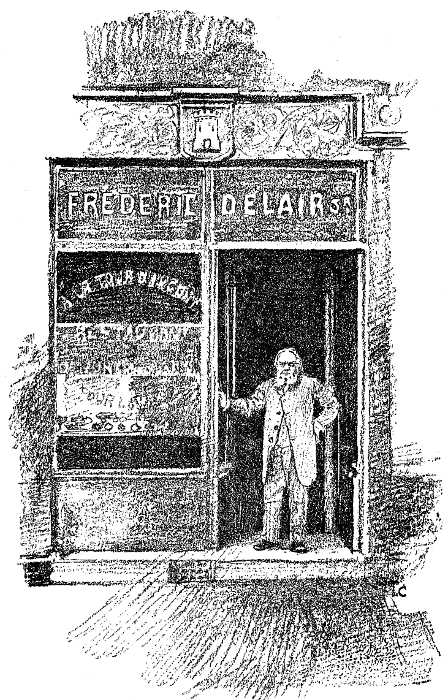
The "Tour d'Argent" and Frédéric Delair
Most of the Paris restaurants, now that Frédéric is no more, have
their silver turnscrew, and they do not feel guilty of plagiarism, for
Frédéric did not really originate this trick but adapted it from the
practice of French peasants who tried to get as much juice as possible
out of their tough and skinny ducks by smashing the carcasses with
stones.
Already in the middle ages the saucier, or saucemaker, was the
headman in the cuisine of French aristocrats.
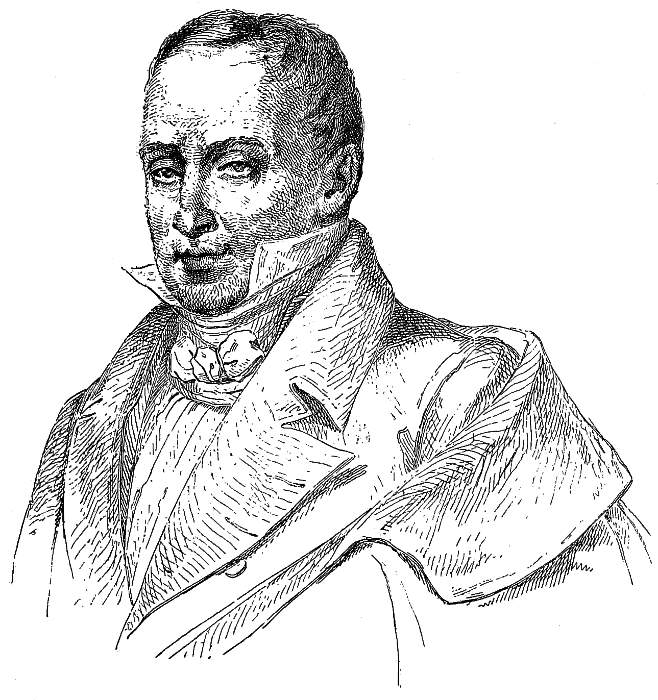
The age of Carême (who wrote eloquently and lovingly about sauces)
was, as Ellwanger remarks, "the era of quintessences—of the cuisine
classique, when chemistry contributed new resources, and fish,
meats, and fowls were distilled, in order to add a heightened flavor
to the sauces and viands that their etherealized essences were to
accentuate. One thinks of Lucullus and Apicius, and of the 'exceeding
odoriferous and aromatical vapor' of the ovens of the artist mentioned
by Montaigne."
The most common ingredients used to make the savory and appetizing
French sauces are the yolks of eggs (raw or cooked), salt, pepper,
mustard, vinegar, lemon juice, tomatoes, bouillon, shallots, anchovies,
onions, garlic, carrots, olive oil, orange rind, truffles, cream,
mushrooms, pickles, wines, meat extracts, cayenne, and diverse aromatic
herbs. But the most important of all French sauces is melted French
butter—not "kitchen butter," but the fresh, fragrant product of the
creamery. With such butter, and plenty of it, gastronomic miracles
can be performed.

CARÊME
There is a great deal of local Flavor in French sauces. Blindfold a
Parisian gourmet who knows his country, and place before him dishes
made after the fashions of different provinces, and he will tell you at
once the name of the town they smack of.
The coast towns enjoy special advantages in this respect, as they can
use diverse shellfish and other marine creatures peculiar to their
region to impart special overtones of flavor, so to speak, to their
sauces.
French enthusiasm over sauces reached its climax in the exclamation
that with sauce Robert a man might be pardoned for eating his own
grandfather!
Brillat-Savarin, like many of his countrymen, went too far when he
declared that "poultry is for cookery what canvas is to the painter."
No doubt, many of the sauces served with poultry in French restaurants
(each of which has its specialty, as it has in the line of fish sauces)
are delicious, yet good chickens, ducks, and turkeys, not to speak
of game birds, have flavors of their own which it is a barbarism to
disguise even with the noblest of sauces—except once in a while, for
the sake of variety. The way to cook any winged creature if you want
the most delicious flavor it can yield, is roasting à la broche.
Of the barbarism just referred to, many Parisian restaurants, I regret
to say, are habitually guilty. One evening, at one of the best of them,
I was simply dumfounded when a choice poularde, which cost as much
as the almost extinct canvasback duck does in New York, was served
with—horribile dictu—a sauce made of American canned corn! It was
not an attempt to cater to the supposed taste of a New Yorker, for it
was a plat du jour, prepared before we arrived and served to others.
Had I been the host of the occasion instead of merely a guest I should
have taken the head-waiter into a corner and whispered some advice into
his ear.
What aggravated the crime was that it was a poularde de Bresse that was
thus maltreated.
Many varieties of chickens are raised in France—the poule commune,
the race de Houdan, race de la Flèche, race de Crèvecœur,
race de Barbezieux, race Caussade, etc., besides imported
varieties; but the noblest of them all is the race de la Bresse.
The poulet de Bresse is the most highly esteemed of all domestic birds
that are served not only at French dinners, but at the best restaurants
and hotels all over Europe. It has a richness of flavor that puts it
far above other fowls—as far as its delicious fragrance puts the
Gravenstein above all other apples.
In France the poule de Bresse has long been held in highest esteem.
Brillat-Savarin wrote in 1825: "as to chickens, the finest are those
from Bresse, which are as round as an apple." English breeders have
recently discovered its superior merits. It promises, the London
"Telegraph" remarks, to "become very popular in the near future, and
deservedly so, considering the breed's laying and table properties,
which have been tested for fully a century across the channel. Bresse
is one of the principal towns in the Aisne district, and the breed
which bears its name was always cultivated for its white flesh, with
delicacy of flavor. Poularde de Bresse usually fetches a higher price
than any other fowl in the Paris market." "It behoves our English
poultry keepers to use every effort to popularize the Bresse fowl in
this country. The specialist club, started some three years since
[1909] has already done much.... Mr. G. H. Caple, of Stanton Prior,
near Bristol, is honorary secretary, and will give all needful
information."
It is to be noted that the Bresse fowl not only "puts on flesh in a
wonderful way," but has all the other qualities most desirable in a
farmyard bird. Several varieties have flesh as juicy as the Bresse,
and almost as delicate in flavor, but there is always some trait or
other that puts them at a disadvantage. The Houdan, for instance, is
a good bird for the table and a fair layer, but it requires too much
attention to be generally profitable. La Flèche provides a tender
morsel but flourishes only in dry regions, and the same is true of
the Crèvecœur class, which is extremely sensitive to humidity. The
Belgian Campine puts on good flesh but not enough of it. The American
Wyandotte and the Leghorn are robust, and good layers, but the flesh is
inferior in flavor. Much better in this respect are the Plymouth Rocks,
but they are poor layers. The Langshans class is good to eat, but does
not fatten easily, while the Cochins grow too slowly and their flesh is
mediocre as to flavor.
The poule de Bresse has none of these flaws. The black variety is the
hardiest of all chickens, flourishing in any climate except the extreme
north, and on any soil, dry or humid. As a layer she is among the very
best, often winning prizes for size and number of eggs. Though prolific
she is not too eager to set, but when she does hatch, she makes a
devoted mother. Best of all, the flesh is tender and juicy, there is
plenty of it, and in flavor it is beyond compare.
Truly, the poule de Bresse is the chicken for the farm and the
market—"c'est la véritable poule de rapport, celle qui convient à la
ferme," as a French noted aviculteur remarks.[9]
To my great surprise, in looking over Farmers' Bulletin No. 51 (1907)
entitled "Standard Varieties of Chickens," I found no mention of the
poule de Bresse in this forty-six-page document, which begins with the
statement that there are 104 standard and a large number of nonstandard
varieties of chickens raised in this country. Can we afford to be so
far behind the French—and the English?
Ungastronomic America confronts us in the statement, in Bulletin 51,
that although as a table fowl the Leghorn is only "fairly good," it
"holds the same place among poultry that the Jersey holds among cattle.
The question of profit in poultry has been decided in favor of the
egg-producing breeds."
In a country in which most poultry is spoiled by being put into cold
storage undrawn, it is no wonder that the laying capacity of a fowl
should alone be deemed worth considering; for, under these conditions,
as previously pointed out, breed and feed are of no consequence so
far as flavor is concerned. But the time is coming when the American
consumer will imperatively demand Flavor in Food; and bountiful
harvests will be reaped by farmers who look ahead now and stock their
poultry yards with an eye to good and abundant flesh as well as good
and abundant eggs. The Bresse race will fill the whole bill. It is best
for eggs, best for the table. A Bresse hen will virtually hatch two
chicks from one egg.
Salad goes with chicken as the piano goes with a song. To eat lettuce
with the cheese, as many Englishmen and not a few Americans do, is
preposterously absurd. As for putting sugar on lettuce I cannot write
down my opinion, for it is not fit for print. Salad cries for vinegar,
as a parched plant cries for rain.
Vinegar is not only agreeable to the senses of taste and smell, and
most refreshing, especially in summer, but it plays a very important
rôle in the digestion of food.
It has been said that God sent us our food and the devil our cooks.
This is not always the case, but the devil certainly inspired the
man who taught that, in mixing a salad dressing, the vinegar should be
added by a miser.
This maxim, widely accepted, has done a great deal of harm, not only
in spoiling many millions of dishes for the palate, but in preventing
salads from heading off dyspepsia, with all its evil consequences.
Many physicians have deplored the insufficiency of fat in the average
American's diet. Fat is especially important as a source of energy, and
also because fat meat is more savory and appetizing than lean meat.
Furthermore, physiologists have shown by laboratory experiments that
the presence of fat in meat or vegetable dishes makes them yield a
larger degree of nutriment (apart from what it contributes itself).
Professor John C. Olsen of the Brooklyn Polytechnic Institute says
that "fats and oils furnish fully half the energy obtained by human
beings from their food. Fats also exert a beneficial influence on the
digestive process, so that a diet without fat is dry and unpalatable."
The only drawback is that fat makes the food "rich" and difficult of
digestion—unless the cook is an artist.
This is why so many persons exclude it from their dietary, at the cost
of energy in men and the beauty of health in women.
It is here that salad comes to the rescue. The vinegar in it, if
genuine, excites by its fragrance and acidity the digestive glands not
only in the mouth and the stomach, but in the pancreas, which acts on
all the constituents of food, particularly the fats.
The pancreas is a gland near the stomach; it secretes the juice known
as pancreatic and pours it into the duodenum, or small intestine,
which—some ten or fifteen feet in length, is folded about it. To
prevent intestinal indigestion there must be an abundant flow of
pancreatic juice, and this flow is stimulated by the vinegar in the
salad we eat and other acids in our food.
On this point the greatest living authority on the subject, Professor
Pawlow, makes the following extremely important remarks:
... an acid reaction is not only necessary for an efficient action
of the peptic ferment, but is at the same time the strongest excitant
of the pancreatic gland. It is even conceivable that the whole
digestion may depend upon the stimulating properties of acids, since
the pancreatic juice exerts a ferment action upon all the constituents
of the food. In this way acids may either assist digestion in the
stomach where too little gastric juice is present, or bring about
vicarious digestion by the pancreas where it is wholly absent. It is
easy, therefore, to understand why the Russian peasant enjoys his kwas
with bread. The enormous quantity of starch which he consumes, either
as bread or porridge, demands a greater activity upon the part of the
pancreatic gland, and this is directly brought about by the acid.
Further, in certain affections of the stomach, associated with loss of
appetite, we make use of acids, both from instinct as well as medical
direction, the explanation being that they excite an increased activity
of the pancreatic gland, and thus supplement the weak action of the
stomach. It appears to me that a knowledge of the special relations
of acids to the pancreas ought to be very useful in medicine, since
it brings the gland—a digestive organ at once so powerful and so
difficult of access—under the control of the physician.
It is obvious from these disclosures that if every American family
followed the French custom of eating a sour salad at least once a day
there would be very much less intestinal indigestion, which is even
more distressing than indigestion in the stomach.
It is further obvious that Fletcherizing, or "mouth work," alone does
not avert indigestion, for saliva has no effect on fats. The pancreas
takes care of these, particularly if aided by acid ingredients in our
food.
Probably no detail of the French menu is therefore so important to us
as the daily sour salad.
An astonishingly small number of American families know what a
delicious and hygienically valuable dish salad is with a French
dressing of good olive oil and pure, fragrant vinegar.
There is very little nourishment in salad leaves until the oil has been
added; and the oil is what we need, with the vinegar to help digest it.
The two words I have just italicized explain why so many Americans
imagine they do not like salads with vinegar and oil dressing. Unless
the oil is good and the vinegar pure and fragrant such a salad does no
good but may do much harm; and it is seldom that one can buy good oil
and vinegar in a grocery store.
Of all the food adulterators none are more rascally and abundant than
the makers of artificial vinegar. Pure vinegars made of cider, wine, or
malt can be sold at a very good profit to the manufacturer and dealer
at from ten to twenty cents a quart; but this profit does not satisfy
the swinish greed of the adulterators and unscrupulous grocers.
By using acetic acid, a by-product of the distillation of deadly
wool-alcohol, they can make "vinegar" at a cost of two cents a gallon,
or 90 cents a barrel, which retails at over $20.
The pure food law covers this case, but the fines inflicted are so
trifling compared with the gains, that the adulterators regard them in
the light of a joke and continue their profitable poisoning, though
many of them have been before the courts two, three, or four times.
Jail is what their crime calls for. This so-called vinegar is in most
cases injurious to the health of those who consume it, and by its lack
of agreeable fragrance it discourages the healthful practice of eating
sour salads.
It is foolish to get vinegar of the nearest corner grocer unless you
know he is honest. It is best to buy it in the sealed bottles of firms
which have a national or international reputation for fair dealing.
The same caution should be observed in purchasing olive oil. Do not buy
it of a grocer who exposes his bottles in the show window. If he does
not know that sunlight spoils the best olive oil, he is not likely to
know, or care, what the best oil is.
Among the adulterants used to cheapen olive oil small quantities of
castor oil, lard oil, fish oil, and even petroleum have been found.
More frequent are rapeseed and poppy-seed oil. Peanut oil is much used,
but the most frequent adulterant is cottonseed oil, which costs only
about one-fifth the price of high-grade olive oil and therefore offers
great temptation to the dealer.
Cottonseed oil is not inferior in nutritive value to olive oil, and Dr.
Wiley assures us that no objection can be made to it "from any hygienic
or dietetic point of view." Of the three million barrels of it produced
in this country every year, not less than two-thirds are consumed as
food. It is "perfectly satisfactory," the doctor adds, "to those who
have not acquired a taste for olive oil."
If you like cottonseed oil there is no reason in the world why you
should not pour it into your salad bowl. But if you wish to enjoy the
epicurean delights of true salads you must train your sense of smell
and learn to distinguish between fragrant oil and cottonseed oil,
which, at its worst, has a disagreeable flavor and at its best is
practically odorless and tasteless.
It is the fragrance, the Flavor, of olive oil that keeps it in the
market, boldly defying its cheap rivals.
A great many Americans who think they do not like olive oil know not
what real olive oil is. They have been fooled by the adulterators. They
may have been careful to buy bottles labeled "Pure Virgin Olive Oil";
but, as Dr. Wiley says, "this expression upon the label has been found
in many instances of olive oil highly adulterated and belonging to the
cheapest grade."
There are more than a dozen grades of olive oil. It varies with the
locality it is grown in, the care taken in its manufacture, the season,
and so on. The first pressing (virgin oil) is the best; the virgin oil
of the month of May is finer than any other, and the best oil comes
from Italy.
It is worth while to cultivate a "taste" for the finer kinds, for they
are the most fragrant and digestible. Such oil is not only a table
delicacy second to none, it is also used more and more by doctors for
diseases of the stomach and other parts of the digestive tract. For
gall stone it is almost a specific.
As a cosmetic, nothing equals olive oil. The beauty of Spanish and
Italian women is owing largely to their daily and liberal use of it in
salads and cooked foods. It improves the complexion and rounds out the
lines of the form.
Eating salad is by far the most agreeable way to take olive oil. There
are persons with whom all acids disagree; these unfortunates have to do
without the fragrant vinegar; but they can easily learn to like salads
with oil and salt alone. The taste is decidedly worth acquiring.
In making the dressing, oil should by all means be applied "by a
spendthrift." "Put on as much as you think you can afford," I feel
tempted to advise; but, of course, you can get the best results more
cheaply by painting each leaf with oil or by thoroughly mixing the
leaves with it before putting on the vinegar. Always make sure that
there is no water in the bowl and that the leaves are well dried.
In hot weather the vinegar should be put on first, to make the salad
more piquant and refreshing. One spoonful of vinegar (pure and
fragrant, if you please) to every two of oil is not too much. Let the
stirring be done "by a maniac," according to the old maxim, for it is
most important.
Salt is a necessary ingredient, and a trifle of cayenne makes the
salad more digestible. Black pepper is, to some epicures, an unwelcome
intruder, though it is often used even in Paris restaurants, where I
now find it necessary to add sans poivre in ordering a salad. Once in
a while, for variety's sake, add a little mustard, or rub the inside
of the big bowl (it must be big, and Russian lacquer is the best) with
garlic. A few tablespoonfuls of meat gravy—particularly chicken
gravy (from roast or fricassee) give additional richness and savor to
the dressing.
If you can get no pure and fragrant vinegar, by all means use lemon
juice as infinitely better than "vinegar" made of acetic acid and
water. But if malt, wine or cider vinegar is at hand it is preferable
to the lemon, which does not harmonize so well with oil. Lemon is too
loud—too self-assertive—like a trombone added to a string quartet.
It is a subtle thing, this gastronomic instrumentation, and there are
differences of opinion as in matters musical. There is nothing better
than a glass of lemonade—except, perhaps, a glass of limeade;—in
very warm weather it is a luxury to suck a lemon like an orange. But
if a slice of lemon is put in my tea I lose the delicate aroma of the
leaves, which I am after; and so with salads. The fragrance of vinegar
is more delicate, and does not overpower the fragrance of the oil. On
the other hand, in making mayonnaise, which is also a French dressing,
having been invented by the Marshal de Richelieu, and which is often
used for green salads as well as for meat and fish salads, lemon is
perhaps preferable to vinegar. Apparently the addition of the yolks of
raw eggs to the other ingredients prevents the lemon tone from being
too loud. With sardines, also, a lemon is all right, because their own
flavor is not so weak as to be easily routed.
In remote regions, where pure olive oil cannot be obtained, a very fair
substitute for French salad dressing may be provided by following the
practice of Belgians and Germans of putting small cubes of fried bacon
into the vinegar. Sometimes the vinegar, thus oiled, is heated and then
poured over the leaves. That wilts them but makes a piquant dish for
a change. In one way or another, have a sour salad with your dinner,
especially if it includes fat food, for the reasons given.
In nineteen cases out of twenty the salad served in our country is
lettuce, and in nine cases out of ten the diner is insulted with huge
green leaves fit only for boiled greens or the stock-pot.
Green lettuce is good to eat raw only in its infancy (when two or three
inches high) or when it has shot up higher in a few weeks on very rich,
moist soil. Much better, however, is head lettuce, with the white
inside leaves, crisp and succulent. Even those, unfortunately, are
somewhat indigestible to many, unless very carefully chewed.
Those who find lettuce troublesome should by all means try the bleached
white hearts of the variety of endive known as escarole (the French
call it scarole).
Until a few years ago it was very difficult to find escarole in
any American market, and it is not abundant now. In the catalogues
of seedsmen who give several pages to the different varieties of
lettuce, escarole is disposed of in four or five lines of small type.
One catalogue, of the year 1912, referred to it as "unsurpassed for
salads;" the others made no comment at all, or spoke of it as "good for
soups or greens." As there has been practically no demand for escarole
seed, it was lucky to be listed at all.
Some seedsmen, however, when they know of a good thing, try to
create a demand for it. Prominent among those is W. Atlee Burpee,
of Philadelphia. To him I confided my sorrows over the difficulty
of getting good escarole—or often any escarole at all. I called
attention to the fact that it is, to say the least, equal in flavor
to the best head lettuce, and much easier to assimilate, one member
of my household being able to eat it by the bowlful, whereas lettuce
invariably gives her indigestion.
It is much easier to raise, also, than lettuce, which is extremely
"cranky" in summer. Even in cool Maine lettuce sometimes is wilted by
a single hot day, unless cared for like a tender hot-house orchid;
whereas escarole has as many lives as a cat. I have often, in thinning
out my plants, thrown them away by the dozen, to be roasted by the
sun; but if a rain came along in a day or two, they revived, took root
unaided, and grew into healthy plants!
A further advantage is that, in rich soil and with plenty of water, a
single plant will yield two or three hearts if those of the outside
leaves which are not needed for bleaching the center are left on;
whereas head lettuce is never of the "cut-and-come-again" kind.
The only trouble with escarole is that it has not been educated.
Lettuce has been trained by dozens of experts, the result being a large
number of excellent varieties, some with heads as solid as cabbages. My
object in writing to Mr. Burpee was to persuade him to give escarole a
"college education"—to teach it how to head, and bleach itself, like
lettuce.
He promptly replied that he would get seeds abroad of all the
different varieties and experiment with them in his Fordhook trial
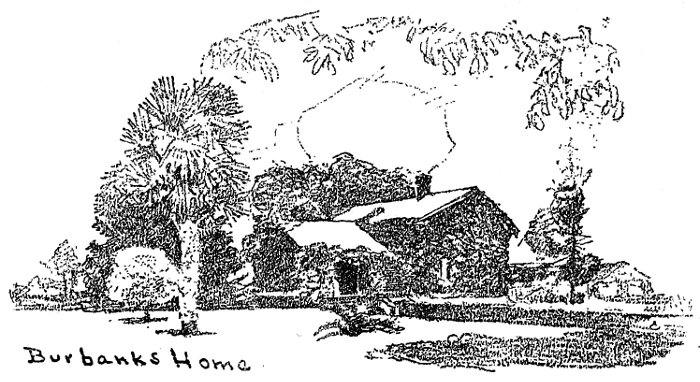
grounds; also, that he would write to Luther Burbank and try to get
him interested. Unfortunately Mr. Burbank was too busy with other
reforms to take up this plant too; but Mr. Burpee forged ahead, and
in November, 1912, he sent me copies of the notes on the varieties
of escarole he had sowed—seventeen in all. "One or two of these,"
he wrote, "seemed to be much better than the Broad Leaved Batavian,
but none of them are really self-folding." There seems to be hope in
a variety numbered 5131 on his schedule, which is thus described:
"Foliage pale yellowish-green, a robust strong grower, averaging twenty
inches in diameter, leaves eight inches long by four inches in breadth,
plain leaved, but slightly curved, inner leaves being much incurved,
giving the impression of its being an excellent strain for bleaching."
Along those lines I have no doubt that a head-escarole will be evolved
in a few years, and that the world will be indebted to Mr. Burpee for
one more gastronomic delicacy as welcome as his improved head-lettuces,
his limas, his stringless pod beans, and his improved melons,
cucumbers, squashes, tomatoes, cabbages, and other vegetables. Mr.
Burbank wrote to me under date of December 18, 1912: "It is so natural
for escarole to spread flat on the ground, that it will take some time
and a little pains to make it form a head." Mr. Burpee will take the
time and the pains.
The bitter taste of escarole—a mere trace where the plant is well
grown—is welcomed by epicures and hardly noticed by others.
The dressing is the same as for lettuce. A combination that cannot be
too highly commended is tomatoes with escarole. This mixture is, I
think, my favorite of all salads.
So far as tomatoes are concerned, we have nothing to learn from the
French. As it is an American plant—its original home being Peru—it
is proper that Americans should have a greater number of varieties and
improvements than any other country.
The Germans are only just learning to like tomatoes; the English have
made more progress in this important branch of gastronomic education;
the French revel in the tomato; and in Italian cookery it is an
important ingredient; but in the United States tomato-eating amounts to
a passion, a frenzy.
In New York every corner grocery, even in the poorer quarters, has
its constant supply. Apparently, all classes, rich and poor alike,
are bound to have their tomatoes daily, be their price five cents a
pound or twenty-five or more. For this astonishing appetite there
must be good reasons. The tomato, with its delicate acid flavor is
unquestionably most wholesome. Often I walk a mile to bring home the
best specimens of this grand appetizer I can find; and in my vegetable
garden the patch most carefully enriched and hoed and watered is that
where the tomato grows.
To get it at its best you must pick it off the vine and eat it on the
spot, without any condiment. It is good in a score of ways—stewed,
grilled, as a catsup, even canned—but for table use it is most
desirable in the salad bowl, alone or in combination with escarole or
lettuce.
It ought to be needless to add that it is much pleasanter to eat, and
more digestible, if it is peeled (which is easily done after soaking
it a moment in hot water) before slicing; but few cooks will take this
extra trouble, slight though it is, unless specially requested.
If we can perhaps give even the French points on tomatoes, they have
much to teach us regarding another vegetable which is among salads what
diamond-back terrapin and canvasback duck are among meats—the globe
artichoke.
Fortunately, unlike turtles and wild ducks, this noble plant is yearly
becoming more abundant in our markets. It would be as much in demand
as tomatoes were its flavor equally known and the samples on sale as
tempting as those served in Paris and London. It is for the consumer to
insist on having the best varieties sent from abroad and cultivated at
home; but the dealers on their part ought to be alive to the fact that
the way to increase sales is to offer the best at the lowest price.
The French artichoke makes a savory vegetable, served hot; but how any
one can eat it—or asparagus—hot, when he might have it cold as a
salad, with French dressing, is a mystery to me. Of course, it must be
boiled, except when very young and tender.
To get the artichoke at its best one must ask for it in a first-class
Paris restaurant. The waiter brings a huge specimen in a large plate,
removes the inedible "choke" in the center with a movement like that of
a dextrous carver (French waiters receive prizes for skill in carving),
and there it lies in all its fragrant magnificence.
Rossini objected to the turkey as being a bird too large for one and
not large enough for two. Time and again in Paris I have had placed
before me an artichoke big enough for two; and since my partner prefers
the scales and I the fond, we were both happy though married.
As the scaly leaves of the artichoke must be dipped into the dressing
and sucked, it is not for persons who object to using their fingers
except to hold knife and fork, any more than are crawfish, or olives,
or peaches.
The Moors of Morocco prefer to use their hands for conveying food to
the mouth, because, as they sensibly maintain, they know that their
hands have been thoroughly cleaned, whereas knife and fork may have
been washed carelessly.
The merits of the French artichoke were known in New Orleans long
before they were in any of our other cities. In various forms and
combinations, it helped to give distinction to the famous local cuisine.
The Frenchman who first ate an artichoke was as bold as the man who ate
the first oyster, for the plant looks like a thistle and he ran the
risk of being classed with thistle-eating quadrupeds. Compared with
the succulent globe of to-day it must have been thin, dry, and tough.
Yet, even now, the artichoke is capable of much further improvement.
Burbank, if he had time, might put as much meat into the base of each
scale as there is now in the bottom, and make the bottom as big as a
full-sized turnip.
This suggests one of the many ways in which the study of gastronomy
serves as a guide to wealth. A rich harvest is sure to be reaped by
those gardeners who will introduce to American markets the best
French artichokes, and by the dealers who will encourage their purchase
by asking reasonable prices for them. In December, 1912, I asked a
dealer in Washington Market, New York, why there were so few artichokes
offered for sale. "They are so cheap—we can't get more than 15 cents
apiece for them," he replied. That's the American way—at present.
For years importers and dealers have done their best to discourage
the growing interest in another delicious basis for salad—the
alligator-pear—by charging the most outrageous prices for it—usually
twenty to fifty cents apiece, though it can be bought in the West
Indies for a penny or two and brought to New York for a cent a pound.
Even at such extortionate prices the demand usually exceeds the supply.
I often hunt for some all over town and usually end by saying, "What
fools these dealers be."
The alligator-pear—or let us call it avocado, please—is one of the
Creator's masterpieces—what we would call a stroke of genius had
a mortal originated it. But, like other works of genius, it is not
appreciated by all—or at once. An American, writing from the West
Indies, declared that there the avocado is "ever present and always
welcomed." But, he proceeds, it is "a pitfall and a snare, and many a
green foreigner has been taken in by the name and afterwards by the
pear itself. Such a magnificent specimen of this luscious fruit, the
'pear,' as the one seen in the Jamaica markets causes the hand of the
new arrival to go down promptly into his pocket for a penny with which
the coveted fruit is secured. Yum, yum! A pear weighing three or four
pounds! What a feast! The knife appears, a generous slice is cut out,
but when it touches the palate! Yah! It is a flat, flabby, tasteless
vegetable (although it grows on a tree), but sliced and eaten with salt
at the table it forms a pleasant relish."
Had this man eaten it with French dressing he would have found it a
food fit for gods. The avocado was undoubtedly created to serve as a
salad. If you cut it in two, lengthwise, and take out the big stone,
you have two halves like those of a small melon. The flesh, firm though
soft and custardy, has a most exquisite flavor—a faint flavor which,
with oil and vinegar makes a symphony of fragrance.
Until a few years ago I myself, misled by poor specimens, groped in
utter darkness as to the enchantments of the avocado. It was Hildegarde
Hawthorne who, returning from Jamaica, brought us some choice samples.
There was joy in the mansion thereat. It was like the discovery of a
new song by Schubert or Grieg, or a new painting by Titian.
After writing the above remarks I came across a clipping in which an
evident epicure objected to "desecrating" the avocado pear by oil or
mayonnaise dressing when served. "Eat it with a spoon slowly," he
advises, "to give time for the pleasure it imparts to permeate the very
soul, and let who will rail at fate. There are those who give it a
slight sprinkling of salt, others who dust it over with a little white
pepper, but personally I would as soon think of flavoring my currant
jelly with garlic or my chateau Yquem with Trinidad rum."
This sounds plausible, and I admit that a perfect avocado is better
without than with vinegar and oil. An imperfect one isn't; and in most
cases we have found in our dining-room that the avocado is rather too
rich to be eaten without a little acid dressing. It contains seventeen
per cent. of oil, and is known in some regions as the "butter fruit."
To return to France. Next to the artichoke and the escarole—which is
the better of the two I don't know—the most desirable thing it has
given us in the way of salads is the romaine—but how much whiter,
crisper and tenderer it is in Paris than what is offered for sale under
that name in New York!
Another chance to coin good money, messieurs gardeners! Americans
must have the best, and if you don't supply it, a rival will.
The American lobster and shrimp salads cannot be beaten; but we
have much to learn of the French and other Europeans as to the
endless varieties of green, vegetable, fish and meat salads by way
of multiplying the pleasures of the table, and banishing intestinal
dyspepsia, for which salads are more remedial than Fletcherizing.
When once the importance of this subject is fully understood,
salads will become the principal lunch dishes in American homes and
restaurants, especially during the hot months when to be "three miles
from a lemon"—or something else that is refreshingly sour—is a
hygienic tragedy.
"Fruit salads," when not sour, make desirable desserts. When not sour,
such combinations should not be called salads. As a rule sour fruit
mixtures seem incongruous to a trained palate.
In these days of Debussyan influences one must be prepared for all
sorts of anarchistic combinations of flavors. Personally, I draw the
line at the compound of Roquefort cheese and sour salad now placed
unblushingly on some American tables. The mixture of these two
delicacies is awful. One can easily see how the illegitimate union was
suggested by the illogical custom of serving cheese with salad, dressed
or undressed—the usual English way.
The mess just referred to, which would make a Parisian gourmet shudder,
is only one illustration of the Anglo-American mistaken policy of
serving together foods that are preferable separately. On this point,
too, France has an important lesson to teach us, particularly in the
serving of vegetables.
The making of a menu requires as much taste and judgment as the
arranging of a concert program. Next to variety, contrast is the
most important thing to be considered. A vegetable served separately
provides some of this needful contrast.
An English epicure declares that the secret of the excellence in French
cookery lies in the lavish use of vegetables. "Where we use one kind,
French cooks use twenty."
This point was sufficiently dwelt on in the paragraphs relating to
the making of savory soups and stews. It illustrates Gallic skill in
culinary orchestration. But the French know that at a dinner, as at a
concert, a solo piece is desirable, and therefore they always serve
one choice vegetable as a separate course.
As a matter of course the vegetable selected for this distinction—be
it peas, beans, spinach, cauliflower, asparagus, artichoke, carrots,
or whatnot—must be particularly fresh and succulent. It must also,
like the singer's solo number, have an accompaniment, that is to say an
appropriate sauce.
No French cook would spoil the delicate natural flavor of green peas
with mint, as the English do. I once asked a waiter in a London
restaurant why mint was put with the peas. He promptly replied: "Peas
'ave no flavor, sir!"
In France, butter (French butter) is used as the best accompaniment to
a solo vegetable. It makes the string beans and whatever else it goes
with more savory, without obliterating their individual flavor, as the
mint does in the case of peas.
The French have reason to boast that the gastronomic center of the
world is in Paris, within a circle intersected by a line drawn from the
Place de l'Opéra to the Place Vendôme. In this region there are scores
of restaurants of the first rank in which one eats the best soups and
stews, the best veal, the best poultry, the best salads and sauces,
the best vegetables, the best entrées, the best bread and butter, the
best cheeses, to be found anywhere on this big planet of ours. Some
persons, for sufficient reasons, prefer English roast meats or German,
Swiss, or Austrian pastry, but in the preparation of the foods just
named French supremacy is unquestionable.
It takes months—and a big purse—to get an adequate idea of the good
things offered at the Paris restaurants. Each has its special dishes
and sauces, handed down in some cases from generation to generation.
Not to have a unique sauce for sole, or a monopoly in a special kind of
soup, would subject an establishment to the danger of being classed as
second-rate.
Paris is full of professional epicures—prominent among them are
authors and journalists—who frequent certain places for special famous
dishes and who quickly resent any deterioration or carelessness on the
part of the chef. It is these connoisseurs who are served best; they
are willing to give the cook time to prepare a dish scientifically,
and they take time to eat it hygienically, that is, with lingering
enjoyment of its appetizing flavors.
These gourmets appreciate epicurean subtleties like that practiced
by the late Frédéric of the Tour d'Argent, who held that "different
kinds of fuel should be used for the roasting of different kinds of
meat, believing that the spiced scents of some woods transmitted
in the cooking add to the pleasure of eating all kinds of game";—a
notion which was acted on by the ancient Romans as well as by Japanese
gourmets, and which is also justified by the fact that in the smoking
of ham and bacon it makes a decided difference what kind of wood is
burned.
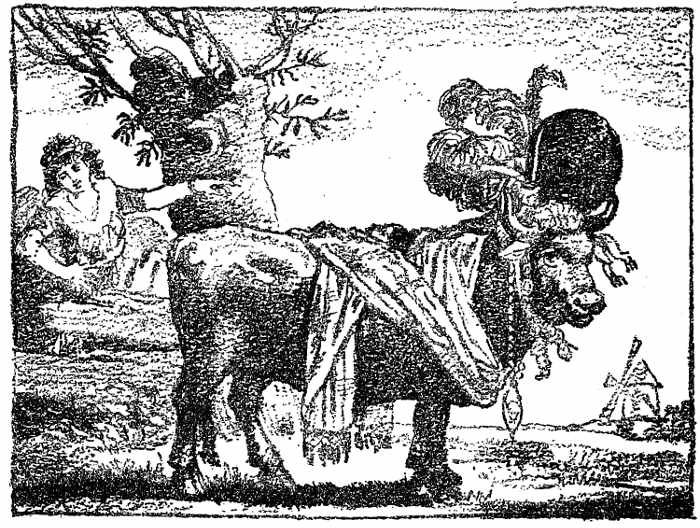
Boeuf à la Mode
One of the oldest Parisian restaurants is the Boeuf à la Mode which,
for more than a century, has owed its vogue in part to its special way
of preparing and serving the dish after which it is named.
A specialty of these restaurants is pancake. In our own country "French
pancake" is usually a thick, leathery griddle cake rolled round a
spoonful of jelly and served tepid on a tepid plate. In Paris the
head waiter himself attends to the important function of putting the
finishing touches on the cakes. They are brought in from the kitchen
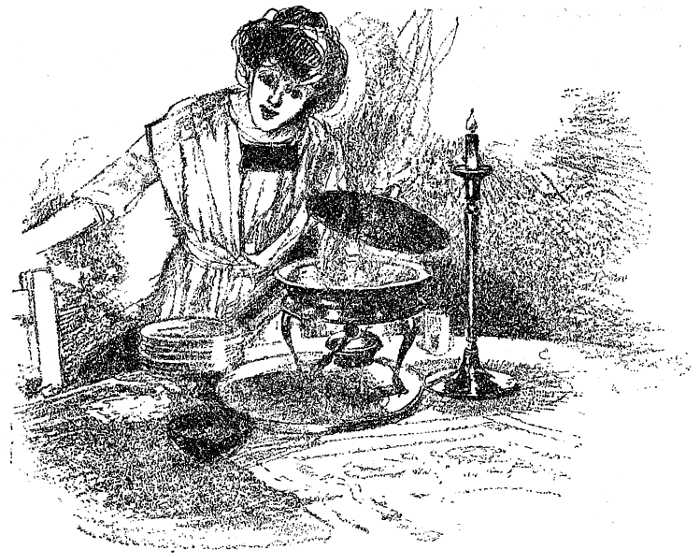
thin, crisp, and hot; but that is not enough. The waiter has before him
a chafing dish into which he puts one of the cakes, with a hard sauce,
and some liqueur which is set on fire. He has also before him a pile
of hot plates for each of the diners; into one of these plates each
cake is transferred when ready and brought to you by another waiter, to
be eaten red-hot. It is worth a trip across the Atlantic to eat those
pancakes.
Mutton on the best Parisian menus is not simply mutton. It is mutton of
a particular "vintage," and in some cases the name of the breeder of
the sheep is printed on the bill of fare.
Fruit is brought to the table in large baskets. Cherries, and
particularly the fragrant wild strawberries, seem doubly appetizing
when served that way. A fragrant French melon sometimes perfumes a
whole dining-room. Those who have to count their francs, however, had
better inquire as to prices before indulging freely in fancy fruits.
Very expensive, though worth the money, are the langoustes, which are
as good as the American lobster. Better still are the écrevisses, or
crawfish, which are kept on sale alive in the great market place, and
are therefore always good, and safe to eat.
Some restaurants are favored for their lunches, others for their
dinners, still others for their late suppers. In this last class, it
is needless to say, vulgar extravagance prevails. Usually there is the
latest kind of dancing, or music, or some other kind of stupefying
noise, and gastronomy takes a back seat.
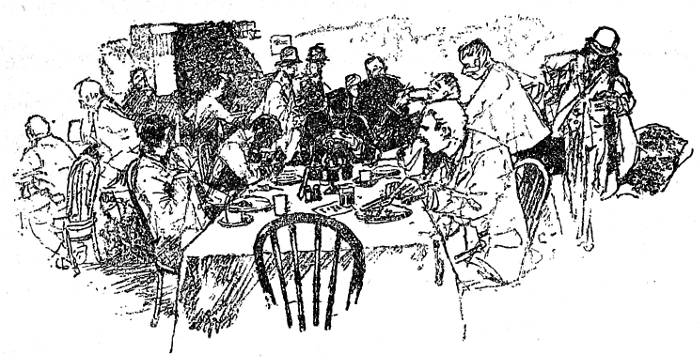
Warm weather brings into favor the summer restaurants, in which usually
one can lunch or dine in the garden or under a tree. That the breathing
of outdoor air while eating is as great an appetizer as the savory food
itself, is one of the many lessons we have yet to learn of the French
and other Europeans.
How did the restaurants of Paris get their culinary supremacy?
During the Revolution many of the nobles were ruined, and their
chefs—among them Méot, Robert, Roze, Véry, Leda, Legacque,
Beauvilliers, Naudet, Edon became caterers to gourmets at large.
"Beauvilliers, who established his restaurant about 1782, was for
fifteen years the most famous restaurateur of Paris, and provided
liberally such delicate and sublimated dishes as those which had
hitherto been found only on the tables of the king, of the nobles, and
of the farmers-general. The great restaurateurs of modern Paris are
nearly all successors of one or the other of the famous cooks above
mentioned," as Theodore Child pointed out.
In the Bibliothèque Nationale in Paris I came across books giving
curious glimpses of the restaurants at earlier periods. In 1574 there
was published a "Discours sur les causes de l'extrême cherté qui est
aujourd'hui en France et sur les moyens d'y remédier." The author
complains that people are no longer satisfied with three courses
but must have meats in half-a-dozen styles, with sauces, hachés,
pasticeries, all sorts of salmigondis, etc. Every one he says, now
goes to dine at Le More, Sanson, Innocent, or Havart, "maistres de
volupté et despense, qui en une chose publique bien policée et reglée
seraient bannis et chassez comme corrupteurs des mœurs."
This diatribe against the providers of savory food as corruptors of
public morals who, if the police tended to its duty, would be chased
from the city, seems to indicate that Puritan ideas on the subject of
the enjoyment of food once prevailed even in France.
As late as 1842 there were only seventeen restaurants in Paris,
where now there are more than seventeen times seventeen. At the date
mentioned, most of them were near the Palais Royal, and one could
dine for two francs—forty cents!—while lunch was only a franc and
a quarter. There were places where a workman could get, for twenty
centimes (four cents), bread, wine, soup, and meat enough for a meal.
In Paris, as elsewhere, prices have soared since that time, but
correspondingly cheap eating places abound in all quarters. The
lowest-priced restaurants likely to be patronized by tourists and
resident foreigners are the Duval, and other "Bouillons," at which one
who knows may get good dishes. Well-to-do Parisians and foreigners may
often be seen in these eating places, and one of them actually has a
star of excellence in Baedeker.
At one of these establishments I had one of the best petites marmites
I have ever eaten. If you don't know what a petite marmite is I am
sorry for you. I have dined repeatedly with a Frenchman noted both as
artist and epicure, and each time he ordered petite marmite. If you ask
a French head waiter's advice in London or Paris, he is more likely
than not to suggest petite marmite. It is so good, and the making of
it gives such a deep insight into French methods that I will quote the
recipe by Escoffier in his "Le Guide Culinaire." It is for ten people.
Nutritious elements: 2 lbs. beef, one lb. lean, the other
well mixed with fat, as the end of a rib. 1 marrowbone wrapped
in cheese-cloth, 1 fowl—not too young and tender, giblets from
four fowls. Liquid: 3 litres (about three quarts) of white
consommé—recipe follows—the seasoning to be added just before
serving.
Aromatic elements: 2-5 lb. carrots (200 grammes), 2-5 lb. nearly
ripe turnips, 3-10 lb. leeks (150 grammes), 1 small celery heart,
1/2 lb. cabbage, blanched, cooked separately with bouillon and
drippings.
"Observations: The 'Petite Marmite' consommé is served without
clarifying, and owes its merit only to the materials which it
contains and the extreme care brought to its preparation. It must
be served slightly fat. Its special savor, different from clarified
consommé, must recall the homely Pot-au-feu, and be recognized
unmistakably in Croute au pot, Consommé à la Bouchère, and others
of which it is the base, the only difference being that these
consommés do not need absolutely to have fowl in them, whereas it is
rigorously obligatory in the Petite Marmite.
"For 10 litres of white consommé 7 kilos of beef (between 14 and 15
lbs.) 4 kilos being lean meat, the other 3 soup bone, 21-5 lbs.
carrots (5 or 6), 900 grammes (nearly 2 lbs.) turnips, 1 lb. leeks,
2-5 lb. parsnips, 2 medium-sized onions, 3 cloves, 3 cloves of
garlic, 3 pieces celery, 14 litres (14 quarts approximately) cold
water, 70 grammes brown salt (salt that has not been purified). Cook
five hours.
"Observations: Simple consommé is habitually cooked 5 hours, which
is quite sufficient to get all the nutritious elements from the
beef. On the other hand this is quite insufficient for the bones and
fails to extract their nutritive principles. To obtain this result
slow cooking from 12 to 15 hours is necessary. In great kitchens
it has become the habit to make a first consommé with the bones
(crushed) which will cook at least 12 hours. This consommé is then
used for a second cooking of the meat alone which takes about 4
hours, that is only the time necessary to cook the meat. This second
operation can be shortened by cutting meat and vegetables in small
pieces and clarifying them as usual."
As the American practice of bluffing—of charging a high price for
a poor thing, to make the consumer think it must be good—is not a
Parisian trait, the more expensive the restaurant, the better the food
is likely to be.
Next to the Bouillons, in the culinary hierarchy, are the Brasseries.
At these, one can get well prepared dishes at reasonable prices, which
are always marked on the bill of fare; and, as the name indicates, one
can take a glass of beer or a bottle of mineral water instead of the
expensive wine which the highest class restaurants expect every one to
order, on penalty of perhaps not being served with a meal prepared in
the chef's best mood.
These leading restaurants are at present in the throes of a serious
struggle for existence; pessimists go so far as to predict the
extinction of the whole species in the not very distant future. The
Maison Dorée and the Café Riche had to make way some years ago for
business houses that could better afford to pay the soaring rents, and
in 1912 the Durand was transformed into a tailoring establishment. Of
the old classical restaurants the Tour d'Argent, Lapérouse, Paillard,
Bœuf à la Mode, Voisin, hold their own, yet I have dined
in them on evenings when they were anything but crowded.
Doubtless the custom of some of these places of not affixing prices to
the viands offered on the bill of fare has had something to do with
bringing about this result. Even a well-to-do diner does not always
care to be entirely at the mercy of the head waiter in the making-up of
his bill. But it is the multiplying of the brasseries that is chiefly
responsible for the decline of the high-priced restaurants, and another
dangerous rival that has helped to bring it about is the palatial,
up-to-date hotel. Some of these hotels employ as good chefs as the
leading restaurants and offer as abundant opportunities for sumptuous
and savory repasts, at prices tall enough to please the most reckless
visitor from New York or Buenos Ayres.
Gourmets will doubtless continue to frequent the classical restaurants
as long as they maintain their high standard. It would be a historic
as well as a gastronomic calamity to have them disappear. If necessary
the Government should give them a subvention as it does to the Opéra
and the Théâtre Français; for these epicurean establishments have done
quite as much as the theaters to make France famous among the civilized
nations of the world.
It is owing to them that French long ago became the culinary
world-language. Go wherever you please, from Paris to Berlin,
to Lucerne, Milan, Vienna, Constantinople, Tokio; or, in the
other direction, to London, New York, Chicago, San Francisco,
Melbourne,—everywhere, at the leading restaurants, you will find the
menu printed in French, and, in case of a course dinner, the viands
offered in the order prescribed by French gourmets.
In Germany, after the Franco-Prussian war, chauvinistic attempts were
made to banish French words from the bill of fare. These attempts were,
as Hermann Dunger frankly admits in his Verdeutschungswörterbuch
(1882), a failure; in some cases the comic consequence was that Germans
who recognized a dish under its French name hadn't the remotest
idea what it was when translated into their own language. Like the
Italian forte, piano, adagio, diminuendo, and other musical expression
marks, French gastronomic words have become parts of a spontaneous
Esperanto—a world-language, which has come to stay; a perpetual
reminder of the most important contribution made by the great French
nation to modern civilization—the gradual substitution, everywhere,
and particularly in Germany and England, of refined methods of
preparing food in place of the barbarous mediæval ones prevalent until
two centuries ago.
We get an interesting glimpse of French gastronomic leadership by
glancing at the words successively adopted by the Germans. In 1715,
when the "Frauenzimmerlexicon" of Amaranthes appeared, the following
French words had already gained currency, among them: bouillon,
carbonade, champignon, côtelette, coulis, crème, à la daube, entremets,
farce, fricadelle, fricandeau, fricassé, gelée, hachis, marinieren,
omelette, pikant, potage, ragout, saucisse; and for most of these there
was no exact equivalent in German.
During the time of Louis XV Germany further imported the following:
dejeuner, diner, souper, dessert, entrée, fumet, haut-goût, poularde,
saucière, sorbet, table d'hôte, bonbon, champagne, limonade, liqueur.
To a later period belong braiser, bœuf à la mode, consommé, filet,
hors d'œuvre, konserve, roulade. These as well as the words
gastronome and gourmand were imported during the early decades of the
nineteenth century. To the second half of the century belong croquette,
entrecôte, flan, remoulade, meringue, purée, vol-au-vent. The word menu
was not adopted in Germany till after 1850.
In Paris as in New York one can make a gastronomic tour of the world.
While the French, in return for all the culinary terms they have lent
their neighbors seem to have adopted only one Teutonic word ("Bock,"
for beer), they amiably tolerate the presence within their walls of
German and Austrian restaurants, some of which are excellent, though
thoroughly exotic from the French point of view. In one of them
the host is so much of an epicure himself that in his delight with
the Viennese menu he sketches for you, he will blow a kiss at the
enjoyments it calls up in his imagination.
Most Germans and Austrians, however, are glad to frequent the French
restaurants while in Paris, and the same, as Col. Newnham-Davis informs
us, is true of the English visitor, though if he desires a chop or a
steak, he can have one made to order in one of the many grill rooms in
foreign style that have come into existence, and in one of which the
joints of beef and mutton are wheeled to the tables and carved there
to order, as in some London eating houses. The Italians are more apt
to cling to their own style of cookery, and they have plenty of places
adorned with Chianti bottles where they can have their spaghetti, their
risotto, their fritto misto, and their other excellent fries. The
Spanish also have places where they can indulge their appetite for home
dishes; and so have many other nations, including Greeks, as well as
the Turks and other Orientals.
Of all the foreigners only two, the Russians and the Americans, have
had a definite influence on the French cuisine and menu—and not to
their advantage, it must be confessed.
From the Russians the Paris restaurateurs borrowed the custom of
beginning a meal with hors d'œuvres, or appetizers. I remember
the time when the hors d'œuvres in France simply meant radishes,
butter, and a few thin slices of sausage which were placed on the
table at once and against indulging in which the guide books warned
tourists unless they were prepared to face a substantial addition to
their bill. To-day, the price of the appetizers is usually noted on
the bill of fare, and it is not at all high, even at the aristocratic
restaurants. Cold smoked salmon, tunny fish, sardines, baby artichokes
in oil, various vegetable, fish, and lobster salads, cold eggs, sliced
sausages, and sundry other delicacies are offered, with bread and
butter.
These things undoubtedly are good, and they are appetizers; but they
are also appetite destroyers—quite too substantial to preface an
elaborate dinner. In Russia and Scandinavia, where the extreme cold
creates a ravenous appetite and a great capacity for stowing away
things, they may be all right; but in temperate climes, and for
dwellers in cities who get little exercise, they are too heavy. When I
see one of these displays of cold dishes I always think what a tempting
lunch they would make all by themselves; but if I eat them before
dinner I certainly cannot enjoy what follows as much as I would without
them; and that, I believe, is the experience of most diners who are not
neighbors of the Eskimos.
It is different with caviare and oysters. These are merely appetizers,
containing little nourishment; but caviare is not for everybody, and as
for oysters, since they must be served ice-cold, it is unwise to chill
the stomach by beginning with them. Let them follow the soup, which
is, because of its warmth and its stimulating effect on the digestive
glands, the best thing to begin a meal with. Muskmelons and grapefruit
may be allowed to precede it if served without ice, which certainly
impairs their flavor.
While adopting the Russian hors d'œuvre habit, the Parisians have
had too much taste and moderation to indulge in its Gargantuan
extremes. The performances of Russians and Swedes border on the
miraculous.
If Russians in Paris cannot everywhere indulge in the riotous profusion
of hors d'œuvre they have at home, they can do so at La Rue's,
which has a full line of them and also of diverse other "mets Russes
nationaux."
Americans who wish to eat ham and eggs, or hash, or corn muffins,
griddle cakes, breakfast cereals and that sort of thing, may find them
in hotels and in not a few of the restaurants. American lobsters, at
Eiffel Tower prices, are on every menu, and there are places where
oysters from across the Atlantic, as well as native, can be ordered
raw, scalloped, fried, broiled, or in diverse stews, tout comme chez
nous. The numerous grill rooms are also accommodating, though they do
not open early enough to offer an American breakfast, while the hotels
seldom venture on anything beyond bacon and eggs before lunch time.
It would be well if the Parisians ate an American breakfast and
followed it up with a lighter lunch; but it would require another
revolution to bring about such a reform.
Paris has become considerably Americanized. One can hardly wonder at
having our cotton seed oil served instead of the noble juice of the
olive at the cheap restaurants; but when I found that it was used
unblushingly at some of the more expensive places I was shocked at
this sign of decadence—or effrontery—and visions of cold storage
poultry, salted butter, and doughy bread with inedible crust—but no!
such things no one would ever dare to place before Parisians!
The fact that their own olive oil is not as a rule equal to the best
Italian may have made them for the moment tolerant of the American
invader. The health authorities speak of diverse other substitutions
and adulterants as being in use; but these are not necessarily
American, though we lead the world in our tolerance of them.
What the Parisians chiefly complain about in reference to American
influence is that it has introduced our national vice of hurry into the
kitchen and the dining-room. When so many of the wealthiest patrons of
the restaurants expect to get dishes served at a moment's notice, to
be gulped down and hastily followed by others, the very strongholds of
gastronomic France—slow cooking and leisurely eating—are assailed.
The chief danger to the French cuisine lies in the fact that, as Mr.
Paderewski put it in a talk I had with him on this subject, "it is so
much easier to prepare a meal the American way."
South Americans, though they have little to boast of at home in the
way of pleasures of the table, adapt themselves more easily to French
ways, and as they are rapidly increasing in numbers in Paris and spend
even more money than the North Americans, their influence will perhaps
counteract that of the impatient visitors from the United States, who
usually know so much more about making dollars than about spending them
rationally.
Every American has attended banquets at which there was more to feast
the eyes than the palate. In the Figaro Marcel Prévost complained
(1910) that this sort of thing was gaining in Paris. "Mangeront-ils?"
he asked—will Parisians of the future eat? Judging by the present
tendency, they will not, he answers—they will feed. They will take
nourishment, but gastronomy, the art of dining with intelligence and
pleasure, will have ceased to exist. In the house the cause of this
change is what Prévost calls the "progrès de la coquetterie féminine."
Women, to be sure, were never the greatest of the culinary artists,
but they used to pay some attention to food and its preparation,
whereas at present their chief thought is of the appearance of the
dining-room and the table. The linen, the porcelain, the glassware,
must be of the finest, the flowers of the costliest, but the food and
wine are provided by a paid caterer, who seldom knows his business.
As for eating in restaurants or hotels, that is no better. The famous
"maisons" have disappeared, to be replaced by huge palaces, in which
everything is showy and sumptuous but the food everywhere the same,
without distinction or individuality. What is worse, the younger
generation does not seem to regret this. French youth even drink
American cocktails and are not ashamed!
While there is no doubt some truth in these allegations they are
absurdly exaggerated. Complaints as to the decadence of French cookery
have been made at regular intervals—like the complaints about the
disappearance of great singers. I once amused myself by writing an
article covering three centuries, in which I quoted the laments of
each generation over the decline of the art of song as compared with
the brilliant achievements of the preceding generation of singers.
Were it worth while I might compile equally amusing evidence on the
subject of the French cuisine. Thackeray complained of a similarity
of dinners. Charles Monselet in 1879, looked "in vain for the tables
that are praised or the hosts that are renowned." In 1866 Nestor
Roqueplan complained that the French "no longer find places devoted to
the Flemish kitchen, others to the Normandy, Lyonnaise, Toulousian,
Bordelaise, or Provençal kitchens." But he had the good sense to add
that "France nevertheless is still the country where eating is found at
its best."
So it is at the present day, and is likely to be for years to come.
No matter how many of the best chefs are taken away by American
millionaires or Russian Grand Dukes, Paris remains the world's high
school of culinary art.
While there may be fewer opportunities than there were formerly to
get special Lyonnaise, Toulousian, or Bordelaise dishes in Paris, the
Provinces themselves offer abundant opportunity to study and enjoy the
infinite variety of French cookery. How large a field is open to the
student may be inferred from the fact that Col. Newnham-Davis devotes
no fewer than seventy pages of his "Gourmet's Guide to Europe" to
a study of the inns, hotels, and restaurants of Provincial France.
He found that "almost every town of any importance has some special
dish or some special pâté of its own; there are hundreds of good old
inns where the cuisine is that of their province, and there are great
tracts of country which ought to be marked by some special color on all
guide-book maps, where the cookery is universally good."
This noted English epicure advises gourmets who have time to journey
leisurely and especially those who have an automobile at command, to
make a journey of gastronomic exploration in the district between
Montpellier and Toulouse, which is "a cradle of good cooks" and where
some of the traditions of cookery of the old Romans still linger. The
land of the Meuse, the Moselle, and the Saône is another and more
northerly paradise of good cooking. "In Dordogne there is not a
peasant who cannot get a traveler en panne a truffled omelette which
would make an alderman's mouth water ... and all the Midi from the Alps
to the Pyrenees is a happy hunting ground for the gastronome."
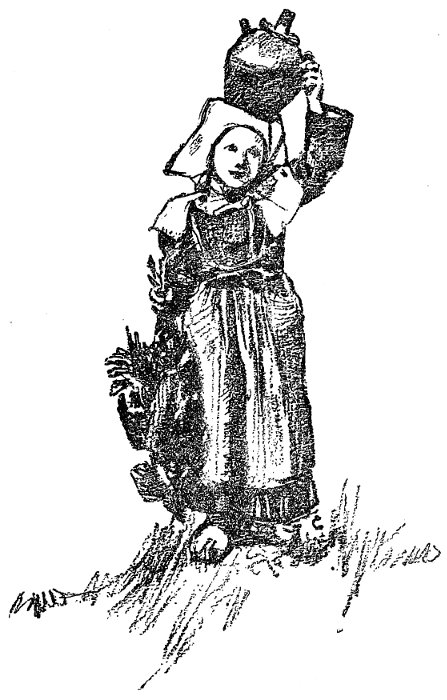
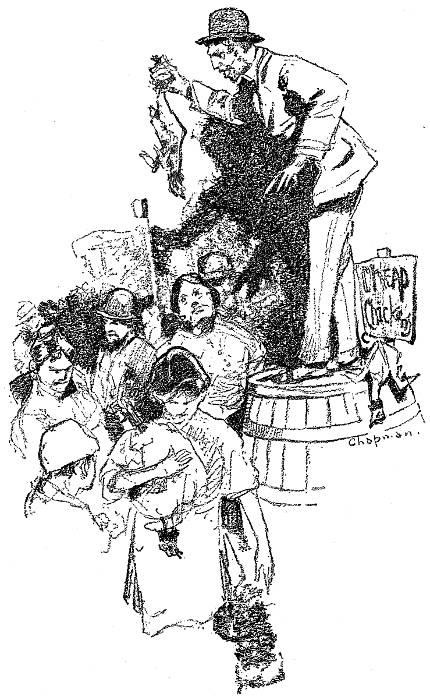
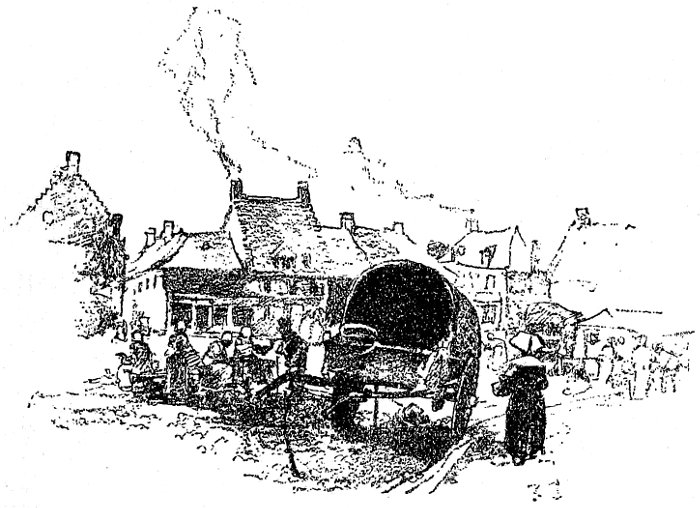
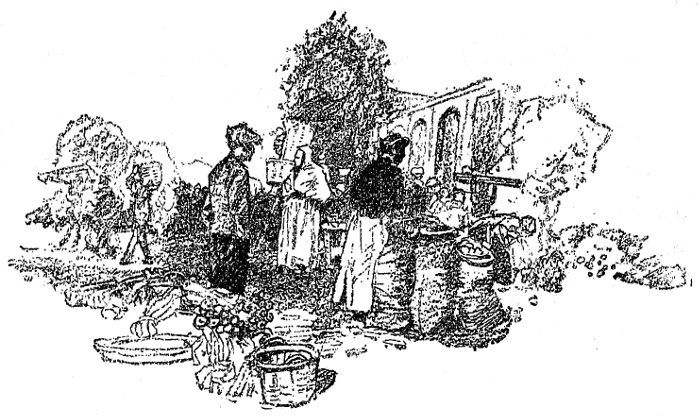
Coming to market, Brittany
My own experience in these regions is much more limited, but wherever
I followed this epicure's advice I found him a reliable guide. In most
parts of France, however, a guide to good cheer is hardly needed, for
you can stop at almost any inn with the assurance of getting a savory
lunch, dinner, or supper. In Provençal inns garlic is no doubt used too
freely, but no harm can come to those who cannot stomach it, since its
warning appeals as distinctly to the nose as the rattlesnake's does to
the ear.
The Pyrenees are famed for trout and chicken. The chicken we found
excellent, the trout less so. An innkeeper with whom I discussed the
matter admitted frankly that they left something to be desired in the
matter of flavor. A Parisian epicure to whom I had mentioned trout one
day, shook his head and suggested sole or turbot instead.
Sole is at its best at Dieppe. In that town there is a restaurant,
formerly frequented by Whistler, where the waiter, to please fastidious
guests, proudly serves soles caught with his own hands in the early
morning hours.
Cannes has a hotel the guests of which can go to a tank and with a net
catch the particular fishes they want to eat half an hour later. At
Aix-les-Bains there is a caterer who "will not have any salt-water fish
in his larder, for Aix in summer is so hot that sea fish do not always
come to table quite fresh, and this risk he will not run, in the
interest of his clients."
America is not the only country where oysters are cheap. At Caen one
pays only ten or twelve cents for a dozen of the best bivalves from
Ouistreham and Courselles.
All along the French coast, west and south, one comes across dishes
which owe their unique and usually delicious flavor to some special
variety of shell fish, peculiar to the place, which is added to the
sauce.
Marseilles is perhaps the best place for experimenting with
shell-fishes new to the visitor's palate. That this city owes
its international fame largely to a special marine stew called
bouillabaisse everybody knows. As I have eaten this dish in Marseilles
itself but once and that so long ago that I do not remember the
details, I will quote Col. Newnham-Davis's graphic remarks on it:
"The Southerners firmly believe that this dish cannot be properly made
except of the fish that swim in the Mediterranean; the rascaz, a little
fellow all head and eyes, being an essential in the savory stew, along
with the eel, the lobster, the dory, the mackerel, and the girelle.
Thackeray has sung the ballad of the dish as he used to eat it and his
recette, because it is poetry, is accepted, though it is but the
fresh-water edition of the stew. If you do not like oil, garlic, and
saffron, which all come into its composition, give it a wide berth;
but I should mention that the bouillabaisse at the Reserve is quite a
mild and lady-like stew compared to that one gets at Bregailla's or the
restaurants of the Rue Noailles."
Marseilles is not far from Italy, but before we proceed to that
country, to learn what it can teach us in regard to wholesome and
enjoyable foods, we must return for a moment to Paris to consider a few
more of the specialties in which it asserts its gastronomic supremacy.
However interesting the Provinces may be because of their local dishes
and delicacies, and because of the proof they afford that the value
of well-cooked food is appreciated throughout France, their most
important function, from our point of view, is that of providing the
first-class material out of which the Parisian cooks prepare their
chefs d'œuvres of culinary art. This material is sent daily from all
directions to the metropolis in special express trains, to be offered
for sale in the Halles Centrales, which, to the lover of good food and
beautiful flowers, is one of the most interesting spots on earth.
Emile Zola made these Halles Centrales the background of one of his
naturalistic stories, "Le Ventre de Paris." Even his realistic and
graphic descriptions fail, however, to convey an adequate idea of the
colossal food traffic carried on in this market place, which, to be
sure, is now much bigger than it was when he wrote his novel, not long
after the erection of the vast structure, in 1851.
Ten pavilions there are in this building, each of them containing two
hundred and fifty stalls. Retail dealers are installed in the front
pavilions, while the others are occupied by the wholesale vendors,
whose business also overflows into the streets leading to the market
place. For the storing of provisions there is further a cellar under
the Halles, divided into twelve hundred compartments.
To see this food market in its most characteristic aspects one has to
get up long before the sun. It was half past four on a May morning when
my wife and I unbolted the door of our hotel and hailed an auto-taxi to
take us to the Halles. All Paris was still in bed, with the exception
of the street-cleaners, who were giving the city its morning bath, a
few chauffeurs, and the market gardeners, porters, vendors and buyers
whose business it is to bring and distribute the daily provisions of
the French metropolis. The following details as to what we saw are
taken from an article written by my companion:
"At this early hour buyers are still rare. Inquisitive Americans may
wander about with the freedom of disembodied spirits, and without
attracting much more attention. We kept discreetly out of the way
of hurrying porters and of swearing cartmen who were bringing their
huge loads of vegetables to market. From the carts enormous mounds
of carrots, long white turnips, cauliflowers, salads of all kinds,
cabbages, sorrel tied in neat packages, radishes black and red, were
being unloaded and stacked with incredible dexterity and rapidity,
each mound a picture; the carrots and turnips were built up in square
fortresses, the vegetables turned outward with perfect regularity, an
orange and white feast to the eye, as well as a promise of joys to come
for the palate. Beside these are heaped pointed cabbages of freshest
green; cauliflowers as white as bridal bouquets; lettuces laid head
down; escarole and romaine lying on their sides, displaying round,
appetizing tips; chicory, a frizzled tangle of greenish white; while
nearby bee-hive heaps of rosy radishes add another vivid color note.
The world's greatest market place
"A little farther on our noses are greeted by the most exquisite
perfumes, coming from large baskets of strawberries—the big cultivated
ones—and the still more fragrant wild berries, the 'petites fraises
des bois' which Parisians so dote on. Cherries, too, are plentiful, but
they do not fill the air with luscious odors, as do the strawberries,
though their deeper red, the gloss of their perfect surface and the
contrasting pale green of their stems are a delight to the eye.
"The æstheticism of the Paris Halles is one of its dominant
characteristics. Flowers appear in every corner mixed in with the
stalls for edibles. Although a whole cross-street is given over to
them, they are too abundant, Paris loves them too well, and needs too
many for them to find sufficient room in one place only. A whole long
block is devoted to bleuets, the simple corn flowers of the fields,
packed in bunches a foot square; but roses reign supreme, pink, red,
tea, moss, of all varieties, picked fresh and adding their perfumes to
those of fruits and vegetables.
"There are also masses of irises, France's flower, yellow and blue;
spicy pinks, ranging from white to dark red, through all the shades
from palest salmon to deep rose; pansies, purple or yellow, bunched by
colors; peonies, rose-scented, long stemmed, heavy-headed, in crimson,
in pink, in white; Iceland poppies, bitterly fragrant, white, yellow,
orange.
"It is almost impossible to tear one's self away from this riot of
color and perfume, but there are so many sights that demand attention.
"Even the dead are not forgotten in the great market, for in one
section of the Halles, under its huge resounding roof, one may buy the
bead wreaths which are made to adorn French graveyards. There is almost
a western American atmosphere in this light touching upon death in this
center of vivid life, and once more we realize the kinship between
French and Americans—except in the matter of eating, in which alas, we
are so far behind them.
"The fish market does not open till late, for Paris wants its fish
fresh caught, but there is the meat market to see, and there are
still streets and streets of vegetables, streets filled with people,
especially of busy porters with full or empty 'hottes'—the large
baskets used in carrying vegetables—on their backs; or with the flat
fruit baskets, four feet by two and a half, balanced on their heads,
on which they carry loads of other baskets filled with strawberries,
walking along as calmly as if they were alone in the world, and as
if the streets were not slippery with vegetable leaves. We found it
difficult to keep our footing on this green refuse from cabbages and
lettuces, carrots and turnips, which had been cut off at one blow
by the men who stacked them. But it was all fresh, clean, and sweet
smelling.
Paris market porters
"By six o'clock the vegetable mounds had disappeared almost
entirely, as if melted away by the rising sun, and one understands
why photographs of the Paris market are so scarce. When the sun
finally shines through the soft morning haze there is little left to
snap-shot. Three porters in blue blouses with 'hottes' on their backs
politely consented to pose, and a pretty Parisian girl, brown-eyed and
red-cheeked, had gladly stood near her pile of sorrel to be caught in
the camera.
"The artichokes do not pose well. Great baskets heaped with these green
scaly globes fill one street, but to catch them is next to impossible.
First a cart gets stalled in front of a particularly fine group, and
when that is gone there is a mass of people who must pass. Every one
who notices the photographic attempts asks 'Is it for the Cinéma?'—the
Paris rage of the moment—and one good-natured, impertinent Parisian
asks if photographs are for sale and at what price. He is really so
'sympathique,' in the French sense, that one immediately confides one's
desires and difficulties to him.
"At the chicken stalls, where the would-be photographer has to change
a film, she finds an exhibition of the lower-class rudeness, and
also of the lower-class politeness of the French market woman. From
a corner which seemed to belong to no one she is rudely requested
to move on, while ten steps farther on she is made welcome, given a
chair, questioned about the 'Cinéma,' and apologized to for the lack of
civility of the other woman.
"At another stall among the vegetables, one saucy young woman gets
well laughed at by her companions. She is not too busy to notice the
strangers, and, after looking them over with rather an impertinent
stare, she remarks that it is 'funny to see these English people in
Paris.' A laughing rejoinder from the strangers that they are not
English but Americans makes her look abashed, much to the amusement of
the other women.
Halles Centrales
"In this retail department there are plenty of string beans which are
better in Paris than anywhere else, but the best of which an ignorant
American would not think of buying. They are small and thin, and
streaked with black, almost as if rusted. To the eye they are far less
tempting than the thick rich green beans in our markets, but in taste
they are more luscious. On the other hand, French peas are not equal,
usually, to the English and American ones, being harder and less sweet,
and therefore their flavor is not impaired, as ours would be, by the
fact that the market-women sell some of them shelled. A real genre
picture they make, three of these women, dropping the pale green pearls
into wooden bowls, and talking even faster than they shell.
"We passed rather hastily through the meat market, although that is
quite as interesting in its way as the other quarters, but we were
especially desirous to see the fish market in its glory. However, we
had a rapid view of great beef carcasses hung in rows, hundreds of
lambs, calves and other creatures, and of the neat stalls where calves'
heads, pigs' and lambs' feet, livers, sweetbreads, brains, and even
lungs are all hung in neat array, or displayed attractively on slabs.
French dealers know to perfection how to set off their wares. They have
special methods of presenting their fine poultry so that no buyer can
resist them, no matter what the price may be for turkeys, ducks, capons
and poulardes.
"Vine and other leaves for decorative purposes are sold regularly
in the market, and no one who has not seen it can imagine how much
more tempting a fine Camembert or Pont l'Evêque can appear when it
is set carefully on a fresh green leaf. The large cheeses cannot be
thus decorated, but the smaller ones, as well as the pats of Normandy
butter and the tempting little brown pots of delicately sour 'crème
D'Isigny,' are always displayed in this way. The fine fruits, too, are
made the object of solicitous care; in one corner of the market we ran
across two men who were tenderly unloading the most fragrant melons,
and arranging fine peaches, six in a box, laid carefully on a bed of
soft white cotton. The perfect bunches of grapes for which some wealthy
American may, later in the day, pay a fabulous price at the Café de
Paris or at Voisin's, are temptingly exhibited in the same manner. It
is strange that Paris is generally more æsthetic and artistic in its
food and flower displays than in those of the many other luxuries and
fashions it provides for the world.
"At six-thirty the fish market opens, and as one approaches, the
deafening noise of the wholesalers, crying their wares, and selling to
the highest bidder, fills the ears. The nose, too, takes cognizance of
the perfume of the sea, the salt freshness of recently caught fish,
quite different from the ancient and fish-like smell of an ordinary
New York fish stall. We breathe it in with almost as much pleasure as
we did the fruit, vegetable and flower perfumes. Here again the eyes
are satisfied as well as the nose. Pale brown fish in a pale brown
basket may be an accident, but it is a happy one. Quantities of spiny
'langoustes,' with long feelers, splotched with yellow and red; of
lobsters with huge claws; of neatly arranged soles, lying in pairs; of
beautifully marked Spanish mackerel, of great white skates, and of many
other sea-fish are being rapidly transferred from the wholesale to the
retail departments. In the fresh-water section, huge tanks, with water
flowing in rapidly from great faucets, hold carp, eels, and other fish,
all alive; but the greater number of tanks are filled with scrambling
hundreds of crawfish, the much prized French 'écrevisse,' which, with
the langoustes, reach the high-water mark for shell-fish prices in the
restaurants—but they are worth it. The écrevisse is no better than our
Oregon crawfish, but the latter are being rapidly exterminated, whereas
in France the delicious creatures are properly protected.
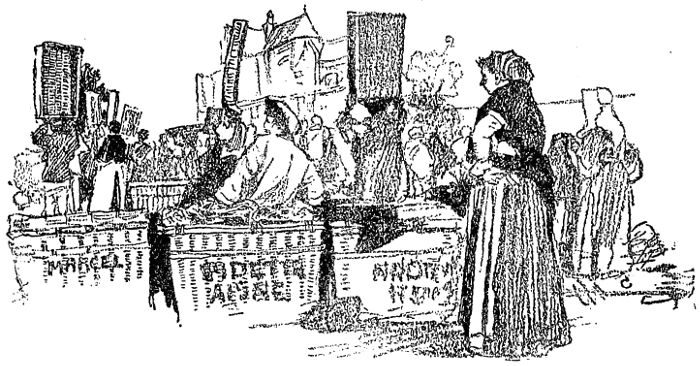
A bit of the great Paris market
"In this same section another French delicacy, snails, are for sale.
Boxes full of them may be seen, some of the snails remaining patiently
in their home corral, while others, more adventurous, were crawling up
the fish tanks, or had even dropped to the floor, owing to their too
great desire to explore the world.
"The market itself is quite as much inclined to spread as the snails.
All the adjacent streets are filled with shops for edibles, especially
of the less perishable variety, like cheeses of all kinds, some as
big as auto-wheels. The cabarets do a brisk business in feeding the
providers of Paris food, but foolishly we failed to try one of these
places to discover what kind of breakfast the food-raisers themselves
eat, and we went back to our hotel hungry, past all this mass of
eatables, past cafés which were just being opened, where floors were
being washed and chairs lay inhospitably on the tables. One almost felt
as if Paris never was ready to eat breakfast."
Besides the Halles Centrales there are a number of smaller covered
markets distributed over the city, much frequented on certain days
by all classes. Women everywhere are fond of shopping, but in France
foreigners as well as natives revel in the joys of marketing. Read, for
instance, this joyous outburst of an American girl dwelling in Paris
for her musical education:
"Now the mystery why the shops and galleries are almost deserted by the
French on Wednesdays and Saturdays is explained. They are all at the
market,—a dense struggling, chattering mob, pawing away at the fresh
country produce, while above the din rise the shrieks and howls of the
booth venders. A lively, a typically French scene. You get one of those
French net-work bags, which will stretch to hold nearly a bushel of
supplies, and sail into the thick of the fray. By the time you are out
on the other side you are loaded to the ears with enough stuff to last
the party a week and have spent just four francs. Celery, one cent a
bunch. Fresh country potatoes, 35 cents a bushel. Country killed meats
at one-half city prices. It is more fun than a circus, and from that
time on you will set aside an hour every Wednesday and Saturday to go
a-marketing, as one of the prime joys of life."
The biggest vegetables and fruits are by no means always the best. But,
given a good variety, the ideal to be aimed at is to have it as big as
possible while still young and tender.
This ideal the French market-gardeners live up to, and that is what
makes their productions a joy, first to the eyes, and then to the
palate.
Intensive cultivation is the key to the mystery of how it's done.
Expert testimony is to the effect that the market gardens in and around
Paris are "the best and most thoroughly cultivated patches of ground in
Europe." From them "at least threefold more produce is gathered than
from similar extent of garden-ground elsewhere." Though the climate is
far from mild—and even in the harshest months—whole trainloads of
lettuce heads and other vegetables are sent daily from Paris to other
cities, some of them as far away as Russia.
Eight crops in one year are frequently gathered from a garden. No
time is wasted; while, for instance, the cos lettuce in one bed rears
its head on high, the ground underneath is already carpeted with the
green leaves of a young crop of escaroles. This rotation is one of
the secrets of success. Thorough cultivation and enrichment of the
soil constitute another, some of the crops being grown in beds made up
almost entirely of manure. But mainly, it is "owing to the abundant
watering of these gardens that the Paris markets are throughout the hot
season better supplied with crisp, tender, fresh vegetables than any
other capital in Europe."
Water makes up nearly the whole substance of most vegetables—for
instance, over 88 per cent. of carrots, 90 of cabbage, 93 of lettuce
and pumpkins, 95 of cucumbers. Withhold it on a few sunny days, and the
vegetables become mere masses of tough fiber. As long ago as 1878, W.
Robinson, F. L. S., whose words I have just cited, called attention in
his valuable and beautifully illustrated book on the Parks and Gardens
of Paris to the anomalous fact that though all failures in English
gardens are attributed to "want of sun," nevertheless if there is a
warm and sunny season the market supplies soon run short, owing to the
absence of any preparation for watering garden crops. "Three warm
days in July show their effect in Covent Garden, inconvenience the
housekeeper, and injure and reduce the supplies of vegetable food at a
time when these are more than ever important for health."
Since that time, no doubt, some improvement has been effected in
England, but Covent Garden Market is still largely dependent on French
gardeners for its best products, in the line of vegetables, and also of
fruits and berries.
One of the most interesting chapters in Mr. Robinson's book is on
Mushroom Culture in Caves Under Paris, those he visited being at
Montrouge, just outside the fortifications. The beds are from sixty
to eighty feet under the street and from this single cave the daily
gathering averaged from four hundred to fifteen hundred pounds, the
favorite size of the mushroom gathered being about that of a chestnut.
There are thousands of abandoned stone quarries in France, hundreds
of which are used by mushroom growers, who earn many millions a year
by thus catering intelligently and zealously to the palates of their
countrymen—and of foreigners, too, for there is a large export
trade—in mushrooms, fresh, canned, powdered, bottled in oil or butter,
or preserved in other ways.
An odd detail about these caves is that, although they are well
ventilated, the mushrooms refuse, after a while, to grow in them till
after a general cleaning out and a rest of a year or two.
Although, both as a separate dish and as an ingredient of diverse
sauces, soups, stews, and gravies, mushrooms play an important part in
the cuisine of the French, they seem on the whole to risk the eating
of fewer varieties than are consumed in some other countries. About
a thousand different varieties are known to botanists, yet in Paris,
as I was informed by a professor of the University of Lyons, only
twenty-five kinds are commonly eaten, while in the markets of Lyons
only half-a-dozen sorts may be offered for sale. One cannot but admire
this prudent self-denial on the part of a race so addicted to the
pleasures of the table.
In Germany there are frequent expositions of mushrooms and other fungi,
for educational purposes. In England the Board of Agriculture issued in
1912 a little book entitled "Edible and Poisonous Fungi," with colored
pictures of more than a dozen good mushrooms besides the one usually
consumed (Agaricus Campestris). An English friend of mine likes to
recall the days of his boyhood when his breakfast consisted of several
platefuls of mushrooms which he gathered every morning fresh under the
trees.
In American forests mushrooms grow in superabundance, but few are
gathered for the table, though most of them are harmless. Speaking of
the hills of the Blue Ridge Mountains near Harper's Ferry Dr. Wiley
says he has seen "large areas of the forest almost covered with these
growths in August and September, but the courage leading to their
consumption was wanting."[10]
A picture in the Fliegende Blätter shows a little girl bringing
a basket of mushrooms from the woods. Being asked by the pastor in
passing if she is not afraid her family may be poisoned, she answers
cheerfully, "Oh, no! We sell these."
The nutritive value of mushrooms is small. It is on account of their
delicious and varied Flavors that they are gathered and cultivated;
and Flavor, as has been pointed out so many times in the preceding
pages, is so important to good digestion and consequent health that
it is a great pity that in eating them one runs the risk of a painful
death; at least in the case of wild mushrooms, some of which aggravate
their offensiveness by trying to look as much as possible like certain
harmless specimens.
While truffles, like mushrooms, grow all over Europe, as well as on
other continents, in many varieties, it is the French, again, who have
taught the world the most valuable lessons regarding their diverse
uses for flavoring soups, sauces, meats, and gravies.
The French varieties happen to be the best of all, especially
those grown in Périgord and in the Department Vaucluse, which was
reafforested in 1858 with oaks, in the shade of which these fungi are
particularly at home.
In Russia, formerly, bears were used to unearth them, but to-day pigs
and trained dogs are relied on for locating the ripe specimens—a feat
which man, with his inferior powers of smell, cannot imitate; the
result being that when he tries to harvest them himself, great waste
results through the uncovering of unripe specimens. Maybe, some day,
our noses will be so well trained that truffle-hunters will be able to
get along without pigs, dogs, bears—or flies, which, in warm weather,
hover over the spots where the ripe fungi are hidden from the eye.
Truffles are expensive, and therefore often adulterated—with dirt, to
increase their weight, with unripe tubercles that have little or no
flavor, and in various other ways, including the making of artificial
truffles from potatoes. An English writer says that the "false truffle"
(Scleroderma vulgare) "is extremely common on the surface of the
ground in woods, and is gathered by Italians and Frenchmen in Epping
Forest for the inferior dining-rooms of London, where continental
dishes are served. It is a worthless, offensive, and possibly dangerous
fungus."
Good fruit is more abundant and cheaper in the United States than
anywhere in Europe. When sun-ripened and picked at the right time, it
is all that fruit should be. Unfortunately, it is not usually brought
into our markets in that condition.
The Paris restaurants have a way of adorning their entrance with
a stand covered with various kinds of properly ripened fruit, the
fragrance of which serves as an appetizer preceding the hors d'œuvre
or the soup. They are extra choice fruits, and expensive, but in the
markets one can buy the same very much more reasonably.
In the raising of fruit the French rely less on climate than on their
own skill and care. The best peaches eaten in Paris do not come from
the Sunny South, but from the neighborhood of the city, where they
are grown against walls, and carefully cultivated and protected. When
visiting France at the request of the London "Times" to study the
methods which have made fruit in that country so good, Mr. W. Robinson
found it a common thing to see a professor of fruit-culture and his
class assembled round a tree, pruning it and discussing every operation
as it goes on.
The pupils have much to learn, for the French do not simply cultivate
trees in orchards as we do, but subject them to much trimming and
bending of the branches so as to secure the best distribution of the
sap and the greatest amount of sunlight and warmth.
The Japanese have taught us how to prune a chrysanthemum plant so as
to make it produce giant blossoms. Our florists make use of the same
method to concentrate the sap and vigor of a root and stem in a single
perfect American Beauty rose. It is not size alone that is aimed
at. Sometimes the result of such a method is a thing like the Belle
Angevine pear which, though flavorless, may fetch a guinea in London
because of its size and beauty. As a rule, however, Flavor is carefully
safe-guarded. The leaves are kept trimmed so as to enable the sun to do
its best in developing an aroma.
Outside of France the finest collection of espalier fruit trees I have
seen is on Paderewski's estate, at Morges, on the Swiss side of Lake
Geneva. It is surprising what a variety of forms the trees can be made
to assume, as the fancy of the cultivator decides.
Although the publishers of this book, when they asked me to write
it, generously allowed me as much elbow room as I might desire, I
must resist the temptation to dwell much longer on the details of
French gastronomic leadership. To exhaust the subject would require
a whole volume much bigger than this. Before closing this long
chapter, however, I must dwell briefly on three more important kinds
of food—bread, butter, and cheese—in the making of which the French
excel.
Unlike ourselves and our English cousins, they partake of nothing but
bread and butter for breakfast, wherefore it is not surprising that
they take particular pains to have these good. Bread is also eaten at
other meals much more freely than in other countries, including Germany
and Austria, which alone rival France in the making of it.
The best French bread is made in such a way that to have it in prime
condition it must always be fresh. At all hours, therefore, one
sees boys hurrying along the streets with baskets loaded with tall
loaves. Without exaggeration, these loaves are often a yard long,
but no thicker than a man's forearm. This is the Parisian bread par
excellence, and what is most characteristic about it is that it is
practically all crust.
Bread is regarded as the staff of life—an English writer, Winslow,
called it so as long ago as 1624—and it has become so more and more
in recent centuries. It is therefore of the utmost interest to know
how the French, who admittedly know more about good food and the best
cooking than any other people in the world, bake their bread. They bake
it, as I have just said, in such a way that it is nearly all crust.
Nearly all crust! And the French, it is needless to say, dote on
this crust. For the crumb they have no liking; often you may see a
Frenchman poke out with his thumb what little crumb there is and leave
it on his plate.
How different this from the practices prevalent among the least
gastronomic of civilized nations—the English and the Americans!
The English way was graphically described in the "Observations on
Mastication" which Dr. Campbell contributed to the London "Lancet"
(July and August, 1903):
"Witness the fashion of eating bread-and-butter at any place of
refreshment, and the last thing you will be served with is a plateful
of crusts of bread. Many establishments, indeed, make a regular
practice of giving away their crusts as unsaleable. Thus, the
rectangular loaves used for bread-and-butter in the aërated bread-shops
are cut transversely into slices, each loaf thus yielding two end
crusts which are put into baskets for the poor, only the soft crumby
pieces being reserved for the customers."
Similar practices prevail in the United States and Canada.
The lowest biological specimen—mere gastronomic protoplasm—is the
pale, ten-dollar-a-week clerk whose deadly substitute for bread is the
half-baked dough ("butter cake") he eats at lunch time—a dyspeptic
mess without the suspicion of a crust on it. His taste, unfortunately,
is shared by some of the well-to-do, whose education has been
neglected. Two youths walked into the breakfast room of an Italian
hotel one morning and sat down at the table next to ours. The first
thing they did was to push away the nicely browned crusty rolls and
ask the waiter if he had any "soft bread." He had none, of course. He
should have told them—I came near doing it myself—that those Italian
rolls, though not equal to the best Parisian, had much more flavor and
were much more digestible than the home-made crumb they were crying
for—like babes for pap, though their teeth looked sound.
In many New York hotels and restaurants, imitations of Parisian loaves
or rolls are now placed on the tables. Some of them are quite good—a
great improvement on the ordinary American bread—yet most of the
diners look at them askance. In downtown lunch places, if you fee the
waiter regularly, he will not insult you by putting a crusty end piece
on your plate. I always fee well, and therefore have the greatest
difficulty in making the waiters believe that I sincerely, honestly and
truly prefer an end piece—a particularly brown one at that. Some of
them look at me with the incredulous expression of the farmer who, on
seeing a giraffe, exclaimed, "There ain't no such animal!"
It is needless to say that I prefer the golden-hued end-piece because
I find it infinitely richer in flavor than the crumb. It is for the
same reason, principally, that the French insist on having crusty
bread. There are other reasons—they may not be aware of them but
instinctively they act on them. Let me give them in the words of a
distinguished medical man—the same Dr. Campbell, Physician to the
London Northwest Hospital, whose words I have just quoted. "Loaves,"
he writes, "should be shaped so as to give a maximum of crust and a
minimum of crumb, and should be baked hard. Such loaves are quite as
nutritious as the ordinary ones, and much more digestible, containing
as they do an abundance of dextrine and not a little maltose, and
compelling efficient mastication, especially if eaten, as they should
be, without any fluid. A lady who has been catering for a large number
of girls gives the bread in this way, and she tells me that there is
keen competition for the most crusty portions."
The words I have italicized are of the utmost significance. They show
that if English—or American—girls, or boys, or women and men—prefer
crumb to crust, it is not owing to innate depravity but to lack of
opportunity to learn better. Give them a chance to ascertain the
superiority of crust to crumb and they promptly take to it as if they
were in Paris born.
They cannot be blamed for neglecting American crust, for the crust of
the ordinary American bread actually is inferior to the crumb, being
tough, leathery, and flavorless. But the American crumb is nearly
always indigestible. The moral of the story is that we should discard
it in favor of Parisian crusty bread, boycotting every baker who does
not honestly try to surround his loaves with crisp, toothsome crust.
Ordinary American bread is greatly improved in flavor and digestibility
when it is toasted. Toasting is the conversion of crumb into crust.
It is resorted to daily by hundreds of thousands of Americans who,
either knowingly or instinctively, adopt this way of avoiding the
soggy bread which ruins the stomach and undermines the health. On this
point let me cite the words of another medical expert, Dr. Alexander
Bryce, author of "Dietetics," "Modern Theories of Diet," "The Laws of
Life and Health," etc., endorsing the views of Russia's most eminent
physiologist:
"Pavlov demonstrated that the chewing of fresh, moist bread [such
as most Americans insist on having] produced no secretion of
saliva worth mentioning, but dry bread caused the saliva to flow
in large quantities. Stale bread, crust of bread, toast, zwieback
(double-toasted bread), and plenty of biscuit compel fairly prolonged
mastication with plenty of saliva, while soft bread is usually bolted
with no production of digestive juice of any consequence."
Besides the yard-long loaves referred to, the French have an endless
variety of breads, one of the best of them being the crescent-shaped
"croissants" usually served with the morning coffee. Different
provinces and towns have their own special kinds, but Paris is the
paradise for bread-eaters; elsewhere, the bread is not so uniformly
excellent, though nearly always better than that served in most other
countries.
While the preponderance of crust over crumb is the most important
aspect of Parisian bread, there are a number of other things to which
it owes its excellence. For a high-class product it is important to
select flour made of wheat which has a particularly fine flavor. The
Flavor is also largely affected by the milling, the way the dough is
made and kneaded, the quick or slow fermentation, the kind of oven used
and its temperature, the length of leaving the bread exposed to the
heat, and many other things.
A French baker's apprentice has to go through a four-years' course of
studies before he is considered an expert. Is it a wonder that such
favorable results are achieved? But besides his knowledge he must have
an infinite capacity for taking pains. Plus on se donnera de peine
pour pétrir la pâte, plus on obtiendra de pain, et meilleur il sera. On
n'a rien de bon sans travail. "The more trouble you take in kneading
the dough, the more bread you will get, and the better it will be. You
cannot get anything good without work."
So say the authors—there are three of them—of the "Nouveau Manuel
Complet du Boulanger," published in Paris by L. Mulo. It is a book of
626 pages with 93 illustrations. Besides an introduction which gives
a bird's-eye view of the history of baking, there are ten chapters
treating exhaustively of wheats and flours and their adulteration; on
the making of dough and the different kinds of leaven; on troughs and
ovens; on diseases of bread; on the peculiarities of the breads of
various countries, including, of course, those of France, Austria and
Germany as the most important.
Summing up their conclusions, the authors of this encyclopedic work
say, under the subhead, "Signes Caractéristiques d'un Pain Bien
Fabriqué," "Well-made bread must be light, well-raised and well-puffed
up. Its color must be a particular yellow, shading into brown; it must
be resonant when it is struck; its surface must be smooth, the inside
full of cavities and grandes crevasses; its crumb white, very spongy
and very elastic."
"If I were king," exclaimed a Sicilian shepherd boy, "I would have
goosefat with my bread every day."
While the ancient Greeks and Romans already made many varieties of
bread, butter was known to them only as a medicine, olive oil being
generally used in place of it in the preparing of meals.
It was probably in Italy that really palatable butter was first
churned, and very good butter is made in that country to-day; (that
poor Sicilian boy had evidently never tasted any, else he would have
preferred it even to goosefat!) but the best butter in the world is
marketed in Paris. Not once, during half-a-dozen sojourns in that
city, have I had butter served which it was not a pleasure to eat.
While bad butter, such as most Americans eat daily, seems to be
virtually tabooed in France, there are of course many degrees of
excellence. In May, 1912, we visited a number of the leading Paris
restaurants with the special object of studying these degrees.
Everywhere the butter was very good, but the best, my wife and I agreed
after repeated trials, was served at the Bœuf à la Mode. I therefore
asked the head-waiter to find out from the dairy just how it was made.
He did so, and received in reply a letter which is herewith reprinted
in a translation:
In response to your communication of the twentieth I take pleasure
in answering your questions. Our butter is always made with the
cream of the previous day and after this cream has fermented twelve
hours. In this way to-day's milk is skimmed at about noon and the
cream is cooled to 37-40 degrees [Fahrenheit], then it is put in a
place where it rises to 42°-47° [Fahrenheit] and at this temperature
it is kept as nearly as possible till the next morning, when it is
churned.
This method is a satisfactory one, and our butter is right.
Believing that these directions will prove to be what your customer
wishes I beg you to receive my best salutations.
Marchand.
The information given in this letter relates to one point only, as that
was the only point I had inquired about.
What I wanted to know was whether this super-excellent butter was made
of sweet cream or of sour cream.
Edwin H. Webster, Chief of the Dairy Division, states in No. 241 of
the Farmers' Bulletins, issued by the United States Department of
Agriculture, that "practically speaking, all butter used in this
country is churned from sour cream. Sweet cream butter to most users
tastes flat and insipid." He adds that the American dairyman, when his
cream is not sour, deliberately makes it so by adding a "starter,"
which is nothing more nor less than "nicely soured milk."
In the Paris bookstalls we bought everything we could find as to the
French practices in this respect, and furthermore we spent hours in the
Bibliothèque Nationale studying the documents relating to it.
D. Allard, Professeur Départmental d'Agriculture, says in his book "Le
Beurre": "It is generally remarked that in the regions which produce
the finest and best-liked butter, la Normandie and la Bretagne, great
care is taken to let the cream turn sour before it is churned. There is
here certainly a result of fermentation, for one can, as we have said,
impart these qualities to sweet cream by adding select ferments.
"Besides this, fermentation gives another advantage: it makes the cream
easier to churn and increases the yield of butter.
"One must not go too far, however. The farmers know very well that the
cream of a whole week gives a butter of unpleasant flavor.
"It is therefore the uniformity of fermentation that ensures uniformity
in the production of butter; which explains the importance of this
question."
Another writer, V. Houdet, Ingénieur-Agronome, Directeur de l'Ecole
Nationale des Industries Laitières de Mamirolle, says in his book
"Laiterie, Beuerrerie, Fromagerie" (fourth edition, 1912):
"No matter whether the cream has been obtained by letting the milk
stand in a low temperature or by means of a separator, it does not, if
churned at once, yield anything but a sweet butter, of pure taste but
without bouquet and without finesse.
"In order that the butter may have the aroma, and particularly the
nutty flavor which the consumers desire and which considerably
increases its market value, it is necessary that the cream should
ferment, should become soured, before it is churned, for it is
particularly on this treatment, this maturation (ripening), that all
the qualities of the product depend.
"While the cream is fermenting, the sugar of milk it contains is
changed into lactic acid which reacts in the measure of its production
on the glycerides, saponifies them while liberating the volatile acids
which impart to the butter its perfume and make it keep better.
"At the same time, as with all fermentation, it is necessary to stop
in time; an excessive development of acid would yield a strong butter,
rapidly undergoing a change and becoming rancid."
Director Houdet also points out, as did Professor Allard, that by
souring the cream the yield of butter is "very appreciably increased."
Judging by these remarks, the French way is like the American: the
cream is ripened (soured) before churning. Must we, therefore, conclude
that the enormous difference (apart from the salt question) between
the average American and the average French butter is due chiefly to
American carelessness in regard to a number of details, particularly
the degree of acidity and the regulation of the temperature which the
French authors just quoted declare to be of the utmost importance in
the manipulation of the cream while ripening?
Or is our butter usually so inferior because so much of it is marketed
after undergoing cold storage, whereas the French get theirs fresh, as
they do their poultry? Years ago the State Railway began to run special
butter trains from Normandy, Brittany, and the La Rochelle district,
which reach the Paris market early in the morning, refrigerating cars
being used in summer, so that the butter always arrives in perfect
condition.
Doubtless, such differences help to explain the inferiority of our
butter; but a question of even greater importance which we must now
consider, is this: Is it true that the best butter owes its fine
flavor to the ripening of the cream—the churning of sour cream
instead of sweet?
The fact that dairymen in France as well as in America do use fermented
cream does not necessarily prove this to be the case; for, as we have
seen, there are two other very important reasons for ripening the
cream: sour cream is more easily churned, and it yields more butter
than sweet cream does. This being the case, most dairymen, being human,
would naturally be tempted to use acid cream even if it were possible
to make a still finer butter with absolutely sweet cream.
That this is possible, is the belief of many experts and epicures.
A German lady in Berlin, who has had much experience, informed me
that sweet-cream butter was in that region preferred by those who
could indulge their appetites all they liked, whereas the sour-cream
butter was ordered by those who wished to curb the appetites of their
customers (in taverns, &c.). An English official, Francis Vacher,
remarks in "The Food Inspector's Handbook," in which he gives the
results of his experiences in sampling, that "it seems superfluous to
say that butter of fine flavor cannot be made from sour cream. Yet
much butter is made from sour cream, particularly in small farms and
dairies."
United States Government and State officials have given much attention
to this subtle question. While Edwin H. Webster, Chief of Dairy
Division, Bureau of Animal Industry, attests, as we have seen, that
"practically speaking, all butter used in this country is churned from
sour cream,"[11] the Assistant Chief, Harry Hayward,[12] admits that
"but a very small percentage of all dairy butter made is of really
high grade." Bulletins 18 and 21 of the Iowa Agricultural Experimental
Station contain the results of tests made by G. E. Patrick, F. A.
Leighton, D. B. Bisbee and W. H. Heilemann, showing that butter made
from sweet cream retains its flavor better than butter made from sour
cream.
In June, 1909, the U. S. Bureau of Animal Industry issued Bulletin
114, in which the bacteriologist, L. A. Rogers, and the chemist, C.
E. Gray, give the results of three years' study of this problem. They
found that butter made from ripened (sour) cream, both pasteurized and
unpasteurized, develops, in storage, fishy and other flavors typical of
storage butter; that butter made from unripened, unpasteurized cream
always developed a cheesy or rancid flavor; but that the butter made
from pasteurized cream without starter usually retained its flavor
with little or no change. Even at 32° F., where all the ripened
butter showed decided changes, the sweet-cream butter deteriorated
very little. Everything showed that "some factor having a deleterious
influence on the butter was developed with the ripening of the cream";
and this whether the acid developed normally in the cream or was added
to it, as a "starter." Further: "Butter can be made commercially from
sweet pasteurized cream without the addition of a starter. Fresh butter
made in this way has a flavor too mild to suit the average dealer, but
it changes less in storage than butter made by the ordinary method, and
can be sold after storage as high-grade butter."
Still another official of the Department of Agriculture, L. A. Rogers,
bacteriologist of the Dairy Division, contributed an important document
in favor of sweet cream butter.[13]
He pointed out that a large part of the butter made in the central
creameries in which the cream is received in a sour or otherwise
fermented condition develops the peculiar oily flavor of mackerel or
salmon. After a series of investigations lasting several years he
testified that "in all cases in which the records were complete it was
found that those experimental butters which became fishy were made
from high-acid cream"; and that "fishy flavor may be prevented with
certainty by making butter from pasteurized sweet cream."
The same authority informs us that in our central creameries "the
cream is usually received in a very acid condition"—surely a most
unfortunate circumstance, inasmuch as the experts, including the
French, are, as we have seen, agreed that a high degree of acidity
spoils the butter. And now we come face to face with the all-important
question: Does a low degree of acidity really improve the butter,
as Professor Allard and Director Houdet maintain it does?
In other words, is the delicious flavor of the best butter actually due
to the lactic acid developed by the ripening of the cream?
Dairy Chief Webster admits that "there are undoubtedly desirable
flavors in cream that do not come from the development of acid. Just
what these are is not known at the present time, but the rich creamery
flavor, or, as it is sometimes described, the nutty flavor, of a fine
quality of cream is a combination of acid and other flavors."
The "nutty" flavor is found particularly in May and June butter. The
German biologists, H. W. Conn and W. M. Esten, who made careful studies
of the ripening of cream which they published in Nos. 21 and 22 of the
"Centralblatt für Bakteriologie" (1901) found that "the peculiar flavor
of June butter, which is so much desired by the butter-maker, is not
due to the development of the common lactic bacteria."
This brings us back to Paris and the Bœuf à la Mode. It was in May
that we found the butter there so very delicious, and May is the month
when the grass in France is greenest, juiciest, richest in flavoring
possibilities. After collecting a large amount of material relating
to the influence of food in varying the quality and Flavors of meats
(which will be presented in Chapter XII), I have come to the conclusion
that it is to this rich spring food that the nutty flavor is chiefly
due.
As long ago as the middle of the last century epicures guessed what
made the Flavor of spring butter so good. In the first volume of his
Gastrophie, Eugen Baron Vaerst declares that "mountain butter is the
best. March butter is particularly good because of the grass fodder
the cows get. Summer butter is less good, were it only because of the
heat and the annoyance to which the animals are subjected by torturing
insects.... Winter butter tastes of straw and other winter feed."
The assertion that mountain butter is the best, reminds me of an
episode in Bayreuth where, one summer, the family that gave us lodging
and breakfast had the butter brought down every morning fresh from the
mountains by a peasant girl. You pay in Germany for as much bread and
butter as you eat. The first day we ate all that was given us and asked
for double the amount next morning, and once more double that for the
third day. It was as good and sweet and tempting as ice cream. The
incident is worth mentioning as a hint to dealers and butter-makers
how they might quadruple their business by supplying people with fresh
butter, unsalted and made of sweet cream, as was that Bayreuth mountain
butter.
In future discussions of this subject it will be necessary to make it
clear just what is meant by sweet cream and sour cream. If, as the two
German bacteriologists referred to say, there are some acid bacteria
present in milk as it is drawn from the cow, then there is no such
thing as absolutely sweet cream; and, chemically speaking, the cream
we put in our coffee twelve or twenty-four hours later is still less
so. But physiologically speaking, that is to our tongue, such cream
still is sweet and remains sweet under ordinary atmospheric conditions
for several days; that is, it does not taste sour and does not clot
in the coffee cup. From the physiological point of view, therefore,
the cream from which the best butter we found in Paris was made was
sweet—absolutely sweet to the tongue, whatever the acidimeter may have
indicated.
From the foregoing remarks any dairyman who wishes to get rich quick
can gather what he must do. Another point must be borne in mind in
making butter which is not to be eaten at once. Bulletin 71 of the Iowa
Experiment Station calls attention to the fact that to preserve the
quality (Flavor) of the butter, it is not enough to pasteurize the
cream; the water also must have its germs killed by being heated to a
certain degree and then cooled again. The experiments made showed that
butter made from pasteurized cream and washed in pasteurized water kept
normal just twice as long as butter made from unpasteurized cream and
washed with unpasteurized water, even though well-water was used.
While there is but one way to make perfect butter there are many ways
to make perfect cheese. Butter is always butter, varying only in
the degree of palatability, whereas from a pail of milk can be made
hundreds of varieties of cheese, each perfect in its way. Every country
has its own, differing from those of other countries and provinces,
as the costumes and customs differ. The chief difference lies in the
Flavor, and this is due to a variety of causes, one of them being the
source of the milk. The Laplander makes several kinds of cheese from
reindeer milk, while in some parts of Italy buffalo cheese is eaten.
Goat cheese is diversely made in Germany, France, Italy and other
countries, while for some of the finest cheeses, including genuine
Roquefort, sheep supply the milk. By far the most important animal,
however, is the cow.
What would Europeans and Americans do without the cow? It is possible
to get along without her. When I visited Japan, less than a quarter
of a century ago, the first experiments in the production of milk,
butter, and cheese were being made in the Hokkaido, with a herd of
fifty imported cows.[14] The courtesy of the Governor-General enabled
me to test the products, and I found them very good. But owing to scant
and expensive pasturage, Japanese epicures will never be able to depend
much on cows; and think what they miss! No veal, no beef, no suet,
no cream, no butter, no cheese! Think of the endless uses we make of
these, alone, or in thousands of culinary combinations!
Nevertheless, we still have much to learn concerning the diverse
uses to which at least one of the products of the protean milk pail
can be put. We make above 300,000,000 pounds of cheese a year, worth
over $30,000,000; but there is less to boast about its quality than
its quantity. We are strangely monotonous and unoriginal. About
three-fourths of our cheese is an imitation of the English Cheddar,
while the rest consists mostly of imitations—generally very poor
ones—of Swiss, Dutch, Italian, or German cheeses, or the French
Camembert, Roquefort, and so on. Have we no gastronomic imagination?
Shall we permit not only the epicures but the peasants of Europe
to look down on us for our lack of it? We have, to be sure, a few
specialties, such as the Pineapple, the Brick, Isigny, and some
special varieties of cream cheese; but for a nation of nearly a
hundred millions, we make a very poor showing indeed in this branch of
gastronomy, as in so many others.
To a patriotic epicure it is humiliating to peruse Bulletin 105 of the
Bureau of Animal Industry, entitled Varieties of Cheese. It contains,
on 72 pages, descriptions and analyses of all the domestic and foreign
cheeses about which information could be found in the literature
bearing upon the subject. The authors are C. F. Doane, of the Dairy
Division, and H. W. Lawson, of the Experiment Stations. The number of
cheeses described by them is 242. Of these 63, or more than a fourth
of the whole number, are French. Germany follows with 40, and England
comes third with 24. Switzerland is credited with 20. Italy contributes
19, Austria (with Bohemia, Hungary and the Tyrol) 17, and Holland 8.
These are the leading cheese producers.
France, as was to be expected of the chief gastronomic nation, heads
the list in the matter of quality as well as quantity. Few epicures
would deny that the best three cheeses made anywhere are Camembert,
Roquefort, and Brie. Other world-famed kinds are Pont-l'Evêque,
Neufchâtel, Mont D'Or, Gruyère, Port du Salut. Among the less-known
kinds are some which are almost if not quite as good as the more
familiar varieties.
A pound of cheese made of unskimmed milk has twice the nutritive value
of a pound of beef. It is characteristic of the gastronomic French
people that, notwithstanding this fact, the best cheeses made by them,
for themselves and the rest of the world, are valued and intended much
less as food than as relishes, to be consumed in very small quantities.
The French custom of using cheese as an appetizer, to be eaten at the
end of a meal, has been adopted the world over. Usually one thinks of
appetizers (hors d'œuvres) as being served at or near the beginning
of a meal; but think the matter over and you will see that an appetizer
is even more useful at the end, as a harmless stimulant to keep up a
steady flow of saliva.
It is not a mere accident that the three favorite French cheeses are
those that have the most piquant and stimulating Flavor. This Flavor
is due chiefly to molds, which are specially cultivated with great
skill and patience. In Camembert and Brie the mold is on the rind and
gradually works its way in, till the whole is permeated by it. In
Roquefort the rind is clean of mold, which is started and developed in
the inside.
Besides these molds, which, of course, differ in the several varieties,
there are other sources of Flavor, such as the salt added to the curd,
certain fatty acids, and ammonia-like bodies, these being particularly
noticeable in well-ripened Camembert; but what chiefly determines the
characteristic Flavor of these cheeses is their private and particular
kinds of mold.
Perhaps some day the French will erect a statue to Flavor in Food.
To the many illustrations given in these pages of the intelligence
they exercise and the trouble they take to secure it, let me add one
more—the making of Roquefort cheese.
We need not dwell on the first stages of the process, the heating and
cooling of the milk, the adding of the rennet at a certain temperature
to curdle it, and so on, as these do not differ materially from the
ways of making other cheeses. Sheep's milk is used for the genuine
article, but Roquefort made elsewhere of cow's milk is so similar
in taste to the original article that no doubt remains as to the
all-importance of the mold.
This mold is secured by making bread of wheat and barley flour to
which have been added whey and a little vinegar. This bread is kept in
a moist place for a month or longer till it has become moldy through
and through. Then the crust is removed and the moldy crumbs are placed
between layers of the cheese curd.
The romantic part of the story now begins. In the neighborhood of the
town of Roquefort there are many grottoes, or natural caverns, steadily
ventilated by a cool, moist current of air. Into these the cheese is
taken for the ripening process. There is a great deal of salting and
scraping to prevent the mold from growing on the rind. To favor its
development in the inside, fresh air is provided by piercing the cheese
with machinery having up to a hundred fine needles. Thus it gradually
acquires its green marbling and the piquancy which makes the epicure's
mouth water.
Roquefort cheese has been famous for over two thousand years. The
ancient Romans were very fond of it, as Pliny relates, and imported
it in large quantities. The demand increased from century to century,
until half a million sheep were required to supply the demand and
four hundred factories were kept busy. To-day, enormous quantities of
imitation Roquefort are made in various countries. Some of it is quite
tasty, but epicures will continue to ask for the original, and it is
right that the law should protect them and the makers by compelling
imitators to put "Roquefort Type" on their labels.
To a good many persons the piquancy of Roquefort does not appeal. Few,
however, fail to succumb to the wiles of Camembert. Its popularity is
attested by the fact that New York hotels alone use 30,000 of these
cheeses a week during the season. There is a demand at present for
about 4,000,000 Camemberts from the United States alone, and sometimes
Caen and Havre are unable to supply the demand. Many attempts to
manufacture Camembert have been made in America. The president of one
of the largest pure food companies told me he had spent $30,000 in the
attempt to produce a satisfactory Camembert; then he gave it up and
began to import it. You can import cheeses but you cannot import or
reproduce local flavors.