The army had been re-organized. It was not
altogether the same army which had fought the
battles of the Peninsula. The First corps, under
the command of General Hooker, contained
Doubleday's, Meade's, and Ricketts's divisions.
Doubleday's troops were formerly under McDowell.
They had been under fire at Cedar Mountain,
and held the left at Groveton.
Meade commanded the Pennsylvania Reserves.
McCall, their first commander, was a prisoner.
Reynolds, who succeeded to the command, was
in Pennsylvania organizing the militia. The Reserves
had been in many of the battles,—Dranesville,
Mechanicsville, Gaines's Mills, Glendale,
Malvern, Groveton, and South Mountain.
Ricketts's troops were of McDowell's corps,
formerly King's division. They too had been in
the hottest of the fight at Groveton.
The Second corps was still in the hands of the
veteran Sumner. Sedgwick, Richardson, and
French were his division commanders.
Sedgwick and Richardson had been through
the Peninsular campaign. They came up at Fair
Oaks in a critical moment, and decided the day
in that hard-fought battle. They had stood motionless
through the long summer day at Savage
Station,—a wall of adamant against Stonewall
Jackson and Magruder. Richardson held the
bridge at White-Oak Swamp, while Sedgwick with
Hooker repulsed A. P. Hill at Glendale. French's
troops had been under General Wool at Fortress
Monroe and Norfolk. They had seen skirmishes,
but had never been engaged in a great battle.
French had one brigade of new troops, fresh from
the home barracks, inexperienced in drill and discipline,
and unacquainted with the indescribable
realities of a great battle. It was a powerful
corps.
The Sixth corps was commanded by Franklin,
and was composed of Smith's and Slocum's divisions,
old soldiers of the Peninsula. A portion
of them were engaged in the battle of Williamsburg.
Smith's division was in the fight at Fair
Oaks; and Slocum crossed to the north bank of
the Chickahominy, in season to save Fitz-John
Porter from annihilation in the battle of Gaines's
Mills. They held the rear at White-Oak Swamp,
and had borne their share in the battle of Malvern.
The Fifth corps was commanded by Porter,
and was composed of Sykes's division of Regulars
and Morell's division; the same which had
fought gloriously at Gaines's Mills, and Malvern,
and reluctantly at Groveton.
The Ninth corps was commanded by Burnside.
He had four divisions,—Wilcox's, Sturgis's, Rodman's,
and Cox's.
Sturgis's and Rodman's troops were Burnside's
own, which had a good record at Roanoke and
Newbern. Wilcox's were of Sherman's army
from Port Royal, and had seen some of the hardships
of campaigning. They had been hurried up
from the South, when it was discovered that Lee
contemplated an invasion of the North. The
Thirty-fifth Massachusetts in this corps had been
but a few days in the service. How well they
fought, we shall see hereafter.
The troops commanded by General Cox were of
the Kanawha division,—Western Virginia and
Ohio soldiers, who had seen service among the
mountains.
The Twelfth corps, which had fought at Winchester
and Cedar Mountain under Banks, was
now commanded by General Mansfield. It contained
but two divisions, Williams's and Greene's.
Couch commanded an independent division, the
troops which had stemmed the tide at Seven
Pines.
These corps composed the Army of the Potomac,
which was organized into three grand divisions.
Burnside commanded the right wing, having
his own,—the Ninth and First corps. General
Cox commanded the Ninth after the death of Reno
at South Mountain, and the appointment of Burnside
to the command of the grand division.
The center was under the command of Sumner,
and was composed of the Second and Twelfth
corps,—his own and Mansfield's.
The left wing was commanded by Franklin,
and was composed of the Fifth and Sixth corps.
General Lee's army was composed of the commands
of Jackson, Longstreet, D. H. Hill, McLaw,
and Walker.
An estimate of his forces in the battle of Antietam,
obtained from prisoners, deserters, and
spies, is ninety-seven thousand.
"It was fought for half a day with forty-five
thousand men on the Confederate side, and for
the remaining half with no more than an aggregate
of seventy thousand,"59 writes a Southern
historian, who estimates McClellan's force at a
hundred and thirty thousand.
The ground which General Lee selected for a
decisive trial of the strength of the two armies is
near the village of Sharpsburg, between the Antietam
and Potomac Rivers. It is a quiet little
village at the junction of the Hagerstown turnpike,
with the pike leading from Boonsboro' to
Shepardstown. Hagerstown is twelve miles distant,
due north; Shepardstown, three and a half
miles, a little south of west, on the Potomac.
In former years, it was a lively place. There
were always country teams and market wagons
rumbling through the town, but now the innkeepers
have few travelers to eat their bacon
and eggs. The villagers meet at nightfall at the
hotel, smoke their pipes, drink a glass of the landlord's
ale, and tell the story of the great battle.
The Antietam is a rapid, crooked mill-stream.
It rises north of Hagerstown, on the borders of
Pennsylvania, runs toward the south, and empties
into the Potomac, three miles south of Sharpsburg.
Its banks are steep. In some places there
are limestone ledges cropping out. At low water,
it is fordable in many places, but when the clouds
hang low upon the mountains and give out their
showers, it roars, foams, tumbles like a cataract.
Three miles northwest of the town, the Potomac
makes a great bend to the east, comes within
a half mile of the Hagerstown pike, then bears
south toward Shepardstown.
Across the Antietam, three miles from Sharpsburg,
to the southeast, is the northern end of Elk
Ridge,—a mountain running south to Harper's
Ferry, forming the west wall of Pleasant Valley.
The Antietam, below the Boonesboro' road,
runs along the western base of the ridge. It is
not more than four miles from the Antietam, opposite
the head of the ridge, to the great bend in
the Potomac, northwest of Sharpsburg. General
Lee selected this narrow gate for his line of battle.
It had many advantages. It was a short line.
It could not be flanked. It was on commanding
ground. General McClellan must attack in front.
He must cross the Antietam, ascend the steep
bank, over ground swept by hundreds of guns, and
face a direct as well as a flanking fire. McClellan
could not turn the right flank of the Rebels, because
there the Antietam runs close to the base of
Elk Ridge, then turns due west, and empties into
the Potomac. He could not turn the left flank,
for there the Rebel army leaned upon the Potomac.
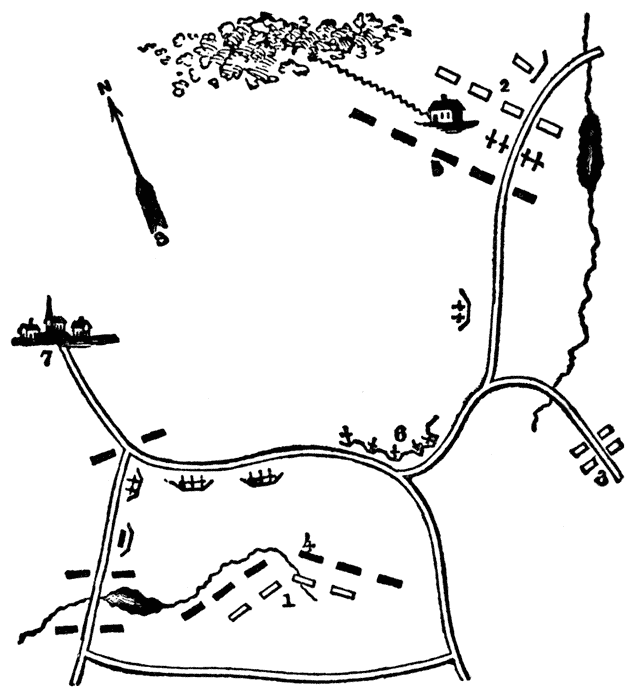
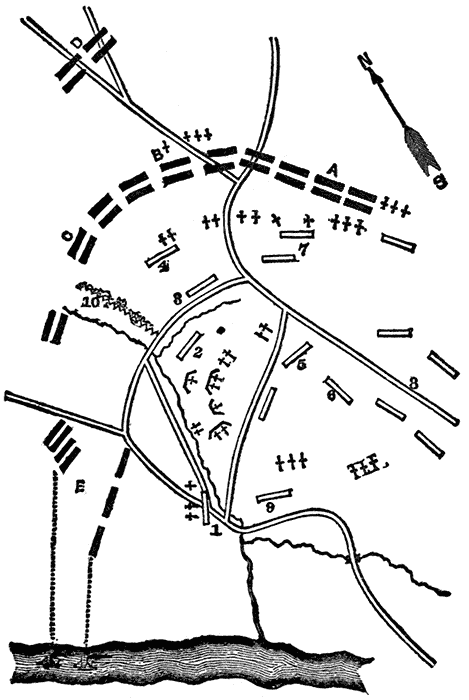
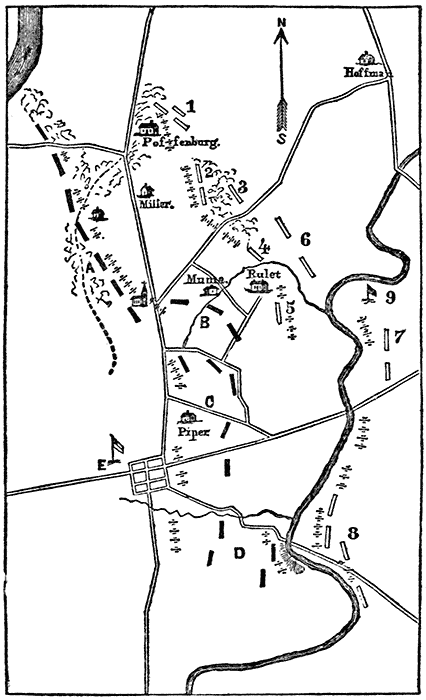
The dotted line passing through Jackson's position is a narrow farm
road, along which Jackson erected his defensive works.
Positions of the Two Armies.
The diagram represents the general positions of the divisions as they
came upon the field.
|
1 Hooker's corps.
2 Mansfield's corps.
3 Sedgwick's division, Sumner's corps.
4 French's " " "
5 Richardson's " " "
6 Franklin's corps.
7 Porter's corps.
8 Burnside's corps.
9 McClellan's head-quarters.
|
A. Jackson.
B D. H. Hill.
C Longstreet.
D A. P. Hill.
E Lee's head-quarters.
|
The Battle Field of Antietam.
Besides these protections to the flank, the line
itself was very strong. There were hills, hollows,
ravines, groves, ledges, fences, cornfields, orchards,
stone-walls,—all of which are important
in a great battle. Besides all of those natural
defenses, General Lee threw up breastworks and
rifle-pits to make his line as strong as possible.
His line was on the ridge, between the Antietam
and the Potomac.
There are three stone bridges across the Antietam
near where the battle was fought. One of
them will be known in history as the Burnside
Bridge, for there the troops commanded by General
Burnside forced back the Rebel right wing,
and crossed the stream. It is on the road which
leads from Sharpsburg to the little village of Roherville
in Pleasant Valley.
A mile north, there is another at the crossing
of the Boonesboro' and Sharpsburg turnpike. A
half mile above, on the eastern bank, there is a
large brick farm-house, where General McClellan
had his head-quarters during the battle. Following
the windings of the stream, we reach the
upper bridge, on the road from Keedysville
to Hagerstown. On the western bank are
the farms of John Hoffman and D. Miller.
There is a little cluster of houses called Smoketown.
Traveling directly west from Hoffman's one
mile across the fields, we reach the Sharpsburg
and Hagerstown pike, near the residence of Mr.
Middlekauff. A quarter of a mile farther would
carry us to the great bend of the Potomac. But
turning south, and traveling the turnpike, we
reach the farm-house of Mr. John Poffenberger,60
a wooden building standing with its gable towards
the turnpike. There are peach-trees in
front, and a workshop, and a bee-bench.
There is a high ridge behind the house, crowned
by Poffenberger's barn. Standing upon the ridge
and looking west, we behold the turnpike at our
feet, a mown field beyond, and fifty or sixty rods
distant a cornfield, and a grove of oaks. That
cornfield and those oaks is the ground occupied
by Jackson's left wing.
A few rods south of Poffenberger's is the toll-gate.
There a narrow lane runs west towards
the Potomac. Another leads southwest, past an
old house and barn, winding through the woods,
and over the uneven ground where Jackson established
his center. There is a grove of oaks
between the toll-gate and the farm-house of Mr. J. Miller, a few rods further south. Mr. Miller
had a large field in corn on the hillside east of
his house at the time of the battle. Standing
there upon the crest and looking east, we have a
full view of the farm of John Hoffman. Here
and on the ridge behind Poffenberger's, Jackson
established his advanced line one half of a mile
from his main line, west of the turnpike.
The cornfield was bordered on the east by a
narrow strip of woodland, on the south by a newly
mown field extending to the turnpike.
Walking across the smooth field to the turnpike
again, we behold a small one-story brick
building on the west side of the road, with an
oak grove behind it. It has no tower or spire,
but it is known as the Dunker Church. A road
joins the turnpike in front of the church, coming
in from the northeast from Hoffman's farm and
the upper bridge across the Antietam.
This building is on elevated ground. It was
the pivot on which the fortunes of the day swung
to and fro, where hinged the destiny of the nation.
There Jackson's right wing joined D. H. Hill's division. There, around the church, fifty
thousand men met in deadly strife.
The land slopes towards the east. Rivulets
spring from the hillside, and flow towards the
Antietam. Seventy or eighty rods east of the
church is the residence of Mr. Muma. There is
a graveyard north of his dwelling, white headstones
marking the burial-place. There is a farm-road
leading past his house to Mr. Rulet's beyond.
It winds along the hillside into the ravine by Mr.
Rulet's. There are branch roads; one leading to
Sharpsburg, one down the hill to the middle
bridge across the Antietam. The farms of Mr.
Muma, Mr. Rulet, and Dr. Piper are broken lands,
hills, ravines, corn and wheat fields, orchards,
pastures, and mowing-grounds. D. H. Hill occupied
the high grounds on Mr. Muma's farm; Longstreet
held Rulet's, Dr. Piper's, Sharpsburg, and
the hills south of the town.
Standing by the church and looking north, we
see Poffenberger's house, three fourths of a mile
distant; northeast we see Hoffman's farm, a mile
and a half distant. Looking directly east over
the house of Mr. Rulet, we behold the Antietam,
one mile distant, with General McClellan's head-quarters
on the hill beyond.
Southeast, a mile and a quarter distant, is the
middle bridge on the Boonesboro' pike. Directly
south, along the Hagerstown turnpike, is Sharpsburg.
Lee's head-quarters are in a field west of
the town. Two miles distant, at the base of Elk
Ridge, is the lower bridge. There the banks of
the river are high, sharp, and steep. Behind the
church are limestone ledges; in the woods, strong
natural defenses.
These are the main features of the field:—
Hoffman's farm.
Poffenberger's house, the ridge behind it, the
woods, and cornfields west of it.
Miller's house, the cornfield east, the mown
field south, the turnpike and the woods west.
The church, the field in front, the woods behind
it.
Muma's farm, Rulet's house, the orchard
around it, the farm-road, and cornfield west of it.
The lower bridge, and the hills on both sides
of the stream.
At daylight on Monday morning, after the battle
at South Mountain, General Richardson's division
of the Second Corps moved down the mountain
side through Boonesboro' to Keedysville. It
was found that General Lee was massing his
troops on the west bank of the Antietam, and
planting his batteries on the hills north of Sharpsburg.
General Richardson deployed his troops.
Captain Tidball and Captain Pettit ran their batteries
up on the hills near Porterstown, and commenced
a cannonade which lasted till night.
General Hooker's, General Mansfield's, General
Burnside's, General Sumner's, and General Porter's
troops arrived during the night.
On the morning of Tuesday, the 16th, General
McClellan reconnoitered the position which Lee
had chosen. The forenoon passed before the corps
were in position to make an attack.
General McClellan's plan was to attack the enemy's
left with Hooker's and Mansfield's corps,
supported by Sumner's; and, as soon as matters
looked favorably there, to move Burnside across
the lower bridge, and attack Lee's right, south
of Sharpsburg. If either of these flank movements
were successful, then he would move
upon the center with all the forces at his disposal.
About two o'clock in the afternoon, Hooker
crossed the Antietam by the upper bridge and by
the ford near Pray's Mill. The Rebel pickets
were in the cornfields on Mr. Hoffman's farm, and
their first line in the strip of woods east of Miller's
cornfield. The Pennsylvania Reserves were
in advance. There was a sharp skirmish and a
brisk cannonade which lasted till dark. The Rebels
were forced back. They retreated almost to
Poffenberger's house. General Hooker advanced,
planted his guns on the hill near Hoffman's, and
threw out his pickets. His men lay down to sleep
in the fields and amid the rustling corn.
Mansfield crossed during the night. He went
up from the stream but a short distance, halting
nearly a mile in rear of Hooker. Sumner's corps
remained east of the stream, near Pray's Mill.
Porter was posted on the east side near General
McClellan's head-quarters, while Burnside passed
down through Porterstown and came into position
on the farm of Mr. Rohrbach at the base of
Elk Ridge, near the lower bridge.
An auspicious hour had passed by never to return.
Lee had only Longstreet, D. H. Hill, and
two divisions of Jackson's corps on the ground
on Tuesday, the 16th. Jackson arrived on the
morning of the 16th, after a hard night-march
from Harper's Ferry. His troops were exhausted.
They were not in condition to fight on Tuesday;
but by the delay of General McClellan they obtained
rest and strength. McLaw's, Anderson's,
Walker's, and A. P. Hill's divisions had not arrived
even when the great contest began on the
17th.61
A portion of Lee's line on the morning of that
day was weak and thin. Longstreet held the
right, opposite Burnside; D. H. Hill was on Rulet's
farm, Hood was at the Dunker Church, and
Jackson northwest of it, in front of Poffenberger's
house. Hood's men were exhausted; they had
marched rapidly to reach the field, and had been
sent to the front upon their arrival, to keep
Hooker in check, as he moved through Hoffman's
cornfields on the afternoon of the 16th. Lawton,
commanding Ewell's old division in Jackson's
corps, relieved him during the night. At daybreak
the "Ragged Texans," as Hood's men were
called by their comrades, were cooking their cakes
and frying their pork in the fields south of the
church. Lee's head-quarters were on a hill beyond
Sharpsburg, so high that he could overlook
a large portion of the field. He saw that McClellan
intended to turn his left, and threw all
his available troops towards the Dunker Church.
On the morning of the 17th a breeze from the
south swept up the valley, rolling dark clouds
upon the mountains. There was a light fog upon
the Antietam. Long before daylight the word,
which roused the men from sleep, passed along
the lines of Hooker's divisions. Without a drum-beat
or bugle-call the soldiers rose, shook the
dewdrops from their locks, rolled their blankets,
and ate their breakfast.
The pickets of the two armies were so near
each other that each could hear the rustle of the
corn as they paced to and fro amid the rows.
Occasionally there was a shot. Once, in the night,
there was a volley beyond the woods towards
Muma's. General Hooker was asleep in a barn
near Hoffman's. He sprang to his feet, stood by
the door, and listened. "We have no troops in
that direction. They are shooting at nothing," he
said, and lay down once more.
Five o'clock. It is hardly daylight, as the
pickets, straining their sight, bringing their
muskets to a level with their eyes, aim at the
dusky forms stirring amid the corn-leaves, and
renew the contest. There are bright flashes from
the strip of woods, and from the ridge behind
Poffenberger's. The first Rebel shell bursts in
the Sixth Wisconsin, prostrating eight men.
Hooker's guns, in the edge of the woods west of
Hoffman's, are quick to respond.
Meade's division, composed of Seymour's, Magilton's,
and Anderson's brigades, was in the
center of Hooker's corps, and also in the advance.
Doubleday was on the right, and Ricketts behind
Meade.
The order was given to Meade to move on, and
to Ricketts and Doubleday to keep within close
supporting distance. The direction taken by
Meade brought him through the strip of woods
northeast of Miller's house. Lawton's division of
Jackson's corps held the ground by Miller's
house, with Ripley, of D. H. Hill's division, joining
on the narrow road north of Muma's, a quarter
of a mile in front of the church.
At this early hour, before any movement was
made, Tuft, Langner, Von Kleizer, Weaver, Weed,
and Benjamin, with twenty-pounder Parrott
guns, planted on the hills east of the Antietam,
between the center and lower bridges, opened
upon Lee's lines, throwing shells and solid shot
into Sharpsburg, and upon D. H. Hill on Rulet's
farm. "It enfiladed my line, and was a damaging
fire,"62 says Stonewall Jackson, who brought
up his batteries of heavy guns,—Prague's, Carpenter's,
Raine's, Brokenbrough's, Caskie's, and
Wooding's batteries.
Meade's men went cheerily to the work. They
began at long range to give their volleys; they
were in the hollow, northeast of Miller's. Lawton's
troops looked down upon them from
their shelter beneath the trees and behind the
hills.
The Reserves began to drop beneath the galling
fire. Hooker rode up to them upon a powerful
white horse. The bullets flew past him, cutting
down the corn, and bursting shells sprinkled him
with earth; but he was calm amid it all, directing
the troops and holding them up to the work by his
mighty will.
Nearer to the woods now, shorter the range,
more deadly the fire. Ricketts came up on the
left with Duryea's and Christian's brigades.
There were heavier volleys from the cornfield
and open ground, fainter replies from the woods.
It was an indication that Lawton was growing
weaker.
"Forward!" It was an electric word. The
Reserves, with Ricketts's two brigades, went up
with a cheer into the woods, through into the
open field, following the fleeing Rebels, who were
streaming past Miller's, over the field in front of
the church, into the woods behind it. The Reserves
reached the middle of the field; but now
from the woods into which Lawton had fled there
were quick volleys of musketry and rapid cannon
shots from Hayes's, and Trimble's, and Walker's,
and Douglas's, and Starke's brigades of Jackson's
division.
The Reserves stopped in the middle of the field.
They gave a few volleys. The men dropped fast.
Some of the wounded crawled, some hobbled
away; others lay where they fell, motionless forever.
The living turned and sought the shelter of
the woods, from which they had driven the enemy.
The aspect of affairs suddenly changed. Jackson
moved forward his whole line, not only across
the field in front of the church, but extended farther
north, towards Poffenberger's. "Send me
your best brigade," was the message from Hooker
to Ricketts. Hartsuff, of Ricketts's division, had
not been engaged. A portion only of Doubleday's
troops had been in. Hartsuff was on the hill behind
Poffenberger. His troops, the Twelfth and
Thirteenth Massachusetts, Ninth New York, and
Eleventh Pennsylvania, went down the hill upon
the run, south towards Miller's, past the retreating
brigades, closing in like an iron gate between
them and the exultant enemy. They came into
line upon the crest of the hill, crowning it with
their dark forms, and covering it with flame and
smoke.
"I think they will hold it," said General
Hooker, as he watched them presenting an unbroken
front. Jackson pushed on his brigades,
but they recoiled before the steady and destructive
fire rolled out by Hartsuff, also by Gibbons,
and Patrick, who were holding the ridge by Poffenberger's.
Jackson's line melted away. "At
this early hour," says Jackson, in his report,
"General Starke was killed; Colonel Douglas,
commanding Lawton's brigade, was killed; General
Lawton, commanding a division, and Colonel
Walker, commanding a brigade, were severely
wounded. More than half of the brigades of Lawton
and Hayes were killed or wounded; and more
than a third of Trimble's; and all the regimental
commanders in those brigades except two, were
killed or wounded."63
Once more the Rebels retired to the woods behind
the church. There was a lull in the storm.
The shattered brigades of Jackson went to the
rear, taking shelter behind the ledges. Hood, with
his ragged Texans, came to the front by the
church. Stuart, who was out on Jackson's left,
towards the Potomac, came up with his artillery.
Early's division also came to the front, all forming
on the uneven ground west and northwest of
the church in the woods; also Taliaferro's, Jones's,
and Winder's brigades.
Hooker was quick to plant his batteries. Those
of Doubleday's division galloped to the ridge
northeast of Poffenberger's house. Gibbons's,
Cooper's, Easton's, Gerrish's, Durell's, and Monroe's,
were wheeled into position. Projectiles of
every form cut the air. The oak-trees of the
grove by Miller's were splintered and torn, the
branches were wrenched from the trunks, and
hurled to the earth.
Rebel shells tore through Poffenberger's house
knocking out the gable, ripping up the roof, tossing
boards and shingles into the air. The beehives
in the yard were tumbled over, and the angry
swarms went out, stinging friend and foe.
Hooker had crossed the turnpike, and was a
few hundred feet beyond the toll-house. Hartsuff
was wounded and carried from the field. The
Reserves, broken and exhausted, were in the rear,
too much shattered to be relied on in an emergency.
Ricketts's brigades, which had met D. H. Hill, had fallen back. Hartsuff's, Gibbons's, and
Patrick's alone were in front.
It was nearly eight o'clock, and Hooker's troops
thus far had borne the whole of the contest unaided.
They had driven Jackson from his front
line, had assaulted his second, had received, like
a stalwart knight of the olden time, unflinchingly
the heavy blow which the Rebel commander had
given.
Hooker rode forward and reconnoitered.
"That is the key to the position," he said,
pointing toward the church.
"Tell Mansfield to send up a division," was
the order sent to this venerable officer, who was
slowly advancing from Hoffman's farm.
Williams's division went up into the strip of
woods east of the cornfield, Crawford's brigade
on the right, and Gordon's on the left.
"Tell Doubleday to hold them on the right.
Don't let them turn our flank," was the word
sent up to Doubleday, who was quietly watching
the Rebels from the cornfield west of Poffenberger's.
There were signs of an advance of Jackson's
line.
"Keep them well stirred up," was the message
to the artillerymen. The thirty-six guns planted
on the ridge reopened.
"I cannot advance, but I can hold my ground,"
said Ricketts.
While Crawford and Gordon were forming,
General Mansfield was mortally wounded and
borne to the rear, and the command of the corps
devolved on General Williams. Green's division
came up and formed on the right of Williams's,
now commanded by Gordon, reaching south nearly
to Muma's house. King's, Cothran's and Hampton's
batteries, belonging to the Twelfth Corps,
opened a rapid fire. The One Hundred and
Twenty-third Pennsylvania was pushed across the
turnpike into the woods west of Miller's, near the
toll-gate.
While making these dispositions General
Hooker dismounted and walked to the extreme
front. There was a constant fire of musketry from
the woods. He passed through it all, returned to
his horse, and once more was in the saddle. He
was in range of the Rebels. There was a heavy
volley. A bullet entered his foot, inflicting a
painful wound. Three men fell near him on the
instant. But he issued his orders with coolness
and deliberation. "Tell Crawford and Gordon to
carry those woods and hold them," he said to his
aide as he rode slowly to the rear. He tried to
keep in the saddle, but fainted. "You must leave
the field and have your wound attended to," said
the surgeon. It was with great reluctance that
he rode to the rear; but Sumner at that moment
was going up with his superb corps, the Second,
which had never quailed before the enemy.
Williams formed his line, his own division on
the right, and Green's on the left.
Patrick and Gibbons were moved down to the
turnpike. The troops were enthusiastic. They
had driven the enemy, had captured battle-flags
and prisoners.
Gordon and Crawford advanced over the mown
field, across the turnpike, into the woods, and
poured in their fire. Jackson replied. The woods
were all aflame. From every tree, and knoll, and
ledge, and hillock, there were volleys of musketry,
and flashes of artillery.
It was a terrible fire. Gordon and Crawford
were close upon the Rebel lines, behind the ledges
and the breastwork which they had thrown up.
They almost broke through. A little more power,
the support of another brigade, the pushing in of
another division at this moment, and Jackson
would have been forced from his stronghold; and
if driven from that position he must fight in the
smooth fields beyond, or be folded back upon the
center and right, with the door half opened for
Hooker to march upon Shepardstown and cut off
the retreat.
It is nearly nine o'clock when Gordon and
Crawford stand within three hundred feet of the
Rebel line, in the woods northwest of the church.
They face west. They fight Grigsby, Stafford,
and Stuart of Jackson's corps.
It is a critical moment with Jackson. The
Yankees must be repulsed or all is lost. Early's
and Hood's divisions are behind the church.
Early moves north, sweeping past the church.
He strikes Crawford's flank and rear, and forces
him back. Green hastens up to sustain Crawford,
and is also driven across the turnpike into the
field nearly to the strip of woods west of it.
Sedgwick's division of Sumner's corps has been
coming into line in Miller's cornfield. If it had
been earlier on the ground it would have been of
infinite value. It is a noble division, led by an
able commander.
General Sumner himself is there, gray-haired,
sober, vigilant, watchful. He examines the
ground and the positions of the enemy.
Sedgwick forms his division in three lines. Dana
in front, Gorman in the second, and Howard
in the third line. They pass in front of Mansfield's
troops towards the church.
Jackson has been hurrying up reinforcements.
The troops which have been on the march from
Harper's Ferry are brought in.
"By this time," says Jackson, "the expected
reinforcements, consisting of Semmes's, and Anderson's,
and a part of Barksdale's, of McLaw's
division, arrived, and the whole, including Grigsby's
command, now united, charged upon the enemy,
checking his advance, then driving him
back with great slaughter."64
Jackson's line unites with D. H. Hill's in the
field between the church and Muma's house.
Muma's is east of the church. Sedgwick is
northeast of it. As Sedgwick approaches the
church, Jackson swings up his right wing from
the field by Muma's. Sedgwick's second and
third lines are close upon the first. The solid
shot which the Rebel batteries fire cut through
all the lines. The bullets which miss the men
in Dana's brigade take effect in Gorman's, and
those which pass Gorman strike down Howard's
men.
Dana's brigade was close upon the enemy.
The hot blasts from the Rebel artillery, and the
sheets of flame from the infantry, scorched and
withered the line. The volleys given in return
were exceedingly destructive. But Gorman's
and Howard's men stood with ordered arms,
chafing under the terrible fire, without being able
to give a reply. They were so close upon Dana
that they could do nothing. Fifteen minutes has
passed. Dana's brigade is lost from sight. By
stooping, and laying my eyes near the ground, I
can see the dusky forms of the men through the
drifting cloud. They are holding their position.
But the troops which Jackson has been swinging
up on his right, which have been hidden
from Sedgwick and Sumner, suddenly appear.
They seem to rise from the ground as they come
over the ridge of land in the field between the
church and Muma's house. They move northeast
to gain Sedgwick's rear.
"Change front!" is the quick, imperative
order from Sumner to Howard. The third line
under Howard has been facing southwest. The
regiments break rank, move out in files, and form
once more, facing southeast.
There is confusion. Some men think it an
order to retreat, and move towards Miller's cornfield.
The Rebel line advances in beautiful
order. Howard is beset by three times his number
of men. Gorman is attacked on his left.
The Rebels pour a volley into the backs of his
men. The whole force is outflanked.
A retreat is ordered, and the regiments fall
back through Miller's cornfield to the woods.
The Rebels are strong and exultant. They
cheer and scream and swing their caps. They
think that they have won a victory. They press
on to regain the woods from which they were
driven in the morning.
"Form behind the batteries," shouts Sumner,
riding along the lines. The troops are not panic-stricken.
They are cool and deliberate.
Tompkins, Kirby, Bartlett, and Owen are
ready with their howitzers. "Give them canister!"
is the order.
The batteries are posted along the ridge, in the
cornfield. The limbers and caissons are a few
rods down the slope. The horses nibble the
corn, they prick up their ears a little when a
shot screams past, but are so accustomed to the
firing that they do not mind it much.
Gorman, Dana, and lastly Howard, who has
stood like a protecting wall, gain the rear of the
batteries, and the field is open for them.
The Rebels advance. The batteries open. The
discharges are rapid. No troops can live under
such a fire. In five minutes it is decided that
they cannot force the Union troops from the
cornfield, nor from the woods east of it. They
retreat once more to the church and to the ravine
by Muma's.
Sedgwick has been engaged a half hour, but
his loss has been great.
The Fifteenth Massachusetts was in Gorman's
brigade,—the regiment which fought so nobly at
Poolesville.
Twenty-four officers and five hundred and
eighty-two men marched towards the church,
but in twenty minutes three hundred and forty-three
were killed and wounded. Other regiments
suffered as much.
Jackson's loss was as severe as Sedgwick's.
General Hood, in his official report, says:
"Here I witnessed the most terrible clash of arms
by far that has occurred during the war."65
"A little world of artillery was turned loose
upon us," says the chaplain of the Fourth
Texas.66
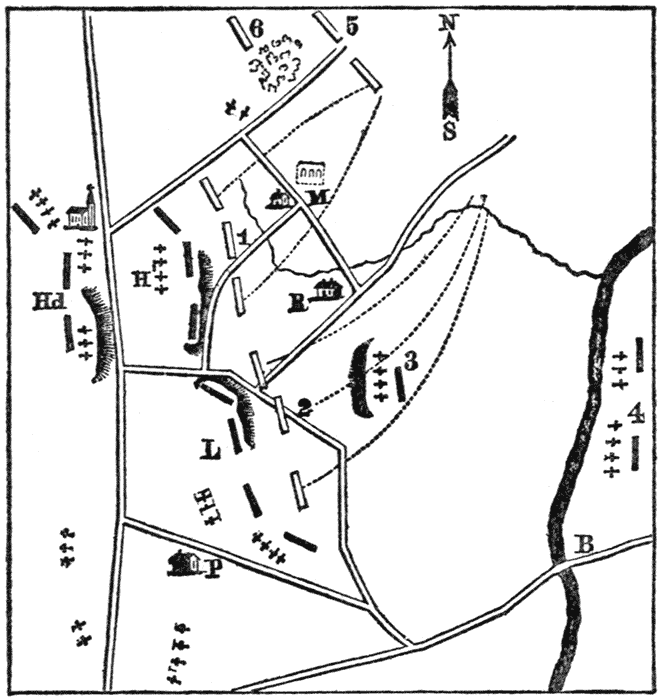
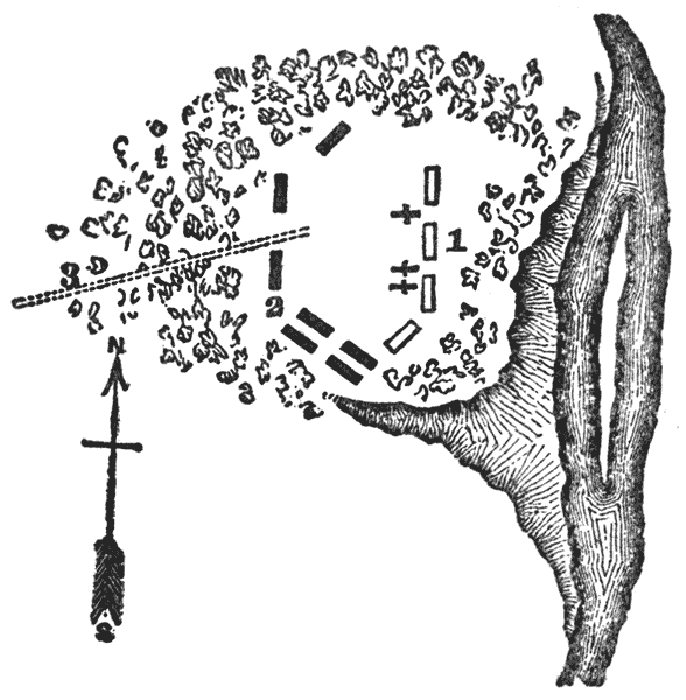
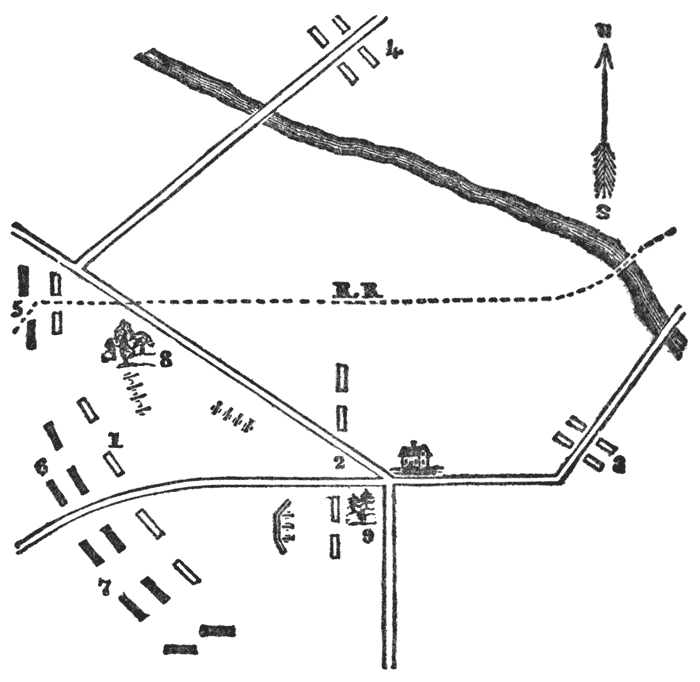
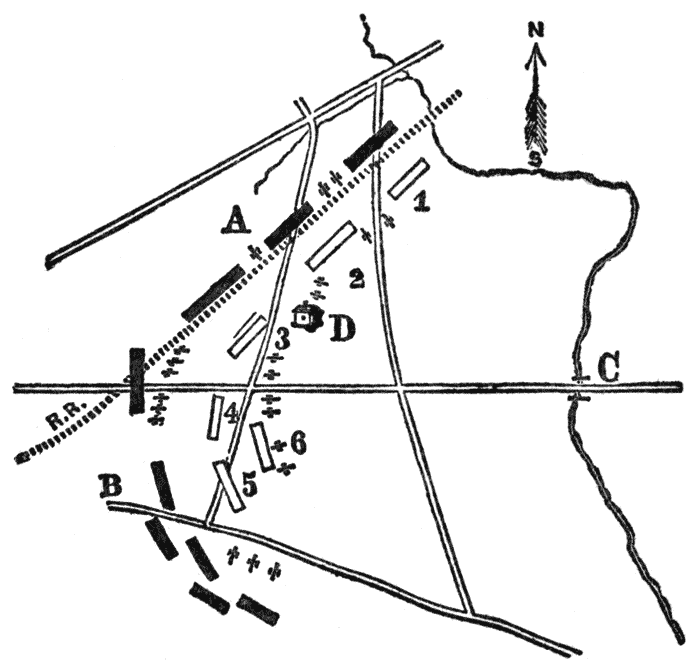
Sedgwick's Attack.
The diagram gives the position of the troops on this part of the field
at the time of Sedgwick's attack.
|
1 Dana's Brigade.
2 Gorman's Brigade.
3 Howard's, after change of front.
4 Green's and Williams's Divisions.
5 Ricketts's Division.
|
6 Meade's Division.
7 Doubleday's Division.
8 Position reached by Green and Williams.
9 Union batteries in Miller's cornfield.
|
|
J Jackson's head-quarters.
L Ledges with breastworks.
M Miller's.
|
P Poffenberger's.
T Toll House.
R Rebels attacking Sedgwick's flank.
|
The road running north from the church in the Hagerstown turnpike.
That running northeast from the church leads to Hoffman's
farm. The narrow way in the woods where Jackson established his
head-quarters, is a farm-road.
In Dana's line is the Nineteenth Massachusetts.
It fought at Fair Oaks, Savage Station, White-Oak
Swamp, Glendale, and Malvern. Its ranks have
been sadly thinned. A great many brave men
have fallen, but those who survive emulate the
deeds of their comrades. They remember one who
fell in front of Richmond,—a descendant of a
glorious Revolutionary sire, the patriot Putnam,
relative of the young officer,—Lieutenant
Putnam, who fell mortally wounded at Ball's
Bluff. He was born where the old General played
in his childhood, before he became a rifle-ranger
fighting the Indians in the dark forest bordering
Lake Champlain. They could not forget Robert
Winthrop Putnam, the frail and feeble boy. He
was but sixteen years old when the flag was insulted
at Sumter. His whole soul was on fire.
He resolved to enlist. The surgeons would not
accept him, he was so weak and slender. Again
and again he tried to become a soldier, but was as
often rejected.
The fire of patriotism burned within his breast.
He slept in the room which his great ancestor
had occupied in his youth. He sat by the window
through the moonlit nights, and carved a wooden
sword, thus feeding the consuming flame. On
one side he cut this motto:—
"Not to be drawn without Justice;
Not to be sheathed without Honor."
Upon the other side, giving vent to his pent-up
soul, were these words:—
"Death to Traitors!"
He brooded upon his disappointment by day
and dreamed of it at night. He made one more
effort. No questions were asked; he was accepted,
and became a soldier. He was intelligent,
manly, courageous, and temperate. His
drink was cold water. Calmly and deliberately
he bade farewell to his aged parents and his
young sister and brother, turned from the dear
scenes of home and childhood, hallowed by ever
fragrant memories, buckled on his knapsack, and
took his place in the ranks. When mortally
wounded he refused to leave the field, but
cheered his comrades in the fight. In his last
letter, written to his sister, dated on the eve of
battle, he wrote:—
"I left home to help defend a Constitution that
was second to none in the world, a flag which
every nation on earth respected; and if I am to
die, I shall be happy to die in the service of my
country."
The boy-soldier was gone from the ranks, but
his spirit was there, an all-animating presence.
When the battle began in the morning, I was
at Hagerstown. It was ten miles to the field,
but though so far, the cannonade seemed very
near. It rolled along the valley and rumbled
among the mountains. The people left their
breakfasts, and climbed the hills and steeples to
behold the battle-cloud. The women were pale,
and stood with tearful eyes, forgetting their
household cares.
A ride directly down the Sharpsburg pike would
have taken me to the rear of Lee's army. It
would be a new and interesting experience to
witness the fight from that side. I started down
the pike, my horse upon the gallop. A mile out
of town I met a farmer.
"Where are you going?" he asked.
"To see the battle."
"You will run right into the Rebels if you
keep on."
"That is what I want to do. I want to see
the battle from their side."
"Let me advise you not to go. I was in their
clutches yesterday. They threatened to take me
to Richmond. They stole my horse and my
money, and I am glad enough to get clear. Let
me advise you again not to go. You had better
go down to Boonesboro', and see the battle from
our side."
It was good advice, and I was soon upon the
Boonesboro' road.
I came across a Rebel soldier lying at the foot
of an oak-tree. He was weak with sickness,
worn down by long marches, and had dropped
from the ranks. He belonged to Longstreet's
corps. He was too weak to speak. His breathing
was short and quick and faint. His cheeks
were hollow, his eyes sunken. Two kind-hearted
farmers came and took him into a house.
"I am sorry I came up here to fight you," he
whispered. He had lain beneath the oak a day
and a night, waiting death, expecting no help or
mercy from any one. The unexpected kindness
filled his eyes with tears.
Striking off from the turnpike I galloped across
the fields, through woods, over hills and hollows,
reached the Antietam, crossed it by a ford, and
ascended the hill to Hoffman's farm.
Sedgwick and Williams were fighting to hold
their ground. It was a terrific fire. There were
heavy surges, like breakers upon the sea-beaches,
like angry thunder in the clouds,—ripples, rolls,
waves, crashes! It was not like the voice of
many waters, for that is deep, solemn, sweet,
peaceful; the symbol of the song of the redeemed
ones, which will ascend forever before the throne
of God, when all war shall have ceased.
It was a fearful contest in front of Sumner.
Miller's cornfield was all aflame. The woods by
the church smoked like a furnace. Hooker's
cannon were silent, cooling their brazen lips after
the morning's fever; but the men stood beside the
guns, looking eagerly into the forest beyond the
turnpike, watching for the first sign of advance
from the Rebels.
All the houses and barns near Hoffman's were
taken for hospitals. There were thousands of
wounded. Long lines of ambulances were coming
down from the field. The surgeons were at
work. It was not a pleasant sight to see so
many torn, mangled arms, legs, heads; men
with their eyes shot out, their arms off at the
shoulders, their legs broken and crushed by cannon
shot. But they were patient, cheerful, and
hopeful. The nurses and attendants made them
comfortable beds of straw upon the ground. The
agents of the Sanitary and Christian Commissions
gave them coffee and crackers. Many a noble
hero said, "I thank you! God bless you!"
In the hollow between Poffenberger's and Hoffman's
were the Pennsylvania Reserves, what was
left of them. Once they were fifteen thousand;
now, a remnant. They were sad, but not disheartened.
"We have had a terrible fight," said
one. "Yes, and we thrashed the Rebels. Joe
Hooker knows how to do it," another said. "We
are badly cut up, though. We can't lose many
more, because there ar'n't many more to lose,"
said the first.
"I am sorry Hooker is wounded. We had
licked the Rebels fairly when he left the field.
I guess they won't put us in again to-day; we
have done our share; but if they do, we are
ready," said the others.
The shells and solid shot from the Rebel batteries
in the woods north of the church were dropping
around us.
"See there! see it tear the ground!" one
shouted, and pointed towards the spot where a
solid shot was throwing up the earth. "The man
who owns that land is getting his plowing done
for nothing," said another.
"Ha! ha! ha!"
Another shot struck near a soldier, and covered
him with earth. "Fire away! you can't do that
again, I'll bet," he said, as he brushed the dirt
from his clothes.
"Stand by the guns!" was the quick, imperative
order. The men sprang to their feet. Those
who were at the spring, in the hollow of the field,
filling their canteens, came to the lines upon the
run.
"What's up?" asked an officer. "The Rebels
are massing in front, and it looks as though they
were going to attack."
"Gibbons's brigade is across the turnpike; he
will hold them, I reckon," said another officer.
I rode up on the hill in rear of Poffenberger's.
Captain Gibbons was in front of his battery, looking
across the turnpike into the woods.
"It is a little risky for you to be on horseback.
Do you see that fence over there?"
"Yes."
"Well, the Rebel skirmishers are there, and we
are in easy range. If you want to get a sight of
them, you had better dismount, tie your horse,
and creep down under the shelter of this fence."
The cannon balls were thick upon the ground,
and there were pools of blood where the artillery
horses had fallen.
"This was a warm place an hour ago, and may
be again; for I see that the Rebels are up to
something over there."
I look as he directs, and see a column of troops
moving through the woods. They are in sight
but a moment. I walk along the line, past Gibbons's,
Cooper's, Easton's, Durrell's, Muma's,
and Gerrish's batteries, to Poffenberger's barn.
Gerrish's battery is very near the building. The
gunners are tired with their morning's work, and
are sound asleep under the wheat-stacks, undisturbed
by the roar a half-mile distant, where
Sedgwick is at it, or by the shot and shells which
scream past them.
Dead and wounded men are lying in Poffenberger's
door-yard. The ground is stained with
blood. Two noble white horses are there, one
with his head smashed, the other with his neck
torn,—both killed by the same shot. There are
dead men in the turnpike. Gibbons's brigade is
behind the stone wall. The toll-house is riddled
with bullets. There are flattened pieces of lead
among the stones. The trees are scarred. There
are fragments of shells. The ground is strown
with knapsacks, guns, belts, canteens, and articles
dropped in the fight.
"I guess you are about near enough. This is
the front line," says a soldier.
I think so, too, for the bullets are singing over
our heads and past us. I go up through the
woods, south of Poffenberger's, to Miller's cornfield.
The contest has lost some of its fury. The
Rebels have been repulsed, and both sides are taking
breath.
Mansfield's corps is in the woods, east of Miller's.
Sedgwick's division is in the cornfield, behind
the batteries of Cothran, Woodruff, Mathews,
and Thompson. The batteries are pouring a constant
stream of shells into the woods beyond the
church.
The Union loss has been very heavy,—Hooker,
Sedgwick, Dana, Hartsuff, wounded, and Mansfield
killed. Meade commands Hooker's corps, and
Howard, with his one arm, commands Sedgwick's
division. He lost his right arm at Fair Oaks, but
he is in the saddle again. The Rebel dead are
thick around the church, and in the field in front
of it, and along the turnpike, mingled with those
who had fallen from the Union ranks. Five times
the tide of battle has swept over the ground during
the morning. The officers point out the exact
spot where they stood. They tell what happened.
"We stood out there, in the center of the field,"
says an officer of the Tenth Maine. "We came
up just as Ricketts was giving way. The Rebels
were outflanking him, and his troops were streaming
through the cornfield. The Rebels were pushing
north towards Miller's. Our line of march
was towards the west, which brought us partly in
rear of their line. Those dead men which you see
out there belonged to the Twentieth Georgia.
They were on the right of the Rebel line. We
gave them a volley right into their backs. They
didn't know what to make of it at first. They
looked round, saw that we were in their rear, then
they cut for the woods. It forced back the whole
Rebel line. Just then Corporal Viele, of company
K, of our regiment, and a corporal of the Second
Massachusetts, dashed after them, and captured
the Colonel of the Twentieth Georgia, and a lieutenant."
"And Lieutenant-Colonel Dwight, of the Second
Massachusetts, captured a battle-flag," says
a soldier of that regiment, his eyes sparkling with
enthusiasm. "He brought it in under a shower
of bullets, waving it over his head. He got clear
back to the lines, and then was wounded, they say
mortally."
There was a lull in the battle after the terrible
fight around the church.
General French's division, of Sumner's corps,
followed Sedgwick across the Antietam. The
division, after crossing the stream, turned to the
left, marching through the fields towards the
house of Mr. Muma. Richardson, as soon as he
crossed the bridge, filed to the left, moved along
the bank of the river, crossed a little brook which
springs from the hillside near Rulet's, encountered
Hill's skirmishers, drove them up the ravine, and
formed his line under cover of a hill.
French is in the ravine. Half of his division is
north of the brook, the other half south. He has
Weber's, Kimball's, and Morris's brigades. He
forms his brigades, as Sedgwick did his, in three
lines,—Weber in front, Morris in the second, and
Kimball in the third line.
Morris's men have never been under fire. They
are new troops. They have heard the roar of battle
through the morning, and now, as they advance
across the fields, the Rebel batteries on the hills
all around Rulet's house open upon them, gun
after gun, battery after battery. The hillside
grows white. A silver cloud floats down the
ravine. They are so near that it infolds them.
There are flashes, jets of smoke, iron bolts in the
air above, also tearing up the ground or cutting
through the ranks; they feel the breath of the
shot, the puff of air in their faces, and hear the
terrifying shriek. A comrade leaps into the air,
spins round, or falls like a log to the ground.
They behold a torn and mangled body. They
saw not the shot which wounded him. It is a
terrible experience, yet they bear the trial firmly.
They drop upon the ground while the lines are
forming, and the shells do them little damage.
Hill has his front line in the ravine by Muma's.
The Rebel soldiers have an excellent opportunity
to fill their canteens from the cool water bubbling
up from his spring-house. The sharpshooters are
in Muma's chambers, firing from the windows at
French's troops as they advance over the field
east of the house. There is a graveyard east of
the house, and the skirmishers lie behind the
graves, their muskets resting upon the white headstones.
French's division joins Sedgwick's; it faces
southwest, while Richardson's faces west. French
arrives while Sedgwick is having the great struggle
in front of the church. Kirby's, Bartlett's,
and Owen's batteries of Sedgwick's division are
on the hillside east of Miller's field, raking the
Rebel lines.
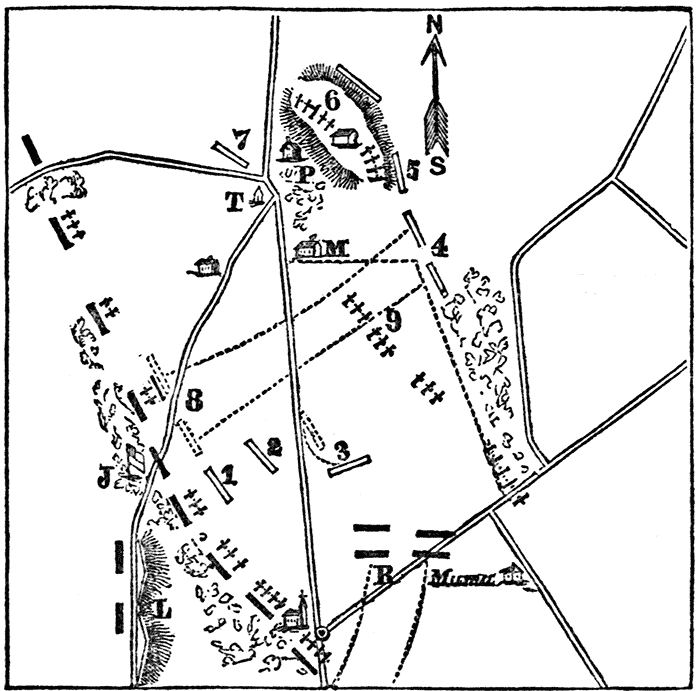
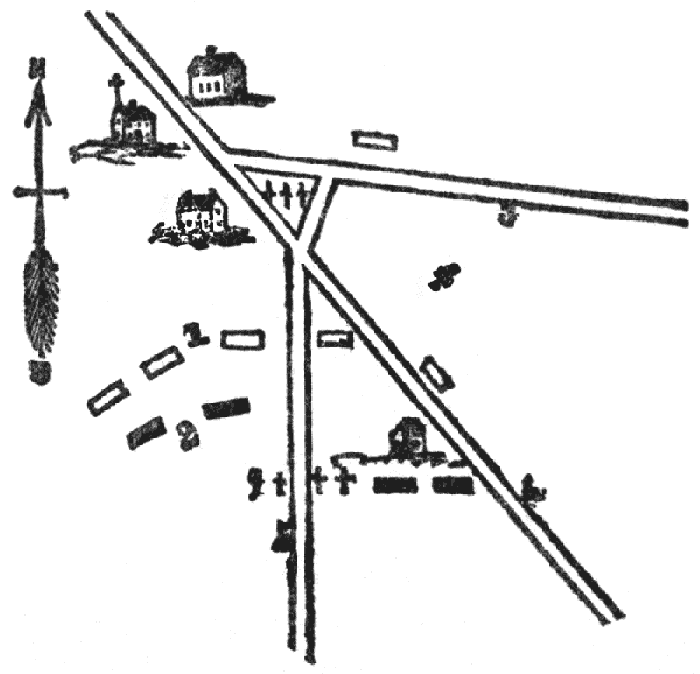
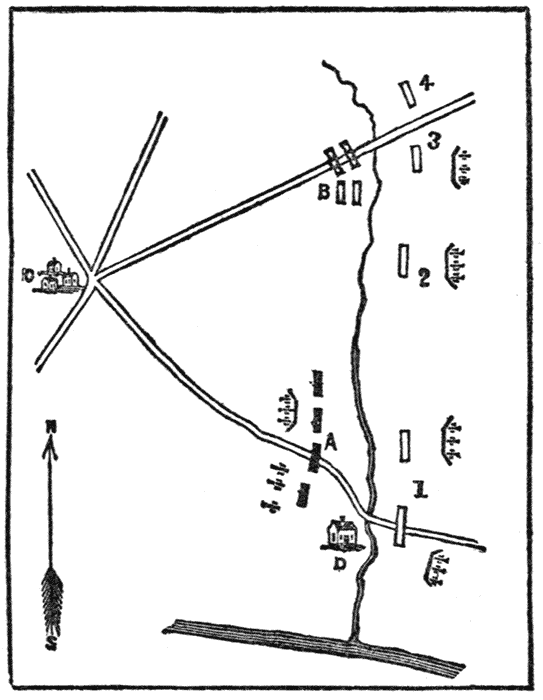
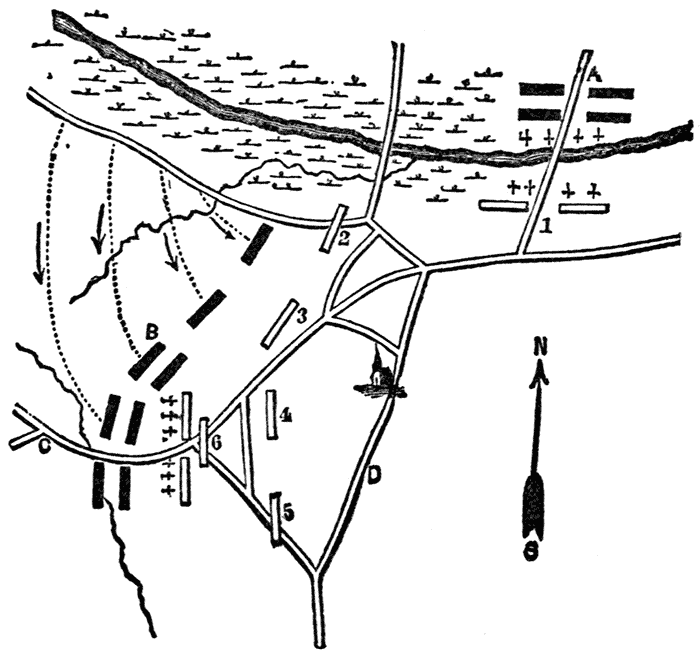
French's and Richardson's Attack.
The diagram shows the positions occupied by French and Richardson,
also by Franklin's and Porter's corps.
|
1 French's Division in brigades.
2 Richardson's " " "
3 Richardson's batteries, with Sykes, of Porter's corps, in support.
4 Taft's and Weber's heavy batteries, and Porter's corps.
5 Slocum's and Smith's Divisions, Franklin's corps.
6 Sedgwick's.
|
B Boonesboro' Bridge.
H D. H. Hill.
Hd Hood in reserve.
L Longstreet.
M Muma's house, and burial-ground.
P Dr. Piper's.
R Rulet's.
|
Smith relieved French in the afternoon.
The roads are narrow carriage-ways leading to the farm-houses.
The Rebels occupying Muma's house and barn
annoy Sumner's artillerymen, who in turn aim
their guns at the buildings. A shell bursts in the
barn and sets it on fire. A black cloud rises.
The flames burst forth. The Rebels, finding the
place too hot for them, apply the torch to the
house, and retreat to Rulet's orchard. The dark
pillar of cloud, the bright flames beneath, the constant
flashing of the artillery, and the hillsides
alive with thousands of troops, their banners waving,
their bayonets gleaming, is a scene of terrible
grandeur.
Weber's brigade advances steadily, throwing
down the fences, scaling the stone-walls, preserving
a regular line. Not so with Morris's, which
is thrown into confusion. The time has come to
strike a great blow.
"Tell General Kimball to move to the front,
and come in on the left of Weber," was French's
order to General Kimball.
The brigade swings towards the south, past
Morris's brigade, enters the ravine, and pushes on
towards Rulet's.
It is a magnificent movement. Richardson at
the moment is crowning the hill south of the
brook, while Tidball's battery is throwing shells
up the ravine into the orchard beyond Rulet's.
The hills are covered with troops. Far up the
hillside in Rulet's, Muma's, and Dr. Piper's cornfields
are Longstreet's and D. H. Hill's troops.
On the hills south of Sharpsburg is A. P. Hill,
just arriving from Harper's Ferry. The Rebel
infantry is behind the stone walls and rail fences.
All of the hills are smoking with artillery. Jackson's
batteries by the church are still thundering
at Howard, who, now that Sedgwick has been
carried from the field, commands that division of
Sumner's corps. Burnside's batteries by the
bridge are all in operation.
Mr. Rulet and Mr. Muma live about half a
mile from the Hagerstown pike. A narrow path
leads along the hillside to the pike. Just beyond
Mr. Muma's, the road is sunk below the surface
of the ground. It has been used many years, and
has been washed by rains, forming a natural rifle-pit,
in which D. H. Hill posts his first line. Between
this pathway and the pike is a cornfield,
in which he stations his second line. His artillery
is planted on the knoll, higher up, near the turnpike.
It is but a few rods from Muma's to the road.
"Bloody Lane," the inhabitants call it now. The
distance from Rulet's is less. There is an apple-orchard
west of Rulet's house. Beyond that the
ground rises sharp and steep. It is a rounded
knoll, sloping towards the west into the sunken
path.
The line of advance taken by Weber carries
him directly towards the smoking ruins of Muma's
buildings, while Kimball passes between
Muma's and Rulet's.
It is a gallant advance which they make.
Weber's troops move over the mown field, past the
burial-ground, leaping the fences. Some of the
men pause a moment, rest their rifles on the rails
and the tombstones, and take a long shot at the
dark line in the cornfield. They cannot see the
nearer line of Hill's division, lying close in the
hidden road.
Kimball, a little farther south, joining his right
to Weber's left, sweeps on in splendid order past
Muma's spring-house, his left wing touching the
apple-trees around Rulet's. The Rebel cannon
on the hills are sending down a steady stream of
shells. The Union batteries east of the Antietam—the
twenty-pounder Parrotts—are throwing
rifled shot in reply. Richardson's batteries on the
hillock beyond the ravine are firing from the
southeast, while Kirby, Owen, Thompson, and
Bartlett, are raining all kinds of shot from the
north. It is a tumultuous roar. Under cover of
this tremendous fire, French moves up the hill.
His men reach the crest, and stand within ten
rods of the sunken road. There is a rail fence
between them and the road. Suddenly, thousands
of men seem to grow out of the ground. The long
line rises. The Rebels thrust the muzzles of their
muskets between the rails. The work of death
begins. French's men, instead of fleeing from this
unexpected foe, intrenched in so strong a position,
rush with a loud hurrah towards the fence. Hundreds
fall while running, but those who survive
pour their fire into the road. The combatants
are not ten paces apart. Hill's line in the road is
consumed like a straw in a candle's flame. It
melts like lead in a crucible. Officers and men go
down, falling in heaps. The few who are left
after the tremendous volleys flee into the cornfield,
towards the turnpike. French's men are
wild with the enthusiasm which comes with success.
They tear away the rails, leap over the
fence, plunge into the road, trampling down
the dying and dead, over the second fence, into
the cornfield, and rush upon the second line with
uncontrollable fury, scattering it, breaking it,
like a bundle of brittle fagots. It is a terrible
struggle. There are hand to hand fights in the
corn-rows; Union and Rebel fall together, literally
in heaps, like sticks of wood tossed together by
choppers!
"See the smoke how the lightning is cleaving asunder,
Hark! the guns, peal and peal, how they boom in the thunder!
From host to host with kindling sound,
The shouting circle signals round;
Ay, shout it forth to life or death,—
Freer already breathes the breath!
The war is waging, slaughter raging,
And heavy through the reeking pall
The iron death-dice fall!
Nearer they close—foes upon foes;
'Ready!' from square to square it goes.
"They kneel as one man from flank to flank,
And the sharp fire comes from the foremost rank.
Many a soldier to earth is sent,
Many a gap by the ball is rent;
O'er the corpse before springs the hinder man,
That the line may not fail to the fearless van.
To the right, to the left, and around and around,
Death whirls in its dance on the bloody ground.
God's sunlight is quenched in the fiery fight,
Over the host falls a brooding night!
Brothers, God grant, when this life is o'er,
In the life to come that we meet once more!"
While French was thus dealing with General
D. H. Hill, Richardson was engaging Longstreet.
Richardson crossed the Antietam about ten
o'clock. He marched down the western bank,
across the farm of Mr. Newkirch, crossing the
little stream coming down from Rulet's.
He moved to gain the high knolls between
Rulet's and the Boonesboro' road. Having crossed
the brook, he faced west, drove in the Rebel
pickets, and ascended the nearest knoll.
All of Longstreet's batteries opened upon him,
but his men moved round the hillock, through
the hollows, and marched well up to the Rebel
lines with little loss. General Meagher, with his
Irish brigade, was on the right, the tip of its wing
touching Rulet's garden. Caldwell's brigade was
on the left, reaching down nearly to the Boonesboro'
turnpike. Brooks's brigade was in reserve.
Longstreet's batteries were on the hills around
Dr. Piper's, and his troops a part of them in the
pathway, the upper end of which was held by
D. H. Hill. His line was so formed, and such
was the ground, that Caldwell, instead of swinging
round upon Sharpsburg, was obliged to fall in
rear of Meagher, and become a second line, instead
of a part of the first.
It was eleven o'clock when Richardson moved
forward. French was pouring in his volleys north
of Rulet's, and now Meagher, climbing the knolls,
and rushing up the ravines, came upon the Rebels
in the road. It was a repetition, or rather a continuation,
of the terrible scene then enacting a
few rods further north,—hundreds falling at every
discharge. The courage of the Irish brigade did
not flag for an instant. They fought till their
ammunition was exhausted. They drove the
Rebels from the road and held it. Again and
again Longstreet endeavored to recover it, but
could not succeed.
General Richardson was wounded and carried
from the field. General Meagher was bruised by
the falling of his horse. His men worn, exhausted,
half their number killed and wounded,
were withdrawn. He retired by breaking ranks
and filing to the rear, Caldwell's troops filing to
the front at the same moment and taking their
places. It was done as deliberately as a dress
parade.
The ground towards the Boonesboro' pike is
very much broken. There are numerous hillocks
and ravines, cornfields, stone walls, and fences.
Under shelter of these, Longstreet stealthily
moved a division to attack Caldwell's right flank
in the cornfield west of the sunken road. It was
a part of the force attacking French. Brooks's
brigade went upon the run up the ravine, and
filled the gap between Caldwell and Kimball, and
held it against all the assaults of the enemy.
On Caldwell's left, the sunken road winds
among the hills. The Rebels still held that section.
Colonel Barlow reconnoitered the ground.
He commanded the Sixty-first and Sixty-fourth
New York regiments. He ordered them to march
by the left flank. They pushed out into the fields
towards Sharpsburg, gained the rear of the Rebels
still holding the road, and forced three hundred
to surrender. He also captured their stand of
colors.
There is once more a lull in the battle. Longstreet
is making preparations to regain his lost
ground. Having failed on French's right, by
Rulet's, he renews the attack on the left. But
Colonel Cross of the Fifth New Hampshire, who
has watched with eagle eye the Indians of the
western plains, who has tracked the grizzly bears
of the Rocky Mountains, who is brave as well as
vigilant, discovers the movement. It is the
same which has been successful against Sedgwick.
The left of Caldwell is far advanced towards Dr.
Piper's, when Colonel Cross discovers the Rebel
force making a rapid movement to gain a hill in
his rear. He changes front, and moves his regiment
to gain the hill. The two lines are within
close musket range. They make a parallel movement,
firing as they run. It is an exciting race.
Colonel Cross cheers his men, and inspires them
with his own untamable enthusiasm. He gains
the hill, faces his troops towards the enemy, and
delivers a volley. It checks their advance a moment,
but, rallied by the officers, they rush on,
charging up the hill. Cross, reinforced by the
Eighty-first Pennsylvania, which has followed
him, gives the word.
"At them, boys!" He leads the counter
charge. His troops rush down the hill. The
Rebels do not wait their coming, but break in
confusion. Another stand of colors, those of
the Fourth North Carolina, and more prisoners,
are the trophies.
Again Longstreet tries to drive back the center,
and regain the road; and again Barlow repulses
him, charging up through the cornfield, almost
up to the Hagerstown turnpike, and gaining Dr.
Piper's house. Vincent's and Graham's batteries
gallop to the hills south of Rulet's, wheel into
position, and reply to the batteries on the hills
along the turnpike, north of Piper's. But the
Rebel batteries by the church enfilade the ground
west of the sunken road. Hancock, who now commands
Richardson's division, can hold his ground,
but he cannot advance. Thus by one o'clock, Lee
has been pushed from his advanced lines on the
right and on the center. He still holds the rocky
ledges in the woods behind the church; he maintains
his position along the turnpike, and holds
the lower bridge, where Burnside is endeavoring
to force a crossing. All the while, there is a continuous
cannonade by Poffenberger's, by Miller's,
and in front of the church. There are occasional
volleys of musketry, and a rattling fire from the
skirmishers.
It was past noon when General Franklin's corps
arrived upon the field. The troops had marched
all the morning from Crampton's Pass. General
Smith's division was in advance, followed by
Slocum's. The corps crossed the Antietam, following
the line over which Sedgwick had marched.
The Rebels were, at that hour, moving down
from Sharpsburg to turn Caldwell's left flank.
Hancock had just taken command of the division.
He sent to Franklin for help. He was short of
artillery. Franklin sent him Hexamer's battery,
and two regiments. One of them was the Seventh
Maine, commanded by Major Hyde. They were of
Hancock's own brigade. He had tried them at
Williamsburg, at White-Oak Swamp, and Malvern.
General Hancock assigned them a perilous
duty. "The Rebel skirmishers behind the
hill are picking off our gunners. I want them
driven from that position," he said. The regiment
started towards the hill. The Rebels saw
the movement and commenced a rapid fire. Major
Hyde halted, gave a volley and marched on,
the men loading their muskets as they advanced.
It was a brave movement. Unsupported by
other troops, the small body, numbering only one
hundred and sixty-five men, and fifteen officers,
struck out boldly towards the enemy. The batteries
on the hills beyond Dr. Piper's played on
them. The guns on the hill towards the church
sent down their shells. The cannon on the knolls
north of Sharpsburg sent solid shot across the ravine,
diagonally through the line. The infantry
in front of them gave rapid volleys. Shells from
the Union batteries north of Muma's, mistaking
them for Rebels, fired upon them. Yet not a man
faltered.67
Once more beneath the terrible storm from foe
and friend, Major Hyde halts his men, delivers a
volley, and then with a cheer dashes upon the
Rebel skirmishers, who are behind a wall, driving
them back to the main line. Then marching by
the left flank, seeking the shelter of a hill, he
keeps up a steady fire. Officers and men fight
with great bravery. Among the officers is Lieutenant
Brown. He left the classic halls of Bowdoin
College when his country called for the services
of patriots. His captain falls. The company
show signs of faltering. He springs to the front.
He is their commander now.
"Rally, boys! Rally!" he shouts. But while
the words are on his lips, he falls, shot through
the brain.68
The Rebels came down in great force, and Major
Hyde is obliged to fall back. Hexamer has
used up his ammunition. He has been of great
service. Woodruff takes his place. Pleasanton,
commanding the artillery, brings sixteen guns to
bear upon the advancing troops. The fire is so
steady and effective that the Rebel line retires
without making an attack.
While this is taking place on the left, or south
of Rulet's, the contest is still raging by Muma's.
Hill is making desperate efforts to recover his
lost ground in the cornfield and the sunken road.
French has been compelled to fall back into the
shelter of the ravine by Muma's. His men are
out of ammunition, and unless reinforced must
yield.
It is at this moment that Franklin's two divisions
move over the field northeast of Muma's.
The men are weary with their long marching.
They have heard the battle echoing along Pleasant
Valley all the morning, and have hastened on
to aid their comrades. They cross the fields with
their standards waving. Irwin's brigade is in
advance. It pushes through the corner of the
woods, east of Miller's cornfield, passes Thomas's
battery, and reaches the open field north of Muma's.
Hill has a brigade lying upon the ground,
behind a ledge. Irwin charges them. There is a
short contest at the ledge. The Rebels yield
and retreat across the turnpike, followed by
Irwin.
The ground slopes gently from the church to
the east. Jackson's batteries are where they have
been all the morning, in the woods behind the
church. They have full sweep of the field. They
open upon Irwin, whose right flank is near the
church, on the ground which Howard occupied in
the forenoon. It is an enfilading fire. It is impossible
for Irwin to advance. He cannot remain.
He retires a short distance, and his men drop
upon the ground, sheltered by the ridge from the
enemy's batteries, holding their position through
the remainder of the day.
The Vermont brigade relieves General French.
The Rebels have come down into the cornfield
west of Muma's, from which they have been
driven, and are rifling the pockets of the dead and
wounded. General Smith gives the word. The
Vermont brigade charges over the ground once
more, driving the Rebels to the hills along the
turnpike.
Slocum's division relieves Sedgwick's in the
woods east of Miller's. General Franklin, as soon
as he comes into position, orders an assault.
Slocum forms his men to make the advance across
the field where Mansfield and Sedgwick have
fought. General Sumner is Franklin's superior
officer, and he does not think it advisable to attack.
He is not always free from despondent
moods. His own corps has suffered severely.
Sedgwick has been driven. French and Richardson
are exhausted. There is a consultation among
the officers commanding the corps and divisions
and brigades, in the woods, in rear of Slocum's
line. Sumner, Franklin, Smith, Slocum, Newton
are there; also General Hunt, commanding the
artillery.
Franklin wishes to attack with all his force.
Smith, Slocum, and Newton second his wishes.
Sumner alone is opposed. "My plan is," said
General Franklin, "to bring up fifty pieces of the
reserve artillery, plant them here, rain shells upon
the enemy for a half hour, and then charge with
my two divisions, and break their line."
Gen. McClellan visits the field, and directs the
commanders to hold their positions, but to make
no attack.69
Some of the subordinate commanders retire
gloomily to their commands. They disagree in
opinion with their commander. They believe that
the hour has come when the decisive blow can be
given. As good soldiers, it is their duty to obey;
but they sit down by the fence in the edge of the
woods, dissatisfied with the decision of General
McClellan. The reserve artillery is in the field
northeast, a few rods distant,—a hundred guns.
They believe that the time has come to use it.
They do not like the plan of fighting in detachments—Hooker
in the morning—then Mansfield—then
Sedgwick's division—then French, and
Richardson, and Burnside—who is separated from
the main army, and has a hard task assigned
him.
During the afternoon, the Rebels made a demonstration
on the right by Poffenberger's. It was
done to cover up their real intentions. I was
talking with General Howard when an officer
dashed up.
"The Rebels are advancing to attack us," said
he.
"Let them have the heaviest fire possible from
the batteries," was the reply.
As I rode towards the batteries on the ridge
by Poffenberger's, thirty guns opened their brazen
lips, each piece speaking three times a minute.
The dark gray masses, dimly discerned through
the woods and among the tasseled corn, wavered,
staggered, reeled, swayed to and fro, advanced a
few steps, then disappeared.
General Burnside's task was the hardest of all.
The banks of the river by the lower bridge are
steep and high, and the land on both sides is
broken. The road leading to the bridge winds
down a narrow ravine. The bridge is of stone,
with three arches. It is twelve feet wide, and
one hundred and fifty feet long.
The western bank is so steep that one can
hardly climb it. Oak-trees shade it. Half-way
up the hill there is a limestone quarry,—excavations
affording shelter to sharpshooters. At the
top there is a stone wall, a hundred feet above
the water of the winding stream, and yet so near
that a stone may be thrown by a strong-armed
man across the stream.
A brigade of Rebels, with four pieces of artillery,
guarded the bridge. There were sharpshooters
beneath the willows, and in the thick
underbrush along the bank of the stream. There
were riflemen in the excavations on the hillside
and behind the trees. The four cannon were behind
the wall, with the great body of infantry in
support. The bridge, the hills and hollows on the
eastern bank, are raked and searched in every
part by the infantry.
South of Sharpsburg there are numerous batteries
ready to throw solid shot and shells over the
heads of the brigade by the bridge. If Burnside
carries the bridge, there are the heights beyond,
the ground in front all open, swept and enfiladed
by batteries arranged in a semicircle, supported
by A. P. Hill's and a portion of Longstreet's
troops. A. P. Hill was not on the ground in the
morning, but arrived while the battle was in
progress on the right and center.
General Burnside formed his troops on the
farm of Mr. Rohrbach, with Sturgis's division on
the right, Wilcox in the center, Rodman on the
left, and Cox's division, commanded by Crook,
in reserve. Benjamin's battery of twenty-pounder
Parrotts, Simmons's, McMullen's, Durrell's,
Clark's, Muhlenburgh's, and Cook's batteries
were stationed on the hills and knolls of
Rohrbach's estate during the night of the 16th.
The troops lay on their arms, prepared to
move whenever General McClellan issued the
order.
At daybreak the Rebel batteries on the Sharpsburg
hills began a rapid fire. The shells fell
among the troops. Here and there a man was
struck down, but they maintained their ground
with great endurance. It was a severe test to the
new regiments, which never had been under fire.
It requires strong nerves to lie passive, hour after
hour, exposed to a cannonade. But the men soon
learned to be indifferent to the screaming of the
something unseen in the air. They ate their hard
tack, and watched the distant flashes from the
white cloud upon the Sharpsburg hills. They
talked of the guns, and learned to distinguish
them by the sound.
"That is a rifle shot."
"There comes a shell."
"I wonder where that will strike."
With such remarks they whiled away the moments.
The Rebel brigade holding the bridge was commanded
by General Toombs. Before the arrival
of A. P. Hill, the force of the enemy on this part
of the field was about six thousand.
So vigorous was Burnside's attack, that nothing
but the arrival of Hill prevented an irretrievable
defeat.70
Burnside received his orders at ten o'clock.71
Hooker had been at it all the morning. Standing
by his head-quarters, Burnside could see the dark
lines moving to and fro on Miller's field. Mansfield
was going up the slope. Sumner was crossing
the Antietam. The batteries all along the line
were thundering.
"You are to carry the bridge, gain the heights
beyond, and advance along their crest to Sharpsburg,
and reach the rear of the enemy," was the
order from General McClellan to General Burnside.
Easily ordered; not so easily accomplished.
Burnside has less than fourteen thousand men to
accomplish a task harder than that assigned to
any other commander. He must carry the bridge,
gain the ridge, then move over an open field to
attack the heights beyond, which are steeper and
more easily defended than the ledges by the
church, or the hills west of the sunken road. It
is by nature the strongest part of the line.
Burnside's batteries opened with renewed vigor.
Cox, commanding the corps (Burnside commanding
the left wing), detailed Colonel Kingsbury
with the Eleventh Connecticut to act as skirmishers,
and drive the Rebel sharpshooters from
the head of the bridge.
A short distance—a third of a mile—below the
bridge there is a ford. Rodman's division was
ordered to cross at that point, while Crook and
Sturgis were ordered to carry the bridge.
The Eleventh Connecticut advanced, winding
among the hills, deploying in the fields, firing
from the fences, the trees, and stone walls. But
from the woods, the quarry, the wall upon the
crest of the hill, the road upon the western bank,
they received a murderous fire. Crook's column,
which had been sheltered by a ridge, marched
down the road. The cannon upon the opposite
bank threw shells with short fuses. The column
halted and opened fire. Sturgis's division passed
in their rear, and reached the bridge, under cover
of the hot fire kept up by Crook.
The Second Maryland and Sixth New Hampshire
charged upon the bridge. Instantly the
hillside blazed anew with musketry. There were
broad sheets of flame from the wall upon the
crest, where the cannon, double-shotted, poured
streams of canister upon the narrow passage.
The head of the column melted in an instant.
Vain the effort. The troops fell back under cover
of the ridge sheltering the road leading to Rohrbach's.
General McClellan sent an aide to General
Burnside with the message:—
"Assault the bridge and carry it at all hazards."
It was nearly one o'clock before the dispositions
were all made for another attempt. Ferrero's
brigade, consisting of the Fifty-first New
York, Fifty-first Pennsylvania, Thirty-fifth and
Twenty-first Massachusetts, was selected to make
the decisive attack.
In Napoleon's campaigns, the bridge of Lodi
and the causeway at Arcola, swept by artillery
and infantry, were carried by the bravery and
daring and enthusiasm of his troops; but the task
assigned to Ferrero's brigade was not a whit
easier than those historic efforts. The Thirty-fifth
Massachusetts had been in the service less
than a month. They were hardy mechanics and
farmers; Napoleon's soldiers were such by profession,
who had endured the trials, hardships, and
discipline of successive campaigns; but these men,
gathering in solid column at noon behind the
ridge, on this September day, had left their
plows and anvils and benches, not because they
loved military life, or the excitement of battle, or
the routine of camp life, but because they loved
their country. The Twenty-first Massachusetts
had been with Burnside in North Carolina. Their
commander, Colonel Clark, at home, was a
teacher of youth, accustomed to the lecture-room
of Amherst; but he had left his crucibles and retorts,
and the shaded walks of the college he loved,
and the pleasant society of the beautiful town, to
serve his country. He was wounded at South
Mountain, and Major King commanded them
now.
The men from New York left their wheat-fields
and mills, and the men from Pennsylvania their
coal-mines and foundries, to be citizen soldiers.
They have not learned the art of war.
The troops upon the opposite bank were also
citizen soldiers, serving the so-called Confederacy
with bravery and valor. They were sheltered by
woods, by excavations, by walls and fences,
ravines and hills. They had great advantage in
position, and confidently expected to hold the
ground. Their commander could look down from
his head-quarters on the Sharpsburg hills, and
behold their gallantry.
To carry that bridge would be an achievement
which would have forever a place in the history of
the nation. Men, when preparing to do a great
duty, where life and honor are at stake, sometimes,
with clear vision, look down the path of
ages. The mind asks itself, How will those who
come after me look upon the work of to-day?
The soul feels the weight of the hour, the responsibility
of the moment, the duty of the instant.
With the truly brave there can be no faltering
then, in the face of danger. They can die if need
be, but they cannot turn from their duty.
Once more the effort. Simmons plants two of
his guns to sweep the hillside across the stream.
The brave and noble Colonel Kingsbury leads out
his regiment once more. The assaulting column
prepare for the decisive movement. They fix their
bayonets firmly, throw aside their knapsacks and
all that encumbers them.
All is ready. The signal is given. The Eleventh
Connecticut spring to their work. They
dash down to the river, firing rapidly. Their
Colonel falls, mortally wounded, but his men
fight on. Enraged now at their loss, they fight to
avenge him. The long, dark column is in motion.
It emerges from the shelter of the ridge. Again
the hillside and the wall above become a sheet of
flame. Up to the bridge, upon it, dash the men in
blue, their eyes glaring, their muscles iron, their
nerves steel. The front rank goes down. Men
pitch headlong from the parapet into the water.
Stones fly from the arches. Shells, shrapnel,
canister, tear the ranks asunder, but on, to the
center of the bridge and across it, with a yell
louder than the battle, up the steep hillside, creeping,
climbing, holding their breath, summoning
all the heroism of life, all energy, into one effort,
charging with the gleaming bayonet, they drive
the Rebels from the bushes, the trees, the quarries,
the wall!
The work is accomplished. The ground is
theirs, won from General Toombs, who, before the
war began, boasted that the time would come
when he would call the roll of his slaves on
Bunker Hill.
The Rebels flee in confusion across the field to
gain the heights nearer the town. Ferrero's men
lie down behind the wall and on the hillside,
under shelter at last. They bathe their fevered
brows, and satisfy their thirst in the stream,
while the other divisions of the corps move
down from their positions of the morning. It
was gloriously done, and the place will be
known, forever, in history, as the Burnside
Bridge.
General Burnside was now separated from the
main army. Longstreet held the hills east of the
town, and from his batteries there, could partly
enfilade Richardson on the one hand, and Burnside
on the other. His cannon swept the bridge
on the Boonesboro' pike. None of McClellan's
troops had crossed there. It was nearly two miles
from Richardson to Burnside. General McClellan
was fearful that Lee would cross the middle
bridge to the east side of the Antietam and cut
off Burnside; therefore General Porter's corps
was held in reserve east of the river by the heavy
guns.72 But Lee would have found it a difficult
task, for Porter's heavy guns commanded the approach
to the bridge from the west. If McClellan
could not cross the bridge because Longstreet's
guns swept it, neither could Lee have crossed
under the fire of Taft, Langner, Von Kleizer,
Weaver, Weed, and Benjamin.
The Antietam, a half-mile below Burnside's
bridge, makes a sudden curve toward the west.
It is crossed by one other bridge, at Antietam
Iron-works, and then joins the Potomac. By
throwing General Burnside across the Antietam,
General McClellan designed not to turn the right
of Lee and gain possession of his only line of retreat
to Shepardstown, but to carry the heights,
then pass along the crest towards the right.73 But
this movement isolated General Burnside from
the army. He must hold the bridge or be cut off.
He would be in a cul de sac, a bag with only one
place of escape, at the Antietam Iron-works.
When General Lee saw the preparations of
Burnside to advance, after having carried the
bridge, he weakened his left to strengthen his
right. Hood, who was lying in reserve behind
Jackson, was sent down. Longstreet moved some
of his brigades. Jackson made a demonstration
at Poffenberger's, already noticed, to make McClellan
fear an attack at that point.
General Lee intended to do more than merely
hold his line against Burnside.74 By massing his
troops at Sharpsburg, when Burnside was far
enough advanced, Lee intended to seize the bridge
and cut off Burnside's retreat.
Burnside's divisions crossed the stream at the
bridge and at the ford, and formed for an advance
upon the heights near the town. Wilcox was on
the right, supported by Rodman in the center,
Scammon's brigade on the left, and Sturgis in
rear of Rodman.
While the troops were crossing and forming,
Longstreet's and A. P. Hill's batteries kept up a
constant fire of shells. Clark's, Durrell's, Cook's,
and Simmons's batteries went across the bridge,
gained the crest of the hill beyond, came into
position, and opened fire in reply.
General Wilcox was on the road leading from
the bridge to Sharpsburg, which passes up a ravine.
A brook which has its rise beyond the town,
gurgles by the roadside. Rebel batteries on the
hills in front of the town enfiladed the ravine,
sweeping it from the town to the river. There
was no shelter for the troops while advancing.
They must take the storm in their faces.
Neither was there any cover for Rodman,
Sturgis, and Scammon. The ground, from the
stone wall on the top of the river bank to the hills
occupied by Hill and Longstreet, was all tillage
land,—wheat-fields, and pastures, and patches of
corn. There were fences to throw down, hills to
climb, all to be done under fire from cannon arranged
in crescent form, pouring down a concentrated
fire from the heights.
The signal officer, upon Elk Ridge, five hundred
feet above the battle-field, beholds all the operations
of the Rebel army. From his lookout, with
his telescope, he can sweep the entire field. His
assistant waves a flag, and an officer, with his eye
at the telescope by McClellan's head-quarters,
reads a message of this import, transmitted by
the little flag.
"The Rebels are weakening their left, and concentrating
their troops upon their right."
The officer writes it in his message book, tears
out the leaf, and hands it to General McClellan.
He thus knows Lee's movements, the disposition
of his forces, as well as if he himself had looked
from the mountain summit upon the moving
column.
He can make a counter movement, if he chooses,
by weakening his own right to help Burnside, or
he can throw in Porter's corps of twelve thousand
strong, to help Burnside, by a dash upon
the center, or leave Burnside to struggle against
the superior force in front of him, move Porter
upon the double quick to the right, unite him
with Franklin, order up fifty or eighty guns from
his reserve artillery, gather the brigades of
Hooker's, Williams's, and Sumner's corps to hold
the line, while Franklin and Porter, twenty thousand
strong, fall like a thunderbolt upon Jackson,
and break him in pieces. He can adopt one
other plan,—hold what has already been gained.
He adopts the last, and makes no movement.
It was three o'clock before Burnside's troops
were in position for the advance. The entire line
moved, Wilcox and Crook up the ravine and on
both sides of it, Rodman across the fields south
of the highway, and Scammon along the river
bank.
A. P. Hill, from his position, enfiladed Rodman,
who was obliged to change his line of march.
He severed his right from Wilcox, and wheeled
towards the southwest.
He was obliged to make this maneuver, to meet
Hill face to face, but it brought upon his line an
enfilading fire from the cannon and infantry
nearer the town, and it opened a wide gap in the
line, which Burnside was obliged to fill by pushing
in Sturgis,—his only reserve.
The troops move quickly to the attack. Wilcox
and Crook sweep all before them. The Rebel
batteries which have had possession of the hills
east of the town through the day are compelled
to fall back from knoll to knoll.
There is a mill by the roadside, a half-mile east
of the town. The hills opposite the mill on the
right hand are sharp and steep. It is about half
a mile across the fields to the Boonesboro' pike,
where Richardson's left has been struggling to
gain a foothold.
The Rebel batteries, which have been thundering
all day from these hillocks between the
Boonesboro' road and the highway to Burnside's
bridge, have enfiladed Richardson. They have
answered Taft, and Weber and Porter's batteries
upon the east bank of the river; they have thrown
solid shot almost to the head-quarters of General
McClellan; but now, under the resolute advance
of Wilcox and Crook, they are forced to withdraw.
Rodman meanwhile is wheeling in the open
field, under a fire from front, right and left, pouring
hot upon him like the concentrating rays of a
lens.
Hill had his own division, consisting of
Branch's, Gregg's, Field's, Pender's and Archer's
brigades, also Jenkins and Toombs. Hood was
sent down from the church, and held in reserve.75
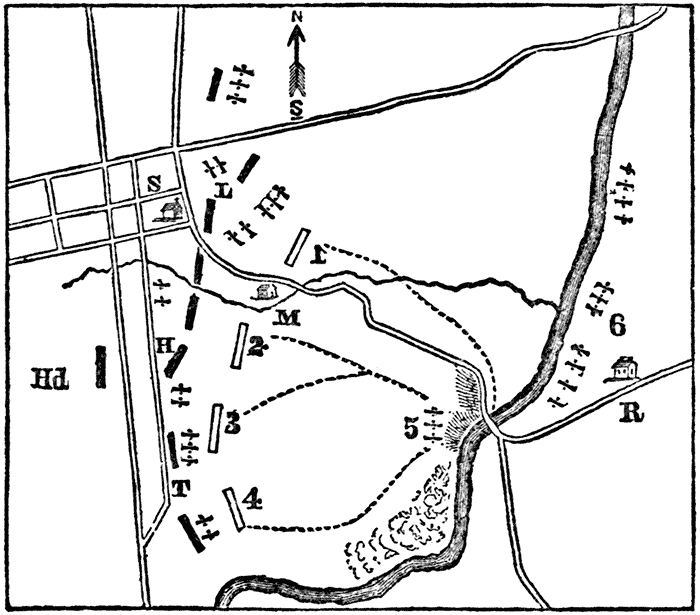
Burnside's Second Attack.
|
1 Wilcox's Division.
2 Sturgis's "
3 Rodman's "
4 Scammon's brigade.
5 Union batteries on ground from which the Rebels had been driven.
6 Batteries of heavy guns.
|
H A. P. Hill.
L Part of Longstreet's command.
Hd Hood.
T Toombs's brigade.
S Sharpsburg.
M Mill.
R Rohrbach's house.
|
Rodman and Fairchild's and Harland's brigades;
Scammon had his own and Ewing's.
They drove Hill's first line back upon the second.
Fairchild ordered a charge. His troops went
across the field, through the waving corn with a
huzzah. They faced a destructive fire. One shell
killed eight men of the Ninth New York. The
color-bearers were shot. The guards fell. Captain
Leboir seized one, Captain Lehay the other,
and led the regiment up the hill to the road leading
south from Sharpsburg. They found shelter
under the wall, and halted.
The other regiments of the brigade joined
them. Harland found greater opposition. His
troops were cut down by a volley from a brigade
of Rebels lying in a cornfield. They fought a
while, became confused, crowded together, and
were forced back.
General McClellan, from his head-quarters, can
see all that is going on, for there is an unobstructed
view of the field. He is with Fitz-John
Porter on the high hill east of the Antietam.
An officer rides up swiftly. He is Burnside's
aide. His horse pants.
"I must have more troops and guns. If you
do not send them I cannot hold my position half
an hour."
That is the message. Fitz-John Porter has
twelve thousand troops. They have been spectators
of the battle through the day. They have
had breakfast and dinner, and nearly two days
of rest since their arrival upon the ground. They
might be a thunderbolt at this moment. Couch's
and Humphrey's divisions will be up during the
night.
But they are the only reserves present. Slocum
has taken Sedgwick's place. He has not
been engaged, and his men stand with ordered
arms. Shall Porter be put in? McClellan consults
Porter and Sykes, and then replies:—
"Tell General Burnside that I will send him
Miller's battery. I have no infantry to spare. He
must hold his ground till dark. Tell him if he
cannot hold his ground, he may fall back to the
bridge; but he must hold that, or all is lost."
Porter's corps and Slocum's division of Franklin's,
eighteen thousand men in all, have taken no
part in the battle. Smith is holding an important
position. He has made one gallant charge, but
his troops are ready to fight. There are twenty
thousand men which can take the offensive, and
nearly a hundred guns of the artillery.76
The right flank of the Rebels is all but turned.
Wilcox is close upon the town. Rodman has
driven Hill, and is holding his ground. Such is
the condition of affairs as the sun goes down.
It is useless for Burnside to struggle without
supports. He fights till the coming on of twilight,
and then recalls his troops.
The regiments of Fairchild's brigade, far up on
the hillside, upon ground won from the enemy by
their valor, go back reluctantly.
"The men," says Lieutenant-Colonel Kimball,
of the Ninth New York, "retired in good order,
at a slow step, and with tears in their eyes, at the
necessity which compelled them to leave the field
they had so dearly won."77
It was a necessity. Without reinforcements he
could not hold his ground, and Lee could cut him
off if he remained so far from the bridge.
The daylight is dying out. Through the hours
from early morning the roar of battle has been
unceasing. Four hundred cannon have shaken
the earth, and nearly two hundred thousand men
have struggled for the mastery. At times the
storm has lulled a little, like the wind at night,
then rising again to the fierceness of a tornado.
In the intervals of the cannonade, low moans
come up from the hollows, like the wail of the
night-wind on a lonely shore.
On the right, through the morning, the fiery
surges ebbed and flowed, and dashed to and fro,
now against the ledges in the woods, and now
against the ridge by Poffenberger's. They have
left crimson stains upon the threshold of the
church. The sunken road has drunk the blood
of thousands. The cornfields, changing from the
green of Summer to the russet of Autumn are
sprinkled with magenta dyes. The battle is at
this hour indecisive, but the artillery of both
armies put on new vigor as the sun goes down, as
if each was saying to the other, "We are not
beaten."
Once more the firing is renewed. Standing on
the high hill east of the Antietam, occupied by
Porter, I can see almost up to Poffenberger's.
The batteries upon the hill in rear of his house
are thundering. I can see the glimmer of the
flashes, and the great white cloud rising above
the trees, by Miller's. And there in the cornfield,
Porter's, Williston's, and Walcott's batteries are
pounding the ledges behind the church, and sweeping
the hillside. The woods which shade the
church where Jackson stands, are smoking like
a furnace. Richardson's batteries, in front of
Lee, are throwing shells into the cornfield beyond
Rulet's.
The twenty-pounder Parrotts on the hill by my
side open once more their iron lips. The hills all
around Sharpsburg are flaming with Rebel guns.
The sharpshooters all along the line keep up a
rattling fire. Near the town, hay-stacks, barns,
and houses are in flames. At my left hand, Burnside's
heavy guns, east of the river, are at work.
His lighter batteries are beyond the bridge. His
men are along the hillside, a dark line, dimly
seen, covered by a bank of cloud, illuminating
it with constant flashes. All the country
is flaming, smoking, and burning, as if the last
great day, the judgment day of the Lord, had
come.
Gradually the thunder dies away. The flashes
are fewer. The musketry ceases, and silence
comes on, broken only by an occasional volley,
and single shots, like the last drops after a
shower.
Thirty thousand men, who in the morning were
full of life, are bleeding at this hour. The sky is
bright with lurid flames of burning buildings, and
they need no torches who go out upon the bloody
field to gather up the wounded. Thousands of
bivouac fires gleam along the hillsides, as if a
great city had lighted its lamps. Cannon rumble
along the roads. Supply wagons come up. Long
trains of ambulances go by. Thousands of
slightly wounded work their way to the rear,
dropping by the roadside, or finding a bed of
straw by wheat-stacks and in stables. There is
the clatter of hoofs,—the cavalry dashing by, and
the tramp, tramp, tramp of Couch's and Humphrey's
divisions, marching to the field.
There are low wails of men in distress, and
sharp shrieks from those who are under the surgeon's
hands.
While obtaining hay for my horse at a barn, I
heard the soldiers singing. They were wounded,
but happy; for they had done their duty. They
had been supplied with rations,—hard tack and
coffee,—and were lying on their beds of straw.
I listened to their song. It was about the dear
old flag.
"Our flag is there! Our flag is there!
We'll hail it with three loud huzzahs!
Our flag is there! Our flag is there!
Behold the glorious stripes and stars!
Stout hearts have fought for that bright flag,
Strong hands sustained it mast-head high,
And oh! to see how proud it waves
Brings tears of joy to every eye.
"That flag has stood the battle's roar,
With foeman stout and foeman brave;
Strong hands have sought that flag to lower,
And found a traitor's speedy grave.
That flag is known on every shore,
The standard of a gallant band,
Alike unstained in peace or war,
It floats o'er Freedom's happy land."
Then there came thoughts of home, of loved
ones, of past scenes, and pleasant memories, and
the songs become plaintive. They sung the old
song:—
"Do they miss me at home—do they miss me
At morning, at noon, or at night?
And lingers a gloomy shade round them,
That only my presence can light?
Are joys less invitingly welcome,
And pleasures less bright than before,
Because one is missed from the circle,—
Because I am with them no more?"
There was sadness, but not discouragement. It
was the welling up of affection, the return of
sweet recollections, which neither hardship, suffering,
privation, or long absence could efface.
They loved home, but they loved the old flag better.
Missed at home? Ah! how sadly!