Most of the studies for this book were made in 1906, 1907, and 1908, but I
investigated the subject of lynching, South and North, in the fall of
1904. Since that time the feeling against mob-vengeance has been gaining
strength throughout the country and the number of lynchings has been
steadily decreasing. But the number is still appalling and many recent
cases, especially in the black belt, have been accompanied by brutal
excesses. My studies made four years ago are typical of present
conditions; I have, indeed, confirmed them by a somewhat careful
examination made last year (1907) of two or three recent cases.
Lynch-law reached its height in the late eighties and early nineties. In
the sixteen years from 1884 to 1900 the number of persons lynched in the
United States was 2,516. Of these 2,080 were in the Southern states and
436 in the North; 1,678 were Negroes and 801 were white men; 2,465 were
men and 51 were women. I am here using the accepted (indeed the only)
statistics—those collected by the Chicago Tribune. As showing the
gradual growth of the sentiment against mob-law I can do no better than to
give the record of lynchings for a number of successive years:
| 1891 | | 192 | |
1900 | | 116 |
| 1892 | | 235 | |
1901 | | 135 |
| 1893 | | 200 | |
1902 | | 96 |
| 1894 | | 190 | |
1903 | | 104 |
| 1895 | | 171 | |
1904 | | 87 |
| 1896 | | 131 | |
1905 | | 66 |
| 1897 | | 166 | |
1906 | | 73 |
| 1898 | | 127 | |
1907 | | 56 |
| 1899 | | 107 |
Before I take up the account of specific cases an analysis of the
lynchings for the years 1906 and 1907 will help to show in what states mob
rule is most often invoked and for what offences lynchings are most
common. Mississippi, Alabama, Louisiana and Georgia—the black belt
states—are thus seen to have the worst records, and the figures here
given do not include the men killed in the Atlanta riot which would add
twelve to the Georgia record for 1906:
Following is the comparative number of lynchings for the two years.
| State | |
1907 | |
1906 |
| Alabama | |
13 | |
5 |
| Arkansas | |
3 | |
4 |
| Colorado | |
— | |
1 |
| Florida | |
— | |
6 |
| Georgia | |
6 | |
9 |
| Indian Territory | |
2 | |
1 |
| Iowa | |
1 | |
— |
| Kentucky | |
1 | |
3 |
| Louisiana | |
8 | |
9 |
| Maryland | |
2 | |
1 |
| Mississippi | |
12 | |
13 |
| Missouri | |
— | |
3 |
| Nebraska | |
1 | |
— |
| North Carolina | |
— | |
5 |
| Oklahoma | |
2 | |
— |
| South Carolina | |
1 | |
2 |
| Tennessee | |
1 | |
5 |
| Texas | |
3 | |
6 |
| Totals | |
56 | |
73 |
Of those lynched in 1907, 49 were Negro men, three Negro women and four
white men. By methods:
| Hanging | | 31 |
| Shot to death | | 17 |
| Hanged and shot | | 3 |
| Shot and burned | | 2 |
| Beaten to death | | 1 |
| Kicked to death | | 1 |
The offences for which these men and woman were lynched range from
stealing seventy-five cents and talking with white girls over the
telephone, to rape and murder. Here is the list:
| For being father of boy who jostled white women | | 1 |
| For being victor over white man in fight | | 1 |
| Attempted murder | | 5 |
| Murder of wife | | 1 |
| Murder of husband and wife | | 1 |
| Murder of wife and stepson | | 1 |
| Murder of mistress | | 1 |
| Manslaughter | | 10 |
| Accessory to murder | | 1 |
| Rape | | 8 |
| Attempted rape | | 11 |
| Raping own stepdaughter | | 1 |
| For being wife and son of a raper | | 2 |
| Protecting fugitive from posse | | 1 |
| Talking to white girls over telephone | | 1 |
| Expressing sympathy for mob’s victim | | 3 |
| Three-dollar debt | | 2 |
| Stealing seventy-five cents | | 1 |
| Insulting white man | | 1 |
| Store burglary | | 3 |
In making my study I visited four towns where lynchings had taken place,
two in the South, Statesboro in Ga. and Huntsville in Ala.; and two in the
North, Springfield, O., and Danville, Ill.
I.—LYNCHING IN THE SOUTH
Statesboro, Ga., where two Negroes were burned alive under the most
shocking circumstances, on August 16, 1904, is a thrifty county seat
located about seventy miles from Savannah.
For a hundred years a settlement has existed there, but it was not until
the people discovered the wealth of the turpentine forests and of the
sea-island cotton industry that the town became highly prosperous. Since
1890 it has doubled in population every five years, having in 1904 some
2,500 people. Most of the town is newly built. A fine, new court-house
stands in the city square, and there are new churches, a large, new
academy, a new water-works system and telephones, electric lights, rural
free delivery—everywhere the signs of improvement and progress. It is
distinctly a town of the New South, developed almost exclusively by the
energy of Southerners and with Southern money. Its population is pure
American, mostly of old Carolina, Georgia, and Virginia stock. Fully 70
per cent. of the inhabitants are church members—Baptists, Presbyterians,
and Methodists—and the town has not had a saloon in twenty-five years and
rarely has a case of drunkenness. There are no beggars and practically no
tramps. A poorhouse, built several years ago, had to be sold because no
one would go to it. The farms are small, for the most part, and owned by
the farmers themselves; only 8 per cent. of them are mortgaged. There are
schools for both white and coloured children, though the school year is
short and education not compulsory.
In short, this is a healthy, temperate, progressive American town—a
country city, self-respecting, ambitious, with a good future before
it—the future of the New South.
Character of the Negro Population
About 40 per cent. of the population of the county consists of Negroes.
Here as elsewhere there are to be found two very distinct kinds of
Negroes—as distinct as the classes of white men. The first of these is
the self-respecting, resident Negro. Sometimes he is a land-owner, more
often a renter; he is known to the white people, employed by them, and
trusted by them. In Statesboro, as in most of the South, a large
proportion of the Negroes are of this better class. On the other hand, one
finds everywhere many of the so-called “worthless Negroes,” perhaps a
growing class, who float from town to town, doing rough work, having no
permanent place of abode, not known to the white population generally. The
turpentine industry has brought many such Negroes to the neighbourhood of
Statesboro. Living in the forest near the turpentine-stills, and usually
ignorant and lazy, they and all their kind, both in the country districts
and in the city, are doubly unfortunate in coming into contact chiefly
with the poorer class of white people, whom they often meet as industrial
competitors.
Danger from the Floating Negro
In all the towns I visited, South as well as North, I found that this
floating, worthless Negro caused most of the trouble. He prowls the roads
by day and by night; he steals; he makes it unsafe for women to travel
alone. Sometimes he has gone to school long enough to enable him to read a
little and to write his name, enough education to make him hate the hard
work of the fields and aspire to better things, without giving him the
determination to earn them. He has little or no regard for the family
relations or home life, and when he commits a crime or is tired of one
locality, he sets out, unencumbered, to seek new fields, leaving his wife
and children without the slightest compunction.
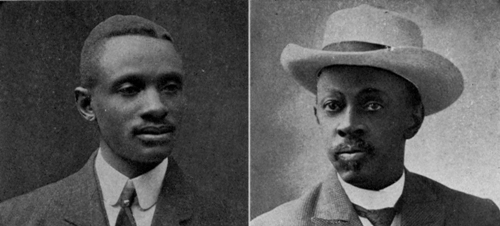
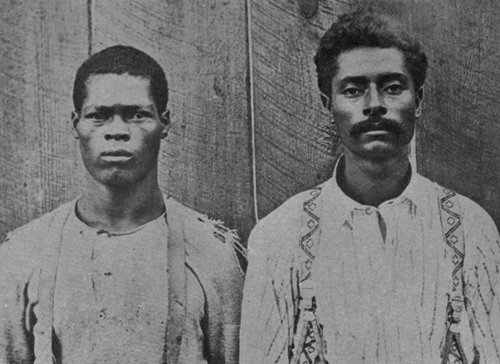 |
| PAUL REED | WILL CATO |
| Negroes lynched by being burned alive at Statesboro, Georgia |
| |
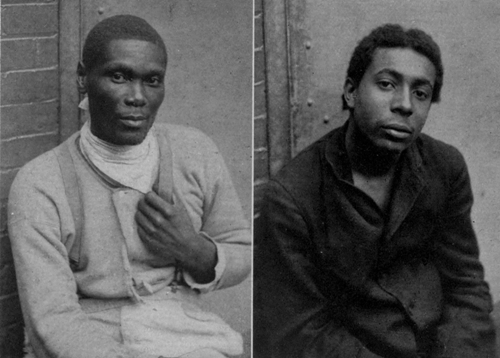 |
NEGROES OF THE CRIMINAL TYPE
Pictures taken in the Atlanta Jail |
Will Johnson, arrested, charged with the
Camp assault. | Lucius Frazier, who entered a home
in the residence district of Atlanta. |
About six miles from the city of Statesboro lived Henry Hodges, a
well-to-do planter. He had a good farm, he ran three ploughs, as they say
in the cotton country, and rumour reported that he had money laid by.
Coming of an old family, he was widely related in Bullock County, and his
friendliness and kindness had given him and his family a large circle of
acquaintances. Family ties and friendships, in old-settled communities
like those in the South, are influences of much greater importance in
fixing public opinion and deciding political and social questions than
they are in the new and heterogeneous communities of the North.
The South is still, so far as the white population is concerned, a
sparsely settled country. The farmers often live far apart; the roads are
none too good. The Hodges home was in a lonely place, the nearest
neighbours being Negroes, nearly half a mile distant. No white people
lived within three-quarters of a mile. Hodges had been brought up among
Negroes, he employed them, he was kind to them. To one of the Negroes
suspected of complicity in the subsequent murder, he had loaned his
shot-gun; another, afterward lynched, called at his home the very night
before the murder, intending then to rob him, and Hodges gave him a bottle
of turpentine to cure a “snake-graze.”
Story of the Murder
On the afternoon of July 29, 1904, Mr. Hodges drove to a neighbour’s house
to bring his nine-year-old girl home from school. No Southern white
farmer, especially in thinly settled regions like Bulloch County, dares
permit any woman or girl of his family to go out anywhere alone, for fear
of the criminal Negro.
“You don’t know and you can’t know,” a Georgian said to me, “what it means
down here to live in constant fear lest your wife or daughter be attacked
on the road, or even in her home. Many women in the city of Statesboro
dare not go into their backyards after dark. Every white planter knows
that there is always danger for his daughters to visit even the nearest
neighbour, or for his wife to go to church without a man to protect her.”
It is absolutely necessary to understand this point of view before one can
form a true judgment upon conditions in the South.
When Hodges arrived at his home that night, it was already dark. The
little girl ran to join her mother; the father drove to the barn. Two
Negroes—perhaps more—met him there and beat his brains out with a stone
and a buggy brace. Hearing the noise, Mrs. Hodges ran out with a lamp and
set it on the gate-post. The Negroes crept up—as nearly as can be
gathered from the contradictory stories and confessions—and murdered her
there in her doorway with peculiar brutality. Many of the crimes committed
by Negroes are marked with almost animal-like ferocity. Once aroused to
murderous rage, the Negro does not stop with mere killing; he bruises and
batters his victim out of all semblance to humanity. For the moment, under
stress of passion, he seems to revert wholly to savagery.
The Negroes went into the house and ransacked it for money. The little
girl, who must have been terror-stricken beyond belief, hid behind a
trunk; the two younger children, one a child of two years, the other a
mere baby, lay on the bed. Finding no money, the Negroes returned to their
homes. Here they evidently began to dread the consequences of their deed,
for toward midnight they returned to the Hodges home. During all this time
the little girl had been hiding there in darkness, with the bodies of her
father and mother in the doorway. When the Negroes appeared, she either
came out voluntarily, hoping that friends had arrived, or she was dragged
out.
“Where’s the money?” demanded the Negroes.
The child got out all she had, a precious five-cent piece, and offered it
to them on condition that they would not hurt her. One of them seized her
and beat her to death.
I make no excuse for telling these details; they must be told, else we
shall not see the depths or the lengths of this problem.
Burning of the Hodges Home
The Negroes then dragged the bodies of Mr. and Mrs. Hodges into their home
and set the house afire. As nearly as can be made out from the subsequent
confessions, the two younger children were burned alive.
When the neighbours reached the scene of the crime, the house was wholly
consumed, only the great end chimney left standing, and the lamp still
burning on the gate-post.
Well, these Southerners are warm-hearted, home-loving people. Everybody
knew and respected the Hodges—their friends in the church, their many
relatives in the county—and the effect of this frightful crime described
in all its details, may possibly be imagined by Northern people living
quietly and peacefully in their homes. When two of the prominent citizens
of the town told me, weeks afterward, of the death of the little girl,
they could not keep back their tears.
The murder took place on Friday night; on Saturday the Negroes, Paul Reed
and Will Cato, were arrested with several other suspects, including two
Negro preachers. Both Reed and Cato were of the illiterate class; both had
been turpentine workers, living in the forest, far from contact with white
people. Cato was a floater from South Carolina. Reed was born in the
county, but he was a good type of the worthless and densely ignorant
Negro.
It is a somewhat common impression that a whole town loses itself in a
passion of anarchy, and is not satisfied until the criminals are killed.
But in spite of the terrible provocation and the intense feeling, there
yet existed in Statesboro exactly such a feeling for the sacredness of
law, such intelligent Americanism, as exists in your town or mine. Not
within the present generation had a lynching taken place in the town, and
the people were deeply concerned to preserve the honour and good name of
their community. In the midst of intense excitement a meeting of good
citizens, both white and black, was called in the court-house. It was
presided over by J. A. Brannan, one of the foremost citizens. Speeches
were made by Mayor Johnstone, by the ministers of the town, and by other
citizens, including a Negro, all calling for good order and the calm and
proper enforcement of the law.
Attempts to Prevent the Lynching
And the regular machinery of justice was put in motion with commendable
rapidity. Fearing a lynching, the Negroes who had been arrested were sent
to Savannah and there lodged in jail. A grand jury was immediately called,
indictments were found, and in two weeks—the shortest possible time under
the law—the Negroes were brought back from Savannah for trial. To protect
them, two military companies, one from Statesboro, one from Savannah, were
called out. The proof of guilt was absolutely conclusive, and, although
the Negroes were given every advantage to which they were entitled under
the law, several prominent attorneys having been appointed to defend them,
they were promptly convicted and sentenced to be hanged.
In the meantime great excitement prevailed. The town was crowded for days
with farmers who came flocking in from every direction. The crime was
discussed and magnified; it was common talk that the “niggers of Madison
County are getting too bigoty”—that they wouldn’t “keep their places.”
Fuel was added to the flame by the common report that the murderers of the
Hodges family were members of a Negro society known as the “Before Day
Club,” and wild stories were told of other murders that had been planned,
the names of intended victims even being reported.
On the Sunday night before the trial, two Negro women, walking down the
street are said to have crowded two respectable white girls off the
sidewalk. A crowd dragged the women from a church where they had gone,
took them to the outskirts of the town, whipped them both violently, and
ordered them to leave the county.
“Let the law take its course,” urged the good citizen. “The Negroes have
been sentenced to be hanged, let them be hanged legally; we want no
disgrace to fall on the town.”
How the Lynchers Themselves Defend a Lynching
But as the trial progressed and the crowd increased, there were louder and
louder expressions of the belief that hanging was too good for such a
crime. I heard intelligent citizens argue that a Negro criminal, in order
to be a hero in the eyes of his people, does not mind being hanged!
Another distinct feeling developed—a feeling that I found in other
lynching towns: that somehow the courts and the law were not to be
trusted to punish the criminals properly. Although Reed and Cato were
sentenced to be hanged, the crowd argued that “the lawyers would get them
off,” that “the case would be appealed, and they would go free.”
Members of the mob tried to get Sheriff Kendrick to promise not to remove
the Negroes to Savannah, fearing that in some way they would be taken
beyond the reach of justice.
In other words, there existed a deep-seated conviction that justice too
often miscarried in Bulloch County and that murderers commonly escaped
punishment through the delays and technicalities of the law.
A Habit of Man-killing
And there is, unfortunately, a foundation for this belief. In every
lynching town I visited I made especial inquiry as to the prevalence of
crime, particularly as to the degree of certainty of punishment for crime.
In all of them property is safe; laws looking to the protection of goods
and chattels are executed with a fair degree of precision; for we are a
business-worshipping people. But I was astounded by the extraordinary
prevalence in all these lynching counties, North as well as South, of
crimes of violence, especially homicide, accompanied in every case by a
poor enforcement of the law. Bulloch County, with barely twenty-five
thousand inhabitants, had thirty-two homicides in a little more than five
years before the lynching—an annual average of one to every four thousand
five hundred people (the average in the entire United States being one to
nine thousand). Within eight months prior to the Hodges lynching, no fewer
than ten persons (including the Hodges family) were murdered in Bulloch
County. In twenty-eight years, notwithstanding the high rate of homicides,
only three men, all Negroes, have been legally hanged, while four
men—three Negroes and one white man—have been lynched.
It is well understood that if the murderer has friends or a little money
to hire lawyers, he can, especially if he happens to be white, nearly
always escape with a nominal punishment. These facts are widely known and
generally commented upon. In his subsequent charge to the grand jury,
Judge Daley said that the mob was due in part to “delays in the execution
of law and to the people becoming impatient.”
I am not telling these things with any idea of excusing or palliating the
crime of lynching, but with the earnest intent of setting forth all the
facts, so that we may understand just what the feelings and impulses of a
lynching town really are, good as well as bad. Unless we diagnose the case
accurately, we cannot hope to discover effective remedies.
Psychology of the Mob
In the intense, excited crowd gathered around the court-house on this
Tuesday, the 16th of August, other influences were also at work,
influences operating in a greater or less degree in every lynching mob. We
are accustomed to look upon a mob as an entity, the expression of a single
concrete feeling; it is not; it is itself torn with dissensions and
compunctions, swayed by conflicting emotions. Similarly, we look upon a
militia company as a sort of machine, which, set in operation,
automatically performs a certain definite service. But it is not. It is
made up of young men, each with his own intense feelings, prejudices,
ideals; and it requires unusual discipline to inculcate such a sense of
duty that the individual soldier will rise superior to the emotions of the
hour. Most of these young men of Statesboro and Savannah really
sympathised with the mob; among the crowd the Statesboro men saw their
relatives and friends. Some of the officers were ambitious men, hoping to
stand for political office. What would happen if they ordered the troops
to fire on their neighbours?
And “the nigger deserved hanging,” and “why should good white blood be
shed for nigger brutes?” At a moment of this sort the clear perception of
solemn abstract principles and great civic duties fades away in tumultuous
excitement. Yet these soldier boys were not cowards; they have a fighting
history; their fathers made good soldiers; they themselves would serve
bravely against a foreign enemy, but when called upon for mob service they
failed utterly, as they have failed repeatedly, both North and South.
Up to the last moment, although the crowd believed in lynching and wanted
to lynch, there seemed to be no real and general determination to
forestall the law. The mob had no centre, no fixed purpose, no real plan
of action. One determined man, knowing his duty (as I shall show in
another story), and doing it with common sense, could have prevented
trouble, but there was no such man. Captain Hitch, of the Savannah
Company, a vacillating commander, allowed the crowd to pack the
court-house, to stream in and out among his soldiers; he laid the
responsibility (afterward) on the sheriff, and the sheriff shouldered it
back upon him. In nearly all the cases I investigated, I found the same
attempt to shift responsibility, the same lack of a responsible head. Our
system too often fails when mob stress is laid upon it—unless it happens
that some strong man stands out, assumes responsibility, and becomes a
momentary despot.
How the Soldiers Were Overpowered
A mob, no matter how deeply inflamed, is always cowardly. This mob was no
exception. It crowded up, crowded up, testing authority. It joked with the
soldiers, and when it found that the jokes were appreciated, it took
further liberties; it jostled the soldiers—good-humouredly. “You don’t
dare fire,” it said, and the soldiers made no reply. “Your guns aren’t
loaded,” it said, and some soldier confessed that they were not. In tender
consideration for the feelings of the mob, the officers had ordered the
men not to load their rifles. The next step was easy enough; the mob
playfully wrenched away a few of the guns, those behind pushed
forward—those behind always do push forward, knowing they will not be
hurt—and in a moment the whole mob was swarming up the stairs, yelling
and cheering.
In the court-room, sentence had been passed on Reed and Cato, and the
judge had just congratulated the people on “their splendid regard for the
law under very trying conditions.” Then the mob broke in. A brother of the
murdered Hodges, a minister from Texas, rose magnificently to the
occasion. With tears streaming down his face, he begged the mob to let the
law take its course.
“We don’t want religion, we want blood,” yelled a voice.
The mob was now thoroughly stirred; it ceased to hesitate; it was
controlled wholly by its emotions. The leaders plunged down the court-room
and into the witness chamber, where the Negroes sat with their wives,
Reed’s wife with a young baby. The officers of the law accommodatingly
indicated the right Negroes, and the mob dragged them out. Hanging was at
first proposed, and a man even climbed a telegraph-pole just outside the
court-house, but the mob, growing more ferocious as it gathered volume and
excitement, yelled its determination:
“Burn them! burn them!”
They rushed up the road, intending to take the Negroes to the scene of the
crime. But it was midday in August, with a broiling hot sun overhead and a
dusty road underfoot. A mile from town the mob swerved into a turpentine
forest, pausing first to let the Negroes kneel and confess. Calmer spirits
again counselled hanging, but some one began to recite in a high-keyed
voice the awful details of the crime, dwelling especially on the death of
the little girl. It worked the mob into a frenzy of ferocity.
“They burned the Hodges and gave them no choice; burn the niggers!”
“Please don’t burn me,” pleaded Cato. And again: “Hang me or shoot me;
please don’t burn me!”
Burning of the Negroes
Some one referred the question to the father-in-law of Hodges. He said
Hodges’s mother wished the men burned. That settled it. Men were sent into
town for kerosene oil and chains, and finally the Negroes were bound to an
old stump, fagots were heaped around them, and each was drenched with oil.
Then the crowd stood back accommodatingly, while a photographer, standing
there in the bright sunshine, took pictures of the chained Negroes.
Citizens crowded up behind the stump and got their faces into the
photograph. When the fagots were lighted, the crowd yelled wildly. Cato,
the less stolid of the two Negroes, partly of white blood, screamed with
agony; but Reed, black and stolid, bore it like a block of wood. They
threw knots and sticks at the writhing creatures, but always left room
for the photographer to take more pictures.
And when it was all over, they began, in common with all mobs, to fight
for souvenirs. They scrambled for the chains before they were cold, and
the precious links were divided among the populace. Pieces of the stump
were hacked off, and finally one young man—it must be told—gathered up a
few charred remnants of bone, carried them uptown, and actually tried to
give them to the judge who presided at the trial of the Negroes, to the
utter disgust of that official.
After Effects of Mob-law
This is the law of the mob, that it never stops with the thing it sets out
to do. It is exactly like any other manifestation of uncontrolled human
passion—given licence it takes more licence, it releases that which is
ugly, violent, revengeful in the community as in the individual human
heart. I have heard often of a “quiet mob,” an “orderly mob,” which “went
about its business and hanged the nigger,” but in all the cases I have
known about, and I made special inquiries upon this particular point, not
one single mob stopped when the immediate work was done, unless under
compulsion. Even good citizens of Statesboro will tell you that “the
niggers got only what they deserved,” and “it was all right if the mob had
only stopped there.” But it did not stop there; it never does.
All the stored-up racial animosity came seething to the surface; all the
personal grudges and spite. As I have already related, two Negro women
were whipped on the Sunday night before the lynching. On the day following
the lynching the father of the women was found seeking legal punishment
for the men who whipped his daughters, and he himself was taken out and
frightfully beaten. On the same day two other young Negroes, of the
especially hated “smart nigger” type, were caught and whipped—one for
riding a bicycle on the sidewalk, the other, as several citizens told me,
“on general principles.” But this was not the worst. On Wednesday night an
old Negro man and his son—Negroes of the better class—were sitting in
their cabin some miles from Statesboro, when they were both shot at
through the window and badly wounded. Another respectable Negro, named
McBride, was visited in his home by a white mob, which first whipped his
wife, who was confined with a baby three days old, and then beat, kicked,
and shot McBride himself so horribly that he died the next day. The better
class of citizens, the same men who would, perhaps, condone the burning of
Reed and Cato, had no sympathy with this sort of thing. Some of them took
McBride’s dying statement, and four white men were arrested and charged
with the murder; but never punished.
Indeed, the mob led directly to a general increase of crime in Bulloch
County. As Judge Daley said in his charge to a subsequent grand jury:
“Mob violence begets crime. Crime has been more prevalent since this
lynching than ever before. In the middle circuit the courts have been so
badly crowded with murder trials that it has been almost impossible to
attend to civil business.”
Another evil result of the lynching was that it destroyed valuable
evidence. The prosecutors had hoped to learn from the convicted Reed and
Cato whether or not they had any companions and thereby bring to justice
all the other Negroes suspected of complicity in the murder of the Hodges.
If the Before Day Club ever existed and had a criminal purpose (which is
doubtful) most of the members who composed it were left at large, awaiting
the next opportunity to rob and murder.
Mob Justice and the Cotton Crop
Mob-law has not only represented a moral collapse in this community, but
it struck, also, at the sensitive pocket of the business interests of the
county. Frightened by the threatening attitude of the whites, the Negroes
began to leave the county. It was just at the beginning of the
cotton-picking season, when labour of every sort was much needed, Negro
labour especially. It would not do to frighten away all the Negroes. On
Thursday some of the officials and citizens of Statesboro got together,
appointed extra marshals, and gave notice that there were to be no more
whippings, and the mob spirit disappeared—until next time.
But what of the large Negro population of Statesboro during all this
excitement? The citizens told the “decent Negroes”: “We don’t want to hurt
you; we know you; you are all right; go home and you won’t be hurt.” Go
home they did, and there was not a Negro to be seen during all the time of
the lynching. From inquiry among the Negroes themselves, I found that many
of them had no voice to raise against the burning of Reed and Cato. This
was the grim, primitive eye-for-an-eye logic that they used, in common
with many white men:
“Reed and Cato burned the Hodges; they ought to be burned.”
Even Cato’s wife used this logic.
But all the Negroes were bitter over the indiscriminate whippings which
followed the lynching. These whippings widened the breach between the
races, led to deeper suspicion and hatred, fertilised the soil for future
outbreaks. In the same week that I visited Statesboro, no fewer than three
cotton-gins in various parts of Bulloch County were mysteriously burned at
night, and while no one knew the exact origin of the fires, it was openly
charged that they were caused by revengeful Negroes. None of these
terrible after-effects would have taken place if the law had been allowed
to follow its course.
A Fighting Parson
The overwhelming majority of the people of Bulloch County undoubtedly
condoned the lynching, even believed in it heartily and completely. And
yet, as I have said, there was a strong dissenting opposition among the
really thoughtful, better-class citizens. All the churches of Statesboro
came out strongly for law and order. The Methodist church, led by a
fighting parson, the Rev. Whitely Langston, expelled two members who had
been in the mob—an act so unpopular that the church lost twenty-five
members of its congregation. Of course, the members of the mob were known,
but none of them was ever punished. The judge especially charged the grand
jury to investigate the lynching, and this was its report:
“We deplore the recent lawlessness in our city and community, specially
referred to by his Honour, Judge A. F. Daley, in his able charge. We have
investigated the matter in the light of information coming under our
personal knowledge and obtained by the examination of a number of
witnesses, but we have been unable to find sufficient evidence to warrant
indictments. We tender thanks to his Honour, Judge Daley, for his able and
comprehensive charge.”
A feeble attempt was made to discipline the military officers who allowed
the populace to walk over them and take away their guns. A court-martial
sat for days in Savannah and finally recommended the dismissal of Captain
Hitch from the service of the state; but the Governor let him off with
half the penalty suggested. Two lieutenants were also disciplined.
In the state election which followed the lynching, numerous voters in
Bulloch County actually scratched the name of Governor Terrell, of
Georgia, because he ordered the troops to Statesboro, and substituted the
name of Captain Hitch. Sheriff Kendrick, who failed to protect Reed and
Cato, was re-elected without opposition.
It was in a tone of deep discouragement that Mayor G. S. Johnstone, of
Statesboro, said to me:
“If our grand jury won’t indict these lynchers, if our petit juries won’t
convict, and if our soldiers won’t shoot, what are we coming to?”
Revolution of Opinion in the South on Lynching
Conditions at Statesboro are, perhaps, typical of those in most Southern
towns. In most Southern towns a lynching would be conducted much as it was
in Statesboro; there would be the same objecting but ineffective minority
of good citizens, the troops would refuse their duty, and the lynchers
would escape in much the same way. And yet, if we were to stop with the
account of the Statesboro affair, we should overlook some of the greatest
influences now affecting the lynching problem in the South. No one who
visits the South can escape the conviction that, with its intensified
industrial life, and the marvelous development and enrichment of the whole
country, other equally momentous, if less tangible, changes are taking
place. Public opinion is developing along new lines, old, set prejudices
are breaking up, and there is, among other evident influences, a marked
revolution in the attitude of the Southern people and the Southern
newspapers on the lynching question. I turn now to the lynching at
Huntsville, Ala., which reveals in a striking manner some of the features
of the new revolt in the South against mob-law.
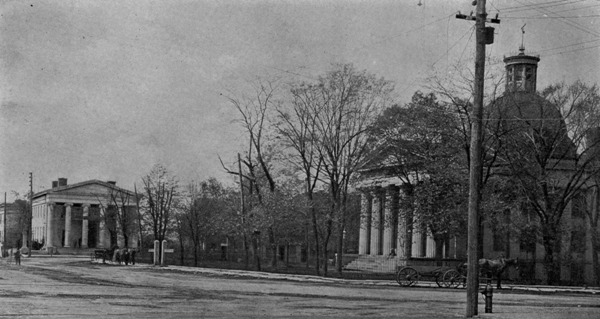
Photographed by Collins & Son
COURT HOUSE AND BANK IN THE PUBLIC SQUARE AT HUNTSVILLE, ALABAMA
The Negro, Maples, was lynched by being hung to the elm tree at the corner
of the court house, near the extreme right of the picture.
A Negro Crime at Huntsville, Ala.
One evening in September, 1904, a Negro of Huntsville, Ala., asked an old
peddler named Waldrop for a ride. Waldrop was a kindly old man, well known
and respected throughout Madison County; he drove into the city two or
three times a week with vegetables and chickens to sell, and returned with
the small product of his trade in his pocket.
Waldrop knew the Negro, Maples, and, although Maples was of the worthless
sort, and even then under indictment for thieving, the peddler made room
for him in his waggon, and they rode out of the town together. They drove
into a lonely road. They crossed a little bridge. Tall trees shaded and
darkened the place. Night was falling. The Negro picked up a stone and
beat out the brains of the inoffensive old man, robbed him, and left him
lying there at the roadside, while the horse wandered homeward.
How a murder cries out! The murderer fled in the darkness but it was as if
he left great footprints. The next day, in Huntsville, the law laid its
hand on his shoulder.
Now, Huntsville is one of the best cities in Alabama. No other city,
perhaps, preserves more of the aristocratic habiliments of the older
South. It was the first capital of the state. Seven governors lie buried
in its cemetery; its county house, its bank, some of its residences are
noble examples of the architecture of the ante-bellum South. And while
preserving these evidences of the wealth and refinement of an older
civilisation, few cities in the South have responded more vigorously to
the new impulses of progress and development. Its growth during the last
few years has been little short of amazing. Northern capital has come in;
nine cotton-mills have been built, drawing a large increase of population,
and stimulating the development of the country in every direction. It is
a fine, orderly, progressive city—intensely American, ambitious,
self-respecting.
Relation of Lynching to Business Success
Huntsville has had its share of lynchings in the past. Within twenty years
seven Negroes and one white man had been the victims of mobs in Madison
County. The best citizens knew what a lynching meant; they knew how the
mob began, and what invariably followed its excesses, and they wanted no
more such horrors. But this revolt was not wholly moral. With awakening
industrial ambition the people realised that disorder had a tendency to
frighten away capital, stop immigration, and retard development generally.
Good business demands good order. This feeling has been expressed in
various forms and through many channels. It existed in Statesboro, but it
was by no means as vigorous as in this manufacturing city of Huntsville.
We find, for instance, Congressman Richardson of Alabama, a citizen of
Huntsville, saying in a speech on the floor of the House of
Representatives:
“Why, Mr. Chairman, we have more reason in the South to observe the law
and do what is right than any other section of this Union.”
The Atlanta Constitution presents the same view in vigorous language:
Aside entirely from the consideration of the evil effects of the mob
spirit in breeding general disrespect for the law, and aside from the
question of the inevitable brutalising effect of lynching upon those
who are spectators—and the effect goes even further—the practical
question arises: Can we at the South afford it?
Is there any use blinding ourselves to the fact, patent to everybody,
that it is this sort of thing that has kept hundreds of thousands of
desirable immigrants from coming to the Southern states?
Story of a Bold Judge
When the murderer of the peddler Waldrop was arrested, therefore, the
thoughtful and progressive people of the city—the kind who are creating
the New South—took immediate steps to prevent mob disturbance. The city
was fortunate in having an able, energetic young man as its circuit
judge—a judge, the son of a judge, who saw his duty clearly, and who was
not afraid to act, even though it might ruin his immediate political
future, as, indeed, it did. Rare qualities in these days! The murder was
committed Tuesday, September 6th, the Negro was arrested Wednesday, Judge
Speake impanelled a special grand jury without waiting a moment, and that
very afternoon, within six hours after the Negro’s arrest and within
twenty hours after the crime was committed, the Negro was formally
indicted. Arrangements were then made to call a special trial jury within
a week, in the hope that the prospect of immediate punishment would
prevent the gathering of a mob.
A Record of Homicide as a Cause of Lynching
But, unfortunately, we find here in Madison County not only a history of
lynching—a habit, it may be called—but there existed the same disregard
for the sacredness of human life which is the common characteristic of
most lynching communities, South or North. I made a careful examination of
the records of the county. In the five years preceding this lynching, no
fewer than thirty-three murder and homicide cases were tried in the
courts, besides eight murderers indicted, but not arrested. This is the
record of a single county of about forty thousand people. Notwithstanding
this record of crime, there had not been a legal hanging in the county,
even of a Negro, for nineteen years. It was a fact—well known to
everybody in the county—that it was next to impossible to convict a white
man for killing. Murderers employed good lawyers, they appealed their
cases, they brought political friendships to bear, and the relationships
between the old families were so far extended that they reached even into
the jury room. As a consequence, nearly every white murderer went free.
Only a short time before the lynching, Fred Stevens a white man, who shot
a white man in a quarrel over a bucket of water, was let out with a fine
of $50, costs, and thirty days in jail. This for a killing. And the
attorney for Stevens actually went into court afterward and asked to have
the costs cut down.
Negroes who committed homicide, though more vigorously punished than white
murderers, yet frequently escaped with five or ten years in the
penitentiary—especially if they had money or a few white friends. All
this had induced a contempt of the courts of justice—a fear that, after
all, through the delays and technicalities of the law and the compassion
of the jury, the murderer of Waldrop would not be punished as he deserved.
This was the substance of the reasoning I heard repeatedly: “That Negro,
Maples, ought to have been hanged; we were not sure the jury would hang
him; we hanged him to protect ourselves.”
I met an intelligent farmer during a drive through Madison County. Here
are some of the things he said, and they voiced closely what I heard in
one form or another from many people in all walks of life:
“Life is cheap in Madison County. If you have a grudge against a man, kill
him; don’t wound him. If you wound him, you’ll likely be sent up; if you
kill him, you can go free. They often punish more severely for carrying
concealed weapons or even for chicken stealing in Madison County than they
do for murder.”
So strong was the evidence in one murder case in an adjoining circuit that
Judge Kyle instructed the jury to find the murderer guilty; the jury
deliberately returned a verdict, “Not guilty.” The Alabama system of
justice is cursed by the professional juror chosen by politicians, and
often open to political influences. This, with the unlimited right of
appeal and the great number of peremptory challenges allowed to the
defence in accepting jurymen, gives such power to the lawyers for the
defendant that convictions are exceedingly difficult. Oftentimes, also,
the prosecuting attorney is a young, inexperienced lawyer, ill-paid, who
is no match for the able attorneys employed by the defendant.
No, it is not all race prejudice that causes lynchings, even in the South.
One man in every six lynched in this country in 1903—the year before the
lynching I am describing—was a white man. It is true that a Negro is
often the victim of mob-law where a white man would not be, but the chief
cause certainly seems to lie deeper, in the widespread contempt of the
courts, and the unpunished subversion of the law in this country, both
South and North. This, indeed, would probably be the sole cause of
lynching, were it not for the crime of rape, of which I wish to speak
again a little later.
Composition of the Mob at Huntsville
Well, a mob began gathering in Huntsville before the grand jury had ceased
its labours. It was chiefly composed of the workmen from the
cotton-mills. These are of a peculiar class—pure American stock,
naturally of high intelligence, but almost wholly illiterate—men from the
hills, the descendants of the “poor white trash,” who never owned slaves,
and who have always hated the Negroes. The poor whites are and have been
for a long time in certain lines the industrial competitors of the
Negroes, and the jealousy thus engendered accounts in no small degree for
the intensity of the race feeling.
Anticipating trouble, Judge Speake ordered the closing of all the
saloons—there were then only fifteen to a population of some twenty-one
thousand—and called out the local military company. But the mob ran over
the militiamen as though they were not there, broke into the jail, built a
fire in the hallway, and added sulphur and cayenne pepper. Fearing that
the jail would be burned and all the prisoners suffocated, the sheriff
released the Negro, Maples, and he jumped out of a second-story window
into the mob. They dragged him up the street to the square in the heart of
the city. Here, on the pleasant lawn, the Daughters of America were
holding a festival, and the place was brilliant with Japanese lanterns.
Scattering the women and children, the mob jostled the Negro under the
glare of an electric light, just in front of the stately old court-house.
Here impassioned addresses were made by several prominent young
lawyers—J. H. Wallace, Jr., W. B. Bankhead, and Solicitor Pettus—urging
the observance of law and order. A showing of hands afterward revealed the
fact that a large proportion of those present favoured a legal
administration of justice. But it was too late now.
A peculiarly dramatic incident fired the mob anew. The Negro was suddenly
confronted by the son of the murdered peddler. “Horace,” he demanded, “did
you kill my old dad?”
Quivering with fright, the Negro is said to have confessed the crime. He
was instantly dragged around the corner, where they hanged him to an
elm-tree, and while he dangled there in the light of the gala lanterns,
they shot him full of holes. Then they cut off one of his little fingers
and parts of his trousers for souvenirs. So he hung until daylight, and
crowds of people came out to see.
Effort to Punish the Lynchers
But the forces of law and order here had vigour and energy. Judge Speake,
communicating with the Governor, had troops sent from Birmingham, and
then, without shilly-shallying or delaying or endeavouring to shift
responsibility, he ordered a special grand jury to indict the lynchers the
very next day and he saw to it that it was composed of the best citizens
in town. When it met, so deep and solemn was its feeling of responsibility
that it was opened with prayer, an extraordinary evidence of the awakened
conscience of the people. More than this, the citizens generally were so
aroused that they held a mass meeting, and denounced the lynching as a
“blot upon our civilisation,” and declared that “each and every man taking
part” with the mob was “guilty of murder.” Bold words, but no bolder than
the editorials of the newspapers of the town or of the state. Every force
of decency and good order was at work. Such strong newspapers as the
Birmingham Age-Herald, the Ledger, and the News, the Montgomery
Advertiser, the Chattanooga News, and, indeed, prominent newspapers
all over the South united strongly in their condemnation of the lynchers
and in their support of the efforts to bring the mob to justice.
Southern Newspapers on Lynching
The Huntsville Mercury spoke of the “deep sense of shame felt by our
good citizens in being run over by a few lawless spirits.”
“There is no justification,” said the Birmingham News, “for the mob who,
in punishing one murderer, made many more.”
“This lynching,” said the Birmingham Ledger, “is a disgrace to our
state. The Ledger doesn’t put its ear to the ground to hear from the
North, nor does it care what Northern papers say. The crime is our own,
and the disgrace falls on us.”
“Where, in fact,” said the Age-Herald, “does such business lead to? The
answer is summed up in a word—anarchy!”
It would be well if every community in this country could read the full
report of Judge Speake’s grand jury. It is a work of the sort struck off
only by men stirred to high things by what they feel to be a great
crisis; it is of the same metal as the Declaration of Independence. Here
is a single paragraph:
Realising that this is a supreme moment in our history; that we must
either take a stand for the law to-day or surrender to the mob and to
the anarchists for all time; that our actions shall make for good or
evil in future generations; forgetting our personal friendships and
affiliations, and with malice toward none, but acting only as sworn
officers of the state of Alabama, we, the grand jury of Madison
County, state of Alabama, find——
Ten members of the mob were indicted—and not for mere rioting or for
breaking into the jail, but for murder. The jury also charged Sheriff
Rodgers, Mayor Smith, and Chief of Police Overton with wilful neglect and
incompetence, and advised their impeachment. No one not understanding the
far-reaching family and political relationships in these old-settled
Southern communities, and the deep-seated feeling against punishment for
the crime of lynching, can form any adequate idea of what a sensation was
caused by the charges of the grand jury against the foremost officials of
the city. It came like a bolt from a clear sky; it was altogether an
astonishing procedure, at first not fully credited. When the utter
seriousness of Judge Speake came to be fully recognised, a good many men
hurriedly left town. The Birmingham soldiers, led by a captain with
backbone, arrested a number of those who remained. Judge Speake ordered a
special trial jury, and appointed an able lawyer to assist Prosecutor
Pettus in bringing the lynchers to justice. The very next week the trials
were begun.
Difficulty of Breaking the Lynching Habit
By this time, however, the usual influences had begun to work; the moral
revulsion had carried far, and the rebound had come. The energetic judge
and his solicitors found themselves face to face with the bad old jury
system, with the deep-seated distrust of the courts, with the rooted habit
of non-punishment for lynchers. Moreover, it was found that certain wild
young men, with good family connections, had been mixed up in the mob—and
all the strong family and political machinery of the country began to
array itself against conviction. A community has exactly as hard a road to
travel in breaking a bad habit as an individual. The New South is having
a struggle to break the habits of the Old South. It was found, also, that
the great mass of people in the country, as well as the millworkers in the
city, were still strongly in favour of punishment by lynching. One hundred
and ten veniremen examined for jurors to try the lynchers were asked this
question; “If you were satisfied from the evidence beyond a reasonable
doubt that the defendant took part with or abetted the mob in murdering a
Negro, would you favour his conviction?” And seventy-six of them answered,
“No.”
In other words, a large majority believed that a white man should not be
punished for lynching a Negro. And when the juries were finally obtained,
although the evidence was conclusive, they acquitted the lynchers, one
after another. Only one man in one jury stood out for conviction—a young
clerk named S. M. Blair, a pretty good type of the modern hero. He hung
the jury, and so bitter was the feeling against him among the millworkers
that they threatened to boycott his employer.
Relation of Lynching to the “Usual Crime”
This is the reasoning of many of the men chosen as jurors; I heard it over
and over again, not only in Huntsville but, in substance, everywhere that
I stopped in the South:
“If we convict these men for lynching the Negro, Maples, we shall
establish a precedent that will prevent us from lynching for the crime of
rape.”
Every argument on lynching in the South gets back sooner or later to this
question of rape. Ask any high-class citizen—the very highest—if he
believes in lynching, and he will tell you roundly, “No.” Ask him about
lynching for rape, and in ninety-nine cases out of a hundred he will
instantly weaken.
“If my sister or my daughter—look here, if your sister or your
daughter——”
Lynching, he says, is absolutely necessary to keep down this crime. You
ask him why the law cannot be depended upon, and he replies:
“It is too great an ordeal for the self-respecting white woman to go into
court and accuse the Negro ravisher and withstand a public
cross-examination. It is intolerable. No woman will do it. And, besides,
the courts are uncertain. Lynching is the only remedy.”
Yet the South is deeply stirred over the prevalence of lynching. The mob
spirit, invoked to punish such a crime as rape, is defended by some people
in the North as well as in the South; but once invoked, it spreads and
spreads, until to-day lynching for rape forms only a very small proportion
of the total number of mob hangings. It spreads until a Negro is lynched
for chicken stealing, or for mere “obnoxiousness.” In the year 1903, out
of 103 lynchings, only 11 were for rape and 10 for attempted rape, while
47 were for murder, 15 for complicity in murderous assault, 4 for arson, 5
for mere “race prejudice,” 2 for insults to whites, 1 for making threats,
5 for unknown offenses, 1 for refusing to give information, and 3 were
wholly innocent Negroes, lynched because their identity was mistaken. It
is probable that lynching in the South would immediately be wiped out, if
it were not for the question of rape. You will hear the problem put by
thinking Southerners very much in this fashion:
“We must stop mob-law; every month we recognise that fact more clearly.
But can we stop mob-law unless we go to the heart of the matter and stop
lynching for rape? Is there not a way of changing our methods of legal
procedure so that the offender in this crime can be punished without
subjecting the victim to the horrible publicity of the courts?”
Governor Cunningham—A Real Leader
But I have wandered from my story. In Acting-Governor Cunningham, the
people of Alabama had a leader who was not afraid to handle a dangerous
subject like lynching. He sent a court of inquiry to Huntsville, which
found the local military company “worthless and inefficient,” because it
had failed to protect the jail. Immediately, upon the receipt of this
report, the Governor dismissed the Huntsville company from the service,
every man in it. Quite a contrast from the action at Statesboro! The
Governor then went a step further: he ordered the impeachment of the
sheriff. A little later Federal Judge Jones took up the case, charged his
jury vigorously, and some of the mob rioters were indicted in the federal courts.
Governor Cunningham took a bold stand against mob-law everywhere and
anywhere in the state:
“I am opposed to mob-law,” he said, “of whatsoever kind, for any and all
causes. If lynching is to be justified or extenuated for any crime, be it
ever so serious, it will lead to the same method of punishment for other
crimes of a less degree of depravity, and through the operation of the
process of evolution, will enlarge more and more the field of operation
for this form of lawlessness.”
It means something also when citizens, in support of their institutions
and out of love of their city, rise above politics. Judge Speake had been
nominated by the Democrats to succeed himself. A Democratic nomination in
Alabama means election. After his vigorous campaign against the lynchers,
he became exceedingly unpopular among the majority of the people. They
resolved to defeat him. A committee waited on Shelby Pleasants, a
prominent Republican lawyer, and asked him to run against Judge Speake,
assuring him a certain election.
“I will not be a mob’s candidate,” he said. “I indorse every action of
Judge Speake.”
The committee approached several other lawyers, but not one of them would
run against the judge, and the Republican newspaper of the town came out
strongly in support of Judge Speake, even publishing his name at the head
of its editorial columns. Before he could be elected, however, a decision
of the State Supreme Court, unconnected in any way with the lynching,
followed like fate, and deprived Madison County of his services. He was
now a private citizen, and even if he had come up for nomination to any
political office, he would undoubtedly have been defeated. The New South
is not yet strong enough to defy the Old South politically.
Influences Tending to Prevent Future Lynchings in the South
The influences against lynching in the South are constantly growing
stronger. With most (not all) of the newspapers, the preachers and the
best citizens united against it, the outlook is full of hope. And rural
free delivery and country telephones, spreading in every direction, are
inestimable influences in the quickening of public opinion. Better roads
are being built, the country is settling up with white people, schools are
improving and the population generally, after a series of profitable
cotton crops, is highly prosperous—all influences working toward the
solution of this problem.
When I went South I shared the impression of many Northerners that the
South was lawless and did not care—an impression that arises from the
wide publication of the horrible details of every lynching that occurs,
and the utter silence regarding those deep, quiet, and yet powerful moral
and industrial forces which are at the work of rejuvenation beneath the
surface—an account of which I have given. I came away from the South
deeply impressed with two things:
That the South is making fully as good progress in overcoming its peculiar
forms of lawlessness as the North is making in overcoming its peculiar
forms.
II.—LYNCHING IN THE NORTH
Having looked, into two Southern lynching towns, let us now see what a
Northern lynching is like. The comparison is highly interesting and
illuminating.
Springfield, O., is one of the most prosperous of the smaller cities of
the state. It is a beautiful town having, in 1904, some 41,000 people. It
has fine streets, fine buildings, busy factories, churches, an imposing
library. Some of the older families have resided there for nearly a
century. It is the seat of government of one of the most fertile and
attractive counties in the state: an altogether progressive, enlightened
city. Of its population in 1904 over 6,000 were Negroes (about
one-seventh), a considerable proportion of whom are recent settlers. Large
numbers of Negroes, as I have shown in former chapters, have been
migrating from the South, and crowding into Northern towns located along
the Ohio or in those portions of Indiana, Illinois, Ohio, Pennsylvania,
Kansas, and other states, which border on the Old South. Many of the
Negroes in Springfield came from Kentucky. We discover in these Northern
towns exactly as in the South, the two classes of Negroes: the steady,
resident class, more or less known to the whites, and a restless,
unstable, ignorant class, coming to one neighbourhood to-day to help build
a bridge, and going elsewhere to-morrow to dig a canal. For years no such
thing as race prejudice existed in Springfield; but with the growth of
Negro population it increased with rapidity. For instance, a druggist in
Springfield refused to sell soda-water to a Negro college professor, the
typesetters in a publishing house compelled the discharge of Negro
workmen, a Negro physician visited the high-school, found the half-dozen
Negro pupils sitting by themselves and, angrily charging discrimination,
ordered his child to sit among the white children. This feeling of race
repulsion was especially noticeable between the working class of white men
and the Negroes who come more or less into industrial competition with
them. The use of Negroes for breaking strikes in the coalfields and
elsewhere has been a fertile source of discord, kindling the fire of race
prejudice in places where it never before existed.
How the Negroes Sold Their Votes
In Springfield there were about 1,500 Negro voters, many of whom were
bought at every election. The Democrats and the Republicans were so evenly
divided that the city administration was Democratic and the county
administration Republican. The venal Negro vote went to the highest
bidder, carried the elections, and, with the whiskey influence, governed
the town. Springfield, enlightened, educated, progressive, highly
American, had 145 saloons—or one to every 285 people. Before the
lynching, nine of these were Negro saloons—some of them indescribably
vile. A row of houses along the railroad tracks, not three blocks from the
heart of the city, was known as the Levee. It was a Negro row composed of
saloons and disorderly houses, where the lowest of the low, Negro men and
both Negro and white women, made a general rendezvous. Just back of it was
one of the foremost Catholic churches in town; hardly a block away were
the post-office, the public library, and the foremost club of the city,
and within three or four hundred yards were the back doors of some of the
city’s most aristocratic residences. For years, the ineffective good
citizen had protested against these abominable resorts, but when the
Republicans wanted to win they needed the votes from these places, and
when the Democrats wanted to win they needed them. Burnett, the
Democratic boss, said in a tone of real injury to a gentleman—a
Democrat—who protested against the protection of the Levee:
“Don’t you want the party to win? We’ve got to have those sixty or eighty
votes from Hurley”—Hurley being the notorious Negro proprietor of a dive
called the Honky Tonk.
Corrupt Politics and the Negro Question
So these vile places remained open, protected by the police, breeding
crime, and encouraging arrogance, idleness, and vice among the Negroes.
And yet one will hear good citizens of Springfield complaining that the
Negroes make themselves conspicuous and obnoxious at primaries and
elections, standing around, waiting, and refusing to vote until they
receive money in hand.
“To my mind,” one of these citizens said to me, “the conspicuousness of
the Negro at elections is one of the chief causes of race prejudice.”
But who is to blame? The Negro who accepts the bribe, or the white
politician who is eager to give it, or the white business man who,
desiring special privileges, stands behind the white politician, or the
ordinary citizen who doesn’t care? Talk with these politicians on the one
hand, and the impractical reformers on the other, and they will tell you
in all seriousness of the sins of the South in disfranchising the Negro.
“Every Negro in Springfield,” I was told, “exercises his right to vote.”
If you were to tell these men that the Negroes of Springfield are
disfranchised as absolutely as they are anywhere in the South, they would
stare at you in amazement. But a purchased voter is a disfranchised voter.
The Negroes have no more real voice in the government of Springfield than
they have in the government of Savannah or New Orleans. In the South the
Negro has been disfranchised by law or by intimidation: in the North by
cash. Which is worse?
Story of the Crime that Led to the Lynching
A few months before the lynching a Negro named Dixon arrived in
Springfield from Kentucky. He was one of the illiterate, idle, floating
sort. He had with him a woman not his wife, with whom he quarrelled. He
was arrested and brought into court.
I am profoundly conscious of the seriousness of any charge which touches
upon our courts, the last resort of justice, and yet it was a matter of
common report that “justice was easy” in Clark County, that laws were not
enforced, that criminals were allowed to escape on suspended sentence. I
heard this talk everywhere, often coupled with personal accusations
against the judges, but I could not discover that the judges were more
remiss than other officials. They were afflicted with no other disease.
Even in a serious sociological study of Clark County by Professor E. S.
Tood, I find this statement:
In Springfield, one of the chief faults of the municipal system has
been and is the laxity and discrimination in the enforcement of the
law. Many of the municipal ordinances have been shelved for years.
The saloon closing ordinances are enforced intermittently, as are
those concerning gambling.
When the Negro Dixon was brought into court he was convicted and let out
on suspended sentence. He got drunk immediately and was again arrested,
this time serving several weeks in jail. The moment he was free he began
quarrelling with his “wife,” in a house directly across the street from
police headquarters. An officer named Collis tried to make peace and Dixon
deliberately shot him through the stomach, also wounding the woman.
This was on Sunday. Dixon was immediately placed in the county jail.
Collis died the next morning.
Human Life Cheap in Clark County
I have called attention to the fact that the lynching town nearly always
has a previous bad record of homicide. Disregard for the sacredness of
human life seems to be in the air of these places. Springfield was no
exception. Between January 1, 1902, and March 7, 1904, the day of the
lynching, a little more than two years, no fewer than ten homicides were
committed in the city of Springfield. White men committed five of these
crimes and Negroes five. Three of the cases were decided within a short
time before the lynching and the punishment administered was widely
criticised. Bishop, a coloured man who had killed a coloured man, was
fined $200 and sentenced to six months in the workhouse. This was for
killing a man. O’Brien, a white man, who killed a white man, got one
year in the penitentiary. And only a week before the lynching,
Schocknessy, a white man who killed a white man, but who had influential
political friends, went scott-free!
On the morning after the Collis murder, the Daily Sun published a list
of the recent homicides in Springfield in big type on its first page and
asked editorially:
“What are you going to do about it?”
It then answered its own question:
“Nothing.”
The following morning, after the lynching, the same paper printed in its
headlines:
AWFUL REBUKE TO THE COURTS
They Have Temporised With the Criminal Classes Until Patience was
Exhausted
I cite these facts to show the underlying conditions in Springfield; a
soil richly prepared for an outbreak of mob law—with corrupt politics,
vile saloons, the law paralysed by non-enforcement against vice, a large
venal Negro vote, lax courts of justice.
Gathering of the Lynching Mob
Well, on Monday afternoon the mob began to gather. At first it was an
absurd, ineffectual crowd, made up largely of lawless boys of sixteen to
twenty—a pronounced feature of every mob—with a wide fringe of more
respectable citizens, their hands in their pockets and no convictions in
their souls, looking on curiously, helplessly. They gathered hooting
around the jail, cowardly, at first, as all mobs are, but growing bolder
as darkness came on and no move was made to check them. The murder of
Collis was not a horrible, soul-rending crime like that at Statesboro,
Ga.; these men in the mob were not personal friends of the murdered man;
it was a mob from the back rooms of the swarming saloons of Springfield;
and it included also the sort of idle boys “who hang around cigar stores,”
as one observer told me. The newspaper reports are fond of describing
lynching mobs as “made up of the foremost citizens of the town.” In few
cases that I know of, either South or North, except in back country
neighbourhoods, has a mob been made up of what may be called the best
citizens; but the best citizens have often stood afar off “decrying the
mob”—as a Springfield man told me—and letting it go on. A mob is the
method by which good citizens turn over the law and the government to the
criminal or irresponsible classes.
And no official in direct authority in Springfield that evening,
apparently, had so much as an ounce of grit within him. The sheriff came
out and made a weak speech in which he said he “didn’t want to hurt
anybody.” They threw stones at him and broke his windows. The chief of
police sent eighteen men to the jail but did not go near himself. All of
these policemen undoubtedly sympathised with the mob in its efforts to get
at the slayer of their brother officer; at least, they did nothing
effective to prevent the lynching. An appeal was made to the Mayor to
order out the engine companies that water might be turned on the mob. He
said he didn’t like to; the hose might be cut. The local militia company
was called to its barracks, but the officer in charge hesitated,
vacillated, doubted his authority, and objected finally because he had no
ammunition except Krag-Jorgenson cartridges, which, if fired into a mob,
would kill too many people! The soldiers did not stir that night from the
safe and comfortable precincts of their armoury.
A sort of dry rot, a moral paralysis, seems to strike the administrators
of law in a town like Springfield. What can be expected of officers who
are not accustomed to enforce the law, or of a people not accustomed to
obey it—or who make reservations and exceptions when they do enforce it
or obey it?
Threats to Lynch the Judges
When the sheriff made his speech to the mob, urging them to let the law
take its course they jeered him. The law! When, in the past, had the law
taken its proper course in Clark County? Some one shouted, referring to
Dixon:
“He’ll only get fined for shooting in the city limits.”
“He’ll get ten days in jail and suspended sentence.”
Then there were voices:
“Let’s go hang Mower and Miller”—the two judges.
This threat indeed, was frequently repeated both on the night of the
lynching and on the day following.
So the mob came finally, and cracked the door of the jail with a railroad
rail. This jail is said to be the strongest in Ohio, and having seen it, I
can well believe that the report is true. But steel bars have never yet
kept out a mob; it takes something a good deal stronger: human courage
backed up by the consciousness of being right.
They murdered the Negro in cold blood in the jail doorway; then they
dragged him to the principal business street and hung him to a
telegraph-pole, afterward riddling his lifeless body with revolver shots.
Lesson of a Hanging Negro
That was the end of that! Mob justice administered! And there the Negro
hung until daylight the next morning—an unspeakably grizzly, dangling
horror, advertising the shame of the town. His head was shockingly crooked
to one side, his ragged clothing, cut for souvenirs, exposed in places his
bare body: he dripped blood. And, with the crowds of men both here and at
the morgue where the body was publicly exhibited, came young boys in
knickerbockers, and little girls and women by scores, horrified but
curious. They came even with baby carriages! Men made jokes: “A dead
nigger is a good nigger.” And the purblind, dollars-and-cents man, most
despicable of all, was congratulating the public:
“It’ll save the county a lot of money!”
Significant lessons, these, for the young!
But the mob wasn’t through with its work. Easy people imagine that, having
hanged a Negro, the mob goes quietly about its business; but that is never
the way of the mob. Once released, the spirit of anarchy spreads and
spreads, not subsiding until it has accomplished its full measure of evil.
Mob Burning of Negro Saloons
All the following day a rumbling, angry crowd filled the streets of
Springfield, threatening to burn out the notorious Levee, threatening
Judges Mower and Miller, threatening the “niggers.” The local troops—to
say nothing of the police force—which might easily have broken up the
mob, remained sedulously in their armouries, vacillating, doubtful of
authority, knowing that there were threats to burn and destroy, and making
not one move toward the protection of the public. One of the captains was
even permitted to go to a neighbouring city to a dance! At the very same
time the panic-stricken officials were summoning troops from other towns.
So night came on, the mob gathered around the notorious dives, some one
touched a match, and the places of crime suddenly disgorged their foul
inhabitants. Black and white, they came pouring out and vanished into the
darkness where they belonged—from whence they did not return. Eight
buildings went up in smoke, the fire department
deliberating—intentionally, it is said—until the flames could not be
controlled. The troops, almost driven out by the county prosecutor,
McGrew, appeared after the mob had completed its work.
Good work, badly done, a living demonstration of the inevitability of
law—if not orderly, decent law, then of mob-law.
For days following the troops filled Springfield, costing the state large
sums of money, costing the county large sums of money. They chiefly
guarded the public fountain; the mob had gone home—until next time.
Efforts to Punish the Mob
What happened after that? A perfunctory court-martial, that did absolutely
nothing. A grand jury of really good citizens that sat for weeks, off and
on; and like the mountain that was in travail and brought forth a mouse,
they indicted two boys and two men out of all that mob, not for murder,
but for “breaking into jail.” And, curiously enough, it developed—how do
such things develop?—that every man on the grand jury was a Republican,
chosen by Republican county officers, and in their report they severely
censured the police force (Democratic), and the mayor (Democratic), and
had not one word of disapproval for the sheriff (Republican). Curiously
enough, also, the public did not become enthusiastic over the report of
that grand jury.
But the worst feature of all in this Springfield lynching was the apathy
of the public. No one really seemed to care. A “nigger” had been hanged:
what of it? But the law itself had been lynched. What of that? I had just
come from the South, where I had found the people of several lynching
towns in a state of deep excitement—moral excitement if you like,
thinking about this problem, quarrelling about it, expelling men from the
church, impeaching sheriffs, dishonourably discharging whole militia
companies. Here in Springfield, I found cold apathy, except for a few fine
citizens, one of whom, City Solicitor Stewart L. Tatum, promptly offered
his services to the sheriff and assisted in a vain effort to remove the
Negro in a closed carriage and afterward at the risk of personal assault
earnestly attempted to defeat the purposes of the mob. Another of these
citizens, the Rev. Father Cogan, pleaded with the mob on the second night
of the rioting at risk to himself; another withdrew from the militia
company because it had not done its duty. And afterward the city officials
were stirred by the faintest of faint spasms of righteousness: some of the
Negro saloons were closed up, but within a month, the most notorious of
all the dive-keepers, Hurley, the Negro political boss, was permitted to
open an establishment—through the medium of a brother-in-law!
If there ever was an example of good citizenship lying flat on its back
with political corruption squatting on its neck, Springfield furnished an
example of that condition. There was no reconstructive movement, no rising
and organisation of the better sort of citizens. Negro dives gradually
reopened, the same corrupt politics continued: and the result was logical
and inevitable. About two years later, in February, 1906, another race
riot broke out in Springfield—worse in some ways than the first. On
February 26th, Martin M. Davis, a white brakeman, was shot in the railroad
yards near a row of notorious Negro houses, by Edward Dean, a coloured
man. The Negro was at once removed from the city and a mob which had
gathered in anticipation of another lynching, when it was cheated of its
victim, set fire to a number of houses in the Negro settlement. The
militia was at once called out, but the following night the mob gathered
as before and visiting the Negro settlement, tried to set fire to other buildings.
It is significant that on the very night that this riot occurred the city
council had under consideration an ordinance prohibiting the use of
screens or other obstructions to the view of the interior of saloons after
closing hours on week days or during Sundays. A committee of the council,
favourable to the saloon interests, had recommended that the ordinance be
not acted upon by council but referred to the people at a distant
election, a proposition wholly illegal. While Stewart L. Tatum the city
solicitor to whom I have already referred, argued to the council the
illegality of the proposal made by the committee the noise of the mob
reached the council chamber and the friends of the ordinance seized the
opportunity to adjourn and delay action that would evidently result in the
defeat of the ordinance.
Finally, as a result of both these riots, the city was mildly stirred; a
Civic League was formed by prominent citizens and the attack on property
vigorously deprecated; the passage of the screen ordinance was recommended
and at the next meeting of the council this ordinance, which had been
vetoed by the mayor of the previous administration and had excited
considerable public interest during a period of two years, was passed and
has proved of great assistance to the police department in controlling the
low saloons where the riot spirit is bred.
I turn with pleasure from the story of this lynching to another Northern
town, where I found as satisfying an example of how to deal with a mob as
this country has known.
In Springfield we had an exhibition of nearly complete supineness and
apathy before the mob; in Statesboro, Ga., we discovered a decided
law-and-order element, not strong enough, however, to do much; in
Huntsville, Ala., we had a tremendous moral awakening. In Danville, Ill.,
we find an example of law vindicated, magnificently and completely,
through the heroism of a single man, backed up later by wholesome public
opinion.
Character of Danville, Ill.
Danville presented many of the characteristics of Springfield, O. It had a
growing Negro population and there had been an awakening race prejudice
between the white workingmen and the Negroes, especially in the
neighbouring coal mines.
As in other places where lynchings have occurred, I found that Vermilion
County, of which Danville is the seat, had also a heavy record of homicide
and other crime. They counted there on a homicide every sixty days; at the
term of court preceding the lynching seven murder trials were on the
docket; and in all its history the county never had had a legal hanging,
though it had suffered two lynchings. The criminal record of Vermilion
County was exceeded at that time only by Cook County (Chicago), and St.
Clair County (East St. Louis), where the horrible lynching of a Negro
schoolmaster took place (at Belleville) in the preceding summer.
Story of a Starved Negro
The crime which caused the rioting was committed by the familiar vagrant
Negro from the South—in this case a Kentucky Negro named Wilson—a
miserable, illiterate, half-starved creature who had been following a
circus. He had begged along the road in Indiana and no one would feed him.
He came across the line into Illinois, found a farmhouse door open, saw
food on the table, and darted in to steal it. As he was leaving, the woman
of the house appeared. In an animal-like panic, the Negro darted for the
door, knocking the woman down as he escaped. Immediately the cry went up
that there had been an attempted criminal assault, but the sheriff told me
that the woman never made any such charge and the Negro bore all the
evidence of the truthfulness of the assertion that he was starving; he was
so emaciated with hunger that even after his arrest the sheriff dared not
allow him a full meal.
Hot Weather and Mobs
But it was enough to stir up the mob spirit. It was Saturday night, July
25th, and the usual crowd from all over the county had gathered in the
town. Among the crowd were many coal miners, who had just been paid off
and were drinking. As in Springfield, the town had a very large number of
saloons, ninety-one within a radius of five miles, to a population of
some 25,000. Most Northern towns are far worse in this respect than the
average Southern town. It was a hot night; mobs work best in hot weather.
Statistics, indeed, show that the great majority of lynchings take place
in the summer, particularly in July and August.
It was known that the sheriff had brought his Negro prisoner to the jail,
and the crime was widely discussed. The whole city was a sort of human
tinder-box, ready to flare up at a spark of violence.
Well, the spark came—in a saloon. Metcalf, a Negro, had words with a
well-known white butcher named Henry Gatterman. Both had been drinking.
The Negro drew a revolver and shot Gatterman dead. Instantly the city was
in a furor of excitement. The police appeared and arrested Metcalf, and
got him finally with great difficulty to the police station, where he was
locked up. A mob formed instantly. It was led, at first, by a crowd of
lawless boys from sixteen to eighteen years old. Rapidly gathering
strength, it rushed into the city hall, and although the mayor, the chief
of police, and nearly the entire police force were present, they got the
Negro out and hanged him to a telegraph-pole in the main street of the
town, afterward shooting his body full of holes.
Intoxicated by their swift success and, mob-like, growing in recklessness
and bloodthirstiness, they now turned upon the jail determined to lynch
the Negro Wilson. It was a much uglier mob than any I have hitherto
described; it was a drunken mob, and it had already tasted blood. It
swarmed around the jail, yelling, shooting, and breaking the windows with
stones.
A “Strict” Sheriff
Sheriff Hardy H. Whitlock of Vermilion County had never been looked upon
as an especially remarkable man—except, as I was told everywhere, he had
a record as a strict sheriff, as a man who did his best to enforce the
law in times of peace. He and the state’s attorney were so industrious
that they caught and punished four times as many criminals in proportion
to population as were convicted in Chicago. The sheriff was a big, solid,
deliberate man with gray eyes. He was born in Tennessee. His father was an
itinerant Presbyterian preacher, always poor, doing good for everybody
but himself, and stern in his conceptions of right and wrong. His mother,
as the sheriff related, made him obey the law with peach-tree switches.
His history was the commonest of the common; not much education, had to
make his living, worked in a livery stable. He was faithful at that,
temperate, friendly. They elected him constable, an office that he held
for seven years. He was faithful at that. They elected him sheriff of the
county. He went at the new task as he had at all his other work, with no
especial brilliancy, but steadily doing his duty, catching criminals. He
found a great deal to learn and he learned. The extradition laws of the
states troubled him when he wanted to bring prisoners home. There was no
compilation of the laws on the subject. Here was work to be done. Although
no lawyer, he went at it laboriously and compiled a book of five hundred
pages, containing all the extradition laws of the country, and had it
published at his own expense.
Defending a Jail With a Riot-gun
And when the crisis came that night with the mob howling around his jail,
Hardy Whitlock had become so accustomed to doing his duty that he didn’t
know how to do anything else. Here was the jail to be protected: he
intended to protect it. He sent for no troops—there was no time
anyhow—nor for the police. He had a couple of deputies and his wife.
Though the mob was breaking the windows of the house and the children were
there, his wife said:
“Give me a gun, Hardy, and I’ll stay by you.”
The sheriff went out on the porch, unarmed, in his shirt-sleeves, and made
them a little speech. They yelled at him, threw stones, fired revolvers.
They brought a railroad rail to break in the door. He went out among them,
called them Bill, and Jim, and Dick, and persuaded them to put it down;
but others took it up willingly.
“Are you going to open the door?” they yelled.
“No!” said the sheriff.
Then he went in and got his riot-gun, well loaded with duck-shot. He was
one man against two thousand. They began battering on the iron door,
yelling and shooting. It was not an especially strong door, and it began
to give at the bottom, and finally bent inward enough to admit a man’s
body. The crucial moment had come: and the sheriff was there to meet it.
He stuck his riot-gun out of the opening and began firing. The mob fell
back but came charging forward again, wild with passion. The sheriff fired
again, seven times in all, and one of his deputies opened with a revolver.
For a time pandemonium reigned; they attempted the house entrance of the
jail; the sheriff was there also with his riot-gun; they threatened
dynamite and fire. They cut down the Negro, Metcalf, brought him in front
of the jail, piled straw on the body and attempted to burn it. Part of the
time they were incited to greater violence by a woman who stood in a
waggon-box across the street. So they raged all night, firing at the jail,
but not daring to come too near the man with the riot-gun.
“On Sunday,” the sheriff told me, “I realised I was up against it. I knew
the tough element in town had it in for me.”
How a Real Sheriff Punished a Mob
They even threatened him on the street. A large number of men had been
wounded by the firing, some dangerously, though no one, fortunately, was
killed. The sheriff stood alone in the town. A lesser man might still have
failed ignominiously. But Whitlock went about the nearest duty: punishing
the rioters. He had warrants issued and arrested every man he could find
who was streaked or speckled with shot—indubitable evidence of his
presence in the mob at the jail door. Many fled the city, but he got
twenty or thirty.
Vermilion County also had a prosecuting attorney who knew his duty—J. W.
Keeslar. Judge Thompson called a grand jury, Attorney Keeslar pushed the
cases with great vigour, and this was the result: thirteen men and one
woman (the disorderly woman of the waggon-box) were sent to the
penitentiary, eight others were heavily fined. At the same time the Negro,
Wilson, came up for trial, pleaded guilty, and was legally punished by a
term in the penitentiary.
Photograph by Edmondson
CHARLES W. CHESNUTT
The well-known novelist, author of “The Colonel’s Dream,”
“The House Behind the Cedars,”
“The Conjure Woman,” etc.
Mr. Chesnutt is a lawyer in
Cleveland, Ohio.
And the people came strongly to the support of their officers. Hardy
Whitlock became one of the most popular men in the county. Keeslar, coming
up for reëlection the following fall, with mob-law for the essential
issue, was returned to his office with an overwhelming majority. The
sheriff told me that, in his opinion, the success of the officers in
convicting the lynchers was due largely to a thoroughly awakened public
opinion, the strong attitude of the newspapers, especially those of
Chicago, the help of the governor, and the feeling, somehow, that the best
sentiment of the county was behind them.
Conclusions Regarding Lynching in This Country
And finally, we may, perhaps venture upon a few general conclusions.
Lynching in this country is peculiarly the white man’s burden. The white
man has taken all the responsibility of government; he really governs in
the North as well as in the South, in the North disfranchising the Negro
with cash, in the South by law or by intimidation. All the machinery of
justice is in his hands. How keen is the need, then, of calmness and
strict justice in dealing with the Negro! Nothing more surely tends to
bring the white man down to the lowest level of the criminal Negro than
yielding to those blind instincts of savagery which find expression in the
mob. The man who joins a mob, by his very acts, puts himself on a level
with the Negro criminal: both have given way wholly to brute passion. For,
if civilisation means anything, it means self-restraint; casting away
self-restraint the white man becomes as savage as the criminal Negro.
If the white man sets an example of non-obedience to law, of
non-enforcement of law, and of unequal justice, what can be expected of
the Negro? A criminal father is a poor preacher of homilies to a wayward
son. The Negro sees a man, white or black, commit murder and go free, over
and over again in all these lynching counties. Why should he fear to
murder? Every passion of the white man is reflected and emphasised in the
criminal Negro.