In September Joe was back again at Holman’s,
three months older, nearly an inch taller than
he had been the preceding fall and a good eight
pounds heavier than when he had left school in June.
Some of those eight pounds, he knew, would come
off when he began running the bases in fall practice,
but he earnestly hoped that most of them would stay
with him. As Hal was no longer there, and, since
he was now a senior, he was privileged to room in
the senior dormitory. He had applied for and been
assigned one of the front studies in Levering Hall.
But in July his plans had been changed. A wierdly
scrawled letter from Gus Billings, written in a
Maine camp, had reached him toward the last of that
month. Gus, himself now without a roommate,
proposed that Joe share Number 10 Puffer. “Maybe
it isn’t as fussy as Levering,” wrote Gus, “but it’s
a good old dive and I’d rather stay there next year
than change, and you’d like it, I’ll bet, if you tried
it.” So Joe joined forces with the big, good-natured
football captain, taking over Babe Linder’s half of
the quarters and becoming heir to one frayed bath
towel, a half-filled bottle of witch-hazel and the
remains of what had once been a blue gymnasium
shirt, these articles being discovered in various out-of-the-way
corners.
Joe missed Hal Norwin a good deal for the first
few days of the new term, but after that there was
scarcely time to miss any one. Fall baseball practice
began on the second day and Joe was busy. He and
Gus got on beautifully right from the start. Any
fellow, though, could get on with Gus, so that was
no great credit to Joe. Gus was even busier than
Joe, and, as football leader, was facing far more
responsibility. Until well into October Joe knew
but little of the football situation. Gus spoke of it
frequently enough, but Joe’s attention was generally
perfunctory. Then, one evening Gus sprang a surprise.
“Say, how much longer are you going to waste
your time with that gang of morons?” he asked.
“Moron” was a new word with Gus, and he loved it.
Joe simulated perplexity.
“Morons, Gus? Why, I’m not on the eleven!”
“No, but you ought to be,” growled Gus. “Look
here, Joseph, we were talking about you this afternoon,
Rusty and I, and we decided you’d have to
come out.”
“Play football? Not on your life! Listen, Gus,
I’ve got all the trouble I want right now. You and
Rusty want to forget it!”
“Can’t be done. We need you. We’re short of
men, as you know, and—”
“I didn’t know it,” exclaimed Joe suspiciously.
“Well, you would have if you’d heard what I’ve
been telling you every day for three weeks! We’ve
got a punk lot of backfield stuff, and we need more.
We—”
“Thanks,” laughed Joe.
“We need more men, I mean. You’ve played two
years already, Joe, and you know a lot more than
some of those new morons that are trying for jobs.
You’d be a lot of good out there if you’d come. How
about it?”
“But I can’t, Gus! Who’s going to look after the
baseball gang? There’s a good fortnight of practice
ahead yet. Of course, after that, if you still insist,
I’ll be glad to join your crowd of roughnecks. Just
the same, I don’t see what use I can be. You know
mighty well I’m no football player. I proved that
last year, and—”
“How come? Look at what you did in the Mills
game. Made every score yourself—”
“Shut up! I’m a dub at football, and every one
knows it. What are you and Rusty trying to do,
anyway? String me?”
“Not a bit of it, Joe, honest. Listen. Rusty
says you’d probably get a place this year if you tried
hard. After all, experience is what counts, and
you’ve had two years of it. And you’re a mighty
clever guy when it comes to running, Joe. You’re
fast and you can dodge like a rabbit.”
“Yes, maybe. And I can get the signals twisted
and I can score as well for the other fellow as for
us! I’m a plain nitwit at football, Gus, old darling,
and you ought to know it. So had Rusty. Besides—”
and Joe grinned—“what would I want to
play any more for? I’ve got my letter, haven’t I?”
“Letter?” said Gus. “You’ve got three of ’em;
baseball, football and hockey. If it comes to that,
what do you want to play any more baseball for?”
“Oh, that’s different. I’m captain, you see.”
“Sure. And I’m football captain. So you ought
to play football.”
The logic wasn’t quite clear to Joe, but he didn’t
challenge it. He only shook his head again. “Anything
to oblige you, Gus, but my duty is with the
baseball crowd just now.”
“What’s the matter with letting Prince attend to
’em? What’s fall practice amount to, anyway?
Any one can stand around and see that those guys
get enough work. The job doesn’t need you. Besides,
you could look ’em over now and then, couldn’t
you?”
“But, my dear, good Gustavus,” protested Joe,
“what’s the big idea? You’ve got Dave Hearn and
Johnny Sawyer for half-backs, and maybe six or
eight others, haven’t you? Why pick on me?”
“Sure, we’ve got Dave and Johnny and a fellow
named Leary, a new guy, but that’s all we have got.
The rest are a total loss. You know mighty well
three half-backs aren’t enough to carry a team
through a whole season. Johnny’s a fine plunger, a
rattling guy for the heavy and rough business, but
he’s as slow as cold cream when it comes to running.
Dave’s good; he’s fine; but we need a couple others.
You’re one of ’em. When do you start?”
Joe laughed impatiently. “I don’t start, you old
idiot. I’ve told you I can’t.”
“Bet you you do,” replied Gus, untroubledly.
“Well, I’ll bet I don’t! At any rate, not until fall
baseball’s through.” There was a moment’s silence
during which Joe found his place in the book he had
been studying. Then he added: “I’m sorry, Gus,
of course, but you see how it is.”
“I thought you liked football,” said Gus. “You
were crazy about it last fall.”
“I do like it. I’m crazy about it yet, I guess, even
if I’ve proved to myself that I’m no player, but—”
“And now, just when you’re practically certain of
making the team, you quit!”
“Practically certain of—say, are you crazy?”
“Well, aren’t you? You’re captain of the baseball
team, aren’t you? Well, you ought to know
what that means. If I went out for baseball next
spring don’t you think I’d find a place, even if I was
fairly punk? Sure, I would. Just because I’m football
captain. Well, it works the other way, too,
doesn’t it? Any coach will stretch a point to find
a place for a fellow who’s captain in another sport.
Rusty as good as said this afternoon that you’d
get placed if you came out. Of course, that doesn’t
mean that you’d play all the time, but you’d get a
good show and you’d be sure of playing against
Munson for a while anyway.”
“I call that a pretty sick piece of business,” replied
Joe disgustedly. “And if you think it works always,
why, you just try for the nine next spring! You’ll
have a fat chance of making it if you can’t play real
baseball, Gus!”
“Maybe,” chuckled Gus, “but if you left it to the
coach he’d look after me all right!”
“Well, I don’t want a place on the football team
that I don’t earn. And you can tell Rusty so, too.
I’m not coming out, Gus, but if I did I wouldn’t take
any favors like that. That’s—that’s crazy!”
“Well, don’t get excited,” said Gus soothingly.
“We’ll let you earn your place, Joe.”
“You bet you will—when you get the chance!”
Joe resolutely cupped his chin in his palms and
fixed his eyes on the book. Gus smiled tolerantly,
sighed and drew his own work toward him.
Two days later Joe reported for football.
There didn’t seem to be anything else to do. The
coach talked to three or four of the leading members
of the nine and convinced them that Captain Kenton
was needed on the gridiron. Then he talked to Joe.
Rusty was a forceful talker, even if his vocabulary
wasn’t large, and at the end of half an hour he had
Joe teetering. And then when the latter, having
exhausted all the objections he could think of, fell
back on Charlie Prince and others of the last year
crowd for support they deserted him utterly. Charlie
expressed amazement that Joe should even hesitate.
He said it was a question of patriotism, a call to the
colors, and a lot more, and Joe surrendered. Charlie
took over the running of the baseball team and Joe,
delighted as soon as he was once convinced, donned
canvas again.
So far Holman’s had journeyed a rough path.
She had played four games and won two of them.
She had had her big moments, when it had seemed
to coach and players and spectators that the Light
Green was due for another successful season, with
Munson’s scalp hanging from her belt in November,
but there had been other moments not so grand.
Saarsburg had fairly overwhelmed her in the third
contest of the season, Holman’s playing football that
might easily have disgraced a grammar school team.
Some laid that to the fact that the thermometer
hovered around eighty; but it wasn’t to be denied
that it was just as hot for the visiting crowd, and
Rusty, the red-headed Holman’s coach, chewed his
gum very fast and swallowed a lot of things he
wanted to say. Then, just to show what she could
do, the Light Green took Center Hill Academy into
camp to the tune of 23 to 0; and Center Hill
was no infant at the pigskin game! And three days
after that Joe Kenton joined his fortunes with Gus
and Tom Meadows and Slim Porter and the others
and contentedly, if dubiously, proceeded to do his
bit.
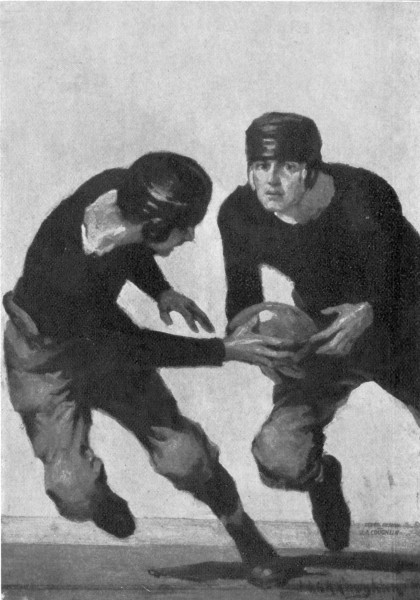
It wasn’t much of a bit at first. He was football
stale and it took many days to get back into the rut
again. Rusty gave him plenty of work and plenty
of opportunities, trying him out for a week on the
scrubs and then shifting him over to the first as a
first-choice substitute. He got into the Mills game
for some twenty minutes and, perhaps because Mills
this year was only about fifty per cent of the team
she had been last, he was fairly successful in making
gains outside of tackle. Holman’s won without
much effort, 19 to 0. Afterwards, Gus tried to tell
Joe that he had played a corking game, but Joe knew
better.
“Talk sense,” he protested. “If we’d been playing
Munson, or even Glenwood, I wouldn’t have made
fifteen yards this afternoon. With you and
Barrows boxing that end any one could have got
his distance. And I mighty nigh got the signals
mixed again that time on their sixteen yards when
Sanford sent Leary into the line. I was within an
ace of going after the ball myself. If Leary hadn’t
started a split-second before I could get going I’d
have gummed the game finely! No, sir, Gus, I’m
no pigskin wonder, and I know it. I love the pesky
old game and I’ll play it as long as you and Rusty
can stand me, but I haven’t any whatyoucallems—any
delusions of greatness.”
“I don’t say you’re a great player,” demurred Gus,
“but you got away fast and clean to-day, and you
follow the ball, Joe. If there’s one thing I admire
more than anything else in a football guy it’s that.
I’m a prune, myself, at it. I never could keep my
eyes on the old leather, and I’ve missed more tackles
and fell over my own feet oftener than you could
count just for that reason. Yes, sir, you follow the
ball, and I sure like that, Joe.”
“Oh, well, maybe so, but that doesn’t make me a
player. Any one can watch the pigskin and see
where it’s going—or coming. And, of course, if you
know where it is you stand a fair chance of getting
the runner. But what I mean is that—that oh, I
don’t know!” Joe sighed. “I guess it just comes
down to this, Gus. Some fellows have football
intelligence and a lot more haven’t. And I’m one of
the haven’t!”
“Well, keep the old shirt on,” counseled Gus.
“You’re doing fine. I wouldn’t wonder if we
managed to use you a whole lot against Munson.
They say she’s got only a fair line this year, and a
slow backfield, and you ought to be able to get going
once at least; and when you do get started, Joseph,
you’re hard to stop.”
“A slow backfield!” jeered Joe. “Where do you
get that stuff? Munson’s still got Taylor, and he’s
fast enough for half a dozen backs!”
“Yeah, but the rest are big chaps and don’t handle
themselves very quick. Anyway, that’s the dope we
get. Rusty’s aiming to put a fast team against ’em,
and that’s why I guess you’ll get a good share of
work the day we meet ’em. You keep right on the
way you’re headed, old son, and no one’ll do any
kicking. And keep your eye on the ball just like
you’re doing. You sure do make a hit with me in
that way, Joe!”
“Well, it’s nice to know there’s one thing I do
decently,” answered Joe, still deeply pessimistic.
“Too bad there isn’t a twelfth position on a football
team, Gus. I might get on the All-American as ball-follower!”
Gus grinned and muttered something as he
lounged through the door. It sounded like
“moron.”
The Mills game marked the end of the preliminary
season. The four games that remained, excepting,
perhaps, that with Wagnalls, a week before the final
test, were serious affairs; and only the most optimistic
Holman’s supporters could figure wins for
the Light Green in more than two of them; and
sometimes those two didn’t include the Munson contest!
Rusty had stopped experimenting now and,
barring accidents, the line-up for the Louisburg
game would be the line-up that faced Munson. One
thing that worried all who dared hope for a victory
over the Blue and Gold was the fact that in all the
seventeen years that Holman’s and Munson had met
on the gridiron never had the former won two
successive contests. Munson had beaten her rival
two years running twice, but such glory had yet to
fall to Holman’s. Holman’s had won last fall, and
while there was, of course, absolutely nothing in
this superstition stuff—well, there it was! Even
Captain Gus, who had as little imagination as any
one could have, was secretly oppressed, although
publicly, if any one referred to the subject, he
laughed scornfully and declared that fellows who put
any faith in that sort of dope were morons!
What Rusty thought no one knew. Rusty kept
right on working hard with such material as Fate
had willed to him, a dogged, determined, generally
cheerful Rusty who was well liked by all hands and
who, knowing what his charges didn’t know, was
working for more than a victory over the ancient
rival. What he knew and the fellows didn’t—or, if
they did know, had forgotten—was that his four-year
term as coach expired this fall, and that, since
like any general, he was judged by results, whether
his contract was renewed would depend a very great
deal on whether Holman’s or Munson emerged from
the fast approaching battle with the long end of the
score. During Rusty’s regime the Light Green had
lost two Munson games and won one, and, although
Rusty might well have cited extenuating circumstances
to account for the first defeat, he realized
fully that another reversal would probably send him
looking for a new position. So the little coach
worked hard, perhaps harder than he ever had
worked, and with material that, to say the best of it,
was only average. If he had had last year’s team
Rusty wouldn’t have worried much, but he hadn’t.
What he had was only little more than half as good
as last year’s, and so, not infrequently, Rusty did
worry. But few ever knew it.
The Louisburg game proved a tragedy both to the
team and to Joe; but especially to Joe. Johnny
Sawyer, playing right half, got a twisted ankle early
in the first period and, for some reason known only
to Rusty, Joe, instead of Leary, was sent in to
replace him. Joe had never been able to do as well
at right half as at left; nor did he play as well
under Clinker’s leadership as under Sanford’s.
To-day it was the substitute quarter who had started,
Sanford being reserved for the last half. Things
broke wrong for Joe on the very first play, which
was a fullback buck through right of center. Instead
of going into the line outside his right tackle as he
should have, Joe dashed straight for the center-guard
hole. He beat Brill, the fullback, to it, but Joe
was too light for the job of cleaning the hole out,
and when Brill slammed in behind him the enemy
defense had flocked to the point of attack and the
result was a three-yard loss for Holman’s. Joe
emerged rather the worse for wear and as yet unconscious
of his error. Clinker, ably assisted by
Brill, informed him of it. There wasn’t much time
for explanations, but the two did wonders, and
Joe, very sick and miserable, would have crawled out
of sight if that had been possible.
He partly redeemed himself a few minutes later
by a lucky catch of the ball when it bounced from
Barrow’s hands after a forward pass. But he laid
that to luck and nothing else, and found no comfort.
Twice he was stopped on plays around his right,
once for a four-yard loss. It wasn’t his day, and he
was convinced of it, and he played as one who was
convinced. On defense he was not so bad, but
Rusty wisely took him out at the end of the quarter.
Joe went over to the gymnasium certain that he was
disgraced. He didn’t return for the rest of the
game, and what happened he learned from Gus later.
After holding Holman’s scoreless during the first
two periods, Louisburg opened up a whole bag of
tricks and, taking the offensive, slammed the opponents
around cruelly, putting two touchdowns across
and adding a field goal for good measure. The
score was 16 to 0. Gus was still dazed when he told
the story.
“We simply went to pieces, Joe, the whole kit and
caboodle of us. Why, even Ferris was up in the air.
Twice he passed over Brill’s head. The rest of us
were just as bad. I was rotten. I don’t know what
happened! We played like a lot of—of morons!”