Definition and mode of origin of the folkways.—The
folkways are a societal force.—Folkways are made
unconsciously.—Impulse and instinct; primeval stupidity;
magic.—The strain of improvement and consistency.—The
aleatory element.—All origins are lost in
mystery.—Spencer on primitive custom.—Good and bad
luck; ills of life; goodness and
happiness.—Illustrations.—Immortality and
compensation.—Tradition and its restraints.—The
concepts of "primitive society"; "we-groups" and
"others-groups."—Sentiments in the in-group towards
out-groups.—Ethnocentrism.—Illustrations.—Patriotism.—Chauvinism.—The
struggle for existence and the competition of life; antagonistic
coöperation.—Four motives: hunger, love, vanity,
fear.—The process of making folkways.—Suggestion and
suggestibility.—Suggestion in
education.—Manias.—Suggestion in
politics.—Suggestion and criticism.—Folkways based on
false inferences.—Harmful folkways.—How "true" and
"right" are found.—The folkways are right; rights;
morals.—The folkways are true.—Relations of world
philosophy to folkways.—Definition of the
mores.—Taboos.—No primitive philosophizing; myths;
fables; notion of social welfare.—The imaginative
element.—The ethical policy and the success
policy.—Recapitulation.—Scope and method of the
mores.—Integration of the mores of a group or
age.—Purpose of the present work.—Why use the word
"mores."—The mores are a directive force.—Consistency
in the mores.—The mores of subgroups.—What are
classes?—Classes rated by societal value.—Class; race;
group solidarity.—The masses and the mores.—Fallacies
about the classes and the masses.—Action of the masses on
ideas.—Organization of the masses.—Institutions of
civil liberty.—The common man.—The "people"; popular
impulses.—Agitation.—The ruling element in the
masses.—The mores and institutions.—Laws.—How
laws and institutions differ from mores.—Difference between
mores and some cognate things.—Goodness or badness of the
mores.—More exact definition of the
mores.—Ritual.—The ritual of the mores.—Group
interests and policy.—Group interests and
folkways.—Force in the folkways.—Might and
right.—Status.—Conventionalization.—Conventions
indispensable.—The "ethos" or group character;
Japan.—Chinese ethos.—Hindoo ethos.—European
ethos.
1. Definition and mode of origin of the
folkways. If we put together all that we have learned from
anthropology and ethnography about primitive men and primitive
society, we perceive that the first task of life is to live. Men
begin with acts, not with thoughts. Every moment brings necessities
which must be satisfied at once. Need was the first experience, and
it was followed at once by a blundering effort to satisfy it. It is
generally taken for granted that men inherited some guiding
instincts from their beast ancestry, and it may be true, although
it has never been proved. If there were such inheritances, they
controlled and aided the first efforts to satisfy needs. Analogy
makes it easy to assume that the ways of beasts had produced
channels of habit and predisposition along which dexterities and
other psychophysical activities would run easily. Experiments with
newborn animals show that in the absence of any experience of the
relation of means to ends, efforts to satisfy needs are clumsy and
blundering. The method is that of trial and failure, which produces
repeated pain, loss, and disappointments. Nevertheless, it is a
method of rude experiment and selection. The earliest efforts of
men were of this kind. Need was the impelling force. Pleasure and
pain, on the one side and the other, were the rude constraints
which defined the line on which efforts must proceed. The ability
to distinguish between pleasure and pain is the only psychical
power which is to be assumed. Thus ways of doing things were
selected, which were expedient. They answered the purpose better
than other ways, or with less toil and pain. Along the course on
which efforts were compelled to go, habit, routine, and skill were
developed. The struggle to maintain existence was carried on, not
individually, but in groups. Each profited by the other's
experience; hence there was concurrence towards that which proved
to be most expedient. All at last adopted the same way for the same
purpose; hence the ways turned into customs and became mass
phenomena. Instincts were developed in connection with them. In
this way folkways arise. The young learn them by tradition,
imitation, and authority. The folkways, at a time, provide for all
the needs of life then and there. They are uniform, universal in
the group, imperative, and invariable. As time goes on, the
folkways become more and more arbitrary, positive, and imperative.
If asked why they act in a certain way in certain cases, primitive
people always answer that it is because they and their ancestors
always have done so. A sanction also arises from ghost fear. The
ghosts of ancestors would be angry if the living should change the
ancient folkways (see sec. 6).
2. The folkways are a societal force. The operation by
which folkways are produced consists in the frequent repetition of
petty acts, often by great numbers acting in concert or, at least,
acting in the same way when face to face with the same need. The
immediate motive is interest. It produces habit in the individual
and custom in the group. It is, therefore, in the highest degree
original and primitive. By habit and custom it exerts a strain on
every individual within its range; therefore it rises to a societal
force to which great classes of societal phenomena are due. Its
earliest stages, its course, and laws may be studied; also its
influence on individuals and their reaction on it. It is our
present purpose so to study it. We have to recognize it as one of
the chief forces by which a society is made to be what it is. Out
of the unconscious experiment which every repetition of the ways
includes, there issues pleasure or pain, and then, so far as the
men are capable of reflection, convictions that the ways are
conducive to societal welfare. These two experiences are not the
same. The most uncivilized men, both in the food quest and in war,
do things which are painful, but which have been found to be
expedient. Perhaps these cases teach the sense of social welfare
better than those which are pleasurable and favorable to welfare.
The former cases call for some intelligent reflection on
experience. When this conviction as to the relation to welfare is
added to the folkways they are converted into mores, and, by virtue
of the philosophical and ethical element added to them, they win
utility and importance and become the source of the science and the
art of living.
3. Folkways are made unconsciously. It is of the first
importance to notice that, from the first acts by which men try to
satisfy needs, each act stands by itself, and looks no further than
the immediate satisfaction. From recurrent needs arise habits
for the individual and customs for the group, but these
results are consequences which were never conscious, and never
foreseen or intended. They are not noticed until they have long
existed, and it is still longer before they are appreciated.
Another long time must pass, and a higher stage of mental
development must be reached, before they can be used as a basis
from which to deduce rules for meeting, in the future, problems
whose pressure can be foreseen. The folkways, therefore, are not
creations of human purpose and wit. They are like products of
natural forces which men unconsciously set in operation, or they
are like the instinctive ways of animals, which are developed out
of experience, which reach a final form of maximum adaptation to an
interest, which are handed down by tradition and admit of no
exception or variation, yet change to meet new conditions, still
within the same limited methods, and without rational reflection or
purpose. From this it results that all the life of human beings, in
all ages and stages of culture, is primarily controlled by a vast
mass of folkways handed down from the earliest existence of the
race, having the nature of the ways of other animals, only the
topmost layers of which are subject to change and control, and have
been somewhat modified by human philosophy, ethics, and religion,
or by other acts of intelligent reflection. We are told of savages
that "It is difficult to exhaust the customs and small ceremonial
usages of a savage people. Custom regulates the whole of a man's
actions,—his bathing, washing, cutting his hair, eating,
drinking, and fasting. From his cradle to his grave he is the slave
of ancient usage. In his life there is nothing free, nothing
original, nothing spontaneous, no progress towards a higher and
better life, and no attempt to improve his condition, mentally,
morally, or spiritually."1
All men act in this way with only a little wider margin of
voluntary variation.
4. Impulse and instinct. Primeval stupidity. Magic. "The
mores (Sitten) rest on feelings of pleasure or pain, which
either directly produce actions or call out desires which become
causes of action."2 "Impulse is not an
attribute of living creatures, like instinct. The only
phenomenon to which impulse applies is that men and other animals
imitate what they see others, especially of their own species, do,
and that they accomplish this imitation the more easily, the more
their forefathers practiced the same act. The thing imitated,
therefore, must already exist, and cannot be explained as an
impulse." "As soon as instinct ceased to be sole ruler of living
creatures, including inchoate man, the latter must have made
mistakes in the struggle for existence which would soon have
finished his career, but that he had instinct and the imitation of
what existed to guide him. This human primeval stupidity is the
ultimate ground of religion and art, for both come without any
interval, out of the magic which is the immediate consequence of
the struggle for existence when it goes beyond instinct." "If we
want to determine the origin of dress, if we want to define social
relations and achievements, e.g. the origin of marriage, war,
agriculture, cattle breeding, etc., if we want to make studies in
the psyche of nature peoples,—we must always pass through
magic and belief in magic. One who is weak in magic, e.g. a
ritually unclean man, has a 'bad body,' and reaches no success.
Primitive men, on the other hand, win their success by means of
their magical power and their magical preparations, and hence
become 'the noble and good.' For them there is no other morality
[than this success]. Even the technical dexterities have certainly
not been free from the influence of belief in magic."3
5. The strain of improvement and consistency. The
folkways, being ways of satisfying needs, have succeeded more or
less well, and therefore have produced more or less pleasure or
pain. Their quality always consisted in their adaptation to the
purpose. If they were imperfectly adapted and unsuccessful, they
produced pain, which drove men on to learn better. The folkways
are, therefore, (1) subject to a strain of improvement towards
better adaptation of means to ends, as long as the adaptation is so
imperfect that pain is produced. They are also (2) subject to a
strain of consistency with each other, because they all answer
their several purposes with less friction and antagonism when they
coöperate and support each other. The forms of industry, the
forms of the family, the notions of property, the constructions of
rights, and the types of religion show the strain of consistency
with each other through the whole history of civilization. The two
great cultural divisions of the human race are the oriental and the
occidental. Each is consistent throughout; each has its own
philosophy and spirit; they are separated from top to bottom by
different mores, different standpoints, different ways, and
different notions of what societal arrangements are advantageous.
In their contrast they keep before our minds the possible range of
divergence in the solution of the great problems of human life, and
in the views of earthly existence by which life policy may be
controlled. If two planets were joined in one, their inhabitants
could not differ more widely as to what things are best worth
seeking, or what ways are most expedient for well living.
6. The aleatory interest. If we should try to find a
specimen society in which expedient ways of satisfying needs and
interests were found by trial and failure, and by long selection
from experience, as broadly described in sec. 1 above, it might be
impossible to find one. Such a practical and utilitarian mode of
procedure, even when mixed with ghost sanction, is rationalistic.
It would not be suited to the ways and temper of primitive men.
There was an element in the most elementary experience which was
irrational and defied all expedient methods. One might use the best
known means with the greatest care, yet fail of the result. On the
other hand, one might get a great result with no effort at all. One
might also incur a calamity without any fault of his own. This was
the aleatory element in life, the element of risk and loss, good or
bad fortune. This element is never absent from the affairs of men.
It has greatly influenced their life philosophy and policy. On one
side, good luck may mean something for nothing, the extreme case of
prosperity and felicity. On the other side, ill luck may mean
failure, loss, calamity, and disappointment, in spite of the most
earnest and well-planned endeavor. The minds of men always dwell
more on bad luck. They accept ordinary prosperity as a matter of
course. Misfortunes arrest their attention and remain in their
memory.
Hence the ills of life are the mode of manifestation
of the aleatory element which has most affected life policy.
Primitive men ascribed all incidents to the agency of men or of
ghosts and spirits. Good and ill luck were attributed to the
superior powers, and were supposed to be due to their pleasure or
displeasure at the conduct of men. This group of notions
constitutes goblinism. It furnishes a complete world philosophy.
The element of luck is always present in the struggle for
existence. That is why primitive men never could carry on the
struggle for existence, disregarding the aleatory element and
employing a utilitarian method only. The aleatory element has
always been the connecting link between the struggle for existence
and religion. It was only by religious rites that the aleatory
element in the struggle for existence could be controlled. The
notions of ghosts, demons, another world, etc., were all fantastic.
They lacked all connection with facts, and were arbitrary
constructions put upon experience. They were poetic and developed
by poetic construction and imaginative deduction. The nexus between
them and events was not cause and effect, but magic. They therefore
led to delusive deductions in regard to life and its meaning, which
entered into subsequent action as guiding faiths, and imperative
notions about the conditions of success. The authority of religion
and that of custom coalesced into one indivisible obligation.
Therefore the simple statement of experiment and expediency in the
first paragraph above is not derived directly from actual cases,
but is a product of analysis and inference. It must also be added
that vanity and ghost fear produced needs which man was as eager to
satisfy as those of hunger or the family. Folkways resulted for the
former as well as for the latter (see sec. 9).
7. All origins are lost in mystery. No objection can lie
against this postulate about the way in which folkways began, on
account of the element of inference in it. All origins are lost in
mystery, and it seems vain to hope that from any origin the veil of
mystery will ever be raised. We go up the stream of history to the
utmost point for which we have evidence of its course. Then we are
forced to reach out into the darkness upon the line of direction
marked by the remotest course of the historic stream. This is the
way in which we have to act in regard to the origin of capital,
language, the family, the state, religion, and rights. We never can
hope to see the beginning of any one of these things. Use and wont
are products and results. They had antecedents. We never can find
or see the first member of the series. It is only by analysis and
inference that we can form any conception of the "beginning" which
we are always so eager to find.
8. Spencer on primitive custom. Spencer4 says that "guidance by custom, which we
everywhere find amongst rude peoples, is the sole conceivable
guidance at the outset." Custom is the product of concurrent action
through time. We find it existent and in control at the extreme
reach of our investigations. Whence does it begin, and how does it
come to be? How can it give guidance "at the outset"? All mass
actions seem to begin because the mass wants to act together. The
less they know what it is right and best to do, the more open they
are to suggestion from an incident in nature, or from a chance act
of one, or from the current doctrines of ghost fear. A concurrent
drift begins which is subject to later correction. That being so,
it is evident that instinctive action, under the guidance of
traditional folkways, is an operation of the first importance in
all societal matters. Since the custom never can be antecedent to
all action, what we should desire most is to see it arise out of
the first actions, but, inasmuch as that is impossible, the course
of the action after it is started is our field of study. The origin
of primitive customs is always lost in mystery, because when the
action begins the men are never conscious of historical action, or
of the historical importance of what they are doing. When they
become conscious of the historical importance of their acts, the
origin is already far behind.
9. Good and bad luck; ills of life; goodness and
happiness. There are in nature numerous antagonistic forces of
growth or production and destruction. The interests of man are
between the two and may be favored or ruined by either. Correct
knowledge of both is required to get the advantages and escape
the injuries. Until the knowledge becomes adequate the effects
which are encountered appear to be accidents or cases of luck.
There is no thrift in nature. There is rather waste. Human
interests require thrift, selection, and preservation. Capital is
the condition precedent of all gain in security and power, and
capital is produced by selection and thrift. It is threatened by
all which destroys material goods. Capital is therefore the
essential means of man's power over nature, and it implies the
purest concept of the power of intelligence to select and dispose
of the processes of nature for human welfare. All the earliest
efforts in this direction were blundering failures. Men selected
things to be desired and preserved under impulses of vanity and
superstition, and misconceived utility and interest. The errors
entered into the folkways, formed a part of them, and were
protected by them. Error, accident, and luck seem to be the only
sense there is in primitive life. Knowledge alone limits their
sway, and at least changes the range and form of their dominion.
Primitive folkways are marked by improvidence, waste, and
carelessness, out of which prudence, foresight, patience, and
perseverance are developed slowly, by pain and loss, as experience
is accumulated, and knowledge increases also, as better methods
seem worth while. The consequences of error and the effects of luck
were always mixed. As we have seen, the ills of life were connected
with the displeasure of the ghosts. Per contra, conduct
which conformed to the will of the ghosts was goodness, and was
supposed to bring blessing and prosperity. Thus a correlation was
established, in the faith of men, between goodness and happiness,
and on that correlation an art of happiness was built. It consisted
in a faithful performance of rites of respect towards superior
powers and in the use of lucky times, places, words, etc., with
avoidance of unlucky ones. All uncivilized men demand and expect a
specific response. Inasmuch as they did not get it, and indeed the
art of happiness always failed of results, the great question of
world philosophy always has been, What is the real relation between
happiness and goodness? It is only within a few generations that
men have found courage to say that there is none. The whole
strength of the notion that they are correlated is in the opposite
experience which proves that no evil thing brings happiness. The
oldest religious literature consists of formulas of worship and
prayer by which devotion and obedience were to produce satisfaction
of the gods, and win favor and prosperity for men.5 The words "ill" and "evil" have never yet thrown
off the ambiguity between wickedness and calamity. The two ideas
come down to us allied or combined. It was the rites which were the
object of tradition, not the ideas which they embodied.6
10. Illustrations. The notions of blessing and curse are
subsequent explanations by men of great cases of prosperity or
calamity which came to their knowledge. Then the myth-building
imagination invented stories of great virtue or guilt to account
for the prosperity or calamity.7
The Greek notion of the Nemesis was an inference from observation
of good and ill fortune in life. Great popular interest attached to
the stories of Crœsus and Polycrates. The latter, after all
his glory and prosperity, was crucified by the satrap of Lydia.
Crœsus had done all that man could do, according to the
current religion, to conciliate the gods and escape ill fortune. He
was very pious and lived by the rules of religion. The story is
told in different forms. "The people could not make up their minds
that a prince who had been so liberal to the gods during his
prosperity had been abandoned by them at the moment when he had the
greatest need of their aid."8
They said that he expiated the crime of his ancestor Gyges, who
usurped the throne; that is, they found it necessary to adduce some
guilt to account for the facts, and they introduced the notion of
hereditary responsibility. Another story was that he determined to
sacrifice all his wealth to the gods. He built a funeral pyre of it
all and mounted it himself, but rain extinguished it. The gods were
satisfied. Crœsus afterwards enjoyed the friendship of Cyros,
which was good fortune. Still others rejected the doctrines of
correlation between goodness and happiness on account of the fate
of Crœsus. In ancient religion "the benefits which were
expected from the gods were of a public character, affecting the
whole community, especially fruitful seasons, increase of flocks
and herds, and success in war. So long as the community flourished,
the fact that an individual was miserable reflected no discredit on
divine providence, but was rather taken to prove that the sufferer
was an evil-doer, justly hateful to the gods."9 Jehu and his house were blamed for the blood
spilt at Israel, although Jehu was commissioned by Elisha to
destroy the house of Ahab.10 This is like the case of Œdipus, who
obeyed an oracle, but suffered for his act as for a crime. Jehovah
caused the ruin of those who had displeased him, by putting false
oracles in the mouths of prophets.11 Hezekiah expostulated with God because,
although he had walked before God with a perfect heart and had done
what was right in His sight, he suffered calamity.12 In the seventy-third Psalm, the author is
perplexed by the prosperity of the wicked, and the contrast of his
own fortunes. "Surely in vain have I cleansed my heart and washed
my hands in innocency, for all day long have I been plagued, and
chastened every morning." He says that at last the wicked were cast
down. He was brutish and ignorant not to see the solution. It is
that the wicked prosper for a time only. He will cleave unto God.
The book of Job is a discussion of the relation between goodness
and happiness. The crusaders were greatly perplexed by
the victories of the Mohammedans. It seemed to be proved untrue
that God would defend His own Name or the true and holy cause.
Louis XIV, when his armies were defeated, said that God must have
forgotten all which he had done for Him.
11. Immortality and compensation. The notion of
immortality has been interwoven with the notion of luck, of
justice, and of the relation of goodness and happiness. The case
was reopened in another world, and compensations could be assumed
to take place there. In the folk drama of the ancient Greeks luck
ruled. It was either envious of human prosperity or beneficent.13 Grimm14 gives more than a thousand ancient German
apothegms, dicta, and proverbs about "luck." The Italians of the
fifteenth century saw grand problems in the correlation of goodness
and happiness. Alexander VI was the wickedest man known in history,
but he had great and unbroken prosperity in all his undertakings.
The only conceivable explanation was that he had made a pact with
the devil. Some of the American Indians believed that there was an
hour at which all wishes uttered by men were fulfilled.15 It is amongst half-civilized peoples that
the notion of luck is given the greatest influence in human
affairs. They seek devices for operating on luck, since luck
controls all interests. Hence words, times, names, places,
gestures, and other acts or relations are held to control luck.
Inasmuch as marriage is a relationship in which happiness is sought
and not always found, wedding ceremonies are connected with acts
"for luck." Some of these still survive amongst us as jests. The
fact of the aleatory element in human life, the human
interpretations of it, and the efforts of men to deal with it
constitute a large part of the history of culture. They have
produced groups of folkways, and have entered as an element into
folkways for other purposes.
12. Tradition and its restraints. It is evident that the
"ways" of the older and more experienced members of a society
deserve great authority in any primitive group. We find that this
rational authority leads to customs of deference and to etiquette
in favor of the old. The old in turn cling stubbornly to tradition
and to the example of their own predecessors. Thus tradition and
custom become intertwined and are a strong coercion which directs
the society upon fixed lines, and strangles liberty. Children see
their parents always yield to the same custom and obey the same
persons. They see that the elders are allowed to do all the
talking, and that if an outsider enters, he is saluted by those who
are at home according to rank and in fixed order. All this
becomes rule for children, and helps to give to all primitive
customs their stereotyped formality. "The fixed ways of looking at
things which are inculcated by education and tribal discipline, are
the precipitate of an old cultural development, and in their
continued operation they are the moral anchor of the Indian,
although they are also the fetters which restrain his individual
will."16
13. The concept of "primitive society"; we-group and
others-group. The conception of "primitive society" which we
ought to form is that of small groups scattered over a territory.
The size of the groups is determined by the conditions of the
struggle for existence. The internal organization of each group
corresponds to its size. A group of groups may have some relation
to each other (kin, neighborhood, alliance, connubium and
commercium) which draws them together and differentiates them from
others. Thus a differentiation arises between ourselves, the
we-group, or in-group, and everybody else, or the others-groups,
out-groups. The insiders in a we-group are in a relation of peace,
order, law, government, and industry, to each other. Their relation
to all outsiders, or others-groups, is one of war and plunder,
except so far as agreements have modified it. If a group is
exogamic, the women in it were born abroad somewhere. Other
foreigners who might be found in it are adopted persons, guest
friends, and slaves.
14. Sentiments in the in-group and towards the out-group.
The relation of comradeship and peace in the we-group and that of
hostility and war towards others-groups are correlative to each
other. The exigencies of war with outsiders are what make peace
inside, lest internal discord should weaken the we-group for war.
These exigencies also make government and law in the in-group, in
order to prevent quarrels and enforce discipline. Thus war and
peace have reacted on each other and developed each other, one
within the group, the other in the intergroup relation. The closer
the neighbors, and the stronger they are, the intenser is the
warfare, and then the intenser is the internal organization and
discipline of each. Sentiments are produced to correspond. Loyalty to the group, sacrifice for it,
hatred and contempt for outsiders, brotherhood within, warlikeness
without,—all grow together, common products of the same
situation. These relations and sentiments constitute a social
philosophy. It is sanctified by connection with religion. Men of an
others-group are outsiders with whose ancestors the ancestors of
the we-group waged war. The ghosts of the latter will see with
pleasure their descendants keep up the fight, and will help them.
Virtue consists in killing, plundering, and enslaving
outsiders.
15. Ethnocentrism is the technical name for this view of
things in which one's own group is the center of everything, and
all others are scaled and rated with reference to it. Folkways
correspond to it to cover both the inner and the outer relation.
Each group nourishes its own pride and vanity, boasts itself
superior, exalts its own divinities, and looks with contempt on
outsiders. Each group thinks its own folkways the only right ones,
and if it observes that other groups have other folkways, these
excite its scorn. Opprobrious epithets are derived from these
differences. "Pig-eater," "cow-eater," "uncircumcised,"
"jabberers," are epithets of contempt and abomination. The Tupis
called the Portuguese by a derisive epithet descriptive of birds
which have feathers around their feet, on account of trousers.17 For our present purpose
the most important fact is that ethnocentrism leads a people to
exaggerate and intensify everything in their own folkways which is
peculiar and which differentiates them from others. It therefore
strengthens the folkways.
16. Illustrations of ethnocentrism. The Papuans on New
Guinea are broken up into village units which are kept separate by
hostility, cannibalism, head hunting, and divergences of language
and religion. Each village is integrated by its own language,
religion, and interests. A group of villages is sometimes united
into a limited unity by connubium. A wife taken inside of this
group unit has full status; one taken outside of it has not. The
petty group units are peace groups within and are hostile to all
outsiders.18 The Mbayas of South
America believed that their deity had bidden them live by making
war on others, taking their wives and property, and killing their
men.19
17. When Caribs were asked whence they came,
they answered, "We alone are people."20 The meaning of the name Kiowa is "real or
principal people."21 The Lapps call themselves "men," or "human
beings."22 The Greenland Eskimo
think that Europeans have been sent to Greenland to learn virtue
and good manners from the Greenlanders. Their highest form of
praise for a European is that he is, or soon will be, as good as a
Greenlander.23 The Tunguses call
themselves "men."24 As a rule it is found that nature peoples call
themselves "men." Others are something else—perhaps not
defined—but not real men. In myths the origin of their own
tribe is that of the real human race. They do not account for the
others. The Ainos derive their name from that of the first man,
whom they worship as a god. Evidently the name of the god is
derived from the tribe name.25 When the tribal name has another sense, it is
always boastful or proud. The Ovambo name is a corruption of the
name of the tribe for themselves, which means "the wealthy."26 Amongst the most
remarkable people in the world for ethnocentrism are the Seri of
Lower California. They observe an attitude of suspicion and
hostility to all outsiders, and strictly forbid marriage with
outsiders.27
18. The Jews divided all mankind into themselves and
Gentiles. They were the "chosen people." The Greeks and Romans
called all outsiders "barbarians." In Euripides' tragedy of
Iphigenia in Aulis Iphigenia says that it is fitting that
Greeks should rule over barbarians, but not contrariwise, because
Greeks are free, and barbarians are slaves. The Arabs regarded
themselves as the noblest nation and all others as more or less
barbarous.28 In 1896, the Chinese
minister of education and his counselors edited a manual in which
this statement occurs: "How grand and glorious is the Empire of
China, the middle kingdom! She is the largest and richest in the
world. The grandest men in the world have all come from the middle
empire."29 In all the literature
of all the states equivalent statements occur, although they are
not so naïvely expressed. In Russian books and newspapers the
civilizing mission of Russia is talked about, just as, in the books
and journals of France, Germany, and the United States, the
civilizing mission of those countries is assumed and referred to as
well understood. Each state now regards itself as the leader of
civilization, the best, the freest, and the wisest, and all others
as inferior. Within a few years our own man-on-the-curbstone has
learned to class all foreigners of the Latin peoples
as "dagos," and "dago" has become an epithet of contempt. These are
all cases of ethnocentrism.
19. Patriotism is a sentiment which belongs to modern
states. It stands in antithesis to the mediæval notion of
catholicity. Patriotism is loyalty to the civic group to which one
belongs by birth or other group bond. It is a sentiment of
fellowship and coöperation in all the hopes, work, and
suffering of the group. Mediæval catholicity would have made
all Christians an in-group and would have set them in hostility to
all Mohammedans and other non-Christians. It never could be
realized. When the great modern states took form and assumed
control of societal interests, group sentiment was produced in
connection with those states. Men responded willingly to a demand
for support and help from an institution which could and did serve
interests. The state drew to itself the loyalty which had been
given to men (lords), and it became the object of that group vanity
and antagonism which had been ethnocentric. For the modern man
patriotism has become one of the first of duties and one of the
noblest of sentiments. It is what he owes to the state for what the
state does for him, and the state is, for the modern man, a cluster
of civic institutions from which he draws security and conditions
of welfare. The masses are always patriotic. For them the old
ethnocentric jealousy, vanity, truculency, and ambition are the
strongest elements in patriotism. Such sentiments are easily
awakened in a crowd. They are sure to be popular. Wider knowledge
always proves that they are not based on facts. That we are good
and others are bad is never true. By history, literature, travel,
and science men are made cosmopolitan. The selected classes of all
states become associated; they intermarry. The differentiation by
states loses importance. All states give the same security and
conditions of welfare to all. The standards of civic institutions
are the same, or tend to become such, and it is a matter of pride
in each state to offer civic status and opportunities equal to the
best. Every group of any kind whatsoever demands that each of its
members shall help defend group interests. Every group stigmatizes
any one who fails in zeal, labor, and sacrifices for group
interests. Thus the sentiment of loyalty to the group, or the group
head, which was so strong in the Middle Ages, is kept up, as far as
possible, in regard to modern states and governments. The group
force is also employed to enforce the obligations of devotion to
group interests. It follows that judgments are precluded and
criticism is silenced.
20. Chauvinism. That patriotism may degenerate into a
vice is shown by the invention of a name for the vice: chauvinism.
It is a name for boastful and truculent group self-assertion. It
overrules personal judgment and character, and puts the whole group
at the mercy of the clique which is ruling at the moment. It
produces the dominance of watchwords and phrases which take the
place of reason and conscience in determining conduct. The
patriotic bias is a recognized perversion of thought and judgment
against which our education should guard us.
21. The struggle for existence and the competition
of life; antagonistic coöperation. The struggle for
existence must be carried on under life conditions and in
connection with the competition of life. The life conditions
consist in variable elements of the environment, the supply of
materials necessary to support life, the difficulty of exploiting
them, the state of the arts, and the circumstances of physiography,
climate, meteorology, etc., which favor life or the contrary. The
struggle for existence is a process in which an individual and
nature are the parties. The individual is engaged in a process by
which he wins from his environment what he needs to support his
existence. In the competition of life the parties are men and other
organisms. The men strive with each other, or with the flora and
fauna with which they are associated. The competition of life is
the rivalry, antagonism, and mutual displacement in which the
individual is involved with other organisms by his efforts to carry
on the struggle for existence for himself. It is, therefore, the
competition of life which is the societal element, and which
produces societal organization. The number present and in
competition is another of the life conditions. At a time and place
the life conditions are the same for a number of human beings who
are present, and the problems of life policy are the same. This is
another reason why the attempts to satisfy interest become mass
phenomena and result in folkways. The individual and social
elements are always in interplay with each other if there are a
number present. If one is trying to carry on the struggle for
existence with nature, the fact that others are doing the same in
the same environment is an essential condition for him. Then arises
an alternative. He and the others may so interfere with each other
that all shall fail, or they may combine, and by coöperation
raise their efforts against nature to a higher power. This latter
method is industrial organization. The crisis which produces it is
constantly renewed, and men are forced to raise the organization to
greater complexity and more comprehensive power, without limit.
Interests are the relations of action and reaction between the
individual and the life conditions, through which relations the
evolution of the individual is produced. That
evolution, so long as it goes on prosperously, is well living, and
it results in the self-realization of the individual, for we may
think of each one as capable of fulfilling some career and
attaining to some character and state of power by the developing of
predispositions which he possesses. It would be an error, however,
to suppose that all nature is a chaos of warfare and competition.
Combination and coöperation are so fundamentally necessary
that even very low life forms are found in symbiosis for mutual
dependence and assistance. A combination can exist where each of
its members would perish. Competition and combination are two forms
of life association which alternate through the whole organic and
superorganic domains. The neglect of this fact leads to many
socialistic fallacies. Combination is of the essence of
organization, and organization is the great device for increased
power by a number of unequal and dissimilar units brought into
association for a common purpose. McGee30 says of the desert of Papagueria, in
southwestern Arizona, that "a large part of the plants and animals
of the desert dwell together in harmony and mutual helpfulness
[which he shows in detail]; for their energies are directed not so
much against one another as against the rigorous environmental
conditions growing out of dearth of water. This communality does
not involve loss of individuality, ... indeed the plants and
animals are characterized by an individuality greater than that
displayed in regions in which perpetuity of the species depends
less closely on the persistence of individuals." Hence he speaks of
the "solidarity of life" in the desert. "The saguaro is a
monstrosity in fact as well as in appearance,—a product of
miscegenation between plant and animal, probably depending for its
form of life history, if not for its very existence, on its
commensals."31 The Seri protect
pelicans from themselves by a partial taboo, which is not
understood. It seems that they could not respect a breeding time,
or establish a closed season, yet they have such an appetite for
the birds and their eggs that they would speedily exterminate them
if there were no restraint. This combination has been well called
antagonistic coöperation. It consists in the
combination of two persons or groups to satisfy a great common
interest while minor antagonisms of interest which exist between
them are suppressed. The plants and animals of the desert are
rivals for what water there is, but they combine as if with an
intelligent purpose to attain to a maximum of life under the
conditions. There are many cases of animals who coöperate in
the same way. Our farmers put crows and robins under a protective
taboo because the birds destroy insects. The birds also destroy
grain and fruits, but this is tolerated on account of their
services. Madame Pommerol says of the inhabitants of Sahara that
the people of the towns and the nomads are enemies by caste and
race, but allies in interest. The nomads need refuge and shelter.
The townspeople need messengers and transportation. Hence ties of
contract, quarrels, fights, raids, vengeances, and reconciliations
for the sake of common enterprises of plunder.32 Antagonistic coöperation is the most
productive form of combination in high civilization. It is a high
action of the reason to overlook lesser antagonisms in order to
work together for great interests. Political parties are constantly
forced to do it. In the art of the statesman it is a constant
policy. The difference between great parties and factions in any
parliamentary system is of the first importance; that difference
consists in the fact that parties can suppress minor differences,
and combine for what they think most essential to public welfare,
while factions divide and subdivide on petty differences. Inasmuch
as the suppression of minor differences means a suppression of the
emotional element, while the other policy encourages the narrow
issues in regard to which feeling is always most intense, the
former policy allows far less play to feeling and passion.
22. Hunger, love, vanity, and fear. There are four great
motives of human action which come into play when some number of
human beings are in juxtaposition under the same life conditions.
These are hunger, sex passion, vanity, and fear (of ghosts and
spirits). Under each of these motives there are interests. Life
consists in satisfying interests, for "life," in a society, is a
career of action and effort expended on both the material
and social environment. However great the errors and misconceptions
may be which are included in the efforts, the purpose always is
advantage and expediency. The efforts fall into parallel lines,
because the conditions and the interests are the same. It is now
the accepted opinion, and it may be correct, that men inherited
from their beast ancestors psychophysical traits, instincts, and
dexterities, or at least predispositions, which give them aid in
solving the problems of food supply, sex, commerce, and vanity. The
result is mass phenomena; currents of similarity, concurrence, and
mutual contribution; and these produce folkways. The folkways are
unconscious, spontaneous, uncoördinated. It is never known who
led in devising them, although we must believe that talent exerted
its leadership at all times. Folkways come into existence now all
the time. There were folkways in stage coach times, which were
fitted to that mode of travel. Street cars have produced ways which
are suited to that mode of transportation in cities. The telephone
has produced ways which have not been invented and imposed by
anybody, but which are devised to satisfy conveniently the
interests which are at stake in the use of that instrument.
23. Process of making folkways. Although we may see the
process of making folkways going on all the time, the analysis of
the process is very difficult. It appears as if there was a "mind"
in the crowd which was different from the minds of the individuals
which compose it. Indeed some have adopted such a doctrine. By
autosuggestion the stronger minds produce ideas which when set
afloat pass by suggestion from mind to mind. Acts which are
consonant with the ideas are imitated. There is a give and take
between man and man. This process is one of development. New
suggestions come in at point after point. They are carried out.
They combine with what existed already. Every new step increases
the number of points upon which other minds may seize. It seems to
be by this process that great inventions are produced. Knowledge
has been won and extended by it. It seems as if the crowd had a
mystic power in it greater than the sum of the powers of its
members. It is sufficient, however, to explain this, to notice that
there is a coöperation and constant suggestion which is
highly productive when it operates in a crowd, because it draws out
latent power, concentrates what would otherwise be scattered,
verifies and corrects what has been taken up, eliminates error, and
constructs by combination. Hence the gain from the collective
operation is fully accounted for, and the theories of
Völkerpsychologie are to be rejected as superfluous.
Out of the process which has been described have come the folkways
during the whole history of civilization.
The phenomena of suggestion and suggestibility demand some
attention because the members of a group are continually affecting
each other by them, and great mass phenomena very often are to be
explained by them.
24. Suggestion; suggestibility. What has been called the
psychology of crowds consists of certain phenomena of suggestion. A
number of persons assembled together, especially if they are
enthused by the same sentiment or stimulated by the same interest,
transmit impulses to each other with the result that all the
impulses are increased in a very high ratio. In other words, it is
an undisputed fact that all mental states and emotions are greatly
increased in force by transmission from man to man, especially if
they are attended by a sense of the concurrence and
coöperation of a great number who have a common sentiment or
interest. "The element of psychic coercion to which our thought
process is subject is the characteristic of the operations which we
call suggestive."33 What we have done or heard occupies our minds
so that we cannot turn from it to something else. The consensus of
a number promises triumph for the impulse, whatever it is.
Ça ira. There is a thrill of enthusiasm in the sense
of moving with a great number. There is no deliberation or reason.
Therefore a crowd may do things which are either better or worse
than what individuals in it would do. Cases of lynching show how a
crowd can do things which it is extremely improbable that the
individuals would do or consent to, if they were taken separately.
The crowd has no greater guarantee of wisdom and virtue than an
individual would have. In fact, the participants in a crowd almost
always throw away all the powers of wise judgment which
have been acquired by education, and submit to the control of
enthusiasm, passion, animal impulse, or brute appetite. A crowd
always has a common stock of elementary faiths, prejudices, loves
and hates, and pet notions. The common stock is acted on by the
same stimuli, in all the persons, at the same time. The response,
as an aggregate, is a great storm of feeling, and a great impulse
to the will. Hence the great influence of omens and of all popular
superstitions on a crowd. Omens are a case of "egoistic
reference."34 An army desists
from a battle on account of an eclipse. A man starting out on the
food quest returns home because a lizard crosses his path. In each
case an incident in nature is interpreted as a warning or direction
to the army or the man. Thus momentous results for men and nations
may be produced without cause. The power of watchwords consists in
the cluster of suggestions which has become fastened upon them. In
the Middle Ages the word "heretic" won a frightful suggestion of
base wickedness. In the seventeenth century the same suggestions
were connected with the words "witch" and "traitor." "Nature"
acquired great suggestion of purity and correctness in the
eighteenth century, which it has not yet lost. "Progress" now bears
amongst us a very undue weight of suggestion. Suggestibility is the
quality of liability to suggestive influence.35 "Suggestibility is the natural faculty of
the brain to admit any ideas whatsoever, without motive, to
assimilate them, and eventually to transform them rapidly into
movements, sensations, and inhibitions."36 It differs greatly in degree, and is present in
different grades in different crowds. Crowds of different
nationalities would differ both in degree of suggestibility and in
the kinds of suggestive stimuli to which they would respond.
Imitation is due to suggestibility. Even suicide is rendered
epidemic by suggestion and imitation.37 In a crisis, like a shipwreck, when no one
knows what to do, one, by acting, may lead them all through
imitative suggestibility. People who are very suggestible can be
led into states of mind which preclude criticism or reflection. Any
one who acquires skill in the primary processes of association,
analogy, reiteration, and continuity, can play tricks on others by
stimulating these processes and then giving them selected data to
work upon. A directive idea may be suggested by a series of ideas
which lead the recipient of them to expect that the series will be
continued. Then he will not perceive if the series is broken. In
the Renaissance period no degree of illumination sufficed to resist
the delusion of astrology, because it was supported by a passionate
fantasy and a vehement desire to know the future, and because it
was confirmed by antiquity, the authority of whose opinions was
overwhelmingly suggested by all the faiths and prejudices of the
time.38
25. Suggestion in education. Manias. Parents and teachers
use suggestion in rearing children. Persons who enjoy social
preëminence operate suggestion all the time, whether
intentionally or unintentionally. Whatever they do is imitated.
Folkways operate on individuals by suggestion; when they are
elevated to mores they do so still more, for then they carry the
suggestion of societal welfare. Ways and notions may be rejected by
an individual at first upon his judgment of their merits, but
repeated suggestion produces familiarity and dulls the effect upon
him of the features which at first repelled him. Familiar cases of
this are furnished by fashions of dress and by slang. A new fashion
of dress seems at first to be absurd, ungraceful, or indecent.
After a time this first impression of it is so dulled that all
conform to the fashion. New slang seems vulgar. It makes its way
into use. In India the lingam symbol is so common that no one pays
any heed to its sense.39 This power of familiarity to reduce the
suggestion to zero furnishes a negative proof of the power of the
suggestion. Conventionalization also reduces suggestion, perhaps to
zero. It is a mischievous thing to read descriptions of crime,
vice, horrors, excessive adventures, etc., because familiarity
lessens the abhorrent suggestions which those things ought to
produce. Swindlers and all others who have an interest to lead the
minds of their fellow-men in a certain direction employ suggestion.
They often develop great practical skill in the operation, although
they do not understand the science of it. It is one of the arts of
the demagogue and stump orator. A man who wanted to be nominated
for an office went before the convention to make a speech. A great
and difficult question agitated the party. He began by saying that
he would state his position on that question frankly and fully.
"But first," said he, "let me say that I am a Democrat." This
brought out a storm of applause. Then he went on to boast of his
services to the party, and then he stopped without having said a
word on the great question. He was easily nominated. The witch
persecutions rested on suggestion. "Everybody knew" that there were
witches. If not, what were the people who were burned? Philip IV of
France wanted to make the people believe that the templars were
heretics. The people were not ready to believe this. The king
caused the corpse of a templar to be dug up and burned, as the
corpses of heretics were burned. This convinced the people by
suggestion.40 What "they say,"
what "everybody does," and what "everybody knows" are controlling
suggestions. Religious revivals are carried on by suggestion.
Mediæval flagellations and dances were cases of suggestion.
In fact, all popular manias are to be explained by it. Religious
bodies practice suggestion on themselves, especially on their
children or less enthusiastic members, by symbols, pictures,
images, processions, dramatic representations, festivals, relics,
legends of their heroes. In the Middle Ages the crucifix was an
instrument of religious suggestion to produce vivid apprehension of
the death of Jesus. In very many well-known cases the passions of
the crowd were raised to the point of very violent action. The
symbols and images also, by suggestion, stimulate religious fervor.
If numbers act together, as in convents, mass phenomena are
produced, and such results follow as the hysterical epidemics in
convents and the extravagances of communistic sects.41 Learned societies and numbers of persons
who are interested in the same subject, by meeting and imparting
suggestions, make all the ideas of each the common stock of all.
Hyperboreans have a mental disease which renders them liable to
suggestion. The women are afflicted by hysteria before puberty.
Later they show the phenomena of "possession,"—dancing and
singing,—and still later catalepsy.42
26. Suggestion in politics. The great field for the use
of the devices and apparatus of suggestion at the present time is
politics. Within fifty years all states have become largely
popular. Suggestion is easy when it falls in with popular ideas,
the pet notions of groups of people, the popular common-places, and
the current habits of thought and feeling. Newspapers, popular
literature, and popular oratory show the effort to operate
suggestion along these lines. They rarely correct; they usually
flatter the accepted notions. The art of adroit suggestion is one
of the great arts of politics. Antony's speech over the body of
Cæsar is a classical example of it. In politics, especially
at elections, the old apparatus of suggestion is employed
again,—flags, symbols, ceremonies, and celebrations.
Patriotism is systematically cultivated by anniversaries,
pilgrimages, symbols, songs, recitations, etc. Another
very remarkable case of suggestion is furnished by modern
advertisements. They are adroitly planned to touch the mind of the
reader in a way to get the reaction which the advertiser wants. The
advertising pages of our popular magazines furnish evidence of the
faiths and ideas which prevail in the masses.
27. Suggestion and criticism. Suggestion is a legitimate
device, if it is honestly used, for inculcating knowledge or
principles of conduct; that is, for education in the broadest sense
of the word. Criticism is the operation by which suggestion is
limited and corrected. It is by criticism that the person is
protected against credulity, emotion, and fallacy. The power of
criticism is the one which education should chiefly train. It is
difficult to resist the suggestion that one who is accused of crime
is guilty. Lynchers generally succumb to this suggestion,
especially if the crime was a heinous one which has strongly
excited their emotions against the unknown somebody who perpetrated
it. It requires criticism to resist this suggestion. Our judicial
institutions are devised to hold this suggestion aloof until the
evidence is examined. An educated man ought to be beyond the reach
of suggestions from advertisements, newspapers, speeches, and
stories. If he is wise, just when a crowd is filled with enthusiasm
and emotion, he will leave it and will go off by himself to form
his judgment. In short, individuality and personality of character
are the opposites of suggestibility. Autosuggestion properly
includes all the cases in which a man is "struck by an idea," or
"takes a notion," but it is more strictly applied to fixed ideas
and habits of thought. An irritation suggests parasites, and
parasites suggest an irritation. The fear of stammering causes
stammering. A sleeping man drives away a fly without waking. If we
are in a pose or rôle, we act as we have heard that people
act in that pose or rôle.43 A highly trained judgment is required to
correct or select one's own ideas and to resist fixed ideas. The
supreme criticism is criticism of one's self.
28. Folkways due to false inference. Furthermore,
folkways have been formed by accident, that is, by irrational and
incongruous action, based on pseudo-knowledge. In Molembo a
pestilence broke out soon after a Portuguese had died there. After
that the natives took all possible measures not to allow any white
man to die in their country.44 On the Nicobar islands some natives who had
just begun to make pottery died. The art was given up and never
again attempted.45 White men gave to
one Bushman in a kraal a stick ornamented with buttons as a symbol
of authority. The recipient died leaving the stick to his son.
The son soon died. Then the Bushmen brought back the stick lest all
should die.46 Until recently no
building of incombustible materials could be built in any big town
of the central province of Madagascar, on account of some ancient
prejudice.47 A party of Eskimos met
with no game. One of them returned to their sledges and got the ham
of a dog to eat. As he returned with the ham bone in his hand he
met and killed a seal. Ever afterwards he carried a ham bone in his
hand when hunting.48 The Belenda women (peninsula of Malacca) stay
as near to the house as possible during the period. Many keep the
door closed. They know no reason for this custom. "It must be due
to some now forgotten superstition."49 Soon after the Yakuts saw a camel for the first
time smallpox broke out amongst them. They thought the camel to be
the agent of the disease.50 A woman amongst the same people contracted an
endogamous marriage. She soon afterwards became blind. This was
thought to be on account of the violation of ancient customs.51 A very great number of
such cases could be collected. In fact they represent the current
mode of reasoning of nature people. It is their custom to reason
that, if one thing follows another, it is due to it. A great number
of customs are traceable to the notion of the evil eye, many more
to ritual notions of uncleanness.52 No scientific investigation could discover the
origin of the folkways mentioned, if the origin had not chanced to
become known to civilized men. We must believe that the known cases
illustrate the irrational and incongruous origin of many folkways.
In civilized history also we know that customs have owed their
origin to "historical accident,"—the vanity of a princess,
the deformity of a king, the whim of a democracy, the love intrigue
of a statesman or prelate. By the institutions of another age it
may be provided that no one of these things can affect decisions,
acts, or interests, but then the power to decide the ways may have
passed to clubs, trades unions, trusts, commercial
rivals, wire-pullers, politicians, and political fanatics. In these
cases also the causes and origins may escape investigation.
29. Harmful folkways. There are folkways which are
positively harmful. Very often these are just the ones for which a
definite reason can be given. The destruction of a man's goods at
his death is a direct deduction from other-worldliness; the dead
man is supposed to want in the other world just what he wanted
here. The destruction of a man's goods at his death was a great
waste of capital, and it must have had a disastrous effect on the
interests of the living, and must have very seriously hindered the
development of civilization. With this custom we must class all the
expenditure of labor and capital on graves, temples, pyramids,
rites, sacrifices, and support of priests, so far as these were
supposed to benefit the dead. The faith in goblinism produced
other-worldly interests which overruled ordinary worldly interests.
Foods have often been forbidden which were plentiful, the
prohibition of which injuriously lessened the food supply. There is
a tribe of Bushmen who will eat no goat's flesh, although goats are
the most numerous domestic animals in the district.53 Where totemism exists it is regularly
accompanied by a taboo on eating the totem animal. Whatever may be
the real principle in totemism, it overrules the interest in an
abundant food supply. "The origin of the sacred regard paid to the
cow must be sought in the primitive nomadic life of the
Indo-European race," because it is common to Iranians and Indians
of Hindostan.54 The Libyans ate
oxen but not cows.55 The same was true of the Phœnicians and
Egyptians.56 In some cases the sense
of a food taboo is not to be learned. It may have been entirely
capricious. Mohammed would not eat lizards, because he thought them
the offspring of a metamorphosed clan of Israelites.57 On the other hand, the protective taboo
which forbade killing crocodiles, pythons, cobras, and other
animals enemies of man was harmful to his interests, whatever
the motive. "It seems to be a fixed article of belief throughout
southern India, that all who have willfully or accidentally killed
a snake, especially a cobra, will certainly be punished, either in
this life or the next, in one of three ways: either by
childlessness, or by leprosy, or by ophthalmia."58 Where this faith exists man has a greater
interest to spare a cobra than to kill it. India furnishes a great
number of cases of harmful mores. "In India every tendency of
humanity seems intensified and exaggerated. No country in the world
is so conservative in its traditions, yet no country has undergone
so many religious changes and vicissitudes."59 "Every year thousands perish of disease
that might recover if they would take proper nourishment, and drink
the medicine that science prescribes, but which they imagine that
their religion forbids them to touch." "Men who can scarcely count
beyond twenty, and know not the letters of the alphabet, would
rather die than eat food which had been prepared by men of lower
caste, unless it had been sanctified by being offered to an idol;
and would kill their daughters rather than endure the disgrace of
having unmarried girls at home beyond twelve or thirteen years of
age."60 In the last case the
rule of obligation and duty is set by the mores. The interest comes
under vanity. The sanction of the caste rules is in a boycott by
all members of the caste. The rules are often very harmful. "The
authority of caste rests partly on written laws, partly on
legendary fables or narratives, partly on the injunctions of
instructors and priests, partly on custom and usage, and partly on
the caprice and convenience of its votaries."61 The harm of caste rules is so great that
of late they have been broken in some cases, especially in regard
to travel over sea, which is a great advantage to Hindoos.62 The Hindoo folkways in regard to widows
and child marriages must also be recognized as socially
harmful.
30. How "true" and "right" are found. If a savage puts
his hand too near the fire, he suffers pain and draws it back. He
knows nothing of the laws of the radiation of heat,
but his instinctive action conforms to that law as if he did know
it. If he wants to catch an animal for food, he must study its
habits and prepare a device adjusted to those habits. If it fails,
he must try again, until his observation is "true" and his device
is "right." All the practical and direct element in the folkways
seems to be due to common sense, natural reason, intuition, or some
other original mental endowment. It seems rational (or
rationalistic) and utilitarian. Often in the mythologies this
ultimate rational element was ascribed to the teaching of a god or
a culture hero. In modern mythology it is accounted for as
"natural."
Although the ways adopted must always be really "true" and
"right" in relation to facts, for otherwise they could not answer
their purpose, such is not the primitive notion of true and
right.
31. The folkways are "right." Rights. Morals. The
folkways are the "right" ways to satisfy all interests, because
they are traditional, and exist in fact. They extend over the whole
of life. There is a right way to catch game, to win a wife, to make
one's self appear, to cure disease, to honor ghosts, to treat
comrades or strangers, to behave when a child is born, on the
warpath, in council, and so on in all cases which can arise. The
ways are defined on the negative side, that is, by taboos. The
"right" way is the way which the ancestors used and which has been
handed down. The tradition is its own warrant. It is not held
subject to verification by experience. The notion of right is in
the folkways. It is not outside of them, of independent origin, and
brought to them to test them. In the folkways, whatever is, is
right. This is because they are traditional, and therefore contain
in themselves the authority of the ancestral ghosts. When we come
to the folkways we are at the end of our analysis. The notion of
right and ought is the same in regard to all the folkways, but the
degree of it varies with the importance of the interest at stake.
The obligation of conformable and coöperative action is far
greater under ghost fear and war than in other matters, and the
social sanctions are severer, because group interests are supposed
to be at stake. Some usages contain only a slight element of right
and ought. It may well be believed that notions of
right and duty, and of social welfare, were first developed in
connection with ghost fear and other-worldliness, and therefore
that, in that field also, folkways were first raised to mores.
"Rights" are the rules of mutual give and take in the competition
of life which are imposed on comrades in the in-group, in order
that the peace may prevail there which is essential to the group
strength. Therefore rights can never be "natural" or "God-given,"
or absolute in any sense. The morality of a group at a time is the
sum of the taboos and prescriptions in the folkways by which right
conduct is defined. Therefore morals can never be intuitive. They
are historical, institutional, and empirical.
World philosophy, life policy, right, rights, and morality are
all products of the folkways. They are reflections on, and
generalizations from, the experience of pleasure and pain which is
won in efforts to carry on the struggle for existence under actual
life conditions. The generalizations are very crude and vague in
their germinal forms. They are all embodied in folklore, and all
our philosophy and science have been developed out of them.
32. The folkways are "true." The folkways are necessarily
"true" with respect to some world philosophy. Pain forced men to
think. The ills of life imposed reflection and taught forethought.
Mental processes were irksome and were not undertaken until painful
experience made them unavoidable.63 With great unanimity all over the globe
primitive men followed the same line of thought. The dead were
believed to live on as ghosts in another world just like this one.
The ghosts had just the same needs, tastes, passions, etc., as the
living men had had. These transcendental notions were the beginning
of the mental outfit of mankind. They are articles of faith, not
rational convictions. The living had duties to the ghosts, and the
ghosts had rights; they also had power to enforce their rights. It
behooved the living therefore to learn how to deal with ghosts.
Here we have a complete world philosophy and a life policy deduced
from it. When pain, loss, and ill were experienced and the question
was provoked, Who did this to us? the world philosophy furnished
the answer. When the painful experience forced the question, Why are the ghosts angry and what must we do to
appease them? the "right" answer was the one which fitted into the
philosophy of ghost fear. All acts were therefore constrained and
trained into the forms of the world philosophy by ghost fear,
ancestral authority, taboos, and habit. The habits and customs
created a practical philosophy of welfare, and they confirmed and
developed the religious theories of goblinism.
33. Relation of world philosophy and folkways. It is
quite impossible for us to disentangle the elements of philosophy
and custom, so as to determine priority and the causative position
of either. Our best judgment is that the mystic philosophy is
regulative, not creative, in its relation to the folkways. They
reacted upon each other. The faith in the world philosophy drew
lines outside of which the folkways must not go. Crude and vague
notions of societal welfare were formed from the notion of pleasing
the ghosts, and from such notions of expediency as the opinion
that, if there were not children enough, there would not be
warriors enough, or that, if there were too many children, the food
supply would not be adequate. The notion of welfare was an
inference and resultant from these mystic and utilitarian
generalizations.
34. Definition of the mores. When the elements of truth
and right are developed into doctrines of welfare, the folkways are
raised to another plane. They then become capable of producing
inferences, developing into new forms, and extending their
constructive influence over men and society. Then we call them the
mores. The mores are the folkways, including the philosophical and
ethical generalizations as to societal welfare which are suggested
by them, and inherent in them, as they grow.
35. Taboos. The mores necessarily consist, in a large
part, of taboos, which indicate the things which must not be done.
In part these are dictated by mystic dread of ghosts who might be
offended by certain acts, but they also include such acts as have
been found by experience to produce unwelcome results, especially
in the food quest, in war, in health, or in increase or decrease of
population. These taboos always contain a greater element of
philosophy than the positive rules, because the taboos contain
reference to a reason, as, for instance, that the act would
displease the ghosts. The primitive taboos correspond to the fact
that the life of man is environed by perils. His food quest must be
limited by shunning poisonous plants. His appetite must be
restrained from excess. His physical strength and health must be
guarded from dangers. The taboos carry on the accumulated wisdom of
generations, which has almost always been purchased by pain, loss,
disease, and death. Other taboos contain inhibitions of what will
be injurious to the group. The laws about the sexes, about
property, about war, and about ghosts, have this character. They
always include some social philosophy. They are both mystic and
utilitarian, or compounded of the two.
Taboos may be divided into two classes, (1) protective and (2)
destructive. Some of them aim to protect and secure, while others
aim to repress or exterminate. Women are subject to some taboos
which are directed against them as sources of possible harm or
danger to men, and they are subject to other taboos which put them
outside of the duties or risks of men. On account of this
difference in taboos, taboos act selectively, and thus affect the
course of civilization. They contain judgments as to societal
welfare.
36. No primitive philosophizing; myths; fables; notion of
societal welfare. It is not to be understood that primitive men
philosophize about their experience of life. That is our way; it
was not theirs. They did not formulate any propositions about the
causes, significance, or ultimate relations of things. They made
myths, however, in which they often presented conceptions which are
deeply philosophical, but they represented them in concrete,
personal, dramatic and graphic ways. They feared pain and ill, and
they produced folkways by their devices for warding off pain and
ill. Those devices were acts of ritual which were planned upon
their vague and crude faiths about ghosts and the other world. We
develop the connection between the devices and the faiths, and we
reduce it to propositions of a philosophic form, but the primitive
men never did that. Their myths, fables, proverbs, and maxims show
that the subtler relations of things did not escape them, and that
reflection was not wanting, but the method of it was very
different from ours. The notion of societal welfare was not
wanting, although it was never consciously put before themselves as
their purpose. It was pestilence, as a visitation of the wrath of
ghosts on all, or war, which first taught this idea, because war
was connected with victory over a neighboring group. The Bataks
have a legend that men once married their fathers' sisters'
daughters, but calamities followed and so those marriages were
tabooed.64 This inference and the
cases mentioned in sec. 28 show a conception of societal welfare
and of its relation to states and acts as conditions.
37. The imaginative element. The correct apprehension of
facts and events by the mind, and the correct inferences as to the
relations between them, constitute knowledge, and it is chiefly by
knowledge that men have become better able to live well on earth.
Therefore the alternation between experience or observation and the
intellectual processes by which the sense, sequence,
interdependence, and rational consequences of facts are
ascertained, is undoubtedly the most important process for winning
increased power to live well. Yet we find that this process has
been liable to most pernicious errors. The imagination has
interfered with the reason and furnished objects of pursuit to men,
which have wasted and dissipated their energies. Especially the
alternations of observation and deduction have been traversed by
vanity and superstition which have introduced delusions. As a
consequence, men have turned their backs on welfare and reality, in
order to pursue beauty, glory, poetry, and dithyrambic rhetoric,
pleasure, fame, adventure, and phantasms. Every group, in every
age, has had its "ideals" for which it has striven, as if men had
blown bubbles into the air, and then, entranced by their beautiful
colors, had leaped to catch them. In the very processes of analysis
and deduction the most pernicious errors find entrance. We note our
experience in every action or event. We study the significance from
experience. We deduce a conviction as to what we may best do when
the case arises again. Undoubtedly this is just what we ought to do
in order to live well. The process presents us a constant
reiteration of the sequence,—act, thought,
act. The error is made if we allow suggestions of vanity,
superstition, speculation, or imagination to become confused with
the second stage and to enter into our conviction of what it is
best to do in such a case. This is what was done when goblinism was
taken as the explanation of experience and the rule of right
living, and it is what has been done over and over again ever
since. Speculative and transcendental notions have furnished the
world philosophy, and the rules of life policy and duty have been
deduced from this and introduced at the second stage of the
process,—act, thought, act. All the errors and fallacies of
the mental processes enter into the mores of the age. The logic of
one age is not that of another. It is one of the chief useful
purposes of a study of the mores to learn to discern in them the
operation of traditional error, prevailing dogmas, logical fallacy,
delusion, and current false estimates of goods worth striving
for.
38. The ethical policy of the schools and the success
policy. Although speculative assumptions and dogmatic
deductions have produced the mischief here described, our present
world philosophy has come out of them by rude methods of correction
and purification, and "great principles" have been deduced which
now control our life philosophy; also ethical principles have been
determined which no civilized man would now repudiate
(truthfulness, love, honor, altruism). The traditional doctrines of
philosophy and ethics are not by any means adjusted smoothly to
each other or to modern notions. We live in a war of two
antagonistic ethical philosophies: the ethical policy taught in the
books and the schools, and the success policy. The same man acts at
one time by the school ethics, disregarding consequences, at
another time by the success policy, in which the consequences
dictate the conduct; or we talk the former and act by the latter.65
39. Recapitulation. We may sum up this preliminary
analysis as follows: men in groups are under life conditions; they
have needs which are similar under the state of the life
conditions; the relations of the needs to the conditions are
interests under the heads of hunger, love, vanity, and fear;
efforts of numbers at the same time to satisfy interests
produce mass phenomena which are folkways by virtue of uniformity,
repetition, and wide concurrence. The folkways are attended by
pleasure or pain according as they are well fitted for the purpose.
Pain forces reflection and observation of some relation between
acts and welfare. At this point the prevailing world philosophy
(beginning with goblinism) suggests explanations and inferences,
which become entangled with judgments of expediency. However, the
folkways take on a philosophy of right living and a life policy for
welfare. Then they become mores, and they may be developed by
inferences from the philosophy or the rules in the endeavor to
satisfy needs without pain. Hence they undergo improvement and are
made consistent with each other.
40. The scope and method of the mores. In the present
work the proposition to be maintained is that the folkways are the
widest, most fundamental, and most important operation by which the
interests of men in groups are served, and that the process by
which folkways are made is the chief one to which elementary
societal or group phenomena are due. The life of society consists
in making folkways and applying them. The science of society might
be construed as the study of them. The relations of men to each
other, when they are carrying on the struggle for existence near
each other, consist in mutual reactions (antagonisms, rivalries,
alliances, coercions, and coöperations), from which result
societal concatenations and concretions, that is, more or less
fixed positions of individuals and subgroups towards each other,
and more or less established sequences and methods of interaction
between them, by which the interests of all members of the group
are served. The same might be said of all animals. The social
insects especially show us highly developed results of the
adjustment of adjacent interests and life acts into concatenations
and concretions. The societal concretions are due to the folkways
in this way,—that the men, each struggling to carry on
existence, unconsciously coöperate to build up associations,
organization, customs, and institutions which, after a time, appear
full grown and actual, although no one intended, or planned, or
understood them in advance. They stand there as produced
by "ancestors." These concretions of relation and act in war,
labor, religion, amusement, family life, and civil institutions are
attended by faiths, doctrines of philosophy (myths, folklore), and
by precepts of right conduct and duty (taboos). The making of
folkways is not trivial, although the acts are minute. Every act of
each man fixes an atom in a structure, both fulfilling a duty
derived from what preceded and conditioning what is to come
afterwards by the authority of traditional custom. The structure
thus built up is not physical, but societal and institutional, that
is to say, it belongs to a category which must be defined and
studied by itself. It is a category in which custom produces
continuity, coherence, and consistency, so that the word
"structure" may properly be applied to the fabric of relations and
prescribed positions with which societal functions are permanently
connected. The process of making folkways is never superseded or
changed. It goes on now just as it did at the beginning of
civilization. "Use and wont" exert their force on all men always.
They produce familiarity, and mass acts become unconscious. The
same effect is produced by customary acts repeated at all recurring
occasions. The range of societal activity may be greatly enlarged,
interests may be extended and multiplied, the materials by which
needs can be supplied may become far more numerous, the processes
of societal coöperation may become more complicated, and
contract or artifice may take the place of custom for many
interests; but, if the case is one which touches the ways or
interests of the masses, folkways will develop on and around it by
the same process as that which has been described as taking place
from the beginning of civilization. The ways of carrying on war
have changed with all new inventions of weapons or armor, and have
grown into folkways of commanding range and importance. The factory
system of handicrafts has produced a body of folkways in which
artisans live, and which distinguish factory towns from commercial
cities or agricultural villages. The use of cotton instead of linen
has greatly affected modern folkways. The applications of power and
machinery have changed the standards of comfort of all classes. The
folkways, however, have kept their character and
authority through all the changes of form which they have
undergone.
41. Integration of the mores of a group or age. In
further development of the same interpretation of the phenomena we
find that changes in history are primarily due to changes in life
conditions. Then the folkways change. Then new philosophies and
ethical rules are invented to try to justify the new ways. The
whole vast body of modern mores has thus been developed out of the
philosophy and ethics of the Middle Ages. So the mores which have
been developed to suit the system of great secular states, world
commerce, credit institutions, contract wages and rent, emigration
to outlying continents, etc., have become the norm for the whole
body of usages, manners, ideas, faiths, customs, and institutions
which embrace the whole life of a society and characterize an
historical epoch. Thus India, Chaldea, Assyria, Egypt, Greece,
Rome, the Middle Ages, Modern Times, are cases in which the
integration of the mores upon different life conditions produced
societal states of complete and distinct individuality (ethos).
Within any such societal status the great reason for any phenomenon
is that it conforms to the mores of the time and place. Historians
have always recognized incidentally the operation of such a
determining force. What is now maintained is that it is not
incidental or subordinate. It is supreme and controlling. Therefore
the scientific discussion of a usage, custom, or institution
consists in tracing its relation to the mores, and the discussion
of societal crises and changes consists in showing their connection
with changes in the life conditions, or with the readjustment of
the mores to changes in those conditions.
42. Purpose of the present work. "Ethology" would be a
convenient term for the study of manners, customs, usages, and
mores, including the study of the way in which they are formed, how
they grow or decay, and how they affect the interests which it is
their purpose to serve. The Greeks applied the term "ethos" to the
sum of the characteristic usages, ideas, standards, and codes by
which a group was differentiated and individualized in character
from other groups. "Ethics" were things which pertained to the
ethos and therefore the things which were the
standard of right. The Romans used "mores" for customs in the
broadest and richest sense of the word, including the notion that
customs served welfare, and had traditional and mystic sanction, so
that they were properly authoritative and sacred. It is a very
surprising fact that modern nations should have lost these words
and the significant suggestions which inhere in them. The English
language has no derivative noun from "mores," and no equivalent for
it. The French mœurs is trivial compared with "mores."
The German Sitte renders "mores" but very imperfectly. The
modern peoples have made morals and morality a separate domain, by
the side of religion, philosophy, and politics. In that sense,
morals is an impossible and unreal category. It has no existence,
and can have none. The word "moral" means what belongs or
appertains to the mores. Therefore the category of morals can never
be defined without reference to something outside of itself.
Ethics, having lost connection with the ethos of a people, is an
attempt to systematize the current notions of right and wrong upon
some basic principle, generally with the purpose of establishing
morals on an absolute doctrine, so that it shall be universal,
absolute, and everlasting. In a general way also, whenever a thing
can be called moral, or connected with some ethical generality, it
is thought to be "raised," and disputants whose method is to employ
ethical generalities assume especial authority for themselves and
their views. These methods of discussion are most employed in
treating of social topics, and they are disastrous to sound study
of facts. They help to hold the social sciences under the dominion
of metaphysics. The abuse has been most developed in connection
with political economy, which has been almost robbed of the
character of a serious discipline by converting its discussions
into ethical disquisitions.
43. Why use the word mores. "Ethica," in the Greek sense,
or "ethology," as above defined, would be good names for our
present work. We aim to study the ethos of groups, in order to see
how it arises, its power and influence, the modes of its operation
on members of the group, and the various attributes of it (ethica).
"Ethology" is a very unfamiliar word. It has been used for the mode
of setting forth manners, customs, and mores in
satirical comedy. The Latin word "mores" seems to be, on the whole,
more practically convenient and available than any other for our
purpose, as a name for the folkways with the connotations of right
and truth in respect to welfare, embodied in them. The analysis and
definition above given show that in the mores we must recognize a
dominating force in history, constituting a condition as to what
can be done, and as to the methods which can be employed.
44. Mores are a directive force. Of course the view which
has been stated is antagonistic to the view that philosophy and
ethics furnish creative and determining forces in society and
history. That view comes down to us from the Greek philosophy and
it has now prevailed so long that all current discussion conforms
to it. Philosophy and ethics are pursued as independent
disciplines, and the results are brought to the science of society
and to statesmanship and legislation as authoritative dicta. We
also have Völkerpsychologie, Sozialpolitik, and
other intermediate forms which show the struggle of metaphysics to
retain control of the science of society. The "historic sense," the
Zeitgeist, and other terms of similar import are partial
recognitions of the mores and their importance in the science of
society. It can be seen also that philosophy and ethics are
products of the folkways. They are taken out of the mores, but are
never original and creative; they are secondary and derived. They
often interfere in the second stage of the sequence,—act,
thought, act. Then they produce harm, but some ground is furnished
for the claim that they are creative or at least regulative. In
fact, the real process in great bodies of men is not one of
deduction from any great principle of philosophy or ethics. It is
one of minute efforts to live well under existing conditions, which
efforts are repeated indefinitely by great numbers, getting
strength from habit and from the fellowship of united action. The
resultant folkways become coercive. All are forced to conform, and
the folkways dominate the societal life. Then they seem true and
right, and arise into mores as the norm of welfare. Thence are
produced faiths, ideas, doctrines, religions, and philosophies,
according to the stage of civilization and the fashions of
reflection and generalization.
45. Consistency in the mores. The tendency of
the mores of a period to consistency has been noticed (sec. 5). No
doubt this tendency is greatly strengthened when people are able to
generalize "principles" from acts. This explains the modern belief
that principles are causative. The passion for equality, the
universal use of contract, and the sentiments of humanitarianism
are informing elements in modern society. Whence did they come?
Undoubtedly they came out of the mores into which they return again
as a principle of consistency. Respect for human life, horror at
cruelty and bloodshed, sympathy with pain, suffering, and poverty
(humanitarianism), have acted as "causes" in connection with the
abolition of slavery, the reform of the criminal law and of
prisons, and sympathy with the oppressed, but humanitarianism was a
generalization from remoter mores which were due to changes in life
conditions. The ultimate explanation of the rise of humanitarianism
is the increased power of man over nature by the acquisition of new
land, and by advance in the arts. When men ceased to crowd on each
other, they were all willing to adopt ideas and institutions which
made the competition of life easy and kindly.
46. The mores of subgroups. Each class or group in a
society has its own mores. This is true of ranks, professions,
industrial classes, religious and philosophical sects, and all
other subdivisions of society. Individuals are in two or more of
these groups at the same time, so that there is compromise and
neutralization. Other mores are common to the whole society. Mores
are also transmitted from one class to another. It is necessary to
give precision to the notion of classes.
47. What are classes? Galton66 made a classification of society by a standard
which he did not strictly define. He called it "their natural
gifts." It might be understood to be mental power, reputation,
social success, income from societal work, or societal value. Ammon
took up the idea and developed it, making a diagrammatic
representation of it, which is reproduced on the following page.67
48. If we measure and classify a number of persons by any
physical characteristic (stature, weight) we find that the results
always fall under a curve of probable error. That they should do so
is, in fact, a truism. If a number of persons with different
degrees of power and resistance are acted on by the same
influences, it is most probable that the greatest number of them
will reach the same and a mean degree of self-realization, and
others in proportion to their power and resistance. The fact has
been statistically verified so often, and for such a great variety
of physical traits, that we may infer its truth for all traits of
mind and character for which we have no units, and which we cannot
therefore measure or statistically classify.
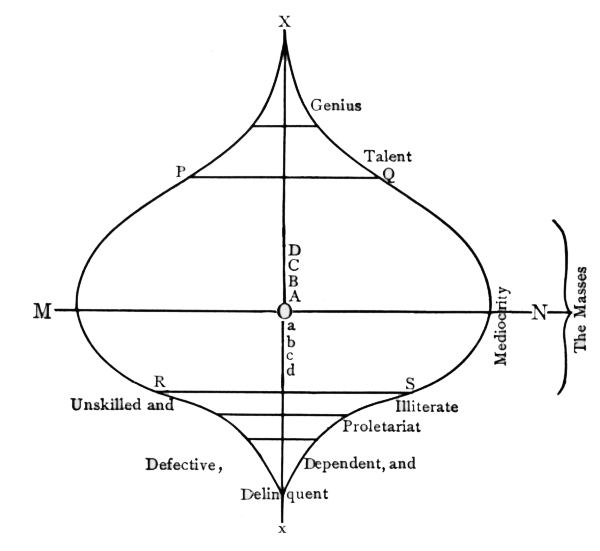
49. Classes rated by societal value. If we take societal
value as the criterion of the classification of society, it has the
advantage of being germane to the interests which are most
important in connection with classification, but it is
complex. There is no unit of it. Therefore we could never verify it
statistically. It conforms, in the main, to mental power, but it
must contain also a large element of practical sense, health, and
opportunity (luck). On the simplest analysis, there are four
elements,—intellectual, moral, economic, and physical; but
each of these is composite. If one of them is present in a high
degree, and the others in a low degree, the whole is inharmonic,
and not highly advantageous. The highest societal value seems to go
with a harmonious combination, although it may be of lower grades.
A man of talent, practical sense, industry, perseverance, and moral
principle is worth more to society than a genius, who is not
morally responsible, or not industrious. Societal value also
conforms, in a general way, to worldly success and to income from
work contributed to the industrial organization, for genius which
was not effective would have no societal value. On the other hand,
however, so long as scientific work and books of the highest value
to science and art pay the authors nothing, the returns of the
market, and income, only imperfectly measure societal value. All
these limitations being allowed for, nevertheless societal value is
a concrete idea, especially on its negative side (paupers, tramps,
social failures, and incompetents). The defective, dependent, and
delinquent classes are already fully differentiated, and are made
objects of statistical enumeration. The rest only differ in degree.
If, therefore, all were rated and scaled by this value, the results
would fall under a curve of probable error. In the diagram the axis
Xx is set perpendicular and the ordinates are divided
equally upon it in order to make the divisions correspond to "up"
and "down" as we use those words in social discussion. Then
MN is the line of the greatest number. From O upwards
we may cut off equal sections, OA, AB, etc., to
indicate grades of societal value above that of the greatest
number, and from O downwards we may cut off equal sections
of the same magnitude to indicate grades of societal value less
than that of the greatest number. At the top we have a small number
of men of genius. Below these we may cut off another section which
includes the men of talent. At the bottom we find the
dependent, defective, and delinquent classes which are a burden on
society. Above them is another stratum, the proletariat, which
serves society only by its children. Persons of this class have no
regular mode of earning a living, but are not, at the moment at
which the classification is made, dependent. These are the only
ones to whom the term "proletarian" could with any propriety be
applied. Next above these is another well-defined
stratum,—the self-supporting, but unskilled and illiterate.
Then all who fall between PQ and RS are characterized
by mediocrity, and they constitute "the masses." In all new
countries, and as it would seem at the present time also in central
Europe, there is a very strong current upwards from the lower to
the upper strata of PQRS. Universal education tends to
produce such a current. Talented men of the period are very often
born in humble circumstances, but succeed in taking their true
place in the societal scale. It is true, of course, that there is a
counter-current of degenerate sons and grandsons. The present
diagram is made unsymmetrical with respect to MN to express
the opinion that the upper strata of PQRS (the lower
professional and the semiprofessional classes) are now, in any
civilized society, larger in proportion than symmetry would
indicate.68 The line MN is
therefore a mode, and the class upon it is the modal class of the
society, by means of which one society might be compared with
another.
50. Galton estimated the number of men of genius in all
history at four hundred. An important fraction of these were
related by blood. The "men of the time" he rates at four hundred
and fifty in a million, and the more distinguished of them at two
hundred and fifty in a million. These latter he defines by saying
that a man, to be included amongst them, "should have distinguished
himself pretty frequently, either by purely original work, or as a
leader of opinion." He finds that illustrious men are only one in a
million. On the other hand, idiots and imbeciles in England and
Wales are one in four hundred, of whom thirty per cent can be
educated so as to be equal to one third of a normal man
each; forty per cent can be made worth two thirds of a man;
twenty-five or thirty per cent pass muster in a crowd. Above these
are silly persons whose relatives shield them from public
knowledge. Then above these come the Dundreary type.69
51. Class; race; group solidarity. If the group which is
classified is a large one, and especially if it is a genetic unit
(race, tribe, or nation), there are no gaps in the series. Each
individual falls into his place by virtue of his characteristic
differences. Just as no two are anthropologically alike, so we may
believe that no two are alike or equal in societal value. That all
men should be alike or equal, by any standard whatever, is contrary
to all the facts of human nature and all the conditions of human
life. Any group falls into subdivisions, the members of each of
which are approximately equal, when measured by any standard,
because the classification is imperfect. If we make it more
refined, the subdivisions must be subdivided again. We are in a
dilemma: we cannot describe mankind at all without categories, and
if we go on to make our categories more and more exact, each one of
them would at last contain only one person. Two things result which
are practically important, and which furnish us with scientific
concepts which we can employ in further study: (1) The
classification gives us the notion of the relative position of one,
or a subdivision, in the entire group. This is the sense of
"class."70 (2) The characteristic
differences furnish the notion of individuality and personality.
The concept of a race, as the term is now used, is that of a group
clustered around a mean with respect to some characteristic, and
great confusion in the use of the word "race" arises from the
attempt to define races by their boundaries, when we really think
of them by the mean or mode, e.g. as to skin color. The coherence, unity, and solidarity of a genetic group
is a very striking fact. It seems to conceal a play of mystic
forces. It is, in fact, no more mysterious than the run of dice.
The propositions about it would all become, in the last analysis,
identical propositions; e.g. it is most probable that we shall meet
with the thing which is present in the greatest number; or, it is
most probable that the most probable thing will happen. In the
middle of the nineteenth century, when attention was first called
to the solidarity and internal correlations of groups, especially
if they were large and genetic, it was believed that occult and
far-reaching laws had been discovered. That opinion has long been
abandoned. If there are four dice in a box, each having from one to
six dots on its faces, the chance of throwing four sixes is just
the same as that of throwing four ones. The mean of the sums of the
dots which may fall uppermost is fourteen, which can be produced by
one hundred and forty-six throws. Suppose that the components of
social value are four,—intellectual, moral, physical,
economic,—represented by the four dice, and that the degrees
are represented by the dots. We should get four sixes once in
twelve hundred and ninety-six throws. Of the one hundred and
forty-six throws which give the mean fourteen, seventy-two show one
six up. That might be a Hercules fit only for a dime museum.
Seventy-eight of the combinations are inharmonious, but have one
strong element.71 In societal
matters it is by no means indifferent whether the equal sums of
societal value are made up of very unequal, or of harmonious,
components. So in a group of a million persons the chance of a
great genius, who would stand alone towards X is just the
same as that of an utter idiot who would stand alone towards
x, and the reason why the number at the mode is so great is
that the societal value is the sum of components, of which many
sums may be equal, although the components are very unequal. Two
strata at equal distances above and below O are equal in
number, so far as their useful powers and resistances go, but
education introduces a new component which destroys their equality
and forces a redistribution. Galton72 suggests that, if people who would when
adults fall in classes V, W, or X in our
diagram could be recognized in infancy, and could be bought for
money, it would be a great bargain for a nation, England for
instance, to buy them for much money and rear them as Englishmen.
Farr estimated the baby of an agricultural laborer as worth
£5, capital value. A baby who could be reared to take a place
in the class X would have a capital value of thousands of
pounds. The capital value would be like that of land of different
degrees of natural advantage, but none of it yet exploited.
52. The masses and the mores. In connection with the
mores the masses are of very great importance. The historical or
selected classes are those which, in history, have controlled the
activities and policy of generations. They have been differentiated
at one time by one standard, at another time by another. The
position which they held by inheritance from early society has
given them prestige and authority. Merit and societal value,
according to the standards of their time, have entered into their
status only slightly and incidentally. Those classes have had their
own mores. They had the power to regulate their lives to some
extent according to their own choice, a power which modern
civilized men eagerly desire and strive for primarily by the
acquisition of wealth. The historical classes have, therefore,
selected purposes, and have invented ways of fulfilling them. Their
ways have been imitated by the masses. The classes have led the way
in luxury, frivolity, and vice, and also in refinement, culture,
and the art of living. They have introduced variation. The masses
are not large classes at the base of a social pyramid; they are the
core of the society. They are conservative. They accept life as
they find it, and live on by tradition and habit. In other words,
the great mass of any society lives a purely instinctive life just
like animals. We must not be misled by the conservatism of castes
and aristocracies, who resist change of customs and institutions by
virtue of which they hold social power. The conservatism of the
masses is of a different kind. It is not produced by interests, but
it is instinctive. It is due to inertia. Change would
make new effort necessary to win routine and habit. It is therefore
irksome. The masses, moreover, have not the power to reach out
after "improvements," or to plan steps of change by which needs
might be better satisfied. The mores of any society, at a period,
may be characterized by the promptness or reluctance of the masses
to imitate the ways of the classes. It is a question of the first
importance for the historian whether the mores of the historical
classes of which he finds evidence in documentary remains
penetrated the masses or not. The masses are the real bearers of
the mores of the society. They carry tradition. The folkways are
their ways. They accept influence or leadership, and they imitate,
but they do so as they see fit, being controlled by their notions
and tastes previously acquired. They may accept standards of
character and action from the classes, or from foreigners, or from
literature, or from a new religion, but whatever they take up they
assimilate and make it a part of their own mores, which they then
transmit by tradition, defend in its integrity, and refuse to
discard again. Consequently the writings of the literary class may
not represent the faiths, notions, tastes, standards, etc., of the
masses at all. The literature of the first Christian centuries
shows us scarcely anything of the mores of the time, as they
existed in the faith and practice of the masses. Every group takes
out of a new religion which is offered to it just what it can
assimilate with its own traditional mores. Christianity was a very
different thing amongst Jews, Egyptians, Greeks, Germans, and
Slavs. It would be a great mistake to suppose that any people ever
accepted and held philosophical or religious teaching as it was
offered to them, and as we find it recorded in the books of the
teachers. The mores of the masses admit of no such sudden and
massive modification by doctrinal teaching. The process of
assimilation is slow, and it is attended by modifying influences at
every stage. What the classes adopt, be it good or ill, may be
found pervading the mass after generations, but it will appear as a
resultant of all the vicissitudes of the folkways in the interval.
"It was the most frightful feature of the corruption of ancient
Rome, that it extended through every class in the community."73 "As in the Renaissance,
so now [in the Catholic reaction] vice trickled downward from
above, infiltrating the mass of the people with its virus."74 It is the classes who produce variation;
it is the masses who carry forward the traditional mores.
53. Fallacies about the masses and classes. It is a
fallacy to infer that the masses have some occult wisdom or
inspiration by virtue of which they select what is wise, right, and
good from what the classes offer. There is, also, no device by
which it is possible to obtain from the masses, in advance or on
demand, a judgment on any proposed changes or innovations. The
masses are not an oracle. If any answers can be obtained on the
problems of life, such answers will come rather from the classes.
The two sections of society are such that they may coöperate
with advantage to the good of all. Neither one has a right or a
better claim to rule the society.
54. Action of the masses on thoughts. Fifty years ago
Darwin put some knowledge into the common stock. The peasants and
artisans of his time did nothing of the kind. What the masses do
with thoughts is that they rub them down into counters just as they
take coins from the mint and smooth them down by wear until they
are only disks of metal. The masses understand, for instance, that
Darwin said that "men are descended from monkeys." Only summary and
glib propositions of that kind can ever get currency. The learned
men are all the time trying to recoin them and give them at least
partial reality. Ruskin set afloat some notions of art criticism,
which have penetrated all our cultivated classes. They are not
lost, but see what has become of them in fifty years by
popularization. A little later a new gospel of furniture and house
decoration was published. The masses have absorbed it. See what
they have made of it. Eastlake wanted no machine work, but
machinery was not to be defeated. It can make lopsided things if
those are the fashion, and it can make all the construction show if
Eastlake has got the notion into the crowd that the pegs ought to
be on the outside. Thinking and understanding are too hard work. If
any one wants to blame the masses let him turn to his own
case. He will find that he thinks about and understands only his
own intellectual pursuit. He could not give the effort to every
other department of knowledge. In other matters he is one of the
masses and does as they do. He uses routine, set formulæ,
current phrases, caught up from magazines and newspapers of the
better class.
55. Organization of the masses. Masses of men who are on
a substantial equality with each other never can be anything but
hopeless savages. The eighteenth-century notion that men in a state
of nature were all equal is wrong-side up. Men who were equal would
be in a state of nature such as was imagined. They could not form a
society. They would be forced to scatter and wander, at most two or
three together. They never could advance in the arts of
civilization. The popular belief that out of some such horde there
has come by the spontaneous development of innate forces all the
civilization which we possess is entirely unfounded. Masses of men
who are approximately equal are in time exterminated or enslaved.
Only when enslaved or subjugated are some of them carried up with
their conquerors by organization and discipline (negroes and
Indians amongst us). A horde in which the only differences are
those of age and sex is not capable of maintaining existence. It
fights because only by conquering or being conquered can it endure.
When it is subjugated and disciplined it consists of workers to
belabor the ground for others, or tax payers to fill a treasury
from which others may spend, or food for gunpowder, or voting
material for demagogues. It is an object of exploitation. At one
moment, in spite of its aggregate muscle, it is helpless and
imbecile; the next moment it is swept away into folly and mischief
by a suggestion or an impulse. Organization, leadership, and
discipline are indispensable to any beneficial action by masses of
men. If we ignore this fact, we see the machine and the boss
evolved out of the situation which we create.
56. Institutions of civil liberty. Institutions also must
be produced which will hold the activities of society in channels
of order, deliberation, peace, regulated antagonism of interests,
and justice, according to the mores of the time. These
institutions put an end to exploitation and bring interests into
harmony under civil liberty. But where do the institutions come
from? The masses have never made them. They are produced out of the
mores by the selection of the leading men and classes who get
control of the collective power of the society and direct it to the
activities which will (as they think) serve the interests which
they regard as most important. If changes in life conditions occur,
the interests to be served change. Great inventions and
discoveries, the opening of new continents, new methods of
agriculture and commerce, the introduction of money and financial
devices, improved state organization, increase the economic power
of the society and the force at the disposal of the state.
Industrial interests displace military and monarchical interests as
the ones which the state chiefly aims to serve, not because of any
tide of "progress," but because industrialism gives greater and
more varied satisfactions to the rulers. The increase of
power is the primary condition. The classes strive with each
other for the new power. Peace is necessary, for without peace none
of them can enjoy power. Compromise, adjustment of interests,
antagonistic coöperation (sec. 21), harmony, are produced, and
institutions are the regulative processes and apparatus by which
warfare is replaced by system. The historical process has been full
of error, folly, selfishness, violence, and craft. It is so still.
The point which is now important for us is that the masses have
never carried on the struggles and processes by which civilized
society has been made into an arena, within which exploitation of
man by man is to some extent repressed, and where individual
self-realization has a large scope, under the institutions of civil
liberty. It is the historical and selected classes which have done
this, often enough without intending or foreseeing the results of
actions which they inaugurated with quite other, perhaps selfish,
class purposes in view. A society is a whole made up of parts. All
the parts have a legitimate share in the acts and sufferings of the
society. All the parts contribute to the life and work of the
society. We inherit all the consequences of all their acts. Some of
the consequences are good and some are bad. It is utterly
impossible to name the classes which have done useful work and made
beneficial sacrifices only, and the other classes which have been
idle burdens and mischief makers only. All that has been done has
been done by all. It is evident that no other view than this can be
rational and true, for one reason because the will and intention of
the men of to-day in what they do has so little to do with the
consequences to-morrow of what they do. The notion that religion,
or marriage, or property, or monarchy, as we have inherited them,
can be proved evil, or worthy of condemnation and contempt on
account of the selfishness and violence interwoven with their
history, is one of the idlest of all the vagaries of the social
philosophers.
57. The common man. Every civilized society has to carry
below the lowest sections of the masses a dead weight of ignorance,
poverty, crime, and disease. Every such society has, in the great
central section of the masses, a great body which is neutral in all
the policy of society. It lives by routine and tradition. It is not
brutal, but it is shallow, narrow-minded, and prejudiced.
Nevertheless it is harmless. It lacks initiative and cannot give an
impulse for good or bad. It produces few criminals. It can
sometimes be moved by appeals to its fixed ideas and prejudices. It
is affected in its mores by contagion from the classes above it.
The work of "popularization" consists in bringing about this
contagion. The middle section is formed around the mathematical
mean of the society, or around the mathematical mode, if the
distribution of the subdivisions is not symmetrical. The man on the
mode is the "common man," the "average man," or the "man in the
street." Between him and the democratic political
institutions—the pulpit, the newspapers, and the public
library—there is a constant reaction by which mores are
modified and preserved. The aim of all the institutions and
literature in a modern state is to please him. His aim is to get
out of them what suits him. The yellow newspapers thrive and
displace all the others because he likes them. The trashy novels
pay well because his wife and daughters like them. The
advertisements in the popular magazines are addressed to him. They
show what he wants. The "funny items" are adjusted to his sense
of humor. Hence all these things are symptoms. They show what he
"believes in," and they strengthen his prejudices. If all art,
literature, legislation, and political power are to be cast at his
feet, it makes some difference who and what he is. His section of
society determines the mores of the whole.
58. "The people." Popular impulses. In a democratic state
the great middle section would rule if it was organized
independently of the rest. It is that section which constitutes
"the people" in the special technical sense in which that
expression is current in political use. It is to it that the
Jeffersonian doctrines about the "wisdom" of the people would
apply. That section, however, is never organized independently;
that is to say, "the people" never exist as a body exercising
political power. The middle section of a group may be enthused by
an impulse which is adapted to its ways and notions. It clings to
persons, loves anecdotes, is fond of light emotions, and prides
itself on its morality. If a man wins popularity in that section,
the impulse which his name can give to it may be irresistible
(Jefferson, Jackson). The middle section is greatly affected by
symbolism. "The flag" can be developed into a fetich. A cult can be
nourished around it. Group vanity is very strong in it. Patriotic
emotions and faiths are its favorite psychological exercises, if
the conjuncture is favorable and the material well-being is high.
When the middle section is stirred by any spontaneous and
consentaneous impulses which arise from its nature and ways, it may
produce incredible results with only a minimum of organization. "A
little prosperity and some ideas, as Aristotle saw, are the ferment
which sets the masses in ebullition. This offers an opportunity. A
beginning is made. The further development is unavoidable."75
59. Agitation. Every impulse given to the masses is, in
its nature, spasmodic and transitory. No systematic enterprise to
enlighten the masses ever can be carried out. Campaigns of
education contain a fallacy. Education takes time. It cannot be
treated as subsidiary for a lifetime and then be made the chief business for six months with the desired
result. A campaign of education is undemocratic. It implies that
some one is teacher and somebody else pupil. It can only result in
the elucidation of popular interests and the firmer establishment
of popular prejudice. On the other hand, an agitation which appeals
skillfully to pet notions and to latent fanaticism may stampede the
masses. The Middle Ages furnished a number of cases. The Mahdis who
have arisen in Mohammedan Africa, and other Moslem prophets, have
produced wonderful phenomena of this kind. The silver agitation was
begun, in 1878, by a systematic effort of three or four newspapers
in the middle West, addressed to currency notions which the
greenback proposition had popularized. What is the limit to the
possibilities of fanaticism and frenzy which might be produced in
any society by agitation skillfully addressed to the fallacies and
passions of the masses? The answer lies in the mores, which
determine the degree of reserved common sense, and the habit of
observing measure and method, to which the masses have been
accustomed. It follows that popular agitation is a desperate and
doubtful method. The masses, as the great popular jury which, at
last, by adoption or rejection, decides the fate of all proposed
changes in the mores, needs stability and moderation. Popular
agitation introduces into the masses initiative and creative
functions which destroy its judgment and call for quite other
qualities.
60. The ruling element in the masses. The masses are
liable to controlling influences from elements which they contain.
When crises arise in a democratic state attention is concentrated
on the most numerous strata nearest to MN (see the diagram,
p. 40), but they rarely possess self-determination unless the
question at issue appeals directly to popular interest or popular
vanity. Moreover, those strata cannot rule unless they combine with
those next above and below. So the critical question always is, in
regard to the masses PQRS, which parts of it will move the
whole of it. Generally the question is, more specifically, What is
the character of the strata above a line through A or
B, and what is their relation to the rest of PQRS? If
the upper part of the section PQRS consists of employers and
the lower part of employés, and if they hate
and fight each other, coherence and sympathy in the society will
cease, the mores will be characterized by discord, passion, and
quarrelsomeness, and political crises will arise which may reach
any degree of severity, for the political parties will soon
coincide with the class sections. The upper part of PQRS is
made up of the strata which possess comfort without luxury, but
also culture, intelligence, and the best family mores. They are
generally disciplined classes, with strong moral sense, public
spirit, and sense of responsibility. If we are not in error as to
the movement in civilized states of the present time from the lower
into the upper strata of PQRS, by virtue of ambition and
education, then it follows that the upper strata are being
constantly reënforced by all the elements in the society which
have societal value, after those elements have been developed and
disciplined by labor and self-denial. The share which the upper
strata of the masses have in determining the policy of the masses
is therefore often decisive of public welfare. On the other hand,
it is when the masses are controlled by the strata next above
RS that there is most violent impulsiveness in societal
movements. The movements and policies which are characterized as
revolutionary have their rise in these classes, although, in other
cases, these classes also adhere most stubbornly to popular
traditions in spite of reason and fact. Trade unionism is, at the
present time, a social philosophy and a programme of policy which
has its origin in the sections of the masses next above
RS.
The French Revolution began with the highest strata of the
masses, and the control of it passed on down from one to another of
the lower strata, until it reached the lowest,—the mob
gathered in the slums of a great city.
61. The mores and institutions. Institutions and laws are
produced out of mores. An institution consists of a concept (idea,
notion, doctrine, interest) and a structure. The structure is a
framework, or apparatus, or perhaps only a number of functionaries
set to coöperate in prescribed ways at a certain conjuncture.
The structure holds the concept and furnishes instrumentalities for
bringing it into the world of facts and action in a way to
serve the interests of men in society. Institutions are either
crescive or enacted. They are crescive when they take shape in the
mores, growing by the instinctive efforts by which the mores are
produced. Then the efforts, through long use, become definite and
specific. Property, marriage, and religion are the most primary
institutions. They began in folkways. They became customs. They
developed into mores by the addition of some philosophy of welfare,
however crude. Then they were made more definite and specific as
regards the rules, the prescribed acts, and the apparatus to be
employed. This produced a structure and the institution was
complete. Enacted institutions are products of rational invention
and intention. They belong to high civilization. Banks are
institutions of credit founded on usages which can be traced back
to barbarism. There came a time when, guided by rational reflection
on experience, men systematized and regulated the usages which had
become current, and thus created positive institutions of credit,
defined by law and sanctioned by the force of the state. Pure
enacted institutions which are strong and prosperous are hard to
find. It is too difficult to invent and create an institution, for
a purpose, out of nothing. The electoral college in the
constitution of the United States is an example. In that case the
democratic mores of the people have seized upon the device and made
of it something quite different from what the inventors planned.
All institutions have come out of mores, although the rational
element in them is sometimes so large that their origin in the
mores is not to be ascertained except by an historical
investigation (legislatures, courts, juries, joint stock companies,
the stock exchange). Property, marriage, and religion are still
almost entirely in the mores. Amongst nature men any man might
capture and hold a woman at any time, if he could. He did it by
superior force which was its own supreme justification. But his act
brought his group and her group into war, and produced harm to his
comrades. They forbade capture, or set conditions for it. Beyond
the limits, the individual might still use force, but his comrades
were no longer responsible. The glory to him, if he succeeded,
might be all the greater. His control over his captive was
absolute. Within the prescribed conditions, "capture" became
technical and institutional, and rights grew out of it. The woman
had a status which was defined by custom, and was very different
from the status of a real captive. Marriage was the institutional
relation, in the society and under its sanction, of a woman to a
man, where the woman had been obtained in the prescribed way. She
was then a "wife." What her rights and duties were was defined by
the mores, as they are to-day in all civilized society.
62. Laws. Acts of legislation come out of the mores. In
low civilization all societal regulations are customs and taboos,
the origin of which is unknown. Positive laws are impossible until
the stage of verification, reflection, and criticism is reached.
Until that point is reached there is only customary law, or common
law. The customary law may be codified and systematized with
respect to some philosophical principles, and yet remain customary.
The codes of Manu and Justinian are examples. Enactment is not
possible until reverence for ancestors has been so much weakened
that it is no longer thought wrong to interfere with traditional
customs by positive enactment. Even then there is reluctance to
make enactments, and there is a stage of transition during which
traditional customs are extended by interpretation to cover new
cases and to prevent evils. Legislation, however, has to seek
standing ground on the existing mores, and it soon becomes apparent
that legislation, to be strong, must be consistent with the
mores.76 Things which have been
in the mores are put under police regulation and later under
positive law. It is sometimes said that "public opinion" must
ratify and approve police regulations, but this statement rests on
an imperfect analysis. The regulations must conform to the mores,
so that the public will not think them too lax or too strict. The
mores of our urban and rural populations are not the same;
consequently legislation about intoxicants which is made by one of
these sections of the population does not succeed when applied to
the other. The regulation of drinking places, gambling places,
and disorderly houses has passed through the
above-mentioned stages. It is always a question of expediency
whether to leave a subject under the mores, or to make a police
regulation for it, or to put it into the criminal law. Betting,
horse racing, dangerous sports, electric cars, and vehicles are
cases now of things which seem to be passing under positive
enactment and out of the unformulated control of the mores. When an
enactment is made there is a sacrifice of the elasticity and
automatic self-adaptation of custom, but an enactment is specific
and is provided with sanctions. Enactments come into use when
conscious purposes are formed, and it is believed that specific
devices can be framed by which to realize such purposes in the
society. Then also prohibitions take the place of taboos, and
punishments are planned to be deterrent rather than revengeful. The
mores of different societies, or of different ages, are
characterized by greater or less readiness and confidence in regard
to the use of positive enactments for the realization of societal
purposes.
63. How laws and institutions differ from mores. When
folkways have become institutions or laws they have changed their
character and are to be distinguished from the mores. The element
of sentiment and faith inheres in the mores. Laws and institutions
have a rational and practical character, and are more mechanical
and utilitarian. The great difference is that institutions and laws
have a positive character, while mores are unformulated and
undefined. There is a philosophy implicit in the folkways; when it
is made explicit it becomes technical philosophy. Objectively
regarded, the mores are the customs which actually conduce to
welfare under existing life conditions. Acts under the laws and
institutions are conscious and voluntary; under the folkways they
are always unconscious and involuntary, so that they have the
character of natural necessity. Educated reflection and skepticism
can disturb this spontaneous relation. The laws, being positive
prescriptions, supersede the mores so far as they are adopted. It
follows that the mores come into operation where laws and tribunals
fail. The mores cover the great field of common life where there
are no laws or police regulations. They cover an immense and
undefined domain, and they break the way in new domains, not
yet controlled at all. The mores, therefore, build up new laws and
police regulations in time.
64. Difference between mores and some cognate things.
Products of intentional investigation or of rational and conscious
reflection, projects formally adopted by voluntary associations,
rational methods consciously selected, injunctions and prohibitions
by authority, and all specific conventional arrangements are not in
the mores. They are differentiated by the rational and conscious
element in them. We may also make a distinction between usages and
mores. Usages are folkways which contain no principle of welfare,
but serve convenience so long as all know what they are expected to
do. For instance, Orientals, to show respect, cover the head and
uncover the feet; Occidentals do the opposite. There is no inherent
and necessary connection between respect and either usage, but it
is an advantage that there should be a usage and that all should
know and observe it. One way is as good as another, if it is
understood and established. The folkways as to public decency
belong to the mores, because they have real connection with welfare
which determines the only tenor which they can have. The folkways
about propriety and modesty are sometimes purely conventional and
sometimes inherently real. Fashions, fads, affectations, poses,
ideals, manias, popular delusions, follies, and vices must be
included in the mores. They have characteral qualities and
characteral effect. However frivolous or foolish they may appear to
people of another age, they have the form of attempts to live well,
to satisfy some interest, or to win some good. The ways of
advertisers who exaggerate, use tricks to win attention, and appeal
to popular weakness and folly; the ways of journalism;
electioneering devices; oratorical and dithyrambic extravagances in
politics; current methods of humbug and sensationalism,—are
not properly part of the mores but symptoms of them. They are not
products of the concurrent and coöperative effort of all
members of the society to live well. They are devices made with
conscious ingenuity to exert suggestion on the minds of others. The
mores are rather the underlying facts in regard to the faiths,
notions, tastes, desires, etc., of that society at that time,
to which all these modes of action appeal and of whose existence
they are evidence.
65. What is goodness or badness of the mores. It is most
important to notice that, for the people of a time and place, their
own mores are always good, or rather that for them there can be no
question of the goodness or badness of their mores. The reason is
because the standards of good and right are in the mores. If the
life conditions change, the traditional folkways may produce pain
and loss, or fail to produce the same good as formerly. Then the
loss of comfort and ease brings doubt into the judgment of welfare
(causing doubt of the pleasure of the gods, or of war power, or of
health), and thus disturbs the unconscious philosophy of the mores.
Then a later time will pass judgment on the mores. Another society
may also pass judgment on the mores. In our literary and historical
study of the mores we want to get from them their educational
value, which consists in the stimulus or warning as to what is, in
its effects, societally good or bad. This may lead us to reject or
neglect a phenomenon like infanticide, slavery, or witchcraft, as
an old "abuse" and "evil," or to pass by the crusades as a folly
which cannot recur. Such a course would be a great error.
Everything in the mores of a time and place must be regarded as
justified with regard to that time and place. "Good" mores are
those which are well adapted to the situation. "Bad" mores are
those which are not so adapted. The mores are not so stereotyped
and changeless as might appear, because they are forever moving
towards more complete adaptation to conditions and interests, and
also towards more complete adjustment to each other. People in mass
have never made or kept up a custom in order to hurt their own
interests. They have made innumerable errors as to what their
interests were and how to satisfy them, but they have always aimed
to serve their interests as well as they could. This gives the
standpoint for the student of the mores. All things in them come
before him on the same plane. They all bring instruction and
warning. They all have the same relation to power and welfare. The
mistakes in them are component parts of them. We do not study them
in order to approve some of them and condemn others. They
are all equally worthy of attention from the fact that they existed
and were used. The chief object of study in them is their
adjustment to interests, their relation to welfare, and their
coördination in a harmonious system of life policy. For the
men of the time there are no "bad" mores. What is traditional and
current is the standard of what ought to be. The masses never raise
any question about such things. If a few raise doubts and
questions, this proves that the folkways have already begun to lose
firmness and the regulative element in the mores has begun to lose
authority. This indicates that the folkways are on their way to a
new adjustment. The extreme of folly, wickedness, and absurdity in
the mores is witch persecutions, but the best men of the
seventeenth century had no doubt that witches existed, and that
they ought to be burned. The religion, statecraft, jurisprudence,
philosophy, and social system of that age all contributed to
maintain that belief. It was rather a culmination than a
contradiction of the current faiths and convictions, just as the
dogma that all men are equal and that one ought to have as much
political power in the state as another was the culmination of the
political dogmatism and social philosophy of the nineteenth
century. Hence our judgments of the good or evil consequences of
folkways are to be kept separate from our study of the historical
phenomena of them, and of their strength and the reasons for it.
The judgments have their place in plans and doctrines for the
future, not in a retrospect.
66. More exact definition of the mores. We may now
formulate a more complete definition of the mores. They are the
ways of doing things which are current in a society to satisfy
human needs and desires, together with the faiths, notions, codes,
and standards of well living which inhere in those ways, having a
genetic connection with them. By virtue of the latter element the
mores are traits in the specific character (ethos) of a society or
a period. They pervade and control the ways of thinking in all the
exigencies of life, returning from the world of abstractions to the
world of action, to give guidance and to win revivification. "The
mores [Sitten] are, before any beginning of
reflection, the regulators of the political, social, and religious
behavior of the individual. Conscious reflection is the worst enemy
of the mores, because mores begin unconsciously and pursue
unconscious purposes, which are recognized by reflection often only
after long and circuitous processes, and because their expediency
often depends on the assumption that they will have general
acceptance and currency, uninterfered with by reflection."77 "The mores are usage in any group, in so
far as it, on the one hand, is not the expression or fulfillment of
an absolute natural necessity [e.g. eating or sleeping], and, on
the other hand, is independent of the arbitrary will of the
individual, and is generally accepted as good and proper,
appropriate and worthy."78
67. Ritual. The process by which mores are developed and
established is ritual. Ritual is so foreign to our mores that we do
not recognize its power. In primitive society it is the prevailing
method of activity, and primitive religion is entirely a matter of
ritual. Ritual is the perfect form of drill and of the regulated
habit which comes from drill. Acts which are ordained by authority
and are repeated mechanically without intelligence run into ritual.
If infants and children are subjected to ritual they never escape
from its effects through life. Galton79 says that he was, in early youth, in contact
with the Mohammedan ritual idea that the left hand is less worthy
than the right, and that he never overcame it. We see the effect of
ritual in breeding, courtesy, politeness, and all forms of
prescribed behavior. Etiquette is social ritual. Ritual is not easy
compliance with usage; it is strict compliance with detailed and
punctilious rule. It admits of no exception or deviation. The
stricter the discipline, the greater the power of ritual over
action and character. In the training of animals and the education
of children it is the perfection, inevitableness, invariableness,
and relentlessness of routine which tells. They should never
experience any exception or irregularity. Ritual is connected with
words, gestures, symbols, and signs. Associations result, and, upon
a repetition of the signal, the act is repeated,
whether the will assents or not. Association and habit account for
the phenomena. Ritual gains further strength when it is rhythmical,
and is connected with music, verse, or other rhythmical arts. Acts
are ritually repeated at the recurrence of the rhythmical points.
The alternation of night and day produces rhythms of waking and
sleeping, of labor and rest, for great numbers at the same time, in
their struggle for existence. The seasons also produce rhythms in
work. Ritual may embody an idea of utility, expediency, or welfare,
but it always tends to become perfunctory, and the idea is only
subconscious. There is ritual in primitive therapeutics, and it was
not eliminated until very recent times. The patient was directed,
not only to apply remedies, but also to perform rites. The rites
introduced mystic elements. This illustrates the connection of
ritual with notions of magical effects produced by rites. All
ritual is ceremonious and solemn. It tends to become sacred, or to
make sacred the subject-matter with which it is connected.
Therefore, in primitive society, it is by ritual that sentiments of
awe, deference to authority, submission to tradition, and
disciplinary coöperation are inculcated. Ritual operates a
constant suggestion, and the suggestion is at once put in operation
in acts. Ritual, therefore, suggests sentiments, but it never
inculcates doctrines. Ritual is strongest when it is most
perfunctory and excites no thought. By familiarity with ritual any
doctrinal reference which it once had is lost by familiarity, but
the habits persist. Primitive religion is ritualistic, not because
religion makes ritual, but because ritual makes religion. Ritual is
something to be done, not something to be thought or felt. Men can
always perform the prescribed act, although they cannot always
think or feel prescribed thoughts or emotions. The acts may bring
up again, by association, states of the mind and sentiments which
have been connected with them, especially in childhood, when the
fantasy was easily affected by rites, music, singing, dramas, etc.
No creed, no moral code, and no scientific demonstration can ever
win the same hold upon men and women as habits of action, with
associated sentiments and states of mind, drilled in from
childhood. Mohammedanism shows the power of ritual. Any
occupation is interrupted for the prayers and prescribed
genuflections. The Brahmins also observe an elaborate daily ritual.
They devote to it two hours in the morning, two in the evening, and
one at midday.80 Monks and nuns
have won the extreme satisfaction of religious sentiment from the
unbroken habit of repeated ritual, with undisturbed opportunity to
develop the emotional effects of it.
68. The ritual of the mores. The mores are social ritual
in which we all participate unconsciously. The current habits as to
hours of labor, meal hours, family life, the social intercourse of
the sexes, propriety, amusements, travel, holidays, education, the
use of periodicals and libraries, and innumerable other details of
life fall under this ritual. Each does as everybody does. For the
great mass of mankind as to all things, and for all of us for a
great many things, the rule to do as all do suffices. We are led by
suggestion and association to believe that there must be wisdom and
utility in what all do. The great mass of the folkways give us
discipline and the support of routine and habit. If we had to form
judgments as to all these cases before we could act in them, and
were forced always to act rationally, the burden would be
unendurable. Beneficent use and wont save us this trouble.
69. Group interests and policy. Groups select,
consciously and unconsciously, standards of group well living. They
plan group careers, and adopt purposes through which they hope to
attain to group self-realization. The historical classes adopt the
decisions which constitute these group plans and acts, and they
impose them on the group. The Greeks were enthused at one time by a
national purpose to destroy Troy, at another time by a national
necessity to ward off Persian conquest. The Romans conceived of
their rivalry with Carthage as a struggle from which only one state
could survive. Spain, through an effort to overthrow the political
power of the Moors in the peninsula and to make it all Christian,
was educated up to a national purpose to make Spain a pure
"Christian" state, in the dogmatic and ecclesiastical sense of the
word. Moors and Jews were expelled at great cost and loss.
Germany and Italy cherished for generations a national hope and
desire to become unified states. Some attempts to formulate or
interpret the Monroe doctrine would make it a national policy and
programme for the United States. In lower civilization group
interests and purposes are less definite. We must believe that
barbarous tribes often form notions of their group interests, and
adopt group policies, especially in their relations with
neighboring groups. The Iroquois, after forming their
confederation, made war on neighboring tribes in order either to
subjugate them or to force them to come into the peace pact.
Pontiac and Tecumseh united the red men in a race effort to drive
the whites out of North America.
70. Group interests and folkways. Whenever a group has a
group purpose that purpose produces group interests, and those
interests overrule individual interests in the development of
folkways. A group might adopt a pacific and industrial purpose, but
historical cases of this kind are very few. It used to be asserted
that the United States had as its great social purpose to create a
social environment which should favor that development of the
illiterate and unskilled classes into an independent status for
which the economic conditions of a new country give opportunity,
and it was asserted that nothing could cause a variation from this
policy, which was said to be secured in the political institutions
and political ideas of the people. Within a few years the United
States has been affected by an ambition to be a world power. (A
world power is a state which expects to have a share in the
settlement of every clash of interests and collision of state
policies which occurs anywhere on the globe.) There is no reason to
wonder at this action of a democracy, for a democracy is sure to
resent any suggestion that it is limited in its functions, as
compared with other political forms. At the same time that the
United States has moved towards the character of a world power it
has become militant. Other states in the past which have had group
purposes have been militant. Even when they arrived at commerce and
industry they have pursued policies which involved them in war
(Venice, Hansa, Holland). Since the group interests override the
individual interests, the selection and determination of
group purposes is a function of the greatest importance and an act
of the greatest effect on individual welfare. The interests of the
society or nation furnish an easy phrase, but such phrases are to
be regarded with suspicion. Such interests are apt to be the
interests of a ruling clique which the rest are to be compelled to
serve. On the other hand, a really great and intelligent group
purpose, founded on correct knowledge and really sound judgment,
can infuse into the mores a vigor and consistent character which
will reach every individual with educative effect. The essential
condition is that the group purpose shall be "founded on correct
knowledge and really sound judgment." The interests must be real,
and they must be interests of the whole, and the judgment as to
means of satisfying them must be correct.
71. Force in the folkways. Here we notice also the
intervention of force. There is always a large element of force in
the folkways. It constitutes another modification of the theory of
the folkways as expedient devices, developed in experience, to meet
the exigencies of life. The organization of society under chiefs
and medicine men greatly increased the power of the society to
serve its own interests. The same is true of higher political
organizations. If Gian Galeazzo Visconti or Cesare Borgia could
have united Italy into a despotic state, it is an admissible
opinion that the history of the peninsula in the following four or
five hundred years would have been happy and prosperous, and that,
at the present time, it would have had the same political system
which it has now. However, chiefs, kings, priests, warriors,
statesmen, and other functionaries have put their own interests in
the place of group interests, and have used the authority they
possessed to force the societal organization to work and fight for
their interests. The force is that of the society itself. It is
directed by the ruling class or persons. The force enters into the
mores and becomes a component in them. Despotism is in the mores of
negro tribes, and of all Mohammedan peoples. There is an element of
force in all forms of property, marriage, and religion. Slavery,
however, is the grandest case of force in the mores, employed to
make some serve the interests of others, in the societal
organization. The historical classes, having selected the group
purposes and decided the group policy, use the force of the society
itself to coerce all to acquiesce and to work and fight in the
determined way without regard to their individual interests. This
they do by means of discipline and ritual. In different kinds of
mores the force is screened by different devices. It is always
present, and brutal, cruel force has entered largely into the
development of all our mores, even those which we think most noble
and excellent.
72. Might and right. Modern civilized states of the best
form are often called jural states because the concept of rights
enters so largely into all their constitutions and regulations. Our
political philosophy centers around that concept, and all our
social discussions fall into the form of propositions and disputes
about rights. The history of the dogma of rights has been such that
rights have been believed to be self-evident and self-existent, and
as having prevailed especially in primitive society. Rights are
also regarded as the opposite of force. These notions only prove
the antagonism between our mores and those of earlier generations.
In fact, it is a characteristic of our mores that the form of our
thinking about all points of political philosophy is set for us by
the concept of rights. Nothing but might has ever made right, and
if we include in might (as we ought to) elections and the decisions
of courts, nothing but might makes right now. We must distinguish
between the anterior and the posterior view of the matter in
question. If we are about to take some action, and are debating the
right of it, the might which can be brought to support one view of
it has nothing to do with the right of it. If a thing has been done
and is established by force (that is, no force can reverse it), it
is right in the only sense we know, and rights will follow from it
which are not vitiated at all by the force in it. There would be no
security at all for rights if this were not so. We find men and
parties protesting, declaiming, complaining of what is done, and
which they say is not "right," but only force. An election decides
that those shall have power who will execute an act of policy. The
defeated party denounces the wrong and wickedness of the act. It is
done. It may be a war, a conquest, a spoliation; every
one must help to do it by paying taxes and doing military service
or other duty which may be demanded of him. The decision of a
lawsuit leaves one party protesting and complaining. He always
speaks of "right" and "rights." He is forced to acquiesce. The
result is right in the only sense which is real and true. It is
more to the purpose to note that an indefinite series of
consequences follow, and that they create or condition rights which
are real and just. Many persons now argue against property that it
began in force and therefore has no existence in right and justice.
They might say the same of marriage or religion. Some do say the
same of the state. The war of the United States with Mexico in 1845
is now generally regarded as unjustified. That cannot affect the
rights of all kinds which have been contracted in the territory
then ceded by Mexico or under the status created on the land
obtained by the treaty of peace with that country. The whole
history of mankind is a series of acts which are open to doubt,
dispute, and criticism, as to their right and justice, but all
subsequent history has been forced to take up the consequences of
those acts and go on. The disputants about "rights" often lose
sight of the fact that the world has to go on day by day and
dispute must end. It always ends in force. The end always leaves
some complaining in terms of right and rights. They are overborne
by force of some kind. Therefore might has made all the right which
ever has existed or exists now. If it is proposed to reverse,
reform, or change anything which ever was done because we now think
that it was wrong, that is a new question and a new case, in which
the anterior view alone is in place. It is for the new and future
cases that we study historical cases and form judgments on them
which will enable us to act more wisely. If we recognize the great
extent to which force now enters into all which happens in society,
we shall cease to be shocked to learn the extent to which it has
been active in the entire history of civilization. The habit of
using jural concepts, which is now so characteristic of our mores,
leads us into vague and impossible dreams of social affairs, in
which metaphysical concepts are supposed to realize themselves, or
are assumed to be real.
73. Status in the folkways. If now we form a
conception of the folkways as a great mass of usages, of all
degrees of importance, covering all the interests of life,
constituting an outfit of instruction for the young, embodying a
life policy, forming character, containing a world philosophy,
albeit most vague and unformulated, and sanctioned by ghost fear so
that variation is impossible, we see with what coercive and
inhibitive force the folkways have always grasped the members of a
society. The folkways create status. Membership in the group, kin,
family, neighborhood, rank, or class are cases of status. The
rights and duties of every man and woman were defined by status. No
one could choose whether he would enter into the status or not. For
instance, at puberty every one was married. What marriage meant,
and what a husband or wife was (the rights and duties of each),
were fixed by status. No one could alter the customary relations.
Status, as distinguished from institutions and contract, is a
direct product of the mores. Each case of status is a nucleus of
leading interest with the folkways which cluster around it. Status
is determined by birth. Therefore it is a help and a hindrance, but
it is not liberty. In modern times status has become unpopular and
our mores have grown into the forms of contract under liberty. The
conception of status has been lost by the masses in modern
civilized states. Nevertheless we live under status which has been
defined and guaranteed by law and institutions, and it would be a
great gain to recognize and appreciate the element of status which
historically underlies the positive institutions and which is still
subject to the action of the mores. Marriage (matrimony or wedlock)
is a status. It is really controlled by the mores. The law defines
it and gives sanctions to it, but the law always expresses the
mores. A man and a woman make a contract to enter into it. The mode
of entering into it (wedding) is fixed by custom. The law only
ratifies it. No man and woman can by contract make wedlock
different for themselves from the status defined by law, so far as
social rights and duties are concerned. The same conception of
marriage as a status in the mores is injured by the intervention of
the ecclesiastical and civil formalities connected with it. An
individual is born into a kin group, a tribe, a nation, or a
state, and he has a status accordingly which determines rights and
duties for him. Civil liberty must be defined in accordance with
this fact; not outside of it, or according to vague metaphysical
abstractions above it. The body of the folkways constitutes a
societal environment. Every one born into it must enter into
relations of give and take with it. He is subjected to influences
from it, and it is one of the life conditions under which he must
work out his career of self-realization. Whatever liberty may be
taken to mean, it is certain that liberty never can mean
emancipation from the influence of the societal environment, or of
the mores into which one was born.
74. Conventionalization. If traditional folkways are
subjected to rational or ethical examination they are no longer
naïve and unconscious. It may then be found that they are
gross, absurd, or inexpedient. They may still be preserved by
conventionalization. Conventionalization creates a set of
conditions under which a thing may be tolerated which would
otherwise be disapproved and tabooed. The special conditions may be
created in fact, or they may be only a fiction which all agree to
respect and to treat as true. When children, in play, "make
believe" that something exists, or exists in a certain way, they
employ conventionalization. Special conditions are created in fact
when some fact is regarded as making the usual taboo inoperative.
Such is the case with all archaic usages which are perpetuated on
account of their antiquity, although they are not accordant with
modern standards. The language of Shakespeare and the Bible
contains words which are now tabooed. In this case, as in very many
others, the conventionalization consists in ignoring the violation
of current standards of propriety. Natural functions and toilet
operations are put under conventionalization, even in low
civilization. The conventionalization consists in ignoring breaches
of the ordinary taboo. On account of accidents which may occur,
wellbred people are always ready to apply conventionalization to
mishaps of speech, dress, manner, etc. In fairy stories, fables,
romances, and dramas all are expected to comply with certain
conventional understandings without which the entertainment is
impossible; for instance, when beasts are supposed to speak. In the
mythologies this kind of conventionalization was essential. One of
us, in studying mythologies, has to acquire a knowledge of the
conventional assumptions with which the people who believed in them
approached them. Modern Hindoos conventionalize the stories of
their mythology.81 What the gods are
said to have done is put under other standards than those now
applied to men. Everything in the mythology is on a plane by
itself. It follows that none of the rational or ethical judgments
are formed about the acts of the gods which would be formed about
similar acts of men, and the corruption of morals which would be
expected as a consequence of the stories and dramas is prevented by
the conventionalization. There is no deduction from what gods do to
what men may do. The Greeks of the fifth century B.C. rationalized on their mythology and thereby
destroyed it. The mediæval church claimed to be under a
conventionalization which would prevent judgment on the church and
ecclesiastics according to current standards. Very many people
heeded this conventionalization, so that they were not scandalized
by vice and crime in the church. This intervention of
conventionalization to remove cases from the usual domain of the
mores into a special field, where they can be protected and
tolerated by codes and standards modified in their favor, is of
very great importance. It accounts for many inconsistencies in the
mores. In this way there may be nakedness without indecency, and
tales of adultery without lewdness. We observe a
conventionalization in regard to the Bible, especially in regard to
some of the Old Testament stories. The theater presents numerous
cases of conventionalization. The asides, entrances and exits, and
stage artifices, require that the spectators shall concede their
assent to conventionalities. The dresses of the stage would not be
tolerated elsewhere. It is by conventionalization that the
literature and pictorial representations of science avoid collision
with the mores of propriety, decency, etc. In all artistic work
there is more or less conventionalization. Uncivilized people, and
to some extent uneducated people amongst ourselves, cannot tell
what a picture represents or means because they are not
used to the conventionalities of pictorial art. The ancient
Saturnalia and the carnival have been special times of license at
which the ordinary social restrictions have been relaxed for a time
by conventionalization. Our own Fourth of July is a day of noise,
risk, and annoyance, on which things are allowed which would not be
allowed at any other time. We consent to it because "it is Fourth
of July." The history of wedding ceremonies presents very many
instances of conventionalization. Jests and buffoonery have been
tolerated for the occasion. They became such an annoyance that
people revolted against them, and invented means to escape them.
Dress used in bathing, sport, the drama, or work is protected by
conventionalization. The occasion calls for a variation from
current usage, and the conventionalization, while granting
toleration, defines it also, and makes a new law for the
exceptional case. It is like taboo, and is, in fact, the form of
taboo in high civilization. Like taboo, it has two
aspects,—it is either destructive or protective. The
conventionalization bars out what might be offensive (i.e. when a
thing may be done only under the conditions set by
conventionalization), or it secures toleration for what would
otherwise be forbidden. Respect, reverence, sacredness, and
holiness, which are taboos in low civilization, become
conventionalities in high civilization.
75. Conventions indispensable. Conventionality is often
denounced as untrue and hypocritical. It is said that we ought to
be natural. Respectability is often sneered at because it is a sum
of conventionalities. The conventionalizations which persist are
the resultant of experiments and experience as to the devices by
which to soften and smoothen the details of life. They are
indispensable. We might as well renounce clothes as to try to
abolish them.
76. The ethos or group character. All that has been said
in this chapter about the folkways and the mores leads up to the
idea of the group character which the Greeks called the ethos, that
is, the totality of characteristic traits by which a group is
individualized and differentiated from others. The great nations of
southeastern Asia were long removed from familiar contact
with the rest of mankind and isolated from each other, while they
were each subjected to the discipline and invariable rule of
traditional folkways which covered all social interests except the
interferences of a central political authority, which perpetrated
tyranny in its own interest. The consequence has been that Japan,
China, and India have each been molded into a firm, stable, and
well-defined unit group, having a character strongly marked both
actively and passively. The governing classes of Japan have, within
fifty years, voluntarily abandoned their traditional mores, and
have adopted those of the Occident, while it does not appear that
they have lost their inherited ethos. The case stands alone in
history and is a cause of amazement. In the war with Russia, in
1904, this people showed what a group is capable of when it has a
strong ethos. They understand each other; they act as one man; they
are capable of discipline to the death. Our western tacticians have
had rules for the percentage of loss which troops would endure,
standing under fire, before breaking and running. The rule failed
for the Japanese. They stood to the last man. Their prowess at Port
Arthur against the strongest fortifications, and on the
battlefields of Manchuria, surpassed all record. They showed what
can be done in the way of concealing military and naval movements
when every soul in the population is in a voluntary conspiracy not
to reveal anything. These traits belong to a people which has been
trained by generations of invariable mores. It is apparently what
the mediæval church wanted to introduce in Europe, but the
Japanese have got it without selfish tyranny of the ruling persons
and classes. Of course, it admits of no personal liberty, and the
consequences of introducing occidental notions of liberty into it
have yet to be seen. "The blacksmith squats at his anvil wielding a
hammer such as no western smith could use without long practice.
The carpenter pulls instead of pushing his extraordinary plane and
saw. Always the left is the right side, and the right side the
wrong. Keys must be turned, to open or close a lock, in what we are
accustomed to think the wrong direction." "The swordsman,
delivering his blow with both hands, does not pull the blade
towards him in the moment of striking, but pushes it from him.
He uses it indeed, as other Asiatics do, not on the principle of
the wedge, but of the saw."82 In family manners the Japanese are gentle.
Cruelty even to animals appears to be unknown. "One sees farmers
coming to town, trudging patiently beside their horses or oxen,
aiding their dumb companions to bear the burden, and using no whips
or goads. Drivers or pullers of carts will turn out of their way,
under the most provoking circumstances, rather than overrun a lazy
dog or a stupid chicken."83 Etiquette is refined, elaborate, and vigorous.
Politeness has been diffused through all ranks from ancient
times.84 "The discipline of the
race was self-imposed. The people have gradually created their own
social conditions."85 "Demeanor was [in ancient times] most
elaborately and mercilessly regulated, not merely as to obeisances,
of which there were countless grades, varying according to sex as
well as class, but even in regard to facial expression, the manner
of smiling, the conduct of the breath, the way of sitting,
standing, walking, rising."86 "With the same merciless exactitude which
prescribed rules for dress, diet, and manner of life, all utterance
was regulated both positively and negatively, but positively much
more than negatively.... Education cultivated a system of verbal
etiquette so multiform that only the training of years could enable
any one to master it. The astonishment evoked by Japanese sumptuary
laws, particularly as inflicted upon the peasantry, is justified,
less by their general character than by their implacable
minuteness,—their ferocity of detail." "That a man's house is
his castle cannot be asserted in Japan, except in the case of some
high potentate. No ordinary person can shut his door to lock out
the rest of the world. Everybody's house must be open to visitors;
to close its gates by day would be regarded as an insult to the
community, sickness affording no excuse. Only persons in very great
authority have the right of making themselves inaccessible.... By a
single serious mistake a man may find himself suddenly placed in
solitary opposition to the common will,—isolated, and most
effectively ostracized." "The events of the [modern] reconstruction
strangely illustrate the action of such instinct [of
adaptation] in the face of peril,—the readjustment of
internal relations to sudden changes of environment. The nation had
found its old political system powerless before the new conditions,
and it transformed that system. It had found its military
organization incapable of defending it, and it reconstructed that
organization. It had found its educational system useless in the
presence of unforeseen necessities, and it had replaced that
system, simultaneously crippling the power of Buddhism, which might
otherwise have offered serious opposition to the new developments
required."87 To this it must be
added that people who have had commercial and financial dealings
with Japanese report that they are untruthful and tricky in
transactions of that kind. If they cannot "reform" these traits
there will be important consequences of them in the developments of
the near future.
77. Chinese ethos. It is evident that we have in the
Japanese a case of an ethos, from the habits of artisans to the
manners of nobles and the military system, which is complete,
consistent, authoritative, and very different from our own. A
similar picture of the Chinese might be drawn, from which it would
appear that they also have a complete and firm ethos, which
resembles in general the Japanese, but has its individual traits
and characteristic differences.88 The ethos of the Japanese, from the most
ancient times, has been fundamentally militant. That of the Chinese
is industrial and materialistic.
78. Hindoo ethos. The Hindoos, again, have a strongly
marked ethos. They have a name for it—kharma, which
Nivedita says might be translated "national righteousness." It
"applies to that whole system of complex action and interaction on
planes moral, intellectual, economic, industrial, political, and
domestic, which we know as India, or the national habit.... By
their attitude to it, Pathan, Mogul, and Englishman are judged,
each in his turn, by the Indian peasantry."89 The ethos of one group always furnishes the
standpoint from which it criticises the ways of any other
group.
79. European ethos. We are familiar with the notion of
"national character" as applied to the nations of Europe, but these
nations do not have each an ethos. There is a European ethos, for
the nations have so influenced each other for the last two thousand
years that there is a mixed ethos which includes local variations.
The European kharma is currently called Christian. In the
ancient world Egypt and Sparta were the two cases of groups with
the firmest and best-defined ethos. In modern European history the
most marked case is that of Venice. In no one of these cases did
the elements of moral strength and societal health preponderate,
but the history of each showed the great stability produced by a
strong ethos. Russia has a more complete and defined ethos than any
other state in Europe, although the efforts which have been made
since Peter the Great to break down the traditions and limitations
of the national ethos, and to adopt the ethos of western Europe,
have produced weakness and confusion. It is clear what is the great
power of a strong ethos. The ethos of any group deserves close
study and criticism. It is an overruling power for good or ill.
Modern scholars have made the mistake of attributing to race
much which belongs to the ethos, with a resulting controversy as to
the relative importance of nature and nurture. Others have sought a
"soul of the people" and have tried to construct a "collective
psychology," repeating for groups processes which are now abandoned
for individuals. Historians, groping for the ethos, have tried to
write the history of "the people" of such and such a state. The
ethos individualizes groups and keeps them apart. Its opposite is
cosmopolitanism. It degenerates into patriotic vanity and
chauvinism. Industrialism weakens it, by extending relations of
commerce with outside groups. It coincides better with militancy.
It has held the Japanese people like a single mailed fist for war.
What religion they have has lost all character except that of a
cohesive agent to hold the whole close organization tight
together.
Introduction.—The mores have the authority of
facts.—Whites and blacks in southern society.—The mores
are unrecorded.—Inertia and rigidity of the
mores.—Persistency of the mores.—Persistency against
new religion.—Roman law.—Effects of Roman law on later
mores.—Variability of the mores.—The mores of New
England.—Revolution.—The possibility of modifying the
mores.—Russia.—Emancipation in Russia and in the United
States.—Arbitrary change in the mores.—The case of
Japan.—The case of India.—The reforms of Joseph
II.—Adoption of the mores of another age.—What changes
are possible.—Dissent from the mores. Group
orthodoxy.—Retreat and isolation to start new
mores.—Social policy.—Degenerate and evil
mores.—The correction of aberrations in the mores.—The
mores of advance and decline; cases.—The Greek temper in
prosperity.—Greek pessimism.—Greek
degeneracy.—Sparta.—The optimism of advance and
prosperity.—Antagonism between an individual and the mores of
the group.—Antagonism of earlier and later
mores.—Antagonism between groups in respect to
mores.—Missions and mores.—Missions and antagonistic
mores.—Modification of the mores by
agitation.—Capricious interest of the masses.—How the
group becomes homogeneous.—Syncretism.—The art of
administering society.
In this chapter we have to study the persistency of the mores
with their inertia and rigidity, even against a new religion or a
new "law," i.e. a new social system (secs. 80-87); then their
variability under changed life conditions or under revolution
(secs. 88-90); then the possibility of making them change by
intelligent effort, considering the cases of Japan, India, and the
reforms of Joseph II (secs. 91-97); or the possibility of changing
one's self to adopt the mores of another group or another age
(secs. 98-99). We shall then consider the dissent of an individual
or a sect from the current mores, with judgment of disapproval on
them (secs. 100-104), and the chance of correcting them (sec. 105).
Next we shall consider the great movements of the mores,
optimism and pessimism, which correspond to a rising or falling
economic conjuncture (secs. 106-111). Then come the antagonisms
between an individual and the mores, between the mores of an
earlier and a later time, and between the groups in respect to
mores, with a notice of the problem of missions (secs. 112-118).
Finally, we come to consider agitation to produce changes in the
mores, and we endeavor to study the ways in which the changes in
the mores do come about, especially syncretism (secs. 119-121).
80. The mores have the authority of facts. The mores come
down to us from the past. Each individual is born into them as he
is born into the atmosphere, and he does not reflect on them, or
criticise them any more than a baby analyzes the atmosphere before
he begins to breathe it. Each one is subjected to the influence of
the mores, and formed by them, before he is capable of reasoning
about them. It may be objected that nowadays, at least, we
criticise all traditions, and accept none just because they are
handed down to us. If we take up cases of things which are still
entirely or almost entirely in the mores, we shall see that this is
not so. There are sects of free-lovers amongst us who want to
discuss pair marriage (sec. 374). They are not simply people of
evil life. They invite us to discuss rationally our inherited
customs and ideas as to marriage, which, they say, are by no means
so excellent and elevated as we believe. They have never won any
serious attention. Some others want to argue in favor of polygamy
on grounds of expediency. They fail to obtain a hearing. Others
want to discuss property. In spite of some literary activity on
their part, no discussion of property, bequest, and inheritance has
ever been opened. Property and marriage are in the mores. Nothing
can ever change them but the unconscious and imperceptible movement
of the mores. Religion was originally a matter of the mores. It
became a societal institution and a function of the state. It has
now to a great extent been put back into the mores. Since laws with
penalties to enforce religious creeds or practices have gone out of
use any one may think and act as he pleases about religion.
Therefore it is not now "good form" to attack religion. Infidel publications are now tabooed by the
mores, and are more effectually repressed than ever before. They
produce no controversy. Democracy is in our American mores. It is a
product of our physical and economic conditions. It is impossible
to discuss or criticise it. It is glorified for popularity, and is
a subject of dithyrambic rhetoric. No one treats it with complete
candor and sincerity. No one dares to analyze it as he would
aristocracy or autocracy. He would get no hearing and would only
incur abuse. The thing to be noticed in all these cases is that the
masses oppose a deaf ear to every argument against the mores. It is
only in so far as things have been transferred from the mores into
laws and positive institutions that there is discussion about them
or rationalizing upon them. The mores contain the norm by which, if
we should discuss the mores, we should have to judge the mores. We
learn the mores as unconsciously as we learn to walk and eat and
breathe. The masses never learn how we walk, and eat, and breathe,
and they never know any reason why the mores are what they are. The
justification of them is that when we wake to consciousness of life
we find them facts which already hold us in the bonds of tradition,
custom, and habit. The mores contain embodied in them notions,
doctrines, and maxims, but they are facts. They are in the present
tense. They have nothing to do with what ought to be, will be, may
be, or once was, if it is not now.
81. Blacks and whites in southern society. In our
southern states, before the civil war, whites and blacks had formed
habits of action and feeling towards each other. They lived in
peace and concord, and each one grew up in the ways which were
traditional and customary. The civil war abolished legal rights and
left the two races to learn how to live together under other
relations than before. The whites have never been converted from
the old mores. Those who still survive look back with regret and
affection to the old social usages and customary sentiments and
feelings. The two races have not yet made new mores. Vain attempts
have been made to control the new order by legislation. The only
result is the proof that legislation cannot make mores. We see also
that mores do not form under social convulsion and discord. It
is only just now that the new society seems to be taking shape.
There is a trend in the mores now as they begin to form under the
new state of things. It is not at all what the humanitarians hoped
and expected. The two races are separating more than ever before.
The strongest point in the new code seems to be that any white man
is boycotted and despised if he "associates with negroes" (sec.
114, at the end). Some are anxious to interfere and try to control.
They take their stand on ethical views of what is going on. It is
evidently impossible for any one to interfere. We are like
spectators at a great natural convulsion. The results will be such
as the facts and forces call for. We cannot foresee them. They do
not depend on ethical views any more than the volcanic eruption on
Martinique contained an ethical element. All the faiths, hopes,
energies, and sacrifices of both whites and blacks are components
in the new construction of folkways by which the two races will
learn how to live together. As we go along with the constructive
process it is very plain that what once was, or what any one thinks
ought to be, but slightly affects what, at any moment, is. The
mores which once were are a memory. Those which any one thinks
ought to be are a dream. The only thing with which we can deal are
those which are.
82. The mores are unrecorded. A society is never
conscious of its mores until it comes in contact with some other
society which has different mores, or until, in higher
civilization, it gets information by literature. The latter
operation, however, affects only the literary classes, not the
masses, and society never consciously sets about the task of making
mores. In the early stages mores are elastic and plastic; later
they become rigid and fixed. They seem to grow up, gain strength,
become corrupt, decline, and die, as if they were organisms. The
phases seem to follow each other by an inherent necessity, and as
if independent of the reason and will of the men affected, but the
changes are always produced by a strain towards better adjustment
of the mores to conditions and interests of the society, or of the
controlling elements in it. A society does not record its mores in
its annals, because they are to it unnoticed and unconscious.
When we try to learn the mores of any age or people we have to seek
our information in incidental references, allusions, observations
of travelers, etc. Generally works of fiction, drama, etc., give us
more information about the mores than historical records. It is
very difficult to construct from the Old Testament a description of
the mores of the Jews before the captivity. It is also very
difficult to make a complete and accurate picture of the mores of
the English colonies in North America in the seventeenth century.
The mores are not recorded for the same reason that meals, going to
bed, sunrise, etc., are not recorded, unless the regular course of
things is broken.
83. Inertia and rigidity of the mores. We see that we
must conceive of the mores as a vast system of usages, covering the
whole of life, and serving all its interests; also containing in
themselves their own justification by tradition and use and wont,
and approved by mystic sanctions until, by rational reflection,
they develop their own philosophical and ethical generalizations,
which are elevated into "principles" of truth and right. They
coerce and restrict the newborn generation. They do not stimulate
to thought, but the contrary. The thinking is already done and is
embodied in the mores. They never contain any provision for their
own amendment. They are not questions, but answers, to the problem
of life. They present themselves as final and unchangeable, because
they present answers which are offered as "the truth." No world
philosophy, until the modern scientific world philosophy, and that
only within a generation or two, has ever presented itself as
perhaps transitory, certainly incomplete, and liable to be set
aside to-morrow by more knowledge. No popular world philosophy or
life policy ever can present itself in that light. It would cost
too great a mental strain. All the groups whose mores we consider
far inferior to our own are quite as well satisfied with theirs as
we are with ours. The goodness or badness of mores consists
entirely in their adjustment to the life conditions and the
interests of the time and place (sec. 65). Therefore it is a sign
of ease and welfare when no thought is given to the mores, but all
coöperate in them instinctively. The nations of southeastern
Asia show us the persistency of the mores, when the
element of stability and rigidity in them becomes predominant.
Ghost fear and ancestor worship tend to establish the persistency
of the mores by dogmatic authority, strict taboo, and weighty
sanctions. The mores then lose their naturalness and vitality. They
are stereotyped. They lose all relation to expediency. They become
an end in themselves. They are imposed by imperative authority
without regard to interests or conditions (caste, child marriage,
widows). When any society falls under the dominion of this disease
in the mores it must disintegrate before it can live again. In that
diseased state of the mores all learning consists in committing to
memory the words of the sages of the past who established the
formulæ of the mores. Such words are "sacred writings," a
sentence of which is a rule of conduct to be obeyed quite
independently of present interests, or of any rational
considerations.
84. Persistency. Asiatic fixity of the mores is extreme,
but the element of persistency in the mores is always
characteristic of them. They are elastic and tough, but when once
established in familiar and continued use they resist change. They
give stability to the social order when they are well understood,
regular, and undisputed. In a new colony, with a sparse population,
the mores are never fixed and stringent. There is great "liberty."
As the colony always has traditions of the mores of the mother
country, which are cherished with respect but are never applicable
to the conditions of a colony, the mores of a colony are
heterogeneous and are always in flux. That is because the colonists
are all the time learning to live in a new country and have no
traditions to guide them, the traditions of the old country being a
hindrance. Any one bred in a new country, if he goes to an old
country, feels the "conservatism" in its mores. He thinks the
people stiff, set in their ways, stupid, and unwilling to learn.
They think him raw, brusque, and uncultivated. He does not know the
ritual, which can be written in no books, but knowledge of which,
acquired by long experience, is the mark of fit membership in the
society.
85. Persistency in spite of change of religion. Matthews
saw votive effigies in Mandan villages just like those which Catlin
had seen and put into his pictures seventy years before.90 In the meantime the Mandans had been nearly
exterminated by war and disease, and the remnant of them had been
civilized and Christianized. The mores of the Central American
Indians inculcate moderation and restraint. Their ancient religion
contained prescriptions of that character, and those prescriptions
are still followed after centuries of life under Christianity.91 In the Bible we may see
the strife between old mores and a new religious system two or
three times repeated. The so-called Mosaic system superseded an
older system of mores common, as it appears, to all the Semites of
western Asia. The prophets preached a reform of the Jahveh religion
and we find them at war with the inherited mores.92 The most striking feature of the story of
the prophets is their antagonism to the mores which the people
would not give up. Monotheism was not established until after the
captivity.93 The recurrence,
vitality, popularity, and pervasiveness of traditional mores are
well shown in the Bible story. The result was a combination of
ritual monotheism with survivals of ancient mores and a popular
religion in which demonism was one of the predominant elements. The
New Testament represents a new revival and reform of the religion.
The Jews to this day show the persistency of ancient mores.
Christianity was a new adjustment of both heathen and Jewish mores
to a new religious system. The popular religion once more turned
out to be a grand revival of demonism. The masses retained their
mores with little change. The mores overruled the religion.
Therefore Jewish Christians and heathen Christians remained
distinguishable for centuries. The Romans never could stamp out the
child sacrifices of the Carthaginians.94 The Roman law was an embodiment of all the art
of living and the mores of the Roman people. It differed from the
mores of the German peoples, and when by the religion the Roman
system was brought to German people conflict was produced. In fact,
it may be said that the process of remolding German mores by the
Roman law never was completed,95 and that now the German mores
have risen against the Roman law and have accepted out of it only
what has been freely and rationally selected. Marriage amongst the
German nations was a domestic and family function. Even after the
hierocratic system was firmly established, it was centuries before
the ecclesiastics could make marriage a clerical function.96 In the usages of German peasants to-day
may be found numerous survivals of heathen notions and customs.97 In England the German
mores accepted only a limited influence from the Roman law. The
English have adopted the policy of the Romans in dealing with
subject peoples. They do not meddle with local customs if they can
avoid it. This is wise, since nothing nurses discontent like
interference with folkways. The persistency of the mores is often
shown in survivals,—senseless ceremonies whose meaning is
forgotten, jests, play, parody, and caricature, or stereotyped
words and phrases, or even in cakes of a prescribed form or
prescribed foods at certain festivals.
86. Roman law. In the Roman law everything proceeds from
the emperor. He is the possessor of all authority, the fountain of
honor, the author of all legislation, and the referee in all
disputes. Lawyers trained by the study of this code learned to
conceive of all the functions of the state as acts, powers, and
rights of a monarchical sovereign. They stood beside the kings and
princes of the later Middle Ages ready to construe the institutions
of suzerainty into this monarchical form. They broke down feudalism
and helped to build the absolutist dynastic state, wherever the
Roman law was in force, and wherever it had greatly influenced the
legal system. The church also had great interest to employ the
Roman law, because it included the ecclesiastical legislation of
the Christian emperors of the fourth and fifth centuries, and
because the canon law was imitated from it in spirit and form. In
all matters of private rights the provisions of the Justinian code
were good and beneficial, so that those provisions won their own
way by their own merit.98 In the Sachsenspiegel there was no
distinction of property between man and wife, but this meant
that all which both had was a joint capital for use in their
domestic economy. When the marriage was dissolved the property
returned to the side from which it came. Later, in many districts,
this arrangement developed into a real community of goods under
various forms. "It was in regard to these adjustments of property
rights that the jurists of the Middle Ages did most harm by
introducing the Roman law, for it was especially in regard to this
matter that the Roman law stood in strongest contrast to the German
notions, and the resistance of the German people is to be seen in
the numerous local systems of law, which remained in use in most of
Germany; unfortunately not everywhere, nor uniformly."99
87. The Roman law: its effect on later mores. Throughout
the north of Europe, upon conversion to Christianity, tithes were
the stumbling-block between the old mores and the new system.100 The authority for
the tithe system came from the Roman system. It was included in the
Roman jurisprudence which the church adopted and carried wherever
it extended. After the civil code was revived it helped powerfully
to make states. This was a work, however, which was hostile to the
church. The royal lawyers found in the civil code a system which
referred everything in society to the emperor as the origin of
power, rights, and honor. They adopted this standpoint for the
kings of the new dynastic states and, in the might of the Roman
law, they established royal absolutism, which was unfavorable to
the church and the feudal nobles. They found their allies in the
cities which loved written law, institutions, and defined powers.
Stubbs101 regards the form of
the Statute of Westminster (1275) as a proof that the lawyers, who
"were at this time getting a firm grasp on the law of England,"
were introducing the principle that the king could enact by his own
authority. The spirit of the Roman law was pitiless to peasants and
artisans, that is, to all who were, or were to be made, unfree. The
Norman laws depressed the Saxon ceorl to a slave.102 In similar manner
they came into war with all Teutonic mores which contained popular
rights and primary freedom. Stammler103 denies that the Roman law, in spite of lawyers
and ecclesiastics, ever entered into the flesh and blood of the
German people. That is to say, it never displaced completely their
national mores. The case of the property of married
persons is offered as a case in which the German mores were never
overcome.104 A compromise
was struck between the ancient mores and the new ways, which the
Roman Catholic religion approved.
88. Variability. No less remarkable than the persistency
of the mores is their changeableness and variation. There is here
an interesting parallel to heredity and variation in the organic
world, even though the parallel has no significance. Variation in
the mores is due to the fact that children do not perpetuate the
mores just as they received them. The father dies, and the son whom
he has educated, even if he continues the ritual and repeats the
formulæ, does not think and feel the same ideas and
sentiments as his father. The observance of Sunday; the mode of
treating parents, children, servants, and wives or husbands;
holidays; amusements; arts of luxury; marriage and divorce; wine
drinking,—are matters in regard to which it is easy to note
changes in the mores from generation to generation, in our own
times. Even in Asia, when a long period of time is taken into
account, changes in the mores are perceptible. The mores change
because conditions and interests change. It is found that dogmas
and maxims which have been current do not verify; that established
taboos are useless or mischievous restraints; that usages which are
suitable for a village or a colony are not suitable for a great
city or state; that many things are fitting when the community is
rich which were not so when it was poor; that new inventions have
made new ways of living more economical and healthful. It is
necessary to prosperity that the mores should have a due degree of
firmness, but also that they should be sufficiently elastic and
flexible to conform to changes in interests and life conditions. A
herding or an agricultural people, if it moves into a new country,
rich in game, may revert to a hunting life. The Tunguses and Yakuts
did so as they moved northwards.105 In the early days of the settlement of North
America many whites "Indianized"; they took to the mode of life of
Indians. The Iranians separated from the Indians of Hindostan and
became agriculturists. They adopted a new religion and new
mores. Men who were afraid of powerful enemies have taken to living
in trees, lake dwellings, caves, and joint houses. Mediæval
serfdom was due to the need of force to keep the peasant on his
holding, when the holding was really a burden to him in view of the
dues which he must pay. He would have run away if he had not been
kept by force. In the later Middle Ages the villain had a valuable
right and property in his holding. Then he wanted security of
tenure so that he could not be driven away from it. In the early
period it was the duty of the lord to kill the game and protect the
peasant's crops. In the later period it became the monopoly right
of the lord to kill game. Thus the life conditions vary. The
economic conjuncture varies. The competition of life varies. The
interests vary with them. The mores all conform, unless they have
been fixed by dogma with mystic sanctions so that they are ritual
obligations, as is, in general, the case now in southeastern Asia.
The rights of the parties, and the right and wrong of conduct,
after the mores have conformed to new life conditions, are new
deductions. The philosophers follow with their systems by which
they try to construe the whole new order of acts and thoughts with
reference to some thought fabric which they put before the mores,
although it was found out after the mores had established the
relations. In the case in which the fixed mores do not conform to
new interests and needs crises arise. Moses, Zoroaster, Manu,
Solon, Lycurgus, and Numa are either mythical or historical culture
heroes, who are said to have solved such crises by new "laws," and
set the society in motion again. The fiction of the intervention of
a god or a hero is necessary to account for a reconstruction of the
mores of the ancestors without crime.
89. Mores of New England. The Puritan code of early New
England has been almost entirely abandoned, so far as its positive
details are concerned, while at the same time some new restrictions
on conduct have been introduced, especially as to the use
of spirituous liquors, so that not all the changes have been in the
way of relaxation. The mores of New England, however, still show
deep traces of the Puritan temper and world philosophy. Perhaps
nowhere else in the world can so strong an illustration be seen
both of the persistency of the spirit of the mores and of their
variability and adaptability. The mores of New England have
extended to a large immigrant population and have won large control
over them. They have also been carried to the new states by
immigrants, and their perpetuation there is an often-noticed
phenomenon. The extravagances in doctrine and behavior of the
seventeenth-century Puritans have been thrown off and their code of
morals has been shorn of its angularity, but their life policy and
standards have become to a very large extent those of the civilized
world.
90. Revolution. In higher civilization crises produced by
the persistency of old mores after conditions have changed are
solved by revolution or reform. In revolutions the mores are broken
up. Such was the case in the sixteenth century, in the French
Revolution of 1789, and in minor revolutions. A period follows the
outburst of a revolution in which there are no mores. The old are
broken up; the new are not formed. The social ritual is
interrupted. The old taboos are suspended. New taboos cannot be
enacted or promulgated. They require time to become established and
known. The masses in a revolution are uncertain what they ought to
do. In France, under the old régime, the social ritual was
very complete and thoroughly established. In the revolution, the
destruction of this ritual produced social anarchy. In the best
case every revolution must be attended by this temporary chaos of
the mores. It was produced in the American colonies. Revolutionary
leaders expect to carry the people over to new mores by the might
of two or three dogmas of political or social philosophy. The
history of every such attempt shows that dogmas do not make mores.
Every revolution suffers a collapse at the point where
reconstruction should begin. Then the old ruling classes resume
control, and by the use of force set the society in its old grooves
again. The ecclesiastical revolution of the sixteenth century
resulted in a wreck whose discordant fragments we
have inherited. It left us a Christendom, half of which is
obscurantist and half scientific; half is ruled by the Jesuits and
half is split up into wrangling sects. The English Revolution of
the seventeenth century was reversed when it undertook to
reconstruct the mores of the English people. The French
revolutionists tried to abolish all the old mores and to replace
them by products of speculative philosophy. The revolution was, in
fact, due to a great change in conditions, which called for new
mores, and so far as the innovations met this demand they became
permanent and helped to create a conviction of the beneficence of
revolution. Napoleon abolished many innovations and put many things
in the old train again. Many other things have changed name and
face, but not character. Many innovations have been half
assimilated. Some interests have never yet been provided for (see
sec. 165).
91. Possibility of modifying mores. The combination in
the mores of persistency and variability determines the extent to
which it is possible to modify them by arbitrary action. It is not
possible to change them, by any artifice or device, to a great
extent, or suddenly, or in any essential element; it is possible to
modify them by slow and long-continued effort if the ritual is
changed by minute variations. The German emperor Frederick II was
the most enlightened ruler of the Middle Ages. He was a modern man
in temper and ideas. He was a statesman and he wanted to make the
empire into a real state of the absolutist type. All the mores of
his time were ecclesiastical and hierocratic. He dashed himself to
pieces against them. Those whom he wanted to serve took the side of
the papacy against him. He became the author of the laws by which
the civil institutions of the time were made to serve
ecclesiastical domination. He carried the purpose of the crusades
to a higher degree of fulfillment than they ever reached otherwise,
but this brought him no credit or peace. The same drift in the
mores of the time bore down the Albigenses when they denounced the
church corporation, the hierarchy, and the papacy. The pope easily
stirred up all Europe against them. The current opinion was that
every state must be a Christian state according to the mores of the
time. The people could not conceive of a state which could
answer its purpose if it was not such. But a "Christian state"
meant one which was in harmony with the pope and the ecclesiastical
organization. This demand was not affected by the faults of the
organization, or the corruption and venality of the hierarchy. The
popes of the thirteenth century rode upon this tide, overwhelming
opposition and consolidating their power. In our time the state is
charged with the service of a great number of interests which were
then intrusted to the church. It is against our mores that
ecclesiastics should interfere with those interests. There is no
war on religion. Religion is recognized as an interest by itself,
and is treated with more universal respect than ever before, but it
is regarded as occupying a field of its own, and if there should be
an attempt in its name to encroach on any other domain, it would
fail, because it would be against the mores of our time.
92. Russia. When Napoleon said: "If you scratch a Russian
you find a Tartar," what he had perceived was that, although the
Russian court and the capital city have been westernized by the
will of the tsars, nevertheless the people still cling to the
strongly marked national mores of their ancestors. The tsars, since
Peter the Great, have, by their policing and dragooning, spoilt one
thing without making another, and socially Russia is in the agonies
of the resulting confusion. Russia ought to be a democracy by
virtue of its sparse population and wide area of unoccupied land in
Siberia. In fact all the indigenous and most ancient usages of the
villages are democratic. The autocracy is exotic and military. It
is, however, the only institution which holds Russia together as a
unit. On account of this political interest the small intelligent
class acquiesce in the autocracy. The autocracy imposes force on
the people to crush out their inherited mores, and to force on them
western institutions. The policy is, moreover, vacillating. At one
time the party which favored westernizing has prevailed at court;
at another time the old Russian or pan-Slavic party. There is
internal discord and repression. The ultimate result of such an
attempt to control mores by force is an interesting question
of the future. It also is a question which affects most
seriously the interests of western civilization. The motive for the
westernizing policy is to get influence in European politics. All
the interference of Russia in European politics is harmful,
menacing, and unjustifiable. She is not, in character, a European
power, and she brings no contribution to European civilization, but
the contrary. She has neither the capital nor the character to
enable her to execute the share in the world's affairs which she is
assuming. Her territorial extensions for two hundred years have
been made at the cost of her internal strength. The latter has
never been at all proportioned to the former. Consequently the debt
and taxes due to her policy of expansion and territorial greatness
have crushed her peasant class, and by their effect on agriculture
have choked the sources of national strength. The people are
peaceful and industrious, and their traditional mores are such that
they would develop great productive power and in time rise to a
strong civilization of a truly indigenous type, if they were free
to use their powers in their own way to satisfy their interests as
they experience them from the life conditions which they have to
meet.
93. Emancipation in Russia and the United States. In the
time of Peter the Great the ancient national mores of Russia were
very strong and firmly established. They remain to this day, in the
mass of the population, unchanged in their essential integrity.
There is, amongst the upper classes, an imitation of French ways,
but it is unimportant for the nation. The autocracy is what makes
"Russia," as a political unit. The autocracy is the apex of a
military system, by which a great territory has been gathered under
one control. That operation has not affected the old mores of the
people. The tsar Alexander II was convinced by reading the writings
of the great literary coterie of the middle of the nineteenth
century that serfdom ought to be abolished, and he determined that
it should be done.106 It is not in the system of autocracy that the
autocrat shall have original opinions and adopt an independent
initiative. The men whom he ordered to abolish serfdom had to
devise a method, and they devised one which was to appear
satisfactory to the tsar, but was to protect the interests which
they cared for. One is reminded of the devices of American
politicians to satisfy the clamor of the moment, but to
change nothing. The reform had but slight root in public opinion,
and no sanction in the interests of the influential classes; quite
the contrary. The consequence is that the abolition of serfdom has
thrown Russian society into chaos, and as yet reconstruction upon
the new system has made little growth. In the United States the
abolition of slavery was accomplished by the North, which had no
slaves and enforced emancipation by war on the South, which had
them. The mores of the South were those of slavery in full and
satisfactory operation, including social, religious, and
philosophical notions adapted to slavery. The abolition of slavery
in the northern states had been brought about by changes in
conditions and interests. Emancipation in the South was produced by
outside force against the mores of the whites there. The
consequence has been forty years of economic, social, and political
discord. In this case free institutions and mores in which free
individual initiative is a leading element allow efforts towards
social readjustment out of which a solution of the difficulties
will come. New mores will be developed which will cover the
situation with customs, habits, mutual concessions, and
coöperation of interests, and these will produce a social
philosophy consistent with the facts. The process is long, painful,
and discouraging, but it contains its own guarantees.
94. Arbitrary change. We often meet with references to
Abraham Lincoln and Alexander II as political heroes who set free
millions of slaves or serfs "by a stroke of the pen." Such
references are only flights of rhetoric. They entirely miss the
apprehension of what it is to set men free, or to tear out of a
society mores of long growth and wide reach. Circumstances may be
such that a change which is imperative can be accomplished in no
other way, but then the period of disorder and confusion is
unavoidable. The stroke of the pen never does anything but order
that this period shall begin.
95. Case of Japan. Japan offers a case of the voluntary
resolution of the ruling class of a nation to abandon their mores
and adopt those of other nations. The case is unique in history.
Humbert says that the Japanese were in the first throes
of internal revolution when foreigners intervened.107 Schallmeyer infers
that the "adaptability of an intelligent and disciplined people is
far greater than we, judging from other cases, have been wont to
believe."108 Le Bon
absolutely denies that culture can be transmitted from people to
people. He says that the ruin of Japan is yet to come, from the
attempt to adopt foreign ways.109 The best information is that the mores of the
Japanese masses have not been touched. The changes are all
superficial with respect to the life of the people and their
character.110 "Iyéyasu
was careful to qualify the meaning of 'rude.' He said that the
Japanese term for a rude fellow signified 'an other-than-expected
person'—so that to commit an offense worthy of death it was
only necessary to act in an 'unexpected manner,' that is to say,
contrary to prescribed etiquette."111 "Even now the only safe rule of conduct in a
Japanese settlement is to act in all things according to local
custom; for the slightest divergence from rule will be observed
with disfavor. Privacy does not exist; nothing can be hidden;
everybody's vices or virtues are known to everybody else. Unusual
behavior is judged as a departure from the traditional standard of
conduct; all oddities are condemned as departures from custom, and
tradition and custom still have the force of religious obligations.
Indeed, they really are religious and obligatory, not only
by reason of their origin, but by reason of their relation also to
the public cult, which signifies the worship of the past. The
ethics of Shinto were all included in conformity to custom. The
traditional rules of the commune—these were the morals of
Shinto: to obey them was religion; to disobey them impiety."112 Evidently this is a
description of a society in which tradition and current usage exert
complete control. It is idle to imagine that the masses of an
oriental society of that kind could, in a thousand years,
assimilate the mores of the Occident.
96. Case of the Hindoos. Nivedita113 thinks that the
Hindoos have adopted foreign culture easily. "One of the most
striking features of Hindoo society during the past fifty years has
been the readiness of the people to adopt a foreign form of
culture, and to compete with those who are native to that
culture on equal terms." Monier-Williams tells us, however, that
each Hindoo "finds himself cribbed and confined in all his
movements, bound and fettered in all he does by minute traditional
regulations. He sleeps and wakes, dresses and undresses, sits down
and stands up, goes out and comes in, eats and drinks, speaks and
is silent, acts and refrains from acting, according to ancient
rule."114 As yet, therefore,
this people assumes competition with the English without giving up
its ancient burdensome social ritual. It accepts the handicap.
97. Reforms of Joseph II. The most remarkable case of
reform attempted by authority, and arbitrary in its method, is that
of the reforms attempted by Joseph II, emperor of Germany. His
kingdoms were suffering from the persistence of old institutions
and mores. They needed modernizing. This he knew and, as an
absolute monarch, he ordained changes, nearly all of which were
either the abolition of abuses or the introduction of real
improvements. He put an end to survivals of mediæval
clericalism, established freedom of worship, made marriage a civil
contract, abolished class privilege, made taxation uniform, and
replaced serfdom in Bohemia by the form of villanage which existed
in Austria. In Hungary he ordered the use of the German language
instead of Latin, as the civil language. Interferences with
language act as counter suggestion. Common sense and expediency
were in favor of the use of the German language, but the order to
use it provoked a great outburst of national enthusiasm which
sought demonstration in dress, ceremonies, and old usages. Many of
the other changes made by the emperor antagonized vested interests
of nobles and ecclesiastics, and he was forced to revoke them. He
promulgated orders which affected the mores, and the mental or
moral discipline of his subjects. If a man came to enroll himself
as a deist a second time, he was to receive twenty-four blows with
the rod, not because he was a deist, but because he called himself
something about which he could not know what it is. No coffins were
to be used, corpses were to be put in sacks and buried
in quicklime. Probably this law was wise from a purely rational
point of view, but it touched upon a matter in regard to which
popular sentiment is very tender even when the usage is most
irrational. "Many a usage and superstition was so closely
interwoven with the life of the people that it could not be torn
away by regulation, but only by education." Non-Catholics were
given full civil rights. None were to be excluded from the
cemeteries. The unilluminated Jews would have preferred that there
should be no change in the laws. Frederick of Prussia said that
Joseph always took the second step without having taken the first.
In the end the emperor revoked all his changes and innovations
except the abolition of serfdom and religious toleration.115 Some of his measures
were gradually realized through the nineteenth century. Others are
now an object of political effort.
98. Adoption of mores of another age. The Renaissance was
a period in which an attempt was made by one age to adopt the mores
of another, as the latter were known through literature and art.
The knowledge was very imperfect and mistaken, as indeed it
necessarily must be, and the conceptions which were formed of the
model were almost as fantastic as if they had been pure creations
of the imagination. The learning of the Renaissance was necessarily
restricted to the selected classes, and the masses either remained
untouched by the faiths and fads of the learned, or accepted the
same in grotesquely distorted forms. A phrase of a classical
writer, or a fanciful conception of some hero of Plutarch, sufficed
to enthuse a criminal, or to upset the mental equilibrium of a
political speculator. The jumble of heterogeneous mores, and of
ideas conformable to different mores, caused numbers to lose their
mental equilibrium and to become victims either of enthusiasm or of
melancholy.116 The phenomena
of suggestion were astounding and incalculable.117 The period was
marked by the dominion of dogmatic ideas, accepted as regulative
principles for the mores. The result was the dominion of the phrase
and the prevalence of hollow affectation. The men who were most
thoroughly interested in the new learning, and had lost
faith in the church and the religion of the Middle Ages, kept up
the ritual of the traditional system. The Renaissance never made
any new ritual. That is why it had no strong root and passed away
as a temporary fashion. Hearn118 is led from his study of Japan to say that "We
could no more mingle with the old Greek life, if it were
resurrected for us, no more become a part of it, than we could
change our mental identities." The modern classicists have tried to
resuscitate Greek standards, faiths, and ways. Individuals have met
with a measure of success in themselves, and university graduates
have to some extent reached common views of life and well living,
but they have necessarily selected what features they would
imitate, and so they have arbitrarily overruled their chosen
authority. They have never won wide respect for it in modern
society. The New England Puritans, in the seventeenth century,
tried to build a society on the Bible, especially the books of
Moses. The attempt was in every way a failure. It may well be
doubted if any society ever existed of which the books referred to
were a description, and the prescriptions were found ill adapted to
seventeenth-century facts. The mores made by any age for itself are
good and right for that age, but it follows that they can suit
another age only to a very limited extent.
99. What changes are possible. All these cases go to show
that changes which run with the mores are easily brought about, but
that changes which are opposed to the mores require long and
patient effort, if they are possible at all. The ruling clique can
use force to warp the mores towards some result which they have
selected, especially if they bring their effort to bear on the
ritual, not on the dogmas, and if they are contented to go slowly.
The church has won great results in this way, and by so doing has
created a belief that religion, or ideas, or institutions, make
mores. The leading classes, no matter by what standard they are
selected, can lead by example, which always affects ritual. An
aristocracy acts in this way. It suggests standards of elegance,
refinement, and nobility, and the usages of good manners,
from generation to generation, are such as have spread from the
aristocracy to other classes. Such influences are unspoken,
unconscious, unintentional. If we admit that it is possible and
right for some to undertake to mold the mores of others, of set
purpose, we see that the limits within which any such effort can
succeed are very narrow, and the methods by which it can operate
are strictly defined. The favorite methods of our time are
legislation and preaching. These methods fail because they do not
affect ritual, and because they always aim at great results in a
short time. Above all, we can judge of the amount of serious
attention which is due to plans for "reorganizing society," to get
rid of alleged errors and inconveniences in it. We might as well
plan to reorganize our globe by redistributing the elements in
it.
100. Dissent from the mores; group orthodoxy. Since it
appears that the old mores are mischievous if they last beyond the
duration of the conditions and needs to which they were adapted,
and that constant, gradual, smooth, and easy readjustment is the
course of things which is conducive to healthful life, it follows
that free and rational criticism of traditional mores is essential
to societal welfare. We have seen that the inherited mores exert a
coercion on every one born in the group. It follows that only the
greatest and best can react against the mores so as to modify them.
It is by no means to be inferred that every one who sets himself at
war with the traditional mores is a hero of social correction and
amelioration. The trained reason and conscience never have heavier
tasks laid upon them than where questions of conformity to, or
dissent from, the mores are raised. It is by the dissent and free
judgment of the best reason and conscience that the mores win
flexibility and automatic readjustment. Dissent is always unpopular
in the group. Groups form standards of orthodoxy as to the
"principles" which each member must profess and the ritual which
each must practice. Dissent seems to imply a claim of superiority.
It evokes hatred and persecution. Dissenters are rebels, traitors,
and heretics. We see this in all kinds of subgroups. Noble and
patrician classes, merchants, artisans, religious and
philosophical sects, political parties, academies and learned
societies, punish by social penalties dissent from, or disobedience
to, their code of group conduct. The modern trades union, in its
treatment of a "scab," only presents another example. The group
also, by a majority, adopts a programme of policy and then demands
of each member that he shall work and make sacrifices for what has
been resolved upon for the group interest. He who refuses is a
renegade or apostate with respect to the group doctrines and
interests. He who adopts the mores of another group is a still more
heinous criminal. The mediæval definition of a heretic was
one who varied in life and conversation, dress, speech, or manner
(that is, the social ritual) from the ordinary members of the
Christian community. The first meaning of "Catholic" in the fourth
century was a summary of the features which were common to all
Christians in social and ecclesiastical behavior; those were
Catholic who conformed to the mores which were characteristic of
Christians.119 If a heretic
was better than the Catholics, they hated him more. That never
excused him before the church authorities. They wanted loyalty to
the ecclesiastical corporation. Persecution of a dissenter is
always popular in the group which he has abandoned. Toleration of
dissent is no sentiment of the masses.
101. Retreat and isolation to make new mores. Quakers. In
the stage of half-civilization and above there have been many cases
of sects which have "withdrawn from the world" and lived an
isolated life. They were dissenters from the world philosophy or
the life policy current in the society to which they belonged. The
real issue was that they were at war with its mores. In that war
they could not prevail so as to change the mores. They could not
even realize their own plan of life in the midst of uncongenial
mores. The English Puritans of the sixteenth and seventeenth
centuries tried to transform the mores of their age. Many of them
emigrated to uninhabited territory in order to make a society in
which their ideal mores should be realized. Very many sects and
parties emigrated to North America in the seventeenth century with
the same purpose. The Quakers went to the greatest extreme in
adopting dress, language, manners, etc., which should be different
from the current usages. In all this they were multiplying
ritual means of isolation and of cultivation of their chosen ways
of life. They were not strenuous about theological dogmas. Their
leading notions were really about the mores and bore on social
policy. In the Netherlands, in 1657, they appeared as a militant
sect of revolutionary communists and levelers.120 In New England they
courted persecution. They wanted to cultivate states of mind and
traits of social character which they had selected as good, and
their ritual was devised to that end (humility, simplicity,
peacefulness, friendliness, truth). They are now being overpowered
and absorbed by the mores of the society which surrounds them. The
same is true of Shakers, Moravians, and other sects of dissenters
from the mores of the time and place.
102. Social policy. In Germany an attempt has been made
to develop social policy into an art (Socialpolitik).
Systematic attempts are made to study demographical facts in order
to deduce from them conclusions as to the things which need to be
done to make society better. The scheme is captivating. It is one
of the greatest needs of modern states, which have gone so far in
the way of experimental devices for social amelioration and
rectification, at the expense of tax payers, that those devices
should be tested and that the notions on which they are based
should be verified. So far as demographical information furnishes
these tests it is of the highest value. When, however, the
statesmen and social philosophers stand ready to undertake any
manipulation of institutions and mores, and proceed on the
assumption that they can obtain data upon which to proceed with
confidence in that undertaking, as an architect or engineer would
obtain data and apply his devices to a task in his art, a fallacy
is included which is radical and mischievous beyond measure. We
have, as yet, no calculus for the variable elements which enter
into social problems and no analysis which can unravel their
complications. The discussions always reveal the dominion of the
prepossessions in the minds of the disputants which are in the
mores. We know that an observer of nature always has to know his
own personal equation. The mores are a societal equation. When
the mores are the thing studied in one's own society, there is an
operation like begging the question. Moreover, the convictions
which are in the mores are "faiths." They are not affected by
scientific facts or demonstration. We "believe in" democracy, as we
have been brought up in it, or we do not. If we do, we accept its
mythology. The reason is because we have grown up in it, are
familiar with it, and like it. Argument would not touch this faith.
In like manner the people of one state believe in "the state," or
in militarism, or in commercialism, or in individualism. Those of
another state are sentimental, nervous, fond of rhetorical phrases,
full of group vanity. It is vain to imagine that any man can lift
himself out of these characteristic features in the mores of the
group to which he belongs, especially when he is dealing with the
nearest and most familiar phenomena of everyday life. It is vain to
imagine that a "scientific man" can divest himself of prejudice or
previous opinion, and put himself in an attitude of neutral
independence towards the mores. He might as well try to get out of
gravity or the pressure of the atmosphere. The most learned scholar
reveals all the philistinism and prejudice of the
man-on-the-curbstone when mores are in discussion. The most
elaborate discussion only consists in revolving on one's own axis.
One only finds again the prepossessions which he brought to the
consideration of the subject, returned to him with a little more
intense faith. The philosophical drift in the mores of our time is
towards state regulation, militarism, imperialism, towards petting
and flattering the poor and laboring classes, and in favor of
whatever is altruistic and humanitarian. What man of us ever gets
out of his adopted attitude, for or against these now ruling
tendencies, so that he forms judgments, not by his ruling interest
or conviction, but by the supposed impact of demographic data on an
empty brain. We have no grounds for confidence in these ruling
tendencies of our time. They are only the present phases in the
endless shifting of our philosophical generalizations, and it is
only proposed, by the application of social policy, to
subject society to another set of arbitrary interferences, dictated
by a new set of dogmatic prepossessions that would only be a
continuation of old methods and errors.
103. Degenerate and evil mores. Mores of advance and
decline. The case is somewhat different when attempts are made
by positive efforts to prevent the operation of bad mores, or to
abolish them. The historians have familiarized us with the notion
of corrupt or degenerate mores. Such periods as the later Roman
empire, the Byzantine empire, the Merovingian kingdom, and the
Renaissance offer us examples of evil mores. We need to give more
exactitude to this idea. Bad mores are those which are not well
fitted to the conditions and needs of the society at the time. But,
as we have seen, the mores produce a philosophy of welfare, more or
less complete, and they produce taboos which are concentrated
inhibitions directed against conduct which the philosophy regards
as harmful, or positive injunctions to do what is judged expedient
and beneficial. The taboos constitute morality or a moral system
which, in higher civilization, restrains passion and appetite, and
curbs the will. Various conjunctures arise in which the taboos are
weakened or the sanctions on them are withdrawn. Faith in the
current religion may be lost. Then its mystic sanctions cease to
operate. The political institutions may be weak or unfit, and the
civil sanctions may fail. There may not be the necessary harmony
between economic conditions and political institutions, or the
classes which hold the social forces in their hands may misuse them
for their selfish interest at the expense of others. The
philosophical and ethical generalizations which are produced by the
mores rise into a realm of intellect and reason which is proud,
noble, and grand. The power of the intelligence is a human
prerogative. If the power is correctly used the scope of
achievement in the satisfaction of needs is enormously extended.
The penalty of error in that domain is correspondingly great. When
the mores go wrong it is, above all, on account of error in the
attempt to employ the philosophical and ethical generalizations in
order to impose upon mores and institutions a movement towards
selected and "ideal" results which the ruling powers of the society
have determined to aim at. Then the energy of the society
may be diverted from its interests. Such a drift of the mores is
exactly analogous to a vice of an individual, i.e. energy is
expended on acts which are contrary to welfare. The result is a
confusion of all the functions of the society, and a falseness in
all its mores. Any of the aberrations which have been mentioned
will produce evil mores, that is, mores which are not adapted to
welfare, so that a group may fall into vicious mores just as an
individual falls into vicious habits.
104. Illustrations. This was well illustrated at
Byzantium. The development of courtesans and prostitutes into a
great and flourishing institution; the political rule, by palace
intrigues, of favorites, women, and eunuchs; the decisive
interference of royal guards; the vices of public amusements and
baths; the miseries and calamities of talented men and the
consequent elimination of that class from the society; the
sycophancy of clients; the servitude of peasants and artisans, with
economic exhaustion as a consequence; demonism, fanaticism, and
superstition in religion, combined with extravagant controversies
over pedantic trifles,—such are some of the phenomena of
mores disordered by divorce from sober interests, and complicated
by arbitrary dogmas of politics and religion, not forgetting the
brutal and ignorant measures of selfish rulers. In the Merovingian
kingdom barbaric and corrupt Roman mores were intermingled in a
period of turmoil. In the Renaissance in Italy all the taboos were
broken down, or had lost their sanctions, and vice and crime ran
riot through social disorder. As to the degeneracy of mores, we
meet with a current opinion that in time the mores tend to "run
down," by the side of another current opinion that there is, in
time, a tendency of the mores to become more refined and purer. If
the life conditions do not change, there is no reason at all why
the mores should change. Some barbarian peoples have brought their
mores into true adjustment to their life conditions, and have gone
on for centuries without change. What is true, however, is that
there are periods of social advance and periods of social decline,
that is, advance or decline in economic power, material prosperity,
and group strength for war. In either case all the mores fall into
a character, temper, and spirit which conform to the situation. The
early centuries of the Christian era were a period
of decline. Tertullian121 has a passage in which he describes in
enthusiastic terms the prosperity and progress of his time (end of
the second century). He did not perceive that society was in a
conjuncture of decline. Many, however, from the time of Augustus
saw evil coming. The splendors of the empire did not delude them.
Tacitus feared evil from the Germans; others from the Parthians.122 The population of
the Roman empire felt its inferiority to its ancestors. One thing
after another gave way. Nothing could serve as a fulcrum for
resisting decline, or producing recovery. In such a period despair
wins control. The philosophy is pessimistic. The world is supposed
to be coming to an end. Life is not valued. Ascetic practices fall
in with the prevailing temper. Martyrdom has no great terrors; such
as it has can be overcome by a little enthusiasm. Inroads of
barbarians only add a little to the other woes, or hasten an end
which is inevitable and is expected with resignation. At such a
time a religion of demonism, other-worldliness, resignation,
retirement from the world, and renunciation appeals both to those
who want a dream of escape and to those who despair. Our own time,
on the other hand, is one of advance on account of great unoccupied
territories now opened at little or no cost to those who have
nothing. Such a period is one of hope, power, and gain for the
masses. Optimism is the philosophy. All the mores get their spirit
from it. "Progress" is an object of faith. A philosophy of
resignation and renunciation is unpopular. There is nothing which
we cannot do, and will not do, if we choose. No mistake will cost
much. It can be easily rectified. In the Renaissance in Italy,
besides the rejection of religion and the disorder of the state,
there was a great movement of new power derived from the knowledge
which was changing the life conditions. Great social forces were
set loose. Men of heroic dimensions, both in good and ill, appeared
in great numbers. They had astounding ability to accomplish
achievements, and appeared to be possessed by devils, so superhuman
was their energy in vice and crime as well as in war, art,
discovery, and literature. No doubt this phenomenon of heroic men
belongs to an age of advance with a great
upbursting of new power under more favorable conditions. It is to
be noticed also that reproduction responds to conditions of advance
or decline. In decline marriage and family become irksome. Celibacy
arises in the mores. In times of advance sex vice and excess reach
a degree, as in the Renaissance, which seems to constitute a social
paroxysm. The sex passion rises to a frenzy to which everything
else is sacrificed. The notion that mores grow either better or
worse by virtue of some inherent tendency is to be rejected.
Goodness or badness of the mores is always relative only. Their
purpose is to serve needs, and their quality is to be defined by
the degree to which they do it. We have noticed that there is in
them a strain towards consistency, due to the fact that they are
more efficient when consistent. They are consistent also in
aberration and error when they fall under the dominion of any one
of the false tendencies above described. Hence we may have the
phenomena of degenerate mores characterizing a period; being a case
of change in the mores not due to any external and determinable
cause, and analogous either to vice or disease.
105. The correction of aberrations. It is possible to
arrest or avert such an aberration in the mores at its beginning or
in its early stages. It is, however, very difficult to do so, and
it would be very difficult to find a case in which it has been
done. Necessarily the effort to do it consists in a prophecy of
consequences. Such prophecy does not appeal to any one who does not
himself foresee error and harm. Prophets have always fared ill,
because their predictions were unwelcome and they were unpopular.
The pension system which has grown up in the United States since
the civil war has often been criticised. It is an abuse of extreme
peril in a democracy. Demagogues easily use it to corrupt the
voters with their own money. It is believed that it will soon die
out by its own limitations. There is, however, great doubt of this.
It is more likely to cause other evil measures, in order that it
may not die out. If we notice the way in which, in this case,
people let a thing go on in order to avoid trouble, we may see how
aberrant mores come in and grow strong.
106. Mores of advance or decline. Seeck thinks that a
general weariness of life in the Greco-Roman world caused
indifference to procreation. It accounts for the
readiness to commit suicide and for the indifference to martyrdom.
Life was hardly worth having. He says that during the whole period
of the empire there was no improvement in the useful arts, no new
invention, and no new device to facilitate production. Neither was
there any improvement in the art of war, in literature, or the fine
arts. As to transportation and commerce there seems to have been
gain in the first centuries of the Christian era.123 Such inventions as
were made required a very long time to work their way into general
use. This sluggishness is most apparent in mental labor. After the
time of Hadrian science cannot be said to have existed. The learned
only cited their predecessors. Philosophy consisted in interpreting
old texts. The only gains were in religion, and those all were won
by Semites or other peoples of western Asia.124 Both Greeks and
Romans exterminated the élite of their societies, and
pursued a policy which really was a selection of the less worthy.125 Men fled from the
world. They wanted to get out of human society. They especially
wanted to escape the state. The reason was that they suffered pain
in society, especially from the political institutions. The
Christian church gave to this renunciation of social rights and
duties the character of a religious virtue. "Pessimism took
possession of the old peoples at the beginning of the Christian
era. This world is regarded as delivered over to destruction. Men
long for a better life and the immortality of the gods, outside of
this transitory existence. To this sentiment corresponds the
division of the universe into a world of light above, the realm of
the good, and a world of darkness below, where the evil powers
dwell. Men live in a middle space. Myths explained how our world
arose as a mixture of good and evil, between the two realms of good
and evil. Man belongs to both; to the world of light by his soul,
to the world of darkness by his body. Men struggle for redemption
from this world and from carnality, and long to soar through the
series of the heavens, so as to come before the face of the highest
God, there to live forever. This one can do
after death, if he has during life undergone the necessary
consecration, and has learned the words which can open heaven for
him. In order to impart the consecration, and break the powers of
darkness, one of the higher gods, the Redeemer-God, himself
descended to earth. This religious theory is held by secret sects.
The folk religions are dead. They can no longer satisfy the wants
of men. Those of the same faiths and sentiments meet in secret
brotherhood. The East must have been full of such secret sects,
which corresponded to the petty states of the earlier period."126 There was a very
widespread opinion that the world was old and used up so that it
could produce no more, just as a woman beyond her prime could no
longer bear children.127 "Whenever in any people, consciousness of its
decline becomes vivid, a strange tendency to self-destruction
arises in it. This is not to be explained scientifically, although
it has been often observed." The best commit suicide first, for
they do not fear death.128 Romans of wealth and rank committed suicide in
the first and second century with astonishing levity; Christians,
of the masses, went to martyrdom in the same way. Pliny expresses
the feeling that life had little or no value.129
107. The Greek temper in prosperity. The Greeks, until
the fourth century before Christ, were characterized by the joy of
life. They lived in close touch with nature, and the human body was
to them not a clog or a curse, but a model of beauty and a means of
participating in the activities of nature. Their mores were full of
youthful exuberance. Their life philosophy was egoistic and
materialistic. They wanted to enjoy all which their powers could
win, yet their notion of olbos was so elevated that our
modern languages have no word for it. It meant opulence, with
generous liberality of sentiment and public spirit. "I do not call
him who lives in prosperity, and has great possessions, a man of
olbos, but only a well-to-do treasure keeper."130 Such were the mores
of the age of advance in wealth, population, military art,
knowledge, mental achievement, and fine arts,—all of which
evidently were correlative and coherent parts
of an expanding prosperity and group life.
108. Greek pessimism. It is true that this light-hearted,
gay, and artistic temper was boyish. Behind it there always was a
pessimistic world philosophy. The gods envied men any happiness and
success, and would cast down any one who was successful. The joyous
temper always was that of the man who has made up his mind to enjoy
himself and forget, since to take thought and care would do no
good. This philosophy embittered all prosperity. The epic heroes
suffered painful ends, and when the tragedians took up the stories
again they heaped up crime and woe.131 Pessimism was in the myths. While things went
well the life policy of joyous carelessness overbore the pessimism,
but when things began to go ill the conviction arose that life is
not worth living. The abuses of democracy in the cities took away
all the joy of success. It was wisdom just to take things as they
came. Life was not worth having, for itself. If circumstances
turned the balance of joy and pain so that the latter predominated
a little, suicide was a rational relief. Religion did not cause
this pessimism, but also it did not oppose it. Suicide was no
offense to the gods, because they did not give life.132 The Greeks held
their doctrine of pessimism, the envy of the gods, etc., to be a
correct induction from observation of life. Herodotus brought back
a conviction of it from his travels.133 Tradition ascribed to Solon the saying that
"there is not a single happy mortal to be found amongst all the sun
shines on."134
109. Greek degeneracy. The decline of the Greeks in the
three centuries before our era is so great and sudden that it is
very difficult to understand it. The best estimate of the
population of the Peloponnesus in the second century B.C. puts it
at one hundred and nine per square mile.135 Yet the population was emigrating, and
population was restricted. A pair would have but one or two
children. The cities were empty and the land was uncultivated.136 There
was neither war nor pestilence to account for this. It may be that
the land was exhausted. There must have been a loss of economic
power so that labor was unrewarded. The mores all sank together.
There can be no achievement in the struggle for existence without
an adequate force. Our civilization is built on steam. The Greek
and Roman civilization was built on slavery, that is, on an
aggregation of human power. The result produced was, at first, very
great, but the exploitation of men entailed other consequences
besides quantities of useful products. It was these consequences
which issued in the mores, for, in a society built on slavery as
the form of productive industry, all the mores, obeying the strain
of consistency, must conform to that as the chief of the folkways.
It was at the beginning of the empire that the Romans began to
breed slaves because wars no longer brought in new supplies.137 Sex, vice, laziness,
decline of energy and enterprise, cowardice, and contempt for labor
were consequences of slavery, for the free.138 The system operated,
in both the classical states, as a selection against the superior
elements in the population. This effect was intensified by the
political system. The city became an arena of political struggle
for the goods of life which it was a shame to work for. Tyrannies
and democracies alternated with each other, but both alike used
massacre and proscription, and both thought it policy to get rid of
troublesome persons, that is, of those who had convictions and had
courage to avow them. Every able man became a victim of terrorism,
exerted by idle market-place loafers. The abuse of democratic
methods by those-who-had-not to plunder those-who-had must also
have had much to do with the decline of economic power, and with
the general decline of joy in life and creative energy. It would
also make marriage and children a great and hopeless burden.
Abortion and sex vice both directly and indirectly lessened
population, by undermining the power of reproduction, while their
effect to destroy all virile virtues could not fail to be
exerted.139 It was another
symptom of disease in the mores that the number of
males in the Roman empire greatly exceeded the number of females.140 The Roman system
used up women.
110. Sparta. The case of Sparta is especially interesting
because the Spartan mores were generally admired and envied in the
fourth century B.C. They were very
artificial and arbitrary. They developed into a catastrophe. The
population declined to such a point that it was like group suicide.
The nation incased itself in fossilized mores and extremest
conservatism, by which its own energies were crushed. The
institutions produced consequences which were grotesque compared
with what had been expected from them.141
111. Optimism of prosperity. "I apprehend that the key to
the joyful character of the antique religions known to us [in
western Asia] lies in the fact that they took their shape in
communities that were progressive and, on the whole, prosperous."
Weak groups were exterminated. Those which survived "had all the
self-confidence and elasticity that are engendered by success in
the struggle of life." "The religious gladness of the Semites
tended to assume an orgiastic character and become a sort of
intoxication of the senses, in which anxiety and sorrow were
drowned for the moment."142
112. Antagonism between an individual and the mores. The
case of dissent from the mores, which was considered above (sec.
100), is the case in which the individual voluntarily sets himself
in antagonism to the mores of the society. There are cases in which
the individual finds himself in involuntary antagonism to the mores
of the society, or of some subgroup to which he belongs. If a man
passes from one class to another, his acts show the contrast
between the mores in which he was bred and those in which he finds
himself. The satirists have made fun of the parvenu for
centuries. His mistakes and misfortunes reveal the nature of the
mores, their power over the individual, their pertinacity against
later influences, the confusion in character produced by changing
them, and the grip of habit which appears both in the
persistence of old mores and the weakness of new ones. Every
emigrant is forced to change his mores. He loses the sustaining
help of use and wont. He has to acquire a new outfit of it. The
traveler also experiences the change from life in one set of mores
to life in another. The experience gives him the best power to
criticise his native mores from a standpoint outside of them. In
the North American colonies white children were often stolen by
Indians and brought up by them in their ways. Whether they would
later, if opportunity offered, return to white society and white
mores, or would prefer to remain with the Indians, seems to have
depended on the age at which they were captured. Missionaries have
often taken men of low civilization out of the society in which
they were born, have educated them, and taught them white men's
mores. If a single clear and indisputable case could be adduced in
which such a person was restored to his own people and did not
revert to their mode of life, it would be a very important
contribution to ethnology. We are forced to believe that, if a baby
born in New England was taken to China and given to a Chinese
family to rear and educate, he would become a Chinaman in all which
belongs to the mores, that is to say, in his character, conduct,
and code of life.
113. Antagonism of earlier and later mores. When, in the
course of time, changes occur in the mores, the men of a later
generation find themselves in antagonism to the mores of their
ancestors. In the Homeric poems cases are to be found of
disapproval by a later generation of the mores of a former one. The
same is true of the tragedies of the fifth century in respect to
the mythology and heroism in Homer. The punishment of Melantheus,
the unfaithful goatherd, was savage in the extreme, but when
Eurykleia exulted over the dead suitors, Ulysses told her that it
was a cruel sin to rejoice over slain enemies.143 In the Iliad
boastful shouts over the dead are frequent. In the Odyssey
such shouts are forbidden.144 Homer thinks that it was unseemly for Achilles
to drag the corpse of Hector behind his chariot.145 He says that the
gods disapproved, which is the mystic way of describing
a change in the mores.146 He also disapproves of the sacrifice of Trojan
youths on the pyre of Patroclus.147 It was proposed to Pausanias that he should
repay on the corpse of Mardonius the insults which Xerxes had
practiced on the corpse of Leonidas at Thermopylæ, but he
indignantly refused.148 In the Eumenides of Æschylus the
story of Orestes is represented as a struggle between the mores of
the father family and those of the mother family. In the
Herakleidæ there is a struggle between old and new
mores as to the killing of captives. Many such contrasts are drawn
between Greek and barbarian mores, the latter being old and
abandoned customs which have become abominable to the Greeks
(incest, murder of strangers). In the fourth century the Greeks
were so humbled by their own base treatment of each other that this
contrast ceased to be drawn.149 Similar contrasts between earlier and later
mores appear in the Bible. Our own mores set us in antagonism to
much which we find in the Bible (slavery, polygamy, extirpation of
aborigines). The mores always bring down in tradition a code which
is old. Infanticide, slavery, murder of the old, human sacrifices,
etc., are in it. Later conditions force a new judgment, which is in
revolt and antagonism to what always has been done and what
everybody does. Slavery is an example of this in recent
history.
114. Antagonism between groups in respect to mores. When
different groups come in contact with each other their mores are
brought into contrast and antagonism. Some Australian girls
consider that their honor requires that they shall be knocked
senseless and carried off by the men who thereby become their
husbands. If they are the victims of violence, they need not be
ashamed. Eskimo girls would be ashamed to go away with husbands
without crying and lamenting, glad as they are to go. They are
shocked to hear that European women publicly consent in church to
be wives, and then go with their husbands without pretending to
regret it. In Homer girls are proud to be bought and to bring to
their fathers a bride price of many cows. In India gandharva
marriage is one of the not-honorable forms. It is love
marriage. It rests on passion and is considered sensual; moreover,
it is due to a transitory emotion. If property is involved in
marriage the institution rests on a permanent interest and is
guaranteed. Kaffirs also ridicule Christian love marriage. They say
that it puts a woman on a level with a cat, the only animal which,
amongst them, has no value.150 Where polygamy prevails women are ashamed to
be wives of men who can afford only one each; under monogamy they
think it a disgrace to be wives of men who have other wives. The
Japanese think the tie to one's father the most sacred. A man who
should leave father and mother and cleave to his wife would become
an outcast. Therefore the Japanese think the Bible immoral and
irreligious.151 Such a view in
the mores of the masses will long outlast the "adoption of western
civilization." The Egyptians thought the Greeks unclean. Herodotus
says that the reason was because they ate cow's flesh.152 The Greeks, as wine
drinkers, thought themselves superior to the Egyptians, who drank
beer. A Greek people was considered inferior if it had no city
life, no agora, no athletics, no share in the games, no group
character, and if it kept on a robber life.153 The real reason for
the hatred of Jews by Christians has always been the strange and
foreign mores of the former. When Jews conform to the mores of the
people amongst whom they live prejudice and hatred are greatly
diminished, and in time will probably disappear. The dislike of the
colored people in the old slave states of the United States and the
hostility to whites who "associate with negroes " is to be
attributed to the difference in the mores of whites and blacks.
Under slavery the blacks were forced to conform to white ways, as
indeed they are now if they are servants. In the North, also, where
they are in a small minority, they conform to white ways. It is
when they are free and form a large community that they live by
their own mores. The civil war in the United States was due to a
great divergence in the mores of the North and the South,
produced by the presence or absence of slavery. The passionate
dislike and contempt of the people of one section for those of the
other was due to the conception each had formed of the other's
character and ways. Since the abolition of slavery the mores of the
two sections have become similar and the sectional dislike has
disappeared. The contrast between the mores of English America and
Spanish America is very great. It would long outlast any political
combination of parts of the two, if such should be brought
about.
115. Missions and mores. The contrasts and antagonisms of
the mores of different groups are the stumbling-blocks in the way
of all missionary enterprise, and they explain many of the
phenomena which missions present. We think that our "ways" are the
best, and that their superiority is so obvious that all heathen,
Mohammedans, Buddhists, etc., will, as soon as they learn what our
ways are, eagerly embrace them. Nothing could be further from the
truth. "It is difficult to an untraveled Englishman, who has not
had an opportunity of throwing himself into the spirit of the East,
to credit the disgust and detestation that numerous everyday acts,
which appear perfectly harmless to his countrymen, excite in many
Orientals."154 If our women
are shocked at polygamy and the harem, Mohammedan women are equally
shocked at the ball and dinner dresses of our ladies, at our
dances, and at the manners of social intercourse between the sexes.
Negroes in East Africa are as much disgusted to see white men eat
fowl or eggs as we are at any of their messes. Missions always
offer something from above downwards. They contain an assumption of
superiority and beneficence. Half-civilized people never admit the
assumption. They meet it just as we would meet a mission of
Mohammedans or Buddhists to us. Savages and barbarians dismiss
"white man's ways" with indifference. The virtues and arts of
civilization are almost as disastrous to the uncivilized as its
vices. It is really the great tragedy of civilization that the
contact of lower and higher is disastrous to the former, no matter
what may be the point of contact, or how little the civilized may
desire to do harm.
116. Missions and antagonistic mores.
Missionaries always have to try to act on the mores. The ritual and
creed of a religion, and reading and writing, would not fulfill the
purpose. The attempt is to teach the social ritual of civilized
people. Missionaries almost always first insist on the use of
clothing and monogamy. The first of these has, in a great number of
cases, produced disease and hastened the extinction of the
aborigines. The second very often causes a revolution in the
societal organization, either in the family form, the productive
industry, or the political discipline. The Hawaiians were a people
of a very cheerful and playful disposition. The missionaries
trained the children in the schools to serious manners and decorum.
Such was the method in fashion in our own schools at the time. The
missionary society refused the petition of the Hawaiians for
teachers who would teach them the mechanic arts.155 This is like the
refusal of the English missionary society to support Livingstone's
policy in South Africa because it was not religious. Until very
recent times no white men have understood the difference between
the mother family and the father family. Missionaries have all
grown up in the latter. Miss Kingsley describes the antagonism
which arises in the mind of a West African negro, brought up in the
mother family, against the teaching of the missionary. The negro
husband and wife have separate property. Neither likes the white
man's doctrine of the community of goods. The woman knows that that
would mean that she would have none. The man would not take her
goods if he must take her children too. "White culture expects a
man to think more of his wife and children than he does of his
mother and sisters, which to the uncultured African is absurd."156 Evidently it is
these collisions and antagonisms of the mores which constitute the
problems of missions. We can quote but a single bit of evidence
that an aboriginal people has gained benefit from contact with the
civilized. Of the Bantu negroes it is said that such contact has
increased their vigor and vitality.157 The "missionary-made man" is not a good type,
according to the military, travelers, and
ethnographers.158 Of the Basutos it is said that the converted
ones are the worst. They are dishonest and dirty.159 In Central America
it is said that the judgment is often expressed that "an Indian who
can read and write is a good-for-nothing." The teachers in the
schools teach the Indian children to despise the ways of their
race. Then they lose the virtues of trustworthiness and honesty,
for which the Indians were noteworthy.160 There is no such thing as "benevolent
assimilation." To one who knows the facts such a phrase sounds like
flippant ignorance or a cruel jest. Even if one group is reduced to
a small remnant in the midst of a great nation, assimilation of the
residue does not follow. Black and white, in the United States, are
now tending to more strict segregation. The remnants of our Indians
partly retain Indian mores, partly adopt white mores. They languish
in moral isolation and homelessness. They have no adjustment to any
social environment. Gypsies have never adopted the mores of
civilized life. They are morally and physically afloat in the
world. There are in India and in the Russian empire great numbers
of remnants of aboriginal tribes, and there are, all over the
world, groups of pariahs, or races maudites, which the great
groups will not assimilate. The Jews, although more numerous, and
economically far stronger, are in the same attitude to the peoples
amongst which they live.
117. Modification of the mores by agitation. To this
point all projects of missions and reform must come. It must be
recognized that what is proposed is an arbitrary action on the
mores. Therefore nothing sudden or big is possible. The enterprise
is possible only if the mores are ready for it. The conditions of
success lie in the mores. The methods must conform to the mores.
That is why the agitator, reformer, prophet, reorganizer of
society, who has found out "the truth" and wants to "get a law
passed" to realize it right away, is only a mischief-maker. He has
won considerable prestige in the last hundred years, but if the cases are examined it will be found that when
he had success it was because he took up something for which the
mores were ready. Wilberforce did not overthrow slavery. Natural
forces reduced to the service of man and the discovery of new land
set men "free" from great labor, and new ways suggested new
sentiments of humanity and ethics. The mores changed and all the
wider deductions in them were repugnant to slavery. The free-trade
agitators did not abolish the corn laws. The interests of the
English population had undergone a new distribution. It was the
redistribution of population and political power in the United
States which made the civil war. Witchcraft and trial by torture
were not abolished by argument. Critical knowledge and thirst for
reality made them absurd. In Queen Anne's reign prisons in England
were frightful sinks of vice, misery, disease, and cruel extortion.
"So the prisons continued until the time of Howard,"161 seventy-five years
later. The mores had then become humanitarian. Howard was able to
get a response.
118. Capricious interest of the masses. Whether the
masses will think certain things wrong, cruel, base, unjust, and
disgusting; whether they will think certain pleas and demands
reasonable; whether they will regard certain projects as sensible,
ridiculous, or fantastic, and will give attention to certain
topics, depends on the convictions and feelings which at the time
are dominant in the mores. No one can predict with confidence what
the response will be to any stimulus which may be applied. The fact
that certain American products of protected industries are sold
abroad cheaper than at home, so that the protective tariff taxes us
to make presents to foreigners, has been published scores of times.
It might be expected to produce a storm of popular indignation. It
does not do so. The abuses of the pension system have been exposed
again and again. There is no popular response in condemnation of
the abuse, or demand for reform. The error and folly of protection
have been very fully exposed, but the free-trade agitation has not
won ground. In truth, however, that agitation has
never been carried on sincerely and persistently. Many of those who
have taken part in it have not aimed to put an end to the steal,
but to be taken into it. The notion of "making something out of the
government" in one way or another has got into the mores. It is the
vice of modern representative government. Civil-service reform has
won but little popular support because the masses have learned that
the successful party has a right to distribute the offices amongst
its members. That has become accepted doctrine in the mores. A
local boss said: "There is but one issue in the Fifth Maryland
district. It is this, Can any man get more from Uncle Sam for the
hard-working Republicans of the district than I can?"162 This sentiment wins
wide sympathy. Prohibitory legislation accords with the mores of
the rural, but not of the urban, population. It therefore produces
in cities deceit and blackmail, and we meet with the strange
phenomenon, in a constitutional state, that publicists argue that
administrative officers in cities ought to ignore the law.
Antipolygamy is in the mores; antidivorce is not. Any injustice or
arbitrary action against polygamy is possible. Reform of divorce
legislation is slow and difficult. We are told that "respect for
law" is in our mores, but the frequency of lynching disproves it.
Let those who believe in the psychology of crowds write for us a
logic of crowds and tell how the corporate mind operates.
119. How the group becomes homogeneous. The only way in
which, in the course of time, remnants of foreign groups are
apparently absorbed and the group becomes homogeneous, is that the
foreign element dies out. In like manner people who live by
aberrant mores die. The aberrant forms then cease to be, and the
mores become uniform. In the meantime, there is a selection which
determines which mores shall survive and which perish. This is
accomplished by syncretism.
120. Syncretism. Although folkways for the same purpose
have a great similarity in all groups, yet they present variations
and characteristic differences from group to group. These
variations are sometimes due to differences in the life
conditions, but generally causes for them are unascertainable, or
the variations appear capricious. Therefore each in-group forms its
own ways, and looks with contempt and abhorrence upon the ways of
any out-group (sec. 13). Dialectical differences in language or
pronunciation are a sufficient instance. They cannot be accounted
for, but they call out contempt and ridicule, and are taken to be
signs of barbarism and inferiority. When groups are compounded by
intermarriage, intercourse, conquest, immigration, or slavery,
syncretism of the folkways takes place. One of the component groups
takes precedence and sets the standards. The inferior groups or
classes imitate the ways of the dominant group, and eradicate from
their children the traditions of their own ancestors. Amongst
Englishmen the correct or incorrect placing of the h is a
mark of caste. It is a matter of education to put an end to the
incorrect use. Contiguity, neighborhood, or even literature may
suffice to bring about syncretism of the mores. One group learns
that the people of another group regard some one of its ways or
notions as base. This knowledge may produce shame and an effort to
breed out the custom. Thus whenever two groups are brought into
contact and contagion, there is, by syncretism, a selection of the
folkways which is destructive to some of them. This is the process
by which folkways are rendered obsolete. The notion of a gradual
refinement of the mores in time, which is assumed to go on of
itself, or by virtue of some inherent tendency in that direction,
is entirely unfounded. Christian mores in the western empire were
formed by syncretism of Jewish and pagan mores. Christian mores
therefore contain war, slavery, concubinage, demonism, and base
amusements, together with some abstract ascetic doctrines with
which these things are inconsistent. The strain of the mores
towards consistency produced elimination of some of these customs.
The church embraced in its fold Latin, Teutonic, Greek, and
Slavonic nations, and it produced a grand syncretism of their
mores, while it favored those which were Latin. The Teutonic mores
suffered elimination. Those which were Greek and
Slavonic were saved by the division of the church. Those which now
pass for Christian in western Europe are the result of the
syncretism of two thousand years. When now western Christians come
in contact with heathen, Mohammedans, Buddhists, or alien forms of
Christianity, they endeavor to put an end to polygamy, slavery,
infanticide, idolatry, etc., which have been extruded from western
Christian mores. In Egypt at the present time the political power
and economic prosperity of the English causes the Mohammedans to
envy, emulate, and imitate them in all those peculiarities which
are supposed to be causes of their success. Hence we hear of
movements to educate children, change the status of women, and
otherwise modify traditional mores. It is another case of the
operation by which inferior mores are rendered obsolete.
121. The art of societal administration. It is not to be
inferred that reform and correction are hopeless. Inasmuch as the
mores are a phenomenon of the society and not of the state, and
inasmuch as the machinery of administration belongs to the state
and not to the society, the administration of the mores presents
peculiar difficulties. Strictly speaking, there is no
administration of the mores, or it is left to voluntary organs
acting by moral suasion. The state administration fails if it tries
to deal with the mores, because it goes out of its province. The
voluntary organs which try to administer the mores (literature,
moral teachers, schools, churches, etc.) have no set method and no
persistent effort. They very often make great errors in their
methods. In regard to divorce, for instance, it is idle to set up
stringent rules in an ecclesiastical body, and to try to establish
them by extravagant and false interpretation of the Bible, hoping
in that way to lead opinion; but the observation and consideration
of cases which occur affect opinion and form convictions. The
statesman and social philosopher can act with such influences, sum
up the forces which make them, and greatly help the result. The
inference is that intelligent art can be introduced here as
elsewhere, but that it is necessary to understand the mores and to
be able to discern the elements in them, just as it is always
necessary for good art to understand the facts of nature
with which it will have to deal. It belongs to the work of
publicists and statesmen to gauge the forces in the mores and to
perceive their tendencies. The great men of a great epoch are those
who have understood new currents in the mores. The great reformers
of the sixteenth century, the great leaders of modern revolutions,
were, as we can easily see, produced out of a protest or revulsion
which had long been forming under and within the existing system.
The leaders are such because they voice the convictions which have
become established and because they propose measures which will
realize interests of which the society has become conscious. A hero
is not needed. Often a mediocre, commonplace man suffices to give
the critical turn to thought or interest. "A Gian Angelo Medici,
agreeable, diplomatic, benevolent, and pleasure-loving, sufficed to
initiate a series of events which kept the occidental races in
perturbation through two centuries."163 Great crises come when great new forces are at
work changing fundamental conditions, while powerful institutions
and traditions still hold old systems intact. The fifteenth century
was such a period. It is in such crises that great men find their
opportunity. The man and the age react on each other. The measures
of policy which are adopted and upon which energy is expended
become components in the evolution. The evolution, although it has
the character of a nature process, always must issue by and through
men whose passions, follies, and wills are a part of it but are
also always dominated by it. The interaction defies our analysis,
but it does not discourage our reason and conscience from their
play on the situation, if we are content to know that their
function must be humble. Stoll boldly declares that if one of us
had been a judge in the times of the witch trials he would have
reasoned as the witch judges did, and would have tortured like
them.164 If that is so, then
it behooves us by education and will, with intelligent purpose, to
criticise and judge even the most established ways of our time, and
to put courage and labor into resistance to the current mores where
we judge them wrong. It would be a mighty achievement of the
science of society if it could lead up to an art of societal
administration which should be intelligent, effective, and
scientific.
Processes and artifacts of the food
supply.—Fishing.—Methods of fishing.—The mystic
element.—Religion and industry.—Artifacts and freaks of
nature.—Forms of stone axes.—How stone implements are
made.—How arrowheads are made.—How stone axes are
used.—Acculturation or parallelism.—Fire-making
tools.—Psychophysical traits of primitive
man.—Language.—Language and magic.—Language is a
case of folkways.—Primitive dialects.—Taking up and
dropping language.—Pigeon dialects.—How languages
grow.—Money.—Intergroup and intragroup
money.—Predominant wares.—Intragroup money from
property; intergroup money from trade.—Shell and bead
money.—Token money.—Selection of a predominant
ware.—Stone money in Melanesia.—Plutocratic effects of
money.—Money on the northwest coast of North
America.—Wampumpeag and roanoke.—Ring money. Use of
metal.—The evolution of money.—The ethical functions of
money.
122. Processes and artifacts of the food supply. The
processes and the artifacts which are connected with food supply
offer us the purest and simplest illustrations of the development
of folkways. They are not free from the admixture of superstition
and vanity, but the element of expediency predominates in them. It
is reported of the natives of New South Wales that a man will lie
on a rock with a piece of fish in his hand, feigning sleep. A hawk
or crow darts at the fish, but is caught by the man. It is also
reported of Australians that a man swims under water, breathing
through a reed, approaches ducks, pulls one under water by the
legs, wrings its neck, and so secures a number of them.165 If these stories can
be accepted with confidence, they may well furnish us a starting
point for a study of the art of catching animals. The man really
has no tool, but must rely entirely on his own quickness and
dexterity. Birdlime is a device for which many plants furnish
material,166 and which is
available even against large game, which is fretted and worn out by
it until it becomes the prey of man. A Botocudo hunter grates the
eggs of an alligator together, when he finds them on the bank, and
so entices the mother.167 The Yuroks of California sprinkled berries on
the shallow bottom of a river and stretched a net a few inches
below the surface of the water. Ducks diving for the berries were
caught by the neck in the meshes and drowned. As they hung quiet
they did not frighten away others.168 The Tarahumari catch birds by stringing corn
kernels on a fiber which is buried underground. The bird swallows
the corn and cannot eject it.169 Various animals were trained to help man in
the food quest and were thus drawn into the industrial
organization. The animals furnished materials (skin, bone, teeth,
hair, horns) and also tools, so that the food quest broadened
beyond the immediate supply of food into mechanical industrial
forms. The Shingu Indians, although they lived on the product of
the ground, were obliged to continue the chase because of the
materials and implements which they got from the animals. They used
the jaw of a fish, with the teeth in it, as a knife; the arm and
leg bones of apes as arrow points; the tail spike of a skate for
the same; the two front claws of the armadillo to dig the ground (a
process which the animal taught them by the same use of his claws);
the shell of a river mussel as a scraper to finish wooden tools.
"These people were hunters without dogs, fishers without hooks, and
tillers without plow or spade. They show how much development life
was capable of in the time before metals."170 The palometa is a
fish which weighs two or three pounds. It has fourteen teeth in
each jaw so sharp that the Abipones shear sheep with the jaw.171 Such cases might be
pursued into great detail. They show acute observation, great
ingenuity, clever adaptation, and teachableness. The lasso, bola,
boomerang, and throw knife, as well as the throw
stick, are products of persistent and open-minded experience. The
selection and adaptation of things in nature to a special operation
in the arts often show ingenuity as great as that manifested in any
of our devices.172 This ingenuity is of the same kind as that
shown by many animals. Intelligent experiment, however, is not
wanting. It is reported of Eskimo that they invent imaginary hard
cases, such as might occur to them, and, by way of sport, discuss
the proper way to deal with the case.173 Operations similar to this in play show a mode
in which ingenuity must have been developed and inventions
produced. In the higher grades of the hunting stage, such as are
presented by the North American Indians, buffalo hunting, for
instance, calls for the highest organization and skill, and
establishes inflexible discipline.174
123. Fishing. Fishing furnishes a parallel case. A
Thlinkit fisherman puts on a cap which resembles the head of a
seal, and hiding his body between the rocks makes a noise like a
seal. This entices seals towards him and gives him opportunity to
kill them.175 The Australians
had a fish spear and a net made of fibers, which were chewed by the
women to make them soft. They had no hooks until they got them from
the whites.176 Weirs for
fishing were built of stone. One is described which was a labyrinth
of stone circles, of which some were connected with each other. The
walls are three or four feet high. The fish get confused and are
caught by hand.177 Remains of weirs, consisting of wattled work
of reeds or saplings, are found in the rivers of northern Europe.
The device of putting into the water some poisonous or narcotic
substance in order to stupefy the fish is met with all over the
globe. It was employed by the aborigines on Lanzarote (Canary
Islands). There the fish were freshened in unpoisoned waters.178 It is quite
impossible that this device should have spread only by contact. It
must have been independently invented. It secured a large amount of
fish with very little trouble. The Ainos dam the stream,
leaving only a few openings, opposite each of which, below, they
build a platform. The fish jump at the opening, but some miss it
and fall on the platform where they are caught.179 The Polynesians
depend largely on fish for their food supply. They had nets a
thousand ells long, which could be handled only by a hundred men.
They made hooks of shell, bone, and hard wood.180 The first fishhooks
of prehistoric men in Europe and North America were made of pieces
of bone pointed at both ends, the cord being attached in the
middle.181 The Shingu
Indians fished with bow and arrow, nets, scoop baskets, and weirs.
Bait was used to make the fish rise. Then they were shot with an
arrow. The people had no hooks, but eagerly adopted them when they
became acquainted with them.182 They and other Brazilians set a long
cylindrical basket in a stream in such a way that when the fish
enters it and seizes the bait, it tilts up into a perpendicular
position. The fish cannot then get out.183
124. Methods of fishing. Nilsson remarks on the
astonishing resemblance between all the fishing apparatus of
Scandinavians, Eskimo, and North Americans.184 The problem is
solved in the same way, but the materials within reach impose
limiting conditions. The rod and hook yield to the net when the
fish are plentiful. Then, however, the spear also is used. It is
sometimes made so that the head will come off when the fish is
struck. By its buoyancy the spearhead, sticking in the body of the
fish, compels it to rise, when it is caught.185 A peculiar device is
reported from Dobu, New Guinea. A string long enough to reach to
the ground is fastened to a kite. At the end of the string is a
tassel of spider's web. The kite is held at such a height that the
tassel just skims the water. The fish catching at it entangles its
teeth in the spider's-web tassel and is caught.186 The Chinese have
trained cormorants to do their fishing for them.
125. The mystic element. Although the food quest is the
most utilitarian and matter-of-fact branch of the struggle for
existence, the mystic element does not fail to present itself. No
doubt it would be found interwoven with many of the cases mentioned
above, if the question was raised and the investigation made. In
the Caroline archipelago fishing is combined with various rites and
religious notions. The chief medicine man owes the authority of his
position, not to his knowledge of the art of fishing, but to his
knowledge of the formulæ of incantation and exorcism employed
in fishing. There must be abstinence from the sex relation before a
fishing expedition. The men start in silence. Especially, the
hoped-for success must not be mentioned. The boat must have a
formula of luck pronounced over it. Sacrifices of taro are offered
to win the favor of the god, lest the lines be broken by sharks or
become entangled in rocks. If the expedition fails to get a good
catch, the fault is laid to the men. Some one of them is thought to
have done something amiss.187
126. Religion and industry. Here we meet with a familiar
cycle of notions and usages. We must assume them in all cases,
whether they are reported or not, for the element of supernatural
intervention, or magic, seems never to be wanting. At higher stages
it gives way to religious ritual or to priestly blessing. The
Japanese sword maker formerly wore a priestly garb when making a
sword, which was a sacred craft. He also practiced a purificatory
ritual. The sacred rope of rice straw, the oldest symbol of Shinto,
was suspended before the smithy. The workman's food was all cooked
with holy fire, and none of his family might enter the workshop or
speak to him while he was at work.188 There were also ascetic practices in the
Shinto religion, which an elected representative of the community
undertook each year for the prosperity of the whole.189 There is never a
case of authority in human society which does not go back, for its
origin and explanation, to the influence of the other world
(ghosts, etc.) over this world.
127. Artifacts and freaks of nature. In the Oxford
University museum may be seen a case full of natural stones,
flints, etc., so like the artifacts of the Chellean type
that it would require a skilled observer to determine whether they
are artificial or not. The collection includes apparent celts,
rings, perforated stones, borers, scrapers, and flint flakes, so
that the objects are by no means such as would lie at the beginning
of the series of artifacts, in regard to which the doubt whether
they were artificial would arise from their rudeness and consequent
resemblance to stones broken by natural conjunctures. In the museum
at Dresden may be seen a collection of stones, natural products,
which might serve as models for artificial axes, celts, etc. One
object shows the possibility of freaks of nature of this class. It
is a water-worn stone which might be taken for a skull. In the
Copenhagen museum is a great collection of stone tools arranged in
sequence of perfection, beginning with the coarsest and rudest and
advancing to the highest products of art of this kind. That
collection is arranged solely with reference to the development of
the flint and stone implements as tools for a certain use. The
sequence is very convincing as to the interpretation put on the
objects, and also as to the strain towards improvement. Time and
place are disregarded in the arrangement. The earliest specimens in
the series are very rude, and only expert opinion could justify
their place amongst artifacts. It reminds us of what we are told
about specimens of Australian "tomahawks." It is said of such a
weapon from West Australia that if it was "found anywhere divested
of the gum and handle, it is doubtful whether it could be
recognized by any one as a work of art. It is ruder in its
fashioning, owing principally to the material of which it is
composed, than even the rude, unrubbed, chipped cutting-stones of
the Tasmanians."190 With regard to these stone implements of the
Tasmanians Tylor said that some of them are "ruder in make than
those of the mammoth period, inasmuch as their edges are formed by
chipping only one surface of the stone, instead of both, as in the
European examples." The Tasmanians, when they needed a cutting
implement, caught up a suitable flat stone, knocked off chips from
one side, partly or all around the edge, and used it without
more ado. This they did under the eyes of modern Europeans. Tylor
showed, "from among flint instruments and flakes from the cave of
le Moustier in Dordogne, specimens corresponding in make with such
curious exactness to those of the Tasmanians that, were they not
chipped from different stones, it would hardly be possible to
distinguish those of recent savages from those of European cavemen.
It is not strange that experienced archæologists should have
been at first inclined to consider a large portion of the Tasmanian
stone implements exhibited as wasters and flakes, or chips, struck
off in shaping implements." These stones had no handle. They were
grasped in the hand.191 In the Oxford museum may be seen side by side
flint shapes from St. Acheul, Tasmania, India, and the Cape of Good
Hope: All the paleolithic implements which we possess, even the
oldest and rudest, belong far on in a series of which the
antecedent members are wanting, for the art, if recognized, is seen
to be advanced and artistic.192 The Seri of southern California use a natural
cobblestone, which is shaped only by the wear of use, and is
discarded when sharp edges are produced by use or fracture. They
use their teeth and claws like beasts. They have not a knife-sense
and need training before they can use a knife. The stone selected
is of an ovoid form somewhat flattened. By use it is battered on
the ends and ground on the sides so that it becomes personal
property and acquires fetishistic import. It is buried with the
corpse of the woman who owned and used it.193 Holmes, after
experimenting with the manufacture of stone implements, declared
that "every implement resembling the final forms and every
blade-shaped projectile point made from a bowlder, or similar bit
of rock, not already approximate in shape, must pass through the
same or very nearly the same, stages of development, leaving the
same wasters, whether shaped to-day, yesterday, or a million years
ago; whether in the hands of the civilized, the barbarous, or the
savage man."194 This conclusion
is very important, for it recognizes a certain constant
determination of the art of stone-implement making by the qualities
of the material and the muscular activities of man. It has been
disputed whether the form called "turtle-backs" were one form in
the series of artifacts, or a misform produced by errors in
manufacture. "The American archæologists, who have labored
long to repeat the processes of the aborigines in stone work, find
themselves unavoidably making 'turtle-backs,' when they are really
trying to make the leaf-shaped blade."195 The handicraftsmen of the Smithsonian
Institute have not been able to make a leaf-shaped blade such as
may be seen in the museums, and no Indian has been found who could
make one. "This is one of the lost arts."196 Other pieces of rude form have been set aside
as chips, or rejects, but such are found in use as scrapers, or in
handles, and are to be recognized as products which belong to the
series.197 Some rude
implements found in the hill gravels of Berkshire, England, have
been offered as anterior to the paleolithic implements as usually
classified.198 Lubbock said
that he could not find in the large Scandinavian collections "a
single specimen of a true paleolithic type."199
128. Forms of stone axes. Stone axes are found all over
the globe. Chipped, sharpened, polished, grooved, pierced, handled,
are different kinds which may be set in a series of advancing
improvement, and under each grade local varieties may be
distinguished, but the art is essentially the same everywhere.
"Probably no discovery is older than the fact that friction would
wear away wood or bone, or even stone."200 It was also learned that rawhide and sinew
shrank in drying, and this fact was very ingeniously used to attach
handles, the sinew or membrane being put on while fresh and wet.
American stone axes are grooved to receive a handle made by an
ingenious adaptation of roots and branches with pitch or bitumen.
"Bored stone axes are found in the tropical regions of America.
Although they are very rare, they are well executed."201 The device of boring
stone axes appears at the end of the stone age in the
lake dwellings of Switzerland. Perhaps they were only decorative.202 The Polynesians used
stone axes which were polished but not bored or grooved, and the
edge was not curved.203 The Pacific islanders clung to the type of the
adze, so that even when they got iron and steel implements from the
whites they preferred the knife of a plane to an ax, because the
former could be used adze-fashion.204 In the stone graves of Tennessee have been
found implements superior to all others found in the United States
in size, variety, and workmanship. Amongst these are a flint
sickle-shaped tool, axes a foot long or more, a flint sword
twenty-two inches long, a flint needle eight inches long; also
objects supposed to be for ceremonial or decorative use. Stone axes
with handles all in one piece have been found in Tennessee,
Arkansas, and South Carolina.205
129. How stone implements are made. What was the process
by which these stone implements were made? The artifacts bear
witness directly to two or three different operations, separate or
combined, and to a great development of the process. As above
stated, Tasmanians, after they became known to Europeans, made
stone implements as they needed them, giving to a stone a rude
adaptation to the purpose by chipping off a few flakes. Short sharp
blows were struck by one stone upon another. The blow must,
however, fall upon just the right spot or it would not produce the
desired result. Therefore the flakes were often thrown off by
pressure. A stick or horn was set against the spot where the force
should be applied, and braced against the breast of the operator,
while he held the stone between his feet. This latter operation is
described as used by the Mexicans to get flakes of obsidian.206 By carrying further
the process of chipping or pressing the stone could be shaped more
perfectly, and by rubbing it on another stone it could be given a
cutting edge. The rubbing process could also be
applied to the surface to make it smooth instead of leaving it as
it was after the flaking process. The processes of striking and
pressing were also combined. The pebble was broken by blows and the
pieces were further reduced to shape by the pressing process.
Different devices were also invented for holding the stone securely
and in the proper position. Skill and judgment in perceiving how
and for what purpose each pebble could best be treated was
developed by the workers, and division of labor arose amongst them
as some acquired greater skill in one operation and others in
another. The operations of pressing and striking were also made
complex in order to accomplish what was desired. A sapling was cut
off so that the stump of a limb was left at the bottom of it. It
was set against the spot where the force was needed, and a blow
struck in the crotch of the limb caused the chip to fly. This
apparatus was improved and refined by putting a horn tip on the end
point of contact. Another device was to cut a notch in a tree
trunk, which could be used as a fulcrum. A long lever was used to
apply the pressure to the stone laid at the root of the tree, or on
the horizontal space at the bottom of the notch.207 These variations
show persistent endeavor to get control of the necessary force and
to apply it at the proper point with the least chance for error and
loss. Buckley reported about the "tomahawks" of the aborigines of
Victoria, that the stone was split into pieces, without regard to
their shape, but of convenient thickness. A piece was rubbed on
rough granite until "it is brought to a very fine thin edge, and so
hard and sharp as to enable them to fell a very large tree with
it." The handles are "thick pieces of wood, split and then doubled
up, the stone being in the bend and fixed with gum, very carefully
prepared for the purpose, so as to make it perfectly secure when
bound round with sinews."208 The natives of the Admiralty Islands use
obsidian which is dug from layers in the ground. Only a few know
the art of making axes, and they prosecute it as a means of
livelihood. Skill is required especially to judge of the way in
which the stone will split. The only tool is a stone with
which light, sharp blows are struck.209 The axes of the Swiss lake dwellings were made
from bowlders of any hard stone. By means of a saw of flint set in
wood, with sand and water, a groove was cut on one side and then on
the other. With a single blow from another stone the bowlder was
made to fall in two. By means of a hard stone the piece was rudely
shaped and then finished by friction. A modern student has made
such an ax in this way in five hours. Sometimes the stone was set
in a handle of wood or horn.210 It will be noticed that this process was not
possible until an auxiliary tool, the flint saw, had already been
made. The tools and processes were all rude and great skill and
dexterity were required in the operator. "Lafitau says the
polishing of a stone ax requires generations to complete. Mr.
Joseph D. McGuire fabricates a grooved jade ax from an entirely
rough spall in less than a hundred hours."211
130. How arrowheads are made. As to arrowheads, "there
are a dozen or more authentic reports by eye-witnesses of the
manufacture of arrowheads in as many different ways."212 The California
Indians broke up a piece of flint or obsidian to the proper-sized
pieces. A piece was held in the left hand, which was protected by a
piece of buckskin. Pressure was put upon the edge by a piece of a
deer's antler, four to six inches long, held in the right hand. In
this way little pieces were chipped off until the arrowhead was
formed. Only the most expert do this successfully.213 Sometimes the stone
to be operated on is heated in the fire, and slowly cooled, which
causes it to split in flakes. A flake is then shaped with buck-horn
pincers, tied together at the point with a thong.214 In another report it
is the stone with which the operation is performed which is said to
be heated.215 In a pit
several hundred flint implements were found stored away in regular
layers with alternate layers of sand between. Perhaps the purpose
was to render them more easy to work to the desired finish.216 Catlin describes
another process of making arrowheads which required two
workmen. One held the stone in his left hand and placed a
chisel-like instrument at the proper point. The second man struck
the blow. Both sang during the operation. The blows were in the
rhythm of the music, and a quick "rebounding" stroke was said to be
essential to good success.217 A "lad" in Michigan made arrowheads in
imitation of Indian work, from flint, glass, and obsidian, with a
piece of oak stick five inches long as a tool.218 Sophus Müller219 says of modern
attempts to imitate stone-implement making that an average workman
can learn in fourteen days to make five hundred to eight hundred
arrowheads per day, but that no one of the best workmen has been
able to equal the fine chipping on the neolithic stone weapons,
although many have made the small implements on the types of the
old stone age.
131. How stone axes were used. After stone axes were made
it required no little independent sense to use them for the desired
result. A modern archæologist used a stone ax of gray flint,
with an edge six and a half centimeters long, set in a handle after
the prehistoric fashion, to cut sticks of green fir, in order to
test the ax. He held the stick upright and chopped into it
notchwise until he could break it in two. He cut in two a stick
eighteen centimeters in diameter in eighteen minutes. He struck
fifteen hundred and seventy-eight cuts. At the fourteen hundred and
eighty-fifth cut a piece flew from his ax.220 A modern
investigator made a polished ax in eleven hours and forty-five
minutes. He cut down an oak tree 0.73 meter in circumference, with
twenty-two hundred blows of the ax, in an hour and thirteen
minutes.221 When primitive
men desired to cut down a tree, fire was applied to it and the ax
was used only to chop off the charred wood so that the fire would
attack the wood again. Canoes were hollowed out of tree trunks by
the same process. These processes are reported from different parts
of the world remote from each other.222 Without these auxiliary devices the stone
ax can really be used only as a hammer, for, by
means of it, the wood is beaten into a fibrous condition and is not
properly cut.223 Nevertheless, the Shingu Indians cleared
forests, built houses and canoes, and made furniture with the stone
ax alone.224 The Indians of
Guiana, with stone and bone implements, cut down big trees, cut out
the core of them, and made weapons and tools of great perfection
and beauty.225 The same may be
said of very many other peoples. Some Australians value stone axes
so much that they except them from the custom to bury all a man's
property with him. Axes are inherited by the next of kin.226
132. Acculturation versus parallelism. The facts in
regard to making and using stone implements bring up the question
whether such arts have a single origin and are spread by contagion
(acculturation), or are invented independently by many people who
have the same tasks to perform, and the same or similar materials
at hand (parallelism). Lippert227 says that "the different modes of fashioning
flint arrowheads show us that we must not think of the earliest art
as all tied to a single tradition, and carried away from this. On
the contrary, human ingenuity has set about accomplishing the acts
which are necessary for the struggle for existence in different
places, with the elements there at hand." We have seen above that
the materials may, from their character, so limit and condition the
operations of manufacture as to set lines for the development of
the art. If the processes of the men are also limited and
conditioned by the nature of human nerves and muscles so that they
must run on certain lines, it would follow that the human mind
also, in face of a certain problem, will fall into conditioned
modes of activity, and we should approach the doctrine that men
must think the same thoughts by way of mental reaction on the same
experiences and observations.
The facts, however, show that an art, beginning in the rudest
way, is produced along lines of concurrent effort, and is the common property of the group. All practice it as it
is, and all are unconsciously coöperating to improve it. The
processes are folkways. The artifacts are tools and weapons which,
by their utility, modify the folkways and become components in
them. The skill, dexterity, patience, ingenuity, and power of
combination which result are wider and higher possessions which
also modify the folkways at later stages of effort. The
generalizations of truth and right widen at every stage, and
produce a theory of welfare, which must be recognized as such, no
matter how rude it may be. It consists in the application of the
notions of goblinism as they are prevalent at the time in the
group. The art itself is built up by folkways according to their
character as everywhere exhibited, for arts are modes of providing
for human necessities by processes and devices which can be
universally taught, and can be handed down forever. The arts of an
isolated group run against limits, even if the group has great
ingenuity, as we see in the case of China. It is when arts are
developed by give and take between groups that they reach their
highest development. The wider the area over which the
coöperation and combination are active, the higher will be the
achievements. "Every art is born out of the intelligence of its
age."228 It has been
mentioned above that Polynesians cannot use an ax. They want to set
the blade transverse to the handle. The negroes of the Niger
Protectorate are very clumsy at going up or down stairs. It is a
dexterity, not to say an art, which they have had no chance to
acquire. They also find it very difficult to understand or
interpret a picture, even of the least conventional kind.229 The Seri of Tiburon
Island have not the knife habit. They draw a knife towards the body
instead of pushing it away.230 Hence we see that the lack of a habit, or lack
of opportunity to see a dexterity practiced, constitutes a
narrowing of the mental horizon.
133. Fire-making tools. Another art which would offer us
parallel phenomena to that of stone working is that of fire making.
It must have had several independent centers of origin. It existed all over the globe. Its ultimate origin is
unknown to us. It may have originated in different ways at
different centers. The simplest instruments for making fire can be
classified according to the mode of movement employed in them as
drilling, plowing, and sawing instruments. The fire drills have
also undergone very important development and improvement, so that
they have become very complicated machines. The ingenuity and
inventive skill which were required to make a fire drill which was
driven by a bow were as great as the same powers when manifested by
an Edison or a Bessemer.
134. Psychophysical traits of primitive men. All the
artifacts were made and all the arts were produced by the
concurrent efforts of men to serve their interests. We find that
primitive men put patient effort and astonishing ingenuity into
their tools. They also attained to great skill in the use of clumsy
tools. It is true, in general, of primitive men that they shirk all
prolonged effort or patient application, but they do use great
patience and perseverance when they expect to accomplish something
of great importance to their interests. The same is true if they
expect to gratify their vanity. In hair dressing or tattooing they
submit to very irksome restraint prolonged through a long time.
Also in feather work, partly useful and partly ornamental, they
assorted feathers piece by piece, and enlaced the feathers in the
meshes of their hats and caps, or fastened them into scepters with
pitch. They could make houses, etc., with their axes only by
long-continued industry.231 South American Indians made tools for printing
tattoo patterns on the body. They were blocks, on each face of
which a pattern was raised, perhaps a different one on each side.232 It should be noticed
what prodigious power a large body of men can put forth when they
all work at the same task and are greatly interested in it. They
begin by the same process, but the process differentiates and
improves in their hands. Each gains skill and dexterity. They learn
from each other, and the product is multiplied.
135. Language. Language is a product of the folkways
which illustrates their operation in a number of most important
details. Language is a product of the need of
coöperative understanding in all the work, and in connection
with all the interests, of life. It is a societal phenomenon. It
was necessary in war, the chase, and industry so soon as these
interests were pursued coöperatively. Each group produced its
own language which held that group together and sundered it from
others.233 All are now
agreed that, whatever may have been the origin of language, it owes
its form and development to usage. "Men's usage makes language."
"The maxim that 'usage is the rule of speech' is of supreme and
uncontrolled validity in every part and parcel of every human
tongue."234 "Language is
only the imperfect means of men to find their bearings in the world
of their memories; to make use of their memory, that is, their own
experience and that of their ancestors, with all probability that
this world of memory will be like the world of reality."235 The origin of
language is one of those origins which must ever remain enveloped
in mystery. "How can a child understand the combinations of sound
and sense when it must know language in order to learn them? It
must learn to speak without previously knowing how to speak,
without any previous suspicion that the words of its mother mean
more than the buzzing of a fly. The child learns to speak from an
absolute beginning, just as, not the original man, but the original
beast, learned to speak before any creature could speak."236 The beasts evidently
did not learn to speak. They only learned to use the beast cries,
by which they transmitted warnings, sex invitations, calls to
united struggles, etc. The cries answered the purpose and went no
further. Men, by virtue of the expanding power in them which
enthused their zeal and their play, broke through the limitations
of beast language, and went on to use the sounds of the human
speech instrument for ever richer communications. Poetic power in
blossom guides the development of a child's language as it guided
that of the men who made the first languages.237 "The original
languages must be, in comparison with our languages,
like the wildest love-passion compared with marital custom."238 Every word has a
history of accidents which have befallen it, the beginnings of
which are lost in the abyss of time.239 In the Middle Ages the word "Word" came to
mean the Word of God with such distinctness that the romance
languages adopted parabola, or derivatives from it, for "word."240 The students of
linguistics recognize metaphor as another great mode of modifying
the signification of words. By metaphor they mean the assembling of
like things, and the selection and extirpation of unlike
things.
136. Language and magic. Preuss offers an explanation of
the origin of language which is interesting on account of its
connection with the vast operation of magic: "Language owes its
origin to the magic of tones and words. The difficulty of winning
any notion about the beginnings of human speech lies in the fact
that we cannot think of any cause which should give occasion for
speech utterances. Such occasions are products of education, after
language already existed. They are effects of language, not causes
of it.... Language belongs, like play, dances, and fine arts, to
the things which do not come on a direct line of development out of
the instinctive satisfaction of life-needs and the other activities
which create things of positive value, but it is the result of
belief in magic, which prompted men to imitate noises made in
labor, and other natural sounds, through a wide range, in order
thereby to produce operations."241
137. Language is a case of mores. Whitney said that
language is an institution. He meant that it is in the folkways, or
in the mores, since welfare is connected with the folkways of
language, albeit by some superstition. He adds: "In whatever aspect
the general facts of language are viewed, they exhibit the same
absence of reflection and intention."242 "No one ever set himself deliberately at work
to invent or improve language,—or did so, at least, with any
valuable and abiding result. The work is all accomplished by a
continual satisfaction of the needs of the moment, by ever yielding
to an impulse and grasping a possibility, which the
already acquired treasure of words and forms, and the habit of
their use, suggest and put within reach."243 "Every single item of alteration, of whatever
kind, and of whatever degree of importance, goes back to some
individual or individuals who set it in circulation, from whose
example it gained a wider and wider currency, until it finally won
that general assent, which is alone required in order to make
anything in language proper and authoritative."244 These statements
might be applied to any of the folkways. The statements on page 46
of Whitney's book would serve to describe and define the mores.
This shows to what an extent language is a case of the operation by
which mores are produced. They are always devices to meet a need,
which are imperceptibly modified and unconsciously handed down
through the generations. The ways, like the language, are
incorporeal things. They are borne by everybody and nobody, and are
developed by everybody and nobody. Everybody has his little
peculiarities of language. Each one has his peculiarities of accent
or pronunciation and his pet words or phrases. Each one is
suggesting all the time the use of the tricks of language which he
has adopted. "Nothing less than the combined effort of a whole
community, with all its classes and orders, in all its variety of
characters, circumstances, and necessities, is capable of keeping
in life a whole language."245 "Every vocable was to us [children] an
arbitrary and conventional sign; arbitrary, because any one of a
thousand other vocables could have been just as easily learned by
us and associated with the same idea; conventional, because the one
we acquired had its sole ground and sanction in the consenting use
of the community of which we formed a part."246 "We do not, as
children, make our language for ourselves. We get it by tradition,
all complete. We think in sentences. As our language forms
sentences, that is, as our mother-tongue thinks, so we learn to
think. Our brain, our entire thought-status, forms itself by the
mother-tongue, and we transmit the same to our children."247 Nature men have only
petty coins of speech. They can express nothing
great. They cannot compare, analyze, and combine. They are
overwhelmed by a flood of details, in which they cannot discern the
ruling idea. The material and sensual constitute their limits. If
they move they have to get a new language. The American languages
are a soft mass which changes easily if tribes separate, or as time
goes on, or if they move their habitat.248 Sometimes measures are adopted in order to
make the language unintelligible, as the Bushmen insert a syllable
in a word to that end.249 "The language of nature peoples offers a
faithful picture of their mental status. All is in flux. Nothing is
fixed or crystallized. No fundamental thoughts, ideas, or ideals
are present. There is no regularity, logic, principles, ethics, or
moral character. Lack of logic in thinking, lack of purpose in
willing or acting, put the mind of a nature man on a plane with
that of our children. Lack of memory, antilogic, paradox, fantasy
in mental action, correspond to capriciousness, levity,
irresponsibility, and the rule of emotions and passions in
practical action."250 "Man's language developed because he could
make, not merely passive and mechanical associative and
reproductive combinations of notions, like a beast, but because he
had active, free, and productive apperceptions, which appear in
creative fantasy and logical reflection."251 "Man does not speak because he thinks. He
speaks because the mouth and larynx communicate with the third
frontal convolution of the brain. This material connection is the
immediate cause of articulate speech."252 This is true in the sense that speech is not
possible until the vocal organs are present, and are duly connected
with the brain. "The specific cry, somewhat modified by the vocal
resources of man, may have been sufficient for the humble
vocabulary of the earliest ages, and there exists no gulf, no
impassable barrier, between the language of birds, dogs, anthropoid
apes, and human speech."253 "The warning or summoning cry, the germ of the
demonstrative roots, is the parent of the names of number, sex, and
distance; the emotional cry of which our interjections are
but the relics, in combination with the demonstratives, prepares
the outlines of the sentence, and already represents the verb and
the names of states or actions. Imitation, direct or symbolical,
and necessarily only approximative to the sounds of external
nature, i. e. onomatopœia, furnished the elements of the
attributive roots, from which arose the names of objects, special
verbs, and their derivatives. Analogy and metaphor complete the
vocabulary, applying to the objects, discerned by touch, sight,
smell, and taste, qualifying adjectives derived from
onomatopœia. Reason, then coming into play, rejects the
greater part of this unmanageable wealth, and adopts a certain
number of sounds which have already been reduced to a vague and
generic sense, and by derivation, combination, and affixes, which
are the root sounds, produces those endless families of words,
related to each other in every degree of kindred, from the closest
to the most doubtful, which grammar finally ranges in the
categories known as the parts of speech."254 "That metaphor makes language grow is evident.
It brings about connection between place, time, and sound ideas."255
138. Primitive dialects. The cebus azarae, a
monkey of Paraguay, makes six distinct sounds when excited, which
causes its comrades to emit similar sounds.256 The island Caribs
have two distinct vocabularies, one of which is used by men and by
women when speaking to each other, and by men when repeating, in
oratio obliqua, some saying of the women. Their councils of
war are held in a secret jargon into which women are never
initiated.257 The men and
women have separate languages, a custom which is noted also amongst
the Guycurus and other peoples of Brazil.258 Amongst the Arawaks the difference between the
languages of the sexes is not in regard to the use of words only,
but also in regard to their inflection.259 The two languages are sometimes differentiated
by a constant change, e.g. where in the man's language two vowels
come together the woman's language intercalates a
k.260 The Arawaks
have words which only men may speak, and others which only women
may speak.261 Dialectical
variations are illustrated for us by facts which come under
observation and report. Christian262 mentions an American negro castaway, who
settled on Raven's Island with a native wife and children and a few
relatives and servants. In forty years they had produced "a new and
peculiar dialect of their own, broadening the softer vowels and
substituting th or f for the original t sound
in the parent ponapeian." Martius mentions that native boatmen in
Brazil, who had grown up together, had each some little peculiarity
of pronunciation. Such a difference would produce a dialect in case
of isolation. On the other hand, the ecclesiastics adopted the Tupi
language and made it a general language for the province of Gram
Para, so that it was used in the pulpit until 1757 and is now
necessary for intercourse in the interior.263 The Gauchos of
central Uruguay speak Spanish with harsh rough accents. They change
y and ll into the French j.264 Whitney and Waitz
thought that all American languages proceeded from a single
original one. Powell thought that they were "many languages,
belonging to distinct families, which have no apparent unity of
origin."265 Evidence is
adduced, however, that "the same aboriginal peoples who named the
waters of North America coined also the prehistoric geographical
titles in South America."266 The Finns and Samoyeds are, from the
standpoint of language, practically the same race. The two tongues
present the highest development of the agglutinative process of the
Ural-Altaic languages.267
139. Taking up and dropping languages. The way in which
languages are taken up or dropped is also perplexing. Keane268 gives a list of
peoples who have dropped one language and taken up another; he also
gives a list of those who have changed physical type but have
retained the same language. Holub269 mentions the Makololo, who have almost
entirely disappeared, but their language has passed to their
conquerors. It became necessary to the latter from the spread of
their dominion and from their closer intercourse with the peoples
south of the Zambesi, on account of which, "without any intentional
interference by the rulers, a common and easily understood language
showed itself indispensable." Almost every village in New Guinea
has its own language, and it is said that in New Britain people who
live thirty miles apart cannot understand each other.270
140. Pigeon dialects. The Germans find themselves at a
disadvantage in dealing with aborigines because they have no
dialect like pigeon English or the Coast Malay used by the Dutch.271 Many examples are
given, from the Baltic region, of peasant dialects made in sport by
subjecting all words to the same modification.272 Our own children
often do this to English in order to make a secret language.
141. How languages grow. What we see in these cases is
that, if we suppose men to have joined in coöperative effort
with only the sounds used by apes and monkeys, the requirement of
their interests would push them on to develop languages such as we
now know. The isolating, agglutinative, incorporative, and
inflectional languages can be put in a series according to the
convenience and correctness of the logical processes which they
embody and teach. The Semitic languages evidently teach a logic
different from that of the Indo-European. It is a different way of
thinking which is inculcated in each great family of languages.
They represent stages in the evolution of thought or ways of
thinking. The instance is one of those which best show us how
folkways are built up and how they are pulled down. The
agglutination of words and forms sometimes seems like a steady
building process; again, the process will not go forward at all.
"In the agglutinative languages speech is berry jam. In the
inflectional languages each word is like a soldier in his place
with his outfit."273 The "gooing" of a baby is a case of the poetic
power in its blossoming exuberance. The accidental errors of
pronunciation which are due to very slight individual variations in
the form of the vocal organs are cases of individual
contribution to the development of language. The baby words and
individual mispronunciations which are taken up by a family and its
friends, but never get further, show us how dialects grow. There
are changes in language which are, "in their inception,
inaccuracies of speech. They attest the influence of that immense
numerical majority among the speakers of English who do not take
sufficient pains to speak correctly, but whose blunders become
finally the norm of the language."274 In analogy things which are alike are embraced
in a single term; in metaphor two or more things which seem alike,
but may not be so, are grouped together and are embraced in a
single term. All these modes of change in language attest the work
of individuals on language. Sometimes there is extension of
influence to a group. Sometimes the influence is only temporary and
is rejected again. Sometimes it falls in with a drift of taste or
habit, when it is taken up and colors the pronunciation or usage of
the population of a great district, and becomes fixed in the
language. All this is true also on the negative side, since usage
of words, accent, timbre of the voice, and pronunciation (drawling,
nasal tones) expel older usages. Language therefore illustrates
well all the great changes of folkways under the heads of
coöperation and antagonism. We have an excellent chance to
study the operation in the case of slang. A people who are
prosperous and happy, optimistic and progressive, will produce much
slang. It is a case of play. They amuse themselves with the
language. We may think the new words and phrases vulgar and in bad
taste, or senseless and ridiculous. We may reject them, but the
masses will decide whether they shall be permanently rejected or
not. The vote is informal. The most confirmed purist will by and by
utter a new slang word when he needs it. One's objections are
broken down. One's taste is spoiled by what he hears. We are right
in the midst of the operation of making folkways and can perceive
it close at hand.
142. Money. Money is another primitive device which is
produced in the folkways. Money was not called into existence by any need universally experienced and which all
tried to satisfy as well as they could. It was produced by
developing other devices, due to other motives, until money was
reached as a result. Property can be traced to portable objects
which were amulets, trophies, and ornaments all at once. These
could be accumulated, and if they were thought to be the abodes of
powerful spirits, they were gifts which were eagerly sought, or
valuable objects for exchange. They led to hoarding (since the
owner did not like to part with them), and they served as marks of
personal distinction.275 The interplay of vanity and religion with the
love of property demands attention. Religion also caused the
aborigines of the northwest provinces of South America to go to the
rivers for gold only in sufficient amount to buy what they needed.
Any surplus they returned to the stream. "They say that if they
borrow more than they really need the river-god will not lend them
any more."276 In later times
and higher civilization coins have been used as amulets to ward off
or to cure disease.277 The Greenland Eskimo laughed when they were
offered gold and silver coins. They wanted objects of steel, for
which they would give anything which they had and which was
desired.278 The Tarahumari
of Sonora do not care for silver money. Their Crœsus raises
three hundred or four hundred bushels of corn per annum. The
largest herd of cattle contains thirty or forty head. They
generally prefer cotton cloth to dollars.279 "A Dyak has no conception of the use of a
circulating medium. He may be seen wandering in the Bazaar with a
ball of bee's wax in his hand for days together, because he cannot
find anybody willing to take it for the exact article which he
requires."280 We meet with a
case in which people have gold but live on a system of barter. It
is a people in Laos, north of Siam. They weigh gold alone in scales
against seeds of grain.281 In the British Museum (Case F,
Ireland) may be seen bronze rings, to be sewn on garments as armor
or to be used as money, or both. The people along the west coast of
Hindostan, from the Persian Gulf to Ceylon, used as money the
fishhook which was their most important tool. It became degraded
into a piece of doubled wire of silver or bronze. If the
degradation had gone on, doubtless it would have resulted in a lump
of metal, just as the Siamese silver coins are the result of
doubling up silver rings.282 The play of custom and convention is well
shown by the use of the Macedonian coins in England. The coins of
Philip bore on the obverse a head with a wreath, and on the reverse
a chariot driver drawn by two horses. In Britain this coin became a
sign of value and lost its reference to the sovereign. It is
possible to show the order of the reigns of the kings by the
successive omissions of parts of the figures, until only the wreath
was left and four perpendicular strokes and two circles for the
legs of one horse and two chariot wheels. Each change was a mark of
value and then it was further changed to save trouble.283 On the Palau Islands
there were seven grades of money, determined by the size. Only
three or four pieces exist of the first grade. The second grade is
of jasper. The third consists of agate cylinders. These three
grades are used only by nobles. They have the same rank as gems
amongst us. The people think of the money as coming from an island
where it lives a divine life, the lower ranks serving the upper.
They have myths of the coming of the money to Palau.284 These examples show
to what a great extent other ideas than those of value come into
play in money.
143. Intergroup and intragroup money. When money is used
to overcome the difficulties of barter two cases are to be
distinguished,—the intergroup and the intragroup uses, which
are primarily distinguished by a space relation. The intragroup use
is here, in the we-group, close at hand. The intergroup use is
between our group and some out-group. It will be found that all
money problems include these two cases. "At least we shall find that the current commonplace of the economists
about the succession of natural economy, money economy, and credit
economy, is not even remotely apt to the real problems."285 What is true is
that, on a money economy, it is found that there is, or may be, a
constant exchange of money for goods and goods for money, from
which gain or loss may result; and furthermore that the risk
(aleatory element) in this exchange is intensified, if time is
allowed to intervene. Inside the we-group the first need for money
is for fees, fines, amercements, and bride price. In Melanesia pigs
are not called money and there is shell, feather, and mat money,
but pigs are paid for fines, penalties, contributions to feasts,
fees in the secret society, pay for wives, and in other societal
relations. What is needed is a mobile form of wealth, with which
social dues can be paid. This is the function of money which the
paper-money projectors have in mind when they propose to issue
paper which the state shall take for taxes. It is evident that it
is to be distinguished from the economic function of money as a
circulating medium. The intragroup money needs to be especially a
measure and store of value, while the intergroup money needs to be
a medium of exchange. In the former case barter is easy; in the
latter case it is regular. In the former case a multiple standard
is available; in the latter case what is needed to discharge
balances is a commodity of universal demand. When credit is
introduced its sphere is intragroup. The debtors would like the
money to be what every one can get. The creditors would like it to
be what every one wants.
144. Various predominant wares. In the northeastern horn
of Africa the units of value which are used as money are salt,
metal, skins, cotton, glass, tobacco, wax, coffee beans, and
korarima. Cattle and slaves are also used as units of value from
time to time amongst the Oromo. Salt is used as money in prismatic
pieces, twenty-two centimeters long and three centimeters to five
millimeters broad at the bottom, which weigh from seven hundred and
fifty grams to one and one half kilograms each. It is
carried in bundles of twenty to thirty pieces, wound in leaves.286 The Galla use rods
of iron six to twelve centimeters long, somewhat thicker in the
middle, well available for lance ends, one hundred and thirty of
which are worth one thaler in Schoa; also pieces of copper, tin,
and zinc; calf-skins; black, printed, and unprinted cotton cloth;
pieces of cloth; coarse red cotton yarn (for knitting); and strings
of beads. The universal and intergroup money is the Maria Theresa
thaler weighing 571.5 to 576 English grains.287 Cameron mentions the
exchange of intergroup money for intragroup money at a fair at
Kawile, on the eastern shore of Lake Tanganyika. At the opening of
the fair the money changers gave out the local money of bugle
beads, which they took in again when the fair closed.288 On the French Congo
the boatmen were paid with paper bons, which were superseded by
metal ones in 1887. When the recipient takes his bon to the station
he obtains at first a number of nails, beads, or other articles for
it, which he can then exchange for what he wants. Tokens of copper
are issued at Franceville, stamped "F," of different shapes and
sizes, but always of the same shape and size for the same value in
French money.289 At Grand Bassam in West Africa the manilla
(bracelet) serves as money. For six months the natives give oil for
these bracelets of metal mixed of copper, lead, zinc, antimony, and
iron, which can be closed around the arm or leg of a slave by a
blow of the hammer. Then for six months they exchange the bracelets
for the European goods which they want.290 These bracelets were a store of wealth for the
black men.291 The Kru have
few cattle, which pass from one to another in bride purchases,
since these can be made with nothing else. It is impossible to have
wives and cattle too until one's daughters grow up.292 Since the
seventeenth century cylindrical (bugle) green-blue beads have been
money on the ivory and gold coasts. They come from an
ancient cemetery on the Bokabo Mountains and are of Egyptian
origin. They were buried with the dead.293 A local money of stone is reported also from
Avetime in Ehveland. It is said to have been used as ornament.
Pieces of quartz and sandstone, rudely square but with broken
corners, from four to five centimeters in diameter and one and a
half to two centimeters thick, rubbed down by friction, have been
found.294
145. Intragroup money from property; intergroup money from
trade. These cases already show us the distinction between
intragroup money and intergroup money. The effect of trade is to
develop one or more predominant wares. In the intragroup exchanges
this is an object of high desire to individuals for use. It may be
an amulet ornament, or a thing of great use in the struggle for
existence, e.g. cattle, or a thing of universal acceptance by which
anything can be obtained. In intergroup trade it is the chief
object of export, the thing for which the trade is carried on, e.g.
salt, metal, fur. If this commodity is not easily divisible, the
money is something which can be given "to boot," e.g. tobacco,
sugar, opium, tea, betel.295 That is money which will "pass." This does not
mean that which can be forced to pass ("legal tender"), but that
which will go without force. Amulet ornaments may be either a whim
which does not take, or fashion may seize upon something of this
kind and make it a tribe mark. Then it becomes group money, because
it is universally desired. The articles admit of accumulation, and
ostentation is a new joy; they also admit of change and variety.
They are available for gifts to the medicine man (to satisfy
ghosts, get rain, or thwart disease). They may be used to buy a
wife, or to buy a step in the secret society of the men, or to pay
a fine or penalty to the chief. The differentiation of goods starts
emotion on the line of least resistance, and the predominant goods
are the ones of widest demand. Often the predominant ware has a
gain from taboo, probably on account of relation to the dead.296 A thing which
is rare and hard to get may become intragroup money. In Fiji the
teeth of the spermaceti whale are taken as a measure of value and
sign of peace. In German New Guinea the bent tusks of a boar are
used as money. In California red birds' heads are used in the same
way. Trophy skulls of birds and beasts become a store of wealth,
and money with which trade can be carried on with neighbors.297 The first step seems
to be to use the predominant article as the third term of reference
in barter. Intergroup money is really a ware and so remains, as
gold is now; but groups widen as communication improves, and group
money gets a very wide range. In intergroup affairs, therefore, the
relations sooner become impersonal and mechanical. The things which
are best for this purpose become mobile. Some are better as stores
of value, others as means of power, others as measures of value.
The last are on the way to become money. The others are more like
gems. Thus group money arose from property; intergroup money from
trade.
146. Shell and beads. Shells had very great convenience
for money and their value was increased by the fact that ghosts
dwelt in them. Cowries were early used as money, 2200 of them
equaling in value one franc.298 They are now losing currency. On Fernando Po
bits of achatectonia shells are made into belts and used as
currency.299 A far less
widespread shell of a sea snail was used in northern Transvaal.300 Other cases of the
use of shells will be given below. A dress pattern of cotton cloth,
seven ells, called a "tobe," is a unit of monetary reference
through the Sudan.301 Another money in the same region is the iron
spade, with which tribute is paid to the petty rulers of eastern
Equatoria. The spades are made of native iron and are used upon
occasion to cut down the grass.302 Expeditions into the Niam Niam territories
always have a smith with them whose duty it is to make rings of
copper and iron wire, with a square section, for minor purchases.303 The currency of
beads has greatly lessened wherever more useful objects of European
manufacture have become known.304 Forms of the lance head are used to buy a
wife, who costs twenty or thirty of them.305 Further south von
Götzen found brass wire, in pieces fifteen to thirty-five
centimeters long, in use as money, not being an article of use, but
a real money used to store value, to buy what is wanted, and to pay
taxes for protection against one's forest neighbors.306 Formerly, when beads
were still used as money, each district had its own preferred size,
shape, and color. Travelers found that the fashion in a district
had changed since the information was obtained, relying on which
they had provided themselves. This is, however, evidently a part of
the operation of differentiating the predominant ware.307
147. Token money. Token money demands treatment by
itself, as a special development of the money-producing movement.
If different groups adopt different kinds of amulet ornaments as
money, such intragroup money may be token money. If one such group
conquers another, the conquerors may throw the money of the
conquered out of use (whites and Indians as to wampum). In Burma
Chinese gambling counters are used as money.308 Guttapercha tokens
issued by street-car companies in South America are said to be used
in the same way. Postage stamps, milk tickets, etc., have been so
used by us. In Massachusetts, in the eighteenth century, pieces of
paper were circulated which had no redemption whatever. They bore
the names of coins of silver which did not exist, but which had a
definition in a certain amount of silver of a certain fineness. At
Carthage pieces of leather which inclosed an unknown object,
probably one of the holy moneys, were circulated.309 The same is reported
of bits of leather cut, like samples, from a skin and circulated in
place of it. The device succeeded for the in-group money, but it
led to the attempt to put copper tokens in the place of silver
coins, which resulted in disaster.310 The cacao beans of Mexico were wares, if of
good quality. Larger ones of poorer quality were money. A part of
the value was imaginary. Cloth was formerly money in Bohemia. A
loosely woven variety of cloth was used for this purpose, the cloth
utilities as a textile fabric and as money being separated. On the
west coast of Africa little mats were used as money. They were
stamped by the Portuguese government. Mat money was also
used on the New Hebrides, especially to buy grades in the great
secret society. The mats are long and narrow and are more esteemed
when they are old and black from the smoke of the huts. They are
kept in little houses where they are smoked. "When they hang with
soot they are particularly valued."311 Useless broken rice is used as money in Burma
and elsewhere in the East.312 The use of token money, in which a part of the
value is imaginary, always implies the inclosure of a group and the
exclusion of foreign trade. Then, within the group, the value may
be said to be real and not imaginary. It depends on the monopoly
law of value and varies with the quantity but not proportionately
to the quantity. Kublai-Khan, using a Chinese device, got
possession of all the gold and silver and issued paper. His empire
was so great that all trade was intragroup trade, and his power
made his paper money pass.313 The Andamanese made inferior pots to be used
as a medium in barter.314 They have very little trade; are on a stage of
mutual gift making.315 Token money is an aberration of the folkways,
due to misapprehension of the peculiarity of group money. At the
same time it has been used with advantage for subsidiary silver
coinage.
148. Selection of a predominant ware. Crawfurd, in his
history of the Indian Archipelago, mentions a number of different
articles used there as money,—cakes of beeswax, salt, gold
dust, cattle, and tin.316 The tin coins are small irregular laminæ
with a hole in the center, 5600 of them being worth a dollar. Brass
coins which come down from the Buddhist sovereigns of Java are
still met with; also other brass coins introduced by the Mohammedan
sovereigns. In the museum at Vienna copper rings, bound into a
circle, inclosed in a fibrous envelope, are another form of money.
The selection of a predominant ware is shown in such cases as the
one described in Ling Roth.317 When Low was at Kiau, in 1851, beads and brass
wire were wanted. When others were there some years later the
people all had their hearts set on brass wire. The Englishmen
"distributed a good deal of cloth, at reasonable rates, in exchange
for food and services rendered." In 1858 they found that even brass
wire, unless of very great size, was despised, and cloth was
eagerly desired.
One thing which helped the selection of a
predominant ware was that only a specified article would make
peace, atone for a wrong, compose a quarrel, or ransom a captive.
Also various articles obtained such prestige, on account of age and
the glory of ancestors, that the possession of them conferred
authority and social importance on their owners. Such are porcelain
jars in Borneo, bronze drums in Burma, bronze cannon in the
East-Indian Archipelago. Many African chiefs stored up ivory tusks
for social prestige long before the white men came and gave them
value in world commerce.318
149. Stone money in Melanesia. We must, however, turn our
attention to Melanesia where the shell and stone money have been
pushed to a most remarkable development, quite out of line with the
rest of the Melanesian civilization. On the Solomon Islands there
are some petty reef communities which occupy themselves solely with
fishing and making shell-bead money.319 On New Britain divarra is made by boring and
stringing fathoms of shell money. A fathom is worth two shillings
sterling, and two hundred and fifty fathoms coiled up together
looks like a life buoy.320 In the northwestern Solomon Islands the
currency consists of beasts' teeth of two kinds,—those of a
kind of flying dog and of a kind of dolphin. Each tooth is bored at
the root and they are strung on thin cords. These people also use
the small disks of shell, five millimeters in diameter and from one
to one and a half millimeters thick.321 The shell money of New Britain has very great
influence on the lives of the people. It minimizes the evil and
fatality of war, in which every life and every wound must be paid
for. It establishes the right of property. It makes the people
frugal and industrious, and makes them a commercial people. To it
may also be attributed their selfishness and ingratitude. "Its
influence is supposed to extend even to the next life. There is not
a custom connected with life or death in which this money does not
play a great and leading part.... Take away their money and their
secret societies sink at once into nothing, and most of their
customs become nothing."322 Evidently the missionary testifies that the
money stimulates commercialism with all its good and ill. Coils of
feathers which are spoken of as money are also reported from the
New Hebrides and Santa Cruz. Feathers are attached with resin to
the outside of coils, inside of which are charms, each possessing a
protective property. This money is very rare and, if shown, may be
handled only by the owner.323 Our information as to the commercial uses and
effects of these island shell moneys is very imperfect. The money
seems to be still on the stage of gems. It is used to buy steps of
rank in the secret society, which cost pigs and money and mark
social importance, which is, like other forms of force,
regarded as supernatural. Rank can be gained only by the consent of
those who already have it.324
150. Plutocratic effects of money. It must not be
understood that the money, on the barbaric stage, enters into the
struggle for existence, at least for food. There is only slight
organization of labor. Each one produces what he needs. There is
little luxury. "Nevertheless, money plays the chief rôle in
the life of the people. The man, regarded as an animal, has enough
to do to support life. If he wants a wife, wants to found a family,
wants to be a member of the state, he must have money."325 It is evident that
the circulation of this money must produce phenomena which are
unfamiliar to us.
The estimate placed by the Solomon Islanders on great stones of
aragonite, obtained in the southern Palau islands, is such that
they incur great risks in going to get them in their frail boats.326 The pieces have the
appearance of our own grindstones. They are set in rows by the
men's clubhouses, and are in care of the chiefs. Christian mentions
two of the Big Houses on Yap with stone money piled against the
foundations. One piece was twelve feet in diameter and one and a
half feet thick, and had a hole in the center two and a half feet
in diameter.327 A certain
Captain O'Keefe, in 1882, fitted out a Chinese vessel and brought
thousands of pieces of money from Palau to Yap. He brought the
whole island in debt to himself. Nowadays they want big stones.
Such six feet in diameter are not rare. This kind of money is the
money of the men; that of the women is of mussel shells strung on
strings. The exchange of a big piece for smaller kinds of money
involves considerations of rank. Two of equal rank, and well
disposed, exchange by dignity; if one is inferior, the good will of
the other is requisite. The glass and porcelain money on Yap must
have come from China or Japan. It has controlled the social
development of the islands. It is also noticeable that other things
of high utility, e.g. the wooden vessels in which yellow powder is
prepared, or in which food is set forth at feasts, are made the
objects of exchange, and, at the making of peace after a fight, or
at other negotiations, affect the relations of tribes.328 At the present time
bags of dried cocoanut are employed as a medium of exchange,
probably in intergroup trade.329 What Kubary330 says about the use of the money shows that it
has no proper circulation. It accumulates in the hands
of the great men, since it is used to pay fees, fines, gifts,
tribute, etc. The armengol women, marriages, and public festivals
start it out again, and on its way back it performs many social
services. It is also reasonable to suppose that, having got a
footing on these islands, it spread to others by social contagion.
This explains the presence of a general medium of exchange amongst
people who are otherwise barely out of the stone age.331 The tales about the
crimes which have been connected with the history of great pieces
of the aragonite stone332 remind us of the stories about the greatest
diamonds yet found.
151. Money in northwestern North America. In South
America nothing served the purposes of money. There was none in
Peru. Metal, if they had any, was used by all for ornament.333 Martius, however,
says of the Mauhes that they used seeds of paullinia
sorbilis as money. They obtained from the seeds a remedy for
skin disease and diarrhœa.334 The Nishinam of California had two kinds of
shell money, ullo and hawok. The former consists of pieces, one or
two inches long and one third of that in width, strung on a fiber.
The pieces of shell take a high polish and make a fine necklace.
The hawok is small money by comparison. A string of the large kind
was worth ten dollars. It consisted of ten pieces. A string of one
hundred and seventy-seven pieces of the small kind sold for seven
dollars. In early days every Indian in California had, on an
average, one hundred dollars' worth of the shell money, the value
of two women (although they did not buy wives) or three average
ponies.335 The Hupa of
California will not sell to an American the flakes of jasper or
obsidian which they parade at their dances. They are not knives,
but jewelry and money amongst themselves. Nearly every man has ten
lines tattooed across the inside of his left arm. A string of five
shells is the standard unit. It is drawn over the left thumb nail.
If it reaches the uppermost tattooed line it is worth five dollars
per shell.336 They also grind
down pieces of stone which looks like meershaum into cylinders one
to three inches long, which they wear as jewelry and use as
money.337 The Eskimo of Alaska
used skins as money. Here the effect of intergroup trade has been
to change the skin which was taken as the unit. It is now the
beaver. Other skins are rated as multiples or submultiples of
this.338 In Washington
Territory dentalium and abelone shells were the money, also slaves,
skins, and blankets, until the closer contact with whites produced
changes.339 The Karok use
as money the red scalps of woodpeckers which are rated at from
$2.50 to $5.00 each, and also dentalium shells of which they grind
off the tip. The shortest pieces are worth twenty-five cents, the
longest about two dollars. The strings are generally about the
length of a man's arm. They were worth forty or
fifty dollars a string, but have fallen in value, especially
amongst the young.340 The copper plates which are so highly valued
on the northwestern coast may be esteemed holy on account of the
ring in them. Slaves are killed and their flesh is used as bait in
catching the dentalium snails, perhaps in order to get a mystic
idea into the shells of the snails.341
152. Wampumpeag and roanoke. On the Atlantic coast shell
money was made on Long Island Sound and at Narragansett from the
shell of the round clam, in two colors, white and purple, the
latter from the dark spot in the shell. These were bugles, the hole
running in the thickness of the shell. They were called wampumpeag,
were sewed on deer or other fine skins, and the belts thus made
were used to emphasize points in negotiation or in treaties, or in
speeches. Farther down the coast beads were made like flat button
molds, with holes bored through them perpendicularly to the plane
of the shell, and called roanoke. These beads, of both kinds, but
especially of the former kind, spread by exchange into the
Mississippi Valley, and in the middle of the nineteenth century
they had reached the upper waters of the Missouri River.
153. Ring money; use of metal. The standpoint of the
Vedic hymns is that the cow is the real measure of value, but
metal, especially gold, is used for money in the payment of
penalties and weregild. The objects at stake in formulæ of
oaths and of duels were estimated in gold.342 There was therefore
a pure gold currency. In ancient India, however, silver and copper
were also used and locally some coins of lead and mixed metals
occurred. In value one of gold equaled ten of silver, and one of
silver forty of copper.343 The most ancient money of China consisted of
shells,344 also of knives
and dress patterns of silk.345 The knives had rings at the end of the handle
and were gradually reduced to rings of metal as money.346 The same ancient
king who established measures of length and capacity is the
legendary author of money (2697 B.C.).
He fixed the five objects of exchange,—beads, jade, gold,
knives, textiles. The sign for money was combined of the signs for
"shell" and "to exchange."347 We hear that the Chinese emperor, 119 B.C., gave to his vassals squares of white
deerskin, about one foot on a side, embroidered on the hem. He who
had one of these could get an audience of the emperor.348 We are inclined to
connect with that usage the use of a scarf of bluish-white silk in
central Asia, which was used in all greetings and ceremonies. A
certain quality of this scarf was used in places as the unit of
value.349 Przewalsky mentions
the chadak which is given to every guest in
southern Mongolia, for which another must be given in return. In
Chalcha chadaks are used as money, not as gifts.350 An intragroup money
of copper or brass rings is also reported from Korintji on Sumatra.
They are cast of three sizes, so that one hundred and twenty, three
hundred and sixty, and four hundred and eighty are required to
equal a Dutch gulden.351 In the Old Testament the bride price and
penalties were to be paid in money.352 Gifts and fees to the sanctuary were to be
paid in kind.353 If the sacrificer wished to redeem his animal,
etc., he must pay twenty per cent more than the priest's assessment
of it.354 Until the Exile the
precious metals were paid by weight.355 The rings represented on the Egyptian
monuments were of wire with a round section. Those found by
Schliemann at Mykenæ are similar, or they are spirals of
wire.356 In Homer cattle are
the unit of value, but metals are used as media. The talent is
mentioned only in reference to gold.357 Possibly Schurz is right in supposing that
fluctuations in the value of cattle and sheep forced the classical
nations to use metal.358 The metals were in the shape of caldrons or
tripods, in which fines were imposed. They may have been
accumulated because used as money, or a great man who had many
clients may have needed many for meals.359 "The transition from the old simple mode of
exchange to the use of currency can nowhere be better traced than
amongst the Romans." Fines were set in cattle or sheep, but copper
was used as well, weighed when sold. Then the state set the shape
and fineness of the bars and stamped them with the mark of a sheep
or ox. Later the copper was marked to indicate its value, and so
money was reached.360 Amongst Germans and Scandinavians the cow was
the primitive unit of value.361 It was superseded by metals used in rings to
make out the fractions.362
154. The evolution of money. It is evident that money was
developed out of trade by instinctive operations of interest, and
that money existed long before the idea of it was formed. The
separate operations were stimulated only by the most immediate
and superficial desires, but they set supply and
demand in motion and produced economic value thousands of years
before any man conceived of value. The rational analysis of value
and money is not yet satisfactorily made. There are, therefore,
points of view in which money is the most marvelous product of the
folkways. The unconsciousness of the operation and the secondary
results of it are here in the strongest contrast. Inside of the
we-group useful property was shared or exchanged in an infinite
variety of ways, according to variations of circumstances. We
cannot follow the customs which thence arose, because the phenomena
have been reported to us without distinction between intragroup and
intergroup transactions. We see groups of predominant wares set out
in intergroup trade, and only slowly is a smaller number segregated
to be the general terms of every trade. The inconvenience of barter
was only slowly felt, and could not have been a motive until trade
was customary and familiar. In intragroup exchanges the predominant
ware was more easily differentiated. It was the thing greatly
desired. Here the amulet-trophy-ornament was important for the
elements of superstition, vanity, and magic which it bore. In
intergroup trade the utility of the object predominated. It was
sought in journeys only for its utility, and in that trade the
transactions first became impersonal. In the selection of leading
wares individuals could not experiment for their own risk. By
taking what each wanted at a time selection at last resulted, and
when we are told that a certain group uses this or that group of
articles for money, we are told only what articles predominate in
their desires or transactions; in other words, what stage in the
selection of a money they have reached. It is evident that this
entire operation was an impersonal and unregulated play of custom,
which went through a long and varying evolution, but kept its
authority all the time and at every stage. The persistence of the
word "shilling" in our language is a striking proof of the power of
custom—above all, popular custom—in connection
with money. The metric system was invented to be a
rational system, but the populace has insisted on dividing
kilograms and liters into halves and quarters. Language, money, and
weights and measures are things which show the power of popular
custom more than any others. The selection of predominant wares
reached its acme in the selection of one, not necessarily
the commodity most desired, but, after the function of money is
perceived, the one which performs it best. To return and take up a
greater number is to go backward on the path of civilization.
155. The ethical functions of money. From shells to gold
the ethics of social relations has clung to money. There is more
pure plutocracy in Melanesia than in New York. The differentiation
of men by wealth is greatly aided by money, because money adds
immensely to the mobility of wealth and lets all forces reach their
full effect in transactions. The social effect of debt is best seen
in barbarous societies which have money. Debt and war together made
slavery.363 It is, however,
an entire mistake to regard a money-system as in itself a
mischief-working system. The effect of money is exhausted when we
notice that it makes wealth mobile and lets forces work out their
full result by removing friction. So soon as there is a money there
is a chance for exchanges of money for goods and goods for money,
also for the loan and repayment of money at different times, under
which transactions interests may change and speculation can arise.
These facts have always interested the ethical philosophers.
"Naught hath grown current amongst mankind so mischievous as money.
This brings cities to their fall. This drives men homeless, and
moves honest minds to base contrivings. This hath taught mankind
the use of villainies, and how to give an impious turn to every
kind of act."364 In such diatribes "money" stands for wealth in
general. Money, properly speaking, has no more character than axes
of stone, bronze, iron, or steel. It only does its own work
impersonally and mechanically. The ethical functions and character
ascribed to it are entirely false. There can be no such thing as
"tainted money." Money bears no taint. It serves the murderer and
the saint with equal indifference. It is a tool. It can be used one
day for a crime, the next day for the most beneficent purpose. No
use leaves any mark on it. The Solomon Islanders
are expert merchants and "are fully the equal of white men in
cheating."365 They do it with
shell money as whites do it with gold, silver, and banknotes. That
is to say, the "money" is indifferent because it has no ethical
function at all and absolutely no character.
156. There are other topics which might be brought under
the struggle for existence as a cluster of folkways, with great
advantage. The struggle for existence takes on many different forms
and produces phenomena which are cases of folkways. It speedily
develops industrial organization, which, in one point of view, is
only the interaction of folkways. Weights and measures, the
measurement of time, the communication of intelligence, and trade
are primary folkways in their earliest forms and deserve careful
study as such.
Introduction.—Notions of labor.—Classical and
mediæval notions.—Labor has always
existed.—Modern view of labor.—Movable capital in
modern society; conditions of equality; present temporary status of
the demand for men.—Effect of the facility of winning
wealth.—Chances of acquiring wealth in modern times; effect
on modern mores; speculation involved in any change.—Mores
conform to changes in life conditions; great principles; their
value and fate.—The French revolution.—Ruling classes;
special privileges; corruption of the mores.—The standard of
living.
157. The topics treated in Chapter III—tools,
language, and money—belong almost entirely in the folkways.
The element of esteem for tools is sometimes very great. They are
made divine and receive worship. Nevertheless, there is little
reflection stimulated to produce a sense of their importance to
welfare. Therefore the moral element pertaining to the mores is not
prominent in them. When the moral element exists at all in regard
to tools, language, or money, it is independent and rises to the
conception of prosperity, its sense and conditions. There are
notions at all stages of civilization about productive labor and
wealth, as parts of the fate of man on earth and of the conditions
of his happiness and welfare. At this point they take the character
of a philosophy, and are turned back on the work, as regulative
notions of how, and how much, to work. The mores of the struggle
for existence are in those notions. From the time when men had any
accumulated wealth they seem to have been struck by its effect on
the character of the possessor. The creature seemed to be stronger
than the creator. Here ethical reflections began. They have been
more actively produced since it has been possible for men to
acquire wealth in a lifetime by their own efforts. Envy has been
awakened, and has been gratified by theoretical discussions
of the power, rights, and duties of wealth. When wealth was due to
the possession of land or to the possession of rank and political
power, the facts about its distribution seemed to be like the
differences in health, strength, beauty, etc. It now appears that
the ethics of poverty are as well worth studying as those of
wealth, and that, in short, every man's case brings its own ethics,
or that there are no ethics at all in the matter. The ideas,
however, which are current in the society at the time are
conditions for the individual, and they are a part of the mores of
the environment in which the struggle for existence must be carried
on.
158. Notions of labor. Nature peoples generally regard
productive labor as the business of women, unworthy of men. The
Jews believed in a God who worked six days and rested on the
seventh. He differed from the Olympian gods of Greece, who were
revelers, and from Buddha who tried to do nothing, or from Brahma
who was only Thought. The Sabbath of rest implied other days of
labor. In the book of Proverbs idleness is denounced as the cause
of poverty and want.366 Many passages are cited from the rabbinical
literature in honor of productive labor and in disapproval of
idleness.367 In Book II,
Chapter 62, of the Apostolic Constitutions, the basis of which is a
Jewish work, it is taught that gainful occupations should be
incidental and that the worship of God should be the main work of
life. Hellenic shows and theaters are to be avoided. To this the
Christian editor added heathen shows and sports of any kind. Young
men ought to work to earn their own support. The Zoroastrian
religion was a developed form of the strife between good forces and
evil forces. The good men must enlist on the side of the good
forces. This religion especially approved all the economic virtues,
and productive efforts, like the clearing of waste land, or other
labor to increase favorable conditions and to overcome harmful or
obstructive influences, were religious, and were counted as help to
the good forces.
159. Classical and mediæval notions of labor. The
Greeks and Romans regarded all labor for gain as degrading. The
Greeks seem to have reached this opinion through a great esteem for
intellectual pursuits, which they thought means of cultivation. The
gainful occupations, or any occupations pursued for gain, were
"banausic," which meant that they had an effect opposite to that of
cultivation. The Romans seem to have adopted the Greek view, but
they were prepared for it by militarism. The Middle Ages got the
notion of labor from the Roman tradition. They mixed this with the
biblical view. Labor was a necessity, as a consequence and penalty
of sin, and directly connected, as a curse, with the "Fall." It was
correlative to a curse on the ground, by which, also as a curse for
sin, it was made hard to win subsistence by agriculture. The
mediæval philosophers, being clerics, held a life of
contemplation to be far superior to one of labor or fighting. Labor
was at best an evil necessity, a hardship, a symptom of the case of
man, alienated from God and toiling to get back, if there was a way
to get back, to the kingdom of God. The church offered a way to get
back, namely, by sacraments, devotion, ritual, etc., that is, by a
technically religious life, which could be lived successfully only
if practiced exclusively. It occupied all the time of the
"religious," technically so called. Labor was used for penance and
for ascetic purposes. Often it was employed for useful results and
with beneficial effect on useful arts. The purpose, however, was to
ward off the vices of leisure. The ascetic temper and taste made
labor sweet, so long as asceticism ruled the mores of the age.368 Labor for economic
production was not appreciated by the church. The production of
wealth was not a religious purpose. It was even discouraged, since
disapproval of wealth and luxury was one of the deep controlling
principles of mediæval Christianity. The unreality of
mediæval world philosophy appeared most distinctly in the
views of marriage and labor, the two chief interests of everyday
life. Marriage was a concession, a compromise with human weakness.
There was something better, viz. celibacy. Labor was a base
necessity. Contemplation was better.
160. Labor has always existed. Wealth
became possible. Land. In all these
cases the view of labor was dogmatic. It was enjoined by religion.
There was some sense and truth in each view, but each was
incomplete. The pursuit of gainful effort is as old as the
existence of man on earth. The development of trade and
transportation, slavery, political security, and the invention of
money and credit are steps in it which have made possible large
operations, great gains, and wealth. Some men have seized these
chances and have made a powerful class. Rulers, chiefs, and
medicine men have observed this power which might either enhance or
supplant their own, and have sought to win it. In all primitive
agricultural societies land is the only possession which can yield
a large annual revenue for comfort and power. The mediæval
people of all classes got as much of it as they could. It would be
very difficult indeed to mention any time when there were no rich
men, and still harder to mention a time when the power of wealth
was not admired and envied, and given its sway (sec. 150). Thus the
religions and philosophies may have preached various doctrines
about wealth, and may have found obedience, but the production of
wealth, the love of wealth, and the power of wealth have run
through all human history. The religions and philosophies have not
lacked their effect, but they have always had to compromise with
facts, just as we see them do to-day. The compromise has been in
the mores. In so far as it was imperfect and only partly effected
there have been contradictions in the mores. Such was the case in
the Middle Ages. Wealth had great power. It at last won the day. In
the fifteenth century all wanted it, and were ready to do anything
to get it. Venality became the leading trait of the mores of the
age. It affected the interpretation of the traditional doctrines of
labor, wealth, the highest good, and of virtue, so that men of high
purpose and honest hearts were carried away while professing
disregard of wealth and luxury.
161. Modern view of labor. It is only in the most recent
times, and imperfectly as yet, that labor has been recognized as a
blessing, or, at worst, as a necessity which has great moral and
social compensations, and which, if rightly understood and wisely used, brings joy and satisfaction. This can
only be true, however, when labor is crowned by achievement, and
that is when it is productive of wealth. Labor for the sake of
labor is sport. It has its limits, and lies outside of the struggle
for existence, which is real, and is not play. Labor in the
struggle for existence is irksome and painful, and is never happy
or reasonably attractive except when it produces results. To
glorify labor and decry wealth is to multiply absurdities. The
modern man is set in a new dilemma. The father labors, wins, and
saves that his son may have wealth and leisure. Only too often the
son finds his inheritance a curse. Where is the error? Shall the
fathers renounce their labors?
162. Movable capital in modern society. Conditions of
equality. Present temporary status of the demand for
men. In modern times movable capital has been immensely
developed and even fixed capital has been made mobile by the
joint-stock device. It has disputed and largely defeated the social
power of land property. It has become the social power. While land
owners possessed the great social advantage, they could form a
class of hereditary nobles. The nobles now disappear because their
social advantage is gone. The modern financiers, masters of
industry, merchants, and transporters now hold control of movable
capital. They hold social and political power. They have not yet
formed a caste of nobles, but they may do so. They may, by
intermarriages, absorb the remnants of the old nobility and limit
their marriages further to their own set. It is thus that classes
form and reform, as new groups in the society get possession of new
elements of social power, because power produces results. The
dogmas of philosophers deal with what ought to be. What is and
shall be is determined by the forces at work. No forces appear
which make men equal. Temporary conditions occur under which no
forces are at work which any one can seize upon. Then no
superiority tells, and all are approximately equal. Such conditions
exist in a new colony or state, or whenever the ratio of population
to land is small. If we take into account the reflex effect of the
new countries on Europe, it is easy to see that the whole civilized
world has been under these conditions for the last two
hundred or three hundred years. The effect of the creation of an
immense stock of movable capital, of the opportunities in commerce
and industry offered to men of talent, of the immense aid of
science to industry, of the opening of new continents and the
peopling of them by the poorest and worst in Europe, has been to
produce modern mores. All our popular faiths, hopes, enjoyments,
and powers are due to these great changes in the conditions of
life. The new status makes us believe in all kinds of rosy
doctrines about human welfare, and about the struggle for existence
and the competition of life; it also gives us all our contempt for
old-fashioned kings and nobles, creates democracies, and brings
forth new social classes and gives them power. For the time being
things are so turned about that numbers are a source of power. Men
are in demand, and an increase in their number increases their
value. Why then should we not join in dithyrambic oratory, and set
all our mores to optimism? The reason is because the existing
status is temporary and the conditions in it are evanescent. That
men should be in demand on the earth is a temporary and passing
status of the conjuncture which makes things now true which in a
wider view are delusive. These facts, however, will not arrest the
optimism, the self-confidence, the joy in life, and the eagerness
for the future, of the masses of to-day.
163. Effect of the facility of winning wealth. All the
changes in conditions of life in the last four hundred years have
refashioned the mores and given modern society new ideas,
standards, codes, philosophies, and religions. Nothing acts more
directly on the mores than the facility with which great numbers of
people can accumulate wealth by industry. If it is difficult to do
so, classes become fixed and stable. Then there will be an old and
stiff aristocracy which will tolerate no upstarts, and other
classes will settle into established gradations of dependence. The
old Russian boyars were an example of such an aristocracy. Certain
mediæval cities ran into this form. In it the mores of
conservatism are developed,—unchangeable manners, fixed
usages and ideas, unenlightenment, refusal of new ideas,
subserviency of the lower classes, and sycophancy. The government is suspicious and cruel. If it is easily
possible to gain wealth, a class of upstart rich men arises who, in
a few years, must be recognized by the aristocracy, because they
possess financial power and are needed. Struggles and civil wars
may occur, as in the Italian cities, during this change, and the
old aristocracy may long hold aloof from the new. In time, the new
men win their way. The history of every state in Europe proves it.
Old fortunes decay and old families die out. The result is
inevitable. Laws and institutions cannot prevent it. Certain mores
may have been recognized as aristocratic and there may be
lamentations over their decline. They are poetic, romantic, and
adventurous. Therefore they call out regret for their loss from
those who do not think what would come back with them if they were
recalled. Ethical philosophers may see ample reason to doubt the
benefit of new mores and the vulgarization of everything. Society
cannot stand still, and its movement will run the course set by the
forces which produce it. It must be accepted and profit must be
drawn from it, as best possible.
164. Chances of acquiring wealth in modern times; effect on
modern mores; speculation involved in any change. The effect of
the opening of new continents, the application of new inventions,
and the expansion of commerce has been to make it easy for men with
suitable talent to increase wealth. These changes have cheapened
all luxuries, that is, have reduced them to common necessities.
They have made land easily accessible to all, even the poorest, in
the new countries, while lowering rent in old countries. They have
raised wages and raised the standard of living and comfort. They
have lessened the competition of life throughout civilized nations,
and have made the struggle for existence far less severe. It is the
changes in life conditions which have made slavery impossible and
extended humanitarian sympathy. They have lessened social
differentiation (that is, they have democratized), and they have
intensified the industrial organization. In detail, and for
individuals, this has often caused hardship. For the petty
professional and semiprofessional classes it has been made harder
to keep up the externals of a certain social position. For those
classes the standard of living has risen faster than steam
has cheapened luxuries. Discontent, anxiety, care for appearances,
desire to impose by display, envy, and mean social ambition
characterize the mores, together with energy and enterprise. Envy
and discontent are amongst the very strongest traits of modern
society. Very often they are only manifestations of irritated
vanity. It is in the nature of things that classes of men and forms
of property shall go through endless vicissitudes of advantage and
disadvantage. Nobody can foresee these and speculate upon them with
success. When it is proposed to "reorganize society" on any
socialistic theory, or on no theory, it should be noticed that such
an enterprise involves a blind speculation on the vicissitudes of
classes and forms of property in the future. "Wealth, whether in
land or money, has been increased by marriages and inheritances,
reduced to fragments by divisions, even in noble families [in spite
of settlements and entails], dissipated by prodigals, reconstituted
by men of economical habits, centupled by industrious and competent
men of enterprise, scattered by the indolent, the unfortunate, and
the men of bad judgment, who have risked it unwisely. Political
events have affected it as well as the favor of princes,
advantageous offices in the state, popular revolts, wars,
confiscations, from the abolition of serfdom in the fourteenth
century until the abolition, in 1790, of the dues known as feudal,
although they were, for the most part, owned by members of the
bourgeoisie."369 So it will be in the future, in spite of all
that men can do. If two men had the same sum of money in 1200, and
one bought land while the other became a money lender, anywhere in
western Europe, the former would to-day be more or less rich
according to the position of his land. He might be a great
millionaire. The other would have scarcely anything left.370 Shall we then all
buy land now? Let those do so who can foresee the course of values
in the next seven hundred years. The popular notion is that nobles
have always owned land. The truth is that men who have acquired
wealth have bought land and got themselves ennobled. In France, "in
the seventeenth and eighteenth centuries, nineteen twentieths of
those who were called nobles were middle-class men
enriched, decorated, and possessed of land."371 The middle class in
western Europe has been formed out of the labor class within seven
hundred years. The whole middle class, therefore, represents the
successful rise of the serfs, but, since a labor class still
remains, it is asserted that there has been no change. On the other
hand, there has been a movement of nobles and middle-class grandees
downward into the labor class and the proletariat. It was said, a
few years ago, that a Plantagenet was a butcher in a suburb of
London. It is also asserted that representatives of great
mediæval families are now to be found as small farmers, farm
laborers, or tramps in modern England.372
165. Mores conform to changes in life conditions; great
principles; their value and fate. For our purpose it suffices
here to notice how the mores have followed the changes in life
conditions, how they have reacted on the current faiths and
philosophies, and how they have produced ethical notions to justify
the mores themselves. They have produced notions of natural rights
and of political philosophy to support the new institutions. There
are thousands in the United States who believe that every adult
male has a natural right to vote, and that the vote makes the
citizen. The doctrine of natural rights has received some judicial
recognition, and it has been more or less accepted and applied in
the constitutions of various states which were established in the
nineteenth century. The American doctrines of 1776 and the French
doctrines of 1789 are carried on and used in stump oratory until
they get in the way of some new popular purpose, but what produced
both was the fact that some new classes had won wealth and economic
power and they wanted political recognition. To get it they had to
invent some new "great principles" to justify their revolt against
tradition. That is the way in which all "great principles" are
produced. They are always made for an exigency. Their usefulness
passes with the occasion. The mores are forever adjusting efforts
to circumstances. Sooner or later they need new great principles.
Then they obliterate the old ones. The old jingle of
words no longer wins a response. The doctrine is dead. In 1776 it
seemed to every Whig in America that it was a pure axiom to say
that governments derive their just powers from the consent of the
governed. They clung to this as a sacred dogma for over a hundred
years, because it did not affect unfavorably any interest. It is
untrue. Governments get their powers from the historical fact of
their existence. They are all ephemeral, subject to change. When a
change takes place it is controlled by the ideas and interests of
the time of change, when the popular element in self-government may
be much greater than when the constitution was last previously
established. In 1898 the popular will, in the United States, was to
take possession of the Philippine Islands and to become rulers
there, not ruled, as the fathers were in the colonies of 1776. The
great doctrine of the source of due power was quickly trampled
under foot. The same fate awaits all the rest of the "great
principles." The doctrine that all men are equal is being gradually
dropped, from its inherent absurdity, and we may at any time find
it expedient to drop the jingle about a government of the people,
by the people, and for the people. It was only good historically to
destroy the doctrine, "Everything for the people; nothing by
them."
166. The French Revolution. The French Revolution was due
to the fact that a great change had come about in the distribution
of economic power between classes and in the class mores which
correspond to economic power. All the political institutions of a
modern state are conservative in the sense that they retain and
sustain what is and has been, and resist interference or change.
The historical picture is often such that abuses are maintained and
reform seems hopeless, on account of the power of existing
institutions and customs and the depth of convictions of social
welfare which have become traditional. The student of the history
is led to believe that any reform or revolution, as a dissolution
of the inherited system of repression and retention, is worth all
that it may cost. Hence some students of history become believers
in "revolution" as a beneficent social force or engine. In the case
of the French Revolution, the passions which were set loose
destroyed the whole social order, swept away all the institutions,
and even destroyed all the inherited mores. It is evident that this
last is what the revolutionists finally aimed at. The ancien
régime came to mean the whole fabric of the old society,
with its codes, standards, and ideas of right, wrong, the
desirable, etc. The revolutionists also undertook to invent new
mores, that is, new codes and standards, new conceptions of things
socially desirable, a new religion, and new notions of civil duty
and responsibility. During the Directory and the Consulate there
was a gulf between the ancient and the new in which there was
anarchy of the mores, even after the civil machinery was repaired
and set in operation again. Napoleon brought back institutions and
forms of social order so far as seemed desirable for his own
interest. The historical continuity was broken and has remained so.
Of the ancien régime there can be found to-day only
ruins and relics. Nevertheless, the ancient mores of social faith
and morality, of social well living, of religious duty and family
virtue, are substantially what they were before the great
explosion. This is the last and greatest lesson of the revolution:
it is impossible to abolish the mores and to replace them by new
ones rationally invented. To change a monarchy into a republic is
trifling. Individuals and classes can be guillotined. Institutions
can be overturned. Religion can be abolished or put out of fashion.
The mores are in the habits of the people, and are needed and
practiced every day. The revolutionists ordered changes in the
social ritual, and they brought about a disuse of "monsieur" and
"madame." All their innovations in the ritual have fallen into
disuse, and the old fashions have returned, in obedience to common
sense. The new classes have not enjoyed their victory over the old
as to courtesy, social comity, and civil good-fellowship. They have
abandoned it, and have recognized the fact that the old aristocracy
had well solved all matters of this kind. As wealth has increased
and artisans and peasants have gained new powers of production and
acquisition, they have learned to laugh at the civil philosophy and
enthusiasm of the eighteenth-century philosophers, and have ordered
their lives, as far as possible or convenient, on the old
aristocratic models. Sansculottism is inconsistent with respect
for productive labor, or with the accumulation of wealth. No one
who can earn great wages or who possesses wealth will, out of zeal
for philosophical doctrines, prefer to live in squalor and want.
The relation of modern mores to new feelings in respect to labor
and trade, and to the accumulation of wealth, are to be easily
perceived from the course of modern revolutions.
167. Ruling classes. Special privileges.
Corruption of the mores. In every societal system or order
there must be a ruling class or classes; in other words, a class
gets control of any society and determines its political form or
system. The ruling class, therefore, has the power. Will it not use
the power to divert social effort to its own service and gain? It
must be expected to do so, unless it is checked by institutions
which call into action opposing interests and forces. There is no
class which can be trusted to rule society with due justice to all,
not abusing its power for its own interest. The task of
constitutional government is to devise institutions which shall
come into play at the critical periods to prevent the abusive
control of the powers of a state by the controlling classes in it.
The ruling classes in mediæval society were warriors and
ecclesiastics, and they used all their power to aggrandize
themselves at the expense of other classes. Modern society is ruled
by the middle class. In honor of the bourgeoisie it must be said
that they have invented institutions of civil liberty which secure
to all safety of person and property. They have not, therefore,
made a state for themselves alone or chiefly, and their state is
the only one in which no class has had to fear oppressive use of
political power. The history of the nineteenth century, however,
plainly showed the power of capital in the modern state. Special
legislation, charters, and franchises proved to be easy legislative
means of using the powers of the state for the pecuniary benefit of
the few. In the first half of the century, in the United States,
banks of issue were used to an extravagant pitch for private
interest. The history is disgraceful, and it is a permanent
degradation of popular government that power could not be found, or
did not exist, in the system to subjugate this abuse and
repress this corruption of state power. The protective-tariff
system is simply an elaborate system by which certain interests
inside of a country get control of legislation in order to tax
their fellow-citizens for their own benefit. Some of the victims
claim to be taken "into the steal," and if they can make enough
trouble for the clique in power, they can force their own
admission. That only teaches all that the great way to succeed in
the pursuit of wealth is to organize a steal of some kind and get
inside of it. The pension system in the United States is an abuse
which has escaped from control. There is no longer any attempt to
cope with it. It is the share of the "common man" in the great
system of public plunder. "Graft" is only a proof of the wide
extent to which this lesson to get into the steal is learned. It
only shows that the corrupt use of legislation and political power
has affected the mores. Every one must have his little sphere of
plunder and especial advantage. This conviction and taste becomes
so current that it affects all new legislation. The legislators do
not doubt that it is reasonable and right to enact laws which
provide favor for special interests, or to practice legislative
strikes on insurance companies, railroads, telephone companies,
etc. They laugh at remonstrance as out of date and "unpractical."
The administrators of life-insurance companies, savings banks,
trusts, etc., proceed on the belief that men in positions of power
and control will use their positions for their own advantage. They
think that that is only common sense. "What else are we here for?"
It is the supreme test of a system of government whether its
machinery is adequate for repressing the selfish undertakings of
cliques formed on special interests and saving the public from
raids of plunderers. The modern democratic states fail under this
test. There is not a great state in the world which was not
democratized in the nineteenth century. There is not one of them
which did not have great financial scandals before the century
closed. Financial scandal is the curse of all the modern
parliamentary states with a wide suffrage. They give liberty and
security, with open chances for individual enterprise, from which
results great individual satisfaction and happiness, but
the political machinery offers opportunities for manipulation and
corrupt abuse. They educate their citizens to seek advantages in
the industrial organization by legislative devices, and to use them
to the uttermost. The effect is seen in the mores. We hear of
plutocracy and tainted money, of the power of wealth, and the
wickedness of corporations. The disease is less specific. It is
constitutional. The critics are as subject to it as the criticised.
A disease of the mores is a disease of public opinion as to
standards, codes, ideas of truth and right, and of things worth
working for and means of success. Such a disease affects everybody.
It penetrates and spoils every institution. It spreads from
generation to generation, and at last it destroys in the masses the
power of ethical judgment.
168. The standard of living. One of the purest of all the
products of current mores is the standard of living. It belongs to
a subgroup and is a product of the mores of a subgroup. It has been
called a psychological or ethical product, which view plainly is
due to an imperfect analysis or classification. The standard of
living is the measure of decency and suitability in material
comfort (diet, dress, dwelling, etc.) which is traditional and
habitual in a subgroup. It is often wise and necessary to disregard
the social standard of comfort, because it imposes foolish expenses
and contemptible ostentation, but it is very difficult to disregard
the social standard of comfort. The standard is upheld by fear of
social disapproval, if one derogates from class "respectability."
The disapproval or contempt of one's nearest associates is the
sanction. The standards and code of respectability are in the class
mores. They get inside of the mind and heart of members of the
class, and betray each to the class demands.
169. If, however, the standard of living which one has
inherited from his class is adopted as an individual standard, and
is made the object of effort and self-denial, the individual and
social results are of high value. One man said, "Live like a hog
and you will behave like one"; to which another replied, "Behave
like a hog and you will live like one." Both were right in about
equal measure. The social standard of a class acts
like honor. It sustains self-respect and duty to self and family.
The pain which is produced by derogation produces effort and
self-denial. The social standard may well call out and concentrate
all there is in a man to work for his social welfare. Evidently the
standard of living never can do more than that. It never can add
anything to the forces in a man's own character and
attainments.
Social selection by the mores.—Instrumentalities of
suggestion.—Symbols, pictures, etc.—Apparatus of
suggestion.—Watchwords, catchwords.—"Slave,"
"democracy."—Epithets.—Phrases.—Pathos.—Pathos
is unfavorable to truth.—Analysis and verification as
tests.—Humanity.—Selection by
distinction.—Aristocracies.—Fashion.—Conventionalization.—Uncivilized
fashions.—Ideals of beauty.—Fashion in other things
than dress.—Miscellaneous fashions.—All deformations by
fashion are irrational.—Satires on fashion.—Fashion in
faiths and ideals.—Fashion is not trivial, not subject to
argument.—Remoter effects of fashion.—Slang and
expletives.—Poses, fads, and
cant.—Illustrations.—Heroes, scapegoats, and
butts.—Caricature.—Relation of fads, etc., to
mores.—Ideals.—Ideals of beauty.—The
man-as-he-should-be.—The standard type of man.—Who does
the thinking?—The gentleman.—Standards set by
taboos.—Crimes.—Criminal law.—Mass phenomena of
fear and hope.—Manias, delusions.—Monstrous mass
phenomena.—Gregariousness in the Middle Ages.—The
mendicant orders.—Other mendicants.—Popular mania for
poverty and beggary.—Delusions.—Manias and
suggestion.—Power of the crowd over the
individual.—Discipline by pain.—The mediæval
church operated societal selection.—The mediæval
church.—Sacerdotal celibacy.—The masses wanted clerical
celibacy.—Abelard.—The selection of sacerdotal
celibacy.—How the church operated selection.—Mores and
morals; social code.—Orthodoxy; treatment of dissent;
selection by torture.—Execution by burning.—Burning in
North American colonies.—Solidarity in penalty for fault of
one.—Torture in the ancient states.—Torture in the
Roman empire.—Jewish and Christian universality; who
persecutes whom?—The ordeal.—Irrationality of
torture.—Inquisitorial procedure from Roman
law.—Bishops as inquisitors.—Definition of
heretic.—The Albigenses.—Persecution was
popular.—Theory of persecution.—Duties laid on the
civil authority.—Public opinion as to the burning of
heretics.—The shares of the church and the masses.—The
church uses its power for selfish aggrandizement.—The
inquisition took shape slowly.—Frederick II and his
code.—Formative legislation.—Dungeons.—The yellow
crosses.—Confiscation.—Operation of the
inquisition.—Success of the inquisition.—Torture in
civil and ecclesiastical trials.—The selection
accomplished.—Torture in England.—The Spanish
inquisition.—The inquisition in Venice.—The use of the
inquisition for political and personal purposes.—Stages of
the selection by murder.
170. Social selection by the mores. The most important
fact about the mores is their dominion over the individual. Arising
he knows not whence or how, they meet his opening mind in earliest childhood, give him his outfit of ideas,
faiths, and tastes, and lead him into prescribed mental processes.
They bring to him codes of action, standards, and rules of ethics.
They have a model of the man-as-he-should-be to which they mold
him, in spite of himself and without his knowledge. If he submits
and consents, he is taken up and may attain great social success.
If he resists and dissents, he is thrown out and may be trodden
under foot. The mores are therefore an engine of social selection.
Their coercion of the individual is the mode in which they operate
the selection, and the details of the process deserve study. Some
folkways exercise an unknown and unintelligent selection.
Infanticide does this (Chapter VII). Slavery always exerts a very
powerful selection, both physical and social (Chapter VI).
171. Instrumentalities of suggestion. Suggestion is
exerted in the mores by a number of instrumentalities, all of which
have their origin in the mores, and may only extend to all what
some have thought and felt, or may (at a later stage) be used with
set intention to act suggestively in extending certain mores.
Myths, legends, fables, and mythology spread notions through a
group, and from generation to generation, until the notions become
components of the mores, being interwoven with the folkways. Epic
poems have powerfully influenced the mores. They present types of
heroic actions and character which serve as models to the young.
The Iliad and Odyssey became text-books for the
instruction of Greek youth. They set notions of heroism and duty,
and furnished all Greeks with a common stock of narratives, ideas,
and ideals, and with sentiments which everybody knew and which
could be rearoused by an allusion. Everybody was expected to
produce the same reaction under the allusion. Perhaps that was a
conventional assumption, and the reaction in thought and feeling
may have been only conventional in many cases, but the suggestion
did not fail of its effect even then. Later, when the ideals of
epic heroism and of the old respect for the gods were popularly
rejected and derided, this renunciation of the old stock of common
ideas and faiths marked a decline in the morale of the
nation. It is a very important question: What is the effect of
conventional humbug in the mores of a people, which is suggested to
the young as solemn and sacred, and which they have to find out and
reject later in life? The Mahabharata, the Kalevala,
the Edda, the Nibelungen Noth, are other examples of
popular epics which had great influence on the mores for centuries.
Such poems present models of action and principle, but it is
inevitable that a later time will not appreciate them and will turn
them to ridicule, or will make of them only poses and affectations.
The former is the effect most likely to be produced on the masses,
the latter on the cultured classes. In the Greco-Roman world, at
the beginning of the Christian era, various philosophic sects tried
to restore and renew the ideals of Greek heroism, virtue, and
religious faith, so far as they seemed to have permanent ethical
value. The popular mores were never touched by this effort. In
fact, it is impossible for us to know whether the writings of
Seneca, Plutarch, Marcus Aurelius, Epictetus, and Pliny represent
to us the real rules of life of those men, or are only a literary
pose. In the Renaissance, and since then, men educated in the
classics have been influenced by them in regard to their standards
of noble and praiseworthy character, and of what should be
cultivated in thought and conduct. Such men have had a common stock
of quotations, of accepted views in life philosophy, and of current
ethical opinions. This stock, however, has been common to the
members of the technical guild of the learned. It has never
affected the masses. Amongst Protestants the Bible has, in the last
four hundred years, furnished a common stock of history and
anecdote, and has also furnished phrases and current quotations
familiar to all classes. It has furnished codes and standards which
none dared to disavow, and the suggestion of which has been
overpowering. The effect on popular mores has been very great.
172. Symbols, pictures. Before the ability to read became
general art was employed in the form of symbols to carry
suggestion. Symbolic acts were employed in trade and contracts, in
marriage and religion. For us writing has taken the place of symbols as a means of suggestion. Symbols do not
appeal to us. They are not in our habits. Illustrative pictures
influence us. The introduction of them into daily newspapers is an
important development of the arts of suggestion. Mediæval art
in colored glass, carving, sculpture, and pictures reveals the
grossness and crass simplicity of the mediæval imagination,
but also its childish originality and directness. No doubt it was
on account of these latter characteristics that it had such
suggestive power. It was graphic. It stimulated and inflamed the
kind of imagination which produced it. It found its subjects in
heaven, hell, demons, torture, and the scriptural incidents which
contained any horrible, fantastic, or grotesque elements. The
crucifix represented a man dying in the agony of torture, and it
was the chief symbol of the religion. The suggestion in all this
art produced barbaric passion and sensuality. Any one who, in
childhood, had in his hands one of the old Bibles illustrated by
wood cuts knows what power the cuts had to determine the concept
which was formed from the text, and which has persisted through
life, in spite of later instruction.
173. Apparatus of suggestion. In modern times the
apparatus of suggestion is in language, not in pictures, carvings,
morality plays, or other visible products of art. Watchwords,
catchwords, phrases, and epithets are the modern instrumentalities.
There are words which are used currently as if their meaning was
perfectly simple, clear, and unambiguous, which are not defined at
all. "Democracy," the "People," "Wall Street," "Slave,"
"Americanism," are examples. These words have been called
"symbols." They might better be called "tokens." They are like
token coins. They "pass"; that is their most noteworthy
characteristic. They are familiar, unquestioned, popular, and they
are always current above their value. They always reveal the
invincible tendency of the masses to mythologize. They are
personified and a superhuman energy is attributed to them.
"Democracy" is not treated as a parallel word to aristocracy,
theocracy, autocracy, etc., but as a Power from some outside
origin, which brings into human affairs an inspiration and energy
of its own. The "People" is not the population, but a
creation of mythology, to which inherent faculties and capacities
are ascribed beyond what can be verified within experience. "Wall
Street" takes the place which used to be assigned to the devil.
What is that "Wall Street" which is currently spoken of by editors
and public men as thinking, wanting, working for, certain things?
There is a collective interest which is so designated which is
real, but the popular notion under "Wall Street" is unanalyzed. It
is a phantasm or a myth. In all these cases there is a tyranny in
the term. Who dare criticise democracy or the people? Who dare put
himself on the side of Wall Street? The tyranny is greatest in
regard to "American" and "Americanism." Who dare say that he is not
"American"? Who dare repudiate what is declared to be
"Americanism"? It follows that if anything is base and bogus it is
always labeled "American." If a thing is to be recommended which
cannot be justified, it is put under "Americanism." Who does not
shudder at the fear of being called "unpatriotic"? and to repudiate
what any one chooses to call "American" is to be unpatriotic. If
there is any document of Americanism, it is the Declaration of
Independence. Those who have Americanism especially in charge have
repudiated the doctrine that "governments derive their just powers
from the consent of the governed," because it stood in the way of
what they wanted to do. They denounce those who cling to the
doctrine as un-American. Then we see what Americanism and
patriotism are. They are the duty laid upon us all to applaud,
follow, and obey whatever a ruling clique of newspapers and
politicians chooses to say or wants to do. "England" has always
been, amongst us, a kind of counter token, or token of things to be
resisted and repudiated. The "symbols," or "tokens," always have
this utility for suggestion. They carry a coercion with them and
overwhelm people who are not trained to verify assertions and
dissect fallacies.
174. Watchwords, catchwords. A watchword sums up one
policy, doctrine, view, or phase of a subject. It may be legitimate
and useful, but a watchword easily changes its meaning and takes up
foreign connotations or fallacious suggestions. Critical analysis is required to detect and exclude
the fallacy. Catchwords are acutely adapted to stimulate desires.
In the presidential campaign of 1900 we saw a catchword
deliberately invented,—"the full dinner pail." Such an
invention turns suggestion into an art. Socialism, as a subject of
popular agitation, consists almost altogether of watchwords,
catchwords, and phrases of suggestion: "the boon of nature," "the
banquet of life," "the disinherited," "the submerged tenth," "the
mine to the miner," "restore the land to the landless." Trades
unionism consists almost entirely, on its philosophical side, of
suggestive watchwords and phrases. It is said that "labor" creates
all value. This is not true, but the fallacy is complete when labor
is taken in the sense of "laborers," collectively and technically
so called,—an abuse of language which is now current. To say
that wage-earners create all value is to assert a proposition from
which numerous and weighty consequences follow as to rights and
interests. "The interest of one is the interest of all" is a
principle which is as good for a band of robbers as for a union of
any other kind. "Making work" by not producing is the greatest
industrial fallacy possible.
175. Slave, democracy. Since "democratic" is now a word
to conjure with, we hear of democracy in industry, banking,
education, science, etc., where the word is destitute of meaning or
is fallacious. It is used to prejudice the discussion. Since the
abolition of slavery the word "slave" has become a token. In
current discussions we hear of "rent slaves," "wages slavery,"
"debt slavery," "marriage slavery," etc. These words bear witness
to great confusion and error in the popular notions of what freedom
is and can be. For negroes emancipation contained a great
disillusion. They had to learn what being "free" did not mean. Debt
slavery is the oldest kind of slavery except war captivity. A man
in debt is not free. A man who has made a contract is not free. A
man who has contracted duties and obligations as husband and
father, or has been born into them as citizen, son, brother, etc.,
is not free. Can we imagine ourselves "free" from the conditions of
human life? Does it do any good to stigmatize the case as
"wages slavery," when what it means is that a man is under a
necessity to earn his living? It would be a grand reform in the
mores if the masses should learn to turn away in contempt from all
this rhetoric.
176. Epithets. Works of fiction have furnished the
language with epithets for types of individuals (sec. 622). Don
Quixote, Faust, Punch, Reinecke Fuchs, Br'er Rabbit, Falstaff,
Bottom, and many from Dickens (Pickwick, Pecksniff, Podsnap,
Turveydrop, Uriah Heep) are examples. The words are like coins.
They condense ideas and produce classes. They economize language.
They also produce summary criticisms and definition of types by
societal selection. All the reading classes get the use of common
epithets, and the usage passes to other classes in time. The
coercion of an epithet of contempt or disapproval is something
which it requires great moral courage to endure.
177. Phrases. The educated classes are victims of the
phrase. Phrases are rhetorical flourishes adapted to the pet
notions of the time. They are artifices of suggestion. They are the
same old tricks of the medicine man adapted to an age of literature
and common schools. Instead of a rattle or a drum the operator
talks about "destiny" and "duty," or molds into easy phrases the
sentiments which are popular. It is only a difference of method.
Solemnity, unction, and rhetorical skill are needed. Often the
phrases embody only visionary generalities. "Citizenship,"
"publicity," "public policy," "restraint of trade," "he who holds
the sea will hold the land," "trade follows the flag," "the dollar
of the fathers," "the key of the Pacific," "peace with honor," are
some of the recent coinages or recoinages. Phrases have great power
when they are antithetical or alliterative. Some opponents of the
silver proposition were quite perplexed by the saying: "The white
man with the yellow metal is beaten by the yellow man with the
white metal." In 1844 the alliterative watchword "Fifty-four forty
or fight" nearly provoked a war. If it had been "Forty-nine thirty
or fight," that would not have had nearly so great effect. The
"Cape to Cairo" railroad is another case of alliteration.
Humanitarianism has permeated our mores and has been a fountain of
phrases. Forty years ago the phrase "enthusiasm of humanity"
was invented. It inspired a school of sentimental philosophizing
about social relations, which has been carried on by phrase making:
"the dignity of labor," "the nobility of humanity," "a man is not a
ware," "an existence worthy of humanity," "a living wage."
"Humanity" in modern languages is generally used in two senses:
(a) the human race, (b) the sympathetic sentiment
between man and man. This ambiguity enters into all the phrases
which are humanitarian.
178. Pathos. Suggestion is powerfully aided by
pathos, in the original Greek sense of the word. Pathos is
the glamour of sentiment which grows up around the pet notion of an
age and people, and which protects it from criticism. The Greeks,
in the fourth century before Christ, cherished pathos in regard to
tyrannicide. Tyrants were bosses, produced by democracy in towns,
but hated by democrats. Tyrannicides were surrounded with a halo of
heroism and popular admiration.373 Something of the same sentiment was revived in
the sixteenth century, when it appeared that a tyrant was any ruler
whose politics one did not like. It cost several rulers their
lives. Pathos was a large element in the notions of woman and
knighthood (twelfth and thirteenth centuries), of the church
(thirteenth century), of the Holy Sepulcher (eleventh and twelfth
centuries). In the thirteenth century there was a large element of
pathos in the glorification of poverty. A great deal of pathos has
been expended on the history and institutions of Greece and Rome in
modern times. Classical studies still depend largely on it for
their prestige. There is a pathos of democracy in the United
States. In all English-speaking countries marriage is an object of
pathos. The pathos is cultivated by poetry and novels.
Humanitarianism is nourished by pathos and it stimulates pathos.
The "poor" and the "laborers" are objects of pathos, on account of
which these terms, in literature, refer to a conventional and
unreal concept. Consequently there is no honest discussion of any
topic which concerns the poor or laborers. Some people make
opposition to alcohol an object of pathos.
179. Pathos is unfavorable to truth. Whenever
pathos is in play the subject is privileged. It is regarded with a
kind of affection, and is protected from severe examination. It is
made holy or sacred. The thing is cherished with such a
preëstablished preference and faith that it is thought wrong
to verify it. Pathos, therefore, is unfavorable to truth. It has
always been an element in religion. It is an element now in
patriotism, and in regard to the history of one's own country. The
coercion of pathos on the individual comes in popular disapproval
of truth-telling about the matter in question. The toleration for
forgery and fraud in the Christian church until modern times, which
to modern people seems so shocking and inexplicable, was chiefly
due to pathos about religion and the church. If a forgery would
help the church or religion, any one who opposed it would seem to
be an enemy of religion and the church and willing to violate the
pathos which surrounded them.
180. The value of analysis and verification as tests. In
all the cases of the use of catchwords, watchwords, and phrases,
the stereotyped forms of language seem to convey thought,
especially ascertained truth, and they do it in a way to preclude
verification. It is absolutely essential to correct thinking and
successful discussion to reject stereotyped forms, and to insist on
analysis and verification. Evidently all forms of suggestion tend
to create an atmosphere of delusion. Pathos increases the
atmosphere of delusion. It introduces elements which corrupt the
judgment. In effect, it continues the old notion that there are
edifying falsehoods and useful deceits. The masses always infuse a
large emotional element into all their likes and dislikes, approval
and disapproval. Hence, in time, they surround what they accept
with pathos which it is hard to break through.
181. Humanity. The standard of humanity or of decent
behavior, especially towards the weak or those persons who may be
at one's mercy, or animals, is entirely in the mores of the group
and time. To the Gauchos of Uruguay "inhumanity and love of
bloodshed become second nature." Their customs of treating beasts
habituate them to bloodshed. "They are callous to the sight of
blood and suffering and come to positively enjoy it." They
have no affection for their horses and dogs. They murder for
plunder.374 It is very
rarely that we meet with such a description as that of any people.
Polynesians were bloodthirsty and cruel, perhaps because they had
no chase of wild animals in which to expend their energies.375 North American
Indians could invent frightful tortures, but they were not
bloodthirsty. They were not humane. Suffering did not revolt
them. Schomburgk376 tells a story of an Indian who became enraged
at his wife because she groaned with toothache. He cut down her
hammock and caused her to fall so that she suffered a dislocation
of the arm. A European witness went to the chief with a report and
remonstrance, but the chief was astonished that any one should take
any notice of such an incident. The Assyrians cut in stone
representations of flaying, impaling, etc., and of a king with his
own royal hands putting out the eyes of prisoners. The Egyptians
represented kings slaying men (national enemies) in masses. The
Romans enjoyed bloodshed and the sight of suffering.377 The Middle Ages
reveled in cruelty to men and beasts. It is in the Middle Ages that
we could find the nearest parallels to the Gauchos above. None of
these people felt that repulsive revolt of the whole nature at
inhumanity which characterizes modern cultivated people. The
horrors have all receded out of our experience, and almost out of
our knowledge. The line of familiarity is set far off. Therefore a
little thing in the way of inhumanity is strange and exerts its
full repulsive effect. Things happen, however, which show us that
human nature is not changed, and that the brute in it may awake
again at any time. It is all a question of time, custom, and
occasion, and the individual is coerced to adopt the mores as to
these matters which are then and there current.
182. Selection by distinction. One of the leading modes
by which the group exercises selection of its adopted type on the
individual is by distinction. Distinction is selection. It appeals
to vanity. It acts in two ways and has two opposite effects. One
likes to be separated from the crowd by what is admired, and
dislikes to be distinguished for what is not admired. Cases occur in which the noteworthy person is not sure
whether he ought to be proud or ashamed of that for which he is
distinguished. When a society gives titles, decorations, and
rewards for acts, it stimulates what it rewards and causes new
cases of it. The operation of selection is direct and rational. The
cases in which the application of distinction is irrational show
most clearly its selective effect. School-teachers are familiar
with the fact that children will imitate a peculiarity of one which
marks him out from all the rest, even if it is a deformity or
defect. Why then wonder that barbarian mothers try to deform their
babies towards an adopted type of bodily perfection which is not
rationally preferable? A lady of my acquaintance showed me one of
her dolls which had wire attachments on its legs in imitation of
those worn by children for orthopedic effect. She explained that
when she was a child, another child who had soft bones or weak
ankles, and who wore irons for them, was brought into her group of
playmates. They all admired and envied her, and all wished that
they had weak bones so that they could wear irons. This lady made
wire attachments for her doll that it might reach the highest
standard.
183. Aristocracies. All aristocracies are groups of those
who are distinguished, at the time, for the possession of those
things which are admired or approved, and which give superiority in
the struggle for existence or in social power. In the higher
civilization, until modern times, the possession of land was the
only social power which would raise a man above sordid cares and
enable him to plan his life as he chose. By talent an income could
be won which would give the same advantage, but not with the same
security of permanence and independence. The fields for talent were
war, civil administration, and religion, the last including all
mental activity. Men of talent had to win their place by craft and
charlatanism (sorcery, astrology, therapeutics). Their position
never was independent, except in church establishments. They had to
win recognition from warriors and landowners, and they became
comrades and allies of the latter. Merchants and bankers were the
aristocracy at Carthage, Venice, Florence, and Genoa, and in the
Hansa. Talented military men were aristocrats under
Napoleon, courtiers were such under Louis XIV, and ecclesiastics at
Rome. Since the fourteenth century capital has become a new and the
greatest and indispensable social power. Those who, at any time,
have the then most important social power in their hands are
courted and flattered, envied and served, by the rest. They make an
aristocracy. The aristocrats are the distinguished ones, and their
existence and recognition give direction to social ambition. Of
course this acts selectively to call out what is most advantageous
and most valued in the society.
184. There are a number of mass phenomena which are on a
lower grade than the mores, lacking the elements of truth and right
with respect to welfare, which illustrate still further and more
obviously the coercion of all mass movements over the individual.
These are fashion, poses, fads, and affectations.
185. Fashion. Fashion in dress has covered both
absurdities and indecencies with the ægis of custom. From the
beginning of the fourteenth century laws appear against indecent
dress. What nobles invented, generally in order to give especial
zest to the costume of a special occasion, that burghers and later
peasants imitated and made common.378 In the fifteenth century the man's hose fitted
the legs and hips tightly. The latchet was of a different color,
and was decorated and stuffed as if to exaggerate still further the
indecent obtrusiveness of it.379 Schultz380 says that the pictures which we have do not
show the full indecency of the dress against which the clergy and
moralists of the fifteenth century uttered denunciations, but only
those forms which were considered decent, that is, those which were
within the limits which custom at the time had established. At the
same time women began to uncover the neck and bosom. The extent to
which this may be carried is always controlled by fashion and the
mores. Puritans and Quakers attempted to restrict it entirely, and
to so construct the dress, by a neckerchief or attachment to the
bodice, that the shape of the bust should be entirely concealed.
The mores rejected this rule as excessive. In spite of
all the eloquence of the moral preachers, that form of dress which
shows neck and bosom has become established, only that it is
specialized for full dress and covered by conventionalization.
186. Conventionalization. Conventionalization also comes
into play to cover the dress of the ballet or burlesque opera and
the bathing dress. Conventionalization always includes strict
specification and limits of time, place, and occasion, beyond which
the same dress would become vicious. Amongst Moslems and Orientals
this conventionalization as to dress has never been introduced. We
are familiar with the fact that when a fashion has been introduced
and has become common our eye is formed to it, and no one looks
"right" or stylish who does not conform to it. We also know that
after the fashion has changed things in the discarded fashion look
dowdy and rustic. No one can resist these impressions, try as he
may. This fact, in the experience of everybody, gives us an example
of the power of current custom over the individual. While a fashion
reigns its tendency is to greater and greater extravagance in order
to produce the desired and admired effect. Then the toleration for
any questionable element in the fashion is extended and the
extension is unnoticed. If a woman of 1860, in the dress of her
time, were to meet a woman of 1906, in the dress of her time, each
would be amazed at the indecency of the dress of the other. No
dress ever was more, or more justly, denounced for ugliness,
inconvenience, and indecency than the crinoline, but all the women
from 1855 to 1865, including some of the sweetest who ever lived,
wore it. No inference whatever as to their taste or character would
be justified. There never is any rational judgment in the fashion
of dress. No criticism can reach it. In a few cases we know what
actress or princess started a certain fashion, but in the great
majority of cases we do not know whence it came or who was
responsible for it. We all have to obey it. We hardly ever have any
chance to answer back. Its all-sufficient sanction is that
"everybody wears it," or wears it so. Evidently this is only
a special application to dress of a general
usage—conventionalization.
187. Uncivilized fashions. Those "good old
times" of simplicity and common sense in dress must be sought in
the time anterior to waistband and apron. All the barbarians and
savages were guilty of folly, frivolity, and self-deformation in
the service of fashion. They found an ideal somewhere which they
wanted to attain, or they wanted to be distinguished, that is,
raised out of the commonplace and universal. At one stage
distinction comes from being in the fashion in a high and marked
degree. Also each one flees the distinction of being out of the
fashion, which would not draw admiration. At another stage
distinction comes from starting a new fashion. This may be done by
an ornament, if it is well selected so that it will "take."381 Beads have been a
fashionable ornament from the days of savagery until to-day. An
Indian woman in Florida "had six quarts (probably a peck) of the
beads gathered about her neck, hanging down her back, down upon her
breasts, filling the space under her chin, and covering her neck up
to her ears. It was an effort for her to move her head. She,
however, was only a little, if any, better off in her possessions
than most of the others. Others were about equally burdened. Even
girl babies are favored by their proud mammas with a varying
quantity of the coveted neckwear. The cumbersome beads are said to
be worn by night as well as by day."382 "A woman sometimes hangs a weight of over five
pounds around her neck, for besides the ordinary necklaces the
northern women wear one or more large white, polished shells, which
are brought from the western coast and which weigh from half a
pound upward."383 "Fashions change in Bechuanaland; one year the
women all wear blue beads, but perhaps the next (and just when a
trader has laid in a supply of blue beads) they refuse to wear any
color but yellow. At the time of writing [1886] the men wore small
black pot hats, but several years ago they had used huge felt hats,
like that of Rip Van Winkle, and as a consequence the stores are
full of those unsalable ones."384
188. Fashion in ethnography. The Carib women
in Surinam think that large calves of the leg are a beauty.
Therefore they bind the leg above the ankle to make the calves
larger. They begin the treatment on children.385 Some Australian
mothers press down their babies' noses. "They laugh at the sharp
noses of Europeans, and call them tomahawk noses, preferring their
own style."386 The presence of
two races side by side calls attention to the characteristic
differences. Race vanity then produces an effort to emphasize the
race characteristics. Samoan mothers want the noses and foreheads
of their babies to be flat, and they squeeze them with their hands
accordingly.387 The "Papuan
ideal of female beauty has a big nose, big breasts, and a
dark-brown, smooth skin."388 To-day the Papuans all smoke white clay pipes.
Four weeks later no one will smoke a white pipe. All want brown
ones. Still four weeks later no one wants any pipe at all. All run
around with red umbrellas.389 On the Solomon Islands sometimes they want
plain pipes; then again, pipes with a ship or anchor carved on
them; again, pipes with a knob. Women wear great weights of metal
as rings for ornament.390 The Galla women wear rings to the weight of
four or six pounds.391 Tylor392 says that an African belle wears big copper
rings which become hot in the sun, so that the lady has to have an
attendant, whose duty it is to cool them down by wetting them. The
queen of the Wavunias on the Congo wore a brass collar around her
neck, which weighed from sixteen to twenty pounds. She had to lie
down once in a while to rest.393 The Herero wear iron which in the dry climate
retains luster. The women wear bracelets and leglets, and iron
beads from the size of a pea to that of a potato. They carry
weights up to thirty-five pounds and are forced to walk with
a slow, dragging step which is considered aristocratic. Iron is
rare and worth more than silver.394 Livingstone says that in Balonda poorer people
imitate the step of those who carry big weights of ornament,
although they are wearing but a few ounces.395 Some women of the
Dinka carry fifty pounds of iron. The rings on legs and arms clank
like the fetters of slaves. The men wear massive ivory rings on the
upper arm. The rich cover the whole arm. The men also wear leather
bracelets and necklaces.396 In Behar, Hindostan, the women wear brass
rings on their legs. "One of these is heavy, nearly a foot broad,
and serrated all around the edges. It can only be put on the legs
by a blacksmith, who fits it on the legs of the women with his
hammer, while they writhe upon the ground in pain." Women of the
milkman caste wear bangles of bell metal, often up to the elbow.
"The greater the number of bangles, the more beautiful the wearer
is considered."397 The satirist could easily show that all these
details are shown now in our fashions.
189. Ideals of beauty. In Melanesia a girdle ten
centimeters wide is worn, drawn as tight as possible. One cut from
the body of a man twenty-seven years old measured only sixty-five
centimeters.398 The women of
the Barito valley wear the sarong around the thighs so tight
that it restricts the steps and produces a mincing gait which they
think beautiful.399 The Rukuyenn of Guiana have an ideal of female
beauty which is marked by a large abdomen. They wind the abdomen
with many girdles to make it appear large. "The women of the
Payaguas, in Paraguay, from youth up, elongate the breasts, and
they continue this after they are mothers by means of bandages."400 The southern Arabs
drop hot grease from a candle on a bride's fingers, and then
plaster the fingers with henna. Then the grease is taken off, and
light-colored spots (if possible, regular) are left where it was,
while the rest of the skin is colored brown by the henna. They put on the bride seventeen garments, a silk one
and a muslin one alternately; then a mantle over all, and a rug on
the mantle, and all possible ornaments.401 Flinders Petrie thinks that we must recognize
a principle of "racial taste," "which belongs to each people as
much as their language, which may be borrowed like languages from
one race by another, but which survives changes and long eclipses
even more than language."402 The cases given show that ideals of beauty are
somehow formed, which call for a deformation of the human body. The
foreheads are flattened, the lips enlarged, the ears drawn down,
the skull forced into a sugar-loaf shape, the nose flattened, etc.,
to try to reach a form approved by fashion. There is an ideal of
beauty behind the fashion, a selected type of superiority, which
must be assumed as the purpose of the fashion.
190. Fashion in other things than dress. As will appear
below, fashion controls many things besides dress. It governs the
forms of utensils, weapons, canoes and boats, tools, etc., amongst
savages. In the fifteenth and sixteenth centuries there was a
fashionable attitude or pose in standing for women, in which the
abdomen was thrown forward. It is often seen in pictures and
portraits.403 It is inelegant
and destitute of meaning. The Venetians were luxurious and
frivolous, jealous and distrustful of women, and fond of pleasure
and fashion. From the end of the sixteenth century a shopkeeper in
the Merceria adopted a custom of showing the new fashions of Paris
on Ascension Day by means of a life-size doll dressed in them.404 The Venetian women
of that period wore patins, shoes with blocks underneath, some of
which were two feet high. The women were unable to walk without a
maid on each side to support them.405 Yriarte thinks that these patins were due to
the policy of the husbands. When an ambassador, in conversation
with the doge and his counselors, said that shoes would be far more
convenient, a counselor replied, "Only too convenient! Only
too much so!" Under the French Directory, a demi-terme was
the name of a framework worn by women to look as if they would soon
be mothers.406 Thirty years
ago "poufs" were worn to enlarge the dress on the hips at the side.
The "Grecian bend," stooping forward, was an attitude both in
walking and standing. Then followed the bustle. Later, the contour
was closely fitted by the dress. No one thought that the human
figure would be improved if changed as the dress made it appear to
be. No fashion was adopted because it would have an indecent
effect. The point for our purpose is that women wore dresses of the
appointed shape because everybody did so, and for no other reason,
being unconscious of the effect.
Erasmus, in his colloquy on the Franciscans, makes one of the
characters say: "I think that the whole matter of dress depends
upon custom and the opinions which are current." He refers to some
unnamed place where adulterers, after conviction, are never allowed
to uncover the private parts, and says, "Custom has made it, for
them, the greatest of all punishments." "The fact is that nothing
is so ridiculous that usage may not make it pass."
Fashion has controlled the mode of dressing the hair and
deforming the body. It has determined what animals, or what special
race of an animal species, should be petted. It controls music and
literature, so that a composer, poet, or novelist is the rage or is
forgotten. In mediæval literature the modes of allegory were
highly esteemed and very commonly used. The writers described war
and battles over and over again, and paid little attention to
nature. In fact, natural background, geography, and meteorology
were made as conventional as stage scenery, and were treated as of
no interest and little importance. Modern taste for reality and for
the natural details throws this mediæval characteristic by
contrast into strong relief.
191. Miscellaneous fashions. Fashion rules in
architecture. In the seventeenth and eighteenth centuries in
England, English Renaissance and Gothic were regarded as barbaric,
and palladian was admired. In France the preference was for rococo
and Mansard forms. At the present time the English
Renaissance and Gothic are in favor again, and palladian is
regarded with disfavor. Painting and sculpture undergo variations
of fashion as to standards and methods. The same is true of
literature. Poetry and novels follow phases of fashion. A
successful novel makes imitations and sets a fashion for a time.
Types of heroes and ideals of character come and go by fashion. The
type of the man-as-he-should-be varies by fashion, and this type
exerts a great selection in the education of the young. Educational
methods run through fashions. Fads in methods of teaching arise,
are advocated with great emphasis, have their run, decline, and
disappear. There are fashions of standing, walking, sitting,
gesture, language (slang, expletives), pronunciation, key of the
voice, inflection, and sentence accent; fashions in shaking hands,
dancing, eating and drinking, showing respect, visiting, foods,
hours of meals, and deportment. When snuff was taken attitudes and
gestures in taking it were cultivated which were thought stylish.
Fashion determines what type of female beauty is at a time
preferred,—plump or svelte, blond or brunette, large
or petite, red-haired or black-haired. When was that "simple time
of our fathers" when people were too sensible to care for fashions?
It certainly was before the Pharaohs and perhaps before the glacial
epoch. Isaiah (iii. 16) rebukes the follies of fashion. Chrysostom
preached to the early church against tricks and manners of gesture
and walk which had been learned in the theater. Since literature
has existed moralists have satirized fashion. Galton has noticed
what any one may verify,—that old portraits show
"indisputable signs of one predominant type of face supplanting
another." "If we may believe caricaturists, the fleshiness and
obesity of many English men and women in the earlier years of this
century [nineteenth] must have been prodigious."407 Part of this
phenomenon may be due to the fashion of painting. The portrait
painter warps all his subjects toward the current standard of "good
looks," but it is more probable that there is a true play of
variation. Platycnemism and the pierced olecranon run in groups for
a time. Then they run out. There are fashions in
disease, as if fashion were really in nature. This goes beyond the
limits of our definition, but the rise and passing away of
variations in breeding plants and animals, and perhaps in men,
suggests that fashion may be an analogous play of experiment, half
caprice, half earnest, whose utility lies in selection. If there
was no reaching out after novelty except upon rational
determination, the case would be very different from what it is
when variation brings spontaneous suggestions. Our present modes of
dress (aside from the variations imposed by fashion) are the
resultant of all the fashions of the last two thousand years.
192. All deformations by fashion are irrational. There is
no guarantee that fashions will serve expediency. Deformations of
the skull may not be harmful; they are not useful. The block
inserted in the lip interferes with eating and speaking. It alters
the language. Saliva cannot be retained, and flows over it. To
those who are outside the fashion it is extremely ugly and
disgusting. To those inside the fashion it is a standard of beauty
and a badge of dignity and tribal position. All fashions tend to
extravagance because the senses become accustomed to them, and it
is necessary, in order to renew the impression of distinction, to
exaggerate. The extravagances of fashion run through all grades of
civilization. They show that fashion, coming from the whole to the
individual, adds nothing to the sense, judgment, or taste of the
latter, but imposes on him a coercion to conform. He who dissents
is thought rustic and boorish. He is more or less severely
boycotted, which means not only that he is made to suffer, but that
he loses important advantages and hurts his interests.
193. Satires on fashion. Forty years ago a lady who swung
her arms as she walked was considered strong-minded. A lady who was
young when the present queen of England introduced the fashion of
brushing up the hair and uncovering the ears says that it seemed
indecent. Fashion is stronger than autocracy. Nicholas I of Russia
disapproved of late hours and ordered that court balls should be
commenced early that they might be finished early. He found himself
almost alone until eleven o'clock, and had to give up his
reform.408 In the height
of the crinoline fashion Leech published in Punch a picture
of two maiden ladies who "think crinoline a preposterous and
extravagant invention and appear at a party in a simple and elegant
attire." The shocked horror of the bystanders is perfect, but the
two ladies would to-day be quite in the fashion. Du Maurier
published in Punch a skit in which a little girl asked her
mother how Eve knew, the first time that she saw Cain as a baby,
that he was not ugly. This is a very clever hit at the origin of
conventions. There was when Cain was born no established convention
that all babies are pretty.
194. Fashion in faiths and ideals. There are also
fashions in trading, banking, political devices, traveling, inn
keeping, book making, shows, amusements, flowers, fancywork,
carriages, gardens, and games. There seem to be fashions in logic
and reasoning. Arguments which are accepted as convincing at one
time have no effect at another (sec. 227, n. 4). For centuries
western Europe accepted the argument for the necessity of torture
in the administration of justice as convincing. At different
periods the satisfaction in allegory as a valid method of
interpretation has been manifested and the taste for allegory in
the arts has appeared. Philosophy goes through a cycle of forms by
fashion. Even mathematics and science do the same, both as to
method and as to concepts. That is why "methodology" is eternal.
Mediæval "realism" ruled all thought for centuries, and its
dominion is yet by no means broken. It prevails in political
philosophy now. Nominalism is the philosophy of modern thought.
Scholasticism held all the mental outfit of the learned. Thomas
Aquinas summed up all that man knows or needs to know. A modern man
finds it hard to hold his own attention throughout a page of it,
even for historical purposes. "Phlogiston" and "vortices" had their
day and are forgotten. Eighteenth-century deism and
nineteenth-century rationalism interest nobody any more.
Eighteenth-century economists argued in favor of stimulating
population in order to make wages low, and thereby win in
international competition. They never had a compunction or a doubt about this argument. No
wonder it has been asserted that all truth, except that which is
mathematically demonstrable, is only a function of the age. When
the earth is underpopulated and there is an economic demand for
men, democracy is inevitable. That state of things cannot be
permanent. Therefore democracy cannot last. It contains no absolute
and "eternal" truth. While it lasts a certain set of political
notions and devices are in fashion. Certain moral standards go with
them. Evolution is now accepted as a final fact in regard to
organic phenomena. A philosophy of nature is derived from it. Is it
only a fashion,—a phase of thought? For to all but a very few
such a philosophy has no guarantee except that it is current. All
accept it because all accept it, and for no other reason. Narrower
philosophies become the fashion in classes, coteries, and cliques.
They are really affectations of something which wins prestige and
comes to be a badge of culture or other superiority. A few are
distinguished because they know Greek, or because they are
"freethinkers," or because they are ritualists, or because they
profess a certain cultus in art, or because they are disciples of
Ruskin, Eastlake, Carlyle, Emerson, Browning, Tolstoi, or Nietsche,
and cultivate the ideas and practices which these men have
advocated as true and wise. Often such fashions of thought or art
pass from a narrow coterie to a wider class, and sometimes they
permeate the mores and influence an age. When men believed in
witches they did so because everybody did. When the belief in
witches was given up it was because a few men set the fashion, and
it was no longer "enlightened" to believe in them.
195. Fashion not trivial; not subject to argument.
Fashion is by no means trivial. It is a form of the dominance of
the group over the individual, and it is quite as often harmful as
beneficial. There is no arguing with the fashion. In the case of
dress we can sometimes tell what princess or actress started the
fashion, and we sometimes know, in the case of ideas, who set them
afloat. Generally, however, it is not known who started a fashion
in dress. The authority of fashion is imperative as to everything
which it touches. The sanctions are ridicule and powerlessness. The dissenter hurts himself; he never
affects the fashion. No woman, whatever her age or position or her
opinion about the crinoline fashion, could avoid wearing one. No
effort to introduce a fashion of "rational dress" for women has
ever yet succeeded. An artist, novelist, poet, or playwright of a
school which is out of fashion fails and is lost. An opponent of
the notions which are current can get no hearing. The fashion,
therefore, operates a selection in which success and merit are
often divorced from each other, but the selection is pitiless. The
canons of criticism are set by fashion. It follows that there is no
rational effect of fashion. There was a rule in goblinism: Say
naught but good of the dead. The rule was dictated by fear that the
ghost would be angry and return to avenge the dead. The rule has
come down to us and is an imperative one. Eulogies on the dead are,
therefore, conventional falsehoods. It is quite impossible for any
one to depart from the fashion. The principle is in fashion that
one should take the side of the weaker party in a contest. This
principle has no rational ground at all. There is simply a slight
probability that the stronger will be in the wrong. Fashion
requires that we should all affect nonpartisanship in discussion,
although it is absurd to do so. Of course these weighty rules on
important matters go over into the mores, but they are fashions
because they are arbitrary, have no rational grounds, cannot be put
to any test, and have no sanction except that everybody submits to
them.
196. Remoter effects of fashion. The selective effect of
fashion, in spite of its irrationality and independently of the
goodness or badness of its effect on interests, is a reflection on
the intelligence of men. It accounts for many heterogeneous
phenomena in society. The fashions influence the mores. They can
make a thing modest or immodest, proper or improper, and, if they
last long enough, they affect the sense and the standards of
modesty and propriety. Fashions of banking and trading affect
standards of honesty, or definitions of cheating and gambling.
Public shows, dances, punishments, and executions affect, in time,
standards of decency, taste in amusement, sentiments of humanity,
views as to what is interesting and attractive. Methods of argument which are fashionable may train
people to flippancy, sophistry, levity of mind, and may destroy the
power to think and reason correctly. Scherr409 says that fashion
served as a means to transfer to Germany the depravation of morals
which had corrupted the Latin nations in the sixteenth century.
Fashions now spread through all civilized nations by contact and
contagion. They are spread by literature.
197. Slang and expletives. Slang and expletives are
fashions in language. Expletives are of all grades from simple
interjections to the strongest profanity. Many expletives are
ancient religious formulas of objurgation, obsecration,
asseveration, anathema, etc. They express a desire to curse or
bless, invite or repel. Where the original sense is lost they sink
into interjections, the whole sense of which is in the accent.
Their use rises and falls with fashion in nations, classes, groups,
and families, and it controls the habits of individuals. Whether
certain persons use a pious dialect, a learned (pedantic) dialect,
a gambler's slang, a phraseology of excessive adjectives and silly
expletives, or profane expressions, oaths, and phrases which abuse
sacred things, depends on birth and training. In this sense each
dialect is the language for each group and corresponds to the mores
of the group. There may be some psychology of expletives,410 but they seem to be
accounted for, like slang, by the expediency of expression, which
is the purpose of all language. There is a need for expression
which will win attention and impress the memory. A strong expletive
shocks an opponent, or it is an instinctive reaction on a situation
which threatens the well-being of the speaker. It is a vent to
emotion which gives relief from it when other relief is not
possible. This last is one of the chief useful reasons for
expletives. However, even then they are a vicious habit, for
stronger and stronger expressions are required to win the same
subjective effects. Old expressions lose force. Slang is the new
coinage. The mintage is often graphic and droll; it is also often
stupid and vulgar. A selection goes on. Some of it is rejected and
some enters into the language. Expletives also go
out of fashion. The strain for effect can be satisfied only by
constantly greater and greater excess. It becomes a bad personal
habit to use grotesque and extravagant expressions. Slang and
expletives destroy the power of clear and cogent expression in
speech or writing; and they must affect powers of thinking.
Although slang is a new coinage which reinvigorates the language,
the fashion of slang and expletives must be rated, like the fashion
of using tobacco and alcohol, as at best a form of play, a habit
and custom which springs from no need and conduces to no interest.
The acts result in an idle satisfaction of the doer, and the good
or ill effects all fall within his own organism. The prevalence of
such fashions in a society becomes a fact of its mores, for there
will be rational effects on interests. The selective effect of them
is in the resistance to the fashions or subjection to them. They
are only to a limited extent enforced by social sanctions. There is
personal liberty in regard to them. Resistance depends on
independent judgment and self-control, and produces independence
and self-control; that is, it affects character. Groups are
differentiated inside the society of those who resist and those who
do not, and the effect on the mores (character of the group)
results. The selective effects appear in the competition of life
between the two groups.
198. Poses, fads, and cant. When fashion seizes upon an
idea or usage and elevates it to a feature of a society at a
period, it is, as was said above, affected by those who cannot
attain to the real type and who exaggerate its external forms. The
humanism of the Renaissance produced an affectation of learning,
dilettante interest in collecting manuscripts, and zeal for style
which was genuine in scholars, but was an affectation of the
followers. There was also an affectation of pagan philosophy and of
alienation from Christianity. The euphuists in England in the
sixteenth century, the précieuses of Molière's
time, the illuminati of the eighteenth century, are
instances of groups of people who took up a whim and exaggerated
conduct of a certain type, practicing an affectation. There are
poses which are practiced as a fashion for a time. Fads get
currency. Dandyism, athleticism, pedantry of
various kinds, reforms of various kinds, movements, causes, and
questions are phenomena of fads around which groups cluster, formed
of persons who have a common taste and sentiment. Poses go with
them. Poses are also affected by those who select a type of
character which is approved. The dandy has had a score of slang
names within two centuries corresponding to varieties of the pose
and dress which he affected. He has now given way to the athlete,
who is quite a different type. The Byronic pose prevailed for a
generation. Goethe's Werther inspired a pose. They would both now
be ridiculed. Favorite heroes in novels have often set a pose.
Carlyle inspired a literary pose ("hatred of shams," etc.). He and
Ruskin set a certain cant afloat, for every fad and pose which
pretends to be sober and earnest must have a cant. Zola,
D'Annunzio, Wagner, Ibsen, Gorky, Tolstoi, Sudermann, are men who
have operated suggestion on the public mind of our time. They get a
response from a certain number who thus cluster into a
self-selected union of sympathy and propagate the cult of a view of
life. Gloom and savagery, passion and crime, luxury and lust,
romance and adventure, adultery and divorce, self-indulgence and
cynicism, the reality of foulness and decay, are so suggested as to
become centers on which receptive minds will organize and congenial
ones will combine in sympathy. It is the effect of a great and
active literature of belles-lettres, which is practically current
throughout the civilized world, to multiply these sects of
sentimental philosophy, with the fads and poses which correspond,
and to provide them with appropriate cant. The cant of the
voluptuary, the cynical egoist, the friend of humanity, and all the
rest is just as distinct as that of the religious sectarian. Each
of the little groups operates its own selection, but each is small.
They interfere with and neutralize each other, but a general drift
may be imparted by them to the mores. Our age is optimistic by
virtue of the economic opportunities, power, and prosperity which
it enjoys. The writers above mentioned are all pessimistic. They do
not affect the age except upon the surface, by entertaining it, but
they disturb its moral philosophy, they confuse its
standards and codes, and they corrupt its tastes. They set fashions
in literature which the writers of the second class imitate. In
general, they relax the inhibitions which have come down to us in
our mores without giving by suggestion an independence of character
which would replace the traditions by sound judgments. Their
influence will be greater when it has been diluted so as to reach
the great mass. It hardly can be worse than that of the literature
which is now used by that class.
199. Illustrations. In the later days of Greece the study
of Homer became an affectation. Dio Chrysostom tells of a visit he
made to a colony on the Borysthenes, in which nearly all could read
the Iliad, and heard it more willingly than anything else.411 The Athenians,
especially the gilded youth, affected Spartan manners and ways. The
dandies went about with uncut hair, unwashed hands, and they
practiced fist-fights. They were as proud of torn ears as German
students are of cuts on their faces.412 The religious and social reforms of Augustus
were a pose. They lacked sincerity and were adopted for a political
purpose. Men took them up who did not conform their own conduct to
them. Hence a "general social falsehood" was the result.413 In the fourth and
fifth centuries all the well-to-do classes spent their time in
making imitations of the ancient literature and philosophy. They
tried to imitate Seneca and Pliny, writing compositions and
letters, and pursuing a mode of life which they supposed the men of
the period of glory had lived.414 The French of the fifteenth century had the
greatest fear of ridicule; the Italians feared most that they might
appear to be simpletons.415 In the fifteenth and sixteenth centuries the
"chevaliers transis" wore furs in summer and summer mantles in
winter. They meant to prove that "love suffices for everything."416 Old pictures of the
sixteenth century show that it was considered modest to squint. A
Spaniard thought that it showed friendship for any one
to squint at him. It was also considered a sign of probity to have
the lips primly closed and drawn.417 The Italian cicisbeo in the seventeenth
century was a cavalier servente, who attended a married
lady. Such men practiced extravagances and affectations, and are
generally described as effeminate.418
200. Heroes, scapegoats and butts, caricature. Fashion
sets, for any group at any time, its pet likes and dislikes. The
mass must have its heroes, but also its victims and scapegoats and
the butts of its ridicule. Caricature is futile when it is
destitute of point. The test of it lies in the popular response
which shows whether it has touched the core of the thing or not.
When it can do this it reveals the real truth about the thing
better than a volume of argument could do it. Sometimes a popular
conviction is produced by a single incident which is a very
important societal fact. The voyage of the Oregon from the Pacific
(1898) convinced the American people that they must cut a canal
through the isthmus. Probably this conviction was a non
sequitur, but argument cannot overcome it, and it will control
action with all the financial and other consequences which must
ensue. A satire, an epigram, or a caricature may suffice to produce
such a conviction.
201. Caricature. The mere rhetorical form may have the
greatest importance. A caricature often stings national vanity. A
state may be represented as afraid, as having "backed down," as
having appeared ridiculous. Group vanity is often a stronger motive
than personal vanity, and the desire to gratify it will prove
stronger than any rational conviction.
202. Relation of fads, etc., to mores. Thus the vanities,
desires, prejudices, faiths, likes, and dislikes, which pervade a
society, coerce dissenters and become stronger and stronger mass
phenomena. They then affect interests. Then they wind strands of
influence and control around individuals and demand sacrifices. In
their combination they weave webs of action which constitute life
and history. The selection which they exert, drawing in
some and repelling others, produces results on the societal fabric
of a later time. The consequences react on character, moral tone,
life philosophy, ethical principles, and ruling sentiments. Thus
they affect the mores, or even enter into them. The whole is handed
on to the rising generation to be their outfit of knowledge, faith,
and policy, and their rules of duty and well living.
203. Ideals. An ideal is entirely unscientific. It is a
phantasm which has little or no connection with fact. Ideals are
very often formed in the effort to escape from the hard task of
dealing with facts, which is the function of science and art. There
is no process by which to reach an ideal. There are no tests by
which to verify it. It is therefore impossible to frame a
proposition about an ideal which can be proved or disproved. It
follows that the use of ideals is to be strictly limited to proper
cases, and that the attempt to use ideals in social discussion does
not deserve serious consideration. An ideal differs from a model in
that the model is deduced from reality but within the bounds of
reality. It is subject to approved methods of attainment and
realization. An ideal also differs from a standard, for a standard
must be real.
204. When ideals may be used. What are the proper cases
for the use of ideals? Ideals can be useful when they are formed in
the imagination of the person who is to realize them by his own
exertions, for then the ideal and the programme of action are in
the same consciousness, and therefore the defects of an ideal are
reduced or removed. Ideals are useful (a) in homiletics,
which are chiefly occupied with attempts at suggestion. In limited
cases a preacher or teacher can suggest ideals which, if
apprehended and adopted, become types toward which young persons
may train themselves. Even then these cases merge in the next
class. (b) Ideals are useful in self-education. The idea is
then taken up from books or from admired persons by suggestion and
imitation, or from autosuggestion, but generally from a combination
of the two. An ideal from autosuggestion produces enthusiasm. The
fantastic character of the ideal, if the person is young, is
unimportant. His will is enlisted to work for it. He can
constantly compare the ideal with his experience. The ideal is at
last shorn down to reality and merges in sober plans of effort.
(c) A far larger field for ideals is afforded by vanity. As
vanity is itself a subjective affection, but one which can be
awakened only in society, it uses the imagination to suppose cases,
plan unlimited schemes, devise types of self-decoration and dreams
of superiority, distinction, power, success, and glory. The
creations are all phantasms. The ends are all ideals. These ideals
may not be extravagant. Vanity generally creates them by raising to
a higher pitch some treatment of the body or dress, some admired
trait of character, some action which has won glory, or given
pleasure and won applause. This whole field for ideals is largely
influenced by suggestion from the current tastes and fashionable
standards in the group, but autosuggestion is also very active in
it. (d) Ideals also find a great field in marriage. In this
case ideals of happiness have powerfully affected the institution
at all its stages. Experience of marriage has been partly pleasant
and partly the contrary. The experience has stimulated the
reflection: How blessed it would be if only this or that unpleasant
detail could be corrected! This has led to idealization or the
imaginative conception of a modified institution. Our novels now
sometimes aid in this idealization. Men loved their daughters with
zealous and protective affection long before they loved their
wives. The father's love reached out to follow his daughter into
matrimony and to secure for her some stipulations which should free
wedlock for her from pain or care which other wives had to endure.
These stipulations were always guided by idealization. The rich and
great were first able to realize the modifications. These then
passed into fashion, custom, and the mores, and the institution was
perfected and refined by them.
205. Ideals of beauty. The educated ideals under the
second and third of the above heads become mass phenomena under the
influence of fashion, when they control many or all. Ideal types of
beauty are adopted by a group. Uncivilized people adopt such types
of bodily beauty (sec. 189). The origin of them is unknown. A
Samoan mother presses her thumb on the nose of her baby
to flatten it.419 An Indian mother puts a board on the forehead
of her baby to make it recede. Teeth are knocked out, or filed into
prescribed shapes, or blackened. The skin is painted, cut into
scars, or tattooed. Goblinism may have furnished the original
motives for some deformations, but the natural physical features of
the group which distinguish it from others, or the features
produced by goblinistic usages, come to be the standard of beauty
for the group. Those features are accentuated and exaggerated by
the deformations which are practiced. The aim is at an ideal
perfection of physical beauty. All fashion in dress has the same
philosophy. In other cases, also, it seems that fashion is pursuing
a fleeting and impossible ideal of perfect beauty, style, grace,
dexterity, etc., which shall give distinction and superiority or
impose subjection.
206. The man-as-he-should-be. Group ideals may be types
of character. In the Old Testament the ideal type is the "just
man," who conformed to ritual standards at all points. A Moslem is
a man who is "faithful" to Islam, which is self-surrender to the
Omnipotent One.420 The type of the perfect man-as-he-should-be in
the Mahabharata is one who will give his all to a Brahmin. The god
Siva, disguised as a Brahmin, came to a hero. He ordered the hero
to kill his own son and serve his corpse for the Brahmin to eat.
The hero obeyed at once. The Brahmin set the hero's buildings on
fire, but the latter served the dish without heeding the fire. The
Brahmin ordered him to eat of the dish. He prepared to obey, but
was excused from this trial. He had triumphantly stood the test.
There was nothing he would not do for a Brahmin.421 The poem also
contains a type of female perfection in person and
character,—Savitri.422 The Greeks had many standards of personal
excellence and social worth which entered to some extent into their
mores. The ideal types were noble and refined. They have affected
the mores of the class educated in the "humanities" since the
Renaissance. They have never been truly
incorporated in the mores of any society. Olbos was wealth,
with grace, opulence, elegance, and generosity, and so wealth when
not sordid or arrogant, the opposite of plutocratic. Arete
was capacity, capability, and practical efficiency,—executive
ability. Aidos was the opposite of "cheek."
Sophrosyne was continence, self-control. Kalokagathie
contained notions of economic, æsthetic, and moral good,
fused into a single concept.423 The eleutheros was the gentleman
endowed with all admirable qualities.424 The Greeks proved that people could sink very
low while talking very nobly. The ideals were in the literature,
not in the mores. "Their predisposition, their will, and their fate
formed a consistent whole, and their decline was a consequence of
the social and political life which they lived."425 In the sixth and
seventh centuries A.D. the
man-as-he-should-be was religious,—a hermit or a monk. In any
case he was an ascetic. In Charlemagne's time the preferred type
was changed. It became the warrior and knight, and led up to
chivalry. A new poetry flourished to develop and propagate the new
ideal. In mediæval society there were strongly defined ideals
of the man-as-he-should-be. Milte was generosity of heart
and mind. In the twelfth and thirteenth centuries it was the noble
desire of the lord to share all he had with his retainers, which
desire called out their devotion to him.426 The minstrels meant by it lavishness of gifts
to themselves. Maze was the cardinal virtue. It meant
observation of the limits in all actions and manifestations of
feeling, the opposite of excess and extravagance.427 The church taught
admiration of arbitrary ideals of ecclesiastical virtues. The
ideals were ascetic. They seem to have been derived from the
fathers of the fourth and fifth centuries, but they offer an
example of borrowed and adopted ideals which were fully
incorporated in the popular mores. The age accepted ascetic
standards of goodness and character. The religious classes and the
lay classes did not fall under the same standards of
conduct and duty. It was the business of the former to live by the
full standard. All classes, however, accepted the standards as
valid, and the layman conformed to them at times, or as far as
worldly life would permit. Elizabeth of Thuringia seems to be the
ideal of the married woman, but her saintliness interfered with her
other duties, and even her own time does not seem to have been sure
in its judgment of her. That she was flogged is a fact which has
many relations to her character and her age.428 All admired men who
practiced asceticism and self-discipline. The types of the age were
knightliness and saintliness. They were both highly elaborated. The
knightly type began to develop in the time of Charlemagne and ran
through the crusades. It contained grotesque and absurd elements.
The story of the crusades is a criticism upon it. The knight was a
fantastic person, who might do isolated deeds of valor, but who
could not make a plan, work persistently to a purpose,
coöperate with others, or either enforce or submit to
discipline. Both the knight and the saint were ideal types which
exerted a controlling power of selection through centuries.
207. The standard type of man. Is the ideal of the
man-as-he-should-be to be found, for us, in the "common man," or in
the highest product of our culture? That is a most vital question
for any society. It includes the question whether the society has a
discord in itself as to its own ideal of the type of men it wants
to produce. In the upper strata of the masses, amongst the
educated, industrious, sober-minded people of good incomes, there
exists the best family life. The children live constantly with
their parents, and the latter watch over the health, manners, and
morals of the children unceasingly from birth to maturity. The same
parents make great sacrifices for the education of their children,
although the class, as a class, has means to secure what is
necessary without hard sacrifice. The point is that they value
education highly and get it. We also multiply educational
institutions. We feel sure that all this is good work. The churches
and all good literature constantly inculcate good
manners and morals according to the standards in the present mores.
Here is a set of objects to be prized and worked for in families,
schools, self-education, literature, and art, which go to the
production of a type of men as the highest product of our
civilization. Then suddenly we are told that the common man is wise
beyond all the philosophers. The man on the curbstone is the
arbiter of our destinies, and the standard man. "Culture" is
derided and sneered at. This latter view has great popularity. It
brings up a serious question: whether we are spoiling our children
by educating them. Are we spoiling them for political power? Are we
putting them under disabilities for public influence? It is related
of an English statesman, that when asked by an American mother
whether she should send her son to Oxford, he replied: "Why send
him to Oxford? Send him to Washington, where he will learn
democracy. That is what he will need to know." Certainly it
behooves us to know whether we are spoiling our sons by sending
them to the universities, and whether we ought not rather to send
them to Tammany Hall. Either on one side or the other there is a
great mass of empty phrases and false but inflated rhetoric.
208. Who does the thinking? The notion that "the group
thinks" deserves to be put by the side of the great freaks of
philosophy which have been put forth from age to age. Only the
élite of any society, in any age, think, and the world's
thinking is carried on by them by the transplanting of ideas from
mind to mind, under the stress and strain of clashing argument and
tugging debate. If the group thinks, then thought costs nothing,
but in truth thought costs beyond everything else, for thousands
search and talk while only one finds; when he finds something, a
step is won and all begins over again. If this is so, it ought to
be universally known and recognized. All the mores would then
conform to it.
209. The gentleman. In modern English-speaking society
the "gentleman" is the name for the man-as-he-should-be. The type
is not fixed and the definition is not established. It is a
collective and social ideal. Gentlemen are a group in society who
have selected a code and standard of conduct as most conducive to
prosperous and pleasant social relations. Therefore manners are an essential element in the type. A
gentleman is one who has been educated to conform to the type, and
that he has the cachet is indicated by his admission to the
group. Novels develop and transmit the ideal; clubs are the
tribunal of it. It is a floating notion which varies with the
mores. The modern reader finds very few cases in Greek literature
of what he can recognize as gentlemen. Orestes in the
Electra of Euripides opens the discussion of what makes the
worth of a man, but after saying that it is not wealth or poverty,
and not valor in war, he flinches the question and says that it is
better to leave it untouched. The peasant, married to Electra,
certainly acts the gentleman. He also says of Orestes and Pylades,
that if they really are as noble as they seem, they will be as well
satisfied with humble fare as with grand fare. A gentleman of a
century ago would not be approved now. A gentleman of to-day in the
society of a century ago would be thought to have rowdy manners.
Artificial manners are not in the taste of our time; athletics are.
The "gentleman" always tends to an arbitrary definition. It appears
now that he must have some skill at sports and games. The selective
force of the social type of the gentleman is obvious in our own
society. The sentiment noblesse oblige was once the name for
the coercive force exerted on a noble by the code of his class. Now
that fixed classes are gone and the gentleman is only defined by
the usage and taste of an informal class, it is a term for the
duties which go with social superiority of any kind, so far as
those duties are prescribed and sanctioned by public opinion.
210. Social standard set by taboos. It may be still more
important to notice that the standard social type is defined by
taboos with only social sanctions. The negative side of noblesse
oblige is more important than the positive. A gentleman is
under more restraints than a non-gentleman. In the eighteenth
century he patronized cockfights and prize fights, and he could get
drunk, gamble, tell falsehoods, and deceive women without losing
caste. He now finds that noblesse oblige forbids all these
things, and that it puts him under disabilities in politics and
business.
A society exerts a positive selection on individuals
by its definition of crimes and by its criminal jurisprudence. The
taboos are turned into laws and are enforced by positive
penalties.
211. Crimes. The number and variety of crimes depends on
the positive action of the state. What things are crimes in a
state, therefore, indicates what the ruling authority desires to
prevent. The motives have often been entirely selfish on the part
of a king or a ruling caste, or they were dictated by a desire to
further the vanity of such persons. By judicial precedent at Rome
it was made a crime to beat a slave, or to undress near a statue of
the emperor, or to carry a coin bearing his image into a latrine or
a lupanar.429 Xiphilin, in
his epitome of the history of Dio Cassius, inserts a story that, in
the reign of Domitian, a woman was executed for undressing near the
statue of that emperor.430 The notions in the mores of what ought to be
prevented have been very variable and arbitrary. Juvenal denounces
a consul who while in office drove his own chariot, although by
night.431 Seneca was shocked
at the criminal luxury of putting snow in wine.432 Pliny is equally
shocked at the fashion of wearing gold rings.433 Lecky, after citing
these cases, refers to the denunciations uttered by the church
fathers against women who wore false hair. Painting the face is an
old fault of women, against which moral teachers of all ages have
thundered. Very recently, amongst us, clergymen have denounced
women for not wearing bonnets in church, because Paul said that she
"dishonoreth her head, for that is even all one as if she were
shaven."434 These were not
indeed cases of crimes, but of alleged vices or sins. In sumptuary
laws we have cases of legislation which made fashions crimes. In
the eighteenth century there was little legislation against
brothels, drinking places, or gambling houses. We make it a crime
to sell rum, but not to drink it. On the other hand, until recently
commercial transactions and the lending of money for interest
were so restricted in accordance with ethical and economic faiths
that they were environed by crimes which are now obsolete. Heresy
and sorcery were once very great crimes. Witchcraft and usury were
abominable crimes.
212. Criminal law. In the original administration of
justice it appears that there was only one punishment for the
violation of taboo, sin and crime being coincident: that was death.
Then, in cases, banishment was substituted for death, although this
was only a change in form, since a banished man could not exist
alone. In either case the selection was of the simplest kind. The
society extruded from itself one who violated its rules. This is
the fundamental sense of all punishments, like execution,
transportation, or imprisonment, which remove the culprit from the
society, permanently or for a time. Other punishments contained
originally a large element of vengeance, vengeance being a primary
impulse of great force to satisfy those whom the crimes injured and
to deter others from the same crime. The administration of justice,
therefore, bore witness to the judgment of the society as to what
conduct and character should be selected for preservation or caused
to cease. In all modern states the power to make acts crimes has
been abused, and the motive of punishment has been so lost that we
wrangle as to what it is. The ruling coterie uses the power to make
things crimes to serve its own interests. Protectionists make it
criminal to import goods. Governments do the same to further their
fiscal purposes. They also make it criminal to immigrate or
emigrate, or to coin money, even of full weight and fineness, or to
carry letters and parcels. In England it is made a crime to violate
railroad regulations. In some cases regulations for barber shops
are enforced by making violations crimes. Generally, sanitary rules
are so enforced. In the latest case it has been made a crime to
spit in public places. The criminal law expresses the mores of the
time when they have reached very concrete and definite
formulæ of prohibition. Perhaps the administration of it
expresses the mores still more clearly. It is now recognized as
true that frightful penalties do not exert a proportionately
deterrent effect. Our mores do not permit us to inflict pain in
order to compel men to confess, or to put them in
solitary confinement in dark and loathsome dungeons, or to let our
prisons become sinks of vice and misery or schools of crime. The
selective effect of punishment is the one which we seem to aim at,
although not very intelligently.
213. Mass phenomena of fear and hope. Manias and
delusions are mental phenomena, but they are social. They are
diseases of the mind, but they are epidemic. They are contagious,
not as cholera is contagious, but contact with others is essential
to them. They are mass phenomena.435 Some great hope (the good to be obtained by
taking the heads of murdered men or from appeasing the gods by
sacrificing one's children) or some great fear (drought, failure of
food, purgatory), if common to the whole, makes them adopt any
suggestion of a means to realize the hope or avert the feared
calamity. Often there is no such quasi-rational reason for common
action. Hysteria, especially amongst women and children, produces
manias of falsehood, deceit (fasting women), trances, and
witchcraft. In mediæval convents sometimes half the inmates
were afflicted at the same time. Nervous depression and irritation
produced physical acts of relief. One irritated another, and one
surpassed another, until there was a catastrophe for the group.436 Religious enthusiasm
has produced innumerable manias and delusions. Mediæval
Christianity, Mohammedanism, Persia, and modern Russia furnish
cases. Martyrdom proves nothing with regard to the truth or value
of a religion. All the sects have had martyrs. Martyrdom, even
under torture, has been sought, under the influence of religious
enthusiasm, not only by Christians437 but by Donatists,438 Manichæans, and other most abominated
heretics. Even the Adamites produced martyrs who went joyously to
death.439 Quakers really
provoked their own martyrdom in early New England.
214. Manias, delusions. The phenomena of manias, popular
delusions, group hallucinations, self-immolation, etc., show the
possibilities of mental contagion in a group. They are responses to
hope or fear which affect large numbers at the same time. They are often produced by public calamities, or
other ills of life. Those who suffer feel themselves selected as
victims, and they ask, Who has done this to us, and why? Often
people who are not victims interpret a natural incident by egoistic
reference. This is done not on account of the destruction wrought
by an earthquake or a tornado, but from pure terror at what is not
understood, e.g. an eclipse.440 Pilgrimages and crusades were cases of mania
and delusion. The element of delusion was in the notion of high
merit which could be won in pursuing the crusades. Very often
manias and delusions are pure products of fashion, as in the case
of the children's crusades, when the children caught the infection
of the crusades, but did not know what they were doing, or why, and
rushed on their own destruction. Often manias are logical
deductions from notions (especially religious notions) which have
been suggested, as in the case of the flagellants. It is the ills
of life which drive people to such deductions, and they bear
witness to excessive nervous excitement. The mediæval dancing
mania was more purely nervous. The demonism and demonology of the
Middle Ages was a fertile source for such deductions, which went
far to produce the witchcraft mania. The demonistic notions taught
by the church furnished popular deductions, which the church took
up and reduced to dogmatic form, and returned as such to the
masses. Thus the notions of sorcery, heresy, and witchcraft were
developed.
215. Monstrous mass phenomena of mediæval society.
There must have been a deep and strong anthropological reason for
the development of monstrous social phenomena in mediæval
society. The Latin world was disintegrated to its first elements
between the sixth century and the tenth. Such a dissolution of
society abolished the inherited mores with all their restraints and
inhibitions, and left society to the control of fierce barbaric,
that is physical, forces. At the same period the Latin world
absorbed hordes of barbarians who were still on a low nomadic
warrior stage of civilization, and who adopted the ruins of Roman
culture without assimilating them. The Christian church contributed
crass superstitions about the other world and the relations of this
world to it. The product was the Merovingian and Carlovingian
history. Passion, sensuality, ferocity, superstitious ignorance,
and fear characterized the age. It is supposed that western Europe
was overpopulated and that the crusades operated a beneficial
reduction of numbers.441 These facts may account for the gigantic mass
phenomena in the early Middle Ages. Every sentiment was
extravagant. Men were under some mighty gregarious instinct which
drove them to act in masses, and they passed from one great passion
or enthusiastic impulse to another at very short intervals. The
passions of hatred and revenge were manifested, upon occasion, to
the extremity of fiendishness. Nothing which the mind could
conceive of seemed to be renounced as excessive (Clement V, John
XXII). Gregory IX pursued the heretics and the emperor with an
absorption of his whole being and a rancor which we cannot
understand. Poverty was elevated into a noble virtue and a
transcendent merit.442 This was the height of ascetic absurdity,
since poverty is only want, and the next step would be a cult of
suicide. The mendicant orders fought each other malignantly. Every
difference of opinion made a war of extermination. Civil contests
were carried on with extravagant ferocity as to the means used and
as to the exultation of success or the penalty of failure. What was
lacking was discipline. There was no authority or doctrine which
could set limits to private passion. Life was held cheap. The
gallows and the pit were in use all the time. The most marked
product of invention was instruments of torture. Men and women were
burned to death for frivolous reasons. Punishments taught people to
gloat over suffering. Torture was inflicted as idly as we take
testimony. With all this went deep faith in the efficacy of ritual
and great other-worldliness, that is, immediate apprehension of the
other world in this one. All the mores were adjusted to these
features of faith and practice. It all proceeded out of the masses
of the people. The church was borne along like a chip on the tide.
The church hung back from the crusades until the depth of the
popular interest had been tested. Then the crusades were declared
to be the "will of God." This gave their own idea
back again to the masses with the approval of the societal
authority. The masses insisted on having acts and apparatus
provided by which to satisfy their application of dogma. The power
of the keys and the treasure of salvation were provided
accordingly. The souls of the people were torn by the antagonism
between the wild passions of the age and the ecclesiastical
restraints on conduct. They feared the wrath of God and hell to
come. The ritual and sacramental system furnished a remedy. The
flagellants were a phenomenon of seething, popular passion, outside
of the church and unapproved by its authority. Antony of Padua
(♰ 1231) started the movement by his sermons on
repentance and the wrath of God. Processions of weeping, praying,
self-scourging, and half-naked penitents appeared in the streets of
all the towns of Christendom. "Nearly all enemies made friends.
Usurers and robbers made haste to restore ill-gotten goods, and
other vicious men confessed and renounced vanity. Prisons were
opened. Prisoners were released. Exiles were allowed to return. Men
and women accomplished works of pity and holiness, as if they
feared the all-powerful God would consume them with fire from
heaven."443 This movement
was altogether popular. It broke out again in 1349, in connection
with the Black Death. Flagellation for thirty-three and a half days
was held to purge from all sin. This was heresy and the flagellants
were persecuted. The theory was a purely popular application by the
masses of the church doctrine of penance, outside of the church
system. It reappeared from time to time. The dancing mania began at
Aix-la-Chapelle in 1373 and lasted for several years.444 It was an outlet for
high nervous tension under which the population was suffering on
account of great calamities, social distress, and superstitious
interpretations of the same. In short, the period was one of
monstrous phenomena, extravagant passions, and unreasonable
acts.
216. Gregariousness of the Middle Ages. "To estimate
fully the force of these popular ebullitions in the Middle Ages, we
must bear in mind the susceptibility of the people to contagious
emotions and enthusiasms of which we know little in
our colder day. A trifle might start a movement which the wisest
could not explain nor the most powerful restrain. It was during the
preaching of this crusade [of 1208, against the Albigenses] that
villages and towns in Germany were filled with women who, unable to
expend their religious ardor in taking the cross, stripped
themselves naked and ran silently through the roads and streets.
Still more symptomatic of the diseased spirituality of the time was
the crusade of the children, which desolated thousands of homes.
From vast districts of territory, incited apparently by a
simultaneous and spontaneous impulse, crowds of children set forth,
without leaders or guides, in search of the Holy Land; and their
only answer, when questioned as to their object, was that they were
going to Jerusalem. Vainly did parents lock their children up; they
would break loose and disappear; and the few who eventually found
their way home again could give no reason for the overmastering
longing which had carried them away. Nor must we lose sight of
other and less creditable springs of action which brought to all
crusades the vile, who came for license and spoil, and the base,
who sought the immunity conferred by the quality of crusader."445 "To comprehend fully
the magnitude and influence of these movements we must bear in mind
the impressionable character of the populations and their readiness
to yield to contagious emotion. When we are told that the
Franciscan Berthold of Ratisbon frequently preached to crowds of
sixty thousand souls, we realize what power was lodged in the hands
of those who could reach masses so easily swayed and so full of
blind yearnings to escape from the ignoble life to which they were
condemned. How the slumbering souls were awakened is shown by the
successive waves of excitement which swept over one portion of
Europe after another about the middle of the thirteenth century.
The dumb, untutored minds began to ask whether an existence of
hopeless and brutal misery was all that was to be realized from the
promises of the gospel. The church had made no real effort at
internal reform; it was still grasping, covetous, licentious, and a
strange desire for something—they knew not
exactly what—began to take possession of men's hearts and
spread like an epidemic from village to village and from land to
land."446
What we see here is the power of mere gregariousness, the
impulse of acting in a crowd, without knowledge or purpose. The
mere sense of being in the current movement, or "in the fashion,"
is a pleasure. When the movement is great in its compass and the
numbers involved there is an exhilaration about being in it. If the
notions by which it is enthused are great, or holy and noble, in
form and pretense, even if not really so, it may become demonic,
and it may accomplish incredible things. We had a grand
illustration of this at the outbreak of the Civil War, in 1861,
both in the North and South. Dissent on both sides was overwhelmed
and all were swept away into the prevailing current.
217. The mendicant orders. The mendicant orders responded
to the deepest popular faiths and highest standards of the
thirteenth century. Francis of Assisi (♰ 1226) took up
the notion that it was wrong to own property, or at least
meritorious to renounce it, and affirmed that Christ and his
apostles repudiated all property and lived on alms. The Timotheists
of the fifth century had held this notion, but were rated as
heretics.447 Poverty, for
Francis, did not mean a little property, but absolute rejection of
all property. This was necessarily only a pose. He had to use other
men's property, the use being right. Therefore he could only
renounce productive labor. The popular religious temper of the time
revered simplicity, humility, self-denial, and renunciation of "the
world" as especially evangelical virtues. They were thought to be
summed up in poverty. That Francis was a hero of this type of
religion has been universally admitted. The virtues were just the
ones which the Roman court did not show. Jacques de Vitry, an
enthusiastic preacher against the Albigenses, went through Italy to
Palestine in 1216. He left a journal448 in which he recorded his sadness at observing
that, at the papal court, all were busy with secular affairs, kings
and kingdoms, quarrels and lawsuits, so that it was almost
impossible to speak about spiritual matters. He greatly
admired the Franciscans, who were trying to renew primitive
Christianity and save souls, thus shaming the prelates, who were
"dogs who do not bark." The Count of Chiusi gave to Francis the
mountain La Verna for retirement and meditation. Armed men were
necessary to take possession of it against the beasts and robbers
who had possession of it.449 Carmichael believes that Francis received the
stigmata, which he describes in detail. The Francis of tradition is
a fabulous person, created out of the pet ideas of his time.450 The historical
person was a visionary. Dominic was a zealot. He wanted to convert
all heretics by preaching or other means.
218. Other mendicant orders. De Vitry found Humiliati in
Lombardy, who were living by ideas like those of Francis. The
Augustinian hermits were founded in 1256, the Carmelites in 1245,
and the Servites, or Servants of Mary, about 1275.451 These were all
mendicants, and they bear witness to the character of the notions
of the time about poverty. It was a mania, and is fully expressed
in the Romaunt de la Rose. Perhaps Francis did not mean to
"found an order." He wanted to live in a certain way with a few
friends. The spontaneous and very rapid spread of his order proves
that it was concordant with a great popular taste. Francis was a
dreamer and enthusiast, not a politician or organizer at all. In
his testament he says: "After the Lord had given me care of the
brethren, no one showed me what I ought to do, but the Highest
Himself revealed to me that I ought to live according to the mode
of the Holy Gospel." He was not thwarted and subjugated by the
curia during his life, but his ideals were not maintained by the
men in the order. The man who was later pope Gregory IX aided him
to organize the order and to make it practically efficient, that
is, to take the enthusiasm out of it and make it practical.452 The popes of the
thirteenth century approved. There was in the principles of the
order an antagonism to the church as it was, and also an antagonism
to common sense. The church authorities wanted to bring the order
into practical use, and suspected it of the heresies of Florus. It
therefore split into "conventuals," who conformed to the methods of
conventual life, and the "spirituals," who clung to the doctrines
and rules of the founder. The latter became "observantines" (1368)
and "recollects" (1487).453 The two branches hated each other and fought
on all occasions. In 1275 the spirituals were treated as heretics,
imprisoned in chains, and forbidden the
sacrament.454 John XXII
condemned their doctrine as heretical. This put the observantines
in the same position as other heretical sects. They must be rebels
and heretics or give up ideas which seemed to them the sum of all
truth and wisdom. Generally they clung to their ideas like the
heretics.455 One of their
heroes was Bernard Delicieux (♰ 1320), who is celebrated
as the only man who ever dared to resist the Inquisition. He was
tortured twice, and condemned to imprisonment in chains on bread
and water. He lived only a few months under this punishment.456 Out of admiration
immense sums were given to the mendicants, and they became
notorious for avarice and worldly self-seeking.457 As early as 1257
Bonaventura, the head of the order, reproached them with these
faults.458 "Some of the
venomous hatred expressed by the Italian satirists for the two
great orders of St. Francis and St. Dominic may perhaps be due to
an ancient grudge against them as a papal police founded in the
interests of orthodoxy, but the chief point aimed at is the mixture
of hypocrisy with immorality, which rendered them odious to all
classes of society."459 "In general the Franciscans seem to us far
less orthodox than the Dominicans. They issued from a popular
movement which was irregular, unecclesiastical, very little
conformed to the ideas of the hierarchy about discipline." "The
followers of St. Francis continued to contain ardent-minded men who
maintained that the Franciscan reform had not produced all its due
results; that that reform was superior to popes and to the
dispensations issued at Rome; that the appearance of the seraphic
Francis was neither more nor less than the advent of a new
Christianity and a new Christ, like in all respects to the first,
but superior to it by poverty. Therefore all the democratic and
communistic movements of later times,—the third order of St.
Francis, the Beghards, Lollards, Bisocs, Fraticelli, Spiritual
Brethren, Humiliati, and Poor Men of Lyons [Waldenses], who were
exterminated by the state and the prisons of the Dominicans, have
their origin in the old leaven of Katharism, Joachimism, and the
eternal gospel."460
219. Popular mania for poverty and beggary. The strength
of the mendicant orders was in their popularity. They reconquered
for the church the respect of the masses. Then they became the
inquisitors, and the abusers of power for their own interests, and
fell into great disfavor. Their history shows well the course of
interaction between the masses and the rulers, and the course of
institutions born in popular mores but abused to serve private
interests. The mendicant orders furnished the army
of papal absolutism. The Roman Catholic writers say that the popes
saved the world from the despotism of emperors. What is true is
that the pope and the emperor contended for the mastery, and the
masses gave it to the pope. What the popes did with it we know.
That is history. What the emperors would have done with it is
matter for conjecture. It is very probable that they would have
abused the power as badly as the popes did, but conjectural history
is idle.
220. Delusions. Of popular delusions one of the most
striking and recurrent examples is the belief that new and despised
religious sects, which are forced to meet in private, practice
obscene and abominable orgies. The early Christians were accused of
such rites, and they charged dissenting sects with the same.461 The
Manichæans, Waldenses, Huguenots, Puritans, Luciferans,
Brothers of the Free Spirit, and so on through the whole list of
heretical sects, have been so charged. Lea, in his History of the
Inquisition, mentions over a dozen cases of such charges, some of
which were true. Nowadays the same assertions are made against
freemasons by Roman Catholics.462 Jews are believed by the peasants of eastern
Europe to practice abominable rites in secret. The idea that secret
sects use the blood of people not of their sect, especially of
babies, in base rites is only a variant of the broad idea about
secret rites. It is sometimes said that the charges were invented
to make sects unpopular, but it is more probable that they arose
from the secrecy of the meetings only. Christians are so charged
now in China.463 The story of the discovery of such misbehavior
always contains the same explanation—a husband followed his
wife to the meeting and saw the proceedings.464
221. Manias need suggestion. Manias and delusions are
like fashions and fads in that they always seem to need a
suggestion from some outside source, and often it is impossible to
find such a source. A strong popular belief, like the belief in
Satan and demons, furnishes a ground for a general disposition to
hold some other people responsible for all the ills which befall
one's self. Then the disposition to act cruelly against
the suspected person arises to a mental disease, and by
coöperation of others under the same aberration makes a
mania.465 The explanation lies
in autosuggestion or fixed ideas with the development loosely
ranged under hysteria, which is the contagious form of nervous
affection. The term "epidemic" can be applied only figuratively.
"Mental disease occurs only on the ground of a specific
constitutional and generally hereditary predisposition. It cannot
therefore be spread epidemically, any more than diabetes or
gout."466 The epidemic element
is due to hysterical imitation. In like manner, epidemics or manias
of suicide occur by imitation, e.g. amongst the Circumcellions, a
subdivision of the Donatists, in Africa, in the middle of the
fourth century A.D.467 Cognate with this
was the mania for martyrdom which it required all the authority of
the church to restrain.468 Josephus469 says of the Galileans, followers of Judas of
Galilee, that they were famous for their indifference to death.
Convents were often seats of frightful epidemics of hysteria. The
accepted religious notions furnished a fruitful soil for it. To be
possessed by devils was a distinction, and vanity was drawn into
play.470 Autosuggestion was
shown by actions which were, or were supposed to be, the actions
proper for "possessed" people. Ascetic practices prepared the
person to fall a victim to the contagion of hysteria. The
predisposition was also cultivated by the religious ecstasies, the
miracle and wonder faiths, and the current superstitions. Then
there was the fact which nearly any one may have experienced, that
an old and familiar story becomes mixed with memory, so that he
thinks that what he heard of happened to himself. Untrained people
also form strong convictions from notions which have been long and
firmly held without evidence, and they offer to others the firmness
of their own convictions as grounds for accepting the same faith
without proof. Ritual acts and ascetic observances which others can
see, also conduct and zeal in prayer or singing, and the
odors of incense, help this transfer of faith without or against
proof. These appeals to suggestibility all come under the head of
drama. Nowadays the novels with a tendency operate the same
suggestion. A favorite field for it is sociological doctrine. In
this field it is a favorite process to proceed by ideals, but
ideals, as above shown (secs. 203, 204), are fantastic and easily
degenerate into manias when they become mass phenomena. Mariolatry,
the near end of the world, the coming of the Paraclete, are
subjects of repeated manias, especially for minds unsettled by
excessive ascetic observances. It follows from all these cases of
mental aberration that the minds of the masses of a society cannot
be acted on by deliberation and critical investigation, or by the
weight of sound reasoning. There is a mysticism of democracy and a
transcendentalism of political philosophy in the masses to-day,
which can be operated on by the old methods of suggestion. The
stock exchange shows the possibility of suggestion. What one ought
to do is to perceive and hold fast to the truth, but also to know
the delusion which the mass are about to adopt; but it is only the
most exceptional men who can hold to a personal opinion against the
opinion of the surrounding crowd.
222. Power of the crowd over the individual. The manias
and delusions therefore dominate the individual like the fashions,
fads, and affectations. It is the power of the crowd over the
individual which is constant. The truth and justice of the popular
opinion is of very inferior importance. The manias and delusions
also operate selection, but not always in the same way, or in any
way which can be defined. He who resists a mania may be trodden
under foot like any other heretic. There occur cases, however, in
which he wins by dissent. If he can outlive the mania, he will
probably gain at a later time, when its folly is proved to all.
223. Discipline by pain. He who wants to make another do
something, or to prevent him from doing something, may, if the
former is the stronger, connect act or omission with the infliction
of pain. This is only an imitation of nature, in which pain is a
sanction and a deterrent. Family and school discipline have always
rested on this artificial use of pain. It is, apparently, the most primary application of force or coercion. It
combines directly with vengeance, which is a primary passion of
human nature. Punishment is of this philosophy, for by punishment
we furnish, or add, a painful consequence to acts which we desire
to restrain, in the hope that the consequence will cause reflection
and make the victim desist. The punishment may be imprisonment
(i.e. temporary exclusion from the society), or fine, or scourging,
or other painful treatment. The sense of punishment is the same
whether the punishment be physical pain or other disagreeable
experience. Although we have come to adopt modern ideas about the
infliction of physical pain in punishment, we cannot depart far
from its fundamental theory and motive. In the past, physical pain
has been employed also, in lynching and in regular proceedings, to
enforce conformity, and to suppress dissent from the current mores
of the society. The physical proceedings are measures to produce
conformity which differ from boycotting and other methods of
manifesting disapproval and inflicting unpopularity in that they
are positive and physical. Then the selection is positive and is
pursued by external and physical sanctions.
224. The mediæval church operated societal
selection. It is evident that the mediæval church was a
machine to exert societal selection. The great reason for its
strength as such is that it never made the mores of the age; it
proceeded out of them. It contributed, through a thousand previous
years, phantasms about the other world and dogmas about the
relation of this world to that one. These dogmas became mixed with
all the experience of life in the days of civic decline and misery,
and produced the mores of the tenth and eleventh centuries. All the
great doctrines then took on the form of manias or delusions. In
the early centuries of the Christian era "catholic" meant
Christendom in its entirety, in contrast with the separate
congregations, so that the concepts "all congregations" and the
"universal church" are identical. However, the church over the
whole world was thought to have been founded by the apostles, so
that that only could be true which was found everywhere in
Christendom. So "catholic" came to have a pregnant meaning, and got
dogmatic and political connotations.471 In the eleventh
century all Christendom was reduced to civic fragments in which
tyranny, oppression, and strife prevailed. It was not strange that
"catholicity" was revived as an idea of a peace pact by means of
which the church might unite Christendom into a peace group for the
welfare of mankind (sec. 14). This was a grand idea. If the
Christian church had devoted itself to the realization of it, by
forms of constitutional liberty, the history of the world would
have been different. The church, however, used "catholicity" as a
name for universal submission to the bishop of Rome and for
hierarchical discipline, and used all means to try to realize that
conception. By the Inquisition and other apparatus it attempted to
enforce conformity to this idea, and exercised a societal selection
against all dissenters from it. The ecclesiastics of Cluny, in the
eleventh century, gave form to this high-church doctrine, and they
combined with it a rational effort to raise the clergy to honor for
learning and piety, as a necessary step for the success of their
church policy. The circumstances and ideas of the time gave to
these efforts the form of a struggle for a monarchical constitution
of the church. In the thirteenth century this monarchy came into
collision with the empire as the other aspirant to the rule of
Christendom. Already the papacy was losing moral hold on its
subjects. The clergy were criticised for worldliness, arrogance,
and tyranny, and the antagonism of the dynastic states, so far as
they existed, found expression in popular literature. Walter von
der Vogelweide is regarded as a forerunner of the Reformation on
account of his bitter criticisms of the hierarchy.472 It is, however, very
noteworthy that, in spite of the popular language of the writers
and their appeals to common experience, they did not break the
people away from their ecclesiastical allegiance, and also that the
church authorities paid little heed to the criticisms of these
persons. The miracle and moral plays were in the taste of the age
entirely. Besides being gross, they were irreligious and
blasphemous. Ecclesiastics tolerated them nevertheless.473 The authorities moved only when "the faith" was brought
in question. "The faith," therefore, acquired a technical
signification of great importance. It was elevated to the domain of
sentiment and duty and surrounded with pathos (sec. 178), while its
meaning was undefined. In time it came to mean obedience to papal
authority. Thus all the circumstances and streams of faith and
sentiment of the eleventh and twelfth centuries concentrated in the
hands of the hierarchy the control of society, because there was no
other organ to accept the deposit. The Cluny programme was a
programme of reform in the church such as everybody wanted. It
gathered all "the good men" in a common will and purpose. The
ideals and the means were selected, and the advocates of the same
became the selected classes in society. They remained such long
after the movement was spent and lost, but the notion remained that
every good man, or would-be good man, ought to stand with the
church.
225. The mediæval church. In the crusades the
church went to war with Islam, another aspirant to rule mankind. It
undoubtedly drilled and disciplined its own adherents by the
crusades and thus confirmed its power. It is also certain that the
crusades were popular and only put into effect the wish of the
great body of Christians. It was the masses, therefore, who made
the mediæval church. It possessed a corporate organization
and hierarchy which was a body of personal interests, in which
ambition, cupidity, and love of power were awakened. The church was
venal, sensual, gross, and inhuman, because the mores of the age
were such. How could the church be other than the age was? Where
was it to find inspiration or illumination from without which
should make ecclesiastics anything but men of their age? The men of
that age left on record their testimony that the church was in no
way better than the society.474 From the end of the twelfth century man after
man and sect after sect arose, whose inspiration was moral
indignation at the vices and abuses in the church. Wycliffe denied
transubstantiation on rationalistic grounds, but his work all
consisted in criticism of hierarchical abuses and of the principles
which made the abuses possible. The church never was on the
level of the better mores of any time. Every investigation which we
make leads us not to the church as the inspirer and leader, but to
the dissenting apostles of righteousness, to the great fluctuations
in the mores (chivalry, woman service, city growth, arts, and
inventions), to the momentum of interests, to the variations in the
folkways which travel (crusades and pilgrimages), commerce,
industrial arts, money, credit, gunpowder, the printing press,
etc., produced.
226. Sacerdotal celibacy. The church rode upon the tide
and tried to keep possession of the social power and use it for the
interest of ecclesiastics. Asceticism was in the mores. Everybody
accepted the ascetic standard of merit and holiness as correct and
just, whether he lived by it or not. Sacerdotal celibacy was a case
of asceticism. Every one knew that it had come about in church
history and was not scriptural or primitive. It was in the notions
of the age that there were stages in righteousness, and that
religious persons were bound to live by higher stages than persons
not technically religious. Renunciation of sex was higher
righteousness than realization of sex, as is taught in the seventh
chapter of First Corinthians. This notion existed amongst heathen
and pagans. The priests in the Melkart temple at Gades (Cadiz) were
bound to celibacy.475
The merit of celibacy is a very old religious idea in Hindostan.
The Todas have a celibate priesthood.476 "It is one of the inconsistencies of the Hindu
religion that it enjoins the duty of marriage on all, yet honors
celibacy as a condition of great sanctity, and a means of acquiring
extraordinary religious merit and influence."477 "All the ascetic
sects of the Saivas are celibates."478 Lamas at Shang (98° E. 36° N.) are
allowed to marry, but not in Tibet.479 The Christian notion of the third century was
that clerics ought to come up to the higher standard. This was the
purest and highest reason for celibacy. It had been a standard of
perfection in the Christian church for six hundred years before
Hildebrand. Whatever motives of policy or
ecclesiastical ambition may have been mixed with it in the eleventh
century, it had the merit of bringing doctrine and practice into
accord.
227. The masses wanted clerical celibacy. It is to be
noticed that clerical celibacy was a demand of the masses amongst
church members, and that the demand came directly out of Christian
mores. In the fourth century this doctrine was derived from
sacramentarianism. The notion became fixed that there was an
inherent and necessary incongruity between marriage and the
celebration of the sacrament of the mass. "In the course of the
fourth century it was a recognized principle that clerical
marriages were criminal. They were celebrated, however, habitually,
and usually with the greatest openness."480 That means that they were in antagonism with
church opinion and its tendency at that time. Sacerdotalism
triumphed in the fifth century. "Throughout the struggle the papacy
had a most efficient ally in the people." Preachers exhorted the
people to holiness, and the people required this of the clergy, and
enforced it by riots and mob violence. Cases are cited which "bring
before us the popular tendencies and modes of thought, and show us
how powerful an instrument the passions of the people became, when
skilfully aroused and directed by those in authority."481 The fundamental
notion which underlies all asceticism was here at work, viz., that
virtue has stages, that a man can be more than good, or worse than
bad. The council of Constantinople, in 680, made new rules against
the marriage of the clergy, because the old ones were neglected and
forgotten. The motive stated was the welfare of the people, who
regarded such marriages as scandalous. The excess in temper and
doctrine was a mark of the period. The learned would have held the
doctrine as a metaphysical truth only, but the masses turned it
into a practical rule. The share of the masses in the establishment
of the rule is a very important fact. Lea thinks that they were
manipulated by the ecclesiastics.482 In the religious revival of the eleventh
century the marriage of the clergy was "popularly regarded as a
heresy and a scandal." There was no defense of it.483 It was an undisputed
fact that celibacy was not scriptural or primitive.484 At that time "all
orders, from bishops down, without shame or concealment, were
publicly married and lived with their wives as laymen, leaving
their children fully provided for in their wills.... This laxity
prevailed throughout the whole of Latin Christendom, sacerdotal
marriage being everywhere so common that it was no longer punished
as unlawful and scarcely even reprehended."485 "Not a thought of
the worldly advantages consequent on the reform appears to have
crossed the mind of Damiani. To him it was simply a matter of
conscience that the ministers of Christ should be adorned with the
austere purity through which alone lay the path to salvation.
Accordingly, the arguments which he employs in his endless
disputations carefully avoid the practical reasons which were the
principal motive for enforcing celibacy. His main reliance was on
the assumption that, as Christ was born of a virgin, so he should
be served and the eucharist be handled only by virgins."486 This took up again
the fifth-century doctrine in its popular form, but it evidently
led directly up to the heresy that the validity or benefit of the
sacrament depended on the purity of the priest. In his zeal for
celibacy Hildebrand fell into this heresy, although a man was
burned for it at Cambrai in 1077.487 Hildebrand also gave civil authorities power
over ecclesiastics in order to carry out his reform.488 In the middle of the
twelfth century the "reform" was directed against the women
(wives), for fear of the resistance of the men. In Rome the women
were enslaved and given to the church of the Lateran. All bishops
were ordered to seize the women for the benefit of their
churches.489 In 1095 the
sacrament of marriage was declared by the lateran council less
potent than the religious vow, although the contrary had been the
church doctrine.490 Thus what came out of the popular mores
underwent the growth of formulated dogma and deduction. In
the thirteenth century marriage of the clergy ceased, but
concubinage continued, concubines being a legitimate but inferior
order of wives, whose existence was tolerated on payment of a fee
known as cullagium.491 "Scarcely had the efforts of Nicholas and
Gregory put an end to sacerdotal marriage at Rome when the morals
of the Roman clergy became a disgrace to Christendom."492 "Those women
[clerical concubines] came to be invested with a
quasi-ecclesiastical character, and to enjoy the dearly prized
immunities attached to that position."493 Gerson (1363-1429) paid admiration to
virginity and celibacy, but he "saw and appreciated its practical
evils, and had no scruple in recommending concubinage as a
preventive, which, though scandalous in itself, might serve to
prevent greater scandals." In districts it became customary to
require a new parish priest to take a concubine.494 "This was the
inversion which the popular opinion had undergone in four
centuries."495 "The principles
of the church led irrevocably to the conclusion, paradoxical as it
may seem, that he who was guilty of immorality, knowing it to be
wrong, was far less criminal than he who married, believing it to
be right."496 At Avignon,
when it was the seat of the papacy, sex license and vice became
proverbial. A speech of the most shameless cynicism is attributed
to Cardinal Hugo, in which he described the effect, in 1251, of the
residence of the papal court there for eight years. In the
fourteenth century that city became the most wicked, and especially
the most licentious, in Christendom.497 The first case of the presence of women at a
feast in the Vatican is said to have been at the marriage of
Teodorina, daughter of Innocent VIII, in 1488. Comedies were played
before the mixed company.498
228. Abelard. A cleric who married flinched from the
standard of his calling, in the view of the church. Hildebrand's
decrees were like the other crowning acts of great men,—they
came at the culmination of a great movement in the mores. They
accorded with the will and wish of the masses. In all ages
acts are due to mixed motives, but in the Middle Ages the good
motives were kept for show and the bad ones controlled. Clerics did
not cease to have concubines until after the Council of Trent, and
the difference between law and practice (bridged over by pecuniary
penalties) called for special ethics and casuistry. The case of
Abelard (1079-1142) shows what tragedies were caused. He claimed to
be, and to some extent he was, a champion of reason and common
sense, and he was a skeptic as to the current philosophy. He was
vain, weak, and ambitious. He selected the loveliest woman he knew,
and won her love, which he used to persuade her to be his
concubine, that she might not hinder him in his career.499 The treatment
accorded to Heloise shows that a woman could be a concubine of an
ecclesiastic, but not his wife, without condemnation. That was the
allowance for human despair under the ecclesiastical rules.500 Thus the church
first suggested views of life and dogmas of religion, with which
the masses combined their mores and returned them to the church as
a gift of societal power. The church then formulated the mores and
created disciplinary systems to use the power and make it
institutional and perpetual. Then the mores revolted against the
authority and the religion, and the ethics which it taught. A Roman
Catholic writer says that a study of the Middle Ages will produce
this result: "We shall have recognized in the church the
professional peacemaker between states and factions, as well as
between man and man, the equitable mediator between rulers and
their subjects, the consistent champion of constitutional liberty,
the alleviator of the inequalities of birth, the uninterested and
industrious disseminator of letters, the refiner of habits and
manners, the well-meaning guardian of the national wealth, health,
and intellect, and the fearless censor of public and private
morality."501 These are,
indeed, the functions which the church ought to have fulfilled, and
about which ecclesiastics said something from time to time. Also,
the church did do something for these interests when no
great interest of the church was at stake on the other side. No
unbiased student of the Middle Ages has been convinced that, in
truth and justice, the work of the mediæval church could be
thus summed up. The one consistent effort of the church was to
establish papal authority. Its greatest crime was obscurantism,
which was war on knowledge and civilization. This nothing can
palliate or offset.
229. The English church and the mores. The church,
however, from 1000 A.D. on was a machine
of societal selection, and it pursued its work, suggesting and
administering a work of that kind, grand results of which have come
down to us in the civilization we have inherited. Our work largely
consists in rational efforts to eliminate the elements which the
church introduced. In some respects the history of clerical
celibacy in England best illustrates the mores. In the sixteenth
century the rule and usage of the church had inculcated, as a deep
popular prejudice, the notion that a priest could not be married.
Cranmer, in ordering a visitation, directed investigation "whether
any do contemn married priests, and for that they be married will
not receive the communion or other sacrament at their hands."502 This prejudice very
slowly died out, but it did die out and the popular judgment
favored and required clerical marriage. In the nineteenth century
popular judgment rose in condemnation of fox-hunting parsons, and
also of pluralists, and it has caused reforms and the disappearance
of those classes.
230. The selection of sacerdotal celibacy. If it had not
been for sacerdotal celibacy, there would have been ecclesiastical
feudalization and the ecclesiastical benefices would have become
hereditary. The children of priests inherited benefices and
intermarried so long as the marriage of priests was allowed. There
would have been a priestly caste.503 The church as an institution would have been
greatly modified. The consequences we cannot imagine. If Hildebrand
and the other eleventh-century leaders foresaw the effect, it was
statesmanship on their part to establish the celibacy of the
clergy. That institution has molded the priesthood and the mores of
all who have adhered to the mediæval church. The Latin
people of southern Europe are now horrified at the notion of a
married priest. The concubine of a priest is a wicked woman, but
she is not a social abomination. All protest and resistance seems
to have passed away and, since the sixteenth century, sacerdotal
celibacy has been accepted as a feature of the Romish Church, which
all its members are expected to accept. It is a grand triumph of
social selection.
231. How the church operated selection. The church was a
great hierarchical organization for social power and control, which
inherited part of the intense integration of the Roman empire. Fra
Paolo Sarpi said of it, in the seventeenth century: "The interests
of Rome demand that there shall be no change by which the power of
the pontiff would be diminished, or by which the curia would lose
any of the profits which it wins from the states, but the novelties
by which the profits of the curia would be increased, or by which
the authority of the states would be diminished and that of the
curia increased, are not abhorred, but are favored. This we see
every day."504 The church
decided all recognition and promotion, and disposed of all rewards
of ambition. The monarchical and autocratic tendency in it was the
correct process for attaining the purposes by which it was
animated. Its legitimacy as an organization for realizing faiths
and desires which prevailed in society is beyond question. It drew
towards itself all the talent of the age except what was military.
It crushed all dissenters and silenced all critics for centuries.
Its enginery was all planned for selection. It disposed of the
greatest prizes and the most dreadful penalties. All its methods
were positive and realistic, and whatever can be accomplished by
authority, tyranny, penalty, and repression it accomplished. In
modern times political parties offer the nearest parallels. They
are organizations for societal control, which distribute rewards
and penalties and coerce dissenters. The history of the papacy in
the fifteenth century reminds one of the history of Tammany Hall in
the nineteenth century. The strength of Tammany is due to the fact
that it fits the tastes and needs of a great modern city under
democracy. When Tammany won an election it was said
that the people had put the city in their hands and that they ought
to profit by it. When Leo X was elected pope he said, "God has
given us the papacy; now let us enjoy it."505
232. Mores and morals; social code. For every one the
mores give the notion of what ought to be. This includes the notion
of what ought to be done, for all should coöperate to bring to
pass, in the order of life, what ought to be. All notions of
propriety, decency, chastity, politeness, order, duty, right,
rights, discipline, respect, reverence, coöperation, and
fellowship, especially all things in regard to which good and ill
depend entirely on the point at which the line is drawn, are in the
mores. The mores can make things seem right and good to one group
or one age which to another seem antagonistic to every instinct of
human nature. The thirteenth century bred in every heart such a
sentiment in regard to heretics that inquisitors had no more
misgivings in their proceedings than men would have now if they
should attempt to exterminate rattlesnakes. The sixteenth century
gave to all such notions about witches that witch persecutors
thought they were waging war on enemies of God and man. Of course
the inquisitors and witch persecutors constantly developed the
notions of heretics and witches. They exaggerated the notions and
then gave them back again to the mores, in their expanded form, to
inflame the hearts of men with terror and hate and to become, in
the next stage, so much more fantastic and ferocious motives. Such
is the reaction between the mores and the acts of the living
generation. The world philosophy of the age is never anything but
the reflection on the mental horizon, which is formed out of the
mores, of the ruling ideas which are in the mores themselves. It is
from a failure to recognize the to and fro in this reaction that
the current notion arises that mores are produced by doctrines. The
"morals" of an age are never anything but the consonance between
what is done and what the mores of the age require. The whole
revolves on itself, in the relation of the specific to the general,
within the horizon formed by the mores. Every attempt to win an
outside standpoint from which to reduce the whole to an absolute
philosophy of truth and right, based on an
unalterable principle, is a delusion. New elements are brought in
only by new conquests of nature through science and art. The new
conquests change the conditions of life and the interests of the
members of the society. Then the mores change by adaptation to new
conditions and interests. The philosophy and ethics then follow to
account for and justify the changes in the mores; often, also, to
claim that they have caused the changes. They never do anything but
draw new lines of bearing between the parts of the mores and the
horizon of thought within which they are inclosed, and which is a
deduction from the mores. The horizon is widened by more knowledge,
but for one age it is just as much a generalization from the mores
as for another. It is always unreal. It is only a product of
thought. The ethical philosophers select points on this horizon
from which to take their bearings, and they think that they have
won some authority for their systems when they travel back again
from the generalization to the specific custom out of which it was
deduced. The cases of the inquisitors and witch persecutors who
toiled arduously and continually for their chosen ends, for little
or no reward, show us the relation between mores on the one side
and philosophy, ethics, and religion on the other. (See Chapters
IX, XIV, and XV.)
233. Orthodoxy in the mores. Treatment of dissent.
Selection by torture. It has been observed above (sec. 100)
that the masses always enforce conformity to the mores. Primitive
taboos are absolute. There is no right of private judgment.
Renegades, apostates, deserters, rebels, traitors, and heretics are
but varieties of dissenters who are all subject to disapproval,
hatred, banishment, and death. In higher stages of civilization
this popular temper becomes a societal force which combines with
civil arrangements, religious observances, literature, education,
and philosophy. Toleration is no sentiment of the masses for
anything which they care about. What they believe they believe, and
they want it accepted and respected. Illustrations are furnished by
zeal for political parties and for accepted political philosophy.
The first punishment for dissent less than death is extrusion from
the society. Next come bodily pains and penalties, that is,
torture. Torture is also applied in connection with the death
penalty, or modes of death are devised which are as painful as they
can be made. The motive is to deter any one from the class of acts
which is especially abominated. In the cases above cited (sec.
211), under criminal law, it will be observed that death by burning
was applied in the case of incest, or other very abominable crime,
in the laws of Hammurabi and other ancient codes (sec. 234). Such
extreme penalties are first devised to satisfy public temper. The
ruler is sure of popularity if he shows rigor and ferocity. His act
will be regarded as just. It is now the popular temper, when any
one commits a crime which is regarded as very horrible, to think
and say what frightful punishment he deserves. It is a primary
outpouring of savage vengeance. When precedents have been
established for frightful punishments, the rulers apply the same in
cases of disobedience against themselves or their authority. Now
torture and ferocious penalties have reached another stage. They
were invented by the masses, or in order to appeal to the masses.
They have now become the means of authority and discipline. The
history of torture is a long development of knowledge of pain, and
of devices to cause it. Then it becomes a means which is at the
disposal of those who have the power. The Dominican Izarn, in a
chant of triumph over the Albigenses, represents himself as arguing
with one of them to whom he says, "Believe as we do or thou shalt
be burned."506 This is the
voice of a victorious party. It is the enforcement of uniformity
against dissent. Systematic and legal torture then becomes an
engine of uniformity and it acts selectively as it crushes out
originality and independent suggestion. It is at the disposal of
any party in power. Like every other system of policy it loses its
effect on the imagination by familiarity, and that effect can be
regained only by intensifying it. Therefore where torture has been
long applied we find that it is developed to grades of incredible
horror.
234. Execution by burning. In the ancient world execution
by burning was applied only when some religious abomination was
included in the crime, or when it seemed politically outrageous. In
the laws of Hammurabi an hierodule who opened a
dramshop or entered one to get a drink was to be burned.507 One who committed
incest with his mother was to meet the same punishment,508 also one who married
a mother and her daughter at the same time.509 In Levit. xx. 14 if
a man marries a mother and her daughter together, all are to be
burned, and in Levit. xxi. 9 the daughter of a priest, if she
becomes a harlot, is to be burned. At the end of the seventh
century b.c. some priestly families connected with the temple of
Amon at Napata, Egypt, by way of reform, introduced the custom of
eating the meat of sacrifices uncooked. They were burned for
heresy.510 In the year 5
B.C., upon a rumor of the death of Herod
I, some Jews tore down the Roman eagle from the gate of the temple.
Herod caused forty-two of them to be burned.511 Caligula caused an
atellan composer to be burned in the arena for a sarcasm on the
emperor.512 Constantine
ordered that if a free woman had intercourse with a slave man, the
man should be burned.513 In all the ancient and classical period,
burning was reserved as a most painful form of death for the most
abominable criminals and the most extravagant and rare crimes. By
another law of Constantine it was ordered that if Jews and heaven
worshipers should stone those who were converted from their sects
to the Catholic faith, they should be burned.514 In the Theodosian
Code, also, any slave who accused his master of any crime except
high treason was to be burned alive without investigation.515 Thus burning became
the penalty for criminals of a despised class or race.
235. Burning in North American colonies. In the colonial
laws of Massachusetts, New Jersey, New York, South Carolina, and
Virginia it was provided that negroes should be executed by
burning. Here we have a recrudescence of the idea that great
penalties are deterrent. Modern penologists do not believe that
that is true. It is, however, the belief of the masses, which they
have recently shown in methods of lynching. It might have been
believed ten years ago that it would be impossible to get a crowd of Americans to burn a man at the stake, but
there have been many cases of it.516
236. Solidarity of group in penalty incurred by one. In
primitive society any one who departed from the ways of ancestors
was supposed to offend their ghosts; furthermore, he was supposed
to bring down their avenging wrath on the whole group of which he
was a member. This idea has prevailed until modern times. It
aroused the sentiment of vengeance against the dissenter, and
united all the rest in a common interest against him. Especially,
if any misfortune befell the group, they turned against any one who
had broken the taboos. Thus goblinism was united to the other
reasons for disliking dissenters and gave it definite direction and
motive. At Rome, "in the days of the republic, every famine,
pestilence, or drought was followed by a searching investigation of
the sacred rites, to ascertain what irregularity or neglect had
caused the divine anger, and two instances are recorded in which
vestal virgins were put to death because their unchastity was
believed to have provoked a national calamity."517 In the Roman law is
found a proposition which was often quoted in the Middle Ages:
"That which is done against divine religion is done to the harm of
all."518 Hale519 explains the
tortures inflicted by the Iroquois, by their desire to mark some
kinds of Indian warfare as very abominable, and so to drive them
out of use. Torture always flatters vanity. He who inflicts it has
power. To reduce, plunder, and torment an enemy is a great luxury.
The lust of blood is a frightful demon when once it is aroused. A
Hungarian woman of noble birth, at the beginning of the seventeenth
century, tortured to death thirty or forty of her maidservants. She
began by inflicting severe punishments and developed a fiendish
passion for the sight of suffering and blood.520 It is the
combinations of the other elements, religion, ambition, sex,
vanity, and the lust of blood, with the dislike of dissenters,
which has caused the most frightful developments of
torture and persecution. This brings us to the case of the
mediæval inquisition. It is not to be expected that a
phenomenon of high civilization will be simple and uniform. So the
motives of Christian persecution to enforce conformity are numerous
and mixed. It was directly against some of the leading principles
of Christianity, but there are texts in the New Testament which
were used to justify it.521
237. Torture in ancient states. The Egyptians used
torture in all ordinary investigations to find out the facts.522 The Greeks had used
torture. It was common in the Periclean age in the courts of
Athens. The accused gave his slaves to be tortured "to challenge
evidence against himself."523 Plutarch524 tells of a barber who heard of the defeat of
Nicias in Sicily and ran to tell the magistrates. They tortured him
as a maker of trouble by disseminating false news, until the story
was confirmed. Philotas was charged with planning to kill
Alexander. He was tortured and the desired proof was obtained.525 Eusebius,526 describing the
persecution under Nerva, says that Simeon, Bishop of Jerusalem,
being one hundred and twenty years old, was tortured for several
days and then crucified. Torture underwent a special development in
the Euphrates valley. The Assyrian stones show frightful tortures
which kings sometimes inflicted with their own hands. Maiming,
flaying, impaling, blinding, and smothering in hot ashes became
usual forms in Persia. They passed to the Turks, and the stories of
torture and death inflicted in southeastern Europe, or in modern
Persia, show knowledge and inventive skill far beyond what the same
peoples have otherwise shown. The motives have been religious
contempt, hereditary animosity, and vengeance, as well as political
and warlike antagonism.
238. Torture in the Roman empire. The Roman emperors
lived in a great fear of supernatural attack. There was a very
great interest for many people in the question: When
will the emperor die? Many, no doubt, made use of any apparatus of
astrology or sorcery to find out. To the emperor and his adherents
this seemed to prove a desire that he should die, and was
interpreted as treasonable. The Christians helped to develop
demonism. They regarded all the heathen gods as demons. As they
gained power in society this notion spread, and there was a great
revival of popular demonism. By the lex Julia de Majestate
torture might be applied to persons charged with treason, and the
definition of treason was greatly enlarged. Torture was used to
great excess under Tiberius and Nero. In the fourth century, after
the emperors became Christians, it was feared that persons who
hated them would work them ill by sorcery with the aid of the
demons, formerly heathen gods. Sorcery and treason were combined
and strengthened by a great tide of superstition which overspread
the Roman world.527 The first capital punishment for heresy in the
Christian church seems to have been the torture and burning of
Priscillian, a Manichæan, at Treves, in 385, with six of his
adherents, by the Emperor Maximus. This act caused a sensation of
truly Christian horror. Of the two bishops who were responsible,
one was expelled from his see; the other resigned.528 In 579 King
Chilperic caused ecclesiastics to be tortured for disloyal
behavior. About 580 the same king, having married a servant maid,
an act which caused family and political trouble, upon the death of
two of her children, caused a woman to be tortured who was charged
with murdering the children in the interest of their stepbrother.
She confessed, revoked her confession, and was burned. Three years
later another child of the queen died, and several women were
tortured and burned or broken on the wheel for causing the death by
sorcery.529 Pope Nicholas
I, in 866, opposed the use of torture as barbaric, and the
pseudo-Isidorian Decretals take the same position in regard to it.
Indeed, that was the orthodox Christian view in the dark ages.
239. Such was the course of descent by which
torture came to the Middle Ages. It was in connection with the
revival of the eleventh century that the Roman law of treason was
made to apply to heresy by construing it as treason to God.530 It is, however, of
the first importance to notice that it was the masses which first
applied death by burning to heretics. The mob lynched heretics long
before the church began to persecute.531 (See, further, sec. 253.)
240. Jewish and Christian universality. Who persecutes
whom? The Jews held that their God was the only real God. The
gods of other nations were "vanity," that is, nullity. They held
that their religion was the only true one. When about the time of
the birth of Christ they stepped before the Greco-Roman world with
this claim, it cost them great hatred and abuse. In the history of
religion it counts as a great fact of advance in religious
conceptions. Christianity inherited the idea and applied it to
itself. It has always claimed to be absolutely and alone true as a
religious system. Every other religion is an invader of its domain.
It was this attitude which gave a definition to heresy. Under
paganism "speculation was untrammeled. The notion of there being
any necessary guilt in erroneous opinion was unknown."532 When once this
notion found acceptance it produced a great number of deductions
and corollaries and gave form to a great number of customs, such as
they had never had before. The effect on the selection of articles
of faith out of the doctrines of warring sects and philosophies is
obvious, also the effect on methods of controversy. The effects are
important in the fourth and fifth centuries, and the notion became
one of the postulates of all thinking. This is the ultimate reason
for the wickedness of heresy and for the abomination of all
heretics. Certainly Christianity did not, in this matter, improve
on the philosophy of paganism. It was this attitude of Christianity
and its neglect of the existing political authority which drew upon
it the contempt, derision, and hatred of the heathen. The
persecution of Christians was popular. It expressed the popular
feeling, which was more constantly expressed in the popular comedy
and the improvised popular play.533 The persecution in
Nerva's time was more popular than political.534 In the following
century the Christians denounced heathenism as a worship of demons.
"It is not surprising that the populace should have been firmly
convinced that every great catastrophe that occurred was due to the
presence of the enemies of the gods."535 "The history of the period of the Antonines
continually manifests the desire of the populace to persecute,
restrained by the humanity of the rulers."536 In the third century
the Decian persecution was largely due to the "popular fanaticism
caused by great calamities, which were ascribed to the anger of the
gods at the neglect of their worship."537 "The most horrible recorded instances of
torture were usually inflicted, either by the populace, or in their
presence, in the arena."538 Frightful tortures were inflicted in the
attempt to make Christians sacrifice to the heathen gods. This
effort was due to the popular apprehension of solidarity in
responsibility for the neglect by the Christians of the state gods,
to the decline of all social welfare and the implied insult to the
state. In the fourth century Christianity became the religion of
the state and took up the task of persecuting the heathen. "The
only question is: In whose hands is the power to persecute?" That
question alone determines who shall persecute whom. Literature was
produced which uttered savage hatred against all who were not fully
orthodox, and the sects practiced violence and cruelty against each
other to the full extent for which they found opportunity. "Never,
perhaps, was the infliction of mutilation, and prolonged and
agonizing forms of death, more common" than in the seventh and
eighth centuries.539 "Great numbers were deprived of their ears and
noses, tortured through several days, and at last burned alive or
broken slowly on the wheel."540 At Byzantium, in the ninth century, a prefect
of the palace was burned in the circus for appropriating the
property of a widow. It became the custom that capital punishments
were executed in the circus.541 All this course of things was due to
popular tastes and desires, and it was a course of popular
education of the masses in cruelty, love of bloodshed, and
gratification of low hatred and other base passions. All the laws,
the exhortations of the clergy, and the public acts of torture and
execution held out the suggestion that heresy was a thing deserving
the extremest horror and abomination. What was heresy? No one knew
unless he was an educated theologian, and such were rare. The
vagueness of heresy made it more terrible. "The long-continued
teaching of the church, that persistent heresy was the one crime
for which there could be no pardon or excuse, seemed to deprive
even the wisest and purest of all power of reasoning where it was
concerned."542
241. The ordeal. The doctrines and sentiments of this
early age were seed planted to produce an immeasurable crop in the
eleventh and twelfth centuries, when they were brought forth again
and quoted with the authority of the church fathers. The ordeal is
a question addressed to the superior powers in order to learn the
truth. The question is always categorical: Is this man guilty or
not? The irrationality is that there is a third possibility which
cannot be tested; the superior powers may not answer at all. In the
early Middle Ages the ordeal was in common use in all civil and
ecclesiastical trials. Experience proved the fallacy of it. We are
led to believe that the people of the dark ages, not yet being
locked in dogmatism, although stupid and ignorant, were better able
to learn from experience than those of later times. Innocent III,
in 1212, forbade the use of the ordeal, the occasion being its use
by the Bishop of Strasburg against heretics.543 The Lateran Council
of 1215 forbade ecclesiastics to take any part in ordeals. It is
perhaps true that torture was introduced from the Roman law after
the ordeal was ruled out.544
242. Irrationality of torture. Torture was far more
irrational than the ordeal. The Roman authorities had recorded
warnings of its fallacy.545 Torture destroys nerve power, will, and
consciousness. There comes a point at which the victim will assent
to anything to escape pain, or to get a quick and easy death. Therefore "confessions" under torture are of no
value. Ulpian said of it, "Res est fragilis et periculosa et
quae veritatem fallat."546 One of the templars said that if he was
tortured further he would confess that he had murdered the Saviour.
Another said that he would confess anything if he was tortured
further, although he was ready to suffer any death for the Order of
Templars. He would confess that he had killed the mother of God.547 A heretic under
torture cried out that Christ, if so treated, would be proved a
heretic.548 Bernard
Delicieux declared before King Philip that Peter and Paul could be
convicted of heresy by the methods of the inquisitors.549 Count Frederick von
Spee, a Jesuit who opposed the witch persecutions, is quoted as
saying, in 1631, "Treat the heads of the church, the judges, or me,
as you treat those unhappy ones [accused of witchcraft], subject
any of us to the same tortures, and you will discover that we are
all sorcerers."550 He quoted an inquisitor who boasted that if he
could get the pope on the rack he would prove him a sorcerer.551 In the thirteenth
century "judges were well convinced of the failure of the procedure
with its secret and subjective elements, but they could not in any
other way cope with crime."552
This means, of course, that by long and manifold suggestion
certain selected forms of crime had been stigmatized until the
masses regarded them with horror. Then the apparatus of the
administration of justice was brought to bear to exterminate all
who could be charged with them, and when the process was objected
to as horrible, it was defended on grounds of necessity to meet the
horrible crime. By this action and reaction a great body of
interests was enveloped in a special atmosphere, within which any
excess of savagery was possible. The societal selection was
prosecuted by murder of all dissenters.
243. Inquisitorial procedure from Roman law. The Roman
criminal procedure was, in part, inquisitorial.553 In the later period
of the republic a private accuser, who must be an
injured party, started and conducted the prosecution, but the
magistrates could proceed on their own motion, upon denunciation,
or by inquisitorial process. The last method became the custom
under the empire. Prosecutions for treason were thus carried on,
and by the end of the empire sorcerers and heretics, as hostes
publici, like traitors, were thus tried. All citizens were
bound to denounce such criminals. This procedure was taken up into
the canon law, so that the Christian church inherited a system of
procedure as well as the doctrines above stated.554
244. Bishops as inquisitors. In the Carolingian period
bishops were instructed to seek out heretics and to secure their
conversion, but they rarely distinguished themselves by zeal in
this matter. The procedure was that of a grand jury set in motion
by common report. Lucius III and Barbarossa, acting together in
1184, prepared a decretal in which the duty of bishops was
reaffirmed and an attempt was made to give sharper method to their
proceedings. They were to seek out heretics, holders of secret
conventicles, or any who "in any way differed, in mode of life,
from the faithful in general." Those who refused to be disciplined
and to conform were to be abandoned to the secular arm for fitting
punishment. All civil officers were to swear to enforce laws
against heretics. Here we find the fundamental notions of the later
Inquisition, but zealous executioners were wanting. If the decretal
had been "obeyed strictly and energetically, it would have
established an episcopal instead of a papal Inquisition."
245. Definition of heretic. The definition of a heretic
just quoted occurs often and is the only one which could be
formulated. A person was as liable to be charged with heresy if
better than the crowd as if worse. "In fact, amid the license of
the Middle Ages ascetic virtue was apt to be regarded as a sign of
heresy. About 1220 a clerk of Spire, whose austerity subsequently
led him to join the Franciscans, was only saved by the
interposition of Conrad, afterwards Bishop of Hildesheim, from
being burned as a heretic, because his preaching led certain women
to lay aside their vanities of apparel and behave with humility.... I have met with a case, in 1320, in
which a poor old woman at Pamiers submitted to the dreadful
sentence for heresy simply because she would not take an oath. She
answered all interrogations on points of faith in orthodox fashion,
but though offered her life if she would swear on the gospels, she
refused to burden her soul with the sin, and for this she was
condemned as a heretic."555 "Heretics who were admitted to be patterns of
virtue were ruthlessly exterminated in the name of Christ, while in
the same holy name the orthodox could purchase absolution for the
vilest of crimes for a few coins."556 There could be no definition of a heretic but
one who differed in life and conversation from the masses around
him. This might mean strange language, dress, manners, or greater
restraint in conduct. Pallor of countenance was a mark of a heretic
from the fourth century to the twelfth.557 In the thirteenth century Franciscans were
preëminently orthodox, but when John XXII stigmatized as
heretical the assertion that Christ and his Apostles never had any
property, they became criminals whom civil officers were bound to
send to the stake.558 John was himself a heretic as to the "beatific
vision." He thought that the dead would not enter the presence of
God until the judgment day.559 The Franciscans held that the blood shed by
Christ in the Passion lost its divinity, was separated from the
Logos, and remained on earth. This was heresy.560 The Dominicans, with
Thomas Aquinas, were heretics as to the immaculate conception.561 All the disputants
on all sides of these questions went into the dispute at the risk
of burning or being burned, as the tide should run.
246. The Albigenses. For some reason which is not easy to
understand, the Manichæan doctrine took deep root in the
Christian church from the fourth century on. To us the doctrine
seems ethically bad, but that only shows how little religious
dogmas make ethics. The enemies of the Albigenses recognized their
high purity of life.562 They called themselves kathari, or puritans.
Popular fanaticism commenced persecution against them in the eleventh century. They were in antagonism to the
hierarchy and the Catholic system, especially to papal autocracy.
"Even with those abhorred sectaries, the church was wonderfully
slow to proceed to extremities. It hesitated before the
unaccustomed task. It shrank from contradicting its teachings of
charity, and was driven forward by popular fanaticism. The
persecution of Orleans, in 1017, was the work of King Robert, the
Pious. The burning at Milan, soon after, was done by the people
against the will of the archbishop.... Even as late as 1144, the
church of Liège congratulated itself on having, by the mercy
of God, saved the greater part of a number of confessed and
convicted kathari from the turbulent mob which strove to burn
them.... In 1145 the zealous populace seized the kathari and burned
them, despite the resistance of the ecclesiastical authorities."563 These cases of
lynching are the first cases, in the Middle Ages, of burning
heretics. They show that the masses in the Christian church thought
that the proper treatment of enemies of God, the church, and all
men.
247. Persecution popular. Innocent III began war on the
Albigenses at the beginning of the thirteenth century, as rebels
and heretics. All Catholics approved what he did, and thought that
the Albigenses richly deserved all the treatment they received. The
age was not religious, but it had intense religiosity, and the
whole religiosity was heated to a high pitch by the contest with
the Albigenses. The pride, ambition, and arrogance of the hierarchy
and the basest greed and love of plunder of the masses were
enlisted against them. Lea's statement is therefore fully justified
that "the Inquisition was not an organization arbitrarily devised
and imposed upon the judicial system of Christendom by the ambition
or fanaticism of the church. It was rather a natural—one may
almost say an inevitable—evolution of the forces at work in
the thirteenth century, and no one can rightly appreciate the
process of its development and the results of its activity without
a somewhat minute consideration of the factors controlling the
minds and souls of men during the ages which laid the foundation of
modern civilization."564 In the mind of the age "there was a universal consensus of opinion that
there was nothing to do with a heretic but to burn him." This was
one of those wide and popular notions upon which mores grow,
because the folkways are adjusted to it in all departments of life
as a rule of welfare. The courts of Toulouse at first, not
recognizing the forces against the Albigenses, tried to protect
their subjects, but "to the public law of the period [Raymond II of
Toulouse] was an outlaw, without even the right of self-defense
against the first-comer, for his very self-defense was rated among
his crimes. In the popular faith of the age he was an accursed
thing, without hope, here or hereafter. The only way of readmission
into human fellowship, the only hope of salvation, lay in
reconciliation with the church through the removal of the awful ban
which had formed half of his inheritance. To obtain this he had
repeatedly offered to sacrifice his honor and his subjects, and the
offer had been contemptuously spurned.... The battle of toleration
against persecution had been fought and lost; nor, with such a
warning as the fate of the two Raymonds, was there risk that other
potentates would disregard the public opinion of Christendom by
ill-advised mercy to the heretic."565
248. An annalist of Worms is quoted about Dorso's
operations on the upper Rhine in 1231. Dorso burned many persons of
the peasant class. The annalist adds, "The people, when they saw
this, were favorable to the inquisitors and helped them; and
rightly, since those heretics deserved death. Confident in the
approval of the masses, they went on to make arrests in towns and
villages, as they pleased, and then they said to the judges,
without further evidence, 'These are heretics. We withdraw our
hands from them.' The judges were thus compelled to burn many. That
was not according to the sense of the Holy Scriptures, and the
ecclesiastics everywhere were greatly troubled. Since, however, the
people took sides with the unjust judges, their will was executed
everywhere." "The pitiless and incompetent judges later saw that
they could not maintain their conduct without the help of great
men, whom they won by saying that they would burn rich people,
whose goods the great men should have." "That pleased the
great men, who helped them, and called them to their cities and
towns." "The people, when they saw this, asked the reason, to which
the persecutors answered, 'We would burn a hundred innocent if
there was one guilty amongst them.'"566
249. It was also true of the persecutions of the
philosophers in Mohammedan Spain that they were popular. "The best
educated princes allowed themselves to be driven to persecute, in
spite of their personal preferences, as a means of winning
popularity."567
250. Theory of persecution. The public opinion of the
ruling classes of Europe demanded that heresy should be
exterminated at whatever cost, and yet with the suppression of open
resistance the desired end seemed as far off as ever.... Trained
experts were needed, whose sole business it should be to unearth
the offenders and extort a confession of their guilt.... Thus to
the public of the thirteenth century the organization of the
Inquisition and its commitment to the children of Saint Dominic and
Saint Francis appeared a perfectly natural or rather inevitable
development arising from the admitted necessities of the time and
the instrumentalities at hand.568
251. Duties laid on the civil authority. The secular
authority accepted the functions allotted to it out of the spirit
of the age. To fall into disfavor at Rome was, for a prince, to
risk the loyalty of his subjects, with whom it was a point of high
importance to belong to a "Christian" state, that is, one on good
terms with the church. "We are not to imagine, however, from these
reduplicated commands that the secular power, as a rule, showed
itself in the slightest degree disinclined to perform the duty. The
teachings of the church had made too profound an impression for any
doubt in the premises to exist. As has been seen above, the laws of
all the states of Europe prescribed concremation as the appropriate
penalty for heresy, and even the free commonwealths of Italy
recognized the Inquisition as the judge whose sentences were to be
blindly executed."569
252. "The practice of burning the heretic
alive was thus not the creature of positive law, but arose
generally and spontaneously, and its adoption by the legislator was
only the recognition of a popular custom."570 "Confession of
heresy became a matter of vital importance, and no effort was
deemed too great, no means too repulsive, to secure it. This became
the center of the inquisitorial process, and it is deserving of
detailed consideration, not only because it formed the basis of
procedure in the Holy Office, but also because of the vast and
deplorable influence which it exercised for five centuries on the
whole judicial system of continental Europe."571 In the second half
of the twelfth century burning had become, by custom, the usual
punishment for heretics. The purpose was universally regarded as
right and pious, and the means was thought wise and correct.
Therefore the whole procedure went forward on a course of direct
and consistent development.572 It was first decreed in positive law in the
code of Pedro II, of Aragon, in 1197. In the laws of Frederick II,
in 1224, the punishment was death by burning or loss of the tongue.
In 1231, in Sicily, burning was made absolute. In 1238 the stake
was made the law of the empire against heresy. In 1270 Louis IX
made it the law of France.573 "Dominic and Francis, Bonaventura and Thomas
Aquinas, Innocent III and St. Louis, were types, in their several
ways, of which humanity, in any age, might well feel proud, and yet
they were as unsparing of the heretic as Ezzelino da Romano was of
his enemies. With such men it was not hope of gain or lust of blood
or pride of opinion or wanton exercise of power, but sense of duty,
and they but represented public opinion from the thirteenth to the
seventeenth century."574 That is to say, that the virtues of the
individuals were overruled by the vices of the mores of the
age.
253. The shares of the church and the masses. The steps
of the process by which the Christian church was made an
organization to enforce uniformity of confession by bodily pain,
that is, in fact, by murder, demand careful attention. Back
of all the popular demands for persecution there was the teaching
of the church in antecedent periods and a crude popular logic of
detestation and destruction. Then the outbreak of persecution
appears as a popular act with lynching executions. At this point
the church, by virtue of its teaching and leading functions, ought
to have repressed excessive zeal and guided the popular frenzy. It
did not do so. It took the lead of the popular movement and
encouraged it. This was its greatest crime, but it must be fairly
understood that it acted with public opinion and was fully
supported by the masses and by the culture classes. The Inquisition
was not unpopular and was not disapproved. It was thought to be the
proper and necessary means to deal with heresy, just as we now
think police courts necessary to deal with petty crimes (see sec.
247). The system of persecution went on to extravagances. The
masses disapproved. They could not be held to any responsibility.
They turned against the ecclesiastical authorities and threw all
the blame on them.
254. The church uses the power for selfish
aggrandizement. Things now advanced, therefore, to the second
stage. The church authorities accepted the executive duty in
respect to the defense of the church and society against heresy.
The popular idea was that heresy would bring down the wrath of God
on all Christendom, or on the whole of the small group in which it
occurred.575 The church
authorities formulated doctrines, planned programmes, and appointed
administrative officers. To them the commission laid upon them
meant more social power, and they turned it into a measure of
selfish aggrandizement. This alienated first all competent judges,
and at last the masses.
255. The Inquisition took shape slowly. The Inquisition
took shape very gradually through the first half of the thirteenth
century. "In the proceedings of this period the rudimentary
character of the Inquisition is evident." The mendicant orders
furnished the first agents. They were admired and honored by the
masses. Gregory IX, in his first bulls (1233), making the Dominicans the official inquisitors, seemed to be
uncertain as to the probable attitude which the bishops would adopt
to this invasion of their jurisdiction, "while the character of his
instructions shows that he had no conception of what the innovation
was to lead to." "As yet there was no idea of superseding the
episcopal functions." In fact, the mendicant orders supplanted the
military orders as papal militia, just as they were later
supplanted by the Jesuits, and they very greatly assisted the
reorganization of the church into an absolute monarchy under the
pope.576 Frederick II died in
1250. He was the first modern man on a throne. He had aimed to rule
all Christendom by despotic methods which he perhaps learned from
the Mohammedans. He would have made a monarchy if he had succeeded,
which would have anticipated that of Charles V or Philip II by
three hundred years.577 It was the mores of the age which decided
between him and the pope. His court was a center of Arabic culture
and of religious indifference. There were eunuchs, a harem,
astrologers from Bagdad, and Jews richly pensioned by the emperor
to translate Arabic works. "All these things were transmuted, in
popular belief, into relations with Ashtaroth and Beelzebub."578 The saying that
there had been three great impostors—Moses, Jesus, and
Mohammed—was attributed to him, and it appears that his
contemporaries generally believed that he first used the statement.
The only thing which he left behind was the code of laws which he
had made, by way of concession and attempt to buy peace from the
popes, by which all civil authorities were made constables and
hangmen of the church, to which all dissenters were sacrificed.
256. Formative legislation. In 1252 Innocent IV issued a
bull "which should establish machinery for systematic persecution
as an integral part of the social edifice in every city and every
state." He authorized the torture of witnesses. "These provisions
are not the wild imaginings of a nightmare, but sober,
matter-of-fact legislation, shrewdly and carefully devised to
accomplish a settled policy, and it affords us a valuable insight
into the public opinion of the day to find that there was
no effective resistance to its acceptance." There is evidence,
twenty years later, that the Inquisition "had not been universally
accepted with alacrity, but the few instances which we find
recorded of refusal show how generally it was submitted to." The
institution was in full vigor in Italy, but not beyond the Alps,
"yet this was scarce necessary so long as public law and the
conservative spirit of the ruling class everywhere rendered it the
highest duty of the citizen of every degree to aid in every way the
business of the inquisitor, and pious monarchs hastened to enforce
the obligations of their subjects." "It was not the fault of the
church if a bold monarch like Philip the Fair occasionally ventured
to incur divine vengeance by protecting his subjects."579
257. Dungeons. It is evident that the lust of blood was
educated into the mores by public executions with torture, by
obscene adjuncts, by inhuman sports, and by public shows. Cruelty
and inhumanity in civil cases were as great as under the
Inquisition. A person apprehended on any charge was imprisoned in a
frightful dungeon, damp, infested by rats and vermin, generally in
chains, and he was often forced to lie in a constrained position.
This was a part of the policy which prevailed in the administration
of justice. It was intended to break the spirit and courage of the
accused. Confinement was solitary, and various circumstances
besides pain and hunger were brought to bear on the imagination. It
was the rule that every accused person must fast for eight or ten
hours before torture. The dungeons were often ingenious means of
torture. There was one in the Bastille at Paris, the floor of which
was conical, with the point downwards so that it was impossible to
sit, or lie, or stand in it. In another, in the Châtelet, the
floor was all the time covered by water, in which the prisoners
must stand.580
258. The yellow crosses. One of the penalties inflicted
by the Inquisition causes astonishment and at the same time shows
how thoroughly the mass of the population were on the side of the
Inquisition until the fifteenth century. Persons convicted of heresy, but coerced to penitence, were forced to
wear crosses of cloth, generally yellow, three spans long and two
wide, sewed on their garments. Thus the symbol of Christian
devotion was turned into a badge of shame.581 It pointed out the
wearer as an outcast. However, it depended on the mass of the
population to say what it should mean. How did they treat persons
thus marked? They boycotted them. The wearers of crosses could not
find employment, or human intercourse, or husbands, or wives. They
were actually unable to get the relations with other men and women
which are essential to existence.582 If the people had pitied them, or sympathized
with them, they would have shown it by kindness, in spite of
ecclesiastical orders. In fact, the cross was a badge of infamy and
was enforced as such by public action. "The unfortunate penitent
was exposed to the ridicule and derision of all whom he met, and
was heavily handicapped in every effort to earn a livelihood."583 It is evident that
the way in which the general public treated the cross-wearers can
alone account for the weight which those under this penalty
attached to it. "It was always considered very shameful." At
Augsburg, in 1393, for seventy gold gulden, the wearing of crosses
could be escaped.584
259. Confiscation. Another penalty of frightful effect
was confiscation. As soon as a man was arrested for heresy, his
property was sequestrated and inventoried. His family was thrown on
the street. It was out of the Roman law that "pope and king drew
the weapons which rendered the pursuit of heresy attractive and
profitable." "The church cannot escape the responsibility of
naturalizing this penalty in European law as a punishment for
spiritual transgressions."585 "It would be difficult to estimate the amount
of human misery arising from this source alone." "The threats of
coercion which at first were necessary to induce the temporal
princes to confiscate the property of their heretical subjects soon
became superfluous, and history has few displays of man's eagerness
to profit by his fellow's misfortunes more deplorable than that of
the vultures which followed in the wake of the Inquisition
to batten on the ruin which it wrought." In Italy the confiscated
property was divided into three parts by the pope's order. One part
went to the Inquisition for its expenses, one part to the papal
camera, and one part to the civil authority. Later, the civil
authority generally got nothing. About 1335 a Franciscan bishop of
Silva "reproached those of his brethren who act as inquisitors with
their abuse of the funds accruing to the Holy Office.... The
inquisitors monopolized the whole, spent it on themselves, or
enriched their kindred at their pleasure." "Avarice joined hands
with fanaticism, and between them they supplied motive power for a
hundred years of fierce, unremitting, unrelenting persecution
which, in the end, accomplished its main purpose." The
confiscations did not concern the populace. They furnished the
motive of the great to support the administration of the
Inquisition.586 "Persecution,
as a steady and continuous policy, rested, after all, upon
confiscation. It was this which supplied the fuel to keep up the
fires of zeal, and when it was lacking the business of defending
the faith languished lamentably. When katharism disappeared under
the brilliant aggressiveness of Bernard Gui, the culminating point
of the Inquisition was passed, and thenceforth it steadily
declined, although still there were occasional confiscated estates
over which king, prelate, and noble quarreled for some years to
come."587 "The earnest
endeavors of the inquisitors were directed much more to obtaining
conversions with confiscations and betrayal of friends than to
provoking martyrdoms.... The really effective weapons of the Holy
Office, the real curses with which it afflicted the people, can be
looked for in its dungeons and its confiscations, in the
humiliating penances of the saffron crosses, and in the invisible
police with which it benumbed the heart and soul of every man who
had once fallen into its hands."588 It is evident that these means of tormenting
and coercing dissenters went much further to cause them to
disappear than autos-de-fe and other executions. The selection of
those who submitted, or played the hypocrite, was accomplished in
the fifteenth century.
260. Operation of the Inquisition. The
Inquisition acted effectively. It kept detailed records and pursued
its victims to the third generation.589 It covered Europe with a network of reports
which would rival the most developed modern police systems,
"putting the authorities on the alert to search for every stranger
who wore the air of one differing in life and conversation from the
ordinary run of the faithful." "To human apprehension, the papal
Inquisition was well-nigh ubiquitous, omniscient, and omnipotent."
Inquisitors were set free from all rules which had been found
necessary to save judges from judicial error,590 and the formularies
to guide inquisitors inculcated chicane, terrorism, deception, and
brow-beating, and an art of entangling the accused in casuistry and
dialectics. A new crime was invented for the cases in which
confession could not be obtained: suspicion of heresy, which had
three degrees, "light," "vehement," and "violent." Even papal
decretals which restrained the effort to destroy the accused could
be set aside.591 Thus the Inquisition coöperated with the
criminal law. It operated on the society of Christendom for ten or
twelve generations a selection of those who would submit and obey,
and an elimination of those who dissented.
261. Success of the Inquisition. That the Inquisition
succeeded in its purpose is certain. It forced at least external
conformity and silence, especially of the masses. The heterodoxy of
the Middle Ages "is divisible into two currents, of which one,
called the 'eternal gospel,' includes the mystical and communistic
sects which, starting from Joachim de Florus, after having filled
the twelfth and thirteenth centuries ... was carried on, in the
fourteenth, by the German mystics; the other, summed up in the
blasphemy that there had been three great impostors [Moses, Jesus,
and Mohammed], represents materialistic infidelity, due to a study
of the Arabs, and skulking under the name of Averroes."592 Of these two schools
of heretics the former was the more popular and tenacious. It is
not to be understood that the masses ever recognized their own
handiwork in the Inquisition, or the popes of the fifteenth
century. On the contrary, the sequence goes on to the
fourth stage in which the masses, seeing the operation of ambition,
venality, and despotism in the officers of the institution created
to meet a popular demand, denounce it and turn against it to
destroy it.
262. Torture in civil and ecclesiastical trials. (See
sec. 237 ff.) In the course of its work the Inquisition had
introduced torture into the administration of Christian justice and
into the mores. The jurists were all corrupted by it. They supposed
that, without torture, no crimes could be detected or punished, and
this opinion ruled the administration of justice on the continent
until the eighteenth century.593 Lea finds the earliest instances of legal
torture in the Veronese Code of 1228, and in the Sicilian
Constitutions of 1231;—work of the rationalist emperor,
Frederick II, but it was "sparingly and hesitatingly employed."
Innocent IV adopted it in 1252, but only secular authorities were
to use it. This was to save the sanctity of ecclesiastics. In 1256
Alexander IV, "with characteristic indirection," authorized
inquisitors and their associates to absolve each other, and grant
dispensations for irregularities. This gave them absolute liberty,
and they could inflict or supervise torture.594 There were other
"poses," such as the prohibition to shed blood, i.e. to break the
skin, and the rule to ask the civil power, when surrendering the
victim to it, not to proceed to extremes, although it was bound to
burn the victim. As the system continued in practice its methods
were refined and its experts were trained. Any one who was charged
must be convicted if possible. The torture produced permanent
crippling or maiming. It would not do to release any one so marked
with the investigation and then acquitted. Hence more and more
frightful measures became necessary. Nevertheless cases occurred in
which the accused held out beyond the power of the persecutors.595 At Bamberg, in 1614,
a woman seventy-four years old endured torture up to the third
grade. After three quarters of an hour on the "Bock" she fell dead.
The verdict was that she had cleared herself, by enduring the
torture, of the "evidence" against her, and would have been freed
if she had lived. She was to have Christian burial, and a document
attesting this finding was to be given to her husband and children.
Some jurists of the sixteenth and seventeenth centuries were led to
doubt about torture, but they almost all agreed that it was
necessary "in some cases." These were the reformers who were
careful not to be extremists. We are told that Peter of Ravenna, in
1511, urged the abolition of torture, and that Louis Vivez, a
Spaniard, took the same position a little later. Neither won any
attention.596 In the
Carolina, Charles V's law book of 1532, which was in general savage
in its penalties, torture was to be applied only in
cases punishable by death or life imprisonment, and only on strong
prima facie evidence of guilt. Confession under torture was to have
no weight unless confirmed after an interval. These restrictions
were not observed in practice.597 There are very many cases on record in which
it was afterwards proved that many persons had suffered torture and
cruel execution, upon confession, who were innocent of all crime.598
263. The selection accomplished. Thus the apparatus and
devices for putting down dissent and enforcing submission to such
authority as the great number were willing to recognize had
attained a superficial success. Opposition was silenced. Dissent
was made so dangerous that no one dared express it, except here and
there a hero, and outward conformity to church discipline was
almost universal. The mores also underwent influence from a
societal power which was great and pervading. The external and
artificial character of the conformity was so well known that a
name was given to it,—implicita fides,—and this
was discussed as to its nature and value. The mores are gravely
affected by implicita fides when it is held by a great
number of persons.599 The selection which had destroyed honest
thinkers and sincere churchmen had cultivated a class of smooth
hypocrites and submissive cowards. In the fifteenth century the
whole of Christendom had accepted the church system with its
concepts of welfare and its dictates of duty, and had adopted the
ritual means of holiness and salvation which it prescribed. In
fact, at no other time were men ever so busy as then with "good
works," or so fussy about church ritual. Everybody was anxious not
to be a heretic. At the same time the whole mediæeval system
was falling to pieces, and the inventions and discoveries were
disproving all received and approved ideas about the world and
welfare in it. Gross sensuality and carnal lust got possession of
society, and the church system was an independent system of
balancing accounts with the other world. The theater declined into
obscenity and coarseness, and the popular pulpit was hardly
better.600 The learned
world was returning to classical paganism. The popes had
their children in the Vatican and publicly married them there.
Under Sextus IV the courtesans at Rome paid a tax which produced
20,000 ducats per annum. Prelates owned brothels. Innocent VIII
tried to stop the scandal. In 1490 his vicar published an edict
against all concubinage, but the pope forced him to recall it
because all ecclesiastics had concubines. There were 6800 public
meretrices at Rome besides private ones and concubines. Concubinage
was really tolerated, subject to the payment of an amercement.601 The proceedings
under Alexander VI were only the culmination of the license taken
by men who were irresponsible masters of the world, and who showed
the insanity of despotism just as the Roman emperors did.602 The church had
broken down under the reaction of its own efforts to rule the
world. It had made moral hypocrisy and religious humbug
characteristic of Christians, for he who indulges in sensual vice
and balances it off by ritual devices is morally subject to the
deepest corruption of character. The church system had corrupted
the mores by adding casuistry and dialectic smartness to the
devices for regulating conduct and satisfying interests. The men of
the Renaissance, especially in Italy, acted always from passionate
motives and went to great excess. Their only system of conduct was
success in what they wanted to do, and so they were often heroes of
crime. Yet they all conformed to church ritual and discipline.
264. A great undertaking like the suppression of dissent
by force and cruelty cannot be carried out in a great group of
states without local differentiation and variation. To close the
story, it is worth while to notice these variations in England,
Spain, and Venice.
265. Torture in England. The Inquisition cannot be said
to have existed in the British Islands or Scandinavia. The laws of
Frederick II had no authority there. In England, in 1400, the death
penalty for heresy was introduced by the statute de heretico
comburendo. In 1414 a mixed tribunal of ecclesiastics and
laymen was established to search out heretics and punish them. It
was employed to suppress Lollardry. Under Edward VI these laws were repealed; under Mary they were renewed. In
the first Parliament of Elizabeth they were repealed again, except
the statute of 1400, which was repealed in 1676, when Charles II
wanted toleration for Roman Catholics. Then the ecclesiastical
courts were restricted to ecclesiastical penalties.603 Torture was never
legal in England. The use of it was pushed to the greatest extreme
when Clement V and Philip the Fair were seeking evidence against
the templars. Then the pope wrote a fatherly letter of
expostulation to Edward of England, because of the lack of this
engine in his dominions.604 Cases of torture no doubt occurred. The star
chamber had an inquisitorial process in which the rack seems to
have been used. Barbaro, a Venetian ambassador in the sixteenth
century, reported the non-use of torture as an interesting fact in
English mores. He says the English think that it often forces
untrue confession, that it "spoils the body and an innocent life;
thinking, moreover, that it is better to release a criminal than to
punish an innocent man."605 From the thirteenth century it was forbidden
to keep a prisoner in chains. In other countries this was the rule,
and ingenuity was expended to fasten the prisoner in a most
uncomfortable position.606 The last case of the rack in the star chamber
was that of Peacham, in 1614.607 The last execution for heresy in the British
Islands was that of a medical student at Edinburgh, eighteen years
of age, named Aikenhead, in 1696.608 The greatest cruelty in England was "pressing"
prisoners to compel them to plead because, if they did not plead,
the trial could not go on.
It follows that the repressive system of the mediæval
church did not produce effects on the mores in England.
266. The Spanish Inquisition. The Spanish Inquisition is
an offshoot and development of that of the mediæval church.
The latter was started in Aragon and Navarre in 1238.609 In the latter half
of the fourteenth century Eymerich (author of the Directorium
Inquisitorum) conducted an inquisition in Aragon against Jews
and Moors. In Castile, in 1400, an inquisition was in activity.610 None of these
efforts produced a permanent establishment. In the reign of
Isabella, Cardinal Mendoza organized the Inquisition as a state
institution to establish the throne.611 The king named the inquisitors, who need not
be ecclesiastics. The confiscated property of "heretics" fell to
the state. Ecclesiastics were subject to the tribunal. The church
long withheld approval from this inquisition, because it was
political in origin and purpose, and was created outside the church
organization and without church authorization. The populace also
opposed it. This union of church and populace forced the grandees
to support it.612 The punishments "implied confiscation of property. Thus whole families were orphaned and
consigned to penury. Penitence in public carried with it social
infamy, loss of civil rights and honors, intolerable conditions of
ecclesiastical surveillance, and heavy pecuniary fines. Penitents
who had been reconciled returned to society in a far more degraded
condition than convicts released on ticket of leave. The stigma
attached in perpetuity to the posterity of the condemned, whose
names were conspicuously emblazoned upon church walls as foemen to
Christ and to the state."613 When "the Spanish viceroys tried to introduce
the Spanish Inquisition at Naples and Milan, the rebellious people
received protection and support from the papacy, and the Holy
Office, as remodeled in Rome, became a far less awful engine of
oppression than that of Seville."614 The Spanish Inquisition went on to a new form,
free from papal and royal control and possessing a "specific
organization."615 "Like the ancient councils of the time of the
Goths, the Inquisition is an arm which serves, in the hands of the
monarch, to finish the subjugation of the numerous semi-feudal
nobles created by the conquest, because before the faith there are
no privileged persons, and no one is sheltered from the ire of the
terrible tribunal. Its intervention is so absolute, and its
dedication to its function so extravagant, that, rendering itself
more Catholic than the pope, it usurps his authority and revolts
against the orders of the pontiff, giving to the peninsular church
the character of a national church, with the king at the head as
pontiff, and the inquisitor by his side as chief prelate."616 The peculiar
character of the Spanish Inquisition as a state institution and a
civil engine should never be forgotten. It was very different from
the papal Inquisition. The creature also ruled its creator, for it
controlled the state in the direction of its own institutional
character and purposes. The Spanish Inquisition, therefore, offers
us the extreme development of the movement which started in the
popular tastes, ideas, and wishes of the twelfth century, when it
was employed for the selfish purposes of rulers. It presents the
extreme case of a positive institution, born from the mores and
winning independent power and authority over all interests. It very
deeply affected Spanish mores. It had no great effect of societal
selection.
267. Inquisition in Venice. The Inquisition in Venice
took on a form which was to some extent peculiar. The Venetian
political system was secret, suspicious, and despotic. It would not
admit any interference from outside. Venice always pretended to
hold off church authority. In fact, however, she could not maintain
this attitude. The Inquisition won control of many subjects beyond
heresy or only constructively heresy.617 Fra Paolo Sarpi618 made a collection of Venetian laws which show
the jealousy of ecclesiastical interference, or which nullified the
ordinances made in Rome. "The position of the republic was
indefensible under the public law of the period. It was so administering its own laws as to afford an asylum
to a class universally proscribed, and refusing to allow the church
to apply the only remedy deemed appropriate to this crying evil. It
therefore yielded to the inevitable, but in a manner to preserve
its own autonomy and independence."619 "The truth is that, in regard both to the Holy
Office and the index, Venice was never strong enough to maintain
the independence which she voted."620 In 1573 Paolo Veronese was summoned by the
Holy Office to explain and justify his picture of the Supper, now
in the Louvre. He had put in a man at arms, a greyhound, and other
figures which the inquisitors thought irrelevant and unfit. He was
ordered to change the picture within three months. He put Magdalen
in the place of the greyhound.621 It is impossible to make a definite statement
of the results of the Venetian effort to resist the church system,
but that such an effort was made in Italy is an important
historical fact.
268. Use of the Inquisition for political and personal
purposes. In spite of the religiosity of the age there were
princes and factions which cared more for political power than for
theological questions. When the power of the Inquisition was
established many ecclesiastical and civil persons desired to employ
its agency for their personal or party ends. Boniface VIII, in the
bull Unam Sanctam, laid down in full force the doctrine of
papal supremacy and independence. Any one who resisted the power
lodged by God in the church resisted God, unless, like the
Manichæans, he believed in two principles, in which case he
was a heretic. If the pope errs, he can be judged by God alone.
There is no earthly appeal. "We say, declare, define, and
pronounce, that it is necessary to salvation that every human
creature be subjected to the Roman pontiff." "It was soon perceived
that an accusation of heresy was a peculiarly easy and efficient
method of attacking a political enemy."622 John XXII, in his quarrel with Visconti,
trumped up charges of heresy which won public opinion away from
Visconti, disassociated his friends, and ruined him. Heresy and
damnation were used to and fro, as interest dictated, and only for
policy.623 This is the
extreme development of the action against dissenters in its third
stage, the abuse of power for selfish purposes. "Heretic" became an
epithet of immense power in factional quarrels, and the Inquisition
was a weapon which any one could use who could seize it. Hence
effects on the mores were produced in an age when factions were
numerous and their quarrels constant. In these cases, however, the
selectional effect was only against the personal enemies of the
powerful, and was not a societal effect at all.
269. We have distinguished four stages in the story of
the attempt to establish religious uniformity under papal control
in the Middle Ages. I. The church taught doctrines and
alleged facts about the wickedness of aberrant opinions. II. The
masses, accepting these teachings, built deductions upon them, and
drew inferences as to the proper treatment of dissenters. They put
the inferences in effect by lynching acts. III. The leaders of
society accepted the leadership of these popular movements, and the
church went on to teach hatred of dissenters and extreme abuse of
them. It elevated persecution to a theory of social welfare by the
extermination of dissenters, reduced the views and notions of the
masses to dogmas, and led in selection by murder. IV. These ideas
and practices were then vulgarized by the masses again. Trial by
torture, bloody executions, and finally witchcraft persecutions
were the results in the next stage. Witchcraft persecutions were
not selective. They are well worth study as the greatest
illustration of the degree of aberration which the mores may
undergo, but they lie aside from the present topic. In savage life
alleged witchcraft is punished with great torture and a painful
death,624 but nothing of the
kind is found in any of the great religions except Latin
Christianity.
Origin and motives.—Slavery taught steady
labor.—Servitude of group to group.—Slavery and
polygamy.—Some men serve others.—Freedom and
equality.—Figurative use of "slave."—Ethnography of
slavery.—Family slavery.—Slavery amongst North American
savages.—Slavery in South America.—Slavery in Polynesia
and Melanesia.—Slavery in the East Indies.—Slavery in
Asia.—Slavery in Japan.—Slavery in higher
civilization.—Slavery amongst Jews.—Slavery in the
classical states.—Slavery at Rome.—Slave
revolts.—Later Roman slavery.—Slaves in the civil wars;
clientage.—Manumission. Natural liberty.—Slavery as
represented in the inscriptions.—Rise of freedom in
industry.—Freedmen in the state.—Philosophers opponents
of slavery.—The industrial colleges.—Laws changed in
favor of slaves.—Christianity and slavery.—The
colonate.—Depopulation.—Summary view of Roman
slavery.—The Therapeuts.—Slavery amongst the Germanic
nations.—The sale of children.—Slavery and the
state.—Slavery in Europe. Italy in the Middle
Ages.—Slavery in France.—Slavery in Islam.—Review
of slavery in Islam.—Slavery in England.—Slavery in
America.—Colonial slavery.—Slavery preferred by
slaves.—The future of slavery.—Relation of slavery to
the mores and to ethics.
270. Origin and motives. Slavery is a thing in the mores
which is not well covered by our definition. Slavery does not arise
in the folkways from the unconscious experimentation of individuals
who have the same need which they desire to satisfy, and who try in
separate acts to do it as well as they can. It is rather due to ill
feeling towards members of an out-group, to desire to get something
for nothing, to the love of dominion which belongs to vanity, and
to hatred of labor. "The simple wish to use the bodily powers of
another person, as a means of ministering to one's own ease or
pleasure, is doubtless the foundation of slavery, and as old as
human nature."625 "There is an extraordinary power of tyranny
invested in the chiefs of tribes and nations of men that so vastly
outweighs the analogous power possessed by the leaders of animal
herds as to rank as a special attribute of human society,
eminently conducive to slavishness."626 The desire to get ease or other good by the
labor of another, and the incidental gratification to vanity, seem
to be the fundamental principles in slavery, when philosophically
regarded, after the rule of one man over others has become
established. The whole group, however, must approve of the custom
and must enforce it; otherwise it cannot exist. It appears that
slavery began historically with the war captive, if he or she was
not put to death, as he was liable to be by the laws of war. Those
laws put the defeated, with his wife, children, and property, at
the mercy of the victors. The defeated might be tortured to death,
as was done amongst the North American Indians, or they might be
saved from death by the women. Then they were put to help the women
and were rated as women. Slavery, therefore, in its origin, was a
humanitarian improvement in the laws of war, and an alleviation of
the status of women. It seems to be established that it began where
the economic system was such that there was a gain in making a
slave of a war captive instead of killing him. It follows that
slavery, wherever it has existed, has affected all the mores of the
society. It promised great results gratis. It will appear below
that it has been a terrible afrit, a demon which promised service
but which became a master. When adopted into the folkways it has
dominated and given tone and color to them all. That is the reason
for giving it a place here.
271. Slavery taught steady labor. It seems to be also
right to understand that slavery proved to be a great schoolmaster
to teach men steady work. If that view is correct, we must
understand that no men would do any hard, persistent work if they
could help it. The defeated were forced to it, and learned to
submit to it. Then they helped the whole society up to a higher
status, in which they also shared.627 Von Götzen gives some proof of this when
he states that he and his troop of carriers sat by the camp fire
evenings and that one after another told his life. "Nearly all had
been, as children, brought from the inner country to the coast by
slave dealers. Now they were proud of this slavery,
proud of belonging to the 'cultivated' and of not being any longer
'wild' men."628 In that view
slavery is a part of the discipline by which the human race has
learned how to carry on the industrial organization. There are some
tasks which have been very hard and very disagreeable. Comrades in
an in-group have never forced these on each other. It seemed to be
good fun, as well as wise policy, to make members of a rival
out-group do these tasks, after defeating them in war. For women
the grinding of seeds (grain) always was a heavy burden until
modern machinery brought natural powers to do it. For men the
rowing of boats (galleys) has been a very hard kind of work.629 After slavery came
to exist it was extended to other cases, even to some classes of
cases in the in-group. Of these cases the first was that of debt.
Amongst the Eveans a debtor who cannot pay is put to death. This,
however, is a very exceptional rule.630 The course of thought is, that a debtor has
used another man's product and is bound to replace it. He therefore
falls into servitude to his creditor in fact, whether it is so
expressed or not. He must live on and work for the creditor.
Another case in which slavery was introduced was that of crime. The
criminal fell under obligations of restitution of value to an
individual or to the whole (chief). Other cases of extension of
slavery will appear below. We have many cases of groups exploited
by other groups. The former are then inferior and despised groups
who are tyrannized over by others who have beaten them in war or
easily could do so.
272. Servitude of group to group. Agriculture is a
peaceful occupation, the pursuit of which breeds out the physical
strength of nomadism. The cases in which nomads rule over tillers
belong, in general, under this head, more especially because such a
difference in the economy of life produces mutual contempt and
hatred. The Israelites entered Canaan as nomads, and
their relation to the Canaanites was that which is here described.
Another case is presented by the smiths, who generally appear as
the earliest handicraftsmen, but are regarded with doubt and
suspicion. They are not slaves, but they are treated as outcasts.
Very often, in case of conquest by an invading tribe, the smiths
remain under the invaders as a subject and despised caste. The
Masarva are descendants of Betchuanas and Bushmen. They stand in a
relation of slaves to the Betchuanas, Matabele, and Marutse, in
whose land they dwell, except that they may not be sold.631 The Vaganda are
subject to the Vahuma.632 The latter keep out of sight, being inferior
in civilization but greater in power. Von Götzen also met with
the Vahuma as rulers over the Vahuta, i.e. "belongers," as they
called them.633 The Arabs hold
the negroes of Borku in subjection and rob them of the date
harvest.634 In other parts
of the same district a nomad section rules over a settled section
of the same population.635 Nomads hold themselves to be the proper ones
to rule.636 The Hyksos's
invasion of Egypt is a case of the subjection of tillers by nomads,
attended by all the contempt of men on one grade of civilized
effort for those on another.637 The combination of the two, the nomads forming
the ruling caste of military nobles, forms a strong state.638 The Tuaregs of the
Sahara do not allow the inhabitants of Kauar to raise vegetables or
grains, but force them to buy the same of them (the Tuaregs), which
they bring to them from the Sudan to buy salt, which the Kauar
dwellers must have ready.639 The Akarnanians, in 1350, sold themselves to
the barbarians, in a body, in order to escape want.640 The Masai are
another group of warriors and raiders. The Varombutta do their
hunting and tilling for them.641 The Makololo hold the Makalaka in similar
serfdom, but the subjection is easy and the servitude light,
because the subject individuals can easily run away.642 The Hupa of
California hold their neighbors in similar subjection and in
tributary servitude.643 Other cases are furnished by the Vanyambo,
west of the Victoria Nyassa,644 and the Djur, who long served the Nubians as
smiths.645 It gives us
pleasure to learn that, about sixty years ago, the inferior tribes
on Uvea (Tai), of the Loyalty group, revolted against the dominant
tribe and nearly exterminated it.646
,
273. Slavery and polygamy. Such instances
show us the existence in human nature of a tendency of stronger
groups to exploit weaker ones in the struggle for existence; in
other words, slavery or forced labor is one way in which, in
elementary civilization, the survival of the fittest group is
brought about. The slavery of individuals has not the same definite
result on the competition of life. "We find polygamy and slavery
continually at work dissolving the cohesion of old political
institutions in the old civilized races of Asia and Africa. In an
uncivilized society, like that of Zululand, they prevent such
cohesion ever taking place. They help to keep the Kaffir tribes in
perpetual unrest and barbarism, by destroying the germs of
civilization and preventing its growth."647 That the two have this effect in common may
very probably be true, but in many respects they are antagonistic
to each other. Slavery meets the necessity for many laborers which
may otherwise be a cause for polygamy. Wherever slavery exists it
affords striking illustrations of the tendency of the mores towards
consistency with each other, and that means, of course, their
tendency to cluster around some one or two leading ones. Africa now
furnishes the leading proofs of this. The negro society is one in
which physical force is the chief deciding element. The negroes
have enslaved each other for thousands of years. Very few of them
have ever become slaves to whites without having been previously
slaves to other negroes. In 1875 it was reckoned that twenty
thousand persons, chiefly women and children whose male relatives
had generally been killed, were taken into slavery from around Lake
Nyassa. The difficulties and expense of the slave trade in that
region became so great that it could not be carried on except by
alliance with one tribe which defeated and enslaved another and
sold the survivors. The Arabs opened paths for ivory hunting. The
slave dealers used these means of communication. They established
garrisons in order to exploit the territory, and ended by
depopulating it.648 Junker argues earnestly against the impression
which has been established in Europe that Arabs are chiefly to
blame for slavery. "There are places in Africa where three
men cannot be sent on a journey together for fear two of them may
combine and sell the third."649
274. Some men serving others. Freedom and equality.
Figurative use of "slavery." Must we infer, then, that there is
a social necessity that some men must serve others? In the New
Testament it is taught that willing and voluntary service of others
is the highest duty and glory of human life. If one man's strength
is spent on another man's struggle for existence, the survival of
the former in the competition of life is impaired. The men of
talent are constantly forced to serve the rest. They make the
discoveries and inventions, order the battles, write the books, and
produce the works of art. The benefit and enjoyment go to the
whole. There are those who joyfully order their own lives so that
they may serve the welfare of mankind. The whole problem of mutual
service is the great problem of societal organization. Is it a
dream, then, that all men should ever be free and equal? It is at
least evident that here ethical notions have been interjected into
social relations, with the result that we have been taught to think
of free and equal units willingly serving each other. That, at
least, is an idealistic dream. Yet it no more follows from the fact
that slavery has done good work in the history of civilization that
slavery should forever endure than it follows from the fact that
war has done good work in the history of civilization that war is,
in itself, a good thing. Slavery alleviated the status of women;
the domestication of beasts of draft and burden alleviated the
status of slaves; we shall see below that serfs got freedom when
wind, falling water, and steam were loaded with the heavy tasks.
Just now the heavy burdens are borne by steam; electricity is just
coming into use to help bear them. Steam and electricity at last
mean coal, and the amount of coal in the globe is an arithmetical
fact. When the coal is used up will slavery once more begin? One
thing only can be affirmed with confidence; that is, that as no
philosophical dogmas caused slavery to be abolished, so no
philosophical dogmas can prevent its reintroduction if economic
changes should make it fit and suitable again. As steam has had
put upon it the hard work of life during the last
two hundred years, the men have been emancipated from ancient hard
conditions and burdens, and the generalities of the philosophers
about liberty have easily won greater and greater faith and
currency. However, the mass of mankind, taught to believe that they
ought to have easy and pleasant times here, begin to complain again
about "wages slavery," "debt slavery," "rent slavery," "sin
slavery," "war slavery," "marriage slavery," etc. What men do not
like they call "slavery," and so prove that it ought not to be. It
appears to be still in their experience that a free man is
oppressed by contracts of wages, debt, rent, and marriage, and that
the cost of making ready for war and of warding off sin are very
heavy. Political institutions readjust and redistribute the burdens
of life over a population, and they change the form of the same
perhaps, but the burdens are in the conditions of human life. They
are always present, and political institutions never can do away
with them at all. Therefore slavery, if we mean by it subjection to
the conditions of human life, never can be abolished.
275. Ethnographical illustrations of slavery. In Togo
male slaves work in the fields where yams are cultivated. Each
carries a basket in which he has a chicken, which will live on
worms and insects in the field. The slave is soon married. He has
two days in the week to work for himself. One of his grown boys can
replace him on the other four. He can buy a slave to replace him.
Thus they often attain to wealth, freedom, and power. A female
slave, if married to a free man, becomes free. This form of slavery
is only a mode of service. The slave lives with the family, and
enjoys domestic consideration. There is also debt slavery, the
whole family being responsible for the debt of a member.650 Klose, however,
describes the ruin wrought by slave raids. "Murder and incendiarism
are the orders in this business. Great villages and districts are
made deserts and are depopulated by the raids." "It is not in negro
nature to subject one's self voluntarily to labor. The negro wants
to be compelled to work." The fetich priest gives him a harmless
drink, which is to be fatal to him if he tries to run away.651 The Ngumba in south
Kamerun hold their slaves in huts near their own houses. A
mishandled slave can leave his master and demand the protection of
another. A debtor who cannot pay becomes slave of his creditor
until the debt is paid in value, but this does not free him. He can pay also by his wife or daughter.652 Amongst the
Ewe-speaking tribes a woman who is condemned to a fine may sell or
pawn her children, if her husband will not give her the amount to
be paid. The husbands often hold back until the women pawn the
children to them, whereby they obtain complete control of the
children.653 Their slaves
are criminals and debtors, or, if foreigners, are victims of war or
of kidnapping. They are not regarded with contempt, are well
treated, do not have as hard a lot as an English agricultural
laborer, and often attain to wealth and honor. The master-owner may
not kill a slave.654 In Bornu the women slaves find favor in the
eyes of their masters, and by amiability win affection. If they
have children they win a firm position, "for only the most
stringent circumstances could compel a Moslem, whose ideas are
reasonably correct, to sell the mother of his children."655 The Somal and Afar
do not deal much in slaves. They use women and a pariah class. A
Somal is never slave to a Somal, and war captives are not made
slaves. Also amongst the Galla it appears that debtor slavery does
not exist. Criminal slavery does, however, exist, and is used by
the chiefs. It is honorable to treat slaves well. In Kaffa the
slaves are lazy and pretentious, because they know that their
owners do not look to them for labor, but speculate on their
children, whom they will sell.656 In general, in East Africa, the master-owner
has not the power of life and death, and the slave has a right of
property. "A headman (of a village) in debt sells first his slaves,
then his sisters, then his mother, and lastly his free wives, after
which he has nothing left."657 Stuhlmann658 says that slaves in Uganda are well treated,
as members of the family. Brunache659 says the same of the Congo tribes so far as
they have not been contaminated by contact with whites. This may be
regarded as characteristic of African slavery. The Vanika of
eastern Africa are herding nomads. They cannot use slaves, and make
war only to steal cattle.660 Bushmen love liberty. They submit to no
slavery. They are hunters of a low grade. They hate cattle, as the
basis of a life which is different from (higher than) their own.
They massacre cattle which they cannot steal or carry away.661 Mungo Park described
free negroes reduced to slavery by famine.662 In Ashanti a man and
a woman discovered in the act in the bush, or in the open air, are
slaves of him who discovered them, but they are redeemable by their
families.663 Ashanti slavery
is domestic and very mild. The slave marries his master's daughter
and plays with the master. He also eats from the same dish.664 Slavery of
this form is never cruel or harsh. Debt slavery is harder, for the
services of the pawn count for nothing on the debt.665 The effect of the
abolition of slavery in Algeria was stupor amongst master-owners
and grief amongst slaves. The former wondered how it could be wrong
to care for persons who would have been eaten by their
fellow-countrymen if they had succumbed to the hard struggle for
existence at home. The latter saw themselves free—really
free—in the desert, with no supply of food, clothing, or
other supplies, and no human ties.666 In all families of well-to-do people little
negroes are found. The author saw one who told her that the lady of
the house had suckled him.667 It is reported from eastern Borneo that a
white man could hire no natives for wages. They thought it
degrading to work for wages, but if he would buy them they would
work for him.668 In spite of what has been said above about
slavery on the west coast of Africa it is to be remembered that the
master-owner has the power of life and death and that he often uses
it. If he is condemned to death for a crime, he can give a slave to
be executed in his place.669 In eastern Angola, if a woman dies in
childbirth, her husband has to pay her parents. If he cannot, he
becomes their slave.670 In South Africa Holub found that the fiercest
slave chasers were blacks, who had slaves at home and treated them
worse than Mohammedans ever did.671 Formerly a Kaffir would work in the diamond
mines for three marks a day until he got money enough to buy cattle
and to buy a woman at home, a European suit, a kettle, and a rifle.
Then he went home and set up an establishment. Then he would return
to earn more and buy more wives, who would support him to his
life's end.672 The stronger
Hottentot tribes hold classes of their own population, or mountain
Damara and Bushmen, in servitude, although no law defines a
"slave." Those people hold the treatment they receive to be due to
their origin. Amongst all South African tribes the rich exert their
power to subjugate the poor, who hang upon them in a kind of
clientage, hoping to receive something. Cruelty and even murder are
not punished by the judges.673
276. Family slavery. The savage form of slavery in Africa
furnishes us one generalization which may be adopted with
confidence. Whenever slaves live in a family, sharing in the family
life and associating freely with the male members of
it in work, religion, play, etc., the slavery is of a very light
type and implies no hardship for the slave.
277. Slavery in North America among savages. Slavery is
believed to have existed amongst the Indians of Virginia. "They
made war, not for land or goods, but for women and children, whom
they put not to death, but made them do service."674 The young men and
slaves worked in the fields of the Mississippi valley. The latter
were not overworked.675 The Algonquins made slaves of their prisoners,
especially of the women and children.676 The Illinois are represented as an
intermediate party who got slaves in the South and sold them in the
West.677 The Wisconsin tribes
used to make captives of Pawnees, Osages, Missouris, and Mandans.
When Pawnees were such captives (slaves) they were treated with
severity.678 In the Gulf
region of North America slavery was common from the earliest times.
That slaves might not escape, a sinew in the leg was cut, by the
Six Nations.679 On the
northwestern coast of North America slavery was far more developed
than east of the Rocky Mountains. In Oregon and Washington slavery
was interwoven with the social polity. Slaves were also harshly
treated, as property, not within the limits of humanity. For a man
to kill a half dozen of his own slaves was a sign of generous
magnanimity on his part. One tribe stole captives from its weaker
neighbors. Hence the slave trade is an important part of the
commerce of all the tribes up to Alaska.680 In 1841 it was reckoned that one third of the
entire population from northern British Columbia to southern Alaska
were "slaves of the most helpless and abject description." "The
great supply was obtained by trade with the southern Indians, in
which the Tsimshian acted as middlemen. They were kidnapped or
captured by the southern Indians from their own adjacent tribes and
sold to the Tsimshian, who traded them to the northern Thlinkit and
interior Tinné tribes for furs." "Slaves did all the
drudgery, fished for their owner, strengthened his force in war,
were not allowed to hold property or to marry, and when old and
worthless were killed. The master's power was unlimited." The slave
must commit any crime at the command of the master. The slaves were
set free at some ceremonies, but they were put to death at the
funerals of chiefs, or as foundation sacrifices, or in reparation
for insults or wrongs. The northern Indians were more warlike and
would not make good slaves. The Oregon flatheads were docile and
industrious.681 The Chinooks
became the wealthiest tribe in the region by acting as middlemen to
sell war captives taken inland as far from home as
possible.682 Amongst the
Thlinkits slaves are forbidden to wear the labret, and sex
intercourse with a slave woman disgraces a free man.683 "Amongst the early
Central Americans the slave who achieved any feat of valor in war
received his liberty and was adopted by the Capulli, or clan."684 In Mexico there were
slaves of three classes,—criminals, war captives, and persons
who had voluntarily sold themselves or had been sold by their
parents. The captor generally sacrificed a prisoner, but might hold
him as a slave. Those who sold themselves did so to get a fund for
gambling. There was a public slave mart at Azcapuzalco. The system
is described as kind, but slaves might lose their lives through the
act of the master at feasts or funerals.685 "Actual slavery of the Indians in Mexico
continued as late as the middle of the seventeenth century."686 It is evident that
slavery existed all over North and Central America, but was more
developed on the Pacific coast than in the Mississippi valley. The
meat eaters of the buffalo region had less opportunity to use the
institution.687
278. Slavery in South America. In South America we also
meet with at least one case of a tribe, or part of a tribe, which
is in clientage to another tribe. This is a subdivision of the
third rank of the Mbaya, who voluntarily entered into a relation of
clientage to the Mbaya, giving them service under arms, and in
house and field, without being their slaves, being protected in
return by the powerful and feared tribe.688 The Guykurus carry on frequent wars to get
captives, whom they keep in stringent servitude. "There is,
perhaps, no tribe of South American Indians, among whom the state
of slavery is so distinctly marked as among them." Slaves and free
do not intermarry, lest marriage be profaned. There is no way in
which a slave may become free.689 The Guykurus are the strongest tribe in the
valley of the Paraguay. They have horses and were called by the
Portuguese Cavalleiros.690 In Brazil it was thought that the cultivation
of the country was impossible unless the Indians were made slaves.
The early laws and orders of the kings of Portugal seem to reveal a
sincere desire to control greed and cruelty. In 1570 private slave
raids were forbidden and slavery was confined to those captured in
public and just war. Lisbon, however, became a great slave mart by
the law that slaves passing from one colony (Africa) to another
(America) must pass through Lisbon and pay a tax there. Peter
Martyr is quoted that slavery was necessary for Indians who, if
they had no master, would go on with their old customs and
idolatry. Slavery killed them, however. It did not make
them laborers.691 In general, in the valley of the Yapura, in
the first half of the nineteenth century, slaves were war captives
who were very unkindly treated.692 The aborigines began to sell their war
captives to Europeans soon after the latter arrived. They wanted
rosewood especially, and they took Indians to Africa as slaves.693 Boggiani694 expresses the
opinion in regard to the savages of the Chaco, as the meadow region
on the Paraguay river is called, that slavery amongst a people of
more civilized mores, is, for them, "an incalculable benefit," and
that "to hinder slavery, in such circumstances, would be a capital
error." "It is necessary to force them to come out of their
brutelike condition, and to awaken their intelligence, which is not
wanting, if they receive practical and energetic direction."
Bridges695 says that one
Fuegian is thrown into clientage to another by their mode of life.
"For a young man, with no wife and few relatives, must live with
some one who can protect him, and with whom he can live in comfort,
whose wife or wives can catch fish for him, etc."
279. Slavery in Polynesia and Melanesia. Polynesia,
Melanesia, and the East Indies, especially the last, present us
pictures of a society which is old and whose mores have been worn
threadbare, while their stage of civilization is still very low.
Codrington696 says: "There is
no such thing as slavery, properly so called. In head-hunting
expeditions prisoners are made for the sake of their heads, to be
used when occasion requires, and such persons live with their
captors in a condition very different from that of freedom, but
they are not taken or maintained for the purposes of slaves."
Ratzel697 says: "Slavery
prevailed everywhere in Melanesia, originating either in war or
debt. Sometimes it was hard; sometimes not." Somerville says that
"slaves are kept chiefly for their heads, which are demanded
whenever any occasion necessitates them, such as the death of the
owner." He is speaking of the Solomon Islands.698 What Finsch says of
the Melanesians may be extended to all the inhabitants of the South
Sea islands.699 They will not
work because they do not need to. They have few wants. Pfeil wants
to make the people of German Melanesia work, in order that they may
contribute to the tasks of the human race. The problem presents one
of the great reasons for slavery in history.
280. Slavery in the East Indies. The chief of
Chittagong700 wrote to the
English governor, in 1774, that slavery in his district was due to
the sale of himself by any person who was destitute, and had no
friends or position. He and his wife must serve the master and his
wife in any desired way, including services which a free
servant would not perform, "through fear of demeaning himself and
disgracing his family." Abolition of this slavery would produce
complaints by the masters, and would not please the servants who
are used to it. "Until lately the universal custom prevailed in the
hills of having debtor slaves." The debtor gave one of his children
or a female relative to serve as a menial until the debt should be
paid. The pawned persons "were treated as members of the creditor's
family and never exposed to harsh usage." The effect of
interference by the English was that the wives and daughters of the
great men suddenly had to do all the housework. "Debtor and
creditor lost confidence in each other."701 "There is a detestable and actual slavery in
these hills, which is now only carried on by independent tribes,
beyond English jurisdiction. This is the captivity to the bow and
spear,—men and women taken prisoners by force in war, and
sold from master to master. The origin of this custom was the want
of women."702 In the Chin
hills there are slaves who are war captives, or criminals, or
debtors, and others who are voluntary slaves, or slaves by birth.
The master had full power of life and death, but, in fact, slaves
were well treated. The people made raids on the Burmese lowlands
and seized captives who were held for ransom. A slave man cohabits
with a slave woman and brings up his children with affection "in
the same humble, but not necessarily unhappy, position as his
own."703 In Ceylon there were
slave persons of all ranks. Those of royal rank were princes who
were prisoners or criminals. Any one might obtain slaves by
purchase, or accept voluntary slaves who looked to him for good
support.704 A Malay will
buy of a chief a number of war captives whom he takes to an island.
Then he goes to a Chinaman and tells him that the slaves want to
work on that island, but still owe the speaker the cost of
transportation. The Chinaman pays this and gives to the slaves, on
credit, clothes, etc., including money with which to gamble. Wages
are low and interest high. They never can pay their debts and get
their freedom again. This kind of slave trade has depopulated
northern Nias.705 On Sumatra, when a debtor is called upon to
pay and cannot, or when he dies and does not leave enough property
to pay his debts, his children fall into semi-slavery. They can
perhaps persuade some one to pay their debts and accept their
services. If their master formally three times demands payment of
them which they cannot give, they fall into full slavery. Slavery
exists in the Malay seaport towns, but not in the rural districts,
where life is too simple.706 In times of famine and want parents sell their
children into slavery for a little rice. Children, especially
daughters, constitute a large part of the fortune of a house
father.707
At Koetei, on the Mahakkam in Borneo, all well-to-do
people have debtors in pawn, whose position is somewhat better than
that of slaves. The debtors seem content and submissive. Captives
taken on head-hunting expeditions are held as slaves until human
sacrifices are wanted.708 The souls of all those who are put to death at
the death of a Dyak rajah become his servants in the other world.
In this world the killer can command, as his fetich, the soul of
the killed. On the death of a great man his debtor slaves are bound
to the carved village post, which indicates the glory of
head-hunting, and are tortured to death.709 "Slavery is greatly practiced" on Timorlaut. A
thief, debtor, slanderer, or defamer may become the slave of the
one he has wronged. The slave trade is also active between the
islands.710 The slaves of
the sea Dyaks adopt their customs and become contented. Sometimes
they win affection and are adopted, freed, and married to free
women. Slaves and masters eat together the same food in the rural
villages.711 Among the land
Dyaks slaves, by destitution and debt, "are just as happy as if
perfectly free, enjoying all the liberty of their masters, who
never think of ill-using them."712 In old times one who set a house on fire was
liable to become the slave of any one who was burned out.713 Slaves on Timor do
not seem to care for liberty. Their livelihood would not be so
certain. There is a kind of slavery to the kingdom, not to any
individual, but the slave cannot be sold by the king.714 In the Barito valley
a debtor slave has to do any kind of work. He may be punished by
blows, or fines added to his debt, which may also be increased by
any breaches of customs, or by the value of broken tools or
vessels. A month after a child is born to him ten gulden are added,
also expenses of education when the child is ready to go to work.
He may be slain at a feast of the dead by his master. The owner can
torment the debtor by new fines, and keep up the debt or even
increase it.715 In the Katingan
valley there are no debtor slaves, because after three years a
debtor who cannot pay becomes an hereditary slave, and cannot get
his liberty even if he should get the means to pay his debt.716 If he ever gets the
means to pay and attempts to free himself he is compelled to pay
fees, taxes, and customary dues to the "spirits of the house," etc.
When he leaves his master's house he must not return to it for a
year or two, nor eat anything brought from it—"to prove his
independence." Then he gives a feast and becomes free.717 "Slavery and
pawnship are, in the nature of the case, the same."718 The Dyaks put their
Eden on a cloud island. They have a myth that the
daughters of the great Being let down seven times seven hundred
cords of gold thread in order to lower mortals upon a mountain, but
the mortals were overhasty and tried to lower themselves by bamboos
and rattans. The god, angry at this, condemned them to slavery. The
myth, therefore, accounts for a caste of slaves. Formerly also war
captives and criminals who could not pay fines became slaves. Debts
cause men to fall into pawnship. Extravagant living, and gambling,
lead to this condition. If a man becomes pawn for a debt his whole
household goes with him. All have to work very hard to try to
satisfy a greedy master. The pawn is entitled to one tenth of the
harvest, or of the gain by trade. Free men despise pawns.719 Wilken720 says of the Bataks
that a slave, by diligence and thrift, can always buy himself. In
addition to all the ill chances of gambling, extravagance, making
love to another man's wife, etc., by which a man may become a
debtor slave, customs exist which are traps for the unwary. Sago
and rice are left in the woods, in some islands, until wanted. If a
man passes the store, he is supposed to take away the spirit of the
goods. If caught, he and all his family become slaves. If a man
dies who was wont to fish at a certain place, the place becomes
taboo to his ghost. Any one who fishes there becomes a slave to his
family. Also, if a district is in mourning, any one who breaks the
mourning customs is made a slave.721 The education of the Chinese in ethical
doctrines has made slavery amongst them slight and mild. It is
attributed to poverty, which forces parents to sell their
daughters.722 The owners must
provide female slaves with husbands, and the law forbids the
separation of husband and wife, or of parents and little
children.723 It appears that
slavery is forbidden by law, but is tolerated in the case where the
parents are poor. Boys once enslaved continue in bondage and their
children follow them, but there is no legal possession. Girls
become free at marriage.724
281. Slavery in Asia. Slavery in Asia is of a kind which
puts the slave largely at the mercy of his owner, but the mores
have taught the slave owner to use his power with consideration.
This is generally, not universally, true. Nivedita says725 that "slavery in
Asia, under the régime of great religious systems, has never
meant what Europe and America have made of it.... It is a curious
consequence of this humanity of custom [or rather, of the judgment
in the mores as to the wisest course of conduct in a class
of cases] that the word 'slave' cannot be made to sting the Asiatic
consciousness as it does the European."
282. Slavery in Japan. In Japan slavery was a common
punishment, in early times, for crime. Debtors unable to pay became
slaves of their creditors, and thieves were made slaves of those
whom they had robbed. The attempt to introduce Christianity into
Japan and the resistance to it led to the slavery of many Christian
converts, if they refused after torture to recant. This was an
alternative to death. Slaves were tattooed with marks to show
ownership. "Slaves were bought and sold like cattle in early times,
or presented as tribute by their owners,—a practice
constantly referred to in the ancient records." Their sex unions
were not recognized. "In the seventh century, however, private
slaves were declared state property, and great numbers were then
emancipated, including nearly all,—probably all, who were
artisans, or followed useful callings. Gradually a large class of
freedmen came into existence, but until modern times the great
mass of the common people appear to have remained in a condition
analogous to serfdom."726
283. Slavery in higher civilization. It appears quite
clear that men in savagery and barbarism used each other, if they
could, to serve their interests, and slavery resulted. The
hardships of life caused it. The rules of war were "Woe to the
vanquished!" and "To the victors the spoils." Debt was a relation
which might come about between two men from incidents in the
struggle for existence, or from loans of money and goods. All
mischance might be converted into lack of resources (money and
goods), and he who borrowed fell into dependence and servitude. All
violations of custom and law led to fines; all need of civil
authority made it necessary to pay fees. The debtor pledged his
future working time. His relation to his creditor was personal.
That he was a borrower proved that he had nothing which could form
a property security. The laws of Hammurabi provide that a debtor
may give his wife and children as pawn slaves, but only for three
years. In the fourth year the creditor was to set them free. The
pawn persons were to be well treated. A slave given in
pawn might be sold, but not if it was a female slave with
children.727 To aid or
conceal a fugitive slave was a capital offense.728 Many Chaldean
contracts have been found in which the debtor bound himself to work
for the creditor until he should pay the debt.729 It appears that the
Babylonian slaves could form a peculium and carry on
business with it as a capital, paying their owners a tax upon it.730
284. Slavery amongst Jews. The Jewish law had a provision
like that in the law of Hammurabi, except that the limit was six
years instead of three. A debtor was not to be a slave, but to give
service until the year of jubilee.731 In 2 Kings iv. 1 the widow tells Elisha that
her husband's creditors will come and take her two sons to be
bondmen. The creditors of some of the Jews who returned from exile
threatened to make them debtor slaves. Nehemiah appealed to them
not to do so.732 In Matt. xviii. 25 the man who could not pay
was to be sold with his wife and children. Kidnapping was
punishable by death.733 In Job xxxi. 15 we find the ultimate
philosophico-religious reason for repudiating slavery: "Has not He
who made me made him [the slave] also in his mother's womb?" The
laws of the "Book of Covenants" begin with laws about slaves.734 A male slave, with
his wife, is to be freed in the seventh year, unless he prefers to
remain a slave. A man may sell his daughter into slavery, i.e. to
be a concubine. There was no difference in principle between a
daughter given to wife and one sold to be a concubine. In Deut. xv.
12 the female slave is also set free in the seventh year, and
persons so freed are to be given gifts when they depart. The slaves
were war captives, or bought persons, or criminals.735 The lot of slaves
was not hard. The owners had not the power of life and death. The
slave could acquire property.736 If the slave was an Israelite he was protected
by especial restrictions on the master in behalf of
fellow-countrymen.737
285. Slavery in the classical states.
Slavery came to the two great classical states from the antecedent
facts of savage and barbaric life. When Aristotle came to study
slavery he could not find a time when it was not. We have seen how
it had become one of the leading institutions of uncivilized
society, and how it had been developed in different forms and
degrees. The two great classical states, more especially Rome,
built their power on slavery. Both states pursued their interests
with little care for the pain they might inflict on others, or the
cost in the happiness of others. The Roman state began by
subjugating its nearest neighbors. It used its war captives as
slaves, increased its power, conquered more, and repeated the
process until it used up all the known world. The Phœnicians
were merchants, who kidnapped men, women, and children, if they
found opportunity, and sold them into slavery far from home. The
Ionians, who grew rich by commerce, bought slaves and organized
states in which slaves did all the productive work. In both Greece
and Rome productive work came to be despised. One is amazed to find
how easily any one who went on a journey might fall into slavery,
or how recklessly the democracy of one city voted to sell the
people of a defeated city into slavery, yet how unhesitatingly
everybody accepted and repeated the current opinions about the
baseness of slave character. Homer says that a slave has only half
the soul of a man.738 The love stories in the Scriptores
Erotici very often contain an incident of kidnapping. The story
of Eumæus must have been that of many a slave.739 It is also only
rarely and very incidentally that the classical writers show any
pity for slaves, although they often speak of the sadness of
slavery.740 If any man,
especially a merchant, who went on a journey incurred a great risk
of slavery, why was not slavery a familiar danger of every man, and
therefore a matter for pity and sympathy? In the great tragedies
the woes of slavery, especially the contrasts for princes and
princesses, heroes and heroines, are often presented. Polyxena, in
Euripides's Hekuba, 360, bewails her anticipated lot as a
slave. A fierce master will buy her. She will have to knead
bread for him, to sweep and weave, leading a miserable life, given
as wife to some base slave. She prefers to be sacrificed at
Achilles's tomb. When the Greeks were going to kill her, she asked
them to keep their hands off. She would submit. Let her die free.
"It would be a shame to me, royal, to be called a slave amongst the
dead." In the Trojan Women the screams of the Trojan women
are heard, as they are distributed by lot to their new Greek
masters. The play is full of the woes of slavery. At Athens slaves
enjoyed great freedom of manners and conduct. They dressed like the
poorest freedmen. No one dare misuse the slave of another simply
because he was a slave. If the master abused a slave, the latter
had an asylum in the temple and could demand to be sold. Slaves
could pursue any trade which they knew, paying a stipulated sum to
their owners, and could thus buy their manumission. Their
happiness, however, depended on the will of another.741 In the law they were
owned as things were, and could be given, lent, sold, and
bequeathed. They could not possess property, nor have wives in
assured exclusive possession against masters. Their children
belonged to their masters. Plato thought that nature had made some
to command, others to serve.742 He thought the soul of a slave base, incapable
of good, unworthy of confidence.743 Aristotle thought that every well-appointed
house needs animate and inanimate tools. The animate tools are
slaves, who have souls, but not like those of their masters. They
lack will. Slaves are like members of the master, ruled by his
will. Their virtue is obedience.744 He says that there were men in his time who
said that slavery was an injustice due to violence and established
by law.745
286. Slavery at Rome. It is in ancient Rome that we find
slavery most thoroughly developed. Any civilization which
accomplishes any great results must do so by virtue of force which
it has at its disposal. The Romans conquered and enslaved their
nearest neighbors. By virtue of their increased power they extended
their conquests. They repeated this process until they had consumed
all the known world. The city of Rome was a center towards which all the wealth of the world was drawn.
There was no reverse current of goods. What went out from Rome was
government,—peace, order, and security. The provinces
probably for a time made a good bargain, although the price was
high. In the earliest times slaves were used for housework, but
were few in number per household. In 150 B.C. a patrician left to his son only ten. Crassus
had more than five hundred. C. Caec. Claudius, in the time of
Augustus, had 4116.746 In the early days a father and his sons
cultivated a holding together. Slaves were used when more help was
needed. There was one slave to three sons and they lived in
constant association of work and play. When conquest rendered
slaves numerous and cheap, free laborers disappeared.747 Ti. Semp. Gracchus,
in 177 B.C., after the war in Sardinia,
sold so many Sardinian slaves that "cheap as a Sardinian" became a
proverb.748 His son
Tiberius is reported to have been led into his agrarian enterprise
by noticing that the lands of Etruria were populated only by a few
slaves of foreign birth.749 Bücher750 puts together the following statistics of
persons reduced to slavery about 200 B.C.: after the capture of Tarentum (209 B.C.), 30,000; in 207 B.C., 5400; in 200 B.C.,
15,000.751 Roman slaves
were not allowed to marry until a late date. They were
systematically worked as hard as it was possible to make them work,
and were sold or exposed to perish when too old to work. Such was
the policy taught by the older Cato.752 The number on the market was always great; the
price was low; it was more advantageous to work them so hard that
they had no time or strength to plot revolts. This is the most
cynical refusal to regard slaves as human beings which can be found
in history. They were liable to be tortured in their owners' cases
in court. They might be given over to the gladiatorial shows and
set to fight each other, or wild beasts. Seventy-eight gladiators
condemned to fight to the death revolted in 74 B.C. under Spartacus, who defeated five
armies. Crassus was sent against him with eight legions. Lucullus
was recalled from Thrace and Pompey from Spain. Spartacus was cut
to pieces in his last battle. Crassus crucified six thousand
prisoners along the road from Capua to Rome.753
287. Slave revolts. The severity of the Roman system of
slavery is shown by the number of revolts and the severe
proceedings in each of them. There was such a revolt in 499 B.C. The guilty were crucified. The following
year there was another.754 In 416 there was another. The aim always was
to take the citadel and burn the city.755 Sicily was covered with a swarm of slaves at
the beginning of the second century B.C.
They were especially Syrians, very tough and patient. They were
managed under Cato's plan: "Work or sleep!" In 196 B.C. the slaves in Etruria revolted and were
suppressed with great severity.756 In 104 those of Sicily revolted. They were
subdued four years later and the last remnant were sent to Rome to
fight beasts. They killed themselves in the arena.757 The later Roman
system was that the mob of the city put the world in the hands of
one or another, and he gave them bread and games as their part of
the plunder. The frumentaria were the permanent and steady
pay of the "world conquerors." They made herding the best use of
Italian land. "Where before industrious peasants prospered in glad
contentment, now unfree herdsmen, in wide wastes, drove the immense
herds of Roman senators and knights."758 The Sicilian landowners left their shepherds
to steal what they needed, so that they were educated to
brigandage. The greatest sufferer was the small freeman.759 There is a story in
Diodorus,760 of Damophilos,
an owner of great latifundia, whose slaves came to him to
beg clothes. He replied: "Do the travelers, then, go naked through
the country? Are they not bound to pay toll to him who needs
clothes?" He caused them to be flogged and sent them back to work.
The misery of the slave population seems to have reached its acme
at Enna where two roads across the island cross each other. The
town lies 3000 feet high. It was a great fortress down into the
Middle Ages.761 At this place
began a slave revolt, led by a Syrian skilled in sorcery. The
slaves took the city and engaged in rapine and murder. A band was
sent to capture Damophilos. The men killed him, and the women his
wife. Their daughter was sent in security to her relatives.762 It was ten years
before peace was restored to the island.
288. Later Roman slavery. Slaves in the civil
wars. Clientage. Down to about 200 B.C. slavery, although mechanical and cruel, was
domestic. The slave was a member of the household, on intimate
terms with the master or his children, shared in the religious
exercises, and the graves of slaves were under religious
protection.763 In the second
century B.C. Roman expansion gained
momentum and produced power and wealth. The factions of the city
were fighting for control of the booty. Roman character became
mechanical and hard. This affected the type of slavery. By 100
B.C. Carthaginians, Greeks, and Romans
had developed a system of holding slaves which was cruel and
reckless, and slaves had acquired a character of hatred, venom, and
desire for revenge. They were malignant, cunning, and
hypocritical.764 In the civil wars each leader sought the help
of slaves. Sulla set free 10,000 of them, whom he put in the tribes
of the city.765 After the
battle of Cannæ the Romans armed 8000 slaves whom they
enfranchised.766 Æmilius Paulus sold 15,000 Epirotes.
Marius made 90,000 Teutons captives at Aquæ Sextiæ and
60,000 Cimbrians at Vercellæ. When Marius offered liberty to
slaves only three followed him.767 Sulla promised liberty to the slaves of the
proscribed, if they would bear testimony against their masters. One
did so. Sulla freed him, but then put him to death. Thus the slaves
were the sport of political factions and leaders. The Roman
conquests caused everywhere a certain servile temper. All conquered
people were depressed into quasi-slavery. All had to pay a head
tax, which was a mark of servitude. The Roman system reduced all to
servitude. A late emperor called the senators "slaves in the toga."
When all were rendered nil under the emperor the slaves
gained. They were not in worse case than the rest.768 During the conquests
entire peoples became clients. If any one did not attach himself as
client to a great family he was lost. Freed women, for this reason,
almost always fell into vice.769 Clientage became the refuge of loafers.
"Romans did not give anything gratis." All who were outside the
social system had to seek the patronage of a great man. For his
protection he took pay in money or service. The status was a
modified slavery.
289. Manumission. Natural liberty. The slave dealers
developed tricks far surpassing those of horse dealers in modern
times.770 By enfranchisement
the owner got rid of the worst worry of slavery, and tied the
freedman to himself by a contract which it was for the interest of
the freedman to fulfill. The owner made a crafty gain.771 Tacitus772 says that, in his
time, the Roman people was almost entirely freedmen. If that is so,
we must notice that the "people," under the empire, are a different
set from what they were under the republic. When the Romans got an
educated artisan as a slave they set him to teach a number of
others. When no more outsiders were conquered and enslaved the
slaves taught each other. The work then became gross and ran
down.773 This was another of
the ways in which Rome consumed the products and culture of the
world. Very few instances, real or fictitious, of sympathy with
slaves can be cited. In the story of Trimalchio, Encolpius
and his friends beg off a slave who is to be whipped for losing the
garment of another slave in the bath. At a supper at which Augustus
was present a slave broke a vase. His master ordered him cast to
the murenae in a tank. The slave begged Augustus to obtain
for him an easier death, which Augustus tried to do. The master
refused. Augustus then gave the slave complete grace, broke the
host's other vases himself, and ordered the tank filled up.774 Under Nero, Pedanius
having been murdered, his slaves, four hundred in number, were all
condemned to death, according to law. The populace rose against
this sentence, which was fulfilled, but it shows that there was a
popular judgment which would respond upon occasion.775 "Not once, in all
antiquity, does a serious thought about the abolition of slavery
arise."776 It
was the basis of the entire social and political order. They were
in terror of the slaves and despised them, but could not conceive
of a world without them. Probably we could not either, if we had
not machines by means of which we make steam and electricity work
for us. Individuals were manumitted on account of the gain to the
master. The owner said, in the presence of a magistrate, "I will
that this man be free, after the manner of the Quirites." The
magistrate touched the head of the slave with his rod, the master
boxed his ears, and he was a free man.777 The law provided a writ, "resembling in some
respects the writ of habeas corpus, to compel any one who
detained an alleged freedman to present him before a judge."778 The Roman lawyers
also, if they could find a moment during gestation when the mother
had been free, employed legal fiction to assume that the child had
been born at that moment.779 Florentinus defined slavery as "a custom of
the law of nations by which one man, contrary to the law of nature,
is subjected to the dominion of another."780 Ulpian likewise said that, "as far as natural
law is concerned, all men are equal."781
290. Slavery as represented in the inscriptions. "The
inscriptions reveal to us a better side of slave life, which is not
so prominent in our literary authorities." They show cases of
strong conjugal affection between slave spouses, and of affection
between master and slave.782 In the first century the waste of the fortunes
won by extortion from the provinces, and the opening of industrial
opportunities by commerce, with security, gave great stimulus to
free industry. The inscriptions "show the enormous and flourishing
development of skilled handicrafts," with minute specialization.
"The immense development of the free proletariat, in the time of
the early empire, is one of the most striking social phenomena
which the study of the inscriptions has brought to light." The time
was then past when Roman society depended entirely on slave labor
for the supply of all its wants.783 Dill thinks that "the new class of free artisans and traders had often, so far as we can
judge by stone records, a sound and healthy life, sobered and
dignified by honest toil, and the pride of skill and
independence."784 The slave acted only under two motives, fear
and sensuality. Both made him cowardly, cringing, cunning, and
false, and at the same time fond of good eating and drinking and of
sensual indulgence. As he was subject to the orders of others, he
lacked character, and this suited his master all the better. The
morality of slaves extended in the society, and the society was
guided by the views of freedmen in its intellectual activity. The
strongest symptom of this was the prevalence of a morality of tips,
which put on the forms of liberality. It was no more disgrace to
take gifts than to give them. Senators took gifts from the emperor,
and all, including the emperor, reckoned on legacies. Thus the lack
of character spread.785 Slavery proved a great corrupter of both
slaves and owners. It was the chief cause of the downfall of the
state which had been created by it. It made cowards of both owners
and slaves. "The woes of negro slaves were insignificant, like a
drop to an ocean, in comparison with the sufferings of ancient
slaves, for the latter generally belonged to civilized peoples."786
291. Rise of the freedmen in industry. The freedmen were
the ones who were free from the old Roman contempt for productive
labor. They seized the chances for industry and commerce and
amassed wealth. "Not only are they crowding all the meaner trades
[in the first and second centuries of the Christian era], from
which Roman pride shrank contemptuously, but, by industry,
shrewdness, and speculative daring, they are becoming great
capitalists and landowners on a senatorial scale."787 "The plebeian,
saturated with Roman prejudice, looking for support to the
granaries of the state or the dole of the wealthy patron, turned
with disdain from the occupations which are in our days thought
innocent, if not honorable."788 "After all reservations, the ascent of the
freedmen remains a great and beneficent revolution. The
very reasons which made Juvenal hate it most are its best
justification to a modern mind. It gave hope of a future to the
slave. By creating a free industrial class it helped to break down
the cramped social ideal of the slave owner and the soldier. It
planted in every municipality a vigorous mercantile class, who were
often excellent and generous citizens. Above all, it asserted the
dignity of man."789 But for the freedmen the society seems to have
contained but two classes,—"a small class of immensely
wealthy people, and an almost starving proletariat."790
292. The freedmen in the state. Every despot needs
ministers. The history of all despotisms shows that they find those
best suited to their purpose in persons of humble rank. They can
use such ministers against nobles or other great men, and can
command their complete loyalty. Julius Cæsar made some of his
freedmen officers of the mint. It was simply an extension of the
usage of aristocratic households. The emperor employed freedmen to
write letters and administer the finances of the empire as he would
have used them to manage his private estate. "Under Caligula,
Claudius, and Nero, the imperial freedmen attained their greatest
ascendancy. Callistus, Narcissus, and Pallas rose to the rank of
great ministers, and, in the reign of Claudius, were practically
masters of the world. They accumulated enormous wealth by abusing
their power, and making a traffic in civic rights, in places, or
pardons."791 The freedmen
favorites carried the evil effects of slavery on character to
another stage and were agents of the corruption of the new form of
the state by the inheritance of slavery. "The women of the freedmen
class, for generations, wielded, in their own way, a power which
sometimes rivaled that of the men." They often had great charms of
person and mind. "Their morals were the result of an uncertain
social position, combined with personal attractions, and
education." Some of them did great mischief. Panthea, mistress of
Lucius Verus, is celebrated as one of the most beautiful women who
ever lived. She had a lovely voice, was fond of music and poetry,
and had a very superior mind. She "never lost her
natural modesty and simple sweetness."792 In the first century some freedmen married
daughters of senatorial houses. They were very able men. No others
could have performed the duties of the three great
secretaryships,—appeals, petitions, and correspondence. The
fortunes of these men were often adventurous in the extreme, like
those of the ministers of sultans in the Arabian Nights. A slave,
advanced to a higher position in a household, then to a position of
confidence, where he proved his ability and devotion, got a great
office and became master of the world. Men of this kind have always
been refused social status.793 In the second century the system was changed,
and knights became the great officers of administration.
293. Philosophers opponents of slavery. The great
neostoics of the first century first denounced slavery and uttered
the great humanitarian doctrines. The real question in regard to
Roman slavery was this: Is a slave not a man? If he was one, he was
either the victim of misfortune or the inheritor of the misfortune
of an ancestor. If he did not thereby lose human status as a member
of the race he deserved pity and help. The humanitarian philosophy,
therefore, had the simplest task and the most direct application.
Dio Chrysostom declared the evil effects of slavery on the masters,
sensuality, languor, and dependence. He pointed out the wide
difference between personal status and character,—the
possible nobility of a slave and the possible servility of a
freeman.794 Seneca
especially taught the abstract philosophy of liberalism, kindness,
and humanity. He represented a movement in public opinion. Pliny
cultivated all the graces of the debonair gentleman. Dill compares
him to a "kindly English squire." The inscriptions show that "his
household was by no means a rare exception."795 Slaves had such
perquisites and chances that "the slave could easily purchase his
own freedom." "The trusted slave was often actually a partner, with
a share of the profits of an estate, or he had a commission on the
returns."796 Plutarch's
whole philosophy of life is gentle and kindly. It is
unemotional and nonstimulating. The neostoics had the character of
an esoteric sect. We never are sure that their writings are any
more than rhetorical exercises, or that they act or expect others
to act by their precepts. Slavery was such a fact in the social
order that no one could conceive of the abolition of it, or propose
abolition as a thing within the scope of statesmanship.
294. The industrial colleges. The Romans had a genius for
association and organization. Under the republic artisans began to
unite in colleges. In the last century of the republic the
political leaders took alarm at these unions and forbade them.
Cæsar and Augustus abolished the right of association. In the
second century a certain number of societies existed, in spite of
prohibitions,—miners, salt workers, bakers, and boatmen.
Until Justinian all such unions were carefully watched as dangerous
to public peace and order. In the civil law they were authorized,
and made like natural persons.797 The fashion of them became very popular. "The
colleges in which the artisans and traders of the Antonine age
grouped themselves are almost innumerable, even in the records
which time has spared. They represent almost every conceivable
branch of industry, or special skill, or social service."798 "Men formed
themselves into these groups for the most trivial or whimsical
reasons, or for no reason at all, except that they lived in the
same quarter and often met. From the view which the inscriptions
give us of the interior of some of these clubs, it is clear that
their main purpose was social pleasure."799 "And yet, many an inscription leaves the
impression that these little societies of the old pagan world are
nurseries, in an imperfect way, of gentle charities and
brotherliness."800 They had many honorary members from among the
richer classes. Wandering merchants and military veterans, as well
as young men fond of sport, formed clubs on the same type.
Alexander Severus organized all the industrial colleges and
assigned them defensores. In the colleges all were equal, so
that they were educational in effect. "But these instances cannot make us forget the cruel contempt and
barbarity of which the slave was still the victim, and which was to
be his lot for many generations yet to run. Therefore the
improvement in the condition of the slave, or of his poor plebeian
brother, by the theoretical equality in the colleges may be easily
exaggerated."801 The statesmen had feared that the artisans
might use their organization to interfere in politics. What
happened in the fourth century was that the state used the
organizations to reduce the artisans to servitude, and to subject
them to heavy social obligations by law.
295. Laws changed in favor of slaves. When the conquests
ceased and the supply of new slaves was reduced those slaves who
were born in the households or on the estates came into gentler
relations to their owners. Slaves rose in value and were worth more
care. The old plan of Cato became uneconomical. All sentiments were
softened in the first century as war became less constant, less
important, and more remote. The empire was an assumption by the
state of functions and powers which had been family powers and
functions, and part of the patria potestas. Women, children,
and slaves shared in emancipation until the state made laws to
execute its jurisdiction over them. Hadrian took from masters the
power of life and death over slaves. Antoninus Pius confirmed this,
and provided that he who killed his own slave should suffer the
same penalty as he who killed the slave of another.802 This brought the
life of every slave into the protection of the state. Under Nero a
judge was appointed to hear the complaints of slaves and to punish
owners who misused them. Domitian forbade castration. Hadrian
forbade the sale of slaves to be gladiators. The right to sell
female slaves into brothels was also abolished.803
296. Christianity and slavery. In 1853 C. Schmidt
published an essay on the "Civil Society of the Roman World and its
Transformation by Christianity," in which he thought it right to
attribute all the softening of the mores in the first three
Christian centuries to Christianity. Lecky, on the other hand,
says: "Slavery was distinctly and formally recognized by
Christianity, and no religion ever labored more to
encourage a habit of docility and passive obedience."804 Schmidt is obliged
to take the ground that Christianity received and accepted slavery
as a current institution, in which property rights existed, and
that it suffered these to stand. If that is true, then Christianity
could not exert much influence on civil society. What Christianity
did was to counteract to a great extent the sentiment of contempt
for slaves and for work. It did this ritually, because in the
church, and especially in the Lord's Supper, all participated alike
and equally in the rites. The doctrine that Christ died for all
alike combined with the philosophical and humanitarian doctrine
that men are of the same constitution and physique to produce a
state of mind hostile to slavery. In the fourth century the church
began to own great possessions, including slaves, and it accepted
the standpoint of the property owner.805 In the Saturnalia of Macrobius (fl. 400 A.D.) Prætextatus reaffirms the old
neostoic doctrine about slavery, of Seneca and Dio Chrysostom.
Dill806 takes the doctrine
to be the expression of the convictions of the best and most
thoughtful men of that time. It is not to be found in Jerome,
Augustine, or Chrysostom. Nevertheless the church favored
manumission and took charge of the ceremony. It especially favored
it when the manumitted would become priests or monks. The church
came nearest to the realization of its own doctrines when it
refused to consider slave birth a barrier to priesthood. In all the
penitential discipline of the church also bond and free were on an
equality. The intermarriage of slave and free was still
forbidden. Constantine ordered that if a free woman had intercourse
with her slave she should be executed and he should be burned
alive.807 The pagan law only
ordered that she should be reduced to slavery. The manumissions
under Constantine were believed, in the sixteenth century, to have
caused almshouses and hospitals to be built, on account of
the great numbers of helpless persons set adrift.808 Basil the Macedonian
(♰ 886) first enacted that slaves might have an
ecclesiastical marriage, but the prejudice of centuries made this
enactment vain.809 The abolition of crucifixion had special value
to the slave class. There was no longer a special and most infamous
mode of execution for them. A law of Constantine forbade the
separation of members of a family of slaves.810 These are the most
important changes in the law of slavery until the time of the codex
of Justinian. Lecky thinks that Justinian advanced the law beyond
what his predecessors had done more in regard to slavery than on
any other point. His changes touched three points: (1) He abolished
all the restrictions on enfranchisement which remained from the old
pagan laws, and encouraged it. (2) He abolished the freedmen as an
intermediate class, so that there remained only slave and free, and
a senator could marry a freed woman, i.e. a slave whom he had
already freed. (3) A slave might marry a free woman, if his master
consented, and her children, born in slavery, became free if the
father was enfranchised. The punishment for the rape of a slave
woman was made death, the same as for the rape of a free woman.811 Isidore of Seville
(♰ 636) said: "A just God alloted life to men, making
some slaves and some lords, that the liberty of ill-doing on the
part of slaves might be restrained by the authority of rulers."
Still he says that all men are equal before God, and that Christ's
redemption has wiped away original sin, which was the cause of
slavery.812
297. The colonate. At the end of the empire population
was declining, land was going out of use and returning to
wilderness, the petty grandees in towns were crushed by taxes into
poverty, artisans were running away and becoming brigands because
the state was immobilizing them, and peasants were changed into
colons. The imperial system went on until the man, the emperor, was
above all laws, the senate were slaves, and the provinces were the
booty of the emperor. The whole system then became immobilized. What the colons were and how they came
into existence has been much disputed. They were immobilized
peasants. We find them an object of legislation in the codex
Theodosianus in the fourth century. They were personally free
(they could marry, own property, could not be sold), but they were
bound to the soil by birth and passed with it. They cultivated the
land of a lord, and paid part of the crops or money.813 Marquardt thinks
that they arose from barbarians quartered in the Roman empire.814 Heisterbergk815 thinks that there
are three possible sources, between which he does not
decide,—impoverished freemen, emancipated slaves, barbarian
prisoners. Wallon816 ascribes the colonate to the administration.
As society degenerated it became harder and harder to get the
revenue, and the state adopted administrative measures to get the
property of any one who had any. This system impoverished
everybody. To carry it out it was necessary to immobilize
everybody, to force each one to accept the conditions of his birth
as a status from which he could not escape. What made the colonate,
then, was misery.817 Emancipated slaves and impoverished peasants
met in the class of colons, in state servitude. The proprietors
were only farmers for the state. The tribute was the due of the
state. Laborers were enrolled in the census and held for the state.
The interest of the fiscus held the colon to the soil.818 The words "colon"
and "slave" are used interchangeably in the codex
Justinianus.
298. Depopulation. The depopulation of Italy under the
empire is amply proved. Vespasian moved population from Umbria and
the Sabine territory to the plain of Rome.819 Marcus Aurelius
established the Marcomanni in Italy.820 Pertinax offered land in Italy and the
provinces to any one who would cultivate it.821 Aurelian tried to
get land occupied.822 He sent barbarians to settle in Tuscany.823 As time went on more
and more land was abandoned and greater efforts
were made to secure settlers. Valentinian settled German prisoners
in the valley of the Po.824 In the time of Honorius, in Campania five
hundred thousand arpents were discharged from the fiscus as
deserted and waste. In the third century, if the colon ran away
from land which no one would take he was pursued by all the
agencies of the law and brought back like a criminal.825 The colons ran away
because the curiales, their masters, put on them the taxes
which the state levied first on the curiales.826 What was wanted was
men. The Roman imperial system had made men scarce by making life
hard. Pliny said that the latifundia destroyed Italy. The
saying has been often quoted in modern times as if it had some
unquestionable authority. It is a case of the common error of
confusing cause and consequence. The latifundia were a
consequence and a symptom. Heisterbergk827 thinks that the latifundia were not
produced by economic causes, but by vanity and ostentation. The
owners did not look to the land for revenue. He asks828 how a strictly
scientific system of grand culture with plenty of labor could ruin
any country. Rodbertus829 thinks that the latifundia went from a
grand system to a petty system between the times of the elder and
the younger Pliny by the operation of the law of rent. He thinks
that there must have been garden culture in Italy at the beginning
of the empire, and that the colonate arose from big estates with
petty industry and from the law of mortgage. He thinks, further,
that the colons, until the fourth century, were slaves, and that
their status was softened by the legislation of the fourth century.
Heisterbergk thinks that the colonate began in the corn provinces,
and that it was, at the beginning of the fourth century, on the
point of passing away, but the legislation of the fourth century
perpetuated it. He thinks that it was injured, as an institution,
by the great increase of taxation after Diocletian. Then
legislation was necessary to keep the colons on the land.830
299. Summary on Roman slavery. Chrysostom
describes the misbehavior of all classes, about 400 A.D.831 The colons were overburdened. When they could
not pay they were tortured. A colon was flogged, chained, and
thrown into prison, where he was forgotten. His wife and child were
left in misery to support themselves, and get something for him if
they could. The Roman system, after consuming all the rest of the
world, began to consume itself. The Roman empire at last had only
substituted one kind of slaves for another. Artisans and peasants
were now slaves of the state. Slavery was at first a means. By it
the subjugated countries were organized into a great state. Then it
developed its corruption. It was made to furnish gladiators and
harlots. Nowhere else do we see how slavery makes cowards of both
slaves and owners as we see it at Rome in the days of glory.
Slavery rose to control of the mores. The free men who discussed
contemporary civilization groaned over the effects of slavery on
the family and on private interests, but they did not see any
chance of otherwise getting the work done. Then all the other
social institutions and arrangements had to conform to slavery. It
controlled the mores, prescribed the ethics, and made the
character. In the last century of the Western empire the protest
against it ceased. It seemed to be accepted as inevitable, and one
of the unavoidable ills of life. It ruled society. Scarcely a man
represented the old civilization who can command our respect. The
social and civic virtues were dead.
300. In all the ancient world we meet with distinct
repudiation of slavery only amongst the Therapeuts, a communistic
association amongst the Jews in the last century before Christ.
They were ascetics, each of whom lived in a cell. We first hear of
them through Philo Judæus (The Contemplative Life)
about the time of the birth of Christ. They had no slaves. They
regarded slavery as absolutely contrary to nature. Nature produced
all in a state of freedom, but the greed of some had vested some
with power over others.832 The Therapeuts, who included women, did their
own work. They carried on no productive industry the
products of which they could give in exchange. Their system could
not endure without an endowment.833 Bousset834 thinks that, "if they ever existed, they can
never have had more than a limited and ephemeral significance."
Their central home was on a hill near lake Marea. Their place of
meeting, on the seventh day, was divided by a wall, three or four
cubits high, into two compartments, one for the women, the other
for the men. They reduced the consumption of food and drink as much
as possible. Sometimes they abstained for three or four days. They
had a very simple feast on the forty-ninth day, the men and women
sitting separately on coarse mattresses.835
301. Slavery amongst the Germanic nations. According to
the most primary view, the one which we might call natural, a war
captive's due fate was to be killed in sacrifice to the god of the
victor. During some interval of time before his public execution he
was set at work, and the convenience of his services was learned.
He was kept alive in order to be employed in the labors which were
the most irksome and disagreeable. The joke of letting him live on
to perform these tasks was not lost. When, now, we turn our
attention to the Germanic invaders of the Roman empire, we are
carried back to primitive barbarism. In the heroic age of
Scandinavia we find that thralls are sacrificed at Upsala at solemn
feasts in honor of the heathen gods. They were thrown from the
cliffs, or into a hole in the ground, or tortured and hung up in
the clear air, or the spine was broken.836 In the prehistoric period of German history
the unfree were tenderly handled. "A well-born youth, who grew up
amongst the same herds and on the same land with an unfree youth,
eating and drinking together, and sharing joy and sorrow, could not
handle shamefully the comrades of the unfree man."837 In the Scandinavian
Rigsmal, Rig, the hero, begets a representative of each of
three ranks,—noble, yeoman, laborer,—the first with the
mother, the second with the grandmother, and the third with the
great-grandmother, as if they had come from later and later strata of population.838 Rig slept between man and wife when he begot
the yeoman and thrall, but not when he begot the noble. The thrall
has no marriage ceremony. The food, dwelling, dress, furniture,
occupations, and manners of the three classes are carefully
distinguished, also the physique, as if they were racially
different, and the names of the children are in each case
characteristic epithets. The great-grandfather wears the most
ancient dress; his wife provides an ash-baked loaf, flat, heavy,
mixed with bran. She bore Thrall, who was swarthy, had callous
hands, bent knuckles, thick fingers, an ugly face, a broad back,
long heels. Toddle-shankie also came sunburnt, having scarred feet,
a broken nose, called Theow. Their children were named: the
boys,—Sooty, Cowherd, Clumsy, Clod, Bastard, Mud, Log,
Thickard, Laggard, Grey Coat, Lout, and Stumpy; the
girls,—Loggie, Cloggie, Lumpy [= Leggie], Snub-nosie,
Cinders, Bond-maid, Woody [= Peggy], Tatter-coatie, Crane-shankie.
The story seems to present the three classes or ranks as founded in
natural facts. Slaves were such by birth, by sale of themselves to
get maintenance (esteemed the worst of all, debtors, war captives,
perhaps victims of shipwreck), and free women who committed
fornication with slave men.839 If a debtor would not pay he was brought into
court, and the creditor might cut off a piece [of his body] above
or below.840 A free man
would not allow his slave to be buried by his side, even if the
slave had lost his life in loyalty to his master. Slaves,
criminals, and outlaws were buried dishonorably in a place by
themselves on one side. They were harnessed to plows when there
were no oxen at hand. When Eisten, king of Opland, wanted to
annihilate the Ernds, he gave them their choice of his slave or his
dog for a king. They chose the dog.841 The sister of King Canute bought in England
most beautiful slave men and women, who were sent to Denmark, and
were sold for use chiefly in vice.842 Here we see again the great contempt for
slaves. It was a proverb in Scandinavia: "Put no trust in the
friendship of a thrall,"843 although in the sagas there are many cases in
which the heroes profited by trusting them. Yet the sagas
are also full of stories of persons who fell into slavery, e.g.
Astrid, widow of King Trygve Olafson, who was found by a merchant
in the slave market of Esthonia and redeemed.844 A thrall was
despised because he feared death, and when it impended over him
hid, whimpered, begged, wept, lamented to leave his swine and good
fare, and offered to do the meanest work if he might live. A hero
bore torture bravely and met death laughing.845 When hero children
and thrall children were changed at birth, the fraud was discovered
by the cowardice of the latter and the courage of the former, when
grown.846 In the heroic age a
conqueror could set a princess to work at the qvern. In
Valhalla the hero set thralls to work for his conquered victim, to
give him footbath, light fire, bind dogs, groom horses, and feed
swine. Thrall women became concubines. They worked at the
qvern, and wove. Love could raise them to pets. Thralls were
obtained in the lands raided, but even after they became Christians
the Scandinavians raided and enslaved each other. The Roman law
system, as the church employed it, and especially tithes, were
means of reducing the masses to servitude.847 Beggars could be
arrested and taken before the Thing, where, if they were not
ransomed by their relatives, they were at the mercy of the
captor.848 Magnus Erikson
ascended the throne of Sweden, Norway, and Skona in 1333. Two years
later he decreed that no one born of Christian parents should
thereafter be, or be called, a thrall.849
302. The sale of children. In the Germanic states it
remained lawful until far down in the Middle Ages for a man to sell
his wife or child into servitude, or into adoption in another
family in time of famine or distress. The right fell into disuse.850
303. Slavery and the state. The reason why there was
little slavery in the Middle Ages is that slavery needs a great
state to return fugitives or hold slaves to work. The feudal lord
was at odds with such a state as existed, and could not
get its aid to restore his slaves. Hence the extension of the state
made the slaves worse off, e.g. in Russia and parts of Germany.851 Amongst the Franks
"slavery took many forms." The vicissitudes of life produced the
strongest contrasts of fortune. Freeman852 mentions a case in which a boy king reigned,
but his mother, formerly a slave woman, reigned as queen in rank
and authority, and the power was really exercised by the man who
was once her owner. "In the system of a Frankish kingdom a
slave-born queen could play, with more of legal sanction, the part
often played in Mohammedan courts by the mother of the sultan, son
of a slave." The Franks had a peculiar ceremony of manumission. The
lord struck a coin from the hand of his slave to the ground, and
the slave became free.853 Philippe le Bel, enfranchising the serfs of
Valois, in the interest of the Fiscus, uttered a generality
which Louis le Hutin reiterated: "Seeing that every human creature
who is formed in the image of our Lord, ought, generally speaking,
to be free by natural right,—no one ought to be a serf in
France." In the eighth and ninth centuries serfs were sold to Jews
who sold them to Mohammedans. Montpelier carried on a slave trade
with the Saracens. The clergy joined in this trade in the twelfth
century, and it is said to have lasted until the fifteenth
century.854 The Romance of
Hervis (of about the beginning of the thirteenth century) turns on
the story of a youth who ransomed a girl who had been kidnapped by
some soldiers. They proposed to take her to Paris and sell her at
the fair there. The Parliament of Bordeaux, in 1571, granted
liberty to Ethiopians and other slaves, "since France cannot admit
any servitude." Still slavery existed in the southern provinces,
including persons of every color and nationality.855 Biot856 thinks that the
slave trade in the Middle Ages was carried on chiefly by pirates,
so that slave markets existed on the coast only, not inland.
The Council of Armagh, in 1171, forbade the Irish to hold English
slaves and mentions the sale of their children by the English.857 Thomas Aquinas is
led by Aristotle to approve of slavery. Like Aristotle he holds it
to be in the order of nature.858 A society was founded in Spain at the
beginning of the thirteenth century to redeem Christian captives
from Moorish slavery. The pious made gifts to this society to be
used in its work. Christians sold kidnapped persons to the Moors
that they might be redeemed again. In 1322 the Council of
Valladolid imposed excommunication on the sale of men. In the
fourteenth century the Venetians and Genoese were selling young
persons from all countries in Egypt.859 Pope Nicholas V, in 1454, gave Portugal the
right to subjugate western Africa, supposed to be lands which
belonged to the Saracens, and "to reduce the persons of those lands
to perpetual servitude," expressing the hope that the negroes would
be thoroughly converted. Margry puts in the year 1444 the first
sale of negroes as slaves, under the eyes of Don Enrique of
Portugal.860 As early as
1500 Columbus suggested to the king of Spain to use negroes to work
the mines of Hispaniola. The king decreed that only such negroes
should be taken to Hispaniola as had been Christianized in Spain.
In 1508 the Spaniards took negroes to the mines to work with Indian
slaves. The slave trade was authorized by Charles V in 1517.861 Christian slaves
existed in Spain until the seventeenth, perhaps until the
eighteenth, century. If blacks and Moors are included, slavery has
existed there until the most recent times.862
304. Slavery in Europe. Italy in the Middle Ages. Slavery
existed in Italy in the thirteenth century, by war, piracy, and
religious hatred. The preaching friars, by preaching against all
property, helped to break it down, and it began to decline.863 The religious hatred
is illustrated by the act of Clement V (♰ 1314). When he
excommunicated the Venetians for seizing Ferrara he ordered that
wherever they might be caught they should be treated as
slaves.864 Not until 1288
was a law passed at Florence forbidding the sale of serfs away from
the land. Such a law was passed at Bologna in 1256, and renewed in
1283. Such laws seem to have been democratic measures to lessen the
power of nobles in the rural districts.865 A man who made a slave woman a mother must pay
damages to her owner. In a contract of 1392 a man in such a case
confesses a debt, as for money borrowed. By a statute of Lucca, in
1539, a man so offending must buy the woman at twice her cost and
pay to the state a fine of one hundred lire. By a statute of
Florence, 1415, it was affirmed that the quality of Christian would
not exempt from slavery.866 In a contract of sale of a woman at Venice,
1450, it is specified that the seller sells purum et merum
dominium.867 The Italian cities continued to protect the
slave trade until the middle of the sixteenth century.868 The Venetians and
Genoese carried on the trade actively, except in times of great
public or general calamity, when they suspended it to appease the
wrath of God.869 The intimate connection of the great
commercial republics with the Orient, and hatred for Greek
heretics, are charged with causing them to keep up the trade.870 Conjugal life at
Venice was undermined by the desire for variety in pleasure, and by
the easy opportunity to get beautiful slaves in the markets of the
Orient. From the most ancient times laws, as fierce as
inefficacious, punished with death merchants who traded in men, but
the trade did not cease until the end of the sixteenth century. The
national archives contain contracts from the twelfth century to the
sixteenth about slaves. Priests were the notaries in these
contracts, in spite of the state, the popes, and the councils.
Slaves were brought from every country in the Levant, including
Circassian and Georgian girls of twelve and fourteen. Slaves passed
entirely under the will of the buyer.871 Biot872 finds evidence of slavery in Italy until the
middle of the seventeenth century.
305. Slavery in France. When the Armagnacs
captured two men, in 1445, who could not pay ransom, they
threatened to sell them to the Spanish Jews.873 Bodin874 admits that it is
better to hold captives as slaves than to kill them, but his
argument is all against slavery. He mentions cases in which it had
been decided, apparently on the ground of the dictum of Philippe le
Bel, that slaves who set foot in France became free.
306. Slavery in Islam. Islam is more favorable to the
emancipation of slaves than Christianity is, as the Visigothic
bishops understood it. Mohammed set free his own slaves and ordered
that all slaves should have the right to redeem themselves. He
taught that it is a good work to emancipate a slave, which will
offset many sins.875 In his last sermon he said: "Know that every
Moslem is the brother of every other Moslem. Ye are all a
fraternity; all equal."876 The law recognizes only two ways in which a
human being may become a slave,—(1) by birth, (2) by war. A
debtor cannot become a slave, and parents in distress cannot sell
their children. Slaves cannot be so sold that a mother and her
child under seven years of age are separated. Any slave woman may
be made a concubine, but may not be married. Children of slave
women are legitimate and free. A woman who has borne her master a
child becomes free at the master's death, and may not be sold or
pawned by him while he lives. Slaves are in many respects inferior
to free persons as to rights and powers. They have no right of
property against their owners. They are under milder criminal law
than their owners. All this is to be understood of slaves who are
Moslems.877 The Koran often
inculcates kindness to slaves.878 Slaves are goods given to the free by the
grace of God. Mohammedans would consider the abolition of slavery a
triumph of Christianity over Islam.879 An unbelieving slave has no guarantees at all
against the will of his owner. In the eighth century the serfs in
the Asturias rose en masse against their Mohammedan lords,
and we are told that under the wealth and glory of
Grenada the peasants hated the lords with great intensity.880 In the great days of
Abdurrahman III slaves were very numerous. They possessed land and
slaves and the sultan charged them with "important military and
civil functions, and pursued the policy of all despots in making
them his ministers and favorites, in order to humiliate the
aristocrats."881 They were also armed. The late Romans put
colons in the army. The Visigoths inherited the usage, although the
lords would not give them up. At last the levy arose to one half of
the serfs and they became a majority of the army.882 Schweinfurth883 says that "wherever
Islamism has sway in Africa it appears never to be the fashion for
any one to allow himself to be carried." "A strict Mohammedan
reckons it an actual sin to employ a man as a vehicle, and such a
sentiment is very remarkable in a people who set no limits to their
spirit of oppression. It is a known fact that a Mohammedan, though
he cannot refuse to recognize a negro, denying the faith, as being
a man, has not the faintest idea of his being entitled to
any rights of humanity." The jurists early set up the doctrine that
the life of a Mohammedan slave was worth as much as that of a
Mohammedan freeman, but this doctrine rarely was fulfilled in
practice, never inside of the harem. The jurists pronounced against
the right of life and death on the part of the slave owner, but it
was exercised.884 It is not law, but custom, to emancipate an
adult slave after from seven to nine years' service. In most Moslem
families slaves are well treated, as members of the household.
Their children are educated as those of their masters are.885 Pischon says that
Moslems cannot live without slavery. No free woman will do the
menial housework, and no woman may be seen unveiled by a free
man.886 This is a repetition
of the opinion of the ancients that slavery was indispensable (sec.
285). If all the women were free, some of them would do the
housework. A modern Turk is a tyrant inside his own dwelling. For
his wife he has a proverb that she should have "neither mouth nor
tongue." The girls are not educated to be such
wives. They find some support at home against their husbands. Hence
nearly all Turks entertain feelings of dislike and ill will towards
their parents-in-law, and prefer slave concubines, whose relatives
they welcome, if the wife is pretty, or wins their affection. Great
ladies buy promising girls of seven or eight and train them, and
sell them again.887
307. Review of slavery in Islam. The injunctions of
Mohammedanism sound just and humane; the practice of Mohammedans is
cruel and heartless. The slave is not a thing or ware; he is a man
entitled to treatment worthy of a man. A man may take his slave as
a concubine, but he must not sell her to vice. A free man may marry
a slave, if she is not his own. A free woman may marry a slave,
with the same restriction. If a slave woman bears a child to her
master, the child is free, and the mother cannot be sold or given
away. At the death of her owner she becomes free. A slave man and
woman may marry, with the consent of the owner, to which they have
a claim if they have behaved well. A slave man is limited to two
wives. Emancipation is a religious and meritorious act on the part
of a slave owner.888 "In general, it must be acknowledged that
neither amongst the people of antiquity, nor amongst Christians,
have slaves enjoyed such good treatment as amongst Moslems."889 The provision about
a slave woman who becomes a mother by her master is the one to
arouse most Christian shame. Still, the Moslems have so many
special pleas and technical interpretations by which to set aside
troublesome laws that we can never infer that the mores conform to
the laws. It is against the law for a Moslem to reduce a Moslem to
slavery, but the Turks rob the Kurds and other tribes of their
women, or buy them from the barbarous Tcherkess.890
308. Slavery in England. Sir Thomas More891 provided for some of
the troubles of life by slavery. Slaves were to do "all laborsome
toil," "drudging," and "base business." They were to be persons
guilty of debt and breakers of marriage.892 Garnier quotes a law
of 1547 (I Ed. VI, c. 3), in which a vilein is mentioned as a
slave. "Long after this date there are mentioned instances of a
slave's emancipation, and such philanthropic writers as Fitzherbert
lament the possibility of slavery and its actual existence, as a
disgrace both to legislation and religion."893
309. Slavery in America. In the Anglo-American colonies
which did not have a plantation system for tobacco or indigo the
great reason for slavery was to hold the laborer to the place where
the owner wanted him to work. In New England the negro slave lived
in close intimacy with his owner and the latter's sons. In
Connecticut he was allowed to go to the table with the family, "and
into the dish goes the black hoof as freely as the white hand."894 In that colony the
creditor might require the debtor, by a law of 1650, to pay by
service, and might sell his due service to any one of the English
nation. The law remained in force into the nineteenth century.895
310. Colonial slavery. France reopened the slave trade by
a law of May 20, 1802. One of the reasons for this law submitted by
Buonaparte to the legislature was: "The commercial prosperity of
France renders it necessary that a certain quantity of the produce
of the country, in wine and cereals, should be sent to the Antilles
for consumption by the blacks. Now these negroes, were they free,
would prefer manioc to wheat, and the juice of the sugar cane to
our wines. It is, therefore, indispensable that they should be
slaves."896
311. Slavery preferred by slaves. It appears, therefore,
that the subjection of one man's muscles and nerves to another
man's will has been in the mores of all people from the beginning
of human societal organization until now. Now it exists, as an
institution, only in barbarism and half-civilization. In English
North Borneo slavery is traditional. Any slave may be free for
£4, "but in most cases they have been brought up as ordinary
members of the family, and have no wish to leave their
home. Cases of unkind treatment are very few and far between."897 In fact, the purely
sentimental objections to slavery have reached, in Africa, many
people who are on a grade of civilization where slavery is an
advantage to the slave (sec. 275). Schweinfurth tells us, of the
Sudanese, that numbers of them often "voluntarily attach themselves
to the Nubians, and are highly delighted to get a cotton shirt and
a gun of their own. They will gladly surrender themselves to
slavery, being attracted also by the hope of finding better food in
the seribas than their own native wilderness can produce. The mere
offer of these simple inducements in any part of the Niam-niam
lands would be sufficient to gather a whole host of followers and
vassals."898 He goes on to
show how the mode of grinding durra corn used in Africa keeps women
in slavery. They pound it on a big stone by means of a little
stone. One woman's day's work will grind enough for five or six
men. It has been shown above (sec. 275) how badly the abolition of
slavery has been received in Algeria and Sahara. Gibson is quoted
"that voluntary and hereditary slavery might well be permitted to
continue" in West Africa.899 In that region "a slave man could hold
property of his own. If he were a worthy, sensible person, he could
inherit." He could take part in discussions and the palaver, and
could defend himself against abuse. There are now no slaves bought
or sold, but there are "pawns" for debt, who are not free.900 On the one hand, the
slave trade in Africa has required for its successful prosecution
that the slaves should first be war captives or raid captives of
other negroes. This has led to the wildest and most cruel
devastation of the territory. On the other hand, the question
arises whether savages must be left to occupy and use a continent
as they choose, or whether they may be compelled to come into
coöperation with civilized men to use it so as to carry on the
work of the world. Many who think the latter view sound are
arrested by the fact that no one has ever been found great or good
enough to be a slave owner. On the other hand, a humanitarian
doctrine which orders that a slave be turned out of doors,
in spite of his own wish, is certainly absurd.
312. Future of slavery. In the eighteenth century, in
western Europe, there was a moral revolt against slavery. None of
the excuses, or palliatives, were thought to be good. The English,
by buying the slaves on their West India islands, took the money
loss on themselves, but they threw back the islands to economic
decay and uncultivation. When the civilized world sees what its
ideas and precepts have made of Hayti, it must be forced to doubt
its own philosophy. The same view has spread. Slavery is now
considered impossible, socially and politically evil, and so not
available for economic gain, even if it could win that. It is the
only case in the history of the mores where the so-called moral
motive has been made controlling. Whether it will remain in control
is a question. The Germans, in the administration of their
colonies, sneer at humanitarianism and eighteenth-century social
philosophy. They incline to the doctrine that all men must do their
share in the world and come into the great modern industrial and
commercial organization. They look around for laborers for their
islands and seem disposed to seek them in the old way. In South
Africa and in our own southern states the question of sanitary and
police control is arising to present a new difficulty. Are free men
free to endanger peace, order, and health? Is a low and abandoned
civilization free to imperil a high civilization, and entitled to
freedom to do so? The humanitarians of the nineteenth century did
not settle anything. The contact of two races and two civilizations
cannot be settled by any dogma. Evidence is presented every day
that the problems are not settled and cannot be settled by dogmatic
and sentimental generalities. Is not a sentiment made ridiculous
when it is offered as a rule of action to a man who does not
understand it and does not respond to it? In general, in the whole
western Sahara district slaves are as much astonished to be told
that their relation to their owners is wrong, and that they ought
to break it, as boys amongst us would be to be told that their
relation to their fathers was wrong and ought to be broken.
313. Relation of slavery to the mores and to
ethics. Inasmuch as slavery springs from greed and vanity, it
appeals to primary motives and is at once intertwined with
selfishness and other fundamental vices. It is not, therefore, a
cause which gradually produces and molds the mores, nor is it an
ethical product of folkways and mores. It is characteral. It rises
into an interest which overrules everything else. This appears most
clearly in the history of Roman slavery (see sec. 288). The due
succession of folkways, mores, character, and ethics is here
broken. The motive of slavery is base and cruel from the beginning.
Later, there are many people of high character who accept it as an
inheritance, and are not corrupted by it. The due societal relation
of interests and mores is broken, however. It is an evil thing that
that relation should be broken. All which is moral (pertaining to
mores) or ethical is thrown out of sequence and relation. The
interests normally control life. It is not right that ethical
generalizations should get dogmatic authority and be made the rule
of life. Ethical generalizations are vague and easy. They satisfy
loose thinkers, and it is a matter of regret when, in any society,
they get the currency of fashion and are cherished by great
numbers. Interests ought to control, being checked and verified by
ethical principles of approved validity. Slavery is an interest
which is sure to break over all restraints and correctives. It
therefore becomes mistress of folkways and dictates the life
policy. It is a kind of pitfall for civilization. It seems to be
self-evident and successful, but it contains a number of forms of
evil which are sure to unfold. The Moslems have suffered from the
curse of it, although in entirely other ways than the Christians.
It intertwines with any other great social evil which may be
present. There it has combined with polygamy. It is, in any case,
an institution which radically affects the mores, but it is to be
noticed that its effect on them is not normal and not such as
belongs to the prosperous development of civilization.
The able-bodied and the burdens.—The advantages and
disadvantages of the aged. Respect and contempt for
them.—Abortion and infanticide.—Relation of parent and
child.—Population policy.—The burden and benefit of
children.—Individual and group interest in
children.—Abortion in ethnography.—Abortion
renounced.—Infanticide in ethnography.—Infanticide
renounced.—Ethics of abortion and
infanticide.—Christian mores as to abortion and
infanticide.—Respect and contempt for the aged.—The
aged in ethnography.—Killing the old.—Killing the old
in ethnography.—Special exigencies of the
civilized.—How the customs of infanticide and killing the old
were changed.
314. The competent part of society; the burdens. The
able-bodied and competent part of a society is the adults in the
prime of life. These have to bear all the societal burdens, among
which are the care of those too young and of those too old to care
for themselves. It is certain that at a very early time in the
history of human society the burden of bearing and rearing
children, and the evils of overpopulation, were perceived as facts,
and policies were instinctively adopted to protect the adults. The
facts caused pain, and the acts resolved upon to avoid it were very
summary, and were adopted with very little reasoning. Abortion and
infanticide protected the society, unless its situation with
respect to neighbors was such that war and pestilence kept down the
numbers and made children valuable for war. The numbers present,
therefore, in proportion to the demand for men, constituted one of
the life conditions. It is a life condition which is subject to
constant variation, and one in regard to which the sanctions of
wise action are prompt and severe.
315. The advantages and disadvantages of the aged. Mores of
respect and contempt. Those who survive to old age become
depositaries of all the wisdom of the group, and they are generally
the possessors of power and authority, but they lose physical power, skill, and efficiency in action. In time,
they become burdens on the active members of the group. "As a man
grows old and weak he loses the only claim to respect which savages
understand; but superstitious fear then comes to his protection. He
will die soon and then his ghost can take revenge."901 That is to say that
the mores can interfere to inculcate duties of respect to the old
which will avert from them the conclusion that they ought to die.
In respect to the aged, therefore, we find two different sets of
mores: (a) those in which the aged are treated with
arbitrary and conventional respect; and (b) those in which
the doctrine is that those who become burdens must be removed, by
their own act or that of their relatives. In abortion, infanticide,
and killing the old there is a large element of judgment as to what
societal welfare requires, although they are executed generally
from immediate personal selfishness. The custom of the group, by
which the three classes of acts are approved as right and proper,
must contain a judgment that they are conducive, and often
necessary, to welfare.
316. Abortion and infanticide. Abortion and infanticide
are two customs which have the same character and purpose. The
former prevents child bearing; the latter child rearing. They are
folkways which are aggregates of individual acts under individual
motives, for an individual might so act without a custom in the
group. The acts, however, when practiced by many, and through a
long time, change their character. They are no longer individual
acts of resistance to pain. They bear witness to uniform
experiences, and to uniform reactions against the experiences, in
the way of judgments as to what it is expedient to do, and motives
of policy. They also suggest to, and teach, the rising generation.
They react, in the course of time, on the welfare of the group.
They affect its numbers and its quality, as we now believe,
although we cannot find that any group has ever been forced by its
experience to put these customs under taboo.902
317. Relation of parent and child. Children add to the
weight of the struggle for existence of their parents. The relation
of parent to child is one of sacrifice. The interests
of children and parents are antagonistic. The fact that there are,
or may be, compensations does not affect the primary relation
between the two. It may well be believed that, if procreation had
not been put under the dominion of a great passion, it would have
been caused to cease by the burdens it entails. Abortion and
infanticide are especially interesting because they show how early
in the history of civilization the burden of children became so
heavy that parents began to shirk it, and also because they show
the rise of a population policy, which is one of the most important
programmes of practical expediency which any society ever can
adopt.
318. Population policy. At the present moment the most
civilized states do not know whether to stimulate or restrict
population; whether to encourage immigration or not; whether
emigration is an evil or a blessing; whether to tax bachelors or
married men. These questions are discussed as if absolute answers
to them were possible, independently of differences in life
conditions. In France the restriction of population has entered
into the mores, and has been accomplished by the people, from
motives which lie in the standard of living. In New England the
same is true, perhaps to a greater extent. There are many protests
against these mores, on the ground that they will produce societal
weakness and decay, and ethical condemnation is freely expended
upon them by various schools of religious and philosophical ethics.
What is certain, however, is that in the popular ethics of the
people who practice restriction it is regarded as belonging to
elementary common sense. The motives are connected with economy and
social ambition. The restriction on the number of children, in all
modern civilized society, issues in an improvement of the quality
of the children, so far as that can be improved by care, education,
travel, and the expenditure of capital (sec. 320). Thus the problem
of rearing children has pressed upon mankind from the earliest
times until to-day. It is a problem of the last degree of
simplicity and reality,—a problem of a task and the strength
to perform it, of an expenditure and the means to meet it. For the
group, also, population has always presented, as it
now does, a problem of policy. That group interests are involved in
it is unquestionable. It is one of the matters in regard to which
it would be most proper to adopt a careful and well-digested
programme of policy. A great many of the projects which are now
urged upon society are really applications of population philosophy
assumed to be wise without adequate knowledge, or they set
population free from all restraints on behalf of certain
beneficiaries, while a sound population policy, according to the
best knowledge we have, would be the real solution of a number of
the most serious evils (alcoholism, sex disease, imbecility,
insanity, and infant mortality) which now exhaust the vigor of
society.
319. Burden or benefit of children. Abortion and
infanticide are, as already stated, the earliest efforts of men to
ward off the burden of children and the evils of overpopulation by
specific devices of an immediate and brutal character. The weight
of the burden of children differs greatly with the life conditions
of groups, and with the stage of the arts by which men cope with
the struggle for existence. If a territory is underpopulated, an
increase in numbers increases the output and the dividend per
capita. If it is overpopulated, the food quest is difficult and
children cause hardship to the parents. On the other hand, the
demand for children will be great, if the group has strong
neighbors and needs warriors. The demand may be greater for boys
than for girls, or contrariwise. Girls may be needed in order that
wives may be obtained in exchange for them, but the greater demand
for girls is generally due to the mores which have been
established. The demand may be so great as to offset the burden of
rearing children and make it a group necessity that that burden
shall be endured. From the standpoint of the individual father or
mother this means that there are compensations for the toil and
cost of rearing children. When girls bring a good bride price to
the father, it is evident that he at least receives compensation.
As to the mothers, if they receive no compensation, that accords
with all the rest of their experience. It is a well-known fact that
they often show resentment when a daughter is given
(sold) in marriage. That fact has never been adequately explained,
but it seems to be anything but strange if the husband sells the
girl and takes the bride price, although the wife bore and reared
the child. Amongst the Marathas of India, on the contrary, "even to
the well-to-do, to have many daughters is a curse." The bride's
father has to give a big dowry to the groom. If the fathers have
rank, but are poor, the girls often have to marry men who are
inferior in age or rank.903
320. Individual and group interest. It follows that, in
all variations of the life conditions, in all forms of industrial
organization, and at all stages of the arts, conjunctures arise in
which the value of children fluctuates, and also the relative value
of boys and girls turns in favor, now of one, now of the other. In
the examination of any case of the customs of abortion and
infanticide chief attention should be directed to these
conjunctures. On the stage of pastoral-nomadic life, or wherever
else horde life existed, it appears that numerous offspring were
regarded as a blessing and child rearing, in the horde, was not
felt as a burden. It was in the life of the narrower family,
whatever its form, that children came to be felt as a burden, so
that "progress" caused abortion and infanticide. Further progress
has made children more and more expensive, down to our own times,
when "neomalthusianism," although unavowed, exists in fact as a
compromise between egoism and child rearing. All the folkways which
go to make up a population policy seem to imply greater knowledge
of the philosophy of population than can be ascribed to uncivilized
men. The case is one, however, in which the knowledge is simple and
the acts proceed from immediate interest, while the generalization
is an unapprehended result. The mothers know the strain of child
bearing and child rearing. They refuse to undergo it, for purely
egoistic reasons. The consequent adjustment of the population to
the food supply comes of itself. It was never foreseen or purposed
by anybody. The women would not be allowed by the men to shirk
motherhood if the group needed warriors, or if the men wanted
daughters to sell as wives, so that the egoistic motive
of mothers never could alone suffice to make folkways. It would
need to be in accord with the interest of the group or the interest
of the men. Abortion and infanticide are primary and violent acts
of self-defense by the parents against famine, disease, and other
calamities of overpopulation, which increase with the number which
each man or woman has to provide for. In time, the customs get
ghost sanction, but it does not appear that they are in any way
directly due to goblinism or to the aleatory element. They become
ritual acts and are made sacred whenever they are brought into
connection with societal welfare, which implies some reflection.
The customs begin in a primary response to pain and the strain of
life. Doctrines of right and duty go with the customs and produce a
code of conduct in connection with them. Sometimes, if a child
lives a specified time, its life must be spared. Sometimes
infanticide is practiced only on girls, of whom a smaller number
suffices to keep up the tribe. Sometimes it is confined to the
imperfect infants, in obedience to a great tribal interest to have
able-bodied men, and to spend no strength or capital in rearing
others. Sometimes infanticide is executed by exposure, which gives
the infant a chance for its life if any one will rescue it.
Sometimes the father must express by a ritual act (e.g. taking up
the newborn infant from the ground) his decision whether it is to
live or not. With these customs must be connected that of selling
children into slavery, which, when social hardship is great, is an
alternative to infanticide. The Jews abominated infanticide but
might sell their children to Jews.904 Abortion by unmarried women is due to the
penalties of husbandless mothers, and is only in form in the same
class with abortion by the married. Cases are given below in which
abortion is not due to misery, but to the egoistic motive only;
also cases in which abortion and infanticide are actually carried
to the degree of group suicide. Finally we may mention in this
connection superstitious customs or ancient and senseless usages to
prevent child bearing, since they bear witness to the dominion of
the same ideas and wishes to which abortion and infanticide are due
(see sec. 321).
321. Illustrations from ethnography. The
Papuans on Geelvink Bay, New Guinea, say that "children are a
burden. We become tired of them. They destroy us." The women
practice abortion to such an extent that the rate of increase of
the population is very small and in some places there is a lack of
women.905 Throughout Dutch New
Guinea the women will not rear more than two or three children
each.906 In fact, it is said
of the whole island that the people love their children but fear
that the food supply will be insufficient, or they seek ease and
shirk the trouble of rearing children.907 In German Melanesia the custom is current.
Although many Europeans live with native women, few crossbreeds are
to be seen.908 Codrington909 gives as reasons:
"If a woman did not want the trouble of bringing up a child,
desired to appear young, was afraid her husband might think the
birth before its time, or wished to spite her husband." Ling Roth910 quotes Low that the
Dyaks never resort to wilful miscarriage, but this statement must
be restricted to some of them. Perelaer911 says that even married women do it and employ
harmful means. The Atchinese practice abortion both before marriage
and in marriage. It is a matter of course.912 The women of Central
Celebes will not bear children, and use abortion to avoid it, lest
the perineum be torn,—"a thing which they consider the
greatest shame for a woman."913 If an unmarried woman of the Djakun, on the
peninsula of Malacca, used abortion, she lost all standing in the
tribe. Women despised her; no man would marry her, and she might be
degraded by a punishment inflicted by her parents. Married women
practiced it sometimes to avoid the strain of bearing children,
but, if detected, they might be beaten by the husbands, even to
death. In the neighboring tribe of the Orang Laut no means of
abortion was known. "Such an abomination was not regarded as
possible."914 These tribes on
Malacca are very low in grade of civilization. They are aborigines
who have been displaced and depressed. The people of Nukuoro are
all of good physique, large, and well formed. They have a food
supply in excess of their wants and are well nourished. The
population has decreased in recent years, by reason of the killing
of children before or after birth.915 On the New Britain islands the women dislike
to become mothers soon after marriage. Generally it is from two to
four years before a child is born.916 On the New Hebrides the women employ abortion
for egoistic reasons, and miscarriage is often produced by climbing
trees and carrying heavy loads.917 The inhabitants of the New Hebrides are diminishing in number, especially on the coasts,
because they flee inland before the whites. Ten years ago there
were at Port Sandwich, on Mallicolo, six hundred souls. To-day
there are only half so many. In the last years there have been five
births and thirty deaths. Abortion is very common. If a malformed
child is born, it and the mother are killed. The nations raid each
other to get slaves or cannibal food.918 These citations seem to represent the general
usage throughout the Pacific islands.
322. Oviedo said of the women "of the main land" of South
America, when first discovered, that they practiced abortion in
order not to spoil their bodies by child bearing.919 The Kadiveo of
Paraguay are perishing largely through abortion by the women, who
will not bear more than one child each.920 They are a subdivision of the Guykurus, who
were reported sixty or seventy years ago to be decreasing in number
from this cause. The women, "until they are thirty, procure
abortion, to free themselves from the privations of pregnancy and
the trouble of bringing up children."921 Martius922 gave as additional reasons, that the tribe
lived largely on horseback, and the women did not want to be
hindered by greater difficulties in this life, nor did they want to
be left behind by their husbands. The Indians of the plains of
North America were driven to similar limitations. "It has long been
the custom that a woman should not have a second child until her
first is ten years old."923 Infants interfere very seriously with their
mode of life.
Neither abortion nor infanticide is customary in the Horn of
Africa unless it be in time of famine.924 In South Africa abortion is a common custom.925 Abortion and
infanticide are so nearly universal in savage life, either as
egoistic policy or group policy, that exceptions to the practice of
these vices are noteworthy phenomena.
323. Abortion renounced. In ancient India abortion came
to be ranked with the murder of a Brahmin as the greatest crimes.926 Plato's idea of
right was that men over fifty-five, and women over forty, ought not
to procreate citizens. By either abortion or infanticide all
offspring of such persons should be removed.927 Aristotle also
thought that imperfect children should be put to death, and that
the numbers should be limited. If parents exceeded the prescribed
number, abortion should be employed.928 These two philosophers evidently constructed
their ideals on the mores already established amongst the Greeks,
and their ethical doctrines are only expressions of approval of the
mores in which they lived. The Jews, on the other hand,
regarded abortion and infanticide as heathen abominations. Both are
forbidden in the "Two Ways," sec. 2. In the laws of the German
nations the mother was treated as entitled to decide whether she
would bear a child. Abortion produced on her by another was a
crime, but not when she produced it on herself. Only in the law of
the West Goths was abortion by the mother made criminal, because it
was the view that the state was injured.929 In modern Hungary, at a marriage, the desire
to have no children is expressed by a number of ancient and futile
usages to prevent child bearing for years, or altogether. Abortion
is practiced throughout Hungary by women of all the nationalities.
Women rejoice to be barren, and it is not thought creditable to
have an infant within two or three years of marriage.930 Nevertheless the
birth rate is very high (thirty-nine per thousand).
324. Illustrations of infanticide. The Australians
practiced infanticide almost universally. A woman could not carry
two children. Therefore, if she had one who could not yet march,
and bore another, the latter was killed. One or both twins were
killed. The native men killed half-white children.931 Australian life was
full of privations on account of limited supplies of food and
water. The same conditions made wandering a necessity. If a woman
had two infants, she could not accompany her husband.932 One reporter says
that the fate of a child "depended much on the condition the
country was in at the time (drought, etc.), and the prospect of the
mother's rearing it satisfactorily."933 Sickly and imperfect children were killed
because they would require very great care. The first one was also
killed because they thought it immature and not worth preserving.934 Very generally it
was eaten that the mother might recover the strength which she had
given to it.935 If there was an
older child, he ate of it, in the belief that he might gain
strength. Very rarely were more than four children of one woman
allowed to grow up.936 Curr937 says that before the whites came women bore,
on an average, six children each, and that, as a rule, they reared
two boys and a girl, the maximum being ten. All authorities agree
that if children were spared at birth they were treated with great
affection. On the Andaman Islands infanticide was unknown.938 It was not common on
New Zealand. Boys were wanted as warriors, girls as breeders.939 A missionary reports
a case in New Guinea where the parents of a sickly, peevish child,
probably teething, calmly decided to kill it.940 In British New
Guinea there is more or less infanticide, the father strangling the
infant at birth to avoid care and trouble. Daughters are preserved
by preference because of the bride price which the father will get
for them.941 On Nukuoro the
civil ruler decides long before a birth whether the child is to be
allowed to live or not. If the decision is adverse, it is smothered
at birth.942 On the Banks
Islands girls are preferred, because the people have the mother
family, and because of the marriageable value of girls.943 On the Murray
Islands in Torres Straits all children beyond a prescribed number
are put to death, "lest the food supply should become
insufficient." "If the children were all of one sex, some were
destroyed from shame, it being held proper to have an equal number
of boys and girls."944 On some islands of the Solomon group
infanticide is not practiced, except in cases of illegitimate
births. On others the coast people kill their own children and buy
grown-up children from the bush people of the interior, that being
an easier way to get them.945 There is no infanticide on Samoa. The
unmarried employ abortion.946 Throughout Polynesia infanticide was prevalent
for social selection, all of mixed blood or caste being put to
death. Only two boys in a family were allowed to live, but any
number of girls.947 In Tahiti they killed girls, who were of no
use for war, service of the god, fishing, or navigation.948 The Malagassans on
Madagascar kill all children who are born on unlucky days.949
325. The women of the Pima (Arizona) practice
infanticide, because, if their husbands die, they will be poor and
will have to provide by their own exertions for such children as
they have.950 All
Hyperboreans practice infanticide on account of the difficulty of
the food supply.951
326. The Bondei of West Africa strangle an infant at
birth if any of the numerous portents and omens for which they
watch are unfavorable. An infant is also killed if its upper teeth
come first.952 Until very
recently it was customary in parts of Ahanta for the tenth child
born of the same mother to be buried alive.953 In Kabre (Togo)
there is a large population and little food. The people often sell
their own children, or kidnap others, which they sell in order to
provide for their own.954 The Vadshagga put to death illegitimate
children and those whose upper incisors come first. The latter, if
allowed to live, would be parricides.955 On the Zanzibar coast weak and deformed
children are exposed. The Catholic mission saved many, but
the natives then exposed more to get rid of them.956 The Hottentots
expose female twins.957 The Kabyls put to death all children who are
illegitimate, incestuous, or adulterine. If the mother should spare
the infant she would insure her own death.958 There is said to be
no infanticide in Cambodia.959 "Widows among the Moghiahs [a criminal tribe
of central India] are allowed to remarry. The murder of female
infants has, therefore, never prevailed amongst them."960 The Chinese on
Formosa practice female infanticide, "in cases of a succession of
girls in a family." "The aborigines, both civilized and savage,
looked with horror upon the Chinese for their inhumanity in this
respect." They brought the custom from China, where in the
overpopulated southeastern provinces it is current custom.961 The Khonds of India
are a poor, isolated hill tribe, who put female infants to death
because they regard marriage in the same tribe as incest.962 All tribes in their
status who refuse to practice endogamy have a peculiar problem to
deal with. Wilkins963 says that six sevenths of the population of
India have for ages practiced female infanticide. Buddhism is
declared to be inhuman and antisocial. It palliates everything
which is done to limit population—polygamy and infanticide in
China, concubinage in Japan, and prostitution in both. It started
and developed in countries which had for generations suffered from
overpopulation, with its regular consequences of famine,
pestilence, and war.964
327. Revolt against infanticide. The ancient Egyptians
revolted, in their mores, against infanticide and put an end to
it.965 Strabo966 thought it a
peculiarity of the Egyptians that every child must be reared. The
Greeks regarded infanticide as the necessary and simply proper way
to deal with a problem which could not be avoided. Dissent was not
wanting. At Thebes infanticide was forbidden.967 Sutherland968 points out the
effect of infanticide to bring the Greek and Latin races to an end.
They neglected their own females and begot offspring with foreign
and slave women, thus breeding out their own race blood. The Romans
do not appear to have had any population policy until the time of
the empire, when the social corruption and egoism so restricted
reproduction that the policy was directed to the encouragement of
marriage and parenthood. Therefore infanticide was disapproved by
the jurists and moralists. Ovid, Seneca, Plutarch, Favorinus, and
Juvenal speak of abortion as general and notorious, but as
criminal.969 Tacitus praised
the Germans because, as he erroneously asserted,970 they did not allow
infanticide, and he knew that the Jews prohibited it.971 In the cases of
Greece and Rome we have clear instances to prove the opposite
tendencies of the mores, with their attendant philosophies and
ethical principles, on the conjuncture of the conditions and
interests. At Rome children were exposed either on account of
poverty, which was the ancient cause, or on account of luxury,
egoism, and vice. "Pagan and Christian authorities are united in
speaking of infanticide as a crying vice of the empire."972 These protests show
that the custom was not fully protected by the mores. Pliny thought
it necessary.973 Seneca refers to the killing of defective
children as a wise and unquestioned custom which he can use for
illustration.974 For the masses, until the late days of the
empire, infanticide was, at the worst, a venial crime. "What was
demanded on this subject was not any clearer moral teaching, but
rather a stronger enforcement of the condemnation long since passed
upon infanticide, and an increased protection for exposed
infants.... The church labored to deepen the sense of the enormity
of the crime."975 Evidently infanticide was a tradition with
serious approval from one state of things to another in which it
was harmful and not needed in any view. In 331 A.D. Constantine gave title to those who rescued
exposed children against the parents of the children.976 This was in favor of
the children, since it increased the chances that they would be
rescued, if we must assume that it was their interest that their
lives should be spared, even if they were reared by men who
speculated on their future value as slaves or prostitutes. As a
corollary of the legislation against infanticide, institutions to
care for foundlings came into existence. Such institutions rank as
charitable and humanitarian. Their history is such as to make
infanticide seem kind. In 374 infanticide was made a crime
punishable by death. Justinian provided that foundlings should be
free.977 Infanticide
continued to be customary. The church worked against it by the
introduction of the mystic religious element. The infants died
unbaptized. As the religion took a more and more ritualistic
character this fact affected the minds of the masses more than the
suffering or death of the infants ever had. In a cold estimate of
facts it was also questionable whether the infants suffered any
great harm, and the popular estimate of the crime of extinguishing
a life before any interests had clustered around it was very
lenient. "The criminality of abortion was immeasurably aggravated
when it was believed to involve not only the extinction of a
transient life, but also the damnation of an immortal soul."978 The religious
interest was thus brought to reënforce the love of children in
the struggle against the old custom. The canon law
also construed it as murder. Through the Middle Ages the sale of
children was not common, but the custom of exposure continued.979 The primitive usages
of the Teutons included exposure of infants. The father by taking
the child up from the ground ordained that it should live. It was
then bathed and named. Rulers exposed infants lest dependent
persons should be multiplied. Evil dreams also caused exposure.
When the Icelanders accepted Christianity a minority stipulated
that they should still be allowed to eat horseflesh and to practice
exposure of infants.980 In old German law infanticide was treated as
the murder of a relative. The guilty mother was buried alive in a
sack, the law prescribing, with the ingenious fiendishness of the
age, that a dog, a cat, a rooster, and a viper should also be
placed in the sack.981 In ancient Arabia the father might kill
newborn daughters by burying them alive. The motive of the old
custom was anxiety about provision for the child and shame at the
disgrace of having become the father of a daughter.982 In the Koran it is
forbidden to kill children for fear of starvation. In modern
countries infanticide has been common or rare according to the
penalties, in law or the mores, upon husbandless mothers. In the
sixteenth century, in Spain, illegitimate births were very common.
Infanticide was very uncommon, but abandonment (foundlings) took
its place. The foundlings became vagabonds and rogues.983
328. Ethics of abortion and infanticide. Abortion and
infanticide are at war with the attachment of parents to children,
which is a sentiment common, but not universal, amongst animals
while the offspring are dependent. It might seem that these customs
have been abolished by speculative ethics. In fact, they have not
been abolished. They have been modified and have been superseded by
milder methods of accomplishing the same purpose. It is evidently a
question at what point parental affection begins to attach to the
child. We think that we have gained much over savage people in our
notion of murder, but it appears that primitive men did not dare to
take anything out of nature without giving an equivalent for it,
and that they did not dare to kill anything without first
sacrificing it to a god, or afterwards conciliating the spirit of
the animal or of its species. If it is murder to prevent a life
from coming into existence, it would be a question of
casuistry at what point such a crime would ensue. It might be
murder to remain unmarried.
329. Christian mores as to abortion and infanticide. The
tradition against abortion and infanticide came down into our mores
from the Jews. It never got strength in the mores of Christianity
until each of those acts was regarded as a high religious crime
because the child died unbaptized. The soul was held to belong to
it from the moment of conception. In reality nothing has put an end
to infanticide but the advance in the arts (increased economic
power), by virtue of which parents can provide for children.
Neomalthusianism is still practiced and holds the check by which
the population is adjusted to the economic power. There is shame in
it. No one dare avow it or openly defend it. A "two-child system"
is currently referred to in French and German literature as an
established family policy, and restriction is certainly a fact in
the mores of all civilized people. It is certain that the masses of
those people think it right and not wrong. They do not accept
guidance from any speculative ethics, but from expediency. Their
devotion to their children is greater than a similar virtue ever
has been at any previous time, and they prove their willingness to
make the utmost sacrifices for them. In fact, very many of them are
unwilling to have more children because it would limit what they
can do for those they have. In short, the customs and their motives
have changed very little since the days of savagery.
330. Mores of respect or contempt for the aged. In the
introductory paragraph to this chapter it was observed that there
are two sets of mores as to the aged: (a) in one set of
mores the teaching and usages inculcate conventional respect for
the aged, who are therefore arbitrarily preserved for their wisdom
and counsel, perhaps also sometimes out of affection and sympathy;
(b) in the other set of mores the aged are regarded as
societal burdens, which waste the strength of the society, already
inadequate for its tasks. Therefore they are forced to die, either
by their own hands or those of their relatives. It is very far from
being true that the first of these policies is practiced by people
higher up in civilization than those who practice
the second. The people in lower civilization profit more by the
wisdom and counsel of the aged than those in higher civilization,
and are educated by this experience to respect and value the aged.
"The introduction of the father-right won more respect for the aged
man."984 In some cases we can
see the two codes in strife. Amongst the ancient Teutons the father
could expose or sell his children under age, and the adult son
could kill his aged parents.985 There was no fixed duty of child to parent or
of parent to child.
331. Ethnographical illustrations of respect to the aged.
"The people of Madagascar pay high honor to age and to parents. The
respect to age is even exaggerated." The Hovas always pay formal
respect to greater age. If two slaves are carrying a load together,
the younger of them will try to carry it all.986 In West Africa, "all
the younger members of society are early trained to show the utmost
deference to age. They must never come into the presence of aged
persons or pass by their dwellings without taking off their hats
and assuming a crouching gait. When seated in their presence it
must always be at a 'respectful distance,'—a distance
proportioned to the difference in their ages and position in
society. If they come near enough to hand an aged man a lighted
pipe or a glass of water, the bearer must always fall upon one
knee."987 "Great among the
Oromo is the veneration for the old. Failure in respect to age is
considered an injury to the customs of the country. The aged always
sit in the post of honor, have a voice in public councils, in
discussions, and controversies which arise amongst citizens. The
young and the women are taught to serve them on all occasions."988 The Hereros respect
the old. Property belongs to an old man even after his son assumes
the care of it. Milk pails and joints of meat are brought to him to
be blessed.989 The old are
well treated in Australia. Certain foods are reserved for them.990 Amongst the Lhoosai,
on the Chittagong hills of southeastern India, "parents are
reverenced and old age honored. When past work the father and
mother are cared for by the children."991 The Nicobarese treat the old kindly and let
them live as long as they can.992 The Andamanese also show great respect to the
old and treat them with care and consideration.993 The tribes in
central Australia have no such custom "as doing away with aged or
infirm people; on the contrary, such are treated
with especial kindness, receiving a share of the food which they
are unable to procure for themselves."994 The Jekris, in the Niger Protectorate, "have
great respect for their fathers, chiefs, and old age generally.
Public opinion is very strong on these points."995 The Indians on the
northwest coast of North America "have great respect for the aged,
whose advice in most matters has great weight."996 "Great is the
respect for the aged" amongst the Chavantes, a Ges tribe of
Brazil.997 Cranz998 says that the
Greenland Eskimo take care of their old parents. "The Ossetines [of
the Caucasus] have the greatest love and respect for their parents,
for old age in general, and for their ancestors. The authority of
the head of the family, the grandfather, father, stepfather, uncle,
or older brother is unconditionally recognized. The younger men
will never sit down in the presence of elders, will not speak
loudly, and will never contradict them."999 "A young Kalmuck never dares show himself
before his father or mother when he is not sober. He does not sit
down in the presence of old people, drawing his legs under him,
which would be a gross familiarity, but he squats on his knees,
supporting himself with his heels in the ground. He never shows
himself before old people without his girdle. To be without a
girdle is extreme negligé."1000 Maine1001 says: "A New Zealand chief, when asked as to
the welfare of a fellow-tribesman, replied, 'He gave us so much
good advice that we put him mercifully to death.'" This gives a good
idea of the two views which barbarous men take of the aged. At
first they are considered useless and burdensome, and fare
accordingly; later a sense of their wisdom raises them to a place
of high honor." It is evident that the statement here made, of the
relation in time of the two ways of treating the old, is not
correct. The cases above cited are nearly all those of savages and
barbarians. The people of higher civilization will be found amongst
those of the other mores to be cited below (see sec. 335).
332. "The position of the Roman father assured him
respect and obedience as long as he lived. His unlimited power of
making a will kept his fate in his own hands."1002 The power in his
family which the law gave him was very great, but his sons never
paid him affectionate respect. "It is remarkable that we do not
hear so often of barbarous treatment of old women as of old men.
Could love for mothers have been an effective sentiment? Under mother right the relation of child
to parent was far stronger, and the relation to the maternal uncle
was secondary and derivative with respect to that to the mother."1003
333. Killing the old. The custom of killing the old,
especially one's parents, is very antipathetic to us. The cases
will show that, for nomadic people, the custom is necessary. The
old drop out by the way and die from exhaustion. To kill them is
only equivalent, and perhaps kinder. If an enemy is pursuing, the
necessity is more acute.1004 All this enters into the life conditions so
primarily that the custom is a part of the life policy; it is so
understood and acquiesced in. The old sometimes request it from
life weariness, or from devotion to the welfare of the group.
334. Killing the old in ethnography. The "Gallinomero
sometimes have two or three cords of wood neatly stacked in ricks
about the wigwam. Even then, with the heartless cruelty of the
race, they will dispatch an old man to the distant forest with an
ax, whence he returns with his white head painfully bowed under a
back-load of knaggy limbs, and his bare bronzed bowlegs moving on
with that catlike softness and evenness of the Indian, but so
slowly that he scarcely seems to get on at all."1005 An old squaw, who
had been abandoned by her children because she was blind, was found
wandering in the mountains of California.1006 "Filial piety
cannot be said to be a distinguishing quality of the Wailakki, or
any Indians. No matter how high may be their station, the aged and
decrepit are counted a burden. The old man, hero of a hundred
battles, when his skill with the bow and arrow is gone, is
ignominiously compelled to accompany his sons into the forest, and
bear home on his shoulders the game they have killed."1007 Catlin describes
his leave-taking of an old Ponca chief who was being deserted by
the tribe with a little food and water, a trifling fire, and a few
sticks. The tribe were driven on by hunger. The old chief said: "My
children, our nation is poor, and it is necessary that you should
all go to the country where you can get meat. My eyes are dimmed
and my strength is no more.... I am a burden to my children. I
cannot go. Keep your hearts stout and think not of me. I am no
longer good for anything."1008 This is the fullest statement we can quote,
attributed to one of the abandoned old men, of the view of the
proceeding which could make him acquiesce in it. The victims do not
always take this view of the matter. This custom was common to all the tribes which roamed the prairies.
Every one who lived to decrepitude knew that he must expect it. A
more recent authority says that Poncas and Omahas never left the
aged and infirm on the prairie. They were left at home, with
adequate supplies, until the hunting party returned.1009 That shows that
they had a settled home and their cornfields are mentioned in the
context. The old watched the cornfields, so that they were of some
use. By the law of the Incas the old, who were unfit for other
work, drove birds from the fields, and they were kept at public
cost, like the disabled.1010 The Hudson's Bay Eskimo strangle the old who
are dependent on others for their food, or leave them to perish
when the camp is moved. They move in order to get rid of burdensome
old people without executing them.1011 The central Eskimo kill the old because all
who die by violence go to the happy land; others have not such a
happy future.1012 Nansen1013 says that "when people get so old that they
cannot take care of themselves, especially women, they are often
treated with little consideration" by the Eskimo. Many tribes in
Brazil killed the old because they were a burden and because they
could no longer enjoy war, hunting, and feasting. The Tupis
sometimes killed a sick man and ate the corpse, if the shaman said
that he could not get well.1014 The Tobas, a Guykuru tribe in Paraguay, bury
the old alive. The old, from pain and decrepitude, often beg for
death. Women execute the homicide.1015 An old woman of the Murray River people,
Australia, broke her hip. She was left to die, "as the tribe did
not want to be bothered with her." The helpless and infirm are
customarily so treated.1016 In West Victoria the old are strangled by a
relative deputed for the purpose and the body is burned. One reason
given is that, in cases of attack by an enemy, the old would be
captured and tortured to death. The victims often beg for delay,
but always in vain.1017 The Melanesians buried alive the sick and
old. "It is certain that, when this was done, there was generally a
kindness intended." Even when the younger hastened the end, for
selfish reasons, the sick and aged acquiesced. They often begged to
be put out of their misery.1018 On the Easter Islands the aged were treated
with little respect. The sick were not kindly treated, unless they
were near relatives.1019 The Solomon Islanders are described as "a
community where no respect whatever is shown by youth to age."1020 Holub1021 mentions a great
cliff from which some South African tribes cast the old when tired
of caring for them. Hottentots used to put decrepit old people on
pack oxen and take them out into the desert, where they were left in a little hut prepared for the purpose with a
little food. They now show great heartlessness towards helpless old
people.1022 Bushmen
abandon the aged with a little food and water.1023 In the Niger
Protectorate the old and useless are killed. The bodies are smoked
and pulverized and the powder is made into little balls with water
and corn. The balls are dried and kept to be used as food.1024 The Somali
exploit the old in work to the last point, and then cast them out
to die of hunger.1025 The people of the Arctic regions generally
put the aged to death on account of the hard life conditions. The
aged of the Chuckches demand, as a right, to be put to death.1026 Life is so hard
and food so scarce that they are indifferent to death, and the
acquiescence of the victim is described as complete and willing.1027 A case is also
described1028 of an old man of that tribe who was put to
death at his own request by relatives, who thought that they
performed a sacred obligation. The Yakuts formerly had a similar
custom, the old man begging his children to dispatch him. They
thrust him into a hole in the forest, where they left him with
vessels, tools, and a little food. Sometimes a man and his wife
were buried together. There was no such thing as respect for the
aged or for aged relatives amongst the Yakuts. Younger men
plundered, scolded, and abused the elder.1029
335. "The custom of putting a violent end to the aged and
infirm survived from the primeval period into historic times not
infrequently amongst the Indo-European peoples. It can be
authenticated in Vedic antiquity, amongst the Iranians (Bactrians
and Caspian peoples), and amongst the ancient Germans, Slavs, and
Prussians."1030 The Bactrians cast the old and sick to the
dogs.1031 The
Massagetæ made a sacrifice of cattle and of an old man, and
ate the whole. This was a happy end. Those who died of disease were
buried and were thought less fortunate.1032 "As far as I know no mention is made among
the Aryans of the putting to death of old people in general (we
first meet with it in the migratory period), nor of the putting to
death of parents by their children; but their casting out is
mentioned."1033 The Greeks treated the old with neglect and
disrespect.1034 Gomme1035 quotes a fifteenth-century MS. of a Parsifal
episode in which the hero congratulates himself that he is not like
the men of Wales, "where sons pull their fathers out of bed and
kill them to save the disgrace of their dying in bed." He also
cites mention of the "holy mawle which (they fancy) hung behind the church door, which, when the father was
seventy, the son might fetch to knock his father on the head as
effete and of no more use."1036 Once in Iceland, in time of famine, it was
decided by solemn resolution that all the old and unproductive
should be killed. That determination was part of a system of
legislation by which, in that country, the society was protected
against superfluous and dependent members.1037
336. Special exigencies of the civilized. Civilized men
in certain cases find themselves face to face with the primitive
circumstances, and experience the primeval necessity, which
overrides the sentiments of civilization, whatever may be the
strength of the latter. Colonel Fremont, in 1849, in a letter to
his wife, tells how in crossing the plains he and his comrades left
the weak and dying members of their party, one by one, to die in
the snow, after lighting a little fire for him.1038 Many other such
cases are known from oral narratives. The question is not one of
more or less humanity. It is a question of the struggle for
existence when at the limit of one of its conditions. Our
civilization ordinarily veils from us the fact that we are rivals
and enemies to each other in the competition of life. It is in such
cases as the one just mentioned, or in shipwrecks, that this fact
becomes the commanding one. The only alternative to the abandonment
of one is the loss of all. Abortion, infanticide, and the killing
of the old began at times when the competition of life was so
direct and pitiless that it left no room for kindly sentiment. The
latter is a product of civilization. It could be cultivated only by
men for whom the struggle for existence was so easy, and the
competition of life so moderate, that the severity was all taken
out of them. Then there was a surplus and the conditions of life
were easy. The alternative was not murder or suicide. Such a state
of ease was reached by migration or by advance in the
arts,—in short, by greater command of man over nature. The
fundamental elements in the case were altered.
337. How the mores were changed. Abortion,
infanticide, and killing the old are primary folkways which respond
to hard facts of life in the most direct and primitive manner. They
are not blamed when they become ruling customs which everybody
observes. They rise into mores more easily than other primitive
usages because the superficial reasons for believing that they are
conducive to welfare appear so simple and obvious. When a settled
life took the place of a wandering life some immediate reasons for
these customs were removed. When peace took the place of war with
neighboring tribes other causes were set aside. The cases would
then become less frequent, especially the cases of infanticide and
killing the old. Then, if cases which seemed to call for
reëmployment of old customs arose, they could be satisfied
only against some repugnance. Men who were not hard pressed by the
burden of life might then refrain from infanticide or killing the
old. They yielded to the repugnance rather than to the dislike of
hardship. Later, when greater power in the struggle for existence
was won the infants and the old were spared, and the old customs
were forgotten. Then they came to be regarded with horror, and the
mores protected the infants and the old. The stories of the French
peasantry which come to us nowadays show that the son is often
fully ready in mind and will to kill his old father if the mores
and the law did not restrain him.
Cannibalism.—Origin in food supply.—Cannibalism not
abominable.—In-group cannibalism.—Population
policy.—Judicial cannibalism.—Judicial cannibalism in
ethnography.—Out-group cannibalism.—Cannibalism to cure
disease.—Reversions to cannibalism.—Cannibalism in
famine.—Cannibalism and ghost fear.—Cannibalism in
sorcery and human sacrifice.—Cult and
cannibalism.—Superstitions about cannibalism.—Food
taboos in ethnography.—Expiation for taking
life.—Philosophy of cannibalism.
338. Cannibalism. Cannibalism is one of the primordial
mores. It dates from the earliest known existence of man on earth.
It may reasonably be believed to be a custom which all peoples have
practiced.1039 Only on the pastoral stage has it ceased,
where the flesh of beasts was common and abundant.1040 It is indeed
noticeable that the pygmies of Africa and the Kubus of Sumatra, two
of the lowest outcast races, do not practice cannibalism,1041 although their
superior neighbors do. Our intense abomination for cannibalism is a
food taboo (secs. 353-354), and is perhaps the strongest taboo
which we have inherited.
339. Origin in food supply. It is the best opinion that
cannibalism originated in the defects of the food supply, more
specifically in the lack of meat food. The often repeated objection
that New Zealanders and others have practiced cannibalism when they
had an abundant supply of meat food is not to the point. The
passion for meat food, especially among people who have to live on
heavy starch food, is very strong. Hence they eat worms, insects,
and offal. It is also asserted that the appetite for human flesh,
when eating it has become habitual, becomes a passion. When salt is not to be had the passion for
meat reaches its highest intensity. "When tribes [of Australians]
assembled to eat the fruit of the bunya-bunya they were not
permitted to kill any game [in the district where the trees grow],
and at length the craving for flesh was so intense that they were
impelled to kill one of their number, in order that their appetites
might be satisfied."1042 It follows that when this custom has become
traditional the present food supply may have little effect on it.
There are cases at the present time in which the practice of using
human flesh for food is customary on a large and systematic scale.
On the island of New Britain human flesh is sold in shops as
butcher's meat is sold amongst us.1043 In at least some of the Solomon Islands human
victims (preferably women) are fattened for a feast, like pigs.1044 Lloyd1045 describes the
cannibalism of the Bangwa as an everyday affair, although they eat
chiefly enemies, and rarely a woman. The women share the feast,
sitting by themselves. He says that it is, no doubt, "a depraved
appetite." They are not at all ashamed of it. Physically the men
are very fine. "The cannibalism of the Monbutto is unsurpassed by
any nation in the world."1046 Amongst them human flesh is sold as if it
were a staple article of food. They are "a noble race." They have
national pride, intellectual power, and good judgment. They are
orderly, friendly, and have a stable national life.1047 Ward1048 describes the
cannibalism on the great bend of the Congo as due to a relish for
the kind of food. "Originating, apparently, from stress of adverse
circumstances, it has become an acquired taste, the indulgence of
which has created a peculiar form of mental disorder, with lack of
feeling, love of fighting, cruelty, and general human degeneracy,
as prominent attributes." An organized traffic in human beings for
food exists on the upper waters of the Congo. It is thought that
the pygmy tribe of the Wambutti are not cannibals because they are
too "low," and because they do not file the lower incisors. The
latter custom goes with cannibalism in the Congo
region, and is also characteristic of the more gifted, beautiful,
and alert tribes.1049 None of the coast tribes of West Africa eat
human flesh, but the interior tribes eat any corpse regardless of
the cause of death. Families hesitate to eat their own dead, but
they sell or exchange them for the dead of other families.1050 In the whole
Congo region the custom exists, especially amongst the warlike
tribes, who eat not only war captives but slaves.1051
It is noteworthy that a fork1052 was invented in Polynesia for this kind of
food, long before the fork was used for any other.
340. Cannibalism not abominable. Spix and Martius1053 asked a chief of
the Miranhas why his people practiced cannibalism. The chief showed
that it was entirely a new fact to him that some people thought it
an abominable custom. "You whites," said he, "will not eat
crocodiles or apes, although they taste well. If you did not have
so many pigs and crabs you would eat crocodiles and apes, for
hunger hurts. It is all a matter of habit. When I have killed an
enemy it is better to eat him than to let him go to waste. Big game
is rare because it does not lay eggs like turtles. The bad thing is
not being eaten, but death, if I am slain, whether our tribal enemy
eats me or not. I know of no game which tastes better than men. You
whites are really too dainty."
341. In-group cannibalism. Cannibalism was so primordial
in the mores that it has two forms, one for the in-group, the other
for the out-group. It had a theory of affection in the former case
and of enmity in the latter. In the in-group it was so far from
being an act of hostility, or veiled impropriety, that it was
applied to the closest kin. Mothers ate their babies, if the latter
died, in order to get back the strength which they had lost in
bearing them. Herodotus says that the Massagetæ sacrificed
the old of their tribe, boiling the flesh of the men with that of
cattle and eating the whole. Those who died of disease before
attaining old age were buried, but that they thought a less happy
fate. He says that the Padeans, men in the far east of India, put a
sick man of their tribe to death and ate him, lest his flesh should
be wasted by disease. The women did the same by a sick woman. If
any reach old age without falling victims to this custom, they too
are then killed and eaten. He mentions also the
Issidones, in southeastern Russia, who cut up their dead fathers,
mingle the flesh with that of sacrificed animals, and make a feast
of the whole. The skull is cleaned, gilded, and kept as an emblem,
to which they make annual sacrifices. They are accounted a
righteous people. Amongst them women are esteemed equal with men.1054 Strabo1055 says that the
Irish thought it praiseworthy to eat their deceased parents. The
Birhors of Hazaribag, Hindostan, formerly ate their parents, but
"they repudiate the suggestion that they ate any but their own
relations" [i.e. each one ate his own relatives and no others?]1056. Reclus1057 says that in that
tribe "the parents beg that their corpses may find a refuge in the
stomachs of their children rather than be left on the road or in
the forest." The Tibetans, in ancient times, ate their parents,
"out of piety, in order to give them no other sepulcher than their
own bowels." This custom ceased before 1250 A.D., but the cups made
of the skulls of relatives were used as memorials. Tartars and some
"bad Christians" killed their fathers when old, burned the corpses,
and mingled the ashes with their daily food.1058 In the gulf
country of Australia only near relatives partake of the dead,
unless the corpse is that of an enemy. A very small bit only is
eaten by each. In the case of an enemy the purpose is to win his
strength. In the case of a relative the motive is that the
survivors may not, by lamentations, become a nuisance in the
camp.1059 The Dieyerie
have the father family. The father may not eat his own child, but
the mother and female relatives must do so, in order to have the
dead in their liver, the seat of feeling.1060 The Tuaré
of Brazil (2 S. 67 W.) burn their dead. They preserve the ashes in
reeds and mix them with their daily meals.1061 The Jumanas, on
the head waters of the Amazon, regard the bones as the seat of the
soul. They burn the bones of their dead, grind them to powder, mix
the powder with intoxicating liquor, and drink it, "that the dead
may live again in them."1062 All branches of the Tupis are cannibals. They
brought the custom from the interior.1063 The Kobena drink in their cachiri the
powdered bones of their dead relatives.1064 The Chavantes, on the Uruguay, eat their dead
children to get back the souls. Especially young mothers do this,
as they are thought to have given a part of their own souls to
their children too soon.1065 In West Victoria "the bodies of relatives who
have lost their lives by violence are alone partaken of." Each eats
only a bit, and it is eaten "with no desire to gratify or appease
the appetite, but only as a symbol of respect and regret for the
dead."1066 In
Australian cannibalism the eating of relatives has behind it the
idea of saving the strength which would be lost, or of
acquiring the dexterity or wisdom, etc., of the dead. Enemies are
eaten to win their strength, dexterity, etc. Only a bit is eaten.
There are no great feasts. The fat and soft parts are eaten because
they are the residence of the soul. In eating enemies there appears
to be ritual significance.1067 It may be the ritual purpose to get rid of
the soul of the slain man for fear that it might seek revenge for
his death.
342. Some inhabitants of West Australia explained
cannibalism (they ate every tenth child born) as "necessary to keep
the tribe from increasing beyond the carrying capacity of the
territory."1068 Infanticide is a part of population policy.
Cannibalism may be added to it either for food supply or goblinism.
When children were sacrificed in Mexico their hearts were cooked
and eaten, for sorcery.1069
343. Judicial cannibalism. Another use of cannibalism in
the in-group is to annihilate one who has broken an important
taboo. The notion is frequently met with, amongst nature peoples,
that a ghost can be got rid of by utterly annihilating the corpse,
e.g. by fire. Judicial cannibalism destroys it, and the members of
the group by this act participate in a ritual, or sacramental
ceremony, by which a criminal is completely annihilated. Perhaps
there may also be the idea of collective responsibility for his
annihilation. To take the life of a tribe comrade was for a long
time an act which needed high motive and authority and required
expiation. The ritual of execution was like the ritual of
sacrifice. In the Hebrew law some culprits were to be stoned by the
whole congregation. Every one must take a share in the great act.
The blood guilt, if there was any, must be incurred by all.1070 Primitive taboos
are put on acts which offend the ghosts and may, therefore, bring
woe on the whole group. Any one who breaks a taboo commits a sin
and a crime, and excites the wrath of the superior powers.
Therefore he draws on himself the fear and horror of his comrades.
They must extrude him by banishment or death. They want to
dissociate themselves from him. They sacrifice him to the powers
which he has offended. When his comrades eat his corpse they
perform a duty. They annihilate him and his soul completely.
344. Judicial cannibalism in ethnography. "A
man found in the harem of Muato-jamvos was cut in pieces and given,
raw and warm, to the people to be eaten."1071 The Bataks employ
judicial cannibalism as a regulated system. They have no other
cannibalism. Adulterers, persons guilty of incest, men who have had
sex intercourse with the widow of a younger brother, traitors,
spies, and war captives taken with arms in their hands are killed
and eaten. The last-mentioned are cut in pieces alive and eaten bit
by bit in order to annihilate them in the most shameful manner.1072 The Tibetans and
Chinese formerly ate all who were executed by civil authority. An
Arab traveler of the ninth century mentions a Chinese governor who
rebelled, and who was killed and eaten. Modern cases of cannibalism
are reported from China. Pith balls stained with the blood of
decapitated criminals are used as medicine for consumption. Cases
are also mentioned of Tartar rulers who ordered the flesh of
traitors to be mixed with the rulers' own food and that of their
barons. Tartar women begged for the possession of a culprit, boiled
him alive, cut the corpse into mince-meat, and distributed it to
the whole army to be eaten.1073
345. Out-group cannibalism. Against members of an
out-group, e.g. amongst the Maori, cannibalism "was due to a desire
for revenge; cooking and eating being the greatest of insults."1074 On Tanna (New
Hebrides) to eat an enemy was the greatest indignity to him, worse
than giving up his corpse to dogs or swine, or mutilating it. It
was believed that strength was obtained by eating a corpse.1075 A negro chief in
Yabunda, French Congo, told Brunache1076 that "it was a very fine thing to enjoy the
flesh of a man whom one hates and whom one has killed in a battle
or a duel." Martius attributes the cannibalism of the Miranhas to
the enjoyment of a "rare, dainty meal, which will satisfy their
rude vanity, in some cases also, blood revenge and superstition."1077 Cannibalism is
one in the chain of causes which keeps this people more savage than
their neighbors, most of whom have now abandoned it. "It is one of
the most beastly of all the beastlike traits in the moral
physiognomy of man." It is asserted that cannibalism has been
recently introduced in some places, e.g. Florida (Solomon Islands).
It is also said that on those islands the coast people give it up
[they have fish], but those inland retain it. The notion probably
prevails amongst all that population that, by this kind of food,
mana is obtained, mana being the name for all power,
talent, and capacity by which success is won.1078 The Melanesians
took advantage of a crime, or alleged crime, to offer the culprit
to a spirit, and so get fighting mana for the warriors.1079 The Chames of
Cochin China think that the gall of slain enemies, mixed with
brandy, is an excellent means to produce war
courage and skill.1080 The Chinese believe that the liver is the
seat of life and courage. The gall is the manifestation of the
soul. Soldiers drink the gall of slain enemies to increase their
own vigor and courage.1081 The mountain tribes of Natal make a paste
from powder formed from parts of the body, which the priests
administer to the youth.1082 Some South African tribes make a broth of the
same kind of powder, which must be swallowed only in the prescribed
manner. It "must be lapped up with the hand and thrown into the
mouth ... to give the soldiers courage, perseverance, fortitude,
strategy, patience, and wisdom."1083
346. Cannibalism to cure disease. Notions that the parts
of the human body will cure different diseases are only variants of
the notion of getting courage and skill by eating the same. Cases
are recorded in which a man gave parts of his body to be eaten by
the sick out of love and devotion.1084
347. Reversions to cannibalism. When savage and brutal
emotions are stirred, in higher civilization, by war and quarrels,
the cannibalistic disposition is developed again. Achilles told
Hector that he wished he could eat him. Hekuba expressed a wish
that she could devour the liver of Achilles.1085 In 1564 the Turks
executed Vishnevitzky, a brave Polish soldier who had made them
much trouble. They ate his heart.1086 Dozy1087 mentions a case at Elvira, in 890, in which
women cast themselves on the corpse of a chief who had caused the
death of their relatives, cut it in pieces, and ate it. The same
author relates1088 that Hind, the mother of Moavia, made for
herself a necklace and bracelets of the noses and ears of Moslems
killed at Ohod, and also that she cut open the corpse of an uncle
of Mohammed, tore out the liver, and ate a piece of it. It is
related of an Irish chief, of the twelfth century, that when his
soldiers brought to him the head of a man whom he hated "he tore
the nostrils and lips with his teeth, in a most savage and inhuman
manner."1089
348. In famine. Reversion to cannibalism
under a total lack of other food ought not to be noted. We have
some historical cases, however, in which during famine people
became so familiarized with cannibalism that their horror of it was
overcome. Abdallatif1090 mentions a great famine in Egypt in the year
1200, due to a failure of the inundation of the Nile. Resort was
had to cannibalism to escape death. At first the civil authorities
burned alive those who were detected, being moved by astonishment
and horror. Later, those sentiments were not aroused. "Men were
seen to make ordinary meals of human flesh, to use it as a dainty,
and to lay up provision of it.... The usage, having been
introduced, spread to all the provinces. Then it ceased to cause
surprise.... People talked of it as an ordinary and indifferent
thing. This indifference was due to habit and familiarity." This
case shows that the horror of cannibalism is due to tradition in
the mores. Diodorus says that the ancient Egyptians, during a
famine, ate each other rather than any animal which they considered
sacred.1091
349. Cannibalism and ghost fear. Human sacrifice and
cannibalism are not necessarily conjoined. Often it seems as if
they once were so, but have been separated.1092 Whatever men want
ghosts want. If the former are cannibals, the latter will be the
same. Often the notion is that the gods eat the souls. In this
view, the men eat the flesh of sacrificed beasts and sacrifice the
blood, in which is the life or soul, to the gods. This the Jews
did. They also burned the kidneys, the fat of the kidneys, and the
liver, which they thought to be the seat of life. These they might
not eat.1093 When men
change, the gods do not. Hence the rites of human sacrifice and
cannibalism continue in religion long after they disappear from the
mores, in spite of loathing. Loathing is a part of the sacrifice.1094 The self-control
and self-subjugation enter into the sacrament. All who participate,
in religion, in an act which gravely affects the imagination as
horrible and revolting enter into a communion with
each other. Every one who desires to participate in the good to be
obtained must share in the act. As we have seen above, all must
participate that none may be in a position to reproach the rest.
Under this view, the cannibal food is reduced to a crumb, or to a
drop of blood, which may be mixed with other food. Still later, the
cannibal food is only represented, e.g. by cakes in the human form,
etc. In the Middle Ages the popular imagination saw a human body in
the host, and conjured up operations on the host which were
attributed to sorcerers and Jews, which would only be applicable to
a human body. Then the New Testament language about the body and
blood of Christ took on a realistic sense which was
cannibalistic.
350. Cannibalism, sorcery, and human sacrifice. Among the
West African tribes sacrificial and ceremonial cannibalism in
fetich affairs is almost universal.1095 Serpa Pinto1096 mentions a frequent feast of the chiefs of
the Bihe, for which a man and four women of specified occupations
are required. The corpses are both washed and boiled with the flesh
of an ox. Everything at the feast must be marked with human blood.
Cannibalism, in connection with religious festivals and human
sacrifice, was extravagantly developed in Mexico, Central America,
and British Columbia. The rites show that the human sacrifice was
sacramental and vicarious. In one case the prayer of the person who
owned the sacrifice is given. It is a prayer for success and
prosperity. Flesh was also bitten from the arm of a living person
and eaten. A religious idea was cultivated into a mania and the
taste for human flesh was developed.1097 Here also we find the usage that shamans ate
the flesh of corpses, in connection with fasting and solitude, as
means of professional stimulation.1098 Preuss emphasizes the large element of
sorcery in the eating of parts of a human sacrifice, as practiced
in Mexico.1099 The combination of sorcery, religious ritual,
and cannibalism deserves very careful attention. The rites of the
festival were cases of dramatic sorcery. At the annual festival of
the god of war an image of the god was made of grain, seeds, and
vegetables, kneaded with the blood of boys sacrificed for the
purpose. This image was broken into crumbs and eaten by males only,
"after the manner of our communion."1100 The Peruvians ate sacrificial cakes kneaded
with the blood of human victims, "as a mark of alliance with the
Inca."1101 In
Guatemala organs of a slain war captive were given to an old
prophetess to be eaten. She was then asked to pray to the idol
which she served to give them many captives.1102 Human sacrifices
and sacramental cannibalism exist amongst the Bella-coola Indians
in northwestern British America. Children of the poor are bought
from their parents to be made sacrifices. The blood is drunk and
the flesh is eaten raw. The souls of the sacrificed go to live in
the sun and become birds. When the English government tried to stop
these sacrifices the priests dug up corpses and ate them. Several
were thus poisoned.1103
351. Cult and cannibalism. The cases which have been
cited show how cult kept up cannibalism, if no beast was
substituted. Also, a great number of uses of blood and
superstitions about blood appear to be survivals of cannibalism or
deductions from it. The same may be said of holiday cakes of
special shapes, made by peasants, which have long lost all known
sense. In one part of France the last of the harvest which is
brought in is made into a loaf in human shape, supposed to
represent the spirit of corn or of fertility. It is broken up and
distributed amongst all the villagers, who eat it.1104
A Mongolian lama reported of a tribe, the Lhopa of Sikkim or
Bhutan, that they kill and eat the bride's mother at a wedding, if
they can catch no wild man.1105
352. A burglar in West Prussia, in 1865, killed a
maid-servant and cut flesh from her body out of which to make a
candle for use in later acts of theft. He was caught while
committing another burglary. He confessed that he ate a part of the
corpse of his first-mentioned victim "in order to appease his
conscience."1106
353. Food taboos. It is most probable that dislike to eat
the human body was a product of custom, and grew in the mores after
other foods became available in abundance. Unusual foods now cost
us an effort. Frogs' legs, for instance, repel most people at
first. We eat what we learned from our parents to eat, and other
foods are adopted by "acquired taste." Light is thrown on the
degree to which all food preferences and taboos are a
part of the mores by a comparison of some cases of food taboos.
Porphyrius, a Christian of Tyre, who lived in the second half of
the second century of the Christian era, says that a
Phœnician or an Egyptian would sooner eat man's flesh than
cow's flesh.1107 A Jew would not eat swine's flesh. A
Zoroastrian could not conceive it possible that any one could eat
dog's flesh. We do not eat dog's flesh, probably for the same
reason that we do not eat cat's or horse's, because the flesh is
tough or insipid and we can get better, but some North American
Indians thought dog's flesh the very best food. The Banziris, in
the French Congo, reserved dog's flesh for men, and they surround
meals of it with a solemn ritual. A man must not touch his wife
with his finger for a day after such a feast.1108 The inhabitants
of Ponape will eat no eels, which "they hold in the greatest
horror." The word used by them for eel means "the dreadful one."1109 Dyaks eat snakes,
but reject eels.1110 Some Melanesians will not eat eels because
they think that there are ghosts in them.1111 South African
Bantus abominate fish.1112 Some Canary Islanders ate no fish.1113 Tasmanians would
rather starve than eat fish.1114 The Somali will eat no fish, considering it
disgraceful to do so.1115 They also reject game and birds.1116 These people who
reject eels and fish renounce a food supply which is abundant in
their habitat.
354. Food taboos in ethnography. Some Micronesians eat no
fowl.1117 Wild Veddahs
reject fowl.1118 Tuaregs eat no fish, birds, or eggs.1119 In eastern Africa
many tribes loathe eggs and fowl as food. They are as much
disgusted to see a white man eat eggs as a white man is to see
savages eat offal.1120 Some Australians will not eat pork.1121 Nagas and their
neighbors think roast dog a great delicacy. They will eat anything,
even an elephant which has been three days buried, but they
abominate milk, and find the smell of tinned lobster too strong.1122 Negroes in the
French Congo "have a perfect horror of the idea of drinking
milk."1123
355. Expiation for taking life. The most
primitive notion we can find as to taking life is that it is wrong
to kill any living thing except as a sacrifice to some superior
power. This dread of destroying life, as if it was the assumption
of a divine prerogative to do so, gives a background for all the
usages with regard to sacrifice and food. "In old Israel all
slaughter was sacrifice, and a man could never eat beef or mutton
except as a religious act." Amongst the Arabs, "even in modern
times, when a sheep or camel is slain in honor of a guest, the good
old custom is that the host keeps open house for all his
neighbors."1124 In modern Hindostan food which is ordinarily
tabooed may be eaten if it has been killed in offering to a god.
Therefore an image of the god is set up in the butcher's shop. All
the animals are slaughtered nominally as an offering to it. This
raises the taboo, and the meat is bought and eaten without
scruple.1125 Thus it is
that the taboo on cannibalism may be raised by religion, or that
cannibalism may be made a duty by religion. Amongst the ancient
Semites some animals were under a food taboo for a reason which has
two aspects at the same time: they were both offensive (ritually
unclean) and sacred. What is holy and what is loathsome are in like
manner set aside. The Jews said that the Holy Scriptures rendered
him who handled them unclean. Holy and unclean have a common
element opposed to profane. In the case of both there is devotion
or consecration to a higher power. If it is a good power, the thing
is holy; if a bad power, it is unclean. He who touches either falls
under a taboo, and needs purification.1126 The tabooed things could only be eaten
sacrificially and sacramentally, i.e. as disgusting and unusual
they had greater sacrificial force.1127 This idea is to be traced in all ascetic
usages, and in many mediæval developments of religious usages
which introduced repulsive elements, to heighten the
self-discipline of conformity. In the Caroline Islands turtles are
sacred to the gods and are eaten only in illness or as
sacrifices.1128
356. Philosophy of cannibalism. If cannibalism began in
the interest of the food supply, especially of meat, the wide
ramifications of its relations are easily understood. While men
were unable to cope with the great beasts cannibalism was a leading
feature of social life, around which a great cluster of interests
centered. Ideas were cultivated by it, and it became regulative and
directive as to what ought to be done. The sentiments of kinship
made it seem right and true that the nearest relatives should be eaten. Further deductions followed, of
which the cases given are illustrations. As to enemies, the
contrary sentiments found place in connection with it. It combined
directly with ghost fear. The sacramental notion seems born of it.
When the chase was sufficiently developed to give better food the
taboo on human flesh seemed no more irrational than the other food
taboos above mentioned. Swans and peacocks were regarded as great
dainties in the Middle Ages. We no longer eat them. Snakes are said
to be good eating, but most of us would find it hard to eat them.
Yet why should they be more loathsome than frogs or eels?
Shipwrecked people, or besieged and famine-stricken people, have
overcome the loathing for human flesh rather than die. Others have
died because they could not overcome it, and have thus rendered the
strongest testimony to the power of the mores. In general, the
cases show that if men are hungry enough, or angry enough, they may
return to cannibalism now. Our horror of cannibalism is due to a
long and broad tradition, broken only by hearsay of some
far-distant and extremely savage people who now practice it.
Probably the popular opinion about it is that it is wicked. It is
not forbidden by the rules of any religion, because it had been
thrown out of the mores before any "religion" was founded.
Meaning of sex mores.—The sex difference.—Sex
difference and evolution.—The sex distinction; family
institution; marriage in the mores.—Regulation is
conventional, not natural.—Egoistic and altruistic
elements.—Primary definition of marriage; taboo and
conventionalization.—Family, not marriage, is the
institution.—Endogamy and exogamy.—Polygamy and
polyandry.—Consistency of the mores under polygamy or
polyandry.—Mother family and father family.—Change from
mother family to father family.—Capture and purchase become
ceremonies.—Feminine honor and virtue;
jealousy.—Virginity.—Chastity for men.—Love
marriage; conjugal affection; wife.—Heroic conjugal
devotion.—Hindoo models and ideals.—Slavonic sex
mores.—Russian sex mores.—Tribes of the
Caucasus.—Mediæval sex mores.—The standard of the
"good wife"; pair marriage.—"One flesh."—Pair
marriage.—Marriage in modern mores.—Pair marriage, its
technical definition.—Ethics of pair marriage.—Pair
marriage is monopolistic.—The future of marriage.—The
normal type of sex union.—Divorce.—Divorce in
ethnography.—Rabbis on divorce.—Divorce at
Rome.—Pair marriage and divorce.—Divorce in the Middle
Ages.—Refusal of remarriage.—Child
marriage.—Child marriage in Hindostan.—Child marriage
in Europe.—Cloistering women.—Second marriages;
widows.—Burning of widows.—Difficulty of reform of
suttee in India.—Widows and remarriage in the Christian
church.—Remarriage and other-worldliness.—Free
marriage.—The Japanese woman.
357. Meaning of sex mores. The sex mores are one of the
greatest and most important divisions of the mores. They cover the
relations of men and women to each other before marriage and in
marriage, with all the rights and duties of married and unmarried
respectively to the rest of the society. The mores determine what
marriage shall be, who may enter into it, in what way they may
enter into it, divorce, and all details of proper conduct in the
family relation. In regard to all these matters it is evident that
custom governs and prescribes. When positive institutions and laws
are made they always take up, ordain, and regulate what the mores
have long previously made facts in the social order. In the
administration of law also, especially by juries, domestic
relations are controlled by the mores. The decisions
rendered by judges utter in dogmatic or sententious form the
current notions of truth and right about those relations. Our terms
"endogamy," "mother family," "polyandry," etc., are only
descriptive terms for a summary of the folkways which have been
established in different groups and which are capable of
classification.
358. The sex difference. The economy and advantage of sex
differentiation are primarily physical. "As structural complexity
increases, the female generative system becomes more and more
complex. All this involves a great expenditure of energy, and we
can clearly see how an ovum-producing organism would benefit by
being spared the additional effort required for seeking out and
impregnating another organism, and how, on the other hand,
organisms whose main reproductive feature is simply the production
of spermatozoa would be better fitted for the work of search and
impregnation if unhampered by a cumbersome female generative
system. Hence the advantage of the sexes being separate."1129 Here we have the
reason why the sexes are independent and complementary, but why
"equality" can never be predicated of them. Power in the family, in
industry, in civil affairs, war, and religion is not the same thing
and cannot be. Each sex has more power for one domain, and must
have less power for another. Equality is an incongruous predicate.
"Under the influence of the law of battle the male has become more
courageous, powerful, and pugnacious than the female.... So, too,
the male has, in the struggle, often acquired great beauty, success
on his part depending largely, in many cases, upon the choice of
the females who are supposed to select the most beautiful mates.
This is thought to be notably the case with birds."1130 In some few cases
the female seeks the male, as in certain species of birds. Some
male fish look after the eggs, and many cock-birds help to build
the nest, hatch the eggs, and tend the young.1131 When the females
compete for the males the female is "endowed with all the secondary
characters of the polygamous male; she is the more beautiful, the
more courageous, the more pugnacious." This seems to show
that the secondary characters are due to sex selection.1132 Men are held to
be polygamous by descent and in their "instincts as at present
developed." "The instinct for promiscuous intercourse is much
stronger among men than women, and unquestionably the husband is
much more frequently all in all to the wife than she to him."1133
359. Sex difference and evolution. According to the
current applications of the evolution philosophy it is argued that
"inheritable characters peculiar to one sex show a tendency to be
inherited chiefly or solely by that sex in the offspring."1134 Women are said to
be mentally more adaptable.1135 This is shown in their tact, which is
regarded as a product of their desire to adapt themselves to the
stronger sex, with whose muscular strength they cannot cope. If a
woman should resist her husband she would provoke him, and her life
would be endangered. Passive and resigned women would survive.
"Here at any rate we may have one of the reasons why women
are more passive and resigned than men."1136 Their tact is
attributed to their quicker perception and to their lack of egoism.
"The man, being more self-absorbed than the woman, is often less
alive than she to what is going on around."1137 The man has a
more stable nervous system than the woman. Combativeness and
courage produce that stability; emotional development is
antagonistic to it. "In proportion as the emotions are brought
under intellectual control, in that proportion, other things being
equal, will the nervous system become more stable."1138 Ages of
subjection are also said to have produced in women a sense of
dependence. Resignation and endurance are two of women's chief
characteristics. "They have been educated in her from the remotest
times."1139 Throughout
the animal kingdom males are more variable than females. Man varies
through a wider scale than woman. Dwarfs and giants, geniuses and
idiots, are more common amongst men than amongst women.1140 Women use less
philosophy; they do not think things out in their relations and
analysis as men do. Miss Kingsley said that she "had met
many African men who were philosophers, thinking in the terms of
fetich, but never a woman so doing."1141
On the facts of observation here enumerated nearly all will
agree. The traits are certainly handed down by tradition and
education. Whether they are evolutionary is far more doubtful. They
are thought to be such by virtue of applications of some
generalizations of evolutionary philosophy whose correctness, and
whose application to this domain, have never been proved.
360. The sex distinction; family institution; marriage in the
mores. The division of the human race into two sexes is the
most important of all anthropological facts. The sexes differ so
much in structure and function, and consequently in traits of
feeling and character, that their interests are antagonistic. At
the same time they are, in regard to reproduction, complementary.
There is nothing in the sex relation, or in procreation, to bring
about any continuing relation between a man and a woman. It is the
care and education of children which first calls for such a
continuing relation. The continuing relation is not therefore "in
nature." It is institutional and conventional. A man and a woman
were brought together, probably against their will, by a higher
interest in the struggle for existence. The woman with a child
needed the union more, and probably she was more unwilling to enter
it. It is almost impossible to find a case of a group in which
marriage does not exist, and in which the sex relation is one of
true promiscuity. We are told that there is no family institution
amongst the Bako, dwarfs in Kamerun. They obey animal instincts
without restriction.1142 This means that the origin of the family
institution lies in the period before any group formations now open
to our study, and promiscuity is an inference as to what preceded
what we can find. A woman with a child entered into an arrangement
with a man, whether the father or not was immaterial, by which they
carried on the struggle for existence together. The arrangement
must have afforded advantages to both. It was produced by an
agreement. The family institution resulted and
became customary by imitation. Marriage was the form of agreement
between the man and the woman by which they entered into the family
institution. In the most primitive form of life known to us
(Australians and Bushmen) the man roams abroad in search of meat
food. His wife or wives stay by the fire at a trysting place, care
for the children, and collect plant food. Thus the combination
comes under the form of antagonistic coöperation. It presents
us the germ of the industrial organization. It is a product of the
folkways, being the resultant custom which arises, in time, out of
the ways of satisfying interests which separate individuals, or
pairs, invent and try. It follows that marriage in all its forms is
in the mores of the time and place.
361. Regulation is conventional, not natural. The sex
passion affects the weal or woe of human beings far more than
hunger, vanity, or ghost fear. It has far more complications with
other interests than the other great motives. There is no escaping
the good and ill, the pleasure and pain, which inhere in it. It has
two opposite extremes,—renunciation and license. In neither
one of these can peace and satisfaction be found, or escape from
the irritation of antagonistic impulses. There is no ground at all
for the opinion that "nature" gave men an appetite the satisfaction
of which would be peaceful and satisfactory, but that human laws
and institutions have put it under constraints which produce
agony.1143 The truth is
that license stimulates desire without limit, and ends in impotent
agony. Renunciation produces agony of another kind. Somewhere
between lies temperance, which seems an easy solution, but there is
no definition of temperance which is generally applicable, and,
wherever the limit may be set, there, on either side of it, the
antagonistic impulses appear again,—one of indulgence, the
other of restraint,—producing pitfalls of vice and ruin, and
ever renewing the strain and torment of the problem of right and
duty. Therefore regulation is imperatively called for by the facts
of "nature," and the regulation must come from intelligence and
judgment. No determination of what the regulation should be has ever yet been found in law or ethics which
does not bear harshly on great numbers, and in all stages of
civilization numbers are found who violate the regulations and live
outside of them.
362. Egoistic and altruistic elements. Here, then, is the
case: the perpetuation of the species requires the coöperation
of two complementary sexes. The sex relation is antagonistic to the
struggle for existence, and so arouses egoistic sentiments and
motives, while it is itself very egoistic. It is sometimes said
that the struggle for existence is egoistic and reproduction
altruistic, but this view rests upon a very imperfect analysis. It
means that a man who has won food may eat it by himself, while
reproduction assumes the coöperation of others. So far, well;
but the struggle for existence assumes and demands co-operation in
the food quest and a sharing of the product in all but a very small
class of primitive cases; and the sex passion is purely egoistic,
except in a very small class of cases of high refinement, the
actuality of which may even be questioned. The altruistic element
in reproduction belongs to the mores, and is due to life with
children, affection for them, with sacrifice and devotion to them,
as results produced by experience. It is clear that a division
between the food quest as egoistic and reproduction as altruistic
cannot be made the basis of ethical constructions. To get the good
and avoid the ill there is required a high play of intelligence,
good sense, and of all altruistic virtues. Under such a play of
interests and feelings, from which no one is exempt, mass phenomena
are produced by the ways of solving the problem which individuals
and pairs hit upon. The wide range and contradictoriness of the
folkways in regard to family life show how helpless and instinctive
the struggle to solve the problem has been. Our own society shows
how far we still are from a thorough understanding of the problem
and from a satisfactory solution of it. It must be added that the
ruling elements in different societies have molded the folkways to
suit their own interests, and thus they have disturbed and confused
the process of making folkways, and have spoiled the result.
363. Primary definition of marriage; taboos and
conventionalization. The definition of marriage consists in
stating what, at any time and place, the mores have imposed as
regulations on the relations of a man and woman who are
coöperatively carrying on the struggle for existence and the
reproduction of the species. The regulations are always a
conventionalization which sets the terms, modes, and conditions
under which a pair may cohabit. It is, therefore, impossible to
formulate a definition of marriage which will cover all forms of it
throughout the history of civilization. In all lower civilization
it is a tie of a woman to a man for the interests of both (or of
the man). It follows that the sex relation has been a great arena
for the use and perfection of the mores, since personal experience
and reflection never ceased, and a great school for the education
of the race in the use of intelligence, the development of
sympathetic sentiments, and in a sense of the utility of ethical
regulations. The sex taboo is the set of inhibitions which control
and restrain the intercourse of the sexes with each other in
ordinary life. At the present time, in civilized countries, that
intercourse is limited by taboo, not by law. The nature and degree
of the taboo are in the mores. Spanish, French, English, and
American women, in the order named, are under less and less strict
limitations in regard to ordinary social intercourse with men. The
sex taboo could, therefore, be easily pursued and described through
the whole history of civilization and amongst all nations. It seems
to be arbitrary, although no doubt it has always been due, in its
origin, to correct or incorrect judgments of conditions and
interests. It is always conventional. That it has been and is
recognized is the sum of its justification. When Augustine met the
objection that Jacob had four wives he replied that that was no
crime, because it was under the custom (mos) of Jacob's
time.1144 This was a
complete answer, but it was an appeal to the supreme authority of
the mores.
364. Family, not marriage, is the institution. Although
we speak of marriage as an institution, it is only an imperfect
one. It has no structure. The family is the institution, and it was
antecedent to marriage. Marriage has always been an
elastic and variable usage, as it now is. Each pair, or other
marital combination, has always chosen its own "ways" of living
within the limits set by the mores. In fact the use of language
reflects the vagueness of marriage, for we use the word "marriage"
for wedding, nuptials, or matrimony (wedlock). Only the last could
be an institution. Wedlock has gone through very many phases, and
has by no means evolved along lines of harmonious and advancing
development. In the earliest forms of the higher civilization, in
Chaldea and Egypt, man and wife were, during wedlock, in a relation
of rational free coöperation. Out of this two different forms
of wedlock have come, the harem system and pair marriage. The
historical sequences by which the former has been produced could be
traced just as easily as those which have led up to the latter.
There is no more necessity in one than in the other. Wedlock is a
mode of associated life. It is as variable as circumstances,
interests, and character make it within the conditions. No rules or
laws can control it. They only affect the condition against which
the individuals react. No laws can do more than specify ways of
entering into wedlock, and the rights and duties of the parties in
wedlock to each other, which the society will enforce. These,
however, are but indifferent externals. All the intimate daily play
of interests, emotions, character, taste, etc., are beyond the
reach of the bystanders, and that play is what makes wedlock what
it is for every pair. Nevertheless the relations of the parties are
always deeply controlled by the current opinions in the society,
the prevalent ethical standards, the approval or condemnation
passed by the bystanders on cases between husbands and wives, and
by the precepts and traditions of the old. Thus the mores hold
control over individual taste and caprice, and individual
experience reacts against the control. All the problems of marriage
are in the intimate relations. When they affect large numbers they
are brought under the solution of the mores. Therefore the history
of marriage is to be interpreted by the mores, and its philosophy
must be sought in the fact that it is an ever-moving product of the
mores.
365. Endogamy and exogamy. Although it seems,
at first consideration, that savages could not have perceived the
alleged evils of inbreeding, yet a full examination of the facts is
convincing that they did do so. In like manner, they were led to
try to avert overpopulation by folkways. They acted
"instinctively," or automatically, not rationally. Inbreeding
preserves a type but weakens the stock. Outbreeding strengthens the
stock but loses the type. In our own mores each one is forbidden to
marry within a certain circle or outside of another circle. The
first is the consanguine group of first cousins and nearer. The
latter is the race to which we belong. Royal and noble castes are
more strictly limited within the caste. Amongst savage peoples
there were two ideas which were in conflict: (1) all the women of a
group were regarded as belonging to all the men of that group; (2)
a wife conquered abroad was a possession and a trophy. Endogamy and
exogamy are forms of the mores in which one of these policies has
been adopted to the exclusion of the other. Of that we have an
example in civilized society, where royal persons, in order to find
fitting mates, marry cousins, or uncles, or nieces, and bring on
the family the evils of close inbreeding (Spain); or they take
slave women as wives and breed out the blood of their race
(Athenians, Arabs). The due adjustment of inbreeding and
outbreeding is always a difficult problem of policy for breeders of
animals. It is the same for men. The social interests favor
inbreeding, by which property is united or saved from dispersion,
and close relationship seems to assure acquaintance. At Venice, in
the time of glory and luxury, great dowers seemed to threaten to
dissipate great family fortunes. It became the custom to contract
marriages only between families which could give as much as they
got. "This was not the least of the causes of the moral and
physical decline of the Venetian aristocracy."1145
366. Polygamy and polyandry. Polygamy and polyandry are
two cases of family organization which are expedient under certain
life conditions, and which came into existence or became obsolete
according to changes in the life conditions, although there
are also cases of survival, due to persistence of the mores, after
the life conditions have so changed that the custom has become
harmful. Population, so far as we know, normally contains equal
numbers of the two sexes, except that there are periods in which,
for some unknown reason, births of one sex greatly preponderate
over those of the other.1146 There are also groups in which the food
quest, or other duty, of the men is such that many lives are lost
and so the adults of the two sexes are unequal in number.1147 Therefore, in a
normal population, polygamy would compel many men, and polyandry
many women, to remain unmarried. Polyandry might then be
supplemented by female infanticide. That any persons in a primitive
society should be destined to celibacy is so arbitrary and strange
an arrangement that strong motives for it must be found in the life
conditions. Two forms of polygamy must be distinguished. (a)
In primitive society women are laborers, and the industrial system
is often such that there is an economic advantage in having a
number of women to one man. In those cases polygamy becomes
interwoven with the whole social and political system. Other
customs will also affect the expediency of polygamy. Every
well-to-do man of the Bassari, in Togo, has three wives, because
children are suckled for three years.1148 (b) In higher civilization, with
surplus wealth, polygamy is an affair of luxury, sensuality, and
ostentation. It is only in the former case that polygamy is
socially expedient, and that women welcome more wives to help do
the work and do not quarrel with each other. In the latter case,
polygamy is an aberration of the mores, due to selfish force. There
are very many examples of polygamy in which the two motives are
combined. These are transition stages. Polyandry is due to a hard
struggle for existence or to a policy of not dividing property. A
Spartan who had a land allotment was forced to marry. His younger
brothers lived with him and sometimes were also husbands to his
wife. Wives were also lent out of friendship or in order to get
vigorous offspring.1149 Here state policy or the assumed
advantage of physical vigor overrode the motives of monogamy which
prevailed in the surrounding civilization. In Plautus's comedy
Stichus a case is referred to in which two slaves have one
woman (wife). Roman epitaphs are cited in which two men jointly
celebrate a common wife.1150 These are cases of return to an abandoned
usage, under the stress of poverty. An emigrating group must
generally have contained more men than women. Polyandry was very
sure to occur. It is said that immigrant groups can be found in the
United States in which polyandry exists, being produced in this
way. Many aboriginal tribes in India, amongst which the Todas are
the best known, practice polyandry. Przewalsky says that in Tibet
polyandry is attributed to a tax on houses in which there is a
married woman.1151 Primarily it is due to poverty and a hard
habitat. Two, three, or even four brothers have a wife in common.
The Russian traveler adds that rich men have a wife each, or even
two, and Cunningham1152 confirms this; that is to say, then, that the
number of wives follows directly the economic power of the man. The
case only illustrates the close interdependence of capital and
marriage which we shall find at every stage. In the days of
Venetian glory "often four or five men united to maintain one
woman, in whose house they met daily to laugh, eat, and jest,
without a shadow of jealousy. If, however, the cleverness of a
woman brought a young patrician into a mesalliance, the state
promptly dissolved the bond in its own way."1153 The polyandry of
the Nairs, on the Malabar coast, has been cited to prove that
polyandry is not due to poverty. It is due to the unwillingness to
subdivide the property of the family, which is of the modified
mother-family form, all the immediate kin holding together and
keeping the property undivided. Subdivisions of this people differ
as to details of the custom and it is now becoming obsolete. Of
course "moral doctrines" have been invented to bring the custom
under a broad principle.1154 It appears, however, that the husbands, in
the Nair system, are successive, not contemporaneous. The
custom is due to the Vedic notion that every virgin contains a
demon who leaves her with the nuptial blood, causing some risk to
her husband. Hence a maiden was married to a man who was to
disappear after a few hours, having incurred the risk.1155 Here, then, we
have a case of aberrant mores due to a superstitious explanation of
natural facts. Polygamy of the second form above defined is limited
by cost. Although polygamy is allowed under Mohammedan law, it is
not common for a Mohammedan to have more than one wife, on account
of expense and trouble. Lane estimated at not more than one in
twenty the number of men in Egypt, in the first half of the
nineteenth century, who had more than one wife. If a woman is
childless, her husband may take another wife, especially if he
likes the first one too well to divorce her.1156 That is to say,
polygamy and divorce are alternatives. Other authorities state that
polygamy is more common and real amongst Mohammedans than would
appear from Lane's statement. In the cities of Arabia more than one
wife is the rule, and the Arabs in Jerusalem take three or four
wives as soon as they have sufficient means. The poorest have at
least two.1157
367. Consistency of the mores under polygamy or
polyandry. When the life conditions, real or imagined, produce
polygamy, monogamy, or polyandry, all the mores conform to the one
system or the other, and develop it on every side. All the concepts
of right and wrong—rights, duties, authority, societal
policy, and political interest—are implicit in the mores.
They must necessarily all be consistent. A Nair woman is no more
likely to overstep the mores of her society than an English woman
is to overstep the mores of hers. "The relations between the sexes
in Malabar are unusually happy."1158 Tibetan men are said to be courteous to
women.1159 Tibetan
women like polyandry. They sneer at the dullness and monotony of
monogamic life.1160 Thus the ethics follow the customs.
368. Mother family and father family. The
ultimate reasons for the mother family and for a change to the
father family are in the life conditions, industrial arts, war,
pressure of population, etc. In fact, our terms are only names for
a group of mores which cover some set of interests, and we need to
be on our guard against the category fallacy, that is, against
arguing from the contents of the classification which we have made.
The term "matriarchate" encouraged this fallacy and has gone out of
use. By the mother family we mean the system in which descent and
kin are reckoned through women, not through men. In that form of
the family the relation of man and wife is one of contract. The
woman must be thought of as at her home, with her kin, and the
husband comes to her. She has great control of the terms on which
he is accepted, and she and her kin can drive him away again, if
they see fit. The children will be hers and will remain with her.
The property will remain hers, while her husband must abandon his
property when he comes to her. The next male friend of a woman will
be her brother, not her husband, and the next male guardian of a
child will be his mother's brother, not his father. Words of
relationship, address, etc., must all conform to the fundamental
notion which rules the family. Religion, political control, modes
of warfare and alliance, and education are all constructed to fit
the family-form. At puberty boys are taken into the political
organization (tribe) to which the father belongs and get political
status from that. By birth each one is a member of a blood-kin
group (clan) on which depend blood revenge and other duties and by
which marriage is regulated. All this grows up as a part of the
folkways, instinctively, without plan or guidance of intelligent
control. Yet it has been wrought out, along the same logical lines
of custom and rule, all over the world by savage peoples. We meet
with many variations of it in transitional forms, or in combination
with later institutions, but they belong to the time when this
arrangement is breaking down, and passing into the father family.
The mother family system is definite and complete when flourishing
and normal. By the totem device the mother family is made capable
of indefinite extension, and a verification is provided for its essential facts. The status of women, in the
mother family, was strong and independent. Often important societal
functions were entrusted to them, and their influence was so high
that it produced great results, like the conferring of glory on
braves, and the election of war chiefs. In cases, as for instance
the ancient Lycians, the men were treated with harshness and abuse.
The distribution of social power between the sexes gave opportunity
for this, and the opportunity was seized.1161
369. Change from mother family to father family. It may
well be believed that the change from the mother family to the
father family is the greatest and most revolutionary in the history
of civilization. By changes in the life conditions it becomes
possible for the man to get his wife to himself away from her kin,
and to become the owner of his children. In the mother family those
arrangements could only be suggested to him as modifications of his
experience which would be eagerly to be desired, i.e. as objects of
idealization. When the life conditions so changed that it became
possible, the father family displaced the mother family. All the
folkways followed the change. Family arrangements, kin, industry,
war, political organization, property, rights, must all conform to
the change. The wife is obtained by capture, purchase, or later by
contract. By capture or purchase she passes under her husband's
dominion, and she may not be a consenting party. She loses status
by the change. In the earlier period the man might get a wife by
capture. She would be either a work-wife or a love-wife. Now a real
status-wife would be obtained by real or fictitious capture and get
her status from that fact; that is, she becomes very much at the
mercy of her husband. The same is true of a purchased wife. The
relation of a wife to her husband is analogous to property. The
same is true of the relation of children to their father. The
husband gives, sells, or lends wife or daughters as he sees fit,
although an interference with his dominion over them without his
consent would be a thing to be earnestly resented. Loyalty and
fidelity to husband became the highest duties of wives, which the
husband enforced by physical penalties. Female honor, for wives, consisted in chastity, which meant
self-submission to the limitations which men desired in wives and
which the mores had approved, for the mores teach the women what
conduct on their part is "right," and teach them that it is "right"
that they should be taken as wives by capture or purchase. Female
virtue and honor, therefore, acquire technical definitions out of
the mores, which are not parallel to any definitions of virtue and
honor as applied to males. In Deut. xxi. 10 the case of a man
enamored of a captive woman is considered, and rules are set for
it. The woman may not be sold for money after she has been
"humbled." It is evident that the notions of right and wrong, and
of rights in marriage and the family, are altogether contingent and
relative. In the mores of any form of the family the ideas of
rights, and of right and wrong, will conform to the theory of the
institution, and they may offer us notions of moral things which
are radically divergent or antagonistic.
370. Capture and purchase become ceremonies. As
population increases and tribes are pushed closer together, capture
loses violence and is modified by a compromise, with payment of
money as a composition, and by treaty, until it becomes a ceremony.
Then purchase degenerates into a ceremony, partly by idealization,
i.e. the purchase ceremony is necessary, but the arrangement would
seem more honorable if some other construction were put on it. The
father, if he takes the customary bride price but is rich and loves
his daughter, so that he wants to soften for her the lot of a wife
as women generally find it, gives a dowry and by that binds her
husband to stipulations as to the rights and treatment which she
shall enjoy. In Homer's time, no man of rank and wealth gave his
daughter without a dowry, although he took gifts for her, even, if
she was in great demand, to a greater value.1162 What the rich and
great do sets the fashion which others follow as far as they can.
In the laws of Manu we see purchase not yet obsolete, but already
regarded as shameful, if it really is a sale, and so subjected to
idealization; that is, they try to put another construction on it.
The ceremonies of purchase and capture lasted for a very long time,
because there was no other way to indicate the
bond of wedlock until the promise came into use. That has
never furnished a bond of equal reality to that of capture or
purchase.
371. Feminine honor and virtue. Jealousy. As the old
ceremonies become obsolete the property idea fades out of the
marital relation, and the woman's exclusive devotion to her husband
is no longer a rational inference from capture or purchase by him,
but becomes a sentiment of sex. Idealization comes into play again
and sets a standard of female honor and duty which rests on
womanhood only, and therefore does not apply to men. It is the lot
of every woman to stand beside some man, and to give her strength
and life to help him in every way which circumstances offer
opportunity for. Out of this relation come her ideas of her honor,
duties, and virtue. Jealousy on the part of the husband also
changes its sense. He thinks it an abomination to lend, sell, or
give his wife. Jealousy is not now the sentiment of a property
owner, but it is a masculine sex sentiment which corresponds to the
woman's sex honor and duty. What she gives to him alone he accepts
on the same basis of exclusiveness.
Darwin1163 argued from the strength of jealousy amongst
animals "as well as from the analogy of the lower animals, more
particularly of those which come nearest to man," that promiscuity
could not have prevailed shortly before man "attained his present
rank in the zoölogical scale." Then he refers to the
anthropoid apes, which are either monogamous, or pair off for a
limited time, or are polygamous in separate families, or still
again polygamous but living in a society. The jealousy of the
males, and their special weapons for battling with their rivals,
make promiscuity in a state of nature extremely improbable. "It
does not seem possible for us to apprehend the emotion here called
'jealousy' when shown by an animal. Amongst uncivilized men the
sentiment is that of the property holder. To lend or give a wife is
consistent with that sentiment, not a violation of it. Hence it
does not prove that jealousy does not exist."1164 The Veddahs are
very careful of their wives. They will not allow strangers in their
villages, and do not even let their brothers approach their wives
or offer them food.1165 They have pure marital customs. Their
neighbors, the Singhalese, have not pure marital customs and are
not jealous.1166 In the East Indies, not in all
tribes but in many, betrothed persons are separated until their
marriage.1167 Kubary says that the jealousy of the Palau
Islanders is less a sign of wounded feelings than of care for
external propriety.1168 An oa ape (a gibbon) showed jealousy whenever
a little Malay girl, his playmate, was taken away from him.1169 Wellhausen1170 says that "the
suspicious jealousy, not of the love of their wives, but of their
own property rights, is a prominent characteristic of the Arabs, of
which they are proud." The blood kin guard their property right in
the maiden as jealously as the man guards his property right in his
wife. A Papuan kills an adulterer, not on account of his own honor,
but to punish an infringement of his property rights. The former
idea is foreign to him. He does, however, show jealousy of a
handsome young man who captivates the women.1171 In 1898 a pair of
wolves were kept as public pets in the Capitol at Rome. The male
killed a cub, his own offspring, out of jealousy of the affection
of the female for it. Then the female died of grief.1172 These cases show
very different forms of jealousy. The jealousy of husband and wife
is similar, but not the same as any one of them, and it differs at
different stages of civilization. It depends on the exclusiveness
and intenseness of devotion which spouses are held to owe each
other. Beasts do not manifest an emotion of jealousy so uniform or
universal as Darwin assumes in his argument, nor any sentiment like
that of a half-civilized man. The latter can always coerce the
woman to himself, but jealousy arises when the woman is left free
to dispose of her own devotion or attention, and she is supposed to
direct it to her husband, out of affection and preference. It is
the breach of this affection and preference which constitutes the
gravamen.
372. Virginity. We have many examples of peoples amongst
whom girls are entirely free until married, on the rational ground
that they are under obligations to nobody. They are under no taboo,
marriage being the first application of the sex taboo. Farnell1173 says that the
first sense of parthenos was not "virgin," but unmarried.
The Oriental goddess of impure love was parthenos. Artemis was
perhaps, at first, a goddess of people who had not yet settled
marriage mores, but had the mother family, amongst whom women were
powerful. In the development of the father family fathers
restricted daughters in order to make them more valuable
as wives. Here comes in the notion of virginity and pre-nuptial
chastity. This is really a negative and exclusive notion. It is an
appeal to masculine vanity, and is a singular extension of the
monopoly principle. His wife is to be his from the cradle, when he
did not know her. Here, then, is a new basis for the sex honor of
women and the jealousy of men. Chastity for the unmarried
meant—no one; for the married—none but the husband. The
mores extended to take in this doctrine, and it has passed into the
heart of the mores of all civilized peoples, to whom it seems
axiomatic or "natural." It has often been declared absurd that sex
honor, especially for women, should be made to depend on a
negative. It seems to make an ascetic and arbitrary standard for
everyday life. In fact, however, the negation is imposed by the
nature of the sex passion and by the conditions of human life. The
passion tends to excess. What is "natural" is therefore evil.
Negation, restraint, renunciation, are imposed by expediency.
Perhaps it is the only case in which man is driven to error and
evil by a great force in his nature, and is thus forced, if he
would live well, to find a discipline for himself in intelligent
self-control and in arbitrary rules. This would justify the current
usage of language in which "morals" refers especially to the sex
relation.
373. Chastity for men. In modern times there is a new
extension of idealization, by which it is attempted to extend to
men the same standard of chastity and duty of chastity as to women.
Two questions are here confused: (a) whether unmarried men
and women are to be bound by the same obligation of chastity;
(b) whether married men and women are to be bound by the
same rule of exclusion. The Hindoo lawgivers demand the same
fidelity from husband and wife.1174 In the treatise on Economics which is
ascribed to Aristotle,1175 although there is no dogmatic statement of
law or duty, all the prescriptions for the husband and wife are the
same, and the man is said to injure the wife by infidelity.
Aristotle1176 propounds the rule of taboo on all sex
relations except in marriage, which is the doctrine of pair
marriage
(sec. 383). In the Economicus of Xenophon1177 the relations of
husband and wife are expounded at length in terms of great respect
and esteem for a wife. The work seems to be rhetorical and
dramatic, not actual, and it is represented as very exceptional and
astonishing that such relations should exist between any man and
his wife. In Plutarch's Morals the tract on "Conjugal
Precepts" is written in an elevated tone. It is not specific and
seems open to the suspicion of being a "pose." However, the
doctrine is that of equal duty for husband and wife, and it may be
taken to prove that that was the doctrine of the neostoics. Seneca
wrote, "You know that it is a base thing that he who demands
chastity of his wife should himself corrupt the wives of others."1178 And again, "Let
him know that it will be the worst kind of an injury to his wife
for him to have a mistress."1179 Augustine tells a story that Antoninus Pius
granted a man a divorce for adultery of his wife, provided the man
could show that he had, by his mode of life, maintained fidelity to
his wife, and that the emperor added the dictum that "it would be
unjust that a man should be able to exact a fidelity which he did
not himself observe."1180 Augustine himself maintained the full
equality of spouses in rights and duties. Ulpian said that "it
seems to be very unjust that a man demands chastity of his wife
while he himself does not show an example of it." This dictum got
into the Digest where the jurists of all succeeding ages
could have it before their eyes.1181 It did not often arrest their attention.
These utterances, so far as they are sincere expressions of
convictions, do not represent the conduct of any school, and
perhaps not even that of the men who recorded them. They belong to
a period of great corruption of the sex mores of the upper classes,
and of rapid extension of such corruption to the lower classes. A
character in Plautus's comedy of The Merchant1182 complains of the
difference in codes for unchaste husbands and unchaste wives. If
every woman has to be content with one husband, why should not
every man be forced to be content with one wife? Jerome made the most explicit statement of the Christian
rule: "Amongst us [Christians] what is not permitted to women is
not permitted to men. The same obligation is held to rest on equal
conditions."1183 This is the assertion of a celibate and an
ascetic. Perhaps it may be held to apply to pre-marital duty, but
it is doubtful whether he had that in mind. All the other
statements quoted apply only to the mutuality of conjugal duty. Of
all of them it must be said that they are isolated flights of moral
enthusiasm, and by no means present the prevailing code or the
mores of the time. They do not express the life rules which have
ever yet been observed by any but selected and limited classes in
any society. The writings of Chrysostom and Augustine show plainly
that the Christians of Jerome's time did not practice the doctrine
which he uttered. It has never yet been a part of the mores of any
society that the same standards of chastity should be enforced
against both sexes before marriage. "At the present day, although
the standard of morals is far higher than in pagan Rome, it may be
questioned whether the inequality of the censure which is bestowed
on the two sexes is not as great as in the days of paganism."1184 Conjugal
affection has been the great cause of masculine fidelity in
marriage. Laertes refused to take Eurykleia lest he should hurt his
wife's feelings.1185 Plutarch, in his tract on "Love," dwells upon
its controlling power, its exclusiveness, and the devotion it
cultivates. Observation and experience of this kind may have
produced the modern conviction that a strong affection between
spouses is the best guarantee of happiness and truth. This
conviction, with the code which belongs with it, have spread
further and further, through wider and wider classes, and it is now
the accepted moral principle that there ought to be no sex
gratification except inside of pair marriage. What that means is
that no one could formulate and maintain in public discussion any
other rule as more reasonable and expedient to be the guiding
principle of the mores, although it has not yet become such. Also,
"the fundamental truth that the same act can never be at once
venial for a man to demand and infamous for a woman to accord, though nobly enforced by the early
Christians, has not passed into the popular sentiment of
Christendom."1186 Passing by the assertion that the early
Christians enforced any such rule, which may well be questioned, we
ask: Why are these views not in the mores? Undoubtedly it is
because they are dogmatic in form, invented and imposed by
theological authority1187 or philosophical speculation. They do not
grow out of the experience of life and cannot be verified by it.
Woman bears an unequal share of the responsibilities and duties of
sex and reproduction just as certainly and justly as man bears an
unequal share of the responsibilities and duties of property, war,
and politics. The reasons are in ultimate physiological facts by
virtue of which one is a woman and the other is a man.
374. Love marriage. Conjugal affection. "Wife." It must
be assumed that even in the lowest form of society a man may have
preferred one woman to others, but love between a man and a woman
is not a phenomenon of uncivilized society. It begins with wealth
and luxury. Love stories can be found in very early folklore,
legends, and poetry, but they belong to idealization, to romance
and unreality. Realistic love stories are now hardly a century old.
It is evident that they lead idealization. They put cases and solve
them, and every reader forms a judgment whether the case has
actuality and whether the solution is correct. Love in
half-civilization and in antiquity was erotic only. The Greeks
conceived of it as a madness by which a person was afflicted
through the caprice or malevolence of some god or goddess. Such a
passion is necessarily evanescent. The ancient peoples in general,
and the Semites in particular, did not think this passion an
honorable or trustworthy basis of marriage. The Kaffirs think that
a Christian wife, married for love, is shameful. They compare her
to a cat, the only animal which, amongst them, has no value, but is
obtained as a gift.1188 The gandharva marriage of the Hindoos
was a love marriage, and was not honorable. It was free love and
became, in practice, an entirely informal union without
institutional guarantees.1189 This would be, at best, a
conscience marriage, to which a man would adhere from a sense of
duty, the strength of which would depend on personal character
only.
In all these cases the views entertained were justified, if love
meant only erotic passion. On the other hand, we have seen (sec.
362) that conjugal love controls the will by the highest motives.
It is based on esteem, confidence, and habit. It presents all
varieties and degrees, from exploitation on one side and servility
on the other, to good-fellowship on both sides. It depends on the
way in which each pair arranges its affairs, develops its
sentiments, and forms its habits. Conjugal affection makes great
demands on the good sense, spirit of accommodation, and good nature
of each. These are very great pre-conditions. It is no wonder that
they often fail. In no primitive or half-civilization does the word
"wife" bear the connotations which it bears to us. In Levit. xxi. 1
a case may be seen in which a man's blood kin takes precedence of
his wife. Arabs, in the time of Mohammed, did not think that the
conjugal tie could be as serious and strong as the kin tie, because
the former is institutional only; that is, it is a product of
convention and contract.1190 Public demonstrations of love they thought
offensive and insulting to the woman. People of rank often admitted
no suitors for their daughters. It was thought a disgrace to give a
daughter into the power of an outsider. They killed female infants,
not, like the poor, because they could not afford to rear them, but
from fear of incurring disgrace from them.1191 By veiling the
women are excluded from all social intercourse with men and from
any share in intellectual interests.1192 They cannot win conjugal
affection—certainly not from educated men. Erotic passion
fills Mohammedan poetry and is cultivated at home. The few
cultivated women of the higher classes emancipate themselves from
moral restraints, often without concealment.1193 In Mohammed's
last sermon he said: "You have rights against your wives and they
have rights against you. They are bound not to violate marital
fidelity and to commit no act of public wrong. If they do so, you
have the power to beat them, yet without danger to
their lives."1194 Islam is not a field in which conjugal
affection could be expected to develop.1195 "A Japanese who should leave his father and
mother for his wife would be looked upon as an outcast." Therefore
the Bible "is regarded as irreligious and immoral."1196 The notion that a
man's wife is the nearest person in the world to him is a
relatively modern notion, and one which is restricted to a
comparatively small part of the human race.
375. Heroic conjugal devotion. In general, the European
analogy for the relation of husband and wife in the rest of the
world, now or in past ages, would be rather that of master and
servant. The erotic sentiment has generally been thought of as
independent of marriage, possible in it, generally outside of it;
and it has often been thought of as improper and disgusting between
husband and wife. There is a poetical suggestion in Homer that
marriages are made in heaven. Zeus is said to select a man's wife
with a view to the fate allotted to him.1197 Achilles says
that every wise and noble man cherishes his wife.1198 Ulysses says,
"Nothing is better or more conducive to prosperity than that
husband and wife should live together in concord."1199 Hector and
Andromache manifested faultless conjugal affection. Penelope was a
type of the devoted wife, a type which must be ranked lower than
that of Andromache, because it does not imply equality of the
spouses. Valerius Maximus (fl. 25 A.D.)1200 gave a chapter to "Conjugal Love." He found a
few cases in which spouses, both male and female, had died for or
on account of each other. They do not represent the mores. There is
a tragic or heroic element in them all. That is the way in which
conjugal love would strike the mind of an ancient man in his most
serious moments. Apuleius1201 gives the case of Charites who had intense
love for her husband. Her base lover was a victim of erotic
passion. Stobæus (fifth or sixth century A.D.) collected and classified passages from Greek
authors on various topics. Titles 63 to 73 are about women
and marriage. The views expressed run to both extremes of approval
and disapproval. No one of the writers has apparently any notion of
conjugal affection. In some cases under the tyrannical Roman
emperors of the first century women showed extreme wifely
devotion.1202 Roman tombstones (not unimpeachable
witnesses) testify to conjugal affection between spouses.1203 In the Icelandic
sagas women show heroic devotion to their husbands, although they
make their husbands much trouble by self-will and caprice.1204 The barbarian
invaders of the Roman empire are reported to have been remarkable
for conjugal fidelity. Salvianus excepts the Alemanni.
376. Hindoo models and ideals. In the Mahabharata, the
heroic poem of Brahminism dating from about the beginning of the
Christian era, much attention is given to beauty and love. Many
marriages are made for love, which is regarded as the best motive.
A love relation needed the approval of the girl's parents,
otherwise it ran down to the gandharva form. A hero, who
abducted a girl for his brother, released her when she pleaded that
she loved another to whom she had given her promise, although her
father did not yet know it. The favored lover renounced her on
account of the abduction, but she said that she would never choose
another. "Whether he lives long or only a short time, whether he is
rich in virtue or poor, the husband is chosen once for all. When
once the heart has decided and the word has been spoken, let the
thing be done."1205 These words are now regarded in Hindostan as
the completest and noblest possible expression of marriage and the
woman's attitude to it. A model wife in the heroic period was
amiable to all, and made herself beloved by politeness and
friendliness, and by her virtue and proper behavior. She gave great
attention to her parents-in-law. She was reserved in speech and
submissive, and she charmed her husband by her grace, wit, and
tenderness.1206 The Mahabharata contains episodes of strong
devotion of men to their wives and of heroic self-sacrifice of
wives for their husbands. In Hindostan now the
relations of husband and wife are not mutual. The man's mother must
always be the first to him. "This is in full accordance with the
national sentiment which stigmatizes affection which asks for equal
return as shop-keeping."1207 "Who talks of vulgar equality," asks the
Hindoo wife, "when she may instead have the unspeakable blessedness
of offering worship."1208
377. Slavonic sex mores. The southern Slavs and people of
the Caucasus have allowed their sex mores to run into some extreme
forms which to outsiders seem vicious. Young married women contract
a very intimate relation to their bride attendants, of whom two
attend a bride on her wedding day. She is but a girl, and is given
to a man whom she never saw before, does not like, and never can
like; she comes into a strange house where it is of the first
importance for the rest of her life that she shall please her
parents-in-law by the greatest humility and submission; she is
forbidden by custom to approach her husband freely; she scarcely
sees him during the day; yet she may freely converse with his
brothers, who were her bride attendants. The elder one, if he is
married, and if he is polite to her, becomes her best friend. An
Albanian who has been away at work will not bring back a gift for
his wife. He shows more attention to the wife of his elder brother.
The Servian bride is ashamed of her marital relation, and thinks it
indecent to address her husband in public, even after she has borne
him children. He remains a stranger to her, and her relation to him
is scarcely more than that of sex. Her brother she loves beyond any
other. She will mourn for him with the deepest sorrow, but it would
be a shame for a woman to mourn for her husband, much more for a
bride to mourn for her bridegroom. In former times it was improper
for a man to begin conjugal life immediately after marriage. The
bride attendants, brothers of the groom, spent the first night by
the side of the bride, and for the next three nights the mother or
sister of the groom slept with the bride. The groom is reluctant. A
Servian woman is derided if she has a child within a year after
marriage. In some districts sex morality is very high, in others
very low. In Carinthia it is worst. There, in the
Gurkthal, the illegitimate births are twice as numerous as the
legitimate, so that the marriage institution hardly exists. In
Slavonic Croatia persons who marry are indifferent to each other's
previous conduct with others. Amongst other southern Slavs, at a
wedding, the groom must neither talk nor eat, out of shame, and the
bride must weep while being dressed. It is reported from Bocca di
Cattaro, in the Balkan peninsula, that public contempt is so severe
against illicit acts by men before marriage that such acts are very
rare amongst those who have any reputation or position to lose.1209
378. Russian sex mores. A custom widely prevalent through
parts of Great Russia and the adjacent Slavonic regions, until the
nineteenth century, was that the father married his son, as a boy,
to a marriageable young woman, whom the father then took as his own
concubine. When the son grew up his wife was advanced in life and
the mother of several children. He then did what his father had
done. The large house and joint family offered temptation to this
custom, and has generally been believed to be to blame for it.
Rhamm contradicts that opinion.1210 The same custom existed amongst the
Bulgarians.1211 Another motive for it is suggested, that the
father wanted to increase the number of laborers in the big house.
In 1623, in Poland, the death penalty was provided for a man who
should so abuse his daughter-in-law.1212 The same custom is reported from the Tamils
of southeast India.1213 In the mountains on the southwestern frontier
of Russia there was, in the eighteenth century, an almost entire
lack of sex mores. Amongst all the Slavonic peoples females are in
a very inferior status and owe formal deference to males. In
Bulgaria the wives are from five to ten years older than the
husbands, because boys of fourteen begin to make love, but to adult
marriageable women.1214 All these facts make it a phenomenon worthy
of special mention that the people of the Ukrain are very
continent, cherish a high ideal of love between the sexes, and
greatly dislike all improprieties in language and
conversation.1215 The popular Russian wedding songs are sad.
The bride is addressed as a happy child, free in her father's
house, with a sad future before her, of which she is blissfully
ignorant.1216 In Karelia "a bride radiant with happiness is
an unknown sight. With the betrothal begins the time of tears,
which lasts until the marriage feast in the house of the
bridegroom. Even if she is happy and contented the mores require
that she shall shed tears and affect sadness."1217 The "wailer" is a
functionary in a Russian village. She teaches the bride to bewail
the loss of her "maiden freedom."1218
379. Tribes of the Caucasus and Sahara. The Cherkess of
the Caucasus live in big houses, in a joint family, under the
authority of a patriarch. Wives were bought or captured in common,
but so many as the men. Darinsky thinks that those who could, and
wanted to, buy separate wives threatened the arrangement. Hence the
men, in a body, opposed monogamic unions. Such unions were a crime
against the crowd. Hence the customs arose which are now
prevalent,—the concealment of all marital relations, the
public ignoring of each other by the spouses, and the practical
jokes and horseplay at weddings by boys and neighbors. It is a
survival of old manifestations of opposition and disapproval.1219 The men of the
tribes in Sahara are often absent for days together. This gives the
women liberty. The men begrudge this and punish the women for
assumed infidelity. Some of the women are famous prostitutes.1220
380. Mediæval sex mores. The mediæval sex
mores were produced out of two opposite currents of
thought,—that women were evil and dangerous and to be
shunned, and that women were lovely and adorable, and worthy of
reverence and worship. Both of these sets of ideas degenerated into
folly and vice, and became modes of selfishness and luxury.
Elaborate hypocrisy and insincerity became common. Technical
definitions of terms were used to obscure their ethical
significance. Minne came to have a bad meaning and was used
for erotic passion. Courtoisie became a term
for base solicitation.1221 Gower, in the Vox Clamantis (1382),
tried to distinguish and specify sensual love. He inclines to the
monkish view of women, but he describes good and noble women.
Alanus ab Insulis in his De Planctu Naturae1222 bewailed the
vices of mankind and the vicious relations of men and women. His
aim is to distinguish between good and evil love. He wrote at the
height of the woman cult. In the Romaunt de la Rose the
thing discussed seems to be positive vice. It is said that the way
to win women is by lavish gifts. The meretriciousness of women and
their love of luxury are denounced. If a marriage turns out badly,
the men say that God made it, but God is good, and evil is due to
man.1223 In the
Paston Letters (fifteenth century) marriage appears to be
entirely mercenary.1224 A girl tells her lover what her father will
give with her. If he is not satisfied he must discontinue his
suit.1225 "My master
asked mockingly if a man might not beat his own wife."1226 The one love
match in the book is that of Margaret Paston with a man who was a
servant in the family. Margaret's mother, the most interesting
person in the Letters, although she left £20 to her
grandson by this marriage, left nothing to her daughter. Schultz1227 thinks that
marriages turned out as well in the Middle Ages as now, and that
adultery was no more frequent; also that ecclesiastics were not
then more licentious than now. He quotes freely from Geiler and
Murner, who were leading moral preachers of the fifteenth century.
Geiler preached in Strasburg Cathedral. Murner was a Franciscan.
Geiler is incredibly coarse and outspoken. He pretended to state
cases within his knowledge of men who made gain of their wives, and
of wives who entered into arrangements with their husbands to make
gain for both. He preached from these as illustrative cases and
tried to dissuade both men and women from matrimony.1228 Chateau life was
monotonous and stupid, especially for women, who were moreover
partly secluded in special apartments. The young men and women had
very little chance to meet. The hope of happiness for
women was in marriage.1229 Although the woman's consent was necessary,
she was controlled by her male relatives, even if a widow, but she
had little individuality and generally welcomed a suitor at once.1230 The jongleurs of
the twelfth century were vulgar vagabonds. Love, in their
conception, is sensual, and women are treated by them with great
levity. The women, in their songs, woo the men. In the thirteenth
century women are described as more dignified and self-respecting.
Siegfried flogged his wife black and blue.1231 Brunhild was also
beaten by her husband. The women manifest great devotion to their
husbands, especially in adversity, even fighting for them like
men.1232 We are
constantly shocked at the bad taste of behavior. At Lubeck, if a
young widow was married, the crowd made an uproar in front of the
house and the bridegroom was forced to stand at show on a certain
four-cornered stone in the midst of noisy music "in order to
establish the good name of himself and wife."1233 The carnival was
an occasion of license for all the grossness and obscenity in the
popular taste.1234 The woman cult was a cult of free love and
was hostile to honorable marriage. Even in the twelfth century
there were complaints of corruption by bad literature. The nobles
and knights degenerated in the crusades and in the Italian wars of
the Hohenstaufen.1235 "The doctrine of the church appeared to be a
support of the family, but it was not such. On the contrary, the
bonds of the family were more loosened than strengthened by the
ascetic-hierarchical religiosity of the church."1236 Dulaure1237 quotes Gerson and
Nicolas de Clemangis that convents in the fifteenth century were
places of debauch. Geiler, in a sermon in Strasburg Cathedral, gave
a shocking description of convents.1238 A convent is described as a brothel for
neighboring nobles.1239 At the end of the fifteenth century the
revolt and change in the mores which produced the Protestant schism caused the social confusion on
which Janssen lays such stress in his seventh and eighth volumes.
It was a case of revolution. The old mores broke down and new ones
were not yet formed. The Protestants of the sixteenth century
derided and denounced the Roman Catholics for the contradictions
and falsehoods of celibacy, and the Catholics used against the
Protestants the looseness as to marriage. Both were right.
381. The standard of the "good wife." Pair marriage. It
is safe to believe that if any woman ever entered into a marriage
which was not repugnant to her she entered it with a determination
to be a "good wife." Her education under the mores of the society
around her gave her the notion and standard of a good wife. The
modern sentiments of love and conjugal affection have been produced
in the middle class. They probably have their roots in the mores of
the bourgeoisie of the Middle Ages and in those of the lowest class
of free people in the Greco-Roman empire. This middle class is the
class which has taken control of modern society, and whose
interests are most favored by modern economic developments. They
have set aside the old ideas of male dominion and of ascetic
purity. In the middle of the nineteenth century the poems of
Coventry Patmore and the novels of Anthony Trollope perhaps best
expressed the notions of conjugal affection which English-speaking
people entertained at that time. It seems that now those notions
are thought to be philistine, and there is a reaction towards the
old aristocratic standards. The "good husband," as correlative to
the good wife, belongs to modern pair marriage. The erotic element
has been refined and suppressed, or at least disavowed. The ideals
which have been accepted and favored have disciplined and
concentrated masculine waywardness, and they have made the sex
sentiments more durable. All this has integrated the family more
firmly, and the family mores have cultivated and preserved the
sentiments. We have seen many cases in which, out of the
unconscious and unpremeditated action of the mores, results have
been produced which have been most important for the weal or woe of
men, but it is one of the most marvelous of these cases that
conjugal affection, perhaps the noblest of all sentiments, should
have been developed out of the monopolistic tyranny
of men over women, and out of the ascetic negation of sex, the
common element in which is a prurient and unhealthy sensuality.
382. "One flesh." The notion or figure of "one flesh" is
not peculiar to the Jewish or Christian religion. In the Old
Testament it clearly refers to carnal union. It has been used to
express the ideal that marriage should be the fusion of two lives
and interests. It is instructive to notice, in all the discussions
of marriage which are to be found in all ages, how few and
commonplace are the things which have been said, and how largely
refuge has been taken in figures of speech. "One flesh," if not
carnal, is only ritual, but ritual conceptions are only
conventional conceptions,—good amongst those who agree to
repeat the formulas and perform the ritual acts. They are not
realities. The problem of marriage is that two human beings try to
live together. They are two and not one. Since they are two, their
tastes, desires, characters, and wills are two. Ethical
philosophers or jurists may be able to define the "one-flesh" idea
by translating it into rights and duties, but no state authority
can enforce such a definition. Therefore it is nugatory. The idea
belongs in an arena beyond state or family, where two make a world.
It is beyond the mores also, except so far as the mores have
educated the man and woman to a sense of the conduct which is
necessary to marital harmony, by the judgments which are current on
the hundreds of cases, real or imaginary, which come up for
discussion. How then shall two wills be one will? The old way was
that one will (the woman's) always was bound to yield. Since that
no longer seems right, the modern way is endless discussion, a
defeat for one, and all the inevitable consequences in daily
experience and effect on character.
383. Pair marriage. Pair marriage is the union of one man
and one woman in which all the rights, duties, powers, and
privileges are equal and alike for both, the relationship being
mutual and reciprocal in all points. It therefore produces a
complete fusion of two lives and interests. Pair marriage and all
its attendant mores are products of monopoly. Herodotus1240 says of the Agathyrsi that they practiced communalism of
women in order that they might all be brethren, without envy or
enmity to each other. That is one solution. In it peace and harmony
are given a higher place than sex interests. Pair marriage aims at
the highest satisfaction of sex interests by monopoly. It
sacrifices peace and harmony. Any monopoly exists for the benefit
of those who are embraced in it. Its evil effects are to be found
by turning to those who fail to get entrance to it. While our mores
now require that a man and woman shall come together through love,
and therefore make a selection of the most special and exclusive
kind, we have no apparatus or intelligent method for making such a
selection. The notion that such a selection is necessary,
therefore, adds a new difficulty and obstacle. Pair marriage also,
partly on account of the intenser sentiment of parenthood and the
more integrated family institution, increases expense, and makes
the economic conditions of marriage more severe. Pair marriage
forces a large fraction of the population to celibacy, and it is
they who are the excluded who suffer by that arrangement. This
bears chiefly on women. Everything which violates the taboo in the
mores is vice, and is disastrous to all who participate in it. The
more real pair marriage is, the more disastrous is every illicit
relation. The harm is infinitely greater for women than for men.
Within the taboo, unmarried women lead aimless existences, or they
are absorbed in an effort to earn a living which is harassed by
especial obstacles and difficulties. This is the price which has to
be paid for all the gain which women get from pair marriage as
compared with any other form of sex relation. It assumes that every
man and woman can find a mate, which is not true. Very little
serious attention is paid to this offset to the advantages of pair
marriage. The mores teach unmarried women that it is "right" that
things should be so, and that any other arrangement would contain
abominations which are not to be thought of. Probably the unmarried
women rarely think of themselves as victims of the arrangement by
which their married sisters profit. They accept a life career which
is destitute of self-realization, except for those few who are so
gifted that they can make independent careers in the struggle for existence. Nearly all our discussions of our own
social order run upon questions of property. It is under the sex
relation that all the great problems really present themselves.
384. Marriage in modern mores. It is very remarkable that
marriage amongst us has become the most distinct example there is,
and the most widespread, of ritual (what is said in the marriage
ceremony, in its rational sense, is of little importance, and
people rarely notice it. What force attaches to "obey"?), of
religious intervention in private affairs, and of the importance
attached to a ceremony. If two people cohabit, the question of
right and wrong depends on whether they have passed through a
certain ceremony together or not. That determines whether they are
"married" or not. The reason is, because if they have passed
through the ceremony together, no matter what was said or done,
they have expressed their will to come into the status of wedlock,
as the mores make it and as the state enforces it, at the time and
place. The woman wants to "feel that she is married." Very many
women would not feel so in a civil marriage; others want a "fully
choral" ceremony; others want the communion with the wedding
ceremony. Perhaps the daughter of a great nobleman might not feel
married without a marriage settlement. Thus the active effect of
the mores may be observed in contemporary custom, and it is seen
how completely the notion of being duly married is produced by the
mores of the society, or of a class or sect in it.
385. Pair marriage; its technical definition. Polyandry
passed over into polygamy when sufficient property was at
command.1241 There was a
neutral middle point where one man had one wife. It follows that
monogamy is not a specific term. It might be monogamy if one man
had one wife but also concubines and slaves, or he might have but
one wife in fact, although free to have more if he chose. The term
"pair marriage" is needed as a technical term for the form of
marriage which is as exclusive and permanent for the man as for the
woman, which one enters on the same plane of free agreement as the
other, and in which all the rights and duties are mutual. In such a
union there may be a complete fusion of two lives and
interests. In no other form of union is such a fusion possible.
This pair marriage is the ideal which guides the marital usages of
our time and civilization, gives them their spirit and sense, and
furnishes standards for all our discussions, although it is far
from being universally realized. The ideal is made an object of
"pathos"1242 in our
popular literature. Whence did it come? In truth, we can hardly
learn. It existed, by necessity of poverty and humble social
status, in the classes amongst whom Christianity took root. It
found expression in the canon law. It resisted, in the lower
classes, the attempt of the church to suppress it in order to
aggrandize the corporation. It resisted, in the same classes, the
corruption of the Renaissance. It has risen with those classes to
wealth and civil power. In modern times "moral" has been used
technically for what conforms to the code of pair marriage.
386. Ethics of pair marriage. Pair marriage has excluded
every other form of sex relation. To modern people it is hard to
understand how different forms of sex relation could exist side by
side and all be right. The explanation is in the mores. A concubine
may be a woman who has a defined and legally guaranteed relation to
one man, if the mores have so determined. Her circumstances have
not opened to her the first rank, that of a wife, but she has
another which is recognized in the society as honorable. The same
may be said of a slave woman, or of a morganatic wife. Amongst the
Hebrews, Greeks, and Romans of the empire concubines were a
recognized class. A concubine was not a woman who had cast off her
own honor until after the thirteenth century,1243 and although her
position became doubtful, it was not disreputable for two or three
centuries more. Morganatic marriages for princes have continued
down to our own time. Whatever is defined and provided for in the
mores as a way of solving the problem of life interests is never
wrong. Hence the cases of sacral harlotry, of temporary marriage
(as in China, Korea, Japan, and ancient Arabia), of royal
concubines (since the king was forced to accept a status wife of
prescribed rank, etc.), and all the other peculiar arrangements
which have existed in history are accounted for.
Pair marriage, however, has swept all other forms away. It is the
system of the urban-middle-capitalist class. It has gained strength
in all the new countries where all men and women were equal within
a small margin and the women bore their share of the struggle for
existence. The environment, in the new countries, favored the mores
of the class from which the emigrants came. In the old countries
the mores of the middle class have come into conflict with the
mores of peasants and nobles. The former have steadily won. The
movement has been the same everywhere, although the dates of the
steps in it have been different. As to women, the countries which
are at the rear of the modern movement keep the old mores; those
which are at the head of it have emancipated women most, and have
swept away from their legislation all toleration for anything but
pair marriage. Vice, of course, still affects facts, and the growth
of wealth and luxurious habits seems to be developing a tendency to
take up again some old customs which bear an aristocratic color. It
must be expected that when the economic facts which now favor the
lower middle classes pass away and new conditions arise the
marriage mores will change again. Democracy and pair marriage are
now produced by the conditions. Both are contingent and transitory.
In aristocratic society a man's family arrangements are his own
prerogative. When life becomes harder it will become aristocratic,
and concubinage may be expected to arise again.
It seems clear that pair marriage has finally set aside the
notion which, in the past, has been so persistently
held,—that women are bad by nature, so that one half of the
human race is permanently dragging down the other half. The
opposite notion seems now to be gaining currency,—that all
women are good, and can be permanently employed to raise up the
men. These fluctuations only show how each sway of conditions and
interests produces its own fallacies.
387. Pair marriage is monopolistic. It has been shown
that pair marriage is monopolistic. It produces an exclusive
family, and nourishes family pride and ambition. It is interwoven
with capital, and we have hardly yet reached the point where we can
see what it will become with great wealth, and under
the treatment of a plutocratic class. From what has been said it is
evidently most important that man and wife should have been
educated in the same mores. Pair marriage is also individualistic.
It is the barrier against which all socialism breaks into dust. As
the cost of a family increases, the connection between family and
capital becomes more close and vital. Every socialist who can think
is forced to go on to a war on marriage and the family, because he
finds that in marriage and the family lie the strongholds of the
"individualistic vices" which he cannot overcome. He has to mask
this battery, however, because he dare not openly put it
forward.
388. The future of marriage. It is idle to imagine that
our mores about marriage have reached their final stage. Since
marriage is free and individualistic as it exists in our mores,
there is little care or pity for those who cannot adapt themselves
to it, or it to their circumstances. They are allowed divorce, but
not without some feeling of annoyance with them if they use it. It
is also idle to imagine that those who are now satisfied will alone
control the changes which the future will bring in the mores. It is
not difficult to make marriage such that men will refuse it. Women
have revolted against it in the past.1244 It is not beyond imagination that they might
do so again.
389. Normal type of sex union. It may be, as Lecky
says,1245 that "we
have ample grounds for maintaining that the lifelong union of one
man and one woman should be the normal or dominant type of
intercourse between the sexes. We can prove that it is, on the
whole, most conducive to the happiness, and also to the moral
elevation, of all parties. But beyond this point it would, I
conceive, be impossible to advance, except by the assistance of a
special revelation. It by no means follows that because this should
be the dominant type, it should be the only one, or that the
interests of society demand that all connections should be forced
into the same die."
390. Divorce. In the mother family the woman could
dismiss her husband. This she could also do in all the transition
forms in which the husband went to live with the wife at
her childhood home. In the father family the wife, obtained by
capture or purchase, belonged to her husband on the analogy of
property. The husband could reject or throw away his property if he
saw fit. It is clear that the physical facts attendant on the two
customs—one that the man went to live with his wife, the
other that he took her to his home—made a great difference in
the status of the woman. In the latter case she fell into
dependence and subjection to the dominion of her husband. She could
not divorce him.
391. In Chaldea a man could divorce his wife by saying,
"Thou art not my wife," by repaying her dowry, and giving her a
letter to her father. If she said to him, "Thou art not my
husband," she was drowned. An adulterous woman was driven into the
street clothed only in a loin cloth, at the mercy of the passers.1246 In this view,
which ran through the Jewish system and came down into that of
Mohammed, a wife has duties, to which her husband has no
correlative obligations. She must do her duty or be thrust out.
There is no adultery for a man and no divorce for a woman. The most
complete negation of divorce is in Hindostan, where a woman
(perhaps a child of five or six), if married to a man, is his only,
for time and eternity, no matter what may happen. He is hers until
she dies, but then he can have another wife. Romulus allowed
divorce to the man, if the woman poisoned infants, drank strong
wine, falsified keys, or committed adultery.1247 By a law of Numa
a man who had as many children as he wanted could cede his wife,
temporarily or finally, to another.1248 These laws seem to have been forgotten. If
they ever really existed they did not control early Roman society.
By the later law a sentence for crime which produced civil death
set free the other spouse. In the last century B.C. divorce became very easy and customary. The
mores gradually relaxed to allow it. Augustus compelled the husband
of Livia to divorce her because he wanted her himself. She was
about to become a mother.1249 Cato the younger gave his wife to his friend
Hortensius, and took her back after Hortensius's death.1250 Sempronius Sophus
divorced his wife because she went to the games without his
consent.1251 Women also
divorced their husbands in the first century of the Christian era.
Juvenal mentions a woman who had eight husbands in five years.1252 Tertullian,
writing from the standpoint of a Christian ascetic, said that
"divorce is the product of marriage."1253 Jerome knew of a woman who had married her
twenty-third husband, she being his twenty-first wife.1254 Seneca said that
the women reckoned the years by their husbands, not by
the consuls.1255 The women got equality by leveling downwards.
"The new woman of Juvenal boldly claims a vicious freedom equal to
her husband's."1256 These cases belong to the degeneration of the
mores at the period. As they are astonishing, we are in danger of
giving them too much force in the notion we form of the mores of
that time. All the writers repeat them. "In the Agricola,
and in Seneca's letters to Marcia and Helvia, we can see that, even
at the darkest hour, there were homes with an atmosphere of old
Roman self-restraint and sobriety, where good women wielded a
powerful influence over their husbands and sons, and where the
examples of the old republic were used, as Biblical characters with
us, to fortify virtue."1257
392. Rabbis on divorce. The school of the Rabbi Shammai
said, "A man must not repudiate his wife unless he find in her
actual immodesty." Rabbi Jochanan said, "Repudiation is an odious
thing." Rabbi Eliezer said, "When a first wife is put away the very
altar sheds tears."1258
393. The early Roman mores about marriage were very rigid
and pitiless. It was in the family, and therefore under the control
of the head of the family. No law forbade divorce, because such a
law would have been an invasion of the authority of the male head
of the family, but the censors, in the name of public opinion, long
prevented any frivolous dissolution of marriage. Few divorces
occurred, and then only for weighty reason, after the family
council had found them sufficient. There was some stain attaching
to a second marriage, after the death of the first spouse. Even men
were subject to this stain.1259
394. Pair marriage and divorce. With the rise of pair
marriage came divorce for the woman, upon due reason, as much as
for the man. Hence freer divorce goes with pair marriage. Such must
inevitably be the case, if it be admitted that any due reason for
divorce ever can exist. The more poetical and elevated the ideas
are which are clustered around marriage, the more probable it is
that experience will produce disappointment. If one spouse enters
wedlock with the belief that the other is the most superlative man
or woman living, the cases must be very few in which disappointment and disillusion will not result.
Moreover, pair marriage, by its exclusiveness, risks the happiness
of the parties on a very narrow and specific condition of life. The
coercion of this arrangement for many persons must become
intolerable.
In the ancient German law there was absolute freedom of divorce
by agreement. The pair could end the relation just as they formed
it. In the laws of the German nations there was little provision
for divorce upon the complaint of the woman. The law of the
Langobards allowed it to her for serious bodily injury.1260
395. Divorce in the Middle Ages. It is pretended that the
mediæval church allowed no divorce. This is utterly untrue.
Under the influence of asceticism the church put marriage under
more and more arbitrary restrictions, going far beyond any rules to
be found in the Scriptures, or in the usages of the early church.
Divorce was made more and more difficult. These two tendencies
contradicted each other, for the greater the restrictions on
marriage, the greater the probability that any marriage would be
found to have violated one of them, and therefore to be ab
initio void. This set it aside more absolutely than any divorce
a vinculo could undo it. Also, when there was an ample
apparatus of dispensation by which the rich and great could have
their marriages dissolved, by the use of money or political power,
the "law of the church" was no law. Still further, the
mediæval church, while it had a doctrine of perfection and
ideality for marriage, had also a practical system of concession to
human weakness, by which it could meet cases of unhappy marriage.
In the canon law, divorce and remarriage of the innocent party has
been allowed to the man, in case of adultery, physical incapacity,
leprosy, desertion, captivity, disappearance, and conspiracy to
murder the husband, on the part of the wife; and to the wife, when
the husband's misconduct rendered living with him impossible.
However, a dispensation from the ecclesiastical authority was
required.1261
396. The point of this is that no society ever has
existed or ever can exist in which no divorce is allowed. In all
stages of the father family it has been
possible for a man to turn his wife out of doors, and for a wife to
run away from her husband. They divorce themselves when they have
determined that they want to do so. It would be an easy solution of
marriage problems to assert that the society will use its force to
compel all spouses who disagree, or for whom the marriage relation
has become impossible through the course of events, nevertheless to
continue to live in wedlock. Such a rule would produce endless
misery, shame, and sin. There are reasons for divorce. Adultery is
recognized as such a reason in the New Testament. It is a rational
reason, especially under pair marriage. There are other rational
reasons. Some of them are modern forms of the reasons allowed in
the canon law, as above cited. The exegesis of the New Testament is
not simple. It does not produce a simple and consistent doctrine,
and therefore inference and deduction have been applied to it. 2
Cor. vi. 14 contradicts 1 Cor. vii. 12. The mores decide at last
what causes shall be sufficient. The laws in the United States once
went very far in an attempt to satisfy complaining married people.
They were no better satisfied at last than at first. Scandalous
cases produced a conviction that "we have gone too far," and the
present tendency is to revoke certain concessions. The fact that a
divorce has been legally obtained does not satisfy some former
friends of the divorced so that they will continue social intimacy.
A code grows up to fit the facts. Sects help to make such codes.
Perhaps they make a code which is too stringent. The members of the
sect do not live by it. They seek remarriage in other, less
scrupulous sects, or by civil authority, or they change domicile in
order to get a divorce. Thus the mores control. When the law of the
state or of ecclesiastical bodies goes with the mores it prevails;
when it departs from the mores it fails. The mores are also sure to
act in regard to a matter which presents itself in a large class of
cases, and which calls for social and ethical judgments. At last,
comprehensive popular judgments will be formed and they will get
into legislation. They will adjust interests so that people can
pursue self-realization with success and satisfaction, under social
judgments as to the rules necessary to preserve the institutions of
wedlock and the family. The pursuit of happiness,
either in the acquisition of property or in the enjoyment of family
life, is only possible in submission to laws which define social
order, rights, and duties, and against which the individual must
react at every point. It is the mores which constantly revise and
readjust the laws of social order, and so define the social
conditions within which self-realization must go on.
397. Refusal of remarriage. The laws of every State in
the United States, except South Carolina, allow marriage by a
minister of religion or by magistrates. This does not mean that the
legislatures meant to endow ministers of religion with authority to
say who may marry and who may not. Ministers who agree not to marry
divorced persons assume authority which does not belong to them. In
England, with an established church, the fact has recently been
ascertained that a clergyman cannot refuse to marry persons who may
marry by the civil law as it stands. With us the number of sects
and denominations is such that no hardship arises if one sect
chooses to adopt stricter laws for the sake of making a
demonstration or exercising educational influence, and decides to
run the risk of driving its own members to other sects. What the
next result of such action will be remains to be learned.
398. Child marriage. Child marriage illustrates a number
of points in regard to the mores, especially the possibility of
perversity and aberration. Wilutzky1262 thinks that child marriage amongst savages
began in the desire of a man to get a wife to himself (monandry)
out of the primitive communalism, without violating the customs of
ancestors. Girls of ten or twelve years are married to men of
twenty-five or thirty on the New Britain Islands. The missionary
says, "The result of such an early union, for the girl, has been
dreadful."1263 On Malekula girls are married at six or
eight.1264 Similar
cases are reported from Central and South America where girls of
ten are mothers.1265 Rohlfs reports mothers of ten or twelve at
Fesan.1266 The Eskimo
practice child betrothal, so that wedlock begins at once at
puberty.1267 Schwaner
reports,1268 from the
Barito Valley, that children are often betrothed and married by the
fathers when the latter are intoxicated. The motives of the match
are birth, kinship, property, and social position, and the marriage
is hastened, lest the parents should see their plans to satisfy
these motives frustrated by the children if they should delay. The
intimacy of the children is left to chance. Wilken says that child
marriage seems to be, in the Dutch East Indies, an exercise of
absolute paternal authority, especially seeing that they have
marriage by capture. The father wants to secure, in time, the
realization of plans which he has made. Especially, the purpose is
to make the man take the status-wife appointed for him by the
marriage rule,—his mother's brother's daughter. Wilken also
explains child betrothal and marriage by the fact that girls have
entire liberty until betrothed, and the future husband wants to put
an end to this. Girls are often betrothed at birth and married at
six, although they remain with their parents. In some parts of the
East Indies the custom is declining; in others it is extinct. In
some places it continues, although marriage by capture is extinct.
Where marriage by capture exists, the reason for child marriage is
the fear that the girl may be stolen by another than the desired
husband.1269
399. Child marriage in Hindostan. By the laws of Manu1270 a man may give
his daughter in marriage before she is eight years old to a man of
twenty-four, or a girl of twelve to a man of thirty, and he loses
his dominion over her if he has not found a husband for her by the
time that she might be a mother; yet intercourse before puberty is
especially forbidden.1271 The Hindoos, including Mohammedans, practice
child marriage and cling to it, in spite of the efforts of the
English to dissuade them from it, and in spite of the opinion of
their own most enlightened men that it is a harmful custom. It is
deeply rooted in their mores. The modern Hindoo father or brother
considers it one of the gravest faults he can commit to
allow a daughter or sister to arrive at puberty (generally eight
years) before a husband has been found for her. It is a disgrace
for a family to have in it an unmarried marriageable girl. What is
proper is that, from five to sixteen days after puberty, the
previously married husband shall beget with her a child in a solemn
ceremonial which is one of the twelve (or sixteen) sacraments of
Hindoo life.1272 The idea of child marriage was that the woman
should be already married to her chosen husband, so that she might
be given to him at the proper time.1273 Moreover, "marriage completes, for the man,
the regenerating ceremonies, expiatory, as is believed, of the
sinful taint which every child is supposed to contract in the
mother's womb; and being, for sudras and for women, the only
[ceremony for this purpose] which is allowed, its obligatoriness
is, as to the latter, one of the ordinances of the Veda."1274
400. The wife of the missionary Gehring was present at
the marriage of a girl of ten to an adult man amongst the Tamil
Mohammedans. The story of the child's shrinking terror is very
pathetic. When her veil was withdrawn she fainted from nervousness
and excitement. Those present showed no pity for her, but crowded
around to enjoy the opportunity of gazing at her. They saw no
reason why she was to be pitied.1275
401. If a girl has had no husband provided for her by her
responsible male relative, she may act for herself, but then she
forfeits her share in the family property. She may be abducted with
impunity. In Manu1276 it is said that three years must elapse
before she gets the right of self-disposition. The right is long
since a dead letter. The "Law of Manu" can lose its authority where
it is favorable to women! or when it runs counter to the mores, for
Hindoo women have no training to take up self-disposition, if the
case occurs.1277 Female virtue is rated low, and must be
secured by marriage. Independent action by a boy and girl is
against the mores and could only lead to inferior forms of marriage, by love or capture.1278 Finally, religion
bears its share in furnishing motives for child marriage. The souls
of ancestors cannot stay in heaven unless there are male
descendants to keep up the sacrifices. It is, therefore, impossible
to provide male descendants too soon. Among the Tamil-speaking
Malaialis of the Kollimallais hills a man takes an adult wife for
his little son, and with her he begets a son who will perform this
religious duty for himself and his son. This goes on from
generation to generation.1279
402. Nevertheless, it is held to be proved that in
ancient India child marriages were unknown and that women were
often far beyond puberty before they were married. The human
husband was also held to be the fourth. Three gods had preceded him
in each case.1280 The custom of child marriage has now spread
to the lowest classes, and in the lowlands of the Ganges
cohabitation follows at once upon child marriage, with very evil
results on the physique of the population.1281
There was child marriage in Chaldea 2200 years B.C.1282
403. Child marriage in Europe. The marriage of children
was not in the mores of the ancient Germans. The mediæval
church allowed child marriage for princes, etc. The motive was
political alliance, or family or property interest.1283 The fable was
that Joseph was an old man and the Virgin Mary only a girl. This
story was invented to make the notion of a virgin wife and mother
easier. The marriage was only a child marriage. In England, from
the end of the thirteenth to late in the seventeenth century, cases
of child marriage occurred, at first in the highest classes, later
in all classes, and finally most frequently in the highest and
lowest classes. In Scotland premature marriages were so common
that, in 1600, they were forbidden, the limits being set at
fourteen and twelve years for males and females respectively. The
chief motive was to avoid feudal dues on the part of tenants in
chief of the crown, if the father should die and leave
infants who would become wards liable to forced marriages or to
mulcts to avoid the same.1284
404. Child marriage is due, then, to the predominance of
worldly considerations in marriage, especially when the interests
considered are those of the parents, not of the children; also to
abuse of parental authority through vanity and self-will; also to
superstitious notions about the other world and the interests of
the dead there; also to attempts, in the interest of the children,
to avoid the evil consequences of other bad social
arrangements.
405. Cloistering. The custom of cloistering women has
spread, within historic times, from some point in central Asia. The
laws of Hammurabi show that, 2200 years B.C., men and women, in the Euphrates Valley,
consorted freely and equally in life. Later, in the Euphrates
Valley, we find the custom of cloistering amongst the highest
classes. It became more and more vigorous amongst the Persians and
spread to the common people. It was not an original custom of the
Arabs and was not introduced by the Mohammedan religion. It was
learned and assumed from the Persians.1285 Seclusion of women, to a greater or less
degree, has prevailed in the mores of many nations. In fact, there
is only a question of degree between an excessive harem system and
our own code of propriety which lays restraints on women to which
men are not subject. The most probable explanation of the customs
of veiling and cloistering is that they are due to the superstition
of the evil eye. Pretty women attracted admiration, which was
dangerous, as all prosperity, glory, and preëminence were
dangerous under that notion. When pretty women were veiled
or secluded, the custom was sure to spread to others. The wives and
daughters of the rich and great were secluded in order to shield
them from easy approach, and to pet and protect them. This set the
fashion which lesser people imitated so far as they could. The
tyranny of husbands and fathers also came into play, and another
force acting in the same direction was the seduction exerted on
women themselves by the flattering sense of being cared for and petted. Lane1286 tells us that "an Egyptian wife who is
attached to her husband is apt to think, if he allows her unusual
liberty, that he neglects her, and does not sufficiently love her;
and to envy those wives who are kept and watched with greater
strictness." "They look on the restraint [imposed by husbands] with
a degree of pride, as evincing the husband's care for them, and
value themselves on being hidden as treasures." Women who earn
their own living have to go into the streets and the market and to
come in contact with much from which other classes of women are
protected. The protected position is aristocratic, and it is
consonant with especial feminine tastes. The willingness to fall
into it has always greatly affected the status of women.
406. Second marriages. Widows. Second marriages affect
very few people beyond those immediately concerned, and they are
not connected with any social principle or institution so as to
create what is sometimes called a "societal interest," unless there
is current in the society some special notion about ghosts and the
other world. Nevertheless, the bystanders have, until very recent
times, pretended to a right to pass judgment and exert an influence
on the remarriage of widows, and less frequently of widowers. The
story of the status of widows is one of the saddest in the history
of civilization. In uncivilized society a widow is considered
dangerous because the ghost of her husband is supposed to cleave to
her. Under marriage by capture or purchase she is the property of
her husband, and, like his other property, ought to accompany him
to the other world. When she is spared she has no rational place in
the society; therefore widows were a problem which the mores had to
solve. In no other case have societies shown so much indifference
to misfortune and innocent misery. If a widow has value for any
purpose, she falls to the heir and he may exploit her. On the Fiji
Islands a wife was strangled on her husband's grave and buried with
him. A god lies in wait on the road to the other world who is
implacable to the unmarried. Therefore a man's ghost must be
attended by a woman's ghost to pass in safety.1287 Mongol widows could find no second husbands, because they
would have to serve their first husbands in the next world. The
youngest son inherited the household and was bound to provide for
his father's widows. He could take to wife any of them except his
own mother, and he did so because he was willing that they should
go to his father in the next world.1288 In the laws of Hammurabi the widow was
secured a share in her husband's property and was protected against
the selfishness of her sons. If she gave up to her sons what she
had received from her husband, she could keep what her father gave
her and could marry again. In later Chaldea annuities were provided
for widows by payments to temples.1289 In the Mahabharata the morning salutation to
a woman is, "May you not undergo the lot of a widow."1290
407. Burning of widows. It appears certain that the
primitive Aryans practiced the burning of widows, perhaps by the
choice of the widows, and that the custom declined in the Vedic
period of India. The burning of widows and the levirate could not
exist together.1291 As Manu1292 gives rules for the behavior of widows (not
name any man but the deceased husband; not remarry), he assumes
that they will live. The custom of suttee was strongest in the
lower castes.1293 Akbar, the Mogul emperor, forbade suttee
about 1600.1294 He acted from the Mohammedan standpoint. His
ordinance had no effect on the usage. The English put an end to the
custom in 1830. This did not affect the native states, where the
latest instance reported took place in 1880.1295 A man who knows
India well says that it was no kindness to widows to put a stop to
suttee because, if they live on, their existence is so wretched
that death would be better. Wilkins1296 quotes a Hindoo widow's description of the
treatment she received, which included physical abuse and moral
torture. She was addressed as if she was to blame for the death of
her husband. The head of a widow is shaved, although Hindoo women
care very much for their hair. She is allowed but one meal a day
and must fast frequently. She is shunned as a creature of
ill omen. Inasmuch as girls are married at five or six, all this
may happen to a child of ten or twelve, if her husband dies,
although she never has lived with him. In 1856 the English made a
law by which widows might remarry, but the higher classes very
rarely allow it. If they do allow it, the groom is forced to marry
a tree or a doll of cotton, so that he too may be widowed. The
mores resist any change which is urged, although not enforced, by
people of other mores. The reforms proposed in the treatment of
widows have no footing at all in the experience and the judgment of
Hindoos, if we except a few theists in Calcutta, and they have
never taken a united and consistent position. Monier-Williams1297 describes the
case of a man who married a widow. He was boycotted so completely
that all human fellowship was denied him. He had to go to a distant
place and take a position under the government. Among the lower
castes of the Bihari Hindoos a widow may marry the younger brother
of her deceased husband, to whom her relation is always one of
especial intimacy and familiarity.1298
408. Difficulty of reform. It appears that the difficulty
about the remarriage of widows is due to the fact that it runs
counter to fundamental religious ideas. The Hindoo reformers are
charged with using forms of wedding ceremony which are inconsistent
with facts. Some widows are virgins, but there is not always a
father or mother to give them away by the formula of "virgin gift."
The women all have a notion, taken from the words of a heroine in
the Mahabharata, that a woman can be given but once.1299 They cling to the
literal formula. By the form of first marriage also a woman passes
into the kin of her husband for seven births (generations), the
limit of degrees of consanguinity. It is irreligious and impossible
to change the kin again, because consequences have been entailed
which run seven generations into the future.1300 This is all made
to depend, not on the consummation of the marriage, but on the
wedding or even betrothal. The census shows that the taboo on the
remarriage of widows and the custom of child marriage extend and
increase together.1301 Where husbands are scarce girls are
married in childhood in order to secure them, and widows are not
allowed to remarry.1302 By the remarriage of widows rajpoots and
rajpoot families lose their rank and precedence.1303 In Homer the
remarriage of men is rare, and only one stepmother is mentioned.1304 The prejudice
against second marriages continued amongst the Greeks, even for
men, for whom second marriage was restrained, in some parts of
Greece by political disabilities, if the man had children. The
reason given was that a man who had so little devotion to his
family would have little devotion to his country.1305 In the classical
period widows generally married again. Sometimes the dying husband
bequeathed his widow. In later times some widows contracted their
own second marriages.1306 Marcus Aurelius would not take a second wife
as a stepmother for his children. He took a concubine. Julian,
after the death of his wife, lived in continence.1307 On Roman
tombstones of women the epithet "wife of one husband" was often put
as praise.1308
409. Widows and remarriage in the Christian church. The
pagan emperors of Rome encouraged second marriages as they
encouraged all marriage, but the Christian emperors of the fourth
century took up the ascetic tendency. About 300 the doctrine was,
"Every second marriage is essentially adultery."1309 Augustine, in his
tract on "Continence," uttered strong and sound doctrine about
self-control and discipline of character. In the tract on the
"Benefit of Marriage" he defended marriage, intervening in a
controversy between Jerome and Jovinian, in which the former put
forth the most extravagant and contradictory assertions about
virginity. Augustine's formula is: "Marriage and fornication are
not two evils of which the second is worse, but marriage and
continence are two goods, of which the second is better." Although this statement is very
satisfactory rhetorically, it carries no conclusion as to the
rational sense of regulation of the sex passion, or as to the limit
within which regulation is beneficial. Augustine laid great stress
on 1 Cor. vii. 36. In a tract on "Virginity" he glorified that
state according to the taste of the period. In a tract on
"Widowhood" (chaps. 13 and 14), he repudiated the extreme doctrine
about second and subsequent marriages, but he exhorted widows to
continence. The church fathers, like the mediæval
theologians, had a way of admitting points in the argument without
altering their total position in accordance with the admissions or
concessions which they had made. The positions taken by Augustine
in these tracts about the sex mores cannot be embraced in an
intelligible and consistent statement. "At a period of early,
although uncertain, date the rule became firmly and irrevocably
established, that no digamus, or husband of a second wife, was
admissible to Holy Orders; and although there is no reason for
supposing that marriage after taking orders was prohibited to a
bachelor, it was strictly forbidden to a widower."1310 So it came about
that, inasmuch as marriage was, in any case, only a concession and
a compromise, and in so far a departure from strict rectitude, a
second marriage was regarded with disfavor, and any subsequent ones
were regarded with reprobation which increased in a high
progression. This has remained the view of the Eastern church, in
which a fourth marriage is unlawful. The Western church has not
kept the early view, and has set no limit to remarriage, but
orthodox and popular mores have frowned upon it after the second
or, at most, the third. In Arabia, before the time of Mohammed,
widows were forced into seclusion and misery for a year, and they
became a class of forlorn, almost vagabond, dependents. It was a
shame for a man if his mother contracted a second marriage.1311 In the Middle
Ages popular reprobation was manifested by celebrations which were
always grotesque and noisy, and sometimes licentious. They were
called charivaris. They were enacted in case of the remarriage of
widows and sometimes in the case of widowers.
They are said to have been a very ancient custom in Provence.1312 This might mean
that opposition to second marriages was due to Manichæan
doctrines which were widely held in that region. The customs of
popular reprobation were, however, very widespread, and nowadays
amongst us the neighbors sometimes express in this way their
disapproval of any sex relations which are in any way not in accord
with the mores. In the Salic law it was provided that any woman who
married a second time must do so at night.1313 The other laws of
the barbarian nations contain evidence of disapproval.1314 Innocent III
ruled, in 1213, that a man did not incur the ecclesiastical
disabilities of second marriage, "no matter how many concubines he
might have had, either at one time or in succession."1315 The
mediæval coutumes of northern France are indifferent
to second marriages.1316 The ancient German custom approved of the
self-immolation of a widow at her husband's death, but did not
require it. The remarriage of widows was not approved and the
widows did not desire it. This was a consequence of the ancient
German notion of marriage, according to which a wife merged her
life in that of her husband for time and for eternity.1317 The usage,
however, was softened gradually. The widow got more independence,
and more authority over her children and property, over the
marriage of her daughters, and at last the right to contract a
second marriage after a year of mourning.1318 In England, in
the eleventh century, a widow's dower could not be taken to pay her
husband's taxes, although the exchequer showed little pity for
anybody else. The reason given is that "it is the price of her
virginity."1319 The later law also exempted a wife's dower
from confiscation in the case of any criminal or traitor.1320 In the
seventeenth and eighteenth centuries, in France, "a period in
which, perhaps, people supported widowhood less willingly than in
any other," the actual usages departed from the acknowledged
standards of right and propriety.1321 The same was true
in a greater or less degree elsewhere in Europe, and the widowed
probably destroyed the prejudice against remarriage by their
persistency and courage in violating it. In the American colonies
it was by no means rare for a widow or widower to marry again in
six or even in three months.
410. Remarriage and other-worldliness. It is evident that
the customs in regard to the treatment of widows, second marriages,
etc., are largely controlled by other-worldliness. If the other
world is thought of as close at hand, and the dead as enjoying a
conscious life, with knowledge of all which occurs here, then there
is a rational reluctance to form new ties by which the dead may be
offended. If the other world and its inhabitants are not so vividly
apprehended, the living pursue their own interests, and satisfy
their own desires.
411. Tree marriage. In several cases which have been
presented, we have seen how the folkways devise means of satisfying
interests in spite of existing (inherited) institutions which bear
injuriously on interests. A remarkable case of this kind is tree
marriage amongst the Brahmins of southern India. The established
opinion is that a younger brother ought not to marry before an
older one. The latter may be willing. That is immaterial. The
device is employed of marrying the older brother to a tree, or
(perhaps the idea is) to a spirit which resides in the tree. He is
then out of the way and the younger brother may marry.1322
412. The Japanese woman. The Japanese woman has been
formed in an isolated state, of a militant character, with strong
and invariable folkways. "Before this ethical creature, criticism
should hold its breath; for there is here no single fault, save the
fault of a moral charm unsuited to any world of selfishness and
struggle.... How frequently has it been asserted that, as a moral
being, the Japanese woman does not seem to belong to the same race
as the Japanese man!... Perhaps no such type of
woman will appear again in this world for a hundred thousand years:
the conditions of industrial civilization will not admit of her
existence.... The Japanese woman can be known only in her own
country,—the Japanese woman as prepared and perfected by the
old-time education for that strange society in which the charm of
her moral being,—her delicacy, her supreme unselfishness, her
childlike piety and trust, her exquisite tactful perception of all
ways and means to make happiness about her,—can be
comprehended and valued.... Even if she cannot be called handsome
according to western standards, the Japanese woman must be
confessed pretty,—pretty like a comely child; and if she be
seldom graceful in the occidental sense, she is at least in all her
ways incomparably graceful: her every motion, gesture, or
expression being, in its own oriental manner, a perfect
thing,—an act performed, or a look conferred, in the most
easy, the most graceful, the most modest way possible.... The
old-fashioned education of her sex was directed to the development
of every quality essentially feminine, and to the suppression of
the opposite quality. Kindliness, docility, sympathy, tenderness,
daintiness,—these and other attributes were cultivated into
incomparable blossoming. 'Be good, sweet maid, and let who will be
clever; do noble things, not dream them, all day long,'—those
words of Kingsley really embody the central idea in her training.
Of course the being, formed by such training only, must be
protected by society; and by the old Japanese society she was
protected.... A being working only for others, thinking only for
others, happy only in making pleasure for others,—a being
incapable of unkindness, incapable of selfishness, incapable of
acting contrary to her own inherited sense of right,—and in
spite of this softness and gentleness ready, at any moment, to lay
down her life, to sacrifice everything at the call of duty: such
was the character of the Japanese woman."1323
Mores lead to institutions.—Aleatory interest in marriage
and the function of religion.—Chaldean demonism and
marriage.—Hebrew marriage before the exile.—Jewish
marriage after the exile.—Marriage in the New
Testament.—The merit of celibacy.—Marriage in early
Christianity.—Marriage in the Roman law.—Roman "free
marriage."—Free marriage.—Transition from Roman to
Christian marriage.—Ancient German marriage.—Early
mediæval usage.—The place of religious
ceremony.—The mode of expressing consensus.—Marriage at
the church door.—Marriage in Germany, twelfth
century.—The canon law.—Mediæval
marriage.—Conflict of the mores with the church
programme.—Church marriage; concubines.—The church
elevated the notion of marriage.—The decrees of Trent about
marriage.—Puritan marriage.
413. Mores lead to institutions. We have seen in Chapter
IX that the sex mores control and fashion all the relations of the
sexes to each other. Marriage, under any of its forms (polygamy,
polyandry, etc.), is only a crystallization of a set of these mores
into an imperfect institution, because the relation of a woman, or
of women, to a husband becomes more or less enduring, and so the
mores which constitute the relation get a stability and uniformity
of coherence which makes a definable whole, covering a great field
of human interest and life policy. It is not a complete specimen of
an institution (sec. 63). It lacks structure or material element of
any kind, but the parties are held to make good the understandings
and coöperative acts which the mores prescribe at all the
proper conjunctures, and thus there arises a system of acts and
behavior such as every institution requires. In civilized society
this cluster of mores, constituting a relationship by which needs
are satisfied and sentiments are cherished, is given a positive
form by legislation, and the rights and duties which grow out of
the relationship get positive definition and adequate guarantees.
This case is, therefore, a very favorable one for studying the
operation of the mores in the making of institutions,
or preparing them for the final work of the lawmaker.
414. Aleatory interest in marriage and the function of
religion. The positive history of marriage shows that it has
been always made and developed by the mores, that is to say, by the
effort of adjustment to conditions in such a way that
self-realization may be better effected and that more satisfaction
may be won from life. The aleatory element (sec. 6) in marriage is
very large. Marriage is an interest of every human being who
reaches maturity, and it affects the weal and woe of each in every
detail of life. Passing by the forms of the institution in which
the wife is under stern discipline and those in which the man can
at once exert his will to modify the institution, it may be said of
all freer forms that there is no way in which to guarantee the
happiness of either party save in reliance on the character of the
other. This is a most uncertain guarantee. In the unfolding of
life, under ever new vicissitudes, it appears that it is a play of
luck, or fate, what will come to any one out of the marital union
with another. Women have been more at the sport of this element of
luck, but men have cared much more for their smaller risk in it.
Therefore, at all stages of civilization, devices to determine luck
have been connected with weddings, and in many cases acts of
divination have been employed to find out what the future had in
store for the pair. Marriage is a domestic and family affair. The
wedding is public and invites the coöperation of friends and
neighbors. Wedlock is a mode of life which is private and
exclusive. The civil authority, after it is differentiated and
integrated, takes cognizance and control of the rights of children,
legitimacy, inheritance, and property. Religion, in its connection
with marriage, takes its function from the aleatory interest. It is
not of the essence of marriage. It "blesses" it, or secures the
favor of the higher powers who distribute good and bad fortune. In
a very few cases amongst savage tribes religious ceremonies "make"
a marriage; that is, they give to it (to the authority of the
husband) a superstitious sanction which insures permanence and
coercion as long as the husband wants permanence and coercion.
These cases are rare. The notion that a religious ceremony
makes a marriage, and defines it, had no currency until the
sixteenth Christian century.
415. Chaldean demonism and marriage. Chaldean demonism
affected wedding ceremonies. The belief was that demons found their
opportunities at great crises in life, when interest and excitement
ran high. Then the demons rejoiced to exert their malignity on man
to produce frustration and disappointment. Cases are not rare in
which the consummation of marriage was deferred, in barbarism and
half-civilization, to ward off this interference of demons. The
Chaldean groom's companions led him to the bride, and he repeated
to her the formulas of marriage: "I am the son of a prince. Silver
and gold shall fill thy bosom. Thou shalt be my wife and I thy
husband. As a tree bears abundant fruit, so great shall be the
abundance which I will pour out on this woman." A priest blessed
them and said: "All which is bad in this man do ye [gods] put far
away, and give him strength. Do thou, man, give thy virility. Let
this woman be thy spouse. Do thou, woman, give thy womanhood, and
let this man be thy husband." The next morning a ritual was used to
drive away evil spirits.1324
416. Hebrew marriage before the exile. In the canon of
the Old Testament we get no information at all about wedding
ceremonies, or the marriage institution. The reason for this must
be that marriage was altogether a family and domestic affair. It
was controlled by very ancient mores, under which marriage and the
family were conducted, as beyond question correct. It is in the
nature of the case, in all forms of the father family, that a girl
until marriage was under the care and authority of her father or
nearest male relative. The suitor must ask him to give her, and
must induce him to give her by gifts. The transfer was made
publicly that it might be known that she was the wife of such an
one. The old Hebrew marriage seems to have consisted in this form
of giving a daughter, in all its simplicity. We find a taboo on the
union of persons related by consanguinity or affinity. Later there
was a taboo on exogamic marriage. In the prophets there are
metaphors and symbolical acts relating to marriage, which
show a development of the mores in regard to it. The formulas which
are attached to the prohibitions in Levit. xviii are in the form of
explanations of the prohibitions or reasons for them, but they
furnish no real explanations. Their sense is simply: For such is
the usage in Israel, or in the Jahveh religion. That was the only
and sufficient reason for any prescription. "After the consent of
the parents of the bride had been obtained, which was probably
attended by a family feast, the bridegroom led the bride to his
dwelling and the wedding was at an end. No mention is made anywhere
of any function of a priest in connection with it. It is not until
after the Babylonian exile, after the Jews had become more fully
acquainted with the mores and usages of other civilized peoples of
that age, that weddings amongst them were made more solemn and
ceremonial. After a betrothal a full year (if the bride was a
widow, one month) was allowed the pair, after the captivity, to
prepare their outfit, in imitation of the Persian custom (Esther
ii. 12)." "At the end of the delay, the bride was led or carried to
the house of the groom, in a procession, with dancing and noisy
rejoicing, as is now the custom in Arabia and Persia. Ten guests
must be present in the groom's house, as witnesses, where prayer
formulas were recited and a feast was enjoyed." There were also
prayers by all present at a betrothal "in order to give the affair
a religious color." The pair retired then to a room where they
first made each other's acquaintance. Then two bridesmen led them
to the nuptial chamber where they watched over them until after the
first conjugal union. This last usage was not universal, and after
some experience of its ambiguous character it was abolished. The
purpose was that there might be witnesses to the consummation of
the marriage, not merely to the wedding ceremony. The whole
proceeding was a domestic and family affair, in which no priest or
other outsider had any part, except as witness, and there was no
religious element in it.1325 The prayer formulas were uttered by the
participants and their friends, and they were formulas of invoking
blessing, prosperity, and good fortune.
417. Jewish marriage after the exile. The
Jewish idea of marriage was naïve and primitive. The purpose
was procreation. Every man was bound to marry, after the exile, and
could be compelled to do so, and to beget at least one son and one
daughter. By direct inference sterility made marriage void. It had
failed of its purpose. It was the naïveté of this
notion of marriage which led to the provision of witnesses for the
consummation of the marriage. Marriage meant carnal union under
prescribed conditions, and nothing else. In Deut. xxii. 28 f. the
rule is laid down that a man who violated a maid must remain her
husband. This is another direct inference from the view of
marriage. The ketubah was the document of a "gift on account
of nuptials to be celebrated." It made the bride a wife and not a
concubine or maid servant, for the distinction depended on the
intention of the bridegroom. In the rabbinical period the betrothal
and wedding were united. The wedding was made by a gift (a coin or
ring), by a document (ketubah), or by the fact of
concubitus.1326 The man took the woman to wife by the
formula: "Be thou consecrated to me," or later, "Be thou
consecrated to me by the law of Moses and Israel." These
formalities took place in the presence of at least ten witnesses,
who pronounced blessings and wishes for good fortune. The third
mode of wedding was forbidden in the third century A.D. In the Jewish notions of marriage we see
already the beginning of the later casuistry. Procreation being the
sense and purpose of marriage, the carnal act was the matter of
chief importance. At the same time the Jews thought that copulation
and childbirth rendered unclean. They must be rectified by
purification and penance. Thus the act had a double character; it
was both right and wrong. It was a conjugal duty not to be
sensual.1327 All this
contributed to the modern notion of pair marriage, for at last no
sex indulgence was allowed outside of legal marriage. When the
custom of the presence of witnesses in the bride chamber produced
dissatisfaction a tent was substituted for the chamber. Later a
scarf, ceremoniously spread over the heads of the pair, took the
place of the tent. The custom arose that the pair retired to a
special room and took a meal together there. "The
ceremony had no ecclesiastical character.... The blessings only
gave publicity to the ceremony. They were not priestly blessings
and were not essential to the validity of the marriage."1328 So we see that,
even amongst a people so attached to tradition as the Jews, when
one of the folkways did not satisfy an interest, or outraged taste,
the mores modified it into a form which could give
satisfaction.
418. Marriage in the New Testament. According to the New
Testament marriage is a compromise between indulgence and
renunciation of sex passion. A compromise is always irrational when
it bears upon concepts of right and truth, and not on mere
expediency of action. The concept of right and truth on either hand
may be correct; it is certain that the compromise between them is
not correct. The compromise can be maintained only by disregarding
its antagonism to the concepts on each side of it. For fifteen
hundred years the Christian church fluttered, as in a moral net, in
the inconsistencies of the current view of marriage. The
procreation of children was recognized as the holiest function and
the greatest responsibility of human beings, but it was considered
to involve descent into sensuality and degradation. It was the
highest right and the deepest wrong to satisfy the sex passion, and
the two aspects were reconciled partially in marriage, by a network
of intricate moral dogmas which must be inculcated by long and
painful education. In the sixteenth century the problem was solved
by repudiating the doctrine of celibacy as a meritorious and
superior state, and making marriage a rational and institutional
regulation of the sex relation, in which the aim is to repress what
is harmful, and develop what is beneficial, to human welfare. This
change was produced by and out of the mores. The Protestants
denounced the falsehood and vice under the pretended respect for
celibacy. The new view of marriage could not be at once fully
invented and introduced. Therefore the Romanists pointed with scorn
to the careless marriage and loose divorce amongst the Protestants
(sec. 380).
419. Merit of celibacy. No reasons are ascertainable why
Paul should maintain that celibacy is to be preferred to wedlock as
a more worthy mode of life. In 1 Cor. vii. 32-34 he
argues that the unmarried, being free from domestic cares, can care
for the things of God. He speaks often of the degree of certainty
he feels that he has with him the Spirit of God. This shows that he
often lacked self-confidence in regard to his teachings. He does
not seem to hold the ascetic view. In Ephes. v. 22 the marriage
institution is accepted and regulated, with some mystical notions,
which it is impossible to understand. Marriage and Christ's
headship of the church are said to explain each other or to be
parallel, but it is not possible to understand which of them is
represented as simple and obvious, so that it explains the other.
The apostle sometimes seems to lay stress on the vexations and
cares of wedlock. If that is his motive, he announces no principle
or religious rule, but only a consideration of expediency which is
not on a high plane. Tertullian and Jerome (in anticipation of the
end of the world) regarded virginity as an end in itself; that is
to say, that they thought it noble and pious to renounce the
function on which the perpetuation of the species depends. The race
(having left out of account the end of the world) cannot commit
suicide, and men and women cannot willfully antagonize the mores of
existence—economic, social, intellectual, and moral, as well
as physical—which are imposed on them by the fact that the
human race consists of two complementary sexes. Jerome, in his
tracts against Jovinianus, wanders around and around the
absurdities of this contradiction. The ascetic side of it became
the cardinal idea of religious virtue in the Middle Ages. "Monkish
asceticism saw woman only in the distorting mirror of desire
suppressed by torture."1329 "Woman" became a phantasm. She was imaginary.
She appeared base, sensual, and infinitely enchanting, drawing men
down to hell; yet worth it. In truth, there never has been any such
creature. In the replies of Gregory to Augustine (601 A.D.)1330 arbitrary rules about marriage and sex are
laid down with great elaboration. They are prurient and obscene.
The mediæval sophistry about the birth of Christ is the
utmost product of human folly in its way. Joseph and Mary were
married, but the marriage was never consummated. Yet it was a true marriage and Mary became a mother, but Joseph
was not the father. Mary was a virgin, nevertheless. This might all
pass, as it does in modern times, as an old tradition which is not
worth discussing, but the mediæval people turned it in every
possible direction, and were never tired of drawing new deductions
from it. At last, it consists in simply affirming two contradictory
definitions of the same word at the same time. There are, in the
mythologies, many cases of virgin birth. The Scandinavian valkyre
was the messenger of the god to the hero and the life attendant of
the latter. He loved her, but she, to keep her calling, must remain
a virgin. Otherwise she gave up her divine position and
deathlessness in order to live and die with him.1331 The notion of
merit and power in renunciation is heathen, not Christian, in
origin. The most revolting application of it was when two married
people renounced conjugal intimacy in order to be holy.
420. Marriage in early Christianity. In the earliest
centuries of Christianity very little attention seems to have been
paid to marriage by the Christians. It was left to the mores of
each national group, omitting the sacrifices to the heathen gods.
It is not possible to trace the descent of Christian marriage from
Jewish, Greek, or Roman marriage, but the best authorities think
that its fundamental idea is Jewish (carnal union), not Roman
(jural relations).1332 "The church found the solemn ceremonies for
concluding marriage existing [in each nation]. No divine command in
regard to this matter is to be found" [in the New Testament].1333 The church, in
time, added new ceremonies to suit its own views. Hence there was
the same variety at first inside the church as there had been
before Christianity. There can, therefore, be no doubt that,
throughout the Latin branch of the church, the usages and theories
of Roman marriage passed over into the Christian church. Lecky says
that at Rome monogamy was from the earliest times strictly
enjoined; and it was one of the greatest benefits that have
resulted from the expansion of Roman power, that it made this type
dominant in Europe.1334 Although the Romans had strict
monogamy in their early history, they had abandoned it before their
expansion began to have effect, and monogamy was the rule, in the
civilized world, for those who were not rich and great, quite
independently of Roman influence, at the time of Christ. The Roman
marriage of the time of the empire, especially in the social class
which chiefly became Christians, was "free marriage," consisting in
consensus and delivery of the bride. Richer people added
instrumenta dotalia as documents to regulate property
rights, and as proofs of the marital affection of the groom by
virtue of which he meant to make the bride his wife, not his
concubine. The marriage of richer people, therefore, had a
guarantee which had no place between those who had no occasion for
such documents. Life with a woman of good reputation and honorable
life created a presumption of marriage. The church enforced this as
a conscience marriage, which it was the man's duty to observe and
keep.
421. Marriage in Roman law. In the corpus juris
civilis there are two passages which deserve especial
attention. In Dig., I, xxiii, 2, it is said: "Nuptials are a
conjunction of a male and a female and a correlation
(consortium) of their entire lives; a mutual interchange
(communicatio) of rights under both human and divine law."
In the Institutes (sec. I, i, 9) it is said: "Nuptials, or
matrimony, is a conjunction of a man and a woman which constitutes
a single course of life (individuam vitae consuetudinem)."
These are formulas for very high conceptions of marriage. They
would enter easily into the notion of pair marriage at its best.
The former formula never was, amongst the Romans, anything but an
enthusiastic outburst. Roman man and wife had no common property;
they could make no gifts to each other lest they should despoil
each other; their union, in the time of the empire, was dissoluble
almost at pleasure; the father and mother had not the same relation
to their children; the woman, if detected in adultery, was severely
punished; the man, in the same case, was not punished at all. The
"correlation of their entire lives" was, therefore, very imperfect.
The sense of individuam vitae consuetudinem is very
uncertain. It could not have meant merely the exclusive conjugal
relation of each to the other, although such was the
sense given to the words in the church. The law contained no
specification of the mutual rights and duties of the spouses. These
were set by the mores and varied very greatly in Roman history.
Affectus maritalis (the disposition of a husband to a wife)
and honore pleno deligere (to distinguish with complete
honor) are alone emphasized as features of marriage which
distinguished it from concubinage.1335 Roman jurists took marriage as a fact, for at
Rome from the earliest times, it had been a family matter,
developed in the folkways. The civil law defined the rights which
the state regarded as its business in that connection, and which it
would, therefore, enforce.1336
422. Roman "free marriage." The passages quoted in the
last paragraph refer to "free marriage" after the manus idea
had been lost. They could be applied also to the German notion of
marriage after the Germans abandoned the mund idea. They
also correspond to the Greek view of marriage, for in Greece the
authority of the father early became obsolete in its despotic form.
From the time of Diocletian the woman who was sui juris was
a subject of the state without intermediary, just as her brother or
husband was, and she enjoyed free disposition of herself. The same
view of marriage passed into the Decretals of Gratian and into our
modern legislation.1337
423. Free marriage. At the end of the fourth century A.D.
the church set aside the Roman notions of the importance of the
dos and donatio propter nuptias, and made the
consensus the essential element in marriage. This was an
adoption of that form of "free marriage" of the time of the empire
which the class from which Christians came had practiced. That is
to say, that the church took up the form of marriage which had been
in the class mores of the class from which the church was
recruited. This is really all that can be said about the origin of
"Christian marriage." It is a perpetuation of the mores of the
lowest free classes in the Roman world. Justinian reintroduced the
dos and donatio for persons of the higher classes who
were, in his time, included in the church. People of the lower
class were to utter the consensus in a church before three
or four clergymen, and a certificate was to be prepared.1338 The lowest
classes might still neglect all ceremony. This law aimed to secure
publicity, a distinct expression of consent, and a record. There is
no reference to any religious blessing or other function of the
clergy. They appear as civil functionaries charged to witness and
record an act of the parties.1339 In another novel1340 all this was done away with except the
written contract about the dower, if there was one.1341
424. Transition from Roman to Christian marriage. The
ideal of marriage which has just been described came into the
Christian church out of the Roman world. Roman wedding sacrifices
were intended to obtain signs of the approval of the gods on the
wedding. They were domestic sacrifices only, since the sacred
things of the spouses were at home only. The auspices ceased to be
taken at marriages from the time of Cicero. It became customary to
declare that nothing unfavorable to the marriage had occurred.
There are many relief representations of late Roman marriages on
which Juno appears as pronuba, a figure of her standing
behind the spouses as protectress or patroness. Rossbach1342 thus interprets
such a relief: "The bethrothed, with the assistance of Juno,
goddess of marriage, solemnly make the covenant of their love, to
which Venus and the Graces are favorable, by prayer and sacrifices
before the gods. By the aid of Juno love becomes a legitimate
marriage." Rossbach mentions exactly similar reliefs in which
Christ is the pronuba, and the transition to Christianity is
distinctly presented. In a similar manner ideas and customs about
marriage were brought under Christian symbol or ceremony, and
handed down to us as "Christian marriage." The origin of them is in
the mores of the classes who accepted Christianity, which were
subjected to a grand syncretism in the first centuries of
Christianity.
425. Ancient German marriage. No documents were necessary
until the time of Justinian (550 A.D.), an oral agreement being
sufficient, if probable. There were essential parts of the Roman
wedding usages which were independent of paganism and which were necessarily performed at home. In the Eastern
empire concubinage was abolished at the end of the ninth century.
The heathen Germans had two kinds of marriage, one with, the other
without, jural consequences. Both were marriage. The difference was
that one consisted in betrothal, endowment, and a solemn wedding
ceremony; the other lacked these details. Here, again, it is worth
while to notice that property and rank would very largely control
the question which of these two forms was more suitable.
Consequences as to property followed from the former form which
were wanting in the latter. If the pair had no property, the latter
form was sufficient. In mediæval Christian Germany the canon
law obliterated the distinction, but then morganatic marriage was
devised, by which a man of higher rank could marry a woman of lower
rank without creating rights of property or rank in her or her
children. In such a form of marriage the Roman law saw lack of
affectus maritalis and of deligere honore pleno;
hence the union was concubinage, not marriage. The German law held
that the intention to marry made marriage, and that property rights
were another matter.1343 The ancient mores lasted on and kept control
of marriage, and the church, in its efforts to establish its own
theories of marriage, property, legitimacy, rank, etc., was at war
with the old mores.
426. Early church usage. In the Decretals of Gratian1344 are collected the
earliest authorities about marriage in the Christian church, some
of which are regarded now as ungenuine. "Nevertheless it is
impossible to say that, in the early times of Christianity, there
was any church wedding. Weddings were accomplished before witnesses
independently of the church, or perhaps in the presence of a priest
by the professiones." Then followed the pompous home
bringing of the bride. Afterwards the spouses took part in the
usual church service and the sacrament and gave oblations.1345 Later special
prayers for the newly wedded were introduced into the service.
Later still special masses for the newly wedded were introduced.
Such existed probably before the ninth century.1346 The declaration
of consensus still took place elsewhere than in church, and
not until the rituals of the eleventh and twelfth centuries does
the priest ask for it, or is it asked for in his presence. In the
Greek ritual there has never yet been any declaration of
consensus.1347
427. The usage as to religious ceremony. The more pious
people were, the more anxious they were to put all their doings
under church sanction, and they sought the advice of honored
ecclesiastics as to marriage. Such is the sense of Ignatius to
Polycarp, chapter 5. Tertullian was a rigorist and extremist, whose
utterances do not represent fact. In our own law and usage a
common-law marriage is valid, but people of dignified and serious
conduct, still more people of religious feeling, do not seek the
minimum which the law will enforce. They seek to comply with the
usages in their full extent, and to satisfy the whole law of the
religious body to which they belong. In like manner, there was a
great latitude from the fourth to the sixteenth century, while the
Christian church was trying to mold the barbarian mores to its own
standards in the usages which were current, but an ecclesiastical
function was not necessary to a valid marriage until the Council of
Trent. In fact a wedding in church never was an unconditional
requirement for a valid marriage among German Roman Catholics until
the end of the eighteenth century.1348 Somewhat parallel cases of the addition of
religious ceremonies to solemn public acts which had been developed
in the mores are the emancipation of a slave, and the making of a
knight.1349
428. Mode of expressing consensus. If the consent
of the parties is regarded as essential, then the public
proceedings must bring out an expression of will. The ancient
German usage was that the friends formed a circle in which the
persons to be married took their place, and the woman's guardian,
later her most distinguished friend, asked them (the woman first)
whether it was their will to become man and wife,—these terms
being defined in the mores. This was a convenient and
rational proceeding, of primitive simplicity and adaptation to the
purpose. In Scandinavia and Iceland the ancient laws contained
exact prescriptions as to the person who might officiate as the
conductor of this ceremony. Relatives of the bride, first on her
father's side, then on her mother's, were named in a series
according to rank.1350 Such a prolocutor is taken for understood in
the Constitutio de Nuptiis (England).1351 To him the man
promises to take the woman to wife "by the law of God and the
customs of the world, and that he will keep her as a man ought to
keep his wife." Evidently these statements convey no idea of
wedlock unless the mores of the time and place are known. They
alone could show how a man "ought to keep his wife." The man also
promises to show due provision of means of support, and his friends
become his sureties. Through the Middle Ages great weight was given
to the provision for the woman throughout her life, especially in
case of widowhood. In fact, a "wife" differed from a mistress by
virtue of this provision for her life. In the Constitutio de
Nuptiis it is added, "Let a priest be present at the nuptials,
who is to unite them of right, with the blessing of God, in full
plenitude of felicity."
429. Marriage at the church door. In a French ritual of
700 A.D. the priest goes to the church
door and asks the young pair (who appear to be walking and wooing
in the street) whether they want to be duly married. The
proceedings all concern the marriage gifts, after which there is a
benediction at the church door, and then the pair go into the
church to the mass. A hundred years later the priest asked for the
consensus, and statement of the gift from the groom to the
bride, and for a gift for the poor. Then the woman was given by
her father or friends.1352
430. Marriage in Germany in the early Middle Ages. In the
Frank, Suabian, Westphalian, and Bavarian laws "the woman was
entitled to her dower when she had put her foot in the bed." The
German saying was, "When the coverlet is drawn over their
heads the spouses are equally rich," that is, they have all
property of either in common.1353 Hence, in German law and custom,
consensus followed by concubitus made marriage. Hence
also arose the custom that the witnesses accompanied the spouses to
their bedchamber and saw them covered, or visited them later.
Important symbolic acts were connected with this visit. The spouses
ate and drank together. The guests drove them to bed with blows.1354 The witnesses
were not to witness a promise, but a fact. In the Carolingian
period, except in forged capitularies, there is very little
testimony to the function of priests in weddings.
The custom of the Jews has been mentioned above (sec. 417).
Selected witnesses were thought necessary to testify at any time to
the consummation of the marriage. In the third century B.C. this custom was modified to a ceremony.1355 In ancient India
and at Rome newly wedded spouses were attended by the guests when
they retired.1356 The Germans had this custom from the earliest
times and they kept it up through the Middle Ages. The jural
consequences of marriage began from the moment that both were
covered by the coverlet. This was what the witnesses were to
testify to. Evidently the higher classes had the most reason to
establish the jural consequences. Therefore kings kept up this
custom longest, although it degenerated more and more into a mere
ceremony.1357 The German Emperor Frederick III met his
bride, a Portuguese princess, at Naples. The pair lay down on the
bed and were covered by the coverlet for a moment, in the presence
of the court. They were fully dressed and rose again. The
Portuguese ladies were shocked at the custom.1358 The custom can be
traced, in Brandenburg, as late as the beginning of the eighteenth
century.1359 English
customs of the eighteenth century to seize articles of the bride's
dress were more objectionable.
The church ceremony, however, won its way in popular usage. It
consisted in blessing the ring and the gifts, and the interest of
ecclesiastics began to be centered on the question whether the
persons to be married were within the forbidden degrees of
relationship.1360 In the Petri Exceptiones (between 1050
and 1075)1361 it is expressly stated, amongst other
statements of what does not make a marriage, that it is not
the benediction of the priest, but the mental purpose of the man
and woman. Other things only establish testimony and record.
Weinhold1362 cites a poem
of the eleventh century in which a wedding is described. After the
betrothal is agreed upon by the relatives, and property agreements
have been made, the groom gives to the bride a ring on a sword
hilt, saying, "As the ring firmly incloses thy finger, so do I
promise thee firm and constant fidelity. Thou shalt maintain the
same to me, or thy life shall be the penalty." She takes the ring,
they kiss, and the bystanders sing a wedding song. In a Suabian
document of the twelfth century, the bridegroom is the chief
actor.1363 He lays down
successively seven gloves, the glove being the symbol of the man
himself in his individual responsibility and authority. Each glove
is a pledge of what he promises according to the prescriptions of
the Suabian mores, for which his formula is, "As by right a free
Suabian man should do to a free Suabian woman." He enumerates the
chief kinds of Suabian property and promises to write out his
pledges in a libellus dotis, if the bride will provide the
scribe. Then the woman's guardian, having received these pledges,
delivers her, with a sword (on the hilt of which is a finger ring),
a penny, a mantle, and a hat on the sword, and says: "Herewith I
transfer my ward to your faithfulness, and to your grace, and I
pray you, by the faith with which I yield her to you, that you be
her true guardian, and her gracious guardian, and that you do not
become her direful guardian." "Then," it is added, "let him take
her and have her as his." This must be a very ancient form, of
German origin. There is no consensus expressed in it and the
symbolism is elaborate. The libellus dotis is evidently an
innovation. It has a Latin name and is a contingent, not a
substantive part of the man's acts. The old German form shows that
the Latin church usage had not yet overturned the German
tradition.
431. The canon law. In the Decretals of Gratian1364 the doctrine of
nuptials is that they begin with the public ceremony and
are completed by concubitus. Agreement to cohabit, followed
by cohabitation, constituted marriage by the canon law. This is the
common sense of the case. It was the doctrine of the canon law and
is the widest modern civilized view.
432. Mediæval marriage. In the thirteenth century
began the astonishing movement by which the church remodeled all
the ideas and institutions of the age, and integrated all social
interests into a system of which it made itself the center and
controlling authority. The controlling tendency in the mores of the
age was religiosity,—a desire to construe all social
relations from the church standpoint and to set all interests in a
religious light. Marriage fell under this influence. The priests
displaced the earlier prolocutors, and strove to make marriage an
ecclesiastical function and their own share in it essential,
although they did not make the validity of marriage depend on their
share in it.1365 In different places and amongst different
classes the custom of church marriage was introduced at earlier or
later times, and the doctrine of priestly function in connection
with marriage became established with greater or less precision.
Friedberg1366 considers the ordinance of the Synod of
Westminster1367 (1175) the first ordinance which distinctly
prescribed church marriage in England, but from that to the
establishment of a custom was a long way. Pollock and Maitland1368 think that
marriage, in England, belonged to the ecclesiastical forum by the
middle of the twelfth century. Rituals of Salisbury and York of the
thirteenth century show the early church customs, only rendered
more elaborate and more precise in detail.1369 There is also
ritual provision for an ecclesiastic to bless the bed of the
spouses after they are in it, in order to drive away the evil
spirits. In 1240, in the constitutions of Walter de Cantelupe,
marriage is called a sacrament, because it prefigures the sacrament
between Christ and the church. Marriage was to precede
concubitus. There was to be no divination or use of devices
for luck. By synodal statutes of 1246 it was ordered that priests
should teach that betrothal and consummation would
constitute irrevocable marriage.1370 If people treated church ordinances and forms
with neglect they were punished by church discipline, but the
marriage was not declared invalid. Hence the system was elastic and
could not be abruptly changed.
433. Conflict of mores and church programme. Betrothal and
wedding. In Germany the popular resistance to a change of the
mores about marriage was more stubborn than elsewhere. Although
ecclesiastics were present at marriages, until the thirteenth
century, they sometimes took no part.1371 In the poems, from the beginning of the
twelfth century, mention is made of priestly benediction; still it
remains uncertain whether this took place before or after
concubitus. In the great epics of the thirteenth century the
old custom of the circle of friends and the interrogatories by a
distinguished relative appears. The couple spend the night together
and on the following morning go to church where they are blessed.1372 This is the
proceeding in Lohengrin. In the thirteenth century the prolocutor
was going out of fashion and the ecclesiastic got a chance to take
his place.1373 Evidently there was here an ambiguity between
the betrothal and the wedding. It took two or three centuries to
eliminate it. When the man said, "I will take," did he mean, "It is
my will to take now," or did he mean, "I will take at a future
time"? Sohm1374 says that betrothal was the real conclusion
of a marriage, and that the wedding was only the confirmation
(Vollzug) of a marriage already consummated. Friedberg1375 says that the
wedding was the conclusion of a projected marriage and not the
consummation of one already concluded. When there was a solemn
public betrothal and then a wedding after an interval of time, the
latter was plainly a repetition which had no significance. What
happened finally was that the betrothal fell into insignificance,
or was united with the wedding as in the modern Anglican service,
and concubitus was allowed only after the wedding. The
wedding then had importance, and was not merely a blessing on a
completed fact. It was then a custom in all classes
to try life together before marriage (Probenächte).
In the fifteenth century, if kings were married by proxy, the proxy
slept with the bride, with a sword between, before the
church ceremony.1376 The custom to celebrate marriages without a
priest lasted, amongst the peasants of Germany, until the sixteenth
century.1377 "It was,
therefore, customary [in the thirteenth century] to have the church
blessing, but generally only after consummated marriage. The
blessing was not essential, but was considered appropriate and
proper, especially in the higher classes. In the fourteenth century
the ecclesiastical form won more and more sway over the popular
sentiment."1378
434. Church marriage. Concubines. It is necessary to
notice that there is never any question of the status of men. They
satisfy their interests as well as they can and the result is the
stage of civilization. The status of women is their position with
respect to men in a society in which men hold the deciding voice.
Men bear power and responsibility. Women are the coadjutors, with
more or less esteem, honor, coöperative function, and joint
authority. There has never until modern times been a law of the
state which forbade a man to take a second wife with the first. A
man could not commit adultery because he was not bound, by law or
mores, to his wife as she was to him. A man and woman marry
themselves and lead conjugal life in a world of their own. Church
and state would be equally powerless to marry them. The church may
"bless" their union. The state may define and enforce the civil and
property rights of themselves or their children. It cannot enforce
conjugal rights. Therefore it cannot divorce two spouses. They
divorce themselves. The state can say what civil and property right
shall be affected by the divorce, and how the force of the state
shall enforce the consequences. The marriage relation is domestic
and private, where the wills of the individuals prevail and where
the police cannot act. The Christian church, about the thirteenth
century, introduced a marriage ritual in which the spouses promised
exclusive fidelity, the man as much as the woman. As fast and as
far as church marriage was introduced, the promise set
the idea of marriage. If either broke the promise, he or she was
liable to church censure and penance. In England the first civil
law against bigamy was I James I, chapter 11. Never until 1563
(Council of Trent) was any ecclesiastical act necessary to the
validity of a marriage even in the forum of the church. Marriage
was in the mores. The blessing of the church was edifying and
contributory. It was not essential. Marriage was popular and
belonged to the family. In the ancient nations sacrifices were made
for good fortune in wedlock. In the Middle Ages Christian priests
blessed marriages which had been concluded by laymen and had
already been consummated. The relation of husband and wife varied,
at that time, in the villages of Germany or northern France of the
same nationality. Until modern times concubinage has existed as a
recognized institution. It was an inferior form of marriage, in
which the woman did not take the rank of her husband, and her
children did not inherit his rank or property, but her status was
permanent and defined. Sometimes it was exclusive. Then again
slaves have been at the mercy of a master and in ancient times they
were always proud to "find favor in his eyes." Thus wives,
concubines, and slave women form three recognized ranks of female
companions.
435. The church elevated the notion of marriage. In all
the ancient civilized states marriage was an affair of property
interests and rank. The public ceremony was needed in order to
establish rights of property and inheritance, legitimacy, and civil
rights. The Christian church of the Middle Ages had to find a
ground for its own intervention. This it did by emphasizing the
mystic element in marriage, and developing all the symbolism of the
Bible which could be applied to this subject and all the
biographical details which touched upon it,—Adam and Eve,
Tobias, Joseph and Mary, the one-flesh idea, the symbolism of
Christ and the church, etc. Thus a sentimental-poetical-mystical
conception of marriage was superimposed on the
materialistic-sensual conception of it. The church affirmed that
marriage was a "sacrament." A half-dozen different explanations of
"sacrament" in this connection could be quoted. It is impossible
to tell what it means. The church, however, by its
policy, contributed greatly to the development of the nobler
conception of marriage in modern mores. The materialistic view of
it has been left decently covered, and the conception of wedlock as
a fusion of two lives and interests into affectionate
coöperation, by the sympathy of character and tastes, has
become the ideal. The church did much to bring about this change.
For an age which attributed a vague and awful efficacy to a
"sacrament," and was familiar, in church matters, with such
parallelisms as that alleged between marriage and the union of
Christ with his church, it is very probable that the church
"fostered a feeling that a lifelong union of one man and one woman
is, under all circumstances, the single form of intercourse between
the sexes which is not illegitimate; and this conviction has
acquired the force of a primal moral intuition."1379 What has chiefly
aided this effect has been the rise to wealth and civil power of
the middle class of the later Middle Ages, in whose mores such
views had become fixed without much direct church influence.
436. The decrees of Trent about marriage. It was not
until the decrees of Trent (1563) that the church established in
its law the sacerdotal theory of marriage in place of the theory of
the canon law. The motive at Trent was to prevent clandestine
marriages, that is, marriages which were not made by a priest or in
church. These marriages were common and they were mischievous
because not to be proved. They made descent and inheritance
uncertain when the parties belonged to families of property and
rank. In form, the decrees of Trent provided for publicity.
Marriage was to be celebrated in church, by the parish priest, and
before two witnesses. This action was not in pursuance of a change
in the mores. It was a specific device of leading churchmen to
accomplish an object. In view of the course of the mores, it may be
doubted if any effect ought to be attributed to the decrees of
Trent for their immediate purpose, but two effects have been
produced which the churchmen probably did not foresee. First, it
became the law of the church that the consent of a man and a woman,
expressed in a church before the parish priest,
constituted a marriage without any voluntary participation of the
priest. The Huguenots in France, for more than a century, married
themselves in this way, a notary being employed to make a record
and certificate. Secondly, this law became the great engine of the
church to hold its children to their allegiance and prevent mixed
marriages. To win the consent of the parish priest to perform the
ceremony the parties must conform to church
requirements,—confession and communion. The seventeenth and
eighteenth centuries were occupied by struggles of living men to
regulate their interests in independence of these restraints.
437. Puritan marriage. The Puritan sects made marriage
more secular, as the Romish Church made it more ecclesiastical.
Although they liked to give a religious tone to all the acts of
life, the Puritans took away from marriage all religious character.
It was performed by a civil magistrate. Such was the rule in New
England until the end of the seventeenth century. However, there
was, in this matter, an inconsistency between the ruling ideas and
the partisan position, and the latter gave way. There has been a
steady movement of the mores throughout the Protestant world in the
direction of giving to marriage a religious character and sanction.
It has become the rule that marriages shall be performed by
ministers of religion, and the custom of celebrating them in
religious buildings is extending. The authority and example of the
church of Rome have had nothing to do with this tendency. They are
not even known. It has been purely a matter of taste, sentiment,
and popular judgment as to what is right and proper; also it has
been due to the ideas of women in regard to suitable pomp and
glory. The mores have once more taken full control of the matter,
and the religious ceremony is used to satisfy the interests, and
fulfill the faiths, of the population. Such is the effect of civil
marriage as established in the nineteenth century. At the present
time the ministers of religion seem disposed to use their lawful
position as the proper ones to celebrate marriage, that they may
impose restrictions on divorce, and on marriage after divorce.
Specification of the subject.—Meaning of
"immoral."—Natural functions.—The current code and
character.—Definitions of chastity, decency, propriety,
etc.—Chastity.—Pagan life policy.—Modesty and
shame.—The line of decency in dress.—Present
conventional limits of decency.—Decency and
vanity.—Modesty is the opposite of
impudence.—Shame.—The first attachments to the
body.—The fear of sorcery.—What functions should be
concealed.—Restraint of expression within
limits.—Violation of rule.—The suspensorium.—The
girdle and what it conceals.—Modesty and decency not
primitive.—What parts of the body are tabooed?—Notion
of decency lacking.—Dress and decency.—Ornament and
simplest dress.—The evolution of dress.—Men dressed;
women not.—Dress for other purposes than decency; excessive
modesty.—Contrasted standards of decency.—Standards of
decency as to natural functions, etc.—Bathing; customs of
nudity.—Bathing in rivers, springs, and public bath
houses.—Nudity.—Alleged motives of concealment
taboo.—Obscenity.—Obscene representations for
magic.—Infibulation.—Was the phallus
offensive?—Phallus as amulet.—Symbols in
Asia.—The notion of obscenity is
modern.—Propriety.—Seclusion of women.—Customs of
propriety.—Moslem rules of propriety.—Hatless
women.—Rules of propriety.—Hindoo ritual of the toilet,
etc.—Greek rules of propriety.—Erasmus's
rules.—Eating.—Kissing.—Politeness, etiquette,
manners.—Good manners.—Etiquette of salutation,
etc.—Literature of manners and etiquette.—Honor,
seemliness, common sense, conscience.—Seemliness.—Cases
of unseemliness.—Greek tragedies and notions of
seemliness.—Greek conduct.—Seemliness in the Middle
Ages.—Unseemly debate.—Unseemliness of lynching,
torture, etc.—Good taste.—Whence good taste is
derived.—The great variety in the codes.—Morals and
deportment.—The relation of the social codes to morals and
religion.—Rudeck's conclusions.
438. Specification of the subject. The ethnographers
write of a tribe that the "morality" in it, especially of the
women, is low or high, etc. This is the technical use of
morality,—as a thing pertaining to the sex relation only or
especially, and the ethnographers make their propositions by
applying our standards of sex behavior, and our form of the sex
taboo, to judge the folkways of all people. All that they can
properly say is that they find a great range and variety of usages,
ideas, standards, and ideals, which differ greatly from
ours. Some of them are far stricter than ours. Those we do not
consider nobler than ours. We do not feel that we ought to adopt
any ways because they are more strict than our traditional ones. We
consider many to be excessive, silly, and harmful. A Roman senator
was censured for impropriety because he kissed his wife in the
presence of his daughter.1380
439. Meaning of "immoral." When, therefore, the
ethnographers apply condemnatory or depreciatory adjectives to the
people whom they study, they beg the most important question which
we want to investigate; that is, What are standards, codes, and
ideas of chastity, decency, propriety, modesty, etc., and whence do
they arise? The ethnographical facts contain the answer to this
question, but in order to reach it we want a colorless report of
the facts. We shall find proof that "immoral" never means anything
but contrary to the mores of the time and place. Therefore the
mores and the morality may move together, and there is no permanent
or universal standard by which right and truth in regard to these
matters can be established and different folkways compared and
criticised. Only experience produces judgments of the expediency of
some usages. For instance, ancient peoples thought pederasty was
harmless and trivial. It has been well proved to be corrupting both
to individual and social vigor, and harmful to interests, both
individual and collective. Cannibalism, polygamy, incest, harlotry,
and other primitive customs have been discarded by a very wide and,
in the case of some of them, unanimous judgment that they are
harmful. On the other hand, in the Avesta spermatorrhea is a
crime punished by stripes.1381 The most civilized peoples also maintain, by
virtue of their superior position in the arts of life, that they
have attained to higher and better judgments and that they may
judge the customs of others from their own standpoint. For three or
four centuries they have called their own customs "Christian," and
have thus claimed for them a religious authority and sanction which
they do not possess by any connection with the principles of
Christianity. Now, however, the adjective seems to be losing
its force. The Japanese regard nudity with indifference, but they
use dress to conceal the contour of the human form while we use it
to enhance, in many ways, the attraction. "Christian" mores have
been enforced by the best breechloaders and ironclads, but the
Japanese now seem ready to bring superiority in those matters to
support their mores. It is now a known and recognized fact that our
missionaries have unintentionally and unwittingly done great harm
to nature people by inducing them to wear clothes as one of the
first details of civilized influence. In the usages of nature
peoples there is no correlation at all between dress and sentiments
of chastity, modesty, decency, and propriety.1382
440. Natural functions. The fact that human beings have
natural functions the exercise of which is unavoidable but becomes
harmful to other human beings, in a rapidly advancing ratio, as
greater and greater numbers are collected within close neighborhood
to each other, makes it necessary that natural functions shall be
regulated by rules and conventions. The passionate nature of the
sex appetite, by virtue of which it tends to excess and vice,
forces men to connect it with taboos and regulations which also are
conventional and institutional. The taboos of chastity, decency,
propriety, and modesty, and those on all sex relations are
therefore adjustments to facts of human nature and conditions of
human life. It is never correct to regard any one of the taboos as
an arbitrary invention or burden laid on society by tradition
without necessity. Very many of them are due originally to vanity,
superstition, or primitive magic, wholly or in part, but they have
been sifted for centuries by experience, and those which we have
received and accepted are such as experience has proved to be
expedient.
441. The current code and character. It follows that, in
history and ethnography, the mores and conduct in any group are
independent of those of any other group. Those of any group need to
be consistent with each other, for if they are not so the conduct
will not be easily consistent with the code, and it is when the
conduct is not consistent with the code which is current and professed that there is corruption, discord, and
decay of character. So long as the customs are simple, naïve,
and unconscious, they do not produce evil in character, no matter
what they are. If reflection is awakened and the mores cannot
satisfy it, then doubt arises; individual character will then be
corrupted and the society will degenerate.
442. Definitions of chastity, decency, propriety, etc.
Chastity, modesty, and decency are entirely independent of each
other. The ethnographic proof of this is complete. Chastity means
conformity to the taboo on the sex relation, whatever its terms and
limits may be in the group at the time. Therefore, where polyandry
is in the mores, women who comply with it are not unchaste. Where
there are no laws for the conduct of unmarried women they are not
unchaste. It is evidently an incorrect use of language to describe
the unmarried women of a tribe as unchaste, unless there is a rule
for them. It can only mean that they violate the rule of some other
society, and that can be said always about those in any group.
There are cases in which women wear nothing but are faithful to a
strict sex taboo, and there are cases where they go completely
covered but have no sex taboo. Decency has to do with the covering
of the body and with the concealment of bodily functions. Modesty
is reserve of behavior and sentiment. It is correlative to chastity
and decency, but covers a far wider field. It arrests acts, speech,
gestures, etc., and repels suggestions at the limit of propriety
wherever that may be set by the mores. Propriety is the sum of all
the prescriptions in the mores as to right and proper behavior, or
as to the limit of degree which prevents excess or vice. It is not
dictated in laws. It is a floating notion. From time to time,
however, dictates of propriety are enacted into police regulations.
Propriety is guaranteed by shame, which is the sense of pain due to
incurring disapproval because one has violated the usage which the
mores command every one to observe. It is narrated of Italian nuns
who had been veiled even from each other for half a lifetime that
when turned out of their convents they suffered from exposing their
faces the same shame that other women would suffer from far greater
exposure. It could not be otherwise. Mohammedan women, if
surprised when bathing, cover first the face. They are
distinguished from non-Mohammedan women by the veil; therefore this
covering is to them most important. Chinese women, whose feet have
been compressed, consider it indecent to expose them. Within a
generation the public latrines in the cities of continental Europe
have been made far more secluded and private than they formerly
were. Within ten years there has been a great change of standard as
to the propriety of spitting. Beyond the domain of propriety lie
the domains of politeness, courtesy, good manners, seemliness,
breeding, and good form. The definition depends on where the line
is drawn. That point is always conventional. It is a matter of
tradition and social contact to learn where it lies. It never can
be formulated. Habit must form a feeling or taste by which new
cases can be decided. There are persons and classes who possess
such social prestige that they can alter the line of definition a
small distance and get the change taken up into the mores, but it
is the mores which always contain and carry on the definitions and
standards. Therefore it is to the mores that we must look to find
the determining causes or motives, the field of origin, the
corrective or corrupting influences, and the educative operations,
which account for all the immense and contradictory variety of the
folkways, under chastity, decency, modesty, propriety, etc.
443. Chastity. An Australian husband assumes that his
wife has been unfaithful to him if she has had opportunity. In most
tribes women are not allowed to converse or have any relations
whatever with any men but their husbands, even with their own
grown-up brothers.1383 Veth1384 thinks that the observance of the sex taboo
by Dyak wives has been exaggerated, but that, at least on the west
coast, it is better than that of the Malay women. The young
unmarried women among the sea Dyaks take great license, and the
custom of lending daughters exists, but such customs are unknown on
the west coast. On the Andaman Islands there is no sex taboo for
the unmarried and they use license. The girls are modest, and when
married conform to the taboo of marriage. Their
husbands "do not fall far short of them." The women will not renew
their leaf aprons in the presence of each other.1385 The Yakuts use
leather guarantees of their wives and daughters, similar to the
mediæval device,1386 which always implies that the wife will make
use of any opportunity. The Yakut women wore garments even in
bed.1387 The Eskimo
of eastern Greenland do not disapprove of a husbandless mother but
of a childless wife.1388 Bushmen women observe a stricter taboo than
their Kaffir neighbors. They refuse illicit relations with the
latter, although the Kaffirs are a superior race.1389 The Zulu women
observe a strict taboo with noteworthy fidelity.1390 Madame Pommerol1391 represents the
Arab women of the nomadic or semi-nomadic tribes of southern
Algiers as destitute of moral training. They have no code of morals
or religion. [What she means is that they have no character by
education.] They shun men, but handle the veil in a coquettish
manner according to artificial and excessive usages. They act only
between impulses of desire and fear of fathers or husbands.
Fidelity has no sense, since they do not feel the loyalty either of
duty or affection. The Mayas of the lowest classes sent out their
daughters to earn their own marriage portions.1392 On the Palau
Islands mothers train their daughters to make gain of themselves in
the local shell money and bring the same to their parents. The
girls become armengols; that is, they live in the clubhouses
which are the residences of the young men, where they do domestic
work and win influence. An insult to such a woman is an insult to
the club. The origin of the custom was in war; the women were
captives. Some are now given in tribute. "The custom is not a pure
expression of sensuality." As there is no family life this is the
woman's chance to know men and influence them. It is rated as
education.1393 Semper1394 quotes native justification of the custom. A
man's young last-wedded wife complained to his older wife
that he made her serve the armengols. The older wife told
her to remember that she had herself enjoyed this life and had been
served by the married women. All girls liked to earn the money by
which, when they came home, they got husbands. It was ancient
custom and must be obeyed. If the married women refused to do their
duty, the men would not be served, for a married woman might never
show the world that she was on intimate terms with her husband.
That would be mugul, and when once that word lost its force
the whole island would perish. A woman argued to Semper that the
custom was a good one because it gave the women a chance to see the
other islands, and because they learned to serve and obey the men.
It was, she said, their sacred duty. Any girl who did not go abroad
as an armengol would get the reputation of being stupid and
uncultivated, and would get no husband.1395 Cases in which husbands are indifferent to
the fidelity of wives to the marriage taboo occur, but they are
rare.1396 In some
Arabic tribes of Sahara, even those in which the struggle for
existence is not severe, fathers expect daughters to ransom
themselves from the expense of their rearing by prostitution. The
notion of sex honor has not yet overcome the sense of pecuniary
loss or gain. The more a woman gains, the more she is sought in
marriage afterwards. Tuareg married women enter into relations with
men not their husbands like those of women with their lovers in the
woman cult of the twelfth and thirteenth centuries in central
Europe. These women have decent and becoming manners, with much
care for etiquette.1397 A thirteenth-century writer says of the
Mongol women that they are "chaste, and nothing is heard amongst
them of lewdness, but some of the expressions they use in joking
are very shameful and coarse." The same is true now.1398 An Arab author is
cited as stating that at Mirbat women went outside the city at
night to sport with strange men. Their own husbands and
male relatives passed them by to seek other women.1399 Amongst the
Gowane people in Kordofan (who seem now to be Moslems)1400 a girl cannot
marry without her brother's consent. To get this she must give to
her brother an infant. She finds the father where she can.1401
444. Pagan life policy. Very naturally the pagan
inference or generalization from the above customs was that a
husband must be under continual anxiety about his wife, or he must
divorce her, or he must cultivate a high spirit of resignation and
indifference. The last was the highest flight of Stoic philosophy
about marriage. Plutarch says: "How can you call anything a
misfortune which does not damage either your soul or your body, as
for example, the low origin of your father, the adultery of your
wife, the loss of a crown or seat of honor, none of which affect a
man's chances of the highest condition of body and mind."1402
445. Modesty. Shame. Aristotle1403 hardly rated
shame as a virtue. He said that it is only a passing emotion, "an
apprehension of dishonor." In his view virtues were habits trained
in by education. He deduced them from philosophy and sought to
bring them to act on life. He did not regard them as products of
life actions. Wundt1404 says that shame is a specific human
sentiment, because men alone of animals wear a concealing dress on
one part of the body when they wear nothing else. He thinks that
men began to cover the body in obedience to the sentiment of
decency. The facts here alleged are all incorrect. There are many
people who wear something on the body but do not cover the parts
referred to (sec. 447). It is certain that pet animals manifest
shame when caught doing what they have been taught not to
do,—just like children. As to dress, it would be an
interesting experiment to let pet dogs play together for a month,
dressed in coats and blankets, and then to bring one of them to the
meeting without his dress while the others wore theirs. Would he
not show shame at not being like the others? A lady made a red
jacket for a Javanese ape. He was greatly pleased, buttoned and unbuttoned the jacket, and showed displeasure
when it was taken off. He showed that it aroused his vanity.1405 People who deal
with high-bred horses say that they show shame and dissatisfaction
if they are in any way inferior to others. It was recently reported
in the newspapers that the employés in a menagerie threw
some of the beasts into great irritation by laughing in chorus near
their cages in such a way that the beasts thought that they were
being laughed at. Shame is a product of wounded vanity. It is due
to a consciousness, or a fear, of disapproval. It is not limited to
exposure of the body, but may be due to disapproval for any reason
whatever.
446. The line of decency in dress. The line of decency,
for instance in dress, is always paradoxical. No matter where it
may be drawn, decency is close to it on one side and indecency on
the other. A Moslem woman on the street looks like a bundle of
bedclothes. Where all women so look one woman who left off her
mantle would seem indecent, and the comparative display of the
outlines of the figure would seem shameless. Where low-necked
dresses are commonly worn they are not indecent, but they may
become so at a point which varies according to custom from place to
place and from class to class. The women in modern Jerusalem regard
it as very indecent to show themselves
décolletées. They sit, however, in postures
which leave their legs uncovered.1406 A peasant woman could not wear the dress of a
lady of fashion. Where men or women wear only a string around the
waist, their dress is decent, but it is indecent to leave off the
string. The suggestive effect of putting on ornaments and dress at
one stage is the same as that of leaving them off at another stage.
Barbarians put on dress for festivals, dances, and solemn
occasions. Civilized people do the same when they wear robes of
office or ceremony. When Hera wanted to stimulate the love of Zeus
she made an elaborate toilet and put on extra garments, including a
veil.1407 Then taking
off the veil was a stimulus. On the other hand, the extremest and
most conventional dress looks elegant and stylish to
those who are accustomed to it, as is now the case with ourselves
and the current dress, which makes both sexes present an appearance
far removed from the natural outline of human beings. Then, at the
limit, that is at to-day's fashions, coquetry can be employed
again, and a sense stimulus can be exerted again, by simply making
variations on the existing fashions at the limit. It is impossible
to eliminate the sense stimulus, or to establish a system of
societal usage in which indecency shall be impossible. The dresses
of Moslem women, nuns, and Quakeresses were invented in order to
get rid of any possible question of decency. The attempt fails
entirely. A Moslem woman with her veil, a Spanish woman with her
mantilla or fan, a Quakeress with her neckerchief, can be as
indecent as a barbarian woman with her petticoat of dried
grass.
447. Present conventional limits. In our own society
decency as to dress, words, gestures, etc., is a constant
preoccupation. That is not the case with naked savages or
half-naked barbarians. The savages put on ornament to be admired
and to exert attraction or produce effect. The same effect is won
by words, gestures, dress, etc. Our æsthetic arts all exert
the same influence. We expel all these things from our artificial
environment down to a limit, in order to restrain and control the
stimulus. Then we think that we are decent. That is because we rest
at peace in a status which is conventional and accustomed.
Variation from it one way is fastidious; the other way is indecent,
just as it would be at any other limit whatever. It is the
comparison of the mores of different times and peoples which shows
the arbitrariness and conventionality. It would be difficult to
mention anything in Oriental mores which we regard with such horror
as Orientals feel for low-necked dresses and round dances.
Orientals use dress to conceal the contour of the form. The waist
of a woman is made to disappear by a girdle. To an Oriental a
corset, which increases the waist line and the plasticity of the
figure, is the extreme of indecency—far worse than nudity. It
seems like an application of the art of the courtesan to appeal to
sensuality.1408 Perhaps the most instructive case of all is
that of the Tuareg men, who keep the mouth always
covered. The cloth has a utilitarian purpose,—to prevent
thirst by retarding evaporation from the air passages. "They never
remove the veil, on a journey, or in repose, not even to eat, much
less to sleep." "A Tuareg would think that he committed an
impropriety if he should remove his veil, unless it was in extreme
intimacy or for a medical investigation." "At Paris I strove in
vain to induce three Tuaregs to remove their veils for the purpose
of being photographed."1409 No superstitious reason for this veil is
known. Madame Pommerol1410 reports that a Tuareg man told her that men
keep the mouth covered lest the play of it should expose their
feelings to another man. Women, he said, had no such need, since
enemies never approach them. Evidently we have here a case of an
ancient fact that men are never seen with the mouth uncovered,
which has produced a feeling that a man ought never to be
seen with it uncovered, and rational and utilitarian reasons or
explanations have been invented later. Those who paint the body are
ashamed to be seen unpainted. In the tribes which are tattooed one
would be ashamed who was not tattooed.
448. Decency and vanity. It is another case of shame or
offended modesty if the taboo in the mores on acts, words,
postures, etc., is broken in one's presence. It is a breach of the
respect which one expects, that is, it wounds vanity.
We are ashamed to go barefoot, probably because it is an
ordinary evidence of poverty. Von den Steinen has well suggested
that some day it may be said that shoes were invented on account of
"innate" shame at exposing the feet.1411 In recent years fashion has allowed young
people to leave off all head-covering. It could permit them to go
barefooted if the whim should take that turn. There is now a "cure"
in which men and women walk barefoot in the grass. The cost to
their modesty is probably very slight.
449. Modesty the opposite of impudence. Another sense of
modesty is the opposite of impudence, shrinking from making demands
or otherwise putting one's self forward in a way which bystanders might think in excess of one's social
position or ability. In these cases vanity becomes its own
punishment. The Kajans of the Mandalam refrain from injuring
private or group interests from fear of public opinion. "Such a
sentiment can exist only amongst those who have a feeling of shame
strongly developed. Such is the case amongst these people, not only
as to punishable offenses, but also in connection with their
notions of propriety."1412 "Modesty was an unknown virtue to the bards
of Vedic India. They bragged and begged without shame."1413 The same might be
said of the troubadours of the Middle Ages.
450. Shame. Shame is felt when one is inferior, or is
conscious of being, or of being liable to be, unfavorably regarded.
Modesty is the reserve which keeps one from coming into judgment.
One of the greatest reasons for covering the body is the conviction
that it would not be admired if seen. One of us is ashamed if he is
in excellent morning dress when the others wear evening dress, or
ungloved when all the rest are gloved. A woman is ashamed to be
without a crinoline or a bustle when all the rest wear them. A man,
when men wore wigs, could not appear before a lady without his wig.
An elderly lady says that when the present queen of England brought
in, at her marriage, the fashion of brushing up the hair so as to
uncover the ears, which had long been covered, it seemed indecent.
No woman now is ashamed to be a woman, but in the first Christian
centuries what they heard about their sex might well have made them
so. A woman is not ashamed to be a widow in the Occident, but she
may well be so in India. A woman may be ashamed to be an old maid,
or that she has no children, or has only girls. It depends on the
view current in the mores, and on the sensitiveness of the person
to unfavorable judgments. "Shame, for Arabs, occupies the place
which we ascribe to conscience. 'The tree lives only so long as its
bark lives; and the man only so long as he feels shame.' Arabs,
however, are not ashamed in abstracto, but before father and
mother, before relatives, and before common talk. 'Be ashamed
before Allah, as an honorable man is ashamed before his own
people,' said Mohammed to a new convert, in order to make
clear to him the unknown from the known, and to enlarge the morals
of the village to that of the world."1414
451. The first attachments on the body. Ethnographical
studies have established the fact that things were first hung on
the body as amulets or trophies, that is, for superstition or
vanity, and that the body was painted or tattooed for superstition
or in play. The notion of ornament followed. The skull and body
have been deformed and mutilated, and the hair has been dressed or
removed, in order to vary it and produce effect. Savages lie in
ashes, dust, clay, sand, or mud, for warmth, or coolness, or
indolence, and they could easily find out the advantage of a
coating on the skin to protect them from insects or the sun. Three
things resulted which had never been foreseen or intended. (1) It
was found that there was great utility in certain attachments to
the body which protected it when sitting on the ground or standing
in the water. Play seized upon the markings, and the men of a group
at last came to use the same markings, from which resulted a group
sign. The marks came to be regarded as ornamental. Some attachments
had great utility for males in fishing, hunting, fighting, running,
and some kinds of work. (2) Goblinism seized upon the custom and
gave it new and powerful motives. The group mark became hereditary
and maintained group unity with goblinistic sanctions. Some hanging
objects were thought to ward off the evil eye. Others were amulets
and prevented sorcery. (3) The objects hung on the body might be
trophies taken from animals or enemies. These things consciously,
and the others unconsciously, acted on vanity. When all wore things
attached to the body a man or woman did not look dressed, or
"right" without such attachments. He or she looked bare or naked.
They were ashamed. This is the shame of nakedness. The connection
of dress with warmth and modesty is derived and remote.
452. The fear of sorcery. The reason for retiring to
perform bodily functions was the fear of sorcery, if an enemy
should get possession of anything which ever was a part of the
body. Hence the best plan was to go to running water. Once
more, important but unanticipated and even unperceived consequences
followed. The customs played the part of sanitary regulations. When
it became the custom to retire it became indecent not to retire.
Then it became a tradition from ancestors that one always must
retire, and the ghosts would be angry if this rule was not
observed. It was disrespectful to them, and would offend them to
expose the body or not to retire. The Greeks said that it offended
the gods. In the books of Moses the sanction for all the rules of
decency is, "For it is an abomination unto the Lord." That is only
an expression of the disapproval in the mores which God also was
supposed to feel.
453. What functions should be concealed? What is the
limit of the bodily functions to be concealed? A member of the
Jewish sect of the Essenes, who were all celibate men, always wore
an apron, even when alone in the bath. The genitals were impure and
must not be uncovered to the eye of God. The same sect had
elaborate rules like those in Deut. xxiii. 12 ff. When the Medes
elected Deioces king he made a rule that no one should laugh or
spit in his presence.1415 The Zulu king Chaka punished with death
sneezing or clearing the throat in his presence.1416 At Bagdad, in the
tenth century, the court of the caliphs had become luxurious, and a
very severe and minute etiquette had been introduced. It was
forbidden to spit, clear the throat or nose, gape, or sneeze in the
presence of the sovereign. The nobles imitated this etiquette and
adopted rules to regulate salutations, entrance into company,
reception of visitors, table manners, and approach to one's wife.
"If any one refused to conform to this etiquette, he exposed
himself to universal blame as an eccentric person, or even as an
enemy of Islam."1417 In the Italian novel Niccolo dei Lapi
it is said in honor of the heroine that she never saw herself nude.
It was a custom observed by many to wear a garment which covered
the whole body even when alone in the bath. Erasmus gives the
reason for this. The angels would be shocked at nakedness. He made
it a rule for men. One should never, he says, bare the
body more than necessary, even when alone. The angels are
everywhere and they like to see decency as the adjunct of
modesty.1418 The angels
are here evidently the Christian representatives of the ghosts of
earlier times. In 1 Cor. xi. 10 it is said: The woman was created
for the man. "For this cause ought the woman to have a sign of
authority on her head, because of the angels." It seems to be
believed that the angels might be led into sin by seeing the women.
For this idea there is abundant antecedent in the Book of
Henoch and the Book of Jubilees.
454. Restraint of expression within limits. It is the
rule of good breeding everywhere to restrict all bodily functions
and to conceal them, such as gaping, sneezing, coughing, clearing
the throat and nose, and to restrain all exuberant expressions of
joy, pain, triumph, regret, etc., but the limits cannot be defined.
They lie in the current practice of the society in which one lives.
They are not rational. At the same time they are logical. They are
correctly deduced from a broad view of policy. Orientals cover
their heads to show respect; Occidentals bare the head for the same
purpose. Each custom has its philosophy of respect. We think it
disrespectful to turn the back on any one. Orientals generally
think it respectful to pretend not to be able to look another in
the face. If ladies are thought to have the right to decide whether
to continue acquaintances or not, they salute first. If it is
thought unbecoming for them to salute first, then men do it. Which
of the great premises is correct it would be impossible to say. The
notion of correctness fails, because it implies the existence of a
standard outside of and above usage, and no such standard exists.
There is an assumed principle which serves as a basis for the
usage, and the usage refers back to the principle, but the two are
afloat together.
455. Violation of rule. It results from the study of the
cases that nakedness is never shameful when it is unconscious.1419 The same is true
of everything under the head of decency. It is consciousness of a
difference between fact and the rule set by the
mores which makes indecency and produces harm, for that difference,
if disregarded, is immorality.
456. The suspensorium. The device known as the
suspensorium, represented by von den Steinen,1420 is obviously
invented solely for the convenience of males in activity. It is not
planned for concealment and does not conceal. By a development of
the device it becomes a case, made of leaf, wood, bone, clay,
shell, leather, bamboo, cloth, gourd, metal, or reed. It is met
with all over the world.1421 Perhaps its existence in ancient Egypt is
proved.1422 In almost
every case, but not always, there is great disinclination to remove
it, or part with it, or to be seen without it. The sentiment
attaches only to the part which is covered by the apparatus. To be
seen without it would do harm to the man. Women wear a pubic
shield, held in place by a string. The conjecture immediately
suggests itself that the girdle or string about the loins was
anterior to any covering for the genitals. This conjecture is
confirmed by the cases in which the girdle is used to cover the
umbilicus, while nothing else is covered, for which there is a
reason on account of the connection of the umbilicus with birth,
life, and ancestry.1423 The primitive notion about the genitals is
that they are the seat of involuntary phenomena which are to be
referred to superior agents. Hence, more than any other part of the
body, they are daimonic and sacred (mystery, passion,
reproduction). This notion is an independent cause of rules about
the organs, and of superstitious ways in reference to them,
including concealment.1424 Waitz recognized in this idea the reason for
covering the organ, or the part of it which was believed to be
efficient. "Perhaps," he says, "we stand here at the first stage of
human clothing,"—a suggestion which deserves more attention
than it has received.1425
457. The girdle and what it conceals. Very
many cases can be cited in which a girdle is worn, but nothing for
concealment, unless it be of the umbilicus. In the Louvre (S. 962)
may be seen a statue of a deformed primitive god of the Egyptians,
Bes, who wears a string around the waist and nothing else. A girdle
is often used as a pocket, without any reference to decency.1426 Convenience would
then lead to the suspensorium arrangement or the pubic shell. Also
from the girdle was hung any swinging glittering object to avert
the evil eye from the genitals. There was no concealment and could
be no motive of modesty. The aborigines of Queensland never cover
the genitals except on special public occasions, or when near white
settlements. The men wear the case only at corroborees and other
public festivals.1427 On Tanna (New Hebrides) it is thought
dangerous for a man to see another without any concealment.1428 The Indians on
the Shingu show that such covering as they wear has no purpose of
concealment, for it conceals nothing.1429 The device of the East Greenland Eskimo is
also evidently for utility, not for modesty.1430 In order to
escape flies, Brunache and his companions took refuge under a tree
which is shunned by flies. It is from this tree that the women
pluck the bunches of leaves which they wear dangling before and
behind.1431
458. Modesty and decency not primitive. At the earliest
stage of the treatment of the body we find motives of utility and
ornament mixed with superstition and vanity and quickly developing
connections with magic, kin notions, and goblinism. Modesty and
decency are very much later derivatives.
459. What parts of the body are tabooed? Cases may be
adduced to prove that the taboo of concealment does not always
attach to the parts of the body to which it attaches in our
traditions. Hottentot women wear a head cloth of gay European
stuff. They will not take this off. The Herero "think it a great
cause of shame if a married woman removes this national head covering in the presence of strangers." They
wear very little else. A woman who stood for her photograph "would
more readily have uncovered all the rest of her body than her
head."1432 The Guanches
thought it immodest for a woman to show her breasts or feet.1433 Yakut women roll
cord on the naked thigh in the presence of men who do not belong to
the house, and allow themselves to be seen uncovered to the waist,
but they are angry if a man stares at their naked feet. In some
places the Yakuts attach great importance to the rule that young
wives should not let their husband's male relatives see their hair
or their feet.1434 In mediæval Germany a respectable woman
thought it a great disgrace if a man saw her naked feet.1435 The Indian woman
of those tribes of the northwestern coast of North America which
wear the labret are as much embarrassed to be seen without it as a
white woman would be if very incompletely dressed.1436 The back and
navel are sometimes under a special taboo of concealment,
especially the navel, which is sacred, as above noticed, on account
of its connection with birth. Peschel1437 quotes private information that a woman in
the Philippine Islands put a shirt on a boy in order to cover the
navel and nothing more. In her view nothing more needed to be
covered. Many peoples regard the navel as of erotic interest.
Instances occur in the Arabian Nights. It is very improper
for a Chinese woman who has compressed feet to show them. Thomson1438 gives a picture
which shows the feet of a woman, but it was very difficult, he
says, to persuade the woman to pose in that way. Chinese people
would consider the picture obscene. No European would find the
slightest suggestion of that kind in it. An Arab woman, in Egypt,
cares more to cover her face than any other part of her body, and
she is more careful to cover the top or back of her head than her
face.1439 It appears
that if any part of the body is put under a concealment taboo for
any reason whatever, a consequence is that the opinion grows up
that it never ought to be exposed. Then interest may attach
to it more than to exposed parts, and erotic suggestion may be
connected with it. The tradition in which we are educated is one
which has a long history, and which has embraced the Aryan race. To
us it seems "natural" and "true in itself." It includes some
primitive and universal ideas of magic and goblinism which have
been held far beyond the Aryan race. Shame and modesty are
sentiments which are consequences produced in the minds of men and
women by unbroken habits of fact, association, and suggestion in
connection with dress and natural functions. It does not seem
"decent" to break the habits, or, decency consists in conforming to
the habits. However, the whole notion of decency is held within
boundaries of habit. Orientals and Moslems now have such different
habits from Occidentals that latrines are very differently
constructed for them and for Occidentals.
460. Notion of decency lacking. There are cases of groups
in which no notions of decency can be found. It is reported of the
Kubus of Sumatra that they have acquired a sense of shame within
very recent times. "Formerly they knew none and were the derision
of the villagers into whose neighborhood they might come."1440 Stevens never saw
an Orang-hutan girl blush. Those girls have no feeling about their
nakedness which could cause a blush.1441 The Bakairi show no sense of shame as to any
part of the body. They are innocent in respect to any reserve1442 [i.e. no taboo of
concealment exists amongst them]. A few cases are reported in which
the awakening of shame has been observed. A bystander threw a cloth
over a nearly naked man on the Chittagong hills. "He was seen to
blush, for it was the first time in his life that he realized that
he was committing a breach of decency in appearing unclothed."1443 No doubt the more
correct explanation is that he felt that in some way he was not
approved by the English visitors. Semon tells how he posed a Papuan
girl for her photograph, in the midst of a native crowd. She was
"proud of the distinction and attention." Suddenly she was
convulsed with shame and abandoned the pose, blushing and refusing.1444 This explanation may not be correct. The
feeling of one accustomed to be naked, if his attention is called
to it, cannot be paralleled with that of one accustomed to be
clothed, if he finds himself unclothed. The Nile negroes and the
Masai manifest a "complete absence of any conventional ideas of
decency." The men, at least, have no feeling of shame in connection
with the pudenda. Complete nudity of males, where it occurs in
Africa, seems almost always traceable to Hamitic influence.1445
461. Dress and decency. If the description of the
Tyrrhenians given by Athenæus1446 can be taken as real, they would have to be
classed amongst the people who had no notions of decency. Curr says
of the Australians1447 that the tribes who wear clothing are more
decent than those who are naked. The women of the former retire to
bathe and the men respect their privacy. Evidently the dress makes
the decency. If there was no dress, there would be no need to
retire and no privacy. Wilson and Felkin1448 say of the
negroes that their "morals" are inversely as their dress. The
Australians practice no indecent dances.1449 The central
Australians hold a man in contempt if he shows excessive
amorousness.1450 The natives of New Britain are naked, but
modest and chaste. "Nudity rather checks than stimulates." The same
is observed in English New Guinea. The men wear a bandage which
does not conceal, but they attach to this all the importance which
we attach to complete dress, and they speak of others who do not
wear it as "naked wild men."1451 In the Palau Islands women may punish
summarily, even with death, a man who approaches their bathing
place, but that place is, therefore, the safest for secret
meetings.1452 The Dyaks, except the hill tribes, conceal
the body with care, but they do not observe a careful sex taboo.1453 We are told of
the Congo tribes, some of whom wear nothing, that there exists "a
marked appreciation of the sentiment of decency and shame as
applied to private actions."1454 Some of the women repelled the advances
of men in Brunache's expedition.1455 Nachtigal1456 found the Somrai in Baghirmi modest and
reserved. They proved "the well-known fact that decorum and
chastity are independent of dress." On the Uganda railroad, near
Lake Victoria, coal-black people are to be seen, of whom both sexes
are entirely naked, except ornaments. They are "the most moral
people in Uganda." The Nile negroes and Masai are naked. In the
midst of them live the Baganda who wear much clothing. The women
are covered from the waist to the ankles; the men from the neck to
the ankles, except porters and men working in the fields. They
provide decent latrines and have good sanitary usages as to the
surroundings of their houses. They are very polite and courteous.
This character and their dress are accounted for by their long
subjection to tyranny. They are "profoundly immoral," have indecent
dances, and are dying out on account of the "exhaustion of men and
women by premature debauchery."1457 The Kavirondo are naked, but are, "for
negroes, a moral race, disliking real indecency and only giving way
to lewd actions in their ceremonial dances, where indeed the
intention is not immodest, as the pantomime is a kind of ritual."1458
462. Ornament and simplest dress. The notion of ornament
is extremely vague. Things were attached to the body as amulets or
trophies. Then the bodies which had nothing of this kind on them
seemed bare and naked. Next objects were worn in order to comply
with a type, without the character of amulets or trophies. These
were ornaments. Hagen1459 noticed, in his own experience, that ornament
did away with the appearance of nakedness. The same effect of
tattooing may be noticed, even in pictures. The oldest Chinese
tradition asserts that dress was originally for ornament.1460 "To the
grass-land negroes of North Kamerun dress of any kind is only
ornament or protection against severe weather." Their conversation
on certain subjects is gross, perhaps because they are entirely
unclothed.1461 The Doko women wear a few strings of beads
hanging from a girdle, and the girls of the Dime wear one, two, or
three ivory cylinders hanging from the waist, but nothing more.1462 The Xosa wear an
ornamented girdle, but no apron.1463 The unmarried women in the Temu districts of
Togo wear strings of beads but no dress. The Moslem women
make triangular aprons, worn by men over the suspensorium. The
women meet suitors with grace and coquetry, in spite of the lack of
clothing.1464 The Mashukalumbe wear no dress, but the women
wear little iron bells on a strap around the waist.1465 The women of the
Longos near Foweira wear anklets, waistbands, and bracelets of
beads, but nothing else.1466 The Herero have a horror of the nudity of
adults.1467 The
Tasmanians wore no dress but decorated themselves with feathers,
flowers, etc.1468 Papuans on the Fly River fasten things
through the nose and hang objects around the neck. Some wear a
pubic shell, but most have not even that.1469 On the island of
New Britain both sexes are unclothed, although tapa cloth in very
beautiful patterns is made on the island for other purposes.1470 On the Banks
Islands the men wear nothing, although they formerly made very
beautiful dresses which were worn in the dance.1471 Some of the
Indians on the Shingu wear necklaces and ear pendants, but nothing
else.1472
463. The evolution of dress. The above-mentioned girdle
with objects hanging from it turned from an ornament into a garment
when it became a kilt of fringed grass or leather. Arab women wore
the girdle of thongs with lappets until it was superseded by a kilt
of leather cut into a fringe. The primitive apron of the ancient
Egyptians was continued underneath the later more elaborate dress.
The ancient primitive dress got a sacred character and was worn by
everybody, whatever else he wore. It was worn by girls, by women
monthly, and also, "it is said, by worshipers at the Caaba." Then
the ancient thongs and lappets got the character of amulets.1473 In some Papuan
tribes those who had learned all the religious secrets were allowed
to wear the girdle as a sign of honor and dignity.1474 Sometimes a skin
or mat is worn hanging from the waist behind. It really is worn to
be sat upon, upon occasion. Nothing else is worn.1475 In this case, and
in some of those mentioned above from Central Africa, a
consciousness is sometimes manifested that there is something to
conceal, and a posture or mode of walking is adopted which
accomplishes the concealment. Amongst the Ja-luo (northeast corner
of Lake Victoria) both sexes when unmarried go naked. A man, when
he is a father, wears a cape of goatskin "inadequate for decency."
Married women wear only a "tail of strings behind."1476 The Nandi wear
clothing "only for warmth or adornment, not for
purposes of decency."1477 The Acholi, in Uganda, think it beneath
masculine dignity to wear anything.1478 The Vanyoro men are generally clothed in
skins. The women, until marriage, wear nothing; after marriage,
bark cloth. The Bari men never wear anything. They think it
womanish to do so. The unmarried women wear a pendant of fringe
behind and five or six iron bars six inches long, the whole three
and a half inches broad, in front. Married women wear a fringe in
front and a leather apron behind.1479
464. Men dressed. Women not. Cases are very numerous in
which men wear dress, while women do not.1480 Such is the
prevailing fact amongst the Indians of the Upper Amazon1481 and in Central
Africa.1482 The women of
the Apaporis (0° N., 70° W.) are said to wear nothing, but
the men wear long aprons of fine bark string, broad bast girdles,
and ornamental strings of teeth and seeds; also ornaments in the
nose and lips, and some tribes below the lower lip.1483 When women wear
clothing and men do not the men think it womanish and beneath them
to do so.1484 When Livingston remonstrated with a negro for
nakedness the latter "laughed with surprise at the thought of being
at all indecent. He evidently considered himself above such weak
superstition." All thought it a joke when told to wear something
when Livingston's family should come.1485
465. Dress for other purposes than decency. Excessive
modesty. The Dyaks wear only a loin cloth of a greater or less
number of folds to keep the abdomen warm, "a precaution which all
travelers in the tropics must imitate day and night with flannel
for fear of dysentery."1486 "The women [of the western side of Torres
Straits] frequently wear a kind of full chemise. They do not wear
it for the sake of decency, but from luxury and pride, for I often
saw a woman take off her garment and content herself with a tuft of
grass before and behind."1487 Some Papuan women are mentioned, who wear a
petticoat on festival occasions, but they leave the right side of
it open to show the tattooing on the hip.1488 Since cotton
cloth has become cheap in the Horn of Africa the natives wear a
great deal of it out of luxury and ostentation, and also because it
is a capital at all times easily realizable.1489 The Rodias, an
outcast people on Ceylon, were once compelled by the Kandyan kings
to leave the upper part of the body uncovered; both sexes. The
English have tried to reverse the rule, which has become a fixed
habit. The Rodia women now wear a neckerchief, the ends of which
cover the breast, when they meet English people, but
they have not yet acquired the feeling that it is unseemly to
uncover the breast.1490 Mantegazza met women on the Nilgherri hills
who covered the breast on meeting him, but did not do so before men
of their own race.1491 It is the current idea on the Malabar coast
that no respectable woman should cover the breast. Lately, those
who have traveled and have learned that other people hold the
contrary to be the proper rule feel some shame at the old custom.1492 The Ainos are
rated as displaced and outcast aborigines amongst the Japanese. An
Aino woman refused to wash in order to be treated for a skin
disease, because to wash was against Aino usage.1493 An Aino girl in a
mission school who had a curved spine and was lame refused to allow
a European physician to examine her with a view to diagnosis and
treatment.
466. Contrasted standards of decency. The Japanese do not
consider nudity indecent. A Japanese woman pays no heed to the
absence of clothing on workmen. European women in Japan are shocked
at it, but themselves wear dinner and evening dress which greatly
shock Orientals.1494 Schallmeyer1495 saw Japanese policemen note for punishment
watermen who approached nearer to the wharf than the law allowed
before covering the upper part of the body. The authorities are,
therefore, trying to modify the usage. The Japanese regard daily
hot baths as a necessity for everybody. Therefore bathing is
unavoidable, and is put under the same conventionalization as that
which surrounded latrines in the cities of Europe fifty years ago.
Every one is expected to ignore what no one can help. Formerly, at
least, the sexes were not separated and bathers might walk to and
from the bath in a state of complete preparation for it.1496 Before the
"reformation" people of the better classes in Japan went to the
theater not at all, or secretly. The plays were coarse and
outspoken. Japanese education permitted "both sexes indifferently
to speak of everything without the slightest periphrasis, or any
respect for persons, even children." Hence situations were
described and presented on the stage which we should consider too
licentious for toleration, although there were no actresses on the
stage. This was not due to laxity of morals, but to the fact that
they had no taboos on reality. Yet "nothing appears more immoral to
the Japanese than our drama." "They permit no intrigue [on the
stage] by which the character of a married woman is compromised."1497 The Europeans and
Japanese, in contact with each other, find that it is not possible
to infer each other's character from each other's folkways. Hearn
says: "The ideas of this people are not our ideas; their sentiments
are not our sentiments; their ethical life represents for us
regions of thought and emotion yet unexplored, or perhaps long
forgotten."1498 The two cases in contrast, however, show the
power of the folkways and their tremendous control.
We know as to our own women that there is no conscious or
unconscious purpose to stimulate sensuality. They wear what has
been and is customary in their society. The Japanese get their
customs in the same way and attribute to them the same authority.
Neither has any reason to be amazed at or despise the other. Baelz
quotes Mrs. Bishop, who after spending twenty years traveling in
the East said, "I know now that one can be naked, yet behave like a
lady." The above story of the crippled Aino girl gives credibility
to Becke's story1499 of a Polynesian woman, wife of a European,
who died after child bearing rather than submit to treatment by a
physician which would be attended by exposure of her person.
467. Standards of decency as to natural functions, etc.
The natives of New Georgia (Solomon Islands) "have the same ideas
of what is decent with regard to certain acts and exposures that we
ourselves have." They build retiring places over the water, "but
their language is quite unlicensed."1500 In Micronesia reserve as to natural functions
is lacking.1501 Amongst central African negroes the king
alone had a hut for retirement. "The heathen negroes are generally
more observant of decorum in this respect than any Mohammedan."1502 In Lhasa, Tibet,
there are no latrines either public or private. The street is
used.1503 The
Andamanese women are modest and very careful about decency of dress
and conversation. For the unmarried there is complete license.1504 When Middendorf
asked a Tungus girl to sing, she sang a song which was so indecent
that he could not translate it.1505 Children of the Eskimo on the eastern coast
of Greenland go naked in the house until they are sixteen years
old. Then they put on the natit, a simple band around the
loins, and that is the only thing worn in the house by adults. It
is the custom of wearing fur next the skin which compels them to go
naked in the house. They are very unwilling, under any
circumstances, to lay aside the natit. Their songs and games
are exceedingly licentious, and their myths are obscene. They do
not keep these from the children. A great number live crowded in a
little house, as an insurance against accidents or lack of food.
This mode of life makes decency impossible and lowers the standard
of propriety. Children are married at four or five years of age,
but the relationship does not become established until a child is
born. In summer, in tent life, two men exchange wives and some
property. If one of them wants to keep the other's property, he
must keep the wife, too.1506 The Fuegians observe great decorum as to
subjects of conversation.1507 The Seminoles of Florida observe a high sex
taboo. The women are virtuous and modest, and no
half-breeds with whites exist. The mother of a half-breed would be
put to death.1508 The Tehuelches of Patagonia pay great
attention to decency. They do not like to see children naked.1509 The Indians of
northern Nicaragua think that whites do not bathe enough. They
always retire to running water, and are disgusted with whites for
not taking that care.1510
468. Bathing. Customs of nudity. The natives of Rotuma
never bathe without the loin cloth. To do so is thought low
conduct.1511 The people
of Ponape rise early and bathe, the sexes always separating unless
married.1512 Bock1513 says that the
Dyaks, without hesitation, threw off their garments and bathed in
the presence of himself and Malays, the sexes together. The sexes
of the Yuroks in California bathe apart and the women never go into
the sea without some garment.1514 The women of the Mandans had a bathing place.
Armed sentinels were set to prevent men from approaching it.1515 In Hindostan the
sexes now bathe together at certain times and places with very
little clothing. Wilkins1516 says, "I have never seen the slightest
impropriety of gesture on these occasions." Although at an earlier
period some clothing was worn in bed, in the fourteenth and
fifteenth centuries, in Europe, both sexes slept nude. Better beds
and separate bed clothes led to this custom, because it was such a
relief to take off woolen and fur worn in the daytime. Then nudity
became familiar, and the concealment taboo was broken down.1517 The cities were
soon compelled to pass ordinances forbidding any one to appear on
the streets nude.1518 In Denmark the historian tells us that people
slept naked because linen was dear, and that the custom lasted into
the seventeenth century. In the sixteenth century nobles began to
wear nightshirts.1519 Upon the entry of kings into cities, until
the sixteenth century, mythological subjects were represented in
the streets by nude women.1520 From the thirteenth to the
fifteenth centuries it was the custom that girls served knights in
the bath.1521 Through the Middle Ages the sexes bathed
together, and not innocently.1522 The Germans were very fond of bathing and
every village had its public bath house. The utility and pleasure
of bathing were so great that bathing was forbidden as an
ecclesiastical penance.1523 "A practice of men and women bathing together
was condemned by Hadrian, and afterwards by Alexander Severus, but
was only finally suppressed by Constantine."1524 The Council of
Trullanum in 692 forbade the sexes to bathe together.1525 Other councils
repeated the prohibition. This shows that Constantine did not
suppress the custom, nor did any other civil or ecclesiastical
authority do so. The ecclesiastics in Germany, from the eighth
century, condemned the custom of the sexes bathing together, but
never could control it.1526 Christian men and women bathed together at
Tyre in the time of the crusades.1527 All the authorities, beginning with Erasmus
(in the Colloquy, Diversoria), agree that bathing at a
common bath house was abandoned on account of syphilis. Leprosy,
which was brought from the East by the crusaders, had had less
effect in the same direction. In the sixteenth century there were
other epidemics, and wood became dear.1528 The use of body linen and bed linen which
could be washed made bathing less essential to comfort and
health.1529 The habit of
seeing nudity was broken, and as it became unusual it became
offensive. Thus a concealment taboo grew up again. Rudeck1530 is convinced by
these facts that "it was not modesty which made dress and public
decency, but that dress and the decay of objectionable customs made
modesty." He seems to be astonished at this conclusion and a little
afraid of it. It is undoubtedly correct. The whole history of dress
depends on it.
469. Bathing in rivers, springs, and public bath
houses. In the fifteenth century it became the custom to bathe
in rivers or at mineral springs. Wealth, luxury, fashion, and new
forms of vice attended this change.1531 The convents of the fifteenth century are
described as places of debauch.1532 An English globe trotter of the beginning of
the seventeenth century describes the baths of Baden near Zurich,
where the old custom of the sexes bathing together had been
modified somewhat, but only for married women.1533 If the custom of
bathing together does not still exist throughout Northern Europe,
it must have been abolished within a few years. Retzius1534 describes it as
existing in Finland in 1878, and many travelers have described the
village bath houses of Northern Russia and Scandinavia. Retzius
says that the bath house is a kind of sanctuary. Any misdemeanor
committed there is considered far more wicked than the same fault
elsewhere. Here we see the mores raising a special
conventionalization to protect a custom which is expedient, but
which transgresses the usual taboo. The fact is that the complete
taboo on nudity in Central Europe is not over two centuries old. By
itself, nudity was not regarded as shameful or indecent. Therefore
in the bath, where it was in order, it was disregarded, just as now
a workmen's dress, an athlete's dress, or a bathing dress is
disregarded. During the centuries when the ecclesiastical
authorities endeavored in vain to stop the sexes from bathing
together, it must be that public opinion did not recognize in that
usage any serious evil which called for repression. The English now
express surprise that the sexes at American watering places go into
the sea together, to which Americans attach no importance at all.
If Americans bathed in English bathing dresses the sexes would
speedily separate.
470. Nudity. In early Christian drama Christ was
represented by a naked youth. Then he was represented by a youth
who wore a breech cloth only. In the sixteenth century, at Naples,
in a representation of the creation of Adam and Eve, the actors
had only the privates covered. The stage fell and
many were hurt, which was held to show God's displeasure at the
show. The flagellants in the theater, in France, were represented
naked, as penitents.1535
471. Alleged motives of concealment taboo. Herodotus says
of the Lydians and almost all barbarians that they considered it
shameful for one man to be seen by another naked.1536 The Jewish sect,
the Essenes, concealed part of the body from the sun, as the
"all-seeing eye of God," even in the bath. The Jew might not
uncover the body in the face of the temple. The rules of the
Essenes for bodily necessities were such that those necessities
could not be satisfied on the Sabbath.1537 At Rome "oppedere, mingere,
cacare towards persons or statues belonged to the grossest
marks of contempt, and were so employed more than we think."1538 Patursson1539 bathed with
aborigines near the mouth of the Ob. They would not bare the body
below the waist and were shocked at his immodesty because he was
not so scrupulous.
472. Obscenity. Another topic in this group of subjects,
obscenity, is still harder to treat within the limits set by our
mores. It offers still more astounding proofs that the folkways can
make anything "right," and that our strongest sentiments of
approval or abhorrence are given to us by the age and group in
which we live. The tabooed parts of the body are not to be seen. It
is obscenity when they are exposed to sight. We have already
noticed, under the head of decency, a great range of conventions in
regard to things and acts which are set aside from all the common
activities of life. We have seen that there is no ultimate and
rational definition of the things to be tabooed, no universal
agreement as to what they are, no philosophical principle by which
they are selected; that the customs have had no uniformity or
consistency, and that those usages which we might suppose to be
referable to a taboo of obscenity have an entirely different
motive, while the notion of obscenity does not exist. There
is no "natural" and universal instinct, by collision with which
some things are recognized as obscene. We shall find that the
things which we regard as obscene either were not, in other times
and places, so regarded, any more than we so regard bared face and
hands, or else that, from ancient usage, the exhibition was covered
by a convention in protection of what is archaic or holy, or
dramatic, or comical. In primitive times goblinism and magic
covered especially the things which later became obscene. Facts
were accepted with complete naïveté. The fashion of
thinking was extremely realistic. The Japanese now cannot
understand how facts can be made shameful. They have very exact and
authoritative conventions which every one must obey, but the
conventions are practical and realistic. They serve purposes; they
do not create an unreal world of convention.1540 This is the
extreme view of realism and nature. As has been shown above,
however, so soon as objects were attached to the body for any
purpose whatever, the conventional view that bodies so
distinguished were alone right and beautiful was started, and all
the rest of the convention of ornament and dress followed.
473. Obscene representations for magic. The Indians on
the Shingu river, Brazil, wear little or no clothing.1541 They have full
suits for dancing, but the tabooed organs are represented on the
outside of these artificially and of exaggerated size. Evidently it
was not the purpose of the dress to conceal organs the sight of
which was tabooed.1542 In Central Borneo, in order to drive off evil
spirits, rough figures of human beings are cut in wood, the tabooed
organs being exaggerated. Those organs are the real amulets which
exorcise demons, for they are often cut on the timbers of the
houses without the rest of the figure. Then, by further derivation,
such representations became purely ornamental on houses, weapons,
etc.1543 The
Egyptians used representations of what were later tabooed organs as
hieroglyphics, and in their conversation admitted no taboo.
Pictures in the tombs of the Twentieth Dynasty (1180-1050 b.c.) show the lack of any taboo, and there
are inscriptions by them which show an absence of any
restriction on realism.1544 This is evidently the naïve realism of
children who have not yet learned any conventions. Reproduction and
growth have direct connection with food supply, and abundance of
reproduction means joy of life and merriment, with good cheer for
men. Consequently the most matter-of-fact interest of man was
intertwined with all the reproductive energies in nature. The
popular and comic mimus of the Greeks is traced back to
ritual acts of magic, in which the corn demons or growth demons are
represented at work, making the reproduction and growth of the
crops. The ritual was sympathetic magic, and it was securing the
food supply. What was desired was success in agriculture, and the
husbandman in his choice of rites, symbols, and emblems was
entirely realistic. The growth demons, when they appear in art, are
vulgar figures of an exaggerated sensual type. They were meant to
suggest reproductive vigor, exuberance, and abundance. The tabooed
organs are represented in various ways, but always obtrusively and
with exaggeration. The demons wear an artificial phallus outside
the dress, which fits the figure tightly.1545 The ritual
developed into the Dionysiac rites and orgies, the main idea of
which was to rejoice with the reproductive agencies of nature, to
present them dramatically to the mind, and to stimulate hope and
industry. In Greece these primitive rites of sympathetic magic in
agriculture developed into the comic drama, and the demons became
stereotyped figures of comedy, always recognizable by their masks
(faces of a vulgar type), exaggerated hips, and above all by the
phallus. The demon turned into the clown or buffoon, but the
phallus was kept as an emblem of his rôle, like the later cap
and bells of the fool, until the fifth century of the Christian era
in the West, and until the fall of the Byzantine empire. In the
Hellenistic period the clown took the rôle of the Olympic
god, and wore the phallus. The Phlyakes in lower Italy had the same
emblem and it was worn in the atellan plays of the Romans.1546 In the early
Christian centuries the Christian martyr wore
the emblem in the comedy, since that rôle was always
represented by the simpleton or clown. Ecclesiastical persons also
were represented with it, since the buffoon always wore it,
whatever his rôle. It also passed to the karagoz
(shadow play) of the Turks and to the pantin puppets of the
Javans. In the comedy of Hindostan the phallus disappeared.1547 In Egypt, at
least as late as the first half of the nineteenth century, a masked
figure marched at the head of the bride's procession at a wedding
with the same symbol and indecent gestures.1548
474. Infibulation. It appears that athletes in Greece
bound the organ and tied it up to the girdle in a manner closely
resembling the primitive suspensorium. The comedians wore a
leathern apron with a large false organ of red leather on the
outside. It became a sign of the trade of boxers, athletes,
gymnasts, and comedians to bind the organ and tie it up, whereby it
was twisted into a horn shape. The purpose was to protect it from
injury, and it furnishes suggestion as to the purpose of the
primitive suspensorium. The concealment was very imperfect and the
notion grew up that the part concealed ought to be concealed, but
no more. The Romans thought it indecent to lack the foreskin, and
the Jews endeavored to conceal this lack. Infibulation was
practiced in two ways,—by a ring through the prepuce or by a
bandage around it. It was thought to prevent vice and preserve the
voice of prophets, singers, etc. A seventeenth-century traveler,
Walter Schultze of Haarlem, is quoted, who describes an ascetic
sect in Persia who renounced wine, lived on gifts, and foreswore
marriage. They were infibulated with a ring.1549
475. Was the phallus offensive? For more than two
thousand years the most obscene figure we know was used by the
clown in popular farce and by athletes as an emblem of their
profession. It raised a laugh, but was not otherwise noticed. An
interesting question arises whether there ever was any protest
against it, or any evidence that anybody thought it offensive.
The passage in Aristophanes' Clouds (530) has
been so interpreted. It appears, however, that in that passage the
author is comparing his comedy with that of others. He has
admitted, he says, no low tricks appealing to vulgar tastes, no
phallus which would make the boys laugh, no lascivious dance, no
scurrilous stories, and no "knock-down business." This is not a
criticism of the phallus on grounds of obscenity, but on grounds of
buffoonery. In the Acharnians (243 and 259) are
matter-of-fact references to the phallus worn by the actor, as he
might have referred to his mantle. Other cases occur which are not
so outspoken. In the Lysistrata the mention of the phallus
in connection with the motive of the play is of the last degree of
vulgarity. We cannot find that any Greeks, Romans, or Byzantines
protested against these exhibitions of the phallus, which to us are
so obscene. The mimus was the lowest and most popular kind
of theatrical exhibition, and it was in it that the use of the
phallus was most constant. Even Christian preachers who denounced
the mimus as demoralizing, and who specified in detail what
they found objectionable in it, never mention the display of
obscene things. All people were accustomed to the phallus as the
archaic symbol of the servants of Dionysus.1550 Christian
preachers would have made no allowance for it on that
account,—rather the contrary,—and they would not have
refrained from objecting to it on account of the archaic, or
artistic, or traditional element, if they had disapproved of it. It
must be that everybody was indifferent to it.
The twin pillars which were common in front of Semitic temples
and which stood before the temple at Jerusalem are interpreted as
phalli.1551
476. Phallus as amulet. At Rome the phallus was an amulet
and was worn by all children. The figure, therefore, cannot have
been an obscene one. In the Roman gardens also were ithyphallic
figures which appear to bear witness to a survival of the
growth-demon idea, or to usages which originated in the
growth-demon idea, and were perpetuated traditionally without
knowledge of the original meaning. On mediæval churches figures were often carved, as an expression of
naïve ideas and faiths, and in pure realism, which were
frankly obscene. Paintings and stained glass often represented
similar objects. In the second half of the sixteenth century such
objects were removed, or covered, or modified. It may be that the
notion of obscenity developed sooner in respect to literature than
in respect to art. Susemihl1552 suggests that the lost tales of Miletus may
have been obscene, and also the tales of Paxamos, and that their
disappearance may be due to a war on them on this account.
Literature would furnish food to the mind. It would not deal with
fact. The popular judgment seems long to have refused to admit that
facts of structure and function which were universally human could
be put under a taboo and made improper to be known and seen. What
is familiar tends to remain in our overconsciousness only. The same
is true of what offends one's taste and from which one averts
attention, although it cannot be caused to cease, like profane
language. The cases of toleration of what would now be considered
obscene are to be explained in this way.
477. Symbols in Asia. "In ancient times obscene symbols
were used without offense to denote sex."1553 Such symbols were
very common in western Asia. They are very common now in India. A
Chinese woman's foot, an Arab woman's face, a Tuareg man's mouth,
is obscene to persons educated in any one of those taboos, because
it always is, and ought to be, concealed. It is not obscene to us.
On the other hand, the lingam in India is obscene to us, but not to
Hindoos who have never learned any taboo in regard to it. An egg or
a seed might have been made obscene in some group on account of its
connection with reproduction, if that connection had been developed
in dogma and usage. An Englishman would never think of the garter
as unseemly, but non-English men and women have thought it such.
The crucifix shows us how conventionalization and familiarization
set aside all the suggestion which an artifact really carries. The
figure of a naked man dying in torture is purely horrible and
repulsive. No one could get edification from an artistic representation of a man hanging on the gallows. Many
people overlook so much of the crucifix and add so much in
imagination that they get great edification from it. The language
used in the communion about eating the body and drinking the blood
of Christ refers to nothing in our mores, and appeals to nothing in
our experience. It comes down from very remote ages, very possibly
from cannibalism.1554 If we heard that the Chinese or Mohammedans
had a religious custom in which they used currently the figure of
eating the body and drinking the blood of a man (or god), and if we
had no such figure of speech in our own use, we should consider it
shocking and abominable.
478. The notion of obscenity is modern. It is evident
that the notion of obscenity is very modern. It is due to the
modern development of the arts of life and the mode of life under
steam and machinery. The cheapening and popularization of luxury
have made houses larger, plumbing cheaper, and all the apparatus of
careful living more accessible to all classes. The consequence is
that all the operations and necessities of life can be carried on
with greater privacy and more observation of conventional order and
decorum. Then the usages and notions grow more strict and refined.
It is only in poverty that exposures and collisions occur which
violate decency and involve obscenity. Therefore the standards and
codes of all classes have risen, and the care about dressing,
bathing, and private functions, for the sexes and for children, has
been intensified. Out of this has come the notion of what is
obscene, as the extreme of indecency and impropriety. What we call
obscene was, in ancient times, either a matter of superstition or a
free field for jest. The conventionalization in favor of what is
amusing must always be recognized. It has always entered into
comedy in the theater. A jest will not cover as much now as it once
would, but it still goes far. The ancient mythology long covered
obscenity in drama. When Hephæstus caught Ares and Aphrodite
in his net the gods all enjoyed the joke. The goddesses did not
come to see the sight.1555 The difference between the masculine and
feminine judgment as to whether a thing is funny or shameful is
well drawn. Hera insisted to Zeus that their
conjugal familiarity should not be seen.1556 The young women
served the men in the bath, but Odysseus feared to anger Nausikaa
if he exposed himself to her (although it is not certain that this
was on account of his nakedness), and when she walked through the
town with him she knew well what would shame her.1557 Odysseus also
asked the women to withdraw while he bathed.1558 The mores were in
flux and were contradictory. The interpretation of the text is not
beyond question. It may not have been nakedness which caused shame,
but the dirt and disorder of person produced by shipwreck. Various
philosophies claim to have brought in the greater care and
refinement of more recent times, but not one of them can show the
documentary proof that the men of a time, at that time, showed
revolt against the mores of that time in regard to this matter.
What has happened is that, in modern times, steam and machinery,
with the increase of capital and of power over nature which they
have produced, have given social power to the lower middle class,
as the representatives of the masses. This has brought into control
the mores of those classes, which were simple, unluxurious,
philistine, and comparatively pure, because those classes were
forced to be frugal, domestic, careful of their children,
self-denying, and relatively virtuous, on account of their limited
means. The arts of life never can be the same for the poor and the
rich. Wealth is often charged with introducing luxury and vice, but
that tendency is offset by its giving command over the conditions
of life, which makes refined usages possible.
479. Propriety. The rules of propriety apply to all the
acts of life, but especially to those which take place in the
presence or neighborhood of others; still more especially to those
which affect others. A large section of such rules deals with the
ordinary intercourse of persons of the two sexes, and regulates
details of the sex taboo which are less important. Crawley gives a
list of cases1559 in which brother and sister, father and
daughter, are separated by the sex taboo. A woman of the Omaha
tribe, whether married or not, if she walked or rode alone
would ruin her reputation as a virtuous woman. She may ride or walk
only with her husband or near kinsman. In other cases she gets
another woman to go with her. Young men are forbidden to speak to
girls, if they meet two or more on the road, unless they are
akin.1560 A chief
never ate with his guests amongst the tribes on the upper Missouri.
He sat by and served them, meanwhile preparing the pipe to be
smoked afterwards.1561 Junker1562 was warned that, in passing a princess in
Buganda, he must not touch her robe of oxhide, for that would be an
insult to her. If a woman of the Mongbottu gives coloring matter to
a man, that is undue familiarity and will occasion the wrath of an
offended husband.1563 An Andaman Islander, if he has occasion to
speak to a married woman older than himself, must do it through a
third person. He must not touch his younger brother's or cousin's
wife, or his wife's sister. Women are restricted in the same way as
to the husband's elder brother, or male cousin, or his
brother-in-law.1564 The relations of relatives in law are a
chapter in propriety.
480. Seclusion of women. In modern Korea women are
secluded. It is not proper to ask for them. Women have been put to
death by fathers or husbands, or are reported to have committed
suicide, when strange men, by accident or design, have touched
their hands. A servant woman gave as a reason for not saving her
mistress from a fire in the house that she had been touched by a
man, in the confusion, and was not worth saving.1565 In China, if a
foreigner asks about the ladies, he is taken to refer to the
mother, not the wife, of the Chinaman.1566 A young wife is not allowed, amongst the
southern Slavs, to address comrades in the great-family house by
their names, "out of modesty." She gives them special names,
adopted for her intercourse with them. She is guilty of great
impropriety if she chats with her husband in the presence of her
parents-in-law.1567
481. Customs of propriety. A native of the
Naga Hills told an Englishman that it was not the correct thing to
use a poisoned arrow except to shoot it at a woman.1568 On the Palau
Islands, and amongst all Moslems,1569 it is an insult to a man to ask him about the
health of his wife, and any man may strike with a stick or a stone,
not with a cutting weapon, any one who utters the former's wife's
name. Women are treated with extreme formality. A man who surprises
one bathing is fined. This occurs very rarely, since the men utter
cries of warning when approaching the place.1570 In German
Melanesia a visitor is at once presented with betel and food, but
he immediately gives some of it back to the inmates of the house as
security against poison.1571 The Indians of Central America are shocked at
the quick actions and loud talking habitual to Europeans, and think
them signs of a lack of breeding and of the low level of European
culture. Some tribes allow no singing, which they consider a sign
of drunkenness.1572 An Ossetin (Caucasus) will never take his
child on his arm or caress it in the presence of another,
especially of an older person, or his own father or mother. If he
did do so, no one would shake hands with him, and any one might
with impunity spit in his face. Propriety forbids the Tushins (of
the same region) to manifest tenderness, even when old, towards
husband or wife, parent or child, in the presence of others;
especially is it improper to show tenderness towards sons.1573 An Ossetin man
may see his betrothed only in secret and incidentally, or in the
house of one of his own relatives. It is a gross insult to ask him
about her health, or when the wedding will be. A married woman may
not address her husband or male relatives by their names. If she
does so, the other women will ridicule her. Other people in the
same region have similar excessive rules. An Armenian woman, after
marriage, is veiled. She must not talk with any one but her
husband, sisters, or little children. She answers her
parents-in-law by signs. Her husband ought not to call her by her
name before others. A Cherkess wife may talk with her husband only
at night. His presence in her room by day is thought improper, and
it is improper for man and wife to be seen together outside the
house, or to be seen talking together. A newly married woman, among
the Grusians, must not speak to her husband's father, mother, or
brothers until she has borne a child. A childless wife is not
treated with respect by her husband, or his family, or even by
outsiders.1574 Darinsky explains that the community used to
buy the wives, who were costly, and not equal in number to the men.
Now, if a man gets a wife and children of his own, he commits a
crime against the old order. He must be well off, and he leaves his
poorer brethren in the lurch. They envy and annoy him. To escape
this he conceals or ignores his relation to his wife and
children.
482. Moslem rules of propriety. To a great
extent the legislation of Mohammed consisted in accomplishing
reforms and innovations for which the Arabs were almost ready. When
he tried to introduce ideas of his own, changing the mores, he
failed. He tried many times to put a stop to the usages of mourning
which were violent and excessive,—loud outcries, destruction
of clothes and furniture, blackening the walls of the house and
one's face, and shearing the beard. He did not succeed. These were
ancient and popular customs and they were maintained.1575 It is improper
for any Moslem, male or female, to uncover the head.1576 They uncover the
feet to show respect. This was Semitic and is Oriental.1577 Robertson Smith1578 thinks that the
reason was that the shoes could not be washed, unless they were
mere linen socks, such as were used in the Phœnician sacred
dress. By Moslem rules strangers should never see or hear a man's
wives. Physicians may see only the affected parts of a woman. A
traveler returning home may not enter his own house at night. Two
persons of the same sex must never bare the body between the waist
and the knee in presence of each other. The Koran1579 contains
elaborate rules for women as to the concealment of parts of the
body, and as to movements of the body and gestures as limited by
propriety. Neatness, care, and order are religious duties; also
devices to preserve and enhance beauty.1580 To an Arab, a blow on the back of the neck is
more insulting than one on the face.1581 It is not proper for a man to look any Moslem
woman in the face. When Vambery, talking to a lady, raised his eyes
to her face she sternly told him to behave with propriety.1582
483. Hatless women. In contrast with the Moslem rule not
to uncover the head is the Christian rule that men should uncover
the head in church but that women should cover it. In 1905
Cranstock church in Newquay, Cornwall, England, was closed on
account of the "irreverence of numbers of women, who,
walking uncovered, presume to enter God's house with no sign of
reverence or modesty upon their heads." A rule was adopted at
Canterbury, in the same year, that no hatless women should be
allowed in the cathedral. A reason or authority for this rule is
said to be found in 1 Cor. xi. 4-7. An American church paper said
that such a rule would half empty some American churches in the
warmer latitudes.1583 A rector at Asbury Park, August 17, 1905,
rebuked women for coming to church without hats, and said that the
bishop of the diocese had asked the clergy to enforce the rule that
"women should not enter the consecrated building with uncovered
heads." Russian Jewish women at Jerusalem, being forbidden to wear
veils, wear wigs, lest they may "dishonor" their heads by
uncovering them.1584
484. Rules of propriety. The Kabyles of northern Africa
are warlike, but have little political organization. Although they
are Moslems, they have, by an ingenious use of Moslem law about
pious gifts for charitable uses, preserved their own ancient mores
about women's property, against the Moslem law. A bride, on leaving
her home, is lifted on her mule by a negro, if there is one in the
village. There is great rejoicing at the birth of a boy, and the
mother is congratulated and decorated. When a girl is born there is
silence. A man is fined if he slaughters an animal and eats meat
except on a market day, because it would pain his neighbors to see
him eat meat when they could not get it.1585 The Kabyles have
very strict rules as to sex propriety and decency of language. Any
violation of propriety in the presence of a woman, or of a man
accompanied by one of his female relatives, calls for especial
punishment. The presence of a woman protects her husband from
violence by a creditor, and in general imposes peace and decorum.1586 As a mark of
respect for a man with whom she is talking, a Tuareg woman will
turn her back to him, or draw a fold of her garment over her
mouth.1587 The Kalmucks
consider that a man without his girdle is in extreme undress. He
never shows himself before old people without his girdle.1588
485. Hindoo ritual of the toilet, etc.
According to ancient Hindoo custom, younger brothers should in all
matters yield to elder brothers.1589 Brahmins use only the left hand for all acts
of the bodily toilet. They have a very elaborate ritual for all
such acts, and consider their houses defiled by the presence of
Europeans who do not observe any such ritual. They remove shoes on
entering a house on account of the impurity of leather.1590 It is not good
manners amongst them to address the women of the house, or to ask
for them. If a woman takes a man's arm in public she is supposed to
be his mistress. Gallantry is never displayed. A wife would resent
it as disrespectful, fit only for a woman of another grade. Only
courtesans, dancers, and harlots are taught to read, sing, or
dance. An honest woman would be ashamed to know how to read.
Brahmins regard the use of the pocket handkerchief with the same
disgust which a European feels for the Hindoo use of the fingers
which European laborers practice. Hindoos clean the teeth with a
fresh twig every day, and are horrified that Europeans do it with a
brush made of the hair of an animal, and do it frequently with the
same brush. There are days on which one must not brush the teeth on
pain of hell. "Saliva is of all things the most utterly
polluting."1591 For a woman to have to part with her hair is
one of the greatest of degradations and the most terrible of all
trials. Hindoo women never use false hair if they lose their own.1592 Women are safe
and are treated with respect in public. The honor of a Hindoo
requires that he look no higher than the ankles of a passing
woman.1593 He must not
touch a woman. If many men and women meet, for instance in
traveling, they may lie down side by side to sleep without
impropriety.1594 Not one man in a hundred in India ever tasted
liquor, "but a Hindoo beggar may not eat bread made with yeast or
baked by any but Hindoos of his own or a better caste."1595 The Angharmi of
northeastern India consider it a reproach for a
woman to bear a child before her hair is long enough to be tied
behind. Until marriage the women shave the head. Spouses are
therefore separated for a year after marriage.1596
Modern Egyptians think it improper for a man to "describe the
features or person of a female (as that she has a straight nose or
large eyes) to one of his own sex, by whom it is unlawful that she
should be seen."1597 Modern Sicilian peasants at their balls dance
in couples of men and couples of women, "such an idea as a man
putting his arm around a woman's waist in a waltz being considered
indecent."1598
486. Greek rules of propriety. Nausikaa disregarded the
lack of dress of the shipwrecked when they needed help, but she had
a complete code of propriety and good manners with which she
compelled them to comply.1599 In the Greek tragedies modest and proper
behavior for women is characterized by reserve, retirement,
reluctance. They ought not to talk publicly with young men or to
expose themselves to the gaze of men. They may not run out into the
street with hair and dress disordered, or roam about the country,
or run to look at sights. Clytemnestra told Iphigenia to be
reserved with Achilles if she could be so and win her point, but to
win her point. Iphigenia considered it a cause of shame to her that
her proposed marriage was broken off.
487. Erasmus's rules. Erasmus wrote a book of manners for
a youth, his pupil. He said that the teeth should be cleaned, but
that it was girlish to whiten them with powder. He thought it
excessive to rinse the mouth more frequently than once in the
morning. He thought it lazy and thieflike to go with one's hands
behind one's back. It was not well-mannered to sit or stand with
one hand in the other, although some thought it soldierly.1600
488. Eating. Special occasion for rules of propriety is
offered by eating. In Melanesia and Polynesia men and their wives
remain in a great measure strangers to each other. They lead
separate lives. Women have their lodgings, meals, work, and
property separate.1601 Perhaps it is a consequence that
the rule becomes established that men and women should never see
each other eat.1602 The Varua of Central Africa put a cloth
before the face while drinking, in order not to be seen, especially
by any woman.1603 On Tanna (New Hebrides) a woman may not see a
man drink kava.1604 A man on the Andaman Islands may not eat with
any women except those of his own household, until he is old. The
unmarried of each sex eat by themselves.1605 Amongst the old
Semites it was not the custom for a man to eat with his wife and
children. In northern Arabia "no woman will eat before men." Some
Southern Arabs "would rather die than accept food at the hands of a
woman."1606 There is
also a widespread notion that one should not be seen to eat by
anybody. The Bakairi are ashamed to see or to be seen eating.1607 In northern
Abyssinia people when eating are concealed. At a wedding feast the
guests break up into little groups of four to six, who eat
separately, each group covered by a sheet.1608 The king of
Loango covers his mouth with a garment to eat or drink, in order to
keep up an ancient rule that no one may see him eat or drink.1609 The Sudanese
think that disease or death would follow if any one should see them
take food.1610 No Hindoos like to be looked at while eating.
"I never once saw a single Hindoo, except of the lowest caste,
either preparing or eating cooked food of any kind."1611 If a man of
inferior caste enters the kitchen where food is being prepared all
must be thrown away. If food thus contaminated was eaten it would
taint the souls as well as the bodies of the eaters, and would cost
long and painful expiation. Schwaner1612 reports that the Dyaks withdrew "modestly"
when he was about to eat. That the cycle of variation may be
complete, we find one case of people (Kafans) who may not take food
or drink without the presence of a legal witness, an adult of the
same people duly authorized. The chief has a slave who discharges
the duty of witness. He must be called at night if the chief has to
take medicine. A stranger must conform to the rule. Spouses must
eat and drink together, from the same dish or cup. To violate this
rule is a reason for divorce.1613 The best explanation of the rules about
eating in private is the fear of the evil eye, i.e. the envious or
admiring eye of a hungry man, which would bewitch the food.
489. Kissing. Kissing is another occasion for special
rules of propriety. In China and Japan kissing is regarded with
disgust. It is unknown amongst Polynesians, Malays, negroes, and
Indians of South America.1614 They rub noses, or bite, or smell, instead.
It is said of a Samoan girl, also, that she "looks upon kissing
with disgust."1615 So far apart may human beings be racewise in
their judgment of what is pleasant or disgusting! In Europe, in the
Middle Ages, the custom of kissing was very extended. Newcomers
were saluted with kisses; also partners in the dance. A bishop
kissed the wife of Rudolf of Hapsburg when receiving her, but he
was banished until Rudolf died.1616 From a fifteenth-century sermon it is learned
that a young lady of rank in France, at that time, would rise in
the midst of divine service, incommoding everybody, in order to
kiss on the mouth a cavalier who entered the church at that time.1617 The custom of
kissing became more general in the fifteenth and sixteenth
centuries, but discussion about it shows that there was some doubt
whether it was expedient. "The mores won a victory over
philosophy."1618 In modern times Europeans have taught
half-civilized and barbarian peoples the custom of kissing. The
Hottentots, for instance, in their zeal to imitate Europeans, have
adopted this custom.1619
490. Politeness, etiquette, manners. Politeness,
courtesy, and good manners are usages, but they rise to the level
of the mores when they become a part of the character of a people,
for then they produce characteristic traits which affect all
societal relations.1620 Uncivilized people often pay punctilious
attention to rules of etiquette about salutations, visits,
meetings, the aged, etc. As all their rules are imperative and
admit of no discussion or exception, they constitute a social
ritual which may educate in certain sentiments, although it is by
no means sure to do so. The functions of politeness and etiquette
exist in order to make things go smoothly in all social contact.
Orientals have very thorough training in this department. They have
systems of good manners which have been practiced for thousands of
years. The Chinese Li-ki ("Ritual of Propriety") dates
from the beginning of the Christian era. It is an elaborate
text-book of correct conduct in all affairs of life. It is of
universal application, except for details of the mode of life in
China, and it shows the value of such a code and the use of the
habits it inculcates. Chinese and Japanese are well-disciplined
people in all the matters of conduct and social contact which are
controlled by the mores.
From this point on it will be noticed that the codes to be
mentioned are further removed from the sex mores.
491. Good manners. The Andamanese of all classes show
great consideration for the very young, weak, aged, or helpless.1621 A white man gave
liquor to a native man on the Chittagong hills. The latter insisted
on giving some of it to the women first, but they required much
urging before they would take it.1622 The Samoans have very polished manners. They
had a court language.1623 The Betsileo on Madagascar have a careful
etiquette about the houses of their chiefs, about proper conduct in
those houses, and about the utensils there; also words are reserved
for chiefs which others may not utter.1624 In East Africa any violation of etiquette
towards a chief is summarily and severely punished, sometimes by
death.1625 Many an
A-Sande has lost a finger or his life for an innocent word spoken
to the wife of a chief.1626 The Tunguses of Siberia have so much habitual
politeness that Wrangell called them "the French of the tundra."1627 The Yakuts think
it bad manners to give a big piece of meat to a poor guest and a
little piece to a rich one. Good breeding, according to their code,
calls for the opposite conduct.1628 A Fuegian husband, giving an order to his
wife, out of courtesy tells her to give the order to some one else,
although there is no one else.1629 Amongst North American Indians the modes of
sitting or squatting for each sex are strictly prescribed.1630 Sapper says of
the Central American Indians that when the white man asks a
question he often gets no answer because he has neglected
something required by etiquette. He once on a journey asked a
Kekchi Indian to ask the way of an Indian whom they saw coming.
This was improper, because not any one in the company might ask
that question, according to Kekchi etiquette, but only the leader
of the company.1631 Schweinfurth1632 rates the Dinka above Turks and Arabs in
respect to table manners and decorum of eating. All recline on the
ground around a bowl of food, each with a gourd cup in his hand,
but they manage this primitive arrangement with constant care for
propriety.
492. Etiquette of salutation, etc. The modes of
expressing good will and the etiquette of meeting or visiting would
be another large section under this head. What things are possible
is shown by the report that a Tibetan host at a feast "expressed
his respect for us and his appreciation of our remarks by rising to
his feet and extending his tongue at full length."1633
493. Literature of manners and etiquette. Denecke1634 is able to trace
an indigenous cultivation of good manners by literature from the
eleventh century, when there was taught courtesy to women, although
not the woman cult of a later time. He mentions a series of books
down to the nineteenth century, which inculcated good manners
according to the changing notions and standards of the times. In
the second half of the thirteenth century it was taught in von
Lichtenstein's Frauenbuch, a manual of manners and morals
for women, that a woman should not salute a knight at his approach
lest he infer favor. She was to be covered like a nun; she did not
share in banquets and did not kiss guests whom she received; she
shunned outside festivities and kept a good name. Knights then
neglected women because they cared only for rude pleasures, drink,
and hunting. Later, rules were made for the conduct of men.1635 The history of
manners shows that what was inculcated in books never became real
practice. The conquest of the art of eating with propriety was
accomplished by the introduction of forks. Before that the bread
was a tool with which to eat, and it required
cultivated skill to handle it properly. Salt and mustard still
presented problems,—knife or fingers? Each one brought his
own knife.
494. Honor, seemliness, common sense, conscience. Honor,
common sense, seemliness, and conscience seem to belong to the
individual domain. They are reactions produced in the individual by
the societal environment. Honor is the sentiment of what one owes
to one's self. It is an individual prerogative, and an ultimate
individual standard. Seemliness is conduct which befits one's
character and standards. Common sense, in the current view, is a
natural gift and universal outfit. As to honor and seemliness, the
popular view seems to be that each one has a fountain of
inspiration in himself to furnish him with guidance. Conscience
might be added as another natural or supernatural "voice,"
intuition, and part of the original outfit of all human beings as
such. If these notions could be verified, and if they proved true,
no discussion of them would be in place here, but as to honor it is
a well-known and undisputed fact that societies have set codes of
honor and standards of it which were arbitrary, irrational, and
both individually and socially inexpedient, as ample experiment has
proved. These codes have been and are imperative, and they have
been accepted and obeyed by great groups of men who, in their own
judgment, did not believe them sound. Those codes came out of the
folkways of the time and place. Then comes the question whether it
is not always so. Is honor, in any case, anything but the code of
one's duty to himself which he has accepted from the group in which
he was educated? Family, class, religious sect, school, occupation,
enter into the social environment. In every environment there is a
standard of honor. When a man thinks that he is acting most
independently, on his personal prerogative, he is at best only
balancing against each other the different codes in which he has
been educated, e.g. that of the trades union against that of the
Sunday school, or of the school against that of the family. What we
think "natural" and universal, and to which we attribute an
objective reality, is the sum of traits whose origin is so remote,
and which we share with so many, that we do not know when or how we
took them up, and we can remember no rational
selection by which we adopted them. The same is true of common
sense. It is the stock of ways of looking at things which we
acquired unconsciously by suggestion from the environment in which
we grew up. Some have more common sense than others, because they
are more docile to suggestion, or have been taught to make
judgments by people who were strong and wise. Conscience also seems
best explained as a sum of principles of action which have in one's
character the most original, remote, undisputed, and authoritative
position, and to which questions of doubt are habitually referred.
If these views are accepted, we have in honor, common sense, and
conscience other phenomena of the folkways, and the notions of
eternal truths of philosophy or ethics, derived from somewhere
outside of men and their struggles to live well under the
conditions of earth, must be abandoned as myths.
495. Seemliness. Honor, common sense, and conscience can
never be predicated of groups except by a figure of speech. The
case with seemliness is different. That also is an individual
trait. It is lighter and less definable than honor and propriety.
The individual alone must decide what it is fitting for him to do
or refuse to do. He will get his standards for this decision from
his nearest social environment. Seemliness, however, can be
predicated of a society. A civilized state may act in a seemly or
unseemly manner, that is, in a way worthy of its history and
character, or the contrary. Also the people of a group, in their
unorganized acts, can obey unworthy motives and yield to impulses,
groupwise, which are beneath the level of culture which they really
have obtained, or belong to policies which are narrower than those
by which they pretend to act.
496. Cases of unseemliness. The Assyrians were fierce,
cruel, bloodthirsty, and pitiless. They have left, cut in the
hardest stone,—it must have been by immense
labor,—pictures of cruel tortures and executions and of
immense slaughters. A king is represented putting out the eyes of
prisoners. What the pictures reveal is the lust of conquest, the
delights of revenge, and the ecstasy of tyranny. After Assurbanipal
took Susa he broke open the tombs of the old heroes of Elam, who
had in their day defeated the Assyrians. He desecrated
the tombs, insulted the monuments, and carried the bones away to
Nineveh. It was believed that the ghosts of these dead heroes would
suffer the captivity inflicted on their bones, and sacrifices were
made to them just sufficient to prolong their existence and
suffering. This policy was pursued with all the ingenious
refinements which the dogmas suggested, in order to glut the
vengeance of the Assyrian king.1636 The Babylonians were peaceful and industrial,
but the Persians combined with great luxury and licentiousness a
fiendish ingenuity in torture and painful modes of execution. It is
very interesting to notice in Homer criticism of conduct from the
standpoint of taste and judgment as to what is seemly.1637 Homer thought it
unseemly for Achilles to drag the corpse of Hector behind his
chariot. He says that the gods thought so too.1638 He disapproved of
the sacrifice of twelve Trojan youths on the pyre of Patroclus.1639 In the poems
there are recorded many unseemly acts. Achilles spurned the prayer
of Hector that his body might be redeemed, and wished that he could
eat part of the body of his conquered foe. The Greeks mutilated the
corpse with their weapons.1640 Agamemnon and Ajax Oileus cut off the heads
of the slain.1641 Odysseus ordered twelve maidens who had been
friends to the suitors to be put to the sword. Telemachus hanged
them. Melantheus, who had traitorously taken the suitors' side, was
mutilated alive, member by member.1642 Odysseus tells Eurykleia that it is a cruel
sin to exult over a dead enemy, but the heroes often did it. This
doctrine expresses the better sense of the age, but a doctrine
which was beyond their self-control when their passions were
aroused. The Olympian household must be taken to represent the
society of the time, especially if we throw out the stories of the
violations of the sex taboo which were often myths of nature
processes or survivals of earlier mores. The Olympian gods show no
dignity, magnanimity, or moral earnestness. They
entertain mean sentiments of jealousy, envy, offended vanity,
resentment, and rancor. They are divided by enmities and feuds. The
females are frivolous and shallow; their fathers and husbands are
often angry with them for levity, folly, disobedience, and
self-will; but they have to remember that the goddesses are females
and make the best of it with a groan and a laugh. The gods have
great weakness for feminine grace and charm. They make allowances
for the women, pet them, and despise them. There is some
recognition of a possibly nobler relation of men to women, but it
is only a transitory ideal. The goddesses get into difficulties by
their intrigues and follies, but they avail themselves to the
utmost of their feminine privileges to escape the penalties. They
fool the gods. It reminds us of a modern French novel. We meet with
the same sentiments, maxims, and philosophy. What were the gods
for? They were superfluous and useless, or mischievous, but
theology taught that they kept the whole thing going. They dealt
meanly with men. Athena took the form of Deïphobus in order to
persuade Hector to meet Achilles and be killed.1643 They sent dreams
to men to mislead them. What can men do against that? They mixed in
the fights of men, but availed themselves of their godship, if
things went against them, and especially in order to get revenge
for defeat. There was no chivalry or nobility of mind or behavior.
It is plain that the gods are not idealized men. They are worse
than the men. Von der March1644 has collected evidence that the heroes were
savage, cruel, cowardly, venal, rancorous, vain, and lacking in
fortitude, when compared with German epic heroes. It is far more
important to notice that this evidence proves that the Greeks did
not have, and therefore could not ascribe to the gods, a standard
of seemliness above what these traits of the picture disclose.
Since that is so, it follows that the standard of what is fit,
seemly, becoming, good form, is a function of the folkways, or
rather of class ways, since it is only selected classes who
cultivate seemliness. Seemliness is a light, remote, and less
important form of propriety. It is a matter of taste, and taste is
cultivated by the folkways.
497. Greek tragedies and notions of
seemliness. We think it unseemly to criticise the ways of
Divine Providence, and we refrain from it, whatever we may think.
Since Christianity is no longer imposed by pains and penalties, we
think it unseemly to assail Christianity in the interest of a
negative or destructive philosophy. The Greeks of the fifth century
B.C. had not these notions. They upbraided the gods for their ways
to men and for their vices. The antagonisms of the mores were
antagonisms of gods. In the Eumenides the most tragic
consequences follow from the antagonism of the mores of the mother
and father family. The Furies do not insist on the duty of Orestes
to kill his mother, in blood revenge for the murder of his father,
because they belong to the old system, in which the son was of the
mother's blood; but Apollo, the god of the new system, orders it. A
new doctrine of procreation has to be promulgated. "The mother does
not procreate the son; she only bears and cherishes the awakened
life." [Here we see how the doctrines are invented afterwards to
fit the exigencies of new folkways.] Orestes obeys Apollo and is a
victim. Since the command comes from a god, how shall the man not
obey? To us it is a simple case of a common tragedy, that an
individual is the victim of a great social movement. In the
Herakleidæ, Alcmena urges that a war captive be slain.
The king of Athens forbids that any one be slain who was taken
alive. The former prevailed. The Athenian doctrine was new and high
and not yet current. In the Ion Ion tells Zeus and Poseidon
that if they paid the penalties of all their adulteries they would
empty their temple treasuries. They act wrongly when they do not
observe due measure in their pursuit of pleasure. It is not fair to
call men wicked when they imitate the gods. Let the evil examples
be blamed. In the Andromache horror is expressed of the
folkways of the barbarians, in which incest is not prevented. In
the Medea Jason, who is a scoundrel and a cur, prates to
Medea about her gain in coming to Greece: "Thou hast learned what
justice means, and how to live by law, not by the dictates of brute
force." She had not learned it at all—quite the contrary. In
the Hekuba it is said to be a disgrace to murder guests in
Greece, and in Iphigenia amongst the Taurians the same
doctrine is stated when Greeks are to be the victims of the
contrary rule. "Barbarian" was a cultural category. To be Greek was
to have city life with market place, gymnastic training, and a
share in the games.1645 These were arbitrary marks of superiority
such as the members of an esoteric corporation always love, but the
time came when the Greek history contained so many shameful things
that the Greeks ceased to talk of the contrast with barbarians. It
was proposed to Pausanias that he should repay on the corpse of
Mardonius the insults inflicted by Xerxes on the body of Leonidas.
He indignantly refused.1646 The old laws of war put the life and property
of the vanquished, and their wives and children, at the mercy of
the conquerors, but the Greeks, when the Peloponnesian war began,
felt the shame of this law as between Greeks. Therefore they sinned
against their own better feeling when in that war they enslaved and
slaughtered the vanquished. That they knew better is shown by the
conduct of the Athenians towards Mytilene, in 427. At first all
adult males were sentenced to death, and the women and children to
slavery, but later this sentence was revoked. Cases also occurred
in which the law of war was not followed, but the conquered were
spared. By retaliation they inflamed their own passions and went on
from bad to worse until there was a revulsion of pure shame.
Lysander put to death three thousand Athenians, captives, after the
battle of Ægospotami, as reprisals for the barbarities
executed by the Athenians against Sparta and her allies. The allies
wanted to exercise war law on Athens, but Sparta would not consent.
To her then belongs the honor of fixing a new precedent. It was her
duty to do so after the act of Lysander. Beloch thinks that science
made the greater humanity of the fourth century.1647 It is more
probable that it was due to a perception of the horror and shame of
the other course. The parties in the cities, in the later
centuries, were also guilty of excess, rancorous passion, revenge,
and oppression. These cases come under the head of unseemliness in
so far as they show a lack of sense of where to stop. That sense,
especially in the political acts of democracies, must be a resultant, in the minds of men of the most numerous
classes, from the spirit and temper of the folkways.
498. Seemliness in the Middle Ages. In the Middle Ages
very great attention was given to seemliness in the private conduct
of individuals. Moderation especially was to be cultivated. Women
were put under minute rules of dress, posture, walk, language, tone
of voice, and attitude. The guiding spirit of the regulations was
restraint and limit.1648 Public life, however, was characterized by
great unseemliness, and the examples of it are especially valuable
because they show how necessary a sense of seemliness is to prevent
great evils, although the virtue itself is vague and refined, and
entirely beyond the field of positive cultivation by education or
law. When the crusaders captured Mohammedan cities they showed
savage ferocity. A case is recorded of a quarrel between a man of
rank and a cook. The former proceeded to very extreme measures, and
the cook, since he was a cook, could get no redress or attention.1649 In the fifteenth
century a rage for indecent conduct arose. The type which the
Germans call the Grobian was affected. Rudeness of manners
in eating, dancing, etc., was cultivated as a pose. This fashion
lasted for more than a century. In 1570 a society was formed of
twenty-seven members, who swore to be nasty, not to wash or pray,
and to practice blasphemy, etc. When drunk such persons committed
great breaches of order, decency, etc.1650
499. Unseemly debate. The folkways of the Middle Ages
were fantastic and extravagant. The people had their chief interest
in the future world, about which there could be no reality. They
lived in a world of phantasms. The phantasms were dictated to them
upon authority in the shape of dogmas of world philosophy and
precepts of conduct. In discussing the world philosophy and its
application they attained to extremes of animosity and ferocity.
Whether Jesus and his apostles lived in voluntary beggary; whether
any part of the blood of Jesus remained on earth; whether the dead
went at once, or only at the judgment day, into the presence of
God,—are specimens of the questions they debated. The unseemliness was in the mode of
discussion, not in the absurdity of the subject. They all went into
the debate understanding that the defeated or weaker party was to
be burned. That was the rule of the game. All the strife of sects
and parties was carried on in unseemly ways and with scandalous
incidents. The lack of control, measure, due limit, was due to the
lack of reality. Torture, persecution, violent measures, would all
have been impossible if there had been a sense of seemliness. The
punishments, executions, and public amusements grossly outraged any
human and civilized taste. The treatment of the Templars, although
it was no doubt good statecraft to abolish the order, was a
scandalous outrage. In the face of Christendom torture was used to
extort the evidence which was wanted to destroy the order, without
regard to truth and justice.1651 The crusades were extravagant and fantastic,
and were attended by incidents of shameful excess, gross
selfishness, venality, and bad faith. It is one of the most amazing
facts about witch persecutions in the sixteenth and seventeenth
centuries that jurists did not see the unseemliness of their acts
compared with the civilization of the period and the character
claimed by their states. How was it possible for grave, learned,
and honest men to go on torturing and burning miserable old women?
It is not until the end of the seventeenth century that we hear of
sheriffs in England who refused to burn witches. One of the most
unseemly incidents in history is the execution of Damiens for
attempting to kill Louis XV. The authorities of the first state in
Christendom multiplied tortures of the extremest kind, and caused
them to be executed in public on the culprit. The treatment of the
Tories in the American Revolution was unseemly. It left a deep
stain on our history.
500. Unseemliness of lynching, torture, etc. It is an
unseemly thing and unworthy of our age and civilization that
persons should be lynched for alleged crime, without the trial and
proof which our institutions provide for. The arguments in defense
of lynching (except on the frontier, where civil institutions do
not yet exist) never touch on this point. It is unseemly
that any one should be burned at the stake in a modern civilized
state. It is nothing to the purpose to show what a wicked wretch
the victim was. Burning alive has long been thrown out of the
folkways of our ancestors. The objection to reviving it is not an
apology for the bad men or a denial of their wickedness: it is the
goodness of the lynchers. They fall below what they owe to
themselves. Torture has also long been thrown out of our folkways.
It might have been believed a few years ago that torture could not
be employed under the jurisdiction of the United States, and that,
if it was employed, there would be a unanimous outburst of
indignant reprobation against those who had so disgraced us. When
torture was employed in the Philippines no such outburst occurred.
The facts and the judgment upon them were easily suppressed. The
recognition of Panama was unseemly. It was unworthy of the United
States. It was defended and justified by the argument that we got
something which we very earnestly wanted.
501. Good taste. Finally we may notice here also the
matter of taste. Good taste is the most subtle of all the codes of
judgment which are cultivated by the mores. What we now consider
good taste was violated in the dramas of the Greeks and Romans.
This is entirely aside from obscenity or vulgarity. For instance,
it does not appear that the author of the Medea appreciated
the dastardly conduct of Jason. De Julleville1652 says that in the
thirteenth century no one knew the distinction between good and bad
taste. The assertion is fully justified. The mediæval people
may have had good taste in architecture, stained glass, and
hammered iron (as we are told), but their literature,
administration of justice, and politics show that they lacked good
taste, and also the case shows what a high protection against folly
and error good taste is. This last office it shares with the sense
of humor. The sports of that age were cruel. People found fun in
the sufferings of the weak under derision and abuse. "The Middle
Ages did not shrink from presenting as funny situations which were
painful or atrocious, the horror of which we to-day could not
endure." Although the age was full of religiosity,
the extravagances of which ought to have been restrained by good
taste, if it had existed, there was, on the other hand, no true
reverence for what were "sacred things." The churches were put to
uses which would to-day be considered improper. Parodies and
caricatures of ecclesiastical persons, institutions, and ritual
called out no remonstrance. Mock sermons were a favorite form of
monologue in a theatrical entertainment. In a morality produced
late in the fifteenth century, called Les
Blasphémateurs, the actors tortured and wounded the
figure on a crucifix. The Virgin and two angels came down to catch
in a cup the blood which miraculously flowed from the body, but the
actors kept on. "The hideous scene is interminable." Personalities
were employed beyond all decent toleration, not only in theological
disputes, but in political conflicts of all kinds. Of course the
fanaticism of the age accounts for the extravagance of the acts and
doctrines, and good taste seems to be only a trivial defense
against fanaticism, but good taste consists largely in a sense of
due limits, and if there had been a good code of social usage
tempered by taste, it would have prevented many of the greatest
scandals in the history, especially the church history, of the
period. Buffoons had a share in the great "moralities," although
they did not have a rôle in the action. Their function was to
interject comical comments from time to time. The comments aimed to
be witty, but were generally gross, coarse, and obscene. Late in
the fifteenth century, in France, a buffoon recited a prelude
containing licentious jests to an edifying morality called
Charity.1653
502. Whence good taste is derived. Good taste is a more
delicate and refined philosophy of action than any which have been
mentioned above. It would escape from any attempt to formulate it,
more completely than propriety or politeness. It floats in the ways
of the group, and is absorbed by those who grow up in it. It is a
product of breeding. We have a well-worn saying that there is no
disputing about it. That is true, but for equal reason there is no
disputing about decency, propriety, obscenity, or sex taboo. Good
taste is a product of the group. It is absorbed from the
group. Like honor, however, it calls for an individual reaction of
assent and dissent, and becomes an individual trait or possession
in the form which it ultimately takes.
503. The great variety in the codes. All the topics which
have been treated in this chapter are branches or outreachings of
the social code. They show how deep is the interest of human beings
in the sex taboo, and in the self-perpetuation of society. Men have
always tried, and are trying still, to solve the problem of well
living in this respect. The men, the women, the children, and the
society have joint and several interests, and the complication is
great. At the present time population, race, marriage, childbirth,
and the education of children present us our greatest problems and
most unfathomable mysteries. All the contradictory usages of
chastity, decency, propriety, etc., have their sense in some
assumed relation to the welfare of society. To some extent they
have come out of caprice, but chiefly they have issued from
experience of good and ill, and are due to efforts to live well.
Thus we may discern in them policies and philosophies, but they
never proceed to form any such generalities as do rationally
adopted motives. There is logic in the folkways, but never
rationality. Given the premises, in a notion of kin, for instance,
and the deductions are made directly and generally correctly, but
the premises could never be verified, and they were oftener false
than true. Each group took its own way, making its own assumptions,
and following its own logic. So there was great variety and discord
in their policies and philosophies, but within the area of a
custom, during its dominion, its authority is absolute; and hence,
although the usages are infinitely various, directly contradictory,
and mutually abominable, they are, within their area of dominion,
of equal value and force, and they are the standards of what is
true and right. The groups have often tried to convert each other
by argument and reason. They have never succeeded. Each one's
reasons are the tradition which it has received from its ancestors.
That does not admit of argument. Each tries to convince the other
by going outside of the tradition to some philosophic standard of
truth. Then the tradition is left in full force. Shocking as it
must be to any group to be told that there is no rational
ground for any one of them to convert another group to its mores
(because this seems to imply, although it does not, that their
folkways are not better than those of other groups), yet this must
be said, for it is true. By experience and science the nations
which by name are Christian have reached ways which are better
fitted, on the whole, for well living than those of the Mohammedan
nations, although this superiority is not by any means so complete
and sweeping as current opinion in Christian countries believes. If
Christians and Mohammedans come together and argue, they never make
the slightest impression on each other. During the crusades, in
Andalusia, and in cities of the near East where they live side by
side, they have come to peace, mutual respect, and mutual
influence. Syncretism begins. There is giving and taking. In Egypt
at present the Moslems see the power of the English to carry on
industry, commerce, and government, and this observation produces
effect on the folkways. That is the chief way in which folkways are
modified or borrowed. It was by this process that Greeks and Romans
influenced the folkways of barbarians, and that white men have
influenced those of negroes, Indians, Polynesians, Japanese,
etc.
504. Morals and deportment. Different groups and
different ages have differed much in the place in the social codes
in which certain subjects have been placed; that is, for instance,
as to whether the treatment of women by men should be put under
morals, or under manners, or under good taste; whether public
exhibitions deserved more attention than deportment, etc. For
instance: "There is hardly a word, in the instructions of Plutarch,
upon schools and schooling, but he alludes casually to the strange
scenes which boys were allowed to witness,—criminals dressed
up with robes and crowns, and presently stripped and publicly
tortured; paintings of subjects so objectionable that we should
carefully explain to the child the distinction between art as such
and art as a vehicle of morals. On the other hand, deportment was
strictly watched: for example, it was the rule not to use the left
hand unless it were to hold bread at dinner, while other food was
taken with the right; to walk in the street without looking up; to touch salt fish with one
finger; fresh fish, bread, and meat, with two; to scratch yourself
thus; to fold your cloak thus."1654
505. The relation of the social codes to philosophy and
religion. Amongst the widest differences of opinion would be
that on the question whether the social codes issue out of and are
enthused by philosophy or religion. We are told that "for most men,
actions stand in no necessary connection with any theoretical
convictions of theirs, but are, on the contrary, independent of the
same, and are dominated by inherited and acquired motives."1655 Why is this not
true? Also, "the antagonism between the principles of our religion
and our actual behavior, even of the faithful, as well as the great
difference in the ethical views of different peoples who profess
the same religion, sufficiently proves that the motives of our
acts, and our judgments on the acts of others, proceed primarily
from practical life [i.e. from the current mores], and that what we
believe has comparatively little influence on our acts and
judgments."1656 Religion and philosophy are components of the
mores, but not by any means sources or regulators of them.
506. Rudeck's conclusions. A recent German writer on the
history of public morality1657 says of the moral development of the German
people that one cannot bear to contemplate it, because the people
face the facts with absolute indifference. There is not a trace of
moral initiative or of moral consciousness. Existing morality
presents itself to us as a purely accidental product of forces
which act without sense or intelligence. We can find all kinds of
forces in history except ethical forces. Those are entirely
wanting. There is no development, for development means the
unfolding and growth of a germ according to the elements which it
contains. The people allow all kinds of mores to be forced on them
by the work of their own hands, that is, by the economic and
political arrangements which they have adopted. The
German people has no subjective notion of public morality and no
ethical ideal for public morality. They distinguish only between
good and bad mores (Sitten und Unsitten), without regard to
their origin.
507. Rudeck's book is really a chapter in the history of
the mores. The above are the conclusions which seem to be forced
upon him, but he recoils from them in dismay. The conclusions are
unquestionably correct. They are exactly what the history teaches.
They ought to be accepted and used for profit. The fact that people
are indifferent to the history of their own mores is a primary
fact. We can only accept it and learn from it. It shows us the
immense error of that current social discussion which consists in
bringing "ethical" notions to the criticism of facts. The ethical
notions are figments of speculation. Criticism of the mores is like
criticising one's ancestors for the physique one has inherited, or
one's children for being, in body and mind, one's children. If it
is true of the German people that there is no moral initiative or
consciousness in their tone and attitude towards their mores, they
are to be congratulated, for they have kept out one great influx of
subjective and dogmatic mischief. Other nations have a
"nonconformist conscience" or a party of "great moral ideas," which
can be caught by a phrase, or stampeded by a catching watchword
with a "moral" suggestion. "Existing morality does present
itself as a purely accidental [i.e. not to be investigated] product
of forces which act without sense or intelligence," but the product
is in no true sense accidental. It is true that there are no
ethical forces in history. Let us recognize the fact and its
consequences. Some philosophers make great efforts to interpret
ethical forces into history, but they play with words. There is no
development of the mores along any lines of logical or other
sequence. The mores shift in endless readjustment of the modes of
behavior, effort, and thinking, so as to reach the greatest
advantage under the conditions. "The people allow all kinds of
mores to be forced on them by the work of their own hands," that
is, by the economic and political arrangements which have been
unconsciously forced on them by their instinctive efforts to live
well. That is just what they do, and that is the way in
which mores come to be. "The German people has no subjective notion
of public morality and no ethical ideal for public morality." Nor
has any other people. A people sometimes adopts an ideal of
national vanity, which includes ambition, but an ethical ideal no
group ever has. If it pretended to have one it would be a humbug.
That is why the introduction of "moral ideas" into politics serves
the most immoral purposes and plays into the hands of the most
immoral men. All ethics grow out of the mores and are a part of
them. That is why the ethics never can be antecedent to the mores,
and cannot be in a causal or productive relation to them. "The
German people distinguishes only between customs and abuses
[Sitten und Unsitten] without regard to their origin." They
are quite right to do so, because the origin is only a matter for
historians. For the masses the mores are facts. They use them and
they testify that they are conducive to well living
(Sitten), or the contrary (Unsitten). The men, women,
and children who compose a society at any time are the unconscious
depositaries and transmitters of the mores. They inherited them
without knowing it; they are molding them unconsciously; they will
transmit them involuntarily. The people cannot make the mores. They
are made by them. Yet the group is at once makers and made. Each
one may put into the group life as much as he can, but the group
will give back to him order and determination from which he cannot
escape. The mores grow as they must grow under the conditions. They
are products of the effort of each to live as well as he can, and
they are coercions which hold and control each in his efforts to
live well. It is idle to try to get outside of this operation in
order to tell which part of it comes first and makes the other.
"Our age presents us the incredible spectacle that the dependence
of the higher social culture on the economic development is not
only clearly recognized by social science, but is proclaimed as the
ideal." Social science does not proclaim this as an ideal. It does
not deal in ideals. It accepts the dependence of culture on
economic development as a fact. In fact, Rudeck is not justified in
saying (p. 426) that "culture is the unity of the moral will in all
the life phenomena of a people," and that "that people
alone is a culture people which sets before itself, as the purpose
of its entire existence, the production of the greatest possible
amount of specified moral qualities." These are notions of culture
and of a culture people which an ethical philosopher might think it
fine should be. Rudeck has just found that no such things ever have
existed in Germany; yet Germany possesses culture and the Germans
are a culture people. He is really complaining that these fine
ethical notions have never had any place in history. Such being the
case, the true inference would be that they are unrealities and
ought to be discarded altogether. Rudeck can find, in the
eighteenth century, only one act of the state which had an
improving effect on "external morals." That was the abolition of
obscene playing cards, and this improving effect was not won
intentionally, but as an incidental consequence of a tax which was
imposed for revenue. The case is interesting and instructive. It is
thus alone that the state acts. It needs revenue and lays a tax.
Other consequences follow. Sometimes "moral" consequences follow.
The Methuen treaty caused Englishmen to drink port instead of
claret for a hundred and fifty years, to the great increase of gout
and drunkenness. The statesman might well be appalled if he should
realize that he probably never can lay a tax without effects on
industry, health, education, morals, and religion which he cannot
foresee and cannot control. In the case of the cards, the
consequence was favorable to good morals. That consequence was the
purest accident. The state went on its way and got its revenue. The
people met the effect through the mores and made the best of it,
just as they did with the effects of the Methuen treaty. The cases
are useful for a statesman to consider, when he needs to get
revenue and the question by what taxes to get it is yet in his mind
and before him. When he has decided and acted it remains
only to take the consequences, for, through the mores, they will
enter into the web of life which the people are weaving and must
endure. That web contains all the follies and errors, just as well
as all the wisdom and all the achievements, of the past. The whole
inheritance passes on together, including all the luck.
Definition.—Incest notion was produced from the
folkways.—The notion that inbreeding is
harmful.—Status-wife, work-wife, love-wife.—The
abomination of incest.—The incest taboo is strongest in the
strongest groups.—Incest in ethnography.—Incest in
civilized states.—Where the line is drawn, and
why.—Human self-selection.—Restriction by biological
doctrine not sufficiently warranted.—Summary of the matter
now.
508. Definition of incest. Incest is the marital union of
a man and a woman who are akin within the limits of a prohibition
current at the time in the laws or mores of the group. The
primitive notion of kinship did not divide kinship into grades of
remoteness as we do. Very often it was counted by classes or age
strata. In the totem system all the women of his mother's totem
were tabooed to a man, although their cousinship to himself might
be very remote. At the same time, he could marry his father's
sister's daughter, or his mother's brother's daughter, unless his
father and his uncle had married women of the same totem. Inasmuch
as a man and his wife must have different totems and the children
took the totem of their mother, a man might marry his own daughter.
Generally this was forbidden by supplementary rules, but in Buka
and North Bougainville it occurs not infrequently.1658 The varieties of
the consanguinity taboo are very numerous. They are entirely
different in theory under the mother family and the father family.
They are now very different in different states of our Union.1659 If the taboo on
marriage is not defined in terms of "blood" or assumed kinship,
violation of it is not incest. For instance, in the mediæval
church, two persons who had been sponsors in baptism to the same
child might not marry. Also, if two persons are debarred by affinity, violation is not incest. In England a
man may not marry his deceased wife's sister. If he does it, his
marriage is unlawful, but it is not incest. The definition of
incest must include the notion of a blood connection as blood
connection is understood in that group at the time. Other
prohibitions may be expedient, or may seem required by propriety
(e.g. the marriage of a man with his father's widow), but they do
not come under incest.
Restrictions on marriage by kinship, as the people in question
construed kinship, go back to the most primitive society. Some very
primitive people have intricate restrictions, and they maintain
them by the severest social sanctions.
509. Incest notion produced from the folkways. It is
evident that primitive people must have received a suggestion or
impression of some important interest at stake in this matter. They
adopted taboos and established folkways to protect interests. In
time these taboos and folkways won very great force and high
religious sanction; also a sense of abomination was produced which
seemed to be a "natural" feeling. There certainly is no natural
feeling. The abomination is conventional and traditional. The
Pharaohs, Ptolemies, and Incas, also the Zoroastrians, are
sufficient to show that there is no reason for the abomination in
any absolute or universal facts. The sanctions by which savage
people sustained the taboo were the strongest possible,—exile
and death. Here we have, therefore, a social limitation of the
greatest force, sanctioned by religion and group consent and
growing into an abomination which has come down to us and which we
all feel, but which is a product of the most primitive folkways;
and yet we do not know the motive for it in the minds of primitive
men. In the matter of cannibalism we saw (Chapter VIII) that with
advancing civilization a taboo has been set up against a food
custom which appears to have been universal amongst primitive men;
that is, we have reversed and hold in abomination what they did. In
regard to incest we have accepted and fully ratified their
taboo.
510. Notion that inbreeding is harmful. This taboo and
the reasons for it are a complete enigma unless the primitive
people had observed the evils of close inbreeding.
Inbreeding maintains the excellence of a breed at the expense of
its vigor. Outbreeding (unless too far out) develops vigor at the
expense of the characteristic traits. It is very probable, but not
absolutely certain, that inbreeding is harmful. Any marriage
between persons who have the same faults of inheritance causes the
offspring to accumulate faults and to degenerate. Close kinship
creates a probable danger that faults will be accumulated. This is
a logical deduction. Embryology, at present, seems to teach that
there is a combination and extrusion of germ units of such a kind
that the physiological process conforms only in a measure to this
logical deduction, and the historical-statistical verification of
the harm of inbreeding remains very imperfect. It is possible that
at first, and within limits, inbreeding is not harmful, but becomes
such if repeated often. Is it possible that the lowest savages can
have perceived this and built a policy on it? Morgan1660 thinks that it is
possible. Westermarck1661 thinks it beyond the mental power of the
lowest races. He thinks that, by natural selection, those groups
which practiced inbreeding for any reason died out or were
displaced by those who followed the other policy. He goes on to
propose a theory that persons who grew up, or who now grow up, in
intimacy develop an instinctive antipathy to sex relations with
each other.1662 While it is true that primitive savages do
not observe and reflect, it is also true that, in their own
blundering way, when their interests are sharply at stake, they do
observe, and they change their ways accordingly. Therefore they
appear to us at one time hopelessly brutish; at another time we are
amazed at their ingenuity and their mental activity (myths,
legends, proverbs, maxims). If the loss or pain is great enough,
the savage man is capable of astounding cleverness to escape it.
After animal breeding began men had ample opportunity to observe
the effects of close inbreeding. There is more doubt now about the
penalties of inbreeding than there is about the power of savage men
to perceive them and try to escape them, if they exist.
511. Status-wife, work-wife, love-wife. In the primitive
horde it appears that there was a prescribed wife for each man, or
the classification was such that his choice was
restricted to a very small number. The prescribed wife was a
status-wife. She alone could hold the position of a true "wife."
The man might also capture a woman abroad who would be a worker, or
work-wife, and she might win the man, so that she became a
love-wife. There would often be a comparison between the children
of the status-wife and the children of a work-wife or love-wife, in
which the latter would appear the more vigorous. If so, there would
be a school in which the advantages of outbreeding would appear as
a fact, although not explained.
512. Abomination of incest. The taboos in the mores
contain prescriptions as to the allowable consanguinity of spouses.
There is a great horror of violating them. This sentiment is met
with amongst people who have scarcely any other notion of crime, or
of right and wrong. The rules are enforced by death or banishment
as penalties of violation. The notion of harm in inbreeding has
spread all over the earth. It has come down to ourselves. In the
form in which it was held by savage people it was mistaken to such
a degree that they might, in spite of it, practice close
inbreeding. Our study of the mores teaches us that there must have
been, antecedent to this state of the mores in regard to this
matter, a long development of interests, folkways, rites, and
superstitions.1663 It is believed, not without reason, that the
horde life would tend to run into grooves in which the prescribed
wife would be a close relative, in the final case a sister.
Experience of this might produce the rules of prohibition. The
captured wife was also a trophy, and the play of this fact on
vanity would always tend to disintegrate the system of endogamy.
There are many reasons why endogamy seems more primitive than
exogamy, and it required force of interest, superstition, or vanity
to carry a society over from the former to the latter. A calamity
might come to reënforce the interest,1664 but can hardly be
postulated to explain a custom so widespread. All the ultimate
causes of the law of incest, therefore, lie beyond our
investigation. They are open only to conjecture and speculation.
The case is very important, however, to show the
operation of the mores on facts erroneously assumed, and their
power to work out their effects, as an independent societal
operation, without regard to error in the material to which they
are applied.
513. Incest taboo strongest in the strongest groups. We
shall see, in the cases to be presented, that incest has a wider
definition and a stricter compulsion in great tribes, and in
prosperity or wealth, than in small groups and poverty. The
definiteness of this taboo, and the strictness with which it is
enforced, seem to be correlative with the energy of the tribal
discipline in general and the vigor of the collective life of the
group. Wives can be got abroad, either by capture or contract, only
by those who command respect for their power or who use power. On
the other hand, endogamy is both cause and effect of weakness and
proceeds with decline. Some cases will be given below in which
incestuous marriages occur where the parties are unable to obtain
any other wives. Neglect of the incest taboo is rather a symptom
than a cause of group decline.
514. Incest in ethnography. Martius says of the tribes on
the upper Amazon, in general, that incest in all grades is frequent
amongst them. In the more southern regions the taboo is stricter
and better observed. Amongst the former it is shameful for a man to
marry his sister or his brother's daughter. The usages are the more
strict the larger the tribe is. In small isolated groups it
frequently happens that a man lives with his sister. He heard of
two tribes, the Coërunas and the Uainumus, who observed little
rule on the subject. They were dying out.1665 "Not seldom an
Indian is father and brother of his son."1666 Effertz writes
that, amongst the Indians of the Sierra Madre, Mexico, incest
between father and daughter "is of daily occurrence," although
incest between brother and sister is entirely unknown. The former
unions are due to economic interest. The Indian tills small bits of
land scattered in the hills. He cannot exist without a woman to
grind corn for him. When he goes to a distant patch of land he
takes his daughter with him. He has but one blanket and the nights
are cold. If he has no daughter he must take another woman, but
then he must share his crop with her.1667
515. The tribes of South Australia are "forbidden to have
intercourse with mothers, sisters, and first or second cousins.
This religious law is strictly carried out and adhered to under
penalty of death." The most opprobrious epithet for
an opponent in a quarrel is one which means a person who has sex
intercourse with kin nearer than second cousins.1668 Some Dyaks are
indifferent to the conduct of their wives, and both sexes practice
sex vice, but they insist on drowning any one who violates the
taboo of incest.1669 Other Dyaks (the Ot Danom) have no notion of
incest. The former are on the coast, the latter inland. Hence it
seems probable that the notion of incest came to the Dyaks from
outside.1670 The Khonds
practice female infanticide, from a feeling that marriage in the
same tribe is incest.1671 Cucis are allowed to marry without regard to
relationship of blood, except mother and son.1672 The Veddahs think
marriage with an older sister abominable, but marriage with a
younger sister is prescribed as the best. Sometimes a father
marries his daughter; in other subdivisions a first cousin
(daughter of the father's sister or mother's brother) is the
prescribed wife.1673 Mantegazza reports that father and daughter,
mother and son, are not rarely united amongst the Anamites and that
Cambodian brothers and sisters marry.1674 Amongst the Kalongs on Java sons live with
mothers, and luck and prosperity are thought to be connected with
such unions. Not long ago, on Minahasa in the Tonsawang district,
the closest blood relatives united in marriage; also on Timorlaut.
The Balinese had a usage that twins of different sex, in the
highest castes, were united in marriage. They could have no notion
of incest at all.1675 The Bataks have a tradition that marriage
between a man and his father's sister's daughter was formerly
allowed, but that calamities occurred which forced a change of
custom.1676
516. The people of Teita, in East Africa, who are very
dirty and low, marry mothers and sisters because they cannot afford
to buy wives. They have been in touch with whites for fifty
years.1677 The chiefs
of the Niam Niam take their daughters to wife.1678 The Sakalava, on
Madagascar, allow brother and sister to marry, but before such a
marriage the bride is sprinkled with consecrated water and prayers
are recited for her happiness and fecundity, as if there were fears
that the union was not pleasing to the higher powers, and as if
there was especial fear that there might be no offspring. Such
marriages are contracted by chiefs who cannot find other brides of
due rank.1679
517. The Ossetes think a marriage with a mother's sister
right, but marriage with a father's sister is severely punished.
They have the strictest father family. Marriage with a father's
relative to the remotest cousinship is forbidden, but
consanguinity through the mother they do not notice at all.1680 The Ostiaks also
have strict father family, and allow marriage with any relative on
the female side, but with none on the male side. It is an
especially fortunate marriage to take two sisters together.1681
518. Amongst the Tinneh, men sometimes marry their
mothers, sisters, or daughters, but this is not approved by public
opinion.1682 As the
Yakuts had no word for uterine brother and sister but only for
tribal brother and sister, the statements about the taboo lack
precision, but they care nothing for incest, and it occurs. They
laugh at the Russian horror of it. They formerly had endogamy, and
it is stated that brothers and sisters married. Now they have
exogamy between subdivisions of the nation, but a girl's brothers
never let her depart as a virgin, lest she take away their luck.1683 A Hudson Bay
Eskimo took his mother to wife, but public opinion forced him to
discard her.1684 Marriages of brothers and sisters appear to
have been allowed formerly amongst the Mordvin, in central Russia.
A case is mentioned of a girl who was sent from home for a time,
and on her return given to her brother as his wife.1685 Langsdorff1686 reported of the
Aleuts on the island of Kodiak, at the beginning of the nineteenth
century, that parents and children, brothers and sisters, cohabited
there.
519. Incest in civilized states. The ancient kings of
Teneriffe, if they could not find mates of equal rank, married
their sisters to prevent the admixture of plebeian blood.1687 In the Egyptian
mythology Isis and Osiris were sister and brother as well as wife
and husband. The kings of ancient Egypt married their sisters and
daughters. The doctrine of royal essence was very exaggerated, and
was applied with quantitative exactitude. A princess could not be
allowed to transmit any of it away from the possessor of the
throne. There is said to be evidence that Ramses II married two of
his own daughters and that Psammetik I married his daughter.
Artaxerxes married two of his daughters.1688 The Ptolemies
adopted this practice. The family married in and in for
generations, especially brothers and sisters, although sometimes of
the half-blood. "Indicating the Ptolemies by numbers according to
the order of their succession, II married his niece and afterwards
his sister; IV his sister; VI and VII were brothers and they
consecutively married the same sister; VII also subsequently
married his niece; VIII married two of his own sisters
consecutively; XII and XIII were brothers and consecutively married
their sister, the famous Cleopatra." "The line of descent was
untouched by these intermarriages, except in the two cases of III
and VIII." The close intermarriages were sterile. The line was
continued by others.1689 The Peruvian Incas, but not other Peruvians,
married their sisters.1690 In the Vedic mythology the first man and king
of the dead, Yama, had his sister, Yami, to wife. In a hymn these
two are represented as discussing the propriety of marriage between
brother and sister. This shows the revolt of later mores against
what once was not tabooed.1691 The scholars think that Herodotus (III, 31),
by his story of the question whether Cambyses could marry his
sister, shows that such marriages were not allowed amongst the
ancient Persians. They are mentioned as a usage of the magi. In the
Avesta they are prescribed as holy and meritorious. They are
enjoined by religion. They were practiced by the Sassanids,1692 although in the
Dinkart version of the law they are apologized for and to some
extent disavowed.1693 After the time of Cambyses such marriages
occurred, especially in the royal family. They now occur amongst
the Persians.1694
520. In the Chaldean religion the gods and goddesses were
fathers, sons, brothers, sisters, and mothers, as well as husbands
and wives, to each other. The notions of "son of god" and "mother
of god" were very current. Marduk is son of Ea and intercessor for
men with him.1695 In the laws of Hammurabi, if a man consorts
with his mother after the death of his father, both are to be
burned. Incest with a daughter is punished only by banishment. This
light punishment may be only a concession to public opinion, since
the culprits injured no interest but their own.1696
521. In the Old Testament Abraham married his
half-sister by the same father. In 2 Sam. xiii. 13 it is shown that
such a marriage was allowable in David's time, but Ezek. xxii. 11
refers to such a marriage as an abomination. Nahor's wife was his
niece by his brother. Jacob married two sisters at the same time,
both his cousins. Esau married his cousin. Judah took to wife his
son's widow, but disapproval of that is expressed. Amram, the
father of Moses, married his paternal aunt. These unions were all
in contravention of the Levitical law. There are statements of the
law which differ: Levit. xviii and xx; Deut. xxi. 20; xxvii. 20-23.
In Ezek. xxii. 10 and 11 incest is charged as a special sin of the
Jews. In the post-exilic and rabbinical periods the law varied from
the old law. In general it was extended to include under the taboo
more distant relatives.1697
Marriages between brothers and sisters were allowed in
Phœnicia, but were contracted probably only when the woman
had inherited something in which her brother had no share.1698
522. In Homer Zeus and Hera are brother and sister. Union
of mother and son is regarded as shocking, but not that of brother
and sister.1699 Arete was niece and wife of Alcinous, and was
especially respected.1700 In the case of Œdipus the union of
mother and son, by error, was terribly punished.1701 In the tragedy of
Andromache marriages between mother and son, father and
daughter, brother and sister, are mentioned as characteristic of
barbarians. Dionysius of Syracuse, having lost his wife, married
Doris and Aristomache on the same day. With Doris he had three
children and with Aristomache four. His son by Doris, Dionysius,
married Sophrosyne, his daughter by Aristomache. Dion, the brother
of Aristomache, married a daughter of Aristomache.1702 Whether these
marriages were extraordinary in Sicily we do not know. They may not
represent the current mores as to marriage, but only the
shamelessness possible to a Sicilian tyrant. At Athens the only
limitations were on the ascending and descending
relationships, but it appears that in later times marriages between
brother and sister were disapproved.1703
523. The term "incest" was applied at Rome to the case of
a man present at the purification of women, on the feast of the
Bona Dea, May 1.1704 The sense of the word is, then, nearly equal
to "profane." The emperor Claudius married his niece Agrippina and
made such marriages lawful. Gaius1705 restricted this precedent to its exact form,
marriage of a brother's daughter, not sister's daughter, and
further restricted it, if the brother's daughter was in any
forbidden degree of affinity.
524. In the Ynglinga saga Niord takes his sister to wife,
because the law of Van-land allowed it, although that of the Ases
did not.1706 Other cases
in the Edda go to show that the taboo on such marriages was
not in the ancient mores of Scandinavia.1707 In the German
poems of the twelfth century it belongs to the description of the
heathen kings that they are fierce and suspicious towards all who
woo their daughters, and that they sometimes intend to marry their
own daughters after the death of their queens.1708
525. Those Arabs of Arabia Felix who practiced fraternal
polyandry also formed unions with their mothers.1709 Robertson Smith
thinks that this means their fathers' wives.1710 The Arabs were
convinced of the evil of marriage between cousins.1711
526. A mediæval traveler reports of the Mongols
that they paid no heed to affinity in marriage. They took two
sisters at once or in succession. The only limitation was that they
must not marry mothers, daughters, or sisters by the same mother.1712 In Burma and
Siam, at least until very recent times, in the royal families of
the different subdivisions brothers and sisters married.1713
527. In Russia, in the seventeenth century, men in the
government service who were often sent out on duty and had no
homes, and whose incomes were small, were reproached by an
ecclesiastic with the fact that they lived in vice with their
mothers, sisters, and daughters.1714 Marriages between persons related by blood
are frequent in Corsica and are considered the most auspicious
marriages.1715
528. The Kabyles stone to death those who voluntarily
commit incest and the children born of incestuous unions. The
taboo, in their usage, includes parents and children-in-law,
brothers and sisters-in-law, and foster brothers and sisters.1716
529. In 1459 there died at Arras a canon, eighty years
old, who had committed incest with his daughters and with a
granddaughter whom he had had by one of them.1717
530. Where the line is drawn, and why. The instances show
that the notion of incest is by no means universal or uniform, or
attended by the same intensity of repugnance. It is not by any
means traceable to a constant cause. Plutarch1718 discussed the
question why marriages between relatives were forbidden by the
traditional mores of his time. He conjectured various explanations.
Fear of physical degeneration is not one of them. We must infer
that such consequences had not then been noticed or affirmed. We
have found cases in which no taboo existed and cases in which close
intermarriages are especially approved. An operation of syncretism,
when different usages and ideas have been brought together by
conquest and state combinations, must be allowed for. In some cases
a great interest was thought to be at stake; in other cases no
importance was attached to the matter. The mores developed under
the notions which got control by accident or superstition. There
was no rational ground for the taboo, and none even blindly
connected with truth of fact, until the opinion gained a footing
that close intermarriage was unfavorable to the number or vigor of
the offspring. Unless that opinion is accepted as correct there is
no reason for the taboo now.1719 Incest is, for us, a thing so
repugnant that we consider the feeling "natural." We may test the
feeling by our feeling as to the marriage of first cousins. First
cousins are very commonly married in England. Such marriages are
under no civil or ecclesiastical prohibition, and although many
persons disapprove of them on grounds of expediency, and parents
might refuse to consent to them, they do not come under the
abomination of incest. In many states of the United States
marriages of first cousins are illegal. In Kansas they are put
under heavy penalties. We hear no preaching against close
in-marriage. The matter is not discussed. The limitations are set
in the current mores and are accepted without dispute. Evidently
the only question is where the line should be drawn. If it was
proposed to forbid the marriage of first cousins some discussion
might be aroused. If it was decided wise to forbid such marriages,
it would take long for such a sentiment of repugnance to be
developed in regard to them as we now feel in regard to the
marriage of sisters, or even of aunts and nieces. In history the
movement must have been in the other direction. The repugnance
arose first and then became a ground for the rules.
531. Human self-selection by taboo and other-worldliness.
Laws against incest and all caste rules which arbitrarily limit the
number of persons whom a given individual may marry may be regarded
as blind attempts of mankind to practice some kind of
self-selection. Sex selection inside the human race is the highest
requirement which life now addresses to man as an intelligent
being, and the very highest result which our sciences could produce
would be to give us trustworthy guidance in a policy of sex
selection. It is not possible for some persons to dispose of the
life determination of others, as breeders control the union of
beasts. What is needed is that individuals, in making their own
decisions for their own self-realization, shall understand the
whole range of interests which are involved, and shall do what it
is expedient or necessary to do to satisfy them all. In times past
men and women have thus limited themselves by rules about incest,
group and class marriage, rank or caste, religion, wealth, and
other considerations. In every society there are traits which are
approved and others which are disapproved in each sex. In
marrying, people are influenced by these appreciations and they
select for or against them. Thus marriage is controlled by a
complicated selection according to a number of standards which
prevail at the time and place. At present the popular view seems to
be that all standards are false, and that the limitations ought to
be trampled on as representing abandoned ideals. It is thought that
the whole matter ought to be left to the control of an
unintelligent impulse, which is capable of any caprice, but whose
authority is imperative. Perverse as the old restrictions often
were, they had in them a notion of self-selection such as is needed
now, if only the criteria and standards which are correct can be
ascertained. The old restrictions contained a notion of breeding
up, a notion which is by no means false, if we can get a rational
idea of what is "up." No marriage ought now to be contracted
without full application of all we know about heredity and
selection. If, in any society, marriages were thus contracted, the
effect would be most favorable on posterity, and on the power in
action and the perpetuity of the group, for the net result would be
that those who are least fit to propagate the race would be the
ones who would be left unmarried or would marry each other. In the
latter case their posterity would soon disappear, and the evil
factors would be eliminated. A father now refuses his daughter to a
drunkard, a criminal, a pauper, a bankrupt, an inefficient man, one
who has no income, etc. Some men refuse their daughters to
irreligious men, or to men who are not of their own sect or
subsect. Some allow inherited wealth, or talent, or high character,
etc., to outweigh disadvantages. In short, we already have
selection. It always has existed. The law of incest was an
instinctive effort in the same direction. The problem is the same
now as it always has been,—to refine and correct the
standards and to determine their relative importance.
532. Restrictions by biological facts as yet too
uncertain. As yet, undoubtedly, the great reason why people are
reluctant to construct a policy of marriage and population on
biological doctrines is that those doctrines are too uncertain. The
reluctance is well justified. Hasty action, based on shifting views
of fact and law, would simply add new confusion and trouble
to that produced by the customs and legislative enactments which we
have inherited from the past and which were based on transcendental
doctrines. So long as we do not know whether acquired modifications
are inheritable or not, we are not prepared to elaborate a policy
of marriage which can be dogmatically taught or civilly enforced.
This much, however, is certain,—the interests of society are
more at stake in these things than in anything else. All other
projects of reform and amelioration are trivial compared with the
interests which lie in the propagation of the species, if those can
be so treated as to breed out predispositions to evils of body and
mind, and to breed in vigor of mind and body. It even seems
sometimes as if the primitive people were working along better
lines of effort in this matter than we are, when we allow marriage
to be controlled by "love" or property; when our organs of public
instruction taboo all which pertains to reproduction as improper;
and when public authority, ready enough to interfere with personal
liberty everywhere else, feels bound to act as if there was no
societal interest at stake in the begetting of the next
generation.
533. It is self-evident that there ought to be no
restriction on marriage except such as is necessary to protect some
interest of the parties, their children, or the society. The
necessity must also be real and not traditional or superstitious.
The evils of inbreeding are so probable as to justify strong
prejudice against consanguine marriages. If primitive men set up
the taboo on incest without knowing this, they acted more wisely
than they knew. We who have inherited the taboo now have knowledge
which gives a rational and expedient reason for it. The mores,
therefore, still have a field of useful action to strengthen and
reaffirm the taboo. There is also a practical question still
unsettled,—whether the marriage of first cousins should be
included in the taboo.
Kinship.—Forms of kinship.—Family
education.—Kinds of kinship.—How family mores are
formed.—Family and marriage.—Goblinism and kinship;
blood revenge.—Procreation; forms of the
family.—Notions about procreation and share in
it.—Blood revenge and the in-group—Institutional ties
replace the blood tie.—Peace in the in-group.—Parties
to blood revenge.—Blood revenge in ethnography.—Blood
revenge in Israel.—Peace units and peace pacts.—The
instability of great peace unions.—The Arabs.—The
development of the philosophy of blood revenge.—Alleviations
of blood revenge.—The king's peace.—The origin of
criminal law.
534. Kinship. Kinship is a fact which, in the forms of
heredity and race, is second to none in importance to the interests
of men. It is a fact which was concealed by ignorance from
primitive men. It is yet veiled in much mystery from us.
Nevertheless the notion of kinship was one of the very first
notions formed by primitive men as a bond of association, and they
based folkways upon their ideas about it. They deduced the chief
inferences and handed the whole down to succeeding generations.
Therefore the assumed knowledge of the facts of kinship was used as
the basis of a whole series of societal conventions. The first
construction was the family, which was a complete institution. Of
course marriage was a relationship which was controlled and
adjusted by the family ideas. From the folkways as to kinship all
the simplest conceptions of societal rights and duties were
derived, societal institutions were constructed, and societal
organization has grown up.
535. Forms of kinship. That a certain child was born of a
certain woman, after having been for some time in physical
connection with her body, is an historical and physical fact. That
another child was born of the same mother is another
fact, of the same order. It may be believed that these facts
produce permanent life relations between the mother and children,
and between the children, or it may be believed that the facts have
no importance for duties, interests, or sympathies. The relations,
if recognized, may be defined and construed in many different ways
and degrees. They could also be carried further by including more
generations, or wider collateral branches, until kinship would
include a sib, or family in the widest sense,—those related
within some limit of descent and cousinship on a system decided on
(mother family, father family, etc.) and traditional. Kinship is
purely matter of fact and history, and therefore rational. There is
no "natural affection." There is habit and familiarity, and the
example and exhortations of parents may inculcate notions of duty.
Sentiments and sympathies will then be produced out of familiarity
in life, or out of use and wont. The construction and limits of
kinship in any society are products of the folkways,
or—inasmuch as the system is built up with notions of welfare
and rights and duties—of the mores. In fact, since the
folkways in regard to this matter begin at a very primitive stage
of human life, run up to the highest civilization, and are
interwoven with the most tender sympathies and ethical convictions
at all stages, kinship is one of the most important products of the
folkways and mores. It is, in fact, the most important societal
concept which the primitive man thought out, and it would be such
even if we were now compelled to reject it as erroneous.
536. Family education. No doubt the folkways about
kinship are produced in connection with views about interests, and
in connection with faiths about procreation, and impressions
produced by experience. The mother and children live in constant
contact and intimacy. The family grows into an institution which
takes its nature from the traditional and habitual behavior of its
members to each other in daily life. Use and wont have here a great
field for their constructive operation. Each family (mother and
children) is independent and makes its own world, in which nearly
all its interests are enfolded. There are constantly recurring
occasions for acts of a reciprocal character, and such acts especially build up institutions. The family is also
an arena in which sympathies are cultivated, which does not mean
that they are always nourished and developed. Habits are formed and
discipline is enforced. Rules are accepted from custom and enforced
by authority and force. Rights and duties are enforced as facts
long before they are apprehended as concepts.
537. Kinds of kinship. The sib, or large family,
including all those who are known to be related at all, is a group
of very varying importance in different societies. In some
societies the common bond is strong and produces important social
consequences. In other cases no heed is paid to relationship beyond
first and second cousins. Although the Yakuts keep up the
rod, or great family, for some purposes, we are told that
often "nothing unites the members of the rod but a vague tradition
of common descent."1720 Whether individuals can break the ties of
kin, by voluntary act, is answered differently in different
societies. The Salic Franks allowed a man to do it by breaking his
staff (which was his personal symbol) in a ceremonial act.1721 If kinship
depends on connection of the body of the child with that of the
mother, his nourishment by her milk is another ground of kinship.
The Arabs recognize this tie of a child to its foster mother. Later
the child is nourished by food shared with commensals. Hence the
tie of commensality forms a basis of social union like kinship.1722
538. How mores are formed. The family groups which are in
local neighborhood have, in general, the same folkways as an
inheritance, but variations occur from varieties of character and
circumstances. The variations are life experiments, in fact, and
they lead to selection. In the community as a whole the mores of
family life are selected, approved, and established, and then
handed down by tradition. It may be believed that there is a common
interest of the entire larger group in the education and treatment
of children, and that all the adults recognize that interest more
or less completely. The big group, therefore, molds notions of consanguinity, and the sanctions of
tribal authority and public opinion coerce all to observe the modes
of family life which the ruling authority thinks most expedient for
the group interests.
539. Family and marriage. The family institution must
have preceded marriage. In fact, marriage appears, in ethnography
and history, as the way of founding a family and as molded by the
family mores existing in the society.
540. Goblinism and kinship. Blood revenge. Integration of
kin relations was produced by goblinism. This furnished an interest
which impelled to development of the kin idea. If a man was
murdered, his ghost would seek revenge, just as a man while alive
would have sought revenge for a smaller injury. The ghost was
dangerous to two persons or classes of persons, the murderer and
those near the corpse. The latter would be, almost always, his
kinsmen. It behooved the latter, therefore, if they wanted to
appease the ghost and save themselves, to find the murderer and to
punish him. Hence the custom of blood revenge. It was not due to
kin notions, but to goblinistic notions. Kin only defined those who
came under the obligation. In this way kin became a tie of mutual
offense, defense, and assistance, and kin groups were formed into
societies,—we-groups or in-groups,—inside of which
there was comradeship, peace, law, and order, while the relation to
all out-groups was one of suspicion, hostility, plunder, and
subjugation if possible. The primary notion of kin was embodied in
formulæ about blood,—which were only figures of
speech,—which have come down to us, so that propositions
about blood are used now to express our notions of kinship,
heredity, etc. In fact, according to modern embryology, not a drop
of blood passes from either parent to the offspring. Superstitions
about blood (seat of the soul or life, etc.) helped to develop the
notion of kin. The primitive idea is that the ghost of a murdered
man can be appeased only by blood. The blood of Abel cried unto God
from the ground. Some peoples go out to kill anything, in order
that blood may be shed and so the ghost may be satisfied.
541. Procreation. Forms of the family. The notion of kin
was so elastic that various conceptions of procreation have been
grafted upon it, and various ways of organizing the
family, or of reckoning kinship, have been connected with it. Mores
grow upon the notions of kinship. They dictate modes of behavior
and ideas of right and duty, and train all members of the society
in the same. The relation of father and child is known to few
persons, perhaps only to two. Kinship through the father,
therefore, seems to uncivilized people far less important than
kinship through the mother. When the father relationship is
regarded as the real tie and is made the norm of kin groups, great
changes are produced in the mores of the mother family.
542. Notions about procreation and share in it. It is
difficult to see how savage men could have got any idea of
procreation. The ethnographical evidence is that they have no idea,
or only a most vague and incorrect idea, of the functions of the
parents. The Australians think that an ancient spirit enters into a
baby at birth, enlivens it, and is its fate. This notion interferes
with ideas of sexual conception. So we are told that the Dieyerie
women do not admit that a child has only one father, and say that
they do not know whether the husband or the pirauru is the
father.1723 The highest
tribes in Australia say that "the daughter emanates from her father
solely, being only nurtured by her mother."1724 The father,
however, is always known or assumed. How else could the father move
up one grade in tribal position when the boy is initiated?1725 Amongst several
tribes of central Australia it is believed that "the child is not
the direct result of intercourse, that it may come without this,
which merely, as it were, prepares the mother for the reception and
birth of an already formed spirit child who inhabits one of the
local totem centers."1726 Melanesian women feel severely the strain of
child rearing. They seem to have less love for the children than
the fathers have. They often kill the babes. If an unmarried girl
becomes pregnant, she says that some man who hates her got the help
of spirits, who caused her situation.1727 The Indians in British Columbia think that a
woman conceives by eating, and this belief is introduced into their
folk tales.1728 The rules about the food of women are often
connected with notions about sex relations and procreation. The
Seri of California thought that fire is bestial, not physical, and
is produced similarly to sexual reproduction.1729 In ancient Greece
"the inferiority of women to men was strongly asserted, and it was
illustrated and defended by a very curious physiological notion
that the generative power belonged exclusively to men, women having
only a very subordinate part in the production of their
children."1730 This notion is expressed in the
Eumenides, where it is said to lessen the crime of Orestes.
His mother did not generate him. She received and nursed the germ.
In Islam this same opinion prevails. It is a father family
doctrine, exactly opposite to that of the mother family, where the
function of the mother was thought far more important.1731 It is a good
example of the way in which the philosophy follows the view taken
in the mores of the leading interest.
543. Blood revenge and the in-group. Blood revenge is out
of place in the in-group. It would mean self-extermination of the
group. It would serve the interests of the enemies in the
out-groups. Hence the double interest of harmony and
coöperation in the in-group and war strength against the
out-groups forces the invention of devices by which to supersede
blood revenge in the in-group. Chiefs and priests administered
group interests, especially war and other collisions with
neighbors, and they imposed restraints, arbitration, or
compensation in internal quarrels. Cities of refuge and sanctuaries
secured investigation and deliberation to prove guilt and determine
compensations. The chiefs and priests thus modified or set aside
kin law by inchoate civil forms. Then criminal law and penalty took
the place of retaliation. Between groups blood revenge was only a
detail of the normal relations of hostility and violence.
Out-groups, however, sometimes made agreements with each other to
limit blood revenge and vendetta. White men have had trouble with
red men and black men because their customs as to relationship were
not on the same level. The whites in New York and Pennsylvania
colonies could not understand why the Indians were indifferent to
their demands for the surrender of an Indian who, in time of peace,
had killed a white man. According to Indian ideas the bloodshedding
did not concern the civil body (tribe), but the kin group (clan).1732 A wife was not
included in blood revenge. Her relation to her husband was not one
of "blood." It was institutional. Therefore it was not so strong as
the tie of sister to brother by the same mother.
544. Institutional ties replace the blood tie. In the
history of civilization several institutional ties have become
stronger than the blood tie, but the primitive man,
who has not yet accepted any tie as equal to the blood tie, always
resists this change. Kinship was lost by separation, and fire
superseded it as a bond of association. Fire being kept and lent
became a unifying force, because, in effect, all united in a common
effort to get and keep it.1733 Common religion (sacrifices) also became a
bond of union. The common sacrifices at Upsala held the scattered
Swedes in unity, and served also as a peace bond, although not a
sufficient one.1734 It is said also of the Brahuis, in
Baluchistan, that the two bonds which unite the confederacy are
common land and common good and ill, "which is another name for
common blood feud."1735 Changes in the numbers in the group, or in
life conditions, make some other element more important than kin.
Then that element becomes the societal bond. Then the folkways,
ideas, and sentiments change to adapt themselves to the new center
of interest. Throughout the Occident the institutional tie of man
and wife is rated higher than any tie of kinship.
545. Peace in the in-group. Government, law, order,
peace, and institutions were developed in the in-group. So far as
sympathy was developed at all, it was in the in-group, between
comrades. The custom of blood revenge was a protection to all who
were in a group of kinsmen. It knit them all together and served
their common interest against all outsiders. Therefore it was a
societalizing custom and institution. Inside the kin-group
adjudication, administration of justice by precedents and customs,
composition for wrongs by payments or penalties, amercements by
authority for breach of orders or violations of petty taboo, and
exile took the place of retaliation. In the in-group it was the
murderer who had to fear the ghost of the murdered. Religious rites
absolved the murderer from the ghosts or gods and delivered him
from the furies, who demanded revenge. The Hebrew law provided
cities of refuge for those who were guilty of accidental
homicide.1736 The manslayer could go home at the death of
the high priest.1737 In 2 Sam. iii and iv are cases of blood
revenge and of efforts to suppress it. The homicide in
chapter iv is not a case of blood revenge but of partisan
murder.
546. Parties to blood revenge. It was a very serious
modification of blood revenge when it was extended so that any
kinsman of the murdered man was bound to kill any kinsman of the
murderer. Hagen1738 says: "No regulated societal common life is
possible where blood revenge is in full operation; not even on the
primitive stage of the Bogjadim state," a village in German New
Guinea. This is true if blood revenge is allowed in the in-group,
or if the in-group has very low integration, for blood revenge sets
every man against his neighbor and makes society impossible.
Krieger1739 says of the
same people: "The comradeship of clansmen with each other in
respect to their attitude towards out-groups is most definite in
blood revenge during the stage between the kin-group organization
and the lowest state organization." If a nation stops in that
stage, or even degenerates a little, blood revenge becomes a
symptom of a state of societal disease. It becomes firmly fixed, is
elaborated, continues beyond the stage of other things at which it
can be useful, and, as an institution, becomes a caricature. What
is lacking is an authority which can impose commands on the
in-group and extrude blood revenge from it. The Naga, in
northeastern India, fifty years ago lived in villages in which, if
two men quarreled, all the others took sides with one or the other
and civil war ensued. The experience of these quarrels and of blood
revenge produced "a reluctance to enter into quarrels which
entailed consequences so disastrous, and hence a society living in
general peace and honesty." The situation, however, was unstable,
and once or twice a year they had grand fights in which the entire
village participated by way of clearing off all old scores.
Evidently they had no adequate government or administration of
justice. Revenge is still, in case of a murder, "a sacred duty,
never to be neglected or forgotten," although English rule has
modified the old usages and may bring those people into a better
political organization. Revenge is still a kin affair, not a civil
affair. It is handed down from generation to generation, including innocent victims, women and children, and
devastating whole villages. It becomes fanatical and men will
sacrifice their most serious interests to it. If the male kinsmen
die out or are unable to keep up the feud, others may be hired to
fulfill the duty.1740
547. Blood revenge in ethnography. The Eskimo have no
civil organization outside of the family. All justice depends on
the immediate coercion of wrongdoers by force. Hence death often
results. Retaliation is the sacred duty of every kinsman.1741 That the deceased
was in the wrong is quite immaterial. Blood revenge was almost
universal amongst the American aborigines. In some tribes the stage
had been reached where it was set aside by compensation.1742 Amongst the
Brazilian tribes it was a question to be decided in each case
whether retaliation should be executed against the wrongdoer only
or against all his kin.1743 The Arawaks practiced blood revenge, like
nature peoples, as late as 1830. Generally the cases were those of
jealousy and adultery.1744 The Australians of Victoria kill the elder
brother of a murderer or his father. If these are not living they
kill him. He is not allowed to defend himself. In some tribes the
nearest relative of the murdered must take the life of a tribesman
of the murderer. All deaths are attributed to human agency, and it
is ascertained by divination to what tribe the murderer belonged.
Public opinion enforces the duty of blood revenge. Any one who
should neglect it would be despised.1745 The Dyaks keep an account current of the
number of lives which one tribe "owes" to another. The hill Dyaks,
whose wars are constant and bloody, are very scrupulous about this
account of heads due. They are more so than the sea Dyaks, who have
perhaps been influenced by contact with outside peoples.1746 Amongst the
Ewe-speaking peoples of West Africa1747 a family is collectively responsible for
crimes and wrongs of which any one of its members is guilty, and
each one is assessed for his share of the composition to be paid.
Each member of a family also gets his share of any payment paid to
it for wrongs to its members. Ellis says that formerly the village
was the collective unit for paying or receiving compensation. This
is noteworthy because, in general, composition by payment is later
than the custom of equal retaliation, while civil units come later
than kin units as the collective units which are responsible. The
Somali attribute the duty of blood revenge to the kin, not
to the tribe. They have a tariff for bodily injuries less than
murder, and for age and sex. The blood money goes to the kin. Blood
revenge is executed against any kinsman of the murderer. The Galla
do not accept compensation for blood guilt, "no doubt on account of
the density of population."1748 In the Eumenides of Æschylus it
is said (line 520), "Not all the wealth of the great earth can do
away with blood guilt." In Japan blood revenge continued until very
recently. The person who meant to seek it had to give notice in
writing to the criminal court. He was then free to execute his
purpose, but he must not make a riot. The Japanese father family is
a religious corporation, and the family bond is that of a cult.1749 The Japanese view
is the half-civilized view, where the kin sentiment is highly
developed and the civil interest is only imperfectly apprehended.
In Scandinavia the feeling that it is base to take compensation for
blood continued until a late time. We find in the saga of Grettir
the Strong1750 that banishment is used instead of blood
revenge. This was thought to be a letting down of honor. Life and
honor as well as property were under the protection of kin. Blood
revenge was a holy duty. The son could not take his inheritance
until he had avenged his father. Attempts were made to introduce
the weregild. The fine for killing an old man or a woman was twice
as much as for an able-bodied man. The slayer with twelve of his
kin must swear that he would be content with the payment if the
case were his, and the friends of the deceased must swear to let
the matter drop.1751 Amongst the tribes of the Caucasus, who live
by custom, blood revenge is now a living institution. The Ossetes
have the father family in its extremest development. The surname is
the mark of kinship, and the duty of blood revenge falls on those
with the same surname to the hundredth cousin. One's mother's
brother is not in one's kin, and there is no duty of blood revenge
for him. Sometimes blood revenge is superseded by the arbitration
of a tribunal which is voluntarily accepted.1752
548. Blood revenge in Israel. The law of Israel was, "Ye
shall take no ransom for the life of a manslayer, which is guilty
of death; but he shall surely be put to death."1753 This law upheld
blood revenge by forbidding the first and most obvious alleviation
of it, but verses 22 and 23 distinguished accidental from
intentional homicide and verse 27 provided that the avenger of
blood should not be guilty of blood. This arrested any feud. The
institution of cities of refuge was derived from the Canaanites and
developed in Israel.1754 Blood revenge was a duty of the whole family
and was originally directed against the entire family of the
slayer.1755 This the
later law forbade.1756 At first also every beast or inanimate object
which caused death was guilty. In Deut. xxi
provision is made for the case of a murdered man whose corpse is
found, with customs of wide range for performing rites of
purification, and washing hands to put away guilt or suspicion.
549. Peace units and peace pacts. The in-group when it is
merged in a state by conquest and compounding becomes a peace unit.
All in the same civil body are united by a peace pact. If the
central authority cannot suppress local war and private war, it is
inadequate, and the state is liable to disruption. The Roman empire
was a peace unit of high integration and complete efficiency. It
could not, however, maintain itself, and broke up by internal
strife which the central authority could not suppress. The Roman
law was the peace pact of that peace unit. It was so good a
solution of the collisions of human interests that it has been
borrowed, or used by modern states as a model. The Romish church in
the Middle Ages tried to rule the world, not by force but by dogmas
like catholicity. Catholicity was an attempt to build a peace pact
on ideals, and big ideas, and sympathies. Islam also tries to serve
as a peace pact, but Moslem states have freely fought with each
other. Islam does not contain an adequate philosophy. Its theories
of society are theocratic and do not meet the actual facts and
problems. If a union of two or more states is made, even for the
purpose of aggregating more force for war, it will necessarily be a
peace union when regarded from within. A confederation is the
highest organization yet invented for the purpose of making a great
peace union without interfering with domestic autonomy. Norway and
Sweden, Austria and Hungary, are states united in couples under a
rational peace pact. The former couple has been disrupted; the
latter is convulsed by quarrels between its members. The United
States is a great peace unit, with a rational peace pact as a bond
of union. It has gone through one great convulsion, from which it
issued with the peace pact greatly strengthened. It tends to become
a consolidated empire. This can be seen in the propositions to turn
over various subjects of domestic importance to the federal
authority. Happiness and prosperity have been due
to the peace pact, valid over a continent, with immunity from
powerful neighbors. We now think that we will renounce all this and
go out after world power and glory so as to be like the other
nations.
550. The instability of great peace unions. Now that we
have the laws of Hammurabi we can see that the Euphrates valley was
organized into a peace unit with a very complete and highly
finished peace pact twenty-five hundred years before Christ. All
the ordinary cases of discord and diverse interest were provided
for under an elaborate system of laws as good as that of a modern
European state. The later states of western Asia were involved in
war by conflicting interests, ambition, and jealousy until the time
of Alexander the Great. The smaller states were at last all
submerged in the Roman empire. All the constructive work has been
overthrown again and again. Only within a century or two has a
structure been set up which has more stability, but it is all in
jeopardy now. A union of the existing groups could not be brought
about but by conquest, and that would mean very great wars, yet all
are ready, by virtue of their institutions and ideas, to merge in a
confederation in which peace would reign and incalculable blessings
would result.
551. The Arabs. The Arabs in the time of Mohammed were a
nation inhabiting a territory which kept them from feeling any
national sentiment of unity.1757 The tribe and kin group were their strongest
societal units. At the time of Mohammed's birth blood revenge
between the kin groups was so destructive that all were
instinctively struggling towards devices which might supersede it.
In the century preceding Mohammed's birth the nation had been
agitated by social movements in which the old was falling and the
new was pushing out to acceptance and establishment. "It seemed as
if the persons were too big for the circumstances."1758 If a tribe ever
was a peace group amongst the Arabs, we have no proof of it. Islam
was an attempt to unite the whole nation into a peace group by
religion. The attempt succeeded, and the nation, in the élan
of its new unity and energy, set out to conquer its neighbors. It
had no state organization. The caliph was theological as
well as civil head. The Arabs had no political experience. The
leaders in the kin groups were the only chiefs they had, and they
established a kind of aristocracy in Persia, but the first caliphs
were pure despots, like negro heads of states. The Arabs plundered
the conquered states. The greatest duty known to the Arabs was
blood revenge. It was their only social engine by which to restrain
crime and secure some measure of order. Blood was, in their view,
more holy than anything else. It put religion in the background.
The kin group was the realized ideal. The gods were comparatively
insignificant.1759 In old Arabia a man engaged in a blood feud
must abstain from women, wine, and unguents.1760 Within the kin
group there was no blood revenge, but a guilty person was held
personally responsible. A guest friend ("stranger within thy
gates") was not liable to blood revenge with his own kin. His
status was in the tribe in which he was a guest, by which he must
be defended against his tribe of origin, if the case arose.1761 The Arabs thought
it dishonorable to take money for blood guilt. It was, they
thought, like selling the blood of one's kin. Bedouin tribes in the
nineteenth century refused to settle blood feuds by payments.
Arbitration was admitted in the time of Mohammed, at Medina, where
old blood feuds had become intolerable by their consequences.1762 In Egypt, in the
first half of the nineteenth century, blood revenge was still
observed. Third cousins of the murderer and his victim were the
limits of responsibility on either side.1763
552. Development of the philosophy of blood revenge.
Blood revenge was nothing but an exercise of revenge and it had all
the limitations of revenge. It produced a rude fear of consequences
and had some of the effects of the administration of justice.
However, it had no process of proof, no due notion of guilt, no
means of following up responsibility. Therefore it could not infuse
fear into the hearts of the guilty. It was entirely
irrational. Therefore it ran into extravagance without due
connection of guilt and punishment, and it cost very many lives of
the innocent. In primitive society injuries consist in the invasion
of a man's interests through his property, his wife, and his
children, or by maiming or killing himself. Each one, when he
considers himself injured, tries to redress himself. If he is not
able to do it he falls back on others for aid. The kin group is the
only body which has ties of sympathy and obligation to him. The kin
group may be bound to give help without any regard to the justness
of the quarrel, or it gets the function of a jury. Evidently the
latter case is more reasonable and civilized than the former. In
the original institution of blood revenge the individual was called
on to sacrifice himself for others. He was a bad man if he began an
inquiry into the conduct of the man who called for the sacrifice.
He ought to obey the call whether it came from one who had done
right or wrong.1764 Evidently, in this view, the institution was
a case of social duty, not of goblinistic service to the dead. It
was a further application of rationalism and justice when the
behavior of the deceased was weighed before decreeing blood
revenge. If the kin group decides that the injury is real and that
it is properly called on to interfere, routine of method of
investigation will be developed, rights will be defined, the duty
of blood revenge will be defined and limited, and proceedings of
redress will be invented. All this work is done in the folkways and
by the methods of folkways. The steps lie along the line of
advancing civilization. The notion that a man who had committed a
murder and had been killed for it had got what he deserved is a
very recent and civilized notion. That would not keep his ghost
from demanding to be laid by blood atonement. This was the root
idea out of which the custom of blood revenge arose. Blood
atonement was a notion in goblinism. It was one of the very
earliest cases we can find in which there was a notion of duty and
social obligation. The kin were those on whom the duty fell. The
strong sympathy of men of the same kin was a consequence, not a
cause, but it superseded, later, the original cause. At first, the
play of revenge gave satisfaction to wounded vanity, but
that could only last while the case was personal and close, not
when the cases and the obligations were remote and institutional.
Another remoter, and perhaps unforeseen, consequence was the
deterrent effect on crime. The law of retaliation also, "an eye for
an eye," was a law. It had a primitive and crude justice in
it. It has come down to our own time in "reprisals" as practiced in
international quarrels, which include also the solidarity of
responsibility of all in a group for the torts of each member of
it. By producing a solidarity of interest on both sides blood
revenge helped to produce a social philosophy. It also made each
interest group a peace group inside, because only by being a peace
group could it conserve all its force. Thus the war interest
against outsiders and the interest of concord inside worked
together to produce order, government, law, and rights.
553. Alleviations of blood revenge. The Arabs, in their
efforts to supersede blood revenge, tried compurgation, tribunals,
payments in composition, banishment, and arbitration. Many tribes
which have adopted Mohammedanism still practice blood revenge.1765 Amongst the
Kabyles a man falls under it if he kills another by accident, or by
the fault of the victim, or in preventing a crime.1766
554. The king's peace. In the history of civilization the
devices to do away with blood revenge are those which have been
incidentally mentioned. The last means of suppressing all forms of
private war was the king's peace. In modern states due respect to
the king required that there should be no quarreling or fighting in
his presence. His presence was interpreted to mean in or near his
residence, his court, and his environs. Then his peace was
interpreted to cover his highroads, and his jurisdiction was
presently held to go as far as his peace, because he must have
authority to enforce his peace. When small states were united into
big ones the peace bond had to be extended over the larger unit.
Gradually all petty jurisdictions were absorbed, all justice and
redress came from the king or in his name, and private redress was forbidden. For a long time it
seemed that the freeman's prerogative was being taken from him. As
long as the duel survives the movement is incomplete.
555. Origin of criminal law. When the state took control
of injuries and acts of violence and undertook to revenge them on
behalf of the victims, as well as in vindication of public
authority and order, injuries became crimes and revenge became
punishment. Crimes were injuries which could be compensated for,
and also violations of the king's peace, that is, of public
welfare. In the latter point of view they brought the king's vanity
into play. The German emperor Frederick II, by his ferocity against
rebels, showed how potent wounded vanity is, as a motive, even in
an able man. The crime of treason or rebellion always excites the
vanity and fierce revenge of civil authority. It is beyond question
that the state in its penalties simply took over the usages of kin
groups in inflicting retaliation or gratifying revenge. It did not
philosophize. It assumed functions, and with them it took the
methods of procedure and the instrumentalities which it found in
use for those functions. Criminal law, therefore, and criminal
administration were developed out of blood revenge when it was
rendered rational and its traditional processes were subjected to
criticism.
Demonism and the aleatory interest.—Universality of
primitive demonism.—Uncleanness.—Female
uncleanness.—Uncleanness in ethnography.—Uncleanness in
higher religions.—Uncleanness amongst Jews.—Uncleanness
amongst Greeks.—These customs produced modesty and the
subordination of women.—Uncleanness, holiness,
devotedness.—The evil eye; jettatura.—The evil
eye in ethnography.—Amulets against the evil
eye.—Devices against the evil eye.—Insult and
vituperation against the evil eye.—Interaction of the mores
and the evil eye.
556. Demonism and the aleatory interest. Uncleanness and
the evil eye are dogmatic notions, products of demonism. The dogmas
are arbitrary. A corpse is unclean and makes any one unclean who
touches it. A baby is not unclean. The evil eye brings bad luck,
not pain or disease. Uncleanness and the evil eye have each a
field. Neither is of universal application. The mores, starting out
from primitive demonism, produced these two dogmas as an adjustment
of experience and observation to demonism. Uncleanness is a very
rude and primary expression of the unsanitary and contagious. It
undoubtedly often happens that calamity befalls in the hour of
success and rejoicing. A number of people were trodden to death on
the Brooklyn bridge when it was opened. A few centuries ago, and in
all ancient times, such an incident would have been accepted as the
obvious chastisement of the superior powers on the overweening
pride of men. The same might be said of the death of Mr. Huskisson
at the opening of the first railroad. The sum of such incidents
stands in some relation to fundamental superstitions about demons,
if such are believed. The incidents can be fitted into the
doctrines very easily. The whole aleatory interest is a field for
this kind of general dogmas of the application of fundamental
principles to classes of cases. The folkways, deeply concerned in
the aleatory interest, work out the applications.
557. Universality of primitive demonism.
Demonism is the broadest and most primitive form of religion. All
the higher religions show a tendency to degenerate back to it.
Brahminism, Buddhism, Zoroastrianism, Mohammedanism, and
mediæval Christianity show this tendency. Greek religion is
most remarkable because we find in Homer very little demonism. It
appears, therefore, that in his time primitive demonism had been
overcome. In the fifth century B.C. we
find it coming in again, and in the fourth century it became the
ruling form of popular religion. It predominated in late Greek
religion, mixed with demonism from western Asia and Egypt, and
passed to Rome, where it entered into primitive Christianity,
combining with highly developed demonism from rabbinical Judaism.
Religion always arises out of the mores. Changes in religion are
produced by changes in the mores. Religious ideas, however, in the
next stage, are brought back to the mores as controlling dogmas.
The product of the first stage becomes the seed in the second.
Goblinism and demonism have great effect on the mores, probably
because demonism is so original and universal in all religions, and
so popular in its hold on the minds of all. Demonism furnishes
devices of magic, sorcery, sortilege, divination, augury, oracles,
etc., by which it is believed that men can get from the superior
powers (spirits, demons, etc.) what they want, and can learn what
is to be in the future. It therefore has the greatest apparatus by
which to satisfy human needs, as they appear under the demonistic
interpretation of the world and human life.
The most important immediate and direct consequences of demonism
in the second stage, when it is brought back to the work of life as
a normative system, are the notions of uncleanness and of the evil
eye.
558. Uncleanness. The notion of uncleanness is ritual. It
is not entirely irrational. Contagious diseases and diseases which
are the result of ignorance and neglect of sanitation give sense to
the notion. The interpretation of those phenomena as due to the
intervention of superior powers is like the interpretation of other
diseases as due to demons. In fact, uncleanness is a step towards a
rational view of disease, because it brings in secondary causes, and puts the action of demons one step
further off. The effect of uncleanness was that it made the
affected person unfit and unable to perform ritual acts on which
human welfare was supposed to depend. The affected person became
dangerous to others, and was forced to banish himself from societal
contact with them. He was also cut off from access to the superior
powers. It was therefore indispensable that he should recover
cleanness in order to carry on his life. The recovery was
accomplished through ritual acts and devices, and chiefly through
the intervention of shamans, who were experts in the rites and
devices required.
559. Female uncleanness. The ritual notion of
uncleanness, being a product of deduction from demonistic world
philosophy, was arbitrary, and was capable of indefinite extension.
It was not a disease, was not held to facts by symptoms of pain,
etc. Women were held to be unclean, and causes of uncleanness by
contact, at marriage, menstruation, and childbirth. They were
always possessed by demons, which accounted for their special
functions as mothers. The periods mentioned were periods of special
activity of the demonistic function. The belief was common in the
Orient that a woman was dangerous to her husband at marriage. A
demon left her at that time in the nuptial bloodshed. At
menstruation women were dangerous to men. The ritual idea of
uncleanness was so extended that women were put under a kind of
imprisonment for a time, especially in the Zoroastrian system (sec.
561), in order to remove them from social contact. At child bearing
also they were forced into retirement for a specified period.1767 Corpses also were
unclean and made all those unclean who came into contact with them.
There are numerous other and comparatively trifling causes of
ritual uncleanness.1768
560. Uncleanness in ethnography. The Macusi of British
Guiana forbid women to bathe during the period, and also forbid
them to go into the forest, for they would risk bites from enamored
snakes.1769 If a woman
of the Ngumba, in Kamerun, bears a dead child, the uncleanness is
double. She may not touch the hand of a man until
she is unwell again.1770 In Madagascar no one who had been at a
funeral might enter the palace, or approach the sovereign, for a
month, and no corpse might be buried in the capital city. The
mourners washed their dresses, or dipped a portion of them in
running water, as a ritual purification.1771 The Tshi peoples
of West Africa cause women to retire, at the period, to huts
prepared for the purpose in the bush, because they are at that time
offensive to the deities.1772 The Ewe-speaking peoples think a mother and
baby unclean for forty days after childbirth.1773 The Bechuanas,
when they have touched a corpse, dug a grave, or are near relatives
of a deceased person,—the ritual uncleanness being thus
extended to a wider circle of those in any way concerned in a
burial,—purify themselves by prescribed ritualistic washings,
put on new garments and cut their hair, or purify themselves with
the smoke of a fire into which magic-working materials have been
cast. On returning from battle they ceremonially wash themselves
and their weapons.1774 The Karoks of California think that if a
menstruating woman approaches any medicine which is about to be
given to a sick man she will cause his death.1775 The Tamils think
that saliva renders ritually unclean whatever it touches.
Therefore, in drinking, they pour the liquid down the throat
without touching the cup to the lips.1776 The Romans held that nothing else had such
marvelous efficacy as, or more deadly qualities than, the menstrual
flow.1777 Here we find
that which is, in one view, evil and contemptible, regarded, in
another view, as powerful and worthy of respect. The Arabs thought
that "a great variety of natural powers" attached themselves to a
woman during the period.1778 The gum of the acacia was thought to be a
clot of menstrual blood. Therefore it was an amulet. The tree is a
woman.1779 At the great
feast of the dead amongst the Eskimo on Bering Straits the feast
makers make wiping motions, stamp, and slap the thighs, in order to
"cast off all uncleanness that might be offensive to the shades,"
and thus to render their sacrifices acceptable.1780 The spirits
amongst the Kwakiutl, Chinooks, and their neighbors kill an unclean
man. These people have fastings and washings for purification.1781
561. Uncleanness in higher religions. In the higher
religions the same notions of ritual cleanness were retained and
developed. Pious Zoroastrians could not travel by sea without great
inconvenience, because they could not help defiling the natural
element water, which they were forbidden to do.1782 They were
forbidden to blow a fire with the breath, lest they should defile the element fire, and they wore a covering
over the mouth when they approached the fire for any purpose.
Parings of the nails and cuttings of the hair were unclean. They
would be weapons for demons if they were not covered by rites and
spells. The menses of women were caused by the evil god Ahriman. A
woman, during the period, was "unclean and possessed by the demon.
She must be kept confined and apart from the faithful, whom her
touch would defile, and from the fire, which her very look would
injure. She was not allowed to eat as much as she wanted, as the
strength which she might acquire would accrue to the fiends. Her
food was not given to her from hand to hand, but passed to her from
a distance in a long leaden spoon." At childbirth, the mother was
unclean, in spite of the logic of the religion, according to which
she should be pure because she has increased life. "The strength of
old instincts overcame the drift of new principles." [The old mores
were too strong for the new religion.] A woman who bears a dead
child is a grave, and must be ritually purified as such. Only to
save her from death can she drink water, which she would defile,
and if it is given to her she must undergo a penalty. These views
go back to the notion that she has been near death and has had the
death fiend in her. A great fire is lighted to drive off the
demons.1783 At this day
there is in the house of a Parsee a room for the monthly seclusion
of women. It is bare of all comforts and from it neither sun, moon,
stars, fire, water, or sacred implements, nor any human being, can
be seen. The first ceremony performed on a newborn child is washing
its hands, to purify it, since it also is unclean.1784
562. Uncleanness amongst the Jews. Ritual uncleanness is
represented in the Old Testament as due to contact with carcasses
of unclean cattle and other unclean things;1785 to contact with a
woman in childbirth, with a longer period if the infant is a girl
than a boy.1786 Care about clean and unclean things was
praised as a high religious virtue,1787 and the prophets used the distinction for the
difference between virtue and vice.1788 The food taboo is expressed by declaring
forbidden animals unclean.1789 Plague and leprosy are cases of ritual
uncleanness, also issues.1790 Distinctions of this kind (cleanness and
uncleanness), enforced by ritual, depend on clear facts of
observation and prescribe simple acts. They include no dogmas. They
prescribe things to be done. They produce notions and habits. They
enter so deeply into ways of living that it takes long
counter-education to eradicate them. The strength of the adherence
to this distinction, in the rabbinical period, is well shown in the
New Testament.
563. Uncleanness amongst Greeks. The Greeks had similar
conceptions of uncleanness. Marriage was surrounded by rites of
purification and precaution, the marriage bath being
one of the most essential acts in the wedding rites.1791 Death and the
dead produced uncleanness, and purification by water, fire, or
smoke was required.1792
564. These mores produced modesty and subordination of
women. Two things of great social importance in respect to
women are traceable to these mores: (a) The sex modesty of
women. The usages of Zoroastrianism are cruel. They treat women as
base, not on the same plane with men, affected by a natural
inferiority, and therefore as having something to be ashamed of.
Inasmuch as these usages were all in the mores, the women accepted
them as true and right, and probably never rebelled against them
even in thought. The mores therefore taught them sex modesty, and
especial shame of the sex function. (b) The subordination of
women. They never were subordinated because they are weaker,
because in savagery and barbarism they often are not so, but
because of their feminine disabilities and the correlative
inferiorities. They accepted the facts and the interpretation which
the mores put on them. Then they acquiesced in the treatment they
received which was reasonable upon that state of facts.
565. Uncleanness, holiness, devotedness. Uncleanness was
an application of taboo. It had a double aspect. It was at once
repelling and protective. If corpses were unclean they were put out
of contact with the living as far as possible, and this was done to
protect the living. The things which were excluded by taboo because
they were bad came into parallelism with the things which were
tabooed because they were holy and were not to be treated
carelessly as common and insignificant. The holy things were in
contrast with the profane things; unclean things were in contrast
with all which concerned the cult.1793 Nelson says of the Eskimo that at a feast the
"wiping motion followed by the stamping and the slapping on the
thighs indicated that the feast-makers thus cast off all
uncleanness that might be offensive to the shades, and thus render
their offerings acceptable."1794 This purification
was ritual and produced ritual or cult cleanness. Any one who
touched a holy thing was raised to a disagreeable amount of
holiness, which he must maintain or undergo the ritual uncleanness
of a profaned holy thing. Special offerings and atonements were
necessary to remove the danger from being holy, which might prove
fatal.1795 The Jewish
Scriptures which were canonical were distinguished as "those which
defile the hands." This shows the original identity of "unclean"
and "holy." Both are under taboo, devoted to higher powers.
Whatever touches the devoted thing becomes likewise devoted. The
high priest has to wash, on the day of atonement, after he has worn
the holy vestment.1796 The Sadducees scoffed at the saying of the
Pharisees that the Holy Scriptures defile the hands.1797
566. The evil eye. Jettatura. Another direct and
immediate product of primitive demonism is the notion of the evil
eye. This is a concrete dogma and a primary inference from
demonism. It is often confounded with the jettatura of the
Italians. The evil eye is an affliction which befalls the fortunate
and prosperous in their prosperity. It is the demons who are
irritated by human luck and prosperity who inflict calamity, pain,
and loss, at the height of good luck. The jettatura is a
spell of evil cast either voluntarily or involuntarily by persons
who have the gift of the evil eye and can cast evil spells, perhaps
unconsciously and involuntarily. It follows from the notion of the
evil eye that men should never admire, praise, congratulate, or
encourage those who are rich, successful, prosperous, and lucky.
The right thing to do is to vituperate and scoff at them in their
prosperity. That may offset their good luck, check their pride, and
humble them a little. Then the envy of the superior powers may not
be excited against them to the point of harming them. It is the
most probable explanation of the cloistering and veiling of women
that it was intended to protect them, especially if they were
beautiful, from the evil eye. The admiration which they would
attract would be fatal to them. The notion of the evil eye led to
covering some parts of the body and so led to notions of decency (sec. 459). It is assumed that
demons envy human success and prosperity and so inflict loss and
harm on the successful. Hence admiration and applause excite their
malignity.
567. Ethnographical illustrations. Of the following cases
many are cases of jettatura. In the Malagasy language many proper
names of persons are coarse and insulting because a
pleasant-sounding name might cause envy.1798 In Bornu when a
horse is sold, if it is a fine one, it is delivered by night, for
fear of the evil eye (covetous and envious eyes) of bystanders.1799 Schweinfurth1800 tells an incident
of a man who, going through a Nubian village, noticed that the limb
of a tree was rotten and ready to fall. He warned some people who
were standing under it. Immediately afterwards it did fall, but the
fall was attributed to the evil eye of the person who first noticed
the danger. The Dinka are mentioned as free from this
superstition.1801 In the Sudan food is usually covered by a
conical straw cover to prevent the evil eye [viz. of the hungry
people who might admire and long for it].1802 Customs of eating
and drinking in private, and of covering the mouth when eating or
drinking, belong here. All along the north coast of Africa the
belief in the evil eye prevails. A hen's-egg shell upon which three
small leaden horseshoes have been riveted is an amulet against
it.1803 At Katanga,
Central Africa, only the initiated may watch the smelting of
copper, for fear of the evil eye, which would spoil the process.1804 In the Caroline
Islands a canoe, while being built, is enclosed in a building for
fear of the evil eye.1805 This represents a class of cases in which a
high and refined art is being practiced. In parts of Melanesia, and
often elsewhere, a shell or leaf is fastened on the end of the
masculine organ to ward off the evil eye. The same is the purpose
of hanging strips of leather, etc., which catch attention, to
divert it from the organ which is sensitive to the evil eye. Hence
arose the taboo on parts of the body. In some groups in India, at
weddings, women of the bride's and bridegroom's parties sing songs,
each deriding and decrying the other. This is for luck. "Praise is
risky; abuse and blame are safe."1806 In Behar, on a certain day, sisters abuse
brothers, in the belief that this will cause them long life and
good luck.1807 In the Horn of Africa magicians who want to
get rid of a man stupefy him with drugs and sell him into slavery
as having the evil eye (jettatura).1808 Amongst the Kabyles a husband left alone with
his bride first strikes her three light blows on the shoulder with the back of his knife to ward off from her the
evil eye.1809 In India a small object of iron is hung on a
cradle because iron wards off the evil eye.1810 The jettatura
belongs to persons born at certain periods in the year, or a
woman's behavior during pregnancy may cause her child to have it.1811 People are held
to be in danger of the evil eye in prosperity and on festive
occasions when they put on fine dress and ornaments. Witches,
beggars, and people of the lowest class have the evil eye. Diseases
of decline are attributed to the jettatura. Cattle cease to give
milk and trees lose leaves on account of it. Flowers and fruit
wither untimely. Gems break or lose brilliancy.1812
568. Amulets against the evil eye. In the Dutch East
Indies the phallus, or the symbol of it, is a charm against the
evil eye which is cast in quarrels.1813 Roman boys wore a symbol of this kind.
Obscene gestures were supposed to ward off the evil eye.1814 In some parts of
India a tiger's tooth or claw is an amulet for the same purpose,
also obscene symbols or strings of cowries. Whatever dangles and
flutters attracts attention to itself and away from the thing to be
protected.1815 Hindoo parents give their children ugly and
inauspicious names, especially if they have lost some children.1816 The notion of the
evil eye was very strong amongst the Arabs, with the notion that
beauty attracted it.1817 Mohammed himself believed in the evil eye.
The superstition came down from the heathen period when rags and
dirty things were hung on children to protect them from the evil
eye.1818 The veiling
of women amongst the Arabs was probably due to it. Beautiful women
also painted black spots on their cheeks.1819 Children, horses,
and asses are now disfigured amongst Moslems to protect them from
the risk they would run if beautiful. To save a child from the evil
eye they say "God be good to thee" and spit in its face.1820 Amongst the
Bedouins, whenever one utters praises he must add: "Mashallah,"
that is, God avert ill! The only other way to avert ill is to give
the praised object to him who praised it.1821 Glittering and
waving objects are much used by Moslems on dress and horse
caparisons to distract attention. They put texts of the Koran on
streamers on their houses for the same purpose.
569. Devices against the evil eye. Homer has the idea
that the gods curb the pride of prosperity and are jealous of it.
His heroes are taught as a life policy to avert envy.
Self-disparagement is an approved pose.1822 Plutarch1823 explains the efficiency of objects
set up to avert witchcraft on the theory that by their oddity they
draw the evil eye from persons and objects. Fescennine verses of
the Romans, which were used at weddings and triumphs, were intended
to ward off ill luck. Soldiers followed the chariot of the
triumphing general and shouted to him derisive and sarcastic verses
to avert the ill to which he was then most liable. The Greeks used
coarse jests at festivals for the same purpose.1824 Modern Egyptians
have inherited this superstition. Mothers leave their children
ragged and dirty, especially when they take them out of doors, for
fear of admiration and envy. Boys are greatly envied. They are kept
long in the harem and dressed in girl's clothes for the same
protection.1825 Amongst the richer classes at Cairo
chandeliers are hung before a bridegroom's house. If a crowd
collects to look at a fine chandelier, a jar is purposely broken to
distract attention from it, lest an envious eye should cause it to
fall.1826 When the
Pasha gave up his monopoly of meat, butchers hung up carcasses in
full view on the street. This was complained of, since every beggar
could see the meat and envy it, "and one might, therefore, as well
eat poison as such meat."1827 An antidote is to burn a bit of alum, with
the recital of the first and the last three chapters of the
Koran.1828 The Jews of
Southern Russia do not allow their children to be admired or
caressed. If it is done, the mother will order the child to "make a
fig gesture" behind the back of the one who did it.1829
The evil eye is mentioned in Proverbs xxiii. 6 and xxviii. 22,
and perhaps in Matt. xx. 15. The emphasis in Proverbs seems to be
on envy and covetousness, not on magical evil.
In China children are often named "dog," "hog," "flea," etc., to
ward off the evil eye.1830
570. Insult and vituperation for luck and against evil
eye. Amongst the southern Slavs the evil eye acts by bringing
evil spirits into action as the agents, and they "decry" the person
or thing. No doubt this mode of operation is to be generally
understood when not mentioned. The beautiful suffer most. One may
unwittingly do the harm by admiration. One should never say, "What
a beautiful child!" but "What an ugly child!" if one admires it.
The language has become inverted by this usage.1831 The superstition
is popular in Hungary. A child is never to be praised or admired.
If one looks at a child for a while in admiration, he should then
spit on it three times.1832 Possibly the custom of throwing an old shoe
after a bride is to be traced to the same superstition. It is a
contemptible and derisory gift for luck, like vituperative
outcries. The fear of the evil eye and the jettatura is now
very strong in southern Italy.1833
571. Interaction of the mores and the evil
eye. The doctrine of the evil eye is plainly an immediate
deduction from demonism. If the atmosphere is full of demons,
surrounding us all, agents of all things which happen and affect
our interests, human welfare depends either on their uncontrollable
caprice, or on devices by which they can be controlled. In the
former case human beings need to have omens, oracles, rites of
divination, etc., to find out what is to be. In the latter case all
devices of magic and sorcery are of the highest value to men. This
is why magic is so ultimate and original in the history of
civilization. It teaches men not to look for any rational
causation in the order of things, and to believe in the efficacy of
ritual proceedings which contain no rational relation of means to
ends. Then it costs no effort to believe that one person can
bewitch another, and do it unconsciously. Any relation of
responsibility can be invented and believed, since there are no
tests of agency. It follows that a new function is opened for the
mores. They have to select and establish those relations of agency
and responsibility which are to be believed in; that is, they
define crimes and criminal responsibility. Ordeals as tests fall in
with the same system. They touch no actual relations and therefore
prove nothing. It is the mores which establish faith in them and
give them the sanction of the society. As to the evil eye, as the
evil result of envy and of prosperity, it is an a posteriori
inference from observed facts, exaggerated into a dogma. Cases of
disaster in the hour of triumph occur, both as consequences of
overweening self-confidence and by pure chance (Cæsar,
Cæsar Borgia, Napoleon). The aleatory interest always
averages up, but the successful, who have enjoyed good fortune for
a time, believe that it must last for them, and forget that the
balance requires bad luck. The lookers-on, however, form their
philosophy from what they see. They believe in Nemesis, or other
doctrine of offsets, and try by vituperation to make artificial
offsets which will avert greater and more real calamities. In all
steps of these doctrines and acts the mores are called into play.
They are the only limits to the applications of the doctrines. They
are of little use. They are afloat in and with the faiths and doctrines. They never can make definitions or
set limits. They only enthuse customs, which may change from day to
day in their definitions and limits and carry the mores with them.
No doubt primitive religion here had excellent effect, for as it
arose out of demonism it brought in authority and fixed dogma,
which, although erroneous and in itself bad, was a great deal
better than the floating superstitions of demonism.
The mores define the limits which make right and
wrong.—Public punishments.—Prisons in England in the
eighteenth century.—Wars of factions; penalties of
defeat.—Bundling.—Two forms of
bundling.—Mediæval bundling.—Poverty and
wooing.—Night wooing in the North American
colonies.—Reasons for it.—Public lupanars.—The
end of the lupanars.—Education needed to clarify the
judgment.
572. Mores define the limits which make anything right.
At every turn we find new evidence that the mores can make anything
right. What they do is that they cover a usage in dress, language,
behavior, manners, etc., with the mantle of current custom, and
give it regulation and limits within which it becomes
unquestionable. The limit is generally a limit of toleration.
Literature, pictures, exhibitions, celebrations, and festivals are
controlled by some undefined, and probably undefinable, standard of
decency and propriety, which sets a limit of toleration on the
appeals to fun, sensuality, and various prejudices. In regard to
all social customs, the mores sanction them by defining them and
giving them form. Such regulated customs are etiquette. The
regulation by the mores always gives order and form, and thus
surrounds life with limits within which we may and beyond which we
may not pursue our interests (e.g. property and marriage).
Horseplay and practical jokes have been tolerated, at various times
and places, at weddings. They require good-natured toleration, but
soon run to excess and may become unendurable. The mores set the
limits or define the disapproval. The wedding journey was invented
to escape the "jokes." The rice and old shoes will soon be tabooed.
The mores fluctuate in their prescriptions. If the limits are too
narrow, there is an overflow into vice and abuse, as was proved by
seventeenth-century puritanism in England. If the limit
is too remote, there is no discipline, and the regulation fails of
its purpose. Then a corruption of manners ensues. In the cases now
to be given we shall see the power of the mores to give validity to
various customs. The cases are all such that we may see in them
sanction and currency given to things which seem to us contrary to
simple and self-evident rules of right; that is, they are contrary
to the views now inculcated in us by our own mores as axiomatic and
beyond the need of proof.1834
573. Punishments for crime. Mediæval punishments
for criminals, leaving out of account heretics and witches, bore
witness to the grossness, obscenity, inhumanity, and ferocity of
the mores of that age. The punishments were not thought wrong or
questionable. There was no revolt against them in any one's mind.
They were judged right, wise, and necessary, by full public
opinion. They were not on the outer boundary of the mores, but in
the core of them. Schultz1835 says that the romancers have not exaggerated
the horrors of mediæval dungeons. Many of them still remain
and are shown to horrified tourists. There was no arrangement for
having them cleaned by anybody, so that in time they were sure to
become horribly dangerous to health. They were small, dark, damp,
cold, and infested by vermin, rats, snakes, etc.1836 Several dungeons
in the Bastille were so constructed that the prisoners could
neither sit, stand, nor lie, in comfort.1837 Fiendish
ingenuity was expended on the invention of refinements of
suffering, and executions offered public exhibitions in which the
worst vices in the mores of the time were fed and strengthened.
Many punishments were not only cruel, but obscene, the cruelty and
obscenity being destitute of moral or civil motive and only serving
to gratify malignant passion. A case is mentioned of a law in which
it was provided that if a criminal had no property, his wife should
be violated by a public official as a penalty.1838 In the later
Middle Ages, after torture was introduced into civil proceedings,
ingenuity and "artistic skill" were manifested
in inventing instruments of torture.1839 A case is given of extravagant cruelty and
tyranny on the part of a man of rank towards a cook who had
displeased him. It was impossible to obtain protection or redress.
The standpoint of the age was that a man of rank must be allowed
full discretion in dealing with a cook.1840 In many cases details were added to
punishments, which were intended to reach the affections, mental
states, faiths, etc., of the accused, and add mental agony to
physical pain. "Use and wont" exercised their influence on people
who saw or heard of these acts of the authorities until cruelties
and horrors became commonplace and familiar, and the lust of
cruelty was a characteristic of the age.
574. Prisons in England in the time of Queen Anne. The
prisons of England, in Queen Anne's time, were sinks of misery,
disease, cruelty, and extortion, from which debtors suffered most,
on account of their poverty. Women contributed to the total
loathsomeness and suffered from it. The Marshalsea prison was "an
infected pest house all the year long." There were customs by which
jailers and chaplains extorted fees from the miserable prisoners.
In the country the prisons were worse than in London. Pictures are
said to exist in which debtor prisoners are shown catching mice for
food, dying of starvation and malaria, covered with boils and
blains, assaulted by jailers, imprisoned in underground dungeons,
living with hogs, with clogs on their legs, tortured with
thumbscrews, etc. "Nobody ever seems to have bothered their heads
about it. It was not their business." In 1702 the House of Commons
ordered a bill to be brought in for regulating the king's bench and
fleet prisons, "but nobody took sufficient interest in it, and it
never became an act."1841 If the grade and kind of humanity which the
case required did not exist in the mores of the time, there would
be no response. It was on the humanitarian wave of the latter half
of the century that Howard succeeded in bringing about a reform.
The prisons in the American colonies were of the same kind as those
in the old country. The Tories, in the revolution, suffered most
from their badness. It is not known that personal abuse
was perpetrated in them.
575. Wars of factions. Penalties of defeat. Political
factions and religious sects have always far surpassed the criminal
law in the ferocity of their penalties against each other. Neither
the offenses nor the penalties are defined in advance. As Lea
says,1842 the
treatment of Alberico, brother of Ezzelino da Romano, and his
family (1259) shows the ferocity of the age. Ezzelino showed the
same in many cases, and the hatred heaped up against him is easily
understood, but the gratification of it was beastly and demonic.1843 Great persons,
after winning positions of power, used all their resources to crush
old rivals or opponents (Clement V, John XXII) and to exult over
the suffering they could inflict.1844 In the case of Wullenweber, at Lubeck,1845 burgesses of
cities manifested the same ferocity in faction fights. The history
of city after city contains similar episodes. At Ghent, in 1530,
the handicraftsmen got the upper hand for a time and used it like
savages.1846 All parties
fought out social antagonisms without reserve on the doctrine: To
the victors the spoils; to the vanquished the woe! If two parties
got into a controversy about such a question as whether Christ and
his apostles lived by beggary, they understood that the victorious
party in the controversy would burn the defeated party. That was
the rule of the game and they went into it on that
understanding.
In all these matters the mores of the time set the notions of
what was right, or those limits within which conduct must always be
kept. No one blamed the conduct on general grounds of wrong and
excess, or of broad social inexpediency. The mores of the time were
absolutely imperative as to some matters (e.g. duties of church
ritual), but did not give any guidance as to the matters here
mentioned. In fact, the mores prevented any unfavorable criticism
of those matters or any independent judgment about them.
576. Bundling. One of the most extraordinary
instances of what the mores can do to legitimize a custom which,
when rationally judged, seems inconsistent with the most elementary
requirements of the sex taboo, is bundling. In Latin Europe
generally, especially amongst the upper classes, it is not allowed
that a young man and a young woman shall be alone together even by
day, and the freer usage in England, and still more in the United
States, is regarded as improper and contrary to good manners. In
the latter countries two young people, if alone together, do not
think of transgressing the rules of propriety as set by custom in
the society. Such was the case also with night visits. Although the
custom was free, and although better taste and judgment have
abolished it, yet it was defined and regulated, and was
never a proof of licentious manners. It is found amongst
uncivilized people, but is hardly to be regarded as a survival in
higher civilization. Christians, in the third and fourth
centuries,1847 practiced it, even without the limiting
conditions which were set in the Middle Ages. Having determined to
renounce sex, as an evil, they sought to test themselves by extreme
temptation. It was a test or proof of the power of moral rule over
natural impulse.1848 "It was a widely spread custom in both the
east and the west of the Roman empire to live with virgins.
Distinguished persons, including one of the greatest bishops of the
empire, who was also one of the greatest theologians, joined in the
custom. Public opinion in the church judged them lightly, although
unfavorably."1849 "After the church took on the episcopal
constitution, it persecuted and drove out the
subintroductae. They were regarded as a survival from the
old church which was disapproved. The custom that virgins dwelt in
the house with men arose in the oldest period of the Christian
church."1850 "They did
not think of any evil as to be apprehended." "In fact, we have only
a little clear evidence that the living together did not correspond
in the long run to the assumptions on which it
was based."1851 The custom was abolished in the sixth
century.1852 "Spiritual
marriage" was connected with the monastic profession and both were
due to the ascetic tendency of the time. "From the time when we can
clearly find monastic associations in existence, we find hermits
living in comradeship with nuns."1853 We are led back to Jewish associations. The
custom is older than Christianity. The custom at Corinth1854 was but imitation
of Jewish "God worshipers" or "Praying women."1855 The Therapeuts
had such companions. Their houses of worship were arranged to
separate the sexes. Their dances sometimes lasted all night.1856 In the Middle
Ages several sects who renounced marriage introduced tests of great
temptation.1857 Individuals also, believing that they were
carrying on the war between "the flesh" and "the spirit" subjected
themselves to similar tests.1858 These are not properly cases in the mores,
but they illustrate the intervention of sectarian doctrines or
views to traverse the efforts to satisfy interests, and so to
disturb the mores.
577. Two forms of bundling. Two cases are to be
distinguished: (1) night visits as a mode of wooing;1859 (2) extreme
intimacy between two persons who are under the sex taboo (one or
both being married, or one or both vowed to celibacy), and who
nevertheless observe the taboo.
578. Mediæval bundling. The custom in the second
form became common in the woman cult of the twelfth century and it
spread all over Europe.1860 As the vassal attended his lord to his
bedchamber, so the knight his lady. The woman cult was an
aggregation of poses and pretenses to enact a comedy of love, but
not to satisfy erotic passion. The custom spread to the peasant
classes in later centuries, and it extended to the Netherlands,
Scandinavia, Switzerland, England, Scotland, and
Wales, but it took rather the first form in the lower classes and
in the process of time. In building houses in Holland the windows
were built conveniently for this custom. "In 1666-1667 every house
on the island of Texel had an opening under the window where the
lover could enter so as to sit on the bed and spend the night
making love to the daughter of the house." The custom was called
queesten. Parents encouraged it. A girl who had no
queester was not esteemed. Rarely did any harm occur. If so,
the man was mobbed and wounded or killed. The custom can be traced
in North Holland down to the eighteenth century.1861 This was the
customary mode of wooing in the low countries and Scandinavia. In
spite of the disapproval of both civil and ecclesiastical
authorities, the custom continued just as round dances continue
now, in spite of the disapproval of many parents, because a girl
who should refuse to conform to current usage would be left out of
the social movement. The lover was always one who would be accepted
as a husband. If he exceeded the limits set by custom he was very
hardly dealt with by the people of the village.1862 The custom is
reported from the Schwarzwald as late as 1780. It was there the
regular method of wooing for classes who had to work all day. The
lover was required to enter by the dormer window. Even still the
custom is said to exist amongst the peasants of Germany, but it is
restricted to one night in the month or in the year.1863 Krasinski1864 describes kissing
games customary amongst the Unitarians of the Ukrain. He says that
they are a Greek custom and he connects them with bundling.
579. Poverty and wooing. Amongst peasants there was
little opportunity for the young people to become acquainted. When
the cold season came they could not woo out of doors. The young
women could not be protected by careful rules which would prevent
wooing. They had to take risks and to take care of
themselves. Poverty was the explanation of this custom in all
civilized countries, although there was always in it an element of
frolic and fun.
580. Night wooing in North American colonies. All the
emigrants to North America were familiar with the custom. In the
seventeenth century, in the colonies, the houses were small, poorly
warmed, and inconvenient, allowing little privacy. No doubt this is
the reason why the custom took new life in the colonies. Burnaby1865 says that it was
the custom amongst the lower classes of Massachusetts that a pair
who contemplated marriage spent the night together in bed partly
dressed. If they did not like each other they might not marry,
unless the woman became pregnant. The custom was called "tarrying."
It was due to poverty again. Modern inhabitants of tenement houses
are constrained in their customs by the same limitation, and the
effect is seen in their folkways. The custom of bundling had a wide
range of variety. Two people sitting side by side might cover
themselves with the same robe, or lie on the bed together for
warmth. Peters1866 defended the custom, which, he said,
"prevails amongst all classes to the great honor of the country,
its religion, and ladies." The older women resented the attempts of
the ministers to preach against the custom. Sofas were introduced
as an alternative. The country people thought the sofa less proper.
In the middle of the eighteenth century the decline in social
manners, which was attributed to the wars, caused the custom to
produce more evil results.1867 Also the greater wealth, larger houses, and
better social arrangements changed the conditions and there was
less need for the custom. It fell under social disapproval and was
thrown out of the folkways. Stiles1868 says that "it died hard" after the
revolution. In 1788 a ballad in an almanac brought the custom into
popular ridicule. Stiles quotes the case of Seger vs.
Slingerland, in which the judge, in a case of seduction, held that
parents who allowed bundling, although it was the custom, could not
recover.1869
581. Reasons for bundling. A witness before
the Royal Commission on the Marriage Laws, 1868,1870 testified that
night visiting was still common amongst the laboring classes in
some parts of Scotland. "They have no other means of intercourse."
It was against custom for a lover to visit his sweetheart by day.
As to the parents, "Their daughters must have husbands and there is
no other way of courting." This statement sums up the reasons for
this custom which, not being a public custom, must have varied very
much according to the character of individuals who used it.
Attempts were always made to control it by sanctions in public
opinion.
582. Public lupanars. Perhaps the most incredible case to
illustrate the power of the mores to extend toleration and sanction
to an evil thing remains to be mentioned,—the lupanars which
were supported by the mediæval cities. Athenæus1871 says that Solon
caused female slaves to be bought by the city and exposed in order
to save other women from assaults on their virtue. In later times
prostitution was accepted as inevitable, but it was not organized
by the city. Salvianus (fifth century, A.D.) represents the brothels as tolerated by the
Roman law in order to prevent adultery.1872 Lupanars continued to exist from Roman times
until the Middle Ages. Those in southern Europe were recruited from
the female pilgrims from the north who set out for Rome or
Palestine and whose means failed them.1873 It is another social phenomenon due to
poverty and to a specious argument of protection to women in a good
position. This argument came down by tradition with the
institution. The city council of Nuremberg stated, as a reason for
establishing a lupanar, that the church allowed harlots in order to
prevent greater evils.1874 This statement, no doubt, refers to a passage
in Augustine, De Ordine:1875 "What is more base, empty of worth, and full
of vileness than harlots and other such pests? Take away harlots
from human society and you will have tainted everything with lust.
Let them be with the matrons and you will produce contamination and disgrace. So this class of
persons, on account of their morals, of a most shameless life,
fills a most vile function under the laws of order." The bishop had
laid down the proposition that evil things in human society, under
the great orderly scheme of things which he was trying to expound,
are overruled to produce good. He then sought illustrations to
prove this. The passage quoted is one of his illustrations.
Everywhere else in his writings where he mentions harlots he
expresses the greatest abomination of them. His general proposition
is fallacious and extravagant, and he had to strain the cases which
he alleged as illustrations, but he was a church father, and five
hundred years later no one dared criticise or dissent from anything
which he had said. It went far beyond the incidental use of an
illustration made by him, to cite the passage, with his authority,
for a doctrine that cities might wisely establish lupanars in order
to prevent sex vice, especially in the interest of virtuous
women.1876 Such houses
were maintained without secrecy or shame. Queen Joanna of Naples
made ordinances for a lupanar at Avignon, in 1347, when it was the
papal residence. Generally the house was rented to a "host" under
stipulations as to the food, dress, and treatment of the inmates,
and regulations as to order, gambling, etc.1877 The inmates, like
the public executioners, were required to wear a distinctive dress.
Frequenters did not need to practice secrecy. The houses were free
to persons of rank, and were especially prepared by the city when
it had to entertain great persons. Women who were natives of the
city were not admitted. This is the only feature which is not
entirely cynical and shameless.1878 In 1501 a rich citizen of Frankfurt am Main
bequeathed to the city a sum of money with which to build a large
house into which all the great number of harlots could be
collected,1879 for the number increased greatly. They
appeared at all great concourses of men, and were sent out to the
Hansa stations.1880 In fact, the people of the time accepted
certain social phenomena as "natural" and
inevitable, and they made their arrangements accordingly,
uninterfered with by "moral sense." In Wickliffe's time the bishop
of Winchester obtained a handsome rent from the stews of
Southwark.1881 Probably he and his contemporaries thought no
harm. Never until the nineteenth century was it in the mores of any
society to feel that the sacrifice of the mortal welfare of one
human being to the happiness of another was a thing which civil
institutions could not tolerate. It could not enter into the minds
of men of the fifteenth century that harlots, serfs, and other
miserable classes had personal rights which were outraged by the
customs and institutions of that time.
583. The end of the lupanars. All the authorities agree
that the thing which put an end to the city lupanars was
syphilis.1882 It was not due to any moral or religious
revolt, although there had been individuals who had criticised the
institution of harlots, and some pious persons had founded
convents, in the thirteenth and fourteenth centuries, for repentant
harlots. Protestants and Catholics tried, to some extent, to throw
the blame of the lupanars on each other. Luther urged the abolition
of them in 1520. They reached their greatest development in the
fifteenth century.1883 The mere existence of an article so degrading
to both husband and wife as the girdle1884 is significant of the mores of the period,
and shows how far the mores can go to make anything "right," or
properly customary.
584. Judgment is beclouded by the atmosphere formed by the
mores. Education. Witch persecutions are another case of the
extent to which familiarity with the customs prevents any rational
judgment of phenomena of experience and observation. How was it
possible that men did not see the baseness and folly of their acts?
The answer is that the ideas of demonism were a part
of the mental outfit of the period. The laws were traditions from
generations which had drawn deductions from the doctrines of
demonism and had applied them in criminal practice. The legal
procedure was familiar and corresponded to the horror of crimes and
criminals, of which witchcraft and witches were the worst. The
mores formed a moral and civil atmosphere through which everything
was seen, and rational judgment was made impossible. It cannot be
doubted that, at any time, all ethical judgments are made through
the atmosphere of the mores of the time. It is they which tell us
what is right. It is only by high mental discipline that we can be
trained to rise above that atmosphere and form rational judgments
on current cases. This mental independence and ethical power are
the highest products of education. They are also perilous. Our
worst cranks are those who get the independence and power, but
cannot stand alone and form correct judgments outside of the mores
of the time and place. It must be remembered that the mores
sometimes becloud the judgment, but they more often guide it.
Men's clubhouses.—Consecrated women.—Relation of
sacral harlotry and child sacrifice.—Reproduction and food
supply.—The Gilgamesh epic.—The Adonis
myth.—Religious ritual, religious drama, and
harlotry.—The Babylonian custom; its relation to
religion.—Religion and the mores.—Cases of sacral
harlotry.—The same customs in the Old Testament.—The
antagonism of abundance and excess.—Survivals of sacral
harlotry; analogous customs in Hindostan.—Lingam and
yoni.—Conventionalization.—Criticism of the mores of
Hindostan.—Mexican mores; drunkenness.—Japanese
mores.—Chinese religion and mores.—Philosophy of the
interest in reproduction; incest.—The archaic is
sacred.—Child sacrifice.—Beast sacrifice substituted
for child sacrifice.—Mexican doctrine of greater power
through death.—Motives of child sacrifice.—Dedication
by vows.—Degeneration of the custom of consecrating
women.—Our traditions come from Israel.—How the Jewish
view of sensuality prevailed.
The topics treated in this chapter are further illustrations of
the power of the mores to make anything right, and to protect
anything from condemnation. See also Chapter XVII.
585. Men's clubhouses. It is a very common custom in
barbaric society that the men have a clubhouse in which they spend
much of their time together and in which the unmarried men sleep.
Such houses are centers of intrigue, enterprise, amusement, and
vice. The men work there, carry on shamanistic rites, hold dances,
entertain guests, and listen to narratives by the elders. Women are
excluded altogether or at times. In the Caroline Islands such
houses are institutions of social and religious importance. While
the women of the place may not enter them, those from a neighboring
place live in them for a time in license, but return home with
payment which is used partly for religious purposes and partly for
themselves.1885
586. Consecrated women. It may even be said
to be the current view of uncivilized peoples, up to the full
development of the father family, that women have free control of
their own persons until they are married, when they pass under a
taboo which they are bound to observe. Therefore before marriage
they may accumulate a dowry. Very many cases also occur of
men-women and women-men, persons of either sex who assume the
functions and mode of life of the other. Cases also occur in
barbarism of women consecrated to the gods. Among the Ewe-speaking
peoples of West Africa1886 girls of ten or twelve are received and
educated for three years in the chants and dances of worship,
serving the priests. At the end of the time they become public
women, but are under no reproach, because they are regarded as
married to the god and acting under his direction. Properly they
should be restricted to the worshipers at the temple, but they are
not. Probably such was the original taboo which is now relaxed and
decayed. Children whom such women bear belong to the god. The
institution "is essentially religious in its origin and is
intimately connected with phallic worship."
587. Sacral harlotry and child sacrifice. These
observations may serve to introduce a study of the phenomena, so
incomprehensible to us, of sacral prostitution and child sacrifice.
That study is calculated to show us that the mores define right and
wrong. It would be a great mistake to regard the above cases as
mere aberrations of sex appetite. The usages had their origin in
interests. Sacral harlotry was a substitute for the child sacrifice
of females. The other incidental interests found advantage in it.
It was an attempt to solve problems of life. It was regarded as
conducive to welfare, and was connected with religion. It was kept
up by the conservatism and pertinacity of religious usage until a
later time and another set of conditions, when it became
vicious.
588. Reproduction and food supply. The operations of
nature by which plants and animals reproduce are of great interest
and importance to man, because on them depends the abundance of
his food supply. It is impossible to tell when this
interest would "begin," but it would become intense whenever the
number of men was great in proportion to the food supply. Hence the
rainfall, the course of the seasons, the prevalence of winds, the
conjunction of astronomical phenomena with spawning or fruit
seasons, and the habits of plants and animals caught the feeble
attention of savage man and taught him facts of nature, through his
eagerness to get signs of coming plenty or suggestions as to his
own plans and efforts. Attention has been called to a very
interesting fact about the fructification of the domesticated date
palm wherever oasis cultivation prevailed in western Asia.1887 The
fructification must be artificial. Men carry the pollen to the
female plant and adopt devices to distribute it on the wind or by
artificial contact. At the present time this is done by attaching a
bunch of the male seed on a branch to windward.1888 Tylor first
suggested that certain ancient pictorial representations are meant
to depict the work of artificial fructification as carried on by
mythological persons,—cherubim, who represent the winds.1889 The function of
the wind distributing the seed is divine work. The tree is of such
supreme value1890 that the well living of men depends on this
operation. The sex conjunction therefore was the most important and
beneficent operation in nature, and correct knowledge of it was the
prime condition of getting an abundant food supply. Man followed
the operation with all the interest of the food supply and all the
awe of religion. It is certain that his interest in it was
"innocent." He began to mythologize about it on account of the
grand elements of welfare, risk, and skill which were in it. A
parallel case is furnished by the treatment accorded to rice by the
Javanese. It is to them the great article of food supply. They
endow it with a soul and ascribe to it sex passion. They have
ceremonies by which to awaken this passion in the rice as a means
of increasing their own food supply. The ceremonies consist in
sympathetic magic by men and women at night.1891
589. The Gilgamesh epic. The Gilgamesh epic
which originated in the Euphrates valley more than 2000 years B.C.1892 consists of a number of episodes which were
later collected and coördinated into a single work like other
great epics. Jastrow1893 construes it as a variation of the story of
Adam and Eve. Gilgamesh is a hero admired by all women. The elders
of Uruk beg his mother, the mother-goddess Aruru (a form of
Ishtar), to restrain him. In order to comply she makes of clay
Eabani, a satyr-like, hairy wild man, with a tail and horns, who
lives with the beasts. Jastrow thinks that this means that he
consorted with female beasts, having as yet no female of his own
species. No one could capture him, so the god Shamash assailed him
by lust, sending to him a priestess of Ishtar who won him to
herself (woman) away from beasts. She said to him: "Thou shalt be
like a god. Why dost thou lie with beasts?" "She revealed his soul
to Eabani." She was, therefore, a culture heroine, and the myth
means that, with the knowledge of sex, awoke consciousness,
intelligence, and civilization. Eabani followed the priestess to
Uruk, where he and Gilgamesh became comrades,—heroes of war
and slayers of monsters. Ishtar fell in love with Gilgamesh, but he
refused her because all men and beasts whom she loved she reduced
to misery. Her vengeance for this rejection brings woe and death on
the two friends. The Mexicans had a similar myth that the sun god
and the maize goddess produced life in vegetation by their sex
activity. The sun god contracted venereal disease so that they
probably connected syphilis with sexual excess.1894 In the worship of
Ishtar at Uruk there were three grades of harlot priestesses, and
there the temple consecration of women was practiced in recognition
of the connection between the service of Ishtar and civilization.
At first the goddesses of life and of love were the same. The Venus
of reproduction and the Venus of carnal lust were later
distinguished. At some periods the distinction was sharply
maintained. At other times the former Venus was only an intermediary to lead to the latter. The Mexicans had
two goddesses,—one of chaste, the other of impure, love. The
festivals of the former were celebrated with obscene rites; those
of the latter with the self-immolation of harlots, with excessive
language and acts. The goddess was thought to be rejuvenated by the
death of the harlots. The obscene rites were at war with the
current mores of the people at the time. The demons of license
became the guardians of good morals. They concealed the phallus.
Sins of license were confessed to the gods of license.1895 Teteoinnan, the
maize-mother, also became a harlot through the work of furthering
growth, but in the service of the state she punished transgressions
of the sex taboo.1896 This is as if the need of the taboo having
been learned by the consequences of license and excess, the goddess
of the latter became the guardian of the former. In the Semitic
religions the beginning and end of life were attributed to
supernatural agencies dangerous to man.1897 The usages to be mentioned below show that
this was not an abstract dogma, but was accepted as the direct
teaching of experience.
590. The Adonis myth. There was in the worship of Ishtar
wailing for Tammuz (Adonis). He was either the son or the husband
of Ishtar. She went to Hades to rescue him. His death was a myth
for the decay of vegetation, and his resurrection was a myth for
its revival. The former was celebrated with lamentations; the
latter with extravagant rejoicings and sex license.1898 This legend,
which under local modifications and much syncretism existed until
long after Christianity was introduced in the Greco-Roman world,
coincides with the laws of Hammurabi as to harlot priestesses.
591. Sacral harlotry. Three things which later reached
strong independent development are here united,—religious
ritual, religious drama (with symbols, pantomime, and mysteries
which later came to be considered indecent), and harlotry. Sacral
harlotry was the only harlotry. It was normal and was not a subject
of ethical misgiving. It was a part of the religious and social system. When, later, prostitution became an
independent social fact and was adjudged bad, sacral harlotry long
continued under the conventionalization and persistence of
religious usage (sec. 74), but then the disapproval of prostitution
in the mores produced an ethical war which resulted in the
abolition of harlotry. Sacral harlotry, while it lasted, was
practiced for one of two purposes,—to collect a dowry for the
women or to collect money for the temple.
592. The Babylonian custom; its relation to religion.
Herodotus1899 states that the women of the Lydians and of
some peoples on the island of Cyprus collected a dowry by freedom
before marriage; that a woman chosen by the god from the whole
nation remained in the little cell on top of the eight-storied
tower at Babylon, and was said by the priests to share the couch of
the god; that the Thebans in Egypt tell a similar story of their
god; that at Patara, in Lycia, the priestess who gave the oracle
consorted with the god; and that at Babylon every woman was
compelled once to sacrifice herself to the first comer in the
temple of Mylitta. The last statement was long considered so
monstrous that it was not believed. That incredulity arose from
modern mores, in which religion and sex license are so strongly
antagonized that religion seems to us an independent force, of
"divine origin," which is sent into the world with an inherent
character of antisensuality, or as a revelation of the harm and
wickedness of certain sex acts. That notion, however, is a part of
our Jewish inheritance. The fact stated by Herodotus is no longer
doubted. It is only one in a series of parallel cases, all of which
must have originated in similar ideas and have been regarded as
contributing in the same way to human welfare. Preuss1900 attempts to
explain it. "It is only to be understood if men earlier, in order
to make natural objects prosper, had practiced sex usages of a kind
which later, according to the mores of daily life, seemed to them
to be prostitution. From this development came the fact that the
Germans called the Corn-mother the 'Great Harlot.'" We know that
men have sacrificed their children and other human beings, the
selected being the bravest or most beautiful; that they have
mutilated themselves in all ways from the slightest to the most
serious; that they have celebrated the most extravagant orgies; and
that they have acted against their own most important
interests,—all in the name of religion. There is nothing in
religion itself which antagonizes sensuality, cruelty, and other
base elements in human nature. Religion has its independent origin
in supposed interests, and makes its own demands on men. The
demands of religion are sacrifices and ritual observances. The
whole religious system is evolved within the circle of interests,
ideas, and mores which the society possesses at the time. Religion
also finds adjustment and consistency with all other interests and
tastes of the group at the time. A father of many daughters would
use the temple service as a way to provide for one of them.1901 Religion is also
extremely persistent. Therefore it holds and carries over to later
ages customs which once were beneficial, but which at the later
time are authoritative but harmful. If parents threw their children
into the furnace to Molech, why should they not devote their
daughters to Ishtar? If they once practiced sympathetic magic to
make rice grow, religion might carry the customs over to a time
when they would be shocking and abominable. Although the survival
of these customs became sensual and corrupting, it is certain that
it was not their original purpose to serve sensuality. They were
not devices to cultivate or gratify licentiousness. We know of no
case of a primitive custom with such a purpose. The provisions in
the laws of Hammurabi are as simple and matter-of-fact as possible.
They are provisions for actual interests which, it seemed, ought to
be provided for. Another proof of the innocence of the customs is
that in independent cases the same customs were established. The
customs were responses of men to the great agents who (as they
thought they perceived) wrought things in nature. The methods and
means used by the agents were revered. They could not be despised
or disapproved by men. Therefore reproduction was religious and sex
was consecrated. The whole realm was one of mystery and wonder. Men became as gods by knowledge
of it. From that knowledge they acquired power to make things grow
and so got food and escaped want. The interest in sex, and the
customs connected with it, was revivified in connection with
agriculture. The mode of fructifying the date palm was a very great
discovery in natural science. Primitive men would turn it into a
religious fact and rule. The inference that women should be
consecrated to the goddess of life and that in her service
reproduction should be their sacred duty was in the logic of
primitive people. Ishtar was polyandrous, but she turned into
Astarte, the wife of the chief Baal, or else she became androgyne
and then masculine. There is a virgin mother and a mother of the
gods. The idea of the latter continued with invincible persistency.
She may be unmarried, choosing her partners at will, or "queen,
head, and first born of all gods."1902 In these changes we see the religious notions
and the mores adjusting themselves to each other. As long as the
underlying notions were true and sincere and the logic was honest,
the usages were harmless. When the original notions were lost, or
the logic became an artificial cover for a real ethical
inconsistency, and the customs were kept up, perhaps to give gain
to priests, the usages served licentiousness.
593. Religion and the mores. Religion never has been an
independent force acting from outside creatively to mold the mores
or the ideas of men. Evidently such an idea is the extreme form of
the world philosophy in which another (spiritual) world is
conceived of as impinging upon this one from "above," to give it
laws and guidance. The mores grow out of the life as a whole. They
change with the life conditions, density of population, and life
experience. Then they become strange or hostile to traditional
religion. In our own experience our mores have reached views about
ritual practices, polygamy, slavery, celibacy, etc., which are
strange or hostile to those in the Bible. Since the sixteenth
century we have reconstructed our religion to fit our modern ideas
and mores. Every religious reform in history has come about in this
way. All religious doctrines and ritual acts are held
immutable by strong interests and notions of religious duty.
Therefore they fall out of consistency with the mores, which are in
constant change, being acted on by all the observation or
experience of life. Sacral harlotry is a case, the ethical horror
of which is very great and very obvious to us, of old religious
ideas and customs preserved by the religion into times of greatly
changed moral (i.e. of the mores) and social codes.
594. Cases of sacral harlotry. Survivals of sacral
harlotry are found in historic Egypt. Even under the Cæsars
the most beautiful girl of the noble families of Thebes was chosen
to be consecrated in the temple of Ammon. She gained honor and
profit by the life of a courtesan, and always found a grand
marriage when she retired on account of age. In all the temples
there were women attached to the service of the gods. They were of
different grades and ranks and were supposed to entertain the god
as harem women entertained princes. In the temples of goddesses
women were the functionaries and obtained great honor and power.1903 Constantine
demolished the temples of impure cult in Phœnicia and Egypt
and caused the priests to be scattered by soldiers. Farnell1904 thinks that the
Babylonian custom (especially because it was required that the man
should be a stranger) was due to fear of harm from the nuptial
blood. The attendants in the temples are known as "hierodules."
Otto1905 says that
the hierodules were not temple slaves, or harlots, but he finds
evidence that the temples had income from temple harlots. The
Phœnicians who settled Carthage took the religion of western
Asia with them. Perhaps there was an element of sensuality in the
antecedent religion of north Africa which united with that of the
imported religion. This would account for the cultus at Sicca, in
Numidia. There was there a temple of Astarte or Tanith in which
women lived who never went forth except to collect a dowry by
harlotry.1906 At Byblos (Gebal), in Phœnicia, there
was a great temple of the same goddess at which there
were elaborate celebrations of the Adonis myth. There was sacral
harlotry for strangers only, the money going as a sacrifice to the
goddess. Every woman must have her head shaved in mourning for
Adonis, or sacrifice herself under this custom.1907 Tanith has been
identified with Artemis, and the later cults of Punic Africa give
great prominence to the "celestial virgin," or "virginal
numen." "The identification of the mother-of-the-gods with
the heavenly virgin, that is, the unmarried goddess, is confirmed,
if not absolutely demanded, by Augustine.1908 At Carthage she
seems also to be identical with Dido."1909 "The Arabian Lat was worshiped by the
Nabatæans as mother-of-the-gods and must be identified with
the virgin-mother whose worship at Petra is described by
Epiphanius."1910 In the worship of Anaitis in Armenia male and
female slaves were dedicated to the goddess, but men of rank also
consecrated their daughters. After long service they married, no
one considering them degraded. They were not mercenary, being well
provided for by their families. Therefore they received only their
social equals.1911 Baal Peor seems also to have been a case of
sacral harlotry.1912 The strongest reason for thinking so is Hosea
ix. 10. Rosenbaum1913 interprets the pestilence as venereal. The
kedeshim (male prostitutes) were expelled from Judah by
Asa.1914 They had
been there since Rehoboam.1915 They are heard of again.1916 They were under
vows and brought their earnings to Jahveh.1917 Farnell1918 interprets a
fragment of Pindar as proof of sacral harlotry at Corinth. At a
temple of the Epizephyrian Locri it was practiced in fulfillment of
a vow made by the people, under some ancient insult, to consecrate
their daughters if the goddess would help them.1919 Farnell also1920 directs attention
to a case in Sicily where the connection is with the Carthaginian
Eryx. In the Cistellaria of Plautus the usage is
referred to as Tuscan.1921 Augustus rebuilt Carthage and it appears that
the old usages had survived the interval of one hundred and fifty
years. The temple of Tanith was rebuilt and called that of the
celestial virgin. The Romans forbade sacral harlotry, which was in
strong antagonism to their sex mores. Hahn has called attention1922 to a passage
which proves the existence of sacral harlotry in Scandinavia just
before the introduction of Christianity in the tenth century. The
hero remains through the winter with the woman who was the
consecrated attendant of the god Frey and who traveled about with
his wooden image. The people take the hero to be the god, and
rejoice when the priestess becomes a mother by him.1923 The Mexicans,
with the same interests, under like conditions evolved the same
customs and similar ideas. Mayas of the lowest classes sent out
their daughters to earn their own marriage portions.1924
595. The same customs in the Old Testament. In 1 Sam. i
Hannah vowed that if God would give her a son she would devote him
to the Lord, in sign of which no razor should touch him. She gave
him to be an ædituus, who lived in the temple awaiting
divine instructions and commissions. In Josh. ix. 23, 27 we have a
case of war captives condemned to menial service in the temple. In
Ezek. xliv. 8, 9, the people are blamed for putting heathen in the
temple service instead of doing it themselves. The kedeshim,
temple prostitutes of both sexes, are frequently mentioned in the
Old Testament, especially at every reformation of the religion.
They seem to become objects of condemnation within the period of
the history.
596. Antagonism of abundance and excess. The Germans had
a Corn-mother, a goddess of agricultural growth and fertility. The
Mexicans also had a mother-of-the-gods, Teteoinnan. The former
became a harlot. The latter, by her sex activity, brought about
growth and abundant reproduction, and became a goddess of
lewdness.1925 Thus wherever the agricultural interest
controls this set of ideas we see the struggle between the
idea that unrestrained sex indulgence produces abundance and the
idea that it produces excess, lewdness, and harm. We can still
trace to the metaphorical use of "mother," "father," and "son," and
also to the use of the same words to express the possession of a
quality in a high degree, or a tie of destiny, some of the most
important concepts of our own religion.
597. Survivals of sacral harlotry. Analogous customs in
Hindostan. The early Portuguese travelers to the East found
sacral harlotry in Cochin China. All virgins of noble birth were
bound by vows from infancy. Otherwise no honorable man would marry
them.1926 Modern
Egyptian dancing girls, Ghowazy or Barmeky, had a tradition that
they belonged to a race by themselves. They kept up isolation and
peculiar customs. Each was compelled to surrender to a stranger and
then to marry a man of her own group.1927 "Probably Heaven and Earth are the most
ancient of all Vedic gods, and from their fancied union, as husband
and wife, the other deities and the whole universe were at first
supposed to spring." "The whole world is embodied in the woman....
Women are gods. Women are vitality," say the Vedic Scriptures. In
Manu1928 "the
self-existent god is described as dividing his own substance and
becoming half male and half female."1929 A competent author, who wrote at the
beginning of the nineteenth century, says that the women attached
to the temples in Hindostan sang and danced twice a day, the songs
being about mythological subjects and indecent according to the
current mores of everyday life. Vows play a very important part in
the Hindoo system of sacral harlotry. A woman, with the consent of
her husband, vowed her unborn child, if a girl, to the temple, in
order to get an easy confinement. It was no disgrace to a family to
have a daughter living this life. Barren women visited remote
temples, under a vow of self-devotion, in order to bear children.
They were victimized by the priests. At festivals of Vishnu priests
tried to enlist girls in the attendant multitude. The
line between the sacral usage and licentiousness was broken down at
some remote resorts, but in the great temples the conduct of the
women was not at all shameless, although they were trained to
please. They observed perfect decorum. No one could venture on any
impropriety with them. The bystanders would not allow it, and the
proceedings were all controlled by strict rules. The Brahmins
propounded a doctrine that intercourse with the consecrated women
would free from sin.1930 The vows show us the motive which maintained
this usage, and these statements clearly show the
conventionalization which enveloped the whole. Although the
practices in the temples have undergone some modification, they
still exist. There are secret mysteries, and dramatic
representations of mythological incidents, which seem like
survivals of the ancient usages above mentioned.1931 There are
courtesans at the temples near which pilgrims congregate, and they
pay part of their earnings to the temple.1932 The holy festival
of Jugganatha, at Puri, which is a spring festival of Vedic origin,
is a kind of Saturnalia, in which the bonds of social order are
loosened and the standards of decency are laid aside. There are
rites in which "words are uttered by persons who, on other
occasions, would think themselves disgraced by the use of them."1933 The Phalgun
festival in northern India commemorates Krishna's voluptuous
amusements. The rites are indecent.1934 The mythological stories about the gods have
to be converted by interpretation or special pleas into something
which modern mores can tolerate.1935 Songs, dances, pantomimes, and mythological
dramas are represented in front of the image of a deity by men, but
in the presence of a general company of men and women.1936 The Sakta
worshipers are a sect who worship Sakta, the mighty, mysterious,
feminine force recognized in nature, and which they personify as
the Mother of the Universe, like the ancient Mother-goddess. This
goddess is manifested, for Hindoos, in natural appetites, in highly
developed faculties by which one exalts one's
self and defeats one's enemies. The rites of the sect are horrible
and obscene, and have for their purpose to violate and outrage the
restrictions in the mores. By those rites men and women obtain
union with the Supreme Being. The members of the sect call
themselves "perfect ones" and all others "beasts." They use mystic
texts and secret orgies, at which they drink strong drinks, eat
meat and fish, and practice sex license. They recognize no caste.1937 There are also
other sects which have inverted all conceptions of decency,
propriety, and expediency. They practice self-torture, crime, and
uncleanliness, and use loathsome food, etc. In all these matters
they show great ingenuity of invention. They are dying out.1938 There are also
sects which are cannibal, incestuous, and practicers of secret
license and obscenity.1939 In some parts of the Madras presidency, girls
are made basivis by a vow of the parents, in order to give
them the privileges of males. This custom may be derived from the
institution of the "appointed daughter," that is, a daughter
selected in order that her son may perform the rites for her father
(who had no son) and may carry on the line. Modern basivis
"live in their father's house. They do not marry, yet they bear
children, the father of whom they may choose at pleasure, and the
children inherit their family name." It is a device to insure male
descendants, and is so regulated by religious consecration and
rules that it is recognized in the mores. If a basivi breaks
the rules she falls to a status which is very different. Men are
also dedicated and wear female dress, if they are born imperfect or
malformed.1940
598. Lingam and yoni. The lingam symbol is to be seen all
over India, alone or with the yoni. In some parts of India the
lingam is worn as an amulet.1941 The word "lingam" is said to mean "symbol."1942 To Europeans the
object seems indecent and obscene. If it is of phallic
origin, "the Hindus are no more conscious of the fact than we of
the similar origin of the maypole."1943 It is no more erotic than an egg or a seed.
It is a symbol of Siva, the eternal reproductive power of nature,
reintegrating after disintegration. One form of Siva is androgyne.
The dualism of the male, spirit, and the female, matter, is
essential to all creation. "To one imbued with these dualistic
conceptions the lingam and the yoni are suggestive of no improper
ideas."1944
599. Conventionalization. In all these cases it is
evident that the mores extend their protection over archaic and
sacred things, and preserve them instead of forbidding them. The
great means of preserving them is by conventionalization. They are
put under a conventional understanding, different from the everyday
usages with their ethics, and are judged by an arbitrary standard.
In the English translation of the Bible words and phrases are used
which are archaic and now under taboo in everyday life. Our
children have to be taught that "that is in the Bible," that is,
they have to learn the conventionalization by which the archaic
forms are covered. The words in the Bible are not subject to
criticism, and they cannot be cited to justify similar usage in
common life.
600. Mores of Hindostan. The phenomena which are
presented in Hindostan, when studied from our standpoint, show how
completely different may be the estimate of things according to use
and wont. The phenomena are very different in character. Some of
them are cases of degeneracy and aberration of customs, after they
have been discarded by the mores, have become vicious, and have
fallen into the hands of abandoned persons who have given up all
position inside the mores. Others of these customs show how old
usages, when brought in question, lose innocence. Consciousness and
reflection produce doubt and then shame. Sometimes things which are
private or secret by convention come in contact with things which
are secret by vice. All the phenomena in Hindostan show how
completely the moral effect depends on the integrity or decay of
conventionalization. The conventionalization is still so strong
that the effects on public morals which we might
expect are not produced. Public manners are marked by decency and
propriety and the society is not vicious.1945 Things which
exist under conventionalization never furnish grounds for an
ethical judgment on the group which practices them.
601. Mexican mores. Drunkenness. In Mexico also there
were goddesses of erotic passion to whom men and women were
consecrated. Courtesans sometimes immolated themselves in the
service of the goddess. The notion of virtue in resistance to
passion existed, but the goddess, like the Greek Venus, resented
any effort to escape her sway and exerted herself to defeat it.1946 The Mayas did not
maintain a severe form of sex taboo and they had festivals at which
that taboo was entirely suspended.1947 Pederasty also existed under the sanction of
religion. Young men in the training house, which was a house of
lamentation and penance, were allowed license which was contrary to
the current mores of the society, but was an old privilege of
soldiers. The dances which they performed daily were obscene. The
persons in the dance represented vegetation demons, and the dances
helped to get good crops.1948 The notion was not to employ sympathetic
magic, but the men, by parallel operations, were supposed to help
in the work of fructification which the demons were accomplishing
in the plant. Hence a great drama of human coöperation was
carried on in the dances. Snakes and frogs were eaten because they
were demons of rain and growth. The obscene dances were "not
consequences of sex desire, but, on account of their antiquity,
they were accepted as a matter of course."1949 At the time of
the Spanish conquest public opinion about the dances was not fixed,
but they lasted on through the force of ancient religious
tradition. We may be sure that the case of Mexico throws light on
the ancient usages of sacral harlotry. In comparatively recent
times there were cases in Russia of sex license on the eve of great
Christian festivals.1950 There is a parallel also, amongst the
Mexicans, in the case of drunkenness. Religion
controlled and forbade drunkenness, but then again allowed it on
specified occasions. To drink pulque was forbidden, under
penalty of death, except to prescribed persons at certain
festivals, but on the festival of the fire god all intoxicated
themselves by custom and tradition.1951 Kings in Central America were expressly
allowed to intoxicate themselves at festivals, and functionaries
were appointed to perform their duties while they were
incapacitated. It is nowadays considered not dishonorable to become
intoxicated during festivals, and "it may be observed that Indians
now thank God for the gift of drunkenness."1952 That is a case of
the persistence of ideas born of old mores long after another
religion and social system have displaced the folkways
themselves.
602. Japanese mores. In Japan the government formerly
bought girls of fourteen from their parents and caused them to be
educated in feminine accomplishments. For ten years they lived as
courtesans to the profit of the state. They were then discharged
with a sum of money. The number of them at one time was twenty
thousand. They furnished at the tea houses afternoon entertainments
at which families were present, but men alone remained later.1953 When a people,
through acquaintance with mores different from its own, is led to
philosophize about the latter, or is made conscious of them and
uncertain about them, then the old mores of that people lose their
innocence. The Japanese have had much experience of this within
fifty years.
603. Chinese religion and mores. For contrast it may be
worth while to notice the evidence collected by Schallmeyer1954 that the
specifically Chinese religions are free from all immoral notions
and usages. Indeed the Chinese religions are said to be hostile to
indecency. Meadows is quoted as saying that any sentence of the
canonical writings of China could be read in any English family
without offense, and that there is nothing in Chinese religious
rites resembling the immoral rites which are met with elsewhere.
Chinese lyric poetry is said to be pure.
604. Philosophy of interest in reproduction.
Incest. Some reserve in regard to the interpretation of myths
is proper and necessary, but the absorbing interest of sex
production for man, after he begins to depend upon it and
coöperate with it for his food supply, is a product of the
study of myths which may be accepted with confidence. That interest
was no more sensual than interest in the rainfall, and the
mythologizing about it was no more depraved than mythologizing
about creation or language. Men were sure to apply all which they
learned about reproduction in food plants and animals to their own
reproduction. If Chaldean civilization goes back five or six
thousand years before Christ, then the Chaldeans had had ample
time, even before Hammurabi, to experience the evils of
overpopulation and of sex vice. In the Chaldean mythology Ishtar,
goddess of all sex attraction and repulsion, destroyed all the
lovers whom she selected. She had the double character, which
appears in all myths and philosophy, of sex license and sex
renunciation together. She was a goddess of the mother family and
polyandric.1955 The two policies, sex license and sex
renunciation, were both advocated at the same time in the early
centuries of the Christian era and in the Middle Ages. Men found
out that the problem of reproduction for them was far more
complicated than the multiplication of dates to the utmost limit.
At this point of knowledge instinctive or intelligent regulations
had to be put on physical appetites. For primitive men the
reproductive function is as simple a function as eating or
sleeping. It is not in itself wicked or base. It is naïve
until knowledge comes. Then it is found that rules must be made to
regulate the interest. If there are rules, there is the sense of
wrongdoing in the breach of them. A thing which is tabooed becomes
interesting and more or less awful. The numbers of the sexes are
never exactly equal, and the proportion is further disturbed by
polygamy. Therefore experience of evil and inconvenience forced
some reflection and some judgments as to life policy. Regulations
were devised behind which there was a philosophy of the
satisfaction of interests; that is to say, mores were developed
to cover the case. There seems also to be some
connection between sacral harlotry and the prevention of incest.
The poorest who cannot marry or buy slaves have always practiced
incest (sec. 516). Sacral harlotry won another religious sanction
from these cases. In the laws of Hammurabi we find two classes of
women attached to the temple. If the interpretations of the
specialists may be trusted, the arrangement was in one class of
cases in the nature of a life annuity, and those who had no husband
had the god for a husband,—an idea which, with one or another
new coloring, has come down to our own time. That any one should
renounce the sex function was not within the mental horizon of
early times. When the women lived in the temple that fact
established conventionalization about them and gave to their life
that regulation which has made decency and order in all ages. Their
case was defined and sanctioned in the mores. The couples retired
outside the temple.1956 When marriage was accompanied by very easy
divorce and could not be defined except as a form of property right
of the husband, when there were concubines who were not wives only
because they had no property, and slaves who had no defined
relation to the household until they had borne children to the head
of it, the women in the temple might be surrounded by other special
forms of taboo which would give them a status within the mores.
They were "holy" by virtue of their consecration to the goddess.1957 So far as we
know, their lives were not spent in dissipation. The accounts in
Herodotus and Baruch vi. 43, of the later usage at Babylon show
that there was method and decorum in the institution, and that it
was carried on with conventional dignity. It is our custom to think
out the consistency of all our doctrines and usages. It is certain
that ancient peoples did not do that, just as the masses now do
not. They accepted and lived in unquestioned usage. Therefore we
know of cases in classic society in which maidens and matrons on
special occasions shared in functions which seem totally repugnant
to their character. The explanation lies in conventionalization
within the mores for an occasion or under a conjuncture of
circumstances. It is unquestionably possible that in that way
lewdness can be set aside and thus corrupting effect on character
can be prevented.
605. The archaic is sacred. In the minds of primitive
people all which is archaic is sacred and all which is novel is
questionable. Therefore religion holds and consecrates whatever is
archaic and traditional. The appetites of men were anterior to any
mores regulative of them, and the goddess Ishtar, Astarte,
Aphrodite, or Venus is a goddess of erotic passion and
reproduction. The folkways devised to prevent experienced ills are
an invasion of her domain and a rebellion against her sway. The
regulations cannot be made absolute for a long time. There must be
a compromise. Some females must be given to the goddess as
devotees, at least under conditions, or there must be set times and
places within which her sway shall be unhampered by human rules.
The conditions establish conventionalization around an institution.
It is by this process and by changing the conditions that marriage
has been made what it now is. Concubinage, slave women, harlotry,
and all other forms but the prescribed one have been put under
taboo. It is very possible that some future generation will look
back in wonder at our self-complacency, which feels no care or
responsibility for the women who are forced, in our system, to
renounce sex. It is safe to say that the Chaldeans of 2500 B.C. would have been as much shocked at the
inhumanity of our arrangement as we can be at the lewdness of
theirs.
606. Child sacrifice. The temple consecration of women
must be connected with child sacrifice. The latter is logically
anterior. Their historical relation we do not know. To dedicate a
girl to the goddess would be an alternative to the sacrifice of
her. All forms of child sacrifice and sacral suicide go back to the
pangs and terrors of men under loss and calamity. Something must be
found which would wring pity and concession from the awful superior
powers who afflict mankind. Every one born under this human lot
must perish if he is not redeemed. His first vicarious sacrifice is
his firstborn, but if he can get a war captive from a foreign group this substitute may be accepted. The
Mexican human sacrifices were of this kind. The people stood around
assenting and rejoicing, because the rite meant salvation to
themselves and their children. A man who took a captive in war gave
him to the priest to be sacrificed, and he might not eat of the
flesh, "since the victim was in a sense his son," that is, took the
place of his son as a vicarious sacrifice for himself. They also
sacrificed their own infants.1958 Child sacrifice expresses the deepest horror
and suffering produced by experience of the human lot. Men must do
it. Their interests demanded it, however much it might pain them.
Human sacrifices may be said to have been universal. They lasted
down to the half-civilized stage of all nations and sporadically
even later,1959 and they have barely ceased amongst the
present half-civilized peoples.1960 They are not primarily religious. They are a
reaction of men under the experience of the ills of life, inventing
a world philosophy and putting agents behind it, in order to have
something, if it be only a delusion, to which hope of escape can
attach. Human sacrifices are based on an inference or deduction.
There is behind them an assumption as to the character and logic of
the superior powers who rule the aleatory interest. It is not until
skepticism arises as to this assumption that the usage can be given
up.
607. Beast sacrifice substituted for human sacrifice. In
the case of Abraham and Isaac, the former was "tried" by God,
apparently meaning that he underwent some doubt whether he ought
not to sacrifice his son as other west Semites did theirs, and
whether a beast would not suffice (Gen. xxii. 7). For his
descendants the legend fixed the usage and doctrine (verse 13),
different from that of the other west Semites, that a beast was a
due substitute. The Chaldees followed the same reasoning.1961 According to the
mythology of the Egyptians there was a great destruction of men in
the reign of the god Ra, but when he mounted to the sky he replaced
the sacrifice of men by that of beasts.1962 In the tragedy of
Iphigenia, Iphigenia is not slain. Artemis snatches her away
and puts a hind in her place. Robertson Smith1963 thinks that the
notion of the ancients that the sacrifice of human beings was
anterior to that of beasts, and that the latter were substitutes,
was a "false inference from traditional forms of ritual that had
ceased to be understood." At Hierapolis sacrificed children were
called oxen.1964 All the Baals demanded human sacrifices.1965 In every case in
which the mores had overcome the terror which made human
sacrifices, the mythology invented explanations. It was forbidden
to the Jews to make their children "pass through the fire" to
Molech.1966 They often
did it. This shows that their mores had not yet outgrown it, but
that religious teachers were trying to forbid it.1967 They held the
same doctrine as the neighboring nations, that the firstborn
belonged to God.1968 The firstborn must be sacrificed or
redeemed.1969 They had doctrines of ransom by beasts, as
above, or by money,1970 or by circumcision, if the incoherent text is
rightly interpreted.1971 Nevertheless, they never were sure enough of
their position before the captivity to hold to it against
the faith and usage of neighboring nations.1972 The doctrine in
Micah vi. 6-8, as early as the end of the eighth century B.C., raised the real issue about the sense
and utility of all sacrifices in its widest form, but that doctrine
was much too far beyond the mores of the time to have any
effect.
608. Mexican doctrine of greater power through death.
Preuss says: "In the ancient Mexican cultus I recognized, to my
astonishment, that really spirits were killed in the sacrificed
men, in order that they [the spirits] might thus be rendered
capable of being born again, and rendering greater services to
men."1973 Death
was believed to enhance the power of the spirits who ruled
meteorological phenomena. The notion was that insects caused
meteorological phenomena; then they were gods; the insects and
beasts gave to the gods the magic power which they (insects and
beasts) once had over rainfall, etc. The humming bird which
hibernates and wakes again in spring was thought to cause the heat
of summer. Therefore it was taken to be an envelope of the war god.
Free flow of blood lets loose magic power. Hence the great
bloodshedding in the Mexican cultus. "Human sacrifice is in Mexico
the same in sense as beast sacrifice. In both cases, magic powers,
magic beasts and spirits, are killed." By death new birth with
greater magic power becomes possible.1974
609. Motives of child sacrifice. The Semites adopted the
world philosophy which lies back of human sacrifice and
incorporated it with their religion, which thereby became gloomy
and ferocious. What a man must sacrifice was what he loved most,
and that was his firstborn child. It was rationalizing to argue
that a beast could be substituted with equal effect, and we often
find that people who had advanced to that point of philosophy, when
face to face with a great calamity showed that they did not believe
that the effect was equal. They went back to child sacrifice.1975 The Hebrews in
the seventh century thought that they felt the wrath of God and
they tried to avert it in this way.1976 Tiele thinks that there is no evidence of
child sacrifice or of the temple consecration of women in the
Euphrates valley in historical times, but in Syria and Arabia child
sacrifice lasted on in spite of the culture of the Aramæans
and Phœnicians. In old Arabia fathers burned their little
daughters as sacrifices to the goddess.1977 Human sacrifices were used for auguries
before any important enterprise, and as thank offerings for victory
or success. Every year a number of children of the foremost
families were sacrificed as an expiation for the sins of the
nation, "while fiendish music drowned their cries and the
lamentations of their mothers."1978 The Carthaginians kept up the custom.
The leading families were bound to furnish the sacrifice as
representatives of the commonwealth. The children to be sacrificed
were selected by lot from those who were liable. Children were
exchanged in order to be saved. The parents might not lament, for
to do so would deprive the sacrifice of its efficacy.1979 The custom was an
abomination to the Romans, but it was so firmly fixed in the mores
of the Carthaginians that the conquerors could not stop it. The
proconsul Tiberius put an end to it by hanging the priests of the
cult to the trees of their own temple grove.1980 As Tertullian
says that soldiers who executed this order were still living when
he wrote, the order of Tiberius must have been issued about the
middle of the second century A.D. or a
little later.
610. Dedication by vows. The connection between child
sacrifice and the temple consecration of girls is in the
substitution of the latter for the former, as a ransom. The girl
devoted to death belonged to the goddess in one way, if not in the
other. Vows made in illness sometimes included such substitution.
In the historic period, after child sacrifice had ceased in the
Euphrates valley, many variations occurred. Barren women made vows.
Children were vowed to the goddess for life or for a time. They
were redeemed by money which they earned in the temple life. The
accumulation of a dowry was only a variation.1981 In later times
(second century A.D.) we find the
sacrifice of a woman's hair as a substitute for herself.1982 Men were also
dedicated in sex perversion.
611. Degeneration of the customs of consecrating women.
Evidently vicarious sacrifice and expiatory sacrifice are very
ancient heathen ideas. They contain deductions and assumptions
about the nature of the deity which are of the first theological
importance. The cases of custom which have been described also show
the power and persistency of theological dogma to override for
centuries the strongest interests and sentiments. Evidently the
variations in the custom marked the breaking down of the boundaries
which held it firm in the religious mores. The Babylonian
custom described by Herodotus seems to be a variation by which
every woman was held bound to the goddess. Then sensuality,
priestcraft, greed, and frivolity easily used such a custom until
it became a root of corruption. This is what happened, and forms of
the custom which had no sense but the gratification of
licentiousness spread around the Mediterranean. The old female sex
mores were very simple and austere, but they were corrupted after
the middle of the second century B.C.
Those of Roman Carthage, if we can trust Salvianus, became more
corrupt than those of Punic Carthage ever had been. They were less
ferocious and more frankly voluptuous. Salvianus's description of
southern Gaul makes it as bad as Africa. According to him the
Vandals were pure-minded, and their mores were so pure and firm
that they successfully resisted the Roman corruption and put the
sex relation back again on the basis of the "law of God."1983
612. Our traditions from Israel. If now we turn back to
the Israelites we can see the stream by which our own mores have
come down to us. There arose amongst the Israelites, in the tenth
century B.C., an opposition to the
religion which was common to the west Semites. It was like the
reform of the Iranian religion by the magi, who produced a religion
which was too severe and exacting for any but priests to live by
it. There have also been many attempts to reform Islam from within.
They have taken the form of throwing off later additions and
returning to primitive purity, that is, to the mode of life of
Arabs in Mohammed's time. In some cases (e.g. the Wahabees of the
nineteenth century) the reforms have originated with people who
were on a lower grade of life than the mass of Moslems. Present-day
scholars find the origin of the resistance of Israelitish prophets
to the prevailing religion of western Asia in the hostility of a
rustic population, with a primitive mode of life and archaic mores,
to the luxury of Tyre and Sidon, wealthy cities of commerce and
industry.1984 The conflict was between two sets of mores.
The biblical scholars now tell us that Jahveh was a
Baal amongst other Palestinian Baals until this antagonism arose.
Then he was made the god in whose name the ancient mores of Israel
were defended against the introduction of luxury and
licentiousness. The antagonism was between simple, rustic, largely
pastoral modes of life and the ways of cities with wealth, culture,
and luxury. This is a permanent social antagonism, but it carried
with it the antagonism of simplicity to sensuality, materialism,
formal manners, and luxury. For four or five centuries a succession
of "prophets" developed the antagonism between the Jahveh religion
and heathenism. They maintained that Jahveh was not only the single
god of the Hebrews but the sole God of all the earth. Other gods
were nullities. The prophets condemned idolatry, and all
sensuality, licentiousness, and bestiality, with which they
connected all sorcery and divination. They insisted on a broad and
firm sex taboo and denounced sacral harlotry and child sacrifice
together. It must be remembered that the peoples of that age
generally regarded sex usages which seem to us the most abominable
as trivial, unworthy of notice, matters of personal liberty and
choice. Brahmins, a century ago, held that view of pederasty.1985 The prophets also
set in opposition to their own traditional ritual religion a
doctrine of righteousness, by which religion was made ethical. It
was a marvelous product for an insignificant hill people. It is,
however, to be noticed that in the Zend-Avesta there was
also a great revolt against sex vice.1986
613. How the Jewish view of sensuality came to prevail.
The religious system of the Jewish prophets never has become the
actual popular religion of any people. The Old Testament contains
the story of the protests and failures of the prophets. Their work
did not issue from the mores of the Jewish nation, and did not
influence the mores before the captivity. The prophets were trying
to introduce a new world philosophy by virtue of its ethical value
and by interpretations of current political history. In Jer. xliv
we see the latter argument turned against the prophet. The people
cite their own experience. When they served the Queen of Heaven
they fared well. In the rabbinical period the Jews
emphasized everything which could differentiate them from heathen,
and in the New Testament we find that idolatry and sensuality are
presented as the two great heathen characteristics which Christians
are to avoid. It is impossible for us to know to what extent the
mores of the masses, in the western Roman empire, were marked by
the ancient Roman austerity in the sex mores. It is, however,
reasonable to believe that the ancient mores prevailed most in the
class amongst whom Christian converts were found. Salvianus also
gives to the German nations very remarkable testimony as to their
freedom from sensuality and sex vice. The experience of societies
also went to prove that such vice can corrupt the finest brain and
the most cultivated character; also that, if it becomes current in
a society, as pederasty and prostitution did in the Greco-Roman
world, it will eat out all manly virtues, all coöperative
devotion, the love of children, the energy of invention and
production, of an entire population. Thus by the syncretism of the
mores of the nations, and by experience, the conviction was
produced that the view of sensuality and sex vice which the Jewish
prophets taught was true, and that that view was the most important
part of the mores and of religion for the welfare of mankind.
Limits of the study, Introduction.—Literature and drama in
ethology.—Public amusements of the uncivilized; reversion to
archaic, "natural" ways.—Chaldean and Mexican myths of
reproduction dramatically represented.—Limit of toleration
for propriety in exhibitions.—Origin of the Athenian
drama.—Drama and worship; customs derived from the
mysteries.—The word "God."—Kinship yields to religion
as social tie.—Religion and drama;
syncretism.—Beginnings of the theater at
Rome.—Gladiatorial exhibitions.—Spread of gladiatorial
exhibitions.—The folk drama.—The popular taste;
realism; conventionality; satire.—Popular
exhibitions.—Ancient popular festivals.—The
mimus.—Modern analogies.—Biologs and
ethologs.—Dickens as a biolog.—Early Jewish
plays.—The Roman mimus.—The Suffering
Christ; Pseudo-querolus.—The mimus and
Christianity.—Popular phantasms.—Effects of vicious
amusements.—Gladiatorial games.—Compromise between the
church and popular customs.—The cantica.—Passion
for the games.—German sports.—The mimus from the
third to the eighth century.—The drama in the
Orient.—Marionettes.—The drama in India.—Punch in
the West.—Resistance of the church to the
drama.—Hrotsvitha.—The jongleurs;
processions.—Adam de la Halle.—The
flagellants.—Use of churches for dramatic
exhibitions.—Protest against misuse of
churches.—Toleration of jests by the
ecclesiastics.—Fictitious literature.—Romances of
roguery.—Picaresque novels.—Books of beggars.—At
the beginning of the sixteenth century.—The theater at
Venice.—Dancing; public sports.—Women in the theater
and on the stage.—The commedia del arte.—Jest
books; Italian comedy at Paris.—Commedia del arte in
Italy.—Summary and review.—Amusements need the control
of educated judgment and will.—Amusements do not satisfy the
current notions of progress.
Limits. The cases of public amusement and entertainment
which shall here be mentioned are such as were within the limits of
usage and accepted propriety at the time. They are not cases of
vice or of disputed propriety at the time. Drunkenness, gambling,
bull baiting, cockfighting, and prize fighting are amusements which
have entered into the mores of groups and subgroups, as
bullfighting still does in Spain, but they were limited to classes
or groups, or they were important on account of the excess, or they were disapproved by great numbers or
by the ecclesiastical authorities. They would, therefore, lie
outside the mores, to which the cases to be noticed belonged. The
theater in England in Charles II's time testified to a depraved
taste and a low standard of morals, but it was temporary and indeed
limited in time. In different groups also the moral standards are
unequal at the same time, and the mores are on different levels.
There is a wider limit now for romances and dramas in France than
in English-speaking countries. The cases which now interest us are
those of long and wide currency, which the mores have firmly
established according to current standards, even though moralists
may have inveighed against them sometimes, as the same class now
sometimes denounces all dancing.
The cases here to be noticed are further illustrations of the
fact that the mores can make anything right, and can protect
anything from condemnation, in addition to those in the last two
chapters.
614. Literature and drama in ethology. Poetry, drama, and
literary fiction are useful to ethology in one or the other of two
ways: (1) they reveal facts of the mores; (2) they show the
longings and ideals of the group,—in short, what the people
like and wish for. The second division includes mythology, fairy
tales, and extravaganzas. The taste for them, if it exists, is a
feature of the mores, but in fact such a taste is hardly ever
popular. It is a product of culture. Myths, legends, proverbs,
fables, riddles, etc., are popular products.
615. Public amusements of the uncivilized. Reversion to
archaic, "natural" ways. We find in savage life, almost
universally unless the group has been crushed by conquest or
misfortune, festivals, games, dances, and orgies, which are often
celebrated with masks and dramatic action. The motives are fidelity
to the traditions of ancestors, entertainment, sex excitement, war
enthusiasm, and occult influence in aid of the food quest. The
dramatic representation of sex attraction and of the ways of
animals is often intensely graphic, and it gives great pleasure to
the spectators. An occult effect, to bring about what is desired in
war or the chase by enacting it in a dance or play, involves demonism, the existing form of religion.
Therefore religion, dramatic dances, music, songs, emotional
suggestion, and sex stimulation are intertwined from low barbarism
or savagery. Experience of the perils and pains of sexual excess
and overpopulation force the development of folkways of restraint,
which are customary and conventional regulations of primary natural
impulses. At the recurring points of time at which the festivals
are held there is often a reversion from the moral status created
by the later mores to the ancient "natural" ways, because the later
ways are a reflection on the ancestors who were "uncultivated."
Their ghosts will be displeased at the new ways and will inflict
ill fortune on the group. The festival is not a time at which to
emphasize the novelty, but to set it aside and revert to old ways.
How far back shall the reversion go? What is "natural"? As no one
ever has known from what depths of beastliness, rendered more acute
by some intelligence, man came, no one has ever known what "nature"
would be. Men reverted actually to some ancient custom of their
ancestors beyond which they knew nothing, and which therefore to
them seemed primitive and original. The festivals were always
outside of the routine of regular life. We, for a holiday frolic,
relax, for ourselves and our children, the discipline of ordinary
life; for instance, on the Fourth of July. In the theater we make
allowances for what we would not tolerate in the street or parlor.
That a thing is in jest is, and always has been, an excuse for what
is a little beyond the limit otherwise observed. It was a favorite
Arab jest to fasten the train of a woman's dress, while she was
sitting, to the waist of it, so that when she arose her dress would
be disordered.1987 She must learn to guard herself.
616. Chaldean and Mexican myths of reproduction dramatically
represented. In the mythical period of Chaldea the worship of
the Great Mother Ishtar (the patroness of sex attraction, but a
goddess whose love was a calamity to all her husbands,1988 perhaps a
mythical representation of the perils and pains of sex) was a
setting loose of sex passion from the later societal ("moral")
regulations, in favor of the original passionate
impulse of sex and reproduction. The festival was, therefore, a
period of license. The seat of the licentious rites, and of sacral
prostitution, was Uruk, the city of the dead (i.e. of ancestors),
where men liked to be buried (in order to join their ancestors).1989 The Tammuz
(Adonis) worship was connected with the worship of Ishtar, the
relation between the god and the goddess being different in
different myths. The Tammuz worship was a dramatic enactment of the
death and resurrection of the god (connected with the decay and
renewal of the world of vegetation), with corresponding
lamentations and rejoicings of the worshipers.1990 In Mexico we find
a parallel pantomime of the nature process at a religious harvest
festival, the pantomime being used for occult magic, in order to
get good crops in the next season. Obscene figures and rites were
used. There is a maize goddess who is the "Mother of the Gods." The
union of the sun god with the earth gives fertility, so that the
food supply is at stake in these rites and notions.1991 This most
absorbing interest of mankind drove men's minds along the same
lines of world philosophy. The "Mother of the Gods," by her sex
activity, brought about growth on earth and became goddess of
lewdness and filth, just as the German Corn-mother became a harlot.
So the goddess by whose activity the earth bears flowers was
honored at a festival at which boys and girls nine or ten years old
became senselessly drunk and perpetrated sex vice. This was at a
religious festival.1992 Here then we find reversion to more primitive
sex mores, and dramatic representation of a myth, conjoined in
religion, on the very threshold of the higher civilization. The
reversion to primitive sex mores to satisfy notions of duty to
religion and ancestors comes to us as an incomprehensible violation
of "primary instincts," which we have inferred from ideas that we
can trace back beyond any known origin, which we suppose to be
universally accepted, and which seem to us axiomatic as to social
welfare. The only way to understand the case is to take the
standpoint of the mores of that time. The mores contained the
answer to the questions: How far back shall we
go? What shall be the degree of license at the festival? At the
limit fixed by custom the mores extend their sanction over the
function and make it "right." Another source of barbaric festivals
may be noticed. Men won victories over the elements and over beasts
before they won victories over each other. This is true of remote
antiquity and of primitive society. It is also true of the Middle
Ages. The destruction of great beasts, demons, and other monsters
led to dramatic and religious festivals. Magnin1993 thinks that he
could make a cycle of beasts, of which Reineke Fuchs would be the
last link, anterior to the cycles of Arthur and Charlemagne.
617. Limit of toleration for propriety in exhibitions.
Therefore: What shall be the limit of toleration in theatrical and
other exhibitions with respect to dress, language, gesture, etc.,
in order to define propriety, is altogether a matter of the mores.
It is not conceivable that the Lysistrata of Aristophanes
could be presented on any public stage in Christendom. The whole
play is beyond the toleration of modern mores. We meet with
jugglers in Homer,1994 also mountebanks and tumblers.1995 The
kubisteteres spun around on the perpendicular axis of the
body, and are compared to the wheel of the potter. Then they
pitched down head-foremost, like plungers or tumblers turning
somersaults. Some archæologs have thought that the play of
these persons had some analogy with that of the cubic stones which
were so prominent in the cult of the Phrygian Cybele. If that
analogy is accepted, then the pyramidal dance must be regarded as
originally hieratic and consecrated to Cybele. That dance was at
first aristocratic, but speedily became popular and descended to
the mountebanks.1996
618. Origin of Athenian drama. The theater originated in
the Dionysiac mysteries of the Greeks, in which dramatic action and
responsive choruses were employed. Sex symbols were used without
reserve. Intoxication and ecstasy belonged to due performance. In
later mysteries dramatic action was employed to present myths and
legends, or religious doctrines, in order to get the
powerful effects in suggestion which dramatic action exerts. Many
myths presented acts such as later mores could not tolerate.
Allowance had to be made for the representations, as we now make
allowances for Bible stories and Shakespeare. We know that the
mysteries were often in bad repute for their indecency and realism,
even in an age of low standards. Anybody who is not in the
convention can scoff at it, however low his own code may be. The
Greeks described the Phrygian mysteries as abominable and immoral,
while they praised and admired the Eleusinian. "The former were
introduced by slaves and foreigners, and participated in by the
superstitious and ignorant. They were celebrated for money by
strolling priests, and any one who paid a fee was initiated without
preparation, except some ritual acts. There was no solemnity in the
surroundings, and no dignity in the ceremonial, but all was vulgar
and sordid."1997 The Athenian drama, in the fifth century
B.C., went through an amazing development and reached high
perfection. The art of the theater was especially cultivated. As to
the effect of the dramas on the character of the spectators, it is
to be noticed that they were presented only once in the year, at
the greater festival of Dionysus in the spring, and that then a
large number of plays were represented. The spectators, at Athens,
were a very mixed assemblage and included the populace, "who
remained populace in spite of any beautiful verses which they might
chance to hear." They cared only to be amused, "just like modern
audiences."1998
619. Dramatic taste and usage in worship. Customs derived
from the mysteries. About the time of Christ, by syncretism all
the religions took on a dramatic form in their ritual, with
liturgies and responses, on account of the attractiveness of that
form for worshipers. The Christian year was built up as a drama of
the life of Christ. The ceremony of the mass was produced by an
application of modes of worship which, so far as we can learn, were
devised and used in the mysteries. "There is unmistakable evidence
that a marriage ceremony of a religious nature existed, and that
this ceremony stood in close relation to a part of the
ritual of the mysteries. In fact, the marriage was, as it were, a
reproduction by the bride and bridegroom of a scene from the divine
life, i.e. from the mystic drama. The formula, 'I escaped evil: I
found better,' was repeated by the celebrant who was initiated in
the Phrygian mysteries; and the same formula was pronounced as part
of the Athenian marriage ceremony. Another formula, 'I have drunk
from the kymbalon,' was pronounced by the initiated; and
drinking from the same cup has been proved to have formed part of a
ceremony performed in the temple by the betrothed pair." "It is an
extremely important fact that the human marriage ceremony was thus
celebrated by forms taken from the mysteries; and the conclusion
must be that the human pair repeat the action in the way in which
the god and goddess first performed and consecrated it, and that,
in fact, they play the parts of the god and goddess in the sacred
drama. This single example is, as we may be sure, typical of a
whole series of actions."1999
620. The word "god." "That man when he dies becomes a god
was considered already in the fourth century B.C. to be part of the
teaching conveyed in the mysteries."2000 This meant no more than the earlier notion
that when a man died he became a ghost. The word "god" was used in
senses very strange to our ears,2001 and to quote an expression of any writer of
the beginning of the Christian era in which he uses the word "god,"
and to give to that word our sense of it, is to be led into great
error. The age was one which put all its religion in dramatic form
and acted it out. It was an age with a gift for manufacturing rites
and liturgies.
621. Kin yields to religion as social tie. This was due
to a great ethnological change which was then coming to its
culmination. The kin tie, which had been the primitive mode of
association and coherence of groups, began to break down in the
sixth century B.C. in Greece. It was superseded by the social tie
of a common religious faith and ritual. The Pythagorean and Orphic
sects developed this tie. They had a revelation of the other
world, a system of mystic and cathartic rites, which cleared men of
ritual uncleanness, purified them, and "saved" them. The cathartic
rites were a means of warding off evil spirits and did the work of
the old shamans.2002 The sectarian brotherhood of the initiated,
the "church," the faith, the contrast of ordinary life with the
ecstatic emotions of the mysteries, the consequent antagonism of
the "flesh" or the "world," and the "spirit," were easy deductions
from the teaching and ritual of the sects.2003 It was all
concentrated in the godlikeness, divinity, or immortality of the
human soul, with the mystic notions of union between the soul and
God. "Mysticism, as doctrine and theory, grew up from the soil of a
more ancient practice in worship." "The worship of Dionysus must
have furnished the first germ of the belief in the immortality of
the soul."2004 The idea of the Orphic mysteries was that
humanity is suffering and sinful, and must be initiated in order to
wash away its stains and be redeemed from its sins. Initiation puts
a man in communication with the divinity. The soul is raised by
ecstasy to feel its own divinity, which is the deepest element in
all mystic religion. In all this compound of rites and notions the
great antecedent philosophy was not the same as ours. It was
demonism, superstitious anxiety about the world of demons, who
floated around men and stretched their hands out of the surrounding
darkness to seize them. It was from these that men wanted to be
"saved." Atonement was to be made to the chthonic gods, for they
were displeased at ritual uncleanness, and the chthonic cults had
the other world in view.2005 The uncleanness was ritual, and hence it came
from anything far out of the regular order, either by abomination
or holiness. The rabbis held that the handling of the Scriptures
defiled the hands and called for ceremonial washing (Num. xix. 8,
10).2006
622. Combination of religion and drama. Syncretism. The
interest of all this for our present purpose is the combination of
religious ideas with dramatic representation. Processions of all
kinds easily turn into such representations. Rites and ceremonies
are but a form of drama. Symbols and emblems have
the same character. The old religions were subjected to criticism,
which means that they had lost their authority. They did not verify
when the attempt was made to use them for societal needs. Slaves,
merchants, soldiers, etc., afloat in the world, associated from
choice and contributed traditions from the whole known world. Then
syncretism began, and a body of sectarian notions was formed. There
was a new totemism, a breaking down of national religion, a spirit
of propaganda, and a setting forth of the whole in all dramatic
forms.2007 In the sects
women were admitted, a fact of double significance. It was an
emancipation for the women and a peril for the sect. The doubt with
which the mysteries are now regarded is due to the uncertainty as
to the relations of the sexes in them. The word "orgy" originally
meant worship, or rites, then secret rites, that is, mysteries. The
sense in which the word has come down to us shows the notion about
secret meetings which became commonly accepted.
The customs which had grown out of religious interest had
reached the desire for entertainment and pleasure. They satisfied
it and stimulated it, and the religious element might be
forgotten.
623. Beginnings of the theater at Rome. The Floralia were
instituted at Rome in 240 B.C. They were celebrated by courtesans
with processions, lascivious pantomimes, etc. They are said to have
come from Greece.2008 In the same year Livius Andronicus presented
at Rome the first play translated from the Greek. In 154 the first
permanent theater was established there against great opposition.
In 146 the first theater outside the circus, with seats, was
provided.2009 All mimic actions were foreign to the austere
mores of the early Romans, but in the second century B.C. the mores
changed through the growth of wealth and contact with other
nations. Young Romans learned from actors to sing and dance, acts
which their ancestors thought unworthy of free persons. The
earliest plays were called saturae, because they were mixed dialogues, music, and dances. The sense of the
word was closely that of "farce" in the Middle Ages,2010 i.e. an episode
or intermezzo of a comic character interjected into a drama. The
saturae contained an Etruscan element, but atellans were
entirely Etruscan. They were comic and grotesque, and got their
name from Atella (i.e. Aversa or Santo Arpino) in Campania. They
could be played by persons who did not on that account lose their
places in their tribes or their right to serve in the legion. No
personalities at all were allowed on the Roman stage. Cynicism and
obscenity characterized the Oscan style.2011 In 55 B.C. the younger Cato was present at the
Floralia. The populace hesitated to call, in his presence, for the
stripping of the mimae. He left in order not to hinder the
celebration from taking its usual course.2012 Valerius
Maximus2013 says that
the pantomime was brought to Rome from Etruria, the Etruscans
having brought it from their old home in Lydia. We see from the
epigrams in the first book of Martial that at the Roman theater in
the first century of the Christian era incidents of the Roman
mythology were made into dramas and represented in pantomime.
624. Gladiatorial exhibitions. The gladiatorial
exhibitions are supposed to have been of Etruscan origin in the
form of funeral games. Games to rejoice the ghosts, sacrifices of
prisoners, a chance given to a prisoner to fight for his life, are
steps of a development of which we find many examples. The Romans
showed the pitilessness and inhumanity of their mores in the
development they gave to the gladiatorial exhibitions. "Campanian
hosts used to entertain their guests at dinner with them in the
days before the Second Punic War. It was in Campanian towns that in
the first century was displayed most glaringly the not unusual
combination of cruelty and voluptuousness."2014 Some murmurs of
dissent arose from the philosophers of the first and second
centuries of the Christian era,—Plutarch, Seneca, Marcus
Aurelius,2015—but at that time the popular sentiment
had not faltered at all in its love and zeal for the
gladiatorial shows and beast contests on account of any doubt
whether the exhibitions were "right." Tertullian, at the end of the
second century, wrote a tract, Ad Nationes, in which he
criticised the theater, and also another, De Spectaculis,
against the public entertainments. Although the latter is chiefly
controversial against heathen and heathenism, it contains direct
and noble arguments against the games of the arena on account of
their inhumanity. He says that the games were at first connected
with funerals, and that the theater was a temple of Venus, under
cover of which the games won a footing. That would mean, then, that
they were at first under a convention of time, place, occasion, and
religion. Correctly understood, therefore, what happened at Rome
was that the convention was broken over and the exceptional rite
was made the everyday usage, the religious sentiment being
disregarded and the sensual entertainment alone being valued. When
we have reached this point we can understand the original place of
the games within the intellectual horizon of the nation, and also
the deep demoralization which they caused in later times. They were
consonant with early Roman mores which were warlike. Cicero
thought them an excellent school to teach contempt for pain and
death. He cited gladiators as examples of bodily exercise, courage,
and discipline. He seems to have known that some disapproved of the
exhibitions, and he was disposed to agree with them if the
gladiators were others than criminals condemned to death.2016 A usage which is
consonant with the tastes, mores, and world philosophy of a people
need work no corruption on them, for it is under taboos and
conventions; but if all the restraints are taken away it enters
into their life for just what it is in its
character,—sensual, cruel, bloody, obscene, etc. What had
been savage and bloodthirsty when the Romans were warriors became
base and cowardly when they never risked their own blood in any
way. Condemned criminals were compelled to take rôles in
which they suffered torture and a frightful death, in order to
entertain the Roman crowd. Such rôles were Prometheus,
Dædalus, Orpheus, Hercules, and Attys; Pasiphae and the bull,
and Leda and the swan were also enacted. In
Martial's Epigrams, Book I, the cases are mentioned where a
woman fought with a lion; Laureolus, a robber, was crucified and
torn, as he hung on the cross, by a bear; Dædalus, when his
wing broke, was precipitated amongst bears who tore him to pieces;
and Orpheus was torn by a bear. These exhibitions were recognized
as indecencies.2017 Later the exhibitions had no limit.2018 "From father to
son, for nearly seven centuries, the Roman character became more
and more indurated under the influence of licensed cruelty. The
spectacle was also surrounded by the emperors, even the greatest
and best, for politic reasons, with ever growing splendor."2019 "It is a grave
deduction from the admiring judgment of the glory of the Antonine
age, that its most splendid remains are the stately buildings
within whose enclosure for centuries the populace were regaled with
the sufferings and the blood of the noblest creatures of the wild
animal world and of gallant men. The deserts and forests of Africa
and the remotest East contributed their elephants and panthers and
lions to these scenes."2020
625. Spread of gladiatorial exhibitions. The Romans
carried gladiatorial exhibitions wherever their conquests extended.
"The Teutonic regions of the North and Greece were almost the only
provinces in which the bloody games were not popular. The one Greek
town where the taste for them was fully developed was the mongrel
city of Corinth, which was a Roman colony. In the novel of Apuleius
we meet a high Corinthian magistrate traveling through Thessaly to
collect the most famous gladiators for his shows. Plutarch urges
public men to banish or to restrain these exhibitions in their
cities. When the Athenians, from an ambition to rival the splendor
of Corinth, were meditating the establishment of a gladiatorial
show, the gentle Demonax bade them first to overturn their altar of
Pity. The apostles of Hellenism,—Dion, Plutarch, and
Lucian,—were unanimous in condemning an institution which
sacrificed the bravest men to the brutal passions of the mob."2021 At Byzantium the
lack of any standard of decency and propriety in
the exhibitions was even more complete, and they lasted
indefinitely.2022 Constantine in 325 A.D. absolutely forbade gladiatorial exhibitions,
because bloody shows were unfit for a time of peace. He forbade the
condemnation of criminals to be gladiators. His laws, however,
failed of effect.2023 At the end of the fourth century Symmachus,
"who was regarded as one of the most estimable pagans of his age,"
collected some prisoners to fight in honor of his son. They
committed suicide to escape the destiny for which he designed them.
He lamented the misfortune which had befallen him from their
"impious hands," but endeavored to calm his feelings by recalling
the patience of Socrates and the precepts of philosophy. He will
not, he says, use such people any more, but Libyan lions, more
docile than men.2024 He serves to point a moral on the mores of
his age.
626. The folk drama. The culture classes pass by the
sports of the "vulgar" with contempt; but the student of the mores
cannot do so. The tastes of the crowd are manifested in them. We
read the great dramas which have become a part of the world
literature, and we form from them our ideas of the current
intellectual interest of the time of their origin and of the
society in which they were produced. Such inferences need to be
corrected. They are certainly erroneous. The Greeks were not all of
them, nor any of them all the time, on a plane of classical
severity and correctness. Far from it. They were realistic,
egoistic, cold, cruel, and fond of sensual pleasure.2025 The great dramas,
epics, etc., were enjoyed only by the real upper strata of the
society, just as is the case in regard to Shakespeare amongst us.
The great populace of no society has ever found its amusement in
purely intellectual suggestions. With us popular amusement is found
in the circus, negro minstrels, the variety show, opera bouffe, the
spectacle, and ballet, and it attaches to parody and burlesque,
"knock-down business," buffoonery, and broad allusion. Stupidity is always funny. Everything
which breaks over the social taboo is funny. A violation of
propriety, accidental disorder of the dress, grotesque postures,
vulgar gestures of derision or defiance, blows, painful accidents
and mishaps,—if not too serious,—deformations of the
body (humpbacks), epithets and nicknames, slang and other abuses of
language (like mispronunciation by foreigners), vituperation,
caricature and burlesque of respectable types like the pedant,
dandy, Puritan, imbecile, or the rich and great, always raise a
laugh in the crowd and are relished by the crowd. They are constant
elements of farce and fun. They have been so for three thousand
years. Jugglery and feats of strength and skill excite wonder until
they become familiar. They are proofs of individual capacity. They
do not give amusement like the points which have just been
mentioned and which have been repeated to generation after
generation. The crowd always delights in any degradation of the
things which the selected classes prefer and try to impose on all.
They rejoice to see the restrictions trampled upon which they hear
preached as the rules of life. In opera bouffe classical heroes,
gods of the classical mythology, royalty, nobles of the
mediæval type, feudalism, dominies, are turned to ridicule.
The crowd worships its heroes fanatically while they are in
fashion, but it likes to turn about and roll them in the mud of
satire, in order to teach them who made them and how easily it can
unmake them. Aristophanes derided all which was serious in the
Athenian social system. Long before Don Quixote was written
chivalry was treated with derision. Satire is a reversal of respect
and admiration.
627. The popular taste. Realism. Conventionality. Satire.
That which is realistic and graphic appeals to the popular and
uneducated taste, not that which is conventional, regulated, and
refined according to rule and standard. That which is realistic
reproduces all the facts of life. If the mirror is held up to
nature it will show some nasty things. The social taboos began in
superstitious fear, but they formed a series of conventional
folkways under which some acts and facts of life were veiled from
sight, knowledge, speech, and publicity. Other lesser conventions were grafted on these, and produced the
great mass of usages within which our lives are passed. That which
is artistic is the highest form of conventional refinement. Realism
antagonizes and breaks through all these conventions and taboos,
which are always a strain upon those who are not brought up in them
from infancy. Therefore we hear demands for realism and naturalness
from those who weary of the strain and do not want to submit to it.
The conventionalities define respectability, and respectability has
always been sneered at. In all comedy it is made ridiculous. The
husband was possessed of conventional rights in which he was
protected by society so that he had a secured and uneventful
status. In comedy his rights have been violated and his security
has been broken. The crowd has always enjoyed this. It rejoiced to
see the wife deceive the husband, and the adulterer fool him. The
latter represented freedom and cleverness at war with philistinism.
On the other hand, all the taboos and conventions which have
penetrated the masses and become familiar to them from infancy are
fiercely defended by them (e.g. female dress and the taboo on man's
dress for females). The popular magazines and the "great moral
shows" religiously respect the standards of the crowd. That which
is broad is funny, but there is always a limit of toleration. What
is prudish, puritanical, fastidious, affected, pharisaical, etc.?
These adjectives are in use, and they apply to things which are
beyond a line which is undefined and indefinable. It depends on the
codes and standards of the group. Realism presents everyday
experience, no humbug, the world as it is. It must, therefore, be
cynical and ruthless to all conventions. It shows the meanness of
greatness, the other side of virtue, the weakness of heroes. No
doubt it is great fun to pour scorn and ridicule on all who assume
to be better than we are, and to look down on us. The easiest way
to do it is to show up their weaknesses, follies, and sins. Here is
another task for the satirists. Satire in comedy may be a
gratification of envy. The rôle of Pierrot is dangerous to
him who exercises it. In fact no man is fit for it. Where does any
one get a charter to be censor of all the rest? He will certainly
become proud, arrogant, self-seeking, and tyrannical. Each
one satirizes follies which are not to his taste, or sins to which
he is not tempted. Satire to be artistic and permanently effective
must be marked by light and shade. It always exaggerates what it
wants to impress on the attention, but to do this artistically it
must subdue other elements. This is very difficult to accomplish
when for popular effect it must use big brushes and glaring
colors.
628. Popular exhibitions. From the time of Homer we can
trace popular exhibitions which accompanied the theatrical forms
above described as an inferior class of the same species. The
popular exhibitions were marked by the features which have been
described (sec. 626), to which we may add bloodshed and cruel
rites.
629. Ancient popular festivals. The thargelia were
ancient sanguinary festivals celebrated in Greece in honor of
Apollo and Diana. Two men, or a man and a woman, were immolated in
Attica, to expiate the sins of the people. "The circular dances of
the Greeks around the victims, or later around the altar, can only
be compared with the songs and furious dances of the Iroquois and
Brazilians around their prisoners."2026 At Athens also the kronia were
festivals of Saturn. The notion that there was a period of original
liberty and equality "at the beginning" was entertained at that
time, and this festival was held to represent it. Also on Crete
there were festivals of Mercury. In Thessaly the peloria
were a festival, the name of which was derived from Pelor, the man
that brought news that an earthquake had drained the valley of
Tempe. The sacea were a festival at Babylon similar to the
saturnalia. A slave in each house, including the palace of
the king, ruled as a house sovereign for five days. The leading
idea was to reverse or invert everything in ordinary life. The
kordax was an ancient dance of the old comedy, with indecent
gestures, in which the human figure was caricatured according to
all the deformations which it underwent by vice or sensuality. All
the effects of gluttony and Bacchic excess were caricatured in the
figure of Silenus. The old woman fond of wine lost all modesty
under the influence of wine.2027 The leaders of the choruses, in a later time at Athens, offered reminders of primitive
barbarism and of the immolation of human beings, and a
representation of savage nudity, but they presented no image which
was ridiculous or base. Tragedy had a long struggle to become
separate from lyric forms, but Æschylus at last accomplished
the separation. This was really the separation of the high literary
drama from the popular mimus. After ten centuries of glory
in Greece tragedy was lost again under the lyric form.2028 The popular
drama, however, lasted on until to-day, and it has never changed
its characteristic elements.
630. The mimus. The essence of the mimus is
in pantomime as the name denotes. It imitates facts of life and
behavior and is, therefore, essentially realistic. It may well be
derived from the mimetic dances of nature peoples, in which beasts,
warriors, and lovers are imitated, with jest and satirical
exaggeration of characteristic traits. In the folk drama in its
simplest forms nothing has ever been written. The actor, assumed a
rôle and improvised all which he had to say in trying to act
it out. His responsibility for the rôle was far greater than
that of an actor in a culture drama. The actor, by repeating a
rôle, produced a representation of it which was personal to
himself and which he perfected. The most interesting and marked
characters became fixed. A large number of them are now established
in literature and have become known all over the world. The latest
instance of such a type is, perhaps, Lord Dundreary. The word
mimus appears in Greece in the fifth century B.C. The mimus was a picture of life or, more
exactly, an unwritten parody of life. It was divided into grades
and the actors into castes. Women had previously appeared as
jugglers and mountebanks. They now appeared amongst the actors of
the popular drama. This made the exhibitions questionable according
to Greek standards. The exhibitions were given by wandering
companies. While actors of the culture drama always wore masks,
those of the mimus were the first to appear unmasked;2029 later others
imitated them. At the present day the theatrical exhibitions which
may be seen on the outskirts of a fair in central Europe well
represent the ancient mimus. The marionettes were an
early offshoot of the mimus, and the modern Punch-and-Judy
show is a descendant in part of both. For the mores the
mimus and the marionette theater are a thousandfold more
important than the great tragedies, but the former have left no
mark on history. They never were written down; the actors are dead;
their reputation is forgotten. The mores contain the effect as a
fact but no explanation of it. From the time of Alexander the Great
that which is common, popular, realistic prevailed in politics and
literature. The heroic and ideal-poetic declined and was made an
object of satire in the mimus. "The trivial, prosaic, and
libertine taste of the Macedonian princes of Egypt and Syria at
last reigned alone in enslaved Greece." Then, under different forms
and names, nothing remained but mimes, realistic representation of
common life.2030 The Olympian gods and Homeric heroes were
burlesqued for fun. The mimus won acceptance at courts and
in higher circles. It was developed into the so-called "hypothesis"
and won a place on the stage. The most distinguished maker of
hypotheses was Philistion,2031 who lived at the beginning of the Christian
era. They became popular throughout the Greco-Roman world in the
first centuries of the Christian era.2032 The emperor Tiberius caused actors to be
expelled from Italy as disturbers of the peace, and because the old
Oscan farce, once amusement for the common people, had become
indecent.2033 Out of the common origin of all dramatic
exhibitions (sec. 616) the mimus kept the corn demons, or
growth demons, which always commanded the interest of husbandmen.
The actors of this rôle wore masks in which the features of a
low and sensual countenance were greatly exaggerated. An artificial
phallus (sec. 473) was worn outside of the dress, and the entire
region of the hips was enlarged so as to produce a conventional,
extravagant, and stereotyped figure, like the modern clown, punch,
or Mephisto, being, in fact, in some measure, their ancestor.2034 Greek vases
represent these figures. The same set of ideas and
course of thought has been traced in Mexico in connection with crop
interests and growth demons.2035 There also the public rites at festivals
passed by imperceptible steps into dramatic representations with
dogmatic meaning or magical significance.
631. Modern analogies. The end man of the negro minstrel
troupe is a modern creation like the Greek phlyax, for he is
a buffoon of the plantation-negro type, with every feature
exaggerated to the utmost, so that he is unreal and a caricature;
but the exaggerations direct attention to familiar facts and
display characteristic features which are a cause of merriment. The
rise, development, and decline of negro ministrelsy illustrate,
within our observation, many features in the history of popular
comedy. It originated in fun making by the imitation of a foreign
group, whose peculiar ways appeared to be ridiculous antics. Then
the negro was used to burlesque and satirize the weaknesses,
follies, and affectations of whites. The negro plantation hand is a
type which is disappearing and interest in him is declining. He is
no longer available for direct study or derived satire.
632. Biologs and ethologs. The Greek phlyax (the
play) passed to southern Italy in the fourth century B.C., whence it was transmitted to Rome and confused
with the atellan. It became very popular, and lasted until the
fifth century A.D.2036 Reich divides the
mimes into two classes: (1) biologs, i.e. those who represent
individual types, e.g. an unfaithful wife, an imbecile husband, a
fatuous nobleman, a physician, etc.; (2) ethologs, i.e. those who
impersonate some feature in the mores of the time and satirize it,
e.g. faith in miracles, fondness for drink or gambling, sycophancy
to the rich, or "getting on in the world." This is a very important
distinction and one which illuminates the connection between the
drama and the mores. Socrates was an etholog, although not an
actor. He spent sarcasm, irony, and humor on the ways of the
Athenians of his time.2037 Aristophanes was another, Rabelais was
another, Erasmus was an inferior one. In his Colloquies and
Praise of Folly he is more of a preacher, but his
aim is to influence by graphic satirical description. In our day
the comic papers attempt the task of the etholog. They try to
satirize manners and men. A comic paper owned or subsidized by a
political party is the sorriest representative of Pierrot that the
world has yet seen. The biolog personates an individual type, like
an aberration of human nature, which may be found anywhere and at
any time. The etholog personates a specimen of a class which helps
to characterize a period. Dandies exist at all times, but vary in
detail. The fatuity and vanity of all dandies are features for the
etholog; the follies of the dandy of a period belong to the biolog.
Beau Brummel would be a model for a biolog. The etholog is apt to
overlook his best subjects. He cannot himself escape from his own
times enough to recognize them. He never satirizes the reigning
features. The American etholog never satirizes democracy, or the
politician, or the newspaper. The etholog wants a big party or a
strong sentiment behind him. It is not until after skepticism about
a ruling "way" has formed in the minds of a large section of the
masses that the etholog makes himself the mouthpiece of it. We have
no satire yet on militarism, or imperialism, or the Monroe
doctrine. A protective tariff is a grand object for satire, but so
long as the masses believe in it satire is powerless. The same is
true of any folkway so long as it is not yet doubted. Satire is
then blasphemy. While a way is prevalent there is pathos about it
(sec. 178), as there is now amongst us about democracy, but there
never can be satire, and pathos at the same time, in the same
society, about the same thing. One might have believed that nothing
need be sacred to the theaters of Paris, but a few years ago a play
was written which set the French Revolution in a different light
from the now consecrated commonplace in regard to it. It was found
impossible to produce it. A marionette player and his wife made fun
of Père Duchesne on the boulevard during the Revolution.
Both were guillotined.2038 These facts limit very much the high moral
function sometimes ascribed to satire. It never gets into action
until the mischief is done. It never squelches a folly at its
commencement. That function belongs to educated reason,
but educated reason is not in the masses.
633. Dickens as a biolog. Charles Dickens was a biolog.
His novels contain very little evidence of the manners and customs
of his time, and what they do contain is forced and untrue. He
invented characters whose names have become common nouns and
adjectives for individual types which are found in all societies at
all times (Pecksniff, Micawber, Turveydrop, Uriah Heep, etc.), but
which may, at a time, be especially common and produce fine
specimens.
634. Early Jewish plays. Ezekiel (an Alexandrian Jew, fl.
c. 200 B.C.) is said to have written a
play on the exodus from Egypt, with the same motive as the mystery
plays,—the edification of the faithful. Herod Atticus
(♰ c. 180 A.D.), having
caused the death of his wife, Regilla, was not satisfied with the
expiations in the usual funeral rites. He built, as a monument to
her, a theater with a roof.2039 Ezekiel's play on the exodus was presented in
Herod's theater. Nicholas of Damascus (b. 74 B.C.) is said to have written a play on the story of
Susanna.2040
635. Roman mimus. The mimus, in the
Greco-Roman empire, stereotyped its figures for a period, since of
course they did not change suddenly or greatly. In the Roman
mimus the recurring features were the pursuit of legacies,
the impotency of men, the stupidity of the clown, blows and other
physical violence. The fixed types were: old women as drunkards,
sorceresses, go-betweens, peddlers, and panders; men as
scholasticus (the pedant and learned imbecile), Ardalio (a
character introduced by Philistion), the fatuous, fussy old man,
and then the Christian, a type which was kept up for several
centuries.2041 These personages, remaining unchanged in
character, were put in various assumed positions and conjunctures.
The actors had to invent the dialogue and work out the situation.
The characters have come down to us as Punch, Harlequin, Pantaloon,
etc.2042 Punch
(=Pulcino, Pulcinella) is only a Neapolitan rendering of Maccus, a
character in the atellans. "Maccus," in Etruscan, meant a little
cock.2043 Christian
antiphonal singing, like the Greek mystery acts of Dionysus, helped
to develop the drama.2044 In the first centuries of the Christian era
"obscenity dominated the theater." "It was no longer a school of
patriotism, recalling the heroes of the early ages or criticising
the misdoings of contemporaries. It was a scene of vice and
corruption for actors and spectators. There was nothing represented
but the adventures of deceived husbands, adulteries, intrigues of
libertines, incidents in lupanars. The only characters represented
were shameless women and effeminate men. The most shameful things
were exhibited. Everything which ought to be respected was there
degraded. Virtue was mocked and the gods were derided. The actor
caused the taste for evil things to penetrate the mind of the
spectator; he stimulated ignoble and criminal passions, and,
familiar as he was with vice, he blushed sometimes at the shameful
rôle which he was forced to play before the crowd."2045
636. "The Suffering Christ." "Pseudo-Querolus." In the
fourth century the Christians tried to use the theater for their
purposes. The drama The Suffering Christ is attributed to
Gregory of Nazianz. It represents the passion of Jesus as
understood by the Nicene theologians. It consists of twelve hundred
and seventy-three verses taken more or less exactly from the
tragedies of Euripides and patched together. Lintilhac2046 says it is now
the accepted opinion that it cannot be of remoter origin than the
eleventh century, so that the most noteworthy fact about it would
be that it is a Greek liturgical play of even date with the
earliest western plays of that class. In it the Virgin Mary is a
pagan woman, who uses verses of Hecuba and Medea, and thinks of
suicide.2047 Another play
of the fourth century, which is mentioned as important in the
history of the drama, is the Pseudo-Querolus. It is an
imitation of Plautus. Querolus is the forerunner of
Molière's Misanthrope and so a biolog,—a permanent
type of person.2048 Dramas representing martyrdom and other
Christian incidents were presented with very great realism.2049
637. The mimus and Christianity. The mimus
opened war on Christianity. The religion was unpopular and hated.
It set itself against the mores of the society at the time. It was
scoffed at just as Puritans, Quakers, Mormons, and Christian
Scientists have been scoffed at since and for the same reasons. It
shared the unpopularity of the Jews, who came before the heathen
world claiming the isolation of superiority, exclusive favor of
God, ascendancy by rights over all the world. To the pagans the
Christians seemed to make a great fuss about nothing. The
mimus seized the popular sentiment and gave it expression.
The Christian became the clown and simpleton. Christian rites were
parodied and ridiculed. Martyrdoms were represented on the stage,
the martyr being the buffoon. The heathen gods were taken under the
protection of the mimus, instead of being burlesqued as they
had been for several centuries. This mockery ran through the Roman
empire until the end of the fourth century, when the church got the
protection of the state against public insult, but Christianity
fell under the dominion of heathen mores. The great ecclesiastics
of the fifth century preached fiercely against the theater, not
because of the insults of the theater against the church, for they
were silenced, but on account of the action of the theater upon
Christian mores. Chrysostom denounced the theater on account of the
manners of actresses in the mimus, on account of false hair,
paint, exposed bodies, uncovered heads, melodies, gross language,
gestures, strife, representations of adultery and other sex vice,
and because it was the school of intrigue and seduction. This
became the attitude of the church towards the theater.2050
638. Popular phantasms. Although the crowd likes to see
realistic representations of life, and also likes to see in the
drama that ridicule of the cultured classes which seems like a
victory over them, yet it also loves fantastic scenes, and
acts in which the limitations of reality are left behind and
imaginary luck and joy are represented,—such as magical
transformations, fairy tales, and realms of bliss. Extremes of
realism and phantasm meet in the folk drama. After the fifth
century the sense of societal decline and loss was strong in the
popular mind. It was felt that the world was failing. There was a
contempt for life.2051 Pagan society was ennuyé. "It wanted
to laugh. It wanted games and dances to make gay the last hours
which separated it from its fall."2052 Salvianus says that the Roman world died
laughing.2053
639. Effects of vicious amusements. Vicious amusements
provoke all kinds of vicious passions. Excitement, sensuality,
frivolity, and meanness go together. Lecky2054 points out the
contrast between the conduct of the Romans of the time of Marius,
who refused to plunder the houses of the opposing faction when
Marius threw them open, and that of the Romans of the time of
Vespasian, who enjoyed the fun and plunder of his war with
Vitellius in the streets of Rome. "The moral condition of the
empire is, indeed, in some respects one of the most appalling
pictures on record."
640. Gladiatorial games. The mores of the Romans of the
third century B.C. (sec. 624) seized
upon the gladiatorial contests as something suited to the genius of
the Roman people, and, as the Romans gained wealth and power by
conquest and plunder, with numerous war captives, they developed
the sport of the arena to a very high point. Then the sport reacted
on the mores and made them more cruel, licentious, and cowardly. It
required more and more extravagant inventions to produce the former
degree of pleasure. The Romans were fond of all torture and showed
great invention in connection with it, both for beasts and men.
Children amused themselves by torturing beasts and insects, making
them draw loads, and making fowls and birds fight. They loved the
sight of pain and bloodshed and found their
greatest pleasure in it.2055 Under Nero women fought in the arena. This
was forbidden under Severus. A law, probably of the time of Nero,
forbade masters to give their slaves to fight beasts. Hadrian
forbade the sale of slaves to be gladiators. Marcus Aurelius
forbade the condemnation of criminals to be gladiators, and he
tried to limit the gladiatorial exhibitions. They were far too
popular.2056 It is thus
that amusements and mores react on each other to produce social
degeneration. The whole social standard of "right" moves down with
the moral degeneracy, and at no stage is there a sense of shame or
wrongdoing in the public mind in connection with what is customary
and traditional at the time. There is no contrast between facts and
standards. The great Christian ecclesiastics of the fourth and
fifth centuries denounced the public amusements and tried to keep
the Christians away from them. They tried to convert actors. They
pointed out the subtle corruption of character produced by feigning
vice. Gladiators were not admitted to baptism unless they repented
and renounced their profession.2057 In 325 Constantine forbade gladiatorial
combats as unfit for a time of peace. He forbade the use of
condemned criminals in the arena. These laws were powerless.2058
641. Compromise between church and customs. The
maiuma (mock sea fight on the Tiber in May) was forbidden,
probably under Constance, a prohibition which was repeated by
Theodosius. Arcadius tried to allow it again, under conditions that
propriety be observed, but it was impossible, and he forbade all
immodest exhibitions. Theodosius forbade magistrates to be present
at exhibitions after midday, when the most obscene and bloody were
presented, except on the anniversaries of his own birth and
accession. He also forbade actresses to use fine clothes and
jewels, and forbade Christians to be actors. Leo I ([symbol: cross]
461) forbade that any Christian woman, free or slave, should be
compelled to be an actress or meretrix.2059 Salvianus describes,2060 in
very emphatic but general terms, the public exhibitions in Gaul and
Africa in the second half of the fifth century. There was, he says,
scarcely a crime or outrage which was not represented on the stage,
and the spectators enjoyed seeing a man killed or cruelly
lacerated. All the earth was ransacked for beasts. All the senses
were outraged by indecencies. Nevertheless, on any day on which
performances occurred the churches were empty. The Christians, as
we see, lived in the mores of their age, and all these things had
centuries of tradition behind them. Salvianus and other
ecclesiastics were not heeded because they derived their standards
from Christian dogmas, and those standards were far removed from
the current mores. The church was forced to compromise. It allowed
feasts, fairs, and games near the churches. It converted heathen
festivals, with processions, lights, and garlands, into Christian
festivals and usages. It borrowed the attractions of the worship of
Isis, Mithra, and Cybele, and adopted all the means of suggestion
employed in their rites. The great ecclesiastics were divided as to
this policy. Augustine put an end, so far as his jurisdiction went,
to the feasts in the churches in honor of martyrs, with singing,
dancing, and drinking, although they were very popular.2061 He complained
earnestly of the indecency of the exhibitions of his time.2062 "Especially at
the festivals in honor of the heathen gods, and in civil
celebrations, the ancient religious practices were renewed, not
infrequently degenerating into shameless immorality, yet protecting
civil usages. The patriot, the philosopher, the skeptic, and the
pious man had to make a capitulation with those ancient religious
practices, for they were not, in truth, emancipated from them at
heart, and they did not know of anything better to replace what
those practices did for society."2063 So the philosopher, patriot, skeptic, and
pious man always have to compromise with the ancient and existing
mores. Salvianus2064 says that poverty caused the great
exhibitions to cease. It was advancing poverty and misery which put
an end to all the old forms of amusement. It was not the church or
Christianity. The Christian rites and festivals
alone remained. Modern Spanish bullfights appear to be a survival
of the old sports of the arena. Bullfights were introduced into
Italy in the fourteenth century. They were general in the fifteenth
century. The Aragonese brought them to Naples and the Borgias to
Rome.2065 We hear of a
kind of gladiatorial exhibition at some festivals in India early in
the nineteenth century.2066 There were gladiators also in Japan2067 and in Mexico.2068
642. The cantica. Roman drama ran down to
pantomime with explanatory recitation, that is, cantica.
From the seventh to the tenth century few dramas were produced with
dialogue. Some biblical narratives, legends of saints, and profane
compositions from that time exist, which are probably
cantica, to be accompanied by pantomime at fairs or in
church porches.
643. Passion for the games. It certainly was not on
account of any decline in the taste for amusement that the games
declined. In the fifth century, when the Vandals were besieging
Carthage, "the church of Carthage was crazy for the games," and the
cries of those dying in battle were confused with those of the
applauding spectators at the games. The leading men of Treves were
gratifying their love of feasting when the barbarians entered their
city.2069 The people
of Antioch were in the theater when the Persians surprised them,
about 265 A.D.2070
644. German sports. Amongst the Germanic nations, from a
very early period, popular amusements consisted in pantomimes,
mummery with animal masks, horseplay by clowns, etc. The feast of
Holda, or Berchta, during the first twelve days of January, was an
especial period for those sports. From the sixth century there was
also a pantomime of the strife of winter and spring.2071
645. The mimus from the third to the eighth
century. As the culture drama fell into neglect the
mimus was left in possession of the field. The culture
drama, as we have seen, was built upon and above the
mimus, and has the character of a high product which could
be maintained only in a peaceful and prosperous society whose other
literary and artistic products were of a high grade. With a failure
of societal power the highest products disappeared first, but the
low and vulgar mimus, which had been disregarded but had
amused the crowd during prosperity, continued to exist. In the
third, fourth, and fifth centuries the mimus existed
throughout the Roman world and was very popular. In the fifth
century it flourished at Ravenna, and perhaps it continued later in
the same form as in the East. It can be traced in Italy in the
sixth century, after which its existence is doubtful. In the
seventh century the theater was a thing of the past, but the
mimus still existed. The ascetics of Charlemagne's time
disapproved of it and got legislation against it, but the laws were
of no avail. The ecclesiastics were fond of the mimus. It
was in the hands of strolling players of the humblest kind. It
coarsened with the general decay. All court festivals needed the
mimus for the festivities.2072
646. Drama in the Orient. There is no drama in Mohammedan
literature and it appears that there is no original drama in the
Orient.2073 The
mimus declined in the West in the disaster of the fifth
century, but in the Byzantine empire it lasted until the Turkish
conquest, so that it appears that if there is any historical
connection between modern and ancient drama it must be through
Byzantium.2074 The actors at Byzantium kept a certain
traditional license in the face of the emperor and court which was
not without social and political value.2075
647. Marionettes. Marionettes are mentioned in Xenophon's
Symposium. They were of more ancient origin. The puppet play
was used as a means of burlesquing the legitimate theater and
drama. It passed to the Turks as the puppet shadow play, in which
the hero Karagöz is the same as Punch in figure, character,
and acts. This puppet play spread all over the Eastern world.
Lane2076 says of it
in Egypt, in the first half of the nineteenth century, that it was
very indecent. Reich2077 describes an indecent shadow
play. A special form of it was developed in Java, the
wajang-poerva, with figures of the pantin type,
operated by strings and levers. This amusement is very popular in
Java and very representative of the mores. Whether these oriental
forms of the mimus were derived from the Greco-Roman world
is uncertain. The mimus is so original and of such
spontaneous growth that it does not need to be borrowed.
648. The drama in India. In India, at the beginning of
the Christian era, there was a development of drama of a high
character. The one called the Clay-waggon (a child's toy) is
described as of very great literary merit,—realistic,
graphic, and Shakespearean in its artistic representation of
life.2078 Every drama
which has that character must be in and of the mores. In the
Clay-waggon the story is that of a Brahmin of the noblest
character, who marries a courtesan, she having great love for him.
The courtesan gives to the Brahmin's son a toy wagon of gold for
his own made of clay. The name of the play comes from this trivial
incident in it. A wicked, vain, and shallow-pated prince intervenes
and is taken as a biolog, or standing type of person. Modern Hindoo
dramas require a whole night for the representation. They represent
the loves and quarrels of the gods and other mythological stories.
"The actors are dressed and painted in imitation of the deities
they represent, and frequently the conversations are rendered
attractive by sensual and obscene allusions, whilst in the
interludes boys dressed in women's clothes dance with the most
indecent gestures. The worst dances that I have ever seen have been
in front of an image and as a part of the rejoicings of a religious
festival. Crowds of men, women, and children sit to watch them the
whole night through."2079 The history of Ram is also enacted in
pantomime in northern India. The text of the Ramayana is
read and days are spent in acting it, by a great crowd, which moves
from place to place, and naïvely plans to act city incidents
in cities, forest incidents in forests, boat episodes on ponds, and
war episodes or battles on great fields.2080
649. Punch in the West. Punch was brought to
Italy in the fifteenth century.2081 Polichinelle, as developed in France, is
distinctly French. The model is Henri IV. The hump is an immemorial
sign of the French badin-ès-farces. "Polichinelle
seems to me to be a purely national (French) type, and one of the
most spontaneous and vivacious creations of French fantasy."2082 The puppet play
of Punch and Judy has enjoyed immense popularity in western Europe.
The Faust legend has been developed by the puppets.2083 With the
improvements in the arts people became more sophisticated. The
puppets were left to children and to the simplest rural population,
not because the mores improved, but because people were treated to
more elaborate entertainments and the puppets became trivial. Punch
is now a blackguard and criminal, who is conventionally tolerated
on account of his antiquity. He is not in modern mores and is
almost unknown in the United States. He is generally popular in
southern Europe. To the Sicilians "a puppet play is a book, a
picture, a poem, and a theater all in one. It teaches and amuses at
the same time."2084 Then it still is what it has been for three
thousand years.
650. Resistance of the church to the drama. The council
in the palace of Trullo, at Constantinople in 692,2085 adopted canons
forbidding clerics to attend horse races or theatrical exhibitions,
or to stay at weddings after play began, also pantomimes, beast
combats, and theatrical dances, also heathen festivals, vows to
Pan, bacchanal rites, public dances by women, the appearance of men
dressed as women, or of women dressed as men, and the use of comic,
tragic, or satyric masks. All the Dionysiac rites had been
forbidden long before. These canons prove that those rites were
still observed. These clerical rules and canons do not represent
the mores and they never overruled the mores at Constantinople.
They only bear witness to what existed in the mores late in the
seventh century, and they were an attempt to purify the
usages which had been taken over by compromise from heathenism. In
the sixth century in the West dances in church were often
forbidden. The only stock of ideas in the eighth and ninth
centuries were fantastic notions of nature, heaven and hell,
history, supernatural agents, etc., which notions the ecclesiastics
had an interest to teach. Dramatic representation was a means of
teaching. The external action corresponded closely with the mental
concept or story. From the time of Charlemagne pantomimes,
tableaux, etc., set forth incidents of biblical stories and the
resurrection, ascension, etc. The mores of the age seized on these
modes of representation and gave method and color to them. All the
grossness, superstition, and bad taste of the age were put into
them. Satan and his demons were realistically represented, and the
mass was travestied by ecclesiastics in a manner which we should
think would be deeply offensive to them.2086 It was another
case of conventionality for a limited time and place. Some of the
clergy no doubt enjoyed the fun; others had to tolerate what was
old and traditional. The folk drama reawakened as burlesque,
parody, satire. The evil characters in the Scripture stories
(Pharaoh, Judas, Caiaphas, the Jews) all fed this interest. All
persons and institutions which pretended to be great and good and
were not such provoked satire (clergy, nobles, warriors, women).
The drama, introduced to show forth religious notions, served also
to set forth others (social, political, city rivalry, class
antagonisms). The "mass of fools" was a complete parody of the
mass, with mock music and vestments and burlesque ceremony. In the
"mass of innocents" children took the place of adults and carried
out the ceremony as a parody. At the "feast of the ass" an ass was
led into church and treated with mock respect. This last
degenerated into obscenity, indecency, and disorder. Bulls and
edicts against it were long vain. It was popular as a relief from
restraint.2087 It continued the function of the Saturnalia,
which had been a grand frolic and relaxation. The
ecclesiastics tolerated these outbursts, perhaps because they saw
that the lines could not be drawn very tightly without such
relaxation. From the eleventh century the ecclesiastics opposed any
automatic figure. They construed the making of such a figure as an
attempt to call the saints, etc., to life again. The skill employed
also seemed to them like sorcery.2088 "There was not an ecumenic, national, or
diocesan council in whose canons may not be found severe and
peremptory reproofs of all sorts and qualities of drama, of actors,
and of those who run to see plays."2089 This became the orthodox attitude of the
church to the theater. There were complaints of the attendance of
clerics and people at theatrical exhibitions until the tenth
century. Then they cease because the church ceremonies were more
interesting and better done.2090 The Christian drama reached the height of its
hieratic development between the ninth and twelfth centuries.2091
651. Hrotsvitha. Klein2092 puts as the next important literary work of
dramatic composition after the Pseudo-Querolus the works of
the nun Hrotsvitha. In the tenth century she wrote six comedies in
Latin, in imitation of Terence, her purpose being to show the
superiority of the conventual conception of love to the worldly
theory, and of religious passion to erotic passion. In the
introduction she apologizes for her realistic descriptions of
erotic passion, which she says was necessary for the argument
implicit in her plays. She introduces God as a character, and
miracles as a means of bringing about the dénouement at
which she wants to arrive. It became the custom in mediæval
drama to reach, by introducing a miracle, the moral result which
current dogma required.2093 The situations and intrigue are generally
very unedifying. To our taste the plays seem very unfit to be acted
by nuns before nuns.
652. Jongleurs. Processions. In the eleventh century
abbeys and cathedrals were built. At the beginning of the century
the basilicas of the churches were repaired throughout
Latin Christendom.2094 The Jongleurs of the twelfth century were the
popular minstrels. "Poet, mountebank, musician, physician, beast
showman, and to some extent diviner and sorcerer, the jongleur is
also the orator of the public market place, the man adored by the
crowd to whom he offers his songs and his couplets. Questions of
morals and politics, toothache, pious legends, scandalous tales
about priests, noble ladies, and cavaliers, gossip of grog shops,
and news from the Holy Land were all in his domain."2095 In the second
third of the twelfth century the vulgar language began to displace
the Latin in church, especially in dramas.2096 Processions were
in the taste and usage of the Middle Ages and Renaissance for both
civil and religious pomp and display. The dresses, banners, arches,
etc., contributed to the spectacle, and all took on a dramatic
character for, on a saint's day or other occasion, the exhibition
had a second sense of reference to the story of the saint, or the
success in war of the king or potentate. The latter sense might be
dramatically set forth, and generally was at least suggested.
Tableaux and dramatic pantomime in the streets were combined with
the processions. Mythological subjects as well as incidents of
Christian history were so represented. All classes coöperated
in these functions. Poets and artists of the first rank assisted.
The contribution of these functions to the development of the drama
is obvious. In modern times the taste for processions is lost, and
the cultivated classes refuse to participate, but when the whole
population of a city took part in setting forth something they all
cared for, the social effect was great, and the whole proceeding
nourished dramatic taste and power. In Italy the pantomime with
song and dance, or ballet, had its origin in the procession.2097 In the churches
arrangements were made, with elaborate machinery, for exhibiting
representations of Scripture incidents. Godfrey, Abbot of St.
Albans (♰ 1146) wrote a play on the life of St.
Catharine "such as was afterwards called a miracle." The
Annunciation was represented in St. Mark's, Venice, in 1267. In
Germany the mysteries were partly in German from the end of the
thirteenth century.2098
653. Adam de la Halle. De Julleville2099 puts Adam de la
Halle as the first comic writer in France, in point of time. He
wrote the Jeu de la Feuillée about 1262. It is
described as a "scenic satire rather than a comedy." It is local,
personal, and satirical, and includes miracles and capricious
inventions without much regard to probability. It stands by itself
and is not the first of a series. The notion of a connection
between comedy and bodily deformity was now so firmly established
that Adam was called the "Humpback of Arras," although he was not
humpbacked at all.2100 Association of acts and ideas is always very
important in all folkways and popular mores. At Florence, in 1304,
on boats on the Arno, devils were represented at work. The bridge
on which the spectators stood broke down under the crowd, and it
was said that "many went to the real hell to find out about it."2101 At Paris, in
1313, at the celebration of the knighting of the sons of Philippe
le Bel, devils were represented tormenting souls.2102
654. Flagellants. The flagellants exerted some of the
suggestions of the processions, and they used dramatic devices to
set forth their ideas, to say nothing of the dramatic element in
the self-scourging. They were outside of the church system, and
acted on their own conception of sin and discipline, like modern
revivalists. They reappeared from time to time through the
fourteenth and fifteenth centuries. They meant to declare that the
asserted correlation between goodness and blessing did not verify,
and they were at a loss for a doctrine to replace it. Their
antiphonal singing turned into dialogue, and then became drama at
the end of the thirteenth century.2103
655. Use of churches for dramatic exhibitions. The
mediæval plays were presented in churches or on the open
spaces on the streets in front of them, at Florence. Later this
became customary in all cities.2104 The old idea had been that churches were
common public property, a universal rendezvous for every common
interest. Dedications of churches and feasts of martyrs had been
general merrymakings. D'Ancona collects dicta of councils and popes
condemning dramatic actions in churches, and the singing of lewd
songs and dancing by women.2105 The language used implies that the songs,
gestures, acts, and suggestions connected with the performances in
the churches were lewd and indecent. The populace, while using the
license, well perceived its incongruity and impropriety, and this
stimulated the satire, which was so strong a feature of the late
Middle Ages and which produced the farce. The mysteries and
moralities for a time gave entertainment, but they became tedious.
The farce was at first "stuffing," put in to break up the dullness
by fun making of some kind and to give spice to the entertainment,
just as meats were farcies to give them more savor. It grew
until it surpassed and superseded the sober drama. The populace did
not want more preaching and instruction, but fun and frolic, relief
from labor, thought, and care. The take-off, caricature, burlesque,
parody, discerns and sets forth the truth against current humbug,
and the pretenses of the successful classes. The fool comes into
prominence again, not by inheritance but by rational utility. The
fifteenth century offered him plenty of material. As a fool he
escaped responsibility. This rôle,—that of the
badin in France, the gracioso in Spain,
arlequino in Italy, Hanswurst in
Germany,—becomes fixed like the buffoon (maccus) in
the classical comedy. In France, from the beginning of the
fourteenth century, the basochiens were young clerks and
advocates who were studying law and who made fun of law
proceedings. They met with only limited toleration. Their satire
was not relished by the legal great men. In the fourteenth century
they took up moralities overweighted with allegory but broken up by
farces. In the fifteenth century the Enfans sans Souci were
another variety of comédiens. Their emblem was the
cap with two horns or ass's ears.2106 The life of St. Louis was represented in tableaux at Marseilles in 1517.2107 The Passion was
represented in the Coliseum until 1539, when Paul III forbade it.
Riots against the Jews had been provoked by the exhibition.2108
656. Protest against misuse of churches. It may be said
that there was never wanting a dissenting opinion and protest
amongst the ecclesiastics about the folk drama in the churches. In
1210 Innocent III forbade such exhibitions by ecclesiastics. Then
the fraternities began to represent them on public market places.
The "festival of fools" at Christmas time was originally invented
to turn the heathen festivals into ridicule. When there were no
more heathen it degenerated into extreme popular farce. Thomas
Aquinas consented to the mimus, if it was not indecent.2109 The synod of
Worms, in 1316, forbade plays in churches. Such plays seem to have
reached their highest perfection in the fourteenth century.2110 Plays of this
type gave way in the fifteenth century to "moralities," with
allegorical characters, which prevailed for a long time, the taste
for allegory marking the mental fashion of the time. The council of
Basle forbade plays in churches (1440).2111
657. Toleration of jests by the ecclesiastics. The
ecclesiastical authorities were very patient with the folk theater
for its satires on the clergy, the church, and religion. They
heeded only attacks on "the faith." "We are astonished to meet, in
a time which we always think of as crushed under authority, with
such incredibly bold expressions against the papacy, the
episcopate, chivalry, and the most revered doctrines of religion
such as paradise, hell, etc."2112 Lenient suggests as reasons the divisions and
factions in church and state and the current contempt for popular
poetry. In the fifteenth century, in France, the popular drama
expressed the class envy of the poor against the rich. In the
mystery play Job (1478) the "Pasteur" says: "The great lords
have all the goods. The poor people have nothing but pain and
adversity. Who would not be irritated [at such a state of things]?"
The passion plays of the Rhine valley followed those
of France. Those of the fourteenth century lacked the rude jests
and ghoulish interest of those of France in the fifteenth. The
street public never tired of the horrors of executions, or of the
low gaiety of funerals, etc. The "sot" first appeared in the
Passion de Troyes at the end of the fifteenth century. He
was long popular.2113
658. Fictitious literature. Fictitious literature, after
printing became common, was greatly increased, especially in Italy
and Spain. Through the dialogued story it led up to the drama. At
the end of the fifteenth century F. de Rojas wrote a dialogued
story, Calisto e Melibœa, about two distressed lovers.
The heroine is Celestina, a bawd who helped them out of their
troubles. The book is generally named after her, and she became a
fixed character in drama and fiction. The noble bawd, however, is
an artificial creation of literature and never could be a biolog.
It is not true enough. The Spaniards also developed a new form of
the mystery play,—the autos sacramentales. These plays
represented some Scriptural incident, but the rôles were
taken by allegorical figures. They were regularly represented on
the festival of Corpus Christi, in the afternoon, on the public
square. They satisfied the taste of the people for religiosity, if
not religion. Machiavelli (1469-1527) wrote a story,
Mandragore, which in its day enjoyed great popularity. A man
in Paris heard of the beauty of a lady at Florence. He went to the
latter place to see her and fell in love with her. Her husband was
an imbecile who greatly desired a child. He persuaded his wife to
receive the stranger. She and the lover contracted an enduring
relation. Cardinal Bibbiena wrote a comedy at the beginning of the
sixteenth century, Calandra, which was esteemed as a great
work. The intrigue consists of quiproquos produced by twins,
a male and a female, who exchange dress. Many classical stories are
introduced. Lope de Vega (1562-1635) wrote autos and comedies. He
wrote eighteen hundred comedies, four hundred autos, and a great
number of other pieces,—in all, it is said, twenty-one
million verses.2114 Calderon (1600-1681) continued on the
same lines. The servant-buffoon was the time form of the buffoon.
All these productions furnished models and material for the poets
and dramatists of other countries. The comedies are always long and
wordy and generally tedious. They run in fixed molds, and have
unyielding conventions to obey. Rarely have they ethological
value.
659. Romances of roguery. The "romances of roguery" were
closely akin to the popular drama as exponents of popular tastes
and standards. It is very possible that the romances were derived
from the tastes.2115 The clever hero has been a very popular type
in all ages and countries. He easily degenerates into the clever
rogue. The rogue is an anti-hero to offset the epic hero. There was
in France, in the thirteenth century, "a bold rogue, Eustache le
Moine, who became the central hero of a roman, which set
forth his life and deeds as thief and pirate."2116 In Germany Till
Eulenspiegel was a rascal who lived in the first part of the
fourteenth century and around whose name anecdotes clustered until
he became an anti-hero. There were in Germany popular tales which
were picaresque novels in embryo. Those about Eulenspiegel were
first reduced to a coherent narrative in 1519. Hemmerlein was an
ugly and sarcastic buffoon of the fourteenth century. Hanswurst was
a fat glutton of the fifteenth century who aimed to be clever but
made blunders. Pickelhering, in Holland, was of the same type.2117 In England, in
the sixteenth century, Punch began to degenerate. He took away the
rôle of "Old Vice," and became more and more
depraved,—a popular Don Juan, a type of physical and moral
deformity.2118 The play was popular. The marionettes, being
only dolls and sexless, escaped the onslaught of the Puritans.2119
660. Picaresque novels. The picaresque novels do not deal
with love, but with intrigues for material gain in the widest
sense. Lazarillo de Tormes is counted as the first of these.
It is attributed to Diego Hurtado de Mendoza and is thought to have
been produced about 1500. The best known of the class is Gil
Blas. The hero lives by his wits, has many vicissitudes, and plays and suffers many cruel practical jokes.
The Spanish stories of Quevedo and Perez are coarse but never
obscene. The view of women, however, is low. They are fickle,
shallow, vain, and cunning. The church is "gingerly handled," but
the clergy are derided for immorality, hypocrisy, and
trickiness.
661. Books of beggars. A variety of the picaresque
species was the "books of beggars." An English specimen of this
variety is Audley's Fraternity of Vagabonds (1561).
Mediæval social ways produced armies of vagabonds, beggars,
and outcasts, who practiced vice and evil ways and cultivated
criminal cleverness. The picaresque stories illustrate their
ways.
662. At the beginning of the sixteenth century. Isabella
d'Este describes a play at Ferrara, in 1503, in which the
Annunciation was represented, angels descending from heaven by
concealed machinery, etc. There was also a moresca, a ballet
or pantomime dance, with clowns and beasts, and blows and other
clown tricks. Another very noteworthy incident is the enactment, at
Urbino in 1504, of a "comedy," in which the recent history of that
city was represented, including the marriage of Lucrezia Borgia,
the conquest of Urbino by Cesar Borgia, the death of Alexander VI,
and the return of the Duke of Urbino. This application of the
dramatic method to their own recent history, which had been indeed
dramatic, shows the high development of graphic and artistic power,
which is also shown by the other arts of the time. Ladies did not
then abdicate their prerogative to judge and condemn the propriety
of artistic products offered to them. Isabella declared the
Cassaria "lascivious and immoral beyond words," and forbade
her ladies to attend the performance of it at the marriage of
Lucrezia Borgia to her (Isabella's) brother.2120 In France, in the
sixteenth century, imitations of classical dramas held the stage.
The Protestants sought to use the drama for effect on the
populace.2121 St. Charles Borromeo (1538-1584), as
Archbishop of Milan, carried on a war against exhibitions of all
kinds. He maintained that they were indecent.2122
663. The theater at Venice. The first tragedy
produced in Italy was written by Albertino Mussato, a Paduan, early
in the fourteenth century in imitation of Latin dramas. The subject
was the conflicts of Padua with Ezzelino da Romano. Albertino's
work was not imitated, for the mysteries held the stage until the
end of the fifteenth century. They were represented on stages
erected in public places of the cities. At Venice were invented
momaria, in which there was no theatrical illusion, but
brio, joviality, and irony. They began at weddings, where
after the wedding feast some one, impersonating an heroic
personage, narrated the great deeds of the ancestors of the
spouses, with numberless exaggerations and jest, from which the
name momaria, or bombaria, was derived. The companies
of the calza figured in all gay assemblies at Venice from
1400 to the end of the sixteenth century. They renewed the Latin
comedies and "carried festivity and good taste even into the
churches." Theatrical exhibitions became the favorite amusement of
the Venetians, and were presented not only in private houses but
also in monasteries, although secular persons were not present.2123
664. Dancing. Public sports. From the early Middle Ages
the ecclesiastical authorities disapproved of dancing, but the
people were very fond of it and never gave it up. The poems and
romances are full of it.2124 Some usages of dancing in Germany were very
gross. The man swung his partner off the floor as far as he could.
If any woman refused to dance with any man, it occurred sometimes
that he slapped her face, but it was disputed whether this was not
beyond the limit.2125 The usages at the carnival were very gross
and obscene.2126 All popular sports were coarse and cruel. It
seemed to be considered good fun to torment the weak and to watch
their helpless struggles. Birds were shot, and beasts baited, in a
way to give pain and prolong it. At Nuremberg the "cat knight"
fought with a cat hung about his own neck, which he must bite to
death in order to be knighted by the
bürgermeister. Blind people were shut in an inclosed
space in the market place with a pig as a prize, which they were to
beat with sticks. The fun was greatest when they struck each other.
This amusement is reported from many places in central Europe.2127 "Nothing amused
our ancestors more than these blind encounters. Even kings took
part at these burlesque representations." At Paris they were
presented every year at mid-lent.2128
665. Women in the theater and on the stage. No young
women were allowed to be present at the commedia del arte in
the first times of the principate at Florence. Masi2129 says that this
was true in general of all Italy. Later they were addressed in the
prologue, which became customary, and so they must have been
present. Popular opinion still held that they ought to stay at
home, as of old. They were never on the stage. De Julleville says2130 that women in
France in the Middle Ages were present at the freest farces. In the
middle of the sixteenth century, in Italy, wandering players began
to employ women for female parts. The Italian comedians, when they
went to Paris, continued this custom there.2131 Philip II of
Spain forbade women on the stage.2132 French actresses appeared at London in 1629;
they were allowed in 1659.2133 Innocent XI, in 1676, forbade the employment
of women on the stage.2134
666. The "commedia del arte." In Italy the commedia
del arte was the continuation or revival of the mimus.
The speeches were impromptu; the characters and rôles were
stereotyped. The action and speeches must have grown by the
contributions of talented men who played the parts from generation
to generation. The characters have become traditional and
universal.2135 Such were Maccus (later Polichinella) of
Naples, Manducus or the French Croquemitaine, Bucco, a
half-stupid, half-sarcastic buffoon, Pappus (the later Venetian
Pantalon) the fussy old man, and Casnar, the French Cassandre.
Scaramucca or Fracassa was added to satirize the Spanish soldier.
He was recognized as the Miles Gloriosus of Plautus.2136 The Spanish
trooper was a boastful coward. He called himself the son of the
earthquake and lightning, cousin of death, or friend of
Beelzebub.2137 At the marriage of Alphonso d'Este comedies
of Plautus were acted for effect and conventional pretense, but
they were considered tiresome, and interludes of pantomime, ballet,
clown tricks, peasant farce, mythology, and fireworks were
introduced to furnish entertainment.2138
667. Jest books. Italian comedy at Paris. In the
sixteenth century the theater became entirely secular, and
amusement and religion were separated as a consequence of the
general movement of the Renaissance. In the Middle Ages serious men
collected jests and published jest books, which were collections of
the jokes made by the mimus, just as modern jests have been
made by negro minstrels, circus clowns, and variety actors.2139 At the end of the
sixteenth century the Italians, "suffocated by Spanish etiquette,
and poisoned by Jesuitical hypocrisy, sought to expand healthy
lungs in free spaces of open air, indulging in dialectical
niceties, and immortalizing street jokes by the genius of masked
comedy."2140 The
commedia del arte took this course. It was open to every
chance of political and social influence. It became the recognized
Italian comedy and was transported to the north as such. In each
province of Italy the fixed characters were independently
developed, so that variations were produced. The type of play
reached a climax in the middle of the seventeenth century. Then it
declined for lack of competent actors. It was the realism of
everyday life. It tended always back again to the mountebanks,
jugglers, rope dancers, etc.2141 The lazzi were "business" which gave
the actors time to improvise. In the sixteenth century
Italian comedians began to play at Paris in Italian. The Italian
actresses undressed on the stage much and often, so that "Italian
comedy" came to mean vulgar and licentious comedy. The Parlement of
Paris held that the plays were immoral. Many of them are said to
have been obscene.2142 Madame de Maintenon having heard that they
were immoral, they were forbidden in 1697.2143 The Italian
comedy struggled on, however. For a long time no women visited it,
but in the eighteenth century a comedy called Arlequin, Empereur
dans la Lune became celebrated. It was a satire on the France
of the time. Women ignored the grossness for the sake of the
satire.2144 The plays of
the Italians were all either farces for pure fun or satires on the
mores of the time. "Many were satires on women." In one of these
last, the saying was ascribed to Aristotle, upon seeing a tree from
the limbs of which four women were hanging, "How happy men would
be, if all trees bore that fruit." Women were currently represented
as empty-headed, vain, fond of pleasure, frivolous, and fickle.
Lawyers were also a favorite object of satire.2145 In the Italian
theater écriteaux were hung up, on which the speeches were
written and the audience joined in singing the couplets.2146
668. "Commedia del arte" in Italy. In Italy the
commedia del arte went through many vicissitudes. At Venice,
late in the eighteenth century, Gozzi undertook to revive it by
composing what he called "fables." They were fairy extravaganzas,
based on Mother Goose stories or fairy tales. They were in part
improvised, but in part written, either in prose or verse, in order
to make sure of the essential points of the action. The older
custom had been to prepare only a scenario, in which the
story was told in brief outline, with the allotment of parts in the
production.2147 Pantaleone, in the commedia del arte,
is sad,—an imbecile, dissolute old man. Gozzi gave him
brio and bonarietà , with cordiality and
humor. Goldoni, who got into a war with Gozzi, made
Pantaleone a philistine, who used good sense against the follies of
fashion. No women were present at these comedies at Venice at this
time.2148
Scherillo2149 quotes Perucci, that at the end of the
seventeenth century the folk theater was obscene in word and act
beyond the ancient comedies. If that is true, it is only a detail
of the degeneracy of Italy from the middle of the sixteenth
century.
669. Summary and review. It is evident that amusement and
relaxation are needs of men. The fondness for exhibitions and
theatrical representations can be traced through history. The
suggestion is direct and forcible. It can be made to play upon
harmful tastes as well as upon good ones. There is nothing to guide
it or decide its form and direction except the mores,—the
consenting opinion of the masses as to what is beneficial or
harmful. The leading classes try to mold this opinion. The history
shows that the mores can make anything right, and protect any
violation of the sex taboo or of ordinary propriety. There is no
subject in regard to which the mores need more careful criticism
than in regard to amusements. The standard and the usage degenerate
together unless there is control by an active and well-trained
taste and sense. The popular taste and sense are products of
inherited mores. It is this reflex action of habitual acts and
experiences which makes the subject difficult. All the primary
facts and the secondary or remoter reflections are intertwined as
in an organic growth, and all go together. The facts exert constant
education, and every positive effort to interfere with the course
of things by primitive education must be content to exert slight
effects for a long time. Wealth and luxury exert their evil effects
through amusement. Poverty cuts down these products of wealth and
brings societies back to simplicity and virtue. Men renounce when
they cannot get. The periods of economic and social decay have cut
off the development of forms of amusement, arrested vice, and
forced new beginnings.
670. Amusements need the control of educated judgment and
will. The history shows that amusements are a pitfall in which
good mores may be lost and evil ones produced. They
require conventional control and good judgment to guide them. This
requirement cannot be set aside. Amusements always present a
necessity for moral education and moral will. This fact has
impressed itself on men in all ages, and all religions have
produced Puritan and ascetic sects who sought welfare, not in
satisfying but in counteracting the desire for amusement and
pleasure. Their efforts have proved that there is no solution in
that direction. There must be an educated judgment at work all the
time, and it must form correct judgments to be made real by a
cultivated will, or the whole societal interest may be lost without
the evil tendency being perceived.
671. Amusements do not satisfy the current notions of
progress. It is clear from the history that amusements have
gone through waves upward and downward, but that the amplitude of
the waves is very small. It is true that the shows of the late
Roman empire were very base, and that the great drama has gone very
high by comparison, but the oscillation between the two entirely
destroys anything like a steady advance in dramatic composition or
dramatic art. This is a very instructive fact. It entirely
negatives the current notion of progress as a sort of function of
time which is to be expected to realize itself in a steady
improvement and advance to better and better. The useful arts do
show an advance. The fine arts do not. They return to the starting
point, or near it, again and again. The dramatic art is partly
literary and partly practical handicraft. Theater buildings
improve; the machinery, lights, scenery, and manipulation improve.
The literary products are like other artistic products: they have
periods of glory and periods of decay. It is the literary products
which are nearest to the mores. They lack all progress, or advance
only temporarily from worse to better literary forms.
The exaggeration of opposite policies.—Failure of the
mores and revolt against expediency.—Luck and welfare;
self-discipline to influence the superior powers.—Asceticism
in Japan.—Development of the arts; luxury;
sensuality.—The ascetic philosophy.—Asceticism is an
aberration.—The definitions depend on the
limits.—Asceticism in India and Greece; Orphic
doctrines.—Ascetic features in the philosophic
sects.—Hebrew asceticism.—Nazarites, Rechabites,
Essenes.—Roman asceticism.—Christian
asceticism.—Three traditions united in
Christianity.—Asceticism in the early
church.—Asceticism in
Islam.—Virginity.—Mediæval
asceticism.—Asceticism in Christian mores.—Renunciation
of property; beggary.—Ascetic standards.—The Mendicant
Friars.—The Franciscans.—Whether poverty is a
good.—Clerical celibacy.—How Christian asceticism
ended.
672. The exaggeration of opposite policies. It is not to
be expected that all the men in a society will react in the same
way against the same experiences and observations. If they draw
unanimously the same conclusions from the same facts, that is such
an unusual occurrence that their unanimity gives great weight to
their opinion. In almost all cases they are thrown into parties by
their different inferences from the same experiences and
observations. There is nothing about which they differ more than
about amusement, pleasure, and happiness, and as to the degree in
which pleasure is worth pursuing. Those who feel deceived by
pleasure and duped by the pursuit of happiness revolt from it and
denounce it. Inasmuch as others not yet disillusioned still pursue
pleasure as the most obviously desirable good, there are two great
parties who divide on fundamental notions of life policy. Two such
parties, face to face, tend to exaggerate their distinctive
doctrines and practices. Each party goes to extremes and excess. We
have seen in the last chapter (secs. 624 ff.) that at the beginning
of the Christian era moral restraints were thrown aside and that
all living men seemed to plunge into vice, luxury, and
pleasure, so far as their means would allow. There were, however, a
number of sects and religions in the Greco-Roman world that held
extremely pessimistic views as to the worth of human life and of
those things which men care for most. They renounced the ordinary
standards of welfare and happiness, and sought welfare and
happiness in merely denying the popular standards. The old world
philosophies no longer commanded faith, and they seemed to be
rejected with active hatred, not with mere indifferent unbelief.
The poor and those who were forced to live by self-denial joined
these sects of philosophy or religion. The age which saw extremes
of luxury and vicious excess was also the age which saw great
phenomena of ascetic philosophy and practice. Each school or
tendency developed its own mores to treat the problems of life in
its own way. An ascetic policy never is a primary product of the
"ways" in which unreflecting men meet the facts of life. It is
reflective and derived. It is a secondary stage of faith built on
experience and reflection. It is, therefore, dogmatic. It must be
sustained by faith in the fundamental pessimistic conviction. It
never can be verified by experience. It purposely runs counter to
all the sanctions which are possible in experience. If any one
declares evil good and pain pleasure, he cannot find proof of it in
any experiment. The mores produced out of asceticism are therefore
peculiar and in many ways instructive.
673. Failure of the mores and revolt against expediency.
We have seen that the mores are the results of the efforts of men
to find out how to live under the conditions of human life so as to
satisfy interests and secure welfare. The efforts have been only
very imperfectly successful. The task, in fact, never can be
finished, for the conditions change and the problem contains
different elements from time to time. Moreover, dogmas interfere.
They dictate "duty" and "right" by authority and as virtue, quite
independently of any verification by experience and expediency. All
the primitive taboos express the convictions of men that there are
things which must not be done, or must not be done beyond some
limited degree, if the men would live well. Such
convictions came either from experience or from dogma. The former
class of cases were those things which were connected with food and
the sex relation. The latter class of cases were those things which
were connected with the doctrine of ghosts. There are also a great
many primitive customs for coercing or conciliating superior
powers,—either men or spirits,—which consist in
renunciation, self-torture, obscenity, bloodshedding, filthiness,
and the performance of repugnant acts or even suicide. These
customs all imply that the superior powers are indifferent, or
angry and malevolent, or justly displeased, and that the pain of
men pleases, or appeases and conciliates, or coerces them, or wins
their attention. Thus we meet with a fundamental philosophy of life
in which it is not the satisfaction of needs, appetites, and
desires, but the opposite theory which is thought to lead to
welfare. Renounce what you want; do what you do not want to do;
pursue what is repugnant; in short, invert the relations of
pleasure and pain, and act by your will against their sanctions, so
as to seek pain and flee pleasure. A doctrine of due measure and
limit upon the rational satisfaction of needs and desires is turned
into an absolute rule of well-being. Within narrower limits the
same philosophy inculcates acts of labor, pain, and renunciation,
which produce no results in the satisfaction of wants but are
regarded as beneficial or meritorious in themselves, as a kind of
gymnastic in self-control and self-denial. It is not to be denied
that such a gymnastic has value in education, especially in the
midst of luxury and self-indulgence, if it is controlled by common
sense and limited within reason. Nearly all men, however, are sure
to meet with as much necessity for self-control and self-denial as
is necessary to their training, without arbitrarily subjecting
themselves to artificial discipline of that kind.
674. Luck and welfare. Self-discipline to influence the
superior powers. The notion of welfare through acts which upon
their face are against welfare is directly referable to experience
of the impossibility of establishing sure relations between
positive efforts and satisfactions. The lowest civilization is full
of sacrifices, renunciation, self-discipline, etc. It is the effect
of the aleatory element and of the explanation of the
same by goblinism (secs. 6, 9). The acts of renunciation or
self-discipline have no rational connection with the interests
which they aim to serve. Those acts can affect interests only by
influencing the ghosts or demons who always interfere between
efforts and results and make luck. Soldiers, fishermen, hunters,
traders, agriculturists, etc., are bidden to practice continence
before undertaking any of their enterprises. Hence arises the
notion of a "state of grace," not the state produced by work in the
workday world, but a state produced by abstinence from work, from
enjoyment, and from the experience of good and ill. Abstention from
wine, meat, other luxuries of food and drink, and from women gives
power which is magical, because it has no real causal connection
with desired results in war or industry. Uncivilized people almost
always have some such notion of reaching a higher plane of power,
or more especially of luck, by self-discipline. Acts of
self-discipline, e.g. fasting, gashing, mutilating one's self, also
enter into mourning. In some tribes parents who expect a child
engage in acts of the same kind.2150 Asceticism in higher civilization is a
survival of the life philosophy of an earlier stage, in which the
pain of men was believed to be pleasant to the superior powers. The
same sentiment revives now in times of decline or calamity, when
the wrath of God is recognized or apprehended. We appoint a fast
when we are face to face with calamity. The same sentiment is at
work in sects and individuals when they desire "holiness," or a
"higher life," or mystic communion with higher powers, or "purity"
(in the ritual sense), or relief from "sin," or escape from the
terror of ghosts and demons, or power to arise to some high moral
standard by crushing out the natural appetites which according to
that standard are base and wicked.
675. Asceticism in Japan. The Shinto religion of the
Japanese "is not an essentially ascetic religion; it offers flesh
and wine to its gods; and it prescribes only such forms of
self-denial as ancient custom and decency require. Nevertheless,
some of its votaries perform extraordinary austerities on special
occasions,— austerities which always include much
cold-water bathing. But the most curious phase of this Shinto
ascetism is represented by a custom still prevalent in remote
districts. According to this custom a community yearly appoints one
of its citizens to devote himself wholly to the gods on behalf of
the rest. During the term of his consecration this communal
representative must separate from his family, must not approach
women, must avoid all places of amusement, must eat only food
cooked with sacred fire, must abstain from wine, must bathe in
fresh cold water several times a day, must repeat particular
prayers at certain hours, and must keep vigil upon certain nights.
When he has performed these duties of abstinence and purification
for the specified time he becomes religiously free, and another man
is then elected to take his place. The prosperity of the settlement
is supposed to depend upon the exact observance by its
representative of the duties prescribed; should any public
misfortune occur, he would be suspected of having broken his vows.
Anciently, in the case of a common misfortune, the representative
was put to death."2151
676. Development of the arts. Luxury. Sensuality. In the
development of the arts there has been an increase of luxury in the
ways of living. This has seemed to be a good. It has seemed like
successful accomplishment of what man must do to win and enjoy
power over nature. Luxury, however, has brought vice and ill, and
has wrought decay and ruin. It is the twin sister of sensuality,
which is corruption. Is luxury a good or not? Men have lost faith
in it, and have declared that the triumphs of the arts were
delusions, "snares to the soul," corruption of the individual and
society. They have turned back to the "old simple ways," and have
renounced the enjoyments which were within their reach by the power
of the arts. Such renunciation has always been popular. The crowd
has always admired it. It is certainly a noteworthy feature in the
history of civilization that there has always been present in it a
reaction, a movement of fear and doubt about the innovations of
every kind by which it is attended, which has caused sects of
philosophers and religious persons to refuse to go on,
to renounce luxurious novelties, and to prefer the older and
inferior ways.
677. The ascetic philosophy. Here then we have a life
philosophy, or a life standpoint, from which the things to be done
are presented inverted. It is ill luck, loss, calamity, etc., which
have inverted human nature. The element of luck crossed and cut off
the relations between effort and satisfaction, and disturbed all
the lessons of industry. All effort would be vain if the ghosts who
control luck were not propitiated. If they were friendly, labor was
of no importance. Self-discipline, therefore, entered into
everything. This is asceticism. It is always irrational or magical,
addressed directly or remotely to the superior powers, as an appeal
to their will and favor, their mystical friendship, and a prayer
for the transcendental communications which they give. Pater2152 says that
asceticism is a sacrifice of one part of human nature to another,
that the latter may survive; or a harmonious development of all
parts to realize an ideal of culture. If the first sentence of this
statement could be accepted as a fair definition, the second
cannot. Asceticism does not aim at a harmonious development and
never could produce it. It selects purposes and pushes towards
their accomplishment. The selection has often been made with the
purpose to attain to holiness, or a higher realization of religious
ideals. The ideals are necessarily arbitrary and are very sure to
be extravagant. They do not have good effect on character, and they
produce moral distortion. They are, however, an outflow of honest
religious emotion.
678. Asceticism is only an aberration. The great
viewpoints and the great world philosophies are found logically at
the end of a long study of life, if anywhere. If one is found or
adopted, it furnishes leading for the notions of ways to be
employed in all details of life. This is equally true if it is
reached on a slight, superficial, or superstitious view of life.
The ascetic philosophy produces contradiction and confusion in the
acts of men, because some of them work for expediency and others
for inexpediency at the same time. Therefore also the mores, if
they are affected by asceticism, are inconsistent and
contradictory. Nevertheless asceticism is only an aberration which
starts from a highly virtuous motive. We must do what is right and
virtuous because it is so. It is right and virtuous to fight
sensuality in personal character and social action. The fight will
often consist in acts which have no further relation to interests.
By zeal the work of this fight absorbs more and more of life, and
it may engage a large number associatively. It becomes the great
purpose by which mores are built. Then the notion of pleasing
superior powers by self-inflicted pain is thrown out, and all the
primitive superstition is eliminated. We find a vast network of
mores, which may characterize a generation or a society, which are
due to the revolt against sensuality, either in the original purity
of the revolt (which is very rare) or in some of its thousands of
variations and combinations.
679. The definitions depend on the limit. Especially in
connection with food, drink, and sex the asceticism of one age
becomes the virtue of another. The ideas of temperance and
moderation of one age are often clearly produced by previous
ascetic usages. The definitions are all made by the limit. A
stricter observance than the current custom is ascetic, but it may
become the custom and set the limit. Then it is only temperance. It
is often impossible to distinguish sharply between taboos which
only impose respect for gods, temples, etc. (cleanliness, quiet,
good clothing), and those which are ascetic. When the ascetic
temper and philosophy assumes control it easily degenerates into a
mania. Acts are regarded as meritorious in proportion as they are
painful, and they are pushed to greater and greater extravagances
because what becomes familiar loses the subjective force from which
the ascetic person wins self-satisfaction. Asceticism then becomes
a mental aberration and a practical negation of the instinct of
self-preservation. It leads to insanity.2153 If it takes a
course against other persons, it explains the conduct of great
inquisitors like Conrad of Marburg.2154
680. Asceticism in India and Greece. Orphic doctrines. In
India ascetic acts were supposed to produce not only holiness but also power, which might arise to superhuman
degrees or even avail to overcome gods. Rohde2155 finds that the
theological ascetic morality of the later history of Greece, which
was not a determination of the will in a given direction but a mode
of defending the soul from an external evil influence which
threatened to soil it, had its first impulse in the notion of the
antagonism between soul and body, because that notion would cause
the body to be regarded as a base constraint from which the soul
would need to be "purified." The notion of the pure soul imprisoned
in a material sensual body, and stained by the base appetites of
the latter, was current amongst the Greeks for five centuries
before Christ. Hence the antagonism between the soul and the
"body," the "flesh," or the "world." The soul passed from one body
to another, according to the Orphic sects, with intervals in which
it underwent purification. In each incarnation it underwent
punishment for the misdeeds of the last previous existence. The
soul is immortal. The soul of the bad man goes on forever in
reincarnations from which it cannot escape. The soul which is
purified by the Orphic rites and Orphic mode of life is redeemed
from this eternal round and returns to God. Orpheus gives salvation
by his rites, but it is a work of grace by the redeeming gods.
Orpheus provides by his revelations and intercessions the way to
salvation, and he who would walk in this way must carefully obey
his ordinances. This is a life which must be lived. It is not
ritual only. Here asceticism comes in, for the thing to be
renounced is not the errors and faults of earthly life, but earthly
life itself (worldliness). The man must turn away from everything
which would entangle him in the interests of mortal life and the
appetites of the body. Renunciation of meat food was one of the
leading forms of this asceticism; sex restraint was another. The
rites do not free men from the touch of demons. They purify the
soul from the unclean contact with the body and from the dominion
of death. Mysticism is conjoined with this doctrine of
purification. The soul came from God and seeks to return to him. It
is released by the rites and practices from everything on earth,
including morals, which are only petty attempts
to deal with details, and therefore are of no interest to a soul
which is released. The dead are led to the place of the dead. The
Orphic priests described this "intermediate state" with graphic
distinctness, surpassing that of the Eleusinian mysteries. Probably
this was the most popular, although not the most original, part of
their teaching. The doctrine was not a folk notion; it was "holy
doctrine" that there would be in Hades a judgment and a
retribution. Then woe to him who had not been purified in the
Orphic orgies! The Orphic sects also had a doctrine that the
living, by the rites, could act upon the fate of deceased relatives
in the other world.2156 These sects began in the second half of the
sixth century before Christ. We do not know the course or mode by
which they spread. They formed close associations or conventicles
to practice the cult of Dionysus.2157
681. Ascetic features in the philosophic sects. The
Pythagoreans also formed, in the sixth century, at Crotona, an
association to practice moderation and simplicity. The use of meat
food was limited, and by some it was renounced entirely.2158 Our knowledge of
this sect is very slight and vague, although the tradition of its
doctrines was certainly very strong in later times. It is believed
that there was included in its teachings disapproval of prenuptial
unchastity by men.2159 This would not be considered ascetic by us,
but it appeared so to ancient Greeks. The Cynics were ascetics.
They renounced the elegances and luxuries of life, and their
asceticism became more and more the essence of their sectarianism.
Some Greek priests were married, but others were bound to be chaste
for life or while engaged in priestly duties. Sometimes some foods
were forbidden to them, and this taboo might be extended to all who
entered the temple. All must be clean in body and dress.2160 In the tragedies
we find mention of the ascetic notion of virginity.2161 In the
Elektra (250-270) the heroine lays great stress on the fact
that her peasant husband has never taken conjugal rights.
Orestes asks whether the husband has taken a vow of chastity, so
that a vow of chastity was not an unknown thing. The notion of
virginity was very foreign to the mores of the Greeks, but it
existed amongst them. It gained ground in the later centuries. At
the time of Christ it is certain that a wave of asceticism was
running through the Hellenistic world.2162 It may have been due to the sense of decline
and loss in comparison with the earlier times. It seems to bear
witness to a feeling that the world was on a wrong path, in spite
of Roman glory and luxury. If they could not correct the course of
things, they could at least renounce the luxury. That seemed like
an effort to stem the tide. More commonly the sentiment was less
defined and less morally vigorous. It was only world sickness.
Cases occurred of individuals who renounced marriage, or lived in
it without conjugal intimacy.2163 The Stoics, Cynics, Neopythagoreans, and
Neoplatonists all had ascetic elements in their doctrines. The
wandering preachers of these sects were rarely men of any earnest
purpose, and their speeches were empty rhetorical exercises, but
they popularized the doctrines of the sects. Simon Stylites only
continued a pagan custom. There were in front of the temple at
Hierapolis two columns one hundred and eighty feet high. Twice a
year a man climbed one of these and remained on top of it for seven
days to pray and commune with the gods, or in memory of Deukalion
and the flood. He drew up supplies with a rope. People brought him
gifts of money and he prayed for them, swinging a brazen instrument
which made a screaming sound.2164
682. Hebrew asceticism. The Jewish tradition was that at
Sinai all the people were ordered to refrain from women for the
time, but that for Moses this injunction was unlimited (Exod. xix.
15). In the rabbinical period it was established doctrine that any
one who desired to receive a revelation from God must refrain from
women.2165 Other cases
in the Old Testament show that persons who were under a
renunciation of this kind were in a state of grace. The
ritual of uncleanness was ascetic and it enforced ascetic views of
sex and marriage.2166
683. Nazarites, Rechabites, Essenes. The Nazarites were
Hebrew ascetics by temporary vow (Num. vi.). They did not cut their
hair or drink wine, and never touched a corpse.2167 The Rechabites
were a Jewish ascetic association of the ninth century B.C. They renounced the civilized life of the nation
at that time and reverted to the pre-Canaanite life. They adopted
wild dress and coarse food, and renounced wine. They lived in tents
and cultivated Bedouin mores. The Essenes of the last century
before Christ were an ascetic community with puritan and rigoristic
tenets and practices. The laws of Antiochus Epiphanes that unclean
animals might be brought to Jerusalem opened a chance that faithful
Jews might eat of such. The attempt to guard one's self was made
easier if a number had meals in common. This may be the origin of
the custom of the Essenes to have common meals.2168 The company
cultivated holiness by set rules of life, ritual, washings, etc.
Their philosophy was that fate controls all which affects man.2169 They performed no
sacrifices in the temple, but had rites of their own which seemed
to connect them with the Pythagoreans. They were "the best of men,"
and "employed themselves in agriculture." They thought evil of all
women, and educated children whom they adopted. All who joined the
society gave their property to it and all property was held in
common.2170 They used
rites of worship to the sun. Their asceticism was derived from
their doctrine of the soul's preëxistence and its warfare with
the body.2171 They were stricter than the Pharisees. They
rejected wealth, oaths, sensual enjoyment, and slavery.2172 They renounced
all occupations which excite greed and injustice, such as inn
keeping, commerce, weapon making.2173 Sex intercourse was so restricted that they
could not fulfill the primary duties which the law laid on every
man to beget children. Often they were persons who
entered the society after having fulfilled this duty.2174 They had extreme
rules of Sabbath keeping, food taboo, purification, and extreme
doctrines of renunciation of luxury and pleasure. They either died
out or coalesced with Christians.2175
684. Roman asceticism. The primitive Roman mores were
very austere, not ascetic, and the institutions of the family and
sex were strictly controlled by the mores. The Vestal Virgins might
be cited as a proof that virginity was considered a qualification
for high religious functions, so that it seemed meritorious and
pure and a nobler estate than marriage.
685. Christian asceticism. Christianity is ascetic in its
attitude towards wealth, luxury, and pleasure. It inherited from
Judaism hostility to sensuality, which was thought by the Jews to
be a mark of heathenism and an especial concomitant of idolatry. We
distinguish between luxury and pleasure on the one side and
sensuality on the other, and repress the last for rational, not
ascetic, reasons.
686. Three traditions united in Christianity. The three
streams of tradition which entered into Christianity brought down
ascetic notions and temper. The antagonism of flesh and spirit is
expressed, Galat. v. 16, and the evil of the flesh, Romans vii. 18,
25; Eph. v. 29. Yet ascetics are denounced, 1 Tim. iv. 3,
"forbidding to marry, and commanding to abstain from meats, which
God created to be received with thanksgiving by them that believe
and know the truth." In 1 Tim. iii. 2 and Titus i. 6 it is
expressly stated that a priest or bishop is to be the husband of
one wife. In Revelation xiv. 4 a group are described as "they who
were not defiled with women, for they are virgins." The notion that
procreation is "impure" and that renunciation of it is "purity" is
present here. Cf. Levit. xv. 16-18. In 1 Cor. vii the doctrine is
that renunciation of marriage is best; that marriage is a
concession to human frailty; that all sex relation outside of
marriage is sin. If there is a technical definition of
sin, virtue, purity, etc., it can only be satisfied by arbitrary
acts which are ascetic in character. The definitions also produce
grades of goodness and merit beyond duty and right. The "religious"
become a technical class, who cultivate holiness beyond what is
required of simple Christians. Saints are heroes of the same
development. In general, the methods of attaining to holiness and
saintliness must be arbitrary and ascetic,—fasting,
self-torture, loathsome acts, excessive ritual, etc.
687. Asceticism in the early church. It has been
sufficiently shown that the Greco-Roman world, at the birth of
Christ, was penetrated by ascetic ideas and streams of ascetic
usage. In the postapostolic period there was a specific class of
ecclesiastical ascetics. There were many different fields of origin
for such a class in the different provinces.2176 Epictetus (b. 60
A.D.) had a spirit and temper which have
always been recognized as closely Christian. He thought the aim
should not be to endure pain and calamity with fortitude, but to
suppress evil desires and to cultivate discipline. There were
congregations in the earliest days of Christianity which were
composed of persons who wanted to lead a purer life than was common
amongst Christians. They adopted rules, as "counsels of
perfection," such as renunciation of marriage and of eating meat.2177 The ascetic
tendency got strong sway in the church in the second half of the
second century, but the practices were voluntary, suggested by the
religious impulses of the individual, and the leaders tried to hold
the ruling tendency in reason. They held it to be absurd that
self-inflicted pain could please God.2178 The tendency, however, could not be arrested.
It was in the age. All the philosophies except Epicureanism, and
all the sects in the mysteries, had encouraged it. The Christians
had doctrines which were not hostile to it. It therefore flourished
amongst them. In the second century there was a deep desire for a
moral reformation, and to further it moral discipline was
formulated in rules and made a system. The individual was taught to
endure hardships, to drink water rather than wine, to
sleep on the ground oftener than on a bed. In some cases they
submitted to corporal cruelty, being scourged and loaded with
chains. The converse error here appeared, for they made a display
of their powers of endurance.2179 The moral gymnastics could be best practiced
in solitary life. Many philosophers urged their disciples to leave
home and to practice elsewhere,—in another town or in
loneliness.2180 At the end of the third century the ascetic
party, in spite of the withdrawal of the puritans, was very
powerful. The ascetic sentiment was stimulated and was spreading on
account of the ideas of neoplatonism, the increasing confusion in
the Christian body, the excitement and anxiety of a period of
social decline, and finally on account of the need to provide other
means of expending the passionate love of God which had formerly
driven Christians to martyrdom. When the church became a religion
recognized by the state there was no more martyrdom. A similar
tendency marked the sects of philosophy at the same time. The
author of the Letters on Virginity ascribed to Clement
(about 300 A.D.) is a strong admirer of
celibacy. He has heard of shameless Christian men and women who
consort, eat, drink, gossip, slander, and visit each other,
although unmarried persons. The ascetics were forced to separate
themselves entirely from the rest. They wandered, praying and
preaching and casting out devils, having no means. The motives of
asceticism were the apprehension of the end of the world,
enthusiasm, dualistic philosophy, fear of sensuality, and gnostic
doctrines. In 300 A.D. the ascetics were
corrupt and venal and needed more complete isolation
(monasticism).2181 In the fourth century an ascetic life,
instead of a form of life for Christians inside the church, came to
be thought of as an independent form of life. It was thought of as
a "philosophy," most closely related to Cynicism. In externals
Cynics and Christian ascetics were alike. The coarse garments and
uncut hair gave them the same appearance.2182 In the fourth
century the ethics of Paul were abandoned by Christians. The
average Christians were average citizens. They held the
current ethical ideas of the society. The intellectual scaffolding
built by current culture was stronger than the new ideas which were
accepted. The mores held sway against the new influences. In place
of the notions of justice and holiness the old notion of "virtue"
prevailed. Instead of the law "Love thy neighbour as thyself," the
old enumeration of virtues constituted ethical reflection. At the
end of the fourth century this transformation was recognized by the
leaders of the church.2183 The Manichæan sects practiced
asceticism even more zealously than the orthodox. Renunciation of
"the world" was selfish. The period was one of turmoil. The burdens
of the state were excessive. It was an evil that the best men
renounced the duties of the state and civil society. Virginity was
praised as Christlike and taught in opposition to society and the
family. Marriage was not forbidden, but a special mystery attached
to it, to explain how it might be honored, although it was so
depreciated. The body of that soul which desired to be the bride of
Christ must be virgin.2184 If any one turned to a home and family he
must understand that he descended to something inferior and
doubtful. The Roman state had been trying for three hundred years
to stimulate marriage and increase population. Constantine repealed
all the laws against celibacy. Later emperors liberated
ecclesiastics from the "municipal burdens which were eating out the
heart of the empire." All were eager to become clerics, and as the
number of settled priests was limited, they became monks. The
wealth of the church also attracted them.2185 The situation
produced hypocrites, false ascetics, and vicious clerics. After the
middle of the fourth century the church began to legislate that
those who took vows must keep them. The penalty of death was to be
inflicted on any man who should marry a sacred virgin. Pope
Siricius, in 384, described the shameless license of both sexes in
violation of vows.2186 In part this was due to another logical
product of the conception of purity as negation, especially of sex.
Men and women exposed themselves to temptation and risk
by sensual excitement, holding themselves innocent if they were not
criminal.2187 These tricks of the human mind upon itself
are familiar now in the history of scores of sects, and in the
phenomena of revivalism. Ritual asceticism is consistent with
sensual indulgence. The sophistry necessary to reconcile the two is
easily spun.
688. Asceticism in Islam. Islam, at the beginning, had an
ascetic tendency, which it soon lost. Mohammed and his comrades
practiced night watches with prayer.2188 Jackson found in the modern Yezidi community
a "sort of ascetic order of women," fakiriah, corresponding
to fakirs amongst men.2189 The dervishes are the technically religious
Moslems, and in the history of Islam there have been frequent
temporary appearances of sects and groups which regarded pain as
meritorious.
689. Virginity. Virginity is negative and may be a
renunciation. It then falls in with the ascetic way of thinking,
and the notion that virginity, as renunciation, is meritorious is a
prompt deduction. Christian ecclesiastics made this deduction and
pushed it to great extremes. The renunciation was thought to be
more meritorious if practiced in the face of opportunity and
temptation. The ascetics therefore created opportunity in order to
put themselves in the midst of the war of sense and duty.2190
690. Mediæval asceticism. In the eleventh and
twelfth centuries the ascetic temper underwent a revival which was
like an intellectual storm. It was nourished by reading the church
fathers of the fourth and fifth centuries. It entered into
mediæval mores. It was in the popular taste, and the church
encouraged and developed it. It was connected with demonism and
fetichism which had taken possession of the Christian church in the
ninth and tenth centuries. Relics were fetiches. The Holy Sepulcher
and the Holy Land were fetiches; that is, they were thought to have magical power on account of the
spirits of the great dead in them. Transubstantiation was the
application of magic and fetich ideas to the ceremony of the mass.
All the mediæval religiosity ran to forms of which asceticism
and magic were the core. Cathedral building was a popular mania of
ascetic religion. Pilgrimages had the same character. We may now
regard it as ascertained fact that asceticism, cruelty to
dissenters, fanaticism, and sex frenzy are so interlaced in the
depths of human nature that they produce joint or interdependent
phenomena. That an ascetic who despises pain, or even thinks it a
good, should torture others is not hard to understand. That the
same age should produce a wild outburst of sex passion and a mania
of sex renunciation is only another case of contradictory products
of the same cause of which human society offers many. That the same
age should produce sensual worldlings and fanatical ecclesiastics
is no paradox.
691. Asceticism in Christian mores. The ascetic standards
and doctrines passed into the mores of Christianity and so into the
mores of Christendom, both religious and civil. In the popular
notion it was the taboos which constituted Christianity, and those
were the best Christians who construed the taboos on wealth,
luxury, pleasure, and sex most extremely, and observed them most
strictly. Such persons were supposed to be able to perform
miracles. In the Middle Ages the casuists and theologians seemed
never to tire of multiplying distinctions and antitheses about
sex.2191 In fact
their constant preoccupation with it was the worst departure from
the reserve and dignity which are the first requirements in respect
to it. A document of the extremest doctrine is Hali
Meidenhad,2192 of the thirteenth century. The aim of the
book is to persuade women to renounce marriage. Marriage is
servitude. God did not institute it. Adam and Eve introduced it by
sin. Our flesh is our foe. Virginity is heaven on earth. Happy
wedlock is rare. Motherhood is painful. Family life is full of
trials and quarrels. Virginity is not God's command but his
counsel. Marriage is only a concession (1 Cor. vii.). This was the
orthodox doctrine of the time. Among the religious heroes
of the age not a few were irresponsible from lack of food, lack of
sleep, and the nervous exaltation which they forced upon themselves
by ascetic practices.2193
692. Renunciation of property. Beggary. Those who did not
practice asceticism accepted its standards and applied them. A
special case and one of the most important was the admiration which
was rendered in the thirteenth century to the renunciation of
property and the consequent high merit attributed to beggary for
the two following centuries. The social consequences were so great
that this view of poverty and beggary is perhaps the most important
consequence in the history of the mores which go with the ascetic
philosophy of life.
693. Ascetic standards. All who were indifferent or
hostile to the church and religion maintained the ascetic standards
for ecclesiastics in their extremest form. All the literature of
the Middle Ages contains scoffing at priests, monks, and friars. In
part, they were scoffed at because they did not fulfill that
measure of asceticism which the scoffers chose to require, and
which the clerics taught and seemed bound to practice.
694. The mendicant friars. The notion that poverty is
meritorious and a good in itself was widely entertained but
unformulated at the beginning of the thirteenth century. Jacques de
Vitry, who was in Italy in 1216, and who left a journal of his
journey,2194 met with an
association in Lombardy, the Umiliati, who held the doctrines of
the later Franciscans. The ideas which were current at that time
about the primitive church were entirely fantastic. They had no
foundation in fact. They were in fact deductions from ascetic
ideals. The church of the thirteenth century was the opposite in
all respects of what the primitive church was supposed to have
been. Francis of Assisi and a few friends determined (1208) to live
by the principles of the primitive church as they supposed that it
had been. It is certain that they were only one group, which found
favorable conditions of growth, but that there
were many such groups at the time. De Vitry was filled with sadness
by what he saw at the papal court. All were busy with secular
affairs, kings and kingdoms, quarrels and lawsuits, so that it was
almost impossible to speak about spiritual matters. He greatly
admired the Franciscans, who were trying to live like the early
Christians and to save souls, and who shamed the prelates, who were
"dogs who do not bark." The strongest contrasts between the gospel
ideals and the church of that time were presented by wealth and the
hierarchy. Francis renounced all property. Poverty was idealized
and allegorized. Since he would not produce or own things, he had
to beg or borrow them from others who were therefore obliged to sin
for him. The first corollary from the admiration of poverty was the
glorification of beggary and its exaltation above productive
labor.2195 There is a
rhapsody on poverty in the Roman de la Rose. If it is base
and corrupting to admire wealth, it is insane to admire poverty. It
never can be anything more than a pose or affectation. The count of
Chiusi gave to Francis the mountain La Verna as a place of
retirement and meditation. Armed men were necessary to take
possession of this place on account of beasts and robbers.2196 Here, then, we
have all the crime, selfishness, and violence of "property." The
legendary story of Francis is fabulous. It is a product of the
popular notions of the time. He was said to perform miracles.
Crowds flocked to him. His order spread with great rapidity and
without much effort on his part. Evidently it just met the temper,
longings, and ideals of the time. Its strength was that it suited
the current mores. Unlimited money and property were given to it.
Francis died in 1226 and was canonized in 1228. Dominic (1170-1221)
aimed to found an order of preachers in order to oppose the
Albigenses and other heretics. He wanted to found a learned and
scholarly order which should be able to preach and teach. He made
it a mendicant order in order to preserve it from the corruptions
to which the conventual life was exposed. The two
orders of friars became fierce enemies to each other and fought
upon all occasions.2197 In their theory and doctrines they exactly
satisfied the notions of the time as to what the church ought to
be, and "they restored to the church much of the popular veneration
which had become almost hopelessly alienated from it."2198 The age cherished
ideals and phantasms on which it dwelt in thought, developing them.
Suffering was esteemed as a good, and self-denial with suffering
made saintliness. Francis and his comrades cherished all these
ideals and had all these ways of thinking. Francis became the ideal
man of his time.2199
695. The Franciscans. Other mendicant orders prove the
dominant ideas of the time. These were the Augustinian hermits
(1256), the Carmelites (1245), and the Servites, or Servants of
Mary (c. 1275). The mendicants did not live up to their doctrine
for a single generation. In the middle of the century Bonaventura
had to reprove the Franciscans for their greed of property, their
litigation and efforts to grasp legacies, and for the splendor and
luxury of their buildings.2200 The two great orders of friars became an
available power by virtue of their hold on the tastes and faiths of
the people. They became the militia of the pope and helped to
establish papal absolutism. They "were perfectly adapted to the
world conditions of the time."2201 The doctrines of poverty were at war with the
character, aims, and ambitions of the church. The Franciscans, in
order to establish the primitive character of their system,
asserted that Christ and his disciples lived by beggary in absolute
renunciation of property. This was a Scriptural and historical
doctrine and question of fact, on which fierce controversy
arose. It divided the order into two schools, the conventuals and
the spirituals. In 1275 the spirituals, who clung to the original
ideals and rules of Francis, were treated as heretics and
persecuted. They rated Francis as another Christ, and the rule as a
new revelation. They always were liable to fall into sympathy with
enthusiastic sects which were rated as heretical.2202 The Franciscans
also, in their origin, were somewhat independent of hierarchical
authority and of established discipline. It was necessary that the
order should be brought into the existing ecclesiastical system.
The popes of the thirteenth century until Boniface VIII accepted
the standards of the age and approved of the mendicant friars. In
1279, in the bull Exiit qui seminat, the Franciscan rule was
ascribed to revelation by the Holy Ghost, and the renunciation of
property was approved. The use of property was right, but the
ownership was wrong.2203 Boniface was of another school. He was a
practical man who meant to increase the power of the hierarchy.
Absurd as was the notion of non-property, it was at least germane
to the doctrine of Christianity that Christians ought to renounce
the pomps and vanities of wealth and the struggle for power, and to
live in frugality, simplicity, and mutual service. The papal
hierarchy was in pursuit of pomp and luxury and, above all, of
power and dominion. Boniface ordered the spiritual Franciscans to
conform to the rule of the conventuals. Some would not obey and
became heretics and martyrs. Their zeal for the ideas and rule of
Francis was so great that they welcomed martyrdom for their
adherence.2204 The most distinguished of the martyrs of the
spirituals was Bernard Delicieux, who found himself at war with the
Inquisition and the pope, and who, after a trial in which all the
arts of browbeating and torture were exhausted, died a prisoner, in
chains, on bread and water.2205 The other party also had its martyrs, who
were willing to die for the doctrine that Christ and his apostles
did not live by beggary.2206 Any doctrine that the apostles lived in
poverty, by begging, was a criticism of the hierarchy as it then
was. John XXII, another non-sentimental pope,
declared that the doctrine that Christ and his apostles lived in
negation of property was a heresy. Then Francis of Assisi and all
who had held the same opinions as he became heretics.2207 In 1368 the
strict Franciscans split off and formed the order of the
Observantines, and in 1487 the Recollects, another order of strict
observers of the rule, was founded in Spain, with the authorization
of Innocent VIII. The stricter orders were always more
enthusiastically devoted to the service of the papacy.2208
696. Whether poverty is a good. The history of the
mendicant orders is an almost incomprehensible story of
wrongheadedness. That poverty is a good is an inversion of common
sense. That men do not want what they must have to live is a denial
of all philosophy. The mendicants did not invent these dogmas. They
were in the mores, and they made the mendicants. That the
mendicants at once became greedy, avaricious, and luxurious,
emissaries of tyranny and executioners of cruelty, was only an
instance of the extravagances of human nature.
697. Clerical celibacy. If according to Christian
standards virginity was the sole right rule and marriage was only a
concession, it might justly be argued that the clergy ought to live
up to the real standard, not the conventional concession. This was
the best argument for sacerdotal celibacy. It was well understood,
and not disputed, that celibacy was a rule of the church, and not
an ordinance of Christ or the Gospel. It was an ascetic practice
which was enjoined and enforced on the clergy. They never obeyed
it. The rule produced sin and vice, and introduced moral discord
and turpitude into the lives of thousands of the best men of the
Middle Ages. In the baser days of the fourteenth and fifteenth
centuries the current practice was a recognized violation of
professed duty and virtue, under money penalties or penances. Yet
the notion of celibacy for the clergy had been so established by
discipline in the usage of priests and the mores of Christendom
that a married priest was a disgusting and intolerable idea. At the
same time usage had familiarized everybody with the concubinage of
priests and prelates, and all Christendom knew that popes
had their bastards living with them in the Vatican, where they were
married and dowered by their fathers as openly as might be done by
princes in their palaces. The falsehood and hypocrisy caused deep
moral corruption, aside from any judgment as to what constituted
the error or its remedy. Pope Pius II was convinced that there were
better reasons for revoking the celibacy of the clergy than there
ever had been for imposing it,2209 but he was not a man to put his convictions
into effect. The effect on character of violation of an ascetic
rule, acknowledged and professed, was the same as that of the
violation of one of the Ten Commandments.
698. How Christian asceticism ended. By the beginning of
the sixteenth century the ascetic views and tastes were all gone,
overwhelmed by the ideas and tastes of a period of commerce,
wealth, productive power, materialism, and enjoyment. In the new
age the pagan joy in living was revived. Objects of desire were
wealth, luxury, beauty, pleasure,—all of which the ascetics
scorned and cursed. The reaction was favorable to a development of
sensuality and materialism; also of art. Modern times have been
made what they are by industry on rational lines of effort, with
faith in the direct relation of effort to result. The aleatory
element still remains, and it is still irrational, but the attitude
of men towards it is changed. All the ground for asceticism is
taken away. We work for what we want with courage, hope, and faith,
and we enjoy the product as a right. If the luck goes against us,
we try again. We are very much disinclined to any increase of pain
or of fruitless labor. There is a great change in the mores of the
entire modern society about the aleatory element. That change
accounts for a great deal of the modern change of feeling about
religion.
The superstition of education.—The loss from education;
"missionary-made men."—Schools make persons all on one
pattern; orthodoxy.—Criticism.—Reactions of the mores
and education on each other.—The limitations of the
historian.—Overvaluation of history.—Success and the
favor of God.—Philosophic faiths and the study of
history.—Democracy and history.—The study of history
and the study of the mores.—The most essential element of
education.—The history of the mores is needed.
Introduction. The one thing which justifies popular
education for all children is the immense value of men of genius to
the society. We have no means of discerning and recognizing, in
their early childhood, the ones who have genius. If we could do so
it would be a good bargain to pay great sums for them, and to
educate them at public expense. Our popular education may be justly
regarded as a system of selecting them. The pupils retire from the
schools when they think that "they do not want any more schooling."
Of course thousands withdraw for one who keeps on. It is a very
expensive system, and the expense all falls on the taxpayers. The
beneficiaries are left entirely free to spend their lives wherever
they please. If the system is sound and just it must be so by
virtue of some common interest of all the people of the United
States in the social services of men of talent and genius in any
part of the United States.
699. The superstition of education. Popular education and
certain faiths about popular education are in the mores of our
time. We regard illiteracy as an abomination. We ascribe to
elementary book learning power to form character, make good
citizens, keep family mores pure, elevate morals, establish
individual character, civilize barbarians, and cure social vice and
disease. We apply schooling as a remedy for every social phenomenon
which we do not like. The information given by schools and colleges, the attendant drill in
manners, the ritual of the mores practiced in schools, and the
mental dexterity produced by school exercises fit individuals to
carry on the struggle for existence better. A literate man can
produce wealth better than an illiterate man. Avenues are also
opened by school work through which influences may be brought to
bear on the reason and conscience which will mold character. Not
even the increased production of wealth, much less the improvement
of character, are assured results. Our faith in the power of book
learning is excessive and unfounded. It is a superstition of the
age. The education which forms character and produces faith in
sound principles of life comes through personal influence and
example. It is borne on the mores. It is taken in from the habits
and atmosphere of a school, not from the school text-books. School
work opens an opportunity that a thing may be, but the probability
that it will be depends on the persons, and it may be nil or
contrary to what is desired. High attainments in school enhance the
power obtained, but the ethical value of it all depends on how it
is used. These facts are often misused or exaggerated in modern
educational controversies, but their reality cannot be denied. Book
learning is addressed to the intellect, not to the feelings, but
the feelings are the spring of action.
700. The loss from education. Missionary-made men.
Education has always been recognized as a means of individual
success and group strength. In barbarism the children are educated
by their elders, especially the little boys by the big ones, but
the whole mental outfit possessed by the group is transmitted to
the children, and all the mores pass by this tradition. It is to be
noticed, therefore, that in our modern education the sense of the
term has been much narrowed, since we mean by it book learning or
schooling. Teachers are not wanting who teach manners and mores out
of zeal and ambition, and families and churches can be found which
duly supplement the work of schools, but the institutions follow no
set plan of coöperation, and one or another of them fails in
its part. The modern superstition of education contains a great
error. It is forgotten that there is always a loss and
offset from education in its narrow sense. Petrie, speaking from
observation and experience of Egyptian peasants, says: "The harm is
that you manufacture idiots. Some of the peasantry are taught to
read and write, and the result of this burden, which their fathers
bore not, is that they become fools. I cannot say this too plainly:
An Egyptian who has had reading and writing thrust on him is, in
every case that I have met with, half-witted, silly, or incapable
of taking care of himself. His intellect and his health have been
undermined by the forcing of education."2210 Petrie's doctrine
is that each generation of men of low civilization can be advanced
beyond the preceding one only by a very small percentage. He does
not lay stress on the stimulation of vanity and false pride. If he
is right, his doctrine explains the complaints of "missionary-made
men" which we hear from Miss Kingsley and others, and such social
results as are described by Becke.2211 Amongst ourselves also the increase of
insanity, nervous diseases, crime, and suicide must be ascribed in
part to the constant and more intense brain strain, especially in
youth. Women also, as they participate more in the competition of
life, have to get more education, and they fall under the diseases
also. The cases of child suicide are the most startling product of
our ways of education. These personal and social diseases are a
part of the price we pay for "higher civilization." They are an
offset to education and they go with it. It would be great
ignorance of the course of effort in societal matters not to know
that such diseased reactions must always be expected.
701. Schools make persons all on one pattern. Orthodoxy.
School education, unless it is regulated by the best knowledge and
good sense, will produce men and women who are all of one pattern,
as if turned in a lathe. When priests managed schools it was their
intention to reach just this result. They carried in their heads
ideals of the Christian man and woman, and they wanted to educate
all to this model. Public schools in a democracy may work in the
same way. Any institution which runs for years in the same hands
will produce a type. The examination papers show the pet
ideas of the examiners. It must not be forgotten that the scholars
set about the making of folkways for themselves, just as members of
a grown society do. In time they adopt codes, standards, preferred
types, and fashions. They select their own leaders, whom they
follow with enthusiasm. They have their pet heroes and fashion
themselves upon the same. Their traditions become stereotyped and
authoritative. The type of product becomes fixed. It makes some
kind of compromise with the set purposes of the teachers and
administrators, and the persons who issue from the schools become
recognizable by the characteristics of the type. It is said that
the graduates of Jesuit colleges on the continent of Europe are
thus recognizable. In England the graduates of Oxford and Cambridge
are easily to be distinguished from other Englishmen. In the
continental schools and barracks, in newspapers, books, etc., what
is developed by education is dynastic sentiment, national
sentiment, soldierly sentiment; still again, under the same and
other opportunities, religious and ecclesiastical sentiments, and
by other influences, also class and rank sentiments.2212 In a democracy
there is always a tendency towards big results on a pattern. An
orthodoxy is produced in regard to all the great doctrines of life.
It consists of the most worn and commonplace opinions which are
current in the masses. It may be found in newspapers and popular
literature. It is intensely provincial and philistine. It does not
extend to those things on which the masses have not pronounced, and
by its freedom and elasticity in regard to these it often produces
erroneous judgments as to its general character. The popular
opinions always contain broad fallacies, half-truths, and glib
generalizations of fifty years before. If a teacher is to be
displaced by a board of trustees because he is a free-trader, or a
gold man, or a silver man, or disapproves of a war in which the
ruling clique has involved the country, or because he thinks that
Hamilton was a great statesman and Jefferson an insignificant one,
or because he says that he has found some proof that alcohol is not
always bad for the system, we might as well go back to the dominion
in education of the theologians. They were strenuous
about theology, but they let other things alone. The boards of
trustees are almost always made up of "practical men," and if their
faiths, ideas, and prejudices are to make the norm of education,
the schools will turn out boys and girls compressed to that
pattern. There is no wickedness in any disinterested and sincere
opinion. That is what we all pretend to admit, but there are very
few of us who really act by it. We seem likely to have orthodox
history (especially of our own country), political science,
political economy, and sociology before long.2213 It will be
defined by school boards who are party politicians. As fast as
physics, chemistry, geology, biology, bookkeeping, and the rest
come into conflict with interests, and put forth results which have
a pecuniary effect (which is sure to happen in the not remote
future), then the popular orthodoxy will be extended to them, and
it will be enforced as "democratic." The reason is because there
will be a desire that children shall be taught just that one thing
which is "right" in the view and interest of those in control, and
nothing else. That is exactly the view which the ecclesiastics
formerly took when they had control. Mathematics is the only
discipline which could be taught under that rule. As to other
subjects we do not know the "right answers," speaking universally
and for all time. We only know how things look now on our best
study, and that is all we can teach. In fact, this is the reason
why the orthodox answers of the school boards and trustees are
mischievous. They teach that there are absolute and universal facts
of knowledge, whereas we ought to teach that all our knowledge is
subject to unlimited verification and revision. The men turned out
under the former system, and the latter, will be very different
agents in the face of all questions of philosophy, citizenship,
finance, and industry.
702. Criticism. Criticism is the examination and test of
propositions of any kind which are offered for acceptance, in order
to find out whether they correspond to reality or not. The critical faculty is a product of education and
training. It is a mental habit and power. It is a prime condition
of human welfare that men and women should be trained in it. It is
our only guarantee against delusion, deception, superstition, and
misapprehension of ourselves and our earthly circumstances. It is a
faculty which will protect us against all harmful suggestion. "We
are all critical against the results reached by others and
uncritical against our own results."2214 To act by suggestion or autosuggestion is to
act by impulse. Education teaches us to act by judgment. Our
education is good just so far as it produces well-developed
critical faculty. The thirteenth century had no critical faculty.
It wandered in the dark, multiplying errors, and starting movements
which produced loss and misery for centuries, because it dealt with
fantasies, and did not know the truth about men or their position
in the world. The nineteenth century was characterized by the
acquisition and use of the critical faculty. A religious catechism
never can train children to criticism. "Patriotic" history and
dithyrambic literature never can do it. A teacher of any subject
who insists on accuracy and a rational control of all processes and
methods, and who holds everything open to unlimited verification
and revision is cultivating that method as a habit in the pupils.
In current language this method is called "science," or
"scientific." The critical habit of thought, if usual in a society,
will pervade all its mores, because it is a way of taking up the
problems of life. Men educated in it cannot be stampeded by stump
orators and are never deceived by dithyrambic oratory. They are
slow to believe. They can hold things as possible or probable in
all degrees, without certainty and without pain. They can wait for
evidence and weigh evidence, uninfluenced by the emphasis or
confidence with which assertions are made on one side or the other.
They can resist appeals to their dearest prejudices and all kinds
of cajolery. Education in the critical faculty is the only
education of which it can be truly said that it makes good
citizens. The operation of the governmental system and existing
laws is always "educating" the citizens, and very often it is making bad ones. The existing system may teach the
citizens to war with the government, or to use it in order to get
advantages over each other. The laws may organize a big "steal" of
the few from the many, and they may educate the people to believe
that the way to get rich is to "get into the steal." "Graft" is a
reaction of the mores on the burdens and opportunities offered by
the laws, and graft is a great education. It educates faster and
deeper than all the schools. The people who believe that there is a
big steal, and that they must either get into it or be plundered by
it, have nothing to learn from political economy or political
science.
703. Reactions of the mores and education on each other.
Every one admits that education properly means much more than
schooling or book learning. It means a development and training of
all useful powers which the pupil possesses, and repression of all
bad prepossessions which he has inherited. The terms "useful" and
"bad" in this proposition never can mean anything but the currently
approved and disapproved traits and powers; that is, what is
encouraged or discouraged by the mores. The good citizen, good
husband and father, good business man, etc., are only types which
are in fashion at the time. In New England they are not the same
now as fifty years ago. The mores and the education react on each
other. They are not as likely to settle into grooves in a new
country as in old countries. In Spain and Portugal, and to a less
extent in Italy and Russia, the mores have taken rigid form, and
they control schools and universities so that the types of educated
men vary little from generation to generation. When the schools are
not too rigidly stereotyped they become seats of new thought, of
criticism of what is traditional, and of new ideas which remold the
mores. The young men are only too ready to find fault with what
they find existing and traditional, and the students of all
countries have been eager revolutionists. Of course they make
mistakes and do harm, but the alternative is the reign of old abuse
and consecrated error. The folkways need constant rejuvenation and
refreshment if they are to be well fitted to present cases, and it
is far better that they be revolutionized than that they be
subjected to traditional changelessness. In the organization of
modern society the schools are the institutional apparatus by which
the inheritance of experience and knowledge,—the whole mental
outfit of the race,—is transmitted to the young. Through
these institutions, therefore, the mores and morality which men
have accepted and approved are handed down. The transmission ought
to be faithful, but not without criticism. The reaction of free
judgment and taste will keep the mores fresh and active, and the
schools are undoubtedly the place where they should be renewed
through an intelligent study of their operation in the past.
704. The limitations on the historian. If the schools are
to prosecute this study, history is the chief field for it. No
historian ever gets out of the mores of his own society of origin.
He may adopt a party in church, politics, or social philosophy. If
he does, his standpoint will be set for him, and it is sure to be
sectarian. Even if he rises above the limitations of party, he does
not get outside of the patriotic and ethical horizon in which he
has been educated, especially when he deals with the history of
other countries and other times than his own. Each historian
regards his own nation as the torchbearer of civilization; its
mores give him his ethical standards by which he estimates whatever
he learns of other peoples. All our histories of antiquity or the
classical nations show that they are written by modern scholars. In
modern Russian literature may be found passages about the
"civilizing mission" of Russia which might be translated,
mutatis mutandis, from passages in English, French, or
German literature about the civilizing mission of England, France,
or Germany. Probably the same is true of Turkish, Hindoo, or
Chinese literature. The patriotism of the historian rules his
judgment, especially as to excuses and apologies for things done in
the past, and most of all as to the edifying omissions,—a
very important part of the task of the historian. A modern
Protestant and a Roman Catholic, or an American and a European,
cannot reach the same view of the Middle Ages, no matter how
unbiased and objective each may aim to be. There is a compulsion on
the historian to act in this way, for if he wrote
otherwise, his fellow-countrymen would ignore his work. It follows
that a complete and unbiased history hardly exists. It may be a
moral impossibility. Every student during his academic period ought
to get up one bit of history thoroughly from the ultimate sources,
in order to convince himself what history is not. Any one who ever
lived through a crisis in the history of a university must have
learned how impossible it is to establish in memory and record a
correct literary narrative of what took place, the forces at work,
the participation of individuals, etc. Monuments, festivals,
mottoes, oratory, and poetry may enter largely into the mores. They
never help history; they obscure it. They protect errors and
sanctify prejudices. The same is true of literary commonplaces
which gain currency. It is commonly believed in the United States
that at some time in the past Russia showed sympathy and extended
aid to the United States when sympathy and aid were sorely needed.
This is entirely untrue. No specification of the time and
circumstances can be made which will stand examination.
Nevertheless the popular belief cannot be corrected.
705. Overvaluation of history. Never was history studied
as it is now. Amongst scholars there is a disposition to overvalue
it, and to develop out of it something which must be called
"historyism." Jurisprudence has passed through the dominion of this
tendency. Political economy is now lost in it. When has anybody
ever been governed by "the teachings of history" when he was
philosophizing or legislating? The teachings of history can always
be set aside, if they are a hindrance, by alleging that the times
have changed and that new conditions exist. This allegation may be
true, and the possibility that it is true must always be taken into
account. No two cases in history ever are alike.
706. Success and the favor of God. Sects and parties have
claimed God's favor and power. They have boldly declared that they
would accept success or failure as proof of his approval on their
doctrines and programme. No one of them ever stood by the test.
There were some in the crusades who argued that the Moslems must be
right on account of their successes. The Templars were
charged with making this deduction when grounds for burning them
were sought. It was a heresy. If the Christians had any success,
the deduction might be made against the Moslems, but not
contrariwise. All nations have treated in this way the deductions
about the approval of the superior powers. If there are any
superior powers which meddle with history, it is certain that men
have never yet found out how their ways and human ways react on
each other, nor any means of interpreting their ways.
707. Philosophic faiths and the study of history. In a
similar manner other philosophic faiths interfere with the study of
history. The mores impose the faiths on the historian, and the
faiths spoil his work. "It is not difficult to understand how a
people imbued with the idea that the world is an illusion should
have neglected all historical investigations. No such thing as
genuine history or biography exists in Sanskrit literature.
Historical researches are, to a Hindoo, simple foolishness."2215
708. Democracy and history. Democracy is almost equally
indifferent to history, and the dogmas of democracy make history
unimportant. If "the people" always know what is right and wise,
then we have the supreme oracle always with us and always up to
date. In the report of a civil-service examination which got into
the newspapers, it was said that one candidate for a position on
the police answered the question, Who was Abraham Lincoln? by
saying that he was a distinguished general on the Southern side in
the Civil War. Nevertheless, if appointed, he might have made an
excellent policeman. His ludicrous ignorance of American biography
proved nothing to the contrary. The question brought into doubt the
intelligence of the examiners. If all policemen were examined on
American history, it is fair to believe that incredible ignorance
and errors would be displayed. No amount of study of American
history would make them better policemen. The same may be said of
the masses as a whole. A knowledge of history is a fine
accomplishment, but ignorance of it does not hinder the success of
men in their own lines of industry. They do not, therefore, care
about history or appreciate it. Its rank in school studies
is an inheritance of European tradition. Popular opinion does not
recognize its position as fit and just. Its effect on the minds and
mores of the pupils is almost nil, unless the history deals
directly with the mores.
709. The study of history and the study of the mores.
There is, therefore, great need for a clearer understanding of the
relation between the study of history and the study of the mores.
Abraham Lincoln's career illustrated in many ways the mores of his
time, and the knowledge of some of the facts about the mores would
have been by no means idle or irrelevant for a policeman. In like
manner it may well be that other branches of study pursued in our
schools contain valuable instruction or discipline, but it does not
lie on the surface, and it is an art to get it out and bring it to
the attention of the scholar.
710. The most essential element in education. A man's
education never stops as long as he lives. All the experience of
life is educating him. In school days he is undergoing education by
the contact of life, and by what he does or suffers. This education
is transferring to him the mores. He learns what conduct is
approved or disapproved; what kind of man is admired most; how he
ought to behave in all kinds of cases; and what he ought to believe
or reject. This education goes on by minute steps, often repeated.
The influences make the man. All this constitutes evidently the
most essential and important education. If we understand what the
mores are, and that the contact with one's fellows is all the time
transmitting them, we can better understand, and perhaps regulate
to some extent, this education.
711. The history of the mores is needed. The modern
historians turn with some disdain away from the wars, intrigues,
and royal marriages which the old-fashioned historians considered
their chief interest, and many of them have undertaken to write the
history of the "people." Evidently they have perceived that what is
wanted is a history of the mores. If they can get that they can
extract from the history what is most universal and permanent in
its interest.
Life policy.—Oaths; truthfulness vs. success.—The
clever hero.—Odysseus, Rother, Njal.—Clever heroes in
German epics.—Lack of historic sense amongst
Christians.—Success policy in the Italian
Renaissance.—Divergence between convictions and
conduct.—Classical learning a fad.—The
humanists.—Individualism.—Perverted use of
words.—Extravagance of passions and acts.—The sex
relation and the position of women.—The cult of
success.—Literature on the mores.—Moral anarchy.
712. Life policy. Some primitive or savage groups are
very truthful, both in narrative and in regard to their promises or
pledged word. Other groups are marked by complete neglect of
truthfulness. Falsehood and deceit are regarded as devices by which
to attain success in regard to interests. The North American
Indians generally regarded deceit by which an enemy was outwitted
as praiseworthy; in fact it was a part of the art of war. It is
still so regarded in modern civilized warfare. It is, however,
limited by rules of morality. There was question whether the
deception by which Aguinaldo was captured was within the limit. In
sport also, which is a sort of mimic warfare, deception and
"jockeying" are more or less recognized as legitimate. Samoan
children are taught that it is "unsamoan" to tell the truth. It is
stupid, because it sacrifices one's interest.2216 It does not
appear that the experience of life teaches truthfulness on any of
the lower stages. The truthful peoples are generally the isolated,
unwarlike, and simple. Warfare and strength produce cunning and
craft. It is only at the highest stage of civilization that deceit
is regarded with contempt, and is thought not to pay. That honesty
is the best policy is current doctrine, but not established
practice now. It is a part of a virtue policy, which is inculcated
as right and necessary, but whether it is a success policy is not a
closed question.
713. Oaths. Truthfulness vs. success. It is
evident that truthfulness or untruthfulness, when either is a group
characteristic, is due to a conviction that societal welfare is
served by one or the other. Truthfulness is, therefore, primary in
the mores. It does not proceed from the religion, but the religion
furnishes a sanction for the view which prevails in the mores.
Oaths and imprecations are primitive means of invoking the
religious sanction in promises and contracts. They always implied
that the superior powers would act in the affairs of men in a
proposed way, if the oath maker should break his word. This
implication failed so regularly that faith in oaths never could be
maintained. Since they have fallen into partial disuse the
expediency of truthfulness has been perceived, and the value of a
reputation for it has been recognized. Thus it has become a
question whether a true success policy is to be based on truth or
falsehood. The mores of groups contain their answer, which they
inculcate on the young.
714. The clever hero. Krishna. The wily and clever hero,
who knows what to do to get out of a difficulty, or to accomplish a
purpose, is a very popular character in the great epics. In the
Mahabharata Krishna is such a hero, who invents stratagems
and policies for the Panduings in their strife with the Kuruings.
The king of the latter, when dying, declares that the Panduings
have always been dishonorable and tricky, while he and his party
have always adhered to honorable methods. However, he is dying and
his party is almost annihilated. The victors are somewhat affected
by his taunts, which refer to Krishna's inventions and suggestions,
but Krishna shows them the booty and says: "But for my stratagems
you would have had none of these fine things. What do you care that
you got them by tricks? Do you not want them?" They applaud and
praise him. Then the surviving Kuruings, weary of virtue and
defeat, surprise and murder the Panduings in the night, an act
which was contrary to the code of honorable war. The antagonism of
a virtue policy and a success policy could not be more strongly
presented.2217 In the same poem Samarishta says that
five lies are allowed when one's life or property is in danger. The
wicked lie is one uttered before witnesses in reply to a serious
question, and the only real lie is one uttered of set purpose for
selfish gain. Yayati, however, says, "I may not be false, even
though I should be in direst peril."2218 The heroes fear to falsify, and the Vedas are
quoted that a lie is the greatest sin.2219 The clever hero has remained the popular
hero. At the present day we are told that Ganesa, or Gana-pati, son
of Siva, really represents "a complex personification of sagacity,
shrewdness, patience, and self-reliance,—of all those
qualities, in short, which overcome hindrances and difficulties,
whether in performing religious acts, writing books, building
houses, making journeys, or undertaking anything. He is before all
things the typical embodiment of success in life, with its usual
accompaniments of good living, plenteousness, prosperity, and
peace."2220 The
Persians, from the most ancient times, have been noted liars. They
used truth and falsehood as instruments of success. The relation of
king and subject and of husband and wife amongst them were false.
They were invented and maintained for a purpose.2221
715. Odysseus. The Greeks admired cunning and successful
stratagem. Odysseus was wily. He was a clever hero. His maternal
grandfather Autolykos was, by endowment of Hermes (a god of lying
and stealing), a liar and thief beyond all men.2222
716. Clever hero in German epics. In the German poems of
the twelfth century Rother is a king who accomplishes his ends by
craft. In the Nibelungen, Hagen is the efficient man, who,
in any crisis, knows what to do and can accomplish it by craft and
strength combined. The heroes are noteworthy for tricks,
stratagems, ruses, and perfidy.2223 In all the epic poems the princes have by
their side mentors who are crafty, fertile in resource, and clever
in action.2224 In the Icelandic saga of Burnt
Njal, Njal is the knowing man, peaceful and friendly. His crafty
devices are chiefly due to his knowledge of the law, which was full
of chicane and known to few. These clever heroes, developed out of
the mores of one period and fixed in the epics, became standards
and guides for the mores of later times, in which they were admired
as types of what every one would like to be.
717. Lack of historic sense amongst Christians. In the
first centuries of the Christian era no school of religion or
philosophy thought that it was an inadmissible proceeding to
concoct edifying writings and attribute them to some great
authority of earlier centuries, or to invent historical documents
to advance a cause or support the claims of a sect. This view came
down to the Middle Ages. The lack of historic feeling is well shown
by the crusaders who, after Antioch was taken, in the next few days
and on the spot, began to write narratives of the deeds of their
respective commanders which were not true, but were exaggerated,
romantic, and imaginary. They were not derived from observation of
facts, but were fashioned upon the romances of chivalry.2225 This was not myth
making. It was conscious reveling in poetic creation according to
the prevailing literary type. It was not falsehood, but it showed
an entire absence of the sense of historic truth. In the case of
the canon law, "the decretals were intended to furnish a
documentary title, running back to apostolic times, for the divine
institution of the primacy of the pope, and for the teaching office
of bishops; a title which in truth did not exist."2226 There was
probably lacking in the minds of the men who invented the decretals
all consciousness of antagonism between fact and their literary
work. If they could have been confronted with the ethical question,
they would probably have said that they knew that the doctrines in
question were true, and that if the fathers had had occasion to
speak of them they would have said such things as were put in their
mouths. Mediæval history writing was not subject to canons of
truth or taste. It included what was edifying, to the glory of
God and the church. Legends and history were of
equal value, since both were used for edification. The truth of
either was unimportant.
718. Success policy in the Italian Renaissance. The
historical period in which the success policy was pursued most
openly and unreservedly was the Italian Renaissance. The effect on
all virtue, especially on truthfulness of speech and character, was
destructive, and all the mores of the period were marked by the
choice of the code of conduct which disregards truth. The most
deep-lying and far-reaching cause of societal change was the
accumulation of capital and the development of a capitalistic
class. New developments in the arts awakened hope and enterprise,
and produced a "boundless passion for discovery" in every
direction.2227 The mediæval church system did not
contain as much obscurantism in Italy as in some other countries,
and the interests of the Italians were intertwined with the
hierarchical interests of Rome in many ways. It flattered Italian
pride and served Italian interests that Rome should be the center
of the Christian world. Every person had ties with the church
establishment either directly or by relatives. In spite of
philosophic freedom of thought or moral contempt for the clergy,
"it was a point of good society and refined taste to support the
church." "It was easy for Germans and Englishmen to reason calmly
about dethroning the papal hierarchy. Italians, however they might
loathe the temporal power, could not willingly forego the spiritual
primacy of the civilized world." Thus the Renaissance pursued its
aims, which were distinctly worldly, with a superficial
good-fellowship towards the church institution.2228 "The attitude of
the upper and middle classes of Italy towards the church, at the
height of the Renaissance, is a combination of deep and
contemptuous dislike with accommodation towards the hierarchy as a
body deeply interwoven with actual life, and with a feeling of
dependence on sacraments and ritual. All this was crossed, too, by
the influence of great and holy preachers."2229
719. Divergence between convictions and
conduct. This means that faith in Christian doctrine was gone,
but that the ecclesiastical system was a tolerated humbug which
served many interests. Burckhardt quotes2230 a passage from
Guicciardini in which the latter says that he had held positions
under many popes, which compelled him to wish for their greatness,
on account of his own advantage. Otherwise he would have loved
Martin Luther, not in order to escape the restraints of the current
church doctrine, but in order to see the corrupt crew brought to
order, so that they must have learned to live either without power
or without vices. Thus the conduct of men was separated from their
most serious convictions by considerations of interest and
expediency, and a moral inconsistency was developed in character.
Churches were built and foundations were multiplied, so that the
masses seemed more zealous than the popes, but at the beginning of
the sixteenth century there were bitter complaints of the decline
of worship and the neglect of the churches.2231 We have all the
phenomena of a grand breaking up of old mores and the beginning of
new ones. "It required the unbelief of the fifteenth century to
give free rein to the rising commercial energies, and the craving
for material improvement, that paved the way for the overthrow of
ascetic sacerdotalism."2232 The new class of burghers with capital
produced a new idea of liberty to be set against the feudal idea of
liberty of nobles and ecclesiastics, and that new class became the
founders of the modern state.
720. Classical learning a fad. Whatever may have been the
origin of the zeal for classical study of the late Middle Ages, it
was a remarkable example of a fad which became the fashion and very
strongly influenced the mores. It was strengthened by the revolt
against the authority of the church, and the humanism which it
produced took the place of the mental stock which the church had
offered. "Humanism effected the emancipation of intellect by
culture. It called attention to the beauty and delightfulness of
nature, restored man to a sense of his dignity, and freed him from
theological authority. But in Italy, at any rate, it left
his conscience, his religion, his sociological ideas, the deeper
problems which concern his relation to the universe, the subtler
secrets of the world in which he lives, untouched."2233 That means that
it was a fad and was insincere. There were men who were great
scholars within the standards of humanism, but the enthusiasm for
art, the zeal for Latin and Greek literature, the coöperative
struggle for exhumations and specimens, were features of a reigning
fad. The Renaissance was an affair of the upper and middle classes.
It never could spread to the masses. Classical learning came to be
valued as a caste mark. Then it became still more truly an
affectation, and was tainted with untruth. The masses were superior
in the sincerity and truthfulness of their mores by the contrast.
The humanists were pagan and profane, but did not follow their
doctrines into a reformation of the church. They exaggerated the
knowledge of the ancients and the prestige of classical opinion
until it seemed to them that anything ancient must be true and
authoritative. They transferred to what was ancient the irrational
reverence which had been paid to the doctrines of the church, and
paid to the great classical authors the respect which had been paid
to saints.2234 In the sixteenth century they fell into
discredit for their haughtiness, their shameful dissipation, and
for their unbelief.2235
721. The humanists. The humanists of Italy are a class by
themselves, without historical relations. They had no trade or
profession and could make no recognized career. Their controversies
had a large personal element. They sought to exterminate each
other. Three excuses have been suggested for them. The excessive
petting and spoiling they met with when luck favored them; the lack
of a guarantee for their physical circumstances, which depended on
the caprice of patrons and the malice of rivals; and the delusive
influence of antiquity, or of their notions about it. The last
destroyed their Christian morality without giving them a
substitute. Their careers were such generally that only the
strongest moral natures could endure them without
harm. They plunged into changeful and wearing life, in which
exhaustive study, the duties of a household tutor, a secretary, or
a professor, service near a prince, deadly hostility and danger,
enthusiastic admiration and extravagant scorn, excess and poverty,
followed each other in confusion. The humanist needed to know how
to carry a great erudition and to endure a succession of various
positions and occupations. To these were added on occasion
stupefying and disorderly enjoyment, and when the basest demands
were made on him he had to be indifferent to all morals.
Haughtiness was a certain consequence in character. The humanists
needed it to sustain themselves, and the alternation of flattery
and hatred strengthened them in it. They were victims of
subjectiveness. The admiration of classical antiquity was so
extravagant and mistaken that all the humanists were subject to
excessive suggestion which destroyed their judgment.2236
722. "Individualism." Recent writers on the period have
emphasized the individualism which was produced. By this is meant
the emancipation of men of talent from traditional morality, and
the notion that any man might do anything which would win success
for his purposes. There was no grinding of men down to an
average.2237 This code
was very widely applied in statecraft and social struggles. A
smattering knowledge of Plutarch, Plato, and Virgil furnished
heroic examples which could justify anything.2238 Machiavelli's
Prince was only a text-book of this school of action for
statesmen. Given the existing conditions in Italy, he assumed a man
of ability and asked how he should best act. "He said that, to such
a man, undertaking such a task, moral considerations were of
subsidiary importance, and success was the one criterion by which
he was to be judged. The conception was one forced on him by the
actual facts of Italian history in his own time. The methods which
he codified were those which he saw being actually employed."2239 Gobineau2240 supposes a dialogue between Michael Angelo,
Machiavelli, and Granacci about Francis I, Henry VIII, Charles V,
and Leo X, in which the speakers attempt to foresee the development
of events. They do not rightly estimate the royal personages, do
not foresee the Reformation, and do not at all correctly judge the
future. It was impossible that any one could do the last at a time
when great historical movements and efforts of personal vanity and
desire were mixing in gigantic struggles to control the world's
history. Italy offered a narrower arena for personal ambition.
Creighton2241 describes Gismondo Malatesta of Rimini. He
"thoroughly mastered the lesson that to man all things are
possible. He trusted to himself, and to himself only. He pursued
his desires, whatever they might be. His appetites, his ambition,
his love of culture, swayed his mind in turns, and each was allowed
full scope. He was at once a ferocious scoundrel, a clear-headed
general, an adventurous politician, a careful administrator, a man
of letters and of refined taste. No one could be more entirely
emancipated, more free from prejudice, than he. He was a typical
Italian of the Renaissance, combining the brutality of the Middle
Ages, the political capacity which Italy early developed, and the
emancipation brought by the new learning." This might serve as a
description of any one of the great secular men of the period.
"Capacity might raise the meanest monk to the chair of St. Peter,
the meanest soldier to the duchy of Milan. Audacity, vigor,
unscrupulous crime, were the chief requisites of success."2242 "In Italy itself,
where there existed no time-honored hierarchy of classes and no
fountain of nobility in the person of a sovereign, one man was a
match for another, provided he knew how to assert himself.... In
the contest for power, and in the maintenance of an illegal
authority, the picked athletes came to the front."2243
723. Perverted use of words. Many words were given a
peculiar and technical meaning in the use of the period.
Tristezza often meant wickedness. It was a duty to be
cheerful and gay.2244 "Terribleness was a word which came into
vogue to describe Michael Angelo's grand manner. It
implied audacity of imagination, dashing draughtsmanship, colossal
scale, something demonic and decisive in execution."2245
Virtù meant the ability to win success. Machiavelli
used it for force, cunning, courage, ability, and virility. "It was
not incompatible with craft and dissimulation, or with the
indulgence of sensual vices."2246 Cellini used virtuoso to denote
genius, artistic ability, and masculine force.2247 "The Italian
onore consisted partly of the credit attaching to public
distinction and partly of a reputation for virtù" in
the above sense.2248 It was objective,—"an addition
conferred from without, in the shape of reputation, glory, titles
of distinction, or offices of trust."2249 "The onesta of a married woman is
compatible with secret infidelity, provided she does not expose
herself to ridicule and censure by letting her amour be known."2250 A virago
meant a bluestocking, but was a term of respect for a learned
woman. Modesty was "the natural grace of a gifted woman increased
by education and association."2251 The tendency of words to special uses is an
index of the character of the mores of a period. The development of
equality, when the restraints of traditional morality are removed,
ought not to be passed without notice.
724. Extravagance of passions and acts. It followed from
the "ways" of the period that the human race "was bastardized" "by
the physical calamities, the perpetual pestilences, the constant
wars, the moral miseries, the religious conflicts, and the invasion
of ancient ideas only half understood." The men died young in
years, old in vice, decrepit and falling to pieces when not beyond
the years of youth.2252 The emancipation of men with inordinate
ambition and lust meant a grand chance of crime. Pope Paul III
(Farnese) said that men like Cellini, "unique in their profession,
are not bound by the laws." Cellini had committed a murder. He
committed several others, to say nothing of minor crimes. After he
escaped from St. Angelo, he was in the hands and under the
protection of Cardinal Cornaro. The pope, Clement VII, wanted to
get possession of him and Cornaro wanted a bishopric for a friend,
so the pope and cardinal made a bargain and Cellini was
surrendered.2253 "Italian society admired the bravo almost as
much as imperial Rome admired the gladiator. It also assumed that
genius combined with force of character released men from the
shackles of ordinary morality."2254 Cellini was a specimen man of his age. He
kept religion and morality far separated from each other.2255 Varchi wrote a
sonnet on him which is false in fact and in form, and displays the
technical and conventional insincerity of the age.2256 The augmentative
form of the name Lorenzaccio expresses the notion that he was
great, awful, and wicked.2257 His biographer says that he was a
"mattoid."2258 He missed success because his antagonists
were stronger than he, but his career was typical of the age. He
was in part a victim of the classical suggestion. He expected to be
glorified as a tyrannicide. This taste for the imaginative element
was an important feature in the Italian Renaissance and helped to
make it theatrical and untrue. "In gratifying his thirst for
vengeance [the Italian] was never contented with mere murder. To
obtain a personal triumph at the expense of his enemy by the
display of superior cunning, by rendering him ridiculous, by
exposing him to mental as well as physical anguish, by wounding him
through his affections or his sense of honor, was the end which he
pursued."2259 "However profligate the people might have
been, they were not contented with grossness unless seasoned with
wit. The same excitement of the fancy rendered the exercise of
ingenuity, or the avoidance of peril, an enhancement of pleasure to
the Italians. This is perhaps the reason why all the imaginative
compositions of the Renaissance, especially the novellae,
turn upon adultery."2260 The false standards, aims, codes, and
doctrines required this play of the fantasy to make them seem worth
while. The fantastic element gave all the zest. When the
mediæval imaginative element failed the classical learning
furnished a new one with suggestions, examples for imitation, and
unlimited maxims and doctrines. Hence the passions become violent
and upon occasion criminal,2261 that is to say, they violated the code
recognized by all men in all ages. "Force, which had been
substituted for Law in government, became, as it were, the
mainspring of society. Murders, poisoning, rapes, and treasons were
common incidents of private as of public life. In cities like
Naples blood guilt could be atoned for at an inconceivably low
rate. A man's life was worth scarcely more than that of a horse.
The palaces of the nobles swarmed with professional cutthroats, and
the great ecclesiastics claimed for their abodes the right of
sanctuary. Popes sold absolution for the most horrible excesses,
and granted indulgences beforehand for the commission of crimes of
lust and violence. Success was the standard by which acts were
judged; and the man who could help his friends, intimidate his
enemies, and carve a way to fortune for himself by any means he
chose was regarded as a hero."2262 If we should follow the manners and morals of
the age into detail we should find that they were all characterized
by the same fiction and conventional affectation, and by the same
unrestrainedness of passion. Caterina Sforza avenged the murder of
her lover with such atrocities that she shocked the Borgia pope.2263 The artists of
the late Renaissance were absorbed in admiration of carnal beauty.
There was vulgarity and coarseness on their finest work. Cellini's
work is marked by "blank animalism."2264 There was a great lack of all sentiment.
"Parents and children made a virtue of repressing their emotions."
"No period ever exhibited a more marked aversion from the emotional
or the pathetic."2265 There was no shame at perfidy or
inconsistency, and very little notion of loyalty. It shocks modern
taste that Isabella d'Este should have bought eagerly the art
treasures of her dearest friend when they had been stolen and put
on the market, and that after warm adherence to her
brother-in-law, Ludovico il Moro, until he was ruined, she should
have turned to court the victor.2266 It is not strange that the age became marked
by complete depravity of public and private morals, that the great
men are enigmas as to character and purpose, and that they are
demonic in action. The sack of Rome put an end to the epoch by a
catastrophe which was great enough to strike any soul with horror,
however hardened it might be.2267 That event seems to show how the ways of the
time would be when practiced by brutal soldiers.
725. The sex relation and position of women. In such a
period the sex relation is sure to be degraded and the position of
woman is sure to be compromised. They can only be defined by the
restraints which are observed or enforced. When all restraints are
set aside sensuality is set free. Women were not suppressed. They
took their place by the men and only demanded for themselves a
liberty equal to that assumed by the men. The opinion has been
expressed that Isabella d'Este "may be regarded as the most
splendid realization of the Renaissance ideal of woman."2268 Vittoria Colonna
has been more generally accorded that position. She is doubly
interesting for her Platonic relation to Michael Angelo, who was
fifteen years her senior,2269 and for her personal character. The title
"bastard" was often worn with pride. In royal houses it happened
often that the illegitimate branch took the throne on the failure
of the other, so that the existence of the former was a recognized
and useful fact, not a shameful one.2270 Although it was true that woman "occupied a
place by the side of man, contended with him for intellectual
prizes, and took part in every spirited movement," although many of
them became celebrated for humanistic attainments, and were
intrusted with the government of states,2271 yet it was not
possible that they could maintain womanly honor and dignity side by side with the concubines and
bastards of their husbands. The love of men for men was a current
vice which was hardly concealed and which degraded the sex
relation.2272 The individualism of the period is
interpreted as a motive for making love to the wife of another,
that is, to another fully developed individual.2273 Adultery also
appealed to the love of intrigue and the appreciation of the
imaginative element. Lewd stories and dramas were produced in great
numbers in which the cunning and deception of adultery were
developed in all imaginable combinations of circumstances. In real
life a woman's relatives showed great ferocity in enforcing against
her all the current conventions about her conduct. That was because
she might bring disgrace and ridicule on them by marrying beneath
her, or by a liaison which was known and avenged by her husband.
The assassination of the husband in such cases was only a trifling
necessity which might be called for.2274 A physician having married a widowed duchess,
born a princess of Aragon, her brothers murdered her and her
children and caused the physician to be assassinated by hired
bravos.2275 In the
comedies marriage was derided and marital honor treated with
contempt. Downright obscenity was not rare. Some of the comedies
would not now be tolerated anywhere before an audience of men
only.2276 It seems
trifling that objection was made to the nakedness of some figures
in Michael Angelo's "Last Judgment." "As society became more
vicious, it grew nice."2277
726. The cult of success. This deep depravation of all
social interests by the elevation of success to a motive which
justified itself has the character of an experiment. Amongst
ourselves now, in politics, finance, and industry, we see the
man-who-can-do-things elevated to a social hero whose success
overrides all other considerations. Where that code is adopted it
calls for arbitrary definitions, false conventions, and untruthful
character.
727. Literature. There were several books published in
the Renaissance period which aimed to influence the mores. In the
middle of the fifteenth century was written
Pandolfini's Governo della Famiglia. An old man advises his
two sons and three grandsons on the philosophy and policy of life.
He urges thrift and advises to stay far removed from public life.
It is, he says, a "life of insults, hatreds, misrepresentations,
and suspicions." He advises not to come into the intimacy of great
nobles and not to lend them money. He has a low opinion of all
women and would not trust a wife with secrets. Della Casa, in the
first half of the sixteenth century, wrote Il Galateo, a
treatise on manners and etiquette. He lays great stress on
cleanliness of person and house, and he forbids all impropriety,
for which he has a very positive code. Castiglione's
Courtier inculcates what the age considered sound ideas on
all social relations, rights, and duties. In the dialogue different
views are put forward and discussed, from which it results that the
views to be regarded as correct often lack point and definiteness.
Symonds thinks that the type presented with approval differs little
from the modern gentleman.2278 Cornaro wrote at the age of eighty-three a
book called Discorsi della Vita sobria, which is said to set
forth especially the diet by which the writer overcame physical
weakness and reached a hale old age. When ninety-five he wrote
another book to boast of the success of the first. He died in 1565,
over a hundred years old.2279
728. Moral anarchy. The antagonism between a virtue
policy and a success policy is a constant ethical problem. The
Renaissance in Italy shows that although moral traditions may be
narrow and mistaken, any morality is better than moral anarchy.
Moral traditions are guides which no one can afford to neglect.
They are in the mores and they are lost in every great revolution
of the mores. Then the men are morally lost. Their notions,
desires, purposes, and means become false, and even the notion of
crime is arbitrary and untrue. If all try the policy of dishonesty,
the result will be the firmest conviction that honesty is the best
policy. The mores aim always to arrive at correct notions of
virtue. In so far as they reach correct results the virtue policy
proves to be the only success policy.
Full titles of all books cited are given below in the
alphabetical order of the authors' names or of the leading word of
the title. Numbers after the title are the pages in the present
volume on which the book is cited or used as an authority.
- Aarbøger for Nordisk Oldkyndighed, 130
- Abdallatif, Relation de l'Egypte (trad. de Sacy) (Paris, 1810),
336
- Abel, C. W., Savage Life in New Guinea (London, 1902), 317
- Abercromby, J., The Pre- and Proto-historic Finns, Eastern and
Western, with Magic Songs of the West Finns (2 vols. London, 1898),
485
- Achelis, H., Virgines Subintroductae (1 Cor. vii) (Leipzig,
1902), 295, 525, 526, 620
- Achelis, T., Die Ekstase in ihrer kulturellen Bedeutung
(Berlin, 1902), 210
- Aelian, Variae Historiae, 318
- Aeneas Silvius. See Piccolomini
- Alanus ab Insulis, De Planctu Naturae (Migne, Patrol. Lat., V,
210), 369
- Alberi, E., Relazione degli Ambasciatori Veneti al Senato
(Firenze, 1840): Letter of D. Barbaro, sent to England for the
Accession of Edward VI (Series I, Tome II, 230), 257
- Alec-Tweedie, Mrs., Sunny Sicily (New York, no date), 458, 589
- Am Urquell, 137
- Ameer Ali, The Influence of Woman in Islam (Nineteenth Century,
XLV, 755)
- American Anthropologist, 17, 121, 142, 149, 305, 315, 326, 339, 460, 485, 533
- American Journal of Semitic Languages and Literature, 536
- American Journal of Sociology, 112
- Ammianus Marcellinus, Rerum Gestarum (libri 18, out of 31), 418, 586
- Ammon, O., Die Gesellschaftsordnung und ihre natürlichen
Grundlagen (Jena, 1896), 39, 475, 541
- d'Ancona, A., Le Origini del Teatro in Italia (2 tomes.
Firenze, 1877 e 1891), 227, 445, 580-582, 591-595
- Andree, R., Die Anthropophagie (Leipzig, 1887), 329, 332
- Andree, R., Ethnographische Parallele und Vergleiche (2 Folgen.
Leipzig, 1889), 326
- Angerstein, W., Volkstänze im Deutschen Mittelalter (2te
Aufl. Berlin, 1874), 599
- l'Année Sociologique, 482. See
Durkheim
- l'Anthropologie, 130, 146. See Bulletins
- Apostolic Constitutions. Die Syrischen Didaskalia
übersetzt und erklärt von A. Achelis und J. Fleming
(Leipzig, 1904) contains the "Two Ways," 316
- Appianus, Historia Romana, 281
- Apuleius, Metamorphoses, 364, 571
- Arabian Nights, 287, 434. See Lane
- Archiv für Anthropologie, 329, 447, 536-537, 543, 548-549, 563, 577-578
- Archiv für Kunde der Œsterreichischen
Geschichtsquellen, 443
- Archiv für Religionswissenschaft, 525
- Ashton, J., Social Life in the Reign of Queen Anne (London,
1883), 523
- Athenæus, Deipnosophistorum libri, 15, 436, 529, 542
- Athenagoras, Apologia (on the resurrection of the dead), 390
- Augustine, Opera (Paris, 1635), 290, 348, 360-361, 390-391, 529, 542, 585
- d'Aussy. See Legrand
- Australian Association for the Advancement of Science: Fourth
Meeting, at Hobart, Tasmania, January, 1892 (Sydney, 1892), 187, 204, 264, 314, 317, 330, 334, 382, 459, 461
- d'Avenel, G., Histoire Economique de la
Propriété, des Salaires, des Denrées, et de
tous les Prix en général, depuis l'an 1200 jusqu'en
l'an 1800 (2 tomes. Paris, 1894-1898), 165-166, 298
-
- Babelon, E. C. F., Les Origines de la Monnaie
(Paris, 1897), 154
- Bancroft, H. H., The Native Races of the Pacific States of
North America (New York, 1875-1876), 271,
324, 337, 422, 543, 548, 553, 586
- Barthold, F. W., Die Geschichte der Hansa (Leipzig, 1862), 370, 524
- Barthold, F. W., Jürgen Wüllenweber von Lübeck
(Räumer, Histor. Taschenbuch, VI), 524
- Barton, G. A., Semitic Origins (New York, 1902), 535, 557, 563
- Bastian, A., Die Deutsche Expedition an der Loango-Küste
(Jena, 1874), 459
- Bebel, A., Die Frau (Zurich, 1883), 346
- Becke, L., Pacific Tales (New York), 441, 460, 630
- Becker, W. A., und Hermann, K. F., Charikles (3 Bände.
Leipzig, 1854), 204, 390, 488
- Beloch, J., Die Bevölkerung der Griechisch-Römischen
Welt (Leipzig, 1886), 105, 279
- Beloch, J., Griechische Geschichte (4 Bände. Strassburg,
1904), 106-107, 199, 279, 468, 565
- Bender, H., Rom und Römisches Leben im Alterthum
geschildert (Tübingen, 1880), 280
- Bent, J. T., The Sacred City of the Ethiopians (London, 1893),
459
- Bergel, J., Die Eheverhältnisse der alten Juden im
Vergleiche mit den Griechischen und Römischen (Leipzig, 1881),
398, 409
- Berlin Museum, 427, 432-433, 435, 438, 446, 459
- Bernardin, N-M., La Comédie Italienne en France,
1570-1791 (Paris, 1902), 602
- Bethe, E., Die Geschichte des Theaters im Alterthume (Leipzig,
1896), 447
- de Bethencourt, J., Le Canarien livre de la Conquête et
Conversion des Canaries (1402-1422) (ed. G. Gravier Rouen, 1874),
121, 339
- Bijdragen tot de Taal-Land-en Volkenkunde van Nederlandsch
Indië, 187, 273, 298-300, 314, 335, 358, 383, 484
- Binet, A., La Suggestibilité (Paris, 1900), 21
- Biot, E. C., De l'Abolition de l'Esclavage ancien en Occident
(Paris, 1840), 298-299
- Bishop, Mrs. (Isabella Bird), Among the Thibetans (New York,
1894), 353, 441
- Bishop, Mrs., Korea and her Neighbors (New York, 1898), 453
- Blair, W., Slavery amongst the Romans (Edinburgh, 1833), 284, 319
- Bock, C., Reis in Oost-en Zuid-Borneo (s'Gravenhage, 1887), 274
- Bodin, J., De Republica libri sex (7a ed. Frankfort,
1641), 291, 301
- Boggiani, G., I Caduvei (Roma, 1895), 272
- Boissier, G., La Religion Romaine d'Auguste aux Antonins (2
tomes. Paris, 1874), 101, 199, 566
- Bourquelot, Foires de Champagne (Acad. de Belles Lettres et
d'Inscriptions, 1865), 298
- Bousset, D. W., Die Religion des Judenthums im
neutestamentlichen Zeitalter (Berlin, 1903), 295, 340, 515
- Bridges, T., Manners and Customs of the Firelanders (A Voice
for South America, XIII, 201-214), 272
- Brinton, G., Nagualism (Philadelphia, 1894), 271, 338
- Brunache, P., Le Centre de l'Afrique (Paris, 1894), 268, 334, 339, 433, 437-438
- Bücher, K. W., Die Aufstände der Unfreien Arbeiter
(Frankfurt, 1874), 280-281, 283
- Buchholz, E. A. W., Homerische Realien (3 Bände. Leipzig,
1871-1885), 278
- Budge, E. A. W., The Gods of the Egyptians (Chicago, 1904), 433
- Buhl, F. P. W., Die Socialen Verhältnisse der Israeliten
(Berlin, 1899), 154, 277
- Bühler, G., The Laws of Manu (trans.) (Oxford, 1886), 356, 384, 388, 544
- B[ulletins] et M[émoires] de la Société
d'Anthropologie de Paris (Paris, 1901): Art. by Guyot on Les
Indigènes de l'Afrique du Sud, based on the Report of the
South African Committee (Pres. J. Macdonell) on the Natives of
South Africa (Series V, Tome II, 362), 112,
368
- Burchard, J., Diarium sive verum urbanarum commentarii,
1483-1506 (ed. Thusane) (3 tomes. Paris, 1885), 256
- Burckhardt, J., Griechische Kulturgeschichte (3
Bände. 2te Aufl. Stuttgart, 1898), 105-107, 109-110, 468, 487
- Burckhardt, J., Die Kultur der Renaissance in Italien (Basel,
1860), 22, 249, 592, 598, 601, 627, 643-645, 650, 652-653
- Burckhardt, J. L., Arabic Proverbs (London, 1830), 448, 455, 544
- Bureau of Ethnology, Washington, Annual Reports, 14, 17, 25, 125, 127, 129-130, 139, 152, 186, 270-271, 317, 325, 337, 383, 442, 453, 485, 497, 501, 512, 515, 518, 533
- Burnaby, A., Travels through the Middle Settlements of North
America in 1759 and 1760 (London, 1775), 528
- Burrows, G., The Land of the Pigmies (London, 1898), 453
- Büttner, C. G., Das Hinterland von Walfischbai und Angra
Pequena (Heidelberg, 1884), 188
-
- Cambridge History of Modern Europe, (ed. by A. W. Ward and G.
W. Prothero) (New York, 1902, etc.), 531
- Cameron, V. L., Across Africa (2 vols. London, 1877), 145
- Campbell, H., Differences in the Nervous Organization of Man
and Woman (London, 1891), 343-344
- Cantacuzene, J., Romana Historia (Bonn, 1832), 264
- Carey, B. S., and Tuck, H. N., The Chin Hills (Rangoon, 1896),
186, 273
- Carmichael, M., In Tuscany (3rd ed. New York, 1902), 216, 623-624
- Cartwright, J., Isabella d'Este, Marchioness of Mantua,
1474-1539 (2 vols. New York, 1903), 598, 650-651
- Castiglione, B., The Book of the Courtier [1528] (trans. by L.
E. Opdyke) (New York, 1903), 651, 653
- Cato Major, De Agri Cultura, 280-281,
289
- Cator, Dorothy, Everyday Life among the Head-hunters (New York,
1905), 305
- Cayley-Webster, H., Through New Guinea and the Cannibal
Countries (London, 1898), 150
- Cellini. See Symonds
- Celestina. See Mabbe
- Century Magazine, 193, 441, 462
- Ch. Br. R. A. S. = China Branch, Royal Asiatic Society
- Chandler, F. W., Romance of Roguery: I. The Picaresque Novel in
Spain (New York, 1899), 320, 597
- Charles, R. H., The Book of Enoch (trans.) (Oxford, 1893), 431
- Charles, R. H., The Book of Jubilees or the Little Genesis
(trans.) (London, 1902), 431
- Christian, F. W., The Caroline Islands (London, 1899), 139, 151, 423
- Chrysostom, Opera (Migne, Patrol. Graeca, XLVII-LXIV. Homily on
Matthew in LVIII, 591), 294
- Churchman, The, 456
- Cibrario, G. A. L., Della Politica Economia del Medio Evo
(2ª ed. 3 tomes) (Torino, 1841-1842), 300
- Cicero, Orations, 405;
- Tusculan Disputations, 570
- Clement, K. J., Das Recht der Salischen Franken (Berlin, 1876),
495
- Clement, P., Jacques Cœur et Charles VII, France au XV
siècle (Paris, 1853), 443
- Cockayne, O., Hali Maidenhad (Early English Text Society,
London, 1866), 621
- Codrington, R. H., The Melanesians (Oxford, 1891), 149, 272, 314, 317, 325, 334, 339, 438, 533
- Cook, K. R., The Fathers of Jesus: a Study of the Lineage of
the Christian Doctrines and Traditions (2 vols. London, 1886), 294-295, 379, 615-616
- Corpus Juris Canonici (Colon. Munat., 1717), 348, 404, 406, 410
- Corpus Juris Civilis (Lipsiae, 1858), 403
- Corpus Poeticum Boreale, the Poetry of the Old Northern Tongue
(Oxford, 1883), 296-297
- Coryate, T., Crudities (New York, 1905), 444
- Cranz, D., Historie von Grönland bis 1779 (Leipzig, 1780),
323
- Crawford, J., History of the Indian Archipelago (2 vols.
London, 1820), 149
- Crawley, A. E., Sexual Taboo (JAI, XXIV, 116, 219), 116, 219, 430, 452, 459
- Creighton, M., Historical Essays and Reviews (New York, 1902),
647, 650
- Cunningham, A., Ladak (London, 1854), 352
- Cunow, H., Verwandtschaftsorganization der
Australneger (Stuttgart, 1894), 497
- Curr, E. M., The Australian Race (Melbourne, 1886), 316, 421, 436
- Curtius Rufus, Quintus, De Rebus Gestis Alexandri, 236
- Cyprian, Epistolae, 525
-
- Daniel, H. A., Codex Liturgicus Ecclesiae Universae in Epitomen
Redactus (Lipsiae, 1851), 226
- Darmsteter, J., Translation of the Zend Avesta (Oxford, 1880),
418, 486, 512-513, 558
- Darinsky (Zeitschrift für vergleichende
Rechtswissenschaft, XIV), 368, 454
- Darwin, Charles, Descent of Man (New York, 1886), 138, 357-358
- Dasent, Sir G. W., The Story of Burnt Njal (New York, 1900), 642
- Dawson, J., Australian Aborigines in the Western District of
Victoria (Melbourne, 1881), 316, 325, 332
- Degroot, J. J. M., The Religious System of China (Leyden,
1892), 318
- Denecke, A., Entwickelungsgeschichte des gesellschaftlichen
Anstandsgefühls in Deutschland (Dresden, 1891), 460, 462, 469
- Deutsch, S. M., Peter Abälard (Leipzig, 1883), 228
- Dezobry, C. L., Rome au Siècle d'Auguste (4me
ed. 4 tomes.) (Paris, 1875), 283
- Dialogue of the Exchequer. See Henderson
- Dill, S., Roman Society from Nero to Marcus Aurelius (London,
1904), 55, 284-289,
379, 571
- Dill, S., Roman Society in the Last Century of the Western
Empire (2nd ed. London, 1899), 290
- Dio Cassius Coccejanus, Historia Romana, 208
- Dio Chrysostom, Orations, 199, 287, 290
- Diodorus Siculus, Bibliotheca Historica, 281, 286-289, 336, 390
- Dionysus Halicarnessensis, Antiquitatum Romanorum quae
supersunt, 281
- Dozy, R., Musulmans d'Espagne, 711-1110 (4 tomes. Leyde, 1861),
301-302, 335
- Drumann, W. K. A., Die Arbeiter und Communisten in Griechenland
und Rom (Königsberg, 1860), 280
- Dubois, J. A., Mœurs Institutions et Ceremonies des
Peuples de l'Inde (2 tomes. Paris, 1825), 457, 545, 548, 558, 586
- Du Camp, M., Paris dans la Seconde Moitié du
dixneuvième Siècle (Paris, 1873-1875), 190
- Du Cange, C. du Fresne, Glossarium mediae et infimae
Latinitatis (Paris, 1840-1850), 590
- Dulaure, J. A., Paris et ses Monuments (Paris, 1865), 370, 444
- Durkheim, E., La Prohibition de l'Inceste et ses Origines
(l'Année Sociologique, Tome I. Paris, 1898), 482
- Duveyrier, H., Les Touaregs du Nord (Paris, 1864), 339, 423, 427, 456
- van Duyl, C. F., Beschavingsgeschiedenis van het Nederlandsche
Volk (Groningen, 1895), 97
-
- l'École d'Anthropologie de Paris, Revue de, 368
- Economics of Aristotle (?), 359
- Economicus of Xenophon, 360
- Edda, the, 175, 488
- Ehrenreich, P., Völkerkunde Brasiliens
(Veröffentlichungen des Berliner Museums, Band II), 122, 139
- von Eicken, H., Geschichte und System der mittelalterlichen
Weltanschauung (Stuttgart, 1887), 370, 642
- Ellis, A. B., The Ewe-speaking Peoples (London, 1890), 268, 501, 512, 534
- Ellis, A. B., The Tshi-speaking Peoples (London, 1887), 268-269, 317, 512
- von Elsberg, R. A., Elizabeth Bathory (die Blutgräfin)
(Breslau, 1904), 235
- Endemann, W., Studien in der Romanischkanonischen
Wirthschafts--und Rechtslehre (2 Bände. Berlin, 1883), 288, 404
- Erasmus, D., Colloquia (Rotterdam, 1664), 578
- Erasmus, D., Colloquy of the Beggars [Franciscans] (Opera, I,
739), 190
- Erasmus, D., Libellus Aureus de Civilitate Morum Puerilium
(Aboae, 1670), 200, 430-431, 458
- Erman, A., Aegypten und Aegyptisches Leben im Alterthume
(Tübingen, 1885), 447
- Estrup, H. F. J., Samlede Skrifter (Kjøbenhavn, 1842),
296
- Ethnography of India. See Risley
- Ethnological Society of London, Journal of the (New
Series), 484
- Euripides, 613
- Evans, J., British Coins (London, 1864), 143
- Evarnitzky, D. I., The Zaporoge Kossacks (in Russian) (2 vols.
St. Petersburg, 1888), 335
- Eyre, E. J., Expeditions into Central Australia in 1840-1841 (2
vols. London, 1845), 316, 325
-
- Farnell, L. R. (Archiv für Religionsgeschichte, VII), 541
- Farnell, L. R., The Cults of the Greek States (2 vols. Oxford,
1896), 358, 542
- Farr, W., Vital Statistics (London, 1885), 534
- Fauriel, C. C., The Last Days of the Consulate (London, 1885),
304
- Fawcett, F., On Basivis (JASB, II, 322), 534
- Felkin. See Wilson
- Finsch, O., Ethnologische Erfahrungen (Wien, 1893), 339, 436, 441
- Finsch, O., Samoafahrten (Leipzig, 1888), 188, 272
- Fioretti di San Francisco (Torino, 1882), 216
- von Fircks A., Bevölkerungslehre und
Bevölkerungspolitik (Leipzig, 1898)
- First Three English Books about America, The (Arber.
Birmingham, 1885), 315
- Flade, P., Das Römische Inquisitionsverfahren in
Deutschland bis zu den Hexenprocessen (Leipzig, 1902), 241, 250-251
- Forbes, H. O., The Kubus of Sumatra (JAI, XIV, 121), 329, 435
- Foureau, F., D'Alger au Congo par le Tchad (Paris, 1902), 147
- Freeman, E. A., Western Europe in the Eighth Century (New York,
1904), 298
- Freeman, E. A., Western Europe in the Fifth Century (New York,
1904), 103, 290
- Freie Wort, Das, 204
- Freisen, J., Geschichte des kanonischen Eherechts
(Tübingen, 1888), 399, 400, 402, 406, 409
- Friedberg, E., Das Recht der Eheschliessung (Leipzig, 1865), 82, 405, 407-413
- Friedberg, E., Verlobung und Trauung (Leipzig, 1876), 412
- Friedländer, L., Sittengeschichte (3 Bände. Leipzig,
1862-1871), 365, 390, 408-409, 411-413
- Friedmann, M., Ueber Wahnideen im Völkerleben (Wiesbaden,
1901), 21, 211, 219, 633
- Fries, T. M., Grönland dess Natur och Innevånare
(Upsala, 1872), 14
- Fritsch, G., Die Eingeborenen Süd-Afrikas (Breslau, 1872),
29, 260, 269, 315, 326, 339, 422, 434, 437, 512, 526
- Funck-Brentano, T., La Science Sociale; subtitle, le Suicide
(Paris, 1897), 21
- Furnival, F. J., Child-marriages, Divorces, etc., 1561-1566
(Early English Text Society, No. 108) (London, 1897), 386
-
- Gaii, Institutiones (Berlin, 1884), 488
- Galton, F., Hereditary Genius (New York, 1870), 39, 42-43, 486, 611
- Gallon, F., Human Faculty (New York, 1883), 60, 111, 191, 262
- Garnier, R. M., The English Landed Interest (London,
1892-1893), 304
- Gauthiez, P., Lorenzaccio, 1514-1548 (Paris, 1904), 93, 647-649, 652
- Gehring, H., Süd-Indien (Gütersloh, 1899), 384, 512
- Geiger, W., Ostiranische Kultur (Erlangen, 1882), 486, 513
- Geijer, E. G , Svenska Folkets Historia (Stokholm, 1851), 154, 297, 499, 502
- Geiseler, Oster-Inseln (Berlin, 1883), 325
- Gibbon, E., Decline and Fall of the Roman Empire, 219, 237, 358, 572
- Gjessing, Traeldom i Norge (Annaler for Nordisk Oldkyndighed,
1862, p. 85), 297
- Globus, der, 5, 12, 23, 81, 110, 129, 131, 135, 146-147, 154, 267-268, 271, 273, 303, 315, 317, 325-326, 329, 331-333, 335-337, 345, 351, 367-368, 432, 437-439, 442, 453-454, 460-462, 512, 516-518, 526-527, 538, 543, 549, 554-555, 558, 639
- de Gobineau, J. A., La Renaissance (Paris, 1877), 646
- Goetz, W., Ideale des Heiligen Francis (Histor.
Vierteljahrschrift, VI), 216
- von Goetzen, G. A., Durch Afrika von Ost nach West (Berlin,
1895), 148, 262-264
- Gomme, G. L., Ethnology in Folklore (New York, 1892), 326, 335, 526
- Goodrich-Frear, A., Inner Jerusalem (New York,
1904), 425, 456
- Gower, J., Vox Clamantis (London, 1850), 369
- Gozzi, Memoirs of (trans. by J. A. Symonds) (2 vols. London,
1890), 602-603
- Graetz, H., Geschichte der Juden (Leipzig, 1888-1897), 616
- Graphic, the London, 358
- Gregorovius, F., Lucrezia Borgia (trans. by J. L. Garner) (New
York, 1903), 199, 586, 648, 651-652
- Grimm, J. L. C., Deutsche Rechtsalterthümer (Cited D. R.
A.) (2te Ausg. Göttingen, 1854), 297-298, 322, 385, 406, 413
- Grimm, J. L. C., Teutonic Mythology (trans. by Stallybrass) (4
vols. London, 1883), 11, 586
- Grinnell, G. B., Cheyenne Woman Customs (American
Anthropologist, IV), 315
- Grinnell, G. B., Pawnee Hero Stories and Folktales (New York,
1899), 115-116, 121, 132, 134, 141
- Grupp, G., Kulturgeschichte der Römischen Kaiserzeit
(Münden, 1903), 282, 285, 379, 445, 584
- Gubernatis, A., Usi Nuziali in Italia e presso gli altri Popoli
Indo-Europei (2a ed. Milano, 1878), 489
- Guhl und Koner, Das Leben der Griechen und Römer (5te
Aufl. Berlin, 1882), 514
- Gumplowicz, L., Grundriss der Sociologie (Wien, 1885), 51, 262-263
- Gumplowicz, L., Sociologie und Politik (Leipzig, 1892), 134
- Gunkel, H., Zum religionsgeschichtlichen Verständniss des
Neuen Testaments (Göttingen, 1903), 104
-
- Haeckel, E., Aus Insulinde (Bonn, 1901), 358, 425
- Hagelstange, A., Bauernleben im Mittelalter (Erfurt, 1897), 413
- Hagen, B., Unter den Papuas (Wiesbaden, 1899), 127, 187, 437, 500, 641
- Haimensfeld, M. G., editor of the Collectio Constitutionum
Imperialium (Frankfurt, 1615)
- Hale, H., The Iroquois Book of Rites (Philadelphia, 1883), 235
- Hall, H., Society in the Elizabethan Age (London, 1887), 228
- Hamilton, The Panis, Canadian Indian slavery in the eighteenth
century (Toronto, 1897), 271
- Hanoteau, A., et Letourneux, A., La Kabylie (2e ed.
3 tomes. Paris, 1893), 318, 456, 489, 507, 517
- Hansen, J., Zauberwahn Inquisition und Hexenprocess im
Mittelalter (Leipzig, 1900), 218, 237, 241, 247, 257
- Hardy, T., Tess, 166
- Harnack, A., Die Pseudoclementinischen Briefe de Virginitate
und die Entstehung des Mönchthums (Sitzungsberichte der k.
Preuss. Akad. der Wissenschaften, XXI, 1891), 525, 617-618
- Harnack, A., Dogmengeschichte (3te Ausg. 3 Bände. Leipzig,
1894), 222, 255, 585, 619
- Harper, R. F., The Code of Hammurabi (Chicago, 1904), 539
- von Hartmann, K. R. E., Phänomenologie des sittlichen
Bewusstseins (Berlin, 1879), 60
- Hartmann (Zeitschrift des Vereins für Volkskunde, XI,
247), 641
- Hastings, J., Dictionary of the Bible (New York, 1898), 515, 554, 565, 615
- Hatch, E., Griechenthum und Christenthum (trans.) (Freiburg,
1892), 617-619
- Hauréau, B., Bernard Délicieux et l'Inquisition
Albegeoise, 1300-1320 (Paris, 1877), 217
- Hauri, J., Der Islam in seinem Einfluss auf das Leben seiner
Bekenner (Leyden, 1881), 301, 303, 353, 363-364, 386
- Hausrath, A., Peter Abälard (Leipzig, 1893), 228
- von Haxthausen, A., Transkaukasia (2 Bände. Leipzig,
1856), 323, 485, 502
- Hearn, L., Japan (New York, 1904), 73,
91, 94, 123, 276, 394, 440, 446, 502, 609
- Hefele, C. J., Conciliengeschichte (Freiburg, 1858), 443, 589
- Heimskringla. See Laing
- Heisterberg, B., Die Entstehung des Colonats (Leipzig, 1876),
292-293
- Henderson, E. F., Translation of Select Documents of the Middle
Ages (London, 1892), contains the Dialogue of the Exchequer, 392
- Herodianus, 292
- Herodotus, 26, 105, 109-110, 326, 331-333, 355, 372, 430, 445, 468, 486, 535, 538, 551, 557
- Heusler, A., Deutsches Privatrecht (2 Bände. Leipzig,
1885), 380
- Heyck, E., Die Mediceer (Leipzig, 1897), 651
- Heyd, W., Levanthandel im Mittelalter (2 Bände. Stuttgart,
1879), 299
- Heydemann, Phlyakendarstellungen (Jahrbuch des k. Deutschen
Archäologischen Instituts, 1886), 260
- Heyer, F., Priesterschaft und Inquisition (Berlin, 1877), 237, 257
- Hiekisch, C., Die Tungusen (St. Petersburg, 1879), 14, 84, 461
- Hildebrands Zeitschrift. See Jahrbücher
- Hildreth, R., History of the United States (New York, 1849), 49, 304
- Hoensbroech, Graf von, Das Papstthum (Band I. Leipzig,
1901)
- Holm, G., Angmagslikerne (Kjøbenhavn, 1887), 383, 422, 433, 441
- Holub, E., Sieben Jahre in Süd-Afrika, 1872-1879 (2
Bände. Wien, 1881), 139, 269, 325, 438
- Holub, E., Von der Capstadt ins Land der Maschukalumbe,
1883-1887 (2 Bände. Wien, 1890), 264,
269
- Holzmann, A., Indische Sagen (2 Bände. Stuttgart, 1854),
204, 365, 388, 457, 640-641
- Hontan. See Lahontan
- Hopkins, E. W., The Religions of India (Boston, 1895), 224, 318, 393, 484, 486, 546, 553
- Horn, F. W., Mennesket i den forhistoriske Tid
(Kjøbenhavn, 1874), 130
- Hostmann, F. W., De Beschaving van Negers in Amerika
(Amsterdam, 1850), 270
- Howitt, A. W., Native Tribes of South Eastern Australia
(London, 1904), 131
- Hubbard, G. G., The Japanese Nation (Smithsonian Report, 1895),
110, 667
- Humbert, A., Japan and the Japanese (New York, 1874), 90, 318, 440
- Hutchinson, H. N., The Living Races of Mankind (New York,
1902), 432
-
- Ibn Batuta. See Batuta
- Ibrahim Ibn Jakub, Sklavenlände (Geschichtschreiber der
Deutschen Vorzeit, XXXIII)
- von Ihering, R., The Evolution of the Aryan (trans.) (London,
1897), 326
- Inderwyck, F. A., The King's Peace (London, 1895), 257
- International Archiv für Ethnologie, 335
- International Congress of Anthropologists (Chicago, 1893), 126
- Iphigenia among the Taurians, 467
- Iphigenia in Aulis, 14
- Isidore of Seville, Sententiae (in Part IV of Institutiones
Theologicae Antiquorum Patrum of Cardinal Tomasius), 291
-
- Jackson, A. V. W., Zoroaster (London, 1899), 620
- Jaeger, C., Ulms Leben im Mittelalter (Stuttgart, 1831), 530
- Jahrbücher des Deutschen Archäologischen Instituts,
432, 447
- Jahrbücher fur Nationalökonomie und Statistik,
gegründet von B. Hildebrand, 293
- JAI = Journal of the Anthropological Institute of Great
Britain, 4, 122, 125-127, 130, 138-151, 157, 182, 187, 264-268, 272-275, 314-317, 322-335, 339, 351, 353, 377, 382, 387, 390, 422-423, 433-442, 452-461, 484, 497, 501, 526, 546, 586
- Janssen, J., Geschichte des Deutschen Volkes (8 Bände.
Freiburg, 1892-1894), 241, 254-255, 370-371, 444, 531
- JASB = Journal of the Anthropological Society of Bombay, 27, 153, 188, 318, 332, 353, 389, 516-517, 546
- Jastrow, M., Religion of the Assyrians and Babylonians (in the
supplementary volume of Hastings's Dictionary of the Bible)
- Jastrow, I., and Winter, G., Zeitalter der Hohenstaufen,
1125-1273 (2 Bände. Stuttgart, 1897-1901), 222, 249
- Jenks, E., Law and Politics of the Middle Ages (New York,
1898), 407
- Jewish Encyclopedia (New York, 1905), 234, 487, 517, 614, 616
- Johnston, Sir H., The Uganda Protectorate (2 vols. New York,
1902), 436-439
- Jolly, J., Les Seconds Mariages (Paris, 1896), 392-393
-
- Jolly, J., Recht und Sitte der Indo-Aryer
(Strassburg, 1896), 153, 384-385, 389, 393
- Jolly, J., Ueber die Rechtliche Stellung der Frauen bei den
alten Indern (Akademie der Wissenschaften zu München, 1876),
384, 388
- Josephus, F., Opera (Berlin, 1885-1895), 4, 615
- Journal of the Ethnological Society, 339
- Journal of Philology, 488
- Journal of the Royal Asiatic Society, 545
- Journal of the Society of Comparative Legislation, 384
- Julius Capitolinus, Life of Marcus Aurelius (in Scriptores Aug.
Historiae) (Lipsiae, 1865), 292
- Julleville, L. Petit de, La Comédie et les Mœurs
en France au Moyen Age (Paris, 1886), 471-472, 593, 598, 600
- Junker, W., Reisen in Afrika, 1875-1886 (3 Bände. Wien,
1875-1886), 147-148, 265, 266, 269, 453, 459, 461, 484, 516
- Justi, F., Geschichte des alten Persiens (Berlin, 1879), 486
- Juvenal, Satires, 208, 286, 318, 378, 379
- Juynboll, T. W., Mohammedaansche Wet volgens de leer der
Sjafi-itische School (Leiden, 1903), 301
-
- Keane, A. H., Ethnology (Cambridge, 1896), 139
- Keller, A. G., Homeric Society (New York, 1902), 390, 452, 465, 487, 517
- Kingsley, M. H., Travels in West Africa (New York, 1897), 147, 269, 326, 337
- Kingsley, M. H., West African Studies (New York, 1899), 145, 147, 269, 339, 345, 630
- Klein, J. L., Geschichte des Dramas (Leipzig, 1866), 582, 588, 591
- Klose, H., Togo (Berlin, 1899), 267
- Klugmann, N., Die Frau im Talmud (Wien, 1898), 399
- Knight, Mrs. S. K., Journey from Boston to New York in 1704
(New York, 1825), 304
- Kohler, J., Zur Urgeschichte der Ehe (Stuttgart, 1897), 393
- Kohler und Peiser, Aus dem Babylonischen Rechtsleben, 277, 388
- Kolb [or Kolben], P., Voyage to the Cape of Good Hope (Mayor's
Voyages, IV), 327
- Kostomaroff, H., Domestic Life and Mores of the Great Russians
in the Sixteenth and Seventeenth Centuries (in Russian) (3rd ed. St.
Petersburg, 1887), 489
- Krasinski, Cossacks of the Ukrain (London, 1848), 527
- Krauss, Volksglaube und Religiöser Brauch der
Süd-Slaven (Münster, 1890), 518
- von Kremer, A., Kulturgeschichte des Orients unter den Chalifen
(2 Bände. Wien, 1875-1877), 14, 302, 430, 455, 517
- Krieger, M., Neu-Guinea (Berlin, 1899), 13, 314, 317, 358, 432, 500
- Kubary, J., Die Socialen Einrichtungen der Pelauer (Berlin,
1885), 151, 358, 422, 454
- Kubary, J., Nukuoro (Hamburg, 1900), 314, 317
- Kubary, J. S., Der Karolinen Archipel (Leiden, 1895), 123, 151, 317, 340, 516, 533
- Kugler, B., Die Kreuzzüge (Berlin, 1880), 642
-
- Lacroix, P., Manners, Customs, and Dress during the Middle Ages
and during the Renaissance Period (London, 1876), 250, 599
- Lacroix, P., et Seré, F., Le Moyen Age et la Renaissance
(5 tomes. Paris, 1848-1851), 522
- Lafitau, J. F., De Zeden der Wilden van Amerika, from the
French (Amsteldam, 1751), 129
- de Lahontan, Baron L. A., Nouveaux Voyages dans
l'Amérique Septentrionale (2 tomes. A la Haye, 1703; new
edition by R. G. Thwaites, from the English edition of 1703,
Chicago, 1905), 526
- Laing, S., The Heimskringla or Sagas of the Norse Kings, from
the Icelandic of Snorre Sturlason (4 vols. London, 1889), 488
- Lane, E. W., Manners and Customs of the Modern Egyptians (2
vols. London, 1842), 353, 387, 434, 458, 505, 518, 587
- Lane, E. W., The Thousand and One Nights (London, 1841), 517
- von Langsdorff, G. H., Voyages and Travels in
Various Parts of the World, 1803-1807 (Carlisle, 1817), 485
- Lazarus (in Zeitschrift für Völkerpsychologie, I), 4, 60
- Lea, H. C., A History of the Inquisition of the Middle Ages (3
vols. New York, 1888), 213-218, 237-238, 240-241, 243-244, 245-248, 250-259, 470, 489, 524, 526, 611, 622
- Lea, H. C., Sacerdotal Celibacy (Philadelphia, 1867), 225-229, 375, 391-392, 526, 617, 620, 623-624, 644
- Lecky, W. E. H., History of European Morals from Augustus to
Charlemagne (3rd ed. New York, 1877), 47, 208, 218-219, 225, 235, 238-239, 291, 318-319, 361-362, 377, 390, 402, 415, 443, 498, 569, 583, 613-614
- Lecky, W. E. H., History of Rationalism in Europe (New York),
523
- Lefèvre, Les Phénomènes de Suggestion et
d'Autosuggestion (Paris, 1903), 21
- Lefèvre, A., Race and Language (New York, 1894), 137-138
- Legrand d'Aussy, P. J., Fabliaux ou Contes Fables et Romans du
XIIme et du XIIIme Siècle (Paris,
1829), 441
- Lehmann, K., Verlobung und Hochzeit (München, 1882), 408
- Leland, C. G., and Prince, J. D. Kuloskap the Master (New York,
1902), 11
- Lenient, C., La Satire en France au Moyen Age (Paris, 1883), 233, 255, 460, 590, 592, 594-595
- Lewin, T. H., Wild Races of Southeastern India (London, 1870),
272-273, 322, 435, 461, 484
- Libri-Carrucci, G. B., Sciences Mathematiques en Italie depuis
la Renaissance (Paris, 1835), 300
- Lichtenberger, H., Le Poème et la Légende des
Nibelungen (Paris, 1891), 370, 488, 641
- Lichtenstein, H., Reisen im Südlichen Afrika, 1803-1806 (2
Bände. Berlin, 1811-1812), 25
- Ling Roth. See Roth
- Lintilhac, E., Théâtre Sérieux du Moyen Age
(Paris, no date), 581, 592, 596
- Lippert, J., Kulturgeschichte der Menschheit (2 Bände.
Stuttgart, 1887), 131, 186, 309, 318, 322-323, 324, 329, 336, 401, 499
- Little, W. J. K., St. Francis of Assisi (New York, 1897), 624
- Livingstone, D., Travels in South Africa (2 vols. New York,
1858), 112, 188, 264, 439
- Livy, 280-282
- Lloyd, A. B., In Dwarf Land and Cannibal Country (New York,
1899), 330
- Lope de Vega, 596
- Lorris, G. de, and Meung, J. de, The Romant de la Rose (trans.
by F. S. Ellis) (London, 1900), 623
- Lubbock, J., Prehistoric Times (London, 1872), 126-127
- Lucian, De Dea Syria, 537, 542, 556, 614
- Lucian, Demonax, 580
- Lucianus Samosatensis (Rostok, 1860) [I, Part II, 68, "End of
the Wanderer"]
- Lucius, P. E., Der Essenismus (Strassburg, 1881), 445, 615-616
- Lumholtz on the Tarahumari (Scribner's Magazine, October,
1894), 120
- Lund, T., Norges Historie (Kjobenhavn, 1885), 442
-
- Mabbe, J., Celestina, or the Tragicke-Comedy of Calisto and
Melibe, englished from the Spanish of Fernando de Rojas (London,
1894), 596
- Machiavelli, Mandragore, 646. See
Rousseau
- Macrobius, Saturnalia, 290
- Madras Government Museum, 352-353, 367, 385, 440
- Magnin, C., Histoire des Marionettes (Paris, 1862), 589, 593, 597
- Magnin, C., Les Origines du Théâtre Moderne
(Paris, 1838), 564, 568-569, 575-581, 584, 591
- Magnin, C., Théâtre de Hrotsvitha (Paris, 1845),
591
- Mahaffy, J. P., Egypt under the Ptolemaic Dynasty (London,
1899)
- Mahaffy, J. P., Social Life in Greece (London, 1874), 236, 326
- Mahaffy, J. P., The Greek World under Roman Sway (New York,
1890), 475, 614
- Maine, Sir H. S., Ancient Law (New York, 1871), 261
- Maine, Sir H. S., Early Law and Custom (New York, 1883), 323
- Mantegazza, P., Gli Amori degli Uomini (Milano, 1886), 440, 484
- Manu, 55, 85. See Bühler
- March, O. S. von der, Völkerideale (Leipzig, 1901), 466
- Marco Polo. See Yule
- Margry, P., Les Navigations Françaises (Paris, 1867), 299
- Marquardt, J., und Mommsen, T., Römische Alterthümer
(Band I, Die Magistratur) (Leipzig, 1876), 292
- Marsden, W., Sumatra (London, 1811), 273, 419
- von Martius, C. F. P., Ethnographie und Sprachenkunde Amerikas
zumal Brasiliens (3 Bände. Band I, Ethnographie Brasiliens)
(Leipzig, 1867), 13-14, 138-139, 152, 272, 315, 323, 325, 332, 334, 336, 439, 460, 483, 501
- Martins, J. P. Oliveira, As Raças humanas e a
Civilisação Primitiva (Lisboa, 1881), 334, 544
- Martins, J. P. Oliveira, Civilisação Iberica
(Lisboa, 1885), 258
- Masi, E., Storia del Teatro Italiano nel Secolo XVIII (Firenze,
1891), 601, 603
- Mason, O. T. (Amer. Anthropologist, IX), 299
- Mason, O. T., The Origin of Invention (New York, 1895), 120-121, 126, 129
- Maspero, G., Peuples de l'Orient Classique (3 tomes. Paris,
1899), 10, 234, 236, 378, 397, 465, 485, 536, 541, 553-555, 562
- Masson, C., Balochistan (London, 1844), 526
- de Maulde la Clavière, A. K., Les Femmes de la
Renaissance (Paris, 1898), 199, 200, 460
- Maurer, F., Völkerkunde Bibel und Christenthum (Leipzig,
1905), 502, 514, 539
- Mauthner, F., Kritik der Sprache (3 Bände. Stuttgart,
1901-1902), 134-135, 138
- Mayer, F. M., Geschichte Oesterreichs (2 Bände. Leipzig,
1901), 93, 223
- McCabe, J., St. Augustine and his Age (London, 1903), 585
- Medhurst, Laws of Marriage Affinity and Inheritance in China
(China Branch of the Royal Asiatic Society, IV), 275
- Meltzer, C., Geschichte der Karthager (2 Bände. Berlin,
1896), 148
- Meyer, E., Geschichte des alten Aegyptens (Berlin, 1887), 438
- Michael, E., Geschichte des Deutschen Volkes (2 Bände.
Freiburg, 1899), 205, 213, 216, 246, 624
- Middendorff, A. F., Reisen in Siberien in 1843-1844 (4
Bände. St. Petersburg, 1847-1875), 441
- Migne, J. P., Patrologia Latina, 361,
369, 529, 572;
- Mittheilungen der Anthropologischen Gesellschaft in Wien, 329
- Molmenti, P. G., La Storia di Venezia nella Vita Privata
(Torino, 1885), 300, 350, 352, 599
- Monier-Williams, Sir M., Brahmanism and Hinduism (New York,
1891), 27, 92, 224, 385, 389, 457, 459, 517, 544-547, 637, 641
- More, Sir T., Utopia (trans.) (London, 1899), 303-304
- Moreau-Christophe, L. M., Du Droit à l'Oisiveté
(Paris, 1849), 283, 293
- Morgan, L. H., Ancient Society (New York, 1877), 481
- Müller, D. H., Die Gesetze des Hammurabi (Wien, 1903), 234, 486
- Müntz, E., Leonardo da Vinci (from the French) (New York,
1898), 650
- Muratori, L. A., Dissertazioni sopra le Antichità
Italiane (Vol. I, 267, Dissertazione XV, Delle Manumissioni de'
servi) (Firenze, 1833), 290
- Muratori, L. A., Rerum Italicarum Scriptores Mediolani,
1723-1738 (see Vol. IX, 134, on the cruelties of Ezzelino da
Romano), 524
-
- Nachtigal, G., Sahara und Sudan (2 Bände. Berlin,
1879-1881), 264, 268, 437, 516
- Nadaillac, Marquis de, Prehistoric America (trans.) (New York,
1884), 271
- Nansen, F., Eskimo Life (trans.) (London, 1893), 325
- Nassau, R. H., Fetichism in West Africa (New York, 1904), 305, 322, 331
- National Museum of the United States, Reports of the, 122, 129, 153, 270, 323
- Nekrassow, N. A., Poems (2 vols. 6 ed. St. Petersburg, 1895)
(in Russ.). (In the second volume the poem "Who Lives Happily in
Russia?"; German version in the Universal Bibliothek, 2447)
- Nelson on the Eskimo (Bureau of Ethnology, XVIII,
Part I), 383
- Neumann, K., Geschichte Roms während des Verfalls der
Republik (2 Bände. Breslau, 1881-1884), 281
- Nieuwenhuis, A. W., In Centraal Borneo (2 tomes. Leiden, 1900),
428, 446
- Nilsson, S., Les Habitants Primitifs de la Scandinavie (Paris,
1868), 122
- Nineteenth Century, 388
- Nivedita (Margaret E. Noble), Web of Indian Life (New York,
1904), 22, 73, 91, 275, 366, 457, 546-547
- Novara Reise. See Wüllestorff
-
- Oliphant, L., The Earl of Elgin's Mission to China and Japan
(London, 1859), 549
- Opdyke. See Castiglione
- Otto, W., Priester und Tempel im Hellenischen Aegypten
(Leipzig, 1905), 541
-
- Pallas, P. S., Voyages en Russie (5 tomes. Paris, 1793), 485
- Pandolfini, A., Trattato del Governo della Famiglia (Milano,
1902), 653
- Parkinson, R., Die Ethnographie der nordwestlichen Salomo
Inseln (Museum zu Dresden), 150, 479
- Pater, W. H., Marius the Epicurean (London, 1885), 610
- Patrick, Psychology of Language (Expletives) (Psychological
Review, VIII, 113), 196
- Patursson, S. O., Sibirien i vore Dage (Kjøbenhavn,
1901), 445
- Paulitschke, P., Ethnographie Nordost Afrikas (2 Bände.
Berlin, 1896), 145, 268, 315, 326, 339, 439, 459, 502, 516
- Peel, C. V. A., Somaliland (London, 1900), 147
- Pellison, M., Roman Life in Pliny's Time (trans.) (Meadville,
Pennsylvania, 1897), 352
- Pereiro, A. C., La Isla de Ponape (Manila, 1895), 442
- Perelaer, M. T. H., Ethnographische Beschrijving der Dyaks
(Zaltbommel, 1870), 274-275, 314, 339, 484
- Peschel, O., The Races of Man (New York, 1876), 434
- Petermann's Mittheilungen, 382
- [Peters, S.], A History of Connecticut (London, 1781), 528
- Petri, E., Anthropologie (in Russ.) (St. Petersburg, 1890), 548
- Petri, E., Exceptiones Legum Romanorum (in Appendix to Vol. II
of Savigny, F. C., Röm. Recht im Mittelalter, Heidelberg,
1834), 409
- Petrie, W. M. Flinders, Race and Civilization (Smithson.
Report, 1895), 189, 630
- Pfeil, J., Studien aus der Südsee (Braunschweig, 1899), 127, 152, 272, 314, 454, 497
- Philo Judæus, The Contemplative Life, 294
- Philology, The Journal of (Cambridge, England), 488
- Piccolomini, Ænæas Silvius (Pope Pius II), Die
Geschichte Kaiser Friedrichs des Dritten (übersetzt von Ilgen)
(Leipzig, 1899), 409
- Pickering, W. A., Formosa (London, 1898), 318
- Pietschmann, R., Die Phönizier (Berlin, 1899), 9, 10, 224, 487, 542, 555-556
- Pike, L. O., Crime in England (London, 1873-1876), 392
- Pinkerton, J., Collection of Voyages (17 vols. 1808-1814), 268
- Pischon, C. N., Der Einfluss des Islam auf das Leben seiner
Bekenner (Leipzig, 1881), 204, 260, 302, 454, 517
- Pliny, Naturalis Historia, 104, 175, 199, 208, 319, 365, 512
- Plutarch, Lives of Illustrious Men, 378
- Pöhlmann, R., Die Uebervölkerung der Antiquen
Grossstädte (Leipzig, 1884), 103
- Politisch-Anthropologische Revue, 385
- Pollock, Sir F., and Maitland, F. W., English Law (Cambridge,
1895), 411
- Polyptique de l'Abbé Irminon (ed. Guerard) (Paris,
1844), 320
- Pommerol, J., Une Femme chez les Sahariennes (Paris), 189, 269, 422, 427
- Porphyrius, De Abstinentia, 26, 339
- Portman, L., Vacation Studies (New York, 1902), 113
- Powers, S., The Tribes of California (Washington, 1877), 120, 129, 152-153, 324, 442, 501, 512, 533
- Prescott, W. H., The Conquest of Peru (Philadelphia, no date),
486
- Preuss, Die Feuergötter (Mitt. der Anthrop. Gesellschaft
in Wien, XXXIII, 156), 135, 337, 538, 554, 577
- Proceedings of the Society of Biblical Archeology,
535
- Proksch, O., Die Blutrache bei den vorislamischen Arabern und
Mohammeds Stellung zu ihr (Leipzig, 1899), 505, 507
- von Prschewalsky, N., Reisen in der Mongolei, 1870-1873 (Jena,
1881), 154
- Prutz, H., Kulturgeschichte der Kreuzzüge (Berlin, 1883),
443
- Przewalsky, H. M., Travels in Central Asia (in Russ.) (St.
Petersburg, 1883; also 1900), 352
- PSM = Political Science Monthly
- Puini, C., Le Origine della Civiltà (Firenze, 1891), 153, 437
- Pullan, L., History of the Book of Common Prayer (New York,
1900), 406
-
- Quintus Curtius Rufus. See Curtius
-
- Ralston, W. R. S., Songs of the Russian People (London, 1872),
368
- Ranke, J., Der Mensch (Leipzig, 1894), 127, 129, 368
- RAS = Royal Asiatic Society
- Ratzel, F., Anthropogeographie (Stuttgart, 1882-1891), 24
- Ratzel, F., History of Mankind (trans. of Völkerkunde)
(New York, 1896), 14, 26, 121-127, 322, 430, 438
- Ratzel, F., Völkerkunde (3 Bände. Leipzig, 1885), 182, 188, 226, 263-265, 268, 272, 316-322, 336, 432, 442
- von Räumer, F. L. G., Historisches Taschenbuch (Leipzig,
1te Folge, 1830-1839), 301, 524
- Reclus, E., Primitive Folk (New York, 1891), 332
- Regnard, P., Les Maladies epidémiques de l'esprit
(Paris, 1887), 23, 210, 219
- Reich, H., Der Mimus (Berlin, 1903), 11,
239, 448-449, 572-580, 582, 587, 589, 601
- Reichel, O. J., Canon Law: I. Sacraments (London, 1896), 379
- Renan, E., Averroes et l'Averroisme (Paris, 1861), 217, 246, 249, 253
- Rerum Script. Ital. See Muratori
- Retzius, G., Finska Kranier (Stokholm, 1878), 444
- Revue de l'École d'Anthropologie de Paris, 368
- Rheinisches Museum, 410
- Ridgeway, W., The Origin of Metallic Currency and Weight
Standards (Cambridge, 1892), 142-143, 153-154
- Risley, H. H., Census of India, 1901: I, Ethnographic
Appendices (Calcutta, 1903), 312, 499
- Rockhill, W. W., Mongolia and Thibet in 1891-1892 (Washington,
1894, and Smithsonian Report for 1892, p. 659), 224, 338
- Rockhill, W. W., trans. of William of Rubruck's Journey to the
Eastern Parts of the World, 1253-1255 (Hakluyt Society, 2nd Series,
No. 4. London, 1900), 332, 388, 423, 488
- Rodbertus, Die agrarische Entwickelung Roms unter den Kaisern
(Hildebrand's Jahrbücher, II, 206, and
following articles), 293
- Rogers, R. W., Babylonia and Assyria (New York, 1901), 9
- Rohde, E., Psyche (2te Ausg. Freiburg, 1898), 514, 567, 612
- Rohlfs, G., Reise durch Nord-Afrika von Tripoli nach Kuka
(Gotha, 1868), 264
- de Rojas. See Mabbe
- Romaunt de la Rose, 216, 369. See Lorris
- Rosenbaum, J., Die Lustseuche (Halle, 1892), 542
- von Rosenberg, S. B. H., Reistochten naar de Geelvinkbaai op
Nieuw Guinea, 1869-1870 ('s Gravenhage, 1875), 314
- Rossbach, A., Römische Hochzeits- und Ehe-Denkmäler
(Leipzig, 1871), 405
- Rossbach, G. A. W., Die Römische Ehe (Stuttgart, 1853), 282, 409, 488
- Rossbach, J. J., Geschichte der Familie (Nordlingen, 1859)
- Roth, H. Ling, Natives of Sarawak and British North Borneo (New
York, 1896), 142, 149, 269, 274, 314, 339, 436, 526
- Roth, H. Ling, The Aborigines of Tasmania (London, 1890), 125, 438
- Roth, W. E., The Northwest Central Queensland Aborigines
(Brisbane, 1897), 433
- Rothe, T., Nordens Staatsverfassung vor der Lehnszeit (aus dem
Dänischen. Leipzig, 1784-1789, 296)
- Rousseau, J. B., Œuvres (IV, 305,
trans. of Machiavelli's "Mandragore") (Paris, 1820)
- Rubruck. See Rockhill
- Rudeck, W., Geschichte der oeffentlichen Sittlichkeit in
Deutschland (Jena, 1897), 184, 316, 320, 443, 475-478, 527, 530
- Russian Ethnography: The Peoples of Russia (published by the
Journal "Nations and Peoples," St. Petersburg, 1878) (in Russ.), 323, 326, 454, 456
-
- de Saint Genois, J., Sur des Lettres Inédites de Jacques
de Vitry écrites en 1216 (in Nouv. Mém. de l'Acad.
Roy. de Belgique, XXIII, 1849), 215-216, 622-623
- Salviani Opera Omnia (Vindobonae, 1883) (Corpus Script.
Ecclesiast., VIII), 365, 529, 557, 559, 583-586
- Sarassin, P. and F., Die Weddahs (Wiesbaden, 1893), 357, 484
- Sarpi, Fra Paolo, Della Inquisizione di Venezia (in Vol. IV of
his Opere), 230, 258-259
- Savigny. See Petri
- Schaafhausen, Menschenfresserei und das Menschenopfer (Archiv
für Anthropologie, IV, 245), 329
- von Schack, A. F., Dramatische Literatur und Kunst in Spanien
(Frankfurt, 1854), 595
- Schallmeyer, W., Vererbung und Auslese (Jena, 1903), 91, 440, 475, 549, 631
- Scheltema, J., Volksgebruiken der Nederlanders bij het Vrijen
en Trouwen (Utrecht, 1832), 527
- Scherillo, M., La Commedia dell'Arte in Italia (Torino, 1884),
598, 601, 603
- Scherr, J., Deutsche Frauenwelt (Leipzig, 1898), 196, 369, 442, 530, 590, 595
- Scherr, J., Deutsche Kultur- und Sittengeschichte (Leipzig,
1879), 82, 184, 222, 255, 522, 530-531, 571
- Schmidt, C., La Société Civile dans le Monde
Romain et sa Transformation par le Christianisme (Strassbourg,
1853), 280, 289, 290, 572, 581, 583-584
- Schmidt, E., Ceylon (Berlin, 1897), 273, 357, 440
- Schoemann, G. F., Griechische Alterthümer (Berlin, 1897),
356
- Schomburgk, R., Britisch Guiana in 1840-1844 (Leipzig, 1847),
131, 139, 182, 382, 501
- Schotel, G. D. J., Het Oud-Hollandsch Huisgezin der Zeventiende
Eeuw (Haarlem, 1867), 527
- Schotmüller, K., Untergang des Templer-Ordens (Berlin,
1887), 23, 241, 257, 470
- Schrader, E., The Prehistoric Antiquities of the Aryan Peoples
(trans.) (London, 1890), 326, 553
- Schultz, A., Das Höfische Leben zur Zeit der Minnesinger
(Leipzig, 1879-1880), 369, 442, 469, 522-523, 531
- Schultz, A., Deutsches Leben in XIVten und XVten Jahrhundert
(Cited D. L.) (Leipzig, 1892), 184, 369-370, 422, 444, 599
- Schultze, Psychologie der Naturvölker, 136, 140
- Schurz, H., Entstehungsgeschichte des Geldes (Deutsche
Geographische Blätter, XX, Bremen, 1897), 142, 144-154
- Schwaner, C. A. L. M., Borneo (Amsterdam, 1853), 188, 274, 383, 459
- Schweinfurth, G., The Heart of Africa (trans.) (New York,
1874), 147, 188, 302, 305, 439, 441, 462, 516
- Scientific American, 130
- Scribner's Magazine, 142, 441, 461
- Scripta Historica Islandorum: II. Historiae Olavi Trygvii
(Hafniae, 1827), 543
- Seeck, G., Untergang der antiquen Welt (Berlin, 1895), 103-107
- Selenka, E., Der Schmuck des Menschen (Berlin, 1900)
- Semon, R., In the Australian Bush (New York, 1899), 435-436
- Semper, K., Die Palau Inseln (Leipzig, 1873), 143, 151-152, 422-423, 436
- Seneca, De Ira, 283, 319;
- Serpa Pinto, Como eu atravassei Africa (London, 1881), 269, 337, 533
- Seuberlich. See Nekrassow
- Sibree, J., jr., The Great African Island (London, 1880), 484, 512, 516
- Sieroshevski, V. L., Jakuty (in Russ.) (St. Petersburg, 1896),
326, 434, 461, 485
- Sieroshevski, V. L., Twelve Years in the Country of the Yakuts
(Polish version of the last with revision and additions) (Warsaw,
1900), 422, 495
- Simkhovitsch, W. G., Die Feldgemeinschaft in Russland (Jena,
1898), 89
- Simrock, K., Das Nibelungen Lied (Stuttgart, 1890),
370
- Smith, A. H., Chinese Characteristics (New York, 1894), 73
- Smith, W. Robertson, Kinship and Marriage in early Arabia
(Cambridge, 1885), 488
- Smith, W. Robertson, Religion of the Semites (London, 1894), 10, 26, 107, 333, 336, 340, 438, 449-450, 455-456, 459, 495, 505, 512, 517, 537, 540, 542, 551, 554-555, 567-568
- Smithsonian Institute, Reports of the, 126-130, 152, 189, 270, 317, 324, 364, 442, 453, 485, 498
- Smithsonian Contributions to Knowledge, 122
- Smyth, R. B., The Aborigines of Victoria (Melbourne, 1878), 121, 124, 128, 316, 330, 333, 339, 501
- Snouck-Hurgronje, C., De Atjehers (Leyden, 1894-1895), 314, 533
- Snouck-Hurgronje, C., Mekka (Haag, 1889), 353, 364
- Snyder, W. L., The Geography of Marriage (New York, 1889), 479
- Sohm, R., Trauung und Verlobung (Weimar, 1876), 412
- Southey, R., History of Brazil (London, 1822), 120, 332
- Spencer, B., and Gillen, F. J., Native Tribes of Central
Australia (New York, 1899), 316, 323, 436, 497
- Spencer, H., Principles of Sociology (New York, 1905), 8
- Spiegel, F., Eranische Alterthumskunde (Leipzig, 1871-1878), 326
- Spix, J. B., und Martius, C. F. P., Reise in Brasilien,
1817-1820 (München, 1831), 139, 271, 315, 331, 439, 608
- Sprenger, A., Die Alte Geographie Arabiens (Berlin, 1875), 424
- Sprenger, F. J., Malleus Maleficarum (Venici, 1576)
- Stammler, C., Stellung der Frauen (Berlin, 1877), 81, 83, 392, 407
- Starcke, C. N., The Primitive Family (New York, 1889), 482, 489
- von den Steinen, K., Naturvölker Zentral Brasiliens
(Berlin, 1894). Shingu Tribes (Berlin Mus., 1888), 120, 122, 131, 427, 432
- Steinmetz, S. R., Endo-Kannibalismus, Mitt. Anthrop. Ges. in
Wien., XXVI, 329
- Stengel, P., Die Griechischen Kultusalterthümer
(München, 1898), 613
- Stevens, H. V., Frauenleben der Orang Belendas, etc.
(Zeitschrift für Ethnologie, XXVIII, 163), 435
- Stieda, L., Die Infibulation (Wiesbaden, 1902), 448
- Stiles, H. M., Bundling in America (Albany, 1869), 528
- Stoll, O., Suggestion und Hypnotismus in der
Völkerpsychologie (Leipzig, 1904), 20,
118
- Strabo, Geographica, 318
- Strange, Sir W. T., Hindu Law (London, 1830), 384
- Strauss, A., Die Bulgaren (Leipzig, 1898), 367
- Strong, J. C., Wakeenah and her People (New York, 1893), 271
- Stubbs, W., Constitutional History of England (Oxford, 1874),
83
- Stubbs, W., Select Charters (Oxford, 1874), 83
- Stuhlmann, F., Mit Emin Pascha ins Herz von Afrika (Berlin,
1894), 226, 268, 318, 329
- Suetonius, De XII Caesaribus, 234, 292
- Surtees Society (Vols. LIX and LX), Manuale et Processionale ad
usam insignis Ecclesiae Eboracensis (Edinburgh, 1875), 411
- Susemihl, F. K. E., Geschichte der Griechischen Literatur in
der Alexandriner Zeit (Leipzig, 1891-1892), 450
- Symonds, J. A. See Gozzi
- Symonds, J. A., The Catholic Reaction (London, 1886), 47, 118, 258-259, 601, 645, 648
- Symonds, J. A., The Renaissance in Italy (London, 1875), 217, 231, 643, 647-653
- Symonds, J. A., trans. of the Life of B. Cellini (New York,
1888), 648-649
-
- Tacitus, Germania, 319;
- Temesvary, R., Volksbräuche und Aberglaube in der
Geburtshilfe (Leipzig, 1900), 316, 518
- Tertullian, de Anima, 100;
- Apologia, 378;
- de Spectaculis, 570;
- ad Nationes, 570
- Thayer, W. M., Marvels of the New West (Norwich, Conn., 1888),
327
- Thomae Aquinatis Opera Omnia jussu impensaque Leonis XIII, P.
M. (Rome, 1892), 160, 193, 226, 243, 247, 595;
- also Opuscula Omnia (Paris, 1534), 299
- Thomson, J., Illustrations of China (London, 1873), 434
- Tiele, C. P., Geschichte der Religion im Alterthume (Gotha,
1896), 81, 486, 550, 555, 563
- Times, The New York, 208, 218, 235, 326
- Todd, J. H., Life of St. Patrick (Dublin, 1864), 526, 620
- Tornauw, Das Moslimische Recht (Leipzig, 1855), 455
- Trevelyan, G. M., England in the Age of Wycliffe (New York,
1899), 531
- Two Ways, The, 316. See Apostolic
Constitutions
- Tylor, E. B., Anthropology (New York, 1881), 120, 187
- Tylor, E. B., Early History of Mankind (London, 1865), 125
-
- Ueberweg, F., History of Philosophy (trans.) (New York, 1873),
613
- Uhland, Geschichte der Dichtung und Sage (Stuttgart, 1865), 204, 370, 641
- Umschau, Die, 91, 189, 358, 425, 483, 531
-
- Valerius Maximus, Factorum et Dictorum Memorabilium libri
novem, 364, 378, 541, 569
- Vambery, H., Sittenbilder aus dem Morgenlande (Berlin, 1877),
303, 426, 455
- Vanutelli, L., e Citerni, C., L'Omo (Milano, 1899), 145, 303, 322, 437
- de Varnhagen, F. A., Historia Geral do Brazil (Rio de Janeiro,
1854-1857), 272
- Venetian Ambassadors. See Alberi
- Veth, P. J., Borneo's Wester-Afdeeling (Zaltbommel, 1856), 421, 501
- Vinogradoff, P. G., Villainage in England (Oxford, 1892), 298
- Vissering, W., On Chinese Currency (Leiden, 1877), 153
- Vitry. See Saint Genois
- Volkens, G., Der Kilimandscharo (Berlin, 1897), 148, 317, 339
-
- Wachsmuth, Bauernkriege (Räumer, Hist. Taschenbuch, V), 83, 297
- Waitz, F. T., Anthropologie (1859-1872), 139, 317, 432
- Wallon, H. A., L'Esclavage dans l'Antiquité (Paris,
1847), 282-283, 289, 292
- Weinhold, K., Die Deutschen Frauen in dem Mittelalter (Wien,
1882), 154, 204, 295, 319-320, 327, 370, 409-410, 412-413, 434, 442-443, 469, 488, 526, 529
- Wellhausen, J., Die Ehe bei den Arabern (Göttingen, 1893),
320, 358, 363, 391, 488
- Wellhausen, J., Skizzen und Vorarbeiten (Berlin, 1887), 429, 504-506, 562, 620
- Wellsted, J. R., Travels in Arabia (London, 1837), 535
- Westerhout, R. A., Het Geslachtsleven onzer Voorouders in de
Middeleeuwen (Amsterdam, no date), 530
- Westermarck, E., Human Marriage (London, 1891), 357, 481
- Whitmarsh, H. P., The World's Rough Hand (New York, 1898), 333
- Whitney, W. D., Language and the Study of Language (New York,
1867), 134-136, 139
- Wiklund, K. B., Om Lapparna i Sverige (Stockholm, 1899), 14
- Wilken, G. A., Huwelijks- en Erfrecht bei de Volken van Zuid
Sumatra (Bijdragen tot T. L. en V.- kunde van Indie, XL), 273
- Wilkins, D., Concilia Magnae Britanniae et Hiberniae, 446-1717
(London, 1737), 299, 401, 408, 411-412
- Wilkins, W. J., Modern Hinduism (London, 1887), 27, 62, 69, 224, 318, 340, 388, 442, 545, 588
- Williams, S. W., The Middle Kingdom (New York, 1883), 275, 518
- Wilson, C. T., and Felkin, R. W., Uganda and the Egyptian Sudan
(London, 1882), 424, 436, 438-439
- Wilutsky, P., Mann und Weib (Breslau, 1903), 382, 498
- Winckler, H., Die Gesetze Hammurabis (Leipzig, 1902), 234, 277, 385
- Winter, E. See Jastrow, J.
- Wisen, T., Om Qvinnan i Nordens Forntid (Lund, 1870), 402
- Wissowa, G., Religion und Kultus der Römer (München,
1892), 568
- Wobbermin, G., Beeinflussung des Urchristenthums durch das
Mysterienwesen (Berlin, 1896), 567
- Woodford, C. M., A Naturalist among the Headhunters
(London, 1890), 150, 187, 325
- Wüllestorff und Urbair, Reise der Novara um die Erde,
1857-1859 (Wien, 1861-1865), 316
- Wundt, W., Ethik (Stuttgart, 1892), 424
-
- Xenophon, Economicus, 360;
- Xiphilin, The History of Dio Cassius abridged (trans. by Dr.
Manning) (London, 1704), 208
-
- Yriarte, C., La Vie d'un Patricien de Venise (Paris, 1874), 149, 189, 259
- Yule, H., Mission to Ava in 1855 (London, 1858), 488
- Yule, H., The Book of Ser Marco Polo (London, 1903), 149
-
- Zappert, G., Das Badewesen (Archiv für Kunde
oesterreichischer Geschichtsquellen, XXI), 443
- de Zarate, A. Gil, Literatura Española (Madrid, 1874),
596
- Zay, E., Histoire Monétaire des Colonies
Françaises (Paris, 1892), 145
- Zeitschrift für Ethnologie, 25, 269, 314, 332, 435, 440
- Zeitschrift für Vergleichende Rechtswissenschaft, 368, 454
- Zeitschrift für Völkerpsychologie, 4
- Zeitschrift für Volkskunde, 82
- Zimmer, H., Altindisches Leben (Berlin, 1879), 315, 326, 353, 388, 428, 486
- A posteriori, 519
- Abandonment, of infants, 320;
- Abduction, 365, 384
- Abelard, 228
- Aberrations, 100, 102, 115, 149, 219, 220, 260, 534, 547, 579, 611
- Abolition, 89-90, 92-93, 99, 111, 114, 165, 168, 178, 211, 478
- Abomination, 109, 230, 233, 235, 238, 240, 314, 329, 336, 339, 357, 373, 430, 451, 473, 480, 487, 490, 530, 539, 556, 567, 628
- Aborigines, 109, 112, 121, 126, 128, 139, 140, 314, 433, 440, 445, 501
- Abortion, 106, 308-320, 327-328
- Abuse, 58, 77, 92, 99, 102, 105-106, 114, 167, 170-171, 209, 218, 223, 238, 252, 259-260, 355, 367, 388, 471, 521-524, 634
- Accident, 9, 24, 68, 135, 441, 445, 489, 573
- Accursed man, 245
- Accused, the, 250, 254, 523
- Achievement, 99, 101, 106, 118, 132, 162, 478
- Adaptation, 58, 73, 90, 95, 100, 120-121, 127
- Adjustment, 58-59, 78-79, 81, 83, 100, 113, 312, 396, 419, 539;
- of inbreeding and outbreeding, 350
- Admired, desire to be, 426;
- Adoption, 12, 110, 118, 122, 615
- Adultery, 69, 190, 334, 358, 360, 369, 378, 380-381, 390, 403, 424, 467, 501, 529, 574, 581-582, 652;
- Advance, 100-102, 604, 630;
- Affectation, 57, 93, 175, 194, 197, 199-200, 220
- Affection, 182, 219, 268, 284, 320, 331, 358, 422, 523;
- Affinity, 397, 480, 488
- Aged, the, 308-309, 322-327, 460;
- two mores as to, 321-323;
- respect for, 321, 326;
- beg for death, 325;
- beg for delay, 325-326;
- are spared, 328
- Agency, 25, 432,
501, 519, 537
- Agitation, 51-52, 76, 113-114, 178
- Aleatory element, the, 6, 11, 144, 313, 321-322, 396, 509, 519
- Alexander of Macedon, 236, 504, 577
- Alexander Severus, 288, 443
- Alexander II, 89-90
- Alexander IV, 254
- Alexander VI, 11, 255, 598, 650
- Ambassador, 189. See Alberi in List of
Books Cited
- America, 111, 113, 126, 167, 271, 275, 382, 434, 454, 460, 528, 549
- Amulets, 142, 146, 148, 155, 429, 437-438, 446, 449, 512, 516-517, 546
- Amusement, 35, 84, 100, 116, 193, 195, 470, 533, 545, 560, 572-573, 577, 583-586, 599, 600, 603-605;
- a pitfall, 603;
- and religion, 607;
- renounced, 609;
- vicious, 583
- Ancestors, 13, 35, 55, 79, 85, 88, 101, 116, 134, 235, 382, 385, 430, 476, 561-563
- Andamanese, 149, 316, 322, 421, 453, 459, 461
- Anglo-American colonies, 304, 393
- "Animalism, blank," 650
- Animals, 181-182, 190, 357;
- sacred, 336;
- trained for the chase, 120
- Antagonistic coöperation, 16-18, 49, 346
- Antidivorce, 115
- Anti-hero, 597
- Antiochus Epiphanes, 615
- Antipolygamy, 115
- Antisensuality, 538
- Antisocietal, 500
- Apostles, 215, 221, 224, 243, 469, 524, 626
- Appetite, 21, 31,
99, 329-330, 346, 545, 550, 552, 607-608, 612, 647
- Arabs, 14, 188,
264-265, 334, 340, 350, 358, 363, 386, 391, 398, 423, 428, 455, 459, 462, 488, 495, 505, 507, 512, 517, 555, 557, 562
- Arbitrariness, 92, 94, 107, 113, 115, 426
- Arguments, fashion in, 193
- Aristocracy, 45, 77, 94-95, 163-164, 168, 176, 183-184, 188, 286, 302, 376, 387, 505, 564
- Aristotle, 51, 278-279, 299, 315, 359, 424, 602
- Armengol, 152, 422-423
- Arms swinging, 192
- Art, 5, 24, 39, 41, 70, 93, 97, 101-104, 117-118, 124-128, 131-132, 201, 206, 232, 266, 638, 645;
- æsthetic, 426, 447, 450, 474, 516;
- of living, 45, 81, 418, 451-452;
- of criticism, 47;
- of the theater, 565
- Artifacts, 119, 123-124, 126-127, 132-133, 450
- Artisans, 35, 47,
73, 83, 95, 100, 168, 276, 283, 285, 288-289, 291, 294
- Arts, 111, 121,
131-133, 160, 175-176, 193-194, 224, 589, 598, 609, 643;
- lost, 126;
- mechanic, 112, 604;
- fine, 135, 604,
627;
- of fishing, 123;
- the stage of the, 311-312;
- advance in the, 321, 327;
- ecclesiastical, 617
- Asceticism and Ascetics, 101, 116, 160, 204-205, 212, 219-220, 224-225, 242, 294-295, 340, 378, 380, 390, 401, 604, 606, 608, 610-622, 626-627
- Association, 57, 60-62, 110, 171, 288, 435, 493, 499, 526, 566, 593, 613, 648
- Atellan, 234, 447, 569, 578, 581
- Augustinian Hermits, 216, 624
- Augustus, 101, 199, 280, 283, 288, 378, 543
- Australia and Australian, 109, 119, 121, 124, 131, 187, 316, 322, 330, 332, 339, 346, 421, 436, 483, 497
- Autocracy, 77, 88-89, 192, 244
- Autos-de-fe, 252
- Auto-suggestion, 19, 24, 201, 219, 633
-
- Babylon, 465, 538, 541, 551, 575
- Bagdad, 249, 430
- Baluchistan, 499
- Banishment, 209, 232, 333, 482, 486, 502, 507
- Banking, 54, 169, 178, 193, 195
- Barbarian, 14, 54, 100-101, 111, 116, 125, 397, 425-426, 445, 460, 467-468, 474, 487, 534, 562, 576, 586, 629
- Barbaro, 186, 211, 257, 264-265, 276, 292, 295. See Alberi in
List of Books Cited
- Barbers of Bombay, 172
- Bareheaded, improper for women, 456
- Barter, 142-144, 147, 149, 155
- Basivis. See Fawcett in List of Books Cited
- Basochiens, 594
- Bastardizing, 648
- Bath, Bathing, 70, 100, 185, 420, 430, 436, 440, 442-445, 451-452, 454, 511, 514
- "Beasts," 546
- Beat wives, 364, 370
- Beauty, 159, 187-189, 191-192, 343, 365, 394, 446, 455, 518, 627, 644, 650;
- Beget, compelled to, 399
- Beghards, 217
- "Benefit of marriage," 390
- Bernard Delicieux, 217
- Berry jam, 140
- Betrothal, 358, 360, 382-383, 389, 398-399, 406, 410-412, 454
- Bible, 68-69, 81,
94, 109-110, 117, 154, 175-176, 234, 236, 277, 313, 335, 340, 356, 363-364, 377, 391, 398-399, 401, 414, 430-431, 455-456, 487, 499, 502-503, 513, 515, 518, 526, 540, 542-543, 551, 553-555, 565, 567, 614-616
- Bigamy, 414
- Biologs, 578-580, 582, 588, 596
- Birth, 67, 196,
317, 320, 354, 383, 389, 432, 434
- Bishops, 226, 237, 242, 249, 460, 616, 642
- Black Death, 213
- Blood, 218, 235, 243, 254, 337-338, 353-354, 451, 469, 472, 479-480, 484, 491, 496, 502, 505, 511, 541, 555, 570, 575, 583, 607, 650;
- lust of, 247, 250;
- seat of the soul or life, 336;
- avenger of, 502;
- nuptial, 511, 541;
- atonement, 506;
- feud, 499, 501-502, 504-508;
- guilt, 333, 502, 505, 650;
- money, 502;
- revenge, 334, 467, 496, 498-500, 501-502, 504-508
- Bloodthirst, 182, 464, 570
- Body, the, 103-104, 189, 315, 424, 428-429, 431-434, 440, 443, 445-446, 451, 455, 515, 582, 612-613
- Bombaria, 599
- Bonaventura, 217, 247, 624
- Bond, 352, 357
- Boniface VIII, 259, 625
- Book of Covenants, 277
- Book of Henoch, 431
- Book of Jubilees, 431
- Books of beggars, 598
- Borgia (see Alexander VI, 586);
- Borneo, 150, 269, 274, 304, 439, 442, 446
- Boss, 48, 180
- Boys, 354, 367;
- Brazil, 122, 138-139, 271, 323, 325, 332, 446, 501
- Breed in and out, 116, 492
- Breeding, 17, 60,
106-108, 192, 316, 350, 421, 431, 454, 461, 472, 481, 490
- Bride, 188-189, 366, 367, 397-398, 408, 410, 413, 456, 484-486, 516, 518;
- must weep, 367-368;
- attendants of the, 366;
- blows on a, 516;
- her mother killed and eaten, 338
- Bridegroom, 366, 370, 397-398, 408, 410, 518;
- Bride-price, 154, 311-312, 317
- Brothels, 208, 256, 370, 529-530
- Brothers of the Free Spirit, 218
- Buckley, 128
- Buddhism, 73, 111, 117, 149, 159, 318, 510
- Bull-baiting, 560, 586
- Bulls of popes, 248-249, 259, 590
- Bundling, 525-529
- Burlesque, 572-573, 578, 582, 590, 594;
- Burning, as penalty, 59, 212, 233-234, 237-239, 243-247, 254, 290, 336, 470-471, 486, 524, 555, 637;
- Bushmen, 24-26, 137, 264, 268-269, 326, 346, 422
- Bustle, 190, 428
- Byzantine empire, 99-100, 239, 449, 571, 587
-
- Cacare, 445
- Cæsar, Julius, 286, 288, 519
- Calamity, 100, 210-211, 213, 235, 239, 300, 313, 482, 486, 515, 519, 552, 555, 608, 610, 617, 648
- Calandra, 596
- Caligula, 234, 286
- Caliphs, 430, 504-505
- Calisto e Melibœa, 596
- Cannibalism, 13, 316, 325-326, 329, 336-341, 418, 451, 480, 546
- Cantelupe, Walter de, 411
- Cantica, 586
- Capital, 8, 9, 26,
83, 89, 162-163, 169, 184, 285, 310, 352, 376-377, 439, 643-644
- Carolina, the, 254
- Caroline Archipelago, 123, 340, 516, 533
- Carthage, 62, 81,
148, 183, 282, 541-543, 556, 559, 586
- Cat knight, 599
- Catholicity, 15, 221-222, 244, 258, 503, 531
- Cato the younger, 378, 569
- Cavalier servente, 200
- Cellini, 650
- Centuries (before Christ):
- twenty-third, 504, 552;
- twelfth, 446;
- tenth, 557;
- ninth, 615;
- eighth, 554;
- seventh, 234, 555;
- sixth, 566, 613;
- fifth, 108, 467-468, 510, 565, 576, 612;
- fourth, 104, 107, 109, 180, 468, 510, 566, 578, 612;
- third, 409, 568, 580, 583, 612;
- second, 105, 281, 468, 557, 568, 580, 612;
- first, 281, 288, 294, 468, 569, 580, 612, 615;
- time of Christ, 565-566, 614, 617;
- (after Christ): first, 104, 284, 287, 289, 365, 569, 588, 617, 642;
- second, 101, 104, 239, 285, 287-289, 339, 550, 556, 569-570, 605, 617, 642;
- third, 224, 239, 293, 399, 525, 550, 577, 581, 586, 618, 642;
- fourth, 82, 96,
199, 204, 219, 225, 237-239, 243, 289, 292-294, 319, 390, 404, 525, 550, 572, 577, 581-582, 618-620;
- fifth, 82, 108,
199, 204, 215, 225-226, 238, 294, 447, 529, 578, 582-583, 620, 623;
- sixth, 204, 211, 405, 526, 586-587, 590;
- seventh, 204, 211, 239, 276, 443, 587, 589;
- eighth, 211, 239, 298, 301, 408, 443, 586, 590;
- ninth, 211, 239, 298, 334-335, 406-408, 530, 586, 590-591, 620;
- tenth, 211, 221, 430, 543, 591, 620;
- eleventh, 180, 221-222, 225, 229, 238, 240, 244, 392, 407, 409-410, 462, 581, 591, 620;
- twelfth, 180, 223, 238, 240, 244, 247, 253, 258, 298, 335, 370, 407, 410-411, 412-413, 423, 488, 526, 591-592, 620, 641;
- thirteenth, 88, 180, 214-216, 222, 226-227, 231, 241, 243-246, 248-249, 257, 298-300, 332, 336, 369-370, 413, 442-444, 460, 462, 471, 524, 531, 593, 595, 597, 621-625;
- fourteenth, 165, 180-181, 227, 251-253, 257, 264, 299-300, 369, 413, 442, 530-531, 586, 593-597, 599, 626, 633;
- fifteenth, 118, 161, 184, 189, 199, 230, 250, 252-253, 255-256, 298-300, 369-370, 413, 442, 469, 472, 531, 586, 589, 593-597, 599, 626, 644, 653;
- sixteenth, 86, 96, 118, 180, 189, 196-197, 199, 229-231, 254, 257, 271, 290, 299-300, 304, 320, 335, 371, 397, 400, 413-415, 442-444, 450, 460, 469-470, 524, 530-531, 540, 595-598, 600-602, 603, 627, 644-645, 653;
- seventeenth, 21, 79, 86-87, 94, 96, 165, 190, 200, 230, 235, 254, 263, 299-300, 367, 385, 388, 392, 416, 442, 444, 448, 470, 488, 521,527-528, 601-603;
- eighteenth, 21, 48, 148, 165, 168, 190, 197, 207-208, 254, 272, 299, 306, 367, 392, 407, 409, 416, 478, 523, 527-528, 602;
- nineteenth, 44, 59, 89, 153, 166, 169-170, 191, 229-230, 270, 272, 304, 306, 338, 353, 358, 367, 371, 388-389, 416, 448, 462, 485, 505, 529, 531, 544, 557, 586-587, 632-633;
- twentieth, 455
- Centuries, 221, 230;
- the fourth to the twelfth, 243;
- the thirteenth to the seventeenth, 247;
- the last three before Christ, 105;
- the early Christian, 100, 103;
- the fourth to the sixteenth, 407
- Ceylon, 143, 273, 439
- Chaldea, 36, 349, 378, 388, 397, 550, 552-553, 562
- Charles II, 257, 561
- Charles V, 249, 647
- Charles VII, 443
- Charms, 150, 393-394, 466, 517
- Chastity, 231, 356, 360-361, 418-421, 473, 613-614;
- Chauvinism, 15, 74
- Chevaliers transis, 199
- Child, 315, 317, 366, 384, 394, 441, 454, 479, 511, 513, 544
- Child bearing, 269, 313, 315-316, 331, 366, 399, 441, 458, 473, 493, 497, 511-513
- Children, 11-12, 30, 60, 84, 105-106, 108, 112, 116, 136, 183, 187, 205, 210-211, 214, 268-270, 273, 308-319, 345-354, 378, 383, 390, 396, 406, 424, 428, 440-441, 447-449, 451-452, 473-476, 492-497, 506-518, 534, 551-556, 559, 562, 583, 589-590, 615-616, 628-629, 632;
- of priests, 229;
- of popes, 256;
- of slaves, 273, 301-302;
- the owner of one's own, 355, 428, 440-441, 447, 449, 451-452
- China, 14, 71, 73, 108, 122, 132, 151, 153, 218, 273, 275, 318, 334-335, 375, 451, 453, 459-461, 518, 549
- Chiusi, the Count of, 216, 623
- Chosen people, 14
- Chrysostom, John, 191, 290, 294, 361, 582
- Church, 69, 71,
82-83, 87-88, 94, 103, 116-117, 160, 180-181, 183, 191, 204-230, 237-238, 242-260, 290, 297, 319, 370, 375, 380, 382, 385, 391, 400, 402, 404, 406, 411-416, 449, 460, 567, 582, 585, 590-592, 595, 598-599, 617-620, 622-624, 626, 629, 635, 643-644;
- plays in, 593, 595;
- said to allow harlots, 529;
- teachings of the, 240, 246, 248, 260;
- what it accomplished, 230;
- the Spanish, 258;
- character and corruption of the, 256;
- fathers of the, 208, 240, 530;
- policy of the, 222;
- at the church door, 326
- Cicisbeo, 200
- Cistellaria, 543
- Civilization, 6, 14, 26, 31, 35, 48, 54-55, 66, 78, 81, 86, 89, 99, 106-108, 110-111, 123, 156, 158, 164, 183, 192, 206, 211, 229-232, 236, 244, 264-266, 272, 294, 307, 310, 314, 322-327, 347-352, 355-358, 375, 387, 394-396, 413, 470, 480, 494, 498, 506-507, 519, 525, 536, 550, 563, 590, 592, 609, 630-632, 635-639
- Clan, 354, 498
- Class, and classes, 39-53, 65-78, 86, 95-99, 107, 116, 163-179, 194-207, 223, 229, 266-288, 294-295, 361-385, 403-425, 440, 451, 461-479, 518-528, 559-579, 592, 644;
- ruling, 165, 175-179, 246-250;
- upper and lower, 360, 376, 386, 389, 404, 409-413, 526-527, 645;
- middle, 166, 169, 371, 376, 415, 452;
- envy, 595;
- the lowest has the evil eye, 517;
- the cultured and leading, 45-49, 62-65, 71, 88-100, 572-573, 582, 592, 594, 603;
- the lowest free, 371, 385, 404-405, 422, 543
- Clay-waggon, 588
- Clean and unclean, 509, 511-513, 515, 611, 653
- Clement V, 212, 257, 299, 524
- Clement VII, 649
- Cloistering women, 386, 515
- Cluny, 222-223
- Code, 59-78, 85-86, 95-109, 163-175, 198-207, 234-249, 313, 322, 360-375, 381-386, 408-422, 451-463, 471-475, 541, 565, 574, 631-653
- Colonies, 78, 86,
108, 162, 167, 523, 528, 571
- Colonna, Vittoria, 651
- Combination, 17-20, 111, 132-134, 200, 354, 489, 611
- Comedy, 38, 227,
238, 448-451, 574-575, 591-602, 652;
- Commedia del arte, 600-602
- Commensality, 456, 495
- Commerce, 49, 63,
74, 163-164, 216, 224, 228, 270, 278, 284-285, 474, 615, 627
- Common man, the, 170
- Competition, 17, 29, 92, 193;
- Composition, 356;
- Concubinage, 116, 227, 256, 318, 376, 404-406, 414, 626
- Concubines, 227-228, 277, 297, 301-303, 367, 374-375, 390-399, 403, 551, 652;
- Conditions, 38-55, 63-68, 72-80, 84-90, 95-102, 109-118, 131, 158-166, 178, 258, 267, 292, 319-327, 348-359, 373-382, 396-399, 419, 424, 543, 552, 624, 636, 646;
- Congo, 145, 187, 268, 330-331
- Congo, the French, 334, 339
- Conjugal love, 364
- Conjuncture, 51, 53, 75, 85, 99, 101, 124, 163, 312, 319, 395, 552, 580
- Conrad, Bishop of Hildesheim, 242
- Conrad of Marburg, 611
- Conservatism, 45, 80, 107, 163, 250, 534
- Constantine, 234, 290-291, 319, 443, 541, 572, 584, 618
- Constantinople, 589;
- Constitutio de Nuptiis, 408
- Constitution, 50, 65, 166, 222, 525
- Consummation of marriage, 389, 397-399, 401, 409, 412-414, 458;
- Contagion, 50, 116, 131, 152, 196, 210, 219, 509-510
- Conventionalization, 22, 68-70, 185, 348, 538, 545, 547-548, 551-552
- Conventions, 143, 193, 363, 419, 421, 445-447, 493, 565, 570, 574, 597, 652
- Conventuals, 216, 625
- Convictions, 29, 32, 59, 98, 105-106, 114-118, 170, 200, 219, 250, 361, 475, 494, 559, 606-607, 627, 644
- Coöperation, 15-20, 28, 35, 47, 53, 61, 79, 90, 132-134, 140-141, 205, 219, 231, 305-306, 347, 349, 396, 415, 548, 629
- Corporation, 96, 375, 468, 502
- Correlation, 9-12, 403;
- of dress and chastity, 419;
- of goodness and happiness, 593
- Corruption, 69, 88, 102, 170, 181, 318, 360, 370, 375, 420, 552-557, 570, 581, 584, 609, 623, 627
- Council of Trent, 407, 414-415
- Council of Trullanum, 443
- Counter suggestion, 92
- Country, new, 80, 162, 164, 376, 634
- Courtesan, 100, 256, 426, 457, 541, 545, 548-549, 568, 588
- Cranmer, Thomas, 229
- Credit, 36, 54,
144, 161, 224, 263, 267, 276, 296, 304, 456
- Criticism, 22-24, 55, 73-74, 76, 95, 102, 108, 118, 171, 179-180, 185, 195, 205, 222-223, 230, 449, 465-467, 476, 508, 524, 530, 547, 568, 603, 625, 632-635
- Crosses, yellow, 251-252
- Crowd, 15-21, 24,
47, 214-215, 220, 242, 368, 370, 570, 572-574, 581-582, 587-588, 592-593, 609, 623
- Crucifix, 23, 176, 450-451, 472
- Cruelty, 72, 182, 239-240, 250, 256-257, 269, 271, 324, 471, 522-523, 539, 569-571, 583, 618, 621, 626
- Crusades, 10, 58,
87, 205-214, 223-224, 370, 443, 469-470, 474, 636, 642;
- Cullagium, 227
- Custom, 4-12, 25,
30, 35, 45, 54-58, 76-82, 90-91, 109, 116, 131, 135, 143, 184-185, 190, 197, 202, 238, 242, 247
- Cynicism, 198, 227, 569, 618
-
- Dance, 111, 135, 152, 191, 195, 211-213, 425-426, 436-438, 446, 449, 457-458, 469, 526-527, 533-534, 545, 548, 561-564, 568-569, 575, 583, 588-599
- Dandy, 188-189, 573, 579
- Darwin, Charles, 47
- Darwinians, 632
- Daughter-in-law, 367
- Daughters, 27, 145, 202, 234, 320, 358, 363, 397, 418, 421-423, 483-489, 491, 497, 542, 546, 555;
- Dead, the, 26, 29, 108, 146, 195, 243, 393, 469, 506, 512, 514, 613, 621
- Debt, 89, 144,
151, 156, 178, 263-269, 272-276, 300;
- Deceased wife's sister, 480, 501-502, 506
- Decency, 57, 69,
171, 195, 231, 418-445, 451-456, 469-473, 521, 544-545, 575-577, 595-598;
- Decent and indecent, 545-551, 565-572, 585-590, 608
- Decrees of Trent, 415
- Decretals of Gratian. See Corpus Juris Canonici in List of
Books Cited
- Decretals, the pseudo-Isidorian, 237
- Deformation, 183, 189-192, 203, 429, 573, 575, 597
- Degrees of suspicion, 253
- Deioces, 430
- Deities, women offensive to, 512
- Delicieux, Bernard, 217, 241, 625
- Delusion, 32, 57,
101, 163, 181, 210-221, 231, 553, 633
- Democracy, 63, 76, 88, 98, 102-106, 163, 176-180, 194, 206, 220, 230, 278, 300, 376, 468, 579, 630-632, 637
- Demonax, 571
- Demonism, 81, 100-101, 116, 211, 237, 397, 509-519, 520, 531-532, 562, 567, 620
- Demons, 176, 218, 237-239, 262, 353, 397, 446-447, 548, 564, 567, 577, 590, 608, 612
- Density of population, 502, 540
- Desires, 146, 154, 178, 200, 204, 208, 214, 230, 237, 240, 346, 355, 393, 401, 422, 607, 617, 627, 632, 647
- Despotism, 64, 218, 249, 254, 286, 302, 505
- Dexterities, 2, 5,
119, 129, 132, 203, 629
- Dickens, Charles, 179
- Diego Hurtado de Mendoza, 597
- Digest in the Corpus Juris Civilis, 240, 284-289, 293, 360
- Dionysus, servants of, 449
- Directorium inquisitorum, 257
- Discipline, 12-13, 47-48, 53, 60-72, 92, 112, 121, 205, 212, 217, 220-222, 231-233, 242, 255-256, 390, 396, 483, 495, 522, 532, 562, 593, 607, 617, 625-626, 638
- Disease, 27, 50,
80-81, 102, 112, 114, 142, 146, 152, 171, 192, 210, 219, 440, 500, 509-511, 523, 531, 536, 628, 630
- Disillusion, 178, 380
- Disorder, 56, 90,
100-101, 590
- Dissent, 75, 95-96, 107, 174, 192, 215, 220-221, 232-233, 255-256, 530, 569
- Dissenter, 95-97, 195, 200, 222, 230, 232, 235, 241-249, 255, 259-260, 621
- Distinction, 142, 182-183, 186, 192, 202-203, 219, 648
- District, the Fifth, of Maryland, 115
- Dithyrambics, 77, 163
- Divarra, 150
- Divorce, 84, 115, 117, 198, 342, 353, 360, 377-381, 400, 413, 416, 424, 551
- Doctrines and mores, 46;
- Documents, 403, 405, 642
- Dogma, 59, 65, 84-86, 93-94, 97, 100, 118, 213, 221, 227-228, 260, 266, 306, 400, 450, 465, 469, 503, 509-510, 513, 515, 519-520, 537, 585, 591, 605, 607, 626
- Dogmatism, political, 59, 240
- Dominic, 216, 246-247, 623
- Dominicans, 217, 243, 249
- Dominion, 114, 116, 118;
- spread of,140, 261, 284, 300, 625, 631, 636;
- of man over wife and daughters, 355, 371;
- of custom, 473
- Domitian, 208, 289
- Don Juan, 597
- Donatio propter nuptias, 404
- Donatists, 210, 219
- Dos, 404
- Drama, 61, 68, 70, 78, 220, 227, 239, 471, 537, 545-608, 613. See Mimus;
- Dresden Museum, 331
- Dress, 5, 69-72,
92, 96, 111, 171, 184-186, 190-198, 203, 243, 419, 424-426, 429, 432-447, 469, 521, 530, 564, 577, 615;
- pattern, 147, 153;
- left off, 424-425, 439;
- relation of, to decorum and chastity, 437;
- the bride's, 409;
- evening, 428, 440
- Drift of the mores, 87, 99, 141
- Drink, a, 84, 234, 267, 462, 546, 585, 611
- Drinking, not to be seen, 459
- Drunkenness, 454, 469, 478, 549, 560
- Du Maurier, 193
- Duels, 153, 508
- Dundreary, Lord, 43, 576
- Dyak, 142, 274,
314, 339, 421, 436, 439, 442, 459, 484, 501
-
- Eabani, 536
- East, the, 104, 111, 149, 441, 443, 474, 544, 571, 587
- Eating and drinking, 191, 334, 427, 458-459, 462-463, 469, 497, 513, 516;
- spouses together, 409;
- unclean things, 615
- Ecclesiastics, 82-92, 117, 139, 169, 184, 222-226, 228, 237, 240, 245, 254-257, 290, 369, 407-412, 448, 472, 489, 582-595, 619-622, 632, 644, 650
- Economy, 37
- Edward II, 257
- Edward VI, 256
- Effigies, votive, 80
- Egoistic reference, 21
- Egypt, 36, 74, 117, 234, 264, 299, 336, 349, 353, 432, 434, 448, 474, 485, 505, 510, 538, 541, 577, 580, 587
- Egyptians, 26, 110, 182, 236, 318, 336, 339,433, 438, 446, 458, 485, 518, 544, 553, 630
- Elisha, 10, 277
- Elite, the, 103, 206
- Elizabeth of England, 257
- Elizabeth of Thuringia, 205
- Embryology, 481, 496
- Emigration, 36, 96, 105, 108, 209, 310, 528
- Empire, 82-83, 92-93, 101, 103, 106, 116, 208-218, 222, 234-237, 242, 254-256, 282-295, 318-319, 360, 365, 371, 390, 406, 447, 503, 525, 559, 580-587, 590
- Endogamy, 318, 343, 350, 482-485
- Enfans sans Souci, 594
- England, 45, 82,
114, 126, 143, 166, 177, 190, 197, 209, 229, 256-257, 273, 306, 382, 385, 392, 411, 414, 455, 470, 490, 522-524, 527, 561, 597, 631, 635
- Englishman, 73, 82, 87, 92, 111, 116-117, 383-389, 435-444, 450, 454, 474, 478, 643
- Enslavement, 226, 279, 283, 297, 300, 468
- Environment, 17, 19, 63, 68, 73, 113, 159, 376, 463-464, 507
- Envy, 105, 117,
158, 165, 184, 373, 466, 515-519, 574, 595
- Epic poems, 174-175, 536, 640, 642
- Epidemics, 23, 210, 215, 219, 443
- Epiphanius, 542
- Epithet names, 296
- Epithets, 13, 176, 179, 484, 573
- Equal, all are, 164, 284;
- all members are, 288-289;
- all Moslems are, 301-302
- Equality, 39, 43-44, 48, 59, 92, 162, 290-291, 366, 372, 376, 379, 542, 575, 648
- Error, 9, 32-33, 49, 58, 95, 99, 102, 114, 117, 126, 128, 140, 162, 359, 471, 476, 478, 483, 627, 633-634, 636-637;
- Eskimo, 14, 25,
109, 121-122, 142, 152, 323, 325, 382, 422, 433, 441, 485, 501, 512, 514
- Essenes, 430, 445, 615
- d'Este, Alphonso, 601
- Ethics, 33-38, 78, 91, 114, 137, 158-164, 174, 201, 228, 232, 243, 310, 320-321, 347-353, 464, 477, 547, 618
- Ethnocentrism, 13-15
- Ethology, 36-37, 59, 70-74, 561, 597
- Eulenspiegel, see Till, 597
- Euphrates valley, 236, 386, 504, 536, 555-556
- Eve, 193, 414,
444
- Evil, 58, 76, 99, 101, 227, 259, 307, 359, 420, 444, 469, 481, 488, 491-492, 525, 529-530, 550, 552, 606
- Evil eye, the, 25, 386, 429, 433, 459, 509-510, 515-519
- Eveans, 263, 268
- Exaggeration, 184, 192, 197, 203, 231, 485, 575-578, 599, 642, 645
- Excess, 102, 197, 204, 212, 225, 256, 359, 419-420, 428, 468-470, 521, 531, 536-537, 544, 560, 562, 575, 605-606, 646, 650
- Excluded, the, from a monopoly, 373
- Execution, 195, 209, 234, 240, 242-246, 250-260, 295, 464-465, 470, 522, 530, 596
- Exiit qui seminat, 625
- Exogamy, 12, 350, 397, 482, 485
- Exorcism, 123, 446
- Expediency, 19, 56, 60-61, 68, 76, 80, 92, 99, 119, 192, 309-310, 321, 400-401, 418-419, 490, 546, 606, 610, 640, 644
- Experiment, 2, 3,
70, 121, 125, 130, 155, 192, 261, 419, 424, 463, 495, 606, 652
- Exposure of infants, 313, 318-320, 322, 420-421, 425, 427, 430, 434, 441, 451-452, 458
- Extermination, 17, 212, 241, 243, 246, 260, 264
- Extravagances, 57, 86, 185, 192, 200, 202, 204, 212, 248, 275, 469-470, 472, 506, 530, 561, 602, 610-611, 626
- Eymerich, 257
- Ezzelino da Romano, 247, 524, 599
-
- Fabulous story of Francis, 624
- Factions, 18, 228, 259, 282, 524, 583, 595
- Faculty, critical, 633
- Fads, 57, 78, 93, 191, 197-198, 218, 220, 644-645
- "Faith," the, 595
- Falsehood, 181, 195, 199, 207, 210, 371, 627, 639-642
- Familiar, 450, 574, 611
- Familiarity, 22, 35, 61, 80, 233, 389, 452-453, 494, 531
- Family, 8, 35, 102, 112, 123, 140-141, 151, 164-166, 172, 196, 205-206, 234, 251, 258, 342-343, 345-356, 366-368, 376-379, 381-382, 463, 493-496, 501, 549-556, 616, 619-621, 628-629
- Fanaticism, 52, 100, 239, 243-244, 252, 472, 621
- Fashion, 22, 47.
57, 94, 112, 124, 130, 146, 148, 168, 184-186, 188-191, 194-220, 307, 356, 386, 426-428, 444-446, 522, 573, 595, 603, 631, 634, 644
- Father family, 109, 112, 322, 332, 354-358, 378, 380, 397, 467, 479, 484-485, 494, 502, 533
- Fear, 18, 33, 210, 212, 285, 309, 320, 333, 383, 422, 425, 428, 484, 573, 609
- Fecundity, 484
- Feet, 127, 421,
427, 434, 455;
- Female, 466, 535-536;
- seeks male, 343;
- characteristics, 343, 394;
- infants killed, 363
- Ferocity, 212, 231, 233, 469, 508, 522, 524, 557, 563, 652
- Fetich, 51, 125,
274, 337, 345, 620-621
- Fiendishness, 212
- Fig gesture, 518
- Figures, 448-451;
- Fire, 130-133, 203, 213, 346, 497, 499, 512-513, 554
- Fiscus, 292-293, 298
- Fish, 119-123, 429, 608
- Fit, that which is, 466;
- Flagellation, 23, 211, 213, 445, 593
- "Flesh," the, 567, 612
- "Flesh, one," 414
- Floralia, 568-569
- Florus, Joachim de, 216, 253
- Folkways, 106, 119, 132-133, 157, 224, 245, 261, 309, 312-313, 328, 343, 346-347, 350, 354-355, 393, 400, 417-418, 421, 440, 445, 463-474, 480-482, 493-494, 499, 506, 509, 528, 549, 552, 562, 573, 593, 631, 634
- Food quest, 3, 21,
31, 120, 123, 311, 347, 351, 561
- Food supply, 26, 30, 119-120, 122, 210, 269, 305, 312-317, 330, 333, 337-341, 447, 450, 459, 535, 550, 563, 613, 622
- Foods, 82, 151,
191, 357, 474, 497, 513, 530, 540, 546, 607, 611, 615
- Fool, the theatrical, 594
- Forces of social regeneration, 224
- Foreskin, 448
- Fork, 331, 462
- Formality, 454;
- Formula for luck, etc., 123, 372, 389, 397-399, 403, 566
- Formularies of the Inquisition, 253
- Foundations, pious, 644
- Foweira, 438
- France, 14, 86,
165, 190, 247, 298, 301, 304, 310, 338, 392, 414, 416, 460, 472, 561, 589, 593-598, 602, 635
- Francis d'Assisi, 215-216, 246-247, 622-626
- Franciscans, 216-217, 242-243, 252, 622-626
- Franks, 298;
- Fraternities, 595, 598
- Frederick II, emperor, 87, 247-249, 254-256, 508
- Frederick III, 409
- Frederick the Great, 93
- Free trade, 114, 631
- Friars, the preaching, 299, 622, 624-625
- Friendship, mystical, 610
- Frivolity, 45, 57, 186, 189, 212, 557, 583
- Fructification of the date palm, 535,
540, 548
- Frugality, 150, 452, 625
- Frumentaria, 281
- Fun, 263, 471,
521, 528, 534, 573-574, 577-578, 583, 590, 594, 599, 600, 602
- Funny or shameful, 451, 574
- Fusion of two lives, 372, 375, 415
- Fuss about nothing, 582
- Fussy old man, 601
- Future, the, 59, 73, 88, 165, 368, 510
-
- Gambling, 195, 207, 271, 273, 275, 530, 560, 578;
- Game, 25, 84-85,
120, 193, 207, 324, 339, 378, 441, 468, 470, 524, 527, 561, 569-571, 583, 585-586
- Gandharva marriage, 362, 365
- Garter, 450
- Gaul, 557, 585
- Geelvinkbai, 314
- General in triumph, 518
- Genitals, 430-433
- Genius, 41-42, 44, 344, 628, 648-649;
- Gentiles, 14
- Gentleman, 204-207, 603
- Germ units, 481
- Germans, 81-83, 101, 140, 154, 293, 295, 297, 306, 318, 326, 385, 409-410, 443, 469, 475-478, 538, 543, 559, 586, 632, 641, 643
- Germany, 14, 63,
92, 97, 196, 214, 298, 406, 412, 414, 434, 443, 478, 527, 593, 597, 599, 635
- Gerson, 227, 370
- Gesture, 191, 420, 426, 442, 448, 455, 564, 573, 575, 582, 588
- Ghost fear, 3, 7,
28-30, 67, 79, 346
- Ghosts, 3, 9, 13,
28-32, 123, 146-147, 195, 235, 275, 309, 313, 333, 336, 387, 430-431, 465, 496, 499, 506, 562, 566, 569, 607-608, 610
- Gilgamesh story, 536
- Girdle, 188, 323, 426, 432-433, 437-439, 448, 456, 531
- Girls, 303, 313-318, 358, 382-384, 397, 421, 428, 440-443, 453, 497, 513, 534, 541, 544, 549
- Gladiators, 570-572, 584, 586, 649
- Gladness, religious, 107
- Glass, 130, 151, 176, 471
- Glory, 54, 150,
202, 266, 355, 386, 504, 571, 576, 614, 648
- Go-betweens, 580
- Goblinism, 7, 26,
30, 33-34, 132, 195, 203, 235, 313, 333, 429, 433, 435, 446, 496, 506, 510, 608
- God, the highest, 103;
- the true, 159-160, 213, 216, 231, 238, 243, 259, 275, 291, 301, 401, 430, 445, 466-467, 469, 496, 513, 526, 536, 540, 543, 553-558, 582, 591, 614-617, 621
- God, the word, 566
- Goddess, 358, 362, 451, 466, 536, 541-542, 543, 548, 550-552, 556, 563
- Gods, heathen, 69, 103-108, 123, 159, 174, 210, 237-239, 275, 295, 362, 385, 397, 402, 405, 430, 433, 451, 465, 505, 536, 538, 541, 545, 549, 555, 581-588, 608-609, 611-618, 643;
- intervention of, 85;
- teaching of, 28
- Gods eat souls, 336
- Gold, 142, 147,
149, 153-157
- Good, 204;
- Good cheer, 447;
- fellowship, 168, 363,643;
- living, 641;
- looks, 191;
- nature, 363;
- sense, 347, 363;
- woman, 394;
- works, 255
- Goodness and badness, 58, 79, 102, 471
- Goodness and happiness, 8, 10-11, 204
- Gospel, 214-217, 626;
- Government, 12, 115, 164, 167-170, 177, 209, 280, 338, 474, 499-500, 507, 650
- Gracioso, 594
- Graft, 170, 634
- Graves, 26, 127,
512-513
- Great, the, 252, 573
- Great men, 152, 154
- Great Mother, the, 562
- Grecian bend, 190
- Greece, 36, 159,
180, 199, 447-448, 467, 497, 568, 571, 575-577, 612
- Greek civilization, 106-116, 203-204, 236, 468
- Greeks, 11, 14,
62, 94, 103, 105, 160, 174, 180, 194, 279, 282, 318, 326, 362, 375, 390, 430, 447, 449, 465-468, 471, 474, 513, 518
- Gregory I, 401
- Gregory VII. See Hildebrand
- Gregory IX, 212, 216, 248
- Growth demons, 447, 449, 577-578
- Guardian, next male, 354, 407, 410
- Guest friend, 12, 505, 533
- Gui, Bernard, 252
- Guicciardini, 644
- Guycurus, 138, 271, 315, 325
- Gyges, 10
-
- H, 116
- Habit, 2, 3, 24, 28, 34, 46, 60-62, 77, 90, 100, 107, 132, 136, 141, 165, 168, 171, 176, 196-197, 331, 363, 421, 424, 435, 439, 443, 461, 494-495, 513, 535, 629, 633
- Habitat, 137, 352
- Hair, a woman's, sacrificed for herself, 556
- Half-civilization, 96, 111, 362-363, 397
- Hamilton, Alexander, 631
- Hammurabi, 233, 276-277, 486, 550
- Hand, only the left used, 457
- Hansa, 63, 183,
530
- Hanswurst, 594, 597
- Hardship, 160, 164, 276, 311, 313, 328, 617
- Harem, 111, 249, 334, 349
- Harlot, 234, 457, 529-531, 537
- "Harlot, the Great," 538
- Harlotry, sacral, 375, 418, 534-548, 551-552, 558
- Hate, 95, 110,
212, 217, 231-232, 238-240, 263, 299, 302, 524, 646, 653
- Head, 208, 210,
431, 433-434, 465, 505;
- woman's, in church, 455-456, 582
- Head-hunting, 13, 272, 274
- Heathen, 111, 117, 224, 238-239, 488, 543, 558-559, 570, 590, 595, 616
- Heloise, 228
- Heredity, 84, 461, 493, 496
- Heresy, 209-217, 225-251, 253-259, 626, 637
- Heretic, 21, 23,
95-96, 210-220, 231-238, 240-247, 253-259, 300, 522, 623, 625-626;
- Hero, 90, 93, 95, 101, 105, 118, 174-175, 180, 198, 200, 203, 217, 255-256, 297, 324, 326, 402, 464-466, 517, 536, 543, 573, 577-581, 597, 617, 622, 631, 640-642, 650-652
- Heroine, 430, 536, 613
- Hervis, Romance of, 298
- Hildebrand, or Gregory VII, 225-227, 229
- Hindoos, 27, 73,
91-92, 362, 383, 389, 450, 457, 459, 417, 545, 588;
- Hindostan, 143, 188, 224, 332, 340, 366, 378, 442, 448, 544, 547
- Historyism, 636
- Hohenstaufen, 370
- Holiness, 70, 213, 224-225, 255, 515, 567, 608-619
- Holy, 340, 446,
505, 551;
- Homer, 108-109, 154, 199, 278, 335, 465-466, 487, 510, 517, 564, 641
- Honor, 82, 109,
172, 245, 258, 322-323, 356, 364, 390, 425, 438, 451-452, 457-458, 463-464, 473, 502, 541, 652
- Horde, 48, 481
- Horn, 120, 127,
128-129
- Horses, 271, 425, 516-517
- Hottentots, 269, 318, 325, 433, 460
- House of Commons, 523
- Howard, 114, 523
- Hrotsvitha, 591
- Humanitarianism, 39, 78, 98, 114, 179-181, 195-198, 203, 239, 262, 270, 287, 290, 306, 327, 468, 523
- Humbug, 57, 175,
256;
- Humiliati, 216-217, 622
- Humility, 97, 215, 243, 366
- Hungary, 92, 316, 503, 518
- Hunger, 18, 33,
250, 324, 326, 331, 341, 346, 459
- Huskisson, Mr., 509
- Hyksos, 264
- Hypocrisy, 217, 252, 255-256, 368, 601, 619, 627
- Hysteria, 23, 210, 219
-
- Ibsen, 198
- Iceland, 320, 326, 408
- Ideal, 32, 57, 96, 99, 137, 174-175, 186-191, 201-207, 216, 220, 223, 286, 315, 367, 371-375, 405, 415, 417, 466, 476-477, 491, 503, 505, 561, 610, 624-625, 630
- Ideal man of his time, the, 624
- Idealization, 202, 355-359, 362
- Ignatius, 407
- Ill, how to avert, 517
- Ills of life, 6-8, 211, 218, 553
- Illuminati, 197
- Imagination, 32-33, 93, 98, 176, 201-202, 233, 250, 336-337
- Imaginative element, 32, 649-650, 652
- Imitation of the rich and great, 386
- Immigrants, 86, 116, 209, 310
- Immodesty, 379, 434, 437, 445
- Immoral, 110, 217, 227, 418, 432, 440, 549, 585, 598
- Impaling, 182, 236
- Imperialism, 98, 579
- Implicita fides, 255
- Impostors, the three great, 249, 253
- Improper to be seen and known, 450, 492
- Impropriety, 331, 368, 418, 427, 434, 442, 451, 453-455, 458, 545, 594, 653
- Inbreeding, 350, 481-482, 485-486, 492
- Inca, 337, 480,
486
- Incest, 109, 233-234, 318, 334, 418, 479, 483-487;
- Incestuous sects, 546
- Indecent, 366, 421, 425, 428, 430, 439-440, 444, 448, 458.
- India, 22, 27, 36, 71-75, 109, 113, 125, 153, 309, 315, 318, 322, 331, 352, 367, 383-385, 388, 393, 409, 428, 450, 457, 500, 516-517, 545-546, 586, 588, 611
- Indians, American, 11, 48, 84, 108, 113, 121, 126, 129-131, 133, 152, 182, 186, 262, 270-272, 315, 323-324, 339, 433, 438-439, 442, 446, 454, 459, 461, 474, 483, 497-498, 549, 639
- Indians of Central America, 81
- Indians of Hindostan, 26, 84
- Indianizing, 84
- Individual, 73, 100, 107, 141, 159, 174, 181-185, 192, 194, 196, 200, 208, 220, 309, 346, 382, 463-464, 467, 469, 473
- Individualism, 98, 646, 652
- Individuality, 24, 43, 73, 370
- Individualization, 70, 74
- Industriousness, 150, 465
- Inertia, 46, 75,
79
- Infamy, 258, 361
- Infanticide, 58, 109, 117, 174, 308-312, 316-321, 327-328, 333, 484, 553
- Infibulation, 448
- Ingenuity, 120-121, 126, 131-133, 481, 522, 546, 649;
- In-group, 12, 15,
29, 116, 148, 263, 331, 333, 496, 498-500, 503
- Inheritance, 76, 131, 162, 165, 245, 305, 396, 414-415, 478, 481, 495, 502, 538
- Innocent III, 240, 244, 247, 392, 595
- Innocent IV, 249, 254
- Innocent VIII, 227, 256
- Innocent XI, 600
- Innovations, 87, 93, 168, 455, 609
- Inquisition, 217, 222, 236, 242, 244, 246, 248, 250, 252-259, 625
- Inquisitorial process, 242
- Inquisitors, 231-232, 241, 245, 249-259, 611
- Inscriptions, Roman, 284, 287, 446
- Institution, 15, 24-25, 35, 45-56, 67, 76-77, 82-83, 87-103, 107, 110, 118, 135, 164-169, 171, 180, 202, 205, 217, 229, 258, 267, 278, 290, 304, 342-363, 393-397, 411, 414, 470, 472, 492-506, 531-552, 571, 590, 629-635
- Insult, 72, 239,
422, 453-454, 468, 542, 582, 653
- Integration, 36, 230, 496, 500, 503
- Intercourse, social, 111, 116, 140, 251, 344, 363, 545
- Interest, aleatory, 553, 607, 627
- Interest and interests, passim
- Interest (on a loan), 273
- Intergroup, 143-152, 154-155
- Intermarriage, 116, 162, 486-490
- "Intermediate state," the, 613
- Intermezzo, 569
- Intimacy, conjugal, 614
- Intragroup, 143-144, 146-149, 155
- Investigation, 54, 57, 123, 220, 235 236, 427, 498, 506, 637
- Iphigenia, 14, 458, 467, 554
- Iranians, 26, 84,
326
- Irish, 143, 299, 332, 335
- Iron, 187-188, 471, 517
- Iroquois, 63, 235, 575
- Isaiah, 191
- Ishtar, 536-540, 550, 552, 562-563
- Isis, 485, 585
- Islam, 203, 223, 301-302, 364, 498, 503-504, 557, 620
- Israel, 10, 398-399, 502, 558
- Italy, 63-64, 101, 199, 215, 246, 250, 252, 256, 258-259, 292-293, 299, 447, 515, 518, 577-578, 586-589, 592, 596, 599-603, 622, 634, 643-647, 653
-
- J, French, 139
- Jahveh, 81, 398,
542, 557-558
- JAI = Journal of the Anthropological Institute of Great
Britain.
- Japan, 71-75, 90,
94, 110, 123, 151, 276, 318, 364, 375, 419, 440-441, 446, 459, 461, 474, 502, 549, 586, 608
- JASB = Journal of the Anthropological Society of Bombay.
- Java, 149, 424,
448, 484, 535, 588
- Jefferson, T., 51, 631
- Jerome, 290, 360-361, 378, 390, 401
- Jests, 70, 82, 113, 295, 423, 451, 472, 518, 521, 562, 576, 599, 601
- Jettatura, 515-518
- Jews, 14, 62, 79, 81, 93, 110, 113, 159, 218, 234, 238, 249, 257, 294, 298, 301, 313-321, 336-340, 398-400, 409, 445, 448, 456, 487, 518, 554, 559, 580, 582, 590, 595, 614-616
- Joachim, Abbot of Flores, 216, 253
- Jongleurs, 370, 592
- Joseph II, 75, 92-93
- Joy, in religion, 107;
- in success, 105;
- and pain, 105
- Judas of Galilee, 219
- Jugganatha, 545
- Jurists, 83, 254, 302, 318, 360, 372, 470
- Justice, 49, 66,
169, 209, 220, 241, 250, 254, 467, 470-471, 501, 506-507, 619
- Justinian, 55, 288, 291, 319, 404-405;
- code of, 82.
- See Corpus Juris Civilis in List of Books Cited
-
- K, 139
- Kabyls, 318, 456, 489, 507, 516
- Kadiveo, 315
- Kaffirs, 110, 265, 269, 362, 422
- Kalevala, the, 175
- Kamerun, 345, 437, 511
- Karagoz, 448, 587
- Kedeshim, 542-543
- Ketubah, 399
- Killing the old, 322-331, 506-507
- Kin group, 68, 131
- Kingsley, Charles, 394
- Kinship, 340, 352-358, 363, 383, 389, 433, 473, 479-481, 495-502, 505-590, 566
- Kiss, 410, 418,
459-460;
- Knife, 120, 125, 127, 132, 153;
- Koran, 301, 320, 455, 518
- Korarima, 144
- Krishna, 545, 640
- Kubisteteres, 564
- Kubus, 329, 435
- Kwakiutl, 512
-
- Labor, 26, 35, 53, 61, 105-106, 114, 118, 126, 135, 158-162, 168-169, 178, 215, 261, 268, 285, 295, 533, 594, 607, 610, 623, 627
- Laborers, 178, 180, 265, 268, 272, 280, 292, 295, 304, 306, 367
- Labret, 271, 434
- Lamas, 224, 338
- Land, 39, 45, 88, 114, 159, 161-165, 178, 183, 281, 291, 293, 351
- Lateran church, 226
- Lateran council, 226, 240
- Latifundia, 281, 290, 293
- Law, Roman, 81-83, 235, 238, 240, 251;
- Lazarillo de Tormes, 597
- La Verna, 215, 623
- Left hand, the, 474
- Legends, 174, 481, 553, 561, 564, 643
- Leisure, 160, 162
- Leo I, 584
- Leo X, 231, 647
- Levant, 300
- Levelers, 97, 379
- Levity, 104, 137, 196, 466
- Lewdness, 69, 423, 437, 543-544, 552, 652
- Lex Julia de Majestate, 237
- Libellus dotis, 410
- Libyans, 26
- License, 70, 214, 242, 346, 370, 441, 533, 537-538, 546, 548, 550, 563-564, 587, 594, 619
- Lies, five allowed, 641;
- Life conditions, 16, 29, 32, 33, 36, 39, 49, 56, 58, 68, 75, 79, 84-85, 89, 94, 100-103, 115, 308, 310-312, 324, 326-327, 350-351;
- policy, 16, 29,
33-34, 59, 67, 79, 86, 96, 105, 324;
- problems, 79
- Life, the seat of, 332-336
- Li-ki, 461
- Limb of tree about to fall, 516
- Lincoln, Abraham, 90, 637-638
- Line, where drawn, 421, 425
- Lingam, 22, 450,
546-547
- Liturgies, 565-566
- Loafer, 106, 283
- Lohengrin, 412
- Loss, 58, 71, 128, 144, 423, 481, 515-516, 552, 583, 610, 614, 629, 633, 653
- Louis le Hutin, 298
- Louis IX, 247
- Louis XIV, 11, 184
- Louis XV, 470
- Love, 110, 135,
199, 228, 297, 358, 361-367, 369, 371, 373, 425, 492, 526-527, 536, 555, 562, 588, 591, 596-597, 619, 652
- Love stories, 278, 362
- Lovers, 550, 562, 576, 596, 650
- Love-wife, 355
- Loyalty, 13, 15,
96, 246, 286, 296, 355, 422, 650
- Luciferans, 218
- Lucius III, 242
- Lucius Verus, 286
- Luck, 6, 7, 8, 11, 41, 396, 411, 478, 484, 485, 509, 515-516, 518-519, 583, 608, 610, 627, 645
- Ludovico il Moro, 651
- Lupanar, 208, 529-531, 581
- Lust, 198, 235,
255, 529, 536, 648-650;
- of conquest, 464;
- of cruelty, 523
- Luxury, 45, 53,
151, 160, 164-165, 189, 198, 208, 235, 319, 351, 362, 368-369, 444, 451-452, 465, 558, 603, 606-607, 609, 613-614, 616, 621, 625-627
- Lynching, 20, 24,
115, 221, 234, 238, 244, 248, 260, 470
- Lysistrata, 564
-
- Madagascar, 25, 317, 322, 461, 484, 512
- Magic, 4, 5, 7, 61, 123, 135, 419, 433, 435, 446-447, 510, 519, 535, 539, 548, 555, 563, 621
- Mahabharata, the, 175, 203, 365, 388-389, 640
- Maintenon, Madame de, 602
- Maiuma, 584
- Malatesta, Gismondo, 647
- Malay, 273, 358, 442, 459
- Males, 343, 367, 370, 429, 432, 436, 468, 535, 546
- Males and females, proportion of, 107;
- Man, the common, 50, 205-206;
- and wife, 349, 403, 407, 410, 413;
- the modern, 87;
- of talent, 163, 183-184, 266;
- on-the-curbstone, 14, 98, 206;
- as-he-should-be, 174, 191, 203-206
- Manias, 22-23, 57, 210-211, 216-221, 337, 611, 621, 626, 638, 652
- Manichæans, 210, 218, 237, 243, 259, 392
- Man-woman and woman-man, 534
- Marcus Aurelius, 175, 292, 390, 569, 584
- Marduk, 486
- Marius, 282, 404, 583
- Marks of ownership, 276, 468
- Marriage, child, 382-386, 389, 390;
- Married, duly, 374, 408, 479, 484-485, 490;
- Mass phenomena, 2, 8, 16, 19-20, 23, 34-35, 184, 200, 202, 210-212, 347
- Matrimony, 67, 202, 349, 369, 403
- Mawl, the holy, 326
- Mbayas, 13, 271
- Meaning, 578, 647;
- Meat food, 329, 340, 346, 456, 546, 608, 612-613, 616-617
- Medea, 467, 471, 581
- Medici, Gian Angelo, 118
- Medicine men, 64, 123, 146, 161, 179
- Melanesia, 144, 150, 156, 188, 272, 314, 325, 334, 339, 454, 458, 516
- Memory, 78, 80,
134, 219
- Mendicant orders, 212, 215-217, 248, 623-624, 626
- Menstruation, 511-512
- Merceria, 189
- Meretrices, 256, 369, 584
- Merovingians, 99-100
- Meteorology, 190, 555
- Mexicans, 127, 536-537, 543, 548, 553-554
- Mexico, 66, 148,
271, 337, 483, 548, 555, 563, 578, 586
- Michael Angelo, 647-648, 651-652
- Micronesians, 339, 341
- Middle Ages, 15-52, 82-94, 135, 160-161, 182, 211-235, 240-259, 281, 297-298, 320, 337, 340-341, 371, 391, 401, 408-428, 443, 460, 469, 503, 522-531, 550, 564-569, 592-601, 621-647
- Miles gloriosus, 601
- Militancy, 63, 66, 73-74, 88, 98, 104, 113, 160, 393, 579
- Milk, 322, 339,
495, 517
- Milte, 204
- Mimus, 447, 449, 577-578, 580, 582, 586-588, 595, 600-601
- Minne, 368
- Miracles, 591, 593, 621, 623
- Misery, 100, 114, 210, 214, 221, 251, 281, 292, 313, 381, 387, 391, 523, 536, 585, 633, 648
- Misfortune, 6, 107, 235, 251, 287, 387, 424, 561, 572, 609
- "Missionary-made man," 112, 629
- Missions, 76, 108, 111-113, 317
- Mithra, 585
- Mob, 53, 238, 244, 571
- Mockery of Christianity, 582
- Mode, mathematical, 42, 44, 50
- Modesty, 57, 195, 199, 287, 394, 418-427, 429-435, 441, 443, 453-459, 575, 648
- Mœurs, 37
- Mohammed, 26, 249, 301, 363, 378, 391, 428, 455, 504-505, 517, 620;
- Mohammedanism, 61, 111, 117, 149, 210, 303, 383-384, 388, 435, 441, 451, 454, 456, 507, 510
- Mohammedans. See Moslems
- Momaria, 599
- Monks, 62, 204,
619, 622, 647
- Monogamy, 110, 112, 352-353, 357, 368, 374, 402-403
- Mores, passim
- Moses, 85, 94, 249, 399, 430, 487
- Moslems, 185, 203, 249, 269, 297, 303, 474, 503, 557, 620, 636-637
- Mother, goddess, 545;
- of the gods, 542-543, 563;
- becomes a wife, 484-489
- Mother family, 109, 112, 317, 324, 343, 354-355, 358, 377, 467, 479, 494, 550
- Mourning, 366, 455, 512, 608
- Mungo Park, 268
- Murder, 182, 241, 267, 269, 320, 325, 467, 496, 498, 500, 506, 648-650;
- Murderer, 156, 496, 499-502
- Murner, T., 369
- Museum, 123-125, 126, 131, 149, 338
- Mutilation, 239, 429, 465, 608
- Mystery, 7, 44, 432, 481, 536-537, 540, 545, 564-568, 593-599, 613, 617;
- Mystics, 108, 153, 220, 253, 319, 567, 612
- Myth, 10, 14, 31, 35, 103, 105, 143, 174, 177, 275, 441, 464-465, 536, 550, 561, 563-565;
-
- Nagas, 339, 454, 500
- Nairs, 353;
- polyandry amongst the, 352
- Naked, 214, 429, 436-438, 441;
- Nakedness, 69, 429-431, 435-440, 452, 455, 652
- Name, 14, 139,
370, 453-454, 462, 516-518;
- Naples, 258, 409, 444, 530, 581, 586, 600, 650
- Napoleon, 87-88, 168, 184, 519
- Nation, 43, 68, 107, 113, 154, 196, 500, 635
- Natit, 441
- Nature and nurture, 74
- Nature peoples. See Primitive man
- Nazarites, 615
- Necessity, 160, 179, 241, 522
- Needs, 2, 6, 33-35, 46, 55, 59, 73, 95, 99, 102, 117, 132-136, 140, 142, 164, 197, 230, 246, 261, 265-266, 311, 324, 327, 349, 395, 445, 451, 510, 568, 603
- Negroes, 48, 64,
78, 110-112, 132, 139, 234, 265-269, 299, 305, 436, 441, 456, 459, 474, 572, 578, 601
- Neighbor, 147-148, 308, 311, 456, 498, 504
- Nero, 237, 283,
286, 289, 584
- Netherlands, 97, 526-527
- New Britain, 140, 150, 314, 330, 382, 436, 438
- New countries, 42
- New England, 85, 97, 108, 210, 304, 310, 416, 634
- New Guinea, 13, 122, 140, 147, 314-317, 436, 500
- New Hebrides, 149-150, 314, 334, 433, 459
- New South Wales, 119
- New Testament, 81, 236, 266, 337, 381, 400, 402, 513, 559
- New York, 156, 234, 498
- New Zealand, 316, 323, 329
- Newspapers, 48, 50, 52, 176-177, 425, 579, 631-632
- Newquay, 455
- Nibelungen, 175, 370, 412, 641
- Niccolo de' Lapi, 430
- Nicholas I of Russia, 192
- Nicholas I, pope, 237
- Nicholas II, pope, 227
- Nicholas V, pope, 299
- Night visits, 525-526, 529
- Njal, 642
- Nobles, 73, 83,
92, 94, 143, 162-166, 184, 264, 286, 295, 300, 370, 374, 376, 442, 573, 590, 644, 650, 653
- Nomads rule tillers, 203, 264
- Novels, 180, 191, 198, 202, 207, 220;
- Nullification, 258
- Nuns, 62, 420,
426, 462, 526, 591
-
- Oasis cultivation, 535
- Oaths, 153, 196, 243, 615, 640
- Ob river, 445
- Obscene, 434, 441, 446-450, 472, 517, 546, 548, 570, 584, 598-599, 602-603
- Obscenity, 250, 255, 370, 445, 449-451, 471-472, 522, 569, 581, 590, 607, 652
- Obtrusiveness, 184, 447
- Occident, 6, 71,
91, 428, 431, 435, 499
- Offal eaten, 339
- Offspring, to get vigorous, 351, 481, 484, 489, 496
- Olbos, 104, 204
- Old, the, 11, 602, 653;
- Old Testament, 69, 79, 154, 203, 372, 397, 487, 513, 543, 558, 614
- Olecranon, pierced, 191
- Omissions, 143;
- Opera bouffe, 572-573
- Opportunity, 41, 108, 111, 118, 121, 132, 163, 171, 198, 239, 284, 355, 357, 397, 421-422, 481, 620, 629, 634
- Optimism, 75, 101, 107, 141, 163, 198
- Opulence, 104, 204
- Ordeal, 240, 519
- Orders, Holy, 391
- Orestes, 109, 207, 467, 498, 614
- Orgiastic religion, 107
- Orient, 6, 91, 511
- Orientals, 57, 111, 185, 426, 431, 435, 440, 455, 460
- Origins, 7, 14, 25-26, 54-55, 123, 131-135, 146, 176, 202, 217, 421, 463
- Ornament, 133, 142, 146-152, 186-189, 425-429, 433, 437, 439, 446, 517
- Orthodoxy, 95, 217, 237, 239, 243, 631-632
- Osiris, 485
- Ossetes, 484, 502
- Ossetin, 454
- Ostracism, 72
- Other-than-expected person, an, 91
- Others-group, 12
- Other-worldliness, 26, 29, 101, 212, 393
- Outbreeding, 481-482
- Out-group, 12, 116, 143, 263, 331, 334, 498, 500
- Overconsciousness, 450
- Overpopulation, 212, 550, 562
- Ox, 554
-
- Paganism, 116, 224, 238, 256, 361, 405, 424, 582, 645
- Pair marriage, 76, 357, 363
- Palau Islands, 143, 151, 358, 422, 436, 454
- Pantaleone, 580, 602-603
- Pantins, 448, 588
- Papacy, 87, 222,
225, 227, 230-231, 258-259, 595
- Papuans, 13, 187, 314, 358, 435, 438-439
- Paraguay, 138, 188, 325
- Parenthood, 373
- Parents and children, 11, 22, 84, 205, 214, 322-324, 328, 332, 454, 494
- Parents-in-law, 365-366, 453-454
- Pariahs, 113
- Paris, 189, 250, 298, 427, 579, 593, 596, 600, 602
- Parsee, 513
- Party, 18, 22-23,
53, 88, 95-96, 115, 230, 232-233, 242, 355, 468, 470, 524, 579, 605, 618, 635-636, 640
- Passion, 99, 110, 118, 168, 176, 198, 212-213, 221, 235, 240, 362-364, 368, 432, 465, 468, 522, 526, 571, 581, 595
- Paston, Margaret, 369
- Pathos, 180-181, 223, 375, 579
- Patins, 189
- Patmore, Coventry, 371
- Patria potestas, 289
- Paul III, 595
- Paul the Apostle, 208, 400
- Pawn slave, 269, 273-276, 305
- Peace, 12, 29, 48-49, 66, 77, 147, 150-151, 222, 228, 249, 280-281, 288, 328, 346, 373, 456, 474, 496-500, 504, 572, 577, 584;
- Peace bond, 499, 503-504, 507
- Peace group, 13
- Peace pact, 63
- Peasants, 47, 83-89, 100, 140, 168, 184, 207, 218, 245, 281, 291, 294, 302, 328, 338, 376, 413
- Peculium, 277
- Pederasty, 418
- Pedro II of Aragon, 247
- Penance, 160, 213, 399, 414, 443, 548
- People, the, 51, 86-89, 98, 116, 161, 167, 176-177, 189, 222, 225, 231, 245-246, 251, 283, 475, 480, 492, 501, 525-526, 534, 540, 637
- Peoples, 82, 91,
113, 362, 418-419, 425
- Persecution, 95-97, 236, 238-241, 243-248, 252, 260, 470
- Persia, 62, 210,
236, 398, 448, 465, 486, 586, 641
- Persistency, 75, 79-87, 92, 107, 114, 121, 125, 393, 538-540
- Peru, 152
- Peruvians, 337, 486
- Perversions, 620
- Pessimism, 75, 101, 103, 198, 606
- Pestilence, 24, 32, 105, 235, 308, 318, 648
- Peter and Paul, 241
- Peter of Ravenna, 254
- Peter the Great, 74, 88-89
- Pets, 190, 424;
- Phallus, 447-449, 517, 537, 547, 577
- Phantasms, 7, 22,
61, 93, 114, 137, 177, 201-202, 205, 221, 231, 469-470, 583, 589, 633, 649
- Pharaohs, 191, 480, 590
- Philip of Macedon, 143
- Philip IV of France, 23, 241, 250, 257, 298, 301, 593
- Philip II of Spain, 249, 600
- Philistion, 577, 580
- Play, 197
- Powers, superior, 240, 333, 340, 396, 484, 509-511, 515
- Prayers, 62, 220, 337, 406, 465, 484, 609-610, 620
- Preaching, 95, 201, 214, 216, 225, 242, 449, 594, 614, 618, 623, 643
- Précieuses, 197
- Prejudice, 25, 50-52, 97-98, 110, 200, 229, 492, 521, 633, 636, 647
- Prelates, 216, 256, 623, 626
- Prerogative, 99, 340, 376, 463, 508
- Priest, 226-227, 229-230, 267, 338, 397-398, 406-416, 534, 541, 544, 557, 565, 592, 613, 616, 622, 626, 630
- Priestess, harlot, 536-537, 543
- Primitive man, 5, 6, 25-26, 29, 54, 122, 133, 136, 224, 226, 492-493, 499, 562
- Primitive society, 2, 12, 60, 65
- Priscillian, 237
- Prisoners, 569, 572, 575, 625;
- Privileged persons, 258, 372
- Privileges, of women, 466;
- Probenächte, 413
- Procedure, 242, 247, 508, 532;
- Procreation, 103, 310, 315, 345, 399-400;
- Profanity, 196, 340, 488, 645
- Progress, 4, 21,
49, 101, 103, 141, 312, 604
- Prohibitory laws, 115
- Proletariat, 42, 284, 286
- Promiscuity, 345, 357
- Promise, 639-640;
- Property, 50, 54,
64-65, 68, 76, 82-83, 85, 110, 112, 125, 131-132, 142, 215, 239, 243, 251, 270, 299, 322, 350-355, 362, 374, 378, 381, 384-388, 396, 403, 406-415, 441, 458, 492, 502, 506, 521-522, 551, 594, 615, 622-625
- Prophet, 52, 81, 102, 397, 448, 513, 558-559
- Proportion, numerical, of the sexes, 550
- Proportion of men to food, 535
- Propriety, 57, 69, 231, 358, 386, 393, 418-421, 428, 441, 452-455, 458, 462-466, 472-473, 480, 521, 525, 546-547, 560, 564, 572, 584, 598, 603
- Prosperity, 6, 51,
84, 100-107, 117, 123, 141, 198, 364, 386, 398, 483-484, 503, 515-516, 519, 538, 609, 641
- Prostitutes, 100, 318, 368, 423, 529, 534, 538, 542-543, 549, 563
- Protestant, 371, 400, 531, 598, 635
- Provence, 392
- Provision for children, 317, 320-321, 539
- Pseudo-Querolus, 581, 591
- PSM = Popular Science Monthly
- Ptolemies, 480, 485-486
- Puberty, 67, 354, 383-385
- Publicity, 400, 405, 415, 573
- Pudenda, 436
- Pulchinella, 581
- Punch, 580-581, 587, 589, 597
- Punch-and-Judy show, 577, 589
- Punishments, 56, 108, 209-210, 212, 217, 221, 232-235, 237-240, 251, 283, 314, 428, 440, 456, 461, 470, 486, 506, 508, 522-523, 612
- Purchase in marriage, 109, 355-357
- Purificatory ritual, 123, 503, 512-515
- Purity, 226, 371, 557, 611;
- Pygmies, 329
- Pythagoreans, 566, 613, 615
-
- Quakers, 96, 184, 210, 426, 582
- Quarrel, 150, 215, 484, 498, 500, 503, 506-507, 517, 621
- Queen Anne, 114, 523
- Queen of Heaven, the, 558
- Queen Joanna, 530
- Queesten, 527
- Quiet, 611
- Qvern, 297
-
- Rabelais, 578
- Race, 43, 74-78,
118, 139, 187, 190, 263, 422, 473, 490, 493, 544
- Races maudites, 113
- Ramayana, 588
- Ramses II, 485
- Rank, 11, 143,
151, 159, 363, 375, 406, 408, 414-415, 490
- RAS = Royal Asiatic Society
- Ratio of population to land, 162
- Rationalism, 193, 223, 506, 555
- Rationality, 80, 105, 473
- Raymond of Toulouse, 245
- Reactions, 34, 95, 131, 174, 196, 231, 256, 309, 371, 463, 473, 553, 605, 627, 630, 634-635
- Reality, 32, 47,
57, 114, 190, 198, 201-202, 463, 469, 470, 583, 632
- Reason and conscience, 15, 95, 118
- Rechabites, 615
- Recollects, 216, 626
- Reconstruction of religion, 540
- Redeemer-God, 104
- Redemption, 103, 148, 154, 554, 556-557
- Redistribution of population, 114
- Reference, egoistic, 211
- Refinement, 45, 94, 116, 347, 452, 465, 511, 522, 573-574
- Reform, 66, 73,
81, 86, 89, 92, 113-117, 167, 179, 193, 198-199, 214, 217, 223, 226, 229, 234, 389, 455, 492, 523, 540
- Reformation, 222, 543, 557, 617, 645, 647
- Reinecke Fuchs, 179, 564
- Relations, of the sexes, 353, 369, 373, 422-423, 460;
- Relics, 138, 168, 620
- Religion, folk, 104
- Religion, the, of Jahveh, 81
- Religions, 160, 163, 224, 617, 620
- Remarriage, 380-381, 387, 389-393, 416
- Renaissance, the, 22, 47, 93-101, 175, 197, 203, 256, 375, 592, 601, 643-653
- Rent, 36, 178,
267, 293
- Reprobation of second marriage, 391-392, 471
- Reproduction, 102, 106, 347-348, 362, 432, 447, 450, 492, 497, 534, 539-540, 543, 550, 552, 562
- Resentment of the mother, 312
- Residue assimilated, 113
- Responsibility, 41, 53-54, 168, 185, 239, 248, 333, 400, 410, 501, 505, 507, 519, 594
- Restrictions, 255, 277, 310, 321, 345, 380, 416, 480, 491-492, 573
- Revenge, 212, 309, 333-334, 464, 466, 468, 496, 499, 500, 505-508
- Revival, 23, 81,
225, 237-238, 471, 537, 593, 620
- Revolt, 109, 165, 182, 258, 264, 280-281, 318-319, 370, 377, 522, 531, 558, 611, 644
- Revolution, 75, 86, 90, 112, 118, 167, 169, 286, 371, 634, 653;
- the French, 53, 86, 167-168, 579;
- the English, 87;
- the American, 470, 523, 528;
- ecclesiastical, 86;
- beneficence of, 87
- Rich and great, 202, 380, 403, 409
- Rich and poor, 269, 452, 595
- Rich men, 161, 164, 188, 245, 251, 515, 573, 578, 634
- Right and left sides, 71
- Right and wrong, 27-29, 38, 58, 65-66, 79, 85, 94-95, 115, 132, 168, 170-171, 184-185, 215, 231, 313, 353, 356, 372-375, 393-394, 399-420, 427, 446, 473, 482, 522, 524, 531-534, 564, 570, 584, 606, 611, 617, 632
- Rights and duties, 8, 28-29, 55, 65-68, 77, 82-85, 93, 103, 159, 166, 178, 232, 258, 346, 349, 353-356, 372, 382, 384, 395-396, 403-404, 413-414, 431, 493-495, 497, 506-507, 531, 551, 574, 582, 614, 627, 653
- Ritual, 31, 60-65, 80-87, 92-97, 112, 123, 160, 168, 194, 212, 219, 255-256, 290, 313, 333, 337, 339, 372, 374, 397, 407-411, 437, 447, 457, 460-461, 472, 511-515, 524, 537, 539-540, 554, 565-567, 612, 615, 617, 629, 643
- Roman Catholics, 218, 257, 371, 400, 407
- Roman system, 81, 100
- Romans, 81-82, 103-104, 106, 154, 160, 182, 282-283, 288, 302, 318, 375, 447-449, 543, 556, 569-571, 583
- Rome, 36, 62, 99, 101, 107, 180, 184, 208, 217, 222, 226-227, 230, 235, 246, 256, 258, 278-279, 281, 283, 292, 319, 358, 361, 390, 402, 409, 449, 471, 474, 510, 512, 518, 529, 568-570, 578, 583, 586, 643, 649, 651
- Rope dancers, 601
- Routine, 46, 48,
50, 62, 562
- Royalty, 350, 573, 651
- Rubbing, 127-128
- Rudolf of Hapsburg, 460
- Rural population, 55, 300
- Russia, 14, 71,
74, 88-90, 113, 192, 210, 298, 332, 367, 488, 518, 548, 634-636
-
- Sacerdotalism, 225, 644
- Sachsenspiegel, 82
- Sacrament, 160, 217, 226, 229, 336, 340, 384, 406, 411, 414-415, 643
- Sacrifice, human, 274, 336-337, 534, 538-539, 553-555;
- and cannibalism, 336-338;
- sacramental and vicarious, 337-338;
- foundation, 270
- Sadducees, 515
- Sahara, 18, 264,
305-306, 368, 423
- Saint, 156, 205, 586, 591-592, 617, 645;
- Saliva, 192, 457, 512
- Sanitation, 209, 306, 510
- Sansculottism, 169
- Satan, 218, 590
- Satire, 191-192, 200, 573-579, 590, 593-595, 602
- Saturae, 568-569
- Saturnalia, 70, 545, 575, 590
- Savages, 48, 111, 125, 189, 198, 241, 309, 323, 350, 354, 382, 396, 426, 429, 481-482, 497, 524, 535, 570
- Savitri, 203
- Scandinavians, 122, 154, 256, 295, 297, 408, 488, 502, 526-527, 543
- Scenario, 602
- Scholar, 98, 197, 557
- Scholasticus, 580
- Science, 15, 27,
29, 41, 69, 86, 103, 136-137, 163, 178, 193, 201, 232, 468, 474, 490, 540
- Science of society, 34, 38, 118
- Scotland, 385, 527, 529
- Scriptures, the Holy, 380, 515, 567
- Scriptures, Jewish canonical, 515
- Scriptures, Vedic, 544
- Sect, 39, 75, 87, 95-97, 104, 175, 198, 210, 217-218, 223-224, 234, 238-239, 288, 381-382, 416, 430, 448, 463, 470, 524, 526, 546, 566-568, 604-609, 613-620, 625, 636, 642
- Seduction, 386, 528, 582
- Seemliness, 421, 463-471
- Seger vs. Slingerland, 528
- Selection, 2, 6, 9,
31, 49, 94, 97, 103, 106, 115-116, 121, 135, 173-174, 179, 182-184, 191-192, 195-200, 205, 207-211, 220-223, 229-233, 238, 241, 252, 255, 258-260, 317, 373, 464, 481, 490-491, 495, 610, 628, 631
- Self-absorption, 344
- Self-confidence, 107, 163, 401, 519
- Self-control, 197, 204, 336, 359, 390, 465
- Self-decoration, 202
- Self-defense a crime, 245
- Self-deformation, 186
- Self-denial, 171, 215, 606-608, 624
- Self-discipline, 205, 340, 359, 379, 593, 607-610
- Self-education, 201, 206
- Self-government, 167
- Self-immolation, 210, 548
- Self-indulgence, 198, 607
- Self-perpetuation, 473
- Self-realization, 7, 40, 49, 62, 68, 373, 381-382, 396, 490
- Self-seeking, 217, 466, 574
- Sell wife or child, 297, 299, 301, 317, 320, 322
- Semites, 81, 103, 107, 340, 362, 455, 459, 553, 555, 557
- Seneca, 175, 199, 208, 283, 287, 290, 318-319, 569
- Sensuality, 110, 137, 212, 223, 255, 285, 351, 372, 399, 400, 422, 426, 441, 447, 521, 539, 541, 550, 557-559, 570, 575, 583, 609, 611, 616, 618, 627, 651
- Sequence, 33-34, 124, 349
- Seri, 14, 17, 125, 132, 497
- Servites, 216, 624
- Sextus IV, 256
- Sforza, Caterina, 650
- Shaman, 325, 337, 511, 567
- Shame, 109-110, 116, 251, 314, 320-321, 381, 391, 420, 424-428, 433-435, 440, 452, 468, 530, 547, 554, 581, 584, 650
- Shamelessness, 487, 530, 545, 618
- Shield, pubic, 432-433, 438
- Shinto, 91, 123,
608
- Shows, 159, 193, 195, 250, 574, 604
- Siam, 142-143, 488
- Siberia, 88, 461
- Sicily, 236, 247, 281, 487, 542, 589
- Sikkim, 338
- Simeon of Jerusalem, 236
- Sister, 112, 484;
- becomes wife, 482-485, 489-490;
- two taken to wife, 485, 487-488;
- abuses brother for good luck, 516
- Sitting or squatting, 191, 323, 461
- Six Nations, 270
- Slap the thigh, 512, 514
- Slave owner, no one fit to be, 305
- Slave trade, 265, 270, 273-274, 298-300, 304;
- suspended in time of calamity, 300
- Slavery, 58, 64,
90, 106, 109-111, 114-117, 156, 161, 164, 174, 178, 261-280, 282-307, 516, 540, 615
- Slaves, 4, 12, 14, 83, 90, 144-145, 152-153, 176, 178, 188, 208, 234, 236, 266, 269-270, 272-273, 277, 280, 293, 298, 300, 315, 352, 374-375, 414, 529, 541-542, 551-552, 565, 568, 575, 584
- Slavs, 326, 366-367, 453, 518
- Snakes as food, 339, 341, 511, 522, 548
- "Snares to the soul," 609
- Sozialpolitik, 38, 97-98
- Socrates, 572, 578
- Solicitation, base, 369
- Solomon Islands, 150-151, 157, 187, 272, 325, 330, 441
- Son, 367, 388,
454, 486, 544, 553-554
- Sorcery, 183, 209, 211, 237, 241-242, 281, 333, 337, 429, 510, 558, 591
- Sot, le, 596
- Soul, 74, 103,
216, 243, 274, 321, 332-333, 338, 424, 535-536, 566-567, 612-613, 615, 623
- Southern states of the United States, 77, 90, 306
- Spain, 62, 139,
246, 256-257, 281, 299, 320, 350, 560, 596, 626, 634
- Spectacle, 571-572, 592
- Spee, Count Frederick von, 241
- Spermatorrhea, 418
- Spirits, 397, 41l, 446, 468-469, 497, 510, 512, 518, 547, 554, 567, 617
- Spirituals, 216, 625
- Spit, 209, 421,
430, 454, 517-518
- Sport, 70, 121,
140
- Sports, 56, 159,
162, 207, 250, 471, 572, 583, 586, 599, 639
- Spouses, 358, 360-361, 364-365, 368, 379, 381, 397, 404-406, 409, 411, 413, 458-459, 482, 599
- Staff, breaking one's, 495
- Stairs, going up or down, 132
- Standard of living, 164, 171-172, 310
- State, 8, 15, 36, 49, 51-52, 54, 63, 66, 68, 83, 87-88, 97-98, 101, 103, 115, 117, 144, 151, 154, 162, 166-167, 169, 208-209, 217, 222, 228, 230, 239, 246, 264, 278, 289, 292, 297-298, 316, 352, 372, 374, 382, 393, 400, 404, 413-414, 464, 470-471, 478, 503-508, 537, 549, 582, 618-619, 644
- Statecraft, 59, 470, 646
- Statesman, 64, 87, 97, 117, 206, 229, 289, 478, 646
- Status, 13, 55,
63, 66-67, 163, 287, 292-293, 354-355, 375, 413-414, 503, 551, 562, 574;
- Status-wife, 355
- Statute de heretico comburendo, 256-257
- Steal, get into the, 115, 170, 634
- Steam, 266, 284, 451-452
- Stews, 531
- Stone-implement making, 125, 130, 132
- Stranger, 505, 541-542, 544
- Strife, 222, 246, 470, 503, 582
- Struggle, 49, 106, 134, 164, 393, 416, 423, 464, 647;
- for existence, 2, 7, 12, 16, 29, 34, 61, 106, 107, 123, 131, 146, 151, 157-159, 162-164, 183, 265-266, 269, 276, 309, 311, 327-328, 345, 347-348, 351, 629
- Stupidity, 4, 80,
423, 573, 580
- Success, 5, 7, 39, 41, 105, 107, 113-114, 117, 123, 130, 161, 170, 174, 195, 202, 212, 253, 255-256, 334, 447, 509, 516, 555, 629, 636-639, 641, 646-652
- Suffering, 181-182, 212, 235, 471, 522, 524, 553, 624
- Suffering Christ, the, 581
- Suicide, 21, 103-105, 107, 212, 219, 313, 327, 401, 453, 572, 581, 607, 630
- Sumatra, 154, 273, 329, 435
- Superstition, 21, 25, 32-33, 93, 100, 119, 135, 155, 211, 219, 237, 334, 338, 353, 419, 427, 429, 432-433, 439, 451, 482, 489, 492, 496, 509, 516-518, 520, 562, 565, 572, 585, 593, 603, 633, 640, 646, 649-650
- Surname, 502
- Sweden, 297, 503
- Switzerland, 127, 129, 527
- Sycophancy, 100, 163
- Symbiosis, 17
- Syncretism, 76, 115-116, 405, 474, 489, 537, 559, 565, 568
- Synod of Westminster, 411
- Syphilis, 443, 531, 536
- System of philosophy, 85, 262, 271, 304, 334, 343, 354, 378, 386, 411-412, 460, 467, 469, 539, 549, 593, 625, 628, 633-634, 643-644
-
- Taboo, 17-18, 26,
28-31, 35, 55-56, 68, 70, 80, 84, 86, 99, 100, 146, 207-209, 232, 235, 309, 333, 343, 348, 465-472, 479-492, 499, 510-514, 521-526, 534, 537, 547, 551-552, 558, 570, 573-574, 603, 606, 611, 613, 616, 621
- Tacitus, 100, 318
- Talent, 19, 40-41, 154, 183, 230, 334, 491
- Taro, 123
- Tartar, 88, 332,
334
- Tarrying, 528
- Tasmania, 124-125, 127, 339
- Tattoo, 133, 152, 202
- Taxpayers, 48, 99, 628
- Teacher and pupil, 52, 112-113, 117, 201, 545, 631, 633
- Teeth, 120, 125, 150, 203, 317
- Templars, 23, 241, 257, 470, 637
- Temples, 234, 541, 611, 613-615
- Tenth child eaten, 333
- Terence, 591
- Terrorism, 106, 253
- Teutons, 116, 282, 320, 322, 571
- Theater, 69, 159, 191, 255, 561-570, 580-582, 591-595, 601-603
- Theologians, the Nicene, 581
- Therapeuts, 294, 526
- Those-who-have-not, 101, 106
- Thrall, 295, 297
- Tiberius, the emperor, 237, 577;
- Tie, sacred, 110, 269, 498-499, 506;
- Till Eulenspiegel, 597
- Timotheists, 215, 623
- Tobacco, 197, 304
- Togo, 267, 317,
351, 437
- Toleration, 68-70, 93, 96, 185, 232, 245, 257, 450, 472, 521, 529, 531, 565, 574, 594
- Toothbrush, 457
- Torres Straits, 317, 439
- Torture, 114, 118, 176, 182, 193, 210, 212, 217, 232-241, 245, 250, 254-255, 255, 260, 262, 274, 276, 280, 294, 297, 323, 388, 401, 450, 464, 470-474, 522-522, 523 570, 583, 625
- Totem, 440-441, 497
- Totemism, 26, 354, 568
- Trade, 146-147, 149, 154-155, 157, 161, 169, 175, 193, 195, 285, 608
- Trades union, 53, 96, 178, 463
- Training, 60, 71-72, 120, 125, 196, 394, 460, 468, 633-634
- Traitor, 21, 95,
232, 242, 392;
- Transcendentalism, 220
- Transgressions, 251
- Transmission of culture, 91, 635
- Transubstantiation, 223
- Travel, 15, 27,
78, 108, 112, 195, 224, 310, 433, 440, 455, 457, 512
- Treasure of salvation, 213
- Tree felled with stone ax, 128-131
- Tree married, 389
- Trent, Council of, 228
- Tribe, 43, 68, 146, 151, 331, 354, 356, 358, 422, 498, 504-505
- Tricks, 136, 179, 191, 283, 449, 640
- Trullo, 589
- Truth, 27-28, 38,
79, 97, 113, 132, 171, 181, 184, 194, 200, 210, 217, 220, 225, 238, 240-241, 343, 361, 400, 418, 435, 464, 470, 473, 489, 616, 640-642, 643
- Truth = fidelity, 361
- Truthfulness, 639-640, 643, 645
- Trygve Olafson, 297
- Tsar, 88
- Tshi-speaking peoples, 512
- Tuaregs, 264, 339, 423, 426-427
- Tunguses, 14, 84,
441, 461
- Tupis, 13, 325,
332
- Turks, 236, 302-303, 335, 448, 462, 587
- Tuscany, 292, 543
- Twins, 316, 318, 484, 596
- "Two-child system," 321
- Tyrannicide, 180, 649
- Tyranny, 71, 106, 221, 230, 261, 372, 437, 464, 523, 575, 626
- Tyre, 339, 443,
557
-
- Ukrain, the, 367, 527
- Ulpian, 241, 284, 360
- Unam sanctam, the bull, 259
- Uncle, maternal, 324
- Unclean beasts, 615
- Unclean, ritually, 512-515
- Uncleanness, 25, 110, 340, 399, 509-511, 513-515, 546, 567, 615
- Uncultivated land, 80, 105, 306, 562
- Underpopulation, 194, 311
- Unedifying plays, 591
- Unfree, the, 83, 281, 295
- United States, 14, 63, 66, 86-90, 102, 110, 113, 127, 167, 169-170, 180, 352, 471, 479, 503, 525, 589, 628, 636;
- Unity of a group, 429, 477, 504
- Universities, 206, 632, 634, 636
- Unmarried, 358, 401, 421, 438;
- Unreality, 160, 232, 362, 478, 578
- Unsanitary, 509
- Unsitten, 476-477
- Upsala, 295, 499
- Upstarts, 163-164
- Urban population, 55
- Urbino, 598
- Uriah Heep, 179, 580
- Usage, 57
- Use, 116, 125,
127, 130, 146, 169-170, 176, 215-216, 235;
- Useful, not shameful, 651
- Usury, 209
- Utopia, 303-304
-
- Vagabonds, 320, 370, 598
- Valentinian, 293
- Valois, 298
- Value, 39, 40-41,
43-44, 53, 58, 97, 101, 104, 110, 131, 135, 143-144, 147-148, 154-155, 163, 165, 171, 175-176, 178, 210, 241, 263, 356, 359, 362, 461, 473, 535, 558, 628-629, 638, 640, 650
- Vandals, 557, 586
- Vanity, 119, 133, 142, 155, 165, 182, 187, 200, 202, 208, 213, 219, 235, 238, 242, 261-262, 293, 334, 346, 359, 387, 419, 424-429, 433, 466, 482, 507-508, 579, 630, 647
- Varieties, 126-127, 146, 208, 300, 363, 417, 421, 473
- Vatican, 227, 627
- Veddahs, 339, 357, 484
- Vedic age, 326, 486, 545, 641
- Veil and veiling, 363, 386, 420-422, 425-427, 454, 456, 515, 517
- Vengeance, 209, 221, 233-236, 250, 334-335, 465, 502, 536, 649
- Venice, 63, 74,
183, 189, 256, 258-259, 300, 350, 352, 593, 599, 602-603
- Verification, 55, 84, 97, 177, 181, 201, 354, 473, 481, 606, 632-633
- Vespasian, 292, 583
- Viceroys, Spanish, 258
- View, the anterior and posterior, 65-66
- Views of life, 228, 428, 475, 534
- Village, Russian, 368
- Villanage, 85, 92
- Violate, 399, 546, 563, 574, 626-627
- Virago, 648
- Virgin and virginity, 226-227, 235, 353, 358-359, 389-390, 392, 401-402, 485, 525, 616
- Virgin Mary, the, 385, 401-402, 414, 472
- Virgin wife and mother, 385, 540
- Virtù, 648
- Visconti, Gian Galeazzo, 64
- Visit to newly married, 409
- Visits, 229, 430, 462
- Vivez, Louis, 254
- Void ab initio, 380
- Voluptuous, 198, 557, 569
- Vow, 226, 542,
544-546, 609, 614-615, 619
- Vulgar and Vulgarity, 141, 164, 260, 447-449, 471, 572, 650
-
- Wages, 36, 164,
169, 178-179, 193, 263, 267, 269, 273
- Waldenses, 217-218
- Wall Street, 176-177
- War, 5, 12-13, 28, 32, 35, 49, 54, 63, 65-66, 71, 74, 77, 80, 83, 88, 90, 95-96, 100-101, 103-106, 116, 134, 150, 156, 164-165, 178, 183, 190, 212, 229, 231, 235, 244, 263, 266-272, 289, 299, 301, 308, 318, 325, 328, 335, 343, 354-355, 362, 422, 468, 498, 500-504, 508, 526, 538, 554, 561, 568, 582, 598, 608, 615-621, 638, 648
- War captive, 262, 268, 270-278, 295, 305, 338, 467, 543, 552-553, 583
- Watchwords, 15, 21, 176-179, 181, 476
- Ways, 108-111, 114-118, 129, 235, 349, 464, 470, 472, 474, 481, 561-562, 578-579, 598, 609-610, 648
- Wealth, 45, 104,
145, 147, 158-166, 168-171, 204, 207, 285-286, 362, 375-377, 415, 444, 452, 483, 490-491, 502, 528, 558, 568, 583, 603, 615-616, 619, 621, 623, 625, 627, 629;
- Wedding, 67, 70,
349, 374, 389, 397-398, 400, 402, 406, 454, 516, 518, 521, 565-566, 589, 599;
- We-group, 12, 143-144, 155. See
In-group
- Weights and measures, 155, 157
- Welfare, 3, 9, 15,
18-38, 53-64, 79, 95, 99-100, 132, 135, 158, 163, 167, 172, 184, 222, 225, 239, 245, 255, 260, 266, 309, 313, 323-324, 328, 400, 473, 494, 508-519, 531-538, 559, 563, 604-607, 633, 640
- Well living, 17, 32, 38, 57, 59, 62, 94, 168, 201, 473-474, 476-477, 535
- West Africa, 145, 317, 322, 331, 337
- Westminster, Statute of, 83
- Wheel (for execution), 237, 239
- White men, 24, 77-78, 90, 108, 110-113, 121, 127, 150, 157, 179, 442, 578
- Widow, 27, 80, 239, 318, 370, 388-389, 390-393, 408, 480, 487
- Wife, 13, 55, 67, 109-112, 146-152, 202, 218, 226-228, 269, 302-303, 311-313, 339, 344-351, 352, 355-377, 396-399, 403, 408, 422, 424, 453-461, 468, 481-488, 498, 506, 511, 522, 551, 578, 596, 653;
- Winchester, Bishop of, 531
- Wine, 110, 208,
378, 505, 608-609, 615, 618
- Wisdom, 31, 47,
51, 105, 308, 323, 478, 522
- Witch, 21, 23, 59, 194, 231-232, 241, 470, 517, 522, 532;
- Witchcraft, 58, 114, 209-211, 241, 518, 532
- Woe to the vanquished, 276, 333
- Woman, 12, 23, 31, 54-55, 100, 104-112, 121, 125, 138, 159, 180, 184, 185-190, 195-208, 210, 214, 228, 230, 237, 243, 262-270, 273, 286, 314, 322, 325-331, 344-352, 379-390, 393-396, 413, 421-423, 430, 434, 441-454, 462-483, 497-517, 523-545, 551-557, 562-581, 584, 589, 594, 598-603, 608-609, 614, 620-621, 630, 648, 651-652
- Womanish to wear clothes, 439
- Wooing, 408, 526-529
- Words, 104, 122, 126-129, 134, 135, 138, 426-427, 461, 547, 639-640;
- Work, 61, 70, 96, 123, 129-130, 134, 158-159, 205, 262, 267, 272, 278, 294-295, 297, 303, 305, 422-424, 429, 458, 504, 535, 608, 629, 642
- World, the, 84, 86, 89, 102-104, 113, 123, 130, 134, 162, 198, 211, 218, 221, 228, 237-238, 255, 278-281, 286-287, 294, 306, 494, 503-504, 510, 537, 574-577, 582, 608, 614, 618, 633, 645, 647-648
- "World," the, 567, 612, 619
- World, end of the, 101;
- two make a, 372;
- of fact, 53, 59;
- of light, 103;
- commerce, 36, 150;
- philosophy, 33-34, 67, 79, 86, 96, 105, 553, 555, 558, 563, 570, 610-612
- "World, getting on in the," 578
- World, the other, 29, 31, 211-212, 221, 255, 386-388, 393, 469, 567
- Worship, 159, 239, 366, 534, 562-565, 567-568, 615, 644
- Wrath, of superior powers, 333;
- Writings, Chinese sacred, 549
- Writings, edifying concocted, 642
- Wullenweber, 524
- Wycliffe, 223, 531
-
- Xenophon, 360
- Xerxes, 109, 468
-
- Yakuts, 25, 84,
326, 422, 433, 461, 485, 495
- Yama and Yami, 486
- Yayati, 641
- Yezidi community, 620
- Ynglinga saga, 488
- Yoni, 546-547
- York, 411
- Young, the, 67, 104, 153, 159, 191, 309, 314, 322, 325, 335, 343, 648
-
- Zambesi, 140
- Zeal, 134, 219,
232, 242, 248, 252, 460, 611, 625, 629, 644-645
- Zend Avesta, 418, 486, 558
- Zeus, 364, 425,
452, 467, 487
- Zoroastrian religion, 159, 339, 480, 510-512, 514
- Zulus, 265, 422, 430